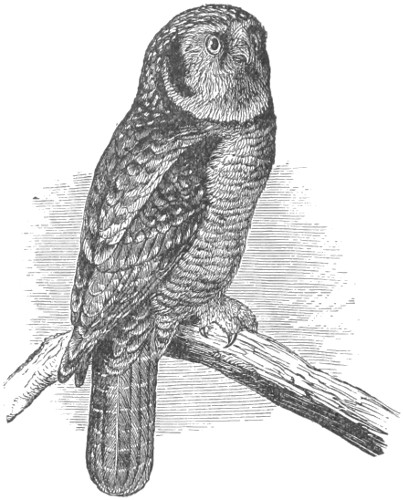
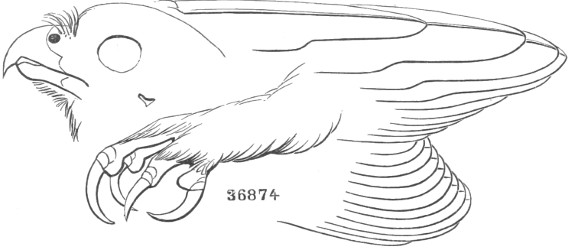
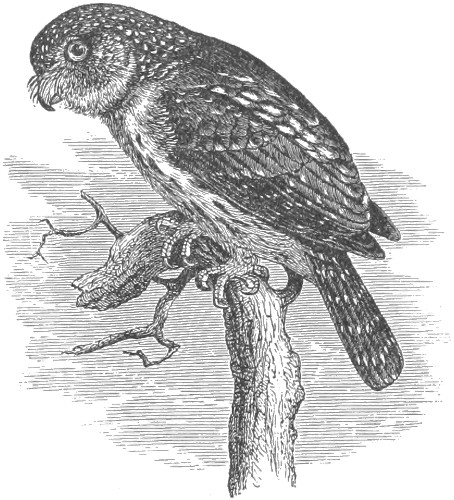
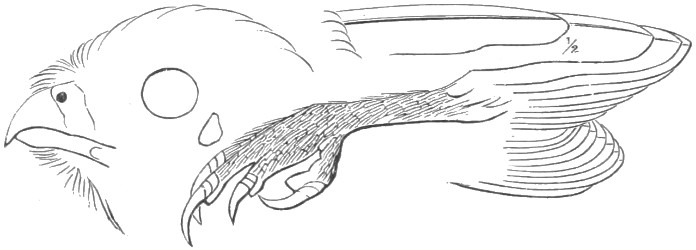
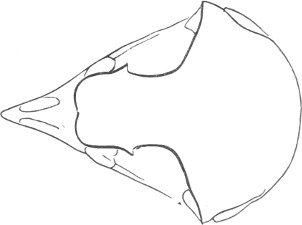
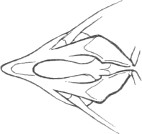
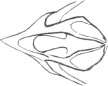
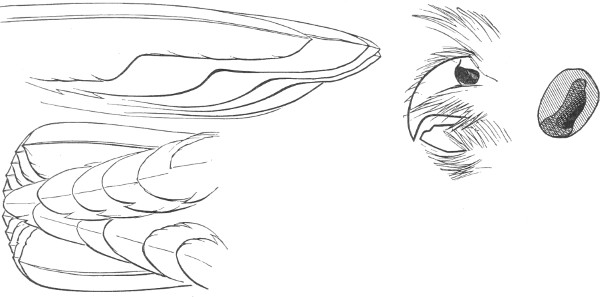
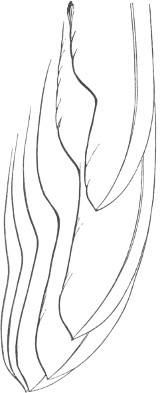
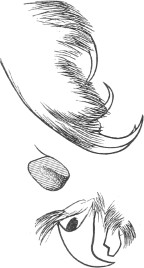
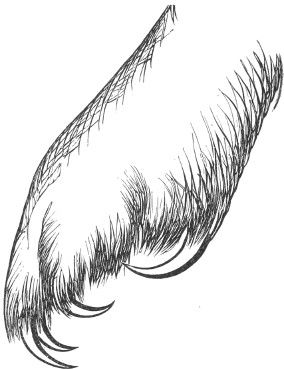
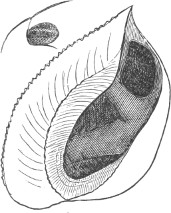
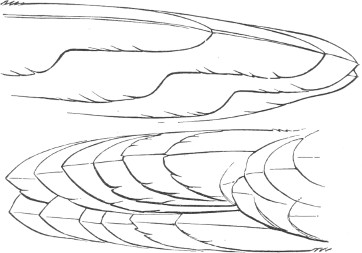
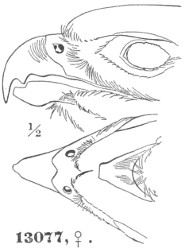
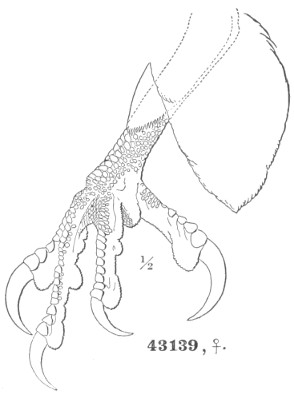
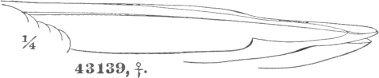
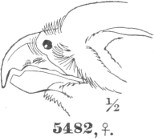
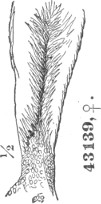
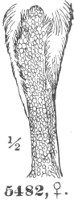
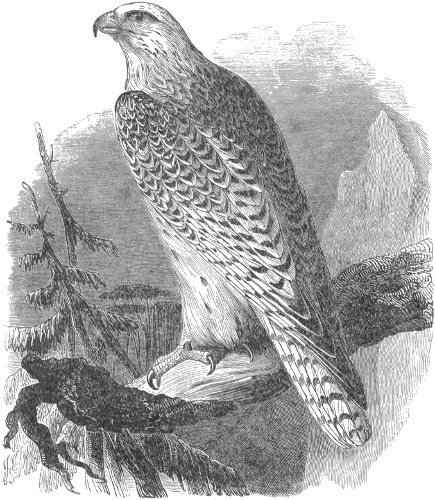
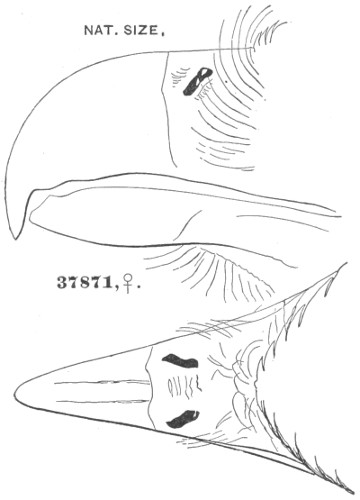
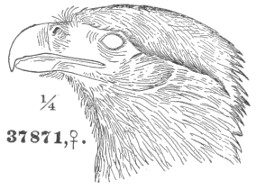
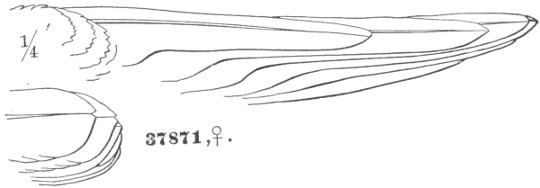
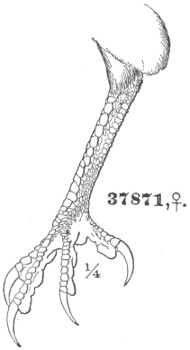
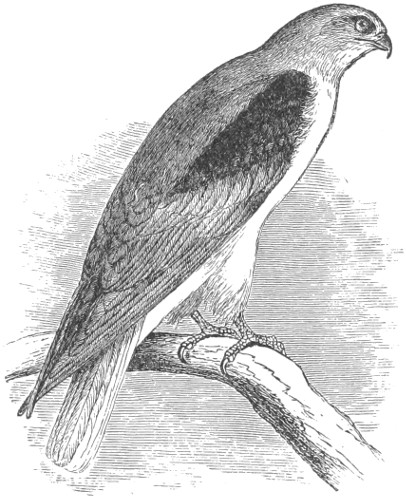
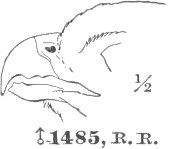
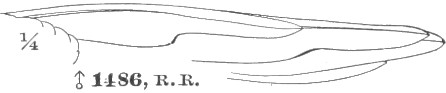
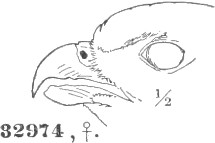
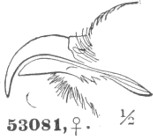
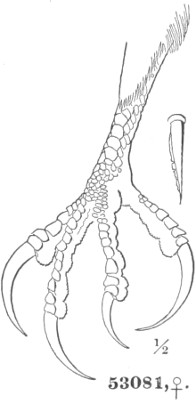
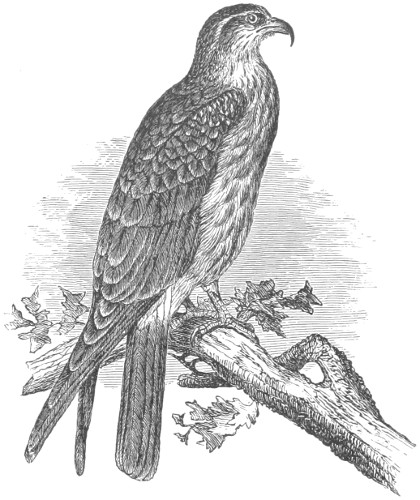
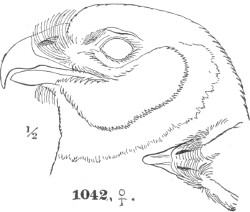
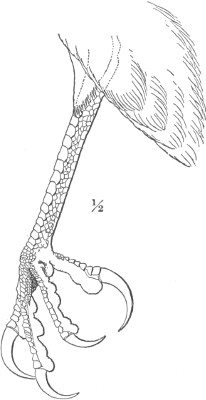
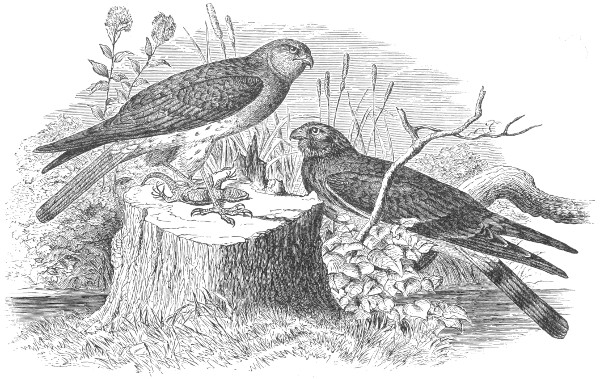
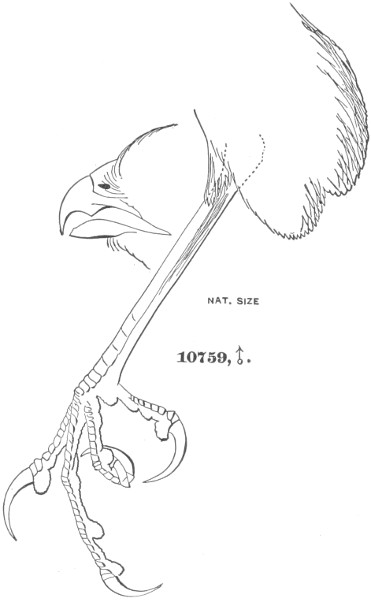
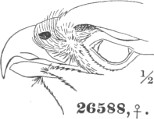
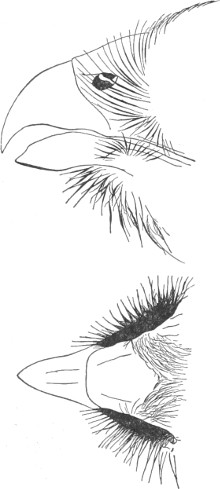
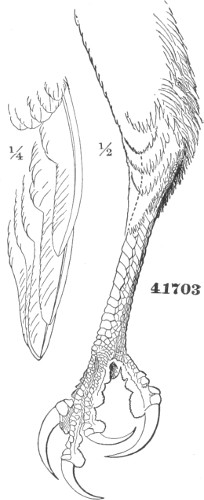
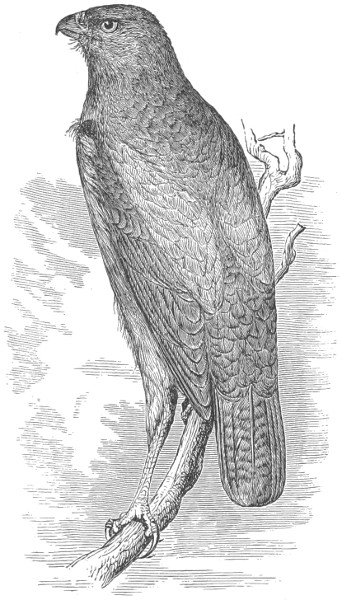
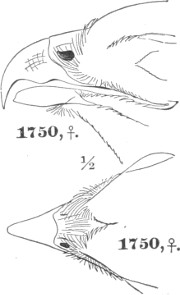
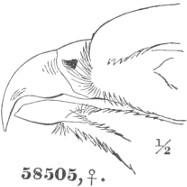
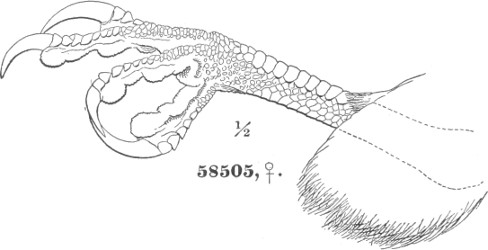
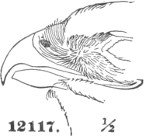
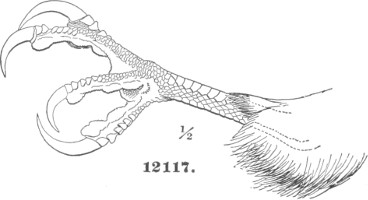
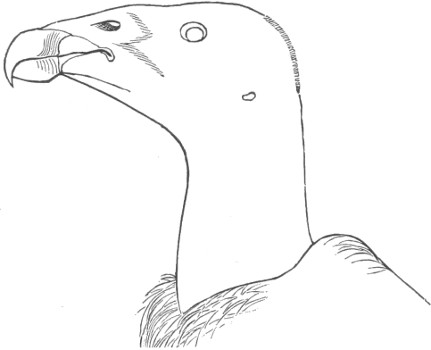
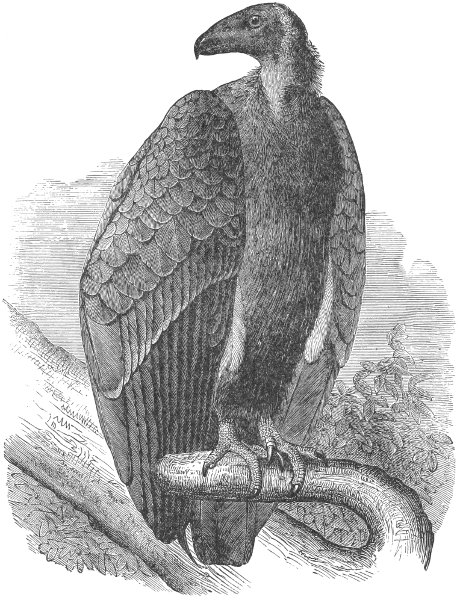
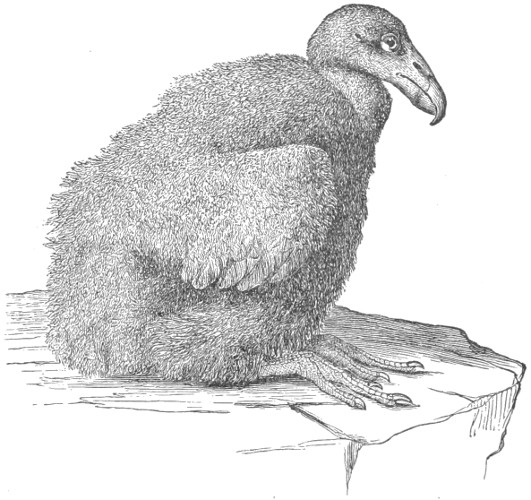
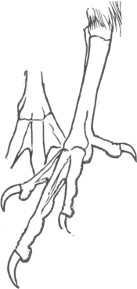
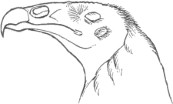
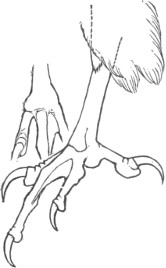
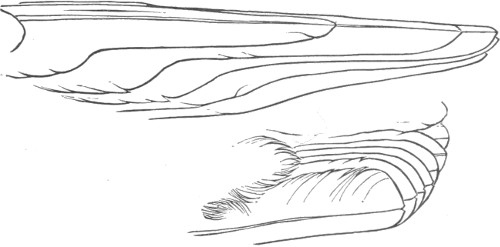
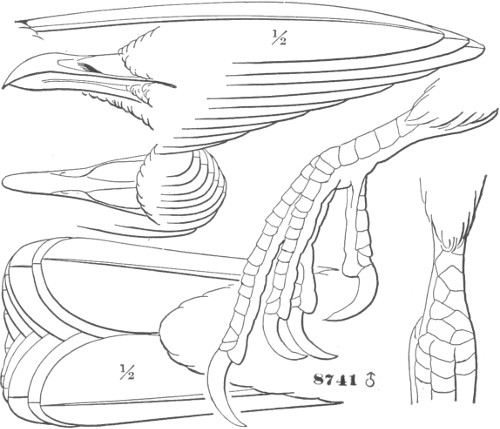
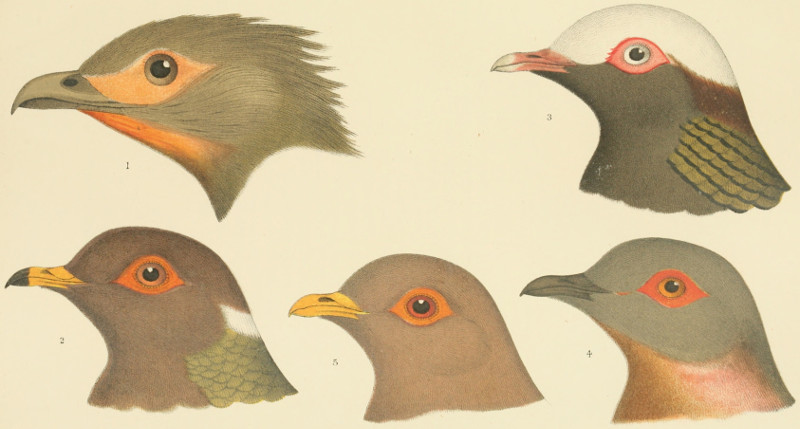
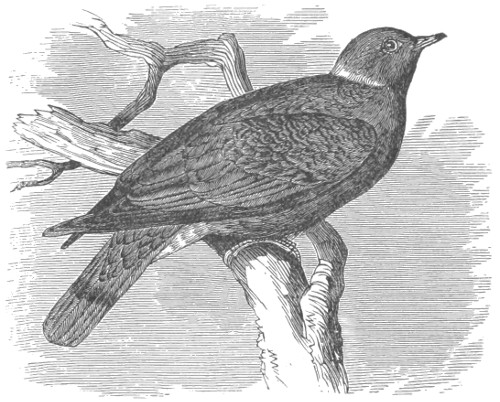
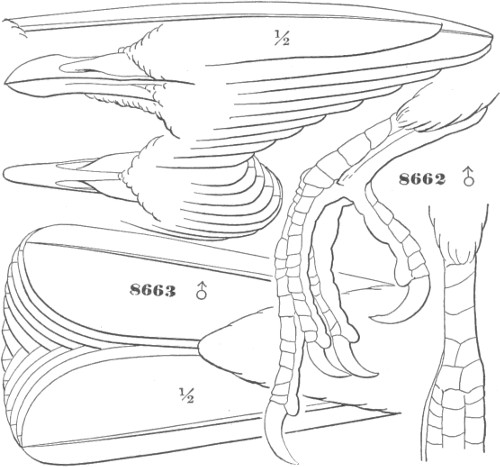
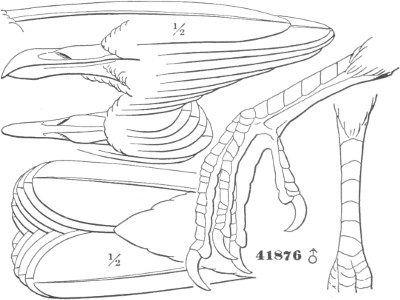
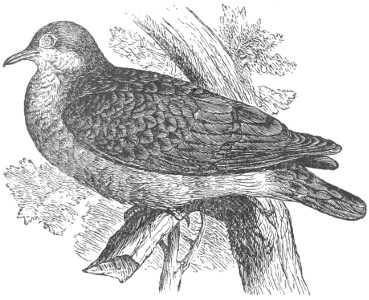
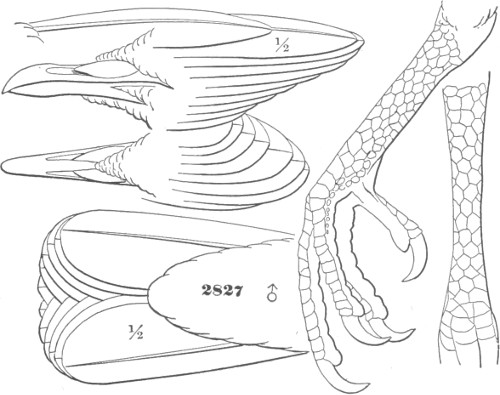
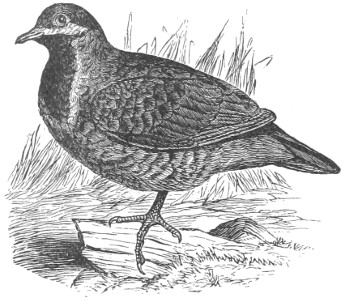
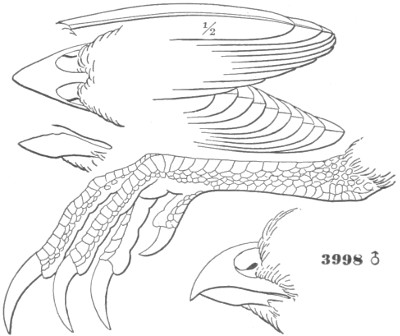
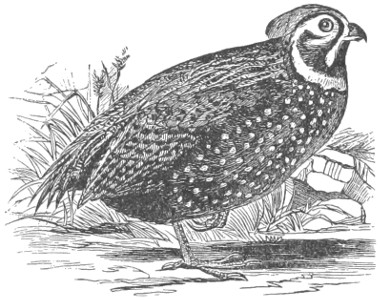
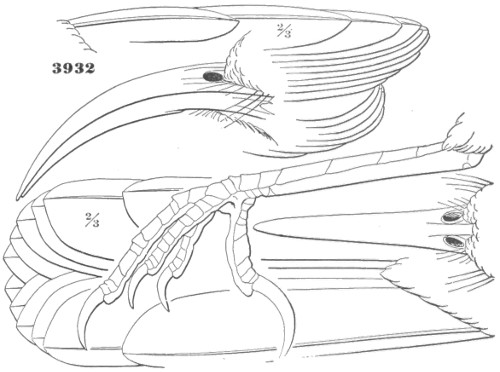
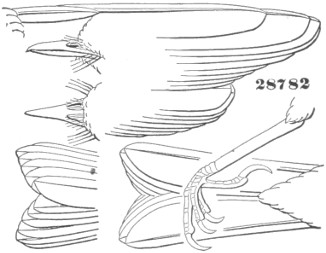
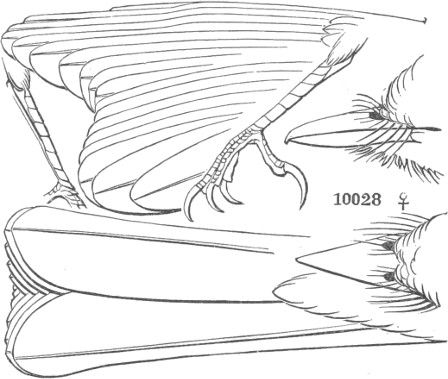
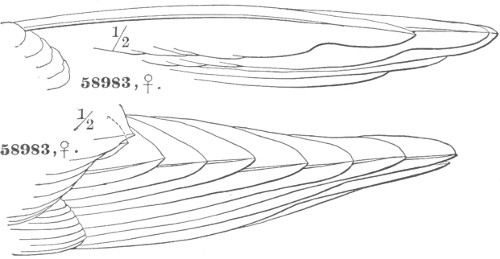
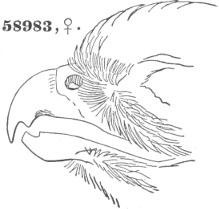
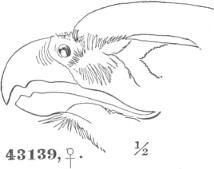
The group of birds usually known as the Raptores, or Rapacious Birds,
embraces three well-marked divisions, namely, the Owls, the Hawks, and the
Vultures. In former classifications they headed the Class of Birds, being
honored with this position in consequence of their powerful organization,
large size, and predatory habits. But it being now known that in structure
they are less perfectly organized than the Passeres and Strisores, birds generally
far more delicate in organization, as well as smaller in size, they occupy
a place in the more recent arrangements nearly at the end of the Terrestrial
forms.
The complete definition of the order Raptores, and of its subdivisions,
requires the enumeration of a great many characters; and that their distinguishing
features may be more easily recognized by the student, I give first
a brief diagnosis, including their simplest characters, to be followed by a
more detailed account hereafter.
Common Characters. Bill hooked, the upper mandible furnished at the base with a
soft skin, or “cere,” in which the nostrils are situated. Toes, three before and one behind.
Raptores.
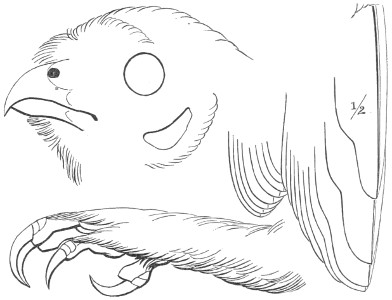
Strigidæ. Eyes directed forwards, and surrounded by radiating feathers,
which are bounded, except anteriorly, by a circle or rim of differently formed,
stiffer feathers. Outer toe reversible. Claws much hooked and very sharp.
Legs and toes usually feathered, or, at least, coated with bristles. The Owls.
Falconidæ. Eyes lateral, and not surrounded by radiating feathers. Outer
toe not reversible (except in Pandion). Claws usually hooked and sharp,
but variable. Head more or less completely feathered. The Hawks.
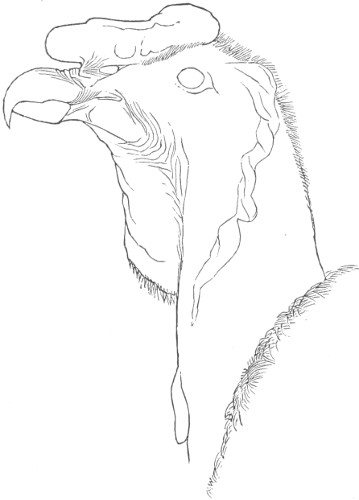
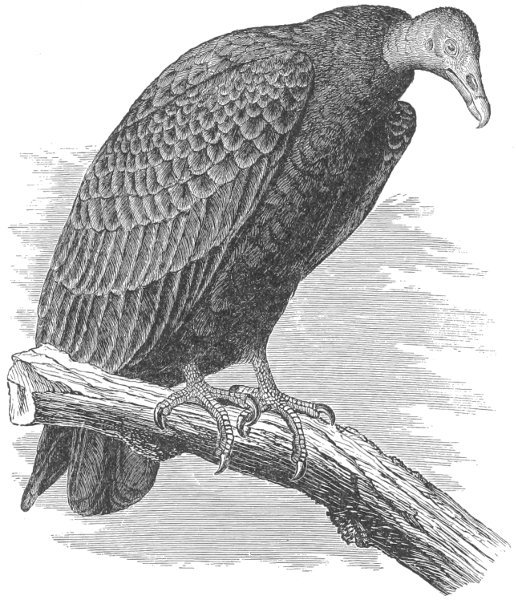
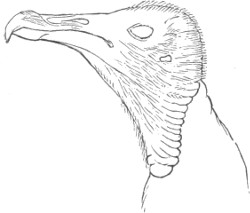
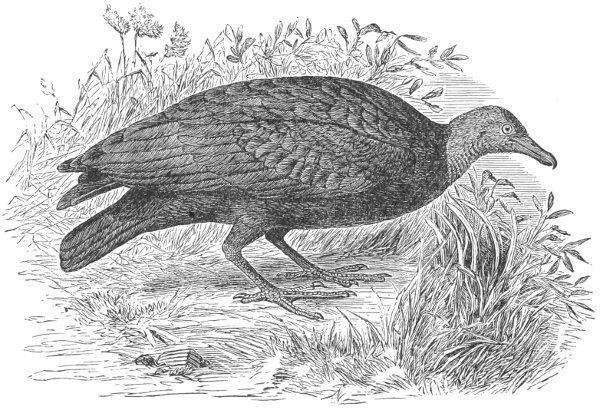
Cathartidæ. Eyes lateral; whole head naked. Outer toe not reversible;
claws slightly curved, blunt. The Vultures.
The preceding characters, though purely artificial, may nevertheless serve
to distinguish the three families of Raptores belonging to the North American
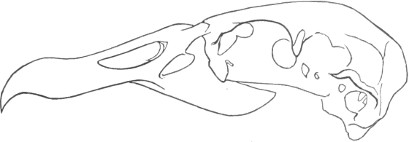
Ornis; a more scientific diagnosis, embracing a sufficient number of osteological,
and accompanying anatomical characters, will be found further on.
The birds of prey—named Accipitres by some authors, and Raptores or
Rapaces by others, and very appropriately designated as the Ætomorphæ by
Professor Huxley—form one of the most strongly characterized and sharply
limited of the higher divisions of the Class of Birds. It is only recently,
however, that their place in a systematic classification and the proper number
and relation of their subdivisions have been properly understood. Professor
Huxley’s views will probably form the basis for a permanent classification,
as they certainly point the way to one eminently natural. In his
important paper entitled “On the Classification of Birds, and on the Taxonomic
Value of the Modifications of certain Cranial Bones observable in
that Class,”2 this gentleman has dealt concisely upon the affinities of the
order Raptores, and the distinguishing features of its subdivisions. In the
following diagnoses the osteological characters are mainly borrowed from
Professor Huxley’s work referred to. Nitzsch’s “Pterylography”3 supplies
such characters as are afforded by the plumage, most of which confirm the
arrangement based upon the osteological structure; while important suggestions
have been derived from McGillivray’s “History of British Birds.”4
The Monographs of the Strigidæ and Falconidæ, by Dr. J. J. Kaup,5 contain
much valuable information, and were they not disfigured by a very eccentric
system of arrangement they would approach nearer to a natural classification
of the subfamilies, genera, and subgenera, than any arrangement of the
lesser groups which I have yet seen.
The species of this group are spread over the whole world, tropical regions
having the greatest variety of forms and number of species. The Strigidæ
are cosmopolitan, most of the genera belonging to both continents. The
Falconidæ are also found the world over, but each continent has subfamilies
peculiar to it. The Cathartidæ are peculiar to America, having analogous
representatives in the Old World in the subfamily Vulturinæ belonging to
the Falconidæ, The Gypogeranidæ are found only in South Africa, where a
single species, Gypogeranus serpentarius (Gmel.), sole representative of the
family, is found.
As regards the comparative number of species of this order in the two
continents, the Old World is considerably ahead of the New World, which
might be expected from its far greater land area. 581 species are given in
Gray’s Hand List,6 of which certainly not more than 500, probably not more
than 450, are valid species, the others ranking as geographical races, or are
synonymous with others; of this number about 350 nominal species are
accredited to the Old World. America, however, possesses the greatest
variety of forms, and the great bulk of the Old World Raptorial fauna is
made up chiefly by a large array of species of a few genera which are represented
in America by but one or two, or at most half a dozen, species. The
genera Aquila, Spizætus, Accipiter, Haliætus, Falco, Circus, Athene, Strix, and
Buteo, are striking examples. As regards the number of peculiar forms,
America is considerably ahead.
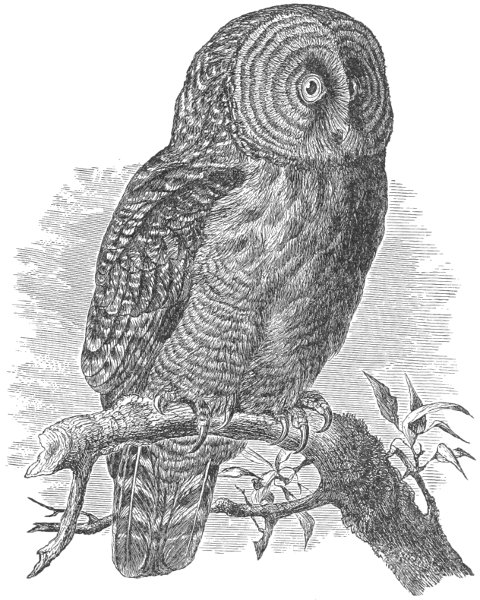
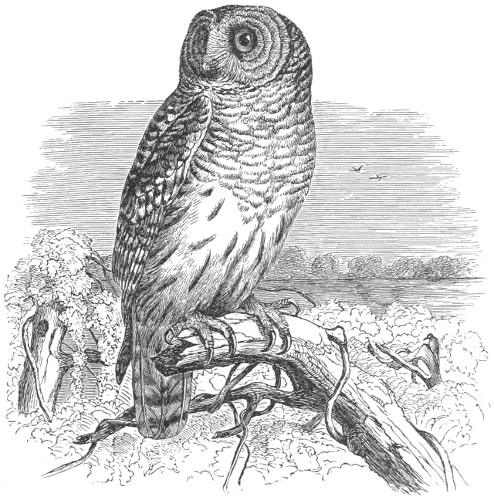
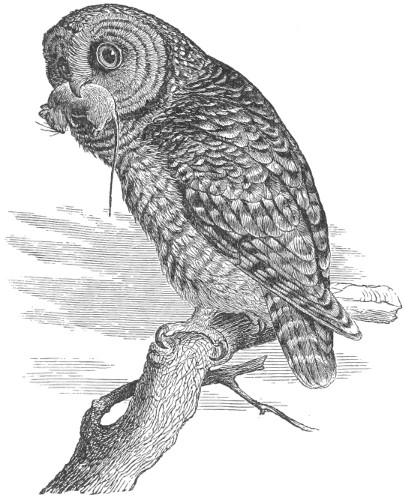
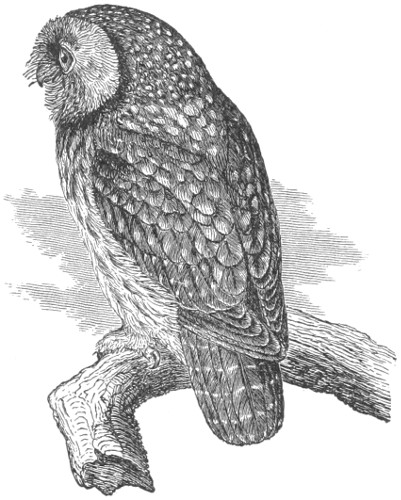
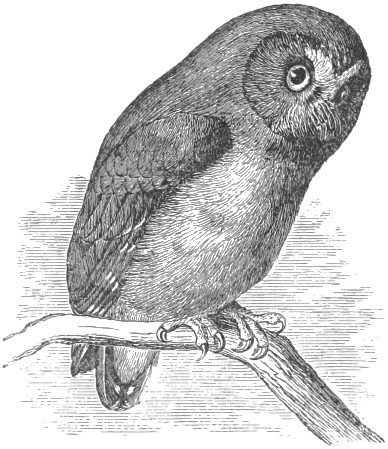
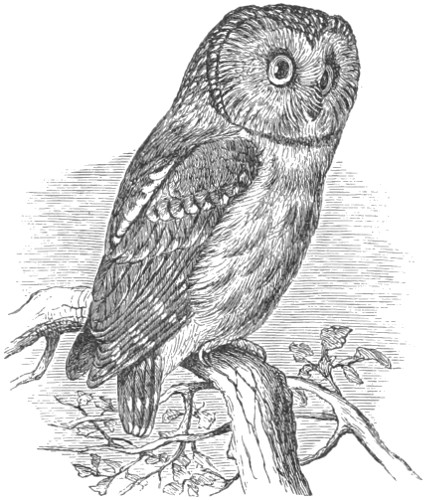
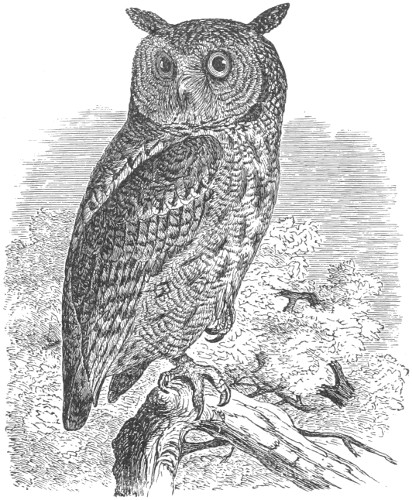
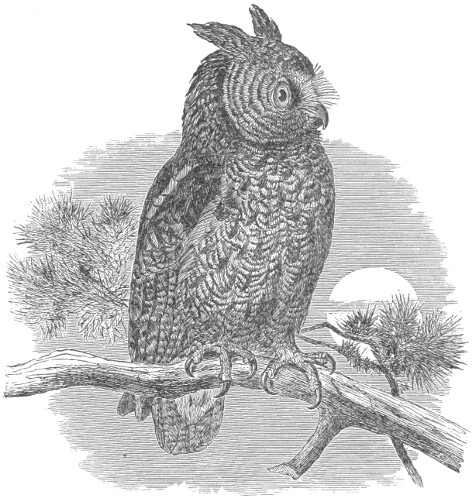
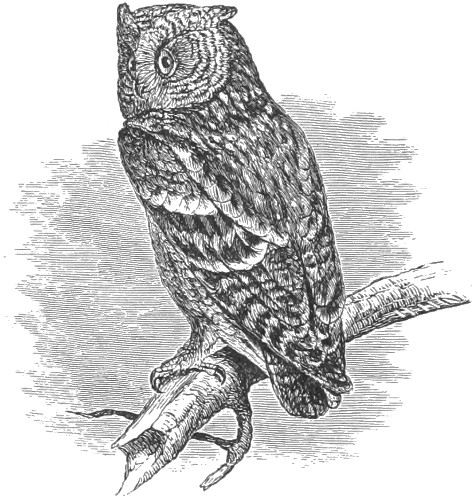
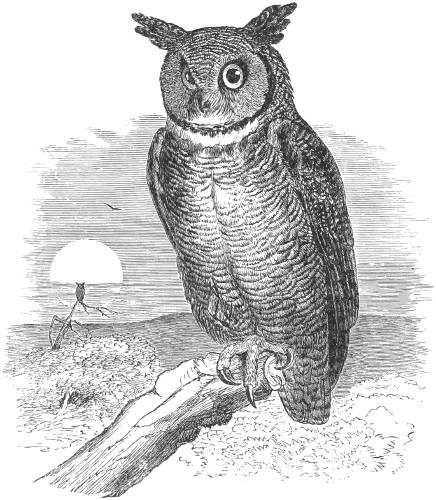
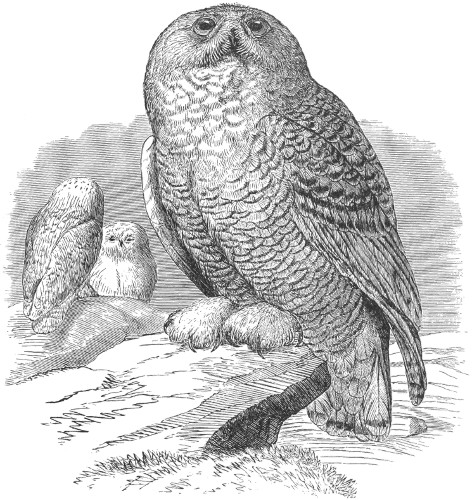
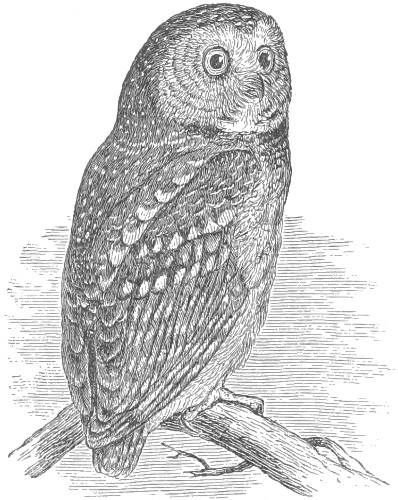
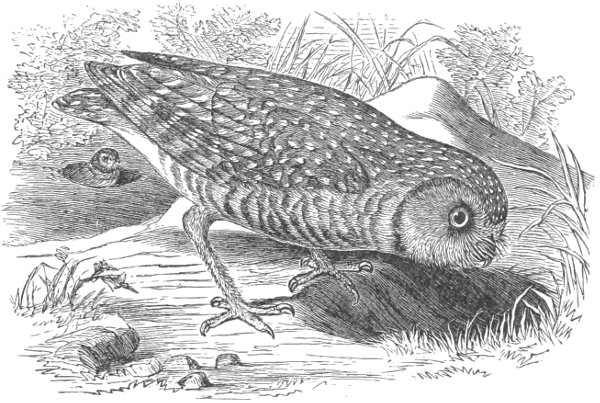
Family STRIGIDÆ .— The Owls. — Genera and Subgenera. — Genus STRIX , Savigny . — Synopsis of the Races of S. flammea. — Strix flammea , var. pratincola , Bonap. AMERICAN BARN OWL. — Genus OTUS , Cuvier. — Species and Varieties. — Otus vulgaris , var. wilsonianus , Less. LONG-EARED OWL; LESSER-HORNED OWL. — Otus (Brachyotus) brachyotus , Steph. SHORT-EARED OWL; MARSH OWL. — Genus SYRNIUM , Savigny . — Subgenera. — Species and Varieties. — Syrnium (Scotiaptex) cinereum , Audubon. GREAT GRAY OWL. — Syrnium nebulosum , Gray . BARRED OWL; “HOOT OWL.” — Syrnium occidentale , Xantus . WESTERN BARRED OWL; SPOTTED OWL. — Genus NYCTALE , Brehm . — Species and Races. — Nyctale tengmalmi , var. richardsoni , Bonap. AMERICAN SPARROW OWL; RICHARDSON’S OWL. — Nyctale acadica , Bonap. SAW-WHET OWL; WHITE-FRONTED OWL; KIRTLAND’S OWL. — Genus SCOPS , Savigny . — Species and Races. — Scops asio , Bonap. LITTLE RED OWL; MOTTLED OWL; “SCREECH-OWL.” — Scops asio , var. floridana , Ridgway . — Scops asio , var. maccalli , Cass . WESTERN MOTTLED OWL. — Scops asio , var. kennicotti , Elliot . KENNICOTT’S OWL. — Scops flammeola , Licht. FEILNER’S OWL. — Genus BUBO , Dum. — Subgenera. — Subgenus BUBO , Dum. — Subgenus NYCTEA , Stephens . — Bubo virginianus , var. virginianus , Bonap. GREAT HORNED OWL. — Bubo virginianus , var. arcticus , Swains. WESTERN GREAT HORNED OWL. — Bubo virginianus , var. pacificus , Cass. — Nyctea scandiaca , var. arctica , Gray . AMERICAN SNOWY OWL. — Genus SURNIA , Duméril . — Species and Races. — Surnia ulula , var. hudsonia ( Gmelin ). AMERICAN HAWK OWL. — Genus GLAUCIDIUM , Boie . — Species and Races. — Glaucidium passerinum , var. californicum ( Sclater ). THE CALIFORNIA PIGMY OWL. — Glaucidium ferrugineum , Kaup . THE RED-TAILED OWL. — Genus MICRATHENE , Coues . — Species. — Micrathene whitneyi , Coues . WHITNEY’S OWL. — Genus SPEOTYTO , Gloger . — Species and Races. — Spheotyto cunicularia , var. hypogæa , Bonap. BURROWING OWL. — NOTE.
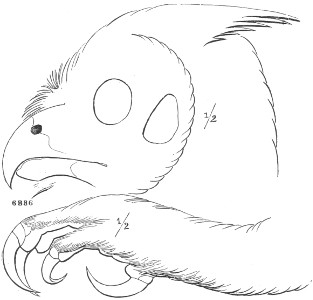
Char. Eyes directed forward, and surrounded by a radiating system of feathers,
which is bounded, except anteriorly, by a ruff of stiff, compactly webbed, differently
formed, and somewhat recurved feathers; loral feathers antrorse, long, and dense.
Plumage very soft and lax, of a fine downy texture, the feathers destitute of an
after-shaft. Oil-gland without the usual circlet of feathers. Outer webs of the quills
with the points of the fibres recurved. Feathers on the sides of the forehead frequently
elongated into ear-like tufts; tarsus usually, and toes frequently, densely feathered. Ear-opening
very large, sometimes covered by a lappet. Œsophagus destitute of a dilated
crop; cœca large. Maxillo-palatines thick and spongy, and encroaching upon the
intervening valley; basipterygoid processes always present. Outer toe reversible; posterior
toe only about half as long as the outer. Posterior margin of the sternum doubly
indented; clavicle weak and nearly cylindrical, about equal in length to the sternum.
Anterior process of the coracoid projected forward so as to meet the clavicle, beneath the
basal process of the scapula. Eggs variable in shape, usually nearly spherical, always
immaculate, pure white.
The Owls constitute a very natural and sharply limited family, and though
the species vary almost infinitely in the details of their structure, they all
seem to fall within the limits of a single subfamily.
They have never yet been satisfactorily classified, and all the arrangements
which have been either proposed or adopted are refuted by the facts
developed upon a close study into the true relationship of the many genera.
The divisions of “Night Owls,” “Day Owls,” “Horned Owls,” etc., are
purely artificial. This family is much more homogeneous than that of the
Falconidæ, since none of the many genera which I have examined seem
to depart in their structure from the model of a single subfamily, though a
few of them are somewhat aberrant as regards peculiarities in the detail of
external form, or, less often, to a slight extent, in their osteological characters,
though I have examined critically only the American and European
species; and there may be some Asiatic, African, or Australian genera
which depart so far from the normal standard of structure as to necessitate a
modification of this view. In the structure of the sternum there is scarcely
the least noticeable deviation in any genus7 from the typical form. The
appreciable differences appear to be only of generic value, such as a different
proportionate length of the coracoid bones and the sternum, and width of
the sternum in proportion to its length, or the height of its keel. The crania
present a greater range of variation, and, if closely studied, may afford a
clew to a more natural arrangement than the one which is here presented.
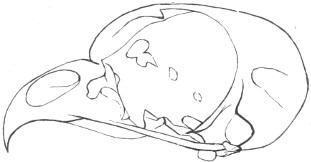
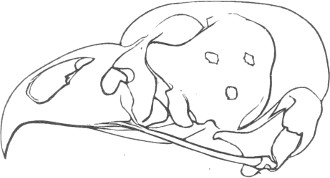
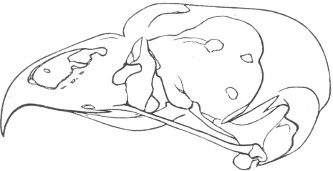
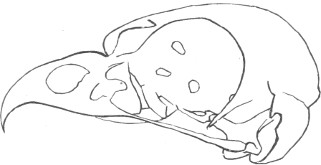
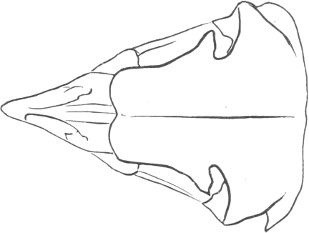
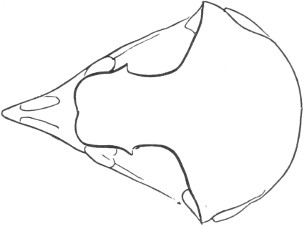
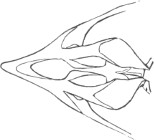
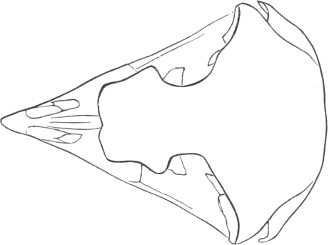
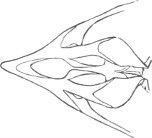
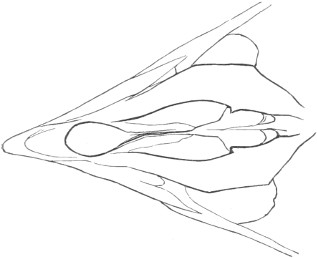
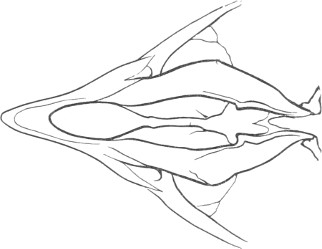
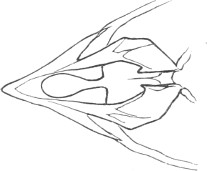
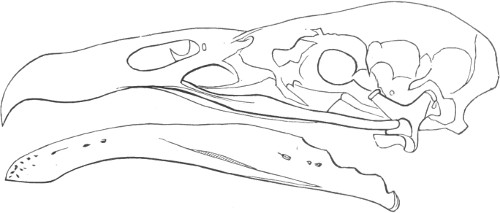
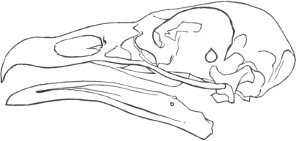
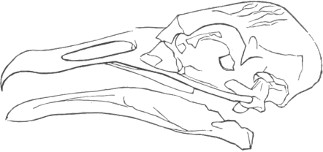
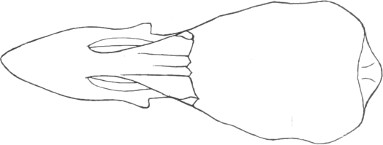
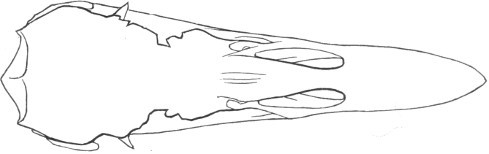
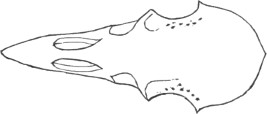
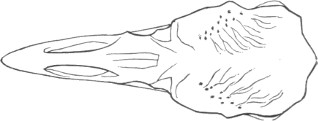
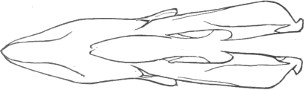
The chief differences in the skulls of different genera consist in the degree
of pneumaticity of the bones, in the form of the auricular bones, the comparative
length and breadth of the palatines, and very great contrasts in the
contour. As a rule, we find that those skulls which have the greatest
pneumaticity (e.g. Strix and Otus) are most depressed anteriorly, have the
orbital septum thicker, the palatines longer and narrower, and a deeper longitudinal
median valley on the superior surface, and vice versa.
The following classification is based chiefly upon external characters; but
these are in most instances known to be accompanied by osteological peculiarities,
which point to nearly the same arrangement. It is intended merely
as an artificial table of the North American genera, and may be subjected
to considerable modification in its plan if exotic genera are introduced.8
A. Inner toe equal to the middle in length; inner edge of
middle claw pectinated. First quill longer than the third; all the
quills with their inner webs entire, or without emargination. Tail
emarginated. Feathers of the posterior face of the tarsus
recurved, or pointed upwards.
1. Strix. No ear-tufts; bill light-colored; eyes black; tarsus
nearly twice as long as middle toe; toes scantily haired. Size
medium. Ear-conch nearly as long as the height of the skull,
with an anterior operculum for only a portion of its length;
symmetrical.
B. Inner toe decidedly or much shorter than the middle; inner edge of middle
claw not pectinated. First quill shorter than the third; one to six outer quills
with their inner webs emarginated. Tail rounded. Feathers of the posterior
face of the tarsus not recurved but pointed downwards.
I. Nostril open, oval, situated in the anterior edge of the
cere, which is not inflated.
a. Cere, on top, equal to, or exceeding, the chord
of the culmen; much arched. Ear-conch nearly as long as
the height of the skull, with the operculum extending its
full length; asymmetrical.
2. Otus. One or two outer quills with their inner
webs emarginated. With or without ear-tufts. Bill
blackish; iris yellow. Size medium.
Ear-tufts well developed; only one quill emarginated … Otus.
Ear-tufts rudimentary; two quills emarginated … Brachyotus.
b. Cere, on top, less than the chord of the culmen;
gradually ascending basally, or level (not arched).
Ear-conch nearly the height of the skull, with the
operculum extending only a part of its full length, or
wanting entirely.
† Anterior edge of the ear-conch with an operculum; the two ears
asymmetrical.
3. Syrnium. Five to six outer quills with their inner
webs emarginated. Top of cere more than half the culmen.
Without ear-tufts. Bill yellow; iris yellow or black. Size
medium or large.
Six quills emarginated; toes densely feathered, the terminal
scutellæ concealed; iris yellow. Size very large … Scotiaptex.
Five quills emarginated; toes scantly feathered, the
terminal scutellæ exposed; iris black. Size medium … Syrnium.
4. Nyctale. Two outer quills with inner webs emarginated.
Top of cere less than half the culmen, level. Without
ear-tufts. Bill yellow or blackish; iris yellow. Size
small.
†† Anterior edge of the ear-conch without an operculum. The two
ears symmetrical. Tail slightly rounded, only about half as long
as the wing.
5. Scops. Two to five quills with inner webs emarginated;
second to fifth longest. Bill weak, light-colored. Ear-conch
elliptical, about one-third the height of the head, with a
slightly elevated fringed anterior margin. Size small; ear-tufts
usually well developed, sometimes rudimentary.
6. Bubo. Two to four outer quills with inner webs emarginated;
third to fourth longest. Bill robust, black. Ear-conch
elliptical, simple, from one third to one half the height
of the skull. Size large. Ear-tufts well developed or rudimentary.
Ear-tufts well developed. Two to three outer quills
with inner webs emarginated; lower tail-coverts not
reaching end of the tail. Toes covered with short feathers,
the claws exposed, and bill not concealed by the loral
feathers … Bubo.
Ear-tufts rudimentary. Four outer quills with their
inner webs emarginated; lower tail-coverts reaching end
of the tail. Toes covered with long feathers, which hide
the claws, and bill nearly concealed by the loral feathers … Nyctea.
††† Similar to the last, but the tail graduated, nearly equal to the
wing.
7. Surnia. Four outer quills with inner webs emarginated.
Third quill longest. Bill strong, yellow; ear-conch simple,
oval, less than the diameter of the eye. Size medium; no
ear-tufts.
II. Nostril, a small circular opening into the surrounding inflated membrane
of the cere. Ear-conch small, simple, oval, or nearly round, without an
operculum.
First quill shorter than the tenth.
8. Glaucidium. Third to fourth quills longest; four emarginated
on inner webs. Tarsus about equal to the middle toe,
densely feathered. Tail much more than half the wing,
rounded. Bill and iris yellow. Size very small.
9. Micrathene. Fourth quill longest; four emarginated on
inner webs. Tarsus a little longer than middle toe, scantily
haired. Tail less than half the wing, even. Bill light (greenish ?);
iris yellow. Size very small.
First quill longer than sixth.
10. Speotyto. Second to fourth quills longest; three emarginated
on inner webs. Tarsus more than twice as long as
middle toe, closely feathered in front to the toes, naked
behind. Tail less than half the wing, slightly rounded. Bill
yellowish; iris yellow. Size small.
In their distribution, the Owls, as a family, are cosmopolitan, and most of
the genera are found on both hemispheres. All the northern genera (Nyctea,
Surnia, Nyctale, and Scotiaptex), and the majority of their species, are circumpolar.
The genus Glaucidium is most largely developed within the
tropics, and has numerous species in both hemispheres. Otus brachyotus
and Strix flammea are the only two species which are found all over the
world,—the former, however, being apparently absent in Australia. Gymnoglaux,
Speotyto, Micrathene, and Lophostrix are about the only well-characterized
genera peculiar to America. Athene, Ketupa, and Phodilus are peculiar
to the Old World. The approximate number of known species (see Gray’s
Hand List of Birds, I, 1869) is about two hundred, of which two, as stated,
are cosmopolitan; six others (Surnia ulula, Nyctea scandiaca, Glaucidium
passerinum, Syrnium cinereum, Otus vulgaris, and Nyctale tengmalmi) are
found in both halves of the Northern Hemisphere; of the remainder there
are about an equal number peculiar to America and the Old World.
As regards the distribution of the Owls in the Nearctic Realm, a prominent
feature is the number of the species (eighteen, not including races)
belonging to it, of which six (Micrathene whitneyi, Nyctale acadica, Syrnium
nebulosum, S. occidentale, Scops asio, and S. flammeola) are found nowhere else.
Speotyto cunicularia and Bubo virginianus are peculiarly American species
found both north and south of the equator, but in the two regions represented
by different geographical races. Glaucidium ferrugineum and G. infuscatum
(var. gnoma) are tropical species which overreach the bounds of the Neotropical
Realm,—the former extending into the United States, the latter
reaching to, and probably also within, our borders. Of the eighteen North
American species, about nine, or one half (Strix flammea var. pratincola,
Otus brachyotus, O. vulgaris var. wilsonianus, Syrnium cinereum, Nyctale
acadica, Bubo virginianus, and Scops asio, with certainty, and Nyctea
scandiaca var. arctica, and Surnia ulula var. hudsonia, in all probability),
are found entirely across the continent. Nyctale tengmalmi, var. richardsoni,
and Syrnium nebulosum, appear to be peculiar to the eastern portion,—the
former to the northern regions, the latter to the southern. Athene cunicularia
var. hypugaea, Micrathene whitneyi, Glaucidium passerinum var. californicum,
Syrnium occidentale, and Scops flammeola, are exclusively western, all belonging
to the southern portion of the Middle Province and Rocky Mountain
region, and the adjacent parts of Mexico, excepting the more generally distributed
Speotyto cunicularia, var. hypogæa, before mentioned. Anomalies in
regard to the distribution of some of the species common to both continents,
are the restriction of the American representative of Glaucidium passerinum
to the western regions,9 and of Strix flammea to the very southern and
maritime portions of the United States, the European representatives of both
species being generally distributed throughout that continent. On the other
hand, the northwest-coast race of our Scops asio (S. kennicotti) seems to be
nearly identical with the Japanese S. semitorques (Schlegel), which is undoubtedly
referrible to the same species.
As regards their plumage, the Owls differ most remarkably from the
Hawks in the fact that the sexes are invariably colored alike, while from
the nest to perfect maturity there are no well-marked progressive stages
distinguishing the different ages of a species. The nestling, or downy,
plumage, however, of many species, has the intricate pencilling of the adult
dress replaced by a simple transverse barring upon the imperfect downy
covering. The downy young of Nyctea scandiaca is plain sooty-brown, and
that of Strix flammea immaculate white.
In many species the adult dress is characterized by a mottling of various
shades of grayish mixed with ochraceous or fulvous, this ornamented by a
variable, often very intricate, pencilling of dusky, and more or less mixed
with white. As a consequence of the mixed or mottled character of the
markings, the plumage of the Owls is, as a rule, difficult to describe.
In the variations of plumage, size, etc., with differences of habitat,
there is a wide range, the usually recognized laws10 applying to most of
those species which are generally distributed and resident where breeding.
Of the eight species common to the Palæarctic and Nearctic Realms, all but
one (Otus brachyotus) are modified so as to form representative geographical
races on the two continents. In each of these cases the American bird is
much darker than the European, the brown areas and markings being not only
more extended, but deeper in tint. The difference in this respect is so tangible
that an experienced ornithologist can instantly decide to which continent
any specimen belongs. Of the two cosmopolitan species one, Otus
brachyotus, is identical throughout; the other is modified into geographical
races in nearly every well-marked province of its habitat. Thus in the
Palæarctic Realm it is typical Strix flammea; in the Nearctic Realm it is var.
pratincola; while Tropical America has at least three well-marked geographical
races, the species being represented in Middle America by the var.
guatemalæ, in South America by var. perlata, and in the West Indies by the
var. furcata. The Old World has also numerous representative races, of
which we have, however, seen only two, namely, var. javanica (Gm.), of Java,
India, and Eastern Africa, and var. delicatula (Gould) of Australia, both of
which we unhesitatingly refer to S. flammea.11
On the North American continent the only widely distributed species
which do not vary perceptibly with the region are Otus brachyotus and O.
vulgaris (var. wilsonianus). Bubo virginianus, Scops asio, and Syrnium nebulosum
all bear the impress of special laws in the several regions of their
habitat. Starting with the Eastern Province, and tracing either of these three
species southward, we find it becoming gradually smaller, the colors deeper
and more rufous, and the toes more scantily feathered. Scops asio reaches its
minimum of size and maximum depth of color in Florida (var. floridana)
and in Mexico (var. enano).
Of the other two I have not seen Florida specimens, but examples of
both from other Southern States and the Lower Mississippi Valley region are
much more rufous, and—the S. nebulosum especially—smaller, with more
naked toes. The latter species is darkest in Eastern Mexico (var. sartori),
and most rufescent, and smallest, in Guatemala (var. fulvescens). In the middle
region of the United States, Scops asio (var. maccalli) and Bubo virginianus
(var. arcticus) are more grayish and more delicately pencilled than from
other portions. In the northwest coast region they become larger and much
more darkly colored, assuming the clove-brown or sooty tints peculiar to the
region. The var. kennicotti represents S. asio in this region, and var. pacificus
the B. virginianus. The latter species also extends its range around the
Arctic Coast to Labrador, and forms a northern littoral race, the very opposite
extreme in color from the nearly albinescent examples of var. arcticus
found in the interior of Arctic America.
A very remarkable characteristic of the Owls is the fact that many of the
species exist in a sort of dimorphic condition, or that two plumages sufficiently
unlike to be of specific importance in other cases belong to one
species. It was long thought that these two phases represented two distinct
species; afterwards it was maintained that they depended on age, sex, or season,
different authors or observers entertaining various opinions on the subject;
but it is now generally believed that every individual retains through
life the plumage which it first acquires, and that young birds of both forms
are often found in the same nest, their parents being either both of one
form, or both of the other, or the two styles paired together.12 The normal
plumage, in these instances, appears to be grayish, the pattern distinct, the
markings sharply defined, and the general appearance much like that of species
which do not have the other plumage. The other plumage is a replacing
of the grayish tints by a bright lateritious-rufous, the pencillings being
at the same time less well defined, and the pattern of the smaller markings
often changed. This condition seems to be somewhat analogous to melanism
in certain Falconidæ, and appears to be more common in the genera Scops
and Glaucidium (in which it affects mainly the tropical species), and occurs
also in the European Syrnium aluco. As studied with relation to our North
American species, we find it only in Scops asio and Glaucidium ferrugineum.
The latter, being strictly tropical in its habitat, is similarly affected throughout
its range; but in the former we find that this condition depends much
upon the region. Thus neither Dr. Cooper nor I have ever seen a red specimen
from the Pacific coast, nor do I find any record of such an occurrence.
The normal gray plumage, however, is as common throughout that region as
in the Atlantic States. In the New England and Middle States the red plumage
seems to be more rare in most places than the gray one, while toward
the south the red predominates greatly. Of over twenty specimens obtained
in Southern Illinois (Mt. Carmel) in the course of one winter, only one was
of the gray plumage; and of the total number of specimens seen and secured
at other times during a series of years, we can remember but one other
gray one. As a parallel example among mammals, Professor Baird suggests
the case of the Red-bellied Squirrels and Foxes of the Southern States,
whose relationships to the more grayish northern and western forms appear
to be about the same as in the present instance.
Gen. Char. Size medium. No ear-tufts; facial ruff entirely continuous, very conspicuous.
Wing very long, the first or second quill longest, and all without emargination. Tail
short, emarginated. Bill
elongated, compressed, regularly
curved; top of the
cere nearly equal to the
culmen, straight, and somewhat
depressed. Nostril
open, oval, nearly horizontal.
Eyes very small. Tarsus
nearly twice as long as the
middle toe, densely clothed
with soft short feathers,
those on the posterior face
inclined upwards; toes
scantily bristled; claws extremely
sharp and long, the middle one with its inner edge pectinated. Ear-conch nearly
as long as the height of the head, with an anterior operculum, which does not extend its
full length; the two ears symmetrical?
The species of Strix are distributed over the whole world, though only
one of them is cosmopolitan. This is the common Barn Owl (S. flammea),
the type of the genus, which is found in nearly every portion of the world,
though in different regions it has experienced modifications which constitute
geographical races. The other species, of more restricted distribution, are
peculiar to the tropical portions of the Old World, chiefly Australia and
South Africa.
S. flammea. Face varying from pure white to delicate claret-brown; facial
circle varying from pure white, through ochraceous and rufous, to deep black.
Upper parts with the feathers ochraceous-yellow basally; this overlaid, more or
less continuously, by a grayish wash, usually finely mottled and speckled, with
dusky and white. Primaries and tail barred transversely, more or less distinctly,
with distant dusky bands, of variable number. Beneath, varying from pure
snowy white to tawny rufous, immaculate or speckled. Wing, 10.70–13.50.
Wing, 10.70–12.00; tail, 4.80–5.50; culmen, .75–.80; tarsus, 2.05–2.15;
middle toe, 1.25–1.30. Tail with four dark bands, and sometimes a trace
of a fifth. Hab. Europe and Mediterranean region of Africa … var. flammea.13
Wing, 12.50–14.00; tail, 5.70–7.50; culmen, .90–1.00; tarsus, 2.55–3.00.
Tail with four dark bands, and sometimes a trace of a fifth. Colors
lighter than in var. flammea. Hab. Southern North America and Mexico … var. pratincola.
Wing, 11.30–13.00; tail, 5.30–5.90; tarsus, 2.55–2.95. Colors of var.
flammea, but more uniform above and more coarsely speckled below. Hab.
Central America, from Panama to Guatemala … var. guatemalæ.14
Wing, 11.70–12.00; tail, 4.80–5.20; tarsus, 2.40–2.75. Tail more even,
and lighter colored; the dark bars narrower, and more sharply defined.
Colors generally paler, and more grayish. Hab. South America (Brazil,
etc.) … var. perlata.15
Wing, 12.00–13.50; tail, 5.60–6.00; culmen, .85–.95; tarsus, 2.70–2.85;
middle toe, 1.45–1.60. Colors as in var. perlata, but secondaries and tail
nearly white, in abrupt contrast to the adjacent parts; tail usually without
bars. Hab. West Indies (Cuba and Jamaica, Mus. S. I.) … var. furcata.16
Wing, 11.00; tail, 5.00; culmen, about .85; tarsus, 2.05–2.45; middle
toe, 1.30–1.40. Colors of var. pratincola, but less of the ochraceous, with
a greater prevalence of the gray mottling. Tail with four dark bands
Hab. Australia … var. delicatula.17
Wing, 11.00–11.70; tail, 5.10–5.40; culmen, .85–.90; tarsus, 2.30–2.45;
middle toe, 1.35–1.45. Same colors as var. delicatula. Tail with
four dark bands (sometimes a trace of a fifth). Hab. India and Eastern
Africa … var. javanica.18
Strix pratincola, Bonap. List, 1838, p. 7.—De Kay, Zoöl. N. Y. II, 1844, 31, pl. xiii.
f. 28.—Gray, Gen. B., fol. sp. 2.—Cassin, B. Cal. & Tex. 1854, p. 176.—Newb.
P. R. Rep. VI, IV, 1857, 76.—Heerm. do. VII, 1857, 34.—Cass. Birds N. Am. 1858,
47.—Coues, Prod. Orn. Ariz. (P. A. N. S. Philad. 1866), 13.—Scl. P. Z. S. 1859,
390 (Oaxaca).—Dresser, Ibis, 1865, 330 (Texas).—? Bryant, Pr. Bost. Soc. 1867, 65
(Bahamas). Strix perlata, Gray, List Birds Brit. Mus. 1848, 109 (not S. perlata of
Licht. !).—Ib. Hand List, I, 1869, 52.—Kaup, Monog. Strig. Pr. Zoöl. Soc. Lond.
IV, 1859, 247. Strix americana, Aud. Synop. 1839, 24.—Brewer, Wilson’s Am.
Orn. 1852, 687. Strix flammea, Max. Reise Bras. II, 1820, 265.—Wils. Am. Orn.
1808, pl. l, f. 2.—James, ed. Wilson’s Am. Orn. I, 1831, 111.—Aud. B. Am. 1831,
pl. clxxi.—Ib. Orn. Biog. II, 1831, 403.—Spix, Av. Bras. I, 21.—Vig. Zoöl. Jour.
III, 438.—Ib. Zoöl. Beech. Voy. p. 16.—Bonap. Ann. N. Y. Lyc. II, 38.—Ib. Isis,
1832, 1140; Consp. Av. p. 55.—Gray, List Birds Brit. Mus. 1844, 54.—Nutt.
Man. 1833, 139. Ulula flammea, Jardine, ed. Wilson’s Am. Orn. II, 1832, 264. Strix
flammea, var. americana, Coues, Key, 1872, 201.
Char.Average plumage. Ground-color of the upper parts bright orange-ochraceous;
this overlaid in cloudings, on nearly the whole of the surface, with a delicate
mottling of blackish and white; the mottling continuous on the back and inner scapulars,
and on the ends of the primaries more faint, while along their edges it is more in
the form of fine dusky dots, thickly sprinkled. Each feather of the mottled surface
(excepting the secondaries and primaries) has a medial dash of black, enclosing a
roundish or cordate spot of white near the end of the feather; on the secondaries and
primaries, the mottling is condensed into obsolete transverse bands, which are about four
in number on the former and five on the latter; primary coverts deeper orange-rufous
than the other portions, the mottling principally at their ends. Tail orange-ochraceous,
finely mottled—most densely terminally—with dusky, fading into whitish at the tip,
and crossed by about five distinct bands of mottled dusky. Face white, tinged with
wine-red; an ante-orbital spot of dark claret-brown, this narrowly surrounding the eye;
facial circle, from forehead down to the ears (behind which it is white for an inch or so)
soft orange-ochraceous, similar to the ground-color of the upper parts; the lower half
(from ears across the throat) deeper ochraceous, the tips of the feathers blackish, the
latter sometimes predominating. Lower parts snowy-white, but this more or less overlaid
with a tinge of fine orange-ochraceous, lighter than the tint of the upper parts; and,
excepting on the jugulum, anal region, and crissum, with numerous minute but distinct
specks of black; under surface of wings delicate yellowish-white, the lining sparsely
sprinkled with black dots; inner webs of primaries with transverse bars of mottled dusky
near their ends.
Extreme plumages. Darkest (No. 6,884, ♂, Tejon Valley, Cal.; “R. S. W.” Dr.
Heermann): There is no white whatever on the plumage, the lower parts being continuous
light ochraceous; the tibiæ have numerous round spots of blackish. Lightest
(No. 6,885, same locality): Face and entire lower parts immaculate snowy-white; facial
circle white, with the tips of the feathers orange; the secondaries, primaries, and tail
show no bars, their surface being uniformly and finely mottled.
Measurements (♂, 6,884, Tejon Valley, Cal.; Dr. Heermann). Wing, 13.00; tail,
5.70; culmen, .90; tarsus, 2.50; middle toe, 1.25. Wing-formula, 2, 1–3. Among the
very numerous specimens in the collection, there is not one marked ♀. The extremes
of a large series are as follows: Wing, 12.50–14.00; tail, 5.70–7.50; culmen, .90–1.10;
tarsus, 2.55–3.00.
Hab. More southern portions of North America, especially near the sea-coast, from
the Middle States southward, and along the southern border to California; whole of
Mexico. In Central America appreciably modified into var. guatemalæ. In South America
replaced by var. perlata, and in the West Indies by the quite different var. furcata.
Localities: Oaxaca (Scl. P. Z. S. 1859, 390); Texas (Dresser, Ibis, 1865, 330);
Arizona (Coues, P. A. N. S. 1866, 49); ? Bahamas (Bryant, Pr. Bost. Soc. 1867, 65).
Kansas (Snow, List of B. Kansas); Iowa (Allen, Iowa Geol. Report, II, 424).
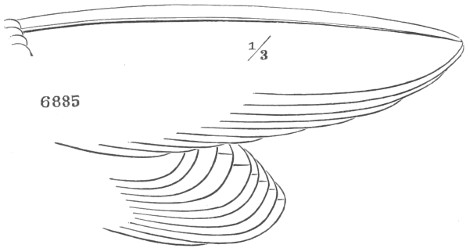
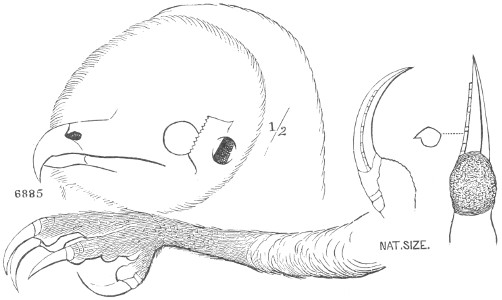
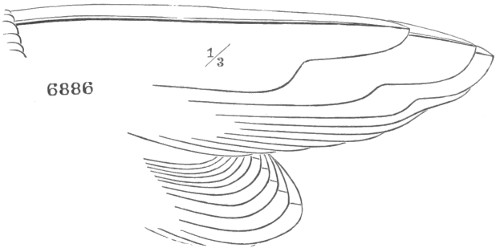
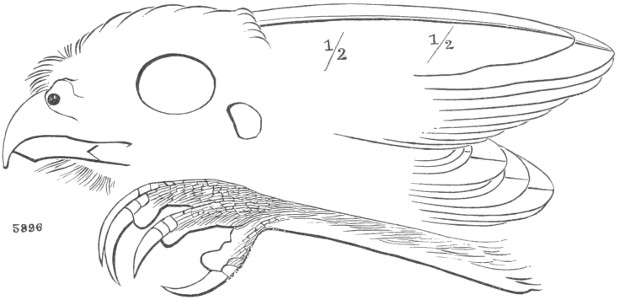
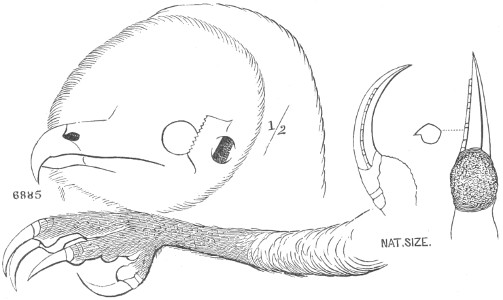
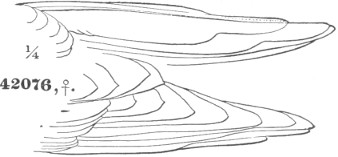
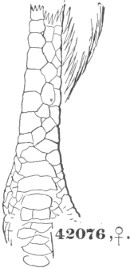
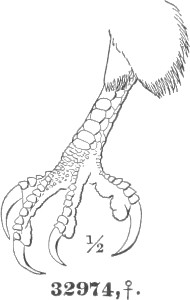
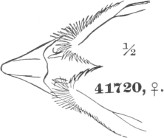
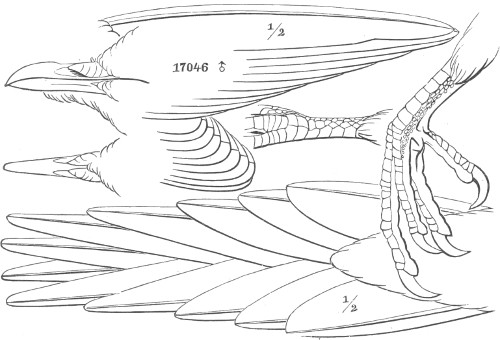
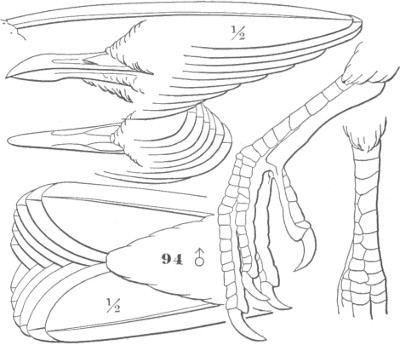
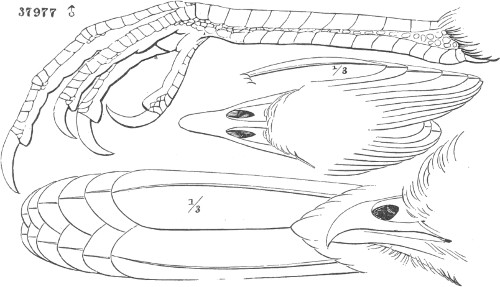
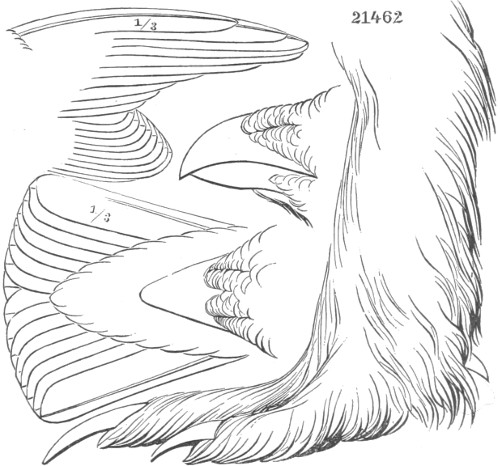
6885 ½ NAT. SIZE.
Strix pratincola.
The variations of plumage noted above appear to be of a purely individual
nature, since they do not depend upon the locality; nor, as far as we can
learn, to any considerable extent, upon age or sex.
Habits. On the Atlantic coast this bird very rarely occurs north of
Pennsylvania. It is given by Mr. Lawrence as very rare in the vicinity of
New York, and in three instances, at least, it has been detected in New
England. An individual is said, by Rev. J. H. Linsley, to have been
taken in 1843, in Stratford, Conn.; another was shot at Sachem’s Head in the
same State, October 28, 1865; and a third was killed in May, 1868, near
Springfield, Mass.
In the vicinity of Philadelphia the Barn Owl is not very rare, but is
more common in spring and autumn than in the summer. Its nests have
been found in hollow trees near marshy meadows. Southward it is more or
less common as far as South
Carolina, where it becomes more
abundant, and its range then
extends south and west as far
as the Pacific. It is quite plentiful
in Texas and New Mexico,
and is one of the most abundant
birds of California. It was not
met with by Dr. Woodhouse in
the expedition to the Zuñi River,
but this may be attributed to the
desolate character of the country
through which he passed, as it is
chiefly found about habitations,
and is never met with in wooded
or wild regions.
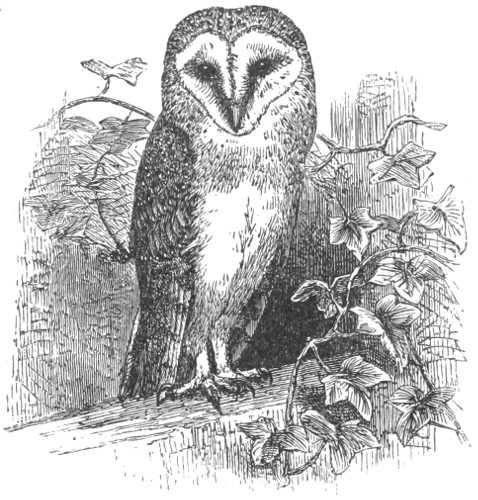
Strix flammea.
Dr. Heermann and Dr. Gambel,
who visited California before the present increase in population, speak of
its favorite resort as being in the neighborhood of the Missions, and of
its nesting under the tiled roofs of the houses. The latter also refers to
his finding numbers under one roof, and states that they showed no fear
when approached. The propensity of the California bird to drink the sacred
oil from the consecrated lamps about the altars of the Missions was frequently
referred to by the priests, whenever any allusion was made to this
Owl. Dr. Gambel also found it about farm-houses, and occasionally in the
prairie valleys, where it obtains an abundance of food, such as mice and
other small animals.
Dr. Heermann, in a subsequent visit to the State, mentions it as being a
very common bird in all parts of California. They were once quite numerous
among the hollow trees in the vicinity of Sacramento, but have
gradually disappeared, as their old haunts were one by one destroyed to
make way for the gradual development and growth of that city. Dr. Heermann
found a large number in the winter, sheltered during the day among
the reeds of Suisun Valley. They were still abundant in the old Catholic
Missions, where they frequented the ruined walls and towers, and constructed
their nests in the crevices and nooks of those once stately buildings, now
falling to decay. These ruins were also a shelter for innumerable bats,
reptiles, and vermin, which formed an additional attraction to the Owls.
Dr. Cooper speaks of finding this Owl abundant throughout Southern
California, especially near the coast, and Dr. Newberry frequently met with
it about San Francisco, San Diego, and Monterey, where it was more common
than any other species. He met with it on San Pablo Bay, inhabiting
holes in the perpendicular cliffs bordering the south shore. It was also
found in the Klamath Basin, but not in great numbers.
Mr. J. H. Clark found the Barn Owl nesting, in May, in holes burrowed
into the bluff banks of the Rio Frio, in Texas. These burrows were nearly
horizontal, with a considerable excavation near the back end, where the eggs
were deposited. These were three or four in number, and of a dirty white.
The parent bird allowed the eggs to be handled without manifesting any
concern. There was no lining or nest whatever. Lieutenant Couch found
them common on the Lower Rio Grande, but rare near Monterey, Mexico.
They were frequently met with living in the sides of large deep wells.
Dr. Coues speaks of it as a common resident species in Arizona. It was
one of the most abundant Owls of the Territory, and was not unfrequently
to be observed at midday. On one occasion he found it preying upon Blackbirds,
in the middle of a small open reed swamp.
It is not uncommon in the vicinity of Washington, and after the partial
destruction of the Smithsonian Building by fire, for one or two years a pair
nested in the top of the tower. It is quite probable that the comparative
rarity of the species in the Eastern States is owing to their thoughtless
destruction, the result of a short-sighted and mistaken prejudice that drives
away one of our most useful birds, and one which rarely does any mischief
among domesticated birds, but is, on the contrary, most destructive to rats,
mice, and other mischievous and injurious vermin.
Mr. Audubon mentions two of these birds which had been kept in confinement
in Charleston, S. C., where their cries in the night never failed to
attract others of the species. He regards them as altogether crepuscular in
habits, and states that when disturbed in broad daylight they always fly in
an irregular and bewildered manner. Mr. Audubon also states that so far
as his observations go, they feed entirely on small quadrupeds, as he has
never found the remains of any feathers or portions of birds in their
stomachs or about their nests. In confinement it partakes freely of any
kind of flesh.
The Cuban race (var. furcata), also found in other West India islands, is
hardly distinguishable from our own bird, and its habits may be presumed
to be essentially the same. Mr. Gosse found the breeding-place of the
Jamaica Owl at the bottom of a deep limestone pit, in the middle of
October; there was one young bird with several eggs. There was not the
least vestige of a nest; the bird reposed on a mass of half-digested hair mingled
with bones. At a little distance were three eggs, at least six inches apart.
On the 12th of the next month he found in the same place the old bird
sitting on four eggs, this time placed close together. There was still no nest.
The eggs were advanced towards hatching, but in very different degrees,
and an egg ready for deposition was found in the oviduct of the old bird.
An egg of this Owl, taken in Louisiana by Dr. Trudeau, measured 1.69
inches in length by 1.38 in breadth. Another, obtained in New Mexico,
measures 1.69 by 1.25. Its color is a dirty yellowish-white, its shape an
oblong oval, hardly more pointed at the smaller than at the larger end.
An egg from Monterey, California, collected by Dr. Canfield, measures 1.70
inches in length by 1.25 in breadth, of an oblong-oval shape, and nearly
equally obtuse at either end. It is of a uniform bluish-white. Another
from the Rio Grande is of a soiled or yellowish white, and of the same size
and shape.
Otus, Cuv. Reg. An. 1799. (Type, Strix otus, Linn.)
Asio, Swains. 1831 (necBrisson, 1760).
Brachyotus, Gould, P. Z. S. 1837, 10. (Type, Stryx brachyotus.)
Ægolius, Keys. & Bl. 1840 (necKaup, 1829).
Char. Size medium. Ear-tufts well developed or rudimentary; head small; eyes
small. Cere much arched, its length more than the chord of the culmen. Bill weak,
compressed. Only the first, or first and second, outer primary with its inner web emarginated.
Tail about half the wing, rounded. Ear-conch very large, gill-like, about as long
as the height of the skull, with an anterior operculum, which extends its full length, and
bordered posteriorly by a raised membrane; the two ears asymmetrical.
A.Otus, Cuvier. Ear-tufts well developed; outer quill only with inner web
emarginated.
Colors blackish-brown and buffy-ochraceous,—the former predominating
above, where mottled with whitish; the latter prevailing beneath, and
variegated with stripes or bars of dusky. Tail, primaries, and secondaries,
transversely barred (obsoletely in O. stygius).
1. O. vulgaris. Ends of primaries normal, broad; toes feathered;
face ochraceous.
Dusky of the upper parts in form of longitudinal stripes, contrasting
conspicuously with the paler ground-color. Beneath with
ochraceous prevalent; the markings in form of longitudinal stripes,
with scarcely any transverse bars. Hab. Europe and considerable
part of the Old World … var. vulgaris.19
Dusky of the upper parts in form of confused mottling, not contrasting
conspicuously with the paler ground-color. Beneath with
the ochraceous overlaid by the whitish tips to the feathers; the
markings in form of transverse bars, which are broader than the
narrow medial streak. Wing, 11.50–12.00; tail, 6.00–6.20;
culmen, .65; tarsus, 1.20–1.25; middle toe, 1.15. Wing-formula,
2, 3–4–1. Hab. North America … var. wilsonianus.
2. O. stygius.20 Ends of primaries narrow, that of the first almost
falcate; toes entirely naked; face dusky, or with dusky prevailing.
Above blackish-brown, thinly relieved by an irregular sparse
spotting of yellowish-white. Beneath with the markings in form
of longitudinal stripes, which throw off occasional transverse
arms toward the edge of the feathers. Wing, 13.00; tail, 6.80;
culmen, .90; tarsus, 1.55; middle toe, 1.50. Wing-formula, 2, 3–4,
1. Hab. South America.
B.Brachyotus, Gould (1837). Similar to Otus, but ear-tufts rudimentary,
and the second quill as well as the first with the inner web emarginated.
Colors ochraceous, or white, and clear dark brown, without shadings or
middle tints. Beneath with narrow longitudinal dark stripes upon the
whitish or ochraceous ground-color; crown and neck longitudinally striped
with dark brown and ochraceous.
3. O. brachyotus. Wings and tail nearly equally spotted and banded
with ochraceous and dark brown. Tail with about six bands, the
ochraceous terminal. Face dingy ochraceous, blackish around the eyes.
Wing, about 11.00–13.00; tail, 5.75–6.10; culmen, .60–.65; tarsus,
1.75–1.80; middle toe, 1.20. Hab. Whole world (except Australia?).
Though this genus is cosmopolitan, the species are few in number; two
of them (O. vulgaris and O. brachyotus) are common to both North America
and Europe, one of them (the latter) found also in nearly every country in
the world. Besides these, South Africa has a peculiar species (O. capensis)
while Tropical America alone possesses the O. stygius.
? Strix peregrinator (?), Bart. Trav. 1792, p. 285.—Cass. B. Cal. & Tex. 1854, 196. Asio
peregrinator, Strickl. Orn. Syn. I, 1855, 207. Otus wilsonianus, Less. Tr. Orn. 1831,
110.—Gray, Gen. fol. sp. 2, 1844.—Ib. List Birds Brit. Mus. p. 105.—Cass. Birds
Cal. & Tex. 1854, 81.—Ib. Birds N. Am. 1858, 53.—Coop. & Suck. 1860, 155.—Coues,
Prod. 1866, 14. Otus americanus, Bonap. List, 1838, p. 7.—Ib. Consp. p. 50.—Wederb.
& Tristr. Cont. Orn. 1849, p. 81.—Kaup, Monog. Strig. Cont. Orn.
1852, 113.—Ib. Trans. Zoöl. Soc. IV, 1859, 233.—Max. Cab. Jour. VI, 1858, 25.—Gray,
Hand List, I, 1869, No. 540, p. 50. Strix otus, Wils. Am. Orn. 1808, pl. li,
f. 1.—Rich. & Sw. F. B. A. II, 72.—Bonap. Ann. N. Y. Lyc. II, 37.—Ib. Isis,
1832, 1140.—Aud. Orn. Biog. IV, 572.—Ib. Birds Am. pl. ccclxxxiii.—Peab. Birds,
Mass. 88. Ulula otus, Jard. ed. Wils. Am. Orn. I, 1831, 104.—Brewer, ed. Wils.
Am. Orn. Synop. p. 687.—Nutt. Man. 130. Otus vulgaris (not of Fleming!), Jardine,
ed. Wils. Am. Orn. 1832, II, 278.—Aud. Synop. 1831, 28.—Giraud, Birds
Long Island, p. 25. Otus vulgaris, var. wilsonianus (Ridgway), Coues, Key, 1872,
204. Bubo asio, De Kay, Zoöl. N. Y. II, 25, pl. xii, f. 25.
Sp. Char.Adult. Upper surface transversely mottled with blackish-brown and grayish-white,
the former predominating, especially on the dorsal region; feathers of the nape
and wings (only), ochraceous beneath the surface, lower scapulars with a few obsolete
spots of white on lower webs. Primary coverts dusky, with transverse series of dark
mottled grayish spots, these becoming somewhat ochraceous basally; ground-color of the
primaries grayish, this especially prevalent on the inner quills; the basal third (or less)
of all are ochraceous, this decreasing in extent on inner feathers; the grayish tint is
everywhere finely mottled transversely with dusky, but the ochraceous is plain; primaries
crossed by a series of about seven quadrate blackish-brown spots, these anteriorly about
as wide as the intervening yellowish or mottled grayish; the interval between the
primary coverts to the first of these spots is about .80 to 1.00 inch on the fourth quill,—the
spots on the inner and outer feathers approaching the coverts, or even underlying
them; the inner primaries—or, in fact, the general exposed grayish surface—has much
narrower bars of dusky. Ground-color of the wings like the back, this growing paler on
the outer feathers, and becoming ochraceous basally; the tip approaching whitish; secondaries
crossed by nine or ten narrow bands of dusky.
Ear-tufts, with the lateral portion of each web, ochraceous; this becoming white, somewhat
variegated with black, toward the end of
the inner webs, on which the ochraceous is
broadest; medial portion clear, unvariegated
black. Forehead and post-auricular disk
minutely speckled with blackish and white;
facial circle continuous brownish-black, becoming
broken into a variegated collar across
the throat. “Eyebrows” and lores grayish-white;
eye surrounded with blackish, this
broadest anteriorly above and below, the posterior
half being like the ear-coverts. Face
plain ochraceous; chin and upper part of the
throat immaculate white. Ground-color below
pale ochraceous, the exposed surface of the
feathers, however, white; breast with broad
longitudinal blotches of clear dark brown, these medial, on the feathers; sides and flanks,
each feather with a medial stripe, crossed by as broad, or broader, transverse bars, of
blackish-brown; abdomen, tibial plumes, and legs plain ochraceous, becoming nearly
white on the lower part of tarsus and on the toes; tibial plumes with a few sagittate marks
of brownish; lower tail-coverts each having a medial sagittate mark of dusky, this continuing
along the shaft, forking toward the base. Lining of the wing plain pale ochraceous;
inner primary coverts blackish-brown, forming a conspicuous spot.
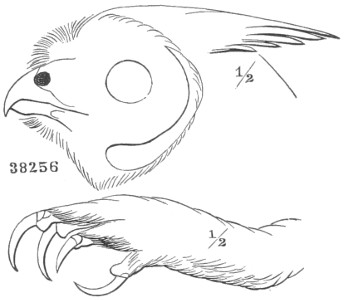
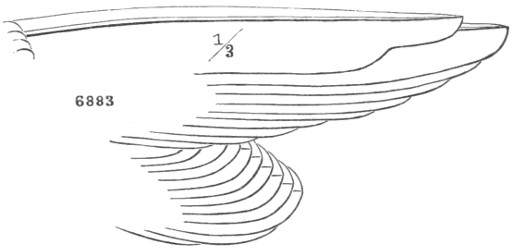
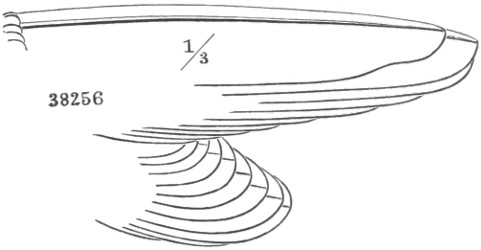
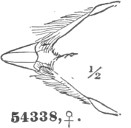
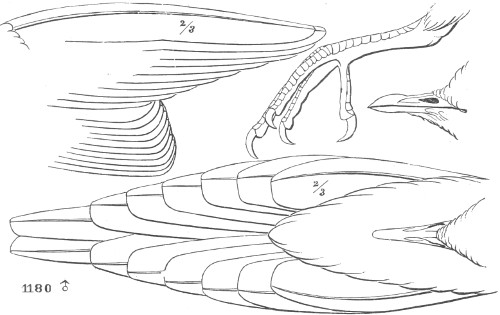
38256 ½ ½
Otus wilsonianus.
♂ (51,227, Carlisle, Penn.; S. F. Baird). Wing formula, 2, 3–1, 4, etc. Wing, 11.50;
tail, 6.20; culmen, .65; tarsus, 1.20; middle toe, 1.15.
Young (49,568, Sacramento, Cal., June 21, 1867; Clarence King, Robert Ridgway).
Wings and tail as in the adult; other portions transversely banded with blackish-brown
and grayish-white, the latter prevailing anteriorly; eyebrows and loral bristles entirely
black; legs white.
Hab. Whole of temperate North America? Tobago? (Jardine).
Localities: Tobago (Jardine, Ann. Mag. 18, 116); Arizona (Coues, P. A. N. S.
1866, 50).
The American Long-eared Owl is quite different in coloration from the
Otus vulgaris of Europe. In the latter, ochraceous prevails over the whole
surface, even above, where the transverse dusky mottling does not approach
the uniformity that it does in the American bird; in the European bird, each
feather above has a conspicuous medial longitudinal stripe of dark brownish:
these markings are found everywhere except on the rump and upper
tail-coverts, where the ochraceous is deepest, and transversely clouded with
dusky mottling; in the American bird, no longitudinal stripes are visible on
the upper surface. The ochraceous of the lower surface is, in the vulgaris,
varied only (to any considerable degree) by the sharply defined medial
longitudinal stripes to the feathers, the transverse bars being few and inconspicuous;
in wilsonianus, white overlies the ochraceous below, and the
longitudinal are less conspicuous than the transverse markings; the former
on the breast are broader than in vulgaris, in which, also, the ochraceous
at the bases of the primaries occupies a greater extent. Comparing these
very appreciable differences with the close resemblance of other representative
styles of the two continents (differences
founded on shade or depth
of tints alone), we were almost inclined
to recognize in the American Long-eared
Owl a specific value to these
discrepancies.
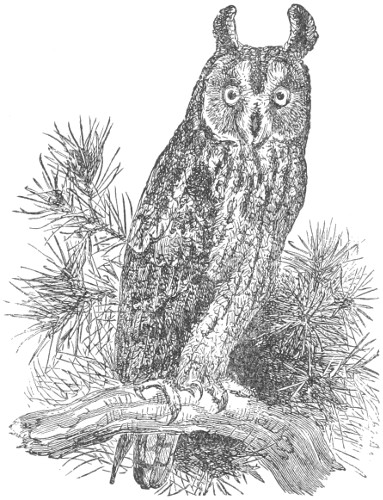
Otus vulgaris.
The Otus stygius, Wagl., of South
America and Mexico, is entirely distinct,
as will be seen from the foregoing
synoptical table.
Habits. This species appears to be
one of the most numerous of the Owls
of North America, and to be pretty
generally distributed. Its strictly
nocturnal habits have caused it to be
temporarily overlooked in localities
where it is now known to be present
and not rare. Dr. William Gambel
and Dr. Heermann both omit it from
their lists of the birds of California, though Dr. J. G. Cooper has since found
it quite common. It was once supposed not to breed farther south than
New Jersey, but it is now known to be resident in South Carolina and in
Arizona, and is probably distributed through all the intervening country.
Donald Gunn writes that to his knowledge this solitary bird hunts in the
night, both summer and winter, in the Red River region. It there takes
possession of the deserted nests of crows, and lays four white eggs. He
found it as far as the shores of Hudson’s Bay. Richardson states it to be
plentiful in the woods skirting the plains of the Saskatchewan, frequenting
the coast of the bay in the summer, and retiring into the interior in the
winter. He met with it as high as the 16th parallel of latitude, and believed
it to occur as far as the forests extend.
Dr. Cooper met with this species on the banks of the Columbia, east of
the Dalles. The region was desolate and barren, and several species of Owls
appeared to have been drawn there by the abundance of hares and mice.
Dr. Suckley also met with it on a branch of Milk River, in Nebraska. It
has likewise been taken in different parts of California, in New Mexico,
among the Rocky Mountains, in the valley of the Rio Grande, at Fort Benton,
and at Cape Florida, in the last-named place by Mr. Würdemann.
Dr. Cooper found this Owl quite common near San Diego, and in March
observed them sitting in pairs in the evergreen oaks, apparently not much
troubled by the light. On the 27th of March he found a nest, probably that
of a Crow, built in a low evergreen oak, in which a female Owl was sitting
on five eggs, then partly hatched. The bird was quite bold, flew round him,
snapping her bill at him, and tried to draw him away from the nest; the
female imitating the cries of wounded birds with remarkable accuracy,
showing a power of voice not supposed to exist in Owls, but more in the
manner of a Parrot. He took one of the eggs, and on the 23d of April, on
revisiting the nest, he found that the others had hatched. The egg measured
1.60 by 1.36 inches. Dr. Cooper also states that he has found this Owl
wandering into the barren treeless deserts east of the Sierra Nevada, where
it was frequently to be met with in the autumn, hiding in the thickets along
the streams. It also resorts to caves, where any are to be found.
Dr. Kennerly met with this bird in the cañons west of the Aztec Mountains,
where they find good places for their nests, which they build, in
common with Crows and Hawks, among the precipitous cliffs,—places unapproachable
by the wolf and lynx.
On the Atlantic coast the Long-eared Owl occurs in more or less abundance
from Nova Scotia to Florida. It is found in the vicinity of Halifax,
according to Mr. Downes, and about Calais according to Mr. Boardman,
though not abundantly in either region. In Western Maine, and in the rest
of New England, it is more common. It has been known to breed at least
as far south as Maryland, Mr. W. M. McLean finding it in Rockville. Mr.
C. N. Holden, Jr., during his residence at Sherman, in Wyoming Territory,
met with a single specimen of this bird. A number of Magpies were in the
same bush, but did not seem either to molest or to be afraid of it.
The food of this bird consists chiefly of small quadrupeds, insects, and, to
some extent, of small birds of various kinds. Audubon mentions finding
the stomach of one stuffed with feathers, hair, and bones.
The Long-eared Owl appears to nest for the most part in trees, and also
frequently to make use of the nests of other birds, such as Crows, Hawks,
or Herons. Occasionally, however, they construct nests for themselves. Audubon
speaks of finding such a one near the Juniata River, in Pennsylvania.
This was composed of green twigs with the leaflets adhering, and lined
with fresh grass and sheep’s wool, but without feathers. Mr. Kennicott
sent me from Illinois an egg of this bird, that had been taken from a nest on
the ground; and, according to Richardson, in the fur regions it sometimes lays
its eggs in that manner, at other times in the deserted nests of other birds, on
low bushes. Mr. Hutchins speaks of its depositing them as early as April.
Richardson received one found in May; and another nest was observed, in
the same neighborhood, which contained three eggs on the 5th of July.
Wilson speaks of this Owl as having been abundant in his day in the vicinity
of Philadelphia, and of six or seven having been found in a single tree.
He also mentions it as there breeding among the branches of tall trees, and
in one particular instance as having taken possession of the nest of a Qua
Bird (Nyctiardea gardeni), where Wilson found it sitting on four eggs, while
one of the Herons had her own nest on the same tree. Audubon states
that it usually accommodates itself by making use of the abandoned nests
of other birds, whether these are built high or low. It also makes use of
the fissures of rocks, or builds on the ground.
As this Owl is known to breed early in April, and as numerous instances
are given of their eggs being taken in July, it is probable they have two
broods in a season. Mr. J. S. Brandigee, of Berlin, Conn., found a nest
early in April, in a hemlock-tree, situated in a thick dark evergreen woods.
The nest was flat, made of coarse sticks, and contained four fresh eggs
when the parent was shot.
Mr. Ridgway found this Owl to be very abundant in the Sacramento Valley,
as well as throughout the Great Basin, in both regions inhabiting dense willow
copses near the streams. In the interior it generally lays its eggs in the
deserted nests of the Magpie.
The eggs of this Owl, when fresh, are of a brilliant white color, with a
slight pinkish tinge, which they preserve even after having been blown, if
kept from the light. They are of a rounded-oval shape, and obtuse at either
end. They vary considerably in size, measuring from 1.65 to 1.50 inches in
length, and from 1.30 to 1.35 inches in breadth. Two eggs, taken from the
same nest by Rev. C. M. Jones, have the following measurements: one 1.60
by 1.34 inches, the other 1.50 by 1.30 inches.
Strix brachyotus, Gmel. Syst. Nat. 289, 1789.—Forst. Phil. Trans. LXII, 384.—Wils.
Am. Orn. pl. xxxiii, f. 3.—Aud. Birds Am. pl. ccccxxxii, 1831.—Ib. Orn. Biog. V,
273.—Rich. & Swains. F. B. A. II, 75.—Bonap. Ann. Lyc. N. Y. II, 37.—Thomps.
N. H. Vermont, p. 66.—Peab. Birds Mass. p. 89. Ulula brachyotus, James. (Wils.),
Am. Orn. I, 106, 1831.—Nutt. Man. 132. Otus brachyotus, (Steph.) Jard. (Wils.),
Am. Orn. II, 63, 1832.—Peale, U. S. Expl. Exp. VIII, 75.—Kaup, Monog. Strig.
Cont. Orn. 1852, 114.—Ib. Tr. Zoöl. Soc. IV, 1859, 236.—Hudson, P. Z. S. 1870,
799 (habits). Asio brachyotus, Strickl. Orn. Syn. I, 259, 1855. Otus brachyotus
americanus, Max. Cab. Jour. II, 1858, 27. Brachyotus palustris, Bonap. List. 1838,
p. 7.—Ridgw. in Coues, Key, 1872, 204. Otus palustris, (Darw.) De Kay, Zoöl.
N. Y. II, 28, pl. xii, f. 27, 1844. Brachyotus palustris americanus, Bonap. Consp.
Av. p. 51, 1849. Brachyotus cassini, Brewer, Pr. Boston Soc. N. H.—Newb.
P. R. Rep’t, VI, IV, 76.—Heerm. do. VII, 34, 1857.—Cassin (in Baird) Birds N.
Am. 1858, 54.—Coop. & Suckl. P. R. Rep’t, XII, ii, 155, 1860.—Coues, P. A.
N. S. (Prod. Orn. Ariz.) 1866, 14.—Gray, Hand List, I, 51, 1869. Brachyotus
galopagoensis, Gould, P. Z. S. 1837, 10. Otus galopagoensis, Darw. Zool. Beag. pt.
iii, p. 32, pl. iii.—Gray, Gen. fol. sp. 3; List Birds Brit. Mus. 108.—Bonap.
Consp. 51. Asio galopagoensis, Strickl. Orn. Syn. I, 1855, 211.
Sp. Char.Adult. Ground-color of the head, neck, back, scapulars, rump, and lower
parts, pale ochraceous; each feather (except on the rump) with a medial longitudinal
stripe of blackish-brown,—these broadest on the scapulars; on the back, nape, occiput, and
jugulum, the two colors about equal; on the lower parts, the stripes grow narrower posteriorly,
those on the abdomen and sides being in the form of narrow lines. The flanks,
legs, anal region, and lower tail-coverts are always perfectly immaculate; the legs most
deeply ochraceous, the lower tail-coverts nearly
pure white. The rump has obsolete crescentic
marks of brownish. The wings are variegated
with the general dusky and ochraceous tints, but
the markings are more irregular; the yellowish
in form of indentations or confluent spots, approaching
the shafts from the edge,—broadest
on the outer webs. Secondaries crossed by
about five bands of ochraceous, the last terminal;
primary coverts plain blackish-brown, with one
or two poorly defined transverse series of ochraceous
spots on the basal portion. Primaries
ochraceous on the basal two-thirds, the terminal
portion clear dark brown, the tips (broadly)
pale brownish-yellowish, this becoming obsolete on the longest; the dusky extends
toward the bases, in three to five irregularly transverse series of quadrate spots on the
outer webs, leaving, however, a large basal area of plain ochraceous,—this somewhat
more whitish anteriorly. The ground-color of the tail is ochraceous,—this becoming
whitish exteriorly and terminally,—crossed by five broad bands (about equalling
the ochraceous, but becoming narrower toward outer feathers) of blackish-brown; on
the middle feathers, the ochraceous spots enclose smaller, central transverse spots of
blackish; the terminal ochraceous band is broadest.
Eyebrows, lores, chin, and throat soiled white, the loral bristles with black shafts;
face dingy ochraceous-white, feathers with darker shafts; eye broadly encircled with
black. Post-orbital circle minutely
speckled with pale ochraceous
and blackish, except immediately
behind the ear, where
for about an inch it is uniform
dusky.
Lining of the wing immaculate
delicate yellowish-white; terminal
half of under primary
coverts clear blackish-brown;
under surface of primaries plain
delicate ochraceous-white; ends, and one or two very broad anterior bands, dusky.
Hab. Entire continent and adjacent islands of America; also Europe, Asia, Africa,
Polynesia, and Sandwich Islands.
Localities: Oaxaca (Scl. P. Z. S. 1859, 390); Cuba (Cab. Journ. III, 465; Gundl.
Rept. 1865, 225, west end); Arizona (Coues, P. A. N. S. 1866, 50); Brazil (Pelz. Orn.
Bras. I, 10); Buenos Ayres (Scl. & Salv. P. Z. S. 1868, 143); Chile (Philippi, Mus. S. I.).
In view of the untangible nature of the differences between the American
and European Short-eared Owls (seldom at all appreciable, and when appreciable
not constant), we cannot admit a difference even of race between
them. In fact, this species seems to be the only one of the Owls common
to the two continents in which an American specimen cannot be distinguished
from the European. The average plumage of the American
representative is a shade or two darker than that of European examples;
but the lightest specimens I have seen are several from the Yukon region
in Alaska, and one from California (No. 6,888, Suisun Valley).
Not only am I unable to appreciate any tangible differences between
European and North American examples, but I fail to detect characters of
the least importance whereby these
may be distinguished from South
American and Sandwich Island
specimens (“galopagoensis, Gould,”
and “sandwichensis, Blox.”). Only
two specimens, among a great
many from South America (Paraguay,
Buenos Ayres, Brazil, etc.),
are at all distinguishable from
Northern American. These two
(Nos. 13,887 and 13,883, Chile)
are somewhat darker than others,
but not so dark as No. 16,029, ♀,
from Fort Crook, California. A
specimen from the Sandwich Islands
(No. 13,890) is nearly identical
with these Chilean birds, the
only observable difference consisting
in a more blackish forehead,
and in having just noticeable dark shaft-lines on the lower tail-coverts.
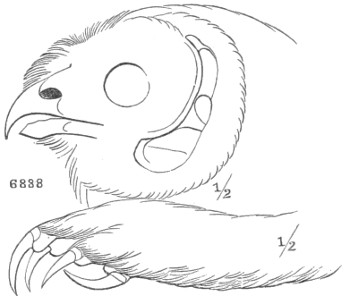
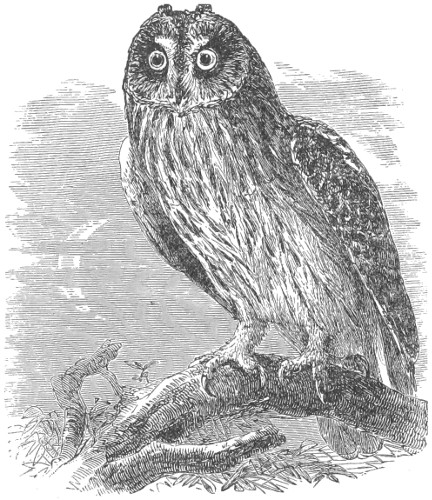
Otus brachyotus.
In the geographical variations of this species it is seen that the average
plumage of North American specimens is just appreciably darker than
that of European, while tropical specimens have a tendency to be
still darker. I know of no bird so widely distributed which varies so
little in the different parts of its habitat, unless it be the Cotyle riparia,
which, however, is not found so far to the south. The difference, in this
case, between the American and European birds, does not correspond at all
to that between the two easily distinguished races of Otus vulgaris, Nyctale
tengmalmi, Surnia ulula, and Syrnium cinereum.
A specimen from Porto Rico (No. 39,643) is somewhat remarkable on
account of the prevalence of the dusky of the upper parts, the unusually
few and narrow stripes of the same on the lower parts, the roundish ochraceous
spots on the wings, and in having the primaries barred to the base.
Should all other specimens from the same region agree in these characters,
they might form a diagnosable race. The plumage has an abnormal appearance,
however, and I much doubt whether others like it will ever be taken.
Habits. The Short-eared Owl appears to be distributed, in varying frequency,
throughout North America, more abundant in the Arctic regions
during the summer, and more frequently met with in the United States during
the winter months. Richardson met with it throughout the fur countries
as far to the north as the 67th parallel. Professor Holböll gives it as a
bird of Greenland, and it was met with in considerable abundance by MacFarlane
in the Anderson River district. Mr. Murray mentions a specimen
received from the wooded district between Hudson’s Bay and Lake Winnipeg.
Captain Blakiston met with it on the coast of Hudson’s Bay, and Mr.
Bernard Ross on the Mackenzie River.
Mr. Dresser speaks of it as common at times near San Antonio during
the winter months, keeping itself in the tall weeds and grass. It is given
by Dr. Gundlach as an occasional visitant of Cuba.
Dr. Newberry met with it throughout Oregon and California, and found it
especially common in the Klamath Basin. On the level meadow-like
prairies of the Upper Pitt River it was seen associating with the Marsh
Hawk in considerable numbers. It was generally concealed in the grass,
and rose as the party approached. He afterwards met with this bird on the
shores of Klamath Lake, and in the Des Chutes Basin, among grass and
sage-bushes, in those localities associated with the Burrowing Owl (A. hypogæa).
In Washington Territory it was found by Dr. Cooper on the great
Spokane Plain, where, as elsewhere, it was commonly found in the long
grass during the day. In fall and winter it appeared in large numbers on
the low prairies of the coast, but was not gregarious. Though properly
nocturnal, it was met with, hunting on cloudy days, flying low over the
meadows, in the manner of the Marsh Hawk. He did not meet with it in
summer in the Territory.
Dr. Heermann found it abundant in the Suisun and Napa valleys of California,
in equal numbers with the Strix pratincola. It sought shelter during
the day on the ground among the reeds, and, when startled from its hiding-place,
would fly but a few yards and alight again upon the ground. It did
not seem wild or shy. He afterwards met with the same species on the
desert between the Tejon Pass and the Mohave River, and again saw it on
the banks of the latter. Richardson gives it as a summer visitant only in
the fur countries, where it arrives as soon as the snow disappears, and departs
again in September. A female was killed May 20 with eggs nearly
ready for exclusion. The bird was by no means rare, and, as it frequently
hunted for its prey in the daytime, was often seen. Its principal haunts
appeared to be dense thickets of young pines, or dark and entangled willow-clumps,
where it would sit on a low branch, watching assiduously for mice.
When disturbed, it would fly low for a short distance, and then hide itself in
a bush, from whence it was not easily driven. Its nest was said to be on the
ground, in a dry place, and formed of withered grass. Hutchins is quoted as
giving the number of its eggs as ten or twelve, and describing them as round.
The latter is not correct, and seven appears to be their maximum number.
Mr. Downes speaks of it as very rare in Nova Scotia, but Elliott Cabot
gives it as breeding among the islands in the Bay of Fundy, off the coast, where
he found several nests. It was not met with by Professor Verrill in Western
Maine, but is found in other parts of the State. It is not uncommon in
Eastern Massachusetts, where specimens are frequently killed and brought
to market for sale, and where it also breeds in favorable localities on the
coast. Mr. William Brewster met with it on Muskeget, near Nantucket,
where it had been breeding, and where it was evidently a resident, its plumage
having become bleached by exposure to the sun, and the reflected light of
the white sand of that treeless island. It is not so common in the interior,
though Mr. Allen gives it as resident, and rather common, near Springfield.
Dr. Wood found it breeding in Connecticut, within a few miles of Hartford.
Dr. Coues gives it as a resident species in South Carolina, and Mr. Allen
also mentions it, on the authority of Mr. Boardman, as quite common among
the marshes of Florida. Mr. Audubon also speaks of finding it so plentiful
in Florida that on one occasion he shot seven in a single morning.
They were to be found in the open prairies of that country, rising from the
tall grass in a hurried manner, and moving in a zigzag manner, as if suddenly
wakened from a sound sleep, and then sailing to some distance in a
direct course, and dropping among the thickest herbage. Occasionally the
Owl would enter a thicket of tangled palmettoes, where with a cautious approach
it could be taken alive. He never found two of these birds close
together, but always singly, at distances of from twenty to a hundred yards;
and when two or more were started at once, they never flew towards each
other.
Mr. Audubon met with a nest of this Owl on one of the mountain
ridges in the great pine forest of Pennsylvania, containing four eggs
nearly ready to be hatched. They were bluish-white, of an elongated
form, and measured 1.50 inches in length and 1.12 in breadth. The nest,
made in a slovenly manner with dry grasses, was under a low bush, and
covered over with tall grass, through which the bird had made a path.
The parent bird betrayed her presence by making a clicking noise with her
bill as he passed by; and he nearly put his hand on her before she would
move, and then she hopped away, and would not fly, returning to her nest
as soon as he left the spot. The pellets disgorged by the Owl, and found
near her nest, were found to consist of the bones of small quadrupeds
mixed with hair, and the wings of several kinds of coleopterous insects.
This bird was found breeding near the coast of New Jersey by Mr. Krider;
and at Hamilton, Canada, on the western shore of Lake Ontario; Mr.
McIlwraith speaks of its being more common than any other Owl.
A nest found by Mr. Cabot was in the midst of a dry peaty bog. It was
built on the ground, in a very slovenly manner, of small sticks and a few
feathers, and presented hardly any excavation. It contained four eggs on
the point of being hatched. A young bird the size of a Robin was also
found lying dead on a tussock of grass in another similar locality.
The notes of Mr. MacFarlane supply memoranda of twelve nests found
by him in the Anderson River country. They were all placed on the ground,
in various situations. One was in a small clump of dwarf willows, on the
ground, and composed of a few decayed leaves. Another nest was in a very
small hole, lined with a little hay and some decayed leaves. This was on a
barren plain of some extent, fifty miles east of Fort Anderson, and on the edge
of the wooded country. A third was in a clump of Labrador Tea, and was
similar to the preceding, except that the nest contained a few feathers.
This nest contained seven eggs,—the largest number found, and only in
this case. A fourth was in an artificial depression, evidently scratched out
by the parent bird. Feathers seem to have been noticed in about half the
nests, and in all cases to have been taken by the parent from her own
breast. Nearly all the nests were in depressions made for the purpose.
Mr. Dall noticed the Short-eared Owl on the Yukon and at Nulato, and
Mr. Bannister observed it at St. Michael’s, where it was a not unfrequent
visitor. In his recent Notes on the Avi-fauna of the Aleutian Islands, (Pr.
Cal. Academy, 1873,) Dall informs us that it is resident on Unalashka, and
that it excavates a hole horizontally for its nesting-place,—usually to a
distance of about two feet, the farther end a little the higher. The extremity
is lined with dry grass and feathers. As there are no trees in the island,
the bird was often seen sitting on the ground, near the mouth of its burrow,
even in the daytime. Mr. Ridgway found this bird in winter in California,
but never met with it at any season in the interior, where the
O. wilsonianus was so abundant.
The eggs of this Owl are of a uniform dull white color, which in the
unblown egg is said to have a bluish tinge; they are in form an elliptical
ovoid. The eggs obtained by Mr. Cabot measured 1.56 inches in length
and 1.25 in breadth. The smallest egg collected by Mr. MacFarlane measured
1.50 by 1.22 inches. The largest taken by Mr. B. R. Ross, at Fort
Simpson, measures 1.60 by 1.30 inches; their average measurement is 1.57
by 1.28 inches. An egg of the European bird measures 1.55 by 1.30
inches.
Syrnium, Savigny, Nat. Hist. Egypt, I, 112; 1809. (Type, Strix aluco, L.)
Scotiaptex, Swains., Classif. B. II, 1837, p. 216. (Type, Strix cinerea, Gmel.)
Gen. Char. Size varying from medium to very large. No ear-tufts. Head very large,
the eyes comparatively
small. Four to six outer
primaries with their inner
webs sinuated. Tarsi and
upper portion, or the whole
of the toes, densely clothed
with hair-like feathers.
Tail considerably more
than half as long as the
wing, decidedly rounded.
Ear-orifice very high, but
not so high as the skull,
and furnished with an anterior
operculum, which does not usually extend along the full length; the two ears
asymmetrical. Bill yellow.
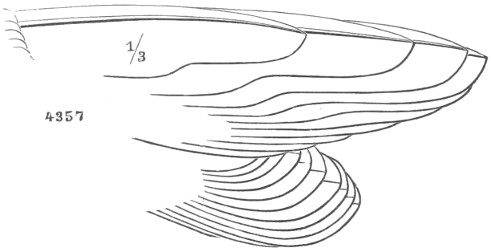
4357 ⅓
Syrnium nebulosum.
Scotiaptex. Six outer quills with their inner webs emarginated. Toes completely
concealed by dense long hair-like feathers. Iris yellow. (Type, S. cinereum.)
Syrnium, Swainson. Five outer quills with their inner webs emarginated. Toes not
completely concealed by feathers; sometimes nearly naked; terminal scutellæ always (?)
exposed. Iris blackish. (Type, S. aluco.)
The typical species of this genus are confined to the Northern Hemisphere.
It is yet doubtful whether
the Tropical American species
usually referred to this genus
really belong here. The genera
Ciccaba, Wagl., and Pulsatrix,
Kaup, have been instituted to include
most of them; but whether
these are generically or only subgenerically
distinct from the
typical species of Syrnium remains
to be decided.
Our S. nebulosum and S. occidentale
seem to be strictly congeneric
with the S. aluca, the
type of the subgenus Syrnium, since they agree in the minutest particulars
in regard to their external form, and other characters not specific.
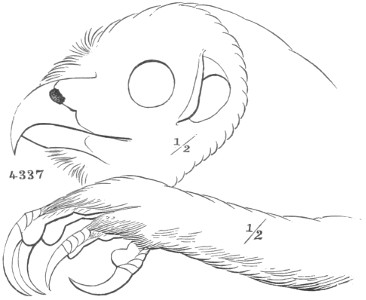
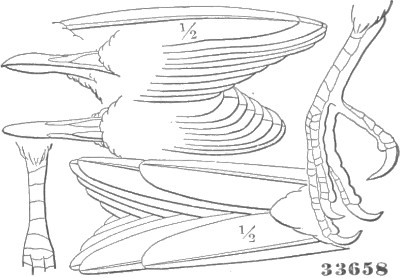
4337 ½ ½
Syrnium nebulosum.
a.Scotiaptex, Swains.
1. S. cinereum. Iris yellow; bill yellow. Dusky grayish-brown and grayish-white,
the former prevailing above, the latter predominating beneath.
The upper surface with mottlings of a transverse tendency; the lower surface
with the markings in the form of ragged longitudinal stripes, which
are transformed into transverse bars on the flanks, etc. Face grayish-white,
with concentric rings of dusky. Wing, 16.00–18.00; tail, 11.00–12.50.
Dark markings predominating. Hab. Northern portions of the
Nearctic Realm … var. cinereum.
Light markings predominating. Hab. Northern portions of the
Palæarctic Realm … var. lapponicum.
b.Syrnium, Sav.
Common Characters. Liver-brown or umber, variously spotted and barred
with whitish or ochraceous. Bill yellow; iris brownish-black.
2. S. nebulosum. Lower parts striped longitudinally. Head and neck
with transverse bars.
Colors reddish-umber and ochraceous-white. Face with obscure concentric
rings of darker. Wing, 13.00–14.00; tail, 9.00–10.00. Hab.
Eastern region of United States … var. nebulosum.
Colors blackish-sepia and clear white. Face without any darker
concentric rings. Wing, 14.80; tail, 9.00. Hab. Eastern Mexico
(Mirador) … var. sartorii.21
Colors tawny-brown and bright fulvous. Face without darker concentric
rings (?). Wing, 12.50, 12.75; tail, 7.30, 8.50. Hab. Guatemala … var. fulvescens.22
3. S. occidentale. Lower parts transversely barred. Head and neck
with roundish spots. Wing, 12.00–13.10; tail, 9.00. Hab. Southern
California (Fort Tejon, Xantus) and Arizona (Tucson, Nov. 7, Bendire).
Strix cinerea, Gmel. Syst. Nat. p. 291, 1788.—Lath. Ind. Orn. p. 58, 1790; Syn. I,
134; Supp. I, 45; Gen. Hist. I, 337.—Vieill. Nouv. Dict. Hist. Nat. VII, 23, 1816;
Enc. Méth. III, 1289; Ois. Am. Sept. I, 48.—Rich. & Swains. F. B. A. II, pl. xxxi,
1831.—Bonap. Ann. Lyc. N. Y. II, 436; Isis, 1832, p. 1140.—Aud. Birds Am. pl.
cccli, 1831; Orn. Biog. IV, 364.—Nutt. Man. p. 128.—Tyzenhauz, Rev. Zoöl. 1851,
p. 571. Syrnium cinereum, Aud. Synop. p. 26, 1839.—Cass. Birds Cal. & Tex. p. 184,
1854; Birds N. Am. 1858, p. 56.—Brew. (Wils.) Am. Orn. p. 687.—De Kay, Zoöl.
N. Y. II, 26, pl. xiii, f. 29, 1844.—Strickl. Orn. Syn. I, 188, 1855.—Newb. P. R.
R. Rept. VI, IV, 77, 1857.—Coop. & Suck. P. R. R. Rept. XII, II, 156, 1860.—Kaup,
Tr. Zoöl. Soc. IV, 1859, 256.—Dall & Bannister, Tr. Chicago Acad. I, 1869,
173.—Gray, Hand List, I, 48, 1869.—Maynard, Birds Eastern Mass., 1870, 130.—Scotiaptex
cinerea, Swains. Classif. Birds, II, 217, 1837. Syrnium lapponicum, var.
cinereum, Coues, Key, 1872, 204. Strix acclamator, Bart. Trans. 285, 1792.
Sp. Char.Adult. Ground-color of the upper surface dark vandyke-brown, but this
relieved by a transverse mottling (on the edges of the feathers) of white, the medial
portions of the feathers being scarcely variegated, causing an appearance of obsolete
longitudinal dark stripes, these most conspicuous on the scapulars and back. The anterior
portions above are more regularly barred transversely; the white bars interrupted, however,
by the brown medial stripe. On the rump and upper tail-coverts the mottling is
more profuse, causing a grayish appearance. On the wing-coverts the outer webs are
most variegated by the white mottling. The alula and primary coverts have very
obsolete bands of paler; the secondaries are crossed by nine (last terminal, and three
concealed by coverts) bands of pale grayish-brown, inclining to white at the borders of
the spots; primaries crossed by nine transverse series of quadrate spots of mottled pale
brownish-gray on the outer webs, those beyond the emargination obscure,—the terminal
crescentic bar distinct, however; upper secondaries and middle tail-feathers with coarse
transverse mottling, almost forming bars. Tail with about nine paler bands, these merely
marked off by parallel, nearly white bars, enclosing a plain grayish-brown, sometimes
slightly mottled space, just perceptibly darker than the ground-color; basally the feathers
become profusely mottled, so that the bands are confused; the last band is terminal.
Beneath with the ground-color grayish-white, each feather of the neck, breast, and
abdomen with a broad, longitudinal ragged stripe of dark brown, like the ground-color
of the upper parts; sides, flanks, crissum, and lower tail-coverts with regular transverse
narrow bands; legs with finer, more irregular, transverse bars of dusky. “Eyebrows,”
lores, and chin grayish-white, a dusky space at anterior angle of the eye; face grayish-white,
with distinct concentric semicircles of blackish-brown; facial circle dark brown,
becoming white across the foreneck, where it is divided medially by a spot of brownish-black,
covering the throat.
♀ (54,358, Nulato, R. Am., April 11, 1868; W. H. Dall). Wing-formula, 4=5,
3, 6–2, 7–8–9, 1. Wing, 18.00; tail, 12.50; culmen, 1.00; tarsus, 2.20; middle
toe, 1.70.
Hab. Arctic America (resident in Canada?). In winter extending into northern
borders of United States (Massachusetts, Maynard).
The relationship between the Syrnium cinereum and the S. lapponicum is
exactly parallel to that between the Otus vulgaris, var. wilsonianus, and var.
vulgaris, Surnia ulula, var. hudsonia, and the var. ulula, and Nyctale tengmalmi,
var. richardsoni, and the var. tengmalmi. In conformity to the
general rule among the species which belong to the two continents, the
American race of the present bird is very decidedly darker than the European
one, which has the whitish mottling much more prevalent, giving the
plumage a lighter and more grayish aspect. The white predominates on the
outer webs of the scapulars. On the head and neck the white equals
the dusky in extent, while on the lower parts it largely prevails. The
longitudinal stripes of the dorsal region are much more conspicuous in lapponicum
than in cinereum.
Syrnium cinereum.
A specimen in the Schlütter collection, labelled as from “Nord-Europa,”
is not distinguishable from North American examples, and is so very
unlike the usual Lapland style that we doubt its being a European specimen
at all.
Habits. The Great Gray or Cinereous Owl appears to be confined to
the more northern portions of North America. It is rarely met with in any
part of the United States, and only in winter, with the exception of Washington
Territory, where it is presumed to be a resident. It is also said to be
a resident in Canada, and to be found in the vicinity of Montreal. Mr.
Lawrence does not include this bird in his list of the birds of New York,
but Mr. Turnbull states that several have been taken as far south as New
Jersey. Throughout New England it is occasional in the winter, but comparatively
rare. Mr. Allen did not hear of any having been taken near
Springfield. On the coast of Massachusetts they are of infrequent occurrence,
and are held at high prices. A fine specimen was shot in Lynn in
the winter of 1872, and is now in the collection of my nephew, W. S.
Brewer. On the Pacific coast it is resident as far south as the mouth of
the Columbia, and is found in winter in Northern California.
Dr. Richardson met with this Owl in the fur regions, where it seemed
to be by no means rare. He mentions it as an inhabitant of all the wooded
districts which lie between Lake Superior and latitude 67° and 68°, and between
Hudson’s Bay and the Pacific. It was common on the borders of
Great Bear Lake, in which region, as well as in a higher parallel of latitude,
it pursues its prey during the summer months by daylight. It was observed
to keep constantly within the woods, and was not seen to frequent the barren
grounds, in the manner of the Snowy Owl, nor was it so often met with in
broad daylight as the Hawk Owl, apparently preferring to hunt when the
sun was low and the recesses of the woods deeply shadowed, when the hares
and other smaller quadrupeds, upon which it chiefly feeds, were most
abundant.
On the 23d of May, Dr. Richardson discovered a nest of this Owl, built
on the top of a lofty balsam-poplar, composed of sticks, with a lining of
feathers. It contained three young birds, covered with a whitish down,
to secure which it was necessary to cut down the tree. While this was
going on, the parent birds flew in circles around the tree, keeping out of
gun-shot, and apparently undisturbed by the light. The young birds
were kept alive for several weeks, but finally escaped. They had the
habit, when any one entered the room in which they were kept, of throwing
themselves back and making a loud snapping noise with their bills.
In February, 1831, as Audubon was informed, a fine specimen of one
of these Owls was taken alive in Marblehead, Mass., having been seen
perched upon a woodpile early in the morning. It was obtained by Mr.
Ives, of Salem, by whom it was kept several months. It was fed on fish
and small birds, and ate its food readily. It would at times utter a tremulous
cry, not unlike that of the common Screech-Owl (Scops asio), and
manifested the greatest antipathy to cats and dogs.
Dr. Cooper found this bird near the mouth of the Columbia River, in
a brackish meadow partially covered with small spruce-trees, where they
sat concealed during the day, or made short flights from one to another.
Dr. Cooper procured a specimen there in June, and has no doubt that the
bird is resident and breeds in that neighborhood. He regards it as somewhat
diurnal in its habits, and states that it is especially active toward
sunset.
Dr. Newberry speaks of this Owl as one generally distributed over the
western part of the continent, he having met with it in the Sacramento Valley,
in the Cascade Mountains, in the Des Chutes Basin, and in Oregon, on
the Columbia River. Mr. Robert MacFarlane found it in great abundance in
the Anderson River region. On the 19th of July, as we find in one of his
memoranda, he met with a nest of this species near Lockhart River, on the
route to Fort Good Hope. The nest was on the top of a pine-tree, twenty
feet from the ground. It contained two eggs and two young, both of which
were dead. The nest was composed of sticks and mosses, and was lined
thinly with down. The female was sitting on the nest, but left it at his
approach, and flew to a tree at some distance, where she was shot.
Mr. Donald Gunn writes that the Cinereous Owl is to be found both in
summer and in winter throughout all the country commonly known as the
Hudson Bay Territory. He states that it hunts by night, preys upon
rabbits and mice, and nests in tall poplar-trees, usually quite early in the
season.
A single specimen of this Owl was taken at Sitka by Bischoff, and on the
20th of April Mr. Dall obtained a female that had been shot at Takitesky,
about twenty miles east of the Yukon, near Nulato. He subsequently obtained
several specimens in that region. Mr. Dall describes it as very
stupid, and easy to be caught by the hand during the daytime. From its
awkward motions its Indian name of nūhl-tūhl, signifying “heavy walker,”
is derived. So far as observed by Mr. Dall, this Owl appeared to feed principally
upon small birds, and he took no less than thirteen crania and other
remains of Ægiothus linaria from the crop of a single bird.
Specimens of this Owl have also been received by the Smithsonian Institution,
collected by Mr. Kennicott, from Fort Yukon and from Nulato; from
Mr. J. McKenzie, Moose Factory; from J. Lockhart, obtained at Fort Resolution
and at Fort Yukon; from J. Flett, at La Pierre House; from B. R.
Ross, at Big Island; and from Mr. S. Jones and Mr. J. McDougall, at Fort
Yukon. These were all taken between February 11 and July 19.
One of the eggs of this Owl, referred to above in Mr. MacFarlane’s note,
is in my cabinet. It is small for the size of the bird, and is of a dull soiled-white
color, oblong in shape, and decidedly more pointed at one end than
at the other. It measures 2.25 inches in length by 1.78 in breadth. The
drawing of an egg of this species, made by Mr. Audubon from a supposed
specimen of an egg of this species, referred to in the “North American
Oölogy,” and which measured 2.44 by 2.00 inches, was probably a sketch of
the egg of the Snowy Owl.
Strix nebulosa, Forst. Phil. Trans. XXII, 386 & 424, 1772.—Gmel. Syst. Nat. p. 291,
1789.—Lath. Ind. Orn. p. 58, 1790; Syn. I, 133; Gen. Hist. I, 338.—Daud. Tr.
Orn. II, 191, 1800.—Shaw, Zoöl. VII, 245, 1839; Nat. Misc. pl. xxv.—Vieill.
Ois. Am. Sept. pl. xvii, 1807; Nouv. Dict. Hist. Nat. VII, 32; Enc. Méth. III, 1292.—Aud.
Birds Am. pl. xlvi, 1831; Orn. Biog. I, 242.—Temm. Man. Orn. pt. i, p. 88;
pt. iii, p. 47.—Wern. Atl. Ois. Eur.—Meyer, Taschenb. Deutsch Vogelk. III, 21;
Zusätze, p. 21.—Wils. Am. Orn. pl. xxxiii, f. 2, 1808.—Rich. & Swains. F. B. A.
II, 81.—Bonap. Ann. Lyc. N. Y. II, 38; Isis, 1832, p. 1140.—Jard. (Wils.) Am.
Orn. II, 57, 1832. Ulula nebulosa, Steph. Zoöl. XIII, pl. ii, p. 60, 1815.—Cuv.
Reg. An. (ed. 2), I, 342, 1829.—James. (Wils.) Am. Orn. I, 107, 1831; IV, 280.—Bonaparte,
List, page 7, 1838; Conspectus Avium, p. 53.—Gould, Birds Eur. pl.
xlvi.—Less. Man. Orn. I, 113, 1828; Tr. Orn. p. 108.—Gray, Gen. B. fol. (ed. 2),
p. 8, 1844.—De Kay, Zoöl. N. Y. II, 29, pl. x, f. 21, 1844. Syrnium nebulosum,
Gray, Gen. B. fol. sp. 9, 1844; List Birds Brit. Mus. p. 104.—Cass. Birds Cal. &
Tex. p. 184, 1854; Birds N. Am. 1858, 56.—Giraud, Birds Long Island, p. 24,
1844.—Woodh. in Sitgr. Rept. Expl. Zuñi & Colorad. p. 63, 1853.—Brew. (Wils.)
Am. Orn. p. 687, 1852.—Kaup, Monog. Strig. Cont. Orn. 1852, p. 121.—Ib. Tr.
Zoöl. Soc. IV, 256.—Strickl. Orn. Syn. I, 189, 1855.—Max. Cab. Jour. VI, 1858,
28.—Dresser, Ibis, 1865, 330 (Texas, resident).—Coues, Key, 1872, 204.—Gray,
Hand List, I, 48, 1869.
Sp. Char.Adult. Head, neck, breast, back, scapulars, and rump with broad regular
transverse bars of ochraceous-white and deep umber-brown, the latter color always terminal;
on the upper surface the brown somewhat exceeds the whitish in width, but on
the neck and breast the white rather predominates. The lower third of the breast is
somewhat differently marked from the upper portion, the brown bars being connected
along the shaft of the feather, throwing the white into pairs of spots on opposite webs.
Each feather of the abdomen, sides, flanks, and lower tail-coverts has a broad medial
longitudinal stripe of brown somewhat deeper in tint than the transverse bars on the
upper parts; the anal region is plain, more ochraceous, white; the legs have numerous,
but rather faint, transverse spots of brown. Ground-color of the wings and tail brown,
like the bars of the back; middle and secondary wing-coverts with roundish transverse
spots of nearly pure white on lower webs; lesser coverts plain rich brown; secondaries
crossed by six bands of pale grayish-brown, passing into paler on the edge of each
feather,—the last is terminal, passing narrowly into whitish; primary coverts with four
bands of darker ochraceous-brown; primaries with transverse series of quadrate pale-brown
spots on the outer webs (growing deeper in tint on inner quills), the last terminal;
on the longest are about eight. Tail like the wings, crossed with six or seven sharply
defined bands of pale brown, the last terminal.
Face grayish-white, with concentric semicircular bars of brown; eyebrows and lores
with black shafts; a narrow crescent of black against anterior angle of the eye. Facial
circle of blackish-brown and creamy-white bars, the former prevailing along the anterior
edge, the latter more distinct posteriorly, and prevailing across the neck in front, where
the brown forms disconnected transverse spots.
♂. A little smaller. (No specimen marked ♂ in the collection.)
Hab. Eastern North America, west to the Missouri; Rio Grande region.
A female (?) from Calais, Me., (4,966; G. A. Boardman,) is somewhat
lighter-colored than the type, owing to the clearer white of the bars. It
measures, wing, 13.50; tail, 9.80.
A specimen (4,357, January) from Washington, D. C., is quite remarkable
for the very dark tints of plumage and the unusual prevalence of the
brown; this is of a more reddish cast than in all other specimens, becoming
somewhat blackish on the head and neck; anteriorly it prevails so as to
almost completely hide the pale bars of the back and nape. The tail has
no bars except three or four very obsolete ones near the end; beneath, the
ochraceous tinge is quite deep. The toes, except their first joint, are perfectly
naked; the middle one, however, has a narrow strip of feathering
running along the outer side as far as the last joint. The darker shades of
color, and more naked toes, seem to be distinguishing features of southern
examples.
Syrnium nebulosum.
Habits. The Barred Owl has an extended range, having been met with
nearly throughout North America, from about latitude 50° to Texas.
Minnesota is the most western point to which, so far as I am aware, it
has been traced. It is more abundant in the Southern States than elsewhere,
and in the more northern portions of North America is somewhat
rare. Richardson did not encounter it in the more arctic portion of the fur
countries, nor has it, so far as I can learn, been observed on the Pacific coast.
It is said to be of accidental occurrence in northern Europe.
In Louisiana, as Mr. Audubon states, it is more abundant than anywhere
else; and Dr. Woodhouse speaks of it as very common in the Indian Territories,
and also in Texas and New Mexico, especially in the timbered lands
bordering the streams and ponds of that region. In July, 1846, while in
pursuit of shore birds in the island of Muskeget, near Nantucket, in the
middle of a bright day, I was surprised by meeting one of these birds,
which, uninvited, joined us in the hunt, and when shot proved to be a fine
male adult specimen.
The Barred Owl was found in great abundance in Florida by Mr. J. A.
Allen, the only species of Owl at all common, and where its ludicrous notes
were heard at night everywhere, and even occasionally in the daytime. At
night they not unfrequently startle the traveller by their strange utterances
from the trees directly over his head.
Mr. Dresser speaks of it as very abundant at all seasons of the year in
the wooded parts of Texas. He was not able to find its nest, but was told
by the hunters that they build in hollow trees, near the banks of the
rivers.
According to Mr. Downes, this Owl is common throughout Nova Scotia,
where it is resident, and never leaves its particular neighborhood. It breeds
in the woods throughout all parts of that colony, and was observed by him
to feed on hares, spruce and ruffed grouse, and other birds. It is said to
be a quite common event for this bird to make its appearance at midnight
about the camp-fires of the moose-hunter and the lumberer, and to disturb
their slumbers with its cries, as with a demoniacal expression it peers into
the glare of the embers. Distending its throat and pushing its head forward,
it gives utterance to unearthly sounds that to the superstitious are
quite appalling.
Mr. Wilson regarded this species as one of the most common of the Owls
in the lower parts of Pennsylvania, where it was particularly numerous in
winter, among the woods that border the extensive meadows of the Schuylkill
and the Delaware River. He frequently observed it flying during the
day, when it seemed to be able to see quite distinctly. He met with more
than forty of these birds in one spring, either flying or sitting exposed in
the daytime, and once discovered one of its nests situated in the crotch
of a white oak, among thick foliage, and containing three young. It
was rudely put together, made outwardly of sticks, intermixed with dry
grasses and leaves, and lined with smaller twigs. He adds that this Owl
screams in the day in the manner of a Hawk. Nuttall characterizes their
peculiar hooting as a loud guttural call, which he expresses by ’koh-’koh-’ko-’ko-’ho,
or as ’whah-’whah-’whah-’whah-aa, heard occasionally both by day and
by night. It is a note of recognition, and may be easily imitated, and can be
used as a means to decoy the birds. Nuttall received a specimen that had
been shot in November, hovering, in the daytime, over a covey of Quail.
Mr. Audubon speaks of the peculiar hooting cries of this species as
strangely ludicrous in sound, and as suggestive of an affected burst of
laughter. He adds that he has frequently seen this nocturnal marauder
alight within a few yards of his camp-fire, exposing its whole body to the
glare of the light, and eying him in a very curious manner, and with a
noticeable liveliness and oddness of motion. In Louisiana, where he found
them more abundant than anywhere else, Mr. Audubon states that, should
the weather be lowering, and indicative of the approach of rain, their cries
are so multiplied during the day, and especially in the evening, and they
respond to each other in tones so strange, that one might imagine some
extraordinary fête was about to take place among them. At this time their
gesticulations are said to be of a very extraordinary nature.
The flight of this Owl is described as remarkably smooth, light, noiseless,
and capable of being greatly protracted. So very lightly do they fly, that
Mr. Audubon states he has frequently discovered one passing over him, and
only a few yards distant, by first seeing its shadow on the ground, in the
bright moonlight, when not the faintest rustling of its wings could be heard.
This Owl has the reputation of being very destructive to poultry, especially
to half-grown chickens. In Louisiana they are said to nest in March,
laying their eggs about the middle of the month. Audubon states that
they nest in hollow trees on the dust of the decomposed wood, and at other
times take possession of the deserted nest of a crow, or of a Red-tailed
Hawk. In New England I think they construct their own nest. Mr. William
Street, of Easthampton, Mass., has twice found the nest of this Owl.
On one occasion it had young, unfledged. Upon returning to get them, a
few days later, they had disappeared, and as he conjectures, had been removed
by their parents. Another time he found a nest in a lofty pine, and
at a height of sixty feet. He saw and shot the old bird. He has often
found them hiding themselves by day in a thick hemlock. In the winter
of 1869, Mr. Street witnessed a singular contest between a Barred Owl and
a Goshawk over a Grouse which the latter had killed, but of which the
Owl contested the possession. The Hawk had decidedly the advantage in
the fight, when the contest was arrested by shooting the Owl. He has noticed
a pair of Barred Owls in his neighborhood for the past four years, and
has never known them to hoot from the time they have reared their young
to the 14th of February. They then begin about an hour after dark, and
their hooting continues to increase until about the 8th of April, when they
mate, at which time their hooting may be heard both day and night.
There is a very great difference observable between the cries of the female
and the utterances of the male. The latter seldom hoots, and there is as
much difference between his voice and that of the female as between the
crowing of a young bird and of the old cock.
In two instances I have known well-developed eggs of this Owl taken
from the oviduct of the female in February. One of these cases occurred
near Niagara Falls in the spring of 1852. The other, in 1854, was noticed
by Professor William Hopkins, then of Auburn, N. Y., to whose kindness I
was indebted for the egg the parentage of which is so unquestionable. It is
purely white, almost globular, and, except in shape, hardly distinguishable
from the egg of the domestic Hen. It is 2.00 inches in length, and 1.69 in
breadth.
Syrnium occidentale, Xantus, P. A. N. S. Philad. 1859, 193.—Baird, Birds N. Am. App.
pl. lxvi.—Coues, Key, 1872, 204.
Sp. Char.Adult (♂, 17,200, Fort Tejon, California; J. Xantus. Type of Xantus’s description).
Above deep umber-brown, much as in S. nebulosum. Whole head and neck
with circular and cordate spots of
white, one near the end of each
feather; on the scapulars and back,
rump, wings, and tail, they are
rather sparse and more transverse,
but of very irregular form; they
are most conspicuous on the
scapulars and larger wing-coverts.
Secondaries crossed with about
six bands of paler brown, each
spot growing white on the edge
of the feather,—the last band
terminal; primaries with seven
transverse series of pale brown,
or brownish-white, quadrate spots
on outer webs, the last terminal;
these spots are almost clear white
on the third, fourth, fifth, and
sixth quills. Tail with about
eight very narrow, rather obsolete,
bands of pale brown, growing
whiter and more distinct terminally,
the last forming a conspicuous
terminal band. Ground-color
of the lower parts dull white,
somewhat tinged with ochraceous laterally; everywhere with numerous transverse spots
and bars of brown like the back,—this predominating anteriorly, the white forming spots
on opposite webs; on the lower tail-coverts the transverse spots or bars are very sharply
defined and regular, the brown rather exceeding the white. Face, eyebrows, and lores
soiled brownish-white, the former with obscure concentric semicircles of darker brownish.
Facial circle blackish-brown, spotted posteriorly with white; across the neck in front, it is
more broken. Legs white, with sparse obsolete transverse specks. Wing-formula, 4, 3,
5–6–2; 1=9. Wing, 13.10; tail, 9.00; culmen, .85; tarsus, 2.10; middle toe, 1.30.
Length, “18”; extent, “40.”
Hab. Southern Middle Province of United States (Fort Tejon, California, Xantus;
and Tucson, Arizona, Bendire).
Syrnium occidentale.
Habits. Nothing is on record concerning the habits of this bird.
Gen. Char. Size small. Head very large, without ear-tufts. Eyes moderate; iris
yellow. Two outer primaries only with their inner webs distinctly emarginated. Tarsi and
toes densely, but closely, feathered.
Ear-conch very large, nearly as
high as the skull, with an anterior
operculum; the two ears exceedingly
asymmetrical, not only externally,
but in their osteological
structure. Furcula not anchylosed
posteriorly, but joined by a membrane.
12053 ½
Nyctale acadica.
Of this genus only three
species are as yet known;
two of these belong to the
Northern Hemisphere, one of
them (N. tengmalmi) being
circumpolar, the other (N.
acadica) peculiar to North
America. The habitat of the
remaining species (N. harrisi)
is unknown, but is supposed to be South America. If it be really from that
portion of the New World, it was probably obtained in a mountainous region.
Common Characters. Above umber, or chocolate, brown, spotted with white
(more or less uniform in the young); beneath white with longitudinal stripes of
reddish-brown (adult), or ochraceous without markings (young).
A. Nostril sunken, elongate-oval, obliquely vertical, opening laterally; cere
not inflated. Tail considerably more than half the wing. Bill yellow.
Legs white, almost, or quite, unspotted; lower tail-coverts with
narrow shaft-streaks of brown. (Light tints generally predominating.)
Hab. Northern portions of Palæarctic Realm … var. tengmalmi.23
Legs ochraceous, thickly spotted with brown; lower tail-coverts
with broad medial stripes of brown. (Dark tints generally predominating.)
Hab. Northern portions of Nearctic Realm … var. richardsoni.
B. Nostril prominent, nearly circular, opening anteriorly; cere somewhat
inflated. Tail scarcely more than half the wing. Bill black.
2. N. acadica. Wing, 5.25 to 5.80; tail, 2.60 to 3.00; culmen, .50;
tarsus, .80; middle toe, .60. Juv. Face dark brown; forehead and
crown brown; occiput brown; eyebrows and sides of chin white;
throat and breast umber-brown. (= “albifrons,” Shaw = “kirtlandi,”
Hoy.) Hab. Cold temperate portions of Nearctic Realm.
3. N. harrisi.24 Wing, 5.80; tail, 3.00; culmen, .50; tarsus, 1.00; middle
toe, .80. Juv. (?) Face and forehead and anterior half of crown and
whole nape ochraceous; posterior half of crown and occiput black;
eyebrows and sides of chin ochraceous; throat and breast ochraceous.
A narrow belt of black spots in ruff across throat. Hab. South America?
Nyctale richardsoni, Bonap. List. E. & N. A. Birds, p. 7, 1838; Consp. Av. p. 54, 1850.—Gray,
Gen. B. fol. sp. 2, 1844.—Cass. Birds Cal. & Tex. p. 185, 1854; Birds N. Am.
1858, p. 57.—Kaup, Monog. Strig. Cont. Orn. 1852, p. 105 (sub. tengmalmi).—Ib.
Tr. Zoöl. Soc. IV, 1859, 208.—Strickl. Orn. Syn. I, 176, 1865.—Maynard, Birds
Eastern Mass. 1870, 133.—Gray, Hand List, I, 51, 1869. Strix tengmalmi, Rich.
& Swains. F. B. A. II, 94, pl. xxxii, 1831.—Aud. Birds Am. pl. ccclxxx, 1831; Orn.
Biog. IV, 599, 1831.—Peab. Birds Mass. p. 91, 1841. Nyctale tengmalmi, Dall &
Bannister, Tr. Chicago Acad. I, 1869, 273. Nyctale tengmalmi, var. richardsoni,
Ridgway, Am. Nat. VI, May, 1872, 285.—Coues, Key, 1872, 206.
Sp. Char.Adult (♀, 3,886, Montreal, Canada, September, 1853; Broome). Upper
surface brownish-olive or umber-brown. Forehead and crown with numerous elliptical
(longitudinal) marks of white, feathers everywhere with large partly concealed spots of the
same; these spots are largest on the neck and scapulars, on the latter of a roundish form,
the outer webs of those next the wing being almost wholly white, the edge only brown;
on the nape the spots form V-shaped marks, the spots themselves being somewhat pointed;
below this is a transverse, less distinct collar, of more concealed spots; wing-coverts toward
the edge of the wing with a few large, nearly circular, white spots; secondaries with two
transverse series of smaller white spots, these crossing about the middle, remote from the
end and base; outer feathers of the alula with two white spots along the margin;
primary coverts plain; primaries with four or five transverse series of white spots; tail
with the same number of narrow transverse spots, forming incontinuous bands, the spots
not touching the shaft,—the last spot not terminal. Facial circle much darker brown
than the crown, and speckled with irregular spots of white, these either medial or upon
only one web; across the throat the circle becomes paler brown, without the white spotting.
Eyebrows and face grayish-white; lores and eyelids blackish. Lower parts white,
becoming pale ochraceous on the legs; sides of the breast, sides, flanks, and lower tail-coverts
with daubs of brown (slightly lighter and more reddish than on the back), those
of the breast somewhat transverse, but posteriorly they are decidedly longitudinal; front
of tarsus clouded with brown. Wing-formula, 3, 4–2–5–6–7–1. Wing, 7.20; tail,
4.50; culmen, .60; tarsus, 1.00; middle toe, .67.
A female from Alaska (49,802, Nulato, April 28, 1867; W. H. Dall) is considerably
darker than the specimen described above; the occiput has numerous circular spots of
white, and the tarsi are more thickly spotted; no other differences, however, are appreciable.
Two specimens from Quebec (17,064 and 17,065; Wm. Cooper) are exactly similar
to the last, but the numerous white spots on the forehead are circular.
Hab. Arctic America; in winter south into northern border of United States;
Canada (Dr. Hall); Wisconsin (Dr. Hoy); Oregon (J. K. Townsend); Massachusetts
(Maynard).
The Nyctale richardsoni, though, without doubt, specifically the same as
the N. tengmalmi of Europe, is, nevertheless, to be distinguished from it.
The colors of the European bird are very much paler; the legs are white,
scarcely variegated, instead of ochraceous, thickly spotted; the lower tail-coverts
have merely shaft-streaks of brown, instead of broad stripes. Very
perfect specimens from Europe enable me to make a satisfactory comparison.
Nyctale richardsoni.
From an article by Mr. D. G. Elliot in Ibis (1872, p. 48), it would appear
that the young of N. tengmalmi is very
different from the adult in being darker
and without spots; a stripe from the
eye over the nostrils, and a patch
under the eye at the base of bill,
white. It is probable, therefore, that
the American race has a similar plumage,
which, however, has as yet
escaped the honor of a name; more
fortunate than the young of N. acadica,
which boasts a similar plumage. This
(N. albifrons) Mr. Elliot erroneously
refers to the N. tengmalmi, judging
from specimens examined by him from
the Alps, from Russia, and from Norway.
The most striking difference,
judging from the description, apart
from that of size, appears to be in the whiter bill of the tengmalmi.
Habits. This race is an exclusively northern bird, peculiar to North
America, and rarely met with in the limits of the United States. A few
specimens only have been obtained in Massachusetts. Dr. Hoy mentions it
as a bird of Wisconsin, and on the Pacific Dr. Townsend met with it as far
south as Oregon, where it seems to be more abundant than on the eastern
coast.
Mr. Boardman thinks that this Owl is probably a resident in the vicinity
of Calais, where, however, it is not common. It was not taken by Professor
Verrill at Norway, Maine. Mr. J. A. Allen regards it as a very rare
winter visitant in Western Massachusetts, but obtained a specimen near
Springfield in December, 1859. In the same winter another was shot near
Boston, and one by Dr. Wood, near Hartford, Conn. Mr. Allen subsequently
records the capture of a specimen in Lynn, Mass., by Mr. J. Southwick, in
the winter of 1863, and mentions two other specimens, also taken within
the limits of the State. It is not mentioned by Dr. Cooper as among the
birds of California.
Specimens of this Owl were taken at Fort Simpson in May, and at Fort
Resolution by Mr. B. R. Ross, at Big Island by Mr. J. Reid, at Fort Rae by
Mr. L. Clarke, and at Fort Yukon by Mr. J. Lockhart and Mr. J. McDougall,
and at Selkirk Settlement, in February and March, by Mr. Donald Gunn.
Mr. B. R. Ross states that though no specimens of this Owl were received
from north of Fort Simpson, yet he is quite certain that it ranges to the
Arctic Circle. He says it is a fierce bird, and creates great havoc among the
flocks of Linnets and other small birds. Its nest is built on trees, and the
eggs are three or four in number, of a pure white color and nearly round
shape. It sometimes seizes on the deserted hole of a Woodpecker for a
habitation.
Mr. Dall obtained a female specimen of this Owl at Nulato, April 28,
where it was not uncommon. It was often heard crying in the evenings,
almost like a human being, and was quite fearless. It could be readily
taken in the hand without its making any attempt to fly away, but it had
a habit of biting viciously. It was frequently seen in the daytime sitting
on trees. According to the Indians, it generally nests in holes in dead
trees, and lays six spherical white eggs. Richardson informs us that it
inhabits all the wooded country from Great Slave Lake to the United
States, and is very common on the banks of the Saskatchewan. It was
obtained in Canada by the Countess of Dalhousie, but at what season the
bird was met with is not stated; the Smithsonian Institution also possesses
specimens from the vicinity of Montreal. It probably does not breed
so far south as that place, or, if so, very rarely. Mr. Audubon procured
a specimen near Bangor, Maine, in September, the only one he ever met
with.
This Owl, according to Mr. Hutchins, builds a nest of grass half-way up
a pine-tree, and lays two eggs in the month of May.
A drawing, taken by Mr. Audubon from a specimen in an English cabinet,
represents a nearly spherical egg, the color of which is white with a slight
tinge of yellowish, and which measures 1.18 inches in length by one inch in
breadth.
The only authenticated eggs of this variety which have come under my
notice are three collected at Fort Simpson, May 4, 1861, by B. R. Ross.
One of these measures 1.28 by 1.06 inches.
Strix acadica, Gmel. Syst. Nat. p. 296, 1789.—Daud. Tr. Orn. II, 206, 1800.—Vieill.
Ois. Am. Sept. I, 49, 1807.—Aud. Birds Am. pl. cxcix, 1831; Orn. Biog. V, 397.—Rich.
& Swains. F. B. A. II, 97, 1831.—Bonap. Ann. Lyc. N. Y. II, pp. 38, 436;
Isis, 1832, p. 1140.—Jard. (Wils.) Am. Orn. II, 66.—Naum. Nat. Vög. Deutschl.
(ed. Nov.) I, 434, pl. xliii, figs. 1 & 2.—Peab. Birds Mass. p. 90.—Nutt. Man. p.
137, 1833. Nyctale acadica, Bonap. List, p. 7, 1838; Consp. Av. p. 44.—Gray,
Gen. B. fol. App. p. 3, 1844.—Kaup, Monog. Strig. Cont. Orn. 1852, p. 104.—Ib.
Tr. Zoöl. Soc. IV, 1859, 206.—Strickl. Orn. Syn. I, 176, 1855.—Newb. P. R. R.
Rept. VI, 77, 1857.—Cass. Birds N. Am. 1858, 58.—Coop. & Suck. P. R. R. Rept.
XII, II, 156, 1860.—Coues, Prod. B. Ariz. 14, 1866.—Gray, Hand List, I, 1869,
51.—Lord, Pr. R. A. I. IV, III (Brit. Columb.).—Ridgway, Am. Nat. VI, May,
1872, 285.—Coues, Key, 1872, 206.—Gray, Hand List, I, 51, 1869. Scotophilus
acadicus, Swains. Classif. Birds II, 217, 1837. Strix passerina, Penn. Arct. Zoöl.
p. 236, sp. 126, 1785.—Forst. Phil. Transl. LXII, 385.—Wils. Am. Orn. pl. xxxiv,
f. 1, 1808. Ulula passerina, James. (Wils.), Am. Orn. I, 159, 1831. Strix acadiensis,
Lath. Ind. Orn. p. 65, 1790. S. albifrons, Shaw, Nat. Misc. V, pl. clxxi, 1794;
Zoöl. VII, 238, 1809.—Lath. Orn. Supp. p. 14. Bubo albifrons, Vieill. Ois. Am.
Sept. I, 54, 1807. Scops albifrons, Steph. Zoöl. XIII, II, 51. Nyctale albifrons,
Cass. Birds Cal. & Tex. 187, 1854.—Bonap. Consp. Av. p. 54.—Cass. Birds N. Am.
1858, 57.—Gray, Hand List, I, 52, 1869. Strix frontalis, Licht. Abh. Ak. Berl.
1838, 430. Nyctale kirtlandi, Hoy, Proc. Ac. Nat. Sc. Phil. VI, 210, 1852. S. phalænoides,
Daud. Tr. Orn. II, 206, 1800.—Lath. Ind. Orn. Supp. p. 16, 1802; Syn.
Supp. II, 66; Gen. Hist. I, 372, 1828. Athene phalænoides, Gray, Gen. B. fol. sp. 43,
1844. Athene wilsoni, Boie, Isis, 1828, 315.
Sp. Char.Adult (♀, 120,044, Washington, D. C., Feb., 1859; C. Drexler). Upper
surface plain soft reddish-olive, almost exactly as in N. richardsoni; forehead, anterior
part of the crown, and the facial circle, with each feather with a short medial line of white;
feathers of the neck white beneath the surface, forming a collar of blotches; lower webs
of scapulars white bordered with brown; wing-coverts with a few rounded white spots;
alula with the outer feathers broadly edged with white. Primary coverts and secondaries
perfectly plain; five outer primaries with semi-rounded white spots on the outer webs,
these decreasing toward the ends of the feathers, leaving but about four series well
defined. Tail crossed with three widely separated narrow bands of white, formed of
spots not touching the shaft on either web; the last band is terminal. “Eyebrow” and
sides of the throat white; lores with a blackish suffusion, this more concentrated around
the eye; face dirty white, feathers indistinctly edged with brownish, causing an obsoletely
streaked appearance; the facial circle in its extension across the throat is converted into
reddish-umber spots. Lower parts, generally, silky-white, becoming fine ochraceous on
the tibiæ and tarsi; sides of the breast like the back, but of a more reddish or burnt-sienna
tint; sides and flanks with longitudinal daubs of the same; jugulum, abdomen,
lower tail-coverts, tarsi, and tibiæ, immaculate. Wing formula, 4–3=5–1=8. Wing,
5.40; tail, 2.80; culmen, .50; tarsus, .80; middle toe, .60.
Seven specimens before me vary from, wing, 5.25 to 5.80; tail, 2.60 to 3.00 (♀). The
largest specimen is 12,053 (♀, Fort Tejon, California; J. Xantus). This differs from the
specimen described in whiter face, more conspicuous white streaks on forehead, smaller, less
numerous, red spots below, and in having a fourth white band on the tail; this, however,
is very inconspicuous. 32,301 (Moose Factory; J. McKenzie), 9,152 (Fort Vancouver,
February; Dr. J. G. Cooper), and 11,793 (Simiahmoo, October; Dr. C. B. Kennedy) are
exactly like the type. There are no authentic males before me, though only two are
marked as females; the extremes of the series probably represent the sexual discrepancy
in size.
Young (♂, 12,814, Racine, Wisconsin, July, 1859; Dr. R. P. Hoy). Upper surface
continuous plain dark sepia-olive; face darker, approaching fuliginous-vandyke,—perfectly
uniform; around the edge of the forehead, a few shaft-lines of white; scapulars with a
concealed spot of pale ochraceous on lower web; lower feathers of wing-coverts with a
few white spots; outer feather of the alula scalloped with white; primary coverts perfectly
plain; five outer primaries with white spots on outer webs, these diminishing
toward the end of the feathers, leaving only two or three series well defined; tail darker
than the wings, with three narrow bands composed of white spots, these not touching
the shaft on either web. “Eyebrows” immaculate white; lores more dusky; face and
eyelids dark vandyke-brown; sides of the chin white. Throat and whole breast like the
back, but the latter paler medially, becoming here more fulvous; rest of the lower parts
plain fulvous-ochraceous, growing gradually paler posteriorly,—immaculate. Lining of
the wing plain dull white; under surface of primaries with dusky prevailing, but this
crossed by bands of large whitish spots; the three outer feathers, however, present a
nearly uniformly dusky aspect, being varied only basally. Wing formula, 3, 4–2=5
6–7, 1. Wing, 5.50; tail, 2.80; culmen, .45; tarsus, .80; middle toe, .65.
Hab. North America generally. Cold temperate portions in the breeding-season,
migrating southward in winter. Mexico (Oaxaca, Sclater, P. Z. S. 1858, 295); California
(Dr. Cooper); Cantonment Burgwyn, New Mexico (Dr. Anderson); Washington
Territory (Dr. Kennerly).
Nyctale acadica. Young.
Nyctale acadica. Adult.
A specimen (15,917, ♂, Dr. C. B. Kennerly, Camp Skagitt, September 29,
1859) from Washington Territory is exactly similar to the young described
above. No. 10,702 (Fort Burgwyn, New Mexico; Dr. Anderson) is much
like it, but the facial circle is quite conspicuous, the feathers having medial
white lines; the reddish-olive of the breast and the fulvous of the belly
are paler, also, than in the type. No. 12,866, United States, (Professor
Baird’s collection, from Audubon,) is perfectly similar to the last.
My reasons for considering the N. albifrons as the young of N. acadica
are the following (see American Naturalist, May, 1872):—
1st. All specimens examined (including Hoy’s type of N. kirtlandi) are
young birds, as is unmistakably apparent from the texture of their plumage.
2d. All specimens examined of the N. acadica are adults. I have seen
no description of the young.
3d. The geographical distribution, the size and proportions, the pattern
of coloration (except that of the head and body, which in all Owls is more
or less different in the young and adult stages), and the shades of colors on
the general upper plumage, are the same in both. The white “scalloping”
on the outer web of the alula, the number of white spots on the primaries,
and the precise number and position of the white bars on the tail, are
features common to the two.
4th. The most extreme example of albifrons has the facial circle uniform
brown, like the neck, has no spots on the forehead, and the face is entirely
uniform dark brown; but,
5th. Three out of the four specimens in the collection have the facial
circle composed of white and brown streaks (adult feathers), precisely as in
acadica, and the forehead similarly streaked (with adult feathers). Two of
them have new feathers appearing upon the sides of the breast (beneath the
brown patch), as well as upon the face; these new feathers are, in the most
minute respects, like the common (adult) dress of N. acadica.
The above facts point conclusively to the identity of the Nyctale “albifrons”
and N. acadica. This species is easily distinguishable from the N.
tengmalmi, which belongs to both continents, though the North American
and European specimens are readily separable, and therefore should be recognized
as geographical races.
Since the above was published in the American Naturalist for May, 1872,
Dr. J. W. Velie, of Chicago, writing under date of November 20, 1872,
furnishes the following proof of the identity of N. “albifrons” and N. acadica:
“In 1868, I kept a fine specimen of “Nyctale albifrons” until it moulted
and became a fine specimen of Nyctale acadica. I had, until the fire, all the
notes about this interesting little species, and photographs in the different
stages of moulting.”
Habits. The Little Acadian or Saw-Whet Owl, as this bird is more generally
denominated, appears to have a widespread distribution over temperate
North America. It is not known to be anywhere very abundant, though
its nocturnal and secluded habits tend to prevent any intimate acquaintance
either with its habits or its numbers in any particular locality. It is rarely
found in the daytime out of its hiding-places. It was not met with by
Richardson in the fur regions, yet it is generally supposed to be a somewhat
northern species, occurring only in winter south of Pennsylvania, but for
this impression there does not seem to be any assignable reason or any confirmatory
evidence. It has been said to breed near Cleveland, Ohio, and its
nest and eggs to have been secured. The taking of Kirtland’s Owl, which
is now known to be the immature bird of this species, near that city, as
well as in Racine, and at Hamilton, Canada, is also suggestive that this Owl
may breed in those localities.
Dr. Townsend is said to have found this Owl in Oregon, Dr. Gambel met
with it in California, Mr. Audubon has taken it both in Kentucky and in
Louisiana, Mr. Wilson met with it in New Jersey, Mr. McCulloch in Nova
Scotia, and Dr. Hoy in Wisconsin. Dr. Newberry met with this bird in
Oregon, but saw none in California. Dr. Suckley obtained it at the Dalles, on
the north side of the Columbia, in December. This was several miles from
the timbered region, and the bird was supposed to be living in the basaltic
cliffs of the vicinity. Dr. Cooper found one at Vancouver in February. It
was dead, and had apparently died of starvation. Professor Snow speaks of
it as rare in Kansas. Mr. Boardman and Professor Verrill both give it as
resident and as common in Maine. It is rather occasional and rare in Eastern
Massachusetts, and Mr. Allen did not find it common near Springfield.
On one occasion I found one of these birds in April, at Nahant. It was apparently
migrating, and had sought shelter in the rocky cliffs of that peninsula.
It was greatly bewildered by the light, and was several times almost
on the point of being captured by hand.
This Owl is not unfrequently kept in confinement. It seems easily reconciled
to captivity, becomes quite tame, suffers itself to be handled by
strangers without resenting the familiarity, but is greatly excited at the sight
of mice or rats. Captain Bland had one of these birds in captivity at Halifax,
which he put into the same room with a rat. The bird immediately
attacked and killed the rat, but died soon after of exhaustion.
The notes of this Owl, during the breeding-season, are said to resemble
the noise made by the filing of a saw, and it is known in certain localities
as the Saw-Whet. Mr. Audubon, on one occasion, hearing these notes in a
forest, and unaware of their source, imagined he was in the vicinity of a
saw-mill.
According to Mr. Audubon, this Owl breeds in hollow trees, or in the deserted
nests of other birds; and lays from four to six glossy-white eggs, which
are almost spherical. He states, also, that he found near Natchez a nest
in the broken stump of a small decayed tree not more than four feet high.
He also mentions the occasional occurrence of one of these Owls in the midst
of one of our crowded cities. One of them was thus taken in Cincinnati,
where it was found resting on the edge of a child’s cradle. Mr. McCulloch,
quoted by Audubon, gives an interesting account of the notes and the ventriloquial
powers of this bird. On one occasion he heard what seemed to
him to be the faint notes of a distant bell. Upon approaching the place
from which these sounds proceeded, they appeared at one time to be in
front of him, then behind him, now on his right hand, now on his left,
again at a great distance, and then close behind him. At last he discovered
the bird at the entrance of a small hole in a birch-tree, where it
was calling to its mate. As he stood at the foot of the tree, in full sight of
the bird, he observed the singular power it possessed of altering its voice,
making it seem near or remote,—a faculty which he had never noticed in
any other bird.
An egg given me by Mr. Rufus E. Winslow as one of this bird, and figured
in the North American Oölogy, was undoubtedly that of a Woodpecker.
It is of a crystalline whiteness, nearly spherical, and measures 1.13 inches
in length by .87 of an inch in breadth.
A well-identified egg in the collection of the Smithsonian Institution,
taken by Mr. R. Christ at Nazareth, Penn., (No. 14,538, S. I.,) measures .95
of an inch by .88. The two ends are exactly similar or symmetrical. The
egg is white, and is marked as having been collected April 25, 1867.
Gen. Char. Size small, the head provided with ear-tufts. Bill light-colored; iris
yellow. Three to four outer quills with inner webs sinuated. Wings long (more than
twice the length of the
tail, which is short and
slightly rounded); second
to fifth quills longest.
Toes naked, or only
scantily feathered. Ear-conch
small and simple.
Plumage exceedingly variegated,
the colors different
shades of brown,
with rufous, black, and
white, in fine mottlings
and pencillings; feathers
above and below usually
with blackish shaft-streaks,
those beneath usually with
five transverse bars;
primaries spotted with
whitish, and outer webs
of the lower row of scapulars the same edged terminally with black. Tail obscurely
banded.
½
Scops asio.
The species of this genus are cosmopolitan, the greater number, however,
being found in tropical regions. All the American species differ from
S. zorca of Europe in having the fourth and fifth quills longest, instead of
the second, and in having three to four, instead of only two, of the outer
quills with the inner web sinuated, as well as in having the quills shorter,
broader, and more bowed, and their under surface more concave. They may,
perhaps, be distinguished as a separate subgenus (Megascops, Kaup). Of the
American species all but S. asio (including its several races) have the toes
perfectly naked to their very bases.
Common Characters. Plumage brown, gray, or rufous, and whitish, finely
mottled above; lower parts transversely barred, and with dark shaft-streaks.
Outer webs of lower scapulars light-colored (white or ochraceous) and without
markings. Tail crossed by rather obscure mottled light and dark bars of
nearly equal width. Outer webs of primaries with nearly equal bands of whitish
and dusky.
1. S. asio. Toes covered (more or less densely) with bristles, or hair-like
feathers. Wing, 5.50–7.80; tail, 3.20–4.10; culmen, .50–.70; tarsus,
1.00–1.70; middle toe, .70–.80. Ear-tufts well developed; facial circle
black.
Colors smoky-brown and pale fulvous, with little or none of pure
white. Outer webs of the scapulars pale ochraceous-fulvous. Wing,
6.90–7.30; tail, 3.50–4.50. Hab. North Pacific region, from
Western Idaho and Washington Territory, northward to Sitka … var. kennicotti.
Colors ashy-gray and pure white, with little or none of fulvous.
Outer webs of the scapulars pure white. Varying to bright brick-red,
or lateritious-rufous.
Mottlings coarse, the blackish median streaks above not sharply
defined, and the bars beneath heavy and distinct.
Wing, 6.10–7.75; tail, 3.30–4.35. In the red plumage,
white prevailing on the lower parts, where the red markings
are not broken into transverse bars. Hab. United States;
except the Southern Middle Province, the northwest region,
and Florida … var. asio.
Wing, 5.50–6.00; tail, 2.75–3.10. In the red plumage,
red prevailing on the lower parts, where the markings are
much broken into transverse bars. Hab. Florida and Southern
Georgia … var. floridanus.
Wing, 5.50–5.80; tail, 3.20–3.30. Gray plumage, like
var. asio, but the mottling above much coarser, and the nape
with a strongly indicated collar of rounded white spots in
pairs, on opposite webs. Red plumage not seen. Hab.
Eastern Mexico and Guatemala … var. enano.25
Mottlings fine, the blackish median streaks above very sharply
defined and conspicuous; bars beneath delicate and indistinct.
Wing, 6.20–6.50; tail, 3.35–3.50. Hab. Southern Middle
Province, and Southern California; Cape St. Lucas … var. maccalli.
2. S. flammeola. Toes perfectly naked, the feathering of the tarsus terminating
abruptly at the lower joint. Wing, 5.40; tail, 2.80; culmen, .35;
tarsus, .90; middle toe, .55. Ear-tufts short, or rudimentary. Facial circle
rusty. Outer webs of the scapulars rusty-ochraceous, in striking contrast
to the grayish of the wings and back. Other markings and colors much as
in asio. Hab. Mountain regions of Mexico and California, from Guatemala
to Fort Crook, Northern California.
Noctua aurita minor, Catesby, Carol. I, 1754, 7, pl. vii. Asio scops carolinensis, Briss. Orn.
I, 1760, 497. Strix asio, Linn. Syst. Nat. 1758, 92.—Gmel. S. N. 1789, 287.—Lath.
Ind. Orn. 1790, 54.—Ib. Syn. I, 123.—Ib. Supp. I, 42; Gen. Hist. I, 314.—Daud.
Tr. Orn. II, 1800, 216.—Shaw, Zoöl. VII, 1809, 229.—Temm. Pl. Col. 80.—Wils.
Am. Orn. 1808, pl. xlii, f. 1.—Jard. (ed. Wils.) Orn. I, 1831, 307.—Bonap.
Ann. N. Y. Lyc. II, 36.—Ib. Isis, 1832, 1139.—Audubon, Birds N. A. 1831, pl.
xcvii.—Ib. Orn. Biog. I, 486.—Brewer (ed. Wils.) Orn. 1852, p. 687.—Hobs. Nat.
1855, 169. Bubo asio, Vieill. Ois. Am., Sept., 1807, 53, pl. xxi.—Giraud, Birds Long
Island, 1844, 28.—Max. Cab. J. VI, 1858, 23. Otus asio, Stephens, Zoöl. XIII, pt.
ii, 1815, 57. Scops asio, Bonap. List, 1838, 6.—Less. Tr. Orn. 107.—Cass. Birds
Cal. & Tex. 1854, 179.—Ib. Birds N. Am. 1858, 51.—Kaup, Monog. Strig. Cont. Orn.
1852, 112.—Strickl. Orn. Syn. I, 1855, 199.—Heerm. P. R. Rept. II, 1855, 35.—Coop.
& Suckl. P. R. Rept. 155.—Maynard, Birds Eastern Mass., 1870, 131.—Coues,
Key, 1872, 202.—Gray, Hand List, I, 1869, 46. Ephialtes asio, Gray,
Gen. B. fol. 1844, sp. 9.—Ib. List Birds Brit. Mus. 1844, p. 96.—Woodh. 1853, 62.
Strix nævia, Gmel. S. N. 1789, 289.—Lath. Ind. Orn. 1790, p. 55.—Ib. Syn. I,
126; Gen. Hist. I, 321.—Daud. Tr. Orn. II, 1800, 217.—Shaw, Zoöl. VII, 1809,
230.—Wils. Am. Orn. 1808, pl. xix, f. 1. Asio nævia, Less. Man. Orn. I, 1828, 117.
Otus nævius, Cuv. Reg. An. (ed. 2), I, 1829, 341. Surnia nævia, James. (ed. Wils.),
Orn., 1831, I, 96 & 99.
a.Normal plumage.
Sp. Char.Adult. Ground-color above brownish-cinereous, palest on the head, purest
ashy on the wings, minutely mottled with fine zigzag transverse bars of black, each
feather with a medial ragged stripe of the same along the shaft. Inner webs of ear-tufts,
outer webs of scapulars, and oval spots occupying most of the outer webs of the two or
three lower feathers of the middle and secondary wing-coverts, white, forming (except on
the first) conspicuous spots, those of the scapulars bordered with black. Secondaries
crossed with about seven regular paler bands, each enclosing a more irregular dusky one;
the ground-color, however, is so mottled with grayish, and the pale bands with dusky,
that they are by no means sharply defined or conspicuous, though they are very regular;
alula and primary coverts more sharply barred with cream-colored spots, those on the
former nearly white; primaries with broad quadrate spots of creamy-white on outer webs,
these forming from seven (♂) to eight (♀) transverse bands, the last of which is not
terminal. Tail more irregularly mottled than the wings, and crossed by seven (♂) to
eight (♀) narrow, obsolete, but continuous, pale bands.
Eyebrows white, the feathers bordered with dusky (most broadly so in ♂); cheeks,
ear-coverts, and lower throat dull white, with transverse bars of blackish (most numerous
in the ♂); chin immaculate; upper eyelid dark brown; facial circle black; neck and
jugulum like the cheeks, but more strongly barred, and with blackish along the shaft.
Ground-color of the lower parts white, each feather with a medial stripe of black, this
throwing off distinct bars to the edge of the feather; the medial black is largest on sides
of the breast, where it expands into very large conspicuous spots, having a slight rusty
exterior suffusion; the abdomen medially, the anal region, and the lower tail-coverts, are
almost unvaried white. Tibiæ and tarsi in the male dull white, much barred transversely
with blackish; in the female, pale ochraceous, more sparsely barred with dark
brownish. Lining of the wing creamy-white, varied only along the edge; light bars on
under surface of primaries very obsolete.
♂ (16,027, Fort Crook, North California; John Feilner). Wing, 6.70; tail, 3.80; culmen,
.61; tarsus, 1.35; middle toe, .72; ear-tufts, 1.00; wing-formula, 3=4, 5–2, 6,
1=9. “Length, 9.50; extent, 23.75.”
Young ♂ (No. 29,738, Wood’s Hole, Mass., July 25, 1863; S. F. Baird. “Parent
gray”). Secondaries, primaries, and tail, as in the adult, gray plumage; but the latter
more mottled, the bands confused. Rest of the plumage everywhere grayish-white, with
numerous transverse bars of dusky-brown; eyebrows and lores scarcely variegated dull
white; facial circle obsolete.
♀ (41,891, Philadelphia, Penn.; J. Krider). Whole head, neck, back, rump, and entire
lower parts transversely barred with dark brown and grayish-white, the bands of the
former on the upper parts rather exceeding the white in width, but on the lower surface
much narrower; scapulars with large transverse spots of white on the outer webs.
Wings and tail as in the adult. Facial disk conspicuous. (More advanced in age than
the preceding.)
b.Rufescent plumage.
Adult. General pattern of the preceding; but the grayish tints replaced by lateritious-rufous,
very fine and bright, with a slight vinaceous cast: this is uniform, and shows
no trace of the transverse dark mottling; there are, however, black shaft-lines to the
feathers (these most conspicuous on the head above, and scapulars, and narrower and
more sharply defined than in the gray plumage). The inner webs of the ear-tufts, outer
webs of scapulars, and lower secondary and middle wing-coverts, are white, as in the
gray plumage; those of the scapulars are also bordered with black. The secondaries,
primaries, and tail are less bright rufous than the other portions, the markings as in the
gray plumage, only the tints being different. The upper eyelid, and, in fact, all round the
eye, fine light rufous; cheeks and ear-coverts paler, scarcely variegated; black facial circle
rather narrower than in the gray plumage. Lower parts without the transverse bars of
the gray plumage, but in their place an irregular clouding of fine light red, like the back;
the lower parts medially (very broadly) immaculate snowy-white; most of the feathers
having the red spotting show black shaft-stripes, but the pectoral spots are not near so
large or conspicuous as in the gray bird. Tibiæ fine pale ochraceous-rufous; tarsi the
same posteriorly, in front white with cuneate specks of rufous; lower tail-coverts each
with a medial transversely cordate spot of dilute rufous, the shaft black. Lining of the
wing with numerous rufous spots.
♂ (12,045, Washington, D. C., January). Wing, 6.30; tail, 3.00.
♀ (22,512, Maryland; R. G. Campbell). Wing, 6.70; tail, 3.50.
Young (29,792, Peoria, Illinois; Ferd. Bischoff). Wings and tail as in adult; markings
on head and body as in the young gray bird, but white bars more reddish, and dark ones
more brown.
Hab. Temperate North America, from the South Atlantic States to Oregon, and from
the northern United States to Texas. Replaced in the southern Middle Province and
Southern California by var. maccalli, in Florida by var. floridana, and on the northwestern
coast region by var. kennicotti.
Localities: (?) Cuba (Cabanis, Journ. III, 465).
The above stages of plumage have caused ornithologists a great deal
of perplexity; and it is only very recently that they have become correctly
understood. Even yet
many persist in regarding the
red plumage as being that of
the young bird.
Scops asio.
That these two very different
plumages are entirely independent
of age, sex, or season,
and that they are purely
individual, there can be no
doubt; since in one nest there
may often be found both red
and gray young ones, while
their parents may be either
both red or both gray, the
male red and the female gray,
or vice versa. Occasionally
specimens (such as No. 39,093,
♂, Neosho Falls, Kansas,
April 13; parent of five eggs,
and captured on the nest with
a gray male) are exactly intermediate
between these two plumages, it being difficult to decide which
predominates; the combination is not only of the tints, but of the markings,
of the two stages.
Habits. The habit of all the varieties of Scops asio in their different
localities will be found after their zoölogical description.
Scops asio, Allen, Bull. Mus. Comp. Zoöl. and other citations from Florida.
Char. Similar to var. asio, but much smaller, and the colors deeper. The gray
stage very similar to that of var. asio, but the red phase very appreciably different, in
there being a greater amount of rufous on the lower parts, the breast being nearly uniformly
colored, and the rufous broken elsewhere into transverse broad bars, connected
along the shaft. Wing, 5.50–6.00; tail, 2.75–3.10.
Hab. Florida and Lower Georgia.
This extreme southern form is much smaller than the more northern ones,
being about the same in size as the var. enano (see p. 1374) of Middle
America, and the S. atricapilla, Temm., of Tropical America generally. The
colors, as may be expected, are also darker and richer.
In the collection of the Smithsonian Institution there are both red and
gray birds from Florida; a red one (No. 5,857, Indian River; Dr. A. W.
Wall) measures, wing, 5.50; tail, 2.70; culmen, .55; tarsus, 1.05; middle
toe, .65; ear-tufts, .70. The colors are much darker than those of typical
asio. The rufous of the neck, all around, shows obsolete darker transverse
bars; the black border to the white scapular spots is restricted to the tip, as
in the gray plumage; the inner webs of the ear-tufts are scarcely paler than
the outer; the neck and face are deeper rufous, while the rufous of the
lower parts is more general, and more in transverse rays; tibiæ and tarsi
plain rufous; the middle of the abdomen and the anal region only are pure
white.
Scops maccalli, Cass. Birds Cal. & Tex. p. 180, 1850; Birds N. Am. 1858, 52.—Strickl.
Orn. Syn. I, 200, 1865.—Coues, Prod. Orn. Ariz., p. 13, 1869.—Scl. & Salv. P. Z. S.,
1868, 57 (= trichopsis, Wagl. Isis, 1832, 276! see remarks below).—Baird, Mex.
Bound. II, 4, pl. i.—Gray, Hand List, I, 47, 1869. Scops asio, var. maccalli (Ridgway)
Coues, Key, 1872, 203. Ephialtes choliba (not of Vieillot!), Lawr. Ann.
N. Y. Lyc. VI, 1853, p. 4.
Char.Adult (9,147, Camp 118, New Mexico, February 10, 1854; Kennerly and
Möllhausen). Above cinereous, the ashy appearance being caused by a minute transverse
mottling of blackish and pale ashy, on a deeper ash ground; each feather with a
distinct medial stripe of black, these broadest on the forehead; outer webs of only a few
scapulars white, these not bordered with black; outer webs of two or three lower middle
and secondary coverts white. Secondaries with about seven transverse, mottled pale
bands; primaries with about eight transverse series of white spots; tail with about eight
narrow pale bands.
Ear-coverts, cheeks, throat, neck, and jugulum finely and uniformly barred transversely
with dusky and grayish-white; the facial circle interrupted across the throat, where in its
place is a series of longitudinal black dashes.
Lower parts grayish-white, with numerous, very narrow transverse bars of dusky,
rather more distant from each other than those of the neck, etc.; each feather with a
medial narrow stripe of black, those on the breast forming conspicuous spots; tibiæ and
tarsi dull soiled white, with numerous spots of dark brown; lower tail-coverts immaculate.
Wing-formula, 3=4–2, 5, 6, 7, 8–1–9. Wing, 6.50; tail, 3.30; culmen, .55;
tarsus, 1.15; middle toe, .70; ear-tufts, .85.
(A specimen from California (Stockton, E. S. Holden), kindly sent by Mr. Lawrence for
examination, differs from the preceding in rather more brown ground-color above; the
black shaft-streaks more obscure. In other respects as regards plumage it is the same,
and is typical maccalli. The size is less, it measuring, wing, 6.20; tail, 3.10.)
Young (first full, but incomplete plumage; 16,932, Cape St. Lucas, Lower California).
Secondaries, primaries, and tail as in the gray adult. Rest of the plumage transversely
barred with grayish-white and dusky, the latter predominating on the upper parts; eyebrows
and lores white; rings finely transversely mottled with white, this forming spots
on the lower feathers; tibiæ and tarsi with numerous transverse dusky bars. Wing, 5.40;
tail, 2.65; tarsi, 1.00; middle toe, .63. No. 16,933 (same locality, etc.) is similar, but
smaller, measuring, 5.00, 2.00, 1.00, and .60.
Hab. Southern Middle Province of United States; Lower and Southern California.
While the Scops maccalli is without doubt to be distinguished from S. asio,
its being specifically distinct is not a matter of so much certainty; with a
simple statement of the differences between the two, I shall leave the
value of these differences to the appreciation of each one, according to his
own fancy. The species is represented in the collection by but four specimens,
two adult and two young. I have not seen the red plumage as
described by Cassin.
The characters of this race, as given in the diagnosis, appear to be really
constant; and there is not a specimen in the series of those from the west
which may not readily be referred to one or the other.
The gray adult maccalli differs from that of asio in the much finer mottling
of the general plumage; the medial black stripes of the feathers above
being more sharply defined, and more distinct from the transverse zigzags.
Below, the transverse dark bars are much finer, and nearer together. The
face, neck, and jugulum more finely and uniformly barred. The white
scapular spots have not the black border seen in asio. The size is smaller.
The young of maccalli differs from that of asio in much finer bars above,
the dusky rather prevailing; below, also, the bars are finer and nearer together.
It is not necessary to compare this bird with any other than the S. asio,
since it is not at all related to choliba, or any other southern species.
Scops maccalli is entirely distinct from the S. trichopsis, Wagler, notwithstanding
the statement in the Ibis, for April, 1872 (p. 6), that “the
name” is “really synonymous with S. trichopsis of Wagler, the bird being
quite distinct from S. asio, as has been pointed out elsewhere.” (P. Z. S.
1868, p. 57.)
Scops kennicotti, Elliot, Pr. Ac. Nat. Sc. Phil. 1867, p. 69; Illust. Am. Birds, pl. xi.—Baird,
Trans. Chicago Acad. Sc. I, II, 311, pl. xxvii, 1869.—Dall & Bannister, Tr.
Chic. Ac. I, 1869, 273.—Gray, Hand List, I, 47, 1869.—Elliot, Illust. Birds Am.
I, XXVII.—Finsch, Abh. Nat. III, 28.—Scops asio, var. kennicotti, (Ridgway)
Coues, Key, 1872, 203. ? Scops asio, Coop. & Suck. P. R. R. Rept. XII, II, 155,
1860 (all citations from northwest coast).
Sp. Char.Adult (♂, 59,847, Sitka, Alaska, March, 1866; Ferd. Bischoff. Elliott’s
type). Above umber-brown, with a reddish cast; feathers confusedly mottled transversely
with dusky, and showing rounded spots of rufous, most conspicuous on the
nape; each feather with a conspicuous medial broad ragged stripe of black, these stripes
most conspicuous on the forehead and scapulars; outer webs of scapulars light rufous,
bordered terminally with black. Wings of a more grayish cast than the back, but
similarly variegated; lower feathers of the middle and secondary wing-coverts, each
with a large oval pale rufous spot, covering most of the lower web. Secondaries crossed
by six narrow obscure bands of pale rufous; primaries with seven somewhat rounded,
quadrate spots of the same on the outer webs, forming as many transverse series; each
light spot with a central dusky mottling. Tail more finely and confusedly mottled than
the wings; the bands, though present, are so obsolete as to be scarcely traceable, and so
irregular or badly defined as to be of uncertain number. The ear-tufts are black and
rusty, the former along the shafts, and in transverse spots; on the outer webs the black
predominates, on the inner the rusty.
The lores and basal half of the frontal bristles are white, the terminal half abruptly
black; eyebrows about equally blackish and paler, the former bordering the feathers;
eye surrounded by dark snuff-brown; cheeks and ear-coverts pale rusty, transversely
barred with deeper rusty; facial circle not well defined, black. Chin and lores only white.
Ground-color of the lower parts dilute-rusty, becoming white on the flanks; each
feather of the throat, jugulum, breast, sides, and flanks with a broad medial stripe of
black, this throwing off very narrow, rather distant, bars to the edge; the spaces between
these bars are alternately paler and deeper dilute-rusty; the black marks are
broadest on the sides of the breast, where they have an external deep rusty suffusion;
the abdomen medially, and the anal region, are scarcely maculate rusty-white; the lower
tail-coverts have each a central cuneate longitudinal stripe of black. Tibiæ, tarsi, and
lining of the wing, plain deep rusty. Wing-formula, 3=4, 5–2, 6–1=9. Wing,
7.40; tail, 4.00; culmen, .65; tarsus, 1.50; middle toe, .80.
No. 59,068 (Idaho; Dr. Whitehead) is considerably darker than the type, the ground-color
above approaching to snuff-brown; it differs, however, in no other respect, as
regards coloration; the size, however (as would be expected), is considerably smaller,
measuring as follows: Wing, 6.80; tail, 3.50; culmen, .60; tarsus, 1.20; middle toe,
.80. Wing-formula the same as in type.
Hab. Northwestern coast of North America, from Columbia River, northward; Idaho
(Dr. Whitehead).
No. 4,530 (Washington Territory; Dr. Geo. Suckley) is just intermediate
in all respects between typical kennicotti and asio, being referrible to either
with equal propriety, though perhaps inclining most to the former.
This well-marked form is, according to recognized laws, properly to be
regarded as only an extremely dark northwestern form of Scops asio. There
is no deviation from the specific pattern of coloration, the difference being
merely in the tints; while in this it corresponds in every way with other
species as modified in the northwest coast region; the somewhat greater
size, too, merely results from its more northern habitat.
The only characters which we find in kennicotti which cannot be recognized
in asio are the smaller, more quadrate, and more rufous spots on the
primaries, and more obsolete bands on the tail; but this is merely the consequence
of the greater extension of the brown markings, thus necessarily
contrasting the lighter spots. In these respects only does the Washington
Territory specimen differ from the two typical examples before us, having
the larger, more whitish, spots on primaries, and more distinct tail-bands,
of asio.
Scops asio, var. kennicotti.
The Scops kennicotti must, however, be recognized as a well-marked geographical
race, and, not taking into consideration any natural laws which
influence changes in species, it would be very proper to recognize the validity
of the present bird. If, however, the rule of which we speak will apply
to others, as indeed it does to a majority of the birds of the region inhabited
by the Scops kennicotti, the extreme conditions of some species of
which are even more widely different than in the present instance, and
which have been referred to their lighter representatives in consequence
of the applicability of this law, we cannot possibly do otherwise with it.
In general appearance, size, and proportions, as well as in pattern and
tints of coloration, except in their details, there is a wonderfully close resemblance
in this race of S. asio to the S. semitorques, Schlegel, of Japan. Indeed,
it is probable that the latter is also a mere geographical form of the
same species. The only tangible points of difference are that in semitorques
the jugulum is distinctly white centrally, there is a quite well-defined lighter
nuchal band, with a more indistinct occipital one above it, and the pencillings
on the lower parts are more delicate. The size and proportions are
essentially the same; the shades of color are identical, while the markings
differ only in minute detail, their pattern being essentially the same. In
kennicotti the light nuchal collars are indicated, though they do not approach
the distinctness shown by them in semitorques. Should they be considered
as races of one species (S. asio), their differential characters may be expressed
as follows:—
Var. semitorques.26 A well-defined nuchal collar, of mottled pale
ochraceous; jugulum immaculate white centrally. Feathers of the lower
parts with their transverse pencillings growing fainter towards the middle
line, which is unvariegated white, from the central jugular spot to the
anal region. Wing, 6.60–7.10; tail, 3.60–3.70; culmen, .60; tarsus,
1.25–1.40; middle toe, .80–.90. (Two specimens.) Hab. Japan.
Var. kennicotti. No well-defined nuchal band; jugulum closely barred
centrally; feathers of the lower parts with their transverse pencillings not
growing fainter toward the middle line, which is unvariegated white only
on the abdominal portion; the medial black streaks to the feathers of the
lower surface much broader, and transverse pencillings rather coarser.
Wing, 6.90–7.30; tail, 3.50–4.50; culmen, .60–.65; tarsus, 1.35–1.45;
middle toe, .80–.90. (Three specimens.) Hab. North Pacific coast of
North America from Sitka to Washington Territory, and Western Idaho.
The zoölogical characters of the different varieties of the Scops asio having
been thus indicated, we proceed to consider the species as a whole, and to
point out the more important features of its habits and history.
Habits. The common Mottled Owl has an extended distribution throughout
the temperate portion of North America. It is also the most numerous
of this family wherever found. It does not appear to have been detected in
any part of the Arctic regions. Although given on the authority of Fabricius
as a bird of Greenland, it is not retained in the list of Reinhardt. It
was not met with by Richardson, nor is any reference made to it in any of
the Arctic notes furnished by Mr. MacFarlane or others. It is quite common
throughout New England, as well as in the Central, the Western, and
some of the Southern States. Mr. Boardman gives it as resident, but not
very common, near Calais, where it breeds. It is found near Hamilton,
Canada, according to McIlwraith, but it is not common, although Dr. Hall
found it quite numerous in the vicinity of Montreal. Mr. Downes does not
mention its occurrence in Nova Scotia. It was found breeding by Dr. Lincecum,
at Long Point, Texas. It occurs in California, and as Scops kennicotti
as far to the northwest as Sitka.
The Mottled Owl is nocturnal in its habits, never appearing abroad in
the daylight except when driven out by the attacks of hostile birds that
have discovered it in its retreat. Its eyes cannot endure the light, and it
experiences great inconvenience from such an exposure. During the day
it hides in hollow trees, in dark recesses in the forests, or in dark corners
of barns, and comes out from its retreat just before dark. During the
night it utters a very peculiar wailing cry, not unlike the half-whining,
half-barking complaints of a young puppy, alternating from high to low,
intermingled with deep guttural trills. These cries, which are sometimes
prolonged until after midnight, usually elicit an answer from its mate or
companions, and would seem to be uttered as a call soliciting a reply from
some lost associate. When kept in confinement the Mottled Owl soon
becomes familiarized to its new mode of life, and rarely attempts to injure
its captors, though it will at first snap its bill in a threatening manner
and manifest considerable irritation on being approached or handled. In the
daytime they keep secluded, appear sleepy or stupid, with half-closed eyes,
but, as night approaches, become quite lively and eager for their food. They
utter their nocturnal cries in confinement, the doleful sounds of which are
in singular contrast with the lively and excited air of the birds as they utter
them. Their flight is noiseless and gliding, and they move in a manner so
nearly silent as to be hardly perceptible. They are excellent mousers, and
swallow their food whole, ejecting the indigestible parts, such as hair, bones,
feathers, etc.
Wilson caught an adult bird, and kept it in confinement some time. At
first it was restless and attempted to escape, beating against the glass of the
window repeatedly, and several times with so much violence as to stun
itself. In a few days it was reconciled to its situation, and became quite
tame and familiar, and in the evening was very lively, sprightly, and active.
The food of the Screech-Owl is chiefly small quadrupeds, insects, and occasionally,
when they have young, small birds. They destroy a vast number
of mice, beetles, and vermin, and are of great service to the agriculturist,
although their services are not appreciated, and they are everywhere persecuted
and hunted down without mercy or justice.
The nest of this species is usually constructed in hollow trees or stumps,
most frequently in orchards in the vicinity of farm-houses, and not more
than six or seven feet from the ground. Mr. Audubon states, however, that
he has sometimes found them at the height of thirty or forty. To show
the provident habits of this Owl in procuring for its young a great superabundance
of food, Mr. Nuttall mentions finding in the hollow stump of
an apple-tree, which contained a single brood of these young Owls, several
Bluebirds, Blackbirds, and Song-Sparrows.
Dr. Cooper, on the other hand, relates an instance where one of these
Owls resided as an inmate in a dove-cot, where it was not known to do any
injury to its inmates.
The Screech-Owl can hardly be said to construct any nest, but lines the
hollow in which it rears its young with a few loose leaves, dry grasses, and
feathers. The eggs are usually five or six in number; they are pure white,
and nearly round. Their average measurement is 1.38 inches in length by
1.19 in breadth.
In regard to the distinctive peculiarities of var. maccalli, we are in possession
of but little information. Its habits probably do not essentially vary
from those of the common Scops asio, which it so closely resembles in other
respects, and of which it is to be regarded as a geographical race. It was
first taken by Mr. E. S. Holden, near Sacramento, and described by Mr.
Lawrence as the Ephialtes choliba of Vieillot. It has since been found in
other parts of California, in Northern Mexico, Arizona, and on the Rio
Grande. It was obtained in Tamaulipas—where it is evidently rather common—by
the late Dr. Berlandier, who had also procured its eggs. A single
specimen of this Owl was obtained by Mr. A. Schott in Texas, and Mr.
Dresser also obtained two small Owls which he doubtfully refers to this
variety,—one near San Antonio, and the other in Bandera County. Lieutenant
Bendire writes that it is quite common in the vicinity of Tucson,
Arizona, though Dr. Coues did not meet with it. Dr. Kennerly observed it on
Bill Williams Fork, in New Mexico. It was there found living in the large
Cereus giganteus so common in that region, where it occupied the deserted
holes of various kinds of Woodpeckers. It rarely made its appearance during
the day, and then only to show its head from the hole, ready at any
moment to disappear at the approach of danger. On one occasion it was
observed among some very thick bushes near the water. It does not appear
to have been met with by Dr. Cooper in California, where he refers all the
Owls of this genus to the common asio. A single individual, referred
doubtfully to this bird, was taken by Mr. Skinner in Guatemala. The eggs
of this bird, taken in Tamaulipas by Dr. Berlandier, are of nearly globular
shape, of a clear, almost crystal-white color, and measure 1.13 inches in
length by 0.93 of an inch in breadth. As compared with the eggs of Scops
asio they are much smaller, their relative capacity being only as five to eight.
The eggs of the var. asio vary greatly in size according to their locality.
Those taken in Florida are so much smaller than those from Massachusetts
as almost to be suggestive of specific differences. An egg from Hudson,
Mass., taken by Mr. Jillson in April, 1870, measures 1.50 by 1.30
inches, while one from Monticello, Fla., taken by Mr. Samuel Pasco, measures
1.30 by 1.15 inches. Mr. T. H. Jackson, of Westchester, Penn., informs
me that he has found a nest of this Owl containing six fresh eggs, on
the 5th of April.
Scops flammeola, Licht. Mus. Berol. Nomenclat. p. 7, 1854.—Kaup, Trans. Zoöl. Soc.
IV, 226.—Schlegel, Mus. de Pays-Bas, Oti, p. 27.—Sclat. Proc. Zoöl. Soc. 1858,
96.—Scl. & Salv. P. Z. S. 1868, 57; Exot. Orn. VII, 99, pl. l, July, 1868.—Gray,
Hand List, I, 47, 1869.—Elliot, Illust. Birds Am. I, pl. xxviii.—Coues, Key,
1872, 203.
Sp. Char.Adult (42,159, Orizaba Mountains, “rare,” February 3, 1865; Professor F.
Sumichrast). Ground-color above pale cinereous, this overlaid on the top of the head,
nape, and back by a brownish-olive shade, the ash showing pure only on the borders
of the crown and on the wing-coverts and scapulars; the whole upper surface transversely
mottled with white and blackish, the latter in the form of fine zigzag lines and a
splash along the shaft, this expanding transversely near the end of the feather; the
white is in the form of larger transverse spots, these largest across the nape. Outer webs
of the scapulars fine light orange-rufous (becoming white beneath the surface), bordered
terminally with black. Coverts along the lower edge of the wing spotted with pale rufous;
outer webs of the several lower feathers of the middle and secondary wing-coverts
with a large conspicuous spot of white. Secondaries crossed by four well-defined narrow
pale ochraceous bands; primary coverts transversely spotted with the same; primaries
with about five transverse series of very large white spots on the outer webs, the spots
approaching ochraceous next the shaft and towards the end of the feather. Tail profusely
mottled like the back, and crossed with about five ragged, badly defined pale bands, the
last of which is not terminal. Ear-tufts inconspicuous.
Eyebrow white, feathers bordered with blackish; eye encircled with rusty rufous;
lores strongly tinged with the same; cheeks, ear-coverts, neck, and jugulum with numerous
transverse dusky bars upon a grayish-white ground. Facial circle rusty-rufous
spotted with black; throat with a tinge of
rufous; chin white.
Scops flammeola.
Lower parts, in general, white; each feather
with a black shaft-stripe, this throwing off
bars in pairs, across the feather; the medial
stripes are very broad, forming longitudinal
spots on the breast, and have here an external
rufous suffusion; lower tail-coverts very
sparsely marked. Tibiæ and tarsi white, with
very sparse transverse dusky spots. Lining
of the wing plain yellowish-white; bars on
under surface of primaries very obsolete, except
basally. Wing-formula, 3=4; 5, 2–6;
1=8. Wing, 5.40; tail, 2.45; culmen,
.35; tarsus, .87; middle toe, .55.
Young (first full, but imperfect plumage:
♂, 24,172, Fort Crook, North California,
August 23, 1860; John Feilner). Wings and
tail as in the adult (last pale band of latter
apparently terminal). Whole head and body with numerous, about equal, transverse
bands of dusky and grayish-white; the two colors about equal, but on lower parts both
are much wider and more distinct than above the white gradually increasing posteriorly.
Breast and outer webs of scapulars with a rusty tinge, the latter scarcely variegated.
Eyebrow white, feathers bordered with dusky; eye-circle and ear-coverts bright rusty-rufous;
lores much tinged with the same. No facial circle. Wing, 5.50; tail, 2.70.
Hab. Guatemala and central Mexico, northward (along Sierra Nevada) to Fort Crook;
California (breeding).
Habits. This is essentially a Mexican and Central American species,
occurring among the mountains of Mexico and thence to Guatemala. One
individual, however, the only one as yet recorded as taken in the United
States, was obtained at Fort Crook by Captain John Feilner, and is now
in the collection of the Smithsonian Institution. This was a young bird,
evidently raised in that locality, and apparently showing that the species
breeds in that vicinity. It has been taken also at Orizaba, in the State of
Vera Cruz, Mexico. Nothing is known as to any peculiarities of habit.
These are not probably different from those of the asio.
Gen. Char. Size varying from medium to very large; head with or without ear-tufts.
Bill black; iris yellow. Two to four outer quills with their inner webs emarginated.
Third or fourth quill longest. Bill very robust, the lower mandible nearly truncated and
with a deep notch near the end; cere gradually ascending basally (not arched) or nearly
straight, not equal to the culmen. Tail short, a little more than half the wing, slightly
rounded. Ear-conch small, simple, without operculum; the two ears symmetrical.
Bubo. Two to three outer quills with their inner webs emarginated. Ear-tufts
well developed; loral feathers not hiding the bill, and the claws and
terminal scutellæ of the toes exposed. Lower tail-coverts not reaching the
end of the tail. (Type, B. maximus.)
Nyctea. Four outer quills with their inner webs emarginated. Ear-tufts
rudimentary; loral feathers hiding the bill, and claws and entire toes concealed
by long hair-like feathers. Lower tail-coverts reaching to end of the
tail. (Type, N. scandiaca.)
The species of this genus are mostly of very large size, two of them
(B. maximus and N. scandiaca) being the largest birds of the family. They
are nearly cosmopolitan, and are most numerous in the Eastern Hemisphere.
Bubo, Duméril, 1806. (Type, Strix bubo, Linn. = B. maximus, Sibb.)
Rhinoptynx, Kaup, and Rhenoptynx, Kaup, 1857. (Same type.)
Species and Races.
1. B. virginianus. Lower parts transversely barred with black, and without
longitudinal stripes. Above without longitudinal stripes on the anterior portions.
a. A conspicuous patch of white on the jugulum; lining of the wing immaculate,
or only faintly barred. Wing, 14.00–16.00; tail, 8.00–10.00;
culmen, 1.10–1.20; tarsus, 2.00–2.20; middle toe, 1.95–2.10.
Rufous tints of the plumage prevailing; face dingy rufous. Hab.
Atlantic Province of North America … var. virginianus.
Lighter tints of the plumage prevailing; face dirty or fulvous white.
All the colors lighter. Hab. Western Province of United States,
and interior regions of British America. Upper Mississippi Valley in
winter (Wisconsin, Hoy; Pekin, Illinois, Museum, Cambridge) … var. arcticus.
Dusky tints of the plumage prevailing; face dull grayish, barred with
dusky. All the colors darker, chiefly brownish-black and grayish-white,
with little or no rufous. Hab. Littoral regions of northern North
America, from Oregon northward, and around the northern coast to
Labrador … var. pacificus.
b. No conspicuous patch of white on the jugulum, which, with the lining
of the wing, is distinctly barred with blackish. Wing, 12.00; tail, 7.50;
culmen, 1.00; tarsus, 2.10; middle toe, 1.85.
Colors much as in var. virginianus, but more densely barred beneath,
the dark bars narrower and closer together. Hab. South America … var. magellanicus.27
2. B. mexicanus.28 Lower parts longitudinally striped with black, and without
transverse bars. Above with longitudinal stripes on the anterior portions.
Wing, 11.20–12.00; tail, 6.00–6.50; culmen, .90; tarsus, 2.00; middle toe,
1.95. Hab. Middle and South America generally.
1. N. scandiaca.Adult. Color pure white, more or less barred transversely
with clear dusky, or brownish-black. Male sometimes almost pure
white. Downy young, sooty slate-color. Wing, 16.00–18.00; tail, 9.00–10.00.
Dusky bars sparse, narrow, umber-brown. Hab. Northern parts of
Palæarctic Realm … var. scandiaca.29
Dusky bars more numerous, broader, and clear brownish-black. Hab.
Northern parts of Nearctic Realm … var. arctica.
Asio bubo virginianus, Briss. Orn. I, 484, 17, 1760. Strix virginiana, Gmel. Syst. Nat.
I, 287, 1788.—Lath. Ind. Orn. p. 52; Syn. I, 119; Supp. I, 40; Gen. Hist. I,
304.—Daud. Tr. Orn. II, 210, pl. xiii.—Wils. Am. Orn. pl. l, f. 1.—Bonap.
Ann. Lyc. N. Y. II, 37 and 435; Isis, 1832, p. 1139.—Aud. Birds Am. pl. lxi, 1831;
Orn. Biog. I, 313.—Thomps. Nat. Hist. Vermont, pl. lxv.—Peab. Birds Mass. p. 87.
Bubo virginianus, Bonap. List, p. 6, 1838; Consp. Av. p. 48.—Jard. (Wils.) Am.
Orn. II, p. 257.—De Kay, Zoöl. N. Y. II, 24, pl. x, f. 2.—Nutt. Man. Orn. p. 124.—Max.
Cab. Jour. 1853, VI, 23.—Kaup, Tr. Zoöl. Soc. IV, 1859, 241.—Coues, Key,
1872, 202. Bubo virginianus atlanticus, Cassin, Birds of Cal. & Tex. I, 178, 1854.—Birds
N. Am. 1858, 49 (under B. virginianus). Otus virginianus, Steph. Zoöl. XIII, ii,
57, 1836. Ulula virginiana, James. (Wils.), Am. Orn. I, 100, 1831. Strix virginiana,
α, Lath. Gen. Hist. I, 306, 1821. Strix bubo, δ, Lath. Ind. Orn. p. 52, 1790.—Shaw,
Zoöl. VII, 215. Strix maximus, Bart. Trav. Carol. p. 285, 1792. Bubo ludovicianus,
Daud. Tr. Orn. II, 210, 1800. Bubo pinicola, Vieill. Ois. Am. Sept. pl. xix,
1807; Enc. Méth. p. 1282.
6886 ½ ½
Bubo virginianus.
Sp. Char.Adult ♂ (12,057, Philadelphia; C. Drexler). Bases of all the feathers
yellowish-rufous, this partially exposed on the head above and nape, along the scapulars,
on the rump, and sides of the breast. On the upper surface this is overlaid by a rather
coarse transverse mottling of brownish-black upon a white ground, the former rather
predominating, particularly on the head and neck, where it forms broad ragged longitudinal
stripes (almost obliterating the transverse bars), becoming prevalent, or blended,
anteriorly. The lower feathers of the scapulars, and some of the lower feathers of the
middle and secondary wing-coverts, with inconspicuous transverse spots of white. On
the secondaries the mottling is finer, giving a grayish aspect, and crossed with eight
sharply defined, but inconspicuous,
bands of mottled
dusky; primary coverts with
the ground-color very dark,
and crossed with three or four
bands of plain blackish, the
last terminal, though fainter
than the rest; ground-color of
the primaries more yellowish,
the mottling more delicate;
they are crossed by nine transverse
series of quadrate dusky
spots. The ground-color of
the tail is pale ochraceous
(transversely mottled with
dusky), becoming white at the
tip, crossed by seven bands
of mottled blackish, these
about equalling the light bands
in width; on the middle feathers
the bands are broken and
confused, running obliquely, or, in places, longitudinally. Outer webs of ear-tufts pure
black; inner webs almost wholly ochraceous; eyebrows and lores white, the feathers
with black shafts; face dingy rufous; eye very narrowly encircled with whitish; a
crescent of black bordering the upper eyelid, and confluent with the black of the ear-tufts.
Facial circle continuous black, except across the foreneck; chin, throat, and
jugulum pure immaculate
white, to the roots of the
feathers. Beneath, white
prevails, but the yellowish-rufous
is prevalent on the
sides of the breast, and
shows as the base color
wherever the feathers are
disarranged. The sides of
the breast, sides, and flanks
have numerous sharply
defined narrow transverse
bars of brownish-black;
anteriorly these are finer and more ragged, becoming coalesced so as to form conspicuous,
somewhat longitudinal, black spots. On the lower tail-coverts the bars are distant, though
not less sharply defined. The abdomen medially is scarcely maculate white. Legs and
toes plain ochraceous-white.
♀ (12,065, Maryland; R. J. Pollard). General appearance same as the male. Black
blotches on head above and nape less conspicuous, the surface being mottled like the
back, etc.; primary coverts with three well-defined narrow pure black bands; primaries
with only six bands, these broader than in the male; secondaries with only five bands;
tail with but six dark bands, these very much narrower than the light ones. Tibiæ and
tarsi with sparse transverse bars of dusky. Wing-formula, 3, 2, 4–1=5. Wing, 16.00;
tail, 9.00; culmen, 1.20; tarsus, 2.20; middle toe, 2.10.
Young. Wings and tail as in adult. Downy plumage of head and body ochraceous,
with detached, rather distant, transverse bars of dusky. (12,062, Washington, D. C.,
May 20, 1859; C. Drexler.)
Hab. Eastern North America, south of Labrador; west to the Missouri; south through
Atlantic region of Mexico to Costa Rica; Jamaica (Gosse).
Localities: (?) Oaxaca (Scl. 1859, 390; possibly var. arcticus); Guatemala (Scl. Ibis,
I. 222); Jamaica (Gosse, 23); Texas (Dresser, Ibis, 1865, 330, breeds); Costa Rica
(Lawr. IX, 132).
Specimens from the regions indicated vary but little, the only two possessing
differences of any note being one (58,747,30 ♂) from Southern Illinois,
and one (33,218, San Jose; J. Carmiol) from Costa Rica. The first differs
from all those from the eastern United States in much deeper and darker
shades of color, the rufous predominant below, the legs and crissum being
of quite a deep shade of this color; the transverse bars beneath are also
very broad and pure black. This specimen is more like Audubon’s figure
than any other, and may possibly represent the peculiar style of the Lower
Mississippi region. The Costa Rica bird is remarkable for the predominance
of the rufous on all parts of the plumage; the legs, however, are
whitish, as in specimens from the Atlantic coast of the United States.
These specimens cannot, however, be considered as anything else than
merely local styles of the virginianus, var. virginianus.
? Strix wapacuthu, Gmel. Syst. Nat. 1789, p. 290. Strix (Bubo) arctica, Swains. F. B. A.
II, 1831, 86. Heliaptex arcticus, Swains. Classif. Birds, I, 1837, 328; Ib. II, 217.
Bubo virginianus arcticus, Cass. Birds N. Am. 1858, 50 (B. virginianus).—Blakiston,
Ibis, III, 1861, 320. Bubo virginianus, var. arcticus, Coues, Key, 1872, 202.
Bubo subarcticus, Hoy, P. A. N. S. VI, 1852, 211. Bubo virginianus pacificus, Cass.
Birds Cal. & Tex. 1854, and Birds N. Am. 1858 (B. virginianus, in part only). Bubo
magellanicus, Cass. Birds Cal. & Tex. 1854, 178 (not B. magellanicus of Lesson!).
Bubo virginianus, Heerm. 34.—Kennerly, 20.—Coues, Prod. (P. A. N. S. 1866,
13).—Blakiston, Ibis, III, 1861, 320. ? Wapacuthu Owl, Pennant, Arctic Zoöl.
231.—Lath. Syn. Supp. I, 49.
Char. Pattern of coloration precisely like that of var. virginianus, but the general
aspect much lighter and more grayish, caused by a greater prevalence of the lighter tints,
and contraction of dark pencillings. The ochraceous much lighter and less rufous. Face
soiled white, instead of deep dingy rufous.
♂ (No. 21,581, Camp Kootenay, Washington Territory, August 2, 1860). Wing,
14.00; tail, 8.60; culmen, 1.10; tarsus, 2.00. Tail and primaries each with the dark
bands nine in number; legs and feet immaculate white. Wing-formula, 3, 2=4–5–1.
♀ (No. 10,574, Fort Tejon, California). Wing, 14.70; tail, 9.50; culmen, 1.10; tarsus,
2.10; middle toe, 2.00. Tail and primaries each with seven dark bands; legs transversely
barred with dusky. Wing-formula, 3, 4, 2–5–1, 6.
Hab. Western region of North America, from the interior Arctic districts to the
table-lands of Mexico. Wisconsin (Hoy); Northern Illinois (Pekin, Mus. Cambridge);
Lower California; ? Orizaba, Mexico.
Localities: (?) Orizaba (Scl. P. Z. S. 1860, 253); Arizona (Coues, P. A. N. S. 1866, 49).
The above description covers the average characters of a light grayish
race of the B. virginianus, which represents the other styles in the whole
of the western and interior regions of the continent. Farther northward, in
the interior of the fur countries, the plumage becomes lighter still, some
Arctic specimens being almost as white as the Nyctea scandiaca. The B.
arcticus of Swainson was founded upon a specimen of this kind, and it is
our strong opinion that the Wapecuthu Owl of Pennant (Strix wapecuthu,
Gmel.) was nothing else than a similar individual, which had accidentally
lost the ear-tufts, since there is no other discrepancy in the original description.
The failure to mention ear-tufts, too, may have been merely a neglect
on the part of the describer.
Bubo virginianus pacificus, Cassin, Birds N. Am. 1858, 49. Bubo virginianus, var. pacificus,
Coues, Key, 1872, 202. Bubo virginianus, Coop. & Suckley, P. R. Rept. XII,
II, 1860, 154.—Lord, Pr. R. A. S. IV, III (British Columbia). ? Dall & Bannister,
Tr. Chicago Ac. I, 1869, 272 (Alaska).—? Finsch, Abh. Nat. III, 26 (Alaska).
Sp. Char. The opposite extreme from var. arcticus. The black shades predominating
and the white mottling replaced by pale grayish; the form of the mottling above is less
regularly transverse, being oblique or longitudinal, and more in blotches than in the
other styles. The primary coverts are plain black; the primaries are mottled gray and
plain black. On the tail the mottling is very dark, the lighter markings on the middle
feathers being thrown into longitudinal splashes. Beneath, the black bars are nearly as
wide as the white, fully double their width in var. arcticus. The legs are always thickly
barred. The lining of the wings is heavily barred with black. Face dull grayish, barred
with dusky; ear-tufts almost wholly black.
Face with obscure bars of black; ochraceous of the bases of the feathers is distinct.
There are seven black spots on the primaries, eight on the tail; on the latter exceeding
the paler in width.
♀ (27,075, Yukon River, mouth Porcupine, April 16, 1861; R. Kennicott). Wing-formula,
3, 2=4–5–1, 6. Wing, 16.00; tail, 9.80; culmen, 1.15; tarsus, 2.00. Eight
black spots on primaries, seven on tail.
Hab. Pacific coast north of the Columbia; Labrador. A northern littoral form.
A specimen from Labrador (34,958, Fort Niscopec, H. Connolly) is an
extreme example of this well-marked variety. In this the rufous is entirely
absent, the plumage consisting wholly of brownish-black and white, the
former predominating; the jugulum and the abdomen medially are conspicuously
snowy-white; the black bars beneath are broad, and towards the
end of each feather they become coalesced into a prevalent mottling, forming
a spotted appearance.
Another (11,792, Simiahmoo, Dr. C. B. Kennerly) from Washington Territory
has the black even more prevalent than in the last, being almost
continuously uniform on the scapulars and lesser wing-coverts; beneath the
black bars are much suffused. In this specimen the rufous tinge is present,
as it is in all except the Labrador skin.
Habits. The Great Horned Owl has an extended distribution throughout
at least the whole of North America from ocean to ocean, and from Central
America to the Arctic regions. Throughout this widely extended area it
is everywhere more or less abundant, except where it has been driven
out by the increase of population. In this wide distribution the species
naturally assumes varying forms and exhibits considerable diversities of
coloring. These are provided with distinctive names to mark the races,
but should all be regarded as belonging to one species, as they do not present
any distinctive variation in habit.
Sir John Richardson speaks of it as not uncommon in the Arctic regions.
It is abundant in Canada, and throughout all parts of the United States.
Dr. Gambel met with it also in large numbers in the wooded regions of
Upper California. Dr. Heermann found it very common around Sacramento
in 1849, but afterwards, owing to the increase in population, it had
become comparatively rare. Dr. Woodhouse met with it in the Indian
Territory, though not abundantly. Lieutenant Couch obtained specimens in
Mexico, and Mr. Schott in Texas.
Bubo virginianus.
In the regions northwest of the Yukon River, Mr. Robert Kennicott found
a pair of these birds breeding on the 10th of April. The female was procured,
and proved to be of a dark plumage. The nest, formed of dry spruce
branches retaining their leaves, was placed near the top of a large green
spruce, in thick woods. It was large, measuring three or four feet across at
base. The eggs were placed in a shallow depression, which was lined with a
few feathers. Two more eggs were found in the ovary of the female,—one
broken, the other not larger than a musket-ball. The eggs were frozen on
their way to the fort. Mr. Ross states that he found this Owl very abundant
around Great Slave Lake, but that it became less common as they
proceeded farther north. It was remarkably plentiful in the marshes around
Fort Resolution. Its food consisted of shrews and Arvicolæ, which are
very abundant there. It is very tame and easily approached, and the
Chipewyan Indians are said to eat with great relish the flesh, which is
generally fat.
Mr. Gunn writes that this Owl is found over all the woody regions of the
Hudson Bay Territory. In the summer it visits the shores of the bay,
but retires to some distance inland on the approach of winter. It hunts
in the dark, preying on rabbits, mice, muskrats, partridges, and any other
fowls that it can find. With its bill it breaks the bones of hares into small
pieces, which its stomach is able to digest. They pair in March, the only
time at which they seem to enjoy each other’s society. The nest is usually
made of twigs in the fork of some large poplar, where the female lays from
three to six pale-white eggs. It is easily approached in clear sunny weather,
but sees very well when the sky is clouded. It is not mentioned by Mr.
MacFarlane as found near Anderson River. Mr. Dall caught alive several
young birds not fully fledged, June 18, on the Yukon River, below the fort.
He also met with it at Nulato, where it was not common, but was more
plentiful farther up the river.
Mr. Salvin found this species in August at Duenas and at San Geronimo,
in Guatemala. At Duenas it was said to be resident, and is so probably
throughout the whole country. It was not uncommon, and its favorite
locality was one of the hillsides near that village, well covered with low
trees and shrubs, and with here and there a rocky precipice. They were
frequently to be met with on afternoons, and at all hours of the night they
made their proximity known by their deep cry.
Dr. Kennerly found it in Texas in the cañon of Devil River, and he adds
that it seemed to live indifferently among the trees and the high and precipitous
cliffs. It was found throughout Texas and New Mexico, wherever
there are either large trees or deep cañons that afforded a hiding-place during
the day. Attracted by the camp-fires of Dr. Kennerly’s party, this Owl
would occasionally sweep around their heads for a while, and then disappear
in the darkness, to resume its dismal notes. Sometimes, frightened
by the reverberating report of a gun, they would creep among the rocks,
attempting to conceal themselves, and be thus taken alive.
Though frequently kept in captivity, the Great Horned Owl, even when
taken young, is fierce and untamable, resenting all attempts at familiarity.
It has no affection for its mate, this being especially true of the
female. Mr. Downes mentions an instance within his knowledge, in
which a female of this species, in confinement, killed and ate the male.
Excepting during the brief period of mating, they are never seen in
pairs.
Its flight is rapid and graceful, and more like that of an eagle than one of
this family. It sails easily and in large circles. It is nocturnal in its habits,
and is very rarely seen abroad in the day, and then only in cloudy weather
or late in the afternoon. When detected in its hiding-place by the Jay,
Crow, or King-bird, and driven forth by their annoyances, it labors under
great disadvantages, and flies at random in a hesitating flight, until twilight
enables it to retaliate upon its tormentors. The hooting and nocturnal cries
of the Great Horned Owl are a remarkable feature in its habits. These are
chiefly during its breeding-season, especially the peculiar loud and vociferous
cries known as its hooting. At times it will utter a single shriek, sounding
like the yell of some unearthly being, while again it barks incessantly like
a dog, and the resemblance is so natural as to provoke a rejoinder from its
canine prototype. Occasionally it utters sounds resembling the half-choking
cries of a person nearly strangled, and, attracted by the watchfire of a
camp, fly over it, shrieking a cry resembling waugh-hōō. It is not surprising
that with all these combinations and variations of unearthly cries these birds
should have been held in awe by the aborigines, their cries being sufficiently
fearful to startle even the least timid.
It is one of the most destructive of the depredators upon the poultry-yard,
far surpassing in this respect any of our Hawks. All its mischief
is done at night, when it is almost impossible to detect and punish it.
Whole plantations are often thus stripped in a single season.
The mating of this bird appears to have little or no reference to the season.
A pair has been known to select a site for their nest, and begin to construct
a new one, or seize upon that of a Red-tailed Hawk, and repair it, in
September or October, keeping in its vicinity through the winter, and making
their presence known by their continued hooting. Mr. Jillson found a
female sitting on two eggs in February, in Hudson, Mass.; and Mr. William
Street, of Easthampton, in the spring of 1869, found one of their nests on
the 3d of March, the eggs in which had been incubated at least a week. If
one nest is broken up, the pair immediately seek another, and make a
renewed attempt to raise a brood. They rarely go more than a mile from
their usual abode, and then only for food. Mr. Street’s observations have
led him to conclude that they mate about February 20, and deposit their
eggs from the 25th to the 28th. They cease to hoot in the vicinity of their
nest from the time of their mating until their young have left them in
June. On the 19th of March, 1872, Mr. Street found two of their eggs
containing young nearly ready to hatch.
Mr. Street’s observations satisfied him that the period of incubation of
this Owl is about three weeks. When they have young and are hard
pressed for food, they hunt by day as well as by night, and at this time
they hoot a good deal. The young are ready to leave their nest about six
weeks after hatching. At this time their feathers are nearly all grown, except
their head-feathers, which have hardly started. In the spring of 1872
Mr. Street found a young bird that had fallen from its nest. Though very
small it was untamable, and not to be softened by any attentions. Its
savage disposition seemed to increase with age. It readily devoured all
kinds of animal food, and was especially fond of fish and snakes. It was remarkable
for its cowardice, being always ridiculously fearful of the smallest
dog, the near approach of one always causing extravagant manifestations
of alarm. He was therefore led to conclude that it does not prey upon
quadrupeds larger than a hare, that it rarely is able to seize small birds, and
that reptiles and fish form no inconsiderable portion of its food. The young
Owl in question assumed its full plumage in November, when less than
eight months old. It was of full size in all respects except in the length
of its claws, which were hardly half the usual size.
Mr. T. H. Jackson, of West Chester, Penn., has met with fresh eggs of this
Owl, February 13, 22, and 28, and has found young birds in their nests from
the 2d of March to the 28th.
Mr. Audubon states that while the Great Horned Owl usually nests in
large hollows of decayed trees, he has twice found the eggs in the fissures
of rocks. In all these cases, little preparation had been made previous to
the laying of the eggs, the bed consisting of only a few grasses and
feathers. Wilson, who found them breeding in the swamps of New Jersey,
states that the nest was generally constructed in the fork of a tall tree, but
sometimes in a smaller tree. They begin to build towards the close of winter,
and, even in the Arctic regions, Sir John Richardson speaks of their
hatching their eggs as early as March. The shape of the egg is very nearly
exactly spherical, and its color is a dull white with a slightly yellowish
tinge. An egg formerly in the old Peale’s Museum of Philadelphia, taken
in New Jersey by Alexander Wilson the ornithologist, and bearing his
autograph upon its shell, measures 2.31 inches in length by 2.00 in breadth.
Another, obtained in the vicinity of Salem, Mass., measures 2.25 inches
in length by 1.88 in breadth. In the latter instance the nest was constructed
on a tall and inaccessible tree in a somewhat exposed locality.
The female was shot on the nest, and, as she fell, she clutched one of the
eggs in a convulsive grasp, and brought it in her claws to the ground. An
egg obtained in Tamaulipas, Mexico, on the Rio Grande, by Dr. Berlandier,
measures 2.18 inches in length by 1.81 in breadth.
An egg from Wisconsin, taken by Mr. B. F. Goss, may be considered
as about the average in size and color. It is nearly spherical, of a clear
bluish-white, and measures 2.30 by 2.00 inches.
38256 ⅓
Otus wilsonianus.
Strix arctica, Bartram, Trav. in Carolina, 1792, p. 285. Strix nyctea, (not of Linn.!) Vieill.
Ois. Am. Sept. 1807, pl. xviii.—Swains. & Rich. F. B. A. II, 1831, 88.—Bonap.
Ann. N. Y. Lyc. II, 36.—Wils. Am. Orn. pl. xxxii, f. 1.—Aud. Birds Am. pl. cxxi.—Ib.
Orn. Biog. II, 135.—Thomps. Nat. Hist. Vermont, p. 64.—Peab. Birds Mass.
III, 84. Surnia nyctea (Edmondst.), James. (ed. Wils.), Am. Orn. I, 1831, 92.—Nutt.
Man. p. 116.—Kaup, Tr. Zoöl. Soc. IV, 1859, 214. Syrnia nyctea (Thomps.),
Jardine’s (ed. Wils.) Am. Orn. II, 1832, 46. Nyctea nivea, (Gray) Cass. Birds Cal. &
Tex. 1854, 100.—Ib. Birds N. Am. 1858, 63.—Newton, P. Z. S. 1861, 394 (eggs).—Dresser,
Ibis, 1865, 330 (Texas!).—Dall & Bannister, Tr. Chicago Acad. I, II,
1869, 273 (Alaska).—Coues, Key, 1872, 205. Nyctea candida, (Lath.) Bonap. List,
1838, 6.
Sp. Char.Adult. Ground-color entirely snow-white, this marked with transverse
bars of clear dusky, of varying amount in different individuals.
♂ (No. 12,059, Washington, D. C., December 4, 1858; C. Drexler). Across the top
of the head, and interspersed over the wings and scapulars, are small transversely cordate
spots of clear brownish-black, these inclining to the form of regular transverse bars on
the scapulars; there is but one on each feather. The secondaries have mottled bars of
more dilute dusky; the primaries have spots of black at their ends; the tail has a single
series of irregular dusky spots crossing it near the end. Abdomen, sides, and flanks
with transverse crescentic bars of clear brownish-black. Wing, 16.50; tail, 9.00; culmen,
1.00; tarsus, 1.90; middle toe, 1.30. Wing-formula, 3, 2=4–5, 1.
♀ (No. 12,058, Washington, D. C., December 4, 1858). Head above and nape with
each feather blackish centrally, producing a conspicuously spotted appearance. Rest of
the plumage with regular, sharply defined transverse bars of clear brownish-black; those
of the upper surface more crescentic, those on the lower tail-coverts narrower and more
distant. Tail crossed by five bands, composed of detached transverse spots. Only the
face, foreneck, middle of the breast, and feet, are immaculate; everywhere else, excepting
on the crissum, the dusky and white are in nearly equal amount. Wing, 18.00; tail,
9.80; culmen, 1.10. Wing-formula, 3=4, 2–1=5.
Young (No. 36,434, Arctic America, August, 1863; MacFarlane). Only partially
feathered. Wings and tail as in the adult female described, but the blackish bars rather
broader. Down covering the head and body dark brownish or sooty slate, becoming
paler on the legs.
Hab. Northern portions of the Nearctic Realm. Breeding in the arctic and subarctic
regions, and migrating in winter to the verge of the tropics. Bermuda (Jardine);
South Carolina (Bartram and Audubon); Texas (Dresser).
Localities: Texas, San Antonio (Dresser, Ibis, 1865, 330).
The Snowy Owls of North America, though varying greatly among themselves,
seem to be considerably darker, both in the extremes and average
conditions of plumage, than European examples. Not only are the dusky
bars darker, but they are usually broader, and more extended over the
general surface.
Habits. This is an exclusively northern species, and is chiefly confined
to the Arctic Circle and the adjacent portions of the temperate zone. It is
met with in the United States only in midwinter, and is much more abundant
in some years than in others. Individual specimens have been occasionally
noticed as far south as South Carolina, but very rarely. It has
also been observed in Kentucky, Ohio, the Bermuda Islands, and in nearly
every part of the United States.
Nyctea scandiaca.
In the Arctic regions of North America and in Greenland it is quite
abundant, and has been observed as far to the north as Arctic voyagers have
yet reached. Professor Reinhardt states that it is much more numerous in the
northern than in the southern part of Greenland. Sir John Richardson, who,
during seven years’ residence in the Arctic regions, enjoyed unusual opportunities
for studying the habits of this Owl, says that it hunts its prey in the
daytime. It is generally found on the Barren Grounds, but is always so wary
as to be approached with difficulty. In the wooded districts it is less cautious.
Mr. Downes states that this Owl is very abundant in Nova Scotia in winter,
and that it is known to breed in the neighboring province of Newfoundland.
In some years it appears to traverse the country in large flocks. In
the winter of 1861–62, he adds, these birds made their appearance in Canada
in large numbers.
Mr. Boardman states that they are present in winter in the vicinity of
Calais, but that they are not common. A pair was noticed in the spring of
1862 as late as the last of May, and, in Mr. Boardman’s opinion, were
breeding in that neighborhood. In the western part of Maine Mr. Verrill
found it also rather rare, and met with it only in winter. He states that it
differs greatly in disposition from the Great Horned Owl, being naturally
very gentle, and becoming very readily quite tame in confinement, differing
very much in this respect from most large Raptores.
It makes its appearance in Massachusetts about the middle or last of
November, and in some seasons is quite common, though never present in
very large numbers. It is bold, but rather wary; coming into thick groves
of trees in close proximity to cities, which indeed it frequently enters, but
keeping a sharp lookout, and never suffering a near approach. It hunts by
daylight, and appears to distinguish objects without difficulty. Its flight
is noiseless, graceful, easy, and at times quite rapid. In some seasons it
appears to wander over the whole of the United States east of the Rocky
Mountains, Dr. Heermann having obtained a specimen of it near San Antonio,
Texas, in the winter of 1857.
It is more abundant, in winter, near the coast, than in the interior, and in
the latter keeps in the neighborhood of rivers and streams, watching by the
open places for opportunities to catch fish. Mr. Audubon describes it as
very expert and cunning in fishing, crouching on the edges of air-holes in
the ice, and instantly seizing any fish that may come to the surface. It also
feeds on hares, squirrels, rats, and other small animals. It watches the traps
set for animals, especially muskrats, and devours them when caught. In the
stomach of one Mr. Audubon found the whole of a large house-rat. Its
own flesh, Mr. Audubon affirms, is fine and delicate, and furnishes very
good eating. It is described as a very silent bird, and Mr. Audubon has
never known it to utter a note or to make any sound.
Richardson states that a few remain in the Arctic regions even in midwinter,
but usually in the more sheltered districts, whither it has followed
the Ptarmigan, on which it feeds. When seen on the Barren Grounds, it was
generally squatting on the earth, and, if disturbed, alighted again after a
short flight. In the more wooded districts it is said to be bolder, and is
even known to watch the Grouse-shooters, and to share in their spoils,
skimming from its perch on a high tree, and carrying off the bird before
the sportsman can get near it.
Mr. MacFarlane writes from Fort Anderson that he did not find this species
abundant in that quarter, and that its eggs were unknown to him. Mr.
B. R. Ross speaks of this Owl as widely distributed, but not common. He
found it a winter resident, and has repeatedly seen it at that season near
Fort Resolution, and it has been shot in February at Fort Norman. It is
very destructive to the snares set by the Indians, eating the hares and
breaking the snares, in which they are sometimes caught. The Indians are
said to attract these birds near enough to be shot at, by tying a mouse or a
piece of hare’s skin to a line, and letting it drag behind them.
Mr. Donald Gunn writes that the Snowy Owl is merely a visitor in the
districts to the west of Lake Winnepeg, but is a constant inhabitant of the
country surrounding Hudson Bay. There they hatch their young, from
three to five in number, making their nests in the forks of some tall poplar-tree.
They lay their eggs very early in the spring, and have hatched
their young before other birds begin to nest. This account of their
breeding differs from all other statements I have seen, and, if correct, is
probably exceptional.
Although a bird of great vigilance, seldom permitting the hunter to get
within range of shot, and equally careful in keeping at a distance from its
foe in its flight, it is, Mr. Gunn states, readily deceived and decoyed within
easy range by tying a bundle of dark rags to a piece of stout twine,
and letting this drag from the end of the hunter’s snow-shoe. The hungry
Owl pounces upon the bait, and the hunter turns and shoots it. These
birds are sometimes quite fat, and are much prized for food by the Indians.
At times they migrate from the more northern regions to the more inland
districts. An instance of this took place in the winter of 1855–56. These
birds made their appearance about the Red River Settlement in October,
and before the latter end of December became very numerous, especially on
the plains, where they were to be seen flying at any time of the day. In
March all left that vicinity and disappeared. A few pass the summer near
Lake Winnepeg, as occasional birds are seen there in the spring and fall.
These migrations are supposed to be caused by unusual snow-falls and the
scarcity of the animals on which they feed.
Mr. Dall found them rather rare in the valley of the Lower Yukon, and
he has noticed them occasionally flying over the ice in the winter season.
Mr. Hutchins, in his manuscript observations on the birds of Hudson Bay
Territory, speaking of this Owl as the Wapacuthu, states that it makes its
nest in the moss on the dry ground, and lays from five to ten eggs in May.
Professor Alfred Newton (Proc. Zoöl. Soc. 1861, p. 395) thinks there can be
no doubt he refers to this Owl. Richardson states, as the result of his own
inquiries, that it breeds on the ground, which the observations of Mr.
Hearne confirm. Professor Lilljeborg (Naumannia, 1854, p. 78) found, June
3, 1843, on the Dovrefjeld, a nest of this species which contained seven
eggs. It was placed on a little shelf, on the top of a bare mountain, far
from the forest, and easy of access. Professor Nilsson was informed, on good
authority, that in East Fiarmark the Snowy Owl is said by the Lapps to lay
from eight to ten eggs in a little depression of the bare ground on the high
mountains. Mr. John Wolley received similar information, and was told
that the old birds sometimes attack persons that approach their nests. The
16th to the 24th of May is said to be the time when they usually breed. I
received in 1860 an egg of this Owl from Herr Möschler. It had been
taken near Okkak, a missionary station of the Moravians, in Labrador, and
collected by the Esquimaux. The accounts given by these collectors confirm
the statement that this bird always breeds on the ground in open places,
and frequently lays quite a large number of eggs. This specimen measures
2.50 inches in length and 1.88 in breadth. It is oblong-oval in shape,
equally rounded at either end, and of a dull soiled white. The egg is much
discolored, apparently by its contact with the ground.
Mr. H. S. Hawkins (Ibis, 1870, p. 298) gives an account of the nest and
eggs of this species, derived from a correspondent at one of the Moravian
missionary stations on the coast of Labrador. The nest is said to consist of
only a few feathers, and to be placed generally on a ledge of rocks where
there is a slight hollow, sufficient to prevent the eggs from rolling out, but
sometimes on the ground. The usual number of eggs is eight; these are
not all laid and brooded at one time, but the first two are often hatched by
the time the last is laid, so that you may find in one nest young birds, fresh
eggs, and others more or less incubated.
Herr von Heuglin, in his Notes on the birds of Novaja Zemlia (Ibis, 1872,
p. 61), mentions meeting with this Owl in Seal’s Bay, on Matthew’s Strait,
in the Sea of Kara, where he found three nests with two young birds covered
with down. The nest was formed of a shallow depression in the turf, without
any lining. The food of the Snowy Owl, in Novaja Zemlia, during the summer
time, consisted exclusively of a species of Myodes, which were very numerous.
The down of the young is plain brownish-gray. They were easily tamed,
and their comical gestures and vivacity are said to have been very amusing.
Captain C. F. Hall, the celebrated Arctic voyager, during one of his
expeditions found a nest and four eggs of this species on the bare ground.
These were packed up in an old moccasin, and sent, without emptying, to
the Smithsonian Institution, where, after an interval of several months, they
were successfully emptied, and are now among the choice treasures of the
national museum.
Gen. Char. Size medium; form elongated, and general aspect hawk-like. No ear-tufts.
Four outer quills with their inner webs sinuated, the third longest; tail nearly as
long as the wing, graduated. Ear-conch small, simple, oval. Bill strong, yellow; eyes
small, the iris yellow. Tarsi and toes thickly covered with soft dense feathers; tarsus
shorter than the middle toe. Plumage much more compact, and less downy, and remiges
and rectrices stiffer and straighter than in other Owls.
The single species of this genus belongs exclusively to the cold temperate
and arctic zones of the Northern Hemisphere, and is circumpolar. Though
somewhat hawk-like in its appearance, it is nevertheless a true Owl, and
possesses no affinities of structure with the Hawks, any more than other
species of Strigidæ.
S. ulula. Above dark vandyke-brown, the head above dotted with
white, and the scapulars spotted with the same. Beneath transversely
barred with vandyke-brown and white, the bars regular, continuous, and
sharply defined. Head and neck with two lateral, and one posterior
medial, stripes of brownish-black, the space between them with white prevailing.
Bill and iris yellow. Wing, about 9.00; tail, 6.80–7.00.
White spotting prevailing. Hab. Palæarctic Realm … var. ulula.31
Brown spotting prevailing. Hab. Nearctic Realm … var. hudsonia.
Strix freti hudsonis, Briss. Orn. I, 520, 1760. Strix hudsonia, Gmel. Syst. Nat. p. 295,
1789.—Wils. Am. Orn. pl. l, f. 6, 1808.—Shaw, Zoöl. VII, 274, 1809.—Vieill.
Ois. Am. Sept. I, 50. Surnia hudsonia, James. (Wils.) Am. Orn. I, 90, 1831. Surnia
ulula, var. hudsonica, (Ridgway) Coues, Key, 1872, 205. Strix canadensis, Briss.
Orn. I, 518, pl. xxxvii, f. 2, 1789.—Shaw, Zoöl. VII, 273, 1809. Strix funerea
(not of Linnæus!), Rich. & Swains. F. B. A. II, 92, 1831.—Aud. Birds Am. pl.
ccclxxviii, 1831; Orn. Biog. IV. 550.—Bonap. Ann. Lyc. N. York, II, 35.—Brewer
(Wils.), Am. Orn. p. 686.—Thomps. Hist. Vermont, p. 64.—Peab. Birds Mass. III,
83. Surnia ulula (not ulula of Linn.!), Cass. Birds Calif. & Tex. p. 191, 1854.—Birds
N. Am. 1858, 64.—Gray, Hand List, I, 39, 1869.—Blackist. Ibis, III, 320.—Lord,
Pr. R. A. I. IV, III (Brit. Columb.).—Kaup, Tr. Zoöl. Soc. IV, 1859, 214.—Dall
& Bannister, Tr. Chicago Acad. I, II, 274.—Maynard, Birds Eastern
Mass., 1870, 133.
Sp. Char.Adult. Above rich dark vandyke-brown, darker anteriorly, less intense and
more grayish on tail. A narrow streak of brownish-black originating over the middle of
eye, and extending backward above the upper edge of the ear-coverts, where it forms
an elbow passing downward in a broad stripe over the ends of the ear-coverts; confluent
with this, at about the middle of the vertical stripe, is another of similar tint, which
passes more broadly down the side of the nape; between the last stripes (those of
opposite sides) is another or medial one of less pure black, extending from the occiput
down the nape. Every feather of the forehead, crown, and occiput with a central ovate
dot of white; those anterior more circular, on the occiput less numerous and more linear.
Between the lateral and posterior nuchal stripes the white prevails, the brown forming
irregular terminal and transverse or medial spots; these grow more linear toward the
back. Interscapulars plain; posterior scapulars variegated with partially concealed large
transverse spots of white, the lower feathers with nearly the whole outer webs white,
their confluence causing a conspicuous elongated patch above the wing. Rump with
sparse, irregular, but generally transverse, spots of white; upper tail-coverts with broader,
more regular bars of the same, these about equal to the brown in width. Lower feathers
of the middle and secondary wing-coverts each with an ovoid spot of white on the outer
web; secondaries crossed by about three transverse series of longitudinally ovoid white
spots (situated on the edge of the feather), and very narrowly tipped with the same;
primary coverts with one or two less continuous transverse series of spots, these found
only on the outer feathers; primaries with about seven transverse series of white spots,
these obsolete except on the five outer feathers, on which those anterior to the emargination
are most conspicuous; all the primaries are very narrowly bordered with white at
the ends. Tail with seven or eight very narrow bands of white, those on the middle
feathers purely so, becoming obsolete exteriorly; the last is terminal. Eyebrows, lores,
and face grayish-white, the grayish appearance caused by the blackish shafts of the
feathers; that of the face continues (contracting considerably) across the lower part of
the throat, separating a large space of dark brown, which covers nearly the whole throat,
from an indistinct collar of the same extending across the jugulum,—this collar uniting
the lower ends of the auricular and cervical dusky bands, the space between which is
nearly clear white. Ground-color of the lower parts white, but everywhere with numerous
very regular transverse bars of deep brown, of a tint more reddish than the back,
the brown bars rather more than half as wide as the white ones; across the upper part
of the breast (beneath the dark gular collar) the white invades very much and reduces
the brown, forming a broad lighter belt across the jugulum; below this the brown bars
increase in width, their aggregation tending somewhat to a suffusion, giving the white
jugular belt better definition. On the legs and toes the bars are narrower, more distant,
and less regular.
The whole lining of the wing is barred just like the sides. The dark brown prevails on
the under surface of the primaries, etc.; the former having transverse, irregular, elliptical
spots of white, these touching neither the shaft nor the edge: on the longest quill are
seven of these spots; on all they are anterior to the emargination.
♂ (49,808, Nulato, Alaska, April 21, 1867; W. H. Dall). Wing-formula, 3, 4–2–5–6–1.
Wing, 9.00; tail, 7.00; culmen, .70; tarsus (of another specimen; wanting in
the present), .90; middle toe, .82.
♀ (49,807, Nulato, April 20; W. H. Dall). Wing-formula, 3, 4–2–5–6–7=1.
Wing, 9.00; tail, 6.80; culmen, .70; middle toe, .80.
Hab. Arctic America, south in winter into northern United States; Wisconsin (Dr.
Hoy); Massachusetts (Dr. Brewer; Maynard); Dakota and Montana (Mus. S. I.).
The Hawk Owl of North America is to be distinguished from that
of Europe and Siberia by the same characters which distinguish the
American Sparrow Owl from the European, namely, much darker shade of
the brown and its greater prevalence. Three perfect specimens of the Old
World bird (a pair from Lapland, and a specimen from Kamtschatka, Petropawloosk,
W. H. Dall) agree in prevalence of the white over the head above,
the confluence of the spots on the scapulars forming a larger, more conspicuous
patch, and very broad and almost immaculate jugular belt; the
brown bars beneath are very much narrower than in the American bird, and
the tint is not different from that of the back. The legs and toes are scarcely
variegated. While acknowledging the identity of the two representative
forms, the differences are such as to entitle them to separation as races.
Habits. The American form of the Hawk Owl inhabits the northern portions
of both continents, and is common in the Arctic portions. On the Atlantic
coast of this continent it has been found as far south as Philadelphia and
the State of New Jersey, but its presence south of latitude 45° is probably
only occasional and rather rare. The European form, according to Mr. Dresser,
has not been known to exist in the British Islands, but several instances are
quoted of the occurrence of the American form in Great Britain. One was
taken off the coast of Cornwall in March, 1830; another was shot near
Yatton, in Somersetshire, on a sunny afternoon in August, 1847; a third
had previously been taken at Maryhill,
near Glasgow, in December, 1863.
On the Pacific coast it has not been
taken farther south than Alaska,
though it is quite probable it may yet
be found to be an occasional visitant
in Washington Territory and Oregon,
and even the northern portions of
California. It remains all the winter
in high northern latitudes, and the
instances of its having been taken
even in Massachusetts, so far as is
now known, are not many. Wilson
only met with two specimens. Audubon
and Nuttall never met with
one of these birds alive.
Surnia ulula.
Mr. Downes states that the Hawk
Owl is very abundant in Nova Scotia
in the winter time in some years, but may not be seen again for four or
five seasons. It is common in Newfoundland, where it breeds in the
Caribou districts. Mr. Downes often kept living specimens in confinement,
which had been taken on board the Cunard steamers off the coast.
Mr. Boardman gives this species as resident, though rare, in the neighborhood
of Calais, being occasionally found there in the breeding-season. In
Oxford County, Maine, Professor A. E. Verrill says it is a common autumnal
and winter visitant, and that it is quite abundant from the first of November
to the middle of March, but not found there in the summer. Mr. Allen
has never met with it in Western Massachusetts. Near Boston, in some
seasons, it is not uncommon, though never occurring with any frequency,
and only singly. It is found throughout the State, and is probably more common
late in November than at any other time; several having been taken
in Westfield, and also in Berkshire County, among the Green Mountains. I
am not aware that any have been taken farther south than Philadelphia,
near which city Mr. Edward Harris obtained one specimen, while another
was shot at Haddington in 1866. Mr. McIlwraith calls it a rare winter
visitant near Hamilton, Canada.
Richardson states that it is a common species throughout the fur
countries from Hudson Bay to the Pacific, where it is killed by the hunters
more frequently than any other, which may be attributed to its boldness
and to its diurnal habits. During the summer season it feeds principally
upon mice and insects, but in the regions in which it is found in winter,
where the snow is very deep, and where this food is not procurable, it
must depend on the Ptarmigan, and, indeed, is found a constant attendant
upon the flocks of these birds in their spring migrations. When the hunters
are shooting Grouse, it is said to be occasionally attracted by the report
of the gun, and is often bold enough, when a bird has been killed, to
pounce down upon it, although it is unable, from its inferior size, to carry it
off. It is also said to occasionally hover round the fires made by the Indians
at night.
To this account of its habits Richardson adds that it builds its nest on a
tree, of sticks, grass, and feathers, and lays two white eggs. In regard to
the number of eggs, he is now known to be inaccurate. Mr. MacFarlane
met with this bird in considerable numbers in the region of Anderson River,
where he found several nests, and all of which he made any record were
built in pine-trees at considerable height from the ground. One nest is
said to have been on the top of a pine about twenty feet in height, and
was composed of small sticks and twigs, lined with moss. Both parents
were obtained. This nest contained two young birds—one of which was
about ten days old, the other about three weeks—and an addled egg. This
nest was found on the 20th of June, showing that the bird began to incubate
early in May.
Another nest, taken on the 28th of April, was found to contain six eggs.
It was built in the top crotch of a tall pine, was composed of dry sticks, and
lined with hay and a few feathers. A third nest also contained six eggs,
and was lined with green mosses and deer’s hair. One nest contained as
many as seven eggs, and all but one had as many as six. Mr. MacFarlane
speaks of it as a winter resident.
Mr. B. R. Ross states that he found this bird throughout the Great Slave
Lake district, but not plentiful. It winters in even the northernmost parts
of the wooded country. It is said to build its nest not only on trees, but
also on cliffs, and to lay as early as the last of March or the first of April.
He states that the eggs are usually four in number, and describes them as
of a dead white, of an oblong-oval shape, and as measuring 1.39 inches by
1.21. He received three eggs with the parent bird, taken at Lapierre’s
House, and another parent, with nest and four eggs, from Salt River.
Mr. Dall found this the most common species of Owl about Nulato.
Many of both sexes were obtained, and on the 16th of April he took from
the ovary of a female an egg ready for laying. On the 5th of May Mr. Dall
obtained six eggs which were laid on the top of an old birch stump, and
fifteen feet from the ground. There was no nest other than that the rotten
wood was somewhat hollowed out, and the eggs laid directly upon it. As
he was climbing to the nest, the male bird which had been sitting on the
nest attacked Mr. Dall, and knocked off his cap. The female did not appear.
Mr. Donald Gunn states that these Owls hunt in the daytime, and feed
chiefly upon mice; and Mr. Dall seldom found anything but mice in their
crops, and adds that it is very fond of flying, towards dusk, from the top
of one tall spruce to another, apparently swinging or balancing itself, calling
to its mate at intervals, while chasing or being chased by it.
Captain Drummond states, in “Contributions to Ornithology” (p. 37), that
he noticed a bird of this species, on the wing, within a few yards of him, in
the Bermudas.
Mr. Dresser, who had ample opportunities of observing the Hawk Owl in
New Brunswick, where he found it by no means uncommon, describes it as a
true day Owl. It was often seen by him hawking after prey in the strongest
sunshine, or seated quietly blinking on the top of an old blasted tree, apparently
undisturbed by the glare of the sun. In its general appearance, and
particularly in its flight, it appeared to him to have considerable affinity to
the Sparrow Hawk. In New Brunswick it affected the open plains or so-called
blueberry barrens, where the open country is covered with low bushes
and an occasional scathed tree. It would sit on one of these trees for hours
in an upright hawk-like position, occasionally hunting over the ground, like
the Kestrel of Europe, in search of small field-mice. It showed but little
fear, and could be easily approached within gun-shot. When shot at and
missed, it would take a short flight and return to its former perch. On one
occasion Mr. Dresser, firing at one with a rifle, cut the branch close under
the bird, which returned almost immediately to another branch, was a second
time missed, and finally fell under a third shot.
Its note is said to be a shrill cry, similar to the call of the European
Kestrel, and generally uttered on the wing. The stomach was generally
found filled with small field-mice, and rarely contained any remains of small
birds. They appeared to hunt after food chiefly early in the forenoon and
in the evening. During the day they rested on some elevated perch. In
the night they retired to rest like other diurnal Raptores.
An egg of this Owl, taken from the oviduct of its parent by Mr. B. R.
Ross, April 16, at Fort Simpson, measures 1.50 inches in length by 1.20 in
breadth. It is of oval shape, and of a dull-white color. Another egg measures
1.62 by 1.30 inches, is of a rounded oval, equally obtuse at either end,
and of a yellowish-white color. It was taken by Mr. MacFarlane at Fort
Anderson.
Gen. Char. Size very small; head rather small; bill and feet very strong and robust;
no ear-tufts; tail long, about three fourths as long as the wing, rounded. Nostrils circular,
opening in the middle of the inflated cere-membrane (except in G. siju). Tarsus
about equal to the middle toe, densely feathered; toes haired. Four outer quills with
their inner webs emarginated; third to fourth longest. Ear-conch very small, simple,
rounded. Bill yellowish (except in G. phalænoides?); iris yellow.
The genus is most largely developed within the tropical regions, only one
species (G. passerinum) belonging to the cold temperate zone, and this is
found on both continents. They are the most robustly organized of all
Owls, and, for their size, are very predatory, as in the next genus (Micrathene),
though themselves hardly larger than a Sparrow, they frequently feed upon
small birds, and, no doubt, often destroy the passerine species of nearly their
own size. Like the most of the group to which this genus belongs, they
are diurnal in their habits, and fly about during the brightest sunshine.
They inhabit chiefly dense forests, and for this reason, are less well known
than the more easily accessible Owls.
36874
Glaucidium californicum.
The following synopsis includes only the North American and Mexican
species of Glaucidium. In tropical America are several others very distinct
from those here given.
Common Characters. Above brown, varying from nearly gray to bright ferruginous,
in some species this color interrupted by a more or less distinct whitish
nuchal collar, with an adjacent blackish spot (sometimes concealed) on each side
of the neck. Tail with narrow bands. Beneath white, the sides striped with
brown or blackish. Throat and jugulum white, with a dusky collar between.
Crown speckled or streaked with lighter; wings more or less spotted with the
same.
A. Markings on the crown circular, or dot-like.
1. G. passerinum. Tail with six to eight narrow white bands. Upper
parts varying from brownish-gray to chocolate-brown. Ground-color
of the lower parts pure white.
Tail, and stripes on sides, not darker than the back; tail-bands
six, and continuous; toes rather thickly feathered. Hab. Europe … var. passerinum.32
Tail, and stripes on sides, much darker than the back; tail-bands
7 (♂)–8 (♀), not continuous; toes only scantily haired. Wing,
3.50–4.00; tail, 2.50–2.80; culmen, .43–.48; tarsus, .60; middle
toe, .55. Hab. Western Province of North America. Table-lands
of Mexico … var. californicum.
B. Markings on the crown longitudinal and linear.
2. G. infuscatum. Tail dark brown, crossed by six to seven non-continuous
bands of white, narrower than the dark ones. Above varying
from grayish-brown to reddish-umber and sepia. Beneath white, the
stripes on the sides grayish-brown or dark brown, like the back.
Above dark sepia, or blackish-brown. Tail brownish-black or
deep black. Wing, 3.70–3.90; tail, 2.50–2.90; culmen, .45;
tarsus, .65–.80; middle toe, .65–.70. Hab. Eastern South
America … var. infuscatum.33
Above grayish, or reddish-umber. Tail clear dark brown, or
grayish-umber.
Wing, 3.60–3.90; tail, 2.35–2.75; culmen, .45–.50; tarsus,
.65–.80; middle toe, .60–.70. Hab. Middle America, from
the Rio Grande (probably in Texas) to Panama … var. gnoma.34
3. G. ferrugineum. Tail crossed by seven to nine continuous bands
of dark brown and bright rufous, of nearly equal width. Above varying
from grayish-brown to bright ferruginous; beneath varying from
pure white to pale rufous, the stripes on the sides like the back. Wing,
3.70–4.15; tail, 2.20–2.90; culmen, .45–.50; tarsus, .70–.80; middle
toe, .70–.75. Hab. Tropical America, from southern border of
United States to Southern Brazil.
Glaucidium californicum, Sclater, Proc. Zoöl. Soc. Lond. 1857, p. 4. Glaucidium passerinum,
var. californicum (Ridgway) Coues, Key, 1872, 206. Strix passerinoides (not
of Temminck!), Aud. Orn. Biog. V, 271, 1831. Glaucidium infuscatum (not of
Temm.!), Cass. Birds of Cal. & Tex. p. 189, 1854.—Newb. P. R. R. Rept. VI, IV,
77, 1857. Glaucidium gnoma (not of Wagler!), Cass. Birds N. Am. 1858, 62.—Heerm.
P. R. R. Rept. VII, 31, 1857.—Coop. & Suck. P. R. R. Rept. XII, II, 158,
1860.—Coues, Prod. Orn. Ariz. p. 14, 1866.—Cab. Jour. 1862, 336.—Lord. Int.
Obs. 1865, 409 (habits).—Gray, Hand List, I, 42, 1869.—Cab. Ueb. Berl. Mus.
1869, 207.
Sp. Char.Adult (♂, 12,054, Puget Sound, Washington Territory; Dr. C. B.
Kennerly). Above, including the auriculars, umber-brown, with a faint reddish cast; this
tinge most apparent in a sharply defined band across the throat. The continuity of the
brown above is interrupted by a scarcely observable collar round the nape of concealed
whitish; this is discernible only laterally, where there is also an inconspicuous black space.
Whole head above, and neck behind, with numerous small circular spots of reddish-white;
back, scapulars, and wings more sparsely and more minutely marked with the
same; the two or three lower feathers of the secondary coverts have each a terminal,
somewhat oval, larger spot of pure white. Secondaries crossed by three (exposed) bands
of pure white, and narrowly tipped with the same; the bands formed by semicircular
spots on the outer webs. Primaries almost plain, but showing faintly defined obsolete
bands,—the third, fourth, and fifth with two or three conspicuous white spots on outer
webs, beyond their emargination; primary coverts perfectly plain. Tail considerably
darker than the wings, and purer umber; crossed with seven narrow bands of pure
white, the last of which is terminal and not well defined,—these bands are formed by
transverse spots, not touching the shaft on either web. Lores, sides of the forehead, sides
of the throat (beneath the cheeks and ear-coverts), and lower parts in general, pure
white; the ante-orbital white continuing back over the eye to its middle, but not beyond
it. Lateral portion of the neck and breast (confluent with the gular belt), and sides,
umber, like the back, but more numerously, though more obsoletely, speckled, the spots
rather larger and more longitudinal on the sides. Breast, abdomen, anal region, and
lower tail-coverts with narrow longitudinal stripes of nearly pure black. Jugulum immaculate.
Tarsi mottled on the outside with brown. Lining of the wing white; a
transverse patch of blackish across the ends of the under primary coverts, formed by the
terminal deltoid spot of each feather; a blackish stripe, formed of blended streaks
(parallel with the edge of the wing), running from the bend to the primary coverts.
Under surface of primaries dusky, with transverse spots of white anterior to the emargination;
these white spots on the longest quill are eight in number. Axillars plain white.
♀ (36,874, Fort Whipple, near Prescott, Arizona, October 11, 1864; Dr. Coues). In
general appearance scarcely different from the male. Upper surface more ashy, the specks
of whitish less numerous, being confined chiefly to the head; those on the scapulars,
however, are large, though very sparse. The middle wing-coverts have each a conspicuous
roundish white spot near the end of the outer web; the secondary coverts are similarly
marked, forming a band across the wing. The primaries and tail are as in the male,
except that the latter has eight, instead of seven, white bands. The brown of the gular
band extends upward over the throat to the recurved feathers of the chin; the white dots
in the brown of the sides are considerably larger and (though very irregular) more circular
than in the male; the stripes on the abdomen, etc., are rather broader and less deeply
black than in the male. Wing, 4.00; tail, 2.80; culmen, .48. (Wing-formula as in male.)
Hab. Pacific Province of North America, from Vancouver Island southward; Arizona
(Fort Whipple); Colorado (El Paso Co., Aiken); Table-lands of Mexico (Coll., G. N.
Lawrence). Perhaps whole of the Western Province, from the Rocky Mountains to
the Pacific.
One specimen in the collection (59,069) differs from those described in
much darker colors. The original label is lost, but it was probably received
from the northwest coast, as the darker, more reddish colors bear about the
same relation to the paler gray tints of the southern birds that the dark
northwest coast style of Scops asio (var. kennicotti) does to the true asio.
The stripes beneath are nearly pure black, the general tint above being a
reddish sepia-brown. Wing, 3.65; tail, 2.70.
The Glaucidium californicum requires comparison only with the G.
passerinum of Europe, to which it is quite closely related, though easily distinguishable
by the characters pointed
out in the diagnoses; it is not at all
like gnoma, nor indeed any other
American species, with which it has
been confounded by nearly all ornithologists,
even by Cabanis, in his
excellent paper above cited.
Glaucidium californicum.
I have seen only one Mexican specimen
of this species, which is one in
Mr. Lawrence’s collection; the locality
is not given, but it is probably from
the higher regions of the interior. It
differs in no respect, except in size,
from North American examples; it
measures, wing, 3.40; tail, 2.60.
Habits. This species, one of the
smallest of our North American Owls, was first obtained on the Columbia
River by Dr. Townsend, near Fort Vancouver; and subsequently, Dr. Merideth
Gairdner procured several others from the same locality, which were sent to
the Edinburgh Museum. Dr. Townsend’s specimen was said to have been
taken on the wing at midday.
Dr. Cooper met with a single specimen in Washington Territory early in
November, 1854. He observed it among a flock of Sparrows, that did not
seem at all disturbed by its presence. At first he mistook it for one of these
birds. Its stomach was found to contain only insects.
Dr. Suckley obtained two specimens at Puget Sound, where he found it
moderately abundant. It seemed to be diurnal in its habits, gliding about
in shady situations in pursuit of its prey. He saw one about midday in a
shady alder-swamp near Nisqually. It flitted noiselessly past him several
times, alighting near by, on a low branch, as if to examine the intruder.
Near a small lake in the neighborhood of Fort Steilacoom, Dr. Suckley
frequently heard the voice of a diminutive Owl, which he supposed to come
from one of these birds, as this is the only small species of the family he
ever saw in that neighborhood. The notes were subdued and clear, like the
soft, low notes of a flute.
Dr. Newberry procured specimens of the Pigmy Owl on the Cascade
Mountains, in Oregon, where, however, it was not common. It occurs also
in California, as he saw several individuals in San Francisco that had been
obtained in that State, but he did not meet with any in the Sacramento
Valley. It was apparently confined to wooded districts, which is probably
the reason why it is not more frequent in the open country of California.
He adds that it flies about with great freedom and activity by day, pursuing
the small birds upon which it subsists, apparently as little incommoded by
the light as they are. It is, however, doubtful whether it subsists, to any
large extent, on small birds. So far as observed it appears to feed almost
exclusively on insects, although the Owl taken by Townsend is said to have
had the entire body of a Regulus in its stomach.
Dr. Cooper speaks of this Owl as not uncommon in the middle part of
California, though he did not meet with it in the southern part of the State.
It is probable that it is occasional in Southern California, as it has been
found in Mexico, where however, it is undoubtedly rare, as Mr. Ridgway
informs me that only a single specimen of this Owl, among a hundred others
from Mexico, has ever been seen by him.
Dr. Heermann met with this beautiful little species among the mountainous
districts of the mining regions of California, where it was by no means
rare. It was, however, seldom captured by him, and he regarded its flying
by night as the reason; but this view is not corroborated by the observations
of others. In 1852 he procured three specimens on the borders of the Calaveras
River, others were taken on the Cosumnes River, and Mr. J. G. Bell,
of New York, met with it on the American River, thus demonstrating its
wide and general distribution throughout the State.
Mr. John K. Lord met with a pair on Vancouver Island. He characterizes
the bird as of shy and solitary habits, always hiding among the thick
foliage of the oak or pine, except when feeding. Early one spring, while
collecting specimens of the smaller migrant birds, he was favored with
unusual opportunities for watching their habits. The pair had made their
home in the hollow of an oak-tree that stood in an open patch of gravelly
ground near a small lake. The remains of an Indian lodge which was close
to the place enabled Mr. Lord to watch closely the habits of this interesting
pair. In the first morning twilight the Owls were up and in motion, hungry
after a whole night’s fasting. Their flight was short, quick, and jerking,
similar to that of the Sparrow Hawk, but wholly unlike the muffled, noiseless
flap of the Night Owls. Their food was found to be entirely insectivorous,
chiefly grasshoppers and field-crickets, with an occasional beetle or
butterfly. When in pursuit of food, they perch on a small branch near
the ground, and sit bolt upright in an indolent drowsy manner until their
quick eye detects an insect, when they suddenly pounce upon it, hold
it down with their small but powerful claws, and with their sharp beaks
tear it to pieces. Only the soft abdominal parts are thus eaten. As soon
as their hunger is satiated they return to the tree, cuddling close together,
and doze away the greater part of the day. In the evening twilight the
Owls again come out of their hole and take erratic flights around their abode,
chasing each other up and down the plain, and performing all kinds of inexplicable
manœuvres. Occasionally they settle on the ground, but never long
at a time.
Mr. Lord never observed them to capture an insect while on the wing,
and a very small quantity of food seemed to supply their wants. As soon
as it became dark they retired to their nest, and there apparently passed the
night.
To this account Mr. Lord adds, that early in May two small eggs were
laid, white in color, round and very rough on their surface, a large knot-hole
in the branch of the tree having been selected as the nesting-place. Nothing
of any kind was used as a lining, the eggs being deposited on the bare wood.
The length of time occupied in incubation Mr. Lord was not able to ascertain
in consequence of the shortness of his stay.
Strix ferruginea, Max. Reis. Bras. I, 105, 1820; Trav. Bras. p. 88; Beitr. III, 234.—Temm.
Pl. Col. 199.—Lath. Gen. Hist. I, 373. Noctua f., Steph. Zoöl. XIII, pt. ii,
p. 69.—Less. Man. Orn. I, 111; Tr. Orn. 104.—Cuv. Règ. An. (ed. 2), I, 346.—Tschudi,
Av. Consp. Wiegm. Archiv. 1844, 267; Faun. Per. pp. 19, 117. Surnia f.,
Bonap. Oss. Cuv. Règ. An. p. 56; Isis, 1833, 1053. Athene f., Gray, Gen. B. fol. sp.
17; List B. Brit. Mus. p. 92.—Bonap. Consp. Av. p. 38.—Strickl. Orn. Syn. I,
162, 1855. Glaucidium f., Kaup, Mon. Strig. Cont. Orn. 1852, 104.—Burm. Thier.
Bras. II, 141, 146.—Caban. Ueb. Berl. Mus. 1869, 206.—Coues, Am. Nat. VI, 370
(Arizona).—Ib. Key, 1872, 206. ? Athene nana (King), Gray, Gen. 1844, pl. xii
(normal plumage).
a.Normal plumage.
Sp. Char.Adult (♂, 23,792, Mazatlan, Mexico; J. Xantus). Upper surface umber-brown,
more ashy anteriorly, posteriorly more brownish. Head above with a few
narrow longitudinal lines of yellowish-white, anteriorly and laterally; a quite distinct
collar of whitish spots across the nape, the black lateral spaces rather obsolete; scapulars
with a few conspicuous oval spots of pure white; two lower feathers of secondary
coverts each with a similar spot on outer web. Secondaries darker brown, crossed with
five bands of dull rufous, the last not terminal; outer webs of primaries with semicircular
pale spots along the margin, these nearly white beyond the sinuation of the feathers,
anteriorly brownish. Tail bright rufous, crossed with about seven distinct bands of
dark brown, these hardly equalling the rufous in width, which is also terminal. Longitudinal
stripes of the sides of the same soft grayish-brown tint as the head; tarsi sparsely
speckled with the same on outer side. Wing-formula, 4, 5, 3–6–7, 2, 8; first shortest.
Wing, 3.70; tail, 2.20; culmen, .45; tarsus, .70; middle toe, .70.
b.Rufescent plumage.
Adult. Upper surface continuously deep lateritious-rufous, all the lighter markings
almost obliterated. Bars on the tail scarcely traceable. Black cervical transverse space
conspicuous. Sides of the breast and stripes of the sides duller rufous than the tint
above; white of ground-color with yellowish tinge; legs pale rufous, deepest on outer
side, immaculate. Gular collar blackish.
♂ (43,055, La Palma, Costa Rica, January 27, 1866; José Zeledon). Wing-formula,
4=5, 3–6–2; first shortest. Wing, 3.80; tail, 2.40.
♀ (33,216, San José, Costa Rica; J. Carmiol). Wing-formula, 4, 3=5–6, 2; first
shortest. Wing, 4.15; tail, 2.90; tarsus, .80; middle toe, .75.
Hab. Whole of eastern South America, and Middle America (both coasts) north into
southern border of United States (Arizona, Bendire; probably entire southern border).
The numerous specimens examined come from the Rio Grande of Texas
(across the whole breadth of Middle America) to Paraguay, everywhere the
same species, those from the extremes of its range showing scarcely any difference.
A specimen of the ferruginous plumage, in the collection of the Philadelphia
Academy, is remarkable for the great intensity and uniformity of
the rufous; the entire plumage, in fact, being of this color, a fine light tint
of which replaces the white below. There is no trace of bars on either wings
or tail.
In the very large series before me I find in individuals every possible
shade between the two extremes described. Over fifty specimens have
come under my notice.
Habits. This little Owl claims a place in our fauna on the strength of
several specimens taken in Southern Arizona by Captain Bendire. It is
a southern bird, found throughout the whole of Mexico, and ranges thence
though the whole of South America, except the Pacific coast, as far south as
Southern Brazil. In Mexico it is as abundant on the Pacific as on the
eastern coast, and is by far the most common Owl of its genus found in
that country.
Mr. E. C. Taylor states that he found this bird pretty common in Trinidad,
where it is said to fly about in the daytime, apparently indifferent to
the blazing tropical sun, and is much smaller than any other species of
Owl he met with.
Micrathene, Coues, P. A. N. S. Philad. 1866, 57. (Type, Athene whitneyi, Cooper.)
Gen. Char. Size very small (the smallest Owl known); head small, and without ear-tufts.
Bill and feet weak. Tail short, less than half the wing, even. Nostril small,
circular, opening in the
middle of the much inflated
ceral membrane.
Tarsus a little longer
than the middle toe,
naked, scantily haired, as
are also the toes. Four
outer quills with their
inner webs sinuated;
fourth longest. Ear-conch
very small, simple, roundish. Bill pale greenish; iris yellow.
½
Micrathene whitneyi.
This well-marked genus is represented by a single species, found in the
Colorado region of the United States, and in Western Mexico. It is the
smallest of all known Owls, and has the general aspect of a Glaucidium.
From the fact that feathers of birds were found in its stomach, we may
reasonably infer that it is of exceedingly rapacious habits, like the species
of that genus.
M. whitneyi. Above grayish olive-brown, sprinkled with small, rather
obscure, spots of pale rusty, and interrupted by a whitish nuchal collar;
outer webs of the lower series of scapulars pure white. Wings spotted
with white and pale fawn-color; tail grayish-brown, crossed by five to six
narrow interrupted bands of pale fawn-color. Eyebrows and lores pure
white; a cravat of the same on the chin. Beneath white, marked with large,
rather longitudinal, ragged blotches of pale rusty, mottled with dusky.
Bill pale greenish; iris yellow. Length, 5.50–6.25; extent of wings, 14.25–15.25
(measurements of freshly killed specimens). Wing, 4.00–4.40; tail,
1.90–2.30. Hab. Fort Mohave, California (April), and Socorro Island,
west coast of Mexico.
Athene whitneyi, Cooper, Proc. Cal. Acad. Sc. 1861, p. 118. Micrathene whitneyi, Coues,
Pr. Ac. Nat. Sc. Philad. 1866, 15.—Elliot, Illust. Am. B. I, xxix.—Grayson
(Lawrence), Ann. N. Y. Lyc.—Coues, Key, 1872, 207.
Sp. Char.Adult (♂, 208, J. G. Cooper, Fort Mohave, California, April 26, 1861).
Above umber-brown (less pure and uniform than in Glaucidium), each feather with an
irregular, transversely elliptical spot of pale rufous, these largest on the forehead, bordering
the white eyebrows; the feathers everywhere minutely mottled transversely with
darker, this being most noticeable where bordering the yellowish spots. Scapulars with
their outer webs almost wholly white. Wings with the ground-color a little darker than
the back; lesser coverts with numerous spots of light rufous, there being two on each
feather, one concealed; middle and secondary coverts with a very large oval spot of
pure white terminating the outer webs, the white spot on the latter preceded by a pale
rufous one. Secondaries with five (exposed) bands of pale ochraceous (the last terminal),
these passing into white on the edge; primary coverts with three large ochraceous spots;
primaries with about six (including the terminal) conspicuous spots of the same, those anterior
to the emargination, on the third, fourth, and fifth quills, almost white. Tail like
the wings, but more uniform; crossed by six irregular narrow bands of pale ochraceous,
the last, or terminal, of which is not well defined; these do not touch the shaft, and
on the inner webs they are pure white. Lores and eyebrows, cheeks, lining of the
wings, and ground-color of the lower parts, white; ear-coverts and sub-orbital space
like the crown, but more rusty; lateral lower parts much washed with plumbeous, this
especially prevalent on the flanks. Behind the sharply defined white of the cheeks is a
black transverse wash. Throat, jugulum, breast, and abdomen, with each feather having
a medial longitudinal ragged-edged blotch of pale rufous, these blotches most clearly
defined on the abdomen, more confused anteriorly; anal region and tibiæ almost immaculate;
tibiæ with numerous transverse narrow blackish bars, on a pale ochraceous ground.
Lining of the wing faintly spotted at the bend, and on the primary coverts, the terminal
half of which is plain dusky; under surface of primaries blackish, with obscure transverse
paler spots,—those anterior to the emargination almost white; those beyond darker, the
last being scarcely distinguishable; on the longest quill eight can be detected. Wing-formula,
4, 3=5–2, 6, 7, 8, 9–1. Length, “6.25”; extent, “15.25”; wing, 4.40;
tail, 2.30; culmen, .35; tarsus, .80; middle toe, .60.
A male from Socorro Island (49,678, Colonel A. J. Grayson) is less adult
than the preceding. The upper plumage is more brownish and more mottled;
the rufous spots, though deeper and larger, are less sharply defined;
the spots on the primaries are all ochraceous; the bands on the tail are
broader, though of the same number. Beneath the longitudinal blotches
do not appear, but the rusty rufous covers nearly the whole surface, leaving
the medial portion only white, and this not well defined; the rusty
shows ragged minute transverse bars of blackish. The whitish collar round
the nape is also better defined than in the type. Wing, 4.20; tail, 2.10.
Wing-formula, 4, 3=5–6, 2–7, 8, 9, 10, 1. Length, 5.20; extent, 14.25.
Another specimen, 50,765, from the same locality, also apparently immature,
is just like the preceding in plumage. It measures, wing, 4.00; tail, 1.90.
Micrathene whitneyi.
Habits. The type specimen of this diminutive species was shot at
Fort Mohave, in the Colorado Valley, latitude 35°, April 26, 1861, and two
others have since been taken on the
Socorro Islands, off the western coast of
Mexico, by Colonel Grayson. It is smaller
even than the little California Pygmy
Owl, and is therefore the smallest known
to inhabit North America. It resembles
that species in its colors, but is thought
by Dr. Cooper to be more similar to
the burrowing Owls in its generic characters.
It was found in a dense thicket, on a
very windy morning, and where it may
have taken only a temporary refuge, after
having been blown down from some
of the caverns in the barren mountains
surrounding the valley. In its stomach
were found the remains of insects and
the feathers of small birds. Several specimens of this Owl were taken in
Arizona by Captain Bendire, one of which is now in the collection of the
Boston Society of Natural History. Captain Bendire also found one of their
nests, with two fully fledged young ones, in a hole of a mesquite stump.
Gen. Char. Size small; head small, and without ear-tufts. Bill moderately strong,
pale yellowish. Tarsi more than twice as long as the middle toe, feathered in front,
naked behind; toes scantily haired. Tail short, less than half the wing, nearly even, or
very slightly rounded. Three outer quills with their inner webs emarginated; second
to fourth longest. Ear-conch very small, simple, roundish. Diurnal and terrestrial.
5896 ½ ½
Speotyto hypogæa.
This genus is peculiar to America, where it is distributed over the whole
of the southern and the western half of the northern continent, as well as
in some of the West India Islands. There appears to be but one well-characterized
species,35 this one modified into representative races in the
several geographical provinces over which it ranges. The species is terrestrial,
inhabiting the abandoned burrows of Armadillos and Rodents. It is
diurnal, possessing as much freedom of sight, hearing, and motion in the
brightest sunlight, as any species of the Falconidæ.
S. cunicularia. Colors umber-brown and ochraceous-white, the former
predominating above, the latter prevailing below. Upper parts spotted with
whitish; lower parts transversely barred with brown on the breast and
sides, and sometimes on the abdomen. A white gular patch, and jugular
collar, with a brown band between them. Legs, crissum, anal and femoral
regions, always immaculate.
A. Primaries with broad regular bars of ochraceous-white on both
webs; primary coverts with large spots of the same.
Brown markings of the lower parts irregularly transverse, and
ragged. White spots on the upper parts nearly equal in extent to
the brown.
Wing, 6.15–6.40; tail, 2.90–3.60; culmen, .58–.62; tarsus,
1.50–1.80; middle toe, .65. Hab. Peru … var. grallaria.36
Brown markings on the lower parts regularly transverse, and not
ragged. White spots on the upper parts much less than the brown
in extent.
Wing, 7.00–7.50; tail, 3.30–4.00; culmen, .70; tarsus, 1.70–1.85;
middle toe, .85. Outer tail-feathers and inner webs of
primaries with the white much greater in amount than the
brown (sometimes continuous along outer webs of the latter).
Hab. Southern South America (Chile, Buenos Ayres, Paraguay,
etc.) … var. cunicularia.37
Wing, 6.40–7.00; tail, 3.00–3.30; culmen, .50–.60; tarsus,
1.50–1.70; middle toe, .80. Outer tail-feathers and inner
webs of the primaries with the white less in extent than
the brown (never continuous along outer webs of the primaries).
Hab. Middle America, and Western Province of
North America … var. hypogæa.
B. Primaries without broad or regular bars of whitish on either web;
primary coverts plain brown.
Brown markings on the lower parts regularly transverse, and
equal in extent to the white. White spots on the upper parts
very small, reduced to mere specks on the dorsal region.
Wing, 6.40; tail, 3.40; culmen, .60; tarsus, 1.82; middle
toe, .85. Outer tail-feathers and inner webs of the primaries
with the light (ochraceous) bars only about one fourth as
wide as the brown (disappearing on the inner quills). Hab.
Guadeloupe … var. guadeloupensis.38
Strix hypogæa, Bonap. Am. Orn. I, 72, 1825. Athene hypogæa, Bonap. Consp. Av. p. 39,
1850.—Woodh. (Sitgr.) Expl. Zuñi and Colorado, p. 62, 1853.—Cass. Birds N. Am.
1858, 59.—Newb. P. R. R. Rept. VI, 77, 1857.—Coop. & Suck. P. R. R. Rept. XII,
ii, 157, 1860.—Gray, Hand List, I, 52, 1869. Speotyto cunicularia, var. hypogæa,
(Ridgway) Coues, Key, 1872, 207. Strix cunicularia (not of Molina!), Aud. B. Am.
pl. ccccxxxii, 1831; Orn. Biog. V, 264; Synop. p. 22.—Nutt. Man. Orn. p. 118,
1844.—Bonap. Am. Orn. p. 68, pl. vii, f. 2, 1825; Ann. Lyc. N. Y. II, 36.—James.
(Wils.), Am. Orn. IV, 30.—Say, Long’s Exp. Rocky Mts., II, 36, 200. Ulula cunicularia,
Jard. (Wils.) Am. Orn. III, 325, 1832. Athene cunicularia, Bonap. List,
p. 6; Consp. Av. p. 38. Strickl. Orn. Syn. I, 160, 1855.—Cassin, Birds N. Am.
1858, 60.—Coop. & Suck. P. R. R. Rept. XII, II, 157, 1860.—Canfield, Am. Nat.
1869, 583 (habits). Strix californica, Aud. B. Am. pl. ccccxxxii, 1831. Athene socialis,
Gamb. Pr. Acad. Nat. Sc. Phil. III, 47, 1846.
Sp. Char.Adult. Above earth-brown, the whole surface covered with numerous
spots of dull white,—those on the scapulars roundish, and in pairs (on both webs); of
similar form, but larger and more sparse, on the wings. Anteriorly they become more
longitudinal (nearly linear), and medial; on the rump and upper tail-coverts, they are
nearly obsolete. Secondaries crossed by four distinct bands of dull white, the last terminal;
primaries with five to six transverse series of semi-rounded spots of ochraceous-white
on their outer webs; primary coverts with about three transverse series of whitish
spots. Tail with five to six bands of dull white, or pale ochraceous (the last terminal),
composed of transverse oval spots, those on the middle pair of feathers not touching
either the shaft or the edge. Ear-coverts uniform brown, becoming gradually paler
beneath the eye and on the cheeks; eyebrows, a transverse chin-patch,—covering the
whole chin and jaw and reaching back beneath the auriculars, and another across the
jugulum, immaculate cottony-white; shafts of the loral bristles blackish; a broad, well-defined
collar across the throat, between the white malar and jugular bands, deep brown,
mixed with paler spots.
Beneath white with a faint ochraceous tinge, especially on the legs; the breast, abdomen,
and sides with transverse spots of brown, this often predominating on the breast;
legs, anal region, and crissum, immaculate. Whole lining of the wing immaculate
creamy-white, the primary coverts, however, with large terminal spots of dusky; under
surface of the primaries grayish-brown, deeper terminally, and with large, transversely
ovate spots of ochraceous-white (about five in number on the longest quill), and growing
larger basally.
Juv. Upper surface earth-brown, as in the adult, but entirely uniform, except the
wings and tail; upper tail-coverts, and a large oval patch on the wing (covering the middle
coverts and the posterior half of the lesser-covert region), plain isabella-white; the
anterior portion of the lesser-covert region darker brown than the back. Gular region
well-defined pure white; jugular collar conspicuous and unspotted. Whole lower parts
immaculate isabella-white.
Hab. Western Province of United States, from the Plains to the Pacific, and from the
Rio Grande to Cape St. Lucas; Mexico.
Specimens never vary in the pattern of coloration, and but little in the
relative amount of the brown and white spotting; the shade of the brown
and the depth of the ochraceous tinge vary considerably, however, in different
individuals,—but irrespective of locality,—the brown being paler and
the white purer in summer than in fall and winter, after the new dress is
freshly assumed. The brown on the breast varies considerably in quantity,
being sometimes nearly uniform, thereby abruptly contrasting with the
white jugular band, and again frequently with the brown hardly greater in
amount than the white, the two colors being in regular bars, as on the sides
and flanks.
There is certainly but one species, or even race, of Burrowing Owl in
North America. This is represented in the Smithsonian collection by over
fifty specimens, including examples from all parts of its range. Upon a
close inspection of all the specimens in this extensive series, I was very
much surprised to find so little variation; indeed, all the specimens are so
much alike that a detailed description of the colors of one would answer for
almost any individual. The shade of color varies mainly according to the
age of the feathers, those newly acquired having a darkness of tint and a
softness of texture not seen in those more worn (as in midsummer dress),
which have a bleached or faded appearance. I fail entirely to detect the
different styles of plumage which Mr. Cassin has described, and his diagnoses
of two supposed species will not at all hold good when applied to specimens
from either of the two regions which they were considered to characterize.
Examining critically the large series at my command, I find that the
principal discrepancy among individuals is the amount of feathering on the
tarsus; this extending to the toes was supposed to characterize the A. cunicularia
of North America the habitat of which was considered as restricted
in North America to the west of the Rocky Mountains (see Cassin, Birds of
North America, as cited above); the nearly naked tarsus was believed to be
characteristic of the A. hypogæa, as restricted, and the habitat assigned to
this was “from the Mississippi River to the Rocky Mountains.” Now,
dividing the series under examination into two sets, according to this feature,
we have, first, cunicularia from the following localities: from the Rio
Grande, all specimens but one; Tongue River, Montana; and Petaluma,
Santa Clara, and San Francisco, California. Next, hypogæa represents the
following localities, besides places within the range ascribed to it: Utah;
Lower California, including Cape St. Lucas, all specimens; San Diego, California,
several specimens; Santa Barbara, San Francisco, Sacramento, and
Fort Tejon, California; and Tamaulipas, Mexico.
Though we have but one species or form in North America, the South
American bird is different: this is the true cunicularia of Molina, and
though not specifically distinct from our bird, is nevertheless an easily
recognized geographical race. It is larger, the wing measuring from 7.00 to
7.50, instead of 6.40 to 7.00; the brown of the plumage is appreciably darker
than that of most specimens of hypogæa, but less extended; on the outer
web of the primaries the white spots are larger,—sometimes confluent along
the edge,—and on their inner webs the white largely prevails, the dusky
bars appearing only towards the ends; the outer tail-feather is almost
wholly white, instead of having brown bars, broader than the white ones.
Of the var. cunicularia there are eight specimens in the collection (chiefly
from Paraguay, Buenos Ayres, and Chile), while numerous others, in various
collections, have been examined besides. All the American forms of this
subgenus seem clearly referrible to one species, as being at the most but
geographical races.
Habits. The Burrowing Owl of North America inhabits the country
between the Pacific coast and the Mississippi River, especially in the lower
plains in Nebraska and in Kansas, as well as in particular districts in Utah,
Arkansas, New Mexico, the Indian Territory, Texas, Arizona, California, and
Mexico. They are usually very abundant, congregating together in large
communities, and
differing from most
members of their
family by living and
breeding in burrows
in the ground. Their
habits are peculiar
and interesting.
Speotyto hypogæa.
Thomas Say, during
Colonel Long’s
expedition to the
Rocky Mountains,
was the first of
American naturalists
to meet with
this bird. He encountered it in our trans-Mississippian Territories, where
he described it as residing exclusively in the villages of the prairie-dog,
whose excavations are so commodious as to make it unnecessary for the
bird to dig for itself, which it is able to do when occasion requires. These
villages are very numerous, and variable in their extent, sometimes covering
only a few acres, and at others spreading over the surface of the country
for miles together. They are composed of slightly elevated mounds,
having the form of a truncated cone, about two feet in width at base, and
seldom rising as high as eighteen inches above the surface. The entrance
is at the top or on the side. From the entrance the passage descends
vertically one or two feet, and thence it continues obliquely downward
until it terminates in the snug apartment where these animals enjoy their
winter’s sleep, and where they and the Owls are common, but unfriendly,
occupants.
Mr. Dresser noticed this bird at all seasons, in the prairie country of
Texas. They were rather common near the Rio Leon and Medina, and
in one place he found they had taken possession of some deserted rat-holes.
He obtained several specimens near San Antonio and at Eagle Pass. In the
latter place he found them quite common on the sand plains near the town.
The stomachs of those he shot were found to contain coleopterous insects
and field-mice.
Dr. Newberry states that he found this species in Northern California, in
several places between San Francisco and Fort Reading, and again at the
Klamath Basin, though less frequently at the northward than in the Sacramento
Valley. There they occupied the burrows made by the Beechey’s
and the Douglass’s Spermophile. He usually saw them standing at the entrance
to these burrows, often permitting him to approach within gun-shot,
and before taking to flight twisting their heads about and bowing with
many ludicrous gestures, apparently in order to aid their imperfect sight,
and to get a better view of the intruder. When shot at or otherwise alarmed,
they fly with an irregular jerking motion, dropping down much like a Woodcock.
Dr. Suckley obtained a specimen near Fort Benton, on the Upper Missouri,
in Dakotah, and Dr. Cooper procured others thirty-five miles west
of Fort Kearney, in Nebraska, in August. He saw them in great numbers
on the plains of Nebraska, and did not observe any difference in habits
between them and the birds of California.
This species was found in Texas, near Fort Davis, and also at El Paso, by
Mr. J. H. Clark. It was taken in Tamaulipas, Mexico, by Lieutenant
Couch. Mr. Clark remarks that they were seen by him only in the prairie-dog
towns, and were found in conjunction with the rattlesnake, and accuses
them of feeding upon the young of the prairie-dog; but this ungrateful
requital of the hospitality given them in the burrows of this marmot is discredited
by Dr. Kennerly and others, who regard the apparent harmony in
which the two dwell together as altogether incompatible with this habit.
This species is also found on our Pacific coast, west of the Rocky Mountains,
as far north as British Columbia. Mr. Lord met with it along the
entire course of the boundary-line. It was not by any means plentiful,
but pairs of them were occasionally seen. While in camp at the Dalles he
dug out several squirrel-holes. In one he found two eggs of this species,
the female bird, a racer-snake, and a female ground-squirrel (Spermophilus
douglassi). The Owl he found to be strictly of diurnal habits, feeding principally
on crickets, grasshoppers, large beetles, and larvæ. He thinks it
never captures small animals or birds, and regards it as a peaceful and harmless
bird.
Dr. Kennerly met with this species near Los Angeles, California. At any
hour of the day they might be seen seated upon the mounds erected around
the holes of the marmot, or else with head protruding from its orifice, disappearing
immediately when approached. When molested, they commence
bowing and chattering in a somewhat ludicrous manner at the intruder, or fly
swiftly away, keeping near the earth and alighting suddenly in the vicinity
of a burrow to renew these amusing motions. He found it very abundant
in the valley of the San Gabriel River, where it associated with the large
ground-squirrel of that region.
Dr. Heermann, who found them common on the extensive open prairies,
speaks of its sight as very clear by day, and adds that it will not allow the
hunter on foot to approach within shooting distance; but that, if approached
on a horse or a mule, it may be easily shot. The nests he found were
formed of a few straws carelessly thrown together at the bottom of its tortuous
burrow, which is from six to eight feet in length. The eggs were
usually four in number, and are described as nearly spherical, and as pure
white.
Dr. Townsend states that this Owl resorts to the forsaken burrows of
marmots and badgers, but never lives on terms of intimacy with either.
The nest he describes as of fine grass, and placed at the extremity of the
hole. The eggs are uniformly four in number, pale white, and about the
size of those of the common House Pigeon.
Dr. Gambel, who observed this bird in California, states that he has occasionally
found it in solitary burrows, and also that it often makes use of the
holes dug by the Spermophilus beecheyi. They occasionally dig their own
burrows, and live in scattered companies of four or five. Dr. Gambel also
states that the bird is a resident of California throughout the year.
Mr. Darwin, in the Zoölogy of the Beagle, met with the var. cunicularia
in crossing the pampas of South America. In Banda Oriental, he says, it
is its own workman, and excavates its burrows on any level spot of sandy
soil; but in the pampas, or wherever the Bizcacha is found, it uses those
made by that animal. It usually preys on mice and reptiles. Lieutenant
Gilliss gives a similar account of it, from observations made in Chile.
Mr. Nathaniel H. Bishop met with cunicularia on the banks of the river
San Juan, in Banda Oriental, where a few pairs were seen, devouring mice
and insects. After crossing the river Las Vacas, and coming upon a sandy
waste covered with scattered trees and low bushes, he again encountered it.
Upon the pampas of the Argentine Republic they were found in great
numbers, from a few miles west of Rosario to the vicinity of San Luis,
where the pampas end. On these immense plains of grass it lives in
company with the Bizcacha (Lagostomus trichodactylus), dwelling with it
in perfect harmony, and during the day, while the animal is sleeping, a
pair of Owls stand a few inches within the main entrance of the burrow,
and at the first sound, be it near or distant, leave their station and remain
outside the hole, or upon the mound that forms the roof of their domicile.
At the approach of man, both birds, with their irides dilated, mount above
him in the air, and keep up an alarm-note until he passes. Then they
quietly settle down in the grass, or return to their former place. On the
pampas Mr. Bishop did not observe them taking their prey during the
daytime, but as soon as the sun had set, the Bizcacha and Owls both leave
their holes in search of food, the young of the former playing about the
birds as they alight near them. They do not associate in companies, there
being but one pair to a hole. Each couple keep separate from their neighbors,
and at night do not stray from their homes.
It is both diurnal and nocturnal, and feeds at all hours. Outside the town
of San Juan, which lies upon the eastern base of the Andes, Mr. Bishop
had a fine opportunity to watch their habits in a locality differing entirely
from the pampas. The country around San Juan is a dreary desert, covered
with low thorn-trees, and over this waste a few Owls are found, principally
near the town itself, in the vicinity of the pastures that are cultivated
by irrigation. They mate in September and October. “One evening,” Mr.
Bishop writes, “I was attracted by a strange sound that I supposed proceeded
from a frog, but it proved to be the love-note of a little Athene cunicularia,
and which was answered by its mate. It alighted upon a post, and
commenced turning around upon it, with throat dilated, and emitting a guttural
sound. These antics were continued for more than a minute, it occasionally
bowing its head in a mysterious manner. The female soon after
joined it, and they flew away. Each night it perched upon a tall flagstaff
and uttered its love-note. Close by the house was a lagoon, the borders of
which were swampy, and over this a pair often hovered in search of food.
I watched one that kept on the wing for nearly two hours, some fifty feet
from the ground, and during that time did not change its position in any
other way than by rising or falling a few feet. A boy brought me a female
with five eggs, that had been taken from a burrow five feet from the mouth.
The bird was very fierce, and fought me with her wings and beak, uttering
all the while a long shrill note, resembling a file drawn across the teeth of a
saw. I supplied her with eleven full-grown mice, which she devoured during
the first thirty-six hours of her confinement. It is said to place a small
nest of feathers at the end of the hole, in which are deposited five white
eggs.”
The eggs of the var. cunicularia are of a rounded-oval shape, more obtuse
at one end than at the other, measure 1.30 inches in length by 1.05 in
breadth, and are of a uniform white color, with a slightly bluish tinge.
6885 ½ NAT. SIZE.
Strix pratincola. (See page 10.)
The egg of the A. hypogæa is of a rounded-oval shape, equally obtuse at
either end, and averages 1.35 inches in length by 1.13 in breadth, and is of
a uniform clear white color. This description is taken from an egg obtained
by Mr. E. S. Holden near Stockton in California. Captain Bendire writes
that he has found as many as nine, and once even ten, eggs in the nest of
the North American species.
The crania of the Owls present many features of interest, which may serve a good
purpose in the definition of the sections and the genera, and to which attention has been
occasionally called in the preceding pages. The tendency to asymmetry is especially
marked in some species, and the better to illustrate this and other features we append
several plates, in which the corresponding views are placed side by side.39 The figures
and accompanying lettering tell their own story, without any necessity of a labored
description.
R. R.
Syrnium aluco (copied from Kaup).
Athene noctua (from Kaup).
Nyctale richardsoni.
7449.
428.
4886.
7272.
7899.
414.
773.
628.
7897.
437.
7449. Strix pratincola. Natural size.
4886. Otus wilsonianus. Natural size.
7272. Scotiaptex cinereum. Two thirds.
7899. Nyctale richardsoni. Natural size.
414. Scops asio. Natural size.
773. Bubo virginianus. Two thirds.
628. Nyctea nivea. Two thirds.
7897. Surnia ulula. Natural size.
428. Glaucidium ferrugineum. Natural size.
437. Spheotyto hypogæa. Natural size.
428.
7449.
4886.
7272.
414.
7899.
773.
628.
7897.
437.
7449. Strix pratincola. Natural size.
4886. Otus wilsonianus. Natural size.
7272. Scotiaptex cinereum. Two thirds.
7899. Nyctale richardsoni. Natural size.
414. Scops asio. Natural size.
773. Bubo virginianus. Two thirds.
628. Nyctea nivea. Two thirds.
7897. Surnia ulula. Natural size.
428. Glaucidium ferrugineum. Natural size.
437. Spheotyto hypogæa. Natural size.
7449.
4886.
7272.
7897.
414.
628.
773.
7899.
437.
428.
7449. Strix pratincola. Natural size.
4886. Otus wilsonianus. Natural size.
7272. Scotiaptex cinereum. Two thirds.
7899. Nyctale richardsoni. Natural size.
414. Scops asio. Natural size.
773. Bubo virginianus. Two thirds.
628. Nyctea nivea. Two thirds.
7897. Surnia ulula. Natural size.
428. Glaucidium ferrugineum. Natural size.
437. Spheotyto hypogæa. Natural size.
7449.
4886.
7272.
7899.
733.
628.
7897.
414.
437.
428.
7449. Strix pratincola.
4886. Otus wilsonianus.
7272. Scotiaptex cinereum.
7899. Nyctale richardsoni.
414. Scops asio.
773. Bubo virginianus.
628. Nyctea nivea.
7897. Surnia ulula.
428. Glaucidium ferrugineum.
437. Spheotyto hypogæa.
(All natural size.)
12088.
504.
49808.
504.
A.
49808.
12088. Nyctea nivea. (Ear copied from Swainson, F. B. A)
504. Scotiaptex cinereum.
49808. Surnia ulula. (Ear copied from Swainson.)
A. Brachyotus “cassinii.” (Left ear and nostril, from fresh specimen.)
Family FALCONIDÆ .— The Falcons. — Genera. — Subfamily FALCONINÆ . — Genus FALCO , Auct. — Subgenera. — Subgenus HIEROFALCO , Cuvier . — Subgenus FALCO , Mœhring . — Subgenus ÆSALON , Kaup . — Subgenus RHYNCHOFALCO , Ridgway . — Subgenus TINNUNCULUS , Vieillot . — Genus POLYBORUS , Vieillot . — Species and Races. — Polyborus tharus , var. auduboni , Cassin . CARACARA EAGLE; “KING BUZZARD” OF FLORIDA. — Genus PANDION , Savigny . — Species and Races. — Pandion haliætus , var. carolinensis ( Gmel. ). FISH-HAWK; AMERICAN OSPREY. — Genus NAUCLERUS , Vigors. — Species. — Nauclerus forficatus , ( Linn. ) Ridgway . SWALLOW-TAILED HAWK; FORK-TAILED KITE. — Genus ELANUS , Savigny . — Species and Races. — Elanus leucurus ( Vieillot ). BLACK-SHOULDERED KITE; WHITE-TAILED KITE. — Genus ICTINIA , Vieillot . — Species. — Ictinia mississippiensis ( Wilson ). MISSISSIPPI KITE; BLUE KITE. — Genus ROSTRHAMUS , Lesson . — Species and Races. — Rostrhamus sociabilis , var. plumbeus , Ridgway . HOOK-BILL KITE; EVERGLADE KITE. — Genus CIRCUS , Lacepede . — Species and Races. — Circus cyaneus , var. hudsonius ( Linn. ). MARSH HAWK; AMERICAN HARRIER. — Genus NISUS , Cuvier . — Subgenera. — Subgenus NISUS , Cuvier . — Subgenus ASTUR , Lacepede . — Genus ASTURINA , Vieillot . — Species and Races. — Asturina nitida , var. plagiata ( Schleg. ). MEXICAN HAWK. — Genus ANTENOR , Ridgway . — Species and Races. — Parabuteo unicinctus , var. harrisi ( Ridgway ). HARRIS’S BUZZARD. — Genus ONYCHOTES , Ridgway . — Species. — Onychotes gruberi , Ridgway . GRUBER’S HAWK. — Genus BUTEO , Cuvier . — Species and Races. — Buteo pennsylvanicus ( Wils. ). BROAD-WINGED HAWK. — Buteo swainsoni , Bonap. Var. swainsoni , Bonap. SWAINSON’S HAWK; BAIRD’S HAWK. — Var. oxypterus , Cassin . SHARP-WINGED HAWK. — Buteo zonocercus , Sclater . BAND-TAIL HAWK. — Buteo lineatus , Gmelin . Var. lineatus , Gmelin . RED-SHOULDERED HAWK. — Var. elegans , Cassin . RED-BELLIED HAWK. — Buteo borealis ( Gmel. ). RED-TAILED HAWK. — Var. borealis , Gmelin . EASTERN RED-TAIL. — Var. krideri , Hoopes . WHITE-BELLIED RED-TAIL. — Var. lucasanus , Ridgway . ST. LUCAS RED-TAIL. — Var. calurus , Cassin . WESTERN RED-TAIL; BLACK RED-TAIL. — Buteo harlani ( Audubon ). HARLAN’S HAWK; “BLACK WARRIOR.” — Buteo cooperi , Cassin . COOPER’S RED-TAILED HAWK. — Genus ARCHIBUTEO , Brehm . — Species and Races. — Archibuteo ferrugineus ( Licht ). CALIFORNIA SQUIRREL HAWK. — Archibuteo lagopus , var. sancti-johannis ( Penn. ). ROUGH-LEGGED HAWK; BLACK HAWK. — Genus AQUILA , Auctorum . — Species and Races. — Aquila chrysaëtus , var. canadensis ( Linn. ). GOLDEN EAGLE; RING-TAILED EAGLE. — Genus HALIAËTUS , Savigny . — Species and Races. — Haliaetus albicilla ( Linn . ). GRAY SEA-EAGLE. — Haliaëtus leucocephalus ( Linn. ). BALD EAGLE; AMERICAN EAGLE.
Char. Eyes directed laterally, and eyelids provided with lashes. Toes invariably
naked, and tarsus usually naked and scutellate (feathered only in Aquila and Archibuteo).
Outer toe not reversible (except in Pandion). Head never with ear-tufts, and never
wholly naked (except in the Vulturinæ, of the Old World).
The above characters are about the only readily observable points in the
external anatomy in which the Falconidæ differ strikingly from the Strigidæ
and Cathartidæ, and may serve to distinguish the birds of this family from
those of the two others. The osteological characters, however, as expressed
on page 1328, are more decided and important in a taxonomic point of
view, and serve to separate the Hawk family as a well-defined group.
In the following treatment of the North American Falconidæ, I confine
that part relating to the systematic arrangement strictly to the species
embraced within the province of our work, for the reason that in a forthcoming
monograph of all the American species I hope to present a systematic
classification based upon the species of the whole world. All preliminary
details regarding the general characteristics and distinctive peculiarities
of the family, as well as all discussions and generalizations upon the subject,
will therefore be omitted here.
The following synopsis of the North American genera is intended as an
artificial arrangement which may enable the student to identify, by simple
and readily understood characters, the forms belonging to this country.40
A. Nasal bones almost completely ossified, the nostril being a small orifice, with
a conspicuous central bony tubercle; its form nearly or quite circular, or linear
and oblique (in Polyborus), with its upper end the posterior one
Falconinæ.
1. Falco. Nostril circular. Commissure with a prominent tooth
and notch; lower mandible abruptly truncated and notched.
Primaries stiff and hard, and more or less pointed, the first to the
second longest, and the outer one or two with their inner webs
cut, the angular emargination being near the end of the quill.
Middle toe much more than half as long as the tarsus; claws
strongly curved, very acute.
2. Polyborus. Nostril linear, oblique, the upper end the posterior
one; commissure without prominent tooth nor notch; lower mandible
not distinctly truncated or notched. Primaries soft, obtuse,
the third longest, and the outer four or five with their inner webs
cut, the shallow sinuation being toward the middle of the quill.
Middle toe less than half the tarsus; claws weakly curved, very
obtuse. Face and cheeks naked, and scantily haired.
B. Nasal bones very incompletely ossified, the nostril being a large, more or less
oval, opening, of oblique direction, its lower end being invariably the posterior
one; without a bony tubercle, and never perfectly circular. (Accipitrinæ.)
a. Sides of the head densely feathered close up to the eyelids.
3. Pandion. Outer toe reversible; claws contracted and rounded
on their under surface, and not graduated in size.41 Wing long,
third quill longest; outer four with inner webs emarginated. Tail
rather short, rounded.
4. Nauclerus. Outer toe not reversible; claws not contracted or
rounded on under side, and graduated in size. Wing long, third
quill longest; outer two with inner webs sinuated. Tail excessively
lengthened and forked, the lateral pair of feathers more than
twice as long as the middle pair.
b. Sides of the head with a more scantily feathered orbital space, with a
projecting superciliary “shield” covered with a naked skin.
* A well-developed membrane, or “web,” between the outer and middle
toes at the base.
† Tarsus about equal to the middle toe.
§ Claws short and robust; two outer quills with their inner webs cut.
5. Ictinia. Commissure irregularly toothed and notched; front
of tarsus with transverse scutellæ. Tail emarginated; third quill
longest.
6. Elanus. Commissure without irregularities; front of tarsus
with minute roundish scales. Tail double-rounded; second quill
longest.
§§ Claws long and slender; five outer quills with inner webs cut.
7. Rostrhamus. End of bill bent downward, with a long pendent
hook; inner edge of middle claw slightly pectinated, or serrated.
Tail emarginated; third or fourth quill longest.
†† Tarsus very much longer than the middle toe.
¶ Front of tarsus unfeathered, and, with the posterior face, covered
with a continuous series of broad transverse scutellæ.
α. Form very long and slender, the head small, the tail and legs long and
claws excessively acute; bill weak, compressed, very high through the
base, the culmen greatly ascending basally, and the cere much arched;
commissure usually with a very prominent “festoon.”
8. Circus. Face surrounded by a “ruff” of stiffened, differently
formed feathers, as in the Owls. Tarsus more than twice as long
as the middle toe. Wing very long, hardly concave beneath;
third to fourth quill longest; outer four with inner webs sinuated.
9. Nisus. Face not surrounded by a ruff. Tarsus less than
twice as long as the middle toe. Wing short, very concave
beneath, the outer quill much bowed; third to fifth quills longest;
outer five with inner webs sinuated.
β. Form short and heavy, the head larger, the tail shorter, the legs more
robust. Bill stronger, less compressed, lower through the base, the
upper outline less ascending basally, and the cere less arched. Commissure
variable.
10. Antenor. Form heavy, the wings and tail moderately long,
and feet very robust; bill rather elongated, the commissural lobe
prominent, and the base of the culmen somewhat depressed.
Fourth quill longest; outer five with inner webs cut. Lores
naked, and almost destitute of bristles.
11. Onychotes. Outstretched feet reaching beyond end of tail;
tibial plumes short, close, not reaching below the joint. Wing
short, rounded, very concave beneath, the fourth quill longest; outer
five with inner webs sinuated. Tail short, but little more than half
the wing, slightly rounded. Claws very long, and extremely acute.
12. Asturina. Bill and feet as in Antenor; lores densely
bristled; wing short, rounded, concave beneath, the third to fourth
quills longest; outer four with their inner webs cut.
13. Buteo. Form of Antenor, but primaries longer and more
pointed, the fourth usually longest, and the outer three or four with
inner webs cut. Bill and feet as in Asturina. Tail moderate, or
rather short, nearly even, or slightly rounded.
¶¶ Front of the tarsus densely feathered down to the base of the toes.
14. Archibuteo. Feathering of the tarsus interrupted behind
by a bare strip along the full length; middle toe less than half as
long as the tarsus. Nostril broadly oval, obliquely horizontal;
bill weak, the upper outline of the cere much ascending basally.
Feathers of the nape normal, blended. Third to fourth quills
longest; outer four or five with inner webs cut.
15. Aquila. Feathering of the tarsus uninterrupted behind; middle
toe more than half as long as the tarsus. Nostril narrowly
oval, obliquely vertical; bill strong, the upper outline of the cere
nearly parallel with the lower. Feathers of the nape lanceolate,
distinct. Fourth quill longest; five to six with inner webs cut.
** No trace of membrane between outer and middle toes.
16. Haliætus. Tarsus feathered in front one third, or more, of
the way down; the naked portion with an imperfectly continuous
frontal, and less well defined posterior, series of transverse plates,
and covered elsewhere with roundish granular scales. Feathers of
the neck, all round, lanceolate, distinct. Bill very large, the chord
of the culmen more than twice as long as the cere on top; nostril
oval, obliquely vertical. Third to fifth quills longest; outer six
with inner webs cut. Tail rounded or cuneate, sometimes consisting
of fourteen feathers.
The foregoing diagnoses embrace merely the more conspicuous external
characters whereby the genera may be most readily distinguished by the
student. The following table presents additional accompanying characters
afforded by the osteological and anatomical structure, of more importance
in defining with precision the several groups embraced in our fauna.
A. Scapular process of the coracoid produced forward so as to meet the clavicle42
(Huxley). Nasal bones almost completely ossified, the nostril being a small,
usually circular opening, with a raised or “rimmed” margin, and conspicuous,
usually central, bony tubercle. Inferior surface of the supermaxillary bone with
a prominent median angular ridge. Superciliary process of the lachrymal consisting
of a single piece. (Falconinæ.43)
B. Scapular process of the coracoid not produced forward so as to meet the
clavicle (Huxley). Nasal bones incompletely ossified, the nostrils being very
large, and without bony rim or tubercle. Inferior surface of the supramaxillary
bone without a median ridge. Superciliary process of the lachrymal variable.
(Accipitrinæ.)
a. Superciliary process of the lachrymal composed of a single, excessively
abbreviated piece;44 posterior margin of the sternum with a pair of indentations,
and without foramina. (Pandion and Nauclerus.)
b. Superciliary process of the lachrymal double, or composed of two pieces,
joined by a cartilaginous “hinge,” and reaching nearly across the orbit.
Posterior margin of the sternum without indentations, and usually with a
pair of foramina. (All except Pandion and Nauclerus.)
† Septum of the orbits and nostrils incompletely ossified (the former
always and the latter usually) and with foramina; posterior margin
of the sternum most produced backwards laterally, and incompletely
ossified, there being usually a pair of foramina. Intestinal canal short,
broad, with the duodenum simple, forming a single loop (McGillvray).
A well-developed “web” between the outer and middle toes. (All
but Haliætus.)
†† Septum of the orbits and nostrils completely ossified, and without
any trace of foramina; posterior margin of the sternum produced
medially into a convex lobe, and without any trace of foramina. Intestinal
canal extremely elongated, attenuated, with the duodenum
arranged in several convolutions (McGillvray). No trace of a web
between outer and middle toes. (Haliætus.)
Gen. Char. Bill strong, its breadth at the base equalling or exceeding its height;
upper outline of cere on a level with, or rather lower than, the base of the culmen;
gonys much arched, the chord of the arch equalling
about half that of the culmen. Near the tip of the upper
mandible is a prominent tooth on the commissure, and near
the end of the lower mandible, which is truncated, is a
deep notch corresponding; the end of the upper mandible is
compressed, giving the situation of the tooth an inflated appearance
when viewed from above. Nostrils circular, with a conspicuous
central tubercle. Orbital region bare; projecting
superciliary shield conspicuous, arched, but not very prominent.
Tail shorter than wing, the feathers hard and stiff. Primaries
very strong, elongated, tapering rapidly toward their points;
only the first or first and second with their inner webs emarginated,
the cutting being angular, and near the end of the
quill. Tarsus never with a single series of transverse scutellæ either in front or behind;
middle toe very long.
13077, ♀. ½
One primary only with inner web emarginated; first to second longest;
first longer than fourth.
Tarsus longer than middle toe, and feathered far below the knee; first
quill shorter than third. Coloration of the sexes alike; old and young
slightly different in pattern and tints. Size large … Hierofalco.
Tarsus not longer than middle toe, and scarcely feathered below the
knee; first quill equal to or longer than the third. Coloration of the
sexes alike; old and young very different in pattern and tints. Size,
very small to large … Falco.
Two primaries with inner webs emarginated; second to third longest;
first shorter than fourth.
Basal joint of toes without transverse scutellæ; tarsus about equal to
middle toe.
Coloration of the sexes in adult plumage very different in
tints; in the young alike, the young ♂ resembling the adult
♀. Size small … Æsalon.
Basal joint of toes with transverse scutellæ; tarsus longer than middle
toe.
Coloration of the sexes very different, in pattern and tints, at all
ages; old and young alike. Scutellæ of the toes and tarsus interrupted
at the digito-tarsal joint; tarsus much longer than middle
toe. Bill small, the cere on top less than one fourth the culmen.
Size small … Tinnunculus.
Coloration of the sexes alike at all ages; old and young slightly
different in pattern and tints. Scutellæ of tarsus and toes uninterrupted
from “knees” to claws; tarsus but little longer than middle
toe. Bill large, the cere on top about one third the culmen.
Size medium; form very slender … Rhynchofalco.
1.F. gyrfalco. Wing, 13.00–17.00; tail, 8.50–11.50; culmen, .85–1.05; tarsus, 2.10–3.00;
middle toe, 1.80–2.25.45 Ground-color varying from entirely pure white to wholly
dusky, but generally bluish (in adult) or grayish-brown (in young) above, and white
beneath. Adult. All the markings transverse.46 No lighter nuchal band. Young. Markings
of the lower surface longitudinal, the upper parts without transverse bars (except
on the tail47).
a. Lower parts with white predominating, or wholly white.
Lower tail-coverts never with markings. No tinge of blue anywhere on
the plumage, the ground-color of which is entirely pure white at all ages.
1. Adult. Upper parts, excepting head and neck, with transverse
crescentic bars of dark plumbeous; lower parts immaculate, or
else without well-defined markings. Young. Upper parts with
longitudinal stripes of dark plumbeous; lower parts usually conspicuously
striped. Hab. Greenland (in the breeding-season); in
winter, occasionally wandering into the northern portions of
Europe and North America … var. candicans.
Lower tail-coverts always with markings. A tinge of ashy-blue more or
less prevalent above. Young dusky above.
Head and neck above abruptly lighter than the back. Young plain
grayish-brown above, with conspicuous whitish borders to the feathers.
2. Adult. Upper parts white, passing into bluish posteriorly;
everywhere (except on head and neck) with sharply defined,
transverse (not crescentic, but continuous) bars of dark plumbeous.
Abdomen and flanks with transverse spots of the same. Young
without irregular light mottling to the plumage above, and with
broad longitudinal stripes beneath. Hab. Iceland and Southern
Greenland, in the breeding-season; in winter, south into Northeastern
United States, and Northern Europe … var. islandicus.
Head and neck above abruptly darker than the back. Young (of var.
sacer) variegated grayish-brown above, without light borders to the
feathers.
3. Adult. Top of the head streaked with whitish; back with
sharply defined, continuous, narrow transverse bars, of creamy-white.
Hab. Interior regions of Continental Arctic America
(Slave Lake, Yukon, and McKenzie River district) … var. sacer.
4. Adult. Top of head not streaked with whitish; back without
sharply defined bars of the same. Hab. Continental Arctic Europe
(Scandinavia) and Siberia. Migrating south, in winter, to Bengal
(Hardwicke) … var. gyrfalco.48
b. Lower parts with dusky predominating, or wholly dusky.
5. Adult. Almost entirely dusky, without well-defined markings
anywhere. Hab. Littoral regions of the Hudson Bay Territory
and Labrador … var. labradora.
2.F. lanarius. Wing, 11.50–16.00; tail, 6.60–9.50; culmen, .70–1.00;
tarsus, 1.90–2.40; middle toe, 1.65–2.00. Ground-color varying from pale
grayish-plumbeous to dark sepia-brown; beneath white, with sparse markings,
these coalesced into a broken patch on the flanks. Adult. Above obscurely
barred transversely with pale ashy and brownish-dusky, the former prevailing
posteriorly, the latter anteriorly; a lighter nuchal band. Spots on the sides and
flanks transverse. Young. Above brown, varying from grayish-drab to dark
sepia, the feathers usually bordered with paler (rusty in youngest individuals);
markings beneath all longitudinal.
a. Outer webs of tail-feathers with large well-defined light spots; outer
webs of the primaries sometimes with light spots on the basal portion;
secondaries without distinct spots on the outer webs. Lower tail-coverts
immaculate.
Wing, 13.65–16.00; tail, 8.40–9.50; culmen, .85–1.00; tarsus, 1.95–2.15;
middle toe, 1.85–1.95. Top of the head white, with narrow
streaks of dark brown. Hab. Central and Eastern Europe, Western
Asia, and adjoining portions of Africa … var. lanarius.49
b. Outer webs of tail-feathers without distinct light spots, or without any at
all; outer webs of primaries with no trace of spots; secondaries with light
spots on outer webs. Lower tail-coverts sparsely spotted.
Wing, 12.00–14.25; tail, 7.60–9.00; culmen, .75–.90; tarsus, 2.15–2.40;
middle toe, 1.70–2.00. Top of head brown, with narrow black
streaks. Adult. Above with obscure transverse spots of bluish.
Young. Above with feathers bordered with rusty … var. polyagrus.
Wing, 11.50; tail, 6.60; culmen, .70; tarsus, 1.90; middle toe, 1.65.
Above uniform dark brown, with a faint plumbeous cast, the feathers
without trace of light or rusty edges; outer web of tail-feathers without
trace of light spots. Hab. Mexico … var. mexicanus.50
Wing, 13.60–14.30; tail, 8.25–9.00; culmen, .80–.87; tarsus, 1.85–1.90;
middle toe, 1.85–1.90. Colors similar to the last; entire auriculars
white; mustache narrow and conspicuous. Hab. Southern Asia … var. jugger.51
The only point of difference in the external anatomy between the Lanner
Falcons and Gerfalcons consists in the different degree of feathering on the
upper part of the tarsus; this is much denser and extends farther down
and more around the posterior face in the Gerfalcons, but they, being inhabitants
of a very northern latitude, need this protection against the rigor of
the climate. These slight specific differences are illustrated by the figures on
page 1430. The same difference is observable in many birds whose habitat
extends through a great range of latitude, as, for instance, the Pediocætes
phasianellus, the northern race of which has the feathers covering the base of
the toes so long as to reach beyond the claws and nearly conceal them, while
in the southern form (var. columbianus) the toes are almost completely naked.
My determination of the number and character of the geographical races
of F. gyrfalco is the result of a very careful critical examination of over sixty
specimens, aided by the important conclusions of Mr. Hancock (Annals and
Magazine of Natural History, 2d ser., XIII, 110; London, 1834), Schlegel
(Falcones, Muséum d’Histoire Naturelle des Pays-Bas, 1862), Pelzeln (Uebersicht
der Geier und Falken der Kaiserlichen ornithologischen Sammlung,
April, 1863), and Alfred Newton (History of British Birds, revised ed., part 1,
June, 1871, pp. 36–52, and Proc. Acad. Nat. Sc. Philadelphia, July, 1871,
pp. 94, 95), in their important papers bearing upon this subject, which, though
they each express the peculiar individual views of the writer, together clear
up pretty satisfactorily the problem of the number, character, and habitats of
the several races, as well as the different phases of variation to which each is
subject.
43139, ♀. ½
Falco sacer.
43139, ♀. ¼
5482, ♀. ½
Falco polyagrus.
43139, ♀. ½
5482, ♀. ½
In studying the F. lanarius, I have experienced most discouraging difficulties
from the want of sufficient series of the Old World races, and from
the unsatisfactory character of most descriptions and figures of them, besides
being much perplexed by the confusion of their synonymy by different
authors. In consequence of this, my diagnoses of the four races of which
alone I have seen examples may be very unsatisfactory as regards the
characters by which they may be most readily distinguished. Having seen
the adult of only a single one of these four races, I am therefore compelled to
base my differential characters upon the immature stages.
In addition to the four races of F. lanarius characterized above, there are
several geographical forms belonging to the Old World, chiefly intertropical
Asia and Africa. These are the var. babylonicus, Scl. and Irby, (Gray’s Hand
List, I, p. 20, No. 173,) of Southeastern Europe and Western Asia; var. barbarus,
L. (Gray’s Hand List, p. 20, No. 174), of Northern Africa; and var.
tanypterus, Licht. (Gray’s Hand List, No. 175), of both the preceding regions,
which Mr. Gurney writes me “is simply the intertropical race of F. lanarius,
from which it only differs in being of a darker shade throughout.” The F.
saker, Schleg. (Gray’s Hand List, No. 176), seems, to judge from the descriptions
and figures which I have seen, to be also merely a form of the same
species, but I have seen no specimens of it.
Falco (Hierofalco) gyrfalco, Linn.
Var. candicans, Gmelin.
WHITE GERFALCON.
Accipiter falco freti hudsonis, Bris. Orn. I, 356, 1763. A. gyrfalco, Briss. Orn. I, 370,
pl. xxx, f. 2, 1763. Falco rusticolus, Fabr. Faun. Grœn. p. 55, 1780.—Lath. Syn.
Supp. I, 15, 1781. F. candicans, Gmel. Syst. Nat. p. 275, 1788.—Daud. Tr. Orn.
II, 101, 1800.—Benick, Isis, 1824, 882.—Schleg. Krit. Ubers. p. 1, 1844.—Bonap.
Rev. Zool. 1850, 484; Consp. Av. p. 33.—Cassin, Proc. Ac. Nat. Sc. Phil.
1855, 278; Birds N. Am. 1858, 13.—Strickl. Orn. Syn. I, 77, 1855.—Blasius,
Cab. Jour. 1862, 43 (thinks all boreal ones same in Europe and America).—Elliot,
Birds N. Am. pl. xii. Hierofalco candicans, Cuv. Reg. An. ed. 1, I, 312, 1817; ed. 2, I,
323, 1829.—Less. Man. Orn. I, 80, 1828; Tr. Orn. p. 97, pl. xvi, p. 2.—Gray, Hand
List I, 18, 1869. Falco islandicus, Lath. Ind. Orn. p. 32, 1790; Syn. I, 71, A, B;
Gen. Hist. I, 72, A, 1821.—Steph. Zool. XIII, pt. ii, p. 39, 1826.—Gould, B. Eur.
pl. xix.—Aud. Birds Am. 1831, pl. ccclxvi. F. buteo β, Lath. Ind. Orn. p. 24, 1790;
Gen. Hist. I, 80, A. F. lagopus, β, Lath. Ind. Orn. p. 19, 1790; Syn. Supp. I, 36;
Gen. Hist. I, 68, A. F. grœnlandicus, Daud. Tr. Orn. II, 157, 1800. Hierofalco
grœnlandicus, Brehm. Voy. Deutsch, I, 16, 1831. F. gyrfalco, Bonap. List, p. 4,
1838.
Sp. Char.Adult (♀, 18,577, Greenland; Univ. Zool. Mus. Copenhagen). Ground-color
entirely pure white; whole upper surface (posterior to the nape) with transverse
crescentic bars of dark plumbeous-brown, generally about two on each feather, the first
concealed by the feather which overlaps. Primaries crossed at regular intervals with
quadrate spots of the same tint, these becoming fused toward ends of quills, forming a
terminal dusky space of two or three inches in extent; tips of all the quills narrowly
white; the black bars do not extend quite to the primary coverts, and decrease both in
extent and regularity toward the base. Middle tail-feathers crossed with seven or eight
imperfect bars of dusky, the shafts of the feathers blackish; rest of tail immaculate, the
shafts pure white. Nape with a very few fine shaft-streaks of dusky. Whole lower surface
of body and wing utterly immaculate. Wing-formula, 2–3–1. Wing, 16.50;
tail, 9.00; culmen, 1.05; tarsus, 2.10–1.35; middle toe, 2.20; inner, 1.50; outer, 1.50;
posterior, 1.00.
(No. 56,152, ♀, Greenland; Schlüter Collection.) Head above, occiput, nape, and
upper half of ear-coverts, with sparse shaft-streaks of black, these most numerous on the
latter region; primaries barred to the coverts. Tail entirely crossed by eleven plumbeous
bars. Bars above clearer plumbeous. The snowy-white beneath is relieved by a
few minute variable flecks of dusky upon the lower part of the abdomen, becoming larger
as they approach the sides. Wing-formula, 2–3–1. Wing, 16.70; tail, 9.30.
Juv. transition stage? (♂ 56,047, “Hoher Norden”; Schlüter Collection). Markings
above quite different from those of the two preceding; each feather has a large central
longitudinal sagittate spot of dusky, leaving only the borders (of the exposed portion)
white; on the primaries the dusky is almost confined to the terminal portion; the rump
and upper tail-coverts have each feathers with a medial longitudinal stripe of dusky. The
tail is immaculate, but the shafts of the middle feathers are dusky. The neck, breast, abdomen,
and sides have numerous cuneate marks of dusky, one near the end of each feather.
The lining of the wing, even, has a few narrow streaks. Wing, 14.75; tail, 9.40.
No. 56,049 (♀, Greenland, Schl. Coll.) is similar in pattern of markings, but above the
dusky is more extended, forming the predominating color; the rump, etc., has broad
sagittate spots instead of narrow stripes; the primaries are barred to the coverts; the
tail is crossed by about ten continuous bands of dusky. Beneath the lanceolate spots or
streaks cover the whole surface, except the anal region, lower tail-coverts, and throat.
On the lining of the wing the streaks are less sparse than in the preceding, though they
are by no means numerous. Wing, 15.75; tail, 9.50.
Falco candicans.
Juv. first plumage (♀, 56,053, Greenland; Schlüter Coll.). All the markings are longitudinal,
instead of directly the reverse. The upper parts have longitudinal tear-shaped
stripes, a medial one on each feather; they are sparse, however, on the wings; the rump
has narrow shaft-lines of dusky. The tail and upper coverts are immaculate, but the shafts
of all the feathers are nearly pure black. The bars on the primaries are found only immediately
next the dusky terminal space. The streaks beneath are not very numerous,
and are found only on the breast, upper part of abdomen, and on the sides; the nape and
sides of the neck are, however, thickly streaked.
(No. 17,966, ♀, Moose Factory, Hudson Bay Territory.) In character of markings
resembling the last, but the stripes are fainter and narrower; they are also less numerous.
On the under parts they are wanting. Unfortunately, the tail of this specimen, which is
the only North American one in the collection, is missing.
In all specimens the anal region and lower tail-coverts are immaculate.
Hab. Greenland, and continent of North America, north of Hudson Bay (breeding in
latter region). Of irregular occurrence in winter throughout the circumpolar regions;
Ural Mountains (Eversman); Behring’s Strait (Bannister).
LIST OF SPECIMENS EXAMINED.
National Museum, 7; Boston Society, 2; Philadelphia Academy, 3; New York
Museum, 6; collection of R. Ridgway, 1. Total, 19.
Measurements.
Sex.
Wing.
Tail.
Culmen.
Tarsus.
Middle Toe.
Specimens.
♂
14.40–14.75
9.70–00.00
.90–0.00
2.15–2.45
1.95–2.00
3
♀
15.75–16.25
10.00–11.00
.98–1.00
2.20–2.50
2.05–2.15
6
Var. islandicus, Sabine.
ICELAND GERFALCON.
Accipiter falco islandicus, Briss. Orn. I, 336, 1763. Falco islandicus, Sab. Linn. Trans.
XII, 528, 1818.—Temm. Man. Orn. pt. x; 17, pt. iii, p. 9; Tab. Meth. p. 2, 1836.—Faber,
Prod. Island. Orn. 1822, p. 2; Isis, 1827, 62.—Rich. & Swains. F. B. A. II,
27, 1831.—Hoy, Mag. Nat. Hist. Ser. 1, VI, 107.—Hancock, Ann. Nat. Hist. II,
247; Rev. Zoöl. 1839, 123.—Bonap. Consp. Av. p. 24.—Strickl. Orn. Syn. I, 77,
1855.—Cassin, Birds N. Am. 1858, 13. Hierofalco islandicus, Gray, Gen. B. p. 3
(ed. 2, p. 4), 1844; Hand List, I, 18, 1869. Falco candicans islandicus, Schleg. Krit.
übers, p. 1, 1844. Falco lanarius, Faber, Isis, 1827, 68. Falco gyrfalco, Keyserling
& Blasius, Wirbelth. Eur. p. 135, 1840.
Sp. Char.Adult (♂, Iceland; No. 12, Coll. Geo. N. Lawrence). Ground-color
of the plumage dull white, gradually becoming somewhat bluish posteriorly, this color
especially noticeable on the tail. Whole upper parts crossed with broad transverse
bands of dark plumbeous, these bands continuous, and more than twice as wide as
the pale ones, except on the upper tail-coverts and tail, where the bands of the two colors
are more regularly defined and about equal; in addition to the transverse bands, the
feathers anteriorly have narrow borders of white. Tail with the dark bands twelve in
number; the terminal pale band is purer white than the others. The dusky plumbeous
prevails on the primaries, and is unvariegated beyond the middle portion; the anterior
half, however, is marked with quadrate ragged spots, of a slightly yellowish-white; all
are margined terminally with purer white. Each feather of the head and neck with a
narrow medial streak of dusky, but the general aspect abruptly lighter than the back; the
streaks are more condensed along the upper and terminal portion of the ear-coverts.
Jugulum and breast with a medial narrow streak on each feather; abdomen with more
elliptical streaks; sides with circular and cordate spots, and flanks and tibiæ with transverse
spots; lower tail-coverts with narrow shaft-streaks of dusky. Lining of the wing
with sparse narrow streaks of dusky; under surface of primaries with white prevailing,
this, however, crossed by narrow bars of dusky, these numbering about sixteen on the
longest. Wing-formula, 2–3–1. Wing, 14.60; tail, 7.80; culmen, 1.00; tarsus, 2.30;
middle toe, 2.00.
Juv. (No. 20,344, Iceland). Ground-color of head, neck, and lower parts, white.
Upper surface grayish umber-brown, becoming paler and more grayish on the tail; each
feather above sharply bordered (both webs, all round) with dull white, producing a
somewhat squamate appearance; in places, a few obsolete hidden spots of yellowish-white.
Tail ashy-drab (feathers somewhat paler along edges), crossed with about eleven
transverse series of spots of ochraceous or creamy white; these very obsolete on middle
feathers, and sharply defined only on inner webs; the last is terminal. Primaries plain
brown, somewhat darker than the back, and becoming insensibly darker terminally;
skirted with white, and somewhat mottled or irregularly spotted toward their bases
with yellowish-white. Head and neck, each feather, with a medial streak of dusky, but
white the prevailing aspect; these streaks condensed and somewhat suffused along
upper border of ear-coverts, and from the lores along cheeks, forming an obsolete “mustache”;
every feather beneath (including lining of wings) with a medial broad stripe of
clear plumbeous vandyke-brown, the shaft pure black; under surface of primaries with
transverse spaces of white, these numbering thirteen on the longest. Wing-formula,
2–3, 1. Wing, 15.00; tail, 9.20.
Hab. Iceland and Southern Greenland. Northeastern North America in winter,
straggling accidentally south to the New England States; Rhode Island (Museum,
Cambridge); Norway, Maine “not uncommon” (Verrill); Massachusetts (Peabody &
Jillson); Long Island (Cab., G. N. Lawrence).
Falco islandicus.
No. 56,050, Greenland (Schlüter Collection), is moulting, and assuming the
adult dress; the adult and young stages above described being nearly equally
combined. No. 56,055, from Greenland, differs from the other young individuals
which I have seen in being considerably darker. The feathers of
the upper surface are not bordered with whitish, but are merely paler on
their edges, along which are specks of yellowish. On the head and neck
the dark streaks predominate, while the stripes below are very broad. It
approaches quite nearly toward the young of var. sacer.
The only specimen of this race which I have seen from Continental North
America, is a young individual, obtained during the winter of 1864–65,
near Providence, R. I., taken by Mr. Newton Dexter, and now in the Cambridge
Museum, where I had the pleasure of seeing it.
LIST OF SPECIMENS EXAMINED.
National Museum, 5; Boston Society, 3; Philadelphia Academy, 9; Coll. G. N. Lawrence,
2; Museum Comp. Zoöl., 1; New York Museum, 5. Total, 25.
Measurements.
Sex.
Wing.
Tail.
Culmen.
Tarsus.
Middle Toe.
Specimens.
♂
14.35–14.75
8.80–10.00
.91–1.00
2.20–3.00
1.95–2.15
9
♀
16.25–16.50
10.00–11.50
1.00–1.05
2.30–2.70
2.00–2.25
10
Var. sacer, Forster.
MacFARLANE’S GERFALCON.
Falco sacer, Forster, Phil. Trans. LXII, 1772, 383 and 423.—Coues, Birds of New England,
1868, 6.—Baird, Trans. Chicago Acad. Sc. I, ii, 271. ? Falco cinereus, Gmel.
Syst. Nat. p. 267, 1789.
Sp. Char.Adult (♂, 51,689, Yukon, mouth of Porcupine River; Strachan Jones).
Whole upper surface with numerous transverse bands of brownish-plumbeous and ashy-white.
Anteriorly the light bars are about half the width of the dark ones; posteriorly
they gradually increase, the bands of the two colors being about of equal width on the
upper tail-coverts and tail; with the increase of the lighter bars, they become more ashy,
and, correspondingly, the darker ones are more plumbeous; on the rump there is but
little contrast between the bands of the two, causing a prevalent bluish cast. The bands
are everywhere continuous, the light ones being interrupted only by the black shaft;
there are generally on the anterior portions about three light bars on each feather, the
last always terminal. Tail tipped with white, and crossed with equal continuous bands
of hoary-plumbeous and ashy-white; the latter eleven in number, and finely sprinkled
with deeper ash. Primaries brownish-plumbeous, plain past the middle portion, but on
the anterior half with quadrate spots of creamy white on the outer web. Head above
brownish-plumbeous, this prevailing; but along the median line the feathers are edged
with buffy white; forehead dull white, this continuing back in a streaked superciliary
stripe to the occiput; cheeks very thinly marked with fine streaks of dusky, this prevailing
along the upper border of the ear-coverts; a deeper dusky suffusion beneath the
anterior angle of the eye. Lower surface pure white; chin and throat, only, immaculate;
jugulum with very sparse, narrow longitudinal streaks of blackish; sides with scattered
cordate or nearly circular spots, these larger and transverse on the flanks and tibiæ; abdomen
with scattered minute elliptical spots; lower tail-coverts with minute irregular
sagittate or transverse spots of dusky. Under surface of the wing white; each feather
of the lining with a medial tear-shaped streak of dusky; primaries crossed with narrow
bars of dusky, fifteen in number on the longest. Wing-formula, 2–3–4–1–5. Wing,
13.50; tail, 8.60; culmen, .90; tarsus, 2.15; middle toe, 1.87.
♀ (43,139, Fort Anderson, May 24, 1864, “♀ and two eggs”; R. MacFarlane).
Generally similar to the male. Head above conspicuously streaked, but the dusky prevailing.
Above the transverse bands are less regular and continuous, anteriorly the plumbeous
largely prevailing; posterior portions, however, as in the male, but on the rump
the bands are more distinct. Beneath, the markings are more numerous, larger, and
broader; those on the jugulum linear; those of the abdomen medially elliptical; laterally
they are transversely cordate, and on the flanks in form of broad transverse spots, or
broad bars; on the tibiæ and lower tail-coverts they form regular transverse bars,—on the
latter, quite distant. Wing-formula, 2–3–4, 1. Wing, 15.50; tail, 9.50; tarsus, 2.15
and .80; middle toe, 1.95.
Juv. (♂, 55,400, Alaska, Nulato, February 10, 1868; W. H. Dall). Above plumbeous-umber,
precisely as in young of islandicus, but on the rump having a decided ashy cast.
No white edges to the feathers, as in islandicus, but, instead, numerous irregular transverse
spots or obsolete ragged bars of cream-color or pale ochraceous-buff; the whole upper
surface is quite thickly variegated with these irregular markings. Tail crossed with
thirteen narrow bands of creamy-white, these so thickly mottled with dusky on the outer
webs as to be obscure, but on inner webs they are regular and sharply defined; the
last is terminal. Primaries plain dusky, skirted obscurely with paler, and marked toward
bases with obsolete mottled spots of cream-color. Head streaked with dusky and creamy-white,
the former predominating on upper surface, along upper edge of ear-coverts, and
across the cheeks, on the latter forming a mustache; the white prevails over the ear-coverts
in a broad supra-oral stripe, and on the forehead and lores. Beneath, soft dull white;
chin and upper part of throat, only, immaculate; each feather with a broad medial stripe
of clear dark plumbeous-brown, on the flanks and tibiæ prevailing, the whitish assuming
the form of roundish spots; lining of the wing similarly marked; prevailing aspect of
under surface of primaries white, crossed with narrow bars of ashy, fifteen in number
on the longest. Wing-formula, 2, 3–1=4. Wing, 14.00; tail, 8.40.
Hab. Interior regions of Arctic America; Anderson River, McKenzie, Yukon, and
Severn River regions. Breeding abundantly in the former district, whence numerous
specimens of skins and eggs have been received by the Smithsonian Institution.
In the young specimen described, there are one or two new feathers
appearing on the rump and upper tail-coverts, precisely as in the blue
plumage, and proving conclusively their relationship. The species is as different
from the Iceland bird in the young stage as in the mature. The most
readily apparent differences are, lack of sharp white edges of feathers above,
and in their stead numerous ragged transverse spots of yellowish; dark aspect
of head above, etc.
Specimens vary considerably in the shades of color and distribution of
the markings, but the types of the above descriptions are the lightest of the
series. The darkest example is No. 43,144½ (“♀ and eggs”), Fort Anderson,
May 22, 1864. In this the whole head and neck (except underneath) are
continuous blackish-plumbeous, only the middle of the auriculars being
faintly streaked; the back is nearly plain dusky, and even on the wings the
bars are very obscure and much reduced in width. The rump is plain ashy-blue,
the darker bars being nearly obsolete. The longitudinal markings on
the pectoral region are enlarged into conspicuous stripes, while on the sides
and flanks the transverse bars form heavy spots. The transverse bars on
the tibiæ are ashy-blue; those on the crissum clear plumbeous, and regularly
transverse. Wing, 15.75; tail, 9.30. Upon comparing this specimen with
the figures of a pair of var. gyrfalco, by Wolf, in Newton’s Oötheca Wolleyana,
I can discover no difference at all; thus it would seem that our bird
occasionally closely approaches in tints and markings this race of Continental
Europe, of which I have seen only one immature example, and no
adults.
I cannot agree with Mr. Newton in considering the Gerfalcons of the
interior of Arctic America as identical with the Iceland form, though that
distinguished ornithologist considers them so in his paper in the Proceedings
of the Philadelphia Academy for July, 1871, basing his conclusion upon the
specimens from which the above descriptions were taken, which had been
sent over to England for comparison. I have never yet seen a specimen of
islandicus which could not be distinguished, by the characters given in my
synopsis, from these examples, while they can be separated from that race
by the characters which Mr. Newton himself gives, in his diagnostic table in
the paper above cited, for distinguishing the adults of islandicus and gyrfalco.
The var. sacer is evidently separable from both islandicus and gyrfalco,
and about as much related to one as to the other; combining the size and
proportions of the former with the colors of the latter, while in the wide
amount of individual variation of plumage its lighter extreme approaches
one, while its darkest phase approximates as closely to the average plumage
of the other.
LIST OF SPECIMENS EXAMINED.
National Museum, 6.
Measurements.
Sex.
Wing.
Tail.
Culmen.
Tarsus.
Middle Toe.
Specimens.
♂
13.35–14.25
8.50–9.00
.86–.93
2.15–2.40
1.80–1.95
3
♀
15.50–16.00
10.00–10.50
1.00–.00
2.35–2.55
2.00–2.15
3
Var. labradora, Audubon.
BLACK GERFALCON.
Falco labradora, Aud. B. Am. pl. cxcvi, 1831.
Sp. Char.Adult (♀ breeding plumage? 30,375, Rigolet, Labrador; Mr. Conolly).
Ground-color of the plumage uniform, very deep, clear, dark plumbeous-brown, continuously
uniform above; larger scapulars, secondaries, secondary coverts, and primaries
more dilute along edges, however, the tint palest and broadest terminally. Tail perfectly
uniform, except at the end; the tip being narrowly whitish, and about half an inch
anterior to this, a transverse series of hidden irregular transverse creamy-white spots.
The head (except beneath) is unvariegated. Beneath, the dark tint inclines more to
blackish clove-brown, more dilute on the tibiæ; feathers edged laterally with white, this
prevailing on the throat, but everywhere else far less than the dusky in amount; on the
tibiæ and lower tail-coverts the white is in the form of irregular spots. Anal region unvariegated;
lining of the wing with circular spots of white along the outer webs of the
feathers. Under surface of primaries with plumbeous prevalent, but this crossed with
mottlings of whitish, forming transverse bars; but terminally and basally they become
confused or lost. Wing-formula, 2, 3–1, 4. Wing, 16.20; tail, 9.50; tarsus, 2.00–.90;
middle toe, 2.05; inner, 1.50; outer, 1.50; posterior, .90.
Hab. Labrador; south and westward in winter, and shores of Hudson Bay.
Nos. 17,063 (♀, Quebec, W. Cooper) and 34,960 (♀, Fort Nescopec,
Labrador) differ from the preceding in having ten small narrow transverse
spots of reddish-white on the tail-feathers, forming as many indistinct
bands; these spots touch neither the shaft nor the edge of the feather, and
are almost concealed, unless the tail is spread; on the latter specimen they
are very obsolete, the subterminal one only being distinct, as in the specimen
selected for description. The upper tail-coverts also show faintly indicated
spots, and the former specimen has the wing-coverts with very narrow
irregular spots on the edge of the feathers. In this specimen there is also
one feather in the scapulars which has broader white edges; it also has the
white below about equal to the black in amount; the anal region, however,
in all, is unvaried blackish, and the transverse oblique bands on the lower
tail-coverts are a constant feature.
No. 41,185 (♀, Fort Nescopec, Labrador; H. Conolly) is the darkest of all.
In this the blackish plumbeous-brown is uniform over the whole surface;
even the throat is unvariegated. Abdomen with a few of the feathers
edged with white, and sides with a few small circular spots of the same;
lower tail-coverts transversely spotted with white; tibiæ scarcely variegated,
showing only narrow indistinct whitish edges. Mottling on inner webs of
primaries reduced so as to be scarcely visible. Tail with the usual number
(two) of irregular whitish bars,—one terminal, the other near the end.
LIST OF SPECIMENS EXAMINED.
National Museum, 2; Boston Society, 1. Total, 3.
Measurements.
Sex.
Wing.
Tail.
Culmen.
Tarsus.
Middle Toe.
Specimens.
♂
14.50–00.00
9.00–00.00
.90–0.00
2.12–0.00
1.90–0.00
1
♀
15.50–15.75
9.50–10.00
1.00–1.05
2.00–2.35
2.00–2.10
2
Habits. In treating of the general habits of the Gerfalcons of North
America it will not be necessary, nor will it be possible, to give the distinctive
peculiarities belonging to the several forms in which these Falcons
occur. Whether, on account of their variations of plumage, we consider
them as races or as specifically distinct, does not affect their history in this
respect. There is no good reason for presuming that they have any very
noticeable variations as to any of their habits, although certain writers
claim for some of them certain well-marked peculiarities of character.
In the matter of geographical distribution they are all, for the most
part, rarely seen, even in midwinter, south of the 50th parallel of north
latitude, and are found in the summer as far north as the Arctic Ocean. The
Gerfalcon of the McKenzie River region, occurring from the Slave Lake to
Anderson River and the Yukon, is the form elsewhere given as the F. sacer.
Along our eastern coast region occurs another form, the F. labradora, which
is the bird met with in Labrador, and described by Mr. Audubon. The F.
candicans or grœnlandicus is a form peculiar to Greenland, visiting also, in
the winter, the Hudson’s Bay region; while the F. islandicus, a well-known
European form, occurs in Greenland also, and occasionally farther south.
Holböll, in his account of the birds of Greenland (Isis, 1845), appears to
recognize but one species of Gerfalcon as occurring there, to which he gives
the name of islandicus. This is, he states, the most abundant Falcon in
Greenland, and is equally common in the northern and in the southern
parts. Their great variations in color he regarded as indicative of differences
in ages to only a very limited extent, and as in no respect specific. These
differences in color were found among both nestlings and breeding birds,
white and dark birds being found together in both circumstances. The
white birds were more numerous in Northern Greenland, and the dark ones
oftener seen in the southern portion.
He found the young birds moulting throughout the winter. On the 4th
of January, 1840, he shot a young female that showed signs of moulting
about the head and neck, with a striped white appearance from the sprouting
feathers. The ovaries were quite well developed, and it was evident that
the birds of this species breed in the first season after their birth. Holböll
adds that they breed in January, that their eggs are of nearly the same
color as those of the Ptarmigan, but are twice as large. They nest usually
in inaccessible cliffs. They prey chiefly upon water-fowl and Ptarmigans,
and usually build near “bird rocks,” from which they obtain the young
without much trouble. He mentions having once seen one with a young
Larus tridactylus in each foot, and another with two Tringa maritima carried
in the same manner. Its rapidity of flight Holböll did not regard as very
great. He had for years kept pigeons, and only lost two young birds, which
were seized when at rest. Almost every day, especially in October and
November, these Falcons would chase the old Pigeons unsuccessfully, and
were often shot when they followed them too near the house. They were
not particularly shy, and were occasionally decoyed and killed by throwing
a dead bird towards them.
During the summer they are most numerous along the bays, especially
where there are “bird-rocks” near. In September they go southerly along
the coast, and also in October and November. At this time they are not rare,
and approach the houses of the Danes, near which they are often seen fighting
with the Ravens. Their spring migrations are not so regular as they
are in the autumn, or perhaps at this time they do not approach the houses
so frequently. When they are near the settlements, it is noticed that in the
morning they fly towards the south, and in the evening towards the north.
Richardson speaks of the Gerfalcon as a constant resident in the Hudson
Bay territory, where it is known as the Speckled Partridge-Hawk, and also
as the Winterer. Its southern limit he could not give, but he never met
with it south of 52°. He traced it northward to the coast of the Arctic
Sea, and probably to the most northern Georgian islands. He cites Captain
Sabine as authority for its occurring as far north as latitude 74° on the west
coast of Greenland. Richardson often met with it during his journeys over
the Barren Grounds, where its habitual prey was the Ptarmigan, and where
it also destroyed Plover, Ducks, and Geese. He relates that in the middle
of June, 1821, a pair of these birds attacked him as he was climbing to the
vicinity of their nest, which was built on a lofty precipice on the borders of
Point Lake, in latitude 65° 30′. The bird flew in circles, uttering loud and
harsh screams, stooping alternately with such velocity that their motions
through the air produced a loud rushing noise. They struck their claws
within an inch or two of his head. Keeping the barrel of his gun close to
his cheek, and suddenly elevating its muzzle when they were in the act of
striking, he found that they invariably rose above the obstacle with the
rapidity of thought, showing equal power of motion. They bore considerable
resemblance to the Snowy Owl, but their flight was much more rapid.
Mr. MacFarlane, in the memoranda of his collections in the neighborhood
of Anderson River and Fort Anderson, furnishes notes of eighteen nests of
the Gerfalcon obtained by him in that region. With only two exceptions,
these were placed near the tops of pines, or other trees, at distances from
the ground varying from ten to twenty-five feet. In some instances the nest
was placed on the very top of the tree, in others on a lower limb against the
trunk. They were composed of twigs and small branches, and lined with
mosses, hay, deer’s hair, feathers, and other substances. The parents were always
very much excited whenever their nests were approached, making a great
noise, and not unfrequently their loud screams drew attention to nests that
would otherwise have escaped notice. In one instance a nest had been
built on a ledge of rocks thirty miles northwest of Fort Anderson. It was
composed of a few withered twigs, and lined with mosses and hay. It was
found on the 27th of May, and contained two eggs nearly fresh, and two in
a state of greater development. One nest, placed on a broad branch of a
tree, near the trunk, was of considerable size. Another nest was on the
ground, on the side of a steep and high hill. The earliest date of finding
these nests is given as the 10th of May. The eggs then found were fresh.
The ground at that time was still thickly covered with snow, and the
weather was very cold. In a nest found five days later the eggs contained
partially developed embryos. In nearly every instance the eggs seem
to have been in different stages of development in the same nest. In some,
young birds were in the same nest with eggs only partially developed,
and in another an egg perfectly fresh was in the same nest with others nearly
ready to hatch. A nest found July 3 contained young about two days old;
another, on May 27, had eggs with large embryos; and one, on June 25, had
young nearly ready to fly.
Mr. Donald Gunn claims that this Falcon is the only Hawk that is resident
in the Arctic regions throughout the year. It is known to the Indians
by the name of Pepunesu, and this name is applied to it because it passes
the winter with them. It is a very powerful bird, and commits great havoc
among the Partridges, so much so that in former times the Hudson Bay
Company gave a reward of a quart of rum to every hunter who brought in
the head of one of these Falcons. All the other Hawks are only summer
visitors.
Mr. Bannister was informed by the residents of St. Michaels that a Hawk,
presumed to be this species, is not unfrequent there, though he did not happen
to meet with it. On his voyage home, on the 21st of October, 1866,
when off the coast of Kamtschatka, north of Behring’s Island, one alighted
in the rigging of the ship, and continued with them for several hours.
Although very rare in any part of the United States, occasional individuals
have been taken in different localities, and in one instance a pair was
known to breed for several successive seasons in Vermont. This information
I have from Mr. Clarence King, who, when a lad at school in the town
of Dummerston, observed a pair nesting among some high cliffs, and informed
me of the fact at the time of the occurrence. One of these birds
is recorded by Mr. Lawrence as having been taken on Long Island in the
winter of 1856.
Mr. Boardman gives it as occurring near Calais in winter, but very rare.
Professor Verrill found them not uncommon in Oxford County, Me., where
they were frequently seen during winter, flying about the extensive meadows
near Norway; but they were very shy and watchful, and it was hardly possible
to procure a specimen. It is very unusual in Eastern Massachusetts,
and only very rarely and occasionally have specimens been taken. Mr.
Jillson obtained a specimen, in 1840, at Seekonk. One was shot, in 1864,
near Providence, R. I., by Mr. Newton Dexter.
Mr. Audubon relates that, August 6, 1833, his son, John W. Audubon,
found a nest of this Falcon among some rocky cliffs near Bras d’Or, Labrador,
containing four young birds ready to fly, two of which were procured.
The nest was placed among the rocks, about fifty feet from their summit
and more than a hundred from their base. It was inaccessible, but, having
been examined from above, was seen to be empty. It was composed of
sticks, sea-weeds, and mosses, was about two feet in diameter, and was almost
flat. Its edges were strewed with the remains of their food, and beneath
the nest was an accumulation of the wings of Ptarmigans, Mormons, Uriæ,
etc., mingled with large pellets of fur, bones, and various substances.
Their flight is spoken of as similar to that of the Peregrine Falcon, but
more elevated, majestic, and rapid. Their cries were also like those of that
Falcon, being very loud, shrill, and piercing. Occasionally this bird was
seen to alight on one of the high stakes placed on the shore. There it
would stand, in the position of a Tern, for a few moments, and then would
pounce upon a Puffin, as the latter bird was standing at the entrance of its
burrow, unaware of the approach of its enemy. The weight of the Puffin
seemed to form no impediment to the Hawk in its flight.
The European Gerfalcons are said to seldom appear south of the 52d parallel
of latitude, or north of 74°. They are nowhere numerous, and were
formerly much sought for, and purchased, at immense prices, for purposes of
falconry. Great differences were supposed to exist in regard to the habits
and other peculiarities of the several races. The Iceland Falcons commanded
the highest prices, and were regarded as a species quite distinct
from the F. gyrfalco. The former was much the more valuable, both as
more rare, and as a bird of higher courage and of a more rapid and bolder
flight, and a bird that could, on that account, be “flown” successfully at
larger game.
The Gerfalcons, in Europe, build on the rocky coasts of Norway and Iceland,
and are said to defend their young with great courage and determination.
They are comparatively rare in the British Islands, especially the
more southern portions. Even in the Orkneys it is only an occasional
visitor.
All the eggs of the several forms of Gerfalcon that I have seen present
common characteristics, and do not differ from each other more than eggs
known to belong to the same species of Hawk are frequently found to vary.
One from Greenland, presumed to belong to the candicans, measures 2.37
inches in length by 1.71 in breadth. The predominant color of its markings
is a deep reddish-brown, very generally and nearly equally diffused
over its surface, concealing the ground-color, which is lighter and of a yellowish-brown
shade.
An egg of the islandicus, from Iceland, has the same measurements, but
is so slightly yet uniformly marked with light yellowish-brown as to seem
to be of one color only,—a light brown, shaded with yellow.
An egg from Norway, of the form gyrfalco, is 2.42 inches in length, 1.71
in breadth, has a ground-color of a dirty yellowish-white, and is marked
with spots, dottings, and confluent blotches of yellowish-brown, more so
about the larger end.
The series of eggs of Falco sacer in the Smithsonian Collection exhibits the
following range of variation in size, color, and markings: length, from 2.30 to
2.45 inches; breadth, 1.60 to 1.90 inches; ground-color usually a light reddish-ochre,
varying to pinkish on the one hand, and to rufous on the other.
They are usually sprinkled all over with small spots, which are sometimes
not distinguishable from the ground-color when this is very deep, and again
larger and quite conspicuous.
An egg of the variety candicans, from Greenland (No. 2,606, S. I.), measures
2.25 inches by 1.80. In color and in markings it is like the average
eggs of variety sacer, namely, pale rufous, sprinkled over with a slightly
deeper shade.
Falco lanarius.
Var. polyagrus, Cassin.
AMERICAN LANNER; PRAIRIE FALCON.
Falco polyagrus, Cassin, B. Cal. & Tex. 1853, 88.—Ib. P. A. N. S. 1855, 277; B. N.
Am. 1858, 12.—Heerm. Pacific R. Rep’t, II, 1855, 31.—Kennerly, P. R. R. III,
1856, 19.—Coop. & Suckl. P. R. R. XII, 1860, 143.—Coues, P. A. N. S. 1866, 7.—Strickl.
Orn. Syn. I, 1855, 85.—Dresser, Ibis, 1865, 323.—Gray, Hand List,
I, 1869, 20. Falco lanarius, var. mexicanus, Ridgway in Coues’ Key, 1872.
Sp. Char.Adult (♂, No. 59,063, Wahsatch Mountains, Utah, May 23, 1868; parent
of eggs; L. E. Ricksecker). Above cinereous-drab, becoming gradually paler and more
bluish posteriorly, barred, indistinctly, everywhere with a more dusky tint, the shafts of all
the feathers blackish; anteriorly the darker shade predominates, while posteriorly the bluish
prevails; on the anterior portions the light bars are much restricted in width, and of a
more ochraceous tint. Tail plain, very pale ashy-drab, narrowly tipped with reddish-white,
this changing to pale rusty on the middle pair; the concealed portion of the
feathers outside the shaft show obsolete, or faint traces of, darker bars, which on the
middle pair are apparently about eleven in number. On the inner webs the paler bars
become broader than the darker ones, and incline to ochraceous in tint, the lateral feather
being edged externally with this color. Primaries plain ashy-drab, with a hoary tinge,
growing insensibly darker terminally, and with a slightly paler apical margin. Head
and neck above, dark umber-brown, with conspicuous shaft-streaks of black. Lores, a
broad superciliary stripe (somewhat interrupted above the eyes), white, finely and sparsely
streaked, the two stripes confluent across the occiput; a broad heavy “mustache” from
the lores and rictus downward and obliquely backwards, across the maxilla, and a wider
postocular stripe, like the crown. Beneath continuous white, with a faint ochraceous
tinge on the abdomen and crissum; abdomen and sides of the breast with a few scattered,
small, ovate spots of vandyke-brown; sides transversely spotted with vandyke-brown,
the spots coalesced into a broken patch on the flanks; outside of the tibiæ with transverse
spots of the same. Axillars plain, clear vandyke-brown, with a few nearly obsolete
rusty specks near their ends; lining of the wing clear white, the feathers with central
spaces of dusky-brown, which toward the edge become aggregated into a longitudinal
patch; inner webs of the primaries with broad transverse spots of white, which reach
nearly to the shaft; they are about thirteen in number on the longest quill. Feet yellow;
base of the bill tinged with the same. Wing-formula, 2, 3–1, 4. Wing, 12.00; tail,
7.50; tarsus, 1.90; middle toe, 1.70; outer, 1.22; inner, 1.12; posterior, .77.
♀ (not adult? 18,258, Fort Buchanan, New Mexico; Dr. Irwin). Above continuous
umber-drab, growing gradually lighter posteriorly, the tail being pale drab; no transverse
bars (except a few concealed obsolete ones on back and secondaries), but all the feathers
faintly bordered with paler rusty-brown, these edgings being on upper tail-coverts
almost white. Tail tipped with creamy-white, and with many transverse spots or broad
bars of the same on inner webs, outer feather irregularly skirted with the same, and all
decidedly paler than the ground-color along their edges. Head as in the male, but forehead
white, and superciliary stripe more continuous. Breast and abdomen with longitudinal
lanceolate or cuneate streaks of dark vandyke-brown; patch of same on flanks more
continuous than in the male; axillars unvariegated clear dark vandyke-brown; longest
primary with eleven transverse spots of white; posterior outer face of tibiæ with sagittate
spots of dark brown. Wing-formula, 2, 3–1, 4. Wing, 14.25; tail, 8.00; tarsus, 2.10;
middle toe, 2.00.
Juv. (♂, 32,207, South Fork of the Platte River, July 19, 1838; C. S. McCarthy).
Above darker umber than the last, each feather distinctly bordered terminally with rusty-ochraceous.
Beneath with a deeper cream-colored tinge, streaks blacker; flank-patch
more conspicuous and uniform; axillars unvariegated dusky. Wing-formula, 2, 3–1=4.
Wing, 13.25; tail, 7.25.
Hab. Western division of North America, eastward to Illinois; Oregon to Lower
California, and Texas. Localities: Texas, San Antonio and Eagle Pass (Dresser);
Arizona (Coues).
The different stages of plumage are in this by no means so well defined
as in other species, there being nearly the same general appearance in all.
There is, also, very little variation in different specimens of the same age.
No. 8,504, (♀, Dalles, Oregon; Dr. George Suckley) has the black markings
on the sides of the breast more circular, and the vandyke-black of the
axillars with a few circular white spots on the edges of the feathers. Wing,
14.50; tail, 8.40. Nos. 17,204 (♀, San José, Lower California; John Xantus,
January, 1860) and 18,258 (♂ ? Fort Buchanan, N. M.) have the upper
surface almost perfectly continuous grayish-drab, the first absolutely unvariegated
by markings, though the feathers fade a little on edges. Beneath,
the white is very pure; the streaks are numerous, sharply defined and
longitudinal. Wing, 13.25; tail, 7.50 (17,204).
The American Lanner Falcon is so very closely related to the Lanners of
Europe and Asia (var. lanarius and var. jugger) that it is very difficult to
indicate the differences which
separate them. The two Old
World forms above named are
more unlike each other than
they are from the two American
races; the var. jugger differing
from mexicanus apparently
only in larger size; and the var.
lanarius, more like polyagrus
than it is like either jugger or
mexicanus, differs from polyagrus
mainly in the greater
amount of white on the plumage,
this imparting a lighter
aspect to the pileum, and causing
a greater development of
the light spots on the outer
webs of the primaries and
rectrices.
Falco polyagrus.
The var. polyagrus, compared
with var. lanarius, is much
darker, having, at all ages, the crown uniformly brown, with darker streaks,
instead of having these streaks upon a white ground. The “mustache” is
more distinct in the American bird, while in the European the bands on the
tail are much more distinct, and the spots forming them are on the outer webs,
as well as on the inner, instead of on the latter alone; the dark bars between
the light spots are in the American bird much narrower and more numerous,
and in the young the light ones come to the edge of the web, instead of
being enclosed within the dark color. Two very young birds (i.e. in first
perfect plumage) appear almost identical until closely examined, the chief
differences being a lighter tint to the crown in the European, and heavier
dark stripes on the breast, besides the peculiar character of the tail-spots,
which are always distinctive. In shades of color, there is not the slightest
difference.
I have seen no specimen of any of the Old World forms in the plumage
corresponding to that transversely barred above, described here as the adult,
though figures of the adult lanarius indicate a very similar plumage. The
series of the latter race at my command is unfortunately limited to a very few
immature specimens. One marked “ad.” (56,051, Hungary; Schlüter
Coll.) measures as follows: Wing, 14.50; tail, 8.00; culmen, .83; tarsus,
1.90; middle toe, 1.80. Its colors are as described in the synopsis (p. 1429)
for the young bird.
The var. mexicanus and var. jugger, which are both much darker, and more
uniform in the coloring of the upper parts, than var. polyagrus, are more
nearly alike; in fact, the only tangible difference that I can find between a
specimen of the former in the Museum of the Boston Society of Natural
History (No. 1,438, ♂, Juv. Lafr. Collection; “Mexico”) and two examples
of the latter in the New York Museum, consist in the larger size of the
var. jugger (see synopsis), besides its whiter cheeks and more isolated and
distinct “mustache.” A direct comparison of these two races may show
other tangible points of distinction, or, on the contrary, may show even
these slight distinguishing features to be inconstant. The former result is,
however, most reasonably to be expected.
LIST OF SPECIMENS EXAMINED.
National Museum, 9; Boston Society, 2; Philadelphia Academy, 4; Museum Comp.
Zoöl. 1; G. N. Lawrence, 2; R. Ridgway, 5. Total, 23.
Measurements.
Sex.
Wing.
Tail.
Culmen.
Tarsus.
Middle Toe.
Specimens.
♂
12.00–00.00
7.60–0.00
.00–.75
.00–2.15
.00–1.70
6
♀
13.25–14.25
8.00–9.00
.85–.90
2.05–2.40
1.85–2.00
12
Habits. This is an exclusively western species, occurring from the valley
of the Mississippi to the Pacific coast. Specimens have been obtained as
far east as Illinois. Several others have been taken on the Upper Missouri
and the Yellowstone Rivers, in Nebraska, at Fort Thorne, New Mexico,
and on the Little Colorado River. A specimen was shot by Dr. Heermann
on the Farallones, on the California coast; but Dr. Cooper thinks it
rarely visits the coast border, though he several times saw, near San Diego,
a bird which he supposed to belong to this species. At Martinez, in
December, 1863, he succeeded in shooting one as it flew from its perch at
the approach of the wagon in which he was riding.
It is said to extend its migrations in summer to the Upper Columbia,
avoiding the densely forest-clad regions. Dr. Heermann saw a young unfledged
individual at San Francisco, from which it may be inferred that a
few may breed within the State.
The first individual of this species was taken by Dr. Townsend during his
trip across the continent, in 1834. It was obtained among the mountainous
regions of Oregon, near the sources of the Platte River. Mr. Cassin states
that Dr. Heermann procured several specimens in the Sacramento Valley.
Mr. Cassin remarks that this species, except in its greatly superior size
and strength, bears a very close resemblance to the well-known Jugger
Falcon of India, a bird much used for the purposes of falconry.
Dr. Kennerly, who procured a single specimen of this species while his
party was encamped on the Little Colorado, found it busily engaged in seeking
its prey among the bushes that grew along the river-bank. It was shy,
and was procured with difficulty.
Dr. Suckley speaks of this Hawk as not at all rare in Oregon. He procured
a specimen of it at Fort Dalles, in the beginning of the winter of
1854–55, which had been killed in the act of carrying off a barn-yard fowl
of about its own weight, and which it had just seized near the door of a
dwelling-house,—an act demonstrative of a union of courage, ferocity, and
strength inferior to none of its congeners.
Dr. Cooper characterizes this as one of the shyest of Hawks, as it is also
one of the swiftest, flying with rapid flappings of the wings. It seems to
prefer the borders of prairies, where it catches hares, quails, and even larger
game.
Mr. Ridgway informs me that this Hawk was seen by him in Southern
Illinois, near Mt. Carmel, September 27, 1871. It had been obtained once
before within the limits of Illinois, but in the northwestern part of the State,
at Rock Island, by I. Dickenson Sergeant, of Philadelphia, and presented by
him to the Academy of Natural Science.
Its nest and eggs were taken in Utah by Mr. Ricksecker. I have no
notes in regard to the former. A finely marked specimen of one of the eggs
procured by him is in my cabinet. It measures 2.15 inches in length by
1.65 in breadth. It is of a somewhat less rounded-oval shape than are the
eggs of the anatum. The ground-color is a rich cream, with a slightly
pinkish tinge, and is beautifully marked with blotches of various sizes,
shapes, and shades of a red-brown tinged with chestnut, and with occasional
shadings of purplish. These are confluent about one end, which in the
specimen before me chances to be the smaller one. It very closely resembles
the eggs of the European F. lanarius.
An egg in the Smithsonian Collection (15,596), taken at Gilmer, Wyoming
Territory, May 13, 1870, by Mr. H. R. Durkee, has a ground-color of pinkish-white,
varying in two eggs to diluted vinaceous, thickly spotted and
minutely freckled with a single shade of a purplish-rufous. In shape they
are nearly elliptical, the smaller end being scarcely more pointed than the
larger. They measure 2.27 by 1.60 to 1.65 inches. The nest was built on
the edge of a cliff. Its eggs were also taken by Dr. Hayden while with
Captain Raynolds, at Gros Vent Fork, June 8, 1860.
The following synopsis of the three American species of this subgenus
may serve to distinguish them from each other, though only two of them
(F. aurantius and F. rufigularis) are very closely related. The comparative
characters of the several geographical races of the other one (F. communis),
which is cosmopolitan in its habitat, being included under the head of that
species, may explain the reasons why they are separated from each other.
Species and Races.
A. First and second quills equal and longest; first with inner web emarginated,
second with inner web slightly sinuated. Young with longitudinal stripes on
the lower parts. Adult and young stages very different.
1. F. communis. Wing, 11.50–14.30; tail, 7.00–8.50; culmen, .72–.95;
tarsus, 1.65–2.20; middle toe, 1.80–2.30.52 Second quill longest; first
shorter than, equal to, or longer than third. Adult. Above plumbeous,
darker anteriorly, lighter and more bluish posteriorly; anteriorly plain, posteriorly
with darker transverse bars, these growing more sharply defined
towards the tail. Beneath ochraceous-white, varying in tint from nearly
pure white to deep ochraceous, those portions posterior to the jugulum
transversely barred, more or less, with blackish or dark plumbeous; anterior
lower parts (from the breast forward) without transverse bars. Young. No
transverse bars on the body, above or below. Above blackish-brown,
varying to black, the feathers usually bordered terminally with ochraceous
or rusty; forehead usually more or less washed with the same. Beneath
ochraceous, varying in shade; the whole surface with longitudinal stripes of
blackish. Inner webs of tail-feathers and primaries with numerous transverse
elliptical spots of ochraceous. Hab. Cosmopolitan.
a. Young dark brown above, the feathers bordered with rusty or
whitish. Beneath white or ochraceous, with narrow longitudinal
stripes of dusky. Inner webs of tail-feathers with transverse bars.
Auriculars white, cutting off the black of the cheeks with a prominent
“mustache.”
Beneath pure white, the breast and middle of the abdomen
without markings. Wing, 12.75; tail, 7.30; culmen, .80;
tarsus, 2.00; middle toe, 1.80. Hab. Eastern Asia … var. orientalist.53
Beneath pale ochraceous, the breast always with longitudinal
dashes, or elliptical spots, of dusky; middle of abdomen
barred. Wing, 11.50–14.30; tail, 7.00–8.50; culmen, .72–.95;
tarsus, 1.65–2.20; middle toe, 1.80–2.30. Hab. Europe … var. communis.54
Beneath varying from deep ochraceous to nearly pure white,
the breast never with distinct longitudinal or other spots,
usually with none at all. Middle of abdomen barred, or not.
Wing, 11.30–14.75; tail, 6.00–9.00; culmen, .75–1.00;
tarsus, 1.60–2.10; middle toe, 1.75–2.20. Hab. America
(entire continent) … var. anatum.
Auriculars black, nearly, or quite, as far down as the lower end of
the “mustache.”
Beneath varying from deep ochraceous to white, the breast
streaked or not. Lower parts more uniformly and heavily
barred than in the other races. Young with narrower streaks
beneath. Wing, 11.15–12.60; tail, 6.11–8.00; culmen, .81–.90;
tarsus, 1.60–2.05; middle toe, 1.75–2.15. Hab. Australia … var. melanogenys.55
b. Young unvariegated brownish-black above. Beneath brownish-black,
faintly streaked with white, or nearly unvariegated. Inner webs
of tail-feathers without transverse bars.
Wing, 14.90–15.09; tail, 8.50; culmen, .95–1.00; tarsus,
2.10; middle toe, 2.15–2.21. Hab. Northwest coast of
North America, from Oregon to Sitka … var. pealei.
B. Second quill longest; first with inner web emarginated, the second with
inner web not sinuated. Young without longitudinal stripes on lower parts.
Adult and young stages hardly appreciably different.
Above plumbeous or black; beneath black from the jugulum to the tibiæ,
with transverse bars of white, ochraceous, or rufous; throat and jugulum
white, white and rufous, or wholly ochraceous, with a semicircular outline
posteriorly; tibiæ, anal region, and crissum uniform deep rufous, or spotted
with black on an ochraceous or a white and rufous ground. Adult. Plumbeous
above, the feathers darker centrally, and with obscure darker bars
posteriorly; jugulum immaculate. Young. Black above, the feathers
bordered terminally with rusty, or else dark plumbeous without transverse
bars; jugulum with longitudinal streaks.
2. F aurantius.56 Wing, 9.50–12.00; tail, 5.40–6.25; culmen, .96;
tarsus, 1.50–1.60; middle toe, 1.75–2.10. Second quill longest;
first longer than third. Crissum ochraceous, or white and rufous, with
large transverse spots of black; upper tail-coverts sharply barred with
pure white or pale ash. Adult. Above plumbeous-black, the feathers
conspicuously bordered with plumbeous-blue. Throat and jugulum
immaculate; white centrally and anteriorly, deep rufous laterally and
posteriorly. Tibiæ plain rufous. Young. Above uniform dull black,
the feathers sometimes bordered inconspicuously with rusty. Throat
and jugulum varying from white to ochraceous or rufous (this always
deepest laterally and posteriorly). Tibiæ sometimes thickly spotted
transversely with black. Hab. Tropical America, north to Southern
Mexico.
3. F. rufigularis.57 Wing, 7.20–9.00 (♂, wing, 7.70; tail, 3.95–5.50;
culmen, .45–.58; tarsus, 1.20–1.55; middle toe, 1.15–1.40). Second
quill longest; first longer than third. Crissum uniform deep reddish-rufous,
rarely barred with white and dusky. Upper tail-coverts
obsoletely barred with plumbeous.
Adult. Above plumbeous-black, the feathers lightening into plumbeous-blue
on the edges and ends, and showing obscure bars on the posterior
portions. Throat and jugulum ochraceous-white, the ochraceous tinge
deepest posteriorly and without any streaks. Young. Above plumbeous-black,
without lighter obscure bars, or with a brownish cast, and
with faint rusty edges to the feathers. Throat and jugulum deep soft
ochraceous, deepest laterally, the posterior portion usually with a few
longitudinal streaks of dusky. Hab. Tropical America, north to Middle
Mexico.
Falco communis, Gmel.
Var. anatum, Bonap.
AMERICAN PEREGRINE FALCON; DUCK HAWK.
? Accipiter falco maculatus, Briss. Orn. I, 329. ? Falco nævius, Gmel. S. N. 1789, 271.
Falco communis ζ, and F. communis η, Lath. Ind. Orn. p. 31. Falco communis,
Coues, Key, 1872, 213, f. 141. Falco peregrinus, Ord. Wils. Am. Orn. 1808, pl. lxvi.—Sab.
L. Trans. XII, 529.—Rich. Parry’s 2d Voy. App. 342.—Ib. F. B. A. II, 1831,
23.—Bonap. N. Y. Lyc. II, 27.—Ib. Isis, 1832, 1136; Consp. 1850, 23, No. 4.—King,
Voy. Beag. I, 1839, 532.—James. Wils. Am. Orn. 677, Synop. 1852, 683.—Wedderb.
Jard. Contr. to Orn. 1849, 81.—Woodh. Sitgr. Zuñi, 1853, 60.—Giraud,
B. Long Island, 1844, 14.—Peale, U. S. Ex. Ex. 1848, 66.—Gray, List B. Brit. Mus.
1841, 51. Falco anatum, Bonap. Eur. & N. Am. B. 1838, 4.—Ib. Rev. Zoöl. 1850,
484.—Bridg. Proc. Zoöl. Soc. pl. xi, 109.—Ib. Ann. N. H. XIII, 499.—Gosse, B.
Jam. 1847, 16.—Cass. B. Cal. & Tex. 1854, 86.—Ib. Birds N. Am. 1858, 7.—De Kay,
Zoöl. N. Y. II, 13, pl. iii, f. 8.—Nutt. Man. 1833, 53.—Peab. B. Mass. 1841, 83.—Strickl.
Orn. Syn. I, 1855, 83.—Blakist. Ibis, III, 1861, 315.—March, Pr. Ac.
N. S. 1863, 304. Falco nigriceps, Cass. B. Cal. & Tex. I, 1853, 87.—Ib. Birds N.
Am. 1858, 8.—Strickl. Orn. Syn. I, 85.—Coop. & Suckl. P. R. R. Rep’t, VII, ii,
1860, 142.—Gray, Hand List, I, 1869, 19, No. 166.—Sharpe, Ann. & Mag. N. H.
Falco orientalis, (Gm.) Gray, Hand List, I, 1869, 19, No. 165 (in part). ? Falco
cassini, Sharpe, Ann. & Mag. N. H.
Sp. Char.Adult (♂, 43,134, Fort Resolution, Brit. N. Am., June; J. Lockhart).
Upper parts dark bluish-plumbeous, approaching black anteriorly, but on rump and upper
tail-coverts becoming fine bluish plumbeous-ash. On the head and neck the continuous
plumbeous-black covers all the former except the chin and throat, and the back portion
of the latter; an invasion or indentation of the white of lower parts up behind the ear-coverts
separating that of the cheeks from the posterior black, throwing the former into
a prominent angular patch; forehead and lores grayish. All the feathers above (posterior
to the nape) with transverse bars of plumbeous-black, these most sharply defined
posteriorly, where the plumbeous is lightest. Tail black, more plumbeous basally, very
faintly paler at the tip, and showing ten or eleven transverse narrow bands of plumbeous,
these most distinct anteriorly; the bars are clearest on inner webs. Alula, primary
and secondary coverts, secondaries and primaries, uniform plumbeous-black, narrowly
whitish on terminal margin, most observable on secondaries and inner primaries. Lower
parts white, tinged with delicate cream-color, this deepest on the abdomen; sides and
tibiæ tinged with bluish. Chin, throat, and jugulum immaculate; the breast, however,
with faint longitudinal shaft-streaks of black; sides, flanks, and tibiæ distinctly barred
transversely with black, about four bars being on each feather; on the lower tail-coverts
they are narrower and more distant; on the abdomen the markings are in the form of
circular spots; anal region barred transversely. Lining of the wing (including all the
under coverts) white tinged with blue, and barred like the sides; under surface of
primaries slaty, with elliptical spots or bars of creamy-white on inner webs, twelve on
the longest. Wing-formula, 2–1–3. Wing, 12.25; tail, 6.00; tarsus, 1.60; middle toe,
1.85; outer, 1.40; inner, 1.20; posterior, .80; culmen, .80.
♀ (13,077, Liberty Co., Georgia; Professor J. L. Leconte). Like the male, but
ochraceous tinge beneath deeper; no ashy wash; bands on the tail more sharply defined,
about ten dark ones being indicated; outer surface of primaries and secondaries with
bands apparent; tail distinctly tipped with ochraceous-white. Inner web of longest
primary with thirteen, more reddish, transverse spots. White of neck extending
obliquely upward and forward toward the eye, giving the black cheek-patch more prominence.
Markings beneath as in the male. Wing-formula the same. Wing, 14.50; tail,
7.00; tarsus, 1.95; middle toe, 2.10; culmen, .95.
Juv. (♂, 53,193, Truckee River, Nevada, July 24, 1867; R. Ridgway: first plumage).
Above plumbeous-black, tail more slaty. Every feather broadly bordered terminally
with dull cinnamon; these crescentic bars becoming gradually broader posteriorly,
narrower and more obsolete on the head above. Tail distinctly tipped with pale cinnamon,
the inner webs of feathers with obsolete transverse spots of the same, these touching
neither the edge nor the shaft; scarcely apparent indications of corresponding spots on
outer webs. Region round the eye, and broad “mustache” across the cheeks, pure black,
the latter more conspicuous than in the older stages, being cut off posteriorly by the
extension of the cream-color of the neck nearly to the eye. A broad stripe of pale
ochraceous running from above the ear-coverts back to the occiput, where the two of
opposite sides nearly meet. Lower parts purplish cream-color, or rosy ochraceous-white,
deepest posteriorly; jugulum, breast, sides, flanks, and tibiæ with longitudinal stripes of
plumbeous-black, these broadest on flanks and abdomen, and somewhat sagittate on the
tibiæ; lower tail-coverts with distant transverse bars. Lining of the wing like the sides,
but the markings more transverse; inner web of longest primary with nine transverse
purplish-ochre spots. Wing-formula, 2–1, 3. Wing, 12.50; tail, 7.00. Length, 16.50;
expanse, 39.25. Weight, 1½ lbs. Basal half of bill pale bluish-white, cere rather
darker; terminal half (rather abruptly) slate-color, the tip deepening into black; iris
very dark vivid vandyke-brown; naked orbital space pale bluish-white, with a slight
greenish tint; tarsi and toes lemon-yellow, with a slight green cast; claws jet-black.
Hab. Entire continent of America, and neighboring islands.
Localities: Guatemala (Scl. Ibis I, 219); Veragua (Salv. P. Z. S. 1867, 158); Sta. Cruz
(Newton, Ibis, I, 63); Trinidad (Taylor, Ibis, 1864, 80); Bahamas (Bryant, Pr. Bost.
Soc. 1859, VII); Cuba (Cab. Journ. II, lxxxiii); (Gundl. Repert. 1865, 225); Jamaica,
(Gosse, B. Jam. 16; March, Pr. Ac. N. S. 1863, 304, et Mus. S. I.); Tierra del Fuego
(Sharpe, Ann. & Mag. N. H.; “F. cassini, Sharpe”).
The young plumage above described corresponds exactly with that of
young peregrinus from Europe, a comparison of the specimen above described
with one of the same age from Germany (54,064, Schlüter Col.) showing no
differences that can be expressed. Many American specimens in this plumage
(as 19,397, Fort Simpson) show a wash of whitish over the forehead
and anterior part of the crown; having before us but the one specimen, we
cannot say whether or not this is ever seen in the European bird. Specimens
more advanced in season—perhaps in second year—are colored
as follows: The black above is more brownish, the feathers margined
with pale brown,—these margins broader, and approaching to white, on the
upper tail-coverts; the tail shows the ochraceous bars only on inner webs.
The supraoral stripe of the youngest plumage is also quite apparent.
A still younger one from the same locality (No. 37,397) has the upper
plumage similar to the last, the pale edges to the feathers, however, more
distinct; tail with conspicuous spots. White beneath clearer, and invading
the dusky of the head above as far back as the middle of the crown; the
supraoral stripe is distinct, scarcely interrupted across the nape.
In the adult plumage the principal variation is in the extent and disposition
of the bars beneath. In most individuals they are regularly transverse
only laterally and posteriorly, those on the belly being somewhat broken
into more irregular cordate spots, though always transverse; in no American
specimen, however, are they as continuously transverse as in a male (No.
18,804) from Europe, which, however, in this respect, we think, forms an
exception to most European examples, at least to those in the Smithsonian
Collection. All variations in the form, thickness, and continuity of the
markings below, and in the distinctness of the bars above, are individual.
Very old males (as 49,790, Fort Yukon; 27,188, Moose Factory (type of
Elliott’s figure of F. peregrinus, in Birds of America); and 42,997, Spanishtown,
Jamaica) lack almost entirely the reddish tinge beneath, and have
the lateral and posterior portions strongly tinged with blue; the latter
feature is especially noticeable in the specimen from Jamaica, in which also
the bars are almost utterly wanting medially. Immature birds from this
island also lack to a great degree the ochraceous tinge, leaving the whitish
everywhere purer.
A female adult European bird differs from the average of North American
examples in the conspicuous longitudinal streaks on the jugulum; but
in a male these are hardly more distinct than in 13,077, ♀, Liberty Co.,
Georgia; 11,983, “United States”; 35,456, Peel’s River; 35,449, ♀, and
35,445, ♀, Fort Yukon, Alaska; 35,452, La Pierre’s Hous., H. B. Ter.;
35,459 ♂, Fort Anderson; and 28,099 ♀, Hartford, Conn. In none of
these, however, are they so numerous and conspicuous as in a European
female from the Schlüter Collection, which, however, differs in these respects
only from North American specimens.
A somewhat melanistic individual (in second year? 32,735, Chicago, Ill.;
Robert Kennicott) differs as follows: Above continuously pure black; upper
tail-coverts and longer scapulars bordered terminally with rusty-whitish.
Tail distinctly tipped with white; the inner webs of feathers with eight
elliptical transverse bars of pale ochraceous, and indications of corresponding
spots of the same on outer webs, forming as many inconspicuous bands.
Beneath ochraceous-white; the neck, breast, and abdomen thickly marked
with broad longitudinal stripes of clear black,—those on the jugulum cuneate,
and on the breast and abdomen broadly sagittate; the tibiæ with numerous
cordate spots, and sides marked more transversely; lower tail-coverts with
narrow distant transverse bars. On the chin and throat only, the whitish is
immaculate, on the other portions being somewhat exceeded in amount by
the black. Inner web of longest primary with seven transverse elliptical
bars of cream-color. Wing, 12.20; tail, 9.40.
Whether the North American and European Peregrine Falcons are or are
not distinct has been a question undecided up to the present day; almost
every ornithologist having his own peculiar views upon the relationship of
the different forms which have been from time to time characterized. The
most favorably received opinion, however, seems to be that there are two
species on the American continent, and that one of these, the northern one,
is identical with the European bird. Both these views I hold to be entirely
erroneous; for after examining and comparing critically a series of more
than one hundred specimens of these birds, from every portion of America
(except eastern South America), including nearly all the West India Islands,
as well as numbers of localities throughout continental North and South
America, I find that, with the exception of the melanistic littoral race of the
northwest coast (var. pealei), they all fall under one race, which, though itself
exceedingly variable, yet possesses characters whereby it may always be distinguished
from the Peregrine of all portions of the Old World.
There is such a great amount of variability, in size, colors, and markings,
that the F. nigriceps, Cassin, must be entirely ignored as being based
upon specimens not distinguishable in any respect from typical anatum.
Judging from the characters assigned to the F. cassini by its describer (who
evidently had a very small series of American specimens at his command),
the latter name must also most probably fall into the list of synonymes of
anatum.
Slight as are the characters which separate the Peregrines of the New
and Old World, i.e. the immaculate jugulum of the former and the streaked
one of the latter, they are yet sufficiently constant to warrant their separation
as geographical races of one species; along with which the F. melanogenys,
Gould (Australia), F. minor, Bonap. (South Africa), F. orientalis,
Gmel. (E. Asia), and F. calidus, Lath. (Southern India and East Indies), must
also rank as simple geographical races of the same species. Whether the F.
calidus is tenable, I am unable to state, for I have not seen it; but the others
appear to be all sufficiently differentiated. The F. radama, Verreaux (Gray’s
Hand List, p. 19, No. 170), Mr. Gurney writes me, is the young female of
var. minor. Whether the F. peregrinator, Sundevall (Gray’s Hand List, No.
169), is another of the regional forms of F. communis, or a distinct species, I
am not able at present to say, not having specimens accessible to me for
examination.
Mr. Cassin’s type of “nigriceps” (13,856, ♂, July), from Chile, is before
me, and upon comparison with adult males from Arctic America presents no
tangible differences beyond its smaller size; the wing is a little more than
half an inch, and the middle toe less than the eighth of an inch, shorter than
in the smallest of the North American series,—a discrepancy slight indeed,
and of little value as the sole specific character; the plumage being almost
precisely similar to that of the specimen selected for the type of the description
at the head of this article. In order to show the little consequence to
be attached to the small size of the individual just mentioned, I would state
that there is before me a young bird, received from the National Museum of
Chile, and obtained in the vicinity of Santiago, which is precisely similar in
plumage to the Nevada specimen described, and in size is even considerably
larger, though it is but just to say that it is a female; the wing measures
13.25, instead of 12.50, and the middle toe, 2.00, instead of 1.85. No.
37,336, Tres Marias Islands, Western Mexico,—a young male in second
year,—has the wing just the same length as in the smallest North American
example, while in plumage it is precisely similar to 26,785, of the same age,
from Jamaica. No. 4,367, from Puget’s Sound, Washington Territory,—also
a young male,—has the wing of the same length as in the largest northern
specimen, while the plumage is as usual.
Two adult females from Connecticut (Nos. 28,099 and 32,507, Talcott Mt.)
are remarkable for their very deep colors, in which they differ from all other
North American examples which I have seen, and answer in every particular
to the description of F. cassini, Sharpe, above cited. The upper surface is
plumbeous-black, becoming deep black anteriorly, the head without a single
light feather in the black portions; the plumbeous bars are distinct only on
the rump, upper tail-coverts, and tail, and are just perceptible on the secondaries.
The lower parts are of a very deep reddish-ochraceous, deepest on the
breast and abdomen, where it approaches a cinnamon tint,—the markings,
however, as in other examples. They measure, wing, 14.75; tail, 7.50; culmen,
1.05–1.15; tarsus, 2.00; middle toe, 2.30. They were obtained from
the nest, and kept in confinement three years, when they were sacrificed to
science. The unusual size of the bill of these specimens (see measurements)
is undoubtedly due to the influence of confinement, or the result of a modified
mode of feeding. The specimens were presented by Dr. S. S. Moses, of
Hartford.
An adult male (No. 8,501) from Shoal-water Bay, Washington Territory,
is exactly of the size of the male described. In this specimen there is not
the slightest creamy tinge beneath, while the blue tinge on the lower parts
laterally and posteriorly is very strong. No. 52,818, an adult female from
Mazatlan, Western Mexico, has the wing three quarters of an inch shorter
than in the largest of four northern females, and of the same length as in the
smallest; there is nothing unusual about its plumage, except that the bars
beneath are sparse, and the ochraceous tinge quite deep. No. 27,057, Fort
Good Hope, H. B. T., is, however, exactly similar, in these respects, and the
wing is but half an inch longer. In No. 47,588, ♂, from the Farallones Islands,
near San Francisco, California, the wing is the same length as in the average
of northern and eastern specimens, while the streaks on the jugulum are
nearly as conspicuous as in a male from Europe.
In conclusion, I would say that the sole distinguishing character between
the Peregrines from America and those from Europe, that can be relied on,
appears to be found in the markings on the breast in the adult plumage;
in all the specimens and figures of var. communis that I have seen, the
breast has the longitudinal dashes very conspicuous; while, as a general
rule, in anatum these markings are entirely absent, though sometimes
present, and occasionally nearly as distinct as in European examples. Therefore,
if this conspicuous streaking of the breast is found in all European
specimens, the American bird is entitled to separation as a variety; but if
the breast is ever immaculate in European examples, then anatum must
sink into a pure synonyme of communis. The var. melanogenys is distinguished
from both communis and anatum by the black auriculars, or by a
greater amount of black on the side of the neck, and by more numerous
and narrower bars on the under surface. In the former feature examples
of anatum from the southern extremity of South America approach quite
closely to the Australian form, as might be expected from the relative
geographical position of the two regions. The var. minor is merely the
smaller intertropical race of the Old World, perhaps better characterized
than the tropical American form named F. nigriceps by Cassin, the characters
of which are so unimportant, and withal so inconstant, as to forbid
our recognizing it as a race of the same rank with the others.
LIST OF SPECIMENS EXAMINED.
National Museum, 45; Boston Society, 4; Philadelphia Academy, 22; Museum Comp.
Zoöl. 5; New York Museum, 3; G. N. Lawrence, 6; R. Ridgway, 3. Total, 88.
Measurements.
Sex.
Wing.
Tail.
Culmen.
Tarsus.
Middle Toe.
Specimens.
♂
11.30–13.00
6.00–7.50
.75–0.80
1.60–1.90
1.78–2.05
29
♀
13.00–14.75
7.30–9.00
.85–1.00
1.95–2.10
1.95–2.20
28
Var. pealei, Ridgway.
BLACK PEREGRINE FALCON.
? ? Accipiter falco niger, Briss. Orn. I, 337. ? ? Falco niger, Gmel. S. N. 1789, 270. Falco
polyagrus, Cass. B. Cal. & Tex. pl. xvi (dark figure).
Sp. Char. In colors almost exactly similar to F. gyrfalco, var. labradora. Above continuous
dark vandyke-brown, approaching brownish-black on the head, which is variegated
only on the gular region, and inclining to grayish-brown on the tail; the whole surface
entirely free from spots or markings of any kind. Beneath similar in color to the upper
parts, but the feathers edged with whitish, this rather predominating on the throat; flanks
and tibiæ with roundish white spots; lower tail-coverts with broad transverse bars of
white. Lining of the wing with feathers narrowly tipped with white; inner webs of
primaries with narrow, transverse elliptical spots of cream-color; inner webs of tail-feathers
with badly defined, irregular, similar spots, or else with these wanting, the whole
web being plain dusky-brown.
No. 12,022 (♀, Oregon; T. R. Peale). Wing, 15.00; tail, 8.50; culmen, .95; tarsus,
2.10; middle toe, 2.15. (Figured by Cassin as F. polyagrus, in Birds of California and
Texas, pl. xvi.)
No. 45,814 (♀, Sitka, Alaska, May, 1866; F. Bischoff). Wing, 14.90; tail, 8.50;
tarsus, 2.10; middle toe, 2.20. The two similar in color, but in the latter the white
streaks on the lower parts a little broader, and the middle of the auriculars slightly
streaked.
Hab. Northwest coast of North America, from Oregon to Sitka.
This curious race of Falco communis is a good illustration of the climatic
peculiarity of the northwest coast region, to which I have often referred
before; the same melanistic tendency being apparent in birds of other
species from the same region, as an example of which I may mention the
Black Merlin (Falco æsalon, var. suckleyi), which is a perfect miniature of the
present bird.
Habits. The Great-footed Hawk of North America is very closely allied
to the well-known Peregrine Falcon of Europe, and so closely resembles it
that by many writers, even at the present day, it is regarded as identical
with it. Without doubt, the habits of the two races are very nearly the
same, though the peculiarities of the North American bird are not so well
known as are those of the European. In its distribution it is somewhat
erratic, for the most part confined to the rocky sea-coast, the river-banks,
and the high ground of the northeastern parts of America. It is known to
breed in a few isolated rocky crags in various parts of the country, even as
far to the south as Pennsylvania, and it occurs probably both as migrant
and resident in several of the West India Islands, in Central and in South
America. A single specimen was taken by Dr. Woodhouse in the Creek
country of the Indian Territory. Two individuals are reported by Von
Pelzeln as having been taken in Brazil. The Newtons met with it in St.
Croix. Mr. Gosse found it in Jamaica, and Dr. Gundlach gives it as a
bird of Cuba. Jardine states it to be a bird of Bermuda, and also that it
has been taken in the Straits of Magellan. A single specimen was taken
at Dueñas, Guatemala, in February, by Mr. Salvin.
On the Pacific coast this Falcon has been traced as far south as the
limit of the land. Dr. Cooper met with only two pairs, in March, 1854,
frequenting a high wooded cliff at Shoal-water Bay. Dr. Suckley procured
a single specimen from Steilacoom. Dr. Cooper states that the habits of
these corresponded with those described for the F. anatum and F. peregrinus,
and that, like these Falcons, it is a terror to all land animals weaker than
itself. It is said to breed on the rocky cliffs of the Pacific.
An individual of this bird was taken by Colonel Grayson at the Tres
Marias Islands. When shot, it was endeavoring to capture a Sparrow-hawk,
indicating its indifference as to the game it pursues. He adds that
this bird attacks with vigor everything it sees, from the size of a Mallard
Duck down, and is the terror of all small birds. Its range must be very
great, as it often ventures far out to sea. On his passage from Mazatlan
to San Francisco, in 1858, on the bark Carlota, one of these Falcons came
on board more than a hundred miles off the coast of Lower California,
and took up its quarters on the main-top yard, where it remained two
days, during which time it captured several Dusky Petrels. It would dart
headlong upon these unsuspecting birds, seldom missing its aim. It would
then return to its resting-place and partly devour its prize. At other times
it dropped its victims into the sea in wanton sport. Finally, as if tired of
this kind of game, it made several wide circles around the ship, ascended
to a considerable height, and departed in the direction of the Mexican shore.
This Falcon is found along the Atlantic coast from Maine to the extreme
northern portion, breeding on the high rocky cliffs of Grand Menan and in
various favorable situations thence northward. A few breed on Mount Tom,
near the Connecticut River in Massachusetts, on Talcott Mountain in
Connecticut, in Pennsylvania, and near Harper’s Ferry, in Maryland.
Mr. Boardman has several times taken their eggs from the cliffs of Grand
Menan, where they breed in April, or early in May. In one instance he
found the nest in close proximity to that of a pair of Ravens, the two
families being apparently on terms of amity or mutual tolerance.
For several years two or more pairs of these birds have been known to
breed regularly on Mount Tom, near Northampton. The nests were placed
on the edges of precipitous rocks very early in the spring, the young having
been fully grown by the last of June. Their young and their eggs have
been taken year after year, yet at the last accounts they still continued to
nest in that locality. Dr. W. Wood has also found this species breeding on
Talcott Mountain, near Hartford. Four young were found, nearly fledged,
June 1. In one instance four eggs were taken from a nest on Mount Tom, by
Mr. C. W. Bennett, as early as April 19. This was in 1864. Several times
since he has taken their eggs from the same eyrie, though the Hawks have
at times deserted it and sought other retreats. In one year a pair was twice
robbed, and, as is supposed, made a third nest, and had unfledged young as
late as August. Mr. Allen states that these Hawks repair to Mount Tom
very early in the spring, and carefully watch and defend their eyrie, manifesting
even more alarm at this early period, when it is approached, than
they evince later, when it contains eggs or young. Mr. Bennett speaks of
the nest as a mere apology for one.
This Hawk formerly nested on a high cliff near the house of Professor
S. S. Haldeman, Columbia, Penn., who several times procured young birds
which had fallen from the nest. The birds remained about this cliff ten or
eleven months of the year, only disappearing during the coldest weather,
and returning with the first favorable change. They bred early in spring,
the young leaving the nest perhaps in May. Professor Haldeman was of the
opinion that but a single pair remained, the young disappearing in the
course of the season.
Sir John Richardson, in his Arctic expedition in 1845, while descending
the Mackenzie River, latitude 65°, noticed what he presumed to be a nest of
this species, placed on the cliff of a sandstone rock. This Falcon was rare
on that river.
Mr. MacFarlane found this species not uncommon on the banks of Lockhart
and Anderson Rivers, in the Arctic regions. In one instance he mentions
finding a nest on a cliff thirty feet from the ground. There were four
eggs lying on a ledge of the shale of which the cliff was composed. Both
parents were present, and kept up a continued screaming, though at too
great a distance for him to shoot either. He adds that this bird is by no
means scarce on Lockhart River, and he was informed that it also nests
along the ramparts and other steep banks of the Upper Anderson, though
he has not been able to learn that it has been found north of Fort Anderson.
In another instance the nest was on a ledge of clayey mud,—the eggs, in
fact, lying on the bare ground, and nothing resembling a nest to be seen. A
third nest was found on a ledge of crumbling shale, along the banks of the
Anderson River, near the outlet of the Lockhart. This Hawk, he remarks,
so far as he was able to observe, constructs no nest whatever. At least, on
the Anderson River, where he found it tolerably abundant, it was found
to invariably lay its eggs on a ledge of rock or shale, without making
use of any accessory lining or protection, always availing itself of the
most inaccessible ledges. He was of the opinion that they do not breed to
the northward of the 68th parallel. They were also to be found nesting in
occasional pairs along the lime and sandstone banks of the Mackenzie,
where early in August, for several successive years, he noticed the young of
the season fully fledged, though still attended by the parent birds.
In subsequent notes, Mr. MacFarlane repeats his observations that this
species constructs no nest, merely laying its eggs on a ledge of shale or
other rock. Both parents were invariably seen about the spot. In some
instances the eggs found were much larger than in others.
Mr. Dall mentions shooting a pair near Nuk´koh, on the Yukon River,
that had a nest on a dead spruce. The young, on the 1st of June, were
nearly ready to fly. It was not a common species, but was found from
Nulato to Sitka and Kodiak.
In regard to general characteristics of this Falcon, they do not apparently
differ in any essential respects from those of the better-known Falco communis
of the Old World. It flies with immense rapidity, rarely sails in
the manner of other Hawks, and then only for brief periods and when disappointed
in some attempt upon its prey. In such cases, Mr. Audubon
states, it merely rises in a broad spiral circuit, in order to reconnoitre a space
below. It then flies swiftly off in quest of plunder. These flights are
made in the manner of the Wild Pigeon. When it perceives its object, it
increases the flappings of its wings, and pursues its victim with a surprising
rapidity. It turns, and winds, and follows every change of motion of the
object of pursuit with instantaneous quickness. Occasionally it seizes a
bird too heavy to be managed, and if this be over the water it drops it, if
the distance to land be too great, and flies off in pursuit of another. Mr.
Audubon has known one of this species to come at the report of a gun, and
carry off a Teal not thirty steps distant from the sportsman who had killed
it. This daring conduct is a characteristic trait.
This bird is noted for its predatory attacks upon water-fowl, but it does
not confine itself to such prey. In the interior, Richardson states that it
preys upon the Wild Pigeon, and upon smaller birds. In one instance
Audubon has known one to follow a tame Pigeon to its house, entering
it at one hole and instantly flying out at the other. The same writer
states that he has seen this bird feeding on dead fish that had floated to
the banks of the Mississippi. Occasionally it alights on the dead branch
of a tree in the neighborhood of marshy ground, and watches, apparently
surveying, piece by piece, every portion of the territory. As soon as it
perceives a suitable victim, it darts upon it like an arrow. While feeding,
it is said to be very cleanly, tearing the flesh, after removing the feathers,
into small pieces, and swallowing them one by one.
The European species, as is well known, was once largely trained for the
chase, and even to this day is occasionally used for this purpose; its docility
in confinement, and its wonderful powers of flight, rendering it an efficient
assistant to the huntsman. We have no reason to doubt that our own bird
might be made equally serviceable.
Excepting during the breeding-season, it is a solitary bird. It mates
early in February, and even earlier in the winter. Early in the fall the
families separate, and each bird seems to keep to itself until the period of
reproduction returns.
In confinement, birds of this family become quite tame, can be trained to
habits of wonderful docility and obedience, and evince even an affection for
the one who cares for their wants.
This species appears to nest almost exclusively on cliffs, and rarely, if ever,
to make any nests in other situations. In a few rare and exceptional cases
this Falcon has been known to construct a nest in trees. Mr. Ord speaks
of its thus nesting among the cedar swamps of New Jersey; but this fact
has been discredited, and there has been no recent evidence of its thus breeding
in that State. Mr. Dall found its nest in a tree in Alaska, but makes no
mention of its peculiarities.
The eggs of this species are of a rounded-oval shape, and range from 2.00
to 2.22 inches in length, and from 1.60 to 1.90 in width. Five eggs, from
Anderson River, have an average size of 2.09 by 1.65 inches. An egg from
Mount Tom, Mass., is larger than any other I have seen, measuring 2.22
inches in length by 1.70 in breadth, and differs in the brighter coloring and
a larger proportion of red in its markings. The ground is a deep cream-color,
but is rarely visible, being generally so entirely overlaid by markings
as nowhere to appear. In many the ground-color appears to have a reddish
tinge, probably due to the brown markings which so nearly conceal it. In
others, nothing appears but a deep coating of dark ferruginous or chocolate-brown,
not homogeneous, but of varying depth of coloring, and here and
there deepening into almost blackness. In one egg, from Anderson River,
the cream-colored ground is very apparent, and only sparingly marked with
blotches of a light brown, with a shading of bronze. An egg from the cabinet
of Mr. Dickinson, of Springfield, taken on Mount Tom, Massachusetts,
is boldly blotched with markings of a bright chestnut-brown, varying greatly
in its shadings.
Hypotriorchis, Auct.necBoie, 1826, the type of which is Falco subbuteo, Linn.
Dendrofalco, Gray, 1840. (Type, F. æsalon, Gmel.)
This subgenus contains, apparently, but the single species F. lithofalco,
which is found nearly throughout the Northern Hemisphere, and in different
climatic regions is modified into geographical races. Of these, North America
possesses three, and Europe one; they may be distinguished as follows:—
Species and Races.
F. lithofalco. Second and third quills longest; first usually shorter than,
occasionally equal to, or rarely longer than, the fourth. Adult female, and young
of both sexes. Above brownish, varying from pale earth-brown, or umber, to
nearly black, plain, or with obscure transverse spotting of lighter; tail with five
to eight lighter bands, which, however, are sometimes obsolete, except the terminal
one. Beneath ochraceous-white, longitudinally striped with brown or
dusky over the whole surface. Adult male (except in var. suckleyi and richardsoni?).
Above plumbeous-blue, with darker shaft-streaks; tail with more or
less distinct bands of black, and paler tip. Beneath much as in the female and
young, but stripes usually narrower and more reddish. Wing, 7.20–9.00; tail,
4.90–6.30; culmen, .45–.60; tarsus, 1.30–1.60; middle toe, 1.15–1.51.
a. Adult male plumbeous-blue above; sexes very unlike in adult dress.
Female and young without transverse spotting on upper parts.
Adult male. Tail deep plumbeous, tipped with ash, with six transverse
series of dusky spots (which do not touch the shaft nor edge of the
feathers) anterior to the subterminal zone, the black of which extends
forward along the edge of the feather. Inner web of the longest
primary with ten transverse spots of white. Streaks on the cheeks
enlarged and blended, forming a conspicuous “mustache.” Pectoral
markings linear black. The ochraceous wash deepest across the nape
and breast, and along the sides, and very pale on the tibiæ. Adult
female. Above brownish-plumbeous, the feathers becoming paler
toward their margins, and with conspicuous black shaft-streaks. Tail
with eight (three concealed) narrow bands of pale fulvous-ashy; longest
primary with ten light spots on inner web. Outer webs of primaries
with a few spots of ochraceous. Young. Similar to the ♀ adult, but
with a more rusty cast to the plumage, and with more or less distinct
transverse spots of paler on the upper parts. Wing, 7.60–9.00; tail,
5.10–6.30; culmen, .45–.55; tarsus, 1.35–1.47; middle toe, 1.15–1.35.
Hab. Europe … var. lithofalco.58
Adult male. Tail light ash, tipped with white, and crossed by three or
four nearly continuous narrow bands of black (extending over both
webs, and crossing the shaft), anterior to the broad subterminal zone,
the black of which does not run forward along the edge of the feathers.
Inner web of longest primary with seven to nine transverse spots of
white. Streaks on the cheeks sparse and fine, not condensed into a
“mustache.” Pectoral markings broad clear brown. Ochraceous wash
weak across the nape and breast, and along sides, and very deep on the
tibiæ. Adult female. Above plumbeous-umber, without rusty margins
to the feathers, and without conspicuous black shaft-streaks. Tail with
only five (one concealed) narrow bands of pale ochraceous; outer webs
of primaries without ochraceous spots; inner web of outer primary
with eight spots of white. Young. Like the adult female, but darker.
Wing, 7.90–8.25; tail, 5.15–5.25; tarsus, 1.00; middle toe, 1.25.
Hab. Entire continent of North America; West Indies … var. columbarius.
b. Adult male not bluish? sexes similar? upper parts with lighter transverse
spots.
Adult. Above light grayish-umber, or earth-brown, with more or less
distinct lighter transverse spots; secondaries crossed by three bands of
ochraceous spots, and outer webs of inner primaries usually with spots
of the same. Tail invariably with six complete and continuous narrow
bands of dull white. Beneath white, with broad longitudinal markings
of light brown, these finer and hair-like on the tibiæ and cheeks,
where they are sparse and scattered, not forming a “mustache.” Top
of the head much lighter than the back. Young. Similar, but much
tinged with rusty above, all the white portions inclining to pale ochraceous.
Wing, 7.70–9.00; tail, 5.00–6.30; culmen, .50–.60; tarsus,
1.40–1.65; middle toe, 1.20–1.51. Second and third quills longest;
first equal to fourth, slightly shorter, or sometimes slightly longer.
Hab. Interior plains of North America, between the Mississippi River
and the Rocky Mountains, from the Arctic regions to Texas … var. (?) richardsoni.
c. Adult male not bluish? sexes similar? upper parts without transverse
spots, and tail without lighter bands, except at the tip.
Above plain brownish-black; the tail narrowly tipped with whitish,
but without other markings; inner webs of the primaries without
lighter spots. Beneath pale ochraceous broadly striped with sooty-black.
Wing, 7.35–8.50; tail, 5.25–5.75; culmen, .50–.55; tarsus,
1.30–1.62; middle toe, 1.25–1.35. Hab. Northwest coast region
from Oregon to Sitka … var. suckleyi.
Falco (Æsalon) lithofalco (Gmelin). Var. columbarius, Linnæus.
PIGEON HAWK; AMERICAN MERLIN.
Falco columbarius, Linn. Syst. Nat. 1766, p. 128.—Gmel. Syst. Nat. 1789, p. 281.—Lath.
Ind. Orn. I, 44, 1790; Syn. I, 101, sp. 86; Supp. I, 27, 1802; Gen. Hist. I,
278, 1821.—Daud. Tr. Orn. II, 83, 1800.—Shaw. Zoöl. VII, 188, 1812.—Wils.
Am. Orn. pl. xv, fig. 3, 1808.—Jard. (Wils.) Am. Orn. I, p. 254, 1808.—James.
(Wils.) Am. Orn. I, 61.—Brew. (Wils.) Am. Orn. I, 683, 1852.—Rich. Faun. Bor.
Am. II, 35, 1831.—Aud. Syn. B. A. p. 16, 1839; Orn. Biog. I, 466.—Bonap. Ann.
Lyc. N. Y. II, 28; Isis, 1832, p. 1136; Eur. & N. Am. B. p. 4, 1838.—Nutt. Man.
I, 60, 1833.—Cuv. Règ. An. (ed. 2), I, 322, 1829.—Less. Tr. Orn. p. 92, 1831.—Forst.
Phil. Trans. LXII, 382, 1772.—Swains. Classif. B. II, p. 212, 1837.—Jard.
Ann. Nat. Hist. XVIII, 118.—Gosse, B. Jam. p. 17, 1847.—Sagra,
Hist. Nat. Cuba Ois. p. 23.—Wedderb. Jard. Cont. Orn. 1849, p. 81.—Hurdis,
Jard. Cont. Orn. 1850, p. 6.—De Kay, Zoöl. N. Y. II, 15, pl. iv, f. 9, 1844.—Giraud,
B. Long Isl. p. 17.—Blackist. Ibis, III, 315. Tinnunculus columbarius,
Vieill. Ois. Am. Sept. I, pl. xi, 1807; Nouv. Dict. Hist. Nat. XII, 104, 1819; Enc.
Méth. III, 1236, 1823. Hypotriorchis columbarius, Gray, List B. B. Mus. p. 55,
1844; Gen. B. fol. sp. 11, 1844.—Cass. B. Calif. & Tex. p. 90, 1854.—Woodh.
(Sitg.) Exp. Zuñi & Colorad. p. 60, 1853.—Heerm. P. R. R. Rept. II, 31, 1855.—Newb.
P. R. Rept. VI, 74, 1857.—Cass. B. N. Am. p. 9, 1858.—Cooper & Suck.
P. R. R. Rept. XII, 1860, 142.—Coues, Pr. A. N. S. Phil. 1866, 6.—Brewer,
Oölogy, 12. Lithofalco columbarius, Bonap. Consp. Av. p. 26, 1850. Æsalon columbarius,
Kaup, Monog. Falc. Cont. Orn. p. 54, 1850.—Gray, Hand List, I, 21, 1869.
Falco obscurus, Gmel. Syst. Nat. p. 281, 1789.—Lath. Ind. Orn. p. 44, 1790; Syn.
Supp. I, 38, 1802; Gen. Hist. I, 272, 1821.—Daud. Tr. Orn. II, p. 123, 1800. Falco
intermixtus, Daud. Tr. Orn. II, p. 141, 1800.—Lath. Gen. Hist. I, 136, 1821. F.
temerarius, Aud. B. Am. pls. lxxv, xcii, 1831; Orn. Biog. I, 380, 1831. F. auduboni,
Blackw. Res. Zoöl. 1840. Accipiter palumbarius, Catesb. Carol. I, pl. iii, 1754.
Sp. Char.Adult male. Above cinereous, varying in shade, but generally of a slaty-bluish
cast; each feather with a distinct shaft-streak of black, these lines most conspicuous
on the head above. Tail with a very broad subterminal band of black, about one inch in
width; there are indications of three other bands, their continuity and distinction varying
with the individual, but generally quite conspicuous, and each about half the width of
the terminal one; the subterminal black band is succeeded by a terminal one of white,
of about three-sixteenths of an inch in width, sometimes broader; on the lateral feathers
the black bands are always conspicuous, being in form of transverse oblong spots, crossing
the shaft, but less extended on the outer web, which is often immaculate except at the
end, the broad terminal band always extending to the edge of the feather. Primaries
dusky-black, margined terminally more or less distinctly with whitish (sometimes fading
on the edge only); on the inner web is a series of about eight transverse oval spots of
white, and generally corresponding to these are indications of bluish-ashy spots on the
outer web. Beneath white, this purest on the throat, which is immaculate: there is
generally a more or less strong tinge of fulvous beneath, this always prevalent on the
tibiæ, and on a distinct collar extending round the nape, interrupting the blue above;
the tibiæ frequently incline to ochraceous-rufous. Lateral portions of the head with fine
streaks of dusky, these thickest on upper edge of the ear-coverts, leaving a distinct
whitish superciliary streak, those of opposite sides meeting on the forehead. Breast,
upper part of the abdomen, sides, and flanks, with longitudinal stripes of umber, each
with a shaft-streak of black; on the flanks their shape is modified, here taking the form
of spots running in chain-like series; tibiæ with narrower and darker streaks; lower tail-coverts
with narrow central streaks like those on the tibiæ. Frequently there is a strong
bluish shade on flanks and lower tail-coverts, sometimes replacing the brown of the spots
on the former, and clouding in a similar form the latter. Length, 11.00; extent, 23.75;
wing, 7.75.
Adult female. Pattern of coloration as in the male, but the colors different. The blue
above replaced by dark umber-brown with a plumbeous cast, and showing more or less
distinct darker shaft-lines; these on the head above very broad, giving a streaked appearance;
white spots on inner webs of primaries more ochraceous than in the male. Tail
dark plumbeous-brown, shading into blackish toward end, with five rather narrow
ochraceous or soiled white bars, the first of which is concealed by the upper coverts, the
last terminal. White beneath, less tinged with reddish than in the male, the tibiæ not
different from the other portions; markings beneath as in the male.
Juv. Above plumbeous-brown, tinged with fulvous on head, and more or less washed
with the same on the rump; frequently the feathers of the back, rump, scapulars, and
wings pass into a reddish tinge at the edge; this color is, however, always prevalent on
the head, which is conspicuously streaked with dusky. Tail plumbeous-dusky, darker
terminally, with five regular light bars, those toward the base ashy, as they approach the
end becoming more ochraceous; these bars are more continuous and regular than in the
adult female, and are even conspicuous on the middle feathers. Primaries dusky, passing
on edge (terminally) into lighter; spots on the inner webs broader than in the female, and
pinkish-ochre; outer webs with less conspicuous corresponding spots of the same. Beneath
soft ochraceous; spots as in adult female, but less sharply defined; tibiæ not darker than
abdomen.
Hab. Entire continent of North America, south to Venezuela and Ecuador; West
India Islands.
Localities: Ecuador (high regions in winter, Scl. P. Z. S. 1858, 451); Cuba (Cab.
Jour. II, lxxxiii, Gundlach, Sept. 1865, 225); Tobago (Jard. Ann. Mag. 116); S.
Texas (Dresser, Ibis, 1865, 323, breeding?); W. Arizona (Coues, Pr. A. N. S. 1866, 42);
Costa Rica (Lawr. IX, 134); Venezuela (Scl. & Salv. 1869, 252).
LIST OF SPECIMENS EXAMINED.
National Museum, 42; Boston Society, 11; Philadelphia Academy, 10; Museum
Comp. Zoöl., 7; New York Museum, 3; G. N. Lawrence, 2; R. Ridgway, 4. Total, 79.
Measurements.
Sex.
Wing.
Tail.
Culmen.
Tarsus.
Middle Toe.
Specimens.
♂
7.20–7.90
4.90–5.50
.48–.50
1.30–1.40
1.15–1.25
34
♀
8.00–8.55
5.50–6.00
.55–.60
1.55–1.60
1.35–0.00
32
The plumage of the adult male, which is not as often seen as that of the
younger stages and adult female, is represented in the Smithsonian Collection
by fifteen specimens, from various parts of North America. Of these,
an example from Jamaica exhibits the purest shades of color, though agreeing
closely with some specimens from the interior of the United States; the
cinereous above being very fine, and of a light bluish cast. The upper tail-coverts
are tipped with white; the tail is a quarter of an inch longer than
in any North American specimen, one half-inch longer than the average;
the wing, however, is about the same.
A specimen from Santa Clara, California (4,475, Dr. J. G. Cooper), like
most of those from the Pacific coast, has the cinereous very dark above, while
beneath the ochraceous is everywhere prevalent; the flanks are strongly
tinged with blue; the black bars of the tail are much broken and irregular.
A specimen from Jamaica (24,309, Spanish Town; W. T. March), however,
is even darker than this one, the stripes beneath being almost pure black;
on the tail black prevails, although the bands are very regular. Nos. 27,061,
Fort Good Hope, British America, 43,136, Fort Yukon, Alaska, and 51,305,
Mazatlan, Mexico, have the streaks beneath narrow and linear; the ochraceous
confined to the tibiæ, which are of a deep shade of this color.
Falco columbarius.
A specimen from Nicaragua (No. 40,957, Chinandega) is like North
American examples, but the reddish tinge beneath is scarcely discernible,
and confined to the tibiæ, which are but faintly ochraceous; the markings
beneath are broad and deep umber, the black shaft-streak distinct.
In the adult female there is as little variation as in the male in plumage,
the shade of brown above varying slightly, also the yellowish tinge beneath;
the bars on the tail differ in continuity and tint in various specimens,
although they are always five in number,—the first concealed by the coverts,
the last terminal. In 19,382, Fort Simpson, British America, and 2,706,
Yukon, R. Am. (probably very old birds), the light bars are continuous and
pale dull ashy.
The young vary about the same as adults. Nos. 19,381, Big Island, Great
Slave Lake; 5,483, Petaluma, California; and 3,760, Racine, Wisconsin,—are
young males moulting, scattered feathers appearing on the upper parts
indicating the future blue plumage.
Var. suckleyi, Ridgway.
BLACK MERLIN.
Sp. Char. A miniature of F. peregrinus, var. pealei. Above, uniform fuliginous-black,
the secondaries and tail-feathers very narrowly but sharply tipped with white, and the
primaries passing into whitish on their terminal margin; nuchal region with concealed
spotting of pale rusty or dingy whitish. Beneath, longitudinally striped with fuliginous-black,
or dark sooty-brown, and pale ochraceous; the former predominating on the breast,
the latter prevailing on the throat and anal region. Sides and flanks nearly uniform
dusky, with roundish white spots on both webs; lower tail-coverts with a broad sagittate
spot of dusky on each feather. Lining of the wing fuliginous-dusky, with sparse, small
roundish spots of white. Inner webs of primaries plain dusky, without spots, or else
with them only faintly indicated. Tail plain dusky-black, narrowly tipped with white,
and without any bands, or else with them only faintly indicated.
Male (No. 4,477, Shoalwater Bay, Washington Territory; J. G. Cooper). Wing, 7.35;
tail, 5.25; culmen, .50; tarsus, 1.30; middle toe, 1.25.
Female (No. 5,832, Fort Steilacoom, Washington Territory, September, 1856; Dr.
George Suckley). Wing, 8.50; tail, 5.70; culmen, .55; tarsus, 1.62; middle toe, 1.35.
Hab. Coast region of Northern California, Oregon, and Washington Territory (probably
northward to Alaska). Puget Sound, Steilacoom, Yreka, California (Oct.), and
Shoalwater Bay (National Museum).
The plumage of this race is the chief point wherein it differs from the
other forms of the species; and in its peculiarities we find just what should
be expected from the Oregon region, merely representing as it does the melanistic
condition so frequently observable in birds from the northwest coast.
The upper parts are unicolored, being continuous blackish-plumbeous from
head to tail. The tail is tipped with white, but the bars are very faintly
indicated, being in No. 4,499 altogether wanting, while in 21,333 they can
scarcely be discovered, and only four are indicated; in the others there is
the usual number, but they are very obsolete. In No. 4,499, the most
extreme example, the spots on the inner webs of the primaries are also
wanting; the sides of the head are very thickly streaked, the black predominating,
leaving the superciliary stripe ill-defined; the throat is streaked,
and the other dark markings beneath are so exaggerated that they cover all
portions, and give the prevailing color; the under tail-coverts have broad
central cordate black spots.
Another specimen from this region (4,476, Puget Sound) is similar, but the
spots on primaries are conspicuous, as in examples of the typical style;
indeed, except in the most extreme cases, these spots will always be found
indicated, leading us to the unavoidable conclusion that the specimens in
question represent merely the fuliginous condition of the common species;
not the condition of melanism, but the peculiar darkened plumage characteristic
of many birds of the northwest coast, the habitat of the present
bird; it should then be considered as rather a geographical race, co-equal to
the Falco gyrfalco, var. labradora, F. peregrinus, var. pealei, and other forms,
and not confounded with the individual condition of melanism, as seen in
certain species of Buteones.
LIST OF SPECIMENS EXAMINED.
National Museum, 6.
Measurements.
Sex.
Wing.
Tail.
Culmen.
Tarsus.
Middle Toe.
Specimens.
♂
7.35–7.70
5.25–5.60
.48–.50
1.30–1.45
1.20–0.00
3
♀
8.25–8.50
5.70–5.80
.55–.60
1.50–1.60
1.35–1.40
3
Second quill longest; first quill equal to, a little shorter than, or a little longer than,
the fourth.
Var. richardsoni, Ridgway.
RICHARDSON’S MERLIN.
Falco æsalon, Rich. & Swains. F. B. A. II, pl. xxv, 1831.—Nutt. Man. Orn. II, 558.—Coues,
P. A. N. S. Philad. 1866, p. 42 (in text). Falco (Hypotriorchis) richardsoni,
Ridgway, P. A. N. S. Philad. Dec. 1870, 145. Falco richardsoni, Coues, Key, 1872,
p. 214.
Sp. Char. Adult male like the female and young? The known stages of plumage
more like the adult female and young of var. lithofalco (F. æsalon, Auct.) than like var.
columbarius.
Adult male (Smithsonian, No. 5,171, mouth of the Vermilion River, near the Missouri,
October 25, 1856; Lieutenant Warren, Dr. Hayden). Upper plumage dull earth-brown,
each feather grayish-umber centrally, and with a conspicuous black shaft-line. Head
above approaching ashy-white anteriorly, the black shaft-streaks being very conspicuous.
Secondaries, primary coverts, and primaries margined terminally with dull white; the primary
coverts with two transverse series of pale ochraceous spots; outer webs of primaries
with spots of the same, corresponding with those on the inner webs. Upper tail-coverts
tipped, and spotted beneath the surface, with white. Tail clear drab, much lighter than
the primaries, but growing darker terminally, having basally a slightly ashy cast; crossed
with six sharply defined, perfectly continuous bands (the last terminal) of ashy-white.
Head, frontally, laterally, and beneath,—a collar around the nape (interrupting the brown
above),—and the entire lower parts, white, somewhat ochraceous, this most perceptible
on the tibiæ; cheeks and ear-coverts with sparse, fine hair-like streaks of black; nuchal
collar, jugulum, breast, abdomen, sides, and flanks with a medial linear stripe of clear
ochre-brown on each feather; these stripes broadest on the flanks; each stripe with a
conspicuously black shaft-streak; tibiæ and lower tail-coverts with fine shaft-streaks of
brown, like the broader stripes of the other portions. Chin and throat, only, immaculate.
Lining of the wing spotted with ochraceous-white and brown, in about equal amount,
the former in spots approaching the shaft. Inner webs of primaries with transverse broad
bars of pale ochraceous,—eight on the longest. Wing-formula, 2, 3–4, 1. Wing, 7.70;
tail, 5.00; culmen, .50; tarsus, 1.30; middle toe, 1.25; outer, .85; inner, .70; posterior, .50.
Adult female (58,983, Berthoud’s Pass, Rocky Mountains, Colorado Territory; Dr. F.
V. Hayden, James Stevenson). Differing in coloration from the male only in the points
of detail. Ground-color of the upper parts clear grayish-drab, the feathers with conspicuously
black shafts; all the feathers with pairs of rather indistinct rounded ochraceous
spots, these most conspicuous on the wings and scapulars. Secondaries crossed with
three bands of deeper, more reddish ochraceous. Bands of the tail pure white. In other
respects exactly as in the male. Wing-formula, 3, 2–4–1. Wing, 9.00; tail, 6.10;
culmen, .55; tarsus, 1.40; middle toe, 1.51.
Young male (40,516, Fort Rice, Dacotah, July 20, 1865; Brig.-Gen. Alfred Sully, U. S. A.,
S. M. Rothammer). Differing from the adult only in minute details. Upper surface with the
rusty borders of the feathers more washed over the general surface; the rusty-ochraceous
forms the ground-color of the head,—paler anteriorly, where the black shaft-streaks are
very conspicuous; spots on the primary coverts and primaries deep reddish-ochraceous;
tail-bands broader than in the adult, and more reddish; the terminal one twice as broad
as the rest (.40 of an inch), and almost cream-color in tint. Beneath pale ochraceous,
this deepest on the breast and sides; markings as in the adult, but anal region and lower
tail-coverts immaculate; the shaft-streaks on the tibiæ, also, scarcely discernible. Wing,
7.00; tail, 4.60.
Hab. Interior regions of North America, between the Mississippi Valley and the
Rocky Mountains, from Texas to the Arctic regions.
LIST OF SPECIMENS EXAMINED.
National Museum, 10; Museum Comp. Zoöl., 2; R. Ridgway, 3. Total, 15.
Measurements.
Sex.
Wing.
Tail.
Culmen.
Tarsus.
Middle Toe.
Specimens.
♂
7.75–8.60
5.70–6.00
.50–.60
1.42–1.55
1.20–1.30
8
♀
8.50–9.00
6.00–6.30
.55–.58
1.55–1.65
1.35–1.40
7
Since originally describing this bird, I have seen additional examples, and
still consider it as an easily recognized race, not at all difficult to distinguish
from columbarius. Now, however, I incline strongly to the theory that it
represents merely the light form of the central prairie regions, of the common
species; since its characters seem to be so analogous to those of the races
of Buteo borealis and Bubo virginianus of the same country. It is doubtful
whether some very light-colored adult males, supposed to belong to columbarius,
as restricted, should not in reality be referred to this race, as the
adult plumage of the male. But having seen no adult males from the region
inhabited by the present bird obtained in the breeding-season, I am still in
doubt whether the present form ever assumes the blue plumage.
As regards the climatic or regional modifications experienced by the
Falco lithofalco on the American continent, the following summary of facts
expresses my present views upon the subject. First: examples identical in
all respects, or at least presenting no variations beyond those of an individual
character, may be found from very widely separated localities; but the
theory of explanation is, that individuals of one race may become scattered
during their migrations, or wander off from their breeding-places. Second:
the Atlantic region, the region of the plains, and the region of the northwest
coast, have each a peculiar race, characterized by features which are
also distinctive of races of other birds of the same region, namely, very
dark—the dark tints intensified, and their area extended—in the northwest
coast region; very light—the light markings extended and multiplied—in
the middle region; and intermediate in the Atlantic region.
Habits. The distribution of the well-known Pigeon Hawk is very nearly
coextensive with the whole of North America. It is found in the breeding-season
as far to the north as Fort Anderson, on the Anderson and McKenzie
rivers, ranging even to the Arctic coast. Specimens were taken by
Mr. Ross at Lapierre House and at Fort Good Hope. Several specimens
were taken by Mr. Dall at Nulato, where, he states, it is found all the year
round. They were also taken by Bischoff at Kodiak. During the breeding-season
it is found as far south as Nova Scotia, New Brunswick, and the
northern portions of Maine, and probably Vermont and New York. It is
abundant on the Pacific coast.
In the winter months it is to be met with throughout the more temperate
portions of North America, in Mexico, Central America, and Northern South
America. Dr. Woodhouse mentions finding this species very abundant especially
among the wooded banks of watercourses throughout Texas, New
Mexico, and the Indian Territory.
Mr. March states that this Hawk is a permanent resident in the island
of Jamaica, more frequently found among the hills than on the plains, and
has been known to breed there. It is a visitant of Cuba. Dr. Cooper thinks
they are not very common in Washington Territory, though, as they are
found there throughout the summer, they undoubtedly breed there. In August,
1855, Dr. Cooper shot one of a small family of young that had but
recently left their nest. They migrate southward in winter, and are abundant
in California in October and November.
Dr. Suckley found them abundant about Fort Steilacoom early in August.
Near Puget Sound this species is thought to breed in the recesses of the
Cascade Mountains, only coming down upon the open plains late in the
summer. Dr. Newberry found it paired and nesting about the Klamath
Lakes, and states that it also occupies all the region south of the Columbia,
in Oregon. Mr. Dresser states that he found this Falcon common about
Bexar and the adjoining counties during the entire year, and that they occasionally
breed near the Medina River. I have been unable to find any
satisfactory evidence that this Hawk ever breeds in any part of Massachusetts,
or anywhere south of the 44th parallel in the Eastern States, except,
perhaps, in mountainous regions.
This Hawk is remarkable for its rapid flight, and its courage and its enterprise
in attacking birds as large as or even larger than itself, though generally
it only preys upon smaller birds, such as Grakles, Red-winged Blackbirds,
Robins, and Pigeons. Dr. Cooper states that having been attracted by an
unusual screaming of some bird close to the house, he was surprised to find
that one of these Hawks had just seized upon a Flicker, a bird as large as
itself, the weight of which had brought it to the ground, and which it
continued to hold in its claws even after it had been mortally wounded.
Dr. Heermann once found one of these birds just preparing to feed on a
large and plump California Partridge.
In Tamaulipas, Mexico, where Lieutenant Couch found it quite common,
he speaks of it as being very quiet, flying but little, and generally watching
for its quarry from the limb of a dry tree. Mr. Audubon makes no mention
of any peculiarities of habits. Mr. Nuttall was evidently unfamiliar with
it, stating it to be unknown in New England, and a resident of the Southern
States only.
In Nova Scotia, Mr. Downes speaks of it as common, breeding in all the
wooded parts of the country. It is said to be not troublesome to the farmer,
but to feed upon the smaller birds. He mentions that once, on his voyage
to Boston, one of these birds flew aboard and allowed itself to be captured,
and was kept alive and fed readily, but soon after escaped.
Mr. B. R. Ross, in his notes on the birds and nests obtained by him in the
country about Fort Resolution, Lapierre House, and Good Hope, mentions
this bird as the most common of the true Falcons in that district, where it
ranges to the Arctic coast. Its nest is said to be composed of sticks, grass,
and moss, and to be built generally in a thick tree, at no great elevation.
The eggs, he adds, are from five to seven in number, 1.60 inches in length
by 1.20 in breadth. Their ground-color he describes as a light reddish-buff,
clouded with deep chocolate and reddish-brown blotches, more thickly
spread at the larger end of the egg, where the under tint is almost entirely
concealed by them. This description is given from three eggs procured with
their parent at Fort Resolution.
From Mr. MacFarlane’s notes, made from his observations in the Anderson
River country, we gather that one nest was found on the ledge of a cliff of
shaly mud on the banks of the Anderson River; another nest was on a pine-tree,
eight or nine feet from the ground, and composed of a few dry willow-twigs
and some half-decayed hay, etc. It was within two hundred yards of
the river-bank. A third nest was in the midst of a small bushy branch of a
pine-tree, and was ten feet from the ground. It was composed of coarse
hay, lined with some of a finer quality, but was far from being well arranged.
Mr. MacFarlane was confident that it had never been used before by a Crow
or by any other bird. The oviduct of the female contained an egg ready to
be laid. It was colored like the others, but the shell was still soft, and adhered
to the fingers on being touched. In another instance the eggs were
found on a ledge of shale in a cliff on the bank, without anything under
them in the way of lining. He adds that they are even more abundant
along the banks of the McKenzie than on the Anderson River.
Mr. MacFarlane narrates that on the 25th of May an Indian in his employ
found a nest placed in the midst of a pine branch, six feet from the
ground, loosely made of a few dry sticks and a small quantity of coarse hay.
It then contained two eggs. Both parents were seen, but when fired at were
missed. On the 31st he revisited the nest, which still contained only two
eggs, and again missed the birds. He again went to the nest, several days
after, to secure the parents, and was much surprised to find that the eggs
were gone. His first supposition was that some other person had taken
them, but, after looking carefully about, he perceived both birds at a short
distance; and this caused him to institute a search, which soon resulted in
his finding that the eggs had been removed by them to the face of a muddy
bank at least forty yards distant from the original nest. A few decayed
leaves had been placed under them, but nothing else in the way of protection.
A third egg had been added since his previous examination. These
facts Mr. MacFarlane carefully investigated, and vouches for their entire
accuracy.
Another nest, containing four eggs, was on the ledge of a shaly cliff, and
was composed of a very few decayed leaves placed under the eggs.
Mr. R. Kennicott found a nest, June 2, 1860, in which incubation had
already commenced. It was about a foot in diameter, was built against the
trunk of a poplar, and its base was composed of sticks, the upper parts consisting
of mosses and fragments of bark.
Mr. Audubon mentions finding three nests of this bird in Labrador, in
each of which there were five eggs. These nests were placed on the top
branches of the low firs peculiar to that country, composed of sticks, and
slightly lined with moss and a few feathers. He describes the eggs as 1.75
inches long, and 1.25 broad, with a dull yellowish-brown ground-color,
thickly clouded with irregular blotches of dark reddish-brown. One was
found in the beginning of July, just ready to hatch. The young are at
first covered with a yellowish down. The old birds are said to evince great
concern respecting their eggs or young, remaining about them and manifesting
all the tokens of anger and vexation of the most courageous species.
A nest of this Hawk (S. I. 7,127) was taken at St. Stephen, N. B., by Mr.
W. F. Hall; and another (S. I. 15,546) in the Wahsatch Mountains, by Mr.
Ricksecker. The latter possibly belonged to the var. richardsoni.
The nest of this bird found in Jamaica by Mr. March was constructed on
a lofty tree, screened by thick foliage, and was a mere platform of sticks
and grass, matted with soft materials, such as leaves and grasses. It contained
four eggs, described as “round-oval or spherical” in shape, measuring
“1.38 by 1.13 inches, of a dull clayish-white, marked with sepia and burnt
umber, confluent dashes and splashes, irregularly distributed, principally
about the middle and the larger end.” Four others, taken from a nest in
the St. Johns Mountains, were oblong-oval, about the same size and nearly
covered with chocolate and umber blotches. Mr. March thinks they belong
to different species.
Mr. Hutchins, in his notes on the birds of Hudson’s Bay, states that this
species nests on rocks or in hollow trees; that the nest consists of sticks and
grass, lined with feathers; and describes the eggs as white, thinly marked
with red spots. In the oviduct of a Hawk which Dr. Richardson gives as
Falco æsalon, were found “several full-sized white eggs, clouded at one end
by a few bronze-colored spots.” A nest was found by Mr. Cheney at Grand
Menan, from which he shot what he presumed to be the parent bird of this
species. Its four eggs agreed with the descriptions given by Hutchins and
Richardson much more nearly than with the eggs of this species. The eggs
found by Mr. Cheney may have been very small eggs of A. cooperi, in which
case the presence of the columbarius on the nest cannot be so easily explained.
Three eggs, two from Anderson River and one from Great Slave Lake,
range from 1.53 to 1.60 inches in length, and from 1.20 to 1.22 in breadth,
their average measurements being 1.56 by 1.21. They have a ground-color
of a rich reddish-cream, very generally covered with blotches and finer
markings of reddish-brown, deepening in places almost into blackness, and
varying greatly in the depth of its shading, with a few lines of black. In
one the red-brown is largely replaced by very fine markings of a yellowish
sepia-brown, so generally diffused as to conceal the ground and give to it
the appearance of a light buff. Mr. Ridgway, after a careful analysis of the
varying markings and sizes of twenty-one eggs, has kindly given the following:—
“Extremes of twenty-one eggs (mainly from Forts Yukon, Anderson, Resolution,
and MacKenzie rivers): largest (10,687, Yukon, June), 1.75 × 1.28;
smallest (8,808, Anderson River, June), 1.55 × 1.20. The ground-color varies
from creamy-white to deep purplish-rufous, there being one egg (4,090, Great
Slave Lake, June 6, 1860) entirely and uniformly of the latter color; the
lightest egg (normally marked, 2,663, Saskatchewan) is creamy-white, thickly
sprinkled with dilute and deep shades of sepia-brown, thickly on large end,
and sparsely, as well as more finely, on the smaller end. The markings vary
in color from dilute indian-red to blackish-chestnut.
“H. richardsoni is larger than columbarius, and probably has a larger egg.
There are no eggs such as Richardson describes in the series of columbarius
in the Smithsonian Collection.”
The var. richardsoni was recognized by Richardson as distinct from the
more common columbarius; and a single specimen, killed at Carlton House,
and submitted to Swainson, was pronounced by him, beyond doubt, identical
with the common Merlin of Europe. Other specimens have since been
procured, and are now in the Smithsonian Collection. They are recognized
by Mr. Ridgway as identical with Richardson’s bird, but quite distinct from
the Æsalon of authors. He has named the species in honor of its first discoverer.
Of its history and habits little is known. A single pair were
seen by Richardson in the neighborhood of Carlton House, in May, 1827,
and the female was shot. In the oviduct there were several full-sized white
eggs, clouded at one end with a few bronze-colored spots. Another specimen,
probably also a female, was shot at the Sault St. Marie, between Lakes
Huron and Superior, but this was not preserved.
Mr. Hutchins, in his notes on the Hudson’s Bay birds, states that the
Pigeon Hawk “makes its nest on the rocks and in hollow trees, of sticks
and grass, lined with feathers, laying from two to four white eggs, thinly
marked with red spots.” As Hutchins has been found to be generally quite
accurate in his statements, and as this description does not at all apply
either to the nest or the eggs of the columbarius, it is quite possible that he
may have mistaken this species for the Pigeon Hawk, and that this description
of eggs and nests belongs not to columbarius, but to richardsoni.
Species.
F. femoralis. Wing, 9.30–11.60; tail, 6.30–8.80; culmen, .60–.80; tarsus, 1.62–2.00;
middle toe, 1.35–1.70. Second and third quills longest; first equal to or shorter
than fourth. Adult (sexes similar). Above uniform plumbeous, the secondaries broadly
tipped with whitish. Tail darker terminally, crossed by about eight narrow, continuous
bands of white, and tipped with the same. A broad postocular stripe, middle area of
the auriculars, and entire throat and jugulum, white, unvariegated; the latter with a
semicircular outline posteriorly, and the former changing to orange-rufous on the occiput,
where the stripes of the two sides are confluent. Sides entirely uniform blackish (confluent
on the middle of the abdomen), with narrow bars of white; posterior lower parts
immaculate light ochraceous. Young similar, but the jugulum with longitudinal stripes
of blackish. Hab. Whole of Tropical America, exclusive of the West Indies, north to
the southern border of the United States.
Falco femoralis, Temm. Pl. Col. 121, 343, 1824.—Spix, Av. Braz. I, 18 (quot. Pl. Cl. 121),
1824.—Vig. Zoöl. Journ. I, 339.—Steph. Zoöl. XIII, pt. 2, p. 39, 1826.—Less.
Man. Orn. I, 79, 1828; Tr. Orn. p. 89, 1831.—Cuv. Reg. An. (ed. 2), I, 322, 1817.—Swains.
Classif. B. II, 212, 1837.—Nordm. Erm. Reis. um die Erde, Atl. p. 16.—Bridg.
Proc. Zoöl. Soc. pt. 11, p. 109; Ann. Nat. Hist. XIII, 499.—D’Orb. Voy.
Am. Merid. Av. p. 116, 1835.—Tschudi, Consp. Av. Wieg. Arch. 1844, p. 266;
Faun. Per. p. 108, 1844.—Cass. Proc. Ac. Nat. Sc. Philad. 1855, p. 178.—Strickl.
Orn. Syn. I, 88, 1855. Brewer, Oölogy, 1857, 14, pl. iii, f. 22. Hypotriorchis
femoralis, Gray, Gen. B. fol. sp. 13, 1844; List B. Brit. Mus. p. 56, 1844.—Hartl.
Syst. Ind. Azar. p. 3, 1847.—Cass. B. N. Am. p. 11, 1858.—Coues, Pr. Ac. Nat.
Sc. Phil. 7, 1866.—Gray, Hand List, I, 21, 1869. Falco fuscocœrulescens, Vieill.
Nouv. Dict. Hist. Nat. XI, 90, 1819. Falco cyanescens, Vieill. Enc. Méth. III,
1234 (No. 40, Azara, juv. teste, Hartl.). Falco thoracicus, Licht. Verz. Doubl. p.
62, 1823.
Sp. Char.Adult (sexes similar). Above uniform plumbeous, secondaries broadly
whitish at ends; tail with continuous narrow bands of white. A postocular, broad
stripe (changing to reddish on nape, where the two of opposite sides are confluent), middle
area of auriculars, and entire throat and jugulum, white, unvariegated. Sides entirely
uniform blackish (confluent on middle of abdomen), with narrow bars of white; posterior
lower parts light ochraceous, immaculate. ♂. Wing, 9.90; tail, 6.70; tarsus, 1.62;
middle toe, 1.45. ♀. Wing, 11.30; tail, 7.80; tarsus, 1.70; middle toe, 1.55.
Young. Similar to the adult, but with broad longitudinal stripes of blackish on the
breast.
Adult male (No. 30,896, Mirador, E. Mexico; Dr. C. Sartorius). Above brownish-slate,
becoming gradually darker anteriorly, the head above being pure dark plumbeous;
on the rump and upper tail-coverts the tint inclines to fine cinereous. Secondaries passing
very conspicuously into white terminally; primaries plumbeous-dusky, their inner
webs with (the longest with twelve) very regular, narrow, transverse bars of white (the
outer web plain). Lining of the wing white (becoming more ochraceous toward the
edge); under coverts barred and serrated with dusky, the white, however, predominating.
Tail black, basally with a perceptible plumbeous cast; crossed with eight narrow, transverse
bands of white,—the first two of which are concealed by the coverts, the last
terminal and about .27 of an inch in width; the rest are narrower, diminishing in
width as they approach the base. Upper tail-coverts bordered terminally with ashy-white,
the longer with one or two transverse bars of the same. Forehead (narrowly)
white, this extending down across the lores to the angle of the mouth; a broad, conspicuous
supraoral stripe, originating above the middle of the eye, and running back
above the ear-coverts to the occiput (where the two of opposite sides are confluent),
white, more fulvous-orange on the occiput; a broad dark plumbeous stripe running from
the posterior angle of the eye back over upper edge of ear-coverts, and continuing
(broadly) down the side of the neck; another, but much smaller one, of similar color,
starting at lower border of bare suborbital space, passing downward across the cheeks,
forming a “mustache,” leaving the middle area of the ear-coverts, the chin, throat, and
whole breast, white, the pectoral portion defined with a semicircular outline posteriorly.
Broad area covering the sides of the breast, sides, and flanks (meeting rather narrowly
across the upper part of the abdomen), black, with narrow, rather indistinct, transverse
bars of white. Femorals, tibiæ, abdomen, anal region, and lower tail-coverts fine ochraceous-rufous,
palest posteriorly, the whole region immaculate. Wing-formula, 3, 2–4–1,
5. Wing, 9.90; tail, 6.70; tarsus, 1.62; middle toe, 1.45.
Adult ♀ (42,076. Mirador; Sartorius). Similar to the male in almost every respect.
Plumbeous above rather darker and more uniform, although the difference is scarcely
perceptible. Secondaries more broadly tipped with white, and upper tail-coverts more
conspicuously barred with the same. White bars of the black areas beneath scarcely
observable. Tail with eight white bars, as in the male longest primary with fourteen
white bars on inner web of longest. Wing-formula, 3, 2–4–5=1. Wing, 11.30; tail,
7.80; tarsus, 1.70; middle toe, 1.55.
Juv. a (intermediate stage). ♂ (37,334, Mazatlan, W. Mexico; Col. A. J. Grayson).
Plumbeous above darker and more brownish, uniform from rump to head, the former
strongly tinged with rusty, this bordering the feathers. Tail darker and more brownish;
white bars ten in number, instead of eight, narrower, and tinged with brownish; longest
primary with thirteen bars of white on inner web. Lining of the wing black, leaving
only a broad ochraceous stripe along the edge; feathers of the black portion with small
circular white spots along their edges. Breast strongly tinged with ochraceous, and with
large longitudinal blotches of black of cuneate form, and so crowded as to give almost
the predominating color; the black patches lack entirely the white bars. Wing-formula,
3=2–4–1–5. Wing, 10.00; tail, 7.20.
♀ (55,019, Mazatlan, Grayson). Similar to the last, but lacking the rusty tinge on
the rump; tail with eight white bars, as in the adult; pectoral stripes narrower and less
numerous than in the preceding, and white bars distinguishable on the black areas. Wing-formula,
3, 2–4–1–5. Wing, 11.30; tail, 8.20.
b (first plumage). ♂ (45,693 and 49,508, Buenos Ayres, Conchitas; William H.
Hudson). Similar to immature male (37,334). Above dull umber-drab, darker on
the head; feathers of back, scapular, rump, and wings fading on edges; rump much
tinged with rusty, this bordering the feathers. Tail with nine very obsolete, narrow,
dull white bars, these not touching the edge of the feather on either web. Longest
primary with ten transverse white bars on inner web. Beneath pale ochraceous, almost
as deep anteriorly as posteriorly; dark areas restricted to a large patch on each side, and
dull dark brown (very similar to the wings), instead of black, and scarcely varied; breast
and upper part of abdomen (between the blackish lateral patches) with large longitudinal
cuneate blotches of the same. “Winter visitor.”
Hab. Whole of South America; northward through Central America and Mexico,
across the Rio Grande, into Texas and New Mexico.
Localities: Guatemala (Scl. Ibis, I, 219); Cathagena (Cassin, Pr. An. N. S. 1860, 132);
La Plata (Burm. Reise, 437); Mexiana (Scl. & Salv. 1867, 590); Brazil (Pelz. O. Bras.
I, 4); Buenos Ayres (Scl. & Salv. 1868, 143); Chile (Philippi); W. Peru (Scl. &
Salv. 1858, 570; 1869, 155); Venezuela (Scl. & Salv. 1869, 252).
A specimen from Paraguay (58,738, ♂ ? Capt. T. J. Page, U. S. N.) has
the slaty above lighter than in the Mirador male, approaching to ash. The
white bars on the black side-patches are very numerous and regular; the
white of the forehead is more sharply defined, and the deep rufescent-ochre
of the posterior portion of the postocular stripe is even deeper than that of
the tibiæ, etc.; the breast has a few narrow blackish streaks. The bars on
wings and tail, however, are as in Mexican examples. This specimen probably
denotes greater age than any other in the series.
Another specimen (29,809, ♀, Mirador), perhaps very young, is rather
different from the others in the coloration of the lower parts; the rufous of
the posterior portions is very deep, and the anterior light places are much
tinged with ochraceous, the supraloral stripe being tinged throughout with
the same; across the breast is a series of small tear-shaped spots of black,
forming an imperfect band; there are, however, no other differences.
Nos. 29,520 (♀, Chile, Berlin Museum) and 29,521 (♂, Venezuela) differ
from the rest only in a deeper tinge of ochraceous anteriorly beneath, the
occipital stripes being very
red.
No. 18,497 (♂, from the
Rio Pecos, Texas) is in the
plumage described as that of
the young male, having the
rusty tinge on rump, and
more numerous bands on
tail; the breast is almost as
deeply ochraceous as the
tibiæ, and the broad black
patches of the sides scarcely
meet across the abdomen,
being there broken into
streaks.
Falco femoralis.
A female, nearly adult, from Buenos Ayres (45,692, Conchitas; W. H.
Hudson), has the feathers of the upper parts faintly edged with white; the
rump and upper tail-coverts conspicuously barred with the same. The head
above is decidedly more bluish than in northern examples, each feather with
a shaft-line of black. The tail has only seven white bars,—these, however,
very sharply defined, and very pure white; the longest primary has eleven
white bars. The lower plumage is similar to that of the immature male
from the Rio Pecos, Texas (No. 18,497). This specimen has the second and
third quills equal.
LIST OF SPECIMENS EXAMINED.
National Museum, 14; Boston Society, 5; Philadelphia Academy, 2; New York
Museum, 1; G. N. Lawrence, 1; R. Ridgway, 2. Total, 25.
Measurements.
Sex.
Wing.
Tail.
Culmen.
Tarsus.
Middle Toe.
Specimens.
♂
9.20–10.70
6.30–8.00
.60–.68
1.70–1.85
1.35–1.50
12
♀
11.00–11.60
7.80–8.80
.71–.80
1.80–2.00
1.55–1.70
9
Habits. Only two specimens of this Hawk have been taken within the
limits of the United States. One was obtained by Dr. Heermann on the
vast plains of New Mexico, near the United States boundary-line. It appeared
to be flying over the prairies in search of small birds and mice, at
times hovering in the manner of the common Sparrow Hawk (Tinnunculus
sparverius). It appears to be resident throughout a large part of Mexico,
and in Central and South America. The other is from the Rio Pecos of
Texas, collected by Dr. W. W. Anderson.
Mr. Darwin, in his Zoölogy of the Voyage of the Beagle, mentions obtaining
one specimen in a small valley on the plains of Patagonia, at Port
Desire, in latitude 47° 44′ south. M. D’Orbigny supposed latitude 34° to be
the extreme southern limit of the species. Lieutenant Gilliss brought specimens
from Chile.
Mr. Darwin states that the F. femoralis nests in low bushes, this corresponding
with the observations of Mr. Bishop. He found the female sitting
on her eggs in the beginning of January. According to M. D’Orbigny,
it prefers a dry, open country with scattered bushes, which Mr. Darwin confirms.
Mr. Bishop informs me that he met with this Hawk in the greatest
abundance upon those vast plains of South America known as the Pampas,
in which no trees except the ombû are found, and that it there nests exclusively
on the tops of low bushes, hardly more than a foot or two from the
ground. The bird was not at all shy, like most Hawks, but was easily
approached so nearly as to be readily recognized.
Mr. Bridges states, in the Proceedings of the London Zoölogical Society
(1843, p. 109), that the H. femoralis is trained in some parts of South America
for the pursuit of smaller gallinaceous birds, and that it is highly
esteemed by the Chilian falconers. It very soon becomes quite docile, and
will even follow its master within a few weeks of its capture.
I am indebted to Mr. N. H. Bishop for specimens of the eggs of this
Hawk obtained by him on the Pampas. The nest contained but two, and
was built on the top of a low bush or stunted tree, hardly two feet from the
ground. It was constructed, with some pains and elaboration, of withered
grasses and dry leaves.
The eggs measure, one 1.81 inches in length by 1.69 in breadth, the other
1.78 by 1.63. This does not materially vary from the measurement given
by Darwin. The ground-color of the egg is white. This, however, is so
thickly and so generally studded with fine brown markings, that the white
ground to the eye has a rusty appearance, and its real hue is hardly distinguishable.
Over the entire surface of the egg is distributed an infinite
number of fine dottings, of a color most nearly approaching a raw terra-sienna
brown. Over this again are larger blotches, lines, and splashes of a
handsome shade of vandyke-brown. In one egg these larger markings are
much more frequent than in the other. The latter is chiefly marked with
the finer rusty dottings, and has a more dingy appearance.
The characters of this subgenus have been sufficiently defined in the
diagnosis on page 1427, so that it will be necessary for me only to add a
few less important ones.
53198, ♀.
53198, ♀. ½
53198, ♀.
53198, ♀. ½
Tinnunculus sparverius.
The subgenus Tinnunculus is one which is well characterized by peculiarities
of manners and habits as well as by features of structure. The
species are the most arboreal of the Falcons, and their curious habit of poising
in a fixed position as they hover over some object of food which they are
watching is probably peculiar to them, and has been remarked of the Old
World as well as of the American species. In their structure they are the
most aberrant members of the subfamily belonging to the Northern Hemisphere
and in their weak bill and feet, lengthened tarsi, obtusely tipped
quills, more rounded wings, and more lengthened tail, exhibit a decided step
toward Hieracidea, an Australian genus which is almost exactly intermediate
in all the characters of its external structure between the true Falcons and
the South American genus Milvago, of the Polyborine group.
The subgenus is most largely developed in the Old World, where are
found about a dozen nominal species, of which perhaps one half must be
reduced to the rank of geographical races. America possesses three species,
two of which are restricted to the West India islands, while the other
extends over the entire continent.
There is no reason whatever for separating the American species from
those of the Old World, and the subgenus Pœcilornis, established upon these
by Kaup, is not tenable.
Since the publication of my first paper upon the American forms of
Tinnunculus,59 a large amount of additional material has fallen under my
observation; the total number of examples critically examined and compared
together amounting to over three hundred and fifty skins of which I have
kept a record, besides many others which have come casually to my notice.
This abundant material merely confirms the views I first expressed, in the
paper alluded to, regarding the number and definition of the forms; their
comparative relation to each other being the only respect in which I have
reason to modify my arrangement.
In my first paper on the American Tinnunculi, three distinct species were
recognized; one (sparverius) belonging to the whole of Continental America
and the Lesser Antilles, one (leucophrys, Ridgway) to Cuba and Hayti, and
one (sparveroides, Vig.) peculiar to Cuba. The first is one modified in different
climatic regions into several geographical races, as follows: Var.
sparverius, L., North and Middle America, exclusive of the gulf and Caribbean
coast region; var. isabellinus, Swains., the eastern coast region of
Tropical America, from Guiana to Florida; var. dominicensis, Gmel. (Lesser
Antilles); var. australis, Ridgw. (South America in general); and var.
cinnamominus, Swains. (Chile and Western Brazil). That each of these
races is well characterized, the evidence of a series abundantly sufficient to
determine this point enables me to assert without reserve; for I find in each
instance that the characters diagnosed in my synopsis hold good as well
with a large series as with a few specimens.
The following synopsis, essentially the same as that before published,
may, to most persons, explain satisfactorily my reasons for recognizing so
many races of T. sparverius,—a proceeding which, I am sorry to say, does not
meet with favor with all ornithologists.60 Though there are at the present
time three well-characterized or permanently differentiated species of
Tinnunculus on the American continent, yet it is, to my mind, certain that
these have all descended from a common ancestral stock, for evidence in
proof of this is found in many specimens which I consider at least strongly
“suggestive” of this fact; some specimens of var. isabellinus from Florida
having blue feathers interspersed over the rump, thereby showing an approximation
toward the uniformly blue upper surface of the adult male of
T. sparveroides of the neighboring island of Cuba; while in the latter bird
the embryonic plumage of the male is very similar to the permanent condition
of the male of sparverius.
Synopsis of the American Species.
A. Back always entirely rufous (with or without black bars.) Lower parts
white, or only tinged with ochraceous; front and auriculars distinctly whitish.
a. Inner webs of primaries barred entirely across, with white and dusky;
“mustache” across the cheeks conspicuous; no conspicuous superciliary stripe
of white.
1. T. sparverius.61 Crown bluish, with or without a patch of rufous.
♂. Wings and upper part of head slaty, or ashy-blue; scapulars, back,
rump, and tail reddish-rufous; primaries, basal half of the secondaries,
and a broad subterminal zone across the tail, black. ♀. The bluish,
except that of the head, replaced by rufous, which is everywhere barred
with blackish, and of a less reddish cast. Hab. Entire continent of
America, also Lesser Antilles, north to St. Thomas.
b. Inner webs of primaries white, merely serrated along the shaft with
dusky; “mustache” obsolete or wanting; a conspicuous superciliary stripe
of white.
2. T. leucophrys.62 Similar to sparverius, except as characterized
above. Hab. Cuba and Hayti.
B. Back rufous only in the ♀. Lower parts deep ferruginous-rufous; front
and auriculars dusky.
3. T. sparveroides.63 ♂. Above, except the tail, entirely dark plumbeous,
with a blackish nuchal collar; primaries and edges and subterminal
portion of tail-feathers, black. Beneath deep rufous (like the
back of sparverius and leucophrys), with a wash of plumbeous across
the jugulum; throat grayish-white. Inner webs of primaries slaty,
with transverse cloudings of darker. ♀. Differing from that of the
above species in dark rufous lower parts and dusky, mottled inner
webs of primaries. Second and third quills longest; first shorter than
or equal to fourth. Hab. Cuba (only?).
The distinguishing characters of F. sparverius having been given in the
foregoing synopsis, I will here consider this species in regard to the modifications
it experiences in the different regions of its geographical distribution.
The whole of continental America, from the Arctic regions to almost the
extreme of South America, and from ocean to ocean, is inhabited, so far as
known, by but this one species of Tinnunculus. But in different portions
of this vast extent of territory the species experiences modifications under
the influence of certain climatic and other local conditions, which are here
characterized as geographical races; these, let me say, present their distinctive
characteristics with great uniformity and constancy, although the differences
from the typical or restricted sparverius are not very great. The
F. sparverius as restricted, or what is more properly termed var. sparverius,
inhabits the whole of North and Middle America (both coasts included,
except those of the Gulf of Mexico and Caribbean Sea), south to the
Isthmus of Panama. Throughout this whole region it is everywhere nearly
the same bird. This variety appears to represent the species in its greatest
purity, being a sort of central form from which the others radiate. The most
typical examples of the var. sparverius are the specimens in the large series
from the elevated regions or plateau of Mexico and Guatemala. In these
the rufous of the crown is most extended (in none is it at all restricted),
and the ashy portions are of the finest or bluest and lightest tint.
All specimens, of quite a large series, from the peninsula of Lower California,
are considerably smaller than any others, the smallest (1,693 ♂ ad.
San José; J. Xantus) measuring, wing, 6.50; tail, 4.20, and tarsus, 1.30;
the dwarfed size of these, however, is their only distinguishing feature.
Two specimens (50,199, ♂, Cape Florida, and 10,345, ♀, Indian Key) from
Florida differ from others in the unusual development of the bill, which
toward the end is more suddenly curved, and the point considerably lengthened;
these specimens have, also, only a tinge of rufous on the crown, thus
showing a proximity to the var. isabellinus. The large bill, however, is no
more than would be looked for in specimens from that region.
Along the Gulf border of the United States, and the Caribbean and North
Atlantic coasts of South America (probably the whole Atlantic coast of
tropical and subtropical America), the true sparverius is changed into what
Swainson has called “Falco isabellinus,” which differs from the former only
in having the cinereous of the crown and wings considerably darker (as well
as less bluish), approaching plumbeous; the rufous of the crown is totally
absent, or only present in faint touches; the lower parts are of a deeper
ochraceous, and the black spots on the breast and sides sparse.
Allied to the last in tints of coloration, and apparently a direct offshoot
from it, is the dominicensis of Gmelin (based upon description by Brisson),
which inhabits the Lesser Antilles, from Trinidad northward to Porto Rico.
Although I consider this (var. dominicensis) as a modified form of the var.
isabellinus, yet it is the one of all the varieties referrible to sparverius
which deviates most widely from the typical or original style. The characters
of this are, tints those of var. isabellinus, but, in addition, the tail has
numerous more or less complete black bands, while those of the back and
scapulars are very broad and numerous; also, the crown has a decided rufous
patch; the bill, too, is larger than in any other American member of the
genus. A style of considerable uniformity spreads over the whole of South
America, including both coasts, from Bogota to the Parana, excepting the
northeastern coast region, before mentioned as inhabited by the var. isabellinus.
It differs from all the other styles, except the cinnamominus of Chile,
in having the lower parts continuously dull white, any ochraceous tinge
being scarcely perceptible; there is seldom a trace of rufous on the crown,
which has the light bluish tint seen in var. sparverius, and the black zone
of the tail is scarcely more than half as wide as in the northern races. In
size, also, it somewhat exceeds the others. Swainson named this “Falco
gracilis”; but the F. (Tinnunculus) gracilis of Lesson being a different species,
and the name as applied to it of prior date, I have bestowed upon the
present bird the name var. australis.
In Chile and Brazil (Western ?) we find a form resembling the last in some
respects, but differing in points of almost specific value. It differs from all
the other American members of the genus in having the tail continuously
rufous to the extreme tip, the black zone being considerably narrower than
the terminal rufous, the lateral tail-feather immaculate rufous, etc. The
grayish of the head is much darker and more slaty than in the var. australis.
This is, without doubt, the Falco cinnamominus of Swainson, the specimens
in the collection corresponding exactly with the description by that author.
The rufous patch on the crown must not be too much considered, as it is
of all characters perhaps the most treacherous, though its presence or
absence is in a measure characteristic of the several varieties. Neither does
the exact number of spots on the lateral tail-feather prove sufficiently constant
to serve as a character in which the least reliance can be placed,
though Swainson attaches considerable value to it. I have found that,
besides varying almost with the individual, in some specimens the feathers
of opposite sides did not correspond.
About two hundred and fifty specimens form the basis of the following
synopsis.
A. Tail tipped with white; outer tail-feathers (one or more) variegated.
a. ♂. Head above, and wings, fine bluish-ash; usually one tail-feather only
(the outer) variegated.
1. Vertex with a conspicuous patch of rufous. ♂. Black zone of the
tail 1.00 in width; breast strongly tinged with ochraceous; spots of
black on the breast or sides circular. ♀. Above fulvous-rufous, the
whole breast and sides with longitudinal dashes of a lighter tint of the
same. Hab. Continent of North America north of Panama (except
Caribbean and Gulf coast) … var. sparverius.
2. Vertex with only a trace of rufous, or none at all. ♂. Black zone
of tail only .60 in width; breast nearly pure white; spots of black
usually only on the sides, elliptical. ♀. Above vinaceous-rufous; longitudinal
markings beneath deeper brown. Hab. Continent of South
America (except North Atlantic and Caribbean coast) … var. australis.64
b. ♂. Head above, and wings, dark bluish-plumbeous; several outer tail-feathers
variegated.
3. Vertex without any rufous. ♂. Anterior portions beneath deep
ochraceous, without spots. Tail without indication of bars anterior to
the subterminal one; black bars above confined to larger scapulars.
♀. Above ferruginous, with the black bars broader and blacker than
in either of the preceding. Hab. Gulf, Caribbean, and Atlantic coasts
of tropical continental America (Florida to Cayenne) … var. isabellinus.
4. Vertex with a patch of rufous. ♂. Black spots beneath numerous,
large and circular. Tail with more or less complete black bars anterior
to the subterminal band, sometimes regularly barred to the base; black
bars above covering entire rufous surface. ♀. Similar to that of
isabellinus, but markings beneath more numerous, and pure black
instead of brown. Hab. Lesser Antilles, north to St. Thomas … var. dominicensis.65
B. Tail tipped with deep rufous; outer tail-feather unvariegated.
5. Head above dark slaty-plumbeous, without any rufous. ♂. Tail
continuous rufous to the extreme tip, the subterminal black band
narrower than the terminal rufous one, and not continuous; the outer
feather entirely rufous, without any black. In other respects much
like var. australis. (♀ not seen.) Hab. Chile and Western Brazil … var. cinnamominus.66
Falco (Tinnunculus) sparverius, Linn.
Var. sparverius, Linnæus.
AMERICAN SPARROW HAWK; AMERICAN KESTREL.
Accipiter (Æsalon) carolinensis, Briss. Orn. I, 385, 1760. Accipiter minor, Catesb. Carol.
I, 5, 1754. Falco sparverius, Linn. Syst. Nat. p. 128, 1766.—Penn, Arct. Zoöl. pp.
211, 212.—Gmel. Syst. Nat. p. 284.—Lath. Ind. Orn. p. 42; Synop. I, 110, sp.
94; Gen. Hist. I, 290.—Daud. Tr. Orn. II, 142, pl. xii.—Shaw, Zoöl. VII, pl.
xxvi.—Wils. Am. Orn. pl. xvi, f. 1, pl. xxxii, f. 2.—James. (Wils.) Am. Orn. I,
56, 60.—Less. Tr. Orn. p. 95.—Benn. gard. Zoöl. Soc. II, 121.—Steph. XIII, ii,
38.—Cuv. Reg. Anim. (ed. 2), I, 322.—Jard. (Wils.) Am. Orn. I, 262; II, 51.—Rich.
& Swains. F. B. A. pl. xxiv.—Wagl. Isis, 1831, 517.—Bonap. Ann. Lyc.
N. Y. II, 27; Isis, 1832, 1136.—Vieill. Enc. Méth. III, 1234 (in part).—Aud. Birds
Am. pl. cxlii; Orn. Biog. II, 246, pl. cxlii.—Brew. (Wils.) Synop. p. 684; Am.
Oölogy, p. 16, pl. xi, figs. 13 and 15 a.—De Kay, Zoöl. N. Y. II, 16, pl. vii. f. 16.—Peab.
Birds Mass. III, 69.—Nutt. Man. I, 58. Tinnunculus sparverius, Vieill.
Ois. Am. Sept. pls. xii, xiii.—Bridg. Proc. Zoöl. Soc. pt. xi, 109.—Gray, Gen. B.
fol. sp. 10; List Brit. B. Mus. p. 60.—Woodh. Sitgr. Exp. Zuñi & Colorad. p. 60.—Cass.
Proc. Ac. Nat. Sc. Phil. 1855, 278.—Birds Cal. & Tex. p. 92; Birds N. Am.
1858, 13.—Ridgw. P. A. N. S. 1870, 148.—Strickl. Orn. Syn. I, 99, 1855. Cerchneis
sparverius, Bonap. List Eur. & N. Am. B. p. 5, 1838. Pœcilornis sparverius,
Kaup, Monog. Falc. Cont. Orn. 1850, 53. Tinnunculus phalœna, Lesson, Mam. et
d’Ois. 1847, 178 (San Blas & Acapulco).
Sp. Char.Adult male (12,025, Washington, D. C.; W. Wallace). Forehead, lateral and
posterior, regions of the vertex, occiput, and wings, bluish-ash. Vertex, nape, scapulars,
interscapulars, rump, upper tail-coverts, and tail, fine cinnamon-rufous; scapulars and
back barred with black, the bars broadest and most conspicuous posteriorly. Tail tipped
with white, and with a broad sharply defined subterminal zone of black, about one inch
in width; lateral feather, with outer web and terminal half of inner, ashy-white, the
latter with one or two distinct transverse spots anterior to the subterminal one. Wing-coverts
with more or less conspicuous cordate spots of black, rather sparsely distributed;
basal two-thirds of secondaries and whole of primaries deep black; the latter whitish
around the terminal margin and with nine transverse bands of white on inner web of
longest (second), the white rather exceeding the black, the points of which do not reach
the edge of the feather; lining of the wing white with conspicuous cordate spots of
black. Front and superciliary region more hoary than the forehead, almost approaching
white. Whole lateral region of the head, with chin, throat, and lower parts, white; the
neck, breast, and sides, however, with a deep tinge of ochraceous, the tint hardly approaching
the depth of color seen on the nape. On the head there are (considering both sides)
seven black spots; the first originating in front of the bare anteorbital space (leaving the
lores white), and extending in a stripe downward across the maxillæ, forming a conspicuous
“mustache”; the second crosses the tips of the ear-coverts, in form of an oblong
transverse spot; the third is smaller, situated as far behind the last as this, and is posterior
to the “mustache,” crossing the side of the neck; the last is an odd nuchal spot separating
the ash of the occiput from the rufous of the nape. Breast and sides with circular
or cordate spots of pure black; these varying in size, but generally larger on the sides.
Other lower parts immaculate. Wing-formula, 2=3–4, 1. Wing, 7.10; tail, 4.50; tarsus,
1.32; middle toe, .98; culmen, .45.
Adult female (10,751, Fort Bridger, Utah; C. Drexler). Blue above confined to the
head, which shows the rufous patch as in the male; entire upper parts rufous, lighter and
less purplish than in the male, everywhere barred with black. Tail with twelve sharply
defined narrow bars of black; the subterminal broadest, and about three eighths of an
inch in width. Longest primary with eleven transverse spaces of pale rufous, nearly
twice as wide as the dusky ones, which scarcely touch the edge. Beneath yellowish-white,
paler than in the male, breast and sides with rusty longitudinal spots. Head as in
the male. Wing, 7.60; tail, 5.20; tarsus, 1.50; middle toe, .90; bill, .50. Wing-formula,
2=3–4–1.
Young male (5,581, Medicine Bow Creek, Nebraska, August 7, 1856; W. S. Wood).
Exactly like the adult male, but with the rufous darker, approaching to chestnut; spots
beneath inclining to a tear-shaped form, and, though more numerous, are not so well
defined as in the adult; also rufescent tinge beneath more general; blue of the wings with
scarcely any spots; white terminal band of tail tinged with rufous. Sometimes the two
or three outer feathers are clouded with ash, and possess indication of bars, formed of
irregular black spots.
Young female (40,520, Fort Rice, Dacota; S. M. Rothhammer). Generally like the
adult, but with rufous above darker, approaching ferruginous; the bars everywhere
broader, and purer black; rufous vertical patch streaked centrally with black; spots
beneath larger, darker, approaching reddish umber.
Hab. Continental North America (only), across to both coasts, and from Arctic
regions to Isthmus of Panama; not in West Indies.
This form ranges over the whole of continental North America, from
Panama northward into the British Provinces, and from the Atlantic to the
Pacific. Throughout the whole of this extensive area the bird exhibits
very little variation, in fact, none not of an almost individual character,
consisting mainly in the varying amount of ashy-white and black on the
lateral tail-feather, and also, to a less extent, in the depth of the ochraceous
tint on the breast, and the abundance and size of the black spots on the
sides or flanks. In the Gulf region of the United States it passes gradually
into var. isabellinus through intermediate specimens. We have seen Florida
skins (kindly lent to us by Mr. J. A. Allen) from Miami (♂, January 29,
1872), Cedar Keys (♂, February 28, 1871), and Florida Keys (♂, February
14, 1871). Of these, only the first (No. 14,491) deviates noticeably from the
typical style; it inclines toward var. isabellinus in sparsity of black spots on
flanks and restricted rufous on the crown, but in the pure light ash of the
crown and wings, and faint ochraceous of the breast, it resembles more the
var. sparverius. Wing, 6.50; tail, 4.70. The two other specimens measure
as follows: No. 14,487, Florida Keys, wing, 6.90; tail, 5.00. No. 14,492,
Cedar Keys, wing, 6.90; tail, 5.00. The former is peculiar in having some
of the upper tail-coverts either partly or entirely ashy.
Mexican specimens represent the race in the greatest purity or exaggeration
of its characteristic features, in pure and light bluish-ash of wings and
crown, greatest extent of rufous on crown, etc. California specimens often
exhibit what I have not noticed in eastern examples, though possibly
occurring in them; that is, in adult males the cere and feet are of a deep
orange-red—almost vermilion color.
LIST OF SPECIMENS EXAMINED.
National Museum, 104; Boston Society, 26; Philadelphia Academy, 7; Mus. Comp. Zoöl.,
66; New York Museum, 7; Cab. G. N. Lawrence, 4; Cab. R. Ridgway, 4. Total, 218.
Measurements.
Sex.
Wing.
Tail.
Culmen.
Tarsus.
Middle Toe.
Specimens.
♂
6.50–8.00
4.50–5.70
.50–.00
1.25–1.55
.95–0.00
117
♀
6.80–8.40
4.90–5.80
.55–.55
1.40–1.45
.90–1.00
95
Var. isabellinus, Swainson.
Falco isabellinus, Swainson, An. Menag. p. 281, 1838. Tinnunculus sparverius, var. isabellinus,
Ridgway, P. A. N. S. Phil. Dec. 1870, p. 149. Tinnunculus dominicensis
(not of Gmel.!), Strickl. Orn. Syn. 1, 100, 1855 (in part only).
Sp. Char.Adult male (3,841, Prairie Mer Rouge, La., June, 1853; “J. F.”). Much
like var. sparverius, but considerably darker in colors; plumbeous, crown dark with
no rufous on vertex, nor darker shaft-lines. Rufous above more purplish-castaneous;
cinereous of wings much darker; neck, jugulum, breast, and sides deep soft ochraceous,
spots very few, and restricted to the sides. Wing, 7.00; tail, 4.70; tarsus, 1.25; middle
toe, .90; culmen, .50. Wing-formula, 2, 3–4, 1.
Adult female (58,339, Jacksonville, Fla., June 10, 1869; C. J. Maynard). Differing
from the female of var. sparverius in much darker colors, the rufous inclining to castaneous;
bars broader, more sharply defined, pure black. Head above pure dark plumbeous, conspicuously
different from the fine light ash of var. sparverius; vertex with touches only
of rufous; markings beneath narrower, and nearly pure black, upon a deeper ochraceous
ground. Wing, 7.20; tail, 4.50; tarsus, 1.20; middle toe, .83; culmen, .42. Primaries,
2, 3–1, 4.
Hab. North Atlantic and Caribbean coasts of South America, from Demerara northward,
along the Gulf coast of Mexico and United States, through Texas and Louisiana to
Florida.
This form, though quite different in its extreme condition from true sparverius,
gradually grades into it. Few, if any, other specimens possess in so
exaggerated a degree all the distinctive characters of those described, though
all from the regions indicated agree in having darker colors and less rufous on
the crown than specimens from the interior of North and Middle America.
A series of six adult male Sparrow Hawks from Florida, kindly loaned me
for examination by Mr. J. A. Allen, includes three typical examples of this
littoral race of subtropical continental America. They all agree in very deep
dark colors, entire absence or merely slight indication of rufous on the vertex,
and deeply ochraceous breast, with few markings. No. 14,499 (Miami, Fla.,
June 19, 1871) is remarkable for lacking entirely the black spots on wings
and flanks, and bars on the back or longer scapulars; the three outer tail-feathers
are almost wholly ashy-white, with about five transverse spots of
black; the terminal white band is strongly tinged with ash; there is no
trace of rufous on the crown. Wing, 6.80; tail, 4.80.
In the unspotted wings and sides and unbarred scapulars there is a resemblance
in this specimen to F. leucophrys; which, however, has the ash very
much lighter, the black “mustache” obsolete or wanting, the lower breast pure
white instead of deep ochraceous; the under surface of the primaries plain
white, with shallow dusky serrations along the shaft, instead of being heavily
barred with dusky; always has a patch of rufous on the crown, a conspicuous
frontal and superciliary stripe of white, and an entirely differently marked tail.
In its much barred tail it also resembles the var. dominicensis to a slight
extent; but the latter has the middle feathers also barred, and always has the
scapulars, generally the entire dorsal region, heavily barred with black, and
the wings, breast, and sides heavily spotted; the bill is larger, and there
is always more or less rufous on the crown. The other two specimens are
more like the average; they both have a mere trace of rufous on the crown,
conspicuous bars on the scapulars, and spots on the wings. No. 5,188
(Hibernia, Fla., February 3, 1869) has only a few black specks on the flanks;
the outer tail-feather ashy-white, with seven transverse black spots across
inner web. Wing, 6.80; tail, 4.80. No. 5,373 (Hawkinsville, Fla., March
12, 1869) is similar, but has the flanks distinctly spotted with black, and the
outer tail-feather with inner web plain pale rufous, with only the subterminal
large black spot. Wing, 6.80; tail, 4.80.
A series of ten specimens (five males and five females) from Florida,
kindly sent me for examination by Mr. C. J. Maynard, contains nothing but
var. sparverius, with a few individuals inclining slightly toward var. isabellinus.
The extreme are measurements of the series as follows: ♂. Wing,
6.60–6.90; tail, 4.50–4.70. ♀. Wing, 6.90–7.50; tail, 4.80–5.10. Four
out of the five males have the deeply ochraceous unspotted breast of var.
isabellinus, but all have more or less rufous on the crown, while the ash is
of that light shade seen in var. sparverius. No. 476 has the upper tail-coverts
mixed with feathers which are either wholly or partially ash, while
the light bands of the outer tail-feathers are much tinged with the same;
the scapulars are almost wholly fine ash, like the wings, and with heavy
black bars. The females likewise all incline toward var. isabellinus, all
having the dark bars above equal to or broader than the rufous ones. No.
6,441 is transversely spotted on the flanks with heavy black bars, and is
scarcely distinguishable from females of var. dominicensis.
An adult male labelled as coming from Cuba, but probably from the
southeastern United States, in the collection of the Boston Society, is so
deeply colored as to strongly resemble the young male of T. sparveroides.
There is not a trace of rufous on the crown, which is dark plumbeous; the
lower parts are entirely deep rufous, except the throat, inclining more to
ochraceous on the tibiæ and crissum; the whole lower surface entirely free
from spots of any kind. The tail is very uniformly marked, being wholly
rufous, except the usual narrow terminal band, or the outer web of lateral
feathers, which are white,—the latter with a few indications of black spots
near the shaft,—and the usual subterminal zone of black, which is very
regular and continuous. Though in these respects so closely resembling the
young ♂ of T. sparveroides, it may be distinguished from it by the sharp
definition of the black markings on the side of the head and on the wing-coverts,
and of the black bars on the inner webs of the primaries. We have
every reason to doubt whether this specimen was actually collected in Cuba,
since so many of the specimens in the Lafresnaye Collection are incorrectly
labelled as regards locality.
A young ♂ from Georgia, in the same collection, is somewhat similar, but
differs in the following respects. The rufous beneath is confined to the
breast, sides, and abdomen, but is as deep (i.e. only a shade or two lighter
than that on the back); the two outer pairs of tail-feathers are mostly ashy-white,
with large spots of black.
LIST OF SPECIMENS EXAMINED.
National Museum, 4; Boston Society, 2; Mus. Comp. Zoöl., 3; Philadelphia Academy,
4; New York Museum, 2; G. N. Lawrence, 4. Total, 19.
Measurements.
Sex.
Wing.
Tail.
Culmen.
Tarsus.
Middle Toe.
Specimens.
♂
7.00–7.70
4.86–5.50
.50–.00
1.30–1.50
.90–.00
11
♀
7.20–7.70
5.00–5.30
.45–.50
1.35–1.40
.85–.00
5
Habits. The common Sparrow Hawk of America has an extended distribution
throughout the greater portion of North America, although it was
not observed by Mr.
MacFarlane, nor by
any other collectors in
the higher Arctic regions,
nor was it met
with by Mr. Dall in
Alaska. Mr. Kennicott
found it nesting
at Fort Resolution (lat.
62°), on Great Slave
Lake, and Mr. Clark
at Fort Rae. These
are the highest points
to which we have any
knowledge of its having
been traced.
Tinnunculus sparverius.
Sir John Richardson
speaks of it as
abundant on the banks
of the Saskatchewan, in the neighborhood of Carlton House. It probably
breeds throughout North America, from Hudson’s Bay to Mexico, and from
Maine to California, though it is rare in a large portion of the New England
States. It is, however, quite abundant in the vicinity of Calais, Me., in
New Brunswick, and in Nova Scotia, though less abundant about Halifax.
It has not been taken, or if so only very rarely, in Eastern Massachusetts,
though it has been known to breed in Williamstown and Amherst, in the
western part of the State. It is equally rare in Rhode Island and in Connecticut.
Dr. Woods, of East Hartford, knew of a pair which entered a
dove-cot in that place, destroyed its inmates, and laid four eggs. They
committed so many depredations on the neighbors’ chickens that they were
shot.
Mr. Ridgway found this species exceedingly abundant in all portions of
the West. In the cañons of the East Humboldt Mountains it was observed
to have nests in holes on the faces of the limestone cliffs.
The Sparrow Hawk is a bird of irregular flight, now momentarily hovering
over a particular spot, suspending itself in the air, and then shooting off
in another direction. At other times it may be seen perched on the top of a
dead tree, or on a projecting branch, sitting there in an almost perpendicular
position for an hour or more at a time. It frequently jerks its tail, and
appears to be reconnoitring the ground below for small birds, mice, or lizards,
on which it chiefly preys. When it alights, it closes its long wings so
suddenly that, according to Wilson, they seem to disappear. It often approaches
the farm-house early in the morning, skulking about the barnyard
in pursuit of mice, and occasionally of young chickens. Frequently it
plunges into a thicket, as if at random, but always with an object in view,
and with a sure and fatal aim.
Wilson once observed one of this species perched on the highest top of a
large poplar, and, just as he was about to take aim, it swept down with the
rapidity of an arrow into a thicket of briers, where he shot it, and found a
small Field Sparrow quivering in its grasp. It is said to be fond of watching
along hedge-rows and in orchards, where small birds usually resort.
When grasshoppers are plentiful, they form the principal part of its food.
The young are fed with the usual food of the parents,—mice, small birds,
grasshoppers, etc. It also feeds upon small snakes, but rarely, if ever, touches
anything that it has not itself killed, and has been known to reject its prey
when, after having been killed, it proved to be in unsuitable condition for food.
Mr. Audubon states that the flight of this species is never protracted. It
seldom flies far at a time; a few hundred yards are all the distance it usually
goes before alighting. It rarely sails long on the wing at a time; a half-hour
is its utmost extent. In pursuing a bird, it flies with great rapidity, but
never with the speed of the Sharp-shinned and other Hawks. Its cry is so
similar to that of the Kestrel of Europe that it might be readily mistaken
for it but for its stronger intonation. At times it gives out these notes as it
perches, but they are principally uttered while on the wing. Mr. Audubon
has heard them imitate the feeble cries of their offspring, when these have
left the nest and are following their parents.
The young birds, when they first appear, are covered with a white down.
They grow with great rapidity, and are soon able to leave their nest, and are
well provided for by their parents until they are able to take care of themselves.
They feed at first on grasshoppers and crickets.
At Denysville, Me., these Hawks were observed to attack the Cliff Swallows,
while sitting on their eggs, deliberately tearing open their covered
nests, and seizing their occupants for their prey.
In winter, these birds, for the most part, desert the Northern and Middle
States, but are resident south of Virginia. They can be readily tamed, especially
when reared from the nest. Mr Audubon raised a young Hawk of
this species, which continued to keep about the house, and even to fly to it
for shelter when attacked by some of its wilder kindred, and never failed to
return at night to roost on its favorite window-shutter. It was finally killed
by an enraged hen, whose chickens it attempted to seize.
This Hawk constructs no nest, but makes use of hollow trees, the deserted
hole of a Woodpecker, or even an old Crow’s nest. Its eggs are usually as
many as five in number, and Mr. Audubon once even met with seven in a
single nest. The ground of the eggs is usually a dark cream-color or a light
buff. In their markings they vary considerably. Five from a nest in
Maryland were covered throughout the entire surface with small blotches
and dottings of a light brown, at times confluent, and, except in a single
instance, not more frequent at the larger end than the smaller. The contents
of a nest obtained by Mr. Audubon on the Yellowstone River had a ground-color
of a light buff, nearly unspotted, except at the larger end, with only a
few large blotches and splashes of a deep chocolate. In others, interspersed
with the light-brown markings are a few of a much deeper shade. In some,
the eggs are covered with fine markings of buff, nearly uniform in size and
color; and others again are marked with lines and bolder dashes of brown,
of a distinctly reddish shade, over their entire surface, and often so thickly
as nearly to conceal the ground. The eggs are nearly spherical. The average
length is 1.38 inches by a breadth of 1.13. They are subject to variation
in size, but are uniform as to shape. They range in length from 1.48
to 1.32 inches, and in breadth from 1.08 to 1.20 inches.
The eggs of Tinnunculus sparveroides, from Cuba, and of var. cinnamominus
from Chile, differ in size and markings from those of North American
birds. Their ground-color is much whiter, is freer from markings which
have hardly any tinge of rufous, but are more of a yellowish-brown. The
Cuban egg measures 1.28 by 1.08 inches; the Chilian, 1.25 by 1.08.
Polyborus, Vieill. 1816. (Type, Falco brasiliensis, Gmelin. P. tharus, Molina.)
Caracara, Cuvier, 1817. (Same type.)
Gen. Char. General aspect somewhat vulturine, but bearing and manners almost gallinaceous.
Neck and legs very long. Bill very high and much compressed, the commissure
very straight and regular, and nearly parallel with the superior outline; cere very narrow,
its anterior outline vertical and straight. Nostril very small, linear, obliquely vertical, its
upper end being the posterior one; situated in the upper anterior corner of the cere.
Lateral and under portions of the head naked and scantily haired, the skin bright-colored
(reddish or yellow in life). Occipital feathers elongated. Wings and tail long, the latter
rounded; five outer quills with inner webs sinuated; third to the fourth longest; first
shorter than the sixth, sometimes shorter than the seventh. Feet almost gallinaceous,
the tarsus nearly twice as long as the middle toe, but stout; outer toe longer than the
inner; posterior toe much the shortest; claws long, but slender, weakly curved, and
obtuse. Tarsus with a frontal series of large transverse scutellæ, the lower fourth to
sixth forming a single row, the others disposed in two parallel series of alternating plates;
the other parts covered by smaller hexagonal scales.
37871, ♀. NAT. SIZE.
37871, ♀. ¼
37871, ♀. ¼
Wing and tail.
37871, ♀. ¼
Polyborus auduboni.
This well-marked genus contains but a single species, the P. tharus, Mol.,
which extends its range over the whole of tropical and subtropical America,
exclusive of some of the West India Islands. North and south of the
Isthmus it is modified into geographical races, the southern of which is var.
tharus, Mol., and the northern var. auduboni, Cass.
The closely related genera Phalcobænas, Milvago, Ibycter, and Daptrius
are peculiar to South America and the southern portion of Middle America,
most of them being represented by two or more species. They all form
a well-marked and peculiarly American group, for which I shall retain
Schlegel’s term Polybori.
Their habits are quite different in many respects from those of other
Falconidæ, for they combine in many respects the habits of the gallinaceous
birds and those of the Vultures. They are terrestrial, running and walking
gracefully, with the exception of the species of Ibycter and Daptrius, which
are more arboreal than the others, and are said also to feed chiefly upon
insects, instead of carrion.
Adult. Forehead, crown, occiput, back, rump, abdomen, sides, and
tibiæ, and terminal zone of the tail, dull black. Neck, breast, tail-coverts,
and tail, dingy whitish. Interscapulars, breast, and tail with
transverse dusky bars.
Young. Blackish areas replaced by dull brown; region of the transverse
bars marked, instead, with longitudinal stripes.
Adult. Whole body, with middle wing-coverts, variegated with
transverse bars of black and white; tail-coverts barred. Terminal
zone of the tail about 2.00 wide. Young. Longitudinal stripes
over the whole head and body, except throat, cheeks, and tail-coverts;
tail-coverts transversely barred. Hab. South America … var. tharus.67
Adult. Transverse bars confined to the breast and interscapulars;
rest of body continuous black; tail-coverts without bars; wing-coverts
unvariegated. Terminal zone of tail about 2.50 wide.
Young. Longitudinal stripes confined to the breast and interscapulars;
rest of the body continuous brown. Tail-coverts without
bars. Hab. Middle America, and southern border of United
States, from Florida to Cape St. Lucas … var. auduboni.
Polyborus auduboni, Cassin, Proc. Acad. Nat. Sc. Philad. 1865, p. 2. Polyborus vulgaris
(“Vieill.”), Aud. Orn. Biog. II, 350, 1834 (not of Vieillot!). Polyborus brasiliensis
(“Gmel.”), Aud. Birds Am. Oct. ed. I, 21, 1840 (not of Gmelin!). Polyborus tharus
(“Mol.”) Cassin, Birds of Cal. & Tex. I, 113; 1854 (not of Molina!); Brewer,
Oölogy, 1857, p. 58, pl. xi, figs. 18 & 19; Baird, Birds N. Am. 1858, p. 45.—Heerm.
P. R. R. Rept. VII, 31, 1857.—Coues, Prod. Orn. Ariz. p. 13, 1866.—Owen, Ibis,
III, 67.—Gurney, Cat. Rapt. B. 1864, 17.—Dresser, Ibis, 1865, 329 (Texas).
Sp. Char.Adult male (12,016, Texas; Capt. McCall). Forehead, crown, occiput, and
nape, wings, scapulars, rump, belly, thighs, and anal region continuous deep dull black;
chin, neck, jugulum, breast, and tail-coverts (upper and lower), soiled white. Breast
with numerous cordate spots of black, these growing larger posteriorly, and running in
transverse series; back with transverse bars of white, which become narrower and less
distinct posteriorly. Basal two-thirds of tail white, crossed by thirteen or fourteen
narrow transverse bands of black, which become narrower and more faint basally; outer
web of lateral feather almost entirely black; broad terminal band of the tail uniform
black (2.40 inches in width); third, fourth, fifth, and sixth primaries grayish just beyond
the coverts, this portion with three or four transverse bars of white. Middle portion of
primaries beneath, faintly barred with white and ashy; the barred portion extending
obliquely across. Third quill longest, fourth a little shorter, second shorter than fifth; first
3.60 inches shorter than longest. Wing, 16.70; tail, 9.60; tarsus, 3.40; middle toe, 2.10.
Adult female. Plumage similar; white more brownish; abdomen with indication of
bars. Wing, 15.50; tail, 8.70; tarsus, 3.30; middle toe, 2.20.
Young (42,130, ♀, Mirador, Mexico; Dr. C. Sartorius). Black of adult replaced by
dingy dark brown, this darkest in the hood; white and dusky regions gradually blended,
the feathers of the breast being whitish, edged (longitudinally) with brown. No trace of
the transverse bars, except on the tail, which is like that of the adult.
Hab. Middle America north of Darien; southern border of United States from Florida
to Lower California; Cuba.
Localities: Guatemala (Scl. Ibis, I, 214); Cuba (Cab. Journ. II, lxxix; Gundl. Rept.
1865, 221, resident); ? Trinidad (Taylor, Ibis, 1864, 79); Texas (Dresser, Ibis, 1865,
329, breeds); Arizona (Coues); Costa Rica (Lawr. IX, 132); Yucatan (Lawr. 16, 207.)
LIST OF SPECIMENS EXAMINED.
National Museum, 16; Boston Society, 2; Philadelphia Academy, 4; Museum Comp.
Zoöl., 1; R. Ridgway, 2. Total, 25.
Measurements.
Sex.
Wing.
Tail.
Culmen.
Tarsus.
Middle Toe.
Specimens.
♂
14.60–16.50
9.00–10.00
1.20–1.48
3.20–3.60
1.90–2.00
6
♀
14.75–16.00
8.80–10.00
1.20–1.45
3.55–3.75
2.00–2.10
8
Polyborus tharus, var. auduboni.
Habits. The Caracara Eagle, as this bird is called, though it seems to
possess, to a large degree, the characteristics of a Vulture, and hardly any
of the true aquiline nature, is
found in all the extreme southern
portions of the country, in
Florida, Texas, Southern Arizona,
and California. Audubon
met with it abundantly in Florida
in the winter of 1831.
Mr. Boardman has seen it quite
common at Enterprise, associating
with the Vultures. Dr.
Woodhouse, while encamped on
the Rio Saltado, near San Antonio,
in Texas, frequently saw
the Caracaras, and always in
company with the Vultures,
which he says they greatly resemble
in their habits, excepting
that they were much more shy. He could, however, readily approach them
when on horseback. Mr. Dresser also frequently encountered it in Texas
in the vicinity of San Antonio, and speaks of it as abundant from the
Rio Grande to the Guadaloupe, but never noticed any farther east. In
Arizona, Dr. Coues says, it is not a rare bird in the southern and western
portions of that Territory. Lieutenant Couch likewise describes them
as exceedingly abundant from the Rio Grande to the Sierra Madre. He
speaks of killing a male bird on the nest, which was in a low tree and
composed of sticks. He adds that this bird destroys the Texas field-rats
(Sigmodon berlandieri) in large numbers.
Dr. Heermann met with this species on the Colorado River, near Fort
Yuma, in company with the Cathartes aura. He found it so shy that it was
impossible to procure a specimen. He found it along the Gila River, and
again met with it in Texas wherever there were settlements. At San Antonio,
wherever there were slaughter-houses, he met with them in great numbers,
twenty or thirty being often seen at a time.
Grayson gives the Caracara as quite abundant in the Tres Marias. Although
it subsists mainly on dead animals and other offal, it is said to sometimes
capture young birds, lizards, snakes, and land-crabs. It generally
carries its prey in its beak; but Colonel Grayson states that he has seen it
also bear off its food in its claws, as Hawks do. It walks with facility
on the ground, and was often met with in the thick woods, walking about in
search of snakes. Mr. Xantus found it nesting at Cape San Lucas, placing
its nest on the top of the Cereus giganteus. It occurs also in the West Indies,
especially in the island of Cuba, where it is known to breed. Eggs were
obtained and identified by the late Dr. Berlandier, of Matamoras, in Northern
Mexico, on the Rio Grande, in considerable numbers.
Mr. Salvin (Ibis, I, 214) says the Caracara is universal in its distribution
in Central America, appearing equally abundant everywhere. At Duenas it
was a constant resident, breeding on the surrounding hills. Its food seemed
to consist largely of the ticks that infested the animals. In Honduras Mr.
G. C. Taylor found them very common, quite tame, and easily shot. They
feed on carrion and offal, were often seen scratching among the half-dry
cow-dung, and are “a very low caste bird.” Mr. E. C. Taylor (Ibis, VI, 79)
frequently saw this bird on the shores of the Orinoco. It was very tame,
and generally allowed a near approach, and when disturbed did not fly far.
He did not meet with it in Trinidad.
On the Rio Grande the popular name of this species is Totache, while in
Chile the P. tharus is called Traro, but its more common name throughout
South America is Carrancha.
According to Audubon, the flight of this bird is at great heights, is more
graceful than that of the Vulture, and consists of alternate flapping and
sailing. It often sails in large circles, gliding in a very elegant manner, now
and then diving downwards and then rising again.
These birds feed on frogs, insects, worms, young alligators, carrion, and
various other forms of animal food. Mr. Audubon states that he has seen
them walk about in the water in search of food, catching frogs, young alligators,
etc. It is harmless and inoffensive, and in the destruction of vermin
renders valuable services. It builds a coarse, flat nest, composed of flags,
reeds, and grass, usually on the tops of trees, but occasionally, according to
Darwin, on a low cliff, or even on a bush.
Mr. R. Owen, who found this bird breeding near San Geronimo, Guatemala,
April 2 (Ibis, 1861, p. 67), states that the nest was built on the very
crown of a high tree in the plain. It was made of small branches twisted
together, and had a slight lining of coarse grass. It was shallow, and formed
a mass of considerable size. The eggs were four in number, and are described
as measuring 2.15 inches by 1.60, having a light red ground-color,
and spotted and blotched all over with several shades of a darker red.
Dr. Heermann found the nest of this species on the Medina River. It
was built in an oak, and constructed of coarse twigs and lined with leaves
and roots. It was quite recently finished, and contained no eggs. Mr.
Dresser states that it breeds all over the country about San Antonio, building
a large bulky nest of sticks, lined with small roots and grass, generally
placed in a low mesquite or oak tree, and laying three or four roundish eggs,
similar to those of the Honey Buzzard of Europe. He found several nests
in April and through May, and was told by the rancheros that its eggs are
found as late as June. The nests found in the collection of Dr. Berlandier,
of Matamoras, were coarse flat structures, composed of flags, reeds, and grass.
The nests, though usually built on the tops of trees, are occasionally found,
according to Darwin, on a low cliff, or even on a bush. The number of the
eggs is rarely, if ever, more than three or four. Four eggs, taken by Dr.
Berlandier near the Rio Grande, exhibit a maximum length of 2.44 inches;
least length, 2.25; average, 2.41. The diameter of the smallest egg is 1.75
inches; that of the largest, 1.88; average, 1.81. These eggs not only present
the great and unusual variation in their length of nearly eight per cent, but
very striking and anomalous deviations from uniformity are also noticeable
in their ground-color and markings. The ground-color varies from a nearly
pure white to a very deep russet or tan-color, and the markings, though
all of sepia-brown, differ greatly in their shades. In some, the ground-color
is nearly pure white with a slight pinkish tinge, nearly unspotted at
the smaller end, and only marked by a few light blotches of a sepia-brown.
These markings increase both in size and frequency, and become of a deeper
shade, as they are nearer the larger end, until they become almost black, and
around this extremity they form a large confluent ring of blotches and
dashes of a dark sepia. Others have a ground-color of light russet, or rather
white with a very slight wash of russet, and are marked over the entire surface,
in about equal proportion, with irregular lines and broad dashes of dark
sepia. Again, in others the ground is of the deepest russet or tan-color, and
is marked with deep blotches of a dark sepia, almost black. The eggs are
much more oblong than those of most birds of prey, and in this respect also
show their relation to the Vultures, rather than to the Hawks or Eagles.
They are pyriform, the smaller end tapers quite abruptly, and varies much
more, in its proportions, from the larger extremity, than the eggs of most
true Hawks.
Lieutenant Gilliss found the South American race exceedingly numerous
throughout Central and Southern Chile. It was constantly met with along
the roads, and wherever there was a chance of obtaining a particle of flesh
or offal. At the annual slaughtering of cattle they congregate by hundreds,
and remain without the corral, awaiting their share of the rejected parts. It
was so tame, from not being molested, that it could be taken with the lasso,
but when thus captured, it fights desperately, and no amount of attention
or kindness can reconcile it to the loss of liberty.
Throughout South America it is one of the most abundant species, its
geographical range extending even to Cape Horn. Mr. Darwin found the
Polyborus nowhere so common as on the grassy savannas of the La Plata,
and says that it is also found on the most desert plains of Patagonia, even
to the rocky and barren shores of the Pacific.
Gen. Char. Bill inflated, the cere depressed below the arched culmen; end of bill
much developed, forming a strong, pendent hook. Anterior edge of nostril touching edge
of the cere. Whole of tarsus and toes (except terminal joint) covered with rough, somewhat
imbricated, projecting scales. Outer toe versatile; all the claws of equal length.
In their shape, also, they are peculiar; they contract in thickness to their lower side, where
they are much narrower than on top, as well as perfectly smooth and rounded; the middle
claw has the usual sharp lateral ridge, but it is not very distinct. All the toes perfectly
free. Tibiæ not plumed, but covered compactly with short feathers, these reaching down
the front of the tarsus below the knee, and terminating in an angle. Primary coverts
hard, stiff, and acuminate, almost as much so as the quills themselves; third quill longest;
first longer than fifth; second, third, and fourth sinuated on outer webs; outer three
deeply emarginated, the fourth sinuated, on inner webs.
Of this remarkable genus, there appears to be but a single species, which
is almost completely cosmopolitan in its habitat. As in the case of the
Peregrine Falcon and Barn Owl, different geographical regions have each a
peculiar race, modified by some climatic or local influence. These races,
however, are not well marked, and are consequently only definable with
great difficulty.
P. haliætus. Wing, 15.20–21.50; tail, 7.00–11.11; culmen, 1.20–1.40;
tarsus, 2.00–2.15; middle toe, 1.60–2.00. Second or third quills longest.
Above clear dark grayish-brown, inclining to brownish-black, plain, or
variegated with white. Tail brownish-gray (the inner webs almost entirely
white), narrowly tipped with white, and crossed by about six or seven
nearly equal bands of dusky-black. Head, neck, and entire lower parts,
snowy-white; the breast with or without brown spots or wash. A dusky
stripe on side of head (from lores across the ear-coverts), and top of head
more or less spotted, or streaked, with the same. Adult. Upper parts plain.
Young. Feathers of the upper parts bordered terminally with white. Sexes
alike (?).
Wing, 17.00–20.50; tail, 7.00–10.00; culmen, 1.20–1.45; tarsus,
1.95–3.15; middle toe, 1.50–1.90. Second or third quills longest
(in eighteen specimens from Europe and Asia). First longer than fifth.
Breast always (?) spotted with brownish, or uniformly so; top of head
with the black streaks usually predominating. Tail with six to seven
narrow black bands, continuous across both webs. Hab. Northern
Hemisphere of the Old World … var. haliætus.68
Wing, 17.50–21.50; tail, 8.70–10.50; culmen, 1.25–1.40; tarsus, 2.00–2.40;
middle toe, 1.70–2.00. Second and third quill longest. Breast
often entirely without spots; top of head and nape usually with dark
streaks predominating. Tail with six to seven narrow black bands,
continuous across both webs. Hab. Northern Hemisphere of the
New World … var. “carolinensis.”
Wing, 17.50–19.50; tail, 9.00–10.00; culmen, 1.25–1.40; tarsus,
2.10; middle toe, 1.70–1.95. Third quill longest, but second just perceptibly
shorter (eight specimens, including Gould’s types). Breast
with the markings sometimes (in two out of the eight examples)
reduced to sparse shaft-streaks, but never (?) entirely immaculate.
Top of the head with the white streaks usually predominating, sometimes
(in three out of the eight specimens) immaculate white (the
occiput, however, always with a few streaks). Tail with six to seven
white bands on the inner webs, which (according to Kaup) do not
touch the shaft. Hab. Australia … var. “leucocephalus.”69
Falco carolinensis, Gmel. Syst. Nat. p. 263, 1789.—Daud. Tr. Orn. II, 69, 1800. Pandion
carolinensis, Bonap. List, pt. iii, 1838; Consp. Av. p. 16.—Strickl. Orn. Syn.
I, 64, 1855.—Aud. Birds Am. pl. lxxxi, 1831.—Cass. Birds Cal. & Tex. p. 112,
1854.—Brewer, Oölogy, 1857, p. 53, pl. iii, fig. 33, 34.—Newb. P. R. R. Rept. VI,
iv, 75, 1857.—Heerm. VII, 21, 1857.—De Kay, Zoöl. N. Y. II, 8, pl. vi, fig. 18.—Cass.
Birds N. Am. 1858, p. 44.—Coop. & Suck. P. R. R. Rept. XII, ii, 153, 1860.—Coues,
Prod. Orn. Ariz. 1866, p. 13.—Gray, Hand List, I, 15, 1869.—Max. Cab.
Journ. VI, 1858, 11.—Lord, Pr. R. A. I. IV, 1864, 110 (Brit. Columb.; nesting).—Fowler,
Am. Nat. II, 1868, 192 (habits). Falco cayennensis, Gmel. Syst. Nat.
p. 263, 1789.—Daud. Tr. Orn. II, p. 69, 1800. Falco americanus, Gmel. Syst. Nat.
p. 257.—Lath. Index Orn. p. 13, 1790; Syn. I, 35, 1781; Gen. Hist. I, 238, 1821.—Daud.
Tr. Orn. II, 50.—Shaw, Zoöl. VII, 88. Aquila americana, Vieill. Ois.
Am. Sept. I, pl. iv, 1807. Pandion americanus, Vieill. Gal. Ois. pl. ii, 1825.—Vig.
Zoöl. Journ. I, 336.—Swains. Classif. B. II, 207, 1837. Aquila piscatrix,
Vieill. Ois. Am. Sept. I, pl. iv, 1807. Accipiter piscatorius, Catesby, Carolina, I,
pl. ii, 1754. A. falco piscator antillarum, Briss. Orn. I, 361, 1760. A. falco piscator
carolinensis, Briss. Orn. I, 362. Pandion haliætus, Rich. Faun. Bor. Am. II, 20,
1831.—Jard. (Wils.) Am. Orn. II, 103, 1832.—James. (Wils.) Am. Orn. I, 38,
1831.—Aud. Orn. Biog. I, 415, 1831.—Gray, List B. Brit. Mus. p. 22, 1844. ? Pandion
fasciatus, Brehm, Allgem. deutsch. Zeitung, II, 1856, 66 (St. Domingo).
Sp. Char.Adult male (17.227, San José, Lower California, December 15, 1859; J.
Xantus). Upper surface dark vandyke-brown, with a faint purplish cast; quills black.
Every feather with a conspicuous, sharply defined terminal crescent of pure white. Tail
brownish-drab, narrowly tipped with white, and crossed with seven (one concealed)
regular bands of dusky; inner webs almost wholly white, the black bands sharply defined
and continuous; shafts entirely white. Ground-color of the head, neck, and entire lower
parts, pure white; a broad stripe from the eye back across upper edge of the ear-coverts
to the occiput brownish-black; white head also sparsely streaked with blackish, these
streaks suffusing and predominating medially; nape faintly tinged with ochraceous, and
sparsely streaked. Breast with large cordate spots of brown, fainter than that of the
back, a medial spot on each feather, the shaft black; rest of lower parts immaculate.
Lining of the wing white, strongly tinged with ochraceous; the brown of the outer surface
encroaching broadly over the edge. Under primary-coverts with broad transverse
spots or bars; under surface of primaries grayish-white anterior to the emargination
irregularly mottled with grayish; axillars immaculate. Wing-formula, 2=3, 4–1, 5.
Wing, 20.00; tail, 8.80; culmen, 1.35; tarsus, 2.15–1.10; middle toe, 1.90; outer, 1.75;
inner, 1.40; posterior, 1.15; posterior outer and inner claws of equal length, each
measuring 1.20 (chord); middle, 1.15. “Iris yellow; feet greenish-yellow.”
Adult female (290, S. F. Baird’s Collection, Carlisle, Pa., April 17, 1841). Dark
brown of the upper surface entirely uniform, there being none of the sharply defined
white crescents so conspicuous in the male.70 Tail brown to its tip, the dusky bands
obscure, except on inner webs. On the top of the head, the dusky is more confined to a
medial stripe. Pectoral spots smaller, less conspicuous. Under surface of primaries more
mottled with grayish. Wing-formula, 3, 2–4–1, 5. Wing, 20.50; tail, 9.15; culmen,
1.35; tarsus, 2.15; middle toe, 1.70.
12013, ♂. ½
12013, ♂. ½
17227, ♂. ¼
Pandion carolinensis.
Hab. Whole of North America, south to Panama; N. Brazil; Trinidad, Cuba, and
other West India Islands.
Localities: Belize (Scl. Ibis, I, 215); Cuba (Cab. Journ. II, lxxx, nests; Gundl.
Repert. Sept. 1865, 1, 222); Bahamas (Bryant, Pr. Bost. Soc. VII, 1859); Panama (Lawr.
VIII, 63); Trinidad (Taylor, Ibis, 1866, 79); Arizona (Coues, Pr. A. N. S. 1866, 49);
N. Brazil (Pelz. Orn. Bras. I, 4).
In eight out of twelve North American adult specimens, there is but the
slightest amount of spotting on the breast; in two of these (4,366, Puget
Sound, and 12,014, Oregon), none whatever; in 17,228 (♂, Cape St. Lucas),
2,512 (♂ S. F. B. Carlisle, Pa.), 34,065 (♀, Realejo, Central America), and
5,837 (Fort Steilacoom), there is just a trace of these spots.
The specimens described are those having the breast most distinctly
spotted. Specimens vary, in length of wing, from 17.50 to 20.50. There
appears to be no sexual difference in size.
The distinctness or identity of the European and North American Ospreys
can only be determined by the comparison of a very large series; this we
have not been able to do, and although it is our belief that they should
not be separated, the impressions received from a close inspection of the
specimens before us (twenty-seven American and eighteen European) seem
to indicate the propriety of distinguishing them as races.
The male of the pair described appears to be perfectly identical, in all
respects except size, with a very perfect, finely mounted European male;
indeed, the only discrepancy is in the size, the wing of the European bird
being only nineteen inches, instead of twenty inches as in the American.
The female, however, differs from European females in having the brown
on the breast in the form of detached faint spots, instead of a continuous
grayish-brown wash, more or less continuous.
The types of our descriptions are the only specimens of the American
series which show even an approach to the amount of spotting on the breast
constant in birds from Europe.
The American bird, as indicated by the series before us, would seem to be
rather the larger; for the European specimens measure uniformly about an
inch less than the American in length of the wing.
In all the American specimens, of both sexes, the shafts of the tail-feathers
are continuously white, while in the European they are clear white
only at the roots or for the basal half.
While, in consideration of the above facts, I am for the present compelled
to recognize the American Pandion under the distinctive name of carolinensis,
I may say, that, if any European birds occur with the breast immaculate,—no
matter what the proportion of specimens,—I shall at once waive
all claims to distinctness for the American bird.
LIST OF SPECIMENS EXAMINED.
National Museum, 7; Philadelphia Academy, 3; New York Museum, 1 (Brazil);
Boston Society, 6; Museum Cambridge, 9; Cab. G. N. Lawrence, 1; Coll. R. Ridgway, 1.
Total, 28.
Measurements.
Sex.
Wing.
Tail.
Culmen.
Tarsus.
Middle Toe.
Specimens.
♂
19.00–20.50
10.00–10.50
1.35–0.00
2.25–2.40
1.80–1.85
5
♀
18.75–19.00
8.80–9.50
1.25–1.35
2.00–2.25
1.70–1.80
4
Second and third quills longest; first shorter or longer than fifth.
Habits. The Fish Hawk of North America, whether we regard it as a
race or a distinct species from that of the Old World fauna, is found throughout
the continent, from the fur regions around Hudson’s Bay to Central
America. According to Mr. Hill, it is seen occasionally in Jamaica, and, as
I learn by letter from Dr. Gundlach, is also occasionally met with in the
island of Cuba; but it is not known to breed in either place. Dr. Woodhouse,
in his report of the expedition to the Zuñi River, speaks of this Hawk
as common along the coasts of Texas and California. Dr. Heermann mentions
it as common on the borders of all the large rivers of California in
summer; and Dr. Gambel also refers
to it as abundant along the
coast of that State, and on its
rocky islands, in which latter localities
it breeds. I am not aware
that it has ever been found farther
south than Texas, on the
eastern coast. On the Pacific
coast it appears to have a more
extended distribution both north
and south, but nowhere to be so
abundant as on certain parts of
the Atlantic coast.
Pandion haliætus (European specimen).
Mr. Bischoff obtained this species
about Sitka, where he found
it breeding, and took its eggs;
and Mr. Dall procured several
specimens near Nulato in May,
1867, and in 1868. They were
not uncommon, frequenting the small streams, and were summer visitors,
returning to the same nest each season. Colonel Grayson found it breeding
as far south as the islands of the Tres Marias, in latitude 31° 30′ north.
The nest was on the top of a giant cactus. Mr. Xantus describes it as
breeding on the ground at Cape St. Lucas.
In the interior it was met with by Richardson, but its migrations do not
appear to reach the extreme northern limits of the continent. That observing
naturalist saw nothing of this bird when he was coasting along the
shores of the Arctic Sea, nor did Mr. Hearne find it on the barren grounds
north of Fort Churchill. Its eggs were collected on the Mackenzie River
by Mr. Ross, and on the Yukon by Messrs. Lockhart, Sibbiston, McDougal,
and Jones. At Fort Yukon, Mr. Lockhart found it nesting on a high tree
(S. I. 15,676).
On the Atlantic coast it is found from Labrador to Florida, with the exception
of a portion of Massachusetts around Boston, where it does not breed,
and where it is very rarely met with. It is most abundant from Long
Island to the Chesapeake, and throughout this long extent of coast is very
numerous, often breeding in large communities, to the number of several
hundred pairs. Away from the coast it is much less frequent, but is occasionally
met with on the banks of the larger rivers and lakes, and in such
instances usually in solitary pairs. Dr. Hayden found it nesting in the
Wind River Mountains on the top of a large cottonwood tree.
Mr. Allen reports this species as abundant everywhere in Florida, and as
especially so around the lakes of the Upper St. Johns, where it commences
nesting in January. At Lake Monroe he counted six nests from a single
point of view. It is said by fishermen to occur on the coast of Labrador,
but it is not cited as found there by Mr. Audubon, nor is it so given by Dr.
Coues. It is, however, very common on the coast of Nova Scotia, breeding
in the vicinity of most of the harbors. It is given by Mr. Boardman as
common near Calais, where it arrives about the 10th of April, and remains
until the middle of September. It is found along the whole coast more or
less abundantly, especially near the heads of the numerous estuaries.
In Central America it is cited by Salvin as occurring abundantly on both
the coast regions, and is particularly common about Belize, where it is believed
to breed. It is said by Mr. Newton to be found on the island of St.
Croix at all times except during the breeding-season. It was also occasionally
seen at Trinidad by Mr. E. C. Taylor.
The Fish Hawk appears to subsist wholly on the fish which it takes by
its own active exertions, plunging for them in the open deep, or catching
them in the shallows of rivers where the depth does not permit a plunge.
Its abundance is measured somewhat by its supply of food; and in some
parts of the country it is hardly found, in others it appears in solitary pairs,
and again in a few districts it is quite gregarious.
The American Fish Hawk is migratory in its habits, leaving our coasts
early in the fall of the year, and returning soon after the close of the winter.
Sir John Richardson states that the time of its arrival in the fur regions is
as early as April, and on the coast it has been noticed in the middle of
March. It breeds on the coast of Nova Scotia late in June, on that of
Maine earlier in the same month, in New Jersey and Maryland in May, and
still earlier in California.
It is said to arrive on the New Jersey coast with great regularity about
the 21st of March, and to be rarely seen there after the 22d of September.
It not unfrequently finds, on its first arrival, the ponds, bays, and estuaries
ice-bound, and experiences some difficulty in procuring food. Yet I can find
no instance on record where our Fish Hawk has been known to molest any
other bird or land-animal, to feed on them, though their swiftness of flight,
and their strength of wing and claws, would seem to render such attacks
quite easy. On their arrival the Fish Hawks are said to combine, and to
wage a determined war upon the White-headed Eagles, often succeeding by
their numbers and courage in driving them temporarily from their haunts.
But they never attack them singly.
The Fish Hawk nests almost invariably on the tops of trees, and this
habit has been noticed in all parts of the country. It is not without exceptions,
but these are quite rare. William H. Edwards, Esq., found one of
their nests constructed near West Point, New York, on a high cliff overhanging
the Hudson River. The trees on which their nests are built are not unfrequently
killed by their excrement or the saline character of their food and
the materials of their nest. The bird is bold and confiding, often constructing
its nest near a frequented path, or even upon a highway. Near the eastern
extremity of the Wiscasset (Me.) bridge, and directly upon the stage-road, a
nest of this Hawk was occupied several years. It was upon the top of a
low pine-tree, was readily accessible, the tree being easily climbed, and was
so near the road that, in passing, the young birds could frequently be heard
in their nest, uttering their usual cries for food.
The nests are usually composed externally of large sticks, often piled to
the height of five feet, with a diameter of three. In a nest described by
Wilson, he found, intermixed with a mass of sticks, corn-stalks, sea-weed,
wet turf, mullein-stalks, etc., the whole lined with dry sea-grass (Zostera
marina), and large enough to fill a cart and be no inconsiderable load for a
horse.
When the nest of this Hawk is visited, especially if it contain young, the
male bird will frequently make violent, and sometimes dangerous, attacks
upon the intruder. In one instance, in Maine, the talons of one of these
Hawks penetrated through a thick cloth cap, and laid bare the scalp of a lad
who had climbed to its nest, and very nearly hurled him to the ground. A
correspondent quoted by Wilson narrates a nearly similar instance of courageous
and desperate defence of the young. They are very devoted in their
attentions to their mates, and supply them with food while on the nest.
Wilson relates a touching instance of this devotion, where a female that
had lost one leg, and was unable to fish for herself, was abundantly supplied
by her mate.
In some localities the Fish Hawk nests in large communities, as many
as three hundred pairs having been observed nesting on one small island.
When a new nest is to be constructed, the whole community has been
known to take part in its completion. They are remarkably tolerant
towards smaller birds, and permit the Purple Grakle (Quiscalus purpureus)
to construct its nests in the interstices of their own. Wilson observed no
less than four of these nests thus clustered in a single Fish Hawk’s nest,
with a fifth on an adjoining branch.
The eggs of the Fish-Hawk are usually three in number, often only two,
and more rarely four. They are subject to great variations as to their
ground-color, the number, shade, and distribution of the blotches of secondary
coloring with which they are marked, and also as to their size and shape.
Their ground-color is most frequently a creamy-white, with a very perceptible
tinge of red. This varies, however, from an almost pure shade of cream,
without any admixture, to so deep a shade of red that white ceases to be
noticeable. Their markings are combinations of an almost endless variation
of shades of umber-brown, a light claret-brown, an intermingling of both
these shades, with occasional intermixtures of purplish-brown. They vary
in length from 2.56 to 2.24 inches, and in breadth from 1.88 to 1.69 inches.
It would be impossible to describe with any degree of preciseness the innumerable
variations in size, shape, ground-color, or shades of markings, these
eggs present. They all have a certain nameless phase of resemblance, and
may be readily distinguished from any other eggs except those of their kindred.
There are, however, certain shades of wine-colored markings in the
eggs of the Fish Hawk of Europe, and also in that of Australia, that I have
never noticed in any eggs of the American bird; but that this peculiarity
is universal I am not able to say. The smallest egg of the carolinensis measures
2.31 by 1.62 inches; the largest, 2.56 by 1.88.
The European egg is smaller than the American, is often, but not always,
more spherical, and is less pointed at the smaller end. Among its varieties
is one which is quite common, and is very different from any I have ever
observed among at least five hundred specimens of the American which I
have examined.
An Osprey’s egg in my collection, taken near Aarhuus, in Denmark, by
Rev. H. B. Tristram, of Castle Eden, England, measures only 2.12 inches in
length,—shorter by a fourth of an inch than the smallest American,—in
breadth 1.62 inches; its ground-color is a rich cream, with a slight tinge of
claret, and it is marked over its whole surface with large blotches of a beautifully
deep shade of chocolate.
In their habits the European and the American birds seem to present
other decided differences. The American is a very social bird, often living
in large communities during the breeding-season. The European is found
almost invariably in solitary pairs, and frequents fresh water almost exclusively.
The American, though found also on large rivers and lakes, is much
the most abundant on the sea-shore. The European bird rarely builds on
trees, the American almost always. The latter rarely resorts to rocky cliffs
to breed, the European almost uniformly do so. There is no instance on
record of the American species attacking smaller birds or inferior land animals
with intent to feed on them. The European species is said to prey on
Ducks and other wild-fowl.
Nauclerus, Vig. 1825. (Type, Falco furcatus, Linn.; F. forficatus, Linn.)
Elanoides, Gray, 1848. (Same type.)
Gen. Char. Form swallow-like, the tail excessively lengthened and forked, and the
wings extremely long. Bill rather small, and narrow; commissure faintly sinuated;
upper outline of the lower mandible very convex, the depth of the mandible at the base
being only about half that through the middle; gonys drooping terminally, nearly straight.
Side of the head densely feathered close up to the eyelids. Nostril ovoid, obliquely vertical.
Feet small, but robust; tarsus about equal to middle toe, covered with large, very
irregular scales; toes with transverse scutellæ to their base; claws short, but strongly
curved; grooved beneath, their edges sharp. Second or third quill longest; first shorter
than, equal to, or longer than, the fourth; two outer primaries with inner webs sinuated.
Tail with the outer pair of feathers more than twice as long as the middle pair.
The genus contains but a single species, the N. forficatus, which is peculiarly
American, belonging to the tropical and subtropical portions on both
sides of the equator. The species is noted for the elegance of its form and
the beauty of its plumage, as well as for the unsurpassed easy gracefulness
of its flight. It has no near relatives in the Old World, though the widely
distributed genus Milvus represents it in some respects, while the singular
genus Chelictinia, of Africa, resembles it more closely, but is much more
intimately related to Ictinia and Elanus.
52994, ♂. ½
52994, ♂. ½
52994, ♂. ¼ ¼
Nauclerus forficatus.
N. forficatus. Head, neck, entire lower surface, and band across the
rump, immaculate snowy-white; upper surface plain polished blackish, with
varying lights of dark purplish-bronze (on the back and shoulders) and
bluish-slaty, with a green reflection in some lights. Young, with dusky
shaft-streaks on the head and neck, and the feathers of the upper parts
margined with white. Wing, 15.40–17.70; tail, 12.50–14.50; culmen,
.70–.80; tarsus, 1.00–1.30; middle toe, 1.15–1.20. Hab. The whole of
tropical, subtropical, and warm-temperate America. Accidental in England.
Accipiter cauda furcata, Catesby, Carolina, I, pl. iv, 1754. Falco forficatus, Linn. Syst.
Nat. I, 89, 1758. Falco furcatus, Linn. Syst. Nat. p. 129, 1766.—Penn. Arct.
Zoöl. p. 210, No. 108, pl. x.—Gmel. Syst. Nat. p. 262. Nauclerus forficatus, Ridgway,
P. A. N. S. Phil. Dec. 1870, 144.—Daud. Tr. Orn. II, 152.—Shaw,
Nat. Misc. pl. cciv; Zoöl. VII, 107.—Wils. Am. Orn. pl. li, f. 3, 1808.—Aud.
Birds Am. pl. 72, 1831; Orn. Biog. I, 368; V, 371.—Bonap. Ann. Lyc. N. Y. II,
31; Isis, 1832, 1138. Milvus furcatus, Vieill. Ois. Am. Sept. pl. x, 1807. Elanoides
furcatus, Gray, List B. Brit. Mus. p. 44, 1844.—Strickl. Orn. Syn. I, 141,
1855.—Owen, Ibis, II, 1860, 240 (habits). Nauclerus furcatus, Vig. Zoöl. Journ.
II, 387; Isis, 1830, p. 1043.—Less. Man. Orn. I, 101; Tr. Orn. p. 73.—Swains.
Classif. B. I, 312; II, 210, 1837.—Bonap. List, p. 4; Cat. Ucc. Eur. p. 20; Consp.
Av. p. 21.—Gould, B. Eur. pl. xxx.—Aud. Synop. p. 14, 1839.—Rich. Schomb.
Reis. Brit. Guian. p. 735.—De Kay, Zoöl. N. Y. II, p. 12, pl. vii, f. 15.—Gray,
Gen. B. fol. sp. 1, pl. ix, f. 9; Gen. & Subgen. Brit. Mus. p. 6.—Brew. (Wils.)
Synop. Am. Orn. p. 685.—Woodh. Sitgr. Exp. Zuñi & Colorado, p. 60.—Kaup,
Monog. Falconidæ, Cont. Orn. 1850, p. 57.—Brewer, Oölogy, I, 1857, 38.—Cass.
Birds N. Am. 1858, 36.—Coues, Prod. Orn. Ariz. 1866, p. 12.—Dresser, Ibis, 1865,
525 (Texas, nesting).—Gray, Hand List, I, 27, 1869. Elanus furcatus, Vig. Zoöl.
Journ. I, 340.—Steph. Zoöl. XIII, pl. ii, p. 49.—Cuv. Règ. An. (ed. 2), I, p. 334.—James.
(Wils.) Am. Orn. I, 75.—Jard. (Wils.) Am. Orn. II, 275.—Jard. Orn.
Eur. p. 29.—Nutt. Man. p. 94. Accipiter milvus carolinensis, Briss. Orn. I, 418,
1760. Elanoides yetapa, Vieill. Enc. Méth. III, 1205, 1823.
Sp. Char.Adult, male and female. Whole head and neck, lining of wings, broad
band across the rump, and entire lower parts, pure white. Interscapulars and lesser
wing-coverts, rich, dark, soft, bronzed purplish-black. Rest of upper parts, including
lower part of rump, upper tail-coverts, and tail, more metallic slaty-black, feathers somewhat
greenish basally, more bluish terminally, with a peculiar, soft milky appearance,
and with very smooth compact surface. Tertials almost entirely white, black only at tips.
White on under side of wing occupying all the coverts, and the basal half of the secondaries.
Wing, 15.40–17.70; tail, 12.50–14.50; tarsus, 1.00–1.30; middle toe, 1.15–1.20.
Younger. Similar, but with the beautiful soft purplish-bronzed black of shoulders and
back less conspicuously different from the more metallic tints of other upper parts.
Young (youngest? 18,457, Cantonment Burgwyn, New Mexico). The black above less
slaty, with a brownish cast, and with a quite decided gloss of bottle-green; secondaries,
primary coverts, primaries, and tail-feathers finely margined terminally with white.
Feathers of the head and neck with fine shaft-lines of black.
Hab. Whole of South and Middle America, and southern United States; very rarely
northward on Atlantic coast to Pennsylvania; along the Mississippi Valley to Minnesota
and Wisconsin; breeding in Iowa (Sioux City) and Illinois; exceedingly abundant in
August in southern portion of the latter State; Cuba; accidental in England.
Localities: Guatemala (Scl. Ibis. I, 217); Cuba (Cab. Journ. II, lxxxiii); Brazil (Cab.
Journ. V, 41); Panama (Lawr. VII, 1861, 289); N. Texas (Dresser, Ibis, 1865, 325,
common, breeding); Veragua (Salv. 1867, 158); Costa Rica (Lawr. IX, 134); Minnesota
(thirty miles north of Mille Lac, lat. 47°; Trippe, Birds of Minn., Pr. Essex Inst. VI,
1871, p. 113).
A pair marked as from England (56,099, ♀, and 56,100, ♂, “in England
geschossen”; Schlüter Collection) are smaller than the average of American
skins, the female measuring, wing, 15.50; tail, 13.00. The colors of this
female, however, are as in American examples. The male has the plumage
somewhat different from anything we have seen in the small series of American
specimens. The whole upper parts are a polished violaceous slaty-black,
this covering the back and lesser wing-coverts, as well as other upper
parts. Were a large series of American specimens examined, individuals
might perhaps be found corresponding in all respects with the pair in question.
LIST OF SPECIMENS EXAMINED.
National Museum, 9; Philadelphia Academy, 3; New York Museum, 4 (Brazil);
Boston Society, 1; Cambridge Museum, 2; Cab. G. N. Lawrence, 3; Coll. R. Ridgway,
1. Total, 23.
Nauclerus forficatus.
Habits. The Swallow-tailed Hawk has an extended distribution in the
eastern portion of North America. It is irregularly distributed; in a large
part of the country it occurs only occasionally and in small numbers, and
is probably nowhere abundant except in the southwestern Gulf States, or
along the rivers and inland waters. On the Atlantic coast it has been
traced, according to Mr. Lawrence, as far north as New York City. According
to Mr. Nuttall, individuals have been seen on the Mississippi as far as
St. Anthony’s Falls, in latitude 44°. It is found more or less common along
the tributaries of the Ohio and Mississippi, where it is essentially a prairie
bird, and breeds in Southern Wisconsin, in Iowa, Nebraska, and Kansas, and
throughout Illinois. It has been taken in Cuba, and occasionally also in
Jamaica. It is found in Central America, and in South America to Northern
Brazil, Buenos Ayres, and, according to Vieillot, to Peru. It nests in
South Carolina and in all the States that border on the Gulf of Mexico,
frequenting the banks of rivers, but is not found near the seaboard.
Mr. Thure Kumlien noticed a pair of these Hawks in the neighborhood
of Fort Atkinson, Wis., in the summer of 1854, and had no doubt they
were breeding, though he was not able to find their nest.
Mr. Osbert Salvin, in a letter from San Geronimo, in the Vera Paz (Ibis,
1860, p. 195), states that he has positive information that this Hawk breeds
in the mountains about Coban, his chief collector having found a nest there
with young the previous year. Specimens had been before that received by
Mr. Sclater, forwarded by Mr. Skinner, from the neighborhood of Cajabon,
Guatemala. It was said to be more numerous at Belize.
Mr. Dresser informs us that he was so fortunate as to find this graceful
bird very abundant in some parts of Texas, and he had a good opportunity
of observing and admiring it in its true home. It was occasional about San
Antonio de Bexar, where it was usually seen late in July before heavy
rains. Near the Rio Grande or in Texas he did not see it at all. At Peach
Creek and near Gonzales he found it not unfrequent; and on the Colorado,
Brazos, and Trinity Rivers it was one of the most common birds. It only
remains there during the summer months, arriving early in April, and breeding
later than the other birds of prey. On the 26th of May he found them
very abundant on a creek near the Colorado, but none had commenced
breeding. They were preparing their nests; and, from the number he saw
about one large grove, he judged that they breed in society. On his wounding
one of them, the rest came flying over his head in the manner of Seagulls,
uttering harsh cries; and he counted forty or fifty over him at one
time. He was informed that these Kites build high up in oak, sycamore, or
cottonwood trees, sometimes quite far from the creeks.
Mr. Dresser describes this bird as exhibiting a singularly pleasing appearance
on the wing, gliding in large circles, without apparent effort, in very
rapid flight. The tail is widely spread, and when sailing in circles the wings
are almost motionless. One was noticed as it was hunting after grasshoppers.
It went over the ground as carefully as a well-trained pointer, every
now and then stooping to pick up a grasshopper, the feet and bill seeming
to touch the insect simultaneously. They were very fond of wasp grubs,
and would carry a nest to a high perch, hold it in one claw, and sit there
picking out the grubs. Their stomachs were found to contain beetles and
grasshoppers.
Dr. Woodhouse speaks of this Hawk as common in Texas, and also in the
country of the Creek and Cherokee nations. He confirms the accounts
which have been received of its fondness for the neighborhood of streams,
and adds that along the Arkansas and its tributaries it was very abundant.
Mr. Ridgway states that this Hawk arrives in Richland County, Ill.,
in May, and lives during the summer on the small prairies, feeding there
upon small snakes, particularly the little green snake (Leptophis æstivus)
and the different species of Eutænia. It builds its nest there among the oak
or hickory trees which border the streams intersecting the prairies. Towards
the latter part of summer it becomes very abundant on the prairies, being
attracted by the abundance of food, which at that season consists very
largely of insects, especially Neuroptera. It is most abundant in August,
and in bright weather dozens of them may be seen at a time sailing round
in pursuit of insects.
Mr. Audubon speaks of the movements of this bird in flight as astonishingly
rapid, the deep curves they describe, their sudden doublings and crossings, and
the extreme ease with which they seem to cleave the air, never failing to excite
admiration. In the States of Louisiana and Mississippi, where, he adds,
these birds are very abundant, they arrive in large companies in the beginning
of April, and utter a sharp and plaintive note. They all come from
the westward; and he has counted upwards of a hundred, in the space of an
hour, passing over him in an easterly direction. They feed on the wing, and
their principal food is said to be grasshoppers, caterpillars, small snakes,
lizards, and frogs. They sweep over the fields, and seem to alight for a
moment to secure a snake or some other object. They also frequent the
creeks, to pick up water-snakes basking on the floating logs.
On the ground their movements are said to be awkward in the extreme.
When wounded, they rarely strike with their talons, or offer serious resistance.
They never attack other birds or quadrupeds to prey upon them.
This Hawk is a great wanderer, and a number of instances are on record
of its having been taken in Europe. One of these was in Scotland, in 1772;
another in England, in 1805.
Mr. R. Owen (Ibis, 1860, p. 241), while travelling from Coban to San
Geronimo, in Guatemala, among the mountains, came suddenly upon a large
flock of two or three hundred of these Hawks, which were pursuing and
preying upon a swarm of bees. At times they passed within four or
five yards of him. Every now and then the neck was observed to be bent
slowly and gracefully, bringing the head quite under the body. At the same
time the foot, with the talons contracted as if grasping some object, would
be brought forward to meet the beak. The beak was then seen to open and
to close again, and then the head was again raised and the foot thrown back.
This movement was repeatedly observed, and it was quite clear to him that
the birds were preying upon the bees.
This Hawk constructs its nest on tall trees, usually overhanging or near
running water. The nest is like that of the Crow in its general appearance.
It is constructed externally of dry twigs and sticks, intermixed with which
are great quantities of the long Spanish moss peculiar to the Southern
States, and lined with dry grasses, leaves, and feathers. One found by Dr.
C. Kollock, of Cheraw, S. C., in May, 1855, containing young, was on a large
tree, not near the trunk, but on one of the projecting branches, and difficult
of approach.
The eggs are described by Mr. Audubon as from four to six in number,
of a greenish-white color, with a few irregular blotches of dark brown at
the larger end. The drawing of an egg, obtained by Dr. Trudeau in Louisiana,
and which was made by that gentleman, is very nearly spheroidal,
and its measurements are, length 1.75 inches, breadth 1.56. It corresponds
with Mr. Audubon’s description of the egg of this Hawk.
An egg in the collection of the Smithsonian Institution, taken in Iowa
by Mr. Krider, does not correspond very well with the description and figure
mentioned. It measures 1.80 in length by 1.40 in breadth; its form is very
regularly oval, both ends being of nearly the same shape. The ground-color
is a creamy white, one end (the smaller) splashed with large confluent
blotches of ferruginous, and the remainder of the surface more sparsely spotted
with the same; these rusty blotches are relieved by smaller, sparser
spots of very dark brown.
Dr. Cooper, in a letter dated Sioux City, May 21, 1860, mentions finding
the nest of this Hawk in a high tree in Northwestern Iowa, latitude 41° 30′.
The bird had not begun to lay.
Gen. Char. Bill rather small and narrow, the tip normal; commissure moderately
sinuated; upper outline of lower mandible greatly arched, the height at base less than
half that through middle; gonys almost straight, declining downward toward tip.
Nostril roundish, in middle of cere. Tarsus and toes (except terminal joint) covered with
small roundish scales; under surface of claws just perceptibly flattened; sharp lateral
ridge on middle claw very prominent; a very slight membrane between outer and middle
toes. Second quill longest, third very slightly shorter; first just exceeding fourth; second
and third with outer webs slightly sinuated; inner web of first emarginated, of second
sinuated. Tail peculiar, emarginated, but the lateral feather much shorter than the
middle, the one next to it being the longest.
5895. ½
5895. ½
5895. ¼
Elanus leucurus.
The species of this well-marked genus are confined to the tropical and
subtropical portions of the world, and appear to be only two in number, of
which one is cosmopolitan, and the other peculiar to the Old World.
Common Characters. Above pearly ash, becoming white or whitish on the
head and tail, with a large black patch covering the lesser-covert region. Lower
surface continuous pure white; a black spot on front of, and partly around, the
eye.
1. E. leucurus. A large black patch on the lining of the wing, in the region
of the primary coverts. First quill very much shorter than the third;
second quill longest.
Black patch on lining of the wing restricted to the primary coverts;
lesser coverts, on outer surface, not conspicuously bordered anteriorly
with white.
Above deep bluish-ash, with the inner webs of the secondaries
appreciably paler, sometimes abruptly white. Wing, 11.60–12.65;
tail, 6.80–7.80; culmen, .65–.80; tarsus, 1.20–1.50; middle toe,
.94–1.20. Hab. Tropical and subtropical America … var. leucurus.
Above pale ash, with the inner webs of the secondaries hardly,
or not at all, appreciably paler than the outer. Wing, 11.00–12.50;
tail, 6.20–7.00; culmen, .70–.77; tarsus, 1.10–1.66;
middle toe, 1.05–1.08. Hab. Western Australia … var. axillaris.71
Black patch on the lining of the wing extending over the whole of
the lesser coverts; lesser coverts, on the outside, conspicuously bordered
anteriorly with white.
Similar to var. axillaris, except as above. Wing, 11.75–12.30;
tail, 6.30–7.00; culmen, .75–.80; tarsus, 1.10–1.40; middle toe,
1.15–1.25. Hab. Southern Australia … var. scriptus.72
2. E. cæruleus. No black on lining of the wing. First quill usually
longer than the third, never very much shorter; second longest. Colors
darker than in E. leucurus.
Wing, 12.00; tail, 6.10; culmen, .75; tarsus, 1.25; middle toe, 1.20.
No ashy tinge on side of breast. Hab. Southern Europe and North
Africa … var. cæruleus.73
Wing, 9.50–10.70; tail, 5.40–5.75; culmen, .65–.70; tarsus, 1.05–1.10;
middle toe, 1.00–1.10. Sides of the breast strongly tinged with
ashy. Hab. Southern Africa and India … var. minor.74
Milvus leucurus, Vieill. Nouv. Dict. Hist. Nat. XX, 556, 1816; Enc. Méth. III, 1205,
1823. Elanoides leucurus, Vieill. Enc. Méth. III, 1205, 1823. Elanus leucurus,
Bonap. Eur. & N. Am. Birds, p. 4, 1838; Consp. Av. p. 22, 1850.—Gray, Gen. B.
fol. sp. 4, 1844; List B. Brit. Mus. p. 46, 1844.—Rich. Schomb. Reis. Brit. Guiana,
p. 735.—Cass. B. Cal. & Tex. p. 106, 1854; Birds N. Am. 1858, 37.—Kaup,
Monog. Falc. Cont. Orn. 1850, p. 60.—Heerm. P. R. R. Rept. VII, 31, 1857.—Coop.
& Suck. P. R. R. Rept. XII, ii, 149, 1860.—Coues, Prod. Orn. Ariz. p. 12,
1866.—Strickl. Orn. Syn. I, 138, 1855.—Gray, Hand List, I, 28, 1869. Falco
melanopterus, Bonap. Journ. Ac. Phil. V, 28; Ann. Lyc. N. Y. II, 31; Isis, 1832,
p. 1137. Milvus dispar, Less. Man. Orn. I, 99, 1828. Falco dispar, Bonap. Am. Orn.
pl. xi, f. 1, 1825; Ann. Lyc. N. Y. II, 435.—Aud. Am. B. pls. cccli, ccclvii; Orn.
Biog. IV, 367, 1831.—Temm. pl. cl. 319 (Juv.).—James. (Wils.) Am. Orn. IV. 13,
1831. Elanus dispar, Cuv. Reg. An. (ed. 2), I, 334, 1829.—Less. Tr. Orn. p. 72,
1831.—Jard. (Wils.) Am. Orn. III, 378, 1832.—Bridg. Proc. Zoöl. Soc. pt. ii, p.
109; Ann. Nat. Hist. XIII, 500.—Aud. Syn. B. p. 13, 1831.—Brew. (Wils.)
Synop. p. 685, 1852.—Nutt. Man. p. 93, 1833. E. leucurus, Brewer, Oölogy.
Sp. Char.Adult. Upper surface, including occiput, nape, interscapulars, scapulars,
rump, upper tail-coverts, and wings (except lesser and middle coverts), soft, delicate,
rather light bluish-cinereous, becoming gradually white on anterior portion of the head
above. Rest of the head, with the tail, lining of the wing, and entire lower parts, pure
white, sometimes with a very faint tinge of pale pearl-blue, laterally beneath; two middle
tail-feathers ashy, but much lighter than the rump; shafts of tail-feathers black, except
toward ends. Bristly loral feathers (forming ante-orbital spot, extending narrowly above
the eye), a very large patch on the shoulder, covering lesser and middle wing-coverts, and
large quadrate spot on under side of wing (on first row of primary coverts), deep
black. Under side of primaries deep cinereous (darker than outer surface); under surface
of secondaries nearly white. Second quill longest; third scarcely shorter (sometimes
equal, or even longest); first longer than fourth. Tail slightly emarginated, the
longest feather (next to outer) being about .50 longer than the middle, and .60 (or more)
longer than the lateral, which is shortest.
Specimens not perfectly adult have the primary coverts, secondaries, and inner primaries,
slightly tipped with white.
Still younger individuals have these white tips broader, the tail more ashy, and the
upper parts with numerous feathers dull brown, tipped narrowly with white; the breast
with sparse longitudinal touches of brownish.
Young (♀, 48,826, Santiago, Chile, May, 1866; Dr. Philippi). Occiput and nape
thickly marked with broad streaks of dusky, tinged with rusty; scapulars umber-brown,
tipped with rusty; all the feathers of wings narrowly tipped with white; tail-feathers with
a subterminal irregular bar of dark ashy; breast tinged with rufous, and with badly defined
cuneate spots of deeper rusty. Wing, 12.25; tail, 7.50. (Perhaps not the youngest stage.)
Hab. Tropical and warm temperate America (except the West Indies), from Chile and
Buenos Ayres to Florida, South Carolina, Southern Illinois, and California; winter resident
in latter State.
Localities: Xalapa (Scl. 1857, 201); Guatemala (Scl. Ibis, I, 220); Brazil (Pelz. Orn.
Bras. I, 6); Buenos Ayres (Scl. & Salv. 1869, 160); Venezuela (Scl. & Salv. 1869,
252).
Specimens are from Santa Clara, California, Fort Arbuckle, Mirador and
Orizaba, Mexico, Chile, and Buenos Ayres; from all points the same bird.
This species presents a very close resemblance to the E. melanopterus of
Europe, and the most evident specific difference can only be detected by
raising the wing, the under side of which is quite different in the two, there
being in the European bird no trace whatever of the black patch so conspicuous
in the American species. The primaries, also, on both webs are
lighter ash, while the ash of the upper parts in general is darker than in
leucurus and invades more the head above, the forehead merely approaching
white. The tail is more deeply emarginated, and the proportions of the primaries
are quite different, the second being much longer than the third, and
the first nearly as long as the second, far exceeding the third, instead of
being about equal to the fourth. In the melanopterus, too, the black borders
the eye all round, extending back in a short streak from the posterior angle,
instead of being restricted to the anterior region and upper eyelid, as in
leucurus.
A specimen of “E. axillaris” from Australia (13,844, T. R. Peale) appears,
except upon close examination, to be absolutely identical in all the minutiæ
of coloration, and in the wing-formula, with E. leucurus; and differs only very
slightly in the measurements of bill and feet, having these proportionally
larger, as will be seen from the table. Another (32,577, H. Mactier Warfield)
has the upper parts so pale as to be nearly white.
A young specimen of E. axillaris differs from that of E. leucurus as
follows: the occiput, nape, and dorsal region are stained or overlaid by
dull ashy-rufous, instead of dark brownish-ashy; more blackish on the head.
No other differences are appreciable.
A very characteristic distinction between leucurus and axillaris is seen in
the coloration of the inner webs of the secondaries: in the former, they are
abruptly lighter than the outer webs, often pure white, in very striking
contrast to the deep ash of the outer surface; in the latter, both webs are
of about the same shade of ash, which is much paler than in the other race.
Occasional specimens of leucurus occur, however, in which there is little
difference in tint between the two webs.
LIST OF SPECIMENS EXAMINED.
National Museum, 10; Philadelphia Academy, 2; New York Museum, 2; Boston
Society, 4; Cambridge Museum, 2; Cab. G. N. Lawrence, 2; Coll. R. Ridgway, 2.
Total, 24.
Measurements.
Sex.
Wing.
Tail.
Culmen.
Tarsus.
Middle Toe.
Specimens.
♂
11.80–12.50
7.30–7.60
.66–.80
1.30–1.50
1.00–1.15
8
♀
11.60–12.65
7.20–7.80
.70–.72
1.25–1.40
1.10–1.20
8
Habits. The Black-shouldered Hawk is a southern, western, and South
American species. On the Pacific it is found to occupy a much more northern
range of locality than in the eastern
States, where it is not found above
South Carolina and Southern Illinois.
Specimens have been taken near San
Francisco in midwinter.
Several individuals of this species,
precisely identical with others from
the United States, were taken by
Lieutenant Gilliss, in the astronomical
expedition to Chile. Its range
in South America does not appear to
be confined, as was supposed, to the
western coast, as specimens are recorded
by Von Pelzeln as having been
obtained by Natterer in Brazil, at
Ytarare, Irisanga, and San Joaquin,
on the Rio Branco, in August, February,
and January. These were taken
on the heights. They are also found in the countries of Mexico and Central
America.
Elanus leucurus.
This species has been met with in South Carolina, Georgia, Florida, Alabama,
Mississippi, Louisiana, and Texas, and probably occurs also in New
Mexico and Arizona. Dr. Gambel describes them as very abundant in California,
where they are said to be familiar in their habits, and breed in
clumps of oaks, in the immediate vicinity of habitations. Dr. Heermann
also speaks of them as common in that State. But neither of these naturalists
appears to have met with their nests or eggs. It is not mentioned
either as a bird of Cuba or Jamaica by Mr. Lembeye, Dr. Gundlach, Mr.
Gosse, or Mr. March.
Dr. Cooper speaks of this bird as a beautiful and harmless species, quite
abundant in the middle districts of California, remaining in large numbers,
during winter, among the extensive tulé marshes of the Sacramento and
other valleys. He did not meet with any during winter at Fort Mohave,
nor do they seem to have been collected by any one in the dry interior of
that State, nor in the southern part of California. He has met with them
as far north as Baulines Bay, and near Monterey, but always about streams
or marshes. Their food consisted entirely of mice, gophers, small birds,
and snakes, and they were not known to attack the inmates of the poultry-yard.
Bonaparte, who first introduced the species into our fauna, received his
specimen from East Florida. The late Dr. Ravenel obtained one living near
Charleston, S. C., which he kept several days without being able to induce it
to eat. Mr. Audubon received another, taken forty miles west of Charleston
by Mr. Francis Lee. This gentleman, as quoted by Audubon, mentioned its
sailing very beautifully, and quite high in the air, over a wet meadow, in
pursuit of snipe. It would poise itself in the manner of the common
Sparrow Hawk, and, suddenly closing its wings, plunge towards its prey
with great velocity, making a peculiar sound with its wings as it passed
through the air. Its cries on being wounded resembled those of the Mississippi
Kite. It was so shy that Mr. Lee was only able to approach it on
horseback.
Audubon states that Mr. Ward, his assistant, found this species breeding
on the Santee River early in the month of March. Their nests were said to
be placed on low trees near the margin of the river, and to be not unlike
those of the common Crow, but without the substantial lining of its nests.
Mr. Ward also mentioned seeing them flying over the cane-brakes, in pursuit
of large insects, in the manner of the Mississippi Kite, and finding
the birds very shy.
In Southern Illinois it has been known to occur as far north as Mount
Carmel, where Mr. Ridgway saw a pair in July, flying about among the dead
trees bordering a lagoon near the Wabash River.
Mr. Audubon, in his visit to Texas, saw several of these birds flying at a
small elevation over the large marshes, and coursing in search of its prey in
the manner of the common Marsh Harrier.
Dr. Heermann found the extensive marshes of Suisun, Napa, and Sacramento
Valleys the favorite resorts of these birds, especially during the winter,
and there they seemed to find a plentiful supply of insects and mice.
They ranged over their feeding-grounds in small flocks from a single pair up
to six or seven. He fell in with an isolated couple in the mountains between
Elizabeth Lake and Williamson’s Pass, hovering over a small freshwater
marsh. In July and August the young were quite abundant, from
which Dr. Heermann inferred that it does not migrate for the purposes of
incubation. Dr. Gambel, who procured his specimens at the Mission of St.
John, near Monterey, describes it as flying low and circling over the plains
in the manner of a Circus, and as feeding on the small birds. It was easy
of approach when perched on trees, and uttered a loud shrill cry when
wounded, and fought viciously.
Lieutenant Gilliss, who found them in Chile, describes the nest as composed
of small sticks, and states that the number of the eggs is from four
to six, and that they are of a dirty yellowish-white with brownish spots.
The common name of this Hawk in Chile is Bailarin (from the verb bailar,
to dance or balance), from the graceful and easy manner in which it seems
almost to float upward or to sink in the air.
An egg of this species, in the collection of the Boston Society of Natural
History, measures 1.64 inches in length by 1.48 in breadth. In shape it is
very nearly spherical, and equally obtuse at either end. The ground-color,
though nowhere very distinctly apparent, appears to be of a dull white,
strongly tinged with a reddish hue. Distributed over the entire egg are
broad deep flashes of a dark mahogany-brown, intermingled with others of a
similar color, but lighter in shading. These cover the egg more or less completely,
in the greater portion of its surface. This egg was taken near Fort
Arbuckle, Indian Territory, May 9, 1861, by J. H. Clark, Esq., and sent to
the Smithsonian Institution.
Gen. Char. Form falcon-like; the neck short, wings long, and pointed, the primaries
and rectrices strong and stiff, and the organization robust. Bill short and deep, the commissure
irregularly toothed, and notched; gonys very convex, ascending terminally; cere
narrow; nostril very small, nearly circular; feet small, but robust; tarsus about equal to
middle toe, with a distinct frontal series of broad transverse scutellæ; claws rather short,
but strongly curved, slightly grooved beneath, their edges sharp. Third quill longest;
first of variable proportion with the rest. Tail moderate, the feathers wide, broader
terminally, and emarginated.
This genus is peculiar to America, the two most closely related genera
being Elanus on the one hand and Harpagus on the other. Its species belong
to the tropical and subtropical regions, one of them (I. plumbea) generally
distributed throughout the intertropical portions, the other (I. mississippiensis)
peculiar to Mexico and the southern United States.
In their habits, they are very aerial, like the genus Nauclerus, sailing for
the greater time in broad circles overhead, occasionally performing graceful
evolutions as they gyrate about. Like Nauclerus, they are also partially
gregarious, and, like it, feed chiefly on insects and small reptiles, which they
eat while flying.
Common Characters.Adult. Uniform plumbeous, becoming lighter (whitish)
on the head, and darker (blackish) on the primaries and tail. Inner webs of
primaries with more or less rufous. Young. Beneath whitish, striped longitudinally
with brownish; above much variegated: tail with several narrow whitish
bands.
1. I. mississippiensis.Adult. Wings lighter than the tail, the secondaries
hoary whitish; inner webs of primaries with only obscure spots of
rufous, the outer webs with a very obscure stripe of the same. Tail wholly
black. Young. Stripes beneath reddish-umber; lower tail-coverts with
longitudinal shaft-streaks of the same. Second to third quills longest; first
shorter than seventh and longer than sixth. Wing, 10.60–12.30; tail,
6.00–7.00; culmen, .60–.65; tarsus, 1.30–1.55; middle toe, 1.00–1.10.
Hab. Prairies and savannas of the southern United States and Northern
Mexico, from Wisconsin and Georgia to Mirador.
2. I. plumbea.75Adult. Wing concolor with the tail, the secondaries
black; inner webs of the primaries almost wholly rufous; outer webs with
only a trace of rufous. Tail with about three bands of pure white, formed
by transverse spots on the inner webs. Young. Stripes beneath brownish-black;
lower tail-coverts transversely spotted with the same; upper parts
darker. Third quill longest; first shorter or longer than the seventh. Tail
more nearly square. Wing, 10.50–12.20; tail, 5.60–6.80; culmen, .62–.70;
tarsus, 1.15–1.50; middle toe, 1.00–1.05. Hab. Tropical America,
from Paraguay to Southern Mexico.
Falco mississippiensis, Wils. Am. Orn. pl. 25, f. 1, 1808.—Lath. Gen. Hist. I, 275.—James.
(Wils.) Am. Orn. I, 72, 1831. Nertus mississippiensis, Boie, Isis, 1828, 314.
Milvus mississippiensis, Cuv. Règ. An. (ed. 2), I, 335, 1829. Ictinia mississippiensis,
Gray, Gen. B. fol. sp. 2; List B. Brit. Mus. p. 48, 1844; Gen. & Sub-Gen. Brit. Mus.
p. 6, 1855.—Cass. B. Cal. & Tex. p. 106, 1854.—Kaup, Ueb. Falk. Mus. Senck.
p. 258, 1845; Monog. Falc. Cont. Orn. 1850, p. 57.—Strickl. Orn. Syn. I, 140, 1855.—Brewer,
Oölogy, I, 1857, 41.—Coues, Prod. Orn. Ariz. p. 13, 1866.—Dresser,
Ibis, 1865, 327 (Texas).—Gray, Hand List, I, 28, 1869. Falco plumbeus, Aud. Orn.
Biog. II, 108, pl. cxvii; V, p. 374, 1831. Ictinia plumbea, Bonap. Eur. & N. Am.
B. p. 4, 1838; Ann. N. Y. Lyc. II, 30; Isis, 1832, p. 1137.—Jard. (Wils.) Am.
Orn. I, 368, pl. 25, f. 1, 1832.—Brew. (Wils.) Synop. 685, 1852.—Aud. Synop. B.
Am. p. 14, 1839.—Woodh. (Sitgr.) Exp. Zuñi & Colorad. p. 61, 1853.—Nutt. Man.
92, 1833.
Sp. Char.Adult male (No. 1,486, Coll. R. Ridgway, Richland Co., Ill., August 19,
1871). Head, neck, secondaries, and entire lower parts plumbeous-ash, becoming, by a
gradual transition, lighter on the head and secondaries, where the shade is pale cinereous;
the head anteriorly, and the tips of the secondaries, being silvery-white. Lores and eyelids
black. Rest of the plumage dark plumbeous, approaching plumbeous-black on the
lesser wing-coverts, primaries, and upper tail-coverts, the tail being nearly pure black.
Primaries with an indistinct narrow concealed stripe of chestnut-rufous on the outer
webs, and larger spots of the same on the inner webs; feathers of the head, neck, and
lower parts abruptly pure white beneath the surface, this showing in partially exposed spots
on the pectoral region and crissum. Scapulars also with large concealed white spots.
Shafts of primaries and tail-feathers black on both sides. Wing-formula, 3, 2–4–5–6, 1.
First primary angularly, the second concavely, emarginated. Tail emarginated, lateral
feather longest; depth of fork, .40. Wing, 11.75; tail, 6.80; culmen, .63; tarsus, 1.20;
middle toe, 1.15.
Adult female (No. 1,487, Coll. Ridgway, Richland Co., Ill., August 19, 1871).
Similar to the male, but head and secondaries decidedly darker, hardly approaching light
ash; scarcely any trace of rufous on the primaries, none at all on outer webs; shafts of
tail-feathers white on under side. Wing, 11.80; tail, 7.25. Bill, cere, eyelids, and interior
of mouth, deep black; iris deep lake-red; rictus orange-red; tarsi and toes pinkish
orange-red; lower part of tarsus and large scutellæ of toes dusky. (Notes from fresh
specimens, the ones above described.)
Immature male (transition plumage; 1,488, Coll. Ridgway, Richland Co., Ill.,
August 21, 1871.) Similar to the adult female, but the white spots on basal portion of
pectoral and crissal feathers distinctly exposed; secondaries not lighter than rest of the
wing. Tail-feathers with angular white spots extending quite across the inner webs,
producing three distinct transverse bands when viewed from below. Inner web of outer
primary mostly white anterior to the emargination. Wing, 10.50; tail, 6.25. Color of
bill, etc., as in the adult, but interior of mouth whitish, and the iris less pure carmine.
Immature female (Coll. Philadelphia Academy, Red Fork of the Arkansas, 1850; Dr.
Woodhouse). Similar to the last. Wing, 11.10; tail, 6.31.
Young female (first plumage; Coll. Philadelphia Academy, North Fork Canadian
River, September 19, 1851; Dr. Woodhouse). Head, neck, and lower parts white, with
a yellowish tinge; this most perceptible on the tibiæ. Each feather with a medial longitudinal
ovate spot of blackish-brown; more reddish on the lower parts. The chin, throat,
and a broad superciliary stripe, are immaculate white. Lower tail-coverts each with a
medial acuminate spot of rusty, the shaft black. Upper parts brownish-black; wing-coverts,
scapulars, and interscapulars, feathers of the rump, and the upper tail-coverts,
narrowly bordered with ochraceous-white, and with concealed quadrate spots of the
same; primary coverts, secondaries, and primaries sharply bordered terminally with pure
white. Tail black (faintly whitish at the tip), with three (exposed) obscure bands of a
more slaty tint; this changing to white on the inner webs, in the form of angular spots
forming the bands. Lining of the wing pale ochraceous, transversely spotted with rusty
rufous; under primary-coverts with transverse spots of white. Wing, 11.90; tail, 6.40.
Hab. Central Mexico and Southern United States; common as far north as Georgia
(accidental in Pennsylvania, Vincent Barnard), on the Atlantic coast, and Illinois, Iowa,
and Wisconsin, in the Mississippi Valley. Exceedingly abundant summer bird on the
prairies of Southern Illinois.
Localities: Coban (Salvin, Ibis, III, 1861, 355); E. and N. Texas (Dresser, Ibis, 1865,
327); Chester Co., Pa. (breeds; Barnard.)
LIST OF SPECIMENS EXAMINED.
National Museum, 6; Philadelphia Academy, 4; New York Museum, 1; Cambridge
Museum, 1; Cab. G. N. Lawrence, 1; R. Ridgway, 3. Total, 16.
Measurements.
Sex.
Wing.
Tail.
Culmen.
Tarsus.
Middle Toe.
Specimens.
♂
10.60–11.85
6.00–6.80
.60–.65
1.35–1.55
1.00–1.10
6
♀
11.30–12.30
6.50–7.00
.60–.65
1.30–1.40
1.00–1.05
5
Habits. This Hawk appears to be confined to the extreme southern and
southwestern portion of the Gulf States. It is not known to occur farther
north than South Carolina on the Atlantic, though on the Mississippi it has
been traced much farther north. It is most abundant about the Mississippi.
It was first discovered by Wilson near Natchez, where he found it quite
abundant. Mr. Say afterwards observed it far up the Mississippi, at one of
Major Long’s cantonments. On Captain Sitgreave’s expedition to the Zuñi
and Colorado Rivers, it was found to be exceedingly abundant in Eastern
Texas, as well as in the Indian Territory, more particularly on the Arkansas
River and its tributaries.
Dresser states that he found this
Hawk by no means an unfrequent bird
in Texas, and generally in the same localities
with the Nauclerus forficatus.
It was not very common near San Antonio,
but was occasionally found, and
even breeds there, as he procured both
the old and the young birds during the
summer. In travelling eastward in the
month of May, he first noticed them
near the Rio Colorado, and was told by
the negroes on one of the plantations
that they were then nesting. On the
20th of May he shot a female on the
banks of that river, from which he extracted
a fully formed egg. It was almost
round, and rather large for the
size of the bird. Eastward from the Colorado he also saw this Hawk quite
often.
Ictinia mississippiensis.
Though the species, no doubt, occurs in Mexico, Mr. Sclater states that all
the Mexican Ictiniæ which he has seen, collected by Sallè, Boucard, and
others, have belonged to I. plumbea (Ibis, 1860, p. 104). A single specimen
from Coban, Central America, was obtained by Mr. Salvin, but I. plumbea
was by far the most common species of Ictinia in Vera Paz.
This species was first discovered within the territory of the United States
by Wilson, in his visit to Natchez. He had noticed the bird sailing about
in easy circles, and at a considerable height in the air, generally in company
with the Turkey Buzzards, whose manner of flight it almost exactly imitated,
so much so as to make it appear either a miniature of that species, or
like one of them at a great distance, both being observed to soar at great
heights previous to a storm. Wilson conjectures that this apparent similarity
of manner of flight may be attributable to their pursuit of their respective
kinds of food,—the Buzzard on the lookout for carrion, and the birds of the
present species in search of those large beetles that are known to fly in the
higher regions of the air, and which, in the three individuals dissected by
him, were the only substances found in their stomachs. For several
miles, as he passed near Bayou Manahak, the trees were swarming with a
kind of Cicada, or locust, that made a deafening noise. He there observed a
number of these birds sweeping about among the trees in the manner of
Swallows, evidently in pursuit of the insects, which proved indeed, on dissection,
to be their principal food.
One of these Hawks was slightly wounded by Wilson, and though disabled
and precipitated from a great height exhibited evidence of great strength
and an almost unconquerable spirit. As he approached to pick it up, the
bird instantly gave battle, striking rapidly with its claws, wheeling round
and round, and defending itself with great vigilance and dexterity, while its
dark red eye sparkled with rage. His captor wished to preserve it alive,
but, notwithstanding all his precautions in seizing it, the Hawk struck one
of its claws into his hand with great force, and this could only be disengaged
by Wilson’s dividing the sinew of the heel with a pen-knife. As long
as the bird afterwards lived with Wilson, it seemed to watch every movement,
erecting the feathers of the back of its head, and eying him with a
savage fierceness. Wilson was much struck with its great strength, its
extent of wing, its energy of character, and its ease and rapidity of flight.
Audubon regards this species as remarkable for its devotion to its young,
and narrates that in one instance he saw the female bird lift up and attempt
to carry out of his reach one of her fledglings. She carried it in her claws
the distance of thirty yards or more.
He also describes their flight as graceful, vigorous, and protracted. At
times the bird seems to float in the air as if motionless, or sails in broad
and regular circles, then, suddenly closing its wings, is seen to slide along
to some distance, and then renews its curves. At other times it sweeps in
long undulations with the swiftness of an arrow, passing within touching
distance of a branch on which it seeks an insect. Sometimes it is said to
fly in hurried zigzags, and at others to turn over and over in the manner of
a Tumbler Pigeon. Audubon has often observed it make a dash at the
Turkey Buzzard, and give it chase, as if in sport, and so annoy this bird as
to drive it to a distance. It feeds on the wing with great ease and dexterity.
It rarely, if ever, alights on the earth; and, when wounded, its movements on
the ground are very awkward. It is never known to attack birds or quadrupeds
of any kind, though it will pursue and annoy foxes and Crows, and
drive them to seek shelter from its attacks. The Mississippi Kite is said to
be by no means a shy bird, and may be easily approached when alight, yet
it usually perches so high that it is not always easy to shoot it.
In Southern Illinois, Mr. Ridgway found this Kite to be a very abundant
summer bird on the prairies. There it is found from May till near the end
of September, and always associated with the Swallowtail (Nauclerus forficatus.)
It breeds in the timber which borders the streams intersecting the
prairies; but it is not until the hottest weather of July and August that it
becomes very abundant, at this time feeding chiefly upon the large insects
which swarm among the rank prairie herbage. Its particular food is a very
large species of Cicada, though grasshoppers, and occasionally small snakes
(as the species of Eutænia, Leptophis æstivus, etc.), also form part of its
food. Its prey is captured by sweeping over the object and picking it up in
passing over, both the bill and feet being used in grasping it; the food is
eaten as the bird sails, in broad circles, overhead. Mr. Ridgway describes
the flight of this Kite as powerful and graceful in the extreme, and accompanied
by beautiful and unusual evolutions.
According to Mr. Audubon, the nest of this species is always placed in
the upper branches of the tallest trees. It resembles a dilapidated Crow’s
nest, and is constructed of sticks slightly put together, Spanish moss, strips
of pine bark, and dry leaves. The eggs are three in number, nearly globular,
and are described by Mr. Audubon as of a light greenish tint, blotched
thickly over with deep chocolate-brown and black; but the eggs thus described
are those of some totally different species.
The same writer mentions that a pair of these Hawks, whose nest was
visited by a negro sailor, manifested the greatest displeasure, and continued
flying with remarkable velocity close to the man’s head, screaming, and displaying
the utmost rage.
The description given by Mr. Audubon of the egg of this species, and
also that in my North American Oölogy, of the drawing of an egg said
to be of this bird, taken in Louisiana by Dr. Trudeau, do not correspond
with an egg in the cabinet of the Boston Society of Natural History,
formerly in that of the late Dr. Henry Bryant. This egg measures 1.50
inches in length by 1.32 in breadth, is very nearly globular, but is also
much more rounded at one end, and tapering at the other. It is entirely
unspotted and of a uniform chalky whiteness, with an underlying tinge of a
bluish green. It was found by Mr. C. S. McCarthy in the Indian Territory,
on the north fork of the Canadian River, June 25, 1861. The nest was
made of a few sticks, and was in the fork of a horizontal branch, fifteen feet
from the ground. There were two eggs in the nest.
It was also found breeding by Mr. J. H. Clark at Trout Creek, Indian
Territory, June 21, and by Dr. E. Palmer at the Kiowa Agency (S. I.
13,534).
Gen. Char. Wings and tail large, the latter emarginated. Bill very narrow, the
upper mandible much elongated and bent, the tip forming a strong pendent hook; lower
mandible drooping terminally, the gonys straight; the upper edge arched, to correspond
with the concavity of the regular commissure. Nostril elongate-oval, horizontal. Tarsus
short, about equal to middle toe, with a continuous frontal series of transverse scutellæ;
claws extremely long and sharp, but weakly curved; inner edge of the middle claw
slightly pectinated. Third to fourth quills longest; outer five with inner webs sinuated.
53081, ♀. ¼
53081, ♀. ½
53081, ♀. ½
Rostrhamus sociabilis.
The species of this genus are two in number, and are peculiar to the
tropical portions of America, one of them being confined to the Amazon
region, the other extending to Florida in one direction and Buenos Ayres on
the other. Their nearest allies are the species Circus and Elanus, like
them inhabiting marshy localities, where their food is found, which consists,
in large part, of small mollusca.
Common Characters.Adult. Prevailing color plumbeous-black, or bluish-plumbeous;
the tail and primaries black. Entirely concolored, or with white
tail-coverts. Cere and feet orange-red. Young. Spotted with blackish-brown
and ochraceous, the former prevailing above, the latter beneath.
1. R. sociabilis. Tail-coverts, with terminal and basal zones of the tail,
white; that of the tail more or less shaded with grayish-brown. Adult.
Uniform blackish-plumbeous, darker on the head, quills, and tail. Hab.
South America, West Indies, and Florida.
Plumbeous of a glaucous cast, the head dark plumbeous, and the
wing-coverts lighter, inclining to grayish-brown. Wing, 13.25–15.50;
tail, 6.75–8.25; bill, .85–1.04; tarsus, 1.70–2.40; middle toe, 1.40–1.55.
(2 sp. P. A. N. S.) Hab. Florida and West Indies … var. plumbeus.
Plumbeous of a blackish cast, the head deep black, and the wing-coverts
not lighter, and not inclining to brownish. Wing, 12.90–14.00;
tail, 7.60–7.80; bill, .90–1.25; tarsus, 1.50–1.80; middle toe, 1.45–1.65.
Hab. South America … var. sociabilis.76
2. R. hamatus.77 Tail-coverts, with end and base of the tail, slaty-black.
Adult. Uniform bluish-plumbeous, darker on the head, wings, and tail. Tail
uniform black, or with two narrow, interrupted, white bands across the middle
portion (♂, Brazil, B. S. Coll.). Wing, 11.00–12.00; tail, 5.00–7.00;
bill, 1.02–1.07; tarsus, 1.75–1.90; middle toe, 1.45. Hab. Amazon region
of South America.
Rostrhamus sociabilis, Vieill.D’Orb. Hist. Nat. Cuba, av. p. 15.—Cass. Birds N. Am.
1858, 38.—Maynard, Birds Florida, Prospectus, 1872.
Sp. Char.Adult male (No. 61,187, Everglades, Florida; C. J. Maynard). Prevailing
color plumbeous, becoming black on the secondaries, primaries, and tail, somewhat
brownish-ashy on the wing-coverts, and with a glaucous cast on the neck, the head
becoming nearly black anteriorly. Tail-coverts (the longer of the upper and all of the
lower) and base of the tail pure white, this occupying more than the basal half of the
outer feather, and changing into grayish-brown next the black; tail with a terminal band
of grayish-brown, about .75 wide. Inner webs of primaries marbled, anterior to their
emargination, with grayish and white. Tibiæ tinged with rusty fulvous. Wing-formula,
4, 3, 5–2–6–7, 1. Wing, 14.01; tail, 7.25; culmen, .95; tarsus, 1.90; middle toe, 1.55;
hind claw, 1.10, the toe, .90. Bill deep black; cere and naked lore bright orange-red;
feet deep orange-red.
Young female (Cuba; Dr. Gundlach, Coll. G. N. Lawrence). Prevailing color above
brownish-black, with a glaucous cast on the dorsal region; tail deep black, with a faint
greenish-bronze reflection, with white and grayish base and tip, as in the adult. Each
feather of the upper parts rather broadly tipped with ochraceous-rufous; crown, occiput,
and auriculars streaked longitudinally with the same. Prevailing color of the head and
lower parts deep ochraceous, on the head forming a broad superciliary stripe from the
forehead back to the occiput; throat and cheeks streaked longitudinally with dusky;
crissum immaculate; other lower parts, including lining of the wing, thickly covered
with large transverse spots of brownish-black. Upper tail-coverts white, with a blackish
shaft-line; tail with the basal third white anteriorly and brownish-ashy next the black,
and with a terminal band, about 1.00 wide, of brownish-ashy, passing into white at the
tip. Under surface of primaries cream-color anterior to the emargination, towards the
ends grayish, with transverse spots of dusky. Wing-formula, 4, 3=5–2–6–7, 1.
Wing, 13.90; tail, 8.25; tarsus, 1.90; middle toe, 1.55.
An older specimen in young plumage (11,755, Florida) differs as follows: The colors
generally are lighter, the ochraceous being more prevalent and lighter in tint; the throat
is immaculate, and the markings beneath more longitudinal. The secondaries and primaries
are broadly tipped with ochraceous. Wing, 14.00; tail, 7.20; tarsus, 1.95; middle
toe, 1.50.
Hab. West Indies and Southern Florida.
LIST OF SPECIMENS EXAMINED.
National Museum, 3; Coll. C. J. Maynard, 7; Philadelphia Academy, 2; Museum
Comp. Zoöl., 3; Coll. R. Ridgway, 1. Total, 16.
Habits. The Black Kite is a Central and South American species, well
known in that section, but having no other claim to be regarded as a bird of
North America than its presence in a restricted portion of Florida, where it
is, in the extreme southern section, not very uncommon, and where it is
also known to breed. It was first taken in that peninsula by Mr. Edward
Harris, and subsequently by Dr. Heermann. It was supposed by Mr. Harris
to breed in Florida, from his meeting with young birds; and this supposition
has been confirmed by Mr. Maynard, who has since found them nesting,
and procured their eggs.
Mr. Salvin met with what he presumed to be this species in Central
America, ascribing the immense flights of Hawks seen by him in the month
of March, in the Pacific Coast region, migrating in a northwesterly direction,
to this Kite. The bird was well known to the Spaniards under the name of
Asacuani,—a term that has become proverbial for a person who is constantly
wandering from place to place. Mr. Leyland obtained a single
specimen of the Rostrhamus near the Lake of Peten. In the spring of
1870, Mr. Maynard met with several individuals of this species among the
Florida everglades. He first observed one on February 18, but was not
able to secure it. Visiting the same spot ten days later, with Mr. Henshaw,
three birds of this species were shot, and the nest of one was discovered. It
was at that time only partly completed, was small, flat, and composed of
sticks somewhat carelessly arranged. It was built upon the top of some
tall saw-grass, by which it was supported. This grass was so luxuriant and
thick that it bore Mr. Maynard up as he sought to reach the nest, which did
not contain any eggs. On the 24th of March, Mr. Maynard discovered another
nest of this species. It
was built in a bush of the Magnolia
glauca, and was about four
feet from the water. It contained
one egg. It was about
one foot in diameter, was quite
flat, and was composed of sticks
carelessly arranged, and lined
with a few dry heads of the
saw-grass. The female was shot,
and found to contain an egg
nearly ready for exclusion, but
as yet unspotted. Other eggs
were subsequently procured
through the aid of Seminole Indians,
by whom this Hawk is
called So-for-funi-kar.
Rostrhamus sociabilis (young).
The usual number of eggs laid
by this Kite is supposed to be
two, as in three instances no
more were found, and this was
said to be their complement by the Indians. It also appeared to be somewhat
irregular in the time of depositing its eggs.
This Hawk is described as very sociable in its habits, unlike, in this respect,
most other birds of prey. Six or eight specimens were frequently
seen flying together, at one time, over the marshes, or sitting in company on
the same bush. In their flight they resemble the common Marsh Hawk,
are very unsuspicious, and may be quite readily approached. The dissection
of the specimens showed that this bird feeds largely on a species of freshwater
shell (Pomus depressa of Say).
The egg of this species taken in Florida by Mr. Maynard is of a rounded
oval shape, equally obtuse at either end, and measures 1.70 inches in length
by 1.45 in breadth. The ground-color is a dingy white, irregularly, and in
some parts profusely, blotched with groups of markings of a yellowish brown,
shading from a light olive-brown to a much duller color, almost to a black
hue. These markings in the specimen seen are not grouped around either
end, but form a confluent belt around the central portions of the egg. The
following description is given by Mr. Maynard of the other specimens taken
by him.
Egg No. 1. Ground-color bluish-white, spotted and blotched everywhere
with brown and umber. Dimensions, 1.72 × 1.45. No. 2. Ground-color
same as No. 1. Two large irregular blotches of dark brown and umber on
the larger end, with smaller confluent blotches and streaks of the same,
covering nearly the entire surface of that end; smaller end much more
sparsely spotted with the same. Dimensions, 1.76 × 1.40. No. 3. Ground-color
dirty brown. The entire egg, except the small end, covered with a
washing of dark brown, which forms dark irregular blotches at various
points, as if the egg had been painted and then taken in the fingers before
drying. Dimensions, 1.55 × 1.55.
Spizacircus and Spiziacircus, Kaup, 1844 and 1851. (Type, Circus macropterus, Vieill.)
1042, ♀. ½
½
¼
Circus hudsonius.
Gen. Char. Form very slender, the wings and tail very long, the head small, bill
weak, and feet slender. Face surrounded by a ruff of stiff, compact feathers, as in the Owls
(nearly obsolete in some species). Bill weak, much compressed; the upper outline of the
cere greatly ascending basally, and arched posteriorly, the commissure with a faint lobe;
nostril oval, horizontal. Loral bristles fine and elongated, curving upwards, their ends
reaching above the top of the cere. Superciliary shield small, but prominent. Tarsus
more than twice the middle toe, slender, and with perfect frontal and posterior continuous
series of regular transverse scutellæ; toes slender, the outer longer than the inner; claws
strongly curved, very acute. Wings very long, the third or fourth quills longest; first
shorter than the sixth; outer three to five with inner webs sinuated. Tail very long,
about two thirds the wing; rounded.
The relationships of this well-marked genus are, to Accipiter on the one
hand, and Elanus on the other; nearest the former, though it is not very intimately
allied to either. I cannot admit the subgenera proposed by various
authors (see synonomy above), as I consider the characters upon which they
are based to be merely of specific importance, scarcely two species being
exactly alike in the minute details of their form.
The species are quite numerous, numbering about twenty, of which only
about four (including the climatic sub-species, or geographical races) are
American. North America possesses but one (C. hudsonius, Linn.), and this,
with the C. cinereus, Vieill., of South America, I consider to be a geographical
race of C. cyaneus of Europe.
The birds of this genus frequent open, generally marshy, localities, where
they course over the meadows, moors, or marshes, with a steady, gliding
flight, seldom flapping, in pursuit of their food, which consists mainly of
mice, small birds, and reptiles. Their assault upon the latter is sudden and
determined, like the “Swift Hawks,” or the species of Accipiter.
In the following synopsis, I include only the three forms of C. cyaneus,
giving the characters of the European race along with those of the two
American ones.
C. cyaneus. Wing, 12.50–16.00; tail, 9.00–10.70; culmen, .60–.80;
tarsus, 2.42–3.25; middle toe, 1.10–1.55. Third to fourth quills longest;
first shorter than sixth or seventh; outer four with inner webs sinuated.
Adult male.78 Above pearly-ash, with a bluish cast in some parts; breast
similar; beneath white, with or without rufous markings. Adult female.
Above brown, variegated with ochraceous on the scapulars and wing-coverts;
beneath yellowish-white or pale ochraceous, with a few longitudinal
stripes of brown. Young (of both sexes). Like the adult female, but
darker brown above, the spotting deeper ochraceous, or rufous; beneath
pale rufous, the stripes less distinct.
Tail and secondaries without a subterminal band of dusky; lower
parts without any markings.
Wing, 12.50–15.00; tail, 9.00–10.70; culmen, .60–.75; tarsus,
2.70–2.85; middle toe, 1.10–1.35. Hab. Europe … var. cyaneus.79
Tail and secondaries with a subterminal band of dusky; lower parts
with rufous markings.
Wing, 12.90–16.00; tail, 9.00–10.50; culmen, .65–.75; tarsus,
2.90–3.25; middle toe, 1.20–1.55. Lower parts with scattered
irregular specks, or small cordate spots, of reddish-rufous. Hab.
North and Middle America … var. hudsonius.
Wing, 12.40–14.50; tail, 8.50–10.50; culmen, .62–.81; tarsus,
2.42–3.00; middle toe, 1.20–1.50. Lower parts with numerous
regular transverse bars of reddish-rufous Hab. South America … var. cinereus.80
Falco hudsonius, Linn. Syst. Nat. p. 128, 1766.—Gmel. Syst. Nat. p. 277, 1789.—Lath.
Syn. I, 91, sp. 76, 1781; Gen. Hist. I, p. 97, sp. C. 1821.—Daud. Tr. Orn. II, 173,
1800.—Shaw, Zoöl. VII, 165, 1809. Circus hudsonius, Vieill. Ois. Am. Sept. pl.
ix, 1807.—Cass. B. Cal. & Tex. p. 108, 1854; Birds N. Am. 1858, p. 38.—Heerm.
P. R. R. Rep’t, II, 33, 1855.—Kennerly, P. R. R. Rep’t, III, 19, 1856.—Newb.
P. R. R. Rep’t, VI, 74, 1857.—Coop. & Suck. P. R. R. Rep’t, XII, ii, 150, 1860.—Strickl.
Orn. Syn. I, 150, 1855.—Coues, Prod. B. Ariz. 13, 1866.—Blakist. Ibis,
1861, 319.—Lord, Pr. R. A. I. IV, 1864, 110 (Brit. Coll.). Circus cyaneus hudsonius,
Schleg. Mus. Pays-Bas, Circi, 2, 1862. Circus cyaneus, var. hudsonius, (Ridgway)
Coues, Key, 1872, 210.—Gray, Hand List, I, 37, 1869. Strigiceps hudsonius, Bonap.
Consp. Av. p. 35, 1850. Falco spadicens, Gmel. Syst. Nat. p. 273, 1789.—Forst.
Phil. Trans. LXII, 383, 1772. Falco buffoni, Gmel. Syst. Nat. p. 277, 1789.—Lath.
Gen. Hist. I, 98, D, 1821. Falco uliginosus, Gmel. Syst. Nat. p. 278, 1789.—Lath.
Ind. Orn. p. 40, 179; Syn. I, 90, 1781; Gen. Hist. I, 271, 1821.—Daud. Tr. Orn.
II, 173, 1800.—Wils. Am. Orn. pl. li, f. 2, 1808.—Sab. App. Frankl. Exp. p. 671.
Circus uliginosus, Vieill. Ois. Am. Sept. I, 37, 1807.—De Kay, Zoöl. N. Y. II, 20,
pl. iii, figs. 5, 6, 1844.—James. (Wils.) Am. Orn. I, 88, 1831.—Max. Cab. Journ.
VI, 1858, 20. Strigiceps uliginosus, Bonap. Eur. & N. Am. B. p. 5, 1838.—Kaup,
Monog. Falc. Cont. Orn. 1850, p. 58. Falco cyaneus & β. Lath. Ind. Orn. p. 40, 1790;
Syn. I, 91, 7 sp. 6 A.—Shaw, Zoöl. VII, 164, 1809. Falco cyaneus, Aud. B. Am. pl.
ccclvi, 1831.—James. (Wils.) Am. Orn. IV, 21, 1831.—Bonap. Am. Orn. pl. 12;
Ann. Lyc. N. Y. II, 33; Isis, 1832, p. 1538.—Peab. B. Mass. p. 82, 1841. Circus
cyaneus, Bonap. Ann. Lyc. N. Y. p. 33.—Jard. (Wils.) Am. Orn. II, 391.—Rich.
Observations.—The adult female of cyaneus is distinguishable from that of hudsonius by lighter
colors and less distinct ochraceous blotches on the shoulders.
& Swains. Faun. Bor. Am. pl. xxix, 1831.—Aud. Synop. p. 19, 1839.—Brew.
(Wils.) N. Am. Orn. Syn. 685, 1852.—Peab. U. S. Expl. Exp. p. 63, 1848.—Woodh.
in Sitgr. Rep’t, Exp. Zuñi & Colorad. p. 61, 1853.—Nutt. Man. Orn. U. S. & Can. p.
109, 1833.—Giraud. B. Long Isl’d, p. 21, 1844.—Gray, List B. Brit. Mus. p. 78,
1844.
Sp. Char.Adult male (10,764, Washington, D. C., December). Head, neck, breast,
and upper parts light cinereous, palest anteriorly where it is uninterruptedly continuous;
occiput somewhat darker, with a transverse series of longitudinal dashes of white, somewhat
tinged with reddish. Back, scapulars, and terminal third of secondaries, with a
dusky wash, the latter fading at tips; five outer primaries nearly black, somewhat hoary
on outer webs beyond their emargination; lesser wing-coverts faintly mottled with paler,
or with obsolete dusky spots. Upper tail-coverts immaculate pure white. Tail bluish-cinereous,
mottled with white toward base; crossed near the end with a distinct band of
black, and with about five narrower, very obscurely indicated ones anterior to this; tip
beyond the subterminal zone fading terminally into whitish. Whole under side of wing
(except terminal third or more of primaries) pure white; immaculate, excepting a few
scattered transverse dusky spots on larger coverts. Rest of under parts pure white
everywhere, with rather sparse transverse cordate spots of rufous. Wing, 14.00; tail,
9.20; tarsus, 2.80; middle toe, 1.30. Third and fourth quills equal, and longest; second
intermediate between fifth and sixth; first 5.81 inches shorter than longest.
Another specimen differs as follows: The fine cinereous above is replaced by a darker
and more brownish shade of the same, the head and breast much tinged with rusty.
Tail much darker, the last black band twice as broad and near the tip; other bands more
numerous (seven instead of five), and although still very obscure on middle feathers are
better defined than in the one described; inner webs of tail-feathers (especially the outer
ones) tinged with cream-color; white of lower parts tinged with rufous; the deep rufous
transverse bars on the breast and sides broader, larger, and more numerous than in No.
16,764; abdomen and tibiæ with numerous smaller cordate spots of rufous; lower tail-coverts
with large cordate spots of the same, and a deep stain of paler rufous; lining of
wings more variegated. Wing, 14.10; tail, 9.00; tarsus, 2.90; middle toe, 1.30.
Adult female (16,758, Hudson’s Bay Territory; Captain Blakiston). Umber-brown
above; feathers of the head and neck edged laterally with pale rufous; lores, and superciliary
and suborbital stripes dull yellowish-white, leaving a dusky stripe between them,
running back from the posterior angle of the eye. Lesser wing-coverts spattered with pale
rufous, this irregularly bordering and indenting the feathers; feathers of the rump
bordered with dull ferruginous. Tail deep umber, faintly fading at the tip, and crossed by
six or seven very regular, sharply defined, but obscure, bands of blackish; the alternating
light bars become paler and more rufous toward the edge of the tail, the lateral feathers
being almost wholly pale cream-color or ochraceous, darker terminally; this tint is more
or less prevalent on the inner webs of nearly all the feathers. Ear-coverts dull dark
rufous, obsoletely streaked with dark brown; the feathers of the facial disk are fine pale
cream-color, each with a middle stripe of dark brown; throat and chin immaculate dirty-white,
like the supraorbital and suborbital stripes. Beneath dull white, with numerous
broad longitudinal stripes of umber-brown; these broadest on the breast, growing gradually
smaller posteriorly. Under surface of primaries dull white, crossed at wide intervals
with dark-brown irregular bars, of which there are five (besides the terminal dark space)
on the longest quill.
Juv. (♀, 15,585, Bridger’s Pass, Rocky Mountains, August; W. S. Wood). Upper
parts very dark rich clove-brown, approaching sepia-black; feathers of the head bordered
with deep ferruginous, and lesser wing-coverts much spotted with the same, the edges of
the feathers being broadly of this color; secondaries and inner primaries fading terminally
into whitish; upper tail-coverts tinged with delicate cream-color (immaculate). Tail
with four very broad bands of black, the intervening spaces being dark umber on the two
middle feathers, on the others fine cinnamon-ochre; the tip also (broadly) of this color.
Ear-coverts uniform rich dark snuff-brown, feathers of a satiny texture; feathers of facial
disk the same centrally, edged with fine deep rufous. Entire lower parts deep reddish-ochraceous
or fulvous-rufous, growing gradually paler posteriorly; immaculate, with the
exception of a few faint longitudinal stripes on the breast and sides. Under side of wing
as in the last, but much tinged with rufous.
Hab. Entire continent of North America, south to Panama; Cuba, and Bahamas.
Localities: Oaxaca (Scl. 1859, 390); Orizaba (Scl. 1857, 211); Guatemala, winter
(Scl. Ibis, I, 221); Cuba (Cab. Journ. II, lxxxiii; Gundlach, Repert. 1865, 222, winter);
City of Mexico (Scl. 1864, 178); E. Texas (Dresser, Ibis, 1865, 328, resident); W.
Arizona (Coues); Bahamas (Bryant, Pr. Bost. Soc. 1867, 65); Costa Rica (Lawr. IX,
134).
LIST OF SPECIMENS EXAMINED.
National Museum, 53; Museum Comp. Zoöl., 24; Boston Society, 8; Philadelphia
Academy, 10; Cab. of G. N. Lawrence, 5; R. Ridgway, 6. Total, 106.
Measurements.
Sex.
Wing.
Tail.
Culmen.
Tarsus.
Middle Toe.
Specimens.
♂
12.90–13.85
9.90–9.80
.60–.65
2.85–2.90
1.20–0.00
34
♀
13.00–16.00
8.80–10.50
.70–.75
2.85–3.25
1.22–1.55
32
Habits. The Marsh Hawk is one of the most widely distributed birds of
North America, breeding from the fur regions around Hudson’s Bay to Texas,
and from Nova Scotia to Oregon and California. It is abundant everywhere,
excepting in the southeastern portion of the United States. Sir
John Richardson speaks of it as so common on the plains of the Saskatchewan
that seldom less than five or six are in sight at a time (in latitude 55°).
Mr. Townsend found it on the plains of the Columbia River and on the
prairies bordering on the Missouri. The Vincennes Exploring Expedition
obtained specimens in Oregon. Dr. Gambel and Dr. Heermann found it
abundant in California. Dr. Suckley’s party obtained specimens in Minnesota;
Captain Beckwith’s, in Utah; Captain Pope, Lieutenant Whipple, and
Dr. Henry, in New Mexico; and Lieutenant Couch, in Tamaulipas, Mexico.
Dr. Woodhouse met with it abundantly from the Mississippi River to the
Pacific Ocean, throughout the summer, showing conclusively that it breeds
in those different sections of country. De la Sagra, Lembeye, and Dr.
Gundlach, all give it as a bird of Cuba, but not as breeding there.
Dall records it as very rare on the Yukon, and an occasional summer visitor
only at St. Michael’s, where an individual was killed as late as November.
Donald Gunn states that it makes its appearance in the fur countries about
the opening of the rivers, and departs about the beginning of November.
It preys upon small birds and mice, is very slow on the wing, flies very low,
and in a manner very different from all other kinds of Hawks.
In Nova Scotia it is very abundant, and is very destructive of young
game. Mr. Downes regards it as an indiscriminating feeder upon fish, snakes,
and even worms. He took two green snakes from the stomach of one of
them.
Circus hudsonius (male and female).
Mr. Dresser found them abundant throughout the whole country east of
the Rio Nueces at all seasons of the year. They were more abundant in full
blue plumage than elsewhere. Near San Antonio he met with them on the
prairies, where they feed on the small green lizards which abound there, and
which they are very expert in catching. Dr. Coues mentions them as very
abundant in Arizona. Dr. Kennerly met with them on both sides of the
Rio Grande wherever there was a marsh of any extent. Flying near the
surface, just above the weeds and canes, they round their untiring circles
hour after hour, darting after small birds as they rise from cover. Pressed
by hunger, they will attack even wild Ducks. Dr. Kennerly also observed
them equally abundant in the same localities in New Mexico. Dr. Newberry
mentions finding this Hawk abundant beyond all parallel on the plains
of Upper Pitt River. He saw several hundred in a single day’s march.
In Washington Territory both Dr. Suckley and Dr. Cooper found this
Hawk abundant throughout the open districts, and especially so in winter.
Dr. Cooper found it no less common in California, and among several hundreds
saw but two birds in the blue plumage. Near Fort Laramie he found
it no less common, but there, at least one half were in the blue plumage.
From this he infers that the older birds seek the far interior in preference to
the seaboard.
Mr. Allen mentions it as common in winter about the savannas in Florida,
and Mr. Salvin states that it is a migratory species in Guatemala. It
occurred in the Pacific Coast Region, and examples were also received from
Vera Paz.
In evidence of the nomadic character of the Marsh Hawk it may be mentioned
that specimens asserted to be of this species are in the Leyden Museum
that were received from the Philippines and from Kamtschatka.
In Wilson’s time this Hawk was quite numerous in the marshes of New
Jersey, Pennsylvania, and Delaware, where it swept over the low grounds,
sailing near the earth, in search of a kind of mouse very common in such
situations, and was there very generally known as the Mouse Hawk. It is
also said to be very serviceable in the Southern rice-fields in interrupting
the devastations made by the swarms of Bobolinks. As it sails low and
swiftly over the fields, it keeps the flocks in perpetual fluctuation, and greatly
interrupts their depredations. Wilson states that one Marsh Hawk was
considered by the planters equal to several negroes for alarming the Rice-birds.
Audubon, however, controverts this statement, and quotes Dr. Bachman
to the effect that no Marsh Hawks are seen in the rice-fields until after
the Bobolinks are gone. Dr. Coues, on the other hand, gives this Hawk as
resident throughout the year in South Carolina.
According to Audubon, the Marsh Hawk rarely pursues birds on the wing,
nor does it often carry its prey to any distance before it alights and devours
it. While engaged in feeding, it may be readily approached, surprised, and
shot. When wounded, it endeavors to make off by long leaps; and when
overtaken, it throws itself on the back and fights furiously. In winter its
notes while on the wing are sharp, and are said to resemble the syllables
pee-pee-pee. The love-notes are similar to those of the columbarius.
Mr. Audubon has found this Hawk nesting not only in lowlands near
the sea-shore, but also in the barrens of Kentucky and on the cleared table-lands
of the Alleghanies, and once in the high covered pine-barrens of
Florida.
After having paired, the Marsh Hawks invariably keep together, and labor
conjointly in the construction of the nest, in sitting upon the eggs, and in
feeding the young. Their nests are variously constructed as to materials,
usually chiefly of hay somewhat clumsily wrought together into the form
of a nest, but never very nicely interwoven; occasionally, in more northern
localities, they are lined with feathers, in some cases with pine-needles and
small twigs.
Richardson states that all the nests of this Hawk observed by him were
built on the ground by the side of small lakes, of moss, grass, feathers, and
hair, and contained from three to five eggs, of a bluish-white color, and unspotted.
The latter measured 1.75 inches in length, and were an inch across
where widest. The position and manner of constructing the nest correspond
with my own experience, but the size of the eggs does not. The nests have
been invariably on the ground, near water, built of dry grass, and lined with
softer materials.
Mr. Audubon gives a very minute account of a nest which he found on
Galveston Island, Texas. It was about a hundred yards from a pond, on a
ridge just raised above the marsh, and was made of dry grass; the internal
diameter was eight, and the external twelve inches, with the depth of two
and a half. No feathers were found. This absence of a warm lining in
Texas really proves nothing. A warm lining may be required in latitude
65° north, and the same necessity not found in one of 29°. A nest observed
in Concord, Mass., by Dr. H. R Storer, was on the edge of a pond, and was
warmly lined with feathers and fine grasses. Many other instances might
be named.
The eggs found in the Galveston nest were four in number, smooth, considerably
rounded or broadly elliptical, bluish-white, 1.75 inches in length,
and 1.25 in breadth. Another nest, found under a low bush on the Alleghanies,
was constructed in a similar manner, but was more bulky; the bed
being four inches above the earth, and the egg slightly sprinkled with small
marks of pale reddish-brown.
The prevalent impression that the eggs of this Hawk are generally unspotted,
so far as I am aware, is not correct. All that I have ever seen,
except the eggs above referred to from Texas, and a few others, have been more
or less marked with light-brown blotches. These markings are not always
very distinct, but, as far as my present experience goes, they are to be found,
if carefully sought. In 1856 I received from Dr. Dixon, of Damariscotta,
a nest with six eggs of a Hawk of this species. The female had been shot
as she flew from the nest. With a single exception, all the eggs were very
distinctly blotched and spotted. In shape they were of a rather oblong-oval,
rounded at both ends, the smaller end well defined. They varied in
length from 2.00 to 1.87 inches, and in breadth from 1.44 to 1.38 inches. Their
ground-color was a dirty bluish-white, which in one was nearly unspotted, the
markings so faint as to be hardly perceptible, and only upon a close inspection.
In all the others, spots and blotches of a light shade of purplish-brown
occured, in a greater or less degree, over their entire surface. In two, the
blotches were large and well marked; in the others, less strongly traced, but
quite distinct.
The nest was found in a tract of low land, covered with clumps of sedge,
on one of which it had been constructed. It is described as about the size
of a peck basket, circular, and composed entirely of small dry sticks, “finished
off or topped out with small bunches of pine boughs.” There was
very little depth to the nest, or not enough to cover the eggs from view in
taking a sight across it. “No feathers were found in or about it. It was
simply made of small dry sticks, about six inches thick, with about one inch
of pine boughs for finishing off the nest.” The eggs were found about the
20th of May. They contained young at least two weeks advanced, showing
that the bird began to lay in the latter part of April, and to sit upon her
eggs early in the following month.
It will be thus seen that the eggs of this Hawk vary greatly in size and shape,
and in the presence or absence of marking, varying in length from 1.75 to
2.00 inches, and in breadth from 1.25 to 1.50, and in shape from an almost
globular egg to an elongated oval. Some are wholly spotless, and others are
very strongly and generally blotched with well-defined purplish-brown.
This Hawk was found breeding in the Humboldt Valley by Mr. C. S.
M‘Carthy, on the Yellowstone by Mr. Hayden, at Fort Benton by Lieutenant
Mullan, at Fort Resolution by Mr. Kennicott, at Fort Rae and at Fort Simpson
by Mr. Ross, at La Pierre House by Lockhart, and on the Lower Anderson
by Mr. MacFarlane.
Erythrospiza, Kaup, 1867. (Type, A. trinotatusTemm.? not of Bonap. 1830!)
Gen. Char. Form slender, the tail long, the wings short and rounded, the feet slender,
the head small, and bill rather weak. Bill nearly as high through the base as the length
of the chord of the culmen, its upper outline greatly ascending basally; commissure with
a prominent festoon. Superciliary shield very prominent. Nostril broadly ovate,
obliquely horizontal. Tarsus longer than the middle toe, the frontal and posterior series
of regular transverse scutellæ very distinct, and continuous, sometimes fused into a continuous
plate (as in the Turdinæ!). Outer toe longer than the inner; claws strongly
curved, very acute. Wing short, much rounded, very concave beneath; third to fifth
quills longest; first usually shortest, never longer than the sixth; outer three to five with
inner webs cut (usually sinuated). Tail long, nearly equal to wing, usually rounded,
sometimes even, more rarely graduated (Astur macrourus) or emarginated (some species
of subgenus Nisus).
Less than one third of the upper portion of the tarsus feathered in front,
the feathering widely separated behind; frontal transverse scutellæ of the
tarsus and toes uninterrupted in the neighborhood of the digito-tarsal joint,
but continuous from knees to claws. Tarsal scutellæ sometimes fused into
a continuous plate … Nisus.
More than one third (about one half) of the upper portion of the tarsus
feathered in front, the feathering scarcely separated behind; frontal transverse
scutellæ of the tarsus and toes interrupted in the region of the digito-tarsal
joint, where replaced by irregular small scales. Tarsal scutellæ never
fused … Astur.
The species of this genus are exceedingly numerous, about fifty-seven
being the number of nominal “species” recognized at the present date.
Among so many species, there is, of course, a great range of variation in the
details of form, so that many generic and subgeneric names have been proposed
and adopted to cover the several groups of species which agree in
certain peculiarities of external structure. That too many genera and subgenera
have been recognized is my final conclusion, after critically examining
and comparing forty of the fifty-seven species of Gray’s catalogue (Hand
List of Birds, I, 1869, pp. 29–35). The variation of almost every character
ranges between great extremes; but when all the species are compared, it is
found that, taking each character separately, they do not all correspond, and
cross and re-cross each other in the series in such a manner that it is almost
impossible to arrange the species into well-defined groups. From this genus
I exclude Lophospiza, Kaup (type, L. trivirgatus); Asturina, Vieill. (type, A.
nitida); Rupornis, Kaup (type, R. magnirostris); Buteola, Dubus (= Buteo,
type, B. brachyura, Vieill.); included by Gray under Astur, as subgenera,
and Tachyspiza, Kaup (type, T. soloensis); and Scelospiza, Kaup (type, S.
francesii); which are given by Gray as subgenera of Micronisus, Gray
(type, Accipiter gabar), the species of the typical subgenus of which, as
arranged in Gray’s Hand List, I refer to Nisus. All these excluded names
I consider as representing distinct genera.
The species of this genus are noted for their very predatory disposition,
exceeding the Falcons in their daring, and in the quickness of their assault
upon their prey, which consists chiefly of small birds.
The species of this subgenus are generally of small size and slender form;
but with a graceful and apparently delicate structure they combine remarkable
strength and unsurpassed daring. They differ from the species
of Astur mainly in less robust organization. The species are very numerous,
and most plentiful within the tropical regions. The Old World possesses
about thirty, and America about fifteen, nominal species. Several South
American species are intimately related to the two North American ones,
and may prove to be only climatic races of the same species; thus, erythrocnemis,
Gray (Hand List, p. 32, No. 305) may be the intertropical form of
fuscus, and chilensis, Ph. and Landb. (Hand List, No. 314), that of cooperi.
But the material at my command is too meagre to decide this.
26588, ♀. ¼
Nisus cooperi.
26588, ♀. ¼
Nisus cooperi.
10759, ♂. ½
Nisus fuscus.
In consequence of the insufficient material for working up the South
American species, I shall omit them all from the following synopsis of the
North American species and races.82
Species and Races.
Common Characters.Adult. Above bluish slate-color; the tail with obscure
bands of darker, and narrowly tipped with white. Beneath transversely barred
with white and pinkish-rufous; the anal region and crissum immaculate white.
Young. Above grayish umber-brown, the feathers bordered more or less distinctly
with rusty; scapulars with large white spots, mostly concealed; tail-bands
more distinct than in the adult. Beneath white, longitudinally striped
with dusky-brown.
1. N. fuscus. Middle toe shorter than the bare portion of the tarsus, in
front; tarsal scutellæ fused into a continuous plate in the adult male. Tail
nearly even. Top of head concolor with the back; tail merely fading into
whitish at the tip. Concealed white spots of the scapulars very large and
conspicuous. Wing, 6.45–8.80; tail, 5.70–8.20; culmen, .40–.60; tarsus,
1.85–2.25; middle toe, 1.10–1.55. Hab. Whole of North America and
Mexico.
2. N. cooperi. Middle toe longer than the bare portion of the tarsus, in
front; tarsal scutellæ never fused. Tail much rounded. Top of the head
much darker than the back; tail distinctly tipped with white; concealed
white spots of the scapulars very small, or obsolete. Wing, 8.50–11.00;
tail, 7.50–10.50; culmen, .60–.80; tarsus, 2.10–2.75; middle toe, 1.30–1.85.
Hab. Whole of North America and Mexico.
Adult. Rufous markings beneath, in form of detached bars, not
exceeding the white ones in width; dark slate of the pileum and
nape abruptly contrasted with the bluish-plumbeous of the back;
upper tail-coverts narrowly tipped with white; scapulars with concealed
spots of white. Young. White beneath pure; tibiæ with
narrow longitudinal spots of brown. Wing, 9.00–11.00; tail,
8.00–9.80; culmen, .65–.80; tarsus, 2.45–2.75; middle toe,
1.55–1.85. Hab. Eastern region of North America; Eastern
Mexico … var. cooperi.
Adult. Rufous markings beneath, in form of broader bars, connected
along the shaft, almost uniform on the breast; black of the
pileum and nape fading gradually into the dusky plumbeous of the
back; upper tail-coverts not tipped with white, and scapulars
without concealed spots of the same. Young. White beneath
strongly tinged with ochraceous; tibiæ with broad transverse spots
of brown. Wing, 8.50–10.60; tail, 7.50–10.50; culmen, .60–.75;
tarsus, 2.10–2.75; middle toe, 1.30–1.75. Hab. Western
region of North America; Western Mexico … var. mexicanus.
Nisus fuscus (Gmel.) Kaup.
SHARP-SHINNED HAWK.
Falco fuscus, Gmel. Syst. Nat. p. 283, 1789.—Lath. Ind. Orn. p. 43, 1790; Syn. I, 98,
1781; Gen. Hist. I, 283, 1821.—Mill. Cim. Phys. pl. xviii, 1796.—Daud. Tr. Orn.
II, 86, 1800.—Shaw, Zoöl. VII, 161, 1809.—Aud. B. Am. pl. ccclxxiii, 1821; Orn.
Biog. IV. 522, 1831.—Brew. (Wils.) Am. Orn. 685, 1852.—Peab. B. Mass. III, 78,
1841.—Thomp. Nat. Hist. Verm. p. 61, 1842.—Nutt. Man. 87, 1833. Accipiter
fuscus, Bonap. Eur. & N. Am. B. p. 5, 1838; Consp. Av. 32, 1850.—Gray, List B.
Brit. Mus. 38, 1844; Gen. B. fol. sp. 4, 1844.—Cass. B. Cal. & Tex. 95, 1854; Proc.
Ac. Nat. Sc. Phil. 1855, 279; Birds N. Am. 1858, 18.—Strickl. Orn. Syn. I, 108,
1855.—Woodh. Sitgr. Exp. Zuñi & Colorad. p. 61, 1853.—Cooper & Suckley, P.
R. R. Rep’t, VII, ii, 146, 1860.—Heerm. Williamson’s Rep. 33.—Newb. Williamson’s
Rep. 74.—Coues, Pr. Ac. Nat. Sc. Phil. Jan. 1866, p. 7.—Blakist. Ibis, III, 1861,
317 (fresh eggs).—Gray, Hand List, I, 32, 1869. Astur fuscus, De Kay, N. Y.
Zoöl. II, 17, pl. ii, fig. 2 (juv. ♂), 1844.—Giraud, B. Long Isl’d, p. 19, 1844. Nisus
fuscus, Kaup, Monog. Falc. Cont. Orn. 1850, p. 64. Falco dubius, Gmel. Syst. Nat.
1789, p. 281.—Lath. Ind. Orn. p. 43, 1790; Syn. Supp. I, 37, 1802; Gen. Hist. I,
279, 1821.—Daud. Tr. Orn. 1800, II, 122. Falco velox, Wils. Am. Orn. pl. xlv, f. 1,
1808.—Bonap. An. Lyc. N. Y. II, 29, 1433; Isis, 1832, p. 1137. Accipiter velox,
Beech. Voy. Zoöl. p. 15. Astur velox, James. (Wils.) Am. Orn. I, 68, 1831. Falco
pennsylvanicus, Wils. Am. Orn. pl. xlvi, fig. 1, 1808.—Lath. Gen. Hist. I, 280,
1820.—Temm. Pl. Col. 67. Accipiter pennsylvanicus, Vig. Zoöl. Journ. I, 338.—Steph.
Zoöl. XIII, ii, 32, 1815.—Rich. Faun. Bor.-Am. II, 44, 1831.—Jard.
(Wils.) Am. Orn. II, pp. 210, 215, 1832.—Swains. Classif. B. II, 215, 1837. Astur
pennsylvanicus, Less. Man. Orn. I, 92.—James. (Wils.) Am. Orn. I, 70, 1831. Nisus
pennsylvanicus, Cuv. Règ. An. (ed. 2), I, 334, 1829.—Less. Tr. Orn. p. 59, 1831.
Falco columbarius, var., Shaw. Zoöl. VII, 189, 1809. Accipiter ardosiacus, Vieill.
Enc. Méth. III, 1274, 1823. Accipiter fringilloides (not of Vigors!), Jard. (Wils.)
Am. Orn. II, 215, 1832. ? Nisus pacificus, Lesson, Man. et d’Oiseaux, 1847, 177
(Acapulco to California. Square tail). Accipiter fuscus, Brewer, Oölogy, 1857, 18,
pl. III, f. 23, 29; pl. V, f. 54.
Sp. Char.Adult male (11,990, District of Columbia; A. J. Falls). Above deep
plumbeous, this covering head above, nape, back, scapulars, wings, rump, and upper
tail-coverts; uniform throughout, scarcely perceptibly darker anteriorly. Primaries and
tail somewhat lighter and more brownish; the latter crossed by four sharply defined
bands of brownish-black, the last of which is subterminal, and broader than the rest, the
first concealed by the upper coverts; tip passing very narrowly (or scarcely perceptibly)
into whitish terminally. Occipital feathers snowy-white beneath the surface; entirely
concealed, however. Scapulars, also, with concealed very large roundish spots of pure
white. Under side of primaries pale slate, becoming white toward bases, crossed by
quadrate spots of blackish, of which there are seven (besides the terminal dark space) on the
longest. Lores, cheeks, ear-coverts, chin, throat, and lower parts in general, pure white;
chin, throat, and cheeks with fine, rather sparse, blackish shaft-streaks; ear-coverts with
a pale rufous wash. Jugulum, breast, abdomen, sides, flanks, and tibiæ with numerous
transverse broad bars of delicate vinaceous-rufous, the bars medially somewhat transversely
cordate, and rather narrower than the white bars; laterally, the pinkish-rufous
prevails, the bars being connected broadly along the shafts; tibiæ with rufous bars much
exceeding the white ones in width; the whole maculate region with the shaft of each
feather finely blackish. Anal region scarcely varied; lower tail-coverts immaculate,
pure white. Lining of the wing white, with rather sparse cordate, or cuneate, small
blackish spots; axillars barred about equally with pinkish-rufous and white. Wing,
6.60; tail, 5.70; tarsus, 1.78; middle toe, 1.20. Fifth quill longest; fourth but little
shorter; third equal to sixth; second slightly shorter than seventh. Tail perfectly
square.
Adult female (19,116, Powder River; Captain W. F. Raynolds, U. S. A.). Scarcely
different from the male. Above rather paler slaty; the darker shaft-streaks rather more
distinct than in the male, although they are not conspicuous. Beneath with the rufous
bars rather broader, the dark shaft-streaks less distinct; tibiæ about equally barred with
pinkish-rufous and white. Wing, 7.70; tail, 6.90; tarsus, 2.10; middle toe, 1.40. Fourth
and fifth quills equal and longest; third equal to sixth; second equal to seventh; first
three inches shorter than longest.
Young male (41,890, Philadelphia; J. Krider.) Above umber-brown; feathers of the
head above edged laterally with dull light ferruginous; those of the back, rump, the upper
tail-coverts, scapulars, and wing-coverts bordered with the same; scapulars and rump
showing large, partially exposed, roundish spots of pure white. Tail as in adult. Sides
of the head and neck strongly streaked, a broad lighter supraoral stripe apparent.
Beneath white, with a slight ochraceous tinge; cheeks, throat, and jugulum with fine
narrow streaks of dusky-brown; breast, sides, and abdomen with broader longitudinal
stripes of clear umber (less slaty than the back), each with a darker shaft-line; on the
flanks the stripes are more oval; tibiæ more dingy, markings fainter and somewhat
transverse; anal region and lower tail-coverts immaculate white.
Young female (12,023, Fort Tejon, California; J. Xantus). Similar in general appearance
to the young male. Markings beneath broader, and slightly sagittate in form,
becoming more transverse on the flanks; paler and more reddish than in the young
male; tibiæ with brownish-rufous prevailing, this in form of broad transverse spots.
Hab. Entire continent of North America, south to Panama; Bahamas (but not West
Indies, where replaced by A. fringilloides, Vig.).
Localities: Oaxaca (Scl. 1858, 295); Central America (Scl. Ibis, I, 218); Bahamas
(Bryant, Pr. Bost. Soc. VII, 1859); City of Mexico (Scl. 1864, 178); Texas, San
Antonio (Dresser, Ibis, 1866, 324); Western Arizona (Coues); Mosquito Coast (Scl. &
Salv. 1867, 280); Costa Rica (Lawr. IX, 134).
LIST OF SPECIMENS EXAMINED.
National Museum, 51; Philadelphia Academy, 14; New York Museum, 7; Boston
Society, 5; Museum, Cambridge, 9; Cab. G. N. Lawrence, 1; Coll. R. Ridgway, 4;
Museum W. S. Brewer, 1. Total, 92.
Measurements.
Sex.
Wing.
Tail.
Culmen.
Tarsus.
Middle Toe.
Specimens.
♂
6.45–7.00
5.70–5.90
.40–.00
1.85–1.95
1.10–1.20
30
♀
7.50–8.80
6.90–8.20
.50–.60
2.20–2.25
1.45–1.55
40
Specimens from different regions vary but little in size. The largest are
4,198, ♀, San Francisco, Cal., winter, 16,957, ♀, Hudson’s Bay Territory, and
55,016, ♀, Mazatlan, Mexico, in which the wing ranges from 8.40 to 8.50,
the tail 7.00. The smallest females are 45,826, Sitka, Alaska, and 11,791,
Simiahmoo, W. T., in which the wing measures about 7.80. A female
(32,499) from Orizaba, Mexico, one (8,513) from Fort Yuma, Cal., and
one (17,210) from San Nicholas, Lower California, have the wing 8.00,
which is about the average. The largest males are 54,336, Nulato, Alaska,
58,137, Kodiak, Alaska, 27,067, Yukon, mouth of Porcupine, and 55,017,
Mazatlan, Mexico, in which the wing measures 7.00, the tail 5.60. The
smallest males are 5,990, Orange, N. J., 8,514, Shoalwater Bay, W. T.,
21,338, Siskiyou Co., Cal., 37,428, Orizaba, Mexico, and 5,584, Bridger’s
Pass, Utah; in this series the wing measures 6.50–6.70, the tail 5.40–5.60.
A specimen from Costa Rica measures: wing 6.70, tail 5.35. Thus
the variation in size will be seen to be an individual difference, rather than
characteristic of any region. Some immature specimens from the northwest
coast of North America (as 45,828, ♂, Sitka, Rus. Am., 5,845, ♂, Fort
Steilacoom, W. T., 11,791, Simiahmoo, Puget Sound, and 8,514, Shoalwater
Bay, W. T.) are much darker than others, the brown above inclining
to blackish-sepia; no other differences, however, are observable. An adult
from the Yukon (54,337, ♀) has the rufous bars beneath remarkably faint,
although well defined; another (19,384, ♀, Fort Resolution), in immature
plumage, has the longitudinal markings beneath so faint that they are
scarcely discernible, and the plumage generally has a very worn and faded
appearance. A male in fine plumage (10,759, Fort Bridger, Utah) has the
delicate reddish-rufous beneath so extended as to prevail, and with scarcely
any variegation on the sides and tibiæ; the bars on the tail, also, are quite
obsolete.
Habits. This species is one of the most common Hawks of North America,
and its geographical range covers the entire continent, from Hudson’s
Bay to Mexico. Sir John Richardson
mentions its having been met with as
far to the north as latitude 51°. Drs.
Gambel and Heermann, and others,
speak of it as abundant throughout
California. Audubon found it very
plentiful as far north as the southern
shore of the Gulf of St. Lawrence. It
has been obtained in New Mexico by
Mr. McCall, in Mexico by Mr. Pease,
in Washington Territory by Dr. Cooper
and Dr. Suckley, in Alaska by Mr.
Dall, at Fort Resolution by Mr. Kennicott,
at Fort Simpson by Mr. B. R.
Ross, etc. Messrs. Sclater and Salvin
give it as a rare visitant of Guatemala.
It has been ascertained to breed in
Massachusetts, New Jersey, Wisconsin,
California, and Pennsylvania, and
it probably does so not only in the intervening States and Territories, but
also in all, not excepting the most southern, Florida, where its nest was
found by Mr. Wurdemann.
Nisus fuscus.
Dr. Woodhouse, who frequently observed this bird skimming over the
prairies while in search of its prey, states that its flight is so peculiar that
there is no difficulty in recognizing it, when taken in connection with its
form, short wings, and long tail, being very swift and irregular in its movements,
first high in the air, then close to the ground, suddenly disappearing
among the grass when it has seized the object of which it was in pursuit.
Mr. Dresser met with this Hawk in Texas, but nowhere south or west of
San Antonio, where it remains through the breeding-season, nesting in the
dense cedar-thickets.
Mr. Audubon regarded it as the very miniature of the Goshawk, in its
irregular, swift, vigorous, varied, and yet often undecided, manner of flight,
and on occasion greatly protracted. When in search of its prey, it is
said to pass over the country, now at a moderate height, now close over
the land, and with a surprising swiftness. It advances by sudden dashes,
and pounces upon the object of its pursuit so suddenly as to render hopeless
any attempt to escape. It has frequently been known to seize and kill
a bird so large that it was unable to carry it, and had to drop to the ground
with it. In one instance Mr. Audubon saw it strike a Brown Thrush, which
it had darted into a thicket of briers to seize, emerging at the opposite side.
As Mr. Audubon ran up, the Hawk attempted twice to rise with its prey,
but was unable to carry it off, and relinquished it. The Thrush was quite
dead, and had evidently been killed instantly.
Mr. Downes, of Halifax, who speaks of this Hawk as common in Nova
Scotia, breeding all over that province, adds that it does not molest the
poultry-yards, being too weak to attack large prey. But this is not universally
the case. They are frequently destructive both to dove-cots and to the
younger inhabitants of the poultry-yard. Mr. Nuttall narrates that in the
thinly settled parts of Alabama and Georgia it seemed to abound, and was
very destructive to young chickens, a single one having been known to come
regularly every day until it had carried off twenty or thirty. He was eyewitness
to one of its acts of robbery, where, at noonday and in the near
presence of the farmer, the Hawk descended and carried off one of the
chickens. In another instance the same writer mentions that one of these
Hawks, descending with blind eagerness upon its prey, broke through the
glass of the greenhouse at the Cambridge Botanic Garden, fearlessly
passed through a second glass partition, and was only brought up by a
third, when it was caught, though very little injured.
At times this Hawk is seen to fly high, in a desultory manner, with quick
but irregular movements of the wings, now moving in short and unequal
circles, pausing to examine the objects below, and then again descending
rapidly and following a course only a few feet from the ground, carefully
examining each patch of small bushes in search of small birds.
Besides the smaller birds, young chickens, and pigeons, this Hawk has
been known to occasionally feed on small reptiles and insects, as also upon
the smaller quadrupeds.
Mr. Audubon speaks of having met with three nests of this species, and
all in different situations. One was in a hole in a rock on the banks of the
Ohio River; another was in the hollow of a broken branch, near Louisville,
Ky., and the third in the forks of a low oak, near Henderson, Ky. In the
first case, the nest was slight, and simply constructed of a few sticks and
some grasses, carelessly interwoven, and about two feet from the entrance of
the hole. In the second instance there was no nest whatever, but in the
third the birds were engaged in the construction of an elaborate nest. The
number of the eggs was four in one instance, and five in another. He describes
them as almost equally rounded at both ends; their ground-color white, with
a livid tinge, but scarcely discernible amid the numerous markings and
blotches of reddish-chocolate with which they were irregularly covered. In
a nest which was large and elaborately constructed of sticks, and contained
five eggs, found by Dr. H. R. Storer in Concord, Mass., there was a single
egg which nearly corresponds with this description. It is, however, the only
one among many specimens that at all agrees with it. This specimen is a
little more than usually elongate, and its ground-color, which is a purplish-white,
is nearly concealed by its blotches of various shades of sepia-brown.
In every other instance the egg is very nearly spherical, the ground-color
white, and beautifully marked with large confluent blotches of sepia, varying
in depth from quite a light to a very dark shade. In one, these confluent
markings form a broad belt around the centre of the egg. In others,
they are chiefly distributed about the larger end. The contrast between the
white ground and the dark confluent dashes of brown is very striking.
Except in size, the eggs of this bird bear a marked resemblance to those of
the Sparrow Hawk of Europe. In a few instances, the brown markings
have an intermixture of red and purple. The egg measures 1.35 by 1.15
inches.
In nearly every instance the nest of this Hawk has been constructed in
trees. It is usually large in proportion to the size of the bird, and its materials
are somewhat elaborately put together; it is composed chiefly of large
sticks and twigs, and the whole platform is covered with a thin lining of
dry leaves, mosses, grass, etc. Mr. John Krider, of Philadelphia, found a
nest in New Jersey, in the vicinity of that city, which was built on the
edge of a high rock.
Mr. Robert Kennicott met with the nest of this species at Fort Resolution.
It was composed entirely of small dry spruce twigs, with the exception
of a half-dozen small flat bits of the scaly outer bark of the spruce,
laid in the bottom, and forming a sort of lining. No feathers or other softer
materials were used. The nest was shallow and broad. The base was about
eighteen inches in diameter, and was about eight feet from the ground. It
was in a small spruce in a thick wood and on high ground. When disturbed,
the female flew off a short distance; but on Mr. Kennicott’s hiding
himself returned and flew near the nest, continually uttering a harsh rapid
note. Near the nest were marks indicating the place where the male passed
the nights perched on a dry stick near the ground.
Mr. B. R. Ross observed these birds nesting thickly along the cliffs of the
Upper Slave River. They were more rare northward of Fort Simpson than
F. columbarius.
Mr. William Street, of Easthampton, informs me that he has found this
Hawk nesting on Mount Tom, where he has known of six of their nests in
one season. In the spring of 1872 he found three nests, on the 24th and
25th of May. They contained two eggs each. One of these, on the 27th
contained three eggs, of which he took one; on the 3d of June two more
eggs had been laid. Two of these were taken, after which the birds deserted
the nest and resorted to an old squirrel’s nest, where they had four more
eggs, depositing one every third day. They arrive at Mount Tom about the
1st of May. Their nests are made entirely of sticks, larger on the outside,
and smaller within. They usually build in a hemlock-tree, selecting a thick
clump. They are very noisy when they are at work building their nest, and
often betray their presence by their cries. The younger the pair the more
noisy they are. This Hawk appears to live nearly altogether on small birds.
Mr. Street mentions having found ten or twelve skeletons in a single nest of
this species.
Nisus cooperi (Bonap.). Var. cooperi, Bonap.
COOPER’S HAWK.
Falco cooperi, Bonap. Am. Orn. pl. x, fig. 1, 1825; Ann. Lyc. N. Y. II, 433; Isis, 1832,
1137.—James. (Wils.) Am. Orn. IV, 1831, 3.—Peab. B. Mass. III, 78. Accipiter
cooperi, Gray, List B. Brit. Mus. 38, 1844; Gen. B. fol. sp. 6.—Cass. Birds Cal. &
Tex. p. 96, 1854; Birds N. Am. 1858, 16.—Sclat. Pr. Z. S. 1859, 389 (difference from
A. pileatus, Max.).—Heerm. P. R. R. Rep’t, VII, 31, 1857.—Coop. & Suckl. P. R. R.
Rep’t, XII, ii, 145, 1860.—Coues, Prod. Orn. Ariz. p. 7, 1866.—Dresser, Ibis, 1865,
323 (Texas).—Blakist. Ibis, III, 1861, 317.—Scl. & Salv. Ex. Orn. I, 1869, 170.—Gray,
Hand List, I, 32, 1869. Astur cooperi, Jard. (Wils.) Am. Orn. III, 363,
1832.—Bonap. List, p. 5; Rev. Zool. 1850, 489; Consp. Av. 31.—De Kay, Zoöl.
N. Y. II, 18, pl. iv, p. 5.—Newb. P. R. R. Rep’t, VI, iv, 74, 1857.—Max. Cab.
Journ. VI, 1858, 13. Falco stanleyi, Aud. B. Am. pls. xxxvi, cxli; Orn. Biog. I, 186.
Accipiter pileatus (not of Max.!), Strickl. Orn. Syn. I, 109, 1855. Accipiter cooperi,
Brewer, Oölogy, 1857, 20, pl. v, f. 55.
Sp. Char.Adult male (No. 10,086). Forehead, crown, and occiput blackish-plumbeous;
the latter snowy-white beneath the surface; rest of upper parts slaty-plumbeous,
the nape abruptly lighter than the occiput; feathers of the nape, back, scapulars, and
rump with darker shaft-lines; scapulars with concealed cordate and circular spots of
white; upper tail-coverts sharply tipped with white. Tail more brownish than the
rump, sharply tipped with pure white, and crossed with three broad, sharply defined
bands of black, the first of which is concealed, the last much broadest; that portion of
the shaft between the two exposed black bands white. Lores grayish; cheeks and
throat white, with fine, hair-like shaft-streaks of blackish; ear-coverts and sides of neck
more ashy, and more faintly streaked. Ground-color beneath pure white; but with
detached transverse bars of rich vinaceous-rufous, crossing the jugulum, breast, sides,
flanks, abdomen, and tibiæ; the white bars everywhere (except on sides of the breast)
rather exceeding the rufous in width; all the feathers (except tibial plumes) with distinct
black shaft-lines; lower tail-coverts immaculate, pure white. Lining of the wing white,
with numerous cordate spots of rufous; coverts with transverse blackish bars; under
side of primaries silvery-white, purest basally (tips dusky), crossed with quadrate bars
of dusky, of which there are six (the first only indicated) upon the longest quill (fourth).
Wing, 9.20; tail, 7.80; tarsus, 2.35; middle toe, 1.60. Fourth quill longest; third shorter
than fifth; second intermediate between sixth and seventh; first, 2.80 shorter than
longest; graduation of tail, 1.00.
Adult female (26,588, Washington, D. C.; Elliott Coues). Similar to the male. Forehead
tinged with brownish; upper plumage much less bluish. Neck and ear-coverts
uniformly rufous, with black shaft-streaks, there being no ashy wash as in the male.
Tail decidedly less bluish than in the male, crossed with four bands, three of which are
exposed. The rufous bars beneath less vinaceous than in the male, but of about the
same amount, rather predominating on the tibiæ. Wing, 10.70; tail, 9.00; tarsus, 2.45;
middle toe, 1.80. Fourth and fifth quills longest and equal; third longer than sixth;
second intermediate between sixth and seventh; first three inches shorter than longest.
Young male (55,498, Fort Macon, N. C., February; Dr. Coues). Above grayish-umber;
feathers of forehead, crown, and nape faintly edged laterally with pale
rusty; occiput unvaried blackish, feathers white beneath the surface. Wing-coverts,
scapulars, and interscapulars narrowly bordered with pale yellowish-umber; rump and
upper tail-coverts bordered with rusty. Tail paler umber than the back, narrowly tipped
with white, and crossed by four bands of brownish-black, the first of which is only partially
concealed. Scapulars and upper tail-coverts showing much concealed white, in
form of roundish spots, on both webs. Beneath clear white, without any yellowish tinge;
throat with a medial and lateral series of clear dark-brown streaks; jugulum, breast, sides,
flanks, and abdomen with numerous stripes of clear sepia, each showing a darker shaft-streak;
tibiæ with longitudinal streaks of paler and more rusty brown; lower tail-coverts
immaculate.
Young female (6,876 “Sacramento Valley, Cal.”; Dr. Heermann—probably from Pennsylvania).
Similar to young male; more varied, however. The black middle streaks of
feathers of head above narrower, causing more conspicuous streaks; white spots of
scapular region considerably exposed; longitudinal stripe beneath narrower and more
sparse.
Hab. North America in general, but rare in the western division; Eastern Mexico.
Not found in West Indies, where replaced by A. gundlachi, Lawr.
National Museum, 12; Philadelphia Academy, 16; New York Museum, 3; Boston
Society, 2; Cambridge Museum, 1; Cab. G. N. Lawrence, 7; Coll. R. Ridgway, 4;
Museum, W. S. Brewer, 1. Total, 46.
Measurements.
Sex.
Wing.
Tail.
Culmen.
Tarsus.
Middle Toe.
Specimens.
♂
9.00–9.30
8.00–8.50
.65–.00
2.45–2.65
1.55–1.60
7
♀
10.20–11.00
9.00–9.80
.75–.80
2.60–2.75
1.65–1.85
12
Var. mexicanus, Swainson.
MEXICAN BLUE-BACKED HAWK.
Accipiter mexicanus, Swains. F. Bor.-Am. II, 1831, 45.—Jard. (ed. Wils.) Am. Orn. II,
1832, 215.—Bonap. Consp. 32 (under A. fuscus).—Cass. B. Cal. & Tex. 96.—Ib. P.
A. N. S. 1855, 279; Birds N. Am. 1858, 17.—Coop. & Suckl. P. R. R. Rep’t, VII, ii,
1860, 146.—Coues, P. A. N. S. Philad. 1866, 18.—Gray, Hand List, I, 1869, 33.
Adult male (12,024, Fort Tejon, Cal.; J. Xantus). Forehead, crown, and occiput
plumbeous-black, feathers of the latter with basal two-thirds snowy-white, partially
exposed. Upper plumage deep plumbeous, darkest anteriorly, the back being scarcely
lighter than the nape; rump fine bluish-plumbeous. No concealed white on the upper
parts. Tail brownish-plumbeous, narrowly tipped with pure white, and with four sharply
defined broad bands of black,—the first of which is faintest, and concealed by the coverts,
the last broadest; shafts of tail-feathers deep brown throughout. Primaries and secondaries
much darker than the tail, more bluish; less so, however, than the scapulars. Lores
whitish, quite in contrast with the black of the forehead; cheeks and ear-coverts dark
ashy, slightly washed with reddish, and with obscure darker streaks; chin and throat white,
with sparse hair-like shaft-streaks of black. Breast, abdomen, sides, flanks, and tibiæ
fine vinaceous-rufous; feathers (except on tibiæ) with fine hair-like shaft-streaks of black
(much narrower than in cooperi); breast, abdomen, sides, and flanks with pairs of transverse
ovoid white spots, not touching the shaft; on the abdomen the white and rufous
bars are of about equal width; on the tibiæ the rufous is deepest, and exceeds the white;
anal region barred with rufous, more faintly than the abdomen; lower tail-coverts snowy-white.
Sides of the neck deep reddish-ashy, this washing the whole side of the breast.
Lining of the wing reddish-white, with numerous crowded, cordate, somewhat blended
spots of rufous; larger coverts transversely spotted with blackish; under side of primaries
silvery-white (blackish for about the terminal inch), crossed with quadrate spots of
blackish, of which there are about seven on the longest quill (fourth); the basal ones are,
however, so much broken, that the number varies in different individuals.
Young male (Fort Tejon, California). Forehead, crown, occiput, and nape deep rusty-rufous;
feathers with broad longitudinal streaks of pure black. Rest of upper parts deep
umber, darkest on the back; feathers of back and rump, the upper tail-coverts, scapulars,
and wing-coverts, broadly bordered with rusty; scapulars with concealed white spots.
Tail ashy-umber, tipped (more broadly than in adult) with ashy-white, crossed by four
broad bands of brownish-black; the last (or subterminal) of which is broadest, the first
concealed by the coverts. Secondaries and primaries similar in color to the tail, but
darker; the first showing five obsolete darker bands, and tipped (rather broadly) with
pale cinnamon-rufous. Ear-coverts and cheeks fulvous-white, thickly streaked with dark
brown. Lower parts white, washed with ochraceous on jugulum and breast; each
feather with a central longitudinal lanceolate stripe of clear umber, the shaft of each
black; these streaks are very narrow on the throat, broadest on the breast and flanks.
Tibiæ with transversely ovate spots, and transverse bars of reddish-umber; lower tail-coverts
with narrow shaft-streaks of darker brown. Lining of wing with cordate and
ovate spots of dark brown.
Young female (42,136, Orizaba, Mexico; M. Botteri). Similar to the young male;
feathers of back, etc., less broadly margined with rusty. Ochraceous wash on lower
parts more decided; stripes beneath broader and less lanceolate; on the sides broadly
ovate, and on the flanks in form of broad transverse bars; tibiæ more thickly spotted
transversely; lower tail-coverts immaculate. Wing, 9.00; tail, 7.80; tarsus, 2.25; middle
toe, 2.50. Fourth quill longest; third shorter than fifth; second intermediate between
sixth and seventh; first, 2.90 shorter than longest. Graduation of tail, .90.
Hab. Western region of North America; Mexico.
LIST OF SPECIMENS EXAMINED.
National Museum, 22; Boston Society, 2; Museum, Cambridge, 2; Cab. G. N. Lawrence,
2; Philadelphia Academy, 2; Coll. R. Ridgway, 2. Total, 32.
Measurements.
Sex.
Wing.
Tail.
Culmen.
Tarsus.
Middle Toe.
Specimens.
♂
8.50–9.85
7.50–9.20
.60–.70
2.10–2.75
1.30–1.65
24
♀
10.20–10.60
9.30–10.50
.70–.75
2.65–2.75
1.65–1.75
4
Habits. This common Hawk appears to have a very general distribution
over the United States, from South Carolina to New Brunswick, on the
Atlantic; from Texas, New Mexico, and Arizona, in the interior, to the
Saskatchewan, and from Southern California to Washington Territory, on
the Pacific. Mr. Boardman mentions it as found near Calais, but rare. Mr.
Verrill cites it as occurring in Western Maine, but not common. I have
received its eggs from South Carolina, where it is resident throughout the
year. Mr. Dresser met with it not uncommon near San Antonio, and found
it breeding on the Altascosa and Medina Rivers. Dr. Coues says it is generally
distributed throughout the Territory of Arizona. Dr. Newberry found
it common about San Francisco, and extending north of the Columbia River.
Mr. A. Schott obtained a specimen on the Colorado River in Southern California,
and Dr. Gambel and Dr. A. L. Heermann speak of it as common
throughout that State, while Dr. Cooper and Dr. Suckley mention it as frequent
both in Oregon and in Washington Territory. A single specimen was
taken by Mr. Salvin in Guatemala. Dr. Cooper states that this Hawk is
often killed about the farm-yards of Washington Territory, where it seizes
on chickens before the very eyes of the owner, darting down like lightning,
and disappearing again before he can see what has caused the disturbance.
It is said to be a constant resident, and to breed within the Territory.
Nisus cooperi.
Mr. Audubon describes the flight of this Hawk as rapid, protracted, and
even, and as performed at a short distance from the ground, or over the forest.
It is said to move along in a silent gliding manner, and with a swiftness
even superior to that of the Wild Pigeon, rarely deviating from a
straight course except to seize its prey, and seldom mounting in the air in circles.
It is very bold and daring, Mr. Audubon having known one to attack
and kill a cock much larger and heavier than itself. It frequently attacks
and kills the common Ruffed Grouse. It breeds in especial abundance in
the Middle States, and particularly along the banks of the Potomac River.
I have received reliable information of its nesting in Vermont, Massachusetts,
Ohio, Illinois, Wisconsin, Maryland, Virginia, and South Carolina, and
probably nearly all of the States. Mr. Gosse did not meet with it in
Jamaica.
Mr. Audubon states that he found its nest usually placed in the forks of
the branch of an oak-tree, towards its extremity. In general appearance it
resembles that of the common Crow, being composed externally of numerous
crooked sticks, and having a slight lining of grasses and a few feathers.
The eggs he describes as three or four in number, almost globular, large for the
size of the bird, of a dull white color, granulated and rough to the touch.
Dr. Hoy, in a communication to the Boston Natural History Society,
mentions finding four nests of this Hawk in a single season, and his careful
observations of the habits of the parent birds enabled him to ascertain that
in each instance the birds began to sit constantly upon their nest as soon as
a single egg had been deposited, and that, as a consequence, the eggs having
been deposited at varying intervals, each one was found in a different stage
of incubation from the other. In not a single instance did he visit a nest
without finding the parent bird occupying it.
These nests were all composed of sticks, rudely lined with strips of bark
and a few bunches of Usnea barbata. The nests were quite shallow and
small for a Hawk. Most of the eggs were sparingly sprinkled with umber-brown.
One set of these eggs was blotched with bluish-green, which soon
faded out. While the nests were being molested, the parent Hawk would
fly from tree to tree, uttering, in rapid succession, quick-quick-quick-quick.
Dr. Hoy states that the male of this species, during the nesting-season,
may frequently be seen flying high in the air, sporting, vaulting, and turning
somersaults on the wing, which habit has given to it the name of Tumbler-Hawk.
No Hawk is harder to shoot, and none commits greater havoc among
barn-yard fowls than this species. He has seen one strike a large hen while
she was flying wildly for safety, and kill her on the spot, though it was
obliged to abandon the game, as it proved too heavy to carry off.
I have specimens of its eggs from South Carolina, obtained by the young
sons of Rev. M. A. Curtis, of Society Hill. Mr. Curtis, Sen., furnished me
with the following description of its nest: “The nest of the Cooper’s Hawk
was built in the triple fork of a tall black gum (Nyssa multiflora), near the
top of the tree, which stood in a swamp. It was formed of a layer of
small sticks, ⅓ to ½ inch in diameter. Its external diameter varied from
1½ to 2 feet. This layer was ⅞ of an inch in thickness, with only a slight
depression in the centre, hardly enough to keep the eggs from rolling out.
A few thin pieces of pine bark formed the bed for the eggs.”
Another nest, obtained in Randolph, Vt., by Charles S. Paine, Esq., is thus
described by him: “The nest was built of hemlock twigs, and lined with
small, thin pieces of hemlock bark, such as hang loosely on the tree. The
Hawk, when the nest was approached, did not whistle, as some others of
that family do, but uttered a cry of ge! ge! ge! ge! This was repeated
several times, with great rapidity, by both male and female.”
The average size of the eggs of this bird is 1.56 by 1.94 inches. The
color is usually a uniform dull white, but is occasionally tinged with as light
bluish shade. They are nearly spherical, though not more so than the eggs
of several species, and are equal at either end. Their surface is slightly
granulated. The number of the eggs varies from three to four, though occasionally
there are five in a nest.
The maximum length of the egg of this species is 2.00 inches, the minimum
1.85; the maximum breadth 1.60, the minimum 1.50 inches. In occasional
instances I have known the eggs of this species more or less distinctly
marked, especially about the larger end, with blotches of a light yellowish-brown.
Those most distinctly marked in this manner were taken and identified
by Mr. Paine.
A nest of this Hawk, found by Dr. J. W. Velie, was built on a poplar-tree,
about forty feet from the ground, and was composed of sticks and lined
with moss and leaves. There was a small cleared space of three or four
rods in extent, in the middle of which the tree stood, and about a quarter
of a mile from the main channel of the Mississippi River, on Rock Island.
The Cooper Hawk was found on Mount Tom by Mr. William Street,
nesting for the most part in pine or hemlock trees, usually choosing one in
a thick clump. They begin to lay about the first of May, usually depositing
four eggs. They are very shy, and it is almost impossible to get
within shot of them, even when they have young. They rarely molest the
poultry-yard, but seem to live chiefly on small birds and animals. They
leave their nest at once whenever it is approached, and will not return until
the intruder has gone.
The var. mexicanus, originally described by Mr. Swainson from Mexican
specimens obtained near Real del Monte, has been ascertained to cross our
boundaries, and is found in all the territory between the Rocky Mountains
and the Pacific, as far north as Washington Territory. Dr. Cooper has never
met with this Hawk, but supposes its general habits, and especially those
regulating its migrations, closely resemble those of A. cooperi, to which the
bird itself, in all but size, is so similar. Dr. Coues speaks of it as a common
resident species in Arizona. He states that he has seen young birds of this
species, reared by the hand from the nest, become so thoroughly domesticated
as to come to their master on being whistled for, and perch on his
shoulder, or follow him when shooting small birds for their food. They
were allowed their entire liberty. Their ordinary note was a shrill and
harsh scream. A low, plaintive, lisping whistle was indicative of hunger.
Dr. Suckley, who met with this bird on Puget Sound, where a specimen
was shot on a salt marsh, states that, while soaring about, it resembled in its
motions the common Marsh Hawk, or Hen Harrier (Circus hudsonius).
The characters of this subgenus have been sufficiently indicated on page
221, so that it is unnecessary to repeat them here. The species of Astur
are far less numerous than those of Nisus, only about six, including geographical
races, being known. They are found in nearly all parts of the
world, except tropical America, the Sandwich Islands, and the East Indies.
58982, ♀. ½
58982, ♀. ½
Astur atricapillus.
Species and Races.
A. palumbarius. Wing, 12.00–14.50; tail, 9.50–12.75; culmen, .80–1.00;
tarsus, 2.70–3.15; middle toe, 1.70–2.20. Fourth quill longest;
first shortest. Adult. Above, continuously uniform slate-color, or brown;
the tail with several more or less distinct broad bands of darker, and
narrowly tipped with white. Beneath white, with transverse lines or bars
of the same color as the upper surface. Top of the head blackish; a streaked
whitish superciliary stripe. Young. Above much variegated with brown
and pale ochraceous; bands on the tail more sharply defined. Beneath
pale ochraceous, with longitudinal stripes of dark brown.
Adult. Above umber-brown, without conspicuously darker shaft-streaks;
top of the head dull dusky. Markings on the lower parts in
the form of sharply defined, broad, detached, crescentic bars, and of an
umber tint; throat barred. Tail with five broad, well-defined bands
of blackish. Wing, 12.25–14.25; tail, 9.40–11.10; culmen, .80–.95;
tarsus, 2.80–3.15; middle toe, 1.80–2.20. Hab. Northern portions
of the Old World … var. palumbarius.83
Adult. Above bluish slate-color, with conspicuous darker shaft-streaks;
top of the head deep black; markings on the lower parts in the form
of irregularly defined, narrow, zigzag bars, or fine lines, of a bluish-slaty
tint; throat not barred. Tail with only about four indistinct bands of
blackish. Wing, 12.00–14.70; tail, 9.50–12.75; culmen, .80–1.00;
tarsus, 2.70–3.20; middle toe, 1.70–2.00. Hab. Northern portions
of North America … var. atricapillus.
Astur palumbarius, var. atricapillus (Wils.).
AMERICAN GOSHAWK.
Falco atricapillus, Wils. Am. Orn. 1808, pl. lii, f. 3.—Bonap. Nouv. Giorn. Pisa, XXV,
pt. ii, p. 55. Astur atricapillus, Bonap. Os. Cuv. Règ. An. p. 33.—Ib. List, 1838,
5; Consp. 31.—Wils. Am. Orn. II, 284.—Kaup, Monog. Falc. Jardine’s Contr. Orn.
1850, 66.—De Kay, Zoöl. N. Y. II, 19, pl. ii, fig. 4 (ad.), f. 5 (♂ juv.).—Nutt.
Man. 85.—Strickl. Orn. Syn. I, 118.—Newb. P. R. Rep. VI, iv, 74.—Coop. &
Suck. P. R. Rep. XII, ii, 144.—Lord, Pr. R. A. I. IV, 1860, 110.—Blakiston,
Ibis, III, 1861, 316.—Gray, Hand List, I, 1869, 29.—Brewer, Oölogy, 1857, 17.
Falco palumbarius, Sab. Frankl. Exp. 670.—Bonap. Ann. N. Y. Lyc. II, 28.—Aud.
Edinb. J. Nat. Geog. Sc. III, 145.—Ib. B. Am. pl. cxli; Orn. Biog. II, 241.—Giraud,
B. Long Isl’d, 18.—Peab. B. Mass. III, 77. Astur palumbarius, Sw. & Rich.
F. B. A. II, pl. xxvi.—James.Wils. Am. Orn. I, 63.—Aud. Syn. B. Am. 18.—Brewer,
Wils. Am. Orn. 685, pl. i, fig. 5.—Gray, List B. Brit. Mus. 63.
Sp. Char.Adult male (44,940, Boston, Mass.; E. A. Samuels). Above continuous
bluish-slate, shafts of the feather inconspicuously black; tail darker and less bluish, tipped
with white (about .25 of an inch wide) and crossed by five broad, faintly defined bars of
blackish, these most distinct on inner webs (the first concealed by the upper coverts, the
second partially so; the last, or subterminal one, which is about twice as broad as the rest,
measuring about one inch in width). Primaries darker than the tail (but not approaching
black). Forehead, crown, occiput, and ear-coverts pure plumbeous-black; feathers snowy-white
beneath the surface, much exposed on the occiput; a broad conspicuous supraoral
stripe originating above the posterior angle of the eye, running back over the ear-coverts
to the occiput, pure white, with fine streaks of black; lores and cheeks grayish-white.
Lower parts white; the whole surface (except throat and lower tail-coverts)
covered with numerous narrow transverse bars of slate; on the breast these are much
broken and irregular, forming fine transverse zigzags; posteriorly they are more regular,
and about .10 of an inch wide, the white a very little more. Chin, throat, and cheeks
without transverse bars, but with very sharp shaft-lines of black; breast, sides, and abdomen,
a medial longitudinal broad streak of slate on each feather, the shaft black; on the
tibiæ, where the transverse bars are narrower and more regular, the shaft-streaks are also
finer; anal region finely barred; lower tail-coverts immaculate pure white. Lining of the
wing barred more coarsely and irregularly than the breast; under surface of primaries
with white prevailing, this growing more silvery toward the ends; longest (fourth) with
six oblique transverse patches of slate, the outlines of which are much broken. Wing-formula,
4, 5, 3–6–2; 1=10. Wing, 13.00; tail, 9.50; tarsus, 3.70, naked portion, 1.35;
middle toe, 2.00; inner, 1.21; outer, 1.37; posterior, 1.00.
No. 8,508 (Fort Steilacoom, Puget Sound, Washington Territory; Dr. Suckley. Var.
striatulus, Ridgway). Similar to No. 44,940, but the upper surface more bluish, the shafts
of the feathers more conspicuously black; the dorsal feathers nearly black around their
borders. Tail-bands nearly obsolete. Lower parts with the ground-color fine bluish-ash,
sprinkled transversely with innumerable zigzag dots of white, these gradually increasing
in width posteriorly, where they take the form of irregular transverse bars;
crissum sparsely and coarsely sprinkled with slaty. Each feather of the lower parts with
a very sharply defined narrow shaft-stripe of deep black, these contrasting conspicuously
with the bluish, finely marked ground-color. Under surface of primaries uniform slaty
to their bases, the usual white spots being almost obsolete. Wing-formula, 4–5, 3–6–2–7–8–9,
1. Wing, 12.50; tail, 9.10; tarsus, 2.60, the naked portion, 1.40; middle
toe, 1.75.
Adult female (12,239, Brooklyn, N. Y.; J. Ackhurst). Almost precisely similar to the
male. Slate above less bluish; bands on tail more distinct, five dark ones (about .75 of an
inch in width) across the brownish-slate; obscure light bands indicated on outer webs of
primaries, corresponding with those on inner webs; lores more grayish than in male;
bars beneath more regular; longitudinal streaks blacker and more sharply defined. Wing,
14.25; tail, 11.25; tarsus, 1.60–1.20; middle toe, 1.95; inner, 1.40; outer, 1.45; posterior,
1.30.
No. 59,892, (Colorado; F. V. Hayden, var. striatulus, Ridgway). Similar to male No.
8,508, described above, but differing as follows: interscapulars uniform with the rest of
the upper surface; tail-bands appreciable, much broader than in ♀, No. 12,239, the subterminal
one being 1.61, the rest 1.10, wide, instead of 1.10 and .70. The longest upper
tail-coverts with narrow white tips; white spots on inner webs of primaries more distinct.
Black shaft-streaks on lower surface broader and more conspicuous. Wing-formula,
4, 3, 5–6–2–7, 1=10. Wing, 14.70; tail, 11.50; tarsus, 2.50; the naked
portion, 1.10; middle toe, 2.00.
Young male (second year, No. 26,920, Nova Scotia, June; W. G. Winton). Plumage
very much variegated. Head above, nape, and anterior portion of the back, ochraceous-white,
each feather with a central stripe of brownish-black, these becoming more tear-shaped
on the nape. Scapulars, back, wing-coverts, rump, and upper tail-coverts umber-brown;
the feathers with lighter edges, and with large, more or less concealed spots of
white,—these are largest on the scapulars, where they occupy the basal and middle thirds
of the feathers, a band of brown narrower than the subterminal one separating the two
areas; upper tail-coverts similarly marked, but white edges broader, forming conspicuous
terminal crescentic bars. Tail cinereous-umber, with five conspicuous bands of blackish-brown,
the last of which is subterminal, and broader than the rest; tip of tail like the
pale bands; the bands are most sharply defined on the inner webs, being followed along
the edges by the white of the edge, which, frequently extending along the margin of the
black, crosses to the shaft, and is sometimes even apparent on the outer web; the lateral
feather has the inner web almost entirely white, this, however, more or less finely mottled
with grayish, the mottling becoming more dense toward the end of the feather; the
bands also cross more obliquely than on the middle feathers. Secondaries grayish-brown,
with five indistinct, but quite apparent, dark bands; primaries marked as in the adult,
but are much lighter. Beneath pure white, all the feathers, including lower tail-coverts,
with sharp, central, longitudinal streaks of clear dark-brown, the shafts of the feathers
black; on the sides and tibiæ these streaks are expanded into a more acuminate,
elliptical form; the crissum only is immaculate, although the throat is only very sparsely
streaked; on the ear-coverts the streaks are very fine and numerous, but uniformly distributed.
No. 18,404 (west of Fort Benton, on the Missouri, May 16, 1864; Captain Jas. A.
Mullan, var. striatulus). Similar to No. 26,920, but colors much darker. Upper parts with
dark brown prevailing, the pale borders to the feathers very narrow, and the basal very
restricted and concealed; upper tail-coverts deep ashy-umber, tipped narrowly with
white, and with large subterminal, transversely cordate, and other anterior bars of
dusky. Tail ashy-brown, much darker than in No. 26,920, with five broad, sharply
defined bands of blackish, without any distinct light bordering bar. White of the lower
parts entirely destitute of any yellowish tinge, the stripes much broader than in No.
26,920, and deep brownish-black, the shafts not perceptibly darker; tibiæ with transverse
bars of dusky; lower tail-coverts with transverse spots of the same. Wing, 12.25; tail,
9.70.
Young female (second year, No. 26,921, Nova Scotia; W. G. Winton). Head above,
nape, rump, and upper tail-coverts, with a deep ochraceous tinge; the characters of
markings, however, as in the male. Bands on the tail more sharply defined, the narrow
white bar separating the black from the grayish bands more continuous and conspicuous;
lateral feathers more mottled; grayish tip of tail passing terminally into white. Beneath
with a faint ochraceous wash, this most apparent on the lining of the wings and tibiæ;
streaks as in the male, but rather more numerous, the throat being thickly streaked.
No. 11,740 (Puget Sound, October 26, 1858; Dr. C. B. Kennerly. Var. striatulus).
Similar to No. 18,404, but more uniformly blackish above; tip of tail more distinctly
whitish; stripes beneath broader and deeper black, becoming broader and more tear-shaped
posteriorly, some of the markings on the flanks being cordate, or even transverse.
Wing-formula, 4, 5, 3–6, 2–7–8–9–10=1. Wing, 13.00; tail, 10.80; tarsus, 2.80;
middle toe, 1.80.
Young female (first year, No. 49,662, Calais, Me.; G. A. Boardman). Differs from
the female in the second year (No. 26,921) as follows: On the wings and upper tail-coverts
the yellowish-white spots are less concealed, or, in fact, this forms the ground-color;
secondary coverts ochraceous-white, with two very distant transverse spots of
dark brown, rather narrower than the white spaces; tips of feathers broadly white;
secondaries grayish-brown, tipped with white, more mottled with the same toward bases,
and crossed by five bands of dark brown, the first two of which are concealed by the
coverts, the last quite a distance from the end of the feathers; upper tail-coverts white,
mottled on inner webs with brown, each with two transverse broad bars, and a subterminal
cordate spot of dark brown, the last not touching the edge of the feather, and
the anterior bars both concealed by the overlaying feather. Tail grayish-brown, tipped
with white, and with six bands of blackish-brown; these bordered with white as in the
older stage. Markings beneath as in the older stage, but those on the sides more cordate.
Wing-formula, 4, 5, 3–6–7–2–8–9, 1, 10. Wing, 14.00; tail, 11.50.
In regard to the form indicated in the above descriptions as “var. striatulus,
Ridgway,” I am as yet undecided whether to recognize it as a geographical
race, or to merely consider the two adult plumages as representing different
ages of the same form. Certain it is that there is a decided difference in
the young plumage, between the birds of this species from the eastern portion
of North America and those from the western regions; these differences consisting
in the very much darker colors of the western individuals, as shown
by the above descriptions. My first impression in regard to the adult dress,
after making the first critical examination of the series at my command, was,
that the coarsely mottled specimens were confined to the east, and that those
finely mottled beneath were peculiar to the west; and this view I am not
yet prepared to yield. I have never seen an adult bird from any western
locality which agrees with the eastern ones described above; all partake
of the same characters as those described, in being finely and faintly mottled
beneath, with sharp black shaft-streaks, producing the effect of a nearly
uniform bluish ground, the black streaks in conspicuous contrast, the tail-bands
nearly obsolete, etc. But occasional, not to say frequent, individuals
obtained in the eastern States, which agree in these respects with the western
style, rather disfavor the view that these differences are regional, unless we
consider that these troublesome individuals, being, of course, winter migrants,
have strayed eastward from the countries where they were bred. The
Colorado female described above exhibits a rather suspicious feature in having
a single feather, on the lower parts, which is coarsely barred, as in the
eastern style, while all the rest are finely waved and marbled as in the
western. If this would suggest that the differences supposed to be climatic
or geographical are in reality only dependent on age, it would also indicate
that the finely mottled individuals are the older ones.
If future investigations should substantiate this suggestion as to the
existence of an eastern and a western race of Goshawk in North America,
they would be distinguished by the following characters:—
Var. atricapillus. Adult. Markings of the lower surface coarse and
ragged; feathers of the pectoral region with broad medial longitudinal
streaks of the same slaty tint as the transverse bars, and with only the shafts
black. Tail-bands distinct. Young. Pale ochraceous markings prevailing
in extent over the darker (clear grayish-umber) spotting. Stripes beneath
narrow, clear brownish; those on the flanks linear. Wing, 12.25–14.25;
tail, 10.00–12.75; culmen, .80–1.00; tarsus, 2.90–3.15; middle toe, 1.70–1.95.
Hab. Eastern region of North America.
Var. striatulus. Adult. Markings of the lower parts fine and delicate,
and so dense as to present the appearance of a nearly uniform bluish-ashy
surface; feathers of the pectoral region without the medial stripes of
slaty, but with broad shaft-streaks of deep black, contrasting very conspicuously
with the finely mottled general surface. Tail-bands obsolete.
Young. Darker (brownish-black) markings prevailing in extent over the
lighter (nearly clear white) ones. Stripes beneath broad, brownish-black;
those on the flanks cordate and transverse. Wing, 12.00–13.60; tail, 9.50–12.20;
culmen, .85–1.00; tarsus, 2.70–3.15; middle toe, 1.70–.185. Hab.
Western region of North America.
LIST OF SPECIMENS EXAMINED.
Var. atricapillus.
National Museum, 8; Philadelphia Academy, 7; New York Museum, 3; Boston
Society, 2; G. N. Lawrence, 4; W. S. Brewer, 2; Museum, Cambridge, 2; R. Ridgway,
2. Total, 30.
Measurements.
Sex.
Wing.
Tail.
Culmen.
Tarsus.
Middle Toe.
Specimens.
♂
12.25–13.00
10.00–10.50
.80–.85
2.90–3.05
1.70–1.80
5
♀
14.00–14.25
11.50–12.75
.90–1.00
2.90–3.15
1.80–1.95
7
Var. striatulus.
National Museum, 9; R. Ridgway, 1; Museum, Cambridge, 1 (Massachusetts!). Total,
11.
Measurements.
Sex.
Wing.
Tail.
Culmen.
Tarsus.
Middle Toe.
Specimens.
♂
12.00–13.25
9.50–10.00
.85–.90
2.70–3.00
1.70–1.80
8
♀
13.50–13.60
11.80–12.20
.90–1.00
3.00–3.15
1.85–0.00
2
Astur atricapillus.
Habits. The dreaded Blue Hen Hawk, as our Goshawk is usually called
in New England, is a bird of somewhat irregular occurrence south of the
44th parallel. It occurs in
the vicinity of Boston from
November to March, but is
never very common. In other
parts of the State it is at times
not uncommon at this season.
It is common throughout
Nova Scotia, New Brunswick,
and Northern Maine, and
may undoubtedly be found
breeding in the northern portions
of New Hampshire, Vermont,
and New York. In the
summer of 1872, Mr. George
Baxter, of Danville, Vt., procured
a nest containing three
young birds, which were sent
to the New York Central Park.
Mr. Downes speaks of it as
“far too common” in the vicinity of Halifax, where it is very destructive to
Ducks, Pigeons, and poultry. Mr. Boardman gives it as common near Calais,
where it breeds, and where he has taken its eggs. Mr. Verrill mentions
it as resident in Western Maine, where it is one of the most common
Hawks. Mr. Allen found it usually rare near Springfield, but remarkably
common during the winter of 1859–60. He afterwards mentions that
since then, and for the last ten winters, he has known them to be quite
common during several seasons. Mr. C. J. Maynard is confident that this
species occasionally breed in Massachusetts. He once observed a pair at a
locality in Weston, until the latter part of May. It was found breeding in
Iowa by Mr. S. N. Marston. Mr. Victor Brooke records in the Ibis, 1870,
p. 538, the occurrence, in Ireland, of an example of this species. It was shot
in the Galtee Mountains, in February, 1870. The bird was a mature female,
with the ovary somewhat enlarged. The stomach contained the remains of
a rabbit.
On the Pacific coast it is comparatively rare in California, though much
more abundant farther north, in Oregon and in Washington Territory. Dr.
Cooper noticed several in the dense spruce forests of Washington Territory,
and regarded it as a special frequenter of dark woods, where other Hawks
are rarely seen. Dr. Suckley also obtained several specimens of this bird
both at Fort Dalles and at Fort Steilacoom.
Sir John Richardson met with this Hawk and procured several specimens
in the Arctic regions, and Captain Blakiston also met with it in the valley
of the Saskatchewan. He states that it ranges throughout the interior from
Hudson’s Bay to the Rocky Mountains and Mackenzie River. He found it
breeding on the Saskatchewan, and one of his specimens was shot on its
nest. The Goshawk was obtained at Sitka by Bischoff; and a pair was taken
by Mr. Dall, April 24, 1867, within a few miles of Nulato Fort, on the
Yukon River. The nest was on a large poplar, thirty feet above the ground,
and made of small sticks. No eggs had been laid, but several nearly mature
were found in the ovary of the female. The nest was on a small island in a
thick grove of poplars, a situation which this species seemed to prefer. Mr.
Dall adds that this was the most common Hawk in the valley of the Yukon,
where it feeds largely on the White Ptarmigan (Lagopus albus), tearing off
the skin and feathers, and eating only the flesh. Mr. Dall received skins
from the Kuskoquim River, where it was said to be a resident species.
Dr. Suckley speaks of this Hawk as bold, swift, and strong, never hesitating
to sweep into a poultry-yard, catch up a chicken, and make off with
it almost in a breath. Its manner of seizing its prey was by a horizontal
approach for a short distance, elevated but a few feet from the ground,
a sudden downward sweep, and then, without stopping its flight, making its
way to a neighboring tree with the struggling victim securely fastened in
its talons. For strength, intrepidity, and fury, Dr. Suckley adds, it cannot
be surpassed. It seems to display great cunning, seizing very opportune
moments for its attacks. In one instance it was several days before he was
able to have one of these birds killed, although men were constantly on
the watch for it. So adroit was it in seizing opportunities to make its attacks,
that it regularly visited the poultry-yard three times a day, and yet
always contrived to escape unmolested. He found these birds much more
plentiful during some months than at other times, and attributed it to their
breeding in the retired recesses of the mountains, remaining there until
their young were well able to fly, and then all descending to the open plains,
where they obtain a more abundant supply of food.
Mr. Audubon states that in Maine the Goshawk was said to prey upon
hares, the Canada and Ruffed Grouse, and upon Wild Ducks. They were so
daring as to come to the very door of the farm-house, and carry off their
prey with such rapidity as to baffle all endeavors to shoot them. Mr. Audubon
found this Hawk preying upon the Wild Ducks in Canoe Creek, near
Henderson, Ky., during a severe winter; as the banks were steep and high,
he had them at a disadvantage, and secured a large number of them. They
caught the Mallards with great ease, and, after killing them, tore off the
feathers with great deliberation and neatness, eating only the flesh of the
breast.
The flight of this bird he describes as both rapid and protracted, sweeping
along with such speed as to enable it to seize its prey with only a slight
deviation from its course, and making great use of its long tail in regulating
both the direction and the rapidity of its course. It generally flies high,
with a constant beat of the wings, rarely moving in large circles in the
manner of other Hawks. It is described as a restless bird, vigilant and
industrious, and seldom alighting except to devour its prey. When perching,
it keeps itself more upright than most other Hawks.
Audubon narrates that he once observed one of these birds give chase to
a large flock of the Purple Grakles, then crossing the Ohio River. The
Hawk came upon them with the swiftness of an arrow; the Blackbirds, in
their fright, rushing together in a compact mass. On overtaking them, it
seized first one, and then another and another, giving each a death-squeeze,
and then dropping it into the water. In this manner it procured five before
the poor birds could reach the shelter of a wood; and then, giving up the
chase, swept over the waters, picking up the fruits of its industry, and carrying
each bird singly to the shore.
Mr. Audubon, who observed these Hawks in the Great Pine Forest of
Pennsylvania, and on the banks of the Niagara River, near the Falls, describes
a nest as placed on the branches of a tree, and near the trunk.
It was of great size, and resembled that of a Crow in the manner of its
construction, but was much flatter. It was made of withered twigs and
coarse grass, with a lining of fibrous strips of plants resembling hemp.
Another, found by Mr. Audubon in the month of April, contained three
eggs ready to be hatched. In another the number was four.
Mr. Dall states that the eggs are usually four in number, of a greenish-white
color, and were usually all laid by the first of May. An egg of this
bird, obtained by Mr. Dall at Nulato, April 27, 1858, measures 2.28 inches
in length and 1.90 in breadth. It is of a rounded-oval shape, and is of a
uniform dead-white color, with hardly a tinge of green. Another, obtained
by Mr. Charles Pease near the head-waters of the Unalakleet River, measures
2.32 by 1.80 inches, and the ground-color is more distinctly greenish-white.
A few small spots of a bronze-brown are scattered in isolated marking
irregularly over the egg. Lieutenant Bendire writes that he has found
the eggs of this Hawk in Montana; that their number in a set is usually
two, and an unspotted white.
Gen. Char. Somewhat similar to Astur, but of much heavier and more robust build;
tarsi longer and stouter, tail shorter and less rounded, wings longer, etc. Bill more
elongated than in Astur, the cere longer, and the festoon on the commissure more
developed; nostril oval, horizontal. Wings rather short, but less concave beneath than in
Astur; third to fourth quill longest; first shorter than eighth or ninth; four outer quills
with their inner webs sinuated. Tail considerably shorter than the wing, slightly emarginated,
the lateral pair of feathers longest. Feet large and robust, when outstretched
reaching almost to the end of the tail; tarsi very robust compared to the toes, about one
and a half times as long as the middle toe, the frontal and posterior rows of transverse
scutellæ very distinct and regular; outer toe longer than inner; claws strong, well curved,
but not very acute. Sexes alike in color; old and young plumages very different.
34002, ♀. ½
34002, ♀. ¼
34002, ♀. ½
Asturina plagiata.
This genus is peculiar to tropical America, and contains but a single
species, the A. nitida, with its two climatic races, nitida of South America
and plagiata of Middle America. The species of Rupornis, Kaup (R. magnirostris
and R. leucorrhoa), have been associated with the species of the
present genus, but they are very distinct. The genera (or, more properly,
subgenera) most nearly related to Asturina are Leucoptrinis, Kaup, of
tropical America, and Kaupifalco, Bonap., of Western Africa. The former
differs mainly in more or less rounded, instead of emarginated, tail, and in
having the old and young plumages similar; the latter in having the posterior
face of the tarsus without a well-defined row of transverse scutellæ.
A. nitida. Wing, 9.80–11.50; tail, 6.70–8.00; culmen, .80–1.00; tarsus,
2.50–2.90; middle toe, 1.40–1.75. Adult. Above clear ash, paler on the
head and darker on the rump; the general surface with more or less appreciable
transverse bars, or indications of bars, of a paler shade, and with darker
shafts. Upper tail-coverts immaculate white. Tail deep black, fading into
pale grayish-brown at the end, narrowly tipped with white, and crossed by
two to three white bands. Lower parts, including the tibiæ, axillars, and
throat, regularly barred with deep ash and white, the two colors about
equal in extent; chin and crissum immaculate white. Young. Above
blackish-brown, variegated with pinkish-ochraceous. Tail umber, tipped
with pinkish-brown or dull whitish, and crossed by six to seven narrow
bands of black. Beneath white, sometimes tinged with ochraceous; the
breast, abdomen, and sides with longitudinal tear-shaped spots of black.
Adult. Upper surface distinctly barred, the lighter bars predominating;
the top of the head as distinctly barred as the lower parts.
Young. Tibiæ immaculate white or pale ochraceous. Culmen, .80–.90.
Hab. South America, from S. E. Brazil and W. Ecuador, to Panama … var. nitida.84
Adult. Upper surface only obsoletely barred, or almost uniform; the
top of the head without any bars. Young. Tibiæ transversely barred
with dusky. Culmen, .75–.80. Hab. Middle America, north to the
southern border of the United States; straying northward in the Mississippi
Valley, to Southern Illinois … var. plagiata.
Asturina nitida, Cass. Birds N. Am. 1858, 35.—Scl. & Salv. Ibis, 1859, 217.—Salv.
Ibis, 1861, 68.—Scl. P. Z. S. 1857, pp. 201, 227; 1859, pp. 368, 389; 1864, 178.—Lawr.
Ann. N. Y. Lyc. IX, 133.—Owen, Ibis, III, 1868 (egg white). Asturina
cinerea, Cass. P. A. N. S. 1855, 283 (not of Vieill.!). Asturina plagiata, Schleg.
Mus. Pays-Bas. Asturinæ, p. 1.—Scl. & Salv. P. Z. S. 1868, 173; 1869, 130.—Gray,
Hand List, I, 30, 1869.—Ridgw. Am. Nat. VI, July, 1872, 430; VII, April,
1873, 203; (Southern Illinois, August).
Sp. Char.Adult male (51,343, Mazatlan, Mexico; Ferd. Bischoff. “Length, 16.00;
extent, 38.00”). Above deep, rather dark cinereous, becoming paler and finer on the head
above, where the feathers have the shafts (finely) black; wings with obsolete lighter
bars; rump almost black. Upper tail-coverts immaculate pure white. Tail pure black,
tipped with pale grayish-brown (this passing terminally into white); about 1½ inches
from the tip is a continuous band of white, half an inch in width; and a little over an
inch anterior to this is another narrower and less perfect one. Primaries approaching
black at ends; the tips broadly edged with dull white, as also the ends of secondaries.
Head uniform fine delicate ashy, becoming white on chin and throat, and approaching the
same on the forehead; shafts of feathers on head above, and neck, black; neck with obsolete
paler transverse bars, these most distinct on jugulum; the breast, abdomen, sides,
flanks, axillars, and tibiæ are regularly barred transversely with cinereous and pure white,
the bars of each about equal, the white, however, gradually increasing, and the ashy bars
narrowing posteriorly, the tibiæ being finely barred; lower tail-coverts immaculate pure
white. Lining of the wing white, with very sparse, faint, transverse zigzag bars next the
axillars and on larger coverts; under surface of primaries white anterior to their emargination,
beyond which they are more silvery, leaving about an inch of the terminal portion
black, the end of each, however, ashy; outer two quills crossed by narrow bars of ashy,
the rest with indications of the same, near the shaft. Fourth quill longest; third scarcely
shorter; second shorter than fifth; first intermediate between eighth and ninth. Wing,
10.50; tail, 7.00; tarsus, 2.60; middle toe, 1.50.
Adult female (34,002, Mazatlan, June; Colonel Grayson). Cinereous above darker, the
fasciæ of the wings hardly observable; front and throat scarcely whitish; rump almost
pure black; second tail-band much broken and restricted. Ashy prevailing on the jugulum;
ashy bars beneath rather broader. Wings, 11.00; tail, 7.50; tarsus, 2.80; middle
toe, 1.70.
Young male (35,060, Rio de Coahuyana, W. Mexico, October; J. Xantus). Above,
from bill to upper tail-coverts, dark bistre-brown, almost black; feathers of the head and
neck edged laterally with pinkish-ochraceous, or sulphuret of manganese color; scapulars
with nearly whole outer webs of this color, they being blackish only along edges
and at ends; middle wing-coverts spotted with the same. Secondaries and primaries
faintly tipped with whitish; secondaries with indications of darker bands, and outer webs
of primaries with still more obscure ones; upper tail-coverts white, with sagittate specks
of black, one or two on each. Tail umber-brown (considerably lighter than the wings),
tipped with pinkish-ash (this passing terminally into dull white), and crossed with six or
seven bands of black (these becoming gradually, but very considerably, narrower toward
the base). Beneath white, with vinaceous tinge (this deepest laterally); breast, abdomen,
and sides with large tear-shaped or cuneate spots of black; tibiæ with numerous transverse
bars of the same.
Young female. Similar to last, but the brown lighter, and more approaching umber.
Hab. Middle America (from coast to coast), from Costa Rica and Guatemala to
southern border of United States. Arizona, breeding (Bendire). Southern Illinois
(Richland Co.) June (Ridgway).
LIST OF SPECIMENS EXAMINED.
National Museum, 13; Philadelphia Academy, 3; Boston Society, 5; Cab. G. N.
Lawrence, 1; R. Ridgway, 2. Total, 24.
Measurements.
Sex.
Wing.
Tail.
Culmen.
Tarsus.
Middle Toe.
Specimens.
♂
9.80–11.50
7.20–7.80
.85–.95
2.50–2.70
1.55–1.70
7
♀
9.50–11.30
6.70–8.00
.80–1.00
2.75–2.70
1.40–1.75
4
⚪?
10.00–11.70
6.80–8.00
.90–.95
2.65–2.80
1.50–1.65
4
Habits. This is a Mexican and Central American Hawk, which occasionally
crosses the borders of the United States, having been seen by Mr.
Ridgway in Southern Illinois,
and found breeding, by Captain
Bendire, in Arizona, near Tucson.
It has been found in the State of
New Leon, one of the most northern
provinces of Mexico, by Lieutenant
Couch, who has, however,
supplied no notes as to any peculiarities
in its habits. It was said
to breed in the tops of lofty
trees, and to have eggs of a
greenish-white, resembling those
of Astur atricapillus. In Central
America it is said by Salvin
to be abundant in the hot
country on both coast regions of
the Republic of Guatemala, but it is not found in the temperate regions. Its
food consists of lizards, and its flesh is in consequence very rank.
Asturina plagiata.
Mr. Robert Ridgway has met with this Hawk as far to the north as Southern
Illinois. It was seen and twice shot at on the 19th of August, 1871, on
Fox Prairie, in Richland County. Mr. Ridgway came across it while hunting
Swallow-tail and Mississippi Kites. The bird, while being annoyed by
these Hawks, was well seen, and there cannot be the slightest doubt as to its
identity.
Mr. Robert Owen found this Hawk, known in Guatemala by the local
name of Gavilan, a common name for the whole race of birds of prey, breeding
at San Geronimo, April 3, 1860. The nests are usually found in the
high trees which are scattered over the plain, and not unfrequently within
a few yards of the Indian ranchos. Two eggs seemed to be the complement
laid by one bird. These eggs are described by Mr. Owen as all
white, without any natural coloring. The inner coating of the shell is sea-green,
seeming to confirm the apparently close connection between the
genera of Astur and Asturina.
Mr. G. C. Taylor met what he presumed to be this Hawk in great abundance
at Comayagua, Honduras, in January. He saw a pair making their
nest on the top of a lofty cotton-tree.
Captain Bendire found this species not uncommon and breeding in the
vicinity of Tucson, in Arizona. He found two nests, one of which was
taken June 6, the other a few days later. They were very slightly built
of sticks and strips of bark, and placed in low trees on the banks of Reledo
Creek. The nest contained two eggs. These are of a rounded oval shape,
are quite tapering at one end and rounded at the other. They are of a uniform
bluish-white color and unspotted, and measure 2.00 inches in length
by 1.60 inches in breadth.
Gen. Char. Similar to Asturina, but form heavier, the bill and wings more elongated,
the tail slightly rounded, and the lores almost naked. Bill very much as in Asturina, but
more elongated, the top of the cere longer in proportion to the culmen, and the commissural
lobe more anterior; the upper and lower outlines more nearly parallel. Nostril
oval, horizontal, with an exposed cartilaginous tubercle. Lores nearly naked, with scant
bristles. Wing long (much as in Buteo); the fourth or fifth quill longest, and the first
shorter than the eighth to the tenth; outer four with inner webs sinuated. Tail long,
more than two thirds the wing; even or slightly rounded. Feet robust, when outstretched
reaching nearly to the end of the tail; tarsus nearly twice the length of the middle, very
robust, the frontal and posterior rows of scutellæ very distinct; outer toe longer than the
inner; claws strong, well curved, and acute. Sexes alike; young and old plumages very
different.
This genus includes a single species, the P. unicinctus, with its two climatic
races, unicinctus of South America and harrisi of Middle America. It is
most nearly related to the genus Urubitinga, of tropical America, the species
of which are sluggish and almost Caracara-like in their habits, though they
are hardly more so than our own Buteones. The genus Craxirex of Gould
having been founded upon Buteo galapagoensis, a species strictly congeneric
with B. borealis, it is necessary that a new generic name should be instituted
for the present species, since it so well merits separation to that rank. I
accordingly propose the name given at the head of this chapter.
P. unicinctus. Wing, 11.65–14.60; tail, 9.00–11.00; culmen, .82–1.10;
tarsus, 2.78–3.75; middle toe, 1.52–2.00. Adult. General color brownish-black
or blackish-brown, uniform, or slightly variegated by light spotting;
the lesser wing-coverts and tibiæ deep rufous, or chestnut. Tail black; the
end and base white, as are also the tail-coverts. Young. Plumage greatly
variegated. Above blackish-brown, the feathers edged with rusty; head
and neck streaked with pale ochraceous. Lower parts pale ochraceous or
yellowish-white, the breast and abdomen with longitudinal ovoid spots of
blackish; tibiæ with transverse bars of dark rusty; lower tail-coverts with
black shaft-streaks. Lesser wing-covert region only washed with rufous.
Tail grayish-brown, whitish at the tip, and crossed by narrow bands of
dusky.
Adult with the blackish much broken up by lighter spotting. Wing,
11.65–14.60; tail, 9.00–10.50; culmen, .82–1.02; tarsus, 2.78–3.40;
middle toe, 1.52–1.85. Hab. South America … var. unicinctus.86
Adult with the blackish continuous and uniform. Wing, 12.35–14.50;
tail, 9.80–11.00; culmen, .90–1.10; tarsus, 3.15–3.75; middle toe,
1.65–2.00. Hab. Middle America, north into southern border of
United States … var. harrisi.
Falco harrisi, Aud. B. Am. pl. cccxcii, 1831.—Ib. Orn. Biog. V, 30. Buteo harrisi, Aud.
Synop. 1839, 5.—Bonap. List, 3.—De Kay, Zoöl. N. Y. II, 11.—Craxirex unicinctus,
var. harrisi, Ridgway, P. A. N. S. Philad. Dec. 1870, p. 142. Buteo unicinctus,
var. harrisi, Coues, Key, 1872, 215. “Craxirex unicinctus, Temm.” Cass. Birds N.
Am. 1858, 46.—Dresser, Ibis, 1865, 329 (Texas).—Coues, P. A. N. S. 1866, 13
(Arizona).
Sp. Char.Adult male (17,230, Cape St. Lucas, Lower California; J. Xantus). General
plumage uniform sooty-black, purest on the tail, somewhat tinged with chestnut on the
rump. Lesser wing-coverts and lateral half of each web of middle coverts, also the
tibiæ, rich deep chestnut, perfectly uniform. Upper and lower tail-coverts, and broad
basal and terminal zones of tail, pure white, the anterior band concealed (except on outer
feathers) by the upper coverts, and about twice the width of the last, which is about 1
inch wide. Tail-coverts with a few irregular narrow shaft-streaks of blackish. Lining
of wing deep chestnut, like the shoulders; each greater covert with a black shaft-streak;
primaries beneath plain black. Wing, 14.50; tail, 10.00; tarsus, 3.25; middle toe, 2.00.
Fourth and fifth quills longest and equal; third considerably shorter; second intermediate
between sixth and seventh; first 3.40 shorter than longest.
Adult female (42,559, Iztlan, Mexico; Colonel Grayson). Generally similar to the male;
the black, however, less pure and more brownish, the chestnut more extended, the whole
rump being of this color, the last feathers merely being blackish in the middle. White of
tail-coverts without blackish streaks. Wing, 14.60; tail, 10.30; tarsus, 3.25; middle toe,
1.95.
Immature male (second year, 50,763, Tepic, Mexico; Colonel Grayson). Upper parts
similar to adult, but less uniform; the nape and back with feathers edged with rusty;
sides of head and neck very much streaked. Breast and abdomen light ochraceous, with
large longitudinal oval spots of black; tibiæ light ochraceous, with rather distant transverse
bars of dark rusty-brown; lower tail-coverts ochraceous-white, with black shaft-lines.
Rufous on the wings more extended and more broken; none on the rump. Terminal
band of tail narrower and less sharply defined than in adult; inner webs of primaries
with basal two-thirds white, irregularly mottled with dusky. “Iris chestnut-brown; cere,
chin, and space round the eyes yellow.”
Immature female (second year, 15,260, Fort Buchanan, New Mexico; Dr. Irwin).
Black spots beneath larger and more irregularly defined; tibiæ strongly barred with
dark rufous; posterior edge of basal band of tail much broken.
Hab. Middle, or northern tropical, America, from the Isthmus of Panama northward
into the southern United States; Mississippi (Audubon); Texas (Mus. S. I.; Dresser);
Arizona (Coues).
Localities: Guatemala (Scl. Ibis, I, 216).
LIST OF SPECIMENS EXAMINED.
National Museum, 13; Philadelphia Academy, 3; Cab. G. N. Lawrence, 2; Coll. R.
Ridgway, 1. Total, 19.
Measurements.
Sex.
Wing.
Tail.
Culmen.
Tarsus.
Middle Toe.
Specimens.
♂
12.35–13.75
9.80–10.20
.90–.95
3.15–3.20
1.65–1.70
8
♀
14.25–14.50
10.80–11.00
1.08–1.10
3.40–3.75
1.90–2.00
6
Habits. This Hawk has a very limited range within the United States,
and Mr. Audubon, who was the first to meet with it there, obtained only a
single specimen from Louisiana.
Supposing it to be an undescribed
species, he named it in honor of
his friend, Mr. Edward Harris.
Parabuteo harrisi.
This species is occasionally
found in the lower portions of
the States of Mississippi and
Louisiana, but becomes much
more abundant in the southwestern
sections of the latter State,
and in Texas is common, especially
about the mouth of the
Rio Grande. In one variety or
the other it is frequently met
with throughout Mexico, and
Central America, and is also said
to be an occasional visitant of
Cuba and Jamaica.
Mr. Dresser found this Hawk
common throughout Texas to the Colorado River, beyond which he noticed
but few. It was the only Hawk he noticed at Matamoras in the summer.
He describes it as a heavy, sluggish bird, seldom seen on the wing, and subsisting,
so far as he could see, entirely on carrion. All along the road from
Brownsville to San Antonio, he noticed it either perched on some tree by
the roadside, or busy, in company with Vultures and Caracaras, regaling on
some offensive carrion. He found it breeding in the neighborhood of San
Antonio, Medina, and Altascosa Rivers, having eggs in the month of May.
A nest found on the 4th of May, near the Medina River, was built of sticks,
very slightly lined, and was placed in a low hackberry-tree. The eggs were
four in number, and described as white, with a faint bluish tinge, very sparingly
spotted and blotched with red.
Other writers also agree in representing this Hawk as heavy and sluggish
in habit, and as frequenting streams of water, and its food as consisting
chiefly of the reptiles and smaller animals which frequent the banks of
rivers and creeks. It builds its nests on low trees, in the immediate vicinity
of its hunting-ground, and often over the water, constructing them of coarse
flags and water-plants. The nests are usually not very large for the birds,
are flattened or with very slight depressions, and the materials are very
loosely put together. The eggs are from three to five in number, usually
white and unspotted, occasionally with more or less of a yellowish or tawny
tinge. In some instances they are faintly marked with light dashes or
stains of a yellowish-brown, and, more rarely, are also marked with small
blotches of sepia-brown, and with smaller dottings of purplish-drab. Their
average measurement is, length 2.13, breadth 1.69 inches.
Our knowledge of the eggs of these Hawks is derived from the collection
of the late Dr. Berlandier, of Matamoras, in the Province of Tamaulipas,
Mexico. In the cabinet of that gentleman were several varieties, now in
the possession of the Smithsonian Institution, and presented to it by Lieutenant
Couch.
Onychotes gruberi, Type, (41703.California.)
41703 ¼ ½
Onychotes gruberi.
Onychotes, Ridgway, P. A. N. S. Philad. Dec. 1870, 142. (Type, O. gruberi, nov. sp.)
Gen. Char. Bill short, the tip remarkably short and obtuse, and only gradually bent;
cere on top about equal to the culmen, very broad basally in its transverse diameter, and
ascending, in its lateral outline, on a line with the culmen; commissure only faintly lobed.
Nostril nearly circular, with a conspicuous (but not central or bony) tubercle; cere
densely bristled below the nostril, almost to its anterior edge; orbital region finely bristled.
Tarsus very long and slender, nearly twice the length of the middle toe; toes moderate,
the outer one decidedly longer than the inner; claws very long, strong, and sharp, and
curved in about one quarter the circumference of a circle. Tibial feathers short and close,
the plumes scarcely reaching below the joint. Feathers of the forehead, gular region,
sides, and tibiæ, with white filamentous attachments to the end of the shafts. Wing
very short, much rounded, and very concave beneath; fourth quill longest; first shorter
than ninth; four primaries emarginated, and one sinuated, on inner webs; five sinuated
on outer webs. Tail about two thirds as long as wing, rounded. Outstretched feet
reaching beyond end of tail.
This genus has no very near relatives among the American Falconidæ,
nor, indeed, among those of other portions of the world. It is, perhaps, most
closely related to the genus Rupornis, of South America, from which, however,
it is very distinct. It is represented by a single species, the type of
which, supposed to have come from California, still remains unique.
The elongated legs, reaching considerably beyond the rather short tail, the
close thigh-plumes, the long and extremely acute claws (somewhat like those
of Rostrhamus), with the short, rounded, and very concave wing, are its most
striking peculiarities. Besides these distinguishing features, the short, thick
bill, very deep through the base, and the filamentous attachments to the
shafts of the feathers of certain parts of the body, are also very characteristic.
The latter feature may possibly be a mark of immaturity, but I have
seen nothing like it in other Raptores, and it seems to be more analogous to
the nuptial ornaments seen in the Cormorants (Phalocrocoracidæ).
O. gruberi. Wing, 10.10; tail, 6.50; culmen, about .80; tarsus, 2.70;
middle toe, 1.45; posterior claw, 1.00, its digit .80. Immature (?). Uniform
grayish-umber, tinged with dull rufous on the neck; lining of the wing and
tibiæ dull grayish-cinnamon. Primaries inclining to black, and showing
just discernible, obscure hoary bars on their basal half. Tail brownish-gray,
with a hoary cast nearer the shaft (not paler at the tip), and crossed
with nine or ten narrow bars of dusky, these becoming hardly distinguishable
basally and terminally. Inner webs of the primaries plain white anterior
to their emargination. Head laterally and beneath obsoletely streaked
with whitish. Hab. “California.”
Onychotes gruberi, Ridgway, Pr. Ac. Nat. Sc. Phil. Dec. 1870, p. 149.
Onychotes gruberi.
Sp. Char.Immature? (41,703, “California”; F. Gruber). Outstretched feet reaching
beyond tail. General plumage dull dark-bistre,
with a grayish-umber cast in some lights, darkest
on the head above and back; the posterior
lower parts paler and more reddish; throat
and neck much tinged with pale rusty (this
obsoletely bordering the feathers, which here
have fine whitish filaments attached to the
shafts); primaries uniform black. Tail like
the rump, but with a more hoary tinge (not
paler at the tip), and crossed with seven or
eight very narrow obscure bars of darker, the
last of which is distant an inch or more from
the end. Lining of wing dark bistre, much
tinged with rusty, this prevalent toward the
edge; under surface of primaries white anterior
to their emargination, beyond which
they are ashy, approaching black at ends;
ashy portion with distant, very obsolete, dusky
bars, but the cheeks and throat streaked obsoletely
with this color. No distinct white anywhere
about the head or neck. Wing, 10.00;
tail, 5.80; tarsus, 2.70; middle toe, 1.40; inner,
.90; outer, 1.10; posterior, .80; hind claw,
1.00 (chord); inner claw, .91; on front of
tarsus, twelve exposed large transverse scutellæ;
only 1.70 of the tarsus exposed.
The type of this species still remains
unique. It was sent to the Smithsonian Institution by Mr. Gruber, who
labelled it as having been obtained in California. Nothing is known of its
habits.
Gen. Char. Form robust and heavy, the wings long, and rather pointed, the tail
moderate and rounded, the bill and feet strong. Bill intermediate between that of Astur
and that of Parabuteo. Wing long and rather pointed, the third to fifth quill longest, the
first shorter than eighth; three to four with inner webs emarginated. Tail moderate,
slightly rounded.
1750, ♀. ½
1750, ♀.
10571, ♀. ½
10571, ♀. ¼
Buteo borealis (1750; 10571).
52763, ♂. ½
Buteo zonocercus (52763).
58505, ♀. ¼
Buteo swainsoni (58505).
The species of this genus are very numerous, especially within the tropics,
and are found all over the world, except in Australia. About thirty
nominal species are known, of which about fifteen distinct species, not
including geographical races, belong to America. A single species, B. solitarius
(Pandion solitarius, Peale), (Gray’s Hand List, I, 15, No. 136,) belongs
to the Sandwich Islands. The genus seems to be wanting in the
Australian and East Indian regions.
The following species and races belong to the North American fauna.
A. Three outer primaries with their inner webs cut or emarginated.
1. B. pennsylvanicus. Wing, 9.85–11.40; tail, 6.30–8.00; culmen, .70–.80;
tarsus, 2.15–2.80; middle toe, 1.20–1.40. Third to fourth quill
longest; first shorter than seventh. Adult. Tail dull black, paler at the tip,
crossed by two to four bands of dilute umber, or brownish-white, varying in
width, but the last always broadest. Upper tail-coverts tipped and barred
with white. Lower parts dull rufous-brown, nearly unbroken on the breast,
but posteriorly much variegated with roundish transverse spots of white,
forming broad transverse bars, interrupted by the dusky shaft. Upper
parts dark umber, darker on the back. Young. Tail dull grayish-umber,
growing darker terminally, narrowly tipped with whitish, and crossed by
about six narrow and indistinct bands of dusky; these gradually becoming
obsolete basally, the last much broader. Lower parts white, or light ochraceous,
with longitudinal spots of dark brown or blackish on the sides of the
breast and abdomen, and roundish or transversely cordate ones on the sides,
flanks, and tibiæ. A conspicuous “mustache” on the cheeks, from the rictus
down. Upper parts much as in the adult. Hab. Eastern North America,
and Middle America, south to Bogota and Caraccas.
2. B. swainsoni. Wing, 12.00–17.00; tail, 6.50–9.00; culmen, .80–.95;
tarsus, 2.95–2.70; middle toe, 1.50–1.70. Third to fourth (usually third)
quills longest; first usually longer than seventh. Adult. Tail dark grayish-brown,
sometimes with a hoary cast, crossed by five to seven, or more,
narrow bands of dusky, usually very obscure, and becoming obsolete
basally. Colors of other portions extremely variable; the upper parts,
however, continuous, unvariegated, dark brown, or blackish; the lower
parts sometimes also entirely dusky, except the tail-coverts, which are
always (?) barred with white. Normal plumage. A dark area covering the
jugulum and breast, dull rufous in the ♂, and dark grayish-brown in the ♀.
Other lower parts whitish, sometimes pure, and nearly immaculate, but
usually more or less tinged with ochraceous and rufous, and transversely
barred with various shades of brown. Young. Tail hoary brownish-gray,
crossed by numerous, very indistinct, narrow bands of darker, and faintly
tipped with whitish. Ground-color of the head, neck, and lower parts, light
ochraceous, or cream-color (sometimes nearly white), the anterior upper
parts with large longitudinally ovate spots of black; these assuming the form
of streaks on the head and neck. Sides of the breast with an aggregation
of larger spots of the same, and sides with sparser hastate or deltoid spots.
Upper parts purplish-black, more or less variegated with ochraceous; the
relative proportion of the two colors varying with the individual.
Wing, 14.40–17.00; tail, 8.00–9.50; culmen, .80–.95; tarsus, 2.30–2.70;
middle toe, 1.50–1.70. Weight 1½–3½ lbs. Hab. Western
Province of North America, from the Mississippi Valley, and the region
of the Great Lakes (Michigan, Wisconsin, Iowa, to Arkansas, also
Canada and Massachusetts) to the Pacific … var. swainsoni.
Wing, 12.00–15.30; tail, 6.50–9.00; culmen, .85–.90; tarsus, 1.95–2.60;
middle toe, 1.50–1.60. Colors similar, but the young paler than
that of var. swainsoni. Adult unknown. Hab. Middle and South
America, and southern border of the western United States, from New
Mexico to Buenos Ayres (two specimens, Costa Rica, and Buenos
Ayres, Mus. S. I.) … var. oxypterus.
B. Four outer primaries with their inner webs cut.
a. Form light, the legs slender; tail of adult without a subterminal band
of black more distinct than the others.
3. B. zonocercus. Wing, 15.50–17.40; tail, 8.50–10.75; culmen,
.90; tarsus, 2.50–2.80; middle toe, 1.60–1.85. Entirely deep black,
with more or less concealed pure white spotting. Adult. Tail carbonaceous-black,
with three very broad zones, of pure white on inner
webs and ash on the outer webs. Young. Tail dark brown, the inner
webs more or less, sometimes entirely, white, crossed by numerous
oblique bands of black. Hab. Mexico (chiefly western?) and adjacent
southwestern portions of the United States (Arizona, Coues; Southern
California, San Diego, Cooper).
4. B. lineatus. Wing, 11.25–14.25; tail, 8.00–10.00; culmen, .75–.90;
tarsus, 2.70–3.25; middle toe, 1.30–1.50. Fourth to fifth quill
longest; first shorter than seventh. Outer webs of the primaries with
quadrate spots of whitish; lesser wing-coverts dark rufous; lower
parts rufous more or less barred with whitish, or whitish spotted longitudinally
with dusky. Adult. Head, neck, lesser wing-coverts, and
lower parts deep rufous, the lower parts more or less barred posteriorly
with whitish. Primaries and tail black; the former with quadrate spots
of pure white on the outer webs, and the latter crossed by six narrow
bands of pure white, and tipped with the same. Young. Head, neck,
and lower parts whitish, usually more or less tinged with ochraceous,
and with longitudinal markings of dusky. Primaries and tail dusky;
the former mostly ochraceous anterior to the sinuation of their outer
webs, the latter crossed by numerous narrow bands of pale grayish-brown,
these becoming paler and more ochraceous toward the base.
Lesser wing-coverts more or less tinged with dark rufous.
Adult. Lower parts light rufous barred with white. Young.
White prevailing on the lower parts. Hab. Eastern Province of
the United States … var. lineatus.
Adult. Lower parts deep dark rufous, almost free from bars, except
posteriorly. Young. Dark spotting on the lower parts predominating.
Hab. Pacific Province, and southern Western Province,
of the United States … var. elegans.
b. Form robust and heavy, the tarsus stout; tail of the adult with a subterminal
band of black broader than the other.
5. B. borealis. Wing, 13.25–17.75; tail, 8.50–11.30; culmen, .90–1.15;
tarsus, 2.70–3.40; middle toe, 1.60–1.95. Weight, 2½ to 4 lbs.
Third to fifth quill longest; first shorter than seventh and shorter than
tenth. Colors extremely variable, ranging from entirely pure white
beneath, through various shades of ochraceous and rusty, and greater
or less amount of darker spots and bars, to an entirely uniform brownish-black.
Adult. Tail deep rufous, generally paler at the tip; with or
without black bars. Young. Tail grayish-brown, crossed by nine or
ten bands of black, much narrower than the gray ones. Lower parts
always with white predominating.
Tibiæ and lower tail-coverts without transverse bars, at any age.
Lower parts with white always predominating. Tail never with
more than one bar of black.
Feathers of the head and neck edged laterally with rufous;
scapulars and wing-coverts much variegated with whitish;
upper tail-coverts white, barred with rufous. Throat with
blended streaks of blackish, this usually predominating; tibiæ
and lower tail-coverts plain yellowish-white. Hab. Eastern
Province of North America, to the Missouri plains … var. borealis.
Similar, but colors much paler, the lower parts entirely pure
white, with little or no spotting on the abdomen. Tail usually
destitute of the black subterminal band. Hab. Plains, from
Texas to Minnesota … var. krideri.
Similar to the last, but lower parts strongly tinged with
rufous on the tibiæ, and upper parts much darker. Tail
always destitute of the subterminal black band. Young not
distinguishable from that of var. calurus. Hab. Cape St.
Lucas … var. lucasanus.
Whole head, neck (except the throat), and upper parts, continuously
uniform unvariegated brownish-black; that of the
neck meeting narrowly across the lower part of the throat,
leaving the whole throat almost immaculate white. Posterior
lower parts fine, deep pinkish-ochraceous; tibiæ deep reddish-ochraceous;
upper tail-coverts plain rufous. Hab. Central
America (from Tres Marias, Western Mexico, to Costa Rica
and Veragua) … var. costaricensis.
Tibiæ and lower tail-coverts always with distinct transverse bars.
Tail often with more or less complete transverse bars of black to
the base. Lower parts with an excess of ochraceous and darker
markings, frequently wholly blackish.
Varying, from individuals distinguishable from the darker
examples of var. borealis only by the presence of bars on the
tibiæ and crissum, through others with various degrees of
rufous tinge and dusky spotting and barring beneath, to a perfectly
melanistic condition, in which the bird is almost uniformly
black, and the tail with continuous, regular bars of
black to the base. Hab. Western Province of North America,
from the Rocky Mountains to the Pacific … var. calurus.
6. B. harlani. Wing, 15.00–16.20; tail, 8.80–10.50; culmen, 1.00;
tarsus, 2.75–2.90; middle toe, 1.50–1.70. Lateral toes nearly equal;
tibial plumes much developed, reaching below the bases of the toes.
Entirely brownish-black (except the tail), the concealed bases of the
feathers snowy-white. Adult. Tail confusedly mottled with dusky
and white, upon a grayish ground; sometimes more or less tinged
with rufous. Young. Tail grayish-brown, with nine very regular,
sharply defined bands of brownish-black, about equal in width to the
gray ones. Lower parts wholly dusky. Hab. Southwestern United
States, east of the Rocky Mountains, from Kansas to Texas.
7. B. cooperi. Wing, 15.75; tail, 9.10; culmen, 1.10; tarsus, 3.25;
middle toe, 1.70. Adult. Head, neck, and beneath, pure white, the
head above and nape streaked with dusky; lining of the wing white,
with a large black patch. Above nearly uniform dusky, the primaries
plumbeous. Tail longitudinally mottled with light rufous, cinereous,
and dusky; the former prevailing. Hab. Santa Clara County, California.
Falco pennsylvanicus, Wils. Am. Orn. VI, 92, pl. liv, f. 1, 1812.—Lath. Gen. Hist. I,
263, 1821.—Aud. B. Am. pl. xci, 1831; Orn. Biog. I, 461, 1831.—Bonap. Ann.
Lyc. N. Y. II, 29, 434; Isis, p. 1137, 1832.—Nutt. Man. I, 105, 1833.—Temm.
Pl. Col. 67, 1836. Buteo pennsylvanicus, Bonap. Ois. Cuv. Règ. An. p. 35, 1830;
Eur. & N. Am. B. p. 3, 1838; Consp. Av. p. 19, 1850.—Aud. Syn. p. 7, 1839.—Brew.
(Wils). Am. Orn. Syn. p. 648, 1852.—Gray, Gen. sp. 8, 1844; List B. Brit.
Mus. p. 16, 1844.—Cass. B. Cal. & Tex. Syn. p. 100, 1854.—Strickl. Orn. Syn. I,
32, 1855.—De Kay, Zoöl. N. Y. II, 11, pl. v, fig. 11, 1844.—Cass. Birds N. Am.
29, 1858.—Gray, Hand List, B. 7, 1869.—Dresser, Ibis, 1865, 325 (Texas). Astur
pennsylvanicus, Cuv. Règ. An. (ed. 2), I, 332, 1829.—James. (Wils.) Orn. I, 65.
Falco latissimus, Wils. Am. Orn. (last ed.) VI, 92, pl. liv, f. 1, 1812. A. ? latissimus,
Jard. (Wils.) Am. Orn. II, 294. Falco wilsoni, Bonap. Obs. Wils. Nouv. Journ. Ac.
Sc. N. Y. III, 348. Pœcilopternis wilsoni, Kaup, Mon. Fal. Cont. Orn. p. 75, 1850.
Sparvius platypterus, Vieill. Enc. Méth. III, 1273 (quot. Wils. pl. liv, fig. 1), 1823.
Sp. Char.Adult. Upper surface dark umber-brown, the feathers gradually paler
toward edges; on the back, the feathers more uniformly dusky, causing a prevalent
blackish appearance. Rump and upper tail-coverts blackish vandyke-brown; the latter
tipped with pure white, and with a concealed bar of same, about the middle of each
feather. Tail dull black, with an obscure terminal band of dull brown, this fading terminally
into whitish; across the middle of the tail a broad band of dull light umber
(in some individuals approaching dull white) about ¾ of an inch in width; about as far
anterior to the main band as this is from the tip is another much narrower and more
obscure band of the same color, crossing just beyond the ends of the coverts, or concealed
by them. Primaries uniform brownish-black, fading on terminal edge into pale
brown. Head above, and broad but inconspicuous “mustache,” running from beneath
the lore downward across the cheek, dull black; the crown posteriorly, with the occiput
and nape, having the dull black much broken, caused by the lateral streaks of dull rufous
on all the feathers; this dull rufous tint prevails on the rest of the head and neck, as well
as the breast, leaving the lores and chin and lateral portion of frontlet alone whitish;
throat streaked with blackish. Beneath dull brownish-rufous; that of the breast almost
unvaried; medially, however, are roundish spots of white on opposite webs, but these are
not confluent; posteriorly these spots become gradually more numerous and more transverse,
forming on the flanks transverse bands, almost continuous; on the tibiæ the white
prevails, the rufous bars being more distant, and connected only by a brown shaft-line;
lower tail-coverts less numerous, transverse spots of dull rufous. Lining of the wing
ochraceous-white, with sparse, rather small, irregularly deltoid spots of dull rufous; under
surface of the primaries unvaried white, as far as their emargination, beyond which they
are black. Fourth quill longest; third a little shorter; second intermediate between fifth
and sixth; first about equal to the ninth. Female (extremes 30,969, Brookline, Mass.,
and 30,895, Mirador, Mexico; the latter the larger.) Wing, 11.00–11.30; tail, 6.80–7.10;
tarsus, 2.30; middle toe, 1.30. Male (32,309, Moose Factory, Hudson’s Bay Territory).
Wing, 10.50; tail, 6.30; tarsus, 2.30; middle toe, 1.20.
Young male, second year? (39,106, Remedios, Cuba, June; N. H. Bishop). Upper parts
similar to adult, but a reddish tint appreciably washing the edges of the interscapulars and
(less noticeably so) the scapulars. Bands on tail nearly as in adult; but very near the
base is a fourth, very narrow and faintly defined, pale band, while the bases of all the
feathers are much mottled with white. Dull rufous of the breast not continuous, but in
the form of large longitudinal broad spots, occupying the greater middle portion of each
feather; abdomen, sides, and tibiæ with smaller and more cordate spots of dull rufous;
the lower tail-coverts immaculate; the decided ochraceous tinge beneath, deepest posteriorly.
Young, first year (11,984, Washington, D. C.). The blackish above is much variegated,
being broken by the narrow rusty borders to interscapulars, rump, and lesser wing-coverts;
the broader and more ochraceous borders to scapulars and greater wing-coverts,
and partially concealed whitish spotting on the former. Upper tail-coverts white, with
broad bars of blackish-brown; secondaries and primaries edged terminally with whitish.
Tail dull umber-brown, growing darker terminally; narrowly tipped with white, and
crossed with six obscure, narrow bands of dusky, the (concealed) bases of all the
feathers white. Superciliary region, cheeks, chin, throat, and entire lower parts, delicate
pale ochraceous, or whitish cream-color; a conspicuous “mustache,” a medial longitudinal
series of streaks on the throat, with large longitudinal ovate spots on sides of breast,
cordate spots on sides and flanks, and sagittate spots on tibiæ, clear blackish-brown.
The ochraceous deepest on the abdomen and crissum. Wing beneath as in adult.
A very young bird, scarcely fledged (33,598, Milltown, Me.; G. A. Boardman), differs
from the last in a much more continuous black shade above, the deeper ochraceous
beneath, and larger, as well as more numerous, blackish spots beneath.
In the adult plumage of this species, the principal variation is in the continuity or
distinctness of the anterior light band on the tail, and the extent and depth of shade of
the brown beneath. The first feature is characteristic of most specimens, only one
(55,980, ♂, Costa Rica) being without it; it is broadest and most conspicuous, as well as
less concealed by the coverts, in the females, and this appears to be the principal sexual
difference. The dull brownish-rufous of the under parts is most prevalent in a specimen
from Mirador, Mexico (30,895, ♀ ? September; Dr. Sartorius), in which specimen the
breast is almost continuously of this color, and the lower tail-coverts are strongly barred
(or transversely spotted) with the same; the ground-color beneath is also more ochraceous
than in any other individual. In the Costa-Rican specimen (the one lacking the
anterior tail-band), the brown beneath is quite different from that of the others, being of
a much more ashy shade; the lower tail-coverts are also immaculate. The brown markings
beneath are most sparse in 20,389, from Coban, Vera Paz (January; O. Salvin);
in this, also, the tail-bands are very distinct, and almost white.
A young bird from Costa Rica (30,412; Dr. Frantzius) is exactly similar to No. 27,048,
from Fort Garry, Selkirk Settlement.
LIST OF SPECIMENS EXAMINED.
National Museum, 18; Philadelphia Academy, 6; Boston Society, 3; New York
Museum, 2 (Caraccas); Museum, Cambridge, 2; Cab. G. N. Lawrence, 5; Coll. R. Ridgway,
2. Total, 38.
Measurements.
Sex.
Wing.
Tail.
Culmen.
Tarsus.
Middle Toe.
Specimens.
♂
9.85–10.70
6.50–7.00
.70–.00
2.15–2.80
1.20–1.38
11
♀
11.00–11.40
7.00–8.00
.70–.78
2.20–2.70
1.30–1.40
14
Hab. Eastern North America southward along Gulf coast through Louisiana, into
Mexico and Central America; Cuba, Ecuador, Upper Amazon, Caraccas (N. Y. Museum).
Localities: Ecuador, winter (Scl. 1858, 451); Orizaba (Scl. 1857, 211); Upper Amazon
(Scl. 1857, 261); Cuba (Cab. Journ. II, lxxxii; Gundlach, Rept. 1865, 223;
resident); Panama (Lawr. VII, 1861, 288); S. E. Texas (Dresser, Ibis, 1865, 325;
breeds); Costa Rica (Lawr. IX, 133).
Habits. The Broad-winged Hawk appears to be distributed over eastern
North America, somewhat irregularly, as far north as the British Provinces,
and as far west at least as the Mississippi.
It has been found in Florida
by Mr. Wurdemann, where it
was said to be not uncommon. It
is a resident in Cuba, where it
breeds; but it has not been taken
in Jamaica. It has also been detected
in Guatemala by Mr. Skinner.
Audubon states that he never
met with it in Louisiana, but Mr.
Dresser found it not uncommon
from the Nueces eastward. In September
he noticed several near the
Mission of San Patricio, and during
the winter obtained several specimens
near San Antonio. In May
he shot a young bird on the Medina
River, and early in June he found
a nest containing young on the
Colorado. It was on a high cottonwood-tree,
and in an almost inaccessible position.
Buteo pennsylvanicus.
It is not mentioned by Mr. Downes as occurring in Nova Scotia, though I
think it quite probable it may be found there; but it is quite common near
Calais, both in Eastern Maine and in New Brunswick. Professor Verrill
gives it as a common summer visitant in Oxford County, Me., near Norway,
and as still more abundant near the Umbagog Lakes, and apparently the
most common Hawk in that vicinity. He found its nest, June 12, containing
two eggs nearly hatched. It is to be met with throughout Massachusetts,
having been found breeding near Williamstown, Springfield, and also in the
vicinity of Boston. Its nest was also met with in Middlebury, Vt., by the
late Professor Adams. Mr. McIlwraith, of Hamilton, Canada, has noted
extensive migrations of this Hawk in March of different years, as many as
twenty or thirty being in view at one time, passing at a considerable height,
and moving in circles towards the northwest. Others, that appeared to
be stragglers from the main body, were met with in the woods. Dr. Hoy
states it to be rather common near Racine, and Mr. Kumlien has obtained
it in the vicinity of Lake Koskonong. From all these data it may
naturally be inferred that this Hawk has a pretty general distribution from
Florida to Texas, and from New Brunswick to the Mississippi Valley, probably
extending northward into the Saskatchewan Valley and south-westerly
to Central America.
The Broad-winged Hawk was first described by Wilson, who shot a single
specimen that had been feeding on a meadow-mouse. On his approach it
uttered a whining whistle and flew to another tree. Another of the same
species was observed, and its movements were in wide circles, with unmoving
wings. Nuttall never met with it, and regarded it as very rare.
Audubon characterizes this Hawk as spiritless, inactive, and deficient in
courage, seldom chasing other birds of prey, but itself frequently annoyed
by the little Sparrow-Hawk, the Kingbird, and the Martin. It only attacks
birds of a weak nature, young chickens, and ducklings, and feeds on small
animals and insects. It is usually found singly, is easily approached, and
when wounded throws itself on its back, erects its top feathers, utters a
hissing sound, and attempts to defend itself with its talons.
A nest of this bird, found by Mr. Audubon, is said to have been about
the size of that of the Crow, and to have been placed in the larger branches
of a tree, near the trunk. It was composed externally of dry sticks and
briers; internally, of small roots, and lined with numerous large feathers.
The nest found by Professor Adams, near Middlebury, Vt., was quite large,
and was coarsely constructed of sticks, and lined only with fibrous roots and
fine grass. In this instance the eggs were three. This is the more usual
number, though occasionally four or five are found.
Mr. Boardman informs me that Mr. Audubon’s account of the spiritless
manner in which one of these Hawks suffered him to capture it on its nest
does not at all correspond with his own experience. He has, on the contrary,
found it one of the most courageous and spirited of its family. On
one occasion, when a man employed by him was ascending to a nest, a
parent bird assailed the disturber with great fury, tore his cap from his head,
and would have done the man serious injury had it not been shot. In
another instance one of these birds attacked a boy climbing to its nest, and
fastened its talons in his arm, and could not be removed until it was beaten
off and killed with a club.
The eggs of this Hawk have an average length of 2.09 inches, and an
average breadth of 1.61. The smallest egg measures 1.94 by 1.50 inches,
and the largest 2.11 by 1.72 inches, showing considerable variation in their
relative capacity, but not so much as is found among the eggs of other species.
In shape, the eggs are of a slightly rounded oval, one end a little
less obtuse than the other. The ground-color is of a grayish or dirty white,
occasionally with a slightly silvery shading. These are marked, usually
over the entire egg, in irregular distribution, with varying shades of brown.
The more common is a light tawny or reddish-brown. Intermingled with
these blotches are often found a peculiar faint purplish-brown, dull shading
of a light yellowish-brown, and a deep rich shade of purplish-brown,
approaching occasionally almost in intensity to black. These may occur
separately, or they may all be found blended in the same egg. The size,
shape, and peculiar coloring of the eggs of this Hawk make them readily
recognizable, though not readily permitting a satisfactory description.
A nest of this Hawk, taken by Mr. J. P. Ritchie, May 18, 1863,—the
parent female of which was secured also,—is described as having been
made of large sticks, very loosely put together, lined with a few pieces of
bark. It was placed in the crotch of a tree, close to the trunk, and twenty
feet from the ground, and contained two eggs.
Buteo swainsoni, Bonap. Comp. List, p. 3, 1838; Consp. Av. p. 19, 1850; Proc. Ac. N. S.
Phil. p. 280, 1855; Birds N. Am. 19, 1858.—Heerm. P. R. R. Rep’t, II, 32, 1855.—Strickl.
Orn. Syn. I, 30, 1855.—Dresser, Ibis, 1865, 324 (Texas).—Gamb. Journ.
Ac. N. S. Phil. n. δ. I, 27.—Coues, Prod. B. Ariz. 9, 1866.—Blakist. Ibis, III,
1861, 317 (fresh eggs).—Gray, Hand List, I, 7, 1869. Falco buteo, Penn. Arct. Zoöl.
II, 207, sp. 103 (♀ Juv.), 1785.—Aud. B. Am. pl. ccclxxii, 1831; Orn. Biog. IV,
508, 1831. Falco obsoletus, Gmel. Syst. Nat. p. 268, 1789.—Kerr, Trans. Gmel. II,
501, 1792.—Lath. Ind. Orn. p. 28, sp. 61, 1790; Synop. Supp. I, p. 30; Gen. Hist.
I, p. 254, 1821.—Daud. Tr. Orn. II, 104, 1800.—Shaw, Zoöl. VII, 152, 1812.
Buteo cinereus, Vieill. Ois. Am. 1807. Buteo vulgaris, Rich. & Swains. F. B. Am.
p. 5, 1831.—Jard. (Wils.) Am. Orn. II, 56, 1808.—Brew. (Wils.) Am. Orn. p. 303;
Synop. p. 684, 1852. Buteo montanus, Nutt. Man. Orn. U. S. & Canad. I, 112, 1833.
Buteo bairdi, Hoy, Proc. Ac. Sc. Phil. VI, 451, 1853.—Cassin, B. of Cal. & Tex. pl.
xli, 1854; Birds N. Am. 21, 1858.—Strickl. Orn. Syn. I, 37, 1855. Buteo insignatus,
Cass. B. Cal. & Tex. p. 102, pl. xxxi, 1854; Birds N. Am. 23, 1858.—Heerm.
P. R. R. Rep’t, VII, 31, 1857.—Strickl. Orn. Syn. I, 38, 1855.—Coues, Prod. B.
Ariz. 9, 1866.—Bryant, Proc. Bost. Soc. X, 1865, 90 (= swainsoni). ? Buteo gutturalis,
Max. Cab. Journ. VI, 1858, 17 (and eggs).
Sp. Char. Form robust and strong, like B. borealis; wings long and pointed; only
three outer primaries with their inner webs cut. Feet robust, the tarsi strong. Dimensions:
Wing, 14.40–17.00; tail, 8.00–9.50; culmen, .80–.95; tarsus, 2.30–2.70; middle
toe, 1.50–1.70. Weight, 1½–3½ lbs. Colors: Tail dark grayish-brown with a hoary
cast, crossed by numerous obscure narrow bands of a darker shade. Adult, uniform
blackish-brown above; upper tail-coverts barred with white. Throat and lower parts
posterior to the breast white or pale ochraceous; a broad patch across the breast uniform
brown,—reddish-rufous in the male, and grayish-umber in the female,—the whole
lower surface varying to entirely uniform dull brownish-black, though intermediate shades.
Young, with the ground-color of the plumage soft ochraceous, or cream-color; the head,
neck, dorsal region, and sides of the breast, with tear-shaped spots of brownish-black, with
a faint purple reflection. Upper parts purplish-black, variegated with ochraceous, sometimes
almost wholly black. Tail as in the adult, but more hoary.
a.Normal plumage.
Adult male (53,105, Truckee River, Nevada, July; C. King, R. Ridgway). Head,
neck, and upper parts blackish-brown; scapulars slightly variegated with a rufous
mottling; upper tail-coverts white tinged with rufous, and with transverse bars of
blackish-brown, about six on each feather. Tail dark brown like the back, approaching
black terminally, basally with a slight hoary cast; crossed by about ten narrow, very
obscure bands of nearly black. Front and whole throat clear white, immaculate, and
sharply defined against the surrounding blackish; lores dusky. Whole breast, cinnamon-rufous
(forming a wide, sharply defined band), marked laterally with the brown of the
neck; each feather with a shaft-line of black; rest of lower parts, including whole lining
of the wing, continuous ochraceous white, the latter region unvariegated; sides with
sparse, faint, transverse bars of rufous, and shaft-lines of darker. Under side of primaries
light slate anterior to emargination, beyond which they are black; slaty portion crossed
by very obscure bars of darker. Fourth quill longest, third scarcely shorter; second equal
to fifth; first intermediate between seventh and eighth. Length, 19.75; extent, 48.00;
wing, 15.40; tail, 8.00; tarsus, 2.32; middle toe, 1.60. (Weight 1½ lbs.) Bill slate-black,
bluish basally; cere, and angle of mouth, light dull lemon yellow; iris deep hazel; tarsi
and toes deep chrome yellow, claws black.
58505, ♀. ½
58505, ♀. ½
Buteo swainsoni (Nevada).
Adult female (58,507, Great Salt Lake City, Utah, May; C. King, R. Ridgway). Similar
to the male, but pectoral area blackish-brown, like the back; blackish-brown of upper
surface untinged with rufous, all the feathers, however, fading on edges; bands of the tail
scarcely distinguishable on outer webs; white of forehead very restricted; lining of the
wing barred with small cordate or deltoid spots of black; under surface of primaries
plain deep slate. Abdomen and sides variegated with a few irregular longitudinal spots,
and on the latter, transverse bars of dark brown; tibiæ with faint bars of rufous. Fourth
quill longest; third scarcely shorter; second very slightly shorter than fifth; first intermediate
between seventh and eighth. Length, 21.50; extent, 54.00; wing, 16.50; tail,
8.50; tarsus, 2.70; middle toe, 1.70. (Weight, 2¾ lbs.)
Young (10,761, Rocky Mountains, September; C. Drexler). Head, neck, and entire
lower parts fine delicate light ochraceous, or cream-color; feathers of the crown, occiput,
and neck, each with a medial stripe of black, of less amount, however, than the ochraceous;
forehead, supraoral region, and ear-coverts, with only a few very fine hair-like
shaft-streaks; on the chin, and across the cheeks, are longitudinal spaces of blended
streaks of black, the latter forming a conspicuous “mustache”; sides of the breast with
large ovate spots of black; middle of the breast with less numerous, smaller, and more
longitudinal ones of the same; sides, flanks, and abdomen, with broad hastate spots,
more irregular and transverse on the former; throat, tibiæ, anal region, and lower tail-coverts
immaculate. Upper surface generally, deep black; feathers bordered with pale
ochraceous, the scapulars and middle wing-coverts much variegated with the same. Secondary
coverts, secondaries, and primaries narrowly tipped with white. Upper tail-coverts
pale ochraceous, barred with black. Tail ashy-brown, very much lighter than
the rump (more hoary than in the adult), narrowly, but clearly, tipped with white, and
crossed by ten or twelve narrow bands of black, more distinct than in the adult. Under
surface of primaries more whitish than in the adult.
(b.Melanistic condition; = B. insignatus of Cassin.)
Adult male (22,567, Onion River; R. McFarlane). Entirely brownish black, whole under
surface of wings included; lower tail-coverts equally barred with white and black. Tail
blackish slate, narrowly paler at the tip, and crossed with numerous oblique bars of
dusky black; upper tail-coverts barred obsoletely with lighter slaty-brown. Wing, 15.00;
tail, 8.00; tarsus, 2.20; middle toe, 1.50. Fourth quill longest; third, next; second,
shorter than fifth; first, slightly shorter than eighth.
Adult female (12,927, Utah Valley, July; C. S. McCarthy). Similar; lower tail-coverts
white, tinged with rusty, and barred with brown; tibiæ tinged with chestnut. Wing,
16.50; tail, 8.80; tarsus, 2.60; middle toe, 1.65. Third and fourth quills equal and longest;
third shorter than fifth; first equal to eighth.
LIST OF SPECIMENS EXAMINED.
National Museum, 27; Philadelphia Academy, 2; Boston Society, 1; Museum, Cambridge,
1; Cab. G. N. Lawrence, 2; W. Brewster, 1; R. Ridgway, 5. Total, 39.
Measurements.
Sex.
Wing.
Tail.
Culmen.
Tarsus.
Middle Toe.
Specimens.
♂
14.40–15.25
8.25–9.00
.80–.90
2.30–2.65
1.50–1.60
11
♀
14.75–16.50
9.00–0.00
.80–.95
2.50–2.70
1.55–1.65
11
Hab. Western regions of North America, east to the Mississippi Valley, north to the
Arctic regions; Wisconsin; Arkansas; Canada; Massachusetts.
Localities: S. Texas (Dresser, Ibis, 1865, 324); Arizona (Coues?); Guatemala (Scl.
Ibis, I, 216, “insignatus”).
The young plumage described above is the Buteo bairdi, Hoy, of authors.
The melanistic plumage is B. insignatus, Cassin.
The young birds of this species are as variable as the adults; thus, No.
53,210, ♂, has the fine ochraceous of the lower parts entirely free from
spots, except across the breast; on the upper parts the ochraceous spotting
is so extended as to almost prevail, while another, from the same nest, has the
black beneath exceeding the ochraceous, the tibiæ being thickly spotted, and
the lower tail-coverts barred. Both these specimens belong to a brood of
four, which were hardly able to fly, and were shot, with their parents, the
male of which is the one described, while the female (No. 53,206) is a very
dark example of insignatus, Cassin.
The type of bairdi, and another Wisconsin specimen, are in the collection
of the Philadelphia Academy. In plumage, they are unlike any others I
have seen, though there is as little resemblance between these two as between
any I have compared. Dr. Hoy’s type (Racine, Wisc., January, 1854)
differs from others, in exceedingly pale colors; the cream-color beneath is
scarcely spotted, there being only a few triangular spots and shaft-lines of
black on the sides; the lining of the wing is entirely immaculate. Above,
the black is unusually continuous; the under surface of the primaries is
unusually white. Wing, 15.00; tail, 8.00.
The other specimen (Menonomee Marsh, Milwaukee, Wisc., spring of 1851)
is just the opposite extreme in plumage, being unusually dark, for a young
bird. Beneath, the black spots are so large as to nearly cover the whole
surface, while the continuity of the black of the upper part is almost unbroken.
The head above, and nape, and broad “mustache” stripe from
angle of mouth down to the jugulum, with nearly the whole pectoral area,
unbroken black, leaving the gular region and side of the head pale, but
thickly streaked. Wing, 15.00; tail, 8.80; tarsus, 2.35; middle toe, 1.50.
These specimens may be said to form about the extremes of the young plumage.
An Iowa skin (No. 59,052; Ricksecker) is like the average of far-western
examples.
The melanistic condition bears to the normal plumage of swainsoni precisely
the same relation that the black calurus, Cassin, does to the usual
style of the western variety of borealis (borealis var. calurus = montanus,
Cassin); the variable series, connecting these two extremes, and designated
by the name borealis var. calurus, which covers the whole, finds an exact
parallel in the present species.
A specimen from the Platte (5,576, ♂, August; W. S. Wood) is entirely
dark rufous-brown beneath (excepting the lower tail-coverts), with the shafts
of the feathers black.
This species is entirely distinct specifically from the B. vulgaris of Europe.
The latter has four, instead of only three, outer primaries deeply emarginated,
and is very dissimilar in every stage of plumage.
(Normal young plumage.)
Buteo oxypterus, Cass. P. A. N. S. VII, 1855, 282.—Ib. Birds N. Am. 1858, 30.—Strickl.
Orn. Syn. I, 1855, 28.—Coues, P. A. N. S. 1866, 9.—Gray, Hand List,
I, 8.—Cooper, Birds Cal. 1870, 480. Buteo albicaudatus, “Vieill.,” Sclater, P. Z. S.
1869, 634, No. 22.
(Melanistic plumage.)
Buteo fuliginosus, Sclater, P. Z. S. Lond. 1858, 356.—Ib. Trans. Z. S., July, 1858, 267,
pl. lxii.—Ridgway, P. A. N. S. Dec. 1870, 142.
Sp. Char.Adult; melanistic plumage (No. 12,117, Mazatlan, Mexico; Colonel Abert).
Entirely fuliginous-black, darkest on head and back; no white on forehead. Tail cinereous-umber,
crossed with seven very regular and continuous bands of black, the subterminal
one of which is broadest. Lower tail-coverts, and larger under wing-coverts, with
transverse bands of dull white; lining of the wing unvaried black; under surface of primaries
silvery-white, that portion beyond their emargination black, the whitish portion
crossed by distant, very obsolete, transverse bars. Third quill longest; fourth and fifth
scarcely shorter, and nearly equal; second equal to sixth; first shorter than eighth. Tail
square; scutellæ of the tarsus very faintly defined, or, in fact, scarcely detectable (probably
accidental), Wing, 13.00; tail, 7.00; tarsus, 1.95; middle toe, 1.55.
Young male; normal plumage (No. 8,550, Fort Fillmore, New Mexico; Dr. T. C.
Henry, U. S. A.). Head, neck, and lower parts, soiled ochraceous-white. Feathers of
the head above, and neck laterally and behind, with medial stripes of blackish-brown;
jugulum, breast, sides, flanks, and abdomen, with large rounded spots of blackish-brown;
tibiæ with transverse bars of the same; lower tail-coverts almost immaculate. A conspicuous
“mustache” of blended dusky streaks, from angle of the mouth across the cheeks,
the dusky suffusing the lores. Whole oral region scarcely variegated pale yellowish;
whole chin and throat immaculate.
Prevailing tint above, blackish-brown, becoming purplish-black on primaries; whole
outer surface of wing plain, but interscapular region somewhat variegated with partially
concealed, irregular blotches of deeper ochraceous than the lower parts; upper tail-coverts
with pairs of indistinct white spots. Tail grayish-brown (white at extreme base),
crossed with about ten narrow, indistinct, but regular bands of dusky. Lining of the
wings yellowish-white, with sparse cordate spots of blackish, this tint prevailing over the
under primary coverts; under surface of the primaries pure purplish-black after their
emargination, but anteriorly plain hoary brown, growing paler basally. On inner webs
are very indistinct transverse spots of dusky, touching neither the edge nor shaft of the
feather, and entirely concealed when the wing is closed. Shafts of primaries pure white
on under side; on outer, dark brown. Wing-formula, 3–4–2–5–6–7–1, 8. Three
outer primaries emarginated on inner webs; second, third, and fourth, sinuated on outer.
Wing, 13.70; tail, 7.00; tarsus, 2.10; middle toe, 1.35. Primaries project beyond secondaries,
5.50. (Cassin’s type.)
12117. ½
12117. ½
Buteo oxypterus (Mazatlan).
Young female (33,508, San José, Costa Rica; J. Carmiol). Differs from the type chiefly
in lighter colors. The whole forehead very broadly immaculate dull white, this continuing
back to the occiput in a broad unstreaked superciliary stripe; along the upper edge
of the ear-coverts is a rusty suffusion, with condensed, fine dusky streaks, forming an
indistinct stripe separating the wholly white ear-coverts from the supraoral stripe; the
“mustache” is very conspicuous; the breast has a few large tear-shaped spots of clear
blackish-brown, and the sides have very sparse, irregular, and more sagittate spots of the
same; the whole posterior parts are immaculate. The upper parts are more variegated with
paler, the wing-coverts and rump having the feathers irregularly bordered with whitish.
The upper tail-coverts are white, barred with dark brown. Tail, hoary brown, crossed
by nine or ten nearly obsolete, narrow bands of dusky. Whole lining of the wings immaculate,
except the conspicuous patch on the primary coverts. The whole under surface
of the primaries is uniform slaty, gradually deepening into black towards ends. Wing-formula,
3–4–2–5–6–7, 1. Wing, 15.00; tail, 8.00; tarsus, 2.45; middle toe, 1.55.
Primaries project beyond secondaries, 6.00.
Hab. Tropical America, from the southern border of the United States to Buenos Ayres.
The melanistic specimen described above agrees perfectly with Mr. Sclater’s
excellent figure of his B. fuliginosus above cited, and the only discrepancy
in the description is in the measurements,—those given for the B.
fuliginosus being, wing 12.00, tail 6.50, and tarsus 2.60. This difference—certainly
not great—very likely indicates the proportions of the sexes,
while the discrepancy as regards the length of the tarsus, it is probable,
results from a different mode of measurement.
The present form is very nearly related to the true B. swainsoni, and,
though distinguishable, we find it difficult to express points of absolute difference.
The essential distinctions, however, are the longer primaries and
lighter colors of the present bird, there being in the immature plumage of
oxypterus no approach to the deep, fine ochraceous, the characteristic and
prevalent tint of the young B. swainsoni. The spots beneath are more
sparse, and there does not appear to be that tendency to their aggregation
on the sides of the breast as generally seen in swainsoni.
Both agree, however,—and differ from all other species,—in the unbarred
slate-color of the under surface of primaries, the plain black of the outer
surface, conspicuous “mustache,” obscurely barred gray tail, etc. In fact,
the general pattern is almost exactly the same, while there is little difference
in relative proportions.
In view of the very appreciable, though rather indefinite, differences
above indicated, and the obscure history of the present bird, we prefer, at
least until more familiar with its different stages, to recognize it under the
above name.
A third specimen, from Buenos Ayres (Conchitas; William H. Hudson),—exactly
similar, in all particulars, to the two specimens described,—was
labelled by Mr. Sclater, B. albicaudatus, Vieill., which is usually placed as a
synonyme under B. pterocles, an exclusively South American species; though
belonging strictly to the same section of the genus with the present bird and
B. swainsoni, it is quite distinct, the Smithsonian Collection containing
numerous examples illustrating the several stages of plumage.
Habits. Taking the two varieties together, this species appears to range
over the entire continent of America, from the Arctic regions to the cold-temperate
portion of South America. In Arctic America it appears to have a
western distribution, though extending far to the north during the breeding-season,
and being more or less nomadic during the winter. A single well-marked
specimen was taken by Mr. Brewster, in the winter of 1871–72, in the
eastern part of Massachusetts. It was first noticed by Dr. Richardson, and
was by him supposed to be identical with the common Buzzard of Europe.
It was met with in the fur country, where it was migratory, arriving there
early in April, and departing again about the end of September. It frequented
the low alluvial points of land which stretch out under the high banks
of rivers, where it might be observed sitting for a long while motionless on
the bough of a tree, waiting patiently for some small birds or quadrupeds to
pass within its reach. As soon as it perceived anything of the kind, it would
glide silently into the air and sweep easily but rapidly down upon its prey.
One of Dr. Richardson’s specimens was found to have two whole toads in its
stomach.
Dr. Richardson states that this Buzzard builds its nest on a tree, of short
sticks, lining it sparingly with deer’s hair. The eggs, from three to five in
number, are described as equalling in size those of the domestic fowl, and
as having a greenish-white color, with a few large dark brown blotches at
the larger end. It was seen by the doctor as far to the north as the 57th
parallel.
Mr. Audubon’s drawing and description of this bird were taken from a
specimen obtained by Dr. Townsend from the Columbia River. A number
of specimens have been obtained
by the various government exploring
expeditions. A single
specimen was taken by Mr. Dresser
near San Antonio, in Texas.
Captain Blakiston (Ibis, 1861,
p. 317) obtained several specimens
of this Buzzard at the forks
of the Saskatchewan River, in the
stomach of one of which he found
three toads. He states that it
was quite abundant in that neighborhood.
He adds that Mr. Bourgeau
procured several specimens
of the eggs, identified by also obtaining
the parents. These eggs
are said to have been white, more
or less blotched with red. Mr.
Bernard Ross also obtained this
bird on the Mackenzie River,
where it was rare.
Buteo swainsoni (adult).
This Hawk was observed by Mr. Dall, in Alaska, a skin having been
obtained at Koyukuk, May 26, from an Indian. Mr. Dall states that
it prefers the thickets and woody places, is not so often seen as some
of the other species. It generally builds a very large nest of sticks, and
begins to lay about the last of April. The young are hatched out about the
30th of May. It was only a summer visitor. He found not only the bones
of rabbits, squirrels, and mice about its nest, but also those of ducks, and in
one instance part of a white-fish.
Dr. Heermann obtained an egg of this species in Northern California,
which had a yellowish-white ground-color, marked with obscure cloudings
of a purplish-gray, and irregular patches of a light tone of umber brown.
It measured 2.31 inches in length, and 1.84 in breadth.
We are indebted to Dr. W. J. Hoffmann for the following interesting note
in relation to the nesting of this species: “On the 28th of May, 1871, we encamped
on Antelope Creek, forty miles north of the Central Pacific Railroad
Station, Argenta, Nevada. The stream of water, which is small, is fringed
with willows, averaging about twelve feet in height. Strolling along the
underbrush, I came to the nest of the Buteo swainsoni, which was built on
the top of a willow, and in its construction took in several distinct limbs, so
as to give better support. The nest, about two feet across and one foot
in thickness, was constructed of thin sticks and fragments of roots. The
inside was lined with leaves of tule and grass. The nest contained two eggs.
Only eight feet from this nest, on the same bush, and at the same height, a
female of Icterus bullocki was on her nest. These birds appeared to be living
together in harmony, having been in constant sight of each other for
several weeks, as the condition of the eggs proved. I deem this remarkable
only as showing a rapacious and an insectivorous bird living so closely
together that one might at any time have been made the prey of the other
by a single spread of the wings.”
Buteo swainsoni (young).
Dr. Gideon Lincecum, of Washington County, Texas, speaks of this species
as one of the common Hawks of the Texan prairies. He states that it
nests on the ground in the prairie; lays six eggs, sometimes on tall trees,—when
it chooses to rear its young in the forest. It is apt to pounce on a
brood of young poultry when it sees them, but being rather timid does not
like to go about the houses. Its principal food is grasshoppers, prairie rats
and mice, and small birds. Dr. Lincecum has often seen it when the
grass on the prairie was burning, in the spring of the year, constantly on
the wing, in front of the fire, catching the grasshoppers, rats, mice, and
any small game that is driven out of the grass by the crackling fire; and
it will keep in the smoke so close to the fire that it soon becomes almost
as black as soot. He further remarks that, “when any one approaches their
nest on the prairie, they will make a pretty bold attempt to frighten or decoy
him away from it. It first tries to lead the intruder off, by alighting in the
grass near by, and screeching loudly as if something was greatly the matter;
you approach him, and with much seeming difficulty it makes out to move off
a little farther, still screeching louder than before, and this piece of deception
it will repeat time after time, improving a little in its powers of locomotion
as it gets you farther from the nest, until it judges it is far enough,—that
you have lost the place in the unmarked sea of grass,—when it seems
to fly as well as ever; it circles round once or twice, going still farther off,
and settles silently down in the deep grass. This last performance is to
induce the belief that it has returned to the nest. But if you refuse to be
led astray by these manœuvres, and remain about its nest, it will make a
good fight. One came very near knocking off my hat one day when I did
not know I was intruding on its premises.”
The Buteo bairdi of Hoy is now ascertained to be only an immature form.
It was first met with in Wisconsin, and since then has been taken in various
western localities.
A pair of these birds was found by Mr. Ricksecker, breeding in this plumage,
in Utah. The nest was built in a young aspen-tree. The egg is
marked with larger and more deeply marked blotches than usual, and is
nearly of an exact oval shape, measuring 2.30 inches in length by 1.75 in
breadth. The ground-color is white, with a slight tinge of rufous, over
which are diffused, over the whole surface, fine markings of a reddish, rust-tinged
brown. Besides these the larger end, and some other portions of the
surface, are boldly dashed with large blotches of the same color, but of a
deeper shade.
A black Buzzard, originally described as Buteo insignatus, is now known
to be only an individual melanistic
condition of the species. It was
first met with in the vicinity of
Montreal, and the specimen belonging
to the Natural History Society
of that city was described as new
by Mr. John Cassin. A similar
specimen was taken by Mr. Macfarlane
at Fort Anderson, where it was
breeding. It was met with rather
abundantly by Dr. Heermann on the
San Joaquin River, in California,
and seen along his route for a considerable
distance. He described it
as sluggish in its habits, perching for
hours in a quiescent state on some
tall tree, and permitting the hunter
to approach without showing any
signs of fear.
Buteo swainsoni, var. oxypterus (young).
Dr. Cooper found this bird pretty common in the vicinity of San Diego, in
March, 1862, when they were apparently migrating northward. In their
habits they appeared to resemble the larger varieties of Buzzards. Mr. Salvin
obtained a single specimen of a Hawk at Duenas, which is referred by Mr.
Gurney to this variety (Ibis, I, 216).
The variety oxypterus, of this species, was first described from an immature
specimen obtained at Fort Fillmore, New Mexico. It ranges southward
throughout tropical America to Buenos Ayres.
?? Buteo albonotatus, G. R. Gray, Isis, 1847, p. 329. Buteo zonocercus, Sclater, Trans.
Zoöl. Soc. Lond. IV, pt. vi, 263, 1858.—Coues, Pr. A. N. S. 1866, 46.—Elliot, Birds
N. A. pl. xxxiii.—Gray, Hand List I, 8, 1869.—Cooper, Birds Cal. 1870, 479.
52763, ♂. ½
52763, ♂. ½
52763, ♂. ¼
Buteo zonocercus.
Sp. Char.Adult (36,872, Hassayampa River, Arizona Territory, August; Dr. Coues).
Entirely carbonaceous black; forehead pure white, and feathers of occiput, neck, and breast
the same beneath the surface; this on under parts, showing as transverse, ovate spots on
webs of feathers, partially exposed. Tail black, faintly tipped with pale ashy, crossed
(about 1¾ inches from the end) by a band of hoary plumbeous, nearly an inch in width;
about half an inch anterior to this is another plumbeous band, about as broad as the black
one which separates it from the last; and about the same distance, near the base, is another,
much narrower, and less continuous ashy band. The outlines of these bands are rather
irregular; and on the inner webs the plumbeous is replaced by snowy white, which, not
exactly corresponding to the plumbeous of outer webs, is rather more extended, as well
as more sharply defined, forming three very conspicuous transverse zones (decreasing in
width towards the base like those on outer webs), observable only when the tail is spread,
or from below. On the two middle feathers both webs are plumbeous and black; and
on the lateral feathers, the white prevails on the inner web, the black bands being broken
up into narrow zigzags. Primaries less intensely black than the back, and showing obscure
transverse bands of deeper black; lining of the wing unvariegated black; under
surface of primaries pale plumbeous, passing into hoary white on edges, and crossed from
base to ends with very irregular, transverse bars of blackish, these breaking up into a
mottling, or blended speckling, along the edges of the feathers. Owing to moulting stage,
the wing-formula cannot be ascertained. Wing, 15.50; tail, 8.50; tarsus, 2.50; middle
toe, 1.60. Length, 19½; extent, 47½.
Young male (52,763, Mazatlan, Mex.; Colonel A. J. Grayson). Generally similar to
the preceding; feathers of neck, back, and under parts more conspicuously spotted with
white beneath the surface, these spots considerably exposed on the breast and upper tail-coverts.
Tail deep dark vandyke-brown, faintly tipped with paler, and crossed with
numerous narrow oblique bands of black; subterminal one broadest, being about three
fourths of an inch in width; the next one is not a fourth as wide, and crosses about an
inch anterior to the last; the distance between the black bands diminishes towards the
base of the tail, so that after the seventh of these, no more can be distinguished. Inner
webs passing into whitish towards edges, this prevailing on lateral feathers. Fourth quill
longest; third scarcely shorter; fifth but little shorter than third; second intermediate
between fifth and sixth; first equal to eighth. Wing, 15.30; tail, 8.80; tarsus, 2.40;
middle toe, 1.60. Length, 15¾; alar extent, 48. Bill black at tip, bluish-brown at base;
iris dark brown.
Hab. Guatemala, Mexico, and adjoining parts of United States; Arizona (Coues);
Santa Clara Co., Cal. (Cooper).
LIST OF SPECIMENS EXAMINED.
National Museum, 2; Philadelphia Academy, 2. Total, 4.
There can be but little doubt that this plumage denotes a younger stage
of the same species as the B. zonocercus of Sclater. The adult bird described
above is moulting, and two tail-feathers of the old plumage, which have
not yet been cast, are precisely like those of this specimen, the new ones being
entirely different, as will be seen by the description. Taking with this the
exact similarity of the pattern of under side of primaries, as well as the
plumage in general, and the sameness of proportions, one cannot but be convinced
of their identity. The localities of the two specimens are also so
near that it is scarcely possible they are distinct.
The plumage of this stage is parallel, in its relation to the adult, with
that of the young of B. albifrons var. minutus, both differing from the mature
stage in nearly the same particulars, the more numerous bands on the tail
distinguishing the young of nearly all Buteos from adults of the same
species.
An adult specimen from Mexico, in the collection of the Philadelphia
Academy (without number or other indications on the label), though resembling
the two specimens described, in all essential points, differs from them
in regard to the coloration of the tail. The main differences are as follows:
Tail deep black basally and subterminally, the tip (very narrowly) and a
middle zone about 2.00 inches broad, and 1.80 from the tip, being duller
and more brownish-black, this irregularly defined anteriorly, but of sharp
regular definition along the posterior border; the subterminal black band
is very precisely defined on the inner webs, and anterior to this nearly the
whole inner web is white, irregularly blotched with black towards the base,
however; the markings of somewhat longitudinal direction; the outer webs
are black to the very base. Wing, 16.50; tail, 9.00; tarsus, 2.70; middle
toe, 1.80. Wing-formula, 4, 3–5–2–6–7, 1.
Whether this is a progressive stage of plumage or a mere individual
peculiarity, I do not feel certain, but am inclined to the latter opinion.
Both this specimen and the immature one described are labelled B. albonotatus,
Gray; I have been unable to refer to Gray’s original description; if
there is no doubt of its being pertinent to the immature stage described,
then this will be the name of the species, as it has priority; I should much
regret, however, to discard the very appropriate and characteristic name
zonocercus, for the other, as Mr. Sclater’s species is so satisfactorily described
and accurately figured, while the original description of albonotatus is very
meagre and difficult of reference.
Buteo zonocercus (adult).
Habits. This Hawk is a Mexican and Guatemalan species which occasionally
strays into our borders in Arizona and in Southern California. Dr.
Cooper was the first of our naturalists to meet with this species within the
United States, shooting an individual on the 23d of February, 1862, thirty
miles north of San Diego, and within five of the coast. It was associating
with specimens of B. insignatus and other Hawks wintering there, and seemed
rather sluggish and tame. He saw no other Black Hawks in that neighborhood.
Two years afterwards, September 24, 1864, Dr. Coues also procured
a single specimen on the Gila River. He regards the species as restricted,
within our borders, to the warm valley of the Gila and the Lower Colorado.
We possess no information in regard to any distinctive specific habits it
may possess. This species was first described by Dr. Sclater from a Guatemalan
specimen.
The bird described as B. albonotatus is presumed to be identical with this
species. It was observed by Mr. Salvin on the southern slope of the Cordillera,
in Guatemala, which appears to be the true habitat of this species,
but even there it cannot be said to be common. He states that, like many
others of its class, it is a feeder on beetles and locusts.
Falco lineatus, Gmel. Syst. Nat. p. 268, 1789.—Lath. Ind. Orn. p. 27, 1790; Syn. I, 56,
sp. 36, 1781; Gen. Hist. I, 268, 1821.—Daud. Tr. Orn. II, 158, 1800.—Shaw,
Zoöl. VII, 153, 1812.—Wils. Am. Orn. pl. liii, f. 3, 1808.—Aud. Orn. Biog. I,
296, 1831; Syn. p. 7, 1839. Cuvier, Reg. Anim. ed. 2, I, 334, 1829. Buteo lineatus,
Jard. (Wils.) Am. Orn. II, 290, 1832.—Aud. Syn. p. 7, 1839.—Brewer, (Wils.)
Am. Orn. 684, 1852.—Cassin, Birds Cal. & Tex. Syn. 99, 1854; Birds N. Am. 1858,
28.—Bonap. Comp. Av. p. 19, 1850.—Kaup, Web. Falk. Mus. Senck. 1845, p. 261.—Strickl.
Orn. Syn. I, 30, 1855.—Brewer, Oölogy, 1857, 28, pl. iii, f. 25.—Max. Cab.
Journ. VI, 1858, 19.—Gray, Hand List, I, 7, 1869. Poecilopternis lineatus, Kaup,
Mon. Fal. Cont. Orn. p. 76, 1850. Falco hyemalis, Gmel. Syst. Nat. 274, 1789.—Lath.
Ind. Orn. 35, 1790; Syn. I, 79, sp. 62, 1781; Gen. Hist. I, p. 91.—Daud.
Tr. Orn. II, 110, 1800.—Shaw, Zoöl. VII, 153, 1812.—Wils. Am. Orn. pl. 35,
fig. I, 1808.—Bonap. Ann. Lyc. N. Y. II, 33; Isis, p. 1138, 1832.—Aud. B. Am. pl.
lvi, 71, 1831; Orn. Biog. I, 364, 1831. F. hyemalis, var. Lath. Ind. Orn. Supp. p.
8, 1801; Syn. Supp. II, 39, 1802. Circus hyemalis, Vieill. Ois. Am. Sept. pl. vii,
1807.—James. Wils. Am. Orn. I, 88 & 87, 1808. B. hyemalis, Less. Tr. Orn. p. 81,
1831.—Bonap. Eur. & N. Am. B. p. 3, 1838. Astur hyemalis, Jard. Wils. Orn. II,
72, 1808.—Vieill. Enc. Méth. III, 1273, 1823. Nisus hyemalis, Cuv. Reg. An. ed. 2,
I, 334, 1829. Buteo fuscus, Vieill. Ois. Am. Sept. pl. v, 1807. Astur fuscus,
Bonap. Oss. Cuv. Reg. An. p. 37, 1830. Falco buteoides, Nutt. Man. I, 100, 1832.
Buteo cooperi (not of Cassin), Allen, Am. Nat. III, 1869, 518 (young of B. lineatus!)
Sp. Char.Adult male (32,509, Washington, D. C., January). Head, neck, and interscapulars
deep rufous (above becoming darker posteriorly), each feather with a medial
stripe of blackish-brown. Throat and cheeks almost destitute of rufous tinge, the ground
being dull white,—the dusky forming an indistinct “mustache,” and an imperfect, obsolete
collar (formed by confluent, or suffused streaks), across the throat. Breast, sides,
abdomen, and tibiæ rather light rufous, becoming paler posteriorly; breast with shaft-streaks
of blackish; the rufous of sides of breast almost unvaried; abdomen, sides, and
middle of the breast, with transverse bars of ochraceous white; tibiæ uniform pale ochraceous;
anal region and lower tail-coverts, immaculate white. Lesser wing-coverts chestnut-rufous,
feathers with black shaft-streaks, these becoming larger posteriorly; scapulars
and middle wing-coverts edged broadly with rufous, and obsoletely spotted on inner webs
with white.—this somewhat exposed; secondaries dark clear brown, tipped and crossed
with two (exposed) bands of white; primaries black, fading at tips into dilute grayish-brown,
and with quadrate spots of white on outer webs. Rump uniform blackish-brown;
upper tail-coverts tipped and banded with black. Tail clear brownish-black, crossed with
six sharply defined narrow bands of white, the last of which is terminal, and the first two
concealed by the upper coverts. Lining of the wing nearly uniform pale rufous, with very
sparse, deeper rufous, somewhat transverse spots; under surface of primaries silvery white,
crossed by broad bands, these where the white is clearest being pale rufous, bordered with
dusky, but as the white grows more silvery they darken into black; the longest (fourth)
has eight of these spots, including the subterminal, very broad one. Fourth quill longest;
fifth, just perceptibly shorter; third, a little shorter; second, considerably longer than
sixth; first equal to ninth. Wing, 13.00; tail, 8.50; tarsus, 2.90; middle toe, 1.33.
Adult female (11,991, Washington, D. C.; Dr. W. Wallace). Generally similar to the
male, but rufous more extended, this tinging the outer webs of secondaries and primaries.
On the under parts the rufous is rather deeper, and the tibiæ are strongly barred, and even
the lower tail-coverts have obsolete spots of the same. Wing, 13.75; tail, 9.00; tarsus,
2.90; middle toe, 1.50.
Younger (41,683, Washington, D. C.; Dr. Coues). Upper plumage precisely as in
adult, but the black prevailing on head above, and nape. Beneath ochraceous-white,
deepest on the tibiæ; breast, abdomen, sides, and tibiæ, with diamond-shaped spots of
dark rufous-brown, connected along the shaft of the feathers, running thus, in a peculiar,
longitudinal, chain-like series (19.50; 42.50; cere, legs, and feet bright chrome-yellow;
anterior scales of tarsus with greenish tinge).
Young male (No. 1,210). Ground-color of head, neck, and under parts white; feathers
of head and neck, with medial stripes of dark clear vandyke-brown, leaving a superciliary
space, and the ear-coverts scarcely striped; a blackish suffusion over cheeks, forming a
“mustache,” and large longitudinal spot of the same on middle of throat; breast, abdomen,
sides, and flanks, with rather sparse, irregularly sagittate spots of clear vandyke-brown,
those on the sides of breast more longitudinal; tibiæ, with a faint ochraceous tinge,
and with sparse, small, and irregular specks of brown; lower tail-coverts with a very few
distant isolated bars of the same. Upper parts generally, clear dark vandyke-brown;
interscapulars and wing-coverts edged (most broadly beneath the surface) with pale rufous;
middle wing-coverts with much white spotting on upper webs, partially exposed; wing-coverts
generally, and scapulars, narrowly bordered with white; secondaries narrowly
tipped with white, and crossed with about four (exposed) bands of paler grayish-brown;
primaries inclining to black; faintly margined at ends, with whitish; outer webs anterior
to the emargination, rufous-white, with distant, narrow bars of blackish, these widening
on inner quills; upper tail-coverts white with transverse spots of blackish. Tail dark
vandyke-brown, narrowly tipped with white, and crossed with numerous narrow bands
of pale grayish-brown, these obsolete towards the base. Lining of the wing pale ochraceous,
with a few irregularly cordate spots of dark brown toward edge of wing; under
surface of primaries mostly white, the dusky bars not extending across the web, except
on inner quills. Wing, 13.25; tail, 9.30; tarsus, 2.85; middle toe, 1.40.
Young female (11,994, Washington, D. C., January; C. Drexler). Almost precisely similar;
tibiæ unspotted; light bands of the tail more sharply defined basally, and pale mottled
rufous, instead of pale ashy brown. Wing, 14.50; tail, 9.60; tarsus, 3.10; middle toe, 1.45.
Hab. Eastern N. Am.; south to Florida; west to Texas and the tributaries of the
Missouri.
Localities: Orizaba, Scl. 1857, 211; S. E. Texas, Dresser, Ibis, 1865, 325 (breeds);
Iverness Shore, England (Feb. 26, 1863), Newcome, Ibis, 1865, 549.
LIST OF SPECIMENS EXAMINED.
National Museum, 19; Philadelphia Academy, 14; Boston Society, 8; Mus. Cambridge,
16; Cab. G. N. Lawrence, 4; Coll. R. Ridgway, 4. Total, 65.
Measurements.
Sex.
Wing.
Tail.
Culmen.
Tarsus.
Middle Toe.
Specimens.
♂
11.25–13.50
8.00–9.70
.75–.90
2.70–3.25
1.30–1.50
20 Northern.
♀
13.35–14.25
9.00–10.00
.80–.90
3.10–3.20
1.35–1.50
7 Northern.
This specimen may possibly indicate a mere individual variation, rather
than a progressive stage of plumage.
A male (25,198, Washington, D. C., February) is as strongly barred beneath
as described in the female; thus it would appear that any differences
in plumage in the sexes are nothing more than individual discrepancies.
The yellowish outer webs of the primaries constitute a feature which will
serve to distinguish the young of the Buteo lineatus from that of every
other North American species.
A series of twelve specimens from Florida, in the Museum of Comparative
Zoölogy, at Cambridge, shows that the birds of this species from that
peninsula are very much smaller than northern ones; and though that of
the adults does not differ appreciably, the plumage of the young birds is
considerably darker than in northern specimens, and occasionally approaches
quite nearly to that of the young of var. elegans, the markings on the lower
parts, including the tibiæ, being often in the form of transverse spots.
The extreme measurements of this series are as follows: Wing, 10.90–12.75;
tail, 7.70–8.50; culmen, .80–.90; tarsus, 2.90–3.20; middle toe,
1.25–1.45. Specimens, 12.
Buteo elegans, Cass. P. A. N. S. 1855, 281.—Ib. B. N. Am. 1858, 28, plate.—Heerm.
P. R. Rep. II, 32.—Kennerly, P. R. Rep. III, 19.—Newb. VII, 75.—Coop. &
Suckl. XII, ii, 147.—Strickl. Orn. Syn. I, 38.—? Dresser, Ibis, 1865, 325
(Texas).—Coues, P. A. N. S. 1866, 9 (Arizona).—Gray, Hand List, I, 7.—Cooper,
Birds Cal. 1870, 477.
Sp. Char.Adult male (10,573, Ft. Tejon, California, “Oct. 22, 1857”; J. Xantus).
Head, neck, interscapulars, anterior scapulars, lesser wing-coverts, lining of the wing,
and entire lower parts, dark lateritious-rufous, inclining to chestnut on the shoulders.
The upper parts so colored have each feathers with a medial-ovate space of dull black,
giving a striped appearance; the lesser wing-coverts, however, have each only a narrow
shaft-line of black, these growing larger as they approach the middle coverts. There is a
strong black suffusion over the cheeks, forming an obscure “mustache”; orbit blackish,
throat streaked with the same. The dark lateritious-rufous of the jugulum and breast is
perfectly continuous and uniform, varied only by the obsoletely darker shafts of the
feathers; sides and flanks transversely barred with white; lining of the wing, and tibiæ,
with very ill-defined bars of paler rufous; anal region and lower tail-coverts with broader
and more sharply defined bars of the same. Scapulars and middle wing-coverts brownish-black,
narrowly tipped, and irregularly spotted transversely, with pure white; secondaries
and greater coverts brownish-black, tinged with rufous, and broadly tipped and crossed,
with sharply defined bands of pure white, of which there are on secondaries about six
exposed (including the terminal band); primaries and their coverts deep black (tinged
anterior to their emargination with rufous), tipped with pure white, and having spots of
white on outer webs. Rump and upper tail-coverts brownish-black, with indistinct transverse
bands of white, the latter sharply tipped with the same. Tail clear brownish-black
sharply tipped with white, and with about five sharply defined bands of the same, about
.30 of an inch in width. Under surface of secondaries and primaries white to near the
ends, where they are black; the tips, however, again white; the white portion crossed
by regular transverse bands, those where the white is purest being light rufous, but as
the white shades toward the black they become dusky; the rufous bars are, however, bordered
with dusky. Fifth quill longest; third and fourth longer than sixth; second a little
shorter than sixth; first intermediate between ninth and tenth. Wing, 12.50; tail, 8.00;
tarsus, 2.90; middle toe, 1.40.
Young. Predominating color, blackish-brown; this existing on under parts in large,
confluent sagittate spots, which are longitudinal on throat and jugulum, and more transverse
on sides, abdomen, tibiæ, and lower tail-coverts, the ground-color of lower parts
being dull ochraceous. The head and neck, all around, presenting a uniform, streaked
appearance, the edges of the feathers being ochraceous, but the black far exceeding
this in amount. Interscapulars and scapulars bordered with rusty rufous; wing-coverts
more broadly bordered with ochraceous, and with much concealed dull white
spotting; lesser wing-coverts, with a strong wash of rich dark rufous; secondaries tipped
with white, and crossed by two or three (exposed) broad bands of dull ashy; primaries
brownish-black, narrowly tipped with white, and with ill-defined restricted spots of the
same on outer webs. Rump uniform blackish-brown, feathers faintly bordered with rusty;
upper tail-coverts tipped and barred with white. Tail brownish-black tipped with white,
and crossed with five narrow bands of dull light ashy. Lining of wing dull, dingy ochraceous,
with numerous transverse bars of brown; fourth quill longest; third shorter than
fifth; second longer than sixth; first equal to ninth. Wing (male, 10,572, Fort Tejon),
12.00; tail, 8.40; tarsus, 2.82; middle toe, 1.35. Female (4,520, Santa Clara, Cal.; Dr.
Cooper), wing, 13.00; tail, 9.00; tarsus, 2.90; middle toe, 1.52.
Hab. Pacific, and southern portion of the middle Provinces of the United States;
Mexico.
Localities quoted: Texas (San Antonio, winter), (Dresser, Ibis, 1865, 325); Arizona
(Coues, P. A. N. S. 1866, 9); city of Mexico (Scl. & Salv. P. Z. S. 1869, 364).
LIST OF SPECIMENS EXAMINED.
National Museum, 4; Philadelphia Academy, 4; Cab. G. N. Lawrence, 1; R. Ridgway,
2. Total, 11.
The young of the Buteo elegans differs most remarkably from that of B.
lineatus; the pattern of coloration appears scarcely the same, for the ochraceous
on outer webs of primaries, anterior to their emargination,—which is
a feature distinguishing the immature lineatus from all other Buteos,—is in
the present bird almost obliterated by the extension of the dusky.
Habits. The Red-shouldered Hawk has an extended distribution, being
found more or less abundant from Florida to Nova Scotia, and from the
Atlantic to the Pacific coast it is replaced by the Buteo elegans. Mr. J. A.
Allen found it by far the most abundant of this family in Florida. In Texas
the two races, lineatus and elegans, appear to occur together, Mr. Dresser
having met with both near San Antonio. The Red-shouldered Hawk
was noticed by this writer from the river Neuces eastward. He found
it breeding in the heavily wooded river bottoms of the Medina, and
several others of the rivers of Texas, but did not succeed in procuring the
eggs. It breeds abundantly in Florida, and thence throughout the United
States as far north as Northern Vermont, Nova Scotia, and New Brunswick.
Lieutenant Bland notices it as a common and migratory species in Nova
Scotia, but Mr. Downes speaks of it as rare near Halifax, where he only
met with two specimens. Mr. Boardman gives it as quite common near
Calais, breeding there and probably resident. In Western Maine Mr. Verrill
regarded the species as a not very common summer resident, where it
was also known to breed, as he met with its nest and eggs May 24, 1860.
It is quite common in Eastern Massachusetts, where it is found all the year,
but where it is more abundant in the fall, from the addition of northern
migrants, than at any other time. A few are found throughout the winter,
keeping about open springs and in sheltered situations. Mr. Allen also
speaks of it as not uncommon in the western part of the same State. It
was not taken or seen by Richardson in northern regions, nor does it appear
to have been observed in any of the West India Islands.
The history and habits of this very common Hawk seem to have been
involved, among earlier writers, in a confusion that seems hardly explicable.
Wilson described and always regarded the young and old as two distinct
species, calling the former hyemalis, giving to it a northern residence, and the
mature bird lineatus. Mr. Audubon repeated this error at first, and sought to
demonstrate its correctness by giving to the two forms very dissimilar habits.
Bonaparte believed these forms to be identical, and Nuttall did the same, but
was altogether in error as to its distribution. He was not aware of its presence
in Massachusetts, where it is at times the most abundant of the raptorial
birds. This writer only met with it in the Southern States, where
he found it very common in swampy situations. He speaks of its
having a quailing cry of mutual recognition, which is a plaintive echoing
note, like keé-oó, which is continued with little intermission for nearly
twenty minutes. He describes the species as not shy, and as very easily
approached. These Hawks remain mated throughout the year, and their
affectionate treatment of each other is in striking contrast with the selfish
indifference of the Red-tail species when their breeding-season is ended.
Nuttall observed it feeding on frogs, cray-fish, and even insects, and
rarely troubling larger game. In only one instance did he see one descend
upon a Plover. Wilson saw them attack Plover, Sand-pipers, Larks, and
even Hawks; but the last is very rare and exceptional. I have never
known one of this species to molest the poultry-yard. From 1828 to 1838,
during my stay in Roxbury, a pair of these Hawks were residents within a
few hundred yards of the house, where, as they never molested the tenants
of the barn-yard, they were not allowed to be disturbed. Their breeding-place
we could not find, but they kept about an open spring during the
winter, feeding upon small game, and were not at all shy. One of them
unfortunately was wounded, and was kept in confinement several days.
It was the male bird, in full adult plumage, and was by no means wild,
feeding readily upon what was given to it, even with our near presence. It
would not tolerate a too great familiarity, but manifested great irritation if
we attempted to approach it. Its wing had been badly shattered, and it
finally died from mortification of the wound. It would never submit to
be handled, and fought desperately when we sought to have its limb
bound up. After we gave up this attempt as impossible it became rather
more familiar, and would even at last greet me with a welcome cry of recognition,
and take its food from my hand.
Wilson, in speaking of the adult bird, states that this Hawk has a high
and very irregular flight, and is quite different from that of species with
longer wings. In his account of the immature plumage, he notes its
arrival in Pennsylvania early in November, and its departure in March.
He speaks of it as a dexterous catcher of frogs, and adds that it sometimes
so stuffs itself that it can fly with difficulty. He has found the remains of
ten frogs in the stomach of a single individual.
The Red-shouldered Hawk constructs a large nest, not unlike that of the
Crow, in the forked branches of a high tree. It is composed externally of
sticks, and is lined with moss and soft leaves. The eggs are four in number,
and occasionally three or two. When the nest is approached, the bird utters
loud, frequent, and peculiar cries of alarm and resentment, not unlike keé-oó!
rapidly repeated, but makes no attempt at resistance. The pair return
year after year to the same nest, even when it has been robbed the previous
season.
The eggs of this Hawk are of a very uniform spheroidal-oval shape, but
slightly pointed at one end, and exhibit certain very general characteristics
in the colors of their markings, but vary greatly in their size. The length
varies from 2.20 to 2.00, and the breadth from 1.81 to 1.56. The ground-color
is usually a dingy white, rarely pure white, and frequently with decidedly
brownish tinge. The blotches are most frequently of a yellowish
umber color; sometimes blotches of sienna-brown, slate-drab, and more obscure
shades of brown are present, and these colors are not unfrequently
confusedly mingled. An egg from Cheraw, S. C., has a ground-color of a
light drab, tinged with slate and without any blotches whatever. It is not
uncommon to find these nearly unspotted eggs in the same nest with others
very boldly and profusely blotched. The Cheraw egg measures 2.00 by 1.56
inches; an egg from Massachusetts, 2.20 by 1.81: their relative capacity
being nearly as three to four. They average about 2.10 by 1.68 inches.
Mr. L. Heiligbrodt found the nest of this Hawk near Austin, Texas. One
egg was taken from the nest, and in a few days after a second was found to
have been deposited (S. I. 15,894).
The handsome variety known as B. elegans is generally spoken of by all
familiar with its habits, as well
as with its appearance, as the
almost exact counterpart of
the Red-shouldered Hawk, replacing
that form on the west
coast.
Buteo elegans.
In regard to its distinctive
specific habits but little is as
yet known, but it is probable
they are not essentially different
from those of the lineatus,
Dr. Cooper bearing positive
testimony to this fact. He
found this Hawk common in
the southern part of the State,
especially near San Diego, but
he did not meet with any in
the Colorado Valley. On his
approach to one of them, it
would always fly off from its
usual perch, circling up high
into the air, and uttering short
shrill screams in rapid succession in the manner of the lineatus. He noticed
a pair constantly at one place near a ranch, and supposed they were
about building there, but was not able to find the nest.
Among the memoranda of Mr. Xantus, made at Fort Tejon, Cal., is one
dated May 9, mentioning the finding the nest of this species. It contained
four eggs, was built in an old decayed tree, in a swamp, and was about
fifteen feet from the ground. The nest was large and made of sticks.
Sp. Char. Form heavy and robust; wings moderate, the third to fifth quill longest;
the first shorter than the seventh; outer four with inner webs cut. Feet strong, the tarsi
and toes robust, and claws not very acute. Dimensions: Wing, 13.50–17.25; tail,
8.50–11.30; culmen, .90–1.15; tarsus, 2.70–3.40; middle toe, 1.60–1.95; weight, 2½ to
4 lbs. Colors: Adult: tail, deep lateritious-rufous, paler at the tip, and usually with
a subterminal bar of black (sometimes without any bar, and sometimes with numerous
bars to the base). Above blackish-brown, more or less variegated with whitish on
the scapulars and wing-coverts; beneath white, usually with a belt of blackish spots
across the abdomen; sometimes wholly dusky or blackish beneath, but the pectoral region
always appreciably lighter than the abdomen; under surface of primaries plain white
anterior to their emargination. Young. Tail grayish-brown, with nine or ten narrow,
sharply defined bands of blackish. Pattern of other parts as in the adult, but the white
purer, and the plumage generally with less rufous.
Hab. Entire continent of North America; West Indies.
The plumage varies from wholly dusky blackish, with a paler, more
brownish, pectoral area, and the tail of the adult with numerous black
bars, or indications of bars, to the very base (var. calurus), through various
proportionate degrees of rufous and dusky, to entirely pure white
beneath, without any spotting; the tail of the adult without a single
black bar (vars. krideri and lucasanus).
Falco borealis, Gmel. Syst. Nat. p. 266, 1789.—Lath. Ind. Orn. p. 25, 1790; Syn. I, p.
50, 1780; Supp. II, 34, 1787; Gen. Hist. I, p. 265, 1821.—Daud. Tr. Orn. II, 157,
1800.—Shaw, Zoöl. VII, 112, 1812.—Wils. Am. Orn. pl. lii, fig. 1, 1808.—Sab.
Frankl. Exp. p. 670.—Wagl. Isis, p. 517, 1831.—Bonap. Ann. N. Y. Lyc. II, pp.
32, 434; Isis, p. 1138, 1832.—Aud. Birds Am. pl. li, 1831; Orn. Biog. I, p. 265,
1831; Syn. VI.—Gray, Genera, 1840.—Rich. F. B. A. II, 50, 1831.—Nutt.
Man. I, 102, 1840.—Gosse, Birds Jam. II, 1847.—Dough. Cab. I, 229, pl. xxx,
1830. Buteo borealis, Vieill. Nouv. Dict. Hist. Nat. IV, p. 478, 1819; Enc. Méth.
III, p. 1222, 1823.—Vig. Zoöl. Journ. I, p. 340; Zoöl. Beech. Voy. p. 15.—Steph.
Zoöl. XIII, pt. 2, p. 47, 1826.—Less. Tr. Orn. p. 79, 1831.—James. (Wils.) Am.
Orn. I, pp. 82, 84, 1808.—Jard. (Wils.) Am. Orn. II, pp. 280, 282, 1808.—Brew.
(Wils.) Am. Orn. p. 450; Synop. p. 684.—Bonap. Eur. & N. Am. B. p. 3, 1838;
Consp. Av. p. 19.—Aud. Synop. p. 6, 1839.—Gray, Gen. B. fol. sp. 6, 1844; List
B. Brit. Mus. p. 34, 1844.—Pucher. Rev. Zoöl. p. 214, 1850.—Gosse, B. Jam. p.
11, pl. ii, 1847.—Cass. B. Cal. & Tex. Syn. p. 97, 1854; Proc. Ac. Sc. Philad. p.
279, 1855.—Gamb. Journ. Ac. Nat. Sc. Phil. N. S. I, p. 26.—Nutt. Man. Orn.
U. S. & Canad. p. 102, 1833.—De Kay, Zoöl. N. Y. II, p. 9, pl. viii, f. 17 (Juv.),
1844.—Peab. Bost. Journ. Nat. Hist. III, p. 80, 1837.—Thomp. Hist. Verm. App.
p. 63, 1853.—Peale, U. S. Expl. Exp. p. 62, 1848.—Towns. Sit. Exp. Zuñi & Color.
p. 59.—Kaup, Ueb. Falk. Mus. Senck. p. 261, 1845.—Strickl. Orn. Syn. I, 29,
1855.—Max. Cab. Journ. VI, 1858, 17.—Blakist. Ibis, III, 1861, 318.—Wood,
Am. Nat. III, 1869, 393.—Gray, Hand List, I, 1869, 7. Astur borealis, Cuv. Règ.
An. (ed. 2), I, 332, 1829.—Swains. Class. B. I, 316; II, 215, 1837, Pœcilopternis
borealis, Kaup, Isis, Mon. Falc. Cont. Orn. 1850, p. 76. Falco leverianus, Gmel.
Syst. Nat. 266, 1789.—Lath. Ind. Orn. p. 181, 1790; Syn. Supp. I, 31, 1787; Gen.
Hist. I, 620, 1821.—Daud. Tr. Orn. II, 126, 1800.—Shaw, Zoöl. VII, 151, 1812.—Wils.
Am. Orn. pl. lii (Juv.), 1808.—Aud. Orn. Biog. I, 265. Buteo leverianus,
Vig. Zoöl. Journ. I, 340.—Steph. Zoöl. XIII, pt. 2, p. 47, 1815. Falco aquilinus,
Bartr. Tran. p. 390, 1791. Accipiter ruficaudus, Vieill. Ois. Am. Sept. pl. xiv, bis.
1807. Buteo fulvus, Vieill. Ois. Am. Sept. p. 34; Nouv. Dict. Hist. IV, p. 468
(quot. F. jamaicensis), 1819. Buteo ferrugineocaudus, Vieill. Ois. Am. Sept. pl. vi,
1807.—Cuv. Règ. An. (ed. 2), I, 337. Buteo americanus, Vieill. Nouv. Dict. Nat.
IV, 477 (quot.), Ois. Am. Merid. pl. vi, Enc. Méth. III, 1224, 1823. ? Buteo gallinivorus,
Vieill. Ois. Buteo borealis, Brewer, N. A. Oölogy, 1857.
Sp. Char.Adult. Upper parts rich blackish-brown, approaching black on the back;
scapulars and middle wing-coverts edged and barred beneath the surface with dull white,
and tinged along edges with ochraceous. Wings generally of a paler shade than the
back; secondaries fading into nearly white at tips, and, with the greater coverts, obscurely
barred with darker; primaries nearly black, tips edged with pale brown, this passing into
whitish. Rump uniform blackish-brown, feathers obscurely bordered with rusty. Upper
tail-coverts ochraceous-white, nearly pure terminally, and with about two distinct
transverse bars of deep rufous. Tail rich uniform lateritious-rufous, passing narrowly
into white at the tip, and about an inch (or less) from the end crossed by a narrow band
of black. Head and neck with the feathers medially blackish-brown, their edges rusty-rufous,
causing a streaked appearance; the rufous prevailing on the sides of the occiput,
the ear-coverts, and neck. The blackish almost uniform on the forehead and on the
cheeks, over which it forms a broad “mustache”; lores and sides of frontlet whitish.
Throat white, with broad stripes of pure slaty-brown; lower parts in general ochraceous-white;
tibiæ and lower tail-coverts immaculate; across the abdomen and flanks (immediately
in front of the tibiæ) is a broad interrupted belt of longitudinal black blotches,
those on the abdomen tear-shaped, on the flanks larger and more irregular, throwing off
bars toward the edge of the feathers; whole pectoral area variegated only with a few
shaft-streaks of black (these growing broader laterally), and sometimes washed with
rusty. Lining of the wing ochraceous-white, with sparse diamond-shaped spots of pale
rufous, and shaft-streaks of darker; under surface of primaries white anterior to their
emargination, beyond which they gradually deepen into black; the innermost ones are
finely mottled with slaty, and with imperfect transverse bars of the same.
Young (28,154, Philadelphia; J. Krider). Above similar to the adult, but lacking
entirely any rufous tinge, the scapulars and wing-coverts more variegated with whitish.
Tail light grayish-brown (very much lighter than the rump), tinged, especially basally,
with rufous, narrowly tipped with white, and crossed with nine or ten narrow, curved
bands of black; upper tail-coverts white, with broad bars of black. Head as in the
adult, but the rufous wanting, leaving the streaks black and white; forehead more broadly
white; chin and throat wholly white, the latter with a collar of dusky streaks across the
lower part; whole pectoral region entirely immaculate, pure white; abdominal band as
in the adult; tibiæ somewhat tinged with ochraceous, unvariegated.
Hab. Eastern North America; not in West Indies, nor west of the Missouri.
Localities: (?) Bahamas (Bryant, Pr. Bost. Soc. 1867, 64).
LIST OF SPECIMENS EXAMINED.
National Museum, 9; Philadelphia Academy, 13; Boston Society, 8; Museum, Cambridge,
15; Cab. G. N. Lawrence, 3; Coll. R. Ridgway, 2. Total, 50.
The true Buteo borealis, as restricted, may always be distinguished from
the var. calurus, its western representative, by its having the posterior lower
parts (tibiæ and lower tail-coverts) entirely free from transverse bars, and
by lacking indications of transverse bars on the tail, anterior to the conspicuous
subterminal one. It differs from the var. costaricensis, in having
the head and neck conspicuously striped with rufous, and the throat thickly
striped with black, almost obliterating the white; in the conspicuous abdominal
belt of large black spots, and in having the tibiæ lighter ochraceous
than the breast; from the var. lucasanus and var. krideri, it is distinguished
by having the black tail-band, more spotted under parts, and in the upper
tail-coverts being white, banded with rufous, instead of plain white, or
deep rufous, uniform with the tail.
A specimen (No. 1,750, Carlisle, Pa.; S. F. Baird) appears at first sight
much like the var. calurus, being very dark; the tibiæ, anal region, and
the lower tail-coverts are, however, not barred as in this, and the tail
possesses but the subterminal band.
An immature specimen (No. 21,488; John Krider) from Philadelphia has
the tibiæ quite distinctly barred, but less conspicuously so than in young of
var. calurus.
Buteo krideri, Hoopes, P. A. N. S. Philad. 1873, p. —
Sp. Char.Adult. Similar to var. borealis, but beneath continuous pure white, without
rufous tinge, and without distinct spots across the abdomen, or lacking them entirely;
above much lighter, the brown, light rufous, and white being about equal in amount.
Upper tail-coverts immaculate white; tail pale rufous, the shafts pure white, and the
webs mixed with white along their edges, its amount increasing toward the base; no
trace of a dusky subterminal bar, or else only indicated by badly defined spots.
Young. Differing from that of var. borealis in the immaculate, snowy-white lower
parts, nearly equal extent of the white and dusky on the upper parts, and whitish cast
of the tail.
Two females (one shot from nest of two eggs, near Alexandria, Minn., May 8, 1872,87
and the other, also shot from nest of two eggs, near Pelican Lake, Minn., May 21, 187288)
are entirely absolutely pure white beneath, there being but the faintest indications of markings
in the region of the usual abdominal belt; even the whole under side of the wing is
almost immaculate. The ground-color of the upper parts is pale grayish-brown, about
equally variegated transversely, on the scapulars and tertials, with white. In one of them,
the sides of the head and neck are pale fawn-color, the “mustache” from the rictus
brownish-black in conspicuous contrast; the upper parts are nearly equally variegated
with brown, light rufous, and white, the latter predominating posteriorly. The upper
tail-coverts are immaculate white. The tail-feathers are light rufous, with pure white
shafts, considerably mixed with white along the edges of the feathers, the white considerably
increasing towards the base of the tail. Of the subterminal dusky band there is
no trace in one specimen, while in the other it is indicated by transverse spots, while the
inner webs along the shafts are much variegated with transverse dusky spots. The male
specimen (shot at Chippewa Lake, Minn., from nest (!) of two eggs May 19, 187289) is
considerably darker, nearly like the average plumage of eastern var. borealis. Still the
white of the lower parts is remarkably pure, being of an almost snowy clearness, without
any trace whatever of an ochraceous tinge.
No. 8,532, Devil’s River, Texas (Nov. 1855; Dr. C. B. Kennerly), differs only in being a
little less pure white beneath, the lower parts being very appreciably tinged with rufous
posteriorly.
Hab. Plains of the United States, from Minnesota to Texas (Devil’s River, M. S. I.).
“Buteo borealis var. lucasanus, Ridgway,” Coues, Key, 1872, 216 (under B. borealis).
Sp. Char.Adult. General appearance of the normal plumage of var. calurus, but the
upper parts more uniformly blackish, and the upper tail-coverts and tail uniform rufous,
the latter without a trace of a black bar. Beneath nearly uniform reddish ochraceous, or
light rufous, the usual abdominal belt merely indicated by a few inconspicuous spots; no
trace of transverse bars on the lower parts. Female ? (No. 16,925, Cape St. Lucas, Sept.
15, 1859; J. Xantus). Wing, 16.00; tail, 9.50; tarsus, 3.00; middle toe, 1.60. Wing-formula
5, 4, 3, 2–6–7–8–9, 1, 10.
Young. Not distinguishable, by positive characters, from that of var. calurus.
Hab. Peninsula of Lower California.
All adult specimens from the peninsula of Lower California agree with
that described above, in the peculiar features which I consider as characterizing
a well-marked local race. The present form is most nearly related, in
its adult dress, to the var. krideri of the plains, in its unbarred tail and immaculate
lower plumage, but differs from this in having the upper parts
nearly black instead of almost white, the upper tail-coverts deep rufous, like
the tail, instead of white, and the lower parts rufous instead of white; in
the rufous lower plumage and very dark upper parts, it closely resembles
var. costaricensis90 of Central America and Southern Mexico, but the latter has
a barred tail, entirely continuous black above, plain white throat patch, and
other minor differences, besides having a quite different young plumage. As
to the young plumage of var. lucasanus, I cannot find any character by
which it can with certainty be distinguished from that of var. calurus.
Buteo calurus, Cassin, Proc. Acad. Nat. Sc. Phil. VII, 281, 1855; Birds N. Am. 1858, 22.—Strickl.
Orn. Syn. I, 38, 1855.—Coues, Prod. Orn. Ariz. p. 8, 1866.—Gray,
Hand List, I, 7, 1869. Buteo montanus (not of Nuttall!), Cassin, Birds N. Am.
1858, 26.—Newb. P. R. R. Rept. VI, iv, 1857.—Heerm. P. R. R. Rept. VII, 31,
1857.—Coop. & Suck. P. R. R. Rept. XII, ii, 147, 1860.—Coues, Prod. Orn. Ariz.
p. 7, 1866.—Buteo swainsoni (not of Bonap!), Cass. B. Cal. & Tex. p. 98, 1854.
Sp. Char.Adult. Similar to var. borealis, but darker, with more rufous and blackish
in the plumage; tibiæ always, and flanks and crissum usually, barred with rufous; throat
with the dark streaks suffused and widened, so as to form the prevailing color. Tail with
indications of transverse bars anterior to the usual subterminal one, these varying in number
and distinctness with the individual. Whole plumage sometimes sooty black, the
breast, however, covered by an appreciably paler patch, usually of a somewhat rufous hue.
Tail sometimes with regular and continuous narrow bands to the very base.
Young. Very much darker than that of var. borealis, the pattern being similar, but the
dark markings much expanded and more numerous; tibiæ with heavy transverse spots of
dusky.
Hab. Western region of North America, from the Rocky Mountains to the Pacific;
south into Mexico; West Indies (Jamaica and Cuba, Mus. S. I.).
Localities quoted: (?) Xalapa (Sclater, P. Z. S. 1859, 368); Oaxaca (Scl. P. Z. S. 1859,
389); (?) Cuba (Cab. Journ. II. lxxxii; Gundl. Rep. 1865, 223; resident. “B. borealis”);
S. E. Texas (Dresser, Ibis, 1865, 324).
LIST OF SPECIMENS EXAMINED.
National Museum, 44; Philadelphia Academy, 18; Boston Society, 6; Coll. G. N. Lawrence,
2; R. Ridgway, 5. Total, 75.
Measurements.
Sex.
Wing.
Tail.
Culmen.
Tarsus.
Middle Toe.
Specimens.
♂
13.50–16.00
9.50–10.00
.90–1.10
2.90–3.30
1.70–1.80
30 N. Am.
♀
16.00–17.25
9.50–11.30
1.00–1.08
3.30–3.40
1.80–1.95
16 N. Am.
♂
13.25–14.00
9.00–0.00
1.00–0.00
3.30–0.00
1.80–0.00
2 Jamaican.
♀
14.50–0.00
9.00–0.00
1.10–0.00
3.25–0.00
1.75–0.00
1 Jamaican.
♂
15.50–0.00
9.50–0.00
1.15–0.00
3.10–0.00
1.85–0.00
1 Cuban.
A large collection of specimens of this race presents a series connecting
borealis with the black form known as “calurus”; every possible condition
between the two being indicated in the range of individual variation. The
lightest styles as distinguished from var. borealis always have the tibiæ
barred with rufous; the crissum, also, is generally barred, on the throat
the blackish-brown predominates, and the tail has more or less perfect bars
to the roots of the feathers; generally, however, these are merely indicated
by projections from the shafts.
The extreme condition of this is the melanistic form which Mr. Cassin
described as “Buteo calurus”; the darkest example of which (5,481, Petaluma,
Cal.; E. Samuels) is entirely blackish-brown, wings and scapulars
with feathers somewhat paler at tips; breast inclining to dark sepia-brown,
the feathers with black shaft-streaks; tibial feathers faintly tipped with pale
grayish-brown; lower tail-coverts tipped and barred with rufous; upper tail-coverts
deep rufous barred with black; tail deep chestnut-rufous, the subterminal
black band very broad, and anterior to this are nine or ten imperfect
narrower black bands.
These fuliginous examples have always a more or less appreciably lighter
pectoral area, corresponding to the white of this region seen in the lighter
styles.
Of this race, almost each individual has its own characteristic markings,
and scarcely two are to be found alike in a very large series from Western
North America. All the specimens from the Rocky Mountains to the
Pacific, and from the table-lands of Mexico, as well as from Cuba and
Jamaica, are referrible to this variety, although we are not aware that in
the latter region the bird ever becomes black. In the latter island this
species (as is also the case with many other birds) seems to be remarkably
subject to albinism. In the peninsula of Lower California it is replaced
by the var. lucasanus, and in Central America by the very different var.
costaricensis; from both of which it may be distinguished by the numerous
transverse rufous bars crossing the posterior under parts, which character
serves also to distinguish the lightest examples from the eastern typical
borealis.
A specimen (50,761; Colonel Grayson) from the Socorro Island, S. W.
Mexico, is like some Fort Tejon specimens.
No. 41,759 (immature), Merida, Yucatan (Dr. Schott), is remarkably light
colored, or, rather, is unusually variegated with whitish above; the tail, also,
is almost white; the bands, however, very conspicuous. The lower parts are
as thickly spotted as in specimens from Washington Territory.
The young bird of this western style is as different from that of the
eastern as is the adult, and the essential differences are about the same,—i.e.
darker colors, or a predominance, or, rather, increase in size, of the dark
markings. The numerous heavy transverse spots on the tibia constitute a
persistent feature of the young of the var. calurus, as compared with the
almost, or perfectly, immaculate white of those in var. borealis.
It being certain that the Buteo montanus of Nuttall is really the B. swainsoni,
and not the variety of borealis so called by Mr. Cassin, it becomes
necessary to drop this name in connection with the present bird, and transfer
it as a synonyme to swainsoni. In its place, Mr. Cassin’s name calurus must
be substituted, under which was described the melanistic condition of the
present variety of borealis.
In describing his B. montanus, Nuttall cites Audubon’s plate of “Falco
buteo,” which, of course, is a name by which the B. swainsoni was first designated
before it was distinguished from the B. vulgaris of Europe. Audubon’s
plate represents, unmistakably, the adult female of the Buteo swainsoni.
Habits. The well-known Red-tailed Hawk is widely distributed throughout
North America from the West Indies and Central America to the Arctic
regions, and from the Atlantic
to the Pacific.
According to Sir John Richardson,
it is common in the fur
countries, which it visits in
summer, and where a few are
known to breed. Specimens
were taken by his party on the
Rocky Mountains, the plains
of the Saskatchewan, and at the
York factory. These were all
between the 53d and the 57th
parallels of latitude.
Buteo borealis (adult).
Mr. Salvin cites it as generally
and plentifully distributed
throughout Guatemala,
from whence numerous examples
in all stages of plumage,
from the young to the
adult, were transmitted by Mr. Skinner. It was also found at Dueñas by
him. Mr. Swainson states that this Hawk was taken on the plains of
Mexico by Mr. Taylor. A single specimen was received by Mr. Lawrence
from Panama. Mr. Gosse states that it is the most common bird of this
family in Jamaica, where it is a resident, and where it breeds. Mr. Lembeye
and Dr. Gundlach both include it in their lists of the birds of Cuba,
and the latter marks it as breeding in that island. It has been observed in
Florida by Mr. Allen, and is not uncommon in all the New England States,
where it is resident throughout the year. In the Southern States it is most
abundant in the winter months.
Specimens of this bird are recorded in the government reports as obtained
from the Yellowstone, from the Pecos River in Texas, and from Fort Fillmore
in New Mexico. Mr. Dresser found it common throughout all of Texas
in all seasons of the year, breeding in all parts, but preferring the heavily
timbered country. He obtained its eggs from Systerdale and from the Medina
River.
This Hawk is a strong and powerful bird, with a firm, steady, and protracted
flight, frequently at a great elevation, and often moving quite a
distance without any apparent motion of the wings. It is said to generally
descend upon its prey from some fixed position, as the branch of a
tree, and rarely to dart upon it when flying. It is a cautious bird, and
rarely ventures near a house for poultry except when the dwelling is isolated
and near its own haunts. It preys chiefly upon small quadrupeds, small
birds, and reptiles. It usually darts upon a snake from the branch of a tree,
and seizing it near the head bears it writhing through the air. In the valley
of the Saskatchewan, Richardson states that it watches for the marmots,
and when one imprudently ventures from its burrow, darts upon it, bears it
a short distance off, and tears it to pieces.
As they fly, these birds utter a very peculiar and unpleasantly harsh cry
or scream, which they repeat very frequently. Capt. Blakiston observed
this at the Red River settlement, and speaks of it as the Squealing Hawk.
Though said to be thus generally cautious in exposing itself to danger in
approaching a poultry-yard, it is not always thus cautious. Mr. Downes
mentions an instance where one of these birds entered a garden in Halifax
to pounce upon a tame Crow, and was captured alive by the owner.
Mr. Audubon states that after rearing their young they no longer remain
mated, but separate and evince rather jealous hostility to each other than
good-will. When one has taken any prey in sight of another, the latter will
pursue and struggle with it for possession of the plunder. In these fights
they scream vociferously while struggling for possession.
In the Southern States these Hawks begin to build in February; in the
Middle States, from March the 24th to April 15th; and in New England
usually from April to May. They construct a large nest, composed externally
of coarse sticks and twigs, and lined with dried grasses, moss, and
leaves, built for the most part in the fork of a lofty tree. The eggs are
usually four in number.
Mr. Augustus Fowler of Danvers, who is familiar with the habits of this
bird, writes me that in Massachusetts they usually begin to build their
nests about the first of April, selecting some tall tree near the middle of the
woods, the branches of which form a crotch near its trunk. To this chosen
spot the female carries a sufficient quantity of sticks for its outside (the
male taking no very active part in the matter), and for its inside she uses
the bark from the dead branches of the chestnut, which she beats and pecks
to pieces with her bill, making it soft and pliable, or gathers the fallen
leaves of the pine, or some other soft material, which she finds conveniently,
as a lining, which is about one inch in thickness. It is thirteen inches in
diameter from outside to outside, and seven inches in diameter on the inside,
while its depth is two and a half inches. The female usually lays five eggs,
which are spherical, of a dirty-white color, and marked with large blotches
of brown; on some they cover almost the whole egg, while others are
marked mostly on the large end, and some even of the same nest are so
faintly marked as to appear almost wholly white. They are 2.12 inches in
length and 1.95 in diameter.
In Jamaica, according to Mr. March, these Hawks do not confine themselves
to any particular mode or place for breeding, height seeming to be
their chief object. He has found their nest in a quite accessible tree, not
more than twenty feet from the ground, and near a frequented path. In
another instance a pair nested for several years on the roof of the turret of
the belfry of the Spanishtown Cathedral church. The nest he describes as a
platform of dry sticks, more than a foot across and two or three inches thick.
The bed of the nest is about six inches across and two deep, of fine inner
bark, grass, and leaves, containing four or five eggs, nearly spherical, measuring
2.25 by 2.75 inches, of a dirty or clayish white, dashed with blotches
and spots of vandyke-brown and umber, often running with a light shade
into the ground-color.
The eggs of the Red-tail exhibit great variations in nearly every respect
except their shape, which is pretty uniformly a spheroidal-oval. Their ground-color
varies from white to a dingy rusty drab, their markings vary greatly
in colors, shades, size, frequency, and distribution. In some the markings
are small, few, and light, and the egg appears to be of an almost homogeneous
brownish-white. In others the ground is completely concealed by
large and confluent blotches of deep and dark purplish-brown, burnt umber,
and a peculiar shade known as Dutch umber. In some the markings are
distributed in fine and frequent granulations, diffused over the entire surface
of the egg, producing the effect of a color of uniform umber brown, through
which the ground of yellowish-white can only be traced by a magnifying-glass.
Four eggs in my cabinet average 2.22 inches in length by 1.72 in
breadth. The largest egg measures 2.55 by 1.90 inches; the smallest, 2.10
by 1.70. The capacity of the largest to the smallest is nearly as five to
four.
The season in which this Hawk deposits its eggs varies considerably.
Mr. Jackson of West Chester, Penn., gives March 24 the earliest, and April
15 the latest, in which he has met with its fresh eggs.
Mr. Ridgway obtained two eggs of this Hawk at Mount Carmel, Ill., on
the 6th of March, the nest having been commenced early in February. It
was placed on the summit of a black-gum tree (Nyssa multiflora), and rested
upon the topmost branches, about ninety feet from the ground. It was lined
with corn-husks, gathered from a field close by. The eggs (No. 12,740, S. I.
Collection) measure, respectively, 2.45 and 2.50 in length, by 1.95 and 2.00
in breadth. Their color is plain bluish-white, entirely free from markings
of any kind.
In California, the var. calurus is stated to be common in all parts of the
State not destitute of trees, and to reside permanently wherever found, pairing
only during the breeding-season. They prey upon hares and other
small quadrupeds, upon smaller birds, and upon reptiles. Dr. Cooper
states that at times, when food is plenty, they become excessively fat. They
are known to occasionally seize a fowl from the farm-yard. During the
middle of the day, in the cold weather, they are said to soar very high in
the air, and occasionally to disappear also in the manner of their eastern
relatives, the Buteo borealis. They are said to be abundant and resident
species in Washington Territory, having been found by Dr. Suckley quite
numerous at Puget Sound, but scarcer on the Upper Columbia, east of the
Cascade Mountains. It seems to be more daring than is common with the
borealis, for Dr. Suckley states that while he was stationed at Fort Steilacoom
he noticed that the poultry-yards were as much harassed by this
Hawk as by the Goshawk, not hesitating to seize poultry from the very
doors of the dwelling-houses.
Dr. Kennerly states that this Hawk was met with by him between the
coast of Texas at Indianola, and the Rio Grande at El Paso del Norte. It
seemed to feed indifferently upon reptiles, particularly lizards, and the
smaller quadrupeds and birds.
Dr. Cooper states that the nests of this species are numerous in the valleys
and on the lower mountains of California. They are generally built in
the forks of a sycamore or other large trees, and formed of twigs pretty
finely constructed, and with a very distinct cavity. Eggs, taken by Dr.
Cooper near San Diego, were laid about the 20th of March, and were three
in number. They measured 2.28 by 1.76 inches, were of a dull yellowish-white,
with faint brown spots. While Dr. Cooper was climbing to the nest,
the old birds darted towards him from a neighboring bluff, but when within
a few feet of his head they turned away and did not attempt to make an
assault.
Two eggs belonging to the variety calurus were obtained by Mr. E. Samuels
near Petaluma, Cal., in 1856; measure 2.31 inches in length by 1.87 in
breadth. The shape of one egg is an almost exact ovoid, slightly tending to
a spheroid, one end being hardly perceptibly larger than the other. Its
ground-color is a very light buff, the spottings and markings giving to it
the effect of a yellowish-white. It is marked over the entire surface with
blotches, dashes, and lines of a light tint of a brown tending to vandyke.
These are mixed with markings of a lighter purplish-brown. The markings,
of both shades, are chiefly oblong in shape, and run with the length of the
egg. They bear no resemblance to any eggs of the B. borealis that I have
ever seen, and are unlike those of other Hawks so far as I am aware. It
was built on the top of a large evergreen-oak, at least seventy feet from the
ground, and was constructed entirely of large, coarse sticks, lined with a few
stray feathers. The male bird was shot as it flew from the nest, which was
so hidden by the thick branches that it would have escaped detection.
The black form of this species was first described by Mr. Cassin as Buteo
calurus, in 1855, from a specimen procured by Dr. Henry near Fort Webster,
New Mexico. In this plumage it was afterwards met with by Mr.
Emanuel Samuels, near Petaluma, in California, who found it breeding, and
was fortunate enough to secure the parent bird on its nest.
The nest was built near the top of an evergreen-oak, at the height of
about sixty feet from the ground, and contained two eggs just on the point
of hatching. It was constructed of sticks, and was lined with moss. Both
birds were about the spot. The male bird, manifesting much more courage
than his mate in resistance to the intruders, was shot. The female was
wounded, but escaped.
One of these eggs measures 2.25 inches in length by 1.79 in breadth. Its
capacity is considerably less than that of the specimens just described; its
shape is a much more oblong-oval; one end is evidently more pointed than the
other. Its ground-color is a dirty cream-white, covered, chiefly at the larger
end, with blotches and smaller markings of a dark shade of a brown almost
exactly corresponding with that known as vandyke-brown, with smaller
markings and spottings of a lighter shade of the same. The latter are distributed
at intervals over its entire surface.
A nest, found by Mr. Xantus near Fort Tejon, is stated by him to have
been found in a swamp. It was built in a water-oak, was about fifteen feet
from the ground. The nest was very large and was built of coarse sticks.
It contained four eggs.
Falco harlani, Aud. B. Am. 1831, pl. xxxvi; Ib. Orn. Biog. I, 441.—Brewer (Wils.),
Am. Orn. Synop. 1852, 684. Buteo harlani, Bonap. List, 1838, 3.—Aud. Synop.
1839, 6.—Gray, List B. Brit. Mus. 18.—De Kay, Zoöl. N. Y. II, 11.—Strickl.
Orn. Syn. I, 30.—Cass. Birds N. Am. 1858, 24 (adult, but not the description of
young, which is that of B. borealis, var. calurus).—Coues, P. A. N. S. 1866, 43.—Gray,
Hand List, I, 7 (under B. borealis).—Ridgway, P. A. N. S. Dec. 1870, 142.—Coues,
Key, 1872, 216.
Sp. Char. Form strong and heavy, like B. borealis, but still more robust; tibial plumes
unusually developed, long and loose, their ends reaching to or beyond the base of the
toes; lateral toes nearly equal. Four outer primaries with inner webs cut. Dimensions:
Wing, 14.25–15.75; tail, 8.80–10.00; culmen, 1.00; tarsus, 2.75–3.25; middle toe,
1.50–1.70. Colors: Nearly uniform black, varying from a sooty to a carbonaceous tint,
with more or less of concealed pure white. Adult. Tail confusedly mottled longitudinally,
with grayish, dusky, and white, often tinged or mixed with rufous, the different
shades varying in relative amount in different individuals; a subterminal band of black.
Young. Tail grayish-brown, crossed by about nine very regular and sharply defined,
broad bands of black, about equal in width to the gray ones.
Adult male (Lawrence, Kansas, Oct., 1871; in Collection
of Kansas University). General color deep,
almost carbonaceous, black, showing much exposed
white on the head, neck, and breast, all the feathers
of which are snowy white beneath the surface, the
black being merely in the form of tear-shaped spots
on the terminal portion of the feather; chin, lores,
and front pure white; upper parts in general, the
posterior lower parts and the lining of the wing, with
the black unbroken, but all the feathers—except the
under wing-coverts—more or less spotted with white
beneath the surface, on a grayish ground; these spots
being usually arranged in pairs on each side of the
shaft, on the flanks; tail-coverts, above and below,
spotted irregularly with bright rufous, in nearly equal
amount with the black and white. Alulæ, primary
coverts, and primaries, with quadrate spots of plumbeous
on their outer webs, forming transverse bands;
under surface of primaries plumbeous-gray except at
ends, but much broken by coarse marbling of white,
this prevailing anteriorly, where it is much confused,
but posteriorly about equal with the grayish, and exhibiting
a tendency to form quadrate spots. Tail, with the ground-color white, but this
nearly hidden on the upper surface by a longitudinal mottling of dark and light ashy, this
growing more uniform terminally, where it becomes slightly suffused with reddish and
crossed by a subterminal, broad but broken and irregular, band of black, the tip again
very narrowly grayish and reddish.
6851. ½
Buteo harlani.
Wing-formula, 4, 3, 5–2, 6; 1=10. Wing, 15.00; tail, 8.80; culmen, 1.00; tarsus,
2.75; middle toe, 1.50; lateral toes equal. Plumage of the flanks, abdomen, tibiæ, and
crissum remarkably lengthened and lax, the latter reaching within two inches of the tip
of the tail, and the tibial plumes reaching to the base of the toes.
Adult female (6,851, Rio Grande, lat. 32°; Dr. T. C. Henry, U. S. A.). Whole plumage
purplish black, or chocolate-black, with a purplish lustre; feathers everywhere pure white
at bases, this exposed, however, only on the occiput, or where the feathers are disarranged.
Forehead, lores, and chin white. Secondaries and primaries more brown than other portions,
crossed by distinct bands of black,—about six on the secondaries. Whole lining
of the wing and upper tail-coverts continuous, unvariegated black. Under surface of the
primaries ashy-white, more slaty terminally; ends with distinct, and other portions with
obsolete mottled, bars of dusky. Tail ashy-brown on outer webs, white on inner; both
with a confused, rather longitudinal mottling of blackish; terminally, there is a broad
nearly continuous subterminal band indicated by blotches, these mixed very slightly with
a rufous tinge. Primaries injured by shot, therefore proportions of the quills cannot be
determined. Wing 15.75; tail, 9.10; culmen, 1.00; tarsus, 2.90; middle toe, 1.60; outer,
1.15; inner, 1.15.
Young (Phil. Acad. Coll.; San Antonio, Texas, 1860; Dr. A. L. Heermann). Like the
preceding, but basal white rather more exposed, and somewhat fulvous on the breast; the
sides, axillars, lining of the wing, and lower tail-coverts have very obsolete transverse
spots of the same. Under surface of primaries unvariegated silvery white anterior to
their emargination, beyond which they are more hoary, along the edge black, this portion
with about five transverse spots of black. Tail grayish ashy-brown to the tip, crossed
with about nine very sharply defined bands of black, of equal width with the gray ones.
Lores grayish-white. Wing-formula, 4, 3, 5–2–6–7–8=1. Wing, 14.25; tail, 10.00;
tarsus, 3.25; middle toe, 1.70.
Hab. Southern Mississippi Valley, from Louisiana (Aud.) and Texas (Mus. S. I.);
north to Eastern Kansas (Coll. Kansas Univ.).
Localities quoted: Guatemala (Sclater, Ibis I, 216 (?)); Arizona (Coues, P. A. N. S.
1866, 43).
There is not a doubt in my mind as to the propriety of separating this
bird from any close relationship to the B. borealis, nor of the correctness of
considering it the B. harlani of Audubon. It only can be referred to Audubon’s
plate and description, both of which agree perfectly with the younger
plumage described.
The specimens Mr. Cassin describes as the “adult” B. harlani are really
such; but those which he describes as the “young” are the young of the
Western Red-tail (B. borealis var. calurus). The California specimens to
which Mr. Cassin refers, as identified by Mr. Lawrence as B. harlani, are in
reality the melanistic condition of B. swainsoni, or the “insignatus” of Cassin.
The present bird appears to be restricted to Louisiana, Texas, New Mexico,
and adjacent portions, north to Kansas, and probably Eastern Mexico.
Habits. This Hawk was first described by Audubon from a pair obtained
by him near St. Francisville, Louisiana. They had bred in that neighborhood
for two seasons, were shy and difficult of approach, and for a long
while eluded his pursuit. The female was shot while sailing over his head,
and wounded in the wing. He endeavored to preserve it alive and to carry
it as a present to the Zoölogical Society, but it refused all food and died in
a few days. This specimen is now in the British Museum. The male bird
was also obtained a few days later, and this too was brought to him yet alive
but also wounded. It was even more fierce and wilder than the female,
would erect the feathers on its head, open its bill, and prepare to strike with
its talons when any object was brought near to it.
This species, though smaller than the Red-tail, to which he regarded it as
allied, Audubon thought greatly superior to it in flight and daring. Its flight
is described as rapid, greatly protracted, and so powerful as to enable it to
seize the prey with apparent ease, or effect its escape from its stronger
antagonist, the Red-tail, which pursued it on all occasions. It had been seen
to pounce upon a fowl, kill it almost instantly, and afterwards drag it along
the ground several hundred yards. It was not seen to prey on hares or
squirrels, but seemed to evince a marked preference for poultry, partridges,
and the smaller species of wild duck. He saw none of the young, but was
told that they appeared to be of a leaden-gray color at a distance, and at the
approach of winter became as dark as their parents.
Mr. Dresser states that he noticed this bird on several occasions near
San Antonio but was not fortunate enough to shoot one. He received one
specimen that had been shot by a lad on the Medina River. He was informed
by a man living near there, who was a good sportsman and a careful
observer, that he had several times found their nests, and Dr. Heermann is
said to have obtained the eggs there several years before. Dr. Coues did not
meet with it in Arizona, where it probably, however, will yet be found.
Specimens have been received from Mexico, as is stated by Cassin, and a
Buzzard, which Mr. Salvin referred to this species, was seen by him near
Dueñas, where it was by no means common.
A specimen of this species has recently been taken in Kansas, near Lawrence,
as recorded by Professor Snow, and fully identified at the Smithsonian
Institution.
Buteo cooperi, Cass. P. A. N. S. Philad. VIII, 1856, 253.—Ib. Birds N. Am. 1858, 31, pl.
xvi.—Coop. & Suck. P. R. R. Rept. XII, ii, 1860, 148.—Gray, Hand List, I, 8.—Ridgway,
P. A. N. S. Dec. 1870, 142.—Coues, Key, 1872, 43.
8525. ½
Buteo cooperi.
Sp. Char.Adult (8,525, Santa Clara, California, Oct. 1856; Dr. J. G. Cooper). Head,
neck, and whole lower parts white; feathers of the head
and neck with medial longitudinal streaks of black, the
white prevailing on the occiput and superciliary region,—the
black predominating over the cheeks, forming a
“mustache”; throat with fine lanceolate blackish streaks;
sides of the breast with broader, more cuneate markings
of the same; flanks with narrow, lanceolate stripes,
these extending sparsely across the abdomen; tibiæ, and
lower tail-coverts immaculate, the inner face of the former,
however, with faint specks. Upper plumage in
general dark plumbeous-brown, inclining to black on the
back; plumbeous clearest on primaries, which are uniformly
of this color, the inner ones inclining to fine cinereous.
Scapulars and wing-coverts spattered with white
beneath the surface. Rump black; upper tail-coverts
white tinged with rufous, and with irregular, distant transverse
bars of blackish. Tail with light rufous prevailing,
but this broken up by longitudinal daubs and washes of
cinereous, and darker mottlings running longitudinally on
both webs; basally, the ground-color approaches white;
tips white, and a distinct, but very irregular, subterminal
band of black, into which the longitudinal mottlings melt;
outer webs of lateral feathers entirely cinereous, and without
the black band. Under side of the wing white, with a large black space on the
lining near the edge; under surface of primaries white anterior to their emargination,
finely mottled with ashy, and with indistinct transverse bands terminally. Fourth quill
longest; third shorter than fifth; second equal to sixth; first equal to tenth. Wing,
15.75; tail, 9.10; tarsus, 3.25; middle toe, 1.70.
Buteo cooperi (adult).
This remarkable Hawk is certainly not to be referred to the B. borealis, as has been
suggested, the proportions of the two being quite different, while there is no similarity of
plumage. In plumage, Buteo cooperi very closely resembles the adult of Archibuteo ferrugineus,
and the suggestion has been made that it is a hybrid between this and the Red-tail.
The markings of the head, and the general tint of the upper parts, are almost
precisely as in the former bird, while the tail is exactly similar in character of markings,
the only difference being the more reddish tinge and black subterminal band, which are,
in fact, the only characters approximating it to the Buteo borealis. The feet are, however,
very much stronger than in the A. ferrugineus, while the tarsus is very much longer than
in borealis, scarcely more so, however, than in the former. The black patch on the lining
of the wing, however, is a feature shared by neither of these birds, being one entirely
peculiar to the Buteo cooperi. But one specimen—the one described above—is known
to have been obtained. Mr. J. A. Allen, in his “Notes on some of the Rarer Birds of
Massachusetts” (see “American Naturalist,” Vol. III, p. 518, and a separate paper, p. 14),
mentions the capture of this species near Cambridge, Mass., but probably did not actually
see it. The specimen in question being in the possession of Mr. C. J. Maynard, he kindly
sent it to the Smithsonian Institution. On examination, it proved to be a young Buteo
lineatus, differing from the average in somewhat lighter colors.
Hab. Santa Clara County, California.
The nearest ally of this species is the B. ferox, of the Palæarctic Realm
(Northern Asia and Africa and portions of Europe), which has exactly the
size and proportions of the present bird, and in certain stages a very
similar plumage. I have not seen an unquestionable adult of B. ferox, but
specimens almost adult, in the collection of the Boston Society of Natural
History, from the Himalaya Mountains, come remarkably close to B. cooperi
in plumage, having like it a black spot on the under side of the wing, but
apparently on the under primary-coverts, instead of on the lining, near the
edge; the tail is also very similarly colored. Upon the whole, I consider
the B. cooperi to be a good species, with B. ferox, Gmelin, of Asia, etc., as its
nearest relative, unless it proves to be a hybrid between Buteo borealis and
Archibuteo ferrugineus, which I think is less likely to be the case.
Habits. A single individual of this bird was shot by Dr. Cooper near
Mountain View in Santa Clara Valley, California, in November, 1855. It still
remains unique in collections, and during his more recent explorations Dr.
Cooper has not been able to obtain any additional specimens or see any like
it. Those he mistook for this bird and to which he refers in his report on
the birds of Washington Territory, he is satisfied were only the Archibuteo
ferrugineus. The suggestion of Sclater, that the bird is not distinct from
Buteo erythronotus, is negatived, according to Mr. Ridgway, by the fact of
their actually belonging to different sections of the genus.
Char. Similar to Buteo, but bill and feet weaker, wings longer, and tarsi feathers in
front, to the toes. Bill small, compressed anteriorly, but very broad through the gape;
upper outline of the cere ascending basally; nostril broadly oval, nearly horizontal. Tarsus
densely feathered in front and on the sides down to the base of the toes; naked behind,
where covered with irregular scales. Tarsus more than twice as long as the middle
toe; basal half of the toes covered with small scales; outer toe longer than the inner;
claws long, strongly curved, acute. Feathering of the head and neck normal. Wing
very long; the third to fourth quill longest; first shorter than seventh; outer four or five
with inner webs deeply emarginated. Tail moderate, rounded. Plumage full and soft.
The relationship of this well-marked genus appears to be nearest to Buteo
and Circus, with an approach to Circætus in character of the plumage, especially
the wing. The Old World species, belonging to the subgenus (?) Butaquila,
numbering two or three, according to different authors, I have not
seen, and consequently cannot say whether they are really congeneric with
the American species or not. Exclusive of these, two species are known,
both of which belong to North America, one of them (A. lagopus) being
found also in Europe and Africa. These differ very considerably from each
other, in the details of external structure, probably quite as much as they do
from the Asiatic forms above mentioned. The following synopsis will express
the differences between the two North American species, and between
the American and European races of the one common to both continents.
54338, ♀. ½
54338, ♀. ½
54338, ♀. ½
54338, ♀. ¼
41720, ♀. ½
41720, A. ferrugineus.
54338, ♀. ½
54338, Archibuteo lagopus.
Common Characters. Tail more or less white basally; inner webs of the primaries
white, without bars, anterior to their emargination. Head and neck
with longitudinal streaks of whitish and dusky (except in melanistic individuals
of lagopus var. sancti-johannis).
1. A. ferrugineus. Wing, 15.90–17.60; tail, 9.50–11.00; culmen, 1.00–1.20;
tarsus, 3.10–3.45; middle toe, 1.40–1.65. Bill wide, the base very
broad and depressed. Beneath, continuous pure white, without conspicuous
spots, except sometimes a few scattered ones along the sides and across the
abdomen; breast immaculate, or with only narrow shaft-streaks. Upper
parts always with more or less rufous. Adult. Upper parts and tibiæ
fine rufous, the former with longitudinal spots, the latter with transverse
bars, of blackish. Secondaries and primaries plumbeous, the latter with
a hoary cast. Tail white, washed with pale ash, and more or less stained
along the edges of the feathers (longitudinally) with light rufous; sometimes
with a badly defined indication of a dusky subterminal bar. Young.
Above dark grayish-brown, with only the borders of the feathers rufous
or ochraceous; tibiæ white, with sparse transverse spots of dark brown.
Tail white only on basal third, and on inner webs, the remaining portion
brownish-ashy, with several more or less distinct darker bands. Hab.
Western North America, from Arizona, California, and Oregon, east to the
Great Plains.
2. A. lagopus. Wing, 15.75–18.20; tail, 8.70–10.50; culmen, .80–1.00;
tarsus, 2.30–2.80; middle toe, 1.30–1.50. Bill narrow, compressed; beneath
more or less spotted with dusky, which usually predominates; breast
with large spots of dusky; no rufous on upper parts, nor on tibiæ. Adult.
Whitish, with transverse dusky spots. On the lower parts, the dusky spots or
cloudings, largest and most suffused anteriorly (on the jugulum and breast).
Terminal portion of the tail with several irregular dusky bands. (Sometimes
almost entirely black, varying in shade from a brownish to a carbonaceous
tint!) Young. Above grayish-brown, longitudinally spotted with dusky,
and more or less edged with pale ochraceous, or rusty whitish. Beneath
ochraceous-white, with the spots largest and most suffused posteriorly, forming
a wide, more or less continuous belt across the abdomen; markings on
the jugulum and breast longitudinal. Terminal portion of the tail without
transverse bars.
Spots on the jugulum, in the adult, suffused into a nearly uniform
patch. Never melanistic (?). Hab. Europe … var. lagopus.91
Spots on the jugulum, in the adult, scattered. Frequently melanistic.
Hab. North America … var. sancti-johannis.
Falco ferrugineus, Licht, Berl. Trans. 1838, p. 429. Lagopus ferrugineus, Fraser, Proc.
Zoöl. Soc. Lond. 1844, p. 37. Archibuteo ferrugineus, Gray, Gen. B. fol. sp. 3, 1844.—Cass.
B. of Cal. & Tex. 1854, p. 104; Birds N. Am. 1858, 34.—Bonap. Consp.
Av. p. 18.—Strickl. Orn. Syn. I, 41, 1855.—Heerm. P. R. R. Rept. VII, 31, 1857.—Coop.
& Suck. P. R. R. Rept. XII, ii, 149, 1860.—Coues, Prod. Orn. Ariz. p. 10,
1866 (anatomical notes).—Blakist. Ibis, III, 1861, 318 (Saskatchewan; eggs).—Fraser,
Pr. Z. S. 1844, 37.—Gray, Hand List, I, 10, 1869. Archibuteo regalis,
Gray, List B. Brit. Mus. p. 39, 1844; Gen. B. fol. pl. vi.
Sp. Char.Adult male (41,719, Fort Whipple, Arizona, Dec. 2, 1864; Dr. Coues). Ground-color
of head and neck white; each feather with a medial streak of black, these growing
broader posteriorly, and along the upper border of the ear-coverts are so blended as to
form an indistinct stripe back from the eye. Entire lower parts (except tibia) and whole
under surface of the wing continuous pure white; breast with a faint tinge of delicate
ochraceous; tibia and tarsus reddish-white, tinged with or inclining to deep ferruginous
on upper portion, and with numerous transverse bars of darker ferruginous and blackish;
sides of the breast with a very few hair-like shaft-streaks of black; flanks with a few distant,
dark ferruginous bars; axillars with two or three cordate spots of ferruginous near
ends; feathers of the lining next the body, with blended irregularly hastate spots of
rufous; under primary coverts shading into cinereous on terminal half, and with obscure
broadly hastate spots of a darker shade of the same; primaries slaty beyond their emargination,
deepening gradually toward their tips. Back, scapulars, and lesser and middle wing-coverts
fine rufous, each feather with a broad median, longitudinal spot of brownish
plumbeous-black, these on the back rather exceeding the rufous; longer wing-coverts and
secondaries ashy-umber, with very obsolete transverse bands of darker; primary coverts
more ashy, and more distinctly banded; primaries fine chalky cinereous, this lightest on
outer four; shafts pure white. Rump nearly uniform brownish-black,—posterior feathers
rufous with medial black blotches; upper tail-coverts snowy white on outer webs, inner
webs more rufous; a few concealed blackish transverse spots. Tail pale pearly ash, becoming
white basally, and with a wash of dilute rufous along the edge of outer webs;
inner webs white, with an ashy tinge thrown in longitudinal washes; outer feathers
nearly white, with faint pale ashy longitudinal mottlings; shafts of tail-feathers pure white.
Fourth quill longest; third but little shorter; second very much shorter than fifth; first
intermediate between seventh and eighth. Wing, 16.75; tail, 9.20; tarsus, 2.95; middle
toe, 1.35.
“Length, 22.50; extent, 54.50. Iris clear light yellow; cere, edges of commissure, and
feet bright yellow; bill very dark bluish horn; mouth, purplish flesh-color, livid bluish
along edges.”
Adult female (41,720, Fort Whipple; Dr. Coues). Almost exactly like the male, but
black spots on rufous portions of upper parts much restricted, forming oblong spots in
the middle of each feather; rump almost entirely rufous, variegated, however, with black.
Longitudinal lines on breast more distinct; transverse bars on flanks and abdomen more
numerous; tibial and tarsal feathers wholly deep rufous or ferruginous, the bars more
blackish. Third and fourth quills equal and longest; second intermediate between fifth
and sixth; first equal to eighth. Wing, 17.25; tail, 9.75; tarsus, 2.95; middle toe, 1.40.
“Length, 23.25; extent, 56.50. Iris light ochraceous-brown.”
Young female (6,883, Los Angeles, California; Dr. Heermann). General plumage above,
grayish-brown; interscapulars, scapulars, lesser and middle wing-coverts, and feathers of
head and neck, edged laterally with light rufous; secondaries passing broadly into pale
ashy at ends; primaries slaty-brown, with obscure darker bands; no appearance of these,
however, on secondaries; rump entirely blackish-brown; upper tail-coverts wholly white.
Tail hoary slate, basal third (or more) white, the junction of the two colors irregular and
broken; tip obscurely paler; feathers obscurely blackish along edges, and with obsolete
transverse spots of the same; white prevailing on inner webs. Beneath entirely pure
white, scarcely variegated; tibiæ and tarsi with a few scattered small transverse spots of
blackish; flanks with larger, more cordate spots of the same. (Breeds in this plumage.)
Hab. Western North America from California to the Missouri, and from the Saskatchewan
to Texas.
Localities: Texas (Fort Stockton), (Dresser, Ibis, 1865, 325); Western Arizona (Coues.
Pr. A. N. S., 1866, 40).
LIST OF SPECIMENS EXAMINED.
Nat. Mus., 10; Philad. Acad., 2; Boston Soc., 2; Coll. R. Ridgway, 2. Total, 16.
Measurements.
Sex.
Wing.
Tail.
Culmen.
Tarsus.
Middle Toe.
Specimens.
♂
15.90–17.00
9.50–10.50
1.00–1.18
3.10–3.45
1.40–1.50
6
♀
17.00–17.60
10.50–11.00
1.08–1.20
3.20–3.40
1.60–1.65
6
The variations in this species are very slight, and never sufficient to mislead
the student. One specimen (26,590, ♂; Fort Tejon, Cal.; J. Xantus)
differs from the adults described in having the abdomen quite closely barred,
the streaks on the breast distinct, the rufous above tinging the secondary
coverts, and spreading over the upper tail-coverts, while the tibiæ and tarsi
are of a very deep ferruginous,—the bars black.
In a specimen from the Platte (5,577, ♂; W. S. Wood) white prevails on
the tibiæ, the bars being dark ferruginous upon a white ground; the flanks
are similarly marked, the other lower parts, however, immaculate; there is
much concealed white on the scapulars. The rufous tinge of the tail is very
deep, while there is a transverse series of black blotches, indicating the
course of a transverse band near the end.
Habits. The California Squirrel Hawk appears to be an exclusively
western species, occurring as far to the east as Nebraska and Kansas, and as
far to the north as the Plains of the Saskatchewan and Washington Territory.
It occurs as far to the southeast as Texas, and has been found also
in New Mexico and in Arizona.
This species was first noticed and described in a paper on the natural history
of California published in the Transactions of the Royal Academy of Berlin,
in 1838, by Professor Lichtenstein, a Prussian naturalist. It was first
brought to the notice of American naturalists by Mr. Edward M. Kern, of
Philadelphia, who accompanied Colonel Fremont in his expedition of 1846,
and who brought home specimens.
Dr. Coues found it quite abundant about Fort Whipple, where it was
especially numerous in the winter, and where also he thinks it probable that
it is a permanent resident. He found it more generally frequenting meadows,
plains, and the more open woods. He usually found their stomachs
filled with arvicolæ and other small quadrupeds peculiar to that country.
It could always be readily recognized by its conspicuously white under
parts, contrasted with
its dark chesnut tibiæ
and reddish back.
Archibuteo ferrugineus.
At San Pedro, on the
southern coast of California,
he again found
this Hawk very common.
It there alights
very freely on the
ground, where he often
observed it. At Fort
Whipple he only saw it
on trees. At San Pedro
its choosing thus the
bare plain may have
been a matter of necessity.
Dr. Kennerly observed
a single individual
of this species in a
“prairie-dog-town” of
large extent, near Fort
Davis. It was intently
watching at the hole of one of these animals. While in this position, it was
observed to strike at the prairie-dog with its claw, when one of these animals
protruded its head. As it was very intently watching its prey, it was
easily approached and shot.
Dr. Heermann observed this Hawk in the valley of the Sacramento, where
he thought it rather rare, but afterwards, during his connection with the
government surveying party under Lieutenant Williamson, in the southern
part of the State, he found it very abundant. On one occasion five or six
individuals were in view at the same moment, among the mountains, sixty
miles east of San Diego. It was there much more abundant than any other
species. As large tracts of that country frequented by these birds are entirely
without trees, they alight on the ground or on some slightly elevated
tuft of grass, or a stone, where they sit patiently for hours watching for
their prey, which was always found to consist of mice and other small
quadrupeds. In one instance the crop was found filled with the remains of
a ground squirrel.
Dr. Heermann states that he found the nest and eggs of this bird on the
Consumnes River. The nest was in the fork of an oak, and was composed of
coarse twigs and lined with grasses; the eggs were two in number, white
with faint brown dashes. The nest was placed in the centre of a large
bunch of mistletoe, and would have escaped notice had not the Hawk, in flying,
betrayed her retreat.
The eggs, however, differ essentially in size from those mentioned by Capt.
Blakiston, and it is quite possible that Dr. Heermann was mistaken in his
identification. One of these eggs was figured in the North American
Oölogy, and resembles much more an egg of Swainson’s Buzzard than any
egg I have since seen of this species.
The specimens procured by Mr. Kerr were taken in the Tulare Valley,
in January, 1846, and are stated in his notes to have been remarkably fat,
and in excellent condition generally, so that some of his party shot these
birds whenever opportunity offered, for the mess-kettle, and considered them
very good eating.
Dr. Cooper states that in the spring and fall these Hawks abound in
Southern California, migrating in summer through the interior plains of the
Columbia and the Platte Rivers, at least as far north as the Dalles. He found
it in winter at Martinez, and is of the opinion that few migrate beyond the
State. It was usually to be seen slowly sailing over the plains, sometimes
in circles, and occasionally pouncing down obliquely on its prey, which consists
principally of the large ground squirrel. It rarely, if ever, attacks
poultry, and limits its prey to wild animals, and is therefore a decided friend
to the farmer.
Capt. Blakiston met with this bird breeding between the north and the
south branches of the Saskatchewan River, April 30, 1858. The nest was
placed in an aspen-tree, twenty feet from the ground, was composed of sticks,
two and a half feet across, and lined with buffalo wool. The eggs were four
in number. Those taken from another nest near the same locality were five
in number. This nest was in a tree, and was only ten feet above a lake.
Two eggs were taken by Mr. Bourgeau on the Saskatchewan Plains, July 9.
These differences in seasons, from April to July, are suggestive either of great
variations in the time of nesting, or of there being two broods in a season.
The eggs obtained by Capt. Blakiston measured, one 2.60 by 2.00 inches, the
other 2.50 by 1.95 inches, and are described as having been white with large
distinct blotches and smaller specks of two shades of brown. The other was
more obscurely blotched with a paler brown, and at the same time freckled
all over.
An egg of this species taken by H. R. Durkee near Gilmer in Wyoming
Territory, May 9, 1870, measures 2.43 inches in length by 1.95 in breadth.
The ground-color is a creamy white, over which are very uniformly distributed
on every part of the egg, in nearly equal proportions, blotches, plashes,
and smaller markings of a dark burnt umber. The nest from which this egg
was taken was composed of sticks, and was placed among rocks. The nest
contained but one egg. The parent bird was secured, and there was no
question as to identification.
Falco sancti-johannis, Penn. Arct. Zoöl. pl. ix, 1785.—Gmel. Syst. Nat. p. 273, 1789.—Lath.
Index Orn. p. 34, 1790; Syn. I, 77; Gen. Hist. I, 276.—Daud. Tr. Orn. II,
105, 1800.—Shaw, Zoöl. VII, 150, 1809.—Bonap. Ann. Lyc. N. Y. II, 32.—Aud.
Orn. Biog. II, 381, 1831.—Giraud, B. Long Island, p. 6, 1844.—Kerr, Trans.
Gmel. II, 507, 1792. Buteo sancti-johannis, Jard. (Wils.) Am. Orn. II, 287, 288,
1832.—Nutt. Man. Orn. U. S. & Canad. p. 98, 1833.—De Kay, Zoöl. N. Y. II, 7,
pl. ii, fig. 3, 1844. Butaëtes sancti-johannis, Cuv. Règ. An. (ed. 1), i, 323, 1829.—Bonap.
List, p. 3, 1838. Archibuteo sancti-johannis, Gray, Gen. B. fol. sp. 2, 1844;
List B. Brit. Mus. p. 39, 1844.—Bonap. Consp. Av. p. 18, 1850.—Cass. Birds Calif.
& Tex. p. 103, 1854.—Blakist. Ibis, III, 1861, 318 (eggs).—Kaup, Monog. Falc.
Cont. Orn. 1850, p. 75.—Strickl. Orn. Syn. I, 40, 1855.—Brewer, Oölogy, 1857,
34, pl. iii, f. 28.—Cass. Birds N. Am. 1858, 33.—Gray, Hand List, I, 10, 1869.
Falco spadiceus, Gmel. Syst. Nat. p. 273, 1789.—Lath. Ind. Orn. p. 27, 1790; Gen.
Hist. I, 279.—Daud. Tr. Orn. II, 109, 1800. Buteo spadiceus, Vieill. Ois. Am. Sept.
I, 34, 1807. Falco lagopus, Wils. Am. Orn. pl. xxxiii, f. 1, 1808.—Brew. (Wils.)
Am. Orn. Syn. 648, 1852.—Bonap. Ann. Lyc. N. Y. II, 32; Isis, 1852, 1138.—Aud.
Birds Am. pl. clxvi, 422, 1831; Orn. Biog. II, 377; V, 217. Buteo lagopus, Rich.
Faun. Bor. Am. II, pl. xxviii, 1831.—Aud. Synop. p. 8, 1839.—James. (Wils.) Am.
Orn. I, 77, 1831.—Jard. (Wils.) Am. Orn. II, p. 54, 1832.—Nutt. Man. Orn. p. 97,
1833.—Peab. B. Mass. p. 79, 1841. Archibuteo lagopus, Cass. Birds N. Am. 1858,
p. 32.—Brewer, Oölogy, 1857, 36, pl. iii, f. 29.—Coop. & Suck. P. R. R. Rept. VII,
ii, 148, 1860.—Coues, Prod. Orn. Ariz. p. 16, 1866. Falco niger, Wils. Am. Orn.
pl. liii, figs. 1 and 2, 1808.—Lath. Gen. Hist. pp. 256, 257, 1821. Buteo niger,
Steph. Zoöl. XIII, pt. ii, p. 47, 1815.—Vig. Zoöl. Journ. I, 340.—James. (Wils.)
Am. Orn. I, pp. 79, 80, 1831.—Cuv. Règ. An. (ed. 2), i, 326, 1829. Buteo ater,
Vieill. Nouv. Dict. Nat. Hist. IV, 482, 1866; Enc. Meth. III, 1227.
a.Normal plumage.
Sp. Char.Adult male (43,073, Fort Resolution, June; J. Lockhart). Ground-color
of the upper parts dull umber-cinereous, this more rufous on the shoulders, and dull white
on nape, scapulars, inner secondaries, and upper tail-coverts; rump entirely black, feathers
bordered with whitish. All the feathers above with central oblong or irregular spots
of black, this color predominating on top of head, and forming transverse bands across
the wing-coverts and secondaries; upper tail-coverts pure white, each marked with an
exceedingly irregular transverse spot of black. Tail white on basal two thirds, and narrowly,
but sharply, tipped with the same; subterminal portion pale mottled cinereous,
with a very broad zone of black next the terminal white, and anterior to this three narrower
and more irregular bands of the same. Primaries blackish-cinereous, with obsolete
darker bands. Ground-color of head and lower parts dull white; cheeks thickly streaked
with black; ear-coverts and throat more sparsely streaked; forehead and sub-orbital region
plain whitish. Breast with large, longitudinal but very irregular, oblong spots of
dark brown, these largest and somewhat confluent laterally; lower part of breast with
much less numerous and less longitudinal spots; tibiæ strongly tinged with rusty, and
with tarsus, abdomen, crissum, and flanks having irregular transverse spots of blackish-brown;
lower tail-coverts unvariegated. Lining of wing white, with numerous spots of
black, these becoming more rusty towards the axillars; a large space of continuous clear
black, covering the under primary coverts and the coverts immediately anterior; under
surface of primaries and secondaries pure white, the former becoming black at ends, the
latter ashy; no bars, except toward shafts, of the latter. Fourth quill longest; third
equal to fifth; second intermediate between fifth and sixth; first equal to eighth. Wing,
16.50; tail, 9.00; tarsus, 2.50; middle toe, 1.30; bill, 1.30 and .90.
Adult female (28,156, Philadelphia, Pa.; J. Krider). Generally similar to the male.
On head and nape, however, the yellowish-white predominates, the central black being
much reduced; on the other hand, there is less white on the upper parts, the dull cinereous-drab
being much more evenly spread; darker markings less conspicuous. Tail
white only at the base, the remaining portion being pale cinereous-drab crossed with
four or five distinct, very regular bands of black, the tip being very broadly ashy.
Flanks with ground-color light umber-drab, and marked with transverse bands of black.
Lower surface generally as in the male; tail-coverts with two or three blackish spots,
apparently out of place. Fourth quill longest; fifth much shorter than third; second
intermediate between fifth and sixth; first intermediate between seventh and eighth.
Wing, 17.00; tail, 9.00; tarsus, 2.40; middle toe, 1.30; bill, 1.30 and .85.
Young (25,934, United States). Upper surface generally light umber, becoming lighter
on scapulars and middle wing-coverts, but showing nowhere any trace of spots or bands;
wings, scapulars, and back with blackish shaft-streaks; primaries approaching black toward
ends, becoming white basally; upper tail-coverts white, with a hastate stripe of brown
along shaft; tail, basal half white, terminal half plain drab, becoming darker terminally,
the tip narrowly white. Head, neck, and lower plumage in general, white stained with
ochraceous, this deepest on tibiæ and tarsi; head and neck streaked with dark brown, ear-coverts
almost immaculate; breast with oblong spots of clear brown; flanks, abdomen,
and anal region continuous uniform rich purplish vandyke-brown, forming conspicuous
transverse belt; tibiæ and tarsi scarcely varied, the few markings longitudinal; lower tail-coverts
immaculate. Under side of wing much as in adult; black area, however, more
extended; lining much tinged with rufous, and with longitudinal streaks of dark brown.
b.Melanistic condition.
Adult male (28,153, Philadelphia; J. Krider). General plumage blackish-brown, the
head streaked by whitish edges of the feathers; wing-coverts, secondaries, primaries,
and tibial plumes paler terminally; tarsi mottled with whitish; upper and lower tail-coverts
tipped obscurely with white. Tail narrowly tipped with dull white, and with
about five very obsolete pale ashy bands. Lining of wing black, spotted with white near
edge; whole under surface of the primaries pure white anterior to their emargination,
beyond which they are black. Third and fourth quills equal and longest; second intermediate
between fifth and sixth; first shorter than seventh. Wing, 16.00; tail, 8.85;
tarsus, 2.45; middle toe, 1.25.
Adult female (12,008, Philadelphia; C. Drexler). Continuous pure carbonaceous black;
forehead white; occiput same beneath surface. Tail paler at tip, and crossed with four
ill-defined though continuous bands of ashy white, the last of which is distant over two
and a half inches from the tip; lower tail-coverts with a few white spots. Whole lining
of wing glossy coal black; under surface of primaries, anterior to their emargination, white
mottled with ashy. Fourth and fifth quills equal and longest; third only a little shorter;
second a little longer than sixth; first intermediate between seventh and eighth. Wing,
16.50; tail, 9.00; tarsus, 2.50; middle toe, 1.20.
Young. Similar, but the tail dusky, growing whitish toward the base, and without any
bars.
Hab. Whole of North America north of Mexico, but breeding northward of the United
States.
Localities: Western Arizona (Coues, Pr. A. N. S., 1866, 48).
LIST OF SPECIMENS EXAMINED.
National Museum, 44; Philadelphia Academy, 17; Boston Society, 1; Museum Comparative
Zoölogy, Cambridge, 10; Cab. G. N. Lawrence, 6; Coll. W. S. Brewer, 3; R.
Ridgway, 4. Total, 85.
Measurements.
Sex.
Wing.
Tail.
Culmen.
Tarsus.
Middle Toe.
Specimens.
♂
15.80–16.80
9.80–10.00
.85–.90
2.75–2.80
1.35–0.00
18
♀
16.15–17.70
9.00–10.50
.90–1.00
2.80–0.00
1.30–1.40
8
15.75–18.00
9.00–11.00
.80–1.00
2.15–3.00
1.20–1.50
40
That all the North American Rough-legged Hawks, whether light or dark
(excepting of course the A. ferrugineus), are one species, and also one race,
there appears to be but little doubt; a critical comparison and minute examination
of about one hundred specimens also proves that the dark plumage,
usually separated as “A. sancti-johannis,” has nothing to do with age,
sex, season, or locality, but that, as in Buteo borealis var. calurus and B.
swainsoni, it is a purely individual condition, black birds being black, and
light birds being light, from the first plumage till death. Each phase has its
young and adult stages distinctly marked, as the above diagnoses point out.
It however appears to be the fact that certain regions are frequented more
by birds of one color than another, and of the many hundreds of specimens
sent from the Arctic regions to the Smithsonian Institution by officers of the
Hudson’s Bay Company, none exhibited the blackish plumage which, on the
other hand, appears most abundant about Hudson’s Bay.
The North American birds are distinguishable from European ones (var.
lagopus) by the characters given in the synopsis on p. 1619, and description,
on p. 1624.
Habits. The Rough-legged Hawk of North America bears so close a
resemblance to the European species, in all respects,—plumage, habits, and
eggs,—that the two are generally considered to be identical. The distribution
of the American variety appears to be nearly throughout the entire
Union, from the Atlantic to the coast of the Pacific, and from New Mexico
to the Arctic regions. It was taken at Fort Steilacoom, and at Shoal-water
Bay in Washington Territory, by Drs. Suckley and Cooper. It was not seen
by Mr. Dresser in Texas nor by Dr. Woodhouse in New Mexico, but it was
taken near Zuñi by Dr. Kennerly, was found from Mimbres to the Rio
Grande by Dr. Henry, and obtained near Fort Fillmore by Captain Pope,
and at Fort Massachusetts by Dr. Peters.
The Rough-legged Hawk is quite abundant in spring and fall in the
neighborhood of Niagara Falls. In the fall of 1872, Mr. James Booth met
with a pair of this species, accompanied by their young. The latter were
fully grown. The male bird was in very black plumage, while the female
was unusually light, the pair thus presenting well-marked illustrations of
the two types, the black sancti-johannis and the common lagopus. The
parents were secured, and are now in the museum of the Boston Society of
Natural History. One of the young was also shot, but I did not see it.
It was said to have been only a little less dark plumaged than the male
parent.
It is very abundant throughout the Arctic regions, where it was found
breeding in the Anderson River country by Mr. MacFarlane, from whom were
received valuable notes and a large number of specimens of birds and eggs.
It was observed generally by Dr.
Richardson’s party, but owing to
its extreme wariness only a single
specimen was obtained. Richardson
noted its arrival in the fur
countries in April or May, and
gives the time of its departure as
early in October.
Dr. Kennerly mentions finding
this Hawk quite abundant in the
vicinity of the Pueblo Zuñi, where
it confined itself in the neighborhood
of the stream, watching eagerly
for ducks, which seemed to be
its favorite prey.
Archibuteo lagopus (Europe).
Dr. Cooper found a large number
of these Buzzards on a low
point near the sea-coasts, at Shoalwater
Bay, Washington Territory,
in October. This point was covered
with small pines, on the dead tops of which they were observed sitting
in the manner of owls. Occasionally one would dart down after a mouse,
and alight a short distance off. At times they would call to each other
with a loud scream, but they usually sat motionless and silent for hours
together. Some remained there throughout the winter, and he had no doubt
that a few build near the mouth of the Columbia, where he saw young
birds in July. In California, the same writer states, this species is only
a winter visitor, and has never been observed by him south of Santa Clara
Valley.
Dr. Coues mentions the taking of a single specimen of this bird in the
Territory of Arizona in the winter, but no others were observed.
Audubon never met with this species south of North Carolina nor west of
the Alleghanies. He regarded it as a sluggish bird, confining itself to the
meadows and low grounds bordering the rivers and salt marshes, where its
principal food appeared to be moles, mice, and other small quadrupeds. He
has never known it to attack a duck on the wing, although it will occasionally
pursue a wounded one. Except when alarmed, it flies low and sedately,
and manifests none of the daring courage or vigor so conspicuous in most
Hawks. They are also described as somewhat crepuscular in habit, watching
for their food long after sunset, and Mr. Richardson speaks of their hunting
for their prey “by the subdued daylight which illuminates even the midnight
hours in the high parallels of latitude.” For these nocturnal hunts it
is well fitted by the softness of its plumage, which renders its flight noiseless,
like that of the more nocturnal birds.
These birds were once quite abundant in the low lands and marshes in the
vicinity of Boston, but are now comparatively rare. They were abundant
during October and November, and again in April. They usually kept on or
near the ground, appeared to feed chiefly on small quadrupeds or reptiles,
were never known to molest the poultry-yard, or even to destroy other
birds.
Archibuteo sancti-johannis (black plumage).
They were very wary, and when approached with a gun would slowly and
deliberately move off to a safer distance. Wilson found them quite abundant,
during the winter months, in the meadows on the Delaware and Schuylkill
Rivers, near Philadelphia, where they are still common. Though rendered
very shy by the frequent attempts made to shoot them, they would
never fly far at a time, usually from one tree to another, making a loud
squealing noise as they arose. They all disappeared early in April.
He also speaks of them as common during winter in the lower parts
of Maryland, as well as in the extensive meadows below Newark, N. J.
He mentions having often seen this Hawk coursing over the surface of
meadows long after sunset, and many times in pairs. They roost near these
low grounds, and take their station at daybreak near a ditch, watching with
patient vigilance for their prey.
Wilson, Audubon, and Nuttall appear to have known nothing in regard
to the breeding of the Rough-legged Hawk. A pair was seen by Richardson
at their nest, which was built of sticks, and on a lofty tree standing on
a low moist alluvial point of land, in a bend of the Saskatchewan; but they
were too wary to be shot, and he makes no mention of their eggs.
My nephews, H. R. and F. H. Storer, found a pair of Rough-legged Hawks
nesting on a rocky cliff on the coast of Labrador, near the harbor of Bras
d’Or. The nest was very rudely constructed of sticks, and placed on a high
rock directly over the water, inaccessible from below, but readily approached
from above. It contained three young birds and an egg. The young
Hawks were just ready to fly, and all scrambled out as the nest was approached,
and rolled the egg to the bottom of the cliff, but without injuring
it. The nest contained four or five large rats peculiar to that region, collected
by the old birds for their young. The old birds were in the light
plumage. At the same time a young bird was taken alive from another
nest by one of the sailors of their party, which was quite black even in its
immature dress, and strikingly different from the young just mentioned.
Mr. MacFarlane’s very complete and careful notes mention, in detail, no
less than fifty-eight nests of this species as procured and identified by his
party. Of these, forty-six were built on trees, generally spoken of as being
large pines, and usually about twenty feet from the ground. Twelve nests
were found built on the edge of steep cliffs of shaly mud on the banks of
creeks, rivers, and lakes.
The nests that were taken from trees are described as having been built
in a crotch, not far from the top, and to have been formed externally of dry
twigs, sticks, and small branches, warmly lined with down, feathers, and fine
hay. Those found upon cliffs and high river-banks were made of similar
materials, but usually with a smaller base of sticks, and a greater supply of
hay, moss, and other soft materials. The number of eggs varied from three
to five, never more than the latter, and were at times in differing stages
of incubation in the same nest. Whenever the nest was approached, the
parent birds always manifested great uneasiness, and uttered vociferous
screams of distress. The eggs were generally found from the 27th of May
to the 25th of June. Those taken after the 20th of June usually contained
well-developed embryos. The species was met with by Mr. MacFarlane
in great abundance in various localities,—near Fort Anderson,
lower down on the Anderson River, near the Arctic coast, and in the vicinity
of Rendezvous Lake.
One of the Indians collecting for Mr. MacFarlane informed him that on the
9th of June he discovered the nest of one of these Hawks on a ledge of
shaly mud. As he could not kill the parents, he set a snare about the nest.
Going to it later in the day, he was disappointed at finding his snare set
aside, the eggs gone, and the birds not to be seen. He presumed the parents
had removed the eggs, of which there had been three, to a safer place.
Several nests were also taken on the shores and among the islets of the
Arctic coast, west of Liverpool Bay.
The egg of the Rough-legged Hawk taken by the Storers in Labrador
measures 2.06 inches in length by 1.88 in breadth, and is nearly spherical.
The ground-color is a soiled white or a light drab, and is marked with a few
faint, ill-defined spots of light umber, distributed at intervals over the entire
surface.
Two European specimens in my collection are so nearly like the American
that the same description would answer for both. They are a trifle larger,
but their color and markings are exactly the same. These eggs vary from
2.25 to 2.12 inches in length, and the breadth of each is 1.75 inches. In one
specimen the ground-color is of a deeper shade of dingy-white, with larger
blotches, and its purplish-slate markings are intermingled with those of
umber. A fourth, from Switzerland, varies from most others of this species,
and is marked over a cream-colored ground with very numerous and quite
large blotches of different shades of umber and sepia-brown. It measures
2.25 by 1.93 inches.
Six eggs taken by Mr. MacFarlane have an average length of 2.18 and an
average breadth of 1.79 inches. Their greatest length is 2.24, and their least
2.12 inches. There is but very little variation in their breadth, or only
from 1.76 to 1.80 inches. Occasionally these eggs are of a nearly uniform
dingy-white, nearly unmarked, and only by very faint cloudings. These
cases are rare. Generally they have a creamy-white ground and are boldly
marked with blotches of a varying intensity of umber or sepia-brown. Intermingled
with these are obscure markings of a purplish-slate.
The dark variety of the Rough-legged Falcon, recognized by some as the
A. sancti-johannis, Mr. Ridgway is disposed to regard as rather an individual
melanism of the common species, rather than as a distinctive race. In this
form it appears to be quite generally distributed over the continent, rather
in isolated pairs than as a common bird. It was not taken on the Anderson
River by Mr. MacFarlane, where the lagopus style was extremely common,
hundreds of skins having been sent by him to the Smithsonian Institution.
The dark-colored birds are seen occasionally in Massachusetts in the winter
season, and are usually found frequenting low alluvial tracts in search
of small quadrupeds and frogs, and occasionally well-marked specimens have
been secured in the neighborhood of Boston. A pair was found breeding
near the mouth of the Kennebec River in Maine, and the eggs were secured.
They were not readily distinguishable from those of the common Rough-legged
Hawk. It is also said, on the authority of Mr. John Krider of
Philadelphia, to have been found breeding in New Jersey, and the eggs
taken. The parent bird was not secured. These eggs resembled well-marked
eggs of the lagopus. Wilson, who observed birds in this plumage on the
marshy banks of the Delaware, describes them as remarkably shy and wary,
frequenting river-banks, and feeding on mice, moles, and other small game,
sailing a good deal and at a great height, which is not the habit of the
lagopus, and was seen by him to kill a Duck while on the wing. It has
been seen to sit for an hour at a time on a stake by the side of marshes,
in an almost perpendicular position, as if dozing. It flies with great ease,
and occasionally with great swiftness, and rarely with any flapping of the
wings; was most numerous on the Delaware in the winter, but was occasionally
to be seen there in the summer. Such is Wilson’s account of its habits
as observed by him, and these are partially confirmed by Nuttall from his
own observations. It is, however, quite probable that they are mistaken in
claiming an essential or specific difference in the habits of the two former.
Mr. Audubon regarded it as the adult of the lagopus, and appears not to have
been familiar with its habits.
Captain Blakiston mentions the occurrence of the dark bird on the Saskatchewan
Plains, where the parent bird and three eggs were obtained by
M. Bourgeau, a French collector, in the summer of 1858, and where it is
spoken of as not uncommon. Mr. Andrew Murray, in his Contributions to
the Natural History of the Hudson Bay Territories, records specimens from
Hudson Bay and the country lying between its western shore and Lake
Winnipeg. Dr. Gambel speaks of this bird as common in California. Dr.
Cooper refers to one obtained by Mr. Lorquin at San Francisco. Mr. Lawrence
cites it among the birds of New York. Mr. Boardman gives it as rare
near Calais. Mr. Verrill also gives it among the birds of Western Maine,
where the lagopus was not observed, but where this form was a regular
winter visitant.
The Storers found the Black Hawk not uncommon on the cliffs near Bras
d’Or, and their observations of its habits, as contrasted with those of the still
more common Rough-legged Hawk, left no doubt in their mind of their
specific distinction. While the Black Hawk was observed to be a bold,
vigorous, and spirited bird, easy and swift in its motions, and preying upon
other birds while on the wing, the Rough-legged was comparatively sluggish,
inoffensive, and subsisted only upon rats, mice, moles, frogs, and other small
game. A nest containing young birds was found, and one of the latter
caught alive. Both old and young were in the same black plumage. The
young Hawk was fierce and intractable, and its whole air and manner were
utterly unlike the conduct of the young of the other species. Unfortunately,
it broke from its confinement and escaped.
The eggs from New Jersey, attributed to this bird by Mr. Krider, vary in
the number and depth of coloring of their markings, the blotches in one
being darker and less generally distributed. They measure 2.06 by 1.69 inches.
Their ground-color is a yellowish white, intermingled with which are
faint markings and blotches of a brownish-purple. Over these are diffused
confluent blotches of russet-brown.
An egg from near Wiscasset, taken by Edmund Smith, Esq., the parent of
which was secured, measures 2.22 by 1.75 inches, has a white ground, and is
marked and blotched with deep umber-brown. These markings are chiefly
at one end and only vary in their depth, and are unmixed with any other
shading or colors.
41901 : 12006 : 19124. Aquila chrysaëtus, var. canadensis.
54338. Archibuteo lagopus (tarsus from behind).
Gen. Char. Form robust and structure powerful; the bearing and general aspect that
of Buteo and Archibuteo. Wing long, the primaries long and strong, with their emarginations
very deep. Tail rather short, slightly rounded or wedge-shaped. Bill stronger than
in the preceding genera, its outlines nearly parallel, and the tip somewhat inclined backward
at the point; commissure with a more or less prominent festoon; nostril narrowly
oval, vertical; skin of the cere very hard and firm. Superciliary shield very prominent.
Feet very strong, the membrane between the outer and middle toes very well developed;
tarsus less than twice as long as the middle toe; outer toe equal to, or longer than, the
inner; claws very long and strong, very much graduated in size; scutellæ of the toes
small except on the terminal joint, where they form broad transverse plates; tarsi densely
feathered all round down to the base of the toes; tibial plumes well developed, loose-webbed,
their ends reaching down to or beyond the base of the toes. Feathers of the
nape and occiput lanceolate, acute, and distinct, forming a nuchal “cape” of differently
formed feathers. Third to fifth quill longest; first shorter than the seventh; outer five or
six with their inner webs deeply emarginated.
This genus is almost peculiar to the Old World, where about seventeen
so-called species are known, while America has no member of the genus
exclusively its own, the single North American species being the same as
the European one. Though the details of external structure vary somewhat,
and the size ranges from that of a Buteo to that of a sea-eagle (Haliaëtus),
the generic characters given in the above diagnosis apply well to all the
species. The species of Heteropus, Hodgson, 1842 (A. malayensis, Rein. and
H. gurneyi, Gray), I remove entirely from Aquila, since they differ so strikingly
in many important respects. With the general aspect of Aquila,
Heteropus has the outer toe disproportionately shorter than the inner (instead
of equal to it, or longer), which curious feature it shares only with
Geranospiza of tropical America, and Polyboroides of South Africa,—both
terrestrial Buteonine forms of specialized structure. An entirely peculiar
feature of Heteropus is the great length and straightness of the claws. Its
bill is more like that of Archibuteo than like that of Aquila.
The North American and European races of the single species which occurs
on the former continent may be distinguished as follows:—
A. chrysaëtus. Wing, 23.00–27.00; tail, 14.00–16.00; culmen, 1.50–1.90;
tarsus, 3.40–4.20; middle toe, 2.40–3.10. Third to fifth quill longest
first shorter than seventh or eighth. Color blackish-brown, or umber-brown,
nearly uniform, except on the tail; nuchal cape of lanceolate feathers, and
tarsi of a paler and more tawny tint. Adult. Tail transversely clouded with
ashy, and not white at the base; feathers of the body not distinctly white
beneath the surface. Young. Tail with the basal half plain white, the terminal
portion plain blackish; feathers of the body distinctly white beneath
the surface. Hab. Nearctic and Palæarctic Realms.
Tarsi of adult pale umber; of young, dirty whitish. Hab. Palæarctic
Realm … var. chrysaëtus.92
Tarsi of adult deep umber; of young light brown. Hab. Nearctic
Realm … var. canadensis.
Aquila chrysaëtus (not of Linn.!), Rich. & Sw. F. B. A. II, 1831, 12.—Jard. (Wils.) Am.
Orn. II, 1832, 304.—Bonap. List, 1838, 2.—Aud. Synop. 1839, 9.—De Kay, Zoöl.
N. Y. II, 4, pl. vi, f. 14 (Juv.).—Cass. B. Cal. & Tex. 109.—Strickl. Orn. Syn. I,
55 (in part).—Brewer, Oölogy, 1857, 45.—Coues, Key, 1872, 219. Falco chrysaëtus,
(Linn.) Max. Cab. J. 1858, VI, 9.—Blas. Ber. XVI, Vers. Deutsch. Orn. 1862,
83 (“absolutely identical with European”). Falco canadensis, Linn. S. N. (ed. 10),
1766, 88. Aquila canadensis, Wils. Am. Orn. 1808, pl. lv, f. 1.—Heerm. P. R. R.
Rept. II, 1855, 30.—Cass. Birds N. Am. 1858, 41.—Coues, P. A. N. S. 1866, 13.—Gray,
Hand List, I, 40. Falco niger, Gmel. S. N. 359. Aquila nobilis, Pall.
Zoög. Ros. As. 1811. Aquila fulva (not of Linn.!), Nutt. Man. Orn. 1833, 62.—Peab.
B. Mass. 1841, 71.
Sp. Char.Adult male (24,167, Fort Crook, North California, Dec. 25; D. F. Parkinson).
General plumage fuliginous-black, this deepest on the head, throat, lower surface
in general, under surface of the wings, back, scapulars, shoulders, secondaries, primaries,
and rump; middle and secondary wing-coverts, upper and under tail-coverts, tarsi and
inside of tibiæ, considerably paler, inclining to light umber. Lanceolate feathers of occiput
and nape with the exposed portions light fulvous, the shafts black; dusky beneath the
surface. Tail black, somewhat paler on basal half, and with about three irregular, obsolete
zigzag bands of pale brown (on two middle feathers ashy); no concealed white on
breast. Fifth quill longest; third and fourth intermediate between fifth and sixth; second
considerably shorter than sixth; first intermediate between eighth and ninth. Length,
31.60; extent, 78.30. Wing, 24.50; tail, 13.40; culmen, 1.60; from base of cere, 2.15;
tarsus, 3.85; middle toe, 2.40; hind claw (chord) 1.90.
Adult female (12,006, Washington, D. C., March 7, 1869; C. Drexler). Almost exactly
like the male. Black covering forehead, ear-coverts, cheeks, chin, throat, foreneck, and
under parts generally (except the tarsi, inside and front of tibiæ, and lower tail-coverts,
which are light fulvous, the tarsi palest), more tawny than in the male. The lanceolate,
pale, tawny feathers, which in the male cover only the occiput and neck, in the female extend
forward over the top of the head, leaving the forehead only blackish. Upper parts
and tail as in the male. Fourth quill longest; third slightly shorter than fifth; second
intermediate between sixth and seventh; first intermediate between eighth and ninth.
Wing, 26.00; tail, 14.25; culmen, 1.70; tarsus, 3.80; middle toe, 2.70; hind claw, 2.15;
inner toe, 1.90; outer, 2.00; inner claw, 1.80; middle, 1.35; outer, 1.10.
Young male (49,684, Camp Grant, near Tucson, Arizona, July 10, 1867; Dr. E. Palmer).
Continuous deep sepia-black, with a purplish lustre; breast and scapulars with large concealed
spots of pure white; lanceolate feathers of the “mane” dull brown, not conspicuously
different from the throat; under surface of primaries showing much white basally,
this most extended on inner feathers. Upper and under tail-coverts more brownish than
the rump, the basal portion white. Basal half or more of tail white (more ashy on outer
feathers), distinctly defined against the broad, pure black, terminal zone; tarsi dull white,
clouded with dilute brownish; inside of tibiæ with feathers tipped with white.
Young female (older?) (9,121, Washington, D. C., Dec., 1856; B. Cross). Similar, but
black more brown; “mane” as in adult; tarsi dull whitish brown; tail-coverts deep
umber-brown; tail as in young male, but terminal band narrower, the white occupying
nearly the basal two thirds. Wing, 25.70; tail, 14.75; culmen, 1.65; middle toe, 2.80;
hind claw, 2.20.
Hab. Whole of North America north of Mexico; most common in mountainous regions.
LIST OF SPECIMENS EXAMINED.
National Museum, 8; Philadelphia Academy, 2; Boston Society, 2; Cambridge Museum,
2; Coll. R. Ridgway, 2. Total, 16.
Measurements.
Sex.
Wing.
Tail.
Culmen.
Tarsus.
Middle Toe.
Specimens.
♂
23.00–24.50
14.00–15.00
1.50–1.62
3.65–3.80
2.40–2.80
5
♀
25.00–27.00
15.00–16.00
1.68–1.85
4.15–4.20
2.55–2.80
7
A young male from Massachusetts (No. 39, Lexington; Dr. S. Kneeland),
in the collection of the Boston Society of Natural History, has the tail plain
black, the extreme base and tip white.
Though the Golden Eagles of North America can be distinguished by the
characters given in the diagnosis on p. 312 from those of Europe, the differences
are appreciable only on direct comparison. The American bird is
darker in all its shades of color, the difference being most marked in the
young plumage, which in var. chrysaëtus has the tarsal features nearly white,
and in var. canadensis light brown, the brown of other portions being also
considerably darker. The American bird appears to be rather the larger.
Habits. The Ring-tailed or Golden Eagle of North America is found
throughout the continent from the Atlantic to the Pacific, and from New
Mexico to the higher Arctic regions.
In its geographical distribution, the Golden Eagle of North America appears
to be chiefly confined to the mountainous regions, and the more northern
portions, but to be nowhere abundant. Sir John Richardson saw but
few individuals in the Arctic regions, nor does he appear ever to have met
with its nest. Individual birds on the Atlantic coast have been occasionally
obtained,—once as far south as Philadelphia, twice at Washington,—but
very rarely. Several specimens appear to have been obtained among the
mountains of New Mexico by Dr. Henry’s party.
Although not mentioned by either Dr. Heermann or Dr. Gambel in their
lists of the birds of California, it was found in Oregon by Dr. Townsend, and
is said by Dr. Cooper to be quite common in almost all parts of California
during the colder months. It is, however, much less numerous than the
White-headed Eagle. It is very much more a mountain bird, and its descent
into the plains or to the sea-coast is said to be quite rare. Dr. Adolphus
Heermann, in his Report of the survey between Fort Yuma and San
Francisco, speaks of seeing one of these birds near Livermore Pass, and of
meeting others in Northern California, and of an individual killed in the
mountains near Mokelumne
River. He regarded it,
both in that state and elsewhere,
as a rare and wild
bird. It is not mentioned
as occurring in Greenland.
It was found breeding in
Napa Valley, Cal., by Mr.
F. Gruber.
Aquila chrysaëtus.
A bird was secured alive
in Brighton, near Boston,
in 1837, by being taken in
a trap which had been set
for another purpose. Its
occurrence, however, near
the sea-coast, is very rare,
and even among the mountains
it is never found except
in occasional pairs.
It breeds in the mountainous
portions of Maine, New
Hampshire, Vermont, and
New York, and was formerly
not unfrequent
among the cliffs of the Hudson River. Steamboats and railroads have,
however, driven this wild bird from its romantic retreats in that quarter.
In Franconia, N. H., for quite a number of years, a pair occupied a nest on
an inaccessible rock, near the top of a mountain, known as Eagle Cliff, in
sight of, and opposite, the Profile House. Repeated efforts have been made
to reach its nest, but thus far without success. In the summer of 1855 a
renewed attempt was made to scale the precipice over which the shelving
rock, on which the nest stands, projects. A party was formed, and although
they succeeded in ascending the mountain, which had never been achieved
before, they could reach only a point beyond and above, not the nest itself.
The attempt to pass to it was abandoned as too perilous. The party reported
a large collection of bones in its immediate vicinity, with other
evidences of the accumulated plunder of many years, as well as a plentiful
supply of fresh food at the time visited.
Without here seeking to affect the question of identity of species, it is
interesting to note certain peculiarities in the European Golden Eagle so far
not noticed or of rare occurrence in the American birds. Mr. I. W. P. Orde
in the Ibis of 1861 (p. 112), gives a very interesting account of a pair of
Golden Eagles, which the previous season built their nest in a large Scotch
fir-tree, in a wood on the southern bank of Glen Lyon, in Perthshire, within
a few hundred yards of Meggerine
Castle. Four eggs were laid, two
of which were hatched. The nest
was one of the Eagles’ own construction,
and is specially interesting
from being in such near proximity
to human habitations. Mr.
Tristram (Ibis, 1859, p. 283, in
his valuable note on the birds of
North Africa), while he never observed
this Eagle in any of the cliffs
among the mountain ranges of the
desert, found it almost gregarious,
so abundant was it among the Dayets.
In one wood he saw no less
than seven pairs of the Eagles, each
pair with a nest. There were, besides,
many unoccupied nests, and, indeed, very few terebinths of any size
were without a huge platform of sticks on the topmost boughs. The birds
were undisturbed, and consequently very fearless. On the other hand Mr.
Salvin, in the same volume (p. 180) among the mountains of Eastern Atlas,
describes very different manner of life in the same birds. “Whatever rock a
pair may choose for their eyrie, there they reign alone in dignified solitude, nor
do they allow a single Vulture, Kite, or indeed any other species of rapacious
bird, to occupy with their nest a single spot in the same rock, however eligible
for the purpose; nor are these other species ever to be seen in the haunts of
their exclusive majesties. The whole southern precipice at Djebel Dekma
was thus tenanted by a single pair of this Eagle, as also several other rocks
that came under our notice. Instances of the Golden Eagle building in
trees were by no means of unfrequent occurrence.”
12006, ♀. NAT. SIZE.
Aquila canadensis.
The extreme southern range of the European bird, its gregarious habit,
and the frequency of its building in trees, are all peculiarities not observed
in the American form. They are not necessarily conclusive, but are at least
suggestive.
The Golden Eagle in this country usually constructs its nest on the sides
of steep, rocky crags, where its materials are coarsely heaped together on a
projecting shelf of rock. These consist of large sticks, loosely arranged, and
lined with other softer materials. In rare instances they are said to build
on trees, where rocky cliffs are not to be met with. The eggs are usually
three in number; sometimes two, or only one. Mr. Audubon describes them
as measuring 3.50 inches in length by 2.50 in breadth; the shell thick and
smooth, dull white, brushed over with undefined patches of brown, which are
most numerous at the larger end. This description is not quite accurate in
regard to size. The European egg is presumed to be larger than the American,
yet the largest I have ever seen measures but 3.19 inches in length by 2.31
in breadth. An egg of the European bird in the British Museum, and
another represented in Hewitson’s British Oölogy, which closely resembled
it, were marked over the entire surface with small but distinct blotches of
reddish-brown on a white ground. One in my collection, taken in Scotland,
is nearly unmarked. A distinctly bluish-white ground is faintly stained
with a few very obscure markings of slate and purplish-brown.
Mr. MacFarlane furnishes very full and interesting notes and observations
on the habits of our canadensis, as attentively studied by him in the neighborhood
of Anderson River, near the Arctic Ocean. Our limits will only
permit us to give a summary of his valuable memoranda. In a large
majority of instances the nests were built against the face of a steep bank,
some sixty or seventy feet from the ground, and about thirty from the summit.
They were very strongly constructed with dry sticks, usually of willow,
and formed a platform on the top, in the centre of which the eggs were
found on a bed composed of moss, hay, and feathers. These platforms were
usually about six by seven feet, and ranged from four to six in height. It is
said to be “not very scarce in that quarter,” and to be “a resident, in the
summer, of the entire Arctic coast and rivers.” Mention is made of ten
nests observed by him, and eggs taken therefrom. In several instances these
eggs were white and unspotted, exciting his doubts whether they might belong
to the leucocephalus.
According to Mr. MacFarlane they feed on ducks, mice, and other small
animals, partridges, and the fawn of the reindeer. In confinement they are
fierce and nearly untamable, though they readily eat the food that is given
them, whether fish or meat. Even when taken young from the nest they
evince the same fearless and intractable disposition. In one instance a
young female killed its older companion by piercing it with her talons.
When first observed, she was standing on and plucking the feathers from
the body of the slain bird. This was the second bird this same ferocious,
but comparatively tame, Eagle had thus destroyed. When the cage was
removed outside, though the weather was very cold, the Eagles did not seem
to mind it much, but exercised themselves with jumping off and on their
roosting-pole, and seemed very much interested in all that was taking place
within the Fort square. They kept their plumage in a cleanly condition,
and were generally a very clean bird in all respects. During the fine weather
the Eagles were more lively than on other occasions. When feeding they
drooped both wings, and, if disturbed, arched their necks and moved their
heads in a threatening manner, spreading out their tails like a fan. They
grasped the meat or fish in the talons of either leg, and tore it with their
beaks. After feeding, they invariably removed any blood or other impurities
that may have adhered to the beak by scratching it with their talons or
rubbing it against the bars of their cage. Several of these birds, in confinement,
especially the female referred to, when their cage was approached,
would endeavor to attack Mr. MacFarlane, descending from their sleeping-pole
and making a rush at the front bars of the cage, spreading the wings and
flapping them with great force, and making active demonstrations with beak
and talons. Occasionally they would get out of their cages; then it was no
easy matter to get them back again, as, when approached, they would throw
themselves on their backs and thrust out their talons in the most formidable
manner. They nest as early as the last of April or early in May, as
largely developed embryos were found on the 27th of May. When their
nests were pillaged they generally deserted them; but in one instance, where
the female had been snared upon her nest, and the eggs taken, the same
nest was occupied the following season by the male with another mate. The
new mate was shot, and proved to be a mature bird. Almost invariably the
male birds were too wary to be either shot or taken in a snare. Two of
the nests of this bird, pointed out by the Indians, appeared to have been used
for several years, and had been known to their discoverers for six or seven
years previous. The nests taken were in about latitude 69° 30′.
In one particular case a nest had been discovered two years previously by
MacFarlane’s Esquimo interpreter. It had been occupied that season, and
a pair of Eagles had been recognized as its inmates. In 1863 the nest was
known to have been reoccupied, though he did not visit it. On the 17th
of May, 1864, he went to it and found both Eagles engaged in repairing it.
The female appeared to act as the builder, and the male as the carrier of the
materials, as well as the provider of provisions. The nest was not complete,
and contained two half-eaten Ptarmigans, but no eggs. It was built against
the face of a steep bank of a small stream, and was of considerable bulk.
When first constructed, the nest of this Eagle is comparatively small, but as
it is renovated every season, it ultimately becomes large and bulky. A
quantity of dry sticks and twigs are laid lengthways over the greater portion
of the platform of the previous season, and the spaces between are filled up
by smaller twigs, mosses, and hay, and the centre is then covered with the
two latter ingredients, intermixed with deer’s hair, etc. This annual addition
varies in thickness from three to eighteen inches. In no instance did Mr.
MacFarlane find or hear of any accumulation of bones or other débris of food
either on or in the neighborhood of the nests. In three instances the nests
were constructed in the tops of tall pines. In these cases the sandy nature
of the soil did not favor their building on the sides of cliffs.
The “Mountain Eagle,” as this species is called throughout the western
regions of the United States, was found by Mr. Ridgway to be a common
species throughout the Great Basin along the line of the 40th parallel. It
was daily seen soaring about the mountains, and nested on inaccessible cliffs.
A pair—the female leading—were observed to give chase to a Sage Hen
(Centrocercus urophasianus), chasing her on the wing until the fugitive
dropped down to the ground from exhaustion, when she was picked up by
the foremost of the Eagles, who then flew off together to the summit of the
mountain range (the East Humboldt) near by, where they probably had
their nest.
An egg of this bird, taken by Mr. R. MacDonald among the mountains
west of the Lower Mackenzie River, measures 2.60 inches in length by 2.18
in breadth. The ground-color is of a rich pinkish cream-color, boldly dashed
with large blotches of three or four varying shades of umber-brown, intermingled
with a few finer markings of a lighter shade of brown, and a few
clouded markings of a purplish-slate. These markings are grouped and
confluent about the smaller end. Other specimens vary to whitish, with
faint obsolete blotches.
Gen. Char. Form robust, and organization powerful, as in Aquila; size large. Bill
very large, usually somewhat inflated, the chord of the arch of the culmen more than
twice the length of the cere on top; commissure with a more or less distinct festoon and
sinuation behind it. Nostril oval, obliquely vertical. Feet robust and strong, the tarsus
less than one and a half times the middle toe; tarsus feathered in front and on the sides
for about one half its length; front of the tarsus and top of the toes with an imperfectly
continuous series of transverse scutellæ, entirely interrupted in the region of the digito-tarsal
joint; the other portions covered with roundish, somewhat granular, scales, these
larger on the posterior face. Claws large, strongly curved, and more obtuse, and less
graduated in size, than in Aquila. No trace of a web between outer and middle toes.
Wing very large, the primaries well developed and strong; third to fifth quill longest;
first longer than the ninth; outer five to six with inner webs deeply emarginated. Tail
variable in length and shape, usually short and rounded, cuneate and with fourteen
feathers in H. pelagicus, and nearly even, and with twelve feathers, in H. macei, the rest
all having twelve feathers, varying in form with the species. Feathers of the neck, all
round, lanceolate.
The species of this very strongly marked genus vary between great extremes
in the details of their external structure; but these variations I consider
to be mainly specific, though two well-defined subgeneric divisions
should be made, one to include the Old World H. leucogaster, H. vocifer,
and H. icthyætus, which have five, instead of six, outer quills, with their
inner webs cut, and the tarsus with the frontal and posterior rows of broad
transverse scutellæ nearly as well developed and continuous as in Buteo.
The last of these species has the claws nearly uniform in size, and contracted
and rounded underneath almost as much as in Pandion; but the other species
are less so, each differing in this respect, so that I consider this as only
indicating the greatest perfection in the specialization of the piscatorial type
of modified structure. In the possession of fourteen tail-feathers, its very
large bill, naked lores, and general aspect, the H. pelagicus shows an approach
to the Old World Vultures.
About nine species are known, of which only two belong to North America,
one of them (H. leucocephalus) being peculiar to that continent. Tropical
America is without a single representation of the genus. The majority of
the species belong to the Indian region, only the H. albicilla and H. pelagicus
belonging to the Palæarctic Realm, the former representing the western, and
the latter peculiar to the eastern, district of that zoögeographical division; it
is the former which straggles into the Nearctic fauna. The habits of the
Sea Eagles differ considerably from those of the true Eagles (Aquila) in very
important respects; they frequent the shores of the sea, lakes, or large rivers,
instead of mountainous portions, and feed chiefly—some of the species
entirely—on fish. Those of the subgenus Polioaëtus are almost precisely
like Pandion in their habits.
52509,♀ ? ¼
9128,♀. ¼
9128,♀. ¼
28100.(♀ ?) ¼
9128,♀ ? ¼
52509 : 9128. Haliaëtus leucocephalus.
28100. H. pelagicus.
The three closely allied species belonging to the northern portions of the
Northern Hemisphere may be distinguished by the characters given in the
following synopsis.
Common Characters.Adult. Bill, cere, and iris yellow. Tail, and sometimes
the head and neck, white. Young. Bill and cere black; iris dark brown.
Tail, head, and neck, blackish.
28100,(♀ ?). NAT. SIZE.
28100,(♀ ?). ¼
Haliaëtus pelagicus.
A. Tail of fourteen feathers, cuneate, or graduated, for nearly half its length.
Nostril with its lower end acute, bevelled gradually to the level of the cere;
upper outline of the cere very convex; lore naked.
1. H. pelagicus.93 Wing, 24.50–26.00; tail, 13.50–16.00; culmen,
2.60; depth of bill, 1.80; cere, on top, 1.10; tarsus, 3.50; middle toe,
2.95. Adult. Forehead, greater wing-coverts, abdomen, and tail, white;
other portions blackish-brown (Auct.). Young. Dark umber or blackish-brown,
the feathers of the head and neck with lighter shaft-streaks;
tertials (except at ends) and basal third, or more, of inner webs of tail-feathers,
white; tail-coverts much mixed with the same. Hab. Northeastern
Asia.
B. Tail of twelve feathers, only slightly rounded. Lower end of the nostril
rounded, opening more abruptly inward; upper outline of the cere nearly
straight; lores scantily feathered.
2. H. albicilla. Wing, 23.00–28.00; tail, 11.50–16.00; culmen, 2.05–2.20;
tarsus, 3.30–3.80; middle toe, 2.50–2.95; depth of bill about
1.45; cere, on top, .85. Adult. Head and neck pale grayish-fulvous,
or dirty yellowish-gray, not abruptly lighter than the body. Tail,
only, pure white. Rest of the plumage, including the tail-coverts,
dark grayish-brown, inclining to blackish on the primaries. Young.
Prevailing tint of the upper parts light isabella-color, or pale grayish-cinnamon,
each feather having a terminal triangular spot of blackish-brown.
Breast soiled white, with broad stripes of brownish-black;
rest of the lower parts nearly uniform fulvous-brown, the tibiæ darker.
Hab. Europe; Egypt; Greenland.
3. H. leucocephalus. Wing, 20.00–26.00; tail, 10.50–15.50; culmen,
1.85–2.20; tarsus, 2.65–3.70; middle toe, 2.35–3.10; depth
of bill about 1.30; cere, on the top, .80. Adult. Head and neck,
tail and tail-coverts, pure white, immaculate (except in transition
dress). Rest of the plumage brownish-black. Young. Brownish-black,
showing much concealed white at the bases of the feathers; ground-color
inclining to umber-brown on the upper surface; on the lower
parts, the basal white much exposed and predominating, the blackish
forming longitudinal, tear-shaped spots. Head and neck brownish-black,
the penicillated feathers of the nape seldom with whitish points.
Tail-feathers and primaries black, the inner webs usually more or less
marked, longitudinally, with buffy-whitish. Hab. The whole of North
America.
Sp. Char.Young female(?) (28,100, Amoor River; Mr. Burlingame). Form: very similar
to H. albicilla and H. leucocephala, but bill altogether more robust, and feet rather less so, than
in these. Tail, of fourteen feathers! graduated for about one half its length. Dimensions:
About the size of the female of the two other species. Color: Generally dusky vandyke-brown,
a medial line on the lanceolate feathers of the neck, and the border of the squamate ones of the
tibiæ, decidedly lighter. Entire plumage white at the base, this exposed wherever the feathers
are disarranged, and prevailing on the crissum. Tertials, basal half of inner webs of primaries,
the whole tail, and upper tail-coverts, white with a yellowish tinge. Tertials, upper tail-coverts,
and tail-feathers, with a large terminal spot of clear grayish-black; on the tail these form a rather
irregular terminal zone, being on the middle feather narrower, and broken into fine blotches.
Bill, cere, lore, and feet, yellow; end of upper mandible, and the claws, black. Wing-formula,
3, 4, 2, 5–6–7=1. Wing, 24.50; tail, 13.50; culmen, 2.60; depth of bill, 1.80; cere, on
top, 1.10; tarsus, 3.50; middle toe, 2.95.
Aquila albicilla, Briss. Orn. I, 427, 1760.—Pall. Zoog. Ross. As. I, 345, 1811.—Benick.
Isis, 1824, pp. 878, 892.—Swains. Classif. B. II, 207, 1837.—Kuhl. Beiträg.
Zool. pt. i, p. 76 (anat.), 1820.—Tyzenhauz, Rev. Zoöl. 1848, p. 235.—Bailly,
Orn. Sav. I, 110, 1853.—S. Longch. Faun. Belg. p. 53, 1842. Vultur albicilla,
Linn. Syst. Nat. p. 123, 1766. Falco albicilla, Penn. Brit. Zoöl. p. 61, pl. A, 1812;
ed. 8vo, 1812, I, 209, pl. xviii.—Gmel. Syst. Nat. p. 253, 1789.—Lath. Ind. Orn.
I, 9, 1790; Syn. I, 33, 1781; Supp. I, 11, 1802; Gen. Hist. I, 46 A, 1821.—Odmann,
Nov. Act. Soc. Ups, IV, 225.—Shaw, Zoöl. VII, 79, 1812.—Temm. Man. Orn. pt.
i, 49; pt. iii, 26, 1820; Tab. Méth. p. 3, 1836.—Kittl. Kupf. Vög. pl. ii, f. 2, 1832.—Brunn.
Orn. Bor. p. 3, 1764.—Faber, Prod. Island, Orn. p. 1, 1822.—Naum. Nat.
Vög. Deutschl. ed. nov. I, 224, pls. xii, xiii, xiv, 1822; Nachtr. p. 330, pl. ix, f. 17.—Frisch,
Vög. Deutschl. pl. lxix, 70, 1739. Haliaëtus albicilla, Cuv. Reg. Anim.
(ed. 1), I, 315, 1817; (ed. 2), I, 336, 1829.—Benn. Gard. Zoöl. Soc. II, 33, 1831.—Wern.
Atl. Ois. Eur. 1826.—Less. Man. Orn. I, 85, 1828.—Vig. Raffl. Life, p. 648.
Selby, Brit. Orn. I, 18, pl. iii, iiix, 1833.—Gould, B. Eur. pl. x, 1837.—Bonap.
Eur. & N. Am. B. p. 3, 1838; Cat. Ucc. Eur. p. 19, 1842; Consp. Av. p. 15, 1850;
Rev. et Mag. Zoöl. p. 531, 1854.—Cass. B. Calif. & Tex. I, p. 111, 1854.—Gray,
Gen. B. p. 3; ed. 2, p. 4; fol. sp. 1, pl. vii, fig. 8.—Brehm. Vög. Deutschl. I, 14,
pl. iii, f. 1, 1831.—Cass. Birds N. Am. 43, 1858.—Sclat. Pr. Z. S. 1863, 257 (found in
Newfoundland and Nova Scotia—this disproven!).—Elliot, Birds N. A. I. Haliaëtus
albicilla, Gray, Hand List, I, 16, 1869. Aquila ossifraga, Briss. Orn. I, p. 437 (Juv.),
1760.—Kuhl, Beiträg. Zoöl. pt. i, p. 60, pl. iv, figs. 1, 3, 3; pl. v, f. 1. Falco ossifragus,
Linn. Syst. Nat. p. 124, 1766.—Gmel. Syst. Nat. p. 255, 1789.—Lath.
Ind. Orn. p. 12, 1790; Syn. I, 30, 1781; Supp. I, 9, 1802; Gen. Hist. I, 48 (Juv.),
1821.—Daud. Tr. Orn. II, 64, 1800.—Shaw, Zoöl. VII, pl. xviii, 1809.—Raffl.Linn. Tr. VIII, 277 (var.). Aquila leucocephala, Meyer, Taschenb. Deutsch. Vögelk.
p. 16, 1810. Falco melanotus, Gmel. Syst. Nat. p. 254, 1789. Falco albicaudus,
Gmel. Syst. Nat. p. 258, 1789. Falco hinularius, Lath. Ind. Orn. p. 15, 1790; Syn.
I, 39, sp. 16, 1781; Gen. Hist. I, 47 B, 1821.—Shaw, Zoöl. VII, 80, 1809. Falco
pygargus, Daud. Tr. Orn. II, 62, 1800. Falco albicilla borealis, Faber, Isis, 1827, p.
56; Prod. Island, Orn. p. 1, 1822. Haliætus nisus, Savig. Descr. Egyp. pt. i, 86,
1809.—Vieill. Faun. Franç. p. 10, pl. v, figs. 1, 2.—Degl. Mém. Soc. Sc. Lille,
1831, p. 213.—Less. Tr. Orn. p. 40, pl. viii, fig. 2, 1831.—Roux, Orn. Prod. I, 16,
pl. ix, x, 1825.
Sp. Char.Adult male (56,034, Europe; Schlüter Collection). Plumage almost continuously
umber-brown, becoming black on the primaries; on the head and neck approaching
pale grayish-brown. Tail (but not the coverts) white, much mottled with dusky at
base; shafts of the quills white. Wing-formula, 3–2=4–5–6, 1. Wing, 23.00; tail,
11.50; culmen, 2.20; depth of bill, 1.45; cere, above, .85; tarsus, 3.30; middle toe, 2.50;
outer, 2.00; inner, 1.70; posterior, 1.40. Bill and feet yellow.
Young. Head and neck blackish-brown, feathers whitish beneath the surface, the long
pencillate feathers of the nape tipped inconspicuously with the same; prevailing color of
the upper surface isabella-color (much more reddish than in corresponding age of leucocephalus)
each feather with a terminal triangular spot of blackish-brown; tertials more
whitish. Secondaries rich dark brown; primaries deep black, their shafts dark brown.
Tail brownish-black much spotted with isabella-color, or soiled creamy-white, this occupying
most of the inner webs. Breast soiled white, each feather with a conspicuous
broad medial stripe of brownish-black; abdomen more fulvous; tibiæ nearly uniform dark
brown. Rump nearly uniform vinaceous-fulvous. Bill black. Feet yellow.
Male (56,037, North Europe; Schlütter Coll.). Wing, 26.00; tail, 12.50; culmen, 2.20.
Female (56,039, North of Europe; Schlütter Coll.). Wing, 28.00; tail, 16.00; culmen,
2.45; depth of bill, 1.55; cere above, .70; tarsus, 3.65; middle toe, 3.50.
Hab. Europe and in Greenland.
LIST OF SPECIMENS EXAMINED.
National Museum, 3; Philadelphia Academy, 3; New York Museum, 2; Boston Society,
2; Cambridge Museum, 1. Total, 11.
Measurements.
Sex.
Wing.
Tail.
Culmen.
Tarsus.
Middle Toe.
Specimens.
♂ Ad.
23.00–24.00
11.50–0.00
2.10–2.20
3.30–3.70
2.50–2.85
2
♂ Juv.
24.75–26.00
12.50–0.00
2.05–2.20
3.80–0.00
2.70–0.00
2
♀ Juv.
27.80–28.00
14.00–16.00
2.20–2.45
3.50–3.65
2.95–3.50
2
Habits. The White-tailed or Gray Sea Eagle is common to the sea-coast
of Europe, where it inhabits only the parts of the country adjacent to the
sea, and rears its young on
the cliffs. It occurs in Greenland,
and is on that ground
included in the fauna of
North America. It has not
yet been traced south of
Greenland, nor has it been
found in any part of our
continent.
The Sea Eagle in Europe
is rarely found inland. It
builds its nest on rocky cliffs
projecting over the water, on
the shores of Scotland, the
Orkney and Shetland Islands,
Norway, Russia, etc.
The nest is constructed of
sticks, or, where these are
not convenient, of seaweed.
The eggs are two or three in
number. Their ground-color
is a clear white, usually unmarked, but occasionally stained with small, faint
spots of light brown. The measurements of two in my collection, both
from Scotland, but obtained at different times by H. F. Walter, Esq., of
London, are as follows: Length 2.69 inches, breadth 2.19 inches; length 2.13
inches, breadth 2.25 inches.
Haliatus albicilla (Europe).
The following, in relation to their breeding and distribution, is taken from
Mr. Yarrell’s excellent work on the Birds of Great Britain:—
“The White-tailed Eagle builds its nest on high rocks, and lays two eggs,
about the same size of those of the Golden Eagle, but with very little or no
red color on the white ground. The young are at first covered with a soiled
white down, and even at this age the beaks and claws of the eaglets are of
very large size. A pair of Golden Eagles have been known to rear their
young in the same spot for eight seasons in succession; and Mr. Mudie has
mentioned that, being thus attached to a particular locality, their young,
when able to provide for themselves, are driven away by the parent birds to
get their living elsewhere; but the more erratic White-tailed Eagles, quitting
the breeding station when the season is ended, leave their young to forage
over the district in which they have been raised. In confinement, the
White-tailed Eagle sometimes becomes sociable.... One kept by Mr. Hoy
laid three eggs in the same season; and a female in the possession of Mr.
Selby laid an egg after having been kept in confinement twenty years....
The White-tailed Eagle breeds in the Hebrides, in Orkney and Shetland.
Mr. Dunn, in his useful Guide to these latter islands, names the particular
localities in which they may be found, but states that they are much more
numerous in winter than in summer. This accords with the opinion of Mr.
Temminck and others that this species returns to the southward from high
northern latitudes as the season advances.... This Eagle frequents Denmark,
Sweden, the west coast of Norway, and from thence as far north as
Iceland and Greenland, but is not found in North America. Mr. Temminck
believes that this Eagle follows the flocks of geese that annually resort to
the Arctic regions in summer to rear their young. It is found in Siberia, at
Lake Baikal, and inhabits Russia, from whence to the southward it is spread
over the European continent generally.”
Aquila leucocephala, Briss. Orn. I, 422, 1760.—Vieill. Ois. Am. Sept. pl. iii, 1807.—Pallas,
Zoog. Ross. As. I, 347, 1811.—Swainson, Classif. B. II, 207, 1837;
Anim. Menag. 106, 1838.—S. Longch. Faun. Belg. 53, 1842. Falco leucocephalus,
Linn. Syst. Nat. 124, 1766.—Gmel. Syst. Nat. 255, 1789.—Lath. Ind. Orn. 11,
1790; Syn. I, 29, 1781; Supp. p. 9, 1802; Gen. Hist. I, 45, 1821.—Penn. Arct.
Zoöl. pp. 194 and 196, 1785.—Wils. Am. Orn. pl. xxxvi, 1808.—Temm. Man. Orn.
pt. i, 52; pt. ii, 27, 1820; Tab. Méth. 3, 1836.—Shaw, Zoöl. VII, 78, 1809.—Bonap.
Ann. Lyc. N. Y. II, 26.—Green, Silliman’s Am. Journ. IV, 89; Isis,
1832, p. 1136.—Aud. Orn. Biog. I, 160, 1831; Birds Am. pl. xxxi, 1831.—Brewer,
(Wils.) Am. Orn. Synop. 683, 1852. Haliaëtus leucocephalus, Savig.—Cuv. Règ.
An. (ed. 2), I, 326.—Less. Tr. Orn. p. 40, 1831.—Steph. Zoöl. XIII, pt. 2, p. 13,
1826.—James. (Wils.) Am. Orn. I, 21, 33, 1808.—Jard. (Wils.) Orn. II, 89, 307.—Rich.
F. B. A. II, 15, 1831.—Bennett, Gard. Zoöl. Soc. II, 37, 1831.—Bonap.
Eur. & N. Am. B. 3, 1838; Cat. Ucc. Eur. 19, 1842; Consp. Av. 15, 1850; Rev.
et Mag. Zoöl. 1854, p. 531.—Max. Cab. Journ. VI, 1858, 3.—Blakiston, Ibis,
III, 1861, 320.—Dresser, Ibis, 1865, 328 (Texas, breeding).—Gould, B. Eur. pl.
xi, 1837.—Gray, Gen. B. fol. sp. 3, 1844; List Birds Brit. Mus. 2, 1844.—Aud.
Synopsis Birds Am. 10, 1839.—Nuttall, Man. Orn. U. S. & Canad. 72, 1833.—Peale,
U. S. Expl. Exp. 71, 1848.—Peab. Birds Mass. 73, 1841.—Giraud, Birds
Long Island, 9, 1844.—Woodh. Sit. Expl. Zuñ. & Colorad. 59, 1853.—Cassin, B.
Calif. & Tex. I, 111, 1854.—De Kay, Zoöl. N. Y. II, 5, pl. i, f. 1, 1844.—Heerm.
P. R. R. Rept. VII, 30, 1857.—Newb. P. R. R. Rept. VI, 75, 1857.—Wern. Atl.
Ois. Eur. 1826.—Brehm, Vögel Deutschl. 17, 1831.—Cass. Birds N. Am. 1858,
43.—Coop. & Suck. P. R. R. Rept. XII, ii, 151, 1860.—Coues, Prod. B. Ariz. 13,
1866. Haliaëtus leucocephalus, Gray, Hand List, I, 16 (1869). Falco candidus,
Gmel. Syst. Nat. 258, 1789.—Lath. Ind. Orn. 14, 1790; Syn. I, 36, 1781; Gen.
Hist. I, 240, 1821.—Daud. Tr. Orn. II, 51, 1800.—Vieill. Ois. Am. Sept. I,
30, 1807. Falco pygargus, Daud. Tr. Orn. II, 62, 1800. Falco ossifragus, Wils. Am.
Orn. pl. lv, f. 2 (Juv.), 1808. Falco leucogaster, Lath. Gen. Hist. I, 242, 1821.
Vultur albicilla, Faber, Faun. Grœnl. 53, 1780. Falco washingtoni, Aud. Mag.
Nat. Hist. ser. 1, I, 1828, 115.—Ib. Orn. Biog. I, 58; Birds Am. pl. xi.—Brewer,
(Wils.) Am. Orn. 683.—James. (Wils.) Am. Orn. IV, 261. Haliaëtus washingtoni,
Jard. (Wils.) Am. Orn. II, 92.—Bonap. List, 1838, 3.—Gray, Gen. fol. sp. 4.—Aud.
Synop. Birds Am. 10.—Cass. B. Cal. & Tex. 110.—Ib. Birds N. Am. 1858,
42.—Strickl. Orn. Syn. I, 51, No. 82. Falco washingtonianus, Nutt.Man. pl.
lxvii. Haliaëtus leucocephalus, Brewer, Oölogy, 1851, 48, pl. iv, f. 37.
Sp. Char.Adult. Entire head and neck, upper and lower tail-coverts, and tail, immaculate
pure white. Rest of the plumage brownish-black, the feathers fading toward
the edges, these paler borders being most conspicuous on the upper surface. Primaries
uniform deep black. Bill, cere, superciliary shield, and feet, deep chrome-yellow; iris
Naples-yellow. Male (12,017, Philadelphia; C. Drexler). Wing, 22.00; tail, 10.50; culmen,
1.90; top of cere, .80; depth of bill, 1.30; tarsus, 3.00; middle toe, 2.60; outer,
2.00; inner, 1.50; posterior, 1.30. Wing-formula, 3=4–5, 2–6; 1=7. Female
(11,986, Philadelphia; C. Drexler). Wing, 25.00; tail, 12.75; culmen, 2.20; top of cere,
.80; tarsus, 3.10; middle toe, 2.85. Wing-formula, 3=4, 5–2–6–7–1, 8. Young.
Second year (?) (No. 58,977, Mount Carmel, Wabash County, Illinois, Dec.; D. Ridgway).
Head and neck brownish-black, white beneath the surface, the penicillate ones of the nape
tipped with pale brown. Prevailing color of other portions blackish-brown, inclining to
umber on the dorsal region, wing-coverts, and lower parts; all the feathers white at their
roots, this much exposed on the lower parts, where the brown forms tear-shaped terminal
spots; axillars and lining of the wing white, each feather of the latter region with a
medial lanceolate stripe of blackish-brown. Primaries and tail brownish-black; inner
webs of secondaries and tail-feathers spattered longitudinally with creamy-white. Bill
and cere black; iris brown; feet yellow. Wing, 25.50; tail, 15.00; culmen, 2.10; tarsus,
3.10; middle toe, 2.60.
Young, first year (No. 41,595, Eastern United States?). Whole plumage nearly uniformly
black, this very continuous above; beneath, the basal white is much exposed, producing
a somewhat spotted appearance. Primaries and tail deep black, the inner webs
of the latter sprinkled with cream-color.
Young in down (Washington, D. C.). Downy covering uniform deep sooty-gray; the
sprouting feathers on wings, etc., all brownish-black.
Specimens from the Pacific Coast have the plumage rather deeper black; but scarcely
any other differences are appreciable. Measurements of specimens are as follows:—
Of these, the male is continuous deep black, the head, neck, tail, and tail-coverts pure
white in sharp contrast; the female is less continuously black,—more so, however, than
in eastern specimens; the white portions are as pure as in the male.
An immature bird (9,130, Shoalwater Bay, W. T., Feb.; Dr. Cooper) is almost like the
Illinois specimen described, but is somewhat larger, measuring, wing, 26.00; tail, 15.00;
culmen, 2.20. It differs somewhat in plumage also, the lower parts being nearly uniformly
light isabella-color, not variegated by the black spots; the whole wing (except the
quills) is pale isabella-brown, the wing-coverts with terminal triangular spots of black;
the back is also light-colored, like the wings.
52509, (♀ ?). NAT. SIZE.
9128, ♀ ? ¼
Haliaëtus leucocephalus.
Hab. Entire continent of North America, north of Mexico.
Localities quoted: Upper Texas; breeds (Dresser, Ibis, 1865, 65). Western Arizona
(Coues, P. A. N. S., 1866, 49).
LIST OF SPECIMENS EXAMINED.
National Museum, 17; Philadelphia Academy, 14; Boston Society, 3; Museum Comparative
Zoölogy, 3; Coll. R. Ridgway, 2; Coll. J. C. Sharp, Jr., 1; W. S. Brewer, 1.
Total, 41.
Measurements.
Sex.
Wing.
Tail.
Culmen.
Tarsus.
Middle Toe.
Specimens.
♂ Ad.
20.00–23.00
11.00–13.00
1.85–2.00
2.65–3.40
2.35–2.65
10
♂ Juv.
23.50–25.00
12.00–15.25
1.95–2.20
3.20–3.30
2.70–2.90
5
♀ Ad.
23.50–25.00
12.50–13.50
1.90–2.20
3.40–3.60
2.55–2.80
7
♀ Juv.
25.50–26.00
15.00–15.50
2.10–2.20
3.25–3.70
2.55–3.10
2
The “Bird of Washington” of Audubon was, without the least doubt, a
very large immature female, in about the second year: the discrepancies between
Audubon’s figure and description, and the real characters of the young
Bald Eagle, are very probably the result of carelessness and faulty memory;
the stretch of wing of “10 feet 2 inches” is, no doubt, an exaggeration; and
the peculiar scutellation of the tarsus, as exhibited in his plate, was as certainly
caused by this portion of the figure being worked up from memory.
The probability is also that the description was made up, or at least very
much added to, from this plate, as there is no record of Mr. Audubon’s specimens
having been preserved. It is by no means strange that persons should
consider these large grayish Eagles a different species from the smaller
white-headed ones, since their proportions are as different as their colors;
and throughout the country, unscientific people, and among them experienced
hunters, distinguish the three stages described above as the “bald,” “big
gray,” and “black” Eagles. Nothing is more certain, however, than that all
are only different stages of one and the same bird.
In the preceding table of measurements the old and immature specimens
are given separately, in order to prove the remarkable fact that the latter
have longer wings and tails than the former. This feature is not confined to
the present bird, however, but applies as a general rule to all Falconidæ.
Habits. The White-headed Eagle is widely diffused throughout the
North American continent, from about latitude 58° north to the Gulf of
Mexico and Central America.
Sir John Richardson, in Fauna Boreali-Americana (Vol. II, p. 15), states
that he did not meet with this species north of 62°, although he found it
common between that point and Lake Superior. He also states that they
leave the fur-countries in October, when the rivers are frozen. Subsequently,
in his expedition overland to the Arctic Seas, in 1848, he found occasion to
change his first impressions quite materially. He gives it as abundant at
Half-Moon Lake, in latitude 56° north. He also speaks of finding both the
Osprey and White-headed Eagle building their nests on the banks of Bear
Lake River, in about 60° north. We find in his notes, that White-headed
Eagles made their appearance at Fort Confidence, latitude 66° 54′, as early
as May 17, before the ice had given way in the rivers; and in his tables
of phenomena observed at the Cumberland House, in latitude 54°, we also
observe that a White-headed Eagle was seen as early as the 24th of March,
“being almost always the first of the summer birds which arrives.”
Haliaëtus leucocephalus.
Mr. MacFarlane found these Eagles breeding on Lockhart River, latitude
67° 30′, but does not
regard it as abundant
in that locality, and
from the information
he has received from
the Indians, he presumes
latitude 68° to
be its extreme northern
range. In the following
year, 1862, this
supposition was in part
confirmed by his finding
a pair breeding on
the same river, near its
junction with the Anderson,
in latitude 68°
north. Mr. B. E. Ross
states that it ranges to
the Arctic Circle, and
is numerous around
Great Slave and Bear
Lakes. It proved to
very common at Sitka, where Bischoff obtained a number of specimens.
Dr. Cooper, during his journey northward to the 49th degree, found this
one of the most abundant birds of the Falcon tribe in Washington Territory,
particularly along the Columbia River. It is a constant resident in
the Territory, and is said to lay its eggs as early as February. He saw large
numbers along the Columbia, sitting on some log or cliff over the water.
He never met with it about high mountain tops nor on the plains east of
the Rocky Mountains.
Dr. Newberry met with this Eagle in the interior of Northern California,
along the Sacramento and San Joaquin Rivers. He found it very common at
the Cascades of the Columbia, at the Falls of the Willamette, and still more
abundant about the chain of lakes in the Klamath basin, and also in the
Cascade Range, among the mountain lakes, and wherever fish was attainable.
They exhibited little shyness, and were easily brought within rifle range.
In Florida, Mr. Allen found this bird very common, breeding as early as
January. It was very abundant on the upper St. John’s, and especially so at
Lake Monroe. It is also equally common in Texas, according to Dresser,
especially near the headwaters of some of the rivers. He was told by his
guide, Westfall, that in passing a distance of forty miles he had noticed
eight nests. It also breeds on the Altacosa. Dr. Woodhouse found these
birds, but nowhere very abundant, from the Gulf of Mexico to the Pacific,
along his entire route, and Dr. Coues observed them near Fort Whipple.
The statements of Temminck that this Eagle has been taken accidentally
in Central Europe, Switzerland, and Germany, and also that it breeds in
Northwestern Europe, are not now credited; and more recent scrutiny of
these supposed facts cast discredit upon them, and show that there is no
well-authenticated instance of its having been detected in Europe.
The White-headed Eagle appears to be equally well adapted by nature for
the endurance of heat or cold, and is apparently indifferent to either. Its
residence is influenced only by its abundance of food, especially that of fish;
and it seems to matter very little whether that plenty is procurable within
the Arctic Circle or on the coast and rivers of Florida and Texas. In places
like the Falls of Niagara, where the stream is ever liable to contribute the
remains of animals destroyed by the descent of the torrent, this Eagle is especially
abundant. Unscrupulous, greedy, voracious, not select in its choice
of food, and capable of providing for itself when necessity compels, we find
this not altogether unsuitable emblem of our country now enacting the
tyrant and robber and plundering the Fishhawk of the fruits of its industry,
now sharing with the Raven and the Vulture the dead salmon of
the Columbia, and in other places diving for and catching its own fish. The
impetuosity and skill with which it pursues, overtakes, and robs the Fishhawk,
bearing off a fish it has just taken, must be witnessed to be appreciated;
and the swiftness with which the Eagle can dart down upon and seize
the booty, which the Hawk has been compelled to let fall, before it reaches
the water, is not the least wonderful feature of this striking performance.
On the banks of the Columbia, where there are no Fishhawks to depend
upon, this bird finds an easy subsistence on the vast numbers of dead and
dying salmon which abound; and in Florida Mr. Allen has observed it
dive and catch its own fish. This is also confirmed by the statements of
other naturalists. Wilson also accuses this Eagle of destroying great numbers
of young pigs in the Southern States, young lambs, and even sickly
sheep; and in one instance it attempted to carry off a child, which was only
saved by its dress giving way.
The White-headed Eagle breeds along the Atlantic coast from the St. Lawrence
to Florida, and thence westward to Mexico along the coast and among
the tributaries of the Gulf. In the interior it breeds as far north as the
Arctic Circle.
Richardson states that it abounds in the watery districts of Rupert’s Land,
and a nest may be looked for within every twenty or thirty miles. Each
pair appropriates a certain range of country, on which they are said to suffer
no intruders of their own species to encroach; but the nest of the Osprey is
often placed at no great distance from that of the Eagle. Some of the
voyagers had the curiosity to visit an Eagle’s nest, which was built on the
cleft summit of a balsam poplar, of sticks, many of them as thick as a man’s
wrist. It contained two young birds, well fledged, with a good store of fish
in a very odoriferous condition. While the men were climbing the tree, the
female parent hovered close around, and threatened an attack on the invaders;
but the male kept aloof, making circles high in the air.
In California, where the rocky coast is destitute of convenient trees, the
White-headed Eagle resorts to rocky cliffs as the safest and most convenient
places for nesting. We have the authority of Richardson for the same deviation
from its usual resort to trees in parts of the fur-countries where the
latter are wanting. The climate apparently exerts a certain influence, though
not so much as might be supposed. In the Southern States it nests seven
weeks earlier than in Maine, in both of which regions it is resident throughout
the year. Farther north, where the severity of the cold, by closing
the ponds and rivers with solid ice, places their food beyond their reach,
and where they are only visitants in the warmer season, they, of course, nest
still later, for the reason that they do not reach these regions until after the
breeding season of more southern birds of the species.
In the extreme Southern States, as in California, the White-headed Eagle
breeds as early as February. In Maine, the general impression has been
that the eggs are not deposited before May, and at a still later period in the
more northern portions of the United States. More recent observations
show this to be incorrect, and that these birds breed at a much earlier
season of the year. Mr. Audubon speaks of having once shot a female on
her eggs, near the Mississippi, as early as the 17th of January. Dr. Gambel
found White-headed Eagles nesting on the cliffs along the shores of the
Pacific in February and March.
Having occasion to visit the State of Maine in April, 1856, near the Damariscotta
River, the banks of which stream are frequented by these birds on
account of the abundance of fish, I was informed that a pair had constructed
a nest in a neighboring wood, which they had occupied for several
successive years. The previous season (1855), late in May, my informant
had climbed a tree in the immediate neighborhood, commanding a full view
of the nest. It then contained young nearly grown. From this statement
I was led to conclude that there was no time to be lost if we would secure
the eggs before hatching. We accordingly visited the nest on the 27th
of April, and found it situated on a tall pine, at least sixty feet from the
ground. The tree stood in a swampy wood, within a few rods of the
stage road, and not more than half a mile from the village of Damariscotta.
It contained no limbs or branches to facilitate ascent for at least the distance
of thirty feet, and the trunk at the base was from six to nine feet in circumference,
rendering it impossible to mount the tree by the aid only of the
hands and feet. My assistant was, however, drawn up, by means of a rope
fastened round his body, to a height where the branches of the tree rendered
the remainder of the ascent comparatively easy. While he was ascending,
we observed several Eagles flying over our heads, but at a great height. One
only approached us; but, as soon as we were noticed, the bird made a precipitate
retreat. It was apparently conveying food to the nest, and was not at
first aware of our presence; after which it hovered at a distance, uttering
hoarse, disagreeable cries of displeasure, not unlike the imperfect barking of a
dog. No attempt was made to molest or interrupt the man as he ascended
to, or after he had reached, the nest. We found, when he had climbed to
the nest, that the female had been sitting upon it all the while, and only left
when the unwelcome caller was near enough to have reached her with his
hands. She too flew over the man’s head in somewhat close proximity, uttering
frequent cries of distress, but made no effort whatever to attack him.
The nest was found to contain no egg, and but a single bird, apparently
about a fortnight old. It was some six or seven inches in length, its weight
between one and two pounds, and its head and claws disproportionately
large. It was covered uniformly with a thick, close, and soft downy plumage,
which was of a clean deep straw-color. There was not the least admixture
of gray or brown. The young bird was completely helpless, and uttered
almost constant cries for food. It ate readily whenever fish or meat was
offered it, but was unable to support itself upon its legs. It was taken to
my host’s house, where it was well cared for, and for a while, with careful
attention, it did well and grew apace, manifesting a most inordinate and
insatiable appetite.
The nest was described to me by my assistant as a platform between five
and six feet in diameter, and at least four in thickness. It was constructed
of regular layers of large sticks, each several feet in length, and from an inch
to an inch and a half in thickness. Its surface was perfectly flat, and was
“finished off,” to use his expression, with tufts of grass, dry leaves, mosses,
lichens, small twigs, etc., etc. He found in it, by the side of the young
Eagle, four or five large eels, each of which was about two feet in length,
showing that the parent birds provide liberally for their own wants and
those of their young.
Estimating the age of the young Eagle at ten days, and allowing four
weeks for incubation, and at least one week’s interval between the deposition
and the commencement of the parent bird’s sitting upon it, we have very
nearly the exact period at which the egg was laid, March 13.
This occurred at the coldest period of the season, when the ground was
covered with snow to an unusual depth, and when the thermometer indicated
a temperature at that time frequently as low as 15° below zero.
The nest is usually of great size, composed of sticks from three to five feet
in length, pieces of turf, weeds, and moss. Its diameter is about five feet,
and its depth is not unfrequently as great. In the warmer localities, where
it breeds, the pair usually frequent the same nest throughout the year, and
make it their permanent place of resort. This is also true, probably, wherever
this Eagle remains throughout the year. Mr. T. H. Jackson, of West
Chester, Pa., informs me that he met with three fresh eggs of this species in
Maryland, on the 11th of February, 1871.
The eggs are usually two, sometimes three or four, in number; they are
nearly spherical, equally rounded at either end, and more or less granulated
on their surface. Their color is a dull white, unspotted, but often stained by
incubation to a dirty white or a light soiled drab. Two eggs in my collection
present the following measurements: Length 3 inches, breadth 2.75; length
2.88 inches, breadth 2.80. The first was obtained in New Jersey by Alexander
Wilson, the ornithologist; the latter by Dr. Trudeau, in Louisiana.
Another, taken from a nest in Texas by Dr. Heermann, measured 2.80 by
2.20 inches. A fourth, from Sitka, measures 2.75 by 2.25 inches. These
measurements, so far as they may be taken as typical, exhibit but little variation
in size between the most northern and the most southern specimens.
Several nests were met with and the eggs taken by Mr. MacFarlane near
Anderson River. They were generally built in high trees not far from river-banks.
In a few instances the parents made hostile demonstrations when
their nests were robbed, but generally kept at a safe distance, uttering loud
and discordant sounds. The nests were built of dry sticks and decayed
branches, and lined with deer’s hair, mosses, hay, and other similar soft materials.
Mr. Dall was informed by the Indians that this species breeds among the
Alaskan mountains on inaccessible cliffs. This statement, however, may
have had reference to the Golden Eagle.
Falco communis (Europe), p. 138.
Family CATHARTIDÆ .— The American Vultures . — Genera and Subgenera. — Genus PSEUDOGRYPHUS , Ridgway . — Pseudogryphus californianus ( Shaw ). CALIFORNIA CONDOR, OR VULTURE. — Genus RHINOGRYPHUS , Ridgway . — Species. — Rhinogryphus aura ( Linn. ). TURKEY-BUZZARD; RED-HEADED VULTURE. — Genus CATHARISTA , Vieillot . — Catharista atrata ( Bartram ). CARRION CROW; BLACK VULTURE. — NOTE.
Cathartidæ, Gray, 1842.—Huxley, P. Z. S. 1867, p. 463. Cathartinæ, Lafr. 1839.
Sarcorhamphidæ, Gray, 1848. Gryphinæ, Reich. 1850.
The characters of this family have been given in sufficient detail (III, 1),
so that a short diagnosis, showing its most readily observable peculiarities,
will here be sufficient.
Char. Whole head, and sometimes the neck, naked; eyes prominent, and not shaded
by a superciliary shield. Cere much elongated, much depressed anteriorly below the very
arched culmen; nostrils longitudinal, horizontal, the two confluent or perforate. Middle
toe very long, and the hind one much abbreviated. A web between the base of the inner
and middle toes.
The family Vulturidæ,94 as long recognized, included all the naked-headed,
carrion-feeding Raptores of both the Old and the New World. The later
researches of science, however, have shown the necessity of separating the
Vultures of the latter continent from those of the former, and ranking
them as a distinct family, while at the same time the Old World Vultures
are found to be merely modified Falconidæ. The resemblance between the
Cathartidæ and the vulturine Falconidæ is merely a superficial one of analogy,
and not one of affinity. Being the scavengers of the countries they
inhabit, the latter thus perform the same office in nature as the former, and for
adaptation to a similar mode of life their external characters are modified to
correspond. Close, however, as is the external resemblance between the two
groups, their osteological structure and internal anatomy is entirely different.
The Cathartidæ differ from the Vulturinæ95 as to their external structure
in the following particulars, the osteological structure being entirely different
in the two groups, the latter being like the Falconidæ in all the characters
which separate the latter family from the Cathartidæ.
Cathartidæ. Nostrils horizontal, perforate; a well-developed web between the inner
and middle toes, at the base.
Vulturinæ. Nostrils vertical, not perforate; no trace of web between inner and middle
toes.
In habits, the Cathartidæ resemble the vulturine Falconidæ of the Old
World. “They lack the strength and spirit of typical Raptores, and rarely
attack animals capable of offering resistance; they are voracious and indiscriminate
gormandizers of carrion and animal refuse of all sorts,—efficient
and almost indispensable scavengers in the warm countries where they
abound. They are uncleanly in their mode of feeding; the nature of their
food renders them ill-scented, and when disturbed they eject the fetid contents
of the crop. Although not truly gregarious, they assemble in multitudes
where food is plenty, and some species breed in communities. When gorged,
they appear heavy and indisposed to exertion, usually passing the period of
digestion motionless, in a listless attitude, with their wings half spread. But
they spend most of the time on wing, circling high in the air; their flight is
easy and graceful in the extreme, and capable of being indefinitely protracted.
On the ground, they habitually walk instead of progressing by
leaps. Possessing no vocal apparatus, the Vultures are almost mute, emitting
only a weak hissing sound.” (Coues.)
The Cathartidæ all belong to the tropical and warm temperate portions of
the continent, only one species (Rhinogryphus aura) extending its range as
far as the border of the colder regions. The famous Condor (Sarcorhamphus
gryphus) of the Andes and the equally large California species (Pseudogryphus
californianus) are among the largest birds of flight in the world, being
exceeded in size by none, and rivalled
but by one or two of the Vultures
of the Eastern Hemisphere.
The following diagnoses based upon
the external structure are sufficient
to characterize the very well-marked
genera and subgenera of this family.
The distinctive osteological characters
which accompany these external features
afford still more decided differences,
and are illustrated by the figures.
S. gryphus, ♂, Chile. ¼ nat. size.
S. papa, ♀, Mazatlan. ¼ nat. size.
A. Crop naked. Male with a fleshy crest, or lobe, attached to the top of the
cere. Bill very robust and strong, its outlines very convex; cere much shorter
than the head.
1. Sarcorhamphus. Entire neck bare; nasal cavity entirely open; posterior
claw very thick and strongly curved. Tail even.
Sexes different, the female lacking any fleshy caruncles, or appendages,
on the head and neck. Frontal lobe, or fleshy crest of male, extending
from the anterior border of the cere to the middle of the crown; throat
with a median wattle, or “dewlap”; side of the neck with a somewhat
convoluted or twisted caruncle, extending from the side of the occiput
obliquely downward, across the neck to near the lower extremity of the
gular wattle; lower part of the foreneck with a pendent fleshy appendage.
Plumage beginning below the neck by a crescentic ruff of soft
white down, or cottony feathers, around the posterior portion. Primaries
longer than the secondaries; front of the tibio-tarsal joint
feathered … Sarcorhamphus.96
Sexes alike, the female possessing the caruncular appendages of the
head as well as the male. Frontal lobe attached to only the middle
portion of the cere, above the nostril; throat without a median wattle;
side of the neck without any caruncles; no appendage on the foreneck;
auricular region with longitudinal corrugations, and occiput densely
haired. Plumage beginning below the neck by a ruff of broad, well-developed,
normal feathers. Primaries not longer than the secondaries.
Front of the tibio-tarsal joint naked … Cathartes.97
B. Crop feathered. Male without a fleshy crest, or other appendages, on the
head. Bill less robust, variable as to strength, its outlines only moderately convex;
cere nearly equal to the head in length. Sexes alike.
a. Entire neck bare; plumage commencing abruptly in a ruff of lanceolate,
or penicillate feathers, these continued on the breast and abdomen. Head
much elongated, the upper outline a slightly convex plane, the forehead
depressed below the level of the very elevated dorsal outline of the cere.
Posterior claw very thick and strongly curved.
2. Pseudogryphus. Nostril occupying only the posterior third of the
nasal orifice, its anterior end acute. Bill weak, the terminal hook only
slightly developed, the mandibles broader than deep, the lower as deep
as the upper. Head and neck without corrugations or caruncles.
Tarsus slightly longer than the middle toe; fourth or fifth quill longest;
extremities of the quills reaching to or beyond the end of the tail. Tail
even. (P. californianus.)
b. Only the upper half, or less, of the neck bare; plumage commencing
gradually with normal, broad feathers; feathers of breast and abdomen
broad and normal. Head only moderately elongated, the upper outline
irregular, the forehead elevated above the dorsal outline of the cere. Bill
strong, the terminal hook well developed. Posterior claw weaker, less
curved.
3. Rhinogryphus. Nostril occupying the whole of the nasal cavity,
its anterior end broadly rounded; cere as deep as broad, the upper and
lower outlines divergent posteriorly, the former considerably arched;
lower mandible much less deep than the upper. Skin of the neck without
corrugations; a semicircular tuft of antrorse radiating bristles in
front of the eye. Wing very long, the primaries reaching to or beyond
the end of the tail. Tail much rounded. (R. aura and R. burrovianus.)
4. Catharista. Nostril occupying only the posterior half of the nasal
cavity, its anterior end contracted and acute; cere depressed, much
wider than deep, its upper and lower outlines parallel, the former not
perceptibly arched; lower mandible as deep as the upper; skin of the
neck transversely corrugated; no tuft of bristles in front of the eye.
Wing short, the primaries reaching scarcely to the middle of the tail.
Tail even, or slightly emarginate. (C. atratus.)
Cathartes, Auct. (in part.)
Gen. Char. Size very large, and aspect vulturine. Head much elongated, with regular
outlines; the entire head and neck bare
of feathers, the skin faintly wrinkled, but
free from corrugations or caruncles. Nostril
small, occupying only the posterior
third, or less, of the nasal orifice, its anterior
end acute. Plumage beginning at
the bottom of the neck in a ruff of lanceolate,
acuminate feathers, these continued
over the breast and abdomen.
Wings very large, the primaries and secondaries
well developed, the former longest,
and reaching to, or beyond, the end
of the tail; fourth or fifth quill longest;
outer five with inner webs appreciably
sinuated. Tail even. Sexes alike.
Pseudogryphus californianus. ¼ nat. size.
The single species composing this very distinct genus belongs to Western
North America, and, so far as known, has the most restricted distribution of
any large raptorial bird in the world. It is remarkable for its very large
size, all its dimensions nearly, if not quite, equalling those of the famed
Condor of the Andes (Sarcorhamphus gryphus).
Vultur californianus, Shaw, Nat. Misc. IV, pl. ccci, 1797; Zoöl. VII, 10, 1809.—Lath.
Syn. Supp. II, 3, 1802; Ind. Orn. Supp. 2; Gen. Hist. I, 7.—James. (Wils.) Am.
Orn. IV, 259, 1831.—Dougl. Zoöl. Journ. IV, 328; Isis, 1831, 110.—Reich. Prakt.
Nat. Vög. p. 18. Cathartes californianus, Cuv. Règ. An. (ed. 2), I, 316, 1829.—Bonaparte,
Ann. Lyc. N. Y. II, 221; Isis, 1832, 1135; List, 1; Consp. Av. 9.—Swains.
Classif. B. II, 206, 1837.—Ranz. Elem. di Zool. III, 23.—Gray, Gen. B.
sp. 3, pl. ii.—De Kay, Zoöl. N. Y. II, 3, 1844.—Nutt. Man. I, 39, 1833.—Aud.
Birds Am. pl. ccccxxvi, 1831; Orn. Biog. V, 240; Synop. p. 2, 1839.—Brew.
(Wils.) Synop. p. 832, 1852.—Peale, U. S. Expl. Exp. VIII, 58.—Strickl. Orn.
Syn. I, 3, 1855.—Kaup, Thierr. p. 229.—Cassin, Birds N. Am. 1858, 5.—Heerm.
P. R. R. Rept. II, 29, 1855.—Newb. P. R. R. Rept. VI, 73, 1857.—Coop. & Suck.
XII, ii, 141, 1860.—Coues, Prod. Orn. Ariz. p. 6, 1866.—Gray, Hand List, I, 3,
1869.—Taylor, Hutchins’s Cala. Mag. III, 1859, 537 (fig. of egg and young).—Gurney,
Cat. Rapt. B. 1864, 39.—Sclat. P. Z. S. 1866, 366 (with fig. from life); 1868,
183 (fig. of young from life, same specimen).—Coues, Key, 1872, 222. Catharista californianus,
Gray, List B. Brit. Mus. p. 4, 1844. Sarcorhamphus californicus, Steph.
Zoöl. XIII, 6, 1815.—Vig. Zoöl. Journ. II, 375.—Rich. & Swains. F. B. A. II, 1,
1831.—Licht. Orn. Calif. p. 8, pl. i. Cathartes vulturinus, Temm. Pl. Col. 31, 1820.—Less.
Man. Orn. VII, 10, 1828.
Sp. Char. Wing, 30.00–35.00; tail, 15.00–18.00; culmen, about 1.50; length of
head, 6.50–7.00; tarsus, about 4.50–5.00; middle toe, 4.00–4.50; outer, 3.10; inner,
3.60; posterior, 1.10; middle claw (longest), 1.50; posterior (shortest), 1.90. Total
length, .45–.50; extent of wings, about 9 or 10 feet.
Adult. Bill yellowish white; naked skin of the head and neck orange and red; iris
carmine (authors). General plumage dull black, the upper surface with a faint bluish
lustre, the feathers (excepting the primary coverts, secondary coverts, and remiges) passing
into dull brownish on their margins, producing a squamate appearance. Scapulars
and (more appreciably) the secondaries and their coverts with a hoary grayish cast, the
latter white for most of their exposed portions (producing a band across the wing), the
white following the edges of the secondaries nearly to their ends; primaries and tail-feathers,
with their shafts, uniform deep black. Whole lining of the wing (except the
outer border) and axillars pure white. Lower parts continuous dull carbonaceous-black,
the tips of the penicillate feathers with a hoary or chalky tinge. (No. 41,649, Monterey,
California; Dr. C. A. Canfield. Wing, 32.00; tail, 15.00; culmen, 1.50; depth of bill,
1.20; length of head, 7.00; cere, on top, 2.90; point of bill to anterior end of nostril, 2.50;
tarsus, 5.00; middle toe, 4.20.)
Young. Bill dusky; naked skin of the head and neck dusky, and more or less covered
with soft, grayish down. Plumage duller black, with the white wholly absent. (No.
41,707, Monterey; C. A. Canfield. Measurements as in the last.)
Localities: Fort Yuma (Coues, Pr. Ac. Nat. Sc. 1866, 42).
Hab. Pacific Coast region from mouth of the Colorado to the Columbia? Southern
Utah (Henshaw).
Habits. This large Vulture, so far as is known, is restricted to the area
on the Pacific Coast from the Columbia River to the Colorado, and extending
as far to the east as the Sierra Nevada. None are known to have been taken
in Mexico, and it very rarely goes north of the Columbia. It is said to
be most common in the hot interior valleys of California, where are large
herds of cattle, upon which it, to a large extent, depends for its food. Dr.
Cooper saw none on the Colorado, and met with none east of the San Bernardino
Mountains. Even at Fort Mohave the cattle killed during the five
months he resided there did not attract one of these Vultures.
Dr. Cooper did not see these birds in any number along the sea-coast, and
has noticed none on the islands or in the highest Sierra Nevada. Yet they
are said, when other food is scarce, to feed on dead seals and whales; but
this fact he has never witnessed.
Dr. Newberry states that it was to him a pleasant portion of every day’s
experience, in his march through the Sacramento Valley, to watch the graceful
evolutions of this Vulture. In its colors the combination was a pleasing
one, while its flight was easy and effortless beyond that of any other bird.
Though a common bird in California, he found it much more shy and difficult
to shoot than its associate, the Turkey-Buzzard; and it was never seen
in such numbers or exhibiting such familiarity as the smaller species which
swarm, and are such efficient scavengers, in our southern cities. After his
party left the Sacramento Valley, he saw very few in the Klamath Basin,
and met with none within the limits of Oregon. It is occasionally found
there, but much more rarely than in California.
Dr. Newberry states that a fine specimen presented to Dr. Sterling on his
return to San Francisco ate freely of the meat given him, and was for some
time kept alive. It was, however, impatient of confinement, and succeeded
in tearing the cord that confined him from his legs, and in making his escape.
Dr. Cooper also saw one of these Vultures in confinement, at Monterey, in
the possession of Dr. Canfield. This was a full-grown individual which he
had raised from the nest. It had been fed exclusively on fresh meat, had
no offensive smell, and was clean and shining. It was gentle and familiar,
but seemed stupid, and dozed most of the time on a fence. This was subsequently
presented to the Zoölogical Society of London, and formed the subject
of our figure. The figure of the young bird on the next page is taken
from a photograph of the same specimen at an early age.
Pseudogryphus californianus.
Dr. Heermann, in his Report on Lieutenant Williamson’s Survey, mentions
having observed this Vulture sailing majestically in wide circles at a great
height, and ranging by its powers of flight over an immense space of country
in search of food. Often when hunting in the Tejon Valley, if unsuccessful,
they would be several hours without seeing one of this species; but as
soon as they succeeded in bringing down any large game, these birds
would be seen rising above the horizon before the body had grown cold, and
slowly sweeping towards them, intent upon their share of the game. In the
absence of the hunter, unless well protected, these marauders will be sure
to drag out from its concealment the slain animal, even though carefully covered
with branches. Dr. Heermann states that he has known them to drag
out and devour a deer within an hour. This Vulture possesses immense
muscular power. Dr. Heermann has known four of them to drag the body
of a young grizzly bear,
that weighed over a hundred
pounds, the distance
of two hundred yards.
Dr. Cooper states that it
visits the Columbia River
in autumn, when its
shores are lined with great
numbers of dead salmon,
on which, in company
with other birds and various
animals, it feasts for
a couple of months. He
considered it, however,
only a visitor at certain
seasons, and not a resident
even through the
summer. He did not see
it, nor did he hear of its presence at Puget Sound.
Pseudogryphus californianus.
It is stated by Douglas that these Vultures will in no instance attack any
living animal unless it be so severely wounded as to be unable to walk.
Their senses of sight and smell are very acute, especially the former; and
when searching for prey they soar to a very great height, and if they
chance to discover a wounded animal they immediately follow and attack it
whenever it sinks down. The first comers are soon followed by others, and
it is not long before the carcass is reduced to a skeleton. After thus feeding,
they remain for a while sluggish and reluctant to move. At these times
they perch on dead trees, with their heads drawn down, and their wings
drooping over their feet. Except after feeding, or when protecting their
nests, they are said to be very wary, and are with great difficulty shot by the
hunter. Their flight is described as slow, steady, and graceful, and they
glide along with little or no perceptible motion of the wings, the tips of
which are curved upward in flying, in the manner of the Turkey-Buzzard.
They are said to appear most numerous and to soar the highest preceding
thunder-storms and tempests.
Dr. Townsend states that in their walk they resemble a Turkey strutting
over the ground with great dignity, but are clumsy and awkward when
they endeavor to hasten their movements. When they attempt to rise from
the ground they always hop several yards, in order to give an impetus to
their heavy body. Dr. Cooper discredits the statement of Mr. Taylor, that
this Vulture has been known to kill and carry off a hare in its claws. These
are straight and weak, and not adapted for such uses.
Dr. Heermann states that a nest of this bird with young was discovered
in a thicket on the Tuolumne River. It was about eight feet back from the
entrance of a crevice in the rocks, completely surrounded and masked by
thick underbrush and trees, and composed of a few loose sticks thrown negligently
together. He found two other nests, of a like construction and
similarly situated, at the head of Merced River and in the mountains. From
the latter the Indians were in the habit of yearly robbing the young, to kill
at one of their festivals.
Mr. Alexander S. Taylor, of Monterey, published a series of papers in a
California journal relative to this Vulture. In one of these he mentions that
a Mexican ranchero, in hunting among the highest peaks of the Santa Lucia
range, disturbed two pairs of them from their nesting-places, and brought
away from one a young bird a few days old, and from the other an egg. There
was no nest, the eggs having been laid in the hollow of a tall old robles-oak,
in a steep barranca, near the summit of one of the highest peaks. These
birds are said by some hunters to make no nest, but simply lay their eggs
on the ground at the foot of old trees or on the bare rocks of solitary peaks.
Others affirm that they sometimes lay their eggs in old nests of Eagles and
Buzzards. Mr. Taylor states that the egg weighed 10.50 ounces, the contents
weighing 8.75. The egg was of a dead dull white color, the surface of
the shell slightly roughened. It was nearly a perfect ellipse in shape, and
measured 4.50 inches in length by 2.38 in diameter. The egg-shell held
nine fluid ounces of water. The young Vulture weighed ten ounces. His
skin was of an ocreous-yellow, covered with a fine down of a dull white.
Dr. Canfield informed Dr. Cooper that he has seen as many as one hundred
and fifty of these birds at one time and place in the vicinity of antelopes
he had killed, and noticed that they invariably sighted their prey. They
are often killed by feeding on animals that have been poisoned with strychnine.
They are not feared by the rancheros, yet Dr. Canfield has known a
number to attack a young calf, separate it from its mother, and kill it. A
vaquero having killed a large grizzly bear, left it on the plains near the sea-shore,
to return to the house, about three miles distant, for assistance. On
his return, after an absence of about two hours, a flock of these Vultures
had cleaned the entire carcass, leaving only the skin and the skeleton. This
Vulture and the Turkey-Buzzard often feed together over the same carcass,
and generally do some fighting together. Many of them nest in the high
mountains east and south of the Carmelo Valley, and also near Santa Cruz,
as well as in the Santa Lucia range, and are found there throughout the
year, but in greater numbers from July to November.
An egg of this species, in the collection of the Smithsonian Institution
(9,983), from San Rafael, California, obtained by Dr. C. A. Canfield, measures
4.40 inches in length by 2.50 in breadth. It is of an elongate-oval shape, but
is decidedly more pointed at the smaller than at the larger end. In color it
is of a uniform pale greenish-blue, almost an ashy greenish-white, and without
spots.
Cathartes, Auct. (in part). (Type, Vultur aura, L.)
Gen. Char. Size medium (about equal to Neophron), the wings and tail well developed,
the remiges very long and large. Head and upper portion of the neck naked; the
skin smooth, or merely wrinkled; a semicircular patch of antrorse bristles before the eye.
Nostril very large, with both ends broadly rounded, occupying the whole of the nasal
orifice. Cere contracted anteriorly, and as deep as broad; lower mandible not so deep as
the upper. Plumage beginning gradually on the neck, with broad, rounded, normal feathers.
Ends of primaries reaching beyond the end of the tail; third or fourth quill longest;
outer five with inner webs appreciably sinuated. Tail much rounded; middle toe slightly
longer than the tarsus. Sexes alike.
R. aura. ¼ nat. size.
R. aura. (¼.)
R. burrovianus. (¼.)
Neophron percnopterus. (¼.)
Rhinogryphus aura. (¼.)
The species of this genus are only two in number, one of them (aura) extending
over the whole of America, with the exception of the colder
portions; the other (burrovianus) confined to the eastern tropical region.
They may be distinguished as follows:—
Common Characters. General plumage nearly uniform blackish; no white.
Adult. Bill white; head reddish. Young. Bill and head dusky, or blackish.
1. R. aura. Upper half of the neck bare all round. Feathers of the upper
surface with brown borders. Wing, 20.00–23.00; tail, about 12.00. Hab.
Entire continent and islands of America, except the colder portions.
2. R. burrovianus.98 Only the head and throat naked, the feathers of the
neck extending up to the occiput. Feathers of the upper surface without
brown borders. Wing, 18.00–18.50; tail, 9.00. Hab. Eastern Tropical
America (Brazil; Eastern Mexico??).
Vultur aura, Linn. Syst. Nat. 122, 1766.—Gmel. Syst. Nat. 246, 1789.—Lath. Syn.
I, 9; Syn. Supp. I, 2; Ind. Orn. 4.—Gen. Hist. I, 12, pl. iii.—Penn. Arct.
Zoöl. I, 221.—Bart. Trav. Carol. p. 285.—Vieill. Ois. Am. Sept. pl. ii.—Ord
(Wils.) Am. Orn. pl. lxxv, f. 1.—Aud. Edin. New. Phil. Journ. II, 172.—Darw.
Journ. Res. p. 68.—Wagl. Isis, 1831, 517.—Shaw, Zoöl. VII, 36.—Sells, Proc.
Zoöl. Soc. pt. v, p. 33; Mag. Nat. Ser. 2, I, 638.—Ledru, Voy. Ténérif. Trinit. etc.
II, 264. Cathartes aura, Illig. Prod. Syst. 236, 1811.—Cuv. Règ. An. (ed. 1),
308; (ed. 2) I, 317.—Spix, Av. Bras. I, 2.—Vig. Zoöl. Journ.—Less. Man. Orn.
I, 73; Tr. Orn. p. 28.—Bonap. Ann. Lyc. N. Y. II, 23; Isis, 1832, p. 1135; List
Eur. & N. Am. B. p. 1.—Rich. & Swains. F. B. A. II, 4.—Jard. (Wils.) Am. Orn.
I, 3; IV, 245.—Brewer (Wils.) Synop. p. 682.—Ib. N. A. Oölogy.—Aud. Birds Am.
pl. cli; Orn. Biog. II, 339; Synop. Birds Am. p. 2.—Nutt. Man. I, 43.—Swains.
Classif. B. II, 205.—Darw. Zool. Beag. pt. iii, p. 8.—Gray, Gen. B. fol. sp. 2; List
B. Brit. Mus. p. 3; List Gen. & Subgen. Brit. Mus. p. 2.—De Kay, Zoöl. N. Y. II,
2, pl. v, f. 12.—Gosse, Birds Jam. 1.—Peale, U. S. Expl. Exp. VIII, 58.—Reichenb.
Prakt. Nat. Vög. p. 26.—Kerr, Transl. Gmel. II, 472.—Max. Beit. III, 64.—Rich.
(Schomb.) Faun. Brit. Guiana, p. 742.—Cab. (Tschudi) Av. Consp. Wieg. Archiv,
1844, 262; Faun. Per. Orn. p. 71.—D’Orb. Synop. Av. Mag. Zoöl. p. 2; Voy. Am.
Merid. Ois. p. 38 (R. Sagra); Hist. Nat. Cuba Ois. p. 4.—Licht. Verz. Doubl. p. 63.—Hartl.
Syst. Ind. Azar. Pax. p. 1.—Max. Cab. Journ. VI, 1858, 2.—Gurney,
Cat. Rapt. B. 1864, 42.—Dresser, Ibis, 1865, 322 (Texas).—Coues, Key, 1872,
222. Percnopterus aura, Steph. Zoöl. XIII, pt. ii, p. 7, 1826. Vultur iota, Molin.
St. Chil. p. 265, 1782.—Gmel. Syst. Nat. p. 247.—Daud. Tr. Orn. II, 20.—Lath.
Gen. Hist. I, 15. Cathartes iota, Bridg. Proc. Zoöl. Soc. pl. ii, p. 108; Ann. Nat.
Hist. XIII, 498. Cathartes ruficollis, Spix, Av. Bras. I, 2, 1824 (quote Catesby, pl.
vi). Cathartes falklandicus, Sharpe, Ann. & Mag. N. H.
Sp. Char. Length, about 27.00–30.00; extent of wings, about 6 feet; weight, 4–5
pounds. Wing, 20.00–23.00; tail, 11.00–12.00. Culmen, about 1.00; tarsus, 2.25–2.30;
middle toe, 2.50; outer, 1.55; inner, 1.25; posterior, .80. Iris umber; tarsi and toes
dirty whitish, tinged with yellow or flesh-color.
Adult. Bill chalk-white; naked skin of the head and neck livid crimson, approaching
dilute carmine on the cere, and sometimes with whitish papillæ on the crown and before
the eye. General plumage black, this deepest and uniform on the lower parts; upper
parts with a violet lustre, changing to greenish posteriorly, all the feathers of the dorsal
region and the wing-coverts passing into brown on its borders. Primaries and tail-feathers
dull black, their shafts clear pale brown. ♂ (No. 12,015, Maryland; M. F. Force).
Wing, 22.00; tail, 12.00; culmen, .95; tarsus, 2.30; middle toe, 2.50; outer, 1.55; inner,
1.25; posterior, .30. ♀ (No. 49,681, Camp Grant, Arizona; Dr. E. Palmer). Wing, 20.00;
tail, 11.50.
Young. Bill, and naked skin of the head and neck, livid blackish, the occiput and nape
with more or less of whitish down. Plumage more uniformly blackish, the brownish
borders above less distinct; the reflections of the plumage rather green than violaceous.
Hab. Whole of Temperate America; resident to lat. 38° north.
Localities: Guatemala (Scl. Ibis, I, 213); Cuba? (Cab. Journ. II, lxxix; Gundlach,
resident); Bahamas (Bryant, Pr. Bost. Soc. 1859); Jamaica (Gosse); Ecuador (Scl. Pr.
Z. S. 1860, 287); Honduras (Scl. Ibis, II, 222); Trinidad (Taylor, Ibis, 1864, 78); S.
Texas (Dresser, Ibis, 1865, 322, breeding); Arizona (Coues, Prod. 1866, 42); Para
(Scl. & Salv. 1867, 589).
After having compared numerous specimens of this species from all parts
of its range, including Chile, Patagonia, Terra del Fuego, the West India
Islands, and all portions of Middle America and the United States, I am
unable to appreciate differences according to locality, and cannot recognize
any geographical races. As a rule, the specimens from intertropical regions,
as might be expected, are the smallest and most brightly colored. The
smallest in the series are those from Lower California.
Habits. Probably none of the birds of America have so extended a distribution
as this Vulture, occurring, as it does, in greater or less abundance
from high northern latitudes at the Saskatchewan, throughout North America
from the Atlantic to the Pacific, and in all portions of South America, even
to the Straits of Magellan. On the Atlantic coast it is not common north
of Central New Jersey, though occasionally individuals have been seen as
far north as New Brunswick and Nova Scotia. Several specimens have been
taken in various parts of New England, from Calais, Me., to Connecticut.
Mr. Lawrence cites it as of rare and irregular occurrence near New York. In
one instance he noticed a company of nine individuals at Rockaway, Long
Island. West of the Alleghanies it has a much less restricted distribution,
from Central America almost to the Arctic regions. It is found more or less
frequently in all the Middle, the Southern, Western, and Northwestern
States, without an exception. It is met with in large numbers throughout the
entire Pacific coast of North America, from Lower California to Washington
Territory. Mr. Douglas saw vast numbers of this species in Canada, near
Sandwich and Lake St. Clair, during their breeding-season. Dr. Richardson
speaks of their having higher summer migrations in the interior of the continent
than on the Pacific coast, finding it along the banks of the Saskatchewan,
in latitude 55°, late in the month of June. Mr. Say met with them
in latitude 59°, and Lewis and Clarke noticed them near the Falls of the
Columbia River, in latitude 48°. Mr. Blakiston states that an individual
was shot at the Red River Settlement as early as April 27, while the winter’s
snow was still covering the ground to the depth of a foot and the rivers were
ice-bound. He also observed it at Fort Carlton, in latitude 53°, on the 7th
of May, and again, on the 2d of September, in latitude 49°.
Mr. T. H. Jackson, of West Chester, Pa., informs me that this Vulture has
been known to breed at Parkersburg, fifteen miles west of the former place,
in the summer of 1870, and that they also breed rather plentifully on the
banks of the Susquehanna, laying their eggs, two in number, in caves among
the rocks, as early as the 10th of April, and that some remain in that
vicinity all winter.
Rhinogryphus aura.
Dr. Cooper mentions their great abundance during the summer in all parts
of Washington Territory, frequenting the vicinity of prairies and river-banks,
but never appearing along the coast. They arrive at Puget Sound about
the middle of May, and undoubtedly breed in the Territory. Dr. Suckley
met with them at Fort Dalles, in Oregon, and also on Puget Sound. He
also met with them not far from Pembina. Dr. Newberry also observed them
in California and Oregon, quite common in the vicinity of the towns and
about the great rivers. In the Klamath Basin it was more rare, and on the
Des Chutes he scarcely saw any; but on the Columbia, especially below the
Cascades, they were very plentiful.
Dr. Heermann found this bird ranging over the whole extent of California,
meeting them in great numbers in the vicinity of Fort Yuma, at the junction
of the Colorado and Gila Rivers.
In the West India Islands these birds occur in Cuba, Jamaica, and
Trinidad; but according to Mr. E. C. Taylor, neither this nor any other species
of Vulture occurs in any of the islands between Trinidad and St. Thomas,
not even in Tobago or Porto Rico. At Trinidad they are very abundant.
Mr. G. C. Taylor found this Vulture common in Honduras, where, however,
it does not go much into the towns and villages, but is usually seen
on the outskirts and in the forests. In Guatemala, Mr. Salvin found it
not nearly so abundant as C. atratus, and there also, as in Honduras, it
frequented the more uncultivated and forest districts, leaving to the latter
all the duties of the scavenger. Captain C. C. Abbott found this Vulture
very common in the Falkland Islands, remaining the whole year round, and
breeding.
The flight of the Turkey-Buzzard is graceful, dignified, and easy. It sails
with a steady, even motion, with wings just above the horizontal position,
with their tips slightly raised. They rise from the ground with a single
bound, give a few flaps to their wings, and then proceed with their peculiar,
soaring flight. They rise very high in the air, moving round in large circles.
They are of gregarious habits, and usually associate in companies of from ten
to a much larger number. They feed upon all kinds of animal food, and are
accused by Audubon of sucking eggs and devouring the young of Herons and
other birds. Yet in Trinidad they were observed by Mr. E. C. Taylor associating
with the poultry apparently upon the most amicable terms, and, although
surrounded with chickens of all sizes, they were never known to molest
them. Mr. Audubon also states that they devour birds of their own species
when dead. They are said to walk well on the ground and on the roofs of
houses, and associate and even roost in company with the Black Vulture.
Dr. Heermann, who observed them on the desert between the Colorado and
Carissa Creek, where they find an ample supply of food from numerous
animals that there perish from want of grass and water, states that they
seemed to be on terms of amity both with the Ravens and the California
Vultures, but retire on the approach of the prairie wolf. He adds that
when a company of these Vultures have once commenced upon a carcass, a
scene of plunder, noise, confusion, and dispute ensues, baffling all description.
Each one strives, as best he may, to bolt the morsel he has seized, or to rob
his neighbor whose booty is too voluminous to be despatched at once. As
illustrating the peculiar flight of this species, Dr. Newberry mentions that,
having occasion to shoot one for the purpose of determining its identity, the
wounded bird made no motion indicating it had been struck by the shot, but
sailed on with widely expanded and motionless wings as before; gradually it
“began to descend in wide and regular circles, till finally, without a wing-flap,
it settled as lightly as a feather on the prairie, and remained motionless.”
Upon going to the bird, Dr. Newberry found it resting in the grass,
the wings still widely and evenly expanded, but the head drooping and life
extinct.
In the Southern States this Vulture is found equally in cities and large
villages, and near the coast, as well as in the interior, in company with the
Black Vulture (C. atratus), although the latter species is chiefly confined to
the coast, and is rare in the interior. It is noticeable that in Guatemala and
Honduras its habits are somewhat different in these respects, being only
found in wild places, leaving the cities and sea-coast to the exclusive occupancy
of the Black Vulture. Mr. G. C. Taylor, who observed these birds in
Kingston, Jamaica, states that they were the only species seen, and that they
were always to be found either on the roofs of the houses or feeding on the
carrion in the streets. They made great noise with their feet as they clattered
over the shingles of the roofs.
In Trinidad, where Mr. E. C. Taylor found this bird much less numerous
than the atratus, it kept to the open country, and was not found in the
towns. He could always readily distinguish it by its more graceful flight
and its aquiline appearance. They were generally to be seen skimming
over the tree-tops, as if trying how near they could go without touching.
On the Orinoco, though more numerous than in Trinidad, they did not
frequent the towns in the same familiar manner with the Black Vulture.
The Turkey-Buzzards, as well as the Black Vultures, are evidently aided by
a very powerful sight in distinguishing their food at a great distance. They
are frequently known to collect in large numbers, from great distances,
around the dead bodies of animals, where none were in sight before. But it
seems equally certain that they are also assisted by an only less powerful
sense of smell. Mr. Hill, cited by Mr. Gosse, mentions a remarkable instance
where these Vultures were attracted by a strong smell of carrion to the
house of a German emigrant, lying sick of a fever, and where his neglected
food had become offensive. In this instance the sense of smell, unaided by
that of sight, must have guided these birds.
Mr. G. C. Taylor, while residing at Kingston, often used to puzzle the
Vultures by throwing dried bird-skins stuffed with cotton out upon an
adjacent roof. Few seconds would elapse before a Vulture would pounce
upon them, and manifest a great disappointment in finding nothing to eat in
skins of so promising an appearance. He once wrapped the carcass of a bird
in a piece of paper, and threw it into the top of a thickly leaved tree near
his window. There it remained for a long while, the Vultures sweeping
within a few feet of it, almost brushing the leaves with their wings, their
sense of smell informing them that there was something eatable close by,
but their sight failing to solve the problem, owing to the enclosure of the
object in an envelope.
The Turkey-Buzzard breeds on or near the ground, usually in hollow trees,
stumps, or decaying logs. It generally constructs no nest, depositing the
eggs with little or no preparatory pains for their shelter. Mr. Ord found
them breeding as early as the month of May in the deep recesses of the
solitary swamps of New Jersey. He describes the nest as formed, without
any painstaking, in a truncated hollow tree, and in excavated stumps or logs,
and mentions the number of eggs as from two to four. Except in regard to
the number of eggs, which is probably never more than two, these observations
substantially correspond with other accounts of their breeding. In
Jamaica, Mr. Gosse mentions that the situations usually selected by the
Turkey-Buzzard of that island for laying and hatching its eggs are hollows
and ledges of rocks in secluded places or inaccessible crags and cliffs. A
little dry trash, he adds, or decaying leaves, are all the apology for a nest.
On the island of Galveston, where this Vulture was plentiful, Mr. Audubon
several times found its nest on a level part of the salt marshes, either under
the widespread branches of cactuses, or among tall grass growing beneath
low bushes. Mr. T. H. Jackson found this Vulture nesting in Maryland,
with fresh eggs, from April 10 to May 1.
Dr. C. Kollock, of Cheraw, S. C., informs me that in his neighborhood
both this species and the Black Vulture frequent places in the interior
of swamps and thick woods, generally called Buzzards’ roosts. They congregate
there through the year in large numbers, and usually breed in
the immediate vicinity. Mr. Audubon visited one of these roosts, near
Charleston, S. C., which extended over two acres of ground, and was entirely
destitute of vegetation.
Mr. Dresser, who found this species one of the most common birds of
Southern Texas, gives a somewhat different account of their nesting. He
found them breeding all through the country on the banks of streams where
the timber afforded a secure shelter. He saw many nests on the banks of
the Medina, Altacosta, and San Antonio Rivers; and these, he states, were
large and bulky, composed of sticks, and generally placed at some height on
a cypress or an oak near the river-bank.
Captain C. C. Abbott states (Ibis, 1861, p. 149) that in the Falkland
Islands they lay their eggs, two in number, but sometimes three, under a
high bank amongst bushes, or on the top of a dead balsam log, without constructing
any nest. The time of their laying was the first week of November.
The young birds have the bare space of the head and neck of a bluish
color, as also the feet. The old birds go in pairs the whole year.
The eggs exhibit slight deviations in size, and occasionally the nature
of their markings, yet for the most part preserve specific characteristics.
The following are the proportions of four specimens, which will represent
their usual variations: 2.81 inches by 1.94; 2.75 by 1.87; 2.94 by 1.87;
2.62 by 1.94. These were from New Jersey, South Carolina, Louisiana, and
Tamaulipas (Mexico). The more common varieties have a ground of a
light cream-color, marked with large confluent spots of reddish-brown or
chocolate, chiefly predominating at the larger end, but also sparsely scattered
over the entire egg. Intermixed with these are less frequent markings of a
light purplish or lilac shade of drab. These are often so faint as only to be
perceptible on a close examination. An egg taken some years since in New
Jersey, by Alexander Wilson, and somewhat faded, is marked over the entire
shell with confluent spots of a dark greenish-brown, with no perceptible
shades of red or purple. Another variety from Cheraw, S. C., has a ground
of nearly pure white, is very nearly unspotted, and is only marked with a
few small dots and lines of red and indistinct purple at the larger end.
Gen. Char. Size of Rhinogryphus, but more robust, with shorter wings, and very different
flight. Wings with the remiges abbreviated, the primaries scarcely reaching to the
middle of the tail. Tail even, or faintly emarginated. Head
and upper portion of the neck naked, the feathers extending
farther up behind than in front; naked skin of the side of
the neck transversely corrugated; no bristles before the eye.
Nostril narrow, occupying only about the posterior half of
the nasal orifice, its anterior end contracted and acute. Cere
not contracted anteriorly, but the upper and lower outline
parallel; much depressed, or broader than deep. Plumage
beginning gradually on the neck with normal, or broad and
rounded, feathers. Fourth or fifth quill longest; outer five
with inner webs sinuated. Tarsus longer than middle toe.
Catharista atrata. ¼ nat. size.
This well-marked genus is composed of a single species, which is confined
to the tropical and warm temperate portions of America. The difference
from the other Vultures which this bird exhibits in its habits, and especially
in its flight, is very striking, and furnishes additional characters distinctive
of the genus.
Vultur atratus, Bartram, Trav. Carol. 285, 1792.—Meyer, Zool. Ann. I, 290.—Ord
(Wils.) Am. Orn. pl. lxxv, f. 2.—Aud. Birds Am. pl. cvi.—Brewst. Ed. Journ. Sc.
Ser. 1, VI, 156. Cathartes atratus, Less. Man. Orn. I, 73, 1828.—Rich. & Swains.
F. B. A. II, 6, 1831.—Darw. Journ. Res. p. 68; Zool. Beag. pt. iii, p. 7.—Swains.
Classif. B. II, 206.—James. (Wils.) Am. Orn. I, 10.—Brewer (Wils.) Am. Orn.
Synop. Birds Am. p. 682.—Ib. N. A. Oölogy.—Aud. Synop. Birds Am. p. 3.—Bridg.
Proc. Zoöl. Soc. pt. xi, p. 108; Am. Nat. Hist. XIII, 498.—Bonap.
Consp. p. 9.—De Kay, Zoöl. N. Y. II, 3.—Reich. Prakt. Nat. Vög. p. 27.—Cass.
Bird N. Am. 1858, 5.—Coues, Key, 1872, 222. Catharista atratus, Gray, Hand
List, I, 1869, 3, No. 16. Vultur aura niger β, Kerr, Transl. Gmel. 473, 1792.
Vultur aura (not of Linn.!), Daud. Tr. Orn. II, 19 (quotes Pl. Enl. 187, 1800).
Vultur urubu, Vieill. Ois. Am. Sept. pl. ii, 1807.—Lath. Gen. Hist. I, 14.
Cathartes urubu, Less. Tr. Orn. p. 27, 1831.—D’Orb. Voy. Am. Mérid. Ois. p. 31,
pl. i. Percnopterus urubu, Steph. Zoöl. XIII, 7, pl. xxxi, 1826. Vultur iota,
Jard. (Wils.) Am. Orn. III, 226, 1832.—Ord (Wils.) Am. Orn. (ed. 2). Neophron
iota, Cuv. Règ. An. (ed. 2), I, 317, 1829. Cathartes iota, Bonap. Ann. Lyc.
N. B. p. 23; Isis, 1832, p. 1135; List, p. 1.—King, Voy. Beag. I, 532.—Nutt.Man. I, 46.—Peale, U. S. Expl. Exp. VIII, 59. Cathartes fœtens, Illig. Mus.
Berol.—Licht. Verz. Doubl. p. 63, 1823.—Gray, Gen. B. sp. 1, pl. i, f. 3.—Max.
Beitr. III, 58.—Rich.Schomb. Faun. Brit. Guian. p. 742.—Cab. Av. Consp. Wieg.
Archiv, 1844, 262; Faun. Per. Orn. p. 71.—Hartl. Syst. Ind. Azar. p. 1.
Sp. Char. Form heavy; the wings and tail short, the latter square; the remiges and
rectrices very hard and stiff. Bill strong, the mandibles broader than deep, and of about
equal depth, the terminal hook well developed; upper and lower outlines of the cere parallel,
and nearly straight. Nostril narrow, its anterior end contracted and pointed. Wing,
17.00–17.50; tail, 7.50–8.50; culmen, .90–.95; tarsus, 3.00; middle toe, 2.90; outer,
1.90; inner, 1.50; posterior, .75.
Adult. Bill blackish, the point horny white; naked skin of the head and upper part of
the neck blackish. Entire plumage continuous, perfectly uniform dull black; primaries
becoming grayish basally (more hoary whitish on their under surface), their shafts pure
white for their whole length.
♂ (11933, St. Simon’s Island, Georgia; Dr. Wilson). Wing, 17.50; tail, 8.25.
Hab. Tropical and warmer portions of America, especially near the sea-coast.
Habits. The Black Vulture or Carrion Crow of the Southern States,
though found in a much less extended area than the Turkey Vulture, has yet
a very wide distribution. It is quite common along our Atlantic and Gulf
coasts from North Carolina to Mexico. It does not occur on the Pacific
coast of the United States, though given by Douglas as being abundant on
the Columbia River; indeed, it has not, that I am aware of, been detected
west of the Rocky Mountains. It is, however, as Dr. Gambel states, very
common about the Gulf of California, and at Mazatlan, particularly, he saw it
around the town in large companies. On the Atlantic coast it is not often
met with farther north than Wilmington, N. C. I could not detect it near
Norfolk, Va., nor could I ascertain that it was known ever to occur
there. Accidental specimens have been taken, two on the coast of Massachusetts
and one in the Bay of Fundy; but such occurrences are very rare.
Along the coast of all the Southern States, from North Carolina to Texas, it
is much more abundant than its kindred species, even where, in the interior
of the same State, it is far less frequent. Along the banks of the Mississippi
and its tributaries, as far as Ohio to the east and Illinois to the north, it is
found more or less abundantly at certain seasons. It is met with in several
of the West India Islands, though rare in Jamaica. It is abundant throughout
Central America, and occurs in nearly all parts of South America. Specimens
were brought from Chile by Lieutenant Gilliss, obtained near Santiago,
where it was not common, and only found in the mountainous regions of the
interior. Darwin fixes its extreme southern limit in latitude 41° south, near
the Rio Negro, and he did not meet with any in Chile or Patagonia.
Mr. E. C. Taylor, in his paper on the Birds of the West Indies, mentions
the great abundance of Black Vultures at Port of Spain, in Trinidad. They
swarmed over the town, covered the roofs of the houses, and lived on the
best terms with the poultry. So tame and familiar were they that he often
poked them with his stick or umbrella as he walked through the streets. At
night they roosted in the trees in the gardens and squares of the town. They
were very abundant all over Trinidad and in the parts of Venezuela he
visited, but he found none in any of the islands from Trinidad to St. Thomas.
This species was not found in Jamaica by Mr. Gosse, but Mr. March afterwards
reported it as a “recent settler.”
Catharista atrata.
Mr. G. C. Taylor (Ibis, 1860, p. 22) found the Black Vulture very
abundant in Honduras, where it is always to be seen in the villages,
sitting on the roofs of the houses, wheeling in flocks high in the air, or
feeding on the offal in the streets. They were very tame and very numerous,
forty or fifty being frequently seen in a single company. They
abounded in all parts of Central America that he visited.
With the exception of Quiscalus macrurus, Mr. Salvin regards this species
as the most familiar bird in Guatemala. At night they retired to the
forests, and in the early morning trooped back to their posts in the streets
and lanes, and about the tops of the houses and churches. They generally
nested in the forests, though in Antigua Guatemala they were said to use
the ruins of the old churches for that purpose.
Mr. Dresser found this Vulture about equally common with the R. aura on
the Lower Rio Grande, but much less common near San Antonio. He usually
found the two species in company, attended also by the Polyborus auduboni
and Craxirex harrisi. They were found breeding among the rocks at
Systerdale, where they were said to be the only species found.
Dr. Coues did not meet with any in Arizona, nor were any taken on the
survey of the Mexican boundary. In South Carolina he considered it
chiefly confined to the lower country, while the C. aura is more generally
distributed over the State. The two meet together freely, and as they circle
about in each other’s company they afford an excellent opportunity of noticing
the great differences in their mode of flight and in the outline of their
bodies and wings. On the other hand, Wilson, Ord, and others deny that
the two kinds live together.
In the Southern Atlantic cities, especially Charleston and Savannah, the
Black Vulture is a semi-domestic bird, and is very abundant. It is also to
be found in the interior, but is neither so common nor so tame.
The Catharista atratus is said to be much more sensitive to cold than the
aura, and when the weather is at all unfavorable they cower around the tops
of chimneys to enjoy the heat. Though tolerated and even protected by
law, their filthy habits render them a source of annoyance to those whose
houses they frequent. Their value as scavengers and the services they render
in the removal of offal render them almost a necessity in Southern cities.
Both in their mode of flight and in their movements upon the ground
this species differs materially from the Turkey-Buzzard. The latter walks
steadily while on the ground, and when it mounts does so by a single upward
spring. The Black Vulture is ill at ease on the ground, moves awkwardly,
and when it essays to fly upward takes several leaps in a shuffling
sidelong manner before it can rise. Their flight is more labored, and is continued
by flapping several times, alternating with sailing a limited distance.
Their wings are held at right angles, and their feet protrude beyond their
tail-feathers. In all these respects the differences between the two birds are
very noticeable, and plainly mark the species.
Mr. Audubon states that at the commencement of the mating-season, early
in February, the gesticulations of the males are very conspicuous. They
strut in the manner of a Turkey-cock, open their wings, lower their heads,
and utter a puffing sound that is anything but musical.
Alexander Wilson describes with great minuteness a scene he witnessed
near Charleston, where the carcass of a horse was devoured by these birds,
the ground for hundreds of yards around being black with them. He
counted at one time two hundred and thirty-seven, while others were in the
air flying around. He ventured within a few yards of the horse without
their heeding his presence. They frequently attacked one another, fighting
with their claws and striking with their open wings, fixing their claws in
each other’s head. They made a hissing sound with open mouths, resembling
that produced by thrusting a red-hot poker into water, and occasionally
a snuffling noise, as if clearing their nostrils. At times one would emerge
with a large fragment, and in a moment would be surrounded by several
others, who would tear it in pieces and soon cause it to disappear.
The Black Vulture breeds on or near the ground in the same manner as
the Turkey-Buzzard, in hollow logs, decayed trunks of trees, and stumps,
and also without this protection, the bare earth only being made use of. It
is said to make no nest. The eggs seldom, if ever, exceed two in number.
These are greater, both in their length and capacity, than those of the Turkey-Buzzard,
although the measurements of the birds themselves would seem to
show the latter to be apparently the larger bird. The average weight of the
Black Vulture’s egg, however, is about one pound, or fifteen per cent greater
than that of the Buzzard. Three from Charleston, Galveston, and the Rio
Grande furnish the following measurements: 3.81 inches by 1.94; 3 by 2.06;
3.06 by 1.94. The principal difference between the eggs of this and the preceding
species is in regard to their size. Their ground-color is the same, or
nearly the same,—a yellowish-white or cream-color, almost never a pure
white, and only in exceptional cases. The eggs are more elongate in their
shape, and the blotches are usually larger. These are of a dark reddish-brown,
confluent, and chiefly distributed around the larger end. There are
also markings, smaller and less frequent, of lilac and purplish-drab, similar
to those noticed in the eggs of C. aura. An egg from the Rio Grande is
marked with small spots of reddish-brown and obscure lilac, equally distributed
over the whole surface on a ground of cream-color.
Mr. Audubon is positive that this Vulture never breeds in trees, and that
they never build any nest, but deposit their eggs on the ground, on a dead
log, or in a hollow tree. Twenty-one days are required for hatching their
eggs, on which the male and female sit by turns and feed each other. The
young are covered with a light cream-colored down, and are fed with regurgitated
food, in the manner of Pigeons. As soon as they are able, they
follow their parents through the woods, at which period their entire head
and neck, which afterwards become bare, are covered with feathers.
The following figures are given to illustrate some of the cranial and sternal peculiarities
of the Cathartidæ.
14.
3369.
7260.
1588.
14.
3369.
7260.
1588.
14. Sarcorhamphus gryphus. One half natural size.
3369. Pseudogryphus californianus. One halfnatural size.
7260. Rhinogryphus aura. One half natural size.
1588. Catharista atrata. One halfnatural size.
14.
1588.
3369.
260.
14.
3369.
1588.
260.
6373.
9007.
3369.
9007.
3369.
14. Sarcorhamphus gryphus. Skull and palatine bones. One half natural size.
Family COLUMBIDÆ .— The Pigeons. — Subfamily COLUMBINÆ . — Genus COLUMBA , Linnæus . — Species and Varieties. — Columba fasciata , Say . BAND-TAILED PIGEON. — Columba leucocephala , Linn. WHITE-HEADED PIGEON. — Columba flavirostris , Wagler . RED-BILLED DOVE. — Genus ECTOPISTES , Swainson . — Ectopistes migratoria , Swainson . WILD PIGEON; PASSENGER-PIGEON. — Subfamily ZENAIDINÆ . — Genus MELOPELIA , Bonap. — Melopelia leucoptera , ( Linn. ) Bonap. WHITE-WINGED DOVE. — Genus ZENAIDA , Bonap. — Zenaida amabilis , Bonap. ZENAIDA DOVE. — Genus ZENAIDURA , Bonap. — Zenaidura carolinensis , Bonap. CAROLINA OR COMMON DOVE. — Genus SCARDAFELLA , Bonap. — Species and Varieties. — Scardafella inca , Bonap. SCALY DOVE. — Genus CHAMÆPELIA , Swainson . — Chamæpelia passerina , Swainson . GROUND DOVE. — Genus OREOPELEIA , Reichenbach . — Oreopeleia martinica , Reich. KEY WEST PIGEON. — Genus STARNŒNAS , Bonaparte . — Starnœnas cyanocephala , Bon. BLUE-HEADED PIGEON.
Char. The basal portion of the bill covered by a soft skin, in which are situated the
nostrils, overhung by an incumbent fleshy valve, the apical portion hard and convex.
The hind toe on the same level with the rest; the anterior toes without membrane at the
base. Tarsi more or less naked; covered laterally and behind with hexagonal scales.
The bill of the Columbidæ is always shorter than the head, thinnest in the
middle; the basal half covered by a soft skin; the apical portion of both jaws
hard; the upper one very convex, blunt, and broad at the tip, where it is
also somewhat decurved. There is a long nasal groove, the posterior portion
occupied by a cartilaginous scale, covered by a soft cere-like skin. The nostrils
constitute an elongated slit in the lower border of the scale. The culmen
is always depressed and convex. The bill is never notched in the true
Doves, though Didunculus shows well-defined serrations. The tongue is
small, soft, and somewhat fleshy.
The wing has ten primaries, and eleven or twelve, rarely fifteen, secondaries;
the latter broad, truncate, and of nearly equal length. The tail is
rounded or cuneate, never forked.
The tarsus is usually short, rarely longer than the middle toe, scutellate
anteriorly, and with hexagonal plates laterally and behind; sometimes
naked. An inter-digital membrane is either wanting entirely, or else is
very slightly indicated between the middle and outer toes.
The valuable monograph of Bonaparte in the second part of Conspectus
Avium renders the task of arranging the American Columbidæ in proper
sequence and of determining their synonomy comparatively easy. He
divides the family into Lopholæminæ, Columbinæ, Turturinæ, Zenaidinæ, and
Phapinæ, the second and fourth alone occurring in North America. They
may be briefly distinguished as follows:—
Columbinæ. Tarsus shorter than the lateral toe; feathered above.
Zenaidinæ. Tarsus longer than the lateral toes; entirely bare of feathers.
Char. Tarsi stout, short, with transverse scutellæ anteriorly; feathered for the basal
third above, but not at all behind. Toes lengthened, the lateral decidedly longer than
the tarsus. Wings lengthened and pointed. Size large. Tail-feathers twelve.
This section of doves embraces the largest North American species, and
among them the more arboreal ones. The genera are as follows:—
Columba. Head large; tail short, broad, and rounded.
Outer toe much longer than the inner; bill rather short, stout … Columba.
Outer toe scarcely longer than the inner; bill lengthened, compressed … Patagiœnas.
Ectopistes. Head very small; tail much lengthened, cuneate.
Columba, Linnæus, Syst. Nat. 1735. (Type, Columba livia, L.)
Gen. Char. Bill stout and rather short; culmen from the base of the feathers about
two fifths the head. Lateral toes and claws about equal, reaching nearly to the base of
the middle claw; the claws rather long, and not much curved. Tail rather short, rounded,
or nearly even; as long as from the carpal joint to the end of secondaries in the closed
wing. Second and third quills longest.
8741 ♂. ½ ½
Columba fasciata.
The genus Columba, as characterized above, includes the C. livia, or domestic
Pigeon, the differences between
it and the American
forms being very slight.
Reichenbach and Bonaparte
separate the North
American birds from Columba,
under the name of
Chlorœnas, while C. leucocephala
and a near ally
of the West Indies (C.
corensis) have been placed
in the subgenus Patagiœnas,
Reichenbach.
The variations of form
among the numerous
American members of
Columba are more with the species, however, than with groups, and withal
are so exceedingly slight that an attempt at subdividing the genus is scarcely
justifiable. They may be arranged by the style of coloration as follows.
None of the American species have the forepart of the neck metallic, as in
the European species, or Columba proper, as restricted, and in which these
metallic feathers have the fibres loose and blended, instead of being compact;
the feathers also have a well-defined squamate arrangement in nearly
or quite all the American Columbæ.
A. Tail with a broad terminal band abruptly lighter in color than the basal
portion, and with a more or less well-defined blackish band across the middle.
Nape with metallic reflections.
a. A narrow nuchal band of white; the metallic feathers beneath this, with
their outlines distinct, producing a squamate appearance.
1. C. fasciata. Blackish band across the middle of the tail narrow,
and badly defined, and concealed by the coverts; terminal portion of
the tail much lighter than the basal part. Bill yellow; crissum whitish;
hood and anterior lower parts ashy vinaceous-purple; dorsal region
ashy.
Bill tipped with black; wing-coverts conspicuously edged with
white; back with an olivaceous cast. Wing, 8.80; tail, 6.10;
culmen, .75; tarsus, 1.13; middle toe, 1.37; outer, 1.05; inner,
.94. Hab. Pacific Province of the United States, south to Guatemala … var. fasciata.
Bill entirely yellow; wing-coverts not distinctly edged with
white; back with a bluish cast. Wing, 8.30; tail, 6.20; culmen,
.80; tarsus, 1.04; middle toe, 1.27; outer, 1.00; inner, .88. Hab.
Costa Rica … var. albilinea.99
2. C. araucana.100 Black band across the middle of the tail as broad
as the terminal lighter one, and wholly exposed; terminal portion not
lighter than the base. Bill black; crissum deep slate; hood and lower
parts deep purplish-vinaceous; dorsal region like the breast. Wing,
8.35; tail, 6.20; culmen, .58; tarsus, 1.13; middle toe, 1.26; outer, .90;
inner, .77. Hab. Chile.
b. No nuchal bar of white; metallic feathers of the nape with their fibres
blended, producing a soft even surface.
3. C. caribæa.101 Tail much as in C. fasciata, but with a much greater
contrast between the nearly equal dark basal and light terminal portions;
the former more uniformly dusky, not showing any distinct
darker intermediate band. Bill black; hood and lower parts light
ashy-pinkish vinaceous; crissum white; dorsal region ashy. Wing,
8.70; tail, 6.90; culmen, .81; tarsus, 1.05; middle toe, 1.28; outer,
.90; inner, .88. Hab. Jamaica.
4. C. rufina.102 Terminal light band of the tail narrow, badly defined.
Bill black. Forehead, dorsal region, lesser wing-coverts, neck and
breast, deep chocolate-purple; forepart of the back with a violet
reflection. Other portions mainly ashy. Wing, 7.50; tail, 5.00; culmen,
.68; tarsus, .97; middle toe, 1.13; outer, .89; inner, .78. Hab.
Brazil, north to Guatemala.
B. Tail of a uniform shade throughout.
a. A metallic “cape” on the nape, each feather bordered with black, producing
a conspicuously squamate appearance; above this, a broad, transverse,
crescentic patch of dark maroon color. No vinaceous tints on the
body.
5. C. leucocephala. Hood white; metallic cape brassy-green; throat,
cheeks, etc., dark plumbeous-slate, like the rest of the plumage. Bill
yellow only at the tip. Wing, 7.70; tail, 5.50; culmen, .66; tarsus, 1.00;
middle toe, 1.25; outer, .85; inner, .83. Hab. Cuba, and south Florida.
6. C. corensis.103 Hood, with remaining portions of head and neck,
purplish-vinaceous; metallic cape vinaceous-purple. Bill wholly yellow.
Wing, 8.00; tail, 5.70; culmen, .63; tarsus, 1.05; middle toe, 1.25;
outer, .86; inner, .83. Hab. Porto Rico; St. Thomas; Santo Domingo;
Santa Cruz.
b. No metallic reflections on the nape.
Head and neck, all round, lower parts to the anal region, and a patch
on the lesser wing-coverts, reddish chocolate-purple. Rest of plumage
slaty-blue, darker on tail and primaries, and more olivaceous on the
dorsal region.
7. C. flavirostris. Feathers of the forehead reaching forward to the
anterior end of the nasal lobe, and wholly covering the cere on top.
Culmen much arched. Bill and claws yellow. Wing, 7.80; tail, 5.40;
culmen, .52; tarsus, 1.03; middle toe, 1.15; outer, .82; inner, .75.
Hab. Middle America, and southern borders of Middle Province of
United States, from Arizona and the Rio Grande; south to Costa Rica.
8. C. inornata.104 Feathers of the forehead reaching forward to only
about the middle of the nasal lobe, leaving the top of the cere naked;
culmen only moderately arched. Bill and claws black. Wing, 9.20;
tail, 6.60; culmen, .75; tarsus, 1.16; middle toe, 1.47; outer, 1.18;
inner, .97. Hab. Jamaica.
PLATE LVII.
1. Ortalida maccalli. Ad., Texas.
2. Columba fasciata. ♂ Cal., 33661.
3. Columba leucocephala. ♂ Fla., 8662.
4. Ectopistes migratoria. ♂ 7115.
5. Columba flavirostris. ♂ Mazatlan, 30893.
Columba fasciata, Say, Long’s Exped. R. Mts. II, 1823, 10.—Bon. Amer. Orn. I, 1825,
77, pl. viii.—Wagler, Syst. Av. 1827, Columba, No. 47.—Nuttall, Man. I, 1832,
624.—Aud. Orn. Biog. IV, 1838, 479, pl. ccclxvii.—Ib. Syn. 1839, 191.—Ib. Birds
Amer. IV, 1842, 312, pl. cclxxix.—Tschudi, Fauna Peruana, 1844–46, No. 261.—Newberry,
Zoöl. Cal. & Or. Route, Rep. P. R. R. VI, IV, 92.—Baird, Birds N. Am.
1858, 597.—Cooper, Orn. Cal. I, 1870, 506. Chlorœnas fasciata, Bonap. Consp. II,
1854, 51. Columba monilis, Vigors, Zoöl. Beechey’s Voyage, 1839, 26, pl. x.
Chlorœnas monilis, Reich. Icones Av. ccxxvii, fig. 2481.
Sp. Char. Above ash, inclining to olivaceous on the back, and with a fine bluish cast
on the rump, under surface of wings, and sides. The primaries and basal portion of
the tail dusky. Larger wing-coverts and secondaries, with primaries, distinctly edged
with white; terminal third of tail of nearly the same tint as the wing-coverts, but the
basal portion much darker, with a rather indistinct, narrow dusky band between the two
shades, a little beyond the tips of the upper coverts. Whole head, lateral and front part of
neck, and lower parts to the anal region, ashy vinaceous-purple, lighter, and more pinkish
on the abdomen; chin considerably lighter; anal region and crissum white. A narrow
half-collar of white across the upper portion of the nape; feathers beneath this dull
metallic golden-green, with an occasional bronzy reflection, the feathers somewhat
squamate. Bill and feet yellow, the former black at the end; iris red. Length, about
15.00; wing, 8.80; tail, 6.10. Female smaller, and less deeply colored, the purplish tint
more ashy; sometimes with the
nuchal white band obsolete or
wanting; the abdomen whitish,
etc.
Hab. Pacific Province of
United States, and table-lands
of Mexico, to Guatemala. Oaxaca
(Scl. 1858, 304); Xalapa,
1859, 369 (Cordova, 1856, 359);
Guatemala (Salvin, Ibis, II,
276); Fort Whipple, Arizona
(Coues, P. A. N. S. 1866, 93);
Vera Cruz, alpine region (Sum.
M. Bost. Soc. I, 562).
Columba fasciata.
Specimens—even those
from the same locality—vary
a great deal in size,
particularly as to the bill, and there is also considerable variation in the
shade and depth as well as the extent of the purplish tint; this varies from
a purplish-chocolate tint to nearly violaceous, and sometimes tinges the ends
of the lower tail-coverts; sometimes the back has faint bronzy reflections.
Guatemalan skins have the white edgings to the wing-coverts less conspicuous
than in northern ones, showing an approximation to the features of var.
albilinea of Costa Rica; they also have a shorter bill than California specimens.
Oregon birds, on the other hand, have longer bills than the California,
and are considerably darker in color.
Habits. The Band-tailed Pigeon was first met with in Long’s expedition
to the Rocky Mountains, and described by Say in 1823. It is found from
the northern Rocky Mountains westward to the Pacific, and from Central
America northward along the whole of the Pacific Coast as far to the north
as Washington Territory, and probably portions of British Columbia.
Mr. Townsend, quoted by Audubon, noticed this Pigeon from the eastern
spurs of the Rocky Mountains across to the Columbia River, where it was
very abundant. He noticed their arrival in very great numbers on the 17th of
April, and they continued in large flocks even while breeding. Their breeding-places
were on the banks of the river, the eggs were placed on the ground,
under small bushes without any nest, where numbers congregated together.
The eggs were two in number, and are described as of a yellowish-white color,
some inclining to a bluish-white with minute white dots at the larger end.
These birds feed on the berries of the black-elder and the buds of the
balsam poplar. When sitting on the trees, they huddle close together in the
manner of the Carolina Parrot, and many may be killed at a single discharge.
Their flesh is said to be tender, juicy, and fine eating.
Mr. Nuttall states that this Pigeon is always in flocks, and in Oregon keeps
only in the thick forests of the Columbia and the Wahlamet, and during the
summer is more particularly abundant in the alluvial groves of the latter
river, where he constantly heard its cooing, and saw it in large flocks,
feeding on the berries of the elder, the Cornus nuttalli, and the seed-germs
and young pods of the balsam poplar. Its call is somewhat similar to that
of the Carolina Dove, but is readily distinguishable, is uttered at the usual
intervals, and is repeated an hour or two at a time, chiefly in the morning
and evening. It remains on the lower part of the Columbia nearly the
whole year, feeding on the berries of the tree cornel, moving south only in
the severity of winter.
Mr. Salvin found this Pigeon at Volcan de Fuego, in Guatemala, at an elevation
of six thousand feet, and at Coban. It was quite common in the high
forests of the Volcano.
Dr. Woodhouse met with small flocks of these Pigeons in different parts
of New Mexico, and especially in the San Francisco Mountains, now included
within the limits of Arizona.
This species was found at Los Nogales, in Mexico, July, 1855, by Dr.
Kennerly, and at New Leon by Lieutenant Couch. Dr. Kennerly states
that these beautiful birds were often observed in the valleys of the Santa
Cruz and Los Nogales Rivers, as well as among the oaks on the adjacent
hills. In the month of June they were found in small flocks of four or five,
rarely more. When flying, the wings often caused a flapping noise, similar
to that made by the domestic Pigeon.
Dr. Newberry, in his Report on the zoölogy of Colonel Williamson’s route,
states that he met with this Pigeon at several points of his journey. He
speaks of it as an attractive bird, about the size and with many of the habits
of the domestic Pigeon. At McCumbers, northeast of Fort Reading, the
first individual was seen and killed by one of his party. In that region they
were not rare, and during the season of acorns they subsist on those of the
scrub-oak, which abounds in that vicinity. On the Columbia they were seen
in pairs, and near the Dalles might readily be mistaken for domestic doves.
Dr. Suckley found this Pigeon a very common bird in Washington Territory,
especially west of the Cascade Mountains. He saw but a single flock
containing five individuals east of those mountains. In 1856, the first birds
of this species that arrived in the spring made their appearance about the
15th of May, which he found to be their customary time of arrival. One or
two individuals were first seen, and within two or three days thereafter the
main body of the migration followed. A small number remained throughout
the summer to breed, the rest proceeded farther north. Those that
remained generally made their nests in the thick fir forests near water. During
the summer they subsisted on wild cherries and other berries, and later
in the season, in the settled parts of the country, on grain. About the first
week in September large flocks congregated on the stubble-fields in the
vicinity of Fort Steilacoom, and for two or three weeks thereafter their numbers
were daily augmented by arrivals from the north. Some of the flocks
that he saw in September, he states, must have contained at least a thousand
individuals. He was told that on the cultivated districts on Cowlitz
River, at the same season, they were in still greater numbers. By the 5th
of October all had suddenly disappeared, except a few stragglers, generally
young birds. In their flights, Dr. Suckley states, they are not quite as compactly
crowded as in the case of the Passenger Pigeon. During the summer,
while they were breeding, their cooing and calls could be heard quite a long
distance. The name of this bird in the Nisqually language is “Hubboh,” in
imitation of their call. In the autumn these birds are said to be excellent
eating.
According to Dr. Cooper, these Pigeons arrive at the Columbia River in
April, and frequent all the forests of the Territory until the end of October,
when they retire south. They keep about the borders of prairies and clearings,
and frequently do much damage to fields of grain, though never found in
such immense numbers as the common Passenger Pigeon east of the Mississippi.
In June they lay two white eggs about the size of those of the
House Pigeon, on the ground near streams or openings, and without constructing
any nests. During the summer they were observed to feed upon
wild peas, wild cherries, and other wild fruits and berries, which are very
abundant. Later in the season they seem to depend upon acorns and other
nuts. Their cooing is very much like that of the common Pigeon. He saw
none east of the Cascade Range.
Mr. Ridgway did not meet with this Pigeon in his route from the Sierra
Nevada eastward to the Rocky Mountains, along the line of the 40th parallel,
and it is supposed not to occur in that latitude except near the Pacific
Coast.
An egg of this Pigeon, given me by Dr. Holden, of Stockton, and obtained
in the Coast Range, is oval in shape, equally rounded at either end,
and of a dull white. It measures 1.49 inches in length by 1.15 in breadth.
Another, in the Smithsonian collection, measures 1.55 by 1.20 inches.
Columba leucocephala, Linn. Syst. Nat. I, 1758, 164.—Bonap. J. A. N. S. Ph. V, 1825,
30; Syn. 119; Am. Orn. II, 1828, 11, pl. xv.—Nutt. Man. I, 1832, 625.—Aud.
Orn. Biog. II, 1834, 443; V, 557, pl. clxxvii; Birds Am. IV, 1842, 315, pl. cclxxx.—Temm.
Pig. et Gallin. I, 459.—Gosse, Birds Jam. 1847, 299.—Baird, Birds N. Am.
1858, 599.—March, P. A. N. S. 1863, 301 (says there are two species). Patagiœnas
leucocephalus, Reichenb. Syst. Av. 1851, xxv; Ic. Av. tab. 223 and 255.—Bonap.
Consp. II, 1854, 54.—Gundl. Caban. Journ. 1856, 107.—Reich. Handb. 64, tab.
223, f. 1257, 1258, 255, 2863, 2864.
Sp. Char. General color very dark slate-blue, primaries and tail darker. Upper half of the
head, from the bill to the nape, pure white, not reaching the edge of the eyelids; a triangular
patch of dark maroon-purple
on the occiput, and below it a
semicircular “cape” covering
the nape, of metallic brassy-green,
each feather distinctly
bordered externally with velvety-black,
producing a squamate appearance.
Bill deep purple, the
end light blue; iris white; legs
deep lake-red. In skins the bill
dusky tipped with yellowish, the
feet yellow. Sexes similar.
Length, 13.50; wing, 7.00; tail,
5.80.
½
8662 ♂
8663 ♂ ½
Columba leucocephala.
Hab. Southern Keys of Florida
(including Indian Key) and West
Indies generally. Honduras
(Moore, P. Z. S. 1859, 61);
Santa Cruz (Newton, Ibis, I,
253); Cuba (Cab. J. IV, 107);
Bahamas (Bryant, Pr. Bost. Soc. VII, 1859); Jamaica (Gosse, B. J. 299); Porto Rico
(Taylor, Ibis, 1864, 171); Cuba (Gundl. Repert. I, 1866, 298); Santa Bartholemy (Sund.
Ofv. 1869, 585).
Habits. The White-headed Pigeon occurs in the more southern of the
keys of Florida, but, so far as I am aware, has never been taken on any part
of the mainland. It is an abundant species in Cuba, Jamaica, and in most
of the other West India Islands.
This Dove, according to Audubon, arrives on the southern keys of Florida
about the 20th of April, sometimes not until the first of May. On the 30th
of April he shot several just after their arrival from across the Gulf Stream.
He noticed them as they approached the shore, skimming along the surface
of the water, and flying with great rapidity, in the manner of the House
Pigeon. As they approached the land they rose to about a hundred yards,
flying in circles as if to survey the country. To procure specimens, it was
necessary to force them out from the dark retreats in which they had
alighted. They were at all times exceedingly shy and wary, probably on
account of the war that is incessantly waged against them, their flesh being
very juicy and finely flavored. This shyness is only partially abated even
during the breeding-season, as they will silently slide from their nest when
sitting, if it is approached, and retreat to the dark shade of the mangroves, and
do not return for an interval to their charge. They were more abundant in
the more southern keys, except the sterile Tortugas.
According to Mr. March, there are two varieties of this Pigeon, known as
the Baldpate in Jamaica, distinguished as the Mountain and the Mangrove
Baldpate. The latter he has never met with in the mountains, but both
kinds resort at all times to the lowlands and mangrove-swamps along the
coasts, and to the neighboring islands and keys (Pigeon Island and the two
Goat Islands in particular), where they breed in numbers, making their nests in
trees, some at high elevations, others so low as to be within reach of a person
standing, according to the convenience of the site. Large numbers of squabs
are often taken from these places and brought into the towns for sale. They
feed in company in the morning and afternoon, and as they often feed at a
distance from their roosting-places, large flocks are sometimes seen in the
early morning and evening passing and repassing overhead, sometimes in
high, at other times in low flight, going to and returning from the feeding-ground
or convenient watering-place. Their food is grain, fruit, and berries,
nuts and seeds; and they commit serious depredations on the Guinea-corn
fields, not only by the quantity they devour, but by breaking down the
brittle cornstalks with the weight of their bodies. They are easily kept
in confinement, and often breed and become quiet and contented, but take
the earliest opportunity of emancipation. The nest is a platform of sticks
and twigs loosely put together, and bedded with softer materials, with a
slight hollow in the centre. The eggs are two, glarish-white in color, varying
in form and dimensions, but usually long oval, measuring 1.63 inches in
length by 1.13 in breadth.
According to Mr. Leyland (Ibis, I, p. 222) this Pigeon inhabits the keys or
small islands on the coast of Honduras.
It was found at St. Croix by Professor Alfred Newton, frequenting the hills
in the north of the island, and occasionally in the brush-land on the south
side. It was not very common, and was said to be a visitor from Porto Rico;
but it undoubtedly breeds on the island of St. Croix, as Professor Newton
obtained a young bird, shot July 28, which could not have left the nest
many days. A caged specimen of this bird, that had been in the possession
of Dr. Carden of St. Croix several years, was given to Professor Newton by
that gentleman, and presented to the Zoölogical Society of London.
Mr. Audubon found the nests placed high or low according to circumstances,
but never saw two on the same tree. He has met with them on
the top of a cactus, only a few feet from the ground, or on a low branch of
a mangrove almost touching the water. They are said to resemble that of
the common Passenger Pigeon, but are more compact and better lined; the
outer part being composed of small dry twigs, the inner of fibrous roots and
grasses. The eggs are two, of an opaque white, roundish, and as large as
those of the common Pigeon. Mr. Audubon thinks that these birds may
have several broods in a season. None were known by him to visit the
mainland of Florida.
In captivity these birds may be easily managed, and breed readily, as Mr.
Audubon witnessed in the aviaries of Dr. Wilson and Rev. Dr. Bachman of
Charleston, S. C.
In confinement they are said never to lay more than a single egg. The
measurement of their eggs, as given by Mr. Audubon, is 1.31 inches in length
by 1.06 in breadth. Eggs in my cabinet from Cuba measure 1.40 by 1.03
inches. They are of a pure but not a brilliant white color, equal at either
end and oval in shape.
Columba flavirostris, Wagler, Isis, 1831, 519.—Lawrence, Annals N. Y. Lyc. V. May,
1851, 116.—Baird, Birds N. Am. 1858, 598, pl. lxi.—Ib. Mex. B. II, Birds 21,
pl. xxiii.—Cooper, Orn. Cal. I, 1870, 508. Chlorœnas flavirostris, Bonap. Consp.
Av. II, 1854, 52.—Reichenb. Handb. 61. ? Columba solitaria, McCall, Pr. A. N.
Sc. Phila. III, July, 1847, 233 (Rio Grande, Texas. Description referring probably
to this species).
Sp. Char. Second and third quills equal, and decidedly longer than the first and
fourth, also nearly equal. Tail truncate, slightly rounded. Head and neck all round,
breast, and a large patch on the middle and lesser wing-coverts, light chocolate-red, the
latter deeper and more opaque red; the middle of the back, scapulars, and tertials olive;
the rest of body, wings, and tail very dark slaty-blue; the inferior and concealed surfaces of
the latter black. Bill and legs yellow in the dried skin, said to be purple in life; eyes
purple. Length, 14.00; wing, 8.00; tail, 5.70.
Hab. Lower Rio Grande, and Mexico, south to Costa Rica. Oaxaca (Scl. 1859, 391);
(Cordova, 1856, 309); Honduras (Taylor, Ibis, II, 226; Salv. Ibis, III, 355); City of
Mexico (Scl. P. Z. S. 1864, 178); Southeastern Texas, breeding (Dresser, Ibis, 1866, 23);
Costa Rica (Lawr. IX, 134).
There is no trace of any metallic scale-like feathers on the neck of this
species. The wing-feathers, including the greater coverts, are whitish on
their external border. There is sometimes a tinge of the red on the inside
of the wing.
The C. inornata of Jamaica (see synopsis) is wonderfully similar, except
in the form and color of the bill; the plumage of the two does not differ in
the minutest particular. The West Indian bird is much the larger, however,
the bill black, and very differently shaped.
The Columba solitaria of McCall appears to be closely related to this
species, but, judging from the description, seems to differ in having the
head and neck bluish rather than red. It may possibly be the female of C.
flavirostris, as this sex usually has a bluish tinge instead of red; the smaller
size, too, would favor this supposition.105
Habits. The Red-billed Dove claims a place in the North American fauna
only as a resident in the valley of the Lower Rio Grande River. It appears
also to be found on and near the gulf-coast of Mexico and Central America.
It was taken at New Leon, Mexico, in March, 1853, by Lieutenant Couch,
and on the Rio Grande by Mr. A. Schott. It was first seen by the former
in the thick woody bottoms of the San Juan, New Leon. The birds were
quite common, but remained very secluded. They are said to be of very
rapid flight.
Mr. G. C. Taylor (Ibis, 1860, p. 226) mentions finding these birds not uncommon
on Tigre Island, in Honduras, but did not meet with them in the
interior. He speaks of them as very handsome birds, but gives no account
of their habits.
Mr. Henry E. Dresser found the Red-billed Dove quite common near
Matamoras, and breeding there. During the autumn great quantities, as
well as of the leucoptera and the carolinensis, are brought to the market for
sale. At Brownsville, also, these birds were not uncommon, but were found
for only a short distance towards the interior of Texas, and none were seen
higher up the Rio Grande than Roma. A Mexican, who shot doves for the
market, informed Mr. Dresser that he had found this species breeding near
the town of Matamoras, and that it builds a nest somewhat similar to that
of Z. carolinensis, but that its two eggs are somewhat larger. Their stomachs
were found filled with a kind of blueberry.
Eggs in the Berlandier collection are oval in shape, equal and slightly
tapering at either end, and of a creamy-white color. They measure 1.18
inches in length by .90 of an inch in breadth.
Ectopistes, Swainson, Zoöl. Jour. III, 1827, 362. (Type, Columba migratoria, L.)
Gen. Char. Head very small. Bill short, black; culmen one third the rest of the
head; feathers of the chin running very far forward; gonys very short. Tarsi very short,
half covered anteriorly by feathers. Inner lateral claw much larger than outer, reaching
to the base of the middle one. Tail very long and excessively cuneate; above as long as
the wings. First primary longest. Black spots on scapulars; a black and a rufous spot
on inner webs of tail-feathers.
This genus is readily distinguished from the other Columbinæ by the
excessively lengthened and acute middle feathers. It formerly included the
Columba carolinensis, but this, with more propriety, has been erected into a
different genus, and will be found in the next section.
17046 ♂ ½ ½
Ectopistes migratoria.
The Ectopistes migratoria is blue above, the male purplish-red beneath,
the female brownish-ashy, passing into whitish behind. The wing above
and scapulars are spotted with bluish-black, the sides of the neck with
metallic gloss of solferino-purple; the inner webs of tail-feathers have each
a rufous and a black spot.
Columba migratoria, Linn. Syst. Nat. I, 1766, 285.—Gm. I, 389.—Forster, Phil. Trans.
LXII, 1772, 398.—Wilson, Am. Orn. I, 1808, 102, pl. xliv.—Wagler, Syst. Av. 1827,
No. 91.—Aud. Orn. Biog. I, 1831, 319; V, 561, pl. lxii. Ectopistes migratoria,
Swainson, Zoöl. Jour. III, 1827, 355.—Ib. F. Bor. Am. II, 1831, 363.—Bon.
Consp. Av. II, 1854, 59.—Aud. Syn. 1839, 194.—Ib. Birds Amer. V, 1842, 25, pl.
cclxxxv.—“Reich. Icones Av. tab. 249, figs. 1377, 1379.”—Baird, Birds N. Am.
1858, 600.—Max. Cab. J. VI, 1858, 424.—Lord, Pr. R. A. I. IV, 122 (British
Columbia, from coast; nest on ground).—Cooper & Suckley, 218.—Cooper, Orn.
Cal. I, 1870, 509. Columba canadensis, Linnæus, Syst. Nat. I, 1766, 284.—Gm. I,
1788, 785. Female or young. (Prior name ?) Columba americana, “Kalm, It. II,
527.” Passenger Pigeon, Pennant, II, 322.—Lath. Syn. II, II, 661.
Sp. Char. Tail with twelve feathers. Upper parts generally, including sides of body,
head, and neck, and the chin, blue. Beneath, purple brownish-red, fading behind into a
violet tint. Anal region and under tail-coverts bluish-white. Scapulars, inner tertials,
and middle of back with an olive-brown tinge; the wing-coverts, scapulars, and inner
tertials with large oval spots of blue-black on the outer webs, mostly concealed, except
on the latter. Primaries blackish, with a border of pale bluish tinged internally with red.
Middle tail-feather brown; the rest pale blue on the outer web, white internally; each
with a patch of reddish-brown at the base of the inner web, followed by another of
black. Sides and back of neck richly glossed with metallic golden-violet or reddish-purple.
Tibiæ bluish-violet. Bill black. Feet lake-red. The female is smaller, much
duller in color, more olivaceous above; beneath, pale ash instead of red, except a tinge
on the neck; the jugulum tinged with olive, the throat whitish. Length of male, 17.00;
wing, 8.50; tail, 8.40.
Hab. North America to high Central Plains; West Humboldt Mountains, Nevada
(September; Ridgway). Cuba (Gundl. Rep. I, 1866, 302; Cab. J. IX, 112).
The blue of the side of the head extends to the throat and chin. The
upper part of the back and lesser
coverts are of a darker blue than
the head and rump. The inner
primaries are more broadly margined
with light blue, which tapers
off to the end. The axillars and
under surface of the wing are light
blue. The longest scapulars have
the black on both webs. There is
no blue on the outer web of the
first tail-feather, which is white,
as is the inferior surface of the tail
generally.
Ectopistes migratoria.
In some specimens the entire
head all round is blue.
The immature male varies in
having most of the feathers of the head and body margined with whitish.
Habits. The common Passenger Pigeon of North America is found
throughout the continent in great abundance, from the Atlantic to the great
Central Plains, and from the Southern States, in which it only occasionally
occurs, to at least the 62d parallel of northern latitude, in the interior.
Richardson states that this Pigeon arrives in the fur countries in the latter
part of May and leaves in October. On the coast of Hudson’s Bay it
reaches no farther than the 58th parallel, and only in very fine summers, but
in the interior or in the warmer central districts it attains to the 62d degree.
Mr. Hutchins mentions, as a remarkable occurrence, that a flock of these
Pigeons visited York Factory and remained two days.
It is not found on the Pacific coast. Dr. Suckley only met with a single
bird in immature plumage on a branch of Milk River, in Nebraska, about
one hundred and seventy-five miles east of the Rocky Mountains; he thinks
the eastern base may be considered their western limit. Dr. Cooper has
seen it at Fort Laramie, but has never seen nor heard of it in Oregon, though
Townsend mentions it as found there.
Dr. Woodhouse found these Pigeons common throughout the Indian Territory
in the spring and fall, during their migrations.
Captain Blakiston noticed the first arrival of the Passenger Pigeons at
Fort Carlton, on the 23d of May. By the middle of June numerous flocks
were moving northward. These could, at a long distance, be readily distinguished
from flocks of water-fowl or waders, by their flight being in no particular
order. On the Mackenzie, Mr. Ross observed these birds as far north
as Fort Norman in latitude 65°, while on the coast of Hudson’s Bay they
are only found as far as 58°, even in warm summers.
The Wild Pigeon appears to be almost entirely influenced in its migrations
by the abundance of its food, excepting in those parts of the country
in which it has not been known to remain during winter. Even in these
movements it is largely influenced by instinctive considerations of food.
Evidently the temperature has but little to do with their migrations, as they
not unfrequently move northward in large columns as early as the 7th
of March, with a thermometer twenty degrees below the freezing-point. In
the spring of 1872 a large accumulation of these birds took place early in
March, in the eastern portion of New York. They were present in the
forests about Albany, and were taken in such immense numbers that the
markets of New York and Boston were very largely supplied with them.
As early as the 10th of March they were ascertained to have in their ovaries
full-grown eggs, ready for exclusion. In Kentucky they have been
known, according to Audubon, to remain summer and winter in the same
districts for several successive years, in consequence of the great abundance
of food, while in other parts of the State none were to be met with. They
suddenly disappeared as soon as the beech-mast had become exhausted, and
did not return for a long period.
The Wild Pigeons are capable of propelling themselves in long-continued
flights, and are known to move with an almost incredible rapidity, passing
over a great extent of country in a very short time. It is quite a common
and well-ascertained fact that Pigeons are captured in the State of New York
with their crops still filled with the undigested grains of rice that must have
been taken in the distant fields of Georgia or South Carolina, apparently
proving that they must have passed over the intervening space within a
very few hours. Audubon estimates the rapidity of their flight as at least
a mile a minute.
The Wild Pigeons are said to move, in their flight, by quickly repeated flaps
of the wings, which are brought more or less near to the body, according to
the degree of velocity required. During the love-season they often fly in a
circling manner, supporting themselves with both wings angularly elevated.
Before alighting, they break the force of their flight by repeated flappings.
Their great powers of flight, and the ability thus given to change at will
their residence, and their means of renewing a supply of food, are also thought
to be seconded by a remarkable power of vision, enabling them to discover
their food with great readiness. Mr. Audubon states that he has observed
flocks of these birds, in passing over a sterile part of the country, fly high in
the air, with an extended front, enabling them to survey hundreds of acres
at once. When the land is richly covered with food, or the trees well supplied
with mast, they fly low in order to discover the part most plentifully
supplied.
Several writers, who have witnessed the occasionally enormous flights of
these Pigeons, have given very full and graphic accounts of their immense
numbers that seem hardly credible to those who have not seen them.
Mr. Audubon relates that in 1813, on his way from Henderson to Louisville,
in crossing the barrens near Hardensburg, he observed these birds flying to
the southwest in greater numbers than he had ever known before. He
attempted to count the different flocks as they successively passed, but after
counting one hundred and sixty-three in twenty-one minutes he gave it up
as impracticable. As he journeyed on, their numbers seemed to increase.
The air seemed filled with Pigeons, and the light of noonday to be obscured
as by an eclipse. Not a single bird alighted, as the woods were destitute of
mast, and all flew so high that he failed to reach any with a rifle. He speaks
of their aerial evolutions as beautiful in the extreme, especially when a Hawk
pressed upon the rear of a flock. All at once, like a torrent, and with a
noise like that of thunder, they rushed together into a compact mass, and
darted forward in undulating lines, descending and sweeping near the earth
with marvellous velocity, then mounting almost perpendicularly in a vast
column, wheeling and twisting so that their continued lines seemed to resemble
the coils of a gigantic serpent. During the whole of his journey
from Hardensburg to Louisville, fifty-five miles, they continued to pass in
undiminished numbers, and also did so during the three following days. At
times they flew so low that multitudes were destroyed, and for many days
the entire population seemed to eat nothing else but Pigeons.
When a flight of Pigeons discovers an abundant supply of food, sufficient
to induce them to alight, they are said to pass around in circles over the
place, making various evolutions, after a while passing lower over the woods,
and at length alighting; then, as if suddenly alarmed, taking to flight, only
to return immediately. These manœuvres are repeated with various indications
of indecision in their movements, or as if apprehensive of unseen
dangers. During these manœuvres the flapping of their many thousand
wings causes a reverberation suggestive of distant thunder. When at last
settled upon the ground, they industriously search among the fallen leaves
for the acorns and the beech-mast, the rear flocks continually rising, passing
over the main body, and realighting. These changes are so frequent that at
times the whole collection appears to be in motion. A large extent of
ground is thus cleared in a surprisingly short space of time, and cleared with
a completeness that is described as incredible. They are usually satiated by
the middle of the day, and ascend to the trees to rest and digest their food.
On these occasions the Pigeons are destroyed in immense numbers, and
their abundance in large extents of the country has been very sensibly
reduced.
In its movements on the ground, as also when alighted on the branches
of trees, the Wild Pigeon is remarkable for its ease and grace. It walks on
the ground and also on the limbs of trees with an easy, graceful motion,
frequently jerking its tail and moving its neck backward and forward.
Mr. Audubon states that in Kentucky he has repeatedly visited one of
the remarkable roosting-places to which these birds resort at night. This
one was on the banks of Green River, and to this place the birds came every
night at sunset, arriving from all directions, some of them from the distance
of several hundred miles, as was conjectured from certain observations.
This roost was in a portion of the forest where the trees were of great magnitude.
It was more than forty miles in length, and averaged three in
breadth. It had been occupied as a roost about a fortnight when he visited
it. Their dung was several inches deep on the ground, covering the whole
extent of the roosting-place. Many trees, two feet in diameter, had been
broken down by their weight, as well as many branches of the largest and
tallest trees. The forest seemed as if it had been swept by a tornado.
Everything gave evidence that the number of birds resorting to that part
of the forest must be immense. A large number of persons collected before
sunset to destroy them, provided with torches of pine-knots, and armed
with long poles and guns. The Pigeons began to collect after sunset,
their approach preceded, even when they were at a distance, by a noise
like that of a hard gale at sea sounding in the rigging of a vessel. As
the birds passed over him, they created a strong current of air. The
birds arrived by thousands, fires were lighted, and the work of destruction
commenced. Many were knocked down by the pole-men. In many
cases they collected in such solid masses on the branches that several of
their perches gave way and fell to the ground, in this way destroying hundreds
of the birds beneath them. It was a scene of great confusion and
continued until past midnight, the Pigeons still continuing to arrive. The
sound made by the birds at the roost could be heard at the distance of three
miles. As day approached, the noise in some measure subsided; and long
before objects were distinguishable the Pigeons began to move off, and before
daylight all that were able to fly had disappeared. The dead and wounded
birds were then collected and piled into heaps by those who had assembled
for the purpose.
Though for the most part living, moving, and feeding together in large
companies, the Wild Pigeon mates in pairs for purposes of breeding. They
have several broods in the season, and commence nesting very early in
the spring, the time being considerably affected by the amount of food.
In the spring of 1849 an immense number of these birds collected on Fayston
Mountain, near Montpelier, Vt., although at the time of their coming
the weather was very cold and the ground covered with snow. There
they seemed to find a great abundance of food, berries of the mountain-ash
and such other fruit as they could procure, and there they remained, breeding
in great numbers, until late in the summer. They were still collected in
June, although the whole neighborhood was warring upon them for many
miles around, and the markets of Boston and other places were largely
supplied with them.
In the extensive forests of Kentucky, Mr. Audubon found them usually
collecting and breeding in trees of great height, and always at a convenient
distance from water, resorting thither in countless myriads. Their note, during
breeding, is described as a short coo-coo, much briefer than in the domestic
Pigeon, while their usual call-note is a repetition of the monosyllables
kee-kee-kee, the first note being louder and the last fainter than the rest. In
the love-season the male puts on the pompous manners peculiar to all Pigeons,
and follows the female with drooping wings and expanded tail, the body being
held in an elevated attitude and the throat swollen. Occasionally they
caress one another in the same manner in which they feed their young, by
introducing the bill of one into that of the other and disgorging the contents
of their crops.
Their nests are composed of a few dry twigs laid crosswise, and built
upon the branches of trees. From fifty to a hundred were seen by Audubon
in the same tree, and were said to be frequently at a considerable height.
The few I have seen were in low trees, and not more than ten feet from the
ground. The eggs are never more than two in number, pure white, and of a
broadly elliptical form. During incubation the male bird feeds the mate and
afterwards assists in supplying the young birds, and both birds are conspicuous
in their demonstrations of affection, both to each other and to their offspring.
The young brood, usually both sexes in one nest, leave their parents
as soon as they are able to shift for themselves.
In the New England States and in the more cultivated part of the country
these birds no longer breed in large communities. The instance near Montpelier,
in 1849, is the only marked exception that has come within my
knowledge. They now breed in isolated pairs, their nests being scattered
through the woods and seldom near one another.
The Wild Pigeon has been successfully kept in aviaries, and has occasionally
bred in confinement.
Wilson’s account of the habits of these Pigeons is substantially corroborative
of that of Audubon. He witnessed their migrations in vast numbers,
in various parts of the country,—in Western New York, in Pennsylvania,
in various parts of Virginia, where he beheld their immense flocks with
amazement, but where they were mere straggling parties compared with the
congregated millions he saw in Ohio, Indiana, and Kentucky. He also
noted their habit of frequenting the same roosting-place night after night,
even when they were compelled to fly sixty or eighty miles each day to their
feeding-places. His account of their roosting-places is similar to that of
Audubon, corroborating the accumulation of the dung covering the surface
of the ground and destroying all the grass and underbrush, the breaking
down of large limbs, and even of small trees, by the weight of the birds
clustering one above another, and the trees themselves at last killed as completely
as if girdled by an axe.
One of the breeding-places visited by Wilson, not far from Shelbyville,
Ky., stretched through the forest in nearly a north and south direction.
This was several miles in breadth, and upwards of forty miles in extent.
In this immense tract nearly every tree was furnished with nests wherever
there were branches to accommodate them. He was informed by those who
had sought to plunder the nests of the squabs, that the noise in the woods
was so great as to terrify their horses, and that it was difficult for one person
to hear another speak. The ground was strewed with broken limbs, eggs,
and young Pigeons. Hawks were sailing about in great numbers, while from
twenty feet upwards to the tops of the trees there was a perpetual tumult
of crowding and fluttering multitudes of Pigeons, their wings resounding
like thunder, and mingled with the frequent crash of falling trees. In one
instance he counted ninety nests in a single tree.
When on his way from Shelbyville to Frankfort, Wilson witnessed an immense
flight of these birds, and was astonished at their appearance. They
were flying with great steadiness and rapidity in several strata deep and very
close together. From right to left, as far as the eye could reach, this vast
procession extended its immense breadth, seeming everywhere equally
crowded. For more than an hour by the watch he stood and observed
this prodigious procession, which, instead of diminishing, seemed rather to
increase both in numbers and rapidity. Three hours later, as he was entering
Frankfort, the living torrent above his head was as numerous and extended
as when first observed. Wilson computed the number of Pigeons in
this flight at over two thousand two hundred millions.
The most southern point at which this Pigeon is known to breed, as given
by Wilson, was in the Choctaw country, in Mississippi, in latitude 32°.
Mr. Ridgway obtained a single specimen of this species in the West Humboldt
Mountains, in September, 1867. It was a young bird, and had been
feeding on the berries of a species of Cornus.
The eggs of the Wild Pigeon vary considerably in length, and also somewhat
in breadth. They average about 1.45 inches in length and 1.05 in
breadth. They are white in color, have an oval shape, and are equally
rounded at both ends.
Char. Tarsi stout, lengthened; always longer than the lateral toes, and entirely
without feathers; the tibial joint usually denuded. Tarsus sometimes with hexagonal
scales anteriorly. Tail-feathers sometimes fourteen.
This subfamily is readily distinguished from the preceding by the longer
and more denuded tarsi, the feet being much better fitted for a terrestrial
life. The following sections belong to it:—
Zenaideæ. Size moderate. Wings lengthened, acute, the primaries much
longer than the secondaries. Tarsus scutellate anteriorly. A blackish spot
beneath the auriculars; tail-feathers tipped with white, and with a blackish
subterminal bar. Sides of the neck with a metallic gloss.
Bill lengthened, much depressed. A white patch on the wing; no
black spots on the scapulars; plumage ashy, lighter beneath. Tail of
twelve feathers, rounded … Melopelia.
Bill smaller, more compressed. No white patch on the wing;
scapulars with black spots. Above olivaceous, beneath vinaceous.
Tail of twelve feathers rounded … Zenaida.
Tail of fourteen feathers, graduated or cuneate … Zenaidura.
Chamæpelieæ. Size very small. Wings rounded, the primaries scarcely
longer than the tertials. Tarsus scutellate anteriorly. No blackish spot
beneath the auriculars; no metallic gloss on sides of the neck.
Tail of twelve feathers, lengthened (much longer than wings), doubly
rounded, the lateral feathers much shorter; the three outer pairs with
white terminally … Scardafella.
Tail of twelve feathers, short (much less than wings), simply rounded,
the lateral feathers only slightly shorter; outer feathers without white
terminally, or with only a slight edging. Wing-coverts with oblique
black spots, and body without transverse blackish bars.
Outside of the tarsus with a narrow feathered strip; lining of the
wing blackish … Talpacota.
Outside of the tarsus without a feathered strip; lining of the
wing wholly rufous … Chamæpelia.
Starnœnadeæ. Size moderate (generally a little larger than Zenaida);
form robust, or quail-like. Legs very stout; tarsi decidedly longer than
the middle toe, variously scaled anteriorly. Wings short, very broad, and
much rounded, but the primaries decidedly longer than the secondaries.
Legs very stout; tarsi covered with hexagonal scales; crown blue; a
black gular patch, bordered below by white … Starnœnas.
Legs moderate; tarsi covered anteriorly with transverse scutellæ.
Crown never blue, and throat without black or white markings … Geotrygon.
The genera characterized above are all more or less nearly related to others
belonging to South America, and many of these apparently form connecting
links between the several North American ones. Thus, “Columbina” picui,
Gray (of Chili), and C. strepitans (of Paraguay), are almost exactly intermediate
between Scardafella and Chamæpelia, both in form and colors. “Leptoptila”
is in reality scarcely more than a very large Chamæpelia with an approach
to Zenaida in more lengthened primaries, and to Geotrygon in the
lengthened tarsus.
“Peristera” cinerea is again a slightly enlarged reproduction of Chamæpelia,
with the same pattern of coloration, but without rufous on the inside
of the wing.
Starnœnas and Geotrygon are nearly connected by the G. chiriquensis, which
agrees with the genus to which it is referred in the scutellate tarsi, and with
Starnœnas in the peculiar structure of the feathers of the neck, which have,
as in that “genus,” a stiff, compact structure, and rather raylike arrangement.
Melopelia, Bonap. Consp. II, Dec. 1854, 81. (Type, Columba leucoptera, L.)
Gen. Char. Similar to Zenaida; the orbital region and lore more naked; the bill
longer; the middle toe longer; the hinder shorter. Tarsal scutellæ in a single series
anteriorly. First quill nearly as long as the second and third. A large white patch on
wing-coverts, lower parts light ashy.
This genus, like nearly all the North American ones, is represented by
but a single species in the United States.
Columba leucoptera, Linn. Syst. Nat. I, 1758, 164 (Jamaica).—Gm. Syst. Nat. I, 1788,
773.—Wagl. Syst. Av. 1827, Columba, No. 71.—McCall, Pr. A. N. Sc. Phil. IV,
1848, 64. Zenaida leucoptera, Gray, Gen. B. Turtur leucopterus, Gosse, B. Jam.
1847, 304. Melopelia leucoptera, Bonap. Consp. Av. II, 1854, 81.—Baird, Birds N.
Am. 1858, 603.—Reichenb. Handb. Taub. 22, tab. 254, f. 1417; 255, f. 2869.—March,
P. A. N. S. 1863, 302.—Cooper, Orn. Cal. I, 1870, 515. ? Columba hoilotl,
Gm. S. N. I, 1788, 777. Columba trudeaui, Aud. Birds Am. VII, 1843, 352, pl.
ccccxcvi.
Sp. Char. General color fine ashy, with an olivaceous cast on upper surface, the middle
tail-feathers being decidedly brownish; secondaries and primaries blackish. Beneath paler
ashy, with a light drab cast anteriorly
(lightest on the throat), the abdomen
and sides with a fine light-bluish cast;
anal region white, crissum more
bluish. Occiput with a purplish
tinge. A spot of black, with steel-blue
reflection below the ears; a
large patch of white on the wing,
covering the lower coverts from the
elbow to the secondaries; secondaries
margined terminally with white.
Terminal fourth of tail-feathers,
except the two medial, ashy-white,
preceded by a subterminal blackish
band. Male with faint purplish-golden
reflections on the sides of
the neck, and the throat and jugulum
inclining to ochrey-vinaceous;
the occiput and nape decided purplish. Female with this scarcely apparent. Male:
wing, 6.80; tail, 5.10; culmen, .84; tarsus, 1.06; middle toe, 1.10. Female slightly
smaller.
13010 ♂ ½ ½
Melopelia leucoptera, Bonap.
Hab. Southern border of United States, from Texas to Arizona and Lower California;
Mexico, south to Costa Rica, Cuba and Jamaica, Oaxaca, highlands (Scl. 1858, 305);
Cordova (1856, 309); Jamaica (Gosse, B. J. 304); Honduras (Taylor, Ibis, II, 227);
City of Mexico (Scl. P. Z. S. 1864, 178); Southeastern Texas, breeding (Dresser, Ibis,
1866, 24); Cuba (Gundl. Rep. I, 1866, 301); Fort Whipple, Arizona (Coues, P. A. N. S.
1866, 93); Costa Rica (Lawr. IX, 139); Yucatan (Lawr. IX, 207).
However remarkable and exceptional the distribution of this species may
appear in occurring in Cuba and Jamaica and in Mexico, from the Atlantic
coast to Cape St. Lucas, and north
to Santa Fé, New Mexico, we
have yet been unable to find any
tangible differences in specimens
from these extreme localities.
The Jamaica bird has rather a
more decided wash of brown on
the neck and forehead, the toes
apparently shorter; but as specimens
from the same locality vary
in this respect, it is probable that
in a large series such differences
will disappear in the average.
Melopelia leucoptera.
Habits. This species is found on the Lower Rio Grande, in Arizona, and,
according to Dr. Cooper, in California. It also occurs in Mexico, and was
taken in Tamaulipas by Lieutenant Couch, March, 1858. It has also been
met with in several of the West India Islands and in Central America.
This species is abundant in Jamaica, where, according to Mr. March, it is
more a lowland than a mountain Dove. They are said to be gregarious,
usually keeping in flocks of from ten to twenty, but in January and in February,
in the Guinea-corn season, and at other times when the Cerei are in
fruit, they congregate in large flocks, often of several hundreds. Their food
is principally grain and seeds, but they are equally fond of the ripe fruit of
the different species of Cereus abounding on the savannas and salines during
the summer. Inland, the White-wings, in the same manner as the
Baldpate, breed in solitary pairs; but in the mangrove swamps, and in the
islands along the coast, they breed in company, many in the same tree. The
nest is a frail platform of sticks, with a slight hollow lined with leaves and
bark, and sometimes a few feathers. The eggs are two, of an oblong-oval shape,
glarish-white in color, measuring 1.31 inches in length by .94 of an inch in
breadth. Mr. March adds that the White-wing is often kept in confinement,
where it occasionally breeds. It is at first quite wild, fluttering in alarm at
the approach of any person, but afterwards becomes quite docile if attended
with care. It has been known to cross and mate with the Turtur risorius, a
bird which has been introduced into Jamaica. Mr. March had, at the time
his paper appeared, a male White-wing mated with a female Ringdove.
This species was found at Omoa, Honduras, by Mr. Leyland, and by Mr.
Salvin about Dueñas, Guatemala, where it was one of the common Doves.
It was found on the ground, in the open savannas.
Mr. G. C. Taylor (Ibis, 1860) found this bird abundant in Central America,
especially on the Pacific coast and in the environs of Comayagua. He adds
that he found this species most plentiful in the vicinity of houses and cornfields,
while the Z. carolinensis seem to prefer the woods and open plains.
Both were easily shot, and were found to be excellent eating.
Mr. Dresser found this species very common near Matamoras and Brownsville,
and as far into the interior of Texas as Sal Colorado, after which it
becomes rare, and he never saw any farther east or north than the Rio Nueces.
It is not uncommon at Eagle Pass, where he saw many in cages in the huts
of the Mexicans. Their stomachs were found to contain maize and caterpillars.
Mr. Xantus, in his notes upon the birds of Cape St. Lucas, mentions finding
several of the nests and eggs of this Dove. All the nests mentioned
contained two eggs. One was in the fork of a leafless tree, about ten feet
from the ground; another was about six feet high and placed on a small
dwarf-oak; and a third, found May 20, was in a thorn-bush, about ten feet
from the ground. In one instance a single egg, already incubated, was found
on the top of a large cactus trunk, but without any indication of a nest.
The eggs of this species are oval in shape, white, of equal size at either
end, and measure 1.35 inches by .92.
Gen. Char. Bill black; the culmen about two fifths the rest of the head. Tarsi a
little shorter than the middle toe and claw, but considerably longer than the lateral toes.
Tarsus with broad scutellæ anteriorly, those on the lower half bifid, making two hexagonal
series. Inner lateral toe a little the longer. Hind toe and claw as long as the inner
lateral without claw. Wings lengthened; second and third quills longest. Tail short,
about two fifths the wings, rounded or a little graduated. Orbits feathered, especially
anterior to the eye; the lids bare.
But one species of this genus belongs to our fauna, and this is probably
but an occasional visitor.
Columba zenaida, Bonap. J. A. N. Sc. V, 1825, 30.—Ib. Am. Orn. II, 1828, pl. xv.—Wagler,
Isis, 1829, 744.—Nuttall, Man. I, 1832, 625.—Aud. Orn. Biog. II, 1834,
354; V, 558, pl. clxii.—Ib. Birds Am. V, 1842, 1, pl. cclxxxi. Zenaida amabilis, Bon.
List, 1838.—Ib. Consp. II, 1854, 82.—Gosse, Birds Jam. 1847, 307.—Reichenbach,
Icones Av. “tab. 255.”—Gundlach, Cabanis’s Journ. 1856, 111.—Baird, Birds N.
Am. 1858, 602.—Reich. Handb. Taub. 21, tab. 255, f. 2867, 2868; 254, f. 1412.—March,
P. A. N. S. 1863, 352. Zenaida aurita, Gray, not Columba aurita of
Lichtenstein (Z. maculata), nor of Temminck (Z. martinicana), fide Bonaparte.
Sp. Char. Wings very long, reaching to the terminal third of the tail. Above reddish-olive,
variously glossed with gray; the
top of the head and the under parts
violet-purplish red, paler on the chin
and throat. Inside of wings, and sides
of body, blue; greater wing-coverts
tinged with the same. Quills dark
brown; the secondaries tipped with
white. Inner tail-feathers like the
back; the others blue above; all with a
subterminal bar of black, beyond which
the blue is lighter, assuming a whitish
tint on the exterior feathers. Wing-coverts
with concealed spots of black,
which are more visible on the tertials;
a spot of the same below the ear. Bill
black. Feet yellowish. Length, 10.00;
wing, 6.00; tail, 4.00.
94 ♂ ½ ½
Zenaida amabilis.
Hab. Florida Keys. Chiefly on or near Indian Key and the West Indies. Santa Cruz
(Newton, Ibis, I, 253, eggs); Cuba (Cab. J. IV, III; Gundl. Rep. I, 1866, 301);
Bahamas (Bryant, Pr. B. VII, 1859); Jamaica (Gosse, B. J. 317); Sombrero (Lawr. VIII,
99); Porto Rico (Bryant, B. P. 1866).
Among many specimens of this species before us is one from Mr. Audubon’s
collection, probably procured in Florida. It must be much rarer now
than formerly on the keys, as several collections of birds made on Indian
Key do not include any specimens.
The Z. hypoleuca, Gray,106 of South America, is very similar, but lacks any
trace of the broad white bar at the end of the secondaries. There is more
white on the tail, the feathers of which are narrower at the ends; besides,
the colors generally are lighter, the crissum being creamy-white.
Habits. The Zenaida Dove was found by Mr. Audubon to be a transient
visitor of the keys of East Florida, where, according to his observations,
they made their first appearance among the islands around Indian Key
about the 15th of April. There they continued to increase in numbers until
October, when they all returned to the West India Islands, whence they
came, and where they are most numerous. The males were observed to reach
the keys in which they passed the summer to breed before the females, and
were heard cooing, as if in search of their mates, at least a week before the
arrival of the latter. They begin to lay their eggs about the first of May.
When they leave, in their autumnal migrations, they depart in small groups
by families.
These birds are said by Mr. Audubon to be Ground Doves in habit.
Their flight resembles that of the so-called Ground Dove, and is seldom
higher than the tops of the mangroves, and never to any considerable distance
except during their migrations. Though they alight on trees with
ease, and can walk well among their branches, they spend the greater portion
of their time on the ground, and walk well there, walking or running in
search of food with lightness and celerity, and invariably roost on the ground.
Their flight is similar to that of the Carolina Dove in the firm movements
of the wings, though they do not produce the same whistling sounds. In
flying over the water they keep near its surface; and when started from the
ground they only fly to a short distance, and realight in the grass or a thicket.
They are extremely gentle, so much so that Mr. Audubon has occasionally
approached so near as to almost touch them with his gun as they stood gazing
at him, apparently devoid of all fear.
They breed in the few keys that are covered with grass and low shrubs.
They always place their nest on the ground, often with so little concealment
that it may be easily discovered by any one searching for it. Occasionally
it is placed between tufts of grass, the tops of which bend over and conceal
it. A small hole is scooped in the sand in which a slight nest, composed of
matted blades of dry grasses, is placed, circular in form, and embedded in an
outer collection of dry leaves and twigs. The whole fabric is said to be
more compact than the nest of any other Pigeon. The eggs, always two,
are described as pure white and translucent.
When sitting on her eggs or on her young, the female rarely moved from
them except when an attempt was made to catch her, which she always
evaded with great dexterity, gliding with great quickness to a short distance,
and watching the movements of the intruder with drooping wings and an
air of deep sorrow, her whole frame trembling as if with intense cold.
Mr. Audubon took alive two of the young birds, which he fed from his
mouth with Indian-corn meal. This they ate with avidity, until placed
under the care of a common tame Pigeon, that at once fostered them. They
lived, and were taken to Dr. Bachman in Charleston.
Their notes are said to closely resemble the cooing of the Carolina Dove,
but are somewhat more soft and tender. During midday, when the heat in
the central parts of the keys is intense, these birds are silent.
Their flesh was found to be excellent, and they were generally very fat.
They fed on grass seeds, on the leaves of certain aromatic plants, and on
various kinds of berries,—among others, one highly poisonous to man,—and
mingle with their food particles of shells and gravel. They have two
broods in a season.
According to Mr. Audubon, their eggs measure 1.25 inches in length by
.87 of an inch in breadth, and are abruptly pointed at one end. He states
that they propagated readily in the aviary of the Earl of Derby, some being
let loose in the hope of introducing them into England.
This species, known in Jamaica as the Pea Dove, is not, according to
March, gregarious, and, although terrestrial in habits, is often seen and heard
on trees, and also roosts there. It nests indiscriminately on the ground or
in trees, making a slight platform of sticks and twigs, loosely put together.
The eggs are two, oval or roundish-oval in shape, and white. They measure
from 1.20 to 1.32 inches in length by an inch in breadth. It is a favorite
cage-bird, and though apparently very timid and restless, becomes very tame
and docile, and will take grain from the hand or lips of its feeder.
In Santa Cruz it is known as the Mountain Dove, and was there found
very common by Mr. Newton. It afforded excellent sport and was very
good eating. It was not only numerous on the hills, but was likewise plentiful
in all parts of the island sufficiently overgrown with brush. Mr. Newton
did not find it so terrestrial in its habits as it is stated to be by some writers.
Its flight is said to be remarkably rapid. It breeds from April to the end of
July, and is said to build the ordinary Pigeon’s nest,—a mere platform of
twigs in a bush or tree at any height from a few feet to twenty. It lays two
eggs, which, in Santa Cruz, were found by Mr. Newton to be perfectly white,
and not of a drab hue, as stated by Mr. Gosse. The young birds are often taken
from the nest and brought up without much difficulty. The cooing of this
Dove is stated to much resemble the noise made by sounding a conch-shell.
The eggs of the Zenaida Dove are more rounded in their shape than those
of most of our Pigeons, are white, equally obtuse at each end, and measure
1.30 inches in length by .90 in breadth.
Zenaidura, Bonap. Consp. Avium, II, 1854, 84. (Type, Columba carolinensis, L.)
Perissura, Cab. Jour. für Orn. IV, 1856, 111. (Same type.)
Gen. Char. Bill weak, black; culmen from frontal feathers about one third the head
above. Tarsus not quite as long as middle toe and claw, but considerably longer than
the lateral ones; covered anteriorly by a single series of scutellæ. Inner lateral claw
considerably longer than outer, and reaching to the base of middle. Wings pointed;
second quill longest; first and third nearly equal. Tail very long, equal to the wings;
excessively graduated and cuneate, of fourteen feathers.
The fourteen tail-feathers render this genus very conspicuous among the
North American doves. It was formerly placed with the Passenger-Pigeon
in Ectopistes, but has nothing in common with it but the lengthened tail,
as it belongs to a different subfamily. At present three species are known,
two of them recently described. Unless Z. yucatanensis proves to be a
hybrid between Zenaida amabilis and Zenaidura carolinensis, it may be
expedient to merge Zenaida and Zenaidura into one, since, if yucatanensis
prove to be a permanent form, the additional pair of tail-feathers is all that
is left to characterize Zenaidura; and when we consider that the wedge-tailed
Haliætus pelagicus has fourteen tail-feathers, while the round-tailed species
have only twelve, it seems reasonable to consider the difference as merely
specific in this case also.
1180 ♂ ⅔ ⅔
Zenaidura carolinensis.
A. Secondaries broadly tipped with white.
Z. yucatanensis.107 Beneath entirely deep purplish-vinaceous. Wing, 6.00;
tail, 4.90; culmen, .58; tarsus, .85; middle toe, .90. Hab. Yucatan.
B. Secondaries not tipped with white.
Z. carolinensis. Beneath light purplish-vinaceous anteriorly; crissum
nearly white. Wing, 5.90; tail, 6.00; culmen, .50; tarsus, .86; middle toe,
.82. Hab. Whole of North America, south to Panama; West Indies.
Z. graysoni.108 Beneath entirely uniform deep reddish-cinnamon. Wing,
6.00; tail, 5.15; culmen, .84; tarsus, 1.08; middle toe, .97. Hab. Socorro
Island, western coast of Mexico.
Columba carolinensis, Linnæus, Syst. Nat. I, 1766, 286, No. 37.—Latham, Ind. II, 1790,
613.—Wilson, Am. Orn. V, 1812, 91, pl. xliii.—Aud. Orn. Biog. I, 1831, 91; V,
1839, 555, pl. xvii.—Nuttall, Man. I, 1832, 626. Turtur carolinensis, Brisson,
I, 110, pl. viii. Ectopistes carolinensis, Rich. List, 1837.—Bon. Birds Amer. V,
1842, 36, pl. cclxxxvi. Zenaidura carolinensis, Bonap. Consp. Av. II, 1854, 84 (type).—Baird,
Birds N. Am. 1858, 604.—Reichenb. Handb. Taub. 19, tab. 249, f. 1380–82.—Coop.
& Suckl. 218.—Coop. Orn. Cal. I, 1870, 512. Perissura carolinensis,
Cab. Cab. Jour. 1856, 111, 112 (type). Columba marginata, Linn. Syst. Nat. I, 1766,
286, No. 40 (best description).—Wagler, Syst. Av. 1827, No. 91.—Ib. Isis, 1831,
519. Ectopistes marginata, Gray, List, Br. Mus. ? Ectopistes marginellus, Woodhouse,
Pr. A. N. Sc. VI, June, 1852, 104.—Ib. Expl. Zuñi & Color. 1853, 93; Birds,
pl. v (Canadian river, Ark. Immature bird). ? Zenaidura marginalla, Bonap. Consp.
Av. II, 1854, 85.
Sp. Char. Tail-feathers fourteen. Above bluish, although this is overlaid with light
brownish-olive, leaving the blue pure
only on the top of the head, the
exterior of the wings, and the upper
surface of the tail, which is even
slightly tinged with this color. The
entire head, except the vertex, the
sides of the neck, and the under parts
generally, light brownish-vinaceous,
strongly tinged with purple on the
breast, becoming lighter behind, and
passing into brownish-yellow or
creamy-ochraceous on the anal
region, tibiæ, and under tail-coverts.
Sides of the neck with a patch of
metallic purplish-red. Sides of body
and inside of wings clear light blue. Wing-coverts and scapulars spotted with black,
mostly concealed, and a small oblong patch of the same, with a steel-blue reflection,
below the ear. Tail-feathers seen from below blackish, the outer web of outermost
white, the others tipped with the same, the color becoming more and more bluish to the
innermost, which is brown. Seen from above there is the same gradation from white to
light blue in the tips; the rest of the feather, however, is blue, with a bar of black
anterior to the light tip, which runs a little forward along the margin and shaft of the
feather. In the sixth feather the color is uniform bluish, with this bar; the seventh is
without a bar. Bill black, the angle of the mouth carmine. Female smaller, and with less
red beneath. Length of male, 12.85; wing, 5.75; tail, 6.70. Bare orbits pale blue, with
a green tint; iris dark brown; feet lake-red. Young with the feathers of upper parts
and jugulum margined with paler; the tints more brownish.
Zenaidura carolinensis.
Hab. Throughout United States from Atlantic to Pacific. Cuba; Middle America to
Panama. Localities: Oaxaca (Scl. 1859, 391); Cordova (1856, 359); Guatemala (Ibis,
I, 222); Cuba (Cab. J. IV, III; Gundl. Rep. I, 1866, 301); Honduras (Taylor, Ibis,
II, 227); Southeastern Texas (Dresser, Ibis, 1866, 24, breeds); Fort Whipple, Arizona
(Coues, P. A. N. S. 1866, 93); Costa Rica (Lawr. IX, 139); Yucatan (IX, 207).
Specimens from the whole of North America, south to Costa Rica and
the West India Islands, are identical in colors and proportions.
Specimens from Cuba, Jamaica, and other West India Islands, resemble
examples from the eastern United States, but are considerably smaller, the
wing measuring less than 5.50 inches. The dark blotches on the wings
appear of unusual size, the rufous tinge on the back is more decided, and
the under parts are more deeply colored. In these respects they resemble
somewhat skins from Cape St. Lucas, collected by Mr. Xantus.
Habits. The Carolina Dove is found throughout the United States, in
nearly all parts, from the Gulf of Mexico to Canada, and from the Atlantic
coast to the Pacific. It occurs also in the West Indies, in Mexico, and in
Central America. It is found in the southern part of Maine as far to the
eastward as Calais, but was not collected by Mr. Verrill at Norway, and is
not known to occur in the northern part of that State. Farther west, it is met
with to the Canada line; a few being known to breed near Hamilton, and
others to pass the winter near Salt Springs, according to Mr. McIlwraith.
They occur with more or less abundance in different parts of Massachusetts,
but are generally quite rare except in one or two localities. In nearly all
the rest of the United States they are widely and generally distributed, and
often abundant. In some parts of the country they are cherished for their
confiding trust in the protection of man; while in others they are hunted
on account of their delicacy as food, and are very shy and difficult of approach.
In Carlisle, Penn., I found them one of the most common birds,
frequenting the gardens and orchards, and breeding often in close proximity
to the houses. In Western Massachusetts, on the other hand, where they
were once quite abundant, they have been so persistently hunted that they
are very shy, and have become quite rare.
In Kansas and in Colorado they were frequently found by Mr. Allen, and
in the latter region also by Messrs. Aiken and Holden. On the Plains, in
the absence of any trees in which to build, they were in the habit of constructing
their nests on the ground, in some instances depositing their eggs
in a mere depression in the sand, with hardly any pretence for a nest.
This bird was obtained in Tamaulipas, Mexico, by Lieutenant Couch; at
Ringgold Barracks, Texas, by Mr. J. H. Clark; near San Elizario, by Dr.
Kennerly; and on the Colorado, by Mr. Schott. Mr. Clark found the vicinity
of Ringgold Barracks a great resort for many birds of this family for the
purpose of nesting; the luxuriant development of the Opuntia, and other
vegetation equally impassable, affording the means of defence. Hundreds
of at least half a dozen species were to be seen every evening on the
banks of the river after water. Lieutenant Couch found it in great numbers
from the Rio Grande to beyond the Sierra Madre, generally near the ranches,
though often in the forests. It seemed inclined to court the society of
man for protection and food. It was also very abundant, according to Dr.
Kennerly, in the vicinity of San Elizario, banding in large flocks, and
feeding in the wheat and corn fields. It was also observed as far west as
Santa Cruz, in Sonora.
Dr. Newberry met with this Dove in all parts of California and Oregon
visited by him. Dr. Suckley mentions it as very abundant throughout
Washington Territory and Oregon. At Fort Steilacoom it arrives and
departs at about the same time as the Columba fasciata. Dr. Cooper states
it to be common about prairies and farms of the interior, and probably some
remain all winter in the Territory, though they rarely appear at any time
near the coast border.
Dr. Kennerly found this species about Bill Williams Fork, in New
Mexico, and also in the vicinity of San Antonio, Texas, and along the Gulf
coast; but travelling west about two hundred miles from the former place,
they seemed suddenly to disappear.
According to Mr. Salvin, this Dove was very abundant about Dueñas, inhabiting
only the open districts. It congregated in flocks, and was resident.
Mr. G. C. Taylor frequently met with it in Honduras, where they were
generally seen in small flocks of from six to ten.
Dr. Woodhouse mentions that the mournful notes of these birds were to
be heard continually throughout the Indian Territory and the greater part
of Texas and New Mexico, in all of which countries it breeds.
Mr. Dresser found this Dove a familiar resident in every part of Texas
and Mexico that he visited. He saw many of their nests, all slightly
built of sticks placed on the branch of a mesquite tree or bush, containing
two pure-white eggs. In two instances the nests were on the ground. He
met with one nest with fresh eggs as late as September 7.
These birds are migratory in the Northern States, and partially so in the
Middle States, their movements being irregular, and evidently dependent
upon the abundance of their food. In North and South Carolina, and in
other parts of the country south of Pennsylvania, they collect together in
the winter months in considerable numbers. Wilson states that on the 2d
of February he saw a flock of many hundreds of these birds near Newbern,
N. C.; and near the Savannah River, in Georgia, the woods were swarming
with them. They return to the North in March or early in April, and disperse
very generally over the country in pairs, rarely more than two or
three of these being seen together. They are then occasionally to be seen
in roads, dusting themselves or procuring gravel. Where not molested, they
often visit the farm-yards, and even occasionally feed with the poultry, take
water from the drinking-places of the cattle, and become partially domesticated.
When their breeding-season is over, usually early in August, they again
collect in small flocks, which unite in larger collections when they move
southward in their migrations.
Their flight is rapid, vigorous, and strong, and the flapping of their wings
is accompanied by a peculiar whistling sound. They can fly with great
swiftness, can readily alight on trees, and move with facility among the
branches.
Their love-notes, which commence in the early spring, are celebrated for
their peculiarly sad and touching plaintiveness of sound, though the birds
themselves exhibit in their appearance and manners at this time anything
but an appearance of grief or mourning, being exceedingly lively and sportive
in their endearments. These notes are repeated almost continually,
in a succession of four or five notes sounding like ah-coo-roo-coo or ah-cōō-rōō-cōō-rōō.
This Pigeon feeds on seeds, grain, buckwheat, Indian corn, the berries of
various shrubs and plants, and the smaller acorns of the live-oak and other
oaks. They are also accused of visiting the gardens and consuming peas.
They swallow great quantities of gravel.
In Pennsylvania they are said to nest as early as the first of May. They
probably have more than one brood in a season, as the nests found at Carlisle
about the middle of June were found to contain perfectly fresh eggs. Their
nest is a rudely constructed fabric of small twigs laid together in an inartistic
manner, and lined with a few finer stems and rootlets, and is placed on
the horizontal branch of a tree, in a vine or evergreen, or even on the ground.
The last was the general position of their nests on the Plains, and occasionally
is noticed at the East. Wilson found nests thus placed in Pennsylvania
and elsewhere.
Dr. Coues mentions this bird as an abundant summer resident in Arizona,
where it arrives the last week in April and remains into October. The
presence of this bird on the dry sandy wastes of that Territory always
proved a sure indication of the presence of water, the nature of its food, consisting
ordinarily of dry hard seeds, rendering an abundant supply of water
necessary to its existence.
Mr. Audubon states that these birds breed in Louisiana in April, and
sometimes as early as March, and have there two broods. They roost at
night on the ground, among the long grasses found growing in abandoned
fields; and occasionally they resort to the dead foliage of trees, and to various
kinds of evergreens. Their flesh is said to be remarkably fine, tender and
juicy, especially when the birds are fat, and by some is regarded as superior
to that of either the Snipe or the Woodcock.
This Dove can easily be induced to breed in aviaries, even though caught
when old, and will have several broods in a season.
In Southern Illinois they have been observed by Mr. Ridgway to breed in
various situations, either on the ground in grain-fields, on the tops of stumps,
or the top of a rail fence, as well as in trees and bushes. They nest from
the beginning of April to the middle of September. They were also
remarkably abundant along the line of the 40th parallel, according to Mr.
Ridgway, even in the most desert tracts.
The eggs of this species measure 1.15 inches in length by .86 in breadth;
they are of an oblong-oval shape, white in color, and nearly equal at either
extremity.
Scardafella, Bon. Conspectus, II, 1854, 85. (Type, Columba squamosa, Temm.)
33658 ½ ½
Scardafella inca.
Gen. Char. Bill lengthened; culmen more than half the length of the head measured
from frontal feathers. Feet as in Chamæpelia.
Wing with the tertials nearly as long as the
primaries; shorter, however, than the first
primary. Tail considerably longer than the
wing, of twelve feathers, of peculiar shape; the
ten middle feathers nearly even, or very slightly
decreasing toward the sides, but the intermediæ
considerably shorter, while the lateral pair are
much the shortest; the feathers are narrow,
especially toward the end, but the tip is obtuse.
Two species are known; one North American, the other confined to South
America.
Common Characters. Brownish-gray above, paler, and with a vinaceous
cast anteriorly, beneath. Each feather with a terminal dusky crescentic bar,
producing a squamate appearance; inner webs of quills chestnut; axillars black;
about terminal half of three outer tail-feathers white.
S. squamosa.109 A white patch on the wing-coverts and secondaries;
abdomen and crissum white. Black crescentic bars very heavy. Wing,
3.90; tail, 4.10. Hab. Brazil, Ecuador.
S. inca. No white patch on wings; abdomen and crissum pale ochraceous.
Black bars very faint on breast, obsolete on throat. Wing, 3.75; tail, 4.40.
Hab. Mexico and Guatemala; Rio Grande of Texas.
Scardafella inca, (Bonap.) Scl. P. Z. S. 1859, 391.—Reichenb. Handb. 19, tab. 250,
f. 1393; tab. 253, f. 1410.—Elliot, Illust. II, pl. xxxvii.—Coop. Orn. Cal. I, 1870,
519. Scardafella squamosa (“Temm.”) Wagl. Isis, 1831, 519 (not of Temminck!).—Baird,
Birds N. Am. 1858, 605.
Sp. Char. Above ashy-brown, becoming purer and lighter ashy on the wings. Beneath
pale ashy-lilaceous, with a pinkish tinge anteriorly, becoming pale ochraceous on the
abdomen, tibiæ, and crissum. Outer webs and ends of primaries, and tail-feathers (except
the intermediæ), dusky. Every feather (except rectrices and primaries) terminated with a
crescentic bar of dusky; these bars heaviest on the mantle, upper tail-coverts, and on
the sides and flanks, faintest on the jugulum, obsolete on throat. Primaries and lining
of wing mostly deep chestnut; axillars black; lateral tail-feather with the terminal half
white, on both webs; second and third feathers with
a gradually decreasing amount of white. Sexes similar.
Young similar, but feathers faintly mottled, and markings
less sharply defined. Wing, 3.75; tail, 4.40;
culmen, .47; tarsus, .57; middle toe, .58. Female a
little smaller.
Hab. Rio Grande Valley, south to Guatemala.
Arizona (Tucson, Bendire); Oaxaca (Scl. 1859, 391,
eggs); Cordova (1856, 309); Guatemala (Ibis I, 223);
Honduras (Taylor, Ibis, II, 227); City of Mexico (Scl.
P. Z. S. 1864, 178.)
Scardafella inca.
Specimens from Nicaragua to Texas and
Mazatlan do not vary appreciably.
Habits. Our information in regard to the distribution and habits of this
species is quite incomplete. It was met with near Cadereita, in the State
of New Leon, Mexico, by Lieutenant Couch, who procured a specimen April
18, 1853.
It was also found in flocks in company with Chamæpelia rufipennis, near
San Pedro and Peten, Honduras, by Leyland. Mr. Salvin met with only a
single specimen at Dueñas. On the coast it was more numerous, resembling
in its habits the common species of the district, Chamæpelia passerina.
The “Long-tailed Ground Dove” is said by Mr. G. C. Taylor to be very
common in Honduras, where it is generally seen in pairs. They were found
to be very good eating, but too small to repay their cost where ammunition
was so scarce.
It was found breeding near Laredo, Texas, by Dr. H. B. Butcher, July 1,
1866. The nest (S. I. 12,896) is said to have been built in the fork of a
small mesquite-tree, and to have contained two eggs. The eggs are similar
to those of the Chamæpelia passerina, white, of an oval shape, nearly equally
obtuse at either end.
Mr. Xantus found this Dove breeding abundantly at Cape St. Lucas. The
maximum number of eggs was invariably two. One nest was found in a
leafless acacia about six feet from the ground; another, found May 26, was
about five feet high, in a small thorn-bush; a third was at the height of eight
feet, and also placed in a bush; others were placed in small oaks, in cacti, in
opuntia, and other situations, all above the ground at heights varying from
five to eight feet.
The eggs of this Dove are of a white color, are oval in their shape, of
about equal size at either end, and measure .91 of an inch in length by .70
in breadth.
Chamæpelia, Swainson, Zool. Jour. III, 1827, 361. (Type, Columba passerina, L.)
Gen. Char. Size very small. Bill slender, elongated. Culmen more than half the
head measured from frontal feathers. Legs stout.
Tarsi longer than lateral toes; equal to the
middle without its claw; covered anteriorly by a
single series of scutellæ. Wings broad; the
tertials excessively lengthened, nearly as long as
the primaries, quite equal to the first primary.
Tail nearly as long as the wings; rounded
laterally.
12535 ♂ ½ ½
Chamæpelia passerina.
This group embraces the most diminutive
Doves known to naturalists. A single
species is found abundantly in the southern
United States; another is found in northern
South America. They may be distinguished as follows:—
C. passerina. Feathers of jugulum with a dusky central spot; occiput and
nape squamated with dusky. Hab. Southern Atlantic and Gulf States,
whole of Mexico (including Lower California), Central America, New
Granada, Venezuela, and West Indies.
C. griseola.110 No central dusky spot to feathers of jugulum, and no scale-like
markings on occiput or nape. Hab. Brazil and New Granada.
Columba passerina, Linnæus, Syst. Nat. I, 1766, 285.—Latham, Ind. Orn. II, 1790, 611.—Wilson,
Am. Orn. IV, 1811, 15, pl. xlvi.—Wagler, Syst. Av. Columba, No. 88.—Aud.
Orn. Biog. II, 1834, 471; V, 1839, 558, pl. clxxxii.—Ib. Birds Amer. V,
1842, 19, pl. cclxxxiii.—Sund. Ofv. 1869, 586 (St. Bartholemy.) Columba (Goura)
passerina, Bonap. Obs. Wils. 1825, No. 181.—Nuttall, Man. I, 1832, 635. Chæmepelia
passerina, Swainson, Zool. Jour. III, 1827, 358. Chamæpelia passerina,
Bonap. List, 1838.—Ib. Conspectus, II, 1854, 77.—Gosse, Birds Jamaica, 1847,
311.—Baird, Birds N. Am. 1858, 606.—Scl. P. Z. S. 1859, 391 (Oaxaca); 1857,
205 (Xalapa); Ibis, I, 223 (Guatemala); P. Z. S. 1864, 178 (City of Mexico).—Cab. J.
IV, III (Cuba).—Bryant, B. Pr. 1866 (Porto Rico).—Lawr. Ann. Lyc. IX, 134
(Costa Rica), 207 (Yucatan).—March, P. A. N. S. 1863, 302 (Jamaica).—Cooper,
Orn. Cal. I, 1870, 516. Pyrgitænas passerinus, Reichenb. Handb. Taub. 13 (1861 ?),
tab. 266, f. 2875–78; tab. 256, f. 1419, 1420. Chamæpelia granatina, Bonap. Consp.
II, 77 (Bogota). Chamæpelia albivitta, Bonap. Consp. II, 77 (Carthagena). Chamæpelia
var. pallescens, Baird, P. A. N. S. Philad. 1859 (Cape St. Lucas).—Cooper
Orn. Cal. I, 1870, 517.
Sp. Char. Back, rump, exposed surface of tertials, and tail above, uniform grayish-olive;
neck above and occiput tinged with bluish; forehead, sides of head, and neck,
under parts generally, and lesser upper wing-coverts,
light purplish-red, tinged with dusky
towards the tail. Feathers of the head,
neck, and fore-breast, margined with a
darker shade of the ground-color; the forehead
and chin, only, nearly uniform. Feathers
of the breast dusky-brown in the centre,
this most conspicuous on the jugulum.
Under wing-coverts, axillars, and quills,
brownish-orange; the latter margined externally
and tipped with dusky-brown, the
tertials almost entirely of this color. Middle
tail-feathers like the back; the others mostly
black, the outer one edged towards the tip
with white. The exposed surface of the wing
variously marked with blotches exhibiting black, steel-blue, and violet. Bill and feet
yellow; the former tipped with brown. Female with little or none of the purplish-red.
Young duller than the adult female, the feathers of upper parts with a narrow terminal
bar of white. Length, 6.30; wing, 3.50; tail, 2.80.
Chamæpelia passerina.
Hab. South Atlantic and Gulf coasts; very rarely as far north as Washington.
Southern and Lower California; whole of Middle America, to New Granada and
Venezuela; West Indies.
Specimens vary considerably in the depth of the vinaceous tints, but the
variation is nearly as much with the individual as with the locality. As a
rule, Florida and West India skins are most deeply colored, those from
Mexico (particularly from Cape St. Lucas and Orizaba) being much paler in
all the tints (var. pallescens, Baird); but specimens from Guatemala and
Costa Rica are undistinguishable from the average of the Florida series.
Specimens from New Granada (labelled C. granatina, Bonap.), Venezuela
(labelled C. albivitta), and the Amazons, are more like Cape St. Lucas specimens,
differing from them only in slightly smaller size, the colors being the
same in the minutest particulars, except that the crissum is perhaps more
whitish, the dusky centres of the feathers being more concealed. These
generalizations are based on fifty-six specimens in the Smithsonian Museum.
Habits. According to Mr. Audubon, this Dove is found from the lower
parts of Louisiana to Cape Hatteras, following the coast quite round Florida,
but is seen very seldom to any distance in the interior. He met with none in
the State of Mississippi. They were more abundant among the sea-islands
of Georgia and the middle portions of the coast of East Florida than anywhere
else.
This bird has also been taken at Monterey, California, by W. Hutton, and
a single accidental specimen has been obtained near Washington, D. C.
Specimens were obtained near Matamoras, in Tamaulipas, by Dr. Berlandier,
and subsequently by Lieutenant Couch, who generally found them in
the forests or open fields at a distance from dwellings. They were observed
to fly low, and only for short distances, and to spend most of their time on
the ground.
In Jamaica, according to Mr. March, the Ground Dove sometimes perches,
and always roosts, on low trees; but is otherwise generally found in pairs,
feeding on the ground on small grain and seeds. Several pairs may be seen
feeding together, but they do not associate. It is said to be very tame, and
to be found about homesteads and in streets and roads. It also breeds in
low trees, the cashew and the dogwood seeming to be preferred. It is very
rarely kept as a cage-bird, as its note is a plaintive mournful coo, and there
is a Creole superstition that misfortune will happen to any one so treating
it. The nest is slightly made of twigs, lined with grass, and built in a
fork or hollow. The eggs are two, of a rounded oval, white, .87 of an inch
by .69.
According to Mr. Salvin, this Dove is one of the most familiar birds of
the central region of Guatemala, where it is the only small Ground Dove
found. In the coast region its place was supplied by at least two other
species. It is abundant at Dueñas, residing all the year, and breeding in the
cochineal plantations, where it deposits its eggs, two in number, on the ground
under the rows of “nopal.” It is called Tortolita by the inhabitants. He
found its nests both on the ground and elevated a few feet above it.
Mr. Dresser found these birds common near Matamoras, and generally
noticed them on the road between Matamoras and Brownsville, as well as on
a sand-plain close to Fort Brown, on the Texan side of the river. In the
interior of Texas he did not meet with any, except once, in April, on the
Medina near San Antonio.
Mr. Audubon describes the flight of this Dove as low, easy, and accompanied
by a whistling sound, produced by the action of the wings when
the bird is surprised and forced to fly. it is less protracted than that of
most other species, and seldom extends more than a hundred yards at a time.
It seems much attached to its chosen locality, and almost immediately returns
to it after having been driven away. While it alights on trees and
moves with ease among the branches, and mostly nests in low trees or
bushes, the ground is its usual place of resort, where it runs with facility, and
in moving always keeps its tail considerably elevated. It appeared to be fond
of alighting on fences, where it can be heard cooing for half an hour at a
time.
These Pigeons are met with in groups of four or five, and seldom more than
ten or twelve are seen together. They appear to prefer the thinly grassed
sandy portions of cotton-fields, pea-patches, and similar places. In East
Florida they may even be seen in the villages, resorting to the orange-groves
and breeding in them. At St. Augustine they are often found within the inner
court of the old Spanish fort, rising almost perpendicularly in order to escape
above the parapets. They are easily caught, and readily become domesticated.
A pair taken when their young were quite small, and placed in an aviary, continued
to nourish them until full-grown, and afterwards raised a second brood
from the same nest. They were fed on rice and other small grain.
The nest of this species is described as compact, and as large for the size
of the bird. It is composed of dry twigs externally, and within is made of
dry grasses disposed in a circular form. This is usually built in hedges or
low bushes, and among the branches of orange-trees. The eggs are two, pure
white, and with one end usually much more obtuse than the other. They
are two in number, but, as Mr. Audubon states, occasionally the nest contains
three. Two broods are raised in a season.
In the vicinity of Charleston these birds were observed to remain all the
year, though the greater proportion retired south or to the sea-islands.
In the Florida Keys Mr. Audubon met with them among the islands resorted
to by the Zenaida Doves, and also on Sandy Island, near Cape Sable.
In the latter place they were so gentle that he approached to within two
yards of them. Their nest was on the top of a cactus, not more than two
feet from the ground.
Their food, in a wild state, consists of grass-seeds and various small berries,
with which they swallow a large proportion of gravel to assist digestion.
They are extremely fond of dusting themselves in the sand, lying down in
it in the manner of various gallinaceous birds.
The eggs of this species are of a uniform bright white color, are slightly
more pointed at one end than at the other, and measure .85 of an inch in
length by .63 in breadth.
This species was found in abundance at Cape St. Lucas by Mr. Xantus.
They were nesting from April 15 until August 29, and evidently had two or
more broods in a season. Their nests were usually placed in low cactuses,
near the ground, or in small shrubs. Their nests, eggs, and general habits, so
far as we can gather them from the meagre notes of Mr. Xantus, are in no
wise different from those of the more eastern birds.
PLATE LVIII.
1. Oreopeleia martinica. ♂ Jamaica.
2. Zenaidura carolinensis. ♂ N. C., 55569.
3. Zenaida amabilis. ♂ Jamaica, 24406.
4. Melopeleia leucoptera. ♂ Mazatlan, 34009.
5. Starnoæna cyanocephalus. ♂ Jamaica, ? 12541.
6. Chamæpelia passerina. ♂ 28281.
7. Scardafella inca. ♂ Texas, 45465.
Oreopeleia, Reichenbach, Handbuch der speciellen Ornithol. I, i, 1851, page xxiv. (Type,
Columba martinica, L.)
Gen. Char. Bill lengthened, slender; culmen half the rest of the head from the
frontal feathers. Feet large, stout; tarsi longer than the middle toe and claw, covered
anteriorly by transverse scutellæ. Inner lateral claw longer than outer; reaching beyond
the base of the middle one, the outer falling short of it. Hind toe and claw more than
half the middle. Quills and tail-feathers very broad; the wings rounded; second and
third quills longest, the first intermediate between the fourth and fifth. Tail suborbicular,
the shafts convex outwardly; the feathers rounded, and a little graduated.
Of this genus, which is peculiar to America, two well-marked species,
may be distinguished.
O. martinica. Above chestnut-rufous, the crown and nape with purplish-green,
the lower part of nape with golden-green, the back with violet, the
other upper parts with bright purplish-red reflections; beneath pinkish-white,
more purplish on the jugulum. A distinctly marked light stripe on
the cheek, bordered below by one of purplish-red. Length, 10.70; wing,
6.20; tail, 5.75. Hab. Key West, Florida (?) Cuba, and Martinique.
O. montana.111 Above deep orange-rufous, without bright reflections, but
with an opaque gloss of reddish-purple on the back and nape. Beneath
ochraceous, inclining to vinaceous on the jugulum. Cheeks without distinct
whitish bar bordered below by reddish. Wing, 5.70. Hab. Atlantic region
of Middle America from Xalapa to Brazil; West Indies.
Columba martinica, Gmelin, I, 1788, 781 (not of Temminck). Geotrygon martinica,
Bonap. Consp. Av. II, 1854, 74.—Cab. Jour. IV, 1856, 108. Oreopeleia martinicana,
Reich. Syst. Av. 1851, page xxv.—Ib. “Icones Avium, tab. 257, fig. 1431.” Columba
montana, Aud. Orn. Biog. II, 1834, 382, pl. clxvii.—Ib. Syn. 1839, 191.—Ib.
Birds Am. V, 1842, 14, pl. cclxxxii.—Nuttall, Man. I, (2d ed.,) 1840, 756 (not
of Linnæus). Zenaida montana, Bonap. Geog. & Comp. List, 1838. “Columbigallina
montana, Temminck.” “Columba mystacea, Lembeye,” Bonap. (not of Temminck).
Oreopeleia martinica, Baird, Birds N. Am. 1858, 607.—Cab. J. IV, 109 (Cuba).—Gundl.
Repert. Cub. I, 1866, 299 (Cuba).—Reich. Handb. Taub. 31, tab. 257, fig. 1432.
Sp. Char. Ground-color of the upper parts, including wing (both surfaces), and tail-feathers,
chestnut-rufous; the upper
part of head and neck with
metallic reflections of green and
purple; the back, rump, and
wing-coverts, with reflections of
metallic light-purplish or violet.
There is a white band from the
lower mandible along side of the
head, bordered below by purplish-red,
like the forehead, and a
similar band through the eyes,
which are without metallic lustre.
The breast is very light purplish-red,
fading to white towards the
tail and chin. The feathers of
the under tail-coverts are dusky-brown
at the base. Length, 10.70; wing, 6.00; tail, 5.75.
Hab. Key West, Florida; Cuba and Martinique, perhaps elsewhere in the West Indies.
41876 ♂ ½ ½
Oreopeleia martinica.
Habits. The Key West Pigeon is found within the fauna of the United
States only in the extreme southern portion of Florida, and, so far as known,
only on the island of Key West, where Mr. Audubon met with them, and
enjoyed a limited opportunity of observing their habits. He describes the
flight as low, swift, and protracted, as he saw them passing from Cuba to
Key West. They moved in loose flocks of from five or six to a dozen, and
so very low as to almost seem to
touch the surface. They were fond
of going out early in the morning
from their thickets to cleanse their
plumage in the shelly sand, but on
the least approach of danger would
fly back to the thickest part of the
woods, throw themselves on the
ground, and run off with great
rapidity. Their movements of the
tail and neck are similar to those
of the Carolina Dove. Their coo
is said to be neither so soft nor
so prolonged as that of the common Dove, and may be represented by the
syllable whoe-whoe-oh-oh-oh. When suddenly approached, they utter a
guttural gasping sound. They are said to alight on the lower branches of
shrubby trees, and to delight in the neighborhood of shady ponds, always
inhabiting by preference the darkest solitudes. Whatever may have been
their abundance on Key West, in Mr. Audubon’s time, it is certain that they
are very rare there now, as I am not aware of their having been taken of
late years by any of the numerous collectors who have visited South Florida
since Mr. Audubon’s time.
Oreopeleia martinica.
The nest is described as formed of light dry twigs, in shape much
resembling that of the Carolina Dove. Occasionally it is placed on the
ground, and is then less elaborate. Some are placed on large branches near
the ground, while others are built among slender twigs.
Towards the middle of July, according to Mr. Audubon, they become so
abundant that sportsmen are able to shoot a score or more in a day. They
feed on berries and the seeds of various plants, and are especially fond of
the fruit of the sea-grape.
Gen. Char. Bill short; culmen about one third the rest of head, measured from the
frontal feathers. Legs very stout and large; tarsus bare on the entire tibial joint, and
covered with hexagonal scales, largest anteriorly, longer than the middle toe and claw.
Inner lateral claw the larger, reaching the base of the middle claw; all the claws short,
thick, and blunt. Hind toe and claw short; half the middle. Wings short, broad, and
concave; much rounded. Tail short, broad, nearly even, but slightly vaulted.
The single species of Dove composing the genus in many respects resembles
the Partridges or Quails, both in external appearance and in manners.
Columba cyanocephala, Linn. Syst. Nat. I, 1766, 282.—Gmelin, Syst. I, 1788, 778.—Wagler,
Syst. Avium, 1827, Columba, No. 112.—Aud. Orn. Biog. II, 1834, 441;
V. 1839, 557, pl. clxxii. Starnœnas cyanocephala, Bonap. List, 1838.—Ib. Consp.
II, 1854, 69.—Aud. Syn. 1839, 193.—Ib. Birds Amer. V, 1842, 23, pl. cclxxxiv.—Gundlach,
Cab. Journ. IV, 1856, 108.—Baird, Birds N. Am. 1858, 608.—Cab. J.
IV, 108 (Cuba).—Gundl. Repert. Cub. I, 1866, 299.—Reichenb. Handb. Taub. 30,
tab. 257, f. 1431; 266, f. 2879–81. Starnœnas cyanocephala, Reichenbach, Systema Av.
1851, p. xxv, pl. xxiii.—Ib. Icones Av. tab. 260 and 266. Geophilus? cyanocephala,
Selby, Pigeons, Jard. Nat. Lib. V, 216, pl. xxvii. Columba (Lophyrus) cyanocephala,
Nuttall, Man. I, (2d. ed.,) 1840, 769. Columba tetraoides, (Scopoli,) Gmelin, I, 772.
Blue-headed Turtle, Latham, Syn. II, II, 651.
Sp. Char. Bill blue, the fleshy part at the base carmine. Iris brown, scales of feet
carmine, the interspaces white. Above and on sides glossy dark chocolate-olivaceous;
beneath brownish-red, lighter
centrally. Chin and throat
black, with a narrow border
of white below. A white
line begins in the chin, and
passes under the eye to the
occiput. Sides of head above
this and forehead black;
crown blue. Length, 10.70;
wing, 5.40; tail, 4.35.
Hab. West India Islands;
according to Audubon found
occasionally at Key West,
Florida, and other southern
keys.
2827 ♂ ½ ½
Starnœnas cyanocephala.
The axillars and under
surface of the wings are
like the belly. The crissum is most like the back. The outer tail-feathers
have a bluish tinge above.
The hind toe in this species is not strictly in the same plane with the
others, but placed a little above their point of insertion.
Habits. This handsome Pigeon belongs to the fauna of the West India
Islands, and is only an occasional visitant of Key West and other southern
keys of Florida. They are a common species in Cuba, from which island a
few are stated by Mr. Audubon to migrate each year to certain of the keys of
Florida, where, however, they are rarely seen on account of their living only
in the most tangled thickets. Mr. Audubon saw a pair on the western side
of Key West. They were near the water picking gravel, but they would not
suffer a near approach. He saw a pair, also, that had been taken, when
young, on “Mule Keys.” These fed well on cracked corn and rice, but he
was unable to obtain any further information in respect to them.
Though abundant in Cuba this species does not appear to have been found
in Jamaica, except as an imported bird from the former island, contrary to
the assertions of various writers, as
Temminck, Brisson, and others. Mr.
Gosse was not able to trace its presence,
though its existence among the precipitous
woods on the north side of
that island he regards as quite possible.
Starnœnas cyanocephala.
Like Oreopeleia martinica and Zenaida
amabilis, this species, though described
by Audubon as not being rare
on the keys of South Florida, has not
been met with in that State by later
explorers.
An egg of this species laid in confinement
in the aviary of Dr. Bachman, in Charleston, S. C., is of a rounded-oval
shape, and of a uniform creamy-white color; it measures 1.43 inches
in length by 1.10 in breadth.
Family CRACIDÆ .— The Curassows. — Subfamily PENELOPINÆ . — Genus ORTALIDA, Merrem . — Ortalida vetula , var. maccalli , Baird . THE TEXAS CHACALACCA.
Char. Body large, but rather slender; bill more or less arched; tail lengthened; legs
long, robust, without any spur. Toes moderate, slender, the hinder scarcely elevated.
Naked spaces frequently occurring on the head and throat.
Messrs. Sclater and Salvin, in their masterly and model monograph of
Cracidæ (Pr. Zoöl. Soc. 1870, 504), define the subfamilies as follows:—
A. Post-acetabular area narrow; upper mandible higher than broad; culmen
compressed … I. Cracinæ.
B. Post-acetabular area broad; upper mandible broader than high; culmen
depressed.
Top of head covered with feathers; space between the nostrils naked;
nostrils exposed … II. Penelopinæ.
Top of head with a bony tubercle; internasal space densely feathered;
nostrils concealed … III. Oreophasinæ.
By the term “post-acetabular area” is understood that portion of the
dorsal aspect of the pelvis which is bounded in front by a line drawn through
the acetabula.
The Cracinæ, or Curassows, are found in Mexico, in Central and in South
America; the Oreophasinæ are represented by a single species, Oreophasis
derbianus, a bird nearly as large as a Turkey, occurring in the wooded region
of the Volcan de Fuego, Guatemala, at an altitude of 10,000 feet. Of the
Penelopinæ one species only is found in the United States.
This is the most extensive section of Cracidæ, embracing, according to
Sclater and Salvin, no less than thirty-nine species. The genera indicated
are as follows:—
Throat naked; with a central line of bristly feathers; outer quills entire … 7. Ortalida.
Ortalida, Merrem, Av. rar. Icones et Desc. II, 1786, 40 (Gray). (Type, Phasianus
motmot, L.)
37977 ♂ ⅓ ⅓
Ortalida maccalli.
Of Ortalida, as characterized above, Messrs. Sclater and Salvin enumerate
eighteen species; like the rest of the family, all American. Of these only
one has so far been detected within our limits, although it is by no means
improbable that the O. poliocephala, Wagler (Sclater and Salvin, Pr. Zoöl.
Soc. 1870, 537), may yet be detected in New Mexico or Arizona.112
Ortalida vetula, Lawrence, Ann. N. Y. Lyc. V, 1851, 116. (Not Penelope vetula, Wagler,
Isis, 1830, 1112, and 1831, 517.)—Scl. & Salv. P. Z. S. 1870, 538. (Considers it the
same as P. vetula, Wagler). Ortalida poliocephala, Cassin, Illust. I, IX, 1855, 267,
pl. xliv. (Not Penelope poliocephala, Wagler, Isis, 1830, 1112.) Ortalida maccalli,
Baird, Birds N. Am. 1858, 611.—Ib. M. Bound. II, Birds, 22.—Dresser, Ibis,
1866, 24 (S. E. Texas, breeding).—Lawr. Ann. N. Y. IX, 209 (Yucatan).—Scl. &
Salv. P. Z. S. 1870, 538 (Honduras, Vera Cruz, Guatemala).—Reichenb. Handb.
der sp. Orn. Lief, VIII, 145. (Describes more adult specimens.)
Sp. Char. Body above dark greenish-olive; beneath brownish-yellow, tinged with
olive. Head and upper part of neck plumbeous. Tail-feathers lustrous green, all tipped
with white, except the middle one. Feathers along the middle of the throat black;
outer edge of primaries tinged with gray. Eyes brown. Bill and feet lead-colored.
Length, 23.50; wing, 8.50; tail, 11.00.
Hab. Valley of the Rio Grande, and southward to Guatemala.
This form is distinguishable from O. vetula, as restricted, of which it is
the northern representative, by the paler and less fulvous colors, and lighter—often
nearly white—tips to the tail-feathers, besides other minor differences
in coloration. The two cannot be separated specifically, however,
since they undoubtedly grade into each other.
Habits. This very remarkable bird, belonging as it does to a form peculiar
to this continent, is
the only species found
within the limits of the
United States, and only
within a quite restricted
area in the valley of the
Rio Grande. Numerous
species of this family
are found in the warmer
countries of America,
especially Mexico and
Central America, all or
nearly all of which appear
to be capable of
domestication, and some of which, including the present species, have, in
repeated instances, been quite as completely domesticated as our common
Turkey.
Ortalida maccalli.
Birds of the family to which the Texan species belongs differ in a very
marked manner, in habits, from most Gallinaceæ, inasmuch as they not only
live almost exclusively in deep forests, but are also remarkable for habitually
frequenting trees, feeding upon their foliage, and building their nests within
their branches, more in the manner of the smaller birds. They are all said
to have loud and discordant voices, and are generally of a black or dark
plumage.
Specimens of this bird were taken at Boquillo, in New Leon, in the
spring of 1853, by Lieutenant Couch, who speaks of them as gregarious and
as seeking their food wholly or in part on trees. According to Mr. Clark,
they do not occur higher up the Rio Grande than the vicinity of Ringgold
Barracks, inhabiting the deepest chaparrals, which they never quit. They
are inactive, and for the most of the time sit about in flocks in these thickets,
feeding on leaves. The Mexican name of Chacalacca is supposed to be derived
from the noise with which at times they make the valleys ring,
and which may be well imitated in kind, but not in strength, by putting the
most stress upon the last two syllables. No sooner does one take up the
song than others chime in from all quarters, till, apparently exhausted, the
noise gradually dies off into an interlude, only to be again renewed. These
concerts take place in the morning and evening. The birds are quite gentle,
are easily tamed, and are said to cross with the common domestic fowl.
Mr. Dresser states that the Chacalacca is very common near Matamoras
and Brownsville, and that in the autumn great numbers are exposed for
sale in the market of the latter place. The Mexicans are said to hold it
in high esteem for its fighting qualities, and often keep it in a domesticated
state and cross it with the common fowl, making use of the hybrid for cock-fighting.
Mr. Dresser was so informed by many Mexicans, upon whose word
he placed reliance, and was an eyewitness of a fight in which one of these
hybrids was engaged. Mr. Dresser had a tame one, when at Matamoras,
that became so familiar that he could hardly keep it out of his room.
This bird would occasionally go away for a day or two, and pay a visit to
the poultry belonging to a neighbor; whenever he missed it, he had only to
go to a poultry-yard near the house, where it could generally be found.
This species was first taken within the United States by Colonel McCall,
who obtained it in Texas, and who enjoyed and improved unusually good
opportunities to observe the habits and manners of this bird. From his
notes, quoted by Mr. Cassin, we give the following:—
“This very gallant-looking and spirited bird I saw for the first time
within our territory in the extensive forests of chaparral which envelop the
Resaca de la Palma. Here, and for miles along the Lower Rio Grande, it
was abundant; and throughout this region the remarkable and sonorous
cry of the male bird could not fail to attract and fix the attention of the
most obtuse or listless wanderer who might chance to approach its abode.
By the Mexicans it is called Chiac-chia-lacca, an Indian name, without
doubt derived from the peculiar cry of the bird, which strikingly resembles
a repetition of these syllables. And when I assure you that its voice,
in compass, is equal to that of the Guinea-fowl, and in harshness but little
inferior, you may form some idea of the chorus with which the forest is
made to ring at the hour of sunrise. At that hour, in the month of April, I
have observed a proud and stately fellow descend from the tree on which he
had roosted, and, mounting upon an old log or stump, commence his clear,
shrill cry. This was soon responded to in a lower tone by the female, the
latter always taking up the strain as soon as the importunate call of her
mate had ceased. Thus alternating, one pair after another would join in
the matutinal chorus, and, before the rising sun had lighted up their close retreat,
the woods would ring with the din of a hundred voices, as the happy
couples met after the period of separation and repose. When at length all
this clatter had terminated, the parties quietly betook themselves to their
morning meal. If surprised while thus employed, they would fly into the
trees above, and, peering down with stretched necks, and heads turned sideways
to the ground, they would challenge the intruder with a singular and
oft-repeated croaking note, of which it would be difficult to give any adequate
idea with words alone.”
Colonel McCall adds that the volubility and singularity of its voice is its
most striking and remarkable trait. While on his march from Matamoras to
Tampico he had encamped, on the 30th of December, at the spring of Encinal,
whence, a short time before sunset, he rode out in search of game. Passing
through a woodland near the stream, his ears were saluted with a strange
sound that resembled somewhat the cry of the panther (Felis onca). He
was at a loss to what animal to ascribe it, and, dismounting, crawled cautiously
through the thicket for some distance, until he came upon an opening
where there were some larger trees, from the lower branches of one of which
he ascertained that the sound proceeded. There he discovered a large male
bird of this species, ascending towards the top of the tree, and uttering this
hitherto unheard sound, as he sprang from branch to branch in mounting to
his roost. In a few moments his call was answered from a distance, and soon
after he was joined by a bird of the year. Others followed, coming in from
different quarters, and there were in a little while five or six upon the tree.
One of these discovered the intruder and gave the alarm. The singular cry
of the old bird ceased, and they all began to exhibit uneasiness and a disposition
to fly, whereupon Colonel McCall shot the old bird.
Colonel McCall also states that the eye is a remarkable feature in the living
birds of this species, being full of courage and animation, equal, in fact,
in brilliancy to that of the finest gamecock. He frequently noticed this
bird domesticated by the Mexicans at Matamoras, Monterey, etc., and going
at large about their gardens. He was assured that in that condition it not
unfrequently crossed with the common fowl.
In the wild state the eggs are said to be from six to eight, never exceeding
the last number. They are white, without spots, and rather smaller than a
pullet’s egg. The nest is usually on the ground, at the root of a large tree
or at the side of an old log, where a hole several inches deep is scratched in
the ground; this is lined with leaves, and the eggs are always carefully covered
with the same when the female leaves them for the purpose of feeding.
If disturbed while on her nest, she flies at the intruder with great spirit and
determination.
Eggs of this species, from Matamoras, are of an oblong-oval shape,
equally pointed at either end, and measure 2.35 inches in length by 1.65 in
breadth. They are of a dirty-white color with a light tint of buff, and have
a slightly roughened or granulated surface.
Family MELEAGRIDÆ .— The Turkeys. — Genus MELEAGRIS , Linnæus . — Species and Varieties. — Meleagris gallopavo , var. gallopavo , Linn. WILD TURKEY. — Meleagris gallopavo , var. mexicana , Gould . MEXICAN TURKEY.
Char. Bill moderate; the nasal fossæ bare. Head and neck without feathers, but
with scattered hairs, and more or less carunculated. An extensible fleshy process on the
forehead, but no development of the bone. Tarsus armed with spurs in the male. Hind
toe elevated. Tail nearly as long as the wing, truncate, of more than twelve feathers.
The family Meleagridæ, or Turkeys, as at present known, is entirely confined
to North and Middle America, and represented only by the genus
Meleagris. It forms, in combination with the Guinea-fowls (Numididæ), the
Pheasants and common fowls (Phasianidæ), and the Grouse and Partridges
(Tetraonidæ), a peculiar group, to which the name Alecteropodes has been
given by Professor Huxley; this group is well distinguished from the
Cracidæ and the Megapodidæ (which form together an opposed group, called
Peristeropodes), in addition to the characters enumerated under the family
names, by salient characters developed in the sternum. In the present
family and its relations, as all may recall from experience at the dinner-table,
the sternum, or breast-bone, is divided into a long narrow keel (lophosteon)
extending far backwards; while towards the front, from each side, and
separated by a very deep notch from the median portion, a wing (pleurosteon)
originates obliquely, and, soon splitting in two, extends also far backwards;
in front, two processes (called costal) project well forwards. In the
Cracidæ and Megapodidæ, on the contrary, the sternum is not so split, the
keel and wing, as above, being more continuous and the notch comparatively
shallow; the costal processes are also comparatively small and obtuse.
Externally the Turkeys have considerable resemblance to the Guinea-fowls
(Numididæ), but they differ from them in having a backward process
of the second metacarpal bone, and in the form of the costal processes of
the sternum and of the acromial process of the scapular; while they are distinguished
from the Guinea-fowls and all others by the form of the pelvis
(the post-acetabular area is greater than the pre-acetabular, and is also longer
than broad), and by the furcula (wish-bone), which is very weak and
straight, with its point (hypocleidium) straight and rod-like. To Professor
Huxley we are indebted for having first pointed out most of these characters.
Although the number of known species of Meleagridæ as we understand
them, is limited to two now living, the family was apparently well represented
in former geological periods, no less than three having been already
described from more or less perfect remains; of these, two have been found
in the post-pleiocene of New Jersey, one of which (Meleagris altus, Marsh,
or M. superbus, Cope) was taller than the common Turkey, while the other
(Meleagris celer, Marsh) was much smaller. The third species (Meleagris
antiquus, Marsh) lived at a still earlier date, its remains having been
obtained in the miocene beds of Colorado.
Gen. Char. Legs with transverse scutellæ before and behind; reticulated laterally.
Tarsi with spurs. Tail rounded, rather long, usually of eighteen feathers. Forehead
with a depending fleshy cone. Head and the upper half of the neck without feathers.
Breast of male in most species with a long tuft of bristles.
M. gallopavo. Head livid blue, legs red, general color copper-bronze, with
copper and green reflections, each feather with a velvet-black margin; all the
quills brown, closely barred with white. Tail-feathers chestnut, narrowly
barred with black; the tip with a very broad, subterminal black bar.
Tail-coverts dark purplish-chestnut throughout, with the tips not lighter.
Tip of tail-feathers scarcely paler chestnut than the ground-color. Hab.
Eastern Province of United States … var. gallopavo.
Tail-coverts chestnut, the tips much paler, sometimes almost white. Tip
of tail-feathers light brownish-yellow or white; sometimes with the coverts
broadly whitish. Hab. Southern portion of Western Province of United
States, from Texas to Arizona. Table-lands of Mexico, south to Orizaba,
Mirador, etc. … var. mexicanus.
The M. ocellatus113 of Honduras and Yucatan is a very distinct species, and
one which vies with the Phasianidæ of Asia in the brilliancy of its coloring.
It is very rare in collections, and has a very restricted distribution.
Meleagris gallopavo, Linnæus, Syst. Nat. I, 1758, 156.—Gmelin, I, 1788, 732.—Latham,
Ind. Orn. II, 1790, 618.—Stephens, in Shaw’s Zoöl. XI, i, 1819, 156
(domestic bird).—Bonap. Am. Orn. I, 1825, 79, pl. ix.—Aud. Orn. Biog. I, 1831,
1 and 33; V, 1839, 559, pl. i.—Ib. Birds Amer. V, 1842, 42, pl. cclxxxvii, cclxxxviii.—Nuttall,
Man. I, 1832, 630.—Reichenbach, Systema Av. 1851, pl. xxvi.—Ib.
Icones Av. tab. 289.—Baird, Birds N. Am. 1858, 615.—Dresser, Ibis, 1866, 25
(Southeastern Texas, breeds).—Max. Cab. J. VI, 1858, 426. Meleagris americana, Bartram,
Travels, 1791, 290. Meleagris sylvestris, Vieill. Nouv. Dict. IX, 447. Gallopavo
sylvestris, Leconte, Pr. A. N. Sc. Phil. 1857, 179. Meleagris fera, Vieillot, Galerie
Ois. II, 1824, 10, pl. x.—Gray. Cat. Gall. V, 42, 1867.—Wild Turkey, Clayton,
Philos. Trans. XVII, 1693, 992.—Pennant, Philos. Trans. LXXI, 1781, 67.—Ib.
Arctic Zoöl. No. 178. American Turkey, Latham, Syn. II, ii, 676. Gallopavo
sylvestris, Novæ Angliæ, Ray, Syn. 51. Gallopavo sylvestris, Catesby, Carol. I, 1730,
App. p. xliv.—Brisson, Orn. V, 1760, 162.
Meleagris gallopavo.
Sp. Char. The naked skin of the head and neck is blue; the excrescences purplish-red.
The legs are red. The feathers of the neck and body generally are very broad,
abruptly truncate, and each one well defined and scale-like; the exposed portion coppery-bronze,
with a bright coppery reflection in some lights, in the specimens before us chiefly
on the under parts. Each feather is abruptly margined with velvet-black, the bronze
assuming a greenish or purplish shade near the line of junction, and the bronze itself
sometimes with a greenish reflection in some lights. The black is opaque, except along
the extreme tip, where there is a metallic gloss. The feathers of the lower back and
rump are black, with little or no copper gloss. The feathers of the sides behind, and
the coverts, upper and under, are of a very dark purplish-chestnut, with purplish-metallic
reflections near the end, and a subterminal bar of black; the tips are of the
opaque purplish-chestnut referred to. The concealed portion of the coverts is dark chestnut
barred rather finely with black; the black wider than the interspaces. The tail-feathers
are dark brownish-chestnut, with numerous transverse bars of black, which, when most
distinct, are about a quarter of an inch wide and about double their interspaces; the
extreme tip for about half an inch is plain chestnut, lighter than the ground-color; and
there is a broad subterminal bar of black about two inches wide on the outer feathers,
and narrowing to about three quarters of an inch to the central ones. The innermost
pair scarcely shows this band, and the others are all much broken and confused. In
addition to the black bars on each feather, the chestnut interspaces are sprinkled with
black. The black bands are all most distinct on the inner webs; the interspaces are considerably
lighter below than above.
There are no whitish tips whatever to the tail or its coverts. The feathers on the
middle of the belly are downy, opaque, and tipped obscurely with rusty whitish.
The wing-coverts are like the back; the quills, however, are blackish-brown, with
numerous transverse bars of white, half the width of the interspaces. The exposed surfaces
of the wing, however, and most of the inner secondaries, are tinged with brownish-rusty,
the uppermost ones with a dull copper or greenish gloss.
The female differs in smaller size, less brilliant colors, absence generally of bristles on
the breast and of spur, and a much smaller fleshy process above the base of the bill.
Male. Length, 48.00 to 50.00; extent, 60.00; wing, 21.00; tail, 18.50. Weight, 16 to
35 lbs. Female. Weight about 12 lbs.; measurements smaller in proportion.
Hab. Eastern Province of the United States, and Canada. West along the timbered
river-valleys towards the Rocky Mountains; south to the Gulf coast.
There is some question as to the names to be applied to the two races of
Northern Meleagris, and especially as to which is entitled to bear the name
of gallopavo. The original description of M. gallopavo quotes the New England
Turkey as described by Ray, but as far as the characters given go
refers rather to the domestic form, which is equivalent to M. mexicana of
Gould. In this state of the case we therefore think it as well to use
gallopavo for the eastern race, although the arguments of Major Leconte and
others in favor of applying it to the wild Mexican, and its derivative the
domestic variety, are not without much weight.
Habits. The Wild Turkey is found throughout eastern North America,
from South Carolina northward, and from the Atlantic to Texas and Arkansas.
It has probably become an extinct species in New England, though
within a few years individuals have been shot in Montague, Mass., and in
other towns in Franklin County. The construction of railroads, however,
and the settlement of the country, have probably led to their final extermination;
at least, I have known of none being taken within the limits of Massachusetts
for several years.
In the unsettled portions of the Southern and Western States, and in the
country watered by the Mississippi and the Missouri Rivers and their affluents,
these birds are comparatively plentiful, though the question of their
final extinction is probably only one of time, and that not very distant. In
Audubon’s day they were to be found along the whole line of the Alleghanies,
where they still occur, but have become very wary and to be approached
only with the greatest difficulty. In Louisiana and in Kentucky, Audubon
found them most abundant, and in these States he enjoyed the most favorable
opportunities for observing their very remarkable habits in regions then
comparatively undisturbed by the intrusion of civilized man. They are said
to be not uncommon in Virginia, and are not unfrequently met with even in
the vicinity of Washington.
Dr. Woodhouse found this species abundant throughout the wooded portions
of the Indian Territory and Texas. While in the Creek country his party
killed numbers of them daily. Many of them were very large, and weighed
upwards of nineteen pounds each, although at that time they were in poor condition.
They were quite abundant along the Rio San Pedro in Texas.
Mr. Dresser found the Wild Turkey common in all the portions of Texas
and Mexico that he visited, and particularly so on the rivers between San
Antonio and the Rio Grande. His first Turkey hunt was on the Upper
Medina River, about forty miles from San Antonio. It proved to be wary
and difficult to approach in the daytime; but by watching to see where
they roosted, and visiting them by moonlight, one or two could generally be
secured. They generally preferred roosting in high cottonwood-trees, on
the banks of a stream, perching as high up as possible. He once saw eleven
Turkeys on one large bough of a cottonwood-tree on the Medina. When
the pecan-nuts are ripe the Turkeys become very fat, as they are extremely
fond of these nuts, which are very oily. One very plump bird was found,
after it had been dressed, to weigh sixteen pounds. Mr. Dresser was informed
by the hunters, that, for a nest, the Turkeys scratch a hole in the
ground, or make a sort of nest in the grass under a bush, and that the eggs
resemble those of the tame Turkey, except in being smaller and more elongated
in form. The Mexicans, on the Upper Rio Grande, sometimes domesticate
the Wild Turkey, and at Piedras Negras Mr. Dresser saw two that
had been caught when quite young and had become very tame. The female
was then sitting, and the eggs, when examined, were found to agree with
the account given him by the hunters.
Mr. Audubon, in his very full and minute account of their habits, speaks
of them as irregularly migratory and gregarious, their migrations having
reference only to the abundance of food, and the meeting together in the
same localities being to a large degree caused by the same source of attraction,—the
supply of mast in certain regions. In this way they desert
sections where the supply is exhausted, and advance towards those where
it is more plentiful.
Late in October these birds assemble in flocks in the rich bottom-lands of
the Western rivers, the male birds associating in parties of from ten to a
hundred, and keeping apart from the females. The latter are simultaneously
moving into the same regions, but only in small family groups, each
leading its own flock, then nearly grown. Gradually they unite with other
families, forming at length parties of seventy or eighty. They are said to
avoid very carefully the old males, who have the very unparental disposition
to destroy the young birds even when nearly grown. These migrations are
made on foot except when they are compelled to cross a stream. On their
first coming to the banks of a river they are said to make a pause there of
one or two days before they attempt to cross, the old males strutting about
up and down the banks, making a loud gobbling, and calling to one another
as if to raise their courage to a befitting point. Even the females and the
young assume something of the same pompous demeanor, spreading out their
tails, running round one another, and making a loud purring noise. At length,
after this prolonged preparation for the passage, they all mount to the top
of a high tree, and, at a signal given by their leader, take flight for the
opposite shore. Occasionally some fall into the water, when these bring
the wings close to the body, spread out the tail, and plying their legs
with great vigor move rapidly towards the shore, where, by a violent effort,
they extricate themselves from the water. After thus crossing a stream of
any magnitude, they are often found in a bewildered state, and fall an easy
prey to the hunter.
Where their food occurs abundantly they separate into smaller flocks, composed
of birds of all ages and sexes. At times they are known to approach
farmhouses, associate with the domesticated fowl, and enter the corn-cribs in
quest of food, passing the fall and the winter in this manner.
Early in February the love-season is said to commence, the first demonstrations
being made by the males, but for some time persistently avoided
by the females. At this period the sexes roost apart. When a female utters
a call-note, the male birds within hearing return the cry, uttering notes similar
to those with which the domestic Turkey greets any very unusual sound.
If the call-note has been uttered by a female on the ground, the males fly to
the place, spreading and erecting their tails, drawing their heads back on
their shoulders, depressing their wings with a quivering motion, and strutting
pompously about. At the same time they emit from their lungs a succession
of very peculiar puffs. On these occasions the males often encounter each
other, and desperate contests ensue, which frequently have a fatal termination,
caused by furious blows inflicted on the head. When one Cock-Turkey
has thus destroyed its rival, it is said to caress the dead body in an apparently
affectionate manner.
When the Turkeys have mated, the connection is supposed to last for that
season, though a male Turkey is often known to have more than a single mate;
and the hens are said also to keep apart from the males while they are laying
their eggs, for the cock would inevitably destroy them. At the end of the
love-season the males become emaciated, and cease to gobble. They then
separate entirely from the females, and keep apart by themselves until they
recover their strength, when they reunite in small flocks.
The female is said to begin to deposit her eggs about the middle of April,
selecting for that purpose a place as much concealed as possible from her
many enemies. The nest, always on the ground, consists of a few withered
leaves in a hollow scratched out by the side of a fallen log, or the top
of a prostrate tree, or under a thicket, or within the edge of a cane-brake,
but always in a dry place. The eggs sometimes amount to twenty in
number, though there are usually from ten to fifteen. They are described
as of a dull cream-color, sprinkled with reddish dots. When the female
leaves her nest, she is said to be very careful to cover them with leaves, so
that it is always difficult for any one to find them. Mr. Audubon observed
that Turkey-hens not unfrequently selected small islands in which to deposit
their eggs, apparently on account of the great masses of drift-timber which
accumulated at their heads, in which they could seek protection and shelter.
If a female is approached while sitting on her eggs, she rarely moves unless
she is discovered. Mr. Audubon has frequently approached within a
few paces of a nest, the female remaining undisturbed. They seldom abandon
their nest when it has been discovered by man, but forsake it if any of
the eggs have been destroyed by any kind of animal. If the eggs are taken
or destroyed, the female prepares for another nest, but otherwise has only one
brood in a season. Audubon also states that he has known several hens
associate together, deposit their eggs in the same nest, and rear their broods
together, having once found three hens sitting on forty-two eggs in a single
nest, one female at least being always present to protect it. When the eggs
are near hatching, the female will not leave her eggs under any circumstances,
and will suffer herself to be made a prisoner rather than abandon them.
The mother assists the young birds to extricate themselves from the egg-shell,
caresses and dries them with her bill, and aids them in their first
efforts to totter out of the nest. As the brood follow her, she is very watchful
against Hawks or other enemies, spreads her wings a little to protect
them, and calls them close to her side, keeping them on dry ground and carefully
guarding them from wet, which is very injurious to them when young.
When two weeks old, they begin to be able to follow their mother, at night
to roost in the low limb of some tree, and to leave the woods in the daytime
in quest of berries and other food. The young usually feed on various kinds
of small berries and insects. The full-grown Turkeys prefer the pecan-nuts
and wild grapes to any other kind of food.
They are also said to feed on grass, various kinds of plants, corn, and
other grain, seeds, fruit, and also upon beetles, small lizards, tadpoles, etc.
In feeding in the woods, they turn over the dry leaves with their feet, and
seem instinctively to know the presence of suitable food. They not unfrequently
betray their presence in the neighborhood by the bare places they
thus leave behind them in the woods where they have been feeding.
After heavy falls of snow and the formation of a hard crust, the Turkeys
are said to be compelled to remain several days on their roosts without food
thus proving their capability of enduring a continued abstinence.
Turkeys are hunted in various ways and by different expedients to facilitate
their destruction. In the spring they are attracted by drawing the air, in
a peculiar manner, through one of the second joint-bones of a wing. The
sound thus produced resembles the voice of the female, on hearing which
the male comes up and is shot. The cry of the Barred Owl is also imitated
at night where Turkeys are at roost, who betray the place by their rolling
gobble, uttered when alarmed. One of the most common methods of capturing
Wild Turkeys is by means of a trap known as a Turkey-pen. A covered
enclosure is made, constructed of trees, about four feet high and of various
sizes, closed everywhere except at one end, where a small opening is left
through which a small trench is dug, sloping very gradually at both ends,
into and from the pen. The portion nearest the enclosure is covered. This
passage-way, the interior of the pen, and the vicinity of the opening, to
some distance into the forest, are strewn with corn. The Turkeys, attracted
by the corn, follow it into the pen, and when they wish to leave endeavor
to get out by the sides, but have not intelligence enough to escape by the
opening through which they entered. In this manner they are sometimes
entrapped in great numbers.
In unsettled parts of the country, Wild Turkeys are often known to
associate with tame ones, sometimes to fight with them and to drive them
from their food.
Mr. Audubon supposed our common tame Turkey to have originated in
these birds, yet in his accounts of the habits of the latter he mentions several
indications of divergence. A Wild Turkey which he had reared almost
from the shell, and which had become very tame, would never roost with the
domesticated birds, but always betook itself at night to the roof of the house,
where it remained until dawn.
Mr. Bachman states that Wild Turkeys kept in confinement, in a condition
of partial domestication, but separate from the domestic birds, lose the
brilliancy of their plumage in the third generation, become of a pale brown,
and have here and there an intermixture of white feathers. On the other
hand, Major Leconte states, most positively, that the Wild Turkey has never
been known to become so nearly domesticated as to propagate its race in
confinement, notwithstanding the many efforts made to accomplish this result.
This statement is, however, negative, and must be taken with reservation.
In 1852, in Mr. Barnum’s grounds, near Niagara Falls, I saw Wild
Turkeys with broods of young birds, though how far successful this attempt
proved in the sequel I do not know, and Dr. Bachman’s statement seems to
be quite positive evidence that they can be thus reared.
Mr. Audubon describes the eggs of the Wild Turkey as measuring 2.87
inches in length and 2.00 in breadth, and rather pointed at one end; their
ground-color is given as of a uniform pale-yellowish tint, marked all over
with pale rusty-brown spots.
Specimens in my collection vary from 2.55 to 2.35 inches in length, and
in breadth from 1.85 to 1.75 inches. They are of an elongate-oval shape,
are pointed at one end, quite obtuse at the other. The ground is a rich dark
cream-color, very generally spotted with rounded blotches of a rare umber-brown.
Meleagris mexicana, Gould, Pr. Zoöl. Soc. 1856, 61.—Baird, Birds N. Am. 1858, 618.—Coues,
P. A. N. S. Philad. 1866, 93 (Fort Whipple, Arizona).—Elliot, Illust. II,
pl. xxxviii.—Baird, Rept. Agricultural Dept. for 1866 (1867) 288.—Cooper, Orn.
Cal. I, 1870, 523. Meleagris gallopavo, Gray, Cat. Gallinæ, Brit. Mus. V, 1867, 42.
Sp. Char. Similar to var. gallopavo, but feathers of the rump, the tail-coverts, and
tail-feathers, tipped with whitish, instead of dark rusty; gloss more greenish. ♂ (44,731,
Mirador): Wing, 20.50; tail, 18.50; culmen, 1.00; tarsus, 6.50; middle toe, 3.50.
Hab. Rocky Mountains, from Western Texas to Arizona, and south along the table
land of Mexico.
Wild Turkeys from the vicinity of the Rocky Mountains differ strikingly
from those east of the Mississippi in the feathers of the sides of the body
behind, and in the upper and under tail-coverts. These are all tipped with
light brownish-yellow for about half an inch, more or less with the region,
and the tail is tipped with the same. The chestnut ground of the tail and
coverts is also considerably lighter. The gloss on the feathers of the rump
is green, not purple. The coverts, too, lack in a measure the purple shade
in the chestnut. The metallic reflections generally have rather more green
than in the eastern bird.
In one specimen (♀, 10,030, from Fort Thorn) the light edgings are
almost white, and so much extended as to conceal the entire rump. All the
feathers of the under parts of the body are edged broadly with white, and
the tail is tipped with the same for more than an inch. This specimen also
has the head considerably more hairy than in the eastern skins, but the
others from the same region do not differ so much in this respect from
eastern ones.
Two specimens from the Llano Estacado of Texas are exactly intermediate
between New Mexican skins and examples from Arkansas, the former being
typical mexicana, and the latter slightly different from true gallopavo. These
Texan specimens have the tips of the upper tail-coverts pale ochraceous,
instead of pure white; in the Arkansas skins these tips are rufous-chestnut,
instead of dark maroon-chestnut, as in typical gallopavo from Pennsylvania
and Virginia.
Many, or indeed most, specimens of mexicana have the black subterminal
zone of the tail with a more or less distinct metallic bronzing, which
we have never seen in any specimens of gallopavo.
It is to this race that we are indebted for the origin of our domestic
Turkey, and not to that of the eastern parts of North America.
Habits. There is very little on record as to the possession of distinctive
peculiarities by this race of North American Turkeys. If, as is now generally
supposed, it be the original source whence the domestic fowl was derived, we
are all sufficiently conversant with its performances in the barnyard, and
its excellences for the table.
Specimens of its eggs collected in Arizona exhibit no noteworthy differences
from the gallopavo.
In the accompanying foot-note we reproduce an article on the origin of
the domestic Turkey, by Professor Baird, published in the Report of the
Agricultural Department for 1866, which contains some points of interest,
bearing on the origin of the domestic Turkey and the habits of the Mexican
variety.114
Family TETRAONIDÆ .— The Grouse. — Genera. — Genus CANACE , Reichenbach . — Subgenera. — Subgenus CANACE , Reichenbach . — Subgenus DENDRAGAPUS , Elliot . — Genus CENTROCERCUS , Swainson . — Centrocercus urophasianus , ( Bon. ) Sw. SAGE-COCK; COCK OF THE PLAINS. — Genus PEDIŒCETES , Baird . — Species and Varieties. — Pediœcetes phasianellus , var. phasianellus , Elliot . SHARP-TAILED GROUSE. — Pediœcetes phasianellus , var. columbianus , Baird . COLUMBIA SHARP-TAIL. — Genus CUPIDONIA , Reichenbach . — Species and Varieties. — Cupidonia cupido , var. cupido , Baird . PRAIRIE HEN; PRAIRIE CHICKEN; PINNATED GROUSE. — Cupidonia cupido , var. pallidicinctus , Ridgway . THE TEXAS PRAIRIE HEN. — Genus BONASA , Stephens . — Species and Varieties. — Bonasa umbellus , var. umbellus , Stephens . RUFFED GROUSE; PARTRIDGE; PHEASANT. — Bonasa umbellus , var. umbelloides , Douglas . THE MOUNTAIN PARTRIDGE. — Bonasa umbellus , var. sabini , Douglas . THE OREGON GROUSE. — Genus LAGOPUS , Vieillot . — Species and Varieties. — Lagopus albus , Aud. WILLOW GROUSE; WHITE PTARMIGAN. — Lagopus mutus , var. rupestris , Leach . ROCK PTARMIGAN. — Lagopus leucurus , Swainson & Richardson . WHITE-TAILED PTARMIGAN.
As already stated, the Tetraonidæ are pre-eminently characterized among
gallinaceous birds by their densely feathered tarsi, and by the feathers of
the nasal fossa or groove, which fill it completely, and conceal the nostrils.
The toes are usually naked (feathered to the claws in the Ptarmigans), and
with pectinations of scales along the edges. The tail-feathers vary from
sixteen to eighteen and even twenty in number; the tail is rounded, acute,
or forked. The orbital region is generally somewhat bare, with a naked
stripe above the upper eyelid, beset by short fringe-like processes, while
many genera have an inflatable air-sac on the side of the neck.
The following synoptical table will give a general view of the North
American Tetraonidæ, although the arrangement is more artificial than
natural. The species of Tetrao and Bonasa inhabit wooded regions;
Lagopus belongs to the more arctic portions of the continent and the snowy
ridges of the Rocky Mountains; the others are found in the great prairies of
the West, Centrocercus being confined to the sterile plains covered with sage
or wormwood.
The following synopsis is intended to aid in defining the genera, but does
not profess to constitute a natural arrangement.
A. Legs feathered to and on the basal membrane of the toes, which are bare.
No ruff on the side of the neck, which, however, has an extensible bare space.
Canace. Tail broad, nearly even, or truncate, and rounded laterally, two
thirds the wing. Nasal fossæ scarcely half the culmen.
Centrocercus. Tail excessively lengthened and cuneate; longer than the
wings. Nasal fossæ two thirds the culmen. Shafts of feathers on the
lower throat very spinous.
Pediœcetes. Tail very short, but graduated, and with the two middle
feathers (perhaps tail-coverts) lengthened beyond the rest, and two thirds
as long as the wing; the next longest half the wing. Nasal fossæ not half
the length of culmen. Shafts of throat-feathers normal.
B. Legs feathered to the lower end of tarsus.
Cupidonia. Tail very short, truncate, but laterally graduated; half the
wings. Sides of neck with long, pointed, or lanceolate, stiff feathers. Nasal
fossæ scarcely one third the culmen.
C. Legs feathered to the claws.
Lagopus. Tail about two thirds the wing, truncate; of sixteen to eighteen
feathers. Most species becoming white in winter; none of the other genera
exhibiting this peculiarity.
D. Lower half of tarsi bare, with two rows of scutellæ anteriorly.
Bonasa. Sides of neck with a ruff of broad, truncate, soft feathers. Tail
very broad, square, as long as the wings.
Gen. Char. Bill smooth, with no lateral groove, depressed, or broader than high.
Feathers of the head and neck all normal, i.e. no crest, nor lengthened plumes of any
kind. Tail lengthened (i.e. nearly equal to wing), rounded, the feathers broad to the
end; consisting of from sixteen to twenty feathers. Toes naked.
Canace. Tail of sixteen feathers; no air-sac on side of the neck. Size small. (Type,
T. canadensis, L.)
Dendragapus. Tail of twenty feathers; an inflatable air-sac on side of the neck.
Size large. (Type, T. obscurus, Say.)
The American species of Wood Grouse appear, on comparison, to be
generically distinct from Tetrao, of the Old World, (type, Tetrao urogallus,)
and, moreover, are themselves comprised under two definable subgenera.
Canace proper has a near relative in Falcipennis, Elliot, (type, Tetrao
falcipennis, Hartlaub,) of Siberia, which differs merely in the attenuation
of the primaries, and seems to us not separable from Canace. There is
no European genus nearly related to our birds. T. urogallus differs very
essentially in high, compressed, and light-colored bill, elongated and stiffened
feathers of the whole head and neck, metallic colors, etc. T. (Lyrurus)
tetrix approaches nearer in the bill, but also has metallic colors and a very
peculiarly formed tail. Thus it seems absolutely necessary to adopt the
name Canace, of Reichenbach, as a generic term by which to designate the
American Wood Grouse.
Canace, Reichenbach, Av. Syst. Nat. 1851. (Type, Tetrao canadensis, L.)
Gen. Char. Tail of sixteen feathers, rounded, the feathers broad to the end. A colored
(red or yellow) “comb” of naked skin over the eye. No inflatable air-sac on side of the
neck. No crest, nor unusual plumes, about the head or neck.
Species and Varieties.
T. canadensis. Above distinctly barred with plumbeous and black; beneath
black, with a white border to the throat, a white pectoral band, and white
markings on the sides. Female barred with ochraceous, gray and black
above, and with orange-ochraceous and black on the lower parts.
Tail rounded, tipped with rufous; upper tail-coverts tipped narrowly
with deep ash. Hab. British America, east of the Rocky Mountains,
from Alaska (Yukon region) to northern border of United States … var. canadensis.
Tail nearly even, black to the tip, or else with a narrow white terminal
bar; upper tail-coverts broadly tipped with pure white. Hab.
Northern Rocky Mountains to the Pacific coast … var. franklini.
Canace canadensis, var. canadensis, Linn.
SPRUCE PARTRIDGE; CANADA GROUSE.
Tetrao canadensis, Linn. Syst. Nat. I, 1758, 159.—Forster, Phil. Trans. LXII, 1772,
389.—Sabine, Zoöl. App. Franklin’s Exped. 683.—Bonap. Amer. Orn. III, 1830,
pl. xxi, f. 2, ♀.—Ib. Am. Phil. Trans. III, N. S. 1830, 391.—Rich. F. Bor. Amer.
II, 1831, 346, pl. lxii, ♀.—Nuttall, Man. I, 1832, 667.—Aud. Orn. Biog.
II, 1834, 437; V, 1839, 563, pl. clxxvi.—Ib. Birds Amer. V, 1842, 83, pl. cclxciv.—Baird,
Birds N. Am. 1858, 622.—Maynard, B. E. Mass. 1870, 138 (Massachusetts).—Coues,
P. A. N. S. 1861, 226.—Gray, Cat. Brit. Mus. 1867, 86.—Dall
& Bannister, Tr. Chicago Ac. I, 1869, 287.—Finsch, Abh. Nat. Verz. III, 1872, 61.
Canace canadensis, Reich. Av. Syst. Nat. 1851, p. xxix. Type, Bonap. Comptes
Rendus, XLV, 1857, 428.—Elliot, P. A. N. S. 1864, 23.—Ib. Monog. Tetraon. pl.
Tetrao canace, Linn. Syst. Nat. I, 1766, 275. Black Spotted Heathcock, Edwards,
Glean. pl. cxviii. Spotted Grouse, Pennant.
Sp. Char. Tail of sixteen feathers. Above black. Feathers above distinctly banded
with plumbeous; beneath uniform black, with a pectoral band of white, and white on the
sides of the belly. Chin and throat above, black. Tail with a broad brownish-orange
terminal band. Length, 16.20; wing, 6.70; tail, 5.44.
Female smaller, but somewhat similar; the black bars above broader, the inner gray bars
of each feather, including the tail, replaced by broader ones of brownish-orange. The
under parts have the feathers black, barred with the brownish-orange, which, on the tips
of the belly-feathers, is pure white. The clear continuous black of the head and breast
is wanting. The scapulars, greater coverts, and sides are streaked as in the male.
A female (No. 39,136, G. A. Boardman) from Maine differs from the above description
in having the ground of the plumage a bright orange-rufous, the distinct bars of which
are broader than the black ones; this is probably an autumnal bird, and represents the
peculiar plumage of that season.
Males vary, individually, in the extent or uniformity of the black of the breast.
Specimens from Alaska (Nulato, Kodiak, etc.), Red River, Liard’s River and Fort Liard,
Hudson’s Bay Territory, Canada, and Maine, appear to be absolutely identical.
The young in downy state are pale buff-yellow; the head above, with the back and
wings, pale fulvous; a black stripe on side of head (from bill to end of auriculars), two
spots on crown, and transverse crescentic spots on back and wings, black.
Hab. Spruce forests and swamps of the Northern United States to the Arctic seas;
west nearly to Rocky Mountains.
Habits. This bird, variously known as the Spruce or Wood Partridge,
Canada, Black, or Spotted Grouse, is found, in favorable localities, from the
Northern United States as far north as the woods extend, to the Arctic
Ocean, being found, even in midwinter, nearly to the 70th parallel. Sir John
Richardson found all the thick and swampy black-spruce forests between
Canada and the Arctic Sea abounding with this species. In winter it descends
into Maine, Northern New York, and Michigan. Its migrations are,
however, only partial, as it is found in the severest weather of midwinter, in
considerable numbers, as far north as latitude 67°. According to Mr. Douglas,
west of the Rocky Mountains it is replaced by the T. franklini. This
bird is said to perch in trees, in flocks of eight or ten, and is so stupid that
it may be taken by slipping a noose, fastened to the end of a stick, over its
head. When disturbed, it flies heavily a short distance, and then alights
again among the interior branches of a tree. Richardson invariably found
its crop filled with the buds of the spruce-trees in the winter, and at that
time its flesh was very dark and had a strong resinous taste. In districts
where the Pinus banksiana grows it is said to prefer the buds of that tree.
In the summer it feeds on berries, which render its flesh more palatable.
Captain Blakiston states that he has found this species as far west as Fort
Carlton, and Mr. Ross has traced it northward on the Mackenzie to the
Arctic coast.
Mr. Audubon met with it in Maine, in the vicinity of Eastport, where
they were only to be met with in the thick and tangled forests of spruce and
hackmatack. They were breeding in the inner recesses of almost impenetrable
woods of hackmatack or larches. He was informed that they breed
in that neighborhood about the middle of May, a full month sooner than
they do in Labrador. In their love-season the males are said to exhibit
many of the singular manners also noticeable in the other members of this
family. They strut before the female on the ground, something in the manner
of the common domestic Turkey-cock, occasionally rising in a spiral
manner above her in the air; at the same time, both when on the ground and
in the air, they beat their wings violently against their body, thereby producing
a peculiar drumming sound, which is said to be much clearer than
the well-known drumming of the Ruffed Grouse. These sounds can be
heard at a considerable distance from the place where they are made.
The female constructs a nest of a bed of dry twigs, leaves, and mosses,
which is usually carefully concealed, on the ground and under low horizontal
branches of fir-trees. The number of eggs is said to vary from eight to
eighteen in number. It is imagined by the common people that where
more than ten eggs are found in the same nest they are the product of two
females, who aid each other in their charge. The eggs are described by
Audubon as of a deep fawn-color, irregularly splashed with different tints
of brown. They have but a single brood in a season, and the young follow
the mother as soon as they leave the shell.
As soon as incubation commences, the males desert the females and keep
in small flocks by themselves, removing to different woods, where they
usually become much more shy and wary than at any other season of the
year.
In their movements on the ground these birds are said to resemble our
common Quail, rather than the Ruffed Grouse. They do not jerk their tails
in the manner of the latter bird, as they walk, nor are they known to burrow
in the snow; but when they are pursued they invariably take refuge in trees,
from which they cannot be readily made to fly. When driven from one
place of refuge to another, they accompany their flight with a few clucks, and
those sounds they repeat when they alight. When a flock thus alights, it
may all be readily secured by a little precaution and pains. It is said that
they are so unwary and regardless of the near presence of man, that when
thus in the imagined shelter of a tree they will permit themselves to be approached,
the whole flock shot, or even knocked down with a stick. Sometimes
they may all be taken alive, one after the other, by means of a noose
affixed to the end of a long pole.
According to Audubon, the Canada Grouse indicate the approach of rainy
weather by retiring to roost at an unusual time in the day, whenever a storm
is impending. If observed to fly up to their roost at midday, it rarely fails
to rain or snow before the evening; and if, on the contrary, they remain busily
engaged in search of food until sunset, the night and the following morning
are pretty sure to be fresh and clear.
The young of this Grouse are very strong and active from the moment they
are hatched, and are able to fly at a very early age. When in Labrador, Mr.
Audubon almost walked, by accident, upon a female Canada Grouse, surrounded
by her young brood. This was about the middle of July. The
affrighted mother, upon perceiving him, ruffled up all her feathers in the
manner of the common Hen, and advanced close to him as if determined to
defend her offspring. Her distressed condition claimed his forbearance, and
she was allowed to remain in safety. As soon as he retired she smoothed
down her plumage and uttered a tender maternal chuck, when the little ones
took to their wings with ease, though they appeared to be not more than one
week old.
Mr. Audubon found this Grouse moulting as early as the 20th of July.
At that period the young were generally already able to fly fully a hundred
yards in a single flight. They alighted on low trees and were easily taken
alive.
This Grouse feeds, in the summer, on berries of various kinds, as well as
upon the buds and leaves of several different kinds of plants and shrubs.
In the autumn they gorge themselves with the berries of the Solomon’s Seal.
At this season their flesh is much the best. In the winter, when they
feed on the buds of the hackmatack and the spruce and firs, and also
upon the leaves of the spruces, as stated by Richardson, they have a bitter,
disagreeable taste, and are hardly fit to eat.
This Grouse may be readily kept in confinement, and even made to breed
there. Mr. Thomas Lincoln, of Dennysville, fed some of them on oats, on
which food they appeared to thrive very well.
The eggs of this food vary in length from 1.75 inches to 1.68, and in
breadth from 1.22 to 1.20 inches. Eggs taken at Fort Resolution, by Mr.
Kennicott, have a ground of a deep dull cream-color, shaded with ochre.
They are of an oblong-oval shape, speckled and marked with spots of a dark
chestnut-color. In these specimens the spots are larger towards the smaller
end.
Canace canadensis, var. franklini, Douglas.
FRANKLIN’S GROUSE.
Tétrao franklini, Douglas, Trans. Linn. Soc. XVI, 1829, 139.—Rich. F. Bor. Am. II,
1831, 348, pl. lxi.—Baird, Birds N. Am. 1858, 623.—Lord, Pr. R. A. Inst. IV,
1864, 123 (between Rocky Mountains and Cascades).—Gray, Cat. Brit. Mus. 1867,
86.—Cooper & Suckley, 261.—Coop. Orn. Cal. I, 1870, 529. Tetrao canadensis, var.
Bonap. Am. Orn. III, 1830, 47, pl. xx. ? Tetrao fusca, Ord. Guthrie’s Geog. (2d
Am. ed.) II, 1815, 317. (Based on small brown Pheasant of Lewis & Clark, II, 182,
which very probably is this species.) Canace franklini, Elliot, P. A. N. S. 1864.—Ib.
Monog. Tetraon. pl.
Sp. Char. Similar to C. canadensis, but with the tail-feathers entirely black, without
orange-brown terminal band; the upper tail-coverts broadly tipped with white. The tail
less rounded. Wing, 7.35; tail, 5.62.
Hab. Northern Rocky Mountains, near the United States boundary, and west to Coast
Range.
The difference from canadensis is very appreciable, though we cannot consider
it as of specific importance. This consists chiefly in the rather longer,
more even tail, with broader feathers, which are pure black instead of very
dark brown, and entirely without the orange terminal band. The white streaks
on the scapulars are larger terminally, and much more conspicuous, and the
upper tail-coverts are conspicuously barred terminally with white, not seen
in the other. The female differs from that of canadensis in the white bars
at the ends of the tail-coverts, and in having the tail-feathers tipped with
whitish instead of orange-brown.
C. franklini.
C. canadensis.
Habits. From the Rocky Mountains to the Pacific, and from Oregon to
high northern latitudes, this variety replaces the common Spruce Partridge
of the Eastern Continent. Sir John Richardson, as well as Mr. Drummond,
regarded these birds as only a western variety of the canadensis. The latter,
who had ample opportunities for studying the manners of both, was unable
to perceive any difference between them. Mr. Douglas took a different
view, though he admitted that their habits were essentially the same.
Swainson also regarded the two birds as distinct species. This variety is
stated by Richardson to inhabit the valleys of the Rocky Mountains, from
the sources of the Missouri to those of the Mackenzie; and on the authority
of Mr. Douglas, it is also to be seen sparingly on the elevated platforms
that skirt the snowy peaks of Mount Hood, Mount St. Helens, and of Mount
Baker, where it is said to run over the shattered rocks and among the brushwood
with amazing speed, only using its wings as a last effort to escape.
Mr. Douglas also states that it makes its nest on the ground, of dried leaves
and grass, not unfrequently at the foot of decayed stumps, or by the side of
fallen timber in the mountain woods. The eggs are incorrectly described as
of a dingy whiteness and as smaller than those of the European Columba
palumbus.
Dr. Suckley found this Grouse abundant in the Rocky as well as in the
Bitterroot and the Cascade Mountains, and in Washington Territory, near
the Yakima Passes. It is known to the Indians as the Tyee-kulla-kulla,
meaning the gentleman-bird. It was only found plentiful in the eastern
portion of Washington Territory. Specimens of this species, sent by Dr.
Suckley to the Smithsonian Institution, were procured by Mullan in St.
Mary’s Valley, in the Rocky Mountains. They were quite common in that
region, and were readily obtainable, as they were very tame and unsuspicious.
Mr. George Gibbs informed Dr. Suckley that in November, 1847, he obtained
in the Willamette Valley a small Grouse that may probably be referred to
this species.
Mr. Lord thinks that this species is rarely found west of the Cascades; but
on the eastern side and along the whole district lying between the Cascades
and the Rocky Mountains it is common, always keeping among the mountains,
to the height of seven thousand feet. He regards them as one of the
most stupid of birds. When several are flushed together, they fly up into
the nearest pine-tree, from which you cannot frighten them with sticks and
stones. He has often shot several in a tree where there were others without
the latter attempting to fly away. During the winter they remain in the
deep woods and sheltered places, and feed on the buds of the pines. They
nest in early May, and have chickens in June and July. He was of the
opinion that these birds do not pair; but from the large number of females,
as compared with the males, he thinks they are polygamists.
Captain Blakiston considers this variety to be confined to the Rocky
Mountains and the country between that range and the Pacific. He met
with it for the first time while following an Indian trail through a thick pine
woods, from the summit of the Kootenay Pass into the valley of the Flathead
River. The bird arose and perched itself on a projecting branch, when he
was at once struck with the dissimilarity to the Canada Grouse, which was
made still more apparent by the whiteness of its flesh. Afterwards he
procured other specimens. He describes them as being quite as unsuspicious
and stupid as the Canada Grouse, allowing themselves to be shot on the
trees without making any attempt to escape.
Dendragapus, Elliot, P. A. N. S. Philad. 1864. (Type, Tetrao obscurus, Say.)
Gen. Char. Tail of twenty feathers, rounded, rather large (about two thirds the
wing); the feathers broad to the tips, which are almost truncated. A colored (orange or
yellow) “comb” of naked skin over the eye, and an inflatable air-sac on side of the neck.
No crest or other unusual plumes about the head or neck.
19159 ⅓ ⅓
Tetrao obscurus.
Species and Varieties.
C. obscurus. Above nearly uniform plumbeous-dusky, minutely mottled
on the wings. Tail uniform black, with or without a lighter terminal band,
and sometimes finely and obscurely mottled above. Lower parts nearly
uniform clear plumbeous, or blackish-dusky; a dusky half-collar on the
throat; chin and throat white, variegated with dusky. Length, about
20.50; wing, 9.40; tail, 7.45. Female smaller, the colors more variegated,
with the dusky less continuous, and less in amount.
A. Tail rounded, with a distinct terminal band of clear plumbeous.
Above brownish-ashy, minutely mottled (transversely) with dusky
and, to a less extent, with yellowish-brown. Beneath fine pure ashy.
Hab. Sierra Nevada (from Fort Crook southwards) and Rocky
Mountains, from the Hellgate region to New Mexico … var. obscurus.
Above brownish-black, minutely and sparsely mottled with
slate and rusty-brown. Beneath dark plumbeous. (In northern
specimens, especially in females from Sitka, much washed with
dark castaneous-rusty.) Hab. Northwest coast mountains, from
Oregon to Sitka … var. fuliginosus.
B. Tail nearly even, and without any terminal lighter band, or else having it
badly defined.
Colors, in other respects, of var. obscurus, but cheeks, etc., less
dusky. Hab. Rocky Mountains of British America, south to the
Yellowstone and Hellgate region of United States (where grading
into var. obscurus) … var. richardsoni.
PLATE LIX.
1. Canace obscurus. ♂ Rocky Mts., 19159.
2. Canaceobscurus. ♀ RockyMts., 19166.
3. Canace franklini. ♂ Rocky Mts., 398.
4. Canace richardsoni. N. Rocky Mts.
5. Canace canadensis. ♂ Nova Scotia, 12564.
6. Canacecanadensis. ♀ Nova Scotia, 12565.
Canace obscurus, var. obscurus, Say.
DUSKY GROUSE.
Tetrao obscurus, Say, Long’s Exped. R. Mts. II, 1823, 14.—Bon. Mon. Tetrao, Am. Phil.
Trans. III, 1830, 391.—Ib. Am. Orn. III, 1830, pl. xviii.—Baird, Birds N. Am.
1858, 620.—Scl. P. Z. S. 1858, 1.—Gray, Cat. Brit. Mus. V, 1867, 86.—Coop.
Orn. Cal. I, 1870, 526 (in part). Canace obscura, Bonap. Comptes Rendus, XLV,
1857, 428. Dendragapus obscurus, Elliot, P. A. N. S. 1864, 23.—Ib. Monog.
Tetraon. pl.
Canace obscurus.
Sp. Char.Male (19,161, Deer Creek, Neb., Feb. 13; G. H. Trook.) Ground-color
above slaty-black, but this almost completely overlaid by a minute, transverse mottling
of bluish-ash,—pale brown on scapulars and secondaries,—mostly on terminal portion
of the feathers. Scapulars with a conspicuous shaft-streak and terminal spot of white.
Terminal band of tail sharply and abruptly defined, pure pale bluish-ash, and 1.50 inches
in width. Tail slightly rounded (about .80). Lower parts fine bluish-ashy, becoming
lighter posteriorly, more plumbeous anteriorly. On the sides of the jugulum the feathers
snowy-white beneath the surface, and this much exposed, producing a somewhat broken
but conspicuous patch. Throat white, with transverse crescentic bars of dusky; this
barred white curving upward to the auriculars, behind a uniformly blackish malar patch;
lores and post-ocular region with distinct white spots, producing an inconspicuous stripe
from the bill through the eye. All the feathers of the lower parts margined terminally
with white, this growing broader on the flanks and crissum, the former of which have a
more brownish and mottled ground, and broad white shaft-stripes. Lining of wing
almost wholly white. Tarsi ashy-white. Length, 21.00; wing, 10.00; tail, 8.00; tarsus,
1.80; middle toe, 1.80.
Female (58,636, Uintah Mountains, July 5, 1868; R. Ridgway). Somewhat similar to
male in pattern. Dusky-black above, much broken by narrow transverse bars of yellowish-brown;
these broad, regular, and sharply defined anteriorly, posteriorly broken and
mottled. Middle tail-feathers much mottled, obscuring the ashy tip: ash beneath unbroken
only on the abdomen; the jugulum, sides, etc., having transverse bars of yellowish-brown.
Wing, 8.70; tail, 6.00.
Young (58,658, Uintah Mountains, July 5, 1868; R. Ridgway). Above yellowish-brown,
the feathers with conspicuous shaft-streaks and deltoid terminal spots of white;
both webs with large, transverse, roundish spots of black; secondaries with six bands of
black and white, both broken, however, by coarse mottlings; tail like the secondaries.
Beneath dull whitish; jugulum and sides with rounded spots of black, those on opposite
webs not joining. Head yellowish-white, crown spotted with black; an indistinct dusky
stripe over lores and upper edge of auriculars.
Hab. Rocky Mountain region of the United States, principally south of South Pass,
and Sierra Nevada, north to Oregon and south to San Francisco Mountains, New Mexico.
The “Dusky Grouse” figured and described by Mr. Audubon of this species,
is not the bird of Say, nor based on specimens collected by Townsend.
The figures were probably taken from the skins in possession of Mr.
Sabine, referred to by Bonaparte in American Ornithology (Vol. III, 1828,
36), which Sabine proposed to name after Richardson. Douglas, in describing
his Tetrao richardsoni, quotes “Sabine MSS.,” but does not describe his specimens,
and, as far as his incomplete description goes, seems to have had the
true T. obscurus before him. Richardson’s description and figure belong to
the second species, the same with Audubon’s. Wilson’s figures, in Illustrations
of Zoölogy, 1831 (plates xxx, xxxi), are taken from specimens received
from Mr. Sabine, of the same species, but in different and less perfect
plumage than Mr. Audubon’s.
Habits. This species was first discovered and described by Say in 1820,
though its existence had previously been known to the fur-trappers. Its
food consists of various berries, and the flesh is said to be very palatable.
Dr. Newberry pronounces this Grouse decidedly the handsomest of all the
American birds of this family; its flesh white, and fully equal to that of the
eastern Ruffed Grouse or Quail. It is said to inhabit the evergreen forests
exclusively, and to be found not uncommonly in the Sierra Nevada, as well
as in the wooded districts of the country lying between the Sacramento Valley
and the Columbia. In the Cascade Mountains Dr. Newberry found it
associated with the Ruffed Grouse, which it resembles in habits more than
any other species. When on the ground they lie very close, flying up from
your very feet as you approach them, and, when flushed, always take to a
tree, from which they cannot be dislodged except by shooting them. In the
spring the male sits motionless on a branch of a pine or a spruce, and utters
a booming call, which, by its remarkable ventriloquial powers, seems rather
to mislead than to direct the sportsman, unless he is experienced in shooting
this kind of Grouse.
Mr. George Gibbs informed Dr. Suckley that he has met with the Dusky
Grouse as far south as the Russian River Mountains, in California, and found
it also common on the east side of the Cascades, as far north as the 49th
parallel.
Dr. Cooper’s account of these birds is substantially similar to the account
given by Dr. Suckley of the fuliginosus. He found it common in most of
the forests, especially in the dense spruce woods near the coast. It was
rarely seen on the open prairie. In the dense woods it was exceedingly
difficult to detect. During May, near the coast, and till August, on the
mountains, the low tooting of this Grouse was heard everywhere, sounding
something like the cooing of a Pigeon, but in the same deep tone as the
drumming of the Ruffed Grouse. Dr. Cooper also mentions its remarkable
powers of ventriloquism, so that while the bird may be sitting on a tree
directly over your head the sound seems to come from places quite remote.
Dr. Woodhouse states that the Dusky Grouse is found among the mountains
about Santa Fé, in New Mexico.
This Grouse was first met with by Mr. Ridgway on the Sierra Nevada, in
the vicinity of Carson City, where it was seen in the possession of Indians
who had been hunting on the mountains. It was found on the East Humboldt
Mountains, in the month of September, and at that time occurred in
small flocks, consisting chiefly of young birds, and probably composed of
single families. Afterwards, in the summer of 1869, it was found in considerable
abundance in Parley’s Park, a few miles from Salt Lake City. It there
chiefly inhabited the copses of scrub-oaks along the lower border of coniferous
woods. In July it was found in the Uintah Mountains in very great
abundance, and for a while formed the chief subsistence of the party.
It was there known as the Mountain Grouse. Nothing very distinctive was
ascertained in regard to its habits, except that it was said to resemble very
closely, in manners, the Ruffed Grouse. Its flesh was excellent eating.
Dr. Suckley, in a series of papers on the Grouse of the United States
which were read before the New York Lyceum in 1860, states that this species
probably extend their range to quite a distance south of latitude 40°
along the line of the Rocky Mountains, in New Mexico. This writer claimed
to have met with them near Pike’s Peak, in the Cheyenne Pass, and in
1853 he found them in great numbers in Lewis and Clarke’s Pass, west of
Fort Benton. He also found them abundantly in Oregon and on the slopes
of the Cascade and Coast Ranges, extending wherever pine or fir timber
occurs, to the very borders of the ocean. The Black Hills, in Nebraska, he
gives as their most eastern limit.
The same author corrects the statements of Douglas as to certain habits
of this species. The males are said not to be particularly pugnacious, and
very rarely forsake the boughs of the pine or fir trees for a rocky eminence.
They feed on berries only during a brief season in autumn, at all other times
of the year subsisting upon the leaves of the pine and fir, especially
those of the Douglas Fir. This food imparts a strong resinous flavor to the
flesh of this Grouse, which, however, is not unpleasant, and after a while becomes
quite attractive to the epicure. The love-notes of this bird are said
to be deep, soft, plaintive, but unmusical, and resemble the whirring sounds
made by a rattan, swung rapidly and in jerks through the air. These notes
usually begin the first week in March. The young are able to fly feebly by
the first of July. By the last of August they have attained their full size.
In the winter they retire to the tops of the loftiest firs, where they pass
the season in an almost immovable state of hibernation. Between July and
winter they may be readily shot. Once raised, they invariably fly to trees.
They heed but little the report of a gun unless they have been wounded.
Their flesh is said to be midway between the color of the Pinnated
and the Ruffed Grouse, partaking of their good qualities, but surpassing
either.
The eggs of this species are oval in shape; one end is a little more obtuse
than the other. The ground is of a pale cream-color, and is marked with
small rounded spots of reddish-brown. These are more numerous and larger
towards the larger end. They measure 1.95 inches in length and 1.45 in
breadth.
Canace obscurus, var. fuliginosus, Ridgway.
OREGON DUSKY GROUSE.
? Tetrao obscurus, Newberry, P. R. R. Rept. VI, iv, 1857, 93.—Coop. & Suckl. 219.—Lord,
Pr. R. A. Inst. IV, 122 (British Columbia).—Dall & Bannister, Trans.
Chicago Ac. I, 1869, 287 (Alaska).—Finsch, Ab. Nat. III, 1872, 61 (Alaska).
Sp. Char. Beneath plain dark plumbeous, without whitish borders to the feathers
except on flanks and crissum; whole head almost uniformly plain dusky-black. Tarsi
dark plumbeous. Wing, 9.50; tail, 7.50; tarsus, 1.75; middle toe, 1.80.
Female (11,826, Chiloweyuck Depot, Washington Territory, Aug. 6, 1858; C. B.
Kennerly). Above black, broken by transverse mottlings of bright reddish-brown or
rufous; these confused posteriorly, but in form of regular transverse bars anteriorly.
Below dusky-plumbeous, plain on abdomen, with sagittate spots on jugulum, and deltoid
ones on the flanks, etc., of reddish-white. Length, 20.00; wing, 8.50; tail, 6.30.
Adult male (4,505, Cascade Mountains, Dr. Newberry). Above plain fuliginous-black,
the mottlings scarcely apparent. No white markings on scapulars; tail-band deep
plumbeous, only .60 wide, but well defined.
Young (11,827, Chiloweyuck Depot). Similar to, but much more reddish than, young
of var. obscurus.
Hab. Northwest coast region, from Oregon to Sitka.
A male (46,070, May, 1866; Bischoff) from Sitka is much mottled with
bright reddish-rusty on the dorsal region, and washed with the same on the
forehead. (Tail-band .60 of an inch wide). A female (46,073, Sept., 1866)
from same locality is so strongly washed with dark, almost castaneous, ferruginous
as to appear mostly of this color above, this being very bright on
the crown and forehead.
Habits. This race is the more northern and northwestern coast form of
the Dusky Grouse, and is found from the Columbia River and British Columbia
to Alaska. According to Dr. Suckley, it is generally known as the Blue
Grouse in Oregon, and is also called the Pine Grouse, as well as the
Dusky Grouse. He met with it for the first time when his party had
reached the main chain of the Rocky Mountains, and where they found it
exceedingly abundant, as afterwards in the Blue Mountains of Oregon, the
Cascade Mountains, and in all the timbered country between the Coast
Range and the Pacific Ocean. About the middle of November these birds
are said to entirely disappear, and it is very rare to meet with even a single
individual between that period and the 20th of the following March. As to
their whereabouts during this period there is a great difference of opinion
among the settlers. Some maintain that they are migratory and retire to
the south. Others are of the opinion that they retire to the tops of the
highest evergreen trees, where they pass the cold season in a state of partial
torpor among the thickest foliage of the branches. As these birds are known
to subsist on the leaves of the Coniferæ, and can always obtain sufficient
water from the snow and rain-drops to supply their wants, Dr. Suckley was
inclined to favor the latter explanation of their absence. He saw one of
these birds on the ground during a fall of snow, in January, near the Nisqually
River, in Washington Territory, and he was informed that a hunter
near Olympia, whose eyesight was remarkably excellent, was able, any
day during the winter, to obtain several birds by searching carefully for them
among the tree-tops of the tallest and most thickly leaved firs. This requires
much better eyesight than most men possess, for these birds are of a sombre
hue, crowd very closely to the limb, and sit there immovable. They are
therefore very difficult to find among the dense branches.
The first indication of their presence in spring is the courting call of the
male. This is a prolonged sound, resembling the whir of a rattan cane
moved rapidly through the air. This is repeated several times with considerable
rapidity, and then stops for a brief interval. This is said to be produced
by the alternate inflation and contraction of sacs, one on each side
of the throat, which are usually concealed by the feathers, and are covered
by an orange-colored, thick, corrugated skin. At Fort Steilacoom these birds
were very abundant during the spring and early summer, and were mostly
confined to the forests of firs. Later in the season, and after hatching, they
are more generally found on the ground in search of berries and seeds.
When alarmed, they seek safety among the dense foliage of the trees, seeming
instinctively to understand the advantage of thus hiding. He has known
an entire flock of five, concealed among the ferns and grass, to be shot one by
one, without an attempt being made by a single individual to fly. This
Grouse is said to be a very fine table bird, its pine taste only adding to its
game-flavor. Their full weight is from 2¾ to 3½ pounds.
Dr. Cooper never met with the nest of eggs of either of the races of the
Dusky Grouse, but in June flocks of half-grown young were killed by the
Indians near Puget Sound. In winter they were so rarely seen west of the
mountains that they are believed to keep entirely in the trees. In October,
1853, he saw a flock running through the snow near the Spokane Plains,
one of which was shot; but he never afterwards met with any in the
winter.
Mr. J. K. Lord found this Grouse almost exclusively on the western side
of the Rocky Mountains. It appeared at Vancouver, at Nisqually, and
along the banks of the Fraser River, about the end of March, the male bird
announcing his coming by a kind of love-song. This is a booming noise,
repeated at short intervals, and so deceptive that Mr. Lord has often stood
under the tree where the bird was perched and imagined the sound came
from a distance.
Mr. Nuttall found this Grouse breeding in the shady forests of the region
of the Columbia, where he saw or heard them throughout the summer. He
describes the tooting made by the male as resembling the sound caused by
blowing into the bung-hole of a barrel. They breed on the ground, and are
said to keep the brood together all winter.
Townsend describes the eggs as numerous, of a cinereous-brown color, blunt
at both ends, and small for the bird. The actions of the female, when the
young are following her, are said to be exactly similar to those of the Ruffed
Grouse, employing all the artifices of that bird in feigning lameness, etc., to
draw off intruders.
Canace obscurus, var. richardsoni, Douglas.
RICHARDSON’S DUSKY GROUSE.
Tetrao obscurus, Aud. Orn. Biog. IV, 1838, 446, pl. ccclxv.—Ib. Syn. 1839, 283.—Ib.
B. Am. I, 1842, 89.—Nutt. Orn. I, 1840, 609.—Swains. F. B. A. II, 1831, 344, pl.
lix, lx. Tetrao richardsoni, Dougl. Linn. Trans. XVI, 141.—Lord, Pr. R. A. I.
IV, 122 (between Cascade and Rocky Mountains).—Gray, Cat. B. Brit. Mus. V, 1867,
86. Dendragapus richardsoni, Elliot, P. A. N. S. 1864, 23.—Ib. Monog. Tetraon,
pl.—Wilson, Illust. 1831, pl. xxx, xxxi.
Sp. Char. Tail-feathers broad and nearly truncated; tail almost perfectly square, and
black to the tip, with the terminal band either only faintly indicated or entirely wanting;
in all other respects exactly like var. obscurus. Male (18,397, Browns Cut off. N.
Rocky Mountains; Lieutenant Mullan). Length, about 20.00; wing, 9.00; tail, 7.30;
tarsus, 1.70; middle toe, 1.85. Female (18,398, forty miles west of Fort Benton;
Lieutenant Mullan). Wing, 8.60; tail, 6.00; tarsus, 1.60; middle toe, 1.60.
Hab. Rocky Mountains of British America, south to the Yellowstone and Hellgate
region of the United States.
No. 18,377, Hellgate, and others from localities where this form and var.
obscurus approach each other, have the terminal zone of the tail of the usual
width, and even sharply defined; but it is so dark as to be scarcely distinguishable
from the ground-color.
Habits. In regard to distinctive peculiarities in habits and manners,
of this form of Grouse, if it possesses any, our information is quite limited.
In its external markings and in size it appears to be readily distinguishable
from the T. obscurus either specifically or as a well-marked interior race.
Mr. J. K. Lord refers to it in his account of the obscurus, where he states
that between the Cascades and the Rocky Mountains the Dusky Grouse
appears to be replaced by a well-marked variety, if not a distinct species. In
size it is a trifle smaller, but the great mark of distinction is the entire
absence of the white band at the end of the tail. In their habits, in their
periods of arrival and departure, or rather of appearance and disappearance,
the two varieties are pronounced to be, in every respect, similar. In regard
to their unexplained disappearance and reappearance, Mr. Lord is of the
opinion that these birds do not migrate, but only retire into the thickest
trees, and, living on the buds, pass the winter thus sheltered in the tree-tops.
Captain Blakiston thinks that this species is the form that inhabits the
interior of British North America, and refers the figure of the male in
Richardson’s Fauna to the richardsoni,—the Black-tailed and smaller species.
In his wanderings he met with these birds only in or near the pine woods
on the slopes of the Rocky Mountains; but, having killed only females, he
could not feel certain of the species. These Grouse range towards the
Pacific as far as the Cascade Mountains of Oregon and British Columbia,
and along the Rocky Mountains from the head-waters of the Platte to the
Liard River, a tributary of the Mackenzie. When the ranges of the two
species are fully defined, he thinks the T. richardsoni will be found the
more northern bird.
The eggs of Tetrao richardsoni are very similar, except in size, to those of
the obscurus, resembling them closely in their ground-color, as well as in their
markings. In the specimens in the cabinet of the Boston Natural History
Society the spots are smaller, a little less distinct, and less numerous.
The eggs are 1.75 inches in length, and from 1.35 to 1.36 inches in breadth.
Centrocercus, Swainson, F. B. A. II, 1831, 496. (Type, Tetrao urophasianus, Bon.)
Gen. Char. Tail excessively lengthened (longer than the wings), cuneate, the feathers
all lanceolate and attenuate. Lower throat and sides of the neck with stiffened, apparently
abraded, spinous feathers. Nasal fossæ extending very far forward, or along about two
thirds of the culmen. Color mottled yellowish-grayish and dusky above; beneath
whitish with black abdominal patch. Stomach not muscular, but soft, as in the Raptorial
birds!
Tetrao urophasianus, Bonap. Zool. Jour. III, Jan. 1828, 214.—Ib. Am. Orn. III, 1830,
pl. xxi, f. 1.—Ib. Mon. Tetrao, in Trans. Am. Phil. Soc. N. S. III, 1830, 390.—Douglas,
Trans. Linn. Soc. XVI, 1829, 133.—Nuttall, Man. I, 1832, 666.—Aud.
Orn. Biog. IV, 1838, 503, pl. ccclxxi.—Ib. Birds Amer. V, 1842, 106, pl. ccxcvii.—Newberry,
Zoöl. Cal. & Or. Route, Rep. P. R. R. Surv. VI, iv, 1857, 95.—Max.
Cab. J. VI, 1858, 431.—Wilson, Illust. 1831, pl. xxvi, xxvii. Tetrao (Centrocercus)
urophasianus, Sw. F. Bor. Am. II, 1831, 358, pl. lviii.—Gray, Cat. B. Brit. Mus.
III, 46, 1844.—Baird, Birds N. Am. 1858, 624.—Coop. & Suckl. 222.—Jard.
Game Birds, Nat. Lib. IV, 140, pl. xvii.—Elliot, P. A. N. S, 1864.—Ib.
Monog. Tetraon. pl.—Gray, Cat. Brit. Mus. V, 1867, 87.—Coop. & Suck. 222.—Coop.
Orn. Cal. I, 1870, 536. Centrocercus urophasianus, Jardine, Game Birds, Nat.
Lib. Birds, IV, 140, pl. xvii. ?? Tetrao phasianellus, Ord, Guthrie’s Geog. (2d Am.
ed.) II, 1815, 317, based on Lewis & Clark, II, 181. Cock of the Plains, Lewis &
Clark, II, 180, sp. 2.
Sp. Char. Tail-feathers twenty. Above varied with black, grayish-brown, and
brownish-yellow; coverts having all the feathers streaked with the latter. Beneath
black; the breast white; the upper feathers with spiny shafts; the lower streaked with
black; tail-coverts with white tips; the sides also with much white. Male. Length, 33.00;
wing, 13.00; tail, 13.00. Female. Length, 21.50; wing, 10.75; tail, 7.50. Chick.
Upper surface brownish-gray, lower grayish-white. Above irregularly and coarsely
marbled with black, the markings most conspicuous on the head. Bill black.
Hab.Artemisia, or sage, plains of the Northwest.
Habits. The Cock of the Plains appears to be confined to dry and
sterile regions, from the Black Hills to California and Oregon, and from
British Columbia nearly to Arizona, but only in those portions of the plains
in which the Artemisia, or sage, abounds. It was met with by Townsend
for the first time about fifty miles west of the Black Hills. He did not find
them in the valley of the Snake River, but saw them again at Wallah-Wallah,
on the banks of the Columbia, and near the mouth of the Lewis River.
He only found it on the plains that produce the wormwood, on which plant
it feeds, and in consequence of which the flesh becomes so bitter that it is
unfit for food. It was very unsuspicious and easily approached, rarely flying
unless hard pressed, and running ahead at the distance of a few feet, clucking
like the common Hen. When disturbed, it would often run under the
horse’s feet. According to his account it rises very clumsily, but, when
once started, flies with great rapidity and also to a great distance. It is said
to have the sailing motion of the Pinnated Grouse. They are abundant in
autumn on the branches of the Columbia, at which time they are regarded
as good food by the natives, and are taken in great quantities in nets.
Mr. Nuttall met with this Grouse in considerable numbers on the north
branch of the Platte. They were always on the ground in small flocks or
pairs, by no means shy; but when too nearly approached, uttering a rather
loud but short guttural cackle, and rising with a strong whirring sound.
Their notes, at times, strongly resembled those of the common Hen. He
never met with them in any forest, nor have they been taken near the coast
of California.
2561 ♂ ⅓ ⅓
Centrocercus urophasianus.
This species was first obtained by Lewis and Clark’s party in their expedition
to the Rocky Mountains. It was afterwards met with by Douglas,
who published in the Linnæan Transactions (XVI, p. 133) an account of its
habits. He described its flight as slow, unsteady, and as affording but little
amusement to the sportsman; being a succession of flutterings, rather than
anything else. They rise hurriedly, giving two or three flaps of the wing,
swinging from side to side in their movement, and gradually falling, making
a whirring sound, at the same time uttering a cry of cuck-cuck-cuck, like the
common Pheasant. They pair in March and April.
At the mating-season the male is said to select some small eminence on
the banks of streams for the very singular performances it goes through with
at that period in the presence of its mate. The wings are lowered and
dragged on the ground, making a buzzing sound; the tail, somewhat erect, is
spread like a fan; the bare and yellow œsophagus is inflated to a prodigious
size, and said to become nearly half as large as its body, while the silky
flexile feathers on the neck are erected. Assuming this grotesque form, the
bird proceeds to display a singular variety of attitudes, at the same time
chanting a love-song in a confused and grating, but not an offensively disagreeable
tone, represented as resembling hurr-hurr-hurr-r-r-r-hoo, ending
in a deep and hollow utterance.
Centrocercus urophasianus.
Their nests were found, by Douglas, on the ground, under the shade of
Artemisia, or when near streams, among Phalaris arundinacea, and were carefully
constructed of dry grass and slender twigs. The eggs are said to be as
many as from thirteen to seventeen in number, and the period of incubation
to be twenty-one or twenty-two days. The young leave the nest soon after
they are hatched.
In the winter these birds are said to be found in large flocks of several
hundreds, in the spring in pairs, and later in the summer and fall in small
family groups. They were abundant throughout the barren amid plains of
the Columbia and in Northern California, but were not met with east of
the Rocky Mountains.
Dr. Newberry regards this Grouse, when in full plumage, as rather a handsome
bird, and much better looking than any figure he has seen of it. It is
much the largest of American Grouse, weighing from five to six pounds.
The female is much smaller than the male, and is of a uniform sober-brown
color. The male bird has a distinctive character in the spaces of bare
orange-colored skin which occupy the sides of the neck, and are usually concealed
by the feathers, but may be inflated to a great size. The species was
not found in the valleys of California, but belongs both to the fauna of the
interior basin and to that of the Rocky Mountains, the dry desert country
lying on both flanks of this chain. He first found it high up on Pit River,
and once came suddenly upon a male in an oasis near a warm spring, which
started up with a great flutter and rush, and, uttering a hoarse hek-hek,
flew off with an irregular but remarkably well-sustained flight, which was
continued until the bird was out of sight. In searching around he soon
found its mate, which rose from under a sage-bush with a noise like a whirlwind.
This specimen was secured, and these birds were afterwards found to
be quite abundant, but very strong-winged and difficult to kill. It was no
uncommon thing, Dr. Kennerly states, for him to pour a full charge of shot
into them at a short distance, dislodging a quantity of feathers, and yet to
have them fly off to so great a distance before they dropped that he could not
follow them. He found them only in the vicinity of the sage-bushes, under
which they were usually concealed. He afterwards saw them very abundant
on the shores of Wright and Rhett Lakes. In one instance he observed
a male bird to sink down on the ground, as the train approached, depressing
its head, and lying as motionless as a stick, which it greatly resembled. As
he moved towards it, the bird lowered its head until it rested on the ground,
and made itself as small as possible, and did not rise until he had arrived
within fifteen feet of it. West of the Cascade Range it did not occur,
and all its preferences and habits seemed to fit it for the occupancy of the
sterile region of the central desert. Its flesh is dark and highly flavored
with the wormwood. The young, if parboiled and stewed, are said to be
quite good; but, on the whole, this Grouse is inferior for the table to any
other American species.
Dr. Cooper gives this bird as common in Washington Territory, on the
high barren hills and deserts east of the Cascade Mountains, and limited in
its range by the growth of the Artemisia tridentata, the leaves of which
shrub seem to be the principal part of its food; the flesh tasting so strongly
of it as to be unpalatable. He saw none north of the Spokane Plains, the
country being apparently too woody. On those plains they were very common.
He describes its flight as more heavy and less noisy than that of
most Grouse, and when they are started, it commonly extends a long distance
before alighting.
Dr. Suckley found the Sage-Cock abundant on the plains of Oregon, near
Snake River, on both sides of the Blue Mountains, as also along the line of
the Columbia, on the open plains, and on the sage barrens of the Yakima
and Simcoe Valleys,—in fact, wherever the artemisia was found. The leaves
of this shrub either are preferred or are necessary to its existence, for no
other food was found in their full stomachs, even in localities where abundance
of grass-seed, wild grain, grasshoppers, and other kinds of food, might
be found. This species has apparently the power of going a long while
without water. Lieutenant Fleming informed Dr. Suckley that he found
them about twelve miles west of Fort Laramie, but they were not seen
east of that point so far south. In August, 1853, one was procured about
two hundred miles east of the Rocky Mountains. He also observed a small
flock on the plains bordering on Milk River, in Nebraska. Near Soda Lake,
the sink of the Mohave River, Dr. Cooper met with it, which is without
doubt the most southern point at which it has been discovered. Dr. Coues
has never met with it in Arizona.
Mr. Ridgway encountered it everywhere in the Great Basin where there
was a thrifty growth of the artemisia, which appears everywhere to regulate
its existence. He corroborates the accounts given of its heavy, lumbering
flight; and when it has once escaped, it flies so far that the sportsman
rarely has a second opportunity to flush it. It rises apparently with great
effort. He was told by the settlers of Nevada and Utah that the Sage-Hen
was never known to touch grain of any kind, even when found in the
vicinity of grain-fields. This is attributed to a very curious anatomical
peculiarity of the species,—the entire absence of a gizzard; having instead
a soft membranous stomach, rendering it impossible to digest any hard food.
In a large number of specimens dissected, nothing was found but grasshoppers
and leaves of the artemisia.
Two eggs in my cabinet, from Utah, measure, one 2.20 by 1.50 inches, and
the other 2.15 by 1.45. They are of an elongate-oval shape, slightly pointed
at one end. Their ground-color varies from a light-greenish drab to a drab
shaded with buff. They are thickly freckled with small rounded spots of
reddish-brown and dark chestnut.
Gen. Char. Tail short, graduated; exclusive of the much lengthened middle part,
where are two feathers (perhaps tail-coverts) with parallel edges and truncated ends
half the full rounded wing. Tarsi densely feathered to the toes and between their bases.
Neck without peculiar feathers. Culmen between the nasal fossæ not half the total length.
P. phasianellus. Above variegated with transverse spots of yellowish-brown
and black; wing-coverts with large, roundish white spots; outer
webs of primaries with quadrate white spots. Beneath white anteriorly
and along the sides, with V-shaped marks of brown or dusky. Sexes alike
in color and size.
Above blackish-dusky, variegated transversely with yellowish-brown;
scapulars with broad white medial longitudinal streaks of white.
Markings below clear, uniform blackish-dusky. Toes entirely hidden
by the long hair-like feathers of the tarsus. Head and neck with the
ground-color white, the throat heavily spotted with dusky. Hab.
British America to Arctic regions … var. phasianellus.
Above yellowish-brown, mixed with reddish, and variegated transversely
with black; scapulars without white longitudinal spots. Markings
beneath clear pale brown, with dusky borders. Toes entirely
bare. Head and neck deep buff, the throat not spotted. Hab. Prairies
and plains of northern U. S., from Wisconsin and Illinois to Oregon … var. columbianus.
PLATE LX.
1. Pediœcetes columbianus. Missouri Plains, 4543.
2. Centrocercus urophasianus. ♂ Nebraska, 12561.
3. Pediœcetes phasianellus. Hudson’s Bay, 32319.
4. Centrocercus urophasianus. ♀ Nebraska, 11349.
Tetrao phasianellus, Linn. S. N. I, (ed. 10,) 1758, p. 160.—Forst. Phil. Trans. LXII, 1772,
394, 495.—Gmel.—Lath.—Bon. Comp. List.—Sabine.—Edwards.—Richardson.Centrocercus p. G. R. Gray, Cat. B. Brit. Mus.—Bon. Compt. Rend.—? Swains.
F. B. A. (in part?). Pediœcetes p. (not of Baird, Birds N. Am.)—Elliot, P. A. N. S.
Philad. 1862, 402–404.—Ib. Monog. Tetraoninæ, pl.—Murray, Edinb. Phil. J. 1859
(Trout Lake Station).—Dall & Bannister, Tr. Chicago Ac. I, 1869, 287.—Gray,
Cat. Brit. Mus. V, 1867, 88. Tetrao urogallus, var. β, Linn. S. N. I, (ed. 12,) 273.
Pediœcetes kennicotti, Suckley, P. A. N. S. Philad. 1861.
Pediœcetes phasianellus.
Sp. Char. Prevailing colors, clear dusky-black above, and pure white beneath; no
buff about the head. Upper parts variegated with transverse, rather zigzag, spots of
yellowish-brown; scapulars
with broad, elliptical,
longitudinal medial spots
of pure white; wing-coverts
with large rounded,
and outer webs of primaries
with smaller and more
quadrate, spots of pure
white. Breast thickly
covered with broad V-shaped,
and the sides with
less numerous sagittate, marks of uniform clear slaty or dusky. Legs densely feathered,
the long hair-like feathers reaching beyond the claws, and completely hiding the toes.
Throat thickly spotted with dusky. No appreciable differences in plumage between the
sexes. Male (31,616, Fort Resolution, Dec. 1862; J. Lockhart). Wing, 8.60; tail, 4.50,
the two middle feathers one inch longer.
Hab. British America, from Hudson’s Bay Territory, south to northern shore of Lake
Superior, and west to Alaska and British Columbia.
Habits. The Arctic form of the Sharp-tailed Grouse is found throughout
the Arctic regions, from Alaska southward and eastward to an extent not
fully ascertained. Mr. Dall states that this variety is not uncommon at
Fort Yukon, where Mr. Lockhart found it breeding and obtained its eggs.
It has also been seen some two hundred miles down the river, but it is said
not to be found below the cañon known as the Ramparts. Captain Ketchum,
in his adventurous winter trip from Nulato to Fort Yukon, is said to
have killed several of these birds. Specimens are in the Smithsonian
Museum from Moose Factory and elsewhere along the southern part of
Hudson’s Bay, and it is said to be abundant about Nipigon Lake, north of
Lake Superior.
Mr. Kennicott found the nest of this bird at Fort Yukon, at the foot of
a clump of dwarf willows. It was in dry ground, and in a region in which
these willows abounded and were quite thickly interspersed with other trees,
especially small spruces, but no large growth. The nest is said to have been
similar to that of Cupidonia cupido. Mr. Lockhart also found it breeding
in the same region. The nests seen by him were likewise built on a rising
ground under a few small willows.
Richardson assigns as the northern limit of this species the region of the
Great Slave Lake, latitude 61°, and as its most southern point latitude 41°.
It was found in abundance on the outskirts of the Saskatchewan plains and
throughout the wooded districts of the fur countries, frequenting the open
glades or low thickets on the borders of lakes, especially where the forests
have been partially cleared; perching on trees in the winter, but keeping to
the ground in the summer; and, at all seasons, met with in small flocks of
from ten to sixteen. They are said, early in spring, to select some level
place, where a covey meets every morning and runs round in a circle of about
twenty feet in diameter, so that the grass is worn quite bare. If any one approaches
this circle, the birds squat close to the ground; but if not alarmed
by a too near approach, they soon stretch out their necks to survey the intruder,
and resume their circular course, some running to the right and others
to the left, meeting and crossing each other. These “partridge-dances” are
said to last a month or more, or until the female begins to incubate. This
Grouse rises from the ground with the usual whirring noise, and alights again
at a distance of a few hundred yards, sometimes on the ground or on the
branches of a tree. In winter they hide in the snow, and make their way
with ease through the loose drifts, feeding on the buds of the willows,
larches, aspens, etc. In summer and autumn their food is principally berries.
They are said to lay about thirteen eggs early in June; the nest being
on the ground, formed of grasses lined with feathers.
The eggs of this variety closely resemble those of the columbianus, but are
generally of a decidedly darker ground. They average 1.75 inches in length
by 1.28 in breadth. Their ground is a dark tawny-brown minutely dotted
with darker spots of brown.
Tetrao phasianellus, (not of Linn.,) Ord, Guthr. Geog. (2d Amer. ed.) II, 317, 1815.—Nutt.—Aud.—Newb.—Bon.
Syn. and Am. Orn.—Coop. & Suckl.—Max. Cab. J.
VI, 1858, 435. Centrocercus p.Swains. F. B. A.—Bonap. Comp. Rend. Pediœcetes
p.Baird, Birds N. Am. 1858, 626. Phasianus columbianus, Ord, Guthr. Geog. (2d.
Am. ed.) II, 317, 1815. Pediœcetes columbianus, Elliot, P. A. N. S. Philad. 1862,
403.—Ib. Monog. Tetraoninæ.—Cooper, Orn. Cal. I, 1870, 532. Tetrao urophasianellus,
Dougl. Trans. Linn. Soc. XVI, 136, 1829.
Sp. Char. Prevailing colors yellowish-brown and white; ground-color of head and
neck deep buff. Upper parts variegated with transverse spots of black, and more or less
tinged with rusty; scapulars without longitudinal spots of white; wing-coverts and
outer webs of primaries with large conspicuous spots of pure white, the former roundish,
the latter more quadrate. Breast and sides with V-shaped markings of pale yellowish-brown,
bordered with dusky. Throat immaculate, or only minutely speckled; feathers
of tarsus short, the toes completely bare. No appreciable difference between the sexes.
Male (22,011 Simiahmoo, Washington Territory; Dr. Kennerly). Wing, 8.00; tail,
4.40, two middle feathers one inch longer. Female (19,173, Rose Brier Creek; F. V.
Hayden)! Wing, 8.80; tail, 4.00.
Hab. Plains and prairies of the United States, from Illinois and Wisconsin, west to
Oregon, Nevada, etc.; south to Colorado, New Mexico, etc.
Habits. This species is the more southern of the two varieties of Sharp-tailed
Grouse found in North America. Owing to the confusion which has
existed until recently, in which both the northern and southern races have
been considered as one, the geographical distribution of each may not be
defined with complete exactness. The present form is found in Illinois and
Wisconsin, and westward to Oregon and Washington Territory, and as far to
the north as British Columbia and the southern portions of the Saskatchewan
Valley.
Dr. Newberry found this Grouse associated with the Prairie Chicken on
the prairies bordering on the Mississippi and the Missouri, and frequently
confounded with that bird, though readily distinguishable by its lighter plumage,
its speckled breast, and smaller size. It is always the least abundant
of the two species, when found together. The range of this Grouse extends
much farther westward; the cupido being limited to the valley of the Mississippi,
while the former is found as far west as the valleys of California.
North of San Francisco his party first found it on a prairie near Canoe
Creek, fifty miles northeast of Fort Reading; subsequently, on a level grass-covered
plain in the upper cañon of Pit River, these birds were met with in
great abundance. They were also found about the Klamath Lakes and in the
Des Chutes Basin, as far as the Dalles. The flesh was very much like that
of the Prairie Chicken. This bird is said to lie close, and when flushed to
fly off, uttering a constantly repeated kuck-kuck-kuck, moving with steadiness
and considerable swiftness. It is, however, easily killed. The young
birds are fat and tender, and as they fall on the grassy prairie scatter
their feathers, as if torn to pieces.
According to Dr. Suckley, the Sharp-tailed Grouse entirely replaces the
Pinnated Grouse in Washington Territory. He first noticed it near old Fort
Union, at the mouth of the Yellowstone River. From that point to the
Cascade Mountains of Oregon and Washington Territory it was exceedingly
abundant wherever there was open country and a sufficiency of food. In
certain places they were in great numbers in the autumn, congregating in
large flocks, especially in the vicinity of patches of wild rye, and more recently
near settlements where there were wheat-stubbles. They resemble the
Pinnated Grouse in habits. Where they are numerous, they may frequently
be found, on cold mornings in the autumn or early winter, perched on fences
or on leafless trees, sunning themselves in the early sunlight. At Fort Dalles
a young bird, scarcely two days old, was found on the first of April. This
early incubation seems to prove that they must have more than one brood
in a season. The young Grouse was confided to the charge of a Hen with a
brood of young chickens; but it refused to associate with them, and escaped,
probably to perish of cold. Dr. Cooper adds that this Grouse is found in
Washington Territory only in the low alluvial prairies of the streams emptying
into the Columbia east of the Cascade Mountains, where it was
found in flocks of several hundreds. They shun high grounds and forests
entirely. The only cry he ever heard them utter was a cackle when suddenly
started from the ground. Their wings make a loud whirring, as among
others of this family.
Mr. J. K. Lord found this species abundantly distributed on the western
slope of the Rocky Mountains, ranging right and left of the 49th parallel.
It was particularly numerous on the plains near the Kootanie River, round
the Osoyoos Lakes, and in the valley of the Columbia. He did not meet
with any on the western side of the Cascade Range. It is also found in the
Red River settlements and in Northern Minnesota.
Mr. Elliot is quite in error in stating that this Grouse does not occur east
of the Mississippi as it is found nearly throughout Northern Illinois and
Southern Wisconsin. I have seen a flock within thirty miles of Chicago,
and have from time to time had their eggs from Dane County, Wisconsin.
Mr. Lord regards this Grouse as remarkable both for its field qualities—such
as lying well to a dog, rising with a loud rattling whir, frequenting open
grassy prairies, and flying as straight as an arrow—and for its excellence as
a table dainty. For delicacy of flavor its flesh is unequalled. With the fur-traders
this species is known as the Spotted Chicken, and is, furthermore, the
Skis-kin of the Kootanie Indians. Its singular combination of colors—white,
black, and brownish-yellow—makes it exactly resemble the ground on which
it lives, and admirably harmonizes with the dead twigs and leaves of the artemisia,
the dry and sandy soil, the brown of the withered bunch-grass, and
the sombre-colored lichens of the rocks. It often requires a keen and practised
eye to distinguish one of these birds from the ground on which it has
fallen, even though the eye be kept on the spot where it was seen to fall.
This similarity of colors with those of the prairie no doubt effectually conceals
them from the hawks and owls.
Its favorite haunt is on open grassy plains in the morning, keeping concealed
in the long thick grass, coming about midday to the stream to drink,
and to dust itself in the sandy banks. It seldom goes into the timber, always
remains close to the prairie, and never retires into the depth of the
forests. It lays its eggs on the open prairie in a tuft of grass, or near the
foot of a small hillock, nesting early in spring, and depositing from twelve
to fourteen eggs. The nest is a mere hole scratched in the earth, with a few
grass-stalks and root-fibres laid carelessly and loosely over the bottom. Mr.
Lord describes the eggs as of a dark rusty-brown, with small splashes or
speckles of darker brown thickly spattered over them.
After nesting-time they appear in broods about the middle of August, the
young birds being about two thirds grown. At this time they frequent the
margins of small streams where there is thin timber and underbrush. After
the middle of September they begin to pack, two or three coveys getting together,
and flock after flock joining until they accumulate into hundreds. On
the first appearance of snow they begin to perch on the dead branches of
a pine or on the tops of fences. Near Fort Colville, after snow fell, they
assembled in vast numbers in the large wheat-stubbles. They became wary
and shy, the snow rendering every moving thing so conspicuous that it was
next to impossible for dogs to hunt them.
The food of this Grouse consists principally of berries in the summer
months, such as the snowberry, the bearberry, the haws of the wild rose,
and the whortleberry, grain, the larvæ of insects, grass-seeds, etc. In the
winter they run over the snow with ease and celerity, dig holes in it, and
burrow underneath in the manner of a Ptarmigan. During the two winters
Mr. Lord spent at Colville, flocks of these birds congregated around the
hayricks at their mule-camp. In a temperature often 30° and more below
zero, and the snow several feet deep, they were strong, fat, and wild, and did
not appear to suffer at all from the intense cold. Indeed, they are said to
pair very early in the spring, long before the snow has gone off the ground,
and their meeting is preceded by some very singular performances, which
are called by the fur-traders chicken-dances, to several of which Mr. Lord
was an eyewitness. Groups of these birds assemble for their dances either
about sunrise or late in the afternoon, selecting for the purpose a high round-topped
mound, which in the course of their evolutions becomes worn quite
bare. At one of the dances witnessed by Mr. Lord there were about twenty
birds present; the birds nearest him were head to head, like gamecocks in
fighting attitude,—the neck-feathers ruffed up, the little sharp tail elevated
straight on end, the wings dropped close to the ground, but keeping up a
rapid vibration or continued drumming sound. They circled round and
round each other in slow waltzing time, always maintaining the same attitude,
but never striking at each other. Sometimes the pace increased, and
one pursued the other until the latter faced about. Others jumped about
two feet in the air until out of breath, and then strutted about in a peculiar
manner; and others went marching about with tails and heads as high up
as they could get them.
Captain Blakiston states that on the Saskatchewan this species was very
generally distributed throughout the interior. He met with it just below
the forks of the Saskatchewan, and traced it to the western base of the
Rocky Mountains. He found it breeding at Fort Carlton. He regards these
birds as of polygamous habits. In the fall they are found in families, in
the semi-wooded country bordering on the prairies. They perch on trees,
frequently at the very top, and their crops are found stuffed out with berries.
These are chiefly the fruit of the bearberry, the ground juniper, the snowberry,
the small prairie roses, the buffalo-berry, and several kinds of buds.
They have also been known to feed on caterpillars and other insects baked
and crisped by prairie fires. Captain Blakiston was also an eyewitness
of one of the singular love-performances of these birds, known as dances.
His account of it, which is very full, is almost exactly in correspondence
with the account referred to as given by Mr. Lord.
Mr. Ridgway met with this Grouse at one locality only, encountering them
late in September in the Upper Humboldt Valley. There it was found in considerable
numbers in the rye-grass meadows on the foot-slopes of the Clover
Mountains. They were startled from the ground, where they were hidden in
the grass, and when surprised frequently took refuge in the willow-thickets
along the streams near by. Their flesh was found to be most excellent.
The eggs of this species vary considerably in size, but average about 1.80
inches in length and 1.30 in breadth. They are oval in shape, slightly
pointed at one end. Their ground varies from a light clay to a dark rusty-brown,
generally plain, but frequently speckled minutely with fine dottings
of a darker brown.
Cupidonia, Reichenbach, Av. Syst. Nat. 1850, p. xxix. (Type, Tetrao cupido, L.)
Gen. Char. Tail of eighteen feathers, short, half the lengthened wings; the feathers
stiffened and more or less graduated. Bare inflatable air-sac of the neck concealed by a
tuft of long, stiff lanceolate feathers; an inconspicuous crest on the vertex. Tarsi
feathered only to near the base, the lower joint scutellate. Culmen between the nasal
fossæ scarcely one third the total length.
This genus, as far as known, is entirely peculiar to North America, where
but one species, with two races, is known.
C. cupido. Ground-color above yellowish-brown, tinged with grayish and
reddish; beneath white; whole upper and lower parts variegated with
transverse bands,—those beneath regular, broad, sharply defined, and plain
dusky-brown, those above more broken, broader, and deep black. Head
buff, with a broad vertical stripe, a broad one beneath the eye from bill to
ears, and a patch on lower side of auriculars, brownish-black.
Tarsi clothed with long hair-like feathers, the bare posterior face
entirely hidden. Dark bars above, .30 or more in width, deep black;
those beneath, about .20 wide, and dark brown. Top of head nearly
uniformly blackish; face-stripes dusky-black. Bill, .40 deep, .50 long;
wing, 9.00. Hab. Prairies of the Mississippi Valley; south to Louisiana;
formerly eastward to Long Island and Pennsylvania … var. cupido.
Tarsi clothed with short feathers, the bare posterior face conspicuously
exposed. Dark bars above less than .20 in width, dark grayish-brown;
those beneath about .10 wide, and pale grayish-brown. Top of head
with only a slight spotting of blackish; face-markings reddish-brown.
Bill, .35 deep, .55 long, from nostril; wing, 8.30. Hab. Southwestern
Prairies (Texas?) … var. pallidicinctus.
PLATE LXI.
1. Cupidonia cupido. Ad., 17045.
2. Cyrtonyx massena. Juv., 37292.
3. Bonasa umbellus. Juv., 61949.
4. Lophortyx californicus. Juv., Cal., 12591.
5. Canace canadensis. Juv., Maine.
6. Centrocercus urophasianus. Juv., 38551.
7. Cupidonia cupido. Juv., 25989.
8. Lagopus albus. Juv., 44631.
9. Bonasa umbellus. Ad., D. C., 12568.
10. Bonasa umbelloides. Ad., Rocky Mts., 11394.
Tetrao cupido, Linn. Syst. Nat. I, 1758, 160.—Gm. I, 751.—Lath. Ind. Orn. II, 1790.—Wilson,
Am. Orn. III, 1811, 104, pl. xxvii.—Bon. Mon. Tetrao, Am. Phil. Trans.
III, 1830, 392.—Nuttall, Man. I, 662.—Aud. Orn. Biog. II, 1834, 490; V, 1839,
559, pl. clxxxvi.—Ib. Birds Amer. V, 1842, 93, pl. ccxcxvi.—Koch, Wiegmann’s
Archiv, 1836, I, 159.—Max. Cab. J. VI, 1858, 439. Bonasa cupido, Stephens,
Shaw’s Gen. Zoöl. XI, 299.—Gray, Cat. Brit. Mus. V, 1867, 88. Cupidonia americana,
Reich. Av. Syst. Nat. 1850, p. xxix.—Bonap. Comptes Rendus, XLV, 1857,
428. Cupidonia cupido, Baird, Birds N. Am. 1858, 628.—Elliot, P. A. N. S. 1864.—Ib.
Monog. Tetraon. pl.—Dresser, Ibis, 1866, 26 (Brownsville, Texas).—Maynard,
B. E. Mass. 1870, 138 (Martha’s Vineyard, and Naushon Island, Mass.)
Sp. Char.Male (10,006, Tremont, Illinois; W. I. Shaw). Ground-color above
ochraceous-brown, tinged with grayish; beneath white, the feathers of the jugulum dark
rusty-chestnut beneath the surface. Head mostly deep buff. Upper parts much broken
by broad transverse spots, or irregular bars, of deep black, this color predominating largely
over the lighter tints. Primaries and tail plain dusky; the former with roundish spots
of pale ochraceous on outer webs, the latter very narrowly tipped with white. Lower
parts with regular, continuous, sharply defined broad bars, or narrow bands, of clear
dusky-brown. A broad stripe of plain brownish-black on side of head, beneath the
eye, from rictus to end of auriculars; a blotch of the same beneath the middle of the
auriculars, and the top of the head mostly blackish, leaving a broad superciliary and
maxillary stripe, and the whole throat immaculate buff. Neck-tufts 3.50 inches long, deep
black; the longer ones uniform, the shorter with only the edge black, the whole middle
portion pale buff, shading into deep reddish-rusty next to the black. Wing, 9.00; tail,
4.50; bill, .40 deep by .50 long, from nostril; tarsus, 2.10; middle toe, 1.85. Female
similar, but with shorter and inconspicuous cervical tufts. Young (25,998, Rockford,
Illinois; Blackman). Above, including tail, yellowish-brown; feathers with conspicuous
white shaft-streaks and large blotches of deep black. Outer webs of primaries with
whitish spots. Top of head rusty-brown with a black vertical and a dusky auricular
patch. Lower parts yellowish-white, with irregularly defined, transverse, grayish-brown
broad bars; anteriorly
more spotted, the jugulum
tinged with brown.
17044 ♂ ⅓ ⅓
Cupidonia cupido.
Chick (25,989, Rockford,
Ill.). Bright lemon-buff,
tinged on sides and
jugulum with reddish;
upper parts much washed
with rusty. A narrow
auricular streak, blotches
on the vertex and occiput,
a stripe across the shoulder,
and blotches down
the middle of the back
and rump, deep black.
Hab. Prairies of the Mississippi
Valley, from Louisiana,
northward. East
to Pocono Mountains,
Pennsylvania. Formerly
along the eastern coast of
the United States from Long Island to Cape Cod, or farther. A few still left on
Naushon (?) and Martha’s Vineyard.
A pair from Calcasieu Pass, Louisiana, most resemble Illinois specimens,
but are smaller (wing, 8.60, instead of 9.00), and there is rather more reddish,
with less black, in the plumage.
Cupidonia cupido.
Habits. The Pinnated Grouse, more generally known through the country
as the Prairie Chicken or Prairie Hen, once occurred as far to the east as
Massachusetts, a few still remaining on the island of Martha’s Vineyard,
and where it was, in
the early settlement of
the country, a very
abundant bird; and to
the southwest to Texas
and throughout the
Indian Territory, where
it appears to be extending
with the areas developed
by civilization.
While at the East this
bird has almost entirely
disappeared, in consequence of the increase of population, and except here
and there in a few small and distant districts has disappeared from the
Middle and Eastern States, at the West and Southwest it has greatly
extended its distribution, appearing in considerable numbers, and constantly
increasing as the country is settled and the land cultivated with grain.
Even in Illinois, where there has been a large increase of population during
the past ten years, these birds are known to have become much more
numerous. It is, however, probable that they will again be driven from
this region when the population becomes quite dense. Mr. Allen met
with this species in several points in Kansas and in Colorado, where they
had either just made their appearance, or where they had recently been
noticed, and were observed to be on the increase. The small remnants
left in Massachusetts are protected by law, which may preserve them a few
years longer; and in Illinois and other Western States stringent provisions
seek to prevent their wanton destruction. In Michigan, according to Mr.
D. D. Hughes, this Grouse is common in the two southern tiers of counties,
but is rarely met with in that State farther north,—an absence attributable to
the want of open country and suitable food, as west of Lake Michigan it is
found in great abundance much farther north. In the more southern portion
of the State it is already very rare, and in localities completely exterminated.
Dr. Woodhouse found this bird quite abundant throughout the Indian
Territory; more numerous, however, in the vicinity of settlements. During
the fall of 1849, as he was passing down the Arkansas River, along the road
leading from Fort Gibson to Fort Smith, these birds were in large flocks,
feeding among the oaks upon the acorns; hundreds were to be seen at the
same time. It was also very common throughout Eastern Texas.
Mr. Dresser found the Pinnated Grouse very common in travelling from
Brownsville to Victoria, after leaving the chaparral and entering the prairie
country. Throughout the whole of the prairie country of Texas it is
abundant.
They were found by Mr. Audubon especially abundant in the States of
Kentucky, Missouri, Illinois, and Indiana, where his observations date back
more than half a century, and when the country was comparatively unsettled.
It was there, he states, in what was then known as the Barrens of
Kentucky, that before sunrise, or at the close of the day, he “heard its curious
boomings, witnessed its obstinate battles, watched it during the progress
of its courtships, noted its nest and eggs, and followed its young until, fully
grown, they betook themselves to winter quarters.”
When he first removed to Kentucky the Pinnated Grouse were so plentiful,
and were held in such low estimation, that no hunter deigned to shoot
them. They were, moreover, looked upon with ill-favor by the inhabitants
on account of the mischief they committed among the fruit-trees of the orchards
during winter, when they fed upon the buds, or in the spring, when they
consumed the grain in the fields. In those days, in the winter, this Grouse
would enter the farm-yard and feed among the poultry, would even alight on
the house-tops or walk in the streets of the villages. On one occasion he
caught several alive in a stable at Henderson, where they had followed some
Wild Turkeys. Twenty-five years later, Mr. Audubon adds, in the same country
where they had been so very abundant, scarcely one could be found. Mr.
Audubon speaks of their selling in Eastern markets, in 1840, at from five to
ten dollars per pair. This is so no longer, facilities in railroad transportation
and their continued abundance at the West rendering them a comparatively
plentiful and cheap article of food.
Mr. Audubon mentions that at the same period they were still to be met
with in some portions of New Jersey, in the “brushy” plains of Long Island,
on Mount Desert Island in the State of Maine, and also in another tract of
barren country near Mar’s Hill in the same State. In regard to the two last-named
localities he may have been misinformed.
Mr. Lawrence mentions this species as still occurring in the vicinity of New
York City. Mr. Turnbull mentioned it as now very rare, but occasionally met
with, in the counties of Monroe and Northampton in Pennsylvania, and on
the plains in New Jersey. It is not referred to by either Professor Verrill
or Mr. Boardman as occurring in any part of Maine. It is, however, given
by Mr. McIlwraith as an occasional visitor near Hamilton, in Canada, on the
western frontier, a few individuals being occasionally observed along the banks
of the St. Clair River, but not known to occur farther east.
Mr. Audubon also mentions having found these birds abundant in all the
vast plains bordering on the prairies of the Arkansas River, and on those of
the Opelousas in Louisiana.
In the earliest days of spring, even before the snows have all been melted,
these birds no longer keep in large flocks, but separate into smaller parties,
and the mating-season commences, during which their manners, especially
those of the male, are very peculiar and striking. A particular locality is
selected, to which they resort until incubation has commenced. The males
meet in this place, and engage in furious battle with one another. At this
season they are especially conspicuous for their great pomposity of bearing;
with tails outspread and inclined forward to meet the expanded feathers of
their neck, and with the globular, orange-colored, bladder-like receptacles of
air on their necks distended to their utmost capacity, and issuing a peculiar
sound, spoken of as booming, these birds strut about in the presence of one
another with various manifestations of jealous dislike and animosity, soon
ending in furious contests. Their wings are declined, in the manner of the
Cock-Turkey, and rustle on the ground as the birds pass and repass in a rapid
manner; their bodies are depressed, and their notes indicate their intense excitement.
Upon the appearance of a female answering to their calls, they at
once engage in their desperate encounters. They rise in the air and strike
at one another in the manner of a gamecock, and several engage in a miscellaneous
scrimmage, until the weaker give way, and, one after another, seek
refuge in the neighboring bushes, the few remaining victors discontinuing
their contests as if from sheer exhaustion.
The “booming” or “tooting” sounds made by these birds is heard before
daybreak, and also at all hours before sunset, in places where they are
abundant and tame; but where they are rare and wild they are seldom heard
after sunrise, and their meetings then are in silence. Even in the fall the
young males evince their natural pugnacity by engaging in short battles,
which their parents usually interrupt and put a stop to.
This bird nests, according to the locality in which it is met with, from the
beginning of April to the last of May. In Kentucky, Mr. Audubon has found
their nests with eggs early in April, but the average period there was the first
of May. Their nests he describes as somewhat carelessly formed of dry
leaves and grasses, interwoven in a tolerably neat manner, and always very
carefully placed among the tall grass of some large tuft in the open ground
of the prairies, or, in barren lands, at the foot of a small bush.
The eggs are said to be from eight to twelve in number, never more; they
are larger and more spherical than those of the common umbellus, and are of
a darker shade. The female sits upon them about twenty days, and as soon
as the young can extricate themselves from the shell the mother leads them
away, the male having previously left her.
Early in the fall the various broods begin again to associate together, and
at the approach of winter it is not uncommon to see them in flocks of several
hundred individuals.
The young broods, when come upon suddenly and taken by surprise, instantly
scatter and squat close to the ground, so that, without a dog, it is impossible
to find them. The mother gives a single loud chuck as a signal of
danger, and the young birds rise on the wing and fly a few yards in different
directions, and then keep themselves perfectly still and quiet until the mother
recalls them by a signal indicating that the peril has passed. In the meanwhile
she resorts to various devices to draw the intruder away from the
place.
This Grouse raises but a single brood in a season; and if the first laying has
been destroyed or taken, the female seeks out her mate, makes another nest,
and produces another set of eggs. These are usually smaller in size and less
in number than those of her first laying.
The Pinnated Grouse is said to be easily tamed, and may be readily
domesticated, though I do not know that the experiment has been thoroughly
tried. Mr. Audubon once kept sixty of them in a garden near Henderson,
Ky. Within a week they became tame enough to allow him to approach
them without being frightened. He supplied them with abundance of corn
and other food. In the course of the winter they became so gentle as to feed
from the hand, and walked about his garden like so many tame fowl, mingling
occasionally with the poultry. In the spring they strutted, “tooted,” and
fought as if in their wild state. Many eggs were deposited, and a number of
young birds were hatched out; but they proved so destructive to the vegetables
that the experiment was given up and the Grouse were killed. The male birds
were conspicuous for their courage, and would engage in contest with the Turkey-cocks,
and even with the dunghill cock, rather than yield the ground.
In severe weather these birds have been known to roost in trees, but they
generally prefer to rest on the ground. Advantage is sometimes taken to secure
them by visiting their resting-places in the night with nets. On the
ground they walk somewhat in the manner of the common Hen, but in a
more erect attitude. When surprised, they rise with a whirring sound; but
if they perceive the approach of any one at a sufficient distance, they run
off with considerable speed, and hide by squatting in the grass or among
bushes. They are fond of dusting themselves in ploughed fields or in dusty
roads, rearranging their feathers in the manner of the Wild Turkey.
When the female, with her young brood, is surprised, she instantly
ruffles up her feathers, and acts as if she contemplated flying in your face;
this she rarely, if ever, attempts, but resorts to various artifices to decoy the
intruder away.
Their flight is said to be strong, regular, and swift, and may be protracted
to the distance of several miles. It is less rapid than that of the umbellus,
and the whirring, as they rise from the ground, less conspicuous. As they
rise, they utter four or five very distinct clucks, but at times fly in silence.
Their flesh is dark, and the flavor is very distinctly gamy, and is generally
regarded as excellent.
In the love-season the males inflate the two remarkable air-bladders,
which, in color and shape, resemble small oranges, lower their heads to the
ground, open their bills, and give utterance to very singular and distinctly
separated notes, by means of the air contained in these receptacles, rolling
somewhat in the manner of the beatings of a muffled drum. The air-reservoirs
are alternately filled and emptied as they make these sounds. Their
notes may be heard to the distance of nearly a mile. When these skins are
punctured, they are no longer resonant.
The late Mr. David Eckby, of Boston, furnished Mr. Audubon with a full
account of their habits, as observed by him in Martha’s Vineyard, and also
on the island of Nashawena, where they were then kept in a preserve. They
were observed never to settle down where the woods were thick or the bushes
tangled, but invariably in the open spaces; and as they never start up from the
thick foliage, but always seek to disengage themselves from all embarrassment
in their flight by reaching the nearest open space, they offer to the sportsman
a very fair mark. The sound they utter in rising, when hard pressed, is said to
resemble the syllables coo-coo-coo. They were observed to feed on the berries of
the barberry, which abound on those islands, boxberries, cranberries, the buds
of roses, pines, and alders, and on the nuts of the post-oaks, and in the summer
upon the more esculent berries. At the West they frequently feed on
the seeds of the sumach. They are also very destructive to the buds of the
apple, and are very fond of the fruit of the fox-grape and the leaves and
berries of the mistletoe. During the planting-season their visits to the wheat
and corn fields are often productive of great damage.
Three eggs in my collection, taken from a nest near Osage Village, in Indian
Territory, which contained sixteen eggs, measure, one 1.65 by 1.20
inches, another 1.63 by 1.28, and the third 1.75 by 1.28 inches. They are
of a rounded-oval shape, more obtuse at one end than the other, and of a
uniform color, which varies from a light clay-color to a dark tawny-brown.
The eggs are sometimes, but not always, minutely sprinkled with brown.
Cupidonia cupido, var. pallidicinctus, Ridgway.
Sp. Char. Similar to var. cupido, but above nearly equally barred with pale grayish-ochraceous
and dusky or blackish-brown. Beneath white, with faint, but sharply defined,
narrow bars of pale grayish-brown. Top of head with light bars prevailing; head-stripes
reddish-brown. Male (10,007, Prairies of Texas, Staked Plains?; Capt. J. Pope, U. S. A.).
Wing, 8.30; tail, 4.20; tarsus, 1.70; middle toe, 1.50. Female (10,005, same locality,
etc.). Wing, 8.20.
In its relations with the C. cupido, this race bears a direct analogy to
Pediœcetes columbianus, as compared with P. phasianellus, and to Ortyx texanus,
as distinguished from O. virginianus. Thus in a much less development
of the tarsal feathers it agrees with the southern Pediœcetes, while in
paler, grayer colors, and smaller size, it is like the southwestern Ortyx.
Bonasa, Stephens, Shaw’s Gen. Zoöl. XI, 1819. (Type, Tetrao bonasia, L.)
Tetrastes, Keys. & Blas. Wirb. Europ. 1840, p. lxiv.
Gen. Char. Tail widening to the end, its feathers very broad, as long as the wings;
the feathers soft, and eighteen in number. Tarsi naked in the lower half; covered with
two rows of hexagonal scales anteriorly, as in the Ortyginæ. Sides of toes strongly
pectinated. Naked space on the side of throat covered by a tuft of broad soft feathers.
Portion of culmen between the nasal fossæ about one third the total length. Top of head
with a soft crest.
This genus, in its partly naked tarsi, with two rows of scutellæ anteriorly,
indicates a close approach to the American Partridges, or Quails. It has a
single European representative, the B. sylvestris, Steph.
B. umbellus. Rump with cordate light spots; sides with transverse dark
spots. Tail with two gray bands (one terminal), with a broad blackish zone
between them. Cervical tufts glossy black or dark brown, with a semi-metallic
steel-blue or green border.
Prevailing color bright ochraceous-rufous; tail always rufous in the
Middle and Southern States, occasionally gray on the Alleghany Mountains,
and in New England States; usually gray in Eastern British
America. Hab. Eastern Province of North America … var. umbellus.
Prevailing color bluish-ashy; tail always pale ash. Hab. Rocky
Mountains of United States, and interior regions of British America,
to the Yukon … var. umbelloides.
Prevailing color dark ferruginous; tail always dark ferruginous near
the coast, occasionally dark gray in mountainous regions. Hab. Northwest
coast region (Oregon, Washington, British Columbia, etc.) … var. sabini.
The above synopsis is intended to present in the simplest form the characteristic
features of the three definable races of this exceedingly variable
species, as exhibited in a light rusty rufous-tailed form of the Atlantic
States, a pale gray ashy-tailed form of the Rocky Mountains of the United
States and British America, and a dark rusty rufous-tailed form of the
northwest coast region. These three, when based on specimens from the
regions where their characters are most exaggerated and uniform, appear
sufficiently distinct; but when we find that specimens from the New England
States have the rufous bodies of umbellus and gray tails of umbelloides,
and that examples from Eastern Oregon and Washington Territory have the
dark rusty bodies of sabini and gray tails of umbelloides, and continue to
see that the transition between any two of the three forms is gradual with
the locality, we are unavoidably led to the conclusion that they are merely
geographical modifications of one species. The continuity of the dark subterminal
tail-band in umbellus, and its interruption in umbelloides,—characters
on which great stress is laid by Mr. Elliot in his monograph, above cited,—we
find to be contradicted by the large series which we have examined;
neither condition seems to be the rule in either race, but the character
proves to be utterly unreliable.
In the less elevated and more southern portions of the Eastern Province
of the United States, as in the Mississippi Valley and the States bordering
the Gulf and South Atlantic, the rufous type is prevalent; the tail being
always, so far as the specimens we have seen indicate, of an ochraceous-rufous
tint. Specimens with gray tails first occur on the Alleghany Mountains,
and become more common in the New England States, the specimens
from Maine having nearly all gray tails. Specimens from Labrador approach
still nearer the var. umbelloides,—the extreme gray condition,—and agree
with Alaskan specimens in having more brown than those from the interior
portions of British America or the Rocky Mountains of the United States.
More northern specimens of the inland form have, again, a greater amount
of white than those from the south or coastward. Passing southward from
Alaska toward Oregon, specimens become darker, until, in the dense humid
forests of the region of the Columbia, a very dark plumage, with little or no
gray, prevails, most similar to, but even more reddish and much darker, than
the style of the Southern States of the Eastern Province. Passing from the
low coast forests to those of the mountains, we find again equally dark
specimens, but with grayish tails; the amount of gray increasing, and its
shade lightening, as we approach the central Rocky Mountains.
The American species of Bonasa possesses a quite near analogue in the
B. sylvestris, Bonap. (Tetrao bonasia, Linn.), or Hazel Grouse, of Europe.
This species has almost exactly the same pattern of coloration (including
tail-markings), but is very much smaller, has the neck-tufts rudimentary
and white, and the throat black, instead of just the reverse.
Tetrao umbellus, Linn. Syst. Nat. I, 1766, 275, 6.—Wilson, Am. Orn. VI, 1812, 46, pl.
xlix.—Doughty, Cab. N. H. I, 1830, 13, pl. ii.—Aud. Orn. Biog. I, 1831, 211;
V, 560, pl. xli.—Ib. Birds Amer. V, 1842, 72, pl. ccxciii. Tetrao (Bonasia) umbellus,
Bonap. Syn. 1828, 126.—Ib. Mon. Tetrao, Am. Phil. Trans. III, 1830, 389.—Nuttall,
Man. I, 1832, 657. Bonasa umbellus, Stephens, Shaw, Gen. Zoöl.
XI, 1824, 300.—Bonap. Comptes Rendus, XLV, 1857, 428.—Baird, Birds N. Am.
1858, 630.—Elliot, Monog. Tetr. pl.—Gray, Cat. Brit. Mus. V, 1867, 89. Tetrao
togatus, Linn. I, 1766, 275, 8.—Forster, Philos. Trans. LXII, 1772, 393. Tetrao
tympanus, Bartram, Travels in E. Florida, 1791, 290. Ruffed Grouse, and Shoulder-knot
Grouse, Pennant & Latham.
32312 ½ ⅓
Bonasa umbellus.
Sp. Char. Above ochraceous-brown, finely mottled with grayish; the scapulars and
wing-coverts with pale shaft-streaks, the rump and upper tail-coverts with medial cordate
spots of pale grayish. Tail
ochraceous-rufous, narrowly
barred with black, crossed
terminally with a narrow
band of pale ash, then a
broader one of black, this
preceded by another ashy
one. (In specimens from
the Alleghany Mountains
and New England States,
the tail usually more or less
grayish to the base, sometimes
entirely destitute of
rufous tinge.) Throat and
foreneck ochraceous. Lower
parts white (ochraceous
beneath the surface), with
broad transverse bars of
dilute brown, these mostly
concealed on the abdomen.
Lower tail-coverts pale
ochraceous, each with a terminal deltoid spot of white, bordered with dusky. Neck-tufts
brownish-black. Length, 18.00; wing, 7.20; tail, 7.00. Female smaller, and with the
neck-tufts less developed, but colors similar. Young (39,161, St. Stephen’s, N. B.;
G. A. Boardman). Brown above, and dingy-white beneath; a rufous tinge on the scapulars.
Feathers of the jugulum, back, scapulars, and wing-coverts with broad medial
streaks of light ochraceous, and black spots on the webs; jugulum with a strong
buff tinge. Secondaries and wing-coverts strongly mottled transversely. Head dingy
buff, the upper part more rusty; a post-ocular or auricular dusky patch, and a tuft of
dusky feathers on the vertex. Chick. Above light rufous, beneath rusty-white; uniform
above and below; a dusky post-ocular streak, inclining downwards across the auriculars.
Bill whitish.
Hab. Eastern Province of North America; in the northeastern portions (New England,
Labrador) and Alleghany Mountains inclining toward var. umbellus in having a
gray tail.
Bonasa umbellus.
Habits. This well-known bird—the common Birch Partridge of the
British Provinces, the Partridge of New England and the West, and the
Pheasant of the Middle States—is found throughout the wooded portions of
eastern North America, from Georgia to Nova Scotia, and from the Atlantic
to the Rocky Mountains. Richardson, in his description of its habits in the
Fauna Boreali-Americana, states that he met with it as far north as the 56th
parallel of latitude, and mentions, in a note, that Mr. Drummond procured
specimens on the sources of the Peace River, in the valley of the Rocky
Mountains, in no wise different from those taken on the Saskatchewan. On
the banks of the latter river it was found very plentiful, frequenting the horse-paths
and the cleared spaces about the forts. In winter, when the ground was
covered with snow, it occurred in flocks of ten or twelve, perching on trees.
These flocks could be approached without difficulty, and several birds successively
shot from the same tree without exciting the alarm of the survivors, if
the lowest were shot first. When disturbed, like most Grouse they flew off
very swiftly, with a loud whirring sound, and to a considerable distance before
alighting. The male in spring makes a very singular loud noise, resembling
the quick roll of a drum, which is produced by rapid strokes of the
wings, and which may be heard to quite a distance. In the mating-season
the male struts about in the presence of the female, in the manner of a
Turkey-cock, its wings drooping, its tail erected, and its ruffs displayed.
This Grouse is a constant resident in the district in which it occurs, and,
as a general rule, is in no sense migratory, though it is stated by Audubon
that in some regions where they are very abundant they perform partial
sorties at the approach of autumn. These only occur in mountainous regions
in which during the winter months there is an insufficiency of food. These
movements have been noticed on the banks of the Ohio and the Susquehanna
Rivers. Their journeys occur in the month of October, when they are in
the best condition for the table, and they are much sought after. In the
spring, those which have escaped return to the regions from which they
migrated. Mr. Audubon states that in October, 1820, he observed a large
number moving from the States of Ohio, Indiana, and Illinois into Kentucky,
many of which were shot, and taken to the Cincinnati market.
This Grouse is found wherever wooded country is to be met with, and is
especially fond of the craggy sides of mountains and hills, and the borders
of rivers and small streams. They also often occur in considerable numbers
in low lands, and were discovered by Mr. Audubon breeding in the
thickest cane-brakes of Indiana and Kentucky.
They find in these wooded regions at once the means of food and shelter.
In these localities they breed, and there they may usually be seen at all
seasons of the year. They are thus to be met with in nearly all the Southern
States, being abundant in the Carolinas, in Kentucky, Tennessee, and Mississippi,
as far to the southwest as Natchez. They are not known to occur in
any part of Louisiana. Dr. Newberry did not encounter this bird within
the limits of California, but found them very abundant in the wooded portions
of the Cascade Mountains and in the Willamette Valley. The Oregon
specimens were generally darker than the eastern varieties, but the habits
were apparently everywhere the same.
In many important respects the habits of this bird appear to be essentially
different from those of the Pinnated Grouse. Unlike that species, it is rarely
met with on open plains. Though the food of the two species appears
to be very similar, this peculiarity and difference of abode is quite striking.
This is more noticeable at the South than in the more northern and
western portions of the country, where, however, this species seems to seek,
and the cupido to avoid, the wooded sections.
They differ, also, in their more solitary disposition, being never seen in
groups of more than four or five, and rarely other than singly or in pairs.
Wilson observed, while travelling among the mountains of Pennsylvania,
that these birds left the woods early in the morning to seek the open path
or road to pick up gravel or to glean among the droppings of the horses,
and he was thus enabled to supply himself without leaving the path. On
the ground they were observed to move with great stateliness, spreading out
their broad fan-like tails.
The flight of this Grouse is low, straightforward, and rarely protracted
more than a few hundred yards at a time. It is somewhat stiff, and performed
with frequent, almost continual, beatings of its wings. When it is
flushed from its nest, or is suddenly startled from the ground by a dog, it
rises with a loud whirring sound, which noise, however, is not made when
the bird rises of its own accord. Its movements on the ground are very
stately and graceful, except when it is approached too near, when it runs in
a rapid manner, lowers its head, and spreads its tail, and either seeks shelter
or takes to flight. When it hides in the bushes, it usually squats and
remains close. They are difficult birds to shoot on the wing, the more so that
they make sudden and unexpected changes in the direction of their flight.
When they light on a tree, they are more readily followed and shot. The
prevalent notion that, where several of these birds are in the same tree,
several may be procured if you are careful to shoot the lowest one each
time, was not verified by Mr. Audubon’s experience.
The love-season of the Partridge commences early in March, and is
indicated by the drumming of male birds. This sound is produced by the
male bird only, who, standing on a fallen log or on an elevated rock in the
most retired portion of the woods, lowers his wings, expands his tail, contracts
his neck, and seems to inflate his whole body. The tufts of feathers
on either side of the neck are elevated, and the bird struts and wheels
about in the most pompous manner possible to imagine. After manœuvring
in this manner for some time, he begins to strike the sides of his own
body with his stiffened wings with short and rapid strokes. These become
more and more rapid, until the noise they produce seems continuous. These
sounds may be heard at all hours of the day, but more generally early in
the morning. The sound thus produced has generally been compared to
that produced by beating together two distended bladders. But this gives
one a very inadequate idea of the rolling, reverberating, ventriloquistic
noise which these birds thus occasion. It is more like the distant and
closing reverberations caused by remote thunder, and seems to the listener
much nearer than it really is. It may be imitated in several ways, so as
even to deceive the bird, and to bring him, in a fatal impulse of jealousy, to
the shot of the sportsman.
In the spring these birds feed on the buds of several kinds of trees,
especially the birches. In Maine they are particularly fond of the buds of
the black birch, which gives to their flesh a peculiar and very agreeable
flavor, and from this in certain localities they are known as the Birch
Partridge. They also feed largely on the esculent berries of the summer,
as raspberries, blueberries, and huckleberries, and in the fall become plump
and fat, and are esteemed a great delicacy.
Mr. Audubon states that, as this bird rises from the ground, it utters a
cackling note, which it repeats six or seven times, and then emits a lisping
whistle, like the cry of some young bird, which is rather remarkable. When
the ground is covered by a fall of light snow, these birds dive into it and
conceal themselves, sometimes burrowing through it to the depth of several
feet. When pursued, they frequently escape in this manner. Many are
taken under the snow; others are snared by nooses, or by means of figure
of four traps.
This Grouse is more or less polygamous, and both sexes are somewhat
promiscuous in their intercourse. The males only remain with the females
until incubation has commenced, and then keep by themselves, unless recalled
by the females when their eggs have been taken or destroyed. The
males occasionally indulge in severe contests for the possession of the
female, but not to the same extent as with the Pinnated Grouse.
The female places her nest in some retired spot, usually on the edge of
the woods, or near an opening in it, always on the ground, and often under
the shelter of a projecting rock or a fallen log. The nest is very rude and
simple, consisting of only a few leaves laid in a depression and not woven
together. The eggs are from seven to twelve in number, and are generally
of a uniform yellowish-brown color, and are very rarely mottled or spotted.
During incubation the Partridge sits very closely, and permits a near
approach before she will leave her charge. The young Partridges leave the
nest as soon as they are hatched, following their mother, who calls to them
with a clucking sound not unlike that of the common domestic Hen. The
mother is very devoted, courageous, and wily in defending them. Coming
suddenly upon a young brood of Partridges squatted with their mother near
the roadside in a woods, my first knowledge of their presence was received
from the old bird flying directly at my face, and then tumbling about at my
feet with frantic manifestations of distress and imitated lameness. In the
mean while the little ones scattered in every direction, and were not to be
found. As soon as she was satisfied of their safety, the parent flew to a
short distance, and I soon heard her clucking call to them to come to her
again. Altogether, it was one of the most striking scenes of parental devotion
and well-managed intervention I ever witnessed. When I came upon
the mother, she had squatted upon the ground, and the young had taken
refuge under her wings.
The males keep apart from the females and the young until the approach
of winter, when they reassemble in their search for food. In severe seasons,
when the snow lies very deep, especially in Pennsylvania, they are said to
feed on the buds of the Mountain Laurel, or some other poisonous shrub
which imparts a poisonous character to their flesh. In Maine they have
been accused of resorting to apple-orchards and destroying the fruit-buds,
thus occasionally causing a serious injury to the prospective harvest. We
apprehend there is some foundation for these charges.
Mr. William Street, of Easthampton, who resides on Mount Tom, writes
me that he has found this Grouse very numerous in that vicinity. Having
lived in a secluded place ten years, and having met with these birds constantly
by day and by night, he has been able to note some interesting
peculiarities in their habits. The drumming by the male is often made on a
stone as well as a log, the same perch being resorted to, when once chosen by
a male bird, as long as it lives. In one instance he knew one of these Partridges
persistently adhere to its drumming-place, even though the woods had
all been cut away and a new road made close by its post. They roost on
the ground as well as on trees, when near their home, and just where night
overtakes them. They can fly by night as well as by day, when disturbed,
as he has often had occasion to notice, having started them up at all hours
of the night. They are very local in their habits, and never wander more
than a hundred rods from the drumming-place of the male. This spot
seems to be the central point around which they live. The young keep
with the old birds throughout the fall and winter, and select their own
homes in the spring, not far from those of their parents. When a flock is
started up, they separate and fly in every direction; but if one sits quietly
down and keeps perfectly still, in less than an hour he will see them all
coming back, on foot, and all at about the same time.
The eggs of this species measure 1.60 inches in length by 1.15 in breadth.
They are usually unspotted and of a uniform dark cream-color, occasionally
marked with darker blotches of the same. They are of an elongated oval,
pointed at one end.
Tetrao umbelloides, Dougl. Linn. Trans. XVI, 1829, 148. Bonasa umbellus, var. umbelloides,
Baird, Birds N. Am. 1858, 925 (appendix). Bonasa umbelloides, Elliot, P. A. N. S.
1864. Bonasa umbellus, Aud.—Dall & Bannister, Tr. Chicago, Ac. I, 1869, 287
(Alaska, interior).
Sp. Char. In pattern of coloration exactly similar to umbellus, but colors different.
Rufous tints almost wholly replaced by gray, the ground-color of the tail always fine
light ash. Neck-tufts deep glossy-black.
Hab. Rocky Mountains of the United States, and interior of British America, from
Alaska (on the Yukon) to Canada, where grading into var. umbellus.
Habits. In regard to the habits of this variety we have no information.
It was found by Mr. Drummond among the Rocky Mountains, near the
sources of the tributaries of the Saskatchewan. He states that those he
met with were at least one third smaller than the umbellus, had a much
grayer plumage and a shorter ruffle. He regarded it as a distinct species
from the common Partridge, which he also encountered in the same locality.
Mr. Ridgway met with this variety on the Wahsatch Mountains in October
and during the summer. It was known in that locality as the Pine
Hen, in distinction from the T. obscurus, which was known as the Mountain
Grouse.
The eggs of this variety measure 1.62 inches in length by 1.20 in breadth.
Their ground-color is a deep uniform cream, darker than in the umbellus.
They are occasionally marked with dark tints of the same.
Tetrao sabini, Douglas, Trans. Linn. Soc. XVI, 1829, 137.—Rich. F. Bor. Am. II, 1831,
343. ? Tetrao umbellus, Rich. F. Bor. Am. II, 1831, 342.—Newberry, Zoöl. Cal.
& Or. Route, Rep. P. R. R. Surv. VI, IV, 1857, 94. Bonasa sabini, Baird, Birds
N. Am. 1858, 631.—Cooper & Suckley, 224.—Elliot, P. A. N. S. 1864.—Ib.
Monog. Tetraon.—Lord, Pr. R. A. I. IV, 123 (Br. Col.).—Gray, Cat. Brit.
Mus. V, 1867, 89.—Dall & Bannister, Tr. Chicago Ac. I, 1869, 287 (Alaska coast).—Cooper,
Orn. Cal. I, 1870, 540.
Sp. Char. Similar to var. umbellus, but much darker. The rufous tints almost
castaneous, and the dusky markings larger. Length, about 18.00; wing, 7.30; tail, 6.70.
Hab. Coast Mountains of Oregon, Washington, and British Columbia.
The specimens of Ruffed Grouse from the Pacific coast differ very greatly
from others in much darker tints of coloration, although the pattern is
precisely the same. The upper parts are dark orange-chestnut, mottled with
black, the cordate light spots very distinct. The feathers of the breast are
strongly tinged with reddish-yellow; those of the sides marked with broad
and conspicuous bars of black, instead of the obsolete brown. The under
tail-coverts are orange-chestnut, with indistinct bars of black, and an angular
terminal blotch of white. All the light brown blotches and edgings of the
eastern variety are here dark brown or black. The jugular band between
the ruffles is very conspicuously black. Specimens from Eastern Oregon and
Washington have dark gray tails, and thus incline toward var. umbelloides.
Habits. The Western Ruffed Grouse was found abundant by Dr. Suckley
in the timbered districts throughout Oregon and Washington Territory.
Its habits seemed to be identical with those of the eastern birds. Owing
to the mildness of the season in the vicinity of Fort Steilacoom, the males
commence drumming as early as January, and in February they are heard
to drum throughout the night. In the autumn they collect in great numbers
in the crab-apple thickets near the salt marshes at the mouths of the
rivers emptying into Puget Sound. There they feed for about six weeks
on the ripe fruit of the northwestern crab-apple, the Pyrus rivularis of
Nuttall.
Dr. Cooper also speaks of this Grouse as very abundant everywhere about
the borders of woods and clearings. It was common near the forests east of
the Cascade Mountains up to the 49th degree. These birds vary in plumage
there, a pale-grayish hue predominating. West of the mountains they
are all of a very dark brown. There was, however, no perceptible difference
in their habits or cries from those of the same bird elsewhere.
Mr. J. K. Lord assigns to this species an extended geographical range
west of the Rocky Mountains,—from the borders of California, throughout
Oregon and Washington Territories, extending high up on the slopes of the
Rocky Mountains, plentiful in all the timbered lands between the Cascades
and the rocky ruts along the banks of the Columbia, over the ridge of the
Cascades, and down their western slopes to Frazer’s River, in all the islands
of the Gulf of Georgia, and everywhere on Vancouver Island to its extreme
northern end, and on the mainland as far north as latitude 53°. The habits
of this Grouse are described as singularly erratic, and its food as varied in
its character. In the spring their favorite haunt is in the vicinity of stagnant
pools, or in the brush around a marsh in which the wild swamp-crab,
the black birch, and the alder grow. In such places they mate, and during
the breeding-season are said to be very constant and devoted. During the
time of pairing, and at intervals after their young are hatched, the male produces
the sound known as drumming. The bird is said to squat on a log or
a fallen tree, motionless as though it had no life. Suddenly all the feathers
appear as if reversed, the tail is erected, the ruff round its neck stands out
stiff and rigid, and the wings droop as if broken. These slowly vibrate, and
then produce a sound loud and clear, like the thrum of a double-bass string.
Then the wings move with increased rapidity, and the sound becomes a continuous
throbbing hum. It then suddenly ceases, and after a few minutes
the same performance is repeated.
Mr. Lord also states that he has seen the males of this species fighting
furiously during the pairing season. Ruffing up their necks, with their
heads and backs almost in a straight line, and with wings dropped, they circle
round and round each other, striking and pecking until the vanquished gives
in, and the victor mounts upon a log and proceeds to drum furiously.
Their nest is completed about the end of May, and is always placed under
a log on the ground, or at the foot of a bush. It is composed of a quantity
of dead leaves, lined with dry grasses, bits of moss, and a few feathers.
Mr. Lord adds that he found at least ten nests of this bird in one swamp
near the Spokane Prairies. From ten to fourteen eggs was about the average
number; they are described as in color of a dirty white, and without any
spots or freckles of a darker shade. The chickens at once leave the nest
and follow their mother, who calls them with a clucking sound, in the manner
of a Hen, covers them when resting, and uses all kinds of feints and
stratagems to lure an intruder from her young, fluttering along close to his
feet as if her wings were entirely disabled, and then, when her chickens have
had time to conceal themselves, suddenly darting off. When frightened, this
Grouse rises with a loud rattling sound; but its natural upward movement
is noiseless.
After the chickens are old enough, the flock removes to open hillsides
where grass-seed, berries, and insects are in abundance. This Grouse never
packs, but remains in broods. In the fall, before they begin to feed on the
spruce buds, their flesh is said to be delicious; but after the snow shuts them
off from other food they feed on the fir buds, and then their flesh acquires
a strong flavor of turpentine.
In the tree this Grouse is not an easy bird to discover; so closely does its
plumage resemble the lichen-covered bark that it is difficult to distinguish
them, especially as, when alarmed, they crouch down lengthwise with the
limb, and thus become concealed.
Lagopus, Vieillot, Analyse, 1816. (Type, Tetrao lagopus, L.)
Gen. Char. Nasal groove densely clothed with feathers. Tail of sixteen or eighteen
feathers. Legs closely feathered to the claws. The northern species snow white in
winter.
The Ptarmigans inhabit the northern regions of both hemispheres, and
with the Arctic fox and hares, the lemmings, and a few other species, characterize
the Arctic zone. They are of rare occurrence within the limits
of the United States, though farther north they become abundant. The
species all change to white in winter, except L. scoticus, which appears to be
merely a permanently dark, southern, insular form of L. albus. (See Alfred
Newton in Proceedings of the Philadelphia Academy, July, 1871, pp. 96, 97.)
A. Tail-feathers always with more or less black.
1. L. mutus. Bill small, slender, the length from the nasal groove to the tip
decidedly more than the height through the base. Male in winter with a
black stripe on the lores.
♂ in summer with uniform black feathers on the breast; autumnal
plumage bluish-gray, mottled. Hab. Northern Europe … var. mutus.
♂ in summer without uniform black feathers on the breast. Autumnal
plumage orange-rufous. Hab. Northern North America; Greenland;
Iceland … var. rupestris.
2. L. albus. Bill large, stout; the length from the nasal groove less, or not
more, than the height through the base. Male in winter without black
stripe on lores. Hab. Northern Europe and northern North America.
B. Tail-feathers entirely pure white.
3. L. leucurus. Winter plumage wholly white. Hab. Alpine summits of
the Western mountain-ranges, from Colorado to Oregon and Washington,
and north into British America.
PLATE LXII.
1. Lagopus albus. ♂ Summer. Alaska, 21462.
2. Lagopusalbus. ♀ Summer. Labrador, 43468.
3. Lagopus albus. ♂ Winter.
4. Lagopus rupestris. ♂ Winter. 30370.
5. Lagopus rupestris. ♀ Summer. Labrador, 44582.
6. Lagopus leucurus. ♂ Summer. Colorado, 16002.
Tetrao albus, Gmelin, I, 1788, 750 (Hudson’s Bay).—Lath. Ind. Orn. II, 639. Lagopus
albus, Aud. Syn. 1839, 207.—Ib. Birds Amer. V, 1842, 114, pl. ccxcix.—Bonap.
Am. Phil. III, new ser. p. 393, sp. 313.—Gray, Gen. B. III.—Baird, Birds N.
Am. 1858, 633.—Boie, Isis, 1822, 558.—Gray, Cat. B. Brit. Mus. III, 47, 1844.—Bonap.
Geog. & Comp. List. B. p. 44, No. 288.—Elliot, Monog. Tetraon. pl.—Coues,
P. A. N. S. 1861, 227.—Gray, Cat. Brit. Mus. V, 1867, 80.—Dall &
Bannister, Tr. Chicago Ac. I, 1869, 287.—Finsch, Abh. Nat. III, 1872, 62
(Alaska). Tetrao (Lagopus) albus, Nuttall, Man. I, (2d ed.,) 1840, 816. ? Tetrao
lagopus, Forster, Phil. Trans. LXII, 1772, 390. Tetrao saliceti, Sabine, App.
Franklin’s Narr. 681.—Rich. App. Parry’s 2d Voyage, 347.—Aud. Orn. Biog. II,
1834, 528, pl. cxci.—Sab. App. Frank. Narr. p. 681. Tetrao (Lagopus) saliceti,
Swainson, F. Bor. Am. II, 1831, 351.—Lagopus s.Gould. B. Eur. pl. White
Grouse, Pennant. Tetrao lapponicus, Gmel. Syst. Nat. I, 751, sp. 25.—Lath. Ind.
Orn. II, 640, sp. 12. Tetrao rehusak, Temm. Pig. et Gall. III, 225. Lagopus subalpinus,
Nils. Orn. Suec. I, 307, sp. 139. Lagopus brachydactylus, Temm. Man. Orn.
III, 328.—Gould, B. Eur. pl. cclvi.—Gray, Gen. B. III.—Bonap. Consp. List.
44, No. 300.
21462 ⅓ ⅓
Lagopus albus.
Sp. Char. Bill very stout. Bill as high as the distance from the nasal groove to its
tip. Tail always black, narrowly tipped with white; wing (except upper coverts) pure
white.
Summer.Male (43,505, Fort Anderson, September 8; MacFarlane). Head, neck, and
jugulum deep cinnamon-rufous; whole upper parts (except wings) paler, more fulvous
brown, broadly and closely barred with black. Top of head spotted with black, and the
jugulum and neck with scattered bars of the same. Wing, 7.50; bill, .40 from nostril,
and .35 deep. Female (53,526, Fort Anderson, June, 1865; MacFarlane). Entire plumage
(except wings, tail, and legs) fulvous-buff, heavily spotted and barred above, and
regularly barred beneath, with black. Wing, 7.20; bill, .40 by .40.
Winter. Entire plumage, except the tail (which is black with a white tip), immaculate
snowy-white; shafts of primaries black. Male (34,968, Northwest R., Labrador;
D. Smith). Wing, 7.50; bill, .42 by .45. Female (50,060, Nulato, Lower Yukon, April 12,
1867; W. H. Dall). Wing, 7.50; bill, .42 by .42.
Chick (2,648, Fort Anderson, July, 1864). Prevailing color greenish-buff, tinged with
sulphur-yellow on the throat and abdomen, and washed with fulvous on the upper parts.
A large oval vertical patch of chestnut-rufous, bordered all round by a black line, which,
from the occiput, is continued down the nape in a broad distinct stripe of black. On the
upper part of the back this stripe bifurcates, and continues in two broad parallel stripes
to the lower part of rump, where they again unite. A black stripe across the wing and
one through the eye and auriculars.
Hab. Arctic America from Newfoundland to Sitka.
Lagopus albus.
Habits. Richardson regarded this species as an inhabitant of the fur
countries from the 50th to the 70th parallel of latitude, being partially
migratory within those limits. It was found to breed among the valleys of
the Rocky Mountains,
on the barren grounds,
and along the Arctic
coasts. On the approach
of winter it
collects in flocks, and
retires southward as the
severity of the weather
increases. They remain,
however, in considerable
numbers as
far north as latitude 67°
even in the coldest winters.
It was found to
be tolerably abundant
at the 65th parallel all
the year, assembling
in vast flocks on the shores of Hudson Bay in the winter time. Mr.
Hutchins states that ten thousand of these birds have been captured in a
single season at Severn River. Richardson adds that in 1819 these birds
made their first appearance at Cumberland House, latitude 54°, in the second
week of November, and that they returned to the northward again before
the beginning of spring. In the winter they are said to shelter themselves
in thickets of willows and dwarf birches, on the banks of marshes and
lakes, the buds of the smaller shrubs being the principal part of their food
at that season. Denuded sandy spots were their favorite resorts in the daytime,
but they passed their nights in holes in the snow. When pursued by
sportsmen or birds of prey, they often terminate their flight by hastily diving
into the loose snow, working their way beneath its surface with considerable
celerity. In thick, windy, or snowy weather they were very shy,
perching on the taller willows, where it required a sharp eye to distinguish
them from flakes of snow. In the summer season they feed chiefly on the
berries of the alpine arbutus and other shrubs and plants, which are laid
bare by the thaw, and which do not disappear until they are replaced by a
new crop. They incubate about the beginning of June, at which time the
females moult. The males assume their red-colored plumage as soon as the
rocks and eminences become bare, at which time they are in the habit of
standing upon large stones, calling in a loud and croaking voice to their
mates, which, still in their white wintry garb, are hidden in the snows below.
These birds are more usually in motion in the milder light of night
than in the broad glare of day.
Captain Blakiston traced this Grouse across the interior from Hudson’s Bay
to near the Rocky Mountains, and obtained a single specimen near Fort
Carlton. It does not come down every winter, however, so far south on the
Upper Saskatchewan. Near Lake Winnipeg, at Fort Cumberland, and to the
eastward, they are common every winter, and numbers are obtained from
the shores of Hudson’s Bay. Mr. Ross gives this species as common on the
Mackenzie. Mr. Robert MacFarlane found it around Fort Anderson, where,
he writes, it was always very numerous in that quarter at all seasons,
and generally not difficult of approach. During the breeding-season the
males were to be found perched upon trees and stumps in the vicinity of
the nest, while the female would rarely leave the latter until almost trodden
on. They are also said, by Mr. MacFarlane, to assume their summer plumage
earlier than the males, differing in this statement from Dr. Richardson’s.
Their nest is always on the ground, and consists only of a few decayed
leaves placed in a depression. Sometimes other materials, such as
hay, moss, feathers, etc., are found. While incubating, the female occasionally
sits so close as to allow herself to be caught, rather than leave the
nest.
They begin to nest early in June, varying a little with the season, not
commencing so soon where the ground at that period was still covered with
snow. Eggs taken from the oviduct were almost invariably pure white in
color. In one instance an egg taken from the oviduct of a female, June 5,
that had previously deposited eight eggs the same season, was covered with
coloring matter or marking so soft as to adhere to the fingers when touched.
After the female has once begun to lay, Mr. MacFarlane observed that she
deposits one egg each day until the whole number has been reached. This
varies from eight to ten.
The males were always observed in the immediate vicinity of the nest,
and began to assume their summer moult about the 6th of June, most of
their necks at that time being already of a reddish-brown color. The nests
were always on the ground, and were mere depressions lined with a few soft
materials, generally leaves, occasionally mingled with feathers, hay, etc., the
feathers often being their own. The same nest was often made use of in
successive seasons. Eggs were found as late as the 24th of June, and the
female is supposed to sit about three weeks before hatching. Occasionally
eggs were found dropped on the bare ground without any signs of a nest.
In one instance the egg was pure white, like one taken from the oviduct.
It was found lying on the bare ground, without the least appearance of a
nest in its vicinity.
In one instance where a nest was met with, on the banks of Swan River,
by Mr. MacFarlane’s party, en route, the female was almost trodden under
foot before she fluttered off, when she at once turned about to face her enemies,
spreading her wings and ruffling her feathers as if to attack or frighten
them away. In another case a nest containing only one fresh egg, in which
the female had but just begun to deposit, was found as late as June 25.
Other eggs found June 27 contained very large embryos. Another nest,
examined a fortnight later (July 10), had in it ten perfectly fresh eggs.
Mr. MacFarlane inferred that this nest had been robbed at an early period
of the season. This time she apparently made no attempt at another
laying.
In several instances where both birds were present near a nest that was
taken, the male bird would make his presence known by giving utterance to
very peculiar rough notes, indicative of alarm and of distress at the proceedings.
In one instance a nest was found in the midst of a clump of very
small stunted willows, within thirty feet of the spot where Mr. MacFarlane’s
tent was pitched. This was on the 21st of June, but the nest escaped
notice until the 22d of July, when the female was almost trodden on as she
was sitting on her eggs, where she had probably had her nest during their
entire stay. The eggs were warm when taken, and their contents were
slightly developed. During the night the male Ptarmigan disturbed the
encampment by keeping up a constant utterance of his rough and rather
unpleasant notes. In another instance the female fluttered off, calling, and
pretending to be badly wounded; while the male bird, in the vicinity, made
his near presence known by the loud manner in which he expressed his
disapprobation of such proceedings.
In one instance where an Indian had found a nest of this Ptarmigan,
which then contained seven eggs, the female was seen, and the notes of the
male bird were heard. He placed a snare about the eggs, but on returning to
the nest a few hours afterwards, he was surprised to find that six of the eggs
had disappeared during his brief absence. He supposed a fox had taken
them; but as no egg-shells were left behind, Mr. MacFarlane has no doubt
they were removed by the parent birds.
When the young are hatched they follow the parents, both of whom keep
about them, and display great courage and devotion whenever there is any
occasion, suffering themselves to be very closely approached, and utterly regardless
of consequences in their desire to save their young. The latter
are very hard to recognize, owing to their close resemblance to the grass, in
which they squat, and remain perfectly still.
In September and October of each season these Ptarmigans assemble in
large flocks, but during winter seldom more than two or three dozen were
ever noticed in single companies. They would often alight and feed in the
immediate presence of the men, and would even permit a very near approach.
During the winter they were frequently to be met with between Fort Anderson
and Fort Good Hope, in especial abundance about the last-mentioned
post. As the spring approached, they began to migrate to the north; so that
in the summer scarcely a Ptarmigan was to be seen south of Lockhart River,
on their usual line of march to that post. In February, 1859, Mr. MacFarlane
found them numerous to the very borders of the wooded country, along
the banks of the Lower Anderson.
Mr. Donald Gunn states that this Ptarmigan is very seldom to be seen
south or west of Lake Winnipeg, but is found in all the country north and
east of that lake during the winter season. In the summer they are said to
breed around Hudson’s Bay, and during the winter to be found along the
whole extent of that bay, especially if the winter is mild. During severe
winters they go more inland. The males of this species are said by Mr.
Gunn to crow morning and evening in the same manner as the Moor-fowl
in Scotland, the tone and notes being very similar. The female is said to lay
from ten to sixteen eggs, but the largest number taken by Mr. MacFarlane
appears to have been ten. These birds are of great service to the Indians,
serving as food when larger game fails; and their feathers are also a considerable
article of trade, several hundredweight of them being annually
sent to London.
Mr. Dall found this Ptarmigan abundant in Alaska, from Fort Yukon to
the sea. In winter they feed exclusively on willow buds, a double-handful
having often been found in their crops. As soon as the ground was well
covered with snow they appeared on the river in coveys among the willow-thickets.
They were rather shy, and on an alarm flew immediately, but
without noise. They made regular paths along the banks of the river
among the willows, along which they always ran. The Indians took advantage
of these to snare them, and caught them by hundreds. They were
abundant in the fall and midwinter. In February they gathered in immense
flocks, and disappeared, no one could tell where, returning about the
middle of March as suddenly as they had gone away, remaining a few
weeks, then resorting to the mountains and open country to breed. In
1867 they disappeared February 15 and returned April 1, leaving for the
mountains May 3. The following year they left February 10, returned
March 21, and left for the mountains April 28, going and coming in large
flocks. They begin to moult about the middle of April, the feathers of the
head, edges of wings, and upper tail-coverts, changing first. At this time
the capillaries in the skin of the abdomen become engorged with serous fluid,
and give to the bird a disgusting appearance. Mr. Dall obtained eggs in an
open tundra near the mouth of the Yukon in the latter part of June.
The female defended her nest bravely, and rather than desert her eggs
allowed herself to be torn to pieces by a dog.
Mr. Bannister was also struck with the strong attachment shown to each
other by both sexes during the breeding-season. He has known the male
bird to sacrifice his own life, rather than desert his wounded mate. He
mentions them as common at St. Michaels and the adjoining mainland
during the greater part of the year, but especially abundant in the spring,
when they are found singly or in pairs all over the country. In the fall
and winter they kept more to the thickets of willows. The greater part
of them were supposed to have gone into the wooded district of the interior
for better shelter and more abundant food.
The eggs of this species vary considerably in length and breadth; they
average about 1.85 inches in length and 1.20 in breadth, and are oval in
shape, one end a little less obtuse than the other. They are all beautifully
variegated and marked with bold confluent blotches of a dark claret color,
upon a ground of a deep cream tinged with a reddish shading.
Tetrao rupestris, Gmelin, Syst. Nat. I, 1788, 751 (based on Rock Grouse of Pennant).—Latham,
Ind. Orn. II, 1790, 312.—Sabine, Supplem. Parry’s First Voyage, page
cxcv.—Richardson, Append. Parry’s Second Voyage, 348.—Aud. Orn. Biog. IV,
1838, 483, pl. ccclxviii. Lagopus rupestris, Leach, Zoöl. Misc. II, 290.—Bon. List,
1838.—Aud. Syn. 208.—Ib. Birds Amer. V, 1842, 122, pl. ccci.—Baird, Birds N.
Am. 1858, 635.—Elliot, Monog. Tetraon. pl.—Gray, Cat. Brit. Mus. V, 1867, 92.—Dall
& Bannister, Tr. Chicago Ac. I, 1869, 287. Tetrao (Lagopus) rupestris,
Swains. F. Bor. Am. II, 1831, 354, pl. lxiv. Attagen rupestris, Reich. Av. Syst. Nat.
1851, page xxix. Rock Grouse, Pennant, Arctic Zoöl. II, 312. Lagopus islandorum,
Fab. Prod. der Island. Orn. page 6.—Gray, Gen.—Ib. Cat. B. Brit. Mus. III, 47,
1844. Tetrao lagopus islandicus, Schleg. Rev. Crit. des Ois. d’Eur. p. 76. Tetrao
islandicus, Brehm, Eur. Vog. II, 448. Lagopus reinhardti, Brehm. Lagopus
groenlandicus, Brehm, Vögelfang, p. cclxiv, note. ? Tetrao lagopus, Sabine, E. Suppl.
Parry’s First Voyage, p. cxcvii.—Sabine, J. Franklin’s Jour. 682.—Rich. App. Parry’s
Second Voyage, 350. Tetrao (Lagopus) mutus, Rich. F. B. A. II, 1831, 350. Tetrao
mutus, Aud. Orn. Biog. V, 1839, 196. Lagopus mutus, Gray, Cat. B. Brit. Mus.
1867, 91 (Ft. Resolution and Ft. Simpson). Lagopus americanus, Aud. Syn. 1839,
207, B. Am. V, 1842, 119, pl. ccc.—Baird, Birds N. Am. 1858, 637.
Sp. Char. Bill slender; distance from the nasal groove to tip (.35) greater than height
at base (.27). In summer the feathers of back black, banded distinctly with yellowish-brown
and tipped with white. In winter white, the tail black; the male with a black
bar from bill through eye. Size considerably less than that of L. albus. Length, about
14.50; wing, 7.50; tail, 4.50.
Female in summer (44,582, Barren Grounds, June 29, 1864; R. MacFarlane). Wings
(except upper coverts) and legs white; tail (except intermediæ), black, narrowly tipped
with white. Rest of plumage light ochraceous or buff, some feathers tipped with white,
and all with broad transverse bars of black, this color prevailing on the dorsal region.
On the lower surface the buff bars exceed the black ones in width. Wing, 7.20; tarsus,
1.15; middle toe, .90; bill, .35 by .27.
Hab. Arctic America.
The L. mutus of Europe appears to differ only in its summer and autumnal
plumages from the present form, and is then only distinguished
by the uniformly black feathers on the breast in the former, and the bluish
cast in the latter stage. Those in the winter plumage that we have examined
are absolutely identical in size, proportions, and color with the American
birds.
Habits. According to Hutchins, this Ptarmigan is numerous at the two
extremes of Hudson’s Bay, but does not appear at the middle settlements of
York and Severn except in very severe seasons, when the Willow Grouse
are scarce; and Captain Sabine informed Richardson that they abounded on
Melville Island, latitude 75°, in the summer. They arrived there in their
snow-white winter dress about the 12th of May. By the end of the month
the females had begun to assume their colored plumage, which was completed
by the first week in June, when the change in the plumage had only
just commenced in the males. Some of the latter were found as late as the
middle of June in their unaltered winter plumage. This Grouse was also
found on the Melville peninsula and the Barren Grounds, rarely going farther
south, even in the winter, than latitude 53° in the interior, but, on the coast
of Hudson’s Bay, descending to latitude 58°, and in severe seasons still
farther to the southward. In its general manners and mode of living it is
said to resemble the albus, but does not retire so far into the wooded country
in the winter. At that season it frequents the more open woods on the
borders of lakes, especially in the 65th parallel, but the bulk of this species
remains on the skirts of the Barren Grounds. They incubate in June.
Mr. MacFarlane found this species breeding about Fort Anderson, and on
the Barren Grounds east of the Horton River. They nest, in a similar manner
to L. albus, on the ground, placing the materials in a depression on the
ground, and using hay, withered leaves, and a few feathers, and making a
rather loose, ill-arranged nest. This is usually placed on an open common,
sometimes near the banks of a small stream. They were more early in their
breeding than the albus, as young Ptarmigans of a goodly size are mentioned
as having been seen June 30. The eggs ranged from four to eight in number.
The female sits very close, and rather than leave will sometimes suffer
herself to be taken by the hand. In one instance when a nest was approached,
the female crouched as much as possible, in the hope that she
might not be noticed, which would have happened had not one of the party
observed her eye. Her summer plumage was almost exactly of the same
color with the soil, and hardly distinguishable from it. The man was within
three feet, and, making a swoop, caught her on the nest.
Excepting in 1862, Mr. MacFarlane did not meet with any of this species
west of the Swan River, on his various journeys to Franklin Bay. Every
season, almost immediately on leaving the woods fringing Swan River, birds
began to be seen as far as and all along the Arctic coast. Although constantly
found feeding in large numbers on the Barrens, it was always difficult
to find their nests. They were most numerous between Horton River
and Franklin Bay, and were frequently seen standing singly, or feeding on
the ground, or an occasional pair might be seen, but it was seldom any number
were observed in company.
Mr. Dall states that this species was not uncommon in the Romanzoff
Mountains, northwest of Fort Yukon, but did not know of its being found
farther south or west. It was obtained by S. Weston at Fort Yukon, and
among the mountains by Mr. McDougal.
The eggs of this species closely resemble those of L. albus, but are somewhat
smaller in size. They measure 1.63 inches in length by 1.18 in
breadth, varying slightly in size. Their ground is a deep reddish cream-color,
nearly covered by large blotches of a reddish-chestnut, giving a beautifully
variegated effect to the whole.
Tetrao (Lagopus) leucurus, Sw. & Rich. F. B. A. II, 1831, 356, pl. lxiii.—Nutt. Man.
Orn. II, 1834, 612.—Ib. I, (2d ed.,) 1840, 820.—Dougl. Tr. Linn. Soc. XVI, 146.
Tetrao leucurus, Aud. Orn. Biog. V, 1839, 200, pl. ccccxviii. Lagopus leucurus, Aud.
Syn. 1839.—Ib. B. Am. V, 1842, 125, pl. cccii.—Gray, Gen. III.—Baird, Birds
N. Am. 1858, 637.—Bon. Comp. List. 441, No. 291.—Elliot, P. A. N. S. 1864.—Ib.
Monog. Tetraon. pl.—Gray, Cat. Brit. Mus. V, 1867, 93.—Cooper, Orn. Cal. I,
1870, 542.
Sp. Char.Male?winter (4,578, Fort Halkett, Liard’s River). Entirely pure white,
including the tail. Wing, 6.70; tarsus, 1.00; middle toe, 1.00; bill, .35 by .29.
Summer. Wings, tail, abdomen, crissum, and legs immaculate snowy-white. Ground-color
of rest of plumage grayish-white on head and neck and ashy-buff on other portions,
finely and rather sparsely sprinkled with black,—more in form of ragged transverse
bars anteriorly and on sides. (♀, 16,002, Camp Skagitt, N. W. B., August 16; C. B.
Kennerly.)
Hab. Alpine summits of the Western mountains, from lat. 39° in the Rocky Mountains
north into British America, and west to the Cascades of Oregon, Washington,
and British Columbia.
Habits. This species was first procured by Mr. Drummond, and described
by Swainson in the “Fauna Borealis.” Five specimens were taken on the
Rocky Mountains in the 54th parallel, and another, by Mr. MacPherson, on
the same chain, nine degrees farther north. They were said to have all the
habits of the other Ptarmigans, and to inhabit the snowy peaks near the
mouth of the Columbia, as well as the lofty ridges of the Rocky Mountains.
We have but little reliable information in regard to the habits and distribution
of this species. It seems to be confined entirely to the range of
the Rocky Mountains, and to be found only among their highest points, occurring
at least as far to the south as Cochetope Pass, in latitude 39°, and extending
north to an undetermined extent. Specimens were procured in 1858
by Captain R. B. Marcy, on his march from Fort Bridger, in Utah, across the
Rocky Mountains to Santa Fé. They were met with near the summit of the
mountains not far from Cochetope Pass.
Mr. Charles E. Aiken writes me that he has been informed that this bird
is common on Snowy Range, in Colorado Territory. He was informed by
an old miner, who claimed to have met with these birds breeding near the
top of the range in June, that their nest, composed of leaves and grass, is
placed on the ground among bushes on hillsides; that the eggs are fourteen
in number, of a light bluish-brown, marked and spotted with a darker shade
of brown.
Mr. J. A. Allen (Am. Nat., June, 1872) mentions finding, among the
snow-fields of the higher parts of the mountains of Colorado, this Grouse
as one of the essentially Arctic species that were not met with below the
region of snow. The Ptarmigans were quite common, and in the winter
descend into the timbered land, where a great number are killed by the
miners for food.
An egg, given to Mr. Allen as a genuine egg of this species, was taken on
Mount Lincoln, Colorado, by Mr. Arthur Meade. It is of an oblong-oval
shape, and measures, as well as its imperfect condition permitted its length
to be estimated, about 1.80 inches by 1.20 in breadth. Its ground is a deep
ochraceous cream-color, marked with small rounded spots of a deep chestnut.
These are pretty uniformly sprinkled over the surface. Except in
size, it bears a close resemblance to the eggs of the European Tetrao urogallus.
Family PERDICIDÆ .— The Partridges . — Subfamily ORTYGINÆ . — Synopsis of Genera found in the United States. — a. Head without crest. — b. Head with a crest of a few long narrow, keel-shaped feathers. — c. Crest soft, full, and tufted; composed of short, broad, depressed feathers. — Genus ORTYX , Stephens . — Species and Varieties. — Ortyx virginianus , var. virginianus , Bonap. QUAIL; PARTRIDGE; BOB-WHITE. — Ortyx virginianus , var. texanus , Lawrence . — Genus OREORTYX , Baird . — Oreortyx pictus , Baird . PLUMED PARTRIDGE; MOUNTAIN QUAIL. — Genus LOPHORTYX , Bonaparte . — Lophortyx californicus , Bonap. CALIFORNIA QUAIL. — Lophortyx gambeli , Gambel . GAMBEL’S QUAIL. — Genus CALLIPEPLA , Wagler . — Callipepla squamata , Gray . SCALED OR BLUE PARTRIDGE. — Genus CYRTONYX , Gould . — Species. — Cyrtonyx massena , Gould . MASSENA PARTRIDGE.
Char. Nostrils protected by a naked scale. The tarsi bare and scutellate.
The Perdicidæ differ from the Grouse in the bare legs and naked nasal
fossæ. They are much smaller in size and more abundant in species. They
are widely distributed over the surface of the globe, a large number belonging
to America, where the subfamilies have no Old World representatives
whatever. The head seldom, if ever, shows the naked space around and
above the eye, so common in the Tetraonidæ; and the sides of the toes
scarcely exhibit the peculiar pectination formed by a succession of small
scales or plates.
Char. Bill stout, the lower mandible more or less bidentate on each side near the
end.
The Ortyginæ of Bonaparte, or Odontophorinæ of other authors, are
characterized as a group by the bidentation on either side of the edge of
lower mandible, usually concealed in the closed mouth, and sometimes
scarcely appreciable. The bill is short, and rather high at base; stouter and
shorter than what is usually seen in Old World Partridges. The culmen is
curved from the base; the tip of the bill broad, and overlapping the end of
the lower mandible. The nasal groove is short. The tail is rather broad
and long.
Ortyx. Tail not much more than half the wings; outstretched feet reaching
beyond the tail.
Oreortyx. Crest-feathers very long, linear; tail scarcely more than half
the wings; bill stout; claws blunt, the lateral not reaching the base of the
middle claw. Toes of the outstretched foot reaching beyond the tail.
Lophortyx. Crest-feathers widening much terminally, and recurved at the
ends. Tail nearly or quite as long as wings. Bill rather small. Claws
acute, the lateral reaching to the base of middle one. Toes not reaching the
tip of tail.
Callipepla. Crest springing from the crown. Wing-coverts normal. Tail
stiffened, nearly as long as the wings. Claws small, acute; outstretched
feet not reaching the tip of tail.
Cyrtonyx. Crest occipital. Wing-coverts greatly developed. Tail very
small and soft; half as long as the wings. Toes short; claws very long,
blunted; outstretched feet reaching much beyond the tip of the tail.
All the North American Quails, except Cyrtonyx massena, have the inner
tertiaries edged internally with whitish or buff, forming a conspicuous line
on each side of the rump when the wings are closed.
Ortyx, Stephens, Shaw’s Gen. Zoöl. XI, 1819. (Type, Tetrao virginianus, L.)
Gen. Char. Bill stout. Head entirely without any crest. Tail short, scarcely more
than half the wing, composed of moderately soft feathers. Wings normal. Legs developed,
the toes reaching considerably
beyond the tip of the tail; the lateral
toes short, equal, their claws falling
decidedly short of the base of the middle
claw.
The genus Ortyx embraces
numerous species, more or less
resembling the well-known Bob-white
of the United States. They
are chiefly confined to Mexico,
Central America, and the West
India Islands. North America
and the West India Islands contain
but one species, and this is
so exceedingly variable in plumage that it is only at extreme points of its
range that differences acquire sufficient constancy to be considered worthy
of especial notice. The regions of its extremes of variation are the northeastern,
southeastern, and southwestern limits of its range; the modifications
attaining in Cuba and in Texas sufficient value to have been deemed
of specific importance. But comparing even the three extremes of plumage,
the differences are found to consist only in a varying amount of the several
colors, specimens from intervening regions forming the connecting links.
22248 ½
Ortyx virginianus.
O. virginianus. Head longitudinally striped, with a dark superior and
lateral stripe, a light superciliary stripe (continuing down the side of the
neck), and a light gular patch; these stripes blackish and pure white in the
male, and rusty and ochraceous in the female. Above mottled with rusty
and grayish; the latter prevailing posteriorly, the former anteriorly. Upper
part of the rump, scapulars, and upper wing-coverts more or less blotched
with black. Beneath white, with transverse, somewhat V-shaped bars of
black; sides striped with rufous; lower tail-coverts rufous, with black
medial arrow-head, and both webs tipped with roundish spots of rusty
white.
Black gular collar of the male .50, or less, in width.
Reddish tints prevailing; these nearly continuous on the upper
parts, where the mottlings are minute. Distinct black blotches on
the scapulars, tertials, and upper part of rump. Wing, 4.25 (Florida,
Southern Illinois, Missouri, etc.) to 4.80 (northeastern United
States). Hab. Eastern Province of the United States; Jamaica? … var. virginianus.
Grayish tints prevailing; no continuous color on the upper parts,
where the mottlings are coarse and general. No distinct black
blotches on the scapulars, etc. Gular black collar narrower. Wing,
4.10 to 4.50. Hab. Plains, from Texas to Kansas (where it grades
into virginianus) … var. texanus.
Black gular collar much more than .50 in width.
Black markings predominating in the male. Female hardly distinguishable
from that of var. texanus. Wing, 4.10. Hab. Cuba … var. cubanensis.115
PLATE LXIII.
1. Ortyx virginianus. ♂ Pa., 1715.
2. Ortyxvirginianus. ♀ Pa., 1714.
3. Ortyx texanus. ♂ Texas, 4099.
4. Ortyx texanus. ♀ Texas, 9347.
5. Oreortyx pictus. ♂ Cal., 3935.
6. Callipepla squamata. ♂ New Mex., 9386.
Tetrao virginianus, Linn. Syst. Nat. I, 1766, 277, 16 (female?).—Gmelin, I, 1788, 761.
Perdix virginiana, Lath. Ind. Orn. II, 1790, 650.—Wilson, Am. Orn. VI, 1812,
21, pl. xlvii.—Doughty’s Cab. I, 1830, 37, pl. iv.—Aud. Orn. Biog. I, 1831, 388;
V, 1839, 564, pl. lxxvi. Perdix (Ortyx) virginiana, Bonap. Obs. Wils. 1825, No. 203.
Ortyx virginiana, Jardine, Nat. Library Birds, IV, Game Birds, 101, pl. x.—Bon.
List, 1838.—Aud. Syn. 1839, 199.—Ib. Birds Amer. V, 1842, 59, pl. cclxxxix.—Gould,
Mon. Odont. pl. i.—Baird, Birds N. Am. 1858, 640.—Newton, Ibis, I,
255 (Santa Cruz; introduced!).—Bryant, B. Pr. VII, 1859 (Bahamas; introduced!).—Sclater,
P. Z. S. 1861, 80 (Jamaica).—March, P. A. N. S. 1863, 303 (Jamaica).—Max.
Cab. J. VII, 1858, 444.—Gray, Cat. Brit. Mus. V, 1867, 75.—Fowler,
Am. Nat. III, Dec. 1869, 535 (habits). Perdix (Colinia) virginiana, Nuttall, Man.
I, 1832, 646. Tetrao marilandicus, Linn. Syst. Nat. I, 1766, 277, 18.—Gmelin, I,
1788, 761, 17. Perdix marilandica, Latham, Ind. Orn. II, 1790, 650. Tetrao minor,
Bartram, Travels, 1791, 290 bis. Perdix borealis, Vieillot, Nouv. Dict.—Ib.
Galerie, II, 44, pl. ccxiv. Ortyx borealis, Steph., Shaw’s Zoöl. XI, 1819, 377.
Virginia Partridge, Latham, Syn. II, ii, 777. Ortyx castaneus, Gould, P. Z. S. X,
182.—Ib. Mon. Odont. (A somewhat melanistic plumage, occasionally seen in specimens
from Iowa, Illinois, etc. ?)
Sp. Char. Forehead, and line through the eye and along the side of the neck, with
chin and throat, white. A band of black across the vertex, and extending backwards on
the sides, within the white, and another from the maxilla beneath the eye, and crossing
on the lower part of the throat. The under parts are white, tinged with brown anteriorly;
each feather with several narrow, obtusely V-shaped bands of black. The forepart of
back, the side of the breast, and in front just below the black collar, of a dull pinkish-red.
The sides of body and wing-coverts brownish-red; the latter almost uniform, without
indication of mottling. Scapulars and upper tertials coarsely blotched with black,
and edged internally with brownish-yellow. Top of head reddish; the lower part of
neck, except anteriorly, streaked with white and black. Primary quills unspotted brown.
Tail ash. Female with the white markings of the head replaced by brownish-yellow; the
black ones with brownish.
Young. Head ashy, with a narrow post-ocular white stripe, and the crown spotted
with black; throat whitish. Beneath pale dingy-ashy, with whitish shaft-streaks, and
without black bars or other markings. Above reddish or olivaceous drab, the feathers
with whitish shaft-streaks, and a large black spot, mostly on upper web.
Chick. Head dingy buff; an auricular dusky elongated spot, and a vertical patch of
chestnut-rufous, widening on the occiput.
Length, 10.00; wing, 4.70; tail, 2.85.
Hab. Eastern United States to the high Central Plains; Devil’s River, Texas?
Specimens from Missouri and Southern Illinois are intermediate between
the typical virginianus of the Northeastern States and Florida examples,116 which
approach in every respect, except the broad jugular collar, the var. cubanensis.
The size is scarcely greater,—the
range in Florida birds being
wing 4.10 to 4.30, while
the average of Missouri and
Southern Illinois series is
about 4.25; again, in northern
and eastern specimens the wing
is 4.70 to 4.80. In colors,
Southern Illinois and Florida
birds are also very similar;
but in Florida there is less
tendency to black blotches on
scapulars, etc., while in specimens
from the southern part of
the peninsula the bill is appreciably
larger. From the plains
of Kansas specimens are intermediate
between these Illinois
birds and the var. texanus.
Ortyx virginianus.
A pair of Quails from Jamaica, probably derived from Continental
parents, are less different from United States specimens than are those from
Cuba or Texas. In size they are like the former, and have also an
equally large bill; the male, however, is not darker beneath than Southern
specimens of virginianus, while the female is absolutely undistinguishable
in color from examples of that race from the Middle States.
Habits. The present species, known in New England and in certain
other parts of the country as the Quail, and in the Middle and Southern
States as the Partridge,—either of which names, belonging to other and quite
different birds, is inappropriate,—is found throughout the eastern portion of
North America from Florida to Maine, and from the Atlantic to Texas on
the south and to the Central Plains. Partially successful attempts have been
made to introduce it in Utah, and its area promises to extend much farther
west than its original limits. This species has also been acclimated in
Jamaica, and now abounds in all parts of that island. There they are said,
by Mr. March, to make no nest, but to lay on the ground, in tufts of grassroots
or under clumps of bushes, usually from twelve to twenty eggs. These
are smaller than with us, measuring 1.25 inches by an inch. Mr. March
adds that, during incubation, the male may usually be found sitting on a
low branch in the vicinity of the nest, but does not assist in incubation.
The Quail has also been introduced into the island of St. Croix, and is
now very common in almost every part of it, being especially abundant in
the grass lands of the southwestern part. Their habits appear to be somewhat
modified by their place of abode, as Mr. Newton has several times
seen birds of this species fly up from the ground when flushed, and perch
upon trees. He also states that, so far as he could find, their nest is never
covered over, as described by some writers, but consists merely of a shallow
hole scraped in the ground, in which is deposited a little dried grass or
“trash,” the leaves of the sugar-cane. It is often placed to leeward of a
protecting cane “stool.”
This bird is probably found in all the New England States, though its
presence in Maine is not certain, and, if found there at all, is only met with
in the extreme southwestern portion. It is also rare in Vermont and New
Hampshire, and only found in the southern portions. It is not given by Mr.
Boardman, nor by Professor Verrill. Farther west it has a more northern
distribution, being found in Northern New York and in Southern Canada.
Mr. McIlwraith gives it as resident in the neighborhood of Hamilton.
In many parts of Massachusetts the Quail has become a very rare bird,
owing to the ravages caused by sportsmen and the severity of winters, heavy
falls of snow being frequently particularly fatal to them.
The Quails are not migratory, rarely moving to any extent from the spot
where they were hatched, even in quest of food, and are easily affected by
scarcity of food or by the severity of the winter season. In heavy falls of
snow they frequently huddle together on the ground, and allow themselves
to be buried in the drifts. If the snow is light, they can easily extricate
themselves, and run over its surface in quest of berries and the seeds of
shrubs; but if the fall be followed by a partial thaw, and a crust forms,
the birds are made prisoners within its impenetrable cover, and miserably
perish of hunger. In the severe winter of 1866 and 1867, large numbers
of Quails thus perished throughout all parts of Massachusetts. When the
snow melted, they were found, in numerous instances, crowded close together
and embedded in the frozen drifts.
Unlike most birds of this family, the American Quail never collects in
large flocks, but usually moves in small family groups, varying in number
from ten to thirty, but too often reduced to a mere remnant by the inroads
of the sportsman. When there are two broods in a season, the second brood
unites with the first, and, if unmolested, they keep together until the spring,
under the guidance of the parents. In the mating-season they usually separate
into pairs, though occasionally a male will associate with more than a
single female, in which case their joint product is united in the same nest.
In the spring of 1850 I found one of the nests which contained no less than
thirty-two eggs. The nest was placed on the side of a hill, in an open pasture,
within a few rods of the main street, and in the midst of the principal
village in Hingham. It was comparatively small, composed of coarse stems
of grass, arched at the top, with the entrance on one side, and the eggs
were promiscuously piled one upon another. The latter were removed for
the purpose of ascertaining the exact number, but very carefully replaced;
yet the parent birds deserted them, as they are said always to do if their
eggs are handled. An attempt was made to hatch the eggs under a common
Hen, but it proved unsuccessful. As the nest was in so exposed a place, it
is quite possible that its abandonment by the parent may have been occasioned
by other causes than our touching the eggs.
These birds are always found in grounds more or less open, preferring those
in which there is abundance of low trees and clusters of shrubs in which
they can shelter themselves, on the edges of woods, where they occasionally
hide or roost on low branches near the ground. Their favorite food is seeds
of various plants, and berries; and in the fall of the year, or late in summer,
they feed largely on grasshoppers, and on this food they thrive and become
very fat. They are also very fond of buckwheat, corn, and all the kinds of
grain. In confinement they eat beechnuts, acorns, and other kinds of nuts, if
broken for them. In villages where they are not molested they become very
tame, freely approach the barnyards to feed with the poultry, and will even
come at the call of their friends and pick up food thrown to them. This is
especially noticeable in Florida, where the representatives of the small race
of the species found there are very numerous and remarkably confiding.
The Quail is esteemed a great delicacy as an article of food, and is sought
for the market by means of traps, nets, and various kinds of snares, and by
sportsmen with the gun and dogs. It is naturally unsuspicious, is easily
approached, and in the thickly settled parts of the country its ranks are already
greatly thinned. It is gradually disappearing from New England, and
is now very rare in large tracts where it was once quite abundant. In some
localities they have only been retained by the importations of others from a
distance. They are of gentle disposition, are apparently much attached to
each other both in the conjugal and in the parental relations, and always
keep closely together in the small flocks associating together. In the fall
the old birds remain with their offspring of the season, and direct the movements
of their family. They always keep close together, by day as well
as by night, roost on the ground under the shelter of bushes in a circle, their
bodies closely impacted, and their heads forming the exterior. This conduces
alike to their safety and to their warmth.
Late in April or early in May they construct their nests, always on the
ground, usually under the protection of some cluster of bushes, in a depression.
It is often on the slope of a small eminence. It is very simple, the
materials loosely put together, and wholly of coarse stubble or straw. All
that I have seen have been arched over at the top, and with a partially
covered entrance; but I am told that it is as often open as covered. The
eggs are spoken of in the books as from fifteen to twenty. I have never
found less than twenty-four, and from that number to thirty-two. I think
that each female lays but about eight, and that several females make use of
the same nest,—never less than two, nor more than four. But this opinion is
conjectural rather than ascertained. They have two broods in a season, the
second in August, at which time the male is engaged in leading the first
brood, of which he takes charge when they are hardly half grown. He is a
courageous, watchful, and devoted guardian. Once as I was rapidly descending
a path on the side of a hill, among a low growth of scrub-oak I came
suddenly upon a covey of young Quail, feeding on blueberries, and directly
in the path. They did not see me until I was close upon them, when the
old bird, a fine old male, flew directly towards me and tumbled at my feet as
if in a dying condition, giving at the same time a shrill whistle, expressive of
intense alarm. I stooped and put my hand upon his extended wings, and could
easily have caught him. The young birds, at the cry of the parent, flew in all
directions; and their devoted father soon followed them, and began calling to
them in a low cluck, like the cry of the Brown Thresher. The young at
this time were hardly more than a week old, and seemed to fly perfectly
well to a short distance. The female was nowhere to be seen, but may
have been previously killed, or may have been already in her second incubation
at that early stage. The young run as soon as they are hatched, and
from the first aid their flight with their wings; when pursued, I have never
known them to squat in the manner of the Ruffed Grouse, but rather to
hide themselves in thick bushes or tufts of grass, running from these if discovered.
The male bird has a loud, clear, and very distinctive whistle, which in
New England is interpreted as No more wet, or, if his utterance is more
hurried and excited, as More wet; and there are those who still attach to
these utterances a meteorological significance. In other parts of the country
this cry is supposed to be Ah Bob-white, or Bob-white, and the birds are not
unfrequently called Bob-Whites, a name suggested by Professor Baird as a
good specific designation. Their note when calling their young brood is very
different, and is a low twitter, suggestive of affection, caution, and gentle care.
It is soft and subdued, and would readily escape notice.
They make a loud whirring sound when they take to flight, but they
rarely fly to any distance, even when most alarmed, as their flight is somewhat
laborious. They often escape by running on the ground, especially
when they are not suddenly startled.
Mr. Audubon states that at the West this bird performs occasional migrations
towards the southeast in October, in the manner of the Wild Turkey;
but I cannot find that others have noticed this occurrence. In the
Southern and Western States, where this species is very plentiful, they are
taken in immense numbers in large nets, into which they are cautiously and
slowly driven by a party of hunters.
This species, with proper pains, may be easily raised in confinement, induced
to breed, and trained into a condition of partial domestication. Rev.
Dr. Bachman, of Charleston, S. C., succeeded in obtaining, by hatching
under a Bantam Hen, a brood of young Quails. Confining them with their
foster-mother for a few days, they were soon taught to follow her like young
chickens. They were fed at first on curds, but soon began to eat cracked
Indian-corn and millet. They were permitted to stray at large in the
garden, one wing of each having been shortened. They became very
gentle, and were in the habit of following Dr. Bachman through his house,
seating themselves on the table at which he was writing, occasionally, in
play, pecking at his hands or running off with his pen. At night they
nestled in a coop in the garden. Although these pets had no opportunity
of hearing any other sounds than those of the poultry, the male birds commenced
in the spring their not unmusical note of Bob-white, at first low, but
increasing in loudness, until they were heard through the whole neighborhood.
Their notes were precisely like those of the wild birds. As the
spring advanced the males became very pugnacious, and continued contests
took place among themselves, as well as with the Pigeons and the poultry
that intruded on their premises. Their eggs were placed under a Hen and
hatched out. The experiment went no further, but was quite sufficient to
demonstrate the possibility of their domestication.
Wilson relates that in one instance a female of this species set upon and
hatched out the eggs of the common Hen. For several weeks after, his informant
occasionally surprised her in various parts of the plantation with
her brood of chickens, on which occasion she exhibited every indication of
distress and alarm, and practised her usual manœuvres for their preservation.
She continued to lead them about until they were larger than herself, and
their manners had all the shyness and timidity and alarm of young Quails.
Mr. Allen states (Am. Nat., July, 1872) that this species has been recently
introduced into the Great Salt Lake Valley, and in 1871 was giving promise
of multiplying rapidly and becoming thoroughly naturalized, young birds
having been raised in the summer of 1871.
The eggs of this species are of a pure, brilliant white color, sharply pointed
at one end, and obtusely rounded at the other. They average about 1.35
inches in length by one inch in breadth.
Ortyx texanus, Lawrence, Ann. N. Y. Lyc. VI, April, 1853, 1.—Baird, Birds N. Am.
1858, 641, pl. lxii.—Ib. Mex. B. II, Birds, 22, pl. xxiv.—Dresser, Ibis, 1866, 27
(S. E. Texas; breeds).—Gray, Cat. Brit. Mus. V. 1867, 75.—Heerm. X, c. 18.
Sp. Char. General appearance that of O. virginianus. Chin, throat, forehead, and
stripe over the eye, white. Stripe behind the eye, continuous with a collar across the
lower part of the throat, black. Under parts white, with zigzag transverse bars of black.
Above pale brownish-red, strongly tinged with ash, the feathers all faintly though distinctly
mottled with black; the lower back, scapulars, and tertials much blotched with
black, the latter edged on both sides, and, to some extent, transversely barred with
brownish-white. Secondaries with transverse bars of the same on the outer web. Wing-coverts
coarsely and conspicuously barred with blackish. Lower part of neck, except
before, streaked with black and white.
Female with the white of the head changed to brownish-yellow; the black of the head
wanting. Length, 9.00; wing, 4.35; tail, 2.85.
Hab. Southern Texas and Valley of the Rio Grande; Republican River, Kansas;
Washita River, Indian Territory.
Habits. This form, which appears to be confined to the southern portion
of Texas and to the valley of the Rio Grande River, was first described by
Mr. Lawrence in 1853. It has been taken in the neighborhood of San
Antonio and on the Nueces River by Captain Pope; on Devil’s River by
Major William H. Emory; at Fort Clark, on the Pecos River, near Laredo,
Texas, at Matamoras, and near New Leon, Mexico, and in other localities,
by Lieutenant Couch. According to Mr. Clark, they were very abundant in
the valley of the Pecos, as well as in all Southwestern Texas. They were
much like the common Virginia Quail in habits as well as in appearance,
and to his ear the note of this bird was absolutely identical with that of
the common Quail. He has often been a spectator of fights among the males
of this variety. To this account Dr. Kennerly adds that he observed them
everywhere in considerable numbers from the coast to the headwaters of
Devil’s River, and also along the Pecos River; but farther west than this
none were seen. In the open prairie lands great numbers were always
found early in the morning in the road. The close resemblance of its
habits to those of the common Partridge was also noticed.
This Quail was first observed by Dr. Heermann in abundance on the Pecos
River, although seen some days previous to reaching that point. Their
numbers increased as they neared civilization, and near San Antonio they
became very plentiful. The call of the male bird is said to consist of two
notes repeated at intervals, which are less loud, clear, and ringing than those
of the common Ortyx virginianus. They feed on the open prairies on grass-seeds,
grains, berries, and insects, and, if alarmed, take refuge among the
scattered mesquite-trees and clumps of bushes. When hunted, they lie to
the dog in the manner of the common species, and, if flushed, fly in a direct
line, with a loud whirring noise, caused by the shortness and rapid motions of
the wings. An egg of this bird, found by Dr. Heermann dropped upon the
road, was in form and color like that of the common Quail, but smaller.
Mr. Dresser states that in Texas this bird is known as the “Common
Partridge” of the country. He found it abundant everywhere in localities
suitable to its habits. Near Matamoras it was very common, and was the
only species of Quail he noticed there. At Eagle Pass and Piedras Negras,
where the soil is sandy, the grass scanty, and cacti abundant, he saw only
one bevy, but plenty of the Callipepla squamata. Near San Antonio only
this Quail is found, nor did he observe any other species in travelling towards
the northeast. Amongst the Bandara Hills, where he met with the
Massena Partridge, he also found the Texan Quail in the valley and near the
maize-fields. In travelling from Brownsville to San Antonio the Texan
Quail was everywhere abundant except in the sand-deserts. This species
was found to be rather irregular as to its breeding-season, as he found young
birds near Matamoras early in July, and in September again met with quite
young birds near the Nueces River, and Dr. Heermann informed him that
he had likewise procured eggs near San Antonio late in September. He obtained
a set of their eggs taken near San Antonio, which are very similar to
those of the Ortyx virginianus, but are slightly smaller.
Oreortyx, Baird, Birds of N. Am. 1858. (Type, Ortyx picta, Douglas.)
Gen. Char. Body stout, broad; bill large; a crest of two or three much elongated
linear feathers, springing from the middle of the vertex; tail short, broad, scarcely more
than half the wing, rounded, the longest feathers not much exceeding the coverts. Legs
developed, the claws extending beyond the tip of the tail; the lateral toes short, the outer
claw falling considerably short of the base of the middle. Very similar to Ortyx, except
in the crest. Sexes similar.
Ortyx picta, Douglas, Trans. Linn. Soc. XVI, 1829, 143. Callipepla picta, Gould, Mon.
Odont. pl. xv.—Newberry, Rep. P. R. R. VI, IV, 1857, 93.—Heerm. X, s. 61.
Ortyx plumifera, Gould, Pr. Zoöl. Soc. V, 1837, 42.—Aud. Syn. 1839, 200.—Ib.
Birds Amer. V. 1842, 69, pl. ccxci. Perdix plumifera, Aud. Orn. Biog. V, 1839,
220, pl. ccccxxii. Lophortyx plumifera, Nuttall, Man. I, (2d ed.,) 1840, 791. Oreortyx
pictus, Baird, Birds N. Am. 1858, 642.—Cooper & Suckley, 225.—Cooper, Orn.
Cal. I, 1870, 546.
Sp. Char. Head with a crest of two straight feathers, much longer than the bill and
head. Anterior half of the body grayish-plumbeous; the upper parts generally olivaceous-brown
with a slight shade of rufous, this extending narrowly along the nape to the
crest. Head beneath the eyes and throat orange-chestnut, bordered along the orbits and
a short distance behind by black, bounded anteriorly and superiorly by white, of which
color is a short line behind the eye. Posterior half of the body beneath white; a large
central patch anteriorly (bifurcating
behind), with the flanks and
tibial feathers, orange chestnut-brown;
the sides of body showing
black and white bands, the former
color tinged with chestnut. Under
tail-coverts black, streaked
with orange-chestnut. Upper
tertials margined internally with
whitish. Female differing only
in slightly shorter crest. Length,
10.50; wing, 5.00; tail, 3.25. Juv.
Body, generally, pale brown, the feathers of the upper parts minutely barred with darker,
and with medial shaft-streaks of blackish; lower plumage plain brown. Breast clear
ashy, presenting a well-defined area. Head pale brown, similar to, but lighter than, the
body, with a conspicuous vertical and lateral (auricular) broad stripe of dark umber-brown.
Feathers of the flanks blackish, broadly bordered with dingy whitish. A short
truncated tuft of hair-like feathers on the crown. (Described from figures in Grayson’s
plate.)
Hab. Mountain-ranges of California and Oregon towards the coast. Nevada (eastern
slope and foot-hills of the Sierra Nevada; Ridgway).
3935 ♂
Oreortyx pictus.
There are two quite different races of this species, but which, however,
pass gradually into each other, and must be considered as merely the
extremes of one species. They may be defined as follows:—
1. Var. pictus. Pure ash confined to the pectoral region; the russet-brown
or rusty-olivaceous of the upper parts covering whole neck and
crown; forehead entirely ashy. ♂. Wing, 5.25; tarsus shorter than middle
toe (1.27; middle toe, 1.30). Hab. Washington Territory, Oregon, and
upper coast region of California.
2. Var. plumiferus. Pure ash covering whole pectoral region, and
crown, nape, and upper part of back; the grayish-olivaceous above confined
to the posterior parts. Forehead distinctly whitish. Wing, 5.25; tarsus
longer than middle toe (1.27; middle toe, 1.25). Hab. Sierra Nevada,
and Southern California to Cape St. Lucas.
Habits. The Mountain Quail of California is said by Dr. Newberry to
be similar in some respects to the common Partridge of Europe. It is nowhere
very common, but occurs sparingly throughout the entire length of
California and Oregon to at least the Columbia, and probably beyond it,
having much the same range with the californicus, though everywhere a
rarer bird, and always confined to the hills and mountains. Its habits are
similar to those of the other species of this family, but it is less gregarious,
and is more shy. It is usually found in the chaparral, where it is put up
with difficulty, as it seeks safety by running on the ground rather than by
flight. On the first of August, at the base of Lassen’s Butte, Dr. Newberry
found a solitary hen with a brood of very young chicks. The brood scattered
like young Partridges, uttering a piping note like that of young chickens,
and when all was still again were recalled by the mother with a cluck, much
like the call of the common Hen. The party frequently saw coveys and
broods of these birds, the
young of which were about
half grown, until they reached
the plains of Pit River.
None were seen in the Klamath
Lake basin, the country
being too bare and flat. They
were again met with among
the hills bordering the Willamette
Valley, and were
found from the Columbia, almost
uninterruptedly through
the Siskiyou, Calapooza, and
Trinity Mountains to California.
They are favorite pets with the miners, by whom they are frequently
kept in confinement, and not unfrequently command a high price. Their
flesh is said to be white and excellent, and fully equal to that of any of the
family.
Oreortyx pictus.
According to Dr. Cooper, this Quail is very rare in Washington Territory, a
few small coveys having been met with about Vancouver, as he was informed
by the officers in the garrison. He never succeeded in finding any, though
he hunted for them several times with a dog. They became quite common
south of the Columbia, towards the prairies of the Willamette. He inquired
especially for them in other parts of the Territory, but never heard of them.
In California, south of San Francisco, this bird is said to be a rare curiosity
to the market-hunters, one or two sometimes occurring among flocks of the
California Quail. It is known to them as the Mountain Quail. Dr.
Suckley states that the birds in the Willamette Valley were introduced there,
and that they are now multiplying rapidly upon the prairies back of Fort
Vancouver. With a very little care it is thought the whole of the Territory
may become well stocked with them, as the absence of foxes west of the
Cascade Mountains and the mild open winters are favorable for their increase.
Dr. Heermann found the birds of this species wild and difficult to procure,
flying and scattering at the least symptom of danger, and again calling each
other together with a note expressive of great solicitude, much resembling
that of a Hen-Turkey gathering her brood around her. During the survey
he observed these birds only once, and then but for a few minutes, as they
were passing through a deep cañon leading down to Elizabeth Lake. They
were seen by the hunters on the mountains surrounding Tejon Valley; but
though he went several times in search of them, he obtained none.
Mr. Ridgway met with the Mountain Quail on the foot-hills of the Sierra
Nevada, in the vicinity of Genoa and Carson City, and also in the mountain-ranges
lying immediately to the eastward of the Sierra. It was quite rare
and very difficult to discover, and when found was generally met with accidentally.
He obtained it in November in the thick chaparral at the eastern
base of the Sierra Nevada. In May he secured a pair in the cedar woods a
little to the eastward of Carson City, and in December a flock was met with
on the Comstock Mountains near Pyramid Lake. Its call-note when a
flock is scattered is almost exactly like that of a Hen-Turkey, only proportionally
weaker. When a flock is startled, they utter a confused chuckling
note, something like that of the common eastern Quail. The male has a
very pleasant crowing-note, which sounds some like koo-koo-koóe. The
settlers in Nevada say that, previous to the settlement of that country by
the whites, this Quail was not found east of the Sierra Nevada, and affirm
that they followed the wagon-roads over the mountains, in the rear of trains
and wagons, for the purpose of picking up the grain scattered along the
road. Mr. Ridgway does not give full credit to the truth of these statements,
as he was informed by the Indians at Pyramid Lake, that, within
the memory of the oldest members of their tribe, it had always been found
in that vicinity.
An egg of this species taken by Dr. Canfield, near Monterey, California,
measures 1.45 inches in length by 1.10 in breadth. It is oval in shape; one
end is considerably more pointed than the other. It is of a very rich cream-color,
with a reddish shading, and unspotted.
Gen. Char. Head with a crest of lengthened feathers springing from the vertex, the
shafts in the same vertical plane, and the webs roof-shaped and overlapping each other;
the number varies from two to six
or more; they widen to the tip,
where they are slightly recurved.
Tail lengthened and graduated, nearly
as long as the wing, composed of
twelve stiff feathers. Wings with the
tertials not as long as the primaries;
the coverts without any unusual
development. Claws rather short; the
lateral reaching to, but scarcely
beyond the base of the middle; the
outstretched toe not reaching the tip of the tail. Sexes very different.
The two North American species of the genus have the anterior half of
the body, and the upper parts generally, plumbeous; the feathers of neck
above, and on the sides, pointed and margined with black. There is a white
bar across the head above, between the eyes, which, passing backwards, is
bordered behind and internally by black; a second commences at the posterior
border of the eye, and then borders the black of the chin and throat
laterally and behind, the black reaching up to the eye and bordered anteriorly
by a white line from eye to bill; belly pale buff, with a large spot in the
centre; the flanks streaked with white. The diagnoses of the species are as
follows:—
Vertex and occiput light smoky olive-brown; forehead whitish; patch in
the middle of the belly orange-chestnut; feathers of breast with narrow
black edges; sides of body olivaceous-plumbeous … L. californicus.
Vertex and occiput clear chestnut-brown; forehead blackish; patch in
middle of belly black; none of the belly-feathers with black edges; sides
of body bright chestnut … L. gambeli.
PLATE LXIV.
1. Lophortyx californicus. ♂ Cal., 93090.
2. Lophortyxcalifornicus. ♀ Cal., 3936.
3. Cyrtonyx massena. ♂ Texas, 10258.
4. Lophortyx gambelli. ♂ Ariz., 9378.
5. Lophortyxgambelli. ♀ Ariz., 9361.
6. Cyrtonyx massena. ♀ Texas, 10256.
Tetrao californicus, Shaw, Nat. Misc. pl. cccxlv (prior to 1801). Perdix californica,
Latham, Suppl. Ind. Orn. II, App. 1801, p. lxii.—Aud. Orn. Biog. V. 1839, 152,
pl. ccccxiii.—Hutchings, Cal. Mag. II, 1857, 24 (woodcut of bird and its eggs).
Ortyx californica, Stephens in Shaw’s Zool. XI, 1819, 384.—Jardine, Game Birds,
Nat. Libr. IV, 104, pl. xi.—Cuv. R. An. Illust. ed. Oiseaux, pl. lxiv.—Bennett,
Gardens & Menag. Zoöl. Soc. II, 29 (woodcut).—Aud. Syn. 1839, 199.—Ib. Birds
Amer. V, 1842, 67, pl. ccxc. Perdix (Ortyx) californica, Bonap. Syn. 1828, 125.
Lophortyx californica, Bonap. List, 1838.—Nuttall, Man. I, (2d ed.,) 1840, 789.—Baird,
Birds N. Am. 1858, 644.—Gray, Cat. Brit. Mus. V, 1867, 78.—Cooper &
Suckley, 226 (to Columbia River).—Cooper, Orn. Cal. I, 1870, 549. Callipepla
californica, Gould, Mon. Odont. pl. xvi.—Reichenbach, Av. Syst. 1850, pl. xxvii.—Newberry,
Rep. P. R. R. VI, iv, 1857, 92.
Lophortyx californicus.
Sp. Char. Crest black. Anterior half of body and upper parts plumbeous; the wings
and back glossed with olive-brown. Anterior half of head above brownish-yellow, the
shafts of the stiff feathers black; behind
this is a white transverse band which
passes back along the side of the crown;
within this white, anteriorly and laterally,
is a black suffusion. The vertex and
occiput are light brown. Chin and
throat black, margined laterally and
behind by a white band, beginning
behind the eye. Belly pale buff anteriorly
(an orange-brown rounded
patch in the middle) and white laterally,
the feathers all margined abruptly with
black. The feathers on the sides of
body like the back, streaked centrally
with white. Feathers of top and sides
of neck with the margins and shafts
black. Under tail-coverts buff, broadly
streaked centrally with brown.
Female similar, without the white and black of the head; the feathers of the throat
brownish-yellow, streaked with brown. The buff and orange-brown of the belly wanting.
The crest short. Length, 9.50; wing, 4.32; tail, 4.12.
Young. Head as in the adult female. Upper parts pale brown, finely mottled transversely
with black; scapulars and feathers of the back with yellowish-white shaft-streaks,
widening at the end of the feather, and with a large black spot on each web.
Chick. Ground-color dingy white, tinged on the head, wings, and upper parts with
pale rusty. A broad stripe on occiput and nape umber-brown; upper parts with rather
confused and rather elongated mottlings; an indistinct auricular spot. Beneath plain dull
white.
Hab. Valley portions and foot-hills of the Pacific Province of the United States, south
to Cape St. Lucas.
Habits. This beautiful species, according to Dr. Newberry, is called the
Valley Quail in California, to distinguish it from the Plumed Quail, which
inhabits the hills and the highlands, and is called the Mountain Quail.
The common Valley Quail of California inhabits the prairies and the grain-fields
of the cultivated districts, and frequents the thickets which border
the streams, usually in coveys of from a dozen to a hundred individuals,
except during the breeding-season, when it is found only in pairs. Like the
eastern Quail, the male bird is very fond of sitting on some stump or log
projecting above the grass and weeds which conceal his mate and nest or
brood, and, especially in the early morning, uttering his peculiar cry,—whistle
it can hardly be called. This note is spoken of as being rather
harsh and disagreeable than otherwise, and somewhat resembling that of
some of the Woodpeckers. Dr. Newberry adds that it may be represented
by the syllables kûck-kûck-kûck-kā, the first three notes being rapidly repeated,
the last prolonged with a falling inflection. As a game bird he
regards this Quail as inferior to the eastern one, though of equal excellence
for the table. It does not lie so well to the dog, does not afford as good
sport, and takes to a tree much more readily than the eastern Quail. It
is found in all the valleys of California and Oregon, both those in the interior
and those that open on the coast. It is not found in the deep forests, nor
on the mountains at any considerable elevation, nor in the interior basin
where water and vegetation are scarce. Specimens were taken by his party
in different parts of the Sacramento Valley, at Fort Jones, and in the Willamette
Valley, near the Columbia. In all these there was no appreciable
difference. This bird is said to make no elaborate nest, but to lay a large
number of eggs on the ground, which are generally hatched in June. This
bird is susceptible of domestication, and forms quite an ornament for parks,
in which they thrive with proper care.
Dr. Suckley states that this Quail was successfully introduced into
Washington Territory, on the prairies near Puget Sound, in the spring of
1857, by Governor Charles H. Mason and Mr. Goldsborough. Two lots
were introduced, and by the following winter had increased largely. Mr.
Gibbs mentions having met with great numbers of these birds on Russian
River in 1851, and again on the Klamath in 1852. They were very tame,
but took to the bushes when disturbed, perching on the limbs. Like the
Sharp-tailed Grouse, they gathered in large flocks. This was the case even
when young, and it has been thence inferred that several females belong to
one male, and with their broods all run together.
Dr. Kennerly states that his party first met with this beautiful Partridge
upon reaching the waters of the Mohave River, and during the march up the
stream he found it very abundant, as well as among the settlements along
the coast. He could perceive no difference in its habits from those of
Lophortyx gambeli.
Dr. Heermann states that he found the California Quail very numerous as
far south as Vallecita, where commences the desert that extends to the
Colorado, forming an apparently impassable barrier between it and the closely
allied species, Gambel’s Partridge. When flushed from the ground, it invariably
flies to the trees, if in a wooded country, where it squats so closely
lengthwise on a branch that it can rarely be seen when thus hidden. It
will not lie to a dog, but runs until it is forced to fly. It may be readily
tamed, and in California is often domesticated with the poultry. Several
years since, according to Dr. Heermann, an attempt was made to introduce
these birds into Long Island, which at first promised to be successful; but
unfortunately, after the first season, they were all exterminated by the gunners
for the New York market.
Mr. Ridgway met with this species only on the west slope of the Sierra
Nevada, and at an altitude of not more than four or five thousand feet. He
had no opportunity to learn anything in regard to its habits, but was enabled
to listen to its notes. The call-note of the male is very peculiar, and resembles
somewhat the syllables kuck-kuck-kēē, the accent being on the last
syllable. The common note of the male bird, when disturbed with its mate
in the bushes, and probably having a brood of young in the vicinity, was a
sharp pit, precisely like the common note of the Cardinal Grosbeak.
The nest of this bird is made in the open field, or at the foot of a bush,
and is composed of loose grasses arranged without much care. The eggs are
said to be twelve or sixteen in number, and are yellowish or grayish white,
spotted and dashed with dark brown or burnt-umber.
Mr. Titian R. Peale, in his Notes on the Wilkes expedition, mentions observing
this species in the mountainous regions of Southern Oregon, near the
43d degree of north latitude, which he regarded as their farthest northern
range. He frequently observed them collecting at night to roost in trees.
At such times their call-note was plaintive, and had a slight resemblance to
the words cut-cut-cut-me-too. Specimens of this bird were taken alive, kept
by members of the expedition, and brought to the city of Washington by a
route equal to the circumference of the globe, where they produced one brood
of young.
Soda Lake, the “sink” of the Mohave River, the bed of which is usually
quite dry, except in spots, for many miles, is said by Dr. Coues to be just
where this species and the L. gambeli find a neutral ground, the western
bird following the watercourses until arrested by the desert.
Mr. Xantus found this Quail breeding in great abundance at Cape St.
Lucas. In one instance he found four eggs on the bare sand, under a pile
of driftwood, without any trace of a nest. In another, three eggs were
found on the bare ground, under a fallen cactus. In a third case there were
nine eggs, also laid on the bare ground, but in the shade of a jasmine-bush.
They were frequently found sheltered under piles of driftwood.
The eggs of this Quail are subject to great variations in marking, and also
differ somewhat in size. They are sharply pointed at one end and rounded
at the other. One egg, measuring 1.30 in length by 1.00 in breadth, has a
ground-color of a creamy white, freckled with markings of a uniform shading
of an olivaceous-drab. Another, measuring 1.22 by .91 inches, has the
ground-color of the same, but the markings are larger and more confluent,
and their color is a rusty drab. A third is 1.18 by .95 inches; ground-color
a creamy white marked by large scattered spots of a chestnut-brown.
Lophortyx gambeli, “Nuttall,” Gambel, P. A. N. S. Philad. I, 1843, 260.—McCall,
P. A. N. S. V, June, 1851, 221.—Baird, Birds N. Am. 1858, 645.—Ib. Mex. B. II,
Birds, 22.—Dresser, Ibis, 1866, 28(Rio Grande to Nueces; breeds).—Coues, P. A.
N. S. 1866, 94 (Fort Whipple, Arizona).—Ib. Ibis, 1866, 46 (habits).—Gray, Cat.
Brit. Mus. V, 1867, 79.—Heerm. P. R. R. R. X, C, 19.—Ib. X, S, 60.—Cooper,
Orn. Cal. I, 1870, 553. Callipepla gambeli, Gould, Mon. Odont. pl. xvii.—Cass.
Illust. I, II, 1853, 45, pl. ix. Callipepla venusta, Gould, P. Z. S. XIV, 1846, 70.
Sp. Char. General color cinereous; abdomen plain whitish; inner or upper webs of
tertials broadly edged with white. Elongated feathers of the sides bright chestnut with
a medial streak of white.
Male. The ash on the breast of a bluish cast, and the whitish of the belly strongly
tinged with yellowish-buff, especially anteriorly; abdomen with a black patch. Anterior
half of the head, and whole throat, deep black, bordered posteriorly with two broad, well-defined
stripes of white,—the upper of these crossing the middle of the vertex and running
backward above the auriculars to the occiput; the other beginning at the posterior
angle of the eye and running downward. Vertex and occiput bright rufous, bounded
anteriorly and laterally with black. Crest of black elongated, club-shaped, and considerably
recurved feathers, springing from the vertex just behind the black bar, one and
a half inches long. Wing, 4.70; tail, 4.30; bill, .50 long, and .25 deep; tarsus, 1.15;
middle toe, 1.15.
Female. Head plain grayish, without white, black, or rufous; no black on abdomen,
which also lacks a decided buff tinge; the cinereous of breast without bluish cast. Crest
dusky, less than one inch long. Wing, 4.55; tail, 4.20.
Young. Upper parts ashy brown, minutely and indistinctly mottled transversely with
dusky; scapulars and wing-coverts with white shaft-streaks, the former with pairs of
dusky spots. Breast and sides with obsolete whitish bars on an ashy ground.
Chick. Dull sulphur-yellowish; a vertical patch, and two parallel stripes along each
side of the back (four altogether), black. (Described from Grayson’s plate.)
Hab. Colorado Valley of the United States; north to Southern Utah, and east to
Western Texas.
An adult male collected in Southern Utah by Mr. Henshaw of Lieutenant
Wheeler’s Expedition differs from all others which we have seen,
including a large series from the same locality, in having the abdomen
chiefly plumbeous, with a few cloudings of black, in the place of a uniformly
black patch. Except in this respect, however, it does not differ at
all from other adult male specimens.
Habits. Gambel’s Partridge was obtained by Dr. Kennerly, near San
Elizario, Texas, and on Colorado River, California, by Mr. A. Schott, and also
by Dr. Kennerly. It was not observed by Dr. Kennerly until he reached
the valley of the Rio Grande, nor did he meet with any farther west, in any
part of Mexico, than San Bernardino, in Sonora. Though closely resembling
in its habits the Scaly Partridge (Callipepla squamata), and in some instances
occupying the same districts, he never found the two species together.
According to Mr. J. H. Clark, this species was not met with east of the
Rio Grande, nor farther south than Presidio del Norte. Unlike the squamata,
it is very common for this species to sit on the branches of trees and bushes,
particularly the male, where the latter is said to utter the most sad and
wailing notes. They are so very tame as to come about the Mexican
towns, the inhabitants of which, however, never make any effort to capture
them. They only inhabit wooded and well-watered regions, and are
said to feed indifferently on insects or on berries; in summer they make
the patches of Solanum their home, feeding on its quite palatable fruit.
When flushed, this Quail always seeks the trees, and hides successfully
among the branches.
Dr. Kennerly found this beautiful species in great numbers during the
march of his party up the Rio Grande. Large flocks were continually
crossing the road before them, or were seen huddled together under a bush.
After passing the river he met with them again so abundantly along Partridge
Creek as to give rise to the name of that stream. Thence to the
Great Colorado he occasionally saw them, but after leaving that river they
were not again seen. They are said to become quite tame and half domesticated
where they are not molested. When pursued, they can seldom
be made to fly, depending more upon their feet as a mode of escape than
upon their wings. They run very rapidly, but seldom, if ever, hide, and
remain close in the grass or bushes in the manner of the eastern Quail.
From Fort Yuma, on the Colorado River, to Eagle Springs, between El
Paso and San Antonio, where he last saw a flock of these birds, Dr. Heermann
states he found them more or less abundant whenever the party followed
the course of the Gila, or met with water-holes or streams of any
kind. Although they frequent the most arid portions of the country, where
they find a scanty subsistence of grass-seed, mesquite leaves, and insects,
they yet manifest a marked preference for the habitations of man, and were
much more numerous in the cultivated fields of Tucson, Mesilla Valley, and
El Paso. Towards evening, in the vicinity of the Mexican villages, the loud
call-notes of the male birds may be heard, gathering the scattered members
of the flocks, previous to issuing from the cover where they have been concealed
during the day. Resorting to the trails and the roads in search of
subsistence, while thus engaged they utter a low soft note which keeps the
flock together. They are not of a wild nature, often permit a near approach,
seldom fly unless suddenly flushed, and seem to prefer to escape from danger
by retreating to dense thickets. In another report Dr. Heermann mentions
finding this species in California on the Mohave desert, at the point
where the river empties into a large salt lake forming its terminus. The
flock was wild, and could not be approached. Afterwards he observed
them on the Big Lagoon of New River. At Fort Yuma they were quite
abundant, congregating in large coveys, frequenting the thick underwood in
the vicinity of the mesquite-trees. Their stomachs were found to be filled
with the seeds of the mesquite, a few grass-seeds, and the berries of a
parasitic plant. On being suddenly flushed these birds separate very widely,
but immediately upon alighting commence their call-note, resembling the
soft chirp of a young chicken, which is kept up for some time. The alarm
over, and the flock once more reunited, they relapse into silence, only
broken by an occasional cluck of the male bird. Once scattered they cannot
be readily started again, as they lie close in their thick, bushy, and impenetrable
coverts. Near Fort Yuma the Indians catch them in snares,
and bring them in great numbers for sale.
Dr. Samuel W. Woodhouse first met with this species on the Rio Grande,
about fifty miles below El Paso, up to which place it was extremely abundant.
It was by no means a shy bird, frequently coming about the houses; and he
very often observed the males perched on the top of a high bush, uttering
their peculiarly mournful calls. He found it in quite large flocks, feeding
principally on seeds and berries. It became scarce as he approached
Doña Ana, above which place he did not meet with it again. He again
encountered it, however, near the head of Bill Williams River, and afterwards
on the Tampia Creek, and it was exceedingly abundant all along
the Great Colorado. He was informed that they are never found west
of the Coast Range, in California. About Camp Yuma, below the mouth
of the Gila River, they were very abundant and very tame, coming quite
near the men, and picking up the grain wasted by the mules. They are
trapped in great numbers by the Indians.
This Quail is given by Mr. Dresser as occurring in Texas, but not as a
common bird, and only found in certain localities. At Muddy Creek, near
Fort Clark, they were not uncommon, and were also found near the Nueces
River.
Dr. Coues (Ibis, 1866), in a monograph upon this species, describes its
carriage upon the ground as being firm and erect, and at the same time light
and easy, and with colors no less pleasing than its form. He found them
to be exceedingly abundant in Arizona, and soon after his arrival in the
Territory he came upon a brood that was just out of the egg. They were,
however, so active, and hid themselves so dexterously, that he could not
catch one. This was late in July, and throughout the following month he
met broods only a few days old. The following spring he found the old
birds mated by April 25, and met with the first chick on the first of June.
He infers that this species is in incubation during the whole of May, June,
July, and a part of August, and that they raise two, and even three, broods
in a season.
A single brood sometimes embraces from fifteen to twenty young, which
by October are nearly as large as their parents. While under the care of
the latter they keep very close together, and when alarmed either run away
rapidly or squat so closely as to be difficult to flush, and, when forced up,
they soon alight again. They often take to low limbs of trees, huddle
closely together, and permit a close approach. The first intimation that a
bevy is near is a single note repeated two or three times, followed by the
rustling of leaves as the flock start to run.
These birds are said to be found in almost every locality except thick
pine-woods without undergrowth, and are particularly fond of thick willow
copses, heavy chaparral, and briery undergrowth. They prefer seeds and
fruit, but insects also form a large part of their food. In the early spring
they feed extensively on the tender fresh buds of young willows, which
give to their flesh a bitter taste.
This Quail is said to have three distinct notes,—the common cry uttered
on all occasions of alarm or to call the bevy together, which is a single mellow
clear “chink,” with a metallic resonance, repeated an indefinite number
of times; then a clear, loud, energetic whistle, resembling the syllables
killink-killink, chiefly heard during the pairing-season, and is analogous to
the bob-white of the common Quail; the third is its love-song, than which,
Dr. Coues adds, nothing more unmusical can well be imagined. It is
uttered by the male, and only when the female is incubating. This song is
poured forth both at sunrise and at sunset, from some topmost twig near
the spot where his mate is sitting on her treasures; and with outstretched
neck, drooping wings, and plume negligently dangling, he gives utterance to
his odd, guttural, energetic notes.
The flight of these birds is exceedingly rapid and vigorous, and is always
even and direct, and in shooting only requires a quick hand and eye.
In his journey from Arizona to the Pacific, Dr. Coues found these birds
singularly abundant along the valley of the Colorado; and he was again
struck with its indifference as to its place of residence, being equally at
home in scorched mesquite thickets, dusting itself in sand that would blister
the naked feet, the thermometer at 117° Fah. in the shade, and in the
mountains of Northern Arizona, when the pine boughs were bending under
the weight of the snow. He also states that Dr. Cooper, while at Fort
Mohave, brought up some young Gambel’s Quails by placing the eggs under
a common Hen, and found no difficulty in domesticating them, so that they
associated freely with the barnyard fowls. The eggs, he adds, are white, or
yellowish-white, with brown spots, and were hatched out in twenty-four
days. The nest is said to be a rather rude structure, about eight inches
wide, and is usually hidden in the grass. The eggs number from twelve to
seventeen.
Captain S. G. French, quoted by Mr. Cassin, writes that he met with this
species on the Rio Grande, seventy miles below El Paso, and from that
point to the place named their numbers constantly increased. They appeared
to be partial to the abodes of man, and were very numerous about
the old and decayed buildings, gardens, fields, and vineyards around Presidio,
Isoleta, and El Paso. During his stay there in the summer of 1851,
every morning and evening their welcome call was heard all around; and at
early and late hours they were constantly to be found in the sandy roads
and paths near the villages and farms. In the middle of the hot summer
days, however, they rested in the sand, under the shade and protection of
the thick chaparral. When disturbed, they glided through the bushes very
swiftly, seldom resorting to flight, uttering a peculiar chirping note. The
parents would utter the same chirping cry whenever an attempt was made
to capture their young. The male and female bird were always found with
the young, showing much affection for them, and even endeavoring to attract
attention away from them by their actions and cries.
Colonel McCall (Proc. Phil. Ac., June, 1851) also gives an account of this
bird, as met with by him in Western Texas, between San Antonio and the
Rio Grande River, as well as in New Mexico. He did not fall in with it
until he had reached the Limpia River, a hundred miles west of the Pecos,
in Texas, where the Acacia glandulosa was more or less common, and the
mesquite grasses and other plants bearing nutritious seeds were abundant.
There they were very numerous and very fat, and much disposed to seek
the farms and cultivate the acquaintance of man. About the rancho of
Mr. White, near El Paso, he found them very numerous, and, in flocks of
fifty or a hundred, resorting morning and evening to the barnyard, feeding
around the grain-stacks in company with the poultry, and receiving their
portion from the hand of the owner. He found them distributed through
the country from the Limpia to the Rio Grande, and along the latter river
from Eagle Spring Pass to Doña Ana.
The same careful observer, in a communication to Mr. Cassin, gives the
western limit of this species. He thinks it is confined to a narrow belt of
country between the 31st and 34th parallels of latitude, from the Pecos
River, in Texas, to the Sierra Nevada and the contiguous desert in California.
It has not been found on the western side of these mountains. Colonel
McCall met with it at Alamo Mucho, forty-four miles west of the Colorado
River. West of this stretches a desolate waste of sand,—a barrier which
effectually separates this species from its ally, the California Quail.
This species is known to be abundant in the country around the sources
of the Gila River, and has also been found along that river from the Pimo
villages to its mouth, and there is no doubt that it inhabits the entire valley
of the Gila. It was also common along the Colorado River, as far as the
mouth of the Gila, and has been met with in that valley as high up as Tampia
Creek, latitude 34°.
Colonel McCall regards this species as less wild and vigilant than the
California species. It is later in breeding, as coveys of young California
Quails were seen, one fourth grown, June 4, while all the birds of Gambel’s
were without their young as late as June 16. The voice of the male at this
season is described as strikingly rich and full. The cry may be imitated by
slowly pronouncing in a low tone the syllables kaa-wale, kaa-wale. When
the day is calm and still, these notes may be heard to a surprising distance.
This song is continued, at short intervals, in the evening, for about an hour.
Later in the season when a covey is dispersed, the cry for reassembling is
said to resemble qua-el qua-el. The voice of this bird at all seasons bears a
great resemblance to that of the California Quail, but has no resemblance to
that of the eastern Ortyx virginiana. In their crops were found the leaves
of the mesquite, coleopterous insects, wild gooseberries, etc.
An egg of this species, taken by Dr. Palmer at Camp Grant, measures
1.25 inches in length by 1.00 in breadth. The ground-color is a cream
white, beautifully marked with ragged spots of a deep chestnut. In shape
it closely corresponds with the egg of the California Partridge.
Gen. Char. Head with a broad, short, depressed tufted crest of soft, thick feathers
springing from the vertex. Other character, as in Lophortyx. Sexes similar.
The single United States species is of a bluish tint, without any marked
contrast of color. The feathers of the neck, breast, and belly have a narrow
edging of black.
Ortyx squamatus, Vigors, Zoöl. Journ. V, 1830, 275.—Abert, Pr. A. N. Sc. III, 1847,
221. Callipepla squamata, Gray, Gen. III, 1846, 514.—M’Call, Pr. A. N. Sc. V,
1851, 222.—Cassin, Ill. I, v, 1854, 129; pl. xix.—Gould, Mon. Odont. pl. xix.—Baird,
Birds N. Am. 1858, 646.—Ib. Mex. B. II, Birds, 23.—Gray, Cat. Brit. Mus.
V, 1867, 78.—Heerm. X, C, 19.—Coop. Orn. Cal. I, 1870, 556. Callipepla strenua,
Wagler, Isis, XXV, 1832, 278. Tetrao cristata, De la Llave, Registro trimestre,
I, 1832, 144.
Sp. Char. Head with a full, broad, flattened crest of soft elongated feathers. Prevailing
color plumbeous-gray, with a fine bluish cast on jugulum and nape, whitish on the
belly, the central portion of which is more or less tinged with brownish; sometimes a
conspicuous abdominal patch of dark rusty, the exposed surface of the wings tinged with
light yellowish-brown, and very finely and almost imperceptibly mottled. Head and
throat without markings, light grayish-plumbeous; throat tinged with yellowish-brown.
Feathers of neck, upper part of back, and under parts generally, except on the sides and
behind, with a narrow but well-defined margin of blackish, producing the effect of imbricated
scales. Feathers on the sides
streaked centrally with white. Inner
edge of inner tertials, and tips of long
feathers of the crest, whitish. Crissum
rusty-white, streaked with rusty. Female
similar. Length, 9.50; wing,
4.80; tail, 4.10.
Hab. Table-lands of Mexico and
valley of Rio Grande of Texas. Most
abundant on the high broken table-lands
and mesquite plains.
9386 ♂
Callipepla squamata.
Habits. This bird was first described as a Mexican species in 1830 by Mr.
Vigors. For a long while it has been an extremely rare species in collections,
and its history, habits, and distribution remained unknown until the
explorations of the naturalists
made in the surveys under the
direction of the national government.
It was first noticed
within the territory of the
United States by Lieutenant
Abert, Topographical Engineer,
who, in his Report of the
examination of New Mexico,
furnishes several notes in relation
to this species. In November,
1846, he mentions
that, after having passed
through Las Casas, while descending through a crooked ravine strewed with
fragments of rocks, he saw several flocks of this species. They were running
along with great velocity among the clumps of the kreosote plant. At the
report of the gun only three or four rose up, the rest seeming to depend
chiefly on their fleetness of foot. Their stomachs were found to be filled
with grass-seeds and hemipterous insects.
Callipepla squamata.
Captain S. G. French, in notes quoted by Mr. Cassin, mentions meeting
with these birds, in the same year, near Camargo, on the Rio Grande. At
Monterey none were seen; but on the plains of Agua Nueva, a few miles
south of Saltillo, they were observed in considerable numbers. He afterwards
met with them on the Upper Rio Grande, in the vicinity of El Paso.
Though found in the same section of country with Gambel’s Quail, they were
not observed to associate together in the same flock. Their favorite resorts
were sandy chaparral and mesquite bushes. Through these they ran with
great swiftness, resorting only, when greatly alarmed by a sudden approach,
to their wings. They were very shy, and were seldom found near habitations,
though once a large covey ran through his camp in the suburbs of
El Paso.
Colonel McCall (Proc. Phil. Ac. V, p. 222) mentions meeting with this
species throughout an extended region, from Camargo, on the Lower Rio
Grande, to Santa Fé. They were most numerous between the latter place and
Doña Ana, preferring the vicinity of watercourses to interior tracts. They
were wild, exceedingly watchful, and swift of foot, eluding pursuit with surprising
skill, scarcely ever resorting to flight even on the open sandy ground.
For the table they are said to possess, in a high degree, the requisites of
plump muscle and delicate flavor.
In a subsequent sketch of this species, quoted by Mr. Cassin, the same
writer gives as the habitat the entire valley of the Rio Grande,—a territory
of great extent from north to south, and embracing in its stretch
between the Rocky Mountains and the Gulf of Mexico every variety of
climate. This entire region, not excepting even the mountain valleys covered
in winter with deep snow, is inhabited by it. It was found by him
from the 25th to the 38th degree of north latitude, or from below Monterey,
in Mexico, along the borders of the San Juan River, as high up as the Taos
and other northern branches of the Rio Grande. He also found it near the
head of the Riado Creek, which rises in the Rocky Mountains and runs eastwardly
to the Canadian.
Wherever found, they are always resident, proving their ability to endure
great extremes of heat and cold. In swiftness of foot, no species of this
family can compete with them. When running, they hold their heads high
and keep the body erect, and seem to skim over the surface of the ground,
their white plume erected and spread out like a fan.
On the Mexican side of the Rio Grande this species is found farther south
than on the western bank, owing to the rugged character of the country. In
Texas its extreme southern point is a little above Reinosa, on the first highlands
on the bank.
Don Pablo de la Llave, a Mexican naturalist, states, in an account of this
species (Registro Trimestre, I, p. 144, Mexico, 1832), that he attempted its
domestication in vain. In confinement it was very timid, all its movements
were rapid, and, although he fed his specimens for a long time each day,
they seemed to become more wild and intractable. It was found by him
in all the mesquite regions of Northern Mexico.
Specimens of this Partridge were taken near San Pedro, Texas, by Mr. J. H.
Clark, and in New Leon, Mexico, by Lieutenant Couch. According to Mr.
Clark, they are not found on the grassy prairies near the coast. He met with
them on Devil’s River, in Texas, where his attention was at first directed
to them by their very peculiar note, which, when first heard, suggested
to him the cry of some species of squirrel. In the valley of the Lower Rio
Grande he also met with these birds in companies of a dozen or more. Their
food, on the prairies, appeared to be entirely insectivorous; while on the
Lower Rio Grande all the specimens that were procured had their bills
stained with the berries of the opuntia. They were not shy, and would
rather get out of the way by running than by flying. At no time, and under
no circumstances, were they known to alight in bushes or in trees. They
were only known to make mere scratches in the ground for nests, and their
situations were very carelessly selected. Young birds were found in June
and in July.
Lieutenant Couch first met with this species about sixty leagues west of
Matamoras, and not until free from the prairies and bottom-land. It was
occasionally noticed, apparently associating with the Ortyx texana, to which
it is very similar in habit.
Dr. Kennerly found them everywhere where there was a permanent supply
of fresh water, from Limpia Creek, in Texas, to San Bernardino, in Sonora.
They were met with on the mountain-sides, or on the hills among the low
mesquite-bushes and barrea. They apparently rely more upon their legs
than upon their wings, ascending the most precipitous cliffs or disappearing
among the bushes with great rapidity.
The most western point at which Dr. Heermann observed this species was
the San Pedro River, a branch of the Gila, east of Tucson. There a flock of
these birds ran before him at a quick pace, with outstretched necks, heads
elevated, crests erect and expanded, and soon disappeared among the thick
bushes that surrounded them on all sides. After that they were seen occasionally
until they arrived at Lympia Springs. Lieutenant Barton informed Dr.
Heermann that he had procured this species near Fort Clark, one hundred
and twenty miles west of San Antonio, where, however, it was quite rare.
It was found abundantly on the open plains, often starting up before the
party when passing over the most arid portions of the route. They also
seemed partial to the prairie-dog villages. These, covering large tracts of
ground destitute of vegetation, probably offered the attraction of some
favorite insect.
Dr. Woodhouse met with this species on only one occasion, as the party
was passing up the Rio Grande, at the upper end of Valleverde, on the west
side of the river, on the edge of the sand-hills, feeding among the low bushes.
They were exceedingly shy and quick-footed. He tried in vain to make
them fly, and they evidently preferred their feet to their wings as a means
of escape. He was told that they were found above Santa Fé.
Mr. Dresser found this species on the Rio Grande above Roma, and between
the Rio Grande and the Nueces they were quite abundant; wherever
found, they seemed to have the country to themselves to the exclusion of
other species. He reports them as very difficult to shoot, for the reason
that, whenever a bevy is disturbed, the birds scatter, and, running with
outstretched necks and erected crests, dodge through the bushes like rabbits,
so as soon to be out of reach. He has thus seen a flock of ten or
fifteen disappear so entirely as to render it impossible to obtain a single
one. If left undisturbed, they commence their call-note, which is not unlike
the chirp of a chicken, and soon reunite. It was utterly out of the question
to get them to rise, and the only way to procure specimens was to shoot
them on the ground. Near the small villages in Mexico he found them
very tame; and at Presidio, on the Rio Grande, he noticed them in a corral,
feeding with some poultry. He did not meet with their eggs, but they were
described to him, by the Mexicans, as dull white, with minute reddish spots.
The egg of the Callipepla squamata is regularly oval, being much more
elongated than with any other species of this family. It measures 1.35
inches in length by .95 in breadth. Its ground-color is a creamy white, and
its surface is minutely freckled with specks of a pale drab.
Gen. Char. Bill very stout and robust. Head with a broad, soft occipital crest of
short decumbent feathers. Tail very short, half the length of the wings, composed of
soft feathers, the longest scarcely
longer than the coverts; much graduated.
Wings long and broad, the
coverts and tertials so much enlarged
as to conceal the quills. Feet robust,
extending considerably beyond the tip
of the tail. Claws very large, the
outer lateral reaching nearly to the
middle of the central anterior. The
toes without the claws, however, are
very short. Sexes very different.
3998 ♂ ½
Cyrtonyx massena.
This genus differs very much
from its North American allies in
the great development of the
feathers composing the wing-coverts,
the very short and soft tail, and the very short toes and long claws.
It is almost worthy of forming the type of a distinct subfamily, so many
and great are its peculiarities. The single North American representative is
the only one of our species with round white spots on the lower surface and
black ones above. A second species, C. ocellatus, is found in Southern Mexico.
They may be distinguished as follows:—
C. massena. Shaft-streaks of wing-feathers yellowish-white; sides with
small round white spots, medial lower parts dark maroon-chestnut. Hab.
Northern Mexico, and adjacent portions of the United States, from the
Upper Rio Grande and Colorado Valleys, south to Mazatlan.
C. ocellatus.117 Shaft-streaks of wing-feathers chestnut-rufous. Sides with
large rufous spots, medial lower parts bright rufous, lighter anteriorly.
Hab. Southern Mexico, and Guatemala.
Ortyx massena, Lesson, Cent. Zoöl. 1830, 189.—Finsch, Abh. Nat. 1870, 357 (Guadelajara).
Cyrtonyx massena, Gould, Mon. Odont. 1850, 14; tab. vii.—M’Call, Pr.
A. N. Sc. V, 1851, 221.—Cassin, Illust. I, I, 1853, 21, pl. xxi.—Reichenb. Syst.
Av. 1850, pl. xxvii.—Baird, Birds N. A. 1858, 647.—Ib. Mex. B. II, Birds, 23.—Dresser,
Ibis, 1866, 29 (Bandera Co., Texas; breeds).—Coues, P. A. N. S. 1866, 95
(Fort Whipple, Arizona).—Gray, Cat. Brit. Mus. V, 1867, 74.—Coop. Orn. Cal. I,
1870, 558. Ortyx montezumæ, Vigors, Zoöl. Jour. V, 1830, 275. Odontophorus meleagris,
Wagler, Isis, XXV, 1832, 279. Tetrao guttata, De la Llave, Registro Trimestre,
I, 1832, 145 (Cassin).
Sp. Char.Male. Head striped with white, black, and lead-color; chin black. Feathers
above streaked centrally with whitish, those on the outer surface of the wings with two
series of rounded black spots. Central line of
breast and belly dark chestnut; the abdomen,
thighs, and crissum black; the sides of breast
and body lead-color, with round white spots.
Legs blue. Length, 8.75; wing, 7.00; tail, 2.50.
Female. Prevailing color light vinaceous-cinnamon,
the upper parts barred and streaked as
in the male. Head without white or black
stripes. Sides with a few narrow, irregular
streaks of black.
Young. Somewhat similar to the adult female,
but lower parts whitish, the feathers, especially
on the breast, with transverse blackish spots on
both webs.
Cyrtonyx massena.
Chick. Head dingy white, with a broad occipital elliptical patch of chestnut-brown,
and a blackish streak behind the eye. Above rusty-brown, obscurely spotted with black;
a white stripe on each side of the rump. Beneath almost uniform dull white.
Hab. Chiefly on the Upper Rio Grande from the high plains of the Pecos. Fort
Whipple, Arizona; Northern Mexico, southward, on the west coast, to Mazatlan.
Habits. This Quail was first met with by Lieutenant Couch in the cañon
Guyapuco, about twelve leagues south of Monterey. Though rather shy, they
seemed quite at home in the cultivated fields and stubbles of the ranches.
Mr. Clark first noticed the species among a flock of the Ortyx texana.
Once, on flushing a covey of the latter, a bird was seen to remain behind, and
showed no inclination to follow the rest. It attempted to hide in the grass,
but did not fly, and, when shot, proved to be a Massena Quail. He says they
occur either in pairs or in flocks, and when once flushed fly farther than
the Virginia Quail, but do not lie so close. They may be approached
within a few feet, and followed up, particularly when in pairs, running
along before one like so many domestic fowl. They are of quiet as well
as of retired habits, and a subdued though sharp note is the only noise that
Mr. Clark ever heard them make, and that only when frightened. He has
known them to be pursued, and all the barrels of a six-shooter fired one after
another without alarming them; and they were forced to fly at last only by
an attack of stones and clubs. He first met with them in the neighborhood
of San Antonio, and found them thence sparsely distributed as an inhabitant
both of prairies and mountains as far westward as Sonora. They are wilder
than the Scaled Partridge, are less conspicuous and noisy, and are never seen
in flocks, or, like the latter, living about old camps. Their haunts are generally
far removed from the habitations of man, and the indifference they
sometimes manifest to his presence seems to be due to ignorance of the
danger from the power of that enemy. Though distributed over the same
country as the C. squamata, they are never found in such barren regions,
always seeming to prefer the districts most luxuriantly covered with vegetation.
Dr. C. B. R. Kennerly states that this bird was never seen farther south in
Texas than Turkey Creek. In that vicinity it was very common, and it also
occurred at various points thence to the Rio Grande. In the valley of this
river it was very rarely seen, giving way apparently to the Scaly and to
Gambel’s Partridge. West of the river it was very common, as far as the party
travelled, wherever there was a permanent supply of fresh water. In the
valley of the Santa Cruz River and among the adjacent hills it was extremely
abundant. In the months of June and July it was observed there
always in pairs, while in Texas, in the months of October and November, it
was found in very large flocks, sometimes of various ages, from the very
small and partly fledged to the full-grown bird. When hunted, they
hide very closely in the grass, and Dr. Kennerly has often known the
Mexican soldiers in Sonora kill them with their lances by striking them
either while on the ground or just as they rise. Some of these men were
very expert in the business, and obtained a good many in the course of a
day’s travel.
Dr. Woodhouse met with this species a few miles above the head of the
Rio San Pedro, where he secured a single specimen. He was informed by
Captain S. G. French that when he first passed over exactly the same route in
1849, he met with a number of them in different localities,—at the head of
San Pedro, Howard Springs, and also at Eagle Springs,—showing evidently
that they have a range over the country lying between the Rio Grande and
the San Pedro Rivers. He also stated that he had never met with any near
the settlements, but always among the wild, rocky, and almost barren hills of
that country. They are more sociable and not so shy as the other species
of this family. Their food appears to be principally insects.
Mr. Dresser states that this bird is locally known as the Black Partridge.
For some time he sought for it near San Antonio without success, but ultimately
found it, in November, among the Bandera Hills. In its habits he
states it is more like the Texan Quail than any other; but on the wing it is
easily distinguished, it flies so heavily, though very swiftly. When disturbed,
they squat very close, and will not move until approached very
closely, when they generally rise up from under one’s feet. He did not
meet with this Quail in any other part of Texas than Bandera County, but
was told that it is abundant in the hilly country at the head of the Leona,
and that it is also found near Laredo.
In some remarks on the birds of Western Texas, published in the Proceedings
of the Philadelphia Academy in 1851, Colonel McCall gives the first
information to the public touching the habits of this interesting species.
We learn from his narrative that it was not met with by him before crossing
the San Pedro River, but that it was soon after seen in the rocky regions
into which he then entered; and thence as far as the Rio Pecos,
a distance of one hundred and forty miles westwardly, it was frequently
seen, though it was not anywhere very common. This entire region is a
desert of great extent, north and south; the general face of the country is
level, and produces nothing but a sparse growth of sand-plants. Water was
found only at long intervals, and except at such points there was apparently
neither food nor cover. There, among projecting rocks or the borders of dry
gullies, or in loose scrub, this bird was met with by Colonel McCall.
The habits of this species appeared to him to be different from those of
any other kind of Partridge he had ever met with. They were in coveys
of from eight to twelve individuals, and appeared to be simple and affectionate
in disposition. In feeding they separated but little, keeping up all the
while a social cluck. They were so gentle as to evince little or no alarm on
the approach of man, hardly moving out of the way as they passed, and
only running off or flying a few yards, even when half their number had
been shot. Colonel McCall was of the opinion that they might, with very
little difficulty, be domesticated, though naturally inhabiting a barren waste
nowhere near the habitation of man. The call-note is spoken of as very
peculiar. The bird was not seen by his party after crossing the Pecos River.
Mr. Gould, without any information in regard to the habits or economy of
this species, in his Monograph of American Partridges, judging from the
comparative shortness of the toes and the great development of the claws,
ventured the opinion that the habits would be found very different from
those of other members of the family, which opinion is thus confirmed. Mr.
Cassin thought he could trace in the circular spots, numerous in the lower
part of the body, an analogy in character to the Guinea-fowls, which is further
shown by their habit of continually uttering their notes as they feed,
and by other similarity in their manners.
Captain S. G. French, cited by Mr. Cassin, mentions meeting with this
Partridge in the summer of 1846, when crossing the table-lands that extend
westwardly from San Antonio, in Texas, to New Mexico. On the sides
of a high rocky mountain near the summit, he observed several of them
only a few feet in advance of him. They were running along over the
fragments of rocks and through the dwarf bushes which grew wherever
there was sufficient soil. He was attracted by their handsome plumage and
their extreme gentleness. A few days after, when encamped on the headwaters
of the river, he again met with a covey, and from that point occasionally
encountered them on the route to the Pecos River, a distance of
over a hundred miles. He did not meet with them again until he came to
Eagle Springs, in a mountainous region about twenty-five miles from the
Rio Grande. In the spring of 1851, on the same route, he saw only two of
these birds, and was led to the belief that they are not at all numerous.
They appeared to inhabit the rocky sides of the mountains and hills, in the
desolate region of elevated plains west of the fertile portions of Texas. In
no instance did he meet with any of these birds near the settlements.
Wild and rocky hillsides seemed to be their favorite resort, where trees
were almost unknown and all vegetation was very scant. The coveys
showed but little alarm on being approached, and ran along over the rocks,
occasionally attempting to secrete themselves beneath them. In this case
they could be approached to within a few feet. When startled by the firing
of a gun, they fly but a few yards before again alighting, and exhibit but
little of that wildness peculiar to all the other species of Partridge. The
contents of the crop in Captain French’s specimens consisted exclusively of
fragments of insects, principally grasshoppers. No trace whatever of food
of a vegetable character was found.
Don Pablo de la Llave, quoted by Mr. Cassin, furnishes the following account
of the habits of this Partridge, observed by him in specimens taken
near the city of Mexico.
“It is only a few days since the third species has been brought to me. It
is rather smaller than the former (C. squamata), and its deportment is entirely
different. It carries its head habitually resting on its shoulders, the
neck being excessively small and deflexed, and in everything it shows an
amiability, and, so to speak, kindness of character (una bondad de caracter),
which is not found in any other species of this genus, and it is naturally so
tame and domestic as to permit itself to be caught with the hand. These
birds are always united, forming a covey, and whenever one is separated the
others follow it. They do not, like others, wish to sleep on elevated places,
but sit on the ground, drawing very near together. Their notes, which are
not varied, are very low and soft, and I have never heard loud cries from
the male. When they are frightened they show much activity and swiftness;
at other times their gait and movement are habitually slow and deliberate,
carrying the crest puffed up (espayada).”
APPENDIX. — I. ADDITIONS AND CORRECTIONS. — II. EXPLANATION OF TERMS USED IN DESCRIBING THE EXTERNAL FORM OF BIRDS. — REFERENCES TO THE FIGURE. — B. Head. — C. Neck. — D. Trunk or Body. — E. Tail. — F. Wings. — G. Legs. — A. Body in General ( Corpus ). — B. The Head ( Caput ). — C. The Neck ( Collum ). — D. The Trunk ( Truncus ). — E. The Tail ( Cauda ). — F. The Wings ( Alæ ). — G. The Legs ( Pedes ). — H. The Outer Covering ( Indumentum ).
During the considerable interval of time since the printing of this work
was commenced, many additional facts have come to light in regard to the
habits and geographical distribution of the land birds of North America;
and while several so-called species have proved to be mere races, or even
of less rank, some others have been added to the list. The more important
of these are herewith subjoined.
Most of the new facts here announced are the results of the more recent
labors of Captain Charles Bendire, First Cavalry, U. S. A., and of Messrs.
J. A. Allen, C. E. Aiken, Dr. E. Coues, H. W. Henshaw, Mr. C. J. Maynard,
and others, whose names are mentioned in their appropriate places.
Turdus pallasi, var. nanus (I, 20). Dr. Cooper has sent to the Smithsonian
Institution skins of his T. nanus, and they prove to be T. ustulatus. The surmise
expressed on page 21, that the nest and eggs described by Dr. Cooper as those of
the former in reality belonged to the latter species, is thus undoubtedly correct.
Turdus pallasi, var. auduboni (I, 21). A nest with the eggs (S. I. 16,320)
of this species was taken near Fort Ellis, Montana, July 16, 1872, by C. H. Merriam,
attached to Dr. Hayden’s party. The nest is large and bulky for the size
of the bird, is deeply saucer-shaped in form, measuring 6 inches in external
diameter by 3 in depth. The cavity of the nest is 3 inches in diameter by about
1.75 deep. It is composed entirely of green mosses and lined with fine grass
leaves.
The eggs were three in number, in shape broadly ovate and obtusely rounded
at either end. They measure .85 of an inch in length by .72 in breadth; their
color is a rather deep greenish-blue, almost exactly like those of Turdus migratorius.
The nest was built in a small pine-tree, about eight feet from the ground, in the
pine regions of the mountains. In its position it differs from any now known
of the Turdus pallasi, which, so far as known, builds invariably on the ground.
Harporhynchus ocellatus (I, 36). This is probably a Mexican form of
H. cinereus.
Harporhynchus rufus (I, 37). According to Mr. Allen (Bull. Mus. Comp.
Zoöl., Vol. III, No. 6, p. 134) this species is found on the eastern slope of the
Rocky Mountains in Colorado. It is not included in the “Birds of California,”
but Dr. Cooper states that in September, 1870, he found a straggler at Clear
Lake, close to the lower town. It was in a thicket with its western cousins, but
possessed unmistakably all the characteristics of the eastern bird. Unfortunately,
it was not secured. As this species is short-winged and nearly resident in many
localities, its occurrence so far from its usual resort is somewhat remarkable. It
had none of the appearance of a cage-bird.
Harporhynchus curvirostris, var. palmeri (I, 43). Four specimens from
Tucson, Arizona, were recently forwarded for examination by Dr. Coues, collected
by the indefatigable Captain Bendire, U. S. A., when stationed at that post. The
specimens are all true palmeri in the characters which definitely separate it from
curvirostris, its nearest ally, and show the seasonal discrepancies in the shades of
color. A male and female, collected in November, differ from the types, which are
summer birds, in being of a brownish-plumbeous above, even more ashy than in
any specimens of curvirostris which we have seen. In all other respects, however,
they are typical examples of var. palmeri, and substantiate the validity of this
well-marked form. The measurements of these two specimens are as follows:—
The description of this form was first published by Dr. Coues in “Key to
North American Birds” (October, 1872), p. 351, the type being specimen No.
61,589, Mus. S. I.
Char. Nearly similar to H. palmeri in color, but whiter on the breast, and apparently
more ochraceous on the flanks. Much smaller than H. palmeri, with smaller and very
differently shaped bill. Male (not adult), No. 2,686, Mus. E. C. Wing, 4.10; tail, 4.50;
culmen, 1.15; tarsus, 1.20; middle toe, .88. Female (adult), No. 2,688, Mus. E. C.
Wing, 3.80; tail, 4.40; culmen, 1.15; tarsus, 1.15; middle toe, .88.
Hab. Tucson, Arizona.
This new form Dr. Coues considers to be most nearly related to the H. cinereus
of Cape St. Lucas; and judging from its eggs, lately sent to the Smithsonian Institution
by Captain Bendire, such appear to be really its affinities.
The eggs sent by Captain Bendire (No. 16,486, Mus. S. I.) measure 1.00 in
length by .80 in breadth, and are three in number. Their ground-color is a dull
bluish-white, spotted with a very faint shade of reddish-brown, the spots thickest
round the larger end.
Harporhynchus crissalis (I, 47). Captain Bendire found this species
breeding abundantly near Tucson, Arizona (See Coues, Am. Nat. VI, June, 1872,
370). The eggs in all instances were similar to those described as found by Dr.
Palmer, unspotted, and in size, shape, and color, hardly distinguishable from the
eggs of the common Robin (T. migratorius). They are of an oblong-oval shape,
rounded and nearly equal at either end, and measure 1.10 inches in length by .75
in breadth.
3932 ⅔ ⅔
Harporhynchus redivivus.
Harporhynchus redivivus (I, 45). The accompanying cut, showing the
extreme anatomy of the species, was omitted in its proper place.
Mimus polyglottus (I, 49). Mr. C. E. Aiken has obtained this species in
El Paso County, Colorado.
Saxicola œnanthe (I, 60). Mr. C. J. Hampton obtained a specimen of this
bird at Junius, Seneca County, N. Y., on the 9th of September, 1872. Professor
Newton suggests, by letter, as an interesting problem, the route by which this
species reaches Alaska in its migrations. It is not known to occur near the Sea of
Ochotsk, has not been found on the Lower Amoor, and probably does not occur
farther eastward than the Baikal Mountains. It has never been noticed in Japan
or on the coast of China. It must therefore be very nearly certain that it cannot
take that way to Alaska. Sundeval states that it is found in Kamtschatka,
but this Mr. Newton questions, as no authority is given for this statement. The
only alternative is to assume a route via
Greenland, in this, perhaps, in a measure indorsing
Petermann’s suggestion that Greenland
extends across the pole nearly to the
Asiatic coast and to Alaska.
Sialia mexicana (I, 65). This species
has been obtained in Western Iowa by Mr.
Atkinson.
Regulus calendula (I, 75). We present
the outlines of bill, feet, wings, and tail,
omitted in their proper place.
28782
Regulus calendula.
Polioptila cærulea (I, 78). Mr. Aiken has taken this species in El Paso
County, Colorado. Dr. Cooper informs me that he found it quite numerous
near Auburn, Placer County, Cal., May 11, 1870, apparently migrating northward.
In the following December he saw one near San Francisco. From this
he infers that it winters much farther to the north in that State than it does
east of the Rocky Mountains, and that the individuals occurring in Guatemala are
eastern birds. He also states that it is the prevailing and probably the only form
in all the northern and western parts of the State of California. About September
20, 1872, this species came in great numbers to the vicinity of San Buenaventura
and remained there all winter, going to the mountains northward by
March 20.
Polioptila melanura (I, 81). Dr. Cooper informs me that while he found
P. cærulea common in September, he saw none of this species near San Buenaventura
until November 12, when small parties appeared moving westward from
the colder desert regions east of the mountains. They kept entirely in the artemisia
thickets among the sandy and dryest tracts, never going into the high trees
like P. cærulea. In form, color, restless habits, and scolding mew, this species is
said to be a perfect miniature and mimic of the Catbird.
According to Captain Bendire the species is not common in Arizona, where he
met with three nests. “One before me, found July 25, 1872, fastened in a bunch
of mistletoe, or rather suspended in it, is composed of a species of wild hemp fibres
nicely woven together, and lined with a few feathers and exceedingly fine grass.”
The nest is very neatly made: Outer diameter, 2 inches; inner, 1.60; depth, 1.50.
The number of eggs is five, ground-color pale green, with spots of light reddish-brown
color scattered over the egg. Measurement, .50 by .40 of an inch. Their
notes are a rather harsh twitter, kept up for some time. They are active little
birds, and are very restless.
Chamæa fasciata (I, 84). Mr. Allen thinks that he saw this species in Colorado
Territory. See Am. Nat. VI, June, 1872, and Bull. Mus. Comp. Zool. III,
No. 6, p. 184.
Lophophanes inornatus (I, 91). Mr. Aiken has obtained this species in
El Paso County, Colorado, where it is common, while Mr. Henshaw, the naturalist
of Lieutenant Wheeler’s expedition, found it abundant in Southern Utah. These
Rocky Mountain specimens are much grayer and somewhat larger than those from
California.
Parus rufescens (I, 104). Nests and eggs of a Parus which undoubtedly
belong to this species were found by Mr. William A. Cooper, at Santa Cruz, Cal.
One of these nests, sent to the Smithsonian Institution, was found about four
miles from Santa Cruz, April 22, 1873. The nest was composed of moss and fine
bark, largely intermingled with the fur of rabbits and other small quadrupeds. It
was built in a hole in the branch of a tree about ten feet from the ground. The
branch was about half a foot in diameter and was partially decayed. The cavity
was about a foot in length from the nest to the place where the bird gained an
entrance, which was a small hole about an inch and a quarter in diameter. The
eggs were seven in number and contained partially formed embryos. They
measure .64 of an inch in length by .52 in breadth, resemble the eggs of the
atricapillus, but are more sparingly marked with spots, rather more minute and
of a lighter shade of reddish-brown, on a white ground.
Sitta pygmæa (I, 120). This bird is probably a geographical form of S. pusilla,
as suggested by Mr. Allen (Bull. Mus. Comp. Zoöl., Vol. III, No. 6,
p. 115).
Sitta pusilla (I, 122). Young specimens collected at Aiken, S. C., by Mr.
C. H. Merriam, are quite different in color from the adult plumage. The head is
pale dull ashy, instead of light hair-brown, and the colors are duller generally.
There is a near approach to S. pygmæa in their appearance.
Campylorhynchus brunneicapillus (I, 132). This species has been collected
at Toquerville, Southern Utah, by Mr. Henshaw, and in Southern Nevada
by Mr. Bischoff, naturalists to Lieutenant Wheeler’s expedition.
Salpinctes obsoletus (I, 135). The range of this species has been remarkably
extended by the capture of a specimen in Decatur County, Southern Iowa,
where others were seen, by Mr. T. M. Trippe. See Proc. Boston Soc. N. H.,
December, 1872, p. 236.
Catherpes mexicanus, var. conspersus (I, 139). Numerous specimens
obtained in Colorado by Mr. Allen and Mr. Aiken, and in Southern Utah by Mr.
Henshaw, establish the fact of great uniformity in the characters of this race, and
its distinctness from var. mexicanus. On page 139 “it is noticed that it is a remarkable
fact that this northern race should be so much smaller than the Mexican
one, especially in view of the fact that it is a resident bird in even the most
northern parts of its ascertained habitat.” As we find this peculiarity exactly
paralleled in the Thryothorus ludovicianus of the Atlantic States (see below), may
not these facts point out a law to the effect that in species which belong to essentially
tropical families, with only outlying genera or species in the temperate zone,
the increase in size with latitude is toward the region of the highest development of the
group?
Dr. Cooper met with two specimens of this species in California in 1872; one
about twelve miles back of San Diego, the other the same distance back of San
Buenaventura, and both at the foot of lofty, rugged mountains. Their song he
compares to loud ringing laughter; it is so shrill as to be heard at quite a distance,
and seems as if it must be produced by a much larger bird.
Thryothorus ludovicianus (I, 142). Specimens of this species from Miami,
Fla., are much darker colored than those from the Middle States (Maryland, Illinois,
and southward), as might be expected; but very strangely, they are also
much larger. In colors they very nearly resemble var. berlandieri, from the Lower
Rio Grande.
A specimen in Mr. Ridgway’s collection (No. 1,864, January 9), from Miami,
Fla., compares with one from Southern Illinois (No. 1,652, Mt. Carmel, January,
1871) as follows:—
No.
Locality.
Sex.
Wing.
Tail.
Culmen.
Tarsus.
Middle Toe.
1,864
Miami, Fla.
♂
2.75
2.60
.90
.95
.60
1,652
Mt. Carmel, Ill.
♂
2.45
2.30
.80
.80
.55
In coloration they are more nearly alike, the Florida specimen being hardly
appreciably darker on the upper surface, though the lower parts are much deeper
ochraceous, almost rufous. The Illinois specimen is deep ochraceous beneath,
just about intermediate between Maryland and Florida specimens. Another
Florida specimen (No. 62,733, Mus. S. I.; C. J. Maynard) measures: wing, 2.50;
tail, 2.40; culmen, .85.
Thryothorus bewicki, var. leucogaster (I,
147). Specimens of this form were obtained at
Toquerville, Southern Utah, in October, 1872, by
Mr. Henshaw, attached to Lieutenant Wheeler’s expedition.
31045, ♂
Troglodytes parvulus, var. hyemalis.
Troglodytes parvulus, var. hyemalis (I,
155). Dr. Cooper has noticed a few of these Wrens
near San Buenaventura in winter, after November
10. They probably reside in the summer in the high coast mountains lying east
as well as in the Sierra Nevada. Outlines, omitted before, are here given.
Cistothorus stellaris (I, 159). Mr. Henshaw obtained good evidence of this
bird’s breeding at Utah Lake. Nests and eggs were
found in a farm-house, unquestionably those of this
species, and said to have been obtained among the
tulés or sedges along the shore of the lake. Outlines
of this species are here given.
3073
Cistothorus stellaris.
Anthus ludovicianus (I, 171). Mr. Allen
found this species breeding in the summer of 1871 on
the summit of Mt. Lincoln, Colorado Territory, above
the timber-line, at an altitude of over 13,000 feet.
Helmitherus vermivorus (I, 187). Professor Frank H. Snow procured a
specimen of this species near Lawrence, Kansas, May 6, 1873.
Helmitherus swainsoni (I, 190). Was obtained in Florida by Mr. W.
Thaxter.
Helminthophaga virginiæ (I, 199). Very common in El Paso County,
Colorado, where it was obtained by Mr. Aiken.
Helminthophaga luciæ (I, 200). We are indebted to Captain Bendire for
the discovery of the nest and eggs of this comparatively new Warbler. He first
met with its nest near Tucson, Arizona, May 19, 1872. Unlike all the rest of
this genus, which, so far as is known, build their nests on the ground, this species
was found nesting something after the manner of the common Gray Creeper, between
the loose bark and the trunk of a dead tree, a few feet from the ground.
Except in their smaller size the eggs also bear a great resemblance to those of the
Creeper. In shape they are nearly spherical, their ground is of a crystal whiteness,
spotted, chiefly around the larger end, with fine dottings of a purplish-red.
They measure .54 of an inch in length by .45 in breadth.
Helminthophaga celata, var. lutescens (I, 204). See Am. Nat. Vol. VII,
October, 1873, p. 606.
Helminthophaga peregrina (I, 205). Obtained in El Paso County, Colorado,
in September, 1873, by Mr. Aiken.
Parula americana (I, 208). Obtained in May in El Paso County, Colorado,
by Mr. Aiken.
Dendroica vieilloti, var. bryanti (I, 218). See Am. Nat. VII, October,
1873, p. 606.
Dendroica auduboni (I, 229). In July, 1870, Dr. Cooper found families of
this species fully fledged, wandering through the woods, at the summit pass of the
Central Pacific Railroad, 7,000 feet altitude, confirming his supposition that they
breed in the high Sierra Nevada. There they are very numerous in summer,
following the retreating snow to this elevation about May 1, when the males are
in full plumage, retaining it till August. Their song is always faint, and similar
to that of D. æstiva.
Dendroica cærulea (I, 235). A nest, containing one egg, of the Cærulean Warbler,
was obtained in June, 1873, by Frank S. Booth, the son of James Booth, Esq.,
the well-known taxidermist of Drummondville, Ontario, near Niagara Falls. The
nest was built in a large oak-tree at the height of fifty feet or more from the ground.
It was placed horizontally on the upper surface of a slender limb, between two small
twigs, and the branch on which it was thus saddled was only an inch and a half in
thickness. Being nine feet from the trunk of the tree, it was secured with great
difficulty. The nest is a rather slender fabric, somewhat similar to the nest of the
Redstart, and quite small for the bird. It has a diameter of 2½ inches, and is 1¼
inches in depth. Its cavity is 2 inches wide at the rim, and 1 inch in depth. The
nest chiefly consists of a strong rim firmly woven of strips of fine bark, stems of
grasses, and fine pine-needles, bound round with flaxen fibres of plants and wool.
Around the base a few bits of hornets’ nests, mosses, and lichens are loosely fastened.
The nest within is furnished with fine stems and needles, and the flooring is very
thin and slight. The egg is somewhat similar in its general appearance to that
of D. æstiva, but is smaller and with a ground-color of a different shade of greenish-white.
It is oblong-oval in shape, and measures .70 of an inch in length by
.50 in breadth. It is thinly marked over the greater portion of its surface with
minute dottings of reddish-brown. A ring of confluent blotches of purple and
reddish-brown surrounds the larger end.
Dendroica blackburniæ (I, 237). Obtained at Ogden, Utah, in September,
1871, by Mr. Allen (Bull. Mus. Comp. Zoöl. III, No. 5, p. 166).
Dendroica dominica (I, 240). A superb nest of the Yellow-throated Warbler
was taken by Mr. Giles, near Wilmington, N. C., in the spring of 1872.
The nest was enclosed in a pendent tuft of Spanish moss (Tillandsia usneoides),
and completely hidden within it. Its form is cup-shaped, and it is made of fine
roots, mixed with much downy material and a few soft feathers, and, except in its
situation, does not differ much from other nests of this genus. Other nests have
since been received from Mr. Giles; also a nest of Parula americana similarly
situated. Mr. Ridgway, from an examination of the nests, infers that this situation
is not constant, but that in other localities where the moss is not found this Warbler
may build in thick tufts of leaves near the extremity of drooping branches, or
in other similar situations.
Dendroica dominica, var. albilora (I, 241). See Am. Nat, VII, October,
1873, p. 606.
Dendroica graciæ, var. decora (I, 244). See Am. Nat. VII, October,
1873, p. 608.
Dendroica castanea (I, 251). This Warbler is cited by us as exceedingly
rare in Eastern Massachusetts, though not unknown. A remarkable exception to
this otherwise general rule occurred in the spring of 1872. For several days, in
the latter part of May, they were found in great abundance in the vicinity of
Boston. As the same unusual occurrence of this species in large numbers was
noticed by Mr. Kumlien in Southern Wisconsin, it is probable that along the 42d
parallel something occurred to cause a deviation from their usual migrations.
The long pause of this species in its spring migrations, and its appearance in
large numbers, are not known to have occurred before.
Mr. Salvin (Ibis, April, 1872) expresses the opinion that this Warbler, in its
southern migration, does not pause in its flight from the Southern United States to
stop in any of the West India Islands, nor in any point of Central America north
of Costa Rica. It is by no means rare at Panama during the winter. We may
therefore infer that in both its southern and its northern migrations long flights
are made, at certain periods, over sections of country in which they do not appear
at all, or where only a straggling few are ever seen, and that their abundance in
1872 was exceptional and due to causes not understood.
Dendroica nigrescens (I, 258). Obtained in El Paso County, Colorado;
Aiken.
Dendroica occidentalis, D. townsendi, and D. nigrescens (I, 258, 265,
266). While travelling over the Cuyamaca Mountains east of San Diego, in
April, 1872, Dr. Cooper found D. occidentalis, for the first time, quite common.
They seemed to be still migrating during the last week of April, but perhaps were
only moving upwards, being numerous between the elevation of 1,500 and 4,000
feet, while heavy frosts still occurred at the latter height. They probably go in
May as high as 6,200 feet, the summits of the highest peaks, which are densely
covered by coniferous trees. D. townsendi and D. nigrescens were in company
with occidentalis in small flocks, among the oaks, and all seemed to be following an
elevated route northward. In 1862, Dr. Cooper found them among the chaparral
along the coast, but he regards this as exceptional and probably occasioned by a
severe storm in the mountains, as he saw none in 1872 in a spring of average
mildness. They occur about Petaluma as early as April 1.
Seiurus ludovicianus (I, 287). Mr. E. Ingersoll met with the nest and
eggs of the Large-billed Thrush near Norwich, Conn. The nest was sunk in the
ground, in some moss and in the rotten wood underneath the roots of a large tree
on the banks of the Yantic River. It was covered over, except just in front, by
the roots. The nest was 2½ inches in internal diameter and rather shallow, and
was somewhat loosely constructed of fine dry grasses and little dead fibrous
mosses. About the nest, but forming no part of it, were several loose leaves.
These were chiefly in front of the nest, and served as a screen to conceal it and its
occupant. The nest itself was placed under the edge of the bank, about ten feet
above the water. The eggs were four in number and were quite fresh. Unblown,
they have a beautiful rosy tint, the ground-color is a lustrous white, the egg having
a polished surface. They are more or less profusely spotted all over with dots
and specks, and a few obscure zigzag markings of reddish-brown of two shades,
and umber, with faint touches of lilac and very pale washing of red. These markings
are much more thickly distributed about the larger end, but nowhere form a
ring. They resemble the eggs of S. aurocapillus, but differ in their somewhat
rounder shape, the brilliant polish of their ground, and the greater distinctness
of the markings. They varied from .75 to .80 of an inch in length, and from .60
to .62 in breadth.
Geothlypis (I, 295). For a new synopsis of all the species of this genus, see
Am. Journ. Science and Arts, Vol. X, December, 1872.
Geothlypis trichas (I, 297). Dr. Cooper found this species wintering in
large numbers near San Buenaventura. They frequented the driest as well as
the wettest spots.
Geothlypis macgillivrayi (I, 303). We now consider this form a geographical
race of S. philadelphia. (See Am. Journ. Science and Arts, Vol. X, December,
1872.)
Myiodioctes pusillus, var. pileolatus (I, 319). See Am. Nat. VII, October,
1873, p. 608.
Setophaga picta (I, 322). This species, not included in the preceding
pages among North American Birds, was noticed on only two occasions by Captain
Charles Bendire in the vicinity of Tucson, Arizona. This was on the 4th of
April, and again on the 12th of September, 1872. He thinks that they unquestionably
breed in the mountains to the northward of Tucson. When seen
in September they appeared to be moving southward, on their way to their winter
quarters. He saw none throughout the summer. (See Am. Nat. VII.) By letter
from Mr. Henshaw, we learn that he has obtained this species at Apache, Arizona.
Vireosylvia olivacea (I, 369). Obtained at Ogden, Utah, in September,
1871, by Mr. Allen.
Lanivireo solitarius (I, 373). Dr. Cooper found, April 30, 1870, a male
of this species in full plumage and singing delightfully on a ridge above Emigrant
Gap on the west slope of the Sierra, about 5,500 feet altitude, and where the snow
was still lying in deep drifts. He is confident that he saw the same species at
Copperopolis in February, 1864. He thinks there is no doubt that to some extent
they winter in the State.
Lanivireo solitarius, var. plumbeus (I, 378). El Paso County, Colorado;
Aiken.
Vireo pusillus (I, 391). Dr. Cooper found this species near San Buenaventura
as early as March 26, 1872, where it was quite common. On the 22d of
April he found a nest pendent between the forks of a dead willow branch. This
was five feet from the ground, built on the edge of a dense marshy thicket,
of flat strips and fibres of bark, and lined with fine grass, hair, and feathers.
There were a few feathers of the Barn Owl, also, on the outside. The nest measured
three inches each way. The eggs were laid about the 28th, were four in
number, white, with a few small black specks mostly near the larger ends, and
measured .69 of an inch in length by .51 in breadth.
Phænopepla nitens (I, 405). Captain Bendire writes me that he found this
species common in the vicinity of Tucson, Arizona, during the summer, a few only remaining
during the winter; most of these had white edgings on all their feathers,
and were probably young of the year. Their flight is described as wavering, something
like that of Colaptes mexicanus. While flying they utter a high note, resembling
whuif-whuif, repeated several times. He never heard them sing, as they are said
to do, although he has watched them frequently. They are very restless, and are
always found about the mistletoe, on the berries of which they feed almost exclusively.
The nest is saddled on a horizontal branch, generally of a mesquite-tree.
It is a shallow structure, about 4 inches across; its inner diameter is 2½ inches,
depth ½ an inch. It is composed of fine sticks, fibres of plants, and lined with a
little cottonwood down and a stray feather. The first nest was found May 16.
This was principally lined with the shells of empty cocoons. The number of eggs
was two. Though he found more than a dozen nests with eggs and young, he
never found more than two in a nest. Their ground-color varies from a greenish-white
to a lavender and a grayish-white, spotted all over with different shades of
brown. The spots are all small, and most abundant about the larger end, and vary
greatly in their distributions. In size they range from .97 of an inch to .84 in
length, and in breadth from .66 to .60.
Collurio ludovicianus, var. robustus (I, 420). See Am. Nat. VII, October,
1873, p. 609.
Certhiola newtoni (I, 427). See Am. Nat. VII, October, 1873, p. 611.
Certhiola caboti (I, 427). See Am. Nat. VII, October, 1873, p. 612.
Certhiola barbadensis, Certhiola frontalis (I, 427). See Am. Nat. VII, October, 1873, p. 612.
Pyranga hepatica (I, 440). Captain Bendire found what he identified as
this species breeding near Tucson, Arizona. Its nests and eggs resembled those of
P. æstiva. The latter vary in length from 1.02 inches to .95, and in breadth
from .70 to .67 of an inch. Their ground-color is a pale light green. Some are
sparingly marked over the entire egg with very distinctive and conspicuous blotches
of purplish-brown; others are covered more generally with finer dottings of the
same hue, and these are so numerous as partly to obscure the ground. In shape
the eggs are oblong oval, and are of nearly equal size at either end. This species
was also obtained by Mr. Henshaw, at Apache, Arizona.
As no skins of the parent appear to have been preserved, it is not improbable
that the bird in question may be really P. æstiva, var. cooperi.
Hesperiphona vespertina, var. montana (I, 450). Two adult males
obtained at Waukegan, Illinois, in January, 1873, by Mr. Charles Douglass, are
typical examples of the Rocky Mountain form.
Pinicola enucleator (I, 453). Dr. Cooper mentions having shot a fine male
of this species near the summit of the Central Railroad Pass at an elevation of
about 7,000 feet. It was in a fine orange-red plumage. It was moulting, and
appeared to be a straggler.
Pyrrhula cassini (I, 457). Since the publication of the article on this species
we learn from Cabanis (Journal für Ornithologie, 1871, 318, 1872, 315) that
the species is not uncommon in the vicinity of Lake Baikal, in Siberia, and that it
has even been observed in Belgium (Crommelin, Archives Neérlandaises). The
bird, therefore, like the Phyllopneuste borealis (P. kennicotti, Baird) and Motacilla
flava, is to be considered as Siberian, straggling to continental Alaska in the summer
season.
Chrysomitris psaltria (I, 474). See Am. Journ. of Science and Arts, Vol.
IV, December, 1872, for a special paper upon the races of this species and their
relation to climatic regions.
Chrysomitris psaltria, var. arizonæ (I, 476). On the 7th of May, 1872,
Dr. Cooper saw a single specimen (male), which he had no doubt was of this bird,
at Encinetos Ranch, thirty miles north of San Diego. It was feeding with other
species among dry sunflowers. He also saw another near San Buenaventura in
January, 1873.
Loxia “leucoptera, var.” bifasciata (I, 483). At the time when the
synopsis of the species of this genus was prepared, we had not seen any specimens
of the European White-winged Crossbill. A recent examination of specimens from
Sweden has convinced us, however, that the species is entirely distinct from leucoptera,
and more nearly related to curvirostra, with the several forms of which it
agrees quite closely in the details of form and proportions, as well as in tints, with
the exception of the markings of the wing.
Leucosticte tephrocotis (I, 504). The specimens collected by Mr. Allen
in Colorado, mentioned in the foot-note on page 505, and there said to be the summer
dress of L. tephrocotis, we now believe to be a distinct form, which may be
named var. australis, Allen, characterized as follows:—
Leucosticte tephrocotis, var. australis, Allen, MSS. Leucosticte tephrocotis, Allen, Am. Nat.
VI, No. 5, May, 1872.—Ib. Bull. Mus. Comp. Zoöl. Vol. III, No. 6, pp. 121, 162.
Char. Similar to var. tephrocotis, but without any gray on the head, the red of the abdomen
and wing-coverts bright carmine, instead of dilute rose-color, and the bill deep black,
instead of yellow tipped with dusky. Prevailing color raw-umber (more earthy than in
var. tephrocotis), becoming darker on the head and approaching to black on the forehead.
Nasal tufts white. Wings and tail dusky, the secondaries and primaries skirted with
paler; lesser and middle wing-coverts and tail-coverts, above and below, broadly tipped
with rosy carmine, producing nearly uniform patches; abdominal region with the feathers
broadly tipped with deep carmine or intense crimson, this covering nearly uniformly the
whole surface. Bill and feet deep black.
Male (No. 15,724, Mus. C. Z., Mt. Lincoln, Colorado, July 25, 1871; J. A. Allen). Wing,
4.20; tail, 3.10; culmen, .45; tarsus, .70; middle toe, .60.
Female (Mt. Lincoln, July 25; J. A. Allen). Wing, 4.00; tail, 3.00. Colors paler and
duller, the red almost obsolete.
Hab. Breeding on Mt. Lincoln, Colorado, above the timber-line, at an altitude of about
12,000 feet. (July, 1872, J. A. Allen.)
Since the descriptions of the several stages of L. tephrocotis were cast, we have
received from Mr. H. W. Elliott—Assistant Agent of the United States Treasury
Department, stationed at St. Paul’s Island, Alaska, an accomplished and energetic
collector—numerous specimens of L. griseinucha in the breeding plumage. The
fact that these specimens have the gray of the head as well defined as do examples in
the winter plumage, while the red is at the same time much intensified, induces us
to modify our views expressed on pages 504, 505, in regard to Mr. Allen’s Colorado
specimens, and to regard them as representing a race which must have the head
dusky at all seasons, and not a seasonal phase of var. tephrocotis. The winter
plumage probably differs from that described above only in the red being of a soft,
rather dilute, rosy tint, instead of a harsh bright carmine; the bill is also probably
yellow in winter, since in the breeding specimens of griseinucha from Alaska
the bill is black, while in winter examples it is yellow, with only the point dusky.
A series of seven fine specimens sent in by Mr. J. H. Batty, the naturalist of
Dr. Hayden’s expedition, confirm the validity of this form, and even so much as
suggest to us the possibility of its eventually proving a distinct species, more
nearly related to L. brunneinucha than to L. tephrocotis. They were collected on
some one of the high peaks of Colorado, but as Mr. Batty’s notes have not come
to hand we cannot tell which. The specimens are all males, and resemble Mr.
Allen’s specimens, except that they are perhaps more highly colored. They all
have the throat tinged with carmine, and in some the tinge is very deep,—on one
extending over the whole breast and throat, up to the cheeks and bill. We hope
to learn soon from Mr. Batty some interesting details regarding this series.
Centronyx bairdi (I, 531). The past year has been a remarkably fortunate
one for our knowledge of this species, and, owing to the investigations of Mr. C.
E. Aiken, Dr. Coues, and Mr. H. W. Henshaw, it cannot now be classed among the
rare birds of our country; the total number of specimens collected by these gentlemen
amounting to more than one hundred. The first example—the second one
then known—was collected by Mr. Aiken in El Paso County, Colorado, October 9,
1872, and, being in the soft autumnal plumage, appeared to be so distinct from the
type that, after a careful comparison of the two specimens, Mr. Ridgway wrote Mr.
Aiken that it was in his opinion different, and accompanied his letter by a comparative
diagnosis of the two supposed species. The Colorado specimen was then
described in the American Naturalist (Vol. VII, April, 1873, p. 236) as Centronyx
ochrocephalus, Aiken. On the 6th of May, 1873, Mr. Aiken obtained another
specimen at the same locality; and this one, being forwarded to Mr. Ridgway for
comparison, proved to be so decidedly intermediate between the types of C. bairdi
and C. “ochrocephalus” that they immediately suggested the probability of their
being seasonal stages of one species,—C. bairdi representing the very faded and
much abraded midsummer dress; C. ochrocephalus being the autumnal dress,
probably of a young bird, with the pattern of coloration distinct, and the colors
soft and deep; and the May specimen the spring plumage, just intermediate between
the two others.
During the past summer (1873) Dr. Coues collected about seventy specimens along
the northern border of Dakota, from just west of the Pembina Mountains to the
second crossing of the Mouse River. They frequented the open prairie exclusively,
associating in vast numbers with Neocorys spraguei and Plectrophanes ornatus, these
three being the most abundant and characteristic birds of the prairie. By the
middle of July young birds were already observed; and, equally young ones being
taken in the middle of August, it is presumed that two broods were raised. The
splendid suite of specimens brought in by Dr. Coues comprises both adult and
young birds. Of the former, many examples exactly match Audubon’s type, while
others approach very closely Mr. Aiken’s specimen in the spring plumage. The
young, however, are in a plumage entirely new. We give below descriptions of the
several stages of plumage:—
Adult male in spring (No. 2,141, Mus. R. R., El Paso County, Colorado, May 6, 1873;
C. E. Aiken). Ground-color of the head deep buff, growing paler toward the throat, which
is white; crown sharply streaked with deep black, the streaks aggregated laterally so as to
form two broken stripes; a cuneate speck of black at the post-superior corner of the auriculars;
maxillary stripe deep buff, bounded above and below by continuous stripes of
black,—one from the rictus along lower edge of cheeks, the other from side of chin down
side of throat. Above pale hair-brown, the feathers paler, or brownish-white, externally,
and brownish-black centrally. Beneath white, tinged with buff across the jugulum, where
thickly marked with cuneate streaks of deep black; sides sparsely streaked, the streaks
more brown. “Legs and lower mandible flesh-color; upper mandible horn-color; toes
and claws dusky. Length, 5.62; extent, 9.04.” Wing, 2.80; tail, 2.15; culmen, .45;
tarsus, .80; middle toe, .60.
Adult female in summer, exactly similar, but rather smaller, and the colors duller and
paler.
Young, in first plumage. Similar in general appearance to the adult in fall plumage, but
the markings more suffused. All the contour feathers of the dorsal surface sharply bordered
terminally and laterally with white; streaks on the breast heavier and shorter.
Adult male in autumn (No. 1,113, Mus. C. E. A., El Paso County, Colorado, October 9,
1872).118 Ground-color of the head deep ochraceous, deepest on the middle of the crown,
and gradually fading to buffy-white on the throat; feathers of the crown with broad, deep
black medial streaks, these narrower toward the middle, forming two lateral broadly black-streaked
areas, with an intervening, badly defined, deep-ochraceous, narrowly streaked
stripe. A distinct black spot behind the upper posterior corner of the auriculars; a
smaller one at the middle of their posterior edge, and two black streaks bordering the light-ochraceous
maxillary stripe,—a narrow one from the rictus along the lower edge of
the deeply ochraceous ear-coverts and suborbital region, and a heavy “bridle” on each
side of the throat. Lower parts buffy-white, fading into nearly pure white posteriorly;
jugulum crossed by a series of heavy cuneate deep-black streaks, these continuing backward
along the sides, but becoming reddish on the flanks; tibiæ brownish-gray. Neck,
laterally and posteriorly, light ochraceous-yellow, each feather with a sharply defined
medial streak of black. Dorsal feathers deep black centrally, then hair-brown (not reddish),
and broadly bordered with white, both laterally and terminally. Rump and upper
tail-coverts reddish hair-brown, each feather broadly bordered with buffy-white and with
a black shaft-streak. General aspect of the wings grayish-pinkish ochraceous, the feathers
all blackish centrally; outer web of outer primary pure white. Tail-feathers black, skirted
with whitish ashy-ochraceous, this becoming pure white on the lateral pair of feathers,
the exterior of which is pale gray centrally. Lining of wing immaculate pure white.
Wing, 3.00; tail, 2.40; culmen, .45; depth of bill, .23; tarsus, .85; middle toe, .63;
lateral toes, .20 shorter; hind toe, .35. End of the wing formed by the four outer quills,
of which the second and third are equal and longest, the first and fourth equal and just
appreciably shorter; tertials considerably longer than the secondaries, and only .20 shorter
than the longest primaries. Tail deeply emarginated (fork .20 deep), the lateral feathers
longest.
The following measurements of about thirty fresh specimens, kindly furnished
us by Dr. Coues, indicate the normal variation in size: “The males range from
5.10 to 5.85 in length, by 9.10 to 9.85 in extent, averaging about 5.65 by 9.50.
The shortest-winged specimen was a female, expanding 8.85, though measuring
5.50 in length; the wing ordinarily ranged from 2.75 to 3.00.”
Dr. Coues also furnishes the following account of the habits of this species, which
we print verbatim:—
“Out of thirty-one specimens collected July 14 and 15, twenty-nine were males,
one female, and one young. This remarkable preponderance of males collected
was owing to the fact that these attracted my attention as they sat singing on the
tops of the weeds and low bushes; the females being probably down in the grass,
incubating, or attending to their young,—at any rate not singing. In general
appearance and manners they were so similar to Savanna Sparrows (Passerculus
savanna) with which they were here associated, that they could only be distinguished
at gunshot range after several days’ close observation. The song resembles
that of the Savanna Sparrow, but may soon be learned; it consists of two or three
chirps and an indefinite trill—zip, zip, zip, zurrrrrrr—in a mellow tinkling tone.
The birds rise from the grass with a quick flickering flight, seldom going far before
re-alighting. They remain in this portion of the country at least until October.
Though scattered over the prairie, they tend to gather in little colonies; that is to
say, one might ride a mile or so without seeing any, and then find numbers in the
same spot. After leaving the prairie included in the bend of the Souris River,
none were seen on the Coteau de Missouri; though this may have been owing to
the lateness of the season. Late in July I scared a female off her nest on the
prairie: the bird ran slyly through the grass, like a mouse, for some distance, before
taking wing; her actions being like those of Plectrophanes ornatus under similar
circumstances. Unfortunately, however, the nest was not found; but it will
almost certainly be found to be built upon the ground, like that of Poocætes, Passerculus,
and other allies.”
We learn by letter (dated October 7, 1873) from Mr. H. W. Henshaw, the naturalist
of Lieutenant Wheeler’s expedition, that he has obtained (somewhere along
the line of their route, apparently in New Mexico, but the locality is not mentioned)
about thirty specimens of what he supposes to be this bird in the fall plumage. In
regard to their habits, Mr. Henshaw writes as follows: “It is essentially a plain
bird, with habits about half-way between those of the Savanna and Yellow-winged
Sparrows, both of which were abundant in the same locality.”
Plectrophanes ornatus (I, 520). The abundant material brought in by recent
collectors, among whom we may mention particularly Mr. Allen (see Bull. Mus.
Comp. Zoöl. III, No. 6, p. 135) and Dr. Coues, throws additional light upon the
relationship of this species and P. “melanomus” (I, 521), and affords conclusive
evidence of their identity. The latter is merely a high stage of plumage, with the
lesser coverts deep black, instead of brown as in midsummer, and rufous borders
to the black feathers of the lower parts, which become worn off in midsummer.
Passerculus alaudinus (I, 537). Dr. Cooper informs me that in July,
1873, he found young but fully fledged birds of this species quite common along
the beach near Santa Barbara, and where, possibly, they may have been mistaken
by Dr. Heermann for P. rostratus. One he shot closely resembled in plumage the
young Melospiza heermanni. They had been, without doubt, hatched on the
grassy hills near by, and may breed farther south on the mountains. P. anthinus
was numerous all summer in the neighboring marshes, but not away from salt
water.
Passerculus princeps (I, 540). Additional specimens collected at Ipswich,
Mass., by Mr. Maynard, and on Long Island by Mr. Lawrence, confirm the validity
of this form, and likewise considerably extend its known range.
Coturniculus passerinus, var. perpallidus (I, 556). First described in
Coues’s Key, October, 1872, p. 137.
Coturniculus lecontei (I, 558). Seven specimens of this interesting species
were collected in August, 1873, by Dr. Coues, while attached to the Northern
Boundary Survey. Five of them were obtained August 9, at the head-waters of the
Souris River, on a boundless prairie. They inhabited the low portions of the
prairie, where the grass was tall, recalling to mind the sea-shore marshes inhabited
by the Ammodromi of the Atlantic coast. In habits they entirely resembled the
seaside Buntings (A. caudacutus and A. maritimus).
These specimens reveal the fact that Leconte’s Bunting is quite as much an
Ammodromus as a Coturniculus, being, in fact, just intermediate between A. caudacutus
and C. henslowi, agreeing most nearly with the latter in style of coloration,
and exactly resembling the former in form, the rectrices being even longer, stiffer,
and more acute. This renders it necessary to unite Ammodromus and Coturniculus
into one genus, recognizing them as subgenera, definable chiefly by the different
style of coloration of the superior surface in the two groups. The name Ammodromus
stands as the proper designation of the genus, being of earlier date.
Several stages of plumage are represented in the series obtained by Dr. Coues;
and, the diagnosis of the species given on p. 552 being taken from a very defective
specimen, we give here short descriptions taken from the elegant skins before us.
Adult male (No. 3,442, Coll. E. C.). Ground-color of the head white, tinged with buff
on the maxillæ, and with ash on the auriculars; crown with two broad black stripes,
separated by a narrow medial one of whitish; nuchal feathers bright rufous, edged with
ashy-white, and shafted with black; dorsal feathers black, broadly edged exteriorly with
white, and interiorly narrowly skirted with rufous. Beneath entirely white, tinged on
the throat with buff, and streaked on the sides—from the breast to the flanks—with
black. Length, 5.00; extent, 7.10; wing, 2.10; tail, 2.00; culmen, .42; tarsus, .68.
Adult female (No. 3,443, E. C.). Resembling the male, but, being in less abraded plumage,
the colors more pronounced. The head is deep buff (just as in Ammodromus caudacutus),
the auriculars and lores distinctly grayish-white, and the medial stripe of the
crown ashy-white, except the anterior third, which is buff. On the lower parts, the whole
lower side of the head, the entire breast, sides, flanks, and tibiæ, are deep buff, the sides
sharply streaked with black. The abdomen, anal region, and crissum are pure white, in
marked contrast. Length, 5.00; extent, 7.00; wing, 2.00; tail, 2.10; culmen, .45;
tarsus, .70.
Young (Nos. 3,444, 3,445, and 3,446, E. C.). Ground-color above dull buff, below white;
the pattern of the old birds seen in the markings, which, however, are pure black, all red
and brown tints being absent,—except on the wings and tail, which are nearly as in the
adult.
Ammodromus maritimus (I, 560). Mr. Maynard has discovered a very
remarkable new local form of this species in Florida, which he has named var.
nigrescens, possessing the following characters:—
Ammodromus maritimus, var. nigrescens, Ridgway.
Char. Above black, nearly uniform, and with a faint brownish cast; dorsal feathers
with their outer edges narrowly grayish-white; remiges and tail-feathers edged with
olive-brown; edge of the wing bright gamboge-yellow; supra-loral stripe deep yellow to
above the middle of the eye; an obscure supra-auricular stripe of olive-grayish. Lores,
auriculars, and cheeks nearly uniform black; lower parts pure white, covered with broad
streaks of black, the anal region and middle line of the throat only unstreaked. Wing,
2.40; tail, 2.50; culmen, .55; tarsus, .95; middle toe, .55. (1855, Coll. R. R.)
Specimens of var. maritimus from Fort Macon, North Carolina, are much darker
than Connecticut examples.
Zonotrichia leucophrys, var. gambeli (I, 569). Specimens from the
Pacific Coast, which are true gambeli, are uniformly different from Middle Province
examples in several important particulars; the colors are all darker, the
ash more sombre, and the dorsal streaks sooty-black instead of chestnut-brown.
In everything except the coloration of the head they closely resemble Z. coronata.
The Middle Province form may be named Zonotrichia leucophrys, var.
intermedia, Ridgway.
Junco (I, 578). For a new synopsis of the genus, see Am. Nat. VII, October,
1873, p. 613.
Junco hyemalis, var. aikeni (I, 584). First described in Am. Nat. VII,
October, 1873, p. 615.
Junco oregonus (I, 584). Dr. Cooper writes that the Oregon Snowbird frequents
the Sierra Nevada, lat. 39°, up to an elevation of 9,000 feet. He found a
nest with three eggs at an elevation of about 7,000 feet, July 28, 1870.
Poospiza belli (I, 593). A fall specimen from Dr. Cooper, collected at
Saticoy, California, October 8, 1872, shows a new plumage of this form, and substantiates
the remarkable difference, in every stage of plumage, from var. nevadensis
(I, 594). It differs from specimens of the latter in the corresponding dress, in the
following particulars:—
Sub-maxillary bridle deep black, very broad, and reaching to the bill; pectoral spot conspicuous,
black; sides strongly washed with ochraceous; above dark plumbeous instead
of light ash; no trace of streaks on the back. Wing, 2.80; tail, 3.00; culmen, .40; tarsus,
.80. (No. 63,652, Mus. S. I.)
Spizella monticola (II, 3). Collected by Henshaw in Southern Utah, in
October, 1872. Probably found throughout the Middle Province region.
Spizella socialis (II, 7). Dr. Cooper informs us that the Chipping Sparrow
frequents the Sierra Nevada, near latitude 39°, up to 9,000 feet elevation, in summer,
and is the only species of Spizella to be seen there at that season.
Spizella pallida, var. breweri (II, 13). Dr. Cooper met with this species
arriving from the South, in small flocks, April, 1873, frequenting bushy grounds
ten miles inland. They had the song and habits as described, but were not seen
in the low country in summer.
Melospiza lincolni (II, 31). Dr Cooper writes that in July, 1870, he
found this species numerous at and near the summit of the Central Railroad in an
elevation of from 7,000 to 9,000 feet. They were always about marshy thickets,
often close to fields of perpetual snow. They had there raised their young, which
were mostly fledged. He found a nest with one egg on the ground. As he found
this July 27, he thinks that without doubt it raises two broods in a season even
in that subalpine region. The song he found quite different from that of the other
Melospizæ, being fainter, more lively and continuous, like that of some Wren or
Warbler.
Melospiza palustris (II, 34). Collected in Southern Utah (Washington),
October 23, 1872, by Mr. Henshaw. (Mus. S. I., No. 63,500.)
Peucæa æstivalis, var. arizonæ (II, 41). First described in Am. Nat.
VII, October, 1873, p. 616.
Peucæa carpalis. An additional species of Peucæa has been discovered in
Arizona by that diligent collector, Lieutenant (now Captain) Charles Bendire,
U. S. A. It has been described (Am. Nat. VII, June, 1873, p. 322) by Dr. Coues
as Peucæa carpalis. Its characters are as follows:—
Sp. Char. Resembling in general appearance a large Spizella pusilla, but with rufous
lesser wing-coverts, and blackish rictal and infra-maxillary streaks. Above grayish earth-brown,
each feather with the medial portion dusky, forming conspicuous black streaks on
the dorsal region, and dusky centres to the wing-coverts and tertials. Nape and rump
plain, and more ashy. Crown and lesser wing-coverts plain rufous, the former divided
anteriorly with a whitish medial line. Beneath ashy-white, including a well-defined
superciliary and maxillary stripe, which have a slight buffy tinge. Throat nearly pure
white, bordered on each side by a conspicuous narrow streak of black; whitish maxillary
stripe bordered above by a dusky rictal streak. Bill reddish, darker on the culmen. Tarsi
dilute brown; toes horn-brown. Wing, 2.50; tail, 2.75; culmen, .45; tarsus, .80; middle
toe, .55.
Hab. Tucson, Arizona. (No. 62,372. September, 1872, Captain C. Bendire, U. S. A.)
Another specimen, supposed to be a female, in winter plumage (Tucson, January
10, 1873) differs quite appreciably in its markings and colors. The crown is more
streaked, every feather being edged laterally with ashy-gray; the blackish streaks
on the back and scapulars are more distinct, and the inner web of the lateral tail-feather
is broadly bordered with white terminally. It measures, wing, 2.50; tail,
2.90; culmen, .45; tarsus, .70. “Length, 5.75; stretch, 7.80.”
Captain Bendire informs me that he found this species rather common in the
vicinity of Tucson. It was generally seen in company with Poospiza bilineata.
Its usual call-note resembled the syllables zib-zib-zib. He believed it to be a resident
of Arizona throughout the year. It commences nesting early in June, generally
building in the small mesquite bushes, sometimes not over six inches, seldom
more than four feet, from the ground. The nests are composed of fine dry grasses
and rootlets, and lined with the fine, slender seed-tops of the secatow or rye-grass,
and sometimes with a few hairs. The nest is very deep, and is firmly fixed into a
fork of the bush in which it is built. The eggs, when fresh, are of a pale green
color, and average .73 of an inch in length by .58 in breadth, are unspotted, are
generally four, seldom five, in a nest. One nest with four eggs was found September
11, 1872.
Passerella (II, 49). The capture of a specimen exactly intermediate between
P. iliaca and P. townsendii, at Saticoy, California, December 14, 1872, by Dr.
Cooper, renders it extremely probable that all the known forms of this genus are
but geographical races of one species. The characters of this specimen (No. 63,651)
are as follows: Most like iliaca in reddish tints and coloration of the head, with
occasional nearly pure ashy lights, but with the suffused pattern of townsendii.
Wing, 3.60; tail, 3.60; culmen, .50; tarsus, 1.00.
Passerella megarhynchus (II, 57). Dr. Cooper found this species common
between 5,000 and 7,000 feet elevation, on the Central Pacific Railroad line,
where most of the country was still covered with snow. One or two were to be
found in every thicket at distances of a quarter of a mile, already paired and
having selected their summer residence, having remained in close proximity to the
snowy region all winter. In July, on a second visit to the mountains, he observed
them still singing occasionally, at Truckee, near 6,000 feet altitude, on the east
slope.
Euspiza americana (II, 65). According to Mr. Allen this species is abundant
at Denver, Colorado, being found entirely across the Plains to the eastern
slope of the Rocky Mountains.
Guiraca cærulea (II, 77). Has been obtained in El Paso County, Colorado,
by Mr. Aiken.
Cardinalis virginianus, var. igneus (II, 103). Has been found in El Paso
County, Colorado. Specimens from Eastern Kansas, collected by Mr. Allen, seem
also to be referrible to this form.
Pipilo erythropthalmus (II, 109). Specimens collected by Dr. Coues at
Pembina, Minnesota, in June, 1873, have (both males and females) a greater or less
number of minute white specks more or less distinctly indicated on the portion
where the large white spots of the western forms are located. This points to the
probability that all the black races ranged in the synopsis under maculatus (including
the latter itself) must be referred to erythropthalmus.
Pipilo mesoleucus (II, 125). Captain Bendire found this species breeding
in Southern Arizona, in the neighborhood of Tucson. One nest was found August
2, another September 4, 1872. Both were built in mesquite-trees, and were six
feet from the ground,—an unusual position in birds of this family. The eggs are
also peculiar, and differ from any of this genus I have ever met with, having more
resemblance to eggs of Sturnellæ, especially to the militaris of South America. The
eggs from one nest are one inch in length by .73 in breadth, have a bright white
ground, with a slight tinge of bluish, and are boldly plashed, especially around the
larger end, with distinct deep dashes of reddish and purplish brown. A few of
these blotches are scattered irregularly over the entire egg, but the greater portion
are grouped around the more obtuse end. The eggs are of oval shape, both ends
rounded, one slightly less than the other. The eggs in another nest are more
nearly spherical, with less difference in the ends; the ground-color is more distinctly
white; the spots, of reddish-brown, are finer and more concentrated about
the larger end; and the faint markings of purplish are much more numerous.
These measure .74 by .90 of an inch.
This species has also been found resident in El Paso County, Colorado, by Mr.
Aiken.
Pipilo aberti (II, 128). Captain Bendire found this species breeding abundantly
in the vicinity of Tucson, in Southern Arizona. The nests were not on the
ground, as is usual among the more northern forms of Pipilos, but in trees and in
bushes at the height of several feet from the ground. One nest was taken July
28, in a small ash-tree, and another was found on the same day in a willow-tree,
more than eight feet from the ground. The eggs bear a close resemblance to those
of Pipilo fuscus and to those of P. albigula, having a ground-color of very light
blue, marked almost exclusively around the larger end with a wreath of irregular
blotches of dark purplish-brown. They are of a rounded oval shape, are quite
obtuse at one end, and vary in length from .97 of an inch to .88, and in breadth
from .76 to .75.
Pipilo chlorurus (II, 131). Dr. Cooper met with none of this species in the
Sierra Nevada between 3,000 and 7,000 feet elevation in April, 1870, when they
were leisurely working their way up from the lower country; but in July he found
them from Truckee, 6,000 feet on the east slope, up to the summit, 7,000 feet,
but not higher. They were then feeding half-grown young. Dr. Albert Kellogg
found a nest on the ground, with four eggs, spotted near the larger end on a bluish
ground. The males were still singing occasionally and very melodiously, and had
the same cry of alarm or anger as the Pipilo erythropthalmus. Dr. Cooper also
met with this species at Clear Lake, near the end of September, showing that they
probably breed in the northern Coast Range.
Dolichonyx oryzivorus (II, 149). Specimens from every portion of the
Plains, and west to the Great Basin, have the black intenser and more continuous,
the nuchal patch clear ochraceous-white, the scapulars and rump unshaded white,
and the white of the back confined to a median line. The bill and feet are also
jet-black, instead of horn-color. They constitute var. albinucha, Ridgway.
Icterus cucullatus (II, 193). Except in the materials, which difference may
be more local than specific, the nests of this species are hardly distinguishable
from those of I. spurius. A nest from Cape St. Lucas (S. I. No. 4,954), collected
May, 1860, by Mr. Xantus, is basket-shaped and pendulous, suspended on two sides
to the numerous twigs of each fork of a drooping branch. In structure it is
exactly like that of I. spurius, and is composed of dry wiry grasses, lined scantily
with vegetable down. The length is six inches, lower side of aperture only
two and a half inches from the bottom. Another (S. I. No. 1,940) taken May 20,
1859, at San José, Lower California, by Mr. Xantus, is a very elaborately wrought
basket-shaped nest. The circumference of the circular rim is much less than the
greatest girth of the nest. The lower walls and base of the nest are very thick.
The whole is composed of fine wiry grasses and scantily lined with vegetable down
and soft flaxy fibres. The external diameter is 5.00 inches, the internal 2.10,
height about 3.00, and the depth of the cavity 2.80.
Captain Charles Bendire met with this species in Southern Arizona. It was
first noticed by him on the 15th of April, but he thinks they had arrived nearly
ten days previously, and that the date of their coming may be given as during the
first week of April. He describes it as a shy, active, and restless bird, generally
frequenting the extreme tops of the tallest cottonwood-trees near the borders
of the watercourses, which, however, are usually dry. There the bird flutters
through the dense foliage in search of insects, and is scarcely ever seen for more
than an instant at a time. It commences building about the first of June. The
nest is suspended from the extremities of the lower branches of an ash, walnut,
mesquite, or cottonwood tree, and is exclusively composed of fine wire-like grasses,
which are made use of while green and pliable, and sparsely lined with the silky
fibres of a species of Asclepias. These grasses are interlaced in such a complicated
manner as to form, even when dry, a very strong structure. The dimensions
of a nest are: Inner diameter, three inches; inside depth the same; outside
from five and a half to four inches wide and about four deep. The eggs are
from two to four in number, usually three, are of a pale bluish-white ground,
spotted with dark lilac and umber-brown about the larger end. The largest eggs
measure one inch by .64. Captain Bendire adds that he cannot regard this Oriole
as a fine singer. Besides a usual chattering note resembling the syllables char-char-char,
frequently repeated, it has a call-note something like hui-wit, which is
also several times repeated.
Icterus baltimore (II, 195). Extends its range westward to the Rocky
Mountains. Collected in El Paso County, Colorado, by Mr. Aiken.
Icterus bullockii (II, 199). Extends eastward to Eastern Kansas, where it
is not uncommon. (See Snow’s Catalogue of the Birds of Kansas, 1873.)
Corvus cryptoleucus (II, 242). According to Mr. Aiken this species is
abundant, and nearly replaces C. carnivorus along the eastern base of the Rocky
Mountains, as far north as Cheyenne.
Captain Bendire found this a resident species in Southern Arizona, and met
with two nests at the base of the St. Catharine Mountains, near Tucson. One of
these contained three, the other four eggs. These he described as very light colored,
so pale that if mixed with hundreds of others of this family they could be
picked out without difficulty. Their ground-color is said to be a very pale green,
with darker markings running more into lines than spots; in fact, very few spots
were found on either set. The size of the largest was 1.85 inches by 1.33, that
of the largest 1.70 by 1.19. They were not common in the vicinity of Tucson.
Cyanura (II, 271). For a special treatment of the races of C. stelleri, see Am.
Journ. Science and Arts, January, 1873.
Cyanocitta californica (II, 298). Dr. Cooper has ascertained that this
species does occur on the eastern slope of the Sierra Nevada, but lower down than
the region he visited in 1863. He found a few at Verdi, close to the eastern boundary-line
of California, at about 4,500 feet elevation, in July, 1870. He saw none
elsewhere.
Tyrannus vociferans (II, 327). Captain Bendire writes that this species
arrives in the neighborhood of Tucson about the middle of April, but does not
commence nesting until the middle of June. All the nests he found were difficult
to get at, being generally placed on a branch of a large cottonwood-tree, and at a
distance from the trunk. The nest is described as very large for the size of the
bird, composed of sticks, weeds, dry grasses, and lined with hair, wool, and the inner
soft fibres of bark of the cottonwood. The usual complement of eggs is three,
seldom four. They measure from 1.00 by .75 to 1.10 by .80 of an inch, are of a
creamy-white color, with large isolated spots of a reddish-brown, scattered principally
about the larger end.
Myiarchus (II, 329). For a discussion of the races of M. lawrencii considered
in their relation to climatic color-variation, see Am. Journ. Science and Arts,
December, 1872.
Sayornis (II, 339). The outlines of species of Sayornis given below are additional
to those already published.
Empidonax brunneus (II, 363). Specimens in the collection of the Boston
Society bear the MSS. name of E. olivus. But we cannot find a reference to this
name.
Empidonax minimus (II, 372). Has been collected in El Paso County,
Colorado, by Mr. Aiken.
7226 ♂
Sayornis sayus.
2707
Sayornis fuscus.
10028 ♀
Sayornis nigricans.
Empidonax obscurus (II, 381). Dr. Cooper found a few of this species
wintering in a large grove of balsam, poplars, and willows, which retained most of
their old leaves till spring, near San Buenaventura. Those shot were remarkably
gray, and were supposed to have been blown down from the borders of the desert
by the violent northeast-wind.
Pyrocephalus mexicanus (II, 387). Captain Bendire found the Red
Flycatcher quite abundant in Southern Arizona, where they breed as early as
April. They were most common in the neighborhood of Reledo Creek, near
Tucson, and were generally found in the neighborhood of water. Their nests were
in various situations, in one instance in a cottonwood-tree thirty feet from the
ground, in another in the forks of a mesquite not more than ten feet from the
ground. The nests were small, slight, and loosely made, and not readily preserved.
They were made externally of twigs, fine bark, stems of plants, etc., and lined with
hair and feathers. The usual number of eggs was three, and never more. Except
in size these bear a close resemblance to the eggs of Milvulus forficatus. Their
ground is a rich cream-color, to which the deep purplish-brown markings with
which they are blotched imparts a slight tinge of red. These markings are few,
bold, and conspicuous, and encircle the larger end with an almost continuous ring.
In shape they are of a roundish oval, and measure .66 of an inch in length by .55
in breadth. The nest and eggs of this species were also obtained at Cape St. Lucas
by Mr. John Xantus, and the eggs correspond. Dr. Cooper found two male birds of
this species in a grove near the mouth of the Santa Clara River, six miles from San
Buenaventura, in October, 1872. They had obtained their perfect plumage, but
seemed to be young birds. They hunted insects much like a Sayornis, and uttered
only a faint chirp.
Chordeiles popetue, var. minor (II, 400). Specimens from Miami, Florida,
collected by Mr. Maynard, agree very nearly with typical examples of var. minor
from Cuba, both in size and color, and should possibly be referred to that race.
A male (7,414, Mus. C. J. M.) measures: wing, 7.00; tail, 4.15. The colors are
those of var. popetue, with less rufous than in the single specimen of minor with
which it has been compared.
Chordeiles texensis (II, 406). Dr. Cooper shot a single specimen of this
species near San Buenaventura, April 18, 1873.
Antrostomus carolinensis (II, 410). This species has been detected by
Mr. Ridgway in Southern Illinois (Wabash County), where it is a rare summer
sojourner.
Panyptila melanoleuca (II, 424). Dr. Cooper saw many of this species in
the cañon of Santa Anna, flying about inaccessible cliffs of sandstone, where they
doubtless had nests, May 20. He saw also them near San Buenaventura, August
25, when they came down to the valley from the sandstone cliffs ten miles distant.
They afterwards hunted insects almost daily near the coast, flying high
during the calm morning, but when there were sea-breezes flying low and against
it. After a month they disappeared, and none were seen until December 14,
when they were again seen until the 20th. None were seen during the rains,
or until February 26, when they reappeared, and after April 5 they retired to the
mountains.
Nephœcetes niger (II, 429). Dr. Cooper informs us that a fine specimen
of this rare bird was taken at San Francisco in the spring of 1870, and brought
to Mr. F. Gruber. It had, from some cause, been driven to alight on the ground,
from which it was not able to rise, and was taken alive. The exact date was not
noted.
Chætura vauxi (II, 435). Dr. Cooper states that in the spring of 1873
this Swift appeared as early as April 22 near San Buenaventura. The year before
he first saw them near San Diego on the 26th.
Geococcyx californianus (II, 472). Has been found in El Paso County,
Colorado, by Mr. Aiken.
Picus gairdneri (II, 512). Four eggs of this Woodpecker were taken by
Mr. William A. Cooper near Santa Cruz, Cal., from a hole in a tree, one side of
which was much decayed. Four is said to be the usual number of their eggs,
although five were found in one instance. The eggs resemble those of P. pubescens,
and measure .75 of an inch in length by .57 in breadth.
Sphyropicus varius (II, 539). Collected in El Paso County, Colorado, by
Mr. Aiken.
Centurus uropygialis (II, 558). Captain Bendire found this Woodpecker
the most common of the family in the vicinity of Tucson, Arizona, where it was
resident throughout the year. Like nearly all of its kindred, it is an exceedingly
noisy bird. It appears to be a resident species throughout the year in all the southern
portions of the Territory. Its favorite localities for nesting appear to be in the
gigantic trunks of the large Cereus giganteus, which plants are called by the natives
Suwarrows. These are easily excavated, and form a remarkably safe place in
which to rear their young ones, on account of the many thorns with which these
cacti are protected. Their eggs are usually four in number, but sometimes are
only two, and resemble those of all the other kinds of Woodpeckers in their color
and in their rounded oval shape. They average .98 of an inch in length and .76
in breadth. Usually two, and occasionally even three, broods are raised in a season.
Strix pratincola (III, 13). Dr. Cooper informs us that, though most of
these Owls are resident in California south of latitude 35°, there is a migration
southward in fall from the north. Great numbers of them appeared near San
Buenaventura about October 20, 1872, for a few days, and most of them went still
farther southward. They return north about the first of April. On the 12th of
April he found a nest built four feet up in a pepper-tree (Schinus molle), forming
part of a hedge, composed of coarse sticks, straws, and dry horse-dung inside, shallow
but strongly built, and containing two eggs.
Falconidæ (III, 103). The following outlines of the Falconidæ were omitted
in their proper places.
58983, ♀. ½
58983, ♀. ½
58983. Falco richardsoni.
58983, ♀.
43139, ♀. ½
43139. Falco gyrfalco, var. sacer.
5482, ♀. ¼
5482. Falco lanarius, var. polyagrus.
58983, ♀.
Chamæpelia passerina (III, 389). Dr. Cooper states that an individual of
this species was killed by Mr. Lorquin at San Francisco, in May, 1870. Mr. Lorquin
also obtained several at San Gabriel, Los Angeles County, several years previous.
Tetrao obscurus (III, 421). Dr. Cooper found this species in April, 1870,
at the edge of the melting snow, near Cisco, about 6,000 feet altitude. They were
still more numerous at Emigrant Gap, 5,300 feet altitude, where snow lay only
in patches, and at Truckee, on the east slope, where there was no snow, and where
he found two of their eggs in a deserted nest within sight of the town. In July
he found them near Verdi, near the State line. This is the limit of their range.
They also frequent the edge of perpetual snow, at an elevation of 9,000 feet, more
numerously than below.
Ortyx virginianus, var. floridanus (III, 469, footnote). Specimens from
Miami, Fla., exhibit the peninsular extreme of this species. They are altogether
more like var. cubanensis than like virginianus proper, yet they differ uniformly in
such essential respects from the Cuban form that they merit a distinctive name.
The characteristic features of this form are the following:—
Char. Above, with dark bluish-gray prevailing, only the anterior part of the back being
washed, or mixed, with reddish; scapulars and tertials quite conspicuously bordered with
whitish. The whole gray surface more or less mottled or barred with black. The head-stripes
are nearly uniformly black, with only a little rusty mixed in the occiput; the black
gular collar is much extended, encroaching on the throat anteriorly, so as to leave only an
inch, or less, of white, and posteriorly invades the jugulum, so that there is more than an
inch of continuous black, and over this distance where black predominates. The entire
abdomen, anal region, and breast are heavily barred with black, the black bars on the breast
almost equalling the white ones in width. The sides, flanks, and crissum are nearly uniform
rufous, the feathers of the former with white edges, broken by the extensions of
the black streak which runs inside the white, while the latter have heavy black medial
streaks and white terminal spaces.
The female is similar, except in the color of the head, which is exactly that of var.
texanus.
Oreortyx pictus (III, 475). Dr. Cooper found these birds already paired
near the summit of the Sierra Nevada, where the snow was but half melted off,
and they scarcely descended below the limits of the snow in the coldest weather.
In July he saw young birds just hatched near Truckee, at an elevation of 6,000
feet. This was on the 24th. On the 28th another brood, a little older, was
seen at the foot of Mt. Stanford, about 8,000 feet above the sea. Most of the
broods, however, were nearly fledged at that time. Dr. Cooper also mentions
that he found this Quail not rare in the mountains east of San Diego above an
elevation of 3,800 feet. He thought, also, that he heard this bird in the Santa
Anna range east of Annaheim. It also exists in the Santa Inez Mountains, sixteen
miles east of San Buenaventura, at an altitude of from 3,000 to 4,000 feet.
It seems to be confined to the zone of coniferous trees, rarely if ever coming below
them. Mr. Henshaw has obtained this species at Apache, in Arizona.
Lophortyx gambeli (III, 482). Captain Bendire found this Quail breeding
in the vicinity of Tucson, in Arizona, near Rillito Creek, occasionally nesting in
situations above the ground. One nest, seen June 7, 1872, contained three fresh
eggs. It was two feet above the ground, on a willow stump, and in an exposed
place, near the creek. The nest was composed of the leaves of the cottonwood-tree.
In some instances he found as many as eighteen eggs in one nest. These
closely resemble the eggs of the California Quail, so much so as to be hardly distinguishable
from them. They are all of a rounded oval shape, sharply tapering
at one end, and quite obtuse at the other. They measure 1.24 inches in length
by one inch in their largest breadth. Their ground-color varies from a deep cream
to a light drab. Some are sparingly marked with large and well-defined spots,
most of them circular in shape, and of a rich purplish-brown color. In others the
whole surface is closely sprinkled with minute spots of yellowish-brown, intermingled
with which are larger spots of a dark purple. This species was obtained
in Southern Utah by Mr. Henshaw.
½ NAT. SIZE.
Turdus migratorius, L.
N. B. In the figure the adjacent regions are separated by a double bar, with the letters belonging
to each affixed.
A. The body in general.
B. The region of the head.
C. Theregionof the neck.
D. Theregionof the trunk.
E. Theregionof the tail.
F. Theregionof the wings.
G. Theregionof the legs.
H. The feathers.
Note.—I am under obligations to Professor Sundevall of Stockholm and Dr. Sclater of London for assistance
in correcting and improving the present article.—S. F. Baird.
9. Bill in general.
10. Maxilla.
11. Mandible.
20. Ridge.
21. Tip of maxilla.
22. Keel.
23. Angle of chin.
27. Angle of mouth.
28. Commissure.
28½. Nostrils.
30. Cap (pileus), includes 32, 33.
31. Crown (vertex).
32. Front head (sinciput).
33. Hind head (occiput).
34. Forehead.
36. Frontal points.
39. Lores.
40. Ophthalmic region.
41. Orbits.
42. Cheeks.
43. Eyebrows.
44. Temples.
45. Parotics.
46. Chin.
48. Hind neck (includes 49, 50).
49. Nape.
50. Scruff.
51. Fore neck (includes 52, 53).
52. Throat.
53. Jugulum.
54. Side neck.
57. Back (includes 58, 59).
58. Upper back.
59. Lower back.
60. Rump.
61. Mantle (back and wings together).
62. Breast.
63. Abdomen (includes 64, 65).
64. Epigastrium.
65. Belly.
66. Crissum.
70. Tail feathers (or rectrices).
72. Upper tail coverts.
73. Lower tail coverts.
75. Primary quills.
76. Secondary quills.
77. Bend of wing.
79. False wing (alula).
80. Scapulars.
86. Primary coverts.
89. Secondary coverts (include 92, 93, 94).
92. Greater wing coverts.
93. Lesser wing coverts.
94. Middle wing coverts.
95. Edge of wing.
97. Thigh (concealed under skin).
98. Shin (tibia).
103. Heel joint.
103½. Tarsus.
112. Foot.
116. Toes.
126. Outer toe.
127. Inner toe.
128. Middle toe.
129. Hind toe.
For the purpose of defining the form, markings, coloration, and other peculiarities
of birds, the different regions of the body have received names by which intelligible
reference can be made to any portion. It is, perhaps, hardly necessary to
say that all living birds have a head supported on a neck, with jaws extended
into a bill covered with a horny sheath, or with skin, the two jaws situated one
above the other, and always destitute of teeth. The anterior pair of limbs is
developed into wings which, however, are not always capable of use in flight;
the posterior serve as legs for the support of the body in an oblique or nearly
erect position. The body is covered with feathers of variable structure and character,
both in the young bird and the old. (The wings are apparently wanting in
some fossil species.)
The following terms, English and Latin, are those most generally employed in
describing the external form of birds, and are principally as defined by Illiger.
In cases where there is no suitable English word in use, the Latin equivalent only
is given. The figure selected for illustration, drawn by Mr. R. Ridgway, is that
of the common American robin (Turdus migratorius, L.), and will be familiar to
most students of ornithology.
1. Feathers (Plumæ). A dry elastic object, with a central stem at one end forming a hollow
horny tube implanted in the skin at its tip, the other feathered on opposite sides.
2. Quills (Pennæ). The large stiff feathers implanted in the posterior edge of the wing and
in the tail.
3. Plumage (Ptilosis). The general feathery covering of the body.
4. Unfeathered (Implumis). A portion of skin in which no feathers are inserted.
5. Upper parts (Notæum). The entire upper surface of the animal. (Sometimes restricted
to the trunk.)
6. Lower parts (Gastræum). The entire lower surface of the animal. (Sometimes restricted
to the trunk.)
7. Anterior portion (Stethiæum). The forward part of the body (about half), both upper
and under surfaces, including the chest.
8. Posterior portion (Uræum). The hinder portion of the body (about half), including the
abdominal cavity.
9. Bill (Rostrum). The projecting jaws, one above the other, united by a hinge joint behind,
and covered by a horny sheath, or a skin, and enclosing the mouth.
10. Maxilla, or upper jaw (Maxilla).
11. Mandible, or lower jaw (Mandibula).
12. Ramphotheca. The horny covering, or sheath of the jaws.
13. Rhinotheca. The covering of the upper jaw.
14. Gnathotheca. The covering of the lower jaw.
15. Cere (Cera, or Ceroma). A skin at the base of the maxilla, in certain birds.
(In birds without a horny sheath to the bill, the cere may be considered as
extending to its very tip.)
16. Edges of bill (Tomia). The margins of upper and lower jaws where they come in
contact. We have thus a
17. Maxillary tomium, and a
18. Mandibular tomium.
19. Gape or Commissure (Commissura). The junction of the tomia, or of the two bills.
20. Ridge (Culmen). The upper outline of the bill when viewed laterally; extending from
base of bill to the
21. Tip (Dertrum).
22. Keel (Gonys). The lower outline of the bill viewed laterally; extending from the
angle of the chin to the tip.
23. Angle of the chin (Angulus mentalis). The point where the two branches, or rami,
of the lower jaw
24. (Gnathidia, Rami) unite, thence to be continued to its tip as the
25. Myxa (Symphysis).
26. Malar region (Regio malaris). The outside of the base of lower jaw; usually covered
with feathers.
27. Angle of the mouth (Angulus oris). The angle formed by the mandible and maxilla;
the posterior boundary of the gape or commissure, the tip of bill being the anterior.
28. Nostrils (Nares).
29. Head, as restricted (Caput). The head, exclusive of the bill.
30. Cap (Pileus). The whole top of head from the base of bill to nape.
31. Crown (Vertex). The highest central portion of the top of head (between the ears).
32. Sinciput (Sinciput). The anterior half of cap (from bill to middle of crown).
33. Occiput (Occiput). The posterior half of cap, (from middle of crown to the nape).
34. Forehead (Frons). From base of bill to crown (usually anterior to line of eye).
35. Nape (Nucha). See 49.
36. Frontal points (Antiæ). The two projecting feathered angles of the forehead embracing
the base of the culmen, or included between the frontal angle of the maxilla and
the angle of the mouth (not always present).
37. Mastax (Mastax). The side of the fore part of the head, adjacent to the base of the
maxilla, and distinguished by its feathers or its color.
38. Capister (Capistrum). The anterior portion of the head all round the base of the
bill.
39. Lore (Lorum). Narrow space between the bill and the eye, on each side.
40. Ophthalmic region (Regio ophthalmica). Space round the eye.
41. Orbits (Orbita). The innermost portion of the ophthalmic region immediately adjacent
to the eye.
42. Cheeks (Genæ). See Malar region.
43. Eyebrow (Supercilia). A longitudinal stripe immediately above the eye.
44. Temples (Tempora). Whole side of the head behind the eye or between the eye, top of
head, and the ear.
45. Parotic region (Regio parotica). Space around the ears.
46. Chin (Mentum). Space embraced between the branches of lower jaw.
47. Neck (Collum). The part connecting the head and trunk, enclosing the neck vertebræ.
48. Hind-neck (Cervix). The upper or posterior portion of the neck, from occiput to
back.
49. Nape (Nucha). The portion of hind neck nearest the head.
50. Auchenium (Auchenium). The portion of hind neck nearest the back, the “scruff”
of the neck.
51. Fore-neck (Guttur). The inferior or anterior portion of neck, from the chin to the
breast.
52. Throat (Gula). The upper part of fore neck, or that nearest the chin.
53. Jugulum (Jugulum). The lower part of fore neck, between the throat and the
breast. (Divided into upper, middle, and lower.)
54. Side neck (Parauchenium). The sides of the neck, between the front and the hind
neck.
55. Collar (Torques). A ring of any kind encircling the neck.
56. Trunk (Truncus). That portion of the body enclosing the viscera and intestines, and carrying
the neck and head at one end, the tail at the other, as also the four limbs.
57. Back (Dorsum). The portion of the upper surface of the trunk, from the neck to the
rump, and corresponding to the dorsal and sacral vertebræ.
58. Upper back (Interscapulium). The upper portion of the back, or along the dorsal
vertebræ; between the shoulder-blades, and opposite the breast, sometimes called
dorsum anticum.
59. Lower back (Tergum). The lower portion of the back along the saeral region,
from the upper back to the rump, and opposite the belly, sometimes called dorsum
posticum.
60. Rump (Uropygium). The portion of the upper side of the trunk corresponding to the
caudal vertebræ.
61. Mantle (Stragulum; Pallium). The back and the outside of the folded wings taken
together.
61½. Ventral region (Regio ventralis). Under side of body, including breast and abdomen.
62. Breast (Pectus). The most anterior portion of the lower surface of trunk, representing
the region of the sternum or breast bone (between the jugulum and the abdomen).
63. Abdomen (Abdomen). The under side of body, between the breast and the anal region.
64. Epigaster (Epigastrium). The anterior portion of abdomen, next to the breast.
65. Belly (Venter). The hinder portion of the abdomen, next to the anal region or
crissum.
66. Anal region (Crissum). The region around the anus, below the tail, and opposite to
the rump. Frequently includes under tail coverts.
67. Flanks (Hypochondria). The sides of the soft parts of the body.
68. Humeral region (Regio humeralis). The anterior portion of the sides; that in which
the wing is implanted.
69. Tail (Cauda). The feathers forming the posterior extremity of the body, implanted on the
os coccygis, or rump bone.
70. Tail feathers (Rectrices). The long individual feathers belonging to the tail.
71. Tail coverts (Calypteria). The feathers overlying and covering the base of the tail
feathers; the
72. Upper (superiores) being those above, and
73. Lower (inferiores) those below; sometimes concealing or projecting beyond the tail.
Note.—Tegmina (73½) are coverts in general, whether of wing or tail. Calypteria are tail coverts.
Tectrices (83), wing coverts.
74. Wings (Alæ). The anterior pair of limbs of the bird, used in flight.
75. Primary quills, or quills of the first series; Hand-quills (Remiges primariæ).
The (usually) ten stiff feathers inserted on the hand or first joint (metacarpus and
digit), or from the bend of the wing to the tip.
76. Secondary quills or quills of the second series; Arm-quills (Remiges secundarii;
Pennæ cubili). The inner quills, or those inserted along the posterior edge of
the forearm or cubitus. The innermost of these quills, sometimes longer or different
from the rest, are frequently called tertials. (Pennæ tertiariæ.)
77. Bend of the wing (Flexura, Plica). The angle of junction of the hand-joint and that
of the forearm.
78. Armpit (Axilla). The under side of the insertion of the wing into the body.
79. False or Bastard wing (Alula). A series of several stiffened feathers on the edge of
the wing, overlying and exterior to the primary quills, and inserted on the thumb joint
of the hand.
80. Scapulars (Pennæ scapulares). Stiffened feathers inserted on the shoulder-blade or the
insertion of arm (humerus), and filling up the interval between the secondary quills
and the body.
81. Axillars (Pennæ axillares). Similar feathers connecting the under surface of the wing
and the body, and concealed in the closed wing.
82. Speculum, or Mirror (Speculum alæ). A brilliantly colored portion of the wing
especially in the ducks, over the extremities of the secondary quills, and framed in on
one side (in the closed wing) by the primary quills, or the other by the scapulars.
83. Wing coverts (Tectrices). The smaller feathers of the wing. The
84. Upper (superiores), side above or outer. The
85. Lower (inferiores), below, or inside, and overlying the bases of the quills. These
and the quills form the surfaces of the wings.
86. Primary coverts (Tectrices primariæ). The feathers, which either
87. Upper or
88. Under overlie the bases of the primary quills. These are on the upper or
under surface of the wing; not often distinguished in descriptions.
89. Secondary coverts (Tectrices secundariæ). The feathers which, as
90. Upper and
91. Under, cover the bases of the secondary quills, on the upper or under surface of
the wings, being generally those referred to as “coverts.”
92. Greater coverts (Tectrices majores). The longest coverts projecting beyond the
rest, and resting directly upon the bases of the secondary quills.
93. Lesser coverts (Tectrices minores). The succession of many series of small
feathers beginning at and covering the anterior edge of the wing, very small at
first and increasing in size behind.
94. Middle coverts (Tectrices mediæ). One or more rows of coverts, intermediate
in size as well as position, between the lesser and greater coverts.
95. Edge of the wing (Campterium; Margo carpi). The small feathers covering the anterior
edge of the wing, both along the forearm and the hand or first joint, including
the bend of the wing.
96. Legs (Pedes). The posterior pair of limbs inserted in the pelvis, and used in walking or
running.
97. Thigh (Femur). The basal joint of the leg, its head articulating with the pelvis. This
is generally imbedded in the flesh, and covered by the skin so as not to be appreciable,
especially in the prepared specimen.
98. Shin (Tibia). The second or middle joint of the leg, articulated above to the thigh,
below to the tarsus. The upper part, sometimes the whole, is enveloped in flesh,
and covered by skin and feathers; sometimes the lower extremity is covered by horny
plates, the
99. (Cnemidium).
100. Foot joint (Podarthrum). The junction of the tarsus below with the foot.
101. Podotheca (Podotheca). The horny or skinny covering of lower tibia, tarsus, and feet.
102. Knee (Genu). The junction of the thigh with the leg, usually concealed by the skin.
103. Heel joint (Suffrago). The junction of the leg with the tarsus.
103½. Tarsus (Tarsus). The third joint of the leg and next to the tibia; covered generally
with horn, sometimes with naked skin or feathers, never with flesh; the toes are articulated
to its lower extremity. This joint corresponds to the ankle joint of the human
body.
104. Instep, or Front of tarsus (Acrotarsium). The anterior face of the tarsus,
usually covered by small plates, which in the higher groups are united into one;
sometimes covered by skin.
105. Side of tarsus (Paratarsium).
106. Back of tarsus (Planta tarsi). Homologically the Sole (Planta).
107. Heel (Calcaneus; Talus). The upper posterior extremity of the tarsus.
108. Spur (Calcar). Any bony sharp process or spine implanted on the tarsus, as
in the rooster.
109. Scutellæ (Scutella). The succession of small, usually rectangular plates, applied
against the anterior face of the tarsus, and the upper surface of toes. These
sometimes encircle the tarsus completely, meeting on the inner side; sometimes
reach half round with similar half-rings on the back side of the tarsus; are sometimes
divided into polygonal plates; are sometimes fused into a continuous plate,
either anteriorly or laterally. Modifications of structure in this respect indicate
differences in rank and systematic position of the highest value.
110. Scutellate tarsus. When the tarsus is covered with transverse or polygonal
scales, as described above.
111. Booted tarsus. Where the anterior face is covered with a continuous horny
plate not divided into scutellæ.
112. Foot (Pes). The toes and tarsus taken together.
113. Top of foot (Acropodium). The entire upper surface of the foot.
114. The track (Pelma). The entire lower surface of the foot.
115. Heel pad (Pterna; Tuber). The posterior portion of the pelma, immediately under
the joint of the foot, and frequently prominent.
116. Toes (Digiti). The, usually four, sometimes three, very rarely two, articulated portions
of the leg hinged on the lower extremity of the tarsus. When all four are present, one
is usually behind, sometimes two before, and two behind.
117. Top of toes (Acrodactylum). The upper surface of the toes individually.
118. Soles of toes (Hypodactylum). The lower or plantar surface of the toes individually.
119. Side of toes (Paradactylum). The sides, in any way distinguished from the
soles.
120. Phalanges. The several bones composing a toe.
121. Claw (Ungues). The horny tips sheathing the last joint of the toes.
122. Claw joint (Rhizonychium). The terminal bone of the toe, carrying or armed
with the claws.
123. Pads (Tylari). The swellings or bulbs on the under side of the phalanges.
Those Toes are
124. Anterior which are directed forwards;
125. Posterior, directed backwards;
126. Exterior, on the outer side of the foot;
127. Interior, on the inner side of the foot; the
128. Middle toe is the central of three toes directed forwards.
129. Hind toe (Hallux). The single toe directed backwards. This is homologically
the first or great toe directed backward. It is
130. Insistent (insistens), when the tip at least touches the ground, but the base raised
above the level of the rest;
131. Incumbent (incumbens), when its whole under surface touches the ground; and
132. Elevated (elevatus; amotus), when raised so high that the tip does not touch the
ground at all.
133. Unarmed toe (Digitus muticus). Toe without a claw. The tarsus is unarmed
when without a spur.
134. Fringed toe (Digitus lomatinus). A lateral membranous margin to the toes. This
135. Fringe (Loma) may be
136. Continuous (continuum), or
137. Lobed or Scolloped (lobatum).
138. Membrane (Palama). A skin either soft or covered with scales or feathers connecting
two adjacent toes together at the base, and sometimes extending to or
beyond their tips. The foot so constructed is called
139. Palmate (palmatus) when the anterior toes only are so connected and
141. Oared (Steganopus), where all the toes, including the hinder, are so connected in
the cormorants, etc. The feet may be half, or semipalmate; entirely or totipalmate.
Note. In the usual arrangement of the toes, of three before and one behind, the hinder corresponds
to the great toe of man, or the first; the inner anterior is the second; the middle is the third; and the
outer is the fourth. When the toes are in pairs or two before and two behind, it is the outer or fourth
toe that is turned backwards, as is the woodpeckers. In the Trogons, however, the inner toe is reversed.
With scarcely an exception in birds, the hinder or first toe has two joints; the inner (2d) has three; the
middle (3d) has four; and the outer (4th) has five, or a formula of 2.3.4.5. In the typical Caprimulgidæ
the outer toe has only four phalanges the formula being 2.3.4.4. Finally, in some Cypselidæ
(Cypselus and Panytila), we have the middle and outer toes with three joints only each, the formula being
2.3.3.3. When there are but three toes, the hinder or first is wanting; the ostrich (Struthio) has but
two toes, lacking the first and second.
142. Outer covering (Indumentum; Ptilosis). The exterior of the bird in detail.
143. Feathers (Plumæ). Composed of the stem and the webs.
144. Stem (Scapus). The entire central axis of the feather.
145. Quill (Calamus). The hollow horny basal portion of the feather.
146. Shaft (Rhachis). The solid terminal portion of the stem in which the fibres
are implanted.
147. Webs (Pogonia). The series of fibres implanted on each side the shaft, generally
stiff, and having little
148. Hooks or barbules along the edges, by which adjacent ones interlock; sometimes
soft, with the barbules not interlocking, the barbules sometimes wanting. The
149. Inner web (Pogonium internum) is situated on the inner side of the shaft; the
150. Outer (externum), on the outer side.
151. Vane (Vexillum). The shaft and webs taken together, or the portion of the feather
left when the barrel or quill is cut away.
GLOSSARY. — GLOSSARY OF TECHNICAL TERMS USED IN DESCRIPTIVE ORNITHOLOGY. — A. — B. — C. — D. — E. — F. — G. — H. — I. — J. — K. — L. — M. — N. — O. — P. — Q. — R. — S. — T. — U. — V. — W. — X. — Y. — Z.
Including a number of prominent Anatomical and Physiological Terms.
(Prepared by Dr. Coues.)
Note.—The number in parenthesis refers to the foregoing “Explanation of Terms,” etc. The sign (´) marks
accent; n., noun; a., adjective; pl., plural; gen., genitive.
Abdo´men or Ab´domen, n. Belly; part of
gastræum between sternum and anus. (63.)
Abdom´inal, a. Pertaining to the belly.
Abduc´tion, n. Act of carrying a limb away
from the axis of the body. Opposed to adduction.
Muscles so acting are abductors.
Aber´rant, a. Deviating from ordinary character.
Abnor´mal, a. Of highly unusual, extraordinary
character; deformed; monstrous.
Abor´tive, a. Suppressed; remaining or becoming
imperfect. The nostrils of the cormorant
are abortive.
Acar´ides, n. pl. Certain external parasites.
Accip´itrine, a. Hawk-like; belonging to Accipitres.
Acclimatiza´tion, n. Naturalization, with
reference to the effect of a new country upon
the economy.
Acetab´ulum, n. Pelvic cavity for reception
of head of femur.
Achil´lis (tendo), n. Tendon of principal extensor
muscle of foot.
Acic´ular, a. Needle-shaped; sharp and very
slender.
Acrodac´tylum, n. Top of toes collectively.
(117.) (Little used.)
Acro´mion, n. Process of the scapula.
Acropo´dium, n. Entire upper surface of foot.
(113.) (Little used.)
Acrotar´sium, n. Front of tarsus, corresponding
to the human instep. (104.) (Little used).
Acu´minate, a. Tapering gradually to a point.
Acute´, a. Sharp-pointed.
Ad- (in composition). To; towards.
Adduc´tion, n. Act of drawing a limb toward
axis of body. Muscles so acting are adductors.
Compare Abduction.
Ad´enoid, a. Glandular; glandiform.
Ad´ipose (tissue), a. for n. Cellular tissue holding
fat in special vesicles.
Adoles´cence, n. Youth.
Adre´nal (body), a. for n. A small organ capping
the kidney.
Adult´, a. or n. Grown to full size; mature.
Ægithognath´ous, a. Having the palate
bones disposed as in a sparrow or other passerine
bird.
Af´ferent, a. Bringing to or towards. Opposed
to efferent.
Affined´, a. Joined or related by affinity.
Affin´ity, n. Quality of direct relation; conformity;
agreement. Morphological affinity
implies relationship by genetic descent; teleological
affinity cannot be properly predicated.
Af´ter-shaft, n. Scape or stem of the supplementary
plume springing from many feathers,
or, oftener, such plume itself.
Al´a, n.; pl. alæ. Wing; the anterior limb of
birds. (73.)
A´lar, a. Pertaining to the wings.
Alat´us, a. Winged.
Al´binism, n. State of whiteness, complete or
partial, resulting from deficiency or entire
lack of pigment in the skin and its appendages.
Albi´no, n. An animal affected with albinism.
Albinot´ic, a. Affected with albinism.
Albu´men, n. Transparent glairy fluid of which
white of egg mainly consists.
Albu´minous, a. Containing or consisting of
albumen.
Alimen´tary, a. Pertaining to the digestive
organs or nutritive function.
Alisphe´noid, n. “Wing,” or expanded part of
sphenoid bone.
Allanto´is, n. A certain organ of the embryo.
Al´lex, n. Same as Hallux (which see).
Al´trices, n. pl. Birds reared in the nest and
fed by the parents.
Altric´ial, a. Having the nature of Altrices.
Al´ula, n. Literally, little wing. The bastard
wing, composed of the feathers that are
set on the so-called thumb.
Al´ular, a. Pertaining to the bastard wing.
Alve´olus, n. Socket, particularly of a tooth.
Al´vine, a. Pertaining to the lower belly (said
chiefly of intestinal discharges).
Am´bulatory, a. Same as Gradient (which
see).
Am´nion, n. A certain organ of the embryo.
Amo´tus, a. Denoting the hind toe so elevated
and short that the tip does not touch the
ground. (132.)
Amphiarthro´dial, a. Denoting a sliding
joint, or one capable of mixed movement.
Amphicœl´ian, a. Said of a vertebra when both
ends of its centrum are cupped. Corresponding
terms are procœlian, cupped in front, and
opisthocœlian, cupped behind.
Ampul´la, n. A certain cavity of the inner ear.
A´nal, a. Pertaining to the anus; situated
about the anus.
Analog´ical, a. Having analogy; related by
analogy.
Anal´ogy, n. Quality of likeness in certain
(generally superficial or inconsiderable) respects,
between things essentially unlike.
There may be analogy entirely without homology,
as between the wing of a bird and of a
butterfly.
Anastomo´sis, n. Inosculation or intercommunication
of two or more vessels.
An´atine, a. Duck-like.
Anchylo´sis or Ankylo´sis, n. Restriction or
loss of motion in a naturally movable joint;
also, any coössification.
An´conal, a. Pertaining to the elbow.
Angle of Chin = Angulus Menti. (23.)
Angle of Mouth = Angulus Oris. (27.)
An´gulus O´ris, n. Corner of the mouth;
equivalent to commissural point.
An´notine, n. A bird one year old, or which
has once moulted.
An´nular, a. Ringed.
An´nulus, n. Ring.
Anom´alous, a. Extremely irregular; very
strange or unusual; contrary to natural order
(nearly synonymous with abnormal).
An´serine, a. Pertaining to the Anseres;
goose-like.
An´te- (in composition). Before; as, anteocular,
anteorbital, etc.
Anterior, a. Forward; in front of.
Anterior Portion. (7.) See Stethiæum.
Anterior Toes. (124.)
An´ti- (in composition). Against.
An´tiæ, n. pl. Frontal points; projections of
feathers on either side of base of culmen. (36.)
Antibrach´ium, n. Cubit or forearm.
A´nus, n. Outlet of refuse of digestion. In
birds, the same orifice discharges the products
of the genito-urinary organs.
Aor´ta, n. The first great artery, immediately
issuing from the left ventricle of the heart.
Aor´tic, a. Pertaining to the aorta.
Apertu´ra, n. An opening; as, apertura auris,
ear-opening.
A´pex, n.; pl. apices. Tip or point of anything.
Apohy´al, a. A portion of the “horn” of the
hyoid bone.
Aponeuro´sis, n. Broad, strong, fibrous membrane
or band; fascia.
Apoph´ysis, n. Any natural bony prominence
of notable size.
Apposed´, a. Mutually fitted, adapted; set
over against; meeting closely and exactly. The
tomia of the bill are usually apposed.
Apte´rium, n.; pl. apteria. Tract of skin where
no feathers grow. Compare Pteryla.
Aquat´ic, a. Pertaining to the water; said of
birds frequenting water, and thence drawing
subsistence.
A´queous, a. Watery. Said of the fluid in the
anterior chamber of the eye. See Vitreous.
Aq´uiline, a. Eagle-like; belonging to the
Aquilinæ.
Arach´noid, n. One of the three enveloping
membranes of the brain, between the dura
mater and the pia mater.
Arbor´icole, a. Tree-inhabiting.
Arch´etype, n. Original plan or idea of structure,
modified or lost by subsequent specialization.
Archetyp´ical, a. Having the primitive pattern
or original plan of structure.
Arc´uate, a. Bow-shaped; bent regularly and
gradually.
Are´ola, n.; pl. areolæ. Small naked space on
the feet between scales.
Are´olar Tissue. The light cellular connective
tissue of the body.
Armil´la, n. Ring of color, like a bracelet,
around lower end of crus.
Arm´pit, n. (78.) See Axilla.
Arte´rial, a. Pertaining to arteries; as, arterial
system, arterial blood.
Ar´tery, n. Vessel conveying blood from the
heart.
Articula´tion, n. A joining together; joint.
Artic´ulus, n. Joint of a finger or toe (commonly
used to signify the hinge itself, but
better to designate any one of the segments
joined by articulation).
Artifi´cial, a. Elaborate; skilfully or artfully
contrived. Some birds build highly artificial
nests. Also, arbitrary; as, an artificial
classification, more or less at variance with
that which a natural system may be.
Ar´tus, n.; pl. artus. Any member, limb.
Aryt´enoid, a. Denoting certain ossicles of
the larynx.
Ascar´ides, n. pl. Certain intestinal parasites.
AshorAsh´y, a. Pale gray.
Aster´nal (ribs), a. Denoting “floating” ribs;
those not joining the sternum.
Astrag´alus, n. One of two proximal tarsal
bones of birds, early confluent with the tibia.
Asymmet´rical, a. Uneven; disproportionate
as to opposite, as right and left, parts.
Asym´metry, n. Disproportion of duplicate
parts or organs, or of those which are repeated
on opposite sides of a plane or axis.
At´avism, n. Reversion, or tendency to revert,
to characters of ancestral stock.
At´las, n. First cervical vertebra, articulating
with the occipital bone.
Atres´ia, n. Closure.
At´rophy, n. See Hypertrophy.
Atten´uate, a. Growing gradually slenderer
toward an extremity; or, narrowly produced
for a long distance; in neither case necessarily
sharp-pointed, which would be rather
acuminate.
Attyp´ical, a. Of particular character acquired
in specialization from a common type.
Auche´nium, n. Lower back part of neck; the
scruff. (50.) (Little used.)
Au´ral or Auric´ular, a. Pertaining to the
ear.
Au´ricle, n. The external ear; wanting or
imperfect in birds. Also, cavity (right and
left) of the heart receiving blood from the
system and lungs; also called atrium.
Auric´ulars, n. pl. Peculiar feathers overlying
the ear-opening.
Autoch´thonous, a. Indigenous.
Autog´enous, a. Literally, self-producing.
In homology, developing from distinct and
independent centres. Opposed to exogenous.
Au´topsy, n. Personal observation or examination.
Autop´tical, a. Personally inspected.
Autum´nal Plum´age. That ensuing from the
first moult, if any, or prior to the spring
moult, from which it is different in many
birds.
A´viary, n. Place where birds are kept captive.
Avic´ula, n. Little bird; hence, nestling,
fledgling, or any ungrown bird.
Avicul´ture, n. Care of birds.
A´vis, n.; pl. aves. Bird.
Axil´la, n. Armpit; hollow beneath the
shoulder. (78.)
Ax´illar or Ax´illary, a. Pertaining to the
armpit.
Ax´illaries, n. pl. Lengthened or otherwise
distinguished feathers growing from the axillary
region. (81.)
Ax´is, n. Second cervical vertebra. Also, an
imaginary line passing along the middle of
any one of the three mutually perpendicular
planes of the body, the longitudinal, vertical,
and transverse. Also, a pivot.
A´zygos, a. Single, in the sense of not paired.
Back, n. Upper surface of body proper, corresponding
to dorsal and sacral vertebræ. Includes
Interscapilium and Tergum (which
see). (57.)
Back of Neck. Cervical region. Includes
Nucha and Cervix (which see). Equivalent
to hind-neck. (48.)
Back of Tar´sus. Hinder edge and hinder
half, on each side, of tarsus. See Planta.
Homologically the sole. (106.)
Band or Bar. Any crosswise color-mark, transverse
to long axis of the body.
Band´ed or Barred, a. Marked crosswise.
Barb, n. Any one of the laminæ composing
the vane of a feather.
Bar´ba, n. Beard. Lengthened or otherwise
distinguished feathers of chin or throat.
Barbat´us, a. Bearded.
Bar´bicel, n. Barb of a barbule, not hooked.
Compare Hamulus.
Bar´bule, n. Barb of a barb. (148.)
Ba´sal, a. Pertaining to the base; situate at
the base.
Base, Ba´sis, n. Bottom; root; origin.
Basihy´oid, n. Central tongue-bone.
Basioccip´ital, n. Basal element of the occipital
bone; centrum of hindermost cranial
vertebra.
Basipter´ygoid, n. A boss or protuberance
of the base of the sphenoid bone, often movably
abutting against the pterygoid bone.
Basisphe´noid, n. Basal element of sphenoid
bone; centrum of second cranial vertebra.
Beak, n. Bill. See Rostrum. (9.)
Bel´ly, n. See Abdomen. (65.)
Belt, n. Bar or band of color more or less
completely encircling the body.
Bend of Wing. Angle or prominence formed
at carpus in the folded wing.
Bev´elled, a. Having two plane surfaces
meeting obliquely.
Bev´y, n. Flock of quail.
Bi- (in composition). Twice; double.
Bibliog´raphy, n. History or other account
of the literature of the subject.
Bi´ceps, n. Principal flexor muscle of forearm.
Bi´nary, a. Double, in sense of compounded
of two.
Bino´mial, a. Of two terms. Also, noting a
system of nomenclature in which each object
has two names, generic and specific. This is
the generally adopted system at present.
Biol´ogy, n. The study of living beings, as to
the laws and results of organization. It is
more comprehensive than physiology.
Biotax´y, n. Equivalent to taxonomy.
Biven´ter, n. Name of a double-bellied muscle
of the neck.
Blas´toderm, n. Superficies of the early embryo.
Boat-shaped (tail), a. Having plane of each
side of tail meeting the other obliquely,
making a re-entrance above and keel below.
Boot, n. The tarsal envelope when entire.
Boot´ed (tarsus), a. Having the tarsal envelope
entire, i.e. undivided in most or all of
its extent, by fusion of the usual scales or
plates. (111.)
Bo´real, a. Northern.
Boss, n. Stud; knob; protuberance; short
stout process.
Brach´ial, a. Pertaining to the wing.
Brachyp´terous, a. Short-winged.
Brachyu´rous, a. Short-tailed.
Breast, n. (62.) See Pectus.
Bris´tle, n. Small stiff hair-like feather, especially
about the mouth or eyes. Compare
Vibrissa.
Bron´chial, a. Pertaining to the bronchi.
Bron´chus, n.; pl. bronchi. Fork or branch
of the windpipe below, leading to either lung.
Buc´cal, a. Pertaining to the cheeks internally.
Buff, Buffy; a. Pale brownish-yellow; color
of yellow buckskin.
Cadu´cous, a. Falling off early.
Cæ´cal, a. Pertaining to the cæca.
Cæ´cum, n.; pl. cæca. (Pronounced see´cum.)
Intestinal cul-de-sac at junction of smaller
and larger intestines, usually present paired
in birds; sometimes a foot long. (Also written
cœcum, cœca.)
Cal´amus, n. Quill; the dry, hard, horny
portion of the stem of a feather below the
web, hollow or partly pithy, and translucent.
Calamus + rhachis = scapus. (145.)
Calca´neal, a. Pertaining to the back upper
portion of the tarso-metatarsus (tarsus of ordinary
language).
Calca´neum, n. Heel; back upper part of
tarso-metatarsus. Same as talus. (107.) One
of the tibial condyles is by some regarded as
the homologue of the calcaneum.
Cal´car, n. Spur; sharp horn-covered bone-cored
process on the shank of many birds; also,
similar horny process on the metacarpal bone.
Calcarat´us, a. Spurred.
Calca´reous, a. Chalky. A cormorant’s egg
is covered with calcareous substance.
Calcif´ic, a. Calcifying; an epithet of that
portion of the oviduct where the egg-shell is
formed.
Calig´ula, n. Same as Boot (which see).
Cal´lus, n. New bony matter joining a fracture.
Calypte´ria, n. pl. Tail-coverts; the smaller
feathers underlying or overlying the base of
the tail. (Little used.) See Crissum and
Tectrices Caudæ. (71.)
Ca´lyx, n. Pedicellated ovarian capsule of two
membranes with lax tissue and vessels, rupturing
at a point called the stigma to discharge
the ovum, then collapsing and becoming
absorbed.
Campte´rium, n. Front and outer border of
wing as far as the bone extends. (Little
used.) (95.)
Canalic´ulum, n. Little groove.
Can´cellated, a. Denoting bony network.
Can´thus, n.; pl. canthi. Corner of eye
where the lids meet; commissural point of
eyelids. Canthi are anterior and posterior.
Cap, n.Pileus (which see). (30.)
Cap´illary, a. or n. Of hair-like slenderness.
The smallest bloodvessels are the capillaries.
Capis´trate, a. Hooded or cowled.
Capis´trum, n. Hood or cowl; front of head
all around bill. (38.)
Cap´itate, a. Said of a feather having enlarged
extremity.
Capit´ulum, n. Head of a rib.
Cap´sular, a. Denoting certain ligaments that
completely invest a joint.
Ca´put, n.; gen. capitis, pl. capita. Head.
(9, 29.)
Car´diac, a. Pertaining to the heart.
Cari´na, n. Keel; under ridge, as if a keel.
Car´inate, a. Keeled; ridged beneath as if
keeled; having a keel, as the sternum of most
birds.
Car´inate (birds), n. Those possessing a keeled
sternum; the group Carinatæ as contrasted
with Ratitæ.
Car´neous, a. Fleshy.
Carniv´orous, a. Flesh-eating.
Carot´id (artery), a. for n. The principal bloodvessel
of the neck, single in most birds, sometimes
paired as in mammalia.
Car´pal, a. Pertaining to the wrist.
Car´pal An´gle, n. Prominence formed at the
wrist-joint when the wing is closed. It is
practically an important point regionally,
since the universally used measurement,
“length of wing,” is from this point to the
end of the longest quill.
Car´pus, n. The wrist; especially its bones.
Car´tilage, n. A whitish, hard, and solid, but
elastic, flexible, and soluble, substance of the
body, permanent, or becoming osseous by deposition
of bone-earth. It occurs in the
windpipe, in many joints, and elsewhere.
Cartilag´inous, a. Like, containing, or consisting
of, cartilage.
Car´uncle, n. Small fleshy excrescence, particularly
about the head, usually naked, and
wrinkled, warty, or brightly colored.
Carun´culate, a. Having caruncles.
Cau´da, n. The tail. (69.) In descriptive
ornithology, generally only the tail-feathers
are meant. Cauda navicularis = Boat-shaped
Tail (which see).
Cau´dad. Backwards; toward the tail.
Cau´dal, a. Pertaining to the tail; as, caudal
vertebræ, or caudal extremity; but we hardly
say caudal feathers.
Cell, n. Any closed sac containing fluid or
other substance.
Cel´lular, a. Having cells; composed of cells.
Cen´tre of Grav´ity, n. Point of a body about
which the whole is balanced, and which, if
supported, supports the whole. In a flying
bird the centre of gravity is below the middle
of the body, so that the bird is naturally
ballasted.
Cen´trum, n.; pl. centra. Body of a vertebra.
Ceph´alad. Forwards; towards the head.
Cephal´ic, a. Pertaining to the head.
Cephalo-cer´cal (axis), a. Denoting the long
axis of the body.
Ce´ra, Cere, Cero´ma,
n. Fleshy, cutaneous or membranous,
often feathered, covering of
base of bill of many birds, as parrots,
hawks, and owls; differing thus in texture
from the rest of the rhamphotheca, and usually
also showing an evident line of demarcation.
When present, the nostrils are always
pierced in its substance,—at least at its edge.
Ceratohy´al, n. A portion of the “horn” of
the hyoid bone.
Cer´cal, a. Pertaining to the tail. (Little
used.)
Cerebel´lar, a. Pertaining to the cerebellum.
Cerebel´lum, n. Little brain; the hinder,
lower, smaller mass of the brain, in birds
striate transversely.
Cer´ebral, a. Pertaining to the brain.
Cer´ebro-spinal (axis or column). The whole
neural axis, or column of nerve-substance enclosed
in the spinal canal and cranium.
Cer´ebrum, n. Brain proper, or larger brain,
as distinguished from the cerebellum.
Ceru´men, n. Ear-wax.
Cer´vical, a. Pertaining to the hind-neck;
as, a cervical collar. Also, pertaining to the
whole neck; as, cervical vertebræ.
Cer´vix, n. Hind-neck; from occiput to interscapulium,
including nape and scruff. (48.)
Chalaz´æ, n. pl. Twisted filaments of condensed
albumen forming a thread at each pole
of the yolk, steadying it by attachment to the
lining membrane of the egg, and balancing it
in such manner that the “tread” stays uppermost.
Chalazif´erous, a. Denoting the layers of
condensed albumen which form the chalazæ.
Char´acter, n. Any material attribute susceptible
of definition for use in description
and classification. Also, a sum of such attributes;
as, of passerine character.
Chas´ma, n. Decussation of the optic nerve.
Cheek, n. Outside of base of lower jaw; also,
the corresponding region of upper jaw. Compare
Genæ and Malar Region. (26.) (The
term is differently employed by various writers,
and is at best not definite.)
Chin, n. Space between forks of lower jaw;
upper throat. See Mentum. (46.)
Cho´roid, n. Vascular black membrane of the
eye, between retina and sclerotic. Choroid
plexus, a certain fold of the pia mater.
Chyle, n. A certain intestinal fluid resulting
from digestion.
Chyme, n. A certain product of incompleted
digestion.
Cicatric´ula, n. Dark spot on the surface of
a fecundated yolk. See Yolk.
Cil´iated, a. Bristly; furnished with bristles,
or small bristle-like feathers; fringed.
Cil´ium, n.; pl. cilia. Bristly or hair-like feather,
about the mouth and eyes especially. See
Vibrissa and Seta.
Cine´reous, a. Of an ashy color.
Circum- (in composition). Around; about:
as, circumanal, circumorbital, circumaural,—around
the anus, orbit, ear, etc.
Circumduc´tion, n. Movement of a limb by
which, if completed, a cone is described.
Cirrh´ous, a. Tufted.
Class, n. Fundamental division of animals:
the class of Birds; the class Aves.
Classifica´tion, n. Systematic arrangement.
Clav´icle, n. Collar-bone. In birds, the two
clavicles usually unite to form the furculum,
merry-thought or wish-bone.
Clavic´ular, a. Pertaining to the clavicles.
Claw, n. (121.)
Claw-joint, n. (122.) See Rhizonychium.
Clit´oris, n. Erectile venereal organ of the
female, homologue of the male penis, present
in some birds.
Cloa´ca, n. Enlarged lower end of straight
gut, receptacle of products of genito-urinary
system and refuse of digestion.
Clutch, n. Nest-complement of eggs.
Cne´mial, a. Pertaining to the crus or shin.
Equivalent to crural.
Cnemid´ium, n. End of crus, naked in most
wading birds.
Coccyge´al, a. Pertaining to the tail, especially
to its bones; synonymous with caudal.
Coc´cyx, n. The tail, as to its bones collectively.
Os coccygis. Any one of the tail-bones,
or coccygeal vertebræ.
Coch´lea, n. A certain portion of the inner ear.
Cœ´cum, n.; pl. cœca. See Cæcum.
Cϫliac, a. Pertaining to certain of the abdominal
viscera. Little used, excepting as
the name of a certain artery, the cœliac axis.
Coi´tus, n. Sexual intercourse.
Col´lar, n. Ring of color around neck. See
Torques. (55.)
Col´lum, n. Neck; part of body between and
connecting head and trunk. (47.)
Colora´tion, n. Coloring; pattern or mode of
coloring, or the colors collectively.
Columel´la, n. Bone or cartilage of the inner
ear of Sauropsida, answering to the stapes of
mammalia.
Comb, n. Erect fleshy lengthwise process, or
caruncle, on top of head, as in the domestic
cock.
Commis´sural Point. Point where the apposed
edges of the mandibles meet and join;
corner of the mouth. Equivalent to angle of
the mouth, angulus oris.
Com´missure, n. (Lat. con and mitto, to put
or lay together.) Line of closure of the two
mandibles; track or trace of their apposed
edges when the jaws are closed. Often improperly
used to signify the opening between
the mandibles; but this is apertura oris,
gape, rictus. Commissure is the whole rima
oris, outline of the mouth, when such outline
of upper and under jaw is made one in closure
of the mouth.
Complex´us, n. Name of a certain cervical
muscle.
Compressed´, a. Narrowed sidewise; higher
than wide. The opposite of depressed.
Compressed´ (tail), a. Folded together, as in
the barnyard cock. = Cauda compressa.
Cona´rium, n. Same as Pineal Body (which
see).
Con´cave, a. Hollowed, as the inner side of a
curved line or inner face of a curved surface.
Opposite of convex.
Con´dyle, n. Articular eminence of bone in
hinge-joints.
Con´fluent, a. Run together; grown together;
coalesced.
Coniros´tral, a. Having a conical bill, like a
sparrow’s.
Conjuncti´va, n. Vascular membrane lining
the eyelids and reflected over the front of the
eyeball.
Con´nate, a. Born or produced together; originally
united; joined from the beginning.
Connation is earlier and more intimate or
complete union than confluence.
Continu´ity, n. Part of a thing between its
ends in any way distinguished.
Con´tour Feath´ers, n. The general plumage
of perfect feathers, lying external and determining
the superficial shape of a bird. Distinguished
from down feathers.
Cor´acoid (bone), n. Large stout bone connecting
shoulder with sternum.
Cor´date, Cor´diform, a. Heart-shaped.
Coria´ceous, a. Denoting integument of dense,
tough, leathery texture.
Co´rium, n. Same as Cutis (which see).
Cor´nea, n. Transparent portion of the eyeball.
Cor´neous, a. Horny.
Cor´niplume, a. Tuft of feathers on head,
erected like a horn.
Cor´nu, n. Horn.
Coro´na, n. Top of head. Equivalent to cap
or pileus. Vertex is the highest point of
corona.
Cor´onate, a. Having coronal feathers lengthened
or otherwise distinguished.
Cor´pus, n. Body, as a whole.
Cor´pus Callo´sum, n. Mass of transverse
white fibres, connecting the cerebral hemispheres;
wanting in birds.
Cor´tical, a. External, as opposed to medullary.
Cos´tal, a. Pertaining to the ribs.
Costif´erous, a. Rib-bearing, as the dorsal
vertebræ.
Cot´yle, n. Same as Acetabulum.
Cox´a, n. Hip.
Cra´nial, a. Pertaining to the skull.
Cra´nium, n. Skull.
Crest, Cris´ta,
n. Any lengthened feathers of top or sides of head.
Crib´riform, a. Sieve-like.
Cri´coid, a. Name of a certain laryngeal cartilage.
Cris´sum, n. Properly, the under tail-coverts
collectively. Oftener used to designate the
circumanal plumage. (66.)
Cro´taphyte (depression). A concavity on the
outside of the skull on each side behind, filled
with muscle; temporal fossa.
Crown, n. Pileus; top of head, especially the
vertex.
Cru´cial, Cru´ciform,
a. In the shape of a cross. The crucial test is
one experimentally conclusive.
Cruræ´us, n. Name of a certain muscle of the
thigh.
Cru´ral, a. Pertaining to the crus, or shin.
Crus, n. The shin; segment of the leg between
the thigh and ankle, represented by
the tibia.
Crys´talline (lens), a. See Lens.
Cu´bit, n. The forearm.
Cu´bital, a. Pertaining to the forearm.
Cu´cullate, a. Hooded.
Cul-de-sac, n. “Bottom of a bag”; closed
end of a cavity.
Cul´men, n. Ridge of upper mandible; highest
median lengthwise line of the bill. (20.)
Cul´minal, a. Pertaining to the culmen.
Cultriros´tral, a. Having the bill shaped
like a heron’s.
Cun´eate, Cun´eiform,
a. Wedge-shaped. A cuneate tail has
the middle feathers longest, the rest successively
regularly shortened.
Cun´eiform (bone), n. One of the wrist-bones.
Curso´rial, a. Running; pertaining or belonging
to an obsolete group, Cursores or
runners.
Cus´pidate, a. Pointed as a spear-head.
Cuta´neous, a. Pertaining to the skin. Same
as dermal.
Cu´ticle, n. Scarf-skin; outermost layer of
skin, which continually exfoliates.
Cu´tis, n. Skin; the true skin, as distinguished
from cuticle and subcutaneous tissue.
Corium and derma are synonymous.
Cyst, n. Sac holding pathological products.
Dac´tyl, n. Finger or toe. Equivalent to digit.
Dactylothe´ca, n. Covering of the toes.
Dasypæ´dic, a. Synonymous with ptilopædic.
Decid´uous, a. Temporary; falling early.
The dorsal plumes of the egret are deciduous.
Decomposed´, a. Separate; standing apart.
A decomposed crest has the feathers standing
away from each other.
Decum´bent, a. Lying or hanging downward.
Decurved´, a. Gradually curved downward.
Opposed to recurved.
Decus´sate, a. Crossed; intersected.
Defeca´tion, n. Act of discharging the contents
of the cloaca.
Degluti´tion, n. Act of swallowing.
Dejec´tion, n. Same as defecation. Also, the
matters so discharged.
Del´toid, a. Triangular. A muscle over the
shoulder is so named.
Demi- (in composition). Half; same as semi-.
Den´tary, a. An epithet of the foremost element
of the compound mandibular bone.
Den´tate, Dentic´ulate,
a. Toothed; notched as if toothed.
Dentig´erous, a. Bearing teeth. The Ichthyornis,
Apatornis, and Odontopteryx (?) are
dentigerous birds.
Dentiros´tral, a. Having the bill notched as
if toothed. Belonging to a certain obsolete
order, Dentirostres.
Denti´tion, n. Act of cutting teeth.
Denuda´tion, n. State of nakedness; act of
laying bare.
Denu´ded, a. Naked; laid bare.
Deor´sum. Below.
Deplu´mate, Depluma´tus,
a. Bare of feathers. (4.)
Depressed´, a. Flattened vertically. Opposite
of compressed.
Deræ´um, n. Bottom or lower part of the
neck. (Little used.)
Der´mal, a. Pertaining to the skin; made of
skin; cutaneous.
Der´mal Appen´dage. Any outgrowth from
the skin.
Dertrothe´ca, a. Covering of end of bill.
Der´trum, n. End of maxilla, in any way distinguished.
(21.)
Desmognath´ous, a. Having the palate bones
united.
Des´moid, a. Ligamentous.
Desquama´tion, n. Peeling off.
Dex´trad, a. Toward the right side.
Dex´tral, a. Of or on the right side.
Di- (in composition). Twice; double.
Diagno´sis, n. Distinctive knowledge. Also
characterization, or a brief, precise, and exclusively
pertinent definition. Diagnosis is nearly
synonymous in this sense with definition; both
differ from description in omitting non-essential
particulars; but definition may include
points equally applicable to some other object.
Diagnos´tic, a. Distinctively and exclusively
characteristic. Feathers are diagnostic of
birds.
Diaph´anous, a. Transparent.
Di´aphragm, n. Midriff; musculo-tendinous
partition between thorax and abdomen, rudimentary
or wanting in birds.
Diaphragmat´ic, a. Pertaining to the diaphragm.
Diapoph´ysis, n. Transverse process of a vertebra.
Diarthro´sis, n. Movable articulation of
bones in general.
Dias´tasis, Dias´tema,
n. A separation of bones, particularly
the cranial ones, or of teeth, from each other.
Dias´tole, n. Dilatation of the heart, alternating
with the systole or contraction, occasioning
pulsation.
Dichot´omous, a. Divided into pairs.
Dichromatic, a. Of two colors, as the “red”
and “gray” plumages of Scops asio.
Didac´tylous, a. Two-toed, as the ostrich.
Digas´tric, a. Double-bellied; name of a
certain muscle.
Digit´igrade, a. Walking on the toes. Opposed
to plantigrade.
Digitus, n.; pl. digiti. Digit. Finger or toe.
(116.)
Dimorphic, a. Of two forms.
Diplo´ë, n. Light spongy network of bone between
inner and outer surface of the skull.
Disc or Disk, n. Set of radiating feathers of
peculiar shape or texture around the eye of
owls.
Dissepimen´tum Nar´ium, n. Same as septum
narium, which see.
Dis´tad, a. Toward an extremity.
Dis´tal, a. Remote; situate at or near an extremity;
opposed to proximal.
Dis´tichous, a. Two-rowed; spread apart on
either side of a middle line, as the hairs of a
squirrel’s tail, or the tail-feathers of the Archæopteryx.
Ditok´ous, a. Producing but two eggs, as the
pigeon and humming-bird.
Diur´nal, a. Pertaining to the daytime.
Divar´icate, a. Branching off; spreading
apart; curving away.
Divertic´ulum, n. An offshoot of the small
intestine.
Dor´sad, a. Toward the back. Opposite of
ventrad.
Dor´sal, a. Pertaining to the back.
Dor´sum, n. Back; upper surface of trunk
from neck to rump. (57.)
Down, n. Small soft feathers of plumulaceous
structure, generally growing about the roots
of plumæ, and concealed by them. See
Plumulæ.
Down´y, a. Of plumulaceous structure. A
part of the plumage is of down-feathers, and
the bases of the contour feathers usually also
are of downy structure.
Duct, a.. Any tube for conveyance of an animal
product; as oviduct, sperm-duct, lachrymal
duct.
Duod´enal, a. Pertaining to the duodenum.
Duod´enum, n. A short portion of the upper
intestine next to the gizzard, receiving the
pancreatic and hepatic secretions.
Du´ra Ma´ter, n. Outer membranous investment
of the brain.
Dusk´y, a. Of any undefined dark color.
Eared, a. Having lengthened or highly colored
auricular or other feathers on the side of
the head. Eared grebe; long-eared owl.
Ec´dysis, n. Moult; the shedding and renewal
of plumage.
Econ´omy (also written œconomy), n. Physical
or physiological disposition. (Literally, regulation
of a household.)
Ecto- (in composition). Outer.
Ectozo´ön, n. External parasite, as a louse;
same as epizoön. Opposed to entozoön.
Eden´tate, Eden´tulous,
a. Toothless, as nearly all birds are.
Edge of Wing. (95.) See Campterium.
Ef´ferent, a. Conveying outward or away;
opposed to afferent.
El´ement, n. A simple ultimate constituent
part of a compound organ. The centrum is
an element of a vertebra.
El´evated, a. Said of the hind toe when inserted
above the level of the others.
Elon´gate, a. Lengthened beyond usual ratio.
Emar´ginate, a. Notched at the end; slightly
forked, especially in case of a tail so shaped;
also notched, or abruptly narrowed along the
edge, in its continuity, as the border of many
a wing-quill.
Embonpoint, n. State of perfect health, as indicated
by condition of fatness not amounting
to corpulence or obesity.
Em´bryo, n. Fecundated germ or rudiment of
an animal; said of a bird until hatched, and
therefore corresponding to fœtus in mammalogy.
Embryol´ogy, n. Science or study of the development
of animals before birth or hatching.
Embryon´ic, a. Pertaining to an embryo; being
an embryo; not yet hatched.
Enam´el, n. The hard white substance covering
the teeth.
Enarthro´sis, n. Ball-and-socket joint.
Enceph´alon, n. Contents of the cranium,
especially the brain.
Endocar´dium, n. Lining membrane of the
heart.
Endog´enous, a. Of internal growth or formation;
interstitially deposited. Compare autogenous.
Opposed to exogenous.
Endoskel´eton, n. The skeleton proper, or
skeleton as commonly understood; the inner
bony framework of the body. (Used in distinction
from exoskeleton or dermoskeleton,
such as some animals possess.)
Enter´ic, a. Belonging or relating to the intestines;
intestinal.
Ento- (in composition). Inner.
Epenceph´alon, n. Hindmost segment of the
brain.
Epi- (in composition). On; upon; over. Opposed
to hypo-.
Epider´mis, n. Cuticle or scarf-skin.
Epidid´ymis, n. An associate organ of the testis,
in birds apparently a remnant of the primordial
kidney.
Epigas´trium, n. Pit of stomach; upper belly,
next to breast. (A region not well distinguished
in birds. The term is scarcely used.)
(64.)
Epiglot´tis, n. Gristly flap on top of windpipe,
rudimentary or wanting in birds.
Epignath´ous, a. Hook-billed.
Epiot´ic, a. for n. A certain element of the
auditory capsule.
Epiph´ysis, n. Gristly cap on the end of a
bone, afterward becoming bony and united.
Epipleu´ra, n. An obliquely backward bony
process of a vertebral rib.
Epithe´lium, n. Superficial layer of mucous
membrane. Sometimes also the thick tough
membrane lining the gizzard.
Epithe´ma, n. Horny excrescence upon the bill.
Epizo´ön, n. An external parasite.
Epizoöt´ic, a. Parasitic among animals.
Erec´tile, a. Susceptible of being raised, as
a crest; or capable of swelling and stiffening,
as a penis.
Er´ythrism, n. A particular state of plumage
characterized by excess of red pigment; it is
well shown in Scops asio and other owls. (Compare
albinism and melanism.)
Eth´moid, n. One of the cranial bones, in the
nasal region.
Etyp´ical, a. Of exceptional character. Tending
away from a particular type. Opposed to
attypical.
Eusta´chian (tube), a. for n. The air-tube from
the fauces to the inner ear.
Even (tail), a. Having all the feathers of equal
length. Also called cauda æqualis or integra.
Ex- (in composition). Out; out of; away from.
Excres´cence, n. Outgrowth, fleshy or cutaneous.
Excre´ta, n. pl. Excrement, or other animal
refuse.
Ex´cretory or Ex´cretive, a. Having power
or quality of excreting. Excreting differs from
secreting, in that the substance resulting is
to be eliminated from the economy, not used;
e.g. saliva is secreted; urea is excreted.
Exoccip´ital, a. or n. One of the lateral elements
of the occipital bone.
Exog´enous, a. Produced by outgrowth.
Exosto´sis, n. Any morbid bony outgrowth or
enlargement.
Exten´sor, n. Generic name of muscles that
extend or straighten a limb or any of its segments.
Exte´rior Toes. (126.)
Extrem´ity, n. Any limb, member; equal to
membrum, artus.
Ey´as, n. An unfledged hawk.
Eye´brow, n. (43.) See Supercilium.
Ey´ry or Ey´rie, n. Nest of a bird of prey.
Fabel´la, n. A certain sesamoid bone.
Fa´cet, n. Smooth, flattened articulating surface.
Fa´cial, a. Pertaining to the face.
Fa´cies, n. Face; whole front of head, excepting
the bill.
Fæ´cal, a. Pertaining to excrement; excrementitious.
Fæ´ces, n. pl. Excrement; dung.
Fal´cate, Fal´ciform,
a. Sickle-shaped; scythe-shaped.
Fal´conine, a. Like a hawk; belonging to the
Falconidæ.
False Wing. (79.) See Alula.
Falx Cerebri, n. A certain fold of the dura
mater.
Family, n. Systematic group of the grade
between order and genus, generally distinguished
or denoted by the termination -idæ,
as Falcon-idæ.
Fas´cia, n. Broad band of color. Also, equivalent
to Aponeurosis (which see).
Fas´ciated, a. Broadly banded with color.
Fas´cicle, n. Bundle.
Fas´cicled, Fascic´ulate,
a. Bundled.
Fastig´iate, a. Bundled together into conical
shape, or with enlarged head, like a wheat-sheaf.
Fau´ces, n. The jaws, internally; back of the
mouth. Compare Pharynx.
Feather, n. (1; 143.) See Pluma, Penna.
Any one of the objects which collectively constitute
the peculiar covering of birds.
Fec´ulent, a. Excrementitious.
Fecun´dated, a. Impregnated; made fruitful;
said of the germ of an egg which has received
the male element.
Fecunda´tion, n. Impregnation; the usual
consequence of the completed joint act of the
ovarian and spermatic organs.
Fecun´dity, n. Fruitfulness.
Fem´oral, a. Pertaining to the thigh, or part
of leg from hip to knee.
Fe´mur, n. Thigh-bone. Also used synonymously
with thigh. (97.)
Fenes´trate, a. Furnished with openings
(from fenestra, a window).
Fe´ral, a. Wild; not tamed. Opposed to
domestic. The mallard is the feral stock of
the tame duck.
Ferrugin´eous or Ferru´ginous, a. Rusty-red.
Fe´tus or Fœ´tus, n. Unborn young. (But the
unhatched young of birds are oftener called
embryos.)
Fibril´la, n.; pl. fibrillæ. Little fibre.
Fib´rin, a. Certain animal substance of fibrous
composition, found in the blood and elsewhere.
Fi´bro-car´tilage, n. A kind of cartilage of
fibrous structure, such as that between vertebræ
and many other joints.
Fib´ula, n. Smaller outer leg-bone, lying alongside
the tibia.
Fil´ament, n. Thread or slender fibre.
Filament´ous, Fil´iform,
a. Threadlike; composed of filaments;
oftener, very narrowly linear.
Filopluma´ceous, a. Having the structure of
a filoplume.
Fil´oplume, n. Thread-like or hair-like feather;
one with slender scape, and without web
in most or all of its length.
Fim´briated, a. Fringed.
Fissipal´mate, a. Lobiped and semipalmate,
as a grebe’s foot is.
Fis´siped, a. Having cleft toes. Opposed to
palmiped.
Fissiros´tral, a. Having the bill cleft far beyond
the base of its horny part.
Fissiros´tres, n. An obsolete order of cleft-billed
birds.
Flam´mulated, a. Pervaded with reddish color.
Flank, n. Hinder part of side of trunk. (67.)
Flap, n. See Loma.
Flex´ion, n. Bending (of a limb). Opposed to
extension.
Flex´or, n. Generic name of a muscle that
bends a limb or any of its segments.
Flexu´ra (alæ), n. Bend of the wing; carpal
angle; salient angle or prominence formed at
the wrist when the wing is folded. (77.)
Flex´ure, n. See Flexura.
Floc´culent, a. Pertaining to the peculiar
down of newly hatched or unfledged young
birds. (Not used in ornithology in its common
sense of flaky.)
Floc´cus, n. A peculiar kind of plumage of
simple structure (generally downy), found in
unfledged birds, at first growing directly from
the skin, afterwards for the most part affixed
to the tip of the true feather, of which it is
the precursor, or rather the first-formed part;
and finally falling off. In psilopædic birds
the floccus is only associated with the true
plumage, sprouting from the future pterylæ
alone; in ptilopædic birds it also sprouts
from the apteria, and in so far is unconnected
with future plumage; the whole body is in
such cases densely clothed. (Sundevall.)
Fϫtus, n. Same as Fetus (which see).
Fol´licle, n. Minute secretory sac.
Follic´ular, Follic´ulate,
a. Having follicles; composed of follicles.
Foot, n. (112.) See Pes.
Foot-joint, n. Junction of toes collectively
with the metatarsus. (100.) See Podarthrum.
Fora´men, n.; pl. foram´ina. Hole; opening;
perforation. Foramen magnum, the large
hole in the occipital bone transmitting the
neural axis. Foramen lacerum, irregular vacuity
between certain bones at base of skull.
The foramen rotundum transmits the optic
nerve; foramen ovale, the trigeminal nerve;
the latter is also a name of the opening between
right and left sides of the heart.
Fore´head, n. Front of head from bill to
crown. (34.) See Frons.
Fore-neck, a. Whole front of collum, from chin
to breast; whole throat. (51.) See Guttur.
For´ficate, a. Deeply forked.
Forked (tail), a. Having the outer feathers
longest, the rest gradually successively shortened
to the middle pair; when these are
again lengthened somewhat, the tail is said
to be doubly forked.
Fos´sa, n.; pl. fossæ. Ditch; excavated place.
Used chiefly in the plural to denote the pits
or grooves in which most birds’ nostrils
open.
Fos´sil, a. or n. Dug out of the ground. Particularly,
any organized body, or remains,
trace, or mould of such body, naturally buried
in past time by geologic agencies. The Archæopteryx
macrurus, of the Jurassic formation
of Solenhofen, a mesozoic bird, is the oldest
known ornithic fossil.
Fosso´rial, a. Digging into the earth for a
habitation.
Fos´ter. This word and its various compounds
are used in their common senses in treating
of the relations of young cowbirds and young
cuckoos with the birds upon which they are
parasitic.
Fo´vea, n. A slight depression.
Free, a. Said of the leg when not enclosed to
the knee in the common integument of the
body.
Fre´num, a. Bridle; hence, any cheek-stripe.
Fringe, n. Marginal membrane; also, marginal
row of feathers. (135.) See Loma.
Fringed Toe. (134.)
Frons, n. Forehead. (34.)
Fron´tal, a. Pertaining to the forehead.
Fron´tal Bone, n. Principal bone of the forehead.
Fron´tal Points. See Antiæ. (36.)
Front of Tarsus. Instep. (104.)
Frugiv´orous, a. Fruit-eating.
Fulig´inous, a. Sooty-brown; dark smoky
brown.
Ful´vous, a. Of a brownish-yellow color.
Fur´cate, a. Forked; forficate.
Fur´cula or Fur´culum, n. The merry-thought
or wish-bone; the two clavicles or collar-bones
taken together. Also called os furcatum.
Fus´cous, a. Of a dark-brown color.
Fu´siform, a. Spindle-shaped; tapering at
each end.
Gal´eate, a. Covered as with a helmet; said
of certain gallinules, coots, etc.
Gall, n. Bile; the secretion of the liver.
Gall-blad´der, n. Membranous sac attached
to liver for holding bile.
Gall-duct, n. Tube for conveyance of bile into
the intestine; the ductus choledochus.
Gallina´ceous, a. Belonging to the Gallinæ;
having the nature of the domestic fowl.
Gang´lion, n.; pl. ganglia. Natural knot-like
enlargement of a nerve.
Gape, n. Opening of the mouth; area of the
opened mouth. (28.) Compare Rictus and
Commissure.
Gastræ´um, n. The whole under part of a
bird. (16.)
Gas´tric, a. Pertaining to the stomach or
belly. The gastric juice of birds is the secretion
of the proventriculus, or follicular stomach,
not of the gizzard or grinding muscular
stomach.
Gastrocne´mius, n. A muscle of the back of
the leg.
Gemel´li, n. pl. The twins; certain muscles
of the pelvis.
Ge´na, n. Cheek; feathered side of under mandible.
(43.) See Malar Region.
Gen´erative Or´gans, n. Organs of reproduction
in either sex.
Gener´ic, n. Pertaining to a genus; as, generic
character, generic description.
Gen´esis, n. Act, mode, or conditions of reproduction.
In science, genesis notes rather the
laws and results of origination of individuals
or species. The “genesis of species” is a
term equivalent to the evolution of species
from antecedent forms, with some; with others,
their origination by creative fiat.
Genet´ic, a. Pertaining to genesis. Genetic
descent, or genetic succession in species, is
maintained by those who hold the theory of
evolution.
Ge´nu, n. Knee; joint of femur with tibia.
Ge´nus, n.; pl. gen´era. An assemblage of
species, or a single species, constituting a
taxonomic group of value next below that of
the family.
Gen´ys, n. See Gonys.
Ger´minal Ves´icle, n. Cell in the vitellus
having a dark spot.
Gibbose´, Gib´bous,
a. Swollen; protuberant; humped; hunched.
Gibbos´ity, n. A swelling or protuberance.
Gige´rium, n. Gizzard.
Gin´glymus, n. Hinge-joint. The knee and
elbow are ginglymoid, or hinged joints.
Glab´rous, a. Smooth.
Gland, n. A soft fleshy organ, in which fluids
of the body are modified to form new products,
to be used in, or eliminated from, the
economy. But some organs without ducts,
and the function of which is unknown, are
called glands, as the thymus, thyroid, and
pineal. The liver is the largest gland of the
body. The proventriculus is a glandular organ.
Glan´dular, a. Pertaining to glands; having
glands; consisting of glands.
Glans, n. Head of the penis.
Glos´sa or Glot´ta, n. Tongue.
Glos´so-hy´al, n. Principal bone of the tongue.
Glos´so-pharyn´geal, a. Pertaining to the
tongue and jaws. A certain nerve is so called.
Glu´tæal, a. Pertaining to the buttocks;
certain muscles are so called.
Glu´tæus, n. A muscle of the side of the rump.
Gnathid´ium, n.; pl. gnathidia. Branch of
the lower jaw as far as it is naked. (Oftener
used in the plural.) (24.)
Gnathothe´ca, n. Covering of the lower mandible.
(14.)
Gonyde´al, a. Pertaining to the mandibular
symphysis.
Go´nys, n. Keel or lower outline of the bill as
far as the mandibular rami are united. (The
word is commonly but erroneously so written,
as if from the Greek gonu, knee, or protuberance
of the bill; it is rather from the Greek
genus (genys), signifying chin.—Sundevall.)
Gor´get, n. Throat-patch, distinguished by
color or texture of the feathers.
Gra´dient, a. Walking or running by steps.
Opposed to saltatory, or leaping.
Grad´uated, a. Changing length at regular
intervals, in regular succession; said chiefly
of the tail when its feathers regularly shorten
successively by more and more from the middle
to the outer.
Graminiv´orous, a. Grass-eating.
Graniv´orous, a. Seed-eating.
Gran´ulate, a. Roughened with numerous
small elevations, like shagreen. (Said chiefly
of the tarsus.)
Greater Wing-cov´erts, n. The single, longest,
most posterior series of the secondary
set. (92.)
Ground-col´or (in oölogy), n. The color of the
general surface of the egg-shell, as distinguished
from its markings.
Grypan´ium, a. Noting a particular form of
bill, in which the culmen is nearly straight,
but bent down at the tip.
Gu´la, n. Upper foreneck, adjoining chin;
upper throat. (52.)
Gu´lar, a. Pertaining to the upper foreneck.
Gut´tate, n. Having drop-shaped spots.
Gut´tiform, a. Drop-shaped.
Gut´tur, n. The whole foreneck. (51.) (But
guttural is rarely used in this connection.)
Gymnopæ´dic, n. Synonymous with psilopædic.
Gymnorhi´nal, a. Having unfeathered nostrils.
Hab´itat, n. Locality or region frequented by
a species; its geographical distribution.
Hab´itus, n. Habitude; mode of life.
Hack´le, n. Long cervical feather of the domestic
cock.
Hæ´mal Arch, n. The lower ring of a (ideally
or actually) complete vertebra, enclosing a
section of the principal vascular and visceral
systems, as the neural arch does a section of
the principal nervous system. In birds the
hæmal arch is complete only in the thoracic
region.
Hæ´mal Spine, n. An ideal transverse section
of the sternum corresponding to any one pair
of ribs, completing the hæmal arch inferiorly.
Hæmapoph´ysis, n. Segment, actual or potential,
of the hæmal arch between the pleurapophysis
and hæmal spine. In birds it actually
exists in the thoracic region, as the
sternal rib, movably articulated with the
sternum and the vertebral rib, which latter
is the pleurapophysis.
Hæmatit´ic, a. Of a bloody-red color.
Hæmatother´ma, n. Warm-blooded animals
collectively; the antithesis is hæmatocrya.
Hal´lucal, a. Pertaining to the hallux.
Hal´lux, n. The hind toe. The name is retained,
even when the hind toe is brought
round to the front. When the toes are in
pairs, it is the inner of the two hind ones,
excepting in Trogonidæ. In the genus Picoides
the actual single hind toe is not the
hallux, but the fourth toe reversed, there being
no hallux. This toe may always be
recognized by presence of not more than two
joints. It is the one usually wanting in three-toed
birds, and is frequently rudimentary or
functionless, even when present. Its large
size, with largest claw, and specialization of
its flexor muscle, marks the passerine or
highest group of birds. (129.) (Sometimes
written hallex or allex.)
Halo´nes, n. pl. Certain appearances of the
yolk, probably due to the margins of its successive
layers.
Ham´ulate, a. Hooked.
Ham´ulus, n.; pl. hamuli. Hooked fringe of
a barbule; hooked barbicel.
Hand-quills, n. Primary remiges. (75.)
Has´tate, a. Spear-head shaped.
Head, n. (9, 29.)
Heel, n. (107.) See Calcaneus and Talus.
Upper back part of tarso-metatarsus (tarsus
or shank), rarely resting on the ground in
birds when standing erect. (Commonly, but
most improperly, called knee.)
Heel-joint, n. (103.) See Suffrago. The
tibio-tarsal articulation, as it is called; that
between the leg (crus), and the tarso-metatarsus
(shank). With few exceptions among certain
Raptores, it always bends backward; the
knee always has its convexity forward.
Heel-pad, n. (115.) Pterna; tuber (which see).
The posterior portion of pelma, immediately
under the foot-joint, and frequently prominent.
(But heel-pad should not be used
in this connection, since the heel (calcaneus)
is at the top of the tarsus, and not at the
bottom where the heel-pad lies.) (115.)
Hemi- (in composition). Semi-; demi-; half.
Hepat´ic, a. Pertaining to the liver; as, hepatic
artery, hepatic secretion.
Heteroge´neous, a. Of different or dissimilar
nature; of mixed or miscellaneous character.
Hex´agon, n. Figure of six sides and six
edges.
Hexag´onal, a. Having six sides and edges.
Hiber´nal, a. Pertaining to the winter time.
(Neither this nor æstival are much used, although
vernal and autumnal are continually
employed.)
Hind-neck, n. (48.) See Cervix.
Hind-toe, n. (129.) See Hallux.
Hinder Parts. (8.) See Uræum.
Hip, n. Joint of femur with pelvis; projection
formed by femoral trochanter over the
joint.
Hirsute´, a. Hairy; rather shaggy, as the
feet of a grouse.
Histog´eny, n. Formation of tissue.
Histol´ogy, n. Minute anatomy; history of
tissue.
Histon´omy, n. Laws of formation of tissue.
Hoar´y, a. Of a pale silvery-gray.
Holorhi´nal, a. Having the nasal bones contiguous.
Homogene´ity, n. Sameness; structural similarity.
Homoge´neous, a. Of the same kind or nature.
Opposed to heterogeneous. A homogeneous
group contains only structurally related
forms.
Homolog´ical, Homol´ogous,
a. Structurally related; having structural
affinity. Opposed to analogous, which
implies similarity of appearance, purpose, or use
without corresponding affinity.
Homol´ogy, n. Structural affinity, generally
implying genetic relationship. Opposed to
analogy, or mere resemblance.
Homotyp´ical, a. Of the same type of structure.
Homot´ypy, n. A particular kind of homology.
Hor´notine, a. or n. Yearling; a bird of the
year.
Hu´meral, a. Pertaining to the humerus, or,
more generally, to the upper arm.
Hu´merus, n. The upper arm bone; sometimes
the whole upper-arm, from shoulder to elbow.
Hy´aline, Hy´aloid,
a. Transparent, like glass; said chiefly of
the vitreous humor of the eye, and of certain
appurtenances of the back chamber of the eye.
Hy´brid, a. or n. Cross-born between two species;
mongrel.
Hybridiza´tion, n. Cross-fertilization. Production
of hybrids.
Hy´bridize. To cross and bear mongrel offspring.
Hy´oid, Hyoid´ean,
a. Pertaining to the os hyoides
or tongue-bone, or, more generally, to the
tongue itself.
Hypapoph´ysis, n. Bony process from the
under side of a vertebra, sometimes very large,
as in the loon.
Hyper- (in composition). Same as super- (which
see).
Hyperbo´rean, a. Northern; boreal.
Hyperchrom´atism, n. State of unusually increased
or intensified coloration.
Hyper´trophy, n. Inordinate enlargement of
a part or organ, due to excessive nutrition.
The opposite of atrophy, or the wasting away
of an organ through deficient nutrition.
Hypo- (in composition). Same as sub- (which
see).
Hypochon´drium, n. The flank. (Oftener used
in the plural, hypochondria, flanks.) (67.)
Hypodac´tylum, n. Soles of the toes. (118.)
Hypogas´tric, a. Under or behind the belly.
(Little used).
Hypognath´ous, a. Having the under mandible
longer than the upper, as the black
skimmer.
Hypopti´lum, n. Supplementary plume, or
accessory plume, springing from the same
barrel of the main feather. Generally found,
but wanting in many families, and always on
the quills of the wings and tail. Synonymous
with hyporrhachis as generally used.
Hypora´dii, n. pl. Barbs of the hypoptilum.
Hyporrha´chis, n. Aftershaft; stem or scape
of the supplementary plume. Generally used
for the whole of such accessory feather, but
best thus restricted.
Hypoth´esis, n. A reasonable presumption or
supposition taken as premise of an argument,
or as probably true, to account for what is not
understood. As it does not necessarily rest
upon fact, it has not the weight or dignity of
theory.
Hypothet´ical, a. Reasonably presumptive:
logically supposititious; conditional; assumed
without proof but with fair probability.
Identifica´tion, n. Act or process of determining
to what species a specimen or a name
belongs; the determination so made.
Iden´tify. To determine the name of a specimen
or of a species; to ascertain the identity
of a certain specimen with a name, or name
with a certain species.
Igno´ble, a. Said of hawks lacking the special
qualities of those used in falconry.
Il´eum, n. Lower portion of small intestine.
Il´iac, a. Relating to the ilium, or haunch-bone;
also, to the ileum.
Il´ium, n. Haunch-bone; principal bone of the
pelvis, forming with the ischium and pubis
the os innominatum.
Im´bricated, a. Fixed shingle-wise with overlapping
edge or end.
Immac´ulate, a. Unspotted; not marked
with different colors.
Immature´, a. Not having yet assumed final
size, shape, color, or other conditions of the
adult.
Imper´forate, a. Not pierced through; also,
closed up (said chiefly of the nostrils).
Implacen´tal, a. Having no placenta. Birds
are implacental.
Incised´, a. Cut out; cut away.
Incuba´tion, n. Act of setting on eggs to hatch
them.
Incum´bent, a. Depressed or bending down
upon something; laid at full length; chiefly
said of the hind-toe when its whole length
rests on the ground or other support, owing
to its low insertion on the level of the rest.
(131.)
In´cus, a. A bone of the inner ear of mammalia,
held by high authority to be homologous
with the os quadratum of birds (which
see). See also Malleus.
In´dex, n. The principal digit of the wing is
often so called, but is really homologous with
the third or middle finger of mammals; the
pollex or so-called thumb of birds being the
homologue of the mammalian index.
In´doles, n. Natural disposition.
Indumen´tum, n. Covering of birds; the ptilosis
or plumage. (142.)
In´fra- (in composition). Below; under; opposite
of supra-. It is in part synonymous
with sub-, but refers only, to position, while
sub- is of more extensive application.
Inframax´illary, n. The under jaw bone,
or mandible.
Infraor´bital, a. Below the eye-socket.
Infundibu´liform, a. Funnel-shaped.
Infundib´ulum, n. Funnel; name of several
different organs.
Inges´ta, n. pl. Things eaten; contents of crop
or stomach. Opposed to egesta.
Inglu´vies, n. Crop or craw. Also used synonymously
with chin.
In´guen, n. The groin; whence the adj. inguinal.
(Little used.)
In´guinal, a. Pertaining to the groin.
Inner Toe, n. (127.) In most birds the second
is the inner anterior toe; in the trogons,
the third or middle toe becomes inner anterior
by reversion of the second, which is then inner
posterior. In a few exotic kingfishers,
the second or inner anterior is rudimentary
or wanting. In several birds the hallux or
first or hinder toe is reversed, and becomes
inner anterior. But in any position the inner
toe, properly speaking, is the second, that one
with only three joints.
Innom´inate (bone), n. The pelvic bone, composed
of ilium, ischium, and pubis.
Inoscula´tion, n. Same as Anastomosis
(which see).
Insectiv´orous, a. Insect-eating.
Insesso´res, n. pl. Perching-birds; an order
now becoming obsolete.
Insesso´rial, a. Relating to perching-birds.
Insis´tent, a. Said of the hind toe, when its
base is so elevated that the tip only touches
the ground. (130.)
In´stinct, n. Imperfect reason; the faculty
of doing the right thing without knowing
why.
Integ´ument, n. A covering or envelope;
commonly, the skin.
Inter- (in composition). Between; among.
Interartic´ular, a. Between the joints; in
a joint; as, interarticular cartilage.
Intercos´tal, a. Between two ribs; as, intercostal
muscle, artery, vein.
Intermax´illary (bone), n. Same as Premaxillary
(which see).
In´ternode, n. Any bone of a finger or toe.
Interor´bital, a. Between the eye-sockets.
Interra´mal, a. Between the forks or rami
of the lower jaw.
Interrupt´ed, a. Discontinuous; broken up.
Interscapil´ium or Interscap´ulum, n. Region
of the upper back between the shoulders. (58.)
Interscap´ular, a. Between the shoulders.
The plural, interscapulars or interscapularies,
is used to denote the feathers of such
region collectively.
Invag´inate, a. Sheathed.
Inver´tebrate, a. or n. Having no backbone;
an animal without a backbone. Opposed
to vertebrate.
I´rian, Irid´ian, a. Pertaining to the iris.
Irides´cent, a. Glittering with many colors,
which change in different lights.
I´ris, n. Circular muscular curtain suspended
perpendicularly in the eye between the aqueous
and vitreous chambers, having a hole in
the centre (the pupil). It is of all colors in
birds.
Ischiat´ic, a. Pertaining to the ischium.
Is´chium, n. One of the pelvic bones, the hindermost.
-Ish. A suffix, forming an adjective, usually
denoting possession of a quality in less degree;
especially used for colors; as, blackish,
not quite black, etc.
Isth´mus, n. Neck or narrow strip connecting
two larger portions of same region, patch of
color, etc.
Jaw, n. See Maxilla, Mandible.
Jeju´num, n. Portion of intestine between
duodenum and ileum (not definite, and little
used).
Ju´gal, a. Pertaining to the zygoma.
Ju´gal (bone), n. Same as malar bone.
Ju´gular, a. Pertaining to the jugulum.
Ju´gulum, n. Lower throat; lower foreneck.
(53.)
Junctu´ra, n. Articulation; joint.
Keel, n. Same as Gonys (which see). (22.)
Knee, n. Femoro-tibial articulation. (N. B.
The heel-joint, suffrago, or tibio-metatarsal
articulation, is often improperly called knee.)
(102.)
La´bel, n. Card, ticket, or similar slip of
paper, parchment, etc., affixed to an object,
giving written information respecting it.
Lac´erate, Lacin´iate,
a. Cut or slashed on the edge or end into a fringe or brush.
Lach´rymal (bone), a. A large stout bone
forming part of the orbit.
Lacu´na, n. Small pit or depression; oftener,
an open space or vacuity, as in the palate.
Lacu´næ, n. pl. Certain small excavations in
bone and in mucous membrane.
Lacus´trine, a. Lake-inhabiting.
Lamb´doid, a. L-shaped.
Lamel´la, n.; pl. lamellæ,
Lam´ina, n.; pl. laminæ,
A thin plate or scale; a plate-like process. The
processes inside a duck’s bill are lamellæ; the
individual barbs of a feather are laminæ.
Lam´ellate, Lam´inate,
a. Having, or composed of, laminæ, or series of plates.
Lamelliros´tral, a. Having a lamellate bill.
Lamelliros´tres, n. pl. A group of lamellate-billed
birds (the duck tribe).
Lan´ceolate, a. Lance-head shaped; tapering
narrowly at one end, less so at the
other.
Larynge´al, a. Pertaining to the larynx.
Lar´ynx, n. Adam’s-apple, hollow cartilaginous
organ, a modification of the windpipe
either at the top or bottom, but especially
the former; the lower larynx being called
Syrinx (which see).
Lat´eral, a. To or towards the side; on either
hand from the middle line.
Lat´erally, a. Sidewise.
Latis´simus, a. for n. A certain muscle of the
back.
Legs. (96.)
Lens (crystalline), n. A circular biconvex
transparent body in the eye which brings rays
of light to a focus.
Lesser Wing-coverts, n. pl. The smaller anterior
set of secondary coverts in several series
upon the plica alaris.
Leva´tor, n. Generic name of muscles that
elevate; as, levator palpebræ, lifter of the
eyelid.
Lig´ament, n. Fibrous band or sheet binding
bones or other structures together.
Ligamen´tum Nu´chæ, n. A particular strong
elastic ligament along the nape and cervix of
many animals.
Ligamen´tum Te´res, n. A particular strong
fibrous cord holding the head of the femur in
its socket.
Lim´bate, a. Having edging of one color against
another.
Li´mes Facia´lis, n. Facial outline; line of the
feathers all around the bill.
Limico´læ, n. pl. A group of shore-waders,
as plover, snipe, etc.
Limic´oline, a. Shore-inhabiting.
Lin´ear, a. Narrow, with straight parallel
sides; uniformly narrow for a long distance.
Lin´gua, n. Tongue.
Linis´ci, n. pl. Reticulations of the podotheca.
(Little used.)
Liv´er, n. See Gland.
Lo´bate, Lobed,
a. Furnished with membranous flaps
(said chiefly of toes). See Lomatinus. (137.)
Lobe, n. Membranous flap (generally curved,
but may be straight-edged). See Loma.
Lo´ma, n. Lobe; membranous fringe or flap.
(135.)
Lomat´inus, a. Furnished with lobes or flaps.
(134.)
Long-exsert´ed, a. Said of tail-feathers abruptly
much longer than the rest.
Longipen´nes, n. pl. A group of long-winged
swimming-birds, the gulls, terns, and petrels.
Longipen´nine, a. Having long wings (reaching,
when folded, beyond the tail).
Longiros´tral, a. Having a long bill (longer
than the head).
Longiros´tres, n. pl. An obsolete group of
long-billed wading birds.
Longis´simus, a. for n. A certain muscle of
the back.
Longitu´dinal, a. Running lengthwise, or
in direction of the antero-posterior axis of the
body.
Lon´gus Col´li. A certain muscle of the neck.
Lo´ral, a. Pertaining to the lore.
Lore, Lo´rum,
n. Space between eye and bill. (39.)
Lower Back. (59.) See Tergum.
Lower Jaw.Lower Mandible. (11.) See
Mandible.
Lower Parts. (6.) See Gastræum.
Lower Wing-coverts. (85.) See Tectrices.
Lower Tail-coverts. See Calypteria, Crissum,
Tectrices.
Lum´bar, a. Pertaining to, or situate in, the
loins. In birds, a lumbar region or lumbar
vertebræ are not well distinguished, if at all;
and in many, rib-bearing vertebræ continue
into the sacral region.
Lumbric´iform, a. Same as Vermiform
(which see).
Lu´nulate, a. Narrowly crescentic.
Lu´teous, a. Clay-colored.
Lymphat´ic, a. or n. Pertaining to lymph;
an absorbent vessel.
Ly´rate, a. Lyre-shaped, as the tail of Menura
superba or Tetrao tetrix.
Mac´erated, a. Soaked to softness.
Mac´ula, n. A spot.
Mac´ulate, a. Spotted.
Mag´num, a. for n. One of the carpal bones.
Ma´la, n. Basal portion of outside of lower
jaw, usually feathered. (Sometimes used for
corresponding portion of upper jaw; the site
and boundary of mala and gena are not well
determined, and vary with writers. Both lie
on side of head, back of bill, and under lore,
eye, and ear.) (26.)
Ma´lar Re´gion. Same as mala.
Malleo´lus, n.; pl. malleoli. The enlarged
articular surface of the bottom of the tibia;
in birds formed by confluence of the two proximal
tarsal ossicles.
Mal´leus, n. A bone of the inner ear of mammalia,
held by high authority as probably
homologous with the Os Quadratum (which
see).
Mam´ma, n. Teat.
Mam´mary, a. Pertaining to the teats, or function
of lactation.
Man´dible, Mandib´ula,
n. Jaw. Properly the under
jaw, the upper jaw being maxilla. (11.)
Mandib´ular, a. Pertaining to the under jaw.
(Maxillary relates to the upper jaw.)
Manduca´tion, n. Mastication.
Mandu´catory, a. Pertaining to mastication.
Mantle, n. (61.) See Stragulum and Pallium.
Manu´brium Ster´ni, n. (Literally “handle.”)
Process of breast-bone on front border at root
of keel.
Man´us, n. Hand; all of the wing, excepting
the feathers, which lies beyond the wrist; the
metacarpus and digits, with associate soft
parts. It corresponds with pes.
Mar´bling, n. Fine spotting and streaking
intermixed; variegation like marble. The
markings are more distinct than in clouding
or nebulation.
Mar´ginal Fringe, n. See Loma. (135.)
Mar´go, n. Margin. Margo mentalis, inner
boundary of the forks of the mandible. Margo
malaris, boundary of the base of the
mala.
Marsu´pium, n. Vascular, erectile, membranous
organ in the back chamber of the eye of
birds, supposed to aid in accommodation of
vision. Also called pecten.
Masse´ter, n. One of the muscles that effect
mastication.
Mas´tax, n. “Side of the forepart of head,
adjacent to the base of the bill.” (37.) (Little
used, and undistinguished from lore.)
Mas´toid, a. Name of a process of the temporal
bone.
Ma´trix, n. Mould. Tissue or organ containing
something and determining its form or
other condition.
Maxil´la, n. Jaw, especially the upper jaw,
or maxilla superior; the maxilla inferior being
especially called mandibula. (10.)
Max´illar, Max´illary, a. Pertaining to the
upper jaw. Maxillary bone, the cheek-bone;
in birds an inconsiderable bone of the bill itself,
not of the cheek.
Max´illo-pal´atine (bone), n. Certain paired
bone of the upper jaw in the palate.
Mea´tus, n. Passage or canal. Meatus auditorius,
ear-passage.
Me´dian, a. Lying in the middle line. Opposed
to lateral.
Mediasti´num, n. One of the thoracic partitions.
Medul´la, n. Marrow. Medulla spinalis, spinal
cord. Medulla oblongata, tract of nerve
matter between cerebellum and spinal cord
proper.
Mel´anism, n. State of coloration resulting
from excess of black or dark pigment; a frequent
condition of hawks.
Melanis´tic, Melanot´ic,
a. Affected with melanism.
Mem´brana Putam´inis, n. The lining membrane
of the egg-shell, formed of dense modified
albumen.
Mem´brane, n. Thin soft sheet of various
structure covering a part or organ. Cerebral
or spinal membrane. See Meninges. Nictitating
membrane, the third or inner eyelid
of birds, which sweeps across the ball. Soft
skinny covering of the bill of many birds is
said to be membranous. Webbing of the toes
is the interdigital membrane. Loma is a
fringed membrane.
Mem´brum, n.; pl. membra. Any limb, or
other peripheral part, as a bill, as distinguished
from body proper or truncus.
Menin´ges, n.pl. Envelopes of the brain or
spinal cord; especially the dura mater and
pia mater. (The singular, meninx, is scarcely
used.)
Men´tal, a. Pertaining to the chin.
Men´tum, n. Chin; soft parts between the
branches of the lower jaw.
Mesenceph´alon, n. A certain brain-tract, the
second from behind.
Mesenter´ic, a. Pertaining to the mesentery.
Mes´entery, n. A fold of the peritoneum
binding the intestines in place.
Mesera´ic, a. Same as Mesenteric (which
see).
Me´sial, a. In the middle; same as median.
Meso- (in composition). Middle; median.
Mesomet´rium, n. Partially muscular peritoneal
fold supporting the oviduct.
Mesorhi´nium, n. Portion of bill between the
nostrils. (Little used.)
Mesoster´num, n. Middle segment of the
breast-bone.
Metacar´pal, a. or n. Pertaining to the metacarpus;
particularly the metacarpal bone.
Metacar´pus, n. Hand, exclusive of the fingers;
segment of the wing between the carpus
and the digits.
Metagnath´ous, a. Cross-billed; having the
points of the mandibles passing each other on
the right and left.
Metatar´sal, a. Pertaining to the metatarsus;
particularly the metatarsal bone.
Metatar´sus, n. Foot, exclusive of the toes;
segment of the leg between the tarsus and the
digits, commonly called the shank, and in descriptive
ornithology usually known as the
tarsus. The metatarsus, however, has a distal
tarsal ossicle confluent with it, so that it is
actually tarso-metatarsus. In birds, the metatarsus
proper (exclusive of the confluent
tarsal bone) consists of three parallel metatarsal
bones, more or less completely confluent,
and of the associated accessory metatarsal
bone which bears the hallux. Compare
Tarsus.
Metatar´sus Hal´lucis, n. The accessory metatarsal
bone, as just said.
Mid´dle Toe, n. The third toe in order of reckoning,
with few exceptions four-jointed. When
the fourth toe is reversed, as in all zygodactyle
birds except trogons, it becomes the
outer anterior toe; in trogons, and a few
birds in which the true inner or second toe is
wanting, it becomes the inner anterior toe.
It is never versatile. It rarely has only three
joints, like the second toe. (128.)
Mid´dle Wing-cov´erts, or Me´dian Cov´erts.
The series of upper coverts of the secondary
set, situate in one or more rows between the
greater and lesser coverts. They are usually
recognized by their overlapping each other
in the reverse direction (i.e. inner border of
one overlapping outer border of the next one)
from the others, whence they are sometimes
called tectrices perversæ. (94.)
Migra´tion, n. Periodical (but sometimes irregular)
journeyings, or change of abode, of
birds at certain seasons, to secure food, climate,
or other physical conditions of environment
best suited to their wants. Migration
is generally meridional (north-south), and
believed by some to be mainly accomplished
along a magnetic meridian; but it is often
quite otherwise, influenced by topography,
etc., or altogether capricious. In the Northern
Hemisphere, the vernal migration is
northward, the autumnal in the opposite direction.
Mime´sis, n. Mimicry; mocking; simulated
resemblance in voice, shape, color, etc.
Mimet´ic, a. Imitative; given to mimicry.
Mimetic analogy, simulated resemblance in
superficial respects, such as many insects
bear to the twigs or leaves they rest upon.
Mir´ror, n. See Speculum. (82.)
Mol´ecule, n. Embryo part of the impregnated
ovum. See Cicatriculum.
Mol´lipilose, a. Softly downy.
Monog´amous, a. Pairing; mating with a
single one of the opposite sex. Birds of which
the male assists in incubation and care of the
young are called doubly monogamous.
Monog´amy, n. The paired state.
Monomor´phic, a. Of the same or essentially
similar type of structure. Opposed to polymorphic.
Monoto´kous, a. Uniparous; laying a single
egg.
Mon´ster, n. Any malformed animal.
Morphol´ogy, n. The science of form. The
doctrine of the laws of form. Structure itself,
considered as to its principles; e.g. the
morphology of the odontoid process of the axis
is centrum of the atlas, the morphological
interpretation of the tibial condyles is tarsal
ossicles. The segment called metatarsus is,
morphologically, tarso-metatarsus. Homology
rests upon morphology; analogy is generally
predicable upon teleology.
Mor´sus Diabol´icus, n. An epithet of the infundibuliform
orifice of the oviduct which
takes in the ova.
Mucip´arous, a. Producing mucus.
Mu´cous Mem´brane, n. Lining of the alimentary
and other interior tracts of the body,
secreting mucus.
Mu´cro, n. A sharp spine.
Mu´cronate, a. Spine-tipped, as the tail of a
swift.
Mu´cus, n. Peculiar secretion of the mucous
membrane.
Multif´idus, a. for n. A certain spinal muscle.
Multip´arous, a. Producing many young.
Mus´cle, n. (musculus, pl. musculi). Organ of
animal motion, consisting of contractile fibre,
the shortening of which draws upon attached
parts. With the muscular tissue is usually
associated a fibrous ligament, the tendon or
“leader.” Voluntary muscles have striped
fibre, contracting at will of the animal; such
are all those of the general system, moving
the bones, effecting locomotion, mastication,
etc. Involuntary muscles mostly have plain
fibre contractile under special stimuli without
obedience to the will; such are those of the
intestines, etc.
Mus´cular, a. Pertaining to muscle; having
muscle or composed of muscle; resulting from
muscle: as, muscular fibre, muscular organ,
muscular exertion. Also, strong, vigorous:
the falcon is a muscular bird.
Mu´ticus, a. Unarmed; as, a toe without a
claw, an unspurred tarsus. (133.)
Myelenceph´alon, n. Whole cerebro-spinal
column.
My´elon, n. The spinal cord.
Myolem´ma, n. Sheath of muscular fibre.
Myol´ogy, n. Doctrine or description of the
muscles.
Myx´a, n. End of the mandible, as far as the
symphysis, corresponding to the dertrum of
the maxilla. (25).
Nan´us, a. or n. Dwarf; pigmy.
Nape, n. (49.) See Nucha.
Nar´is, n.; pl. nares. Nostril (always paired).
(28½.) The external nares open upon the bill,
or its cere, in very various shape and position;
the internal nares open slit-wise upon the
back part of the palate.
Na´sal, a. Pertaining to the nostrils. Nasal
bones, a pair at the root of the upper mandible.
Nas´cent, a. About being born; beginning to
grow or exist.
Nata´tion, n. Act of swimming.
Natato´res, n. pl. A group of swimming-birds.
Natato´rial, a. Capable of swimming; belonging
to swimming-birds.
Nearc´tic, a. Indigenous to the northern portion
of the Western Hemisphere.
Nebula´ted, a. Clouded with various indistinct
colors.
Neck, n. (47.) See Collum.
Neogæ´an, n. Indigenous to the Western Hemisphere
or “New World.”
Neos´sine, n. Substance of the “edible birds’-nests.”
Neossol´ogy, n. Study of young birds.
Neotrop´ical, a. Indigenous to the tropical
portion of the Western Hemisphere.
Ner´vine, n. Nerve substance.
Neu´ral, a. Pertaining to nerves. Neural
canal, the tube of the backbone. Neural
spine, the so-called spinous process of a vertebra.
Neural axis, cerebro-spinal axis. Neural
arch, see Neurapophysis.
Neurapoph´ysis, n. The laminate process of
a vertebra, which, meeting its fellow at the
neural spine, closes the canal for transmission
of the spinal cord.
Neurilem´ma, n. Sheath of nerve fibre.
Neurol´ogy, n. Study of the nerves.
Nic´titating Mem´brane, n. The third or
inner eyelid of birds.
Nidifica´tion, n. Nest-building; mode of
nesting.
Ni´dus, n. Nest.
Ni´sus Formati´vus, n. The formative tendency;
the unknown law which determines
the rudiment of an animal to take its proper
shape, “each after its kind.” “Plastic force.”
Node, No´dus,
n. A swelling; hence, a joint, as bones
usually enlarge at their articulating extremities.
Compare Internode.
Nomen´clature, n. The sum of the words or
terms peculiar to any department of knowledge;
as, ornithological nomenclature; in this
sense equivalent to terminology. Also, the
naming of objects according to some fixed
principle; as, the binomial nomenclature. It
is essential to the integrity of nomenclature
that it should rest upon classification, or taxonomy.
Non-. Not. A frequent prefix in scientific
literature, denoting negation, used much like
dis-, un-, in-, etc.
Nos´tril, n. (28½.) See Naris.
Notæ´um, n. The entire upper part of a bird. (5.)
No´tha, a. Spurious. By ala notha has been
meant the scapular, axillar, and tertiary feathers
collectively, which are also called parapterum.
No´tochord, n. Primitive condition of the
backbone.
Nu´cha, n. Nape; upper part of cervix, next
to occiput. (49.)
Nu´chal, a. Pertaining to the nape.
Nu´cleated, a. Containing a special cell or
cells.
Nucleo´lus, n. Cell or point within a nucleus.
Nu´cleus, n. Special cell within another.
Nu´trient, a. Nourishing; nutritious.
Nutri´tion, n. Repair of waste that ensues by
decomposition in animal life, and promotion
of growth, with supply of new assimilable
material. Alimentation is the act of supply;
aliment or nutriment the supply; nutrition
the result of its assimilation.
Oared (foot), a. Having the hind toe, as well
as the others, full-webbed. See Steganopodous.
(140.)
Obcor´date, a. Inversely heart-shaped.
Oblique´, a. Indirect; aslant. Also, name
of certain abdominal muscles.
Ob´long, a. Longer than broad.
Obo´vate, a. Inversely ovate.
Obscure´, a. Dark; not evident; little known;
faintly marked.
Ob´solete, a. Disused; little used. Also,
synonymous with obscure, as obsolete spots;
also, synonymous with imperfect or rudimentary:
the hind toe of the petrel is obsolete.
Obtura´tor, n. A muscle, membrane, and foramen
of the pelvis are respectively so called.
Obtuse´, a. Blunt. Opposed to acute.
Occip´ital, a. or n. Pertaining to the hind-head;
as, occipital bone, occipital region.
Oc´ciput, n. The hind head. (33.)
Ocel´lus, n. (Literally “little eye.”) Distinct
rounded spot of color, like the “eyes”
of a peacock’s tail.
Och´rey, Och´reous, a. Color of yellow ochre.
Oc´reate, a. Booted. See Boot and Caligula.
Oc´ulo-mo´tor, n. A nerve of the eye-muscles.
Oc´ulus, n. Eye. (The adjective ocular being
applied chiefly to processes and results of
sight, much like visual, rather than to physical
attributes, the word orbital is used for the
latter instead.)
Odon´toid (process), a. A part of the axis
(second cervical vertebra) is so called.
Œsoph´agus, n. Gullet; tube conveying food
from mouth to stomach.
Olec´ranon, n. Upper back part of the ulna,
not prominent in birds.
Olfac´tory, a. Pertaining to the sense of
smell.
Oligomy´oid, a. Having few or imperfect
syringeal muscles among Passeres.
Oligoto´kous, a. Producing few young.
Oliva´ceous, a. Of a mixed green and brown
color.
Omniv´orous, a. Eating anything; feeding
indiscriminately.
O´moplate, n. Shoulder-blade. (Omo-, in composition,
is a prefix referring to the shoulder.)
Om´phalos, n. Same as umbilicus, navel.
Oölog´ical, a. Pertaining to oölogy.
Oöl´ogy, n. Science of birds’ eggs.
Oper´culum, n. Lid or cover; flap. The
nasal scale, or roofing of the external nostrils,
is the operculum naris.
Ophthal´mic, a. Pertaining to the eye. Ophthalmic
region is equivalent to orbital region.
Op´tic, a. Pertaining to the eye, or to the
sight. The optic nerve issues from the brain
and spreads into the retina.
O´ral, a. Pertaining to the mouth.
Orbic´ular, a. Circular.
Or´bit, n. Eye-socket. Also, synonymous
with orbita.
Or´bita, n. Circumorbital region taken immediately
around the eye-opening. (41.)
Or´bital, a. Pertaining to the orbit.
Orbi´to-sphe´noid, n. Part of the sphenoid
bone, forming a portion of the orbit.
Or´der, Or´do,
n. In classification, a group
pl. ordines, between family and class.
Or´dinal, a. Having the taxonomic rank or
value of an order.
Or´gan, n. Any individual part, or system of
parts, of the body having a specific physiological
function, considered with reference to
its action, processes, or results. Eye, organ
of sight; wing, organ of flight; stomach,
liver, organs of digestion; muscles collectively,
organs of locomotion.
Or´ganism, n. Any living body capable of
separate existence.
Or´gasm, n. Immoderate excitement; said
chiefly of sexual excitement, of which the
orgasm is the height. Erethism.
Ornith´ic, a. Pertaining to birds.
Ornithocop´rolite, n. Fossil bird-dung.
Ornithol´ogy, n. Science of birds.
Ornithot´omy, n. Anatomy of birds.
Os, n.; gen. oris; pl. ora. Mouth. Cavum
oris, cavity of the mouth.
Os, n.; gen. ossis; pl. ossa. Bone. Many or
most names of individual bones are adjectives,
used substantively, os or bone being understood;
as, hyoid or hyoides, hyoid (bone) or
(os) hyoides, etc. The quadrate bone or os
quadratum is, as to its physical characters
and office, not found in animals above birds;
it hinges the lower jaw, pterygoid, and malar
bones to the rest of the skull. It is regarded as
the homologue of the mammalian incus by
some, by others as probably homologous with
the mammalian malleus.
Os´cine, a. Musical; capable of singing.
Os´cines, n. pl. A group of singing-birds, possessing
a complex vocal organ of numerous
syringeal muscles, conferring musical ability.
These are regarded as the highest or most
perfectly developed of their class.
Os´seous, a. Bony.
Os´sicle, n. A small bone.
Ossif´ic, a. Bony; rather, having power to
ossify.
Os´sified, a. Become bony; united by bone.
Os´sify. To form bone; to change into bone.
Osteolog´ical, a. Pertaining to osteology.
Osteol´ogy, n. A description of bones. Also
used to denote the osseous system, as myology,
neurology, splanchnology, likewise are
for their respective systems.
Os´tium, n. Doorway; entrance.
O´tic, a. Pertaining to the ear.
O´tocrane, n. “Skull of the ear”; cavity
containing essential organs of hearing.
Outer Covering. (142.) See Indumentum
and Ptilosis.
Outer Web (of a feather). (150.) See Pogonium
Externum.
O´val, O´vate,
O´void, Ovoid´al,
a. Egg-shaped; in a general sense,
oblong and curvilinear. Distinctions which may
subsist between these words are practically
ignored among oölogical writers, who use them
interchangeably for the oblong curvilinear shape
when the curve is unequal at the opposite ends;
the terms elliptical, ellipsoidal,
being generally used to denote a curve equal at
both ends. The transverse
contour-line of an egg being always circular, the
descriptive terms refer to the lengthwise contour,
considered either as of a surface or a solid.
Ova´rium, n.; pl. ovaria,
O´vary, n.; pl. ovaries,
Organ or tissue in which eggs originate; they
subsequently acquire albuminous deposit, and, in
birds, a calcareous shell, in the oviduct.
O´viduct, n. Tube conveying eggs from ovary
to cloaca.
Ovip´arous, a. Producing eggs which are developed
after exclusion from the body. Opposed
to viviparous.
Oviposi´tion, n. Act of laying eggs.
O´visac, n. Ovarian cavity in which an egg
originates. Graafian vesicle.
Ovula´tion, n. Formation of eggs in, and
discharge from, the ovary.
O´vum, n.; pl. ova. Egg. Sometimes synonymous
with embryo.
Pab´ulum, n. Food; nourishment; aliment.
Pads. (123.) See Tylari.
Palæarc´tic, a. Indigenous to the northern
parts of the Eastern Hemisphere.
Palæogæ´an, a. Indigenous to the Eastern
Hemisphere, or “Old World.”
Palæornithol´ogy, n. Science of fossil birds.
Pal´ama, n. Webbing between the toes. (138.)
Pal´atal, Pal´atine,
a. Pertaining to the palate; palatine
is said especially of certain bones.
Pal´ate, n. Roof of mouth.
Pal´atum, n. The palate.
Pa´lea, n. Fleshy pendulous skin of the chin
or throat; dewlap.
Pal´lium, n. Same as Stragulum (which see).
Pal´mar, a. Pertaining to the under surface
of the pinion.
Pal´mate, Palma´ted, Pal´miped,
a. Web-footed; having the anterior toes
full-webbed. Compare Semipalmate
and Totipalmate.
Pal´mate Foot. (139.)
Pal´pebra, n. Eyelid.
Pal´pebral, a. Pertaining to the eyelids.
Pal´pebrate, a. Having eyelids.
Palu´dicole, a. Marsh-inhabiting.
Pan´creas, n. A lobulated gland near the
stomach, the secretion of which poured into
the duodenum aids digestion by making an
emulsion of fat.
Pancreat´ic, a. Pertaining to the pancreas;
as, pancreatic fluid.
Papil´la, n. Small fleshy nipple-like prominence.
Pap´illate, Pap´illose,
a. Having papillæ.
Pap´ulæ, n. pl. Pimples.
Pap´ulous, a. Pimply.
Paradac´tylum, n. Side of the toes, in any
way distinguished from top or sole. (119.)
(Little used.)
Paragnath´ous, a. Having both mandibles
of equal length, their tips meeting.
Parapoph´ysis, n. Certain lateral process of a
vertebra.
Parap´terum, n. Of uncertain meaning, but
has been applied to the scapular region or its
feathers. (Little used.)
Parasit´ic, a. Habitually making use of other
birds’ nests.
Paratar´sium, n. Side of the tarsus, in any
way distinguished. (105.) (Little used.)
Parato´num, n. Side of upper mandible when
distinguished from the culmen. (Little used.)
Parauche´nium, n. Side of neck. (54.) (Little
used.)
Paren´chyma, n. Essential substance of a
viscus.
Pari´etal (bones), a. for n. Expanded bones
forming part of the cranium.
Pari´etes, n. Wall.
Paroccip´ital, a. for n. Certain lateral elements
of the occipital bone.
Parot´ic, a. About the ear. (45.)
Parot´id, a. or n. Pertaining to the ear. Especially,
a salivary gland situate near the
ear.
Pas´seres, n. pl. A group of birds including
sparrows and all the higher birds.
Pas´serine, a. Sparrow-like. Belonging to
the group of Passeres.
Patel´la, n. Knee-pan; knee-cap. Sesamoid
bone of knee-joint.
Pat´ent, a. Open.
Pathol´ogy, n. Physiology of disease.
Pec´ten, n. Same as Marsupium (which see).
Pec´tinate, Pec´tinated,
a. Having tooth-like projections, like those of a comb.
Pectina´tion, n. Comb-like toothing.
Pec´toral, a. Pertaining to the breast. The
pectoral muscles of birds, three in number,
are the principal ones in point of bulk in
most birds; they move the wing as a whole.
Pec´tus, n. Breast. (62.) Anterior portion
of lower part of trunk, between jugulum and
abdomen; properly, the region overlying and
containing the breast-bone, but generally restricted
to the more forward swelling portion
of such region.
Pe´des, n.; pl. of pes. Feet. (96.) Leg beyond
the end of the tibia.
Ped´icel, n. Narrow foot-stalk or stem by which
an organ is attached. Same as peduncle.
Pelag´ic, a. Frequenting the high seas.
Pel´licle, n. Any very delicate membrane.
Pel´ma, n. The track; entire lower surface
of the toes. (114.)
Pel´vic, a. Pertaining to the pelvis.
Pel´vis, n. Cavity of the body formed by the
ossa innominata, sacrum, and coccyx; also,
these bones collectively.
Pe´nial, a. Pertaining to the penis.
Penicil´late, a. Brushy-tipped.
Pe´nis, n. The male intromittent organ.
Pen´na, n. A feather. Generally a contour-feather
(pluma), as distinguished from a
down-feather (plumula); particularly, a large
stiff feather of the wing or tail, one of the
remiges or rectrices.
Penna´ceous, a. Denoting a perfect feather
complete in all the parts a feather can have;
distinguished from plumulaceous.
Pen´niform, a. Noting a muscle whose fibres
are arranged alongside of a central tendon,
like the web of a feather.
Per´forate, a. Pierced through. (Said especially
of the nostrils when without a septum.)
Pericar´dium, n. Bag holding the heart.
Pericra´nium, n. Soft parts enclosing the
skull; especially the periosteum of the bones.
Perios´teum, n. Membranous investment of
bone.
Peripheral Parts, n. pl. Superficial, as opposed
to interior, parts.
Periph´ery, n. Superficies; contour.
Peristal´tic, a. Denoting the peculiar motion
of the intestines by which their contents are
urged onward; the peristole.
Peritone´um, n. Thin smooth serous membrane
lining the belly, and investing most of the
contained organs.
Perone´al, a. Pertaining to the fibula.
Perone´us, a. for n. Name of a fibular muscle.
Per´vious, a. Open. Used synonymously
with perforate in respect of the nostrils, but
better restricted to the opposite of impervious
or closed (as to an external opening).
Pes, n.; pl. pedes (which see). Foot. (96.)
Pes´sulus, n. Cross-bone of the syrinx; bony
bar across lower end of windpipe, at point of
forking into the bronchi.
Petro´sal, a. (Used substantively.) Same as
petrous.
Pe´trous, a. Stony; hence, hard. The petrous
bone is an element of the temporal bone.
Pha´lanx, n.; pl. phalan´ges. Commonly any
bone of a finger or toe. Equivalent to internode
or joint (not articulation). Properly
in such application lacking the singular number,
phalanges being the row or series of the
small digital bones, taken collectively. (120.)
Pharynge´al, a. Pertaining to the pharynx.
Phar´ynx, n. Back compartment of the mouth,
leading directly into the œsophagus.
Phren´ic, n. Pertaining to the diaphragm.
Phys´ical, a. Bodily; material. Opposed to
mental or psychical.
Physiog´nomy, n. Countenance, in respect to
temper of mind; general appearance, in respect
to habits.
Physiol´ogy, n. Science of animal or vegetable
economy; science of bodily functions, processes,
operations. It is less comprehensive
than biology, or the science of life, as it takes
account only of material or physical, not
psychical, offices.
Pi´a Ma´ter, n. Soft vascular membrane immediately
investing the brain.
Pi´cine, a. Woodpecker-like.
Pictu´ra, n. Pattern of coloring.
Pig´ment, n. Coloring-matter.
Pil´eus (also written pileum), n. The cap;
top of head from base of bill to nape. (30.)
Pin´eal Body, n. A small organ associated
with the brain.
Pin´ion, n. Part of the wing beyond the wrist
exclusive of the feathers; usually the metacarpus
and phalanges; the hand bone. Not
technically used synonymously with quill or
wing.
Pin´nated, a. Having little wing-like tufts of
feathers on the neck.
Pin´niform, a. An epithet of the penguin’s
wing; fin-like.
Pisciv´orous, a. Fish-eating.
Pitu´itary, a. That secretes mucus. Pituitary
membrane, the mucous membrane of the nasal
passages. Pituitary gland, a certain appendage
of the brain.
Pla´ga, n. Stripe of color.
Plan´ta, a. Back of tarsus, homologically the
sole. (106.)
Plan´tar, a. Pertaining to the sole. A certain
muscle is the plantaris.
Plan´tigrade, a. Walking on the back of the
tarsus as well as on the soles of the toes.
Many pygopodous birds are plantigrade.
Plas´ma, n. Colorless fluid of the blood.
Plas´tic, a. That may be moulded. Forming
or serving to form; histogenetic. Plastic force.
See Nisus Formativus.
Pleu´ra, n. Membrane lining the thorax and
investing the lungs.
Pleurapoph´ysis, n. Segment of the hæmal
arch next to the centrum. The vertebral rib
of a bird is a pleurapophysis.
Plex´us, n. Union in network of nerves, vessels,
or fibres. Said especially of the anastomosis
of nerves.
Pli´ca Ala´ris, or Pli´ca Preala´ris, n. The
feathered fold of skin on the front border of
the wing stretched by an elastic tendon from
the shoulder to the wrist, rendering the
smooth straight anterior border of the wing.
(Plica alaris is rarely used for the fold or
bend of the wing.)
Pli´ca Interdigita´lis, n. Webbing between
the toes. Same as palama.
Pli´cæ Primiti´væ, n. pl. Primitive folds;
certain parallel lines observed in the early
embryonal trace.
Plu´ma, n. A feather in general. Compare
Penna and Plumula. (1.) A feather of
which the two webs are equal and alike is
called isopogonous: otherwise anisopogonous.
Plu´mage, n. The feathers, collectively; Ptilosis
(which see).
Plum´beous, a. Having the color of tarnished
lead; dull bluish-gray.
Plum´iped, a. Having the feet feathered.
Plu´mose, Plu´mous,
a. Feathery; in general, having feathers; feathered. Compare
Pennaceous and Plumulaceous.
Plu´mula, n. A down feather, lacking certain
qualities and parts of a penna.
Plumula´ceous, n. Downy. Compare Pennaceous.
Pneumat´ic, a. Relating to the respiratory
system; permeated with air.
Pneumogas´tric, a. Pertaining to lungs and
belly; a name of the most extensive cranial
nerve.
Podarth´rum, n. Foot-joint; the articulation
of the toes collectively with the metatarsus.
(100.)
Po´dium, n. Foot. (Same as pes.) Generally
used, however, for the toes collectively without
the shank. (112.)
Podothe´ca, n. Whole envelope of tarsus and
toes. (101.)
Pogo´nium, n.; pl. pogonia. Web or vanes of a
feather. (147.) Pogonium externum, outer
web (farthest from middle line of the body).
Pogonium internum, inner web. See Pluma.
Pol´lex, n. Thumb. The joint which bears
the alula is so called, though it is homologous
with the index or second finger. Spina pollicaris,
or Tuberculum pollicare, the horny
spur on the wing of some birds.
Polyg´amous, a. Mating with more than one
female, like the domestic cock.
Polymor´phic, n. Of many forms; consisting
of, or containing, several different types of
structure: as, a polymorphic group.
Polymy´oid, a. Having numerous syringeal
muscles; noting a group equivalent to Oscines.
Polyno´mial, n. or a. Name of more than two
words. Consisting of several words. The
polynomial nomenclature is obsolete.
Polyto´kous, a. Multiparous; producing many
young.
Pons, n. Bridge. Certain parts of the brain.
Poplite´al, a. Pertaining to the back of the
knee.
Por´tal Circula´tion. Passage of blood from
the capillaries of one organ to those of another,
as is conspicuous in certain of the digestive
viscera.
Postax´ial, a. Situate on the external or posterior
(ulnar or fibular) side of a limb.
Poste´rior Portion. (8.) See Uræum.
Posterior Toe. (125.) The hind-toe, or that
one directed backward, is generally the hallux;
often also the fourth or outer; rarely
the second or inner. The hallux is generally
meant by posterior toe.
Postor´bital, a. Situate behind the eye.
Pow´der-down Feath´ers, n. pl. Peculiar
imperfect feathers, in a matted patch, which
grow continually, and as constantly break
down, with a scurfy exfoliation, and pervaded
with a greasy substance; they are especially
conspicuous in the heron tribe, but are also
found elsewhere.
Præax´ial, a. Situate on the internal or anterior
(radial or tibial) side of a limb.
Præco´ces, n. pl. An obsolete group of birds,
able to run about and feed themselves at
birth.
Præco´cial, n. Belonging to the Præcoces;
having the nature of Præcoces.
Præpec´tus, n. Fore-breast; region of the
craw. Not well distinguished from jugulum.
Premax´illary (bone), a. The foremost and
principal bone of the upper jaw. Intermaxillary
is synonymous.
Prep´uce, n. Foreskin. The homologous structure
occurs in some birds. Preputial, pertaining
to the foreskin.
Pressiros´tral, a. Having a bill like that of
a plover. (Obsolete.)
Prester´num, n. Anterior segment of the
breast-bone.
Pri´mary, n.; pl. primaries. Any one of the
(usually ten, often nine, rarely eleven) large
stiff quills growing upon the pinion or hand-bone,
as distinguished from the secondaries
which grow upon the forearm. They form
the tip of the wing, and much of its surface.
Pri´mary Wing-coverts, n. pl. Those overlying
the bases of the primaries.
Proce´res or Pro´ceri, n. pl. Same as Ratitæ
(which see).
Prolig´erous, a. See Yolk.
Prona´tion, n. A particular movement of the
radius upon the ulna, by which the hand
turns over,—in birds it is very slight, if it
occur at all. The reverse movement is termed
supination. The muscles effecting it are pronators
and supinators.
Proöt´ic, a. for n. An element of the auditory
capsule.
Prosenceph´alon, n. A certain tract of the
brain, the third from behind.
Pro´toplasm, n. Primitive common embryonic
tissue, out of which different organs and parts
are formed.
Protover´tebræ, n. pl. First trace of the
backbones.
Protrac´tile, Protru´sile,
a. Susceptible of being thrust
forward or out, as the tongue
of most woodpeckers.
Proventric´ulus, n. Part of gullet, usually
enlarged, next to gizzard, having solvent
glands for digestion. It is the true stomach
of a bird, as distinguished from the gizzard or
grinding stomach.
Prox´imal, a. Proximate; nearest or next to
any centre or axis. Opposed to distal or terminal.
Psilopæ´des, n. pl. A group of psilopædic
birds, further distinguished by being born
weak and helpless, fed and reared in the nest.
The term gymnopædes is synonymous.
Psilopæ´dic, a. Having down growing only
from the future pterylæ, as the precursor of
the future plumage, to which it is subsequently
affixed for a while and then falls off.
Pso´as, n. Name of certain pelvic muscles.
Pterapoph´ysis, n. Certain process of cranial
bones.
Pter´na, n. Heel-pad. (115.)
Ptero´mata, n. pl. (This word is of uncertain
meaning.) (89 ?)
Pter´ygoid (bone), n. A slender bone connecting
the quadrate with the palatine.
Pter´yla, n.; pl. pterylæ. Area or tract on
the skin where feathers grow.
Pterylog´raphy, n. A description of the
plumage, especially with reference to the distribution
of the feathers on the skin.
Pterylo´sis, n. Plumage, considered with
reference to its distribution on the skin.
Pti´la, n. (This word is of uncertain meaning.)
(86 ?)
Ptilopæ´des, n. pl. Ptilopædic birds. Such
are generally able to run about at birth, or
at least to feed themselves. Dasypædes is
synonymous.
Ptilopæ´dic, a. Clothed at birth with floccus,
which sprouts not only from the future pterylæ,
but also from apteria.
Ptilo´sis, n. Plumage. (3.)
Pu´bic, a. Pertaining to the pubis.
Pu´bis, n. The most anterior bone of the pelvis.
In birds the ossa pubis or pubes are
separate, there being no pubic symphysis, and
directed more or less backward.
Pul´lus, n. A chick; young bird, before its
first complete plumage.
Pul´monary, a. Pertaining to the lungs; relating
to respiration.
Pul´sus, Pulse, n. Beating of the arteries.
Punc´tate, a. Dotted; pitted; studded with
points.
Punc´tum Sa´liens, n. First trace of the embryonic
heart.
Pupil´la, n. Central black disc circumscribed
by the iris; the pupil (a hole, not a substance).
Pupil´lary, a. Pertaining to the pupil.
Pygop´odes, n. pl. A group of birds distinguished
by the far backward position, and
deep burial, in common integument, of the legs.
Pygop´odous, a. Belonging to Pygopodes, or
having the character of that group.
Py´gostyle, n. Last coccygeal vertebra, of
peculiar size and shape in recent birds; also
called the vomer.
Pylor´ic, a. Pertaining to the pylorus.
Pylo´rus, n. Opening from gizzard into duodenum;
especially, valve guarding this orifice.
Pyr´iform, a. Pear-shaped.
Quadran´gular, a. Four-edged or four-angled.
Quad´rate, a. Squared.
Quad´rate Bone, n. See Os Quadratum. A
peculiarly shaped bone interposed between
the lower jaw and the rest of the skull.
Quadrilat´eral, a. Four-sided.
Quadriloc´ular, a. Four-chambered, as the
heart of higher vertebrates is.
Quar´ry, n. Prey of raptorial birds.
Quill, n. See Penna. (2, 75, 76, 145.)
Qui´nary, a. Noting a certain absurd system
of classification which presumes that there
are five types, or sets of objects, in every natural
group.
Quin´cunx, n. Set of five, arranged thus,
Ra´dial, a. Pertaining to the radius.
Ra´dii, n. pl. Barbs of a main feather.
Ra´dii Accesso´rii, n. pl. Barbs of the supplementary
feather.
Radio´li, n. pl.Barbules (which see).
Radio´li Accesso´rii, n. pl. Barbules of the
supplementary feather, aftershaft or hypoptilum.
Ra´dius, n. Outer bone of forearm.
Ra´mus, n.; pl. rami. Branch or fork. Gnathidea.
Raph´e, n. Line of separation of two parts of
an organ when prominent or otherwise distinguished.
Rapto´rial, a. Pertaining to birds of prey.
Rati´tæ, n. pl. Birds with flat sternum, as
ostriches, emus or cassowaries, and the apteryx.
Rau´cous, a. Hoarse-voiced.
Rec´trix, n.; pl. rectrices. Quills of the tail.
(70.) (The singular is little used.)
Rec´tum, n. Lower straight gut.
Rec´tus, a. Name of certain muscles.
Recurved´, a. Bent regularly and gradually
upward.
Reflect´ed, a. Turned backward.
Reflec´tion, n. Play of color changing in
different lights.
Reg´imen, n. Diet.
Re´gio, Re´gion, n. Portion of the body in
any way distinguished; dorsal region; cervical
region.
Re´mex, n.; pl. remiges. Quill of the wing.
(75, 76.) (Little used in the singular.)
Re´nal, a. Pertaining to the kidneys.
Re´te, n. Same as plexus.
Retic´ulate, a. Marked with network of
lines.
Reticula´tion, n. Network; mosaic.
Ret´ina, n. Expansion of the optic nerve
within the eye, upon which images of objects
are impressed.
Retrac´tile, a. Susceptible of being drawn
back and driven forward as a hawk’s claw.
Retrorse´, a. Directed backward.
Rhach´is, n.; pl. rhachides. Scapus exclusive
of calamus; shaft of a feather, bearing the
webs, without the hollow horny barrel.
(146.) Also, the spinal column.
Rhamphothe´ca, n. Covering of the whole
bill. (12.)
Rhi´nal, a. Pertaining to the nose.
Rhinenceph´alon, n. Foremost tract of the
brain, the fourth from behind.
Rhinothe´ca, n. Covering of the upper mandible.
(13.)
Rhizonych´ium, n. Terminal bone of a toe
bearing a claw. (122.) (Little used.)
Rhom´boid, a. Lozenge-shaped. Name of a
muscle of the shoulder-blade.
Ric´tus, n. Gape of the mouth.
Ridge, n.Culmen (which see). (20.)
Ri´ma, n. Outline of a slit-like opening.
Ri´ma Glot´tidis, n. Opening of the glottis.
Ri´ma Oris, n. Equivalent to Commissure
(which see).
Ros´trum, n. Bill; beak; projecting forepart
of head of birds; of two jaws, upper and
lower, consisting of a frame of certain bones
over which is stretched unfeathered skinny
or horny membrane, the rhamphotheca. (9.)
Round´ed (tail), a. Having the central feathers
longest, the rest successively gradually and
slightly shorter. A tail is double-rounded
when, with central feathers shorter than the
next, the rest are graduated as before.
Ru´diment, n. A beginning.
Rudimen´tary, a. Undeveloped; imperfectly
elaborated; existing only in its beginnings.
Ruff, n. Set of lengthened or otherwise modified
or peculiarly colored feathers around the
throat or whole neck.
Ru´ga, n. Ridge or raised fold; wrinkle.
Rugose´ or Ru´gous, a. Wrinkled.
Rump, n. Uropygium (which see). (60.)
Sac´ral, a. Pertaining to the sacrum.
Sac´rum, n. A compound bone of the spine,
composed of several anchylosed vertebræ of
the pelvic region, with which the iliac bones
are sutured.
Sac´ro-coccyge´al, a. Pertaining to the sacrum
considered as comprising also several
coccygeal vertebræ.
Sag´ittate, a. Arrow-head shaped; an elongated
cordate figure with pointed lobes.
Sali´va, n. Spittle.
Sal´ivary Glands. Organs secreting saliva.
Sal´tatory, a. Progressing by leaps. Opposed
to ambulatory or gradient.
San´guis, n. Blood.
Saphe´na, n. Principal vein of the leg.
Sarcolem´ma, n. Same as myolemma.
Sartor´ius, a. Name of a certain muscle of
the leg.
Saurop´sida, n. A primary group of vertebrata,
comprising birds and reptiles.
Sauru´ræ, n. pl. Name of a certain primary
group of Aves formed for the reception of the
Archæopteryx.
Scab´rous, a. Scabby; scurfy; scaly. Said of
a surface roughened as if in such manner.
Scanso´rial, a. Capable of climbing, as a woodpecker.
Scapholun´ar, n. One of the carpals or wrist-bones.
Scap´ula, n. Shoulder-blade.
Scap´ular, a. Pertaining to the shoulder-blade;
as, scapular region.
Scap´ular, n. Any feather of a series growing
on the pteryla humeralis, in an oblique line
across the humerus. Scapulars is generally
said, the plural designating these feathers
collectively; they are also called scapularies.
(80.) The scapulars fill up what would otherwise
be an interval between the inner border
of the wing and the body. Illiger’s word,
parapterum, seems to designate them, but is
also used in an entirely different sense.
Sca´pus, n. Entire stem of a feather; calamus
+ rachis. (144.)
Schizognath´ous, a. Having the palate bones
separated.
Schizorhi´nal, a. Having the nasal bones
separated.
Sci´atic, n. Same as ischiatic; pertaining to
the ischia.
Scis´sion, n. A cutting apart; fissuration.
Scis´sor-shaped (tail), a. Deeply forficate.
Sclerot´ic, n. Dense opaque fibrous membrane
forming most of the eyeball.
Scol´loped, a. Lobed. (137.)
Scolo´pacine, a. Snipe-like.
Scro´tum, n. Bag holding testicles.
Scutel´late, a. Provided with scutella.
Scutel´late Tarsus. (110.)
Scutel´lum, n.; pl. scutella. Scale. Any one of
the divisions into which the podotheca may
be broken up by regular lines of impression;
especially such divisions when large and in
regular vertical series; various smaller divisions
being called reticulations. Scutella occur
especially on the anterior face of the tarsus
and top of the toes; often also on the
back of the tarsus; sometimes they completely
encircle the tarsus. When thus large, some
ornithologists call them scuta; then using
scutella for the smaller irregular reticulations.
Scutella are sometimes obsolete. (Commonly,
but erroneously, written scutellæ.)
(109.)
Scu´tiform, a. Scalelike.
Scu´tum, n.; pl. scuta. See Scutellum.
Sec´ondary Cov´erts. The smaller wing-feathers
growing from the forearm and its region,
overlying the bases of the secondary
quills. (89.)
Sec´ondary Quills or Sec´ondaries. Quills
growing upon the forearm.
Seg´ment, n. A portion specially distinguished.
The tarsus is a segment of the leg.
Segmenta´tion, n. Division into parts. Particularly
applied to a process which takes place
in the vitellus or yolk during incubation.
Sel´la Tur´cica, n. A certain part of the sphenoid
bone.
Se´men, n. The male fluid, containing spermatozoa.
Semi- (in composition). Half.
Semilu´nar, a. Crescentic.
Semimembrano´sus, n. A certain muscle of
the thigh.
Sem´inal, a. Pertaining to the male generative
fluid.
Seminif´erous, a. Secreting or conveying semen.
Semipal´mate, a. Half webbed; having a
basal membrane between the front toes not
reaching to their ends.
Sem´iplume, n. Feather with pennaceous stem
and plumulaceous web.
Semitendino´sus, n. A certain muscle of the
thigh.
Se´nile, a. Aged; pertaining to old age.
Sense, n. Faculty of apprehending external
impressions; as, sense of sight, hearing.
Sen´sory, a. Relating to the senses.
Sep´tum, n. A partition. Same as Dissepiment.
Se´rous, a. Thin, watery (of fluids).
Ser´rate, a. Toothed, like a saw.
Serra´tus, a. for n. A muscle of the trunk.
Se´rum, n. Watery portion of animal fluids,
especially of the blood.
Ses´amoid (bone), n. A small rotund bone situate
in the substance of a tendon about a
joint.
Ses´sile, a. Seated; i.e. without a stem or
peduncle.
Seta´ceous, a. Bristly; bristled.
Se´tæ, n. pl. Bristles.
Se´tiform, a. Bristle-like.
Sex´ual, a. Pertaining to sex.
Sex´us, n. Sex.
Shaft, n. (146.)
Shank, n. Properly, the shin or tibial segment
of the leg. In case of birds oftener used, but
incorrectly, for the tarsus (tarso-metatarsus).
Shin, n. (98.)
Shoulder, n. (68.)
Sib´ilant, a. Hissing.
Side-neck, n. (64.)
Side of Tarsus, n. (105.)
Side of Toes, n. (119.)
Sig´moid, a. S-shaped. Several parts are so
called.
Sign, Sig´num,
n. Any character or other arbitrary
abbreviation of a word or term.
Prominent among those used in ornithology
are: ♂, male; ♀, female; ⚪, juv. young,
juvenis; ad., adult; hornot., hornotine; pull.,
pullus, chick; sen. or sr., senior, senex, old;
pt., plumage; nupt. temp., in the breeding
season; æst., summer; hyem., winter; vern.,
spring; aut., autumnal; mus., museum; coll.,
collection, cabinet; syn., synonym; =, equal
to; >, more than; <, less than; +, plus;
×, in a different sense; v., vide, see; cf., confer,
consult; i.e. or h.e., that is; l. c., loco
citato, in the place just cited; op. cit., the work
cited; h. l., hoc loco, here; auct., auctt., author,
authors; script., writer; p., page; vol.
or t., volume, tome; pl. or tb., plate, tabula;
f., or fig., figure; infra, below (reference);
supra, above; qu., query; ?, query; !, certainty,
from autopsy; err., error; corr., corrigenda;
add., addenda; descr., description;
id., the same (person); ib. or ibid., there (in
the same place); quid? what (may it be)?
sc., scilicet, to wit; viz., videlicet, namely;
excl., exclusive of; n., nova, novum, new;
var., variety; sp., species; gen., genus; fam.,
family; ord., order; n. sp., n. g., new species,
genus. Authors’ names are constantly abbreviated,
with the first one, two, or three, or
other most characteristic letters.
Sincip´ital, a. Pertaining to the sinciput.
Sin´ciput, n. Anterior half of pileus, from
bill to vertex. (32.)
Sinis´trad, a. Toward the left.
Sinistral, a. On the left side.
Si´nus, n. Name of numerous and various
cavities of the body.
Skel´eton, n. Sum of the bones of a body.
It generally means only the endoskeleton
proper, or internal bony framework of the
body, as distinguished from exoskeleton or
dermoskeleton.
Sole, n. (106.)
Soles of Toes, n. (118.)
So´leus, n. A muscle of the leg.
Spat´ulate, a. Spoon-shaped; contracted near
the end, where enlarged.
Spe´cies, n. Aggregate of individuals related
by genetic succession without notable change
of physical characters.
Specif´ic, a. Of, or relating to, a species; as,
specific name, specific character.
Spec´ulum, n. Mirror; brightly colored area
on the secondaries, especially of ducks.
Sperm, n. The secretion of the testicles; same
as semen.
Spermat´ic, a. Pertaining to semen, or to the
organs concerned in its production and emission.
Spermatozo´a, n. pl. Essence of the male
seed.
Sphe´noid (bone), n. A compound bone of
the skull, constituting much of the second
cranial segment.
Sphenoid´al, n. Relating to the sphenoid.
Sphinc´ter, n. An annular muscle constricting
or closing a natural orifice; especially,
sphincter ani.
Spi´nal, a. Relating to the backbone.
Spina´lis, a. for n. Name of a certain muscle
of the back.
Spine, n. Backbone. Also, any sharp projecting
point of bone or horn.
Spinose´ or Spi´nous, a. Sometimes said of a
mucronate feather.
Splanch´nic, a. Visceral.
Splanchnol´ogy, n. Science or study of the
viscera.
Spleen, n. A deep red, soft, spongy, ductless
and extremely vascular, abdominal organ of
uncertain function.
Sple´nial, a. Name of a certain element of
the mandible.
Sple´nius, a. for n. A certain cervical muscle.
Spur, n. (108.)
Spu´rious, a. False; bastard; imperfect; rudimentary.
Spu´rious Quill, n. The first primary, when
rudimentary or very short.
Spu´rious Wing, n. Feathers growing on the
so-called thumb of birds.
Squam´ous, a. Scaly.
Sta´pes, n. One of the auditory ossicles; the
stirrup-bone, becoming the columella in Sauropsida.
Steganop´odous, a. Having all four toes full-webbed.
(141.)
Stel´late, a. Starred.
Stem, n. (144.) See Scapus.
Ster´ile, a. Unfruitful; infecund; barren;
noting the condition of the female corresponding
to impotence of the male.
Ster´nal, a. Relating to the breast-bone.
Ster´num, n. Breast-bone.
Stethiæ´um, n. Entire anterior half of a bird.
(7.) (Little used.)
Stig´ma, n. See Calyx.
Stip´ula, n. Newly sprouted feather.
Sto´ma, n. Mouth.
Strag´ulum, n. Mantle; back and folded
wings taken together. Same as pallium.
(61.) (Little used.)
Stra´tum, n. Layer.
Streak, n. Lengthwise color-mark; not so
strong, firm, or large as stripe.
Stri´a, n.; pl. striæ. Stripe; streak.
Stri´ate, a. Striped; streaked.
Stri´dent, a. Shrill.
Strig´ine, a. Owl-like; belonging to the
Strigidæ.
Stripe, n. A long, strong, sharp streak.
Stro´ma, n. Essential texture of any organ.
Stru´thious, a. Ostrich-like.
Sty´loid or Sty´liform, a. Shaped like a peg
or pin.
Sub- (in composition). Under; less than; not
quite; somewhat; slightly so. Sub- diminishes
the force, point, or extent of application
of a term.
Sub-ba´sal, a. Near the base.
Sub-class, n. An intermediate group often recognized
between class and order, of less taxonomic
value than the former.
Subcla´vian, a. Beneath the clavicle.
Subfam´ily, n. A group between a family and
a genus.
Subge´nus, n. A group between a genus and a
species. (Often used; of extremely indefinite
value.)
Submax´illary, a. or n. Under the jaw. Also,
equivalent to inferior maxillary or mandible.
Subscap´ular, a. or n. Under the shoulder-blade;
name of a muscle.
Subtyp´ical, a. Not quite true to the type;
deviating somewhat; slightly aberrant. It
expresses a condition between typical and
aberrant.
Sub´ulate, a. Awl-shaped.
Suffra´go, n. The tibio-tarsal joint; the heel-joint.
(103.)
Suffu´sion, n. A “running” shade of color.
Sul´cate, a. Grooved or channelled.
Sul´cus, n. A groove or channel.
Su´per- (in composition). Over; above; beyond;
more than. The opposite qualification of sub-.
Supercil´iary, a. Pertaining to region of eyebrow,
as a streak of color over the eye.
Supercil´ium, n. Eyebrow. (43.)
Super-fam´ily, n. A group containing one or
more families, yet not of ordinal rank.
Superfic´ies, n. The exterior in general.
Supe´rior, a. Lying over, above, or uppermost.
Superoccip´ital, a. for n. The superior element
of the occipital bone.
Super-or´der, n. A group containing one or
more orders, yet not of the taxonomic rank of
a class. (N. B. Super-genus is a word not
yet used.)
Supina´tor, n. Name of a muscle that effects,
or tends to effect, the reverse movement of
pronation (which see).
Supra- (in composition). Same as super-.
Supracil´iary, a. See Supraorbital.
Supra-occip´ital, a. for n. Superior element
of the occipital bone.
Supraor´bital, a. Situate over the orbit.
Supra-renal (body), a. for n. See Adrenal.
Suran´gular, a. Name of a certain element
of the mandible.
Sur´sum. Over; above.
Su´ture, n. A kind of immovable articulation.
Sym´bol, n. See Sign.
Sympathetic System (of nerves). That portion
of the nervous system not belonging to
the cerebro-spinal axis.
Sym´physis, n. A growing together; as, symphysis
pubis, symphysis menti.
Synarthro´sis, n. Same as suture.
Synchondro´sis, n. Cartilaginous union or
articulation.
Syndac´tyle or Syndac´tylous, a. Having
two toes immovably coherent for a considerable
distance.
Syngne´sious (foot), a. Same as syndactyle
foot.
Syn´onym, n.; pl. syn´onyms or synon´yma. A
different word of the same or similar meaning.
Archæopteryx macrurus, Owen, is a synonym
of Arch. lithographica, Meyer. Synonym
is the converse of homonym, which is
the same word, of different meanings. Thus,
Sylvicola, Swainson, a bird, is a homonym of
Sylvicola, Humphreys, a mollusk. (Also written
synonyme.)
Synon´ymous, a. Expressing the same meaning
in different terms. (Synonymical is also
written, but rarely.) (Also written synonomous.)
Synon´ymy, n. A collection of synonyms. In
this sense, synonymy is a burden and a disgrace
to ornithology. Also, in the abstract,
expression of the same meaning by different
words. (Also written synonomy.)
Syno´via, n. The peculiar glairy fluid which
lubricates joints. So, synovial fluid; synovial
membrane.
Syn´thesis, n. Act of putting together this
and that fact or observation, whence to deduce
a generalization; opposed to analysis.
Also, merely composition.
Syringe´al, a. Pertaining to the lower larynx.
Sy´rinx, n. The lower larynx, situate at the
bottom of the trachea, at the fork of the
bronchi. The vocal organ of birds.
Sys´tole, n. Contraction of the heart, urging
on the blood. Opposed to diastole (which
see).
Tac´tile, a. Pertaining to the sense of touch.
Tail, n. (69.) See Cauda.
Tail-cov´erts, n. pl. (71.) See Calypteria.
Tail-feathers, n. pl. (70.) See Rectrices.
Ta´lus, n. Same as Calcaneus (which see).
Tar´sal, a. Relating to the tarsus, or tarso-metatarsus.
Tar´so-metatar´sus, n. The morphologically
correct term for the segment, commonly called
the tarsus in descriptive ornithology,—that
bone reaching from the tibia to the toes, and
which is really nearly all metatarsus, but has
at its top one of the small tarsal bones confluent
with it, so that in itself it comprehends
part of tarsus as well as all of metatarsus.
Tar´sus, n. The ankle-bones, collectively. In
birds, there are no persistently separate tarsal
bones, since the two proximal ones are confluent
with the extremity of the tibia, forming
its so-called malleoli, and the distal one
anchyloses with the metatarsus, leaving the
tarsal joint between them, as in reptiles, not
between the tarsal bones and the tibia, as in
mammalia. But, in descriptive ornithology,
the whole segment between the tibia and the
toes, commonly called the shank, is usually
called tarsus. See, also, Tarso-metatarsus
and Metatarsus. (103½.) (N. B. In the
foregoing “Explanation,” etc., the word tarsus
is defined as used in descriptions, not in its
morphologically correct sense.)
Tar´sus, Back of. (106.) See Planta Tarsi.
Tar´sus, Booted. (111.) See Boot.
Taxider´my, a. Art of preparing and preserving
skins so as to represent the appearance of
the living animal.
Taxonom´ic, a. Classificatory.
Taxon´omy, n. Classification; rational arrangement
according to some scientific principle.
Biotaxy.
Tec´trices, n. pl. Coverts; the smaller
feathers, either of wing or tail, but especially
of the former; tail-coverts being calypteria.
(72, 73, 83.)
Tec´trices Alæ, n. pl. Wing-coverts.
Tec´trices Caudæ, n. pl. Tail-coverts.
Tec´trices Inferio´res, n. pl. Under coverts.
(73.)
Tec´trices Perver´sæ, n. pl. Median upper
wing-coverts, of the secondary set.
Tec´trices Superio´res, n. pl. Upper coverts.
(72.)
Teg´mina, n. pl. Same as tectrices.
Teg´ument, n. Same as integument.
Teleolog´ical, a. Relating to teleology.
Teleol´ogy, n. Doctrine of final causes; science
of adaptation of means to ends.
Tem´ples, n. pl. (44.) See Tempora.
Tem´pora, n. pl. Temples; portion of sides
of head between eyes and ears. (Scarcely
used.)
Ten´do or Ten´don, n. Fibrous cord or band
of attachment of muscle to bone or other
parts; a “leader.” Tendo achillis, hamstring.
Tenuiros´tral, a. Slender-billed.
Teratol´ogy, n. Science of monsters.
Te´res or Te´rete, a. Cylindrical and tapering;
fusiform. Also, name of a muscle.
Ter´gum, n. Lower back, between interscapilium
and uropygium. (Not well distinguished,
and little used.) (59.)
Ter´minal, a. At the end.
Terminolog´ical, a. Relating to terminology.
Terminol´ogy, n. Science of calling things
by their right names according to some determined
principle. Nomenclature.
Ter´tials, Ter´tiaries, n. pl. Large inner
quills of wing growing from humerus or elbow.
The two or three longer inner true secondaries
(which see) are often incorrectly called tertials,
especially when distinguished by size, shape
or color from the rest of the secondaries.
(76.)
Tes´tis, n.; pl. testes. Testicles; male organs
secreting spermatozoa.
Tetradac´tyle, a. Four-toed.
Thal´amus, n. A certain tract of the brain.
The´ca, n. Sheath.
The´nar, a. Palmar; plantar.
The´ory, n. Scientific speculation. Philosophical
explanation. Result of inference
from established principles.
Thermog´enous, a. Heat-producing, as all
vital processes are.
Thigh, n. Segment of leg between hip and
knee. (97.)
Thorac´ic, a. Pertaining to the chest.
Tho´rax, n. The chest; segment of the body
enclosed by ribs, sternum, and certain vertebræ,
containing heart and lungs.
Throat, n. See Gula. (52.)
Thumb, n. In birds, the so-called thumb, upon
which the alula, or bastard wing, grows, is
homologically the index-finger. Penguins
lack this segment.
Thyrohy´al, n. An element of the hyoid bone.
Thy´roid, a. Shield-shaped. Name of principal
laryngeal cartilage.
Thy´roid Car´tilage. One of those forming
the larynx.
Tib´ia, n. Principal and inner bone of leg between
knee and heel; the shin-bone.
Tib´ial, a. Pertaining to the tibia.
Toe, Toes, n. (116.)
Tomium, n.; pl. tomia. The cutting edge of
the bill. There is a superior or maxillary
tomium, and an inferior or mandibular tomium;
each is double (i.e. right and left);
together they are the tomia, mutually apposed
when the mouth is shut.
Top of Toes. (117.) See Acrodactylum.
Tor´quate, a. Ringed; collared.
Tor´ques, n. Ring or collar of color or of
feathers otherwise distinguished. Lewis’s
woodpecker has a cervical torques both in
color and texture of the feathers.
Totipal´mate, a. Having all four toes webbed.
Same as steganopodous.
Trach´ea, n. Windpipe.
Transverse´, a. Crosswise; in direction at
right angle with longitudinal axis of the body.
Tread (of the cock), n. Cicatriculum; molecule.
See Yolk.
Tri- (in composition). Thrice; treble.
Tri´ceps, n. A certain extensor muscle of wing
and leg.
Tridac´tyle, a. Three-toed.
Trigem´imus, a. for n. A certain cranial nerve.
Trihe´dral, a. Three-sided.
Triv´ial, a. Said of a specific name. Opposed
to generic.
Trochan´ter, n. Prominence at top of femur.
Troch´lea, n. A pulley; smooth bony surface
over which a tendon plays.
Trun´cate, a. Cut squarely off.
Trun´cus, n. Trunk; body without its members.
(56.)
Tuber´culum, n. Tubercle; a little lump or
elevation.
Tu´nic, n. Enveloping membrane of various
organs.
Tu´nica Albugin´ea, n. Dense whitish membranous
investment of the testicles.
Tur´binal, a. Scroll-like; name of certain
bones of nasal passages.
Tylar´i, n. pl. Pads under the toes. (123.)
Tym´panic (bone), a. for n. Same as Os Quadratum
(which see).
Tym´panum, n. Ear-drum. Also, the naked
inflatable air-sacs on the sides of the neck
of grouse, an enlargement of the ordinary
cervical reservoirs of air which communicate
with the bronchi.
Type, n. Way; plan; mode. Also, sign or
symbol. The type, or typical form, of a group
is that which exhibits a given set of characters
most perfectly. But the type of a genus
is usually the species, if any, from which the
generic characters were especially drawn up,
without reference to such qualification; while,
furthermore, the type of a species, in current
acceptation, is merely the specimen from which
the species was originally described, even
though it may very inadequately represent
such species.
Typ´ical, a. Of most usual structure; adhering
strictly to a given plan of structure. (But
compare Type.)
Ul´na, n. Inner or posterior bone of forearm.
Ul´nar, a. Pertaining to the ulna.
Umbil´ical, a. Relating to the umbilicus.
Umbil´icate, a. Pitted, as if with an umbilicus.
Umbili´cus, n. Navel. Pitted scar, indicating
point of entrance of placental vessels into the
fœtus. Also, any similar pit or depression,
as that on the scape of a feather at junction
of rhachis and calamus.
Unarmed Toe. Toe bearing no claw. See
Digitus Muticus. (133.)
Un´ciform, a. Hooked.
Under Jaw. See Mandibulum.
Under Parts. See Gastræum.
Under Tail-coverts. (13.) See Crissum.
Under Wing-coverts. (84.) See Tectrices.
Undula´tion, n. Wavy color-marks.
Unguic´ulate, a. Clawed.
Unguis, n.; pl. ungues. Claw.
Unip´arous, a. Producing but one young.
Same as monotokous.
Upper Back. (58.) See Interscapilium.
Upper Jaw. (10.) See Maxilla.
Upper Parts. (5.) See Notæum.
Upper Tail-coverts. (72.) See Calypteria.
Upper Wing-coverts. (84.) See Tectrices.
Uræ´um, n. Hinder half of a bird. (8.) (Little
used.)
Ure´a, n. A certain component of urine.
Ure´ter, n. Tube conveying urine from kidney
to cloaca.
Ure´thra, n. Groove in penis for direction of
the discharge.
U´rinary Bladder, n. A certain compartment
of the cloaca, in some birds, is so named.
U´rine, n. Liquid excretion of the kidneys, in
birds voided more or less mixed with the fæces.
Uro-gen´ital or Gen´ito-u´rinary, a. Said
of organs common to the two offices implied
in the words, or of such organs regarded as
associate parts.
Urohy´al, n. Median backward process of the
hyoid bone.
Uropyg´ium, n. Rump. (60.)
U´terus, n. Womb. Wanting in birds; but a
lower tract of the oviduct where the eggshell
is formed has been loosely so called.
Vacu´ity, n. Deficiency in a part; as, a vacuity
in the bony palate.
Vagi´na, n. Any sheath, in general. Particularly,
the female sexual passage. In birds the
lowermost tract of the oviduct is sometimes
loosely so called.
Vane, n. (151.) See Vexillum.
Variety, n. A nascent species. Practically,
the term designates a set of objects incompletely
distinguished from others of the same
species, by reason of slightness of the difference,
or presence of connecting links.
Vas´cular, a. Permeated with blood vessels.
Also equivalent to circulatory; as, the vascular
system.
Vas Def´erens, n. Tube conveying semen from
testes to cloaca.
Vas´tus, a. for n. A certain muscle of the thigh.
Vein, n. Vessel conveying blood from the
capillaries to the heart. Artery carries blood
from the heart.
Ve´næ Ca´væ, n. pl. Large veins pouring blood
from the system into the heart.
Ve´nous, a. Pertaining to a vein; as, venous
blood, the venous system.
Ven´ter, n. Lower belly. (Not well distinguished
from abdomen, and little used.) (65.)
Ven´trad, a. Towards the belly.
Ven´tral, a. Pertaining to the belly.
Ven´tricle, n. Chamber of the heart, right or
left, whence issue the pulmonary arteries and
the aorta. Compare Auricle. Also, a cavity
of the cerebrum.
Ven´tricous, a. Swollen; bulbous.
Ventric´ulus Bulbo´sus, n. Same as gigerium.
Ventric´ulus Succenturia´tus, n. Same as
proventriculus.
Vermicula´tion, n. Very fine crosswise marking.
Ver´miform, a. Shaped like a worm; as, a
woodpecker’s tongue. Lumbriciform is the
same.
Ver´nal, a. Relating to the spring.
Verru´cous, a. Warty.
Ver´satile, n. Reversible; susceptible of
turning either way.
Vertebra, n.; pl. vertebræ. Any bone of the
spine; any one of the backbones.
Ver´tebral, a. Pertaining to the backbone.
Vertebrarte´rial (canal), a. for n. Passage for
an artery through several cervical vertebræ.
Ver´tebrate, a. Having a backbone; also,
used substantively for an animal with a backbone.
Ver´tex, n. Crown; highest central portion
of pileus.
Vescic´ula Semina´lis, n. A structure, imperfect
or wanting in birds, for storage of semen.
Vesti´tus, a. or n. Clothed, i.e. feathered.
Clothing, i.e. plumage; as, vestitus nuptialis,
breeding plumage.
Vexil´lum, n. Rhachis and web of a feather
taken together; all of a feather excepting
calamus.
Vibris´sa, n.; pl. vibrissæ. Bristly or bristle-tipped
feather about the mouth of a bird.
Vic´tus, n. Food; diet.
Vil´li, n. pl. Soft papulous projections of
membrane.
Vis´ceral, a. Pertaining to the viscera.
Vis´cus, n.; pl. viscera. Any interior organ of
the body, but especially of the digestive system.
The stomach is a viscus; the intestines
are viscera.
Vi´sus, n. Vision; eyesight.
Vi´telline, a. Pertaining to the vitellus.
Vi´telline Mem´brane, n. An envelope of the
vitellus.
Vitel´lus, n.Yolk (which see).
Vit´reous, a. Glassy; said of the humor in
the back chamber of the eye.
Vit´ta, n. Broad band of color.
Vo´mer, n. A bone of the skull, lying at the
base, in the median line, in advance of the
sphenoid. Also, the peculiarly shaped and
enlarged last bone of the tail, or pygostyle.
Washed, a. As if overlaid with a thin layer
of different color.
Wat´tle, n. A naked, fleshy, and usually
wrinkled and highly colored skin hanging
from the chin or throat, as in the cock and
turkey.
Web, n. The vane of a feather, on either side
of the rhachis.
Wedge-shaped, a. See Cuneate.
Whis´kered, a. Having lengthened or bristly
feathers on the cheeks.
Wing, n. (73.) See Ala.
Wing, Bend of. (77.) See Flexura.
Wing-coverts, n. pl. (83.) See Tectrices.
Wolff´ian Bodies, n. Certain organs of the
embryo associated with the uro-genitals.
Xi´phoid, a. or n. Sword-shaped. Posterior
prolongation of the sternum.
Yolk or Yelk, n. “Yellow” of an egg; a
soft, opaque, yellow globular mass, enveloped
in a proper membrane (the vitelline) and suspended
in the white by the chalazæ. It has a
central cavity full of a clear substance, furnished
with a duct leading to a mass of cells
termed proligerous disc; adhering to its surface
is the cicatriculum, or “tread,” which becomes
the embryo.
Zo´na Pellu´cida, n. Consolidated membranous
envelope of the primitive ovum.
Zoölogy, n. Natural history of animals, of
which ornithology is one department.
Zygapoph´ysis, a. Articular process of a vertebra.
Zygodac´tyle, a. Yoke-toed; having the toes
in pairs, two before and two behind.
Zygo´ma, n. Malar bone and its connections.
Zygomat´ic, a. Pertaining to the malar bone.
INDEXES. — INDEX OF ENGLISH NAMES. — INDEX OF SCIENTIFIC NAMES. — INDEX TO PLATES OF LAND BIRDS.
1 The whole of the systematic portion of the article on the Raptores, has been prepared by Mr.
Ridgway; the biographies, however, are furnished by Dr. Brewer, as usual. The outlines of the
skulls and sterna of the Strigidæ, the skulls, sterna, and heads of the Cathartidæ, and the generic
outlines of the Falconidæ and Cathartidæ, were drawn by Mr. Ridgway.—S. F. Baird.
2 By Thomas H. Huxley, F. R. S., V. P. Z. S.; Proceedings of the Zoölogical Society of London,
1867, pp. 415–473.
3 By Charles Ludwig Nitzsch. English edition, translated from the German by Dr. Philip
Lutley Sclater, and published by the Ray Society of London, 1867.
5 See Jardine’s Contributions to Ornithology, London, 1849, p. 68; 1850, p. 51; 1851, p. 119;
1852, p. 103; and Transactions of the Zoölogical Society of London, 1862, p. 201.
6 Hand List of Genera and Species of Birds, distinguishing those contained in the British
Museum. By George Robert Gray, F. R. S., etc. Part I. Accipitres, Fisserostres, Tenuirostres,
and Dentirostres. London, 1869.
7 I have, however, examined the sterna only of Nyctea, Bubo, Otus, Brachyotus, Syrnium,
Nyctale, and Glaucidium.
8 My unpublished determinations of the North American species were furnished, by request,
to Dr. Coues, for introduction into his “Key of North American Birds”; consequently the
names used in these pages are essentially the same as those there employed.
9 This case of the restriction of the American representative of a European or Western Palæarctic
species to the western half of the continent has parallel instances among other birds.
The American form of Falcolanarius (var. polyagrus), of Corvus corax (var. carnivorus), Pica
caudata (var. hudsonica and var. nuttalli) and of Ægialitis cantianus (var. nivosus), are either
entirely restricted to the western portion, or else are much more abundant there than in the
east. The European genera Cinclus, Coccothraustes, Nucifraga, and Columba have representatives
only in the western portion of North America.
Instances of a similar relation between the plants of the Western Province of North America
and those of Europe, and more striking likeness between the flora of the Eastern Region and
that of Eastern Asia, are beautifully explained in Professor Gray’s interesting and instructive
paper entitled “Sequoia, and its History,” an address delivered at the meeting of the American
Association for the Advancement of Science, at Dubuque, Iowa, August, 1872. The poverty in the
species of tortoises, and richness in lizards, and the peculiarities of the ichthyological fauna, as well
as absence of forms of Western North America and Europe, compared with Eastern North America
and Eastern Asia, afford other examples of parallelism in other classes of the Animal Kingdom.
10 See Baird, Am. Journ. Arts and Sciences, Vol. XLI, Jan. and March, 1866; Allen, Bull.
Mus. Comp. Zoöl. Cambridge, Vol. II, No. 3; and Ridgway, Am. Journ. Arts and Sciences,
Vols. IV and V, Dec., 1872, and Jan., 1873.
11 For diagnoses of these geographical races of Strix flammea, see pp. 1339 and 1340.
12 See Allen, Bull. Mus. Comp. Zoöl., Cambridge, Vol. II, No. 3, pp. 338, 339, where these
plumages are discussed at length.
13Strix flammea, var. flammea. Strix flammea, Linn. S. N. I, 133, 1766, et Auct.-Strickl.
Orn. Syn. I, 1855, 178. Strix alba, Scop. Ann. 1st, p. 21, 1768.—Gmel. S. N.
293.—Lath.—Daud.—Lep. and Shaw. Strix guttata, Brehm, Vög. Deutschl. p. 106,
1831. Hab. Europe and Africa.
14Strix flammea, var. guatemalæ, Ridgway. Central American specimens differ very appreciably
from Mexican and North American examples, in being considerably darker-colored in
the extreme phases of plumage. Eight of eleven specimens convey an impression of decided
difference in this respect at a mere casual glance. The extremes of plumage in this series are as
follows:—Darkest (No. 40,961, Chimandega, Nicaragua; F. Hicks): The dusky mottling of
the upper parts is altogether darker than in any example from Mexico or northward, and prevails,
with great uniformity, over the entire surface; the white specks are linear, instead of
roundish. On the primaries and tail, the blackish and ochraceous are about equal in extent, the
latter color forming five bands on the quills, and four on the tail. The facial circle is bright
dark orange above the ears, and the portion below the ears continuous black; the face is reddish-white,
strongly tinged with wine-brown, while the spot in front of the eye is deep black.
The whole lower parts are deep orange-ochraceous, with numerous irregular specks of dusky,
which posteriorly become broken or confused into ragged zigzag transverse mottlings, while
on the lower tail-coverts they form irregular transverse bars. Wing-formula, 2, 1–3. Wing,
13.00; tail, 5.90; culmen, .85; tarsus, 2.90; middle toe, 1.50. Lightest (No. 41,252, ♂,
San José, Costa Rica, Aug. 23, 1865; José C. Zeledon): The dark tint above, though prevalent,
is a continuous wash of grayish, instead of a fine mottling of blackish and white; the
white specks are nearly obsolete. The wings are superficially plain grayish, this overlaying the
ground-color of ochraceous-orange; and have visible spots only on the primaries, near their
shafts. The tail has four rather distinct grayish bands. The facial circle is ochraceous, somewhat
darker across the foreneck; the face white, with the ante-orbital spot claret-brown. Entire
lower parts immaculate pure white. Wing-formula, 2, 1=3. Wing, 12.30; tail, 5.30; culmen,
.70; tarsus, 2.75; middle toe, 1.45.
No. 24,283, Nicaragua, (Captain J. M. Dow,) is like the specimen just described, in the uniform
dark wash of the upper parts, but this is deeper; the lower parts, however, are quite different,
being ochraceous-orange, instead of pure white.
The remaining five specimens (from San Salvador, Costa Rica, and Nicaragua) are alike, and
differ from northern birds in the deeper dark mottling of the upper parts; the white specks
very conspicuous, and usually sagittate. The facial circle deep black where it crosses the foreneck.
The lower parts vary in color from nearly pure white to deep orange-rufous; the dark
markings of the lower surface are larger, more angular, and more transverse than in true pratincola.
The wing measures 11.30–13.00; tarsus, 2.55–2.95. The northern form varies
from 12.50–13.00 (wing) and 2.50–2.85 (tarsus). It is thus seen that while these southern
birds average smaller in general dimensions, they have actually larger feet, the average length of
the tarsus being 2.80 in the Central American series, and only 2.60 in the northern series. This
exactly coincides with the case of Sturnella, the S. magna var. mexicana of the same region being
smaller bodied and shorter winged than var. magna of the United States, but with much
larger feet, see p.
15Strix flammea, var. perlata. Strix perlata, Licht. Verz. Doubl. 59, 1823.—Tschudi, Av.
Consp. Wiegm. Archiv. 267, 1844.—Hartt. Syst. Ind. Azara. p. 3.—Max. Beitr. III, 263
(excl. syn.).—Strickl. Orn. Syn. I, 1855, 180 (excl. syn.). Strix flammea, Darwin, Zool.
Beag. 34.—Schomb. Verz. Faun. Brit. Guian. p. 732.—Spix, Av. Bras. I, 21.
This is a still further differentiated or more appreciably modified race. It differs in smaller
size (wing, 11.70–12.50; tail, 4.80–5.20; tarsus, 2.40–2.75) and more square tail, while the
colors also present constant differences. The tail is much lighter compared with the wings, the
bands narrower and more sharply defined, though the same in number.
16Strix flammea, var. furcata. Strix furcata, Temm. Pl. Col. 432, 1838.—D’Orb. Hist. Nat.
Cuba Ois. p. 34. Hab. West Indies (Cuba and Jamaica).
This form is the most distinctly characterized of all the races of S. flammea which we have
examined. It has the general plumage decidedly lighter and less rufous, while the secondaries
and tail are abruptly lighter than the adjacent parts, and usually free from bands, though there
are sometimes traces of them.
All the American races of Strix flammea differ very decidedly from the European form (var.
flammea) in much larger size. The differences in color are not so appreciable, and there is
hardly any certain difference in this respect. The extreme phases, however, appear to be darker
in the var. flammea than in the var. pratincola. The supposed differences in the character
of the feathers fringing the operculum, insisted on by MacGillivray (History of British Birds,
III, 1840, p. 473), I am unable to appreciate, for I cannot find that they differ in the least in
the two races. That excellent ornithologist states that in the American “species” the feathers
of the operculum are reduced to a simple tube, having neither filaments nor shaft, while in the
European bird they are perfect feathers, with all their parts complete. Though this may have
been the case with the one or more specimens of pratincola examined by Mr. MacGillivray, I
have yet to see an American specimen which has not the feathers of the operculum just as perfectly
developed as in European examples.
17Strix flammea, var. delicatula. Strix delicatula, Gould, P. Z. S. 1836, 140.—Ib. B.
Australia, I, pl. xxxi.—Strickl. Orn. Syn. 1855, 180. Hab. Australia.
18Strix flammea, var. javanica. Strix javanica, Gmel. S. N. I, 295, 1789.—Lath. Ind.
Orn. p. 64, and Gen. Hist. I, 357.—Horsf. L. Trans. XIII, 139.—Gray, Gen. B. fol. sp. 5,
pl. xv.—Sykes, P. Comm. Zoöl. Soc. pl. ii, 81.—Strickl. Orn. Syn. I, 1855, 180. Phodilus
javanicus, Blyth, Journ. As. Soc. Beng. XIX, 513. Strix flammea, Pears. & Blyth.Hab.
Java and Southern India, and Eastern Africa.
19Otus vulgaris.Strix otus, Linn. S. N. p. 132, 1766.—Asio otus, Less. Strickl.—Bubo
otus, Savign.Ulula otus, Macgill. Otus vulgaris, Flem. Brit. An. p. 56, 1828, et Auct.O. europæus, Steph. 1. O. albicollis, Daud.O. italicus, Daud.O. communis, Less.O.
aurita, Mont.O. asio, Leach. O. sylvestris, O. arboreus, and O. gracilis, Brehm.
20Otus stygius.Nyctalops stygius, Wagl. Isis, 1832, p. 1221.—Gray, Gen. B. p. 6, ed. 2,
p. 8.—Bonap. Consp. Av. p. 50. Otus stygius, Puch. Rev. Zoöl. 1849, 29.—Gray, Gen. B.
fol. sp. 12.—Kaup, Monog. Strig. Cont. Orn. 1852, p. 113. Asio styg.? Otus siguapa,
D’Orb. Hist. Nat. Cuba Ois. p. 31, Tab. 2, 1840.—Gray, Gen. fol. sp. 9.—Bonap. Consp.
50 (Cuba). Otus communis, var., Less. Tr. Orn. p. 110. Hab. South America (Brazil, ? Cuba,
St. Paulo, Kaup).
21Syrnium nebulosum, var. sartorii, Ridgway (Mexican Barred Owl). Hab. Mirador,
Mexico. Char.Adult (♀, 43,131, Mirador, near Vera Cruz, Mexico, “pine region”; Dr. C.
Sartorius). In general appearance like nebulosum, but the brown very much darker, and less
reddish,—that of the markings below very nearly black; the pattern, however, precisely the
same, and there is about the same proportion between the light and the dark bars as is seen in the
average of nebulosum. The face is plain dirty white without the brown bars or semicircles,—a
constant and conspicuous feature in nebulosum. There is the same number of spots on the primaries,
and of bands on the tail, as in nebulosum. The white beneath is without any ochraceous tinge;
the primary coverts are plain dark brown. Wing-formula: 4–3=5; 1 intermediate between
8 and 9. Wing, 14.80; tail, 9.00; culmen, 1.05; tarsus, 2.20; middle toe, 1.60. This race of the
S. nebulosum presents very appreciable differences from the bird of the United States. As stated
above, the brown is much darker and less reddish, while the face is wholly destitute of the concentric
dusky rings seen in nebulosum proper. To Dr. Charles Sartorius, who, by the presentation
to the Smithsonian Institution of numerous elegantly prepared specimens, has added so much to our
knowledge of the birds of the vicinity of Mirador, I take great pleasure in dedicating this new form.
22Syrnium nebulosum, var. fulvescens. Syrnium fulvescens, Salvin, P. Z. S. 1868, 58. Char.
General appearance of var. nebulosum, but smaller and much more ochraceous. Ground-color of the
plumage ochraceous, inclining to a deep fulvous tint on the upper parts, but paler below. Feathers
of the upper surface tipped with dark umber-brown, and sometimes with an additional bar about
the middle of the feather. The fulvous bars much exposed, so as to exceed the brown in amount.
Face grayish-white, tinged outwardly with ochraceous. Beneath with the markings of nebulosum
on a deep and uniform ochraceous ground. Wing, 12.75; tail, 8.50; culmen, .95; tarsus, 2.45;
middle toe, 1.20 (Coll. Bost. Soc., No. 367, Guatemala; Van Patten).
23Nyctale tengmalmi, var. tengmalmi. Strix tengmalmi, Gmel. S. N. p. 291, 1789 (et Auct.
var.). Nyctale t., Bonap. et Auct.Noctua t., Cuv. et Auct.Athene t., Boie. Ulula t.,
Bonap. et Auct.Scotophilus t., Swains.Strix dasypus, Bechst. (1791) et Auct.Nyctale d.,
Gray. Strix passerina, A. Meyer, 1794.—Pallas.Nyctale planiceps, Brehm, 1831. N.
pinetorum, Brehm, 1831. N. abietum, Brehm, 1831. N. funerea, Bonap. 1842 (not of
Linn., 1761, which is Surnia ulula). “N. kirtlandi,” Elliot, Ibis, II, Jan., 1872, p. 48 (not
of Hoy!).
24Nyctale harrisi, Cassin, Pr. Ac. Nat. Sc. Philad. IV, p. 157, Feb., 1849.—Ib. Tr. A. N. S.
II, 2d series, Nov., 1850, pl. v.
25Scops asio, var. enano, Lawrence, MSS. This well-marked race is founded upon two specimens,—one
from Mexico, in the cabinet of Mr. Lawrence, and another from Guatemala, in the
collection of the Boston Society of Natural History. They are exactly similar in colors; but, as
might be expected, the more southern specimen is the smaller of the two. This form very closely
resembles the S. atricapilla (Natt.) Steph. (Temm. Pl. Col. 145), but may be readily distinguished
by the haired toes, they being perfectly naked in atricapilla. The latter species is
found as far northward as Mirador.
26Scops semitorques, Schlegel, Fauna Japonica, t. 8. For the privilege of comparing specimens
of this bird with S. kennicotti, I am indebted to the courtesy of the officers of the New
York Museum, who kindly sent the fine specimens of that museum for examination.
27Bubo virginianus, var. magellanicus. Strix (δ) bubo magellanicus, Gmel. Syst. Nat. 1789,
p. 286.—Daud. Tr. Orn. II, 210.—Less. Voy. Coq. I, 617; Isis, 1833, 76. Asio mag.Less.
Man. Orn. I. p. 116, 1828. Bubo mag.Gray, List Birds Brit. Mus. 1844, p. 46. Strix nacuruta,
Vieill. Nouv. Dict. Hist. Nat. VII, 44, 1816; Enc. Méth. III, 1281, 1823. Strix crassirostris,
Vieill. Nouv. Dict. Hist. Nat. VII, 44 (1817); Enc. Méth. III, 1280. Otus crass.Gray, Gen. B. fol. sp. 6 (1844); List Birds Brit. Mus. p. 106. Bubo crass.Bonap. Consp. Av.
p. 48 (1850).—Kaup, Monog. Strig. Cont. Orn. 1852, 116 (under B. virginianus). Asio crass.Strickl. Orn. Syn. I, 208, 1855. Strix macrorhyncha, Temm. Pl. Col. 62, 1820. Otus ? macr.Steph. Zoöl. XIII, pt. ii, p. 59. Otus macr.Cuv. Règ. An. (ed. 2), I, 341.—Less. Tr. Orn.
p. 109. Asio macr.Less. Man. Orn. I, 117.
28Bubo mexicanus (Gmel.) Ridgw.Asio mexicanus, Briss. Orn. I, 498, 1760.—Strickl.
Orn. Syn. I, 208, 1855 (excl. syn.). Strix mexicana, Gmel. S. N. p. 288, 1789.—Lath. Ind.
Orn. p. 54; Syn. I, 123; Gen. Hist. I, 314, A.—Daud. Tr. Orn. II, 214.—Shaw, Zoöl. VII,
228.—Otus mexicanus, Steph. Zoöl. XIII, pt. ii, p. 57.—Bubo clamator, Vieill. Ois. Am.
Sept. pl. xx, 1807. Scops cl.Gray, List Birds Brit. Mus. 1844, p. 45. Strix clamata, Vieill.
Enc. Méth. III, 1279, 1823. Strix longirostris, Spix, Av. Bras. pl. 9 a, 1824. Strix maculata,
Max. Beitr. III, 281, 1830. Hab. Middle and South America generally. A very distinct
species, and a typical Bubo, although usually referred to the genus Otus.
29Nyctea scandiaca, var. nivea (see p. 000). Strix scandiaca, Linn. S. N. (12th ed.) I, 132
(1766). Nyctea scandiaca, Yawell, Hist. Brit. B. 1872, 187. Strix nyctea, Linn. S. N. I,
1766, 132. Strix nivea, Daud. Tr. Orn. II, 1800. Nyctea nivea, Gray, Gen. fol. sp. 1, pl. xii,
f. 2.
30 No. 559, collection of R. Ridgway (♂, Mt. Carmel, Wabash County, Southern Illinois, October
14, 1869). 22½–54. Weight, 3½ lbs.; bill black; iris gamboge-yellow; toes ashy; claws
horn-color, black at ends.
31Surnia ulula, var. ulula. Strix ulula, Linn. S. N. I, 1766, 133. Surnia ulula, Bonap.
Cat. 1838, 22.
32Glaucidium passerinum, var. passerinum. Strix passerina, Linn. I, 133, 1766. Glaucidium
passerinum, Boie, Isis, 1826, 976.—Sharpe & Dresser, Birds Europe, II, April, 1871.
Surnia passerina, Keys. & Blas. Wirb. Europ. 32, 1840. Microptynx passerina, Kaup, Contr.
Orn. 1852, 107. Noctua passerina, Schleg. Mus. Pays-Bas. Striges, p. 41, 1862. Strix pusilla,
Daud. Tr. Orn. II, 205, 1800. Strix pygmæa, Bechst. Nat. Deutschl. IV, 978, t. xxiv, 1805.
Strix acadica, Temm. Man. d’Orn. I, p. 96, 1820 (necGmel.).
33Glaucidium infuscatum, var. infuscatum. Strix infuscata, Temm. Ind. Général, 1821.
Athene i., Bonap. Consp. 37, 1850 (excl. syn.). Glaucidium i., Kaup, Cont. Orn. 1852, 103.
? Strix eluta, Illig. in Mus. Berl. Cab. Azar. No. 49. Strix passerinoides, Temm. Pl. Col. 344.
Surnia p., Bonap. Os. Cuv. Règ. An. I, 57. Noctua p., Less. Man. & Tr. Orn.
34Glaucidium infuscatum, var. gnoma. Glaucidium gnoma, Wagl. Isis, 1832, 275.—Kaup,
Monog. Strigidæ, in Contr. to Orn. 1852, 103 (under G. infuscatum).—Strickl. Orn. Syn. I,
163, 1855 (under G. infuscatum). Athene gnoma, Gray, Gen. Birds, fol. sp. 35, 1844. Hab.
Whole of Middle America, from Panama northward to the Rio Grande and Mazatlan. Probably
yet to be found in Texas or New Mexico.
35 Gray, in his “Hand List,” gives in addition S. fusca, Vieill., a West Indian (“Antilles”)
species, which proves to be not congeneric with S. cunicularia, and also S. domingensis (Gm.)
Müll., which I cannot identify as one of the races of S. cunicularia.
36Speotyto cunicularia, var. grallaria?? Strix grallaria, Spix, Av. Braz. I, 21, 1824.—?
Tem. Pl. Col. 146. I am by no means satisfied that this form is the true grallaria, but it
seems to come nearer to it than any other described. Three specimens (two from Peru, in the
National Museum, and one, without label, in the Museum of the Boston Society of Natural
History) have been examined, and agree in the characters diagnosed above.
37Speotyto cunicularia, var. cunicularia. Strix cunicularia, Molina, St. Chil. 1782, 343.
Gmel. S. N. 292, sp. 28,—and of other authors referring to the South American bird.
38Speotyto cunicularia, var. guadeloupensis, Ridgway. This bird is merely a very dark local
form of the common species, though it differs very appreciably in the sharper definition, greater
extent, and more intense tint of the brown markings of its plumage.
I have been unable to find any description of this form, and believe it to be unnamed. It
is certainly not the S. dominicensis, Gmel. (S. N. 296, S. domingensis, Müll.Gray’s Hand
List, 43, No. 438), not S. fusca, Vieill. (Gray’s Hand List, No. 439). The type is in the
collection of the Boston Society of Natural History, and belongs to the Lafresnaye collection
(No. 787).
39 We give, above, three well-marked illustrations of asymmetry: two relating to the auditory
apparatus of the two sides of the head, and one of opposite sides of the skull.
40 As in the case of the Strigidæ, my determinations of the North American species of Falconidæ
were furnished, according to request, to Dr. Coues, for use in his “Key to North American
Birds.” (R. R.)
41 By this is meant that they are all of equal length and thickness, and not progressively
smaller from the posterior one to the outer, as in all Falconidæ with the sole exception of Pandion,
though there is a very near approach to this feature in one or two of the species of Haliætus.
46 Sometimes there are more or less distinct linear streaks on the head and neck, or on the
pectoral region.
47 Sometimes the irregular markings above have a transverse tendency.
48Falco gyrfalco, var. gyrfalco (Linn.). Falco gyrfalco, Linn. S. N. 1766, p. 130.—Gmel. S. N.
275.—Schleg. Rev. Crit. II, Tr. de Fauc. pl. iii; F. van Nederl. Vog. pls. iii and iv.—Naum.
Vog. pl. cccxci. Hierofalco gyrfalco, Schleg.Bonap. Rev. Zool. 1854, 535.—Newton,
Oötheca Wolleyana, I, 87, pl. c. F. gyrfalco norvegicus, Wolley. Falco gyrfalco norwegicus,
Schleg. Mus. Pays-Bas, 1862, 12. Falco candicans, var. γ, Blas.
49Falco lanarius, var. lanarius (Schlegel). Falco lanarius, Schleg. Krit. Ueb. II, et 11.—Ib.
Tr. Fauc. 6; Mus. Pays-Bas, Falcones 14; Abh. Zool. 16; Rev. 1844, 2; Naum. 1855, 252; Ibis,
1859, 86.—Bree, B. Eur. I, 1859, 37 (plate of adult!).—Tristram, Ibis, 284.—Gray, Hand
List, I, 1869, 19, No. 171. Pelz. Ueb. der Geier und Falk. II, 1863, 20. Falco lanarius α,
Schleg. Tr. Fauc. 23. Gennaia lanarius, Schleg.—Bonap. Rev. 1854, 535. Falco feldeggii,
Schleg. Abh. Zool. 3–6.
50Falco lanarius, var. mexicanus (Licht.). Falco mexicanus, “Licht. Mus. Berol.”—Schleg.
Abh. Zool. 1841, 15.—Schleg.Falcones, Mus. Pays-Bas, 1862, 18.—Pelz. Neb.
der Geier und Falk. II, 1863, 19. “Falco sublanarius, Natterer.”—Pelz. Ueb. der Geier und
Falk. II, 1863, 19.
51Falco lanarius, var. jugger (Gray). Falco jugger, Gray, Hardw. Ill. Ind. Zool. II, pl. xxvi,
1832.—Bonap. Consp. 24.—Gould, B. Asia, pl. i.—Jerdon, B. India, 30.—Strickl. Orn.
Syn. 1855, 79, No. 129.—Schleg. Abh. pl. xv; Mus. Pays-Bas. I, 17. Falco lugger, Jerd.
Aladr. Journ. X, p. 80; Ill. Ind. Orn. pl. xliv.—Blyth, Journ. Ass. Soc. Bengal, XI, 104.
Falco thermophilus, Hodgs. Zool. Misc. 1844, 81. Falco lanarius?Blyth, J. As. Soc. Beng.
XIX, 318.
52 Extremes of more than one hundred specimens measured!
53Falco communis, var. orientalis (Gmelin). Falco orientalis, Gmel. S. N. 1789, 264.—Lath.
Ind. Orn. 22.—Ib. Gen. Hist. I, 162.—Daud. Tr. Orn. II, 76.—Strickl. Orn. Syn.
I, 1855, 83. Two specimens examined, from Japan (Nat. Mus., 1; Philad. Acad., 1).
54Falco communis, var. communis (Gmelin). Falco communis, Gmel. S. N. 1789, 270.—Schleg.
Krit. übers, p. 14.—Ib. Mus. Pays-Bas, 1862, Falcones, 1.—Pelz. Ueb. der Geier
und Falk. 1863, 23. Falco peregrinus, Gmel. S. N. 1789, 272.—Strickl. Orn. Syn. I, 81, et
Auct. Seventeen specimens of this race have been examined. They are distributed as follows:
Nat. Mus., 5; Bost. Soc., 6; Philad. Acad., 4; Cambridge Mus., 2. Total, 17.
55Falco communis, var. melanogenys (Gould). Falco communis, Lath. New S. Wales Dr.
II, No. 4. Falco peregrinus, Vig. Linn. Trans. XV, p. 183.—Ib. Isis, 1830, 260.—Bonap.
Consp. 23, No. 2. Falco melanogenys, Gould, P. Z. S. pt. 5, 1837, 139.—Ib. Synop. B. Austr.
pt. 3, pl. xl, fig. 2; Birds of Austr. I, pl. 8; Intr. B. Austr. 19.—Gray, Gen. B. fol. sp. 6.—Ib.
List. B. Brit. Mus. 51.—Bonap. Rev. Zoöl. 1850, 484.—Kaup, Monog. Falc. in Jardine’s
Contr. Orn. 1850, 56.—Sturt, Exp. Austr. App. 14.—Strickl. Orn. Syn. I, 1855, 84.—Gray,
Hand List, I, 1869, 19, No. 167. Falco macropus, Swains. An. Menag. 1838, 341.
Eight specimens examined, including the types of Gould’s figures and descriptions in the Birds
of Australia.
56Falco aurantius, Gmel. (Rufous-bellied Falcon). Falco aurantius, Gmel. Syst. Nat. p.
283, 1789.—Lath. Ind. Orn. p. 48, 1790, Gen. Hist. I, 289.—Daud. Tr. Orn. II, 130.—Shaw,
Zoöl. VII, 194.—Steph. Zoöl. XIII, ii, 40.—Cuv. Reg. An. (ed. 2), I, 322.—Less.
Tr. Orn. p. 91. Bonap. Consp. Av. p. 25.—Strickl. Orn. Syn. I, 89, 1855. Hypotriorchis
aurantius, Kaup, Ueb. Falk. Mus. Senck. p. 257, 1845. Bidens aurantius, Spix, Av. Bras. I,
17, 1824. Falco deiroleucus, Temm. Pl. Col. 348, 1836.—Less. Man. Orn. I, 79.—Gray,
List B. Brit. Mus. 1844, p. 25; Gen. B. fol. sp. 12.—Bonap. Rev. Zool. 1850, 486. Falco
rufigularis (not of Daudin!) Gray, List B. Brit. Mus. p. 54, 1844.
Sp. Char.Adult (♂, Costa Rica; Coll. G. N. Lawrence). Above bluish-plumbeous, the
feathers darker centrally; anteriorly the black increases in extent, first leaving the plumbeous
only as a border to the feathers, and then dropping it altogether, the head and nape being plain
black; posteriorly the plumbeous predominates, and shows a tendency to form transverse bars.
On the head and neck the black occupies the whole upper and lateral portions, reaching down to
the throat, involving the whole of the cheeks and maxillæ, which it covers in an angular patch.
Primaries and tail deep black; the former immaculate on their outer surface; the latter crossed
by six (the last terminal) incomplete very narrow bands of pure white, formed by transverse bars,
which touch neither the shaft nor edges of the feathers; upper tail-coverts crossed by about two
bars of pure white. Immaculate area of the throat and jugulum deep rufous posteriorly and
laterally, pure white anteriorly and centrally; from the jugulum to the tibiæ, and including the
entire lining of the wing, continuous black, with transverse bars of white; tibiæ plain rufous;
crissum mixed rufous and white,—the former predominating,—and thickly marked with large
transverse spots of black; inner webs of primaries with transverse ovate spots of white, touching
neither shaft nor edge of the feather; these number seven on the longest quill (second). Wing-formula,
2–1, 3–4. Wing, 9.90; tail, 5.50; tarsus, 1.55; middle toe, 1.75.
Juv. (♂, 51,293, Costa Rica, La Palma, August 25, 1867; José C. Zeledon). Whole upper
surface black, deepest on the tail; it occupies the whole head (except the chin, throat, and
sides of the neck), the black cheek-patch having considerable prominence; feathers everywhere
(except on the head and neck) indistinctly bordered with light brownish, this becoming more
distinct posteriorly; upper tail-coverts tipped and barred beneath the surface with pure white;
secondaries, primaries, and primary coverts narrowly but sharply tipped with pure white; tail
crossed with five very sharp bars of pure white, the last terminal, the first two concealed by the
coverts; these transverse spots touch the shaft, but not the edge of the feather; on the lateral
feather they are confined to the inner web. Chin, throat, neck, and breast, abdomen, crissum,
and lower tail-coverts, deep orange (not chestnut) rufous; in fact, this forms the ground-color of
the whole lower parts; but the sides, flanks, and abdomen have such large transverse spots of
black (these exceeding the orange in amount), giving the prevailing color; the orange of the
jugulum is sharply defined, with a semicircular outline, against the black of the belly, and has
distinct lanceolate shaft-streaks of black; the lower part of the abdomen, and the tibiæ,
have cordate or broadly sagittate black spots, rather exceeding the orange; the lower tail-coverts
have broad transverse spots of black. (The orange is deepest on the jugulum and
crissum, being palest where most thickly spotted; it is immaculate only on chin, throat, and
neck; the markings are longitudinal only on the jugulum.) Lining of the wing like the
belly, that is, the black predominating; under surface of primaries with transverse elliptical
spots of pale cream-color, seven in number on the longest. Wing-formula, 2, 1–3. Wing,
9.90; tail, 5.40; culmen, .72; tarsus, 1.40; middle toe, 1.75; outer toe, 1.20; inner, 1.00;
posterior, .80.
List of Specimens examined.—National Museum, 1; G. N. Lawrence, 1; Boston Society,
2; Philadelphia Academy, 3. Total, 7.
57Falco rufigularis, Daud. Tr. Orn. II, 131, 1800.—Strickl. Orn. Syn. I, 88, 1855. Hypotriorchis
rufigularis, Gray, Gen. B. fol. sp. 5, 1844; List B. Brit. Mus. p. 54, 1848; Hand
List, I, 21, 1869.—Bonap. Consp. Av. (sub F. aurantius.).—Gray, Hand List, I, 21, 1869.
Falco aurantius, β, Lath. Ind. Orn. I, 48, 1790. Falco aurantius, γ, Lath. Ind. Orn. I, 48,
1790. Falco aurantius, Temm. Pl. Col. sub. pl. cccxlviii, 1836.—Licht. Verz. Doubl. p. 61,
1823.—Cass. B. N. Am. 1858, 10.—Elliot, Birds N. Am. pl. xi. Falco albigularis, Daud.
Tr. Orn. II, 131, 1800. Falco hæmorrhoidalis, Hahn, Vög. XV, Lief. pl. i, 1818. Falco cucullatus,
Swains. An. Menag. p. 340, 1838. Falco thoracicus, Donovan, Nat. Rep. pl. xlv, 1822.
Sp. Char.Adult (♂, 52,820, Mazatlan, Western Mexico; Col. A. J. Grayson). Above
dark slate, with a bluish-plumbeous cast, and uniform over whole surface (wings included) from
nape to tail. Anteriorly the tint is almost black, this covering continuously the whole upper
and lateral portion of the head, reaching down to the throat, and forming a broad angular projection
over the cheeks, which are purer black. All the feathers above darker centrally, but the
obscure spots so formed mostly concealed; shafts of the feathers inconspicuously black; upper
tail-coverts each with two broad transverse spots of black. Secondaries, primary coverts, and
primaries uniform dull black; the former, and inner feathers of the latter, very narrowly ashy-whitish
on terminal border,—the coverts with a bluish shade terminally. Tail black (dull light
brown at apical margin), crossed with about six obsolete narrow bands of plumbeous, these
changing to narrower white bars on the inner webs. Chin, base of maxillæ, throat, sides of the
neck, and jugulum, ochraceous-white, the ochraceous tinge deepest posteriorly; breast (broadly
across) and sides black, with numerous narrow transverse bars of reddish-white, becoming more
ashy posteriorly; abdomen, anal region, tibiæ, femorals, and lower tail-coverts uniform deep,
almost castaneous, rufous. Lining of the wing dull black, with circular ochraceous-white spots,
but former predominating; whole under surface of primaries and secondaries a similar blackish-dusky,
the former with narrow transverse elliptical spots of white, of which there are eight (the
first and last merely indicated) on the longest quill. Wing-formula, 2–1–3. Wing, 7.70;
tail, 3.95; tarsus, 1.20; middle toe, 1.20. Tail slightly emarginated; second and third feathers
longest (counting from exterior).
♀ (5,218, Mazatlan; Colonel Grayson). Almost precisely similar to the male; less contrast
between blackish-plumbeous of the nape, and more bluish of the back; bands on tail five in
number; bars on black beneath more reddish. Wing-formula same. Wing, 8.80; tail, 4.40;
tarsus, 1.30; middle toe, 1.30.
Juv. (Bryant Coll. 1,531, Orizaba, Mex.). Above continuous dull black, without bluish cast
or concealed spots; tail-bands narrower, purer white; black beneath duller, transverse bars
more obsolete, broader, and pale rusty; chestnut-rufous of posterior lower portions lighter and
less uniform; lower tail-coverts with broad transverse spots of plumbeous-black. Wing-formula
as in adult. Wing, 8.75; tail, 4.40.
Two young males from Tehuantepec, Mexico (Nos. 613 and 613, May 16, 1871; F. Sumichrast),
differ from that described above in some remarkable respects: the upper parts are in one black,
but without the rusty margins to the feathers; in the other, almost exactly as in the adult plumage
described. The lower parts, however, are most different; the throat and jugular are uniform
deep soft ochraceous, with a few longitudinal streaks of black near the black abdominal patch;
the bars in this last are deep rufous, and the terminal band of the tail is also deep rufous. The
weak bill, and soft, blended character of the plumage, indicate unmistakably the very young
age of these specimens, which are also marked “very young” by M. Sumichrast.
In colors, as well as in size and form, this very handsome little Falcon closely resembles the
F. severus, Horsf., of Manilla and the neighboring East Indian Islands; the main difference is
that in that species the lower surface is wholly deep rufous, instead of partly black.
List of Specimens examined.—National Museum, 11; Boston Society, 6; Philadelphia
Academy, 7; New York Museum, 3; G. N. Lawrence, 3; R. Ridgway, 2. Total, 32.
61 A synopsis of the geographical races of T. sparverius comes after the remarks on that
species, page 1486.
62Falco (Tinnunculus) leucophrys. Tinnunculus sparveroides (not of Vigors!), Lawrence,
Ann. Lyc. N. Y. 1860, p. 1 (in part; light individuals). Falco sparverius (not of Linn.!),
D’Orb. R. Sagra, Hist. Nat. Cuba, p. 25 (probably). Vig. Zoöl. Journ. I, 339; III, 435.
Tinnunculus leucophrys, Ridgway, Pr. Ac. Nat. Sc. Phil. 1870, 147. Hab. Cuba and Hayti.
Adult ♂ (34,244, Remedios, Cuba, December 14, 1863; N. H. Bishop). Head above pure, fine
bluish-ash, becoming (broadly) white on forehead; the feathers with delicate shaft-lines of black.
Nape, back, scapulars, rump, upper tail-coverts, and tail rich purplish-rufous (almost exactly as
in sparverius); no bars on dorsal region, except a very few across ends of larger posterior scapulars.
Terminal band of tail light rufous, .30 in width; subterminal zone of black, very regular,
.55 in width; lateral feather, with outer web and end of inner, reddish-white, the black subterminal
band crossing the inner web only; inner web anterior to this, continuous rufous; shafts
of tail-feathers rufous. Wings fine bluish-ash, like the crown; middle and lower coverts with a
very few elliptical, longitudinal specks or touches of black on the shafts; secondaries passing
terminally into white, their exposed basal half pure black; primaries pure black, exposed edges
of inner webs paler. Whole under surface of wings immaculate pure white, with a faint delicate
reddish tinge; inner webs of primaries serrated along the shaft with dusky. Forehead and superciliary
stripe (broadly and sharply defined against the bluish of the crown), whole side of the
head (including lores and ear-coverts), and entire lower parts, continuous, immaculate, pure
white, with a delicate orange tinge, except anteriorly. The “mustache” is but just indicated
by some blackish touches, and in some individuals it is wanting entirely, while in all it is very
restricted in width; the other black markings of the head are, however, as in sparverius. Wing-formula,
2, 3–4, 1. Wing, 7.00; tail, 5.00; tarsus, 1.30; middle toe, .90; culmen, .46. A
specimen in Mr. Lawrence’s collection, which with others he has kindly lent me for examination,
is in beautifully high plumage. It differs from the type in having the white of the lower parts
tinged, or rather stained, with a beautiful, delicate rufous, or almost a salmon-orange. The terminal
band of the tail also inclines decidedly to this color, while the white of the under surface
of the wing (particularly towards ends of secondaries and primaries) is tinged with a more pinkish
shade of the same. Another of Mr. Lawrence’s specimens differs in the clearer white beneath
(that is, with less reddish tinge,—the pureness and continuity does not vary), which extends
entirely around the neck, giving a sharper definition to the black pattern. The “mustache,”
however, is almost entirely absent; the black transverse spots on larger posterior scapulars are
rather more conspicuous, and the terminal band of the tail is more purely white.
♀ (31,984, Cuba, J. Ackhurst). Generally similar to sparverius, but rufous brighter, the bars
narrower and less numerous; the nape or upper part of back, and rump, being almost immaculate.
Tail with ten black bars, these scarcely touching the shaft; the last is about .36 wide, the others
about .16; tip of tail scarcely paler than base; lateral feather with outer web edged broadly with
paler or ochraceous white, rufous next the shaft, immaculate; inner web with only three or four
very narrow bars on terminal half. Head as in the male, but vertex considerably tinged with rufous.
Whole lower parts, including frontal and lateral regions of the head, continuous pure
white; breast with a very faint yellowish tinge; side of the breast and sides with a few scattered
minute elliptical longitudinal flakes of rusty,—more black on the shaft. Whole under surface
of the wing white, as in the male. Wing-formula, 2, 3–4, 1. Wing, 7.00; tail, 4.70; tarsus,
1.40; middle toe, .90; culmen, .51. A Cuban female belonging to Mr. Lawrence is exactly
similar. One in the S. I. Collection, from Hayti (42,420, Port au Prince, June 5, 1860; A. C.
Younglove), differs only in less purely black bars, and in utter absence of the mustache. A male
from the same locality (43,418) is like it in the last respect.
Juv. ♀ (34,235, Remedios, Cuba, December, 1864; N. H. Bishop). Similar to the adult
described, but jugulum tinged with soft pinkish-rufous, and the black bars on upper parts—especially
on wings—with a plumbeous cast.
In regard to this form, we must either consider that it is a distinct species, or assume that it is
a light phase of a Cuban species, of which T. sparveroides may be the dark or rufescent form;
knowing, as we do, that the differences between leucophrys and sparveroides depend on neither
sex, age, nor season, then the only way to account for the two phases is to consider that the
Cuban bird (if we deny it the rank of a species) presents a very peculiar example of dimorphism.
I have never yet seen a specimen which was not decidedly one or the other. An adult
male from Cuba is immaculate white beneath, the breast very strongly tinged with deep rufous,
the mustache wholly absent. Two females have narrow brown streaks on the breast, the mustache
nearly obsolete; the dusky bars on primaries and tail much narrower.
List of Specimens examined.—Nat. Mus., 7; Bost. Soc., 3; Philad. Acad., 2; G. N. Lawrence,
4. Total, 16.
63Falco (Tinnunculus) sparveroides. Falco sparveroides, Vigors, Zoöl. Journ. III, 436, 1827;
Isis, 1830, p. 1166.—D’Orb. (R. de la Sagra), Hist. Cuba, 1840, p. 30, pl. i. Tinnunculus
sparveroides, Gray, Gen. B. fol. sp. 12, 1844.—Fraser, Zoöl. Typ. pl. xxx.—Bonap. Consp.
Av. p. 27.—Strickl. Orn. Syn. I, 100, 1855.—Lawr. Ann. Lyc. N. Y. 1860, p. 1 (in part
dark specimens).—Ridgway, P. A. N. S. Phil. Dec. 1870, 149. Tinnunculus dominicensis
(not of Gmel.?), Gray, Hand List, I, 24, 1869.—Gundlach, Repert. Cuba, I, 225, 1865.
? Hypotriorchis ferrugineus, Sauss. Rev. et Mag. Zoöl. 1859, p. 117, pl. iii.
Hab. Cuba (only?).
Adult ♂ (31,985, Cuba; J. Ackhurst). Above, continuously dark plumbeous, from bill to
the tail, the shafts of the feathers black (these streaks most noticeable on the head above), the
larger scapulars and interscapulars darker centrally, forming indistinct or obscure spots; this
plumbeous covers the whole neck laterally, and the middle area of the ear-coverts. An obsolete
“mustache” running from the lores downward across the cheeks, a spot across ends of the ear-coverts
connected with that on the neck, and obsolete though continuous collar round the nape,
inclining to black. Primaries wholly black, basal third of secondaries the same. (No spots on
wings.) Tail deep chestnut, shafts of feathers black; terminal band dull slate; subterminal
black zone about .60 of an inch in width, but instead of running sharply across, as in all the
varieties of sparverius and in leucophrys, the black runs along the edge of each feather, bordering
it nearly to the base; the lateral feather has both webs continuous deep chestnut, the
tip slate, the subterminal spot and shaft black. Chin and throat dull ashy-white; rest of lower
parts continuous deep chestnut-rufous, this palest on the anal region, and tinged with slate
across the jugulum as well as on the flanks, where there are a very few darker spots. (The chestnut
beneath is unspotted.) Inner webs of primaries mottled along the edge with paler slate, this
running in points toward the shafts, giving an idea of bars. Wing-formula, 2, 3–4, 1. Wing,
7.00; tail, 4.45; tarsus, 1.31; middle toe, .90; culmen, .50.
♂ (29,579, Cuba, April 25; Charles Wright). Head above, dark plumbeous; feathers with
darker shaft-lines; black stripes of head more sharply defined than in the male. Above, continuously
deep rufous (brighter and more ferruginous than in the different styles of sparverius),
continuously barred, as in var. sparverius, but blacker, the bars on upper part of back with
tendency to longitudinal direction. Tail with twelve narrow, sharply defined bars of black;
but the ground-color continuous rufous to the tip, the lateral feather as deeply rufous as the
middle. Inner webs of primaries deep rusty-rufous, with twelve very narrow transverse bars
of dusky crossing to the edge. The middle area of the ear-coverts, with the chin and throat, is
dull white; the rest of the lower parts (including side of the neck) and whole lining of the
wing are deep rusty-rufous, paler on the crissum, nearly white on the anal region; these regions
have no spots, except on the flanks, where are a few narrow transverse bars. Wing-formula, 2,
3–4, 1. Wing, 7.00; tail, 4.45; tarsus, 1.30; middle toe, .90; culmen, .51.
Juv. ♂ (39,108, Remedios, Cuba, December 11, 1863; N. H. Bishop). General appearance
of the adult; but back, scapulars, rump, and upper tail-coverts chestnut-rufous, uniform with
the tail; these parts are, however, strongly clouded with more bluish slate, and the blackish spots
are more distinct. The black zone of the tail runs more sharply across, and is narrower than in
the adult. The middle area of the ear-coverts is nearly as light as the throat. The rufous
beneath is less castaneous, as well as less continuous, becoming nearly white on abdomen and
tibia; the slaty tinge on the jugulum is wanting. Wing-formula, 3, 2–4, –1. Wing, 6.85;
tail, 4.90; tarsus, 1.20; middle toe, .90; culmen, .50.
♀ (23,546, Monte Verde, Cuba, July 16, 1861; Charles Wright). Differing from the adult in
the same respects as does that of sparverius, the chief differences consisting in the deeper chestnut
of the tail, and broader and blacker bars above. Rufous beneath, with numerous sagittate
spots of black; lower tail-coverts with subterminal bars, and lining of the wing with sparse
streaks of the same. Plumage generally with a blended appearance. Wing-formula, 2, 3–4=1.
Wing, 7.40; tail, 4.85; tarsus, 1.30; middle toe, .90. Another specimen (No. 23,545, Monte
Verde, July 17, 1861; C. Wright) is much the same, but has distinct spots of black on the abdomen,
and tear-shaped marking of the same on the scapulars. The young female of this species
bears a remarkably close resemblance to the young of T. punctatus, Cuv., of Madagascar, agreeing
almost entirely with it in colors, with the exception of those on the tail, the bars on which
are black and ash, instead of black and rufous. Whether it be considered a distinct species or
not, the T. sparveroides certainly grades into the T. sparverius, in the very near relation of an
aberrant condition of the adult phase of the latter, noticed in specimens from Florida and adjoining
portions of the South American and Gulf coast, and the young normal or usual plumage of the
former. As is well known, the young ♂ sparveroides has a reddish and also more or less barred or
spotted back, as in the male of all the races of sparverius at all ages; the intermediate or transition
dress of the young male showing cloudings of plumbeous in the rufous, indicative of the
coming uniform plumbeous of perfect maturity. Now, knowing that a wholly plumbeous dorsal
region in the adult, and wholly or mostly rufous dorsal region in the young male, are characteristic
features of T. sparveroides, we are somewhat surprised to find in adult males of T. sparverius
var. isabellinus from Florida, a greater or less mixture of plumbeous feathers in various parts of
the dorsal region, particularly in the rump and upper tail-coverts. Many specimens from this
locality show another approach to the young male of sparveroides in the deep, unspotted rufous
of the lower parts, sometimes the throat only being white. A young male of sparveroides from
Cuba, and an adult male of sparverius said to be from Cuba, are at a cursory glance not distinguishable;
a close comparison, however, will disclose the fact, that in the former, the badly
defined head-markings, nearly obsolete black markings on the wings (including basal space of the
secondaries, which is conspicuously and sharply defined in the other specimen), and the blurred
character of the bars over inner webs of primaries, remain as characters distinguishing the former.
The lateral tail-feather, too, has its outer web deep rufous, while it is white, black-spotted,
in the specimen of sparverius.
List of Specimens examined.—Nat. Mus., 14; Bost. Soc., 3; Philad., 1; G. N. Lawrence, 4;
R. Ridgway, 1. Total, 23.
64Falco sparverius, var. australis. Falco gracilis (not of Lesson!), Swains. An. Menag. p.
281, 1838. Falco sparverius (not of Linnæus!), Tschudi, Faun. Per. An. p. 110. Tinnunculus
sparverius (not of Vieillot!), Darw. Zoöl. Beag. pt. iii, 29. Bidens sparverius, Spix, Av. Bras.
I, 16. Bidens dominicensis (not F. dominicensis of Gmelin!), Spix, Av. Bras. I, 16. Tinnunculus
dominicensis, Strickl. Orn. Syn. I, 100, 1855 (in part). T. sparverius, var. australis,
Ridgway, P. A. N. S. Phil. Dec. 1870, 149.
Hab. Most of continental South America, except the North Atlantic and the Caribbean
coasts, where replaced by the var. isabellinus. In Chile and Western Brazil, mixed with, but
not replaced by, var. ? cinnamominus.
Adult ♂ (20,937, Parana; Coll. of the U. S. Paraguay Exp.). Similar to var. sparverius.
Head above with the rufous entirely wanting; rufous of the plumage more vinaceous; black
bars of the scapulars almost transversely cordate, and nearer the end of the feather; black zone
of the tail only .60 of an inch wide. Beneath continuously white, with elliptical spots or streaks
of pure black on sides, becoming somewhat circular on the flanks. Wing, 7.70; tail, 5.30; tarsus,
1.40; middle toe, .92; culmen, .48. In all respects, except the points described, resembling
the true sparverius of North America, of which it is nothing more than a geographical race, and
a not very strongly marked one, though the differences indicated are very constant.
♀ (50,942, Brazil; Sr. Don Fred. Albuquerque). Very similar to sparverius; the rufous,
equally pale, is, however, more vinaceous; the tail decidedly less rufescent. The black bars are
about the same, but on the tail there are thirteen, and the subterminal one is scarcely broader
than the rest; the lateral tail-feather has the bars only on inner web, and here almost wanting.
Head above as in the male, being without the rufous tinge on the vertex. Beneath yellowish-white,
about like sparverius; the whole breast and side with numerous longitudinal dashes of
deep brown, similar in form to sparverius, but of much deeper tint. Inner web of longest
primary with twelve transverse bars of white, these scarcely exceeding the dusky ones. Wing-formula,
2, 3–4–1. Wing, 7.80; tail, 5.20; tarsus, 1.30; middle toe, .95; culmen, .55.
Juv. ♂ (16,570, Bogota; W. Evans). Differing from the adult in deeper rufous and broader
black bars; those on the tail twelve in number, more than doubling in width those of the adult;
markings beneath more blended, darker brown. Differs from young of var. sparverius in much
lighter rufous above; less purely black bars; entire absence of rufous on crown, and narrower
shaft-streaks here; less ochraceous-white beneath, and less blended markings.
List of Specimens examined.—Nat. Mus., 16; Bost. Soc., 3; Philad. Acad., 16; N. Y. Mus.,
4; Mus. Comp. Zoöl., 2; R. Ridgway, 1. Total, 42.
65Falco sparverius, var. dominicensis. Accipiter (Æsalon) dominicensis, Brisson, Orn. I, 389,
pl. xxxii. f. 2, 1760. Falco dominicensis, Gmelin, Syst. Nat. p. 285, 1789. Tinnunculus
dominicensis, Strickl. Orn. Syn. I, 100, 1855 (in part only). Tinnunculus sparverius, var.
dominicensis, Ridgway, Pr. Ac. Nat. Sc. Philad. Dec. 1870, 149.
Hab. Lesser Antilles north to Porto Rico and St. Thomas.
Adult ♂ (52,428, St. Bartholemi; Professor Sundevall). Resembling var. isabellinus in general
appearance, but darker, and more heavily barred above; beneath much more spotted. Head
above with blackish shaft-streaks and vertex with a patch of rufous; this, however, somewhat
restricted. Rufous above, with numerous broad bars of black, these running continuously
across and extending anteriorly to the neck; rump even, with a few very small, transversely
sagittate specks of the same. Tail crossed by nine perfectly regular and sharply defined narrow
bands of pure black, anterior to the subterminal zone, which is about .80 of an inch wide; outer
feather white, tinged medially with rufous, barred with black to the base. Black spotting in
dark cinereous of the wing very exaggerated in comparison with var. sparverius. Markings
beneath very numerous, the sides being thickly marked with large cordate or nearly circular spots
of black, these growing larger toward the flanks. The rufous of the breast is about as in var.
isabellinus. Wing, 6.80; tail, 5.10; tarsus, 1.40; middle toe, .94; culmen, .53. Wing-formula,
3–2–4, 5, 6–1.
♀ (52,429, St. Bartholemi; Professor Sundevall). Black bands above exceeding in breadth
the rufous ones; each feather of the head above with a sharp medial streak of black. Tail with
twelve bands of black; outer feather approaching white. Markings beneath pure black, as in
the male; their course longitudinal anteriorly, on the sides more circular, transverse on the
flanks. Wing, 6.70; tail, 5.00; tarsus, 1.30; middle toe, 1.00; culmen, .53. Wing-formula,
3, 2–4–1, 5.
The male selected for the type is an extreme example; no others have the character of the
variety presented in a degree as exaggerated as this specimen. Nos. 362 (♂) and 170 (♀) of the
Bryant Collection from Porto Rico, and No. 36,554 (♂, St. Thomas; Robert Swift), may be taken
as more perfect, or rather as average representatives of the variety. These two males are almost
exactly similar. They have the back as strongly barred as in the type, and the black spots on
the rump are as noticeable; but the tail, instead of being crossed by regular, perfectly continuous,
sharply defined bands, has these broader and more broken, being indicated only by spots along
the edge; they also decrease in width toward the base. The Porto Rico specimen has very much
ashy-white between the two last black bars, this being found on the four lateral feathers; between
the next two, on three feathers, etc. The other specimen, however, is destitute of this ashy-white,
although the outer web of the lateral feather is pure white,—spotted, however, with
black. In the Porto Rico specimen the breast is as deeply ochraceous as in the isabellinus style;
but the spots are larger and more numerous even than in any examples of sparverius. A female
from here differs from the type only in a few unimportant points, the principal difference being
in the markings beneath. In this there is a general ochraceous wash on the lower parts, the
markings linear only on the breast, becoming tear-shaped and circular on the sides, and transverse
on the flanks; the red patch on the crown is quite extensive. In the whole series the third
quill is longest, and the bill is, in all, considerably longer than in any specimen of sparverius excepting
those from Florida. Another female from St. Thomas (36,551; Robert Swift) is almost
exactly like the one from Porto Rico; the rufous of the crown covers nearly the whole top of the
head, and is quite bright. In a series of skins belonging to Mr. Newton, deposited in the S. I.
Collection, we find a pair of this variety from the island of St. Croix, W. I. They are perfectly
typical examples. The male (“May 2, 1857, B. B.”) has the large black spots of the side transversely
cordate; the bands on the tail are broken into spots on edges of the feathers; the female
(“s. p. 227, B. 6”) is in nearly all respects like the specimen described.
List of Specimens examined.—Nat. Mus., 7; Bost. Soc., 3; A. Newton, 2. Total, 10.
66Falco sparverius, var. cinnamominus. Falco cinnamominus, Swainson, An. Menag. p. 281,
1838. Pœcilornis cinnamominus, Kaup, Monog. Falc. Cont. Orn. 1850, p. 53 (under P. sparverius).
Tinnunculus cinnamomeus, Gray, Gen. B. fol. sp. 11, 1844; List B. Brit. Mus. p. 62.—Bonap.
Consp. Av. p. 27.—Strickl. Orn. Syn. I, 100, 1855. Tinnunculus (sparverius
var.?) cinnamominus, Ridgway, P. A. N. S. Phil. Dec. 1870, 149.
Hab. Chile and Western Brazil.
Adult ♂ (48,821, Valdivia, Chile, January, 1864; Nat. Mus. of Chile, Dr. Philippi, Dir.).
Somewhat like var. australis; in fact, resembling this in general appearance. Head above, however,
very dark dull plumbeous, with very distinct shaft-streaks of black. Back and scapulars
sparsely barred with black, the bars broadest posteriorly. Tail much brighter rufous than the
back; continuous rufous to the extreme tip; a very narrow subterminal band of black, .30 of an
inch wide, crossing about .55 of an inch from the tip, making the terminal deep rufous, nearly
twice as wide as the black; toward the outer feathers the black is thrown into a spot on each
web, scarcely touching the shaft; on the lateral feather the black is lacking entirely, the inner
web being continuous rufous, the outer paler, inclining to ochraceous-white. Primaries conspicuously
white terminally; inner webs white, with transverse bars of dusky; there being on
the longest (second) ten spaces of white, these more than twice the width of the dusky bars;
lining of the wing creamy-white, with minute streaks of black sparsely distributed. Forehead
more hoary than the crown; lores white. Ear-coverts, neck, and entire lower parts, continuous
dull white; breast with a few minute black streaks; flanks with more expanded tear-shaped
dashes of the same. The “mustache” is very conspicuous, as are also the oral, cervical, and
nuchal markings. Wing-formula, 2=3–1, 4. Wing, 7.40; tail, 5.15; tarsus, 1.40; middle
toe, .95; culmen, .50. No. 50,944 (Brazil; Sr. Don Fred. Albuquerque) is exactly similar.
67Polyborus tharus.Falco tharus, Molina, Sp. Chil. p. 264, 343; 1782. Polyborus tharus,
Strickl. Orn. Syn. I, 19, 1855. Falco cheriway, Jacq. Beyträg. p. 17, pl. iv, 1784. Polyborus
cheriway, Rich. Schomb. Vers. Faun. Brit. Guiana, p. 741, 1840. Falco plancus, Gmel.
Syst. Nat. p. 257, 1789. Falco brasiliensis, Gmel. Syst. Nat. p. 262, 1789 (et Auct.).
Polyborus brasiliensis, Vig. Zoöl. Journ. I, 320, 1824. Caracara vulgaris, Less. Tr. Orn. p.
34; 1831. Polyborus vulgaris, Spix. Av. Bras. I, pl. i, a.
Adult male (21,850, South America; T. R. Peale). Forehead, crown, occiput, and wings
brownish-black; middle wing-coverts fainter, with obscure whitish bars; primaries white in the
middle (just beyond the coverts), this portion having obsolete washes of grayish, in form of
faintly indicated transverse bars; basal three-fourths of the tail white, with numerous narrow,
washed bars of grayish, these becoming more faint toward the base; tail with a terminal zone of
black, about two inches broad. Cheeks, chin, and throat soiled white, unvaried; body in general
(including neck, breast, sides, abdomen, back, and scapulars) transversely barred with black and
white, the white prevailing anteriorly; beneath, the black bars grow gradually wider posteriorly,
giving the tibiæ and femorals a uniformly blackish appearance; on the back and scapulars also
the black bars exceed the white in width, but they are very sharply defined, regular, and continuous;
rump, upper and lower tail-coverts, white, with numerous faint bars of grayish. Under
side of the wing black; outer six primaries white in the middle portion, beyond the coverts, this
patch extending obliquely across; secondaries rather broadly barred on basal two-thirds with
black and white, leaving the terminal third unvaried. Third quill longest; fourth scarcely
shorter; second intermediate between fifth and sixth; first a little longer than seventh. Wing,
16.00; tail, 6.50; tarsus, 3.50; middle toe, 1.75.
Young (13,923, South America; T. R. Peale). Forehead, crown, occiput, nape, back, wings, and
lower parts dark sepia-brown; feathers of the breast, sides, and abdomen marked centrally with
a broad longitudinal stripe of soiled fulvous-white; those of nape and back more obsoletely
striped, and variegated irregularly at ends with the same; wing-coverts passing terminally into
pale brownish; secondaries obscurely barred with the same. Cheeks, chin, and throat unvariegated
soiled white; tibial feathers with shaft-stripes of pale fulvous. Rump, tail-coverts, and tail
as in adult. Several specimens from Buenos Ayres (Conchitas; Wm. H. Hudson), and one from
Paraguay (59,236; T. J. Page, U. S. N.), have the black of the lower part of the abdomen and
flanks quite continuous. There is never, however, in South American specimens, an approach to
the peculiar characters of auduboni, as defined.
List of Specimens examined.—Nat. Mus., 7; Bost. Soc., 4; Philad. Acad., 3; N. Y. Mus., 3.
Total, 17.
The Indian specimens are slightly darker than the northern ones. In the northern series, the
smallest is one from Morocco. This has the breast as white as any Australian example, and has
the head and neck above as light as in many of them. The Japanese specimen is exactly like
European ones in color, but is intermediate between them and the Indian ones in size, measuring,
wing, 17.50; tail, 8.80; culmen, 1.30; tarsus, 2.15; middle toe, 1.60. The smallest in the
series is one from Celebes, in the Museum of Comparative Zoölogy at Cambridge (No. 12,196).
This one measures, wing, 15.20; tail, 7.50; culmen, 1.20; tarsus, 2.00; and middle toe, 1.60.
In colors it approaches very closely to var. leucocephalus.
69Pandion haliætus, var. leucocephalus (Gould). Pandion fluviatilis, var. 1, Less. Tr. Orn.
1831, 46. Pandion leucocephalus, Gould, Synop. B. Austr. I, 1832, 22, pl. vi. Pandion gouldi,
Kaup, Isis, 1847.
Specimens examined.—Philad. Acad., 8 (Gould’s types); Boston Soc., 1. Total, 9.
70 McGillivray describes this plumage as that of the young, and states that the sexes are colored
alike; but my observations upon freshly killed specimens, as well as skins, induce me to
believe that the sexes are differently colored in their adult plumage, as described above, and the
young are not different from the adults. I may be mistaken in adopting this view, but a male
killed by myself, in the white-bordered plumage, had scarlet irides and other unmistakable characteristics
of perfect maturity.
71Elanus leucurus, var. axillaris (Latham). Falco axillaris, Lath.—N. S. Wales, Draw.
I. No. 49, 1801. Circus axillaris, Vieill. N. D. IV, 453. Elanus axillaris, Gray, Ann. N.
H. XI, 189.—Ib. Hand List, I, 28, No. 261. Elanus notatus, Gould, B. Aust. I, pl. xxiii.
Specimens examined.—Nat. Mus., 3; Boston Soc., 1.
72Elanus leucurus, var. scriptus (Gould). Elanus scriptus, Gould, P. Z. S. pl. x, 1842, 80.—Bonap.
Consp. 22.—Kaup, Monog. Falc. in Jardine’s Coutr. Orn. 1850, 60.—Gray, Hand
List, I, 28, No. 262.
73Elanus cæruleus, var. cæruleus (Desfontaines). Falco cæruleus, Desfont. Mém. Ac. Sc.
1787, 503, pl. xv. Elanus cæruleus, Strickl. Orn. Syn. I, 1855, 137. Falco melanopterus,
Daud. Tr. Orn. II, 1800, 152. Elanus melanopterus, Leach, Zoöl. Misc. pl. cxxii.—Gould,
B. Eur. pl. xxxi.—Gray, Hand List, I, 28, No. 258. Falco clamosus, Shaw, Zoöl. VII, 200.
Elanus cæsius, Savig. Descr. Egyp. pt. i, p. 98. Elanoides cæsius, Vieill. Enc. Méth. III, 1206.
74Elanus cæruleus, var. minor (Bonap.). Falco vociferus, Lath. Ind. Orn. 1790, 16. ? Falco
sonninensis, Lath. Ind. Orn. Supp. 1801, 12. Elanus minor, Bonap. Consp. 1850, p. 22.—Gray,
Hand List, I, 28, No. 259.
Specimens examined.—Am. Mus., N. Y., 4 (2 India, 2 Africa); Boston Soc., 4 (3 Juv.);
Mus. Comp. Zoöl., Cambridge, 2. Total, 10.
75Ictinia plumbea (Gmel.). Falco plumbeus, Gmel. S. N. 1789, 283. Ictinia plumbea,
Vieill. 1816, 24.—Gray, Hand List, I. Nertus plumbeus, Boie, Isis, 1828, 314. Pœcilopteryx
plumbeus, Kaup, Ueb. Falk. Mus. Senck. 1845, 258. Milvus cenchris, Vieill. Ois. Am.
Sept. 1807, pl. x. Buteo cenchris, Cuv. Règ. An. (ed. 2), I, 1829, 337.
Specimens examined.—National Museum, 4; Philadelphia Academy, 4; New York Museum,
4; Boston Society, 4; Museum Comp. Zoöl., 1; Cab. G. N. Lawrence, 2; Coll. R. Ridgway,
1. Total, 20.
76Rostrhamus sociabilis, var. sociabilis (Vieill.). Herpetotheres sociabilis, Vieill. Nouv. Dict.
Hist. Nat. XVIII, 318, 1818; Enc. Méth. III, 1248. Rostrhamus sociabilis, D’Orb. Voy. Am.
Merid. II. 73, 1835; Synop. Av. Mag. Zoöl. 1850. Gray, List B. Brit. Mus. p. 47; Gen.
and Subgen. Brit. Mus. p. 6.—Kaup, Monog. Falc. Cont. Orn. 1850, 78.—Strickl. Orn. Syn.
I, 136, 1855. Falco rostrhamus, Max. Beiträg. III. 182, 1830. Cymindis leucopygus, Spix,
Av. Bras. I, 7, pl. ii, 1824. Rostrhamus niger, Less. Tr. Orn. p. 56, 1831.
Hab. South and Middle America, from Buenos Ayres to Eastern Mexico (Mirador).
Localities: Guatemala (Scl. Ibis, I, 220); Ecuador (Sclater, 1860, 289); Panama (Lawrence,
VII, 1861, 316); La Plata (Burmeister, II, 1861, 435); Brazil (Pelz. Orn. Bras. I,
6); Buenos Ayres (Scl. & Salv. 1869, 160).
The numerous South American specimens which have come under my notice all differ in the
respects pointed out in the synopsis from West Indian and Floridan examples. The following
descriptions of a pair of the southern race will show the average characters of var. sociabilis.
Adult male (Baranquilla, Ecuador, Crowther; Coll. G. N. Lawrence). Differing from the
Florida male in being much darker; general color plumbeous-black, instead of glaucous-plumbeous;
head, wings, and tail deep black. Wing-formula, 3=4, 5–2, 6–7, 1. Wing, 12.90;
tail, 7.80; culmen, 1.05; tarsus, 1.65; middle toe, 1.45; hind toe, .80; its claw, 1.10.
Adult female, with traces of immature plumage (53,081, Conchitas, Buenos Ayres, September,
1867; William H. Hudson). Whole plumage (except tail-coverts) brownish-black, deepest
black on head and tail; more brownish on wing-coverts and slightly glaucous on the neck. All
the feathers, except those of the head, neck, and back, bordered inconspicuously with paler;
these edgings more distinct and rufescent on the lesser wing-coverts; tibiæ tinged with rusty.
Wing-formula, 3=4, 5–2–6–7, 1. Wing, 14.00; tail, 7.60; culmen, 1.00; tarsus, 1.70;
middle toe, 1.60; hind toe, .95; its claw, 1.20.
A specimen from Mexico, supposed to be from Mirador (No. 44,444), is dark in color, like
South American examples; the bill is unusually large, the chord of the culmen measuring 1.25;
wing, 14.25; tail, 8.30; tarsus, 1.70; middle toe, 1.65.
Specimens examined.—National Museum, 2; Philadelphia Academy, 7; New York Museum,
2; Cab. G. N. Lawrence, 2; Museum, Cambridge, 1; Boston Society, 3. Total, 17.
77Rostrhamus hamatus (Vieill.). Falco hamatus, Temm. Pl. Col. 61, 231, 1899.—Illig.
Mus. Berol. Buteo hamatus, Vieill. Enc. Méth. III, 1223. Rostrhamus tæniurus, Cab. J. für.
Orn. 1854, p. lxxx. No. 16,634 (Amazon River; Lieutenant Herndon). Entirely uniform plumbeous,
with a glaucous cast, becoming darker on the head, and black on primaries and tail; tail
perfectly even, with an obscurely indicated, narrow, interrupted band of dark plumbeous across
its middle portion. A specimen in the collection of the Boston Society has the bands on the
tail more conspicuous, and agrees with the R. tæniurus of Cabanis. I have seen no young specimens
of this species, but, judging from Temminck’s figure, cited above, they are very similar to
the same stage of R. sociabilis.
78 The females and immature males are hard to distinguish, and from the unsatisfactory character
of the material at my command I have not succeeded in finding reliable characters by which
these plumages of the three races may be distinguished. Consequently I give only the characters
of the adult males, in defining the distinctions between them.
79Circus cyaneus, var. cyaneus (Linn.). Falco cyaneus, Linn. S. N. 1766, 126. Circus cyaneus,
Less. Man. Orn. I, 105.—Gould, B. Europe, pl. xxxiii.—Bonap. List, 22.—Degl.
Orn. Eur. I, 74.—Strickl. Orn. Syn. I, 147.—Gray, Hand List, I, 37, No. 364. Falco
pygargus, Linn. S. N. 1766, 126. Circus pygargus, Steph. Zoöl. XIII, pl. ii, 41.
Specimens examined.—National Museum, 3; Philadelphia Academy, 4; New York Museum,
1; Boston Society, 5. Total, 13.
80Circus cyaneus, var. cinereus (Vieill.). Circus cinereus, Vieill. Nouv. Dict. H. N. IV,
1816, 454.—Darwin, Zoöl. Beag. pt. iii, 30.—D’Orb. Synop. Av. Mag. Zool. 1837.—Strickl.
Orn. Syn. I, 156.—Gray, Hand List, I, 37, No. 368. Circus campestris, Vieill. Enc. Méth.
III, 1823, 1213. Circus frenatus, Licht. Verz. Doubl. 1823, p. 62. Circus histrionicus, Quoy,
Zoöl. Journ. III, 1826, 271.
Specimens examined.—National Museum, 7; Philadelphia Academy, 5; Boston Society, 3;
Museum Cambridge, 1; Cab. G. N. Lawrence, 1. Total, 17.
81 Not admissible as having been bestowed by a non-binomial author, and of prior date to the
commencement of binomial nomenclature.
82 In the collection of the National Museum are two specimens of cooperi, var. gundlachi, in the
young plumage. They differ from the young of var. cooperi merely in darker colors, the brown
markings being larger and more numerous, as well as deeper in tint. That their character may
be better understood, I furnish the following more detailed descriptions:—
Young male (41,129, Cuba, Dr. Gundlach). Above dark, blackish vandyke-brown, the feathers
bordered inconspicuously with dark rusty; tail dull slate, narrowly tipped with ashy-white,
and crossed with four broad bands of dusky, almost equal to the slate; beneath white, much tinged
on breast and tibiæ with reddish-ochraceous; thickly striped with umber-brown, except on crissum;
the streaks on throat narrow and cuneate, those on breast broad, and on sides changing into
broad transverse spots or bars; tibiæ thickly spotted transversely with more reddish, nearly rufous,
brown; larger lower tail-coverts with narrow shaft-streaks of black. Occiput showing much concealed
white; the ends of the feathers deep black. Wing, 8.60; tail, 7.50; culmen, .68; tarsus,
2.50; middle toe, 1.70.
Young female (41,128, Cuba, Dr. Gundlach). Similar, but more thickly striped beneath, the
dark markings about equalling the white in extent; whole sides with large transverse spots of
umber, cuneate along shaft. Wing, 10.50; tail, 9.50.
The synonomy of this race is as follows: Accipiter gundlachi, Lawrence, Ann. N. Y. Lyc.
VII, May, 1860, 252.—Gund. Rep’t, 1865, 224.—Scl. & Salv. Ex. Orn. I, 170.—Gray,
Hand List, I, 33, No. 319. The N. fuscus, var. fringilloides (Vigors), of Cuba, I have not
seen. Its synonomy stands as follows: Accipiter fringilloides, Vig. Zoöl. Journ. III, 1826, 534.—Lawr.
Ann. N. Y. Lyc. VII, 1860, 255 (with descriptions and synonomy).—Gundl. Rep’t,
1865, 224.—Gray, Hand List, I, 32, No. 311.
83Astur palumbarius, var. palumbarius (Linn.). Falco palumbarius, Linn. S. N. 1766, 130.
Astur p., Cuv. Règ. An. (ed. 1), I, 320; et Auct.Hab. Europe and Asia.
Specimens examined.—National Museum, 2; Philadelphia Academy, 10; Boston Society, 5;
Museum Comp. Zoöl., Cambridge, 1; New York Museum, 1. Total, 19.
84Asturina nitida, var. nitida (Lath.). Falco nitidus, Lath. Ind. Orn. I, 40.—Daud.—Temm.—Spix.Astur n., D’Orb. Voy. Ois. p. 95.—Burm. Syst. Neb. II, 68.—Leotaud,
Ois. Trin. p. 46.—Gray.—Vig.—Stephens.—Less.—D’Orb.Asturina n., Bonap. Consp.
p. 30.—Caban. in Schomb. Guian. III, 737.—Pelz. Orn. Bras. p. 3.—Scl. & Salv. P. Z.
S. 1864, 369; 1867, 589; 1868, 173; 1860, 288; 1869, 130.—Kaup.—Lawr. Ann. N. Y.
Lyc. VII, 316. Dædalion n., Less. Tr. Orn. p. 65. Asturina cinerea, Vieill. Anal. 24,
68; Nouv. Dict. III, 41; Enc. Méth. III, 1260; Gal. Ois. pl. xx.—Vig. Zoöl. J. I, 324, 327.—Steph.
Zoöl. XIII, pt. ii. Cymindis c., Less. Man. Orn. I, 91. Astur striolatus, Cuv. Règ.
An. (ed. 2), I, 332.
Specimens examined.—Philadelphia Academy, 8; New York Museum, 1; Cab. G. N. Lawrence,
3; Boston Society, 4 (Brazil); Museum, Cambridge, 2 (Panama). Total, 18.
85 The type of Craxirex, Gould (Voyage of Beagle, 1838, 22), is the Buteo galapagoensis,
Gould, a species strictly congeneric with Buteo borealis.
86Falco unicinctus, Temm. Pl. Col. 313, 1820. Morphnus unicinctus, Less. Man. Orn. I, 1828,
90. Astur unicinctus, Cuv. Règ. An. (ed. 2), I, 1829, 332.—Strickl. Orn. Syn. I, 221.—Kaup,
Monog. Falc. 1850, p. 66. Buteo unicinctus, Gray, List B. Brit. Mus. 18.—Ib. Hand
List, I, 7, No. 55. Nisus unicinctus, Less. Tr. Orn. p. 61. Hypomorphnus unicinctus, Tschudi,
Fauna Per. pp. 17, 85. Spizageranus unicinctus, Kaup, Ueb. Senck. 1845, 260. Urubitinga
unicincta, Lafr. Rev. Zoöl. 1849, 99.—Pelz. Orn. Bras. I, 1868, 3, No. 10.—Ib. IV, 1871,
394. Polyborus tæniurus, Tschudi, Av. Consp. Wiegm. Arch. 1844, 264.—Ib. Fauna Per. pl.
ii, Juv. It seems that the South American birds of this species never attain the simple tricolored
plumage assumed by the adult of the North American form, Temminck’s figure (Pl. Col. 313)
representing the nearest approach to it that I have seen, in a large series of adult specimens.
The following descriptions show the average adult of var. unicinctus:—
Adult male (No. 13,908, Chile; Lieutenant Gilliss). Resembling the immature of var. harrisi,
as described on p. 1569 (No. 56,763). Primaries edged terminally with whitish; inner webs
of tail-feathers mottled whitish for their basal half, not showing the regular transverse bars seen
in the immature of var. harrisi; under surface of primaries almost wholly white, becoming
ashy, barred with dusky, towards their ends. Wing, 12.00; tail, 8.30; tarsus, 2.90; middle
toe, 1.60. Adult female (No. 13,907, Chile; Lieutenant Gilliss). Similar to No. 13,908, but
the tibiæ more strongly barred. Wing, 12.50; tail, 8.30.
Specimens examined.—National Museum, 9; Philadelphia Academy, 9; Boston Society, 4;
New York Museum, 1. Total, 23.
90Buteo borealis, var. costaricensis, Ridgway. Buteo borealis (all citations from Central
America).
Sp. Char.Adult (No. 30,409, Costa Rica; Dr. A. von Frantzius). Head, neck, and upper
parts continuous, unvariegated brownish-black; whole throat white, with a few cuneate spots
of black; black of the neck meeting narrowly across the jugulum; pectoral area immaculate pure
white; upper part of abdomen with an imperfect belt of distinct narrow lanceolate strips of black;
whole posterior lower parts fine pinkish ochraceous, unvariegated; tibiæ deepest, inclining to
delicate ochraceous-rufous; upper tail-coverts immaculate rufous. Tail as in var. borealis. Wing,
16.00; tail, 9.00; tarsus, 3.20; middle toe, 1.80. Bill very high, abruptly curved. Wing-formula,
4, 5, 3, 6, 2; first, shortest.
This very curious variety is that which departs furthest from the true borealis; not only the
details, but in a measure the pattern, of coloration, being greatly modified. The perfectly continuous
pure brownish-black of the whole head and neck, sharply contrasted with the white throat-patch,
are features which distinguish it from every other variety of this group; while the deep
rufous tibiæ, and almost utter absence of transverse bars beneath, are also very distinctive characters.
The second of the two Costa Rican specimens before me (No. 33,507; J. Carmiol) differs from
the type in having the white of the pectoral area clouded by an encroachment of the blackish of
the neck; and across the abdomen is a deep wash of the same. The tail-feathers exhibit indications
of spots along the shafts, as in var. calurus; while the upper tail-coverts have a very few
bars of blackish.
Young (37,338, Tres Marias Islands, January; Col. A. J. Grayson). Similar to the adult
in general appearance, but differing in the following particulars: Tail deep umber, with about
twelve or thirteen narrow bands of black, and very narrowly tipped with whitish; lateral lower
parts thickly spotted with blackish, and tibiæ spotted transversely with the same; lower tail-coverts
with distant bars of blackish. Upper tail-coverts blackish-brown barred with white, this
not touching the shaft.
Hab. Central America and Southwestern Mexico; Costa Rica, Veragua, and Tres Marias
Islands (Mus. S. I.).
Localities: (?) Guatemala (Scl. Ibis, I, 217, B. borealis); Costa Rica (Lawr. IX, 133, “var.
montanus”).
List of Specimens Examined.—National Museum, 4.
Measurements much the same as in the other varieties.
91Archibuteo lagopus (Brunn.), Gray. Falco lagopus, Brunn. Orn. Bor. p. 4, sp. 15 (1764);
Penn., Gmel., Lath., Siemss., Daud., Shaw, Naum., Meyer. Buteo lagopus, Steph. et
Auct.Butaëtes lagopus, Bonap., Gray, Bailly, Morr., Reich.Archibuteo lagopus, Gray,
Gen. B. (ed. 2), p. 3; 1841, et Auct. (Not of American writers, nor when used for the American
bird!) Hab. North and Central Europe; Northern Africa.
A comparison of the American birds with series of sixteen European specimens shows constant
differences in the birds of the two continents,—quite enough to establish a difference of race,
although not of specific value. The European bird is much the darker beneath, the blackish-brown
spots on jugulum and breast being blended, or suffused, so as to give the predominating
tint to this region.
These differences, though constant and quite appreciable on comparison, are very slight, while
the proportions are about the same. A young specimen of the European style differs from American
in entire absence of rufous tinge to white of head, neck, and lower parts, less complete band
across the abdomen, immaculate white ear-coverts, cheeks, and throat; the tibiæ and tarsi are
also much more thickly spotted than in the American young; there is also more white on base
of outer surface of primaries.
List of Specimens examined.—Nat. Mus., 6; Philad. Acad., 8; Bost. Soc., 2. Total, 16.
92Aquila chrysaëtus, var. chrysaëtus (Linn.). Aquila valeria, Albin, B, II. pl. ii. Aquila
chrysaëtus, Briss. Orn. I, 431, et Auct.Falco chrysaëtus, Linn. S. N. 1760, 125. Aquila
melanaëtus, Briss. Orn. I, 434. Falco melanaëtus, Linn. S. N. 124. Aquila regia, Less. Tr.
Orn. Falco fulvus, Linn. S. N. 1760, 125 (young).
List of Specimens examined.—Nat. Mus., 4; Philad. Acad., 14; Bost. Soc., 2; Mus. Cambridge,
1; Mus. J. C. Sharp, Jr., 1. Total, 22.
98Rhinogryphus burrovianus (Cassin). Cathartes burrovianus, Cass. P. A. N. S. II, 1845,
212.—Ib. Birds Am. 1858, 1.—Gray, Hand List, I, 1869, 3, No. 19.—Coues, Key, 1872,
222. Cathartes urubitinga, Natt.von Pelzeln, Sitz-ber. Wien. Ak. 1861, 7.—Gurney, Cat.
Rapt. B. 1864, 46.—Scl. & Salv. P. Z. S. 1867, 589 (Amazon).—Pelz. Orn. Bras. I, 1868, 1
(Brazil).—Elliot, Illustr. Birds N. Am. II.—Gray, Hand List, I, 1869, 3, No. 20.
Sp. Char. Very similar to R. aura, but neck feathered behind up to the occiput, and the
plumage uniformly black, the feathers of the back and wings without brown borders. Adult
(34,984, Brazil; Natterer). Bill white; naked skin of the head and throat reddish. Wing-formula,
3, 2, 4=1. Wing, 18.50; tail, 9.00; culmen, .90; cere above, 1.20; tarsus, 2.10;
middle toe, 2.25; outer, 1.35; inner, 1.10; posterior, .80. Hab. Eastern Tropical America.
Brazil (Pelzeln & Natterer); Amazon (Scl. & Salv.); ?? Jamaica (Sharpe); ?? Vera Cruz,
Mexico (Cassin).
99Columba fasciata, var. albilinea. Columba albilinea, “Gray,” Bonap. Consp. VI, 1857,
51. Chlorœnas a.Cab. J. 1869, 211.
100Columba araucana, Less. Voy. de la Coq. Ois. t. 40. Columba denisea, Temm. Pl. Col.
502. C. meridionalis, King.
101Columba caribæa, Gmelin, S. N. 1788, 773.—Gosse, B. Jam. 291.—March, P. A. N. S.
Philad. 1863, 301. Patagiœnas c.Scl. P. Z. S. 1861, 80.—Reich. Handb. 65, tab. 230, b, f.
3362.
102Columba rufina, (Temm.) Reich. Handb. 62, tab. 222, f. 2583, 2584.—Lawr. Ann. N. Y.
Lyc. 1861, VII, 333, No. 281 (Panama).—Scl. & Salv. P. Z. S. 1866, 198 (Amazon).—Ib.
1867, 590.—Scl. Ibis, I, 222 (Guatemala).—Salv. P. Z. S. 1867, 159 (Veragua).—Ib. 1870,
115 (Costa Rica).—Reinh. Vid. Med. Nat. For. 1870, 59 (Brazil).
103Columba corensis, Gmel. S. N. I, 1878, 783.—Sallé, P. Z. S. 1857, 235 (Santo Domingo).—Newton,
Ibis I, 252 (Santa Cruz).—Cab. J. IV, 108 (Cuba).—Taylor, Ibis, 1864, 171 (St.
Thomas). Patagiænas c.Reichenb. Handb. tab. 222, f. 2581.
104Columba inornata, Vigors, Pr. Zoöl. Soc. 1847, 37.—De la Sagra, Voy. l’Ile de Cuba,
Ois. t. 28.—Cab. J. IV, 106 (Cuba).—Scl. P. Z. S. 1861, 80.—Reichenb. Handb. 62, tab.
222, f. 2582.—Gundl. Repert. Cub. I, 1866, 298.—March, P. A. N. S. 1863, 301 (Jamaica).
C. rufina, Gosse, B. Jam. (not C. rufina of Temminck!).
105Columba solitaria, McCall, Pr. A. N. Sc. Phila. III, July, 1847, 233. “Length, 13 inches
9 lines, etc. Alar extent, 23 inches. Wing, from the flexure, 7 inches 5 lines. Tarsus, 1 inch;
middle toe, 1 inch 2 lines; first toe, 9 lines, and longer than the third; nails light flesh-color;
feet and legs deep red. Iris dark orange. Bill above, 1 inch 1 line, but feathered to within 5
lines of the tip; reddish near the base, whitish near the tip. Head chocolate-blue. Throat
chocolate-white. Neck and breast bluish-chocolate with brilliant reflections. Back, belly,
flanks, under wing-coverts, and greater exterior wing-coverts, light red color, the last faintly
bordered with white. Lesser wing-coverts chocolate-red, forming a bright shoulder-spot of
elliptical shape. Quill-feathers dusky, tinged with lead-color on the outer vanes. Third primary
longest. Upper and under tail-coverts bluish lead-color. Tail, 5 inches, slightly rounded, of
twelve feathers; dusky.”
106Zenaida hypoleuca, “Gray,” Bonap. Consp. II, 1857, 83.
107Zenaidura yucatanensis, Lawr. Ann. N. Y. IX, 1869. This bird is so exactly intermediate
between the Z. carolinensis and Zenaida amabilis, as to lead us to strongly suspect it is a
hybrid between the two. With the Z. carolinensis it agrees only in possessing fourteen tail-feathers;
the coloration and size and shape of the bill being exactly those of Z. amabilis,
while the tail-feathers are intermediate in length and shape between those of the two species.
The colors differ from those of Z. amabilis only in being of a just appreciably lighter shade, there
being the same broad white tip to the secondaries, brilliant steel-blue sub-auricular spot, and
deep reddish crissum, characterizing the Z. amabilis, as distinguished from Z. carolinensis.
108Zenaidura graysoni, Lawr. Ann. N. Y. Lyc. February, 1871, 17. A very distinct species,
remarkable for its large, very long, and much depressed bill, and deep ferruginous, instead of
pinkish-vinaceous, lower parts. The specimens are unfortunately all young birds, though they
are fully grown.
109Scardafella squamosa.Columba squamosa, Temm. Pig. et Gal. I, 59. A specimen of this
species from Venezuela has the black bars everywhere twice as broad as in Brazilian examples.
110Chamæpelia griseola, Spix, Av. Bras. t. 75, a, f. 2.—Reinh. Vid. Med. Nat. For. 1870,
56 (Brazil).
111Oreopeleia montana.Columba montana, Linn. S. N. 1758.
112 Messrs. Sclater and Salvin distinguish the allied species as follows:—
O. poliocephala, Wagler. Brownish-olive; the head plumbeous, lighter beneath; the feathers
of the throat darker, and marked with gray; middle of belly milky-white; the flanks and
crissum tinged with rufous; tail bronzed-green, the five lateral feathers broadly tipped with
buff. Length, 24.00; wing, 10.50; tail, 11.50; tarsus, 3.20. Hab. Table-land of Mexico to
west coast (Manzanillo, etc.).
O. vetula, Wagler. Brownish-olive; the head plumbeous, lighter beneath; the middle of
the belly tinged with ochraceous or rusty; tail, bronzed green; the five lateral feathers tipped
with white or buff. Length, 21.00; wing, 7.70; tail, 9.00; tarsus, 2.50. Hab. Texas to
Honduras, on east side of Mexico.
A near ally to O. vetula is the O. leucogastra, Gould (S. & S. p. 539) from Pacific coast of
Central America. This differs in pure white of under parts. The size also is considerably less.
113Meleagris ocellatus, Temm., Cabot, Pr. Bost. Soc. Nat. Hist. I, 73.
114 As with nearly all the animals which have been brought under domestication by man, the
true origin of the common barnyard Turkey was for a long time a matter of uncertainty. As a
well-known writer (Martin) observes: “So involved in obscurity is the early history of the
Turkey, and so ignorant do the writers of the sixteenth and seventeenth centuries appear to have
been about it, that they have regarded it as a bird known to the ancients by the name of
Meleagris (really the Guinea-fowl or Pintado), a mistake which was not cleared up till the middle
of the eighteenth century. The appellation of “turkey,” which this bird bears in England,
arose from the supposition that it came originally from the country of that name,—an idea
entirely erroneous, as it owes its origin to the New World. Mexico was first discovered by
Grigalva in 1518. Oviedo speaks of the Turkey as a kind of Peacock abounding in New Spain,
which had already in 1526 been transported in a domestic state to the West India Islands and
the Spanish Main, where it was kept by the Christian colonists.”
It is reported to have been introduced into England in 1541. In 1573 it had become the
Christmas fare of the farmer.
Among the luxuries belonging to the high condition of civilization exhibited by the Mexican
nation at the time of the Spanish conquest was the possession by Montezuma of one of the most
extensive zoölogical gardens on record, numbering nearly all the animals of that country, with
others brought at much expense from great distances, and it is stated that Turkeys were supplied
as food in large numbers daily to the beasts of prey in the menagerie of the Mexican emperor.
No idea can be formed at the present day of the date when this bird was first reclaimed in Mexico
from its wild condition, although probably it had been known in a domestic state for many
centuries. There can, however, be no question of the fact that it was habitually reared by the
Mexicans at the time of the conquest, and introduced from Mexico or New Spain into Europe
early in the sixteenth century, either directly or from the West India Islands, into which it had
been previously carried.
It has, however, always been a matter of surprise that the Wild Turkey of eastern North
America did not assimilate more closely to the domestic bird in color, habits, and by interbreeding,
although until recently no suspicion was entertained that they might belong to different
species. Such, however, now appears to be the fact, as I will endeavor to show.
The proposition I present is, that there are two species, or at least races, of Wild Turkey in
North America,—one confined to the more eastern and southern United States, the other to the
southern Rocky Mountains and adjacent part of Texas, New Mexico, Colorado, and Arizona;
that the latter extends along Eastern Mexico as far south at least as Orizaba, and that it is from
this Mexican species, and not from that of eastern North America, that this domestic Turkey is
derived.
In the Proceedings of the Zoölogical Society of London for 1856 (page 61), Mr. Gould characterizes
as new a Wild Turkey from the mines of Real del Norte, in Mexico, under the name of
Meleagris mexicana, and is the first to suggest that it is derived from the domesticated bird, and
not from the common Wild Turkey of eastern North America, on which he retains the name of
M. gallopavo, of Linnæus. He stated that the peculiarities of the new species consist chiefly in
the creamy-white tips of the tail-feathers and of the upper tail-coverts, with some other points of
minor importance. I suggest that the Wild Turkey of New Mexico, as referred to by various
writers, belongs to this new species, and not to the M. gallopavo.
In 1858, in the Report on the birds collected by the Pacific Railroad Expedition (Vol. IX, p.
618, of the series of Pacific Railroad Reports), I referred to this subject, and established the
existence in North America of two species of Wild Turkey,—one belonging to eastern, the
other to middle, North America. Much additional material has since corroborated this view, and
while the M. gallopavo is found along the Missouri River and eastward, and extends into Eastern
Texas, the other is now known to belong to the Llano Estacado and other parts of Western Texas,
to New Mexico, and to Arizona.
The recent acquisition of a fine male Turkey by the Smithsonian Institution from the vicinity
of Mount Orizaba, in Mexico, and its comparison with a skin from Santa Fé, enables me to assert
the positive identity of our Western and the Mexican species, and one readily separable from the
better known wild bird of the eastern United States. There is now little reason to doubt that
the true origin of the barnyard Turkey is to be sought for in the Mexican species, and not in
the North American,—an hypothesis which explains the fact of the difficulty in establishing a
cross between our wild and tame birds.
The presumed differences between the two species may be briefly indicated as consisting
principally in the creamy or fulvous white of the tips of the tail-feathers and of the feathers
overlying the base of the tail and of the hinder part of the back of the Mexican and typical
barnyard birds, as compared with the decided chestnut-brown of the same parts in the eastern
Wild Turkey. There are other differences, but they are less evident, and those indicated will
readily serve to distinguish the two species.
The true wild bird of eastern North America always has the tips of the tail-feathers and
upper tail-covert of a chestnut-brown color; the Mexican species and its descendant of the
barnyard never exhibit this feature.
Sometimes this domesticated bird is exactly like its wild original, differing only in rather
greater development of the fatty lobes of the head and neck; and of this an example may be
seen in the Museum of the Smithsonian Institution.
There is a variety of the domestic bird which is entirely black, sometimes even including the
larger quills, which in both species are naturally banded with white, and in this there may be
little or no trace of any bands at the end of the tail and of its upper coverts; but whatever
may be the asseverations of the sportsman, the poultry-dealer, or the farmer, as to the “wildness”
of any particular bird, or what the circumstances attendant upon its capture or death by
trapping, shooting, or otherwise, implicit confidence may be placed in the test above indicated,
namely: if the tips of tail and tail-covert are chestnut-brown, the specimen belongs to the M.
gallopavo or “Wild Turkey”; if the same part is either entirely black or any shade of whitish or
light fulvous, then it is a “barnyard” fowl.
The following extract from a letter written by Dr. Sartorius, the accomplished naturalist, to
whom the Smithsonian Institution owes the specimen of the wild Mexican bird referred to above,
will be read with interest.
“Mirador, State of Vera Cruz,
January 20, 1867.
“I am entirely of your opinion in regard to the origin of the domestic Turkey, as our wild
bird differs from the tame only in the less amount of development of the fatty lobes of the head
and neck.
“Meleagris mexicana is tolerably abundant in this neighborhood, belonging more especially
to the sparsely overgrown savannas between the region of the oaks and the coast, the Tierra
Caliente or ‘warm region’ proper. It is a very shy bird, living in families like the wild Geese,
and keeping sentinels on the watch whenever the flock is feeding in the vicinity of threatened
danger. It derives its nourishment from plants and insects on the ground, and scratches with
its feet to aid in the search for food. In running, the swiftest dog cannot overtake it. It is not
very fond of taking to flight, but its powers in this respect are not behind those of any of the allied
forms. Its breeding-season is in March or April, when the hens separate from the males to
reunite into families again in September. Their general habits during this season are much as
with the domestic bird, although I cannot say whether they inflate and swell themselves out in
the same manner. I am, however, inclined to doubt it, as the specimen I have handled did not
have the tips of the wing-feathers worn away as in the barn-yard breed. The female lays from
three to twelve brownish-red, spotted eggs in the high grain, and hatches them out in thirty days,
as is the case with the tame Turkey. The flesh of the wild bird is dry, but very sweet, like the
tame fowl, and like the latter is dark on the back and legs, and white on the breast and wings.
“The white meat of the flesh on the breast of the Mexican and the tame Turkey, as compared
with the darker meat of the common North American wild bird, is a fact of importance to be
taken into consideration.
“The exact distribution of the Mexican Wild Turkey southward and westward is not ascertained,
nor is it known that it occupies the western portion of the Mexican country. In Yucatan
and Northern Guatemala it is replaced by a third species, the Ocellated Turkey (Meleagris
ocellata), rather less in size, but far more striking in appearance, being marked in the tail with
spots somewhat like the ‘eyes’ of the tail of the Peacock. The three species thus belong to
Mexico and northern parts of Central America.
“Very truly yours,
“C. SARTORIUS.”
115Ortyx virginianus, var. cubanensis. Ortyx cubanensis, “Gould.”—Gray & Mitch. Gen.
III, 514. Ortyx, sp. 2.—Gould, Mon. Odont.
116 The Florida bird has been lately characterized as var. floridanus by Dr. Coues, in his Key to
North American Birds.
117Cyrtonyx ocellatus, Gould, P. Z. S. IV, p. 78.—Ib.Monog. Odont.
118 This specimen is the type of C. ochrocephalus, Aiken, Am. Nat. VII, April, 1873, p. 236.
Transcriber’s Notes
Variant spelling and hyphenation are preserved as printed. Simple typographical errors were corrected.