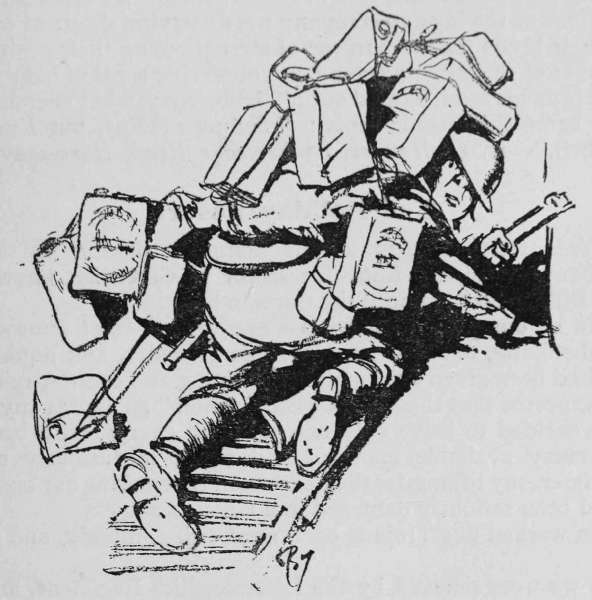
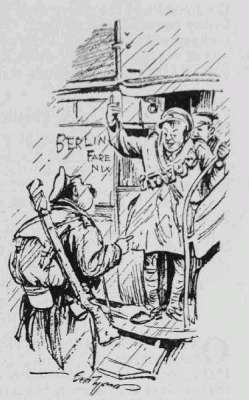
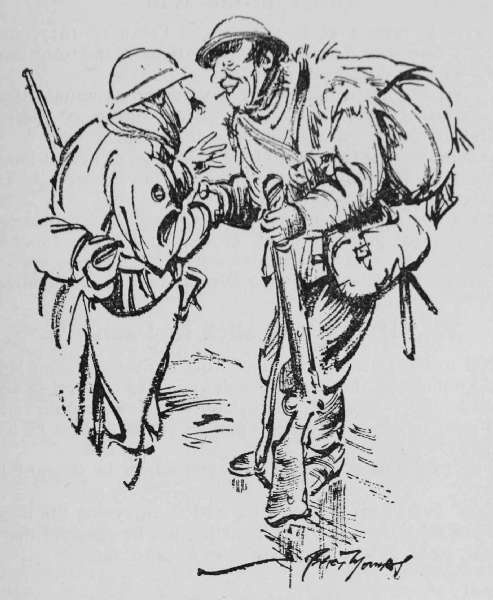
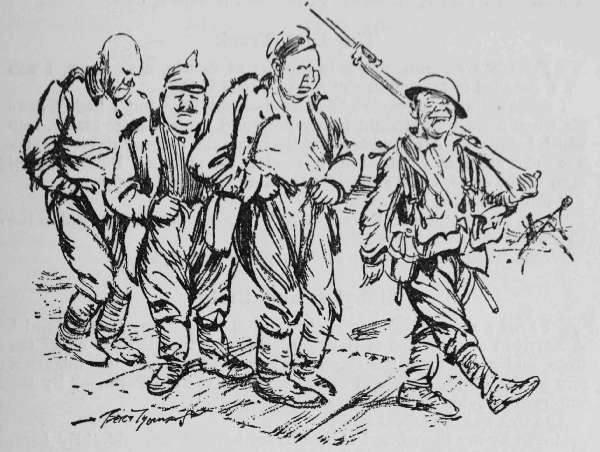
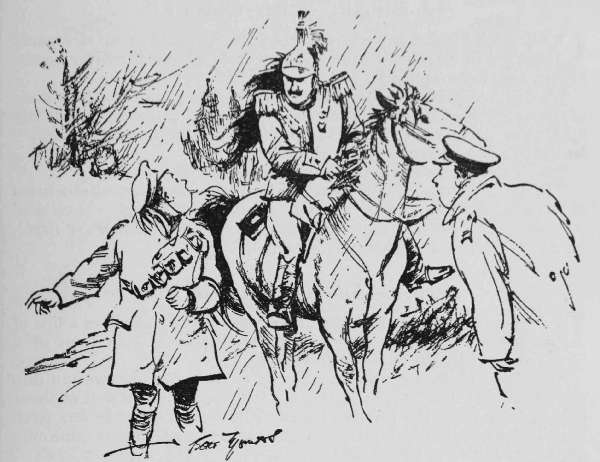
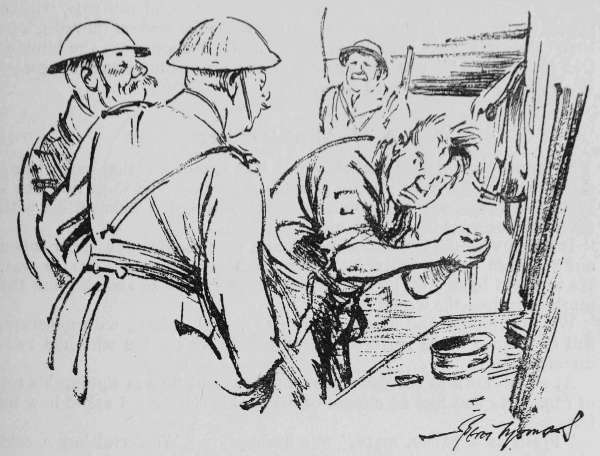
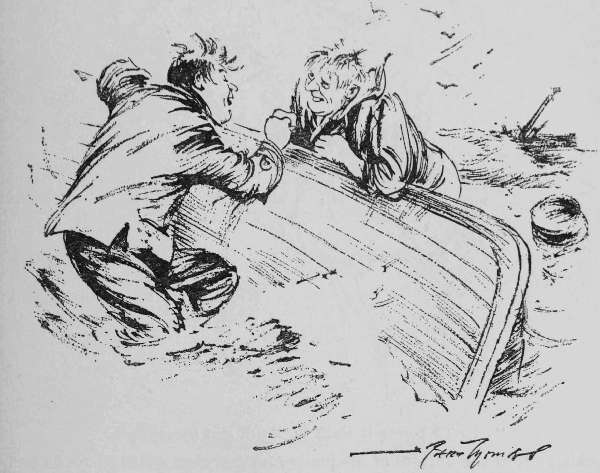
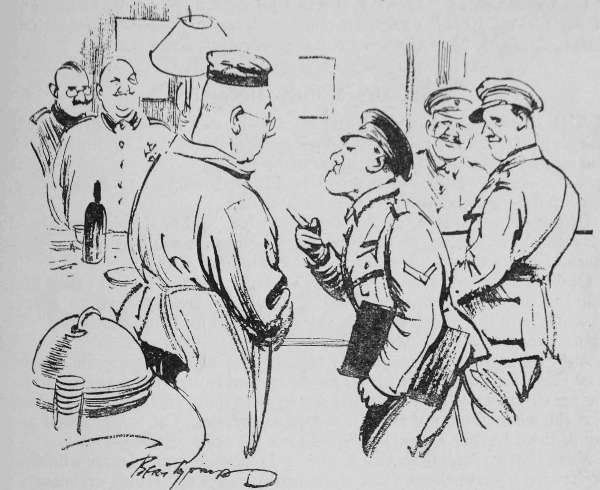
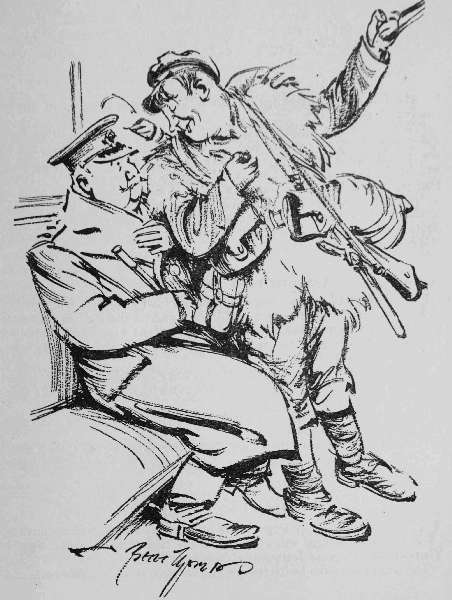
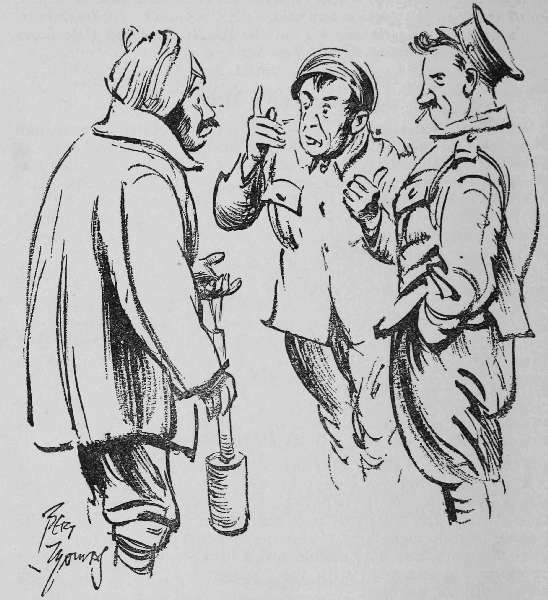
During the third battle of Ypres a German field gun was trying to
hit one of our tanks, the fire being directed no doubt by an observation
balloon.
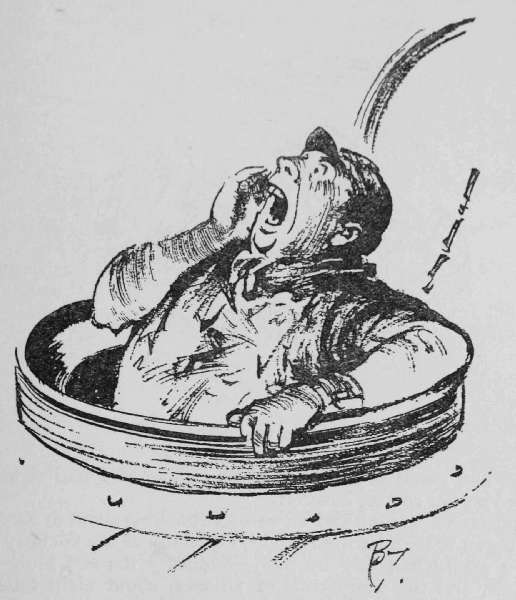
On the top of the tank was a Cockney infantryman getting a free ride
and seemingly quite unconcerned at Jerry's attempts to score a direct
hit on the tank.
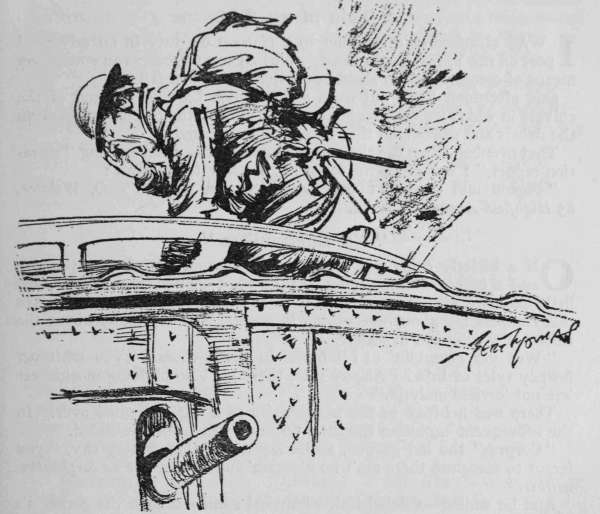
"Hi, conductor! Any room inside?—it's rainin'!"
As the tank was passing our guns a shrapnel shell burst just behind it
and above it.
We expected to see the Cockney passenger roll off dead. All he did,
however, was to put his hand to his mouth and shout to those inside the
tank: "Hi, conductor! Any room inside?—it's rainin'!"—A. H.
Boughton (ex "B" Battery, H.A.C.), 53 Dafforne Road, S.W.17.
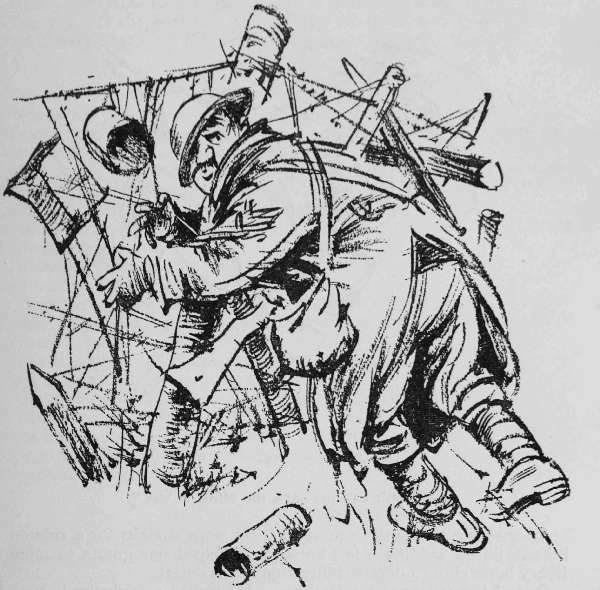
A wiring party in the Loos salient—twelve men just out from
home. Jerry's Verey lights were numerous, machine-guns were
unpleasantly busy, and there were all the dangers and alarms incidental
to a sticky part of the line. The wiring party, carrying stakes and wire,
made its way warily, and every man breathed apprehensively. Suddenly
one London lad tripped over a piece of old barbed wire and almost fell
his length.
"Lumme," he exclaimed, "that ain't 'arf dangerous!"—T. C.
Farmer, M.C., of Euston Square, London (late of "The Buffs").
I was attached as a signaller to a platoon on duty in an advanced
post on the Ypres-Menin Road. We had two pigeons as an emergency
means of communication should our wire connection fail.
One afternoon Fritz put on a strafe which blew in the end of the
culvert in which we were stationed. We rescued the pigeon basket from
the debris and discovered that an egg had appeared.
That evening, when the time came to send in the usual evening "situation
report," I was given the following message to transmit:
"Pigeon laid one egg; otherwise situation normal."—D. Webster,
85 Highfield Avenue, N.W.11.
On a bitterly cold, wet afternoon in February 1918 four privates
and a corporal were trying to take what shelter they could. One
little Cockney who had served in the Far East with the 10th Middlesex
was complaining about everything in general, but especially about the
idiocy of waging war in winter.
"Wot yer grumblin' at?" broke in the corporal, "you with yer
fawncy tyles of Inja? At any rate, there ain't no blinking moskeeters
'ere nor 'orrible malyria."
There was a break in the pleasantries as a big one came over. In
the subsequent explosion the little Cockney was fatally wounded.
"Corpril," the lad gasped, as he lay under that wintry sky, "you
fergot to menshun there ain't no bloomin' sun-stroke, nor no earfkwikes,
neither."
And he smiled—a delightful, whimsical smile—though the corporal's
"Sorry, son" was too late.—V. Meik, 107 King Henry's Road, N.W.3.
For seven hours, with little intermission, the German airmen
bombed a camp not a hundred miles from Etaples. Of the handful
of Q.M.A.A.C.s stationed there, one was an eighteen-year-old middle-class
girl, high-strung, sensitive, not long finished with her convent school.
Another was Kitty, a Cockney girl of twenty, by occupation a machine-hand,
by vocation (missed) a comédienne, and, by heaven, a heroine.
The high courage of the younger girl was cracking under the strain of
that ordeal by bombs. Kitty saw how it was with her, and for five
long hours she gave a recital of song, dialogue, and dance—most of it
improvised—while the bombs fell and the anti-aircraft guns screamed.
In all probability she saved the younger girl's reason.
When the last raider had dropped the last bomb, Kitty sank down,
all but exhausted, and for long cried and laughed hysterically. Hers
was not the least heroic part played upon that night.—H. N., London, E.
During the German attack near Zillebeke in June 1916 a diminutive
Cockney, named Samson, oddly enough, received a scalp wound
from a shell splinter which furrowed a neat path through his hair.
The fighting was rather hot at the time, and this great-hearted little
Londoner carried on with the good work.
Some hours later came the order to fall back, and as the Cockney
was making his way down the remains of a trench, dazed and staggering,
a harassed sergeant, himself nearly "all in," ordered him to bear off a
couple of rifles and a box of ammunition.
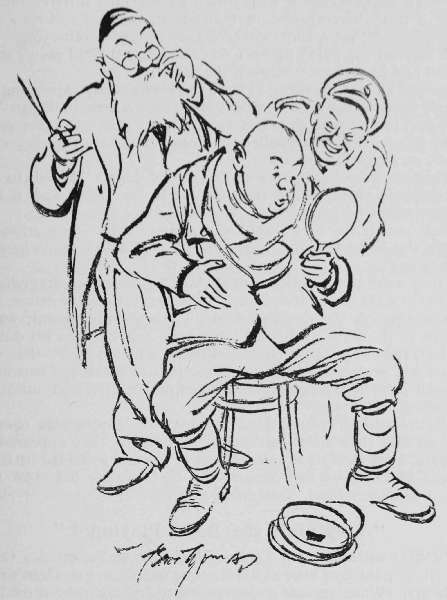
This was the last straw. "Strike, sergeant," he said, weakly, "I
can't 'elp me name being Samson, but I've just 'ad me perishin' 'air
cut!"—"Townie," R.A.F.
When we were at Railway Wood, Ypres Salient, in 1916, "Muddy
Lane," our only communication trench from the front line to the
support line, had been reduced to shapelessness by innumerable
"heavies." Progress in either direction entailed exposure to snipers
in at least twelve different places, and runners and messengers were, as
our sergeant put it, "tickled all the way."
In the support line one afternoon, hearing the familiar "Crack!
Crack! Crack!" I went to Muddy Lane junction to await the advertised
visitor. He arrived—a wiry little Cockney Tommy, with his tin hat
dented in two places and blood trickling from a bullet graze on the cheek.
In appreciation of the risk he had run I remarked, "Jerry seems to be
watching that bit!"
"Watching!" he replied. "'Struth! I felt like I was walking
darn Sarthend Pier naked!"—Vernon Sylvaine, late Somerset L.I.,
Grand Theatre, Croydon.
In March 1918, when Jerry was making his last great attack, I was
in the neighbourhood of Petit Barisis when three enemy bombing
planes appeared overhead and gave us their load. After all was clear
I overheard this dialogue between two diminutive privates of the 7th
Battalion, the London Regiment ("Shiny Seventh"), who were on
guard duty at the Q.M. Stores:
"You all right, Bill?"
"Yes, George!"
"Where'd you get to, Bill, when he dropped his eggs?"
"Made a blooming concertina of meself and got underneaf me blinkin'
tin 'at!"—F. A. Newman, 8 Levett Gardens, Ilford, Ex-Q.M.S., 8th
London (Post Office Rifles).
The 47th London Division were holding the line in the Bluff sector,
near Ypres, early in 1917, and the 20th London Battalion were being
relieved on a very wet evening, as I was going up to the front line with
a working party.
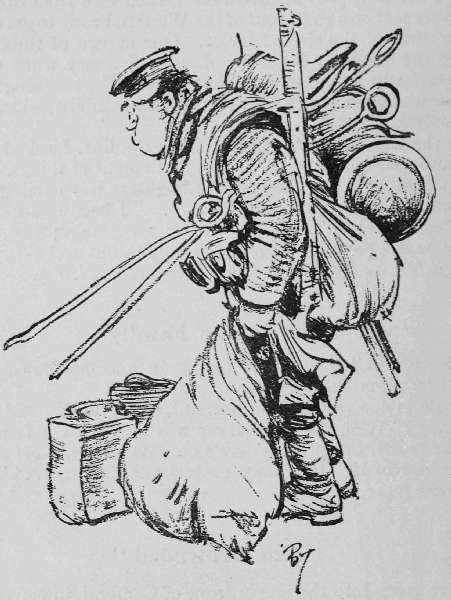
Near Hell Fire Corner shells were coming over at about three-minute
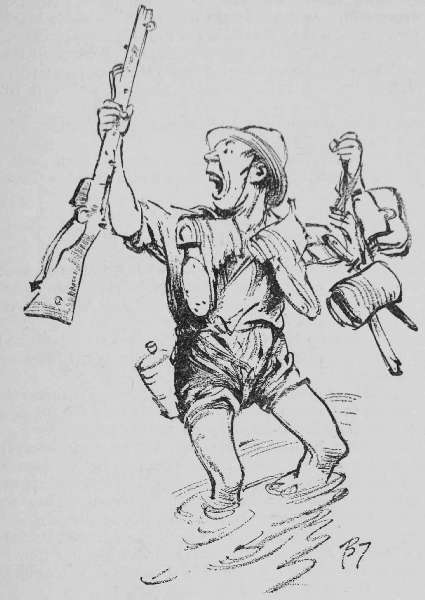
intervals. One of the 20th London Lewis gunners was passing in full
fighting order, with fur coat, gum boots, etc., carrying his Lewis gun,
several drums of ammunition, and the inevitable rum jar.
One of my working party, a typical Cockney, surveyed him and said:
"Look! Blimey, he only wants a field gun under each arm and he'd
be a bally division."—Lieut.-Col. J. H. Langton, D.S.O.
During the heavy rains in the summer of 1917 our headquarters
dug-out got flooded. So a fatigue party was detailed to bale it
out.
"Long Bert" Smith was one of our baling squad. Because of his
abnormal reach, he was stationed at the "crab-crawl," his job being to
throw the water outside as we handed the buckets up to him.
It was a dangerous post. Jerry was pasting the whole area unmercifully
and shell splinters pounded on the dug-out roof every few seconds.
Twenty minutes after we had started work Bert got badly hit, and it
was some time before the stretcher-bearers could venture out to him.
When they did so he seemed to be unconscious.
"Poor blighter!" said one of the bearers. "Looks to be going
West."
Bert, game to the last, opened his eyes and, seeing the canvas bucket
still convulsively clutched in his right fist, "Nah, mate!" he grunted—"Soufend!"
But the stretcher-bearer was right.—C. Vanon, 33 Frederick Street,
W.C.I.
Several stretcher cases in the field dressing station at the foot of
"Chocolate Hill," Gallipoli, awaited removal by ambulance, including
a Cockney trooper in the dismounted Yeomanry.
He had a bandage round his head, only one eye was visible, and his
left arm was bound to his breast with a sandbag.
His rapid-fire of Cockney witticisms had helped to keep our spirits
up while waiting—he had a comment for everything. Suddenly a
"strafe" started, and a shrapnel shell shot its load among us.
Confusion, shouts, and moans—then a half-hysterical, half-triumphant
shout from the Cockney: "Lumme, one in the blinkin' leg this time.
I got 'ole Nelson beat at last!"—J. Coomer (late R.E.), 31 Hawthorn
Avenue, Thornton Heath.
A German sniper was busy potting at our men in a front-line trench
at Cambrai in March 1918. A Cockney "old sweat," observing
a youngster gazing over the parapet, asked him if he were a fatalist.
The youngster replied "Yes."
"So am I," said the Cockney, "but I believes in duckin'."—"Brownie,"
Kensal Rise, N.W.10.
One summer afternoon in '15 some lads of the Rifle Brigade were
bathing in the lake in the grounds of the château at Elverdinghe,
a mile or so behind the line at Ypres, when German shells began to land
uncomfortably near. The swimmers immediately made for the land,
and, drawing only boots on their feet, dashed for the cellar in the
château.
As they hurried into the shelter a Cockney sergeant bellowed, "Nah
then, booty chorus: double up an' change for the next act!"—G E.
Roberts, M.C. (late Genl. List, att'd 21st Divn. Signal Co.), 28 Sunbury
Gardens, Mill Hill, N.W.7.
During the battle of Arras, Easter 1917, we were lying out in front
of our wire in extended order waiting for our show to begin. Both
our artillery and that of Fritz were bombarding as hard as they could.
It was pouring with rain, and everybody was caked in mud.
Our platoon officer, finding he had a good supply of chocolate, and
realising that rations might not be forthcoming for some time, crept along
the line and gave us each a piece.
As he handed a packet to one cheerful Cockney he was asked, "Wot
abaht a programme, sir?"—W. B. Finch (late London Regiment),
155 High Road, Felixstowe.
Easter Monday, April 9, 1917. Night. Inches of snow and a
weird silence everywhere after the turmoil of the day. Our battalion
is held up in front of Monchy-le-Preux during the battle of Arras. I am
sent out with a patrol to reconnoitre one of our tanks that is crippled and
astride the German wire 300 yards out.
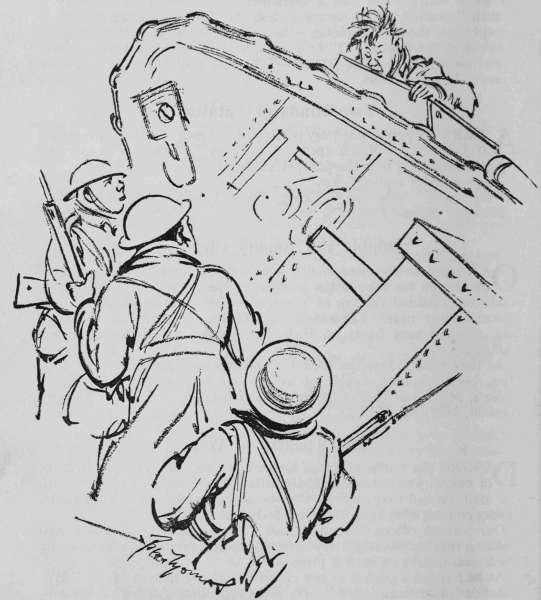
"I'll have to let yer in meself ... it's the skivvy's 'arf day orf!"
It is ticklish work, because the crew may be dead or wounded and
Fritz in occupation. Very warily we creep around the battered monster
and presently I tap gingerly on one of the doors. No response. We
crawl to the other side and repeat the tapping process. At last, through
the eerie silence, comes a low, hoarse challenge.
"Oo are yer?"
"Fusiliers!" I reply, as I look up and see a tousled head sticking
through a hole in the roof.
"Ho!" exclaims the voice above, "I'll 'ave ter come dahn and let
yer in meself, it's the skivvy's 'arf day orf!"
The speaker proved to have a shattered arm—among other things—and
was the sole survivor of the crew.—D. K., Fulham, S.W.6.
"Spider" Webb was a Cockney—from Stepney, I believe—who
was with us on the Somme in 1916. He was a splendid cricketer.
We had had a very stiff time for six or seven hours and were resting
during a lull in the firing. Then suddenly Jerry sent over five shells.
After a pause another shell came over and burst near to "Spider" and
his two pals.
When the smoke cleared I went across to see what had happened.
"Spider's" two pals were beyond help. The Cockney was propping
himself up with his elbows surveying the scene.
"What's happened, Webb?" I said. "Blimey! What's happened?"
was the reply. "One over—two bowled" (and, looking
down at his leg)—"and I'm stumped." Then he fainted.—George
Franks, M.C. (late Lieut., Royal Artillery), Ilford, Essex.
We called him "M'lord." He came from Hoxton—"That's where
they make 'em," he used to say. He was a great asset to us, owing
to the wonderful way in which he went out and "won" things.
One night, near Amiens, in 1916, "M'lord" said, "I'm going aht to see
wot some uvver mob has got too much of." One or two of us offered to
accompany him, but he refused, saying, "You bloomin' elephants 'ud
be bahnd to give the gime away."
About three hours later, when we were beginning to get anxious, we
saw him staggering in with a badly wounded German, who was smoking
a cigarette.
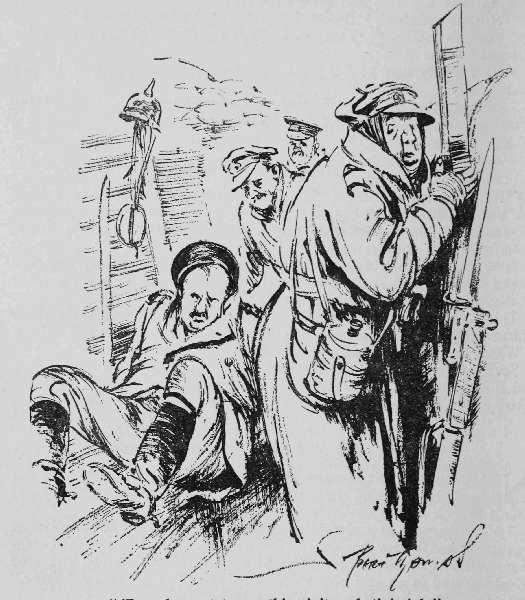
Seeing us, and very much afraid of being thought soft-hearted,
"M'lord" plumped old Fritz down on the fire-step and said very fiercely,
"Don't you dare lean on me wif impunity, or wif a fag in your mouf."
Jerry told us later that he had lain badly wounded in a deserted
farmhouse for over two days, and "M'lord" had almost carried him
for over a mile.
"M'lord" was killed later on in the war. Our battalion was the 7th
Batt. Royal Fusiliers (London Regt.)—W. A., Windsor.
In our platoon was a very tall chap who was always causing us great
amusement because of his height. Naturally he showed his head
above the parapet more often than the rest of us, and whenever he did so
ping would come a bullet from a sniper and down our tall chum would
drop in an indescribably funny acrobatic fashion.
The climax came at Delville Wood in August 1916, when, taking over
the line, we found the trench knocked about in a way that made it most
uncomfortable for all of us. Here our tall friend had to resort to his
acrobatics more than ever: at times he would crawl on all fours to
"dodge 'em." One shot, however, caused him to dive down more
quickly than usual—right into a sump hole in the trench.
Recovering himself, he turned to us and, with an expression of unutterable
disgust, exclaimed, "You blokes can laugh; anybody 'ud
fink I was the only blighter in this war."—C. Bragg (late Rifle Brigade,
14th Division), 61 Hinton Road, Herne Hill, S.E.24.
One night in June 1916, on the Somme, we were ordered to leave
our line and go over and dig an advance trench. We returned to our
trench before dawn, and shortly afterwards my chum, "Pussy" Harris,
said to me, "I have left my rifle in No Man's Land."
"Never mind," I said, "there are plenty more. Don't go over
there: the snipers are sure to get you."
But my advice was all in vain; he insisted on going. When I asked
him why he wanted that particular rifle he said, "Well, the barrel is
bent, and it can shoot round corners."
He went over....
That night I saw the regimental carpenter going along the trench
with a roughly-made wooden cross inscribed "R.I.P. Pte. Harris."—W.
Ford, 613 Becontree Avenue, Chadwell Heath, Essex.
One night, while going round the line at Loos, I was accompanied
by Sergeant Winslow, who was a London coster before the war.
We were examining the field of fire of a Lewis gun, when the Germans
opened up properly on our sector. Clouds of smoke rose from the
surrounding trenches, crash after crash echoed around the old Loos
crassier, and night was turned into day by Verey lights sent up by both
sides.
Suddenly a lad of 18, just out, turned to Sergeant Winslow, and in a
quivering voice said: "My God, sergeant, this is awful!"
Sergeant Winslow replied: "Now, look 'ere, me lad, you'd have
paid 'alf a dollar to take your best gal to see this at the Crystal Palace
before the war. What are yer grousing abaht?"—A. E. Grant (late
17th Welch Regt.), 174 Broom Road, Teddington.
One Saturday evening I was standing by my dug-out in Sausage
Valley, near Fricourt, when a draft of the Middlesex Regt. halted
for the guide to take them up to the front line where the battalion was.
I had a chat with one of the lads, who told me he had left England on
the Friday.
They moved off, and soon things got lively; a raid and counter-raid
started.
Later the casualties began to come down, and the poor chaps were
lying around outside the 1st C.C.S. (which was next to my dug-out).
On a stretcher was my friend of the draft. He was pretty badly hit.
I gave him a cigarette and tried to cheer him by telling him he would
soon be back in England. With a feeble smile he said, "Blimey, sir,
this 'as been a short week-end, ain't it?"—Pope Stamper (15th Durham
L.I.), 188A Upper Richmond Road, East Sheen, S.W.14.
At Aubers Ridge, near Fromelles, in October 1918, my chum and I
were engrossed in a game of chess, our chessboard being a waterproof
sheet with the squares painted on it, laid across a slab of concrete
from a destroyed pill-box.
The Germans began to drop 5·9's with alarming regularity about 150
yards to our rear, temporarily distracting our attention from the game.
Returning to the game, I said to my chum, "Whose move, Joe?"
Before he could reply a shell landed with a deafening roar within a
few yards of us, but luckily did not explode (hence this story).
His reply was: "Ours"—and we promptly did.—B. Greenfield, M.M.
(late Cpl. R.F.A., 47th (London) Division), L.C.C. Parks Dept., Tooting
Bec Common, S.W.
On July 1, 1916, I happened to be among those concerned in the
attack on the German line in front of Serre, near Beaumont Hamel.
Our onslaught at that point was not conspicuously successful, but we
managed to establish ourselves temporarily in what had been the Boche
front line, to the unconcealed indignation of the previous tenants.
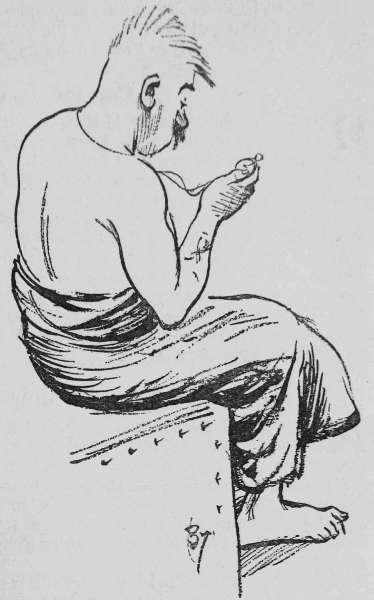
During a short lull in the subsequent proceedings I saw one of my
company—an elderly private whose melancholy countenance and
lank black moustache will ever remain engraved on my memory—seated
tranquilly on the battered fire-step, engrossed in a certain humorous
journal.
Meeting my astonished eye, he observed in a tone of mild resentment:
"This 'ere's a dud, sir. 'S not a joke in it—not what I calls a joke,
anyway."
So saying, he rose, pocketed the paper, and proceeded placidly to get
on with the war.—K. R. G. Browne, 6B Winchester Road, N.W.3.
Sergeant "Teddie" was rather deaf, but I am inclined to think
that this slight affliction enabled him to pull our legs on occasions.
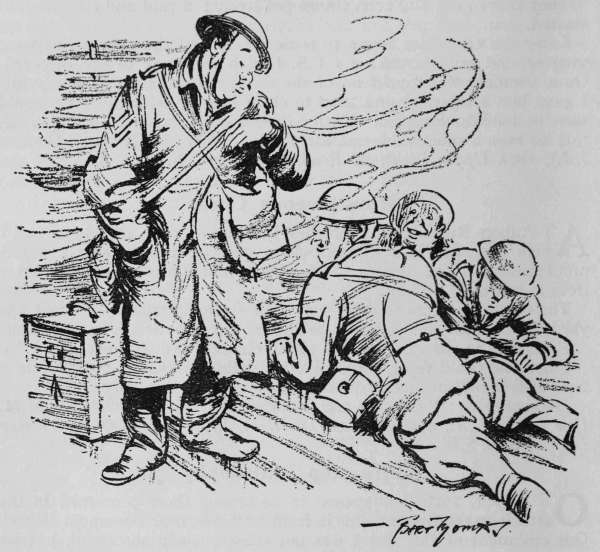
"A quarter to seven, sir."
Our company of the London Regiment had just taken over a part of
the line known as the Paris Redoubt, and on the first evening in the
sector the company commander, the second in command, Sergeant
"Teddie," and myself had a stroll along the observation line, which
was just forward of the front line, in order to visit the various posts.
Suddenly a salvo of shells came over and one burst perilously near us.
Three of the party adopted the prone position in record time, but on our
looking round "Teddie" was seen to be still standing and apparently
quite unconcerned.
"Why the dickens didn't you get down?" said one of the party,
turning to him. "It nearly had us that time."
"Time?" said "Teddie," looking at his watch. "A quarter to
seven, sir."—J. S. O. (late C.S.M., 15th London Regt.).
Just before the battle of Messines we of the 23rd Londons were
holding the Bluff sector to the right of Hill 60. "Stand down" was
the order, and the sergeant was coming round with the rum.
"Nobbler," late of the Mile End Road, was watching him in joyful
anticipation when ... a whizz-bang burst on the parapet, hurling
men in all directions. No one was hurt ... but the precious rum jar
was shattered.
"Nobbler," sitting up in the mud and moving his tin hat from his left
eye the better to gaze upon the ruin, murmured bitterly: "Louvain—Rheims—the
Lusitania—and now our perishin' rum issue. Jerry, you
'eathen, you gets worse and worse. But, my 'at, won't you cop it when
'Aig knows abaht this!"—E. H. Oliver, Lanark House, Woodstock,
Oxford.
To all those thousands who remember Shrapnel Corner and the
sign: "DRIVE SLOWLY! SPEED CAUSES DUST WHICH
DRAWS THE ENEMY'S SHELL FIRE" this incident will appeal.
I had rounded the corner into Zillebeke Road with a load of ammunition,
and had gone about 200 yards along the road, when Fritz let go
with a few shells.
"Rum Ration" (my mate's nick-name) looked out of the lorry to
observe where the shells were falling.
"Nah we're for it," he exclaimed, "our dust must 'ave gorn into
ole 'Indenberg's blinkin' sauerkraut."—J. H. Clarke, ex-Pte., M.T.A.S.C.
Crack! Crack! Crack!—and men falling with each crack.
It is terrible; we are faced with mud, misery, and despair. A German
machine-gun is taking its toll.
It seems impossible to get at the gunners, and we spend hours lying
in wait. This waiting proves too much for one of us; single-handed he
takes a chance and crawls away from my side. I keep him covered;
minutes roll by; they seem hours, days; and, as he is now out of sight,
I begin to give up hope for him, my Cockney pal.
Some instinct warns me to keep watch, and I am rewarded. I feel my
eyes start from my head as I see the approaching procession—four
Germans, hands above their heads, and my pal following, carrying the
machine-gun across his shoulders. I marvel at his courage and wonder
how it was done ... but this I am never to know. As I leap from the
trench to give him assistance I realise his number is nearly up. He is
covered with blood.
I go to relieve him of his burden, and in that moment one of the
Germans, sensing that my pal is almost out, turns on us with his
revolver. We are held at the pistol-point and I know I must make a
desperate bid to save my pal, who has done his best in an act which saved
a portion of our line.
I drop the gun and, with a quick movement, I am able to trip the
nearest German, but he is quick too and manages to stick me (and I still
carry the mark of his bayonet in my side).
The realisation I am still able to carry on, that life is sweet, holds me
up, and, with a pluck that showed his determination and Cockney
courage, my pal throws himself into a position in which he can work the
gun. Crack! and Crack! again: the remaining Germans are brought
down.
I am weak with loss of blood, but I am still able to drag my pal with
me, and, aided by his determination, we get through. It seems we
are at peace with the world. But, alas, when only five yards from our
trenches a shell bursts beside us; I have a stinging pain in my shoulder
and cannot move! Machine-guns and rifles are playing hell.
My pal, though mortally wounded, still tries to drag me to our trench.
He reaches the parapet ... Zip ... Zip. The first has missed, but
the second gets him. It is a fatal shot, and, though in the greatest
agony, he manages to give me a message to his folks....
He died at my side, unrewarded by man. The stretcher-bearer told
me that he had five bullet-holes in him. He lies in France to-day, and
I owe my life to him, and again I pay homage to his memory and to him
as one of England's greatest heroes—a Valiant Son of London.—John
Batten (late Rifleman, 13 Bn., K.R.R.C.), 50 Sussex Gardens, Hyde Park,
W.2.
Alec Lancaster was a showman at the White City in pre-war
days. Short in stature, he possessed a mighty heart, and in the
ghastly days in front of Poelcapelle he made history as the sergeant who
took command of a brigadier.
The brigadier had been on a visit to the front line to inspect a new
belt of wire and, passing the —— headquarters, paused to look around.
Just then a few shells came over in quick succession and things looked
nasty.
Alec Lancaster took command and guided the brigadier somewhat
forcibly into a dug-out with the laconic, "Nah, then. We don't want
any dead brigadiers rahnd 'ere."—Geo. B. Fuller, 146 Rye Road, Hoddesdon,
Herts.
On the third day of the German offensive in March 1918 a certain
brigade of the R.F.A. was retiring on Péronne.
A driver, hailing from London town, was in charge of the cook's cart,
which contained officers' kits belonging to the headquarters' staff.
As he was making his way along a "pip-squeak" came over and
burst practically beneath the vehicle and blew the whole issue to pieces.
The driver had a miraculous escape.
When he recovered from the shock he ruefully surveyed the debris,
and after deciding that nothing could be done, continued his journey
on foot into Péronne.
Just outside that town he was met by the Adjutant, who said, "Hullo,
driver, what's happened—where's cook's cart with the kits?"
Driver: Blown up, sir.
Adjutant (anxiously): Anything salved?
Driver: Yus, sir, me!—F. H. Seabright, 12 Broomhill Road, Goodmayes,
Essex.
The London (47th) Division, after a strenuous time on the Somme
in September 1916, were sent to Ypres for a quiet (?) spell, the
depleted ranks being made up by reserves from home who joined us en
route.
The 18th Battalion (London Irish), were informed on taking the line
that their opponents were men of the very same German regiment as
they had opposed and vanquished at High Wood.
Soon after "stand down" the following morning Rifleman S——
mounted the fire-step and, cupping his hands to his mouth, shouted,
"Compree 'Igh Wood, Fritz?"
The words had hardly left his lips when zip, a sniper's bullet knocked
his tin hat off his head and Rifleman S—— found himself lying on the
duckboards with blood running down his face.
Picking himself up, he calmly gathered his souvenirs together and said
as he made his way out, "Cheerio, boys, I've got a Blighty one, but
don't tell the colonel it was self-inflicted."—A. C. B., Ilford, Essex.
Our division (the Third) was on its way from the line for the long-looked-for
rest. We were doing it by road in easy stages.
During a halt a pack animal (with its load of two boxes of "·303")
became restive and bolted. One box fell off and was being dragged by
the lashing. Poor old Nobby Clarke, who had been out since Mons,
stopped the box with his leg, which was broken below the knee.
As he was being carried away one of the stretcher-bearers said, "Well,
Nobby, you've got a Blighty one at last."
"Yus," said Nobby; "but it took a fousand rahnds to knock me
over."—H. Krepper (late 5th Fusiliers), 62 Anerley Road, Upper Norwood,
S.E. 19.
The Commanding Officer of a Territorial battalion was wounded in
both hands during the third battle of Gaza in 1917. He had much
service to his credit, was a lieutenant-colonel of over two years' standing,
had been wounded twice before, and held the D.S.O.
He pluckily remained with his unit for thirty-six hours. Then, worn
out with lack of sleep, pain, and loss of blood, and filled with disappointment
at having to leave his battalion still in the fight, he trudged back to
the field ambulance.
His sufferings, which had aged his appearance, and the Tommy's
tunic which he wore in action, apparently misled a party of 10th London
men whom he passed. They looked sympathetically at him, and one
said, "Poor old blighter, 'e ought never to 'ave been called up."—Captain
J. Finn, M.C., Constitutional Club, W.C.2.
There were no proper trenches in front of Armentières in early
December 1914, and a machine gun section was doing its best to
build an emplacement and cover. It was in the charge of a young
Londoner who in times of excitement stuttered badly.
Not being satisfied with the position of one sandbag, he hopped over
those already in place, and in full view of Jerry (it was daylight too),
began to adjust the sandbag that displeased him.
Jerry immediately turned a machine gun on him, but the young officer
finished his work, and then stood up.
Looking towards Jerry as the section yelled to him to come down, he
stuttered angrily. "I b-b-be-lieve the bli-bli-blighters are shoo-shoo-shoo-shoo-ting
at me." At that moment someone grabbed his legs and
pulled him down. It was a fine example of cool nerve.—T. D., Victoria,
S.W.1.
It happened late in 1917 in Tank Avenue, just on the left of Monchy-le-Preux.
It was a foul night of rain, wind, sleet, and whizz-bangs.
My battalion had just been relieved, and we were making our way
out as best we could down the miry communication trench. Every now
and again we had to halt and press ourselves against the trench side to
allow a straggling working party of the K.R.R.s to pass up into the line.
Shells were falling all over the place, and suddenly Fritz dropped one
right into the trench a few bays away from where I was.
I hurried down and found two of the working party lying on the
duckboards. They were both wounded, and one of them had his tunic
ripped off him by the force of the explosion. What with his tattered
uniform—and what remained of it—and his face and bare chest smothered
in mud, he was a comical though pathetic sight. He still clung to his
bundle of pickets he had been carrying and he sat up and looked round
with a puzzled expression.
One of our sergeants—a rather officious fellow—pushed himself
forward.
"Who are you?" he asked. "K.R.R.s?"
"'Course," retorted the half-naked Cockney. "Oo d'ye fink we was—Ancient
Britons?"—E. Gordon Petrie (late Cameron Highlanders),
"Hunky-Dory," Demesne Road, Wallington, Surrey.
Between Ecoust and Bullecourt in January 1918 my platoon
was passing a mine crater which was half-full of water when suddenly
Jerry sent one over. Six of our fellows were wounded, and one of them,
a Bow Road Cockney, was hurled into the crater.
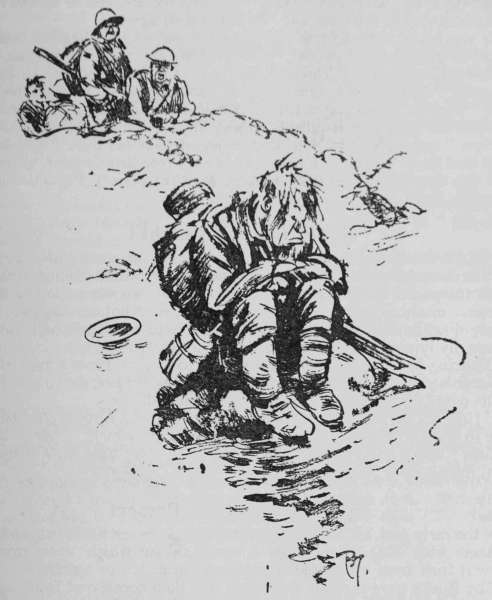
"Robinson Crusoe."
He struggled to his feet and staggered towards a pile of rubble that
rose above the muddy water like an island. Arrived there, he sat down
and looked round him in bewilderment.
Then: "Blimey," he muttered, "Robinson ruddy Crusoe!"—E.
McQuaid (late R.S.F.), 22 Grove Road, S.W.9.
On October 11-12, 1914, during the Mons retreat, a small party of
2nd Life Guards were told off as outpost on the main road, near
Wyngene, Belgium. After we had tied our horses behind a farmhouse
at the side of the road, we settled down to await the arrival of "Jerry."
Time went slowly, and one of our troopers suggested that we all put
a half-franc into an empty "bully" tin, and the first one of us who shot
a German was to take the lot. To this we all agreed.
It was about midnight when, suddenly, out of the shadows, rode a
German Death's-head Hussar. We all raised our rifles as one man, but
before we could shoot "Tiger" Smith, one of our real Cockney troopers,
shouted, "Don't shoot! Don't shoot!" During our momentary hesitation
"Tiger's" rifle rang out, and off rolled the German into the road.
Upon our indignant inquiry as to why he had shouted "Don't shoot,"
"Tiger" quietly said, "Nah, then, none of your old buck; just hand
over that tin of 'alf francs I've won."—Fred Bruty (late Corporal of Horse,
2nd Life Guards), City of London Police Dwellings, No. 3, Ferndale Court,
Ferndale Road, S.W.9.
Near St. Quentin, in October 1918, I was in charge of a section
that was detailed to cross a railway to establish communication
with troops on the other side. Unfortunately we were spotted by a
German machine gunner, who made things very hot for us, two men
being quickly hit. We managed, however, to reach a small mound
where, by lying quite flat, we were comparatively safe.
Glancing in the direction from which we had come, I saw a man whom
I recognised as "Topper" Brown, our company runner, dashing as hard
as he could for the cover where we had sheltered.
"How do, corp?" he said when he came up. "Any of your blokes
like to go in a raffle for this watch?" (producing same). "'Arf a franc
a time; draw to-night in St. Quentin."—S. Hills (late Rifle Brigade),
213, Ripple Road, Barking.
In the early part of the War we were dug in between the Marne and the
Aisne with H.Q. situated in a trench along which were growing
several fruit trees which the troops were forbidden to touch.
The Boche were shelling with what was then considered to be heavy
stuff, and we were all more or less under cover, when a large one hit
the back of the trench near H.Q.
After the mess staff had recovered from the shock it was noticed that
apples were still falling from a tree just above, and the mess corporal,
his ears and eyes still full of mud, was heard to say: "Thank 'eaven, I
shan't have to climb that perishin' tree and get the old man's bloomin'
dessert to-night."—E. Adamson, Overseas Club, St. James's.
In September 1916, while with the 17th K.R.R.C., I lost my overcoat
in a billet fire at Mailly-Maillet and indented for a new one, which,
however, failed to turn up.
We moved to Hebuterne, where the line was very lively and the
working parties used to be strafed with "Minnies" all night.
One night, while on patrol, with nerves on the jump, I was startled to
hear a voice at my elbow say, "Try this on."
It was the Q.M.'s corporal with the overcoat!
I solemnly tried it on there and then in No Man's Land, about 300
yards in front of our front line and not very far from the German line.
The corporal quite casually explained that he had some difficulty in
finding me out there in the dark, but he did not want the trouble of
carrying stuff out of the line when we moved!—S. W. Chuckerbutty,
(L.R.B. and K.R.R.C.), 3 Maida Hill West, London, W.2.
In the Brickstacks at Givenchy, 1916. The Germans were celebrating
the Kaiser's birthday by putting a steady succession of "Minnies"
into and around our front line trench.
Just when the strain was beginning to tell and nerves were getting
jumpy, a little Cockney corporal jumped on the fire-step and, shaking
his fist at the Germans forty yards away, bawled, "You wait till it's
my ruddy birthday!"
Fritz didn't wait two seconds, but the little corporal had got his laugh
and wasn't taking a curtain.—"Bison" (late R.W.F.).
In June 1917 we were ordered to lay a line to the front line at "Plug
Street". Fritz started to bombard us with whizz-bangs, and my pal
and I took cover behind a heap of sandbags, noticing at the same time
that all the infantrymen were getting away from the spot.
When things quietened down we heard a Cockney voice shouting,
"Hi, mate! Chuck us yer name plate (identification disc). Y're sitting
up against our bomb store."—S. Doust (late Signal Section, "F" Battery,
R.H.A.), 53 Wendover Road, Well Hall, Eltham, S.E.9.
While on our way to relieve the 1st R.W.F.s, who were trying their
utmost to hold a position in front of Mametz Wood, it was necessary
to cross a road, very much exposed to Jerry's machine guns.
A burst of firing greeted our attempt, and when we succeeded, a
Cockney who had a flesh wound caused a smile by saying, "Go back?
Not me. Next time I crosses a road I wants a blinking copper ter 'old
me 'and?"—G. Furnell, 57a Southwold Road, Upper Clapton, E.5.
During an advance on the Somme in 1916 my company was rushed
up to the captured trenches to search the dug-outs and to bring in
the prisoners.
My Cockney pal was evidently enjoying himself. As he went from one
dug-out to another he was singing:
"Orl that I want is lo-ove,
Orl that I want is yew."
Entering one dug-out, however, his voice suddenly changed. In the
dug-out were three Germans. Showing them the point of his bayonet,
the Cockney roared: "Nah, then, aht of it; 'op it. I'm lan'lord 'ere
nah."—C. Grimwade, 26 Rotherhithe New Road, Rotherhithe, S.E.16.
One night in October '14, in the neighbourhood of Herlies, "Ginger,"
a reservist, was sent out to call in the men of a listening post.
Dawn came, but no "Ginger" returned, and as he did not turn up
during the day he was given up for lost.
Soon after dusk, however, a very worn and fed-up "Ginger" returned.
We gathered that he had suddenly found himself in the German lines,
had had a "dust-up," had got away, and had lain out in No Man's Land
until dusk allowed him to get back.
The company officer was inclined to be cross with him, and asked him,
"But what made you go so far as the enemy position?"
"Ginger" scratched his head, and then replied, "Well, sir, nobody
said anyfink to me abaht it being aht o' bahnds."—T. L. Barling (late
Royal Fusiliers), 21 Lockhart Street, Bow, E.3.
On May 14, 1917, the 2/2nd Battalion of the London Regiment
occupied the support lines in front of Bullecourt. "A" company's
position was a thousand yards behind the front line trenches. At 2 p.m.
the enemy began to subject the whole area to an intense bombardment
which lasted more than thirteen hours.
In the middle of the bombardment (which was described by the
G.O.C.-in-Chief as "the most intense bombardment British troops had
had to withstand"), No. 3 platoon of "A" company was ordered to
proceed to the front line with bombs for the battalion holding it. The
platoon consisted of 31 N.C.O.s and men and one officer.
The only means of communication between the support and front
lines was a trench of an average depth of two feet. Along this trench
the platoon proceeded, carrying between them forty boxes of Mills
bombs. Every few yards there were deep shell holes to cross; tangled
telephone wires tripped the men; M. G. bullets swept across the trench,
and heavy shells obtained direct hits frequently, while shrapnel burst
overhead without cessation.
A man was hit every few minutes; those nearest him rendered what
aid was possible, unless he was already dead; his bombs were carried
on by another.
Of the thirty-one who started, twenty-one were killed or wounded;
the remainder, having taken an hour and a half to cover the 1,000 yards,
reached the front line with the forty boxes of bombs intact.
They were ordered to remain, and thus found themselves assisting in
repulsing an attack made by the 3rd Lehr Regiment of Prussian Guards,
and two of the men succeeded in wounding and capturing the commanding
officer of the attacking regiment.
Of the ten N.C.O.s and men who were left, a lance-corporal was blown
to pieces in the trench; the remainder stayed in the front line until
they were relieved four days later. On their way back, through Vaux
Vraucourt, they picked clusters of May blossom, and with these in their
equipment and rifle barrels, marched into the transport lines whistling.—Captain,
London Regiment.
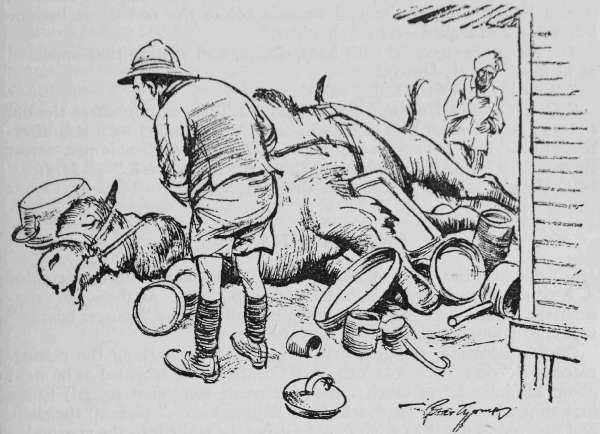
Our cook was having the time of his life. The transition from trench
warfare to more or less open warfare in late October 1918 brought
with it a welcome change of diet in the form of pigs and poultry from the
deserted farms, and cook had captured a nice young porker and two
brace of birds.
From the pleasant aroma which reached us from the cottage as we lay
on our backs watching a German aeroplane we knew that cook would
soon be announcing the feast was ready.
Suddenly from the blue came a roar like that of an express train.
We flung ourselves into the ditch.... K-k-k-k-r-r-r-ump!
When the smoke and dust cleared away the cottage was just a rubbish
heap, but there was cook, most miraculously crawling out from beneath
a debris of rafters, beams, and bricks!
"Ruddy 'orseplay!" was the philosopher's comment.—I. O., 19
Burnell Road, Sutton, Surrey.
When my husband commanded the 41st Division in France he was
much struck by the ready wit of a private of the Royal Fusiliers
(City of London Regiment) in a tight corner.
A bomb landed in a crowded dug-out while the men were having a
meal. Everyone stared aghast at this ball of death except one Tommy,
who promptly picked it up and flung it outside saying: "Grite stren'th
returns the penny, gentlemen!" as he returned to his bully beef.—Lady
Lawford, London, S.W.1.
A night wire-cutting party in the Arras sector had been surprised
by daylight. All the members of the party (21st London Regiment)
crawled back safely except one Cockney rifleman.
When we had reached the trenches and found that he was missing,
we were a bit upset. Would he have to lie out in No Man's Land all
day? Would he be spotted by snipers?
After a while our doubts were answered by a terrific burst from the
German machine guns. Some of the bolder spirits peered over the top
of the "bags" and saw our Cockney pal rushing, head down, towards
our line while streams of death poured around him.
He reached our parapet, fell down amongst us in the mud, uninjured,
and immediately jumped to his feet and said, "Am I in time for the
workman's?"—D. F., Acton, W.3.
The Time: March 1916.
The Scene: The Talus des Zouaves—a narrow valley running
behind Vimy Ridge from Neuville St. Vaast through Souchez. The
weather is bleak, and there is a sticky drizzle—it is towards dusk.
The Man: A native of "somewhere just awf the 'Bricklayers Arms'—you
know where that is, sir." Height, just over 5 feet; complexion,
red; hair, red and not over tidy; appearance, awkward; clothes don't
seem to fit quite. Distinguishing marks—a drooping red moustache
almost concealing a short clay pipe, stuck bowl sideways in the corner of
the mouth. On the face there is a curious—whimsical—wistful, in fact,
a Cockney expression.
The Occasion: The Boche is putting down his evening "strafe"—an
intense and very accurate barrage laid like a curtain on the southern
slope of the valley. Our hero, his hands closed round the stock of his
rifle held between his knees, is squatting unconcernedly on the wet ground
in the open on the northern side of the valley, where only a shell with a
miraculous trajectory could have scored a direct hit, watching the shells
burst almost every second not a great distance away. The din and
pandemonium are almost unbearable. Fragments of H.E. and shrapnel
are dropping very near.
The Remark: Removing his pipe to reveal the flicker of a smile, he
remarked, in his inimitable manner: "Lor' blimey, guv'nor, wouldn't
this sahnd orl rite on a grammerphone?"—Gordon Edwards, M.C. (Captain,
late S.W.B.), "Fairholm," 48 Alexandra Road, Wimbledon, S.W.19.
Fritz had been knocking our wire about, and a party of us were
detailed to repair it. One of our party, a trifle more windy than the
rest, kept ducking at the stray bullets that were whistling by. Finally,
'Erb, who was holding the coil of wire, said to him, "Can't yer stop
that bobbin' abaht? They won't 'urt yer unless they 'its yer."—C. Green,
44 Monson Road, New Cross, S.E.14.
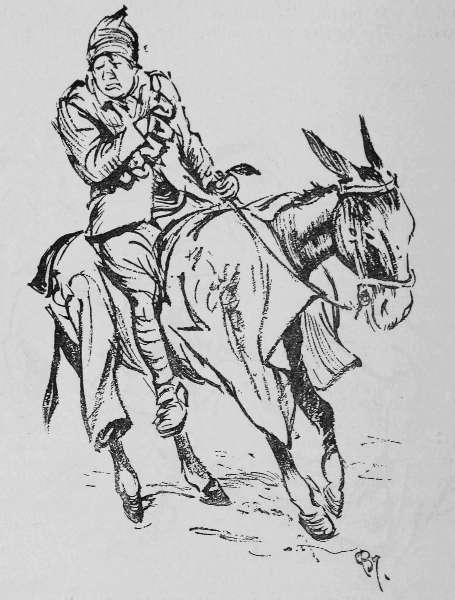
It was on the Mons-Condé Canal, on the afternoon of August 23,
1914. Our artillery had just opened up when a tiny Cockney
trumpeter, who could not have been more than 15 years old, came
galloping up to us with a message.
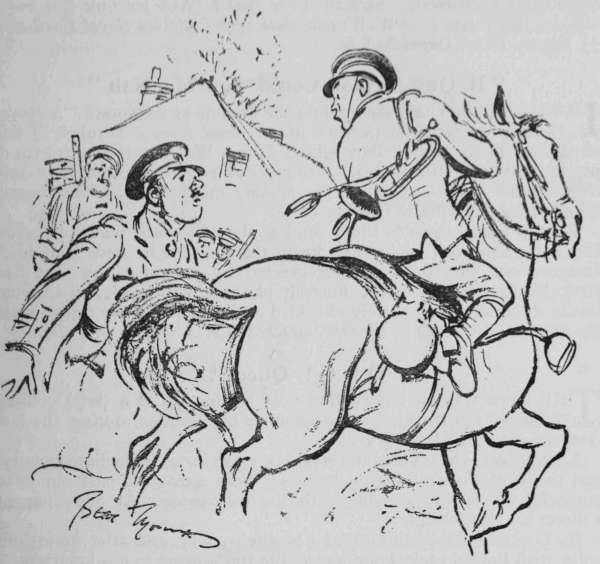
"They're coming on in millions."
"How are the gunners going on, boy?" said my captain.
"Knocking 'em down in fousands, sir," replied the lad.
"Good," said the captain.
"Yus, and they're coming on in millions," replied the boy as he rode
away to his battery.
A plucky kid, that.—W. H. White, 29 Clive Road, Colliers Wood,
S.W.19.
Two or three American officers were attached to our brigade H.Q.
on the Somme front.
We were doing our usual four days in the front line when one morning
an American officer emerged from the communication trench. Just
then the Germans opened out with everything from a 5·9 to rifle grenade.
We squeezed into funk-holes in the bottom of the trench. Presently
there was a lull, and the American officer was heard to ask, "Say, boys,
where is the front line in these parts?"
"Tich," a little Cockney from Euston way, extracted himself from the
earth, and exclaimed, "Strike! j'ear that? Wot jer fink this is—a
blinkin' rifle range?"—W. Wheeler (late 23rd Battalion Royal Fusiliers),
55 Turney Road, Dulwich, S.E.
Imagine (if you can) the mud on the Somme at its worst. A Royal
Marine Artilleryman (a very junior clerk from "Lambeff") was
struggling up the gentle slope behind Trones Wood with a petrol tin of
precious water in either hand. A number of us were admiring his manly
efforts from a distance when the sudden familiar shriek was heard,
followed by the equally familiar bang.
We saw him thrown to the ground as the whizz-bang burst but a few
feet from him, and we rushed down, certain that he had "got his."
Imagine our surprise on being greeted by an apparition that had
struggled to a sitting posture, liberally plastered with mud, and a wound
in the shoulder, who hoarsely chuckled and said: "If our typist could
see me nah!"—C. H. F. (W/Opr. attached R.M.A. Heavy Brigade).
The scene was an observation post in the top of a (late) colliery
chimney, 130 ft. up, on the outskirts of Béthune, during the last
German offensive of the War.
A great deal of heavy shelling was in progress in our immediate vicinity,
and many of Fritz's "high-velocities" were screaming past our lofty
pinnacle, which was swaying with the concussion. At any moment
a direct hit was possible.
My Cockney mate had located a hostile battery, and after some difficulty
with the field telephone was giving the bearing to headquarters.
Faults in the line seemed to prevent him from finishing his message,
which consisted of giving the map square (Q 20) being "strafed." The
"Q" simply would not reach the ears of the corporal at headquarters,
and after many fruitless efforts, using "Q" words, I heard him burst
out in exasperation: "Q! Q! Queue! ... Blimey! you know—the
blinkin' thing wot the pore blighters at home wite abaht for 'mawgarine'
in."—B. W. Whayman (late F.S.C., R.E.), 24 Oxford Street, Boston,
Lincolnshire.
We were in a deep railway cutting near Gouzeancourt. Jerry's
aeroplanes had found us and his artillery was trying to shift us.
On the third day we had run out of cigarettes, so the sergeant-major
asked for a volunteer to go to a canteen four miles away.
Our Cockney, a costermonger well known in the East End, volunteered.
He could neither read nor write, so we fixed him up with francs, a sandbag,
and a list.
Hours passed, the strafe became particularly heavy, and we began to
fear our old pal had been hit.
Suddenly during a lull in the shelling far away along the ravine we
heard a voice shouting, "Ere's yer fine 'eads er salery 'orl white." He
was winning through.—"Sparks," Lowestoft, Suffolk.
After my battalion had been almost wiped out in the 1918 retirement,
I was transferred to the 1st Batt. Middlesex Regt. One old
soldier, known to us as "Darky," who had been out since '14, reported
at B.H.Q. that he wanted to go up the front line with his old mates
instead of resting behind the line.
His wish was granted. He was detailed to escort a party of us to the
front line.
All went well till we arrived at the support line, where we were told to
be careful of snipers.
We had only gone 20 yards further when the old soldier fell back into
my arms, shot through the head. He was dying when he opened his eyes
and said to me, "Straight on, lad. You can find your way now."—A. H.
Walker, 59 Wilberforce Road, Finsbury Park, N.4.
At the end of September 1917 my regiment (5th Seaforth Highlanders)
were troubled by bombing raids by enemy aircraft at the
unhealthy regularity of one raid per hour. We were under canvas at
Siege Camp, in the Ypres sector, and being near to a battery of large
guns we were on visiting terms with some of the gunners, who were for
the most part London men.
A Lewisham man was writing a letter in our tent one day when we
again had the tip that the Germans were flying towards us. So we all
scattered.
After the raid we returned to our tent and were surprised to see our
artillery friend still writing his letter. We asked him whether he had
stayed there the whole time and in reply he read us the following passage
from his letter which he had written during the raid:
"As I write this letter Jerry is bombing the Jocks, but although I am
in their camp, being a Londoner, I suppose the raid is not meant for me,
and I feel quite safe."—W. A. Bull, M.M., 62 Norman Road, llford, Essex.
During the defence of Antwerp in October 1914 my chum, who
was wicket-keeper in the Corps cricket team, got hit in the head.
I was with him when he came to, and asked him what happened.
"Extra fast one on the leg side," was his reply.—J. Russell (late
R.M.L.I.), 8 Northcote Road, Deal, Kent.
During an engagement in East Africa an officer was badly wounded.
Bill, from Bermondsey, rode out to him on a mule. Whilst he was
trying to get the officer away on his mule the animal bolted. Bill then
said, "Me mule 'opped it, sir. 'E's a fousand miles from 'ere, so I'll
giv yer a lift on my Bill and Jack (back)."
The officer was too heavy, so Bill put him gently on the ground saying,
"Sorry, sir, I'll 'ave ter call a taxi." Bill then ran 500 yards under
heavy machine-gun fire to where the armoured cars were under cover.
He brought one out, and thereby saved the officer's life.
After the incident, Bill's attention was drawn to a bullet hole in his
pith helmet. "Blimey," he said, "what a shot! If he 'adn't a missed
me, 'e'd a 'it me." Bill was awarded the Distinguished Conduct Medal.—W. B.
Higgins, D.C.M. (late Corpl. Mounted Infantry), 46 Stanley Road,
Ilford.
We came out of the line on the night of June 14-15, 1917, to
"bivvies" at Mory, after a hot time from both Fritz and weather
at Bullecourt. When dawn broke we were astonished and delighted to
see a "bath." Whilst we were in the line our Pioneers had a brain wave,
dug a hole in the ground, lined it with a tarpaulin sheet, and filled it
with water.
As our last bath was at Achiet-le-Petit six weeks before, there was a
tremendous crowd waiting "mit nodings on," because there was "standing
room only" for about twenty in the bath.
Whilst ablutions were in progress an aeroplane was heard, but no
notice was taken because it was flying so low—"one of ours" everybody
thought. When it came nearer there was a shout, "Strewth, it's a Jerry
plane."
Baths were "off" for the moment and there was a stampede to the
"bivvies" for rifles. It was the funniest thing in the world to see fellows
running about in their "birthday suits" plus only tin hats, taking pot
shots at the aeroplane.
Even Fritz seemed surprised, because it was some moments before he
replied with his machine gun.
We watched him fly away back to his own lines and a voice broke the
silence with, "Blinkin' fools to put on our tin 'ats. Uvverwise 'ole
Fritz wouldn't a known but what we might be Germans."
I often wonder if any other battalion had the "honour" of "attacking
the enemy" clad only in tin hats.—G. M. Rampton (late 12th London
Regt., "Rangers"), 43 Cromwell Road, Winchester.
Scene, Ypres, May 1915. The battalion to which I belonged had
been heavily shelled for many hours, and among the casualties was
"Topper" Brown, a Cockney, who was always in trouble for losing items
of his kit. Taken to the dressing station to have a badly shattered foot
amputated, he recovered consciousness to find the C.Q.M.S. standing
by the stretcher on which he lay.
The C.Q.M.S., not knowing the extent of Brown's injury, inquired,
"What's the trouble, Brown?"
In a weak voice the Cockney replied, "Lost one boot and one sock
again, Quarter."—E. E. Daniels (late K.R.R.), 178 Caledonian Road, N.1.
We were in the line at Neuville St. Vaast in 1916. A raid had just
been carried out. In the party were two inseparable chums, one
from Bow and one from Harrow. (Of course they were known as Bow
and Arrow.)
The bulk of the raiders had returned, but some were yet to come in.
Some time later three forms were seen crawling towards our line. They
were promptly helped in.
As their faces were blackened they were hard to recognise, and a
corporal asked them who they were.
"Don't yer know us?" said the chap from Bow. "We're Bow and
Arrow." "Blimey!" said another Cockney standing by. "And I
suppose the other bloke's Robin 'ood, aint 'e."—G. Holloway (late London
Regt. and 180 M.G.C.), 179 Lewis Buildings, West Kensington, W.14.
Towards the end of September 1918 I was one of a party of nine
men and an officer taking part in a silent raid in the Ypres sector,
a little in front of the well-known spot called Swan and Edgar's Corner.
The raid was the outcome of an order from Headquarters demanding
prisoners for information.
Everything had been nicely arranged. We were to approach the German
line by stealth, surprise an outpost, and get back quickly to our own
trenches with the prisoners.
Owing perhaps to the wretchedness of the night—it was pouring with
rain, and intensely black—things did not work according to plan. Instead
of reaching our objective, our party became divided, and the group that
I was with got hopelessly lost. There were five of us, including "Ginger,"
a Cockney.
We trod warily for about an hour, when we suddenly came up against
a barbed-wire entanglement, in the centre of which we could just make
out the figure of a solitary German. After whispered consultation, we
decided to take him prisoner, knowing that the German, having been
stationary, had not lost sense of direction and could guide us back to
our line. Noiselessly surmounting the barbed wire, we crept up to him
and in a second Ginger was on him. Pointing his bayonet in Fritz's
back, he said, "Nah, then, you blighter, show us the way 'ome."
Very coolly and without the slightest trace of fear, the German replied
in perfect English, "I suppose you mean me to lead you to the British
trenches."
"Oh!" said Ginger, "so yer speak English, do yer?"
"Yes," said the German, "I was a waiter at a restaurant in Piccadilly
before the War."
"Piccadilly, eh? You're just the feller we want. Take us as far as
Swan and Edgar's Corner."—R. Allen (late Middlesex Regt., 41st Division),
7 Moreland Street, Finsbury Park, N.4.
On a bitterly cold night, with a thick fog settling, the Middlesex Regt.
set out on a raid on a large scale on the enemy's trenches. Fritz
must have got wind of it, for when they were about half-way across the
enemy guns opened fire and simply raked No Man's Land. The air was
alive with shrapnel and nearly two-thirds of the raiders were casualties
in no time.
Those that could tried to crawl back to our lines, but soon lost all
direction in the fog. About half a dozen of them crawled into a shell-hole
and lay there wounded or exhausted from their efforts, and afraid
to move while the bombardment continued.
Meanwhile "Wag" Bennett, a Cockney, though badly wounded, had
dragged himself out of a shell-hole, and was crawling towards what proved
later to be the enemy lines when he saw the forms of the other fellows in
the darkness. As he peered down upon them he called out, "Strike
me pink! Lyin' abaht dahn there as if you was at the 'Otel Cissle,
while there's a ruddy war agoin' on. Come on up aht of it, else you'll
git us all a bad name."
In a moment they were heartened, and they crawled out, following
"Wag" on their hands and knees and eventually regained our lines.
Poor "Wag" died soon afterwards from his wounds.—H. Newing, 1 Park
Cottages, Straightsmouth, Greenwich, S.E.10.
Our company of the Middlesex Regiment had captured a hill from
Johnny Turk one evening, and at once prepared for the counter-attack
on the morrow. My platoon was busy making a trench. On
the parapet we placed large stones instead of sandbags.
During these operations we were greeted with machine-gun fire from
Johnny and, our numbers being small, we had to keep firing from different
positions so as to give the impression that we were stronger than we really
were.
It was while we were scrambling from one position to another that
"Smudger" Smith, from Hammersmith, said: "Love us, Sarge, 'ow's
this for a blinkin' game of draughts?" The words were hardly out of
his mouth when Johnny dropped a 5·9 about thirty yards away. The
force of the explosion shook one of the stones from the parapet right on
to "Smudger's" head, and he was knocked out.
When he came round his first words were: "Blimey, they must 'ave
'eard me to crown me like that."—W. R. Mills (late Sergt., 2/10th
Middlesex Regt.), 15 Canterbury Road, Colchester, Essex.
Two Cockney pals who were always trying to get the better of one
another in a battle of words by greeting each other with such remarks
as "Ain't you blinkin' well dead yet?" earned for themselves the nick-names
of Bill and Coo.
One evening they were sent to fetch water, and on the return journey
the Germans started to shell rather heavily.
Coo ran more quickly than Bill and fell into a shell-hole. He scrambled
out in time to see his pal blown sky high by what appeared to be a direct
hit.
Coo was heard to remark: "I always told 'im 'e ought to be reported
missing, and blimey if 'e ain't."
He then went to see if he could find the body: instead he found Bill
alive, though badly wounded.
When finally Coo got his pal back to the trench, Bill opened his eyes.
Seeing Coo bending over him, he said: "Lumme, I thought peace 'ad
come at last, but it ain't—not wiv you 'ere."—William Walker, 30 Park
Road, Stopsley Road, Luton, Beds.
We were billeted in the vaults of Ypres Post Office. Towards dusk
of a summer's day in 1916 four of us were lounging at the top of
the vault stairs, discussing the noise made by different shells. Jerry, a
Cockney, was saying, "Yes, yer can always tell big 'uns—they shuffles,"
and went on to demonstrate with Shsh-shsh-shsh, when someone said
"Listen!"
There was the real sound, and coming straight for us. We dived or
fell to the bottom of the stairs. Followed a terrific "crump" right in
the entrance, which was completely blocked up.
Every candle and lamp was blown out; we were choking with dust
and showered with bricks and masonry.
There was a short silence, and Jerry's voice from the darkness said,
"There y'are; wot did I tell yer?"—H. W. Lake, London.
During the battle of Gaza in April 1917 camels were used for the
conveyance of wounded. Each camel carried a stretcher on either
side of its hump. Travelling in this manner was something akin to a
rough Channel crossing.
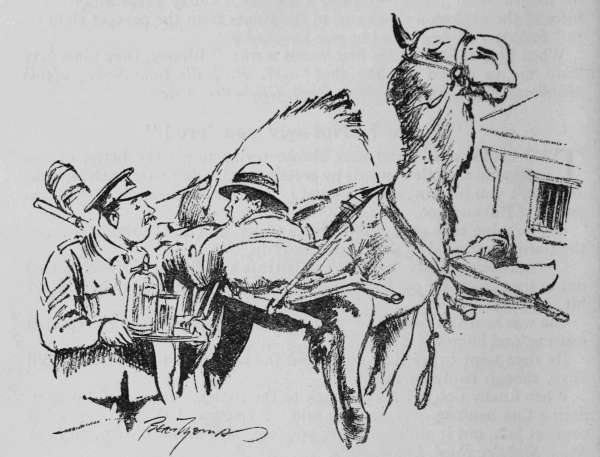
"I believe he was drunk before we set eyes on him."
I was wounded in the leg. My companion was severely wounded in
both legs. Some very uncomplimentary remarks were passed between
us concerning camels, particularly the one which was carrying us.
When we arrived at a field dressing-station a sergeant of the R.A.M.C.
came along with liquid refreshments.
"Sergeant," said my chum, "if you give this bloke (indicating the
camel) anything to drink I'm going to walk, 'cos I believe the blighter was
drunk before we ever set eyes on him."—Albert J. Fairall, 43 Melbourne
Road, Leyton, E.10.
It was on Passchendaele Ridge in 1917. Jerry had been giving us a hot
time with his heavies. Just before daybreak our telephone line went
west and we could not get through to our O.P.
I was detailed to go out and repair the line with a young Cockney from
Hackney. He had only been with us a few days and it was his first time
up the line.
We had mended one break when shells dropped all round us. When
I got to my feet, I saw my pal lying several feet away. I escaped with
a few splinters and shock. I dragged my chum to a shell-hole which was
full of water and found he was badly hit about the shoulder, chest, and
leg. I dressed him as best I possibly could, when, bang, a shell seemed
to drop right on us and something came hurtling into our hole with a
splash.
It turned out to be a duckboard. I propped my chum against it to
stop him slipping back into the water. After a few minutes he opened
his eyes, and though in terrible pain, smiled and said, "Lummy, Jeff,
old Jerry ain't so bad, after all. He has given me a nice souvenir to
take to Blighty and now he has sent me a raft to cross the Pond on."
Then he became unconscious.
It was now daybreak and quiet. I pulled him out of the hole and went
and repaired the line. We got him away all right, but I never heard
from him. I only hope he pulled through: he showed pluck.—Signaller
H. Jeffrey (late Royal Artillery), 13 Bright Road, Luton, Chatham, Kent.
We had just gone into the front line. Two of us had not been there
before.
During a conversation with a Cockney comrade, an old hand, we told
him of our dislike of bombs. He tried to re-assure us something like this:
"Nah, don't let them worry you. You treat 'em just like blue-bottles,
only different. With a blue-bottle you watch where it settles an' 'it it,
but with bombs, you watch where they're goin' to settle and 'op it. It's
quite simple."
A short time after a small German bomb came over and knocked out
our adviser. My friend and I picked him up and tried to help him.
He was seriously hurt. As we lifted him up my friend said to him,
"You didn't get your blue-bottle that time, did you?" He smiled
back as he replied: "'Twasn't a blue-bottle, mate; must 'ave been a
blinkin' wopse."—C. Booth, 5 Creighton Road, N.W.6.
On that June morning in 1917 when Messines Ridge went up, a young
chap was brought in to our A.D.S. in Woodcote Farm. A piece of
shell had torn a great gap in each thigh. Whilst the sergeant was
applying the iodine by means of a spray the M.O. asked, "How are
things going this morning?" The lad was wearing a red heart as his
battalion sign, and despite his great pain he answered: "O.K. sir.
Hearts were trumps this morning."—R. J. Graff, 3/5th L.F.A., 47th
Division, 20 Lawrie Park Road, Sydenham.
During the retreat from Mons it was the cavalry's work to hold up
the Germans as long as possible, to allow our infantry to get in
position.
One day we had a good way to run to our horses, being closely pursued
by the Germans. When we reached them we were all more or less out
of breath. A little Cockney was so winded that he could hardly reach
his stirrup, which kept slipping from under his foot.
Just then a shrapnel shell burst directly overhead, and the Cockney,
without using his stirrup, vaulted clean into the saddle.
As we galloped off he gasped, "Blimey, don't they put new life in
yer? They're as good as Kruschens."—E. H. (late R.H.G.), 87 Alpha
Road, Surbiton, Surrey.
Three of us were sitting on the high ground on the Gallipoli Beach
watching shells dropping from the Turk positions.
A "G.S." wagon was proceeding slowly along below us, the driver
huddled in his coat, for the air was chill.
Suddenly he jumped from the wagon and ran in our direction—he
had heard the shell before we had.
The next moment the wagon was proceeding skywards in many
directions, and the horses were departing at top speed in different
directions.
The driver surveyed the scene for a moment and then in a very matter-of-fact
voice said: "Blimey! See that? Now I suppose I've got to
walk back, and me up all night—wot a war!" And away he trudged!—C. J. A.,
N.W.11.
After a retreat in May 1915 we saw, lying between our fresh
position and the German lines, an English soldier whom we took to
be dead.
Later, however, we advanced again, and discovered that the man was
not dead, but badly wounded.
On being asked who he was, he replied in a very weak voice, "I fink
I must be the blinkin' umpire."—W. King (late Royal Fusiliers), 94
Manor Grove, Richmond, Surrey.
Little "Ginger" was the life and soul of our platoon until he was
wounded on the Somme in 1918.
As he was carried off to the dressing-station he waved his hand feebly
over the side of the stretcher and whispered, "Don't tell 'Aig! He'd
worry somethin' shockin'."—G. E. Morris (late Royal Fusiliers), 368
Ivydale Road, Peckham Rye, S.E.15.
During a most unpleasant night bombing raid on the transport
lines at Haillecourt the occupants of a Nissen hut were waiting for
the next crash when out of the darkness and silence came the Cockney
voice of a lorry driver saying to his mate, "'Well,' I sez to 'er, I sez,
'You do as you like, and I can't say no fairer than that, can I?'"—F. R.
Jelley, Upland Road, Sutton, Surrey.
I was on the Italian front in June 1918, and our battery was being
strafed by the Austrians with huge armour-piercing shells, which made
a noise like an express train coming at you, and exploded with a deafening
roar.
An O.K. had just registered on one of our guns, blowing the wheels
and masses of rock sky-high. A party of about twenty Austrian prisoners,
in charge of a single Cockney, were passing our position at the time, and
the effect of the explosion on the prisoners was startling. They scattered
in all directions, vainly pursued by the Cockney, who reminded me of a
sheep-dog trying to get his flock together.
At last he paused. "You windy lot o' blighters," he shouted as he
spat on the ground in evident disgust, "afraid of yer own bloomin'
shells!"—S. Curtis, 20 Palace Road, Upper Norwood, S.E.19.
In July 1918, at a casualty clearing station occupying temporary
quarters in the old College of St. Vincent at ruined Senlis we dealt
with 7,000 wounded in eight days. One night when we were more busy
than usual an ambulance car brought up a load of gas-blinded men.
A little man whose voice proclaimed the city of his birth—arm broken
and face blistered with mustard gas, though he alone of the party could
see—jumped out, looked around, and then whispered in my ear, "All
serene, guv'nor, leave 'em to me."
He turned towards the car and shouted inside, "Dalston Junction,
change here for Hackney, Bow, and Poplar."
Then gently helping each man to alight, he placed them in a line with
right hand on the shoulder of the man in front, took his position forward
and led them all in, calling softly as he advanced, "Slow march, left,
left, I had a good job and I left it."—Henry T. Lowde (late 63rd C.C.S.,
R.A.M.C.), 101 Stanhope Gardens, Harringay, N.4.
We were in the Passchendaele sector in 1917, and all who were there
know there were no trenches—just shell-holes half-filled with water.
Jerry had been strafing us for two days without a stop and of our
platoon of twenty-three men only seven came out alive. As we were
coming down the duckboard track after being relieved Jerry started
to put over a barrage. We had to dive for the best cover we could get.
Three of us jumped into a large shell-hole, up to our necks in water.
As the shells dropped around us we kept ducking our heads under the
water.
Bert Norton, one of us—a Cockney—said: "Strike, we're like the
little ducks in 'Yde Park—keep going under."
After another shell had burst and we had just come up to breathe Bert
chimed in again with: "Blimey, mustn't it be awful to have to get your
living by ducking?"—J. A. Wood, 185 Dalston Lane, E.8.
It was in No Man's Land, and a party of New Zealand troops were
making for shelter in a disabled British tank to avoid the downpour of
shrapnel. They were about to swarm into the tank when the head of a
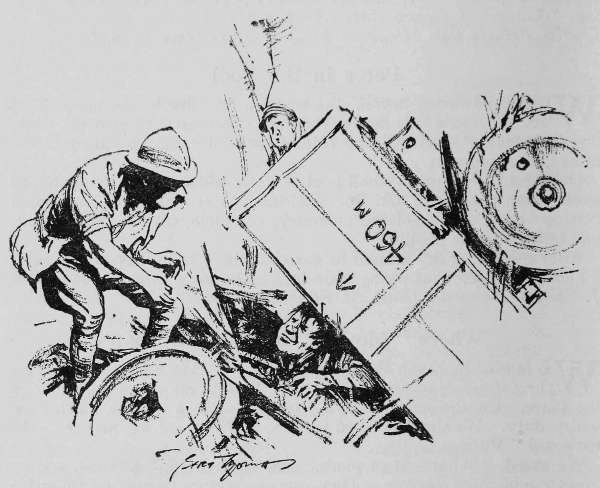
London Tommy popped out of an aperture, and he exclaimed, "Blimey.
Hop it! This is a waiting room, not a blinkin' bee-hive."—A. E. Wragg,
1 Downs Road, Beckenham, Kent.
We arrived at the Cambrai front in 1917—just a small bunch of
Cockneys—and were attached to the Welsh Brigade of Artillery,
being told to report to B.H.Q. up the sunken road in front of Bapaume.
En route our escort of Welshmen were telling us of the "terrible"
shelling up the line. It was no leg pulling, for we quickly found out for
ourselves that it was hot and furious.
Down we all went for cover as best we could, except one Cockney who
stood as one spellbound watching the bursting of the shells. One of the
Welshmen yelled out, "Drop down, Cockie!" The Cockney turned
round, to the wonderment and amusement of the rest, with the retort,
"Blimey! Get away with yer, you're windy. I've only just come out!"—Driver
W. H. Allen (attached 1st Glamorgan R.H.A.), 8 Maiden Crescent,
Kentish Town, N.W.1.
During severe fighting in Delville Wood in August 1916 our
regiment (the East Surreys) was cut off for about three days and was
reduced to a mere handful of men, but still we kept up our joking and
spirits.
A young Cockney, who was an adept at rhyming slang, rolled over,
dead as I thought, for blood was streaming from his neck and head. But
he sat up again and, wiping his hand across his forehead, exclaimed:
"Strike me pink! One on the top of my loaf of bread (head), and one
in the bushel and peck (neck)." Then, slinging over a Mills bomb, he
shouted: "'Ere, Fritz, my thanks for a Blighty ticket."—A. Dennis,
9 Somers Road, Brixton Hill, S.W.2.
The day after the Canadians attacked Vimy Ridge my battalion
of the Royal Fusiliers advanced from Bully Grenay to a château on
the outskirts of Lieven under heavy shell fire.
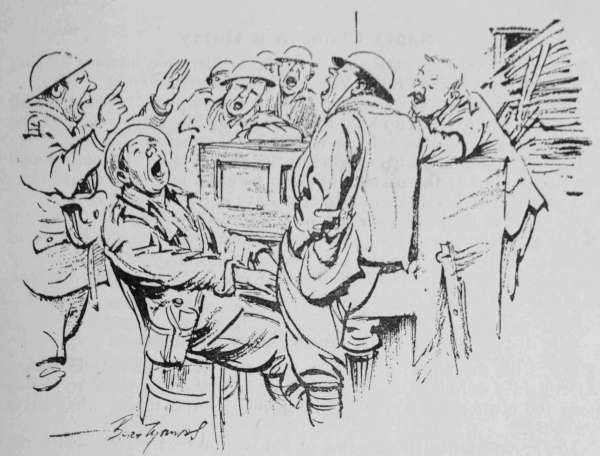
"Tipperary!"
At the back of the château a street led to the main road to the town.
There, despite the bombardment, we found a Cockney Tommy of the
Buffs playing "Tipperary" on a piano which had been blown out of a
house into the road.
We joined in—until a shell took the top off the château, when we
scattered!—L. A. Utton, 184 Coteford Street, Tooting, S.W.
We had reached the district in "Mespot" reputed to be the Garden
of Eden. One evening I was making my way with six men to
relieve the guard on some ammunition barges lying by the bank of the
Tigris.
We had approached to within about one hundred yards of these, when
the Turks started sending over some "long-rangers." The sixth shell
scored a direct hit on the centre barge, and within a few seconds the whole
lot went up in what seemed like the greatest explosion of all time. Apart
from being knocked over with the shock, we escaped injury, with the
exception of a Cockney in our company.
Most of his clothing, except his boots, had been stripped from his body,
and his back was bleeding. Slowly he struggled to his hands and knees,
and surveying his nakedness, said: "Now where's that blinkin' fig tree?"—F.
Dennis, 19 Crewdson Road, Brixton, S.W.
A forward observation officer of the Artillery was on duty keeping
watch on Watling Crater, Vimy Ridge, towards the end of 1916.
The observation post was the remains of a house, very much battered.
The officer had to crawl up what had once been a large fireplace, where he
had the protection of the only piece of wall that remained standing.
He was engrossed on his task when the arrival of a "Minnie" shook
the foundations of the place, and down he came in a shower of bricks
and mortar with his shrapnel helmet not at the regimental angle.
A couple of Cockney Tommies had also made a dive for the shelter
of this pile of bricks and were crouching down, when the officer crawled
from the fireplace. "Quick, Joe," said one of the Cockneys, "'ang up
yer socks—'ere comes ole Santa Claus!"—A. J. Robinson (late Sergeant,
R.F.A.), 21 Clowders Road, Catford, S.E.6.
It was on the night of October 27, 1917, at Passchendaele Ridge.
Both sides were "letting it go hell for leather," and we were feeling
none too comfortable crouching in shell-holes and taking what cover
we could.
The ground fairly shook—and so did we for that matter—with the
heavy explosions and the din was ear-splitting.
Just for something to say I called out to the chap in the next shell-hole—a
Brentford lad he was: "What d'you think of it, Alf?"
"Not much," he said, "I was just finkin' if Paderewski could get only
this on 'is ol' jo-anner."—M. Hooker, 325A Md. Qrs., Henlow Camp,
Bedford.
During the battle of the Somme, in September 1916, our Lewis gun
post was in a little loop trench jutting out from the front line at a
place called, I believe, Lone Tree, just before Combles. Jerry's front
line was not many yards away, and it was a very warm spot.
Several casualties had occurred during the morning through sniping,
and one enterprising chap had scored a bull's-eye on the top of our
periscope.
Things quietened down a bit in the afternoon, and about 4 p.m. our
captain, who already had the M.C., came along and said to our corporal,
"I believe the Germans have gone."
A Cockney member of our team, overhearing this, said, "Well, it
won't take long to find out," and jumping upon the fire-step exposed
himself from the waist upwards above the parapet.
After a minute's breathless silence he turned to the captain and said,
with a jerk of his thumb, "They've hopped it, sir."
That night we and our French friends entered Combles.—M. Chittenden
(late "C" Coy., 1/16th London Regt., Q.W.R.), 26 King Edward Road,
Waltham Cross, Herts.
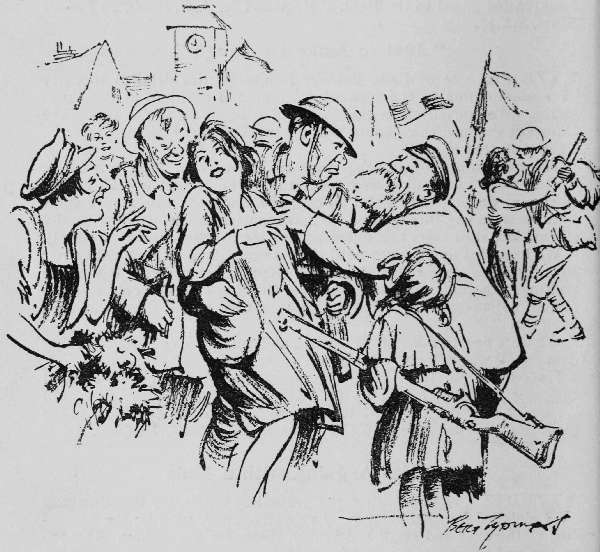
In April 1918 our unit was billeted near Amiens in a small village from
which the inhabitants had been evacuated two days earlier, owing to
the German advance.
On the second day of our stay there Jerry was shelling the steeple of
the village church, and we had taken cover in the cellars under the village
school. All at once we heard roars of laughter coming from the street,
and wondering what on earth anyone could find to laugh at, we tumbled
up to have a look.
The sight that met our eyes was this: Gravely walking down the
middle of the street were two of the "Hackney Ghurkas," the foremost
of whom was dressed in a frock coat and top hat, evidently the property
of the village maire, and leading a decorated mule upon the head of which
was tied the most gaudy "creation" which ever adorned a woman's head.
The second Cockney was clad in the full garb of a twenty-stone French
peasant woman, hat and all, and was dragging at the end of a chain a
stuffed fox, minus its glass case, but still fastened to its baseboard.
They solemnly paraded the whole length of the street and back again,
and were heard to remark that the village was having at least one Lord
Mayor's Show before Jerry captured it!
And this happened at the darkest time of the war, when our backs
were to the wall.—A. C. P. (late 58th London Division), Fulham, S.W.6.
In the fighting around Westhoek in August 1917 the 56th Division
were engaged in a series of attacks on the Nonne Boschen Wood, and
owing to the boggy nature of the ground the position was rather obscure.
A platoon of one of the London battalions was holding a pill-box which
had been taken from the Germans during the day. In the night a counter-attack
was made in the immediate vicinity of the pill-box, which left
some doubt as to whether it had again fallen to the enemy.
A patrol was sent out to investigate. After cautiously approaching
the position and being challenged in a Cockney tongue, they entered the
pill-box, and were astonished to see the occupants playing crown and
anchor.
The isolated and dangerous position was explained to the sergeant in
charge, but he nonchalantly replied, "Yes, I know all abaht that; but,
yer see, wot's the use of frightenin' the boys any more? There's been
enough row rahnd 'ere all night as it is."—N. Butcher (late 3rd Londons),
43 Tankerville Drive, Leigh-on-Sea.
On the Somme, during the big push of 1916, we had a section of
Signallers attached to our regiment to keep the communications
during the advance. Of the two attached to our company, one was a
Cockney. He had kept in touch with the "powers that be" without a
hitch until his wire was cut by a shell. He followed his wire back and
made the necessary repair. Three times he made the same journey for
the same reason. His mate was killed by a shrapnel shell and he himself
had his left arm shattered: but to him only one thing mattered, and that
was to "keep in touch." So he stuck to his job.
The wire was broken a fourth time, and as he was about to follow it
back, a runner came up from the C.O. wanting to know why the signaller
was not in communication. He started back along his wire and as he
went he said, "Tell 'im to pay 'is last account, an' maybe the telephone
will be re-connected."
A permanent line was fixed before he allowed the stretcher-bearers to
take him away. My chum had taken his post at the end of the wire, and
as the signaller was being carried away he called out feebly, "You're
in touch with H.Q. C.O.'s paid 'is bill, an' we'll win the war yet."—L.
N. Loder, M.C. (late Indian Army), Streatham.
In April 1917 two companies of our battalion were ordered to make a
big raid opposite the sugar refineries at 14 Bis, near Loos. Two lines
of enemy trenches had to be taken and the raiding party, when finished,
were to go back to billets at Mazingarbe while the Durhams took over
our trenches.
My batman Beedles had instructions to go back to billets with all
my kit, and wait there for my return. I was in charge of the right half
of the first wave of the raid, and after a bit of a scrap we got into the
German front line.
Having completed our job of blowing up concrete emplacements and
dug-outs, we were waiting for the signal to return to our lines when,
to my surprise, Beedles came strolling through the German wire. When
he saw me he called out above the row going on: "I 'opes yer don't
mind me 'aving come to the garden party wivout an invertition, sir?"
The intrepid fellow had taken all my kit back to billets some four
miles, made the return journey, and come across No Man's Land to find
me, and see me safely back; an act which might easily have cost him
his life.—L. W. Lees (Lieut.), late 11th Batt. Essex Regt., "Meadow Croft,"
Stoke Poges, Bucks.
Salonika, 1918, a perfect summer's day. The 2/17th London
Regiment are marching along a dusty road up to the Doiran Lake.
Suddenly, out of the blue, three bombing planes appear. The order is
given to scatter.
Meanwhile, up comes an anti-aircraft gun, complete with crew on
lorry. Soon shells are speeding up, and little small puffs of white smoke
appear as they burst; but the planes are too high for them. A Cockney
of the regiment puts his hands to his mouth and shouts to the crew:
"Hi, don't hunch 'em; let 'em settle."—A. G. Sullings (late 2/17th
London Regiment), 130 Cann Hall Road, Leytonstone, E.11.
On July 1, 1916, the 56th (London) Division attacked at Hebuterne,
and during the morning I was engaged (as a lineman) in repairing
our telephone lines between Battalion and Brigade H.Q. I had just been
temporarily knocked out by a flat piece of shell and had been attended
by a stretcher-bearer, who then left me and proceeded on his way back
to a dressing station I had previously passed, whilst I went farther on
down the trench to get on with my job.
I had not gone many yards when I met a very young private of the
12th Londons (the Rangers). One of his arms was hanging limp and was,
I should think, broken in two or three places. He was cut and bleeding
about the face, and was altogether in a sorry plight.
He stopped and asked me, "Is there a dressing station down there,
mate?" pointing along the way I had come, and I replied, "Yes, keep
straight on down the trench. It's a good way down. But," I added,
"there's a stretcher-bearer only just gone along. Shall I see if I can
get him for you?"
His reply I shall never forget: "Oh, I don't want him for me. I want
someone to come back with me to get my mate. He's hurt!"—Wm. R.
Smith, 231 Halley Road, Manor Park, E.12.
Above the entrance to a certain dug-out somewhere in Flanders
some wit had fixed a board upon which was roughly painted, "The
Winkle Shell."
The ebb and tide of battle left the dug-out in German hands, but one
day during an advance the British infantry recaptured the trench in
which "The Winkle Shell" was situated.
Along the trench came a Cockney with his rifle ready and his bayonet
fixed. Hearing voices coming from the dug-out he halted, looked
reflectively at the notice-board, and then cautiously poking his bayonet
into the dug-out called out, "Nah, then, come on aht of it afore I gits
me blinkin' 'pin' busy."—Sidney A. Wood (late C/275 Battery, R.F.A.),
32 Lucas Avenue, Upton Park, E.13.
We were in a trench in front of Carnoy on the Somme when the
Germans made a raid on us. It was all over in a few minutes,
and we were minus eight men—taken away by the raiders.
Shortly afterwards I was standing in a bay feeling rather shaky when
a face suddenly appeared over the top. I challenged, and was answered
with these words:
"It's orl right. It's me. They was a-takin' us to a dance over there,
but I abaht-turned 'arfway acrorst an' crawled back fer me pumps."—E.
Smith (late Middlesex Regt.), 2 Barrack Road, Aldershot.
One day in 1916 I was sitting with some pals in a German dug-out
in High Wood. Like others of its kind, it had a steep, deep shaft.
Suddenly a shell burst right in the mouth of the shaft above, and the
next instant "Nobby," a Cockney stretcher-bearer, landed plump on
his back in our midst. He was livid and bleeding, but his first words
were: "Strike! I thought the lift were outer order!"—J. E., Vauxhall,
S.W.8.
Lost: A Fly Whisk
During the very hot summer of 1916 in Egypt it was necessary,
while eating, to keep on flicking one hand to keep the flies away
from one's mouth.
One day a heavy shell came over and knocked down my Cockney chum,
Tubby White. He got up, holding his wrist, and started looking round.
I said: "What have you lost, Tubby?"
"Blimey," he said, "can't you see I've lost me blooming fly whisk?"
It was then I noticed he had lost his hand.—J. T. Marshall (Middlesex
Regiment), 17 Evandale Road, Brixton, S.W.9.
When Regina Trench was taken in 1916 it was in a terrible state,
being half full of thick liquid mud. Some of the fellows, sooner
than wade through this, were getting up and walking along the top,
although in view of the Germans.
The Cockney signaller who was with me at the time, after slithering
along the trench for a time, said: "I've 'ad enough er this," and
scrambled out of the trench.
He had no sooner got on top when—zipp—and down he came with a
bullet through his thigh.
While bandaging his wound I said: "We're going to have a job to
get you out of here, but we'll have a good try."
"That's all right," said the Cockney, "you carry on an' leave me.
I'll wait for a blinkin' barge and change at Wapping."—H. Redford
(late R.F.A.), 49 Anselm Road, Fulham.
I was in charge of a party carrying material from the dump to the
Engineers in the front line. One of the party, a man from Camberwell,
was allotted a bulky roll of barbed wire.
After a desperate struggle through the muddy and narrow support
trenches, we reached the front line. There was still another 400 yards
to go, and our Cockney decided to continue the journey along the parapet.
He had not gone far before the German machine guns began to spit
and he fell in a heap into the bottom of the trench with the coil of barbed
wire on top of him.
Thinking he was wounded, I went back to him and inquired if he
was hit.
"'It? 'It be blowed," he said, "but if somebody was to take this
blinkin' birdcage orf me chest I might be able to get up."
The journey was completed through the trench, our friend being a sorry
sight of mud and cut fingers and face.
On arriving at our destination he dropped the wire at the feet of the
waiting corporal with the remark, "'Ere you are, mate; sorry the canary's
flowed away."—A. S. G. (47th Division), Kent.
Our battalion was making a counter-attack at Albert on March
29, 1918, against a veritable hail of lead. Wounded in the thigh,
I tumbled into a huge shell hole, already occupied by two officers of the
Fusiliers (Fusiliers had been on our left), a lance-corporal of my own
battalion, and three other men (badly wounded).
Whilst I was being dressed by the lance-corporal another man jumped
in. He had a bullet in the chest. It didn't need an M.O. to see that
he was "all in," and he knew it.
He proved to be the most heroic Cockney I have ever seen. He had
only minutes to live, and he told us not to waste valuable bandages on
him.
Thereupon one of the officers advised me to try to crawl back before
my leg got stiff, as I would stand a poor chance of a stretcher later with
so many badly-wounded men about. If I got back safe I was to direct
stretcher-bearers to the shell hole.
I told the officer that our battalion stretcher-bearers were behind a
ridge only about 100 yards in the rear, and as my wound had not troubled
me yet I would make a sprint for it, as the firing was still too heavy to
be healthy.
On hearing my remarks this heroic Cockney, who must also have been
a thorough sportsman, grinned up at me and, with death written on his
face, panted: "Go it, Applegarf, an' I'll time yer." [Applegarth was
the professional sprint champion of the world.] The Cockney was
dead when I left the shell hole.—F. W. Brown (late 7th Suffolks), 247
Balls Pond Road, Dalston, N.
We were out doing a spot of wiring near Ypres, and the Germans
evidently got to know about it. A few "stars" went up, and then
the rat-tat-tat of machine guns told us more than we wanted to know.
We dived for shell holes. Anybody who knows the place will realise
we did not have far to dive. I found myself beside a man who, in the
middle of a somewhat unhealthy period, found time to soliloquise:
"Knocked a bit right aht me tin 'at. Thought I'd copped it that
time. Look, I can get me little finger through the 'ole. Blimey, 'ope
it don't rain, I shall git me 'ead all wet."—H. C. Augustus, 67
Paragon Road, E.9.
"'Ope it don't rain; I'd get me 'ead wet."
I was at Vimy Ridge in 1916. On the night I am writing about we
were taking a well-earned few minutes' rest during a temporary lull.
We were under one of the roughly-built shelters erected against the Ridge,
and our only light was the quivering glimmer from a couple of candles.
A shell screeched overhead and "busted" rather near to us—and out
went the candles.
"Smith, light up those candles," cried the sergeant-major to his
batman. "Smithy," who stuttered, was rather shaken and took some
time to strike a match and hold it steadily to the candles. But no
sooner were the candles alight than another "whopper" put them
out again.
"Light up those ruddy candles!" cried the S.M. again, "and don't
dawdle about it!"
"Smithy," muttering terrible things to himself, was fumbling for the
matches when the order came that a bombing party was required to
clear "Jerry" out of a deep shell-hole.
"'Ere!" said "Smithy" in his rich Cockney voice. "J-just m-my
m-mark. I'd r-rather f-frow 'eggs' t-than light c-c-candles!"—W.
C. Roberts, 5 Crampton Street, S.E.17.
I was the next turn on guard at a battery position in Armentières
one evening in the summer of 1917. A Cockney chum, whom I was
going to relieve, was patrolling the position when suddenly over came a
5·9, which blew him about four yards away.
As he scrambled to his feet our sergeant of the guard came along, and
my chum's first words were, "Sorry, sergeant, for deserting me post."—T.
F. Smithers (late R.F.A.), 14 Hilda Road, Brixton, S.W.9.
The Poperinghe-Ypres road. A large shell had just pitched. Among
the wounded was a Cockney who was noted for his rendering on
every possible occasion of that well-known song, "Let the Great Big
World Keep Turning."
He was lying on the roadway severely hurt. Another Cockney went
up to him and said "'Ello, matey, 'urt? Why ain't yer singin' 'Let the
Great Big World Keep Turnin',' eh?"
The reply came: "I was a singin' on it, Bill, but I never thought it
would fly up and 'it me."—Albert M. Morsley (late 85th Siege Battery Am.
Col.), 198 Kempton Road, East Ham, E.6.
I was limping back with a wounded knee after the taking of Monchy-le-Preux
on April 11, 1917, when a perky little Cockney of the 13th
Royal Fusiliers who had a bandaged head caught me up with a
cheery, "Tike me Chalk Farm (arm), old dear, and we'll soon be 'ome."
I was glad to accept his kindly offer, but our journey, to say the least,
was a hazardous one, for the German guns, firing with open sights from
the ridge in front of the Bois du Sart, were putting diagonal barrages
across the road (down which, incidentally, the Dragoon Guards were
coming magnificently out of action, with saddles emptying here and
there as they swept through that deadly zone on that bleak afternoon).
Presently we took refuge in a sandbag shelter on the side of the road,
and were just congratulating ourselves on the snugness of our retreat,
when a tank stopped outside. Its arrival brought fresh gun-fire on us, and
before long a whizz-bang made a direct hit on our shelter.
When we recovered from the shock, we found part of our roof missing,
and my little pal, poking his bandaged head through the hole, thus
addressed one of the crew of the tank who was just visible through a
gun slit:
"Oi, why don't yer tike yer money-box 'ome? This ain't a pull-up fer
carmen!"
The spirit that little Cockney imbued into me that day indirectly saved
me the loss of a limb, for without him I do not think I would have reached
the advance dressing station in time.—D. Stuart (late Sergeant, 10th R.F.,
37th Division) 103 St. Asaph Road, Brockley, S.E.4.
In front of Kut Al-'Amarah, April 1916, the third and last attack
on the Sannaiyat position, on the day before General Townshend
capitulated. Days of rain had rendered the ground a quagmire, and
lack of rations, ammunition, and shelter had disheartened the relief
force.
The infantry advanced without adequate artillery support, and were
swept by heavy machine-gun fire from the entrenched Turks. One
fellow tripped over a strand of loose barbed wire, fell down, and in
rising ripped the seat nearly off his shorts. Cursing, he rejoined the
slowly moving line of advancing men.
Suddenly one sensed one of those fateful moments when men in the
mass are near to breaking point. Stealthy looks to right and left were
given, and fear was in the men's hearts. The relentless tat-tat-tat
of machine guns, the "singing" of the driven bullets, and the dropping
of men seemed as if it never would end.
A Cockney voice broke the fear-spell and restored manhood to men.
"Oo, 'Erbert, you naughty boy!" it said. "Look at what you've done
to yer nice trahsers! 'Quarter' won't 'arf be cross. He said we wasn't
to play rough games and tear our trahsers."—L. W. Whiting (late 7th
Meerut Division), 21 Dale Park Avenue, Carshalton, Surrey.
Early in 1917 at Ypres I was in charge of part of the advance
party taking over some trenches from another London battalion.
After this task had been completed I was told of a funny incident of the
previous night.
It appeared that the battalion we were due to relieve had been surprised
by a small party of the enemy seeking "information." During
the mêlée in the trench a German "under-officer" had calmly walked
over and picked up a Lewis gun which had been placed on a tripod on
top of the trench some little distance from its usual emplacement. (This
was done frequently when firing at night was necessary so as to avoid
betraying the regular gun position.)
A boyish-looking sentry of the battalion on the left jumped out of the
trench and went after the Jerry who was on his way "home" with the
gun in his arms. Placing his bayonet in dangerous proximity to the
"under-officer's" back, the young Cockney exclaimed, "Hi! Where
the 'ell are yer goin' wiv that gun? Just you put the 'coocumber'
back on the 'barrer' and shove yer blinkin' 'ands up!"
The "under-officer" lost his prize and his liberty, and I understand
the young sentry received the M.M.—R. McMuldroch (late 15th London
Regt., Civil Service Rifles), 13 Meadway, Bush Hill Park, Enfield.
One afternoon on the Somme our battery received a severe strafe
from 5·9's and tear-gas shells. There was no particular "stunt"
on, so we took cover in a trench behind the guns.
When the strafe had finished, we found our gun resting on one wheel,
with sights and shield smashed by a direct hit. There was tear gas
hanging about, too, and we all felt anything but cheerful.
Myself and detachment were solemnly standing around looking at the
smashed gun, and as I was wiping tears from my eyes, Smithy, our
bright Walworth lad, said: "Don't cry, Sarg'nt, they're bahnd ter give
us anuvver."—E. Rutson (late Sergeant, R.F.A., 47th London Division),
43a Wardo Avenue, S.W.6.
There were a bunch of us Cockneys in our platoon, and we had
just taken over some supports. It being a quiet sector, we were
mooning and scrounging around, some on the parapet, some in the
trenches, and some at the rear.
All at once a shower of whizz-bangs and gas shells came over; our
platoon "sub." started yelling "Gas." We dived for the dug-outs.
Eight of us tried to scramble through a narrow opening at once, and
we landed in a wriggling mass on the floor. Some were kneeling and
some were sitting, all with serious faces, until one fellow said: "Phew,
it's 'ell of a war, but yer carn't 'elp laughin', can yer?"—B. J. Berry
(late 9th Norfolk Regt.), 11 Rosemont Avenue, N. Finchley, N.12.
He came to the battalion about three weeks before going overseas,
and fell straight into trouble. But his Cockney wit got him out of
trouble as well as into it.
He never received a parcel or letter, but still was always the life of our
company. He never seemed to have a care.
We had been in France about a fortnight when we were ordered to the
front line and over the top. He was one of the first over, shouting
"Where's the blighters." They brought him in riddled with bullets.
When I asked if I could do anything for him, he said: "Are there
many hurt?" "Not many," I replied. "Thank Heaven for that," he
replied. "Nobody 'll worry over me. I'm only a blinkin' orphan."—W.
Blundell (late N.C.O., 2nd East Surreys), Cranworth Gardens, S.W.9.
It was after the attack by the 2nd Londons on the village of Aubigny
au Bac. I was hit by shell splinters, and whilst I was looking for
someone to dress my wounds I came across one of the lads lying by the
roadside mortally wounded.
As I bent over him to give him a drink he noticed my blood-streaked
face and gasped: "Crikey! Your barber was blinkin' clumsy this
morning." So passed a gallant 2nd London man.—E. C. Easts (M.M.),
Eliot Place, Blackheath, S.E.3.
During the general advance on the Somme in August 1918 our
platoon became isolated from the rest of the company.
We had been under heavy shell-fire for about three hours, and when at
last things seemed to have quietened down, a German plane came over.
We immediately jumped for cover and were concealed from view.
The plane had only circled round a couple of times when a Cockney
private, unable to resist the temptation any longer, jumped up and had a
pot at it.
He had fired three rounds when the N.C.O. pulled him down and called
him a fool for giving away our position.
The Cockney turned round and replied, "Blimey, ain't I in this
blinkin' war as well as 'im?"—E. Purcell (late 9th Royal Fusiliers),
4 Lyndhurst Grove, Peckham, S.E.15.
When I was with the 6th Dorsets at Hooge, a party of us under a
Cockney lance-jack were sent down the Menin Road to draw rations.
It seemed as though the Germans knew we were waiting at the corner,
for they were dropping shells all around us.
After a while a voice in the darkness cried: "Don't stay there, you
chaps; that's Hell Fire Corner!"
"Can't 'elp it, guv'nor," replied our lance-jack. "'Ell Fire Corner
or 'Eaven's Delight, we gotta stop 'ere till our rations comes up."—H.
W. Butler (late 6th Dorsets), 2 Flint Cottages, Stone, Kent.
As we were going "over" at Passchendaele a big one dropped just
behind our company runner and myself. Our runner gave a shout
and stumbling on a little way, with his hand on his side, said: "Every
picture tells a story"—and went down.
I just stopped to look at him, and I am sorry to say his war had
finished. He came from Bow.—G. Hayward (late Rifle Brigade), Montague
Street, W.C.1.
I was in a Lewis gun section, and our sergeant got on our nerves
while we were learning the gun by always drumming in our ears about
the different stoppages of the gun when in action. My mate, Ginger
Bryant, who lived at Stepney, could never remember the stops, and our
sergeant was always rousing poor old Ginger.
Well, we found ourselves one day in the front line and Jerry had
started an attack. Ginger was No. 1 on the gun and I was lying beside
him as No. 2. We were giving Jerry beans with our gun when a bomb
hit it direct and blew Ginger and myself yards away.
Ginger had his hand blown off, but crawled back to the gun, which was
smashed to pieces. He gave one look at it and shouted to me: "Nah go
and ask that blinkin' sergeant what number stoppage he calls this one!"
Next thing he fainted.—Edward Newson (late 1st West Surrey), 61 Moneyer
Street, Hoxton, N.1.
An officer with our lot was a regular dare-devil. He always boasted
that the German bullet had not yet been made which could find
him.
One day, regardless of his own safety, he was on the parapet, and
though many shots came over he seemed to bear a charmed life.
One of the men happened to put his head just out of the trench when
a bullet immediately struck his "tin hat" sending him backwards into
the trench.
The officer, from the parapet, looked down and said, "You are a fool,
I told you not to show yourself."—A. Smith (Cameronians), 40 Whitechapel
Road, E.1.
In the second attempt to capture Gaza we were making our advance in
face of heavy machine-gun fire. In covering the ground we crouched as
much as possible, the Turks directed their fire accordingly, and casualties
were numerous, so our Cockney humorist shouted: "Stand up, boys.
It's best to be hit in yer props (legs) than in yer blinkin' office (head)."—W.
Reed (late 7th Battn., Essex Regiment), 3 Shenfield Road, Woodford
Green, Essex.
I was driving a lorry along the road from Dickebusch to Ypres when
the Germans started shelling with shrapnel and high explosive.
By the side of the road was a cottage, partly ruined, with the window-space
boarded up: and, with some idea of seeking protection from the
flying fragments, I leaned up against one of the walls.
I hadn't been there long when a face appeared at a gap in the boards,
and a voice said: "Do yer fink y're safe there, mate, cos we're chock
full o' bombs in 'ere."—Edward Tracey, c/o Cowley Cottage, Cowley,
Middlesex.
While on the Somme in 1916 my battery was sent to rest in a village
behind the line. The billet allotted to us had been an hotel, and all
the furniture, including bedsteads and feather mattresses, had been
stored in the room which did duty as an orderly room.
Returning one day from exercise, we saw a flight of enemy 'planes
coming over, and as we approached the billet a bomb was dropped
straight through the roof of our building, the sole occupant of which
at the time was a Cockney signaller on duty, in touch with Brigade
Headquarters.
"They must 'ave 'it a blinkin' sparrer."
We hurried forward, expecting to find that our signaller had
been killed. The orderly room was a scene of indescribable chaos.
Papers were everywhere. Files and returns were mixed up with "iron
rations," while in a corner of the room was a pile of feathers about
4 feet deep—all that remained of the feather mattresses. Of our
signaller there was no sign.
As we looked around, however, his head appeared from beneath the
feather pile. His face was streaming with blood, and he looked more
dead than alive, but as he surveyed his temporary resting-place, a grin
spread over his features, and he picked up a handful of feathers.
"Blimey!" he observed, "they must 'ave 'it a blinkin' sparrer."—"Gunner,"
Oxford Street, W.1.
At Neuve Eglise, March 1918, we were suddenly attacked by Jerry,
but drove him back. Every now and again we spotted Germans
dodging across a gap in a hedge. At once a competition started as to
who could catch a German with a bullet as he ran across the gap.
"Reminds me of shooting at the bottles and fings at the fair," said my
pal, another Cockney Highlander.
A second later a piece of shrapnel caught him in the hand. "Blimey,
I always said broken glass was dangerous," he remarked as he gazed
sadly at the wound.—F. Adams (late H.L.I.), 64 Homestead Road,
Becontree, Essex.
We were in support trenches near Havrincourt Wood in September
1917. At mid-day it was exceptionally quiet there as a rule.
Titch, our little Cockney cook, proceeded one day to make us some tea
by the aid of four candles in a funk-hole. To aid this fire he added
the usual bit of oily "waste," and thereby caused a thin trail of smoke to
rise. The water was just on the boil when Jerry spotted our smoke and
let fly in its direction everything he had handy.
Our trench was battered flat.... We threw ourselves into a couple of
old communication trenches. Looking around presently for our cook
we found him sitting beneath a waterproof sheet calmly enjoying his
sergeant-major's tea. "Ain't none of you blokes firsty?" was his
greeting.—R. J. Richards (late 61st Trench Mortar Battery, 20th London
Division), 15 London Street, W.2.
Our company were holding the line, or what was a line of trenches
a short time before, when Jerry opened out with all kinds of loudspeakers
and musical instruments that go to make war real.
We were knocked about and nearly blinded with smoke and flying
sandbags. The best we could do was to grope our way about with arms
outstretched to feel just where we were.
Eventually someone clutched me, saying, "Is that you, Charlie—are
you all right?"
"Yes, Jack," I answer, "are you all right?"
"Well, I don't know fer sure," he says as he dives his hand through
his tunic to his chest and holds on to me with the other. I had a soft
place in my heart for Jack, for nobody ever sent him a parcel, so what
was mine was Jack's. But not the piece of shrapnel that came out
when he withdrew his hand from inside his tunic!
"The only thing that ever I had sent me—and that from Jerry!"
says Jack. "We was always taught to love our enemies!"
They sure loved us, for shortly after I received my little gift of love,
which put me to by-by for several months. But that Cockney lad from
East London never grumbled at his hard lot. He looked at me, his
corporal, and no wonder he clung round my neck, for he has told me since
the war that he was only sixteen then. A brave lad!—D. C. Maskell
(late 20th Battn. Middlesex Regt.), 25 Lindley Road, Leyton, E.10.
In September 1916 we landed in a portion of German trench and I
was given orders to hang on. Shells were bursting all around us, so
we decided to have a smoke.
My two Cockney pals—Nobby and Harry, who were a goalie and centre-forward
respectively—were noted for their zeal in keeping us alive.
Nobby was eager to see what was going on over the top, so he had a
peep—and for his pains got shot through the ear. He fell back in a heap
and exclaimed, "Well saved, goalie! Couldn't been better if I'd tried."
"Garn," said Harry, bending over him, "it's blinkin' well gorn right
frew, mate."—Patrick Beckwith, 5 Duke Road, Chiswick, W.4.
I was rather badly wounded near Bullecourt, on the Arras front, and
was lying on a stretcher outside the dressing station.
Nearby stood a burly Cockney with one arm heavily bandaged. In
the other hand he held his ration of hot coffee.
Noticing my distress, he offered me his drink, saying, "'Ere y'are,
mate, 'ave a swig at this." One of the stretcher-bearers cried: "Take
that away! He mustn't have it!"
The Cockney slunk off.
"All right, ugly," he said. "Take the food aht of a poor bloke's
mouf, would yer?"
Afterwards I learned the stretcher-bearer, by his action, had saved
my life. Still, I shan't forget my Cockney friend's generosity.—A. P. S.
(late 5th London Regiment), Ilford.
Poperinghe: a pitch-black night. We were resting when a party
of the West Indian Labour Company came marching past. Jerry
sent one over. Luckily, only one of the party was hit.
A voice from the darkness: "Alf! keep low, mate. Jerry 'as got his
eye in—'e's 'it a nigger in the dark!"—C. Jakeman (late 4/4th City of
London Royal Fusiliers), 5 Hembridge Place, St. John's Wood, N.W.8.
During the great German offensive in March 1918 our company
was trying to hold the enemy at Albert. My platoon was in an old
trench in front of Albert station, and was in rather a tight corner, the
casualties being pretty heavy. A runner managed to get through to
us with a message. He asked our sergeant to send a man to another
platoon with the message.
One of my pals, named Gordon, shouted, "Give it to me; I'll go."
He crept out of the trench and up a steep incline and over the other
side, and was apparently being peppered by machine-gun fire all the way.
We had little hope of him ever getting there. About a couple of hours
later another Cockney cried: "Blimey! He's coming back!"
We could see him now, crawling towards us. He got within a dozen
yards of our trench, and then a Jerry "coal-box" arrived. It knocked
us into the mud at the bottom of our trench and seemed to blow Gordon,
together with a ton or so of earth, twenty feet in the air, and he came
down in the trench.
"That's done the poor blighter in," said the other Cockney as we
rushed to him. To our surprise Gordon spoke:
"Well, he ain't done in—see!"
He had got the message to the other platoon, and was little the worse
for his experience of being blown skyward. I think that brave fellow's
deed was one of many that had to go unrewarded.—H. Nachbaur (late
7th Suffolks), 4 Burnham Road, St. Albans, Herts.
The day before our division (38th Welch) captured Mametz Wood
on the Somme, in July 1916, our platoon occupied a recently captured
German trench. We were examining in a very deep dug-out some of
Jerry's black bread when a heavy shell landed almost at the entrance
with a tremendous crash. Earth, filled sandbags, etc., came thundering
down the steps, and my thoughts were of being buried alive about
forty feet underground. But amid all the din, Sam (from Walworth)
amused us with his cry: "Muvver! Baby's fell aht er bed!"—P. Carter
(late 1st London Welch), 6 Amhurst Terrace, Hackney, E.8.
During severe fighting in Cambrai in 1917 we were taking up position
in the front line when suddenly over came a "present" from
Jerry, scattering our men in all directions and causing a few casualties.
Among the unfortunate ones was a Cockney whose right hand was
completely blown off.
In a sitting position he calmly turned to the private next to him and
exclaimed "Blimey, they've blown me blinkin' German band (hand) off.
Got a bit of stamp edging, mate?"—T. Evans, 24 Russell Road, Wood
End Green, Northolt, Greenford.
It was our fifth day in the front line in a sector of the Arras front. In
the afternoon, after a terrible barrage, Jerry came over the top on our
left, leaving our immediate front severely alone.
Our platoon Lewis gun was manned at that time by "Cooty," a
Cockney, he being "Number One" on the gun. We were blazing away
at the advancing tide when a shell exploded close to the gun.
"Cooty" was seen to go rigid for a moment, and then he quickly
rolled to one side to make way for "Number Two" to take his place.
He took "Number Two's" position beside the gun.
The new "Number One" saw that "Cooty" had lost three fingers,
and told him to retire. "Cooty" would not have that, but calmly
began to refill an empty magazine. "Number One" again requested
him to leave, and a sharp tiff occurred between them.
"Cooty" was heard to say, "Look 'ere, oo's 'it—you or me?" "You
are," said "Number One."
"Then mind your own blinkin' business," said "Cooty," "and get
on with shelling these peas."
Poor "Cooty," who had lost his left foot as well, passed out shortly
after, was a Guardsman at one time.—D. S. T., Kilburn, N.W.
We were a desert mobile column, half-way across the Sinai Peninsula
from Kantara to Gaza. Turkish aeroplanes paid us a daily visit
and pelted us with home-made "stocking-bombs" (old socks filled with
nails, old iron, and explosives).
On this particular day we were being bombed and a direct hit on one
gunner's shoulder knocked him to the ground, but failed to explode.
Sitting up in pain he blinked at the stocking-bomb and then at the
plane and shouted: "Nah chuck us yer blinkin' boots dahn!" He
then fainted and we helped him, but could not resist a broad smile.—A.
Crose, 77 Caistor Park Road, West Ham, E.15.
In a communication trench on the Somme, near Guillemont, in August
1916, we were halted for a "blow" on our way up when Jerry opened
with shrapnel.
Private Reynolds, from Marylebone, had his right hand cut off at the
wrist. We bound his arm as best we could, and whilst doing so one man
said to him, "A sure Blighty one, mate—and don't forget when you get
home, drop us a line to let's know how you are getting on in hospital."
"Yus! I'll write all right," said Reynolds, and then, suddenly, "'Ere,
wot d'yer fink I am, a blinkin' acrobat? 'Ow can I write wivout a right
arm ter write wiv?"—A. Sharman (late 12th Royal Fusiliers), 177 Grenville
Road, N.W.2.
Our gun position lay just behind the Ancre, and Fritz generally
strafed us for an hour or two each day, starting about the same time.
When the first shell came over we used to take cover in a disused trench.
One day, when the strafe began, I grabbed two story magazines just
before we went to the trench, and, arrived there, handed one to my
Cockney pal.
We had both been reading for some time when a shell burst uncomfortably
near, and a splinter hit my pal's book and shot it right out of his
hand. At which he exclaimed: "Fritz,
yer blighter, I'll never know nah whether
he was goin' to marry the girl or cut 'er
bloomin' froat."—G. W. Wicheloe (late
138th Heavy Battery, R.G.A.), 162 Stevens
Road, Chadwell Heath, Essex.
A 5·9 had burst on the parados of our
trench, and caused—as 5·9's usually
did—a bit of a mess.
A brand-new officer came around the
trench, saw the damage, and asked:
"Whatever caused this mess?"
Without the slightest suspicion of a
smile a Cockney private answered: "An
explosive bullet, sir!"—C. T. Coates, 46
Hillingdon Street, London, S.E.17.
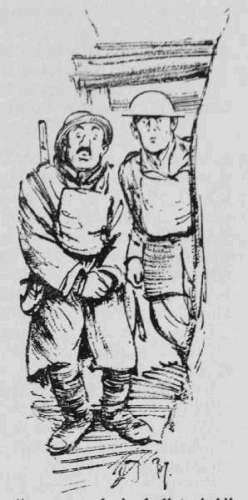
"... an explosive bullet, sir!"
During the final push near Cambrai
Jerry had just been driven from a
very elaborate observation post—a steel-constructed
tower. Of course, we soon
occupied it to enable us to see Jerry's
hasty retreat.
No sooner had we got settled when, crash, Jerry had a battery of pipsqueaks
trained on us, firing gas shells. A direct hit brought the building
down.
By the time we had sorted ourselves out our eyes began to grow dim,
and soon we were temporarily blind. So we took each other's hands, an
ex-policeman leading.
After a few moments a Cockney friend chimed out, "Say, Cop, do
you think you can find the lock-up now, or had you better blow your
whistle?"—H. Rainford (late R.F.A.), 219 The Grove, Hammersmith,
W.6.
It was on "W" Beach, Gallipoli, some months after the historic
landing. It was fairly safe to picnic here, but for the attentions of
"Beachy Bill," a big Turkish gun. I was with six other R.F.A. details
in a dug-out which was labelled, or rather libelled, "The Ritz."
"Smiler" Smith gave it that name, and always referred to this
verminous hovel in terms of respect. Chalked notices such as "Wait
for the Lift," "Card Room," "Buffet," were his work.
A dull thud in the distance—the familiar scream—and plomp came
one from "Bill," a few yards from the Ritz. Only "Smiler" was really
hurt. He received a piece of shell on his arm. As they carried him
away, he called faintly for his tobacco tin.
"Where did you leave it, 'Smiler'?"
"In the drorin' room on the grand pianner," said "Smiler" faintly.—Gunner
W. (late 29th Division, R.F.A.).
Sandy was one of those whom nature seemed to have intended for a
girl. Sandy by colour, pale and small of features, and without the
sparkling wit of his Cockney comrades, he was the butt of many a joke.
One dark and dirty night we trailed out of the line at Vermelles and
were billeted in a barn. The farmhouse still sheltered its owner and the
remainder of his live-stock, including a goat in a small shed.
"Happy" Day, having discovered the goat, called out, "Hi, Sandy!
There's some Maconochie rations in that 'ere shed. Fetch 'em in, mate."
Off went Sandy, to return hastily with a face whiter than usual, and
saying in his high treble: "'Appy, I can't fetch them. There's two awful
eyes in that shed."
Subsequently Jerry practically obliterated the farm, and when we
returned to the line "Happy" Day appropriated the goat as a mascot.
We had only been in the line a few hours when we had the worst
bombardment I remember. Sandy and the goat seemed kindred spirits in
their misery and terror.
"Happy" had joined the great majority. The goat, having wearied
of trench life and army service, had gone over the top on his own account.
The next thing we knew was that Sandy was "over" after him, shells
dropping around them. Then the goat and "Sandy Greatheart" disappeared
behind a cloud of black and yellow smoke.—S. G. Bushell (late
Royal Berks), 21 Moore Buildings, Gilbert Street, W.
It was my job for about two months, somewhere in the summer of
1917, to take Jennie the mule up to the trenches twice a day with
rations, or shells, for the 35th Trench Mortar Battery, to which I was
attached. We had to cover about 5 kilos. from the Q.M. stores at Rouville,
Arras, to the line. When Jerry put a few over our way it was a job to
get Jennie forward.
One night we arrived with a full load, and the officer warned me to get
unloaded quick as there was to be a big bombardment. No sooner had
I finished than over came the first shell—and away went Jennie, bowling
over two or three gunners.
Someone caught her and I mounted for the return journey. Then
the bombardment began in earnest.
You ought to have seen her go! Talk about a racehorse! I kept
saying, "Gee up, Jennie, old girl, don't get the wind up, we shall soon
get back to Rouville!"
I looked round and could see the flashes of the guns. That was the
way to make Jennie go. She never thought of stopping till we got home.—W.
Holmes (9th Essex Regiment), 72 Fleet Road, Hampstead, N.W.
On August 28, 1916, we were told to take over a series of food dumps
which had been formed in the front and support lines at Hamel,
on the Ancre, before a general attack came off.
On the following night Corporal W——, a true and gallant Cockney who
was in charge of a party going back to fetch rations, came to my dug-out
to know if there were anything special I wished him to bring.
I asked him to bring me a tin of cigarettes. On the return journey,
as the party was crossing a road which cut through one of the communicating
trenches, a shell struck the road, killing two privates and
fatally wounding Corporal W——.
Without a word the corporal put his hand into his pocket and, producing
a tin, held it out to an uninjured member of the party.
I got my smokes.—L. J. Morgan (late Capt., The Royal Sussex Regiment),
1 Nevern Square, S.W.5.
On the night before our big attack on July 1, 1916, on the Somme,
eight of us were in a dug-out getting a little rest. Jerry must have
found some extra shells for he was strafing pretty heavily.
Two Cockney pals from Stratford were busy down on their hands and
knees with some lighted grease and pieces of dry sandbag, trying to boil
a mess-tin of water to make some tea.
The water was nearly on the boil when Jerry dropped a "big 'un"
right into the side of our dug-out.
The smoke and dust had hardly cleared, when one of the Stratfordites
exclaimed, looking down at the overturned mess-tin, "Blimey, that's
caused it." Almost immediately his pal (lying on his back, his face
covered with blood and dirt, and his right hand clasped tightly) answered:
"'S'all right. I ain't put the tea and sugar in."—J. Russ (Cpl., late 6th
Battn. Royal Berkshire Regt.), 309 Ilford Lane, Ilford, Essex.
After a week in Ypres Salient in February 1915 we were back at
a place called Vlamertinghe "resting," i.e. providing the usual
working parties at night. Going out with one of these parties, well
loaded with barbed wire, poles, etc., our rifles slung on our shoulders,
things in general were fairly quiet. A stray bullet struck the piling
swivel of the rifle of "Darkie," the man in front of me. "Missed my
head by the skin of its teeth," said "Darkie." "Good job the old Dutch
wasn't here. She reckons she's been unlucky ever since she set eyes on
me—and there's another pension for life gone beggin'."—B. Wiseman
(late Oxford and Bucks L.I.), 12 Ursula Street, Battersea, S.W.11.
Dusk was falling on the second day of the battle of Loos. I was
pottering about looking for the other end of our line at the entrance
to Orchard Street trench. A voice hailed me: "'Ere, mate! Is this
the way aht?"
It came from a little Cockney, a so-called "walking" wounded case.
Immediately behind him there hobbled painfully six feet of complete
abjection.
I gave them directions, and told them that in two or three hundred
yards they should be out of danger. Then Jerry dropped a "crump."
It tortured the sorely-tried nerves of the long fellow, and when the bricks
and dust had settled, he declared, with sudden conviction: "We're going
to lose this blinkin' war, we are!"
His companion gave him a look of contempt.
"You ain't 'arf a long streak of misery," he said. "If I fort that
I'd go back nah an' 'ave another shot at 'em—even if you 'ad to carry
me back."—"Lines," (33 (S) Bty), 24 Clifton Road, Maida Vale, W.9.
"Smudger" Smith, from Hoxton, had just returned off leave,
and joined us at Frankton Camp, near Ypres. Not long after
his arrival "Jerry" started strafing us with his long-range guns, but
"Smudger" was more concerned with the tattooing which he had had
done on his arms on leave.
I said they were very disfiguring, and advised him to have them
removed, giving him an address to go to when he was again in London,
and telling him the probable price.
Not very long after our conversation "Jerry" landed a shell about
forty yards away from us and made us part company for a while.
When I pulled myself together and looked for "Smudger" he was
half-buried with earth and looked in much pain.
I went over to him and began to dig him out. Whilst I was thus
engaged he said to me in a weak voice, but with a smile on his face:
"How much did yer say it would corst to take them tattoos orf?"
And when I told him he replied: "I fink I can get 'em done at harf-price
nah."
When I dug him out I found he had lost one arm.—E. R. Wilson (late
East Lancs Regt.), 22 Brindley Street, Shardeloes Road, New Cross, S.E.14.
Soon after the capture of Hill 70 an artillery observation post was
established near the new front line. A telephone line was laid to it,
but owing to persistent shelling the wire soon became a mere succession
of knots and joints. Communication was established at rare intervals,
and repairing the line was a full-time job. A Cockney signaller and I went
out at daybreak one morning to add more joints to the collection, and
after using every scrap of spare wire available made another temporary
job of it.
Returning, however, we found at a cross-over that the wire had fallen
from a short piece of board that had been stuck in the parapet to keep it
clear of the trench. As my pal reached up to replace it his head caught
the eye of a sniper, whose bullet, missing by a fraction, struck and knocked
down the piece of wood.
The signaller's exclamation was: "Blimey, mate, it's lucky he ain't
broke the blinkin' line again!"—J. Hudson (late R.G.A.), 6 Ventnor Road,
New Cross, S.E.14.
A battalion of a London regiment was in reserve in Rivière-Grosville,
a small village just behind the line, in March 1917.
Towards midnight we were ordered to fall in in fighting order as it was
believed that the Germans had retired.
Our mission was to reconnoitre the German position, and we were
cautioned that absolute silence must be preserved.
All went well until we reached the German barbed wire entanglements,
that had to be negotiated by narrow paths, through which we proceeded
softly and slowly, and with the wind "well up."
Suddenly the air was rent by a stream of blistering invective, and a
Cockney Tommy turned round on his pal, who had tripped and accidentally
prodded him with the point of his bayonet, and at the top of
his voice said:
"Hi, wot's the blinkin' gime, Charlie? Do that again and I'll knock
yer ruddy 'ead off."
Charlie raised his voice to the level of the other's and said he'd like
to see him do it, and while we flattened ourselves on the ground expecting
a storm of bullets and bombs at any moment, the two pals dropped their
rifles and had it out with their fists.
Fortunately, rumour was correct, the Germans had retired.—H. T.
Scillitoe, 77 Stanmore Road, Stevenage, Herts.
A pitch dark night on the Salonika front in 1917. I was in charge
of an advanced detachment near a railhead.
A general and a staff officer were travelling by rail-motor towards the
front line when in the darkness the rail-motor crashed into some stationary
freight trucks, completely wrecking the vehicle and instantly killing the
driver.
I rushed with a stretcher party to render help. The general and his
staff officer were unconscious amid the wreckage.
Feverishly we worked to remove the debris which pinned them down.
Two of us caught the general beneath the shoulders, and one was raising
his legs when to his horror one leg came away in his hand.
When the general regained his senses, seeing our concern, he quickly
reassured us. The leg turned out to be a wooden one! He had lost
the original at Hill 60.
The tension over, one of the stretcher-bearers, a Cockney from Mile
End, whispered into my ear, "We can't take 'im to the 'orspital, sarge,
he wants to go dahn to the Ordnance!"—Sgt. T. C. Jones, M.S.M., 15
Bushey Mill Lane, Watford.
Out of the ebb and flow, the mud and blood, the din and confusion
of a two days' strafe on the Somme in September 1917 my particular
chum, Private James X., otherwise known as "Dismal Jimmy," emerged
with a German prisoner who was somewhat below the usual stature and
considerably the worse for the wear and tear of his encounter with the
Cockney soldier.
"Jimmy," although obviously proud of his captive, was, as usual,
"fed up" with the war, the strafe, and everything else. To make matters
worse, on his way to the support trenches he was caught in the head by
a sniper's bullet.
His pet grievance, however, did not come from this particular misfortune,
but from the fact that the prisoner had not taken advantage of
the opportunity to "'Op it!" when the incident occurred. "Wot yer
fink ov 'im, mate?" he queried. "Followed me all rahnd the blinkin'
trenches, 'e did! Thinks I got a bit o' tripe on a skewer, maybe, th'
dirty dog!" "Jimmy" muttered. Then he came under the orders
of a Higher Command.—H. J. R., 1 Central Buildings, Westminster, S.W.1.
In the brick-fields at La Bassée, 1915, there was a pump about five
yards from our front line which we dare not approach in daylight. At
night it was equally dangerous as it squeaked and so drew the sniper's fire.
We gave up trying to use it after a few of our fellows had been sniped
in their attempts, until Nobby Clarke said he would get the water, adding:
"That blinkin' sniper hasn't my name on any of his ruddy bullets."
After he had gone we heard the usual squeak of the pump, followed by
the inevitable ping! ... ping! We waited. No Nobby returned.
Two of us crawled out to where he lay to bring him in. "Strewth,
Bill," he cried when my mate touched him, "you didn't 'arf put the
blinkin' wind up me, creepin' aht like that!"
There he lay, on his back, with a piece of rope tied to the handle of
the pump. We always got our water after that.—F. J. Pike (late 2nd
Grenadier Guards), 4 Hilldrop Road, Bromley, Kent.
Scene: Before Combles in the front line.
Position: Acute.
Several runners had been despatched from the forward position with
urgent messages for Headquarters, and all had suffered the common
fate of these intrepid fellows. One Cockney named Sweet, and known as
"Toot-Sweet" for obvious reasons, had distinguished himself upon
various occasions in acting as a runner.
A volunteer runner was called for to cover a particularly dangerous
piece of ground, and our old friend was to the fore as usual. "But,"
said the company officer, "I can't send you again—someone else must
go."
Imagine his astonishment when "Toot-Sweet" said, "Giv' us this
charnce, sir. I've got two mentions in dispatches now, an' I only want
annuvver to git a medal."
He went, but he did not get a medal.—E. V. S. (late Middlesex Regt.),
London, N.W.2.
Before we made an attack on "The Mound of Death," St. Eloi,
in the early part of 1916, our Brigadier-General addressed the
battalion and impressed upon us the importance of taking our objective.
He told us the tale of two mice which fell into a basin of milk. The
faint-hearted one gave up and was drowned. The other churned
away with his legs until the milk turned into butter and he could
walk away! He hoped that we would show the same determination
in our attack.
We blew up part of the German front line, which had been mined,
and attacked each side of the crater, and took the position, though with
heavy losses.
On the following day one of my platoon fell into the crater, which,
of course, was very muddy. As he plunged about in it he shouted
"When I've churned this ruddy mud into concrete I'm 'opping aht
of it."
This was the action in which our gallant chaplain, Captain the Rev.
Noel Mellish, won the V.C.—"Reg. Bomber," 4th Royal Fusiliers, 3rd
Division.
An attack was to be made by our battalion at Givenchy in 1915.
The Germans must have learned of the intention, for two hours
before it was due to begin they sent up a strong barrage, causing many
casualties.
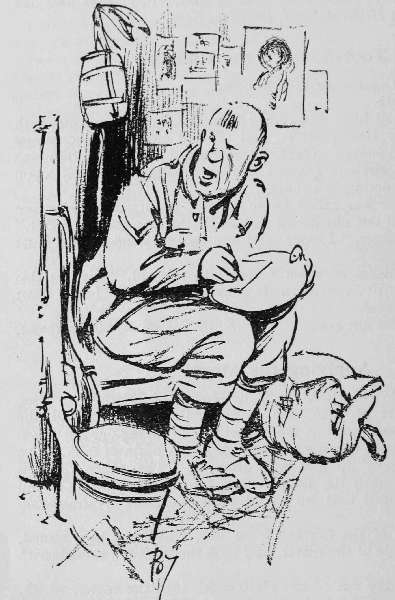
"'Ow d'yer spell 'delightful'?"
Letters and cards, which might be their last, were being sent home
by our men, and a Cockney at the other end of our dug-out shouted to
his mate, "'Arry, 'ow d'yer spell 'delightful'?"—H. W. Mason
(late 23rd London Regt.), 26 Prairie Street, Battersea, S.W.
Too Much Hot Water
We were taking a much-needed bath and change in the Brewery vats at
Poperinghe, when Jerry started a mad five minutes' "strafe" with, as it
seemed, the old Brewery as a target.
Above the din of explosions, falling bricks, and general "wind-up"
the aggrieved voice of Sammy Wilkes from Poplar, who was still in the
vat, was heard:
"Lumme, and I only asked for a little drop more 'ot water."—Albert
Girardot (late K.R.R.), 250 Cornwall Road, Ladbroke Grove, W.11.
After the evacuation of the Dardanelles the "Drakes" of the Royal
Naval Division were ordered to France. Amongst them was Jack
(his real name was John). A young Soccer player, swift of foot, he was
chosen as a "runner."
One day he tumbled into a shell hole. And just as he had recovered
his wits in came Colonel Freyberg, V.C., somewhat wounded. Seeing
Jack, he told him he was just the boy he wanted—the lad had run away
from home to join up before he was seventeen—and scribbling a note
the colonel handed it to him.
The boy was told if he delivered it safely he could help the colonel
to take Beaucourt. Jack began to scramble out. It was none too inviting,
for shells were bursting in all directions, and it was much more comfortable
inside. With a wide vocabulary from the Old Kent Road, he timely
remembered that his father was a clergyman, and muttering to himself,
"Ducks and drakes, ducks and drakes," he reached the top and went
on his way.
The sequel was that the message was delivered, reinforcements came
up, led by the boy to the colonel, and Beaucourt was taken.—Father
Hughes, 60 Hainault Avenue, Westcliff-on-Sea.
On September 14, 1916, at Angle Wood on the Somme, the 168th
(London) Brigade Signals were unloading a limber on a slope, on
top of which was a battery which Jerry was trying to find. One of his
shells found us, knocking all of us over and wounding nine or ten of us
(one fatally).
As the smoke and dust cleared, our Cockney sergeant (an old soldier
whose slogan was "You must have discipline") gradually rose to a
sitting position, and, whipping out his notebook and pencil, called
"Nah, then, oo's wounded?" and calmly proceeded to write down
names.—Wm. R. Smith (late R.E. Signals), 231 Halley Road, Manor
Park, E.12.
At a certain period during the operations in Mesopotamia so dependent
were both the British and the Turks on the supply of water from
the Tigris that it became an unwritten law that water-carriers from both
sides were not to be sniped at.
This went on until a fresh British regiment, not having had the position
explained, fired on a party of Turks as they were returning from the
river. The next time we went down to get water the Turks, of course,
returned the compliment; so from then onwards all water carrying had
to be done under cover of darkness.
On one of these occasions a Turkish sniper peppered our water party
as they were returning to our lines. They all got back, however; but
one, a man from Limehouse, was seen to be struggling with his water
container only half full, and at the same time it was noticed that his
trousers and boots were saturated.
"Hi!" shouted the sergeant, "you've lost half the water. Did that
sniper get your bucket?"
"Not 'im," replied the Cockney, "I saw to that. 'E only got me leg."
What, in the darkness, appeared to be water spilt from the bucket
was really the result of a nasty flesh wound.—J. M. Rendle (Lieut.,
I.A.R.O.), White Cottage, St. Leonard's Gardens, Hove, Sussex.
We were attacking Messines Ridge. The ground was a mass of
flooded shell-holes. Hearing a splash and some cursing in a familiar
voice, I called out, "Are you all right, Tubby?"
The reply came, as he crawled out of a miniature mine crater, "Yus,
but I've lorst me 'ipe (rifle)."
I asked what he was going to do, and he replied, "You dig them
German sausages out with yer baynit and I'll eat 'em."
So saying, he pulled out his knife and fork and proceeded towards the
enemy trenches.—"Pip Don" (London Regt.), 22 Ingram Road, Thornton
Heath.
In the second battle of Arras, 1917, our regiment was held up near
Gavrelle and was occupying a line of shell-holes. The earth was
heaving all around us with the heavy barrage. Peeping over the top
of my shell-hole I found my neighbours, "Shorty" (of Barnes) and
"Tiny" (of Kent) arguing about who was the best man.
All of a sudden over came one of Jerry's five-nines. It burst too close
to "Shorty," who got the worst of it, and was nearly done for. But
he finished his argument, for he said to "Tiny" in a weak voice, "That
shows you who's the best man. My ole muvver always says as the best
goes fust."—J. Saxby, Paddington, W.2.
About Christmas of 1917 I was on the Somme with one of the most
Cockney of the many battalions of the Royal Fusiliers. As we
sheltered in dug-outs from the "gale" Fritz was putting over, to our
surprise we heard a voice greet us in French, "Allons, mes enfants: Ça
va toujours."
Looking up we beheld an old man in shabby suit and battered hat
who seemed the typical French peasant. "Well, of all the old idiots,"
called out the sergeant. "Shut yer face an' 'ook it, ye blamed old fool."
For answer the old man gave the sergeant the surprise of his life by
seizing him in a grip of iron and planting a resounding kiss on each cheek,
French fashion.
Just at that moment some brass hats came along and the mystery
was explained. The "old fool" was the late Georges Clemenceau, then
French War Minister, who had come to see for himself what it was like
in our sector and had lost his guides.
"An' to think that 'e kissed me just like I was a kid, after I'd told
'im to 'ook it," commented the sergeant afterwards. "Wonder wot
'e'd 'a done 'ad I told 'im to go to 'ell, as I'd 'alf a mind to."
Years later I was one of a party of the British Legion received in Paris
by "The Tiger," and I recalled the incident. "Père La Victoire"
laughed heartily. "That Cockney sergeant was right," he said, "I was
an old fool to go about like that in the line, but then somebody has got
to play the fool in war-time, so that there may be no follies left for the
wise heads to indulge in."—H. Stockman, Hôtel Terminus, Rue St. Lazare,
Paris, VIIIème, France.
I was sitting with my pal in the trenches of the front line waiting
for the next move when I heard our Cockney break into the chorus
of a home-made song:
"'Twas moonlight in the trenches,
The sky was royal blue,
When Jerry let his popgun go,
And up the 'ole 'ouse flew."
The last words were drowned in a terrific crash. There was sudden
quiet afterwards, and then a voice said, "There y'are, wot did I tell
yer?"—T. E. Crouch, 28 Eleanor Road, Hackney, E.8.
It was at the village of Zudkerque, where Fritz had bombed and
blown up a dump in 1916. My pal and I were standing outside a
cafe, the windows of which were shuttered, when the blast of a terrific
explosion blew out the shutters. They hit my pal and me on the head
and knocked us into the roadway.
My pal picked himself up, and, shaking bits of broken glass off him
and holding a badly gashed head, said: "Lumme, Ginger, they don't
'arf open up quick 'ere. Let's go an 'ave one."—J. March (late R.E.),
London, S.E.
We had paraded for the rum issue at Frankton Camp, near Ypres,
when the enemy opened fire with long-range guns. A Cockney
came forward with his mug, drew his issue, and moved off to drink it
under cover and at leisure. Suddenly a large shell whooped over and
burst about 40 yards away. With a casual glance at the fountain of
earth which soared up, the man calmly removed his shrapnel helmet and
held it over his mug until the rain of earth and stones ceased.—"Skipper,"
D.L.I., London, W.2.
Cigarettes we knew not; food was scarce, so was ammunition.
Consequently I was detailed on the eve of the retreat from Serbia to
collect boxes of S.A.A. lying near the front line.
On the way to report my arrival to the infantry officer I found a
Cockney Tommy badly wounded in the chest. "It's me chest, ain't
it, mate?" he asked. I nodded in reply. "Then I'll want corf drops,
not them," and with that he handed me a packet of cigarettes. How
he got them and secretly saved them up so long is a mystery.
I believe he knew that he would not require either cough drops or
cigarettes, and I took a vow to keep the empty packet to remind me of
the gallant fellow.—H. R. (late R.F.A.), 10th Division, London, N.3.
When Passchendaele started on July 31, 1917, we who were holding
ground captured in the Messines stunt of June 7 carried out a
"dummy" attack.
One of the walking wounded coming back from this affair of bluff, I
struck a hot passage, for Jerry was shelling the back areas with terrific
pertinacity. Making my way to the corduroy road by Mount Kemmel,
I struck a stretcher party. Their burden was a rifleman of the R.B.'s,
whose body was a mass of bandages. Seeing me ducking and dodging
every time a salvo burst near he called out:
"Keep wiv me, mate, 'cos two shells never busts in the same 'ole—and
if I ain't a shell 'ole 'oo is?"
Sheer grit kept him alive until after we reached Lord Derby's War
Hospital outside Warrington, and the nickname of "Smiler" fitted
him to the last.—W. G. C., 2 Avonly Road, S.E.14.
A fully-qualified chartered accountant in the City, my pal,
"The Bishop"—so called because of his dignified manner—was
promoted company-clerk in the Irish Rifles at Messines in 1917.
Company headquarters were in a dark and dismal barn where the
Company Commander and "The Bishop" were writing under difficulties
one fine morning—listening acutely to the shriek and crash of Jerry's
whizz-bangs just outside the ramshackle door.
The betting was about fifty to one on a direct hit at any moment. The
skipper had a wary eye on "The Bishop"—oldish, shortish, stoutish,
rather comical card in his Tommy's kit. Both were studiously preserving
an air of outward calm.
Then the direct hit came—high up, bang through the rafters, and blew
off the roof. "The Bishop" looked up at the sky, still clutching his
fountain-pen.
"Ah, that's better, sir," he said. "Now we can see what we are doing."—P.
J. K., Westbourne Grove, W.2.
The Cockney inhabitants of "Brick Alley," at Carnoy, on the
Somme in 1916, had endured considerable attention from a German
whizz-bang battery situated a mile or so away behind Trones Wood.
During a lull in the proceedings a fatigue party of "Jocks," each
carrying a 40-lb. sphere, the business end of a "toffee-apple" (trench
mortar bomb), made their appearance, and were nicely strung out in
the trench when Jerry opened out again.
The chances of a direct hit made matters doubly unpleasant.
The tension became a little too much for one of the regular billetees,
and from a funk-hole in the side of the trench a reproachful voice
addressed the nearest Highlander: "For the luv o' Mike, Jock, get up
and chuck yer blinkin' 'aggis at
'em."—J. C. Whiting (late 8th
Royal Sussex Pioneers), 36 Hamlet
Gardens, W.6.
I had been given a lift in an
A.S.C. lorry going to Jonchery
on May 27, 1918, when it was
suddenly attacked by a German
plane. On getting a burst of
machine-gun bullets through the
wind-screen the driver, a stout
man of about forty, pulled up,
and we both clambered down.
The plane came lower and re-opened
fire, and as there was no
other shelter we were obliged to
crawl underneath the lorry and
dodge from one side to the other
in order to avoid the bullets.
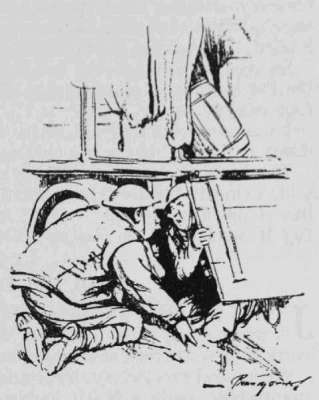
"Fancy a bloke my age playin' 'ide an' seek"
After one hurried "pot" at the plane, and as we dived for the other
side, my companion gasped: "Lumme! Fancy a bloke my age a-playin'
'ide an' seek!"—H. G. E. Woods, "The Willows," Bridge Street,
Maidenhead.
One afternoon in July 1917 our battalion was lying by a roadside
on the Ypres front waiting for night to fall so that we could proceed
to the front line trenches.
"Smiffy" was in the bombing section of his platoon and had a bag
of Mills grenades to carry.
Fritz began to get busy, and soon we had shrapnel bursting overhead.
"Smiffy" immediately spread his body over his bag of bombs like a
hen over a clutch of eggs.
"What the 'ell are you sprawling over them bombs for?" asked the
sergeant.
"Well," replied Smiffy, "it's like this 'ere, sergeant. I wouldn't
mind a little Blighty one meself, but I'd jest 'ate for any of these bombs
ter get wounded while I'm wiv 'em."—T. E. M. (late London Regt.),
Colliers Wood, S.W.19.
We were lying in front of Bapaume in August 1918 awaiting reinforcements.
They came from Doullens, and among them was a
Cockney straight from England. He greeted our sergeant with the
words, "Wot time does the dance start?" The sergeant, an old-timer,
replied, "The dance starts right now."
So over the top we went, but had not gone far when the Cockney was
bowled over by a piece from a minnenwerfer, which took half of one
foot away.
I was rendering first aid when the sergeant came along. He looked
down and said, "Hello, my lad, soon got tired of the dance, eh?"
The little Cockney looked up and despite his pain he smiled and
said, "On wiv the dance, sergeant! I'm sitting this one aht, fer Minnie
has stepped on my toe."—E. C. Hobbs (late 1st Royal Marine Battn.),
103 Moore Park Road, Fulham, S.W.
Jerry had made a surprise raid on our trenches one morning just as
it was getting light. He got very much the worst of it, but when
everything was over Cockney Simmonds was missing.
We hunted everywhere, but couldn't find him. Suddenly we saw him
approaching with a hefty looking German whom he had evidently
taken prisoner.
"Where did you get him from, Simmonds?" we asked.
"Well, d'yer see that shell-'ole over there 'alf full o' water?"
"Yes," we said, all craning our necks to look.
"Well, this 'ere Fritz didn't."—L. Digby (12th East Surreys), 10
Windsor Road, Holloway, N.7.
March 1918. Just before the big German offensive. One night I
was out with a reconnoitring patrol in "No Man's Land." We had
good reason to believe that Jerry also had a patrol in the near vicinity.
Suddenly a burst of machine-gun fire in our direction seemed to
indicate that we had been spotted. We dived for shell-holes and any
available cover, breathlessly watching the bullets knock sparks off the
barbed wire. When the firing ceased and we attempted to re-form our
little party, a Cockney known as "Posh" Wilks was missing.
Fearing the worst, we peered into the darkness. Just then a Verey
light illuminated the scene, and we saw the form of "Posh" Wilks some
little distance away. I went over to see what was wrong, and to my
astonishment he was kneeling down carefully rewinding one of his puttees.
"Can't get these ruddy things right anyhow to-day," he said.—H. W.
White (late Royal Sussex Regt.), 18 Airthrie Road, Goodmayes, Essex.
On December 4, 1917, we made a surprise attack on the enemy in the
Jabal Hamrin range in Northern Mesopotamia.
We wore our winter clothing (the same as in Europe), with tin hats
complete. After stumbling over the rocks in extended order for some
time, the platoon on my left, who were on higher ground, sighted a Turkish
camp fire on the right.
We swung round in that direction, to find ourselves up against an almost
blank wall of rock, about 20 ft. high, the enemy being somewhere on top.
At last we found a place at which to scale it, one at a time. We began
to mount, in breathless silence, expecting the first man to come tumbling
down on top of all the rest.
I was the second, and just as I started to climb I felt two sharp tugs
at my entrenching tool and a hoarse Cockney voice whispered, "Full up
inside; plenty o' room on top." I was annoyed at the time, but I have
often laughed over it since.—P. V. Harris, 89 Sherwood Park Road, S.W.16.
In March 1917 we held the front line trenches opposite a sugar refinery
held by the Germans. We got the order to stand to as our engineers
were going to blow up a mine on the German position.
Up went the mine. Then Fritz started shelling us. Shells were
bursting above and around us. A piece of shrapnel hit a Cockney, a
lad from Paddington, on his tin hat.
When things calmed down another Cockney bawled out, "Lumme, that
was a near one, Bill." "Blimey, not 'arf," was the reply. "If I 'adn't
got my chin-strap dahn I'd 'ave lost my blooming washing-bowl."—E.
Rickard (late Middlesex Regt.), 65 Apsley End, Hemel Hempstead,
Herts.
The trenches on the Somme were very deep and up to our knees in
mud, and we were a pretty fine sight after being in the front line
several days over our time.
I shall never forget the night we passed out of the trenches—like a lot
of mud-larks. The O.C., seeing the state we were in, ordered us to have
a bath. We stopped at an old barn, where the R.E.'s had our water
ready in wooden tubs. Imagine the state of the water when, six to a tub,
we had to skim the mud off after one another!
Just as we were enjoying the treat, Jerry started sending over some of
his big stuff, and one shell took the back part of the barn off.
Everybody began getting out of the tubs, except a Cockney, who sat
up in his tub and shouted out, "Blimey, Jerry, play the blinkin' game.
Wait till I've washed me back. I've lorst me soap."—C. Ralph (late
Royal Welch Fusiliers), 153d Guinness Buildings, Hammersmith, W.6.
Whilst on the Somme in October 1916 my pal Mac (from Notting
Hill) and myself were sent forward to a sunken road just behind
Les Bœufs to assist at a forward telephone post which was in communication
with battalion H.Q. by wire and with the companies in the trenches
by runner.
During the night a false "S O S" was sent up, and our guns opened
out—and, of course, so did the German guns—and smashed our telephone
wire.
It being "Mac's" turn out, he picked up his 'phone and went up the
dug-out steps. When he had almost reached the top a big shell burst
right in the dug-out entrance and blew "Mac" back down the stairs
to the bottom, bruised, but otherwise unhurt.
Picking himself up slowly he removed his hat, placed his hand over
his heart, and said, gazing round, "Back to the old 'ome agin—and it
ain't changed a bit."—A. J. West (late Corpl., Signals), 1/13th London
Regt., 212 Third Avenue, Paddington, W.10.
One night in July 1917, as darkness came along, my battalion moved
up and relieved a battalion in the front line.
Next morning as dawn was breaking Jerry started a violent strafe. My
platoon occupied three fire-bays, and we in the centre one could shout
to those in the bays on either side, although we could not see them.
In one of the end bays was "Monte Carlo" Teddy, a true lad from
London, a "bookie's tick-tack" before the war. He was called "Monte
Carlo" because he would gamble on anything. As a shell exploded
anywhere near us Teddy would shout, "Are you all right, sarge?" until
this kind of got on my nerves, so I crawled into his bay to inquire why
he had suddenly taken such an interest in my welfare. He explained,
"I gets up a draw larst night, sarge, a franc a time, as to which of us in
this lot stopped a packet first, and you're my gee-gee."
I had hardly left them when a shell exploded in their bay. The only
one to stop a packet was Teddy, and we carried him into the next bay to
await the stretcher-bearers. I could see he would never reach the dressing
station.
Within five minutes I had stopped a lovely Blighty, and they put me
alongside Teddy. When he noticed who it was he said, "Well I'm blowed,
just my blinkin' luck; licked a short head and I shan't last long enough
to see if there's a' objection."
Thus he died, as he always said he would, with his boots on, and my
company could never replace him. Wherever two men of my old mob
meet you can bet your boots that one or the other is sure to say, "Remember
'Monte Carlo' Ted?"—E. J. Clark (late Sergeant, Lincoln Regt.),
c/o Sir Thomas Lipton, Bart., K.C.V.O., Osidge, Southgate, N.14.
We were trying to sleep in half a dug-out that was roofed with a
waterproof sheet—Whale and I. It was a dark, wet night. I had
hung a mess tin on a nail to catch the water that dripped through, partly
to keep it off my head, also to provide water for an easy shave in the
morning.
A strafe began. The night was illuminated by hundreds of vivid
flashes, and shells of all kinds burst about us. The dug-out shook with
the concussions. Trench mortars, rifle grenades, and machine-gun fire
contributed to the din.
Whale, who never had the wind up, was shifting his position and
turning from one side to the other.
"What's the matter?" I asked my chum. "Can't you sleep?"
"Sleep! 'Ow the 'ell can a bloke sleep with that infernal drip-drip-drip
goin' on?"—P. T. Hughes (late 21st London Regiment, 47th Division),
12 Shalimar Gardens, Acton, W.
After the terrific upheaval of June 7, 1917, my brigade (the 111th)
held the line beyond Wytschaete Ridge for some weeks. While my
company was in support one day my corporal and I managed to scrounge
into a pill-box away from the awful mud. We could not escape the
water because the explosion of the mines on June 7 had cracked the
foundation of our retreat and water was nearly two feet deep on the
floor.
Just before dusk on this rainy July evening I was shaving before a
metal mirror in the top bunk in the pill-box, while the corporal washed
in a mess-tin in the bunk below. Just then Jerry started a severe strafe
and a much-muddied runner of the 13th Royal Fusiliers appeared in the
unscreened doorway.
"Come in and shelter, old man," I said. So he stepped on to an
ammunition box that just failed to keep his feet clear of the water.
He had watched our ablutions in silence for a minute or so, when a shell
burst almost in the doorway and flung him into the water below our bunks,
where he sat with his right arm red and rent, sagging at his side.
"Call this a shelter?" he said. "Blimey, it's a blinkin' vanity box!"—Sgt.,
10th R.F., East Sheen, S.W.14.
We were making our way to a detached post just on the left of
Vimy, and Jerry was sending up Verey lights as we were going
along. Every time one went up we halted, and kept quite still in case
we should be
seen.
It was funny
indeed to see how
some of the men
halted when a
light went up.
Some had one foot
down and one
raised, and others
were in a crouching
position. "My
missus orta see
me nah playing
at blinkin'
statchoos," said
one old Cockney.—T.
Kelly (late
17th London Regt.),
43 Ocean Street,
Stepney, E.1.
"Playin' at statchoos."
In 1915 at Fricourt "Copper" Kingsland of our regiment, the 7th
Royal West Surreys, was on sentry on the fire-step in the front line.
At this period of the war steel helmets were not in use. Our cap badge
was in the form of a lamb.
A Fritz sniper registered a hit through Kingsland's hat, cutting the tail
portion of the lamb away. After he had pulled himself together "Copper"
surveyed his cap badge and remarked: "On the larst kit inspection
I reported to the sargint that yer was lorst, and nah I shall 'ave ter tell
'im that when Bo Peep fahnd yer, yer wagged yer bloomin' tail off in
gratitood."—"Spot," Haifu, Farley Road, Selsdon, Surrey.
We were out at rest in an open field on the Somme front when one
morning, about 5 a.m., our cook, Alf, of Battersea, was preparing
the company's breakfast. There was bacon, but no bread. I was
standing beside the cooker soaking one of my biscuits in the fat.
Suddenly a Jerry airman dived down towards the cooker, firing his
machine gun. I got under the cooker, Alf fell over the side of it, striking
his head on the ground. I thought he was hit. But he sat up, rubbing
his head and looking up at Jerry, who was then flying away.
"'Ere!" he shouted, "next time yer wants a dip in the fat, don't
be so rough."—H. A. Redford (late 24th London Regt.), 31 Charrington
Street, N.W.1.
Some recently captured trenches had to be cleared of the enemy,
and in the company told off for the job was a Cockney youth. Proceeding
along the trench with a Mills bomb in his hand, he came upon
a number of the enemy hiding in a dug-out.
"Nah then," he shouted, holding up the bomb in readiness to throw
it if necessary, "all them as votes for coming along wiv me 'old up your
'ands."
All hands were held up, with the cry "Kamerad! Kamerad!" Upon
which the Cockney shouted, "Look, mates, it's carried unanermously."—H.
Morgan (late 4th Telegraph Construction Co., R.E. Signals), 26 Ranelagh
Road, Wembley.
During the retreat of the remnants of the Fifth Army in March
1918 two of the six-inch howitzers of the Honourable Artillery
Company were in action in some deserted horse-lines outside Péronne.
During a lull Gunner A——, a Londoner, like the rest of us, went
"scrounging" in some nearby cottages recently abandoned by their
inhabitants. He reappeared carrying a large zinc bath, and after filling
it with water from the horse pond he made a huge bonfire with broken
tables and other furniture, and set the bath on the fire.
Just when the water had been heated Fritz opened out with 5·9's. As
we were not firing just then we all took cover, with the exception of
Gunner A——, who calmly set his bath of hot water down by one of the
guns, undressed, and got into the bath. A minute later a large piece of
shell also entered the bath, passed through the bottom of it and into the
ground.
The gunner watched the precious water running out, then he slowly
rose and, beginning to dress, remarked, "Very well, Fritz, have it your
way. I may not be godly, but I did want to be clean."—Edward Boaden
(late H.A.C., 309 Siege Battery), 17 Connaught Gardens, Muswell Hill,
N.10.
During a winter's night on the Somme a party of us were drawing
rations just behind the front line trenches. A Cockney chum of mine
was disgusted to hear the Q.M. say he was issuing hot soup in lieu of rum.
"Coo! What next?" he grumbled. "Soup in lieu of rum, biscuits
in lieu of bread, jam in lieu——" While he spoke Jerry sent over two
whizz-bangs which scattered us and the rations and inflicted several
casualties.
My chum was hit badly. As he was being carried past the Q.M. he
smiled and said, "Someone will have to be in lieu of me now, Quarter!"—T.
Allen (late Plymouth Battn., R.N.D.), 21 Sydney Street, S.W.
Two brothers named Hatt were serving together in France. The
elder was always saying that he would never be hit, as the Germans,
not being able to spell his name correctly, could not put it on any of their
shells or bullets. (It was a common saying among the soldiers, of course,
that a shell or bullet which hit a man had the victim's name on it.)
The younger brother was taken prisoner, and two days later the elder
brother was shot through the finger. Turning to his mates he exclaimed,
"Blimey, me brother's been an' split on me."—W. J. Bowes, 224 Devon's
Road, Bow, E.3.
We were at Levantie in 1915, just before the Battle of Loos, and the
rumour was about that the Germans were running short of
ammunition. It was very quiet in our sector, as we were opposite the
Saxons, and we strolled about at ease.
A party of us was told off to get water just behind the trenches in an
old farmhouse which had a pump. We filled all the water bottles and rum
jars and then had a look round the ruins to see what we could scrounge,
when suddenly Fritz sent a shell over. It hit the wall and sent bricks
flying all over the place. One of the bricks hit my mate on the head and
knocked him out. When we had revived him he looked up and said,
"Strewth, it's right they ain't got no 'ammo.'; they're slinging bricks.
It shows yer we've got 'em all beat to a frazzle, don't it?"—J. Delderfield,
54 Hampden Street, Paddington.
A platoon of my regiment, the Duke of Cornwall's Light Infantry,
was engaged in carrying screens to a point about 200 yards behind
the front line. The screens were to be set up to shield a road from
German observation balloons, and they were made of brushwood bound
together with wire. They were rolled up for convenience of transport,
and when rolled they looked like big bundles of pea-sticks about ten
feet long. They were very heavy.
Three men were told off to carry each screen. One of the parties of
three was composed of two Cornishmen (who happened to be at the ends
of the screen) and their Cockney pal (in the middle), the screen being
carried on their shoulders.
When they had nearly reached the point in the communication trench
where it was to be dumped, Jerry sent over a salvo of whizz-bangs.
His range was good, and consequently the carrying party momentarily
became disorganised. The Cornishman at the front end of the screen
dashed towards the front line, whilst the man at the other end made a
hurried move backwards.
This left the Cockney with the whole of the weight of the screen on
his shoulder. The excitement was over in a few seconds and the Cornishmen
returned to find the Cockney lying on the duckboards, where he
had subsided under the weight of his burden, trying to get up. He
stopped struggling when he saw them and said very bitterly, "Yus:
One and All's yer blinkin' motter; one under the blinkin' screen and all
the rest 'op it."
"One and All," I should mention, is the Cornwalls' motto.—"Cornwall,"
Greenford, Middlesex.
During the Somme offensive we were holding the line at Delville
Wood, and a Cockney corporal fresh from England came to our
company.
He was told to take charge of a very advanced post, and our company
officer gave him all important instructions as to bomb stores, ammunition,
rifle grenades, emergency rations, S O S rockets, gas, and all the
other numerous and important orders for an advanced post.
After the officer asked him if he understood it all, he said, "Blimey,
sir, 'as 'Aig gone on leave?"—Ex-Sergt. Geary, D.C.M. (East Surrey
Regt.), 57 Longley Road, Tooting.
On the Struma Front, Salonika, in September 1916, I was detailed
to take a party of Bulgar prisoners behind the lines.
Two Bulgars, one of them a huge, bald-headed man, were carrying a
stretcher in which was reposing "Ginger" Hart, of Deptford, who was
shot through the leg.
The white bursts of shrapnel continued in our vicinity as we proceeded.
One shell burst immediately in front of us, and we halted.
It was at this juncture that I saw "Ginger" leave his stretcher and hop
away on one leg. Having picked up a tin hat, he hopped back to the big
Bulgar prisoner and put the hat on his bald head, saying, "Abaht time
we put the lid on the sooit puddin', corp: that's the fifth shot they've
fired at that target."—G. Findlay, M.M. (late 81st Infantry Brigade,
27th Division), 3a Effie Place, Fulham, S.W.6.
In the confused fighting round Gueudecourt in 1916 a machine-gun
section occupied a position in a maze of trenches, some of which led
towards the German line. The divisional pioneer battalion was the
Monmouthshire Regiment, all of whose men were Welsh and for the
most part spoke Welsh.
A ration party of the M.G.C. had gone back one night and had been
absent some time when two members rushed into the position, gasping:
"We took the wrong turning! Walked into Jerry's line! They've
got Smiffy—and the rations!"
We had hardly got over the shock of this news when Smiffy came
staggering up, dragging the rations and mopping a bleeding face, at
the same time cursing the rest of the ration party.
"Luv us, Smiffy, how did you get away? We thought the Germans
had got you for sure!"
"Germans," gasped Smiffy. "GERMANS! I thought they was the
Monmouths!"—S. W. Baxter (late 86th M.G.C.), 110 Bishopsgate, E.C.2.
At the Battle of Cambrai in November 1917 my regiment, the
London Irish Rifles, was undergoing a terrific bombardment in
Bourlon Wood.
The Germans had been plastering us for about 12 hours with "all
calibres," to say nothing of continual gassing.
As we had been wearing gas-masks almost all day without respite,
we were nearly "all in" as the afternoon wore on.
I was attending to a man with a smashed foot, when I felt a touch
on my shoulder, and, blinking up through my sweat-covered mask, I
saw our mess-orderly with his hand over a mess-tin (to keep the gas
out, as he said).
I could hardly believe my eyes, but when I heard him say, "Tea
is ready, Sarg. Blimey, what a strafe!" I lifted my mask and drank
deeply.
From that day till this it has been a wonder to me how he made it.—S.
Gibbons,130 Buckhold Road, Southfields, S.W.18.
The object of our raiding party near Gouzeaucourt in 1917 was to
obtain a prisoner.
One plucky, but very much undersized, German machine gunner blazed
away at us until actually pounced upon. A Cockney who was well
among the leaders jumped down beside him, and heaving him up said:
"Come on, old mate, you're too blinkin' good for this side!"—and
then, noticing his lack of inches, "and if yer wants ter make the 'old
man' larf tell him you're a 'Prussian Guard.'"—Walter S. Johnson (late
R.W.F.), 29 Southwold Road, Upper Clapton, E.5.
Early in the war aeroplanes were not so common as they were
later on, and trench "strafing" from the air was practically unheard
of. One day two privates of the Middlesex Regiment were engaged in
clearing a section of front line trench near the La Bassée road when a
German plane came along and sprayed the trenches with machine-gun
bullets.
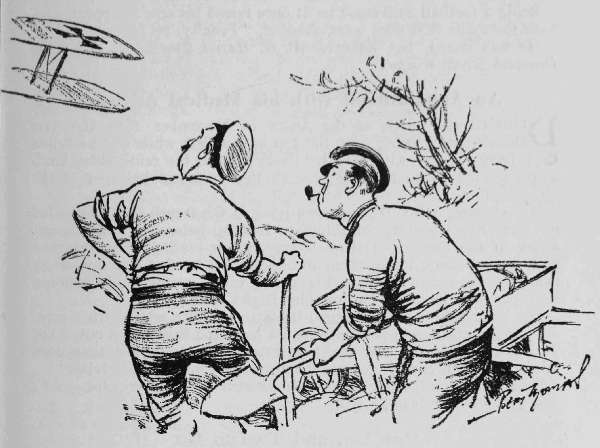
...and they both went on digging
One of the men (both were typical Cockneys) looked up from his
digging and said: "Strike, there's a blinkin' aeroplane."
The other took no notice but went on digging.
By-and-by the machine came back, still firing, whereupon the
speaker again looked up, spat, and said: "Blimey, there's annuver
of 'em."
"No, 'tain't," was the reply, "it's the same blighter again."
"Blimey," said the first man, "so 'tis." And both went on digging.—W.
P. (late Middlesex Regt. and R.A.F.), Bucks.
It was a warm corner on the Givenchy front, with whizz-bangs dealing
out death and destruction. But it was necessary that communication
be maintained between the various H.Q.'s, and in this particular sector
"Alf," from Bow, and myself were detailed to keep the "lines" intact.
Suddenly a whizz-bang burst above us as we were repairing some
shattered lines. We ducked instinctively, but friend "Alf" caught a bit
of the shell and was thrown to the bottom of the slushy trench.
Being a football enthusiast he at once raised his arm in appeal, and,
with the spirit that wins wars, shouted, "Penalty, ref!"
He was dazed, but unhurt.—W. G. Harris (late Sergt., R.E.), 34
Denmark Street, Watford.
During the battle of the Ancre in November 1916 the 51st
Division were going over the top on our left while our battalion
kept Jerry engaged with a raid. Every inch of the rain-sodden landscape
seemed to be heaving beneath the combined barrages of the
opposing forces.
My sergeant, a D.C.M., had been lying in the trench badly wounded
for some hours waiting for things to ease up before he could be got
down to the dressing-station. Presently our raiding party returned
with six prisoners, among them an insignificant-looking German officer
(who, waving a map about, and jabbering wildly, seemed to be blaming
his capture to the faulty tactics of his High Command).
The wounded sergeant watched these antics for a while with a grin,
driving the pain-bred puckers from his face, and then called out, "Oi,
'Indenburg! Never mind abaht ye map o' London; wot time does
this 'ere war end, 'cos I've got an appointment wiv my medical adviser!"
Dear, brave old chap. His appointment was never kept.—S. T.
(late 37th Div.), Fulham, S.W.6.
On the Struma front in 1917 a bombing plane was being put back
into its hangar. Suddenly there was a terrific bang. A dozen
of us ran up to see what had happened, but a Cockney voice from inside
the hangar cried out, "Don't come in. There's two more bombs to
go off, and I can't find 'em."—A. Dickinson, Brixton.
Dawn of a very hot day in September 1916 on the Balkan front.
We were in the enemy trenches at "Machine Gun Hill," a position
hitherto occupied by the Prussian Guards, who were there to encourage
the Bulgars.
We had taken the position the previous evening with very little loss.
As the day broke we discovered that we were enfiladed on all sides and
overlooked by the Prussians not more than forty yards away. It was
impossible to evacuate wounded and prisoners or for reserves to approach
with food, water, and ammunition. The enemy counter-attacked in
overwhelming numbers; shells rained on us; our own were falling short;
it was suicide to show one's head. Towards noon, casualties lying
about. The sun merciless. Survivors thoroughly exhausted. Up
jumped a Cockney bomber. "Blimey, I can't stick this," and perched
himself on the parados. "I can see 'em; chuck some 'Mills' up."
And as fast as they were handed to him he pitched bombs into the
Prussians' midst, creating havoc. He lasted about three minutes,
then fell, riddled with bullets. He had stemmed the tide.
Shortly afterwards we retired. His pluck was never recorded or
recognised, but his feat will never be forgotten by at least one of the
few who got through.—George McCann, 50 Guilford Street, London, W.
We were occupying a support line, early in 1918, and a party of us
was detailed to repair the barbed wire during the night.
A Cockney found himself holding a stake while a Cornish comrade
drove it home with a mallet.
Suddenly a shell exploded a few yards from the pair and both were
very badly wounded.
When the Cockney recovered consciousness he was heard to remark
to his comrade in misfortune, "Blimey, yer wants to be more careful
wiv that there mallet; yer nearly 'it my 'and wiv it when that there
firework exploded."—A. A. Homer, 16 Grove Place, Enfield Wash,
Middlesex.
At the end of 1914 we were in the trenches in the Ypres Salient. As
we were only about 30 yards from the enemy lines, bombing went
on all day. The German bombs, shaped like a long sausage, could be
seen coming through the air. Our sentries, on the look-out for these,
would shout: "Sausage right!" or "Sausage left!" as they came over.
One night we were strengthened by reinforcements, including several
Cockneys. The next morning one of our sentries saw a bomb coming
over and shouted "Sausage right!" There followed an explosion which
smothered two of our new comrades in mud and shreds of sandbag. One
of the two got up, with sackcloth twisted all round his neck and pack.
"'Ere, Bill, wot was that?" he asked one of our men.
"Why, one of those sausages," Bill replied.
"Lumme," said the new man, as he freed himself from the sacking,
"I don't mind the sausages, but," he added as he wiped the mud from
his eyes and face, "I don't like the mash."—H. Millard (late East
Surrey Regt.), 3 Nevill Road, Stoke Newington, N.
We were lining up to go over in the Battle of Arras on April 9, 1917.
Ours being a Lancashire regiment, there were only two of us Cockneys
in our platoon. We were standing easy, waiting for the rum issue,
and Tom, my pal (we both came from Stratford), came over to me
singing "Let's all go down the Strand...."
Most of the Lancashire lads were looking a bit glum, but it cheered
them up, and they all began to sing. I was feeling a bit gloomy myself,
and Tom, seeing this, said: "What's the matter with you, Jimmy?"
"I suppose I'll see you in London Hospital next week, Tom," I said.
"Oh, shut up," says he. "If Jerry sends one over and it's got our
names on it, why worry? And if we get a bad Blighty one, then I
hopes they buries us at Manor Park. Here, Jim, tie this disc round
me neck."
Then the rum came up, and he started them singing, "And another
little drink wouldn't do us any harm!"
Off we went—and only ten minutes later he was gone. He was buried
at Blany, Arras, not Manor Park.—J. Pugh (late 1st King's Own Royal
Lancasters), 27 Lizban Street, Blackheath, S.E.5.
The following incident took place during the Battle of Loos, September
1915. I had been to Battalion H.Q. with a message and whilst
awaiting a reply stood with others on "Harrow Road" watching our
wounded go by.
We frequently recognised wounded pals on the stretchers and inquired
as to the nature of their wounds. The usual form of inquiry was:
"Hullo —— what have you got?" In reply to this query one wounded
man of our battalion, ignoring his wound as being of lesser importance,
proudly answered: "Two Jerry helmets and an Iron Cross!"—A. H.
Bell (late Private, 15th London Regt., T.F.), 31 Raeburn Avenue, Surbiton,
Surrey.
It was near Hebuterne and very early in the morning of July 1, 1916. A
terrific bombardment by both the Germans and ourselves was in progress
just prior to the launching of our Somme offensive. We were in
assembly trenches waiting for the dread zero hour.
Away on our right some German guns were letting us have it pretty
hot, and in consequence the "troops" were not feeling in the best of
spirits.
With us was a very popular Cockney corporal. He took his tin hat
from off his head when the tension was high and, banging on it with his
bayonet, cried: "Roll up, me lucky lads! Seven shies a tanner! Who'll
'ave a go!" That bit of nonsense relieved the tension and enabled us to
pull ourselves together.—A. V. B. (late 9th Londons), Guildford.
Whilst on the Ypres front during the fighting in 1918 we made an
early-morning attack across the railway line in front of Dickebusch.
After going about fifty yards across No Man's Land my Cockney pal
(Bill Hawkins, from Stepney), who was running beside me, got a slight
wound in the arm, and before he had gone another two yards he got
another wound in the left leg.
Suddenly he stopped, lifted his uninjured arm at the Germans and
shouted, "Blimey, wot yer all firing at me for? Am I the only blinkin'
man in this war?"—S. Stevens (late Middlesex Regt., 2nd Battn.), 7
Blenheim Street, Chelsea, S.W.
To get information before the Somme offensive, the new idea of
making daylight raids on the German trenches was adopted. It fell
to our battalion to make the first big raid.
Our objective was the "brick-fields" at Beaurains, near Arras, and our
orders were to take as many prisoners as possible, hold the trench for
half an hour, do as much damage as we could, and then return. A covering
barrage was put down, and over we went, one hundred strong.
We got into Jerry's trench all right, but, owing to the many dug-outs
and tunnels, we could only find a few Germans, and these, having no time
to bolt underground, got out of the trench and ran to take cover behind
the kilns and brick-stacks.
And then the fun began. While the main party of us got to work in
the trench, a few made after the men who had run into the brick-fields,
and it was a case of hide and seek, round and round and in and out of
the kilns and brick-stacks.
Despite the seriousness of the situation, one chap, a Cockney, entered
so thoroughly into the spirit of the thing that when, after a lengthy chase,
he at last clapped a German on the shoulder, he shouted, "You're 'e!"—E.
W. Fellows, M.M. (late 6th D.C.L.I.), 35 Dunlace Road, Clapton, E.5.
In the platoon of cyclists I was posted to on the outbreak of war
was a Cockney—a "Charlie Chaplin" without the funny feet. If there
was a funny side to a thing, he saw it.
One day, on the advance, just before the battle of the Marne, our
platoon was acting as part of the left flank guard when a number of enemy
cavalry were seen advancing over a ridge, some distance away. We were
ordered to dismount and extend. We numbered about sixteen, so our
line was not a long one.
A prominent object was pointed out to us, judged at about
150 yards away, and orders were given not to fire until the enemy
reached that spot.
We could see that we were greatly outnumbered, and having to wait
for them to reach that spot seemed to double the suspense. Our leader
was giving commands one second and talking like a father the next.
He said, "Keep cool; each take a target; show them you are British.
You have as good a chance as they, and although they are superior in
numbers they have no other superior quality. I want you just to
imagine that you are on the range again, firing for your pay." Then
our Cockney Charlie chimed in with: "Yes, but we ain't got no
bloomin' markers."—S. Leggs (late Rifle Brigade and Cyclists), 33 New
Road, Grays, Essex.
After we had taken part in the advance on the Somme in August
1916 my battalion was ordered to rest at Bazentin.
We had only been there a day or so when we were ordered to relieve
the Tyneside Scottish who were badly knocked about. Hardly had we
reached the front lines, when a little Cockney named Bunn (we never
knew how he carried his pack, he was so small) got hit. We called for
stretcher-bearers.
When they put him on the stretcher and were carrying him down the
line, a doctor asked him his name. The Cockney looked up with a smile
and answered: "Bunn, sir, and the blighters have put some currants
into me this time." This gallant Cockney died afterwards.—J. E. Cully
(late 13th King's Royal Rifles), 76 Milkwood Road, S.E.24.
The artillery driver's affection for his own particular pair of horses
is well known. Our battery, in a particularly unhealthy spot in front
of Zillebeke, in the Salient, had run out of ammunition, and the terrible
state of the ground thereabout in the autumn of 1917 necessitated the
use of pack-horses to "deliver the goods," and even then it was accomplished
with difficulty.
A little Cockney driver with a pair named Polly and Bill had loaded up
and was struggling through the mire. Three times Bill had dragged him
on to his knees and up to his waist in the slush when a big Fritz shell
dropped uncomfortably near. Polly, with a mighty rear, threw the
Cockney on to his back and, descending, struck him with a hoof.
Fed up to the teeth and desperate, he struggled to his feet, covered
from head to feet in slime, and, clenching his fist, struck at the trembling
and frightened horse, unloading a brief but very vivid description of
its pedigree and probable future.
Then, cooling off, he began to pacify the mare, apologised, and pardoned
her vice by saying, "Never mind, ole gal—I didn't mean ter bash
yer! I fought the uvver one was hot stuff, but, strike me pink, you
don't seem 'ooman!"—G. Newell (ex-Sergt., R.F.A.), 22 Queen Road, St.
Albans.
August 1916, Delville Wood. We had been brought specially
from rest camp to take the remainder of the wood, which was being
stoutly contested by the Germans and was holding up our advance.
The usual barrage, and over we went, and were met by the Germans
standing on top of their trenches. A fierce bombing fight began. The
scrap lasted a long time, but at last we charged and captured the trench.
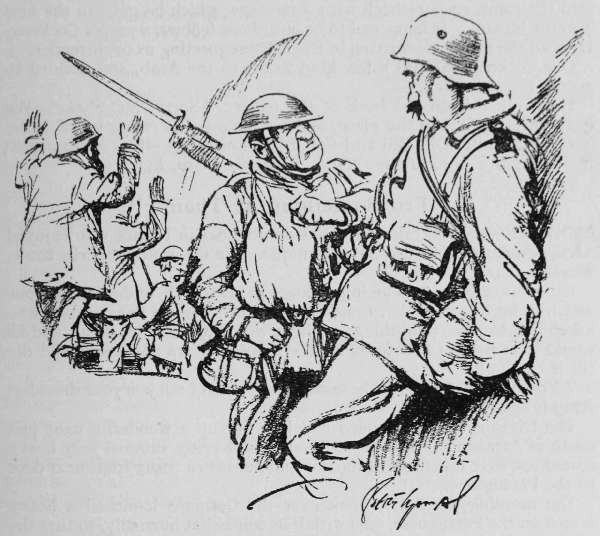
"Yus, yer needn't stare—I'm real."
One of our men, quite a small Cockney, captured a German about twice
his own size. The German was so surprised at being captured by a person
so insignificant looking that he stood and stared. Our Cockney, seeing
his amazement, said: "Yus, yer needn't stare, I'm real, and wot's more,
I got a good mind ter punch yer under the blinkin' ear fer spoiling me
rest!"—F. M. Fellows, M.M. (late Corporal, 6th Batt. D.C.L.I), 33
Dunlace Road, Clapton, E.5.
I was in Mesopotamia from 1916 till 1920, and after the Armistice
was signed there was still considerable trouble with the Arabs.
In the summer of 1919 I, with a party of 23 other R.A.S.C. men, was
surrounded by the Arabs at an outpost that was like a small fort. We
had taken up supplies for troops stationed there. There were about 100
Indian soldiers, and a few British N.C.O.'s in charge.
It was no use "running the gauntlet." We were on a hill and kept the
Arabs at bay all day, also the next night.
The next day all was quiet again, but in the afternoon an Arab rode
into the camp on horseback with a message, which he gave to the first
Tommy he saw. It happened to be one of our fellows, a proper Cockney.
He read the message—written in English—requesting us to surrender.
Our Cockney pal said a few kind words to the Arab, and decided to
send a message back.
He wrote this on the back of the paper: "Sorry, Mr. Shake. We
have only just taken the place, and we have got it on 99 years' lease.
Yours faithfully, Old Bill and Co., Ltd., London."—W. Thurgood (late
R.A.S.C., M.T.), 46 Maldon Road, Southend-on-Sea, Essex.
There was a certain divisional commander in France who enjoyed
a popularity that was almost unique. He was quite imperturbable,
whatever the situation.
Unfortunately, he had an impediment in his speech, and when first one
met him he was difficult to understand. But heaven help anyone who
asked him to repeat anything. A light would come into his eye, and he
would seize hold of his victim by the shoulder-strap and heave and tug
till it came off.
"You'll understand me," he would say, "when I tell you your shoulder-strap
is undone!"
The Division he commanded had just put up a wonderful fight just
south of Arras in the March '18 show, and, having suffered very heavy
casualties, were taken out of the line and put into a cushy front next door
to the Portuguese.
The morning after they took over the Germans launched a heavy
attack on the Portuguese, who withdrew somewhat hurriedly, so that the
whole flank of the British division was open.
The general was sitting eating his breakfast—he had been roused at
six by the bombardment—when an excited orderly came into the room
and reported that the Germans had got right in behind the Division
and were now actually in the garden of the general's château.
The general finished drinking his cup of coffee, the orderly still standing
to attention, waiting instructions.
"Then you had better 'fro' something at them—or shoo them away,"
said the general.—F. A. P., Cavalry Club, Piccadilly, W.
During the Battle of the Somme our trench-mortar battery was
going back after a few days' rest. It was very dark and raining.
As we neared our destination it appeared that Jerry and our chaps were
having a real argument.
We were going up a road called "Queen's Hollow." Jerry was enfilading
us on both sides, and a rare bombing fight was going on at the farther
end of the Hollow—seventy or a hundred yards in front of us. We were
expecting to feel the smack of a bullet any moment, and there was a
terrible screeching and bursting of shells, with a few "Minnies" thrown
in. We were in a fine pickle, and I had just about had enough when my
pal (a lad from "The Smoke") nearly put me on my back by stopping
suddenly.
"I don't like this, Bomb," he said.
"What's wrong with you? Get on," I replied, "or we'll all be
blown sky high."
"Oh, all right," he said, "but I wish I'd brought me mouf orgin. I
could then have livened fings up a bit."—"Bombardier" (R.A.), late
T.M.B., 7th Division.
There must be at least six men still alive who remember a certain
affair at Kemmel. During the latter part of April 1918 our machine
gunners had been having a bad time, and one old Cockney sergeant
found himself and his party isolated miles in front of our line.
The cool way in which he gave orders, as he told his men to make
their way back—lying down for a bit, then making a run for another
shelter—would have been humorous if conditions had not been so
terrifying.
He himself kept his gun working to protect their retreat, and when
he saw they had reached a place of safety he picked up his gun and
rejoined them unhurt.
One of his men, describing the action afterwards, said, "Carried
his gun three miles—wouldn't part with it—and the first thing he did
when he was able to settle down quietly was to start cleaning the blessed
thing!"—H. R. Tanner, "Romsdal," Newton Ferrers, S. Devon.
During the retreat from Mons it was a case of "going while the
going was good" until called upon to make a stand to harass the
enemy's advance.
After the stand at Le Cateau, bad and blistered feet caused many to
stop by the wayside. Among these, in passing with my little squad,
I noticed a piper belonging to a Scottish regiment sitting with his blistered
feet exposed and his pipes lying beside him. Staff officers were continually
riding back and urging the parties of stragglers to make an
effort to push on before they were overtaken.
In the late afternoon of this same day, having myself come up with
my unit, I was resting on the roadside when I heard the skirl of bagpipes.
Before long there came into sight, marching with a fair swing,
too, as motley a throng as one ever saw in the King's uniform. Headed
by a staff officer were about 150 men of all regiments with that same
piper, hatless and with one stocking, in front.
Beside him was a Cockney of the Middlesex Regiment, with a silk
hat on his head, whose cheeks threatened to burst as he churned out
the strains of "Alexander's Rag-time Band" on the bagpipes. Being
a bit of a piper himself, he was giving "Jock" a lift and was incidentally
the means of fetching this little band away from the clutches of the
enemy.—"Buster" Brown (late Bedfordshire Regt.), Hertford.
Early in 1916 ten of us were going up with rations—chiefly bread
and water. In one part of the trench there were no duckboards
and the vile mud was thigh-deep.
Here we abandoned the trench and stumbled along, tripping over
barbed wire and falling headlong into shell-holes half-full of icy
water.
A German sniper was at work. Suddenly a bullet pinged midway
between the last two of the party.
"Hear that?" said No. 9. "Right behind my neck!"
"Yes," replied No. 10, "right in front of my bloomin' nose!"—C.
A. Davies (late 23rd R. Fusiliers), 85 Saxton Street, Gillingham, Kent.
We were billeted in the upper room of a corner house north of
Albert, and were listening to "Spoofer's" memories of days
"dahn Walworf way."
"Yus," he said, "I ses to the gal, 'Two doorsteps an' a bloater.'"
At that moment a "coal-box" caught the corner of the house, bringing
down the angle of the wall and three-parts of the floor on which we
had squatted.
Except for bruises, none of us was injured, and when the dust subsided
we saw "Spoofer" looking down at us from a bit of the flooring
that remained intact.
"Yus," he continued, as though nothing had happened, "as I was
saying, I'd just called fer the bloater...."
Came another "coal-box," which shook down the remainder of the
floor and with it "Spoofer."
Struggling to his hands and knees, he said, "Blimey, the blinkin'
bloater's cold nah."—F. Lates, 62 St. Ervan's Road, North Kensington.
Towards the end of October 1918 I was out on patrol in front of
Tournai on a dark, windy night. I had a Cockney private with me,
and we were some distance from our lines when we heard a dog barking.
All at once, before I could stop him, the Cockney whistled it.
I threw the Cockney down and dropped myself. A German Verey
light went up—followed by a hail of machine-gun bullets in our direction.
As the light spread out, we saw the dog fastened to a German machine-gun!
We lay very still, and presently, when things had quietened down,
we slid cautiously backwards until it was safe to get up.
All the Cockney said was, "Crikey, corp, I had the wind up. A
blinkin' good job that there dawg was chained up. Why? 'Cause 'e
might 'ave bitten us. I allus was afeard o' dawgs."—J. Milsun (late
1/5th Battn., The King's Own 55th Div.), 31 Collingwood Road, Lexden,
Colchester.
At the first Gaza battle we had to advance 1,700 yards across a
plain in full view of the Turks, who hurled a terrific barrage at us.
We were in artillery formation, and we marched up until within rifle
range. With machine guns and artillery the Turks were depleting our
ranks, so that less than half of us were still marching on at 500 yards
range.
In my section was the Cockney "funny man" of the company.
When things were bad, and we were all wondering how long we would
survive, he began singing lustily a song which someone had sung at our
last concert party behind the lines, the refrain of which was "I've
never heard of anybody dying from kissing, have you?"
Before he had started on the second line nearly everyone was singing
with him, and men were killed singing that song. To the remainder
of us it acted like a tonic.
Good old Jack, when he was wounded later he must have been in
terrible pain, yet he joked so that at first we would not believe he was
seriously hit. He shouted, "Where is 'e?—let me get at 'im."—J. T.
Jones (late 54th Division), 37 Whittaker Road, East Ham, E.6.
A New Zealander was piloting an old F.E. 2B (pusher) 'plane
up and down over the lines, observing for the artillery, when he got
caught by "Richthofen's Circus."
The petrol tank behind the pilot's seat was set on fire and burning
oil poured past him into the observer's cockpit ahead and the clothes
of both men started to sizzle.
They were indeed in a warm situation, their one hope being to dive
into Zillebeke Lake, which the New Zealander noticed below. By the
time they splashed into the water machine and men were in flames;
and, moreover, when they came up the surface surrounding them was
aflame with the burning oil.
Treading water desperately and ridding themselves of their heavy
sodden flying coats, they made a last bid for life by swimming under
water, that flaming water, and at last, half-dead, reached the bank.
There a strong arm gripped the New Zealander by the scruff of the
neck and he was hauled to safety, dimly aware of a hoarse voice complaining
bitterly, "Ours is the best hid battery in this sector, the only
unspotted battery. You would choose just 'ere to land, wouldn't yer,
and give the bloomin' show away?"
Our Cockney battery sergeant-major had, no doubt, never heard
of Hobson or his choice.—E. H. Orton, 9 High Grove, Welwyn Garden
City, Herts.
A Cockney infantryman of the 47th Division was on the fire-step
on the night preceding the attack at Loos. He was huddled up
in a ground-sheet trying to keep cheerful in the drizzle.
Suddenly a British 12-in. shell passed over him, and as he heard its
slow rumble he muttered, "Catch that one, you blighters."
Just then it burst, and with a chuckle he added, "Oh, butter-fingers,
yer dropped it!"—Henry J. Tuck (late Lt., R.G.A.).
We were in the front line, and one evening a Battersea lad and
myself were ordered to go and fetch tea for the company from
the cook-house, which was in Bluff Trench. It was about a mile from
the line down a "beautiful" duckboard track.
With the boiling tea strapped to our backs
in big containers, both of which leaked at the
nozzles, we started for the line. Then Jerry
started sniping at us. There came from the
line a sergeant, who shouted, "Why don't
you lads duck?" "That's right," replied
my chum. "D'yer fink we wants ter be scalded
to death?"—H. G. Harrap (23rd London
Regiment), 25 Renfrew Road, S.E.
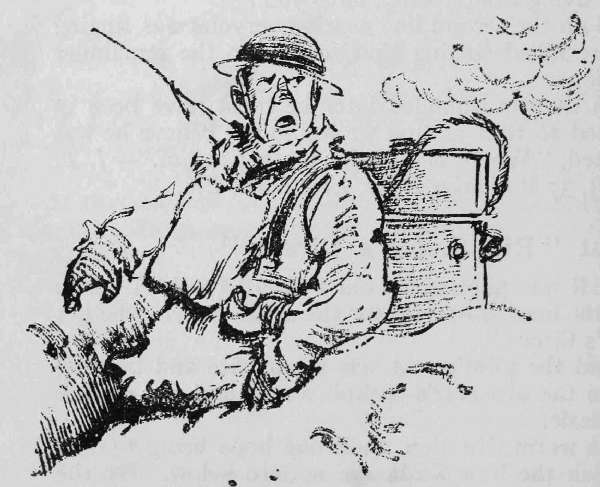
"D'yer fink we wants ter be scalded ter death?"