CHAPTER I. THE MARLOWES AT HOME. — THE LAST SONG OF THE ROBIN. — CHAPTER II. THE STORY OF THE OPENING OF THE WORLD’S COLUMBIAN EXPOSITION. — MAY DAY AT THE WORLD’S FAIR. — CHAPTER III. THE FOLK-LORE SOCIETY’S QUEER STORIES. — BLINGO, THE BLACKSMITH. — THE “DARBY RING.” [3] — CHAPTER IV. THE STORY OF THE BUILDING OF THE WHITE CITY. — THE STORY OF THE FAIR. — CHAPTER V. CHICAGO AND ITS MAKERS—THE CITY OF THE 20TH CENTURY. — CHAPTER VI. THE MARLOWES’ FIRST DAY AT THE FAIR. THE MOST USEFUL THING AT THE FAIR.
Zigzag Journeys in the White City.

 ANTON MARLOWE was the Superintendent of the Public Schools, and the
President of the Folk-Lore Society in his native town, which consisted
of a New England village surrounded by a wide extent of country. He
was usually the chairman of the Committee on Patriotic Celebrations;
and he took an active interest in the Society for Schoolhouse
Decorations, and in the Society for the Improvement of the Country
Roads. He was a Sam Adams-like man, always busy in some plan for the
public good. His father was Ephraim Marlowe, the Quaker, and he had
a son named Ephraim, a lad some fifteen years old,—“old Ephraim and
young Ephraim,” the townspeople called them.
ANTON MARLOWE was the Superintendent of the Public Schools, and the
President of the Folk-Lore Society in his native town, which consisted
of a New England village surrounded by a wide extent of country. He
was usually the chairman of the Committee on Patriotic Celebrations;
and he took an active interest in the Society for Schoolhouse
Decorations, and in the Society for the Improvement of the Country
Roads. He was a Sam Adams-like man, always busy in some plan for the
public good. His father was Ephraim Marlowe, the Quaker, and he had
a son named Ephraim, a lad some fifteen years old,—“old Ephraim and
young Ephraim,” the townspeople called them.
The Village Improvement and Folk-Lore Society, as an active
organization in the old town had come at last to be called, passed
some singular resolutions in the spring of 1893. This society had
begun as a village improvement effort; but it had found so many old
traditions and legends in its historic work that it had added to it
the Historic Society, under the name of the Folk-Lore Society. The
workers in this organization had given a number of entertainments
on the evenings of patriotic holidays, and had saved several hundred
dollars for public use. Manton Marlowe had been the leading mind in
these societies. He had arranged the entertainments for the holiday
evenings, had conducted excursions into historic fields, had been a
leader in the repair of old roads and the marking of historic places.
He was a good story-teller, and he had collected the old traditions
of the place, and related them in story-telling lectures to the last
society.
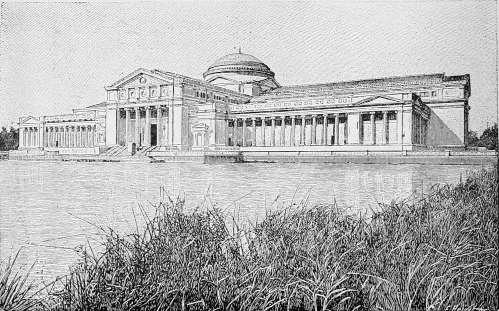
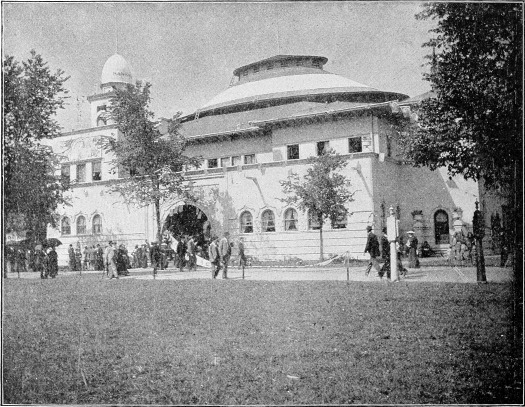
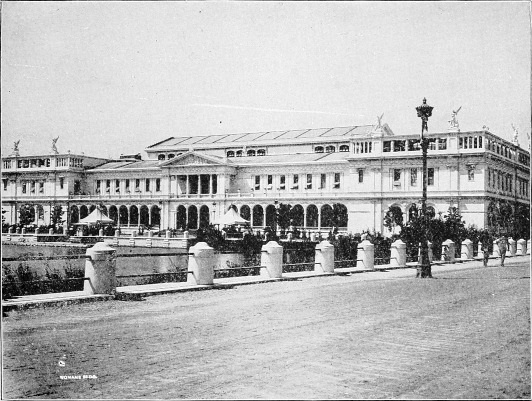
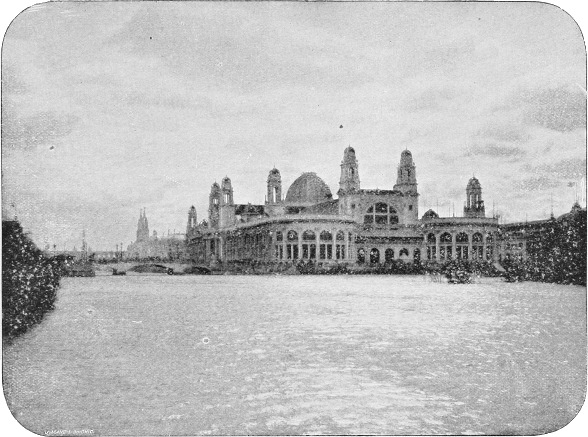
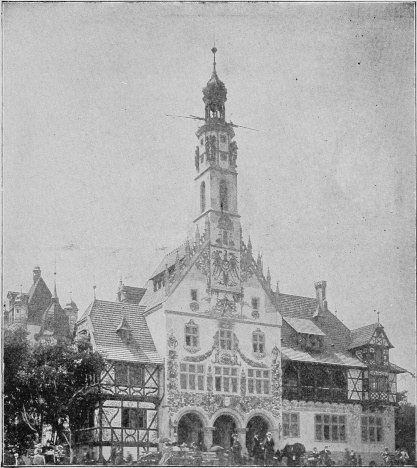
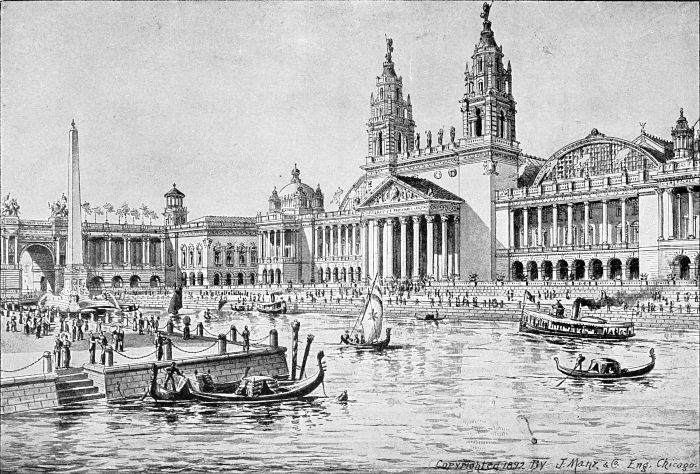
FINE ARTS BUILDING.
When the Village Improvement and Folk-Lore Society met in May, it
greatly surprised good Mr. Marlowe. It resolved:—
-
(1) “That the efforts of our worthy President merit practical
appreciation;
-
(2) “That the Society appropriate one hundred and fifty dollars
from its treasury to give him an excursion to the World’s Columbian
Exhibition;
“That he be asked to accept this as an expression of esteem, and that
he be respectfully requested to answer, on his return, the following
questions:
- (1) “What was the most amusing thing that you saw at the Fair?
- (2) “What was the most useful exhibit that you saw at the Fair?
- (3) “What was the grandest sight that you saw at the Fair?
- (4) “And what was the most useful lesson of the Fair?”
Mr. Marlowe listened to these resolutions with amazement. As President
of the Society, he left the chair, and the Vice President put the
resolutions to vote.
“As many as are in favor of these Resolutions, whose purpose is to
send our President to the World’s Columbian Exhibition, that he
may see the Fair for us, and return to us with new plans for the
improvement of our town and its social life, please say ‘Ay.’”
Every voice in the Society shouted “Ay.”
“It is a unanimous vote,” said the Vice President. “Mr. Marlowe, we
cannot go to the Fair, so we have selected you to see the Fair for us,
and to report what you may find there that may be of use to a country
town. Will you serve the Society?”
Mr. Marlowe stood silent for a time, and then said with a choking
voice:—
“Yes, yes, my friends, if you put it in that way! My heart is full,
but I promise you all that I will put my conscience into my eyes. I
will use my eyes for the town and not for myself. I would do anything
to advance the interests of this grand old town. Let me see, what is
it I am to do? Report to you what, is the funniest, most useful, and
the grandest thing that I see at the Fair, and all that I find that
can be of benefit to us here. Yes, my friends, I will go. I thank you
for your good will and confidence with all my heart!”
One of the Directors of the principal railroad to California via
Chicago, was present. He arose and said:—
“Mr. Marlowe, your interest in the Village Improvement Society was the
influence that led our company to extend a branch line here. I will
give you two passes to Chicago and return. You may like to take one of
your family with you.”
When Manton Marlowe returned home that night, he was a happy man. His
public spirit had returned to bless him. His wife was an invalid, and
she could not go to the Fair. His son Ephraim wished to go. He had
heard what the Society had done.
So Ephraim sat down by his father, and expected to receive the
invitation.
It was a mellow May evening. As the two sat side by side, old Ephraim
came slowly into the room and joined them.
“Manton,” said the latter, “I am an old man.”
“Yes, father, but not very old.”
“I can travel on the cars.”
“Yes, as well as I.”
“I never been to many places in my long life.”
“No. I wish that you could go to the Fair, father.”
“Manton, I want to go. Why, I have been preaching peace in the old
Meeting-House on the Hill for forty years, and I would feel as though
I could depart in peace, if I could only attend the meetings of the
Peace Congress. I have been reading about that proposed Congress, and
dreaming about it.”
“Young Ephraim,” said Mr. Marlowe, “I know that you want to go to the
Fair; but would you not rather have grandfather go?”
“Yes, father,” said the manly boy, “I shall be happy if he can go.”
“Thou hast well spoken,” said old Ephraim. “Thy heart is right, and I
can see that it is already consecrated. But why can we not both go? I
have a little money of my own. I will pay my own way.”
“Oh, grandfather, and we will see the world all living together in
peace in one white city.”
“Yes, boy. I have seen it in visions. I never expected to see it in
the flesh. What have you to say, Manton?”
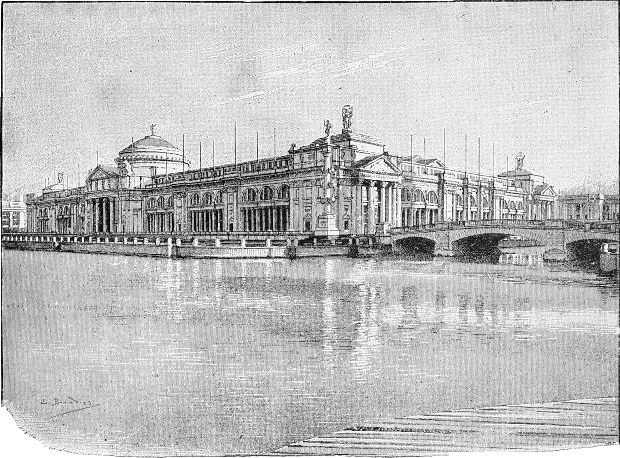
AGRICULTURAL BUILDING.
“We will all go. The papers say that the White City by the Lake is the
most beautiful sight that ever arose in this world under the sun. I am
glad that we can see it together.”
“I am told,” said the old man, “that the white-bordered flag is to be
carried there. That flag is the beginning of the peace of the world.
To see it would turn this old heart into a psalm. It would make me
sing like the men of old, Quaker that I am!”
The sunset lit up the far hills and faded, and the three sat together
long into the evening, planning their journey to the White City.
Mr. Marlowe was a popular story-teller. His love of folk-lore stories
had given him his place as leader of the Village Improvement Society.
He liked to relate stories in which old-time characters could be
imitated by voice and manner. We shall use in this volume several
stories of this kind, as he told them at some folk-lore social
gatherings at the Fair.
A favorite story of his, “The Old Auctioneer,” or “The Last Song of
the Robin,” is a specimen of his peculiar stories, and a picture of
that department of folk-lore called the “Folk-Lore Story.” We give it
here:—
“Susan, I can see that old farm now in my mind’s eye,—the country
road, the guide-post on which was printed ‘20 Miles to Boston.’ I
can see the painted tavern, and the dark pond where the mysterious
travellers were killed. I can fancy hubbly oak-trees; the way-side
orchard; the corner under the trees where the white avens bloomed;
the balm bed, the red-pepper patch, the lilac-bushes, and the
bouncing-bet. I can hear conquiddles, as we called the bobolinks,
as they used to fly and sing in the windward meadows; red-winged
blackbirds in the woodland pastures; martin birds under the eaves;
and the first song of the robin as he came out of the woods, like
the dove from Noah’s Ark, to see if the dry land had appeared. And,
Susan, I can hear the last song of the robin.”
The old man’s eye looked over the great prairie, which spread out
before him like a sea.
“It didn’t look like that, Susan, where the sun rises and sets in
the same corn-field, and the rain-plover cries, and all is so wide,
wide, wide.
“Susan, I’ve been thinking. I never told you much about my twin
sister, who lives on the old farm now on the North River, in
Massachusetts. She’s seventy-five years old, come yesterday. I’ve had
a letter from her. She’s in trouble, Susan. I feel that I ought to go
to her, old as I am. I do, Susan.”
“You are too old, grandpa.”
“The old place is about to be sold at auction. She says so in the
letter, written in the same hand that we used to write together when
we sat side by side on the wooden bench at school. She says that the
poorhouse will soon be her home, but that there is One coming round
soon who will settle all things. She means, Susan—Well, you know who
it is that soon comes round and settles all things when a person
passes the shadow of seventy years. I am able to go, Susan, and I
must go. Somehow I can feel invisible hands pushing me like, as of
the old folk, and I have dreamed twice of the last song of the robin.
“What was that? Well, well, the robins used to sing their last songs
in the Indian-summer weather, before they went to their covers in
the deep woods for the long winter. It was peculiarsome like. It was
when the apples and leaves were falling, leaving bare the nests in
the trees; after the wild-geese had flown over, and the partridges
had begun to fly. I’ve heard ’em many a time. I would like to hear
them once more, as I used to hear, them among the red trees by the
old cranberry meadows. You may think me queer, Susan, and haunted
like; but I long to see that old slanting roof just once more, and my
twin sister, who was rocked in the same cradle with me, and is now in
sorrow, and to hear that last song of the robin. It seems as though
at times I could hear that now.”
He listened. There was a murmur of the wind in the cottonwood-trees.
“It is comin’ Thanksgiving, Susan. It makes me think of the folks and
times that are gone; of the succotash, pandowdy, and puddings, and
pumpkin pies. There never was no such days anywhere like those, and
my hungry heart aches to spend one more Thanksgiving with my sister
Susan. The last one I spent there was sort of queer. The old minister
he ate of all the dishes in the kitchen before the table was set, and
then there were so many of them that it made him heavy like, and he
fell asleep saying grace, and we sat there feeling awkward like, and
the victuals all got cold. Oh, how I would like to talk over those
old times with Susan, my old sister Susan!
“And, Susan, my little granddaughter, I hid some letters behind a
board in the haunted garret under the candle-poles, and there’s going
to be a vendue, and I want to see them once again. That was more than
fifty years ago.
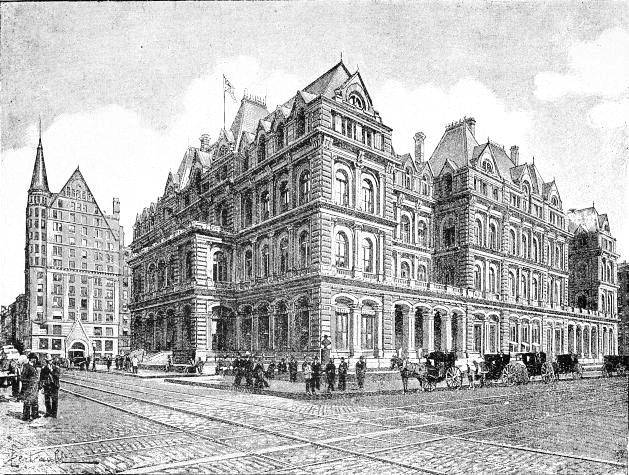
THE POST OFFICE.
“Haunted garret? Such a place seems queer to you, does it, Susan? We
have no haunted garrets here out West. All the old houses and farms
in the Cape towns had their ghost-stories, and a family couldn’t have
amounted to much who hadn’t been followed by a ghost sometime.”
It was near sunset. Like a high arch of glory rose the red light in
the western air,—liquid rubies and gold. Against the sunset stood the
black outlines of some Lombardy poplars and cottonwood-trees, and
under the trees were three graves.
The old man’s face turned towards the graves. He sat musing for a
time in deep thought. The wind rippled through the faded leaves, and
scattered them about the graves.
“Susan!”
“Well, grandpa?”
“Susan!”
“Yes, I hear. What is it? Grandpa, I was thinking of the haunted
garret.”
“Your grandmother and I brought those trees here. They were twigs
then, and she was a bride. I brought her here some years after I took
my claim. Now her grave is there, and the graves of two of our own
little ones. I shall come back again. You and my sister Susan are all
that is left me now,—just old Susan and young Susan. She needs me.
He will take care of you. If I live a week, I am going to rocky old
New England once more. I hear voices calling me sometimes, and then
there drifts into the air that last song of the robin, peculiarsome
like.”
“What were the letters you hid behind the board, grandpa?”
“In the haunted garret?”
“Yes.”
“I may tell you sometime. It is a long story. It was in the garret
where I once saw the ghost of old Rachel, who ground red peppers with
a calash over her head. They used to hear her wandering about at
night in the herb-room, pounding, pounding, pounding with a pestle.
What times those were!”
“I, too, would like to see the old house, and my great-aunt, and eat
a Thanksgiving dinner with some of the good old families. What do you
say, grandpa?”
“You would? Well, you may go too. You’ll hear them, all those
ghost-stories and wonder-tales, right where they happened.”
The girl’s face brightened up with pleasure, followed by a doubtful
shadow, as of ghostly thoughts. She was still thinking of the haunted
garret.
The old man sat dreaming again. He at last said, “Susan!”
“Yes.”
“Susan!”
“Yes, I am listening.”
“I have a secret for you.”
“Yes? Let me hear.”
“We will not let the folks know that we are coming. We will meet ’em
as strangers like. Old Susan will not know me—likely not. Not know
me? and we were born on the same day and rocked in the same cradle.
It takes two to be happy always, and I used to be happy with her.”
The girl sat thinking.
“Grandpa!”
But the old man’s mind was in New England now. He was listening in
dreams to his sister’s voice, and perhaps the last song of the robin.
“Grandpa!”
“Yes, Susan.”
“Why could we not bring her back with us?”
“The old well is there, and the walls and the rooms where the folks
all were married and died. We could not bring her back. There are
some things that money cannot do. We might bring her body back; only
that, Susan.”
“But those things are to be sold?”
“Yes; but they are there.”
“And we will be there too, on Thanksgiving Day.”
“Yes; under the old roof on which I used to hear the rain fall in the
warm summer eves.”
The old man’s face contracted and turned away. He was crying.
“I have not cried before for years, Susan. Sing me that old song that
your mother used to sing when you was a baby. They called it ‘Ben
Bolt.’”
A piano stood in one corner of the room, and over it soon floated the
words of the haunting song:
“Oh, don’t you remember sweet Alice, Ben Bolt,
Sweet Alice, whose hair was so brown?”
At the words,
“In the old church-yard by the orchard, Ben Bolt,
In the valley so sweet and so low,”
the old man bent over his cane, and great tears again ran down his
cheeks.
“I used to sing, Susan, and play the violin in the old house at
home. Father made me promise not to take that with me. He said it
would hinder me. He meant well.”
Susan sang:
“But of all the boys that were schoolmates then,
There is left but you and me.”
Then there fell a silence, and the western twilight deepened, and the
walls of the sun seemed melting down.
“Thank you, my girl. That reminds me of the old times and the last
song of the robin.”
They sat in silence, save that the west winds rustled amid the
withering leaves of the old cottonwoods.
One cool day in September Susan alighted from her horse after a long
ride over the prairie. She was met at the door by her grandfather.
“I’ve brought you another letter from the old home,” she said. “It is
in aunt’s hand, and I think that she is in very great trouble. See!
it is blotted.”
The old man put on his spectacles, and held the letter close to his
eyes. “Yes, she is in trouble, you may depend. I knew how it would
be. Her hand shook when she wrote that. Let me open it.”
He sat down on the rude piazza and read the letter, rocking at times
nervously.
“Yes, she is in deep trouble, sure enough, Susan. We must go. I
haven’t done just right, Susan, by your aunt; I haven’t, now. When I
was young, I used to climb trees, and so hide from her and leave her,
and she used to cry. I can see her now. I do feel as though I had
been climbing a tree all of my life and hiding and leaving her. It
didn’t add to the stature of Zaccheus to climb a tree, but it did add
to his reputation. So it is with me, Susan. I’ve gained some property
by immigrating here to the prairies, but I am Zaccheus still, and I
hear a voice calling me to come down. That’s the way we used to talk
in the old New England times, in figures like, when I thought the
tree-tops reached clear up to the sky.”
“What does aunt write, grandpa?”
“The old place is going to be sold by vendue, and the debts will take
all—all.”
“What is a vendue?”
“Oh, it’s like this. When property people lose almost all they have,
and can’t pay their mortgages, then comes the sheriff, and after him
a man whom we call an auctioneer, and the auctioneer cries ‘Going,
going, gone,’ and when he gets through there’s not so much as a birch
broom left.”
The old man rocked uneasily.
“It’s my fault, Susan. I want to tell you, though I do it to my
shame, what a woman your old aunt is. She always put a person’s
feeling above money. You see, it was this way: I had a fever to go
West, and to marry, and Susan she wanted to marry a young farmer who
owned an old Cape farm. But one of us had to stay with the folks. She
was tender-hearted, Susan was, and she used to love me more than her
own life,—she always loved others more than herself,—and one day,
under the apple-trees, she said to me, ‘Martin,’ said she, ‘you may
go West, and I’ll live with father and mother.’ When I came to be
propounded for the Church, my conscience troubled me so that I made
a covenant with myself that I would always be true to my twin sister
Susan. And I nailed that covenant behind a board in the garret.
And now I am going back to find it, and to keep it. Just hear this
letter. She says:—
“‘Mother’s long sickness caused the mortgage, and the interest on it
grew. Now they are going to sell the old place at vendue, and I’ll
have to go to the poorhouse, or else live on the church, which is
poor. Even my Thanksgiving turkeys will be sold.’
“Did you hear that, Susan? I remember how we used to go together
hunting turkeys’ nests when, we were young. A turkey is a sly bird,
and hides her nest, and always goes an opposite way when she starts
for her nest. How we used to follow the turkeys slyly amid the dews,
wild roses, and laurels, so as to find their nests! And now even her
turkeys are to be sold! Susan, I feel as though I hadn’t done as I
ought to. I must go back East, and I will do the right thing in the
end. I will keep the covenant. It was Susan that gave me a chance in
life. I can hear the old folks that are dead callin’, ‘Come home,
come home;’ seems as though I could.”
“Grandfather, have you any spare money?”
“What makes you ask that, child?”
“Couldn’t you buy the old place and give it to her?”
“To Susan? To Susan? Why, bless your heart, that’s just what I’ve
just been thinking! If I ought to—and a man ought to do what he
ought, or he’ll feel just as he hadn’t ought to, and I feel that way
now. No, Susan, none of those auction-attending folks shall eat my
sister Susan’s turkeys this year. We’ll get ready and go. You never
saw the sea, did you?”
“No; nor old houses with ghost-rooms. It all seems like a story.”
“Nor rocks, nor walls, nor great apple-orchards, nor woods of old
oak-trees?”
“No, nor a Thanksgiving—a real true one, grandpa.”
“Well, child, you shall see a real old New England Thanksgiving
this year, and I think it will be one well worth seeing. We’ll roast
those turkeys ourselves. They’re saying ‘quit, quit’ to the mortgage
now. I’m going to keep my covenant. It makes me happy to think of it.
But, as I said, we will not let them know that we are coming. And,
Susan, Susan, you maybe will hear that last song of the robin.”
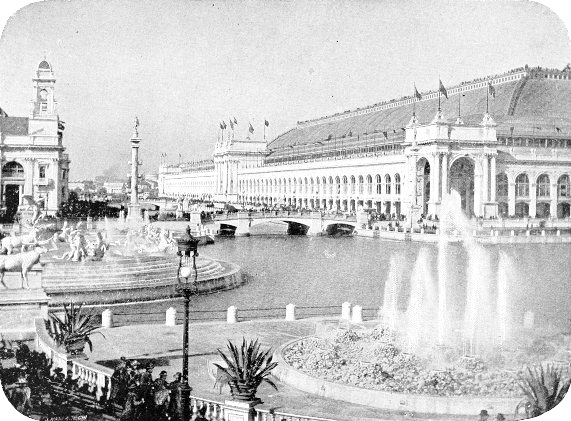
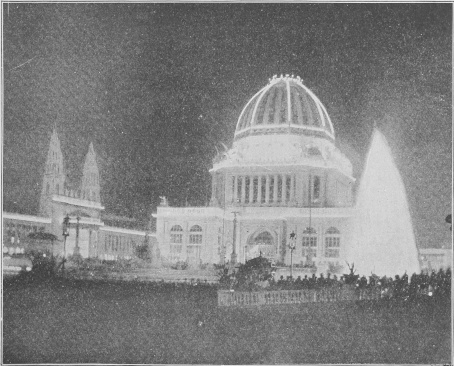
MANUFACTURES BUILDING AND ELECTRIC FOUNTAIN.
The old man paced the piazza, and hummed, in a broken voice,—
“How dear to my heart are the scenes of my childhood,
When fond recollection presents them to view;
The orchard, the meadow, the deep tangled wildwood,
And every loved spot which my infancy knew!
“I used to know the man that made that song,” he said. “He was a son
of a Revolutionary soldier who lived at Scituate. He went to live in
New York. Strange that people will go to live so far away! I used
to hear the boys sing it during the war,” he added, absently, “when
they would get Thanksgiving boxes from home. Seems as though I could
hear it now in the air: there are some songs that haunt one’s heart,
Susan: it seems as though I could hear it far away. Listen!”
He listened. The prairie air was still. He heard the song, but
Susan—she did not hear. The wind rippled through the dry leaves of
the cottonwoods over the three graves.
There are probably no roads in our country that are so legend-haunted
as those between Boston and Plymouth. The making of those roads by
the Massachusetts and Plymouth Bay colonies was the first map of
the nation. The men who built them, and guarded them by heavy stone
walls, were the descendants of some of the best families of England,
whose soul-training had led them to place principle above wealth,
pleasure, or fame. On their simple rural farms they lived, attended
the church and the folkmote, as the town meeting may be called, and
they made the latter the pattern of all future republics.
Their farms, with the gray stone walls, cool wells, and great elms,
retaining their names, still remain. The purple swallows come to them
as of old in the spring-time, and the ospreys, or fishing-hawks,
drift over at noon, wheeling in the sun. The partridge and quail may
still be found in the woodlands and woodland pastures, and a few
woodpeckers may still be heard tapping the trees.
The byways in their seclusion are even more poetic than the main
highways. The wild grape and clematis there cover the sinking walls.
The ancient graveyards are there, and their slate stones, with
their curious death’s-heads and virtuous poetry, still may be seen
zigzagging as it were among the bright sumachs. The slanting roofs
are covered with moss, and the great barn doors open to the sea.
It was down this way that the old man Martin Marlowe and his
granddaughter rode in one of the last stage-coaches that ever
passed down the winding roads by the sea,—past the homes of the two
Presidents Adams, past the church of the eloquent Henry Ware, past
the old Scituate farm, where Woodworth lived, who wrote “The Old
Oaken Bucket,” to a once famous but now forgotten neighborhood on
the North River, where a thousand ships had been built, and among
them the one which first entered the Columbia River of Oregon, and
that gave the river its name. The old Winslow place was near, as were
the green farms on the Marshfield meadows, where Daniel Webster came
to live, and the Winslow reservation, where live the last of the
Wampanoags.
The old man seemed dwelling in the past as the stage rattled along.
“There are not many of them left now,” he said to Susan. “How I shall
miss seeing my old friends! All that a man can have in this world is
his friends, and when they go his world is gone.”
He looked out on the great elms, which were flaming with color, and
dropping their leaves in golden showers. The weather was warm and the
air had a swampy smell.
The old man began to tell the legends of the old houses and places as
they passed along.
“Susan, there’s where old Parson White used to live in the Indian
days. His house stood in the meadow; there’s the chimney there
yet—see?—down by the alder-bushes. He preached nigh on to seventy
year, and he lived to be ninety. He preached to the Indians in
Eliot’s time, when old Waban was living. One day a good Indian
came to him, as I’ve hearn the old folks tell, and said to him,
‘Matthew—Mark—Luke—John—Jonah.’ And the tall parson talked to him
about his soul and redemption and heaven, and then gave him a mug of
cider to encourage him in his inquiries. It did. He came again, and
the minister was busy writing one of his long sermons that turned the
hour-glass twice. ‘Matthew—Mark—Luke—John—Jonah,’ said the Indian.
But the parson’s mind was in the skies now. So the poor Indian
repeated over the Scripture names again; but the parson’s mind was
absent, thinking,—Parson White was great on thinking. Then the Indian
pounded with his walking-stick, making a great noise after each name,
and especially after ‘Jonah.’ That brought the old parson down from
his Jacob’s ladder. ‘What do you mean?’ he shouted, rising up like a
steeple. ‘Cider!’ said the Indian, and the poor parson dropped his
face. He was discouraged, Susan.”
The stage stopped here and there at the country stores, about whose
doors hung woollens for winter wear, and on the wooden steps of which
were barrels of apples, onions, and potatoes.
One of the saddest sights on a New England byway is a dead church,
with its broken tower and silent bell, in some neighborhood where the
“boys” have nearly all gone to the cities and the West. The coach
rolled by such a one, with its briery graveyard and broken wall. The
old man saw it, and his memory of boyhood legends revived again.
“Susan—Susan—Parson White preached his last sermon there. It is
boarded up now. See the old bell that used to make the hills echo!
Parson White had gone eighty then; almost ninety he must have been.
“It was a Sunday morning in balm-breathing June, with the wild roses
blooming, and the orioles singing, and the bobolinks toppling in
the clover. The windows were open, and the shadows of the elms fell
across them. The communion-table was spread in front of the tall
pulpit, which was hung with silk curtains under the sounding-board.
Parson White, he went up the pulpit stairs and began to pray. The
old folks used to say that they never heard such a prayer as that.
He seemed to be looking into heaven. Suddenly he stopped. There was
a long silence. The church was so still you might have heard the
chippering of the wrens in the old trees. He said then: ‘The horsemen
of Israel, and the chariots thereof,’ Then he was silent again, and
then he seemed talking to himself, and said, in a low voice:—
“‘My willing soul would stay
In such a frame as this,
And sit and sing herself away
To everlasting bliss.’
He did not move again. Never. He lay there on the pulpit, his face
encircled in the arms of his long black robe, and resting on the
Bible. The deacons went up to him softly. He was dead.”
The old man dropped his head in silence for a time. The coach rolled
on its dusty way over the red and russet leaves that were falling in
the sun.
Little Susan was dreaming too,—of old Susan and haunted rooms and the
fairy-like day of Thanksgiving.
“Susan—Susan—we are near the old farm,” said the old man, starting.
“There’s the gable just over the savin-trees,—there, with the
woodbine on it, where the martin-boxes used to be. Many’s the time
I’ve looked out of that window. I was young then, Susan; we do not
live twice in this world.”
A strange sound fell on the Western girl’s ears.
“Going! going! How much am I offered for the old family cradle?
Fifty cents? Fifty cents am I offered for the old family cradle?
Fifty cents for this old oak cradle? One generation has slept in it,
and it is good for another. Fifty cents am I offered?”
The old man listened a moment, then thrust his head out of the
coach-door, and said to the driver: “Hurry up! I want to bid on
that cradle.”
The driver cracked his whip. The coach rolled by a thin grove of
trees that partly hid the yard from the way, and a strange scene was
brought to view. A crowd of people, young and old, were gathered
around an old gray farmhouse with an open door. There were vehicles
of almost all kinds about the place, with the horses hitched to
the trees. In the yard in front of the door was the furniture of
the house, and on a high chair stood the tall form of a country
auctioneer, crying the articles for sale in the singsong tone of
the old travelling preachers,—a tone that must be first heard to be
imitated.
In the doorway, close by a great stone step, sat an old woman in
a white cap and calico dress, and a handkerchief crossed over her
breast. She was watching the sale. Her face was beautiful in its
serenity, hope, and trust. Faith was written in it. She seemed to
have a soul that had a life above all changes.
“Is that aunt?” said Susan.
“My girl, I do not know. It looks like her. Does she look like me?”
The stage stopped. The driver called to the auctioneer: “Hold on!
Here’s a man that wants to bid on that cradle.”
The auctioneer ceased his singsong, and all eyes were turned on the
old man and the girl alighting from the stage. No one knew them.
“Now we are all ready,” began the auctioneer again. “The old
oak cradle. How much am I offered for the old oak cradle? Fifty
cents am I offered for the oak cradle? Some good people have been
rocked in this old cradle, and it is good enough yet. Fifty cents.
Seventy-five? Yes, the old gentleman who has just arrived bids
seventy-five. Eighty—do I hear it? Eighty now for the old oak
cradle? There were many prayers made over that old oak cradle.
S-e-v-e-n-t-ee-five! Eighty—do I hear it? Are you all done?
S-e-v-e-n-t-ee-five! Going, going, going! Once, do I hear the
eighty? Twice, do I hear the eighty? Three times—third and last
call—do I hear the eighty? Gone—to—What is your name, stranger?”
“Cash,” said the old man, with a quivering lip, as he passed through
the crowd, followed by the wondering girl.
“Sold to Cash,” said the auctioneer. “What have we here? The little
oak chair for the child at the table. Are you all ready to bid for
the little oak chair for the child at the table? It is as old as the
family, and as good as new. Look at it,—the little oak chair for the
child at the table,—how much am I offered? Here is another—two of
them. How much am I offered for them both?”
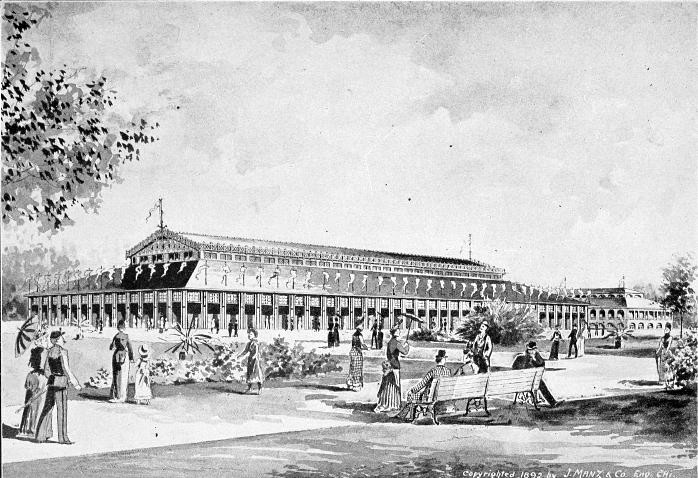
THE FORESTRY BUILDING.
The old man Marlowe and Susan take a seat on the great stone step,
close to the feet of the serene old woman. Marlowe looks into her
face.
Her lip quivered.
“You bought that cradle,” said she. “Were you ever here before?”
“Yes, many years ago. I used to know your father.”
“You did!—and my mother, too?”
“Yes; they were good people.”
“They are buried over there, under the savin-bushes,” said the old
woman. “I was rocked in that there cradle, and my twin brother, who
went out West. I wish that he could have had that cradle. I think
of him all the time of late. He and a little granddaughter are all
that’s left. The auctioneer spoke true—he did; there’s been many a
prayer made over that cradle, and now it is gone out of the family.
I’ve prayed that it might not be so. It will all be right by-and-by.
The Lord is tedious, but He’s sure. I almost lose my faith sometimes,
and I can hardly keep back my tears now. Why did you come here,
stranger?”
“To spend Thanksgiving. I used to live in this town.”
“Have you any relations here?”
“Yes, a sister. I came to visit her, and I want to buy some of the
old furniture; it looks so natural.”
“There’s to be no more Thanksgivings for me in this world. Stranger,
it does seem rather hard. I’ve always been industrious, and have done
my best. Stranger, it is hard when a poor lone woman like me, that
never did any one harm, can neither die nor live. Did you ever have
any trouble, stranger? You have? Then you do feel for me, don’t you?
The Lord forgive me!”
The voice of the auctioneer rang out, “How much am I offered?”
“Fifty cents,” says old Marlowe, looking at the two chairs as the
auctioneer held one up in either hand.
“Fifty cents for two family chairs for children at the table.
Oak—good as ever—fifty cents! Going, going, going, at fifty cents. Is
that all? Fifty cents? Do I hear sixty? Sixty—do I hear it? Going,
going; once—do I hear it? Twice—do I hear it? Three times—do I hear
it? Are you all done? Fifty cents. Sold to—What shall I call you,
stranger?”
“Cash,” said the old man.
“Cash again,” said the auctioneer.
The old woman touches Marlowe on the shoulder: “Have you any
children?”
“No, my good woman. Only my grandchild here.”
“What is her name?”
“Susan.”
“That is my name, stranger. My twin brother and I used to sit in
those chairs. I wish I were able to save some of these things for
him. It is hard, isn’t it, stranger? But you and I will never be
young again. The withered stalk never blooms any more. I’ve ’most got
through.”
She looked out over the sunny fields in the last glow of the
Indian-summer days.
“Stranger, you came home to spend Thanksgiving. I’ll have my next
Thanksgiving in a better world than this. I did hope to see my twin
brother once more, but that can never be. The sun that goes down will
find me a burden to the world. There’s the old clock; they’re going
to sell that, too. It struck on the day that I was born, and at all
the weddings and funerals and Thanksgiving days. Are you going to buy
that, too? I wish you would. I have a good feeling for you,—somehow
I’m drawn towards you. I feel as though you felt for me. I’ve wound
that clock myself nigh on to sixty years.”
“The old eight-day clock comes next. Many a day that clock has seen,
and it is good yet. How much am I offered for the old family clock?
Start it, some one. I’ll give five dollars for it myself.”
“Six,” said the old man on the door-step.
“Are you going to buy that, too?” said old Susan. “I’m proper glad to
hear ye bid on that. How many times I’ve heard it strike one at the
family funerals, and then seen the minister rise beside the coffin
and say, ‘Man that is born of a woman is of few days and full of
trouble.’ I used to hear it strike one at night, when I watched with
my twin brother Martin, who went West, in the weeks and weeks when
he laid between life and death with the typhus fever. I wish that he
could be here to-day.
“Stranger, do you know of what I’ve been thinkin’? Of course you
don’t. I’ve just been wishing like, dreaming like, that brother
Martin would come here, as you have come, and would bid off the old
farm, and that I might die here at last in peace—where they all
died. I’ve been dreamin’ just that dream. It comes to me. Oh, what a
Thanksgiving this old heart would have, could such a dream as that
come true!”
“Six dollars I am offered. Six, six, six. Going, going, going. Do I
hear seven?”
“Seven,” bid a neighbor.
“Seven—do I hear ten? Seven dollars am I offered. Yes, once eight,
and nine. Do I hear ten? Ten, ten, ten—do I hear it?”
“Ten,” said the old man on the step.
“Ten I am offered. Do I hear the twelve? Ten, ten, ten. Going,
going, going, at ten dollars. Once—do I hear it? Twice—do I hear it?
Third and last call. Going at ten dollars, to—”
“Cash,” said the old man.
“Stranger,” said the auctioneer, “what shall we do with these things
that you have bought?”
The crowd gathered densely about the door-step to hear the reply.
“You may leave them right where they are. I have a good use for them.”
The parlor looking-glass was next offered. The old man on the step
bought that also. Then the old empty parrot-cage, and he bought that.
“I’m glad that you have bought the lookin’-glass,” said old Susan.
“What if all the faces that have looked into it could appear again!
What if I could see there my father and mother young again—and
Martin! What does make me think so much of Martin of late? Seems as
though sometimes he was hoverin’ around me. There, they are going
to sell the Concord musket and the dinner-horn! How many times I’ve
blown that old horn just at twelve o’clock, to call the folks to
dinner! Martin learned me how to blow it when he was a boy. We used
to blow a sea-shell at first.”
The sale continued without any regard to the order of the value of
the articles,—the parlor furniture, old school-books and almanacs,
china and pewter mugs. The old man on the step bought them all.
Mysterious looks began to pass from one to another of the country
folks. Why was the quiet old man buying all those things? What was
he going to do with them? Would he buy the house and farm? Had he
any interest in the poor old woman who was watching him now with
straining nerves and intense interest?
After the sale of the furniture the auctioneer said: “We will next
offer the house and farm. The old woman will show you the deeds.
There is no encumbrance on the property. We will stop the sale for an
hour. Then you will be ready for the finish. Stranger, where shall we
put all these things that you have been buying?”
“I’ll tell you later; I’m not ready to answer yet. Never mind
me—don’t crowd around me, friends. I’m an honest man. Go and take
your lunches under the trees.”
There was a jingle of bells on the clear bright air. The bread-cart
man was coming. The people bought gingerbread and bunns, and lounged
under the cool trees in a spot of ground where stood a large and a
small grindstone, and overhead hung scythes and corn-knives. There
was a buzzing of voices, and talking in a suppressed tone, and great
inquiry about the stranger who simply called himself “Cash,” and who
was purchasing everything.
The old woman now tried to find out the secret of the stranger’s
interest in these things.
“You and I must be about the same age,” she said.
“Yes,” said the old man; “the same suns have lighted us both. They
used to tell a ghost-story about the chambers here. My girl has often
asked me about them. Did you ever see anything strange upstairs?”
“No; but I found, just before the auction, some papers hidden behind
a board. They read mighty curious, and were signed with what the
writing said was blood.”
“You don’t say?” said the old man, starting. “What were they?”
“It was a covenant that some one had made with the Lord. I think that
it was Martin’s. Seemed as though his father asked him to make it. It
promised many things. There was one thing in it that made me write to
him. Whoever made it promised to be faithful to me. The signature
was faded. It was made on the day that the writer was propounded for
church.”
Martin Marlowe’s face fell. Had he been true to that covenant that he
remembered so vividly?
“Say, stranger,” said old Susan, “I hope you will excuse me; but what
may your name be?”
“Never mind my family history now. I will tell you later more about
myself. What was the story about the haunted chamber? Tell it to my
girl here.”
“About Rachel, who raised red peppers, and used to appear with a
calash over her head?”
“Yes. That ghost was the terror of all the children and hired people.
Rachel was an old maiden lady. She used to have charge of the balm
bed, the sage bed, and the pepper bed, and the dried apples and red
peppers, and sold them to get money for the church and her clothes.
She ground the red peppers in the garret, and to keep the pepper
dust from burning out her eyes, she used a calash, which was a great
bonnet, with whalebone ribs, that stood up from the head all around
as though it were hung on the air, and over the calash she wore a
long green veil. She put over her body a long white nightgown; and
when we went up to the top of the garret stairs to see her pound, she
looked kind of awful and scary, like a picture in the old ‘Pilgrim’s
Progress.’ When I heard that she had come back to haunt the old
herb-room in the garret, and I pictured in my mind how she used
to look, it fairly made my flesh creep. Of all ghosts I wouldn’t
have liked to see old Rachel with her calash like a shay’s top and
her pound, pound, pound. She used to punish me when I was a boy by
snapping her thumb and finger on the top of my head. I remember it
all as though it were yesterday. I once went up to the herb-room to
get some—”
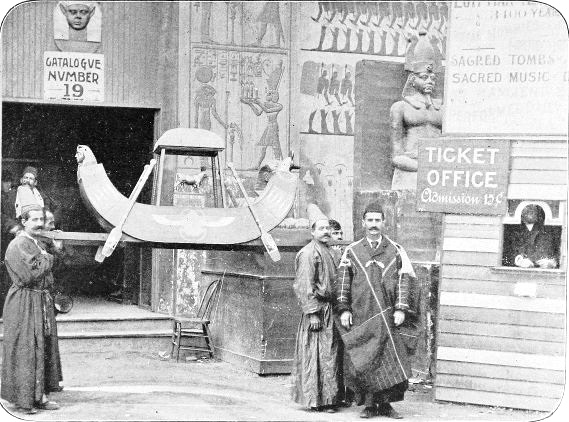
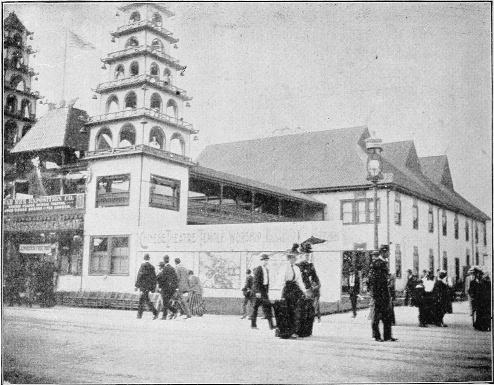
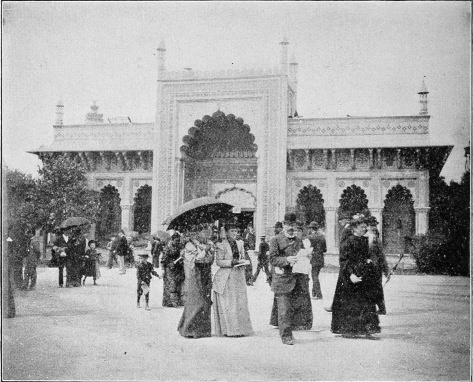
ENTRANCE TO EGYPTIAN THEATRE, STREET IN CAIRO.
“Not herbs, my good friend,” said Susan.
“No; some preserves or cake. They used to keep the goodies there,
and I had been going there pretty often in a quiet way, when I felt,
just as I was bending over the marmalade-jar, a snap on the top of my
head, and I looked up suddenly, and there was the most awful sight
that I ever saw,—old Rachael herself, in her white nightgown, calash,
and all. I scooted after the first glance, and rolled over and over
down the first flight of stairs, and leaped down the second. No barn
or chimney swift could have gone quicker. I didn’t sleep much for a
long time after that, and I never dared to tell the story, because
I was at the marmalade-jar when she appeared. I never told it to
anybody until after I went away.
“I used to lay awake until morning, and when I heard the wings of the
swallows in the chimney my heart would beat like a trip-hammer, for I
thought it was old Rachael and her pepper-mill. When the fowls crowed
for day I would feel safe again, for no ghost ever could appear after
the cock crew in the morning, so the old folks said. Susan, what do
you think that ghost was?”
“Oh, my good friend, how can I tell it now? I think—oh, I know it
was poor old grandmother! She scared Martin once in that way to keep
him—oh, how can I say it?—to keep him from getting at her plum-cake.”
“How do you know?”
“She told me so, and told me never to tell.”
The two looked at each other.
“That accounts for it. I always thought it was kind o’ strange that
they should have whalebone calashes in another world.”
“Stranger, how familiar you seem to be with this old place, the
swallows in the chimney and all! You say you used to know our folks.
Any relation?”
“I used to work for your father.”
“Did ye?”
The two looked at each other—after fifty years.
“Somehow I almost feel related,” said old Susan.
The shining hour of noon was now passed. The auctioneer rang his bell.
“Are you ready for the sale of the farm? Thirty acres and the house
and buildings. Clear deed. How much am I offered? Some one start the
farm. Been in the same family one hundred and thirty years. How much
am I offered?”
“Five hundred dollars,” said a well-to-do-looking farmer named Pool.
“Five hundred dollars. Do I hear the six? Five hundred dollars am I
offered. Do I hear the six? Five hundred dollars.”
“Six,” bid another.
“Seven,” another.
“Eight.”
“Nine.”
“Nine hundred dollars I am offered. Do I hear the thousand? Nine
hundred dollars. Nine, nine, nine. Going, going, nine hundred
dollars. One thousand—do I hear it? Nine hundred dollars. Are you all
done? Going, going—”
“One thousand dollars.”
The voice came from the old man on the step. Old Susan rocked
violently, and appeared greatly agitated. The people gathered in a
close mass around the door-step, all eyes fixed upon the venerable
stranger.
“One thousand dollars. Do I hear eleven hundred? One thousand dollars
am I offered. Going, going, going. Once, twice, third and last call,
going, going, going, for one thousand dollars. The hammer is about to
fall. One th-o-u-s-a-n-d dollars. Sold.”
There was a deep silence that followed the fall of the hammer.
“Gone,” said the old woman, and she threw her apron over her white
head and bent over, adding: “I am homeless now. I never thought to
see a day like this.”
“What is to be done with these things?” asked the auctioneer.
The old man rises. His girl stands up beside him.
“Susan,” said he.
Old Susan uncovered her pitiful face.
“Susan, what will you have done with these things? I have bought them
for you.”
Susan stops her rocking. She looks dazed. Her face is upturned, and
her blue eye looks piercingly into the eye of the tall old man.
“I would have you have them. You do pity me, don’t you? It will do me
good to think that you have them. You have spoken to me kindly.”
“The furniture shall all be brought back into the house again,” says
the quiet old man. “The cradle, clock, and looking-glass shall all be
placed where they were before.”
“To whom are the papers to be made out?” asks the auctioneer.
“My good friend, we shall need no new deeds. The old ones will do.
I used to know the family when I was a boy, and Susan’s father and
mother did much for me. To-morrow is Thanksgiving, and I shall spend
it here. I’m going to be good to Susan for the old folks’ sake.”
He bends over old Susan. She sits like one dead. He takes her
withered hand, stoops down and kisses her, and says,—
“I’ll let the place to her.”
There was a silence in the air that Indian-summer afternoon, and for
many minutes the silence was unbroken. A woodpecker tapped a hollow
tree at last, and a sea-bird on wide wings went screaming by.
“Let the place to me?” says old Susan. “Stranger, you are good, like
one sent forth out of the doors of heaven, but I have no money. I
must be plain, stranger. I have no money, and how are these old hands
to earn any? Look at them. Their work is done.”
She bends her gray head.
“Stranger, I want to say something to you in private. I have
something on my soul, and it troubles me. They have kept back a part
of the price.”
“What?”
“The neighbors, some of them, the Brewster boys, they’ve driven away
my Thanksgiving turkeys.”
“Why, my good woman?”
“So that the auctioneer should not sell them. The neighbors said
that my Thanksgiving turkeys should not be sold. Now that was kind
in ’em, wasn’t it? But it wasn’t quite right. I’ve always done just
the thing that I thought to be right. My motto has been, ‘I will be
what I ought to be.’ I’m poor, stranger, but, except the turkeys, my
conscience is clear. My folks were all good people, as you know, if
you used to work here when a boy, notwithstanding that grandmother
used to keep the children away from the herb-room with old Rachel’s
gown and calash. Now, stranger, what would you do? The folks here
wouldn’t like it if I were to tell the auctioneer; they’re too good
to me. But I must tell now; I must be honest, stranger. You are so
good to me. I don’t understand it. It is all a wonderment; but the
Lord will make it plain. Seems as though I was dreaming.”
She looks out over the hills, which are flaming with autumn glows.
She starts.
“Stranger, there’s one other thing that I want to tell you. There’s
another thing that I’ve kept back. But that is honest. My twin
brother Martin had a violin, and he left it here. I’ve felt that it
isn’t theirs; it’s his. He used to sing in the church over there. You
may see the steeple now. And he used to play on the violin.”
There was a new movement among the people in the yard. One of the
neighbors came up to the steps.
“It’s too bad, Susan; they’ve found those turkeys. The dog scented
’em out, and he’s driving ’em home. It is too bad; they might have
left ye a Thanksgiving dinner.”
There was great gobbling in the hillside pasture. A flock of
turkeys, one of which was white, was half running and half flying
towards the house, followed by the auctioneer’s dog. One of the
gobblers had lost his tail feathers, and he flew up in a zigzag way,
and alighted in a maple-tree. Another turkey followed him, flying
heavily and clumsily, and crying, almost like a human voice, “Quit!
quit!”
“Stranger,” said old Susan, “seems’s though that turkey spoke, as
Balaam’s turkey, if he had one, might have done. Stranger, I raised
them turkeys myself, and I hoped that I might have one myself; and
that perhaps—I dreamed of it, stranger—perhaps my twin brother
Martin, who went out West, might be here, and that we might have one
of them for Thanksgiving.”
“I’ll buy the turkeys for you.”
“You—well, you are proper good. But I don’t understand these things.
I’ve never been used to receiving anything from strangers, though the
neighbors have always been good to me. They tried not to have the
farm sold, but it was the law. Stranger, it had to be—it was the law.”
The auctioneer mounted the bench again, rang his bell, and swung his
hammer.
“There’s one thing we’ve overlooked. Hear, all! Here are the things
that everybody wants. Turkeys—to-morrow is Thanksgiving. A fine lot
of fat turkeys, and a white one. Just look at that fat old gobbler
up in that tree! One seldom sees a finer bird than that. And look at
that hen-turkey—”
“Quit! quit!” exclaimed the beautiful bird, in great astonishment, on
seeing all eyes turned towards her.
“That’s the mother turkey,” said old Susan. “She’s lost her family
before. She is a cosset turkey. I raised her in the chimney-corner.
She is used to coming into the house to be fed.”
“How much am I offered for this fine lot of turkeys? Just a dozen
of them. Twelve dollars. I am offered twelve dollars. Do I hear the
thirteen? Twelve dollars, twelve dollars. Thirteen—thirteen I am
offered. Thirteen—fourteen. Fifteen—do I hear it? Fourteen dollars.
Going, going, going. Once, do I hear it? Twice, do I hear it? Third
and last call—f-o-u-r-t-e-e-n dollars.”
He lifted his hammer.
“Fifteen.”
“Fifteen dollars—fifteen I am offered. Going, going, going, for
fifteen dollars. Are you all done? Going for fifteen dollars to—”
“Martin Marlowe,” said the old man in a firm voice.
He stood up and uncovered his white head. Old Susan’s form dropped
together as though she had been smitten. She buried her face in her
lap, and sobbed as she used to do in childhood.
The neighbors gather silently around the door-step, among the myrtles
and bouncing-bet. Some are whispering, some laughing, and a few are
crying.
“Susan,” says the old man, “get me my violin.”
The old woman sent for the instrument, and the old man saw that it
had not been wholly out of use. He tuned it, and lifted it into the
air. “Susan, we used to sing together in church, over there. What did
we use to say on Thanksgiving days?
“I remember, neighbors. I’m going to play that hymn. My voice is
almost gone, but I want you to sing it with me.”
He lifts the bow. “Tune—‘Hamburg.’”
The music floated out on the mellow autumn air, the violin playing as
in the old church days. Before the people ran the river to the sea.
The air was still; nature seemed listening.
“God is the Refuge of His saints
When storms of sharp distress invade;
Ere we can offer our complaints,
Behold Him present with His aid.
“Let mountains from their seats be hurled
Down to the deep and buried there,
Convulsions shake the solid world,
Our faith shall never yield to fear.
“Loud may the troubled ocean roar,
In sacred peace our souls abide,
While every nation, every shore,
Trembles and dreads the swelling tide.
“There is a stream whose gentle flow
Supplies the city of our God,
Life, love, and joy still gliding through,
And watering our divine abode.
“That sacred stream, thy Holy Word,
Our grief allays, our fear controls;
Sweet peace thy promises afford,
And give new strength to fainting souls.
“Zion enjoys her Monarch’s love,
Secure against a threatening hour;
Nor can her firm foundation move,
Built on His truth, and armed with power.”
“Now sing the Doxology!” He lifted his bow again. People turn aside
their faces to hide their tears. Then the strains of thanksgiving
rose up under the glimmering trees. And old Susan stood up and sung.
It is near sunset now. The red sky shines through the skeleton limbs
of the still trees. The crows are cawing afar over a dead corn-field.
The jaws are calling in the savin-bushes. Old Susan looks into her
brother’s face. She takes little Susan by the hand.
A bird comes flying through the air out of the woods and alights on
the top of an elm. It has a red breast, which shines in the sunset.
It lifts its brown wings joyfully and begins to sing.
It was the last song of the robin.[1]
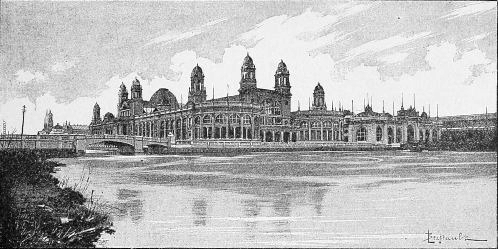
ELECTRICITY AND MINES BUILDINGS.
 SINGLE member of the Folk Lore Society was in Chicago at the opening
of the Exposition. He returned a few days after the event. It was one
of the plans of this Society to have its members give accounts of
the new places they visited, and a meeting was called on the return
of this fortunate member to hear him relate the story of the May Day
opening of the Fair.
SINGLE member of the Folk Lore Society was in Chicago at the opening
of the Exposition. He returned a few days after the event. It was one
of the plans of this Society to have its members give accounts of
the new places they visited, and a meeting was called on the return
of this fortunate member to hear him relate the story of the May Day
opening of the Fair.
The story[2] increased the interest among the members in Mr. Marlowe’s
visit. What suggestions might not Mr. Marlowe have to make?
It was almost twelve o’clock on the opening day of the World’s
Fair. President Cleveland was on the grand stand in front of the
Administration Building. The triumphant Columbian March had been
rendered by the great orchestra; the director-general had given
his admirable address; the ode and prophecy had been read, and the
President was making his brief speech of the opening hour.
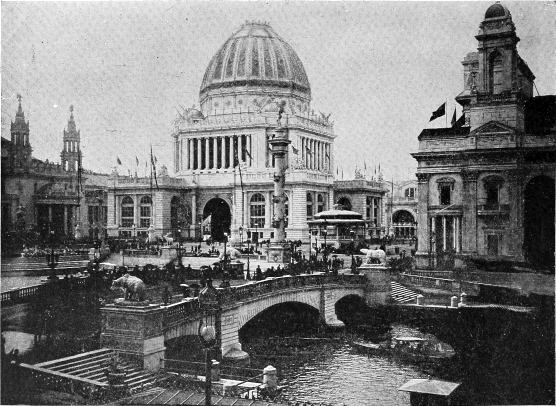
ADMINISTRATION BUILDING AND COURT OF HONOR.
“Look sharp! He will touch the button in a moment more! Watch for the
flags and the fountains!”
Massed before the platform, and extending away down the grand square
toward the Peristyle, still streaming in through the broad courts,
thronging the immense façades and capacious balconies of the mighty
buildings, and even perched by scores and by hundreds on the lofty
battlements and amidst the huge statuary groups of the roofs, were
wellnigh four hundred thousand people.
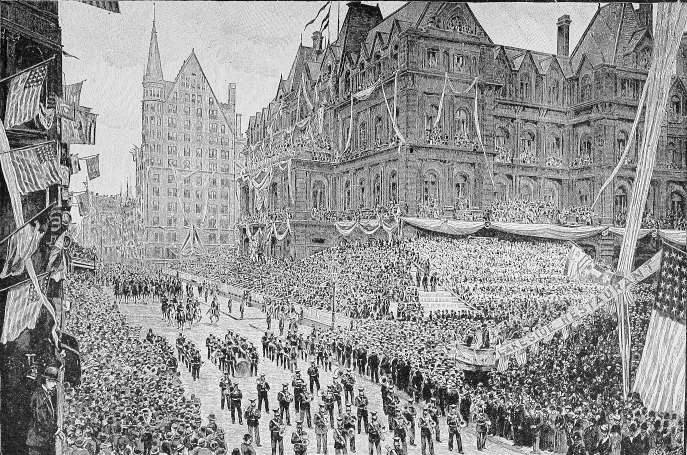
OPENING DAY PROCESSION.
It was a vast oceanic crowd, gathered from every land and nation of
the globe to celebrate the inaugural day of the Columbian Exposition.
Turks, Arabs, Singhalese, and Malays; Algerians, Dahometans, Coreans,
Samoans, Egyptians, and Eskimos, as well as
Japanese, French, Germans, Spaniards, and Russians, were represented
and mixed throughout that great throng, to which also were added a
hundred or more painted and feathered Sioux Indians.
These last, in fact, were the only true, original Americans present,
for in one sense all others are immigrants.
Although the preparations had been delayed by a long, cold, driving
rainstorm, word had gone abroad that on Monday, May first, the
World’s Fair would be opened, and foul weather did not keep the
people at home.
When the President arrived, shortly before eleven o’clock, the sun,
for the first time in several days, broke through the dark, low-lying
clouds; but trailing fogs still half veiled the domes, towers, and
finials of the gigantic buildings. Never, as it seemed to those
who have marked their progress toward completion, had these huge
structures looked so enormous, as now that their foundations were
encompassed and blackened by the innumerable multitudes, while their
domes and roofs were looming, half concealed, in the mist-clouds.
The magnitude of the grand square and the vastness of the assemblage
alike defied the power of the human voice to fill or reach. The
prayer and the ode were heard by but few. But the voice of the
President was stronger, and audible farther; and when, advancing,
amidst a tremendous outburst of cheers, he began his short address,
the opening sentence, admirable in its simple modesty, “I am here,
my fellow-citizens, to join in the congratulations which befit this
occasion,” penetrated to a greater distance, and stimulated remote
areas of the throng to try to approach nearer and hear more.
The pressure of these converging masses of humanity soon began to
be felt alarmingly by the central concourse, directly in front of
the platform. The lines of stalwart guards, although aided and
re-enforced by platoons of United States infantry, were powerless
to withstand this immense inward movement. Guards and soldiers
were pushed aside, and borne on by the resistless pressure. Their
brandished swords and shouts appeared not to be noticed or heeded;
and for a time it seemed as if hundreds, perhaps thousands, would be
borne down and crushed under foot.
Many women fainted, and were supported bodily by those near them; nor
could the Red Cross chairs gain access, for a time, to take them away
to the emergency hospitals.
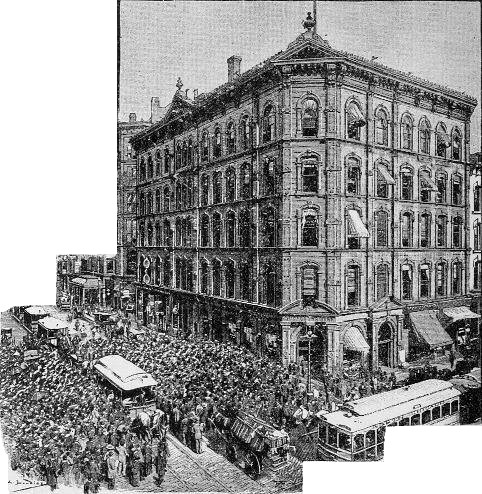
STREET SCENE,—OPENING DAY.
The crowd swayed to and fro, oscillating rhythmically, and displaying
within itself currents and counter-currents of human beings which
met and mutually checked each other. At last, as if from restored
equilibrium, the tumult ceased.
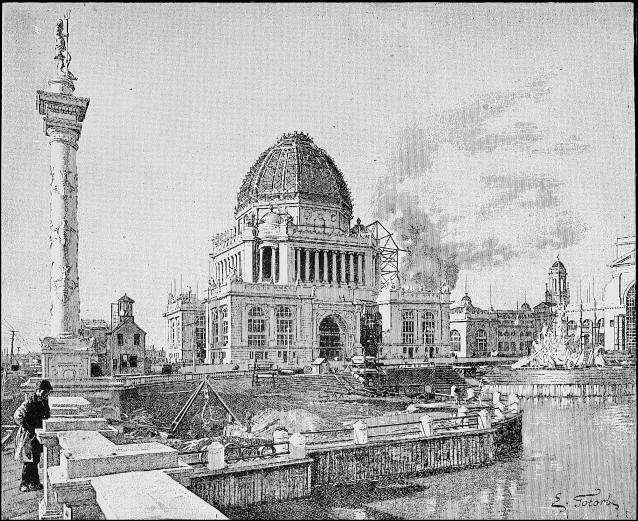
ADMINISTRATION BUILDING.
By good fortune no one had been seriously injured; but the spectacle
of resistless might, presented by this movement of three hundred
thousands of people, will not soon be forgotten by those who
witnessed it from the platform.
From here and there in the great tract of human heads and faces,
bursts of cheering rose at intervals, and were responded to from
opposite quarters; and it was amidst such scenes as these that the
President finished his speech and advanced to the little triple dais
of oak and velvet, draped with the national colors, and pressed the
electric key, or “button,” by means of which the great Allis engine
in Machinery Hall was set in motion.
The same key also gave the signal to all the flagmen, fountain-men,
cannoneers, and boatmen on the lagoons, to enact their parts in the
great programme of display.
But louder even than the artillery salutes and the shrieking of
steam whistles was the mighty roar of applause from the multitude.
It was, in truth, vox populi: the voice of the people in their
united might. Then for a few moments a kind of silence fell, and the
great sea of faces was seen to be rapt and intent on the brilliant
spectacle of the unfurling flags, and leaping white jets and
spray-bursts from the fountains.
On the instant, at the touch of the button, the great buildings
turned suddenly resplendent with gay colors: the flags, ensigns,
streamers, gonfalons, and emblems of all nations. In a moment the
stately “white city of palaces” had grown deliriously gay with bright
bunting; and on the lagoons swiftly propelled gondolas, in Venetian
red and blue, mingled with the even brighter-hued electric launches.
And over all—a curious, pleasing feature of the hour—wheeled hundreds
of white gulls, visitors from the great lake just outside, whose
peculiar wild cries blended with the human acclamations.
The President had spoken, and had opened the Exposition. The brief
ceremonies were over, and the mighty concourse in Administration
Square melted away, in streamlets and groups, for a day of
sight-seeing in the grounds.
Many made their way to the Manufactures Building, to behold the
largest edifice in the world, and also in the hope of gaining another
glimpse of the President and Cabinet, who were soon to proceed
thither in company with the Duke of Veragua, a direct descendant, in
the eleventh generation, of Christopher Columbus.
Almost as many more turned toward Machinery Hall, to see the huge
engines and dynamos which had been so recently set in motion. The
rest distributed themselves in many directions through the grounds.
Then indeed it was apparent that half a million of people may be
present at the Exposition without crowding or mutual inconvenience.
From many points of view, in fact, no one would now have suspected
that an unusual number of visitors were on the grounds. The great
squares, plazas, avenues, courts, and interspaces swallowed them up,
and if one may use the expression, gaped for more.
Eighty thousand may visit the Manufactures Building at one time.
Agricultural Building has room for thirty thousand, Machinery Hall
for as many more, and so on of all the other great structures. A
million of people may be present at the Fair on a single day without
serious obstruction to sight-seeing.
The four hundred thousand or more who attended the May-day opening
were a remarkably quiet and orderly assemblage. Very few dissensions
or disturbances of any kind occurred. Few rogues were present, so far
as known; if present, they contented themselves with sight-seeing.
But one pickpocket attempted to ply his vocation, and he was detected
in the act.
After the opening exercises, the great assemblage gave an observer
the impression of being unusually silent, as if awed by the grandeur
and magnitude of the buildings. On every hand people were seen to be
gazing in absorbed contemplation. Foreigners present remarked this
silence of the people with surprise, it was so unlike the vivacious
chatter of a European crowd. Americans are unemotional, irresponsive,
stupid, they exclaimed.
They failed to understand the American type of mind. Our people were
beholding, intelligently comparing, estimating, thinking; and one
who really thinks is not apt to chatter. These silent gazers were
taking in the height, breadth, beauty, and magnificent variety of the
great Exposition,—taking it in and storing it away for future use.
MACHINERY HALL.
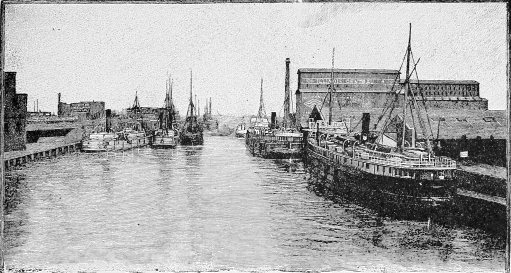
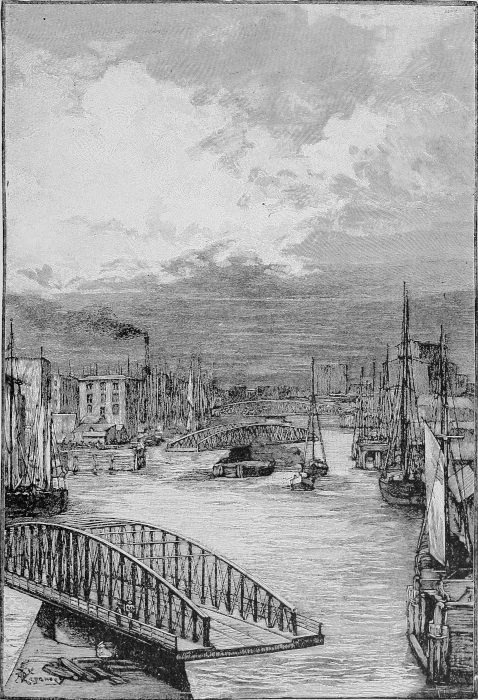
PORT OF CHICAGO.
 HE Folk-Lore Society which became a part of the Village Improvement
Society in West Roxbury, used to have Story-Telling Nights, and on
these occasions elderly people were invited to attend and relate old
village stories. The Folk-Lore story is a very interesting department
of Folk-Lore; and of all places in America, the towns that follow
the windings of the Charles River, are rich in quaint old tales. The
Brook Farm-House, now the German Orphan Asylum, sent into the world
a coterie of magic story-tellers. The old houses around the Dedham
Woods all have their legends. West Roxbury and the Newtons are haunted
places.
HE Folk-Lore Society which became a part of the Village Improvement
Society in West Roxbury, used to have Story-Telling Nights, and on
these occasions elderly people were invited to attend and relate old
village stories. The Folk-Lore story is a very interesting department
of Folk-Lore; and of all places in America, the towns that follow
the windings of the Charles River, are rich in quaint old tales. The
Brook Farm-House, now the German Orphan Asylum, sent into the world
a coterie of magic story-tellers. The old houses around the Dedham
Woods all have their legends. West Roxbury and the Newtons are haunted
places.
Among the popular subjects of this antique story-telling, are “The
Old New England Ghost Story,” and “Funny Tales of Old Independence
Days.”
There were several of these stories that were particularly popular.
One of them was the reading of that masterpiece of old wonder-books,
known as “The Devil and Tom Walker,” a warning to usurers,
speculators, and all over-reaching people.
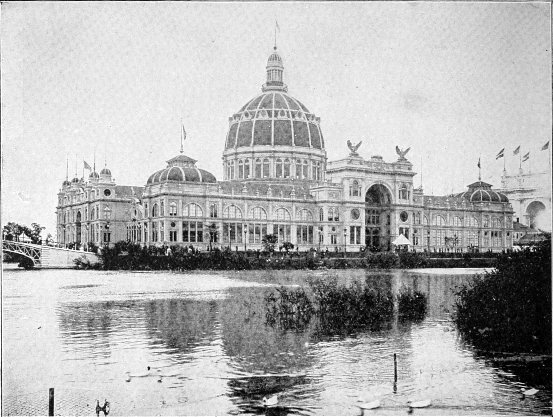
GOVERNMENT BUILDING.
Stories of “Lord Timothy Dexter” and old New England Ghost Stories
were among the interesting narratives that had entertained the
society. We give two of these,—
Blingo the Blacksmith, or Lord Timothy Dexter’s Poet
and The Darby Ring.
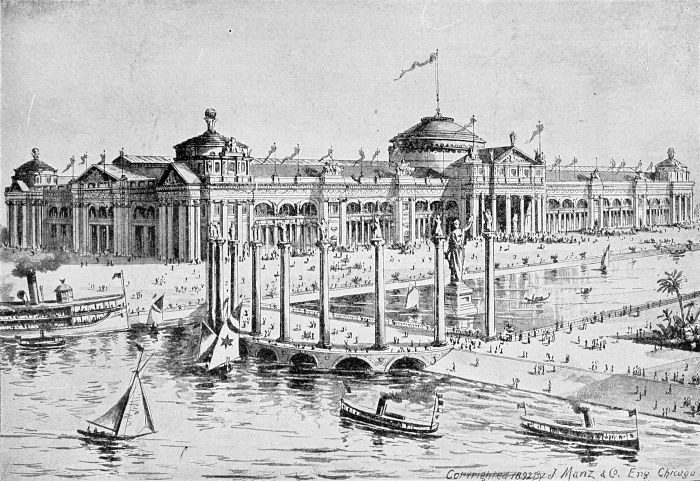
THE AGRICULTURAL BUILDING.
Tommy Topp sat sunning himself in the wide open door of Blingo’s
blacksmith shop, when a cloud of dust appeared in the highway; a
chariot presently broke into view from the dusty cloud, and four
black horses stopped under the golden elms that shaded a rustic
watering-trough near the rural smithy.
This was a strange event. People did not ride in “chariots” in
Massachusetts during the last century, as a rule, and never in a
chariot like this.
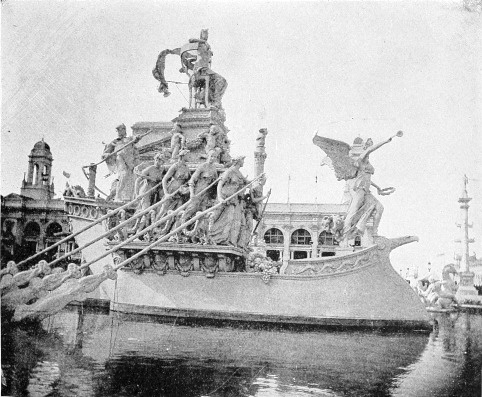
MACMONNIES (COLUMBIAN) FOUNTAIN.
The vehicle was not of the classic Roman pattern, such as swept
under the triumphal arches in the purple days of the emperors; nor,
indeed, a state coach like the disjointed affairs of the days of
good Queen Anne. But it was as lively and picturesque in color as a
band carriage of to-day, and it was ornamented with a very curious
coat-of-arms, the design of which was mysterious, and probably was
intended to be so.
Tommy Topp started up with eyes wide with wonder. Blingo dropped an
iron whiffle-tree that he was making, and ran to the door, shading
his eyes with his sooty hand.
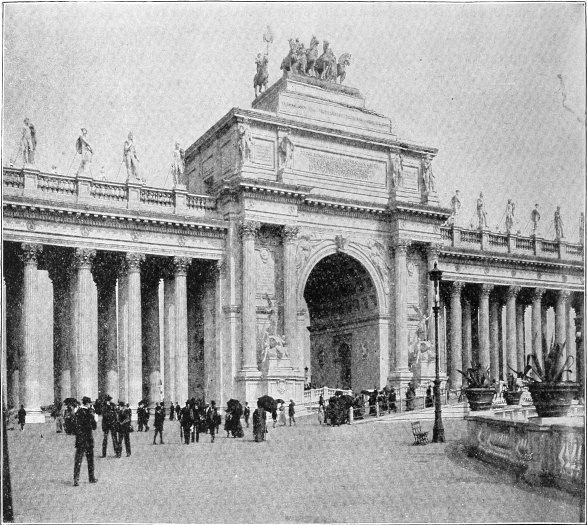
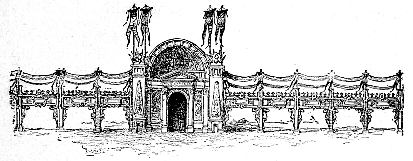
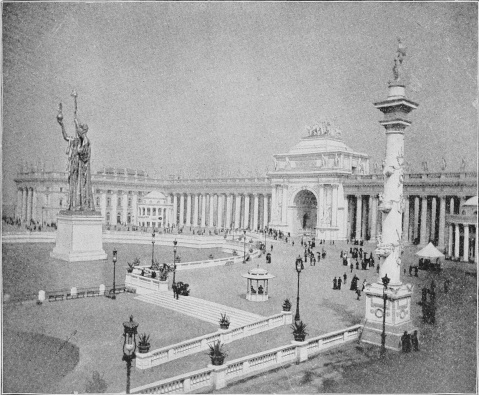
THE PERISTYLE.
The horses having drank at the watering-trough, the liveried
coachman, or charioteer, drove them toward the door, exclaiming,
“Whoa!” in an imperial tone, as a footman alighted, in a glory of
shining buttons.
The door of the chariot was opened, and another wonder appeared
in the shape of an old man in a cocked hat, cape-cloak, and
knee-buckles, carrying a gold-headed cane. He rose up from under a
kind of canopy, and said in a terrific tone:—
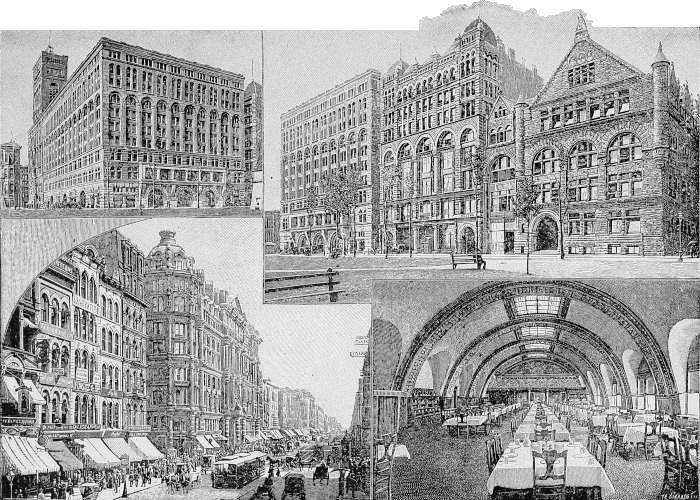
| PALMER HOUSE AND STATE STREET. |
AUDITORIUM DINING ROOM. |
CHICAGO HOTELS.
“Where’s the blacksmith?”
The word “where” rasped the very air.
“Ah, ah—I see,—Lord Dexter,” stammered Blingo. “You do me great
honor. How can I serve you? What can I do for you?”
The old man turned to his coachman, and said, laconically,—
“You talk with him.”
“One of the horses has cast a shoe,” said the coachman.
The blacksmith at once examined the foot of the horse,—a matter in
which Tommy Topp took little interest, as that was a common affair.
The boy’s eyes were riveted on the infirm but pompous old man, as he
hobbled about with the aid of his gold-headed cane.
The strange restlessness of his eyes would have excited the curiosity
of any one, and seemed to fascinate Tommy, whose life had been
uneventful, but who had a very lively imagination.
The old man took a few turns under the trees, through which the
sunlight was sifting that bright, mellow afternoon. Then he turned
suddenly and exclaimed in a tone of command,—
“Plummer, get out.”
Another marvel appeared, a marvel to Tommy, and a spectacle that
would have been equally exciting to almost any one outside of the
sea-town of Newburyport and its neighborhoods.
Out of a richly embroidered or figured robe rose a figure covered by
a cloak that was decorated with stars and fringes. It was a poet,—an
unusual curiosity, for poets were not common in those days. He, too,
had a cocked hat, large silver knee-buckles, and a gold-headed cane.
Tommy had heard of Jonathan Plummer, the former fish-peddler, who
had discovered that he could make rhymes, and had been appointed
laureate by “Lord” Timothy Dexter, whose château, with its remarkable
statues and gilded eagle, looked down from a high street on the
blue harbor of Newburyport. To Tommy, this transformation of a poor
fish-peddler into the poet of the self-created “lord” was one of the
most marvellous events since the days of which he had read in the
“Thousand and One Nights.”
The poems of Jonathan Plummer are still to be found in the quaint
lore of antiquarian societies, in whose safe deposits so much of the
world’s genius has to wait appreciation.
Who was this strange man, thus impatiently waiting for the shoeing of
his horse, who so greatly excited the curiosity of the Yankee boy?
A more picturesque answer cannot be given than that presented in the
words of Jonathan Plummer, the poet, quoted from a long poem which
relates his master’s history:—
“Lord Dexter is a man of fame;
Most celebrated is his name,
More precious far than gold that’s pure
Lord Dexter shines forevermore.”
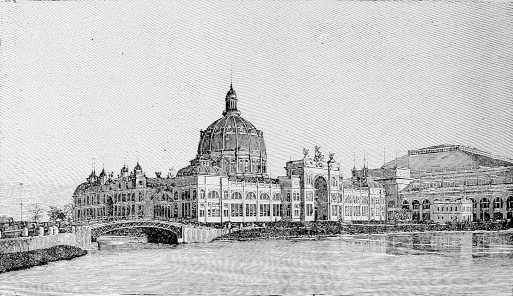
GOVERNMENT BUILDING.
It will be seen that the poet sometimes used imperfect rhymes.
“His house is white, and trimmed with green;
For many miles it may be seen.
It shines as bright as any star;
The fame of it has spread afar.
“Lord Dexter, like King Solomon,
Had gold and silver by the ton,
And bells to churches he hath given,
To worship the Great King of Heaven.”
The Arabian kings had their astrologers, and so had other kings in
the Middle Ages. “Lord” Dexter was as famous for his intimacy with
fortune-tellers as for his garden of statues of heroes, among which
his own effigy occupied two pedestals at Newburyport.
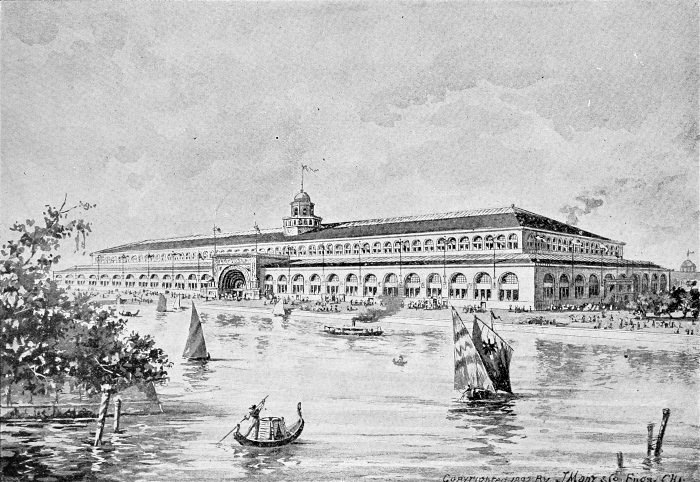
THE TRANSPORTATION BUILDING.
He was on the way to Lynn, when he drove up before Blingo’s door, to
visit “Moll” Pitcher, a woman who was reputed to have the gift of
second sight, and who “told fortunes by tea-cups.”
“Lord” Dexter, as he was called, but really Timothy Dexter, of
Newburyport, was a real and very famous character of the last
century. He was a mildly insane man, who had acquired a large fortune
by trading adventurously at sea. The grotesque fact of his sending
warming-pans to hot climates, and of the ship’s captain selling them
for ladles for molasses and returning with a fortune, was an old-time
wonder-tale, as well as the joke of his writing a book called “A
Pickle for the Knowing Ones,” and putting all the punctuation marks
on the last page, with the direction to the readers to “Pepper the
dish to suit themselves.”
His strange mansion and gardens and statues are still to be seen
pictured in old books, as is his own portrait in costume, with
embroidered vest, cocked hat, and laced trousers. There were many
stories of this eccentric man who so greatly enjoyed the fancy that
he was a lord.
Curious as is this history, well-known to the old New England
families, it is hardly more so than that of “Moll” Pitcher, who
figures in one of Whittier’s poems, and who was equally celebrated as
an odd character in New England a century ago, when trading by sea
was the principal business along the coast.
This strange woman seems to have been sincere in her belief that
she possessed the gift of “second sight,”—an hallucination that she
probably inherited from her grandfather, who thought that he was a
“wizard,” whatever that may have been.
The sailors went to consult her in regard to their voyages, and
crews sometimes refused to depart from port if her predictions were
unfavorable. She had a strong, masculine face, with something hidden
behind it; a rather kindly face withal, but self-conscious and keen.
Apart from her hallucination and its evil influences, she was a good
and self-respecting woman. The simple cottage where she lived was
visited for many years after her death, which occurred in 1813, by
collectors of traditions and folk-lore, and by nearly all strangers
who made a pilgrimage to Lynn.
Like Lord Dexter, this woman seems to have been mildly insane. The
two seemed to be confidential friends, and Dexter used to ride over
to Lynn to consult with her. He was reputed to have gained a part of
his wealth by the aid of her divining tea-cups.
Blingo soon shod the horse. The imaginary “lord” and his plebeian
poet entered the coach. The driver mounted his box, and the footman
his post. There was a crack of the whip, a rush of the startled black
horses, and a great cloud of dust rose again, as the grotesque
vehicle wheeled away under the glimmering autumn leaves, in the
direction of the blue capes of Lynn.
As it passed from the view of the humble smithy, Blingo the
blacksmith and Tommy Topp sat down beside each other in the open
door, and discussed the import of this curious event. The effect of
this harlequinade on the mind of the old blacksmith and the boy was
to make them ill at ease in their simple stations of life.
“This is a strange world,” said Blingo,—“a very strange, strange
world. Look at Timothy Dexter. He got rich by accident, and thinks
he’s a lord. Here I have to work hard all day in order to live, and
pay my honest debts, and then have nothing left for old age. That man
never worked as I work a day in his life. Now he’s going to see that
lying old fortune-teller. It’s all wrong, yet see how he prospers! I
declare I lose faith in everything.”
The sun was sinking over the autumn hills in mingled lustres
of vermilion and gold. The shadows were darkening in the woods
and orchards. Everywhere the crickets were chirping in the
fading grasses, and their lonesome notes only added to the honest
blacksmith’s dissatisfaction. There are times when even a true heart
becomes discouraged.
“Blingo!” said Tommy, “I’m thinkin’ that we might be rich.”
“Are you? I should like to know how?”
“We might get Moll Pitcher to tell our fortunes, as well as Lord
Dexter. I have been told something that I believe is true.”
“What’s that?”
“I’ve been told that there is a pot of gold hidden in the High Rock
of Lynn.”
“Who told you that?”
“Grandma Pennypacker.”
There was a thoughtful silence.
“Well, what if there is?” continued Blingo.
“I’ve a plan,” said Tommy, hesitatingly. “I’d like to go and ask Moll
Pitcher if she’ll tell me where the money-pot is hidden. And then if
she tells me we can go and dig it up, and you can have half of the
gold and I will have half. That will be fair. Everybody knows it’s
up there somewheres, but no one knows where. She only asks three
shillings to look into her tea-cup. And then—and then—perhaps we
might ride in a chariot and have a big house.”
There had been a legend for nearly a hundred years in Lynn that
certain pirates landed on the coast, and buried treasures at High
Rock or Dungeon Rock, two well-known places near the village. Three
of these men were captured and taken to England, but a third one,
Thomas Veale, continued to live there for many years, but, it is
supposed, was buried in the rocks by the earthquake of 1658.
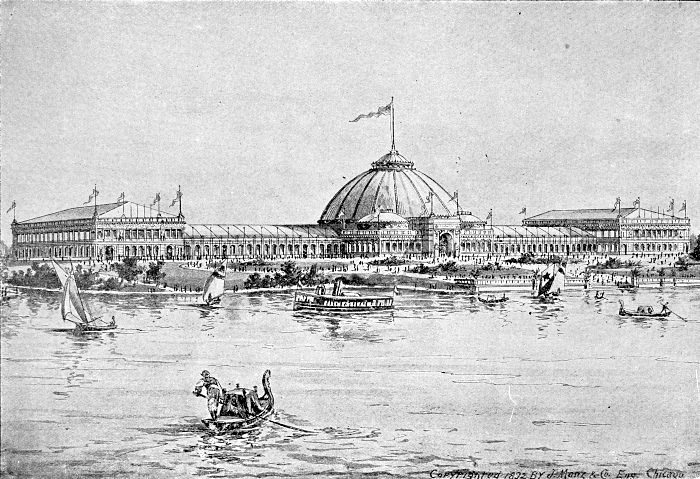
THE HORTICULTURAL BUILDING.
This legend, as is usual with legends, grew with years, and it is
still repeated in Lynn. It filled the popular fancy more than one
hundred years ago, and was especially vivid in Lord Timothy Dexter’s
day.
Visions of riches began to expand in the boy’s mind, and his mental
mood perceptibly affected the honest soul of Blingo.
“Think what we might do if we were only rich!” said the boy, with
eager eyes.
“I don’t know. I’m afraid we shouldn’t feel just honest as we do now,
if we had money that we had not earned ourselves, and that didn’t
belong to us,” said Blingo. “It’s a great thing to feel that one’s
honest.”
“But the money-pot don’t belong to anybody. It’s as much yours and
mine as any one’s. It belongs to the man that finds it.”
“Yes, yes; p’r’aps so; p’r’aps not; and p’r’aps I’d lose my own
respect if I was to let you go to a fortune-teller to find it.
Stands to reason that the Lord don’t reveal His secrets through Moll
Pitcher’s tea-cups; and if He don’t who does? That’s what I’d like
to know—who does? It’s the Evil One himself.”
The boy sat silent. The sounds around the farm-houses were echoed
here and there,—the dog’s bark and the chore-boy’s whistle. Now and
then a light gust of wind, like the passing of a messenger unseen,
shook down the yellow leaves, and left a rustling in the withered
trees.
Afar, a bell was ringing in a steeple of Lynn, and nearer there was a
rumble of cart-wheels laboring under a weight of corn.
“There is a great deal of comfort,” said Blingo, after this pause, as
if talking to himself, “there is a great deal of comfort to be taken
with money if it can be got honestly.”
“But I’ll go to the fortune-teller.”
“That wouldn’t help me inwardly. I’m afeard it wouldn’t be right for
me to allow you to do what I wouldn’t like to do myself, and I never
heard of any good that ever come from consulting tea-grounds. Still—”
and there was another pause—“Still, money would be handy with a wife
and seven children, and gray hairs comin’. Yes, it would.”
The word “still” settled the question with Tommy, and he started
up and walked away without another word. He had almost reached the
decision to pay a visit to the Lynn fortune-teller, after the example
of Lord Dexter. As he hurried home that wish was confirmed, and he
fell asleep in the attic to dream of fortune and fame, chariots and
poets, and a château overlooking the blue capes of the sea.
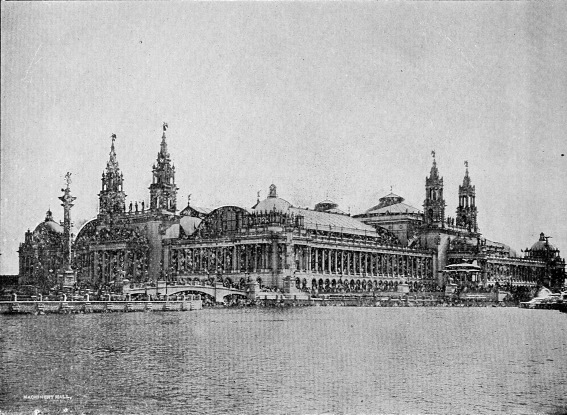
MACHINERY HALL.
The next morning Tommy arose, and after breakfast started in the
direction of Lynn. The first pause in his rapid journey he made at
Blingo’s smithy.
“Blingo, I’m goin’.”
“Do tell!” said Blingo, dropping his hammer. “Well, it may be right,
but I don’t feel quite right about it. Still, I would not fly into
the face of good fortune. Here, she’ll charge you three shillings for
lookin’ into the tea-cup, and I’ll pay my part. Here it is.”
Tommy took the money. Then his feet flew along the path by the
side of the turnpike. He did not stop again until he reached the
fortune-teller’s door.
The simple cottage of Moll Pitcher was gay with the last blossoms
of a morning-glory vine. Tommy paused to wonder a moment at the
pile of variegated bloom, when the small front door opened, and the
fortune-teller herself appeared, with an inquiring face.
“The frost has spoiled them,” said she, seeing Tommy looking at the
morning-glories. “They will all die in a few days; it is a pity.
Won’t you come in?”
Tommy entered the solitary cottage, and was shown a chair in a
simple, plain room.
“I’ve come to ask you about something,” he said. “I’m poor. We’re
all poor at home, and—and—I—I wish I had money. I’ve come to see if
you’ll help me to find some.”
“To find some? Mercy, child,—
“If I only knew, if I only knew,
What do you think that I would do?”
She sat down in a patched chair, and rocked to and fro.
“They say that you know everything,—all the secrets of the hidden
treasures, where the money-pots are, and all,” ventured Tommy.
She looked the lad sharply in the face with her keen eyes, then
smiled and said:—
“If I only knew, if I only knew,
What do you think that I would do?”
There was another silence, which Tommy ventured to break.
“Would you be willing to look into the tea-cup for me? I’ve brought
the pay with me.”
“What for?” asked the old woman.
“To tell me where the pirates hid the money-pot,” said Tommy, his
voice trembling.
“Mercy on ye, boy,—
“If I only knew, if I only knew,
What do you think that I would do?”
There was another long silence. Tommy was very nervous; he waited
until it seemed to him he could wait no longer, and then he asked,
faintly, “What would you do, if you only knew?”
She drew her chair near to him. “Listen. What would I do? I’d go and
get it for myself. Now you’d better go home, my lad. This is all I
can do for you this morning. Go to work and honestly earn your money.
There, don’t say that Moll Pitcher has not given you good advice, and
I won’t charge you anything for it.”
The disappointed boy dragged his feet back to the smithy over the
highways and byways during the long autumn afternoon, and sank
down at last on the doorsill of the shop, where the vision of Lord
Dexter’s magnificence had appeared to him.
Blingo came and leaned over him.
“Well, what did she tell you?”
“She couldn’t find it,” said Tommy.
“What did she say?”
“She only said if she knew where the money was, she’d get it
herself.”
When I was young, it was common to hear boys upon the skating ponds
speak of “cutting the Darby,” by which expression they were supposed
to indicate a swift ring movement upon the ice. The term, I believe,
is still used, although comparatively few people may be acquainted
with its origin. It came into use through a very singular occurrence,
which for a time was the one great local event of a considerable
farming and maritime region stretching along the northeastern shore
of Narragansett Bay.
In the summer of 1798, many respectable persons, whose homes were
in the pleasant towns of Bristol, Warren, and Barrington, R. I.,
together with some few in the neighboring communities of Swansea and
Rehoboth, Mass., were made the victims of a queer delusion.
A short time previous, a man named Darby, or Derby,—the first
being the form generally accepted by tradition,—had come to Warren
from some part of Connecticut, taken up his abode in the town, and
opened a school. As he was a person of pleasing address, he soon
became a decided favorite with the honest sea-captains and farmers,
who constituted the “solid men” of a population at once rural and
commercial.
A keen judge of human nature, he knew how to adapt his speech to
suit the character of the person whose sympathies he wished to
engage; while the fact that he was a schoolmaster made his utterances
oracular to a degree with a people to whom the “Columbiad” of good
Joel Barlow was the only known classic.
He was fond of conversing upon mineralogy; and thence gliding easily
into necromancy and kindred subjects, he would dwell upon the
possibility of unearthing buried treasure through the exercise of
some mysterious art akin to the supernatural.
With abundant citations and authorities at his tongue’s end, he would
call up the traditions of Kidd, Bellamy and other freebooters, and
show how probable it was that much of their ill-gotten gain remained
somewhere hidden about the New England shores.
In the course of a few months he had wormed himself into the
confidence of a number of sober and substantial people,—but he always
chose for his intimate friends those who had property.
The generation of our great-grandfathers must have been much more
credulous than our own, for it is agreed upon all sides that the
crafty adventurer met with no difficulty in obtaining converts to his
pretended golden views. His operations were systematized more and
more, till they extended from Warren to the neighboring towns, where
he readily found those who became eager to sit at the feet of one
possessed of so much mystic learning.
Thus the plans of the schemer progressed to his complete
satisfaction, until the “Darbyites” began to hold regular
night-gatherings with a view to a more complete organization, and for
the perfecting of certain necessary charms. It appears surprising
that in so short a time he should have been able to find so many
victims, all of excellent character and social position. Of course,
the “Nobodies,” as the uninvited were called, were not wanted,—and it
was this class which stood off and hooted at the “Somebodies.”
The impostor was not long in giving his adherents to understand
that nothing could be effected without money,—metal must be made to
attract metal; and, however close-fisted they may have been in the
ordinary affairs of life, the excited old farmers and shipmasters
contributed liberally of their substance to further Darby’s scheme.
Would they not be repaid a thousandfold when the treasures of the
“Adventure” galley, buried with many a charm by Kidd’s own hand,
should be given forth to the light of the moon?
Imagination must have wrought powerfully with them, giving their
plodding, everyday hearts for the time a kind of poetry. No doubt
they had wonderful dreams by night and day, and saw many a tempting
vision:
“Wedges of gold, great anchors, heaps of pearl;
Inestimable stones, unvalued jewels.”
And now came the placing of the famous “Darby Rings,” one of which
was situated near the main road between the villages of Warren and
Bristol, and another at Mount Hope, once the home of the great Indian
sachem, King Philip; while others still were, I believe, established.
The “Darby Ring” was merely a circle of some forty feet in diameter,
about which the treasure-seekers, in single file, would follow their
leader at a dog-trot, reciting some exceedingly silly jargon, and
at times pausing to perform such grotesque and childish acts as
at a more rational moment would have disgusted them. A part of my
childhood was passed on the premises which embraced one of these; and
although nearly forty years had then gone by since the feet of the
Darbyites had paced its magic round, there were still visible some
faint traces of what had been. The earth was a little depressed, and
the outer edge of the circle showed something like a ridge.
It was in the southeast corner of an orchard; and, no doubt the soft,
golden buttercups sprang there in Darby’s time, as they did when we
children played about the spot years and years after.
The excitement was now at its height. Nothing was thought of among
the dancing, prancing treasure-hunters but Kidd, with his black flag
and his kegs of broad doubloons. With wild enthusiasm they recited
the lines of the old doggerel, wherein he recounts his fortune:—
“I had ninety bars of gold,
As I sailed, as I sailed;
I had ninety bars of gold,
As I sailed;
I had ninety bars of gold,
And dollars manifold,
And riches uncontrolled,
As I sailed.”
At each nightly meeting they were required to carry in their hands
sticks of witch-hazel, which were supposed to possess the power of
enabling their holders to detect the presence of buried treasure.
Thus each devotee had his little rod, carefully cut and trimmed in
some deep old swamp, where he had sought it out with a seriousness
and intentness of purpose that one smiles to think upon.
How they must have looked capering about the ring, each with his
stick of witch-hazel!—not boys, but men,—grave, practical old
fellows, some of whom had, perhaps, that very afternoon been hoeing
corn in their own broad fields, and others taking account of cargoes
of molasses and sugar at the village wharves.
That there might be no disposition to waver in the ranks, it was
Darby’s custom to cheer his retainers with encouraging words; and his
smooth and confident tones were as reassuring to them as the “honk”
of the leading gander to a flock of wild geese.
“Only be true to me,” he would say, “and I will get the money,”—a
remark of which they saw the significance a great deal better
afterwards than they did at the time.
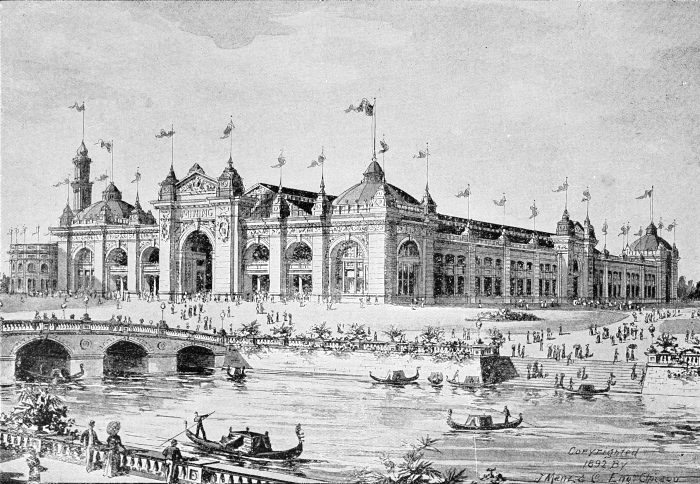
MINES AND MINING BUILDING.
Their case illustrated the homely aphorism that “they who dance must
pay the fiddler.”
They were subjected among other things to a constant expenditure for
a certain wonderful kind of sand, costing sixteen dollars an ounce,
which was indispensable to the success of Darby’s magic, and which he
alone could procure. It was this which was to unlock the secret of
the old-time buccaneer.
Again and again the supply was exhausted, only to be again and again
renewed; until it must have seemed, even to those patient trotters
about the ring, that the spirit who guarded the pirate’s gold could
be nothing short of sand-proof!
In the centre of the circle there was a hole several feet deep, into
which the schoolmaster magician and his followers would successively
pour small quantities of the precious material, during the intervals
of their antics.
A sight more unique than that of these decent, well-meaning
gentlemen, trotting about the enchanted ring, under the shadow of the
apple-trees, it would not be easy to imagine. Some of them were fat
and duck-legged, others tall and lean; but each one kept his pace
with tolerable accuracy to the music of the Darby chant.
The inexpressibly comic feature of the case was the entire
respectability of the actors in this strange scene. They were
householders, owners of broad farms and tall ships. Yet trot, trot,
trot, they went, around and around, like so many mad dogs, in that
old Bristol Neck orchard! They were required, upon going home, to
write some strange characters with onion juice upon bits of paper,
which were to be carefully placed under their pillows as assistants
to divination. The characters were, of course, invisible, but this
did not affect their potency.
A paper called the “Herald of the United States” was at the time
published in Warren, and in its issue of August 25, 1798, we find
a communication written while the Darby affair was in full blast,
describing many of the performances, and expressing great disgust at
the silliness of the delusion. From this it appears that not all our
great-grandsires were trotters or prancers, but that some of them
looked upon the matter very much as we should do to-day.
At last, even the credulous victims themselves began to lose
patience, and whispers of discontent were passed from mouth to mouth.
It was the beginning of one of those revolutions which never go
backwards. It was discovered that the magic sand was obtained from
Connecticut, and two trusty members of the circle were appointed to
visit that State, for the purpose of gathering further information
with regard to the mysterious mineral, which, to eyes in some
measure disenchanted, had already begun to assume a woefully common
appearance.
The result of their mission was a complete exposure of the fraud.
With but little difficulty they obtained an interview with the
very person by whom the sand had been furnished, but who, however,
disclaimed all knowledge of Darby’s scheme. As to the magic article
itself, they discovered it to be the common burden of the seashore
in the neighborhood of New London, although of a more silvery hue
than the sand of the Narragansett shore,—a difference which the
wily impostor had turned to account through the simplicity of his
followers.
And now arose the question as to what should be done with the
recreant magician. Surrounded by his enraged dupes, he was still more
than a match for them in subtlety of tongue.
“I never told you that you would get anything,” he said. “What I
did tell was, that if you would only be true to me, I should get
the money, and so I should have done!”
We have thus far followed and quoted our friend Coomer’s historical
narrative, as it appeared in a popular paper. Mr. Coomer, an excellent
poet and writer of sea-stories, lives on the borders of the Mt. Hope
Lands, near the boundary-line between the towns of Warren and Bristol,
and quite near the place where these strange events occurred. The high
lands near to his home, overlooking the Mt. Hope and Narragansett
Bays, are full of haunting traditions. They are best visited from the
ancient highway between the two towns, now known as the Back Road. The
Rhode Island Soldiers’ Home is on this beautiful elevation, and the
outlook from it commands the most picturesque waters in New England.
The Kickemuit River is particularly beautiful, seen from these flowery
and orchard-shaded highlands on a mid-summer day. One of Massasoit’s
Springs was on this river, and the great legend of the Northmen is
connected with the Mt. Hope Bay. We will give this legend later in
verse. A ride of a few miles, out of Bristol or Warren, would enable
the visitor to Rhode Island to view from these Back Road farms,
or from Mt. Hope, the old Pokonoket country, which has the oldest
traditional history in America. Here it is supposed that the Northmen
landed, and here certainly is the ancient burying-grounds of the
Indian race. Near Massasoit Spring in Warren, R. I., Roger Williams
spent the famous winter of his exile, intent on the problems of soul
freedom, and the separation of church and state. King Philip must have
been a boy then. It is proposed to erect a memorial of Massasoit at
this spring.
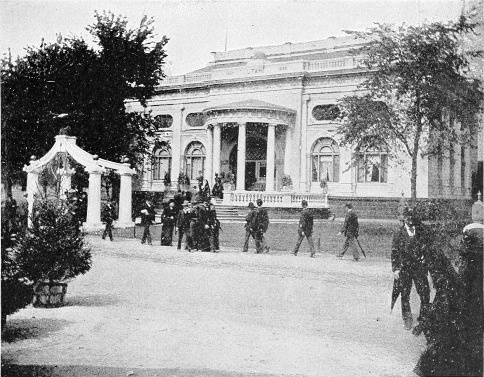
UTAH STATE BUILDING.
A very curious legend is associated with the Darby episode. We do not
know how well it is founded, but we give it here:—
The men whom he had deceived tarred and feathered him. In this
disgraceful garment of woe, looking like a gigantic half-plucked bird,
he ran away, and found shelter for the night in the cellar of one of
the quiet farmsteads.
The next morning the good woman of the house had occasion to go down
into the cellar. Her soap barrel, pork barrels, and probably cider
barrels were there.
A dark place is an old-time New England cellar,—dark and damp, with an
earthy smell. Lights burned low there.
Our good woman probably passed around the foundation walls of the
great chimney, where was a flue for ashes, passed the potato-bins and
turnip covers, and, with peering eyes, looked down on one of the many
platforms for barrels.
Cellars were haunted places. There was an awful story of a woman who
murdered her husband, and hid his body under the ash barrel, that had
taken hold of popular imagination in those revengeful times, and most
people thought of it as they made their uncertain ways around the
cellars. It was all poky and still, grewsome and tomb-like.
Our good woman heard a noise. That was not strange. Cats and rats
dwelt in the cellar, and the latter came out of their hiding-places
when the former were not at home.
She was ill prepared for what followed.
There arose up before her an awful object. Whatever ghost-stories she
may have heard by kitchen fires in the long evenings, she had never
had any account of anything like this.
Its body was like that of Apollyon, as represented in the
never-to-be-forgotten picture in the “Pilgrim’s Progress.” But it wore
the feathers of a goose.
Erupit! evasit! Our good woman ascended the cellar stairs with a
celerity that spoke well for the power of latent nervous force. The
dreadful figure followed her, begging for mercy, and confessing that
he was Darby the Impostor. The poor woman supplied his wants, and
probably provided him with a suit of clothes, when he disappeared from
society forever.
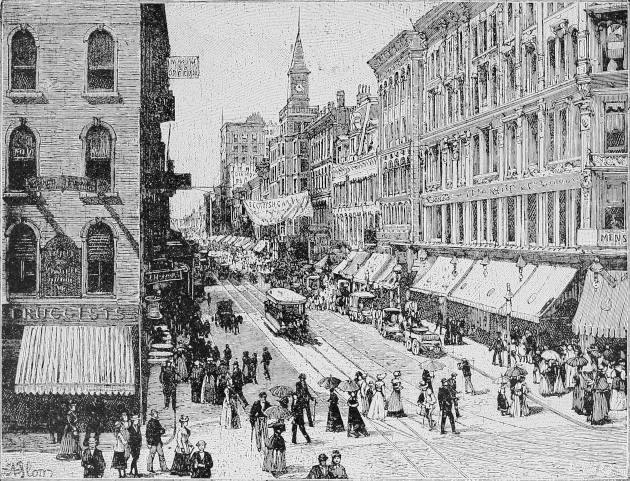
MADISON STREET.
THE LAKE FRONT.
 UT of this legendary and story-telling atmosphere, the three Marlowes
passed through the country in beautiful June, and found themselves,
in the longest days of the year, in that wonder-city of the new
world,—Chicago.
UT of this legendary and story-telling atmosphere, the three Marlowes
passed through the country in beautiful June, and found themselves,
in the longest days of the year, in that wonder-city of the new
world,—Chicago.
“The first story that we will have to hear,” said Mr. Marlowe, “will
be that of the Fair itself.”
If ever there was a man with the heart and intelligence to welcome
the world, it is Judge Bonney, whose generous spirit and hearty
words millions of people will remember. As the leading mind of
the Exposition’s Auxiliary Congresses, as many as possible of the
delegates to the many Congresses met him, and the questions which he
answered in the Art Palace in Chicago, would have filled many Bibles.
We hope that he took a long rest after the close of the Exposition,
for no man ever better earned such a right.
With a patience that was beautiful, and ought to serve as a national
lesson, he met every one courteously, and every last person that met
him felt that he had found a friend, and left him rejoicing that the
newly-collected world was so friendly in its representative. His
intelligence was equal to his courtesy, and his tact to both. The
people all have good wishes forever for Judge Bonney.
Our trio had been told to report to Judge Bonney. They found him at
his desk in the Art Palace in the city, and one look from him assured
them that they were expected.
“Judge,” said Ephraim the elder, “I have called with my son here, who
is a delegate to the Folk-Lore Congress. There are a few things about
the Fair that I would like to know.”
“I shall be most happy to give you any information that I have, my
friend. Sit down, sit down.” We give the judge’s answers from a
general memory of like scenes.
“I thank thee, friend Bonney.”
“I see that you are a Quaker,” said Judge Bonney. “There are several
people here already who are interested in the Folk-Lore Congress.
I will see that you are introduced to them. What are some of the
questions which you wish to ask?”
“Well, friend Bonney, what is the history of this great Fair? How did
it originate?”
“In the minds of many, who agreed to act as one,” we may imagine
the answer to have been. We shall speak of this topic again. We are
inclined to the belief that the secret of the success of the Fair may
be found in the fact of this supposed answer.
“By whom was Chicago selected as the site of the Fair?”
“This city was selected as the site of the Fair by vote of the
National House of Representatives, February 24, 1890.”
“What other cities were voted upon?”
“New York, St. Louis, and Washington.”
“When did Congress authorize the Fair?”
“The Act of Congress authorizing the Fair was approved April 25,
1890. This was followed by the President’s Proclamation, inviting
all nations to participate, which was issued December 24, 1890. The
World’s Fair Grounds were dedicated October 21, 1892. Preceding the
opening of the Fair, May 1, 1893, was the grand Naval Review in New
York Harbor, April 26, 27, 28, 1893.”
“How about the appropriations, friend Bonney? Where did the money
come from?”
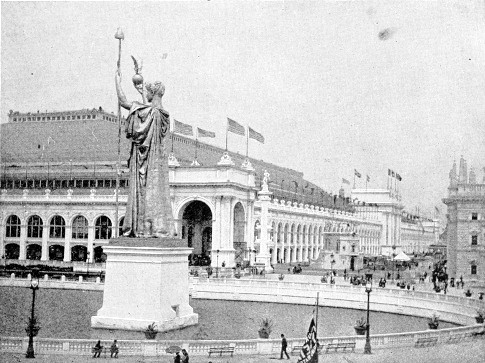
STATUE OF THE REPUBLIC AND MANUFACTURES BUILDING.
“From various sources. The States and territories appropriated nearly
$5,000,000, and foreign countries nearly $6,000,000. The capital
stock amounts to $5,000,000, the City of Chicago Bonds to $5,000,000,
the Souvenir half-dollars (appropriated by Congress), to $2,500,000,
and the Debenture Bonds to $4,000,000.”
“What is the total value of the exhibits?”
“It is estimated to be $300,000,000.”
“What will the Fair cost?”
“The total estimated expense is $21,250,000.”
“How many visitors are expected?”
“It is expected that there will be about 20,000,000 visitors.”
“The gate receipts from them would amount to $10,000,000. How much
ground does the Fair cover?”
“The total number of acres in the Exposition Grounds is 633, of which
Jackson Park occupies 553 acres, the Midway Plaisance, 80, the space
available for buildings, 556, and the Interior Waterways (61 acres)
and Wooded Island, 77.”
“Now I wish to know something about the size of the different
buildings. Which is the largest one?”
“The Manufactures Building is the largest. It is 1,687 feet long, and
787 feet wide, covering 44 acres of floor. Its cost was $1,600,750.
Of the other buildings, the Stock Sheds cover 25 acres, the Machinery
Building and Annex, 23.2 acres, the Agricultural Building and Annex,
19 acres, the Transportation Building, 17.9 acres, the Electricity
Building, 9.3 acres, the Building of Mines, 8.5 acres, and the
Building of Horticulture, 8 acres. The total number of acres covered
by buildings is 240.”
“How much did they cost, Judge Bonney?”
“Twelve million two hundred and sixty-seven thousand dollars.”
“How many other World’s Fairs have been held, and where?”
“Between the years 1851 and 1889, eight World’s Fairs were held,—two
of them in London, four in Paris, one in Vienna, and one in
Philadelphia.”
“How does the size of the grounds here compare with those of the
other World’s Fairs, Judge Bonney?”
“Of the previous World’s Fairs, that of Paris in 1889 covered the
largest area—200 acres—which is not quite one third the size of this.”
“How many visitors had that Fair?”
“Twenty-eight million, one hundred and forty-nine thousand, three
hundred and fifty-three.”
“Now, Judge Bonney, tell me about the World’s Fair Auxiliary and
its Congresses, of which you are the representative. When do the
Congresses meet, and where?”
“There are nineteen Departments of the Congresses of the World Fair
Auxiliary. Each lasts usually a week. In May we held the Congress
of Woman’s Progress, Public Press, and Medicine; in June, will be
those of Temperance, Moral and Social Reform, and Commerce and
Finance; in July, of Music, Literature, Education, Engineering, and
Art; in August, of Government, Science and Philosophy, and Labor;
in September, of the Departments of Religion; and in October, the
closing month of the Fair, those of Sunday Rest, Public Health, and
Agriculture.”
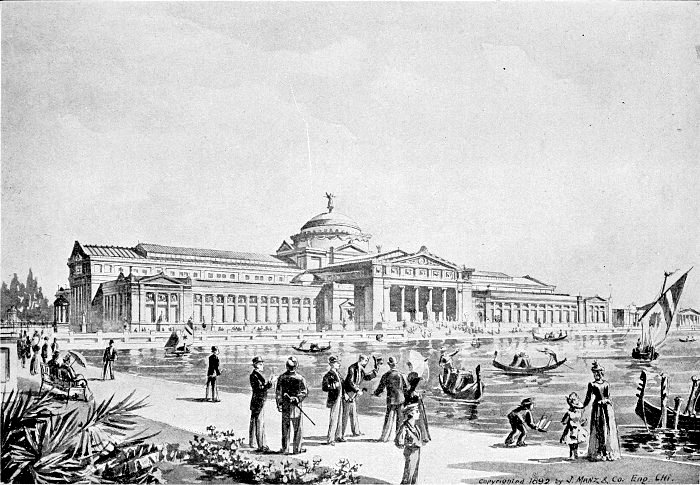
THE ART PALACE.
The good judge took the trio into the Hall of Columbus and the Hall
of
Washington, and the various art rooms in the Palace where the
Congresses were to meet. The engines shrieked as they passed the
sunny windows, and the blue lake rolled afar as in fathomless
distance. The world seemed on the march in the great avenues below
the balconies. Near by rose the Great Auditorium, and near it a
colossal bridge led the way to the steamers and cars.
How bright and happy the world looked from the open windows of the
smoke-colored Art Palace. As they passed one of those windows, the
White City some miles distant, gleamed afar over the blue lake like
a radiant vision. Constantinople from the Golden Horn was not as
celestial and beautiful.
“White, Judge Bonney,” said old Ephraim.
“Yes, my friend, it is built of Staff.”
“Judge Bonney, what is Staff?”
“Staff is a mixture of plaster—often called plaster of Paris—and a
small per cent of cement, into which are introduced frequent fibres
of hemp, jute, or Sisal grass, to give it toughness, so that it may
be bent, sawn, nailed, or bored, at will.”
“How is it cast?”
“It is cast in moulds. The plaster and cement are first wet up to
the consistency of thick treacle, a layer of which is spread on
the well-lubricated mould. Then follows a layer of the long, tough
fibres; over this is poured another coating of the liquid plaster,
covering in the fibre and filling the mould to the required depth.”
“Are there many moulds?”
“Yes, there are a thousand or more of different patterns and sizes,
from those for casting plain staff-board for walls, to those for the
most complex, beautiful, or fantastic ornamentation.”
“Are statues ever made of it?”
“Yes, both statues and statuary groups. The moulds are first
fashioned in clay, then coated with staff.”
“How long does it take to make it ready for use?”
“Oh, in the course of half an hour the composition hardens
sufficiently to be handled and taken away to the buildings in process
of construction.”
“How long will it last?”
“If kept painted, it will withstand the weather for a number of
years. If it cracks or crumbles off, it can readily be repaired with
a brush or trowel, from a tub of the liquid mixture. It is fireproof,
and, to a great degree, waterproof.”
“They say, Judge Bonney, that there is a sidewalk there that goes all
by itself. Is that so? Tell us all about it.”
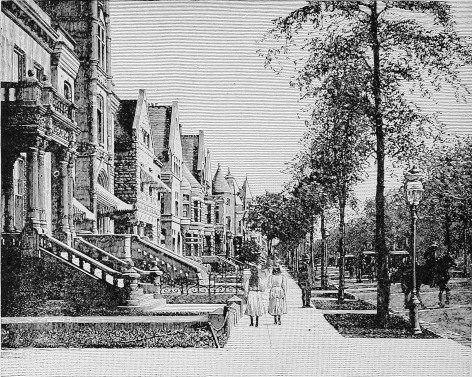
MICHIGAN AVENUE.
“The Multiple Speed Sidewalk is also called the Travelling
Sidewalk, or the Locomotive Sidewalk. It is a mechanical device for
facilitating travel on the long pier—nearly one half a mile long and
two hundred and fifty feet wide—near the Peristyle, thus enabling the
tourist to make the trip over the pier in ease and comfort, refreshed
by the lake breeze. The sidewalk, which traverses the entire length
of the pier on one side, returns on the other, making a loop at
each end. It is on low wheels. There are two parallel sections,
or platforms, one moving at a rate of three miles an hour, about
ordinary walking speed, and the other at six miles an hour, an easy
driving rate. One may ride on either section.”
The Judge led the trio back to his room. It was crowded with people
seeking information.
“I am obliged to you, Judge Bonney, for those bits of information.
But what are these few things that I have learned to a Fair like
that? I’ll call again, Judge Bonney, and give you a chance to tell
us some more. ’Tisn’t often that I find a man so well stocked with
information about the world.”
Judge Bonney did not look tired. With a serene face he met the crowd
awaiting him, many of whom would ask him these questions over again.
Our fancied interview is but a picture of the Judge’s work for nearly
a year.
The Marlowes, under the influence of the officers of the World’s
Auxiliary, who invited them to a literary reception soon after their
arrival, arranged to spend their home-life in Chicago with Mr. and
Mrs. Edmand, who led a Folk-Lore Society which met at their home
on Michigan Avenue. The Edmands family were from New England, and
had known the Marlowes by reputation, and received them as their
guests. It was agreed between the Edmands and their guests that the
Folk-Lore Society should meet every Saturday evening, and that, on
these occasions, the Marlowes should relate as a part of the exercises
Folk-Lore stories.
The first of these stories that was told at the Saturday evening
meetings was “Miraculous Susan of Quaker Hill.” It was told by
Grandfather Marlowe, and we shall give it in its place. Another of
these stories was “Hannah, Who Sang Countre.” It was told by Mr.
Marlowe, who illustrated it by singing old-time tunes. This we shall
also give in an interval between the sight-seeing at the Fair.
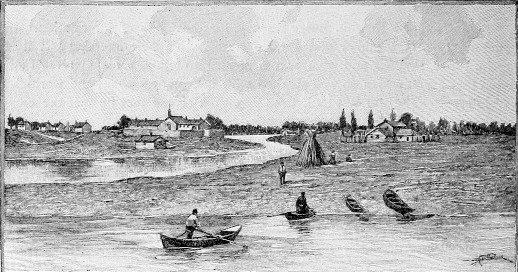
CHICAGO IN 1830.
HE first purpose of our tourists was to see Chicago, the wonder of
the West.
They began at the Art Palace, where the statue of La Salle met
their view on the boulevard, bringing to mind those December days
of 1681, when the bold explorer coasted along the southern shore of
Lake Michigan, and ascended the Chicago River, on his way to the
Mississippi. Did he dream on that day that he entered the Chicago that
the live city of the West would be there?
There were great arches of bridges between the statue and the Art
Palace, and all the world seemed passing to the railroad and the
boats. The Lake rolled in splendor before the towering buildings, but
everything, the Art Palace included, seemed discolored with smoke. The
doors of the great Art Palace stood open, as it were, to
receive the homeless multitudes, coming from everywhere. It was the
hospitable door of Chicago.
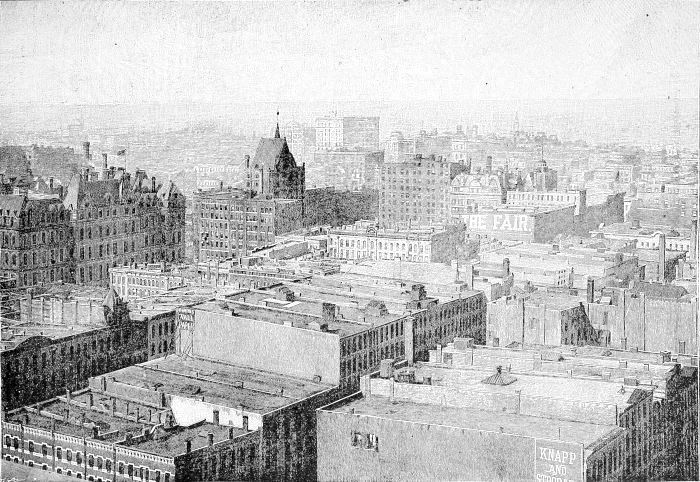
CHICAGO FROM THE AUDITORIUM.
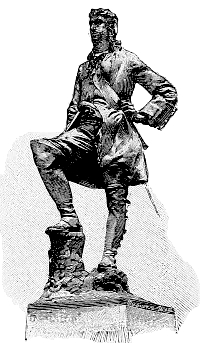
LA SALLE.
It was a short walk from the Art Palace to the Auditorium Building,
which is a grand hotel and a theatre, and whose corridors might have
been halls of the Pharaohs, they are so dazzling, airy, and beautiful.
Every one here seemed to be in a hurry. If each one’s life were to be
fated to end with the day, no one could be more in a hurry. Yet every
one looked happy; it was not an anxious hurry, but an inspired hurry.
New York is slow and Boston slower, but here is the clock of destiny,
and one must do, ere it strike. The Chicagoan loves Chicago, and
resolves to make it the grandest city in the world.
The dream is likely to be fulfilled. Our good Quaker friend said to a
boy in the pillared waiting-room of the Auditorium:
“My boy, how many miles is it to Boston?”
The boy gave a lightning glance, gathered up his mouth for one long
breath, and answered:—
“Thirty-two hours from Boston (1150 miles); twenty-nine hours from
Montreal; twenty-six hours from New York; twenty-four hours from
Philadelphia; twenty-six hours from Washington; three and a half days
from San Francisco; five days from the City of Mexico; nine days from
Queenstown; ten days from Paris; fifteen days from Rome, and sixteen
from St. Petersburg. Are there any other places that you would like to
inquire about?”
“The land of the ocean! No, not now. You seem to know all about the
world. Who is your father, my lad?”
“Daddyism don’t count in Chicago. You came from the East.”
“Yes, I came from the East; and how might a man from the East best see
Chicago?”
“Take an elevator—don’t you know the dining-room here is up top, and
the roof sweeps the city, the Lake, the Fair and everything!”
“Take an elevator?” said our sedate friend. “I never take any; I favor
temperance principles.”
“Oh, then take the elevator. There, it is running now!”
“How many inhabitants do you claim, my lad?”
The answer was as extraordinary as the first:—
“South Division, half a million and more; West Division, half a
million and more; North Division, quarter of a million and more. I
reckon we are about two million in all. Can’t keep the run of the
census here.”
“My boy, if I should conclude to go to Lincoln’s tomb at Springfield,
what road would I take?”
The answer was more amazing still:—
“Oh, take the C. A. or the A. T. S. F. and change, or the C. A. and
change, or the C. I. If you take the C. A. or the A. T. S. F. or the
C. I., you will have to change in this way”—Here the boy began such a
distortion of the alphabet as could only be heard in a primary school.
“Do you know all the railroads that go out of Chicago?” asked the
Quaker.
“Most of them. There’s the A. T. and S. F; the B. and O.; the C. B.
and Q.; the C. E. and L. S.; the C. M. and S. P.; the C. R. I. and P.;
the C. S. P. and K. C.; the C. and A.; the C. and E.; the C. and E.
I.; the C. and G. T.; the C. and N.; the C. and N. P.; the C. and S.;
the C. and W. M.; the C. and W. I.; the C. C. C. and S. L., which is
the Big 4; the I. C.; the L. S. and M. C.; the M. C.; the M. L. S. and
W.; the M. P.; the N. Y. C. and St. L. Nickle Plate; the P. F. W. and
W.; and the W. C.”
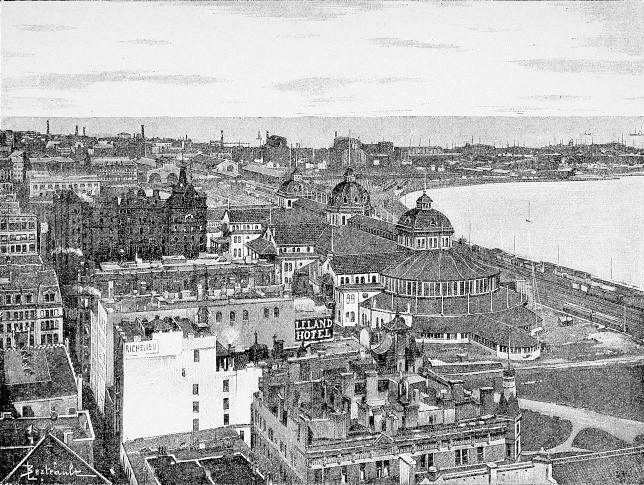
ILLINOIS CENTRAL TERMINUS AND THE HARBOR.
“If you wish to go to Springfield by a zigzag, picturesque kind of
route, take the—” Here the boy went off into the alphabet again.
“I am afraid I would never get there,” said our good friend, with
uplifted hands. “I think that we have about concluded to go to Lincoln
Park.”
The party did not find this an easy matter. They went to State Street;
the sidewalks were thronged with hurrying crowds; high buildings
towered in the sunny and smoky air.
“If I were to come to Chicago,” said the confused Quaker, “I would go
into the business of collars and cuffs. Mine were clean when I started
out—just see them now! But everybody looks clean; how do they do it?”
After many directions from policemen, the party found the car for
the famous park which is the delight and summer rest of Chicago. How
lovely it was! The great bronze statue of Lincoln arose before the
province of greenery; the Lake rippled near, expanding in purple
glory. They hurried toward the Zoölogical Gardens, which are among the
finest in the world. The parks and park lands of Chicago are many, and
cover nearly two thousand acres. But Lincoln Park, with its lake view
and animal shows, has a charm that exceeds all others, and not the
least of its attractions is “Admission Free.”
On their return from the park, where they visited the Grant Statue,
the flower gardens, and the wonderful collections of tamed animals,
the party went to the Auditorium Building, and looked down from the
top on the city as it lay spread out in the sunset. How different
was the scene from the fort and little hamlet in 1830! The city
practically filled the view.
The Post Office and Masonic Buildings are works of marvellous strength
and beauty; the stranger would pause in awe before them, did not the
crowd at all hours of the day hurry him on. One cannot conveniently
stop to talk on the streets in the activity of this rapid city. The
Women’s Temple is one of the noblest structures ever erected for
benevolent work by women, and the Produce Exchange fittingly expresses
its purpose.
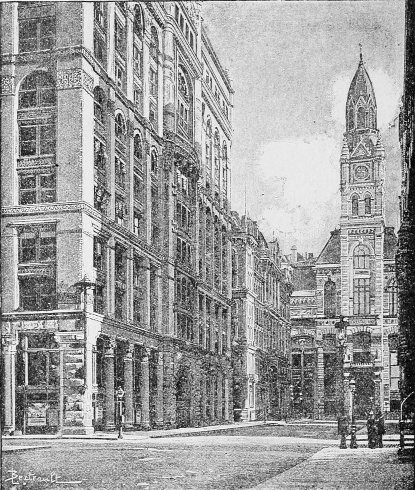
PRODUCE EXCHANGE.
The Palmer House is associated with the history of the city since the
fire, as few other buildings have been. There are few business men in
the country who have not at some time stopped there. The beautiful
private residence of its proprietor is famous for its hospitality,
and is as unique as it is noble. The women of America are proud of the
record of Mrs. Potter Palmer, and are glad that a woman of such public
spirit can organize her plans in such a liberal home. The private
residences of Mr. Kimball, Mr. McVeach, and the long procession of
mansions on Michigan Avenue, display an air, not of ease and rest, but
of purpose and energy. They picture the spirit of the times.
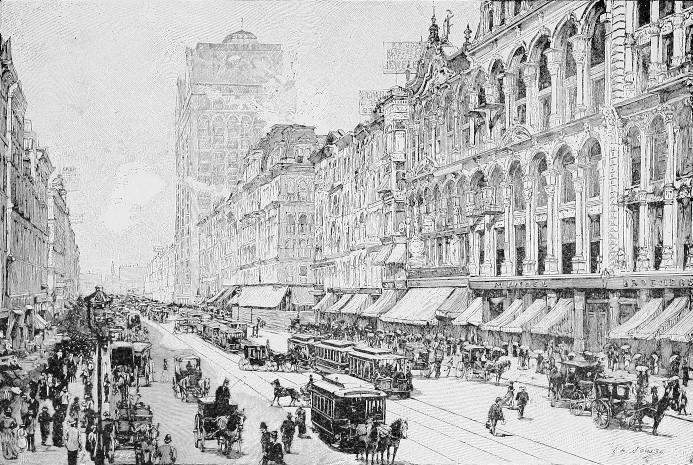
STATE STREET.
There are few public buildings in Europe that display a more massive
grandeur than the City Hall. It looks like a colossal palace reared
upon lofty foundations, and one from abroad would think that such a
structure would have cost the labor of a score of years. The city is
full of buildings from eight to sixteen or more stories high, that
look like towers.
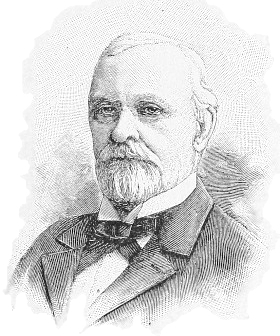
|
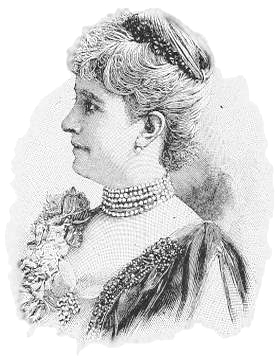
|
|
MR. POTTER PALMER.
|
MRS. POTTER PALMER.
|
The Union Stock-Yards here are the largest in the world. They cover
three hundred and fifty or more acres with more than eight miles of
streets,—a city of cattle. More than $200,000,000 worth of live-stock
are sold here annually.
Chicago is the world’s granary. Her grain-elevators would make a city.
She handles some 150,000,000 bushels of grain a year.
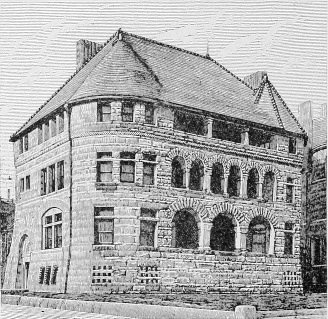
RESIDENCE OF MR. McVEACH.
The Chicago River in 1830 flowed clear and full in view. It is now
shut into bridges, and is hardly noticed. The arrival and clearances
of vessels in Chicago harbor greatly exceed those of New York, and are
probably as many as or more than at the ports of New York and Boston
combined.
The lofty and substantial buildings greatly interested the good
Quaker, and on returning to the waiting-room of the Auditorium, he met
the bright boy who had given him such luminous instructions in regard
to the railroads.
“Well, I found the park,” said our friend.
“Took the N. C. S. or W. S. cable, I suppose?” said the boy.
“I think so; the X. Y. Z. or Q. R. S. T. it might have been. I like
that park; it is like the story that had no end. What are your very
tallest houses here, my lad?”
“There’s the Ashland Block, sixteen stories high; this Auditorium,
seventeen stories high; C. C. B., thirteen stories high; C. M. B.,
fourteen stories high; M. B., sixteen stories high; and the Masonic
Building, twenty stories high.”
“There, there, that will do—twenty stories high!”
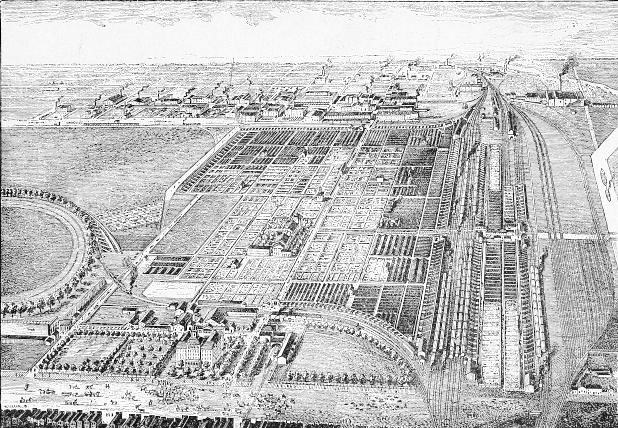
GREAT UNION STOCK-YARD.
“There are many others, sir; the U. B., sixteen stories high, and—”
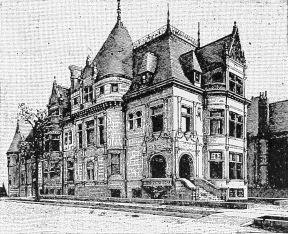
RESIDENCE OF MR. KIMBALL.
“You needn’t go over the alphabet any more. Why, boy, it would make me
crazy to live here. My house isn’t but two stories high; it is an A.
B. C. D. house in the perpendicular style of architecture.”
The party went to the great pork-packing establishment. Here the
poor pig has hardly a chance to squeal between his easy rural life
and sausage meat. The name of Mr. P. D. Armour is associated with
an industry, or business, such as the good New England farmer never
dreamed of in his simple life, when two pigs, killed after an heroic
struggle, were the supply for his frugal pork barrel. Corn, beef, and
pork are supply cities by themselves.
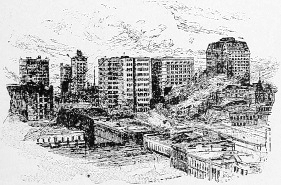
HIGH BUILDINGS IN CHICAGO.
The railroad stations, too, would constitute a city. What wonder that
the boys say C. B. Q. and I. C. and C. N. W. and C. S. M. W. D.!
The city stretches into suburbs, which themselves widen away and
exhibit the outlines of new suburbs. The Hyde Park suburb, Pullman,
and other towns that make a semi-circle, are in themselves famous.
The Mississippi Valley, the old East, the great lake country of
the North,—all seem to focus here. Chicago will be the City of the
Twentieth Century.
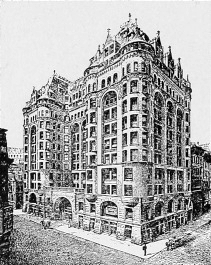
A TEN-STORY HOUSE.
The eastern and the old world tourists come here, with narrow views
and criticism, to which the true Chicagoan has neither the time nor
the interest to so much as listen. When this type of man enters into
the spirit of Chicago, and feels the new life, he often becomes
wonderfully enthusiastic. He lives for the future, and under new
horizons; his soul becomes prophetic; he feels that the age of
humanity is at hand, and that the city by the great inland sea is
to be the capital; and he merges himself in the multitude, and his
private interest becomes the good of the whole. All of the enterprises
are his; all of the builders are building for him. He has a part
in every new structure, enterprise, and beautiful house. One cannot
understand this spirit until he has felt it.
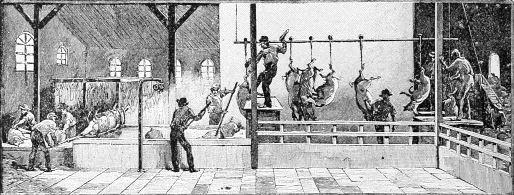
A PORK-PACKING ESTABLISHMENT.
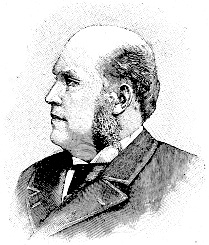
MR. P. D. ARMOUR.
The men who lead, inspire him. Davis, Palmer, Pullman, Armour, the
grain-merchants, the public officers, are self-made men. Invention
and energy are here rewarded. The whole spirit of the place says
“Advance;” progress proclaims “I will.” Force and Chicago are one.
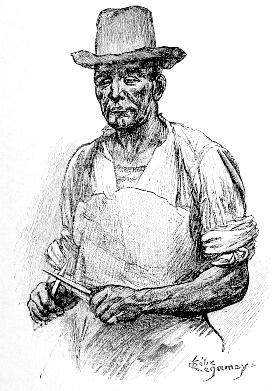
A PIG KILLER.
Go to the Temple, the scene of the activities of the Woman’s Christian
Temperance Union. It cost a million of dollars. It is the centre of
the work of the largest organization of women in the world; of ten
thousand moral reform societies in the country. All its directors are
women.
Glance at the life of its President, Miss Frances Elizabeth Willard:
of New England ancestry, educated at Oberlin, taking a front rank
as an educator, living now on the platform, and wherever she goes
carrying her pen in hand. She projected the Woman’s Christian
Temperance Union, is the leader of the White Cross work, and one of
the leaders of the National Council of Women. She has set her New
England character everywhere in the West. She represents what the true
Chicago woman means to be to her age and generation. What does such an
example say to girls? What to all aspirators towards a worthy life?
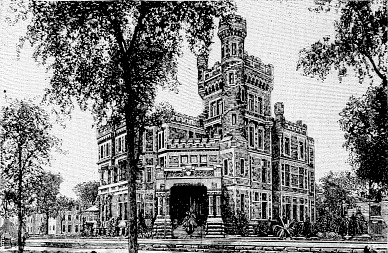
RESIDENCE OF MR. POTTER PALMER.
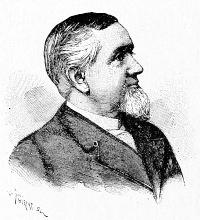
MR. PULLMAN.
Stand before the hospitable doors of the castle-like mansion where
Mrs. Potter Palmer has been accustomed to receive all worthy workers
in the cause of humanity and progress. One is proud to feel, in the
atmosphere of such a place, that in America queens are born, and that
their social thrones are won by nobility. That woman and her friends
gave to the Exposition a soul, or made the White City voice what is
spiritual. Such women put reform into stone and called it the Temple.
They will one day begin a daily journalism that shall lead all that is
best in the mind and heart of mankind.
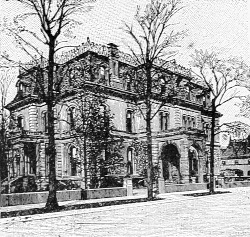
RESIDENCE OF MR. PULLMAN.
Go to Pullman, some ten miles away. It has been called the model town
of the working-men. What does such a suburb say to the American youth?
Mr. George M. Pullman once rode on an old-fashioned sleeping-car.
He found it a hard experience. He did not sleep. But out of that
experience he invented. The Pullman Sleeping Car was the result.
People now travel and sleep. “Invent what is needed,” so says Pullman.
Mr. Pullman began life as a clerk in a country store. He now owns a
town and employs fifteen thousand people. “Answer the world’s needs,”
says the spirit of the thrifty town, “and you shall be supplied in the
supply.”
The builders of the expanding city by the Lake were poor boys.
Invention, energy, honesty made their success. Like Dr. Livingston,
when he graduated from Glasgow University, most of them can say,—“I
never had a dollar that I did not earn!” They do not merely
exist,—they live. When they have passed their generation they will
have left behind them a new creation of life.
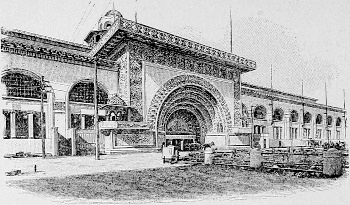
BYZANTINE DOOR OF THE TRANSPORTATION BUILDING.
AKING a Cottage Grove car, the Marlowes entered the Fair Grounds on
one beautiful summer morning, by the long way of the Midway Plaisance,
in search of the Funniest Thing, the Most Useful Thing, and the
Grandest Thing.
The sky was as blue as the Lake, and the Lake as blue as the sky on
this morning, and the sun filled the sky with living light, and under
it shone the White City, the most beautiful city on which the sun ever
shone,—the city of all the ideals of the past and the hopes of the
future, the first city of the new order of the world.
They passed the turn-style, and looking round, saw the word exit.
“I will tell you a funny story which I heard at the boarding-house in
regard to that word,” said young Ephraim. “There was an Illinois
boy who had earned money enough to go to the Fair, and fifty cents to
go in, and he planned to enter early and stay late, and so see all of
the Fair in one day. He paid his fifty cents for a ticket, and passed
through the turn-style, and looked up and read ‘E-x-i-t.’ ‘Does it
cost anything to go in there?’ he asked of an officer. ‘Of course
not,’ answered the officer. ‘Then I must see it,’ he said; ‘I want to
see everything.’ And he saw it.”
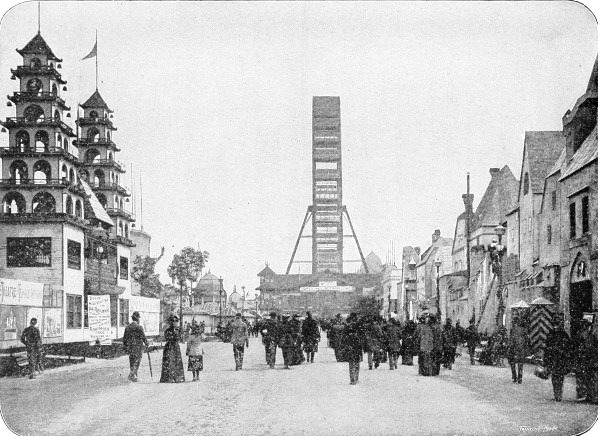
A VIEW OF MIDWAY, LOOKING EAST.
“I do not regard that as a funny story,” said Mr. Marlowe. “I could
hardly think of anything more pathetic. How that poor boy must have
felt when he found himself on the outside. It would be like entering a
gate of Paradise, and going back by some by-way into the world again.
I shall not put that among the funny stories in my note-book.”
The long Plaisance, which was an avenue where lived nearly all of
the nations of the world in harmony, swept before them, and over it
gleamed the towers and domes of the White City.
If young Ephraim’s story was pathetic rather than funny, an incident
occurred at their first journey up the Plaisance which was comical.
A street performer was taking gold crowns or sovereigns out of his
nose.
The trio stopped to witness the wonderful feat. When the wonder-worker
wanted a gold piece, he had only to tap his nose, and out it would
come.
Old Ephraim, whose quiet Quaker life had not made him much acquainted
with such tricks, looked on with curious surprise.
“Where do those gold pieces come from?” he asked.
“Out of my nose!” said the juggler. “Don’t you see?”
“It does look so, but thee can’t trust experience always, so Kant
says. Let me see thee do that again.”
“Here you see the gold pieces in my hand. See! Now I will close my
hand. See! Now the coins are in my nose. You can’t see. Now I will
take them out again. See!”
He did.
“That is a very wonderful thing to do, my friend. I never saw the like
of it before. Suppose now you put those gold pieces into my pocket
here, and see if you can take them out again!”
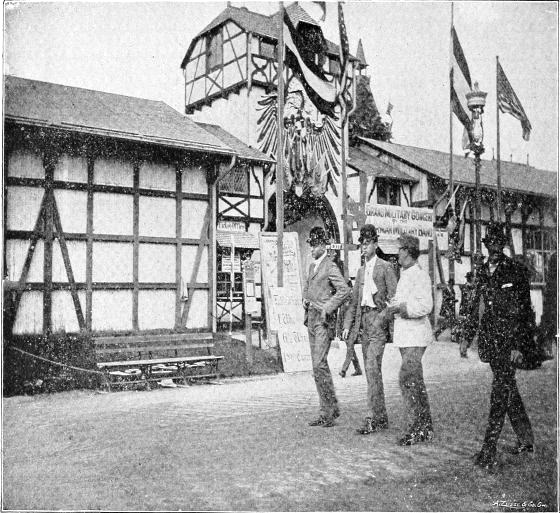
GERMAN VILLAGE.
The man of wonders stared, and shook his head.
“Na, na. Where you come from? You be one Yankee. Goot day!”
The Plaisance was thronging with bright, happy faces. Orientals
mingled with the people from all the States. Our trio stopped at the
Indian Village, and thence went to the Dahomey Village. All the world
seemed to be at home, and prosperous, happy, and hospitable. Here were
Austrian houses; yonder Chinese pavilions, like golden air. Along
one side of the avenue ran a sleighing track, where swift sleighs
glided over a snow-scene under the burning sun. Here was the Roman
Village; yonder the Tower of Babel loomed over the whole. Here was
a Moorish palace, yonder Dutch settlements; here an ostrich farm,
there Asian and African bazaars, and mid these neighboring
families of the world, a glory of mosques and minarets.
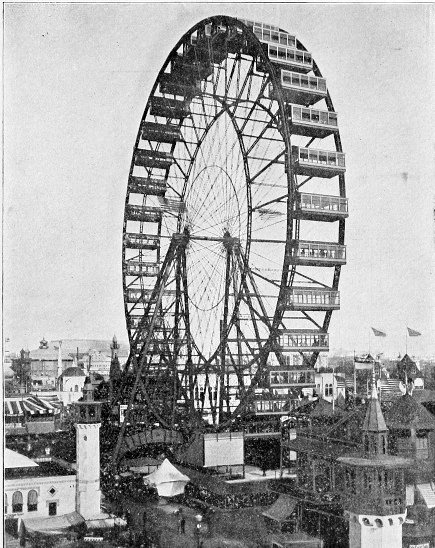
FERRIS WHEEL.
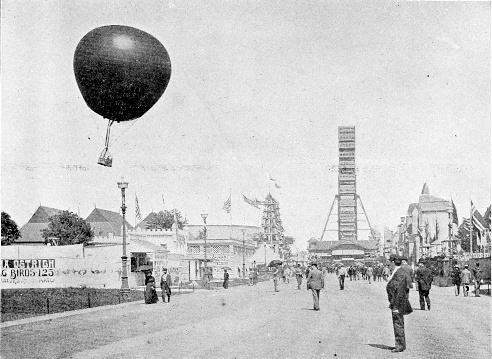
CAPTIVE BALLOON.
The trio hurried on towards the gleaming minarets, the captive
balloon, and the Ferris Wheel.
They stopped at the Ferris Wheel, and looked up into the air.
“That is the greatest merry-go-round in all the world,” said a
clever-looking visitor.
“Let us go over,” said young Ephraim to his father.
“Had we better go over now, or had we better wait until another day?”
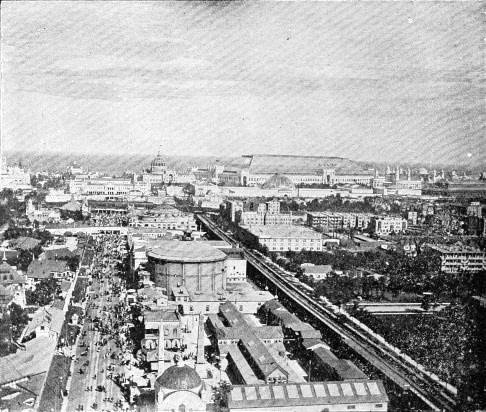
LOOKING SOUTHEAST FROM THE FERRIS WHEEL.
“Now,” said young Ephraim.
“Now,” said his grandfather. “I always wanted to see the world, and I
shall when I circle sky in those hanging cars.”
The trio entered one of the cars, and sat down in the chairs.
“It is just like a room,” said old Mr. Marlowe. “I do believe that we
are moving up.”
Slowly the earth began, as it seemed, to descend, and they found
themselves in the air. The horizon grew; the great blue lake, the
White City in dazzling whiteness, moved into view, and then sank
downward; the smoky city of Chicago rose, and fell into the shadows.
Slowly, slowly the car moved up towards the sky.
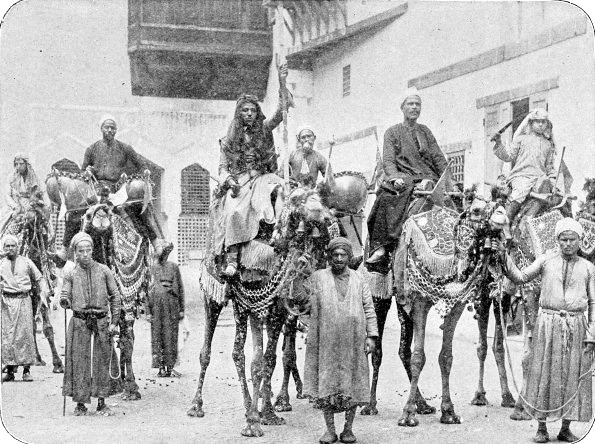
ORIENTAL WEDDING PROCESSION.
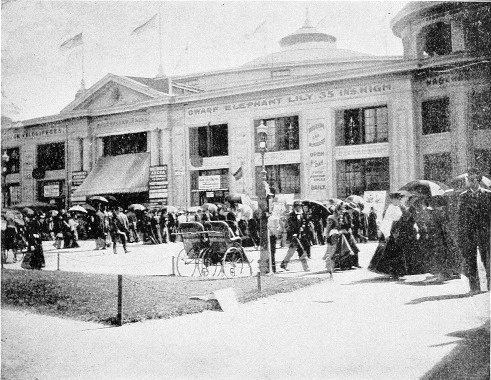
HAGENBACK’S MUSEUM.
“We shall see the whole earth soon,” said Grandfather Marlowe.
But no—the car was descending, and Chicago, the White City, and
the Lake and the merry Plaisance, all came back again. They went
over a second time. The stranger was right,—it was the greatest
merry-go-round in all the world.
As they passed the wheel the wonders grew. They stopped to see the
Hagenback menageries, or animal shows. In the arena was a lion that
drove a chariot and rode on horseback. Grandfather Marlowe said that
he disapproved of all such “doin’s;” but his opinion grew out of
sympathy for the horse.
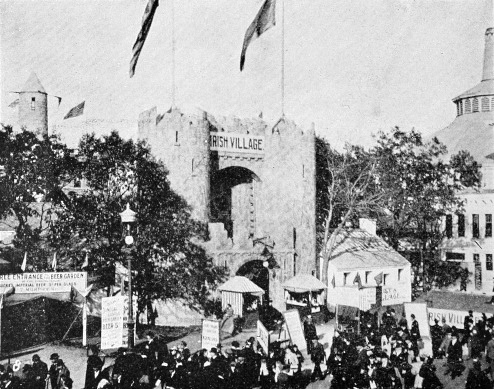
IRISH VILLAGE,—DONEGAL CASTLE.
Near the Blarney Castle and Irish Village was an old-time New England
cottage, where meals were served in colonial style; and across the way
was a model working-men’s house, after which pattern 172,000 houses
had been built in the suburbs of Philadelphia, by a wise and worthy
building association. These houses cost about twenty-two hundred
dollars, and were paid for out of small savings, through co-operative
banks and like means. The purpose of the noble Philadelphia Society
was to make good citizens by such homes. It requires character to save
money; it forms prudent habits to lay aside money for a home in early
life.
The trio visited this model house. It was the perfection of home-like
beauty and convenience.
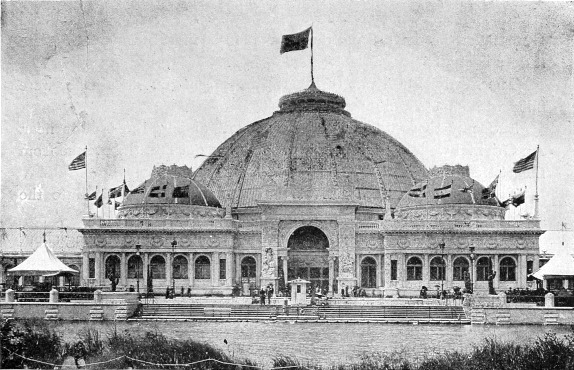
HORTICULTURAL BUILDING.
“I think,” said Mr. Marlowe, “that I have found in this house the most
useful thing at the Fair. One would have to travel far to meet with
anything more useful than that. The most useful thing on earth is a
home. I think that I have found one thing to report to our Society,
and I have not seen the Fair yet.
“Every city,” he added, “ought to do what Philadelphia has done,
if it would make good citizens. Think of it, 172,000 houses for
working-people, like that! The millennium must be near!”
“I think,” said Grandfather Marlowe, “that that is the most useful
thing that we shall see. It is worth coming all the way here just to
see that.”
“But,” said young Ephraim, “that is the most simple thing we have
met.”
They went out of the house. The avenue seemed swarming.
“Pretty much all of the world must be here by this time,” said
Grandfather Marlowe, “and there seems to be more coming. I declare it
does beat all!”
The Ferris Wheel was turning in the bright air; the villages were
filled with shouts and music.
Suddenly there was a great excitement among the crowds near. An
Oriental wedding procession was coming out into the avenue from the
“Street in Cairo.”
The trio stopped to gaze at the wonder. “Let us go into the Street of
Cairo,” said young Ephraim.
“No, not to-day,” said Mr. Marlowe; “I have been reading about that
street: we must take a whole day for that.” The trio passed under the
long dark bridge. Slowly from the shadow they entered the White City.
Ephraim Marlowe the Quaker stopped and stamped three times on the
ground as the dazzling splendor rose before him. He lifted his hand,
and said, “Manton, Manton, for pity’s sake!”
They passed the Woman’s Building, and the Transportation Building
with its dazzling entrance, which looked as though it were a sunrise
of jewels, and came to the Administration Building, whose pale gold
dome shone like a vision about to vanish into the air. They mounted
the steps, turned, and looked down the Court of Honor, towards the
Peristyle and Lake Michigan.
The three stood in silence. Mr. Marlowe laid his hand on his father’s
shoulder, and shed tears. His son took him by the hand.
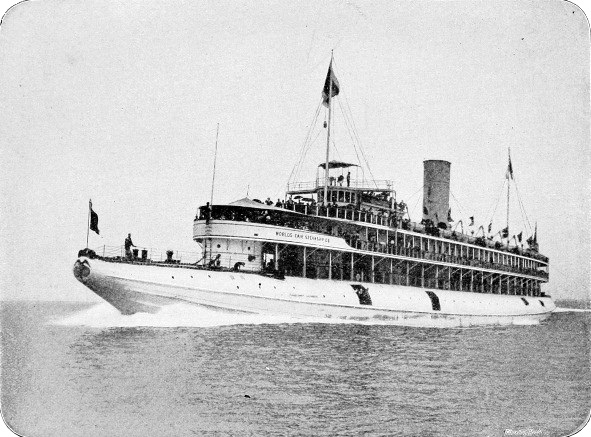
THE WHALEBACK PASSENGER STEAMER.
The white walls of the Court of Honor, with their heroic statues, and
allegories in plaster, shone in the sun in blinding glory. Just below
in the lagoon was the most beautiful fountain on earth. At the end of
the lagoon rose the golden-hued Statue of Liberty, and beyond it the
most beautiful and majestic structure in all the world, called the
Peristyle, white as glistening marble, and surmounted by the
Quadriga. Through the white arches of the Peristyle and its
procession of heroic statues lay the Lake, blue as a June sky, and
covered with boats, vessels, and steamers. Multiform and many-colored
flags bloomed like flowers over and against all these colossal walls
of white. Congresses of statued heroes were here and there assembled
in the niches of immortality. Overhead rose the white allegories
of the elements, controlled and uncontrolled. Bands played. Tens
of thousands of people darkened the walks and avenues. There was
happiness everywhere; continuance was all that was wanting. The trio
stood there amazed, bewildered, and unable for a time to speak.
ATLAS.
Grandfather Marlowe was the first to break the silence.
“Let us go away, and find some little corner and die. That is how I
feel.”
“Let us sit down on the steps,” said Mr. Marlowe, “and thank God that
we are alive.”
“Let us go into the Liberal Arts Building,” said young Ephraim.
“I have no wish to see any exhibits to-day,” said Mr. Marlowe. “I
shall never again behold a vision like this,—I could gaze for weeks
upon it.”
“There is only one thing that is wanting,” said Grandfather Marlowe.
“What is that?” asked Mr. Marlowe.
“A white-bordered flag!”
“They may raise one here some day,” said Mr. Marlowe.
“I hope that I may live to see that sight,” said the aged Quaker; “to
me it would be a sign of the Second Coming. I could die content could
I see the sight.”
They went to the Liberal Arts Building, and looked in upon its forty
acres of floors. They then passed down to the long wharf, and sat down
to rest on the seats of the movable Sidewalk; in which they might sit
for hours for five cents each, and go around and around in the cool
breezes of the Lake. Here they took the famous “whaleback” steamer
for the City. They never had passed a day like that! No one ever
passed such a day as one’s first day at the Exposition, and none ever
will again.
The Past emptied itself there; the Future anticipated there her glory.
The Fair! the Fair! It was all the world was, is, or ever could be.
“Father,” said young Ephraim, “across whose mind did the conception of
the White City first pass?”
“I do not know.”
“We must ask Judge Bonney,” said Grandfather Marlowe.
When they asked this information, they were told that the White City
was the product of the minds of an assembly of artists, each of whom
promised to give up in his own work “anything that might interfere
with the beauty of the whole.”
“What a lesson!” said the old Quaker. “If all people would do that,
how beautiful all the world would be!”
“I think,” said Mr. Marlowe, “that I have found the most useful
exhibit at the Fair.”
“You still think that it is the Quaker City house?” said Grandfather
Marlowe.
“I do.”
“And if I could only see the white-bordered flag floating over the
Court of Honor,” said the Quaker, “I could show you the grandest
sight on earth.”

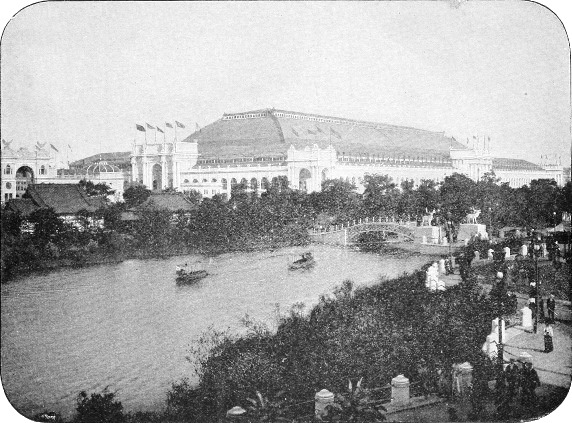
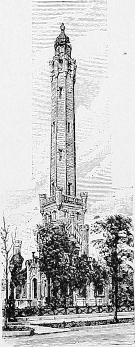
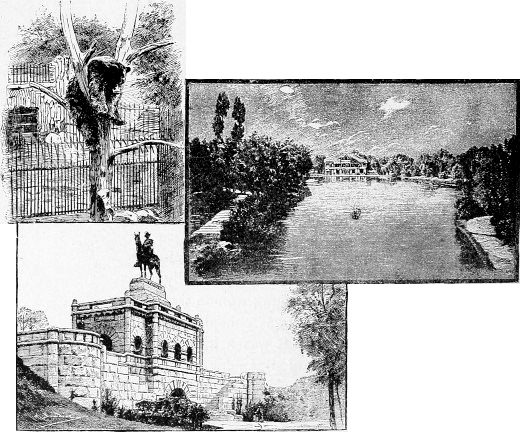
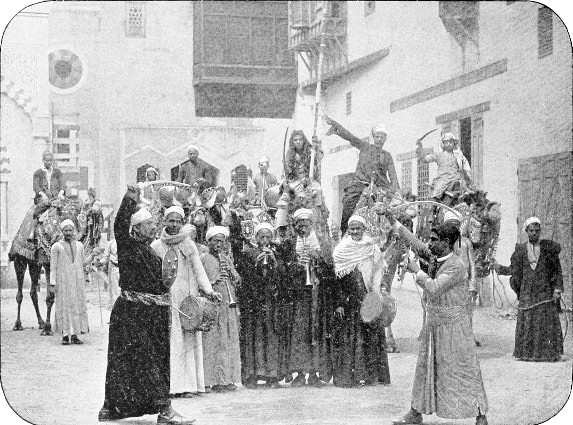
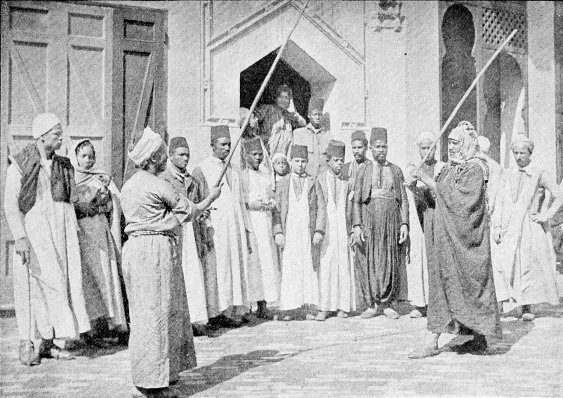
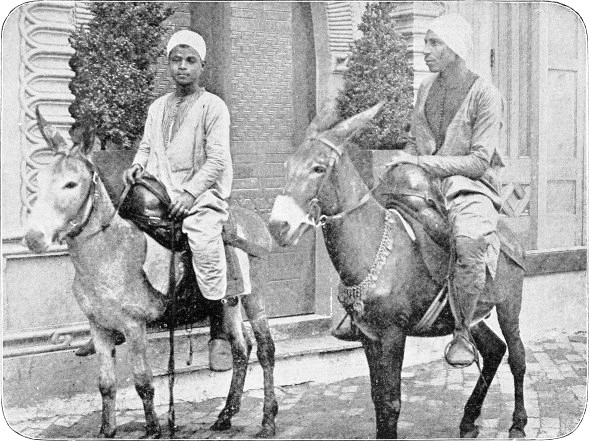
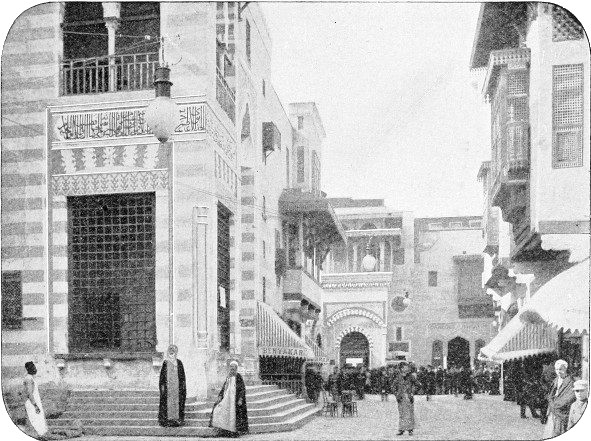
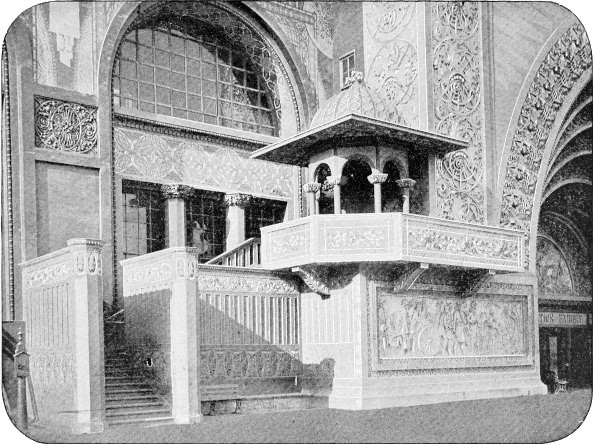
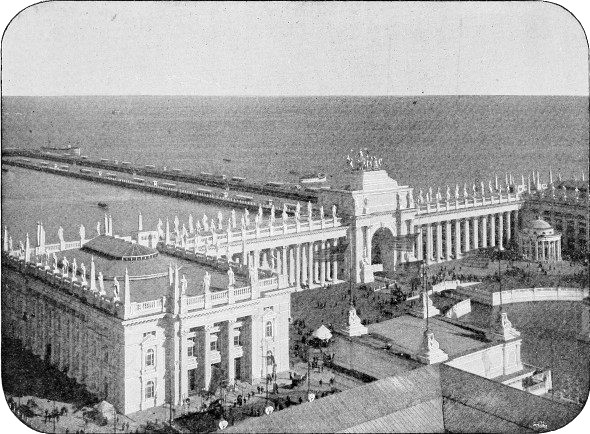
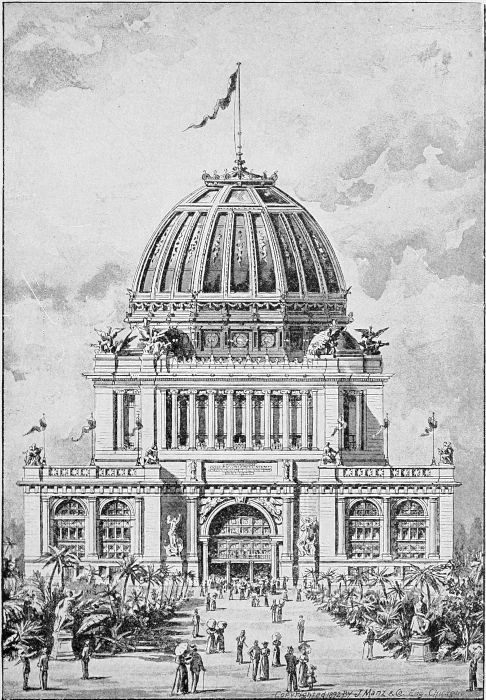
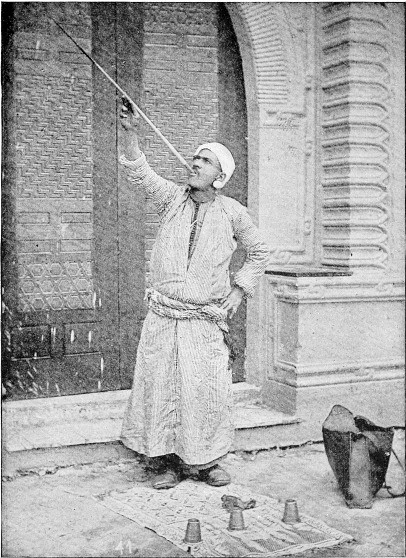
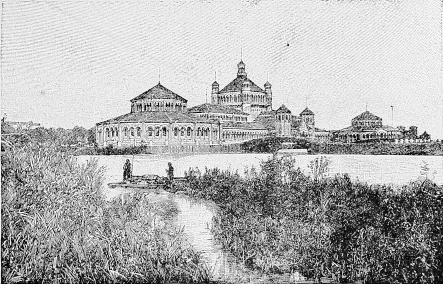
 T was July 4th, 1893. The lake breezes in the early morning floated
over the White City. Flags filled the air; eight hundred acres of
flags? Yes, more: in fact, Chicago was a sky of flags; and so was the
State of Illinois.
T was July 4th, 1893. The lake breezes in the early morning floated
over the White City. Flags filled the air; eight hundred acres of
flags? Yes, more: in fact, Chicago was a sky of flags; and so was the
State of Illinois.
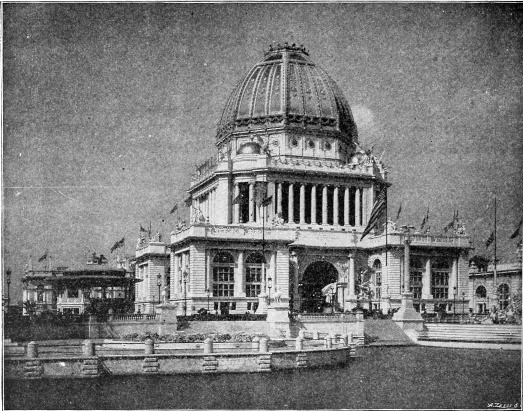
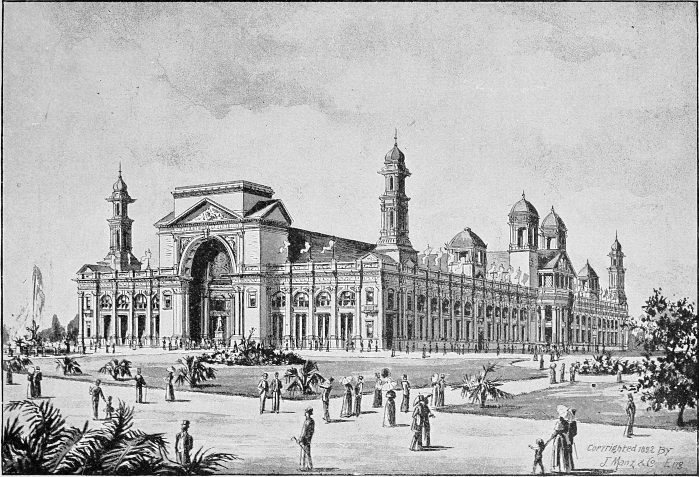
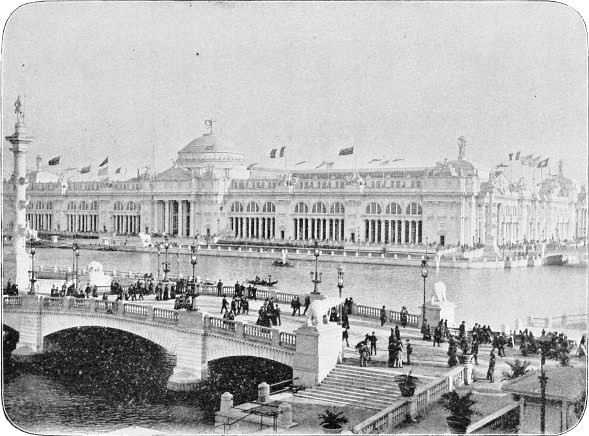
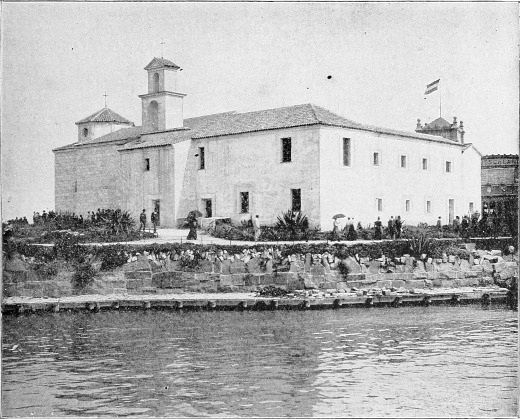
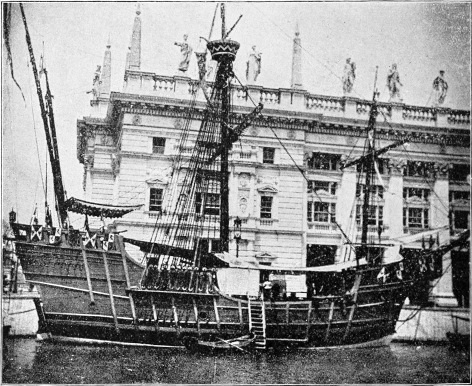
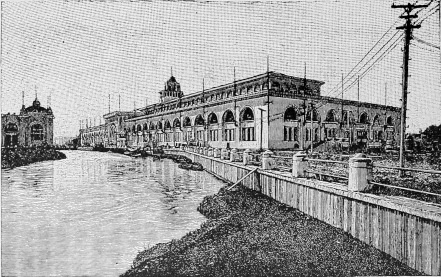
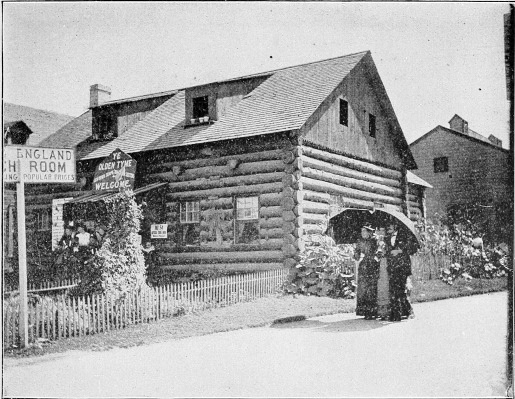
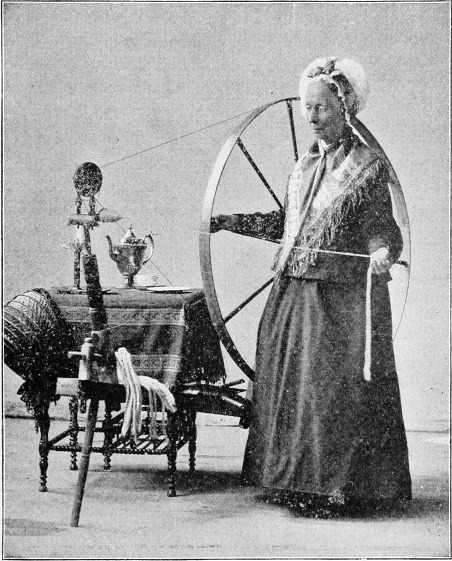
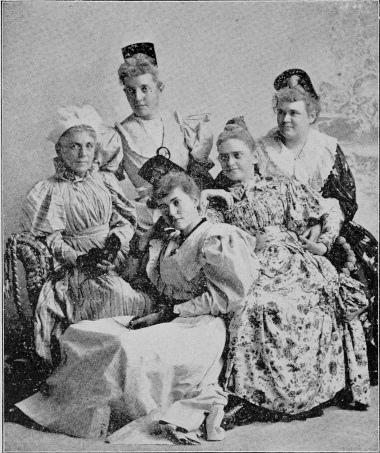
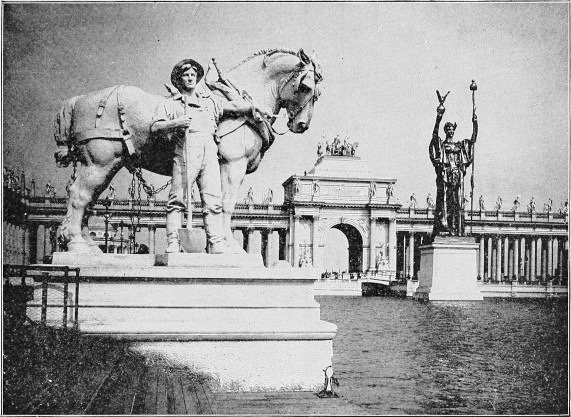
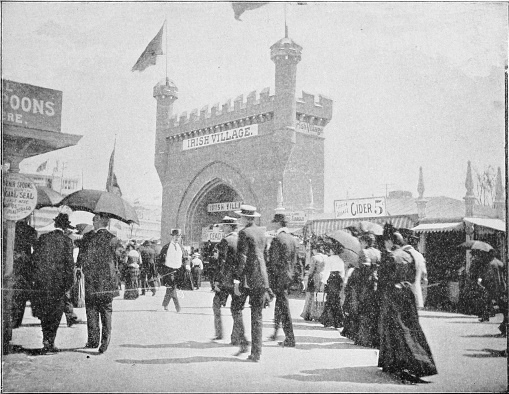
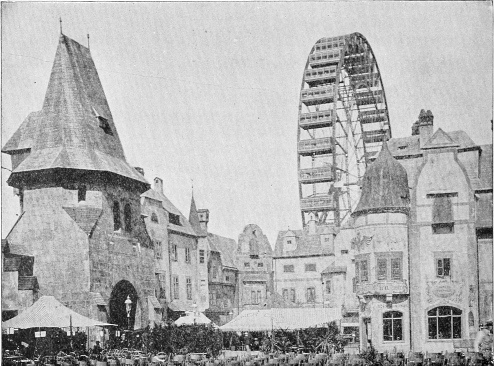
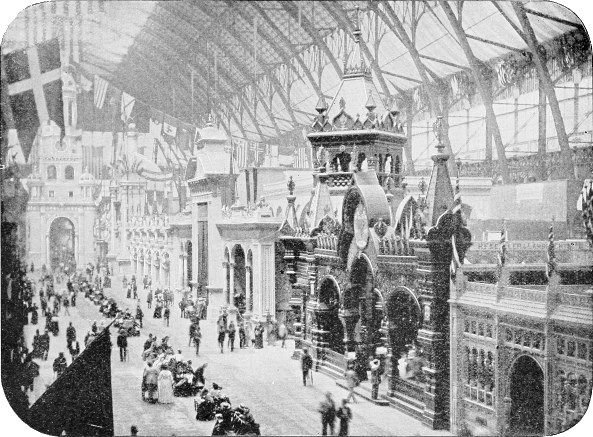
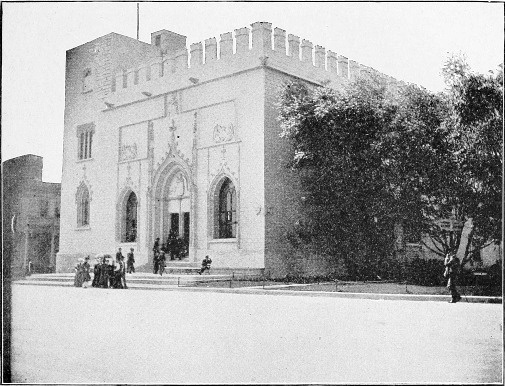
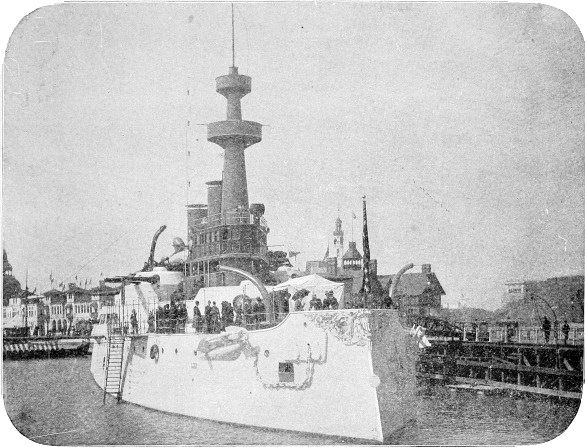
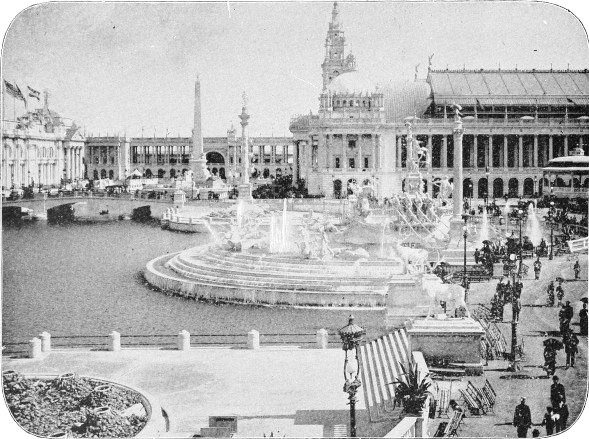
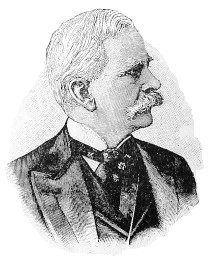

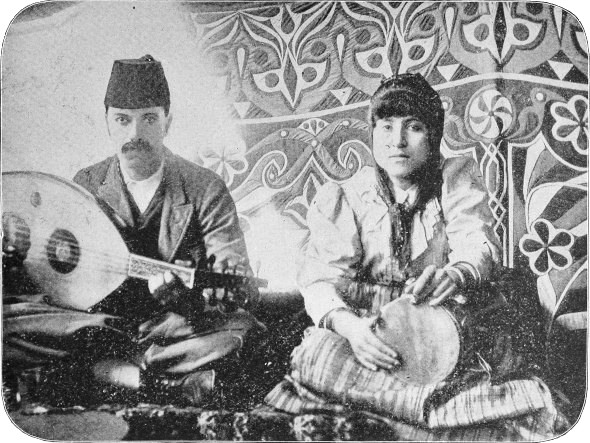
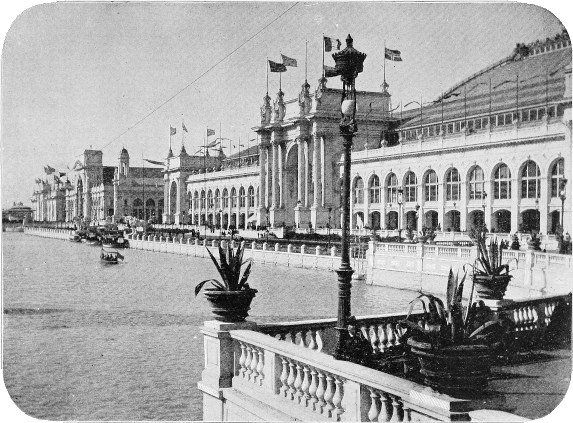
 E are now walking in the sea,” said Mr. Marlowe, as the trio moved
along the Fisheries Building; “the inhabitants of the waters are
around us on every hand.”
E are now walking in the sea,” said Mr. Marlowe, as the trio moved
along the Fisheries Building; “the inhabitants of the waters are
around us on every hand.”