The day was very hot, and I was very tired.
The flies were buzzing thick around me and
it was impossible for me to keep awake over
the book which slipped from my fingers and fell on
the floor. I stretched myself for one of those delightful
noonday naps which, in spite of the heat and the flies,
revive the life of the missionary and make him ready for
the work of the afternoon, and as I slept, I dreamed a
dream.
I was walking up towards the mission hospital, when
what should I see coming down the steps but a roller
bandage, walking along as happy as could be, and after
exchanging the usual Arab greeting of “Salaam,” he told
me this story:
“I suppose you have never heard of me before, and I
am sure you never will unless I introduce myself and unroll
the story of my short but interesting life.
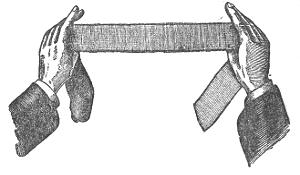
“A little, round, fat body like me may have a long
story to tell; for when I lie at full length I measure four
yards without stretching the truth one bit.
“It is only six months ago, as far as I remember, that
I was part of a fine new piece of white muslin in the
store window of a merchant, and had no name or place or
mission of my own in this big world. One day the salesman
reached out and took the piece of muslin down. It
was sent with a lot of other purchases to the home of a
lady (I think her name was Phœbe or Dorcas) greatly
interested in foreign missions.
“The next thing I knew, the willing hands and deft
fingers of a band of little folks tore me from my seven
sisters and rolled me up so snug and tight that none would
imagine I was only a strip of cloth. And then, when a
bright new pin was stuck on my breast, really I began to
feel quite important. The following day I was put into a
pasteboard box with three dozen other roller bandages,
and I remember hearing a short prayer, just as they tied
down the cover, that God would bless us on our errand of
mercy to dark Arabia.
“Time would fail me to tell of the days we spent in the
basement of the building of the Board of Foreign Missions,
waiting to be put in our corner of a big box, and
of all the interesting things I learned from those who
spoke about the heathen and Mohammedans while they
were packing supplies for the various mission fields.
You know I never knew there were so many doctors and
nurses, and so many hospitals and dispensaries—not to
speak of schools and other things under the care of our
Board.
“Finally, the box that was to be my prison house for
two long months was tumbled into a dray and taken to
the North River pier. There they lifted us into the
dark hold of a ship; the sailors fastened down the
hatches; the whistle blew, and we were off for the long
voyage.
“Being a roller bandage from my earliest youth, I did
not at all mind the motion of the vessel; but some of the
dolls and picture cards were all upset.
“When we reached Bombay we were transferred with a
great deal of unnecessary noise to another ship bound for
the Persian Gulf. I remember that I was curious to know
at which port of the Gulf I would disembark. One of
the biggest roller bandages said he knew, for he had heard
the New York lady tell the children that these bandages
were for the Mason Memorial Hospital at Bahrein, Arabia.
All were not agreed.
“A many-tailed bandage said he thought we were going
to Busrah to help in the dispensary there, but a T bandage,
which has three ends to it and is shaped like a big letter
T, contradicted him, and there came near being a quarrel.
The little bandages, however, with one accord
smoothed it over by saying: ‘Wait and you will see.’
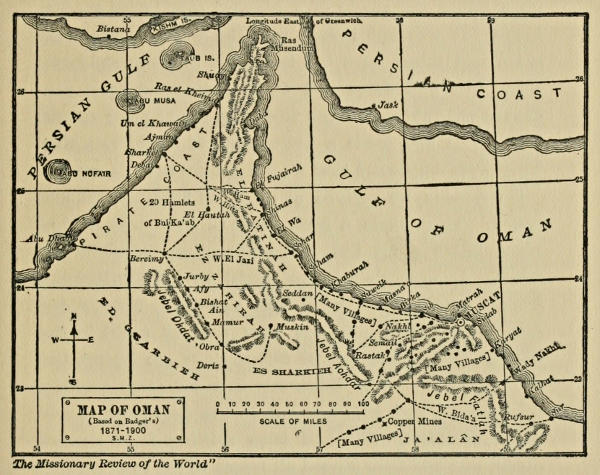
“The big roller bandage was right. When the British
India steamer entered Bahrein harbour with a large cargo
of rice and tea and Manchester goods, the missionary
boxes got mixed up with the rest, and were put over the
ship’s side into native boats.
“Such a hubbub and shouting! I knew we were among
Arabs and in the land of Ishmael, although I could not
understand one word of their strange language.
“From the cargo boat we were carried on the back of a
donkey through the surf to the custom-house, and thence
once again to the hospital. I cannot say I enjoyed the
donkey ride. The boy who drove the beast had an awkward
way of turning sharp corners in the narrow streets,
and then the big packing case would bump hard against
a stone wall, and give us an awful shaking.
“It was a relief to hear the voices of our new friends.
Soon the box was opened, and we saw daylight once more.
The sheets and blankets were put to immediate use in the
general ward; the dolls put away for Christmas; while
we were taken to the operating-room, and put behind
glass doors on a shelf. Even though I was not an eye
bandage, I could easily see that we were occupying the
best room in the entire hospital, and I distinctly heard
one of the ladies say: ‘These bandages are fine.’
“You can imagine that we kept our eyes and ears open
after such a welcome. Well, it was rather monotonous,
after all. Every day, nearly, the doctor had some sort of
eye patient on the table, and consequently the eye
bandages put on airs of great importance. We waited
impatiently.
“One day a nurse came in suddenly and seized me by
my throat and took me without ceremony to the general
ward, a big room with twelve beds in it.
“On the stretcher, in the middle of the floor, lay an
Arab, looking very untidy and weak, and in great pain. I
heard his story. His name was Ahmed bin Haroon, and
he was a poor fisherman from the distant village of Zillag.
Zillag is one of those little struggling hamlets on the
Island of Bahrein to which the missionaries occasionally
make zigzag journeys, visiting the people to carry them
Gospels or to invite the sick to the hospital. The day before,
very early in the morning, while he was mending
his nets and collecting his fish, a robber came, stabbed
him twice in his abdomen, and taking the fish, ran away.
“The poor man had two nasty cuts, deep and dangerous,
and I heard them say while cleaning the wounds that he
would probably not live. Though he looked so ignorant
and dirty, I really felt sorry for the poor fellow, and wondered
if I could be of much help. After the doctor put
on the dressings, my turn came. In fact, I had more
turns than I have ever had since, all in the space of five
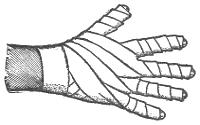
minutes. Round and round that Arab they wound me
close. But to see the look of gratitude on his face when,
in a clean shirt and on a nice spring bed, with me for
company, he opened his eyes—well, it was worth the long
journey, I can tell you. Over our bed there was a chart
with No. 109, and the man’s name on it. There were
also curious zigzag lines drawn every morning and evening
across the chart. The doctor put these lines there,
for I saw him do it, after inserting a fever thermometer
in the patient’s mouth. I soon learned to know whether
the line would go up or down by counting the heart-beats
of my companion. Of course, being so close together, we
learned to like each other, and I one day explained to
him how the people away off in America had sent me as
their little missionary for his comfort. On the opposite
side of the ward there is a picture of Christ healing a
blind man, which we used to look at.
“They prayed for No. 109 and read a little to him, but I
am sure he understood what I told him much better. You
see, until he got hurt he was very suspicious of Christians
and believed all sorts of foolish things about them. Now
he talked with the other patients and watched what was
done for him, and felt me near him; it was a new life for
him. His condition became more hopeful every day; I
knew it by the way he began to enjoy his soup. Not that
I was with him all the time myself. No; the other roller
bandages had their turn, and I heard the rest of the story
from them. Ahmed bin Haroon was discharged nearly
cured on the first day of the Moslem fast month. He
came back after for a visit, and is going about his work—the
same fisherman. Only there is no telling how much
he may think of what he saw and heard while he mends
his nets at Zillag. And the missionaries are sure of a
warm welcome in that village ever hereafter.
“The day I was taken off duty and said good-bye to my
patient I met such a lot of bandages down-stairs in the
surgery; there seemed no end of them! Of course, most
of them were common, from the Bahrein bazaar, and unbleached,
but they had good stories to tell, nevertheless.
I heard it stated on good authority that over a thousand
yards of bandages were used up in one month. And
when I saw the number of men, women and children with
ulcers and abscesses, sitting on the veranda that day, I
did not doubt the fact. Only I wish I could have told it
to that salesman in New York and to the kind lady.
Then there would have been more of us; for I am sure it
is no trouble for the boys and girls to make rollers of us.
“My end was near. In spite of all that I had done for
the hospital, the sweeper carried me out in a bucket, and
then, without ceremony or apology, the whole pile of us
were set on fire, and we went up in a chariot like Elijah.”
He ended his story, and as I looked at him, I was just
about to say: “How did you ever get back here out of
the bucket and the fire to come and tell me your story?”
but when I began to speak, the bandage speedily disappeared,
and so did the hospital, and I awoke from my
dream. The hospital records, however, show how the
story of the bandage is true in every particular.
“Oh, what can little hands do
To please the King of Heaven?
The little hands some work may try
To help the poor in misery:
Such grace to mine be given.”