On Monday, January 5, 1857, began our trial
trip, which homely term was justly written
large as ‘tentative expedition,’ by the then
President of the Royal Geographical Society.
But a stiff north-easter blowing dead in our
teeth, the crew of the Riámi would not wear
round by day, and at night all showed a predilection
for the ‘Safar khoriyah,’ i. e. anchoring
in some snug bay. Consequently the old tub,
with knees and mast loose like a slaver’s, did
not make Kokoto-ni, the usual departure point
from Zanzibar Island, till 7 A. M. on January 8.
Escorted by Said bin Salim and his slave, we
visited the village Mwándá. It is the normal
collection of cajan-thatched huts, with wattle
and dab walls, gathering round a little Mosque
and grave-yard. There are no stone dwellings,
but scatters of such hovels extend far and wide.
The settlement was mostly tenanted by women
who hid themselves, by children who ran away,
and by slave-girls who squatted, combing and
plaiting one another’s locks; these grinned merrily
enough, having nought to fear. The faces
were hideous to look upon, with black, coarse
4skins, scarred and seamed by small-pox; huge
mouths, and rolling eyes. Not a few were lame
and toothless, and the general dress was the
ungraceful swaddle of blue, checked or indigo-dyed
stuff. Presently we were addressed by an
old man, carrying a spear, and attired in Arab
fashion, of red cap, loin-cloth (Futah), and Tobe
(Taub), or shoulder-scarf. Taking us for traders,
who came to buy cocoa and cloves, he placed a
Kitandah (cot) under the central calabash, the
gossip-place of the village, and brought us cocoanut-water,
which here takes the place of coffee.
In vain we offered high prices for meat;
geese, ducks, and fowls, however, were abundant.
After a short rest we set out northwards, to
inspect the plantations. Most of the men were
at work in their Mashamba; the weeds had
been burned for manure, the primitive manner
of restoring nutrition to the soil, and the peasant,
with his rude implements, was smoothing the
lowlands for paddy. Already the light showers
of the Azyab had flooded the ground, and the
stagnant stream which we forded was choked
with rush and sedge. A ‘Tell,’ or dwarf rise,
was occupied by a farm belonging to the late
Sayyid; here we were again seated and supplied
5with mangoes. This fruit, curious to say, would
never fall upon the Prince’s head, although his
courtiers often suffered severe contusions—at
least, so we were assured.
After a long walk, which crippled my naked
arms and legs with sunburns, we returned to the
shore, and Said complaining, with a visage like
Falstaff’s ‘wet cloak ill-laid up,’ that never before
had he endured such fatigue, we signalled the
Riámi for a boat. It was five hours coming,
the wind blew off shore, and we had some trouble
in persuading certain Tumbatu men to carry off
the party of six in a monoxyle, a single log of
wood, propelled by a scarf. A few dates and a
dollar sent them back happy, and the Riámi had
used her time well in washing decks and taking
in water.
The weather now set seriously against us.
The thermometer fell some 5° (F.), and heavy
showers, mostly in the morning, wetted us clean
through, despite all precautions. Lightning
from the N. West appeared; the ‘egg of the
cloud’ showed the focus of electric matter, and
tornados, exactly resembling those of the Guinea
coast, made the crew down sail, and satisfy
themselves with one knot an hour. They had a
peculiar style of keeping watch; all sat up singing
6till 10-11 P. M., after which every man
slept as unanimously. The only waker was poor
Said, who with red eyes and peeling nose suffered
crispations when the squalls came on.
About 9 A. M. (January 10) we sighted for the
first time Pemba, the Emerald Isle of these
Eastern Seas; and after three days’ stumbling
over 33 miles from Kokoto-ni, Pemba channel,
with the hills of the Mrima clear on our left,
appeared at 3 P. M. To the right rose the tree-grown
banks, and the verdant coral-ledges, which
have given a name to the Green Island of the
Arabs. Except from the mast-head it is invisible
at an offing of 12 miles, this forest-clump
emerging from the blue and buoyant wave, and
therefore it was neglected by the Periplus. In
A. D. 1698 the bold buccaneer Captain Kidd here
buried his blood-stained hoards of gold and
jewels, the plunder of India and of the further
Orient. The people have found pots of ‘nuggets,’
probably intended for buttons, in order
that the pirate might wear his wealth. Thus it
is that the modern skipper, landing at Madagascar,
or other robber haunts of the older day,
still frequently witnesses the disappearance of
his brass buttons, whilst the edge of a knife
resting upon his throat secures the quiescence
7essential to the rapid performance of the operation.
The complicated entrance to Chak-Chak, or
Shak-Shak as the Arabs call it, the chief port,
fort, and town, has that silent, monotonous,
melancholy beauty, the loveliness of death,
which belongs to the creeks and rivers of those
regions. The air was pure and sparkling; a
light breeze played with the little blue waves;
the beach, wherever it appeared, was of the purest
golden hue, creamed over with the whitest of
foam; and luxuriant trees of the brightest green
drooped from their coralline beds over a sea,
here deeply azure, there verdigris coloured by
the sun shining through it upon a sand-shoal.
But animated nature was wanting: we heard not
a voice, we saw no inhabitant—all was profoundly
still, a great green grave. A chain of
islets forms the approach to a creek, below all
mangrove and black vegetable mud, which
stains the water, and bears roots upsticking
like a system of harrows; above on both sides are
rounded swelling hillocks, crowned with the cocoa
and the clove. We sailed about on various tacks,
and near sunset we anchored in the outer port,
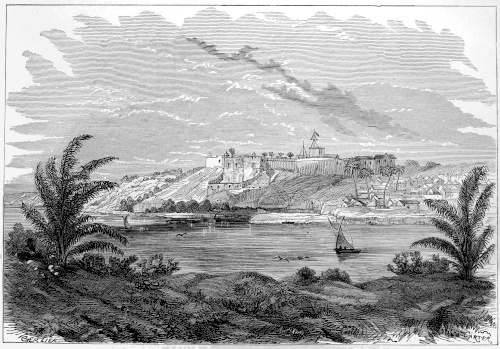
four or five miles distant from the town. On
a wooded eminence rose the white walls and
8the tall tower of Fort Chak-ChakChak-Chak, standing
boldly out from its dark green background, and
apparently commanded by higher land, nowhere,
however, exceeding 150 feet, while the spars of
an Arab craft peered above the curtained trees.
With the distinctest remembrance of Indian
rivers, my companion and I could not but
wonder at the scene before us.
Early on the next morning we manned the
Louisa, and rowed slowly through a gate, formed
on the right by Ra’as Kululu, and on the
left by a high plantation Ra’as Bannani. It
led to a broad, deep basin, where two or three
Sayas, small Arab vessels, not wishing to approach
the town, lay at anchor. After a couple of hours,
during which progress was of the mildest, we
entered a narrow creek, bordered by a luxuriant
growth of mangroves. The black and fœtid sea-ooze,
softer than mud, which supports these
forests of the sea, contrasts strangely with the
gay green of their foliage, and the place was
haunted by terns, grey kingfishers, and hawks
of black and white robe, big as the ‘Ak-baba,’
and said to be game birds. Here and there a
tall man paddled a tiny canoe, and an old slave
woman went to catch fish with a body-cloth,
used as a net: she suggested the venerable comparison
9of the letter S mounted on ‘No. 11.’ The
old Arab geographers seem to have been struck
by the piscatorial peculiarities of these coasts.
El Idrisi (1st climate, 7th section) informs us
that ‘the people supply themselves from the
sea without craft or without standing upon the
shore. They use, whilst swimming or diving,
little nets which they themselves make of woven
grass; they tie them to their feet, and by
slip-knots and lashings held in their hands,
they draw fast the snare when they feel that a
fish has entered it. All this they do with exceeding
art and with a cunning bred by long
experience: they also teach land reptiles to
drive their prey’—possibly the iguana.
The tide, which hereabouts rises from twelve
to thirteen feet, was then rapidly ebbing. At
high water large boats run up under the walls
of Chak-Chak; during the ebb the creek
within several yards of the landing-place is a
quaking bog, which receives a man to his waist.
After three hours of persistent grounding, and
nearly despairing to reach our mark, a sharp
turn showed us the fort almost above our heads:
we disembarked and waded up to the landing-place.
The good Pisu sent for our casks, and had
them filled from the Mto-ni, behind the fort.
This streamlet, some 15 feet broad and armpit
deep, supplies water far superior to that of the
wells and the brackish produce of the sands near
the anchorage ground. Finally, he accompanied
us, with the chief notables, to the landing-place,
and sent us off in his own boat, which he had
loaded with rice and fruits.
A strong current runs between Zanzibar and
Pemba, carrying ships northwards sometimes at
the rate of 50 miles per diem. The principal
settlement, Chak-Chak, is built upon a deep
inlet on the western coast, where the Island is
narrowest. The distance is some 17 direct geographical
miles (or 25 by course) north with
easting from the southern Cape, and the approach
is winding and difficult. The most objectionable
part of the Green Isle is its climate.
No man here is in rude health, laming ulcers
on the legs exactly resembling syphilitic sores,
stomach pains, and violent indigestions afflict
new comers: hydrocele is a plague, and the
15population is decimated by small-pox, dumb
agues, and bilious fevers.
In its palmy day many Portuguese, merchants
and soldiers, settled at Pemba upon large
plantations, and with the abundance of water and
provisions, amongst which cattle are specified, consoled
themselves for the insalubrity of the atmosphere.
At the end of the sixteenth century, when
that celebrated corsair the Amir Ali Bey had
raised the coast, the ‘Moors’ of Pemba revolted
against their Shaykh, and murdered the foreign
settlers—men, women, and children. The chief,
with a few fugitives, took refuge in Melinde, and
was speedily restored to his own by the Captain-Major
Thomé de Souza Coutinho, brother of the
Viceroy of India. He was again expelled shortly
after A.D. 1594; and this time he retired to
Mombasah, became a Christian, and married a
Portuguese orphan: he eventually visited India
with D. Francisco da Gama, who also promised
to restore him, and the promise seems to
have been kept. In December, 1608, the Island
was visited by Capt. Sharpey, en route to India,
and the treacherous Europeans persuaded the
‘Moors’ to attack his crew, after inveigling them
on shore by a show of hospitality. Hence the ‘villanies
of Pemba’ became a proverb on the coast.
Pemba supplies her bigger sister-isle with a
little excellent ghee and poor rice. The principal
exports are cocoas and cloves; and here, as every
where along the coast, cowries are plentiful.
Bullocks, reared on the island, cost from $6 to
$10; sheep, brought from the mainland, $3 to $4;
and goats, which are rare and dear, from $7 to $9.
Cash is evidently not wanting. Fowls are sold
at 20 to 23 for $1—half the price of Zanzibar,—and
eggs are very cheap, two or three being procured
for a pice. The people complain that this
year all provisions are exceptionally dear. The
Banyans, who make Pemba their head-quarters,
demand high agio for small change, giving only
111 pice for the German crown, whereas 128 is
the legal rate at the capital. They also regulate
the price of provisions according to the Zanzibar
market. They have different weights and
measures—the Kaylah, for instance, is greater—and,
as usual in these regions, they keep the
gross amount of exports and imports a profound
secret.
During the three days that followed our
patience was sorely tried. The sky was now
misty, hiding the shore, so that sometimes we
went south instead of north; then the spitting
deepened to heavy rain, whilst the thermometer
stood at 83° (F.). The Azyab or N. East wind,
high and contrary, blew great guns, and a strong
current set clean against us. The combing sea,
19with waves raised some five feet, was most unpleasant
during the long moonless nights: on
this coast there are more shoals and coralline
reefs than harbours, and the lee-shore, within a
few yards of which we were periodically drifted,
was steep to, with rocky banks and bars. Mariners
rarely sail by night, except before a fair and
steady wind, and in the open roadsteads they are
ill-defended from the strong N. East monsoon.
We long sighted the two high hummocks called
Wasin Peaks, and we were compelled to ride at
anchor off Gasi Bay, the strained old Riami
creaking at every timber, and rolling gunwales
under. Pleasant scenes were the rule. Mutton-livered
Saíd, groaning and weeping, started up
every half-hour during that ‘black night,’ and
screamed with voice altered by violent flesh-quake,
till he makes us all nervous as himself.
The captain, sitting on the Zuli (deck), cried,
Rih! Rih!—wind! wind!—asked what could
be done, and more than once, as we were driven
on towards a reef, definitively declared the Riami
lost. The sailors, green and yellow with hard
work and hunger, tacking out with the Barri
(land breeze), and in with the Azyab, would not
bale except under the stick. The iron boat
sinking once, and twice snapping her painter in
20the long rolling sea, gave us abundant trouble.
At last, as a thick cloud veiled Jupiter and Venus,
a cry arose that she had again broken loose;
and we resolved to make Mombasah, trusting
that Tate would restore her. More than once
we thought of landing, and of walking along
the shore to our destination: for if all was unpleasant
outside the ‘Beden,’ the inside, with its
atmosphere of cockroaches, bilge water, and
rotting wood, was scarcely more attractive.
Hitherto, from the moment of our leaving England,
the expedition had met with little but ill
luck.
At length, on January 16th, after long and
wistfully gazing, as the mist rose, at the three
conical heads, which the Portuguese call ‘Corôa
de Mombaça,’ and when almost despairing of
reaching them, the wind suddenly became favourable,
and we were driven round Ra’as Betani into
the land-locked harbour, right joyful to cast
anchor opposite English Point, and to pass the
quiet night of which we had disappointed our
crew at Pemba Island.
The run into Mombasah was truly characteristic
of Africa. The men hailed us from afar with
the query, ‘What news?’ We were unmercifully
derided as Whites by the black nymphs,
21bathing in the costume of Camoens’ Nereids.
And the sable imps, sunning themselves upon
the white sand, shouted the free-and-easy Muzungu—‘Europeans!’
I was not a little astonished at the first sight
of this ‘indomitable village,’ whose history is
that of the whole East African coast. Can this
paltry settlement have been the capital of the
King of the Zing, concerning whom Arab travellers
and geographers have written such marvels?
Is this the place whose stubborn patriotism and
turbulent valour rendered her for nearly two
centuries a thorn in the side of the Portuguese?
that gave them more trouble than all the 2000
miles of shore? that allowed herself to be burnt
three times to the ground, and that twice succeeded
in massacring an enemy whom she had
failed to expel? Can this miserable village have
produced heroes, the Samson-like Ahmad bin Mohammed;
the generous and chivalrous Abdullah
bin Ahmad, and Mubarak, whose daring valour
displayed during the war against Sayyid Said,
still lives in popular song? Of the second
named a story is told, which might belong to the
knightly days of Europe. During the siege of
Lamu, where, by-the-by, he lent his shoulders as
a scaling-ladder to his father’s soldiers, the young
22chief received a poulet from a fair friend, containing
these words: ‘I hear that under our
walls is a person named Abdullah; if he be the
man I love, he will not remain so near me without
claiming my hospitality!’ To hear was to
obey. The Mazrui, taking his trusty sabre, proved
himself capable of the perilous enterprise, and
after returning to his father’s camp, he sent a
slave to the governor with the simple message:
‘Last night I slept in Lamu, and right soon I
will sleep in it with all my men.’
CHAPTER II. MOMBASAH OR MVÍTA. [2] — CHAPTER III. VISIT TO THE KISULODI-NI MISSION HOUSE. — CHAPTER IV. THE PEOPLE OF MOMBASAH. THE WANYIKA TRIBE. — CHAPTER V. FROM MOMBASAH TO THE PANGANI RIVER. — CHAPTER VI. FROM PANGA-NI TOWN TO TONGWE OUTPOST. THE BALOCH GUARD. — CHAPTER VII. THE MARCH TO FUGA. ASCENT OF THE HIGHLANDS OF EAST AFRICA. PRESENTATION TO KING KIMWERE. — CHAPTER VIII. THE MARCH BACK. THE HIPPOPOTAMUS’ HUNT. THE RETURN TO ZANZIBAR. — CHAPTER IX. VISIT TO SA’ADANI, THE COPAL FIELD. — CHAPTER X. THE EAST AFRICAN EXPEDITION OF 1857-1859. — CHAPTER XI. TO KILWA, THE END OF THE EAST AFRICAN EXPEDITION (1857–1859). — CHAPTER XII. CAPTAIN SPEKE.
23
‘Est autem urbs illa sita intra sinum quemdam in rupe
præcelsâ et editâ. Fluctus cùm se ab introitu sinus incitant,
in adversam frontem urbis incurrunt. Inde deducti introrsus
penetrant et utrumque latus urbis alluunt ita, ut peninsulam
efficiunt.’—Osorio, describing Mombasah.
From early ages the people of this inhospitable
coast left untried neither force nor fraud,
24neither secret treachery nor open hostility, to
hinder and deter Europeans from exploration.
Bribed by the white and black ‘Moors’—Arab
and Wasawahili—then as now monopolists of
the interior trade, Vasco da Gama’s pilots attempted
to wreck his ships. In later years the
Banyans, becoming the chief merchants of this
coast, excited against travellers the half-caste
maritime races, as usual the worst specimens of
the population; these in turn worked upon their
neighbours, the sanguinary savages of the interior,
who, in addition to a natural fear of everything
new, cherish old traditions of the white
man’s piracy and kidnapping. In 1826 the brig
Mary Anne was assaulted near Berberah and
her crew was massacred by the Somal at the instigation,
according to Lieut. Wellsted (Travels in
Arabia, chap. xviii.), of the Banyans, who certainly
withheld all information by which the attack
could have been prevented or repelled. In 1844
a combination, secretly headed by Jayaram, the
Collector of Customs at Zanzibar, so effectually
opposed Lieut.-Colonel Hamerton that, unable to
hire a vessel on the Island, he crossed over to the
Continent in a launch borrowed from the Sayyid
and manned by his own boat’s crew. Now, however,
the increased number and power of the
25European houses, the greater facility of communication,
the presence of our ships in these ports,
and the more settled state of the Dominion, have
convinced Arabs, Banyans, and Wasawahili, that
it is vain to kick against the pricks in European
shape. Yet they yield unwillingly, knowing that
exploration will presently divert their monopoly
into other channels, and, quoting the Riwayat or
rhymed prophecy, that sovereignty shall depart
from them when the Franks’ first footstep shall
have defiled the soil. Even in our time (1857)
travellers should consider the countenance of the
Sayyid’s government a sine quâ non, and unless
marching in great force or prepared for universal
bakhshish, they should never make their starting-point
any port distant from head-quarters.
The town of Mombasah, still called ‘Mwita,’
meaning fight or battle, is mentioned in A.D.
1331 by the Shaykh Ibn Batuta, as a large place
abounding in fruits, and peopled by a ‘chaste,
honest, and religious race.’ Two centuries afterwards
the site is thus described by the Colto e
buon Luigi—as Camoens was termed by the
amiable Tasso.
The isle before them stood so near the land,
that narrow was the strait which lay between;
a city situate upon the strand
was on the seaboard frontage to be seen:
26with noble edifices fairly planned
as from the offing showed afar the scene;
ruled by a king for years full many famed,
the isle and city were Mombasah named.
[3]
In João de Barros and others we read attractive
details of beautiful gardens, lofty towers, a harbour
full of ships; of handsome men and of
honourable women habited in silk robes and
adorned with gold and jewels; of the ‘knights
of Mombasah,’ which now can hardly show a
head of horse, and of the ‘ladies of Melinde,’
where the plundering Gallas have left only heaps
of ruins. The King, ‘for years full many famed,’
received his first Portuguese visitors with peculiar
empressement, and with the kindly purpose
of cutting Vasco da Gama’s throat, enticed him
to land by promises to furnish wax, wheat, ambergris,
ivory, and precious metals,[4] and by sending
27samples of spicery—pepper, ginger, and cloves—apparently
all imports, as Calicut Banyans and
Christians of St Thomas were upon the spot. But
when the great Captain’s ship weighed anchor
to enter the port, she struck upon a shoal probably
at the southern end of the channel formed
by ‘Leven Reef Head’ and the mainland: the
‘Moors’ tumbled into their canoes, the Mozambique
pilot took a header from the stern, and an
ugly plot stood forth in its nakedness. To make
certain, Da Gama of the ‘awful eyes’ extracted
the truth from his Moslem captives by ‘heating
lard and dropping it upon their flesh:’ unable,
however, to revenge himself, he set sail for
Melinde.
And here we may explain how arose the contempt
and hatred which the coast has attached
to the word Faranj, or Feringhee. The Orient
became acquainted with Europe at a time when
the Portuguese were slavers and robbers in the
Lord’s name, when the Dutch were second-rate
traders, and when the English were rank ‘saltwater
thieves.’ Vasco da Gama did not hesitate
to massacre all his prisoners, or to decorate his
yard-arms with wretches suspended like the captives
28of ‘Sallie rovers.’ Albuquerque’s soldiers
hewed off the hands and feet of women and children,
the quicker to secure their rings and armlets.
Torture and cruel death, especially wholesale
burning, fell to the lot of Moslems and Pagans.
In the seventeenth century even the commanders
of the Hon. East India Company’s ships,
according to Della Valle, committed robberies
ashore and on the high seas: The ‘Grand
Mogul’ regarded our people as a race ‘of dissolute
morals and degraded religion’—tetræ belluæ,
suis molossis ferociores.
In A.D. 1500 Mombasah yielded to D. Alvarez
Cabral, and, three years afterwards, the Captain
Ravasco settled its tribute. On August 13, 1505—events
succeeded one another rapidly in those
brave old times—D. Francisco de Almeyda, the
first viceroy of Portuguese India, who had been
gravely insulted by the turbulent citizens, attacked
with his 20 ships, captured and burnt it. The
Sultan was admitted to the honours of vassalship
and tribute; stringent regulations were made, and
the conquest having been placed in the first of
the three provinces of Ethiopia and Arabia, with
Mozambique as the general capital, the government
was confided by the king, in A.D. 1508, to
D. Duarte de Lemos. In 1516 Mombasah is
29described by Duarte Barbosa as a well-built,
wealthy, and flourishing place, which exported
honey, wax, and ivory. It was again attacked
by D. Nuno da Cunha, who was bent upon avenging
the insults offered to his allies, the chiefs of
Zanzibar, Melinde, and Atondo. The Sultan defended
himself stoutly, introduced into the city
5000 black archers, and armed a fort with cannon
taken from Portuguese ships: the women and
children were sent to the mainland, and a system
of sorties and surprises was organized, which protracted
the affair from November 14 to March
3, 1529. At length D. Nuno, after destroying
the houses and cutting down the palm trees, set
fire to the place, and burnt it to the ground.
These active measures secured peace for some
years. In 1586 the Turkish corsair, Ali Bey,
persuaded Mombasah to place itself, like Makdishu,
Ampaza, Lamu, Kelifi, and Brava, under the
Sultan of Stambul. D. Duarte de Menezes, viceroy
of India, sent from Goa a fleet of 18 ships,
under Martim Affonso de Melo Bombeyro, who
revenged the insult by burning Mombasah the
third time.
Tradition asserts, contrary to received opinion,
that the Conquistadores penetrated far into the
interior, and common sense suggests that soldiers
30so adventurous would not confine themselves to
the seaboard. The Wasawahili speak of a ruined
castle on Njuira, a hill north of the Pangani
river, and placed by M. Rebmann 160 miles from
the ocean. At Chaga, a district west of Mombasah,
whose apex is the well-known and much-vexed
Kilima-njaro or Kilima-ngao, stone walls, a breastwork
for cannon, and an image of a long-haired
woman seated upon a chair and holding a child,
are reported still to remain. The Wanyika, or
‘Desert people’ of the Mombasah Range, have
preserved in their Kayas, or strongholds near
Rabai Mku, certain images which they declare
came from the west. According to Dr Krapf,
these statuettes, called Kisukas, or little devils, are
carried in war processions to encourage the combatants.
No European has ever seen this ‘great
medicine,’ nor has any Chief ever dared even to
propose showing them to the mission: whenever a
European evinced more pertinacity than was
pleasing, he found the bushes upon his path bristling
with bow and spear, and capped by the
woolly mops of the sable Roderick Dhu’s clansmen.
‘And every tuft of broom gave life
To nigger warrior armed for strife.’
Iconolatry is unknown to these tribes, and the
31savages probably derived their Kisukas from some
civilized race. According to Andrew Battel, of
Leigh, the English captive at Angola (A.D. 1589),
the Jagas, or Giagas,[5] did not worship, but had
small images in their towns, and a life-sized figure
of a man called Quesango. As a rule, however,
especially in the non-maritime regions, the negro’s
want of constructiveness and of plastic power
prevent his being an idolater in the literal sense
of the word: he finds it more convenient to make
a god of ‘grass or palm-leaves and broken pieces
of calabashes, to which feathers of fowls are fastened
by means of blood.’[6]
32The important depôt was again attacked in
1589 by a savage host from the south, called by
contemporary historians, ‘Zimbas’‘Zimbas’:[7] the city was
taken by the savages; and after plunder and
massacre, it was again occupied by Thomé de
Souza Coutinho. In 1592, according to the
Mombasah Chronicle, Shaho bin Misham, its last
Shirazian Sultan, was succeeded by Ahmad the
Shaykh of Melinde. Two years afterwards a fort
was built by order of the Viceroy Matthias
d’Albuquerque, and in 1596 D. Francisco da Gama
re-established the Portuguese rule. If we may believe
the Dominican monk João dos Santos, who
was present during the war waged with the
Monomotapa about the mines of Chicova, the
conduct of the European foreigners was ‘outrageous
and unreasonable,’ and it soon led to the
usual consequences. The first deadly blow
against the conqueror was struck by Yusuf bin
Ahmad, alias Dom Jeronymo Chingoulia, the
Nana Sahib of the Eastern Coast. A son of
Ahmad, the first Melinde Sultan of Mombasah,
33he was sent at an early age to Goa, under the
charge of Augustine monks, with orders to bring
him up in the true religion; he was baptized in A.D.
1627, and, after writing a submissive letter to the
Pope, he was permitted to return home, and was
imprudently promoted to the chieftainship in
August, A.D. 1630. The convert began by making
Moslems eat pork, and by similar demonstrations
of zeal. When all suspicions were laid at rest,
Yusuf, no longer Jeronymo, collected 300 savages,
entered the fortress in order to visit its
commander, Pedro Leitão de Gamboa; and at a
given signal stabbed the latter with his own hand,
whilst his followers killed the captain’s wife and
daughter, together with the priest, who was saying
mass. The surviving Portuguese barricaded
themselves for a week in the Augustine convent,
but opened the doors when the young Sultan
promised to spare their lives. He at once caused
all the wretches to be arrowed, and the holy
buildings to be profaned and destroyed. Brave
as he was cruel, he defended during three months
his city against a large fleet and armament sent
by the Viceroy D. Miguel de Noronha, Count
of Linhares; he beat off Francisco de Moura, and
having captured two Portuguese vessels, he dismantled
the citadel, burnt the city, destroyed the
34trees, and escaped with his ‘Pandis’ to Southern
Arabia.
Fatal example! Mombasah thus learned
that Europeans were easily conquered. The
wasted island was re-occupied by the Portuguese,
and the citadel was repaired in A.D. 1635.
But after Hormuz and Maskat had fallen into
the hands of the Persians and the Arabs, the
Yurabi Imam of Oman, Sultan bin Sayf, besieged
Mombasah about A.D. 1660, and, after five
years’ investment, captured only the fort. His
son and successor, Sayf bin Sultan, whose squadron
was aided by the noble Arab tribe Mazrui,
and by the dependent Wasawahili, again attacked
the Portuguese, recovered the fort, massacred
its defendants, and established an Arab
governor. This decisive event took place on the
9th of Jemadi el Akhir, A. H. 1100 (December
14, 1698), a date celebrated in many a local
ballad.
I have sketched the modern history of Mombasah
when chronicling that of Zanzibar. Sayyid
Said, wiser than the Portuguese, secured his
conquest by the Tarquinian operation of striking
down all the tallest growth. For our temporary
protectorate Capt. Boteler is the best authority,
and since A.D. 1837 the place has no name in the
35annals of the coast. The traveller, as well as
merchant, must lament that we abandoned its
cause; had England retained it, the interior
would long ago have been opened to us. This
lament may seem strange in the days when we
propose to give up Gibraltar, as we have given
up Java, Sicily, and the Ionian Islands—conquests
hard won by blood and gold, and parted
with for a song.
The harbour of Mombasah is spacious and
land-locked; without exception, the best on the
Zanzibar coast. Its magnificent basin is formed
by one of those small coralline islands which,
from Suez to Cape Corrientes, have long been
the centres of commerce with peoples who,
brutalized by barbarism, and incapable of civilization,
would have converted mainland depôts
into scenes of rapine and bloodshed. Of this
chain the principal links, the Tyre, the Alexandria,
and the Araduses of East Africa, are
Masawah, old Zayla, Berberah—in the 16th century
an islet—Makdishu, Lamu, Wasin, ancient
Mtanga, Pemba, Zanzibar, Mafiyah, the original
Kilwa, and Mozambique. The island is a mass
of coralline, that forms scarps and dwarf cliffs,
45 to 60 feet high, everywhere except on the
west, where there is a tongue of sand, and where
36the level ground is covered with the fertile
humus of decayed vegetation; the shape is an
irregular oval, about 3 miles long by 2½ broad,
and this flat surface is capable of growing the
richest produce. The soil, excessively permeable
and bone-dry after a few hours following the
heaviest downfalls, allows neither swamp nor
bog. Eastward, or outside, there is good riding-ground
defended on both sides by reefs; inside
a double sea-arm moats the islet in every direction
from the coast. This channel of coral-rag and
oyster-rock, about 280 yards wide at the mouth,
broadens northwards into a deep and secure
basin, Captain Owen’s[8] Port Tudor, so called
from the officer who surveyed it, and westward
of the islet is Port Reitz, a longer and a wider
water. Vessels usually lie under the town
opposite English Point, where they find safe
anchorage. In the South-West monsoon, however,
between May and September, square-rigged
ships must be warped out, and in so doing they
run some risk of being wrecked.
On the N. West Point, where a little battery
commanded the passage, Mombasah Island is
separated from the mainland by a shallow
ford, and possibly this canal may be artificial.
37Here I should be inclined to place the New
Fosse[9] of the Periplus, and to identify, as do
Vincent and Stuch, the Pyralaon Islands, with
Pemba, Zanzibar, and Mafiyah. M. Guillain,
by a careful calculation of distances, would
transfer the site further north to the natural
channel between Patta, Mandra, Lamu, and the
mainland. But whilst errors of numerals are
easily made, and readily copied in manuscripts;
and whilst mistakes of distance can easily be
accounted for, it is hard to believe that the
Phœnician, Egyptian, and Greek merchants
would have neglected the finest harbour and the
best site for trade upon the whole Azanian
shore. Moreover, there is nothing in the text
to prevent the Pyralaon Islands being those off
the Benadir, and the Fosse being about the
38modern ford of Mkupa on the west of the Island
of Mombasah.
Said went on shore as the anchor ran out,
and presently returned, accompanied by Lakhmidas
Thakurdas, the Banyan Collector of Customs,
with a civil message from the Jemadar, or
Fort Commandant. Other visitors were Hari, a
young Bhattia, speaking English learned at
Zanzibar, and a certain Rashid bin Salim, a
captain’s clerk, whose son is commanding a
Kisawahili caravan in the Ukamba-ni country.
With them we landed at a natural jetty in the
N. Eastern front of the town, and where the
dents of cannon-balls mark the position of a
battery. Hence we ascended the cliff by a
flight of steps in a dark dwarf tunnel, which is a
reminiscence of the English. Further to the
N. West is the wharf, constructed in 1825 by
Lieut. Emery, and near it vessels generally lie.
The tunnel opens upon the Mission House, a
double-storied box of coarse masonry; the ground-floor
belongs to Sayyid Said, and Shangora, the
Msawahili ‘care-taker,’ duly supplied the key.
To the right and left were other similar tenements,
all more or less dilapidated, and the
S. Eastern point was occupied by a small Custom
House painfully whitewashed.
39We are now in the Gavana (i. e. Governo),
at present the Arab town, as opposed to the
Mji wa Kale, Harat El Kadimeh, the ‘old
quarter,’ the Black Town of the Portuguese.
The site of the former is a dwarf rise at the
S. Eastern and seaward edge of the Island, and
it faces to the N. East, where over the pure blue
channel orchards and verdure and wells of pure
water commend the mainland as a villeggiatura.
The form of the settlement is a parallelogram
running N. West to S. East, and it was separated
from the Black Town by a wall 10 to 12 feet
high. This, under the Mazrui Shaykhs, was repaired
and provided with a few bastions; between
the Gavana and the citadel, however, a
defensive work was not judged necessary, and
now—an excellent sign—the rampart is rapidly
falling to ruins. Here are the tombs of the local
heroes who made Mombasah a historic name,
and under a shed repose the remains of the
Mazara governors, beginning with Mohammed
bin Usman. The tombs are of masonry, and
are distinguished by bearing epitaphs, which are
somewhat in the style of prayers recited before
the graves of Walis at Meccah and El Medinah.
Amongst them is the sepulchre of Khuwaysah
bint Abdillah, a woman apparently with a soul,
40for Allah is begged, to ‘make her home Paradise,
with the best of its inmates.’
The materials of the Gavana are brown thatch
huts, clustering round a few one-storied, flat-roofed
boxes of glaring lime and coral rag,
equally rude within and without. On the
N. West lies the ‘native’ half, which prolongs
the Arab quarter beyond the enceinte; this
suburb is wholly composed of sun-burned and
wind-blackened hovels, forming a labyrinth of
narrow lanes. Outside the faubourg clusters a
thicketty plantation of cocoa and fruit trees;
here was the favourite skirmishing-ground between
the Sayyid’s troops and the Mazrui defenders
of the city. Mombasah is, as far as
Nature made her, pleasing and picturesque, but
man has done his best to spoil her work. A
glorious ‘bush,’ a forest of tall trees, capped by
waving palms, laced with llianas, and studded
with shady mangoes, thick guavas, and fat baobabs,
here forming natural avenues, there scattered
as in a pleasure-ground, overspreads the
vicinity of the town, whilst the more distant
parts to the West, S. West, and N. West, are
dense wild growths, virgin, as it were, and still
sheltering the monkey and the hog, the hyæna
and the wild cat. The presence of man is known
41only by some wretched hut, or by a dwarf
Shamba-plot of meagre cultivation.
We inquired for the tomb of the Resident,
Lieut. John James Reitz, who died whilst exploring
the Pangani river, and was buried here
in 1823. The site was once a church, but it has
been turned into a cattle-yard by the Banyans,
and now it enjoys the name of Gurayza ya
Gnombe (bullock church). Besides some fine
old masonry-revetted wells, still supplying the
best water, the only traces of the Portuguese and
the ‘twenty churches of Mombasah’ are ruins of
three desecrated fanes, especially the Gurayza
Mkuba (great church), the Augustine convent
which lies in the north-eastern part of the Gavana.
It is not to be compared for interest with the Jesuit
remains upon the Rio de São Francisco. The
people no longer show, as in 1824, the heap of
masonry under which, says Boteler (ii. 1-20),
they had buried the Moslems who fell during the
second massacre of the Portuguese. I did not
see the pillar or obelisk and the ruined fort to
the S.S. East of the citadel, shown in Captain
Owen’s chart. The Gurayza Mdogo is near the
Augustine convent, and has now all the semblance
of a dwelling-house. The battery or citadel,
built by the Portuguese in 1594, and repaired in
421635, has been so much altered that it is now
an Arabo-Msawahili construction. Its position
is excellent, outside and S. East of the Gavana,
pointing to the N. East, with complete command,
at a distance of 600 fathoms, over the
narrow northern entrance, and wanting only a
reform in the batteries à fleur d’eau, and clearing
out the interior of sheds and forage, to be a
match for all the fleets of Arabia. Originally a
quadrangle, some 120 yards square, with 4 bastions
facing the cardinal points, it was sunk
below the level of the coralline rock, which thus
forms the footing of the walls, and which supplies
a broad, deep moat. According to the
Mombasah chronicle, the stones were brought
ready cut from Portugal: the phrase is ‘Do
Reino,’ which Capt. Owen has rendered ‘from
Rainu,’ and elsewhere is commemorated ‘The
Sultan of Rainu.’ The S.S. Western is the
strongest side, whence a land attack might be
expected: the other flanks are rich in dead
ground, and the N.N. West front protects the
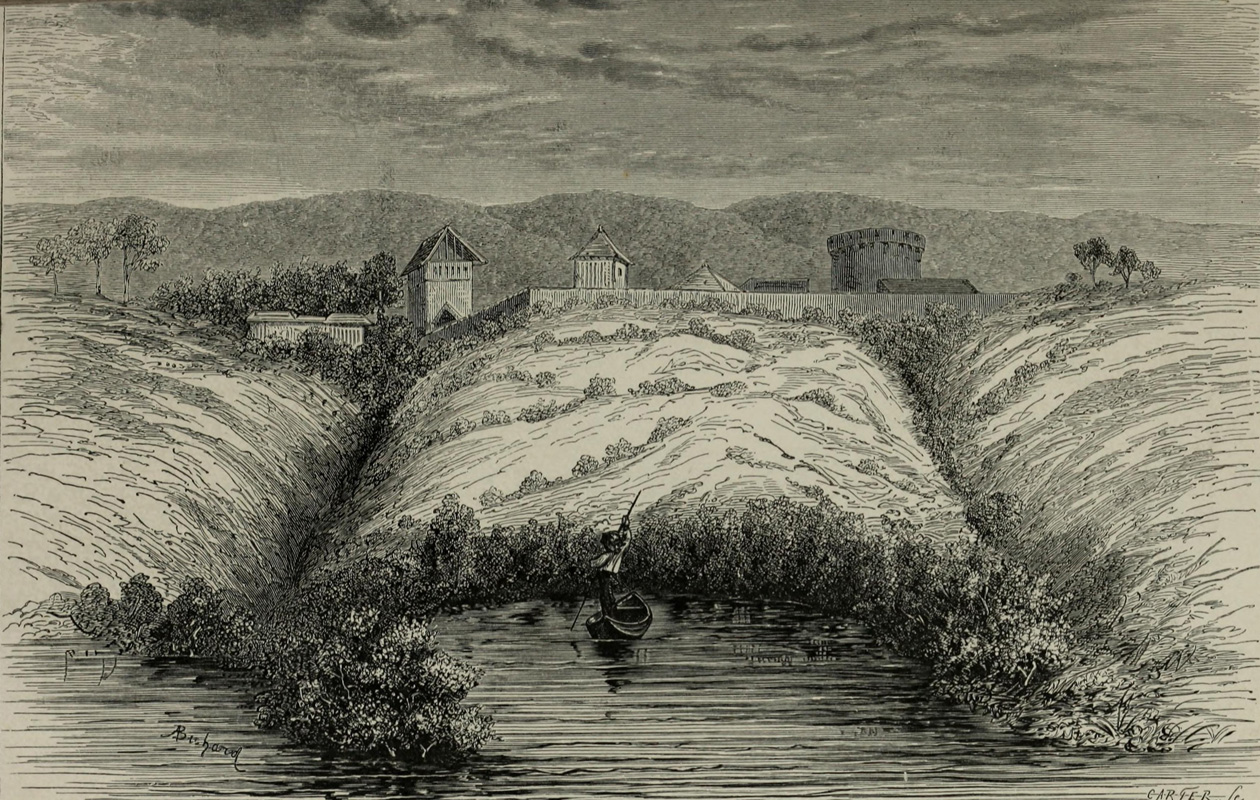
Gavana. My sketch of the north-eastern face,
taken from the Mhoma-ni Shamba, on the
opposite side of the creek, shows a picturesque
yellow pile, with tall, long, and buttressed curtains,
which appear slightly salient, enclosing
43towers studded with, perpendicular loopholes;
three tiers of fire opposite the entrance to the
northern harbour; a place d’armes; a high don-jon
with a giant flag-staff, conspicuous for 5 or 6
miles from the south, and sundry garnishings
of little domes and luxuriant trees, some even
growing out of the wall cracks.
Hearing that strangers are admitted to the
Fort—Mrs Rebmann has often visited it—I
proceeded to the head-quarters of the Jemadar.
Arrived at the land gate leading to the inner
Barzeh or vestibule, my attention was directed
to the Portuguese inscription before alluded to.
It is half defaced by the Arabs, but this is of the
less consequence as copies have been published
by Captains Owen and Guillain.[10] At the angles
of the western and southern bastions are also
scutcheons in stone bearing the names Baluarte
São Felippe and Baluarte Alberto. That to the
north was called Baluarte São Matthias (from Matthias
de Albuquerque), but here, as on the south
side, the inscriptions have disappeared, probably
by the fire of the enemy. A sentinel at the gate
44waved his hand and cried, Sir! Sir! (go! go!);
but I persisted in sending for the Jemadar Tangai,
who took my hand and led me towards a
shed of leafy branches, some 15 paces outside the
Fort. Here, he assured me, the Sayyid himself
used to faire anti-chambre; but I could see only
hucksters and negroes. We parted in high dudgeon,
nor did we ever become friendly. Saíd bin
Salim, who during this scene had remained below
and afar off, showed us the chief mosque—there
were eight when Lieut. Emery visited the
town[11]—and a formless mass of masonry, which
marks the last resting-place of some almost forgotten
heroes.[12]
The climate of the Island is hotter, healthier,
and drier than that of Zanzibar. The rains begin
with storms in early April, or before the setting
in of the S. West monsoon. They are violent in
May, and from that time they gradually decrease.
Between December and March there are a few
showers, for which the cultivator longs; and, as
may be imagined in an island ever subject to the
sea-breeze, the dews are exceptionally heavy.
The people suffer little from dysentery and fever:
45Europeans, however, complain that they are
never free from the latter. The endemic complaint
is a sphagadenic ulcer upon the legs and
parts most distant from the seat of circulation.
Here, as in Abyssinia, in Yemen, in the Hejaz,
and at Jerusalem, the least scratch becomes an
ugly wound, which will, if neglected, destroy life.
The cause may be found in the cachectic and
scorbutic habit induced by the want of vegetables
and by brackish water; the pure element
is, indeed, to be found in the old wells beyond
the town and on the mainland; but the people
save trouble by preferring the nearer pits, where
water percolates through briny coralline. The
town has suffered severely from epidemics, small-pox,
and what strangers call the plague. The
citizens still remember the excessive mortality of
1818, 1832, and 1835. At Mombasah I heard
nothing about the curious influence which the
climate is said to exercise upon cats, causing a
sandy-coloured fur to be exchanged for ‘a coat
of beautiful short white hair’; and producing,
according to others, complete baldness, like the
Remedio dogs of the Brazil and the Argentine
Republic.
Mombasah, as has been seen, trades with the
Wanyika for copal, with the people of Chaga
46and Ukamba-ni for ivory, and with the inner
tribes generally for hippopotamus’ teeth, rhinoceros’
horns, cattle, cereals, and provisions.
Slaves are brought from Zanzibar, natives of the
country about and south of Kilwa being preferred.
The imports are chiefly cottons, glass,
beads, and hardware. There is no manufacturing
industry, except a few cloths, hand-made
in the town. Besides Harar, Mombasah is the
only tropical African city which boasts an indigenous
coinage. During the wars with Sayyid
Said, the Mazrui chief, finding a want of small
change, melted down a bronze cannon, and converted
it into pieces a little larger than our six-pence.
The bit, which bears on the obverse the
name of Mombasah, whilst the reverse assures
the owner that it is ‘money,’ was forcibly circulated,
and the value was established at an equivalent
to the measure (Kibabah) of Maize. Since
the fall of the Mazara this purely conventional
coin has fallen into disuse, and I was unable to
find specimens of it.
47
Tremolavano i rai del sol nascente
Sovra l’onde del mar purpuree e d’oro,
E in vesti di zaffiro il ciel ridente,
Specchiar parea le sue bellezze in loro.
D’Africa i venti fieri e d’Oriente,
Sovra il letto del mar prendean ristoro.—Tassoni.
Leaving directions with Lakhmidas to land
and lodge our cockroach-gnawed luggage, and
deputing Saíd bin Salim, supported by our two
Portuguese servants and his three slaves, to
protect it, we set out on the morning after
our arrival to visit M. Rebmann of the ‘Mombas
Mission’ at Kisulodi-ni, his station. Before
the sun gained power to destroy the dewy freshness
of dawn, we slowly punted up the northern
sea-arm which bounds the Mombasah islet: in our
48heavy ‘dau’—here all the lesser craft are so
called—manned by two men and a small boy,
we justified the stern Omar’s base comparison
for those who tempt the sea, ‘worms floating
upon a log.’ Whilst threading the channel our
attention was attracted by groups of market
people, especially women, who called to be
ferried across. On the part of our crew the
only acknowledgment was an African modification
of Marlow Bridge, far-famed amongst
bargees. Sundry small settlements, bosomed
in thick undergrowth, relieved by brabs, cocoas,
and the W-shaped toddy-tree, appeared upon
each ‘adverse strand.’ After a two miles’ progress,
lame as the march of civilisation at S’a
Leone, we entered Port Tudor, a salt-water
basin, one of the canals of Mombasah Bay,
about two miles broad, and in depth varying
from one to fifteen fathoms. Broken only by
the ‘Rock of Rats,’ and hedged on both sides
by the water-loving mangrove, it prolongs itself
towards the interior in two tidal river-like channels
for about ten miles, till stopped by high
ground. The northern is named ‘Water of the
Wakirunga,’ and the north-western ‘Water of the
Rabai,’ from tribes owning the banks. Captain
Owen has christened them respectively William
49Creek and River Barrette, after the officers who
aided in his survey. Similarly, Port Reitz, to
the south-west, projects a briny line called
‘Water of Doruma’—the region which it drains—and
receiving the Muache, a sweet rivulet that
flows from uplands 20 to 30 miles from the
coast. Such in nature is the Tuaca, or Nash
river, which defaces our maps. It is a mere
confusion with Mtu Apa, the ‘River Matwapa’
of Captain Owen, a village and a little runnel
five miles north of Mombasah. Lieut. Emery
mentions the ‘hamlet of Mtuapa, situated at
the entrance of a small river, which runs about
sixteen miles into the country.’ Like the Cuavo,
or great ‘Quiloa river,’ a salt-water inlet receiving
during the rainy season the surface
drainage of a seaward slope, the ‘Tuaca’ becomes
a noble black streak, dispensing the blessings
of intercourse and irrigation athwart three
inches of white paper. The presence of such
rivers must always be suspected: they would
long ago have fundamentally altered the social
condition of the interior. We may remark the
same of Ptolemy’s three great Arabian streams,
which could have existed only in the imagination
of travellers.
As we advanced up the Rabai Water the sea
50arms shrank, and the scenery brightened till
we felt that any picture of this gorgeous and
powerful nature must be comparatively grey
and colourless. A broken blue line of well-wooded
hills, the Rabai Range, first offsets of
the Coast Ghats, formed the background. On
the nearer slopes, westward, were the rude
beginnings of plantations, knots of peasants’
huts hove successively in sight, and pale smoke-wreaths,
showing that the land is being prepared
for the approaching showers, curled high from
field and fell. Above was the normal mottled,
vapoury sky of the rainy zone, fleecy mists,
opal-tinted, and with blurred edges, floating
on milk-blue depths, whilst in the western
horizon a purple nimbus moved up majestically
against the wind. Below, the water caught
various and varying reflections of the firmament:
here it was smooth as glass, there it was
dimpled by the pattering feet of the zephyrs,
that found a way through the hill-gaps, and
merrily danced over the glistening floor. Now
little fish, pursued by some tyrant of the waters,
played duck and drake upon the surface: then
larger kinds, scate-shaped, sprang five or six
feet into the air, catching the sun like silver
plates. On both sides the wave was bounded
51by veritable forests of the sea. The white
mangrove affected the unflooded ground; the
red species (Rhizophora Mangle, Linn.) rose unsupported
where solidly based, but on the watery
edge it was propped, like a Banyan tree in
miniature, by succulent offsets of luscious purple
and emerald green, so intricate that the eye
would vainly unravel the web of root and trunk,
of branch and shoot. Hence, doubtless, the
name Aparaturie, or Apariturier, of the old
French travellers, from parere, because the tree
reproduces itself like mankind before split into
Adam and Eve. Clusters of parasitical oysters
adhered edgeways to the portions denuded by
the receding tide; the pirate-crab sat in his
plundered shell, whilst the brown newt and
rainbow-tinted cancers, each with solitary claw,
plunged into their little hiding-holes, or coursed
sidling amongst the harrow-work of roots, and
the green tufted upshoots binding the black
mass of ooze. These are the ‘verdant and
superb, though unfruitful, trees’ of the old
Portuguese navigator, which supply the well-known
‘Zanzibar rafters.’ Various lichens sat
upon the branch forks, and tie-tie, or llianas,
hung like torn rigging from the boughs. Here
and there towered a nodding cocoa, an armed
52bombax (silk-cotton tree), or a ‘P’hun’-tree, with
noble buttressed shaft and canopied head of
leek-green, glinted through by golden beams.
Fish-hawks, white and brown-robed, soared high
in ether. Lower down, bright fly-catchers
hunted the yellow butterflies that rashly crossed
from bank to bank; the dove coo’d in the denser
foliage; the yellow vulture, apparently keeping
a bright look-out, perched upon the topmost
tree-crest overhanging the shoal water which
lined the sides; the small grey kingfisher poised
himself with twinkling wings; the snowy paddy-bird
stood meditating upon the margin of the
wave, while sober-coated curlews and sandpipers
took short sharp runs, and stopped to dive beak
into the dark vegetable mud.
After seven hours, or ten miles, of alternate
rowing, sailing, and pushing through pelting
rain and potent sunbeams, we reached, about
mid-day, the pier—a tree projecting from the
right bank over the miry graves of many defunct
mangroves. Our boat, stripped of sail, oars, and
rudder, to secure her presence next morning,
was made fast to a stump, and we proceeded
to breast the hills. We began with rolling
ground, sliced and split by alternate heat and
moisture, thickly grown with tall coarse grass,
53sun-scorched to a sickly tawny brown, and thinly
sprinkled with thorny trees. Amongst the latter
I recognized the ‘Gabol’-mimosa of Somaliland,
whose long sharp needle, soft whilst young, but
dry, hard, and woody when old, springs from
a hollow filbert-like cone.
Another mile brought us to the first ascent
of the Rabai hills. The pitch of the fell was
short but sharp, and the path wound amongst
boulders, and at times under palms and clumps
of grateful shade. On the summit appeared
the straggling lodges of the savages, pent-housed
sheds of dried fronds, surrounded by
sparse cultivation, lean cattle, and vegetation
drooping for want of rain. The desert people
were all armed, being in terror of the Wamasai,
the natural enemies of their kind. None, however,
carried guns, the citizens of Mombasah
having strictly prohibited the importation of
powder; a wise precaution which might be
adopted by more civilized races upon the West
African coast. Amid cries of Yambo!—a salutation
which recalled dim memories of Mumbo
Jumbo—especially from that part of the community
termed by prescriptive right the fair—questions
as to whether our bundle contained provisions,
and the screams of lean-ribbed children,
54we pursued our road under the grateful cover of
a little wood, and then over ridgy ground where
a scattered village, shortly to be wasted by the
Kimasai spear, was surrounded by the scantiest
cultivation. At the end of a five-mile walk we
entered the Mission House, introduced ourselves,
and received from Mr and Mrs Rebmann the
kindest welcome. They were then alone, M.
Deimler, who had lived with Mr Isenberg in
Abyssinia, having left them three days before in
H. M.’s ship Castor, the late Commodore Trotter.
We afterwards saw the latter at Zanzibar.
The Kisulodi-ni Mission House[13] at Rabai Mpia
appeared to us in these lands a miracle of industry.
55Begun about 1850 by Messrs Rebmann
and Erhardt, it was finished after some two
years of uncommonly hard work. The form
is three sides of a hollow square, completed with
a railing to keep poultry from vagrancy, and
the azotea, or flat roof, is ascended by an
external ladder; the material is sandstone, clay-plastered
and white-washed; mangrove rafters
form the ceiling, and Mvuli planks the doors
and shutters. It has, however, its inconveniences,
being far from that source of all comfort,
the well, and beplagued with ants—the little
red wretches are ubiquitous by day, and by
night overrunning the clothes, nestling in the
hair, and exploring nose and ears without a moment’s
repose, they compel the inmates to sleep
with pans of water supporting the couch legs.
We enjoyed sundry huge ‘sneakers’ of tea,
and even more still the cool, light, refreshing
air of the heights, and the glorious evening,
which here, unlike ‘muggy’ Zanzibar, follows
the heavy showers. The altitude by B. P. proved
to be 750 feet, not 1200 to 2000, as reported.
The servants, most grotesque in garb and form,
gathered to stare at the new white men, and
those hill-savages who were brave enough to enter
a house stalked about, and stopped occasionally
56to relieve their minds by begging snuff or cloth.
One of the attendants had that in his face and
manner which suggested the propriety of having
a revolver ready. ‘Do not mind him,’ said Mrs
Rebmann, ‘he is a very dear friend,—one of our
oldest converts.’ ‘Yes,’ pursued her husband,
‘Apekunza was mentally prepared for Christianity
by a long course of idiocy, poor fellow!’
We were somewhat startled by the utter simplicity
of the confession when it was explained to
us that the convert Apekunza, whom Dr Krapf
calls Abbe Gunja, had, as often happens to
Africans, been driven to distraction by the loss
of all his friends and relatives. M. Rebmann
also related to me in pathetic terms the death of
the mechanic missionary, Johannes Wagner, a
youth who, suffering from typhus, was very
properly, but in vain, supplied with abundant
stimulants, therefore the Arab version of the
event was Sharrabúhu Khamr kasír—sár sakrán—mát
wa Jehannum (they gave him much strong
liquor—he got drunk—died, and went to Gehenna).
To compare the edification of the people
round the Christian death-bed, as set forth in
the Missionary Intelligencer, was not a little
suggestive of the delusions in which even honest
men can live.
57At a conference with the secretaries of the
Church Missionary Society in London, Major
Straith and the Rev. Mr Venn had intrusted
me with an open letter to their employé, dated
Sept. 30, 1856, giving him leave of absence in
case he decided to accompany the East African
expedition at the expense of the latter. They
had neglected to forward a copy, but M. Rebmann
had received a second communication,
which he did not before produce. His earliest impulse
was evidently to assist in carrying out the
plans which had been first formed by the ‘Mombas
Mission,’ and personally to verify the accuracy
of the map, then so loudly and violently
criticised, now gaining credit every year. But
presently cool reflection came. He was not in
strong health; he had, perhaps, seen enough of
the interior; and, possibly, after a few conversations
he thought that we relied too much on the
arms of flesh—sword and gun. The home instructions
were, ‘The Committee have only to
remark that they entirely confide in you, as one
of their missionaries, that wherever you go you
will maintain all the Christian principles by
which you are guided; that should you see fit
to go with the expedition your experience and
knowledge of the language may prove very valuable;
58while you may also obtain access to regions
and tribes where missionary enterprise
may be hereafter carried on with renewed
vigour.’ This did not quite suit us, who had
been pledged by Lieut.-Colonel Hamerton to
avoid ‘Dutchmen’ and proselytizing. Briefly,
M. Rebmann did not accompany us. A few
weeks afterwards we met him again at Zanzibar,
whither he had been driven by the plundering
Wamasai in February, 1857. His passion for the
‘wunderbar’ had not abated, and he told us impossible
legends about vast forests and other mythical
features, near the Nyassa, southern or Zambezean
Lake. During the years which he had spent
in the Wanyika country he had never studied its
language; but when driven from it, he immediately
applied himself to Kinyika. An honest
and conscientious man, he had yet all the qualities
which secure unsuccess. He was the last of
the ten members of the hapless Mission: all of
them were attacked by bilious remittents a few
weeks after commencing their labours; several
had died, and the others had sought less dangerous
fields for labour, and some possibility of
doing something in the spiritual way. That it
has been highly successful, geographically speaking,
none can doubt. The short trips into the
59interior, and the long conversations with the
natives, duly published by Messrs Krapf, Rebmann,
and Erhardt, gave an impulse to East
African exploration utterly unknown before their
day. And as the recent valuable labours of
Messrs Wakefield and New prove, the ‘Mombas
Mission’ is not likely to derogate from its former
fame.
We had proposed for ourselves a short excursion
inland from Mombasah; but everything
combined to oppose the project. The land was
parched, provisions were unprocurable, the robber
tribes were out, and neither guides nor porters
would face the plundering parties then approaching
the town. Indeed, it is to be feared that the
entrance to Chaga, Kilima-njaro, and the hill
country around will now be closed to travellers for
many a year. Caravans dare not risk a contest
with professed plunderers; and hereabouts a successful
raid always leads to sundry repetitions.
Such is the normal state of East Africa, from the
Red Sea to the Cape. The explorer can never be
sure of finding a particular road practicable: a
few murders will shut it for a generation, and
effectually arrest him at the very threshold.
We had no object during a mere ‘trial trip,’
either to fight our way, or to pave it with gold.
60Our course was to economize life and money for
the great task of exploring the Lake Regions.
This was duly explained by me to the Royal
Geographical Society, and no African traveller
would have required the explanation. But a certain
Herr Augustus Petermann, of Gotha, could
not resist the temptation of taunting me with
having hesitated to face dangers through which
the missionaries had passed, ‘weaponed only
with their umbrellas.’ This gentleman from
Germany had visited England, and had created
for himself the title of ‘Physical Geographer to
the Crown’: when, however, no salary was the
result, he returned to his native land, declaring
that the Crown must take its geography without
physic. His style of settling geographical questions,
for instance in the ‘Skizze’ before alluded
to (note 1, chap. v.), seems to be simply striking
a mean between the extremes of the disputants.
The process reminds one of a Bombay savan,
locally famed, who, having collected every observation
published upon the disputed longitude
of that port, added them all, divided them by the
number of the items, and produced his meridian.
As a reward for Herr Petermann’s ‘zealous and
enlightened services as a writer and cartographer
in advancing geographical science,’ that is to
61say, persistent book-making and map-drawing,
he, and not Mr Alexander Findlay, received, in
1867, the Founder’s medal of the Royal Geographical
Society; and I can only say that in
this case the gift has gone cheap, and has been
easily gained, as what is called in familiar French
‘un crachat.’
Unlike the traveller, the merchant always
commands an entrance for his goods: if one
line be shut up, another forthwith opens itself.
Such we found this year to be the case at Mombasah;
the western country has suddenly been
closed to Arabs and Wasawahili; the north-western
has become as unexpectedly practicable.
On January 19 (1857) returned the van of a
large trading party, which had started for the
interior in September last. It was composed of
about 200 men—Arabs, Wasawahili, and slaves,
of whom 40 bore provisions, rice and maize, pulse,
sugar, and tobacco, whilst 150 armed with muskets
carried packs to the value of $3000 in ‘Merkani’
(American domestics), sheetings, longcloths, and
other stuffs; green, white, and spotted beads,
knives, tin (batí); brass wires, and small chains,
with stores and comforts for the journey. After
19 days of actual marching, and sleeping out 24
nights, they reached Kitui, the farthest point
62visited by Dr Krapf in 1849, and thence they dispersed
through Ukamba-ni and Kikuyu, its north-western
province, to purchase ivory. The latter
article sold per Farsalah (35 lbs.) for 88 cubits
of cotton cloth, probably worth at Zanzibar 11
German crowns and a small merchant could
thus afford to being back from 1400 to 1500 lbs.
I wrote down a list of their marches[14] and
63stations, carefully comparing the accounts of
several travellers. Ukamba-ni was described to
me as a country rich in game, whose rivers
were full of hippopotamus; with gazelles, jungle-cattle,
and ‘wild camels’ (giraffes) in the plains,
and in the bush lions and leopards, elephants,
and the rhinoceros, which the Arabs here call
‘El Zurraf,’ and describe to be very fierce. The
tribes are subject to head men, whose influence
extends over a few miles: these chiefs must be
propitiated with cloth and beads, for which they
return safe conduct and provisions. At Kikuyu
the caravan found a royalet, Mundu Wazeli,
whose magical powers were greatly feared. The
people, a semi-pastoral and hospitable race, willingly
escorted the strangers. They are braver
than the Wanyika, and they effectively oppose
the Wamasaa, when invading their country to
drive the Galla cattle. The Wakámbá claim
blood-relationship with the Wakwafi and the
Wagálla, who, it must be remembered, speak an
Arabic dialect. All spring from the three sons
64of a venerable keeper of cattle, Mkwáfi the senior,
Mgálla, and Mkámbá: the legend seems invented
to account for the inveterate blood-feud
between the cousin tribes. When the founders
had inherited their father’s property, they had
been cautioned against robbing wild honey, and
they were told, as in the Crystal Palace, ‘Never
kill a Bee.’ Mkámbá, apparently having a sweet
tooth, attacked a wild hive, and had the misfortune
to see all his cattle rush violently to the
forests, where in time they became ‘buffaloes’
and antelopes. He naturally robbed his second
brother, who, in turn, robbed the senior, who
retorted by robbing the junior, and so forth till
the present day. The climate is good, water
abounds, and provisions are cheap. The honey
is ‘white as paper’; sugar-cane, manioc, holcus,
and tobacco are everywhere cultivated by the
women; poultry is plentiful, and goats cost 8,
while cows fetch 24 cubits of cotton cloth. The
beasts of burden are asses and a few camels. The
return road was rendered dangerous by the Gallas
and the Wamasai, who both harry Ukam-ba-ni,
but who did not dare to attack so large a
body armed with guns. The caravan marched
from sunrise till the afternoon, halting about
half an hour after two hours’ walking, the stages
65being mostly determined by water. Every night
they surrounded themselves with a corral, or
rude abbatis, and they lighted huge fires against
the wild beasts. I did not hear that any of the
party died. My informants could tell me nothing
concerning the giant snow-mountain,
Ndur-Kenia,[15] that exceptional volcano, still active,
when distant 6° from the sea, which would
postulate a large lacustrine region, possibly the
Baringo or Behari-ngo. They had never heard
of the Tumbiri or Monkey river, flowing to the
N. West; of the direct communication with the
Upper Nile, or of other geographical curiosities
whose existence the study of the interior during
the last few years has either confirmed or annulled.
Yet they were acute and not incurious
men. One of them, Mohammed bin Ahmad, had
kept a journal of his march, carefully noting the
several stages. The late M. Jomard, President of
the French Geographical Society, had been informed
66(and misinformed) that an annual caravan
of ‘red people,’ from the neighbourhood of
Mombasah, carried beads to buy ivory on the
Nile, about N. lat. 3°. He laid down the length
of the journey at two to three months. The
Arabs knew nothing of the matter.
Nothing even among the Somali Bedawin can
be wilder than the specimens from Ukamba-ni;
these Warimangao,[16] as the people of Mombasah
call them, the ‘sons’ of the chief Kivoi, that
danced and sang the Nyunbo or song of triumph
in the streets of Mombasah. It was a perfect
picture of savagery. About 50 blacks, ruddled
with ochre, performed the Zumo (procession);
men blowing Kudu-horns, or firing their muskets,
and women ‘lullalooing.’ They sat with us for
some hours drinking a sherbet of Ngizi, or molasses
extracted from cocoa-tree toddy, and the
number of gallons which disappeared were a caution.
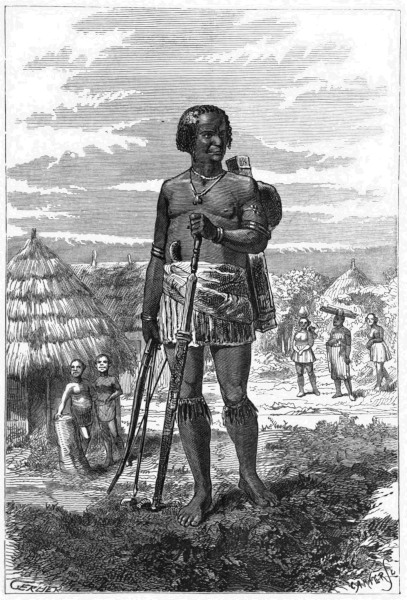
The warriors of the tribe, adorned with
beads on the necks, loins, and ankles, were armed
with the usual long bows and poisoned arrows,
spears or rather javelins, knobsticks for striking
67or throwing; knives and two-edged swords of
fine iron, the latter a rude imitation of the straight
Omani blade, of which I afterwards saw specimens
upon the Congo river. Some had shock
heads of buttered hair, wondrous unsavoury, and
fit only for door-mats; others wore the thatch
twisted into a hundred little corkscrews; their
eyes were wild and staring, their voices loud and
barking, and all their gestures denoted the ‘noble
savage’ who had run out of his woods for the
first time. They were, however, in high spirits.
Before last year (1857) no Arab had visited their
country: trading parties from Ukamba-ni sold
ivory to the Wanyika for four times round the
tusk in beads, and these middlemen, after fleecing
those more savage than themselves, retailed the
goods at high profits to the citizens. The
Wakamba of the coast are, of course, anxious to
promote intercourse between Mombasah and their
kinsmen of the interior, and thus the road, first
opened at the imminent risk of life, by the enterprising
Dr Krapf, has become a temporary highway
into the interior of Eastern Intertropical Africa—a
region abounding in varied interest, and still
awaiting European exploration. But let not geographers
indulge in golden visions of the future!
Some day the Arabs of Mombasah will seize and
68sell a caravan, or the fierce Wamasai or the
Gallas will prevail against the traders. Briefly,
no spirit of prophecy is needed to foresee that
the Kikuyu line shall share the fate of many
others.
A report prevalent in Mombasah—even a
Msawahili sometimes speaks the truth—that the
Mission House had been attacked by the savages,
and the march of an armed party from the town,
showing a belief in their own words, hurried us
up to Kisulodi-ni, on Sunday, January 18. The
rumour proved to be false, but it was a shadow
forethrown by coming events: as M. Rebmann
showed certain velléités for martyrdom, I insisted
that his wife, an English woman, should be sent
down to Mombasah, and we had the satisfaction
to see the boxes packed. This second visit added
something to our knowledge of the country.
The Ghaut, or Coast Range, which has no general
but many partial names, as Rabai, Shimba, and
others, varies in height from 700 to 1200 feet,
and fringes the shore from Melinde to the Panga-ni
river. Distant but a few miles from a sea-board
of shelly coralline, it shows, like Madagascar,
no trace of the limestone formation, which
forms the maritime region of Somaliland. These
hills are composed of sandstones, fine and coarse,
69red-yellow and dark brown, with oxide of iron;
the soil, as usual in Western Intertropical Africa,
is a ‘terrier rouge,’ as Senegal was called by the
French of the 17th century, a red ochreous clay,
and bits of quartz lie scattered over the surface.
Beyond it are detached hills of gneiss and grey
and rufous granite: the latter is so micareous that
the Baloch firmly believe it to contain gold.
Inland of Mombasah the Rabai Range is a
mere ridge, with a gentler counter-slope landwards,
declining 150 to 200 feet, not, as such maritime
formations usually are, the rampart of an
inland plateau. This unusual disposition probably
gave rise to the novel idea—instruments
were not used—that the interior falls to, and even
below, sea-level, thus forming a depression,
bounded north and south by rapid rivers, the Adi
and the Panga-ni. The chine is broken by deep
ravines, which during the rains pour heavy torrents
into the sea-arms at their base: the people
might make tanks and reservoirs by draining the
smaller clefts, but they prefer thirst and famine
to sweating their brows. Though exposed to the
blighting salt breeze, the land wants nothing but
water, and, this given, no man need ‘tread upon
his neighbour’s toes.’ Arecas and cocoas, bushy
mangoes and small custard-apples, the guava and
70the castor plant, the feathery manioc, and the
broad-leaved papaw and plantain flourish upon its
flanks. In the patches of black forest spared by
the wild woodman, the copal, they say, and the
Mvule, a majestic timber-tree whose huge trunk
serves for planking and doors at Zanzibar, still
linger. I saw none of the cinnamon plants mentioned
by Dr Krapf. A little gum-animi or
copal is here dug; but the inveterate indolence of
the natives, their rude equality, in which, as
amongst Bushmen, no one commands, and their
inordinate love for Tembo, or palm-wine, are
effectual obstacles to its exploitation. When we
visited these hills drought and its consequence,
famine, had compelled the people to sell their
children: contented with this exertion, they did
no more.
We left Kisulodi-ni on January 22, 1857.
Some nights afterwards fires were observed upon
the neighbouring hills, and the Wanyika scouts
returned with a report that the Wamasai were in
rapid advance. The wise few fled at once to the
Kaya, or hidden barricaded stronghold, which
these people prepare for extreme danger. The
foolish many said, ‘To-morrow we will drive our
flocks and herds to safety.’ But ere that morning
dawned upon the world, a dense mass of wild
71spearmen, numbering some 800 braves, sweeping
like a whirlwind, with shout and yell and clashing
arms, passed the Mission House, which they
either did not see or which they feared to enter;
dashed upon the scattered village in the vale below,
and strewed the ground with the corpses of
wretched fugitives. Thence driving their loot they
rushed down to the shore, and met a body of 148
matchlock-men, Arabs and Baloch, Wasawahili
and slaves, posted to oppose progress. The bandits
fled at the first volley. The soldiers, like
true Orientals, at once dispersed to secure the
plundered cattle, when the Wamasai rallying, fell
upon them, and drove them away in ignominious
flight, after losing 25 men, to the refuge of their
walls. The victors presently retired to the hill-range,
amused themselves with exterminating as
many Wanyika as they could catch, and, gorged
with blood and beef, returned triumphant to their
homes. The old Jemadar Tangai took from the
unfortunate Wanyika all their remaining cows;
they also retired into the interior, and the price of
provisions at Mombasah was at once doubled.
The wild people of Eastern Africa are divided
by their mode of life into three orders. Most
primitive and savage are the fierce pastoral
nomades, Wamasai and Gallas, Somal, and certain
72of the ‘Kafir’ sub-tribes: living upon the
produce of their herds and by the chase and
foray, they are the constant terror of their neighbours.
Above them rank the semi-pastoral, as
the Wakamba, who, though without building
fixed abodes, make their women cultivate the
ground: these clans indulge in occasional or periodical
raids and feuds. The first step towards
civilization, agriculture, has been definitively
taken by the Wanyika, the Wasumbara, the
Wanyamwezi, and other tribes living between
the coast and the inland lakes: this third order
is usually peaceful with travellers, but thievish
and fond of intestine broils.
But a few years ago the Wakwafi,[17] who in
73their raids slew women and children, were the
terror of this part of the coast: now they have
been almost exterminated by their Southern and
S. Western neighbours, the Wamasai, a tribe of
congeners, formerly friends, and speaking the
same dialect. The habitat of this grim race is
the grassy and temperate region from N. Westward
and to S. Westward of Chaga: nomades,
but without horses, they roam over the country,
where their flocks and herds find the best forage;
they build no huts, but dwell under skins, pitching
rude camps where water and green meat are
plentiful. They are described as a fine, tall,
dark race resembling the Somal, with a fearful
appearance caused by their nodding plumes, their
hide pavoises or shields, longer than those of the
‘Kafirs,’ and their spears with heads broad as
shovels, made of excellent charcoal-smelted
metal. According to native travellers, they are
not inhospitable, but their rough and abrupt
manners terrify the Wasawahili: they will snatch
a cloth from the trader’s body, and test his
courage with bended bow and arrow pile touching
74his ribs. Life is valueless among them;
arms are preferred to clothes, and they fear
only the gun because it pierces their shields.
They are frequented when in peaceful mood by
traders from Mombasah, Wasin, Mtanga, and
Panga-ni: this year, however, even those who
went up from the Southern ports feared to pass
the frontier. Such visits, however, are always
dangerous. ‘If a number of persons are killed
by a certain tribe, and there happen to be parties
belong to that tribe staying amongst the race
which has suffered loss, the visitors are immediately
put to death,’ says Mr Wakefield. Cattle
is the main end and aim of their forays, all herds
being theirs by the gift of the Rain-god and by
right of strength; in fact, no other nation should
dare to claim possession of a cow. They do not
attack by night, like other Africans: they disdain
the name of robbers, and they delay near the
plundered places, dancing, singing, and gorging
beef to offer the enemy his revenge. Until this
year they have shunned meeting Moslems and
musketeers in the field: having won the day, they
will, it is feared, repeat the experiment.
75
Statio benefida carinis.—Virgil.
In 1844 Dr Krapf allowed the population of
Mombasah town, without its dependencies, to be
8000 to 10,000. In 1846 M. Guillain reduced it
to 2500 or 3000 souls, not including a garrison
of 250 men, but including 40 families of Arabs
(220 to 230 souls), and 50 Banyans and Hindostani
Moslems. In 1857 I was assured that it
contained 8000 to 9000 souls, thus distributed:
Arabs, about 350; 300 Baloch and other mercenaries,
50 Bhattias, 25 to 30 Indian Moslems,
the rest being Wasawahili and the slave races.
The Wasawahili are distributed into two great
groups. Older and consequently nobler, though
76less numerous, are the Wamwita; they derive
their origin from a Shirazi Shaykh whose name
is locally forgotten. The other and far larger
division is the Wakilindi-ni, who trace their
name from Kilindi, whence they emigrated to
Shungaya alias Shiraz, and eventually to Mombasah.
Originally they occupied on the western
shore of the island a separate settlement, which
they called after their oldest homes; they built a
tower of stone, surrounded it with a wall, provided
it with wells, and thus rendered themselves
independent of their patrons. Some remnants
of eight other tribes, coast Arabs who had suffered
from the invader, also colonized Mwita.
Under the rule of the Portuguese an amalgamation
took place, and the several races all became
Wasawahili. The city is now governed by three
Shaykhs—of the Arabs, of the Wamwita, and the
Wakilindi-ni: they receive a small salary, and
they communicate direct with Zanzibar, visiting
the Island once a year. Justice is administered
by three Kazis similarly chosen: the troops are
under a Jemadar, and a Banyan sent by the
farmer-general from head-quarters, manages the
Custom House.
The Kisawahili spoken at Mombasah is purer
than that of Zanzibar, the result of being nearer
77the fountain-head. Here the people can hardly
articulate an initial ‘A:’ they must say, for instance
Bdúlá, or as often Mdúlá, not Abdullah,
and they supply a terminal vowel, as Shkúlá for
School; the Hindostan man who shirks our
double initial consonants would change it to
ishkúl. The explosive sound of the B by forcibly
closing the lips is given to the M, which becomes
a perfect consonant having sound and
continuance: before another consonant it creates
in strangers’ ears the suspicion of being preceded
by the original vowel-sound, and when following
a vowel it is articulated as a final not as an initial
consonant—M’áná-mke (a woman), for example,
would be pronounced M’ánám-ke. The initial
N also becomes before a consonant hard and
explosive, and it sounds to the tyro as if a rapidly
pronounced ‘I’ or ‘E’ were prefixed: Europeans,
for instance, write Njia, ‘Endia.’ At Mombasah
I heard the Arab ‘Hamzeh,’ or compression and
contraction of the larynx, when a hiatus of two
similar vowels occurs, as in Mcho’o (rain) and
Tá’á (a lamp): in the dialects less pure the gap
would be filled up by inserting the liquid R or
L, as Mfuru for Mfu’u (the name of a tree). The
Arabs and the more civilized tribes, I have remarked,
prefer the R to the L, and say Rufu for
78Lufu, the Upper Pangani river, and so forth.
The T also assumes the cerebral sound of the
Sanskrit and that which renders the English
dentals so hard to foreigners.
We found unexpectedly at Mvíta—the ‘Mombas
Mission’ having been kindly received—a
reception which could not be called friendly.
Small communities are rarely remarkable for
amiability, and these citizens are taxed by the
rest of the coast-people with overweening pride,
insolence of manner, bigotry and evil speaking,
turbulence and treachery. They cannot forget
their ancient glories, their hereditary chiefs who
ruled like kings with Wazirs, Shayhks of tribes
and Amirs or chief captains commanding hosts of
savage warriors. Of course they regret the Mazara
whom they themselves were the first to betray—they
would betray them again and regret them
again to-morrow. Like all ‘civilized’ Africans,
they are not only treacherous and turbulent, but
also inveterate thieves and pilferers: few travellers
have failed to miss some valuable in the
boat that lands them. Lies were plentiful as pronouns.
Whilst some for their own purposes
made very light of travel in the interior, others
studiously exaggerated the expense, the difficulty,
and the danger; and recounted the evils which
79had befallen Dr Krapf because he refused to
take their advice. As I determined to disregard
both, so they combined to regard us as rivals and
enemies. They devoted all their energies to the
task of spoiling us; and failing in that matter, they
tried bullying: on one occasion I was obliged to
administer, sword in hand, the descent down-stairs.
The Jemadar Tangai, a gaunt Mekrani some 60
years old, and measuring 6 ft 2 in., insisted courteously
upon supplying an escort, with the view
of exchanging his worthless swords for our guns
and revolvers: he could neither read nor write, but
he was renowned for ‘’Akl,’ intellect, here synonymous
with rascality. His son Mustafa brought
a present of goats and fruit, for which he received
the normal return-gift; he expected a little cloth,
gunpowder, and a gold chronometer. We were
visited by a certain Shafei Shaykh; by a Mombasah
merchant, Jabir bin Abdullah el Rijebi, who
seemed to think that men should speak in his
presence with bated breath: he almost merited
and he narrowly escaped being led out of the
room by his ears. The very Hindus required a
lesson of civility. We were on the best of terms
with the Wali or Governor, Khalfan bin Ali el
Bu Saídí, a fine specimen of the Arab gentlemen:
he was on board when the Sayyid died, and he
80told us all the particulars of that event. But the
manifest animus of the public was such as to
make a residence at Mombasah by no means
pleasant to us.
Considering the intense curiosity of civilized
humanity to know something of its fellow-men
in the state so-called of nature, of the savages
which now represent our remote ancestors, I
proceed to sketch the typical tribe of this part of
Africa. My principal authority is M. Rebmann,
who during nine years has made a conscientious
study of the race, and who imparted his knowledge
with the greatest courtesy.
The name ‘Wanyika’ means People of the
Nyika,[18] or wild land: it is useless, with M. G.
de Bunsen, to identify their land with the Νίχωνος
ὅρμος of the Periplus, as every wilderness is here
called Nyika. Moreover, the name is not anciently
known upon the coast: we read of the Wakilindi-ni
and of the ‘Muzungulos,’ the plundering
tribe which occupied the terra firma of Mombasah,
and thus we may suspect the Wanyika to be a
race which has emigrated from the interior since
the middle of the 17th century. Their own
81tradition is that they were expelled by the Gallas
from the lands lying N.N. West of Melinde.
They occupy the highlands between S. lat. 3°
and 5°, and they are bounded north by the
Wataita, and south by the Wasumbara. Dr
Krapf proposes for them a census of 50,000 to
60,000 souls, which appears greatly exaggerated.
They are, as usual, divided into a multitude of
clans, concerning which we know little but the
names. Mulattoes of an early date, negroes mixed
with Semitic blood and with a score of tribes,
these East African families appear to have cast
off in the course of ages the variety and irregularity
of hybridism; moreover, if it be true that
‘the Semite is the flower of the negro race,’ the
produce would hardly be properly called half-caste.
Receiving for ages distinct impressions of the
physical media around them, they have settled
down into several and uniform national types:
these, however, will not be detected by the unpractised
eye. Many considerations argue them
to be a degeneracy from civilized man rather
than a people advancing towards cultivation.
Their language attaches them to the great South
African race, and some have believed in their
ancient subjection to the Ethiopian or Kushite
Empire. The historian of these lands, however,
82has to grope through the glooms of the past,
guided only by the power to avail himself of the
dimmest present lights. I vehemently doubt,
moreover, the antiquity of maritime races in
Tropical Africa—a subject which has been discussed
in my sundry studies of the Western
Coast. A case in point is the latest move of the
pastoral Wamasai.
Physically the Wanyika race is not inferior
to other negroids, nor degraded as is the Congo
negro. Like the Galla and the Somal, the skull
is pyramido-oval, flattened and depressed at the
moral region of the phrenologist—a persistent
form amongst savages and barbarians—and
straight or ‘wall-sided’ above the ears, a shape
common both to ‘Semite’ and negro. The features
are ‘Hamitic’ only from the eyes downwards:
the brow is moderately high, broad, and conical;
the orbits are tolerably distant; the face is
somewhat broad and plain, with well-developed
zygomata; the nose is depressed with patulated
nostrils, coarse and ill-turned; the lips are
bordés, fleshy and swelling, and the jaw is distinctly
prognathous. The beard is scant; the
hair, which though wiry, yet grows comparatively
long, is shaved off the forehead from ear
to ear, and hangs down in the thinnest of corkscrews,
83stiffened with fat. The skin is soft, but
the effluvium is distinctly African; the colour is
chocolate-brown and rarely black, unless the
mother be a slave from the South. The figure
is, like the features, Semitic above and negrotic
below. The head is well seated upon broad
shoulders; the chest is ample, and the stomach,
except in early boyhood or in old age, does not
protrude or depend. But the bunchy calf is
placed near the ham; the shin-bone bends forward,
and the foot is large, flat, and lark-heeled.
Nothing is more remarkable than the contrast between
form and face in the woman-kind: upon
the lower limbs, especially the haunches, of the
Medicean Venus a hideous ape-like phiz meets
the disappointed eye: above hangs a flaccid
bosom, below
wand-like is
Her middle falling still,
And rising whereas women rise—
Imagine nothing ill!
There is not, as amongst the Hottentots, that exaggeration
of the steatopyga which assimilates
the South African man to his ovines: the subcutaneous
fat overlying the gluteian muscles and
their adjacents, forms in early life a cushion rather
ornamental than otherwise. Young men often
84show a curious little crupper which gives a
whimsical appearance to the posterior surface—I
have observed this also amongst the Somal.
The favourite standing position is cross-legged, a
posture unknown to Europe; sometimes the sole
of one foot is applied to the ankle or to the knee
of the other leg: the gait—no two nations walk
exactly alike—is half-stride, half-lounge. Eyes
wild and staring, abrupt gestures, harsh, loud,
and barking voices, still evidence the ignoble
savage.
The Wanyika afford a curious study of rudimental
mind. A nation of semi-naturals as
regards moral and intellectual matters, their
ideas are all in confusion. To the incapacity of
childhood they unite the hard-headedness of
age, and with the germs of thought that make
a Bacon or a Shakespeare they combine an utter
incapability of developing them. Their religion
is of the ‘small’ category, the large being
Brahmanism and Buddhism, Judaism, Christianity
and El Islam, the first active Reformation
of its predecessor, and the triumph of
Arianism over Athanasianism. The system is
that of a ‘Gentile worshipping nothing,’ yet
feeling instinctively that there is a Something
above or beyond him. It is the vain terror
85of our childhood rudely systematized, the earliest
dawn of faith, a creation of fear which ignores
love. Thus they have not, in our sense of the
words, God or devil,[19] heaven or hell, soul or
spirit.
‘Mulungu’ is the Mnyika’s synonym of the
Kafir Umdali, Uhlanga, and Unkulumkulu,
the Morungo of Tete, the Unghorray of Madagascar,
and the Omakuru of the Damaras.
Amongst the most advanced tribes it denotes
a vague kind of God: here it means any good
or evil ghost, especially of a Pagan. The haunting
Moslem is distinguished as P’hepo, the plural
of Upepo (a whirlwind, or ‘devil,’ generally
called Chamchera). As amongst all Fetish
worshippers, the evestrum which they call
Koma—pronounced like Goma—meaning etymologically
‘one departed,’ is a subject of
horror; but of the dead they say Yuzi sira—he
is ended. They cannot comprehend a future
state, yet they place sheep and goats, poultry
and palm wine, upon the tombs of their dead.
It is a modern European error (Rev. Mr J. P.
Schön and Rev. Mr Sam. Crowther) to suppose
that drops of liquor spilt, as by the Brass men,
86in honour of the old people (ancestors), food-offerings
at graves, and fires lighted there on
cold wet nights, evidence the European’s, the
East African’s,[20] or the American’s belief in
futurity: as the act proves it is a belief in
presentity, and after a few years the ceremony
showing ‘a continuation of relationship between
the living and the dead’dead’, is always disused.
Savages cannot separate the idea of an immortal
soul from a mortal body: can we wonder at this
when the wisest of the civilized have not yet
agreed upon the subject? The characteristic
of the venerative faculty amongst savages and
barbarians is ever irreverence: they cannot raise
themselves to the idea of a Deity, and they
blaspheme as if speaking of a man and an enemy.
The Wanyika horrify the Moslems by their free
language concerning Allah. So King Radáma
I. of Madagascar, a comparatively civilized
man, who attempted to regulate his forces upon
87a European pattern, was in the habit of firing
guns during storms; he declared that the two
deities were answering one another—the God
above speaking by thunder and lightning, the
god below by cannon and powder. Yet he could
anticipate the Bon Général Janvier by General
Tazo, the swamp-fever, who he declared was
his best aid against the French invader. Something
of this irreverence is remarkable in the
character of Richard Cœur de Lion.
The Wanyika thus hold, with our philosophers,
that the Koma is a subjective, not an
objective, existence; and yet ghost-craft is still
the only article of their creed. All their diseases
arise from possession, and no man dies what
we should term a natural death. Their rites
are intended either to avert evils from themselves
or to cast them upon others, and the primum
mobile of their sacrifices is the interest of the
Mganga, or Medicine-man. When the critical
moment has arrived, the ghost, being adjured
to come forth from the possessed one, names
some article, technically called a Kehi, or
chair, in which, if worn round the neck or
limbs, it will reside without annoying the
wearer. This idea lies at the bottom of many
superstitious practices: this negro approach to
88a ‘sympathetic cure’ is the object of the leopard’s
claw, of the strings of white, black, and blue
beads, called Mdugu ga Mulungu (ghost-beads),
worn over the shoulder, and of the rags taken
from the sick man’s body, and hung or fastened
to what Europeans call the ‘Devil’s Tree.’ The
‘Kehi’ is preferred by the demon-ghost to the
patient’s person, and thus by mutual agreement
both are happy. Some, especially women, have
a dozen haunters, each with its peculiar charm:
one of them is called, ridiculously enough,
‘Barakat,’ in Arabic ‘a blessing,’ and the P.N.
of the Æthiopian slave inherited by Mohammed.
It has not suited the Moslem’s purpose to
proselytize the Wanyika, who doubtless, like
their kinsmen the Wasawahili, would have
adopted the Saving Faith. As it is, the Doruma
tribe has been partly converted, and many of
the heathen keep the Ramazan fast, feeling
themselves raised in the scale of creation by
doing something more than their pagan brethren.
The ceremonies are the simplest contrivances of
savage priestcraft. Births are not celebrated,
and the weakly or deformed infant is at once
strangled: it is a failure, and as such it is put
away. Children become the property of the
mother, or rather of her brother, to be disposed of
89as he pleases: the only one who has no voice in the
matter is the putative father. Circumcision, an
old African custom extending from Egypt to the
Cape, and adopted from the negroid by the
Hebrews, is a semi-religious act performed once
every five or six years upon the youths en masse,
and accompanied by the usual eating and drinking,
drumming and dancing. A man may
marry any number of wives; the genial rite,
however, is no tie to these fickle souls: it is
celebrated by jollifications, and it is broken as
merrily.
The principal festivities, if they can be so
called, are funerals: the object is to ‘break
the fear’ (Ussa kiwewe) of death, an event
which, savage-like, they regard with a nameless
dread, an inexpressible horror. For a whole
week the relations of the deceased must abstain
from business, however urgent, and ruin themselves
by killing cattle and broaching palm-wine
for the whole community. At these times there
is a laxity of morals, which recalls to mind the
orgies of the classical Adonia, and refusal to
lavish wealth upon the obsequies of relations
is visited with tauntings and heavy fines.
A characteristic of Wanyika customs is the
division of both sexes into distinct bodies, with
90initiatory rites resembling masonic degrees. The
orders are three, not four as in India, Persia,
and ancient Greece; and traces of such organization,
founded as it is upon the ages of man,
may be found in many communities of negroes
and negroids. The Kru Republic, for instance,
a pure democracy, flourishing close to the despotisms
of Ashanti and Dahome, makes a triple
division of its citizens: the Kedibo, or juveniles;
the Sedebo, or soldiers (adults); and the
Gnekbadi, elders and censors. The southern
Gallas appear to be divided into ‘Toibs,’ or
officers; the ‘Ghaba,’ adult warriors, who wear
four Gútu or pigtails, projecting at right angles
from the poll; and the ‘Ari,’ cadets or aspirants,
who have a right to only two. The Wakwafi
have the El Moran, warriors, young men who
live with their fathers; the Ekieko, married
men; and the Elkijaro or Elkimirisho, elders.
The Wanyika split into the Nyere, or young;
the Khambi, or middle-aged; and the Mfaya, or
old. Each degree has its different initiation and
ceremonies, with an ‘elaborate system of social
and legal observances,’ the junior order always
buying promotion from the senior. Once about
every twenty years comes the great festival ‘Unyaro,’
at which the middle-aged degree is conferred.
91This (1857) is Unyaro-year; but the
Wamasai hindered the rite. Candidates retire
to the woods for a fortnight, and clay themselves
for the first half with white, and during the
second with red earth; a slave is sacrificed,
and the slaughter is accompanied by sundry
mysteries, of which my informants could learn
nothing. When all the Khambi have been raised
to the highest rank, the Mfaya, these, formerly
the elders, return, socially, to a second childhood;
they are once more Nyere, or (old) boys,
and there is no future promotion for them.
After the clay-coatings and the bloody sacrifice,
the chief distinctions of the orders are their
religious utensils. Tor instance, the Muansa
(plural Miansa) drum, a goat-skin stretched upon
a hollowed tree-trunk, six feet long, whose booming,
drawn-out sounds, heard at night amongst
the wild forested hills, resembles the most melancholy
moaning, is peculiar to the third degree
or elders of both sexes. It is brought
during the dark hours to the Kaya, and the
junior orders may not look upon it. Similarly,
the women have earthenware drums, which are
concealed from the men. El Idrisi (1st climate,
2nd section) had heard that the people of El
Banes, 150 Arab miles by sea from Manisa or
92Mombasah, adored a drum called Esrahim. It
was covered with skin only at one end, and was
suspended by a cord to be beaten; the result
was a frightful sound, heard at the distance of a
league.
Languor and apathy are here at once the
gifts of the media or climate, and the heritage of
the race: moreover, man in these lands, wanting
little, works less. Two great classes, indeed,
seem everywhere to make of life one long holiday—the
civilized rich, who have all things, and
the savage, who possesses almost nothing. Yet
is the Mnyika, and indeed mostly the wild
man, greedy of gain—alieni appetens, sui pro-fusus—perfectly
dishonest in quest of lucre, and
not to be bound by honour or oath, as he is
reckless, wasteful, and improvident. Like their
neighbour-nations in this part of Africa, these
people are instinctively and essentially thieves.
They never go to war; agriculture, commerce,
and a settled life have enervated them into
pusillanimity without supplying superior knowledge
for offence or even for defence. They
scratch the ground with their little hoes; they
wander about after their few cows and goats;
they sit dozing or chatting in the sun or
before a fire; and they spend hours squatting
93round an old pit till water collects, rather than
sink it a few feet. Thus they idle away three
days, and they rest from non-labour on the
fourth, called Juna, from Jum’a the Moslem
‘sabbath.’ This, as amongst the Dahomans and
other African tribes, is their week. Spare time
is passed mostly in drunkenness, induced by
Tembo or palm-wine, and with stronger liquors,
when they can get them. They begin the potations
early in the morning, and after midday they
are seldom sober, except for want of material.
The tom-tom is hardly ever silent: as amongst
the Somal and the Wasawahili, it sounds at all
times, seasons, and occasions: and they dance,
accompanying themselves with loud cries, even
to expel the bad ghost from the body of a bewitched
friend. They have also the Dahoman
rattle, an empty gourd or cocoa-nut, filled with
pebbles and provided with a handle: this is the
celebrated ‘Tamaraka’ idol worshipped by the
Tupy-Guarani tribes, between the Gulf of Mexico
and the Rio de la Plata. The music is simple,
and they are contented to recitative for the live-long
night such merum nectar as—
‘Kitosí múlálání ká-uká.’
‘The bird from the palm starts not.’
94This reminds us of the Histoire d’un bouton and
the magical Teutonic refrain—
‘Trink Bier, liebe, liebe Lieschen,’
arguing, says the witty author, so deep a devotion
to that art which hath power to soothe
the savage breast. With time and tune well developed,
but wholly wanting in initiative, the
wild men easily learned music from the missionaries;
yet they have always preferred their own
meaningless declamation. Of course the Kinyika
is an illiterate language.
The policy of the Wanyika is a rude and lawless
liberty, equality, fraternity. None commands
where none obeys: consequently there is
no ‘temperamentum of chief,’ no combination,
and no possible improvement. The headman plies
his hoe, like the serf, in his little plot of maize
or manioc; and the clans will not unite even
to protect life. Causes are decided by a council
of elders, according to the great African code—ancient
custom. The chief of the five Shaykhs
is he of Rabai Mku; but even he dare not arrogate
to himself any authority. Pilfering is common,
robbing is rare; and a man caught in the
act of stealing is chastised by the proprietor with
sword or bow. Adultery is punished by the fine
of a cow and abundance of liquor. The murderer
95is more often mulcted than handed over
for death to the family of the slain; and little
is said concerning the slaughter of a slave.
Divided into half-a-dozen sub-tribes, each barely
sufficient to stock an English village, these
savages find petty political jealousies and intrigues
as necessary and as ready to hand as do
the highly civilized.
The Wanyika readily attended the European
schools as long as these were a novelty; presently,
with the characteristic African levity and
inconsequence, they grew weary of application,
and they dubbed all who so exerted themselves
Wazingu, or fools. Yet in one point they are an
anomaly. They possess, in a high degree, the
gift of many negro and negroid races, an unstudied
eloquence which the civilized speaker
might envy, and which, like poetry, seems to
flourish most in the dawn of civilization. To
see, says a Brazilian author, men so eloquent and
so badly governed does not suggest that public
speaking in the virility of civilization is a great
ruling power. Their unpremeditated speech
rolls like a torrent; every limb takes its part in
the great work of persuasion, and the peculiar
rhythm of their copious dialect, favourable to
such displays of oratory, forms an effective combination.
96Few, however, can ‘follow the words,’
that is to say, answer in due order the heads of
an opponent’s speech. Such power of memory
and logical faculty is not in them. The abuse of
the gift of language makes them boisterous in
conversation, unable to keep silence—the negro
race is ever loquacious—and addicted to ‘bending
their tongues like their bows for lies.’ They
cannot even, to use a Zanzibar German merchant’s
phrase, ‘lie honestly.’ Their character
may thus be briefly summed up: a futile race of
barbarians, drunken and immoral; cowardly and
destructive; boisterous and loquacious; indolent,
greedy, and thriftless. Their redeeming points
are, a tender love of family, which displays itself
by the most violent ‘kin-grief,’ and a strong
attachment to an uninviting home.
A certain critic, who had probably never
transgressed the bounds of Europe, but who probably
had read Macaulay (‘by judicious selection
and previous exaggeration, the intellect and the
disposition of any human being might be described
as being made up of nothing but startling
contrasts’), thus complained of my description
of Somal inconsistency. ‘This affectionately-atrocious
people,’ he declares, ‘is painted in
strangely opposite colours.’ Can we not, then,
97conceive the high development of destructiveness
and adhesiveness, to speak phrenologically, combining
in the same individual? And are not the
peasantry of Connaught a familiar instance of
the phenomenon? Such is the negro’s innate
destructiveness, that I have rarely seen him
drop or break an article without a loud burst of
laughter. During fires at Zanzibar he appears
like a fiend, waving brands over his head, dancing
with delight, and spreading the flames, as
much from instinct as with the object of plunder.
On the other hand, he will lose his senses with
grief for the death of near relatives: I have
known several men who remained in this state
for years. But why enlarge upon what is apparent
to the most superficial observer’s eye?
The male dress is a tanned skin or a cotton
cloth tied round the waist, strips of hairy cowhide
are bound like garters, or the ‘hibás’ of the
Bedawin Arabs, below the knee, and ostrich and
other feathers are stuck in the tufty poll. The
ornaments are earrings of brass or iron wire, and
small metal chains: around the neck and
shoulders, arms and ankles, hang beads, leather
talisman-cases, and ‘ghost-chairs’—the latter
usually some article difficult to obtain, for instance,
a leopard’s claw. Those near the seaboard
98have ceased to extract one or more of the lower
incisors—a custom whose object was probably
the facilitating of expectoration—and they now
rarely tattoo, saying, ‘Why should we spoil our
bodies?’ They have abandoned the decoration
to women, who raise the cutis with a long
sharp thorn, prick it with a knife-point, and wash
the wounds with red ochre and water. Abroad
the Mnyika carries his bow and long skin-quiver
full of reed arrows, tipped with iron or hard wood,
and poisoned by means of some bulbous root: his
shield is a flat strip of cowhide doubled or trebled.
He has also a spear, a knife at his waist for cutting
cocoa-nuts, a Rungu or knobstick in his
girdle behind, and a long sword, half sheathed,
and sharpened near the point. He hangs round
his neck a gourd sneeze-mull, containing powdered
tobacco with fragrant herbs and dried plantain-flower.
On journeys he holds a long thin staff
surmounted by a little cross, which serves to
churn his blood and milk, a common article of
diet in East Africa—similarly, the Lapps bleed
their reindeer. He also slings to his back a
dwarf three-legged stool, cut out of a single block
of hard wood. In the ‘Reise auf dem Weissen
Nil’ (p. 32), extracted from the Vicar-General
Knoblecher’s Journals, we read of the chief
99Nighila and his followers carrying stools of tree-stumps,
ornamented with glass-ware. The other
approximations of custom, character, and climate
between the North Equatorial basin of the White
River (Nile) and the coast of Eastern Intertropical
Africa are exceedingly interesting.
The costume of the Domus Aurea and Rosa
Mystica is as simple: a skin or a cloth round the
loins, another veiling the bosom, and in some
cases a Marinda or broad lappet of woven beads,
like the Coëoo of Guiana, falling in front, with a
second of wider dimensions behind. A flat ruff
of thick brass wire encircles the throat, making
the head appear as in a barber’s dish; white and
red beads, or the scarlet beans of the Abrus tree,
form the earrings and necklace, bracelets and
anklets, whilst a polished coil of brass wire, wound
round a few inches of the leg below the knee,
sets off the magnificent proportions of the limb.
Young girls wear long hair, and the bold bairn
takes his bow and arrows before thinking of a
waist-cloth.
The Wanyika are a slave importing tribe:
they prefer the darker women of the South to,
and they treat them better than, their own wives.
Children are sold, as in India, only if famine
compels, and all have the usual hatred of slave
100merchants, the ‘sellers of men.’ When a certain
Ali bin Nasir was Governor of Mombasah he took
advantage of a scarcity to feed the starving
Wanyika with grain from the public depôts. He
was careful, however, to secure, as pledges of repayment,
the wives and children of his debtors,
and these becoming insolvent, he sold off the
whole deposit. Such a transaction was little suspected
by our acute countrymen, when, to honour
enlightened beneficence, they welcomed with all
the plaudits of Exeter Hall, ‘that enlightened
Arab statesman, His Excellency Ali bin Nasir, Envoy
Extraordinary of H.M. the Imam of Muscat,
to the Court of H. B. Majesty;’ presented him
with costly specimens of geology, and gold chronometers;
entertained him at the public expense,
and sent him from Aden to Zanzibar in the Hon.
East India Company’s brig of war, Tigris. This
Oriental votary of free trade came to a merited
bad end. He was one of the prisoners taken by
the doughty B’ana Mtakha of Sewi, where the
late Sayyid’s ill-starved and worse-managed force
was destroyed by the Bajuni spear. Recognized
by the vengeful savages, he saw his sons expire
in torments; he was terribly mutilated, and at
last he was put to death with all the refinements
of cruelty. And he deserved his fate.
101The Wanyika consider service, like slavery, a
dishonour: they have also some food prejudices
which render them troublesome to Europeans,
and those who live amongst them are obliged to
engage Moslem menials. As regards the success
of the ‘Mombas Mission,’ which was established
in 1846, and upon which a large sum of money
has been expended, the less said the better. Dr
Krapf had started with the magnificent but visionary
scheme of an ‘Apostle’s Street,’ a chain
of mission posts stretching across Africa from
sea to sea: he never, however, made converts
enough to stock a single house. Those unacquainted
with savage life would think it an easy
task to overthrow the loose fabric of wild superstitions,
and to raise upon its ruins a structure,
rude, but still of higher type. Practically, the
reverse is the case. The Wanyika, for instance,
are so bound and chained by Adá, or custom, that
inevitable public opinion, whose tyranny will
not permit a man to sow his lands when he
pleases; so daunted and cowed by the horrors of
their faith; so thoroughly conservative in the
worst sense of the word, and so enmeshed by
tribal practices, of which not the least important
is their triple initiation, that the slave of rule
and precedent lacks power to set himself free.
102We may easily understand this. Religion is the
mental expression of a race, and it cannot advance
in purity without a correspondent intellectual
improvement on the part of its votaries. On
the other hand, not a few nations, especially in
the dawn of civilization, have risen despite their
follies of faith: but these are peoples who have
within them the germs of progress. Judaism
did not make the Falasha of East Africa, nor the
remote colonists of Southern Arabia, an intellectual
people: the Jews of Aden, to this day, show
no traces of mental superiority over their neighbours.
Christianity has done nothing for Abyssinia
or Egypt: these lands are inhabited by
peoples which have remained as nearly stationary
as it is possible for human nature. Nowhere,
indeed, has ‘the Church’ proved herself in the
long course of ages a more complete and hopeless
failure than in her own birthplace, and in
her peculiar ethnic centre, Syria. Here the Marronites
are in no ways superior, and in many
points, such as courage and personal dignity, inferior
to their neighbours, the Metawali, who
have a debased religion, and the Druzes, who
have none. El Islam, also, has not much to boast
of on the coasts of Guinea and of Zanzibar, except
that it has abolished certain abominations
103such as witch-killing, twin-murder, and poison
ordeals, of which many have been practised in
semi-civilized Europe and Asia. When, therefore,
we tell the world that the Bible made England
or the Koran Stambul, we merely assist in
propagating a fallacy.
104
The sweeping sword of Time
Has sung its death-dirge o’er the ruined fanes.
Queen Mab.
Not a head of game, not a hippopotamus,
was to be found near Mombasah. We finished
our geographical inquiries; shook hands with
divers acquaintances; re-shipped, after sundry
little difficulties, on board the Riami; and on
the 24th of January we left the turbulent island
with gladdened hearts. The accidents of voyage
now turned in our favour: there was a bright
fresh breeze and a counter-current running
southward thirty or thirty-five miles a day.
After 6 hours of drowsy morning sailing, Ra’as
Tewi, a picturesque headland, hove in sight, and
two hours more brought the Riami to anchor at
105Sandy Point, in Gasi (جاسى) Bay. It lies half-way \[Arabic]
between Mombasah and Wasin Island, and
the position is correctly laid down in the ‘Mission
Map.’[21] It is a mere roadstead, without
other protection against the long sweep and
swell of the Indian Ocean than a few scattered
‘washes,’ and a coralline islet. The settlement
lies at some distance from the shore, deep-bosomed
in trees, behind a tall screen of verdant
mangrove; only the nodding cocoa, sure
indicator of man’s presence in East Africa,
towering high over the plebeian underwood,
betrays its position to the mariner. The large
village of wattle and dab huts is inhabited, like
Mtuapa and Takaungu, by remnants of the
proud Mazrui irreconcileables, still self-exiled
from Mombasah. They live under the Shaykh
Abdullah bin Khamis, and a sister of Shaykh
106Mubarak of Mombasah, who is said to display
peculiar energy. They have given refuge to
fugitive slaves from Marka, and behind the coast-line
they have founded a new settlement, Mwasagnombe.
It is not improbable that, in common
with their brethren established in other
villages, they look forward to recovering Mombasah,
their old appanage.
Gasi is surrounded by plantations, and the
Arabs, unmolested by the Wadigo savages, to
whom the fertile land belongs, live in comparative
comfort. Our crew armed themselves
to accompany my companion, who, despite the
bad name of the people, was civilly received on
shore, with sundry refreshments of cocoa-nut
milk and cake of rasped pulp and rice-flour.
The footprints of a small lion appeared upon the
sands, but we were not young enough to undertake
the fruitless toil of tracking it. This was
the breeding season, as the frequent birds’-nests
proved. Ensued a cool, breezy night on board
the Riami, the thermometer showing 75° (F.).
Our gallant captain, the melancholist, sat up
till dawn, chatting with Said bin Salim, who
trembled at the sound of scattered washes, and
at the wind moaning over the coral bank and
through the barren ‘forests of the sea.’
107About sunrise we again made sail, and, guided
by that excellent landmark, the Peaks of Wasin,
whose height is in charts 2500 feet, we entered,
after three hours, the narrow channel, with
never less than 5 fathoms of water, which, running
nearly due east and west, separates Wasin
Island from the continent. The north of this
coralline bank, an ‘insula opaca,’ about 2¼
miles long by 1 in breadth, is defended by sundry
outlying ledges and diminutive cliffs, where the
gulls and terns take refuge, and upon which the
combing sea breaks its force. The low southern
shore is rich in the gifts of floatsom and jetsom;
here the tide, flowing amongst the mangrove
fringes and under shady crags, forms little bays,
by no means unpicturesque. To windward, or
south, lies the Wasin Bank, with three or four
plateaux of tree-tufted rock emerging a few feet
above sea-level.
The Island, which does a little cultivation,
belongs to Zanzibar, and the only settlement,
about the centre of its length, is on the northern
shore, fronting Wanga Bandar on the
Continent. Wasin contains three Mosques, long
flat-roofed rooms of coral rag and lime ranged
obliquely to face Meccah, and scattered amongst
little huts and large houses of ‘bordi’ or mangrove
108timber: the latter are tied with coir rope
and plastered over with clay, which in rare cases
is whitewashed. The sloping thatch-roof already
approaches in size and in sharpness of pitch
the disproportions of the Madagascar cottage.
Huge calabashes extend their fleshy arms over
the hovels, affording the favourite luxury of a
cool lounge, and giving from afar a something of
pleasant village aspect to the squalid settlement.
Water must be brought from the mainland; the
people own it to be brackish, but declare that it
is not unwholesome. The climate is infamous
for breeding fever and helcoma, the air being
poisoned by cowries festering under a tropical
sun, and by two large graveyards—here also, as
at Zanzibar, the abodes of the dead are built
amongst the habitations of the living. The population
is a bigoted and low-minded race, Hassádin
(envious fellows) of evil eye, say the Zanzibarians;
a mixture of lymphatic Arabs, hideous
Wasawahili, ignoble half-castes, and thievish
slaves. The Sayyid maintains no garrison here;
the Banyans have been forbidden to deal in
cowries, and the native merchants have all the
profits such as they are.
I could hear nothing of Mr Cooley’s ‘tribe
named Masimba, on the coast at Wassína
109(Wasin Island), near Mombasa,’ a term which he
translates ‘lions,’ and identifies with the Zimba
invaders of Do Couto. There is, however, a district
of that name between Wasin and Gasi;
and it may be connected with the range crossed
by M. Rebmann, in 1847, and usually written
Shimba. In the interior the word Masimba is
used when addressing man or woman, and the
root appears to be identical with that of the
Vazimba or aborigines of Ankova. The people
of Wasin send caravans of 100 men to the interior,
viâ Wanga Bandar. They set out about
the end of February, make some 20 marches, and
return with ivory and slaves after about four
months.
Landing, we found the shore crowded with
unarmed spectators, who did not even return our
salams: we resolved in future to reserve such
greetings for those who deserve them. After
sitting half an hour in a mat-shed, redolent
with drying cowries and dignified with the
name of Furzeh, or Custom House, presided over
by a young Bohrah from Cutch, we were civilly
accosted by an old man, whose round head
showed him to be a Hindostani. Abd el Karim
led us to his house, seated us in chairs upon the
terrace, and mixed for us a cooling sherbet in a
110kind of one-handled blue and white vase, not
usually, in Europe at least, devoted to such purpose.
The Riami discharging cargo, we walked
into the jungle, followed by a ragged tail of men
and boys, to inspect some old Portuguese wells:
as we traversed the village all the women fled—a
proof that El Islam here flourishes. This part
of the island is thinly veiled with a red argillaceous
soil which produces a thick and matted
growth of thorny plants, creepers, and parasites:
eastward, where the mould is deeper, there is
richer vegetation, and a few stunted cocoas
have taken root. After fighting through the
jungle, we came upon two pits sunk in the soft
rock: Said bin Salim was bitterly derided whilst
he sounded the depth, 40 feet; and by way of
revenge, I dropped a hint about buried gold,
which has doubtless been the cause of aching
arms and hearts to the churls of Wasin. There
is no game on the Island or on the main: in the
evening, after a warm bath amongst the mangroves,
we left the dirty hole without a shade of
regret.
The coast is here concealed by the usual
thickset hedge of verdure, above which nod the
tufts of straggling palms: its background is the
rocky purple wall of Bondei—Capt. Owen’s
111‘Sheemba Range of Hills, about 1500 feet high’—here
and there broken by tall blue cones.
After 1 h. 30 min. we sighted Wanga Bandar,
where the land was smoking; this place has
rarely the honour of appearing in maps. The
environs belong to the Wadigo, amongst whom
Said bin Salim lost a slave-girl: she had gone on
leave of absence to her tribe, and though she
never returned, he received from her an annual
remittance of a dollar. These people, who are
divided into half-a-dozen clans, occupy a fine
high country which extends westward to Usumbara:
they dwell in large villages, fenced to
keep out the Wamasai, and they are agriculturists,
fond of Jete, or public markets, at which they
dispose of their grain to the coast-traders. Those
whom we saw were poor-looking men: their
bows were well turned and bent, with brass knobs
and strings of cowgut; the notched and neatly
feathered arrows had triangular iron piles. The
women, who veiled the bosom, were remarkably
plain, and apparently had never seen a European.
These Wadigo with their southern neighbours,
the Wasegeju, are porters of the inland traffic.
Caravans, if they may so be called, numbering
sometimes a hundred men, slaves included, set
out at the beginning of the rains in March or
112April, from Wanga and other little ‘Bandars’
on the coast. If the capital be $1000, they distribute
it into $400 of beads, and brass and iron
wires (Nos. 7 and 8), with $400 of American
domestics and cotton-stuff’s of sorts: the remainder
serves to pay 40 porters, who each receive
$10 per trip, half before starting and the rest
upon return. After twenty days’ march, these
trading parties arrive at Umasai and the adjacent
countries; they remain there bartering for
three or four months, and then march back laden
with ivory and driving a few slaves purchased en
route.
Our Nakhoda again showed symptoms of
‘dodging:’ he had been allowed to ship cargo
from Mombasah to Wasin, and thereupon he
founded a claim or rather a right to carry goods
from Wasin to Tanga. Unable to disabuse his
mind by mild proceedings, I threatened to cut
the cable, and thus once more, the will of Japhet
prevailing over that of Shem, we succeeded
about 1 P.M., not without aid from an Omani
craft, in hauling up our ground-tackle. The old
Riami, groaning in every rib, flirted with some
reefs, and floated into the open sea, whose combing
waves were foaming under a stiff N. Easter. As
we sped merrily along Said bin Salim busied himself
113in calculating the time it would take to
round the several promontories. But when the
water smoothened under the lee of Pemba Island
he became bold enough to quote these martial
lines:—
‘I have backed the steed since my eyes saw light,
And have fronted Death till he feared my sight;
And the riven helm and the piercèd mail
Were my youthtide’s dream, are my manhood’s delight.’
After two hours of brisk sailing, we lay abreast of
a headland called by our crew Kwala (Chala
Point of the Hydrographic Map), bounding the
deep inlet and outlying islets of Jongolia-ni or
Chongolia-ni. Approaching the gape of Tanga
Bay, he shortened sail, or we might have made it
at 4 P.M.: the entrance, however, is intricate;
we had no pilot, and the crew preferred hobbling
in under a bit of artemon or foresail, which they
took a good hour to hoist. At sunset, having
threaded the ‘Bab’ or narrow rock-bound passage
which separates Ra’as Rashid, the northern
mainland-spit, a precipitous bluff some 20
feet high, from the head of Tanga Islet, we
glided into the smooth bay, and anchored in
three fathoms, opposite and about half a mile
from the town, which is known by the cocoas
and calabashes crowning the ridge.
114Tanga Bay is placed by Captain Owen in S.
lat. 4° 35′, or five miles N. of Wasin Island, and
thus the positions of the whole Coast are thrown
out.[22] It is in S. lat. 5°; South of Wasin, and between
that place and the mouth of the Panga-ni
river. This extraordinary error can have been
made only by a confusion of the survey-sheets, and
it appears the more singular in a work of such
correctness. The inlet, called probably from its
115shape, Tanga, the sail, or kilt, is five miles deep
by four broad, and the entrance is partially barred
by a coralline bank, the site of the ancient
Arab settlement. Tanga Islet, a lump of green,
still contains a scatter of huts, and a small square
stone Gurayza (fort), whose single gun lies dismounted:
it is well wooded, but the water obtained
by digging pits in the sand is scarcely potable.
As a breakwater it is imperfect during the
N. East trades: when a high sea rolls up ships
must anchor under the mainland, and when the
S. West monsoon blows home it is almost impossible
to leave the harbour without accident. The
bay, embanked with abundant verdure and surrounded
by little settlements, receives the contents
of two fresh-water streamlets: westward (311°) is
the Mtofu, and N. of it (355°) the Mto Mvo-ni[23]
or Kiboko-ni—Hippopotamus river. The latter
at several miles distant from its mouth must be
crossed in a ferry; it affords sweet water, but the
people of Tanga prefer scratching into their sand
116to the trouble of fetching the pure element. The
‘Kiboko’ is found in small numbers at the embouchures
of these islands, and often within a few
yards of where the boys bathed. I defer an account
of our sport till we meet that unamiable
pachyderm upon the Panga-ni river.
Like all the towns of the ‘Mrima’ proper,
which here, I have said, begins, Tanga is a
patch of thatched pent-roofed huts, built upon a
bank overlooking the sea in a straggling grove
of cocoa and calabash. The population is laid
down at 4000 to 5000 souls, including 20 Banyans
and 15 Baloch, with the customary consumptive
Jemadar. The citizens are chiefly
occupied with commerce, and they send twice a
year in May to June and in October to November,
after the Great and Little Rains, trading parties
to Chaga and Umasai. At such times they find
on the way an abundance of water: the land,
however, supplies no food. From Tanga to
Mhina-ni (the place of Mhina, Henna, or the P.N.
of man, in Herr Petermann’s Map ‘Mikihani,’
and in Mr Wakefield Mihináni), on the Upper
Panga-ni river, passing between Mbaramo and
Pare, are 13 marches: here the road divides, one
branch leading northward to Chaga, the other
westward across the river to the Wamasai’s
117country. The total would be 15 stages, at least
20 days for men carrying[24] merchandise. These
caravans are seldom short of 400 to 500 men,
Arabs and Wasawahili, Pagazi or free porters
who carry 50 lbs. each, and slaves. The imports
are chiefly cotton-stuffs, iron wires (Senyenge),
brass wires (Másángo), and beads, of which some
400 varieties are current in these countries. The
usual return consists chiefly of ivory, per annum
about 70,000 lbs., we were told—a quantity
hardly credible. I heard of some gold dust from
Umasai being sent as a specimen to Sayyid
Mayed: they bring also a few slaves, some small
mangey camels, and half-wild asses.[25] The citizens
118trade with the coast-savages, and manufacture,
from imported iron, billhooks and hard wares for
the Wasegeju. This tribe, once powerful, now
uninfluential, preserves a tradition that when
expelled with the Wasawahili from Shungaya by
the Gallas, it migrated to the River Ozi or Dana
(Zana), to the Bay of Kilifi, and finally to Wanga
and Tanga. The dialect, they say, is similar to
119that of the Pokomo of the Dana, hence probably
Mr Guillain (i. 402) declares them to have
been indigens of the coast about Melinde. Still
a violent, warlike, and furious brood, as described
by Do Couto (Decad. xi. chap. xxi.), they hunt
the Bondei Hills for slaves, and of late years,
having sundry blood-feuds with their neighbours
the Wadigo, they have sought the protection of
King Kimwere and of the Wazegura race south
of the Panga-ni river. Tanga has for some time
since been spared the mortification of the Wamasai,
who in this vicinity have driven and
harried many a herd. I here saw two of their
women, veritable human Cynocephali, flat-headed,
with receding brows à la Robespierre, eyes
close together, long low noses with open nostrils,
projecting muzzles, and ears in strips. The land
is now, comparatively speaking, thickly inhabited,
and dotted with flourishing villages, Mvo-ni,
Ambo-ni, Janja-ni, and others.
The only modern tribe which figures in the
history of the coast is the Wasegeju. We first
read of them in 1589, when the Zimba or
Wazimba Kafirs, who had devastated the dependencies
of Tete and Rios de Sena, on the
Zambeze, swarmed northwards, massacring, and,
it is said, devouring, all who opposed them
120between Kilwa and Mombasah. After destroying
Kilwa, where they are reported to have killed
and eaten 3000 Moors, men and women, they
appeared upon the seaboard opposite Mombasah,
whilst Thomé de Souza Coutinho was attacking
the rebellious city in which the Corsair Ali
Bey had taken refuge. The savages sided with
the Portuguese, crossed the ford, and fell upon
the townspeople with assegai and arrow. The
citizens fled, preferring to face the sword and
the musket of the Christian invader. After
this the Zimbas marched upon Melinde, and
threatened it with the fate of Kilwa and Mombasah.
But the firmness of the Sultan and
the courage of Mattheus Mendes de Vasconcellos
were equal to the occasion: they reinforced
themselves with a host of 3000 Wasegeju, and
they succeeded in annihilating the cannibals. In
1592 the Wasegeju, again summoned to the
assistance of Melinde, slew its enemy, the Shaykh
of Kilifi. The last Shirazi Sultan of Mombasah,
determining to avenge the death of his kinsmen,
assembled 5000 wild men from the neighbouring
hills to attack Melinde. The Wasegeju, however,
not only defeated and slew him, with three
of his sons, and many of the chief Moslems
who accompanied him; they also captured Mombasah,
121and sending a young son of the defunct
Sultan to Melinde, they gave up to it a city,
which for a whole century had been its deadly
enemy. The name ‘Mosseguaies, very barbarous,’
appears in the map of John Senex (1712).
The tribe is mentioned by Dr Krapf (‘Wasegedshu’
Church Missionary Intelligencer of
1849, p. 86), and by Mr Wakefield (Wasegeju,
p. 212).
We landed on the morning of Jan. 27, and
were received with peculiar cordiality. In the
absence of the Arab Governor, Mohammed bin
Ali, we were met upon the seashore by Khalfan bin
Abdillah, Hammed bin Abdillah, and the headman
Kibaya Mchanga, with sundry Diwans and
Wasawihili notables; by the Jemadar, with his
Baloch, and by Miyan Sahib, a daft old Hindu,
who here collects the customs. They conducted
us up the bank to the hut formerly tenanted by
M. Erhardt, seated us on chairs facing couches;
brought coffee, fruit, and milk, with a goat,
by way of welcome, and succeeded in winning
our hearts. That day was spent in inquiries
about the commerce and geography of the interior,
and in listening to wild tales concerning
the Æthiopic Olympus, the Sierra Nevada of
Eastern Africa, which Jupiter Cooley decreed to
122be eternally snowless. Most of the people here
pronounced the word Kilima-ngao ‘Mont bouclier,’
Ngáo being the umbo or shield-boss: from
others I heard Kilima-njaro, which in Kikwafi,
according to the missionaries, means ‘Mountain
of Greatness.’[26] Here Sheddad bin ’Ad built the
City of Brass, and encrusted the hill-top with
a silver dome, that shines with various and surprising
colours. Here the Jánn, beings made
of fire, as humans are of earth and mermen
of water, hold their court, and baffle the attempts
of man’s adventurous feet. The mountain recedes
as the traveller advances, and the higher
he ascends the loftier rises the summit. At last
blood bursts from the nostrils, the fingers bend
backwards (with cramp?), and the hardiest is
fain to stop. Amongst this Herodotian tissue
of fact and fable[27] ran one golden thread of truth,—all
testified to the intense cold.
123Westward of the great mountain are placed
in the ‘Mombas Mission Map’ the Wabilikimo
(Wambelikimo), ‘literally the two measuring,
i. e. twice the measure from the middle fingertip
to the elbow. This is of course an exaggeration,
but they are no doubt a diminutive
race of men. They come to Jagga to trade,
where they are called Wakoningo.’ The name,
however, ‘Kimo,’ or Vazimba, the first occupants
of Ankova (Madagascar), is mentioned
even by Rochon: he makes them a people of
pigmies, in stature averaging three feet six inches,
of a lighter colour than the negro, long-armed,
and with short woolly hair. South of Kafa,
again, the Doko[28] race is said to be only four feet
in stature. Formerly we explained these traditional
Blemmyes, or pigmies, by supposing
them to be apes that have been submitted to
savage exaggeration. But the state of the
question has been completely changed since the
Second Expedition of my friend Paul du Chaillu,
who, despite the late Mr John Craufurd,
124discovered, the ‘Obongo,’ a race not only
dwarfish, but living close to a tribe of unusually
tall and powerful negroes: curious to say,
they occupy about the same parallel of latitude
as do the traditional Wabilikimo.
In the evening we were honoured with a
Ngoma Khu, or full orchestra, for which a dollar
was but a paltry bakhshish, were noise worth coin.
The spectators appeared by no means a comely
race, but they were healthier and in far better
condition than the churls of Wasin. I saw,
however, amongst them many cases of leprous
white spots on the palms and soles. We took
leave at night, provided by the Díwáns with a
bullock and half-a-dozen goats, with fruit, and
with milk. These headmen, who prefer to be
entitled Sultan, are in the proportion of half-a-dozen
per village, each one omnipotent within
his own walls. In their presence the many-headed
may not sit on chairs, carpets, or fine
mats; use umbrellas, wear turbans, nor walk
in the pattens called Kabkab: moreover, on
solemn occasions such as this none but the
Diwan may pace and whirl through the Pyrrhic
dance. Said bin Salim described them as a
kind of folk that want to eat—in fact, des escrocs:
they accompanied us, however, gratis, on our
125various excursions, and when we went out
shooting, our difficulty was to shirk an escort.
Knowing that Arab and Persian colonies had
been planted at an early epoch in this part of
the Sawahil, I accepted with pleasure a guide
to one of the ancient cities. Setting out at
8 A.M. with a small body of spearmen, I walked
four or five miles S. West of Tanga on the Mtangata
road over a country dry as Arabian sand,
and strewed with the bodies of huge millepedes.
The hard red and yellow clays produced in
plenty holcus and sesamum, manioc and papaws;
mangoes and pine-apples were rare, but the
Jamli, or Indian damson (in Arabic Zám and in
Kisawahili Mzambaráni), the egg-plant, and the
toddy-tree grew wild. The baobabs were in new
leaf, the fields were burned in readiness for
rain, and the peasants dawdled about, patting
the clods with bits of wood. At last we traversed
a Khor, or lagoon drained by the receding
tide, and insulating the ruins: then, after a
walk of five miles over crab-mounds, we sighted
our destination. From afar it resembled an
ancient castle. Entering by a gap in the enceinte,
I found a parallelogram some 200 yards
long, of solid coralline or lime, in places rent
by the roots of sturdy trees, well bastioned and
126loop-holed for bows and muskets. The site is
raised considerably above the mean level of the
country, attesting its antiquity: it is concealed
from the seaside by a screen of trees
and by the winding creek, that leaves the canoes
high during the ebb-tide; full water makes it
an island. In the centre, also split by huge
coiling creepers, and in the last stage of dilapidation,
are the remains of a Mosque showing
signs of a rude art. I was led with some pretension
to a writing, perpendicularly scratched
upon a stuccoed column: it proved to be the
name of a lettered Msawahili—Kimángá wá
Muamádi (Mohammed) Adi (Walad) Makame—and
the character was more like Kufic than
anything that I had ever seen at Harar. The
ruins of houses are scattered over the enceinte,
and a masonry revetted and chumam’d well, sunk
8 feet deep in the coralline, yields a sufficiency
of water with an earthy taste. There are some
others of similar style, but bone-dry, upon the
creek-bank—they had probably been built from
above, as the Arabs and Indians still do, and
allowed to settle. The modern village of cajan-thatched
huts, palisaded with trees, and the
hovels of a few Wasegejgu savages, who use the
ruins as pens for their goats, and stunted high-humped
127cows, attest present degradation. There
were a few of the small Umasai asses, which
are said to be useless for travelling. Amongst
the children I remarked an Albino with flaxen
hair and reddish-white skin, as if affected by
leprosy. None of the tenants preserved any
tradition about the place, which they call
‘Changa Ndumi.’ The Arabs, however, who
accompanied me, declared that they belonged to
the ‘old ancient’ Y’urabi, the dynasty preceding
the present rulers of Oman; and if so, they must
have been built before the middle of the last
century (A.D. 1741). We returned in time to
witness a funeral. The mourners were women
with blackened faces, and habited in various
coloured clothes, unpleasantly outlining angles
and segments of circles. They ‘keened’ all day,
and the drum paraded its monotonous sounds
till the dawn streaked with pale light the
shoulders of the far Bondei hills. I visited the
little heap of cajan huts called Jánjá-ni, and
lying half a mile to the north-east: here-were
four civil men, Bohrahs from Hindostan, who
lived by the cowrie trade.
On every fifth day the Tanga people hold
at the neighbouring village of Ambo-ni a market
with the savages of the interior. Having
128assumed an Arab dress—a turban of portentous
circumference, and a long henna-stained shirt—and
accompanied by Said bin Salim with his
Excalibur; by the consumptive Jemadar who
sat down to rest every ten minutes, and by
Khalfan bin Abdillah, an old Arab who had
constituted himself cicerone, we attended the
‘Golio’ on January 29. Walking along the
coast, we passed through a village rich in cocoas
and in iron forges, which were hard at work:
a school of young hopefuls was busily employed
in loud reading and in swaying the
body. The country was pretty and fertile,
rich in manioc and cocoas, in plantains, and
the Ricinus shrub; there were a few mangoes—the
people asked for the stones to plant—and
many Dom or Theban palms (Crucifera Thebaica),
whose bifurcations and re-bifurcations
are so remarkable, and whose crimson fruit is
eaten as in West Africa. Formerly the land
was harried by the beef-eating Wamasai, hence
the scarcity of cattle. After two miles we
crossed some tidal creeks, corded over with creepers,
and tree roots growing from black mire; we
waded a sandy inlet, and we forded the small
sweet surface drain Mtofu, which had water up
to the waist. Another mile brought us to the
129River Mvo-ni (of Behemoth), here called the
Zigi—two names in three miles, a truly African
fashion! Salted by the tide, it flows under banks
forty to fifty feet high, crowned with calabash
and other jungle trees. Women were being
ferried over: in ecstasies of terror they buried
their faces between their knees till the moment
of danger had passed away. These savages are
by no means a maritime race, they have no
boats, they rarely fish, and being unable to swim,
they are stopped by the narrowest stream unless
they can bridge it by felling a tree in the right
direction, as it is said the beavers do.
Having crossed the river, we traversed plantations
of cocoas and plantains, and ascending a
steep hill, we found, after five miles of walking,
the market ‘warm,’ as Easterns say, upon the
seaward slope. All Tanga was there. The wild
people, Wasumbara and Washenzi,[29] Wadigo and
Wasegeju, were clothed in greasy hides and
cotton wrappers of inveterate grime. Every
man carried his bow and arrow, his knobstick
130(Rungo), his club, his sword, and his shield, but
few owned muskets. Some had come from afar,
as was shown by their low wooden stools and
small churning staves. The women were more
numerous, and harder worked; the girls were
bare-breasted, and every matron had her babe
tied in a bundle to the back, its round black
head nodding with every movement of the maternal
person. Yet it never cries—that model
baby! They carried, besides masses of beads
strung round the neck, zinc and brass armlets all
down the arms, and huge collars and anklets of
metal, heavy loads of valuable stuff; and others
sat opposite their belongings, chaffering and gesticulating
upon knotty questions of fragmentary
farthings. These ill-used and hard-favoured beings,
with patterns burnt into their skins, paid
toll for ingress at a place where cords were
stretched across the path, a primitive style of
raising octroi. The Bedawin exchanged their
lean sheep and goats, cocoas and bananas, grain
and ghee, for white and blue cottons, beads, and
rude iron ware—knives, bills, and hatchets, made
on the coast of metal brought from Zanzibar. The
luxuries were dried fish, salt, Tembo or cocoa-toddy,
spices, needles and thread, fish-hooks, and
bluestone used in their rude medicine. Formerly
131a large quantity of ivory found its way to the
‘Golio’; now it is purchased in the interior by
trading parties. The groups, gathered under the
several trees, were noisy, but civil to us. Often,
however, a lively scene, worthy of Donnybrook
in its palmiest days, takes place, knobstick and
dagger being used by the black factions as freely
as fists and shillelaghs in more civilized lands.
At noon we returned over the sands which were
strewed with sea-slugs, and in places chœtodons
lay dead in the sun. The heat of the ground
made my bare-footed companions run from time
to time for the shade, like the dogs in Tibet.
Sundry excursions delayed us six days at
Tanga. We failed to bag any hippopotamus, the
animals being here very timid. A herd of six,
commanded by a large black old male, gave us a
few long shots; at first the beasts raised the whole
head and part of the neck; afterwards nothing but
the eyes were exposed. The people declare that
they always charge a man who has left a pregnant
wife at home. Our only result was the
dropping of my big Beattie (2 barrelled, 24 lbs.)
into the water. I had fired it when sitting in a
mangrove tree, and ‘purchase’ being wanted, I
narrowly escaped following it. The river, however,
was only 2 fathoms deep, and we presently
132recovered it by diving: the Arabs usually claim
half the value of things thus reclaimed.
Our visit ended with a distribution of embroidered
caps and Jamdani muslins, and we received
farewell visits till dark. At 5 A.M. on Feb.
2nd, after a sultry night varied by bursts of rain,
which sounded like buckets sluicing the poop,
we drifted out to sea under the influence of the
Barri or land-breeze. Five hours of lazy sailing
ran us to an open road between Tanga and Panga-ni,
called Mtangata, which, according to the
guides, was derived from the people living on
toasted grains during war or famine. It is
evidently the Portuguese ‘Montagane,’ whose
Shaykh, with 200 men, assisted in 1528 Nuno
da Cunha against the Sultan of Mombasah.
Exposed to the N. East wind, and imperfectly
defended by two low and green-capped islets,
Yambe (North) and Karangú (East), it is rendered
by the surf and rollers of the Indian Ocean
a place of trembling to the coast sailors. The
country appears fertile, and a line of little villages,
Kisizi, Marongo, Tamba-ni, and others,
skirt the shore. Here we spent the day, in order
to inspect some ruins, where we had been promised
Persian inscriptions and other curios.
After casting anchor, I entered a canoe and
133was paddled across a bay once solid ground, in
whose encroaching waters, according to local
tradition, a flourishing city, extending over the
whole creek side, had been submerged. The submarine
tombs were like those of the Dead Sea:
apparent to the Wasawahili’s eyes, they eluded
mine. The existing settlements are all modern,
and none of them appear upon Capt. Owen’s
charts. After an hour’s work we pushed up a
narrow creek, grounding at every ten yards, and
presently we reached an inlet, all mangrove
above and mud below. Landing at a village
called Tongo-ni, where the people stood to receive
us, we followed the shore for a few paces, turned
abruptly to the left, over broken ground, and
sighted the ruins.
Moonlight would have tempered the view:
it was a grisly spectacle in the gay and glowing
shine of the sun. A city was once here;
and the remnants of its mosques showed solid
and handsome building, columns of neatly cut
coralline blocks and elaborate Mihrabs, or prayer-niches.
Fragments of homesteads in times gone
by everywhere cumbered the ground, and the
shattered walls, choked with the luxuriant growth
of decay, sheltered in their shade the bat and the
night-jar. I was shown in an extensive cemetery
134the grave of a Wali or Santon, whose very
name had perished. His last resting-place, however,
was covered with a cajan roof, floored with
tamped earth, cleanly swept and garnished with
a red and white flag. Other tombs bore cacophonous
Wasawahili appellations embalmed in
mortally bad Arabic epitaphs: these denoted an
antiquity of about 200 years. Beyond the legend
above noticed, none could give me information
concerning the people that have passed away:
the architecture, however, denoted a race far
superior to the present owners of the land.
Each of the principal mausolea had its tall
stele of cut coralline, denoting, like the Egyptian
and Syrian Shahadah, the position of the corpse’s
head. In one of these, the gem of the place,
was fixed a chipped fragment of Persian glazed
tile, with large azure letters in the beautiful
character called ‘Ruka’a,’ enamelled on a dirty-yellow
ground. The legend,شيد روشن (Shid i
raushan, the ‘bright sun’), may be part of a
panegyrical or devotional verse removed from the
frieze of some tomb or mosque. The country
people hold it an impregnable proof that the men
of Ajem once ruled in Tongo-ni:[30] but the tile,
135like two China platters, also mortared into the
Shahadah, is evidently an importation from the
far north. It was regarded with superstitious
reverence by the Wasawahili, who informed me
that some years before Kimwere, Sultan of
Usumbara, had sent a party of bold men to bear
it away: of these, nineteen died mysterious
deaths, and the relic was thereupon returned to
its place. A few muslins, here representing
dollars, had a wonderful effect upon their fancies:
I was at once allowed by the principal Diwan to
remove it; although no one would bear a hand
to aid the Beni Nár, or Sons of Fire, as the
Arabs honourably style our countrymen. The
tile, a common encaustic affair, found its way
to the Royal Geographical Society; nor did the
East African expedition feel itself the worse for
having sent it. We did not visit the Támbá-ni
settlement, where, according to the people, there
is a coralline mosque, and tombs are to be seen
under the seawater.
Our purchase concluded, we returned to the
Riámi, followed by the headmen, who after refreshment
of dates, Maskat Halwa (sweetmeats),
and coffee, naturally became discontented with the
promised amount of ‘hishmat,’ or honorarium.
At last they begged us to return, and to assist
136them in digging for sweet water. There were
four or five carefully-built wells in the ruined
city; but all had been exhausted by age, and the
water supplied by the lowland-pits was exceedingly
nauseous. As a rule, these people readily
apply for advice and assistance to the ‘Wazungu,’
or wise-men, as Europeans are styled;
and if showers chance to accompany the traveller,
he is looked upon as a beneficent being, not
without a suspicion of white magic. Here, with
$6, we took leave of pleasant old Khalfan, our
guide, a veteran, but still hale and vigorous: no
Omani Arab is, I may again remark, worth his
salt till his beard is powdered by Time.
At 5 A.M. on February 3rd, having shipped a
pilot, we hoisted sail; after three hours we ran
past Maziwi Island and slipped down before the
light and tepid morning breeze to the port of
Panga-ni. It was necessary to land with some
ceremony at a place which I determined to make
our starting-point into the interior. Presently
after arrival I sent Said bin Salim, in all his
bravery, to deliver the Sayyid of Zanzibar’s circular
letters addressed to the Wáli, or Governor,
to the Jemadar, to the Collector of Customs, and
to the several Diwáns. All this preparation for
a trifle of 80 miles! But we are in Africa; and
137even in Europe such a raid, through an enemy’s
country is not always easy.
My companion and I landed in the cool of
the evening with our Portuguese servants and
our luggage. We were received with all honours
of noise and crowding. The orchestra consisted
of three monstrous drums (Ngoma Khu),
caissons of cocoa-trunk, covered at both ends
with goat-leather, and pounded, like the pulpit,
with fist; and of Siwa or bassoons of hard
blackwood, at least five feet long. These were
enlivened by a pair of Zumari, or flageolets, whose
vile squeaking set the teeth on edge; by the
Zeze, or guitar; the Kinanda, or banjo; by the
Barghumi or Kudu horn; and by that instrument
of dignity, the Upatu, a brass pan, the primitive
cymbal, whose bottom is performed upon by
little sticks like cabbage-stalks. The Jemadar,
Asad Ullah, came en grand’ tenue. The Diwans
capered and pyrrhic’d before us with the pomp
and circumstance of drawn swords, whilst the
prettiest of the slave girls, bare-headed and with
hair à la Brutus, sang and flapped their skirts
over the ground, performing a pavane with a very
modest and downcast demeanour, as if treading
upon a too hot floor. They reminded me of a
deceased friend’s clever doggrel—
138You look so demure, ma’am, so quiet, so calm,
Ever chanting a hymn, ever singing a psalm;
Yet your thoughts are on heaven and virtue no more
Than the Man’s in the Moon’—
And as the dance waxed warm certain movements
of the loins appeared, as might be expected.
A crowd of half-breeds and sooty sons of Africa
stood around to enjoy the ‘pi-pi’ of the flutes,
the ‘bom-bom’ of the huge drums, the mjimbo
(singing) of the men, and the vijelejeh (lullalooing)
of the women. After half-an-hour’s endurance
of this purgatory we were led to our sleeping
place, the upper rooms, or rather room, of
the Wali or Governor’s house—its owner was
one Meriko, a burly black freedman of the late
Sayyid Said—and there the evening was spent
by us over considerations of ways and means.
139
Ma tutta insieme poi tra verdi sponde
In profondo canal l’acqua s’aduna,
E sotto l’ombra di perpetua fronde
Mormorando sen va gelida e bruna;
Ma transparente si, che non asconde
Del imo letto sua vaghezza alcuna. Tasso.
In the heroic ages of Bruce and Mungo Park,
Denham and Clapperton, Hornemann and Caillié,
African travel had a prestige which, after living
through a generation, came, as is the fate of all
things sublunary, to a natural end. The public
glutted with adventure and invention, which the
‘damnable license of printing’ ushered into the
world, soon suffered from the humours of a severe
surfeit: it learned to nauseate the monotonous
tale of rapine, treachery, and murder; of ugly and
140unsavoury savagery—the mala gens, as was said
anent certain South countrymen, of a bona terra—of
bleared misery by day and animated impurity
by night, and of hunting adventures and hair-breadth
escapes, which often made the reader regret
the inevitable absence of a catastrophe. It
felt the dearth of tradition and monuments of the
olden time, the lack of romance, variety, and
history, whilst the presence of a ‘future,’ almost
too remote for human interest, was rather an aggravation
than a palliation of the evil. A temporary
revival of interest was, it is true, recited
by the Egyptian hippopotamus and Gordon Cumming’s
trophies: Livingstone’s first journey and
Paul du Chaillu’s gorilla also caused a transient
burst of enthusiasm. But this soon had its
day, and the night that followed was darker than
before. In fact it still glooms.
Yet African travel still continues to fulfil all
the conditions of attractiveness as laid down by
that great city authority, Leigh Hunt. The
theme has remoteness and obscurity of place,
difference of custom, marvellousness of hearsay;
events passing strange yet credible; sometimes
barbaric splendour, generally luxuriance of nature,
savage life, personal danger and suffering
always borne (in books) with patience, dignity,
141and even enthusiasm. Moreover, no hours are
more fraught with smiling recollections to the
author: nothing can he more charming than the
contrast between his vantage ground of present
ease, as he takes up his pen at home, and that past
perspection of want, hardships, and accidents upon
which he gazes through the softening, beautifying
atmosphere of time. And the animus of the
writer must to some extent inspire his readers.
We arose early in the morning after making
Panga-ni, and repaired to the terrace for the better
enjoyment of the view. The river-vista, with
cocoa avenues to the north, with yellow cliffs
on the southern side, some 40 feet high, abrupt
as those of the Indus, and green clad above;
with a distance of plum-blue hill, upon which eye
and mind both love to rest; the mobile swelling
water bounded by strips of emerald verdure and
golden sand, and the still and azure sea dotted
with ‘diabolitos,’ little black rocks, not improperly
called ‘devilings,’ wanted nothing but the finish
and polish of art to bring out the infinite variety,
the rude magnificence of nature. A few grey
ruins upon the hills would enable it to compare
with the most admired prospects of the Rhine,
without looking as if it had been made picturesque
by contrast, to attract tourists, and with
142half-a-dozen white Kiosks and Serais, minarets
and latticed summer villas, it would almost rival
that gem of creation, the Bosphorus.
Panga-ni[31] ‘in the hole,’ or ‘between the highlands,’
as was said of the River Lee, and its
smaller neighbour, Kumba, hug the left or northern
bank of its river: the site is a flat Maremma
bounded by the sea and by a hill range, ten or
eleven miles distant. Opposite are Mbweni and
Mzimo Mpia, small villages built under tall bluffs
of yellow sandstone, precipitous and impenetrably
covered with wild growth. The stream which
separates these rival pairs of settlements may be
200 yards broad: the mouth has an ugly line of
bar-breakers, awash at low tide; the only fairway
course is a narrow channel to the south,
and the entrance is intricate, with reef and
shoal. This in Capt. Owen’s time was some 12
feet deep: now it it is reduced to seven or eight:
although a report had been spread that the
‘Shah Allum’ had crossed it, nothing but country
craft can safely enter, as some of our enterprising
compatriots have discovered, to their cost. Panga-ni
Bay is shown to the mariner by its ‘verdurous
143wall’ of palms and by its dotting of small
dark rocks; by Maziwi Island, a green-capped
gem in a bezel of golden sand, bearing S. East,
and southwards by the yellow cliffs of Mbweni.
Vessels lie snugly in the outer roads, but when
making the inner harbour even Hamid, most
niggardly of Suris, expended a dollar upon a
pilot. At low water in the dry season the bed of
this tidal stream is partly exposed, and its produce
during the flow is briny as the main: the
rains cause it to swell with the hill-freshets, and
then it becomes almost potable. The wells produce
heavy and brackish drink, but who, ask the
people, will take the trouble to fetch sweeter?
The climate is said to be tolerably healthy;
throughout the long and severe rainy monsoon,
however, the place is rich in dysenteries and in
fatal bilious remittents.
Panga-ni boasts some 19 or 20 stone houses of
the usual box style: the rest is a mass of cajan
huts, each with its large and mat-encircled patio
or courtyard, whose outer lines form the streets,
and wherein almost all the business of life is
transacted. The settlement is surrounded by
a thick thorny jungle, harbouring not a few
leopards. One of these felines lately scaled the
high terrace of our house, and seized a slave-girl:
144her master, the burly Wáli, who was sleeping
by her side, snatched up his sword, hurried
into the house and bolted the door, heedless of
the miserable cry, ‘B’ana, help me!’ The
wretch was carried into the jungle, and incontinently
devoured. As full of crocodiles is the
river: whilst we were at Panga-ni a boy disappeared.
When asked by strangers why they do
not kill their crocodiles and burn their bush, the
people reply that the former bring good luck,
and that the latter is a fort to which they can
fly when need drives them. Plantains, arecas,
and cocoas grow all about the town; around it
are plantations of papaws, betel, and Jamlis,
whilst further lie extensive Shambas, or plantations,
of holcus, maize, sesamum, and other grains.
The clove flourishes, and, as elsewhere upon the
Zanzibar coast, a little cotton is raised for household
purposes; it will be long, however, before
East-African cotton can influence the English
market, and as yet it has proved only a snare
and a delusion. A notable and narrow-minded
party-cry of these modern days, as applied to
Africa, are the three Cs—Cotton, Civilization,
and Christianity: they ‘pay,’ however, better
than to beg in the name of roads and schools,
steamers and steam engines—the true means
145which will eventually lead to the wished-for end.
Animals are here rare. Cows soon die after
eating the grass, and even the Banyans despair
of keeping them alive. Sheep are scarcely to be
found, and goats, being almost wild, give very
little milk, and that only before yeaning. But
fish is abundant; poultry thrives, as it does all
over Africa, though not so much on the coast as
in the interior; and, before the late feuds began,
clarified butter, that ‘one source’ of the outer
East, was cheap and plentiful. Made in the interior
by the Wazegura, and other Washenzi,
with rich milk, stored in clean vessels, and sold
when fresh, it reminded me of the J’aferabádi
‘Ghi,’ so celebrated throughout Western India.
Panga-ni, with its three neighbours, may contain
a total of 4000 inhabitants, Arabs and
Wasawahili, slaves and heathenry: of these a
large proportion are feminines and concubines.
Twenty Banyans manage the lucrative ivory
trade of the Chaga, Nguru, and Umasai countries,
which produce the whitest, largest, heaviest,
softest, and, perhaps, finest ivory known. The
annual export is said to be 35,000 lbs., besides
1750 lbs. of black rhinoceros horn, and 160 lbs.
of hippopotamus’ teeth; the latter is an article
which, since porcelain teeth were invented, has
146lost in value.[32] The other exports are holcus,
maize, ghi, and Zanzibar rafters, cut near the
river mouth, and up stream.
Trading parties travel to the Umasai, Chaga,
and Nguru countries at all seasons, even when
the rainy monsoon makes the higher Panga-ni
difficult to cross. As many as 1000 Wasawahili
and slavers, directed by a few Arabs, set out,
laden with iron and brass wires (Nos. 7 and 8),
some 50 of the former to 3 of the latter; with
small brass chains which, fastened together, are
used as kilts (Mkifu)(Mkifu) by the Wamasai; with American
domestics, indigo-dyed calicoes (Kiniki),
and checks, with beads of sorts, especially the
white and the blue. Each man carries a pack
worth from $15 to $25: consequently the total
venture is of £4000. The caravan reaches its
ground in about 20 days, and returns after a
period varying between two and six months. The
purchase of slaves is not on a large scale; nor is the
147coast journey distinguished by inhumanity. Here
the free traveller dies as frequently as the servile.
The merchants complain loudly of the ‘Pagazi,’
or porters: these fellows are prepaid $10 for
the trip, and the proprietor congratulates himself
if, after payment, only 15 per cent. abscond.
The Hindu’s profit must here be enormous, I
saw one man to whom $26,000 were owed by the
people. What part do interest and compound
interest play in making up such a sum, when even
Europeans will demand 40 per cent. for moneys
lent on safe mortgage or bottomry? We heard of
another case, in which a bond worth $60, and
sold for $30, became, by post-obits and other
processes, $10,000: the affair was referred to the
Zanzibar Government, which allowed $1000 by
way of indemnification. Some of their gains are
swallowed up by the rapacity of these savages,
whose very princes are inveterate beggars. The
pliant Banyan always avoids refusals, like the diplomatic
Spaniard, ‘saying no, although he may
do no’; consequently he will find at his door
every evening some 70 or 80 suitors, who
besiege him with cries for grain, butter, or a
little oil.
After the dancing ceremony arose a variety of
difficulties, resulting from the African traveller’s
148twin banes—the dollar and the blood-feud. Panga-ni,
Mbweni, and the other settlements on this
coast, nominally belong, by right of conquest and
succession, to the Sayyid of Zanzibar, who invests
and confirms the Governors and Diwans.
At Panga-ni, however, these officials are par
congé d’élire, selected by Kimwere, Sultan of
Usumbara, whose ancestors received tribute from
the Mountains of Paré eastward to the Indian
Ocean, and who still claims the northern villages.
On the other hand, Mbweni and the
southern settlements are in the territory of the
Wazegura, a violent and turbulent tribe, inveterate
slave-dealers, and cunning at kidnapping,
whilst the Christian merchants of Zanzibar
have been thoughtlessly allowed by the Prince
Regnant to supply them freely with muskets and
ammunition. Of course the two tribes, Wasumbara
and Wazegura, are inveterate, deadly foes:
moreover, about a year ago, a violent intestine
feud broke out amongst the latter, who at the
time of our visit were burning and plundering,
selling and murdering one another in all directions.
About two months had passed since they
had cut the throat of one Moyya, a slave belonging
to the Sayyid of Zanzibar; and, as usual,
the murder was left unpunished. The citizens of
149Panga-ni, therefore, hearing that we were bearers
of a letter from the Sayyid of Zanzibar to Sultan
Kimwere, marked out for us the circuitous route
viâ Mtangata, where no plundering Wazegura
from the south of the Panga-ni river could try
their valour. We, on the other hand, wishing
to inspect that same stream, determined upon
proceeding by the directest line, along its left or
northern bank. The timid townsmen had also
circulated a report that we were bound for Chaga
and Kilima-njaro; the Wamasai were ‘out,’ the
rains were setting in, and they saw us without
armed escort. They resolved, therefore, not to
accompany us; but nevertheless did each man
expect his gift of dollars and his bribe of inducement.
The expense of the journey was an even
more serious consideration. In these lands the
dollar is almighty. If it be lacking, you must
travel alone, unaccompanied, at least, by any but
blacks; without other instrument but a pocket-compass,
and with few weapons. You must conform
to every nauseous custom; you will be subjected
at the most interesting points to perpetual
stoppages; the contents of your note-book will
be well-nigh worthless; and unless you be one
in a million, you may make up your mind that
150want and hardship will conduct you to illness
and perhaps to death. This is one extreme,
and from it to the other there is no ‘golden
mean.’ With abundance of money—say £5000
per annum—an exploring party in these parts
could trace its own line, paying off all opposers.
It could study, if it pleases, even infusoria;
handle sextants in the presence of negroes, who
would willingly cut every throat for one inch of
brass; and, by travelling comfortably, it would
secure the best chance of return. Either from
Mombasah or from Panga-ni we might have
marched through the plundering Wamasai to
Chaga and Kilima-njaro; but an escort of at least
100 matchlocks would have been necessary. Pay,
porterage, and provisions for such a party would
have amounted to at least £100 per week; and a
month and a half would have absorbed the whole
of our scanty supplies. Thus it was, gentle
reader, that we were compelled to rest contented
with a walking trip to Fuga.
Presently the plot thickened. Muigni Khatib,
eldest son and heir of Sultan Kimwere, a
black of unprepossessing physiognomy, with a
‘villainous trick of the eye and a foolish hanging
of the nether lip;’ a prognathous jaw garnished
with cat-like mustachios and cobweb beard; with
151a sour frown and abundant surliness by way of
dignity, dressed like an Arab, and raised above
his fellows by El Islam, sent a presumptuous
message requesting us to place in his hands
what we intended for his father. This chief was
then journeying to Zanzibar with fear and trembling:
he had tried to establish at his village,
Kirore, a Romulian asylum for fugitive slaves,
and having partially succeeded in enticing away
many ruffians, he dreaded the consequences. The
Baloch Jemadar strongly urged us privily to
cause his detention in the Island, a precaution
somewhat too Oriental for our taste; he refused,
however, the Muigni’s request in his own tone.
Following princely example, the dancing Diwans
claimed a fee for permitting us to reside. As
they worded it El Ada—the habit—basing it upon
an ancient present from Lieut.-Colonel Hamerton,
and as they were in palpable, manifest process
of establishing a local custom, which in
Africa becomes law to the latest posterity, we
flatly objected, showed our letters, and in the
angriest of moods, threatened reference to Head
Quarters. Briefly, all began to angle for bakhshish,
but I cannot remember any one catching it:
they revenged themselves by promising to show
us a minaret, and by showing only an old tomb—poor
152reward for 16 miles in the burning sun.
Weary of negro importunities, we resolved to
visit Chogwe, the nearest Baloch outpost upon
the Rufu[33] (Lufu), or Upper Pangani river, and
thence, aided by the Jemadar, who had preceded
us, to push for Fuga, the capital village of Usumbara.
We made our preparations silently, paid
off the Riámi, rejected the Diwans who wished
to accompany us as spies, left Said bin Salim
and Caetano, the Goanese lad, in the house of the
Wali Meriko, who presently accompanied his
Muigni to Zanzibar; and under pretext of a short
shooting excursion, we hired a long canoe and
four men, loaded it with the luggage required for
a fortnight, and started with the tide, at 11 A.M.
on January 6, 1858.
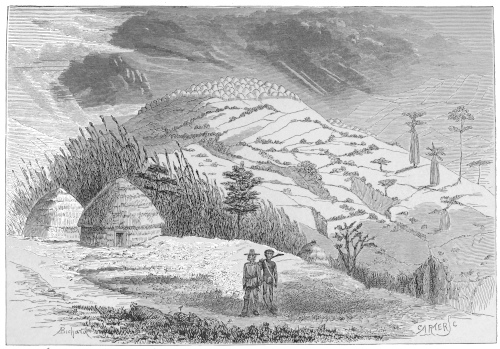
FUGA, CAPITAL OF USUMBARA.
First we grounded, then a puff of wind drove
us on at railway speed, and then we scraped
again: it was impossible to avoid being taken
153aback, so abrupt are the windings of the bed. At
last we were successful in turning the first dangerous
angle: here, where sea-breeze and tide
meet the buffing stream, forming a ‘Lahr,’ as
the Baloch call it, navigation becomes perilous
to small craft. There is, as usual at and near
the mouths of African rivers where the water
acts as wind conductor, a little gale blowing upstream,
a valuable aid to craft bound inland, but
not without its risks; here many a boat has filled
and sunk beneath the ridge of short chopping
waves. After five miles, during which the
turbulent river, streaked with lines of froth,
gradually narrowed, we found it barely brackish,
and somewhat farther it was sweet as the celebrated
creek-water of Guiana.
Often since that day, while writing amid the
soughing blasts, the dashing rain, and the darkened
air of a wet season in West Africa and the Brazil,
have I remembered with yearning the bright and
beautiful spectacle of those Zangian streams,
whose charm, like the repose of the dead, seems
heightened by proximity to decay. We had soon
exchanged the amene and graceful, though somewhat
tame scenery of the sandstone formation on
the seaboard, for a view most novel and characteristic.
Behemoth now reared his head from the
154foaming waters, gazed upon us, snorted at us, and
sank back surlily and suspiciously into the depths
of his home. Crocodiles, terrified by the splash
of paddles, waddled down, as dowagers might,
with their horrid claws dinting the slimy bank,
and lay upon the water like yellow-brown tree-trunks,
measuring us with small malignant green
eyes, deep set under warty brows. Monkeys
rustled the tall trees, here peeping with curiosity
almost human, there darting away in fear amidst
the wondrous frondage and foliage; now gambolling
and frolicking up and down the corkscrew-like
bush-ropes, nature’s cables, shrouds, and
stays; then disappearing amidst the gloom of virgin
forest. Below, their younger brethren, the
jungle men and women—
‘So withered and so wild in their attire,
That look not like th’ inhabitants o’ th’ earth,
And yet are on’t’—
planted their shoulder-cloths, their rude crates,
and their coarse weirs upon the muddy inlets
where fish abounded. The sky was sparkling
blue, the water was bluer, and over both spread
the thinnest blue haze, tempering raw tones of
colour to absolute beauty. On both sides of the
shrinking stream a dense curtain of many-tinted
vegetation,
155‘Yellow and black, and pale and hectic red,’
shadowed swirling pools, where the current swept
over the growth of intertwisted fibres. The stunted
Mkindu, brab or wild date (Phœnix sylvestris),
much used for mats, contrasted with the Nakhl
el Shaytan, or Devil’s Date (Raphia Vinifera),
which, eccentric in form and frondage, curved
arms sometimes 30 and even 35 feet long, over
the dancing wave: this dwarf-giant of the palms
has no trunk to speak of, but each midrib is
thick as a man’s thigh, and the vegetable kingdom
cannot show such length of foliage. Not a
few of the trees were so distinguished by oppositions
of tall and sturdy trunk supporting frail and
tender belongings, that they seemed to bear leaves
and blossoms not their own. Upon the watery
margin large lilies of snowy robe, some sealed by
day, others wide expanded and basking in light
and air, gleamed beautifully against the black-green
growth and the clear bitumen-brown of the
bank-water. In scattered spots were inhuman
traces of human presence; tall arecas and cocoas
waving over a now impenetrable jungle; whilst
plantains, sugar-canes, limes, and bitter oranges,
choked with wild verdure, still lingered about the
broken homestead and around the falling walls,
blackened by the murderer’s fire. And above all
156reigned the peculiar African and tropical stillness
of noontide, deep and imposing, broken only
by the curlew’s scream or by the tepid breeze
rustling the tree-tops in fitful gusts, whispering
among the matted foliage, and swooning away
upon the warm bosom of the wave.
Amid such scenes we paddled and poled till
the setting sun spread its cloak of purple over a
low white cliff, upon whose feet the ripple broke
and on whose head lingered venerable trees that
stood out from the underwood of the lower banks.
Here lies the Pir of Wasin, a saint described by
our Baloch guide as a ‘very angry, holy man’
(bará jabrá Pir). A Sherif of pure strain, he
gallantly headed, in times long gone by, his Moslem
followers flying from Panga-ni, when it was
attacked by a ravenous herd of heathenry. The
infidels seem to have had the advantage in running:
they collared the Faithful at these cliffs,
and would have made mince-meat of them, when
Mother Hertha, at the prayer of the Pir, opened
wide and received them in her bowels. This
Shaykh will not allow the trees to be felled or
the floods to rise above the level of his grave:
moreover, if the devotee, after cooking food at the
tomb in honour of its tenant, venture to lick his
fingers—the usual succedaneum for napkins in
157East Africa, and throughout the Moslem world—he
is at once delivered over to the haunting Jinns.
The Baloch never pass the place without casting
a handful of leaves, a bullet, or a few grains of
powder by way of humble heave-offering into the
stream. Our guide told us, in accents of awe,
how a Suri Arab, doubtless tainted with Wahhabi
heresy, had expressed an opinion that this Pir
had been a mere mortal, but little better, if at all
better, than his own sinful self; how the shallow
scoffer’s ship was wrecked within the year, and
how he passed through water into the fire of
Jehannum. Probatum est—defend us, Allah! from
the sins of Reason.
We passed three small Arab timber-craft
which were laying in a cargo of red and white
mangrove trunks, and in many places floated
small rafts of palm-fronds ready to be guided
down-stream. At sunset the tide, running like
a mill-race, compelled our crew to pole up a little
inlet near Pombui or Kipombui, a village on the
left bank, well stockaded with split areca trunks.
The people who are subject to Zanzibar, and are
claimed by Kimwere, flocked out to welcome
their strangers, laid down a bridge of cocoa-ribs,
brought chairs, and offered a dish of small green
mangoes, here a great luxury. We sat under a tree
158till midnight, unsatiated with the charm of the
darker hours. The moon rained molten silver over
the black foliage and the huge fronds of the Devil’s
Dates (Raphias); the stars gleamed like golden
lamps hung unusually high in the limpid air, and
Venus, the beautiful, glittered diamond-like upon
the pure front of the firmament. The fireflies
rose in a scatter of sparks—‘a shower of fire’
Southey has it—now all shone out simultaneously
through the dark; then the glow melted away, as
if by concerted impulse, amidst the glooms of the
ground. At our feet rolled the black waters of the
creek; in the jungle wild beasts roared fitfully;
Leviathan and Behemoth crashed through the
bush, and the night breeze mingled softly sighing
sounds with the murmurs and the gurgling of
the stream.
About midnight, when the tide flowed strong,
we resumed our way. The river then became a
sable streak down the avenue of lofty trees except
where a bend suddenly opened its mirrory
surface to the reflection of the moon, and
stretched it before us like a silver ribbon. The
deep roar of the hippopotamus, the snorting,
and the occasional blowing sounded close to our
stern, and the crew begged me to fire for the
purpose of frightening a certain pernicious
159‘rogue’ whose villanies had gained for him the
royal title of ‘Sultan Mamba,’ or King Crocodile:
now we heard the splashing of the huge beasts,
as they scrambled over the shoals; then they
struggled with hoarse grunts up the miry slippery
banks which led to fields and plantations; then,
again, all was quiet as the grave. After a protracted
silence, deep and drear, the near voice of
a man startled us as though it had been some
ghostly sound. At 2 P.M., reaching a cleared tract
on the river-side, the ‘ghaut’ or landing-place of
Chogwe, we made fast the canoe, looked to our
weapons, and covering our faces against the
clammy dew and the blinding, paralyzing moonlight,
we lay down to snatch an hour’s sleep. The
total distance rowed was about 13½ miles.
We began the next morning with an inspection
of Chogwe, the bazar, to which we were escorted
with sundry honorary discharges of matchlocks,
by the Jemadar, and 20 Bashi Buzuks.
It was first occupied some few years ago, when
the Church Missionary Intelligencer had published
(Jan. 1850) a ‘fact,’ namely, that the
‘Imam of Zanzibar had not one inch of ground
between the Island of Wasin and the Panga-ni
river.’ The fact proved to be a fiction, and the
late Sayyid at once garrisoned Chogwe and
160Tongwe with 25 Baloch. About this time, also,
King Kimwere, with cheap generosity, had offered
to Dr Krapf by way of mission-station a choice
of Tongwe, of Pambire, or of Meringa, a lofty peak
in the continuous range to the N. West. A
certain French admiral declared that he would
occupy these places where the ‘Imam’ had little
authority; ‘if they do, I’ll burn the country
faster than they can travel,’ was the Arab’s reply.
M. Guillain next strove hard to prove that none
of the Bu Saidi ever included even Makdishu in
their dominions.
Chogwe is situated upon an eminence gently
rising from the grassy plain of black alluvial soil
which is flooded during the rains. It is seven
direct miles distant from Panga-ni town, bearing
west 288°; the walk over a rugged path occupies
four or five hours, yet few men but slaves availed
themselves of the short cut. The position is badly
chosen, water is distant, the rugged soil produces
nothing but stunted manioc, and when the inundation
subsides in the lowlands it is exposed to
miasma, whilst the frequent creeks must he
crossed upon tree trunks acting bridges. The
garrison at such times suffers severely from sickness,
especially from fever and diarrhœa, and the
men, dull as a whaler’s crew lorn of luck, abhor
161the wretched desolate out-station. Commanding,
however, the main road to Usumbara, Chogwe
affords opportunity for an occasional something
in the looting line—which is a consideration.
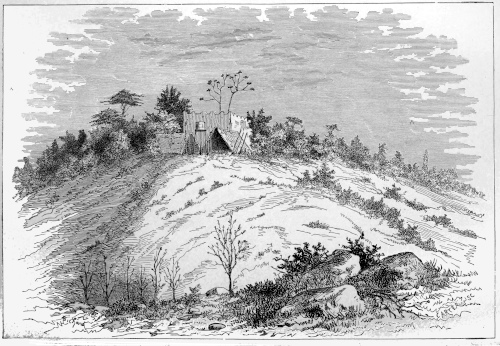
A stiff snake-fence surrounds the hill-crest
and defends the cajan penthouses of the Bashi
Buzuks: the only works are two platforms for
matchlock-men planted on high poles like the
Maychan of Hindostan and the Mintar of Syria.
The Washenzi savages sometimes creep up at
night, shoot a few arrows into the huts, set fire to
the matting with the spicula ignita, and after
other such amenities, hurriedly levant. The
Wazegura, though fighting with one another, did
not when we visited the place molest the Baloch.
To the North and West of Chogwe rises a continuous
range, the outliers of Usumbara: about
15 miles S. Westward (233° 15′) in the plains of
the Wazegura beyond the river is a succession of
detached hills of which the most remarkable,
Tongwe Mwanapiro, in our charts called Genda-genda,
may be seen from Zanzibar. Here rules
one Mwere, a chief hostile to the mercenaries,
who boast that if they numbered 50 they could
overrun and plunder the whole land: the Asiatics,
not caring to soil their hands with negro blood,
make their slaves fight his men even as the ingenuous
162youth, of Eton offered their scouts to
meet in the cricket-field the ambitious youth of
Rugby. It is certain that a few stout fellows,
with a competent leader and a little money for
good arms and ammunition, might easily establish
an absolute monarchy over the independent
blacks, and filibuster for Zanzibar, as the Khedive
is now doing for Egypt.
These Baloch mercenaries merit some notice.
They were first entitled Askar in the days of Sultan
bin Ahmad, father of the late Sayyid Said, who
preferred them to his unruly self-willed Omani
Arabs and his futile half-castes and blacks: he
acted upon the same principle which made the
Ayyubite sultans of Syria and Egypt arm first
Kurdish and afterwards Circassian ‘Mamluks.’
From 1000 to 1500 men were scattered over the
country in charge of the forts: the ruler knew
that they were hated by all Arabs, and to create
dissensions even amongst his own children was
ever the astute Sayyid’s policy. The Wáli and the
Jemadar, like the Turkish Wáli and Mushir, are
rarely on speaking terms, and if not open enemies,
they are at least rivals. The people nickname
these foreigners Kurára Kurára—to sleep! to
sleep! ‘rárá’ being the Asiatic mispronunciation
of lálá. Boasting themselves to be Baloch, they
163are mostly from the regions about Kech and
Bampur: they are mixed up with a rabble rout
of Arabs and Afghans, of Sidis[34] and Hindostan
men. The corps spoke some half-a-dozen different
languages, and many of the members have
left their country for their country’s good—a
body of convicts, however, generally fights well.
The Mekrani especially are staunch men behind
walls, and if paid, drilled, and officered, they
would make as ‘varmint’ light-bobs as any Arnauts.
They have a knightly fondness for arms:
a ‘young barrel and an old blade’ are their delight:
like schoolboys, they think nothing so
fine as the report of a gun; consequently ammunition
is kept by the C. O., and is never served
out except before a fight. All use the matchlock:
while good shots are rare, many are tolerably
skilful with sword and shield. Their
nominal pay is from $2 to $3 per mensem, a
pittance of some 20 pice (120 pice=$1) per diem:
this must find them in clothes and rations as well
as in arms; often there is not a sandal amongst
164them, and they are as ragged a crew as ever left
the barren wolds of Central Asia in quest of
African fortune. They live in tattered hovels,
which they build for themselves, upon one meal a
day, which is shared by their slave concubines. To
the natural greed of mountain-races, the poor devils
who come in horse and salt-boats, and act barbers
and sailors, porters, labourers, and date-gleaners,
add the insatiable desires of beggars. The Banyans
have a proverb that a Baloch, a Brahman, and a
buck-goat eat the trees to which they are tied.
Sudden and sharp in quarrel, they draw their daggers
upon the minutest provocation; they have no
mitigation nor remorse of voice, and they pray in
the proportion of one to a dozen. Africa is to
them what the Caucasus is to the Russians,
Kabylie to the French, and Sind to the English
soldier. All look forward to ‘Hindostan—bagh
o bostan,’ India the flower-garden; but the Arabs
have a canny proverb inporting that the fool who
falleth into the fire rarely falleth out of it.
Fraudare stipendio, saith ancient Justin, was
the proverb of the Great King’s satraps: the
custom has been religiously preserved by the
modern East. Each station is commanded by a
Jemadar, who receives $4 to $5 per month, and
ample license to pay himself by peculation. This
165class is at once under-salaried, and over-trusted.
The Jemadar advances money upon usury to his
men; he keeps them six months in arrears, and
not a few of them never see the colour of Government
coin from the year’s beginning to the
end. He exacts perquisites from all who fear
his hate and who need his aid; and he falsifies
the muster-rolls impudently and with impunity,
giving 25 names to perhaps four men. Thus,
like the Turkish Colonel of Nizam, the Jemadar
lives in great state. He has a wife or two, and
perhaps a dozen slaves; he sports a fine coat of
scarlet broadcloth, a silver-hilted sword and dagger,
and a turban of rich silk. He keeps flocks
of sheep and goats, and he trades with the interior
for ivory and captives. Such has been,
such is, and such ever will be till Europe steps
in, that false economy which throughout the
‘East,’ from Stambul to Japan, grasps the
penny and flings away the pound. It is a state
inseparable from the conditions of society and of
government, where public servants are not paid,
they must, of course, pay themselves; and they
often prefer the latter mode, as they pay themselves
far better than they would otherwise be
paid. About a century ago we did the same
thing in India, where men amassed fortunes, and
166until the late reforms, such was notoriously the
case throughout the Russian empire. Perhaps
in the present day the best place to study the
system of all peculation and no pay is Damascus.
Having confided our project to the Jemadar of
Chogwe, he promised his good-will—for a consideration.
He undertook to start us the next day, and,
curious to relate, for as usual he was a Cathaian
of the first water, he kept his word. The small
garrison, however, could afford but four matchlock-men
as a guard, and the same number of
slave-boys acting porters. The C. O., therefore,
engaged for us, nominally paying $10, and
doubtless retaining one half, a couple of guides,
who proved to be a single guide and his chattel.
After a night spent in the Maychan, where
wind, dust, and ants conspired to make us miserable,
we arose to prepare for marching. We reduced
our kit to the strictest necessaire, surveying
instruments, weapons, waterproof blankets,
tea, sugar, and tobacco for ten days, a bag of
dates, and three bags of rice. About noon, issuing
from our shed, we placed the baggage in the
sun; thus mutely appealing to the ‘Sharm’—shame
or sense of honour—possessed by our Baloch
employés. A start was not effected till 5
P.M.; every slave grumbling loudly at his load,
167snatching up the lightest of packs, fighting to
avoid the heavier burdens, and rushing forward
regardless of what was left behind. This nuisance
endured till abated by an outward application
easily divined. I had only to hope that after a
march or two the scramble would subside into
something like order. At length, escorted in
token of honour by the consumptive Jemadar
and most of his company, we set out, in a straggling
Indian file, towards Tongwe.
The track wound over stony ridges, and after
an hour it plunged into a dense, thorny thicket,
which during the rains must be impassable. The
evening belling of the deer and the near ‘clock
clock’ of the partridge struck our ears pleasantly.
In open places lay the dry lesses of elephants,
and footprints retained by the last year’s mud:
these animals, as in the Harar country, descend
to the plains during the rainy monsoon, and when
the heats set in retire to the cool hills—a regular
annual migration. The Baloch shoot, the wild
people kill them with poisoned arrows. More
than once during our march we found the gravelike
trap-pits in India called Ogi. They are wedge-shaped
holes 10 feet deep, artfully placed in the
little rises frequented by the beasts, and the size
must exactly fit the victim, which easily extricates
168itself from one too large or too small: if fairly
jammed, however, it cannot escape. We did not
sight a single specimen; but judging from the
footprints—three to three and a half circumferences
showing the shoulder-height—the elephant
here is not of tall stature. From the further interior
come tusks commonly weighing 100 lbs.
each; those of 175 lbs. are not rare, and I have
heard of a par nobile sent from Delagoa Bay to
the King of Portugal, whose joint weight was
560 lbs. We also saw many traces of lion,
antelope, and wild cattle, here called buffalo.
It was a severe disappointment to us that we
could not revisit, as we had promised ourselves,
this country during the rains; but Lieut.-Col.
Hamerton strongly dissuaded us from again risking
jungle fever; and we had other work to
do in Inner Africa. Sporting, indeed, must
occupy the whole man, and even to shoot for
specimens is often to waste time in two ways.
The ‘serious traveller’ must indulge himself by
taking at times a week or a fortnight’s leave
from geographicalgeographical work, and even then he will
frequently find circumstances interfere with his
plans. Throughout our march in these regions
game was rarely seen; none lives where the land
is peopled; in the parts near the stations it is
169persecuted by the Baloch, and the wild Jägers
will kill and eat even rats. We heard, however,
many tales of Mabogo, or wild cattle, and of lions;
of leopards in plenty; of a hog, probably the
masked boar; amongst many antelopes, of one resembling
the Nilghai (A. Picta), and of an elk
said to be like the Sambar of Hindostan.
Another hour’s marching, and a total of six
miles, as shown by the pedometer, brought us to
the Makam Sayyid Sulayman, a partially cleared
ring in the thorny jungle. It was bounded on
one side by a rocky and tree-fringed nullah, where
water stagnates in pools during the dry season;
and here ensued a comical scene. The whole
party went to drink, when suddenly all began to
dance and shout like madmen, pulling off their
clothes and frantically snatching at their lower
limbs. It was our first experience of that formican
fiend, the bull-dog ant (Siyáfú or Ch’hungu
Fundo),[35] black, and a good half inch long, which
invariably reserves its attentions for the tenderest
portions of the person attacked. The bite of
this wretch, properly called ‘atrox,’ burns like
the point of a red-hot needle, and whilst engaged
in its cannibal meal, literally beginning to devour
170man alive, even when its doubled-up body has
been torn from the head, the pincers will remain
embedded in flesh. Moreover, there are the usual
white ants (Ch’hungu Mchwa, Termes fatalis),
death upon your property; the ginger-coloured
Ch’hungu ya moto, whose name ‘fire-ant’ describes
its bite, and the hopper ant, who, like the
leopard, takes a flying leap from the nearest
branch, and cleverly alighting upon the victim,
commences operations. And where the ant is in
legions, one of the most troublesome is the smelling
ant (Ch’hungu Uvundo), which suggests that
carrion is concealed behind every bush. Verily,
in Africa, as was said of the Brazil, the ant is
king, and he rules like a tyrant.
We spent the night in a small Babel of Baloch.
It was a savage opera scene. One recited
his Koran, another prayed, a third told funny
stories, whilst a fourth trolled out in minor key
lays of love and war, made familiar to my ear
upon the rugged Sindian hills. This was varied
by slapping away the lank mosquitoes that flocked
to the gleaming camp-fires, by rising occasionally
to rid ourselves of the ants, and by challenging
the small parties of savages who, armed with
bows and arrows, passed amongst us, carrying
grain to Panga-ni. The Baloch kept a truly
171oriental watch. They sang and shouted, and they
carefully fed the camp fire during early night,
when there is no danger; but all slept like the
dead through the ‘small hours,’ the time always
chosen by the African freebooters, and indeed by
almost all savages, to make their unheroic onslaughts.
Similarly, throughout our expedition
to the Lake Regions, the ‘soldiers’ never dreamed
of any precaution whilst in dangerous regions.
As we approached the coast, however, sentinels
were carefully set, that all might be well which
ends well.
At daybreak on February 9, accompanied by
a much reduced detachment, we resumed our
march: the poitrinaire Jemadar, who was crippled
by the moonlight and by the cold dew, resolved,
when thawed, to return with the rest of his company
Chogwe-wards. An hour’s hard walking
brought us to the foot of rugged Tongwe, the Great
Hill. Ascending the flank of the N. Eastern spur,
we found ourselves at 8 A.M., after five or six bad
miles, upon the chine of a little ridge, with summer
facing the sea, and a wintry wind blowing
from the deep and forested valley to landward.
Thence, pursuing the rugged incline, after another
half-hour we entered the ‘fort,’ a crenellated, flat-roofed,
and whitewashed room, 14 feet square, supported
172inside by smooth blackened rafters. It was
tenanted by two Baloch, who figure on the muster-rolls
as 20 men. They complain of loneliness
and of the horrors: though several goats have been
sacrificed, an obstinate demon still haunts the hill,
and at times the weeping and wailing of distressed
spirits makes their thin blood run chill from
their hearts.
Tongwe is the first offset of the massive mountain-terrace
which forms the Region of Usumbara:
here, in fact, begins the Highland block of Zangian
and equatorial Africa, which culminates in Kilima-njaro
and Doenyo Ebor, or Mount Kenia. It
rises abruptly from the plain, and projects long
spurs into the river valley, where the Panga-ni
flows noisily through a rocky trough, and whence
we could distinctly hear the roar of the celebrated
waterfall. Situated N. West of (324°), and nine
miles as the crow flies from, Chogwe, the hill
summit, about 2000 feet above sea-level, is clothed
with jungle, through which we had to cut a way
with our swords, when seeking compass bearings
of the Nguru hills. The thickness of the vegetation,
which contains stunted cocoas, oranges
grown wild and bitter, the Castor shrub, the
Solanum, and the bird-pepper plant, with small
berry, but very hot i’ the mouth, renders the
173eminence inaccessible from any but the Eastern
and Northern flanks. The deserted grounds
showed signs of former culture, and our negro
guide sighed as he told us that his kinsmen had
been driven by the Wazegura from their ancient
seats to the far inner wilds. Around the Fort
were slender plantations of maize and manioc
springing amongst the ‘black jacks,’ which here,
as in the Brazil, are never removed. The surface
is a reddish, argillaceous, and vegetable soil, overlying
grey and ruddy granite and schists. These
rocks bear the ‘gold and silver complexion’ which
was fatal to Colin Clout, the chivalrous ‘Shepherd
of the Ocean,’ and the glistening spangles of mica
still feed the fancy of the pauper Baloch mercenary.
Below Tongwe hill, a deep hole in the northern
face supplies the sweetest ‘rock-water,’ and
upon the plain a boulder of well-weathered
granite, striped with snowy quartz, contains two
crevices ever filled by the purest springs. The
climate appeared delicious, temperate in the full
blaze of an African and tropical summer, and
worthy of verse—
‘Fair is that land as evening skies,
And cool though in the depths it lies
Of burning Africa.’
The temperature would correspond with a similar
174altitude upon the Fernando Po and the Camarones
peaks. But whilst the hill was green the lower
lands were baked like bread crust—the ‘fertile
and flourishing regions about Tongwe’ belong to
the category of things gone by.
We had much to do before leaving Tongwe.
The Jemadar had, it is true, ordered for us an
escort, but in these latitudes obedience to orders
is an optional matter. Moreover, the Baloch,
enervated by climate and by long habits of utter
indolence, looked forward with scant pleasure to
the discomforts of a mountain march. Shoeless,
bedless, and almost ragless, they could hardly be
induced, even by the offer of ‘stone dollars,’ to
quit for a week their hovel homes, their black
Venuses, and their whitey-brown piccaninnies.
They felt truly happy with us at Tongwe, doing
nothing beyond devouring, twice a day, vast
quantities of our dates and rice, an unknown
luxury; and they were at infinite pains to defer
the evil hour of departure. One fellow declared
it was absolutely impossible for him to travel
without salt, and proposed sending back a slave
to Chogwe: the move would have involved the
loss of at least three days, so we thought it best
at once to begin with firmly saying no.
By hard talking I managed at last to secure a
175small party, which demands a few words of introduction
to the reader—it is the typical affair in
this part of Africa, and the sketch may be useful
to future travellers. We have four slave boys,
idle, worthless dogs, who never work save under
the rod, who think of nothing beyond their stomachs,
and who are addicted to running away
upon all occasions. Petty pilferers to the backbone,
they steal, magpie-like, by instinct, and from
their impudent fingers nothing is safe. On the
march they lag behind to see what can be ‘prigged,’
and not being professional porters, they are
as restive as camels when receiving their loads.
‘Am I not a slave?’ is their excuse for every detected
delinquency, and we must admit its full
validity. One of these youths happening to be
brother-in-law—after a fashion—to the Jemadar,
requires almost superhuman efforts to prevent him
loading the others with his own share.
The guide, Muigni Wazira, is a huge broad-shouldered,
thick-waisted, large-limbed Msawahili,
with coal black skin and straight features,
massive and regular, which look as if cut in jet;
a kind of face that might be seen on the keystone
of an arch. He frowns like the Jann spoken
of in the Arabian Nights, and he often makes me
wish for a photographer. He is purblind, a defect
176which does not, however, prevent his leading
us by the shortest path into every village that
aspires to mulct our slender store of sprig-muslin.
Wazira is our rogue, rich in all the perfections of
African cunning. A prayerless Sherif, he utterly
despises all Makafiri or infidels; he has a hot
temper, and when provoked he roars like a wild
beast. He began by stubbornly refusing to carry
any load; but he yielded when it was gently
placed upon his heavy shoulder, with a significant
gesture in case of recusance. He does not,
however, neglect to pass it occasionally to his
slave, who, poor wretch, is almost broken down by
the double burden.
Rahmat the Mekrani calls himself a Baloch,
and bears the proud title of Shah-Sawar, or the
Rider King. He is the Chelebi, the dandy or
tiger of the party. A good-looking brown man,
about 25 years of age, with a certain affectation
and girlishness of speech and tournure which bode
no good, the Rider King deals in the externals
of respectability: he washes and prays with artificial
regularity; he is ever combing his long hair
and beard; he trains his bushy mustache to
touch his eyes, and he binds on crookedly a huge
turban. His cue is to affect the Jemadar, to take
command. He would have monopolized, had I
177permitted him, the general store of gunpowder,
a small leathern bottle wrung from the C. O. at
Chogwe: and having somewhat high-flown ideas
of discipline, he began by stabbing a slave-boy.
He talks loud in his nasal native Balochki, debased
Persian, ridiculous Arabic, and voluble
Kisawahili; moreover, his opinion is ever to the
fore. The Rider King, pleading soldier, refuses
to carry anything but his matchlock and a private
stock of dates, which he keeps ungenerously
to himself. He boasts of prowess in vert and
venison: I never saw him hit the mark, but we
missed some powder and ball, with which perhaps
he may be more fortunate. Literally, he was not
worth his salt. Yet this knave had resolved to
force himself upon me when in June I set out
for the Lake Regions, and made a show of levelling
his old shooting-iron. For sixpence a shot he
might have fired ad libitum.
Hamdan, a Maskat Arab, has seen better days,
of which strong waters and melancholia have removed
all traces except a tincture of lettres. Our
Mullah, or chaplain-and-secretary, is small, thin,
brown-skinned, long-nosed, and green-eyed, with
little spirit and less muscularity. A crafty old
traveller, he has a store of creature comforts for
the journey: he carries with his childish match-lock
178a drinking gourd and a Ghi-pot, and for
more reasons than one he sits apart at the camping
ground. Strongly contrasting with him is
the ancient Mekrani Sha’ahan, a decrepit giant
with the negroid type of countenance, pockmarked,
and ugly enough to frighten. He is of
the pig-headed, opposed to the soft-brained, order
of old man, hard and opinionated, selfish and unmanageable.
He smokes, and must drink water
throughout the livelong day. He dispenses the
wisdom of a Dogberry, whereat all laugh; and
much to the disgust of his hearers, he either
coughs or snores during the hours of night. This
senior will carry nothing but his long greasy gun,
gourd, and pipe; and, despite his grey beard, he
is the drone of our party.
Jemal and Murad Ali are our working men,
excellent specimens of the true Baloch, vieux
grognards, with a grim sour humour, something
like ‘wut,’ especially when the fair sex and its
backslidings are concerned. They have dark
frowning faces, wrinkled and rugged as their natal
hills, with pads of muscle upon their short forearms
and sinewy angular calves, remarkable in
this land of sheepshanks. Sparing of words, they
grunt the shortest answers when addressed; if
they speak at all, it is in a roar or a scream: they
179are angry men, uncommonly handy with their
well-polished daggers, and they think as little of
cutting a negro’s as a sheep’s throat. At the
promise of an extra dollar they walk off under
heavy loads, besides carrying their arms and
necessaries. These two, in fact, are good men
and true.
The gem of the party, however, is one Sidi
Mubarak, who has taken to himself the agnomen
of ‘Bombay.’ His sooty skin, and teeth sharp-pointed
like those of the reptilia, denote his origin
from Uhiao: he is one of those model Seedies, runaway
slaves, employed as lascars and coal-trimmers,
who with chaff, grimace, and peals of
laughter, varied now and then by dance and song,
delight the passengers in an Anglo-Indian
steamer. Bombay, sold at Kilwa in early youth,
a process of which he talks with many broad
grins, was carried to Cutch by some Banyan, and
there became a libertinus: he looks fondly back
upon the hour of his adoption, and he sighs for
the day when a few dollars will enable him to
return. His head is a triumph to phrenology; a
high narrow cranium, denoting by arched and
rounded crown, fuyant brow and broad base with
full development of the moral region, deficiency
of the reflectives, fine perceptives, and abundant
180animality. His hair is of the woolliest: his
twinkling little eyes are set close together, and
his lips and expansive mouth, especially in rare
fits of ill-temper, project as in the cynocephali.
He works on principle and he works like a horse,
candidly declaring that not love of us but his
duty to his belly make him work. With a
sprained ankle and a load quite disproportioned
to his chétif body, he insists upon carrying two
guns, and after a 30 miles’ walk he is as fresh as
before it began. He attends us everywhere,
manages our purchases, carries all our messages,
and when not employed by us, he is at every
man’s beck and call. Speaking a little broken
Hindostani, he has for all ‘jungly niggers’ an ineffable
contempt, which he never attempts to
conceal. He had enlisted under the Jemadar of
Chogwe: we thought, however, so highly of his
qualifications, that persuasion and paying his
debts induced him after a little coqueting to take
leave of soldiering and to follow our fortunes. He
began by escorting us to Fuga as head gun-carrier:
on our march to the Lakes he was the
confidential servant and interpreter of my companion,
he being the only man with whom the
latter could converse, and in the Second Expedition
of Capts Speke and Grant he was promoted
181to command the Wasawahili. Almost every
black brain would have been turned by this rapid
and dazzling rise: Sidi Mubarak Bombay did not,
however, as I had anticipated, ‘prove himself a
failure in the end.’
A machine so formed could hardly be expected
to begin work without some creaking. The Baloch
were not entirely and solely under us, and in
the East no man will, even if he can, serve two
masters. For the first few days many a muttered
cursing and loud wrangling showed signs of dissolution.
One would not proceed because the Rider
King kept the gunpowder, another started on his
way home because he was refused some dates,
and, during the night after departure, all Bombay’s
efforts, we afterwards heard, were in requisition
to prevent a break-up en masse. But by degrees
the component parts fitted smoothly and moved
steadily, till at last we had little to complain of,
and the men volunteered to follow wherever we
might lead. By acting upon the old Oriental principle,
‘the word is gone forth and must be heard,’
we never failed to win a disputed point, and one
success paved the way for others. Amongst
these perverse and headstrong races, however, the
traveller must be careful in committing himself
to an ultimatum, and he must be prepared when
182he says he will do a thing, to do it. Otherwise
he will speedily lose caste, and caste once lost is
not to be regained—in Africa or, perhaps, elsewhere.
NOTE.
Since these pages were written, Sidi Mubarak
Bombay has been made Chief of Caravan by Mr
Stanley of New York, who is now (December 10,
1871) marching upon the Tanganyika Lake in
quest of Dr Livingstone.
183
Es gibt in Central Afrika Paradiese, die mit der Zeit die
Civilisation aussuchen wird zum Besten der Menschheit.Menschheit.—J.
von Müller.
On February 10, after a night of deep wilderness-silence,
we arose betimes, and applied ourselves
to the task of porterage. The luggage was
again reduced—now to the very lowest expression.
For observations we carried sextant and horizon,
two compasses and stand, and a common and a
boiling-point thermometer.[36] A waterproof carpet-bag
184contained journals and materials for writing
and sketching. Our arms were a six-shooter
each (4 lbs. 1 oz.), a Colt’s rifle (10 lbs. 8 oz.), a
small Büchse by Nowotny of Vienna (8 lbs. 3 oz.),
a shot-gun (W. Richards, 11 lbs.), three swords,
and two bowie-knives; in fact, fighting gear,
with the ammunition necessary for ourselves
and men. A solid leather portmanteau was
stuffed with a change of raiment and a gift
for Sultan Kimwere, namely a coat of black
185broadcloth ($12), eight turbans of sprig muslin
($8), a similar number of Surat embroidered
caps ($8), and two light-coloured cotton
shawls of trifling value. Our provisions consisted
of three bags of rice ($12.50), a sack of dates
($2.25), onions, manioc, flour, tea, and sugar, for
10 days; tobacco, pepper and salt, of which none
is procurable in the interior; a lamb, three
chickens, and a bottle of cognac, to be used in
case of need. Our beds were in waterproofs,
which might also be converted into tents and
awnings; a horn lantern, wax candles, and a
policeman’s dark-lantern, were added for night-work,
whilst a portable tin canteen, with a Papin’s
digester, completed the equipment. What
we chiefly wanted were water-skins, beads, and
‘domestics;’ and this we presently found to our
cost.
It was 6 A. M. before we were free to follow
the thorny goat-track which leads down the N.
Eastern spur of Mount Tongwe. By dint of fighting
our way through rushes and tiger-grass, we
struck into the Panga-ni road, and after three
hours’ winding to the north-west, we rested at
some fetid pools in a reed-grown fiumara. The
sun began to sting, and we had already occupied
the shadow of a tall rock, intending to doze till
186the afternoon, when Wazira, who had disappeared
in the morning after hearing the growling of a
lion, returned to us, and for reasons of his own,
induced us to advance by promising better water.
The path ran over stony ground, at times plunging
into the forest; there were frequent thorny
ridges, and narrow green dales or rather ravines,
bordered with lovely amphitheatres of lofty and
feathery tropical trees, showing signs of inundation
during the rains. But the Kazkazi, or N.
East monsoon, had dried up the marrow of the
land, and though we searched secundum artem,
as for treasure, we found no water.
Noon came, and the sun towered in its pride
of place. Even whilst toiling up the stony, dusty
track, over a series of wearisome, monotonous
slopes, unvisited by the cool sea-breeze, we could
not but remark the novel aspect of the land. The
ground was brick-red, a favourite colour in Africa
as in the Brazil, and its stain extended half-way up
the tree-boles, which the ants had streaked with
ascending and descending galleries. Overhead
floated, cloud-like, a filmy canopy of sea-green verdure,
pierced by myriads of little sun pencils;
whilst the effulgent dome, purified as with fire from
mist and vapour, set the picture in a frame of gold
and ultramarine. Painful splendours! The men
187began to drop off. None but Hamdan had
brought a gourd. Sha’aban clamoured for water.
Wazira, and the four slave-boys, retired to some
puddle, a discovery which they sensibly kept to
themselves, leaving the rest of the party to throw
themselves upon the hot ground, and to cower
under tree and bush.
As the sun sank westward, Wazira joined us
with a mouthful of lies, and the straggling line
advanced. Our purblind guide once more lagged
in the rear, yielding the lead to old Sha’aban.
This worthy, whose wits were absorbed in visions
of water, strode blunderingly ahead over the hills
and far away, guided by the Khombora cone.
My companion, keeping him in sight, and I being
in rear of both, we all three missed the path, and
shortly after sunset we reached a narrow fiumara.
Here stood, delightful sight! some puddles,
bright-green with chickweed and brown-black
with the mire below. We quenched our
thirst, and bathed our swollen feet, and patted,
and felt, and handled the fluid, as though we
loved it. But even this charming occupation
had an end, and other thoughts suggested themselves.
Our shots and shouts remained unanswered,
and it would have been the merest
midsummer-madness to have wandered in the
188dubious moonlight about the thorny, pathless
jungle. We therefore kindled a fire, looked to
our weapons, chose a soft sandy place under the
bank, and certain that Sha’aban would tend the
fire like a Vestal virgin, we were soon lulled to
sleep by the music of the breeze, and by the frogs
chaunting their ancient querele upon the miry
margin of the pools. That day’s work had been
only three leagues and a bittock. But—
‘These high, wild hills, and rough, uneven ways
Draw out the miles:’
it seemed as though we had marched double
distance; a circumstance which the young African
traveller would do well to note.
At dawn, after our supperless bivouac, we retraced
our steps, and soon came upon our people,
who shouted aloud, Khayr! Khayr! They had
taken the northern path, and they had nighted
also near water, upon the upper course of the
fiumara which gave us hospitality. The Nyuzi
is a rocky bed about 20 feet broad, showing traces
of violent periodical freshets, edged with thick
trees, gummy acacias, wild mulberries, and
large wood-apples (Feronias). Even in the driest
season it preserves pools, sometimes 100 feet
long, and water is always procurable by digging
in the sand. The banks shelter various birds and
189antelopes. We found doves, kites, and curlews,
whilst large iguanas congregated around the
water to dine upon the fish-fry which die of heat
in the sun-scalded shallows.
After shaking hands all around, and settling
sundry small disputes about the right and the
wrong, we spread our mats in the grateful shade,
and made up for the past with tea and tobacco.
During the day our Baloch shaved one another’s
heads, and plaited Sawás, or sandals of palm-leaf.
The guide engaged, as extra porters, five wild
men, habited in the simplest attire—a kilt of dried
grass, with the upper ends woven into a cord of
the same material. This thatch, fastened round
the waist, extended to mid-thigh: it is cool, clean,
and certainly as decent as the garb of the Gael.
All had bows and poisoned arrows, except one, who
boasted of a miserable musket and of literally a
powder-horn, the vast spoils of a cow, slung across
his shoulder. The wretches were lean as wintry
wolves, and not less ravenous. We fed them with
rice and Ghi: of course they asked for more, till
their stomachs, before shrunken like empty bladders,
stood out in the shape of little round lumps
from the hoop work of ribs. We had neglected
to take their arms by way of pledges to the contract:
after amply feeding they arose, and with
190small, beady eyes twinkling at the practical joke,
they bade us adieu. Though starving, they would
not work! A few hours afterwards they fell in
with the hippopotamus, for which they were waiting,
as it passed from the feeding-grounds to its
day-home in the stream. Behemoth is a helpless
beast on dry land. He was presently surrounded
by his enemies, porcupined with arrows, and soon
nothing of him remained but a heap of bones
and a broad stain of blood.
We rested till 3.15 P.M. in the grateful shade,
and then, persuading our carriers to load one
another, an operation still of some difficulty, we
advanced over a path dented by the spoor of wild
cattle. The rolling ground was a straggling thorn-jungle,
a ‘forest without shade,’ studded with
bright blossoms: the usual black-jacks were scattered
about a plain, fired to promote the growth
of fodder, and ant-hills rose regularly like Irish
‘fairy-mounts,’ as if disposed by the hand of art.
Needless to say that all was desert of man. The
Khombora Cone fell far behind: the walls of
Usagama, whose peaks, smoking by day and burning
by night, resembled fumaroles from afar,
changed their blue tints first for brown and then
for a distinct green hue. At length, emerging
from the wood, we debouched upon an alluvial
191plain, and sighted the welcome river flashing light
through its setting of emerald trees, as it mirrored
the westing orb of day. At 6 P.M., after a 10-mile
walk, traversing the tall rushes, young trees, and
thick underwood of the bank, we found ourselves
opposite Kohode, the village of a friendly Mzegura
chief. ‘Sultan Mamba’ having recognized the
Baloch, forthwith donned his scarlet cloak, superintended
the launching of the village canoe from
its cajan house; stood surrounded by the elders
watching our transit, and, as we landed, wrung
our hands with rollicking greetings, and with
those immoderate explosive cachinnations, which
render the African family to all appearance so
‘jolly’ a race.
The Thursday was a halt at Kohode. It is the
normal cultivator’s hamlet of these regions, built
upon the tall and stiff clay bank of the Panga-ni
river, here called the Rufu or Lufu. According to
the people this would mean death or destruction, no
bad description of a stream swarming with crocodiles,
and we find the dissyllable commencing many
riverine names, as Rufiji, Rufuma, and Rufuta.
From without the settlement has a pleasant appearance
of seclusion and rural comfort: it suggested
a village in the Tirhai or the Dehra Dhun:
there was the same peaceful quiet look, sheltered
192situation, and circle of tall forest. Rendered invisible
till near by screening tree, bush, and spear
grass, it is protected by a stout palisade of trunks,
and this, in directions where foes, human or bestial,
may be expected, is doubled and trebled.
The entrances, in the shape of low triangles,
formed by inclining the posts en chevron, lead to a
heap of wattle and dab huts, here square, there
round: they are huddled together, but where
space allows they are spread over a few hundred
feet. Goats, sheep, and black cattle, which, contrary
to the custom of Guinea, thrive beyond the
coast, are staked near or inside the owners’ habitations.
From the deep strong-flowing Rufu,
running purple, like Adonis after rains, with the
rich loam of the hills, and here about 80 yards
wide, a bathing-place is staked off, against the hippopotamus
and the crocodile. Our Baloch, who
hold, with all Orientials, that drinking the element
at night impairs digestion, make of this an exception:
and my companion, an old Himalayan,
thought that he could detect in it the peculiar
rough smack of snow water. The stream is navigable,
but boats are arrested by the falls below,
and portages are not yet known in East Africa.
The villagers are cultivators, tame, harmless
heathen, to all but one another: unfortunately
193they have become masters of muskets, and they
use the power to plunder, and oppress those who
have it not. ‘Sultan Mamba,’ the crocodile,[37] a
stout, jolly, beardless young black, with the laugh
of a boatswain, and the voice of one calling in the
wilderness, has made himself a thorn in Kimwere’s
side. In supplying us with beef and milk, he
jerked his thumb back towards the blue hills of
Usumbara, upon whose mountain-pass the smoke
of watch-fires curled high, and declared, with
gusto, that we had already become the hill-king’s
guests. Our Baloch guard applauded this kindred
soul, clapped him upon the shoulder, and
swore that with a score of men-at-arms like themselves
he might soon make himself monarch of
all the mountains.
‘Sultan Mamba’ once visited Zanzibar, where
his eyes were at once opened to Koranic truth by
the Kazi Muhiyy el Din: this distinguished
Msawahili D. D. conferred upon the neophyte the
name of Abdullah bin Muhiyy el Din, and thus
called him son. But the old Mamba returned
194strong upon Abdullah when he sniffed once more
his natal air: he fell away from prayer and
ablution and grace generally, to the more congenial
practices of highwaying and of hard drinking.
This amiable youth, who was endowed
with an infinite power of surprise and an inveterate
itching for beggary, sat with us half the day
and inspected our weapons for hours, wondering
how he could obtain something of the kind. He
asked at one time for the Colt, at another for a
barrel of gunpowder: now he offered to barter
slaves for arms and ammunition, and when night
fell he privily sent Hamdan to request a bottle of
cognac. All these things were refused in turn, and
the Sultan was fain to be content with two caps, a
pair of muslins, and a cotton shawl. He seriously
advised us to return with some twenty kegs of
the best gunpowder, which, as the article was ever
in demand, would bring, he assured us, excellent
business in ‘black diamonds.’ He stated that his
people had but three wants—powder, ball, and
brandy, and that they could supply in return three
things—men, women, and children. Our parting
was truly pathetic. He swore that he loved us,
and promised us on the down march the use of
his canoe. But when we appeared with empty
hands, and neither caps nor muslins remained,
195Sultan Mamba scarcely deigned to notice us, and
the river became a succession of falls and rapids.
After a night, in which the cimex lectularius
had by a long chalk the advantage of the
drowsy god, we were ferried at 7 A.M., on February
13, across the stream, attended by sundry
guides. The start was generally too late. A
seasoned traveller easily bears scorching heat if
he sets out with the dawn and works into the
sultry hours: after a morning spent in the shade
he will suffer more or less severely from sudden
exposure. From Kohode, which is more than half
way, there are two roads to Fuga. The direct
line, running nearly due north, crosses the Highlands:
at this season it is waterless. That along
the river is more than double the length: it begins
to the N. West and then turns sharply to the
East. We determined to see the stream, and we
doubted the power of our heavily-laden men to
front the passes in such heat: the worst of these
walking journeys is that the least accident disables
the traveller, and accidents will happen to the
best of marching parties.
Presently emerging from the thicket, we fell
into the beaten track over the dark alluvial river-plain,
which here, as at Chogwe, must during rains
be a sheet of water. This is the first section of our
196line; the second will be the red land with rises
and falls, but gently upsloping to the west, whilst
the third and last will be the granite and sandstone
flanks of Usumbara. After a few minutes’
march we crossed by a bridge composed of a
fallen tree the Luangera (miscalled Luere by Herr
Augustus Petermann): this deep sullen affluent
of the Rufu, 23 to 24 feet broad, drains the North-Eastern
Bamburri mountains. Then stretching
over the grassy expanse, we skirted two small red
cones, the Ngua outliers of the high Vugiri range.
Like its eastern neighbour Usagama, this buttress of
Usumbara is the normal precipice with bluff sides
of rock, well wooded on the summit, and looking
a proper place for ibex: of this animal, a well-marked
species (C. Walie), with thick and prominently
ribbed horns, has been found in the snowy
heights of Abyssinia, and it probably extends to
the gigantic peaks of the Æthiopic Olympus. The
Vugiri forms part of the escarpment line separating
the highlands from the river plain to the south.
The people assured us that the summit is a fertile
rolling plateau which supports an abundant population
of Washenzi, serfs, and clients, subject to
King Kimwere.
We then entered upon cultivated ground,
which seemed a garden after the red waste below
197Tongwe. Cocoas and tall trees concealed the
Rufu, which above its junction with the Luangera
becomes a mere mountain-torrent, roaring
down a rocky, tortuous bed, and forming green,
tufted islets, which are favourite sites for settlements.
We can hardly, however, call them, with
Boteler, an archipelago. Our guides presently
took leave, alleging a blood-feud with the neighbouring
villagers. The people, as we passed by,
flocked over their rude bridges, which extend up
coast to Brava, floors of narrow planks laid horizontally
upon rough piers of cocoa-trunks, forked
to receive cross-pieces, and planted a few feet
apart. The structure is parapeted with coarse
basket-work, and sometimes supplied with fibrous
creepers, jungle-ropes, knotted in 20 places, by
way of hand-rail. These the number and daring
of the crocodiles render necessary. I was once
innocently sitting upon a slab of stone surrounded
by the water, and greatly enjoying the damp and
the coolth, when, with a rush and a roar, as if it
had been an attack, my men fell upon me, and
hurried me to the bank. All here believe that
the crocodile sweeps off its prey with a blow of the
powerful tail, and once in the water, man is helpless
against the big lizard. These constructions
are at least more artful than the Pingela or
198single plank of the Brazil, and the tight-rope affairs
of the Himalayas: they must much resemble the
bridges of inner Devonshire, that ‘sleeping
beauty of the (near) West,’ during the days of our
grandfathers. Cows, goats, and long-tailed sheep
clustered upon the plains, and gave a pastoral
aspect to the out-of-the-way scene.
We halted from 10 A. M. to 4 P. M., under a
spreading tamarind, near Zafura, a village on an
island of the Panga-ni, distant about two miles
from Mount Vugiri. Here we were surrounded
by crowds, who feasted their eyes upon us for
consecutive hours. They were unarmed and
dressed in skins; they spoke the Kizegura dialect,
which differs greatly from the Kisawahili; and
they appeared rather timid than dangerous.
Their sultan stalked about, spear in hand, highly
offended by our not entering his hut, and dropping
some cloth; whilst sundry Wasawahili in
red caps looked daggers at the white interlopers.
We tried to hire extra porters, but having neither
Merkani (American domestics) nor beads, we
notably failed.
Presently black nimbi capped the hill-tops,
cooling the fierce Sirocco, and the low growling
of distant thunder warned us forwards. Resuming
our march at 3.30 P. M., we crossed a dry
199fiumara, trending towards the Rufu. We traversed
a hill-spur of rolling and thorny red
ground, to avoid a deep loop in the stream; we
passed a place were rushes and tiger-grass choked
the bed, and where the divided waters, apparently
issuing from a black jungle and a dark rock,
foamed down a steep and jagged incline. We
crossed over two bridges, and at 5 P. M. we entered
a village of Wazegura, distant from Kohode
12 miles. Msiki Mguru is a cluster of hay-cock
huts touching one another, and built upon an
island formed by divers rapid and roaring branches
of the river. The headman was sick, but we
found a hospitable reception. Uninitiated in the
African secret of strewing ashes round the feet
of the Kitanda or cartel, we spent our night,
although we eschewed the dirty, close huts,
battling with ant armies and other little slayers
of sleep that shall be nameless. Our hosts,
speaking about the Wamasai, expressed great
terror, which was justified by the sequel. Scarcely
had we left the country, when a band of wild
spearmen attacked two neighbouring villages,
slaughtered the hapless cultivators, and with pillage
and pollage drove off the cattle in triumph.
Our hosts watched with astonishment the magical
process of taking an altitude of Capella, and they
200were anxious to do business in female slaves,
honey, goats, and sheep. Some of the girls were
rather comely, despite the tattoo that looked like
boils. None showed the least fear or bashfulness;
but when the Baloch chaffed them, and asked
how they would like the ‘men in trowsers’ as
husbands, they simply replied, ‘Not at all!’
At sunrise on the next morning we resumed
our march, following the left bank of the Rufu,
which is here called Kirua. For about three
miles it is a broad line of flat boulders, thicket,
grass, and sedge, with divers trickling streams
between. At the Maurwi village the several
branches anastomoze, forming a deep and strong
but navigable stream, about 30 yards broad,
and fenced with bulging masses of vegetation.
Thence we bent northward, over rolling ground
of red clay, here cultivated, there a thorny jungle,
trending to Tamota, another bluff in the hill-curtain
of Usumbara. The paths were crowded
with a skin-clad and grass-kilted race, chiefly
women and small girls; the latter, by-the-by,
displaying very precocious developments, and
leading children, each with a button of hair left
upon its scraped crown. The adults, toiling under
loads of manioc, holcus and maize, pumpkins and
plantains, poultry, sugar-cane, and water-pots, in
201which tufts of leaves had been stuck to prevent
splashing, were bound for a Golio (market) held
in an open place. Here their own land begins:
none started at or fled from the white face.
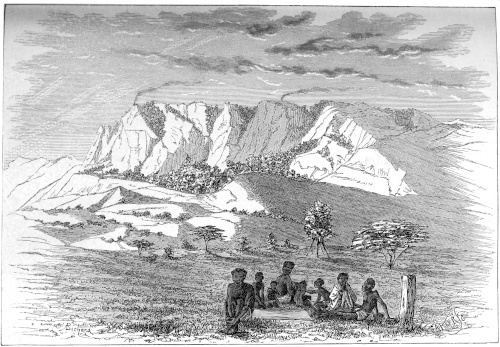
The men chip their teeth to points, and,
like the Wasumbara, punch out in childhood
one incisor from the lower jaw; a piece of
dried rush or sugar-cane distends the ear-lobe
to an unsightly size. All carried bows and
arrows. Some shouldered such hoes and hatchets
as English children use upon the sands:
here bounteous earth, fertilized by the rains of
heaven, requires merely the scratching of a man’s
staff. Others led stunted curs, much like the
pariah dogs of Hindostan, adorned with leather
collars: I afterwards saw similar pets at the
Yellalah of the Congo river. The animals are
prime favourites with the savages, as were the
Spanish puppies in the days of Charles II.; they
hold a dog-stew to be a dish fit for a king. In
West Africa also the meat finds many admirers,
and some missionaries in the Niger regions have
described it as somewhat glutinous, but ‘very
sweet.’ Why should we not have cynophages as
well as hippophages?
The salutations of these savages provoked the
comical wrath of Sidi Bombay; and indeed they
202were not a little ridiculous. Acquaintances stood
afar off, as if in fear of each other, and nosed
forth ‘Kua-heri,’ and protracted hans and huns,
until they had relieved their minds. None, even
the women, refused to greet us, and at times
Yambo—the state?—was uttered simultaneously
by a score of sable lips. Having duly stared and
been stared at, we unloaded for rest about 9.30
A. M., under a spreading tree, near the large,
double-fenced village of Pasunga, belonging to
one of Sultan Kimwere’s multitudinous sons.
Again clouds obscured the air, gathering thick
upon the mountain-tops, whence came the mutterings
of thunder from afar.
Presently the pleasant coolness drew from
the Baloch cries of Safar! Safar!—let us march!
At 1 P. M. we resumed our way, and presently
we passed, on our left hand, a tank of mire and
water, thinly sprinkled with paddy-birds, sand-pipers,
and Egyptian geese—all exceedingly wild.
Hornbills screamed from the neighbouring trees,
and on the mud my companion shot a specimen of
the gorgeous crested crane, whose back feathers
have made bonnets fine. After an hour’s march
we skirted a village where the people peremptorily
commanded us to halt. We attributed this annoyance
to Wazira, who was forthwith visited
203with a severe wigging. It is, however, partly the
custom of the country: and even in the far less
barbarous Angola, to pass a farm-house without
entering it is to insult the proprietor. Man
claims a right to hear from the wandering
stranger news—a pabulum which his soul loves:
to coin the most improbable nonsense; to be told
lies with the bloom on them, and to retail them
to his neighbours, are the mental distractions of
the idler, equally the primum mobile of a Crimean
‘shave’ and of an African palaver. But
the impending rain had sharpened our tempers.
We laughed in the faces of our furious expostulators,
and bidding them stop us if they could, we
pursued our way.
Presently ascending a hill and making an
abrupt turn from N. West nearly due East, we
found ourselves opposite and about 10 miles distant
from a tall azure hill-curtain, the highlands
of Fuga. Below, the plain was everywhere populous
with scatters of haycock villages. Lofty
tamarinds, the large-leaved plantain, and the
parasol-shaped papaw grew wild amongst the
thorny trees. Water stood in black pools, and
around it waved luxuriant sugar-cane: in a moment
every mouth was tearing at and chewing
the end of a long pole. The cane is of the edible
204species; the officinal varieties are too luscious,
cloying, and bilious to be sucked with impunity
by civilized man. After walking that day a total
of 16 miles, about 4 P. M. we were driven by a
violent storm of thunder, lightning, and raw
S. West wind, which at once lowered the mercury
several degrees, and caused the slaves to shudder
and whimper, into the Banda-ni or Palaver-house
of a large village. Our shelter consisted of a
thatched roof propped by rough uprights and
wanting walls: the floor was half mud, half
mould, and the furniture was represented by stone
slabs used as hones, and by hollowed logs once
bee-hives and now seats. The only tenants were
flies and mosquitos. We lighted fires to keep off
fevers: this precaution should never be neglected
by the African traveller, even during the closest
evenings of the tropical hot season. Our Baloch,
after the usual wrangle about rations, waxed melancholy,
shook their heads, and declared that
the Kausi, the S. West trade-wind that brings
the wet monsoon, was fast approaching, if, indeed,
it had not regularly set in.
Sunday, February 15, dawned with one of
those steady little cataclysms, which to be seen
advantageously must be seen near the Line. At
11 A.M., thoroughly tired of the steaming Banda-ni,
205our men loaded, and we set out in a lucid interval
towards the highlands. As we approached them
the rain shrank to a mere spitting, gradually
ceased, and was replaced by that reeking, fetid,
sepulchral heat, which travellers in the tropics
have learned to fear. The path lay over the
normal red clay, crossed low ground where trees
decayed in stagnant water, and spanned the cultivated
plain of dark mould at the foot of the
mountains, with a vista of far blue hill on the
right. We rested a few minutes before attempting
the steep incline before us: the slippery,
muddy way had wearied our slaves, though
aided by three porters hired that morning, and
the sun, struggling with vapours, was still hot
enough to overpower the whole party.
At 1 P. M. we proceeded to breast the pass
leading from the lowland alluvial plain to the
threshold of the Æthiopic Olympus. The gently-rising
path, spread with decayed foliage, wound
amongst groves of large, coarse bananas, whose
arms of satiny sheen here smoothed and streaked,
there shredded by the hill-winds, hid purple
flowers and huge bunches of green fruit. The
Musa, which an old traveller describes as an
assemblage of leaves interwoven and twisted together
so neatly, that they form a plant about 15
206spans high, is an aboriginal of Hindostan, and
possibly of East Africa, where, however, the seeds
might easily have been floated from the East: it
grows almost spontaneously in Unyamwezi and
upon the shores of the great inland lakes. Here
the banana,[38] which maturing rapidly affords a
perennial supply of fruit, and whose enormous
rate of produce has been described by many
writers, is the staff of savage life, windy as the
acorn which is supposed to have fed our forefathers
in Europe. As usual where men are compelled
by their wants to utilize a single tree, the
cocoa, for instance, or the calabash, these East
Africans apply the plantain to a vast variety of
uses, and allow no part of it to be wasted. The
stem when green gives water enough to quench
the wanderer’s thirst and to wash his hands; the
parenchyma has somewhat the taste of cucumber,
and sun-dried it is employed for fuel. The fresh
cool leaves are converted into rain-pipes, spoons,
plates, and even bottles: desiccated they make
thatch, and a substitute for wrapping-papers; and
207some have believed that they were the original
fig-leaves of the first man and his wife. The
trunk-fibre does good service in all the stages between
thread and cord: the fruit yields wine,
sugar, and vinegar, besides bread and vegetable,
and even the flower is reduced to powder and
mixed with snuff. Never transplanted and allowed
to grow from its own suckers, this banana has now
degenerated: it is easy to see, however, that it
comes of a noble stock. In parts of the interior
the people have during a portion of the year
little else to live upon but this fruit, boiled, baked,
and dried: it then becomes a nauseating diet,
causing flatulence, indigestion, heart-burn, and
other gastric evils. After enduring the infliction
I never again could look a banana in the face.
Issuing from the dripping canopy, we breasted
a steep goat-track, we forded a crystal burn, and
having reached the midway we sat down to enjoy
the rarified air, which felt as if a weight had been
suddenly taken off our shoulders; it was São Paolo
after Santos. A palpable change of climate had already
taken place, and the sunshine was tempered
with clouds which we now blessed. The view
before us was extensive and suggestive, if not
beautiful. The mountain fell under our feet in
rugged folds clothed with patches of plantains,
208wild mulberries, custard apples, and stately trees
whose lustrous green glittered against the red
ochreous earth. The sarsaparilla vine hung in
clusters and festoons from the high supporting
limbs of the tamarind; the tall toddy-palm raised
its fantastic arms over the dwarf fan palm, and
bitter oranges mingled aroma with herbs not
unlike our mint and sage. Opposite and below,
half veiled with rank steam, the ‘smokes’ of
Western Africa, lay the yellow Nyika and the
Wazegura lowlands: it was traversed by a serpentine
of trees marking the course of the Mkomafi,
an affluent of the lower Panga-ni river. Three
dwarf cones, the Mbara Hills, bearing 230° and
distant about eight miles, crowned the desert, and
far beyond the well-wooded line of the Rufu, a
uniform purple plain stretched to the rim of the
Southern and Western horizon, as far as our
glasses could trace it.
We were startled from our observations by a
prodigious hubbub. The three fresh porters positively
refused to proceed unless a certain number
of cloths were sent forwards to propitiate the
magnates of Fuga. This trick was again easily
traced to Wazira, who had been lecturing us all
the morning upon the serious nature of our undertaking.
Sultan Kimwere was a potent monarch,
209not a Mamba. His ‘ministers’ and councillors
would, unless well-paid, avert from us their
countenances. We must enter with discharge of
musketry to salute the lieges, and by all means
we must be good boys and do as we were bid.
The Baloch smiled contempt, and pulling up the
porters from the ground, loaded them deaf to all
remonstrance.
Resuming our march with hearts beating
aloud under the unusual exercise, we climbed,
rather than walked, up the deep bed of a torrent,—everywhere
the primitive zigzag. Villages then
began to appear perched like eyries upon the hilltops,
and villagers gathered to watch our approach.
The Baloch asked us to taste the water
of a spring that rose hard by: sparkling in the
cup it was icy cold, with a perceptible chalybeate
flavour, and the fountain-head was stained with
a coat of rust. Eastern, and we may say Southern,
Africa from the Equator to the Cape, is a land
whose stones are iron, and the people declare
that they have dug brass. Copper has been long
known, gold even longer, and the diamond, in the
South at least, is the discovery of this our day.[39]
210At 4 P. M. we stood upon the Pass summit, but
we found no tableland, as about Shoa. This patch
of highlands, whose limits have been roughly laid
down between N. lat. 1° and S. lat. 6°, is to the
eastern regions what the massif of the Camarones
and its system in N. lat. 5° is to Western Africa.
The latter is known to be a volcano, and the
former has been also reported of igneous formation;[40]
here, however, it appears in the shape of
granite and sandstones. Both are abnormal elevations,
declining to the coast-fringing ranges, which
latter correspond with our Eastern and Western
Ghauts of Hindostan, and both, I may venture to
predict, will in due time be colonized by white
men. In the present day there is no better convict
station than the Camarones mountain, and
Usumbara might be preferred to the Andamans
as a penitentiary for criminals who have deserved
the Kálá pání.
The ‘cloud-light’ was that of our English
climate: the scenery around us reminded my
companion of Almorah, me of the Blue Mountains
in Southern India. There were the same rounded
cones, fertilized by rainy winds, tapestried with
velvety grass, and ribbon’d with paths of red
211clay; the same ‘Sholas,’ black forest patches
clothing the slopes; the same emerald swamps
through which transparent runnels continually
trickled, and little torrents and rocky linns. Here,
however, we find a contrast of aspects: the Northern
and Eastern slopes are bluff and barren, whilst
the Southern and Western teem with luxuriant
vegetation. The reeking and well-irrigated plains
to the West are well wooded, and we were shown
the water of Masindi, a long narrow tank, upon
whose banks elephants, they say, abound. N.
Westward the mountains are apparently higher
and steeper, and about 10 miles farther West the
giant flanks of Makumbara, whose head was capped
with cloud-heaps, bound our prospect. We
now stood about 4000 feet above sea level; 37 direct
miles from the coast, and 74 to 75 along the
winding river.
After another three-mile walk along the flanks
of domed hills, and crossing a shallow burn which
seemed to freeze our parched feet, we turned a
corner and suddenly sighted, upon the summit of
a grassy cone opposite, an unfenced heap of haycock
huts, a cluster of bee-hives with concentric
rings—Fuga. As we drew near, our Baloch
formed up and fired a volley, which brought out
of the settlement the hind and his wife, and his
212whole meine. This being one of the cities forbidden
to strangers, we were led by Wazira through
timid crowds, that shrank back as we approached,
to four tattered huts, standing about 300 feet below
the settlement, and assigned by superstition
as a traveller’s bungalow. Even the son and heir of
great Kimwere must here abide till the lucky hour
admits him to the royal city and presence. The cold
rain and the sharp rarified air, which would have
been a tonic in a well-appointed sanitarium, rendered
any shelter acceptable: we cleared the hovels
of sheep and goats, housed our valuables, and sent
Sidi Bombay to the Sultan, requesting the honour
of an interview.
Before dark appeared three bare-headed Mdoe
or Ministers, who declared in a long palaver that
council must squat upon two knotty points.
Primò, why and wherefore had we entered the
king’s country viâ the hostile Wazegura? Secundò,
when would his Majesty’s Mganga or Magician
priest find an hour propitious for the ceremony?
Sharp-witted Hamdan, at once and unprompted,
declared us to be also Waganga, men whose powers
extended to measuring the moon and stars,
and to controlling the wind and rain. Away ran
the ministers to report the wonder, and whilst
213they are absent I will briefly explain what in
these regions a Mganga is.
The Mganga in Angola Nganga, called by
the Arabs Bassár (seer) and Tabíb (physician), and
by us priest, magician, rain-doctor, and medicine-man,
combines, as these translations show, medical
with supernatural powers: he may be considered
the embryo of a sacerdotal order amongst the
embryo civilizations of man. Thus Siberia has
Shamans, and Greenland Angekoks; North America
Medicine-men, and South America Pagés: the
Galla believes in his Kalishah, the Kru Republic
in her Deyabos, the Congo in Fetish-men, and the
Cape Kafirs in witch doctors, who, with certain of
the missionaries, have ever been the chief originators
of our colonial troubles. In Eastern Africa,
from the Somali country southwards, the rains,
so wearisome to the traveller, are a boon to the
savage, who, especially in the sub-tropical regions
and those beyond the path of the sun, sees during
droughts his children and cattle dying of hunger
and thirst. Rain-charming is the popular belief
of Africa, where the new comer’s reception will
generally depend upon the state of the weather.
The demand produces a supply of intellectuals,
who, for the consideration of a lazy monastic kind
214of life, abundant respect from an ignorant laity,
and the great political influence which they command,
boldly assert an empire over the meteors.
The folly is not confined, be it said, to these
barbarous lands: in Ireland the owner of a four-leaved
shamrock can or could cause or stop
showers, and the Fins on board our ships still
deal with the clerk of the weather for fair winds.
The Hindu Jogi, the Bayragi, and the Sita-Rami
have similar powers: at Porebunder I heard of a
man who, when torrents of rain injured the crops,
was threatened by the Raja with a ‘cotton coat,’
that is to say, with a padded dressing-gown, well
oiled and greased, girt tightly round him, and set
on fire. In civilization the last remnant of the
barbarous belief is the practice of public prayer for
rain, a process far less troublesome and not nearly
so efficacious as planting trees and preserving the
land from being disforested. During the last
threatened drought in Syria the people of Bayrut
assembled in the main square, all separated into
groups according to their faiths, of which there
are a couple of dozen. One party was of children,
who, when the seniors failed, thus addressed
heaven: ‘O Lord, if Thou disregard the petitions
of our parents, they being sinners, and so forth,
at least listen to us, being still in our virginal innocence!’
215But the rain did not come, and the
innocents went away unwhipped. Had the late
Fuad Pasha been there he would, before sanctioning
the assemblage, have consulted a meteorologist.
Near the Line it is easy to predict rain, and
with thermometer and hygrometer—the latter far
better than a barometer—man should never make
a mistake. The Mganga delays his incantations
till mists gather upon the mountain-tops and
the Fetish is finished, as the cooling air can no
longer support the superabundant moisture.
Success brings both solid pudding and empty
praise: failure, the trifling inconvenience of
changing residence. Amongst the fiercer races,
however, the wizard not unfrequently falls a victim
to hope deferred, and there are parts of Africa
where, as the venerable Mr Moffat says, he seldom,
if ever, dies upon his mat.
The Mganga of Usumbara has manifold duties.
He must as often be a rain-stopper as a rain-healer.
He sprinkles the stranger with the blood
of sheep and other medicines, the aspersory being
a cow’s tail: upon the departing guest he gently
spits, bidding him go in peace and do the people
no harm. He marks ivory with magic signs, to
ensure the tusk safely reaching the coast. During
216sickness he lays the ghost or haunting fiend,
and applies the rude simples which here act
‘second causes.’ He presides at the savage
ordeals. If the Sultan lose health or a villager
die, he finds out the guilty one that bewitched the
sufferer, and hands him over to the ‘secular arm’
for burning, cutting to pieces, or other such well-merited
doom. Here, unless well fee’d, he thrusts
into the accused’s mouth a red-hot hatchet, which
has no power to burn the innocent or the strong-nerved
guilty: in other parts he makes him or
her swallow a cup of poison, which is duly tempered
for the wealthy. In Usumbara the instrument
of his craft is a bundle of small sticks: these
form, when thrown upon the ground, certain
figures: hence the Arabs translate Báo, or
Uganga—the Mganga’s art—by Raml or Geomancy,
whose last and ignoblest form is the ‘Book
of Fate,’ attributed to Napoleon I. Similarly in
Kafir land, sorcerers use sticks or bones, which
are supposed to have the power of motion.
The Waganga are mostly open to the persuasions
of cloth and beads. One saw the spirit of a
pale-face occupying a chair which was brought
as a present to King Kimwere, and broadly insinuated
that none but the wise deserved such
seat. But let not the reader suppose that these
217men are pure impostors. It would be, indeed, a
subtle task to trace how far those who deal in the
various mysteries called supernaturalisms are deceived
or are deceivers, impostors or believers.
Fools and knaves there are, of course, in abundance;
but there is a residue, a tertium quid, which
is neither one nor the other, and yet which custom
and education condemn to act like both. Mental
reservation and pious frauds are certainly not
monopolized by civilization, nor by any stage of
society. There is no folly conceivable by the
mind of man in which man has not honestly,
firmly, and piously placed his trust. And when
man lays down his life, or gives up everything
which makes life worth living for, in testimony
to his belief, he proves conclusively, not the truth
of his tenets, but that he believed them to be
true: he compels us to wonder at the obstinacy,
rather than to admire the fortitude, of the martyr.
The word Bassár, a seer, forms, I may here remark,
a connecting link between the mental sight
of the Arabs, the second-sight of Scotland, and,
to mention no others, the clairvoyance of modern
mesmerism. It alludes to that abnormal exertion
of the will, sometimes verging upon the
ecstatic state, which enables the brain to behold
before it, and without external sight, a panorama
218of the past, the present and the future; whilst
a thousand instances have shown that such scenic
exhibitions of things absolutely unknown to the
seer have actually come to pass. Almost invariably
also the Mganga has, or induces, the ‘disease
which precedes the power to divine’; and he attributes
it to ancestral ghosts, which would now
be called spirits.
At 6 P. M. the ‘Ministers’ ran back, and
summoned us, breathless, to the ‘Palace.’ They
led the way, through wind, and rain, and gathering
gloom, to a clump of the usual huts, half
hidden by trees, and spreading over a little eminence
opposite to and below Fuga. We were
allowed but three Baloch as escort. Their matchlocks
were taken away, and a demand was put in
for our swords, which of course we insisted upon
retaining. The natural suspiciousness of the
negro is always exaggerated by being in the
neighbourhood of a more advanced race. Here
even Hamdan became a Rustam.
Sultan Kimwere half rose from his couch as
we entered, and motioned us to sit upon low stools
in front of him. The Simba wa Muigni—Lion of
the Lord[41]—was an old, old man (un vieux vieux),
219with emaciated frame, a beardless, wrinkled face
like a grandam’s, a shaven head, disfurnished
jaws, and hands and feet stained with leprous
spots. We saw nothing of the ‘lion-like royal
personage,’ the ‘tall and corpulent form with engaging
features,’ and the ‘large eyes, red and
penetrating, which cast a powerful look’ upon Dr
Krapf in September, 1848, when the ‘king’ visited
him, with a Highland tail and heralds singing
out, ‘O Lion!’ His subjects declare him to be a
centagenarian, and he is certainly dying of age
and decay—the worst of diseases. The royal
dress was a Surat cap much the worse for wear,
and a loin-wrap as tattered. He was covered, as
he lay upon his Jágá, or cot of bamboo and cowskin,
with the doubled cotton cloth called in
India a ‘do-pattá,’ and he rested upon a Persian
rug apparently coeval with his person.
The hut resembled that of a simple cultivator;
possibly it was as good as the palace of wicker-wattles
occupied by Henry II. at Dublin. It
was redolent of high dignitaries, dirty as their
prince, some fanning him, others chatting, and
all puffing from long-stemmed pipes with small
ebony bowls the Abnús, which, according to the
Baloch, is found growing all over the country.
Our errand was inquired, and we were duly welcomed
220to Fuga: as the two Wasawahili secretaries
had long ago been dismissed, and none could
read the Sayyid of Zanzibar’s introductory letter,
I was compelled to act clerk. The centagenarian
had heard that we were accustomed to scrutinize
trees and stones as well as stars: he therefore
decided that we really were European Waganga,
or medicine-men, and he directed us at once to
compound a draught which would restore him that
evening to health and strength. I objected that
all our drugs had been left behind at Panga-ni:
by no means satisfied with the excuse, he signified
that we might wander about the hills, and
seek the plants required.
After half an hour’s conversation, Hamdan
being our interpreter, we were dismissed with a
renewal of welcome. On our return to the
‘Traveller’s Bungalow,’ the present was forwarded
to the Sultan with the usual ceremony,
and we found awaiting us a fine bullock, a basket
full of Sima—young Indian corn pounded and
boiled to a hard, thick paste—and balls of unripe
bananas, peeled and mashed up with sour milk,
thus converting the fruit to a vegetable. Our Baloch
at once addressed themselves to the manufacturing
of beef, and they devoured their steaks
221with such a will that unpleasant symptoms presently
declared themselves in camp.
That day we had covered 10 miles, equal,
perhaps, to 30 on a decent road in a temperate
clime. The angry blast, the dashing rain, and
the groaning trees, formed a concert which,
heard from within a warm hut, affected us
pleasurably: I would not have exchanged it for
the music of Verdi. We slept sweetly, as only
travellers can sleep.
222
‘Wasteful, forth
Walks the dire Power of pestilent disease.
A thousand hideous fiends her course attend,
Sick nature blasting, and to heartless woe
And feeble desolation, casting down
The towering hopes and all the pride of man.’
The Seasons.
The Anglo-African traveller, in this section of
the 19th century, is an over-worked professional.
Formerly the reading public was satisfied with
dry details of mere discovery, and was delighted
with a few longitudes, latitudes, and altitudes.
Of late in this, as in all other pursuits, the
standard has been raised. Whilst marching so
many miles per diem, and watching a certain
223number of hours per noctem, the traveller, who
is, in fact, his own general, adjutant, quartermaster,
and commissariat officer, is expected to
survey and observe, to record meteorology and
trigonometry, to shoot and stuff birds and beasts,
to collect geological specimens and theories, to
gather political and commercial information, beginning,
of course, with cotton; to advance the
infant study anthropology; to keep accounts, to
sketch, to indite a copious, legible journal—notes
are now not deemed sufficient—and to forward
long reports which shall prevent the Royal Geographical
Society napping through its evenings.
It is right, I own, to establish a high standard,
which ensures some work being done; but explorations
should be distinguished from common
journeys, and a broad line drawn between the
possible and the impossible. Before a march,
when all my time was certain to be amply occupied,
an ardent gentleman once requested me to
collect beetles, and a second sent me recipes for
preserving the tenantry of shells. Another unconscionable
physicist deemed it his duty to
complain because I had not used a sextant at
Meccah, and yet another because I had not investigated
the hypsometry of Harar. It was generally
asserted that my humble studies of geography
224in the Lake Regions were of no importance,
because the latitudes and longitudes, not the
descriptions of the country, were the work of
another hand. A bad attack of ophthalmia in
Sind, and a due regard for eyes which have to
do the work of four average pair, made me resolve,
in 1849, never to use sextant or circle
except when there is an absolute necessity. A
President of the Royal Geographical Society
wrote that I had done nothing for geography in
South America, after having, in one of my half-a-dozen
journeys, through the almost unexplored
Sierra de San Luiz in the Argentine Republic,
inspected and described 1300 miles of a river certainly
unknown to him 10 years ago. This meagre
idea of geography, reducing a journey to a skeleton
of perfectly uninteresting ‘crucial stations,’ carefully
laid down by lunars, occultations, and other
observations, and fitted only for the humblest professional
map-maker, seems to have taken root
in the Royal Geographical Society’s brain, since
the days when that learned body was presided
over by Admiral Smyth. Volney never handled
sextant; yet see what Gibbon says of his labours.
We may now hope to see all such things changed.
These African explorations are campaigns
on a small scale, wherein the traveller, unaided
225by discipline, has to overcome all the troubles,
hardships, and perils of savage warfare. He
must devote himself to feeding, drilling, and
showing his men the use of arms, and to the
conduct of a caravan, as well as study the barometer,
and measure lunar distances. The Missionaries,
and all those best acquainted with the
country, did not approve of our making observations
at Usumbara. The sight of an instrument
suggests to barbarians that the stranger is
bringing down the sun, stopping the rain, breeding
a pestilence, or bewitching the land; and the
dazzle of a brass instrument awakes savage cupidity.
Such operations are sometimes impossible,
and often, as in North Africa, they are highly
unadvisable. The climate and petite santé, to
say nothing of catarrh and jungle fever, also rob
man of energy as well as of health: he cannot,
if he would, collect shells and beetles, whilst the
lightest geodesical labours not unfrequently, as
these pages show, end badly.
The rainy season had fairly set in at Fuga,
though the half of February had not elapsed.
Heavy clouds rolled up from the South-West, and
during our two days and nights upon the bills
the weather was a succession of drip, drizzle, and
drench. In vain we looked for a star—we were
226compelled to leave Fuga after two nights, without
a single observation: even the sun of S. lat.
6° could not disperse the dense raw vapours that
rose from the steamy ground. I feared to linger
longer in Usumbara. We daily expected the
inevitable ‘seasoning fever,’ the rains would make
the lowland a hot-bed of disease, and our men
were not clad to resist the cold—73° (F.) at 4 P. M.,
whilst upon the plains the mercury ranged between
81° and 99°. In the dry monsoon this
route might be made practicable to Chaga and
Kilima-njaro, both of which have been proposed
in the Anglo-Indian papers as Sanitaria. With
an escort of a hundred musketeers, and at an
expense of £500, the invalid who desires to try
this African Switzerland may, if perfectly sound
in wind, limb, and digestion, reach, despite all
the Wamasai, the snowy region, after 10 mountain-marches,
which should not occupy more
than a month. The next century will see these
conditions changed.
Finding it impossible to push farther into
Usumbara, we applied ourselves to gathering general
information. Sultan Kimwere, I was told, is
the fourth of a dynasty of Tondeurs and Écorcheurs
originally from Ngu or Nguru, a hilly
region to the West and South of the Upper
227Panga-ni stream. His father, Shubugah, conquered
Bondei and pushed the Usumbara frontier from
Pare Eastward to the sea and from Msihi (in M.
Rebmann Emsihi Mdi), a mountain two days’
march N. East of Fuga, to the Panga-ni river and
the Indian Ocean. He left Usumbara to Kimwere,
Bumburri and Meringa-mountain to younger
sons, and Msihi to a favourite daughter: this
division of his dominions naturally caused lasting
bloodshed amongst his successors. Kimwere, in
youth a warrior of fame, ranked highest in the
triumvirate of mountain-kings, the others being
B’áná Rongwa of Chaga and B’áná Kizungu of
Ukwafi. In age he has lost ground. His sister’s
sons, the chiefs of Bungu in Msihi, rebelled,
destroyed his hosts by rolling down stones; they
were reduced, and sent to the slave market, only
by the arms of 25 Baloch. The Wazegura, I have
said, are also troublesome neighbours. Kimwere
has a body of 400 musketeers whom he calls his
Waengrezi or Englishmen: they are dispersed
amongst the villages, for now the oryx-horn is
silent and the beacon is never extinguished upon
the mountain-passes. This ‘Lion of the Lord’
asserts present kinghood in one point only: he
has some 300 wives, each surrounded by slaves and
portioned with a hut and a plantation. His little
228family amounts to between 80 and 90 sons, some
of whom have Islamized, whilst their sire remains
a most ‘pragmatical pagan.’ The Lion’s
person is sacred,—even a runaway slave saves life
by touching the hem of his garment. Presently
he will become a ghost, it will be wrapped up in
matting, and placed sitting-wise under the
deserted hut, a stick denoting the actual spot:
dogs will be slaughtered for the funeral-feast, the
people will cry, beat drums, and say, ‘O Lord,
why must we die?’ and Muigni Khatib, reigning
instead of his sire, will put to death all who
dare, during the first two months of Matanga
(mourning), to travel upon the King’s highway.
Meanwhile Sultan Kimwere rules at home
like a right kingly African king, by selling his
subjects, men, women, and children, old and
young, gentle and simple, singly or, when need
lays down the law, by families and by villages.
Death, imprisonment, and mutilation of the hand
are foreign articles of state machinery and rare;
sale of the person and confiscation of property are
indigenous and common. None may hold property
without this petty despot’s permission, and,
as we had an opportunity of seeing, the very
‘ministers’ dare not openly receive presents. In
a realm where coin is not current revenue is thus
229collected. Cattle-breeders contribute the first-fruits
of their flocks and herds; elephant-hunters
offer every second tusk, and traders are mulcted
in a portion of their merchandise. Cultivators
annually pay 10 measures of grain; hence the
quantity exported from Tanga and Panga-ni to
Zanzibar and even to Arabia. The lion’s share is
reserved for the Lion and his family, the crumbs
are distributed amongst the councillors and the
corps of guards (Waengrezi).
The ‘headquarter village’ of Usumbara is
Fuga, situated in a cool healthy climate, nearly
4500 feet upon the sea-line. The town is a heap
of some 500 huts, containing, I was told, in round
numbers, 3000 souls.[42] It is forbidden to foreigners
because the king’s wives inhabit a part, and it
also shelters the chief magician-priests, in whose
‘lodges’ criminals may take sanctuary. The
place is completely defenceless and unwalled:
the tenements are the circular habitations, common
230to Inner Africa from Harar to Tinbuktu.
Frameworks of concentric wattle-rings wrapped
round with plantain leaves are fastened to slender
uprights planted in the ground, and the inside is
plastered over with fine mud. A low solid door
acts also as window, and the conical roof is supported
by a single central tree; a fire-place of
stones distributes smoke as well as heat, and a
chimney would be held expensive and uncomfortable.
In some homesteads the semi-circle opposite
the entrance is occupied by a raised plank
framework forming a family bedstead, and in a
few cases a kind of second half-story, like a magnified
bunk, is raised above it.
The Wasumbara are abundantly leavened with
Semitic blood; and they increase and multiply, to
judge from the lodges capping every hill, and
from the younglings who apparently form more
than the normal fifth. Yet the Arabs declare
that the women are not prolific, six children being
a large family: this, if fact, must be attributed to
preventatives, abortion, and infanticide. The
snowy heads of the seniors show that there are still
in the land Macrobian Æthiopians, men who die of
sheer old age; and what else can be expected from
human beings who have hardly an idea, except
the fear of sale, to impede digestion? The males,
231though of light brown colour and stoutly made,
are plain and short: they chip their teeth to
points like saws, cats, or crocodiles, and they
brand a circular beauty-spot in the mid-forehead.
Their heads are shaven, their feet are bare, and
except talismans round the neck, wrist, and ankles,
their only wear is a sheet thrown over the
shoulders, and a rag or skin tied around the loins.
The characteristic grass-kilt of the Bedawin of
the plains is unfitted for the highlands. A knife
is stuck in the waist-cord, and men walk
abroad with pipe, bow, and quiverless arrows
tipped with bone or iron. The women are
adorned with talismans in leather bags, and with
massive collars of white beads, now in fashion
throughout this region: a ‘distinguished person’
will carry from 3 to 4 lbs. of these barbaric decorations.
The feminine body dress is the hideous
African sheet bound tightly under the arms and
falling over the bosom to the ankles.
The Wasumbara of both sexes are for Africans
industrious, the result of cold climate necessitating
comparatively many comforts. The husband
and children work in the fields or drive the cattle
to graze when the sun has dried up the dew: towards
evening they fence the animals in the house
yard, and stow away the young within the hut. At
232times they amuse themselves with running down
the little Saltiana antelopes, and with throwing
sticks at the guinea-fowls, which they have not
yet learned to domesticate. To the goodwife’s
share falls the work of cleansing the little corral,
of fetching wood and water, of pounding maize
in a large tin mortar, of baking plantain-bread, of
cooking generally, and of carrying as well as of
bearing the baby: it is evident that here, as
among the Mormons, division of labour is called
for, and it is readily supplied, without fear of
arrest, by polygamy and concubinage. Meat is
considered a luxury; the cattle want the enlarged
udder, that unerring sign of bovine civilization,
and an English cow will produce as much fluid as
half-a-dozen Africans. The deficiency of milk in
pastoral lands often excites the traveller’s wonder:
at times, after the herds have calved, he drinks it
gratis by pailsful; during the rest of the year he
cannot buy a drop even for medicine. Most
tribes, moreover, have some uncomfortable superstitions
about it—one will not draw it before nightfall,
another will not tamely stand by and see it
heated. Moreover, no pastoral people that I have
ever seen drink it fresh: they prefer to sour it
artificially, instead of trusting to their gastric
juices; and they are right. It is like the Cuisinier or
233rather the Cordon bleue, who vicariously does part
of man’s digestion, whereas ‘Cook’ leaves all to
a certain ill-used viscus. I presume that climate
is the reason why the Dahi of India, the Laban
of Arabia, has not been introduced into England,
where curds and whey are still eaten.
Usumbara produces an abundance of tobacco,
whose flavour is considered superior to the other
growths of the mainland: it is therefore pounded
to thin round cakes, neatly packed in banana-leaves,
and exported to Zanzibar. With all their
advantages, the Wasumbara are yet a moody, melancholy
brood, a timid, dismal, and ignoble race, as
indeed are for the most part those barbarians who
have exchanged pastoral for agricultural life.
Perhaps these children of the mist have too much
mist, and they certainly have not learned the art
of defending themselves against their raw mountain
air. In hot climates beware of the cold, and
vice versâ.
On Monday, February 16, we took leave of,
and were formally dismissed by, Sultan Kimwere.
The old man was mortified that our rambles over
his hills had not produced a plant of sovereign
virtue against the last evil but one of human life.
He had long expected a white Mganga, and now
two had visited him, and were about to depart
234without an attempt to restore his youth. I felt
sad to see the wistful lingering look with which
he accompanied his Kua-heri—farewell (à tout
jamais!) But his case was far beyond my skill.
We set out at 7 A.M. on the next day with infinite
trouble. The three porters whom we had
engaged had run away, characteristically futile,
without even claiming their hire, and none of
Sultan Kimwere’s men had the stomach to face
the redoubtable Wazegura. The Baloch had
gorged themselves faint with beef, and the hide,
the horns, and huge collops of raw meat were
added to the slaves’ loads. We descended the
Pass in a Scotch mist and drizzle, veiling every
object from view, and it deepened into a large-dropped
shower upon the fetid lowlands. The
effect of exchanging 4000 for 1000 feet was anything
but pleasant, and we at once felt shorn of
half our strength. That night we slept at Pasunga;
the next at Msiki Mguru, and the third,
after marching 17 miles, our greatest distance, at
Kohode. Here the graceless Mamba allowed us
to be punted over the deep sullen stream by a
slave upon a bundle of cocoa fronds, to the imminent
peril of our chronometers.
We now resolved to follow the river-course
downwards, and to ascertain by inspection if the
235account of its falls and rapids had been exaggerated.
At dawn Wazira came from our party, who
had halted on the other side of the river, and
warned us that it was time to march, yet 9 A. M.
had sped before the rugged line began to stretch
over the plain. Our Baloch declared the rate of
walking excessive, and Hamdan, who represented
‘Master Shoetie, the great traveller,’ asserted that
he had twice visited the Lake Regions of the far
interior, but that he had never seen such hardships
in his dreams.
The route lay along the alluvial flat before
travelled over: instead, however, of turning towards
the thinly-forested waste to the north, we
hugged the Rufu river’s left bank, and presently
we entered familiar land, broken red ground,
rough with stones and thorns. Wazira declared
his life forfeited if seen by a Mzegura: with some
trouble, however, we coaxed him into courage,
and we presently joined on the way a small party
bound for Panga-ni. At 1 P.M. we halted to bathe
and drink, as it would be some time before we
should again sight the winding stream. During
the storm of thunder and lightning which ensued,
I observed that our savage companions, like the
Thracians of Herodotus and the Bhils and Kulis
(Coolies) of modern India, shot their iron-tipped
236arrows in the air. Such, perhaps, is the earliest, paratonnerre,
preserved traditionally from ages long
forgotten by man, until the time when Franklin
taught him to disarm the artillery of heaven.
Through splashing rain and gusty, numbing wind,
which made the slaves whimper, we threaded by
a goat-path the dripping jungle, and we found
ourselves, about 4 P.M., opposite Kiranga, a large
village of Wazegura, on the right bank of the
river. The people turned out with bows and
muskets to feast their eyes: all, however, were
civil, and readily gave cocoas in exchange for
tobacco.
Here the Rufu is a strong stream, flowing
rapidly between high curtains of trees and underwood,
and entering a rocky trough. The hill-roots
projected by Mount Tongwe are cut through
by the course, and the narrow ledges on both
banks form the vilest footpaths. After leaving
Kiranga, we found the track slippery with ooze
and mire, sprinkled with troublesome thorn-trees,
and overgrown with sedgy spear and tiger grass.
The air was damp and oppressive, ‘heavy’ (light)
with steamy moisture; the clouds seemed to
settle upon earth, and the decayed vegetation exhaled
a feverish fetor. As we advanced, the roar of
the swollen river told of rapids, whilst an occasional
237glimpse through its wall of verdure showed
a rufous surface flecked with white foam. Massive
nimbi purpled the western skies, and we
began to inquire somewhat anxiously of Wazira if
any settlement was at hand.
About sunset, after marching 15 miles, we
suddenly saw tall cocoas, the ‘Travellers’ Joy’
in these lands, waving their feathery crests against
the blue eastern firmament. The tree inhabits
chiefly the coralline lowlands along the coast,
but upon the line of the Panga-ni it bears fruit at
least 30 miles from the sea, and whenever it is
found distant from the stream the natives determine
water to be near. Presently crossing an arm
of the river by a long wooden bridge made
rickety for ready defence, we entered with a
flock of homeward-bound goats, Kizungu,[43] an
island-settlement of Wazegura. The Headmen
assembled to receive us with some ceremony,
cleared a hut of its inmates, placed cartels upon
the ground outside, and seated us ringed round by
a noisy crowd for the usual palaver.
This village being upon the frontier and excited
by wars and rumours of wars, had a bad
238name, and suggested treachery to the Baloch.
My companion and I fired our revolvers into
tree-trunks, and ostentatiously reloaded them for
the public benefit. The sensation was such that
we seized the opportunity of offering money for rice
and ghi: no provision, however, was procurable.
Our escort went to bed supperless; Hamdan cursing
this Safar Kháis, Anglicè rotten journey;
pretty Rahmat weeping over his twisted mustachios,
and Sha’aban smoking like the chimney
of a Hammam. Murad Ali had remained at Msiki
Mguru to buy a slave without our knowledge.
No novice in such matters, he had yet neglected
to tie the chattel’s thumbs together, and on the
evening after the sale he had the exquisite
misery to see his dollars bolting at a pace which
baffled pursuit. We should have fared meagerly
had not one of the elders brought furtively after
dark a handful of red rice and an elderly hen:
this provaunt was easily despatched by these
hungry men, of whom one was a Portuguese
‘cook-boy.’ Then placing our weapons handy,
we were soon lulled to sleep, despite smoke, wet
beds, chirping crickets, and other plagues, by
the blustering wind, and by the continuous
pattering of rain.
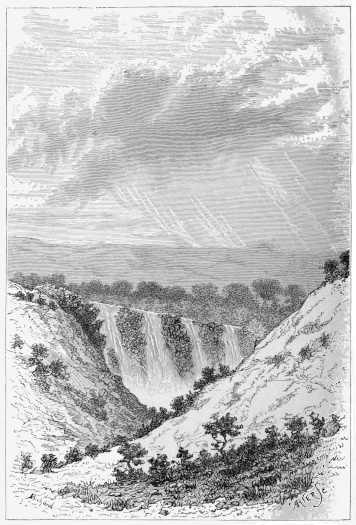
FALLS OF THE PANGA-NI RIVER.
About sunrise on Friday, February 20, we
239were aroused by the guide, and after various delays
we found ourselves ‘on the tramp’ at 7 A.M.
This country traversed was the reflection of what
we had passed through. Hills girt the river on
both sides, with black soil in the lower and red
clay in the upper levels, whilst the path was a
mere line foot-worn over rolling ground and
thicketty torrent-beds, and through thorny
jungle and tall succulent tiger-grass.
At 9 A. M. we stood upon a distant eminence
to view the Falls of the Panga-ni, of which we
had read a hearsay description in the pages of Lt
Boteler. It somewhat suggested the Torc Cascade
of guide-books. The stream, swiftly emerging
from a dense dark growth of tropical jungle, hurls
itself in three separate sheets, fringed with flashing
foam, down a rugged wall of brown rock. The
fall is broken by a midway ledge, whence a second
leap precipitates the waters into a lower basin of
mist-veiled stone, arched over by a fog-rainbow,
the segment of a circle painted with faint prismatic
hues. The spectacle must be grander
during the wet season, when the river, forming a
single horseshoe, acquires volume and momentum
enough to clear the step that splits the now
shrunken supply; in fact,
‘When copious rains have magnified the stream
Into a loud and white-robed waterfall.’
240Of all natural objects the cataract most requires
that first element of sublimity—size. Yet, as it
is, the Panga-ni Falls, with the white spray and
light mist, set off by a background of black jungle
and by a framework of slaty rain-cloud, offer a
picture sufficiently effective to save us from disappointment.
As we jogged onwards the heat became intense.
The clouds lay close upon the cool mountain-tops:
there it was winter, but the fount of
life, the Soter Kosmou, the grand differentiator
between Africa and Greenland, whose rays shot
stingingly through the well-washed air, still
parched the summer plains. At 10 A. M. our
Baloch, clean worn-out by famine and fatigue,
threw themselves upon the bank of a broad deep
Nullah, in whose rushy and jungly bed a little
water still lingered. Wild bees had hived in the
tree-trunks, but none of us coveted the fate of
plundering bears. The bush was rich in the
‘Melon of Abu Jahl’ (Coloquintida), and the slaves
chewed the dried pulp of the calabash gourd.
Half-an-hour’s rest, a cocoa-nut each, a pipe, and
above all things the spes finis, somewhat restored
our vigour. We resumed the march over a rolling
waste of thin green grass, enlivened by occasional
glimpses of the river, whose very aspect
241tempered the optic nerves and cooled the brain.
Villages became numerous as we advanced, far
distancing our Baloch, and at 3 P.M., after 14
miles, we sighted the snake-fence and the penthouses
of friendly Chogwe. The Jemadar and
his garrison received us with all the honours of
travel, and marvelled at our speedy return from
Fuga, where, as at Harar, a visitor can never
reckon upon prompt dismissal. Sultan Kimwere
has detained Arab and other travellers a whole
fortnight before his Mganga would fix upon a fit
time for audience.
Our feet were cut by hard boots and shoes,
that had more than once been wetted and dried;
and wherever there was chafing or burning, we
had lost ‘leather’ softened by constant perspiration.
A few days of rest and simple remedies,
white of egg and flour-powdering, removed these
small inconveniences. Our first move was to
Panga-ni, where Said bin Salim, who had watched
his charge with the fidelity of a shepherd’s dog,
received us with joyous demonstrations. The
Portuguese lad who accompanied us escaped
with a few sick headaches, and we were happy to
find his confrère free from African fever. After
spending a day upon the seaboard, we returned,
provided with munitions de bouche and other
242necessaries, to Chogwe. Here we paid the bill—$20
to the Jemadar in consideration of his two
slaves; $5 a piece to the three hardworking portion
of our Baloch, and to the drones, old Sha’aban
and the lady like Rahmat, $4 and $3 respectively.
Then, as the vessel in which we were to cruise
southward was not expected from Zanzibar before
the beginning of March, and we had a week to
spare, it was resolved to try a fall with Behemoth.
The hippopotamus, called by the Wasawahili
Kiboko and Mvo, and by the Arabs Bakar el Khor,
‘the creek-bullock,’ resembles a mammoth pig,
with an equine head, rather than a horse or a cow.
Like the mangrove, he loves the rivers and inlets
where fresh water mingles with the briny tide,
and, as on this coast he has been little molested,
he is everywhere to be met with. In the Bights
of Benin and Biafra, during three years’ wanderings,
I sighted but a single specimen, and that
only for a minute. When the night falls he
wriggles up one of the many runs on the river
bank, and wanders far to graze upon fat rich grass
and to plunder grain plantations, where, like the
elephant and the hog, he does much more damage
than is necessary. At dawn he exchanges the
dangerous open for shelter in the deep pools—the
Khund of India—which as here, for instance, succeed
243one another in the stream-bed like the beads
of a chaplet, and the place which he prefers is
called by the natives his ‘house.’ In the presence
of man he remains at home, fearing to expose his
person while passing over the shallow covering of
the sand-ridges which divide the hollows. When
undisturbed he may be seen plunging porpoise-like
against the stream, basking where the water
is warm and not deep, dozing upon the soft miry
bank, or sheltering himself under the luxuriant
rhizophoræ in groups and singly, the heavy boxhead
resting upon a friend’s broad stern. On
terra firma he is easily killed by the puny arrow
and by the tripping-trap with its spike-drop: in
the water he is difficult to shoot, and unless harpooned
he is scarcely to be bagged. Thoroughly
startled, he exposes above the surface only his
eyes and sloping brow; after a shot he will remain
below for hours, raising nothing but a
nostril to supply himself with air, and slipping
down the moment he sights his foe. Receiving
the death-wound, he sinks, and, according to the
people, he clings to the bottom: he reappears
only when blown up by incipient decomposition,
and unless scouts are stationed, the body will
rarely be found. The Arabs and Baloch declare
that a trifling wound eventually proves fatal to
244the unwieldy form,—the water enters it, and the
animal cannot leave the stream to feed. All
Easterns, however, joining issue with the homœopathists,
dread applying water to a wound, and
the Brazilian Tupys used to cure their hurts by
toasting them and by extracting the moisture
before the fire. The people of Mafiyah secure
him, I am told, by planting upright a gag of
sharpened and hardened stick in his jaws when
opened wide for attack: this improbable tale is
also told concerning the natives of Kalybia and
the Maidan Arabs of Assyria and their lions.
The cow is timid unless driven beyond endurance
or grossly insulted in the person of her calf:
the bulls are more pugnacious, especially those
who, expelled by the herd, live in solitary dudgeon.
The ‘rogue’—generally derived from the Hindostani
‘rogi,’ sick or sorry—is found amongst
hippopotami, elk, deer, and other graminivors
as well as amongst elephants, lions, tigers, and
the larger carnivors. The ‘rogue’ hippopotamus
is an old male no longer able to hold his own
against the young adults, who naturally walk off
with his harem, and leave him in the surliest
state of widowerhood. The man-eating lion is
mostly some decrepit beast that finds it easier for
his stiff muscles and worn tusks to pull down a
245human biped than a wild bull or an antelope. It
was probably a rogue hippopotamus that caused
the death of Menes, ancient king, and the modern
Africans from Abyssinia southwards still lose
many a life. Captain Owen’s officers when
ascending these streams had their boats torn by
Behemoth’s hard teeth. In the Panga-ni river
‘Sultan Mamba,’ a tyrant of the waters, thus
dubbed by the Baloch in honour of their friend
the Kohode chief, delighted to upset canoes in
rude waggishness, and once broke a negro’s leg.
For this reason men were careful to skirt the
banks by day when he was supposed to be in
mid-stream, and to avoid them during the dark
hours when he was scrambling up and down the
sides. During a subsequent battue off Wale
Point we had two accidents in one day; a dugout
was smashed by a blow with the Kiboko’s
forehand, and the corvette’s gig, suddenly uplifted
upon the tusk-points, showed a pair of corresponding
holes in her bottom.
Behold us now, O brother in St Hubert! merrily
dropping down stream in a monoxyle some
40 feet long, at early dawn, when wild beasts are
hungriest and tamest. The Jemadar and his
brother, cloaked in scarlet and armed with their
slow matchlocks, sit in the stern; the polers,
246directed by Sidi Bombay, who is great in matters
of venerie, occupy the centre, and we take up
our station in the bows. The battery consists of
a shot-gun for experiments, a Colt’s rifle, and
two ‘smashers,’ each carrying a 4 oz. ball of zinc-hardened
lead. The mise en scène is perfect: the
bright flush of morning, the cool, clear air, the
river, with its broad breast swelling between two
rows of tall luxuriant trees, and, protruding from
the mirrory surface, the black box-heads, flanked
with small pointed ears, and not a little resembling
the knight in old chessmen. When swimming
up stream the beasts threw up the hind
legs, and plunged with the action of a porpoise.
As we approached them the boatmen indulged in
loud and ribald vituperations, such as ‘M’áná
Maríra,’ O big belly! ‘Hana ’mkía,’ O tailless
one! and ‘Limundi,’ which was not explained.
These insults caused them to raise their crests in
angry curiosity, and to expose their arched necks
of polished black, shining with the trickling rills,
which caught like quicksilver the reflection of
the sun.
My companion, a man of speculative turn,
experiments upon the nearest optics with buckshot
and two barrels of grape, for which we had
a mould. The eyes, however, are obliquely
247placed; the charge scatters, and the brute, unhurt,
slips down like a seal. This will make the
herd wary. Vexed by the poor result of our
trial, we pole up the rippling and swirling surface
that shows the enemy to be swimming under
water towards the further end of a deep pool.
Our guns are at our shoulders; we know that,
after a weary time, he must rise and breathe.
As the smooth water undulates, swells, and
breaks a way for the large square head, eight
ounces of lead fly in the right direction. There
is a splash, a struggle; the surface foams, and
Behemoth, with open mouth like a butcher’s
stall, and bleeding like a gutter-spout, plunges
above the surface. Wounded in the cerebellum,
he cannot swim straight, he cannot defend himself.
I thought how easy it would have been,
but for the crocodiles, to have done with him as
the late Gordon Cumming did, and related amidst
universal incredulity. In such matters the reader
unconsciously asks himself ‘Could I?’ A negative
is instinctively suggested, and hence his belief
revolts at the story—spernit et odit. But all
men cannot—in fact, very few men can—boast
the eye, the nerve, and muscle of glorious Gordon
Cumming.
Returning to Kiboke, the Baloch are excited,
248and as the game rises again, matchlocks bang
dangerously as pop-guns. Presently the Jemadar,
having expended three bullets—a serious consideration
with your Oriental pot-hunter—retires
from the contest, as we knew he would, recommending
the beasts to us. Bombay punches on
the boatmen, who complain that a dollar a day
does not justify their facing death. At last a
coup de grâce, speeding through the ear, finds out
the small brain; the brute sinks, fresh gore purples
the surface, and bright bubbles seethe up
from the bottom. Hippo. has departed this life:
we wait patiently for his reappearance, but he
reappears not. At length Bombay’s sharp eye
detects a dark object some hundred yards down
stream: we make for it, and find our ‘bag’
brought up in a shallow by a spit of sand, and
already in process of being ogled by a large fish-hawk.
The fish-hawk pays the penalty of impudence.
We tow the big defunct to the bank,
and deliver it to a little knot of savages, who
have flocked down to the stream with mouths
watering at the prospect of creek-bullock beef.
The meat is lawful to Moslems of the Shafei
school; others reject it, as, being amphibious, it
is impure. In Abyssinia they commonly eat it;
here they do not. The insufferable toughness
249and coarseness, to say nothing of the musky
bouquet, do not recommend it to Europeans.
The Washenzi, however, will feast royally, grease
themselves with the dripping, and at sundown
bring us, according to agreement, the tusks,
teeth, and skull, picked clean as a whistle is said
to be. The teeth, especially of young animals,
being delicately white and conical, make the
prettiest handles for knives.
The herd no longer rises; the beasts fear this
hulking craft. We must try some other plan.
My companion, accompanied by Bombay, who
strips to paddle, in token of warm work expected,
shifts to a small canoe, lashes fast his shooting
tackle to the seat, in case of an upset, and whilst
I occupy one end of the ‘house,’ makes for the
other. Whenever a head appears an inch above
water, a heavy bullet ‘puds’ into or near it;
crimson patches marble the stream; some die
and disappear, others plunge in crippled state;
while others, disabled from diving by holes drilled
through their snouts, splash and scurry about
with curious snorts, caused by the breath passing
through the wounds. At last the small canoe
ventures upon another experiment. A baby
hippo., with the naïveté natural to his age, uprears
his crest, doubtless despite the maternal
250warning: off flies the crown of the little kid’s
head. The bereaved mother rises for an instant,
viciously regards the infanticide, who is quietly
loading, snorts a parent’s curse, and dives as the
cap is being adjusted. Presently a bump, a shock,
and a heave, and the bows of the barque are
high in the air. Bombay, describing a small
parabola, lands in frog-position upon the enraged
brute’s back. My companion steadies himself in
the stern; happily the Kiboko had not struck
out with the forearm, nor torn off the gunwale
with her mighty jaws: he sends a ball through
her sides as, with broad dorsum hunched up and
hogged, like an angry cat, she advances for a
second bout. Bombay scrambles into the monoxyle,
and nothing daunted, paddles towards
the quarry, which funks and bolts till nothing is
visible but a long, waving line of gore. With a
harpoon we might have secured it; now it will
feed, with ‘speck’ and musky meat, the Washenzi
or the crocodiles.
Our most artful dodge was, however, to come.
The Baloch have ceased firing, confessing their
matchlocks to be no ‘good,’ but they force the
boatmen to obey us, and they take great interest
in the sport, as Easterns will when they see work
well done. My companion lands with his black
251woodman carrying both smashers: they grope
painfully through mangrove-thicket where parasitical
oysters wound the legs with their sharp
edges, and where the deep mud and shaking bog
admit a man to the knees. After a time, reaching
a clear spot, they take up a position where the
bush-screened bank impends the deepest water,
and signal me to drive the herd. The latter, after
rubbing their backs against the big canoe, rise to
breathe; I hoist a scarlet cloth upon a tall pole,
and the beasts, inquisitive as kangaroos, expose
themselves to gratify a silly curiosity. My companion
has two splendid standing shots, and the
splashing and circling in the stream below tell the
accuracy of his aim. The dodge was suggested by
seeing antelope thus arrested in their flight, and
by remembering the red whirligigs with bits of
mirror, used in former years by the French chasseur
to kill hares.
Whilst in the pursuit of the animals that were
retiring to the other end of the pool, I saw a hole
bursting in the stream close to the bows of the
canoe, and a dark head of portentous dimensions
rose with a snort, a grunt, and a spirt. Mamba!
Mamba! shout the Baloch, and yet the old rogue
disdains to flinch or fly. A cove from the Colt
strikes him full in the front; his brain is pierced,
252he rises high, he falls with a crash upon the wave,
and all that hulking flesh cannot keep in a little
life. Sultan Mamba has for ever disappeared
from the home of the hippopotamus: never shall
he bully canoe-men, never shall he break nigger’s
leg again.
We soon learned the lesson that these cold-blooded
beasts may be killed with a pistol ball,
if hit in the right place,—under the shoulder for
the heart, and in the ear for the remarkably small
brain, whose pan is strongly boxed in. Otherwise
they carry as much lead as elephants. By
10 A. M. we had slain six, besides wounding I know
not how many of the animals. They might be
netted, but the operation would not pay in a
pecuniary sense: the ivory of small teeth, under
4 lbs. each, is worth little. Moreover, the herds are
apt to shift quarters after an excess of bullying,
and are normally shy when exposed to the perpetual
popgunning of the Baloch. Even the
vulture is absent—a bad sign. We did not often
return to this sport, finding the massacre monotonous,
and such cynegetics little more exciting
than pheasant shooting.
Our first partie concluded with a bath in the
Panga-ni, which here has natural ‘bowers for
dancing and disport,’ fit for Diana and her suite:
253in these unclassical lands they are haunted, not
by fairies, but by monkeys. About a dwarf
creek trees cluster on three sides of a square,
regularly as if planted, and rope-like creepers,
the West African tie-tie, bind together the supporting
stems and hang a curtain to the canopy
of imperious sylvan shade. The consumptive
Jemadar suffered severely from the sun; he still,
however, showed some ardour for sport. ‘A
mixture of a lie,’ says Bacon bluntly, ‘doth ever
add to pleasure.’ There was abundant amusement
in the little man’s grandiloquent romancing;
a hero and a Rustam he had slain his dozens;
men quaked—in far Balochistan—at the mention
of his name; his sword-blade never fell upon a
body without cutting it in twain, and, ’faith, had
he wielded it as he did his tongue, the weapon
would indeed have been deadly. At Panga-ni
he had told us all manner of F. M. Pinto tales
concerning the chase at Chogwe, and his pal, an
old Mzegura woodsman, had promised us elephants,
giraffes, and wild cattle. But when we
pressed the point our guide shirked the trial;
his son was absent, war raged in the clan, his
family wanted provisions: he was ever coming
on the morrow, and—the morrow never came.
This convinced me that the tale of game in the
254dry season was apocryphal. Chogwe then offered
few attractions, and we left the bazar on Thursday,
Feb. 26: my companion walked to Panga-ni,
making a route-survey, whilst the Jemadar and
his tail escorted me in the large canoe.
This trial trip to Fuga, which covered 150
miles in 11 days, had supplied me with a fair
budget of experience and had drawn my attention
to an important point, namely, the difference
between our distances and those of M. Erhardt’s
map. Whilst we placed the head-quarter village 37
miles in direct line, and along the devious path
74 or 75, he gave the measures respectively as
82 and 100. Hence I was led to question all the
distances in the remote parts: the road between
Mombasah and Kilima-njaro had already been
reduced from 200 to 130 miles; and, to judge from
analogy, a little further subtraction might be
applied. Our longest march was only 17 miles:
after 4 days’ continued work the slaves were dead-beat;
our escort, who carried only their weapons,
murmured loudly at our habits, and the Panga-ni
people considered the rate of walking excessive.
Without measuring instruments or the habit of
correct timing, it is difficult to estimate distance.
Some years afterwards, when ascending the Cameroons
Mountain, I found, by taping, 11,570 feet
255to be the length of a march, which the whole
party had set down at the lowest estimate as five
miles. Twenty miles in a tropical sun, without
water and over rough ground, where the step is
shortened, will appear 40 in Europe, whilst the
hour’s halt seems but a few minutes.[44]
For two days after returning to Panga-ni we
abstained from taking exercise. On the third we
walked out several miles East along the shore,
and N. West inland, under the hottest of suns
and over burning ground, to explore a cavern, or
rather a tunnel in the limestone rock of which
the natives, who came upon it when clearing out
a well, had circulated the most exaggerated accounts.
My companion already complained of
his last night’s labour, an hour with the sextant
upon damp sands in the chilly dew. This excursion
finished the work. On entering the house
we found Caetano, who had accompanied us to
Fuga, suffering from aches in the shoulders and
a cold sensation creeping up the legs. Such sensations
heralded the fever, a malignant bilious
256remittent like ‘General Tazo’ of Madagascar: as
on the Niger, this ‘acclimatizing fever’ usually
appears before the 16th day. My companion was
prostrated a few hours afterwards, and next day I
followed their example. Valentino, who escaped
at Panga-ni, came in for his turn at Zanzibar;
and, as a proof that the negro enjoys no immunity,
Sidi Bombay suffered severely in early
June.
I have no doubt that had Dr Steinhaeuser
been with us, or had we been acquainted with
the prophylactic treatment of quinine, first developed
by the later Niger expeditions, and afterwards
practised by myself with so much success
on the West Coast of Africa, we should have
escaped with a light visitation instead of dangerous
and almost deadly attacks. But we had also
imprudently taxed strength and endurance to
the utmost, before our constitutions had been
accustomed to the climate. As a rule, the traveller
in these lands should at first avoid exposure
and fatigue beyond a certain point to the very
best of his ability. He might as well practise
sitting upon a coal fire as hardening himself to
the weather—which green men have attempted.
Dr Bialloblotsky, a Polish professor who
had begun travelling at the end of a long life
257of sedentary study, would practise walking bare-headed
in the Zanzibar sun: the result was congestion
of the brain. Others have paced bare-footed
upon an exposed terrace, with ulceration
of the legs and temporary lameness, as the total
results. The most successful in resisting the
miasma are they who tempt it the least, and the
best training for a long hungry march in these
lands is repose with good living. Man has then
stamina to work upon: he may exist, like the
camel, upon his own fat. Those who fine themselves
down by exercise and abstinence before
such journeys commit the error of beginning
where they ought to end.
We spent no happy time in the house of the
Wali Meriko, who, luckily for us, was still absent
at Zanzibar. The Jemadar, seeing that we could do
nothing, took leave, committing us to Allah and
to Said bin Salim. The Banyans intended great
civility; they would sit with us for hours, asking,
like Orientals, the silliest of questions, and thinking
withal that they were making themselves
agreeable. Repose was out of the question.
During the day gnats and flies added another
sting to the horrors of fever: by night rats nibbled
our feet; mosquitos sang their songs of
triumph; and torturing thirst made the terrible
258sleeplessness yet more terrible. Our minds were
morbidly fixed upon one point, the arrival of our
vessel: we had no other occupation but to rise
and gaze, and to exchange regrets as a sail hove
in sight, drew near, and passed by. We knew
that there would be no failure on the part of our
thoughtful friend, who had written to promise
us a ‘Batela’ on March 1. But we doubted the
possibility of an Arab or an Msawahili doing anything
in proper time. The craft had been duly
despatched from Zanzibar before the end of February,
but the fellows who manned her being
men of Tumbatu, could not pass their houses unvisited,—they
wasted a precious week, and
they did not make Panga-ni till the evening of
March 5.
After sundry bitter disappointments, we had
actually hired a Banyan’s boat that had newly
arrived, when the long-expected ‘Batela’ ran
into the river. Not a moment was to be lost.
Said bin Salim, who had been a kind of nurse,
superintended the embarkation of our belongings.
My companion, less severely treated, was
able to walk to the shore; but I—alas, for manliness!—was
obliged to be supported like a bed-ridden
old woman. The Arabs were civil, and
bade us a friendly farewell. The Wasawahili,
259however, audibly contrasted the present with the
past, and drew indecorous conclusions from the
change which a few days had worked in the man
who bore a 24 lb. gun with a 4 ounce ball.
All thoughts of cruising along the southern
coast were thus at an end. Lieut.-Colonel
Hamerton had cautioned us not to despise bilious
remittents, and evidently we should not have
been justified in neglecting his advice to return
to the consulate whenever seized by sickness.
With the dawn of Friday, March 6, we ordered the
crew to up sail: we stood over for the island
with a fine fresh breeze, and early in the afternoon
we found ourselves once more within the
pale of eastern civilization. Our excellent friend
at once sent us to bed, where we remained for
the best part of a week: we did not recover
health till the end of the normal month.
260
Non cuivis lectori auditorique placebo:
Lector et auditor non mihi quisque placet.
A heroic treatment of quinine, beginning
with 20-grain doses, and ending with two grains,
per diem, and a long course of stomachic chiretta—the
Kirait which the Goanese drink, flavoured
with lime juice, every Sunday before church—induced
a convalescence, accompanied by the
usual unpleasant sequelæ. The S. West or rainy
monsoon, which came in like a lion, had improved
my health, but it detained the Expedition
at Zanzibar. We utilized the delay by buying
outfit, which for economy must be provided
before the opening of the trading season; by
making arrangements for an escort, and by
261looking to the hundred impedimenta which appertain
to African exploration.
Yet I was possessed by a nervous impatience
to be up and doing. During the year of grace
1867 it was proposed to penetrate into the Eastern
and Central Regions from all directions. The
Escayrac de Lauture enterprise has been already
mentioned. Zanzibar also expected an American
Expedition. A Major Cotheal, of New York,
had visited the coast in his own vessel, with the
view of pushing into the interior. Like his
many predecessors—Captain Smee for instance—he
failed to find the debouchure of the Denok,
Vumbo, Gob, Gob-wen, Juba, Webbe Ganana,
Govind, Dos Fuegos or Rogues[45] River, which
forms the true northern limit of continental
Zanzibar, dividing inland the Galla from the
Somal, and which the hydrographers have placed
262in S. lat. 0° 14′ 30″, thus nearly corresponding
parallel with the Gaboon. But he had observed
a discolouration of the sea, which raised his hopes
of being able to measure and survey the mysterious
outlet. Despite the labours of Lieut. Christopher,
there is still an abundance of work to be
done about the embouchures and more upon the
upper courses of the ‘Nile of Makdishu’ (Webbe
Gamana) and the Juba (Webbe Ganana);
whilst the sad loss of Baron von der Decken only
increases our curiosity about the latter stream.
It is doubtful, even in the present day, whether
the mouth of the Juba is dry in the rainless
season or not. Major Cotheal’s prospects were
kept dark: it was, however, understood that the
party would be composed of white men accustomed
to endure fatigue and to face danger,
escorted by free blacks from the United States,
and by natives of the country as guides and
porters. All scientific researches and even exact
observations were to be postponed, lest they
should impede progress: this manner of exploration,
which would find scant favour in English
eyes, is evidently best fitted to open a way for the
physicist through unexplored and possibly dangerous
regions. I never doubted that the Anglo-American,
familiar with the negro race from his
263infancy, and strong in nervous temperament,
carrying little flesh and comparatively abstemious,
would be the best of African explorers, and my
subsequent experiences on the west coast of
Africa in the Bights of Benin and Biafra, from
Cape Palmas to the Gaboon river, have confirmed
the belief. Major Cotheal’s exploration, however,
was fated to remain in limbo.
An expedition was also proposed at the
Cape of Good Hope on a plan recommended by
the lamented naturalist, Professor Wahlberg.
Several waggons starting simultaneously would
separate upon the threshold of the tropics, and,
after exploring eastward and westward, would
rendezvous at a given place, and confer upon the
ways and means of further advance. Nothing appeared
more feasible than such a prospect, and the
brilliant success of Messrs Livingstone, Murray,
and Oswell, then fresh in the public mind, had
proved that intertropical Africa could be penetrated
with less fatigue and risk of disease from
the Cape than from any other point. Dr Wahlberg,
however, was killed by an elephant, and his
plan was allowed to lie in nubibus.
We left for the interior before Zanzibar
Island was visited by the Père Léon d’Avanchers,
whose name has since become familiar to geographers:
264en revauche I met M. Gabrielli de
Rivalta, a capuchin of the Lyons Mission, who
was proceeding to his head-quarters, the before
inaccessible Kaffa country. He had lately learned
at Rome that four or five other missioners would
be sent to reap the unparalleled harvest reported
by Monsignor Guglielmo Massaga, the Vicario
Apostolico dei Gallas, who had made that place his
home, and who had sent branch establishments to
Enarea and Goodroo. Some 40,000 pagans had,
it was asserted, embraced Christianity, and conversions
were still taking place in legions. Unable
to enter Africa viâ Masawah, on account of
the religious excitement that burned high
amongst the Abyssinians, Father Gabrielli resolved
to land at Makdishu, and to march upon
Ganana, travelling alone and unarmed, amongst the
fiercest tribes of East Africa, the Gallas, and the
Somal. The successes which have crowned the
efforts of Catholic missioners in these eastern
regions reflect honour upon their system, and
cast a deep shade upon the desultory individualistic
display of Protestant energy. On the
West Coast of Africa, however, I found that
both had equally and completely failed.
At length, strength and energy returning, I
resolved once more to visit the coast, and to collect
265information upon certain interesting subjects,
concerning which the Secretary of the Bombay
Geographical Society had (Dec. 8, 1856) forwarded
to Government the following remarks:—
‘It will be eminently interesting to know
whether the great limestone formation, extending
in one vast continuous band from the banks of
the Burrumputra to those of the Tagus, and
from which Captain Burton forwarded valuable
specimens from the Somali country, prevails as
far south as the Line, and to what distance it
extends into the interior. It will be desirable to
ascertain whether the upheaved sea-beach, such
as that which forms the esplanade, and is the
favourite habitat of the cocoa-nut groves around,
prevails along the shores of Africa, and whether,
if so, it manifests those signs of a double depression
or upheaval which characterize it in most
parts of the world.... Of the £300,000
worth of commerce between Eastern Africa and
Western India—the principal part being that of
Zanzibar—gums and resin-trees form an important
part, nearly £20,000 worth being exported
from Zanzibar. The most valuable of these are
copal and gum Animi, the principal supplies
being found under-ground, from which they are
washed out by streams and torrents. Like the
266Dammer of Singapore, and some of the most important
gum resins of Australia, they may be
regarded as semi-fossils, the produce of forests
which have long since disappeared.... We
should like to know whether the Valeria Indica,
which produces it, still abounds as a tree;
as also what may have been the extent, what
the position and circumstances of the extinct
forests, of which it now constitutes the principal
trace.... Copal has of late years become so
scarce, so much in demand, and so dear, that
what was formerly thrown away would probably
be considered of value in the market; and there
are few of the investigations a traveller can undertake
the people of England value so highly as
those that can be turned to commercial account.
Materially to reduce the price of coach-varnish
would probably be considered to entitle Captain
Burton to a larger share of the gratitude of his
countrymen than the measurement of the elevation
of the Mountains of the Moon or the Determination
of the Sources of the Nile.’[46]
On May 11, accompanied by Sidi Bombay
and by Said bin Salim, with his by no means
267merry men, I set out in the ‘Mtope’ (the
Mud), a small Machua manned by the slaves of
Mr Banyan Ramji. Running before a fair
wind, and ‘rushed’ by an occasional raffale, we
crossed in five hours the Manche that separates
Zanzibar from Sa’adani, a trading port on the
Continent, nearly parallel with the northern cape
of the Island. The settlement is not seen till
within the shortest distance, when the mangroves
disclose it. The landing-place is bad;
if the water is out small craft must lie about
half-a-mile from the shore; at flood-tide they
round a small sandspit, and enter the shallow,
rushy Khor (bay), which passes the settlement.
Passengers then disembark in canoes. The site
of the village is frontier-land: to the north are
the Wazegura savages, and southward, behind
‘Utondwe,’ lie the Wadoe, who are reported by
all to have learned cannibalism during their wars
with the Wakamba.[47] I should say ‘lay’: these
268Wadoe have of late years been driven away from
their ancient seats by the Wamasai, and like the
Waboni, they have occupied the lands on the
north bank of the Adi or Sabaki river. The
Wakamba, again, have been expelled, and the
Wazeramo, a fierce and unmanageable tribe, has
now transferred itself to the interior. The point
or headland bounding the bay southwards, and
giving a name to the little maritime province
whose southern limit is Whinde (Uende of M.
Rebmann), is still known as Utondwe, and is said
to show ruins of habitations. Thus Watondwi,
which Mr Cooley translates ‘picking-grounds,’
i. e. places where shell-fish are gathered, would
mean the people of Utondwe. Nothing can be
more misleading than such expressions as ‘the
kingdom of Atondo,’ used by Do Couto and
others. These royalties are mere districts ruled
by petty headmen, of which each port-village
has one, potent within their own bounds or
palisades, but powerless a mile beyond them.
They correspond with the River Kings and Hill
Kings of Guinea, the ridiculous King Jacks and
King Boys of the Western Coast—both degraded
269by intercourse with superior races, these with
Europeans, those with the Arabs. ‘Otondo’ is
mentioned in the Portuguese inscription over the
fort gate of Mombasah; and in 1528 its Shaykh
came to the assistance of Nuno da Cunha with
five or six thousand black archers, probably slaves
and savages, who are described as very agile and
trained to war.
Sa’adani stands upon a swampy green flat,
defended, as are most of these places, against the
sea, which is apparently but little below its level,
by a high sandbank and natural dykes. From Panga-ni,
southward, the littoral suddenly falls flat,
becoming an alluvial plain of green swamps, cut
by hundreds of mangrove creeks: it is backed by
higher ground, the blue line seen from Zanzibar
Island, and the habitat of the wilder races. The harbours
are mostly open roads or inlets, into which
only native craft can run, whilst square-rigged
ships must lie three miles in the offing, and much
exposed. The deeper water abounds in fish, and
the tides retire 12 to 13 feet, leaving a broad
expanse of naked mud. Constant troubles with
neighbours have caused this port-village to be
surrounded by a strong stockade of tree-trunks,
and have greatly reduced its extent. The hundred
huts of thatch, wattle and dab, may now
270contain 700 to 800 souls, including a Banyan, a
Kasimi Arab, and a stray Baloch: a few years
ago it could turn out 300 matchlocks. The two
stone mosques, which the people declare to be
ancient, are in ruins. Here the Wasawahili, who
in a thin fringe line the whole coast, appear to be
healthier than on the Island of Zanzibar. As usual,
there is less rain, and the little Msika is often
wanting. They send at all seasons foot caravans
to Nguru—the Ngu of M. Rebmann—a hilly region
seven to eight days’ march, nearly due west.
The normal ventures are beads, cloth, and wires,
and the returns are ivory and slaves, with smaller
items, such as rhinoceros’ horn and various hides.
The trading parties are absent about six weeks,
when no news of them will be held good news:
formerly the wild Wanguru used to visit the
coast, till deterred by Moslem ‘Avanies.’ The
village exports sheep and ghi, holcus, maize, and
especially copal. A little cotton (pamba) for
domestic use is grown on the sandy landward
slope of the natural dyke, about one mile from
the sea: the shrub is allowed to run to wood. A
few words upon cotton-growing in Zanzibar and
East Africa generally may not be misplaced here.
The mountains of Harar, that ancient capital
of the Adel Empire, are a granitic mass covered
271with red argillaceous soil: they produce in plenty
a fine, long-stapled, firm and heavy cotton,
with peculiarly flexible and tenacious filament.
Yarn is hand-spun by the women with two
wooden bobbins, and the primitive loom is worked
by both sexes: the result is a cloth, warm and
soft as silk, which surpasses in beauty and durability
the vapid produce of our power-looms, as
much as the perfect hand of man excels the finest
machinery. The ‘Tobe’ of Harar consists of a
double length of 11 × 2 cubits, with a bright
scarlet border, and the value of a good article
even in the city is $8. The laziness of the people
and the risks of the journey, 15 days of wild
travel to the coast, prevent any exportation of
made cloth, and years must elapse before the
obstacles are removed.
The coast of Eastern Intertropical Africa
produces everywhere, as far as my wanderings
extended, a small quantity of cotton now used
only for domestic purposes. The rich ochreous
clays and the black earths fat with decayed vegetation,
cause the neglected shrub to grow luxuriantly.
The mountains of Usumbara north of the Panga-ni
river are peculiarly fitted by climate and
geological formation for growing the shrub. I
afterwards found it in Unyamwezi planted here
272and there amongst the huts, and in N. lat. 4°
Capt. Grant observed the Gossypium punctatum,
a perennial whose produce was woven into women’s
aprons. There is no reason to despair of
producing in East Africa a cotton which might
rival the celebrated growths of Algeria and Egypt;
at present, however, as Dr Livingstone’s second
Expedition proved, the conditions of export are
far inferior to those of Abeokuta and of Accra a
whole generation ago.
Said bin Salim having formerly been Governor
of Sa’adani, we were received by the crowd with
all the honours. The Chief Bori was absent, visiting
Kipombui, a village lying a few miles north:
he was preparing to fight one Abdullah Mákitá, a
Msegeju chief living near Tanga, and his intimate
relations with Muigni Khatib of Usumbara would
allow him free passage along the coast. He is
famed through all the country-side for a mighty
soul contained in a little body, and for a princely
generosity which fills his house with hungry
feeders. At present he is on bad terms with his
brother Mohammed, Chief of Urumwi, a settlement
three hours to the south, and the latter lately
burned down Sa’adani. Here when a Diwan is
poor he has only to attack a wealthy neighbour,
drive off a hundred head of slaves, and send to
273market those not wanted as home-hands—this
eternal state of feud of course greatly demoralizes
the people.
One of Bori’s many cousins led us to the
‘Government House,’ which was surrounded
with a wall of stone and lime: he found lodgings
for us in a large hut and a broad verandah; after
some delay we were fed with dates and coffee,
with rice and cream pressed from pounded cocoa-nut
meat, and with fowls and mutton, the victim
being a dun-coloured sheep with a long fat tail,
very unlike the Somali breed. In the evening
there was a Ngoma Khu, the normal dance of
honour, preluded by the loud singing of the
women inside the house, and by the warning
sound of three drums. The corps de ballet, a dozen
strong, young and old, then defiled before us.
Their heads were clean shaven, or half grown, or
covered with short stiff curls intensely black and
forming the least grotesque of African coiffures:
the dress was an indigo-dyed stuff with large red
stripes and border extending to the feet, and
round the bosom a white cloth or some coloured
cotton contrasted with the blue. Presently the
ballerinas formed line and divided into two parties,
facing inwards; the performance consisted of
trampling and twirling with heads inclined on
274one side, and eyes modestly fixed upon the ground,
whilst palms were kneaded as if washing
‘—with invisible soap,
In imperceptible water.’
A passing sail drew off all the spectators as
though they had been Cornish wreckers in the olden
times, who had successfully fastened their lantern
to a bullock’s horns. The most interesting of the
crowd were the sylvan men in skin aprons stained
with Mimosa-bark: their widely opened mouths
proved that curiosity was reciprocal. Some of
the younger girls had the beauty of negrodom,
and none appeared to be bégueules: here the
people pass all the time not given to trade in
love-making and intrigue. As in the Bombay of
1857, damages have been made cheap and feasible
for the co-respondent: an affair with a Diwan’s
wife costs five slaves, with a ‘common person’
one slave, with the chattel of another man five to
six cloths, and so on.
The day after our arrival was a forced halt, the
copal-diggers had set out in another direction before
dawn, and no donkey-saddle was to be found:
the next, however, was more propitious. Led
by Mánji, the Akida’ao, Mtu-Mkuba, Mukaddam,
or headman of the gang, we walked west over
an alluvial plain of blue earth, veiled with white
275sand, a narrow path, threading the dwarf plantations
of maize and manioc, of cucumber, pulse
(Lobiya), and the castor plant growing everywhere
wild. Crossing, after some 200 yards, a
sandy Nullah, which supplies sweet water, we
came to a rank and reeking, a thorny and cloth-tearing
vegetation, and to thick, coarse spear-grass,
burned down in the dry weather: this
is the home of the spur-fowl, the Kudu, and
other antelopes. Three miles (by pedometer)
of damp trudging, a shower having fallen last
night, placed us before the first Msandarúsi,[48] or
copal tree (Hymenœa verrucosa. Boivin). It was
growing in a thicket upon a flat covered with
Mimosas, Hyphœnas, and various palms, the
cocoa being absent. The specimen, though
young, was some 30 feet tall, and measured
about a yard in girth: it was not in flower nor in
fruit; the latter, according to the people, is a
berry like a grain of Muhindi (maize). Climbing
276up the straight, smooth trunk to secure
specimens of wood, bark, and leaf, I was pitilessly
assaulted by the Maji-Moto (boiling water), a
long ginger-coloured and semi-transparent ant,
whose every bite drew blood. From the trunk and
on the ground I picked up specimens of the gum
which exudes from the bole and boughs when
injured by elephants, or other causes. This is
the Chakazi, raw copal, whence the local ‘Jackass
copal:’ it has rarely any ‘gooseskin,’ and it
floats, whilst the older formation sinks, in water.
Valueless to us, it produces the magnificent
varnishes of China and Japan. In a paper lately
read before the Linnæan Society, my friend Dr
Kirk, H. B. M.’s Acting Consul at Zanzibar, declared
that the fossil resin when first dug up shows
no trace of the characteristic ‘goose-skin,’ which
appears only when the surface is cleaned by
brushing. I believe that this phenomenon is
shown simply by removing the sand which fills
up the interstices. But it is hard to make anything
of Captain Grant’s statement—‘the true
copal-gum tree is a climber, which ascends to a
great height among the forest trees, and finally
becomes completely detached from the original
root, when the copal exudes from the extremities
of these detached roots.’ He must allude, not to
277the well-known Msandarúsi (mentioned by M.
Guillain, i. 24, ‘le M’sandarouss est un bois dur
et résineux, qui donne aussi des pièces de
mâture’mâture’), but to some other and unknown genus.
A fourth mile of gradual rise brought us to
a distinctly-defined sea-beach, swelling about
100 feet above water, and dimly showing Zanzibar
Island to the S. East. The material was
sand with a slight admixture of vegetable humus:
the ridge top was crowned with luxuriant
thicket, and a fine of water-washed quartz
pebbles defined the flank. I afterwards found
the same at Muhonyera in valley of the Kinga-ni
river, where the pebbles strewed the northern
slope of the hillock upon which we were encamped.
Captain Speke (Journal, &c., chap. ii.)
inspected it on his second journey at the desire
of the Royal Geographical Society, to see if it
gave indications of a ‘raised sea-beach,’ and came
to the conclusion that ‘no mind but one prone
to discovering sea-beaches in the most unlikely
places could have supposed for a moment that
one existed here.’ But did he know what a
raised sea-beach was, even had he seen it? He
adds, ‘there are no pebbles;’ my only reply is
that I picked up specimens, and I find in my
Field Book, now deposited with the Royal Geographical
278Society, ‘Muhonyera’ ... ‘elevated, sea-beach,
lines of pink, quartzose rounded pebbles.’
On this beach, as on the flat below, were
frequent traces of manual labour: the tree,
however, is not common,—only two appeared,
within half a mile. Mánji proceeded to show
me the digging process, which was of the
simplest: he crowed a hole with a sharpened
stick in the loose sand, and disclosed several bits
of the bitumenized and semi-mineral gum. One
of the slaves sank a pit about three feet deep:
the earth became redder as he descended, crimson
fibrous matter appeared, and presently the
ground seemed to be half sand, half comminuted
copal. There was neither blue clay nor tree-roots
as in Zanzibar Island, nor did I find this formation
in any of the wells or excavations examined upon
the coast. According to the guide, the only
subsoil is this ruddy arenaceous matter: his
people, however, never dig lower than a man’s
waist. They use the Jembe, or little iron hoe,
and when ‘grist for the mill’ is wanted they
form small gangs, who proceed to the ‘jungle’
for two or three days, carrying with them the
necessaries of life.
The whole of this Zangian coast produces the
copal of commerce: specimens have been brought
279to Zanzibar from the northern limits of Makdishu
and Brava to Kilwa and Cape Delgado—by rough
computation 800 miles. It extends, here three
hours’ march, there two to three days, into the
interior. On the mainland it costs half-price of
what is paid upon the Island, and the indolent
Wasawahili of the villages cannot be induced to
dig whilst a handful of grain remains in the bin.
I found it impossible to ‘trace the position and
circumstances of the extinct forests, of which
copal constitutes the principal remains:’ such an
investigation would have entailed at least two
months’ voyaging along, and dwelling upon, the
fever-haunted seaboard.
I was also obliged to leave to the late secretary
of the Bombay Geographical Society the task of
remedying the host of evils that at present beset
copal-digging. The first is the Commercial
treaty of 1839, by whose tenth article H. H. the
Sayyid engages ‘not to permit the establishment
of any monopoly or exclusive privilege of sale
within his dominions, except in the articles of
ivory and gum copal on that part of the East
Coast of Africa, from the port of Tangate, situated
in about 5½ degrees of S. latitude, to the
port of Quiloa, lying in about 7 degrees south of
the equator.’ The U. S. Commercial treaty of
2801833 contains no such clause, but the French
treaty, concluded in 1844, thus modifies (Art. xi.)
the prohibition to traffic which appears in the
English treaty. ‘But if the English or Americans
or any other Christian nation should carry
goods, the French shall in like manner be at
liberty to do so.’ With the Arabs such matters
are easily managed for the benefit of both parties:
when, however, European jealousies complicate
the affair there is little hope of their being
brought to a successful issue.
Moreover, Europeans cannot do manual
labour upon the Zanzibarian seaboard. Hindustanis
would fear to face, not only the fever, but
the savage. A gang of 500 negroes from Kilwa
or Arabs from Hazramaut taught to use moderate-sized
mattocks, not the child’s plaything
now in fashion, well paid and kept at regular
work, would soon, by their own exertions and by
example, stimulate the copal digging into liveliness
or break up the unnatural monopoly. But
the Sayyid’s government would object to such
occupation of its territory; the Wasawahili
Diwans would require propitiation; and in view
of desertion, it would be necessary to make specific
contracts with the chiefs of tribes, villages,
and harbours. It is to be feared that such an
281operation would not pay, commercially speaking,
though every hand might produce, as it has been
calculated he can, 12 to 15 lbs. per diem. Willingly,
therefore, as I would have won that highest
of meeds, the gratitude of my fellow-countrymen
by reducing the price of coach-varnish, I
had fairly to confess that it was beyond my
powers. The sole remedy is Time—perhaps an
occasional East African expedition might be adhibited
to advantage.
As regards the limestone band, of which I
had forwarded specimens from the Somali country,
no traces were found till after leaving the
modern corallines and sandstones of the coast
which possibly overlie it. Our march to the
Usagara mountains (5000 feet high) was more
fortunate: a fossil bulimus was picked up in
the Western counterslope of those Eastern
Ghauts, about 3200 feet above sea-level, and calcareous
nodules of weather-worn ‘Kunker’ were
remarked in more than one place. Captain Speke
(Journal, chap. ii.) afterwards saw at Kidunda of
Uzaramo on the left of the Kingani valley ‘pisolithic
limestone in which marine fossils were
observable.’
Nothing of interest now remained for me at
Sa’adani. Before earliest dawn, when Venus
282hung like a lamp between dark sky and darker
earth, and before the lovely flush of morning
had lit up the Eastern sea, we embarked, and
enjoyed a lively sail. Whilst the mainland was
clear, the Island of Zanzibar had hid itself in a
mass of dark dense cloud, and presently it sent
to meet us heavy leaden-coloured rain apparently
solid as a stone wall. We had sundry gusts and
dead calms, till at last a light breeze wafted us
once more into port.
283
‘All truth must be ultimately salutary, and all deception
pernicious.’—Francis Jeffrey.
At length came the moment for departure—June
17, 1858. We had learned what we wanted
to learn on the seaboard, whilst at Zanzibar
Island no further information was to be procured.
The rains had ended on June 5: the
harvest was coming on, and trading parties were
returning to the coast—every day three or four
boats passed outward-bound under the windows of
the Consulate.[49] Our preparations were hurriedly
284made. Cogent reasons, however, compelled me
to move quamprimum, and evidently delay, even
for a week, might have been fatal to my project.
Lieut.-Col. Hamerton’s health rapidly declined:
he was compelled to lead the life of a recluse,
and his ever-increasing weakness favoured the
cause of our ill-wishers. Local politics became
more confused, and the succession troubles more
imminent, whilst the Sayyid’s Government, deceived
by our silence during the rains into a
belief that the Panga-ni fever had cooled our
ardour, lost all interest in the enterprise, and
required to be aroused from its apathy by a stiff
reminder.
My old friend, the late Mr James Macqueen,
has declared that the expedition was ‘organized
upon erroneous and fallacious principles—with
large parties of armed men, with numerous attendants,
and extensive supplies.’ I can reply only
that my model was the normal coast-caravan, and
certainly with less apparatus we should have
made less progress. We were not, however,
favoured by fortune; and, as Baron Melchior de
285Grimm sagely observes, ‘there is nothing in
this life’—especially in African travel—‘but
luck, good or bad.’ The Kafilah-bashi was still
Said bin Salim, who, upon receiving from Lieut.-Col.
Hamerton an advance of $300, and the
promise of a gold watch after return, in case of
good conduct, at once pleaded a mortgage upon
his plantations to the extent of $500. We were
compelled to compound the matter for $250,
before he could precede us to the coast, with his
four slave musketeers, one lad, and two girls.
The Baloch escort was, according to popular
rumour, picked up in the Bazar: it began with
a dozen, and it ended with seven muskets, not
including the monocular Jemadar Mallok.
They wanted everything imaginable,—debts to
be paid, rice, lead, gunpowder, light matchlocks,
$8 for an ass, and slaves to serve them. The
Banyan Ramji supplied us with nine ruffians,
whose only object was to lay out their, or his,
money as profitably as possible in slaves; indeed,
this seemed to be the end and aim of our whole
native party. Upon the coast we engaged as
porters 36 Unyamwezi negroes, men who usually
behave well, but who are uncommonly ready to
follow bad example. As the number was deficient,
we supplied the place of more with some
28630 baggage-asses, which added not a little to our
troubles and losses.
Lieut.-Col. Hamerton listened with pleasure
to my suggestion that he might at once change
air, from the close, foul, fetid town, and superintend
our departure from the coast. The
Sayyid’s kindness was unwearied: he came to
bid us adieu, and manned for us, with a crew
of 20, his own corvette, the Artemise, Captain
Mohammed bin Khamis. The latter having been
educated in England, where he had learned to
observe and survey, and imbued by ‘letters’ with
the restless impulse of European civilization, had
once proposed to the Royal Geographical Society
himself to explore the Lake Regions; and had
he been trustworthy, he might have done work
valuable as that of Capt. ‘Montgomerie’s Pandits.’
His father, Khamisi wa Tani, was the ‘intelligent
Sawahili or Mohammedan native of the Eastern
coast of Africa,’ who had so notably cajoled Mr
Cooley. This ‘mild and unassuming man’s’
antecedents were of the worst description. Born
at Lamu, he became headman of the drummers
at Zanzibar, and afterwards a slaver, according
to M. Guillain, who terms him ‘spirituel et rusé
coquin.’ In this capacity he ‘had travelled much
on the mainland, he had visited many distant
287parts of the East, and could converse in fourteen
languages.’ Turpilucricupidus then became Capt.
Owen’s interpreter along the Eastern coasts
of Arabia and Africa. His voyage in 1835 to
London, where Shaykh Khamis bin Usman at
once became an ‘African Prince,’ arose not
‘for the purpose of assorting the first cargoes
shipped direct to Zanzibar,’ but from the stern
necessity of temporarily leaving that Island with
his head in loco, he having defrauded his master,
the Sayyid, to the extent of $18,000. His ingenuity
did not fail him in our country, where his
revelations touching the Lake Regions and the
unknown interior were delivered and chronicled
with a gravity which excites laughter. Returning
home, ‘the Liar,’ as he was popularly termed
by his countrymen, received the Sayyid’s pardon.
He then became a kind of lackey and maître
d’hotel, factotum and Figaro in native houses, the
‘palace’ included, when Europeans were entertained.
He has ever since devoted his talents
to making himself as wealthy, and his friends as
poor, as possible. I had been especially warned
against him, on account of the prominent part
which he took in spreading reports which led to the
murder of M. Maizan, and it is not pleasant to see
one’s fellow-countrymen so notably ‘humbugged.’
288We found a general rendezvous at Kaole
Urembo, which was attended by Ladha Damha,
Chief of the Customs, the ‘’Ifrít’ Ramji, and the
ex-Sarhang ‘General Tom:’ the Messrs Oswald
also ran over in their four-gun schooner, the
Electric Flash. On June 26, 1857, we bade
adieu to Lieut.-Colonel Hamerton, whose distressing
alternations of insomnia, debility, and
irritability had been apparently increased by the
voyage. He dropped a tear as he said farewell,
and solemnly blessed us, adding that we should
meet no more in this world, and that he quitted
it without regret. Thus it proved. He struggled
against his fate, but he succumbed on July 5,
the victim of a chronic liver complaint. Various
reports of his death reached us in the interior,
but it was not confirmed by letter till eleven
months afterwards.
The work of exploring now began in real
earnest. I have, however, no intention of inflicting
upon the reader a rechauffé of our expedition,
which has been described by me in four
volumes,[50] and of which notices have been given
289in another three,[51] by Captains Speke and Grant.
My principal object in alluding to them is to
offer the judgment and the after-thoughts matured
by a whole decade, as well as to show what
has been done since. The risk of this, the first
attempt, has been stated to be nil by a man who
never trusted himself a mile away from the
coast, and whose tenderness for his personal
safety has ever been more than notorious. In
writing our adventures I was careful not to make
a sensation of danger; but future travellers,
warned by the fate of MM. Maizan and Roscher,
not to speak of Lieut. Stroyan, of Baron von der
Decken’s party, nor of M. von Heuglin in the
Somali country, and the detention of Dr Livingstone,
will do well not to think that, when
about to explore Central Africa, they are setting
out upon a mere promenade. The repeated complaints
respecting our petty troubles, which to
readers appeared exaggerated, were true to my
feeling at the time. The death of Sayyid Saíd
290had been our first blow; the second was the
non-arrival of Dr Steinhaeuser; and the third
was the loss of our excellent friend Lieut.-Col.
Hamerton, whose presence at head-quarters
would have forwarded our views in various ways.
I have preserved copies of letters written to Banyans
and others, who, after fair promises, completely
neglected us. M. Ladislaus Cochet and
Capt. Mansfield did their best; but as we had
not taken counsel with them before departure,
their efforts were, of course, limited. And the
cholera which, unknown to us, had fallen upon
the Island, decimating its population, naturally
enough prevented the sufferers from bestowing
attention upon a distant enterprise. The neglect,
however, told upon our escort, and to manage
them would have taxed the wisdom of Solomon
and the patience of Job. The monoculous Jemadar,
shortly after our return, persuaded Baron
von der Decken to appoint him chief of his party
when on route from Kilwa to the Nyassa or
Southern Lake: as might be expected, that expedition
did not reach half way. Concerning
the ‘Sons of Ramji’ I find amongst my papers
the following memo.:
291
‘Msene district, Jan. 14, 1858.
‘To Sheth Ramji,
‘The full term for which he engaged the eight
slaves, Kidogo, Jako, Mbaruk, Waledi, Mboni,
Muhinna, Buyuni, and Hayja, having now expired,
we give them their dismissal. From the
commencement of the march their insolence of
manner and their independence of action have
been so troublesome to us, and so disastrous to
our progress, that we feel no compunction in
thus summarily dismissing them.
(Signed) ‘Captains Burton & Speke.’
Under different circumstances we should have
been spared the hardship and suffering of all
‘up-hill work,’ of labouring against the stream
of events. We might then easily have returned
via Egypt to Europe, as I firmly intended, and
as my companion—aided by the experience of the
past, and travelling under the most favourable
auspices—was able to do on his second expedition.
Once thoroughly laid open, no African
road is difficult, unless temporary obstacles, such
as famines or bandit raids, oppose progress, and
the hard crust of the coast being broken, the
interior offers comparatively few obstacles. But,
292I repeat, in wayfaring, as in warfare, opportunity
is everything: better an ounce of fortune’s
favours than a ton of genius or merit.
We followed the Arab line of traffic, first laid
open to Lake Tanganyika by Sayf bin Said el
Muameri, about 1825. The existence of a beaten
path in Africa has its advantages and its disadvantages.
The natives are accustomed to travellers;
they no longer perpetually attribute to
them supernatural and pernicious powers, nor do
they, except amongst the worst tribes, expect
every manner of evil to follow the portent: it
is not difficult to engage hands, nor is it impossible
to collect information concerning regions
which cannot be visited. At the same time, contact
with the slave-dealer has increased cupidity
and has diminished hospitality: the African
loses all sense of savage honour, without learning
to replace it by commercial honesty, and all
his ingenuity is devoted to the contrivance and
the carrying out of ‘avanies.’ But where, on the
other hand, the explorer must hew his own way—such
was the case with Paul du Chaillu from
the Gaboon region, and with myself up the Congo
river—and where there is no prescriptive right
of transit even for pay, the adventure waxes far
more difficult and dangerous. Here we see the
293African at home, an unmitigated savage, unmodified
by acquaintance with the outer world,
dwelling in the presence of his brethren, and rich
in all the contrarieties of the racial character.
His suspicions and his desires are at once aroused.
His horror of new things struggles with his wish
to make the most of them; he has no precedent
for his demands, and consequently he has no
sense of their absurdity. A caravan is to him a
‘Doummoulafong,’ or thing sent to be eaten, as
Mungo Park’s second expedition was called. A
Portuguese officer has been asked $120 by the
Wamakúa for permission to visit a hill behind
Mozambique, distant some 25 miles from the
sea. At the Yellalah, or Rapids of the Congo
river, I was required to pay, before leave to advance
could be given, a fee in goods which would
have amounted to £200. And expense is not
the main obstacle to the success of these exceptional
expeditions: the merest accident with a
fire-arm may render progress impossible, and may
endanger the lives of the whole party.
The most troublesome features of the beaten
path to the white face are the exorbitant demands
of the negro chiefs. They know that the slave-dealer,
if over-taxed, will open some other and rival
line. But they see the European for the first time;
294they never expect, nor perhaps do they desire, ever
to see him again; and their only object is to gauge
his generosity by extracting from him as much as
possible. This is the severest trial of temper,
for the explorer well knows that the end of his
outfit is the end of his journey. Whilst he
recognizes the absolute necessity of economy, the
disappointed chief, in high dudgeon, urges his
rights, perhaps with threats; and certainly causes
all manner of delays and difficulties. The native
in charge of the caravan fears awkward consequences,
especially at times of war or draught, of
famine or pestilence, and complies with the demand
in secret, if prevented from acting openly,
out of his own purse if not from the public funds.
The over-worked traveller, scolding, storming,
and getting up temper to blood-heat when required,
cannot watch every string of beads or
yard of cloth; and some day a report is brought
to him that he is running short, when perhaps
the most interesting part of his journey is within
sight, and yet, for want of means, cannot be
explored.
We found also an unmitigated evil in the
universal practice of desertion. The fickle and
inconsequent negro slave must, they say, run
away once in his life, and, like the liar of the
295Persian Joe Miller, he will do so at the most
awkward of times. The impulsive, irritable, and
violent Murungwanah (libertus) is equally apt
to abscond, especially after disputes with his
fellows, and he generally adds injury to injury by
carrying away his pack. The undisciplinable
free porters disappear en masse if commons wax
short, if loads be too heavy, if a fight be
threatened, or if wasting of ammunition be forbidden.
Under similar circumstances the turbulent
Baloch mutiny and march off. During our
18 months’ march there was not, in the party of
80, an individual who did not at some time or
other desert or attempt to desert us. The Second
Expedition, despite all its advantages of more
abundant supplies and of ample support from
Zanzibar, fared not a whit better: we find in it
123 desertions duly chronicled.
For three months and a half our heart-wearing
work was cheered only by two stimulants,
the traveller’s delight in seeing new scenes unfold
themselves before his eyes and the sense of doing
a something lastingly useful to geographers. We
were also opening for Europeans a new road into
the heart of Africa, a region boundless in commercial
resources, and bounded in commercial
development only by the stereotyped barbarism
296of its inhabitants; and we hoped that those who
might follow us would be able to turn many of
the obstacles through which we were compelled
to cut a way. In November, 1857, we perforce
halted for rest and to reorganize the party at
Kazeh in Unyamwezi, some 350 direct geographical
miles from the coast. The site was the most
pleasant that we had hitherto seen, a plateau (S.
lat. 5° and E. long. G. 33°) in the depths of the
Tropics, but made temperate by altitude (3000
to 4000 feet above sea level), studded with hills
rising abruptly from fertile grassy plains, and
broken by patches of cultivation, by valleys, and
by forests of the richest growth.
At this half-way house the Expedition was
hospitably received by the warm-hearted Arabs,
Snay bin Amir, Saíd bin Majid, old Saíd bin Ali,
the sons of Salim bin Rashid, Muhinna bin
Sulayman, and other notabilities of the great
central mart. They housed us and supplied all
our wants—I know not what we should have
done without their friendly aid—and the geographical
information which they gave me directly
led to what many have held to be the most
important feature of the exploration. The Second
Expedition also records its obligations in the
matter of hands and rations. It found, however,
297Kazeh turned, into an agricultural depôt, the
neighbouring villages ruined, and the people
starving. The merchants had refused to pay a
tax imposed upon them by Manwa Sera, son of
the Fundi Kira, lord of Unyanyembe, in the days
when I visited it, and the young chief, who was
very popular, had been supplanted by his half-brother
Msikiwa. Hence a war resulting in the
death of my poor friend, the brave Snay bin Amir,
who, being too proud and perhaps not young
enough to run from the hosts of enemies, lay down
when abandoned by his negroes and took his
chance, that is to say, was slaughtered. Manwa
Sera then threatened to attack Kazeh, and the
Arabs begged Capt. Speke not to abandon hosts,
whose warm and generous hospitality he repeatedly
acknowledges. The reply was that ‘he had a duty
to perform as well as themselves, and that in a
day or two he would be off.’ Some men would
not have treated so lightly a heavy debt of gratitude,
but such compunctions are often fatal to success.
Capt. Speke, I doubt not, really believed that
‘the interests of old England were at stake:’ he
had not hesitated for a moment in throwing
over a Himalayan friend who was to have accompanied
him, nor did he deem himself otherwise
but justified in separating from a companion
298subject to African fever recurring every
fortnight.
We were detained a month at Kazeh. Purple
skies, westerly gales, and furious thunderstorms,
showed that the Masika Mku, or Great Rains,
were about to break, and the change was evident
after the high cold easterly winds which, during
the six months of rainless season, sweep the
elevated basin. Our gang was paid off and another
was not easily collected: porters during
the dry, these men became peasants in the wet
weather. With infinite trouble, and only by the
aid of the Arabs, we were able to leave Kazeh on
December 8, during the height of the S. West
monsoon. The march of 180 direct geographical
miles was to us the most disastrous of all. The
downfall was copious and unintermitting, storms
burst over us with such thunder and lightning as
I have never witnessed before or since, the flooding
rivers necessitated ferry-boats, and the land,
declining and draining to the westward, became
one Great Dismal Swamp. Deduced in strength
by persistent fevers, we could not resist the
drenchings and sunburnings, the long day
marches and the nights spent in unhealthy and
sometimes deserted villages. My companion
complained of blindness which hardly permitted
299him to read a watch, and I suddenly found myself
helpless with paraplegia, a paralysis of the
extremities, which, according to Capt. Smee,
often follows febrile attacks at Zanzibar.
After a total of some 537 rectilinear geographical
miles[52] from the coast, we ascended, on
Feb. 13, 1858, the well-wooded range which
bounds the eastern waters of the ‘Sea of Ujiji,’
and from the western declivity we sighted—very
imperfectly, it must be owned—the fair
expanse of a lake whose name was then unknown
to us. Some months afterwards, when reading
Dr Livingstone’s first expedition, I found (chap.
xxiv.) that the traveller meeting a party of
Zanzibar Arabs at Naliele in the centre of the
continent, heard of the ‘Tanganyenka,’ a ‘large
shallow lake over which canoes were punted.’
At that time, however, I had sent to England
the picturesque native name ‘Tanganyika,’ the
‘meeting-place of waters.’[53] The sight was a
300cordial: this one gleam of success consoled us,
made us forget the petty annoyances, the endless
worry, the hardship, and the sickness which we
had endured for it; and we felt a sensible relief
from the grinding care which the prospect of
failure must ever present.
Yet even the bright view of the blue waters
had its dark side: we had left the Louisa behind,
and we saw no way of navigating this
lake. Reaching, on February 14, 1858, Kawele
of the Ujiji district, a market village and a
depot for ivory and slaves on the eastern side,
and about the northern third of the Tanganyika,
we housed our goods and began to cast about for
canoes. The only dau or sailing craft belonged
to Shaykh Hamid, an Arab trader then living at
Kasenge, a little insular station near the Western
shore. After making all necessary inquiries, I
despatched, on May 3, my companion with a
party of 26 men: he crossed the Tanganyika, but
in vain—the proprietor would not convoy us
round the lake, though we offered him £100 for
a fortnight’s cruise. Captain Speke here met
with a strange accident: a beetle crept into his
301ear, and being awkwardly killed, caused for 6 to 7
months deafness and suppuration: it acted, however,
as a counter-irritant, and to a certain extent
gave him back his sight. My companion
afterwards complained loudly of being unable to
accompany Hamid to the Uruwwa[54] district, where
merchants traded for ivory and copper: we
should thus have spanned half the Continent,
and our line could easily have been connected
with Dr Livingstone’s route through Angola.
As, however, on that journey Hamid and all his
slaves were murdered, and their property was
plundered by the people, my companion had
not much to regret.
Hamid, moreover, gave information which
made us wild to reach the upper end of the Tanganyika
Lake. He had been so near its northern
head that he had felt the outward drift of the
302stream. The rains were still heavy; but as our
supplies were running short, we resolved to
make the attempt in any way. Kannena, the
Chief of Ujiji, proved himself an ill-disposed and
ungovernable savage, ever attempting to thwart
our plans, and evidently holding that we were
quite at his mercy. But wishing to bring ivory
from Uvira, he was persuaded to escort us with
two canoes. Our excursion northwards occupied
15 days, eight being the usual time; and it was
not a ‘pleasure-trip.’
At Uvira my hopes of discovering the
Western Nile Reservoir, and of solving the problem
which has puzzled some 30 centuries, were
rudely dashed to the ground. The Warundi
savages, who had stopped Hamid near the
northern end of the lake, were hostile to the
Wajiji, and we could not proceed to the north
where the mountains walling-in the water seemed
to converge. Similarly the second expedition,
during five months spent with the King of Ugande,
was unable to sight the ‘Victoria Nyanza,’
distant five hours’ walk. Capt. Speke ascended
perhaps 150 feet, but from so low an altitude he
could obtain no general view of the land north of
the Tanganyika, and he laid down a narrow valley.
Presently receiving a visit from the three stalwart
303sons of the Sultan Maruta, the subject of the
mysterious stream which all my informants, Arab
as well as African, had made to issue from the
lake, and which for months we had looked upon
as the western head-stream of the Nile, was at
once brought forward. All declared (probably
falsely) that they had visited it; all asserted that
the Rusizi river enters into, instead of flowing
from, the Tanganyika, and presently Sidi Bombay,
by way of the coldest consolation (‘little
goat, don’t die, spring comes!’), declared that Hamid
had meant the reverse of what he said. I felt
sick at heart. The African’s account of stream-direction
is often diametrically opposed to fact;
seldom the Arab’s—in this point I differ totally
from Capt. Speke. But our Wajiji would not
suffer us to remain at Uvira, much less to penetrate
northwards: we were compelled hurriedly
to return; and thus, as has before been related, the
mystery remained unsolved. I distinctly deny
that any ‘misleading by my instructions from the
Royal Geographical Society as to the position
of the White Nile,’ made me unconscious of the
vast importance of ascertaining the direction of
the Rusizi river. The fact is, we did our best to
reach it, and we failed.
I returned home with the conviction that the
304Tanganyika is a still lake. This view, however,
appeared a strange hydrographical puzzle to
geographers, who were not slow to combat it.
Messrs Vaux and Galton, and my kind friend
Mr Findlay, who has never ceased to impress the
public with what he holds to be the true state of
the case, doubted that an immense reservoir 250
miles long, situated at a considerable altitude in
the African zone of almost constant rain, whose
potable waters are free of saline substances
washed down by its tributaries from the area of
drainage, and which shows no marks of great
accession of level, can maintain these conditions
without efflux. The most natural explanation
was to make the Marungu, Luapula, or Runangwa
river, at the southern extremity of the Tanganyika,
act outlet, and drain it to the Nyassa or Kilwa
Lake, bearing S. 55° East, and distant 340 to 350
miles. The universal testimony of the natives to
its being an influent formed in the mind of my
companion (Journal, p. 90) six years afterwards
‘the most conclusive argument that it does run
out of the lake.’ It did not appear equally conclusive
to others.
The absence of all connection, however, between
the Tanganyika and the Nyassa Lakes
was proved by Dr Livingstone’s second expedition
305and by the excellent paper ‘on the probable
ultimate sources of the Nile’ (Mr Alexander Geo.
Findlay, F.R.G.S., read June 3, 1867). The latter
showed that no considerable stream draining
an area of at least 3000 square British
miles, or a country as large as England and
France combined, enters Nyassa from the north.
Since that time Dr Livingstone has placed
(Letters to Dr Kirk, July 8, 1868, and to the
Earl of Clarendon, July, 1868) the Nile sources
between S. lat. 10° and 12°, north of the great
Serra Muxinga of the Portuguese travellers
Lacerda, Monteiro, and Gamitto, nearly in the position
assigned to them by Ptolemy uncorrected
for latitude.[55] About 400 miles south of the southernmost
extremity of the Nyanza or Northern
Lake, he finds ‘not one source, but upwards of 20
of them,’ and he is under the impression that he
306had stood on the water-shed between the Zambeze
and either the Congo or the Nile. Mr
Keith Johnston jun.’s excellent paper[56] shows that
the Serra Muxinga, of which more presently, may
represent that portion of the Rocky Mountains
which send forth the Missouri, the Columbia, and
the Colorado. And he apparently would drain
the northern fall to the Congo river, whereas
in the Mittheilungen it takes the direction of
the Albert Nyassa, and the labours of Capt.
George, R.N., would throw the water into the
Tanganyika.
Thus the theory of the southern effluent lost
favour, and that which made the Rusizi a northern
influent soon shared the same fate. In 1863
Capt. Speke converted it into a lake or a ‘broad,’
of which he had heard the year before, lying between
the Tanganyika and the Luta Nzige, Mwutan
or Albert Nyassa. Presently Sir Samuel
Baker (1864) caused the southern extremity of
the Luta Nzige, which he placed 2200 feet
above sea-level, to over-lap the Rusizi. ‘I therefore
claim,’ concludes Mr Findlay, ‘for Lake
Tanganyika the honour of being the Southernmost
307Reservoir of the Nile until some more
positive evidence, by actual observation, shall
otherwise determine it.’
To this view the geographical public offered
two objections. The first was that the northern
end of the Tanganyika is encircled by the ‘concave
of the Mountains of the Moon.’ This was
easily removed, as the reader of these pages will
see, by a collation of the several maps forwarded
by the Expedition from the interior. The first,
bearing date May, 1858, was sent from Kazeh on
July 2, 1858: it showed the results of our
discovery (in February, 1858) and of the information
supplied to me by narratio obliqua through
the Arabs and Africans of Unyanyembe. Having
no theory to support, it laid down, what we saw
or thought we saw, an open longitudinal valley
running northwards from the Tanganyika Lake.
But that which my companion brought home in
June, 1859, bore signs of great change, especially
in a confused mass of mountains completely investing
the northern third of the long narrow crevasse:
this by degrees resolved itself into a huge
horseshoe, which was incontinently dubbed the
‘Mountains of the Moon, about 6000 feet.’ In
his second expedition (Journal, p. 263) Capt. Speke
declares that the range had been laid down ‘solely
308on scientific geographical reasons,’ in fact, out of
the depths of his self-consciousness, and he supplemented
it with a Lake Rusizi. I saw it growing
up under his hands, as copy followed copy:
I repeatedly objected to it, yet it managed to
deform the maps of Central Africa for years
afterwards. It threw us once more back into
the romantic geography of the Arabs, who wove
into one line Jebel Kumri, and transferred north
of the equator the scattered ranges which Ptolemy
(iv. 9) disposed at the antarctic end of his
habitable Africa. These, going from east to west,
are represented by Barditon Oros (S. lat. 16°)
Meskhe or Ineskki, the Region of Agysimba (S.
lat. 13°), Xipha or Ziphar (S. lat. 8° 20′ 5″),
Daukhis Oros (S. lat. 13°), and Ion, the mountain
of the Hesperian Æthiopians (S. lat. 8° 20′ 5″).
The second objection was the elevation of the
Tanganyika Lake. Its low level in the great
central plateau proved, however, to be a mere
mistake: only one observation was made, and
that gave but 1844 feet above the sea. But
presently Mr Findlay found a pencil memorandum
by Capt. Speke, showing that when he
again reached the coast our thermometer, a common
bath instrument, used because all the others
had been broken, boiled at 214° (F.) instead of
309212° (F.). Moreover, the observations of Sir
Samuel Baker, carefully compared with those of
the second expedition, decisively proved that
1000 feet must be added, placing the Tanganyika
and the Nyanza on nearly the same level.
Again, Dr Livingstone reports from Bangweolo
(July, 1868) of the Liemba Lake, that he would
have set it down as an arm of the Tanganyika,
but that its surface is 2800 feet above sea-level,
‘while Speke makes it 1844 only.’ Finally, the
great African traveller, who has now been long
resident in the regions west of the Tanganyika
Lake, always writes of it as if he considered the
connection between it and the Luta Nzige
established. Thus the altitude of Lake Tanganyika
was raised to 2800 feet, which would easily
carry its waters to the Nile. ‘It may appear
strange,’ as Mr Galton has remarked, ‘that there
should be an error of a thousand feet of altitude
suspected in the observations of an explorer,
but the method of operating in uncivilized
countries is quite different from that employed
at home.’ Evidently Capt. Speke allowed the
altitude of the lake to lie uncorrected for the
same reason which made him raise his ‘Lunæ
montes.’ This will also answer M. Parthey (June
2, 1864, Royal Academy of Sciences, Berlin).
310A few words concerning the Moon Mountain,
in which are the Ptolemeian Nile sources. It is
placed in S. lat. 12° 30′, which, by applying
the reduction as before proposed, we should
convert to S. lat. 6° 30′, and between East long.
57° and 67°, which, if taken from S. Antonio
(Antão), as the late Mr Hogg suggested, would
be = E. long. G. 30° to 40.° Its northern slope
drains to the lake under the parallels of S. lat.
6° and 7°, and separated by about 8° of meridional
distance. In many maps is added a third, or
equatorial lake, which may be the Baharingo,
or Baringo, and indeed in chap. xvii. (lib. i.)
we find a plural form τὰς λίμνας, possibly showing
a knowledge of two large and sundry smaller
features. The great Unyamwezi Upland, using
the name at its fullest extent, is bounded both
north and south by huge latitudinal blocks and
chains of mountains. The equatorial is the
Highland of Karagwah, extending eastward to
the Æthiopic Olympus Kilima-njaro. The southern,
corresponding with Ptolemy’s parallels, is the
great chain and plateau, whose apex is the Serra
Muxinga or Muchingwe, named by the explorer
Dr de Lacerda Cordelheira Antonina, in honour
of his prince. Lying in about S. lat. 12°, this
feature, ranging from 3000 to 6000 feet high,
311may evidently be the divide of the Nile, the
Congo, and Zambezean basins; whilst the north-eastern
projection feeds with four considerable
streams the Lake Liemba, discovered by Dr
Livingstone on April 2, 1867, and supposed to
connect with the Tanganyika by the River
Marungu. The altitude of the Serra was estimated
in 1831 by Messrs Monteiro and Gamitto
at a Portuguese league (= about 19,700 feet)
above sea-level, palpably exaggerated, as in
winter (August 10) neither ice nor snow was
found upon it. They describe the head as nearly
always enveloped in clouds, and as by far the
loftiest summit in that part of Africa; the profile
rises steeply and abruptly from the table-land,
commanding an extensive prospect northward,
and the ridge is broken by terrible and dangerous
precipices. Snow in this part of the continent
may be alluded to by João de Barros, who
declares that in the Matouca country, though
situated between the equator and the tropic of
Capricorn, the natives die of cold. Later Portuguese
historians declare the Lupata to be a
snowy range, probably referring, not to the
gorge of that name, but to the great block with
which it is connected. Dr Livingstone represents
this, his latest discovery, to cover a space
312south of the Tanganyika some 350 miles square,
dotted with lakes, and traversed on the eastern
side by the River Chambeze, which was first
mentioned by Dr de Lacerda, and which has
hitherto been confounded with the Zambeze.
The Greek term ‘Mountain of the Moon’ may,
I have already suggested, be derived from
‘Unyamwezi,’ an empire whose position between
the Tanganyika and the Nyanza group is laid down
in the map of Duarte Lopez (A. D. 1578–1587).
The name of this extensive region is still contracted
upon the coast to Mwezi, meaning the
Moon, and thus we might translate Ptolemy,
Mountain of Unyamwezi. Similarly, the ancients
derived the Erythrean Sea from the Sea
of Edom and of Himyar, both signifying Red:
Diascorias was a corruption of Dwipa Sokotra,
and, to quote no more, Dr Beke has shown how
the Ptolemeian Iabadíou (Java-dwipa) became
Barley Island without growing barley.[57]
Finally, if we reject Unyamwezi and Muxinga
as the original Lunar Mountains, we must
seek the latter with Dr Beke in the icy peaks
of the Æthiopic Olympus, prolonged to the
Highlands of Karagwah.
A longer delay at Uvira than we had intended
313greatly improved my health: the state of
our finances, however, compelled us to set out
without delay from Ujiji to Kazeh. The rains
had ceased on May 15, and the return (June 11)
by a straighter and more southerly road, was far
less unpleasant than the up-march. After a
short interval for repose, and for recovering his
sight and hearing, Capt. Speke volunteered to
explore a lake reported to lie north, and known
to the Arabs as ‘Ukerewe,’ or Island-land. I
had heard of it in Zanzibar Island as a water
called ‘Karagoa,’ parallel with and one month
west of the Sea of Ujiji. A signal disappointment
at the ‘Ziwa’[58] of Ugogo, which proved to
be a mere pond, made me suspect the informants:
yet Snay bin Amir and Musa Mzuri had both
visited the mountain regions to its west, and their
observations were represented in the sketch map,
1858, which, I repeat, is far less incorrect than
the exaggerated growth of 1859.[59] I was, however,
314delighted with the prospect of a month’s
leisure for inquiry amongst the intelligent Arabs.
It was also necessary to copy out notes, which
ill health had left in confusion, and to learn
something about the southern as well as the
northern regions. Moreover, if truth must be
told, I sighed for the
‘Beata Solitudo
Sola Beatitude’
of the Pisan Cortosa. A critic in Colburn’s
New Monthly Magazine (The Nile Basin), remarks,
‘It was when travelling with Burton that
Speke first discovered Lake Nyanza, and his less
fortunate fellow-traveller seems never to have
forgiven the brilliancy of an achievement which
left him comparatively in the shade.’ Mean,
indeed, must be the man who thus gratuitously
imputes the meanest of motives to another!
What interest can the leader of an expedition
have in reducing his field of exploration, of not
doing his best, of not discovering as much as
315Fate allows him to discover? May he not expect,
like the general of an army, at least to share in
the glory won by the arms of his lieutenants?
Capt. Speke was provided with a gang of 34
guards, servants, and porters: he much wanted
the little Shaykh Said, but the latter wept privily
at the prospect of meeting death by want and
hardship, and I allowed him to remain at Kazeh,
lest his intrigues might work mischief. Though
my companion was a match for ‘Sidi Bombay,’
he was a child in the hands of the tricky Arab.
Captain Speke made a most spirited march.
On August 3rd he sighted the ‘Nyanza Lake,’ to
which he gave 3740 feet of altitude; and he returned,
after covering in 47 days (June 9th to
August 25th) 300 direct and 425 indirect geographical
miles. He brought back the information
that this great equatorial reservoir was
known to the people as Nyanza, a generic term
which, like Nyassa, means a sea, a stream, or a
lake. Standing 250 feet above its level, he saw
20 to 22 (not ‘over a hundred’) miles of surface,
hardly enough to command a liquid horizon between
the islets which he called Mazita, Ukerewe,
and Majid.
Presently, by comparing Arab accounts, I
found in Capt. Speke’s diary sundry uncertainties
316of detail, such as making Mazita, and perhaps
Ukewere, insular instead of peninsular features.
Nor could I hear a word beyond the old legend
current amongst African tribes, from Somaliland
to the Mozambique, touching white men and
ships navigating a lake or a river in the interior.
The Kazeh people, as I ascertained by consulting
them, Knoblecher in hand, equally ignored the
familiar tribal names of Nyam-Nyam, Rungo,
Mundu, Dor, Jur, Kek, Nuehr, and the Shilluks,
West, with the Dinkas, East of the Nile. Their
Bari was simply ‘Bahri’—Accolæ of the sea or
river. But Capt. Speke had discovered on ‘that
broad open lake,’ not only the ‘sources of some
great river,’ not only the Palus Orientalis Nili, but
‘The Sources of the Nile’: he had raised the
veil of Isis, he had settled for ever the ‘mystery
of old Nilus’ origin.’ The subject soon proved
too sore for discussion, and evidently at that
time my companion began to prepare for a future
campaign, by lavishly retouching his maps, and
by barring the Upper Tanganyika from any possible
connection with the northern basin.
During the second expedition Capt. Speke
left Kazeh in May, 1861, and travelled to the
N. West, without ever sighting the ‘broad surface.’
Living with King Rumanika of Karagwah,
317he might have visited it, but he did not. He
then turned nearly due north, and on January
28th, 1862, he first viewed, from Mashonde, a
water which he instinctively determined to be
the Nyanza. In vain the petty chief Makaka
(Journal, p. 130) assured him that ‘there were
two lakes, and not one’: as vainly others made the
Mwerango, or Kafu river, rise from a range in the
centre of the so-called lake, and ‘did not know
what Nyanza he meant.’ These, and other remarks
naïvely recorded, could not disperse
foregone conclusions; and the explorer never
attempted to ascertain by inspection if his preconceived
ideas were correct.
We can therefore accept only the southern
part of the Nyanza discovered by Capt. Speke,
when I despatched him from Kazeh; and the
marshy reed-margined and probably shallow
N. Western water, which he sighted in January
and July, 1862. The result is a blank occupying
nearly 29,900 square miles, and of the recognized
and official form of the assumed Victoria Nyanza
I may observe, that it is a triangle, whose arms,
viewed by one standing at the southern apex,
trended N. East and N. West; the extremities,
240 miles distant, being connected arbitrarily by
a horizontal base running nearly due East-West
318a little north of the Equator. Finally, Captain
Speke made his own lake a physical impossibility.
Within little more than 60 miles from east to
west he has given it three main effluents, the Mwerango,
the Luajerri, and the Nile or Napoleon
channel, to say nothing of the Myo Myanza, the
Murchison Creek, the Usoga stream, together
with the Asúa river from the Baringo. It is
wonderful that our 19th century maps continue
to print such a phenomenon. What will posterity
say of this magnum opus?
After Captain Speke’s return we debated, in
frequent conferences with the Arabs, the advisability
of remaining at Kazeh till fresh supplies
could be procured from Zanzibar, thus enabling
us to visit the northern kingdoms—Karagwah,
Uganda, and Unyoro. Our good friends unanimously
advised us to reserve the exploration for
another journey. The lake was, unlike the Tanganyika,
unnavigated; to travel along the S.
Eastern shores was, they said, impossible owing
to the ferocity of the pastoral tribes, and the
mutual jealousies of great despots on the western
banks would necessitate a large outfit, and perhaps
years of delay. Their advice appearing
sound, I applied myself to the ways and means
of marching upon Kilwa, thus avoiding a return
319by the same road, which led us into Unyamwezi.
But as the former project was dismissed because
we could not depend upon assistance from Zanzibar,
so the latter was frustrated by the unmanageable
obstinacy of our porters. I wanted
exceptional resources for bribing them into compliance,
and our leave of absence having ended, it
was judged imprudent to attempt that expenditure
of time, which in these regions alone compensates
for extensive outlay of capital.
The East African Expedition bade adieu to
Unyanyembe on Sept. 26, 1858, and after a march
eventless except in delays and difficulties caused
by desertion and sickness, by the drought and
the famine then desolating the land, it reached
in early February, 1859, the little maritime
village Konduchi. From the slope of red hill we
hailed with delight the first gleam of the Indian
Ocean, and my companion thanked me with
effusion for the efforts which I had made in
enabling him to travel with me. Verily ‘there
were nights and days before us,’ and we thought
little of what presently was to be the consequence!
The results of the East African Expedition of
1857–1859, which, with the aid of many friends—their
names will be found in the preceding
320pages—was organized wholly by myself, may
thus be briefly summed up. When ignorant of
the country and knowing little of its languages,
preceded only by a French officer, who was
murdered shortly after he landed, and under
other immense disadvantages, especially the
deaths of Sayyid Said and Lieut.-Colonel Hamerton,
I led the most disorderly of caravans into
the heart of Intertropical Africa, and succeeded
in discovering the Tanganyika, and the southern
portion of what is now called the Victoria Nyanza
Lake. The road was thus thoroughly laid
open: those who would follow me had only to
read vol. xxxi. (Journal of the Royal Geographical
Society) and the ‘Lake Regions of Central
Africa,’ to learn all they require concerning seasons
and sickness, industry and commerce, what
outfit and material were necessary, what guides,
escort, and porters were wanted, what obstacles
might be expected, and what facilities would probably
offer themselves. My labours thus rendered
easy the ingress of future expeditions,
which had only to tread in my steps. Dr Beke,
the traveller who deserves all praise for having
suggested a feasible way to explore the Nile
Sources, kindly found ‘reason to call this emphatically
a memorable Expedition.’ My friend
321Mr Findlay’s estimate is still more flattering:
‘The first East African Expedition has had scant
justice done to it of late, seeing that it was the
finest harvest, and that by much the most abundant
one, of those brilliant discoveries in Eastern
Africa so eminently fostered by the Royal Geographical
Society.’
One wise in his generation whispered into my
ear before returning to England, ‘Boldly assert
that you have discovered the source of the Nile—if
you are right, tant mieux, if wrong, you will
have made your game before the mistake is
found out!’ I need hardly explain why the
advice was rejected, nor does it befit me to complain
that Honesty, in my case at least, has not
hitherto proved the best policy. Meruisse satis!
Since these lines were penned Time has again
proved himself the Avenger. The valuable
notes on the Geography of Eastern Africa forwarded
by Mr Wakefield enable me to show,
almost with a certainty, that the 29,900 square
miles assigned as the area to the ‘Victoria Nyanza’
contain at least four, and probably a
greater number, of separate waters.
Mr Keith Johnston, jun., who appended remarks
to the paper in question, observes (p. 333)
322that ‘the arguments which Captain Burton used
in recommending a division of the Nyanza had
not a sufficient basis of proof to give them
moment, is shown by the acceptance of the lake
as one sheet of water by the whole geographical
world.’ The mapper will readily understand
that it is much more convenient to have a lake
neatly traced, and painted sky-blue like the
Damascus swamps, than to split it up as I did:
a volume published by the late Mr Macqueen and
myself (The Nile Basin. London: Tinsleys, 1864)
gave a sketch of what was actually seen by the
second expedition, and the aspect of disjecta
membra is not inviting. Afterwards, however
(p. 334), Mr Johnston remarks, ‘Captain Burton’s
recommendation would seem to receive
some slight support from the new information
obtained by Mr Wakefield,’ to which I add that
the language might have been less hesitating.
The ‘Notes on the Geography of Eastern Africa’
establish the existence of two new lakes.
The first is that which we named from hearsay,
Bahari ya Ngo or Bahari Ngo (Sea, i. e.
water of Ngo): Mr Wakefield prefers ‘Baríngo,
or canoe,’ possibly so called from its form.[60]
323Route No. 5, from ‘Lake Nyanza’ to Lake
Baringo, proves conclusively that Lake Baringo is
not a vast salt marsh, or perhaps a sort of back-water,
‘connected with the Victoria Nyanza by
a strait, at the same distance from the East of
Ripon Falls as the Katonga river is to the West.’
Nor is it a lake without effluent: in this matter
it has evidently been confused with the lately
heard of saline Lake Naïrvasha or Balibali, S.
West of Doenyo Ebor (Mont Blanc), alias Kenia.
Native report supplies it with the Northern
Nyarus, an outfall, the old Thumbiri or Tubirih,
and Meri, afterwards called Usua, and Asua,
the latter two words probably corrupted from
Nyarus.
Far more important, however, is the new lake
which Mr Wakefield’s informant, Sadi bin Ahedi,
ignoring Nyanza, calls ‘Nyanja’ and ‘Bahari
ya Pili,’ or second Sea, not, as we are expressly
warned, because inland of the first sea or Indian
Ocean, but clearly because leading to a first, and,
lastly, called ‘Bahari ya Ukára,’ this being the
name of the region on the East shore. Here we
at once detect the origin of the ancient Garava,
and the modern Ukerewe which the Wanyamwezi
applied to the oriental portion of the supposed
‘Victoria Nyanza.’ Respecting the width
324of the Nyanja or Ukára Lake, Sadi declared
that it could be crossed by canoes in 6 full days,
paddling from sunrise to sunset, and that if the
men went right on, night and day, the voyage
was accomplished in three days. But the native
craft used upon those dangerous mountain
waters never dare to cross them: the voyager
may rush over the narrow parts of the Tanganyika,
but nothing would induce him to attempt
the physical impossibility of navigating
without chart or compass beyond reach and
sight of shore. It is an absurdity to suppose a
canoe-cruise across; it is evident that a coasting-cruise
is meant. The total hours, assuming
the day to be 12 without halts, would amount to
72. Upon the Tanganyika I estimated the rate
at little more than 2 knots an hour, which
would make in round numbers 140 miles. Protracting
this course from Bahari-ni, Sadi’s terminus
on the Eastern shore, at the rate of 3 knots
an hour, and without allowing for the windings
of the shore, the end would strike the entrance
of ‘Jordan Nullah,’ off the ‘Bengal Archipelago.’
But even 140 miles require reduction: an estimate
of the mean amount of error distributed
over the whole of Mr Wakefield’s Routes gives
an exaggeration of 1.24 : 1; and of course when
325laying down the length of these distant and
dangerous cruises exaggeration would be excessive.
We may therefore fairly assume the semi-circumference
of the Ukara Lake at 120 miles,
and the total circumference at 240.
As regards its breadth we read (p. 310):
‘Standing on the eastern shore Sadi said he
could descry nothing of land in a western direction
except the very faint outline of a mountain
summit far, far away on the horizon.’ This passage
is valuable. The level and sandy eastern
shore of the Ukara or Nyanja Lake about Bahari-ni,
where Sadi sighted it, is in E. long. (G.)
35° 15′. The easternmost, that is to say, the
nearest point of the Karagwah highlands, or, as
Captain Speke writes it, Karague, is in E. long.
(G.) 32° 30′. Thus the minimum width is 165
miles, while man’s vision would hardly cover a
score. Here, again, we have room for a double instead
of a single lake. When Sadi declared that
he ‘travelled 60 days (marches?) along the shore
without perceiving any signs of its termination,’
he spoke wildly, as Africans will, and when he
reported that the natives with whom he conversed
were unable to give him any information
about its northern or southern limit, we can
only infer that in those parts of the African interior
326neither tribes nor individuals trust themselves
in strange lands, especially when they
had a chance of meeting the Wasuku. A lake
120 direct geographical miles in length, that is
to say, a little shorter than the Baringo is supposed
to be, will amply satisfy all requirements
in this matter. Finally, if Sadi’s report be correct,
namely, that eight or nine years ago (before
1867?) a large vessel with sails, and a crew of
white egg-eaters—Africans have learnt by some
curious process to connect Europeans with
oöphagy—navigated the waters, it is evident
that this lake cannot be Captain Speke’s Nyanza,
and that the visitors cannot have made it
viâ his ‘White Nile,’ with its immense obstructions.
But it may be that of which he heard
(Journal, p. 333) from the ‘Kidi officers,’ who
reported a high mountain to rise behind the Asua
(Nyarus?) river, and the existence of a lake
navigated by the Gallas in very large vessels.
We now understand why King Mtesa (p. 294)
offered to send the traveller home in one month
by a frequented route, doubtless through the
Wamasai and the other tribes living between the
Nyanja and the Nyanza. Thus Irungu, Chief of
Uganda, expressed his surprise (Journal, p. 187)
that Captain Speke had come all the way round
327to Uganda when he could have taken the short
and safe direct route—across the middle of his
lake—viâ Umasai and Usoga, by which an
Arab caravan had travelled.
The third water is evidently the Nyanza, of
which I first heard at Kazeh, whence Captain
Speke was despatched on a reconnoitre between
July 9th and August 25th, 1858. After returning,
he reported that this water, being nearly
flush with the surface of the level country to the
south, bears signs of overflowing for some 13
miles during the rains. The second expedition
showed no traces of flood on the marshy lands to
the north and N. West of the lake. This fact,
combined with 400 feet difference of level in the
surface of the ‘Victoria Nyanza,’ speaks for itself.
We are justified in suspecting a fourth
lake, along whose banks Capt. Speke travelled
northwards to Uganda: and there must be more
than one, if all his effluents be correctly laid
down.
Briefly to resume. Mr Wakefield’s very
valuable notes teach us—
1. That the Baringo is a lake distinct from
the ‘Victoria Nyanza,’ with a northern effluent,
the Nyarus, and therefore it is fresh water.
2. That the Nyanja, Ukara, Ukerewe, Garawa,
328or Bahari ya Pili, is a long, narrow formation,
perhaps 30 miles broad, with 240 miles of
circumference, and possibly drained to the Nile
by a navigable channel.
3. That the Nyanza is a water, probably a
swamp, but evidently distinct from the two mentioned
above, flooding the lands to the south,
showing no signs of depth, and swelling during
the low season of the Nile, and vice versâ.
And finally we cannot but conclude that
the Northern and N. Western portions of the so-called
‘Victoria Nyanza’ must be divided into
three independent broads or lakes, one of them
marshy, reed-margined, and probably shallow, in
order to account for the three effluents within a
little more than 60 miles.
NOTE.
I have printed, as an Appendix to Volume I.,
a paper which was read out by me before the
Royal Geographical Society, on Monday, December
11, 1871. It dwells at greater length upon
the interesting theme here sketched, and it
enters into certain philological details which
may be interesting to students of Kisawahili.
329
‘Perseverance, dear my lord,
Keeps Honour bright: to have done is to hang
Quite out of fashion, like a rusty mail
In monumental mockery.’—Troilus and Cressida.
The Zanzibar coast was, at the time of our
return to it, in a very uncomfortable state.
Cholera, for the first time, had swept southwards
from Arabia, decimating the East African population
between Unguja and Kilwa. Political
troubles were rife, within as well as from without.
Sayyid Suwayni, pretexting unpaid arrears
of tribute, was reported to be embarking a host
of Bedawin brigands upon five ships and sundry
Arab craft. It was an act of madness, with
cholera and small-pox on board; and, the coast
330not being open for provisions and water, the invaders,
even if left to themselves, were safe to
succumb by dribblets. Yet not the less were the
Baloch stations drained of mercenaries, whilst
7000 muskets, with an amount of ammunition
which made the city dangerous, were distributed
to the slaves and other ruffians. Daus ran down
from Hadramaut crowded with armed adventurers,
all in the market to fight for the best
pay. Sayyids Jamshid and Hamdan, two of the
young princes, had died of small-pox, which
killed the rich as cholera carried off the poor.
Sayyid Barghash, another brother of the Prince
regnant, and now his successor, becoming Yaghi
(rebellious), made a demonstration at the Palace
gate with a herd of black musketeers: the Súri
Arabs, however, armed themselves, and the serviles
fled into the sea, throwing away weapons and
ammunition. Sayyid Sulayman was on the
square, but the turbulent Harisi chiefs held a
review of 2000 black musketeers, and 200 ‘light
bobs’ carrying bows and arrows: they maintained
an attitude of armed neutrality which threatened
mischief to the weaker of the rival brothers.
Trade was paralyzed, the foreign merchants lost
severely, not less than 80 native craft from Bombay
and the North were still expected at the end
331of the season; and, to complete the confusion,
the coast suddenly became subject to the action
of ‘l’Émigration libre.’
Despite the untoward situation, I still resolved
to visit Southern Zanzibar, and to explore,
if fortune would favour us, the Nyassa, or Kilwa
Lake. The first step was to dismiss from Konduchi
the Baloch guard and the ‘Sons of Ramji:’
the monocular Jemadar shed crocodile-tears as
he and his mob departed, begging gunpowder;
and my heart felt lighter than it had during many
a day. By a casual boat, I wrote to Zanzibar for
drugs and medical comforts, necessaries and supplies,
and lastly for a vessel engaged at the Consulate
to sail down along shore.
During the six days of delay at Konduchi we
occupied a neat hut under the care of the Diwan,
‘Mtu Mku Wambele’ and the good Banyan
Premji. We strengthened ourselves by high
living, by sea-baths, and by shower-baths in the
heavy rain; and we had another hard tussle with
the hippopotamus. The nights were remarkably
fresh and comfortable; the day-sky was milky
white, and a glance at the cool celadon colour
of the islet-studded sea was itself a refrigerant.
We found nothing remarkable in the village,
another Sa’adani: its site is the usual glaring
332white sand-strip, setting off tall cocoas, that wave
in the fine sea-breeze, and mangroves bathed by
the flood tides. The coast-colours contrast well
with the red ochreous earth of the Mrima, two
steep raised beaches which back the jungly flat,
and command a view of Zanzibar Island.
One day we were surprised by the abrupt entrance
of a youth, eminently North German in
aspect, with sandy hair, smooth face, and protruding
eyes, flat occiput and projecting ears.
He announced himself as Dr Albrecht Roscher,
of Hamburg, and he made himself doubly welcome
by bringing from Zanzibar the wished-for
supplies, letters, and newspapers—for 18 months
we had not looked upon a white face save the
Albino, or a new print in any form but that of a
Low Church tract.
The traveller, who appeared at most 22, applied
himself forthwith to the magnetic survey,
for which he had been engaged by the Prussian
Government. A visit to Mozambique, and a run
up coast, had taught him everything learnable
about East Africa. He despised the dangers of
climate, against which he was cautioned: having
hitherto escaped fever, he held himself malaria-proof,
and he especially derided our advice about
not wandering over the country unarmed. He
333lauded to the skies his fellow-townsman Dr
Barth. He severely criticised Dr Livingstone;
he patronized, in a comical way, Herr Petermann;
he highly extolled his own book;[61] and
he wrote to Zanzibar—so we afterwards heard—a
far from flattering estimate of our qualifications
as travellers. He stayed with us two days, and
then departed northwards, intending to make
Mbweni, the Booamy or Bovamee of Dr Krapf,
the village at the mouth of the Panga-ni river.
Thence he crossed to Zanzibar Island, and, after
scant preparations, he landed at Kilwa: in 1859 he
marched through Uhiao upon the Nyassa water.
He reached it after long delays, caused by almost
constant illness, on November 19, 1859, about
two months after Dr Livingstone, who first saw it
on Sept. 16. As he was walking without weapons,
two of his four Africans shot their arrows
into his back. This happened in S. lat. 12° 40′,
and at a short distance from the lake’s eastern
shore. The assassins were sent in irons to Zanzibar
by the chief of the country, who feared retribution,
and on August 23rd, 1860, Captain
Grant saw them beheaded outside the Fort.
334On February 10, 1859, we set sail in the
shabbiest of Batelas with a cabin like a large
drawer, hot as a native hut, and full of vermin.
The skipper had neglected to lay in wood and
ballast, we heeled over unpleasantly, and the
drinking water stood in an open cask, no joke,
considering that the action of a special infectant
was to be feared, and that the germs of cholera
poison are so easily conveyed in liquids and in
dust. Two of the ‘sons of water’ at once died
of the disease, two others were taken ill, and
Caetano appeared to be sickening. The latter
recovered, but after three days our crew of seven
was reduced to three, including one, Taufiki, who
survived the attack, and who regained health at
Kilwa. We could do nothing but bury the unfortunates,
so sudden and foudroyant were the attacks,
and the scanty personnel was not good for
much amongst bad reefs.
Our course lay past the settlements of Msásáni
and Mágogoni and the little Mbwezi river
to Mbuámáji, ‘rain water,’ in the Mission map
called Mburomaji, and vulgarly Boromaji. The
little port-village with jungle rolling up to the
walls, and anchorage defended by the Sinda
Islets, is a favourite entrance to the East African
interior. South of this point the coast people
335are called Watu wa Rufiji, or Rufiji folk. The
next night was passed in an open roadstead off
Rási ya Ndege—Bird Point—the S. Western
portal of the Zanzibar channel, a well-wooded red
rise. We then coasted along a low and forested
shore sighting Ra’as Kimbizi and Point Puna,
which can hardly be called Point or Cape.
Khwale (partridge) Island, a link in the long
chain of little ‘inches’[62] which runs parallel with
the coast to Kilwa, showed the usual physiognomy,
coralline ledges, yellow sands, and tufted
verdant trees: the pretty little patch is said to
abound in hippos. Koma, the next inhabited
islet, gave us a few cocoas, but no game; the
people, serviles from Kilwa, would not answer
our questions without bakhshish. The next day
saw us fighting against a strong northerly current,
and a sharp struggle was required to make
the Kisima-ni (the well of) Máfiyah.[63]
The watering-place lies on the westernmost
point of Mafiyah, in our maps Monfia, and not
to be pronounced with Mr Cooley ‘Mofiji;’ it is
336the longest island in the Southern Archipelago
of the Zangian Seas, and ranking after Zanzibar
and Pemba. The anchorage was smooth and
deep, allowing the largest ships to ride in safety,
and the abysses around it are as usual unfathomed.
Pits a few hundred yards from the
sea supply the casks with water of a quality somewhat
better than usual. The tree-clad island is
flat and sandy; its growth is by no means so
luxuriant as that of its greater sisters, and the
population appears to be scanty. We saw no
wild animals but a black monkey and a guinea-fowl.
The mean breadth of the Manche is here
9 miles,[64] and the bottom is said to be very foul.
Opposite Mafiyah lies the Delta of the Rufiji,
Lufiji, or Ufiji river, the Loffih, Luffia, or Loffia
of older maps, which was made by them to issue
from a great lake: it is a reduced copy of the Zambeze
farther south, and a waterway worth exploring,
as possibly the future high road of nations
into Eastern Africa. The people declare that
boats can ascend it for a month, and larger craft
for a week—this appears, however, doubtful.
The stream, then flooding, overflowed its banks,
337and its line was marked by heavy purple nimbi
with hangings and curtains of grey rain. We
anchored off Sumanga, an open roadstead, about
four miles south of the embouchure: here the
land is low, and the village, on account of the
high tides, is built a good mile from the water.
It contains some large huts, and the people supplied
us with milk, rice, sugar, and custard apples.
Cattle, though plentiful, is subject, they say, to
murrain, and must often change air. Here probably
the Tsetse fly is common, as at Kilwa, where
I found a fine specimen, afterwards deposited in
the British Museum. At that time its habitat
was unduly limited northward to the Valley of
the Zambeze river: in after years I met with
it upon the coast of Guinea, and MM. Antinori
and Piaggia observed it amongst the Jurs of the
Upper Nile, whilst Sir Samuel Baker saw it in
the country of the ‘Latookas,’ 110 miles east of
Gondokoro (N. lat. 4° 55′). It will probably be
found scattered in patches, especially of lowland
virgin-forest, throughout Intertropical Africa.
M. Guillain, again by solely considering distance,
would place Rhapta, ‘the last mart of
Azania,’ at the ‘embouchure de l’Oufidji;’ while
the older geographers prefer Kilwa. Ptolemy, I
have said, mentions three places of that name, to
338the north a river in E. long. 72° and S. lat. 7°;
a city in E. long. 71° and S. lat. 7°, therefore lying
up stream and one degree to the west, and lastly
the Rhapta Promontory, in E. long. 73° 30′ 20″
and S. lat. 8° 20′ 5″. I believe them, for reasons
given in vol. I. chap. v., to be the Rufiji river,
Old Kilwa, and Cape Delgado. Local tradition
preserves no trace of an emporium lying up the
stream, nor would so exposed a locality have been
chosen by the older traders, who invariably preferred
the shelter of islands. Dr Livingstone
(near Lake Bangweolo, South Central Africa,
July, 1868) proposes the Rovuma—so he writes
the word Rufuma—as the probable position of
Ptolemy’s river Rhapta. This has the same disadvantage
as the Rufiji—it places an important
point or points at an unimportant site.
We had no sweeps to make head against the
river, even for a few miles, and all dissuaded us
from attempting exploration at this season. According
to the Banyan Jetha, who declared that
he had lived 20 years hereabouts, the stream takes
its name from the Rufiji village, a little way up
its course. He moreover asserted that some 15
days ago a Banyan had been plundered when
travelling to the interior, that the Washenzi
(savages) were dangerous, and nowise under the
339authority of Zanzibar; and, finally, that white
men would want letters from the Wali of Kilwa,
addressed to three Diwans in the Rufiji village
B’ánás Hasi, Kangayya and Furiyya, with two
up-country sultans, Monga and Dumbo.
The next feature was the low islet of Chole,
rich in cattle and hippos: here the Mtepe-craft
is superiorly made, as are also the Chinese-like
dish covers (Káwá) of dyed and plaited
straw. It was followed by the comparatively
large and inhabited island, Songo-Songo—the
Songa-Songa of M. Rebmann. Here I heard one
of the men use a Persian phrase with Kisawahili
termination—‘Tumbak nísti’ (for níst), there is
no tobacco: it reminded me of a Kentish woman
threatening to ‘frap’ her child. Thence about
noon (Feb. 15) we sighted Kilwa Kivinjya. It
lies at bottom of a broad shallow bay broken by
juttings from the land, and backed by high rolling
ground, cleared for mashamba and orange orchards.
The mangrove-belted sea ebbs about half
a mile, and flows right up to the buildings: we ran
close in, and before the tide was out we propped
ourselves, like our neighbours, with strong poles.
Captain Owen learned, considerably to his
mortification, that there were two Kilwas—he
might have said half-a-dozen. The name, by the
340people generally called Kirwa, but never Kulwa
as in Ibn Batuta—probably a clerical error—was
originally applied to the island; now it is that
of a district, not of a place. Hence we find in
Abu Saíd (13th cent.) the Island of Kilwa containing
three cities, all built upon the banks of
rivers. The settlements are separated by Khírán,
or salt-water inlets, stretching through mangrove-swamps,
which often extend many miles inland.
Native vessels enter and quit them with
the flow, and remain high and dry at the ebb,
whilst cutting wood and making salt. Upon the
N. West of the Bay, distant about five miles, is
Majinjera, streamlet and settlement, of which Mr
Cooley erroneously says, ‘It is the island commonly
known as Kilwa.’[65] It is separated by a
341promontory from its neighbours, Ugoga, Mayungi-yungi,
and Kivafi or Kivavi: hence doubtless
the Cuavo of Pigafetta, the ’Fiume Coavo
che sbocca a Quiloa created by Giovanni Botero,
and the Suabo supposed to have a common origin
with the Zambezean Shire. It is the Geographer
of N’yassi’s imaginary Quavi, or river of Kilwa,
a branch of the Lufiji, and ‘reported to descend
from the Zébé, that is Ziwa in Sawâhili, or the
Lake.’ But unhappily there is no Kilwa river,
any more than a ‘Mombas river.’ The fabled
stream is a mere ‘Khor,’ like that near the Mayungi-yungi
village,[66] and a surface drain running
for a few miles. The next and the most important
is Kilwa Kivinjya, or Mgongeni, in the map Kibendji,
and Kevingi in the ‘Geographer,’ who
erroneously calls it Old Kilwa, whereas it was
built (in S. lat. 8° 42′ 59″) by the Islanders when
flying from the fleet of the late Sayyid Said.
Adjoining this to the south is Tekwiri (not
Tekiri), the Tekewery of Owen and the Tikewery
of Horsburg: here are the ruins of an older
Kilwa. Lastly, and about 12 direct geographical
miles farther south (S. lat. 8° 57′ 12″), is Kilwa
342Kisiwá-ni, the island upon which remnants of
mosques and other buildings are found: the Geographer
confounds it with Tekiri. Such are the
half-dozen settlements which have in turn been
known as Kilwa, a name confined in modern
days to Kivinjya.
Kivinjya, the settlement, is surrounded by
mangrove-swamps, with scatters of tall cocoas,
which the wind snubs. The long narrow line,
disposed somewhat in Brazilian style, shows
nothing but country huts, except a large masonry-built
Custom House called a Fort. There
is a bazar garnished with the usual shops, which
supply amongst other things Epsom salts, empty
bottles, peppermint water, and Eau de Cologne.
The prices were high—here the rupee becomes a
dollar: we were asked 0.75 cents for a common
umbrella worth 0.30, and $2.50 for 12 cubits of
domestics. Provisions were scarcely procurable,—two
ships lying in the offing had raised lean
chickens from six to three per dollar; sheep are
here brought from the Rufiji river, goats from
the Washenzi of the interior, and black cattle
from Chole Island.
The once wealthy and important trade of
Kilwa is now in the hands of a few Arabs, 53
Hindus, and about 100 Hindostanis—Kojahs,
343Mehmans, and Borahs. Of the Banyans none had
died by cholera: the Indian Moslems had lost
11 or 12. An old Hindostani kindly housed us
in a neat, clean dwelling with matted floor, white
mattresses rolled up in the corners, black-wood
writing-desks in the niches, pictures of men
with gigantic moustaches on the walls, an old
wooden clock still ticking, and two noble tusks
of Uhiao ivory, bearing the purchaser’s mark.
The tenement was not so pleasant outside: it
was invested with a mass of filth, the sea washed
up impurities to the very palisades, and farther
out the bay-water was covered with a brown scum
of sickening taint. We were presently visited by
the very civil and obliging Wali, Sayf bin Ali, an
old traveller to Unyamwezi: the people being
greatly demoralized, he ordered our lodgings to
be guarded at night. Yarok, the Jemadar of
Baloch, also confided to us his desire of becoming
C. O.: the step was vacant by cholera, and many
of his men had lost the number of their mess.
After seeing and smelling Kilwa I did not
wonder that cholera during the last 15 days had
killed off half the settlement. According to the
people, it was the first attack ever known to East
Africa: that which decimated Maskat in July,
1821, did not extend to Zanzibar. They agreed
344that it came down in vessels from Zanzibar: all
held it highly infectious, as indeed under the
circumstances it certainly was; hands would not
ship on board our Batela, and at first no one
would even visit us. They declared the disease
to be dying out, yet the wealthier classes still
clung to their mashamba, where the water is
good and clean as it is filthy in the towns; and
hyænas walked the streets at night.
Accustomed to face cholera since my childhood,
I never saw even in Italy, in India, or in
Sind, such ravages as it committed at Kilwa.
Soil and air seemed saturated with poison, the
blood appeared predisposed to receive the influence,
and the people died like flies. Numbers
of patients were brought to us, each with the
ominous words, ‘He has the death;’ and none
hardly had energy to start or wince at what
would under other conditions have frightened
them out of their senses. They sometimes
walked two miles to see us; the only evil
symptoms were dull congested eyes, cold breath,
and a thready feeble pulse, which in the worst
cases almost refused to beat. After the visit
they would return home on foot, lie down and
expire in a collapse, without cramps orcramps or convulsions,
emesis, or other effort of nature to relieve
345herself. Life seemed to have lost all its hold
upon them. Of course we were the only doctors,
and our small stock of ether and brandy were
soon exhausted; the natives, however, treated
the complaint sensibly enough with opium and
Mvinyo, spirits locally distilled, and did not, like
the Anglo-Indian surgeon, murder patients with
mercury, the lancet, and the chafing-dish.
There were hideous sights about Kilwa at
that time. Corpses lay in the ravines, and a
dead negro rested against the walls of the Custom
House. The poorer victims were dragged by the
leg along the sand, to be thrown into the ebbing
waters of the bay; those better off were sewn
up in matting, and were carried down like hammocks
to the same general depôt. The smooth
oily water was dotted with remnants and fragments
of humanity, black and brown when
freshly thrown in, patched, mottled, and parti-coloured
when in a state of half pickle, and
ghastly white, like scalded pig, when the pigmentum
nigrum had become thoroughly macerated.
The males lay prone upon the surface,
diving as it were, head downwards, when the
retiring swell left them in the hollow water;
the women floated prostrate with puffed and
swollen breasts—I have lately seen this included
346amongst ‘vulgar errors.’ Limbs were scattered
in all directions, and heads lay like pebbles upon
the beach: here I collected the 24 skulls afterwards
deposited in the Museum of the Royal
College of Surgeons, and which it is said (Journal
Anthro. Soc. No. 28, xli.) Professor Busk is
now investigating. They were gathered at random;
doubtless they belonged to both sexes, and
they represented chiefly the slave population.
The latter is here mainly recruited by the
Wahiao, the Wagao, the Wamwera, the Wangindo,
the Makonda, the Wakomango, the Wadoka,
the Wakhwinde, and the other tall stout
races lying between Kilwa and the Nyassa Lake.
It will not be easy to forget one spectacle,—the
lower portion of some large strong man, whose
legs had parted at the knees, came again and
again, persistent as the flood, up to the very
walls of our dwelling, and bowing with the
ripple, it seemed to claim acquaintance with us.
There was no subsequent attack of cholera on
the Zanzibar coast till early 1870, when one-third
of the native population was reported to
have been swept away. In six weeks, besides
13 out of the score which composed the European
and American residents at Unguja, 10,000
people perished in the city, 30,000 on the Island:
347at Kilwa there were 200 daily deaths amongst
the slaves, and the survivors found no purchasers
at $1 a head. This visitation is supposed to have
come from the interior, appearing first at Panga-ni;
yet, curious to relate, it again went
inland viâ Bagamoyo, and extended to Ugogo,
where ivory was left on the road and caravans
were stopped by ‘the death.’
Kilwa makes from £5000 to £20,000 per
annum by the tax upon wild slaves. The market
is supplied chiefly by the tribes living about the
Nyassa Lake, the Wahiáo, as I have said, being
preferred to all others, and some may march for
a distance of 400 miles. After this long journey
they reach the coast where they exported in
the following numbers, according to the Custom
House of Kivinjya:—
| |
1862-3 exported to Zanzibar and elsewhere— |
| |
|
|
13,000 |
|
5500 |
|
| |
1863-4 |
|
14,000 |
|
3500 |
|
| |
1864-5 |
|
13,821 |
|
3000 |
|
| |
1865-6 |
|
18,344 |
|
4000 |
|
| |
1866-7 |
|
17,538 |
|
4500 |
|
| |
|
|
76,703 |
|
20,500 |
|
| |
|
|
20,500 |
|
|
|
| |
Total |
97,203 |
exported from Kilwa to Zanzibar in five years. |
| Year ending August 23, 1869, exported, 14,944. |
348The next process is either the short voyage in
Daus or native craft to Zanzibar Island, or the
long passage to Turkish Arabia, the Red Sea,
Persia, and the N. Zangian coast. At present
they make some half the journey without being
molested by British cruisers, but this portion of
the treaty will probably be modified. Slaves
liberated from the Daus were—and are still—taken
to the Seychelles, a dependency of the
Mauritius, or to Aden and Bombay, at a heavy
cost to the Imperial Exchequer. The mortality of
the captives on the march, throughout Africa as far
as my knowledge extends, is immensely overrated,
except in case of cholera or small-pox, at 1 : 5,
or even 1 : 10. The fact is, that the mortality on
the Kilwa-Nyassa line is excessive, because the
negroes fight, and the ‘chattels’ run away. Where
I am personally acquainted with it the loss of
slaves on the down-march does not exceed that
of freemen, and the latter when poor have less
chance than the valuable property.
In the outer roads, at the time of our visit,
lay a French six-gun schooner, l’Estafette, with
loose rigging, no flamme, and only one white
face visible on deck. ‘Frenchman good only to
steal men,’ said the people of Kilwa: the vessel,
however, was escorting a ‘free emigrant ship,’
349in plain English, a slaver, which rode three miles
out, and which was taking in ‘casimir noir’ for
Bourbon. Many of the crew braved the danger
of cholera, and came on shore. I saw the captain,
and was not a little surprised when recognizing
him some years afterwards on his own quarterdeck
during a voyage to ——. He hinted
that the spec. had been of the best that he had
ever made, and no wonder. During the death-in-life
above described Banyans and Baloch,
Arabs and Africans, all began to sell their surviving
slaves, and an A. B. adult could be bought
for a maximum of $6—‘what a price for the
noblest work of God!’ Kidnapping was also
common,—three men were shown to me who had
lately escaped from Angazijeh or Great Comoro.
A few words upon ‘free labour,’ the latest
and most civilized form of slavery in East and
West Africa. The Imperial Government, doubting
nothing, authorized their colonies of Bourbon,
Mayotte, and Nosi-bé to import from East
Africa the Coolies, whom we export from Western
India to the Mauritius. The plan was weak:
constrained free labour is a contradiction, and
the system was foully perverted by the people of
Bourbon, at that time the least worthy, perhaps,
of the colonies of France. They required a total
350of 100,000 head to begin with, and a biennial
item of 10,000 for contingencies. Within 18
months about 47,000 were embarked for the
African coasts, and the free emigration was
managed thus wise. Slave owners taught their
chattels a nod of assent to every question proposed,
and brought them before the French
agent, who, in his own tongue, asked the candidate
if he was willing to serve as a free labourer
for so many years. A ‘bob’ and a scratch upon
a contract-paper consigned the emigrant to a
ship anchored so far out that he could not save
himself by swimming. The freemen sometimes
threw themselves overboard, with the idea that
once in the sea they would be carried back to
their country: under these circumstances, the
older slavers used mostly to shoot them in the
water. The modern style of levanting was tried
at Aden with great success by the Somal, who
swim like fishes. The ouvrier libre was at once
put in irons till the hour for sailing came. The
usual price of slaves being on the coast $7 to $10,
the agents satisfied the trader by paying $14: the
scruples of the Portuguese governors were quieted
by the usual fee, equivalent to the value of the purchase,
and four additional crowns were distributed
amongst the Custom House officers. Thus the total
351price of the engagé freeman was $32 (= £6 5s.).
Arrived at Bourbon, Messieurs les Sauvages were
politely informed that they were no longer slaves,
and they were at once knocked down to the
highest bidder. They were worked 15 or 16
hours a day; their pay was $2 per mensem, hardly
sufficient to support life; and when they fell sick
their miserable pittance was cut. The expiration
of the engagement-period found them heavily in
debt, without the hope of working off their liabilities;
and seven years of hard labour at Bourbon
might be considered almost certain death.
When the idea of travailleurs libres was detailed
to the Sayyid Said, he treated it as a mauvaise
plaisanterie: the coast people also unanimously
rejected the liberal offer of free men becoming
slaves for $2 a month. The French Consul, M.
de Beligny, was at first strongly opposed to the
system: a few weeks at Bourbon changed, it
seems, his opinion. His successor, M. Ladislas
Cochet, energetically and conscientiously rejected
all compromise. Bourbon might easily supply
herself with Coolies, as the Mauritius does, by
paying $4 per mensem, by treating the labourer
well, and by ordering him a passage home after
three or four years, whether in debt or not. It
was, however, I believe, a mistake on our part
352to purchase the putting down of this system by
permitting the French to enlist Coolies in Hindostan.
This country wants every hand born
within its limits: strangers viewing the densely
crowded ports, the capitals, the chief cities and
their neighbourhoods, are apt to believe the vast
and wealthy peninsula over-populated, when it
abounds in tracts of primeval forest, through
which a man may march a fortnight without
seeing a human being. Our first duty is evidently
to the land which belongs to us.
I was the more careful minutely to report the
free emigration system on account of an egregious
deceit successfully passed off upon one of
our officials. In 1856 a certain M. Lambert,
agent at Aden for the house of Messrs Menon,
Lambert, et Comie, of the Mauritius Steam Navigation
Company, persuaded the Political Resident,
Lieut.-Colonel Coghlan, that Zanzibar
annually exported 49,000 slaves to Berberah,
Zayla, Tajurrah, and the ports of Arabia and
Southern Asia. This more than doubled the
greatest number annually imported into the
Island: and the latter no longer publicly exported
slave-cargoes, although many ran away to
seek fortune in India, whilst far more were kidnapped
by the northern Arabs. In fact, it confounded
353Zanzibar Island with the whole coast of
Eastern Africa, whose ports, especially those
about Kilwa, were supported almost wholly by
the slave trade. Lieut.-Colonel Coghlan had
been long enough at Aden to know that Berberah,
Zayla, and Tajurrah are slave-exporting as
well as importing markets, and that every native
craft sailing up coast always declares itself to be
from ‘the Sawáhil,’ or, if that word be not
understood, from Zanzibar. At the time when
my first report was written an agent of the same
Messrs Lambert was waiting passage at Kilima-ni
with 1000 travailleurs libres: many of the
wretches had died of the famine which had devastated
the southern coast, and the speculator
complained that he had lost $20,000 to $30,000.
The same M. Lambert, in 1857, visited Tananarive,
persuading poor Madame Ida Pfeiffer to
accompany him: his object was not so much to
‘depose,’[67] as to dispose of, the old Queen, who
was to be succeeded by a person more amenable
to Christianity and French influence: the premature
discovery of the plot caused the death
of the lady who twice journeyed round the world.
354She had proposed accompanying me to the Lake
Regions; but to travel with a grandmother
would have been too compromising. Another
grandmother volunteered from India; in fact, it
appeared then my fate to have fallen upon
grandmothers.
The ‘emigration’ had been strictly forbidden
by the Imperial Government between her colonies
and Madagascar. But ‘Delhi is distant.’
Lately (1857) a Bourbon ship, commanded by a
French captain, touched at Boyannah Bay to
embark 100 engagés, and took on board some 87
Sakalawas, who had been stolen from the interior.
These men rose up whilst the commander
was on shore completing his tale, murdered
the crew, beheaded and quartered the
captain’s son, a mere boy, ran the ship upon a
reef, and escaped. Even since that massacre
another French ship from Nosi-bé sailed for
Boyannah Bay and its ill-omened vicinity.
The climate of Kilwa is bad and depressing:
the people appeared to suffer from severe sores,
and their aspect was eminently unhealthy—want
of cleanliness is undoubtedly part cause.
All complain that the air is dry[68] and costive,
355producing frequent agues and fevers, that sleep
is heavy, not sound, and that in the morning
they awake unrefreshed. Our small ailments
increased, and my companion’s sight became
much weaker. After a fine cool breeze, like that
of the S. West monsoon, on the night of February
17 burst a furious storm, with large-dropped
rains, more violent than during the regular wet
season; the lightning was unusually pink (the
effect of excessive nitrogen ?), the thunder seemed
to roll close upon the roof, and the wind blew in
the bamboo lattices of our dwelling-place. The
outburst subsided on the morning of the 18th;
the sky, however, remained overcast, and did
not allow an observation of the sun. On the
next day there were two fierce gales, with raw
gusts strong enough to swamp a boat, and when
they ended the weather became close and muggy
with occasional chilling blasts. Heavy clouds
ran before the wind, and steady rain set in from
the south: the change of weather seemed to
modify the cholera, and the health of the town at
once improved.
On February 20 we proceeded to inspect the
ruins of ancient Kilwa Kisimá-ni. A fine crisp
breeze carried us out of the fetid harbour,
through the floating carcases, and the larger
356craft that lay about a mile and a half from
the land. The bay is here planted with four
or five extensive Wigo, or fish weirsweirs, stockades
submerged at high tide, and detaining the fish
when the waters ebb. The people of Kilwa
are ichthyophagists, and the slaves usually bring
the supply at 3 P. M. in their little Ngarawas;
now, however, the fishermen are dead, and the
citizens avoid eating what is supposed to prey
upon Mizoga, or carrion.
We hugged the shore to get dead water:
here, according to the pilots, during the N. East
monsoon there is a current setting to the east,
and this trend, during the S. West monsoon,
is deflected to the N. West. After expending
six hours upon the 12.25 miles south of mainland
Kilwa, we reached the Island, and landed on the
N. Western side to inspect the Fort. An inscription
over the entrance dates it from Muharram
23, A. H. 1231, therefore only 44 years old
(1857); but evidently, like those of Unguja and
Chak Chak, it is a Portuguese foundation restored.
The building is now a mere dickey, with
three shells of towers standing, and the fourth
clean gone; the bastions are crenellated in the
Arab fashion, and one has a port-hole for cannon.
A few long iron carronades, possibly Lusitanian,
357lay upon the ground, and the entrance was
shaded by a noble ‘Persian Almond,’ large
leaved as the Almendreiras (Sterculiæ) which
adorn Pernambuco.[69] Huge sycamores and tamarisks
were scattered around, and the luxuriant
vegetation had in places breached the defences;
the trees shaded the huts, and the carpeted
earth benches upon which the Baloch garrison
lolled and played at Báo—cups and counters.
As the next morning was windless, we set out
in a four-oared boat to visit the western shore of
the Island. The latter is a low flat breakwater of
sand and coralline about five miles long, defending
a fine deep sea-arm, land-locked on both
sides: the entrance is from east to west. The
northern arm has only seven to eight feet depth,
ships therefore must prefer Pactolus Gap between
Kilwa Island and Songo Mnárá. On the
Barr el Moli, or mainland at the bottom of the
bay to the south, is the Mavuji Creek, so called
from the district through which it passes, and
higher up, where hippopotami are numerous, it
receives the Mtera streamlet. Ten days’ marching
southwards (about 120 direct geographical
miles) lead to the Rufuma river.[70] The path
358crosses ‘Kitarika,’ a ridge of highland, to which
extend the plantations of the Shirazi Wasawahili,
who are here mixed with the Wamachinga
tribe.
We found the shallow waters off the Island
shore lined with Wigos, weeds, and mangroves,
in which sandy breaks represented the old
Bandars or ports. Southwards, at the bottom
of the bay, appeared the islet of Sánje Kati, and
opposite lay the Mlango, or gate where the
depth diminishes from 80 to 6 fathoms, and
leads to Sánje Májoma. This may be the Changa
of the Kilwa Chronicle, whose ‘King’ Matata
Mandelima expelled in early days Daud, the
Sultan of Kilwa. We then landed again at a
gap in the verdure, and ascending a slope of
coralline rock, smooth near the water and rough
above, we reached the sandy shore-line, and
thence, turning south through trees and grass,
we came upon the ruins.
The most remarkable are the remnants
359of the Nabháni mosque, which, blackened and
decayed, represents the 366 of Kilwa Island in
her day of pride: the well-cut gateway, the
Mihrab decorated with Persian tiles, and the
vestiges of ghaut-steps, and masonry lining the
shore, showed a considerable amount of civilization.
Around it lay the tombs of the Shirazi
Shaykhs, shaped like those of Zanzibarian Mnazi
Moyya, and strewed with small water-washed
pebbles. This is an ancient custom of the
country: a few days after the decease small
stones are washed, perfumed, and sun-dried;
finally, they are strewed with prayers upon the
tomb. Some travellers have imagined that they
take the place of the defunct’s rosary, which in old
days was devoted to this purpose: it appears to
me simply the perpetuation of a Bedawi practice
which dates from the remotest antiquity. As
usual, inscriptions, those landmarks of history,
were wanting. The large old town beyond was
even more ruinous than Changa Ndumi, near
Mtangata, and vegetation occupied every dwelling:
one of the mosques is said to have had 360
columns, of which we did not see a vestige—the
trees had filled and buried them all. Another
Msikiti (Masjid) stood deep in mangroves and was
flooded by every high tide: here the islet is sinking,
360and it may return to its original condition,
a group of three reefs, the southernmost being
Songo Mnárá. The Shirazi fort was a parallelogram
about 500 feet each way, with a curtain
loop-holed for musketry, and square bastions—lodgings
for the garrison—at the angles: the
entrance was high, the northern wall was breached,
and the interior preserved a dry masonry-revetted
well, 40 feet deep by 2 across. Of these there
are several on the Island: drinking water, however,
is usually drawn from pits which are higher
than sea-level. The Governor’s palace, a double-storied
building with torn roof and rafters projecting
from the walls, seemed to contain only
corpses indecently buried in shallow graves: it
resembled the relics about Tongo-ni, and doubtless
the architects were of the same race. Kilwa, we
are told, was a mass of wooden huts for some 200
years, till the reign of the Amir Sulayman Hasan,
who, 198 to 200 years after Sulayman bin Hasan,
built it of stone, embellished it with mosques,
and strengthened it with forts and towers of
coralline and lime.
The cultivators of the many Máshámbá prefer
to sleep upon the mainland, yet here there is no
mud: the air is said to be far purer than that of
modern Kilwa, and the only endemic is a mild
361Mkunguru—ague and fever. One of the Fungwi or
peasants welcomed us to his hut, and some twenty
of his neighbours crowded to ‘interview’ us, and
to sell cocoas at the rate of 30 per dollar. They
declared that the cholera had been very destructive,
but that its violence had lately abated: they
could not supply us with milk because the herdsmen
were dead. They boasted that none of
their race had mixed with Muhadímo or servile
Wasawahili, and without being uncivil, they
were free, and by no means shy, evidently
holding that maître charbonnier est maire chez
lui.
In view of the ruins they recounted to us
their garbled legendary history. The Island was
originally inhabited by the Wahiao savages, from
whom the present race partly descends, and
Songo Mnárá was occupied by the Wadubuki, a
Moslem clan. These were succeeded by the
Nabhani or Ghafiri Arabs, the builders of the
mosque just visited, and in the days of Ibn
Batuta (14th cent.) we find that ‘the Sultan of
Oman was of the tribe of Azud, son of El Ghaus,
who is known by the name of Abu Mohammed,
son of Nabhan.’ They died out, however, and
left the land once more to the Washenzi. Then
came the rule of the Wagemu, especially the
362Wasongo, a tribe of Shirazis.[71] A certain Shaykh
Yusuf from Shangaya[72] bought land from Napendu,
the heathen headman, by spreading it over with
cloth, built the old fort, won the savage’s
daughter, slew his father-in-law, and became the
sire of a long race of Shirazi ‘Kings of the
Zinj.’
The history of Kilwa is probably better known,
thanks to its chronicle found by the Portuguese,
than any place on the East coast of Africa. It
is the usual document of Moslems and Easterns,
amongst whom the man reigns, a roster of rulers,
363with a long string of their battles, marches, and
sudden dethronings. Kilwa was to Southern
what Mombasah was to Northern Zanzibar, a
centre of turmoil and trouble. Founded in
our 10th century, and probably upon a far older
site, its rule eventually extended northwards to
Mombasah, others say to Melinde, and south to
the gold regions about Sofala. The first European
visitor was Pedralves Cabral, the accidental discoverer
of the Brazil: he anchored here on July
26, 1500. The great port was then ruled by a
certain Sultan Ibrahim, murderer and usurper:
the Shaykhs took the royal title, and were known
to the Wasawahili as Mfalme, a term changed
by El Masudi to Oklimen or Oklimin. ‘The
rulers of Zenj,’ says the Nubian Geographer, ‘are
entitled Oklimen, which means the son of the
great master, that is to say, the God of heaven
and earth: they call the Creator Tamkalanjalo.’
Cabral was welcomed by the chief; but his lieges,
more perspicacious than their ruler, began at
once to show their ill-will, and the voyager continued
his progress towards India. Kilwa was
also visited by João da Nova, by Vasco da Gama,
who on his second journey, in 1502, took tribute
from Sultan Ibrahim, and by Ruy Lourenço
Ravasco, when en route for Zanzibar. In July,
3641505, D. Francisco d’Almeyda, first viceroy of
Portuguese India, landed a force of 500 men and
fired the city. Sultan Ibrahim fled, and was duly
deposed in favour of one Mohammed Ankoni,
who had proved himself a friend to the Europeans:
he preferred, however, placing the power
in the hands of Micante (?), the only son left by
the murdered Sultan Alfudayl (El Fuzayl). The
small fort of Santiago was built, and the citizens
consented to pay tribute and to acknowledge the
sovereignty of D. Manoel.
Discontent soon showed itself: trade with
Sofala had been forbidden to the citizens, and
the latter fled to other cities on the coast. Mohammed
Ankoni was presently murdered by the
intrigues of the deposed Sultan Ibrahim; and
the viceroy, D’Almeyda, sent Gonçalo Vaz de Goes
with orders to punish the crime. The Captain
of Kilwa, Pedo Ferreira, had raised the Wasawahili
of Songo Mnárá Island, and preferred for
the succession Micante to Ali Hosayn, the son
of Mohammed. In December, 1506, Vaz de Goes
landed at Kilwa, and restored its ancient prosperity
by putting an end to the monopolies of
trade, and the vexations caused by the cupidity
of the Portuguese. After his departure, however,
Ali Hosayn managed to obtain the Sultanship,
365and attacked with great loss the Shaykh of
Tirendiconde, who had actually murdered his
father. The pride and extortions of the new
Sultan soon offended his subjects; he was deposed
by orders of the Viceroy, and he died in obscurity
at Mombasah.
Micante, once more confirmed as Sultan,
proved himself a greater plague than Ali Hosayn,
but he managed to secure the interest of Francisco
Pereira Pestana. This ‘Captain of Kilwa’
aided in attacking the deposed Ibrahim, but the
Portuguese garrison was reduced to 40 sound
men. Hearing the danger of his subjects, D.
Manoel ordered the Viceroy to raze the fort of
Santiago, and to transfer Pestana to Socotra,
which had just been occupied by the Lusitanians,
and from which they expected great benefits in
their wars with the Turks. Thereupon Ibrahim
returned again to his own, Micante fled to the
Querimba Islands, where he died in misery, and
the former, made wiser by adversity, restored
Kilwa to her old prosperity, and charged his sons
never to fail in fidelity to Portugal.
In 1598 the capital of Southern Zanzibar
was attacked by the Wazimba Kafirs, who afterwards
commited such ravages at Mombasah. A
traitorous Moor made conditions for himself and
366his family, and pointed out a ford over which
the invader could pass at low tide. The savages
fell upon the city at night, massacred those who
could not save themselves by flight, destroyed
the buildings, and carried off 3000 persons, male
and female, who, according to Diogo do Couto,
were incontinently devoured.
The Yu’rabi ruler, Sayf bin Sultan, after
driving the Portuguese from Mombasah (1698),
sent his powerful fleet to Zanzibar and Kilwa,
which at once accepted his rule. A temporary
return of the Europeans took place in 1728,
when the Capt.-General Luiz Mello de Sampayo
re-established the rule of his king from Patta to
Kilwa. Ahmed bin Said el Hináwi rising to
power (1744), contented himself with annually
sending to the Zanzibar coast as far as Kilwa
three or four ships, which brought away the rich
exports of the neighbourhood—gold, ivory, and
slaves. The name of Kilwa now rarely occurs in
history. Late in the last century the French
here attempted to form a slave depôt, which led
to the out-station being re-occupied by Zanzibar.
The Shirazis, however, held the land till the late
Sayyid Said seized and deported to Maskat
Muammadi, their last sultan, and thus the tribe
was scattered abroad.
367Such is the present state of a settlement
which in 1500 the Portuguese found prosperous
to the highest degree, and ruling the Zangian
coast to Mozambique and Sofala. Every blessing
save that of beauty has now passed away from it,
and instead of ‘cet éternel nuage de fumée qui
dort sur les toits, et le bourdonnement lointain
de la ruche immense,’ we see the wild ‘smokes’
of the tropical coast, and we hear the scream of
the seamew harshly invading the silence and
solitude of a city in ruins.
Returning to Kivinjya, we consulted the
Wali and the principal inhabitants about the
feasibility of a march upon the Nyassa or Southern
Lake—here, as at Zanzibar, not a soul confounded
it with the Tanganyika. All agreed
that it was then impossible. The slaves were
dead or sold off, and porters would not be procurable
on account of the cholera: perhaps, however,
we might succeed by awaiting the arrival
of the first caravans in June. This delay we
could not afford, our time was becoming short,
our means shorter, and the climate of Kilwa was
doing us no good. Evidently the exploration of
the Nyassa was a matter of too much importance
to be tacked on to an expedition as its tail-piece.
Unwillingly but perforce we turned, on
368February 24, 1859, the Batela’s head northwards.
Though the wet season did not set in till
March 20, the weather was especially vile,—a
succession of pertinacious calms, violent tornadoes
of wind and rain, and cloudy weather with
not enough of blue sky to make a ribbon. At
last, after nine days of thorough discomfort, we
ran into Zanzibar harbour before the mildest of
sea-breezes.
As we approached the city file-firing was
heard day and night: we thought that there was
fighting, but it proved that the people were
keeping their Thursday, our Friday eve, with all
the honours. The place was full of armed men,
and for a fortnight, during which the wildest
rumours flew abroad, all was excitement and
suspense. Although Mr Ezkel bin Yusuf,
British agent at Maskat, had omitted to report
the embarkation of Sayyid Suwayni on February
11, yet the invader was known to be en route.
The European officials at Zanzibar stood undecided
how to act except in the matter of pacification.
The French Consul, whose protection had been
sought by Sayyid Majid, held to the doctrine
that all peoples (except the Spaniards?) have a
right to elect their rulers. The loss of Lieut.-Colonel
Hamerton was severely felt: the English
369Consul who succeeded him was a new man, reported
generally to be not indifferent to self-interest.
The U. S. Consul refused to take any
part in the matter, declaring that if he was killed
his nation would demand four lacs of rupees,
one for himself, one for his wife, and two for the
house.
Presently it was announced officially that the
invading fleet had been dispersed by a storm, and
that Capt. Fullerton, of H. M. S. Punjaub,
sailing under orders of the Bombay Government,
had persuaded Sayyid Suwayni to return. Congratulations
were exchanged, salutes were fired,
bullets whizzed about like hornets, the negroes
danced and sang for a consecutive week, and
with the least possible delay armed men poured
in crammed boats from the Island towards their
normal stations. But the blow had been struck:
the cholera had filled the city with mourning;
the remnant of the trading season was insufficient
for the usual commercial transactions, and a
strong impression that the attack from Maskat
would be renewed, as indeed it was, seemed to
be uppermost in every mind.[73]
370I have related in a former volume how the
change at the British Consulate affected me
personally. My report to the Secretary of the
Royal Geographical Society had not been forwarded,
and no one knew where it was. The
sketch and field books which we had sent in case
of mishap from the interior, were accidentally
found stowed away in some drawer. A mistaken
feeling of delicacy made me object to be the
bearer of despatches which would have thrown a
curious light upon certain intrigues, and no
feeling of delicacy on the part of the person
complained of prevented his devising an ignoble
plot and carrying out the principle, ‘Calumniari
audacter, semper aliquid hærebit.’ The Home
branch of the Indian Government embraced the
opportunity of displaying under the sham of inflexible
justice—summum jus summa injuria—peculiar
animus, and turned a preoccupied ear
to explanations which would have more than
satisfied any other. And thus unhappily ended
my labours at Zanzibar and in Eastern Intertropical
Africa.Africa.
371
‘Tantus amor veri, nihil est quod noscere malim
Quam fluvii causas per sæcula tanta latentes,
Ignotumque caput.’—Lucan, x. 189.
I fully recognize the difficulty of writing a
chapter with such a heading. Whatever is
spoken will be deemed by some better unspoken;
whilst others would wish me to say much that
has been, they will believe, left unsaid. Those
who know me, however, will hardly judge me
capable of setting down ought unfairly, or of
yielding, after such a length of years, to feelings
of indignation, however justifiable they might
have been considered in the past. Shortly after
Capt. Speke’s decease I was asked to publish a
sketch of his life and adventures: at that time I
had hardly heart for the task.
372In beginning this short memoir, I can now
repeat the words published six years ago.[74] ‘Be
it distinctly understood that, whilst differing from
Captain Speke upon almost every geographical
subject supposed to be “settled” by his exploration
of 1860 to 1863, I do not stand forth as the
enemy of the departed. No man can better appreciate
the noble qualities of energy, courage,
and perseverance which he so eminently possessed,
than do I, who knew him for so many
years, and who travelled with him as a brother,
before the unfortunate rivalry respecting the
Nile Sources arose like the ghost of discord
between us, and was fanned to a flame by the
jealousy and the ambition of “friends.”’ I claim
only the right of telling the truth and the whole
truth, and of speaking as freely of another as I
would be spoken of myself in my own biography.
In this chapter I shall be careful to borrow
whatever he chose to publish concerning his own
career, and to supplement it with recollections
and observations of my own.[75]
Capt. Speke (John Hanning) was born on
May 4th, 1827, at Orleigh Court, near Bideford,
373West England. He was educated at Barnstaple
Grammar School, and he used often to confess,
with no little merriment, his devotion to bird-nesting
and his hatred of ‘book-learning.’ This
distaste was increased by two ophthalmic attacks
in childhood, which rendered reading a painful
task; and in after life he frequently suffered from
snow-blindness when crossing the Himalayas.
At the age of 17 he was sent to India as a cadet,
and in 1841 he was gazetted ensign in the 46th
Regiment Bengal N. I. After the usual monotonous
barrack-life, he found himself a subaltern
in the so-called ‘Fighting Brigade’ of
General Sir Colin Campbell, and during the
Panjab war he took part in the affairs of, and
obtained the medals for, Ramnagar, Sadullapore,
Chillianwala, and Guzerat. Burning to distinguish
himself in action, he was not favoured
by opportunity: on one occasion he was told off
with a detachmentdetachment to capture a gun; but, to his
great disgust, a counter-order was issued before
the attack could be made.
Lieut. Speke had now served five years, and
when the campaign ended he applied himself,
with his wonted energy, to make war upon the
fauna and feræ of the Himalayas. A man of
lithe, spare form, about six feet tall, ‘blue-eyed,
374tawny-maned; the old Scandinavian type, full
of energy and life,’ with a highly nervous temperament,
a token of endurance, and long, wiry,
but not muscular limbs, that could cover the
ground at a swinging pace, he became an excellent
mountaineer. His strong nerve and clear
head enabled him to cross the Passes before the
melting of the snows allowed them to be called
open, and to travel by break-neck paths, which
others were unable to face: a rival, on one occasion,
attempted to precede him, and brought on a low
fever by the horrors of the Col and the Corniche.
He soon proved himself the best East Indian
sportsman of each successive season: that he
was a good shot in his youth is shown by the
‘trophies’ with which he adorned the paternal
hall. But, as Lieut. Herne and I took the first
opportunity of ascertaining, he was by no means
remarkable for the ‘use of an unerring rifle,’
when he appeared at Aden. This often happens
in the case of men who have overtaxed their nervous
systems during early life, and who have unintermittently
kept up the practice of dangerous
sport: to mention no others, the late Gordon
Cumming and Jules Gérard are notable instances
personally known to me. Those whose tastes
lie in lion-hunting and boar-spearing will do well
375to give themselves as much repose as possible
between the acts, and to husband their nerve-strength
for great opportunities. A far better
walker than a rider, he prided himself, as often
happens, chiefly upon his equitation.
For five years after the Panjab war Lieut.
Speke annually obtained long leave to cross the
Snowy Mountains, and to add to his collections
of the animals little known or unknown, which
then abounded in those glaciers and ice-bound
plains. His messmates, with whom he was ever
a favourite, wondered at the facility with which
he escaped the regimental grind of parade and
escort duties. He thus explains the modus
operandi, that others may profit by it. ‘The
Commander-in-Chief, Sir William Gomm, observing
to what good account I always turned my
leave, instead of idling my time away or running
into debt, took great pleasure in encouraging
my hobby; and his staff were even heard
to say it would be a pity if I did not get leave,
as so much good resulted from it.’ I may add
that, with the fine tact which distinguished him,
he never allowed his friends to think themselves
neglected, and always returned with rare and
beautiful specimens of Himalayan pheasants, and
other admired birds, for each one who had done
376him kindness, and thus men forgot to be jealous.
Devoted also to one idea at a time, he eminently
possessed the power of asking: no prospect of a
refusal, however harsh, deterred him from applying
for what was required to advance his views.
I was struck by the way in which he wrote to
Lieut.-Colonel Hamerton for supplies and advances,
of which the latter had no power, or
rather had not been empowered, to dispose.
Thus Lieut. Speke was the first to penetrate
into some of the remotest corners of Little Thibet:
and here, besides indulging his passion for
shooting, collecting, and preserving, he taught
himself geodesy in a rude but highly efficient
manner. The Yearly Address (Journal of the
Royal Geographical Society, vol. xxxv.) asserts
that he learned to ‘make astronomical observations.’
This was not the case. But by watch
and sun—to the latter a pocket-compass was
presently preferred—he obtained distance and
direction, and his thorough familiarity with all
the topographical features of the mountains, enabled
him to construct route-sketches and field-maps
which, however rough, proved useful to
sportsmen and explorers. Some years of this
work, tracing out the courses of streams, crossing
passes and rounding heights, gave him an uncommonly
377acute ‘eye for country,’—by no means a
usual accomplishment even with the professional
surveyor. As an old ‘agrimensor,’ I well know
that there is no better training for the tyro
who can afford the time than to begin field-work
without instruments: the use of the latter will
be learned in a few days, nay, hours; and even
the most experienced prefer, when possible, to go
over the ground, and to form a mental sketch
before attempting exact topography. His maps
and plans were never, I believe, published, in
consequence of some difference with the editor,
who had delayed printing them.
During his explorations he led the hardest of
lives, and he solved the problem of ‘how to live
upon half nothing.’ ‘In the backwoods and
jungles,’ he says, ‘no ceremony or etiquette provokes
unnecessary expenditure, whilst the fewer
men and material I took with me on my sporting
excursions the better sport we always got, and
the freer and more independent I was to carry on
the chase.’ He rose with the freezing dawn,
walked in the burning sun all day, breaking his
fast upon native bread and wild onions, and he
passed the biting nights in the smallest of ‘rowtie’
tents, often falling asleep before finishing his food.
The latter was of course chiefly game, and he
378had acquired a curious taste for the youngest of
meat, preferring it even when unborn. He also
attempted to travel barefooted, but this will
almost always prove a failure to men who have
not begun it in early life. His system of living
was good: as the late Lord Palmerston advised,
he ate much, drank little, and did not
smoke.
The object of this economy was to carry out
a project which he had matured in 1849, after
the expiration of the Panjab campaign. Of his
three years’ furlough he proposed to employ two
in collecting animals whilst marching through
Eastern Africa, north of the Line, with the third
to be spent in ease and rest at home. The idea
of ‘striking the Nile at its head, and then sailing
down that river to Egypt,’ was altogether an
after-thought, and similarly his knowledge of
‘Ruppell and others’ was the result of far
later application. I well remember at Aden his
astonishment at my proposing so improbable a
scheme as marching overland to the Nile sources.
But he had seen in maps the mythical ‘Mountains
of the Moon,’ which twenty years ago used
to span Africa from east to west, a huge black
caterpillar upon a white leaf, and he determined
that they would ‘in all probability harbour wild
379goats and sheep, as the Himalaya range does.’
Lieut. Speke’s tenth year of Indian service
was completed on Sept. 3, 1854, and the next
day saw him in the Peninsular and Oriental
steamer bound from Calcutta to Aden. I was
then at the Coal-Hole of the East, organizing
amongst ‘the treasures and sweetnesses of the
Happy Arabia,’ an expedition to explore, first
the Guardafuian Horn, then the far interior.
He brought with him ‘notions’ to the value
of £390, all manner of cheap and useless chow-chow,
guns and revolvers, swords and cutlery,
and beads and cloths, which the ‘simple-minded
negro of Africa’ would have rejected with disdain.
He began at the very landing-place with a serious
mistake, which might have led to the worst
consequences. Meeting the first mop-headed
Somalis who spoke broken English, he told them
his intentions, and he actually allowed two
donkey-boys to become his Abbans—guides and
protectors. Strangers visiting the Eastern Horn
must ever be careful to choose the most powerful
of these licensed plunderers: the barbarians
hold strongly to the right of might, and they
would delight in stripping a white man appearing
amongst them with an ignoble or an insufficient
escort. On the other hand, the donkey-boys,
380having been appointed according to custom,
would have claimed the honour and the profits of
the post, and they would have been supported by
public opinion against any Abbans of another
tribe.
Making acquaintance with Lieut. Speke, I
found with astonishment that he could speak no
Eastern language but a little of the normal
Anglo-Hindostani, and that, without knowing
even the names of the harbour-towns, he proposed
to explore one of the most dangerous parts of
Africa. Convinced that if he preceded me his
life would be lost, and that the Somali Expedition
would be unable even to set out, I applied
officially to the Political Resident of Aden, the
late Colonel, afterwards Sir James, Outram,
of whose ‘generous kind nature’ and of whose
‘frank and characteristic ardour’ my personal
experience do not permit me to speak with
certainty. In his younger days Colonel Outram
had himself proposed to open up the wild regions
opposite Aden. But when he rose to command
and its responsibilities, he ‘considered it his
duty as a Christian to prevent, as far as he was
able, anybody from hazarding his life there.’
To a traveller prepared for a forlorn hope this
view of Christian obligations was by no means
381consolatory, and I could not help wishing that
Colonel Outram had been able to remember his
own feelings of 20 years back. Thus far, however,
he was dans son droit, he held it his duty
to prevent men from destroying themselves, and
he should have veto’d the whole affair.
Presently, however, upon my assuming the
fullest responsibility and giving a written bond
for our blood, the Political Resident allowed
me to enrol Lieut. Speke as a member of the
Expedition, and thus to save his furlough by
putting him on full service. Colonel Outram
would also have gratified his own generosity, and
shifted all onus from his conscience, by making
me alone answerable for the safety of a Madras
officer who had left India expressly to join us.
I had, however, now done enough: common
report at Aden declared the thing to be impossible,
and the unfortunate traveller returned
unsuccessful.
Lieut. Speke was uncommonly hard to manage:
he owned himself to be a ‘Mastí Bengali’
(bumptious Bengal-man), and having been for
years his own master, he had a way as well as
a will of his own. To a peculiarly quiet and
modest aspect—aided by blue eyes and blonde
hair—to a gentleness of demeanour, and an
382almost childlike simplicity of manner which at
once attracted attention, he united an immense
and abnormal fund of self-esteem, so carefully
concealed, however, that none but his intimates
suspected its existence. He ever held, not only
that he had done his best on all occasions, but
also that no man living could do better. These
were his own words, and they are not quoted
in a spirit of blame: evidently such is the temper
best suited to the man who would work through
the accumulated difficulties of exploration or of
any other exceptional career. Before we set out
he openly declared that being tired of life he
had come to be killed in Africa—not a satisfactory
announcement to those who aspired to
something better than the crown of martyrdom.
But when the opportunity came he behaved with
prudence as well as courage. I therefore look
upon his earlier confession as a kind of whimsical
affectation, like that which made him, when he
returned to England in 1859, astonish certain
of the Browns by speaking a manner of broken
English, as if he had forgotten his vernacular in
the presence of strange tongues.
Finding, even at that early period of acquaintanceship,
that he had a true but uncultivated
taste for zoology, and extensive practice in rude
383field, mapping, I determined that his part of the
work should be in the highly interesting Eastern
Horn of Africa. He accordingly landed at Bunder
Guray, with directions to explore the important
feature, called by Lieut. Cruttenden, I. N.,
‘Wady Nogal,’ and to visit the highlands of the
Warsangali and the Dulbahanta tribes, the most
warlike and the least treacherous of the Somal.
Meanwhile Lieutenants Stroyan and Herne remained
at Berberah, collecting information from
and watching the annual fair, whilst I proceeded,
more, it must be confessed, for curiosity and for
display of travelling savoir faire, than for other
reason, through the Habr Awal and other most
dangerous families of the Somal, to Harar, the
Tinbuktu of Eastern Africa.
I returned to Aden on Feb. 9th, 1855, and
was followed about a week afterwards by Lieut.
Speke. He was thoroughly disgusted with his
journey, and he brought back a doleful tale of
trouble. He had adopted, by my advice, a kind
of half-eastern dress, as did Colonel Belly and
his officers, when visiting El Riyaz, the head-quarters
of the Wahhabis; and he attributed to
this costume all his misfortunes. He came back,
determined that no such feature as the Wady
Nogal existed: yet M. Guillain (ii. 493) saw between
384Dra Salih and Ra’as el Khayl, the valley,
and its stream debouching upon the coast. He
had recorded his misadventures in a diary whose
style, to say nothing of sentiments and geographical
assertions, rendered it, in my opinion,
unfit for publication, and I took the trouble of
re-writing the whole. Published as an Appendix
to ‘First Footsteps in East Africa,’ it was in the
third person, without the least intention of
giving offence, but simply because I did not wish
to palm upon the reader my own composition as
that of another person. Unhappily, however,
an article from a well-known pen appeared in
Blackwood (p. 499, October, 1856), and contained
these words:—
‘A resumé of Mr Speke’s observations is appended
to Mr Burton’s book, but it lacks the
interest of a personal narrative; and we much
regret that the experiences of one whose extensive
wanderings had already so well qualified
him for the task, and who has shown himself so
able an explorer, should not have been chronicled
at a greater length, and thrown into a form
which would have rendered them more interesting
to the general reader.’
This brand was not foolishly thrown: it
kindled a fire which did not consume the less
385fiercely because it was smothered. Some two
years afterwards, when in the heart of Africa,
and half delirious with fever, my companion let
fall certain expressions which, to my infinite
surprise, showed that he had been nursing three
great grievances. The front of the offence was
that his Diary had been spoiled. Secondly, he
felt injured because he had derived no profit from
a publication which had not proved ‘paying’ to
me. Thirdly, he was hurt because I had forwarded
to the Calcutta Museum of Natural History,
as expressly bound by my instructions, his
collection, of which he might easily have kept
duplicates. My companion had a peculiarity
more rarely noticed in the Englishman than in
the Hibernian and in the Teuton—a habit of secreting
thoughts and reminiscences till brought
to light by a sudden impulse. He would brood,
perhaps for years, over a chance word, which a
single outspoken sentence of explanation could
have satisfactorily settled. The inevitable result
was the exaggeration of fact into fiction, the distortion
of the true to the false. Let any man,
after long musing about, or frequent repetition
of, a story or an adventure, consult his original
notes upon the matter, and if they do not startle
him, I shall hold him to be an exception. And if
386he keep no journal, and be withal somewhat hard
of persuasion, he will firmly hold, in all honour
and honesty, to the latest version, modified by
lapse of time. I made this remark more than
once to my companion, and he received it with
an utter incredulity which clearly proved to me
that his was a case in point.
The next adventure was a savage melée at
Berberah, on April 19th, 1855, when we were
attacked by Somali plunderers. Here again I
unwittingly offended Lieut. Speke’s susceptibilities
by saying in the thick of the fight, ‘Don’t
step back, or they’ll think we are running!’ As
usual, I was never allowed to know that he was
‘chagrined by this rebuke at his management’
till his own account of the mishap appeared
before the public. The story, as he tells it, reads
very differently from his written report still in
my possession, and he gives the world to understand
that he alone of the force had attempted
to defend the camp. The fact is, he had lost his
head, and instead of following me when cutting
my way through the enemy, he rushed about,
dealing blows with the butt of an unloaded revolver.
His courage was of that cool order which
characterizes the English rather than the French
soldier. The former, constitutionally strong-nerved
387and self-reliant, goes into action reckless
of what may happen, and unprepared for extremes:
when he ‘gets more than he bargains
for’ he is apt, like unimaginative men generally,
to become demoralized. The Frenchman, with
a weaker organization, prepares himself to expect
the worst; and when the worst comes, he finds
it, perhaps, not so bad as he expected.
Lieut. Speke escaped as by a miracle, and
recovered as wonderfully from eleven spear-wounds,
one of which was clean through the
thigh. Returning to England, we both volunteered
for the Crimean campaign; and he found
his way to the Turkish Contingent, I to the
Bashi Buzuks. When peace was concluded he
agreed to explore, in company with Capt. Smyth,
of the Bengal Army, Circassia and other parts of
Central Asia. We met, however, in London,
and he at once proposed to dismiss his new plans
for another African expedition.
The reader has seen, in the earlier chapters
of this book, the troubles attending our departure,
and the obstacles opposed by the Court
of Directors to Lieut. Speke again becoming my
companion; it has also been explained how the
difficulties were removed. My companion did
not, however, ‘take kindly’ to the Second Expedition.
388Even at the beginning of our long absence
from civilized life I could not but perceive
that his former alacrity had vanished: he was
habitually discontented with what was done; he
left to me the whole work of management, and
then he complained of not being consulted. He
had violent quarrels with the Baloch, and on one
occasion the Jemadar returned to him an insult
which, if we had not wanted the man, he would
have noticed with a sword-cut. Unaccustomed
to sickness, he could not endure it himself nor
feel for it in others; and he seemed to enjoy
pleasure in saying unpleasant things—an Anglo-Indian
peculiarity. Much of the change he explained
to me by confessing that he could not
take interest in an exploration of which he was
not the commander. On the other hand, he
taught himself the use of the sextant and other
instruments, with a resolution and a pertinacity
which formed his characteristic merits. Night
after night, at the end of the burning march, he
sat for hours in the chilling dews, practising
lunars and timing chronometers. I have acknowledged
in becoming terms, it is hoped, the
value of these labours, and the benefit derived
from them by the Expedition. The few books—Shakespere,
Euclid, and so forth—which composed
389my scanty library, we read together again
and again: he learned from me to sketch the
scenery, and he practised writing a diary and accounts
of adventure, which he used to bring for
correction. These reminiscences forcibly suggest
to me the Arab couplet—
علمته الرمايه كليوم
فلمّا امشتدّ ساعده رمانى
‘I taught him archery day by day—
When his arm waxed strong, ’twas me he shot.’
The discovery of the water which he called
Victoria Nyanza formed, I have said, the point
whence our paths diverged. He was convinced
that he had found ‘the Nile Source,’ and he was
determined to work out that problem in the
position which he thought himself best fitted to
hold, that of leader. Arrived at Zanzibar, he
fell into bad hands, and being, like most ambitious
men, very apt to consider himself neglected
and ill-treated until crowned by success,
he was easily made sore upon the point of merits
not duly recognized. He showed a nervous
hurry to hasten home, although we found upon
the Island that our leave had been prolonged by
the Bombay Government. Reaching Aden, we
were housed for a few days by my old and tried
friend, the late Dr Steinhaeuser, who repeatedly
390warned me that all was not right. On Monday,
April 18th, arrived H. M.’s ship Furious, Captain
Sherard Osborne, carrying the late Lord Elgin
and his secretary, the supposed author of the review
in Blackwood. We were kindly invited to
take passage on board: my companion’s sick
certificate was en règle, whilst mine was not, and
he left Aden in such haste that he did not take
leave of his host. Still we were, to all appearance,
friends.
Before parting with me, Capt. Speke voluntarily
promised, when reaching England, to visit
his family in the country, and to await my
arrival, that we might appear together before the
Royal Geographical Society. But on board the
Furious he was exposed to the worst influences,
and he was persuaded to act in a manner which
his own moral sense must have afterwards
strongly condemned, if indeed it ever pardoned
it. From Cairo he wrote me a long letter, reiterating
his engagement, and urging me to take
all the time and rest that broken health required.
Yet, hardly had he reached London before he
appeared at Whitehall Place to give his own
views of important points still under discussion.
Those were the days when the Society in question
could not afford to lack its annual lion,
391whose roar was chiefly to please the ladies and to
push the institution. Despite the palpable injustice
thus done to the organizer and leader of
the expedition, Capt. Speke was officially directed—‘much
against his own inclination,’ he declared—to
lecture in Burlington House. The
President ‘seized the enlightened view that such
a discovery should not be lost to the glory of
England,’ and came at once to the conclusion,
‘Speke, we must send you there again.’ Finally,
a council assembled to ascertain what were the
projects of the volunteer leader, and what assistance
he would require, in order to ‘make good
his discovery by connecting the Lake with the
Nile.’ They ended their labours by recommending
the most liberal preparations—a remarkable
contrast to those of the first expedition.[76]
I reached London on May 21st, and found that
everything had been done for, or rather against,
me. My companion now stood forth in his true
colours, an angry rival. He had doubtless been
392taught that the expedition had owed to him all
its success: he had learned to feel aggrieved,
and the usual mental alchemy permuted to an
offence every friendly effort which I had made in
his favour. No one is so unforgiving, I need
hardly say, as the man who injures another.
A college friend (Alfred B. Richards) thus correctly
defined my position, ‘Burton, shaken to
the backbone by fever, disgusted, desponding,
and left behind both in the spirit and in the flesh,
was, in racing parlance, “nowhere.”’
Presently appeared two papers in Blackwood’s
Magazine (Sept.-Oct., 1859), which
opened a broad breach between my late companion
and myself. They contained futilities
which all readers could detect. A horseshoe, or
Chancellor’s wig, some 6000 feet high and 180
miles in depth, was prolonged beyond the equator
and gravely named ‘Mountains of the Moon.’
The Nyanza water, driven some 120 miles
further north than when originally laid down
from Arab information, stultified one of the most
important parts of our labours. Nor did I see
why my companion should proceed to apply
without consultation such names as ‘Speke
Channel’ and ‘Burton Point’ to features which
we had explored together.
393It was no ‘petty point of explorer’s etiquette,’
as some reviewer generously put the case, which
made me resent the premature publication of
Capt. Speke’s papers: though the many-headed
may think little of such matters, a man who has
risked his life for a great discovery cannot sit
tamely to see it nullified. My views also about
retaining native nomenclature have ever been
fixed, and of the strongest: I still hold, with the
late venerable Mr Macqueen, ‘Nothing can be
so absurd as to impose English names on any
part, but especially upon places in the remote
interior parts of Africa. This is, we believe, done
by no other nation. What nonsense it is calling
a part of Lake Nyanza the Bengal Archipelago;
a stagnant puddle, with water in it
only during the rains, or where the lake overflows,
the Jordans, a name never heard of in
geography’ (The Nile Basin, pp. 109, 110).
Such a breach once made is easily widened.
My companion wrote and spoke to mutual acquaintances
in petulant and provoking terms,
which rendered even recognition impossible.
They justified me, I then thought, in publishing
the Lake Regions of Central Africa, where, smarting
under injury, my story was told. After the
lapse of a decade, when a man of sense can sit in
394judgment upon his younger self, it is evident to
me that much might have been omitted, and that
more might have been modified, yet I find nothing
in it unfair, unreasonable, or in any way
unfaithful. Many opined that the more dignified
proceeding would have been to ignore the
injuries done to me. But the example of my
old commander, Sir Charles Napier (the soldier),
taught me in early life how unwise it is to let
public sentence be passed by default, and that
even delay in disputing unqualified assertions
may in some cases be fraught with lasting evil.
Capt. Speke succeeded, as the world knows, in
organizing a second expedition upon the plan of
the first: it lasted between Sept. 25, 1860, and
April, 1863, when he telegram’d to Alexandria,
‘The Nile is settled.’ I would in no way depreciate
the solid services rendered to geography by
him and by his gallant and amiable companion,
Capt. Grant. They brought in an absolute gain
of some 350 geographical miles between S. lat. 3°
and N. lat. 3°, an equatorial belt, vaguely known
only by Arab report and concerning which, with
the hardest labour, I could collect only the heads
of information. But they left unsolved the
moot question of the Nile sources, and indeed
it soon became the opinion of scientific Europe
395that during the two and a half years, ending with
April, 1863, the Nile Basin had been invested
with an amount of fable unknown to the days of
Ptolemy.
Presently after Capt. Speke’s triumphant return
appeared the volumes upon the ‘Discovery
of the Source of the Nile,’ and upon ‘What led
to the Discovery.’ His brilliant march led me to
express, despite all the differences which had
sprung up between us, the most favourable
opinion of his leadership, and indirect messages
passed between us suggesting the possibility of a
better understanding. Again, however, either
old fancied injuries still rankled in his heart or
he could not forgive the man he had injured—odisse
quem læseris—or, which is most probable,
the malignant tongues of ‘friends’ urged
him on to a renewal of hostilities, and the way to
reconciliation was for ever barred. This was the
more unhappy as he had greatly improved under
the influence of a noble ambition justly satisfied,
and all his friends were agreed that success had
drawn out the best points of his character.
The volumes did much to injure Capt.
Speke’s reputation as a traveller. It would be
vain to comment upon the extreme looseness of
the geography: one instance suffices, the
396‘great backwater Luta Nzige.’ The anthropology
and ethnology are marvellous: what can
be said of his identifying the Watuta with the
Zulu, and the Zangian Wahuma with the ‘Semi-Shem-Hamitic’
race of Æthiopia or with the
Gallas, the most Semitic of the N. East African
tribes? What can we make of ‘our poor elder
brother Ham?’ What can ruddy King David
have had to do with the black Chief Rumanika?
The explanation is that the author’s mind, incurious
about small matters, could not grasp,
and did not see the importance of grasping, a
fact, and his vagueness of thought necessarily
extended to his language. Else how account for
his ‘partial eclipse of the moon happens on the
fifth and sixth of January, 1863’ (Journal p.
243)? if and be a misprint for or, why had he
not consulted the newest almanac? Nor did he
know the use of words. A mass of foul huts is
‘a village built on the most luxurious principles,’
and a petty chief is a ‘King of kings;’ whilst
a ‘splendid court’ means a display of mere
savagery, and the ‘French of those parts’ are
barbarians somewhat livelier than their neighbours.
‘Nelson’s Monument at Charing Cross’
is a specimen of what we may expect from
Central Africa.
397Not less curious is the awkward, scatter of
Scriptural quotations and allusions that floats
upon the surface of his volumes. It looks as
though some friend had assured the author that
his work would not ‘go down’ without a little
of what is popularly called ‘hashed Bible;’
and that the result had been the recommendation
of missionary establishments at the Nile sources.
I am assured, however, that before the end of his
life Capt. Speke had greatly changed his previous
opinions. When travelling with me he used to
ignore ‘overruling Providence or a future state’
in a style whose unstudied conviction somewhat
surprised me.
Returning to England from Fernando Po,
West Africa, I attended at Bath the British
Association for September, 1864. The date for
the discussion about the Nile Sources, and the
claims of the Lake Tanganyika, and a N. Eastern
water then unnamed, versus the ‘Victoria Nyanza,’
was fixed on Sept. 16. On the previous day I
passed my quondam companion as he sat on the
President’s right hand, and I could not but remark
the immense change of feature, of expression,
and of general appearance which his
severe labours, complicated perhaps by deafness
and dimness of sight, had wrought in him. We
398looked at each other of course without signs of
recognition. Some one beckoned to him from
the bottom of the hall. At 1.30 P. M. he arose,
and ejaculating, ‘I can’t stand this any longer!’
he left the room. Three hours afterwards he
was a corpse.
Early in the forenoon fixed for what silly
tongues called the ‘Nile Duel’ I found a large
assembly in the rooms of section E. A note was
handed round in silence. Presently my friend
Mr Findlay broke the tidings to me. Capt.
Speke had lost his life on the yesterday, at
4 P. M., whilst shooting over a cousin’s grounds.
He had been missed in the field, and his kinsman
found him lying upon the earth, shot
through the body close to the heart. He lived
only a few minutes, and his last words were a
request not to be moved. The calamity had
been the more unexpected as he was ever remarkable
for the caution with which he handled
his weapon. I ever make a point of ascertaining
a fellow-traveller’s habits in that matter, and I
observed that even when our canoe was shaken
and upthrown by the hippopotamus he never
allowed his gun to look at him or at others.
Thus perished, in the flower of his years, at
the early age of 37, by the merest and most
399unaccountable accident, an explorer of whom
England had reason to be proud, and whose
memory will not readily pass away. His sudden
decease recalls to mind that of James Bruce of
the Blue River, who, after a life of hazard and of
dangerous enterprise, perished by the slipping of
his foot: unlike the Abyssinian explorer, however,
Capt. Speke was not fated to extend his
sphere of usefulness or to enjoy the fruits of his
labours. With the active and intrepid energy,
with the unusual temper, patience, and single-mindedness,
with the earnest and indomitable
pertinacity, and with the almost heroic determination,
which he brought to bear upon everything
that he attempted, the achievements of Capt.
Speke’s later life would doubtless, had his career
run out its time, have thrown into the shade
the exploits of his youth.
I will end this chapter—and volume—with a
few stanzas written by my wife, who shall be
allowed to tell her own tale.
‘The following lines were suggested to me in
the studio of the late Mr Edgar George Papworth,
of 36, Milton Street, Dorset Square, during the
winter of 1864-5.
‘Captain Burton had recently returned from
400Africa. The annual meeting of the British Association
for the Advancement of Science had
just taken place at Bath, and poor Captain
Speke’s sudden death was still fresh in our memories.
We had been invited by the artist to
look at Captain Speke’s bust, upon which he was
then employed. Mr Papworth said to Captain
Burton, “I only took the cast after death, and
never knew him alive; but you who lived with
him so long can surely give me some hints.”
Captain Burton, who had learnt something of
sculpturing when a boy in Italy, took the sculptor’s
pencil from Mr Papworth’s hand, and with
a few touches here and there made a perfect likeness
and expression. As I stood by, I was very
much impressed by this singular coincidence.’
A MOULDED mask at my feet I found,
With the drawn-down mouth and the deepen’d eye,
More lifeless still than the marbles ’round—
Very death amid dead life’s mimicry;
I raised it, and Thought fled afar from me
To the Afric land by the Zingian Sea.
’Twas a face, a shell, that had nought of brain,
And th’ imbedding chalk showed a yellow thread
Which struck my glance with a sudden pain,
For this seemed ’live when the rest was dead;
And poor bygone raillery came to mind
Of the tragic masque and no head behind.
401But behind there lay in the humblest shrine
A gem of the brightest, purest ray:
The gem was the human will divine;
The shrine was the homeliest human clay.
Self-glory—but hush! be the tale untold
To the pale ear thinned by yon plaster mould.
Shall the diamond gem lose her queenly worth,
Though pent in the dungeon of sandy stone?
Say, is gold less gold, though in vilest earth
For long years it has lurked unprized, unknown?
And the rose that blooms o’er the buried dead,
Hath its pinkness paled, hath its fragrance fled?
Thus the poet sang, ‘Is the basil vile,
Though the beetle’s foot o’er the basil crawl?’
And though Arachne hath webbed her toil,
Shall disgrace attach to the princely hall?
And the pearl’s clear drop from the oyster-shell,
Comes it not on the royal brow to dwell?
On the Guarded Tablet was writ by Fate,
A double self for each man ere born,
Who shall love his love and shall hate his hate,
Who shall praise his praise and shall scorn his scorn,
Enduring, aye to the bitter end,
And man’s other man shall be called a friend.
When the Spirits with radiance nude arrayed
In the presence stood of the One Supreme,
Soul looked unto soul, and the glance conveyed
A pledge of love which each must redeem;
Nor may spirit enfleshed in the dust, forget
That high trysting-place, ere Time was not yet.
When the first great Sire, so the Legends say,
The four-rivered garden in Asia trod,
And ’neath perfumed shade, in the drouth of day,
Walked and talked with the Hebrew God,
402Such friendship was as it first began;
And the first of friends were the God, the Man.
But we twain were not bound by such highborn ties;
Our souls, our minds, and our thoughts were strange,
Our ways were not one, nor our sympathies,
We had severed aims, we had diverse range;
In the stern drear Present his lot was cast,
While I hoped for the Future and loved the Past.
’Twixt man and woman use oft hath bred
The habits that feebly affection feign,
While the common board and the genial bed
And Time’s welding force links a length of chain;
Till, where Love was not, it hath sometimes proved
This has loved and lived, that has lived and loved.
But ’twixt man and man it may not so hap;
Each man is his own and his proper sphere;
At some point, perchance, may the lines o’erlap;
The far rest is far as the near is near—
Save when the orbs are of friend and friend
And the circles’ limits perforce must blend.
But the one sole point at which he and I
Could touch, was the contact of vulgar minds;
’Twas interest’s forcible, feeble tie,
Which binds, but with lasting bonds ne’er binds;
And our objects fated to disagree,
What way went I, and what way went he?
Yet were we comrades for years and years,
And endured in its troth our companionship
Through a life of chances, of hopes, and fears;
Nor a word of harshness e’er passed the lip,
Nor a thought unkind dwelt in either heart,
Till we chanced—by what chance did it hap?—to part.
403Where Fever, yellow-skinned, bony, gaunt,
With the long blue nails and lip livid white;
With the blood-stain’d orbs that could ever haunt
Our brains by day and our eyes by night;
In her grave-clothes mouldy with graveyard taint
Came around our sleeping mats—came and went:
Where the crocodile glared with malignant stare,
And the horse of the river, with watery mane
That flash’d in the sun, from his oozy lair
Rose to gaze on the white and wondrous men;
And the lion, with muzzle bent low to earth,
Mock’d the thunder-cloud with his cruel mirth:
Where the speckled fowls the Mimosa decked
Like blue-bells studded with opal dew;
And giraffes, pard-spotted, deer-eyed, swan-necked,
Browsed down the base whence the tree-dome grew:
And the sentinel-antelope, aëried high,
With his frighten’d bound taught his friends to fly:
Where the lovely Coast is all rank with death,
That basks in the sun of the Zingian shore;
Where the mountains, dank with the ocean’s breath,
Bear the incense-tree and the sycamore;
Where the grim fierce desert and stony hill
Breed the fiercest beasts, and men fiercer still:
Where the land of the Moon, with all blessings blest
Save one—save man—and with name that sped
To the farthest edge of the misty West
Since the Tyrian sailor his sail-sheet spread,
Loves to gaze on her planet whose loving ray
Fills her dells and fells with a rival day:
Where the Lake unnamed in the Afric wold
Its breast to the stranger eye lay bare;
Where Isis, forced her veil to unfold—
To forget the boast of the days that were—
404Stood in dusky charms with the crisp tire crowned,
On the hallowed bourne, on the Nile’s last bound:
We toiled side by side, for the hope was sweet
To engrave our names on the Rock of Time;
On the Holy Hill to implant our feet
Where enfaned sits Fame o’er the earth sublime;
And now rose the temple before our eyes,
We had paid the price, we had plucked the prize;
When up stood the Shadow betwixt us twain—
Had the dusky goddess bequeathed her ban?—
And the ice of death through every vein
Of comradeship spread in briefest span;
The guerdon our toils and our pains had won,
Was too great for two, was enough for one;
And deeper and deeper grew the gloom
When the serpent tongue had power to sting,
While o’er one of us hung the untimely doom,
A winter’s night to a day of spring;
And heart from heart parting fell away
At the fiat of Fate by her iron sway.
It seems as though from a foamy
[77] dream
I awake, and this pallid mask behold,
And I ask—Can this be the end supreme
Of the countless things of the days of old?
This clay, is it all of what used to be
In the Afric land by the Zingian Sea?
Isabel Burton.
APPENDIX III. — TRANSACTIONS AT PATTA. [102] — DESCRIPTION OF PATTA. — A GENERAL VIEW OF THE EXPORTS AND IMPORTS OF ZANZIBAR. — NOTES TO APPENDIX III. BY CAPT. SMEE AND LIEUT. HARDY.
458
Observations during a Voyage of Research on the East
Coast of Africa, from Cape Guardafui south to the
Island of Zanzibar, in the H. C.’s cruisers Ternate,
(Captain T. Smee,) and Sylph schooner (Lieutenant
Hardy). With short notes by Richard F. Burton.
January 2nd (1811), Wednesday. Sailed from Bombay
in company with our consort, the Sylph schooner, Lieut.
Hardy, having under convoy two merchant vessels bound
to Mocha.
3rd, Thursday. Spoke Lieut. Hardy, who informed us
his chronometer had unfortunately stopped: at noon the
thermometer in the shade stood at 79°, lat. obsd. 18°
16′ N., long. 71° 36′ E., wind fresh from N.N.E. with
fair weather.
4th, Friday. We had fine weather with a light northeasterly
wind. Our thermometer, which had been fixed
in the companion-hatch of the gun-room, was yesterday
in the evening removed to a more exposed situation, to
the Captain’s cabin on deck. At noon to-day observed it
had fallen to 78°, being one degree lower than yesterday:
lat. 17° 48′ N., long. 69° 47′ E.
5th, Saturday. During the preceding night a heavy
459dew had fallen, but the air to-day felt pleasantly dry and
cool. Thermometer 77½°, lat. 17° 29′ N., long. 68° 46′ E.
6th, Sunday. We were in lat. 16° N., long. 66° 45′ E.,
thermometer stationary at 77½°.
7th, Monday. In lat. 16° 13′ N., long. 64° 29′ E. The
thermometer at 76°, light winds from the N.E. with cool
weather.
8th, Tuesday. The weather still continued delightful
with a pleasant north-easterly breeze. The thermometer
at 75°, lat. to-day at noon 15° 44′ N., long. per chronometer
62° 30′ E.; by a lunar observation taken at 8
P.M. 61° 53′, variation of the compass per azimuth 52
miles west.
9th, Wednesday. In lat. 15° 32′ N., long. by chronometer
60° 44′ E.; and by a lunar taken at 8 P.M. 60° 55′55′.
No alteration in the state of the winds or weather, and
the thermometer remained at 75°.
10th, Thursday. In lat. 15° 2′ N., long. per chronometer
58° 54′ E.; at 8 P.M. by lunar 58° 27′ E.; thermometer
76°.
11th, Friday. Lat. 14° 40′, long. per chronometer 47°
11′ E., and by lunar at 8 P.M. 56° 20′. The thermometer
at 77°.
12th, Saturday. We parted with the convoy, and,
changing our course from W. to S.S.W., we steered
toward the Island of Socotra. At noon observed an
immense shoal of porpoises about half a mile astern of us,
passing with great velocity in a direction from the north
to the south-east. In the evening a rank smell of fish
spawn was strongly perceptible. Thermometer at noon
77½°, lat. 14° 35′ N., long. by chronometer 55° 37′ E. The
wind from the east, with fine weather, and a cloudy sky.
460About sunset the appearance of what seemed to be land,
in the west part of the horizon, produced considerable
alarm, which was soon dissipated, on observing that the
clouds which caused this strange and remarkable deception
began to alter their forms.
13th, Sunday. At 5 P.M. steering S.W., we had a view
of the Island of Socotra (Note 1) through the haze, bearing
W. by S. ¼ S., distant 10 or 12 leagues. Stood towards it
with an intention of nearing the shore before daylight next
morning, in order that we might have an opportunity of
ascertaining the position of the easternmost point of the
island, but the Sylph making the signal that she had
struck soundings, we hove to for the remainder of the
night. Thermometer 78°, lat. 13° 13′ N., long. 55° 11′
15″ E.
14th, Monday. We sounded, but found no ground,
with a line of 80 fathoms. Made sail again at daybreak,
and steering W. by S. coasted along the south side of the
island about 15 miles from the shore. Lat. 12° 27′ N.,
long. by chronometer at noon 54° 57′ E. At 2 P.M. the
eastern extremity of Socotra bore N. by W., and, according
to our observations, is situated in lat. 12° 34′ N.;
in longitude, from the chronometer at noon, 45° 45′
33″, E.
15th, Tuesday. Continued our course along shore, in
from 18 to 27 fathoms, over a bottom of red coral. Socotra
towards the south presents an appearance extremely
dreary; its arid rocks seemed destitute of trees or verdure
of any kind, at least, none were visible to us, though frequently
examined through our best glasses at only a few
miles distance. On approaching it from the east, land
showed in the form of a high promontory, termed by
461navigators the Dolphin’s nose.[83] As we brought the south
cape of the island abreast of us an extensive rocky precipice
of considerable height, and remarkable for its uniformity
in this respect, approaching close to the water’s
edge, concealed the land in the interior and appeared to
occupy the whole centre of the island, the land at each
extremity terminating in irregular mountains, some of
which on the east are of a good height. We ascertained
the position of the south cape or headland to be in lat. 12°
20′ N., long. 53° 37′ E., and that of the western extremity
as far as visible in lat. 12° 24′ N., long. 53° 26′ E. Continuing
to steer W. by S., we saw the two small square
isles called by the English The Brothers, bearing about
50 miles W.S.W. of the south cape of Socotra; the
eastern one named by the Arabs Duraga,[84] or Degree
Island, is situated, according to our observation, in lat. 12°
7′ N., long. 53° 23′ E.; from the east it has very much
the appearance of a castle or citadel. The other, called
Sumhaa, is about 8 or 10 miles west of Duraja, has a remarkable
rocky process on one end bearing a striking resemblance
to a sentry-box or watch-tower. Its position
is in lat. 20° 8′ N., long. 53° 18′ E. The weather still fine,
with a cloudy sky, the thermometer at 76½; lat. to-day at
noon 12° 2′ N., long. per chronometer 53° 30′ E.
16th, Wednesday. Pursuing our course west and by
462south, we at noon passed the Island of Abdulcuria,[85] the
disjointed rocks of which appeared at a distance like so
many separate isles. It extends in a N.W. and N.E.
direction, and bears from the south Cape of Socotra W.
by S. 100 miles, and 50 miles W. 1/2 S. of the Brothers;
the island is an appendage of Socotra, to the chief of
which it is subject; it is said to afford plenty of fresh
water.[86] Passing this island, the high land on the eastern
extremity of the African Continent presented itself to our
view, and at 9 P.M. we hove to with the ship’s head to the
S.E.—Cape Guardafui, bearing W. by N. 1/2 N., distant 9
or 10 leagues. We were still favoured with fine cool
weather, the thermometer at 77°, with light winds varying
from N.E. to E. and S.E., and the sky generally overspread
with light-coloured clouds: with the exception of
the night of the 5th, no dew has fallen since we sailed.
Lat. at noon 11° 49′ N.; long. by chronometer 52° 13′ E.,
variation by azimuth 5° 31′ W.; the position of Abdulcuria
according to our observations is in North lat. 12°,
and long. 52° 20′ E.
17th, Thursday. At sunrise made sail again, steering
in a S.W. direction along the Continent of Africa
in from 35 to 70 fathoms,—white sand and coral; but about
4 P.M. it falling calm, and finding a current setting us inshore
at the rate of half-a-mile an hour, came to in 38
fathoms to prevent ourselves being imbayed. At 6, a
463breeze springing up from the eastward, encouraged us to
make another attempt, but presently dying away, we were
again obliged to anchor. While lying here we put out
our lines and caught one fine rock-fish, which are probably
very plentiful, as we observed our consort, the Sylph, haul
up several in a short space of time. At 10 P.M. weighed
with a light easterly wind, and stood to the S.E. We
had this day cloudy weather, with light variable winds;
the thermometer at 78½°. Lat. 11° 41′ N.; long. per chronometer
at noon 51° 14′ S. According to this as Cape Guardafui
is in N. lat. 11° 49′, long. 51° 13′ E.
18th, Friday. Working off shore with light baffling
winds, in from 45 to 55 fathoms, sand. The weather
cloudy, with slight showers of rain, and a lowering sky.
A considerable dew had fallen during the night, and the
air to-day felt damp and unpleasant. The thermometer
at 78½°; found the current setting us in-shore at the rate
of one mile per hour. Lat. 11° 30′ N.; long. by chronometer
at noon 51° 31′ 15″ E.
19th, Saturday. Dew at night, and during the day
southerly winds continued to prevail with damp cloudy
weather, and occasional showers of rain; the thermometer
at 78½°. Tacking off and on shore, we had in the course
of the day another sight of the Island of Abdulcuria and
the Brothers, the former bearing N.W. of us, and the
latter in a north-easterly direction. Lat. obsd. 11° 42′ N.;
long. by lunar at 9 A.M. 51° 56′, and by chronometer at
noon 52° 5′, E., variation by azimuth 7° W. About 6
P.M. in attempting to tack, the ship refused to stay, and,
in consequence, got foul of the Sylph, which we at the
time had in tow. Fortunately, however, after some
alarm and a little trouble, we soon got clear again, without
464material damage being sustained by either vessel.
20th, Sunday. Continued working along the African
shore with fresh southerly winds, the thermometer at
79½°, Cape Guardafui and the Brothers still in sight.
Abdulcuria at sunset bore N. and by E. of us distant 14
or 15 leagues. Lat. 11° 27′ N.; long. per lunar at 9 A.M.,
52° 24′ E., and by chron. at noon 52° 29′ E., variation per
azimuth 6½° W.
21st, Monday. Still working against the southerly
winds; no land in sight. The thermometer at 79½°. Lat.
observed at noon 10° 50′ N.; long. by lunar at 10 A.M.
52° 37′, and by chron. at noon 52° 43′ E., variation,
8° 20′ W.
22nd, Tuesday. During the early part of the day
fresh southerly winds, with the thermometer at 79½°.
Towards the evening it fell calm, when we lowered the
boat and tried the current; found it setting to the northward
at the rate of half a knot an hour. Lat. observed
10° 43′ N.; long. by chron. 53° E.
23rd, Wednesday. We had light southerly winds and
calm in the morning, but a northerly breeze springing up
in the afternoon permitted us to lay our course S.W.
Still no land to be seen. The thermometer at 79½°. Lat.
observed 10° 28′ N.; long. by chron. 53° E.
24th, Thursday. Steering W.S.W. with a fresh northerly
breeze. The weather damp and misty, and frequent
drizzling rain. Thermometer 78½°. Lat. observed 9° 8′
N.; long. by chron. 51° 55′ 15″ E.
25th, Friday. Proceeding westward, we in course of
the forenoon saw land, which, as we now approached that
part of the coast where the objects of our investigation
lay, was looked to with anxious expectation. It bore
465N.W. by W. distant from us 5 or 6 leagues, and by the
situation of the ship, knew it to be the land between Cape
Orfui[87] and Cape Basseos:[88] as this coast has been hitherto
considered as desert and inaccessible, we were anxious to
examine it, but the thick haze which hung over the land,
and the light winds and currents which we never failed to
experience on nearing the shore, obliged us to heave off
towards the evening to avoid getting imbayed; the land,
as it appeared to us, seemed fully to justify the descriptions
given of it. It seemed of a moderate uniform height,
and barren and sandy, without vestige of habitation, or
vegetable production of any kind. We hove to for a
short time in the afternoon, and discovered by striking
soundings in thirty fathoms, and suddenly deepening
again, that we had happened on a sandbank, many of
which probably lay along this coast. While we lay to the
lines were put overboard, and shark and rock-fish of
various kinds being found in great plenty, a good
number was soon taken, sufficient to furnish the whole
ship’s company with a fresh meal in the evening: made
sail again, standing out from the land. We had to-day
moderate north-easterly winds with fair weather; the
thermometer at 80°. Lat. observed 8° 20′ N.; long. by
chron. at noon 50° 32′ E.; variation 6° 12′ W. Immediately
after discovering land, we perceived a large dow
or boat close in shore, which appeared eager to avoid us.
26th, Saturday. At daylight we could see nothing
either of the boat or land, having lost sight of both during
the night. Standing in, we again saw the coast about 7
466in the morning. Its appearance was similar to what we
sailed along the preceding day, only it was more flat, and
considerably lower,[89] but equally barren. Kept our way
along shore at the distance of about 6 or 8 miles, in from
10 to 25 fathoms, sand and shells. A little before sunset
we hove to in 25 fathoms, and were again very successful
in fishing. At 6 P.M. made sail, still keeping a respectable
distance from the shore. The weather clear and
warm, with steady easterly winds, the thermometer at
79½°. Lat. 7° 10′ N.; long. per chron. 49° 42′ 30″ E.
27th, Sunday. Continued our way along the coast three
or four miles from the shore, in from 20 to 25 fathoms,
sand and gravel, with a very strong current[90] in our favour.
The land opposite us to-day was low and even, and had
somewhat a better appearance than any we had for some
days before seen. Green spots were here and there observable,
and we could distinguish on the shore several
natives and a few cattle, but of what description we were
not near enough to ascertain. Fish still continued to be
caught in great abundance. About 3 P.M. saw higher
land[91] ahead, which we took to be Cape Bassas (Note 2),
the position of which, though described to be a very dangerous
place, had never been accurately laid down; we
were therefore anxious to determine it, and to have an
opportunity of doing so properly, kept working to windward
that we might not pass it during the night. Winds
467still easterly with warm weather. The thermometer at
79½°. Lat. 5° 37′ N.; long. by lunar at 8 P.M. 49° 20′ E.;
variation per amplitude 8° 40′ W.
28th, Monday. Passed the elevated land seen yesterday
afternoon, and at 2 P.M. Cape Bassas was abreast of
us, distant a few miles. The real situation of this cape we
had difficulty to determine, for the land along, low and
smooth, had so much sameness in appearance, and that
forming the cape itself so little remarkable from the rest,
that had we not observed the coast to recede considerably
on each side, making opposite to us an evident projection
or headland, we should still have remained in great uncertainty
respecting it. At 5 or 6 miles’ distance from
the shore struck soundings in 19 fathoms, hard ground, and
we had still a strong current in our favour, but we observed
little or no rippling about the ship. The position of the
cape (Note 3) according to the mean of several good observations
is in N. lat. 4° 44′, and long. 48° 17′ E., variation
per azimuth 9° 7′ W. After ascertaining the situation of
this cape[92] we stood to windward during the night. To-day
the weather continued fine with a moderate easterly wind,
the thermometer at 78°. Lat. observed at noon 4° 59′ N.
29th, Tuesday. Stood in again and steered along the
coast to the southward of Cape Bassas at the distance of
three miles in from 10 to 20 fathoms sand and shells.
The land here was white and sandy, but in several places
there was apparently tolerable pasturage ground, on which
were seen several small groups of huts and some pretty
numerous herds of cattle. By the number of people observed
on these spots this tract seemed better frequented;
but its general appearance was similar with that to the
468northward of the cape. During the preceding night a
considerable dew had fallen, and the weather to-day was
damp and cloudy, the thermometer at 78½°. As the supposed
site of the river Doara[93] (Note 4) was near at hand,
the examination of which formed one of our principal objects,
it became desirable to avoid passing any part of the
coast in the night, but towards the evening the wind unfortunately
began to blow very fresh with a heavy swell, and
being on bad holding ground, we were once more reluctantly
compelled to work to windward. Lat. observed at
noon 4° 14′ N.; long. by lunar at 2 P.M. 47° 42′ E.; variation
per azimuth 9° 15′ W.
30th, Wednesday. Continued steering S.W. about
2½ miles from the land, in from 7 to 10 fathoms, white
sand and coral, the Sylph keeping her course half way
between us and the shore in regular soundings of 6 and 7
fathoms. This day’s sail presented the same barren prospect
as the coast we had already traced; it was still low
and sandy, remarkably white, and to all appearance completely
desert; neither huts, people, nor cattle of any
description to be observed. The shore was in many
places rocky, and a high surf beat over it. At 2 P.M.
breakers appeared ahead, distant less than 2 miles, and a
little beyond them, low land, which seemed to be an
island; to weather these it became necessary to haul off
shore, and immediately after taking this precaution, the
wind began again to blow exceeding fresh, with a very
heavy swell, which forced us to continue standing out to
469sea during the whole night. Weather still damp and
cloudy, and the thermometer at 79½. Lat. observed at
noon 3° 30′ N.; long. by chron. 47° 25′ E.
31st, Thursday. The wind increased to a gale and
blew furiously during the whole day and following night,
attended with a tremendous heavy swell, which prevented
us from approaching the shore near enough to see anything
distinctly; we could only remark that the land
seemed to be higher than what we had lately seen.
Weather still damp and cloudy, and the thermometer at
79°. Lat. observed at noon 2° 44′ N.; long. by chron.
46° 5′ E.; variation by amplitude 10° W.
February 1st, Friday. The wind moderating, we continued
our course along the coast in very irregular soundings
of from 10 to 65 fathoms, rocks and gravel. At 9
A.M. the mosques of Magadosho were seen bearing W.S.W.
distant 9 or 10 miles. The late gale has therefore carried
us farther to the southward of the reported mouth of the
Doara—a mortifying circumstance, and to us a very severe
disappointment, for we had promised ourselves much
gratification in exploring that river—so interesting, and
at the same time so little known. At noon Magadosho
bore W.N.W. of the ship two or three miles; here we
sounded, but could find no ground with a line of 80
fathoms. The town, which is large and irregular, is
situated on an uneven sandy piece of ground close to the
beach; the land behind considerably lower than that on
either side. The houses resemble those seen in the towns
on the coast of Arabia and Persia, and are apparently
built of stones and mud, of a low, square form, with small
doors and windows, and have all flat roofs. The most
conspicuous objects are the mosques already mentioned;
470there are four of them; three of which are placed in the
town, the other among some straggling buildings, a little
to the northward. The land both to the N.E. and S.W.
is of a reddish colour, thickly covered with black spots,
and upon them some low-spreading trees, which have a
very uncommon appearance. About ten miles to the
southward is a remarkable white sandy hill, which, with
the red hills already mentioned, are excellent marks in
approaching Magadosho. The sea-shore immediately
opposite the town is sandy and guarded by a reef, which,
running from the rocks on the N.E. to the S.W. end of
the town, extends to about a quarter of a mile from the
beach; within the anchorage is said to be excellent.
To the S.W., as to the N.E., the shore is in many places
low and rocky, forming what has been described as islands
(Note 5). We were doubtful of this, but did not go near
enough to ascertain. We observed a large village on the
northernmost of these supposed islands, a few miles south of
Magadosho. Having determined the position of the town,
we were in hopes that we might at last be enabled to
anchor, and pursue at leisure the inquiries we proposed to
make here concerning some of the objects of our search,
but our bad fortune continued to attend us, for the wind
began again to blow very fresh, with an exceedingly
heavy swell setting in towards the shore. Under these
circumstances, we did not think it prudent to trust ourselves
at anchor in an open unprotected roadstead with a
reef of rocks under our lee; we therefore bore away
along the coast to the S.W. of Magadosho till the evening,
when we stood out to sea and passed a night more tempestuous
than any we had hitherto experienced. The
weather still damp, with heavy dews at night, thermometer
471at 78°. Lat. observed at noon 2° 4′ N.; long. by
chron. at noon 45° 46′ E. According to us, Magadosho
is situated in N. lat. 2° 3′,[94] and in long. by chron. 42°
43′ E.
2nd, Saturday. Being driven from Magadosho the
preceding night, we intended if possible to make Meeya
or Maiea,[95] a place laid down about 14 or 15 miles to the
S.W. of Madagascar. At twilight, however, saw nothing
of such a place, and were again forced to stand out to sea
during the night, when we must have passed it; for at
noon to-day we were off the town of Brava in N. lat. 1°
11′, and long. 44° 9′ E. This town is situated under some
very high reddish land, spotted with black rocks, and has
several small islands abreast of it at a very short distance
from the shore, one of which, to the southward, opposite a
white sandy patch of high ground, has a tower or lighthouse
on it. The land between Magadosho and Brava is
uniformly high, and has that remarkable reddish appearance
already so often described. Our bad fortune still
persecuted us; we could not anchor here for the same
reasons that had prevented us at Magadosho; we therefore
yielded to our fate, and again took refuge in a secure
distance from the shore. The houses of Brava are similar
to those of Magadosho. The weather continued unaltered,
with the thermometer at 80°; N. lat. observed at noon
1° 14′.
3rd, Sunday. At noon we were in lat. 0° 5′ N. The
land is low and woody. Proceeded along shore, looking
attentively for a river (Note 6) described to discharge itself
thereabouts: our search proving fruitless, at sunset came
472to anchor three or four miles from the shore in 12 fathoms,
soft sand; the land abreast of the ship low, sandy, and
rocky. Though the wind had much abated to-day, still,
however, it blew fresh with a considerable swell, and the
weather continued damp, with dew at night. Thermometer
at 78½°. Lat. at noon 0° 5′ N.; long. 43° 11′ E.
4th, Monday. About midnight the Sylph parted from
her anchor, got under weigh early in the morning, and at
noon passed the River Dos Fuegos, or the Rogues’ River,
and Juba[96] Irunjba, a village situated at its mouth, but at
too great a distance to make any particular observations.
The coast for a little north of this river to Patta is faced
by one continued chain of islands, some of which are
large and wooded, others very small. These islands are
sometimes connected by reefs[97] of rocks, over which a large
surf beats, and sandbanks surround them. The reefs run
through their whole length, frequently extending a considerable
way out to sea; in one place, about 20 miles south
of Juba, even to 7 or 8 miles, opposite which is a remarkable
high insulated rock in-shore, appearing like a square
tower; here also the reef stretches a long way out—perhaps
5 or 6 miles. Though there are no soundings close to
the edge of this part of the bank, the water was remarked
to have a very white colour, resembling that often seen at
the mouths of large rivers. The land on this part of the
Continent is in general moderately high, and almost
473universally covered with wood; the shore shelves to a
smooth sandy beach, which is guarded by the islands and
reefs noticed. Steady moderate north-easterly winds,
with fine weather, but damp, and dews at night. The
thermometer at 78½°. Lat. observed at noon 0° 24′ S.
5th, Tuesday. In course of the afternoon passed by a
deep inlet where some boats were riding at anchor, and
at sunset were abreast of several large woody islands supposed
to be those immediately north of Patta; between 6
and 7 P.M. came to twelve fathoms, fine sand. That part
of the coast of Africa stretching from the equator south
beyond our present anchorage, promises in its aspect something
very interesting to the enterprising investigator.
The numerous richly-clothed islands which line the shore,
separated by beautiful and frequently spacious inlets and
bounded behind by a delightful continent, rich in all
the charms of luxuriant vegetation, present to the eye a
prospect extremely enchanting, and would seem to indicate
a degree of natural wealth equal to the most favoured
regions of the known globe. Nothing could form a more
striking contrast with that in view than the barren coast
to the eastward of Juba.[98] Fine steady easterly breeze,
with pleasant weather. It is worthy of remark, since in
the latitudes on this coast near the line, a heavy dew had
been observed to begin falling immediately after the sun
went down, and continued till some time after its rise next
morning; during the day the air felt very dry,[99] thermometer
at 79°. Lat. observed at noon 1° 23′ S.; long. per
chron. at noon 41° 59′ E.; variation 13° W.
4746th, Wednesday. Weighed and worked to windward
for the purpose of trying the current and to get clear of
the land to observe the latitude at noon; in a few tacks
began to gain ground. It was therefore evident that the
strong southerly current which runs along the coast during
the North-east Monsoon had already began to change
its direction, though as yet it is probably only to be felt
near the shore. At noon saw a large dow a few miles
astern, standing to the southward. She seemed at first extremely
cautious of approaching the ships, but seeing English
colours, ventured within hail, and being informed who
we were, acquired more confidence. We were informed
they were from Muscat bound to Mampasse;[100] they said
their shyness arose from a suspicion of our being French
cruisers. They afterwards obligingly sent on board two
pilots to conduct the ship to anchorage near Patta.[101] At
sunset came to six fathoms and abreast of some small isles
at the south point of the isle of Guien, which forms the
north side of the inlet adjoining the Peer Patta (Note 7),
on which was observed a considerable town (Note 8), bearing
from the ship about N.W. Fired a gun as a signal
for a Patta pilot to carry us through the intricate channel
to the inner anchorage. Wind still steady from the N.E.
with fine weather. The thermometer at 79°. Lat. observed
at noon 1° 59′ 6″.
7th, Thursday. A boat with pilots arrived from Patta;
got under weigh and proceeded through the passage at 4,
5, and 6 fathoms, and at 11 A.M. came to again in a very
narrow part of it leading between the N.E. point of the
island of Peer Patta and an extensive sandbank, dry at
low water, which runs a long way out. All of these islands,
475namely, Peer Patta, Daw Patta, Mandra, &c., are faced
with shoals of rocks and render the navigation very difficult,
and should, with other considerations, deter trading
vessels from frequenting this port. In the afternoon sent
the small boat with our Hindostanee pilot to Patta, to
acquaint the Sooltan of our arrival and intention of visiting
him next day. Weather as heretofore. The position
of this anchorage is in South lat. 2° 4′; long. by chron. 41°
14′ 2″; variation 14° W.
8th, Friday. The boat that went yesterday to Patta
returned this morning, having left behind Mallum Ali,
the Hindostanee interpreter, a circumstance which (there
being reason to believe his stay not voluntary) added to the
report of the boat’s crew concerning the deportment of the
natives on shore, did not tend to impress us with a favourable
idea of their good intentions. We had already learnt,
from the pilots and others who had visited us on board,
that the place was distracted by civil dissensions; the
Sooltanship being claimed by two rival cousins, whose
respective adherents, occupying the same town, occasioned
by their contentions a continual scene of confusion: and we
knew that any correspondence with one party under these
circumstances would, by the other, be considered as evincing a
disposition of hostility towards them. It therefore became
a doubt to which of these savage competitors for royalty
we ought to pay our respects; for though we never dreamt
of ascertaining the question of right and wrong between
476them, it was of some importance to discover which party
was strongest and best able to protect and assist us in the
prosecution of our inquiries. But this was found impracticable;
several partisans of both factions were indeed on
board, but each endeavoured to make it appear that his
own was the right and powerful Sooltan. Had the boat’s
crew been able to tell whose hands Mallum Ali had fallen
into, it would have settled the matter as to the person,
whoever he might be, there must have been a necessity
to pay court; but none of them could speak with certainty
respecting him. Disappointed in obtaining satisfactory
information concerning this point, it was nevertheless
determined to persevere in the resolution of visiting Patta.
Accordingly about 11 A.M. Captain Smee, in company
with Lieut. Hardy, myself, and the pilots, carrying withwith
us a present (Note 9) for the Sooltan, left the ship in
the large cutter, manned with Europeans. It was judged
prudent to take Arabs (though, to prevent misunderstanding,
they remained concealed till compelled to produce them
in our own defence). We had scarcely got a mile from the
ship when we were met by a boat belonging to Sooltan Hammed
with presents for Captain Smee; but finding him on
his way to Patta he declined going any farther; the chief
man and one of the Sepoys came into the cutter, and their
boat returned with us to town. This conduct appearing
very suspicious, determined us to act cautiously and avoid
particularly giving any pretence for violence. After two
hours’ sail we arrived off Patta: it was then low water,
and the cutter could not approach nearer to the shore than
half a mile; we were therefore obliged to go separately into
small canoes which the negroes pushed through the mud
to the beach. On landing nobody appeared to receive or
477conduct us to the Sooltan—another suspicious circumstance
that did not give us much encouragement. But, had such
been our desire, we had already gone too far to return, for
the cutter with all the Europeans and Arabs were at some
distance, and we had no means of rejoining them. Those
who landed were—Captain Smee, Lieut. Hardy, and myself,
the Syrang,[103] captain’s servants, with the pilots and persons
from the Sooltan’s boat. Under the direction of these
last we walked from the landing-place, surrounded by a
crowd of armed savages, to a large unshapely heap of mud
called the Palace of Sooltan Hammed, where we met with
our interpreter, Mallum Ali. Having entered it through
a wicket in a strong door or gate, we were conducted
across a square court to a kind of open porch used, it
seems, as a place of public audience; in it were placed
several low beds or couches with broken rattan bottoms,
on one of which we were desired to sit down. They were
excessively dirty and looked as if they had been stolen
from some native brother in India. Immediately to the
left of the one in which we were seated, stood the Sooltan’s
seat or throne, being nothing more than a new wooden
arm-chair with a high back, and some rude carving on it.
On the ground before, a round piece of wood or stone with
a hole in the middle supplied the place of a footstool;
and around stood a crowd of naked men and boys, for all
ranks and descriptions have, it seems, here free access to
the presence of their sovereign. The Sooltan immediately
entered, and, holding out his hand to us severally, took
ours, and put the back of it to his mouth—a ceremony the
natives reversed; they all kissed the back of his hand.
He is in person of a middle stature, rather corpulent, and
478has an agreeable countenance; I imagined his age to be
about 35. He was dressed in a long, dirty, yellowish-coloured
gown with a greasy turban on his head, and
filthy loose slippers on his feet, and in the left hand
carried a sabre, the handle of which was of black wood
ornamented with gold and silver. Being seated, a tin
goblet of sugar and water, the favourite beverage of the
country, was handed to each, which having drunk, the
presents, with the letters from government, were delivered
by Captain Smee, who complimented the Sooltan in the
name of Mr Duncan and the Honourable Company. He
returned the compliments, but did not at that time open
the letters. A conversation afterwards ensued, in which
the objects of the voyage were stated, with a request for all
the information in his power respecting them; but he
seemed dissatisfied with the explanation of our views,
which he probably suspected concealed designs of a dangerous
nature, and appeared to stand very much on the
reserve. To our interrogations about the unfortunate Mr
Park[104] and his associates, he only answered, ‘How can I
speak of the man? I never saw him.’ Regarding the
rivers on the coast he confessed Rogues River to be of
immense extent, that its sources were far beyond his
knowledge, commonly believed to be in Europe, or, as he
expressed it, ‘in our country;’[105] that a great number of
slaves were brought down it to Brova; but as to the
towns, state of the country, or people which dwell on its
banks, he said he was totally ignorant. At my suggestion
it was proposed to introduce the vaccine or inoculation
479at Patta, with the means for which I was ready
provided. The Sooltan asked if that was possible, for,
allowing I might be able to do such a thing, how could
it be propagated so as to be of advantage. It was replied
that a sufficient number of persons might be easily instructed
for the purpose; but he seemed to doubt the
truth of this assertion, and treated the proposal with contemptuous
neglect. Then, rising, he abruptly withdrew.
Thinking the audience at an end, we were about to retire,
but it was intimated that we must walk into another
apartment, whither they conducted us, the way to it leading
through the opposite side of the court and up a
narrow mud staircase: this room was better furnished, but
equally filthy and more gloomy than the former. The
Sooltan soon followed us, and it presently appeared, if we
did not pay a very high price for liberty to take leave of
his Highness, we must consent to remain for a time much
exceeding either our pleasure or convenience. Seating
himself for a moment and whispering to some of his attendants,
he rose, and with them retired into an inner room,
where Captain Smee was called, and remained separated
from us during the rest of the conference, which lasted
till near sunset. About 4 P.M. they all came out for a
few minutes, and at this moment a lascar arrived from
the boat and told us the people had been fired upon, but
that on showing their arms they desisted. This outrage
(we had a flag of truce flying all the time) was taken no
notice of. The Sooltan laid it to the charge of his cousin’s
(Note 10) party. His Highness, however, seemed perfectly
ashamed of his own treatment of us, which was such as
he did not care to make public, for he carried Captain
Smee a second time into the private apartment for the purpose,
480as we afterwards understood, of extorting a promise
of money and other articles from him. Our feelings were
at this moment very uncomfortable. It was easy to see
some mischief was in hand, for the place where we sat,
and the passages about it, were filled with armed men;
those who before had none, going out and returning with
spears, bows and arrows, &c. Near sunset, Captain Smee
again came out and, without sitting down, said he was
going to the beach; we followed, and though environed
by an armed multitude, reached it without molestation.
Finding the boat, by the rise of the tide, had got close in,
we embarked with great satisfaction. When Captain
Smee was first called out, the Sooltan required that he
should supply them with 15 muskets, 10 pistols, 11 barrels
of gunpowder, several parcels of flints, &c. This
demand was remonstrated against, on the ground that
these articles belonged to the Company his masters, and
if he parted with them he could not defend himself
against his enemies,—two of whose vessels, they themselves
had acknowledged, were at Zanzibar and Quailemane;
but again reflecting he was entirely in their power,
promised to comply with their requisitions as far as compatible
with the safety of the ships under his command.
They seemed satisfied; said the French vessels at Zanzibar
and Quailemane were only small vessels trading for
slaves, and for the time put an end to the conference; but
encouraged by success (for they seemed to place great
confidence in the promise of an Englishman), a second
request for money to satisfy their soldiers was made, to
which Captain Smee positively refused to accede. He
told them he had no money to spare; asked if the letters
he had delivered had been read; if so, that he was astonished
481they should make so unreasonable a demand. To
this they returned an equivocating answer; first they had
not; then they had read them. Perceiving him anxious
to take leave (for they evidently intended to protract the
interview till it should be too late for the boat to get off),
they insisted on his staying to eat; said he had better
stay all night, for there was not water enough for the
boat to get to the ship. He said he would go and see, and
without giving time for deliberation, walked out and fortunately
got to the beach before the rabble without knew
anything of the affair. Having got the two pilots into
the cutter and a Sepoy belonging to the Sooltan’s boat
who was still waiting on the beach, we put off, determining
to keep him as a security for the safety of Mallum
Ali, who remained behind to preserve a show of friendship
with the Sooltan, and at midnight reached the ships,
much fatigued, and happy at having escaped so well.
The town of Patta stands on a low square point
between two salt-water creeks surrounded with woods,
chiefly cocoa-nut trees, and is composed of wretched mud
buildings. No fruit except the cocoa-nutcocoa-nut was met with,
and it was found impossible to procure any fresh water.
The sheep, which are covered with hair instead of wool, and
their goats are excellent (Note 11). The inhabitants belong
to the Souallie[106] tribe, a people sprung from a mixture of the
Galla[107] negroes with the Arabs, &c. The flat nose and
482thick lips, so peculiarly distinctive of the African countenance,
is generally observed among them, and sufficiently
marks their original connection with that race;[108] the woolly
covering of the head universally prevails; the colour of
their skins varies from a reddish brown or tawny hue,
like the Arabs, to nearly a deep black; in their dispositions
they are cunning and treacherous to the last
degree.[109]
On the 9th, the same boat we met yesterday, and
which returned with us to town, arrived at the ships with
presents from the Sooltan, consisting of 60 cocoa-nuts, three
white bullocks, and three goats in charge of one of his
principal men, who came to receive the articles, the
promise of which had been extorted during the interview
at Patta. To give no cause for quarrel, the Sooltan’s
present was accepted, but the boat was sent back with an
answer that until Mallum Ali should be sent on board
not a single article would be parted with. The pilots
perceiving the boats go away without them, became very
outrageous, and attempted to leap overboard, but finding
themselves too well guarded, they desisted, and began to
say (in direct contradiction to what they formerly asserted,
and on the strength of which we had allowed ourselves to
be brought to the present anchorage) that there was not
water enough for the ships to get through the channel of
the S.W., as the wind rendered it impossible for us to
return the way we came in, and the above passage the
only one by which we could keep clear of the shoals which
483surrounded us. We determined to detain the pilots till the
ships were out of danger.
Next day, the 10th, the boat returned with Mallum
Ali, though the promise given to the Sooltan was compulsory,
and did not, strictly speaking, deserve the least
regard; yet out of respect to the word and honour of an
Englishman, as well as for the sake of any of our countrymen
who might hereafter fall into their hands, and on
whom they might be tempted to retaliate their disappointment,
it was resolved to adhere to our extorted engagements
as far as consistent with the safety of the ships.
Therefore five muskets, two pistols, two barrels of gunpowder,
two bundles of musket-ball cartridges, and 160
flints, being all we could spare, were delivered, with
which they departed very well satisfied, and thus terminated
this troublesome business.
From the 10th to the 12th we were occupied in getting
through the S.W. channel, which proved a very tedious
job. The pilots were either too ignorant or too unwilling
to be of much service, and it became necessary to keep
our boats out sounding in order to discover the passage,
and direct the ships how to steer: we found it very
narrow, and interrupted in two places by bars, on which
at high water we found not more than one quarter less
three fathoms. From the anchorage the channel ran
W.S.W. 1/2 W., about half a mile, and then turned to the
southward. In leading out on the 11th the Sylph grounded,
but soon got off again; on the evening of the 12th,
having got clear of the sands and rocks, dismissed the
pilots, and stood out to sea during the night. Since anchoring
at Patta the weather (with the exception of the
morning of the 8th, when a few drops of rain fell) was
484fair with pleasant easterly winds, and heavy dews at
night. The thermometer generally at 82°. The town, as
near as we could ascertain (for we had no opportunity of
determining it exactly), is in lat. 2° 8′ S., and long. by
chron. 41° 13′ E., variation 14° W.
13th, Wednesday. No land in sight[110] during the day,
and light easterly winds and calms prevailed with clear
weather. Lat. at noon 2° 48′ S.
14th, Thursday. The course N.E. by E. Saw land
bearing W.N.W., on which several large fires were burning,
and at sunset were abreast of some small rocky islands,
which seemed a continuation of the chain to the northward
of Patta. Wind favourable. Lat. 2° 48′ S.
15th, Friday. In lat. 2° 41′ S., variation per azimuth
13° 29′ W. Fine weather, with light favourable winds.
16th, Saturday. In course of the afternoon yesterday
we passed a reef of rocks, part of which rose considerably
above the surface of the water, and had a very remarkable
appearance. The reef runs from the N.E. point of
Formosa Bay (Note 12), stretching several miles off shore in
a south-easterly direction; the situation[111] I supposed to be
in South lat. 2° 45′, for having to-day at noon observed in 2°
58′, it was then 15 or 16 miles astern of us. At noon the
S.W. point of Formosa Bay bearing S.W. by W., observed
two boats under the land; stood in with a view to speak
them, and fired two guns which they took no notice of,
but crowding all sail, made round the point into the
Bay. Crossing the mouth of Formosa Bay at 5 P.M., saw
another reef with breakers on it. We were at this time
485about 4 miles from shore, in 24 fathoms sand, and the
breakers could not, I think, be more than 1½, or at the
farthest, two miles from the ship. At 5 h. 20′ hove to in
13 fathoms, when the water suddenly shoaled to 6, 5, and
one quarter less 4 fathoms, rocks. On shoaling a mosque,
or round tower, was observed on a point or projecting part
of the shore, bearing W. 3/4 N., distant 8 or 9 miles.
Hauled our wind, and stood out for the night, intending
to return next morning to determine as accurately as possible
the exact situation of this dangerous shore. To-day
there were light favourable winds with fine clear weather,
the thermometer at 80°. Lat. at noon 2° 58′ S., long. 40°
8′ E.
17th, Sunday. At noon observed in lat. 3° 8′ S., the
mosque seen on shore within the breakers yesterday, bearing
due W. (Note 13). Spoke a country boat, which informed
us the tower or mosque was called Gumanne;[112] also that a
river opened at a short distance ahead, called Quiliffa.[113] At
4 P.M. were abreast of what we imagine to be this river, which
has a small island at its mouth. Though the distance on
the shore did not exceed two miles, no ground could be
found with a line of 70 fathoms, and the water did not
appear to be in any way discoloured. Thermometer 79°;
lat. 3° 18′ S.; long. by chron. 40° 28′ E., by lunar 40°
30′ E.
18th, Monday. The coast rose into gently elevated
hills, which were clothed with wood, and presented a fine
fertile appearance. At noon the opening of the Quiliffa
486(Note 14), bearing N. 1/4 E. 8 or 9 miles; the lat. observed was
3° 32′ S. About 2 P.M. saw another river, said to be called
the Channay,[114] distant from the ship 1½ miles right abreast.
No soundings with 38 fathoms here. It had a large shoal
with breakers close to the mouth, and its probable position
may be in lat. 3° 32′ S., and long. 39° 51′ E.; variation by
azimuth 13° 26′ W. To-day we had light easterly winds,
with clear warm weather, the thermometer at 80½°. Here
a pretty strong southerly current was experienced.
Long. 39° 45′.
19th, Tuesday. The town of Mombaze, or as the natives
pronounce it Mampass, was abreast of us, distant two
miles. The fort stands at a short distance from the shore
on a steep woody ridge, said to be an island, and has three
flagstaffs on it. A little to the N.E. three remarkable
hills or hummocks[115] serve as good marks for finding the
place. Its situation my be in S. lat. 4° 2′, and in long.
39° 41′ 30″ E. At noon spoke a boat with a cargo of slaves,
two days from Zanzibar, and towards evening saw the
Island of Pemba a-head; worked to windward during
night to weather it. Pleasant easterly breezes, with fine
clear weather. The thermometer at 80°. Lat. at noon 4° 7′
S., long. by chron. 39° 51′ E.
20th, Wednesday. No land in sight during the early
part of the day, which was sultry and calm, but in course
of the afternoon, a breeze springing up about sunset,
saw the Island of Pemba bearing S. 1/2 W. four or five
leagues. In the evening stood out to the eastward, intending
487to return next day and observe the position of this island.
The thermometer at 81°. Lat. observed at noon 4° 34′ S.
21st, Thursday. At noon observed in 5° 7′ S. the east
point of Pemba, bearing west about two miles. Pemba is
a low even island of considerable extent, being perhaps 16
or 17 leagues[116] in length. It is entirely covered with wood,
and appears well-peopled. The shore, generally low and
steep to the water’s edge, shelves in some small spots
to a sandy beach remarkably white, that at a distance
shows like walls or pieces of buildings. Throughout its
whole extent are numerous creeks or inlets, and towards
the S. W. end is a deep bay with several small islands at
its mouth, hitherto as far as I know undescribed. Fresh
north-easterly winds and cloudy weather; the thermometer
at 82½°. Stood to windward during the night.
22nd, Friday. At noon saw the Island of Zanzibar
a-head; about sunset anchored in 25 fathoms, green mud,
abreast of Timbat, the largest of the small woody islands
at the north-west end of Zanzibar. A little after the
Sylph came close to us: the thermometer at 82°; lat.
observed at noon 5° 37′ S.
23rd, Saturday, 7 A.M. Weighed and stood along the
western side of the island (the Sylph leading), in from 5 to
15 fathoms, and at 11 anchored in the harbour in 7
fathoms, mud. The town of Zanzibar, then S.W. by S., distant
three-quarters of a mile. Each vessel saluted the
fort with three guns, which was not returned. In course
of the afternoon sent the boat ashore with the Interpreter
to acquaint the Hakim of our arrival. Moderate northerly
winds and fair weather.
24th, Sunday. Accompanied the commanders on a visit
488to the Governor, or Hakim, as he is titled. He received
us with great civility, and made many professions of
friendship and assistance, which, however, in the sequel we
did not find him disposed to act up to. We were saluted
on landing and coming off by the fort and a ketch in the
harbour. Thermometer 82½. Fair weather. (Note 15.)
Proceedings at Zanzibar, from the 25th February to
the 9th April, 1811, with some account of the island.
Zanzibar, situated between the 6th and 7th of S. lat.
and 39th and 40th of E. long., is an island of considerable
extent, being nearly 50 miles in length, and 20 in breadth;
its distance from the east coast of the African Continent,
along which it stretches in a N.-easterly and S.-westerly
direction, may be about 15 or 16 leagues;[117] between the
Continent and it, however, there is no passage for large
vessels, except through the harbour, as a reef runs obliquely
across from the African shore to the small islands which
lie close to the western side of Zanzibar.[118] These islets, which
stand considerably nearer to the south than the north (Note 16)
extreme of the island,[119] are all, except one, covered
with wood, and help to form the harbour. They run in a
semi-circle, the concave side of which is towards Zanzibar,
and are connected together by reefs of rocks, which, in
blowy weather, break the swell, and render the port remarkably
smooth and safe. The entrances into it are
from the north and south; both lead between the small
islet at the extremity of the semi-circle and the western
489shore of Zanzibar. The northern entrance, which leads
within the small woody isle, called Frenchman’s Island,[120]
is very narrow and crooked, in consequence of sand-banks,
which run out from opposite shores, crossing each other.
On the shallowest part (which will be known by bringing
three northern woody isles in one) the depth is not more
than three or four fathoms. The southern passes between
a sandy isle (Note 17), and the point on which the town of
Zanzibar stands is broader than the other, and has 7 or 8
fathoms water in it. The depth within the harbour is from
7 to 9 fathoms, with a tolerably good bottom: the rise of
water during spring is nearly three fathoms.[121] Immediately
adjoining the north end of the town is an extensive creek
or inlet, which runs a little way in, and turns up behind the
town. Here vessels of all descriptions are hauled up in
security during the virulence of the S.W. Monsoon. With
a very little care it might be converted into an excellent
dock, and deepened, so as to admit with ease ships of at
least five or six hundred tons.
The appearance of the island is extremely delightful.
It is in general low, especially at the extremities, where it
is thickly covered with a jungle and brushwood; but towards
the middle the land rises into hills and gentle
eminences, which are cultivated, and clothed with cocoa-nut
trees. Besides the periodical rains which fall here
from the month of March to September, the island itself
is well-watered with a variety of springs, which unite and
form a number of delightful streams, that flow during the
dry season, and keep up that appearance of fertility and
beauty, which it exhibits throughout the whole year.
490None of these streams are large: that at which the ships
water[122] is situated about 1½ mile north of the town, where
it flows into the sea, at the north entrance of the harbour.
The water when first taken up is good, but from the
quantity of putrid vegetable matter in suspension, upon
keeping a short time it becomes very offensive both in
taste and smell; in a few weeks, however, it regains its
original sweetness. Ships ought always to fill at low
water, else they will have it brackish. The climate of
Zanzibar is similar to that of India, only the Monsoon, or
rainy season, sets in sooner. From September to March
the season is dry and warm; the rest of the months are
rainy and tempestuous. During our stay the thermometer
ranged from 80½ to 87½° at noon; and from the date of
our arrival to the 5th of March, the weather was dry,
cloudy, and warm, with northerly winds. From that, till
our departure, it was in general cloudy, with frequent
violent squalls of wind, and rain from the S.W., attended
with much thunder and lightning.
The town of Zanzibar is situated on the west side of
the island on a tongue of land formed by the above-mentioned
creek, and faces the small sandy isle which constitutes
the southern boundary of the harbour. It is large
and populous, and is composed chiefly of cajan huts, all
neatly constructed with sloping roofs. There are, however,
a good number of stone buildings in it belonging to
the Arabs and merchants; and in the centre, close to the
beach, stands a fort, seemingly partly of Arab, partly of
Portuguese, construction. It is square with a tower at
each corner, and a battery or outwork towards the sea, in
which I observed four or five guns of French manufacture
491remarkable for their length. In the middle of the town
we observed a tree[123] of uncommon size: its height was about
8 or 10 feet, and from a rude measurement which we took,
its circumference could not, I think, be less than 36 or 40
(Note 18). Zanzibar according to our observations stands
in lat. 6° 6′ S., and long. 39° 15′ E.[124] (Note 19.) It is the
only assemblage of habitations on the island that deserves
the name of town or even village; for the principal part of
the inhabitants without the town being slaves of landholders,
are scattered over their respective owners’ estates.
The sovereignty of the island belongs to the Imaum of
Muscat,[125] who appoints the Hakim or governor, and to
whom the revenue derived from its commerce and land-tenures
devolves. This revenue is said to amount to
60,000 crowns annually, though I have reason to believe
it to be much more. His whole establishment consists of
the Hakim, an assistant or councillor, and three Arab
officers, to command the garrison. The present Hakim is
a slave of his own whose history is somewhat curious: he
is named Yacoud,[126] and was originally from Abyssinia: he
belonged to the Imaum’s uncle and predecessor, who, detecting
him in some familiarities with one of his young
female slaves, caused him to be emasculated. Since his
former master’s death he has become a great favourite
of the present one, who promoted him to this distant and
lucrative government,—perhaps considering that, as he
had lost all relish for the only pleasure that can induce an
Arab to dissipate his own or his master’s money, he
492would likely turn out a faithful and valuable servant;
nor has he been disappointed. Yacoud’s ruling passion is
the love of power, to attain which he himself lives like a
beggar, and tyrannically extorts from the inhabitants
large sums, which, with his own savings, he faithfully
transmits as the price of his continuance in the government.
The people, however, who live under his sway,
detest and despise him. The revenue, as already stated,
arises from land-tenures and customs; and though there is
no regular land-tax levied, yet it is sometimes resorted to
to raise a supply, an instance of which happened while we
were there. One of the Imaum’s ships arrived from
Muscat with a demand for 25,000 crowns to assist him in
opposing the Wahabees, though I sincerely believe it was
to defray the repairs of the very ship which brought the
demand, and which was going to Bengal for that purpose.
As this sum was not in the Hakim’s possession, he immediately
imposed a kind of land-tax, so much to be raised
in each district, the chief man of which was ordered to
collect it and be answerable for its payment at a stated
time, in default of which he was to be imprisoned. The
other source from whence the revenue proceeds is a custom
of 5 per cent. allowed by the Imaum to be gathered on
all imports. This, however, is often very unjustly collected,
and few, I believe, except Arabs, ever pay so little on their
goods as the lawful sum. The Imaum maintains no kind
of military force. The Hakim’s slaves, amounting to 400
or 500 men, are armed to serve as soldiers under the above
three Arab officers. There are no imports or exports,
though we were told the French pay voluntarily a premium
of 10 dollars each for the slaves they take, to secure
the good-will of the governor; they are in consequence
493great favourites, and from this circumstance we may easily
account for his subsequent coolness to us, which was not
lessened by his hearing of the surrender of the Isle of
France while we were there, and on which occasion both
vessels fired a royal salute. The principal articles of export
are slaves and ivory, also a small quantity of drugs
(Note 20). The number of slaves annually sent to Muscat,
India, and the Isle of France, &c., are estimated at not
less than from 6000 to 10,000. The quantity of ivory is also
very great, and is sent principally to Surat. Of imports
the following are the chief: Surat and Dungaree cloth
from Cutch; iron, sugar, and rice from Bombay, rice from
Pemba, dates from the Gulf of Persia; slaves, ivory, and
drugs from Magadosho, Brava, Ganu, Mombas, and other
towns along the African coast (Note 21). The number
of trading vessels, including those from Semap and Cutch,
amounted at the time we left the island to upwards of 50.
I could not procure accurate information as to the quantity
of the above articles annually imported; but from the
amount of the custom, the value cannot be under £300,000.
We were told that the demand for European goods on the
continent was very great; and if the natives had any
returns to make besides ivory and slaves,[127] I have little
doubt but we might here find an extensive and lucrative
vent for numerous articles of our manufacture.
494
| Exports. |
Imports. |
| Slaves. |
Surat cloth |
 |
From Cutch. |
| Ivory. |
Dungaree cloth |
| Drugs. |
Iron |
|
from Bombay. |
| Coir. |
Sugar and rice |
| Cocoa-nuts. |
Salt fish and Ghee, from Socotra. |
| Beeswax. |
Cloths, cotton |
|
From Surat. |
| Tortoise-shell. |
China ware |
| |
Earthen jars |
| |
Toys and ornaments |
| |
Rice, from Pemba. |
| |
Dates, from Gulf of Persia. |
| |
Slaves, ivory, and drugs |
|
From the African Coast. |
| |
Beeswax and |
| |
Tortoise shell |
The inhabitants of Zanzibar consist of Arabs, descendants
of Arabs from Souallie mothers. The Arabs are not
very numerous; but the principal part of the slaves and
landed property belong to them. A considerable number
of Banians likewise reside in the town, many of whom
appear to be wealthy, and hold the best part of the trade
in their hands. The Souallies form by far the major part
of the population, and are almost all slaves to the Arabs—800
or 900 of them sometimes belonging to one individual.
They are in general purchasedpurchased in their native country on
the opposite shores, when young, and are brought here by
the slave merchants, who dispose of them either to the
Arabs or to the merchants, &c., for exportation. Those
are fortunate who fall into the hands of Arabs, who are
justly famed for their mild treatment of their slaves. They
495are allowed a small habitation on their master’s estate;
and not being overworked, and the fertile soil furnishing
with little trouble the means for their subsistence, they
seem to enjoy a considerable portion of contentment and
happiness—a strong proof of which is, that they propagate
freely.
All, however, are not equally well situated; and the
advocates for the slave-trade ought to witness the market
of Zanzibar, after which, if they possess the slightest spark
of generous feeling, I will answer for an alteration in their
present opinion. The show commences about 4 o’clock in
the afternoon. The slaves, set off to the best advantage
by having their skins cleaned, and burnished with cocoa—nut
oil, their faces painted with red and white stripes,
which is here esteemed elegance, and the hands, noses,
ears, and feet, ornamented with a profusion of bracelets of
gold and silver and jewels, are ranged in a line, commencing
with the youngest, and increasing to the rear
according to their size and age. At the head of this file,
which is composed of all sexes and ages from 6 to 60,
walks the person who owns them; behind, and at each
side, two or three of his domestic slaves, armed with
swords and spears, serve as a guard. Thus ordered, the
procession begins, and passes through the market-place
and principal streets; the owner holding forth, in a kind of
song, the good qualities of his slaves and the high prices
that have been offered for them. When any of them
strikes a spectator’s fancy the line immediately stops, and
a process of examination ensues, which, for minuteness, is
unequalled in any cattle market in Europe. The intending
purchaser having ascertained there is no defect in the
496faculties of speech, hearing, &c., that there is no disease
present, and that the slave does not snore in sleeping,
which is counted a very great fault, next proceeds to
examine the person: the mouth and teeth are first
inspected, and afterwards every part of the body in
succession, not even excepting the breasts, &c., of the
girls, many of whom I have seen handled in the most
indecent manner in the public market by their purchasers;
indeed, there is every reason to believe that the slave-dealers
almost universally force the young females to
submit to their lust previous to their being disposed of.
The slave is then made to run or walk a little way, to
show there is no defect about the feet; and after which,
if the price be agreed to, they are stripped of their finery
and delivered over to their future master. I have
frequently counted between twenty and thirty of these
files in the market, some of which contained about thirty.
Women with children newly-born, hanging at their
breasts, and others so old they can scarcely walk, are
sometimes seen dragged about in this manner. I observed
they had in general a very dejected look; some groups
appeared so ill-fed that their bones seemed as if ready to
penetrate the skin. From such scenes one turns away
with pity and indignation, and while he execrates the
conductor of this infamous traffic, blushes that his country
should ever have sanctioned such iniquity, and remembers
with exultation the men who freed her from so great a
disgrace.
The number of inhabitants on the island may be
estimated at 200,000 (Note 22), three-fourths of whom at
least are slaves. The Souallee tribe appears to have sprung
from a mixture of Galla negroes, Arabs, natives of India,
497&c. They inhabit that portion of the African coast
extending from the equator to the Mozambique as the
Soomallie tribes do that on the north, stretching to the
Cape Guardafui; their country is, however, confined to a
narrow tract along the sea-coast, the district behind
belonging to the Galla (Note 23), who are also divided
into two different kinds—those living north of the line
behind the Somallies are denominated Borran Galla;
those on the south side behind the Souallies are distinguished
by the term Carratche. Whether these differ
much in person or manners I have been unable to learn.
The Souallies have much more of the negro appearance
than the Soomallies; they have both woolly hair,
and their skins are of a deep black, but the Soomallie
has neither the flat nose nor thick lips which distinguishes
the negro, and which is a very prominent
feature among the Souallies of Zanzibar. The Soomallies
are also to be distinguished by their slender
make, which renders them more active, and they possess
a superior degree of vivacity to the others, who appear to
be of a grave character. With regard to the religion and
peculiar customs of these people, we had little opportunities
of becoming acquainted with them. The Souallies of
Zanzibar being under the sway of Arabs, in general adopt
their manners; and as to religion, those who profess any,
I believe, follow them in that likewise.
We did not observe that any of their domestic customs
were singular enough to deserve a particular description,
except one, which, though not peculiar to them, is perhaps
carried to a greater length than in most other places. I
allude to the manner in which they inter, or rather, expose,
their dead. It is a habit all over the town to bury
498amongst the houses, commonly under a tree, close to the
deceased person’s former habitation, which presents to a
stranger the appearance of a churchyard, and it would be
well if the eye alone was the only organ offended. Though
the Arabs and wealthy are properly covered, and have
neat tombs erected over them, the poor are only wrapped
up in a mat, and have scarce sufficient sand thrown over
the corpse to hide it from the view; indeed, some part of
it is generally to be seen sticking through, and as to the
slaves, they are often laid out to putrefy on the beach,[128] not
a single rag of cloth or handful of earth being laid over
them. In consequence of this disgusting practice the
stench in and about the town is intolerable; and co-operating
with the noxious effluvia which arises from the
putrid vegetable matter during the rainy season, tends to
produce fever and fluxes, which, we learned, make annually
during that period dreadful ravages among the inhabitants.
The English have hitherto had very little communication
with Zanzibar, though the French are frequently in
the habit of coming there from the Mauritius for slaves
and Mocha coffee. Previous to our arrival only one
English vessel had touched at the island since Admiral
Blankett’s squadron was there in 1799, on his passage
up the coast to the Red Sea. Captain Bissel, whose
account of that expedition is published by Dalrymple, says
they were told no British ships had been there previous
to that, within the memory of the oldest person then
living, and that they found the natives of the inferior
order so ignorant of the value of coin, as to prefer, in their
exchanges, a gilt button to a guinea. This might have
499been the case then I will not dispute; but we not only
found them well acquainted with money, but as dexterous
at over-reaching in a bargain and exorbitant in their
demands as any dealer in the bazaar of Bombay. They
were, however, as he justly observes, very civil and
hospitable, though not so much as he describes; but this
difference was probably owing to the dislike which the
Hakim showed to us. Our taking no hand in the slave-trade
was remarked to have considerable influence among
the generality of the lower people in giving them a
favourable impression of our character, and for a contrary
reason they never failed to execrate the French, notwithstanding
they were favourites of their Hakims.
The soil of the island is in general light and sandy
towards the coast, but a little inland it is found to be a
rich black mould, seemingly composed of decayed vegetation,
and the numerous springs and periodical rains, with
the excellent shelter afforded by the cocoa-nut trees, which
everywhere cover the island, all conspire to render it
extremely fruitful. Nothing can exceed the profusion of
fruits abounding in every quarter, all of them excellent.
Pine-apples of the most delicious sort are growing everywhere
wild, and heaps of oranges, guavas, &c., for want
of consumers, are left to rot on the ground which produced
them. The following are the principal fruits and
vegetable productions of the island, viz.: pine-apples,
guavas, mangoes, lemons, limes, oranges, plantains, bananas,
pomegranates (a few imported by the Arabs),
cocoa-nuts, and many others, sugar-canes (Note 24),
pumpkins, onions, sweet potatoes, and the root of a plant
which is called by the natives mahogo (the Farina de pás[129]
of the Portuguese).
500Why the natives do not cultivate grain is hard to
conceive; perhaps the great plenty of the cocoa-nuts
and the mahogo, with the profusion of fruit, supersedes
the necessity, and renders them averse to the labour, of
raising corn, although their country must be exceedingly
well adapted to it. The mahogo, which is the principal
article of diet, is eaten by them either simply roasted or
boiled, or it is cut into small pieces, which, being dried
in the sun, is ground into flour, of which is made a very
palatable kind of bread.
The operations of agriculture are not numerous, and
indeed consist chiefly in clearing the ground; this is
done by fire, and seems to be the practice throughout
Africa. Within the tropics, where the luxuriancy of
vegetation is so great, it would be a work of great labour,
if not an absolute impossibility, to get rid of this in any
other way. The time of doing it is at the end of the dry
season, when the crops are collected and the rains are
about to set in. In coming down the coast we observed
fires all along the fertile country south of the line.
Asses and camels are the only beasts of burthen (Note 25),
and being scarce, are very valuable; horses have
been imported by the Arabs, but will not live. Bullocks
and goats (Note 26) are good and in plenty, and can be
procured for a moderate price; a good bullock fetches
from ten to twelve dollars in the town, but might probably
be got for much less in the country. The rest of their
quadrupeds are cats and monkeys of various species.
There are scarcely any dogs on the island, the Souallies
having a great aversion to them. When a dog accidentally
touches one of these people, he shows signs of loathing
and abhorrence.[130]
501Poultry is plentiful and cheap; sixteen large or eighteen
small fowls may be bought for a dollar; but, what is a
little extraordinary, eggs are both scarce and dear, and
when procured are generally bad: they have also Muscovy
ducks and Guinea-fowl, which last are found wild
on the island. The variety of birds and wild fowl is
not great. The principal are the whistling duck and
curlews, and the ibis of the ancients, so numerous on the
banks of the Nile, pigeons, doves, and a few others.
Spanish dollars and German crowns are the coins commonly
current among them; and though they will take
some others, they prefer these. Among the shoals and
rocks which connect the small islands that surround the
harbour, and in the harbour itself, delicious fish of great
variety are usually taken in plenty, either with nets or
with the line and hook; and those who will take the
trouble to examine the shoals at low-water during spring-tides,
will find their labour amply repaid by a collection of
curious and rare shells, which for beauty are not to be
surpassed by any in the known world.
Notwithstanding the heat of the climate, the vast
quantity of wood, and filthy manners of the inhabitants, it
does not appear that Zanzibar is an unhealthy island,
except during the rainy season, when fevers and fluxes
are, from the above causes, very prevalent, but which by
proper regulations might be easily obviated. In a place
where there is no medical assistance or receptacles for the
diseased, it may be supposed numerous miserable objects
would be met with; this, however, is not the case. In
walking about the town, I did not remark a larger proportion
of these unfortunate beings than is generally to
be met with in most of our own settlements in India.
502Exclusive of fevers, dysentery, and their consequences,
such as dropsy, obstruction, &c., no other disease appeared
to be frequent except venereal, under which, in all its
stages and forms, a very great number of persons laboured.
Their fevers are often of the remittent form, but more
frequently of the intermittent kind; and in addition to
the consequences already noticed to follow them, sometimes
terminate in an unusual weakness and pains over
the body, particularly of the lower extremities, which
cause sometimes a total loss of power.[131] I am unable with
certainty to determine the cause of this; perhaps it may
arise from their sleeping on wet or damp ground while
confined with these disorders.
The small-pox,—that scourge of the human race,—also
often visits the natives of Zanzibar. We were told
that about two years ago it made dreadful ravages all
over the island: 15,000 (Note 27) are said to have perished
in the town alone. This intelligence led me to hope they
would receive with avidity any proposal to secure them
from the effects of so dreadful a visitation. Though the
vaccine matter brought from Bombay was now nearly eleven
weeks old, and I consequently had great doubts of its
power, I was resolved to let slip no opportunity of trying
to introduce it among them. I therefore proposed it to the
Hakim at our first interview, confident that it would be
eagerly solicited by those who had children and young
slaves belonging to them. In this, however, I was much
disappointed; for though their interest and the safety of
their offspring were at stake, I had the mortification to
find their prejudices stronger than the sense of either, and
it was with the utmost difficulty I could procure leave to
503try it on two children. They were inoculated twice over,
without being able to produce the disease; but I had no
great reason to regret my failure, for I afterwards heard
that the French, who, on purchasing young slaves, always
vaccinate them, had often introduced it among the inhabitants,
but that it had been found impossible to propagate
it. Is not this astonishing, that a people with
whom self-interest is a stronger passion than any other,
should be under the influence of motives which cause them
to act in direct opposition to it? One person—he who
had allowed me to inoculate his children—acknowledged
he himself had lost no less than thirty young slaves during
the late prevalence of the disease. Perhaps the indifference
they show at the proposal of a preventative remedy
arises from a want of faith in its efficacy.
We now began to think of setting out on our return
along the coast to Mocha; the wind had begun to set
in steady from the S.W., and our consort, the Sylph,
which it had been deemed advisable to convert into a
brig, being ready to return to Bombay, whither we had
orders to send her, we were about to depart, when a
circumstance occurred which for some time delayed it.
The Surat merchants, who had often complained of
the Hakim’s treatment, represented that he had demanded
3500 crowns from them as their proportion
of the tribute exacted by the Imam of Muscat, and in
failure of payment had threatened them with imprisonment.
As these people were trading under the English
flag, and were, in fact, British subjects, Captain Smee
did not conceive that a foreign prince had any right
to tax them, especially as they had already paid the
customary port dues. Impressed with these sentiments,
504he made a representation to the Hakim, who in consequence
withdrew his claims, but privately threatened the
merchants with a double imposition after our departure.
To prevent this, it was determined to leave the Sylph
to countenance them during their stay, and convoy them
across to India at the breaking up of the rainy season.
While the Hakim, who had been extremely inimical to
us during our stay, and always anxious for us to be gone,
informed us he was coming to return our visit; this he
had on various pretences heretofore delayed; however,
on Sunday, the 7th April, he came on board, when both
ships dressed and saluted him, and he was, notwithstanding
his ill-behaviour, treated with the greatest attention.
On Tuesday, the 9th, we weighed and sailed from
Zanzibar, and in the evening came to anchor under the
small Island of Timbat, at the north end of the island.
On the morning of this day Henry Golding, a stout,
healthy seaman, was found dead between decks: he had
no known complaint at the time, and his death was
supposed to have been caused by suffocation, as it was
understood he went to sleep very much intoxicated.
Having interred him on Frenchman’s Island, the watering
boat returned on board, and reported they had found the
body of a young female recently murdered, lying among
the bushes at the freshwater stream; as they had no
means of interesting the neighbours in her fate, they
buried her immediately. On Wednesday, the 10th, we
got under weigh, and passing between Pemba and the
mainland, where there is a fine broad channel, we, without
anything further remarkable occurring, anchored in
Mocha Roads on the 26th April, 1811.
505RESUMÉ.
I fell in with the coast of Africa in lat. 9° 30′ N. on
the 25th January, and from hence southward examined
it as well as circumstances would permit. On the 7th
February I anchored in Patta Harbour, and unfortunately
found the country distracted by civil dissensions, originating
from two rival cousins, who each laid claim to the
Sooltanship. I found out the most popular, which happened
to be the youngest, and on him I waited with my
government letters, accompanied by Lieut. Hardy commanding
the Sylph, and Mr Whigham, my surgeon.
I must have been three or four hours reaching town,
and after as long a detention there, and receiving some
menacing insults, which will be particularly detailed on
my return, I escaped from these wretches and reached the
ship, much fatigued, some time after midnight, having
been six hours in the boat returning. Finding the
disposition of the natives precluded the success of any
inquiries I had to make, it was deemed advisable to quit
the port; but another difficulty arose, which points out
the cunning treachery of these people: we were now
told the vessel could not go out through the S.W. Channel
(the only condition on which I entered the harbour),
but must warp out the way we came in (a thing impossible
against the prevailing wind and sea), or that we
must wait the change of monsoon. Detecting their duplicity,
I seized and detained two natives, who were
concerned in bringing us in, and after two or three days
spent in buoying off a channel unknown to them, with the
top of high-water spring tides, grounding occasionally,
we got the vessel providentially through the banks,
506and clear of Patta reefs, and then discharged the natives.
Hence we proceeded southward along the coast, and on
the 24th of February anchored in this fine harbour.
I waited on the Hakim and was kindly received;
but the general conduct of this personage has since
proved very unaccommodating. I was desirous during
my stay here of procuring a house for the purpose of
receiving the visits of the well-disposed, and unsuccessfully
applied to the Hakim for one, or the use of a
French factory for a few days. I am told he forbid
any one to furnish me, and has used every endeavour to
keep visitors away from the ship. He is a person
warmly in the French interest, and derives great
pecuniary advantages from the trade to this port. The
welcome news of the capture of the Isle of France was
brought here by the Surat vessels, which arrived in the
middle of March. The Hakim would not credit the
account, until it was confirmed by a ship from Muscat a
few days ago.
The sum of the information I have been able to
collect along the East Coast of Africa and at this port, is, I
am sorry to say, very small. The first object of my search
was the Doara river, which I was not fortunate enough
to fall in with, from the strength of the prevailing winds
and currents; if it exists it is doubtless a very small
stream. Magadosho, in lat. 2° 3′ N., I could only
ascertain the situation of: drifted past this. I hoped to
see the town of Marca, but was disappointed. I have
been informed that it is a very small village, less than
Magadosho or Brava; that it has little or no trade. I
arrived off the port of Brava, in lat. 1° 10′ N. under
the same impediments—a high wind and sea, and strong
507currents, but expected to find shelter from the plan
I had of its harbour; however, in standing close in for
the purpose of anchoring, I was disappointed to find it
was impossible to bring the vessels up without imminent
risk of parting and being driven on shore, which compelled
me to haul off. I then looked for the river
mentioned in my instructions, whose supposed situation
was to be found in 5′ N. lat., but I could find no entrance
whatever in that parallel. The wind moderating on the
line, I anchored the vessels on the eve of the 3rd of February,
with a view of exploring the river called Dos Fuegos,
and rendered into English by the late Capt. Bisset,
‘Rogues River.’ During the night the Sylph parted her
cable, and was driven past this entrance, whose situation
I could only geographically ascertain. The town of
Juba and the bar were distinctly seen in passing from
hence to Patta. The coast is fortified by a chain of
islands, mostly connected by reefs. Our transactions and
inquiries at the latter port were checked by the unfriendly
disposition of the natives. After clearing Patta,
we proceeded southward along the coast,—ascertaining it,
also the two points of Formosa Bay, the Leopard’s Shoal,
and the mosque near it, with Quiliffa River, the town
and harbour of Mombas, the islands of Pemba (or
Gedree)[132] according to the Arabs, and Zanzibar, and the
site of the coast between these places.
My study has been to cultivate the friendship of all
ranks, with a view of gaining information on the points
government have instructed me; and the result of my
labours amounts to the following, the accuracy of which,
508as far as I can judge, there is no reason to doubt. The
fate of our countrymen, Park, Hornemann, and their companions,
was my first and most anxious inquiry, both at
Patta and this place, but I have not succeeded in meeting
with any person who has the least knowledge of them,
and there is every reason to suppose their fate is entirely
unknown on this coast.
The town of Magadosho (Note 28) is not very considerable;
it may contain 150 or 200 houses, and from
its mosques is very conspicuous from seaward. It has not
any river near it,[133] and has but little trade, probably on
account of the badness of its port, which only affords
shelter for boats within a reef fronting the town. The
town of Marca (Note 29) is small and has no safe anchorage
off it.
Brava town (Note 30) is composed of about 100 huts,
and is as defective in its port as Magadosho. They are
severally governed by Soomallie chiefs. The mouth of
Rogues River, called Govinda by the Soomallies, Joob
(Gibb) by the Arabs, and Foombo by the Souallies, in lat.
0° 13′ S., is a large and extensive river, but on account of
its shallow bar, boats can only enter it at high water; it
has scarcely any trade, but such as is carried on by a few
country boats, the natives on its banks being thieves
inimical to all strangers. The next principal river, called
Oazee,[134] situated one day’s journey south of the Isles of
Patta and Lamoo, is also extensive, without trade. Quiliffa,
the next, in lat. 3° 26′ S., is a large and deep fresh-water
stream, with few inhabitants and no trade. Foongaruy[135]
509river, off the N.W. end of Zanzibar Island, is next; it is
in about lat. 5° 45′ S. Leefeege[136] is another large river
opposite Moonfia Island; and there is also a considerable
stream off the port of Quiloa or Keelwa.[137] Along this
extent of coast are many minor streams, but not one seems
to possess advantages as places of mercantile resort, or the
Arabs would, no doubt, ere this have benefited by any
trade they held out. The tides flow up the larger streams
one day’s journey from their mouths, and it is confidently
reported they all take their rise among the mountains in
Abyssinia.
Five or six coss, or about one day’s journey at the
back of the towns of Magadosho, Marca, and Brava, is
situated a small stream called the Doho;[138] it does not join
the Govinda, being lost among some hills before it reaches
so far south. It appears to me to be (from the accounts of
the reporter, an intelligent Soomallie) a branch of the
Zeebee,[139] which he calls the Dawaha, where the Doho
joins. The other, and principal branch, he says, runs
through Africa, and disembogues on the coast of Adel,
near Burburreea.[140]
The town of Gunnanee, on the right bank of the
Govinda, is about four weeks’ journey from Brava; its inhabitants
are Soomallies, and it is composed of about 300
huts. Surat cloths are taken to it from the coast, and exchanged
510for slaves, elephants’ teeth, &c. There is another
considerable village called Leeween, on the left of the
Govinda, some distance inland from that stream, inhabited
by negroes of no professed religion. The Eesoomadoo
Galla, a race of cannibals, the Oombaney, Howwahsow,
and Arrooseeya Galla tribes, intermixed with Soomallies,
inhabit the banks of the Dahawa, nearest the sea-coast;
they do not cultivate the ground, but subsist on meat,
milk, and herbs. The Guracha[141] Galla inhabit the interior
south of the line, and the Borran[142] Galla north of the line;
their language is nearly similar; they are represented to
be cannibals and cruel thieves. The inhabitants opposite
Zanzibar are Wuddooa[143] negroes, but there is reason to
believe this part of the coast was formerly inhabited by
the Guracha Galla, or, as my instructions style them, the
Giagas.[144] The Soomallies inhabit the sea-coast from the
equator north round Cape Guardafui to Burburreea and
Zeylah; their possessions extend some distance inland.
The Souallies, on the contrary, are confined close to the
sea-coast, and inhabit that part of it from the line south
to about Cape Delgado, tribes of Caffres occasionally intervening,
particularly to the southward of Zanzibar. The
various tribes of negroes brought to this port for sale are
too numerous to describe; the principal are the Meeamaizees,[145]
whose country, at three months’ distance,
abounds in elephants’ teeth, and some gold is found there.
The Muckwa,[146] whose country is two months’ journey
distant from the sea-coast.
511The Meeyahoo[147] is fifty days’ journey off the Gooroo[148]—is
fifteen days inland.
The Dohai,[149] ten days from the coast, are cannibals.
The Meegeendoo[150] are situated one months’ journey
from the sea-port of Quiloa.
The Jiggua,[151] four days, and the Moozumbarree,[152] three
days, &c. The interior is represented as a most fertile
country, abounding in cattle and elephants.
I have not been able to gather any satisfactory information
regarding the River Zambesie, its course, the town
of Sofala, character of its natives, or description of the
surrounding country. The Christian States of Yufat and
Shoa on the confines of Abyssinia, with the large towns of
Tombuctoo, Cashna, and Hoossayee, said to be in the
interior of Africa or Ethiopia, under the government of
Mussulman princes, together with the circumstances relative
to the triennial voyages of Solomon’s fleet, from the
Eslantic[153] Gulf to Ophir, are unknown to the inhabitants
of this place; nor have I yet met with one who could
afford me any satisfactory accounts of the River Niger, or
Joliba, or the Nile of Soudan, or South Africa.
I have made lists of the Souallie, Soomallie, and
Galla dialects, and shall add such others as I may be able
to collect.
The coast from Cape Guardafui to Magadosho is arid
512and sterile; not a hut or a boat was to be seen, although
the sea-shore abounds with fish. From the latter place
the land improves, and on the line it becomes completely
woody, and so continues far to the southward.
The trade of this coast is chiefly in the hands of the
Arabs from Muscat, Maculla, &c., and a few adventurers
from Cutch and the coast of Scinde. The principal imports
at Zanzibar are Surat cloths, to the amount of about
12 lacs of rupees annually, besides beads, cotton, sugar,
ghee, fish, dates, and grain, and about 200 candies of iron
bar, which is partly distributed for use along the coast.
English woollens are in no demand, consequently not imported.
The exports are slaves, elephants’ teeth, raw
dammer,[154] rhinoceros’ hides and horns, cowries, wax, turtle
shells, coir, cocoa-nuts, &c. The duties collected here on
merchandise are said to amount to about one and a half
lacs of dollars annually; but as imposition and extortion
are occasionally resorted to, they may be considerably
more. The Imaum of Muscat receives from hence a clear
sum of 60,000 dollars, and yearly makes an additional levy
on various pretexts. The following is a list of trading
vessels at Zanzibar at the end of March, 1811. Two
ships, two snows, three ketches, 21 dows, 15 buglas, four
dingeys, 10 small boats of sizes, besides a variety of
country boats constantly arriving and departing, and two
large boats building. Some seasons upwards of 100 large
dows, &c., have been known to arrive at this port from
Arabia and India, but its trade appears on the decline,
while that of the ports of Mombas and Lamoo belonging
to independent Arab chiefs is annually improving,
513although as harbours they do not possess near the advantages
that Zanzibar does.
The dress of the people in general is a coloured
wrapper round their loins. The better sort have, in addition,
a loose white cloth over their shoulders, and round
their body. The Arabs wear turbans, while the Souallies,
Soomallies, and negroes go bareheaded.
The port of Patta, in lat. 2° 8′ S., has little or no trade
on account of the intricacy of its harbours and the nefarious
conduct of its inhabitants. It would appear the
Surat traders are subject to much imposition and extortion
at Zanzibar, as the Hakim, over and above the
usual duties of 5 per cent., seizes such part of their cargoes
as he fancies; and the maquedahs[155] of the three vessels
now here have declared to me that, in collecting the
duties on Surat goods imported, he is not guided by any
invoice prices, but fixes a valuation on them far below the
prime cost from the hands of the manufacturer; and as
he (the Hakim) pays himself in kind, takes good care to
detain for his own use such articles as are most saleable at
the time, by which means the merchant pays on an average
15 per cent., and sometimes more, beyond the established
rates fixed by the Imaum of Muscat.
(Signed) Thomas Smee, Commander.
On Board the H. C.’s ship Ternate,
Zanzibar Harbour, 6th April, 1811.
514
Note 1 (p. 460). Socotra, or Socotora, so well known for the
production of the drug aloes, is in most charts, except Horsburgh’s,
laid down too far to the westward. It bears E. by N. of
Cape Guardafui 138 miles, the latter being in long 51° 13′ E.,
and the western extremity of Socotra in long. 53° 26′ and lat.
12° 24′ N. It has several good harbours and anchoring-places,
the best of which is said to be Tivee, on the N. E. side of the
Island, where water is easily procured. Between it and Cape
Guardafui are situated the Isles of Sumhaa and Duraga, or, as
we name them, the Brothers and Adulcasia, all of which are
also placed too much to the westward in the charts. The last-mentioned
island is said to afford plenty of excellent fresh
water. It is inhabited by Arabs, who are subject to the chief
of Socotra. Socotra is governed by an Arab Sheik. The
produce of the island being insufficient to support the population,
the ports of Arabia furnish it with grain, &c., &c. I believe
that aloes, fish, and salt are the only articles it produces.
The inhabitants are chiefly Arabs.
Note 2 (p. 466). Since the 25th we had been steering
along that part of the African Continent known to the English
by the name of Agan.[156] It is in general a low even coast, and
515is justly represented as desert and barren. In passing along
it some natives were seen tending a few cattle on the shore,
but there is reason to believe, from the apparent extreme
infertility of the sand, that the number of inhabitants can be
but very small;[157] even the sea-shore, where the abundance of
fish would render the means of subsistence so easy to be
attained, seemed totally neglected; not a hut or boat of any
kind was to be seen throughout its whole extent—a strong
proof of the thinness of the population, and of the country
near the coast being destitute of the material requisite for
constructing these necessaries. The few inhabitants probably
belong to the Saumalie tribe, whose limits of residence are said
to extend to the line. We did not remark any inlets or traces
of rivers on this coast.
Note 3 (p. 467). A little north of Cape Bassas is a hill, or
long ridge, of an uncommon red colour, and along the land from
it to the Cape itself are a number of white sand hillocks which
form excellent marks to vessels approaching it from the northward
and eastward.
Note 4 (p. 468). From the information afterwards
received the Doara seems to be an inconsiderable stream.
Note 5 (p. 470). We afterwards discovered these to be
really islands, and the commencement of the chain which
extends beyond Patta.
Note 6 (p. 471). The opinion upon which the existence of
this supposed river rests[158] is founded on certain accounts
transmitted some time ago to the Governor of Bombay by the
late Captain David Seton, the Company’s resident at Muscat.
516This communication states the information to have been obtained
from some people of respectability in that place, who were
well acquainted with the part of the African coast in question.
The substance of this detail is as follows:—‘That a river of immense
extent, known to the natives in its neighbourhood by
the appellation of the Neelo (Nilo), and said to have its
source in common with the Egyptian river of that name, discharges
itself in the Indian Ocean, in about 0° 5′ N. lat.; near
to its mouth it is called Govind Khala. That the length of
its course is about three months’ journey; and nine weeks’
journey from the mouth stands a large city named Gunamma,[159]
up to which, the river being navigable, immense quantities of
slaves, elephants’ teeth, &c., are brought down within a short
distance of Brava, to which (the river then taking a more
southerly direction) these articles of merchandise are afterwards
carried overland, and either disposed of there, or sent to
Zanzibar.’ This story, though sufficiently plausible, would of
itself, considering the known credulity and extreme propensity
to exaggeration prevalent among the natives of the East, be
entitled to very little regard did it not happen to receive some
countenance from Herodotus, the Grecian historian, who says
that when in Egypt he was told that a branch of the Nile
bearing the same name took an easterly course, and was supposed
to fall into the Indian Ocean, somewhere on the coast of
East Africa.[160] These taken together were strong, but still left
ample room to believe that the river called by the Portuguese
Dos Fuegos, and known to us by the name of the Rogues
517River, which disembogues itself in 0° 17′ S. lat., might eventually
turn out to be the same with this African Nile,[161]—22
miles the difference between their supposed mouths, being an
error which people such as those of Muscat, unaccustomed to
make accurate observations, may easily be supposed to fall
into. It may here be seen that the truth of this surmise
respecting the identity of the two rivers has been clearly
established, though it will hereafter appear, from the information
received at Patta, that the source of this river, viz. Dos
Fuegos, will still be found to agree with and authenticate the
reports and conjectures derived from the above authority,—and
at all events cannot fail to render it an object of interest and
curiosity to the civilized world in general.
Note 7 (p. 474). Or rather to the island on which Patta
and Sieull stand, called Peer Patta.
Note 8 (p. 474). This town is by the natives called Humoo.
Note 9 (p. 476). Amounting in value to better than
Rs 300.
Note 10 (p. 479). His cousin was at this moment held in
confinement in a dungeon close to the residence of this cruel
and usurping relation, for it seems Ben Baneeci had a prior
claim to the Sultanship.
Note 11 (p. 481). The people of Patta (besides their civil dissensions)
were at this time at war with Lamo, an island a few
miles to the southward, whose boats were continually on the
look-out to attack those of Patta. The Sooltan made this also
a motive for detaining us under the pretence of preparing an
armed boat to conduct us back to the ship; but we saw through
his civility, and evaded it by telling him we had arms, and could
defend ourselves. Patta has no trade at present; it used
formerly to be resorted to for cowries (a small shell current as
money in Bengal), but of late years this trade has been discontinued.
518Note 12 (p. 484). Within this bay on the S.W. side stood
the ancient city of Melinda, the site of which, in crossing
the mouth of the bay, we were at too great a distance to
see.
Note 13 (p. 485). These must, therefore, have been the
rocks mentioned by Captain Bissel in his memoir on which
the Leopard, Admiral Blankett’s flag-ship, struck (Feb. 15,
1799, on a voyage to the Red Sea), when bearing up to
Zanzibar after a fruitless attempt to beat up this coast during
the N.E. monsoon. The mosque, however, or pagoda, as he
calls it, is by no means a good sea-mark, as no ship ought to
go so close as to make it sufficiently conspicuous. A much
better are two hills to the N.W.; they are considerably
higher than any near them, and, in consequence, easily known.
The two hills are close together, and only partially divided by
a shallow notch resembling a woman’s breast in form.
Note 14 (p. 486). The River Quiliffa is in S. lat. 3° 26′,
and in long. (by means of several good observations) 39° 26′ E.
Note 15 (p. 488). The Expedition sailed from Bombay on
the 2nd January, 1811.
Note 16 (p. 488). There is also a group at the east end of
the island.
Note 17 (p. 489). The only one of this group of islands
that has no wood on it.
Note 18 (p. 491). This tree is by the natives of Hindostan
called Brosh, and bears a large oval fruit with a smooth skin,
but neither it nor the wood of the tree is of any use. (Editor’s
note: the best is now worth £14 to £15 per ton.)
Note 19 (p. 491). Variation 8° W.
Note 20 (p. 493). Cocoa-nuts (of which the island produces
vast quantities) are also exported to Malabar, and also
wax and tortoise-shell.
Note 21 (p. 493). Dried salted shark and other fish, and
ghee, are brought in considerable quantities from Socotra;
519likewise chinaware, earthen jars, and toys and ornaments from
Surat.
Note 22 (p. 496). I do not give this as information to be
depended on.
Note 23 (p. 497). The Galla are in their persons exactly
similar to the west-coast negroes.
Note 24 (p. 499). The sugar-cane grows in great plenty,
but the inhabitants are ignorant of the art of making sugar.
Note 25 (p. 500). Monkeys are also found on the island,
with foxes and wild hogs, &c.
Note 26 (p. 500). Rice and ghee can be procured in considerable
quantities, but it will be found expensive for strangers
to provide any great supply of those articles.
Note 27 (p. 502). This, I think, must be an error. Five
thousand is more probable,—the person who gave me the information
being rather given to exaggeration.
Note 28 (p. 508). No revenue collected by the Imaum.
Note 29 (p. 508). Ibid.
Note 30 (p. 508). Camels numerous, at about 5 dollars
each.
520JOHN CHILDS AND SON, PRINTERS.
Place names are often spelled differently, usually by employing (or not) a hyphen.
Where there is no other instance of a given variant, the other more common
version is adopted; otherwise, the spelling stands here as printed.
Errors deemed most likely to be the printer’s have been corrected, and
are noted here. The references are to the page and line in the original.
| 8.1 |
the tall tower of Fort Chak-[c/C]hak |
Replaced. |
| 32.3 |
called by contemporary historians, ‘Zimbas[’]: |
Inserted. |
| 62.19 |
[(]This appears to be |
Added. |
| 86.8 |
and the dead[’], |
Added. |
| 105.94 |
the Jongolia[-]ni promontory. |
Inserted. |
| 142.27 |
turned into a verb, e.g. ‘ba-yatafaggazú[’], |
Inserted. |
| 146.12 |
used as kilts [(]Mkifu) by the Wamasai |
Inserted. |
| 168.23 |
from geograp[h]ical work |
Inserted. |
| 183.5 |
wird zum Besten der Menschheit.[’] |
Removed. |
| 277.4 |
des pièces de mâture[’] |
Added. |
| 344.26 |
without cramp[ s/s ]or convulsions |
Shifted space. |
| 356.3 |
or fish w[ie/ei]rs |
Transposed. |
| 370.23 |
Eastern Intertropical Africa[.] |
Restored. |
| 373.20 |
with a deta[t]chment to capture a gun |
Removed. |
| 415.17 |
and hippo[po]tamus’ teeth |
Inserted. |
| 450.38 |
at [6 ]p.m., 85°. |
Added. |
| 455.17 |
[52/25] Temperature of air at sunrise |
Transposed. |
| 469.16 |
taken at 8 P.M. 60° 55[″/′]. |
Replaced. |
| 476.16 |
carrying with[ with] us a present |
Removed. |
| 481.22 |
No fruit except the co[o]coa-nut |
Removed. |
| 494.27 |
They are in general pur[s/c]hased |
Replaced. |