‘Of a territory within a fortnight’s sail of us, we scarcely know more than we do of
much of Central Africa, infinitely less than we do of the shores of the Icy Sea.’—Trans.
Bombay Geog. Soc., vol. xii.
‘Si fueris sapiens, sapientibus utere factis,
Si ignarus mordax, utere dente tuo.’
Fr. João de Sant’ Angelo.
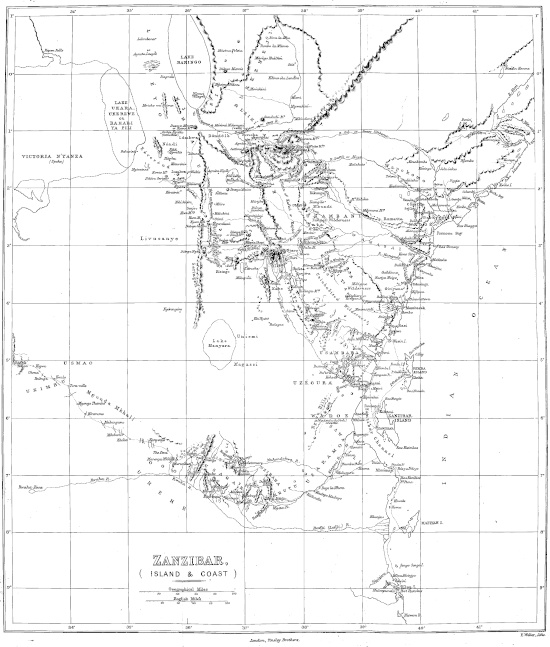
Zanzibar.
(ISLAND & COAST)
London, Tinsley Brothers.
‘We were now landed upon the Continent of Africa, the
most desolate, desert, and inhospitable country in the world,
even Greenland and Nova Zembla itself not excepted.’—Defoe.
I could not have believed, before Experience
taught me, how sad and solemn is the moment
when a man sits down to think over and to
write out the tale of what was before the last Decade
began. How many thoughts and memories
crowd upon the mind! How many ghosts and
phantoms start up from the brain—the shreds of
hopes destroyed and of aims made futile; of
ends accomplished and of prizes won; the failures
and the successes alike half forgotten!
How many loves and friendships have waxed cold
in the presence of new ties! How many graves
2have closed over their dead during those short
ten years—that epitome of the past!
‘And when the lesson strikes the head,
The weary heart grows cold.’
The result of a skirmish with the Somal of
Berberah (April 19, 1855) was, in my case, a visit
‘on sick leave’ to England. Arrived there, I
lost no time in recovering health, and in volunteering
for active Crimean service. The campaign,
however, was but too advanced; all
‘appointments’ at head-quarters had been filled
up; and new comers, such as I was, could look
only to the ‘Bashi Buzuks,’ or to the ‘Turkish
Contingent.’
My choice was readily made. There was,
indeed, no comparison between serving under
Major-General W. F. Beatson, an experienced
Light-Cavalry man who had seen rough work in
the saddle from Spain to Eastern Hindustan; and
under an individual, half-civilian, half-reformed
Adjutant-General, whose specialty was, and ever
had been, foolscap—literally and metaphorically.
In due time I found myself at the Dardanelles,
Chief of Staff in that thoroughly well-abused
corps, the Bashi Buzuks. It were ‘actum
agere’ to inflict upon the reader a réchauffé
3of our troubles,—how the military world declared
us to be a band of banditti, an irreclaimable
savagery; how a man, who then called
himself H. B. M.’s Consul—but who has long
since incurred the just consequences of his
misconduct—packed the press, because General
Beatson had refused him a lucrative contract;
how we awoke one fine morning to find ourselves
in a famous state of siege and blockade,
with Turkish muskets on the land side, and
with British carronades on the water-front; and
how finally we, far more sinned against than
sinning, were reported by Mr Consul Calvert
to Constantinople as being in a furor of mutiny,
intent upon battle and murder and sudden
death. These things, and many other too personal
for this occasion, will fit better into an
autobiography.
The way, however, in which I ‘came to
grief’ (permit me the phrase) deserves present
and instant record: it is an admirable comment
upon the now universally accepted axiom, ‘surtout,
pas de zèle,’ and upon the Citizen-king’s
warning words, ‘Surtout, ne me faites pas des
affaires.’
The Bashi Buzuks, some 3000 sabres, almost
all well mounted and better armed, were pertinaciously
4kept pitched on a bare hill-side, far
from the scene of action and close to the Dardanelles
country town, that gay and lively Turkish
Coventry, at the Hellespont-mouth. In an
evil hour I proposed, if my General, who wanted
nothing better, would allow me, to proceed in
person to Constantinople and to volunteer officially
for the relief of the doomed city, Kars.
Ah, Corydon, Corydon, quæ te dementia cepit?
And I did proceed to Stamb’ul; and I did
volunteer; and a neat hit, indeed, was that same
public-spirited proceeding!
It would be a lively imagination that could
conceive the scene of storm which resulted from
my brazen-faced procedure. The picture has its
comic side when looked back upon through the
mellowing medium of three long lustres. The
hopeful eagerness of the volunteer; the ‘proper
pride’ in one’s corps, that had come forward for
an honourable action; the fluent proof that we
could convoy rations enough for the gallant and
deserted Ottoman garrison, diplomatically left
for months to slow death by starvation; and—the
blank and stunned surprise at the hurricane
of wrath which burst from the high authority to
whose ambassadorial ear the project was entrusted.
5Reported home as a ‘brouillon’ and turbulent,
I again turned lovingly towards Africa—Central
and Intertropical—and on April 19,
1856, I resolved to renew my original design of
reaching the unknown regions, and of striking
the Nile-sources viâ the Eastern coast. For
long ages, I knew, explorers had been working,
literally, as well as figuratively, against the
stream; and, as the ancients had succeeded by a
flank march, so the same might be done by us
moderns. My Ptolemy told me the tale in very
plain and emphatic terms, and although his
shore-line shows great inaccuracies, his traditions
of the interior, derived from mariners of
Tyre and from older writers, appeared far more
reliable:—
‘He (scil. the Tyrian) says that a certain Diogenes,
one of those sailing to India, ... having
the Troglyditic region on the right, after 25 days
reached the Lakes whence the Nilus flows, and
of which the Promontory of the Rhapta is a little
more to the south.’[2]
Amongst my scanty literary belongings on
6our march to the Tanganyika Lake was a paper
(De Azaniâ Africæ littore Orientali, Commentatio
Physiologica, Bonviæ, Formis Caroli Gengii,
MDCCCLII.) kindly sent to me by the author,
Mr George F. de Bunsen. It quoted that same
passage which was a frequent solace to me
during our 18 months’ wanderings, and I still
preserve the pamphlet as a memory.
Nor had I forgotten Camoens:—
‘And there behold the lakes wherein the Nile
is born, a truth the ancients never knew;
see how he bathes, ’gendering the crocodile,
th’ Abassian land, where man to Christ is true.
behold, how lacking ramparts (novel style!)
he fights heroic battle with the foe.
see Meroe, island erst of ancient fame,
Nobá amongst the peoples now its name.’
[3]Lusiad, Canto x. 95.
7This is happier and truer to antiquity than
the doubts of José Basilio da Gama:—
‘—the sombre range
Virginal, ne’er by foot of man profaned,
Where rise Nile’s fountains, if such fountains be.’
O Uruguay, Canto v.
I consulted my excellent friend the late Dr
Barth, of Timbuktu, about following the footsteps
of pilot Diogenes the Fortunate. He replied
in a kind and encouraging letter, hinting,
however, that no prudent man would pledge
himself to discover the Nile sources. The Royal
Geographical Society benevolently listened once
more to my desire of penetrating into the heart
of the Dark Continent. An Expeditionary Committee
was formed by Sir Roderick I. Murchison,
the late Rear-admiral Beechey (then President
of the Society), Colonel Sykes, Chairman of the
Court of Directors of the Hon. East Indian
Company, Mr Monckton Milnes (Lord Houghton),
Mr Francis Galton, the South African traveller,
and Mr John Arrowsmith. I did not
hear, strange to say, till many years had passed,
8of the active part which Vice-admiral Sir George
Back, the veteran explorer of the Arctic regions,
had taken in urging the expedition, and in proposing
me as its head. Had it been otherwise,
this recognition of his kindness would not have
come so tardily.
The Committee obtained from Lord Clarendon,
then H. M.’s Secretary of State for Foreign
Affairs, the sum of £1000, and it was understood
that the same amount would be advanced
by the then ruling Court of Directors. Unfortunately
it was found wanting. I received, however,
on Sept. 13, 1856, formal permission, ‘in
compliance with the request of the Royal Geographical
Society, to be absent from duty as a
regimental officer under the patronage of H. B.
Majesty’s Government, to be despatched into
Equatorial Africa, for a period not exceeding two
years, calculated from the date of departure from
Bombay, upon the pay and allowances of my
rank.’ So wrote the Merchant-Sultans.
I was anxious again to take Lieut. John
Hanning Speke, because he had suffered with me
in purse and person at Berberah, and because
he, like the rest of the party, could obtain no
redress. Our misfortunes came directly from
Aden, indirectly from England. I had proposed
9to build a fort at Berberah, and to buy all
the non-Ottoman ports on the western shores of
the Red Sea for the trifle of £10,000. In those
days of fierce outcry against ‘territorial aggrandisement’
the Court of Directors looked with
horror at such a firebrand proposal, and they
were lost in wonder that a subaltern officer
should dare to prepare for the Suez Canal, which
Lord Palmerston and Mr Robert Stephenson
had declared to be impracticable. Therefore the
late Dr Buist, editor of the Bombay Times, had
his orders to write down the ‘Somali Expedition.’
He was ably assisted by a certain Reverend
gentleman, then chaplain at Aden, who had gained
for himself the honourable epithet of Shaytan
Abyaz, or White Devil, while the apathy of the
highest political authority—the Resident at Aden,
Brigadier Coghlan—and the active jealousy of his
assistant, Captain Playfair, also contributed to
thwart all my views, and to bring about, more or
less directly, the bloody disaster which befell us at
Berberah. For this we had no redress. The Right
Honourable the Governor-General of India, the
late Lord Dalhousie, of pernicious memory,
thought more of using our injuries to cut off the
slave-trade than of doing us justice, although
justice might easily have been done. After keeping
10us waiting from April 23, 1855, to June 13,
1857, the spoliator of Oude was pleased to inform
us, laconically and disdaining explanation, that
he ‘could not accede to the application.’[4]
Nothing could persuade the Court of Directors
to dispense with the services of Lieut.
Speke, who had, like myself, volunteered for the
Crimea, and who, at the end of the War, had resolved
to travel for the rest of his leave. I persuaded
him to accompany me as far as Bombay,
trusting that the just and generous Governor,
the late Lord Elphinstone, who had ever warmly
supported my projects, and that my lamented
friend James Grant Lumsden, then Member of
Council, would enable us, despite official opposition
at home, to tide over all obstacles.
I have been prolix upon these points, which
suggest that the difficulty of reaching the Lunar
Mountains, or the ‘Invisos Fontes,’ were in London,
not in Africa; that the main obstacles were
11not savages and malaria, but civilized rivalry and
vis inertiæ; and that the requisites for success
were time, means, and freedom from official
trammels. Hardly had we reached Cairo (Nov.
6, 1856), and had inspected an expedition fitted
out by H. H. the late Abbas Pasha, and admirably
organized by the late Marie Joseph Henri
Leonie de Lauture, Marquis d’Escayrac (generally
known as Comte d’Escayar de Lauture),
when an order from the Court of Directors
summoned me back to give evidence at some
wretched Court-martial pending on Colonel A.
Shirley. The document being so worded that it
could not be obeyed, we—Lieut. Speke and I—held
on our way.
And even when outward bound, I again
got into trouble, without being able, as was
said of Lord Gough, to get out again. A short
stay at Suez, and the voyage down the Red
Sea, taught me enough of Anglo-Indian mismanagement
and of Arab temper, to foresee
some terrible disaster. Again that zeal! Instead
of reporting all things couleur de rose, I
sent under flying seal, through the Royal Geographical
Society, with whom I directly corresponded,
a long memorandum, showing the true
state of affairs, for transmission to the home
12branch of the Indian Government. This ‘meddling
in politics’ was ‘viewed with displeasure
by Government,’ and reminded me of the old
saying—
‘Wha mells wi’ what anither does,
May e’en gang hame and shoe his goose.’
The result was a ‘wig’ received in the heart
of Africa, and—curious coincidence!—accompanying
that sheet of foolscap was a newspaper
containing news of the Jeddah massacre (June
15, 1858), and of our farcical revenge for the
deaths of Messrs Page, Eveillard, and some fourteen
souls, nearly the whole Christian colony.[5]
It need hardly be mentioned that this catastrophe
showed the way to others, especially to the three
days ‘Tausheh’ of Damascus in 1860.
Fortune had now worked her little worst.
We had a pleasant passage to Bombay (Nov.
23, 1856), where affairs assumed a brighter aspect,
as we began preparing for the long exploration.
Lord Elphinstone, after an especial requisition,
allowed Lieut. Speke to accompany me.
He also kindly ordered the Hon. East India
Company’s sloop of war Elphinstone, Captain
13Frushard, I.N., to convoy us, knowing how much
importance Orientals attach to appearances—especially
to first appearances. My ‘father’
Frushard gained nothing by the voyage but the
loss of his pay; therefore is my gratitude to him
the greater. Nor must I forget to record the
obliging aid of Mr, now Sir Henry L. Anderson,
Secretary to the Government of Bombay; he
enabled us to borrow from the public stores a
chronometer, surveying instruments, and other
necessaries.
Judging that a medical officer would be useful,
not only to the members of the expedition,
but would also prove valuable in lands where the
art of healing is not held destructive, and where
Medici are not called ‘Caucifici et Sanicidæ,’
Lord Elphinstone also detached the late Dr J.
F. Steinhaeuser, then staff-surgeon, to accompany
us. Unfortunately the order came too late. No
merchantman happened then to be leaving Aden
for Zanzibar, and during the south-west monsoon
native craft will not attempt the perilous
passage. Nothing daunted, my old and tried
friend crossed the Straits to Berberah, with the
gallant project of marching down country to join
us in the south; nor did he desist till it became
evident, from his slow rate of progress, that he
14could not make Zanzibar in time. The journey
through the North-eastern horn of Africa would
alone have given a title to Fame. Its danger
and difficulty were subsequently proved (October
2, 1865) by the wounding of Baron Theodore von
Heughlin and by the murder of Baron von der
Decken, Dr Link, and others of his party.[6]
The absence of Dr Steinhaeuser lost the East
African Expedition more than can be succinctly
told. A favourite with ‘natives’ wherever he
went, a tried traveller, a man of literary tastes
and of extensive reading, and better still, a spirit
as staunch and determined as ever attempted
desperate enterprise,—he would doubtless have
materially furthered our views, and in all human
probability Lieut. Speke would have escaped
deafness and fever-blight, I paralysis and its consequent
invalidism. We afterwards wandered
together over the United States, and it is my
comfort, now that he also is gone, to think that
no unkind thought, much less an unfriendly
word, ever broke our fair companionship. His
15memory is doubly dear to me. He was one of
the very few who, through evil as well as through
good report, disdained to abate an iota of his
friendship, and whose regard was never warmer
than when all the little world looked its coldest.
After long years of service in pestilential Aden,
the ‘Coal-hole of the East,’ he died suddenly of
apoplexy at Berne, when crossing Switzerland
to revisit his native land. At that time I was
wandering about the Brazil, and I well remember
dreaming, on what proved to be the date of
his death, that a tooth suddenly fell to the
ground, followed by a crash of blood. Such a
friend, indeed, becomes part of oneself. I still
feel a pang as my hand traces these lines.
‘The Bashi Bazuks, commanded by General Beatson, were
displaying all the violence and rapacity of their class, little, if
at all, restrained by the presence of their English officers.’
Thus writes Mr John William Kaye in ‘Our Indian Heroes’
(Good Words, June, 1851), for the greater glorification of a
certain General Neill, whose principal act of heroism was to
arrest a ‘Jack-in-Office Station Master.’ Mr Kaye is essentially
an official writer, but even official inspiration should not
be allowed directly to misstate fact.
16
‘There is probably no part of the world where the English
Government has so long had a Resident, where there are always
some half-a-dozen merchants and planters, of which we know so
little as of the capital and part of the kingdom of one of the
most faithful of our allies, with whom we have for half a century
(since 1804) been on terms of intimacy.’—Transactions
Bombay Geog. Soc., 1856.
On December 2, 1856—fourteen long years
ago!—we bade adieu to the foul harbour of
Bombay the Beautiful, with but a single sigh.
The warm-hearted Mr Lumsden saw us on board,
wrung our hands with friendly vigour, and bade
us go in and win—deserve success if we could
not command it. No phantom of the future cast
a shadow upon our sunny path as we set out,
determined either to do or die. I find my journal
brimful of enthusiasm. ‘Of the gladdest
moments in human life, methinks, is the departure
upon a distant journey into unknown
17lands. Shaking off with one mighty effort the fetters
of Habit, the leaden weight of Routine, the
cloak of many Cares and the slavery of Home,
man feels once more happy. The blood flows
with the fast circulation of childhood. Excitement
lends unwonted vigour to the muscles, and
the sudden sense of freedom adds a cubit to the
mental stature. Afresh dawns the morn of life;
again the bright world is beautiful to the eye,
and the glorious face of nature gladdens the
soul. A journey, in fact, appeals to Imagination,
to Memory, to Hope,—the three sister Graces of
our moral being.’[7]
The 18½ days spent in sailing 2400 direct
miles ‘far o’er the red equator’ were short for
our occupations. I read all that had been
written upon the subject of Zanzibar, from
Messer Marco Miglione to the learned Vincent,
who always suspected either the existence or the
place of the absurd ‘Maravi Lake.’ We rubbed
up our acquaintance with the sextant and the altitude
and azimuth; and we registered barometer
and thermometer, so as to have a base for observations
ashore. The nearest reference point of
known pressure to Zanzibar was then Aden, distant
18above 1000 miles. Under all circumstances
the distance was undesirable; moreover, violent
squalls between the Persian Gulf and Cape
Guardafui sometimes depress the mercury half
an inch. I shall again refer to this point in
Chapter V.
‘Father Frushard’ was genial, as usual, and
under his command every soul was happy. We
greatly enjoyed the order, coolness, and cleanliness
of a ship of war, after the confusion, the
caloric, and the manifold impurities of a Red Sea
passenger-packet. Here were no rattling, heaving
throbs, making you tremulous as a jelly
in the Caniculi; no coal-smoke, intrusive as
on a German Eisen-bahn; no thirst-maddened
(cock-) ‘roaches’ exploring the entrance to man’s
stomach; no cabins rank with sulphuretted hydrogen;
no decks whereon pallid and jaundiced
passengers shake convulsed shoulders as they
rush to and from the bulwarks and the taffrail.
Also no ‘starboard and larboard exclusiveness’;
of flirting abigails tending portly and majestic
dames, who look crooked beyond the salvation-pale
of their own very small ‘set’; no peppery
civilians rubbing skirts against heedless ‘griffins’;
nor fair lips maltreating the ‘hapless letter
H’; nor officers singing lullabies to their etiolated
19enfants terribles, and lacking but one little
dispensation of nature—concerning which Humboldt
treats—to become the best of wet-nurses.
The ‘Elphinstone’ belonged not to the category
‘Shippe of Helle,’ one of whose squadron I have
described in an old voyage to a certain ‘Unhappy
Valley.’ We would willingly have prolonged
our cruise with the jovial captain, and
with the good fellows and gallant gentlemen in
the gun-room, over many and many a league of
waves.
Of course we had no adventures. We saw
neither pirate nor slaver. The tract seemed desert
of human life; in fact, nothing met our eyes
but flying-fish at sea, gulls and gannets near
shore. The stiff N. East trade never quite failed
us, even when crossing the Line, and the Doldrums
hardly visited us with a tornado or two—mere
off-shore squalls. The good old heart of
teak, then aged 33 years, made an average of 150,
and an exceptional run of 200 knots, in 24 hours.
This was indeed ‘gay sailing on the bosom of the
Indian Sea.’ After 16 days (Dec. 18), before the
solar lamp had been removed, our landfall, a
long, low strip at first sky-blue and distance-blurred,
had turned purple, and had robed itself
in green and gold, with a pomp and a glory of
20vegetation then new to us. This was Pemba,
one of the three continental islands composing
the Zanzibarian archipelago: the Arabs call it
Jazirat el Khazrá (Green Island), and no wonder!
Verdant and fresh enough must this huge conservatory,
this little and even richer Zanzibar,
appear to their half-closed ‘peepers,’ dazed and
seared by the steely skies and brazen grounds of
Mángá[8] (Arabia generally) and Maskat (Muscat),
and by the dreadful glare and ‘damnable
blue’ of the Persian Gulf and the Indian Ocean.
We are soon to visit this emerald isle, therefore
no more of it at present.
All had hoped to run in that night, but Fate
or our evil deeds in the last life otherwise determined.
The wind fell with the sun, and during
the five minutes of crepuscule we anchored in
the sandy bay-strand under Tumbatu Island,
S.W. of Point Nunguwi (Owen’s Nangowy), the
north cape of its big insular brother, Zanzibar.
Like the items of this archipelago generally, it
is a long cairn-shaped reef of coralline, with its
greater length disposed N.S. This well-known
norm of great peninsulas has been explained by
21a sudden change in the earth’s centre of gravity,
which caused the waters to rush furiously from
the northern hemisphere towards the south pole.
As usual, the burning suns, the tepid winds, the
sopping dews, and the copious rains clothe the
thin soil with an impervious coat of verdure,
overhanging the salt-waters, and boasting a cultivation
that would make spring in green Erin look
by its side autumn—rusty and yellow-brown.
We landed, and curiously inspected the
people of Tumbatu, for we were now beyond
Semitico-Abyssinian centres, and we stood in the
presence of another and a new race. They are
called by the Omani Arabs Makhádim—helots
or serviles—and there is nothing free about them
save their morals. Suspicious and fearful, numerous
and prolific, poor and ill-favoured, they
show all the advantages and the disadvantages of
an almost exclusive ichthyophagism. Skilful in
divination, especially by Báo or geomancy, they
have retained, despite El Islam, curious practices
palpably derived from their wild ancestry
of the Blackmoor shore. They repair, for the purpose
of ‘clear-seeing,’ to a kind of Trophonius
cave, spend the night in attack of inspiration,
and come forth in the morning ‘Agelasti, mæsti,
cogitabundi.’ Similarly the Nas-Amun (Nasamone)
22slept, for insight into futurity, upon their
ancestral graves. The wild highlanders of the
East African ghauts have an equally useful den
in their grim mountains; and on the West
African coast the Krumen consult the ‘Great
Debbil,’ who lives in a hole amongst the rocks of
Grand Cavalla. The traveller who, pace my
friends of the Anthropological Society, postulates
spiritualism or spiritism (as M. Allan Kardec has
it), will save himself much mystification, and he
will soon find that every race has had, and still
has, its own Swedenborg.
The men of Tumbatu at their half-heathen
wakes, lay out the corpse, masculine or feminine,
and treat it in a way which reminds us of Hamlet’s
(Act v. 1) ‘Where be your gibes now?
your gambols, your songs?’ A male friend will
say to his departed chum—
‘O certain person! but a few days ago I
asked thee for cocoa-nut-water and tobacco,
which thou deniedest to me—enh? Where is
now the use of them?’
‘Fellow!’ a woman will address the dead,
‘dost thou remember making fierce love to me
at such and such a time? Much good will thy
love do me now that thou art the meat of ugly
worms!’
23Their abuse is never worse than when lavished
by a creditor upon a defunct debtor.
The idea underlying this custom is probably
that which suggested the Irish wake—a test if
the clay be really inanimate. Nor would I despise,
especially during prevalence of plague or
yellow fever, in lands where you are interred off-hand,
any precaution, however barbarous, against
the horrors and the shudders of burying alive.
Certain Madras Hindoos, after filling its mouth
with milk and rapping its face with a shankh or
conch-shell, grossly insult, as only the ‘mild
Hindu’ of Bishop Heber can, all its feminine
relatives. The practice is also found in the New
World. The Aruacas (Arrawaks) of Guiana
opened the eyes of the corpse, and switched them
with thorns; smeared the cheeks and lips with
lard, and applied alternately sweet and bitter
words. This was a curious contrast to the customs
of the Brazilian Tupys and the Bolivian
Moxos, who, according to Yves d’Evreux and
Alcide d’Orbigny, met every morning to bewail
their losses, even of their grandfathers and great-grandfathers!
As darkness came on we saw the sands sparkling
with lights, here stationary like glow-worms
or the corpusant; there flitting about like ignes
24fatui or fire-flies. Such was the spectacle seen
by Columbus and Pedro Gutierrez (‘gentleman
of the king’s bedchamber’) on the memorable
night when Bahaman Guanaháni was discovered.
The fishermen burn dry grass and leaves,
and the blaze, like the Arabs’ ‘fire of hunting,’
which dazzles the eye of the gazelle, attracts
shoals that are easily speared. Some carried
torches in canoes: now the flame floated in
crimpled water, which broke up its reflection
into a scatter of brilliants; then it reposed upon
mirror-like smooths, the brand forming the apex
of a red pyramid which seemed to tremble with
life, whilst the boat was buried in the darkness
of death. And so ‘fishy’ are these equinoctial
seas, that gangs of old women and children may
be seen at Pemba, and on the coast, converting
their body-clothes into nets, and filling pots,
hand over hand, with small fry. I have seen
them myself, although a certain critic says,
‘No.’
The people of Tumbatu, like the Greeks,
have their good points. They are skilful pilots
and stout seamen, diligent in gathering their
bread from the waters, and comparatively industrious,
considering their enervating, prostrating
climate. Their low, jungly ledge wants the
25sweet element, compelling them to fetch it from
Zanzibar—their mainland; hence travellers have
described the islet as uninhabited. The people
are mentioned as Moslems by Yakut (early 13th
century), and this island of ‘Tambat’ was made
a refuge for the inhabitants of Languja or Zanzibar.
We inquired in vain about the fort which
the Arabs are said to have built there. The
skins of Tumbatu are sooty, the effect, according
to some, according to others the concomitant, of
humid heat. The reader must not charge me
with ‘trimming’ between the rival schools of
‘race versus climate, the cause of complexion.’
Many peoples betray but a modicum of chromatic
and typical change. On the other hand, I
have found an approximation of colour as well as
of form between the Anglo-American and the
Luso-Brazilian; and I have enlarged upon this
chromatic heresy, if heresy it be, in the Highlands
of the Brazil (Vol. i. chap. xxxviii.).
Finally, when speaking of the permanence of
type, it is well to bear in mind that our poor observations
hardly extend over 2500 years.
The next morning placed us at the base of
our operations, and we were on deck with
Aurora. The stout ship ‘Elphinstone,’ urged by
the cool land breeze, slid down the channel, the
26sea-river that separates the low-lying and evergreen
Zanzibar Island from its reflection, the
Mpoa-ni.[9] We were sensibly affected by the
difference between the Sawáhil, this part of the
East African sea-board which begins at the Juba
River, and the grim physiognomy of Somaliland,
Region of Fragrant Gums, with its sandy horrors
of Berberah, and its granitic grandeurs of Guardafui,
which popular apprehension refers to
Garde à vous, and which Abyssinian Bruce, according
to Ritter (Erdkunde, 2nd Division, § 8),
27altered, to Gardefan, the Straits of Burial.[10] We
were in the depths of the ‘dries,’ as they are
called in West Africa, in the local midwinter,
yet this land was gorgeous in its vestment when
others would be hybernating in more than semi-nudity.
Truly prepossessing was our first view of the
then mysterious island of Zanzibar, set off by
the dome of distant hills, like solidified air, that
28form the swelling line of the Zanzibar coast.
Earth, sea, and sky, all seemed wrapped in a soft
and sensuous repose, in the tranquil life of the
Lotus Eaters, in the swoon-like slumbers of the
Seven Sleepers, in the dreams of the Castle of
Indolence. The sea of purest sapphire, which
had not parted with its blue rays to the atmosphere—a
frequent appearance near the equator—lay
basking, lazy as the tropical man, under a
blaze of sunshine which touched every object
with a dull burnish of gold. The wave had
hardly energy enough to dandle us, or to cream
with snowy foam the yellow sandstrip which
separated it from the flower-spangled grass, and
from the underwood of dark metallic green.
The breath of the ocean would hardly take the
trouble to ruffle the fronds of the palm which
sprang, like a living column, graceful and luxuriant,
high above its subject growths. The bell-shaped
convolvulus (Ipomæa Maritima), supported
by its juicy bed of greenery, had opened
its pink eyes to the light of day, but was languidly
closing them, as though gazing upon the
face of heaven were too much of exertion. The
island itself seemed over-indolent, and unwilling
to rise; it showed no trace of mountain or crag,
but all was voluptuous with gentle swellings,
29with the rounded contours of the girl-negress,
and the brown-red tintage of its warm skin
showed through its gauzy attire of green. And
over all bent lovingly a dome of glowing azure,
reflecting its splendours upon the nether world,
whilst every feature was hazy and mellow, as if
viewed through ‘woven air,’ and not through
vulgar atmosphere. Most of my countrymen
find monotony in these Claude-Lorraine skies,
with the pigment and glazing on. I remember
how in Sind they used to bless the storm-cloud,
and stand joyously to be drenched in the rain
which rarely falls in that leather-coloured land.
Zanzibar, however, must be seen on one of her
own fine days: like Fernando Po and Rio de
Janeiro, the beauty can look ‘ugly’ enough
when she pleases.
As we drew nearer and vision became more
distinct, we found as many questions for the
pilot as did Vasco da Gama of old. Those prim
plantations which, from the offing, resembled
Italian avenues of oranges, the tea-gardens of
China, the vines of romantic Provence, the
coffee plantations of the Brazil, or the orange-yards
of Paraguay, were the celebrated clove-grounds,
and the largest, streaking the central
uplands, were crown property. We distinctly felt
30a heavy spicy perfume, as if passing before the
shop of an Egyptian ‘attar,’ and the sensorium
was not the less pleasantly affected, after a hard
diet of briny N.E. Trade. Various legends of
hair-oil rubbed upon the bulwarks have made
many a tricked traveller a shallow infidel in the
matter of smelling the land. But we soon
learned that off Zanzibar, as off ‘Mozámbic,’
the fragrant vegetation makes old Ocean smile,
pleased with the grateful smell, as of yore. The
night breeze from the island is cool and heavy
with clove perfume, and European residents
carefully exclude the land-wind from their sleeping-rooms.
For a little while we glided S. by E. along
the shore, where the usual outlines of a city
took from it the reproach of being a luxuriant
wilderness. The first was ‘Bayt el Ra’as, a large
pile, capped with a dingy pent-house of cajan
(cocoa leaves), and backed by swelling ground—here
bared for cultivation, there sprinkled with
dense dark trees, masses of verdure sheltering
hut and homestead. Followed at the distance of
a mile, the Royal Cascine and Harem of Mto-ni,
the Rivulet.[11] Our ancient ally ‘Sayyid Said,
31Imam of Maskat and Sultan of Zanzibar and the
Sawahil,’ had manifestly not attempted African
copies of his palaces in Arabian Shináz and
Bat’hah, pavilions with side-wings and flanking
towers, the buildings half castle half château,
so much affected by the feudal lords of Oman.
He preferred an Arabo-African modification, here
valuable for ‘sommer-frisch.’
The demesne of Mto-ni has a quaint manner
of Gothic look, pauperish and mouldy, like the
schloss of some duodecimo Teutonic Prince, or
long-titled, short-pursed, placeless, and pensionless
German Serenity in the days now happily
gone by, when the long drear night of German
do-nothingness has fled before the glorious daybreak
of 1866-1870. We can distinguish upon
its long rusty front a projecting balcony of dingy
planking, with an extinguisher-shaped roof,
dwarfed by the luxuriant trees arear, and by
the magnificent vegetation which rolls up to its
very walls. Mto-ni takes its name from a runnel
32which, draining the uplands, supplies the
‘Palace,’ and trickles through a conduit into the
sea. We shall presently visit it.
Entering the coral reef which defends this
great store-house of Eastern Intertropical Africa,
I remarked that the lucent amethyst of the
waters was streaked and patched with verdigris
green; the ‘light of the waves’ being caused by
shoals, whose golden sands blended with the blue
of heaven. The ‘Passes of Zanzibar’ reminded
me in colouration of the ‘Gateways of Jeddah,’
and as the coral reefs cut like razors, they must
be threaded with equal care. So smooth was
the surface within the walls, that each ship,
based upon a thread of light, seemed to hover
over its own reflected image.
And now we could distinguish the normal
straight line of Arab town, extending about a
mile and a half in length, facing north, and
standing out in bold relief, from the varied tints
and the grandeur of forest that lay behind. A
Puritanical plainness characterized the scene—cathedrals
without the graceful minarets of Jeddah,
mosques without the cloisters of Cairo,
turrets without the domes and monuments of
Syria; and the straight stiff sky-line was unrelieved
except by a few straggling palms. In
33the centre, and commanding the anchorage, was
a square-curtained artless fort, conspicuous
withal, and fronted by a still more contemptible
battery. To its right and left the Imam’s palace,
the various Consulates, and the large parallelogrammic
buildings of the great, a tabular line of
flat roofs, glaring and dazzling like freshly white-washed
sepulchres, detached themselves from the
mass, and did their best to conceal the dingy
matted hovels of the inner town. Zanzibar city,
to become either picturesque or pleasing, must
be viewed, like Stambul, from afar.
We floated past the guard-ship, an old 50-gun
frigate of Dutch form and Bombay build, belonging
to ‘His Highness the Sayyid;’ it was
modestly named Shah Allum (Alam), or ‘King
of the World.’ The few dark faces on board
bawled out information unintelligible to our
pilot, and showed no colours, as is customary
when a foreign cruizer enters the port. We set
this down to the fact of their being blacks—‘careless
Ethiopians.’ But flags being absent
from all the masts, and here, as in West Africa
and in the Brazil, every ‘house’ flies its own
bunting, we decided that there must be some
cause for the omission, and we became anxious
accordingly.
34But not for such small matter would the
H. E. I. C.’s ship-of-war ‘Elphinstone’ have the
trouble of casting loose and of loading her guns
gratis. With the Sayyid’s plain blood-red ensign
at the main, and with union-jack at the fore,
she cast anchor in Front Bay, and gallantly delivered
her fire of 21. Thereupon a gay bunting
flew up to every truck ashore and afloat, whilst
the brass carronades of the ‘Victoria,’ another
item of the Maskat navy, roared a response of
22, and, curious to say, did not blow off a single
gunner’s arms. We had arrived on the fortieth
or last day of Moslem mourning; and the mourning
was for Sayyid Said, our native friend and
ally, who had for so many years been calling for
volunteers and explorers, and from whom the
East African expedition had been taught to expect
every manner of aid except the pecuniary.
We lost no time in tumbling into a gig and
in visiting the British Consulate, a large solid
pile, coloured like a twelfth-cake, and shaped
like a claret-chest, which lay on its side, comfortably
splashed by the sea. Lieut.-Colonel
Atkins Hamerton, of the Indian Army, H.B.M.’s
Consul and H. E. I. C.’s agent, to whom I was
directed to report arrival, was now our mainstay,
but we found him in the poorest state of
35health. He was aroused from lethargy by the
presence of strangers, and after the usual hospitable
orders my letters were produced and
read. Those entrusted to me by Lord Elphinstone,
and by his Eminence the learned and benevolent
Cardinal Wiseman, for whom he had
the profoundest respect, pleased him greatly;
but he put aside the missive of the Royal Geographical
Society, declaring that he had been
terribly worried for ‘copy’ by sundry writing
and talking members of that distinguished body.
I can even now distinctly see my poor friend
sitting before me, a tall, broad-shouldered, and
powerful figure, with square features, dark,
fixed eyes, hair and beard prematurely snow-white,
and a complexion once fair and ruddy,
but long ago bleached ghastly pale by ennui and
sickness. Such had been the effect of the burning
heats of Maskat and ‘the Gulf,’ and the
deadly damp of Zanzibar, Island and Coast. The
worst symptom in his case—one which I have
rarely found other than fatal—was his unwillingness
to quit the place which was slowly killing
him. At night he would chat merrily about a
remove, about a return to Ireland; he loathed
the subject in the morning. To escape seemed a
physical impossibility, when he had only to order
36a few boxes to be packed, and to board the first
home-returning ship. In this state the invalid
requires the assistance of a friend, of a man who
will order him away, and who will, if he refuses,
carry him off by main force.
Our small mountain of luggage was soon
housed, and we addressed ourselves seriously to
the difficulties of our position. That night’s
rest was not sweet to us. I became as the man
of whom it was written—
‘So coy a dame is Sleep to him,
That all the weary courtship of his thoughts
Can’t win her to his bed.’
After the disaster in Somali-land, I was pledged,
at all risks and under all circumstances, to succeed;
and now St Julian, host and patron of travellers,
had begun to show me the rough side of
his temper. The Consul was evidently unfit for
the least exertion. He had in his ‘godowns’
dozens of chests and cases which he had not the
energy to open. H. H. Sayyid Said had left
affairs in a most unsatisfactory state. His eldest
son, the now murdered Sayyid Suwayni, heir to
Maskat, and famous as an anglophobe, had threatened
to attack Zanzibar; a menace which, as will
afterwards appear, he attempted to carry out.
The cadet Sayyid Majid, installed by his father
37chief of the African possessions, was engrossed
in preparations for defence. Moreover, this
amiable young prince having lately recovered
from confluent small-pox, an African endemic
which had during the last few years decimated
the islanders, was ashamed to display a pock-marked
face to the ‘public,’ ourselves included.
The mainland of Northern Zanzibar about Lamu
was, as usual on such occasions, in a state of
anarchy. Every man seized the opportunity of
slaying his enemy, or of refusing to pay his
taxes. An exceptionally severe drought had
reduced the southern coast of Zanzibar to a
state of famine.
Briefly, the gist of the whole was that I had
better return to Bombay. But rather than return
to Bombay, I would have gone to Hades
on that 20th of December, 1856.
NOTE.
Since these pages were penned the Bombay
Gazette of November 11, 1870, announced the
death of H. H. Sayyid Majid, Sultan of Zanzibar,
and the succession of his brother—Sayyid
Burghush.
38
Αὐτὴ μεν ἤδε τῆς περιῤῥύτου χθονος.
This is the finial of th’ encircling earth.
Soph. Phil.
In this chapter I propose briefly to place
before the reader the various shiftings of opinion
touching the Nile Sources, and especially to
show what had been done for Zanzibar and her
coast by the theoretical and practical men of
Europe between A.D. 1825 and the time of our
landing on the Sawáhil, or East African shores.
The details given to Marinus of Tyre by the
Arabian merchants, and their verification by the
obscure Diogenes, together with the notices of
the African lakes on the lower part of the Upper
Nile, brought home about A.D. 60 by Nero’s
exploring Centurions, were never wholly forgotten
39by Europe, which thus unlearned to
derive with Herodotus the Nile from Western
Africa.[12] As the pages of Marco Polo show, not
to quote the voyage of ‘Sinbad the Sailor,’
Arabs and Persians still frequented these shores;
and the Hindu Banyans, established from time
immemorial upon the Zanzibar coast, had diffused
throughout India some information touching
the wealthy land. The veteran geographer
of Africa, Mr James Macqueen, has commented
upon the curious fact that the Padmavan
of Lieut. Francis Wilford (vol. iii. of the old
Asiatic Researches, ‘Course of the River Cali,’
as supposed to be derived from the Puranas) is
represented by the beds of floating water-lilies
crossed by Captains Speke and Grant, and upon
the resemblance between the Amara, or Lake of
the Gods, with the Amara people on the N. E. of
the so-called Nyanza Lake. These, however, appear
to be mere coincidences, or at best the results
of tales learned upon the coast by the
Hindu trader. Before leaving Bombay I applied
40to that eminent Sanskritist the Rev. J. Wilson,
D.D., for any notices of East Africa which
might occur in the sacred writings of the Hindus.
He replied that there were none; and I
had long before learned that Col. Wilford himself
had acknowledged his pandit to have been
an impudent impostor.
At the end of the 15th century came the
Portuguese explorers, with Strabo, Pliny, and
Ptolemy, in their hands, and followed by a multitude
of soldiers, merchants, and missionaries,
who invested the intertropical maritime regions
of Africa, east and west. The first enthusiasm,
however, soon passed away. The Portuguese
were supplanted by the Dutch, by the English,
and by the French; whilst Ptolemy and the Periplus
were ousted by Pigafetta, Dapper, and other
false improvers of their doctrines. The Ptolemeian
Lakes were marched about and counter-marched
in every possible way. The ‘Mountain
of the Moon,’ prolonged across Africa under the
name Jebel Kumri, really became ‘Lunatic
Mountains.’ The change from good to bad
geography is well illustrated by two charts published
in 1860, by H. E. the Conde de Lavradio.
The first is the fac-simile of a map in the British
Museum, by Diogo Homem, in 1558. It makes
41the Nile spring from two great reservoirs. But
the second, bearing the name of Antonio Sances
(1623), already reduces these lakes to one central
Caspian, which sends forth the Nile, the
Congo, and the Zambeze, and which, greatly
shrunken, still deforms our maps under the name
of Marave. Similarly, the ‘Complete System of
Geography,’ by Emanuel Bowen (1747), places
the Zambre Lake in S. lat. 4°-11°, the ‘centre
from which proceed all the rivers in this part of
Africa,’ including the Nile.
How popular the subject continued to be
may be guessed from the fact that Daniel Defoe
(1661-1731), cast his African reading into a
favourite form with him, the ‘Adventures of
Captain Singleton.’ He lands his hero about
March, 1701, a little south of Cape Delgado,
causes him to cross several seas and rivers, the
latter often flowing northwards, and after a
year’s wandering, brings him out at the Dutch
settlements on the Gold Coast.
Upon the general question of modern Nile
literature the curious reader will consult the
well-studied writings of M. Vivien de Saint-Martin.
The valuable paper ‘On the Knowledge
the Ancients possessed of the Sources of
the Nile,’ by my friend W. S. W. Vaux (Transactions
42of the Royal Society of Literature, vol.
viii., New Series), treats of exploration up the
river, beginning from the Ionian colony, established
in the upper river by Psammetichus (circa
A.C. 600), and extending to the present day.
The learned article by Mr John Hogg, ‘On some
old Maps of Africa, in which certain of the Central
and Equatorial Lakes are laid down in
nearly their true positions,’[13] (Transactions of the
43Royal Society of Literature, vol. viii.), supplies
a compendium of old cartography.
I proceed now to the practical part of this
chapter, namely, the actual visits of inspection
to Zanzibar, and their results. Until the end of
the last century, our knowledge was derived
almost entirely from those ‘domini Orientalis
Africæ,’ the Portuguese. The few exceptions
were Sir James Lancaster, who opened to the
English the Orient seas. He wintered at the
island in 1591; Captain Alexander Hamilton
(new account of the East Indies, 1688-1723,
Hakluyt’s Collection, viii. 258); and M. Saulnier
de Mondevit, commanding the king’s Corvette,
La Prévoyance. The latter, who, in 1786, visited
the principal points of Zanzibar, published a
chart with ‘Observations sur la côte du Zangueibar’
(Nouvelles Annales des Voyages, vol.
vi.), and recommended a French establishment
at ‘Mongalo.’
In February, 1799, Captain Bissel, R.N., commanding
H. M.’s ship Orestes, with the Leopard
44carrying Admiral Blankett’s flag, touched at the
island for refreshments when beating up against
the N. E. monsoon towards the Red Sea. He
briefly but faithfully described its geography,
and he laid down sailing directions which to
this day are retained in Horsburgh. Since then
many coasting voyages have been made by naval
officers and others, who collected from natives,
with more or less fidelity, details concerning the
inner country. As early as 1811, Captain Smee
and Lieutenant Hardy were sent by the Bombay
government to gather information on the eastern
seaboard of Africa, and they brought back sundry
novel details (Transactions Bombay Geographical
Society, 1844, p. 23, &c.). Between the years
1822-1826 the whole coast line was surveyed by
Captain (afterwards Admiral) W. F. Owen, and by
his officers, Captains Vidal, Boteler, and others.
Their charts and plans of the littoral, despite
sundry inaccuracies, such as placing Zanzibar
Island five miles west of its proper position, excited
general attention, and were justly termed
by a modern author miranda tabularum series.
During this Herculean labour, which occupied
three years, some 300 of the officers and crew
fell victims to the climate of the Coast, to the
hardships of boat-work, and to the ferocity of
45the natives. In 1822 Sir Robert Townsend
Fairfax, Governor and Commander-in-Chief of
the Mauritius, after a crusade against the slave-trade
in the dominions of Radáma, King of the
Hovas, commissioned Captain (afterwards Admiral)
Fairfax Moresby, of H. M.’s ship Menai,
to draft a treaty between England and Maskat
for limiting the traffic. The mission was successful.
The sale of Somalis, a free people, was
made piracy; and the Sayyid’s vessels were subject
to seizure by the Royal, including the Company’s,
cruizers, if detected carrying negroes ‘to
the east of a line drawn from Cape Delgado,
passing south of Socotra and on to Diu, the west
point of the Gulf of Cambay.’Cambay.’[14] In 1822, the
Sayyid’s assent having been formally accorded,
Captain Moresby left the coast.
In January, 1834, Captain Hart, of H. M.’s
ship Imogene, visited Zanzibar, and submitted
to the Imperial government brief notes, appending
a list of the Sayyid’s squadron then in the
harbour, with their age, tonnage, armature, and
other particulars. Still geographers declared
that Zanzibar was a more mysterious spot to
England and India than parts of Central Africa
46and the shores of the Icy Sea.[15] During the
same year the energetic Mr W. Bollaert matured
the plan of an expedition, to be conducted
by himself, from Zanzibar across the continent.
It was laid before the Geographical Society in
1837, but it was not carried out, funds being
deficient. In 1835 the U. S. frigate Peacock
visited the island during a treaty-making tour,
and was supplied with all her wants gratis, the
port officials declaring that ‘H. H. the Sultan
of Muscat had forbidden them to take any remuneration.’
The surgeon, Dr Ruschenherger
(Narrative of a Voyage round the World in
1835-1837), left a realistic description of the
city in those its best days. He acknowledges
the hospitalities of ‘Captain Hasan bin Ibrahim,
of the Arab Navy,’ superintendent of the ‘Prince
Said Carlid.’ The latter was the late Sayyid
Khalid, then 16 years old. The book, being
written by a ‘Dutch-American’ in 1835, is of
course bitterly hostile to England. We are told
that the keel of the Peacock, passing between
Tumbatu Island and Zanzibar, scraped over
coral reefs not in Owen’s charts—which may be
true. Followed the American Captains Fisher,
47Drinker, Abbott, and Osgood, and Mr Ross
Brown, then a young traveller in a trading-vessel.
He also published a readable account
of the rising settlement.
When Admiral Sir Charles Malcolm, a name
endeared to eastern geographers, was giving
energy and impulse to exploration in Western
Asia, the late Lieut. W. Christopher, I. N., commanding
the H. E. I. C.’s brig-of-war Tigris,
was sent to Zanzibar; he made a practical survey
of the coast, and he touched at many places
now famous—Kilwa (Quiloa), Mombasah, Brava,
Marka, Gob-wen (or the Jub River), and
Makdishu, or Hanir, by the Portuguese called
Magadoxo. He explored the lower waters of a
large stream, the Webbe (River) Ganana, or
Shebayli (Leopard), which he injudiciously
named the Haines River; and he visited Giredi
and other settlements till then unknown. He
wrote (May 8, 1843) a highly interesting and
comprehensive account of the seaboard, which
was published in the Journal of the Geographical
Society (vol. xiv. of 1844). His plans,
charts, and other valuable memoranda were forwarded
to the Bombay Government, and the
enterprising traveller died in July, 1848, at the
early age of 36, from the effects of a wound received
before Multan.
48The honour of having made the first systematic
attempt to explore and to open up the Zanzibar
interior, is due to the establishment popularly
known as the ‘Mombas Mission;’ its
energetic members proved that it was possible to
penetrate beyond the coast, and their discoveries
excited a spirit of inquiry which led to the
exploration of the Lake Regions. In 1842 the
Rev. Dr J. Lewis Krapf, being refused readmittance
to Shoa, received a ‘Macedonian call’ to
East Africa; in other words, he undertook in 1842,
with the approbation of the Church Missionary
Society, a coasting voyage to East Africa south
of the line. Having visited Zanzibar Island he
journeyed northwards (March 1844), and met with
a kind reception at Mombasah where he accidentally
landed; finally he established his head-quarters
amongst the Wanyika tribe at Rabai Mpia
near Mombasah, which then became the base of
his operations. He was joined (June 1846) by
the Rev. J. Rebmann of Gerlingen in Würtemberg,
and by Messrs Erhardt and Wagner—the
latter a young German mechanic, who died shortly
after arrival. In June 2, 1851, came Messrs
Conrad Diehlmann and Christian Pfefferle, who
soon died. They were followed by three mechanics,
Hagemann, Kaiser, and Metzler, who
49returned home, and by M. Deimler who retired
to Bombay. M. Rebmann after visiting Kadiaro
(Oct. 14, 1847) made in May 11, 1843 the first of
three important journeys into the ‘Jagga’ highlands,
and discovered, or rather rediscovered, the
much vexed Kilima-njaro. The existence of this
mountain bearing eternal snows in eastern intertropical
Africa is thus alluded to in the Suma de
Geographia of Fernandez de Enciso (1530): ‘West
of this port (Mombasah) stands the Mount Olympus
of Ethiopia, which is exceedingly high, and
beyond it are the “Mountains of the Moon,” in
which are the sources of the Nile.’ The discovery
was confirmed by Dr Krapf, who after visiting
(also in 1848) Fuga, the capital of Usumbara,
made two journeys (in 1849 and 1851) into
Ukambani. During the first he confirmed the
position of Kilima-njaro, and he sighted another
snowy peak, Kenia, Kegnia, or Kirenia.
The assertions of the missionaries were variously
received. M. Vaux was thereby enabled
to explain a statement in the Metereologica of
Aristotle, where the first or main stream of the
Nile is supposed to flow out of the mountain
called Silver. Dr Beke accepted the meridional
snowy range, and here placed his Mountains of
the Moon, a hypothesis first advanced in 1846.
50The sceptics were headed by Mr W. D. Cooley,
who in 1854 had published his ‘Claudius Ptolemy
and the Nile.’ He had identified the mountain
of Selene (σελήνη) with the snowy highland
of ‘Semenai’ or ‘Samien’ in northern Abyssinia,
and thus by adopting a mere verbal resemblance
he had obtained a system of truly ‘lunatic mountains.’
Some years before (Journal Royal Geographical
Society, vol. xv. 1845) appeared his
paper entitled, ‘The Geography of N’yassi, or the
great lake of Southern Africa investigated,’ a
complicated misnomer. The article was written
in a clear style and a critical tone, showing ample
reading but lacking a solid foundation of fact.
It began as usual with Pigafetta and de Barros,
and it ended with Gamitto and Monteiro; the
peroration, headed ‘Harmony of Authorities,’ was
a self-gratulation, a song of triumph concerning
the greatness of hypothetical discoveries, which
were soon proved to be purely fanciful. Not one
man in a million has the instincts of a good comparative
geographer, and the author was assuredly
not that exceptional man. His monograph
did good by awaking the scientific mind, but it
greatly injured popular geography. It unhappily
asserted (p. 15) that ‘in every part of eastern
Africa to which our inquiries have extended,
51snow is quite unknown.’ And the author having
laid down his law bowed before it, and expected
Fact as well as the Public to do the same; he
even attacked the text of Ptolemy, asserting that
the passages treating of the Nile sources and the
Lunar Mountains were an interpolation of a
comparatively recent date. In June and November
1863 the late Baron von der Decken, accompanied
by Dr Kersten, an accomplished astronomical
observer, ascended some 1300 feet, saw a
clearly defined limit of perpetual snow at about
17,000 feet, and by a rough triangulation gave
the main peak of Kilima-njaro an elevation of
20,065 feet. Still Mr Cooley, with singular want
of candour, denied existence to the snow. It
was the same with his ‘Single Sea,’ which under
the meaningless and erroneous name ‘N’yassi’
again supplanted Ptolemy’s Lakes, and this want
of acumen offered the last insult to African
geography. Thus was revived the day when the
Arab and Portuguese geographers made the three
Niles (of Egypt, Magadoxo, and Nigritia) issue
from one vast reservoir, and thus were the
school maps of the world disfigured during half
a generation. The lake also was painfully distorted,
simply that it might ‘run parallel to the
line of volcanic action drawn through the Isle de
52Bourbon, the north of Madagascar, and the
Comoro Islands, and to one of the two lines predominating
on the coasts of southern Africa
wherever there are no alluvial flats.’ It abounded,
moreover, in minor but significant errors, such
as confounding ‘Zanganyika,’ a town or tribe,
with Tanganyika, the name of the Lake. Of
late years Mr Cooley has once more shifted his
position, and has declared that he did not intend
to provide central intertropical Africa between
‘Monomotapa’ and Angola with a single lake.
The whole of his paper on the ‘Geography of
N’yassi’ means that if it mean anything. He is
not, however, the only Proteus—hard to find and
harder to bind—amongst African geographers.
To conclude this notice of the ‘Mombas Mission,’
Dr Krapf again visited Fuga, where he was
followed by Mr Erhardt, and finally the two missionaries
ran down the coast, touched at Kilwa,
and extended their course to Cape Delgado. In
August 1855 Dr Krapf, after 18 years’ residence
in Africa, bade it farewell; he did not revisit it
except for a few months in 1867, when he acted
dragoman to the Abyssinian Expedition. In
January 1856 appeared what has been called the
‘Mombas Mission Map’ (Skizze nach J. Erhardt’s
Original), the result of exploration and of
53notices collected from the natives. It was accompanied
by a ‘Memoir of the Chart of East
and Central Africa, compiled by J. Erhardt and
J. Rebmann.’ This production was ‘remarked
upon’ by Mr Cooley (Jan. 8, 1856), and in turn
his remarks were remarked upon by Herr Petermann.
The peculiar feature of the chart was a
‘monster slug’-like inland Sea extending from
the line to S. Lat. 14°,—an impossible Caspian
some 840 miles long × 200 to 300 in breadth. I
have already explained that this error arose by
the fact that the three chief caravan routes from
the Zanzibar coast abut upon three several
lakes which, in the confusion of African vocabulary—Nyassa
being corrupted to N’yassi, and
Nyanza also signifying water—were naturally
thrown into one. It was, however, to ascertain
the existence of this slug-shaped article that the
East African Expedition of 1856-59 was sent
out.
The most valuable results of Dr Krapf’s
labours are his works on the Zanzibarian languages,
and these deserve the gratitude of every
traveller and student of African philology. The
principal are,
Messrs Krapf’s and Isenberg’s imperfect outline
of the Galla language (London, 1840).
54Messrs Krapf and Isenberg, ‘Vocabulary of
the Galla Language,’ London, 1840.
Tentamen imbecillum Translationis Evangelii
Joannis in linguam Gallorum, London, 1841.
Messrs Krapf’s, Isenberg’s, and Mühleisen-Arnold’s
Vocabulary of the Somali tongue (1843).
(Three chapters of Genesis translated into the
‘Soahilee’ language, with an introduction by W.
W. Greenhough: printed in the Journal of the
American Oriental Society, 1847, had appeared
in the mean time.)
Gospel according to St Luke translated into
Kinika, 12mo, Bombay, 1848.
Gospel according to St Mark translated into
Kikamba, 8vo, Tübingen, 1850.
Outline of the elements of the Ki-suaheli
language, 8vo, Tübingen, 1850.
Vocabulary of 6 East-African languages, small
folio, Tübingen, 1850.
Mr Erhardt’s vocabulary of the Enguduk
Iloigob or Masai tongue, 8vo, Ludwigburg, 1857.
Besides these there are (1860) in MSS., 1. the
entire New Testament (Kisawahili). 2. A complete
Dictionary of Ki-suahili. 3. The Gospel
according to St Matthew (Kikamba). 4. Matthew
and Genesis in Galla, &c., &c., &c.
Dr Krapf’s last work, a relation historique,
55appeared in 1860 (Travels, Researches, and Missionary
Labours, &c., &c., with an Appendix by
Mr P. G. Ravenstein, F.R.G.S. London, Trübner
and Co.). I venture to suggest that he might
reprint with great advantage to African students
his various journals, scattered through the numbers
of the ‘Church Missionary Intelligencer.’
We want them, however, printed textually, with
explanatory notes embodying subsequent information.
Meanwhile the difficulties of East African
exploration were complicated by a terrible disaster.
M. Maizan, an Ensigne de Vaisseau, resolved
to explore the inner lake regions viâ the
Zanzibar coast, and in 1844 his projects were
approved of by his government. After the rains
of 1845 he landed at the little settlement Bagamoyo,
and when barely three days from the
seaboard, he was brutally murdered at the village
of Dege la Mhora, by one P’hazi Mazungéra,
chief of the Wakamba, a sub-tribe of the Wazaramo.
The distinguished hydrographer Captain
Guillain was sent in the brig of war Le Decouëdic,
to obtain satisfaction for this murder, and
the following sentence concludes his remarks
upon the subject (Chap. 1, pp. 17-20); ‘Tout
ce que je veux, tout ce que je dois me rappeler de
56Maizan, c’est qu’il était intelligent, instruit, courageux,
et qu’il a péri misérablement à la fleur de
l’âge (æt. 26) au début d’une enterprise ou il
aurait pu rencontrer la gloire.’ I have also
described (Lake Regions of Central Africa, 1.
Chap. 3), from information collected on the spot,
the young traveller’s untimely end; and it is still
my opinion that the foul murder was caused
more or less directly by the Christian merchants
of Zanzibar. Dr Krapf’s account of the catastrophe
(Travels, p. 421) abounds in errors. Captain
Guillain was also sent on a kind of bagman’s
tour, a hawker carrying echantillons of French
cloth and other produce offered to the Arab market.
Mayotta having been ceded in 1841 by the
Sakalawa chief, Andrian Souli, to the French
government, which occupied it militarily in 1843,
the first idea was to make of it a second and a
more civilized Zanzibar. The coasting voyages
and a few short inland trips were thought worthy of
being published in three bulky volumes (Documents
sur l’Histoire, la Géographie, et la Commerce
de l’Afrique Orientale, recuellis et rédigés
par M. Guillain, &c.; publiés par ordre du Gouvernement.
Paris, Bertrand). The additions to
Captain Owen’s survey are unimportant, but the
French officer has diligently collected ‘documents
57pour servir,’ which will be useful when a history
of the coast shall be written. The worst part of
the book is the linguistic; a sailor, however,
passing rapidly through or along a country, can
hardly be expected to learn much of the language.
Meanwhile an important theory concerning
the Nile Sources was published by my friend, Dr
Charles T. Beke. He had surveyed and explored
(Nov. 1840-May 1843) the Abyssinian plateau
and the lowlands near the Red Sea, and he had determined
the water-parting of the streams which
feed the Nile and the Indian Ocean (Journal Royal
Geographical Society, vol. xii). Whilst Ritter
(Erdkunde) and other geographers made the
White River rise between N. lat. 7° and 8° and even
11°, whilst Messrs Antoine d’Abbadie and Ayrton
were searching for the Coy Fountains in Enaria
and Kaffa (N. lat. 7° 49′ and E. long. 36° 2′
9″); and whilst Mr James Macqueen located ‘the
sources of the chief branch of the Bahr-el-abiad
in about N. lat. 3°’ (Preface xxiv. Geographical
Survey of Africa, London, Fellowes, 1840), and ‘at
no great distance from the equator’ (Ibid. 235),
Dr Beke announced at the Swansea meeting of
the British Association, that he would carry the
Caput Nili to S. lat. 2°-3° and E. long. 34°;
moreover that he would place it ‘at a comparatively
58short distance from the sea coast, within
the dominions of the Imam of Maskat.’ Rightly
judging the eastern coast to be the easiest road
into central intertropical Africa, Dr Beke, then
secretary to the Geographical Society of London,
collected a subscriptionsubscription for exploring the Nile
Sources, viâ Zanzibar, and sent out Dr Friedrich
Bialloblotsky to attempt the discovery. This
Professor of Hebrew and literary man presented
in February 1849 his credentials to H. M. the
Sayyid and to Lieut.-Colonel Hamerton. The
latter, backed by Dr Krapf, sent back the explorer
to Egypt, without allowing him even to set foot
upon the East African shore, and he was justified
in so doing. The recent murder of M. Maizan
had thrown the coast into confusion, the assassin
was at large, and the motives which prompted
the deed were still actively at work within the
Island of Zanzibar. Dr Bialloblotsky could
speak no eastern tongue, at least none that was
intelligible in S. Africa; he was completely untrained
to travel, he collected ‘meteoric’ dust
during a common storm at Aden—magno cum risu
of the Adenites; he did not know the difference
between a sextant and a quadrant, and he asked
Lieut.-Colonel Hamerton what a young cocoanut
was.
59Dr Beke, in his character of ‘Theoretical Discoverer
of the Nile Sources,’ has published the
following studies.
‘On the Nile and its Tributaries,’ a statement
of his then novel views (Oct. 28, 1846,
and printed in the Journal Royal Geographical
Society, vols, xvii., xviii. of 1847-8). ‘The
Sources of the Nile: being a General Survey of
the Basin of that River, and of its Head-streams,
with the History of Nilotic Discovery’ (London,
Madden, 1860). The appendix contains a summary
of Dr Bialloblotsky’s projected journey.
‘On the Mountains forming the eastern side
of the Basin of the Nile, and the origin of the
designation, “Mountains of the Moon,” applied
to them.’ This paper, being refused by the Royal
Geographical Society, was read (August 30, 1861)
before the British Association at Manchester.
‘Who discovered the Sources of the Nile?’
A letter to Sir Roderick I. Murchison (Madden,
Leadenhall-street, 1863).
‘On the Lake Kurá of Arabian Geographers
and Cartographers.’ This paper argues that
the equatorial Lake Kura-Kawar, drawn by
an Arab, and published in Lelewel’s “Geographie
du Moyen Age,” represents the lakes
and marshes of N. lat. 9°.
60Dr Beke, it appears, doubly deserves the
title ‘Theoretical Discoverer of the Nile Sources.’
He has lately transferred the Caput from S. lat.
2°-3° to S. lat. 10° 30′-11°, and from E. long.
34° to E. long. 18°-19°, making the stream pass
through 43° of latitude, and measuring diagonally
one-eighth of the circumference of the
globe. (‘Solution of the Nile Problem,’ Athenæum,
Feb. 5, 1870). The Nile is thus identified
with the Kasai, or Kassavi, the Casais of P. J.
Baptista (the Pombeiro), the Casati of Douville,
the Casasi of M. Cooley, the Cassabe of M. J. R.
Graça, the Kasaby of Mr Macqueen, and the
Kasye or Loke of Dr Livingstone. These ‘New
Sources’ are in the ‘primæval forests of Olo-Vihenda
and Djikoe or Kibokoe (the Quiboque
of the Hungarian officer Ladislaus Magyar), in
the Mossamba Mountains, about 300 miles from
the coast of Benguela. Mr Keith Johnston, jun.
believes that the Lufira-Luapula river is the
lower course of the Kassavi or Kassabi, which is
usually made to rise in S. lat. 12°, near the
Atlantic seaboard, and after flowing N. E. and
N. as far as about S. lat. 8°, to turn eastward
instead of continuing to the N. W. and W. He
makes it, however, the true head of the Congo,
not of the Nile.
61Amongst minor explorations, I may mention
that of Mr Henry C. Arcangelo, who in 1847
ascended the Juba or Govind River. It is,
however, doubtful how far his explorations extended.
He was followed in 1849 by Captain
Short. In November, 1851, a party of three
Moors or Zanzibar Arabs landed at ‘Bocamoio’
(the Bagamoyo roadstead village where M.
Maizan disembarked), travelled with 40 carriers
to the Lake ‘Tanganna’ (Tanganyika), crossed
it in a boat which they built, visited the Muata
Cazembe, and reached, after six months, the Portuguese
Benguela. The late Mr Consul Brand
communicated, through the Foreign Office, this
remarkable journey, in which Africa had been
crossed, with few difficulties, from sea to sea,
and it excited the attention of the Royal Geographical
Society (Journal, vol. xxiv. of 1854).
In 1852 Sir Roderick I. Murchison propounded
his theory of the basin-shaped structure
of the African interior. This was an
important advance upon the great plateau of
Lacépède (Mémoire, etc., dans les Annales du
Musée de l’Histoire Nat., vi. 284), and it abolished
the gardens and terraces of Ritter (Erdkunde,
le Plateau ou la Haute Afrique). About
the same time Col. Sykes recommended that an
62expedition be sent from Mombasah to explore the
‘Arcanum Magnum,’ opining that the discovery
of Kilima-njaro and Kenia had limited the area
of the head-waters between S. lat. 2°-4° and E.
long. (G.) 32°-36°, almost exactly the southernmost
position of the Nyanza Lake. In March,
1855, Lieut.-Colonel Hamerton forwarded concise
but correct notices, ‘On various points connected
with the H.M. Imam of Muskat,’ which
was published in the Bombay Selections (No.
24). In Dec. 10, 1855, followed Mr James Macqueen’s
paper on the ‘Present state of the Geography
of some parts of Africa (read at the
Royal Geographical Society, April 8 and June
10, 1850), with ‘Notes on the Geography of
Central Africa,’ taken from the researches of
Livingstone, Monteiro, Graça, and others (Journal
Royal Geographical Society, vol. xxvi. 109).
They show great critical ability. The map accompanying
the memoir separated the ‘Tanganyenka’
from the Nyassa Lake; moreover, it
disposed the greater axes of these several waters
as they should be, nearly upon a meridian.
Maps still suffered from that incubus the N’yassi
or Single Sea, stretching between S. lat. 7°-12°,
and distorted by its ‘historien géographe’ from
the N. S. position occupied by the half-dozen lakes
63which compose it[16] to a N. W. and S. E. rhumb.
As afterwards appeared, Mr Macqueen had confused
the Tanganyika and Nyanza waters by
placing the centre of the former in long. (G.)
29°. This, however, was not suspected when
my excellent and venerable friend gave me the
rough proofs of his paper, which travelled with
me into Central Africa. Mr Macqueen has also
done good by editing (Journal Royal Geographical
Society, vol. xxx.) the Journeys of Silva
Porto with the Arabs from Benguela to Ibo and
Mozambique, and by other labours too numerous
to be specified.
A pause in East African exploration followed
the departure of Dr Krapf. M. Erhardt, whose
project of entering viâ Kilwa was not supported,
had joined his brother missionaries in India.
M. Rebmann alone remained at Rabai Mpia.
64And whilst under H. H. Abbas Pasha a large
and complete Egypto-European expedition was,
after the old fashion, organized to ascend the
stream, ‘ad investigandum caput Nili’ (Seneca,
Nat. Quæst. vi. 8), the new and practicable route
from the Zanzibar coast seemed to have been
clean forgotten.
During this lull we landed, as the reader has
been told in the last chapter, upon the African
isle ‘Menouthias.’
I may be excused in here alluding to an assertion
often repeated by the ‘Geographer of
N’gassi,’ in his Memoir on the ‘Lake Regions of
East Africa reviewed’ (London, Stanford, 1864).
He makes me ‘the easy dupe of the most transparent
personal hostility, which wore the respectable
mask of the Royal Geographical Society,’
and he assures me that I left England ‘indoctrinated’
as to what lake or lakes I should find
in Central Africa, and so forth.
This fretfulness of mortified vanity would not
have been noticed by me had it not been so unfair
to the Royal Geographical Society. In the
preface of my Memoir (pp. 4-8, Journal Royal
Geographical Society, vol. xxix.), I was careful
to print all the instructions of the Expeditionary
Committee, and I only regretted that
they were not more detailed. It is absurd to assert
65of a traveller that he ‘visited the lake regions
with a confirmed inclination to divide the
lake.’ What interest can he have in bringing
home any but the fullest and most exact details?
The petty differences between himself and the
Royal Geographical Society, which Mr Cooley
assumes all the world to know, were utterly unknown
to me when I left England in 1856; and,
greatly despising such things, I have never since
inquired into the subject. Returning home in
1859, I learned with surprise that the Comparative
Geographer’ still stood upon his ‘Single
Sea,’ and considered any one who dared to make
two or three of it his personal enemy. That
such should be the mental state of a gentleman
who has not, they say, taken leave of his wits,
was a phenomenon which justified my wonder;
nor could I believe it till the pages of the
Athenæum proceeded to give me proof positive.
It is melancholy to see a laborious literary man,
whose name might stand so high, thus display
the caput mortuum of his intellect.
P.S. Another mortuary notice! My good
old friend Mr Macqueen has also passed away
at a ripe age, leaving behind him the memory of
a laborious and useful life, especially devoted to
the cause of Africa and the Africans.
66
‘E dahi se foi à Ilha de Zanzibar, que he aquèm de Mombaça
vinte leguas e tão pegada à terra firma que as náos que passarem
per entre ellas, hão de ser vistas.’—De Barros, 1, vii. 4.
And first of the Port.
Zanzibar harbour is a fine specimen of the
true Atoll, barrier or fringing reef, built upon a
subsiding foundation, probably of sandstone. The
original lagoon, charged with sediment and
washings from the uplands, must have burst
during some greater flood, and split into narrow
water-ways the one continuous coralline rim.
The same influences may account for the gaps
in the straight-lined reef whose breach gave a
name to Brazilian Pernambuco.
The port varies in depth from 9 to 13
fathoms, with overfalls, and the rise of the tide
is 13 feet. Here the Hormos Episalos (statio
fluctuosa, or open roadstead of the Periplus,
67chap. 8) has been converted into a basin by the
industry of the lithophyte. These ants of the
ocean have built up an arc of
‘Sea-girt isles,
That, like to rich and various gems, inlay
The unadorned bosom of the deep.’
There is a front harbour and a back bay.
The latter enables ships landing cargo to avoid
the heavy swell of the N.E. monsoon. The two
are separated by Ras Changáni[17]—Sandy Point.
The name, corrupted to Shangany, has attached
itself in our charts to the whole city.
These coral-based islet clumps are readily
made in these seas. The rough ridges of a
‘wash,’ where currents meet, are soon heaped
with sea-weed, with drift-wood, and with scatters
of parasitical testaceæ, which decaying form a
thin but fruitful soil. Seeds brought by winds,
waves, and birds then germinate; and matter,
68animal as well as vegetable, is ever added till a
humus-bed is formed for thick shrubbery and
trees. Unless deposition and vegetation continue
to bind the rock, it is liable to be undermined
by the sea, when it forms banks dangerous
to navigation.
Dr Ruschenberger, repeated by a modern
traveller, informs us that there are ‘four minor
reefs, looking like great arks, whose bows and
sterns hang bushing over the waters.’ As all
the plans show, there are five. The northernmost
link of the broken chain is Champáni (not
‘Chapany’), the Isle des Français of French
charts. It became a God’s-acre for Europeans,
whose infidel corpses here, as at Maskat, and in
ancient Madeira before the days of Captain
Cook, had during less latitudinarian times the
choice of the dunghill of the cove, or of a hole
in the street. Formerly it was frequented by
turtle-fishers and egg-seekers: ‘black Muhogo,’[18]
however, has been scared away by visions of fever-stricken,
yellow-faced ghosts rising ghastly from
the scatter of Christian graves. The bit of sandy
bush, distinguished from its neighbours by absence
of tall trees, is frequented (1857) by naval
and commercial Nimrods, with ‘shooting irons’
69and ‘smelling dogs,’ curs with clipped ears and
shorn tails, bought from bumboat men: en bon
chasseurs, they shoot the Sayyid’s little antelopes
which troop up expecting food; and sometimes
these sportsmen make targets of certain buff-coloured
objects imperfectly seen through the
bushes. The mouldering sepulchres in their
neglected clearings make the prospect of a last
home here peculiarly unsavoury, almost as bad
as in Brazilian Santos. Yet there are traditions
of French picnics visiting it to eat monkey—a
proceeding which might have been interrupted
en ville.
Westward the line of natural breakwaters is
prolonged by Kibondiko, Le Ponton, or the Hulk.
A mere mass of jungle, it has never been utilized.
The eye, however, rests with pleasure upon the
sheet of sparkling foam tumbling white over its
coralline outliers, backed by dark purple-blue
distance, and fronted by tranquil, leek-green
shoal water. Connected with its neighbour by a
reef practicable at low tides, it is separated from
Changu, or Middle Island, by ‘French channel,’
deep enough for men-of-war. The shoals about
it supply a small rock-oyster. The Crustacea,
however, is uncultivated, and amongst Moslems
it is escargot to the typical John Bull.
70The most important is Báwi or Turtle Island,
a low, dry bank, slightly undulated, with a beautifully
verdant undergrowth, fringed and tasseled
with the tallest cocoas. The Chelonian (K’hasa)
of the East coast, eaten in April and May, by no
means equals that of Fernando Po or of Ascension;
moreover, here no man is master of the
art and mystery of developing callipash and callipee.
Turtle, cooked by a ‘cook-boy,’ suggests
the flesh of small green Saurians (Susmár), which
the haughty Persians of Firdausi thus objected
to their Semitic neighbours—
‘Can the Arab’s greed thus have grown so great,
From his camels’ milk and his lizards’ meat,
That he casts on Kayyanian crowns his eye?
Fie on thee! thou swift-rolling world, O fie!’
The tortoise-shell, so often mentioned in the
Periplus as an export from Menouthias (chap.
xv.) and Rhapta (chap. xvii.), has until lately
been neglected. Like Bombay Calabar, and our
Isle of Dogs in the olden time, the few acres of
Turtle Island were used to ‘keep antelopes,
goats, and other beasts of delight,’ while vicious
baboons were deported to it from the city.
Below it is the celebrated ‘Harpshell Bank,’ now
mercilessly spoiled. Southernmost is Chumbi
Island, alias La Passe, which, mistaken for the
71Turtle, has caused, many a wreck. These mishaps
are not always accidental. One day Lieut.-Colonel
Hamerton saw, through his glass, the
master of a Frenchman deliberately stow himself
and his luggage in the gig, put off, and leave his
ship to run her nose upon the nearest reef.
These islands form the well-known ‘Passes,’
channels intricate with lithodom-reefs and mollusk-beds.
They number four, namely, the
northern or English Pass, between Champáni
and Zanzibar; the N. W. or French Pass, between
Kibondiko and Changu; the great or middle, between
Changu and Báwi; and the western,
south of Báwi. The principal entrance was
buoyed by the late Sayyid, but these precautions
soon disappeared. Within the line of break-waters
is the anchorage, which may be pronounced
excellent; ships ride close to shore in
7 to 8 fathoms, and the area between the islets and
the island may be set down at 3·8 square miles.
It presents an animated scene. Mosquito fleets
of ‘ngaráwa’ or monoxyles cut the wavelets
like flying proas, under the nice conduct of the
sable fishermen, who take advantage of the calm
weather. The northerners from about Brava
have retained the broad-brimmed straw hat,
big as an average parasol. Like that of Malabar,
72Morocco, and West Africa, it was adopted
by their Portuguese conquerors. The machua
or ‘little boats’ of the Lusiads, which De Barros
calls ‘Sambucos,’[19] are still the same, except that
a disproportioned sail of merkani (American
domestics), based upon a pair of outriggers, now
supplies the primitive propeller,
‘d’humas folhas de palma bem tecidas.’
The outrigger is rarely neglected. Here and
there a giant shark shoots up from the depths,
and stares at the fishermen with a cruel, fixed,
and colourless eye, that makes his blood run
cold. Only the poorest of poor devils will venture
into a ‘dug-out,’ which is driven before
the wind or paddled with a broad, curved, spoon-like
blade. These Matumbi, or hollowed logs,
form a curious national contrast with the
launches and lighters that land European merchandise;
ponderous and solid squares, their
build shows nothing graceful or picturesque.
The N. E. monsoon is now (December) doing
its duty well, and bringing various native craft
73from Madagascar, Mozambique, the minor islands
of the Indian Ocean, Bombay and Guzerat, the
Somali coast, the Red Sea, Maskat, and the
Persian Gulf. Numbering 60 to 70, they anchor
close in shore—O Semites and Hamites, wondrously
apathetic!—where the least sea would
bump them to bits. About half a mile outside
the ‘country shipping,’ ride, in 5 to 6 fathoms,
half a dozen square-rigged merchantmen—Americans,
French, and Hamburgers; England
is not represented. What with bad water,
and worse liquor, the Briton finds it hard to
live at Zanzibar. All are awaiting cargoes of
copal and ivory, of hides, and of the cowries
which we used to call ‘blackamoor’s teeth.’
The quaintest and freshest local build is to
us the Mtepe, which the Arabs call Muntafiyah.[20]
This lineal descendant of the Ploaria Rhapta
(Naviculæ Consutæ, Periplus, chap. 16), that
floated upon these seas 20 centuries ago, is a
favourite from Lamu to Kilwa. The shell has
a beam one-third of its length, and swims the
tide buoyantly as a sea-bird. This breadth, combined
with elasticity, enables it to stand any
74amount of grounding and bumping, nor is it
ever beached for the S. W. monsoon. It is
pegged together, not nailed, and mostly, as the
old traveller says, ‘sewn, like clothes, with
twine.’ The tapering mast, raking forwards,
carries any amount of square matting, by no
means air-tight, and the stern is long and projecting,
as if amphisbænic. The swan-throat of
the arched prow is the cheniscus of the classical
galley-stem. Necklaced with strips of hide and
bunches of talismans, it bears a red head; and
the latter, as in the ark of Osiris and in the
Chinese junk, has the round eyes painted white,—possibly,
in the beginning holes for hawsers.
The ‘Mtepe’ carries from 12 to 20 tons, and
can go to windward of everything propelled by
wind.
The Badan, from Sur, Sohar, and Maskat, has
a standing plank-covering, and being able to
make 11 knots an hour is preferred by passengers,
Arab loafers, and sorners, one being allowed
per ton in short trips. Descried from
afar through the haze, her preposterous sail has
caused the Zanzibarites to fly their flags in
anticipation of home news; nearer, the long,
narrow, quoin-shaped craft, with towering stern-post
and powerful rudder, like the caudal fin of
75some monstrous fish, presents an exceptional
physiognomy. The uncouth Arab Dau (dow)
dates probably from the days of the Phœnicians,
and is found all over the Indian Ocean. She
ranges from 50 to 500 tons, and her sharp projecting
bow makes her deck nearly a quarter
longer than the keel, giving her, when under
weigh, a peculiar stumbling, shambling, tottering
gait. The open poop is a mass of immense
outworks, and there is the normal giant steering-tackle,
often secured only by lashings: a single
mast is stepped a little ahead of amidships;
it rakes forward, as is the rule of primitive craft,
and it supports a huge square sail of coarse
material. The Kidau (small dow) is similar, but
with open stern-cabins; it is generally sewn
together with coir or rope of cocoa fibre, and
caulked with the same. The bottom is paid
over with a composition of lime and shark’s-oil,
which, hardening under water, preserves the
hull from sea-worms. Thus sheathed, ships
which have made two feet of leakage become
tight as if newly coppered. Similarly, the Irish
fishermen coat their craft with marl and oil.
Talc and tallow are employed in different parts
of Europe: and the Chinese use a putty of oil
and burnt gypsum; according to others, a composition
76of lime and resin of the Tongshu-tree
applied over the oakum of bamboo (Astley,
4, 128).
The ‘Grab’ (properly ‘Ghurab,’ meaning a
raven) is an overgrown Pattimar. A model of
the latter craft, primitive and Hindu, was submitted
to the British public during the Great
Exhibition. Rigged barque-like, it is wondrous
ark-like and uncouth. Baghlahs (she-mules) and
Ganjas (Ghancheh), from Cutch, are old tubs
with low projecting prows and elevated sterns,
elaborately carved and painted. Low down in the
fore, their lean bows split like giant wedges the
opposing waves, which hiss and seethe as they fly
past in broad arrow-heads. Dangerous in heavy
seas, these coffins are preserved by popular prejudice
for the antique and by the difficulty of
choosing other models. Add sundry Batelas,
with poop-cabinets, closed and roomy, some
with masts struck, others ready to weigh anchor—I
am not writing, gentle reader, a report on
Moslem naval architecture—and you have an
idea of the outlandish fleet, interesting withal,
which bethrongs the port of Zanzibar.
The much-puffed squadron of the late Sayyid,
stationed during his life at Mto-ni, and now
being divided amongst the rival heirs, flanks
77with its single and double tiers of guns these
peaceful traders, of whom, by-the-by, some are
desperate pirates. The number is imposing;
but the decks have no awnings against the
weather, the masts are struck and stripped to
save rigging, the yards lie fore-and-aft upon the
booms, the crews consist of half-a-dozen thievish,
servile ‘sons of water’ (M’áná Májí); rats and
cockroaches compose the live stock; the ammunition
is nowhere, and though the quarter
and main decks are sometimes swept, everything
below is foul with garbage and vermin. The exteriors
are dingy; the interiors are so thoroughly
rotted by fresh water that the ships are always
ready to go down at their anchors. The whole
thing is a mistake amongst Arabs, who are fitted
only for a ‘buggalow,’ or at best a ‘grab.’ The
late Sayyid once attempted English sailors, who
behaved well as long as they did what they
pleased, especially in the minor matters of ’baccy
and grog; but when the dark-faced skipper
began loud speaking and tall threats, they incontinently
thrashed him upon his own quarterdeck,
and were perforce ‘dismissed the service.’
Every captain in the R. N. Maskat, besides impudently
falsifying the muster-rolls, will steal
the fighting-lanterns, the hammocks, and other
78articles useful at home; whilst the care-takers
sell in the bazar, junk, rope, and line; copper
bolts, brass-work, and carpenter’s chests bearing
the government mark. When a ship is wanted
an Arab Nakhoda (here called Náhozá), a Muallim
or sailing-master, and a couple of Sukkanis
(pilots), are sent on board with a crew
composed of a few Arab non-commissioned
officers and ‘able seamen,’ Baloch, Maskatis, and
slaves. The commander, who receives some 50
dollars per lunar month, kills time with the
cognac bottle; the sailing-master (7 dollars)
dozes like a lap-dog in his own arm-chair on the
quarter-deck; and the seamen do nothing, Jack
helping Bill. One of these vessels sent to England
a few years ago lost, by want of provisions
and bad water, 86 out of its crew—100 men;
and can we wonder at it? A single small screw-steamer,
carrying a heavy gun, and manned and
commanded by Europeans, would have been
more efficient in warfare, and far more useful in
peace, than the whole squadron of hulks. It is,
however, vain to assure the Arab brain that mere
number is not might; and, indeed, so it is when
people believe in it.
The high and glassless windows of H. M.’s
Consulate enable us to prospect the city. Zanzibar,
79in round, numbers 6° south of the line,
occupies the western edge and about the midway
length of the coral reef that forms the island.
The latter is separated by a Manche or channel
from the continent, a raised strip of blue land,
broken by tall and remarkable cones all rejoicing
in names still mysterious enough to flutter the
traveller’s nerves. The inclination of the island
from N.N.W. to S.S.E. shelters the harbour
from the Indian Ocean, whilst the bulge of
the mainland breaks the force of dangerous
Hippalus, the S.W. monsoon. The minimum
breadth of the Manche is 16 geographical miles;
from the Fort to the opposite coast there are 24,
and from the bottom of Menai Bay 35. The
Periplus gives to the Menouthian Channel about
300 stadia, in round numbers 30 geographical
miles: 600 common stadia correspond, within a
fraction of the real measurement, with a degree
of latitude (1° = 1/360 of the earth’s circumference).
Marinus of Tyre and Ptolemy, however, unduly
reduced the latter to 500 stadia.
Zanzibar city is built upon a triangular spit,
breaking the line of its wide, irregular, and shallow
bay. The peninsula is connected with the
island by an isthmus some 300 yards wide, and it
is backed by swamp and lagoon, bush and forest.
80Arc-shaped, with the chord formed by the sea-frontage,
and the segment of the circle facing
landwards, its greatest length is from N.E. to
S.W., and it is disposed beachways, like the sea-ports
of Oman. The front is a mere ‘dicky,’ a
clean show concealing uncleanness. Instead,
however, of a neat marine parade and a T-shaped
pier, the foreground is a line of sand fearfully
impure. Corpses float at times upon the heavy
water; the shore is a cess-pool, and the younger
blacks of both sexes disport themselves in an absence
of costume which would startle even Margate.
Round-barrelled bulls, the saints of the
Banyans, and therefore called by us ‘Brahmani,’
push and butt, by way of excitement, the gangs of
serviles who carry huge sacks of cowries, and pile
high their hides and logwood. Others wash and
scrape ivory, which suggested to a young traveller
the idea that the precious bone, here so plentiful,
is swept up by the sea. At night the front
often flares as if on fire. The cause is lime-burning
on the shore, in small, round, built-up heaps.
Another evil, arising from want of quay and
breakwater, is that the sea at times finds its way
into the lower parts of the town. The nuisance
increases, as this part of the Island appears to be
undergoing depression, not an uncommon process
81in fictile madrepore formations. Off Changáni
Point, where in 1823 stood a hut-clump and
a mosque, four fathoms of water now roll. The
British Consulate, formerly many yards distant
from the surf, must be protected by piles and rubble.
Some of the larger houses have sunk four,
and have sloped nine feet from terrace to ground,
owing to the instability of their soppy foundations.
The ‘Tree-island’ of our earliest charts
has been undermined and carried away bodily by
the waves; whilst to the north the sea has encroached
upon Mto-ni, where the Sayyid’s flag-staff
has four times required removal. On the
other hand, about 15 years ago, the ‘Middle
Shoal’ of the harbour was awash; now it is high
and dry.
In 1835 Dr Ruschenberger estimated the
census of Zanzibar at 12,000 souls, of whom two-thirds
were slaves. In 1844 Dr Krapf proposed
100,000 as the population of the island, the
greater number living in the capital. Captain
Guillain, in 1846, gave 20,000 to 25,000, slaves
included. I assumed the number, in 1857, as
25,000, which during the N.E. monsoon, when a
large floating population flocks in, may rise to
40,000, and even to 45,000. The Consular report
of 1849 asserts it to be ‘about 60,000.’
82The city is divided into 18 quarters (Mahallat),
each having its own name; and when
travellers inform us that it is called ‘Hamuz,’
Moafilah, or Baur, they simply take a part for
the whole.[21] The west-end boasts the best houses,
chiefly those which wealthy natives let to
stranger merchants. The Central, or Fort quarter,
is the seat of government and of commerce,
whilst few foreigners inhabit the eastern extremities,
the hottest and the most unhealthy. The
streets are, as they should be under such a sky,
deep and winding alleys, hardly 20 feet broad,
and travellers compare them with the threads of
a tangled skein. In the west-end a pavement of
Chunam, or tamped lime, is provided with a
gutter, which secures dryness and cleanliness—it
83is the first that I have seen in an African
city. As we go eastward all such signs of civilization
vanish; the sun and wind are the only
engineers, and the frequent green and black
puddles, like those of the filthy Ghetto, or Jews’
quarter, at Damascus, argue a preponderance of
black population. Here, as on the odious sands,
the festering impurities render strolling a task
that requires some resolution, and the streets
are unfit for a decent (white) woman to walk
through. I may say the same of almost every
city where the negro element abounds.
As in the coast settlements of the Red
Sea and of Madagascar, the house material is
wholly coral rag, a substance at once easily
worked and durable—stone and lime in one.
The irregularity of the place is excessive, and it
is by no means easy to describe its peculiar physiognomy.
The public buildings are poor and
mean. The mosques which adorn Arab towns
with light and airy turrets, breaking the monotony
of square white tenements, magnified claret-chests,
are here in the simplest Wahhabi form.
About 30 of these useful, but by no means ornamental,
‘meeting-houses’ are scattered about
the city for the use of the ‘established church.’
They are oblong rooms, with stuccoed walls, and
84matted floors; the flat roofs are supported by
dwarf rows of square piers and polygonal
columns; whilst Saracenic arches, broad, pointed,
and lanceated, and windows low-placed for convenience
of expectoration, with inner emarginations
in the normal shape of scallops or crescents,
divide the interior. Two Shafei mosques,
one called after Mohammed Abd el Kadir, the
other from Mohammed el Aughan (Afghan),
have minarets, dwindled turrets like the steeples
of Brazilian villages; another boasts of a diminutive
cone, most like an Egyptian pigeon-tower;
and a fourth has a dwarf excrescence, suggesting
the lantern of a light-house. The Shiahs, who
are numerous, meet for prayer in the Kipondah
quarter, and the Kojahs have a ruined mosque
outside the city.
The best houses are on the Arab plan familiar
to travellers in Ebro-land and her colonies. The
type has extended to France and even to Galway,
where we still find it in the oldest buildings. A
dark narrow entrance leads from the street, and
the centre of the tenements is a hypæthral quadrangle,
the Iberian Patio or Quintal. We miss,
however, the shady trees, the sweet flowers, and
bright verdure with which the southern European
and the Hispano-American beautify their
85dwellings. Here the ‘Dár’ is a dirty yard,
paved or unpaved, usually encumbered with piles
of wood or hides, stored for sale, and tenanted by
poultry, dogs, donkeys, and lounging slaves. A
steep and narrow, dark and dangerous staircase
of rough stone, like a companion-ladder, connects
it with the first floor, the ‘noble-quarter.’
There are galleries for the several storeys, and
doors opening upon the court admit light into
the rooms. Zanzibarian architecture, as among
‘Orientals’ generally, is at a low ebb. The
masonry shows not a single straight line; the
arches are never similar in form or size; the
floors may have a foot of depression between the
middle and the corners of the room; whilst no
two apartments are on the same level, and they
seldom open into each other. Joiner’s work and
iron-work must both be brought from India.
The ‘azotéas’[22] flat roofs, or rather terraces,
are supported by mangrove-trunks, locally called
‘Zanzibar rafters,’ and the walls, of massive
thickness, are copiously ‘chunam’d.’ Here the
inmates delight to spread their mats, and at
suitable seasons to ‘smell the air.’ Bándá or bándáni,
pent-roofed huts of plaited palm-leaf (makuti
86or cajan) garnish the roofs of the native
town. Europeans do not patronize these look-outs,
fires being frequent and the slaves dangerous.
Some foreigners have secured the comfort
of a cool night by building upper cabins of
planking, and have paid for the enjoyment in
rheumatism, ague, and fever.
Koranic sentences on slips of paper, fastened
to the entrances, and an inscription cut in the
wooden lintel, secure the house from witchcraft,
like the crocodile in Egypt; whilst a yard of
ship’s cable drives away thieves. The higher the
tenement, the bigger the gateway, the heavier
the padlock, and the huger the iron studs which
nail the door of heavy timber, the greater is the
owner’s dignity. All seems ready for a state of
siege. Even the little square holes pierced high
up in the walls, and doing duty as ventilators,
are closely barred. As heat prevents the use
of glass in sleeping-rooms, shutters of plain or
painted plank supply its place, and persiennes
deform the best habitations. The northern European
who sleeps for the first time in one of these
blockhouses fairly realizes the first sensations
of a jail. Of course the object is defence, therefore
the form is still common to Egypt and Zanzibar,
Syria and Asia Minor.
87Arabs here, as elsewhere, prefer long narrow
rooms (40 feet × 15 to 20), generally much
higher than their breadth, open to the sea-breeze,
which is the health-giver; and they close
the eastern side-walls against the ‘fever-wind,’
the cool, damp, spicy land-draught. The Sala
or reception-hall is mostly on the ground-floor.
It contrasts strongly with our English
apartments, where the comfortless profusion and
confusion of furniture, and where the undue
crowding of ornamental ornaments, spoil the
proportions and ‘put out’ the eye. The protracted
lines of walls and rows of arched and
shallow niches, which take the place of tables
and consoles, are unbroken save by a few
weapons. Pictures and engravings are almost
unknown; chandeliers and mirrors are confined
to the wealthy; and the result, which in England
would be bald and barn-like, here suggests
the coolness and pleasing simplicity of an
Italian villa—in Italy. A bright-tinted carpet,
a gorgeous but tasteful Persian rug for the daïs,
matting on the lower floor, which is of the usual
chunam; a divan in old-fashioned houses; and, in
the best of the modern style, half a dozen stiff
chairs of East Indian blackwood or China-work,
compose the upholstery of an Arab ‘palazzo.’
88In the rooms of the few who can or will afford
such trifles, ornaments of porcelain or glassware,
and French or Yankee knicknacks fill
the niches. Of course the inner apartments are
more showily dressed, but these we may not explore.
About half way down the front of the city
we debouch upon the ‘Gurayza’ or fort. The
material is the usual coral-rag, cemented with
lime of the same formation, rudely burnt, and
the style as well as the name (Igreja-Ecclesia)
recall to mind the Portuguese of the heroic
sixteenth century. It is one of those naïve, crenelated
structures, flanked by polygonal towers,
each pierced for one small gun, and connected
by the comparatively low curtains, in which our
ancestors put their trust. A narrow open space
runs round it, and it is faced by a straight-lined
detached battery, commanding the landing, and
about 12 yards long. The embrasures of this
outwork are so close that the first broadside
would blow open the thin wall; and the score
of guns is so placed that every bullet striking
the fort must send a billet or two into the men
that serve them. A ‘place d’armes,’ about 50
feet wide, divides the two, and represents the
naval and military arsenal—two dozen iron carronades
89lying piled to the right of the first
entrance, and as much neglected and worm-eaten
as though they belonged to our happy
colony, Cape Coast Castle. Amongst the guns
of different calibre we find a few fine old brass
pieces, one of which bears the dint of a heavy
blow. They are probably the plunder of Hormuz
or of Maskat, where the small matter of
a ‘piece of ham wrapped up in paper’[23] caused,
in the middle of the seventeenth century, a
general massacre of the Portuguese.’
The gateway is the usual intricate barbican.
Here in olden times, after the prayers of el Asr
(3 p.M.) the governor and three judges, patriarchs
with long grey beards, unclean white robes,
and sabres in hand, held courts of justice, and
distributed rough-and-ready law to peaceful
Banyans, noisy negroes, and groups of fierce
Arabs. The square bastion projecting from the
curtain now contains upper rooms for the Baloch
Jemadar (commandant). The ground-floor
is a large vestibule, upon whose shady masonry-benches
the soldiery and their armed slaves
lounge and chat, laugh and squabble, play and
chew betel. On the left of the outer gate is a
90Cajan shed, where native artists are setting up
carriages for the guns whose lodging is now the
hot ground. The experiment of firing a piece
was lately tried; it reared up and fell backwards,
smashing its frail woodwork and killing
two artillery ‘chattels.’
Travellers have observed that a launch could
easily dismantle this stronghold. It was once,
the legend runs, attacked and taken by a single
‘Jack,’ for the honour of whose birthplace
Europe and America vainly contend. Determined
to liberate two brother-tars from the
ignoble bilboes, he placed himself at the head of
a party consisting of a Newfoundland dog. He
fell upon the guard sabre au poing, and, left
master of the field, he waved his bandanna in
vinous triumph from the battlements. Sad to
relate, this Caucasian hero succumbed to Hamitic
fraud. The discomfited slaves rallied. Holding
a long rope, they ran round and round the
enemy, till, wound about like a windlass or a
silk cocoon, he was compelled to surrender at
discretion.
The interior of the fort is jammed with
soldiers’ huts, and divided into courts by ricketty
walls. Here, too, is the only jail in Zanzibar.
The stocks (Makantarah), the fetters, the iron
91collars, and the heavy waist-chains, do not prevent
black man from conversationizing, singing
comic songs, and gambling with pebbles. The
same was the case with our gruel-houses—‘Kanji-Khanah,’
vulgò ‘Conjee-Connah’—in
British India. The Sepoys laughed at them and
at our beards. The Bombay Presidency jail is
known to Arabs as El Bistan (El Bostan, the
Garden), because the courts show a few shrubs,
and with Ishmaelites a ‘Bistan’ has ever an
arrière pensée of Paradise. But the most mutinous
white salt that ever floored skipper would
‘squirm’ at the idea of a second night in the
black-hole of Zanzibar. Such is the Oriental
beau-ideal of a prison—a place whose very name
should develope the goose-skin, and which the
Chinese significantly call ‘hell.’
In my day foreigners visited the prison to see
its curio, a poor devil cateran who had beaten
the death-drum whilst his headman was torturing
M. Maizan. An Arab expedition sent
into the interior returned with this wretch, declaring
him to be the murderer in chief, and for
two years he lay chained in front of the French
Consulate. Since 1847 he was heavily ironed to
a gun, under a mat-shed, where he could neither
stand up nor lie down. The fellow looked fat
92and well, but he died before our return from the
interior in 1859.
Below the eastern bastion of the ‘Gurayza’
is the most characteristic spot in Zanzibar city,
the Salt Market, so called from the heaps of
dingy saline sand offered for sale by the Maskati
Arabs and the Mekranis. Being near the Custom
House, it is always thronged, and like the
bazars of Cairo and Damascus it gives an exaggerated
idea of the population. There are besides
this three other ‘Suk.’ The Suk Muhogo,
or Manioc market, to the south of the city,
supplies the local staff of life. It is the sweet
variety of Jatropha, called in the Brazil Aypim,
or Macacheira, and known to us as white cassava:
it will not make wood-meal, called κατ’
ἔξοχην, farinha, the flour. The poisonous Manioc
(Jatropha Manihot) must be soaked in water, or
rasped, squeezed, and toasted, to expel its deleterious
juice, which the Brazilian ‘Indians,’ and
the people of the Antilles, convert by boiling into
sugar, vinegar, and cassareep for ‘pepper-pot’—I
heard of this ‘black cassava’ in inner East
Africa. The Suk Muhogo sells, besides the
negro’s daily bread, cloth and cotton, grain and
paddy, vegetables, and other provisions. The
shops are the usual holes in the wall, raised a
93foot above the street, and the owners sit or
squat, writing upon a knee by way of desk, with
the slow, absorbing reed-pen and the clotted
clammy fluid called ink. Behind, and hard by,
is the fish-market, which is tolerably supplied
between 4 and 6 p.m.—in the morning you buy
the remnants of the last day. Further eastward,
in the Melindini quarter, is the Suk Melindi,
where the butchers expose their vendibles. As
in most hot countries, the best articles are here
sold early, at least before 7 a.m. A scarcity of
meat is by no means rare at Zanzibar, and sometimes
it has lasted four or five months.
In the Furzani quarter, eastward of and close
to the salt bazar, stands the Custom House.
This is an Arab bourse, where millions of dollars
annually change hands under the foulest of
sheds, a long, low mat-roof, supported by two
dozen rough tree-stems. From the sea it is conspicuous
as the centre of circulation, the heart
from and to which twin streams of blacks are
ever ebbing and flowing, whilst the beach and the
waters opposite it are crowded with shore-boats,
big and small. Inland, it is backed by sacks and
bales, baskets and packages, hillocks of hides,
old ship’s-tanks, piles of valuable woods, heaps
of ivories, and a heterogeneous mass of waifs and
94strays; there is also a rude lock-up, for ware-housing
the more valuable goods. A small adjacent
square shows an unfinished and dilapidated
row of arches, the fragments of a new
Custom House. It was begun 26 or 27 years
ago (1857), but Jayaram, the benevolent and
superstitious Hindu who farmed the customs it
is said for $150,000 per annum, had waxed fat
under the matting, and was not sure that he
would thrive as much within stone and lime.
This is a general idea throughout the nearer
East. The people are full of saws and instances
concerning the downfall of great men who have
exposed themselves to the shafts of misfortune
by enlarging their gates or by building for themselves
two-storeyed abodes. But the hat it seems
has lately got the better of the turban, and there
will be a handsome new building, half paid by
the Prince and half by his farmer of Customs.
An open space now leads us to the finest
building in the city, the palace of the late Sayyid,
which we visit in a future chapter. I may
remark that it is the workhouse style, though
hardly so ignoble as that of H. Hellenic Majesty;
but at Zanzibar the windows are far
higher up, and the jail-like aspect is far more
pronounced. Beyond it commences the east-end,
95and here lives my kind friend M. Cochet, Consul
de France. He came, expecting to find civilization,
whist in the evening, ladies’ society, and
the pianoforte: he had been hoaxed in Paris
about Colonel Hamerten’s daughters. He is
thoroughly disgusted. Even the Consular residence
is the meanest of its kind. No wonder
that M. Le Capitaine Guillain was ‘froissé
dans son amour-propre national’ when he entered
it.
Far better, and more open to the breeze, is
the house of the hospitable M. Bérard, agent to
Messrs Rabaud Frères, of Marseille. The one
disadvantage of the site is the quantity of Khoprá,
or cocoa-nut meat, split and sun-dried. It
evolves, especially at night-time, a noxious gas,
and the strongest stomachs cannot long resist
the oily, nausea-breeding odour which tarnishes
silver, and which produces fatal dysentery. The
Zanzibar trade, with the exception of cloves, is
not generally aromatic. Copal, being washed in
an over-kept solution of soda, smells not, as was
remarked to the ‘Dragon of Wantley,’ like balsam.
And ton upon ton of cowries, strewed in
the sun, or piled up in huge heaps till the mollusc
decays away, can hardly be deemed Sabæan
or even commonly wholesome.
96To our right, in rear of the fronting ‘dicky,’
and at both flanks of the city, is the native town,—a
filthy labyrinth, a capricious arabesque of
disorderly lanes, and alleys, and impasses, here
broad, there narrow; now heaped with offal,
then choked with ruins. It would be the work
of weeks to learn the threading of this planless
maze, and what white man would have the heart
to learn it? Curiosity may lead us to it in
earliest morning, before the black world returns
to life. During the day sun or rain, mud or
dust, with the certain effluvia of carrion and
negro, make it impossible to flâner through the
foul mass of densely crowded dwelling-places
where the slaves and the poor ‘pig’ together.
The pauper classes are contented with mere sheds,
and only the mildness of the climate keeps them
from starving. The meanest hovels are of palm-matting,
blackened by wind or sun, thatched
with cajan or grass, and with or without walls
of wattle-and-dab. They are hardly less wretched
than the west Ireland shanty. Internally the
huts are cut up into a ‘but’ and a ‘ben,’ and
are furnished with pots, gourds, cocoa rasps, low
stools hewn out of a single block, a mortar
similarly cut, trays, pots, and troughs for food,
foul mats, and kitandahs or cartels of palm-fibre
97rope twisted round a frame of the rudest carpenter’s
work. The better abodes are enlarged boxes
of stone, mostly surrounded by deep, projecting
eaves, forming a kind of verandah on poles, and
shading benches of masonry or tamped earth,
where articles are exposed for sale. The windows
are loop-holes, and the doors are miracles
of rudeness. Lastly, there are the wretched
shops, which supply the few wants of the population.
We are now at the mouth of the Lagoon,
which, at high tides, almost encircles the city.
I am told that of late years the natives have
built all round this backwater. In 1857 the
Eastern or landward side was hush and plantation.
As the waters retired they left behind
them a rich legacy of fevers and terrible diseases;
especially in the inner town, a dead flat,
excluded from the sea breeze, and exposed to the
pestiferous breath of the maremma.
Ships anchoring off this inlet soon stock
French Islet. The whalers and American and
Hamburg vessels, that prefer Changáni Point
and the west end of the city, often escape without
a single case of sickness. Similarly at Havannah,
crews exposed to breezes from the Mangrove
swamps have lost half their numbers by
98yellow fever; and the history of our West Indian
settlements proves, if proof be required, how
fatal is night exposure.
Zanzibar, city and island, is plentifully supplied
with bad drinking water. Below the old
sea-beach, and near the shore, it is necessary only
to scrape a hole in the soft ground. Throughout
the interior the wells, though deep, are dry
during the hot season, and the people flock to the
surface-draining rivulets. West Africans generally
will not drink rain-water for fear of dysentery;
and so with us—when showers fell in
large drops men avoided it, or were careful to
consume it soon lest it should putrefy. The
purest element is found at Kokotoni, a settlement
on the N. W. coast of the island, and in the
Bububu, a settlement some five miles north of
the city, where Sayyid Suleyman bin Hamid,
once governor of Zanzibar, had a small establishment,
and where Hasan bin Ibrahim built a large
house called Chuweni or Leopard’s Place. So at
São Paulo de Loanda the drinking water must
be brought from the Bengo river. The best near
the city is from a spring which rises behind the
royal Cascine, Mto-ni. Here the late Sayyid
built a stone tank and an aqueduct 2000 yards
long, which, passing through his establishment,
99came out upon the beach. Casks could then be
filled by the hose, but soon the masonry channel
got out of repair, and sailors will not willingly
drink water flowing through a dwelling-house.
The produce of the town greatly varies. Some
wells are hard with sulphate and carbonate of
lime, whilst others are salt as the sea itself; and
often, as in Sind and Cutch, of two near together
one supplies potable and the other undrinkable
water. A few to the south of the city
are tolerably sweet. The pits are numerous,
and a square shaft, usually from 12 to 15
feet deep, may be found at every 40 or 50 yards.
There are no casings; the edges are flush with
the filthy ground about them, and the sites must
frequently be changed, as the porosity of the
coral rock and the regular seaward slope direct
the drainage into them. Similarly, nearer home
the bright sparkling element is not unfrequently
charged with all the seeds of disease. When
rain has not fallen for some time the water becomes
thick as that of a horsepond, and when
allowed to stand it readily taints. I could
hardly bear to look at the women as they filled
with cocoa-shells the jars to be carried off upon
their heads.
Formerly Europeans were not allowed, for
100religious reasons, to ship water from the wells
near the town. Also, cask-filling was carried
on at low tide, to prevent the supply of the
Mto-ni being brackish, and the exhalations of the
black mud were of course extra-dangerous. It
is no wonder that dysentery and fever resulted
from the use of such a ‘necessary.’ The French
frigate Le Berceau, after watering here, was
visited by the local pest, and lost 90 men on her
way home. Even in January, the most wholesome
month, Lieut. Christopher had 16 deaths
amongst his scanty crew. In this case, however,
the lancet, so fatal near the Line, and the deadly
Zerámbo, or toddy-brandy, were partly to blame.
As early as 1824 Captain Owen condemned the
supply of Zanzibar, as liable to cause dysentery.
It has this effect during and after heavy rains,
unless allowed to deposit its animal and vegetable
matter. During the second visit of
H. M. S. Andromache, in August, 1824, Commander
Nourse and several of his officers spent
one night in a country house, after which the
former and the greater number of the latter
died. The water, as well as the air, doubtless
tended to cause the catastrophe. In the dry
season the element sometimes produces, according
to natives and strangers, obstinate costiveness.
101Between Zanzibar and the Cape, five
brigs lost collectively 125 men from fever, dysentery,
and inflammation of the neck of the vesica;
whilst others were compelled to start their casks,
and to touch at different ‘aguadas’ en route.
Hence skippers learned to fear and shun Zanzibar.
During her 14 months’ exploration of
the island and the coast the Ducouëdic lost 16
men; and to keep up a crew of 122 to 128, no
less than 226 hands were transferred to her
from the naval division of Bourbon and Madagascar.
Each visit to Unguja was followed by
an epidemic attack. Formerly as many as seven
whalers lay in harbour at one time; now (1857)
they prefer to water and refresh at Nossi-beh,
Mayotta, and especially at the Seychelles, a free
port, with a comparatively cool and healthy
climate, where supplies are cheap and plentiful.
Besides the lagoon and the water nuisances
there is yet another. The drainage of the Zanzibar
water-front is good, owing to the slope of
the site seaward. But at low tides, and after
dark, when the sulphuretted hydrogen is not
raised from the sands by solar heat, a veil of
noxious gas overhangs the shore, whose whole
length becomes exceedingly offensive. This is
caused by the shironi (latrinæ) opening upon
102the water edge. ‘Intermural sepulture’ is also
here common, though not after the fashion of
West African Yoruba; and the city contains
sundry unenclosed plots of ground, in which
dwarf lime-plastered walls, four to five feet long,
fancifully terminated above, and showing, instead
of epitaph, a china saucer or bits of porcelain
set in the stone, denote tombs.
Drainage and cleanliness are panaceas for
the evils of malaria where tropical suns shine.
Drainage of swamps and lagoons can improve
S’a Leone, and can take away the stink from
South African barracks. Zanzibar city, I contend,
owes much of its fatality to want of drainage,
and it might readily be drained into comparative
healthiness. But the East African Arab
holds the possibility of pestilence and the probability
of fever to be less real evils than those
of cutting a ditch, of digging a drain, or of opening
a line for ventilation. The Dollar-hunters
from Europe are a mere floating population, ever
looking to the deluge in prospect, and of course
unwilling to do every man’s business, that is—to
drain.
Such was Zanzibar city when I first walked
through it. Though dating beyond the days of
Arab history, and made, by its insular and central
103situation, the depôt of the richest trade in
Eastern Africa, its present buildings are almost
all modern. At the beginning of this our
nineteenth century it consisted of a fort and a
ragged line of huts, where the ‘Suk Muhogo’
now stands. Dr Ruschenberger (1835) satisfied
himself that ‘the town of Zanzibar and its inhabitants
possess as few attractions for a Christian
stranger as any place and people in the
wide world.’ As late as 1842 this chief emporium
of a most wealthy coast boasted but five
store-houses of the humblest description, and
the east end was a palm plantation. Since my
departure the city, as the trade returns show,
has, despite unfavourable political circumstances,
progressed. A Catholic mission, sent by France,
has established an hospital, and two schools for
boys and girls, and the English Central African
Mission has followed suit. These establishments
must differ strangely from the normal thing—the
white-bearded pedagogue, hugging his bones
or rocking himself before a large chintz-covered
copy of the Koran, placed upon a stand two feet
high, so as to be above man’s girdle, and, when
done with, swathed in cloth and stowed away.
A change, too, there must be in the pupils;
formerly half a dozen ragged boys, some reciting
104with nasal monotonous voices sentences to be
afterwards understood by instinct, others scraping
the primitive writing-board with a pointed
stick.
We will now return to the centre of attraction,
the Salt Bazar, and prospect the people.
The staple material is a double line of black
youth and negresses sitting on the ground, with
legs outstretched like compasses. At each apex
of the angle is a little heap of fruit, salt, sugar,
sun-dried manioc, greasy fritters, redolent fish,
or square ‘fids’ of shark-flesh,[24] the favourite
‘kitchen’ with Wasawahíli and slaves; it brings
from Maskat and the Benadir a goût so high
that it takes away the breath. These vendors
vary the tedium of inaction by mat-making, plaiting
leaves, ‘palavers,’ and ‘pow-wows,’ which
argue an admirable conformation of the articulating
organs and a mighty lax morality. Sellers,
indeed, seem here to double the number of
buyers, and yet somehow buying and selling
goes on.
Motley is the name of the crowd. One officer
in the service of His Highness stalks down the
105market followed by a Hieland tail, proudly, as
if he were lord of the three Arabias. Negroes
who dislike the whip clear out like hawk-frightened
pigeons. A yellow man, with short, thin
beard, and high, meagre, and impassive features,
he is well-dressed and gorgeously armed. Observe
that he is ‘breek-less’: trowsers are ‘un-Arab,’
and unpopular as were the servile braccæ
amongst the Romans. The legs, which, though
spare are generally muscular and well-turned,
appear beneath the upper coat, which falls to the
knee. He adheres to the national sandals, thick
soles of undyed leather, with coloured and
spangled straps over the instep, whilst a narrow
thong passes between the big toe and its neighbour.
The foot-gear gives him that peculiar
strut which is deemed dignified, and if he has a
long walk before him—a very improbable contingency—he
must remove his chaussure. I
never yet saw a European who could wear the
sandal without foot-chafing.
Right meek by the side of the Arab’s fierceness
appears the Banyan, the local Jew. These
men are Bhattias from Cutch in western India;
unarmed burghers, with placid, satisfied countenances,
and plump, sleek, rounded forms, suggesting
the idea of happy, well-to-do cows. Such
106is the effect of a diet which embraces only bread,
rice, and milk, sweetmeats, vegetables, and clarified
butter. Their skins are smoother and their
complexions are lighter than the Arabs’; their
features are as high though by no means so thin.
They wear the long mustachio, not the beard, and
a Chinese pig-tail is allowed to spring from the
poll of the carefully shaven head. These top-knots
are folded, when the owners are full-dressed,
under high turbans of spotted purple or crimson
stuff edged with gold. The latter are complicated
affairs, somewhat suggesting the oldest
fashion of a bishop’s mitre; bound round in fine
transverse plaits, not twisted like the Arabs’, and
peaked in the centre above the forehead with a
manner of horn. Their snowy cotton coats fit
close to the neck, like collarless shirts; shawl-girt
under the arms, they are short-waisted as
the dresses of our grandmothers; the sleeves
are tight and profusely wrinkled, being nearly
double the needful length, and the immaculate
loin-cloth displays the lower part of the thigh,
leaving the leg bare. Their slippers of red
leather are sharp-toed, with points turning upwards
and backwards, somewhat as in the
knightly days of Europe.
Another conspicuous type is the Baloch mercenary
107from Mekran or Maskat. A comely,
brown man, with regular features, he is distinguished
from the Arab by the silkiness and
the superior length of his flowing beard, which is
carefully anointed after being made glossy with
henna and indigo. He adheres to his primitive
matchlock, a barrel lengthened out to suit the
weak powder in use, damascened with gold and
silver, and fastened to the frail stock by more
metal rings than the old French ‘Brown Bess’
ever had. The match is about double the thickness
of our whipcord, and is wound in many a
coil round the stalk or stock. A curved iron,
about four inches long, and forked in the upper
part to hold the igniter, plays in a groove cut
lengthways through the wood and the trigger, a
prolongation of the match-holder, guides the fire
into the open priming-pan. When the match is
not immediately wanted it is made fast to a batten
under the breeching. (A parenthesis. Were
I again to travel in wet tropical lands, I should
take with me two flint-guns, which could, if
necessary, be converted into matchlocks. Of
course they would shoot slow, but they would
not want caps, and they would prove serviceable
when the percussion gun and the breech-loader
would not.) This mercenary carries also two
108powder-gourds, one containing coarse material
for loading, the other a finer article, English, if
possible, for priming. He is never without flint,
steel, and tinder; and disposed about his person
are spare cartridges in reed cases. His sabre is
of the Persian form; his dagger is straighter and
handier than that of the Arab; and altogether
his tools, like his demeanour, are those of a disciplined,
or rather of a disciplinable, man.
The wildest and most picturesque figures are
the half-breeds from the western shores of the
Persian Gulf—light brown, meagre Ishmaels
and Orsons, who look like bundles of fibre
bound up in highly-dried human skin. Their
unkempt elf-locks fall in mighty masses over unclean,
saffron-stained shirts, which suggest the
‘night-gown’ of other days, and these are apparently
the only articles of wear. Their straight,
heavy swords hang ever ready by a strap passing
over the left shoulder; their right hands rest
lovingly upon the dagger-hafts, and their small
round targes of boiled hippopotamus hide—one
of the ‘industries’ of Zanzibar—apparently await
immediate use. Leaning on their long matchlocks,
they stand cross-legged, with the left foot
planted to the right of the right, or vice versâ,
and they prowl about like beasts of prey, as they
109are, eyeing the peaceful, busy crowd with a
greedy cut-throat stare, or with the suspicious,
side-long glance of a cat o’ mountain.
These barbarian ‘Gulf Arabs’ differ singularly
from the muscular porters of Hazramaut,
in whose Semitic blood there is a palpable
African mixture. They hobble along in pairs,
like the Hammals of Constantinople, carrying
huge bales of goods and packs of hides suspended
from a pole, ever chaunting the same monotonous
grunt-song, and kicking out of the way the
humped cows that are munching fruit and vegetables
under the shadow of their worshippers,
the Banyans. Add half a dozen pale-skinned
‘Khojahs,’ tricky-faced men with evil eyes, treacherous
smiles, fit for the descendants of the ‘Assassins,’
straight, silky beards, forked after the
fashion of ancient Rustam, and armed with
Chinese umbrellas. Complete the group by throwing
in a European—how ghastly appears his
blanched face, and how frightful his tight garb!—stalking
down the streets in the worst of tempers,
and using his stick upon the mangy ‘pariah
dogs’ and the naked shoulders of the ‘niggers’
that obstruct him. At times the Arabs, when
their toes or heels are trampled upon, will turn
and fiercely finger their daggers; but a fear
110which is by no means personal prevents their
going further.
Such is the aristocracy of the land. As in all
servile societies, every white man (i.e. non-negro)
is his white neighbour’s equal; whilst the highest
black man (i.e. servile) ranks below the lowest
pale-face.
Far more novel to us is the slave population,
male and female. What first strikes every
stranger is the scrupulous politeness and the
ceremonious earnestness of greetings when
friends meet. The idea of standing in the broiling
sun to dialogue as follows is not a little remarkable:
- _A._ Yambo (pronounced Dyambo) or Hali gáná?—The state!
- _B._ Yambo Sáná—My state is very (good).
- _A._ Siyambo (or amongst the Arabized Wasawahíli, Marhabá)—Right welcome!
- _B._ Hast thou eaten and slept?
- _A._ I have made my reverential bow!
- _B._ Yambo?
- _A._ Siyambo Sáná!
- _B._ Like unto gold?
- _A._ Like unto gold!
- _B._ Like unto coral?
- _A._ Like unto coral!
- 111_B._ Like unto pearl?
- _A._ Like unto pearl!
- _B._ The happiness—Kua-heri! (farewell!).
- _A._ In happiness let us meet, if Allah please!
- _B._ Hem!
- _A._ Hem! (drawn out as long as possible).
The fact is they are going about ‘Ku amkía,’
to salute their friends, and to waste time by running
from house to house. Even freemen generally
begin their mornings thus, and idle through
the working hours.
The males tie, for only garb, a yard of cotton
round the waist, and let it fall to the knees;
bead necklaces and similar trash complete the
costume. Like all negroes they will wear, if
possible, the shock-head of wool, which is not
pierceable by power of any sun; and they gradually
unclothe down to the feet, which, requiring
most defence, are the least defended—‘Fashion’
must account for the anomaly. To the initiated
eye the tattoo distinguishes the vast confusion of
races. The variety of national and tribal marks,
the stars, raised lumps and scars, the beauty-slashes
and carved patterns, further diversified
by the effects of pelagra, psoris, and small-pox,
is a Chinese puzzle to the new-comer. Domestic
slaves, bearing their burdens on the head, not on
112the shoulder, are known by a comparatively
civilized aspect. They copy their masters, and
strangers remark that the countenance is cheerful
and not destitute of intelligence. The Bozals,
or freshly-trapped chattels, are far more original
and interesting. See those Nyassa-men, with
their teeth filed to represent the cat or the crocodile,
chaffing some old Shylock, an Arab dealer in
human flesh and blood; or those wild Uzegura-men,
with patterned skins and lower incisors
knocked out, like the Shilluks to the west of the
Nile, scowling evilly, and muttering curses at
the Nakhuda (skipper) from Súr, the professional
kidnapper of their kind.
The ‘fairer’ half of black world is not less
note-worthy. There is the tall and sooty-skinned
woman from Uhiáo, distinguished by the shape
of her upper lip. A thorn-pierced hole is enlarged
with stalks of green reed till it can admit
a disk of white-painted wood nearly as big as a
dollar. The same is the system of the Dors, the
tribe dwelling north of the equator and west of
the Nile; their lip-plates equal the thick end of
a cheroot; and the ‘pelele’ of the southern regions
is a similar disk of bamboo, ivory, or tin,
which causes the upper lip to project some two
inches beyond the nose-tip, giving it an anserine
113proportion. In the elder women the ornament is
especially hideous. As a rule, the South American
‘Indians’ pierce for their labrets the lower
lip, evidently the more unclean fashion—no
wonder that kissing (should I say osculation?) is
unknown. Yet even amongst the Somal, if you
attempt to salute a woman—supposing that you
have the right—she will draw back in horror from
the act of incipient cannibalism. Often the lip-disk
is absent, and then through the unsightly
gap a pearly tooth is seen to gleam, set off by the
outer darkness of ‘Spoonbill’s’ skin. This woman,
broad-shouldered and thick-waisted, is almost as
stalwart as her Mhiás, whose tattoo (chale) is a
single line forked at both ends:[25] in others the
cuticle and cutis are branded, worked, and raised
in an intricate embroidery over all the muscular
trunk. An abnormal equality of strength and
stature between the sexes prevails amongst many
114African tribes, especially the agricultural, where
women are the workers. The same may be observed
in parts of North Britain and of northern
Europe. The difference in this matter between
the Teutonic and the Latin races never struck
me so strongly as when seeing German families
land at Rio de Janeiro.
The half-caste Zanzibar girl enviously eyes
the Arab woman, a heap of unwashed cottons on
invisible feet, with the Maskat masque exposing
only her unrecognizable eyeballs. The former
wears a single loose piece of red silk or chequered
cotton. Her frizzly hair is twisted into
pigtails; her eyelids are stained black; her eye-brows
are lengthened with paint; her ear-rims
are riddled with a dozen holes to admit rings,
wooden buttons, or metal studs, whilst the slit
lobes, distended by elastic twists of coloured
palm-leaf, whose continual expansion prodigiously
enlarges the aperture, are fitted with a
painted disk, an inch and a half in diameter.
The same device was practised (according to the
missionary Gumilla) by the Aberne tribe of the
Orinoco. If pretty, and therefore wealthy, she
wears heavy silver earrings run through the shell
of the ear; her thumbs have similar decorations,
and massive bangles of white metal adorn, like
115manacles and fetters, her wrists and ancles. One
wing of her nose is bored to admit a stud—even
the patches of Europe were not more barbarous.
The Zanzibarian slave girl shaves her head
smooth, till it shows brown and shiny like a
well-polished cocoa-nut; and she drags along
her ‘hopeful’—she has seldom more than one—a
small black imp, wholly innocent of clothing.
The thing already carries on its head a water-jar
bigger than its own ‘pot-belly,’ and it screams
Ná-kujá (I come!) to other small fry disporting
itself more amusingly.
116
‘To my surprise, the information concerning Zanzibar and the N. E.
coast of Africa ... scarcely contains meagre phrases destitute of
precision.’—(Col. Sykes’ Journal, R. G. S., vol. xxiii. 1853.) He forgets
that entering from the coast is like jumping from the street into
the window.—(R. F. B.)
Africa, East and West—‘Zanzibar’ explained—Menouthias—Position
and Formation—The East African Current—Navigation—Aspect
of the Island.
It is an old remark that Africa, the continent
which became an island by the union of
the twin seas in the year of grace 1869, despite
her exuberant wealth and her wonderful powers
of reproduction, is badly made—a trunk without
limbs, a monotonous mass of painful symmetry,
wanting opposition and contrast, like the uniform
dark complexion of her sons and of her
fauna—a solid body, like her own cocoa-nut,
117hard to penetrate from without, and soft within;
an ‘individual of the earth,’ self-isolated by its
savagery from the rest of the world. This is
especially true of intertropical Africa.
The western coast was, until the last four
centuries, cut off from intercourse with mankind
by the storm-lashed waters of the northern approach;
and to the present day the unbroken
seaboard, so scanty in good harbours, and the
dangerous bars and bores which defend the
deadly river mouths, render it the least progressive
part of the old world.
The more fortunate north-eastern and subtropical
shores were enabled by their vast crévasse,
the Red and riverless Sea, to communicate
with Western Asia, whilst the rich productions,
gold and ivory, tortoise-shell and ambergris, the
hot sensuous climate—which even now induces
the northern sailor to ship in the fatal West
African squadron—and the amene scenery of the
equatorial regions, invited, during pre-historic
ages, merchants, and even immigrants, from
rugged Persia and sterile Arabia.
Between the two upper coasts, eastern and
western, there is, as might be expected, great
similarity of grim aspect. The northern seaboards
offer, for the space of a thousand miles,
118the same horrid aspect; deceitful roadsteads and
dangerous anchorages, forbidding lines of chalky
cliff and barren brown sandstone bluff; flat
strands and white downs, hazed over by the
spray of desert sand; and lowlands backed by
maritime sub-ranges, masses of bald hill and
naked mountains, streaked with dry wadis and
water-courses, that bear scatters of dates and
thorns, and which support miserable villages of
tents or huts. The fierce and wandering tribes,
Berber, Arab, and Arabo-African—an especially
‘crooked and perverse generation,’—are equally
dangerous to the land traveller and to the shipwrecked
mariner.
As sterile and unlovely for the same cause—the
absence of tropical rains—are the southern
regions of the great Nineteenth Century Island.
Good harbours are even rarer than in the north,
and the seas about the Cape of Hope, sweeping
up unbroken from the South Pole, are yet
more perilous. The highlands fringing the southern
and eastern coasts arrest the humid winds,
and are capable of supporting an extensive population;
but the interior and the western coast,
being lowlands, are wild and barren. The South
African or Kafir family, which has overrun this
soil, is still for the most part in the nomade
119state, and its ‘evident destiny’ is to disappear
before the European colonist.
The central and equatorial land, 34° deep,
including and bordering upon the zone of almost
constant rain, is distinguished by the oppressive
exuberance of its vegetation and by the consequent
insalubrity of its climate. The drainage
of the interior, pouring with discoloured
efflux to the ocean, in large and often navigable
channels, subject to violent freshes, taints the
water-lines with deadly malaria. The false coasts
of coralline or of alluvial deposits—a modern
formation, and still forming—fringed with green-capped
islets, and broken by sandy bays and by
projecting capes, are exposed to swells and rollers,
to surf and surge, to numbing torrents and
chilling tornadoes, whilst muddy backwaters and
stagnant islets disclose lagoon-valves or vistas
through tangled morass, jungle, and hardly
penetrable mangrove-swamp. This maremma,
the home of fever, is also the seat of trade, but
the tribes which occupy it soon die out.
The true coast has already risen high enough
above the waters to maintain its level; and the
vegetation—calabashes, palms, and tamarinds—offers
a contrast to the swampy growth below.
Inland of the raised seaboard are high and
120jungly mountains and coast-range or ghaut, in
many parts yet unvisited by Europeans. Beyond
these sierras begins the basin-shaped plateau of
Central Equatorial Africa. The inhabitants are
mostly inland tribes, ever gravitating towards
the coast. They occupy stockaded and barricaded
clumps of pent-houses or circular tents,
smothered by thicket and veiled, especially after
the heavy annual rains, with the ‘smokes,’ a
dense white vapour, moisture made visible by
the earth being cooler than the saturated air.[26]
I have elsewhere remarked (The Lake Regions
of Central Intertropical Africa; Abeokuta
and the Camaroons Mountains, &c.) the striking
geological contrast between the two equatorial
coasts, eastern and western. The former, south
of the Guardafui granites, offers to one proceeding
inland from the ocean a succession of corallines,
of sandstone and of calcaires, which appear
to be an offset from the section of that great
zone forming the Somali country. The western
coasts, after quitting the basalts and lavas
121of the Camaroons, are composed chiefly of the
granites and syenites with their degradations
of schiste, gneiss, and sandstone. Similarly,
in the great Austro-American continent, one
shore, that of the Brazil, is granitic, whilst the
other, Chili, mainly consists of the various porphyries.
The negroes and negroids of both these inhospitable
coasts, an undeveloped and not to be
developed race—in this point agreeing with the
fauna and flora around them—are the chief obstacles
to exploration, and remarkably resemble
each other. The productions of the east and
west are similar. The voracious shark swims
the seas, turtles bask upon the strands and
islets, and the crocodile and hippopotamus haunt
the rivers. The forests abound in apes and monkeys,
and the open plains support the giraffe, the
antelope, and the zebra, hog and wild kine (Bos
Caffir and B. Brachyceros), herds of elephants and
scatters of rhinoceros. The villagers breed goats
and poultry. In the healthier regions they have
black cattle and sheep, whilst one tribe has
acclimatized the ass. The exceeding fertility of
the rain-drenched plains gives an amazing luxuriance
to cassava and rice, maize, and holcus,
cotton, sugar-cane, and wild indigo, banana,
122lime and orange, ground-nuts and coffee. The
hills and torrent-beds yield gold and copper,
antimony, and abundance of iron. On both
sides of the continent there are rich deposits
of the semi-mineral copal. Coal was found by
the Portuguese at Tête and in the Zambeze Valley,
as related in Dr Livingstone’s First Expedition
(Missionary Travels, &c., xxxi. 633-4).
His second prolonged the coal-field to beyond
the Valley of the Rufuma (Rovuma) river (xxi.
440), and it will probably be found to extend
still further.
Dr Krapf declares (Travels, &c., p. 465) that
he discovered coal, ‘the use of which is still
unknown to the Abessinians,’ on the banks of
the Kuang, a river said to rise in the Dembea
Province, near Lake Tsana (Coloë Palus).
Finally, to judge from the analogy of the South
American continent, the valuable mineral will
yet be struck near the western coast, south of
the equator.
From time immemorial, on both sides of
Africa, the continental Islands, like Aradus and
Sidon, Tyre and Alexandria, have been favourite
places with stranger settlers. They have proved
equally useful as forts, impregnable to the wild
aborigines, and as depôts for exports and imports.
123Second to none in importance is Zanzibar, and
the future promises it a still higher destiny.
And first, of the name, which does not occur
in Strabo, Pliny, or the Periplus. The log-book
attributed to Arrian, of Nicomedia, calls the whole
shore, ‘Continent of Azania;’ probably an adaptation,
like Azan, and even Ajan, of the Arabic, Barr
el Khazáin, or the Land of Tanks,[27] the coast
between Ra’as Hafun and Ra’as el Khayl. So
Pliny (vi. 28 and 34) speaks of the ‘Azanian Sea’
as communicating with the ‘Arabian Gulf.’
Ptolemy, however (I. 17, sec. iv. 7), has the following
important passage: ‘immediately following
this mart (Opone) is another bay, where Azania begins.
At its beginning are the promontory Zingis
(ζίγγις, Zingina promontorium), and the tree-topped
Mount Phalangis.’ The name may have
extended from the promontory to the coast, and
from the coast to the island. Dr Krapf speaks
of a tribe of the ‘Zendj’ near the Rufiji river,
but I could not hear of it. It is easy to show
that the Pelusian geographer’s Opone is the bay
south of Ra’as, or Jurd Hafun. Like Pomponius
124Mela, Ptolemy evidently made his great point de
départ the Aromata Promontorium et emporium
in Barbarico sinu (Cape Guardafui), and he placed
it N. lat. 6° 0′ 0″, instead of N. lat. 11° 50′.
This error threw the whole coast 6° (in round
numbers, more exactly 5° 50′) too far south,
and made the world doubt the accurate position
of the Nile lakes. Thus, to his latitude of Opone
N. 4° add 5° 50′, and we have N. lat. 9° 50′, the
true parallel of Hafun being N. lat. 10° 26′.
Amongst late authors we find the word Zanzibar
creeping into use. The Adulis inscription
(4th century) gives ‘Zingabene’; and its
copier, the Greek monk Cosmas Indicopleustes,
who proved the globe flat (6th century), calls the
‘unnavigable’ ocean beyond Berberia, the ‘Sea
of Zenj,’ and the lands which it bathes ‘Zingium.’
It is found in Abu Zayd Hasan, generally
known as Hunayn bin Ishak (died A.D. 873); in
El Mas’udi, who describes it at some length
(died A.D. 957); in El Bayruni (11th century),
and in the learned ‘Nubian Geographer,’ the
Sherif El Idrisi (A.D. 1153). Marco Polo (A.D.
1290), who evidently wrote his 37th chapter
from hearsay, makes Zanzibar a land of blacks;
and, confounding insula with peninsula (in
Arabic both being Jezireh), supplies it with a
125circumference of 2000 miles, and vast numbers
of elephants. The India Minor, India Major,
and India Tertia of the mediæval Latin travellers
are the Sind, Hind, and Zinj of the Arabs. Ibn
Batuta (A.D. 1330, 1331), the first Arab traveller
who wrote a realistic description of his voyage,
has accurately placed Kilwa, which he calls
‘Kulua,’ in the ‘land of the Zunúj.’ Finally,
we meet with it in El Nowayri, and in Abulfeda,
the ‘Prince of Arab Geographers,’ who both died
in the same year, A.D. 1331.
The word Zanj (زنج), corrupted to Zinj,
whence the plural ‘Zunúj,’ is evidently the Persian
Zang or Zangi (زنگ), a black, altered by
the Arabs, who ignore the hard Aryan ‘Gaf’ (گ),
the ‘G’ in our gulf. In the same tongue bár
means land or region—not sea or sea-coast—and
the compounded term would signify Nigritia
or Blackland. In modern Persian Zangi still
means a negro, and D’Herbelot says of the
‘Zenghis’ that ‘they are properly those called
Zingari,[28] and, by some, Egyptians and Bohemians.’
126Scholars have not yet shown why the
Arab, so rich in nomenclature, borrowed the
purely Persian word from his complement the
‘Ajam.’ They have forgotten that the Persians,
who of late years have been credited with the
unconquerable aversion to the sea which belongs
to the Gallas and the Kafirs, were once a maritime
people. ‘The indifference or rather the aversion
of Persians to navigation’ (M. Guillain, i. 34,
35) must not be charged to the ancient ‘Furs.’
Between A.D. 531–579, when Sayf bin Dhu
Yezin, one of the latest Himyarite rulers, wanted
aid against the Christian Abyssinians, who had
held southern Arabia for 72 years, he applied to
Khusrau I., better known as Anushirawán, the
23rd king of the Sassanian dynasty, which
began with Ardashir Babegan (A.D. 226), and
which ended with Yezdegird III. (A.D. 641),
thus lasting 415 years. The ‘Just Monarch’
sent his fleet to the Roman Port’Roman Port’ (Aden), and
slew Masruk. In his day the Persians engrossed,
by means of Hira, Obollah, and Sohar, the rich
tracts of Yemen and Hindostan; while Basrah
(Bassorah) was founded by the Caliph Omar, in
order to divert the stream of wealth from the
Red Sea, a diversion which will probably soon be
repeated. In A.D. 758 the Persians, together
127with the Arabs, mastered, pillaged, and burn
Canton. Much later (17th century) Shah Abbas
claimed Zanzibar Island and coast as an appanage
of the suzerainty of Oman.
East Africa still preserves traditions of two
distinct colonizations from Persia. The first is
that of the ‘Emozaydiys,’ or ‘Emozeides’
(Amm Zayd), who conquered and colonized the
sea-board of East Africa, from Berberah of the
Somal to Comoro and Madagascar, both included.
A second and later emigration (about
A.D. 1000) occupied the south Zanzibarian coast,
and ruins built by the ShirazíanShirazían dynasty
which still lingers, are shown on various parts of
the sea-board. Of these Persian occupations
more will be found in the following pages. (Part
1, Chap. I, and Part 2, Chap. 2.)
Persia has left nothing of her widely extended
African conquests but a name. In modern
days she has become more and more a
non-maritime power. She has wholly retired
from the coast; and Time, who in these lands
works with a will, presently obliterated almost
every trace of the stranger. A few ruins at
Aden and Berberah, and the white and black
sheep of Ormania (Galla-land) and of Somali land,
are almost the only vestiges of Persian presence
128north of the Equator. On the Zangian mainland
wells sunk in the rock, monuments of a
form now obsolete; mosques with elaborate
minarets and pillars of well-cut coralline; fortified
positions, loopholed enclosures, and ruined
cities whose names have almost been forgotten,
are the results of the civilization which they
brought with them southwards.
The limits assigned by the Arab geographers
to the ‘Land of the Zinj’ are elastic. While
some, as Yakut, make it extend from the mouths
of the Jub River (S. lat. 0° 14 30″) to Cape Corrientes
(S. lat. 24° 7′ 5″) and thus include Sofala;
others, with El Idrisi, separate from it the latter
district, and unjustly make its southern limit
the Rufiji River (S. lat. 7° 38′), thus excluding
Kilwa. It should evidently extend to Mozambique
Island (S. lat. 15° 2′ 2″), where the Wasawahíli
meet the ‘Kafir’ races. The length
would thus be, in round numbers, 15° = 900 geographical
miles, whilst the breadth, which is everywhere
insignificant, can hardly be estimated.
The Arabs, who love to mingle etymology
with legend and fable, derive the word ‘Zanzibar’
from the exclamation of its pleased explorers,
‘Zayn za’l barr!’ (fair is this land!).
Similar stories concerning Brazilian Olinda and
129Argentine Buenos Aíres are well known. ‘El
Sawáhil,’ the shores, evidently the plural of Sáhil,
is still applied to the 600 miles of maritime
region whose geographical limits are the Jub
River and Cape Delgado (S. lat. 10° 41′ 2”2”), and
whose ethnographic boundaries are the Somal
and the ‘Kafir’ tribes. Others derive it from
El Suhayl, the beautiful Canopus which, surrounded
by a halo of Arab myth, ever attracts
the eye of the southing mariner. The Wasawahíli,’[29]
or slave tribes, are fancifully explained by
130‘Sawwá hílah,’ he ‘played tricks,’—rascals all.
The coast races who, like their neighbours the
Somal, have their own African names for places,
call Zanzibar Island by the generic term Kisíwa—insula.
It is thus opposed to Mpoa-ni, the
coast, and to Mrímá, the mainland.[30] The latter,
131however, is properly speaking limited to the
maritime uplands between Tanga and the Pangani
132river. Zanzibar city is Unguja (pronounced
Ungudya, not Anggouya). The word appears in
an ancient settlement on the eastern coast of the
island, and the place is still called Unguja Mku,
Old Unguja. Some still call it Lunguja, apparently
an older form. We find ‘Lendgouya’
in the Commercial Traveller Yakut (early
thirteenth century); but ‘Bandgouia’ (Abd el
Rashid bin Salih el Bakui, A.D. 1403) is clearly
a corruption.
Finally, Zanzibar has been identified by palæogeographers
with the Ptolemean Μενουθιὰς or
Μενουθεσίας (iv. 9), and with the Μενουθιὰς of the
Periplus (Geog. Græci Minores of R. Muller,
Paris, 1855), in some copies of which Menouthesías
also occurs. Its rivals, however, for this
honour are Pemba, Mafiyah (the Monfia of our
maps) and Bukini, the northern and north-western
parts of Malagash or Madagascar.[31]
Ptolemy, it may be observed, places the two important
sites, Menouthias and Prasum (or Prassum)
in a separate chapter (iv. 9), whereas his
principal list of stations is in Book iv. chapter 7.
He lays down the site of Menouthias in S. lat.
13312°, and nearly opposite the Lunar Mountain,
and the Lakes whence the Nile arises (S. lat. 12°
30′). The mouth of the Rhapta river and Rhapta,
the metropolis of Barbaria, are in S. lat. 7°, the
Rhapta promontory is in S. lat. 8° 20′ 5″, and
the Prasum promontory in S. lat. 15°. By applying
the correction as before, we have for Menouthias
S. lat. 6° (the capital of Zanzibar being
in S. lat. 6° 9′ 6″); for the Lakes, 6° 30′, which
would nearly bisect Tanganyika; for Rhapta
river and city, S. lat. 1° (or more exactly, S. lat.
1° 10′); the mouth of the Jub river being in S.
lat. 0° 14′ 30″; the Rhapta promontory in S.
lat. 2° 30′, corresponding with the coast about
Patta; and finally, for Prasum S. lat. 9° 10′—Cape
Delgado being in S. lat. 10° 41′ 12″.
The account given of Menouthias in the Periplus
(written between A.D. 64, Vincent, and A.D.
210, Letronne[32]) is that of an eyewitness: ‘After
two nychthemeral days (each of 100 miles)
towards the west [here the text is evidently
corrupt] comes Menouthias, altogether insulated,
distant from the land about 300 stadia (30 geographical
134miles), low and tree-clad. In it are
many kinds of birds and mountain tortoises
(land turtle?). It has no other wild beasts
but crocodiles (iguanas), and these do not injure
man. There are in it sewn boats and monoxyles
(canoes), which they use for salt-pans [here the
text is defective] and for catching turtle. In
this island they trap them after a peculiar
fashion with baskets (the modern wigo) instead
of nets, letting them down at the mouth of stony
inlets’ (chap. i. 15).
The next chapter informs us: ‘From which
(island) after two runs (each 50 miles)[33] lies the
last emporium of the continent of Azania, called
Tà Rhaptà, thus named from the before-mentioned
sewn-together vessels. In it are much
ivory and tortoise-shell. The men, who in this
country are of the largest size, live scattered (in
135the mountains?), and each tribe in its own place
is subject to tyrants’ (‘tyranneaulx’ or petty
chiefs).
Here, then, we have Rhapta 33 leagues (100
miles = 1° 40′) beyond Menouthias. Captain
Guillain (Prem. Partie, p. 115) would make the
former correspond with the debouchure of the
Oufidji river (Rufiji or Lufiji), in S. lat. 7°
50′. But the Periplus, unlike Ptolemy, alludes
only to a port, not to a river mouth, nor
does the coast-line here show any promontory.
Others have proposed Point Puna (S. lat. 7° 2′
42″), the south-western portal of the Zanzibar
manche, near the modern trading port of Mbuamáji,
which in former ages may have been
more important. D’Anville, Vincent, and De
Froberville boldly prefer Kilwa (in round numbers
S. lat. 9°), which is distant 157 geographical
miles from the southernmost point of Zanzibar,
and I think they are right. It is safer in such
matters to suspect an error of figures and of
distances than of topography, especially where
the geographical features are so well marked
and cannot be found in other places. Computations
of ancient courses and log-books can have
little value except when they serve to confirm
commonly topographical positions. Kilwa has
136ever been a central station on the Zanzibar coast,
and the slaves brought from the interior are still
remarkable for size. Moreover, as Dr Beke well
observes (Sources of the Nile, p. 69), ‘In attempting
to fix in the map of Africa the true position
of Ptolemy’s lakes and sources of the Nile, we
must discard all notions of their having been
determined absolutely by means of astronomical
observations, special maps of particular localities,
or otherwise, and regard them simply as derived
from oral information, and as laid down relatively
to some well-known point or points on the
coast.’[34]
Zanzibar, the principal link in the chain of
islets which extends from Makdishu (Magadoxo),
in the Barr el Benadir or Haven-land, to Cape
Corrientes, is a long narrow reef, with the major
axis disposed from N. N. W. to S. S. E., and
subtending a deep bight or bend in the coast,
justly enough called the Barbaric Gulf. The
length is 48·25 geographical miles from Ra’as
Nunguwi, the northern (S. lat. 5° 42′ 8″ Raper),
to Ra’as Kizimkaz, the southern, extremity (S.
lat. 6° 27′ 7″ Raper). The breadth is 18 miles
from the Fort in E. long. 39° 14′ 5″ Raper’s correction,
to the continental coast in E. long. (G.)
13739° 32′ 5″. French travellers assume a max.
length of 83 kilomètres, and a max. breadth of
33. The capital (S. lat. 6° 9′ 6″) corresponds
in parallel with the Pernambucan province to
the west and with Java and central New Guinea
to the east. The corrected longitude (laid down
by Captain Smee in 1811 as E. lat. 39° 15′) gives
a difference of Greenwich time 2h. 36m. and 56s..
From Southampton round the Cape the run
is usually laid down at 8500 miles, viâ Suez
6200. The Lesseps Canal has shortened the distance
from Marseille by 2000 leagues, and thus
has placed Zanzibar within 1600 leagues of the
great port—in fact, about the distance of the
Gaboon ex-colony.
The formation of the island is madrepore,
resting upon a core or base of stratified sand-stone
grit, disposed in beds varying from 1·5 to
3 feet thick. The surface gently inclines towards
the sea, and the lines of fracture run parallel
with the shores. Three distinct formations occur
to one crossing the breadth.[35] The first is a
138band of grit-based coralline, which runs meridionally,
and is most remarkable on the eastern side.
This portion, featureless and thinly inhabited, is
protected from the dangerous swell and the fury
of the Indian Ocean by a broad reef and scattered
rocks of polypidoms. The band thins out
to the north and south: in the centre, where it
is widest, the breadth may be three to four miles,
and the greatest height 400 feet. The coral-rag
is mostly white and of many shapes, like fans,
plants, and trees: the most usual form is the
mushroom, with a broad domed head rising from
a narrow stem. The texture is exceedingly reticulated
and elastic; solid masses, however,
occur where neighbouring rocks meet and bind—hence
the labyrinth of caverns, raised by secular
upgrowth and preserving the original formation.
The ground echoes, as in volcanic countries, hollow
and vault-like to the tread; the tunnels are
frequently without issue for drainage, and when
the rain drips in, the usual calcareous phenomena,
stalactites and stalagmites, appear. Many
of these caves are found on the coast as well as
on the island. The carbonate of lime is very pure,
and contains brown or yellow-white crystals.
A stony valley, sunk below the level of both
flanks, is said to bisect the island from north
139to south. Into this basin fall sundry small
streams, the Mohayra and others, which are lost
through the crevices and caverns, and in the
cracks and fissures of the grit. There are
other drains, forming, after heavy downfalls,
swamps and marshes, whence partly the great
insalubrity of the interior. The western part of
Zanzibar, with its wealth of evergreen vegetation,
appears by far the most fertile. It is a meridional
band of red clay and sandy hills, running
parallel with the corallines of the eastern coast.
Here are the most elevated grounds. I found
the royal plantation Sebbé or Izimbane, 400 feet
(B.P.) above sea-level, or a little higher than the
Bermudas. The least productive parts are those
covered with dark clay. Heavy rains deposit
arenaceous matter upon the surface, and the
black humus disappears. On this side of the
island also many streamlets discharge into the
sea, bearing at their mouths mangrove beds,
whose miasmas cause agues, dysenteries, diarrhœas,
and deadly fevers.
The rule established by Dampier and quoted
by Humboldt directs us to expect great depth
near a coast formed by high perpendicular mountains.
Here, as in the rest of the Zanzibarian
archipelago, the maritime line, unlike the west
140Atlantic islands Tenerife and Madeira, is composed
of gently rolling hills. Yet seven fathoms
are often found within a stone-throw of the
land, whilst the encircling ledges are steep-to,
marked in the charts 1/100 and 1/140. Evidently, then,
the corallines are perched upon the summits of a
submarine range which rises sharp and abrupt
from abysmal hollows and depressions. As usual
too in such formations, the leeward shore line of
the island, where occur the lagoon entrances, is
more varied and accidented than the eastern.
At Pemba this feature will be even more remarkable.
The windward coast, in common with many
parts of the continental seaboard, suffers especially
from June to August from the Ras de
Marée (Manuel de la Navigation et la Côte occidentale
de l’Afrique), a tide race, supposed to
result from the meeting of currents. It is a line
of rollers neither far from nor very near the
shore. The hurling and sagging surf is described
to resemble the surge of a submarine earthquake;
and the strongest craft, once entangled
in the send, cannot escape. It would be useful
to note, as at West African Lagos, the greater or
less atmospheric pressure accompanying the phenomenon,
and to seek a connection between it
141and the paroxysms of the neighbouring cyclone
region. At all times sailors remark the ‘shortness’
of the waves and the scanty intervals between
their succession. This peculiarity cannot
be explained in the usual way by shoals and
shallow water causing a ground-swell.
With respect to the great East African ocean-current,
which has given rise to so many fables
gravely recorded by the Arab geographers,[36] the
best authorities at Zanzibar are convinced, and
their log-books prove, that both its set and drift,
like the Brazilian coast-stream, are in the present
state of our knowledge subject to the extremes
of variation. The charts and Horsburgh lay it
down as a regular S.W. current; and so it is in
the southern, whilst in the northern part it is
hardly perceptible. Between Capes Guardafui
and Delgado it flows now up then down the
coast; here it trends inland, there it sets out to
sea. Dr Ruschenberger relates that on Sept. 1,
1421835, his ship, when south of Zanzibar, was
carried 50 miles in 15 hours, and was obliged to
double the northern cape. The same happened
to Captain Guillain in August 1846, when he
lost five days. This resulted from the superior
force of the S.W. monsoon, which often drives
vessels to the north 30 to 40 miles during the
day and night. Lieut. Christopher (Journal,
Jan. 5, 1843) reported it to be variable and violent,
especially close in shore, and observed that
it frequently trends against the wind. It is
usually made to run to the S.W. between December
and April, at the rate of 1·3 miles per
hour, from Ra’as Hafun to Ra’as Aswad, and
two to three miles per hour between Capes
Aswad and Delgado. Shipmasters at Zanzibar
have assured me that when this coastal current
covers three knots an hour there is a strong
backwater or counter-flow, which, like the
Gulf-stream, trends to the north, and against
which, with light winds, native vessels cannot
make way. This counter-current has extensive
limits; usually it is considered strongest between
Mafiyah and Pomba. The ship St Abbs, concerning
which so much has been said and written
of late years, was wrecked in 1855 off St
Juan de Nova of the Comoro group (S. lat.
14317° 3′ 5″), and pieces of it were swept up to
Brava (N. lat. 1° 6′ 8″), upwards of 1000 miles.
The crew is supposed still to be in captivity
amongst the Abghal tribe; and in 1865 an Arab
merchant brought to Zanzibar a hide marked
with letters which resembled N F B N. A writer
in the Pall Mall opined the letters to be ‘Wasm’
or tribal brands, justly observing that ‘all the
Bedawin have these distinguishing marks,’ but
forgetting that he was speaking of the analphabetic
Somal, to whom such knowledge does not
extend. As we might expect, the Mozambique
stream, south of Cape Delgado, always flows
southerly with more or less westing. The rate is
said to vary from 20 to 80 miles a day.
Our hydrographical charts are correct enough
to guide safely into and out of port any shipmaster
who will sound, and can take an angle.
As, however, the navigation is easy, so accidents
are common. Any land-lubber could steer a
ship from Bombay to Karachi (Kurrachee), and
yet how many have been lost! Often, too, it is
in seamanship as in horsemanship, when the best
receive the most and the heaviest falls. In May
1857 the Jonas, belonging to Messrs Vidal, was
sunk by mistaking Chumbi Island for its neighbour
Bawi. Three or four days afterwards the
144Storm King of Salem, Messrs Bertram, ran
aground whilst hugging Chumbi in order to distance
a rival. The number of reefs and shoals
render it always unadvisable to enter the port at
night, and in the heaviest weather safe riding-ground
is found between Zanzibar Island and
the continent.
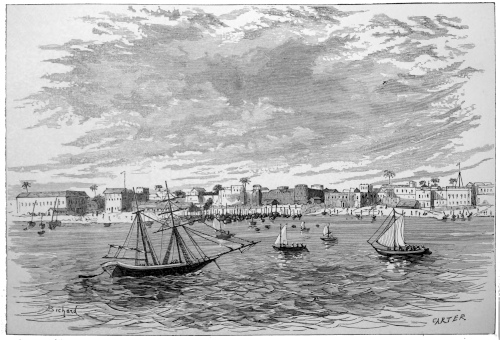
Vessels from the south making Zanzibar in
the N.E. monsoon, the trade-wind of December
to March, leave Europa Island to the west, and
the Comoro group and S. Juan de Nova on the
east. Keeping well in mid-channel, they head
straight for Mafiyah. They hug Point Puna,
avoiding Latham’s Bank,[37] and they work up by
Kwale and the Chumbi Island. Ships from the
north have only to run down the mid-channel,
between Pemba and the continent, and then to
pass west of Tumbatu. Those sailing southward
from Zanzibar at this season pass along-shore,
down the Mozambique Channel. Vessels from
the south making Zanzibar in May to September,
the height of the S.W. monsoon—the anti-N.E.
trade—sail up the same passage. They must beware
of falling to leeward; and those that neglect
145‘lead and look-out’ are ever liable to be
carried northwards to Pemba by the counter-current
before mentioned, which may, however,
now be a wind-current. At this season ship-masters
missing the mark have sometimes made 3° to
4° of easting, and have preferred beating down to
Mafiyah and running up again, rather than face
the ridicule of appearing viâ the northern passage.
Those leaving the Island in the S.W.
monsoon stand north up channel, well out in
E. lon. 9° 42′ to 43′, beat south of Cape Delgado,
pass between the Comoro group and the
mainland, and thus catch the Mozambique gulfstream.
The brises solaires blow strongest off
Madagascar in June and July. They fall light
in August and September.
The aspect of Zanzibar from the sea is that
of coralline islands generally—a graceful, wavy
outline of softly rounded ground, and a surface
of ochre-coloured soil, thickly clothed with foliage
alternating between the liveliest leek-green
and the sombrest laurel, the only variety that
vegetation knows in this land of eternal verdure.
Everywhere the scenery is similar; each mile of
it is a copy of its neighbour; and the want of
variety, of irregularity, of excitement, so to
speak, soon makes itself felt. Zanzibar ignores
146the exhilaration of pure desert air, and the exaltation
produced by the stern aspect of mountain
regions or by a boundless expanse of Pampa and
Sahara. Without a single element of sublimity,
soft and smiling, its sensuous and sequestered
scenery has no power to spur the thought, to
breed an idea within the brain. The oppressive
luxuriance of its growth combined with the excess
of damp heat, and possibly the abnormal
proportion of ozone, are the most unfavourable
conditions for the masculine. The same is the
case in Mazanderan, Malabar, Egypt, Phœnicia,
California, and other Phre-kah—lands of the sun.
And the aspect of that everlasting, beginning-less,
endless verdure tends, as on the sea-board
of the Brazil, to produce sensations of melancholy
and depression. We learn at last to loathe thee,
‘gay green,
Thou smiling Nature’s universal robe!’
Landing upon the island, you find a thin
strip of bright yellow sand separating the sea
from a curtain of vegetation, which forms a continuous
wall. In some parts madrepore rock,
looped and caverned by the tide, and covered
with weeds and testaceæ, whose congeners are
fossilized in the stone, rises abruptly a few feet
above the wave. At other places a dense growth
147of tangled mangrove jungle exposes during the
ebb a sheet of black and sticky mire, into which
man sinks knee-deep. The regularity of the outline
is broken by low projecting spits and by
lagoons and backwaters, which bite deep into the
land. Their pestilential, fatal exhalations veil
the low grounds with a perpetual haze, and the
excess of carbon is favourable to vegetable as it
is deleterious to animal life.
Passing over the modern sea-beach, with its
coarse grasses, creepers, and wild flowers—mostly
the Ipomæa—and backed by towering trees,
cocoas, mangos, and figs, we often observe in
the interior distinct traces of an old elevation,
marked by lines of water-worn pebbles and by
coarse gravels overlying greasy blue clay. This
is the home of the copal. Beyond it the land rises
imperceptibly, and breaks into curves, swells,
and small ravines, rain-cut and bush-grown,
sometimes 40 feet deep. The soil is now a retentive
red or yellow argile, based upon a detritus
of coralline, hardened, where pressed, into the
semblance of limestone, or upon a friable sand-stone-grit
of quartz and silex. The humus
of the richest vegetable substance, and excited
by the excess of humidity and heat, produces in
abundance maize, millet, and various panicums;
148tomatoes and naturalized vegetables, muhogo
(the cassava), and Palma Christi; coffee, cotton,
and sugar-cane; clove, nutmeg, and cinnamon
trees; foreign fruits, like the Brazilian
Cajú, the passion-flower and the pine-apple; the
Chinese Leechi; bananas and guavas, the Raphia
and the cocoa, twin queens of the palms;
limes and lemons, oranges and shaddocks, the
tall tamarind, the graceful Areca, the grotesque
calabash and Jack-tree, colossal sycamores and
mangos, whose domes of densest verdure, often
60 feet high and bending, fruit-laden, to the
earth, make our chesnuts, when in fullest dress,
look half-naked and in rags.
The uplands, especially in the western part of
the island, are laid out in Máshámha or plantations,
whose regular lines of untrimmed clove-trees
are divided by broad sunny avenues. Here
and there are depressions in the soil, where heavy
rains slowly sinking have nursed a tangled growth
of reeds and rushes, sedge and water-grass.
About the Mohayra and the Búbúbú—the principal
of the ποταμοι πλειστοι of the Periplus—mere
surface-drains, choked with fat juncaceæ
and with sugar-cane growing wild, there is a
black soil of prodigious fertility, whose produce
may, so to speak, be seen to grow. This sounds
149like exaggeration; but I well remember, at
Hyderabad, in Sind, that during the inundation
of the Indus we could perceive in the morning
that the maize had lengthened during the night,
and the same is the case with certain ‘toadstools’
and fungi in the Brazil.
Upon this waste of rank vegetation the sun
darts an oppressive and malignant beam. In
the driest season the ‘mangrove heaviness’ of
the western coast and the cadaverous fœtor
announce miasma; after the rains the landscape
is redolent of disease and death.
The cottages of small proprietors and slaves
strew the farms. They are huts of wattle and
rufous loamy dab, to which large unbaked bricks
of red clay are sometimes preferred. The usual
cajan pent-roof forms deep dark eaves, propped
by untrimmed palm-boles. These dwellings are
unwholesome, because none boast of a second
storey; they are not even built upon piles, and
thus their sole defence against the surrounding
malaria is the shrubbery planted by nature’s
hand. Sickness seems generally, both in the
island and on the continent, to follow turning
up fresh soil, and the highlands are often more
subject to miasma than the lowlands.
The lines of communication consist of mere
150footpaths, instead of the broad roads required
for the ventilation of the country. When the
produce of the land is valuable the lanes are
lined with cactus, milk-bush (euphorbia), and
succulent plants, whose foliage shines with metallic
lustre. Set in little ridges, the hedge-rows
of pine-apple, with its large pink and crimson
fruit, passing, when ripe, into a reddish-yellow,
form a picturesque and pleasant fence. At a
distance from the town the paths become rough
and solitary. Nearer, they are well beaten by
negroes of both sexes and all ages, carrying fuel
or baskets of fruit upon their heads, or bringing
water from the wells, or loitering under shady
trees to cheapen the cocoa-nut, manioc, and
broiled fish, offered by squatting negresses for
their refection.
Section 2.
Meteorological Notes—The Double Seasons, &c.
The characteristic of meteorology at Zanzibar,
as generally the case in the narrow equatorial
151zone, is the extreme irregularity of its
phenomena. Here weather seems to be all in
confusion; hardly two consequent years resemble
each other. In 1853-4, for instance, the seasons,
if they may so be called, were apparently inverted;
heavy showers fell during the dries, and a
drought occupied the place of the wet monsoon.
Sometimes the rains will begin with, this year
(1857) they ended with, a heavy burst. Now
April is a fine month, then the downfall will last
through June.
I may also remark one great difference of
climate between the eastern and western coasts
of intertropical Africa. Whilst Zanzibar is supersatured
with moisture, Angola, on the same
parallel, is a comparatively dry, sandy, and sunburnt
region. Kilwa, upon the eastern coast, and
in S. lat. 8° 57′, is damp and steamy. S. Paulo de
Loanda, upon the opposite shore (S. lat. 8° 48′),
suffers from want of water. We find the same
contrast in the South American continent. The
middle Brazil is emphatically a land of rains,
whilst Peru and Chili require artificial irrigation
supplied by melted snow. Evidently the winds
charged with moisture, the N. E. and S. E.
trades and their modifications, discharge themselves
upon the windward sides of continents,
152especially when these are fringed with cold
sierras, which condense the vapour and render
the interior a lee land.
In 1847 the Geographical Society of Bombay
sent a barometer to Zanzibar, and requested that
a meteorological register might be kept. Their
wishes were not immediately carried into effect;
but after a time the Eurasian apothecary in
charge of the Consulate filled up in a rude way
during nine months a weather-book, with observations
of the barometer, of two thermometers
attached and unattached, of wet and dry bulbs,
of evaporation and of rainfall. In the Journal
of the Royal Geographical Society (xxiii. of
1853), Colonel Sykes published a ‘record, kept
during eleven months in 1850, of the indications
of several intertropical instruments at Zanzibar,’
unhappily without those of pressure.[38]
The result of nine months’ observations is that
153the thermometer shows a remarkably limited
range of temperature and an extreme variation
of only 18°-19°. A storm, however, will make
the mercury fall rapidly through 6°-7°. The
climate is far more temperate than the inexperienced
expect to find so near the equator.
It is within the limits of the true Trades.
The land and sea breezes laden with cool moisture
blow regularly, and the excessive humidity
spreads a heat-absorbing steam-cloud between
sun and earth. The medium temperature
of January is 83° 30′; of February, the hottest
month, 85° 86′ (according to Colonel Sykes 83°
40′); and of March, 82° 50′. This high and little-varying
mean then gradually declines till July,
the coolest month (77° 10′). The mean average
of the year is 79° 15′-90′. In September and
October the climate has been compared with
that of southern Europe. On the other hand,
the atmosphere supports an amount of moisture
unknown to the dampest parts of India.
The barometer, so near the equator, is almost
uniformly sluggish and quiescent. Its range
diurnal and annual is here at a min. It seldom,
except under varying pressure of storms or tornadoes,
rises or falls above or below 30 inches
at sea level, and a few tenths represent the max.
154variation. It must be observed, however, on both
coasts of Africa, within 6°-7° of the Line, this
instrument requires especial study for nautical
purposes. Here it is an imperfect indicator,
because, affected from great distances, it rises
without fine weather and it falls without foul.
At Zanzibar the case of a whaling captain is
quoted for wasting in vain precautions nearly
two months. Moreover, sufficient observations
have not yet been accumulated in the southern
hemisphere. Where there is so little expansion
in the mercurial column the convexity
and concavity of the column-head must be carefully
examined with a magnifying-glass, and by
a reflecting instrument the smallest change
could be correctly measured. The trembling of
the aneroid needle, sometimes ranging through
a whole inch during the gusts of the highly electrical
tornado, also calls for observation. The
sympiesometer is held to be even more sensitive
than the mercurial barometer, especially before
storms, and ignorance of its peculiarity has often
‘frightened a reef in’ at unseasonable times.
The same was found to be the case, in high latitudes,
by Lieut. Robertson, R.N., when sailing
under Captain Ross (1818), between N. lat. 51°
39′ and 76° 50′.
155Observations with the altitude and azimuth
determined the variation of the needle in 1857
to be between 9°-10° (W.). If this be correct,
it is gradually easting. In 1823 Captain Owen
found it to be 11° 7′ (W.).[39] So, upon the opposite
coast, the variation laid down in our charts
of 1846 as 20° (W.) has gradually declined to
between 18° 30′ and 19° (W.).
Of exceptional meteoric phenomena I can
speak only from hearsay, no written records existing
upon the island. A single earthquake is
remembered. In the early rains of 1846, at
about 4 P.M., a shock, accompanied by a loud
rumbling sound, ran along the city sea-front,
splitting the Sayyid’s palace, the adjacent mosque,
and the side-walls of the British Consulate, in. a
direction perpendicular to the town. It was
probably the result of igneous disturbance below
the coralline, and it tends to prove that the island
was originally an atoll: some, however, have
explained it by a land-slip. Three meteors are
known since 1843. In December of that year
a ball of fire was visible from windows facing
the north; it disappeared without a report.
The most remarkable was a bolis, which, about
1566 P.M. on October 25, 1855, took a N.W. by W.
path, burned during ten or eleven minutes, and
frightened the superstitious burghers into fits.
Water-spouts commonly appear during the month
of April, and in the direction of the mainland:
the people disperse them by firing guns.
Frost and snow are of course unheard of at
Zanzibar, and hail, not uncommon in the interior,
never (?) falls upon the island or the coast.
During the wet season generally, especially when
the heats are greatest, the hills of Terrafirma are
veiled with clouds, and sheet-lightning plays
over the horizon. The islanders assure the
stranger that storms of thunder and lightning
are rare, and that few accidents happen from the
electric fluid. M. Alfred May, for instance, declares
that thunder is heard only three or four
times a year. The same is said in West African
Yoruba, in parts of the Brazil, and even in
Northern Syria—Damascus, for instance. It
would be curious to inquire what produces this
uniform immunity under climatic conditions so
different. At Zanzibar, however, the phenomenon
is irregular as the seasons. I was told of
several deaths by the ‘thunderbolt,’ and in the
year 1857 the S.W. monsoon was ushered in
almost daily by a tempest. Lieutenant-Colonel
157Hamerton, when sailing about the island, lost by
lightning his Baloch Sarhang (boatswain); he
himself felt a blow upon the shoulder like that
of a falling block. No blood appeared upon the
side, but it was livid to the hip, and for some
days the patient was decidedly ‘shaky.’ Some
explained his escape by his wearing flannel;
others by his standing near the davits of a longboat,
which were twisted like wax by the electric
fluid.
The mainlands of Zanzibar and of Mozambique
are subject, as might be expected, to
tornados, which much resemble those of the
West African coast. Accompanying the formation
and the dispersion of the nimbus, they are
often violent enough to wreck small craft.
Caught in a fine specimen, I was able to observe
all the normal phenomena,—the building up of
the warning arch, the white eye or gleam under
the soffit, the wind blowing off shore, the apparent
periodicity of throbs, and the frantic rage of
the short-lived squall. The cyclones and hurricanes
of the East Indian Islands rarely extend to
Zanzibar. During 14 years there was but one
tourbillon strong enough to uproot a cocoa-tree.
It passed over the city about midnight, overthrowing
the Mábandani or roof-sheds, and it was
158followed by a burst of rain. Colonel Sykes (loco
cit.) remarks, philosophically explaining the
why, ‘Another peculiar feature in the climatology
of Zanzibar is that there is seldom any dew
experienced.’ The reverse is the case, as might
be known by the strength of the nightly radiation.
Captain Guillain (i. 2, 72) declares that
the rosées which accompany the rains are sufficient
for watering the ground, and observes (p.
94), I presume concerning those who remain in
the open air, ‘Rester à terre entre huit heurs du
soir et le lever du soleil c’est s’exposer à une
mort très probable, sinon certaine.’ The sunset,
never followed by twilight, is accompanied by a
sudden coolness which, as in equatorial, and
even sub-tropical regions generally, causes a rapid
precipitation of vapour. The dews are cold and
clammy, and the morning shows large beads in
horizontal streaks of moisture on perpendicular
surfaces. I often remarked the deposition of
dew when light winds were blowing; of course
it did not stand in drops, but it wetted the clothing.
This I believe is an exception to the
general rule. At sunset the old stager will not
sit or walk in the open air, although, as in Syria,
he will expose himself to it at nine or ten p. m.,
when the night has acquired its normal temperature.
159As in the west coast squadron, so here,
there is an order that all men on deck after sunset
must wear their blanket-coats and trowsers,
and many an unfortunate sailor has lost his life
by sleeping in the streets, thus allowing the dew
to condense upon his body while under the influence
of liquor. Experienced travellers have
taught themselves, even in the hottest seasons of
the hottest equinoctial regions, to air the hut
with a ‘bit of fire’ before sundown and sunrise,
and it is doubtless an excellent precaution
against ‘chills.’
Zanzibar Island, lying in S. lat. 6°, has the
sun in zenith twice a year: the epochs being
early March and October; more exactly, March
4 and October 9. Hence it has two distinct
summers; the first in February, the second in
September. It has double rains; the ‘Great
Masika’ in April to June, and the ‘Little Masika’
in October to November. It has two
winters; the shorter in December, and in July
the longer, which is much more marked than the
former. There are only three months of N.E.
trade (Azyab)[40] to nine of S.E. and S.W. (Kausi).
160The regularity of these seasons is broken by a
variety of local causes, and there is ever, I repeat,
the normal instability of equinoctial climates.
Theory appears often at fault upon these
matters. A fair instance is Mr Cooley’s assertion,
that about Kilima-njaro the ‘rainy season is also
the hot season.’ Theoretically, of course, the
period of the sun’s northing and of the great
rains should be, north of the equator, the hot
season; but where tropical downfalls are heavy,
the excessive humidity intercepting the solar
rays, and the valleys and swamps refrigerated by
the torrents, make the rainy season the cold
weather. From June to September the natives
of Fernando Po (N. lat. 4°) die, like those of
eastern intertropical Africa, of catarrh, quinsey,
and rheumatism. Even in India the Goanese call
the rains ‘o inverno,’ and Abba Gregorius makes
the wet weather the winter of Abyssinia. About
Kilima-njaro the hot and dry season opens with
the end and closes with the beginning of the hot
monsoon.
The natives of Zanzibar distribute the year
161into five seasons. A far simpler division here
applicable, as in Western India, is made by those
local trades the monsoons, between whose two
unequal lengths are long intervals of calms and
of variable winds. These are the Mausim or
N.E. monsoon, and the Hippalus or S.W.
1. The Kaskazi or Kazkazi (vulgarly Kizkazi),
to which the Arabs limit the term El
Mausim (Monsoon), is the season during which the
Azyab (ازيب) or N.E. trade blows. The wind
begins about mid-November; from mid-December
to mid-February its strength is greatest, and
it usually ends about mid-March. In 1857,
however, the Kaskazi opened with light showers,
and continued in full force till March 24; usually
the last vessels from Cutch and Bombay enter
port about March 10. This is the first of the
two hot seasons, and midsummer may be placed
in February and March. A fine, cool sea-breeze
from the N.E. usually prevails between 8 a.m.
and late in the afternoon. When it is absent the
weather is sultry and oppressive, the northerner
feels suffocated; the least exertion brings on
profuse perspiration, and the cuticular irritation
produces boils and ‘prickly heat.’ The nights
are close and stifling enough to banish rest and
sleep. As has been shown, the thermometer
162does not stand high, but the frequent flashes of
sheet-lightning playing over the northern and
western sky show a surcharge of electricity. The
public health would suffer severely but for the
frequent cooling showers which, especially at the
end of the Kaskazi, are succeeded by several
days of pleasant weather. This is the agriculturist’s
spring. Sesamum, holcus, rice, and other
cereals, are sown upon lands previously burned
for manure. It is the traveller’s opportunity
for visiting the interior of the island and the
worst parts of the coast, but—‘bad is the best.’
2. The Msika (or Másika) Mku, Greater rain
or rains. About the end of March the change of
monsoon is ushered in by heavy squalls from the
S.E. and by tornados blowing off land. Presently
the Hippalus breaks, and extends from early
May into October. In May native craft make
India after a run of 20 to 25 days; after the end
of August they rarely attempt the voyage. This
Kausi or Hippalus is usually called S.W. monsoon,
but it has mostly an eastern deflection,
possibly modified by the westerly land-breezes.
The Arabs divide it, as will be seen, into three
portions. First, the Kaus proper,[41] in Kisawahili
163Kausi (قوسی), from mid-April to early August,
the period of the greatest strength. Second, Kipupwe
or first winter—July and early August;
and third, the Dayman, which ends the Kausi.
Presently appear the rains which have followed
the northing sun. The same observation
was made by the Austrian mission on the White
River in N. lat. 4° 30′. On the coast we can distinctly
trace their progress. In 1857 the downfall
began in Feb. 15, at Usumbara (S. lat. 5°),
where the clouds are massed and condensed by
a high plateau, leading to lofty, snow-capped
mountains. In 1854 I found that the rainy
season opened at Berberah of the Somal (N. lat.
10° 25′) on April 15; and in early June they
reach Bombay (N. lat. 18° 53′). Concerning the
movement of the wet season in inner intertropical
Africa I have already written in the Journal
of the Royal Geographical Society (xxix. 207).
The heaviest rains at Zanzibar Island begin
the wet season about mid-April, and last 30 to
40 days; they do not end, however, till early
June. Some observers remark that the fall is
greatest at low water and during the ebb-tides
of the Syzygies. It is, however, rare to have a
week of uninterrupted rain, as in eastern India
and sometimes in the Brazil. The discharge is
164exceedingly uncertain. Some years number 85
inches, others 108. During the first eight months
of 1857 and the last four months of 1858, we find
a total of 120·21 inches. In 1859 it reached 167,
doubling the average of Bombay (76·55), and
nearly trebling that of Calcutta (56·83). We
may compare these figures with those of Europe
and the United States. England has 31·97
inches; France, 25·00; Central Germany, 20·00;
Hungary, 16·93; Boston, 38·19 (about the
same at Beyrut in Syria); Philadelphia, 45·00;
and St Louis, Mo., 31·97. Of these 167 inches
(1859), 104·25 fell during the Msika Mku. The
number of wet days ranges from 100 to 130 per
annum. According to the people, rain has
diminished of late years; perhaps it is the result
of felling cocoas, and of disforesting the land for
cloves. In 1857, the Great Msika was preceded
by a few days of oppressive heat, which ended
(March 24) in a highly electrical storm, like
those which usher in the rains of western India,
and suddenly the cool S.W. began to blow. For
some time we had daily showers, now from the
N.E., then from the S.W., with high winds and
loud thunderings; the rains, however, did not
show in earnest before April 10.
The islanders like the Msika to open with
165showers strong enough to bind the land, but
not so violent as to carry off the manure deposited
by the year’s decayed vegetation. After
this the water should fall in heavy ropy torrents,
with occasional breaks of sunshine and
fine weather; when this lasts thirty days, and
is succeeded by frequent showers, good crops
are expected. The downfall is heavier in the
interior of the island than about the city, which,
situated upon a point, escapes many a drenching.
It must, however, be borne in mind that
the phenomena of the rains, like those of the
sea and air, are essentially irregular. In some
seasons there will be only half-a-dozen rainy
afternoons; in others as many rainy mornings.
There are years of great drought, and there are
seasons when the sun does not appear for six
weeks in succession. Usually heavy rain is not
expected after 11 A.M., and showers are rare
after 2 P.M. As I subsequently remarked in the
east African interior—the Fluminenses of the
Brazil still preserve the tradition—there is a
curious regularity and periodicity in the hours of
downfall, often extending over many days. This
phenomenon may have done much towards creating
the ‘rain-doctor.’
During the Msika the horizon is obscured,
166dangerously indeed for ships: the wind veers
round to every point of the compass; the sky
is murky and overcast; huge purple nimbi, like
moving mountains, float majestically against the
wind, showing strong counter-currents in the
upper aërial regions. From afar the island appears
smothered in blue mist, and often the cloudrock
splits into two portions, one of which makes
for the coast. Even during the rare days of
sunshine the distances, owing to the continuous
humidity, are rarely clear, and the exhalations
make refraction extensive. A high
tension of vapour is the rule. For the first three
hours after sunrise the land is often obscured by
‘smokes,’ a white misty fog, often deepening to
a drizzling rain; this lasts until 10 A.M., about
which time the sea-breeze begins to blow.
The Msika is much feared by the native
population, and the interior of the island becomes
a hot-bed of disease. The animal creation
seems to breathe as much water as air. The
want of atmospheric weight, and consequently of
pressure upon the surface of the body, renders
the circulation sluggish, robs man of energy, and
makes him feel how much better is sleep than
waking. Europeans, speaking from effect, complain
that the ‘heavy’ air produces an unnatural
167drowsiness—it is curious to see how many of
our popular books make humidity increase the
weight of the atmospheric column. During this
season the dews of sunset are deemed especially
fatal to foreigners. At times the body feels
cold and clammy when the thermometer suggests
that it should be perspiring: super-saturation
is drawing off the vital heat. The lungs are
imperfectly oxygenized, and, in general belief,
positive is exchanged for negative electricity.
The hair and skin are dank and sodden; indeed,
a dry cutis is an unattainable luxury. Iron
oxydizes with astonishing rapidity; shoes exposed
to the air soon fall to pieces; mirrors are
clouded with steam; paper runs and furniture
sweats; the houses leak; books and papers are
pasted together; ink is covered with green fur;
linens and cottons grow mouldy, and broadcloths
stiffen and become boardy.
This excess of damp is occasionally varied by
the extreme of dryness. The hot wind represents
the Khamasin of Egypt, the Sharki (or
Sh’luk) of Syria, the Harmattan of west Africa,
and the Norte of the southern Brazil, Paraguay,
and the Argentine Confederation. At such
times the air apparently abounds in oxygen and
in ozone. Cotton cloth feels hard and crisp; even
168the water is cooled by the prodigious evaporation.
Books and papers curl up and crack, and
strangers are apt to suffer from nausea and
fainting fits.
3. The Kipupwe, first winter or cold season—July
and early August. The bright azure of
the sky, the surpassing clearness of the water,
and the lively green colours of the land, are
not what we associate with the idea of the
‘disease of the year.’ The Kausi or S.W. monsoon
still blows, but in this second or post-pluvial
phase its strength is diminished. As
on the western coast the mornings are misty,
the effect of condensation and of excessive
evaporation, the sun pumping up vapour from
the rapidly desiccating ground; but about four
hours after sunrise a strong sea-breeze sets in,
giving a little life and elasticity to the exhausted
frame. When the ‘doctor’ fails the
heat is oppressive, and the sunsets are often
accompanied by an unpleasant closeness. The
beginning of the Kipupwe is held to be universally
sickly. The Hindus, who declare that all
cold coming from the south is bad, suffer from
attacks of rheumatism and pneumonia. The
charms of the season induce Europeans to despise
the insidious attacks of malaria: they
169commit imprudences and pay for them in severe
fevers. The rare but heavy showers that now fall
are termed ‘Mcho;’ they separate the greater
from the lesser Msika.
4. Daymán (in Kisawahili Daymáni) ends
the Kausi or S. W. monsoon, and extends
through August and part of October. Though
the sun is nearly perpendicular the air is cooled
by strong south-westerly breezes. At this time
yams, manioc, and sweet potatoes grow, making
it a second spring, whilst the harvest of rice and
holcus assimilates it to the temperate autumn.
5. The Vuli (Fuli)[42] or Msika Mdogo, second
rains or Little Msika. This season lasts but
three weeks, beginning shortly after the sun
has crossed the zenith of Zanzibar in the southern
declination, and embracing part of October
and November. It is not considered a healthy
time by the islanders. The autumnal rains are
sometimes wanting upon the continent, and the
land then suffers as severely from drought as
northern Syria does when the ‘former rain’ fails.
After the Vuli recommences the Kaskazi, and the
170N. E. trade again blows. The sun is distant, the
thermometer does not range high, yet the temperature
of houses sheltered from the breeze
becomes overpowering, and without the ‘doctor’
the city would hardly be habitable. At times
the Trade freshens to a gale that blows through
the day. The Hindus suffer severely from this
‘Báorá’ (blast), and declare that it brings on
fits of ‘Mridi’ (refroidissement), here held dangerous.
During the whole of the Azyab monsoon
the people prefer hot sun and a clear, which
is always a slightly hazy-blue, sky. They dislike
the clouds and heavy showers called Mvua[43]
ya ku pandia, or harvest rains, which are brought
up at times by the N. N. West wind. On the
other hand, when the Kausi or S. West monsoon
blows, they hold an overcast sky the best for
health, and they dread greatly the ‘rain-sun.’
The peasants take advantage of the dryness, and
prepare, by burning, the land for maize, sesamum,
and rice.
The Wasawahili, like the Somal and many
other races, have attempted to conform the
lunar with the solar year, a practice which may
171date from the days when the Persians were rulers
of the Zanzibar coast. They also give their own
names to the lunar months of the Moslem; and,
curiously enough, they begin the year, not with
Muharram, but with the ninth month (Shaw
wal), which they call ‘Mfunguo Mosi,’ or First
Month. The next, Zu’l Ka’adeh, is Mfunguo
Mbili, Second Month, and so on till Rajah, Shaa’-ban
(or Mlisho) and Ramazan, which retain
their Arab names.[44] Amongst the Somal, five
months, namely, from the second to the fifth, are
known by the old Semitic terms. The month, as
amongst all savage and semi-civilized tribes, begins
with sighting the moon; and the Wasawahili
reckon like the Jews, the modern Moslems, and
the Chinese, 12 of 29 and 30 days alternately. ‘The
complete number of months with God’ being,
says the Koran, ‘twelve months,’ good followers
of the Prophet ignore the Ve-adar, second or embolical
Adar, which the Hebrews inserted after
every third year, and retain their silly cycle of
354 days. The Wasawahili add 10 to 12 days
to the Moslem year, and thus preserve the orderly
recurrence of the seasons. The sage in
172charge of the local almanac is said to live at
Tumbatu: he finds his New Year’s Day by looking
at the sun, by tracing figures upon the
ground, and by comparing the results with Arabic
calendars. Their weeks begin, as usual with
Moslems, on Friday (Ejúmá for Juma), the Saturday
being Juma Mosi, or one day after Friday,
and so forth. Thursday, however, is Khamisi.
This subdivision of time, though suggested by the
quarters of the earth’s satellite, is known only to
societies which have advanced toward civilization.
Thus in Dahome we find a week of four days;
and even China ignores the seven-day week.
‘The universal festivals,’ says the late Professor
H. H. Wilson (Essays on the Religion of
the Hindus, ii. 155), ‘are manifestly astronomical,
and are intended to commemorate the revolutions
of the planets, the alternations of the
seasons, and the recurrence of cyclical intervals
of longer or shorter duration.’ The Nau-roz
(نوروز) or New Year’s Day, here, as in Syria,
locally pronounced Nay-roz, was established in
ancient Ariana, according to Persian tradition, by
Jamshid, King of Kings, in order to fix the
vernal equinox.[45] It is the Holi of the Hindus,
173and after the East has kept this most venerable
festival for 3000 years, we still unconsciously
celebrate the death and resurrection of the
eternal sun-god. The Beal-tinne is not yet forgotten
in Leinster, nor is the maypole wholly
obsolete in England. As early as the days of
the Kuraysh, there was an attempt to reconcile
the lunar with the solar year, and the Nau-roz,
though palpably of Pagan origin, has been
adopted by all the maritime peoples professing
El Islam. Even the heathen-hating Arab borrowed
it for his convenience from the Dualists
and Trinitarians of Fars and Hindustan. Hence
the æras called Kadmi and Jelali. In this
second solar æra the Nau-roz was transferred by
the new calendar from the vernal equinox to
Sept. 14, A.D. 1079, and was called Nau-roz i
Mízán (نوروز مِنران). Amongst the Wasawahili it
is known as Siku Khu ya Mwáká, the Great
Day of the year.
For the purpose of a stable date, necessary
both to agriculture and to navigation, and also
for the determination of the monsoons, the
people who ignore the embolismal month, and
who have no months for the solar year, add, I
have said, 10 to 12 days to each lunar year, the
true difference being 16 days 9 hrs. 0 min. and
17411·7 secs. Thus the contrivance is itself rude;
moreover the Wasawahili often miscalculate it.
Between A.D. 1829 and A.D. 1879, it would fall
on 28-29 August. In 1844 they made it commence
at 6 p. m., August 28, immediately after
full moon: in 1850-2 they began it on August
27, and in 1856 onon August 26.[46]
Sundry quasi superstitious uses are made of
the 10 embolismal days following the Nau-roz.
Should rains—locally called Miongo—fall on the
first day, showers are prognosticated for the tenth;
if on the second, the twentieth will be wet; and
so forth till the tenth, which if rainy suggests
that the Kausi or S.W. monsoon will set in
early. The seasons of navigation are thus reckoned.
The Vuli rains are supposed to begin
30 days, counting from the twentieth, after Nauroz.
175On the eightieth (some say the ninetieth)
day are expected thunder, lightning, and heavy
rains at the meeting of the monsoons (mid-November),
and so forth. Possibly this may be
a reflection of the Hindu idea which represents
the Garbhas to be the fetuses of the clouds, and
born 195 days after conception. With us the
people mark the periods by saints’ days. The
Bernais say—
Après le jour de la Sainte Luce,
Les jours s’allongent le saut d’une puce.
The Escuara proverb declares—
Sanct Seimon etu Juda,
Negua eldu da.
(‘At St Simon and St Jude, water may be viewed.’)
The basis of the following calculation is
thoroughly Kisawahili—
S’el pleut le jour de Saint Médard, (June 8)
Il pleut quarante jours plus tard.
Nor is our popular doggrel less so—
Saint Swithin’s Day, if thou dost rain,
For forty days it will remain.
Saint Swithin’s Day, if thou be fair,
For forty days ’twill rain nae mair.
The Wasawahili also calculate their agricultural
seasons from the stars called Kilímia, a
name probably derived from Ku lima, to plough.
176I believe them to be Pleiades, but my sudden departure
from the coast prevented my making
especial inquiries. When this constellation is in
the west at night the peasants say, ‘Kilímia, if it
sets during the rains, rises in fair weather,’ and
vice versâ. Also Kilímia appearing in the east is
a signal for the agriculturist to prepare his land.
Section 3.
Climate continued—Notes on the Nosology of Zanzibar—Effects
on Strangers.
The climate of Zanzibar Island is better
than that of the adjacent continent. Here many
white residents have escaped severe fever; but
upon the coast the disastrous fate of Captain
Owen’s surveyors, the loss of life on board our
cruisers, and the many deaths of the ‘Mombas
Mission,’ even though, finding the sea-board
dangerous, they built houses on the hills which
lead to the mountain region of Usumbara, prove
that malaria is as active in eastern as in western
Africa. Colonel Hamerton once visited the
177Pangani river during the month of August: of
his 19 men, three died, and all but one suffered
severely. Perhaps we should not find a similar
mortality in the present day, when the lancet has
been laid aside for the preventive treatment by
quinine and tonics. It has, however, been asserted
that the prophylactic use of the alkaloid,
which was such a success in western Africa, did
not prove equally valuable on the eastern coast.
Yet Zanzibar, with its double seasons and its
uniformly heated and humid atmosphere, accords
ill, even where healthiest, with the irritable temperament
of northern races. Here, contrary to
the rule of Madagascar, the lowlands over which
the fresh sea-breeze plays are the only parts
where the white stranger can land and live; the
interior is non habitabilis æstu. Lieut.-Colonel
Hamerton, called upon in March, 1844, by Sir
George Arthur, governor of Bombay, to report
upon the island, wrote in September of the same
year, ‘The climate of the [insular] coast is not
unhealthy for Europeans, but it is impossible for
white men to live in the interior of the island,
the vegetation being rank and appearing always
to be going on; and generally fever contracted
in the interior is fatal to Europeans.’ Colonel
Sykes (loco cit.) questions this assertion as being
178‘contrary to all other testimony.’ Every traveller,
however, knows it to be correct. As in
the lovely climates of the Congo River and the
South Sea Islands, corporal lassitude leads to indolence,
languor, and decline of mental energy,
which can be recovered only by the bracing
influence of the northern winter. Many new
arrivals complain of depressing insomnia, with
alternations of lethargic sleep: I never enjoyed
at Zanzibar the light refreshing rest of the desert.
Yet the island is a favourable place for
the young African traveller to undergo the inevitable
‘seasoning fever’fever’, which upon the coast
or in the interior might prove fatal. The highlands,
or the borders of the great central basin,
are tolerably healthy, but an invalid would find
no comforts there—hardly a waterproof roof.
He should not, however, risk after recovery a
second attack, but at once push on to his goal;
otherwise he will expend in preparation the
strength and bottom required to carry out his
explorations. With a fresh, sound constitution,
he may work hard for three years, and even
if driven home by ill health he may return in
comparative safety within a reasonable time.
No European, unless thoroughly free from
organic disease, should venture to remain longer
179than three or four years at Zanzibar: the same
has been observed of Baghdad, and of the Euphrates
valley generally. Lurking maladies will
be brought to a crisis, and severe functional derangements
are liable to return. The stranger is
compelled to take troublesome precautions. He
may bathe in cold water, sweet or salt, but he
must eschew the refreshment of the morning
walk: during the rains, when noxious mists
overhang the land, the unpleasant afternoon is
the only safe time for exercise. Flannel must
always be worn despite the irritability of the
ever-perspiring skin: even in the hottest weather
the white cotton jackets and overalls of British
India are discarded for tweeds, and for an
American stuff of mixed cotton and wool.
Extra warm clothing is considered necessary as
long as the ‘mugginess’ of ‘msika-weather’
lasts. Sudden exposure to the sun is considered
dangerous, and the carotid, jugular, and temporal
arteries must be carefully protected from
cold as well as from heat. Hard work, either of
mind or body, is said to produce fever as surely
as sitting in draughts or as wearing insufficient
clothing. The charming half-hour following
sunset is held dangerous, especially in hot
weather; yet most tantalizing is the cool delicious
180interval between the burning day and the
breathless night. Natives of the country rarely
venture out after dark: a man found in the
streets may safely be determined to be either a
slave or a thief—probably both.
Directions for diet are minute and vexatious.
The stranger is popularly condemned to ‘lodging-house
hours’—breakfast at 9 A.M., dinner at
3 P.M., tea at 8 P.M., bed at 10 P.M. He is told
also to live temperately but not abstemiously,
and never to leave the stomach too long empty.
I should prescribe for him, contrary to the usual
plan, an abnormal amount of stimulants, port
and porter, not claret nor Rhine-wine. It is
evident that where appetite is wanting, and
where nourishing food is not to be obtained, the
‘patient’ must imbibe as much nutriment as he
safely can. In these lands a drunkard outlives
a water-drinker, despite Theodoret, ‘vinum bibere
non est malum, sed intemperanter bibere perniciosum
est’; and here Bacchus, even ‘Bacchus
uncivil,’ is still ‘Bacchus the healer.’ As usual
old stagers will advise a stranger recovering
from fever to strengthen himself with sundry
bottles of port, and yet they do not adopt it as a
preventive—‘experto crede Ricardo.’ The said
port may be Lisbon wine fortified with cheap
181spirits, liquorice, and logwood—in fact, what is
regimentally called ‘strong military ditto;’ yet
I have seen wonders worked by the much-debased
mixture. Again, Europeans are told to
use purgatives, especially after sudden and strong
exercise, when the ‘bile is stirred up.’ As an
amateur chronothermalist—thanks to my kind
old master, the late Dr Dickson—I should suggest
tonics and bitters, which often bring relief
when the nauseous salts and senna aggravate the
evil. Also, in all debilitating countries, when the
blood is ‘thin,’ laxatives must be mild, otherwise
they cause instead of curing fever; in fact,
double tonics and half purgatives should be the
rule. Above all things convalescents should be
aided by change of air, if only from the house of
sickness to that of a neighbour, or to a ship in
port. The most long-lived of white races are
the citizens of the United States: they are
superior to others in mental (or cerebral) energy;
they are men of spare, compact fibre, and of
regular habits; they also rarely reside more than
two or three years at a time on the island. On
the other hand, the small French colony has lost
in 15 years 26 men: they lived imprudently,
they drank sour Bordeaux, and when attacked
with fever they killed themselves by the abuse of
182quinine. Swallowing large doses upon an empty
stomach, they irritated the digestive organs, and
they brought on cerebral congestion by ‘heroic
practice’ when constipated.
According to the Arabs and Hindus of Zanzibar,
ague and fever are to be avoided only by
perspiring during sleep under a blanket in a
closed room—a purgatory for a healthy hot-blooded
man in this damp tepid region. I found
the cure-almost-as-bad-as-the-disease precaution
adopted by the Spanish colonists at my salubrious
residence—Fernando Po, West Africa.
Only two officers escaped ‘chills,’ and they both
courageously carried out the preventive system:
on the other hand, it was remarked that they
looked more aged, and they appeared to have
suffered more from the climate, than those who
shook once a month with ‘rigors.’ There is
certainly no better prescription for catching ague
than a coolth of skin during sleep: having
purchased experience at a heavy price, it is my
invariable practice when awaking with a chilly
epiderm to drink a glass of water ‘cold without,’
and to bury myself for an hour under a pile
of blankets. Every slave-hut has a cartel or
cot, and the savages of the coast, like those of
the Upper Nile, carry about wooden stools for
183fear of dysentery. I have mentioned how our
sailors dig their graves.
So much for the male sex. European
women here, as in the Gulf of Guinea, rarely
resist the melancholy isolation, the want of
society, and the Nostalgia—Heimweh or Home-sickness—so
common, yet so little regarded in
tropical countries. Under normal circumstances
Equatorial Africa is certain death to the Engländerin.
I am surprised at the combined
folly and brutality of civilized husbands who,
anxious to be widowers, poison, cut the throats,
or smash the skulls of their better-halves. The
thing can be as neatly and quietly, safely and
respectably, effected by a few months of African
air at Zanzibar or Fernando Po, as by the
climate of the Maremma to which the enlightened
Italian noble condemned his spouse.
The nosology of Zanzibar is remarkable for
the prevalence of urinary and genital diseases;
these have been roughly estimated at 75 per
cent. Syphilis spreads wide, and where promiscuous
intercourse is permitted to the slaves it
presents formidable symptoms. The ‘black
lion,’ as it is popularly called—in Arabic El Tayr
or El Faranj; in Kisawahili, Bubeh, Kiswendi,
or T’hego—will destroy the part affected in three
184weeks: secondaries are to be feared; noses disappear,
the hair falls off, and rheumatism and
spreading ulcers result. Gonorrhœa is so common
that it is hardly considered a disease. Few
strangers live long here without suffering from
irritation of the bladder, the result, it is said, of
hard lime-water: and the common effect of a
cold or of stricture is severe vesical catarrh.
Sarcocele and hydrocele, especially of the left
testis, according to the Arabs, attack all classes,
and are attributed to the relaxing climate, to
unrestrained sexual indulgence, and sometimes
to external injury. These diseases do not always
induce impotence or impede procreation. The
tunica vaginalis is believed to fill three times:
as in elephantiasis the member is but a mass of
flesh, a small meatus only remaining. The
deposition of serum is enormous; I have heard
of six quarts being drawn off. The natives
punctuate with a heated copper needle, and
sometimes thus induce tetanus: Europeans add
injections of red wine and iodine. The latter is
also applied with benefit in the early stage to
sarcocele; and both complaints have yielded, it
is said, to the galvanic current. Strangers are
advised at all times to wear suspensory bandages.
185Elephantiasis of the legs and arms, and
especially of the scrotum, afflicts, it is calculated,
20 per cent. of the inhabitants: Arabs
and Hindus, Indian Moslems and Africans, however
dissimilar in their habits and diet, all suffer
alike. It is remarked that the malady has never
attacked a pure white, European or American:
perhaps the short residence of the small number
accounts for the apparent immunity. Similarly,
in the Brazil I have never seen a European
stranger subject to the leprosy, or to the goître,
so prevalent in the great provinces of São Paulo
and Minas Geraes. The Banyans declare that a
journey home removes the incipient disease, or
at least retards its progress: it recurs, however,
on return to Zanzibar. The scrotum will often
reach the knees; I heard of one case measuring
in circumference 41 inches, more than the
patient’s body, whilst its length (33 inches)
touched the ground. There is no cure, and the
cause is unknown. The people attribute it to
the water, and possibly it may spring from the
same source which produces goître and bronchocele.
Syphilitic and scorbutic taints appear in
ulcers and abscesses. The helcoma resembles
that of Aden: it generally attacks the legs and
186feet, the parts most distant from the centre of
circulation; the toes fall of, and the limb becomes
distorted. Phagædenic sores are most
common amongst the poor and the slaves, who
live on manioc, fruit, and salt shark often putrid.
Large and painful phlegemonous abscesses, attacking
the muscular tissue, occasion great constitutional
disturbance: they heal, however, readily
after suppuration. Scabies, yaws (Frambæsia),
psoriasis, and ‘craw-craw,’ inveterate as that of
Malabar or the Congo River, commonly result
from personal uncleanliness, unwholesome food,
and insufficient shelter and clothing. That
frightful malady Lupus presents pitiable objects.
The indigenous diseases which require mention
are fevers, bowel-complaints, and pulmonary
affections.
Fevers at Zanzibar have been compared with
Aaron’s rod; at times they seem to swallow up
every other disease, and generally they cause the
greatest amount of mortality. As at Muhamreh,
and on the swampy margins of the Shat el
Arab (Persian Gulf), the constitution worn out,
and the equilibrium of the functions deranged
by moist heat and sleeplessness, especially during
and after the heavy rains of the S. West monsoon,
187thus relieve themselves. Persians and
northern Asiatics are even more liable to attacks
than Europeans; and, as in Egypt, rude health
is rare. Some Indian Moslems have fled the
country, believing themselves bewitched. Arabs
born on the island, and the Banyans, who seldom
suffer much from the fever, greatly dread its
secondary symptoms. The ‘hummeh,’ or intermittent
type, is remarkable for the virulence and
persistency of the sequelæ, which the Arabs call
‘Nazlah’ (metastasis), or defluxion of humours—‘dropping
into the hoofs’ as the grooms say.
Cerebral and visceral complications, with derangements
of the liver and spleen, produce
obstinate diarrhœas, dysenteries, and a long dire
cohort of diseases. Men of strong nervous
diathesis escape with slight consequences in the
shape of white hair, boils, bad toothaches,
neuralgias, and sore tongues. The weak lose
memory, or virility, or the use of a limb, the
finger-joints especially being liable to stiffen;
many become deaf or dim-sighted, not a few are
subject to paralysis in its various forms, whilst
others, tormented by hepatitis, constipation, and
disorders of the bowels and of the digestive
organs, never completely recover health. In
this country all attribute to the moon at the
188‘springs’ what we explain by coincidence and
by the periodicity of disease. For months, and
possibly for years, the symptoms recur so regularly
that even Europeans will use evacuants
and quinine two or three days before the new
and full moons. In such cases, I repeat, change
of climate is the best aid to natura curatrix.
The malignant typhus is rare at Zanzibar: it
raged, however, amongst the crew of a French
ship wrecked on the northern end of the island,
when the men were long exposed to privations
and over-fatigue. Intermittents (ague and
fever) are common as colds in England. They
are mild and easily treated;[47] but they leave behind
during convalescence a dejection and a
debility wholly incommensurate with the apparent
insignificance of the attack, and often a
189periodical neuralgia, which must be treated with
tonics, quinine, and chiretta.
The bilious remittent is, par excellence, the
fever of the country, and every stranger must
expect a ‘seasoning’ attack. It was inordinately
fatal in the days when, the lancet being
used to combat inflammation, the action of the
heart was never restored. Our grandfathers,
however, bled every one for everything, and
for nothing: there were old ladies who showed
great skill in ‘blooding’ cats. In 1857 men had
escaped this scientific form of sudden death, but
the preventive treatment so ably used on the
West coast of Africa had not been tried. The
cure at Zanzibar was an aperient of calomel
and jalap. Castor oil was avoided as apt to cause
nausea. Quinine was administered, but often in
quantities not sufficient to induce the necessary
chinchonization, and the inexperienced awaited
too long the period of remission, administering
the drug only during the intervals. Diaphoretics
of nitrate of potash, camphor mixture, and
the liquor acet. ammon. were used to reduce
the temperature of the skin. The most distressing
symptom, ejection of bile, was opposed by
saline drinks, effervescing draughts, diluted
prussic acid, a mustard plaister, or a blister.
190The hair was shaved or closely cut, and evaporating
lotions were applied to the head. The
extreme restlessness of the patient often called
for a timid narcotic; in these days, however, the
invaluable hydrate of chloral, Sumbul and chlorodyne
were unknown, and soporifics were used,
as it were under protest, being believed to cause
constipation. Extreme exhaustion was not vigorously
attacked with medical and other stimulants;
and thus many sank under the want of
ammonia and wine. I have since remarked the
same errors of treatment in the West African
coast; the patient was often restricted to the
acidity-breeding rice water, arrowroot, and similar
‘slops.’ When he pined for brandy and
beef-tea, the safe plan of consulting his instincts
was carefully ignored.
In strong constitutions the initiatory attack
of remittents is followed after a time by the
normal intermittent, and the traveller may then
consider himself tolerably safe. In some Indian
cases ague and fever have recurred regularly for
a whole year after the bilious remittent.
The bilious remittent of Zanzibar is preceded
by general languor and listlessness, with lassitude
of limbs and heaviness of head, with chills
and dull pains in the body and extremities, and
191with a frigid sensation creeping up the spine.
Then comes a mild cold fit, succeeded by flushed
face, full veins, an extensive thirst, dry, burning
heat of skin, a splitting headache, and nausea,
and by unusual restlessness, or by remarkable
torpor and drowsiness. The patient is unable to
stand; the pulse is generally full and frequent,
sometimes thready, small, and quick; the bowels
are constipated, and the tongue is furred and discoloured;
appetite is wholly wanting. During
my first attack, I ate nothing for seven days;
and despite the perpetual craving thirst, no
liquid will remain upon the stomach. Throughout
the day extreme weakness causes anxiety and
depression; the nights are worse, for restlessness
is aggravated by want of sleep. Delirium is
common in the nervous-bilious temperament.
These symptoms are sometimes present several
days before the attack, which is in fact their
exacerbation. A slight but distinctly marked
remission often occurs after the 4th or 5th hour—in
my own case they recurred regularly between
2 and 3 A.M. and P.M.—followed by a corresponding
reaction. When an unfavourable
phase sets in, all the evils are aggravated; great
anxiety, restlessness, and delirium wear out the
patient; the mind wanders, the body loses all
192power, the ejecta become offensive; the pulse is
almost imperceptible; the skin changes its dry
heat for a clammy cold; the respiration grows
loaded, the evacuations pass involuntarily; and
after perhaps a short apparent improvement,
stupor, insensibility, and sinking usher in death.
On the other hand, if the fever intends yielding to
treatment, it presents after the 7th day marked
signs of abatement; the tongue is clearer, pain
leaves the head and eyes, the face is no longer
flushed; nausea ceases after profuse emesis of
bile, and a faint appetite returns.
After the mildest attacks of the Zanzibar remittent,
the liver acts with excessive energy:
sudden exercise causes a gush or overflow of bile,
which is sufficient to bring on a second attack.
The debility, which is inordinate, may last for
months. It is often increased by boils, which
follow one another in rapid succession, and which
sometimes may be counted by scores. Besides
the wet cloth, the usual remedy to cause granulation,
and to prevent the sore leaving a head, is
to stuff it with camphor and Peruvian bark.
When boils appear behind the head, the brain is
sometimes affected by them, and patients have
even sunk under their sufferings. The recovery,
indeed, as in the case of the intermittent type,
193is always slow and dubious, relapses are feared,
and for six weeks there is little change for the
better; the stomach is liable to severe indigestion;
the body is emaciated, and the appetite is
excessive, or sickly and uncertain. The patient
suffers from toothaches and swelled face, catarrh,
hepatitis, emesis, and vertigo, with alternations of
costiveness and the reverse. As I have already
said, change of air and scene is at this stage
more beneficial than all the tonics and preventives
in the pharmacopœia. Often a patient
lying apparently on his death-bed recovers on
hearing that a ship has arrived, and after a few
days on board he feels well.
Diarrhœa and dysentery are mostly sporadic;
the former, however, has at times attacked
simultaneously almost every European on the
Island. It is generally the result of drinking
bad water or sour wine, of eating acescent or
unripe fruit, and of imprudent exposure. Dysentery
is especially fatal during the damp and
rainy weather. It was often imprudently treated
with mere astringents, and without due regard
to the periods of remission, and to the low form
which inevitably accompanies it. As in remittents,
the patient was weakened, and his stomach
was deranged, with ‘slops,’ when essence of
194meat was required. The anti-diarrhœa or anti-cholera
pill of opium, chalk, and catechu has
been fatal wherever English medicine has extended;
witness the Crimean campaign, where
the bolus killed many more than did the bullet.
A complication, rarely sufficiently considered, is
the hepatic derangement, from which almost all
strangers must suffer after a long residence in
the Tropics. At Zanzibar some Europeans were
compelled to give up breakfasting, to the manifest
loss of bulk, stamina, and muscular strength—vomiting
after the early meal, especially when
eaten with a good appetite, was the cause. Yet
it was a mere momentary nausea, and when the
mouth had been washed no inconvenience was
felt.
Catarrh and bronchitis are common in February
and in the colder months of July and
August. Of endemic pulmonary diseases, pneumonia,
asthma, and consumption—the latter
aggravated by the humid atmosphere—are frequent
amongst the higher classes, especially the
Arab women debilitated by over-seclusion. The
incidental maladies are tropical rheumatisms,
colics, hæmorrhoids, and rare attacks of ophthalmia,
simple, acute, and purulent. Hæmorrhoids
are very common both on the Island and the
195coast; the people suffer as much as the Turks
in Egypt without wearing the enormous bag-trowsers
which have been so severely blamed.
Of the epidemics, the small-pox, a gift of
Inner Africa to the world, is fatal as at Goa or
Madagascar. Apparently propagated without
contact or fomites, it disfigures half the population,
and it is especially dangerous to full-blooded
Africans. About three years ago (1857) a Maskat
vessel imported a more virulent type. Shortly
before my arrival, numbers had died of the confluent
and common forms, and isolated cases
were reported till we left the Island. All classes
were equally prejudiced against vaccination.
The lymph sent from Aden and the Mauritius
was so deteriorated by the journey that it probably
never produced a single vesicle (1857).
Until 1859 cholera was unknown even by
name. Col. Hamerton, however, declared that
in 1835 hundreds were swept off by an epidemic,
whose principal symptoms were giddiness, vomiting
and purging, the peculiar anxious look,
collapse, and death. It did not re-appear for
some years; but in a future chapter I shall notice
the frightful ravages which it made on the
East African coast at the time of my return from
the interior.
196Hard water charged with lime and various
salts, combined with want of vegetables, renders
constipation a common ailment at Zanzibar.
Amongst the rich it mostly arises from indolence,
and from the fact that all are greatly addicted
to aphrodisiacs. The favourite is a pill composed
of 3 grains of ambergris, and 1 grain of
opium, the latter ingredient in the case of an
‘Afímí’ (opium-eater) must be proportioned to
his wants.
‘Doctors’ in my day were unknown at Zanzibar.
Formerly, two Indians practised; since
their departure the people killed and cured
themselves. Amongst Arabs, and indeed Moslems
generally, every educated man has a smattering
of the healing art. H. H. the late Sayyid
was a ‘hakím’ of great celebrity. A physician
is valuable on the Island; throughout the African
interior he is valueless in a pecuniary sense, as
every patient expects to be kept and fed. The
midwives are usually from Cutch; Arabs, however,
rarely consent to professional assistance.
The Prince kept in his establishment two sages
femmes from Maskat.
197Section 4.
Notes on the Fauna of Zanzibar.
The list of Zanzibarian Fauna and Flora is
not extensive. In the plantations the Komba or
Galago abounds, and there is a small and pretty
long-tailed monkey (cercopithecus griseo-viridis)
with black face, green back, and grey belly:
it is playful and easily tamed. This, as well as
a large species of bat, is pronounced delicious by
curious gourmands. The French ‘tigre’ and the
English ‘panther’ (Felis Serval) is a leopard
about 18 inches high, and of disproportionate
length, with a strong large arm; the upper part
of the skull vanishes as in the cheeta, and the
throat is so thick that no collar will keep its
place. This felis is destructive in the interior of
the Island; and in parts of the Continent the
people fear it more than they do the lion: it is
trapped in the normal cage, and is speared without
mercy. Two kinds of civets (Viverra civetta,
and V. genetta),[genetta),[ one small, the other bigger
198than a Persian (Angora) cat, are kept confined,
and are scraped once a week for their produce.
As in all Arab towns, the common cat abounds;
it has a long tail and ears, a wild look, and a
savage temper. This Asiatic importation is
never thoroughly domesticated in Africa, and
seems always aspiring to become a ‘cat o’ mountain’:
on the West coast it is difficult to keep
cats in the house after kittening. The feline
preserves its fur in Zanzibar Island: at Mombasah
there is or was a breed more grotesque
than the Manx, and completely bald like the
Chinese dog. The so-called ‘Indian badger’
(Arctonyx collaris, Cuv.) digs into the graves and
devours the dead. The rodents are grey squirrels,
small rabbits (?), large rats, some of peculiar
but not of unknown species, and mice, probably
imported by the shipping. The ‘wild boars’ are
pigs left by the Portuguese: strangers mistaking
the tusks often describe them as ‘horned’
(chœropotamus). The Saltiana antelope is common:
it smells strongly of musk, and its flesh
resembles the rat’s.
A fine large fish-hawk, with gold-fringed eye
and yellow legs, bluish-black plume, and grey
neck-feathers, haunts the Island and the coast:
the other raptores are the brown kites (F.
199chilla), the scavengers of Asia and Africa. As
at Aden, so here, there are no common crows or
sparrows; the place of the former is taken by the
African species (corvus scapulatus), with white
waistcoat, popularly called the ‘parson crow,’
and the latter appears in the shape of the Java
variety, which, introduced about thirty years ago
(1857) by Captain Ward, a Salem ship-captain,
has multiplied prodigiously. Green birds, like
Amedavats, muscicapæ of sorts, especially the
‘king-crow’ of India, here called ‘Drongo,’
abound; and visitors, like the French savant on
the Dead Sea, speak of a humming-bird, a purely
New World genus, probably mistaking for it a
large hawk-moth. The parroquet resembles the
small green species of India: it is tamed and
taught to talk. Zanzibar cannot boast of the
Madagascar parrot, a plain, brown, thick-bodied
bird, celebrated for distinct articulation.[48] Martens
do not build at Zanzibar (?): they halt at
the Island in their migrations; and one kind, it
has been remarked, never remains longer than
four to five days. After the rains the lagoons
are covered with wild-duck, mallard, and widgeon.
The snipe (jack, common, and solitary),
200a bird which everywhere preserves its fine game
flavour, is found on the Island and in the central
Continent. Sandpipers (charadrius hiaticula) run
on the beach, and the waters support various
kinds of cranes, gulls, and terns.
When fewer ships visited the port, the sand-spit
projecting from ‘Frenchman’s Island’ was
covered with bay-turtle[49] (chelone esculenta or
Midas), which the negroes were too indolent or
ignorant to catch. The iguanas or harmless
crocodiles (οὐδένα δὲ ἀνθρώπων ἀδικοῦσιν) of the
Periplus, have not yet been killed out of Zanzibar—and
there are several species.[50] Until lately
the true crocodile was found in a small sweet
stream about eight miles south of the town, and
the monsters swarm in every river of the mainland.
Snakes are neither numerous nor deadly:
possibly the climate, as in Ireland and Bermuda,
is too damp for them. I heard of a
python[51] resembling that of Madagascar and
201India; it is 13 feet long, and thick as a man’s
thigh. Its favourite habitat is in sugar-cane
patches near water, and it is occasionally fatal to
a dog. There are water-snakes in the harbour,
like those once supposed to be peculiar to Western
India. The people speak of a green ‘whip-snake’—vaguest
of terms—whose vertebræ appear
through the skin, and there are the usual
legends of a venomous tree-serpent which can
shoot itself like an arrow. The pagan Mganga
or Medicine-man ties above the snake-wound a
circle of wire with two small bits of wood
strung upon it. This, he says, prevents the
venom ascending; and doubtless the ligature is
for half an hour or so effective. The people
have ‘Fiss’ or serpent-stones, which suggest the
Irish murrain-stones. Englishmen of undoubted
character have recounted cures effected by this
remedy, which was so mysterious before capillary
attraction robbed it of its marvel.
There is a variety of small tiliquæ, and of
large black earth-lizards. One species, with
melancholy chirrup and unpleasant aspect, supplies
the people with Herodotean tales. It is,
they say, a hermaphrodite, and its flanks are
torn by its young during parturition. The
chameleon also suffers from the popular belief
202that it kills men with its breath. Scorpions are
small, and not so common as in the interior:
the animal is mashed and applied as a poultice
to its own wound, which may derive some benefit
from the moisture. Centipedes haunt houses
that are not cleaned and whitewashed, and millipedes
abound in every plantation.
The fish supply is variable[52] as the climate.
Sometimes it is excellent; at other times none
but the poorest will eat it, and there are many
species considered always poisonous.[53] It is most
abundant in the S. West monsoon, when small
fry may be caught in the still waters of the harbour.
Sharks are large and numerous, especially
near Chumbi (La Passe) Island, where all the
best fish is netted; hut these tigers of the sea do
not injure the bathers on the beach. Though
the shark is easily hooked in the very harbour,
many cargoes of its salted meat are annually
imported from Oman. The liver-oil is used to
anoint the body: and when Europe requires a
203succadeneum for huile de morue, I shall recommend
to her this shark-oil as an article of superior
nauseousness.
The whale fishery reminds us of what it was
on the Brazilian coast a century ago. The mammals
are sometimes found in soundings, and a
wounded sperm-whale lately entered Zanzibar
harbour. In May, June, and July, ships of 200
to 600 tons visit the waters south of Mafiyah
Island; if the capricious leviathan be not found
there and then, it is waste time to cruise about.
In July, and at the beginning of the N. East
monsoon, schools migrate up the coast in search
of food as far as the Red Sea. From 30 to
60 lbs. of ambergris have been brought in one
year to the island, and a little of it is exported
to Europe. This high-priced article (1 lb. =
£14) is taken from the rectum of the spermaceti
whale: it seems to have caused constipation and
disease, and the oil drawn from these fish is
yellow and bad. The Arabs burn it in pastiles,
and use it not only internally but externally like
musk. Old travellers report that the Somal
taught camels to hunt for it by the scent, in the
same way as pigs learn to find truffles; and the
tale has been told to modern travellers. The main
virtue of ambergris is probably its heavy price.
204The celebrated ‘Sir’ (Seer) fish, a corruption
from Shir Mahi (شير ماهی) or ‘tiger fish,’ so
called on account of its armature, known to the
Arabs as Kunad (کناد) and in parts of India
termed ‘Surmá,’ appears, for about a fortnight,
at Zanzibar during its period of migration northwards
in May and June. There are also ‘pomfrets,’
scates, soles which are small and not
prized, and red and gدrey mullet, excellent in
July, August, and September. The remora and
the flying-fish enter the harbour; the hippocampus
is known; there are mangrove-oysters,
‘oysters growing on trees’—a favourite subject
with all old and with many new African travellers—and
a small well-flavoured, rock oyster, a
favourite relish with Europeans, caught about
Chumbi Island. I saw no lobsters, so common in
the Camaroons river of Western Africa. The
sands abound in Medusæ, or jelly-fish, and in a
large cray-fish, which the Arabs consider wholesome
for invalids: it makes a rather insipid
salad, but it is excellent when dressed after the
fashion of the Slave Coast. The receipt is
worth giving, and may be found useful in
England. The meat, taken out after boiling,
is pounded and mixed with peppers and
seasoning. It is then restored to the shell, the
205whole is baked in the oven, and, served up
piping hot, it forms an admirable ‘whet.’ Another
kind of shell-fish is indeed a ‘soft crab;’
when cooked it seems to melt away, no meat
remaining within: a third, also soft, is red even
before being boiled. On every unfrequented
strip of sand or weed small crabs gather in thousands;
most of them have only one large claw,
and their colours are a brilliant pink, pearly
white, violet, and tender red.
The seas are little explored (1857), and there
are legends of ichthyological marvels which remind
us of European romantic zoology. I
was told by Lieut.-Colonel Hamerton of a fish, possibly
one of the Murænidæ, measuring nine feet
long by three in diameter: the shape was somewhat
like a leech, both extremities being similar;
the ribs resembled, but were rather flatter than,
those of a bullock, and the flesh had the appearance
of beef. A specimen, he said, had lately
been brought from Kipombui, a small harbour
opposite Zanzibar; the prey, however, is always
cut up as soon as caught. This reminds us of
the ‘full-sized devil-fish’ of the West Indian
seas. The Arabs describe a monstrous polypus,
with huge eyes and arms 10 feet long: they declare
that it has entangled bathers and pulled
206them down close to shore. It is, in fact, the
‘piuvre,’ so famed of late; and since I left Zanzibar
a French illustrated newspaper showed one
of these horrors grappling with a man of war’s
gig. Thus Oppian described a fish that smothered
mariners with its monstrous wings, and drew
them under water wrapped in a lethal embrace.
Nieuhoff (Brazil, 1640) mentions a ‘lamprey’ at
Pernambuco that ‘snatched all that fell in this
way (both men and dogs that swam sometimes
after the boat) into the water.’ Finally, Carsten
Niebuhr (Arabia, chap. i. p. 140. 1762) declares
that ‘the cuttle-fish is dangerous to swimmers
and divers, of whom it lays hold with its long
claws; these do not wound, but produce swelling,
internal pains, and often an incipient paralysis.’
Sponge is found in abundance, but when dry
it decays. Fine conchological collections were
chiefly made in former years. The merchants
spoiled the market by supplying whole cargos for
watch-dials and for polishing porcelain. Slaves
still fasten their canoes to the several banks in
the roadstead, and find in the transparent waters
the murex and other prized specimens. The
harp-shell and ‘double-harp’ are found upon the
softer sands enveloped in the folds of their owners;
thus parasites cannot ruin their beautiful and
207brilliant hues. The ‘Kheti,’ or common cowrie,
is picked up when the tide is out in vast quantities
by the coast people, from Ra’as Hafun to
Mozambique. Lieut.-Colonel Hamerton was
fortunate enough in those early days to obtain
two specimens of the Cypræa Broderipii, or
orange-cowrie, with a stripe down the dorsum.
Exaggerated ideas of its value had been spread,
and it was reported that £500 had been offered
for a single shell. The cowrie trade of Zanzibar
was begun by M. E. P. Herz, of Hamburg. He
made a daring speculation, and supplanted in
Western Africa the rare and expensive Hindostan
shell by the coarse, cheap Cypræa of this
coast. During the last century the Portuguese
used to export cowries for Angola from the Rio
das Caravelhas, in Brazilian Porto Seguro. The
success of M. Herz’s investment opened a mine
of wealth. M. Oswald (senior), afterwards Prussian
Consul-general at Hamburg, commenced as
half-owner of a small vessel which shipped
cowries at Zanzibar, and traded with them for
palm-oil at Appi Vista, Whydah, Porto Novo,
and lastly Lagos, on the Slave Coast. As the sack
was bought for $O.50 to $1.44, and sold for $8
to $9, the trip cleared $24,000 (£4800), paid half
in coin, half in ‘oil;’ and the single vessel soon
208increased to three. The owner was an excellent
ship-master, who carefully supplied his employées
with maps, charts, and sailing directions. He
died in 1859, leaving a self-insuring fleet of 18
sail. In 1863 his sons had raised the number
to 24, and they kept up large establishments at
Lagos and Zanzibar.
The retail cowrie trade was solely in the hands
of Moslems; the Banyans would not sanction
the murder of their possible grandmothers. On
the Continent, as on the Island, the shells are
sunned till the fish dies and decays, spreading a
noxious fœtor through the villages. The collection
is then stored in holes till exported to Zanzibar.
There the European wholesale merchant
garbles, washes, and stows away the shells in bags
for shipment. They are sold by the ‘Jizleh,’ a
weight varying according to the size of the shell:
from 3 to 3.50 sacks would be the average. The
price of the Jizleh presently rose to $7, to $8,
and in 1859 it was about $9. Seven vessels were
then annually engaged in carrying cargoes from
Zanzibar to Lagos and its vicinity. This rude
money finds its way to Tinbuktu (Timbuctoo)
and throughout Central Africa, extending from
the East to places as yet unvisited by Europeans.
Of late years, however, the increased metallic
209currency has caused the cowrie trade to fall off,
and the steady rate of decrease shows that shell
money is doomed.
Here, as in Western India, the rains bring
forth a multitude of pests. The rooms when
lighted at night are visited by cockroaches and
flying ants; scarabæi and various mantidæ;
moths and ‘death’s heads’ of marvellous hideousness.
Giant snails (achatinæ), millepedes, and
beetles crawl over the country, and the firefly
glances through the shade. Mosquitos are said
not to be troublesome, but in an inner room I
found curtains necessary; the house-fly is a torment
to irritable skins. Fleas, and the rest of
the ‘piquante population,’ are most numerous
during the north-east monsoon. The bug, which
was held to be an importation, is now thoroughly
naturalized upon the Island; in the interior it is
as common as in the cities of Egypt and of Syria,
where a broken rafter will discharge a living
shower. I could not, however, hear anything of
the ‘Pási bug,’ which, according to Dr Krapf,
causes burnings, chills, and fever. He made it
to rival the celebrated Meeanee (Muganaj) bug,
the Acarus Persicus, whose exceedingly poisonous
bite was supposed to be fatal. In the Lake
Regions of Central Africa (1.371) I have conjectured
210that the word is a corruption for Papazi,
a carrapato, or tick. So Dr Krapf writes in the
German way ‘Sansibar’ for Zanzibar.
The ants in Zanzibar, as in the Brazil, require
especial study, and almost every kind of tree appears
to have its peculiar tenantry. Upon the clove
there is a huge black pismire whose nip burns like
fire; as it has a peculiarly evil savour, tainting
even the unaromatic ‘bush,’ it is mashed and
stuffed up the nostrils as a cure for snake-bites.
The Copal is colonized by a semi-transparent ginger-coloured
formica, whose every bite draws
blood, and the mango-leaf is doubled up by a
smaller variety into the semblance of a bird’s nest.
The horrible odour in parts of the bush, which
young African travellers attribute to malaria and
which often leads them to suspect the presence of
carrion, generally proceeds from ants: I remarked
this especially when visiting Abeokuta and other
places in West Africa. Throughout the interior
‘drivers,’ as they are sensibly termed on the
Guinea Coast, visit the huts in armies, and soon
clear them of all offal. A small black ant attacks
meat, and the best way to procure a clean skeleton
is to expose the body near its haunt; beware,
however, of cats and dogs. As in Africa generally,
the termite is a plague; this small animal
211greatly obstructs civilization by the ravages
which it commits upon books and manuscripts.
Few, if any, domestic animals are aborigines
of the Island, and of those imported none thrive
save Bozal negroes and asses. Cattle brought to
Zanzibar die after the first fortnight, unless protected
from sun, rain, and dew, and fed with dry
fodder. The fatality resulting from the use of
green meat leads here, as in the Concan and at
Cape Coast Castle, to the impression that the
grass is poisonous. At some places in the mainland,
Pangani for instance, cattle will not live—this
is certainly the effect of tsetse. At Cape
Coast Castle horses always die; at Accra they
survive, if not taken away from the sea-board:
in 1863, during a short march through the
country, I found an abundance of the tsetse, or
‘spear-fly.’ The specimens sent by me to England
were lost with other collections in the ill-fated
‘Cleopatra.’ As has lately been shown, the
tsaltsal of Bruce is mentioned in Deut, xxviii.
42, in Isa. xviii. 5, and in Job xli. 7. The word
is translated fish-spear, harpoon, locust; but it
is not proved that tsaltsal and tsetse are the same
fly, and the similarity of the two words may be
the merest coincidence. The Banyans of Zanzibar,
who, having no local deity like their more
212favoured brethren of Aden and Maskat, keep
cattle for religious purposes, never sell their
beasts, and energetically oppose their being
slaughtered. Bullocks cost from $8 to $16,
and are generally to be bought.
Sheep are principally the black-faced Somali,
with short round knotted tails, which lose fat
from rich grazing: in their own desert country
they thrive upon an occasional blade of grass
growing between the stones. The excessive
purity of the air doubtless favours assimilation
and digestion, and as the diet of the desert Arabs
proves, life under such circumstances can be supported
by a minimum of food. I believe that in
early times the Persians introduced this animal
into Somali and Galla-land. The Wakwafi, who
are rich in black cattle, contemptuously call
their Galla neighbours ‘Esikirieshi,’ or short-tailed
sheep,’ from the article forming their only
wealth. The Somali muttons are the cheapest,
averaging from $1 to $3. There is also a
‘Mrima’ race, with rufous ginger-coloured,
hairy coats, and lank tails like dogs: others,
again, have a long, massive caudal appendage
like Syrian or Cape wethers. These cost $2 to
$5, and are considered a superior article. The
most expensive are from the Island of Angazíjah,
213or Great Comoro, and they are often worth from
$8 to $9. As a rule, Zanzibar mutton, like that
of the Brazil, is much inferior to beef, and presents
a great contrast with the celebrated gram-feds’
of India.
Caponized goats in these regions are larger,
fatter, and cent. per cent, dearer than sheep: I
have heard of $15 to $16 being paid for the
Comoro animal. The meat is preferred to
mutton: my objection to it is the want of distinct
flavour. Yet goats are always offered as
presents in the interior. Some of the bucks
brought from the Continent have a peculiarly
ungoatly appearance, with black points and dark
crosses upon their tan-coloured backs and
shoulders, and with long flowing jetty manes
like the breast hair of a Bukhti or Bactrian
camel. They must be kept out of the sun, and
fed on vetches as well as grass, otherwise they
will die during the rains from an incurable
nasal running.
A stunted Pariah dog is found upon the
Island and the Continent: here, as in Western
Africa, it is held, when fattened, to be a dish fit
for a (Negro) king. Some missionaries have
tasted puppy stew—perhaps puppy pie—and
have pronounced the flesh to be sweet, glutinous,
214and palatable. The horse is now a recognized
article of consumption in Europe; the cat has
long served its turn, as civet de lapin, without
the honours of publicity; and the day may come
when ‘dog-meat’ will appear regularly in the
market. I have often marvelled at the prejudices
and squeamishness of those races who will
eat the uncleanest things, such as pigs, ducks,
and fowls, to which they are accustomed, and
yet who feel disgust at the idea of touching the
purest feeders, simply because the food is new.
It is indeed time to enlarge the antiquated
dietary attributed to the Hebrew lawgiver, and
practically to recognize the fact that, in the
temperates at least, almost all flesh is wholesome
meat for man.
European dogs at Zanzibar require as much
attention as white babies, but these die whilst
those live. They must be guarded from heat
and cold, sun and rain, dew and wind. Their
meals must be light and regular, soup taking
the place of meat. They must be bathed in
warm water, their coats should be carefully
dried, they are sent to bed early, and their
smallest ailments require the promptest treatment
with sulphur, ‘oil,’ and other specifics,
otherwise they will never live to enjoy the honourable
215status of pères et mères de familles.
The great object is to breed from them as soon
as possible, and the Creoles thrive far better
than even the acclimatized strangers. Arabs
have been known to pay $50 for a good foreign
watch-dog, hoping thus to escape the nightly
depredations of the half-starved slaves. They
are kind masters, great contrasts to the brutally
cruel Negro, whose approximation to the lower
animals causes him to tyrannize over them. On
the West Coast of Africa the black chiefs often
offer considerable sums for English dogs; but
none save the lowest ‘palm-oil rough’ would
condemn the ‘friend of man’ to this life of vile
African slavery. It is really pathetic to meet
one of these unfortunate exiles in the interior,
where a white face is rarely seen: the frantic
display of joy, and the evident horror at being
left behind, have more than once made me a
dog-stealer.
At Zanzibar, as upon the Continent, fowls
may be bought in every village, the rate being
6 to 12 for the dollar, which a few years ago procured
36. They are lean, for want of proper
food; ill flavoured, from pecking fish; and miserably
small, the result of breeding in—the eggs
are like those of pigeons. Yet they might be
216greatly improved; the central regions of Africa
show splendid birds, with huge bodies and the
shortest possible legs. This variety is found in
the Brazil; and at Zanzibar the mixture of blood
has produced a kind of bantam with a large
foot. The black-boned variety of poultry, and
that with the upright feathers—the ‘frizzly
fowl’ of the United States—are also bred here.
Capons are manufactured by the blacks of Mayotte
and Nosi-béh (Great Island). How is it
that the modern English will eat hens, when
their great grandfathers knew how to combine
the flavour of the male with the tenderness of
the female bird?
Peacocks are brought, as in the days of the
Ophir trade, from Cutch. Madagascar sends
hard, tasteless geese and common ducks, and
Mozambique supplies turkeys which are here
eaten by Arabs. A local superstition prevents
pigeon-breeding in the house: the birds are
found wild on the opposite coast, but Moslems
will not use them as food. The Muscovy duck,
an aborigine of the Platine Valley, has of late
years been naturalized—it is a favourite with
Africans, who delight in food which gives their
teeth and masticatory apparatus the hardest and
the longest labour. The only gallinaceous bird
217which Africa has contributed to civilization, the
Guinea-hen, here called the ‘Abyssinian cock,’
is trapped by slaves upon the mainland, and is
brought to the Island for sale. As might be expected
so near their mother-country, there are
seven or eight varieties of this valuable fowl,
and until late years some of the rarest and the
most curious have been unwittingly used for the
table. In every part of the Arab world the
Guinea-fowl has a different name: in Syria, for
instance, it is called Dik el Rumi (not Dik el
Habash) or Roman (Greek) cock, a term generally
given to the turkey. It is curious on a coast
of estuaries and great river-mouths that the
flamingo was not seen by us.
218Section 5.
Notes on the Flora of Zanzibar.
The prosperity of Zanzibar, the Island, has
hitherto depended upon the cocoa and the clove-tree.
The former grows in a broad band around
the shore: on the Continent it follows the streams
as far as 60 miles inland. In Zanzibar the
Arab saying that ‘cocoa and date cannot co-exist,’
is literally correct; near Mombasah
town, however, there is a fruit-bearing phœnix,
and on the promontory, fronting the fort, there
is a plantation of small stunted trees. Everywhere
on the Pangani river we found the
‘brab,’ a wild phœnix, as the word derived
from the Portuguese ‘brabo,’ corrupted from
‘bravo,’ or rather in the feminine (palma)
‘brava,’ suggests; and it would appear that the
cultivated variety might be induced to thrive.
The country was almost denuded of the cocoa to
make room for cloves, when the late Sayyid
threatened confiscation to those who did not
219plant in proportion of one to three. There are
now (1857) extensive nurseries in the Máshámbá
(plantations), and as this palm bears after six or
seven years, it soon recovered its normal status.
Many trees are prostrated by gusts and tornados:
the Hindus replant them by digging a hole,
and hauling up the bole with ropes made fast to
the neighbouring stems—this simple contrivance
is here unknown.
The Wasawahili have many different names
for the nut, viz. Kidáka, too green when it falls
to the ground for any use but fuel; Dáfú,
or Kitále, when the milk is drinkable, the
husk is burned, and the shell is made into a
ladle (maghraf); the Koróma, when the meat
is fit to eat, and Nází,[54] the full-grown nut
ready for oil-making. This most useful of plants
supplies, besides meat, wine and spirits, syrup
and vinegar, cords, mats, strainers, tinder, firewood,
houses and palings, boats and sails—briefly,
all the wants of barbarous life. Every
part of it may be pressed into man’s service,
from the sheath of the first or lowest leaf, used
as a sieve, to the stalk of the young fruit, which,
220divested of the outer coat, is somewhat like our
chestnut. During the hot N. East monsoon the
refrigerating, diuretic milk is a favourite with
strangers, and much feared by natives. A respectable
man is derided if seen eating a bit of
ripe cocoa-nut, a food for slaves and savages from
the far west, but he greedily consumes the blanc-mange-like
pulp of the Dáfu, which is supposed,
probably from its appearance, to secrete virility.
Rasped, the ripe kernel enters into many dishes;
the cream squeezed from it is mixed with boiled
rice, and the meat, kneaded with wheat-flour and
clarified butter, is made, as at Goa, into scone-like
cakes. No palm-wine is so delicious as
that of the cocoa-tree, and the vinegar is proportionally
good. The Zerambo, or distillation from
‘toddy,’ is adulterated with lime, sugar, and
other ingredients, which render it unpalatable
as it is pernicious.
Formerly there were many cocoa-nut oil-mills
in the town; now (1857) they are transferred to
the plantations where Sesamum (Simsim) is also
crushed. The ‘Engenho’ is ruder than in the
Brazil. A camel, blind-folded to prevent it eating
the oil-cake or striking work, paces slowly round
the ‘horse-walk,’ moving a heavy beam; this
rolls a pestle of 6 inches in diameter in a conical
221wooden mortar, flat-rimmed above, and 4 feet
deep, by 3 wide. Formerly as many as
70,000 lbs. were exported in a single vessel.
Now the people save trouble by selling the dried
nut, and when oil is wanted for home use they
press and bruise it in water, which is then
boiled; consequently, though the tree again begins
to cover the Island Coast, the oil is three
times dearer than at Bombay. It is calculated
that 12,000,000 nuts were exported last year
(1856) for the soap and candle trades, and a single
French house has an establishment capable of
curing 50,000 per diem. Demand has prodigiously
raised the price of this article. In 1842 the
thousand cost from $2 to $2.50; in 1857 it was
$12.50. Though the coir of Zanzibar is remarkably
fine and was much admired at Calcutta,
little use is made of it: some years ago certain
Indian Moslems tried to obtain a contract from
the local Government, and did not succeed, prepayment
being the first thing insisted upon.[55]
The constitutional indolence of the people,
their dislike to settled and regular work, and
their Semitic unwillingness to venture money,
have, despite cheap labour and low ground-rents,
prevented the Island from taking to its most appropriate
222industry—sugar-growing. Refiners
are agreed that the cane in Zanzibar and Pemba
is equal to that in any part of Asia. About three
years ago (1857) the late Sayyid established
a factory at his estate of Mohayra under a
Frenchman, M. Classun, an assistant, and 32
supervisors. Compelled to live in the interior,
they sickened, and died off, and thus Mauritius
lost another dangerous rival. A superior article
was also made by the Persians, but they all
caught fever, and either perished or disappeared.
The sugar now grown is consumed on the Island,
and there is only one steam-mill belonging
to the Sayyid.
Cotton is said to thrive upon the Island, but
the irregular rains must often damage the crop.
At present a small quantity for domestic use is
brought from the coast, where there are plots of
the shrub growing almost wild. In the drier
parts of the Benadir, however, the material for
hand-made cloth must be brought from India,
mostly from Surat.
The virgin soils of Zanzibar, in fact, labour
under only one disadvantage,—the fainéantise of
the people, but that one is all in all, hence
complaints concerning the expense. In the
West India plantations 1 head was allowed per
223acre of cane, per 2 acres of cotton, and per
3 acres of coffee. Here 4 head would hardly
do the work; slave labour is bad, and free
labour is worse.
Coffee was once tried in the Island, but the
clove soon killed it; now not a parcel is raised
for sale. The berry, which was large and flavourless,
was not found to keep well. The overrich
soil produces an undue luxuriance of leafage,
and the shrub lacks its necessary wintering.
In the Brazil the richest lands are given to
coffee, the next best to sugar, and the worst
to cotton and cereals. The Zanzibar coast from
Mombasah to Mozambique produces small quantities
of coffee. Here great care is given to
it; the berry has a peculiarly dry and bitter flavour,
pleasant when familiar, and producing when
first taken wakefulness and nervous excitement.
At present the Island imports her supplies from
Malabar and Yemen. The consumption is not
great; the Arabs, who hold it a necessary of life
at home, here find it bilious, and end by changing
it for betel-nut. The coast growth sells in
small lots, at various prices, and may become an
article of export. In the African interior the
shrub is indigenous between Northern Unyamwezi
(S. Lat. 1° 0′) and Southern Abyssinia (N.
224Lat. 10°); and, as it is found on the Western Coast
growing wild about the Rivers Nunez and Pongo
(N. Lat. 10° 1′), it probably extends in a broken
band across the Continent. There appear to be
many varieties of the shrub. In Karagwah
the wild bean is little bigger than a pin’s head.
Harar exports a peculiarly large species, which
sells as Mocha, and the Mozambique coffee does
not at all resemble in flavour that of West
Africa. Dr Livingstone (Missionary Travels,
chap. x.) tells us that coffee brought from Southern
Arabia to Angola by the Jesuits was spread
probably by agency of birds to 300 leagues
from the coast. It has long been ‘monkeys’
food,’ but it is now worked by the ex-slavers.
Indigo here, as well as in most parts of intertropical
Africa, grows wild. The great expense
of establishments, with the time and trouble, the
skill and attention required for the manufacture,
will leave it in the hands of Nature for many
years to come.
Tobacco might be raised: the plant extends
thoughout Eastern and Central Africa, wherever
the equinoctial rains fall. Usumbara exports to
Zanzibar stiff, thin, round cakes which have been
pounded in wooden mortars, and neatly packed
in plantain leaves. It is dark and well-flavoured:
225sailors pronounce it to be very ‘chawable.’ Here
it sells at two pice,[56] or 3/4d., per cake; at Usumbara
it commands about one-fifth of that price,
paid in cloth and food.
The oil palm (Elæis Guineensis), whose produce
has done so much for the Guinea Coast
and the fatal Bight of Biafra, is found, I am told,
on the Island of Pemba, and at other places near
Zanzibar. About the Lake Tanganyika it grows
in abundance; the fruit, however, is a raceme, like
the date’s, not a spike, as in the Bonny river.
The ‘Mchikichi’ is, therefore, a different and
probably an unknown species. Like that of West
Africa, it supplies wine as well as oil (The Lake
Regions of Central Africa, vol. ii. p. 59). The
palm-oil might easily be introduced into Zanzibar,
and would doubtless thrive; but the people
have enough to do without it.
The Mbono or Palma Christi springs up
spontaneously, as in most tropical regions,
throughout Zanzibar Island and on the coast.
The Hindus say of a man with more vanity
than merit, ‘The castor shrub grows where
other plants can’t.’ The seed is toasted in iron
pots, pounded, and boiled to float the oil. After
226aloes it is the popular cathartic, and it is rubbed
upon the skin to soften the muscles, with an
effect which I leave to the nasal imagination.
Cinnamon and nutmeg trees were planted by
the late Sayyid, and flourished well on some
soils. The latter takes nine years, it is said,
before bearing fruit, and gives trouble—two
fatal objections in Arabs’ eyes. The spice is
now imported from India. When at Kazah of
Unyamwezi I saw specimens brought, it is said,
from the Highlands of Karagwah, but the plentiful
supply from the farther East would prevent
this trade being here developed. The cacao
shrub (chocolate), which thrives so well at Prince’s
Island and Fernando Po in the Biafran Bight,
has never, I believe, been tried in Zanzibar.
The Mpira, or caoutchouc tree, flourishes in
the Island, and on the adjacent Continent. The
people of Eastern Madagascar tap it in the cold
season, and have sent large cargoes to America.
Mr Macmillan, U. S. Consul, Zanzibar, offered
$1000 for good specimens, but the Wasawahili
would not take the trouble to make a few incisions.
I heard of two varieties, a ficus and a lliana;
there are probably many more: about the
Gaboon river the valuable gum is the produce
of a vine or climber, with an edible fruit, and
227the people have learned to extract a coarse
article, and to adulterate it till it is hardly
tradeable. Here they use the thinner branches,
well oiled for suppleness, as ‘bakurs’—the policeman’s
truncheon, the cat-o’-nine-tails, the
‘Chob,’ and the ‘Palmatorio’ of E. Africa. I
may here remark that our gourd-shaped articles
resist the climate of Zanzibar, whilst the squares
and the vulcanized preparations become sticky
and useless. The London-made blankets of
smooth and glazed caoutchouc are so valuable
that no traveller should be without them: those
that are not polished, however, cannot be called
waterproof; becoming wet inside, they are unpleasantly
cold. For exposure to the sun white
impermeables must be preferred to black, and a
first-rate article is required; our cheap boots
and cloaks soon opened, and when exposed to
great heat they were converted into a viscid
mass.
The tamarind, as in India, is a splendid tree,
but the fruit, though used for acidulated drinks, is
not prepared for exportation. A smooth-rooted
sarsaparilla, of lighter colour than the growth of
the Brazil and Jamaica, is found wild upon the
Island and the coast. The orchilla, which gives
its name to the Insulæ Purpurariæ, has been
228tried, and, resembling that of the Somali country,
it gives good colour. This lichen chooses the
forks of trees in every lagoon. In the Consular
report by Lieutenant-Colonel Playfair on the
trade of Zanzibar for the year 1863, I find—‘Orchilla
is obtained from the more arid parts of
the coast to the north: none grows on the
Island.’
The people of Zanzibar are fond of fruits,
especially the mango, the orange, the banana,
and the pine-apple. All of these, however, except
the plantain—the bread-fruit of Africa—are
seedlings, and engrafting is not practised.
Wall-fruit is of course unknown.
The mango, originally imported from India,
and as yet unplanted in the central regions, is of
many varieties, which lack, however, distinguishing
names. Two kinds are common—a large
green fruit like the Alphonse (Affonso) of Western
India, and a longer pome, with bright red-yellow
skin, resembling the Goanese ‘Kola.’
These, with care, might rival the famous produce
of Bombay: even in their half-wild state the
flavour of turpentine is hardly perceptible.
The fruit is said to be heating, and to cause
boils. The Arabs spoil its taste by using steel
knives: with the unripe fruit they make, however,
229excellent jams, and pickles[57] eaten in broths
of fowl or meat. The pounded kernels are administered
in dysenteries, but the relish or sauce of
which the Gaboon people are so fond is unknown
here and even in India. The fruit is most plentiful
during the N. East monsoon.
There are many varieties of the orange, all,
however, inferior to the produce of the Azores and
the Brazil, of Malta and the Mozambique. The
‘native’ fruit, supposed to be indigenous, is
green, not so sweet as the kinds grown by the
Portuguese, and the coat must be loosened by
two days’ exposure to the sun or it can hardly
be removed. It seldom ripens before the beginning
of July, and it is best in August. The
Persian variety, from about Bandar Abbas,
comes to market in early May; it has grown
common since 1842, and it has excelled its
original stock. The peel is loose and green, and
the meat, when cleared of pips, tastes somewhat
like currants. The small brick-red Mandarin is
good, and resembles the African and Brazilian
Tangerine. The trees want care, they run to
wood, the fruit is often covered with a hard,
rough, thick, and almost inseparable rind, and
230the inside is full of bitter seeds, pithy placenta,
and fluffy skins. The wild oranges upon the
Island and the Continent resemble those which
we call Seville. As a rule the ‘golden apple’
abounds from May to October. It is considered
cooling, antibilious, and antiseptic, especially
when eaten before other food in the early morning.
Thus it was a saying in the Brazil that
the physician does not enter that house where
orange-peel is strewed about. In West Africa
the Rev. Mr Brown[58] of Texas judged the fruit
harshly, and predicted the death of a brother
missionary who was too fond of it. Many boxes
and bags of oranges are carried as presents from
Zanzibar to the northern ports (Banadir), Aden,
and even Bombay; ‘Gulf-Arabs,’ who have
not such luxuries at home, will here devour a
basket-full at a sitting. The sweet limes of
Zanzibar are considered inferior to none by those
who enjoy the sickly ‘mawkish’ flavour: the
acid limes are cheap, plentiful, and aromatic;
they are second only to those grown about
Maskat, the ne plus ultra of perfume and flavour.
231The Pamplemouse or Shaddock, the Pummalo of
Bombay (Citrus Decumana), has been planted
upon the Island, but the people declare that it
will not ripen: the same is said of the citron,
and the Zanzibarians ignore the Persian art of
preserving it.
Bananas at Zanzibar are of two varieties, red
and yellow: they are not remarkable for delicacy
of taste. In the highlands of the interior,
as Usumbara and Karagwah, the ‘musa’ may be
called the staff of life. The plantain, in India
termed ‘horse-plantain,’ is a coarse kind, sometimes
a foot long, and full of hard black seeds:
Europeans fry it in butter, and the people hold
it to be a fine ‘strong’ fruit. The musa bears
during all the year in Zanzibar, but it is not
common in May and June.
The pine-apple of the New World grows
almost wild in every hedgerow and bush: cultivation
and planting near running water would
greatly improve it. At present the crown is
stuck in the earth, and is left to its fate wherever
the place may be. Strangers are advised to
remove the thick outer rind, including all the
‘eyes,’ which, adhering to the coats of the
stomach, have caused inflammation, dysentery,
and death. The ananas ripens in the cold
232season: when it is found throughout the twelve
months the people predict that next year it will
fail. It is, in fact, a biennial, like the olive in
Palestine.
The especial fruits of the poor are the Fanas
or ‘Jack’ of India, and an even more fetid
variety, the ‘Doriyan,’ which certain writers
call the ‘Aphrodisiac dorion.’ Some Europeans
have learned to relish the evil savour, and all
declare the Jack to be very wholesome. Hindus
refuse to touch it, because it is ‘heating
food:’ they say the same, however, of all fruits
with saccharine juices. The nuts are roasted,
and eaten with salt, as in India, and the villagers
fatten their poultry with ‘the rind and the
rotten.’
The bread-fruit, and the curious growth
(Ravenala) known as the ‘Travellers’ Tree,’ were
introduced from the Seychelles Islands: the
young plants, however, were soon uprooted and
strewed about the fields. Grapes, both white
and red, look well, but, as in the Tropical Brazil,
the bunches never ripen thoroughly; in fact,
the same cluster will contain berries of every
age, from the smallest green to the oldest purple.
This is a great disadvantage when making wine,
and requires to be corrected by syrup. The
233grape can hardly be expected to thrive where
the hot season, as in parts of the New World, is
also the rainy season. Like the produce of the
Gold Coast, the stones are large and bitter, and
the skin is tart, thick, and leathery. Bacchus,
though he conquered India and founded Nysa,
seems to disdain the equinoctial regions. According
to the French another variety should be
introduced, and perhaps the ground-grape of the
Cape might succeed better. There are many
varieties of the vine in the Central Continent,
but the people have hardly learned to eat the
fruit: at Zanzibar certain Arabs tried it with
sugar and rose-water, and suffered in consequence
from violent colics. We read in ‘El Bakui’
(A.D. 1403) that some vines bear three crops
per annum.
The water-melon, most wholesome of fruits
in warm climates, is found in Zanzibar and in
the Lake Regions of the interior: the best are
said to grow about Lamu and Brava. It is a
poor flavourless article, white-yellow (not white
and pink) inside, dry, and wanting the refreshing
juice; it is fit only for boiling, and its edible
seed is the best part. The growth of the papaw
is truly tropical; a single year suffices to hang
the tree with golden fruit, which is eaten raw
234and boiled. Hindus, as usual, object to its
‘heat;’ the Arabs make from the pips, which
taste like celery, a sherbet, which is said to have
peculiar effects.[59]
The ‘Khwemwé’ tree bears a nut with a
hard reticulated skin: this is roasted like the
chestnut, and it affords a small quantity of oil.
The Sita-phal (Annona squamosa) and its congener,
the Jam-phal, or sour-sop (A. reticulata),
grow wild over the Island and the Coast; as in
the Brazil, little attention is paid to them; this
‘custard-apple’ is here considered to be a wholesome
fruit. The guava is popularly called Zaytun,
which means ‘olive,’ a quasi-sacred fruit, possibly
on the principle that in England many
growths become palms about Easter-time. It
runs wild around Mombasah, and spreads over
much ground by a peculiar provision of nature:[60]
the guavas are said not to ripen well; yet on
the West coast they are excellent. The Jamli, a
well-known Indian tree (Eugenia Jambu), whose
somewhat austere, subacid fruit resembles the
damson or bullace, is everywhere common. In
235A.D. 1331 the traveller Ibn Batutah found El
Jammún (الجمّون) at Mombasah.
The interior of the Island produces the
‘Fursád,’ a small stunted variety of the Persian
red mulberry; the ‘Tút,’ or white species, grows
in every jungle from the shore of the Mainland
to Fuga, in Usumbara, and suggests the possibility
of rearing silk-worms. The pomegranate
here, as on the Coast, gives a fruit which is hardly
eatable: during the season Omani ships bring a
supply of the very best description from the Jebel
el Akhzar (the Green Mountain), near Maskat,
and apples from the Persian Gulf. The Badam,
locally called Bídam (the Persian almond), is
here barren; the broad polished leaves are used
as platters by the vegetarian Hindus. The Chinese
Rambotang or Leechee is neglected, and the fruit
is poor. The Ber (jujube) is unusually well-flavoured;
according to Moslem custom, the
Arab dead are washed with an infusion of the
leaves. That South American growth the
Mbibo or Cashew (Caju) tree abounds here and
on the continental sea-board: the nuts are
roasted, the pulp is eaten, though its astringent
quince-like flavour is by no means pleasant, and
the juice is distilled, as at Goa. After pressure,
the yield, exposed two or three days for fermentation,
236produces the celebrated ‘Cauim’ (Caju-ig)
of the Brazilian Tupy-Guarani race, a wine here
unknown. The still yields at first a watery spirit,
which by cohobation becomes as fiery and dangerous
as new rum. The lower orders like it;
the effects, they say, last out the week.
The principal wild trees are the following.
The fan palm, a native of the Island and the Continent,
supplies the chief African industry—mat-making.
The ‘Toddy palm’ is found everywhere;
the fruit is eaten, but no one cares to
draw off the beverage. The Dom, or Theban palm
(Hyphene Thebaica), is a rare variety, and the
wood is used chiefly for ladder rungs. Gigantic
Raphias, called by the Arabs Nakhl el Shaytan,
‘the Devil’s palm,’ throw over the streams fronds
30 and 40 feet long: these, cut, stripped, and
bound into rafts, are floated down and exported
from the Mainland to the Island; the material is
soft and good for hut-making. The graceful
Areca palm flourishes everywhere, especially
upon the banks of the Pangani river: at the
mouth of this stream a saw-mill might be set up
for a few dollars, and I have no doubt that it
would yield large profits, and extend its business
as far as the Red Sea.
The Bombax, or silk-cotton tree (Eriodendrum
237anfractuosum), the Arab Díbáj and the
Kisawahili Msufi, common in East as in
West Africa, affords a fibre usually considered
too short and brittle for weaving, but I have
seen Surat cotton very nearly as bad. The contents
of the pericarp have been used for pillow
stuffings: the only result (dicunt) was a remarkable
plague of pediculi. The Kewra, or frankincense
tree of India, abounds. The red beans of
the Abrus Precatorius are used by the poor and
by the wild people as ornaments; even the mixed
Luso-African race of Annobom will wear huge
strings of this fruit, our original ‘carat.’ The soft-wooded
Baobab, Mbuyu or calabash tree (Adansonia
digitata), grows rapidly to a large size upon
the Island as upon the Eastern and Western
coasts. It is a tree of many uses. The trunk,
often girthing 40 feet, forms the water-tank, the
trough, the fisherman’s Monoxyle; the fibrous
bark is converted into cloth, whose tough network
is valued by the natives; the fruit pulp is
eaten, and the dried shells serve as Buyu, or
gourds. I have repeatedly alluded to this tree in
the Lake Regions of Central Africa, and I shall
offer other notices of it in the following pages. Of
late the Mbuyu or Baobab has brought itself into
notice as affording a material more valuable for
238paper than straw, esparto or wood pulp, and its
superiority to other African basts, has been acknowledged
in England.[61] The Mpingo (Dalbergia
Melanoxylum) gives a purple timber, not a little
like rosewood. The ‘African oak,’ a species of
teak, is reported to exist; but this tree does
not extend far north of Mozambique. The ‘P’hun’
is a stately growth, whose noble shaft, often 80
feet high, springs without knot or branch, till
its head expands into a mighty parachute. It
is more ornamental than useful,—the wood is soft,
full of sap, like our summer timber, and subject
to white ants. In these hot, wet, and windy
tropical regions some trees, especially those
without gum or resinous sap, grow too fast, and
are liable to rot, whilst others take many
years to mature, and are almost unmanageably
hard and heavy. Hence we have had timber-cutting
establishments set up by our Government
at a large expense in the Brazil and in
West Africa, but the produce never paid the
voyage to England.
239The woods known to commerce are the
‘Líwá,’ a white-veined, faintly-perfumed, bastard
sandal from Madagascar: it is used for the
sacred fire by the poorer Parsees. Granadille
wood is exported from the Mainland to Europe,
where it is worked for the bearings of mills and
for the mouth-pieces and flanges of instruments.
The Arabs call it ‘Abnús,’ and the Sawahili
‘Mpingo,’ both signifying ebony, which it resembles
in appearance, though not in qualities.
Less brittle than ebony, and harder than lignum
vitæ, it spoils the saw; and being very heavy, it
refuses to absorb grease or water. It makes
good ram-rods, and the Usumbara people have
cut it into pipe-bowls long before our briar-root
was dreamed of.
The sweet-smelling ‘Kalambak’ (Vulg. Columbo),
once common upon the Island, is now
brought from Madagascar. There are two kinds,—one
poor and yellow, like our box, the other
hard, heavy, and dark red. Its fine grain takes
the high polish of mahogany, and it would make
good desks and work-boxes. Comoro men and
Indian carpenters turn out rude furniture of
this wood, which is wilfully wasted: in felling
and shaping it the plantation-slaves, who ignore
the saw, chip away at least half. The smoke is
240said, to keep off mosquitos. The mango, the
jack, the copal tree, and many others, give fine
hard woods for cabinet work.
Planks and scantling, cross-beams and door-panels,
are made of two fine trees, the ‘Mtimbati’
and the ‘Mvúle.’[62] The negro carpenters
always sacrifice, I have said, a tree to make a
plank, and the latter is so heavy that for all light
erections, such as upper rooms, boards must be
imported from Europe. The Mtimbati is the
more venous; rungs of ladders, well kept and
painted, will last 15 years. The enduring Mvúle,
a close-grained yellow wood, is rare upon the
Island, but common in the Coast jungles. As is
the case with the Kalambak, there is no tariff for
these trees: what to-day is sold at a bazar auction
for $1 may in a week fetch $8. A good
practical account of the medicinal plants and
timbers of Madagascar and Mozambique, Zanzibar
and the Seychelles, will be found in appendices
A. B. vol. ii. of Mr Lyons McLeod’s ‘Travels in
Eastern Africa, with a Narrative of a Residence
in Mozambique.’ Captain Guillain may also be
consulted, vol. i. p. 23-25.
The Bordi or Zanzibar rafters are felled by
241slaves on the Mainland, and are brought over by
Arabs and other vessels. The material is the
useful mangrove, of which we here find the
normal two species; the Arabs call both ‘Gurum,’
and prefer the Makanda, or red kind. At
Zanzibar the posts which become worm-eaten,
and are reduced to powder by white ants, must
be changed every five years. In arid Maskat
they will last out the century, and they find
their way to Aden, to Jeddah, and even to
Meccah. The usual price in the Island is $2 to
$3 per ‘Korjah,’ or score.
The Mti wa Muytu (wild wood), or white
mangrove, is found growing not in brackish water,
and upon the mud, like the red variety, but
chiefly upon the higher sandy levels. The wood
is small, it shrinks when dried, it splits easily,
and snaps; it is worm-eaten at once, and its
porous nature causes it easily to absorb water.
In Zanzibar it is used for fuel in lime-burning,
and it makes a hot and lasting fire; the people
also turn it into caulking mallets, which do not
crack or spread out. The usual price (1857) is
half a German crown per Korjah.
Vegetables are little prized at Zanzibar: the
list is rather of what might be than of what
exists. A local difficulty is the half-starved
242slave who plunders every garden; nothing less
than a guard of Baloch would preserve edible
property from his necessities and from his truly
African wantonness of destruction.
Almost all European vegetables will grow in
the Island; they require, however, shade, and
they should be planted, as at Bourbon and the
Mauritius, between rows of cool bananas. The
best soil is the dark vegetable mould near the
streams. Here lettuces, beet-root, carrots, potatoes,
and yams would flourish—cabbages and
cauliflowers have never, I believe, been tried.
The ‘Jezár,’ an excellent sweet potato from
Comoro and Madagascar, has been neglected
almost to extinction. Thirty barrels of many
sorted beans were sent from the Cape and grew
well: they are good and abundant in the African
interior, but the Island has allowed them to die
out. The ‘egg-plant’ is remarkably fine, and the
wild species thrives everywhere on the sea-board
between Somali land and Zanzibar. The Continent
sends sundry kinds of pumpkins and gourds.
Cucumbers of many varieties grow almost without
sowing,—the people declare that they become
bitter if touched by the hand whilst being peeled.
The Arabs make from the seed an oil of most
delicate flavour, far superior for salads than the
243best Lucchese olive. In London I have vainly
asked for ‘cucumber-oil:’ the vegetable is probably
too expensive, and the seeds are too small
to be thus used at home. About Lagos on the
Slave Coast, however, there is a cucumber nearly
a foot long, with large pips, which might be sent
northwards, and I commend the experiment to
the civilized lover of oil. All kinds of ‘Chilis,’
from the small wild ‘bird-pepper’ to the large
variety of which the Spaniards are so fond, thrive
in Zanzibar, which appears to be their home.
There are extensive plantations of betel-pepper
on the Eastern coast of the Island.
Wheat, barley, and oats here run to straw.
Rice is the favourite cereal. The humid low-lands
are cleared of weeds by burning, and the seed is
sown when the first showers fall. To judge from
the bazar-price, the home-grown article is of a
superior quality; but nowhere in East Africa did
I find the grain so nutritious as that of the
Western Coast. The hardest working of all
African tribes, the Kru-men, live almost entirely
upon red rice and palm-oil. The clove mania has
caused the cereal to be neglected; formerly an export,
it is now imported, and in 1860 it cost the
Island £38,000. Jowari (Holcus Sorghum), here
called by the Arabs Ta’am (food), and by the Wasawahili
244Mtama,—an evident corruption,—is sown
in January and February, and ripens 6 months
afterwards. The wheat of the poorer Arabs, and
the oats of horses, it grows 18 feet high, but
the islanders have little leisure, except in the
poorest parts, to cultivate. Banyans, Arabs, and
Wasawahili buy it in the Brava country, the
granary of Southern Arabia, on the sea-board
from Tanga to Mangao, and in some districts of
the near interior; they retail it in Zanzibar at
large profits. Sesamum (the Hindustani Til or
Gingil, the Arabic Simsim), the commonest of the
oleaginous grains, of late demanded by the
French market, where the oil becomes huile
d’olives, is also brought from the Mainland,
especially from the northern ports, Lamu and its
neighbours, the Banádir or Haven-land. In
1859 the Island of Zanzibar exported 8,388,360
lbs, = £20,000. Besides this, the coast ports
shipped several cargos direct: formerly, East
Africa used to supply the Red Sea with this
article.
Maize (Muhindi) is a favourite article of
consumption, and a little is grown on the Island.
Bájrí (Máwélé, Panicum spicatum, Roxb.), the
small millet, a thin grain, inferior to that of
Cutch and Western India, is little cultivated.
245The gram[63] of Hindustan (in Arabic, Hummus;
in Persian, Nukhud; and in Kisawahili, Dengu,
Cicer Arietinum) is of several varieties, white
and red. The Lúbiyá pulse is also of many
sizes and colours; the black flourishes everywhere,
the red is common, and the white, which
the Portuguese of Goa import from the Mozambique
regions, is rare. The best and largest
comes from Pemba Island; it is also grown on
the Continent. The leguminous T’hur (the
Arabic Turiyan, and the Kisawahili Barádí,
Cajanus Indicus) is almost wild: the Banyans
mix it with rice, and make with it the well-known
‘Dáll’ and ‘Kichri.’ The small green
pea, known in India as Mung (the Persian
Másh, and the Kisawahili Chíroko, or Toka,
Phaseolus Mungo, Roxb.), is boiled and eaten
with clarified butter (Ghi) like T’hur. The
people also use the little black grain resembling
poppy-seed, known in India as Urat; in Cutch,
Páprí; and here, P’híwí (Phaseolus radiatus).
The Muhogo, in the plural ‘Mihogo,’ or White
Cassava (Manihot Aypim), resembles in appearance
the sweet Manioc of the Brazil (Aypim or
Macaxeira). The knotted stem, about six feet
246long, is crowned with broad digitated leaves;
the conical root, however, has a distinct longitudinal
fibre the size of small whipcord, which
is not found in the ‘black, or poisonous,
Manioc’ (Jatropha Manihot, or Manihot utilissima).
The people have not attempted to
masticate it into a means of intoxication, the
Caysúma of the Brazilian Tupy.[64] The Muhogo
grows everywhere in Zanzibar Island: it is
planted in cuttings during the rains, and it
ripens six or eight months afterwards. In the
Consular reports for 1860 we are told that ‘the
Manioc or Cassava, which forms the chief food
of the slaves and poorer classes, yields four crops
a year.’ This is not probable: the longer all
Jatropha is kept in the ground, within certain
limits, the larger and better is the root. Manioc
is carried as an acceptable present by travellers
going into the interior.
At Zanzibar the traveller should train his
stomach to this food, and take care not to call it
‘Manioc.’ When raw it resembles a poor chestnut,
but in this state none save a servile stomach
can eat it without injury. Europeans compare
247it with parsnips and wet potatoes: the Hindus
declare it to be heavy as lead, and so ‘cold’ that
it always generates rheumatism. The Wasawahili
have some fifty different ways of preparing
it. Boiled, and served up with a sauce of
ground-nut cream, it is palatable: in every
bazar sun-dried lengths, split by the women,
and looking like pipe-clay and flour, are to
be bought: a paste, kneaded with cold water,
is cooked to scones over the fire: others wrap
the raw root in a plantain-leaf and bake
it, like greeshen, in the hot ashes. The poorer
classes pound, boil, stir, and swallow the thick
gruel till their stomachs stand out in bold relief.
Full of gluten, this food is by no means
nutritious; and after a short time it produces
that inordinate craving for meat, even the meat
of white ants, which has a name in most African
languages.
The Bhang (Cannabis Sativa), which grows
plentifully, though not wild, in the interior of
the Continent, is mostly brought to Zanzibar
from India. In Mozambique the Portuguese
call it Bange or Canhamo de Portugal (Portugal
hemp), and in the Brazil it is also known as
Bange, evidently the Hindustani ‘Bhang.’ The
negroes smoke it for intoxication, but ignore the
248other luxurious preparations familiar to Hindustan,
Egypt, and Turkey.
Wanga or arrow-root, globular like a variety
found in the Concan, is much less nutritious than
the long kind. Here the best is brought from
Mombasah, and after the rains the southern
coast could supply large quantities. The people
levigate the root, wash, and sun-dry it: the white
powder is then kneaded with Tembú (palm-wine)
into small balls, which are boiled in the same
liquid. It is ‘cold’ and astringent: the Arabs
use it as a remedy for dysentery, and the Hindus
declare that it produces nothing but costiveness.
Ginger thrives in the similar formation of
Pemba, and yet it will not, I am assured, grow
at Zanzibar, where it is imported from Western
India, the tea being in this climate a good
stomachic. The Calumba or Colombo root is
largely exported to adulterate beers and bitters.
Curious to say, the ground-nut, which extends
from Unyamwezi to the Gambia, is rare at Zanzibar.
The corallines of the coast are of course
destitute of metals. A story is told of an ingenious
Frenchman who, wishing to become
Director of Mines in the service of H. H. the
Sayyid, melted down a few dollars, and ran a.a.
249vein of silver, most unfortunately, into a mass of
madrepore: the curious ‘gangue’ was shown
to Lieutenant-Colonel Hamerton, and thus the
’cute experiment failed. The African interior
beyond the mountains is rich in copper and
iron. I have described the copper of the
Taganyika Lake Region: it is said to be collected
in small nuggets from torrent-beds, and
the bars have evidently been cast in sand. The
iron of the Umasai country makes the finest steel.
Gold has undoubtedly been brought from the
mountains of Chaga; and the eastern plateau
promises to rival in auriferous wealth the Gold
Coast. The great fields north of and near the
Zambeze, and N. West of Natal, beyond the
Transvaal Republic, discovered in 1866-7 by the
German explorer, M. Mauch, a country consisting
of metamorphic rocks and auriferous quartz,
will probably be found extending high up in
East Africa throughout the rocks lying inland
of the maritime and sub-maritime corallines.
It is also likely that the vast coal-beds, explored
by the Portuguese, and visited by Dr
Livingstone, in the vicinity of Tete on the Zambeze,
and afterwards prolonged by him to the
Rufuma river, a formation quite unknown to
our popular works, will be extended to the Zanzibar
250coast. The valleys of rivers falling into
the Indian Ocean should be carefully examined.
The similarity of climate and geographical position
which the province of São Paulo, and indeed
the maritime regions of the Brazil generally,
present with Eastern Africa, first drew my
attention to its vast and various carboniferous
deposits, and they are found to correspond with
those of the Dark Continent. Messrs Rebmann
and Pollock visited a spot near the ‘Water of
Doruma,’ in the Rabai Range, near Mombasah,
where antimony[65] is dug. They found no excavations,
but the people told them to return after
the rains, when the ground would be soft. The
holes, they say, were rarely deeper than a foot
and a half. Captain Guillain (iii. 277) was told
that near the village ‘M’tchiokara’ ‘il existe,
presque à fleur de terre, des amas d’une substance
métallifère, qui semblerait être un antimoniure
d’argent, autant qu’il a été permis d’en
juger par les échantillons donnés à nos voyageurs.’
The valuable corals are not found at Zanzibar,
but the people sell a thin and white-stemmed
251madrepore, with brocoli-shaped heads of the
liveliest red (Tubipora Musica?). Gypsum abounds
at Pemba and other places. Ships bring from
Maskat a fine hydraulic mortar called Sáraj, the
result of burning shells in small kilns (Tandúr
for Tannúr). The material is then stored in bags,
pounded, and made into paste when required:
it sets to stony consistency like the Pozzolana
used by the Romans for under-water buildings.
I presume that they mix with this calcaire a
certain proportion of sand. The natives do not
use shell-lime when chewing betel-nut and leaf:
they spoil their teeth with the common stuff.
The disadvantage of coralline as building
material is that it retains for a long time its
‘quarry-water.’ The Arabs dry it involuntarily,
and humour their indolence by expending a
dozen years in constructing a house—the home,
as at Damascus, being rarely finished during the
owner’s life. The remedy is to expel the salts
of lime and the animal gelatine by baking the
stone, as is practised in the South Sea Islands.
Kilns would make good lime at Zanzibar: on
the island and coast the people now burn the
gypsum and polypidoms in heaps piled upon a
circle of billets, and the smoke, which fills half
the town, is considered wholesome. Instead of
252being kept unslaked in sacks, it is wetted with
sea-water, which prevents it drying, and it is
then heaped up in the moist open air. Moreover,
it is mixed with sea-sand, which is washed
in fresh water, but its salt ‘sweats out’ for
many a long year. Thus the best houses are
liable to cuticular eruptions during the wet
season: the mortar cracks, and is patched with
a leprosy of blue, yellow, and green mould.
The flat roofs are protected from the rain with
thick coatings of this material, pounded to the
desired consistency by rows of slave-women and
boys, armed with long flat tamps and rude mallets.
During the last 15 years the price of lime
at Zanzibar has increased five-fold, $11 being
now (1857) paid for a small heap; and, as usual,
when Europeans are the purchasers, it rises 50
per cent.
Section 6.
The Industry of Zanzibar.
The industry of Zanzibar is closely akin to
nil; the same may be said of the coast—both
253are essentially exporting, and cannot become
manufacturing centres, at least as long as the
present race endures.
The principal supply is of matting and bags
for merchandise: the labourers are mostly
women, who thus spend the time not occupied
in domestic toil. The best mats are those sent
by Madagascar: the ‘native’ Simím (in Kisawahili
termed Mkeka), an article upon which
none but Diwans may sit, is neatly made of
rush and palm-fronds from the river-side and
from the low grounds of the coast; it is dyed in
red patterns with madder, and the root of the
Mudaa-tree boiled in water gives it a dark purple
variegation. The housewives also make a rude
fan, imitating that of Maskat. Materials for
common mats and grain-bags are found in
strips of palmated and fan-shaped leaves, cut in
the jungles of the mainland, sun-dried, carefully
scraped with knives, and plaited by men,
women, and children. The Maskat traders buy
these lengths, and sew them together with Khus,
or thread made from the cocoa-leaf. The large
Jámbi (mat), varying from 8 to 10 cubits long,
costs about a quarter of a dollar: this is employed
in bagging (in Arabic, Kafa’at, and in
Kisawahili, Makándá) to defend from rain the
254cottons, beads, and other articles which are carried
by traders into the far interior.
Cloth is fringed by Wasawahili and slaves.
Many tribes, those of Chaga for instance, will
not take a ‘Tobe’ without its ‘Tarázá,’ and
generally when a piece of stuff is given to a
wild man, he sits down and first unravels the
edge. The selvage also constitutes a highly-prized
ornament.
Bill-hooks (munda), coarse sword-blades
(upanga), and knives (kesu); hatchets (skoka),
and hoes (jembe)—the latter two diminutive,
and more like playthings than working-tools—are
made of imported iron, and form a staple of
trade with the mainland. The European spade
and the American broad axe still await introduction.
Those who would explore E. Africa should
supply themselves with a large stock of such
hardware, and be careful not to waste them—to
savages and semi-barbarians they are everywhere
more precious than gold.
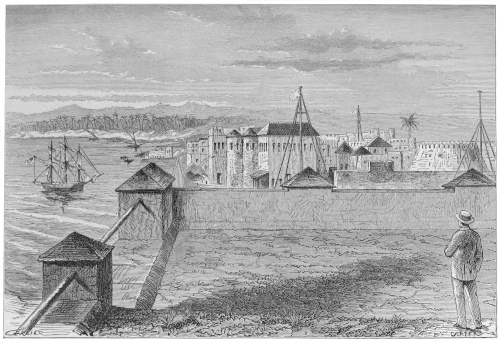
ZANZIBAR, FROM THE TERRACE OF H. B. M.’s CONSULATE.
Split bamboo forms the brooms, and the hard
material tears the plaster from the walls. A
coarse pottery, which the saltness of the clay
renders peculiarly brittle, is fabricated by the
Wasawahili at Changani Point, and supplants
255the original lagenarias. Some Kumárs, or
Hindustani potters, came to Zanzibar a few
years ago; they suffered so severely from fever
that, fancying themselves bewitched, all ran
away.
256
‘Zanzibar is an island of Africa, on the coast of Zanzibar,
governed by a king who is a tributary to the Portuguese.’
Reece’s Cyclopædia.
We now proceed to wait upon H. H. the
‘Sayyid of Zanzibar and the Sawahil,’ who would
be somewhat surprised to hear that he is ‘tributary
to the Portuguese.’
The palace lies east of, and close to, the fort.
It is fronted by a wharf, and defended by a stuccoed
platform mounting eight or nine brass
guns en barbette, intended more for show than
use. The building is a kind of double-storied,
white-washed barrack, about 140 feet long,
roofed with dingy green-red tiles, and pierced
with a few windows jealously raised high from
the ground; shutters painted tender-green temper
257the sun-glare, and a few stunted, wind-wrung
trees beautify the base. Seaward there is a verandah,
in which levees are held, and behind it
are stables and sundry outhouses, an oratory
and a graveyard, where runaway slaves, chained
together by the neck, lie in the shade. In this
oratory, as in other mosques, are performed the
prayers of the two Great Festivals which, during
the late prince’s life, were recited at the Mto-ni
‘Cascine.’ Here, too, is the large, gable-ended
house commenced in his elder age by the enterprising
Sayyid Said, and built, it is said, after the
model of the Dutch factory at Bander Abbas. It
was intended for levees, and for a hall of pleasure.
Unhappily, a large chandelier dropped
from the ceiling, seventy masons were crushed
by a falling wall; and other inauspicious omens
made men predict that the prince would never
enter the ‘Akhir el Zaman’ (End of Time). It
has since been shut up, like one of our ghost-haunted
houses, which it not a little resembles.
In the centre of the square, opposite the
palace, stands the Sayyid’s flag-staff, where the
‘Bákúr’ is administered, where executions take
place, and where, according to an American traveller,[66]
distinguished criminals are fastened to a
258pole, and are tied from the ankles to the throat,
‘till the soul of the dying man is literally
squeezed out of its earthly tenement.’ The
author, who visited Zanzibar in ‘the mercanteel,’
was grievously hoaxed by some kind friend.
Under Sayyid Said torture was unknown, death
was inflicted according to Koranic law, and only
one mutilation is recorded. I may remark, en
passant, that in this part of the world the two
master romancers, Ignorance and Interest, have
been busily at work; and that many a slander
rests upon the slenderest foundation of fact.
Adventurers have circulated the most ridiculous
tales. We hear, or rather we have heard, of
300,000 Arab cavalry, and hordes of steel-clad
negroes, possibly a tradition of the ‘Zeng’ (Zanzibarians),
who, in the days of the Caliphs, plundered
Basrah. We read of brilliant troops of
horse artillery, whose only existence was in the
brain of some unprincipled speculator; and yet
this report sent a battery from Woolwich as a
present for the late Sayyid. To the same category
belong the Amazons bestriding war-bul
locks, doubtless a revival of El Masudi, who in
our tenth century reported that the ‘King of
Zeng’ commanded, Dahoman-like, an army of
259soldieresses, mounted, as are the Kafirs, upon oxen—the
Portuguese ‘boi-cavallos.’ Some travellers
have asserted that the Cape tribes learned cattle-riding
from Europeans: but Camoens, making
his hero land at the Aguada de S. Braz, after
sailing from the Angra de Santa Elena, expressly
states—
‘Embrown’d the women by the burning clime,
On slow-paced oxen riding came along.’—Canto V. 63.
Durbars, or levees, are held three times a
day, after dawn-prayers, in the afternoon, and at
night. The ceremonial is simple. The lieges,
passing the two Sepoys on guard at the gate,
enter with the usual Moslem salutation, and
after kissing hands take their appointed places.
There is no lord of the basin, lord of the towel, or
lord of the pelisse, deemed indispensable by every
petty Persian governor. The ruler is addressed,
Yá Sídí, my lord, and is spoken of by his subjects
as Sayyidna, our prince. Coffee is served,
but only at night; and all forms of intoxicants
are jealously banished. The long, bare reception-hall,
ceilinged with heavy polished beams,
and paved with alternate slabs of white and black
marble brought from Marseille, boasts only a
few dingy chandeliers, and three rows of common
wooden-bottomed chairs. It is, however, unencumbered
260with the usual mean knicknacks,
French clocks and bureaux, cheap prints, gaudy
china, and pots of neglected artificial flowers,
supposed to adorn the window-sills; nor, after
the fashion of Zanzibarian grandees, are the
sides lined with seamen’s chests, stuffed full of
arms, watches, trinkets, cashmere shawls, medicines,
and other such ‘chow chow.’
The Prince received us at the Sadr, or top of
the room, with the usual courtesy. He was then
a young man, whose pleasing features and very
light complexion generally resembled those of
his father. This is said to have been the case
with the whole family. We found the ‘divan’
of Egypt and Turkey unaccountably absent,
banished by the comfortless black-wood ‘Kursi’
of Bombay. After a few minutes’ conversation
two chairs were placed before us, bearing a tray
of sweetmeats, biscuits, and glasses of sherbet;
of these we ate and drank a mouthful in acceptance
of hospitality, and we were duly pressed to
eat. Lemonade and confitures take the place of
strong waters amongst Europeans, and of the
cocoa-nut milk, the mangoes, and the oranges of
humbler establishments. Pipes, however, though
offered by the late Sayyid to distinguished European
guests, are never introduced, in deference
261to Wahhabi prejudice; nor did we suffer from
the rose-water ablutions of which M. Guillain
complains. Feminine eyes did not peep at us
from the inner apartments; but we were fronted
by well-dressed slaves who, as we pass through
the crowded outer hall, will steal, if they can,
the gilt tassels from our sword-knots, and who
have picked the pockets of guests, even when
dining with their Prince. H. H. the Sayyid
Majid took considerable interest in our projected
journey, and suggested that a field-piece might
be useful to frighten the Washenzi (wild men).
We left the palace much pleased with the kindness
and cordiality of its owner, into whose ear,
moreover, evil tongues had whispered the very
worst reports.
The Government of Zanzibar is a royal magistracy,
the only form of rule to which the primitive
and undisciplinable Eastern Arab will submit.
Whenever a new measure is brought forward
by the Sayyid it is invariably opposed by the
chiefs of clans, who assemble and address him
more like an equal than a superior. One of the
princes of Maskat corrected this turbulent feudality
after the fashion of Mohammed Ali Pasha
and his Mamlúk Beys; even now a few summary
examples might be made to good purpose. In
262the days of the late Sayyid’s highest fortunes the
most tattered of Súris would address him, ‘O
Saíd!’ and proceed to sit unbidden in his presence.
Similarly, Ibn Batutah, when describing
the Sultan of Oman, Abu Mohammed bin Nebhan,
tells us, ‘he has the habit of sitting, when
he would give audience, in a place outside his
palace; he has neither chamberlain nor wazir,
and every man, stranger or subject, is free to approach
him.’ Sometimes a noble, when ordered
into arrest at Zanzibar, has collected his friends,
armed his slaves, and fortified his house. One
Salim bin Abdallah, who had a gang of 2000 musketeer
negroes, used to wage a petty war with
the Sayyid’s servile hosts. It is, perhaps, the
result of climate that these disturbances have
never developed into revolutions.
The ‘ministers’ spoken of by strangers are
the Nakhodás of the fleet: by virtue of a few
French or English sentences, they are summoned
when business is to be transacted with Europeans
who are not linguists. The late Sayyid’s
only secretary and chief interpreter was Ahmad
bin Aman of Basrah (Bussorah), a half-cast Arab,
popularly called by the lieges ‘Wajhayn’ or
‘two faces.’ According to some he was a
Sabi or Sabæan, commonly known as a Christian
263of Saint John; and men declare that he began
life as a cabin-boy and rose by his unusual astuteness.
When any question of unusual gravity
occurs the Sayyid summons the Ulema, the
Shaykhs, and especially the two Kazis, Shaykh
Muhiyy el Din, a Lamu doctor of the Sunni
school, and Shaykh Mohammed, an Abázi. Causes
tried by ecclesiastics generally depend upon the
extent of bribery; but there is always an appeal
to the Prince, or in his absence to the Governor.
The Kazis punish by imprisonment more or less
severe. The stocks are set up in every plantation;
the fetters are heavy, and there is, if
wanted, a ponderous iron ring with long spikes,
significantly termed in Persian the ‘Tauk i
Ta’at,’ collar of obedience. Instant justice is the
order of the day, and the crooked stick (bákúr)
plays a goodly and necessary part; how necessary
we see in the present state of Syria, whence
the ‘Tanzimat’ constitution has banished the
only penalty that ruffians fear. From ten to
fifty blows are usually inflicted: in the Gulf,
when the bastinado is to be administered with
the Niháyet el Azáb (extreme rigour), half-a-dozen
men work upon the culprit’s back, belly,
and sides, and a hundred strokes suffice to kill
him. Severe examples are sometimes necessary,
264though chastisement is on the whole wild and
unfrequent. Zanzibar town is subject to fires,
originating with the slaves, often in drunkenness,
more often for plunder; and this induced the
late Sayyid to forbid the building of cajan
‘tabernacles’ (Makuti or Banda-ni) upon the
house-tops. His orders were obeyed for four
months, an unusually long time; and at last
Europeans, in consequence of the danger which
threatened them, were compelled personally to
interfere with the severest preventive treatment.
The Prince alone has the power of pronouncing
a capital sentence; and, as usual in Moslem
countries, where murder is a private, not a public,
offence, the criminal is despatched by the
relatives of the slain. Death may be inflicted
by the master of the house upon a violator of
domicile, gallant, or thief; the sword is drawn,
and the intruder is at once cut down. Fines
and confiscations, which have taken the place
of the Koranic mutilation, are somewhat common,
especially when impudent frauds are practised
upon the Prince’s property. Confinement
in the fort, I have said, is severe, but not so
much feared as at Maskat, whose rock dungeon
is an Aceldama; I saw something of the kind at
Fernando Po. Criminals have a wholesome
265horror of being the ruler’s guest, yet they sometimes
escape by the silver key, and, once upon
the mainland, they may laugh at justice. I
heard of a Banyan who, despite being double-ironed,
managed to ‘make tracks.’
The military force of Zanzibar is not imposing.
In 1846, throughout the African possessions
of the Sayyid, the permanent force was
only 400 men, namely, about 80 at Zanzibar,
250 at Mombasah, 30 at Lamu, 25 at Patta, 6
to 10 at Kilwa, and sundry pairs at Makdishu
and other places; after that time they were
doubled and even trebled. The ‘regulars’ consist
of a guard of honour, a ‘guardia nobile’
of a dozen serviles habited in cast-off Sepoy
uniforms, collected from different corps of the
Bombay army: one musket carries a bayonet,
the other a stick. The cost of new equipments
was once asked by the late Sayyid; after
glancing at the total, he exclaimed that the
guard itself would not fetch half that sum. The
irregular force is more considerable, and represents
the Hayduques of old Eastern Turkey, the
Arnauts or Albanians of Egypt, the Bashi-Buzuks
of El Hejaz, and the Sayyáreh and Zabtiyyeh
of modern Syria. The so-called Baloch are
vagrants and freebooters collected from Northern
266Arabia and from the southern seaboard of Persia,
Mekran, and Kilat: when the Prince required
extra levies he rigged out a vessel and recruited
at Guadel or at Makallah. He preferred
the Aryan,[67] as being more amenable to discipline
than the Semite: moreover, the Arab clansman,
like the Highlander of old, though feudally
bound to follow his suzerain, requires the order
of his immediate chief, and the latter, when most
wanted, is uncommonly likely to rat or to
revolt. The mercenaries of Zanzibar nominally
receive $2 to $3 per mensem, with rations:
practically, the money finds its way more or
less into the pocket of the Jemadar or C. O.
The fort is here garrisoned by some 80 of these
men and their negro slaves: the former are
equal to double the number of Arabs in the
field, and behind walls they are a match for a
nation of savages. Police by day and night
patrols are much wanted at Zanzibar, where
every man must be his own ‘Robert.’ The
slaves are unruly subjects; even those of the
fort will commit an occasional murder, and the
suburbs are still far from safe during the dark
267hours. The garrison is securely locked up, and
in case of most urgent need no aid is procurable
before morning.
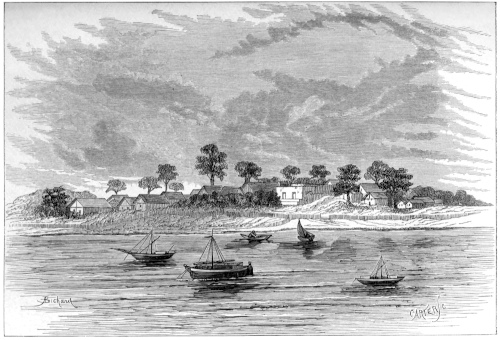
I may now offer a catalogue raisonné of the
late Sayyid’s fleet, which was intended to keep
up the maritime prestige of his predecessors, the
Yu’rabi Imams. The Shah Alam, a double-banked
frigate of 1100 tons, carrying 50 guns
(45, says M. Guillain, i. 584), was built at Mazagon
in 1820, and now acts guardship, moored off
Mto-ni. The ‘Caroline’ (40 guns), the best of the
squadron, and built at Bombay, was degraded to
be a merchantman, in which category she visited
Marseille (1849): she has, however, again
opened her ports after returning from Maskat.
The strong and handsome ‘Sultana’ was
wrecked near Wasin when returning from
India. The ‘Salihi’ was lost in the Persian
Gulf; the ‘Sulayman Shah’ and the ‘Humayun
Shah,’ in the Gulf of Bengal. The ‘Piedmontese,’
36 guns, built at Cochin in 1836, might be repaired
at an expense of £10,000. The ‘Victoria’
frigate (40), teak-built in the Mazagon dockyard,
is still sea-worthy. The ‘Rahmani’ corvette
(24 guns), is a fast-sailing craft with great
breadth of beam, hailing from Cochin: she was
lately fitted out for a recruiting vessel to Hazramaut.
268The ‘Artemise’ corvette, formerly of 18
guns, now a jackass frigate with 10 guns en barbette,
was built at Bombay of fine Daman teak,
and was lately repaired there, at an expense of
22,000 Co.’s Rs. Called Colonel Hamerton’s
yacht, because always placed at his disposal by
the late Sayyid, she will carry him on his last
voyage, accompanying us to Bagamoyo upon the
mainland. She is commanded by the sailing-master
of the fleet, Mohammed bin Khamis, who
has studied navigation and modern languages in
London—of him more anon. The lighter craft
are the ‘Salihi’ barque (300 tons), built in America
about 1840, condemned and repaired in Bombay;
and the ‘Taj’ brig (125 tons), launched at
Cochin in 1829, and originally intended for a
yacht. Besides there is a mosquito squadron
composed of some 20 ‘batelas,’ each armed with
2 to 6 guns, which serve equally for cabotage
and for campaigning.
The useless, tawdry ‘Prince Regent,’ presented
by H. B. Majesty’s Government to the
late Sayyid, was by him passed over in 1840 to
the Governor-General of India. It was sold at
Calcutta, and for many years it was, as a transport,
the terror of the eastern soldier. The Sayyid
could not pray amongst the ‘idols’ of gilding
269and carving; he saw pollution in every picture,
and his Arabs supposed the royal berth to
be the Tábút Hazrat Isa—Our Lord’s coffin.
Instead of this article he wished to receive the
present of a steamer, but political and other objections
prevented.[68] Eastern rulers also will not
pay high and regular salaries; and without
European engineers every trip would have cost
a boiler. Repairs were impossible at Zanzibar;
and, as actually happened to Mohammed Ali’s
expensive machinery in Egypt, the finest work
would have been destroyed by mere neglect. A
beautiful model of a steam-engine was once sent
out from England: it was allowed to rust unopened
in the Sayyid’s ‘godowns.’ Still the
main want of the Island was rapid communication.
Sometimes nine months elapsed before an
answer came from Bombay: letters and parcels—including
my manuscript—were often lost;
and occasionally, after a long cruise, they returned
to their starting-point, much damaged by
time and hard usage. The Bombay Post-office
clerks thinking, I presume, that Zanzibar is in
Arabia, shipped their bags to Bushire and Maskat,
270some thousand miles N. West instead of
S. West of Bombay, and viâ Halifax—half round
the world—was often the speediest way of communication
with London. No wonder that letters
were delayed from 7 to 9 months, causing great
loss to the trade, and inconvenience to the
authorities. Her Majesty’s proclamation was
published in India on November 1, 1858; the
Prince of Zanzibar was obliged with a copy only
in March, 1859. A line of steamers from the
Cape and other places was much talked of; it
would certainly obviate many difficulties, but the
Zanzibar merchants who had a snug monopoly
were dead against free-trade and similar appliances
of modern civilization. The French Company
then running vessels from Mauritius to
Aden, proposed to touch at Zanzibar if permitted
to engage on their own terms ‘ouvriers libres.’
The liberal offer was declined with thanks.
The Royal Treasury is managed with an extreme
simplicity. When the Prince wants goods
or cash he writes an order upon his collector of
customs; the draft is kept as an authority, and
the paper is produced at the general balancing
of accounts, which takes place every third or
fourth year. I found it impossible to obtain
certain information concerning the gross amount
271of customs, and inquiry seemed only to lead
further from the truth. The ruler, the officers
under him, and the traders all have several interests
in keeping the secret.
The Custom House is in an inchoate condition;
it makes no returns, and exports being free,
it requires neither manifest nor port clearings
from ships about to sail. The customs are farmed
out by the Sayyid, and 10 years ago their value
was $142,000, or 38 per cent. less than is now
paid. The last contractor was a Cutch Banyan
named Jayaram Sewji. The ‘ijáreh’ or lease
was generally for five years, and the annual
amount was variously stated at $70,000 to
$150,000, in 1859 it had risen to $196,000 to
$220,000.[69] He had left the Island before Sayyid
Said’s death, and though summoned by the
Prince Majid, there was little chance of his committing
the folly of obedience. His successor was
one Ladha Damha, also a Bhattia Hindu, and a
man of the highest respectability. These renters
declared that they did not collect the amount
which they paid for the privilege: on the other
hand, they could privately direct their caste fellows,
272do what they pleased with all unprotected
by treaty, and having a monopoly as tradesmen
between the wholesale white merchants and the
petty dealers of the coast, they soon became
wealthy.
Land cess and port dues were unknown at
Zanzibar. The principal source of revenue was
the Custom House, where American and European
goods, bullion excepted, paid the 5 per cent. ad
valorem provided by commercial treaties. Cargo
from India paid 5·25, the fractions serving to
salary Custom House officials. The import was
levied on all articles transshipped in any ports of
the Zanzibar dominions, unless the cargo was
landed only till the vessel could be repaired. Of
course the tariff was complicated in the extreme,
‘custom’ amongst orientals being the ‘rule of
thumb’ further west. The farmers appointed
all subordinate officials, and as these received insufficient
salaries, smuggling, especially in the
matters of ivory and slaves, came to their assistance.
The Wasawahili Makhadim, or serviles,
contributed an annual poll-tax of $1 per head,
and this may have amounted to 10,000 to 14,000
crowns per annum. The maximum total of the
late Sayyid’s revenue was generally stated as
follows—
| 273 |
| Maskat (customs) German crowns |
$180,000 |
| Mattra (Matrah) |
60,000 |
| Maskat and Mattra (octroi from the interior) |
20,000 |
| Average receipts from other parts of Africa and Arabia |
20,000 |
| Zanzibar (customs and poll-tax) |
160,000 |
| Total in German crowns |
$440,000 |
In 1811 Captain Smee computes the revenue
of Zanzibar at $60,000 per annum, adding, however,
that he considers it to be much more. In
1846 M. Guillain gives the revenue arising from
customs on coffee and cloves, Indian rice and
melted butter, and divers taxes on shops, indigo,
dyes, thread-makers, silk-spinners, and so forth, as
follows—
| Total of Oman |
$136,600 |
|
| ” African dominions |
349,000 |
|
| Grand total |
$485,600 |
= 2,500,000 francs. |
The author, who appears to have been ably
assisted in his inquiries by M. Loarer, also states
that in the days of Sayyid Said’s father the farming
of the customs at Zanzibar represented $25,000,
from which it gradually rose to $50,000; $60,000;
$80,000; $100,000; $105,000; $120,000;
$147,000; $157,000; and $175,000 in 1846. We
may safely fix the revenue in 1857 at a maximum
of £90,000 per annum. The expenses of navy,
army, and ‘civil service,’ and the personal expenditure
274of the Prince were easily defrayed out of this
sum, whilst the surplus must have been considerable.
The income might easily have been increased,
and the outlay have been diminished by
improving the administration; but the Sayyid
had ‘some time before his death reached that
epoch of life when age and weariness determine
men to consider the status quo as the supreme
wisdom.’
Under the new régime affairs did not improve.
An Indian firm farmed the customs
throughout the Zanzibar dominions for the annual
sum of $190,000, and the following is the
official statement of the revenues derived by ‘His
Highness the Sultan,’[70] in 1863-4.
| Customs dues |
|
$190,000 |
| Pemba dues |
|
6,000 |
| Poll-tax of Makhádim |
|
10,000 |
| Private clove plantations |
|
15,000 |
| |
Total |
$221,000 |
| Deduct subsidy paid to Maskat |
|
40,000 |
| |
Balance |
$181,000 |
The income, thus sadly fallen off, was hardly
enough for the necessaries of the ruler, and left
275no margin available for improvements or public
works. At last the government, which by treaty
is unjustly debarred from imposing export or
harbour dues, or even from increasing the import
duties, devised a modified system of land-tax,
charging 5 per cent. per annum on cloves,
and 2 pice (= 3/4d.) on mature cocoa-trees whose
estimated average value is $1. This, if levied,
would produce about $40,000 per annum.
Since that time prosperity has returned to
the Island. The return of imports by the Custom
House rose from £245,981 in 1861-2 to
£433,693 in 1867-8.[71] One half of the trade was
in the hands of English subjects, and the Committee
remarks that Zanzibar is the chief market
of the world for ivory and copal; that the trade
in hides, oils, seeds, and dyes is on the increase,
whilst cotton, sugar, and indigo, to which may
be added cocoa, loom in the distance.
276
‘Mais, comme le livre n’est point une œuvre de fantaisie,
comme il traite de questions sérieuses, et qu’il s’addresse à des
intérêts durables, je me résigne, pour lui, à l’inattention du
moment, et j’attendrai patiemment pour que l’avenir lui ramène
son heure, lui refasse, pour ainsi dire, une nouvelle opportunité.’—M.
Guillain.
There is little of interest in the annals of
Oman and of her colonies. Fond of genealogy,
the modern Arabs are perhaps the most incurious
of Orientals in the matter of history:
they ignore the past, they disregard the present,
and they have a superstitious aversion to speak
of the future. Lawless and fanatical, treacherous,
blood-thirsty and eternally restless, the
Omani races, whose hand is still against every
man, have converted their chronicles into a kind
277of Newgate Calendar, whilst the multitude of
personages that appear upon the scene, and the
perpetual rising and falling of Imams, princes, and
grandees, offer to the reader a mere string of
proper names. Ample details concerning Maskat
will be found in the pages of Capt. Hamilton,
Carsten Niebuhr, Wellsted, and Salíl ibn Razík,[72]
to mention no others. Zanzibar has ever been,
since historic times, connected with Oman,
whose fortunes she has reflected; the account of
the distant dependency given by travellers is,
therefore, as might be expected, scanty and
obscure.
At an early period the merchants and traders
of Yemen frequented the Island, and exchanged,
as we read in the Periplus and Ptolemy,
their homes of barren rock and sand for the
luxuriant wastes of Eastern Africa. If tradition
be credible, their primitive settlements were
Patta (Bette), Lamu, and the Mrima fronting
these islets; and here to the present day the
dialect of their descendants has remained the
purest. Themselves pagans, they lived amongst
the heathenry, borrowed their language, as the
278Arabs and the Baloch still do, intermarried with
them, and begot the half-caste Wasawahili, or coast
population. In proof that these were the lords
of the land, the late Sultan Ahmad, chief of the
Shirazi, or free tribe of the mulattoes, received
annual presents from the Arab Sayyid of Zanzibar.
When the former died Muigni Mku, his
wazir, or brother—here all fellow-countrymen
are brothers—succeeded, in default of other heirs,
to the position of monarch retired from business.
He is a common-looking negroid, who lives
upon the proceeds of a plantation and periodical
presents: he is not permitted to appear as an
equal at the Sayyid’s Darbar, and it is highly improbable
that he will ever come to his own again.
The Sawáhil or Azania continued to acknowledge
Arab and Persian supremacy till the
appearance of the Portuguese upon the coast.
D. Vasco da Gama passed Zanzibar Island
without sighting it when first bound Indiawards,
and authors differ upon the subject of his return
voyage. The historian Toão de Barros (i. 4, 11)
relates that the expedition made its land-fall
from India below Magadoxo (Makdishu or
Maka’ad el Shaat, ‘the sitting-place of the
sheep’),[73] beat off a boat attack from ‘Pató’
279(Patta), visited Melinde, Mozambique, and the
Aguada de S. Braz, and doubled the Cape of
Storms on March 20, 1499. Goes[74] declares
that da Gama, after touching at MakdishuMakdishu and
Melinde, arrived at Zanzibar on February 28,
and was supplied by its ruler with provisions,
presents, and specimens of country produce. The
island is described as large and fertile, with
groves of fine trees, producing good fruit, two
others, ‘Pomba’ (Pemba) and ‘Mofia’ (our Monfia
and the Arab Mafiyah), lying in its vicinity.
These settlements were governed by Moorish
princes ‘of the same caste as the King of Melinde’—doubtless
hereditary Moslem Shaykhs and
Sayyids. The population is represented as being
in ‘no great force, but carrying on a good trade
with Mombassa for Guzerat calicoes and with
Sofala for gold.’ The ‘King of Melinde’ made
a name in Europe. Rabelais commemorates
Hans Carvel, the King of Melinda’s jeweller, and
(in Book I. chap. v.) we read, ‘thus did Bacchus
280conquer Ind; thus philosophy, Melinde,’—meaning
that the Portuguese taught their African
friends more drinking than wisdom. João
de Barros (ii. 4. 2) informs us that the Chief
of Zanzibar was ‘da linhagem dos Reys de
Mombaça, nossos imigos.’ The inhabitants were
‘white Moors’ (Arabs from Arabia) and black
Moors or Wasawahili; the former are portrayed
as a slight people, scantily armed, but clothed in
fine cottons bought at Mombasah from merchants
of Cambaya. Their women were adorned
with jewels, with Sofalan gold, and with silver
obtained in exchange for provisions, from the
people of St Lawrence’s Island (Madagascar).
And here we may remark that the Arab settlements
in East Africa, visited by the Portuguese
at the end of the 15th century, showed generally
a civilization and a refinement fully equal to, if
not higher than, the social state of the European
voyagers. The latter, expecting to find savages
like the naked Kafirs of the South, must not
have been a little surprised to receive visits
from the chiefs of Mozambique and Melinde,
men clad in gold, embroidered silks, velvets, and
‘crimson damask, lined with green satin;’
armed with rich daggers and swords sheathed
in silver scabbards, seated on arm-chairs, and
281attended by a suite of some 20 richly-dressed
Arabs. The modest presents offered by the
Europeans to these wealthy princelets, whose
women adorned themselves with pearls and other
precious stones, must have given a mean idea of
Portuguese civilization. And even in the present
day the dominions of the ‘barbarous Arab’
are superior in every way to the miserable
colonies on the West African coast, which represent
Christian and civilized Europe.
Four years afterwards (1503) Ruy Lourenço
Ravasco, a Cavalleiro da Casa d’ El Rey, sailing
with D. Antonio de Saldanha, cruized off ‘Zemzibar,’
as his countrymen called Zanzibar, and in
two months captured twenty rich ships, laden
with ambergris, ivory, tortoiseshell, wax, honey,
rice, coir, and silk and cotton stuffs. This captain
appears, like most of his fellows, to have
been a manner of pirate: he did not restore them
till ransom was paid. ‘El Rey,’ still friendly to
the Portuguese, sent a spirited remonstrance,
when the insolence of the reply forced him to
take hostile measures. The Arabs manned their
canoes with some 4000 men; but two launches,
well-armed with cannon, killed at the first discharge
34 men and put the rest to flight. Thus the
Malik or Regulus was compelled by Ravasco to pay
282an annual tribute of 100 gold miskals in token of
submission to the greedy and unprincipled Dom
Manuel. ‘The conquered pays the conquest!’
exclaims with Christian emphasis the venerable
Osorio. Portugal now began to gather gold from
Sofala to Makdishu; ‘Wagerage,’ the chief of
Melinde, contributed every year 1500 wedges
(ingots) of the precious metal, and the insolence
of the victors must have made the good old man
deeply regret the welcome and the Godspeed
which he had bestowed upon the exploratory
expedition.
The Portuguese having wrested Kilwa and
Mombasah from its Arab chiefs, D. Duarte de
Lemos, appointed (A.D. 1508) by the King
Governor of the ‘Provinces of Æthiopia and
Arabia,’ attacked successively Mafiyah, Zanzibar,
and Pemba, for failing in the paramount
duty of paying tribute. Mafiyah submitted, the
people of Pemba escaped to Mombasah, leaving
nothing in their houses, and Zanzibar resisted,
but the town was taken and plundered. The
Shaykh retired northwards, and his subjects
fled to the bush, ‘depois de bem esfarrapados na
carne con a ponta da lança, e espada dos nossos’—after
being well pierced in the flesh by the
lance-points and the sword-blades of our men—says
283the chronicler. From this time probably
we may date the pointed arches that still remain
upon the Island, and the foundation of the fort,
which is popularly attributed to the ‘Faranj.’
Mombasah and Pemba were presently occupied
by the Portuguese; and the ruins of their extensive
barracoons, citadels, and churches still
argue ancient splendour. In other places upon
the seaboard I found deep and carefully sunk
wells, stone enclosures, and coralline temples,
whilst vestiges of European buildings may be
traced, it is said, contrary to popular opinion,
many days’ journey inland.
We read little about Lusitanianized Zanzibar,
where the insalubrity of the climate must
have defended the interior, and even parts of the
coast, from the spoiler. In A.D. 1519 the Moors
massacred certain shipwrecked sailors belonging
to the expedition of D. Jorje de Albuquerque.
Three years afterwards the Shaykh, or, as he
styled himself, the Sultan[75] of Zanzibar, who,
after submitting to Ravasco, had acknowledged
himself a vassal of D. Manuel, fitted out, with
the aid of the factors João de Mata and Pedro
284de Castro, a small expedition against the Quirimba
islandry, who had allied themselves with
the hostile tribes about Mombasah. The attack
was successful, the chief town was pillaged and
burnt, and terror of the invader brought all the
neighbouring islets to terms. In 1528-9 the
Viceroy of India, Nuno da Cunha, being about
to attack Mombasah, was supplied with provisions
by the Chief, and the Portuguese presently
reduced the coast to a single rule whose centres
were successively Kilwa, Sofala, and Mozambique.
East Africa then became one of the four
great governments depending upon the vice-royalty
of India; the three others being Malacca,
Hormuz, and Ceylon.
In this state Zanzibar remained till the close
of the next century. When, however, Pedro
Barrato de Rezende, Secretary to the Viceroy,
Count of Linhares, wrote his ‘Breve Tratado’ on
the Portuguese colonies of India and East Africa
(1635), the Island had ceased to be vassal and
tributary, but the Sultan remained friendly to
Europeans. Many of the latter occupied with
their families rich plantations; Catholic worship
was protected, and there was a church in which
officiated a brother of the order of St Austin.
There was the usual massacre of the Portuguese,
285and expulsion of the survivors in imitation
of Mombasah, about 1660; and the Islanders,
doubting their power to procure independence,
applied for assistance to the Arabs.
The reign of the Yu’rabi of Oman, a clan
of the great Ghafiri tribe, began as follows.
The Imam, Sultan bin Sayf bin Malik el Yu’rabi,
the second of the family, having recovered
Maskat (April 23, 1659), and Matrah, created
a navy which added Kang, Khishm, Hormuz,
Bahrayn, and Mombasah (1660) to the Arabian
possessions left by his ancestors. After investing
Bombay this doughty chief died in A.D. 1668 or
in 1669. His son, Sayf bin Sultan, after defeating
an elder brother, Belárab, became the
third Imam of the house of Yu’rabi, and summoned
to submission the petty chiefs on the
eastern mainland of Africa. Between A.D. 1680
and 1698, the powerful squadron of the warlike
Moor drove the Portuguese from Zanzibar,
Kilwa, Pemba, and Mombasah, where he established
as Governor Nasir bin Abdillah el
Mazru’i, the first of the great family of that
name. He failed only at Mozambique. Arabs
still relate the legend how having closely invested
the fort they were undermining the wall,
when a Banyan gave traitorous warning to the
286besieged. Pans of water ranged upon the ground
showed by the trembling fluid the direction of
the tunnel; a countermine was sprung with
fatal effect, and the assailants, retreating in confusion
to their shipping, raised the siege.[76] The
squadron, however, pursued its course as far
south as the Comoros and Bukini (Madagascar,
or rather the northern portion of the Island),
whence, hearing of the ruler’s death, it returned
home. When the Island became Arab property
the Wasawahili fled to the ‘bush’: they presently
consented to render personal service, or to purchase
exemption by annually paying $2 per head.
Sayf bin Sultan was succeeded, in A.D. 1711,
by his eldest son, Sultan bin Sayf, who defeated
with his fleet of 24 to 28 ships, carrying 80
guns, the soldiers of Abbas III. and of Nadir
Shah. After his decease the chieftainship of
Oman was seized by a distant relative, Mohammed
bin Nasir, Lord of Jabrin, who according
to some, first assumed, according to others, resumed,
the title of ‘Imam,’ making himself
priest as well as prince, like him of Sana’a in
Yemen. It has ever been a Kháriji, and especially
a Bayází tenet, that any pious man, not
only those belonging to the Kuraysh or the Prophet’s
287tribe, might rise to the rank of Pontiff.
In A.D. 751 they were powerful enough to elect
Julandah ben Mas’úd, but the succeeding dynasty
rejected the term. The usurped rule was recovered
after his decease (A.D. 1728) by Sayf el
Asdi, a younger son of Sultan bin Sayf: this indolent
debauchee being shut up in Maskat by a
cousin, Sultan bin Murshid—some corrupt his
father’s name to Khurshid—applied for assistance
to that Nadir Shah, whom his more patriotic
father had successfully resisted. In 1746 the
Persians, aided by intestine Arab divisions, soon
conquered Oman: Sultan bin Murshid slew himself
in despair, and Sayf el Asdi, duped by his
allies, died of grief in his dungeon at Rustak.
The latter city was in those days the ordinary
residence of the Imams; in fact, a kind of
cathedral town as well as capital.
The power now fell from the hands of the
Yu’rabis (Ghafiris) into the grasp of their rivals,
the Bu Saidi (Hinawis). These ancient lords of
Oman claim direct descent from Kahtan (Joetan),
great-grandfather of Himyar, founder of
the Southern Arabs, and brother to Saba, who
built in Yemen the city that bore his name: the
stock is held to be noble as any in the Peninsula.
Oman remained under foreign dominion, paying
288tribute to, and owning the rule of, Nadir Shah,
till the Chief of Sohar, Said bin Ahmad el Bu
Saídí, struck the blow for freedom. Five years
afterwards (A.D. 1744) his son, Ahmad bin Saíd,
artfully recovering Maskat from Mirza Taky
Khan, the Governor of Fars, who had revolted
against Nadir Shah, expelled the Persians from
Oman. When laying the foundation of the
present dynasty he assumed the title of ‘Sayyid’
(temporal ruler); persuaded the Mufti to elect
him ‘Imam’ (prince-priest), and was confirmed
in his dignities by the Sherif of Meccah. Colonel
Pelly (p. 184, Journal Royal Geographical
Society, 1865) gives a somewhat different account—‘It
appears that the family of the
Imams of Muskat were originally Sayeds of a
village, named Rowtheh, in the Sedair immediately
below the Towaij hills. The founder of
the family was Saeed. His son’s name was
Ahmed. They came to Oman, and took service
under the dominant tribe called Yarebeh. Subsequently
they obtained possession of the strong
hill-fort called Ilazm, in the neighbourhood of
Rostak. Eventually they became the rulers of
Oman, and changed their sect from that of Sunnee
to Beyãthee.’ Ahmad allied himself with the
ex-royal Yu’rabis, by marrying a daughter of
289Sayf el Asdi. After crushing sundry rebellions,
he plundered Diu (A.D. 1760), and massacred the
population, a disaster from which the great port
and fort never recovered. He then sent an
army of 12,000 men against the Ghafiri of Ra’as
el Khaymah, who had assisted the Persians to
attack the Kawasim, and against the Nuaymi, a
powerful clan dwelling south of Sharjah on the
Pirate Coast. His success was complete; Khurfakan,
Khasab, Ramsah, Ra’as el Khaymah,
Jezirat el Hamrah, Sharjah, and Fasht, all in
turn submitted to him. In A.D. 1785 he personally
visited Mombasah, and by his lion-like
demeanour he secured its submission.
Dying shortly afterwards, Ahmad bin Said
left the government to his son, Said bin Ahmad,
who was declared Imam, but was confined till
the date of his death, in 1802, to Rustak and its
territory by his younger brother, the ambitious
and warlike Sultan bin Ahmad. This prince
occupied the islands of Khishm, Hormuz, and
Bahrayn; he attempted to protect his commerce
from the pirates of Julfar and Ra’as el Khaymah,
especially the Kawasim, in our hooks called
Jowasmee:[77] these Algerines of the East had now
290become Wahhabis, and were hacked by all the
influence of Saúd, Lord of Daraiyyah. After
vainly attempting to obtain aid from the Pasha
of Baghdad, Sultan bin Ahmad was attacked
whilst sailing to Bandar Abbas by five ships of
the Kawasim, and was shot in the mêlée on Nov.
18, 1804.
This decease brought to power the late
Sayyid Said,[78] the second son born to Sayyid Sultan
bin Ahmad in A.D. 1790. His maternal
uncle, Sayyid Bedr bin Sayf, and the Wahhabi
Chief, Saúd, enabled him to defeat Sultan Kays
bin Ahmad of Sohar, another uncle who aimed
at usurpation; but the danger was shifted, not
destroyed. At length, in A.D. 1806, Sayyid
Said’s aunt, the Bihi Mauza, daughter of the
Imam Ahmad, and popularly known as the Bint
el Imam, determined that Sayyid Bedr must be
slain at a Darbar. Sayyid Said, a youth of 16,
was unwilling, but the strong-minded woman—in
every noble Arab family there is at least one—prevailed,
and on July 31 the dangerous protector
291whilst descending the stairs, was struck
in the back by his nephew’s dagger. Sayyid
Bedr sprang from the window, and mounted a
stirrupless horse which stood below, when he
was wounded with a spear; the ‘Imam’s daughter,’
with a blood-thirstiness truly feminine,
cheering on the assassins, till after riding half a
mile on the highway from Birkat to Sohar, he
fell from his animal and was speedily despatched.
The young prince was, they say, so strongly
affected by the scene, that through life he could
hardly be persuaded to order a death.[79]
Thus Saíd became, with the consent of his
elder brother, Sayyid Salim, an independent
ruler, and the fourth of his dynasty, the Bú
Saídí. His proper title was ‘Sayyid,’ which in
Oman and amongst the Eastern Arabs means a
chief or temporal ruler, whereas ‘Sherif’ is a
descendant of the Prophet. Many Anglo-Indian
writers ignore this distinction. ‘Imam’ is
an ecclesiastical title, signifying properly the man
who takes the lead in public prayer, and it demands
both study and confirmation: in sectarian
theology it is the hereditary head of El
292Islam. The ‘Imam of Mascat,’[80] therefore, never
followed the practice of his predecessors. His
acclamation took place on Sept. 14, 1806. He
was immediately involved in troubles with Mombasah,
Makdishu, and the unruly Arab settlements
of the East African Coast. His possessions
in Oman also were invaded and overrun by
the Wahhabis, under Saúd who died in 1814,
and afterwards under his son Abdullah: these
energetic Puritans converted, by much fighting
and more intrigue, several tribes to ‘Unitarianism’;
the land was at once fettered with a
five per cent. Zakát (annual tribute), of which
Maskat paid 12,000 German crowns, and Sohar
$8000. Yet his valour and conduct gradually
raised Sayyid Saíd to wealth and importance,
and the warlike operations of Mohammed Ali
Pasha against the Wahhabis gave him power to
throw off the yoke. His personal gallantry in
the disastrous affair with the Benu Bú ’Ali
(1820-21), won him the praise of India, and
the gift of a sword of honour from the Governor-General.
His tolerance, so unusual in Arabia,
the patriarchal character of his rule, and his
293love of progress, as shown by his concessions to
European and Hindu traders, and by a squadron
of three frigates, four corvettes, two sloops, seven
brigs, and twenty armed merchant vessels, entitled
him to a place amongst civilized powers.
With England he became an especial favourite,
after he had entered into the Palmerstonian
views upon the subject of slave exportation.
He began by sacrificing, it is said, 100,000
crowns annually, and he declined the various
equivalents, £2000 for three years, and other
paltry sums offered in A.D. 1822, as a compensation
by Captain Moresby, R.N. His friendship
with us, indeed, cost him dear: more than once
he threatened that if other concessions were demanded
by the unconscionable abolitionist he
would escape the incessant worry by abdicating
and retiring to Meccah.
Sayyid Saíd first left Maskat for Zanzibar in
1828, and finally in 1832, justly offended by our
refusing to assist him, according to treaty,
against Sayyid Hamud bin Azran bin Kays,
the rebel chief of Sohar. Our policy on this
occasion is generally supposed to have been
prompted by Captain, afterwards Colonel, Sam.
Hennell, British Resident at Bushire. This
official, acting doubtless under orders, and living
294in constant dread of ‘breaking the peace of the
Gulf,’ preserved it by yielding every point to
every man; and the ignoble attitude which,
amongst a warlike race, provoked only contempt,
laid the foundation of the last Persian war. It
was on a par with the orders which, under pain
of dismissal, bound the officers commanding the
Honourable East India Company’s cruisers in
the Persian Gulf not to open fire upon a squadron
of pirates unless they began the cannonade; and
which caused the capture by boarding of more
than one man-of-war.
Zanzibar had, since its conquest by Oman,
been governed by an officer appointed from
Arabia. Sayyid Saíd found the town a line of
cajan huts, with the fort commanding the
harbour, which served only for an occasional
pirate or slaver. Till A. D. 1822 some 15 or 16
Spaniards and Portuguese ranged these seas,
committing every kind of atrocity: they were
dangerous outside the port, and when at anchor
they were guilty of every crime; as many as three
and four have been killed in a single night, and a
priest was kept for the purpose of shriving the
stabbed and burying the slain. These, however,
were the days of large profits. The share of
one Arab merchant in a single adventure was
295worth $218,000—he now (1857) begs his bread.
Sayyid Saíd at Once began to encourage
foreign residents. With a remarkable liberality
he at once broke up the monopoly of trade
which the Wasawahili had preserved for eight
centuries, including the 200 years when it was
perpetuated by the avidity and the fanaticism
of the Portuguese. The United States, who
being first in the market for ivory, copal, and
hides, had dispersed their cottons and hardwares
throughout Eastern Africa, concluded with him,
in Sept. 1835, an advantageous treaty, and established,
about the end of 1837, a trading consulate
at his court. Four years afterwards (December,
1841) Lieut.-Colonel Hamerton was
directed to make Zanzibar his head-quarters as
‘H. B. Majesty’s Consul, and H. E. I. Company’s
Agent in the dominions of H. H. the Imaum.’
Captain Romain Desfossés, the Mentor of the
Prince de Joinville, and commanding the naval
division of Bourbon and Madagascar, escorted by
a squadron, signed a treaty on November, 1844.
He was accompanied by a consul without a chancellier,
and the former at once receiving his exequatur,
began residence.
The Sayyid was unfortunate in sundry attempts
to subjugate the Zanzibar Coast: his
296conduct of war argued scant skill as a general, but
he never forfeited his well-earned favour for personal
gallantry. With the true Arab mania for
territorial conquest, he eventually succeeded in
flying his flag at all the ports that belonged to
the Yu’rabi Imams, and which had descended,
by the irregular right of succession, to his ancestor,
Ahmad bin Saíd the Hinawi. The Mazara’
(Mazrui) clan, alias the Arabo-Mombasah
princes, a turbulent and hot-tempered feudality,
who, after the massacre of the Portuguese, had
been allowed, by Sayf bin Sultan, to retain the
city on condition of sending occasional presents
and of doing certain baronial services, refused (A.D.
1822) allegiance to the Ayyal Bú Saíd. Captain
Vidal, R.N., finding this important place threatened
by Zanzibar, accepted an application from the
citizens, who had hoisted the British flag; advised
that they should be received as protégés, and persuaded
the claimant to withdraw. The Sayyid
remonstrated against these measures with the
Bombay Government; and the ministers of the
Crown to whom the question was referred, eventually
removed our establishment.
Sayyid Saíd, early in 1828, sailed with a
squadron carrying 1200 men, to attack the town,
but after taking and garrisoning the fort, he was
297compelled to make Zanzibar, and eventually
Maskat. The retreat was in consequence of the
troubles excited by Saúd bin Ali bin Sayf, the
nephew of Sayyid Bedr, supported by the sister
of Sayyid Hilal, chief of Suwayk, who had been
treacherously imprisoned. He was enabled, by
the aid of Isá bin Tarif and his dependents, to
invest, with a squadron carrying a force of 4000
to 5000 men, about the end of December, 1829,
Mombasah Fort, from which his garrison had
been repulsed. The Mazru’is, numbering a total
of some 1500, gallantly held their ground: the
Sayyid’s soldiers, suffering severely from fever,
refused to fight: briefly two campaigns had little
effect upon the besieged, and the Sayyid was
obliged to accept the semblance of submission, in
order to return triumphant to Zanzibar. After
visiting Maskat, and putting down Hamud bin
Azran, who had taken Rustak, and was threatening
the capital, he broke the treaty with Mombasah,
and blockaded it throughout the N. East monsoon
from November, 1831, to April, 1832. During
the next year he attacked the place for the third
time; but, after a week’s campaign, he returned
once more with Oriental triumph to Zanzibar in
February, 1833. Then treachery was called in
to do the perfect work. Ráshid bin Salim bin
298Ahmad, the Mazru’i Wali or governor, and
twenty-six of his kinsmen, enticed by the most
solemn oaths, which were accompanied by a
sealed Koran—it is wonderful how liar trusts
liar!—embarked on one of the Sayyid’s ships,
which carried his son Sayyid Khalid and Sulayman
bin Ahmad. The vessel instantly weighed
anchor, stood for Zanzibar, and consigned its
cargo to life-long banishment and prison, at Mina
and Bandar Abbas. The Mazara’ at once sank
into utter obscurity.
Sayyid Saíd was persuaded (Jan. 6, 1843) to
attack that notorious plunderer, Bana M’takha,
chief of Sewi, a small territory near Lamu, who
had persuaded one Mfumo Bakkari, and afterwards
his brother Mohammed bin Shaykh, to declare
himself Lord of Patta, and independent of
the Arab prince. The ruler of Zanzibar here failed
to repeat his success at Mombasah, the wily African
shutting his ear to the charmer’s voice. The
second son, Sayyid Khalid, then disembarked his
1200 to 1300 troops, Maskatis and Wasawahili,
‘cowardly as Maskatis,’ who with the Súri are
the proverbial dastards of the race. He served
out with Semitic economy five cartridges per head,
and he marched them inland without a day’s rest,
after a ‘buggalow’-voyage from Arabia. Short
299of ammunition, and worn out by fatigue, they
soon yielded to the violent onslaught of the enemy.
The Wágunya, or as some write the word Bajúní,
warriors, described to be a fierce race of savages,
descended from the Wasawahili, the Somal, and
the Arab colonists, charged in firm line, brandishing
spear-heads like those of the Wamasai, a cubit
long, and shouting as they waved their standards,
wooden hoops hung round with the dried and
stuffed spoils of men.[81] The Arabs fled with such
precipitation, that some 300 were drowned, an
indiscriminate massacre and mutilation took
place, the ‘England’ and the ‘Prince of Wales’
opened an effectual fire upon their own boats
and friends; the guns which had been landed were
all captured, and the Sayyid Khalid saved himself
only by the speed of his horse. The operation
was repeated with equal unsuccess next
year, Sayyid Said himself embarking on board
the ‘Victoria:’ the general, Hammad bin Ahmad,
fell into an ambuscade, and again the artillery
was lost. After a blockade of the Coast, which
lasted till the end of 1866, the Kazi of Zanzibar,
Muhiyy el Din of Lamu, landing upon his
300native island, talked over the insurgents. Bana
M’takha afterwards sent back the Arab cannon,
saying that he could not afford to keep weapons
which ate such vast meals of powder, and acknowledged
for a consideration the supremacy of Zanzibar,
retaining his power, and promising but
never intending to pay an annual tribute of
$5000. Hence the Baloch mercenaries speak of
their late employer as a king who bought and
sold, and who was more distinguished for the
arts of peace than for the nice conduct of war.
Even his own subjects complained on this occasion
of his folly in commencing, and of his want
of energy in carrying on, the campaign.
The Sayyid’s matrimonial engagements were
numerous. In 1827 he married the daughter
of the Farmán-farmá (Governor) of Fars, and a
grand-daughter of Fath ’Ali Shah, under an
agreement in the marriage contract that the
bride might spend every summer with her
own family at Bandar Abbas or Shiraz. Disgusted
with Arab homeliness, and with six years
of monotonously hot life at Maskat, she obtained
leave, and once in a place of safety she wrote
back a strong epistle. It began, ‘Yá Dayyus!
yá Mal’ún’Mal’ún’, alluding to the report that Sayyid
Khalid had violated the harem of his father, as
301the latter was also said to have done in his
younger days. The Arab prince had lowered
himself in the eyes of his subjects by representing
himself to be a Shiah. She called him a
dog-Sunni, and upon this ground she demanded
instant divorce. The Sayyid despatched two
confidential elders with orders to represent that
his spouse could not legally claim such indulgence:
a singular bastinado upon the soles of
their feet soon made the venerable learned discover
that divine right was upon the lady’s side.
Her next exploit was to bowstring, in jealousy, a
Katirchi (muleteer) with whom she had intrigued;
and, driven from Shiraz by the fame of
this exploit, she died at Kazimayn, in child-bed,
her lover being this time a Hammamchi, or
bath-servant.
In A.D. 1833, four years after the death of
Radama I., the Sayyid formed matrimonial designs
upon the person of Ranavola Manjaka,
Queen of the Hovas, and a personage somewhat
more redoubtable than our good Queen Bess.
Amongst his envoys on this occasion was one
Khamisi wa Tání, who, under the Arabized name
Khamis bin Osman, presently played some
notable tricks upon the credulous ‘comparative
geographer,’ Mr W. D. Cooley. The envoys
302were kept upon the frontier till the ‘Tangi-man’
arrived, bringing the Tangina. This nut, scraped
in water, is administered as an ordeal, like the
bitter water of the ancient Israelites and the
poison nut of modern Calabar. The patient is
ordered to walk about; after some 20 minutes
he feels atrocious bowel-pains, prolapsus takes
place, and he dies; if wealthy enough to pay
the priest, another kind of nut is at once administered,
and it may cure by emesis. As soon as
this potion, which always destroys traitors with
frightful torments, in fact, with the worst symptoms
of Asiatic cholera, was proposed to the ambassadors,
in order to prove the purity of their
intentions, and their affection for the royal family,
all fled precipitately, as may be imagined, from
the ‘Great Britain’ of Africa. Sayyid Said was
also unlucky in the choice of another Persian
bride, the daughter of Irich Mirza, a supposititious
son of Mohammed Shah, and hardly a
second-class noble. She came to Zanzibar in
A.D. 1849, accompanied by a train of attendants,
including her Farráshas (carpet-spreaders), her
Jilaudár (groom), and her private Jellád (executioner).
She astonished the Arabs by her free use
of the dagger, whilst her intense relish of seeing
her people ride men down in the bazar, and of
303superintending bastinadoes administered with
Persian apparatus, made the Banyans crouch in
their shops with veiled faces, and the Arabs
thank Allah that their women were not like
those of the A’ajám. In a short time the lady
made herself so disagreeable, that her husband
sent her back divorced to her own country.
The Sayyid kept a company of 60 or 70 concubines,
and he always avoided those that bore him
children. Though a man of strong frame and
vigorous constitution, he exhausted his powers
by excesses in the harem, he suffered from
Sarcocele (sinistral) during later life, and an
alarming emaciation argued consumption. The
heat of Maskat, which he last visited when
hostilities between England and Persia were
reported, brought him to his grave. In October,
1856, he died at sea off the Seychelles Islands, on
board his own frigate, the ‘Victoria.’ Aged 67,
the ‘Second Omar,’ as his subjects were fond of
calling him before his face, seems to have had
a presentiment of death; before embarking he
prepared, contrary to Arab custom, a ‘Sandúk
el Mayyit,’ or coffin, and when dying he gave
orders that his remains should be thrown overboard.
The corpse, however, was carried to Zanzibar
and interred in the city.
304Sayyid Said was probably as shrewd, liberal,
and enlightened a prince as Arabia ever produced,
yet Europe overrated his powers. Like
Orientals generally, he was ever surrounded by
an odious entourage, whom he consulted, trusted,
and apparently preferred to his friends and well-wishers.
He firmly believed in the African
Fetish and in the Arab Sahir’s power of metamorphosis;[82]
he would never flog a Mganga
305(medicine-man), nor cut down a ‘devil’s tree.’
He sent for a Shaykh whose characts were
famous, and with a silver nail he attached the
306paper to the doorway of Lieut.-Colonel Hamerton’s
sick-room, thereby excluding evil spirits
and the ghost of Mr Napier, who had died at
the Consulate. He refused to sit for his portrait—even
Colonel Smyth’s History of Knight-errantry
and Chivalrous Characters failed to
tempt him, for the European peasants’ reason,—it
would take away part of his life. When
‘chivalry’ was explained to him, he pithily remarked
that only the ‘Siflah’ (low fellows) interfere
between man and wife, master and man.
His pet axiom—a fair test of mental bias—was
‘Mullahs, women, and horses never can be
called good till death,’ in this resembling Pulci—
Cascan le rose, e restan poi le spine;
Non giudicate nulla innanzi al fine.
The Société Royale des Antiquaires du Nord
sent him their diploma: he declared that he would
not belong to a body of grave-robbers and corpse-snatchers.
The census of Zanzibar having been
proposed to him, unlike King David, he took refuge
with Allah from the sin of numbering his
people. When tide-gauges were supplied by the
Geographical Society of Bombay, he observed
that the Creator had bidden the ocean to ebb and
to flow—‘what else did man want to know about
it?’ Such was his incapacity for understanding
307European affairs, that until death’s-day he believed
Louis Philippe to have carried into exile,
as he himself would have done, all the fleet and
the public treasure of the realm. And he never
could comprehend a Republic—‘who administers
the stick?’
Of this enterprising man, the Mohammed Ali
Pasha of the further East, I may say, Extinctus
amabitur idem. Shrewd and sensible, highly religious
though untainted by fanaticism; affable
and courteous, he was as dignified in sentiments
as distinguished in presence and demeanour. He
is accused of grasping covetousness and treachery—but
what Arab ruler is not covetous and
treacherous? He was a prince after the heart of
his subjects; prouder of his lineage than fond of
ostentation or display, an amateur conqueror on a
small scale, mild in punishment, and principally
remarkable as the chief merchant, cultivator,
and ship-builder in his dominions. An epitaph
may be borrowed for him from a man of very
different character—first in war, first in peace,
and first in the hearts of his fellow-countrymen.
Peace be to his manes!
Sayyid Said’s territory at the time of his
death extended in Oman from the Ra’as el Jebel
(Cape Musseldom) to Sohar. In Mekran the
308seaboard between Ra’as Jask and Guadel belonged
to him: in the Persian Gulf he had
Khishm, Larak, and Hormuz, and he farmed
from the Shah, Bandar Abbas and its dependency,
Mina. His African possessions were far
the most extensive and important. He ruled, to
speak roughly, the whole Eastern Coast from N.
lat. 5°, and even from Cape Guardafui, where
the maritime Somal were to a certain extent his
dependents, to Cape Delgado (S. lat. 11°), where
the Arab met the Portuguese rule—an extent of
16° = 960 geographical miles. The small republics
of Makdishu (Magadoxo, in N. lat. 2°
1′ 4″), of Brava (N. lat. 1° 6′ 48″), of Patta or
Bette (S. lat. 2° 9′ 12″), and of Lamu (S. lat.
2° 15′ 42″), owned his protectorate, and in April,
1865, Marka received from him a garrison. The
whole Zanzibarian Archipelago was his, and he
claimed Bahrayn, Zayla, Aden, and Berberah,
the first-mentioned with, the last three without,
a shadow of right. His Arab subjects declared
that they, and not the Portuguese, ceded Bombay
to the British: the foundation of the story
is a mosque built in ancient times by the
Omanis, somewhat near the present Boree Bandar.
Sayyid Said left a single widow, the lady
309Azzá bint Musa, of the Bú Kharibán, a grand-daughter
of the Imam Ahmad, and consequently
a cousin. She is now (1857) in years, but her
ancient lineage and her noble manners retain
for her the public respect. She had but one
child, which died young: all the male issue of
the Prince are by slave-girls, a degradation in
the eyes of free-born Omani Arabs. As usual
amongst the wealthy and noble of the polygamous
East, the daughters are the more numerous,[83]
and many are old maids, the pride of
birth not allowing them, like the Sherifehs of
the Hejaz, to wed with any but equals. The
eldest of the fourteen sons, Sayyid Hilal, who,
in 1845, had visited England, it is said, after
an escapade, died at Aden en route to Meccah
in 1851. He was followed, after an interval of
a few months, by his next brother, Sayyid Khalid,
called the Banyan. The eldest surviving
310heir (Sayyid Suwayni), the son of a Georgian or
Circassian slave, born about 1822, became by his
father’s will, successor to and lord of the northern
provinces. To Sayyid Majid, the fourth son,
now (1857) aged 22, a prince of mild disposition
and amiable manners, contrasting strongly with
the vigorous ruffianism of his elder brother, was
left the Government of Zanzibar and of the
East African Coast. There is, as usual amongst
Arabs, a turbulent tribe of cousins: of these the
most influential is Sayyid Mohammed, a son of
Sayyid Salim bin Sultan, younger brother to the
late Prince, who some years ago died of consumption.
Hitherto he has used his powers
loyally—ruling, but not openly ruling. Sayyid
Said’s valuable property, including his plantations,
was sold, as his will directed, and the
money was divided according to a fixed scale,
even the youngest princes claiming shares. No
better inducement to permanent dissension could
have been devised. But Eastern monarchs apparently
desire that their dynasties should die
with them. Fath Ali Shah of Persia, when
asked upon his death-bed to name a successor,
drew a sword and showed what made and unmade
monarchs: scarcely had the breath left his
body than the chamber was dyed with the blood
311of his sons, each hastening to stab some hated
rival brother.
These lines were penned in 1857. Since
1859 the hapless and turbulent family has been
in a state of fratricidal strife, and the province
of Oman has reverted to its normal state of intrigue,
treachery, and assassination. Sayyid
Suwayni, a negligent and wasteful though not
an unpopular man, to whom the English were
especially obnoxious, threatened in 1859 an attack
upon Sayyid Majid, and was prevented by
British cruisers; in due time he was murdered
by his son, Sayyid Salim, who usurped the
Government. This Sayyid Salim was dethroned
by his uncle, Sayyid Turki, who surprised Maskat,
and made himself master of the situation.
The European would imagine that the stakes
were hardly worth such reckless play: Arabs,
however, judge otherwise.
312
‘Quiconque ne voit guère
N’a guère à dire aussi. Mon voyage depeint
Vous sera d’un plaisir extrême.
Je dirai; j’étais là; telle chose m’avint,
Vous y croirez être vous-même.’—La Fontaine.
The 300,000 souls[84] now (1857-9) composing
the residents on, and the population of, the Zanzibar
Island, are a heterogeneous body. The
former consist of Americans and Europeans,
313about 14,000 Banyans (including those of the
Coast), a few Parsees and Portuguese from Goa,
and sundry castes of Hindustani Moslems, Khojahs,
Mehmans, and Borahs, numbering some
1200. There are also trifling numbers of free
blacks from the Comoro Islands, Madagascar,
Unyamwezi, and the Somali country. To this
accidental division I will devote the present
chapter.
The Consular corps is represented by three
members, who, as usual in these remote Oriental
spots, assume, and are allowed to assume, the
position of plenipos. The first American official
was Mr Richard Palmer, who was succeeded by
sundry acting men: the second was Mr Waters,
who left in 1844: then came Mr C. Ward, Mr
Webb, and Mr Macmullan. Captain Mansfield
now (1859) holding office, is agent to Messrs
John Bertram and Co. of Salem. This gentleman,
who took a great interest in the East
African Expedition, has had a more extensive
experience of the East than his predecessors; he
has also the advantage of being respectable and
respected.
On the part of the French Government the
first Consul was M. Broquant: he died of fever
and dysentery at Zanzibar, and was succeeded by
314M. de Beligny, a French Creole from Santo
Domingo, afterwards transferred to Manilla and
to Charleston, South Carolina. M. Vignard, a
young man of amiable manners, and distinguished
in Algeria as an Arabic scholar, fell
victim to a sunstroke when voyaging from Aden,
where I met him en route for his post. The present
Consul is M. Ladislas Cochet: the Chancellier
and Dragoman is M. Jablonski, Pole
and poet.
Lieut.-Colonel Atkins Hamerton is, and has
been, I have said, H. B. Majesty’s Consul, and
H. E. I. Company’s Agent at the Court of H. H.
Sayyid Said, since December, 1841, when we first
established relations with Zanzibar. Attached
to his establishment is a passed apothecary, an
Eurasian, the only attempt at a medico on the
Island. Lieut.-Colonel Hamerton had been on
terms of intimacy with Sayyid Said during a
quarter of a century; and their friendship, as
happens, began with a ‘little aversion.’ The
Britisher proposed to travel in the interior from
Maskat, in those days a favourite exploration
with the more adventurous; and the Arab, suspicious
as all Arabs, thinking it safest to put the
intruder out of the way, imprudently wrote a
letter to that effect. This missive fell into the
315hands of the person whom it most concerned: he
boldly carried it to the Prince, and reproached
him in no measured terms with his perfidy.
Sayyid Said found himself overmatched, submitted
to Kismat, and, admiring the traveller’s
spirit and openness, determined to win his attachment.
The two became firm friends; the
Consul was the influential adviser of the ruler,
and the latter intrusted him with secrets jealously
hidden from his own. The reason why
the trade of Zanzibar was surprisingly developed
under the primitive rule of an Arab Prince
is not only the immense wealth of Eastern
Africa, it results mainly from the wise measures
of a man who for the greater part of his life
devoted himself to the task. It was an unworthy
feeling which made M. Guillain write of
my late friend (ii. 23), ‘Bref, sa réputation est
de placer fort bien, et à beaux bénéfices, l’argent
que lui donnent la reine et le gouvernment de la
compagnie’—his generosity to his family left
little after his decease. Not the least of Sayyid
Said’s anxieties upon his death-bed was to reach
Zanzibar alive, and even when half-unconscious
he continually called for Colonel Hamerton. It
is suspected that he wished to communicate the
place of his concealed treasures, which, despite
316the most careful search, were never found. When
hiding their hoards it is not unusual for Arabs
to put to death the slaves who assist in the labour,
and thus to prevent negro indiscretion. The
family, I may here say, firmly believes that
Colonel Hamerton knows where the hoards lay,
and yet refuses to divulge the secret.
It will not be easy properly to fill this appointment.
Without taking into consideration
the climate, it is evident that few Englishmen
are prepared to settle for long years at remote
Zanzibar, and Arabs do not care to trust new
men. Yet it would be the acme of short-sightedness
to neglect this part of East Africa. Our
Anglo-Indian subjects, numbering about 4000[85]
in the dominions of Zanzibar, some of them
wealthy men, are entitled to protection from the
Arab, and more especially from the Christian
merchants. Almost the whole foreign trade, or
at least four-fifths of it, passes through their
hands; they are the principal shopkeepers and
artisans, and they extend as far South as Mozambique,
Madagascar, and the Comoro Islands.
During the last few years the number of Indian
settlers has greatly increased, and they have
317obtained possession from the Arabs, by purchase
or mortgage, of many landed estates in the Sayyid’s
dominions. The country can look forward
only to a moderate development whilst it continue
in the present hands, but the capabilities
of the coast are great. Labour only is wanted;
and a European power establishing itself upon
the mainland—this object has frequently been
proposed, and is steadily kept in view—could in
a few years command a territory and a commerce
which would rival Western India.
The other white residents are commercial,
and it is with no little astonishment that the
Englishman finds no direct trade with Great
Britain, and meets none of his fellow-countrymen
at Zanzibar.[86] Their absence results not
from want of venture or dearth of business, but
from supineness on the part of the authorities.
No merchant can profitably settle where he cannot
freely correspond, receive advices that ships
have been despatched, and obtain orders for cargoes
and consignments. Moreover, large sums
have been wasted by respectable houses in settling
here trustworthy agents and sober men. The few
favourable exceptions found the climate either
318unendurable or fatal. Hitherto, however, Englishmen
have done little, and, I write it unwillingly,
Englishwomen have done less, for the
honour of the national name at Zanzibar than in
most parts of the East. Two girls came out to
the Island, married to the usual ‘black princes,’
who mostly turn out to be barbers or domestic
servants; this proceeding greatly scandalized
the white residents, and the Desdemonas gave
more trouble to the officials than the whole
colony.
The principal American houses are those of
Messrs Bertram & Co., represented by Captain
Mansfield, Mr Ropes, and Mr Webb: Messrs
Rufus Green & Co., also of Salem, have three
agents, Messrs Winn, Spalding, and Wilkins.
Lastly, there is Mr Samuel Masury, of Salem, a
‘general merchant,’ distinguished for probity
and commercial sagacity: he left Zanzibar
during our exploration of the interior, and he
presently came to an untimely end.
The French houses began with a misconception,
a certain chancellier having reported officially
to his Government, that 232 ships annually
visited and loaded at Zanzibar. The intelligence
caused considerable excitement: it was believed
that every vessel left these shores crammed with
319copal, ivory, and gold dust, and the French
merchants resolved by concurrence to drive the
Americans out of the field. Messrs Vidal frères
of Marseille despatched accordingly to Zanzibar
Messrs Bauzan, Wellesley, and Peronnet,
and appointed M. Mass their second agent at
Lamu. They were opposed by Messrs Rabaud
frères, also of Marseilles, a house from whom we
received especial kindness: their Zanzibar manager
was M. Hannibal Bérard, and M. Terassin
was sent to the ‘bone of contention,’ Lamu.
These firms choose their employés amongst their
captains, who act supercargoes as well as commanders;
they are estimable men, sober and
skilful, but painfully lax in dealing with ‘les
nègres.’ Their Consul publicly declared that it
was his duty to curb the merchants, as well as
to protect the commerce of France.
The specialty of the French houses is oil.
They export the cocoa-nut in various forms,
sesamum and other oleaginous grains, which
Provence converts with such energy and success
into huile d’olives. The sesamum is a comparatively
new article of commerce, yet the Periplus
(chap. xiv.) numbers Elæon Sesáminon (oil of
sesamum) amongst the imports from India.
Now it is supplied chiefly by Lamu. Vast
320quantities could be grown there, but the natives,
though large advances have been offered to them,
will not extend their cultivation for fear of lowering
the price, which has lately doubled.
French ships now visit the West Coast of India
as far North as Kurrachee, in search of sesamum,
and last year (1856) 27 vessels took cargo from
Bombay.
At length the Marseille houses found out
that Zanzibar is overstocked with buyers; that
demand in these regions does not readily, at
least, create supply; that it is far easier to dispose
of than to collect a cargo; that the African
man will not work as long as he can remain idle,
and that sure profits are commanded only by the
Banyan system; briefly, the two French houses
are eating up each other. The Messrs Vidal are
named for a loss of $400,000, which it will be
impossible to recoup. It is also reported that
too sanguine M. le Chancellier was threatened
with a procès-verbal; of his 232 ships 70 were
whalers, many names had been twice registered,
and only 32 (232 minus 200) took in cargo.
The houses from Hamburg, that ‘Carthage of
the Northern Seas,’ conclude the list of Europeans.
The brothers Horn and M. Quas, agents
for Messrs Herz and Co., are the most successful
321copal cleaners; they find it more economical to
keep a European cooper than to depend upon
the bazar. Messrs William and Albert Oswald,
British protégés, represent their father; they are
assisted by M. Witt, an intelligent young man,
who having graduated in Californian gold-fields,
proposes to prospect the Coast. M. Koll acts
for Messrs Hansing and Co., and, lastly, M.
Reich, lately returned to the Island, is the representative
of Messrs Müller and Co.
Europeans are, as a rule, courteously treated
by the upper classes, and civilly by the Arabs at
Zanzibar; this, however, is not always the case
on the Coast. They are allowed to fly flags;
every merchant has his staff upon his roof, and
there is a display of bunting motley as in the
Brazil. Even a Cutch boat will carry the Sayyid’s
plain red colours, with the Union Jack in
the corner, and the Turkish crescent and star in
the centre.
Composed of patch-work material, the Europeans
do not unite, and their disputes, especially
between compatriots, are exasperated by commercial
rivalries, which have led to serious violations
of faith. All is wearisome monotony: there
is no society, no pleasure, no excitement; sporting
is forbidden by the treacherous climate, and,
322as in West Africa and the Brazil, strangers soon
lose the habit of riding and walking. Moreover,
the merchants, instead of establishing the business
hours of Bombay, make themselves at home
to their work throughout the day; this is the
custom of the Bonny River, where supercargoes
are treated like shopkeepers by the negroes.
European women, I repeat, seldom survive the
isolation and the solitary confinement to which
not only the place but also the foul customs of
the people condemn them.
The necessaries of life at Zanzibar are plentiful,
if not good. Bread of imported wheat is
usually ‘cooked’ in the house, and the yeast of
sour toddy renders it nauseous and unwholesome.
There have been two bakers upon the Island:
one served at the Consulate, the other, a Persian,
was in the employment of the Prince. Meat is
poor; a good preserved article would here make
cent. per cent. Poultry is abundant, tasteless
and unnutritious; fish is also common, but it is
hardly eatable, except at certain seasons. Cows’
milk is generally to be had, but the butter is
white, and resembles grease; fruit must be
bought at the different bazars early in the
morning. All such articles as tea, wine, and
spirits, cigars, tobacco, and sweetmeats, are imported
323from America or from Europe,—the town
supplies nothing so civilized. Retail dealing is
wanted, and the nearest approach to a shop is
the store of a Khojah, who will buy and sell
everything, from a bead to a bale of cloth.
All articles but money are expensive at Zanzibar,
where the dollar represents our shilling.[87]
This is the result of the large sums accumulated
by trade and of the necessity of importing provisions;
we see the same process at work throughout
the tropical Brazil. Moreover, in all semi-barbarous
lands a stranger living like a native,
may live upon ‘half-nothing;’ if he would, however,
preserve the comforts of home, and especially
if he would see society, he must consent to an
immoderate expenditure. Finally, where the
extremes of wealth and poverty meet, and where
semi-civilization has not discovered that prudence
is a virtue and improvidence a blunder,
the more man spends the more he is honoured.
324The humblest dwelling at Zanzibar lets unfurnished
for £80 to £100 per annum. Furniture
of all kinds, porcelain, china, plate, and
linen, no matter how old, fetch more than prime
cost, and $1 will be paid for a patched and
rickety chair worth in London a shilling. Clothing
must be brought from Europe: broad cloth
is soon spoiled by sun and damp, and shoes must
not be exposed to the air—it is well to have the
latter one or two sizes larger than at home. The
luxuries of life are of course enormously dear,
when they are to be purchased. During the
Sayyid’s absence the women of his harem have,
through the eunuchs, sold for a song the valuable
presents sent from Europe; and after the
return of the royal vessels from Bourbon and
the Mauritius, watches and chronometers, sextants
and spy-glasses, have been exceedingly
cheap. In both cases the stranger-purchaser
would have done well to remember that he was
buying stolen goods.
Another cause of expense at Zanzibar is the
present state of the currency. The rouble of
Russia is the franc of France, and here the
standard of value is the Maria Theresa or German
crown, averaging 4s. 2d. Bearing the die of
1780, and still coined at the mint of Vienna for
325the Arab and the E. African trade, it is perferred
by the people simply because they know it. The
popular names are Riyál (i.e. real, royal) or Girsh
(groschen, ‘broad’ pieces). Spanish dollars (bú
tákeh, ‘father of window,’ whence our ‘patak’),
elsewhere 8 per cent. more valuable, are here only
equal to Maria Theresas. In 1846 a French
Mission failed to fix the agio of the 5 franc
piece at 10 per cent. below the Spanish dollar,
which still remained 12.50 to 14 per cent. more
valuable. The Company’s rupee, better metal
than both the above, being still a comparative
stranger, loses nearly a quarter of its value. Other
silver pieces are the ‘Robo’ (Spanish quarter
dollar) of 25 cents, and the pistoline (20 cents);
these, however, are subject to heavy agio. Small
change is always rare, another sure sign of
thriftlessness, and it is strange how scarce is
bullion in a land so wealthy: I can only account
for the fact by the Oriental practice of burying
treasure.[88]
Where men reside solely for gain and sorely
against the grain, little can be expected from
society. Every merchant hopes and expects to
leave Zanzibar for ever, as soon as he can realize a
certain sum; every agent would persuade his employer
326to recall him. Of late years, also, foreigners
complain of a falling off in ivory, copal, cloves,
and other articles which the natives, it might be
supposed, could most easily supply; thus profits
are curtailed, and a penny saved is a penny
gained. Most residents are contented with an
Abyssinian or Somali girl, or perhaps an Msawahili;
with a Portuguese cook, who consents to
serve till he also can get away; and with a few
hired slaves or free blacks, the dirtiest, the least
honest, and the most disorderly of domestics.
The British Consulate is the only establishment
which employs Indian Moslems, perhaps the best
of Eastern attendants. This luxury costs, however,
at least £25 per mens., each man receiving
from $10 to $12, about double the wages paid
in India, and all are ever anxious to return
home, the mal de pays making them discontented
and unhappy. The bumboat-men and
the beach-combers are Comoro rascals, who sometimes
gain considerable sums; there are also
some half-a-dozen negroes, speaking a little bad
French, and worse English, who offer themselves
to every stranger, and who fleece him till turned
away for making the quail squeak. Workmen
are hired by the day. Carpenters demand $0.50,
three times the Indian wage, and the day’s
327work is at most 5 hours; of these men 4
barely did in 43 what 2 ship-carpenters managed
in 5 days. The blacksmith and tin-man receive
from $0.50 to $1 per diem; the goldsmith is
paid according to the value of what he takes in
hand—so much per dollar-weight.
The merchants, par excellence of Zanzibar, are
the enterprising Bhattias or Cutch Banyans.
The Periplus (chap. xiv.) mentions an extensive
import trade for Ariáke and Barugaze, the latter
generally identified with Baroch.[89] Vasco da
Gama found ‘Indians,’ especially Calicut men, at
Mozambique, Kilwa, Mombasah, and Melinde,
and by their information he reached their native
city. From the beginning of the present century
the monopoly fell into the hands of the Bhattia
caste. At first they were obliged to make Zanzibar,
viâ Maskat, in a certain ship which sailed
once a year: they were exposed to many hardships
and perils: several of them were murdered,
and when a Hindu died the Arabs, like the
Turks of Masawah, claimed the droit d’aubaine.
They rose in mercantile repute by commercial
integrity, frugality, and perseverance, whilst the
inability of the Moslem Sarráf to manage accounts
328or banking put great power into their
hands. At Maskat and the neighbourhood they
number nearly 500, and here about 400.[90] They
extend southwards to Angosh (Angoxa) and
Mozambique, where they make fortunes by the
sale of Casimir noir, and where they are now as
well treated as they were formerly tyrannized
over by the Portuguese. Thus, though never
leaving the seaboard, they command the inland
trade, sending, where they themselves do not care
to travel, Arabs and Wasawahili to conduct
their caravans of savages and slaves. For this
reason they have ever been hostile to European
exploration, and report affirms that they have
shown no scruples in compassing their ends.
They are equally powerful to forward the discoverer;
they can cash drafts upon Zanzibar,
Mandavi, and Bombay; provide outfits, supply
guards and procure the Págázi, or porters, who
are mostly their employés. Ladha Damha
farms the customs at Zanzibar, at Pemba Island
his nephew Pisú has the same charge: Mombasah
is in the hands of Lakhmidas, and some
40 of his co-religionists; Pangani is directed by
Trikandas and contains 20 Bhattias, including
329those of Mbweni; even the pauper Sa’adani has
its Banyan; Ramji, an active and intelligent
trader, presides at Bagamoyo, and the customs
of Kilwa are collected by Kishindas. I need
hardly say that almost all of them are connected
by blood as well as by trade.
The Bhattia at Zanzibar is a visitor, not a
colonist; he begins life before his teens, and,
after an expatriation of 9 to 12 years, he goes
home to become a householder. The great
change of life effected, he curtails the time of
residence to half, and furloughs become more
frequent as transport waxes easier. Not a Hindu
woman is found upon the Island; all the Banyans
leave their wives at home, and the consequences
are certain peccadilloes, for which they
must pay liberally. Arab women prefer them
because they have light complexions; they are
generous in giving jewels, and they do not indulge
in four wives. Most of them, however,
especially those settled on the Coast, keep
handsome slave-girls, and, as might be expected
where illegitimates cannot be acknowledged, they
labour under the imputation of habitual infanticide.
On the other hand, their widows may not
remarry, and they inherit the husband’s property
if not embezzled by relatives and caste-fellows.
330The Bhattias are forbidden, by their Dharma
(‘caste-duty’) to sell animals, yet, with the usual
contradiction of their creed, all are inveterate
slave-dealers. They may not traffic in cowries,
that cause the death of a mollusc; local usage,
however, permits them to buy hippopotamus-tusks,
rhinoceros-horn, and ivory, their staple of
commerce. We cannot wonder if, through their
longing to shorten a weary expatriation, they
have sinned in the matter of hides. This, together
with servile cohabitation, caused a scandal
some years ago, when the Maháráj, their high
priest, sent from Malwa a Chela, or disciple, to
investigate their conduct. Covered with ashes
and carrying an English umbrella, the holy man
arrived in a severe mood; he rejected all civilities,
and he acknowledged every address with
a peculiar bellowing grunt, made when ‘Arti’ is
offered to the Dewta or deity. The result was
a fine of $20,000 imposed upon the rich and
wretched Jayaram. The sum was raised amidst
the fiercest and most tumultuous of general
subscriptions, and since that day the spoils of
the cow have been farmed to a Khojah employé.
All oppose with might and main the slaughter of
cattle, especially in public, and they attempt to
quit the town during the Moslem sacrificial days.
331The long limp black hair, the smooth yellow
skin, and the regular features of the Bhattia,
are conspicuous near the woolly mops, the
grinning complexions, and the flat faces of the
Wasawahili. His large-peaked Cutch turban,
white cotton coat or shoulder cloth, and showy
Indian dhoti around the loins, contrasts favourably
with the Arabs’ unclean garb. The
Janeo, or thread of the twice-born, passes over his
shoulder, and, in memory of home, he encircles
his neck with a string of dry Tulsi stalks
(Ocimum canum, a species of herb Basil), which
he now grows at Zanzibar. His manners as well
as his outer man are rendered pleasant and
courteous by comparison with the rest of the
population, and he is a kind master to his serviles,
who would love him if they possibly could
love anything but themselves.
These Hindus lead a simple life, active only
in pursuit of gain. On the Coast, where profits
are immense—Trikandas of Pangani, for instance,
claims $26,000 of debt—they have substantial
stone houses, large plantations, and
goodly gangs of male and female slaves. Those
resident at Zanzibar are less anxious to display
their wealth: all, however, are now entitled by
treaty to manage their own affairs without the
332interference of the local Government. These
Banyans will buy up the entire cargoes of
American and Hamburg ships: the ivory from
the interior is consigned to them, and they purchase
the copal from the native diggers. They
rise at dawn to perform the semi-religious rite
‘Snán’ (bathing), apply to business during the
cool of the day, and dine at noon. Avoiding
Jowari, the Arabs’ staff of life, they eat boiled
rice, vegetables, and ghee, or wheaten bread and
Mung, or other pulse, flavoured with assafœtida,
turmeric, and ‘warm spices.’ They chew tobacco,
though forbidden by caste rule to smoke
it, and every meal concludes with betel-nut and
pepper-leaf, whose heating qualities alone enable
them, they say, to exist at Zanzibar. They work
all day, rarely enjoying the siesta unless rich
enough to afford such luxury: they bathe in
the evening, sup at 9 P.M., chew betel once
more, and retire to rest.
As the Island contains no local Dewta, the
Bhattias are careful to keep a Vishnu in the
house, and to travel about, if possible, with a
cow: in places like Pangani, where the horned
god cannot live, they supply its place by a
Hanuman (a small monkey, like the Presbyter
Entellus of India) trapped in the jungle.
333Pagodas not being permitted, they meet for
public devotions at a house in the southern
quarter of the city, where most of them live,
and lately they have been allowed to build a
kind of fane at Mnazi Moyya. As usual with
Banyans, the Bhattias have no daily prayers: on
such festivals as the Pitri-paksha—the ‘Manes-Fortnight,’
from the 13th to the 18th of the
month Bhadrapad—they call in, and fee a Brahman
to assist them. Their proper priests are
the Pokarna, who, more scrupulous than others,
refuse to cross the sea: the Sársat Brahmans, so
common in Sind and Cutch, are the only high-caste
drones who to collect money will visit
Zanzibar and Maskat. With a characteristic
tenderness, these Banyans cook grain at the
landing-places for the wild slaves, half-starved
by the ‘middle-passage,’ and inclination as well
as policy everywhere induces them to give alms
largely. Apostasy is exceedingly rare: none
Islamize, except those who have been perverted
by Moslems in their youth, or who form connections
with strange women. The Comoro men,
here the only energetic proselytizers, have, however,
sometimes succeeded: a short time ago
two Bhattias became Mohammedans, and their
fellow caste-men declared that the Great Destruction
334was drawing nigh. Yet Vishnu slept, and
still sleeps the sleep of the just.
When a Bhattia’s affairs become hopelessly
involved he generally ‘levants’: sometimes,
however, he will go through the Diwali or bankruptcy,
a far more troublesome process than the
‘Gazette.’ The unfortunate places in his store-front
a lighted lamp, whence the name of the
ceremony, and with head enveloped in a sheet,
he silently occupies the furthest corner. Presently
a crowd of jeering Moslems collects to see
the furious creditors ranting, scolding, and beating
the bankrupt, who weeps, wails, calls upon
his god, and swears to be good for all future
time. These degrading scenes, however, are now
becoming rare. They remind us of the Tuscans
and the Boeotians of old, ‘who brought their
bankrupts into the market-place in a bier, with
an empty purse carried before them, all the boys
following, where they sat all day, circumstante
plebe, to be infamous and ridiculous.’
All Hindus are careful when returning home
from foreign travel to purge away its pollution
by performing a Tirth or Yatra to some holy
spring, and by large payments to Brahmans.
Moslems declare that when the death-rattle is
heard, one of those present ‘eases off’ the moribund
335by squeezing his throat. Banyan corpses
are burnt at a place about two miles behind the
town, and the procession is accompanied by a
guard to keep off naughty boys. When a
Bhattia dies without relatives on the Island, a
committee of his fellow caste-men meets by the
order of H. B. Majesty’s Consul; takes cognizance
of his capital, active and passive; and,
after settling his liabilities, remits by bill the
surplus to his relatives in India.
The following is a list of the other Hindu
castes to be found at Zanzibar:—
Brahman, of whom there are now six individuals,
two Gujrati, and four Rajgarh, both
sub-castes of the Sársat. One of them, Pradhán
Joshí, is a Shastri—learned in the Veda.
Khattri, four in number: of these one is a
trader, and the rest are carpenters capable of
doing a very little very rough work.
Wáni (pure Banyan) one. There are also
three or four of the Lohana sub-caste from Sind
and Cutch.
Lohár, or blacksmith: of this Shudra sub-caste
there are five; one acts Sutár (carpenter),
and a second is a Sonár, or goldsmith—in Cutch
the occupations are not separated by ‘Dharma.’
A few Parsees from Bombay visited Zanzibar;
336two were carpenters, and the third was a
watchmaker, dishonest as his craft usually is.
To the general consternation of Europeans, two
Parsee agents lately landed on the Island, sent by
some Bombay house whose name they concealed.
These will probably be followed by others, and if
that most energetic of commercial races once
makes good a footing at Zanzibar, it will presently
change the condition of trade. They are
viewed without prejudice by the Arabs and the
Wasawahili. The late Sayyid was so anxious to
attract Parsees, who might free him from the
arrogance and the annoyance of ‘white merchants,’
that he would willingly have allowed
them to build a ‘Tower of Silence,’ and to perform,
uninterrupted, all the rites of their religion.
The Indian Moslems on the Island and the
Coast were numbered in 1844 at 600 to 700.
Besides a few Borahs and Mehmans, Zanzibar
contains about 100 Khojahs, who are held to be
a ‘generation of vipers, even of Satan’s own
brood.’ Here, as in Bombay, they are called
Ismailiyyahs, heterodox Shiahs, who take a name
from their seventh Imam Ismail, son of Ja’afar
el Sádik, while orthodox Shiahs believe the
seventh revealed Imam to have been Musa el
337Kazim, another son of Ja’afar el Sádik; and the
founder of the Sophy (Safawi) dynasty, in the
tenth century of the Hijrah (A.D. 1501). They
have derived from the Batinis and Karmatis certain
mystic and subversive tenets; and they are
connected in history with Hasan Sabah (or Sayyáh,
the travelling Darwaysh), our Vetulus de
montanis, or Old Man (Shaykh, i.e. chief) of the
Mountains, and with modern Freemasonry,
which begins to appear when the Crusaders had
settled in that home of heresies, Syria and Palestine.
Hence the tradition that the First Grand
Lodge was transferred to Lake Tiberias, after
the destruction of Jerusalem. They practise
the usual profound Takiyyah (concealment of
tenets), call themselves Sunnis, or Shiahs, as the
case may require, and assume Hindu as well as
Moslem names. The Imam to whom they now
pay annual tribute is one Agha Khan Mahallati,
a Persian rebel, formerly Governor of Kirmán,
and afterwards notorious upon the Bombay turf.
This incarnation of the Deity is not intrusted
with any of the secrets of his sect. The Khojahs
have at Matrah, near Maskat, an enclosed
house, which the Arabs call Bayt el Lúti. They
declare that both sexes meet in it, and that when
on a certain occasion it was broken open, a
338large calf of gilt silver was found to be the
object of worship. Other incredible tales are
also told about the sect: they remind us of the
legends of the Libanus, which make the Druzes,
apparently another offshoot of the Batini, worship
El Ijl (the calf) when the figure is placed
in their Khilwahs, or lodges, in memory of the
detested Nishtakin Darazi, and in contra-distinction
to El Akl, Hamzeh, their greater
‘prophet.’[91] No Agapomenical establishments
exist at Zanzibar: the chief of the heretic sect
is one Haymah, who has, however, but little
authority, and who commands even less respect.
The Khojahs at times repair to a tumbledown
mosque on the sea-shore south of the city, in the
quarter called Mnazi Moyya.
By no means deficient in intelligence, though
unscrupulous and one-idea’d in pursuit of gain,
the Khojahs are the principal shop-keepers in
Zanzibar. They are popularly accused of using
false weights and measures; they opposed the introduction
of a metallic currency, and they have
ever advocated, with the Prince, a return to the
bad old state of barbarism. Many have applied
339themselves to slave-dealing, and lately one was
deported for selling poison to negroes; they are
receivers of stolen goods, and by the readiness
with which they buy whatever is brought for
sale, they encourage the pilfering propensities of
the slaves. They travel far and wide; several
of them have visited the Lake Regions, and we
afterwards met, at Kazeh of Unyanyembe,[92] one
of their best men, Musa Mzuri. At Zanzibar all
not in trade are rude artisans, who can patch a
lantern and tin a pot; one of them, who had
learned to mend a watch, repaired the broken
wheel of my pocket pedometer.
Of the free blacks who visit and who sometimes
reside in Zanzibar, I have mentioned the
Malagash: these Madagascar Islanders occupy
the easternmost suburb of the town. In early
ages the Arab and Wasawahili settlers on the
western coast of the Great Island traded with
the Mozambique, the Sawahil, and even Arabia,
and since 1829 the persecutions of the Queen
Ranavola-Manjaka, and the heavy yoke of the
Hova conquerors, caused many to leave their
homes. The rare Somal need hardly be noticed.
340During the season a few run down from
Makdishu and Brava, to trade and barter hides
and cattle. There are almost 2000 men from
Angazijeh (Great Comoro), Mayotta, Hinzuwan
or Anjuan (Johanna), and Muhayli. The word
Comoro is evidently corrupted Arabic, meaning
Moon-Island. The natives of the Archipelago
here preserve their own language, which seems
to be a superstruction of Javanese and Bali,
Arabic, and Sanskrit erected upon a primitive
insular dialect, meagre and un-Aryan. Others
have detected in it a resemblance to that of the
Philippine Islands,[93] and hold the people to be
of Malay origin. The blood was Persianized and
Arabized in the 12th century, and the Sultan and
chiefs have ever since retained the Semitic physiognomy;
but the extensive negro innervation
has so tainted the blood that no difference can
be perceived in the characteristic effluvium
between them and the Wasawahili. It is curious
to hear them, withal, boast of their Koraysh descent,
and pride themselves upon the glories of
the ancient race that produced the ‘Rasúl Ullah.’
In A.D. 1774 they hospitably entertained the
341crew of an East Indiaman wrecked whilst en
route to Bombay. The Sultan of Johanna received
in return a magnificent present from the H. E.
I. Company, and the Comoro Islanders gained
for themselves a permanent good name. A considerable
emigration was caused in the early part
of the present century by intestine divisions and
by piratical attacks from Madagascar, whilst
the slave emancipation by the French in 1847
set a large class free to travel. Of late they have
displayed a savage and mutinous spirit, and
two men were put to death for attempting with
peculiar audacity the life of the young chief,
Abdullah.
Amongst Eastern impostors the Comoro,
especially the Johanna men, are facilè principes:
the singular scoundrels have completely mastered
the knack of cajoling Europeans—no Syrian
Dragoman can do it better. Once or twice a year
they tell-off begging-parties, who visit Mauritius
and Aden, Bombay and Calcutta, and who invariably
represent themselves as being on ‘Church-bijness,’
i.e. pilgrimage. Linguists, after the fashion
of Egyptian donkey-boys, they also have the
habit, like the petty Shaykhs and Emirs in the
Libanus, of calling themselves ‘princes.’ More
than one scion of Comoro loyalty, after obtaining
342a passage on board our cruisers, insisting
upon the guard being turned out, and claiming
from our gullible countrymen all the honours of
kinghood, has proved to be a cook or a bumboat-man.
Unscrupulous as bigoted, they have induced
half-starved Europeans to apostatize by
promises of making them chiefs and of marrying
them to princesses; after circumcision, the
wretches were left to starve. The Comoro men
settled at Zanzibar are mostly servants in
European houses, where they recommend themselves
by exceeding impudence and by being
handy at any fraud. Others are rude artisans,
and the rest are Mercuries, beach-combers, and
bumboat-men, who supply sailors with Venus
and Bacchus, both execrably bad. When expecting
invasion, Sayyid Majid equipped about 130 of
these fellows as a garde de corps: they had
flint muskets, two spears apiece, and lozenge-shaped
hats, whereas the common troops wore
woollen night-caps. Finally, they are cowardly as
they are dishonest: it was not without astonishment
that I heard of Dr Livingstone engaging a
party of them for exploration in the African
interior, and the trick which they played him is
now a matter of history.
The Diwans or chiefs of the mainland ports
343and towns occasionally visit the Island on public
and private business. Twice a year, in our midsummer
and midwinter, a crowd of the Wanyam-wezi
and other races of the inner intertropical
regions flock, viâ the Coast, into Zanzibar, where
they engage themselves as porters, and undertake
carrying packs for the native traders to the Lake
Regions and other meeting-places of commerce.
They are so wild, that they cannot be induced to
enter a house; and the terror of one who was
brought to the consular residence was described
as grotesquely comical: even the more civilized
look upon a stone abode as a cavern or a dungeon.
These half-naked miserables may be seen
devouring, like birds of prey, carrion and putrid
fish in the outskirts of the city; they have also
a ‘Devil’s tree,’ whose trunk bristles with nails,
and whose branches are robed in foul rags.
Some years ago one of the chiefs of the interior,
I was told, was brought to Zanzibar a
prisoner of war. He is described as a man of
kingly presence, 6 feet 2 inches tall, handsome
in face, and well-formed in head; his skin was
covered with scar and tattoo in patterns, amongst
which the crescent shape predominated.[94] When
344struck by his Arab owner he spat upon him, and
declared that if burnt alive he would not cry
out. Being carried before the late Sayyid, he
boldly told him that ‘God exalts men and brings
them low, that both were kings, and that the
same misfortune which had made one a captive
might also happen to the other.’ As he walked
through the streets all the slaves, wild and domestic,
prostrated themselves, to be touched by
the point of his staff; they served him with food
upon their knees; they remained in that position
while he ate, and all wailed when he was placed
in the Fort. The same story is told of an old
‘Congo king,’ who is still remembered at Rio de
Janeiro. The prisoner of Zanzibar invariably
placed his foot upon presents, and when the
Sayyid restored him to liberty he departed empty-handed.
M. Broquin, the French Consul, and
other Europeans made inquiries about this black
Jugurtha: all they could discover was that his
country lay somewhere about the great Central
Lakes.
A few Wazegura, Wasegejo, and Wadigo,
heathen from the mainland, visit Zanzibar to buy
and sell, or to fly from foes and famine. The
345greater portion settle permanently upon the Island,
the savage for the most part unwillingly
exchanges the comforts and pleasures of semi-civilization
for the wildness and freedom of
‘Nature,’ so dear to the man of refinement.
These Africans live by fishing and work in the
plantations: they easily obtain from the large
landed proprietors bits of ground, paying as a
yearly quit-rent half a dollar and upwards according
to crop, manioc, bananas, and sweet
potatoes.
346
‘Peregrination charms our senses with such unspeakable
and sweet variety, that some count him unhappy that never
travelled, and pity his case, that from his cradle to his old age
beholds the same still; still, still the same, the same.’—‘Anatomy
of Melancholy,’ Part II. sect. ii. mem. 3.
Most Europeans at Zanzibar keep horses
which they seldom ride. The Sayyid, however,
had, after hospitable Arab custom, placed a large
stud at the disposal of Lieut.-Colonel Hamerton
and his guests. I had heard much of the Oman
blood, so before excursioning to the outskirts of
Zanzibar City we proceeded to the Prince’s
stables.
The late ruler had rarely less than 200 mares,
whose value ranged between $1500 and $2000:
347at present, however, the number is greatly reduced.
They require as much nursing as European
dogs: in the morning they must be picketed
in the courtyard to ‘smell the air’; during
the day they must take shelter from the sun
under a long cajan-roofed shed; they must at
all times he defended from rain and dew; and
they must be fed with dry fodder—here, as in
Paraguay, the belief is that the indigenous
green meat becomes fatal to imported beasts. We
found the treatment very rough. The animals
were ungroomed, and mostly they had puffed
legs, the result of being kept standing night and
day upon a slope of hard boarding. Amongst
them I was shown a curious Nejdi, which reminded
me of Lady Hester Stanhope’s pampered
beasts; the coat was silver-white, the
shoulders were pinkish, and the saddle-back
amounted almost to a deformity. The favourite
charger of the late Sayyid is a little bay with
black points, standing about 14 hands 2 inches:
its straight fetlocks are well fitted for stony
ground, it wears the mane almost upon the
withers, and the shoulder is well thrown back,
barely leaving room for the saddle. The hind-quarter,
that weak point in the Arab, is firmly
and strongly made, and the tail is thin, switchlike,
348carried nearly straight, as usual with the
best blood, and remarkably high. The beau-ideal
of a Nejdi is an animal all shoulder and
quarter, connected by a bit of barrel; and to
this pitch of excellence we are gradually breeding
up our English horses. The charger in
question is of the ancient Oman race, once celebrated
for endurance: the late Sayyid, however,
injured his stud by crossing foal and dam,
brother and sister, till the animals fined down
and dwindled to mere dwarfs. I remarked that,
here as elsewhere, the Arabs have learned from
Europeans to trace the genealogy of their horses
through the sire, a practice unknown to the
sons of the desert.
All the best horses in Zanzibar come from
Oman: an inferior strain is exported by Brava
(Barawa), and the Somali country. The latter
sends good little beasts somewhat like those of
the Pernambucan Province; but worn out by
long marches and scant feeding, they usually die
during the first rains. Upon the mainland they
will live for years. Here, however, the new importations
at first fatten; then they get foul;
the sweat becomes fetid; they lose breath and
become unfit for work, till fatal disease manifests
itself by foam from the mouth. As in
349Malabar and Mauritius, where the field-officers
have often been dismounted, it is next to impossible
to keep horses in health and condition:
they are also costly, $150 to $200, German
crowns, being asked for Kadishs or garrons.
The Government stables at Zanzibar also
contain a few mules brought from the Persian
Gulf. They become liable to inveterate drowsiness;
they start when approached, refuse food
and drink, and soon succumb to the climate.
The ass, on the contrary, here as in the East
African interior, thrives even upon hard food,
and consequently it is prized by the Arabs.
There are many breeds. During the season fine
animals are brought from Oman; iron-grey
mares with white legs being preferred; Bahrayn
and the Persian Gulf send a large light-coloured
beast, resembling that of Baghdad; it is not, however,
considered lasting. Asses imported from
Brava and the Somali country are held fit only
for carrying burdens, and the Unyamwezi breed,
known by its lopped ears, though strong and
serviceable, is always but half tamed, and is
often vicious. The most useful and lasting are
the Mutawallid or Muwallid, the progeny of
Maskat beasts, Creoles born upon the Island—these
we were advised to buy before leaving for
350the interior. I subsequently purchased thirty,
and the last died within six months of landing:
we then mounted Unyamwezi animals, and had
nothing to complain of. Asses are ridden,
as they always should he, upon the crupper;
the ‘hulús’ are rather pads than saddles, covered
with thick cloths and black sheepskins; no
one uses stirrups, and the bridle is the rudest of
contrivances. The price of donkeys ranges from
$15 to $100: I bought a tolerable riding animal
for $60, and I heard of one costing $350.
Finally, the Sayyid keeps for the use of his
plantation-mills a few miserable mangy camels
from Brava and Makdishu: they may be worth
$10 to $12 a-head.
Mounted on the Prince’s best we passed
through the town, where the long sharp poles
projecting from the low house-eaves are not
pleasant to those riding spirited nags. This
is the labour hour, and all are not inactive.
The weaver on his raised clay bench, and shaded
by his dwarf verandah, is engaged upon a turban,
whilst his neighbour converts copal, reddened by
cinnabar, into ear-rings and other ornaments.
The tinsmith and the Comoro blacksmith, with
the usual African bellows, are also at work hammering
at pots and pans, fashioning the normal
351weapons, arrow and spear heads, and repairing
old guns. The leather-worker is moulding a
targe of rhinoceros-hide, apparently all umbo,
and the vendors of oil and grain, spices and
drugs, glass and ‘potions,’ are on the alert. By
the way we walked into the partially-walled compound
or court representing the slave-market,
a bonâ fide affair, not like the caravanserai which
used to be fitted up and furnished by the Cairene
Dragoman for the inspection of curious tourists.
In 1835 a wooden cage some 20 feet square often
contained some 150 men, women, and children,
who every day were ‘knocked down’ to the
highest bidder in the public ‘place.’ In those
times the yearly importation was 6000 to 7000.
The bazar was subsequently held in the Changani
Quarter, near the Western Point; the late
Sayyid, however, having forbidden, by way of
sop to the British Cerberus, the sale of men in
the streets of Zanzibar as of Maskat, it was
shifted to a plantation called Kirungani. As
this was found inconveniently distant, it migrated
to its present site. Lines of negroes
stood like beasts, the broker calling out ‘bazar
khush!’—the least hideous of the black faces,
some of which appeared hardly human, were
surmounted by scarlet night-caps. All were
352horridly thin, with ribs protruding like the
circles of a cask, and not a few squatted sick on
the ground. The most interesting were the
small boys, who grinned as if somewhat pleased
by the degrading and hardly decent inspection to
which both sexes and all ages were subjected.
The woman-show appeared poor and miserable;
there was only one decent-looking girl, with
carefully blacked eye-brows. She seemed modest,
and had probably been exposed for sale in consequence
of some inexcusable offence against
decorum. As a rule, no one buys adult domestic
slaves, male or female, for the sufficient reason
that the masters never part with them till they
are found incorrigible. These, however, are
mostly Bozals, or wild serviles newly driven from
the interior, and they are not numerous, the
transactions of the year being now concluded.
The dealers smiled at us, and were in good
humour.
It would be easy to adorn this subject with
many a flower of description; the atrocities of
the capture, the brutalities of the purchase, the
terrors of the middle-passage, and the horrors to
which the wretches are exposed when entering
half-civilized lands. It was usual to throw the
slaves overboard when the fatal symptom, coprophagism,
353appeared amongst them. A single Dau
(Dow) belonging to the late Prince Khalid lost
when running a course 500 slaves by sickness,
and by the falling of the pont-flottant or flying-deck—many
a desperate naval action could not
show such a butcher’s bill. A certain Charles
L———, a kiln-dried Mauritius man, crucified
seven negroes in terrorem: two were fastened
outside the ship, the others were nailed by the
feet to the deck, and by the hands to capstan
bars, lashed across the masts. With a lighted
tar-barrel in an empty boat he nearly caused the
loss of an English cruiser, and when she was
well on the reef he let off rockets and saluted
her. Another man, a Spaniard, finding his ventures
likely to die of dysentery, sewed them up
before he sent them to the bazar; this slaver
made an act of contrition before he died, and
severely blamed his bowie-knife. Sensational
paragraphs, however, are not wanted by those to
whom the subject is familiar, and they are likely
to mislead the many who are not. I shall return
to the subject of slavery in another chapter.
Thence we entered the Malagash Quarter,
where the land belongs chiefly to Sayyid Sulayman
bin Hamed, a former Governor of Zanzibar;
he is said to be so wealthy that he
354ignores the extent of his means. Here is the
Lal Bazar, the very centre of prostitution, an
Agapemone of some twenty Cyprians: all are
Wasawahili—the Indian women, who appear
almost European in complexion and features,
having now left. Their faces like skinned apes,
and lean legs encased in red silk tights, make
their appearance revolting as their society is dangerous.
Some of them cool the orbits of the
eyes by a kind of loup of perfumed turmeric,
whose golden tint causes the outer darkness to
gloom extra sooty; others apply curry-coloured
dabs to the woolly hair. Sundry of these patches
are frontlets or medicines applied to the temples.
In former days we used, for instance, ‘rose-water
and vinegar, with a little woman’s milk,
and nutmegs grated upon a rose cake,’ and the
Jews are said to have smeared themselves with
Christian blood.
The Malagash Quarter is at the far east of
the city, leading to two tumble-down bridges
which span a lagoon more deadly than that of
British Accra. These ruins might easily be converted
into dykes, and in process of time the
mouth would be sanded or silted up; they are
however, fated to make way for iron improvements.
In my day the lagoon was connected by
355fresh water with the sea, and became now a
muddy pool at the ebb tides of the Syzygies,
then a sheet of festering mud which nearly encircled
the settlement, and which converted the
site of Zanzibar city into a quasi-island. Every
evening a pestilent sepulchral miasma arose
from it, covering the skin with a clammy sweat,
and exhaling a fetor which caused candles to
burn dim, and which changed the sound of the
human voice. Lazy skippers anchoring here for
facility of watering, thus exposing their men
to the breath of the fetid lagoon, have lost in a
few days half the crew; and although the water
appeared to be of the purest, it became so offensive
that often the casks had to be started.
We then passed over a sandy flat, thinly
powdered with black vegetable humus. To the
left was a creek upon whose sandy beach vessels
are hauled up, and where ships of 300 to 400
tons can be safely careened: in a few years there
will here be a dock. A mile of neat footpath
placed us at the late Sayyid’s Summer Palace,
Mto-ni, which is distant about three direct miles
from the Consulate. After escaping the unpleasant
attentions bestowed upon us by the
tame ostriches, who are apt to use beak and
wing, we dismounted for inspection. The building
356is of coral rag, pierced with square windows,
and the wings are united by a verandah-terrace,
supported by wooden pillars, and facing Meccah,
for convenience of prayer. A few feet above
the centre is the peaked roof of the Kiosk,
which makes the place remarkable to crews
entering the harbour. In front floats from sunrise
to sunset the red flag of the Sayyid: the
rear is brought up by a small cemetery, sundry
offices, and lowly cajan-thatched hovels tenanted
by slaves. The work of man is mean enough,
but it is surrounded by the noblest handiwork of
Nature, cocoas and mangoes, whilst the borders
of the little stream could be beautifully laid out.
Gum Copal, formerly called in the trade
Gum Anime, now Gum Elemi, is washed down
by the rains, and is picked up by the slaves
about the debouchure of this fiumara. On the
Mto-ni road also we passed sundry places where
pits, never exceeding five feet deep, had been
sunk in the sandy plain, thinly clothed with
sedgy grass. Upon the higher grounds, also, to
judge by the eye, about 100 feet above sea-level,
we found many deserted diggings. The soil is a
dark vegetable mould, varying in thickness from
a foot to 18 inches, and based upon the raised
sea-beach of blue clay. This becomes fat and
357adhesive, clogging the hoe as it descends: the
half-decayed blood-red fibre with which it is
mixed throughout was recognized by the negroes
as cocoa-roots. Bits of scarlet-coloured earth
also variegated the faint blue marl, and at a
depth of 2-1/2 feet water began to exude from the
greasy walls of the pit. These places supply
only the raw or unripe copal, locally called
Chakazi,[95] and by us corrupted to Jackass: the
true vegetable fossil must be brought from the
coast. The tree was probably once common on
the Island, but it has been cut down for masts
and similar uses. Copal does not appear under
that name in the list of exports from Zanzibar
given by Captain Smee in 1811: possibly that
officer alludes to it when speaking of ‘Dammer.’
In early days ‘gum-anime’ was held a precious
medicine for rheums and heaviness of the head.
It was imported viâ the Levant ‘from the place
where incense is found, and that lande or soyle is
called Animitim, and therefore the thing is called,
Anime,’ says Dr Monardes, treating of the objects
that are brought from the West Indies. He adds
that American Anime was whiter, brighter, and
said to be a ‘spice of Charabe or Succino, which is
358called amber congealed.’ In 1769 Portugal
forbade the importation of true copal, in order to
protect the Jataycica or gum of the Jatoba
(hymenæa), of which 14 Arrobas had been sent
from Turiassu in the Brazil.
Leaving Mto-ni, after half a mile of beach, we
turned towards the interior, and ascended the
gently rising ground, beautifully undulated, which
leads to the royal estates called Rauzah and Taif,
formerly Kizimba-ni or Sebbe. For two or three
miles a narrow path, which compelled us to ride
in Indian file, wound through cocoa-groves and
patches of highly-cultivated ground, with here
and there a hut buried under fruit-laden mangos.
The track, then 254 feet above sea-level, widened
into a broad avenue of dark conical clove-trees,
varying in height from 6 to 16 feet according to
age; feathered almost to the ground, and extending,
like the well-berried coffee-shrub, its branches
at right angles to the trunk. All, however, bore
the impress of neglect, where Dr Ruschenberger
found a ‘picture of industry and of admirable
neatness and beauty’ that employed from 500 to
700 slaves.
We saw little to admire in the ‘palace,’ a single-storied
lodge of coral rag, and ample porches looking
upon sundry courts and yards, negro quarters
359and drying-grounds. There is here a well said
to be 100 fathoms deep, which gives water only
in the rainy seasons; most of the upland plantations
must draw the element from the little
streams. The Arab care-takers, after refreshing
us with cocoa-nut milk, led us out to inspect the
grounds. These Semites, satiated with verdure,
despise the idea of assisting nature, and yet at
Maskat they will gaze delighted upon a dusty,
ragged plot of sand-veiled rock, dotted with consumptive
trees, and dignified by the name of a
garden. Some years ago Lieut.-Colonel Hamerton
taught the late Sayyid to plant rose-trees, which
gave a crop as abundant as those of ancient Syria:
during their owners’ absence the slaves uprooted
the young growth in very wantonness. The nutmeg
fared as badly. The Consul also succeeded in
producing wall-flowers, lavender, and the apple-scented
as well as the common geranium: imported
from Europe with abundant trouble, they
met the fate of all the roses. The Ravenala, or
Travellers’ tree, was brought from the Seychelles
by the Sayyid with the same unsuccess. Several
kinds of jasmines were transported from Cutch
to Zanzibar: the Arabs objected to them, that
the scent depresses the male sex and unduly
excites the feminine. Many flowers—for instance,
360the Narcissus and certain Acacias—labour under
the same ill-fame.
Here, after admiring the delicious view of the
tree-crowned uplands, the low grounds buried in
the richest forest, the cocoa-fringed shore of purest
white, and the sea blue as a slab of lapis lazuli, we
had an opportunity of inspecting the celebrated
clove plantations of Zanzibar. According to
Castanheda, when Vasco da Gama first touched at
Mombasah and Melinde, their Reguli sent him,
amongst other presents, cloves, and declared that
their countries grew the spice. Other travellers
mention the clove being found at various parts of
East Africa, and Andrea Corsali in Ramusio describes
the produce as ‘not like those of India, but
shaped more like our acorns.’ The Dutch, however,
since their conquest of the Moluccas or Spice
Islands in 1607, monopolized the clove like the
nutmeg; and by destroying the former and enslaving
the cultivators, they confined it, lest the price
should fall, to the single Island of Amboyna.
The naturalist traveller, M. Poivre, when governor
of the Isle of France, brought from the least
frequented of the Moluccas, in June 27, 1770,
some 450 nutmeg stalks and 10,000 nutmegs in
blossom or about to blossom, together with 70
clove trees and a box of plants, many of them
361well above the earth. In 1772 a further supply
was procured; the greater part was kept in the
Isle of France, the rest were dispersed amongst
the Seychelles, Bourbon, and Cayenne. All the
specimens given to private individuals died:
skilful botanists, however, succeeded in preserving
58 nutmegs and 38 clove trees. Of the latter
two bore blossoms in 1775, and the fruit was
gathered in the following year; the produce,
however, was small, light, and dry, and all deemed
that the Dutch had been unnecessarily alarmed.[96]
The project, however, proved completely successful.
In 1818 the clove-tree (Caryophyllus aromaticus)
was introduced from Mauritius and Bourbon
into Zanzibar; requiring little care, it
speedily became a favourite, and in 1835 the
aristocratic foreigner almost supplanted the
vulgar valuable cocoa-nut, and the homely rice
necessary for local consumption. The Banyans,
Americans, and Europeans shared amongst them
the principal profits of other commerce, and the
cloves enriched the squirearchy, the landed proprietors.
Yet it was early predicted that this
prosperity would end in ruin; and presently the
man who first introduced the spice became a
362beggar. After a few years extensive plantations,
some containing 15,000 to 20,000 feet, were laid
out in the richest parts of the Island. The trees,
however, set at intervals of 14 to 40, and now 20
feet, occupied large tracts of ground, and they
were so rarely trimmed, that degeneracy soon
ensued. Similarly the Brazilian planter, though
well aware of his loss, cannot prune his coffee
shrub: his hands are all negroes, and if allowed
to use cutting instruments, they would hack
even the stem. Now the Zanzibar article cannot
compete with the produce of Bourbon; and the
Dutch having thrown into the market the valuable
and long-withheld produce of the Moluccas,
it threatens to become a drug. The people would
do well to follow the example of Mauritius,
whence the clove has long departed in favour of
sugar. For the latter Zanzibar is admirably
adapted: when factories shall everywhere be
established, the Island will have then found her
proper profession, and will soon attain the height
of her prosperity.
The clove (Karanful), planted in picturesque
bands, streaking the red argillaceous hills, is
allowed to run to wood, and to die, withered at
the top, in the shape of a bushy thick-foliaged
tree 35 feet tall, and somewhat resembling a
363laurel. Grown from seed, it bears in the fifth
year, and the fruit, the unexpanded flower-bud,
is usually ripe in October. In rainy years the
harvest beginning with early September is continued
uninterruptedly: when the season, however,
is dry the picking ceases in November and
December, to be resumed in January. Hence the
tales of two yields per annum. The crop, which
lasts even till March, and which appears to be
very uncertain, is hand-picked by Wasawahili
and slaves—gathered, in fact, like coffee, except
that, requiring ladders and more labour, it is a
very slow process. Under favourable circumstances
the tree should produce a maximum of
6 lbs; here, however, the ground is neither
cleared nor manured, and the consequence is,
that 30 trees rarely yield more than 35 lbs per
annum. The fruit is sun-dried upon matting for
three days: the workmen forget to turn it, and
allow it to be broken and injured; moreover, they
will not smoke it, and thus prevent over-shrinking
and wrinkling. Some years ago Mr Wilson,
an English engineer who died at Zanzibar, produced,
by attending to the tree, and by properly
desiccating his cloves upon iron hurdles, a superior
article, with red shanks and large full heads.
M. Sausse, a Creole from Bourbon or Mauritius,
364also succeeded in extracting an excellent oil,
the clove oil of commerce being generally made
by distilling cinnamon leaves. This novelty became
a universal favourite with the Zanzibar
public, who held it to be highly medicinal, and
used it especially for inflammations. Locally the
spice is employed as a condiment and infused as
a medicine and a tonic: women of the poorer
classes make necklaces and ear-rings of the corns;
they also pound them to a paste, and mould them
into different shapes.
The Asákif, or stalks pulled off when the fruit
is dry, are exported to Europe under the name
of ‘clove stems,’ and are used as a mordant for
dyeing silks. An English house once provided
tin canisters to preserve its purchases, whereas
they are mostly sent home in bulk. Certain
other merchants, ‘born with the pencil behind
their ears,’ open the hatches, and to make the
cargo ‘weigh out’ heave in sea-water, which,
they say, does not much affect the flavour of
pepper and cloves. The stems fetch from one-eighth
to half of a German crown per Farsilah,
or frail of 35 lbs. The price of cloves, originally
$5 to $6 per Farsilah, has now fallen to $2 and
even to $1. In 1856, the Island exported
five millions of lbs; the next year, however, was
365unfavourable—the trees had been injured by
drought; the over-supply had sunk the price
70 per cent., and many Arab proprietors talked
of returning to rice and cocoa-nuts. Yet, in
1859, the crop rose to some 200,000 Farásilah
= 7,000,000 lbs, valued at about £85,000; whereas
10 years before the total produce of Zanzibar,
including Pemba, was 120,000 to 150,000 Farásilah,
and in 1839-40 it barely numbered 9000.
We returned viâ the bush to the south of
the city, passing through a luxuriant growth of
the hardest woods. After a stiff ride over the
worst of paths, a mere ‘picada,’ as the Brazilians
say, we skirted the fetid lagoon which subtends
the eastern city from north to south, and reached
Mnazi Moyya, ‘One Cocoa-nut Tree.’ This bit
of open ground is the Bois de Boulogne of
Zanzibar, the single place for exercise, and we
did not wonder that so many prefer to stay at
home.
During the ’Id Saghir or Kuchuk Bayram,
here called Siku-khu za Ídí, ‘One Cocoa-nut Tree’
is a lively place. Whilst the boys sing and
dance about the streets, and the garrison blacks,
armed with sabres, engage near the fort in a
Zumo or Pyrrhic, wildly waving their tremulous
blades, and the Wahiao or Bozals from about Kilwa
366execute their saltations near the bridge, and the
other slaves carouse and junket in their own
quarter of the town, each clan from the mainland
keeping itself distinct, the grandees, fingering their
rosaries and supported by long staves, proceed to
Mnazi Moyya, where gallops, called races, form
the attraction. About half-a-dozen garrons, rushing
wildly about, represent the performers, and
the performance is nothing new to the Anglo-Indian.
The groups are motley if not picturesque.
Here and there, surrounded by rings of
sable admirers, are women boisterously singing
and clapping hands, dancing and acting lionnes
with all their might. Tremendous are the
Vijelejele, the Kil, Zaghárit, or trilling of the
spectatresses. Men also stamp and wriggle in a
rude ‘improper’ style to the succedaneum for a
drum, a hollow wooden cylinder one foot in
diameter, with the open end applied to the breast,
and the dried and stretched snake-skin patted
upon with finger and palm. Most of these people,
regardless of fever or cholera, are primed with
fermented cocoa juice. The heavily-clad Shaykhs,
bestriding their asses, are preceded by outrunners,
who mercilessly push aside and ‘bakur’ the
crowd; and the latter turn viciously as bull-terriers.
There is not much striking, but jostling
367and thrusting away are the rules. At Lamu and
the wilder places swords and daggers are often
bared on these occasions, and the Shaykhs have no
little trouble to preserve the peace. Contrasting
with the full-dressed crowd are the naked children,
who seem all afflicted with umbilical hernia. This
is the result of careless cutting, but the unsightly
protuberance will wear away in after life, and a
pot-belly is here, as elsewhere in Africa, looked
upon as a good sign. The negro faces and bodies
are marked with the tattoo in almost every
possible fashion; some wear straight black lines,
others curved; these have perpendicular, those
horizontal marks, and not a few wear painted
squares with central spots, like the wafers upon
the garment of the old country clown. At
length the princes make their appearance, and are
received with a file-firing of guns and pistols,
whilst shouts and drums disturb the air; the races
are formally run, and the crowd disperses through
the unclean streets of the city.
There is still some exploration to be done on
the west or landward front of Zanzibar Island.
Colonel Hamerton, however, strongly advises us
not to risk fever, and to reserve every atom of
strength and energy for the Continent.
368
‘Les Arabes ne sont maintenant, dans l’Afrique Orientale,
que des parasites, comme l’est tout peuple exclusivement commerçant.’—M.
Guillain, vol. ii. part ii. chap. ii. p. 151.
The Arabs upon the Island may amount to a
total of 5000,[97] all Omans; and they are divided,
as in their fatherland, into two great Kabilah or
tribes, the Hináwi and the Gháfiri.
When Malik bin Fakhm, of the Benu Hunayfah
tribe, marched from his own country, Nejd, to
recover Oman from the Persians under Dara, son
of Bahman, son of Isfandiyar, an event popularly
dated about the end of our 1st century, he was
joined by some 100 Yemeni warriors who were
369called Benu Yemin, sons of the right hand, because
they dwelt to the south or on the right hand of the
Ka’abah. Their migration is attributed to the
bursting of the dyke of Arim, near Mareb, the
Mariaba of Ptolemy, which is the Babel-tower of
Arabian history in the Days of Ignorance. The
learned Dr Wetzstein (p. 104, Reisebericht über
Hauran, &c. Berlin, 1860) believes this event to
have taken place about the beginning of our era;
most authors, however, place it at the end of the
1st or the beginning of our 2nd century. It was
probably the over-populating of the land which
sent forth the two great Sabæan tribes of Azud
and Himyar to Bahrayn and N. Eastern Arabia;
they united, and were known as the Tanukh or
Confederates. The former, also called from a chief
‘Nasri,’ settled upon the Euphrates, and founded
the East Tanukh kingdom, whose capital was afterwards
Hira. The Himyar or Kudai originated, in
the Hauran and the Belka, the West Tanukh kingdom,
also termed from a chief ‘Salih.’ These men,
converted to Christianity, were probably the
builders of the ‘Giant cities’ of Bashan, mere
provincial towns of the Greco-Roman Empire.
Ta’alab (Thalaba), one of the sons of Malik bin
Fakhm, is mentioned as the first ruler of East
Tanukh. The extinct family of the Druze
370Tanukhs claimed descent from the western kingdom.
The Ya’rubah considered themselves to be of
the Arab el Aribah (Joctanites), through their
ancestor Yarub el Azud (يعرب الازد) bin Faligh
(Peleg, the brother of Kahtán or Joctan), bin Abir
(Eber), bin Salih, bin Arfakhshad, bin Sham
(Shem), and to the present day their descendants
boast of this ancient lineage. Malik bin Fakhm
routed 40,000 horsemen supported by elephants,
slew Mirzban (the Marz-ban or warden of the
Marches) the Satrap-lieutenant of the King of
Kings, whose head-quarters were at Sohar, and
conquered the country from Sharjah to the Ra’as
el Hadd (Rasalgat), the eastern Land’s-end of the
Arabian shore. Reinforced by fresh drafts of
the Benu Yemin, he showed his gratitude by
incorporating them with his own tribe. The
word Hináwi, meaning a patrician or ‘one having
a founder,’ arose from Malik bin Fakhm, proposing
himself as the Hanu (هنو) or originator
of the emigrants: certain Arabs derive it from
Hiná, a fanciful ancestor, and even call themselves
Benu Hiná. According to some authorities, Oman
took its name from a place in the neighbourhood
of the dyke of Mareb; others derive it from
a valley which, like the Wady el Arab, gave its
371name to the whole country; the Arab geographers
make it the ancient term for Sohar, and the
classical geographer holds that the Ommanum
Emporium of Ptolemy was applied to Maskat.
When Malik bin Fakhm had been slain by
his son Selima, and another son, Zayd, ruled
Oman in his stead, a thousand of the Benu Nezar
came to him from the town of Ubar, and were
settled upon a tract of low open ground (غفير),
whence they took the name of Gháfiri. These
immigrants were Arab el Musta’arabah, which, in
Omanic usage, denotes the insititious or Ismailitic
clans derived from Adnan, son of Ishmael; and
the gift of land had made them clients of Zayd and
of his tribe, the Hináwi. Intermarriage, however,
soon amalgamated the races. When El Islam
brought the sword to mankind, and when the
rival prophet Musaylimah, generally known as
the Liar, paved the way for the Karmati (Carmathians)
and for a copious crop of heresies, the
Gháfiri, cleaving to the faith of Meccah, were preferred
by the Caliph Abubekr to their former
patrons, for the chieftainship of Oman. In his
turn, the Caliph Ali restored precedence to the
Hináwi who had espoused his cause. Hence an
inveterate feud, a flame of wrath, which rivers
of blood have not quenched. Throughout Oman
372the rival tribes still occupy separate quarters;
they will not connect themselves by marriage,
and they seldom meet without a ‘faction fight.’
Even at Zanzibar, where the climate has softened
them, they rarely preserve that decency of hate
which is due by Arabs of noble strain to hereditary
and natural enemies.
Here the principal clan of the Hináwi tribe
is the Hárisí (plural Hurs), under Abdullah bin
Salím and Husayn bin Mahommed: once
flourishing in Oman, it now barely numbers
15,000 sabres, and in the Island it may amount
to 300, mostly merchants and wealthy planters.
The other divisions are the Bú (or Ayyál) Sa’íd;
the ruling race which forms one large family—that
of the Sayyid. There are also about a dozen
of the Benu Lamk, whose preponderance in Oman
was broken down by the Yu’rabi Imams. The
minor sections of the Hináwi are the Benu Yas
of Sur; the Benu Menasir near Sharjah; the
Benu Ali; the Benu Baktashi; the Benu
Uhaybi; the Benu el Hijri; the Benu Kalban;
the Benu el Abri; and the Benu bu Hasan,
generally pronounced Bohsan. A few of the
Benu Dafri or Dafil at times visit the Island:
they are professional carriers, and therefore they
have no blood feuds with other tribes. Besides,
373these are Ammari, Adwani, Kuruni, Khuzuri,
Saláhameh, and Nayyáyareh; most of them frequent
Zanzibar during the trading season.
The pure Gháfiri stock is still, they say, to be
found in Nejd. Throughout Oman they are a
wild unruly race, hostile to strangers, and inclined
to Wahhabi-ism. They possess at several places
little castles armed with guns which are mere
robbers’ dens; near Mina the Chief Musalim
refused allegiance to Sayyid Saíd, and south of
the Jebel el Akhzar, or ‘Green Mountain,’ they
made themselves the terror of the country-side
about Buraymah. The worst of the Gháfiri are the
Kawásim pirates (the Anglo-Arabic ‘Jowasmees’)
of Ras el Khaymah and our old enemies the Benu
bu Ali of Ra’as el Hadd. To them also belong
the Shaksi or Benu Ruwayhah, popularly called
Ahl Rustak, from the settlement founded by the
Persian Anushirawán on the eastern slope of
Jebel el Akhzar, the mountainous district of
Oman. It is about 70 miles west of Maskat,
which, now the capital, began life as its harbour.
The present representative of the Rustak chiefs,
Sayyid Kays bin Azan, receives an annual indemnification
of $3000 from Sayyid Saíd, who
had dispossessed him of Sohar and its dependencies.
Súr also belongs to the Gháfiri, of whom,
374in these places, little good is spoken; they are
said to be at once cruel and cowardly, to fear no
shame, and to respect no oath. We shall soon be
compelled to chastise these petty sea-thieves and
kidnappers.
At Zanzibar the Gháfiri is represented chiefly
by the Masakirah or Maskari clan, which under its
chief, Sayf bin Khalfan, may number 2000 sabres.
The Mazru’i of Mombasah, so well known in Sawahil
history, were also Gháfiri: they are now
scattered about Gasi and other small Bandars,
retaining nothing of their political consequence.
The Yu’rabi clan, which gave to Oman its old patriotic
Imams, is of scant account. The other sections,
who are for the most part visitors during
the commercial season, comprise the Jenabah,
the Bímáni, the Benu Katúb, the Benu bu Ali,
and the Benu Riyám of Nezwah in the Jebel el
Akhzar.
The Arab holds, and, according to old Moslem
travellers, has long held in these regions the position
of an Osmanli in Arabia; he is a ‘superior
person.’ As the Omani chiefs, however, like the
Sherifs of El Hejaz, did not disdain servile concubines,
many of their issue are negroids: of
these hybrids some are exceedingly fair, showing
African pollution only by tufty and wiry hair,
375whilst others, ‘falling upon their mothers,’ as the
native phrase is, have been refused inheritance at
Maskat, and have narrowly escaped the slave-market.
The grandsons of purest Arabs who
have settled in Africa, though there has been no
mixture of blood, already show important physical
modifications worked by the ‘mixture of air,’
as the Portuguese phrase is. The skin is fair,
but yellow-tinted by over-development of gall;
whilst the nose is high, the lips are loose,
everted, or otherwise ill-formed; and the beard,
rarely of the amplest, shrinks, under the hot-house
air, to four straggling tufts upon the rami
of the jaws and the condyles of the chin. Whilst
the extremities preserve the fineness of Arab
blood, the body is weak and effeminate; and the
degenerate aspect is accompanied by the no less
degraded mind, morals, and manners of the coast-people.
The nervous or nervoso-bilious temperament
of the Sons of the Desert here runs into
two extremes: many Arabs are bilious-lymphatic,
like Banyans; a few, lapsing into the extreme of
leanness, are fair specimens of the ‘Living Skeleton.’
This has been remarked even of Omanis
born and bred upon the Island. Those who incline
to the nervous diathesis have weakly drooping
occiputs and narrow skull-bases, arguing a
376deficiency of physical force, and they exaggerate
the flat-sided unconstructive Arab skull—here an
Indian may almost always be recognized by the
comparative roundness of his calvaria. And as
the Zanzibar Arab is mostly of burgher race in his
own land, the forehead rarely displays that high
development of the perceptive organs which characterizes
the Bedawin.
The Arab noble is still, like those of Meccah in
Mohammed’s day, a merchant, and here wealth has
done much to degenerate the breed, climate more,
and slavery most. The ‘Californian fever’—indolence—becomes
endemic in the second generation,
rendering the race hopeless, whilst industry
is supplied by the gross, transparent cunning of
the Wasawahili and of the African generally.
Honesty is all but unknown; several European
merchants will not have an Arab’s name in their
hooks. A Nakhodá (Captain, Maskat R.N.) in
the Prince’s service, commissioned to bring a
watch or other valuables from Bombay, will delay
to deliver it until threatened with the bakur, and
the terrors of being blown from a gun do not defend
the ruler from the most shallow and impudent
frauds. Like their kinsmen of Oman, they
despise truth, without versatility enough to employ
it when required, and few rise to the height of
377Bacon’s model, ‘who hath openness in fame and
opinion, secrecy in habit, dissimulation in reasonable
use, and a power to feign, if there he no
remedy.’ Haughty in the highest degree, and
boasting descent from the kings of Yemen, they
hold themselves to be the salt of the earth.
Man’s nature everywhere objects to restraint,
these people cannot endure it: nothing afflicts
them so much as the necessity of regular occupation,
as the recurrence of ‘duty,’ as the weight
of any subject upon the mind. Constant only in
procrastination, as they are hebetous in body so
they are mentally torpid and apparently incapable
of active exertion, especially of immediate action.
Like their congeners of Maskat and Sur, they
have distinguished themselves on all occasions
when opposed to any but Arabs, by excessive
poltroonery. They seldom mix with strangers,
for whom they have generally an aversion, and
they will refuse a dollar to a wretch who has
changed his faith to save his life. They are never
worse than in youth, when excessive polygamy
and debauchery have enslaved them: as with
the Arabs of the Peninsula, a people of violent
and unruly passions, and seldom ripe for use
till their beards are grey, these Zanzabaris improve
by age, and body and mind seem to grow
378better, to a certain point, as they grow old.
To this sweeping evil account there are of
course exceptions. I have rarely met with a
more honest, trustworthy man than Saíd bin
Salim, the half-caste Arab, who was sent with us
as Ra’as Kafilah, or guide. Such hitherto has been
his character; but man varies in these regions:
he may grievously disappoint me in the end.[98]
The poorer Arabs who flock to Zanzibar during
the season are Hazramis, and they work and
live hard as the Hammals of Stamboul. These men
club and mess together in gangs under an Akidah
(head man), who supplies them with rice, ghi, and
scones, and who keeps the accounts so skilfully,
that the labourer receives annually about $35,
though he may gain four times that sum. Pauper
Arabs settled upon the Island refuse ‘nigger
work,’ the West Indian synonym for manual
labour, and, as a rule, the Mashamba or plantations
supply them, like Irish estates of old, with
everything but money. At first many were
ruined by the abolition of slave export: at present
most of them confess that the measure has
added materially to the development and the
prosperity of the Island. There are now Arab
merchants who own 80,000 clove-trees, $100,000
379floating capital, a ship or two, and from 1000 to
2000 slaves.
The results of wealth and general aisance
have been luxury and unbridled licentiousness.
As usual in damp-hot climates, for instance, Sind,
Egypt, the lowlands of Syria, Mazenderan, Malabar,
and California, the sexual requirements of the
passive exceed those of the active sex; and the
usual result is a dissolute social state, contrasting
with mountain countries, dry-cold or damp-cold,
where the conditions are either equally balanced
or are reversed. Arab women have been described
as respectable in the Island, because,
fearing scandal and its consequences, they deny
themselves to Europeans. Yet many of them
prefer Banyans to those of the True Faith, whilst
the warmest passions abandon themselves to
African slaves:[99] these dark men are such pearls
in beauteous ladies’ eyes, and their fascinations at
Zanzibar are so great, that a respectable Hindostani
Moslem will not trust his daughter to live there,
even in her husband’s house. A corresponding
perversion and brutality of taste make the men
neglect their wives for negresses; the same has
380been remarked of our countrymen in Guiana
and the West Indies, and it notably prevails
in the Brazil, where the negress and the
Mulatta are preferred to the Creole. Considering
the effect of the African skin when excited by
joy, rage, fear, or other mental emotion, of course
a cogent reason for the preference exists.
Public prostitutes are here few, and the profession
ranks low where the classes upon which
it depends can always afford to gratify their propensities
in the slave-market. I have alluded
to the Wasawahili women of the Madagascar
Quarter; a few also live scattered about the
town, but all are equally undesirable—there is
not a pretty face amongst them. The honorarium
varies from $0.25 to $1, and the proceeds are
expended upon gaudy dresses and paltry ornaments.
Retired Corinthians who have not prospered,
live by fishing upon the sands, or make
rude pottery at Changani Point: those who can
afford it buy a slave or two, and give the rest of
their days to farming. Girls who work for hire
are always procurable, but such amours are likely
to end badly: the same may be said of the prostitutes;
consequently most white residents keep
Abyssinian or Galla concubines. The ‘Liwát’ is
here considered a mere peccadillo: the late Sayyid,
381however, denied Moslem burial to a nephew
who built the British Consular residence. This
‘Maf’úl’ died in agony after the bungling performance
of an operation which his debaucheries rendered
necessary, and the body was cast naked
into the sea.
Both sexes and all ages delight in drinking.
The rich use bad but expensive French and
American liqueurs, gin, brandy, and rum, from
Marseille, India, and the Mauritius. Some eat
opium, others prefer Bhang in its several forms:
the material is imported from Bombay and
Cutch. We found it near the continental seaboard,
and therefore the Indian shrub is also probably
grown upon the Island. A distillation, I
have said, is made from the Cashew-nut and from
palm-wine; this alcohol is called Zerámbo, and
a free-born Arab is disgraced by touching it;
preserved in foul old pots, it has the effect of
poison; a drunken sailor will fall down insensible,
breathe with stertorous loudness, and gradually
pass from insensibility to death. Tembo or toddy
is of two kinds—Támú, the sweet and unintoxicating,
and Khálí, sour or fermented. The liquor
is drawn from the trees by the Wasawahili and the
slaves insular and continental. The Pombe, like
the Buzah of Egypt and Berberia, Adel, and
382Abyssinia, is a simple hopless beer, made from
maize or holcus. Drunkenness amongst the poor
is very properly punished only when it leads to
crime. It is singular that the late Sayyid, who
never touched an intoxicating drink, should have
been so tender to an offence with which Moslems
usually deal so barbarously.
The Arab’s head-dress is a Kummeh or Kofiyyah
(red fez), a Surat calotte (Alfiyyah), or a white
skull-cap worn under a turban (Kilemba) of
Oman silk and cotton religiously mixed. Usually
it is of fine blue and white cotton check, embroidered
and fringed with a broad red border, with
the ends hanging in unequal lengths over one
shoulder. The coiffure is highly picturesque.
The ruling family and grandees, however, have
modified its vulgar folds, wearing it peaked in
front, and somewhat resembling a tiara. The
essential body-clothing and the succedaneum
for trowsers is an Izar (Nguo ya ku chini), or
loin-cloth tucked in at the waist, 6 to 7 feet long
by 2 to 3 broad. The colours are brick-dust and
white or blue and white, with a silk border
striped red, black, and yellow. The very poor
wear a dirty bit of cotton girdled by a Hakab or
Kundávi, a rope of plaited thongs; the rich prefer
a fine embroidered stuff from Oman, supported
383at the waist by a silver chain. None but the
western Arabs admit the innovation of drawers
(Suruwali). The ‘Jama’,’ or upper garment, is a
collarless coat of the best broadcloth, leek-green or
some tender colour being preferred. It is secured
over the left breast[100] by a silken loop, and the
straight wide sleeves are gaily lined. The Kizbáo
is a kind of waistcoat, covering only the bust:
some wear it with sleeves, others without. The
Dishdasheh (in Kisawahili Khanzu), a narrow-sleeved
shirt, buttoned at the throat and extending
to mid-shin, is made of calico (baftah),
American drill, and other stuffs called Doriyah,
Tarabuzun, and Jamdani. Sailors are known by
Khuzerangí, a coarse cotton, stained dingy red-yellow
with henna or pomegranate rind, and rank
with Wars (bastard saffron) and sharks’ oil.
Respectable men guard the stomach with a
‘Hizám,’ generally a Cashmere or Bombay shawl;
others wear sashes of the dust-coloured raw silk
manufactured in Oman. The outer garment for
chillv weather is the long, tight-sleeved Persian
Jubbeh, Jokhah, or Caftan, of European broadcloth.
The Na’alayn, Viatu, or sandals of peculiar
shape, made at Zanzibar, have already been described.
Most men shave their heads, and the Shafeis
384trim or entirely remove the moustaches. The
palms are reddened with henna, which is either
brought from El Hejaz or gathered in the plantations.
The only ring is a plain cornelian seal,
and the sole other ornament is a talisman (Hirz
in Kisawahili Hirízi). The eyes are blackened
with Kohl or antimony of El Sham—here not
Syria, but the region about Meccah—and the
mouth, crimsoned by betel, looks as if a tooth had
just been knocked out.
None but women and slaves leave the house
unarmed. The lowest Arab sticks an old dagger
in his belt, handles a rusty spear, or shoulders a
cheap firelock. Gulf men are generally known by
their round targes (Tursi) made of carved and spangled
rhinoceros or addax hide, toys with high central
umbo, and at the utmost a foot in diameter;
others have fish-skin shields, and the Baloch affect
the Cutch ‘Dhal,’ or buckler. The sword is of
three forms, of which the Sayf Faranji (Frankish
sword, in Kisawahili Upanga) has long been the
favourite. It is a straight, broad, two-edged,
guardless, double-handed weapon, about 4 ft 3 in.
long, sheathed in a scabbard of red morocco: the
thin and well-worn blade vibrates in the grip, and
by the side of its razor-like keenness our weapons
resemble iron bars. The price varies from $10 to
385$100, and, as at modern Damascus, cheap German
imitations abound. The usual handle is wood
bound with thread like plaits of black leather and
silver wire forming patterns; the pommel is an
iron knob, and the general aspect of the article
suggests that it is derived from the Crusading
ages. The ‘Kittáreh’ is a curved European
sabre: the young princes and those about the
coast carry in hand expensive specimens with
ivory hilts and gold mountings. Thirdly, the
‘Imani,’ as they call it, is a short straight blade
made in Europe, Oman, or Hazramaut. The
Arab knows but two cuts,—one the ‘Kalam,’
across the ankles, and the other our No. 7, directed
at the head or preferably at the shoulder:
the former is evaded by leaping or breaking
ground, the latter is parried with the shield.
Jamhiyahs, Khanjars, or daggers, worn strapped
and buckled round the waist, are curved till the
point forms almost a right angle with the hilt.
It is a silly construction; but anything will serve
to stab the enemy’s back above the shoulders.
The dudgeon of black or white rhinoceros or buffalo
horn is adorned with a profusion of filagree-work,
and silver or gold knobs; the blade, sharp on
both sides, is nearly three inches broad at the
base. The sheath (’Alá) is similarly ornamented
386upon a ground of leather, cloth, or brocade, dark
or scarlet, with the usual metal rings and ‘fixings.’
The Khanjar often costs $200, and a handsome
dagger is a sign of rank.
Not having seen at home the higher classes of
Arab women, who are said to be sometimes remarkably
handsome, I can describe them only from hearsay.
In the house they wear tight Mezár, Sarwál,
or pantaloons of Oman silk or cotton fastened at
the waist with rich tasselled ties brought from
Maskat, the Hejaz, and Bandar Abbas: the body
dress is a long chemise of Bengal or Surat stuff,
worn over a Mkájá or loin-cloth. The hair is
plaited into Masúká (pig-tails) or Nyule (curls),
and here, as elsewhere, the back of the head being
the most sacred part of the feminine person,
adults bind round the forehead a kerchief (Ngúo
ku jitándá) or dastmal of bright-coloured silk,
which depends behind to the waist. Abroad they
appear masqued with the hideous black ‘Burka’-veil
of Oman, whilst a Rida, Kitambi, or sheet of
white calico or black silk, conceals even the dress
from prying eyes. A Mávuli or umbrella shows
dignity; some wear sandals (Vyatu), like the men,
others Egyptian Papushes.
The favourite feminine ornaments are Banajireh,
or Khalkhál, bracelets or bangles, gold,
387silver, or copper rings, solid or hollow, plain or embossed,
with or without hinges. A Yekdani (single
gem, or ‘union’), a cordiform or oval brooch and
pendents of precious stones or stained glass, massively
set in gold, hangs round the neck by a
string of bullet-sized gold-foiled heads. The
Matale (anklets) are of silver worth, that is to
say weighing, from $10 to $20. A Kirt, Kupini,
P’hete ya Pua, or flower-shaped ornament of gold,
silver, or base metal, is worn in the wing of the
left nostril. Earrings are of many varieties: the
rim is pierced sometimes all round for silver Halkeh
or rings, whose place is supplied amongst the
poor with leaden ‘Kipini’‘Kipini’ (in the plural ‘Vipini’).
The lobe is bored and trained to encircle a disk of
silver or ivory; the slaves use a bright-coloured
roll of palm leaf, and when that is not procurable,
a betel-nut: the result is unnatural distension,
and in age the ear, as among the Moplahs of
Malabar, hangs down, a mere strip of skin, to
the collar bone. They have also the Kengele,
copper balls for the neck; the Mpogo, or ivory
ring; the Kikomo, a copper or brass bracelet; the
Mkhufu, or silver necklace chain; the Mchuhu,
or coarse Cassolette, and a variety of Talismans or
Grigris (Hirizi) round the wrists and ankles.
These women, like most Easterns, prefer strong
388and heady perfumes of musk, ambergris, ottar of
roses, and the large Indian jasmine; their cosmetics
are oil, henna, Kohl, or Collyrium (Wánjá),
and saffron applied to the head and eyebrows;
and they are cunning in the matter of fumigation,
which might with benefit be introduced into
Europe.
The Zanzibar Arab’s day is regular, varied only
by a journey, a family festival, a debauch, or the
yearly Ramazan fast. He rises at dawn for
ablution and prayer, eats ‘Suwayk,’ a kind of
vermicelli, wheaten bread, or even a little meat,
drinks a cup of coffee, and chewing betel, repairs
to the bazar for business or calls upon his friends.
Men shake hands when meeting, wish good-morning,
and ask, ‘How is thy state?’ to which the
reply is, ‘And how art thou?’ They then sit
down and renew queries, interspersed with many
Marhabas, Sáná-B’ánás and Na shikamaus, ‘Allah
preserve thee!’ and ‘Thanks be to Allah, we are
well!’ If one sneeze, the others exclaim, ‘May
Allah have mercy upon thee!’ which he acknowledges,
with ‘Allah guide you!’—this is an old Arab
superstition. Sneezing being an omen of impending
evil to the patient, an ejaculation was made
to the gods: ‘Homer mentions the custom;
Aristotle fruitlessly attempts to explain its existence;
389Apuleius refers to it; and Pliny has a
problem on it: “Cur sternutantes salutantur;”’
Asia still practises it, and the older Brazilians have
not forgotten it. Here the convulsion is considered
unsonsy: many a deputation waiting upon the late
Sayyid has been prematurely dismissed because the
ill-omened sternutation happened. As in Turkey
and the Moslem East generally, the visitor’s place
of honour is on the host’s left hand. Where
coffee is offered on ceremonious occasions, all rise
and take the little Finjan or thimble-cup from the
house-master, who does not allow the servant to
hand it; they then sit down, and they drink, contrary
to usual Arab custom, more than one cupful.
The hospitality concludes with a glass of sherbet.
Amongst the wealthier classes at Zanzibar and
Mombasah, tea is becoming a favourite beverage;
not only ‘fashionable,’ but held to be hygienic
because less heating than coffee.
At 5 o’clock, our 11 A.M., the Arab, like the
Syrian, eats the ‘Ghada’ of fish and meat, of
wheaten bread and vegetables, and of rice boiled
with the cream of rasped cocoa-nut, ending with
half-a-dozen Finjans of coffee and with betel.
Some then repair to the Mosque; most men pray
the noon-day at home, and sleep like the citizens
of Andine Mendoza till the Asr or after 3 P.M.
390They again, perform ablution and devotions, after
which they dress for out-of-door business and
for home visits. The evening prayers are generally
recited in public. Some eat the Isha-supper
before sunset; usually it is deferred till after
worship. The climate effectively prevents those
last pleasant rambles by moonlight and open air
séances—the Makamat so much enjoyed in the
hot-dry sub-tropical regions. Here the evening
is spent sometimes in society, oftener in the
harem, and all apply to sleep between 10 P.M. and
midnight.
The yearly fast begins with the new moon of
Ramazan; crowds assemble in the open places and
upon the terrace roofs till the popping of pistols
and matchlocks and salvos from the squadron
warn the faithful that the crescent has appeared.
In the days of Sayyid Said the strict Arab salute
of three guns (our 21) was kept up; five denoted
a victory, and seven the decease of some eminent
person. Arabs observe the dietetic law strictly;
their women are expected to fast, and boys of 13
and 14 take a pride in imitating their parents.
Many, especially those with weak digestion,
cannot eat the dawn meal general throughout
Egypt, Syria, and Persia. The Shafei ordeal ends
when the sun has wholly sunk below the horizon;
391the Bayázi waits till daylight has almost faded
from the east, and he prays before breaking bread.
Most men begin hygienically with something
easily digested, as dates and sour milk,—a more
substantial meal follows after an hour. The rich
pass much of the fasting time in sleep, and the
burden here, as elsewhere, falls far more heavily
upon the poor. At Zanzibar, however, the infliction
is lightened by the damp climate and by the
equinoctial day, short compared with the terrible
16 hours which must sometimes be endured in subtropical
latitudes. Yet the servants and slaves
are useless during Ramazan: idle at all times,
they then assert a right to do nothing: as I before
observed, the fast is one-twelfth of the year
thoroughly wasted. On the other hand, it may
be remarked that El Islam has wisely limited its
festivals to six days in the year, a great contrast
to the profuse waste of time which still characterizes
the faith of Southern Europe.
As at the beginning of the month, crowds
assemble to sight the new moon which ends the
fast, and every fellow who has a matchlock wastes
powder and ball, without much regarding where
the latter flies. Here, as in the Brazil, nothing
can be done without wasting gunpowder: at
Zanzibar the matchlock is perforce preferred, in
392Rio de Janeiro the rocket and the squib have taken
its place. This year (1857) a storm of rain on the
evening of May 24th concealed the crescent, and it
was not till half-past five P.M. on the 25th, that a
salute from the shipping announced, despite the
thick drifting scud which hid every inch of sky,
that the weary ‘blessed month’ was no more.
Then the men gathered about the palace, the
women flocked to the house-tops, and the city,
usually so sadly silent, rang with shouting, singing,
the braying of trumpets, and irregular discharges
of small arms. After sunset again all
was still as the grave.
The ’Id el Saghir, or lesser festival, that concludes
the Ramazan, began at dawn on May 26th;
the usual public prayers were recited in the
mosques, and at 8.30 A.M. the squadron, dressed
with flags, fired whilst the townsmen followed
suit. The servants and slaves gathered in their
new clothing to kiss the master’s hand and to
wish him a happy festival. The Princes rode out
in state. In the bazars an endimanché mob
assembled despite the heavy rains, and before
sunset they trooped through the miry lanes to
witness the races at Mnazi Moyya, which take
place only when the tide is out. These festivities—they
have already been described—continued
393to a late hour, and thus passed away the earliest
and the noisiest day of the ’Id.
The second and the third days are diluted
copies of the first; visits are exchanged between
all acquaintances, and the Prince holds levées in
full Darbar. Here the sons of Sayyid Said and
their blood relations occupy one side of the long
bare hall, opposite them are the high officials and
interpreters, whilst the honoured guests sit by
the ruler at the Sadr, or top of the room, and
fronting them, near the door, stand the eunuchs
and the slaves. On leaving, as on entering, the
stranger shakes hands with the whole family
according to seniority, and he is accompanied by
the Prince either a few paces or to the doorway,
the steps, in fact, being carefully proportioned to
his rank.
There is little peculiarity in the religious ceremonies
of the Zanzibar Arab. An Azan (call to
prayer) is repeated in the ear of the new-born
babe, and on the Arba’in (40th day) the mother
and infant are bathed, and become pure—until
then the husband will not sit by his wife’s side.
On this occasion the head of the male child is
shaved, as usual amongst Moslems. Marriage is
expensive, seldom costing the respectable man
less than $500; all the food provided for thethe
394occasion must be eaten, even if guests be sought
in the streets; this indeed is the rule of Arab
feasts. Half the Mahr, or settlement-money, should
be paid before the Fatihah is recited; the remainder
is claimed upon separation or after the
husband’s death. A woman cannot demand divorce
except for the usual legal reasons, and the
‘Iddeh,’ or interval before re-marriage, is three
months and ten days. After a Khitmah or perlection
of the Koran, the relict, who has hitherto
been confined to the house, is bathed by her feminine
friends, in token of readiness for engagement.
Many widows refuse to change their condition, and
apply themselves to money-making by commerce,
plantations, or slave-dealing. I heard of one jovial
‘Armalah’ who invited Europeans to petit soupers
and parties fines, in which merriment takes precedence
of modesty. The Arab women of Zanzibar
appear unusually spirited, especially when compared
with their lords; in every great house some
energetic petticoat or rather trowsers takes or
forces her husband or her brother to take the lead—perhaps,
as nearer home, they are the more courageous
and venturous in braving danger because
the risk and the brunt do not fall upon their
heads. Men of pure family will not give their
daughters to any but fellow-clansmen. They
395themselves do not object to Waswahili, and negro-girls,
but the single Arab wife—there is rarely
more than one—rules the concubines with a rod
of iron.
Men, women, and children weep at funerals,
but it is not the custom to hire ‘keeners.’ The
feminine mourning dress is black, and the period,
as general among Moslems, lasts 40 days. Contrary
to Arab custom, the graves are lined with
boarding. The exterior is a wall of coralline rag
and lime from a foot to a foot and a half high,
with little raised steps at the head and feet; here a
porcelain saucer or an encaustic tile is sometimes
mortared in by way of ornament. Old cemeteries
abound throughout the city and the suburbs,
sometimes showing offensive sights. A simple
slab sufficed for the late Sayyid’s ancestors; on
the spot, however, where he and his son Khalid
lie, they are building a dwarf truncated pyramid
of stone and cement, an unusual memorial to a
Bayazi or a Wahhabi. Of late years the Arabs
have begun to inter their slaves. Formerly the
corpses were thrown to the beasts or tossed into
the sea, and from the windows of H.M.’s Consulate
I have seen more than one body bleached
snow-white by sea-water, and stranded upon the
beach where no one cared to bury it.
396During the reign of the last ruler, El Islam
at Zanzibar was tolerant by compulsion; the
Shiahs were allowed an Imambara at which they
bewailed the death of Hasan and Husayn—few
Sunni countries would have tolerated the abomination.
But as these ‘sectarians’ almost worship
whilst others absolutely adore Ali and his
descendants; and as the ‘Khariji’ schism slew
the former and well-nigh damns all the rest, they
join issue and agree to differ. This indeed is a
recognized rule in religions, where the most
minute distinctions cause and perpetuate the
deadliest feuds, and the family quarrel will not
be reconciled, because love perverted becomes not
indifference but hate.
The Arabs are here all Shafei or Bayazi. As
the latter schism is now rare under that name in
the Moslem world, some notice of it may be considered
advisable. I have seen the Bayazi confounded
with the Mutazali (Motazilites who
support Free-will versus Predestination), but
there is an important difference: the latter hold
Ali in high esteem and object only to the Caliph
Muawiyah.
The Bayázi, also called Abázi,[101] Ibáz and
397Ibáziyyeh derive their name from Abdullah bin
Yahya bin Abáz (in our dictionaries ‘Ibáz’).
Some authors have corrupted this name to Beydan,
that of a Persian sectarian; others translate
it the ‘Whites,’ as opposed to the green of the
Fatimites, and the black of the Abbasides. This
arch-heretic, according to the Jehan-Numa, began
to preach under the reign of El Merwan, the last
Ommiade Khalifeh, between A.H. 127-132 (A.D.
744 and 749), and was shortly afterwards conquered
and put to death. His tenets spread far
and wide amongst the Khawárij of Nezwah, extended
to the littoral, and filled the land with
battle and murder.
The Bayazi, who through their Imams governed
Oman for 163 years, beginning from
A.D. 751, are thus one of the many Khariji (in
the plural Khawárij) sects whose origin may be
traced in the rival faiths of Saheism and Kuraysh
idolatry; in the contest of the ‘Prophets’ Mohammed
and Musaylimeh, and in the political interference
of the first Caliphs between the turbulent
tribes of Oman. Under the names of Shurah
(شراه), Haruriyah (حرورّيه), and Muhakkimah
(محکمّهمحکمّه), these ‘Seceders’ were once numerous
in northern Africa, Spain, and Arabia; in A.D.
1350 Ibn Batuta found them at Timbucktu.
398They are now mostly confined to a few cities in
Morocco, and to the parts about Maskat. Some
theological writers derive these Kharijites from
the malcontents who declared that both Ali and
Muawiyah had forfeited their right to the Caliphate
by appealing from Allah’s judgment to
human decisions, and who carried out their objection
by murdering Ali and by attempting the
murder of Muawiyah and Amru. Their descendants
are held to have formed 20 schools like the
Shiahs (or Rawáfiz) and the Mutazali; whilst
the Marjiyyeh number six; the Mujbirah or
Sunnites four, and, together with the Batiniyah,
the Hululiyah, and the Zaydi, make up the 73
divisions into which the first Moslem declared
El Islam would split. The principal Kharijite
schools (Usul el Firak) have, however, been reduced
to the following five. The first four are
now common only in books.
1. The Azarikah, or followers of Abu Rashid
Nafi’ ibn el Azrak. They permit, in religious
warfare, the massacre of women and children;
they do not lapidate adulterers, Koranic command
being absent, and they severely punish the male,
not the female, slanderer of the Faithful.
2. The Najdát, disciples of Najdat bin Amir,
formerly abounded in Mekran, Kerman, Mosul,
399Mesopotamia, Seistan, and Oman. They hold
persistency in the minor sins (Sughair) equivalent
to polytheism (Shirk); whereas mortal sins
are not damnable unless accompanied by persistency
(Israr).
3. The Baghghasiyyeh, Banhasiyyeh, or Bayhasiyyeh,
followers of Abu Baghghas, Banhas, or
Bayhas. I have found no account of their ‘doctrinal
quiddities.’
4. The Safar, so called from their founder
Ziyad ibn el Asfar, believe concealment of tenets
(‘Takiyyeh’) permissible in word not in deed, and
they extend infidelity (Kufr) even to such offences
as neglecting prayer.
5. The Abazi or Bayazi, who form the mass
of Arab population at Zanzibar, and who are
also numerous in Oman. They are Karmati and
anti-Moslem in the matter of Freewill, a vital
distinction from the Sunnis; like the Ismailiyyeh
and sundry mystic schools, they believe the Imamship
to be a supreme pontificate, but not the
succession, by grace, of the prophethood and the
caliphate. They are opposed to the Mutazali by
respecting the Shaykhayn (Ahubekr and Omar),
their exoteric reason being that El Islam then
throve under a single head. Therefore they deem
it lawful and right to abuse Usman and Ali (damning
400the Shiahs for venerating the latter), Muawiyah
and Yezid, Talhah, Zubayr,[102] and others,
who brought calamities upon the Faithful, and
who caused the spilling of Moslem blood. In this
age of decaying zeal they do not ‘Sabb’ or blaspheme
any one publicly by name, and by order
of the late Sayyid they bless, during the Friday
sermon (Khutbah), the two first Caliphs, and
then generally the Sahabah (Companions of the
Prophet), the Muhajirin (Meccans who accompanied
the Flight), and the Ansar (Medinites
who received Mohammed). As are all Moslems
they may not use the word ‘La’anat,’ or curse,
except to Satan—so Christians are forbidden to
call others fools, and with equal success. Moravian-like
they pride themselves upon preserving
pure and undefiled the tenets and the ritual
handed down to them from the Prophet’s day,
and, with the rest of the Moslem Ulema, who in
this point are the most conservative and anti-progressive
of men, they would model all modern
civilization upon that of barbarous Arabia in the
7th century. One of their favourite sayings is,
401‘All innovation (Bida’ah, i.e. a practice unknown
to Mohammed’s day) is error, and all error is in
hell-fire.’ Possibly, however, this may be the
effect of Wahhabi neighbourhood.
The faith of the Bayázi is narrow and exclusive,
a monopoly of righteousness, a moral study of the
infinitely little. Amongst Christians I can compare
him only with the ‘hard-grit’ style of Baptists,
who aspire alone to people a Heaven in which the
letter H is of no account. All who do not profess
his tenets are Kafirs, and, as it is a standing belief
that whoso calls a Moslem Kafir becomes a
Kafir himself, they are replied to in kind. Each
of the 73 schools naturally considers itself the
‘Nájiyah,’ or Saving Faith; but it is not justified
in consigning to Jehannum those that do not
agree with it. The Bayázi condemn all the
Sunnis, and especially the Shafeis, who expect
actually to see the Deity (el Ru’uyah) during the
next life. Quoting the debated passage of the
Koran ‘Sight shall not see Him’ (لاتدمرکه الابصار),
the Kharijis agree that if the Lord be visible, He
must be material and personal, consequently
created and unessential. In these matters they go
beyond their depth; but who, it may be asked,
attempts the subject and does not? The idea of
the Godhead varies with every race, of which it is
402the highest mental and moral expression; the
higher the conception the higher will be the intellectual
status, and vice versâ; even the same
race constantly modifies its hold for better or
for worse. I do not believe that the sages of
Greece and Rome were polytheists or idolaters,
although they may have sacrificed cocks to Esculapius.
Under almost all mythologies, even the
Hindu, there is an underlying faith in monotheism.
But the God of the Jews, of the Christians,
and of the Moslems, differs in kind as well as in
degree, even as the God of Calvin would not be
the God of Channing. A late writer has published
several pages of very good writing and very
bad reasoning, upon the contrast of the Deity, as
worshipped by Christianity and by El Islam. His
error has been to assume Wahhabiism for the
typical form of the latter. I might as well work
out the theory that the Anabaptist Protestant is
the Christian par excellence. Like the article on
the Talmud which lately created so much attention,
it is an able bit of special pleading and no more.
Amongst Moslems, Paradise is supposed to embrace
the extent of the earth and firmament, and
the late Sayyid used quaintly to remark, that
his scanty orthodox subjects would people it but
poorly. The Bayázi, unlike others of the Saving
403Faith, which we may better translate ‘le Salut,’
hold hell-fire to be the eternal portion of even their
own sinners; thus literally interpreting the text,
‘ever, to all eternity (dwelling) in it (hell),’—خالدين فيها ابدًا.
They have no prayer-station round
the Ka’abah, and they relieve then chagrin by
proving these oratories to be ‘novelties,’ unknown
to the Prophet’s day.
The ritual differences between the Bayázi and
other schools are small; in prayer the arms and
hands are extended down the thighs, instead of
being folded over the waist. Contrary to the
practice of Sunnis and Shiahs, they may wear
gold or silver rings of indefinite weight, and silks
and satins, provided that the latter be removed
during prayer. These sectarians cannot marry
women with whom they have cohabited; divorce
is imperative from wives whom they have visited
at a forbidden season, and they allow legitimacy
to children horn within two years after the father’s
death. Amongst the Shafei the period extends
to four years: physiological ignorance of ovarian
dropsy fixed the time; and mistaken charity has
refused to shorten it. In general the Bayázi, like
the Druze, appears unwilling to explain his tenets,
a remarkable contrast with the self-assertion and
the controversial readiness of other Moslems.
404When betrayed into argument they quarrel about
their belief—a sign of weakness; the calmly and
thoroughly convinced, for instance an honest
Scotch country minister, only smiles with pity
upon the man who dares to differ from him. The
studied simplicity and literalness of the sect and
its fierce intolerance, combined with its crass semi-barbarism
and isolation from the great family of
nations, have favoured the progress of Wahhabi
puritanism, and accordingly many Bayázi have
ranged themselves under the uncompromising
banner of puritanical ‘Unitarianism’—literalism
and Koranolatry.
Of old the Kharijis were the flowers of the
Islamitic garden; and history will ever dwell
upon the literary glories of Seville and Cordova.
It was this heresy that produced the Allámat
(doctissimus) El Ghazali, and the celebrated
Persian grammarian and poet, the Imam Abú’l
Kasim Mohammed bin Omar, El Zamakhshari.
His wife attacked his vile belief in man’s Free-will
with an argumentum ad hominem more demonstrative
than purely logical. It caused him,
however, to recant the error and to express his
penitence in that glorious ode beginning—
يا من يرا مدّ البعوض جناحه
فی ظلمة ليل البهيم اّليالى
405‘O Thou who seest the midge extend her wing
Athwart the gathered glooms of gloomiest night,’
and to end life in the firm conviction of fate and
predestination. His commentary (the Kashsháf
’an Hikáik el Tanzíl) displayed a logical reasoning,
a profundity of learning, and purity of style
which made it popular throughout El Islam, and
it cleared the way for a long procession of similar
productions.
In modern degenerate days the Bayázis of
Zanzibar have little education and no learning:
they must even borrow from the Sunnis commentaries
(Tafsir) and other religious works,
whence they can extract food for their own cravings
of belief. Of these the most popular are El
Bokhári, the Jelálayn, and El Baghawi; the
abstruse Bayzáwi is seldom troubled. Logic is
neglected: history, philosophy, and the exact
sciences are unknown. Being Arabs, they do not
require El Sarf (accidence or the changes of the
verb), and the Alfiyyeh of Ibn Malik is the only
popular treatise upon the subject of El Nahw
(syntax, and the changes of non-verbal parts of
speech). The Kazis of the Bayázi and the Sunni
schools lecture in their own houses upon the
religious sciences, and the elementary establishments
may number on the Island 15 or 16. Here
406boys learn to read the Koran, and to write the
crabbed angular hand which distinguishes these
Moslems. Nákhodás master a little arithmetic and
navigation at Bombay and Calcutta. Some few
have been sent to England and France, where
they showed no want of attention or capacity:
on their return to semi-barbarism, however, almost
all went to the bad; they robbed and plotted,
and most of them died of drunkenness and debauchery.
The best education to be had at Zanzibar can
only exercise the memory; it does little to cultivate
the understanding or to improve the mind.
Yet the people, averse to literary labour and
despising learning in the presence of business,
pleasure, or idleness, are shrewd and plodding
‘thinkers,’ and probably for the reason that their
wits are not blunted by books and lectures, they
are a match for Europeans in the everyday business
of life. It is evident that where the profoundest
ignorance of our elementary knowledge co-exists
with practical wisdom, there is a large field for
the labours of civilization, and that the western
school, if kept strictly secular and pure of proselytizing,
would be a blessing to the children of
both sexes at Zanzibar.
407
‘Venti anni sono, il commercio di Zanzibar era nullo; ora
il commercio li supera 50 milioni di franchi. Per alcuni
articoli, per esempio, pel garofano, per la gomma copale, e
per l’avorio, il mercato di Zanzibar è divenuto il principale
del Mondo.’—P. 17, La grandezza Italiana, by the learned
geographer Cavagliere Cristoforo Negri. Torino, 1864.
The Wasawahili, bounded north by the Somal
and the Gallas, south by the so-called Kafir
tribes, extend along the Indian Ocean from
Makdishu to Mozambique, a coastal distance of
some 1050 miles; they also occupy the Zangian
Archipelago, and the islets that fringe the shore.
They call themselves Wazumba, ignoring the
term Jabarti or Ghiberti (Gibberti), still applied
408to them by the northern Moslems. It is
given by El Makrizi to Zayla in Somaliland,
and by other writers to the Abyssinian ‘Moors;’
vocatur quoque Jabarta, i. e. Regio Ardens. This
insititious race might be called Hamito-Semitic
if anywhere we could discern that the mythical
Ham, or his progeny, ever became negroes.
They are, as they confess themselves to be,
mulattos, descended from Asiatic settlers and
colonists, Arabs, and Persians of the Days of
Ignorance, who intermarried with the Wakafiri
or infidels. The author of the Natural History of
Man is correct in asserting their African origin,
but he under-estimates the amount of Asiatic
innervation. The traveller still witnesses the
process of breeding half-castes: Maskatis and
Baloch still trade to the coast harbours, and settle
as agriculturists in the maritime regions, whilst
the African element is maintained in the Island
by a steady importation of slave girls. The
Wasawahili differ in one essential point from
their congeners of mixed blood, Egyptian, Nubian,
Abyssinian, Galla, Dankali, Somal, and the
northern negroids; these have not, those like the
Comoro men distinctly have, the negro effluvium,
they are the ‘foumarts, not the civets,’ of the
human race.
409I am compelled by its high racial significance
to offer a few words upon this unpleasant topic.
The odour of the Wasawahili, like that of the
negro, is a rank fœtor, sui generis, which faintly
reminded me of the ammoniacal smell exhaled
by low-caste Hindus, popularly called Pariahs.
These, however, owe it to external applications,
aided by the want of cleanliness. All agree that
it is most offensive in the yellow-skinned, and
the darkest negroids are therefore preferred for
domestic slaves and concubines. It does not
depend upon diet. In the Anglo-American
States, where blacks live like whites, no diminution
of it has been remarked; nor upon want of
washing,—those who bathe are not less nauseous
than those who do not. After hard bodily
exercise, or during mental emotion, the epiderm
exudes a fœtid perspiration, oily as that of orange
peel: a negro’s feet will stain a mat, an oar
must be scraped after he has handled it, and a
woman has left upon a polished oaken gun-case
a hemispherical mark that no scrubbing could
remove. This ‘Catinga,’ as the Brazilians call
it, taints the room, infects every part of the body
with which it comes in contact, and exerts a
curious effect on the white races. A missionary’s
wife in Zanzibar owned to me that it caused her
410almost to faint. I have seen an Englishman
turn pale when he felt that a crowded slave-craft
was passing under his windows, and the late
Sayyid could not eat or drink for hours after he
had been exposed to the infliction.
The Wasawahili may be roughly estimated at
half a million of souls. In 1850 Dr Krapf
(Vocabulary of six East African Languages) proposed
350,000 to 400,000. In Zanzibar Island
they are divided into two great families, a distinction
hitherto disregarded by travellers. The
Shirazi, or nobles, derive themselves from the
Shangaya settlement, also called Shiraz, on the
coast north of Lamu in about S. lat. 2°; thence
they extended to Tungi, four days’ sail south of
the Rufuma river. Asserting themselves to be
Alawi Sayyids (descended from the Khalifah
Ali) they take the title of Muigni, ‘lord,’ equivalent
to the Arab ‘Sherif,’ whereas the other
chiefs are addressed as B’ana—master. The last
Msawahili Sultan in the days of the Arab
conqueror, Ahmed bin Said, was Ahmed bin
Sultan bin Hasan el Alawi. The actual head
of the family is entitled Muigni Mku by his
people; by the Europeans, ‘King of the Sawahili.’
His name is mentioned in the Khutbah or Friday
Sermon; he collects the poll-tax, and receives a
411percentage, some say one half, others only $2000,
when paying it into the Sayyid’s treasury. He
was never, however, admitted to any equality by
the Arab ruler. The Shirazi clan does not now
contain more than a hundred families.
The Wasawahili race appears, from the ‘Kilwa
Chronicle’ (Huma Chronica dos Reys de Quiloa)
mentioned by De Barros (1st Decade of Asia, viii.
4, 5), to have been derived from the ‘Emozaydis’
(Amm Zayd) or followers of their Imam, Zayd bin
Ali Zayn el Abidín bin Husayn, the grandson
of the Prophet. He was proclaimed Khalifah at
Kufa in A. H. 122 (A. D. 739), under the Khalifat
of El Hesham bin Abd el Melek, the Ommiade,
by whom he was conquered and slain. The pretender’s
son, Yahya, fled to Khorasan, where the
Abbasides were already making head against
the Ommiades, and the tenets of his followers,
the Zaydis, spread throughout Yemen, where
they formed, and they still form, a numerous and
influential class. Other ‘Shiah’ partisans took
refuge from persecution in East Africa, fortified
themselves upon the littoral about Shangaya, and,
extending southwards, became lords of the land.
Some generations afterwards an emigration of
Sunni Arabs from El Hasa, in three ships,
commanded by seven brothers flying from the
412tyranny of their chief, visited the coast, founded
Makdishu and Brava, and extended to Sofala.
The ‘Emozaydis,’ unwilling to accept orthodox
rule, retired into the interior, intermingled with
the Kafir race, and became the Bedawin of the
country. The second Persian emigration took
place early in our eleventh century. A certain Ali,
son of a ‘Moorish’ Sultan Hasan, who governed
Shiraz, by an Abyssinian slave, finding himself
despised by his six brethren, fled with wife and
family in two ships from Hormuz to East Africa.
At Makdishu and Brava, finding Arabs of another
faith (Sunnis), he went to Kilwa Island, bought
land with cloth, took the title of Sultan, and
fortified himself against the Kafirs and against
the Moslems of Songo-Songo and Changa, whose
dominion extended to Mompana (Mafiyeh). The
latter, together with other islets, was conquered
by his son, Sultan ‘Ali Bumale,’ and the
dynasty lasted a grand total of 541 lunar years
before the arrival of Cabral at Kilwa in July,
A. D. 1500. These Shirazis originated the noble
family of the Wasawahili, who do not claim
descent from the older ‘Emozaydis.’[103]
The Mahadimu, or serviles, a word derived
from the Arabic Makhadim, the ‘Mohaydin’ of
413Europeans, compose the mass of the Wasawahili
race. They are popularly derived from the slaves
left upon the Island by the Portuguese. It
must, however, be observed that most of the
great families in Eastern and Southern Africa
have congener clients, or rather outcastes, who are
probably, like the Spartan Helots, remnants of
subjugated rivals. Thus, to quote but a few,
there are the Midgans amongst the Somal, the
Walangúlo or Ariangulo and Dahalo amongst the
Southern Gallas,[104] and the Wandurobo amongst the
Wakwafi. The Wasumbara have their Washenzi;
the Hottentots their Bushmen, and the Kafirs
their Fingos. In a former volume I have shown
that even the Arabs of Oman and Yemen are
mixed with Khadims, a system of race within race,
as contrary to the spirit of El Islam as of Christianity.
These servile castes are distinguished
by swarthier skins, weaker frames, and other signs
414of inferior development. The Mahadímu of Zanzibar
are evidently the ancient lords of the Island,
reduced to a manner of servitude by northern
conquerors. Though now free, and often slave-owners,
these Helots are subject, at the Prince’s
order, to an occasional corvée, and to a poll-tax.
The amount of the latter affords a rude census; the
adult males range between 10,000 and 12,000,
and the women, it is said, are proportionally more
numerous.
The Wasawahili of the Island appear physically
inferior to those of the seaboard: as in the days
of Marco Polo, they are emphatically an ugly
race. If the girls in early youth show traces
of prettiness, it is a grotesque order of the beauté du
diable. Some of the men have fine, large, strong,
and muscular figures, without being able to use
their strength, and as amongst uncivilized people
generally, the reality falls short of the promise.
The national peculiarity is the division of the
face into two distinct types, and the contrast
appears not a little singular. The upper, or
intellectual part, though capped by woolly hair,
is distinctly Semitic—with the suspicion of a
caricature—as far as the nose-bridge, and the
more ancient the family the more evident is the
mixture. The lower, or animal half, especially
415the nostrils, lip, jaws, and chin is unmistakably
African. There are a few Albinos with silk-cocoon-coloured
hair, and tender-red eyes, their pinkish
skins are cobwebbed by darker reticulations and
rough from pellagrous disease. Leucosis, however,
is rare; we saw only two cases, one on the Island,
the other a youth near Tángá.
The Wasawahili are by no means a jet-black
people, as Pritchard, misled by Dr Bird, has assumed;
nor, indeed, is this the distinction of the
Zanzibarian races generally. The skin is a chocolate-brown,
varying in shades, as amongst ourselves,
but usually not darker than the complexion
of Southern Arabia. About Lamu and Patta the
colour is yellow-brown; at Mombasah and Zanzibar
dark-brown; and south of Kilwa, I am told,
black-brown. Mostly the hair is jetty, unless
sunburnt; crisp, and curling short; it splits after
growing a few inches long, and often it is planted
like the body pile, in distinct ‘pepper-corns.’ The
barbule is a degeneracy from the Arab goatee, and
the mustachios are short and scanty. The oval
skull, too dolichocephalous to be purely Caucasian,
is much flattened at the walls, and sometimes
the upper, brow (the reflective region of Gall) is
too highly developed for the lower. The eyes,
with dark-brown pupils and cornea stained dirty
416bilious-yellow, are straight and well-opened, but
the nose is flat and patulous, the mouth is coarse
and ill-cut; the lips, often everted, project unduly;
the teeth are obliquely set, and the jaw is
prognathous. The figure is loose and pulpy, and
even in early manhood the waist is seldom finely
formed; in many men I have seen the nipples
placed unusually low down, whilst the women
have the flaccid pendulous breasts of negresses.
Both sexes fail in point of hips, which are lank
and angular, whereas those of the inner savages
are finely rounded. The shanks are bowed forwards,
the calf is high raised and bunchy, the
heel is long, and the extremities are coarse and
large. There is another proof of African blood
which can hardly be quoted here: many overland
travellers have remarked it amongst the boatmen
of Egypt.[105]
Veritable half-castes, the Wasawahili have inherited
the characters of both parents. From the
Arab they derive shrewd thinking and practice
in concealing thought: they will welcome a man
with the determination to murder him; they have
unusual confidence, self-esteem, and complacency;
417fondness for praise, honours, and distinctions;
keenness together with short-sightedness in
matters of business, and a nameless horror of responsibility
and regular occupation. Africa has
gifted them with comparative freedom from
bigotry—they are not admodum dediti religionibus.
Usually the Moslem combines commerce
with proselytizing, opposed to our system,
which divides by a wide gulf the merchant’s
career from that of the Missionary, and which
unites them only upon the subscription sheet.
These people care little to make converts:
their African languor upon doctrinal points prevents
their becoming fanatics or proselytizers.
African also is their eternal, restless suspicion, the
wisdom of serf and slave compensating for their
sluggish imagination and small powers of concentration.
They excel in negro duplicity; they are
infinitely great in the ‘Small wares and petty
points of cunning,’ and they will boast of this
vile eminence, saying, ‘Are we not Wasawahili?’
men who obtain their ends by foxship? Natum
mendacio genus, truth is unknown to it; honesty
and candour are ignored even by name. When
they assert they probably lie, when they swear
they certainly lie. The favourite oath is ‘Mi mi
wad (or M’áná) harámí—I am a bastard if,’ &c.,
418&c., and it is never respected. The language is
very foul, and such expressions as Komanyoko are
never out of the mouth. The Msawahili will not
ask a thing openly: he waits, fidgeting withal,
till the subject edge itself in, and then he will
rather hint than speak out. At the same time he
is an inveterate beggar, and the outstretching of
hands seems to relieve his brain. When his mind
is set upon an acquisition, he becomes a monomaniac,
like that child-man the savage. His
nonchalance, carelessness, and improvidence pass
all bounds. He will light his pipe under a dozen
leaky kegs of gunpowder; ‘he will set a house on
fire, as it were, to roast his eggs;’ he will wreck
his ship because anchoring her to the beach saves
trouble in loading; he might make his coast a
mine of wealth, but he will not work till hunger
compels him, and his pure insouciance has allowed
his valuable commerce to be wrested from
him by Europeans, Hindus, and Arabs. His dislike
of direct action exceeds that of the Bedawi,
and yet he quotes a proverb touching procrastination,
‘Leo kabli yá kesho,’—to-day is before to-morrow—better
than our ‘To-morrow never
comes.’
In disposition the Msawahili is at once cowardly
and destructive: his quarrelsome temper leads
419him into trouble, but he fights only by being
brought to bay. Sensual and degraded, his self-indulgence
is that of the brutes. He drinks, and
always drinks to excess. He would stake and
lose his mother at play. Chastity is unknown in
this land of hot temperaments—the man places
paradise in the pleasures of the sixth sense, and
the woman yields herself to the first advances.
Upon the coast, when an adulterer is openly detected,
he is fined according to the ‘injured
husband’s’ rank; mostly, however, such peccadillos
are little noticed. Unnatural crimes are
held conducive to health. * * *
The manners of ‘the perverse race of Kush’
are rough and free, especially compared with those
of India, yet dashed with a queer African ceremoniousness.
Their conversation turns wholly
upon the subjects of women and money. With
these optimists all that is is good, or, at least, it
is not worth the trouble of a change for the
better. They ‘make a stand upon the ancient
way,’ and they hold that old custom, because it is
old, must be fit for all time. This savage conservatism,
combined with their traditional and
now instinctive dread of the white face, and
perhaps with a not unreasonable fear of present
and future loss, has made them close the interior
420to Europeans. They have no especial dislike to,
at the same time no fondness for, foreigners,
who in mind as well as body are separated from
them longo intervallo.
The characteristic good points of the coast
race are careless merriment, an abundance of
animal spirits; strong attachments and devoted
family affection. There is amongst men an
artificial fraternity which reminds us of the
‘fostering’ of Ireland and the ‘Lambmas brother
and sister’ of the local Kermess, St Olla’s Fair: a
similar brotherhood is found at Madagascar.
Amongst the negro races generally each sucks or
exchanges blood from an arm vein, and the two
then swear relationship. The operation is called Ku
chanjana and the oath Sare or Sogu,—the Arabs,
by whose law it is forbidden, name it Mushátibeh.
Girls, even though their parents be living,
adopt a Kungwí or stead-mother, who may or who
may not be of the family: the latter attends her
‘Mwari’ (adopted child) when the first ablution
for puberty is performed, and at the wedding sits
upon the couch till decency forbids. The connection
reminds us of the Persian proverb, ‘The
nurse is kinder than the mother.’ Like Orientals
and certain peoples of Southern Europe, they
make little distinction between near and distant
421relationship: a man’s son may come from the
same city and his brother perhaps from the same
province. So in West Africa ‘brother’ has an
extensive signification.
The Wasawahili from Makdishu to Mozambique
(Mussumbeg) are all Moslems and Shafei,
as they were in the 14th century when Ibn
Batuta reported them chaste and honest, peaceful
and religious. Possibly under the orthodox
denomination they may still preserve the heretical
Zaydi tenets of their ancestors; but of this
point I was not familiar enough with them to
judge. If Persians, they must date from the
days before the universal prevalence of Tashayyu
(Shiitism), or they have abandoned their ancient
faith. Feuds with the late Sayyid Said spread
the school along the coast, and his Bayázi subjects
became Sunnis in spite, even as Irishmen
and Romans sometimes turn Protestants. El
Islam, however, only fringes the Continent. With
their savage irreverence for holy things, the
Wasawahili calling themselves Moslems know
little beyond the Kalmah, or profession of faith,
rarely pray, and fast only by compulsion. Like
Hindostanis, Persians, and Egyptians, nations professing
El Islam at a distance from the fountainhead,
amongst whom local usage has been largely
422incorporated with the pure practice of the Faith,
they have retained a mass of superstitions and
idolatries belonging to their pagan forefathers.
They have a terror of the sorcerers, with whom
Maskat is said to swarm, and they tell frightful
stories of men transformed into hyænas,
dogs, sheep, camels, and other animals. They
defend themselves and their huts against evil
spirits (Jánn) and bad men by Koranic versets,
greegrees, and various talismans, mostly bought
from the pagan Mganga or Medicine-man. They
believe in alchemy and in Rimbwata, or love-philters,
the latter, as usual in the East, containing
various abominations. The slave girls from about
Mangáo, a small port near Kilwa, are famous for
concocting draughts which, after bringing on a
possibly fatal sickness, subjugate for ever the
affections of the patient. Similarly in India,
Sind, Egypt, and Persia, no man will touch
sherbet under the roof of his betrothed and prepared
by her mother, unless his future father-in-law
set him the example. Some of the Rimbwata
or philters are peculiar: a few grains of
Jowari are ‘forced’ in an exceptional way till they
sprout; they are then pounded and mixed with
the food. This harmless adhibition causes, say
the people, either death by violent disease or
423intense affection. It is a superstition common to
the Western East, and I have found it in India
and Sind, in Peru and Egypt. Ghosts and larvæ
haunt the houses in which men have died, a
Fetish belief which does not properly belong to El
Islam or to Christianity: the British Consulate
has a had name on account of the terrible fate of
its owner, the late Sayyid’s nephew. Descended
from ‘devil-worshippers,’ the Wasawahili rather
fear the ‘Shaytani’ than love Allah, and to the
malignant powers of preternatural beings they
attribute sickness and all the evils of human life.
A Zanzibar negroid will not even fetch a leech
from the marsh, for fear of offending him to
whom the animal is ‘Ju-ju,’ or sacred.
Generally, the Msawahili Alim or literato,
though capable of reading the Koran, cannot write
a common Arabic letter. Some, however, attain
high proficiency: I may quote as an instance the
Kazi Muhiyy el Din. These negroids begin arithmetic
early, a practice which, perhaps, they have
learned from the Banyans. They excel in memory
and in quickness of apprehension from early childhood
to the age of puberty: the same has been
remarked about the Arabs, and Anglo-Indians
observe it in the natives of Hindostan. Whether
at the virile epoch there is an arrest of development,
424or the brain suffers from exclusive, excessive
obedience to the natural law, ‘increase and
multiply’ and its consequent affections, is a
question still to be settled. Boys are sent to
school when aged seven, and finish their
Khitmah (perlection of the Koran) in one to
three years; after this they are usually removed
to assist their fathers in the business of life.
Upon the Island the Msawahili child receives
some corrupted Moslem name, as Taufiki (Taufik)
Muamádi (Mohammed), Tani (Usman), Shibu
(Nasib), Muhina (Muhinna), Usy (Ali), or
Hadi. Upon the coast the appellations are
mostly heathen: I may quote the following
from the Benu Kendi tribe—Bori, Chumi,
Kambi, Kangaya, Kirwasha, Mareka, Mkame,
Mkhokho, Mombe, or Mwambe, Mwere, Nungu,
Shangora, Shenkambi, Zingaji. The wilder
Wasawahili communities adopt very characteristic
compounds: such are Machuzi wa
Shimha (fish-soup), Mrima-khonde (mountain
plantation),[106] Mkata-Moyyo (cutter-out of heart),
Khiro-kota (treasure trove), Mchupio wa Keti
425(leaper upon a chair), Mshindo-Mamba (conqueror
of crocodile), Khombe la Simba (lion’s
claw), Mguru Mfupi (short-legs), Mui’ Mvua
(Mister rain), Mkia ya Nyani (monkey’s tail),
Masimbi (cowries), and Ugali (stirabout).
Girls take Arabic names, as Mamai Khamisi
(Mother Thursday), Fatimah, and Arusi, or they
borrow from the pagans Magonera, Zawádi
and Apewai (a gift), Tímeh, Sítí, Baháti, Tínisí,
and Machoyáo (their eyes). The ceremonial
address to men is Bwana (pronounced B’áná)
master, possibly a corruption of the Arabic
‘Abuna:’ it is prefixed to proper names, especially
Arabic, as B’áná Muamádi. The diminutive
Kib’áná is the Italian ‘Signorino.’ The feminine
form Mwana (M’áná) has equal claims
of descent from the Arabic Ummaná, our
mother. It means, however, ‘child’ generically
in the proverb M’áná uwwá Mze, Mze
hawwá M’áná—child slays parent, parent slays
not child—the equivalent of the Italian Amor descende
non ascende, and the Arab’s ‘My heart is on
my son, my son’s is on a stone.’ Amongst certain
interior tribes it is still prefixed to the names of
chiefs; hence probably the ‘Emperor’ Monomotapa
(M’áná Mtápa) which J. de Barros writes
Benomotapa: the latter may not be a misprint,
426but represent ‘B’áná Mtápa.’ Muigni, contracted
to Mui’, is applied to Sayyids, Sherifs, and temporal
rulers, and Shehe is the equivalent of
Shaykh. Mkambi belongs to the sultan or
chief, and the Anglo-Arab ‘Seedy’ (Sídi = my
lord) is unknown.
The marriages (Máowáno) of the Wasawahili
are operose, as might be expected amongst a
race whose family festivals are, as in the far north
of Europe, their only public amusements. I
may, perhaps, here remark that in matching, as
well as in despatching, even civilization has not
thrown off all traces of the old barbarism, and
that the visit to M. le Maire and the wedding
breakfast, to mention no other troubles and
disagreeables, should make us uncommonly
lenient to those less advanced than ourselves.
The relatives of the bridegroom, as soon as he
reaches the mature age of 15, having found for
him a fit and proper mate, repair to the parents;
propose a Mahr, or settlement, varying according
to means from $15 to $25, and obtain the reply
ancipital. The women then visit one another;
the answer emerges into distinctness, and all fall
to cooking. In due time Cœlebs receives, as a
token of acceptance, a large Siniyyah, a tray of
rice, meat, and confectionery, a ‘treat’ for his
427friends, forwarded by the future father-in-law.
The feast concludes the betrothal;[107] either of the
twain most concerned is still at liberty to jilt;
but in such a case, as usual throughout the
Moslem East, enmity between the families inevitably
results.
The wedding festivities outlast the month:
there are great ‘affinities of gossips;’ tympanum et
tripudium; hard eating and harder wetting of
the driest clay with the longest draughts of
Tembo K’hali (sour toddy), of Pombe beer (the
Kafir Chuala), and of the maddening Zerambo.
Processions of free women and slave girls, preceded
by chattels performing on various utensils
of music, perambulate the streets, singing and
dancing in every court. At length the Kazi,
or any other man of letters, recites the Fatiheh,
and the two become one, either at the bridegroom’s
or at the bride’s house. The women are present
when the happy man enters the nuptial chamber,
and they always require to be ejected by main
force. Unlike the Arabs, they retain the Jewish
practice of inspection: if the process be satisfactory,
the bridegroom presents $10 to $50
to his new connections, while the exemplary
428young person is blessed, congratulated, and
petted with small gifts by papa and mamma.
She often owes, it is whispered, her blushing
honours to the simple process of cutting a
pigeon’s throat. In case of a disappointment,
there is a violent scene of abuse and recrimination;
but when lungs and wrath are exhausted,
the storm is lulled without blows or even divorce.
The first ‘Mfungato,’ i. e. seven (days) after
consummation, is devoted to the wildest revelry,
the ‘Walímeh,’ or wedding feast, concluding
only with the materials for feasting.
The Msawahili is allowed to breathe his last
upon a couch, and the corpse, after being washed
by an Alim or by some kinsman, is hastily
wrapped in a perfumed winding-sheet. Women
of the highest rank sit at home in solitary grief.
The middle-classes stain their faces, assume dark
or dingy-coloured dresses, and repair to the sea-shore
for the purpose of washing the dead man’s
clothes before dividing them amongst his relations
or distributing them to the poor. The
slave girls shave their heads like Hindus, bathe,
and go about the streets singing Neniæ, and
mourning aloud. Meanwhile a collection, technically
known as Sándá (the winding-sheet), is
made amongst the people, who are almost all
429connected by a near or distant tie. One of the
blood-kinsmen acts Munádi, or crier. As each
one appears with his quotum, he shouts ‘lo!
such a person (naming him) has bought such
and such articles for his brother’s funeral feast.’
This publicity tends of course to make men
liberal. The corpse is buried, as is customary
amongst Moslems, on the day, generally the
evening, of decease, and there is a popular belief,
in which some Europeans join, that deaths take
place mostly when the tide ebbs, at the full and
change of the moon. The custom of abusing
the corpse, accompanied with the greatest indecencies,
is confined to the least civilized
settlements. After the funeral all apply themselves
to eating, drinking, and what we should
call merriment; whilst music and dancing are
kept up as long as weak human nature permits.
The object is not that of the Yorkshire Arvills, to
refresh those who attended from afar—it is confessedly
to ‘take the sorrow out of the heart.’ So the
Velorio of Yucatan is para divertise—to distract
kin-grief. As in the matter of marriage, however,
so in funerals, we can hardly deride barbarous races
whilst we keep up our pomp and expense of ridiculous
trappings, taxing even the poor for mutes
and carriages, for ‘gloves, scarves, and hatbands.’
430The Wasawahili have all the African passion
for the dance and song: they may be said to
exist upon manioc and betel, palm-wine and
spirits, music and dancing. The Ngoma Khu,
or huge drum, a hollowed cocoa-stem bound with
leather braces, and thumped with fists, palms,
or large sticks, plays an important and complex
part in the business of life: it sounds when
a man falls sick, when he revives, or when he
dies; at births and at marriages; at funerals and
at festivals; when a stranger arrives or departs;
when a fight begins or ends, and generally whenever
there is nothing else to do. It is accompanied
by the ‘Siwa,’ a huge pipe of black wood
or ebony, and by the ‘Zurmári,’ a more handy
variety of the same instrument. On occasions
which justify full orchestras, an ‘Upatu,’ or brass
pan, is placed upon the ground in a wooden tray,
and is tapped with two bits of palm-frond. Some
wealthy men possess gongs, from which the
cudgel draws lugubrious sounds. The other
implements are ‘Tabl,’ or tomtoms of gourd,
provided with goatskin; the Tambire, or Arab
Barbut, a kind of lute; the Malagash ‘Zeze,’ a
Calabash-banjo, whose single string is scraped
with a bow; and finally horns of the cow, of the
Addax, and the Oryx antelopes. These people are
431excellent timeists, but their music, being all in the
minor key, and the song being a mere recitative
without change of words, both are monotonous
to the last degree. The dancing resembles that
of the Somal, and, as amongst the slaves, both
sexes prance together. The Diwans, or chiefs,
caper with drawn swords, whilst the women move
in regular time, shaking skirts with the right hand.
The ‘figures’ are, unlike the music, complicated
and difficult: they seem to vary in almost every
village. The only constant characteristic appears
to be that tremulous motion from the waist
downwards, and that lively pantomime of love
which was so fiercely satirized by the eminently
moral Juvenal. It is, indeed, the groundwork
of all ‘Oriental’ dancing from Morocco to
Japan.
The principal occupation of the Wasawahili
is agriculture; they form the farmer class of the
Island, and everywhere in the interior we find
their little settlements of cajan-thatched huts of
wattle and dab, with flying roofs, acting chimney
as well as ventilator—a right sensible contrivance,
worthy of imitation. The furniture consists of
a few mats; of low stools, mostly cut out of a
single block; of chairs, a skin being stretched
on a wooden frame; and invariably of a Kitándá,
432or cartel of coir and sticks; even the beggar
will not sleep or sit upon the damp face of his
mother earth. The dwelling is divided into
several rooms, or rather closets, by partition
walls the height of a man; as usual in tropical
lands, the interior is kept dark. Sometimes the
hovel boasts the convenience of a Cho’oni or
Shironi (latrina), but in no case is there a window.
Gossips meet under the shade of huge Calabashes
and other trees.
Like the Somal, the Wasawahili are essentially
a trading race, a crumenimulga natio, and they
do business with the characteristic dishonesty of
Africans. They defraud and even offer violence
to Banyans, and acting as trade-men to European
merchants, they never allow a purchase without
deducting their percentage. At the same time
their plausibility, like that of the travelling
Dragoman, so impresses upon the civilized dupe,
whom they hedge round with an entourage of
their own, and whom it is their life-business
to cozen, that nothing can convince him of
their rascality. Some of them make considerable
fortunes: I heard of one who lately purchased
an estate for $14,000. They are also commercial
travellers of no mean order. Upon the Zanzibar
coast they cut rafters and firewood; they dig
433for copal, and they act as middlemen; they
wander far into the interior, buying hides,
slaves, and ivory, and they have thus become
familiar with the Lake Regions, which are now
attracting our attention. The poorest classes
employ themselves in fishing, and many may
be seen by day plying about the harbour in
little ‘Monoxyles,’ which they manage with
admirable dexterity. Others have learned to
make the rude hardwares with which the
mainland is supplied: there are also rough
masons, boat-builders, and carpenters of peculiar
awkwardness.
Respectable Wasawahili dress like Arabs in
‘Kofíyya,’ here meaning red caps, and the long
Disdashah, or night-gown; the loins are girt
with a ‘Kamarband’-shawl, and sandals protect
the feet. Others are contented with the Hammam-toilette,
waist-cloth (Shukkah or Tanga)
and shoulder-sheets (Izár), always adorned with
the favourite fringe (Tambúa or Taraza). This
is at once the simplest and one of the most
ancient of attires; the plate from Montfaucon’s
Cosmas Indicopleustes (1706, Topographia Christiana)
reproduced by Vincent (Periplus, Appendix,
part I.) shows the kilt to have been the general
dress of the ancient Æthiopians, as the spear was
434their weapon. Before superiors they bare the
shaven poll, an un-Oriental custom probably
learned from the Portuguese. As amongst the
Arab Bedawin, the Syrian Rayahs, and the Persian
Iliyat, the women mostly go abroad unveiled.
The ‘Murungawánah,’ or freeborn, however, is
distinguished out-of-doors by her rude mantilla,
and ‘ladies’ affect an Ukaya, or fillet of indigo-dyed
cotton, or muslin, somewhat like that of
the Somal and the Syrians. The feminine garb
is a Kisitu, or length of stained cotton, blue
and red being the pet colours. It resembles
the Kitambi of the Malagash, and it is the nearest
approach to the primitive African kilt of skin or
tree bark. Wrapped tightly round the unsupported
bosom, and extending from the armpits to
the heels, this ungraceful garb depresses the
breast, spoils the figure, and conceals nothing of
its deficiencies. The hair, like the body, drips
with unfragrant cocoa-nut oil; and though there
is not much material to work upon, it is worked
in various fanciful styles. Many shave clean;
some wear a half-crop, like a skull-cap of Astracan
wool; others a full-grown bush covering the
whole head. These part it down the middle,
with an asinine cross over the regions of veneration;
those draw longitudinal lines above the
435ears, making a threefold parting; there are also
garnishings and outworks of stunted pigtails,
forming stiff and savage accroche-cœurs. Two
peculiar coiffures at once attract the stranger’s
eye. One makes the head look as if split into
a pair of peaks, the side hair being raised from
sinciput to occiput in tall double unpadded rolls,
parted by a deep central hollow: this style is
nowhere so pronounced as near the Gaboon
river, where the heads of the Mpongwe girls
appear short-horned. The other consists of
frizzly twists trained lengthwise from nape to
brow, and the whitish etiolated scalp showing
itself between the lines as though the razor had
been used: the stripes suggest the sections of a
musk-melon or the meridians of a map.
The favourite feminine necklace is a row of
sharks’ teeth; some use beads, others bits of
copal, but the amber so highly valued in the
Somali country is here not prized. I have alluded
before to the artificial deformity of ear-lobes distended
by means of the Mpogo, a mixture of raw
Copal (Chakazi) and Cinnabar. The left nostril is
usually honoured with some simple decoration—a
stud or rose-shaped button of wood or bone, of
ivory or of precious metal, and at times its place is
taken by a clove or a pin of Cassava. The tattoo
436is not so common on the Island as upon the Continent.
These women are said to be prolific, but
apparently they have small families: the child is
carried in a cloth called Mbereko, and, curious to
say, they do not bind up its head immediately
after birth. They are hard-worked; and, like the
dames of Harar, they buy and sell with men in
the bazar. Their food is manioc, holcus, rice, and
sometimes fish; a fowl is the extent of luxury,
flesh being mostly beyond their means. Few
smoke, but almost all chew tobacco as lustily as
their husbands, and their mouths are horrid
chasms full of ‘Tambúl’—quids of betel-nut and
areca leaf peppered with coarse shell-lime.[108] This
astringent, like the Kola-nut of the Guinea
Regions, acts preventive against the effect of damp
heat, and it is a stomachic, consequently a tonic.
The habit of ‘chawing’ it becomes inveterate:
Hindostanis visiting Portugal, and unable to
procure the favourite ‘Pán-Supári,’ have imitated
it with cuttings of cypress-apples and ivy leaves.
Ibn Batuta declares the betel to be highly
aphrodisiac, and hence partly the high esteem in
which this masticatory is held.
437The Wasawahili are not an honoured race;
even the savage Somal call them ’Abíd, or serviles,
and bitterly deride their peculiarities. The unerring
instinct of mankind has pointed them out for
slaves, and they have readily accepted the position.
As Moslems they should be free, and the Faith
forbids them to trade in Moslems. Yet by local
usage, as the children become the property not of
the parents, but of the mother’s brother, the latter
can sell any or all of his nephews and nieces; indeed,
he would be subject to popular contempt if,
when poor, he did not thus ‘raise the wind.’
The most interesting point connected with
these coast negroids is their language, the Kisawahili.
It was anciently called Kingozi, from
Ungozi or the region lying about the Dana, or
rather Zana, the river known to its Galla accolœ
as ‘Maro,’ and ‘Pokomoni’ from the heathen
Pokomo who, living near its course, form the
southern boundary of Galla-land proper. The
dialect is still spoken with the greatest purity
about Patta and the other ancient settlements between
Lamu and Mombasah. Oral tongues are
essentially fluctuating; having no standard, the
roots of words soon wither and die, whilst terms,
idioms, and expressions once popular speedily fall
into oblivion, and are supplanted by neologisms.
438Thus the origin of words must often be sought by
collation with the wilder kindred dialects of the
coast tribes; for instance, the root of ‘Mbua’ (rain),
which has died out of Kisawahili, still visits in
Kinyika—ku buá, to rain. In Zanzibar Island
Kisawahili is most corrupted; the vocabulary,
varying with every generation, has become a
mere conglomerate which combines South African,
Arabic, Persian, Hindi, and even Portuguese,
an epitome of local history. On the coast it greatly
varies, being constantly modified by the migration
and mixture of tribes. Like the Malay
of the Indian Islands, it has become the Lingua
Franca, the Lingoa Geral of commerce from Ra’as
Hafun to the Mozambique and throughout Central
Intertropical Africa. This Urdu Zaban, or
Hindostani of East Africa, is indispensable to the
explorer, who disdains mere ‘geography;’ almost
every inland tribe has some vagrant man who
can speak it. My principle being never to travel
where the language is unknown to me, I was
careful to study it at once on arriving at Zanzibar;
and though sometimes in the interior
question and answer had to pass through three
and even four media, immense advantage has
derived from the modicum of direct intercourse.
The base of Kisawahili is distinctly African;
439and, totally unlike its limitrophe the Galla, it
grammatically ignores the Semitic element. It
is now time for writers to unlearn that, ‘all the
languages over the face of the earth, however
remotely different and however widely spread,
appear to be all reducible to the one or the other
of three radically distinct tongues’ (Dr Beke, p.
352, Appendix to Jacob’s Flight. London, Longmans,
1865).[109] It is only, I believe, the monogenist
pure and simple who in these days would
assert ‘there exist three linguistic types, as there
are three physical types, the black, the yellow,
and the white’ (M. de Quatrefages, p. 31, Anthropological
Review, No. xxviii.). To the old and
obsolete triad of Turanian, Semitic, and Aryan, or
Turanian, Semitic, and Iranian, we must now
add at least another pair—without noticing the
Asianesian—namely, the American or Sentence
language, and the prefixitive South African family.
440These two great tongues, one extending over half
a world, the other through half a continent, are, I
believe with Lichtenstein and Marsden, unborrowed,
indigenous, and marked with all the peculiarities
which distinguish their inventors. Both
are idioms which seem to indicate nice linguistic
perceptions and high intellectual development;
history, however, supplies many cases of civilization
simplifying and curtailing the complicated
tongues of barbarians, thus making language the
means, not the end, of instruction.
The limits of the South African family may be
roughly laid down as extending from the Equator
to the Cape of Good Hope. The Equatorial
Gaboon on the Western Coast[110] evidently belongs
to it; and upon the Congo river I found that
whole sentences of Kisawahili were easily made
intelligible to the people.[111] Though the language
is evidently one in point of construction throughout
this immense area, isolation and hostilities between
tribes have split it into a multitude of
441dialects. Almost every people, at the distance of
30 to 50 miles, has its peculiar speech, and in these
regions it would not be difficult to collect ‘Specimens
of a hundred African Languages.’ The older
travellers remarked that the Tower of Babel
must have been near the Gulf of Guinea; they
would have found the same throughout the interior
and Eastern Coast.
My experience[112] of the tongues spoken to the
west of the Zanzibar coast proper is that their
amount of difference greatly varies: some average
that of the English counties, others of the
three great Neo-Latin languages, whilst in some
the degree amounts to that between English, German,
and Dutch. And generally, I may remark,
the East-West extremities of the lingual area are
more closely connected than the North-South:
the language of Angola, for instance, is more like
Kisawahili than the Sichuana. I am at pain to
understand why Dr Krapf should have named
this linguistic family, Orphno-(dark-brown)
Hamitic, Orphno-Cushite, Nilo-Hamitic, and Nilotic,[113]
when it is far more intimately connected
442with the Kafir regions, the Congo and the Zambeze
rivers, than with Æthiopia or the Nile Valley
proper. Mr Cooley’s term ‘Zangian’ or ‘Zingian’
also unduly limits the area to that of a
mere sub-family.
The crux grammaticorum of the great South
African language is its highly artificial system of
principiatives or preformatives.[114] In the three
recognized lingual types of the old world the
work of inflexion, the business of grammar, and
the mechanism of speech disclose themselves at
the ends of vocables. In this prefixitive tongue
the changes of mood, tense, case, and number,
are effected at the beginning of words by prepositive
modifying particles, which are evidently contractions
of significant terms, and whose apparatus
supplies the total want of inflexion. This development,
arrested in other languages—the
Coptic, for instance—here obtains a significance
which isolates it from all linguistic society. The
practised student at once discovers that he is
dealing with a completely new family by the
unusual difficulty which unvaried terminations
443and initial changes present to one accustomed
only to the terminal.
The minor characteristics of the Kisawahili
are the peculiarities of the negative system in substantives
and adjectives, pronouns, adnouns, and
verbs; for instance, Asie, he or she who is not,
Isie, it which is not. Secondly, are the broad
lines of distinction drawn between words denoting
the rational and the irrational, and in
a minor degree the rational-animate (as man),
and the rational-inanimate (as ass). In most
cases the rational-animate affixes Wa as a plural
sign: the irrational-animate Ma. Umbu, a
sister, properly makes Waumbu, sisters: the
ignorant, however, and the Islanders often say
Maumbu (sisters) like Map’hunda (asses). Thus
personality supplies the place of gender, a phenomenon
that already dawns in the Persian and
in other Indo-European tongues. Next is the
artful and intricated system of irregular plurals,
and last, not least, the characteristic alliteration,
an assonance apparently the debris of many ancient
dialects based upon an euphonious concord
not always appreciable by us, and therefore not
yet subjected by our writers to rule. We understand,
for instance, that an alliterative speaker
should say Mtu mema (a good man), and Watu
444wema (good men); but why is the regularity
altered to Máháli pángo (my place), p’hunda
zango (my donkey), and Mtu wa Rashidi (Rashid’s
man), instead of mango, pango, and ma? These
distinctions appear far too empirical, arbitrary,
and artificial for the wants of primitive speech.
The Kisawahili is an oral tongue—an illiterate
language in the sense assigned to the
term by Professor Lepsius. The people, like
the Somal and the Gallas, never invented a
syllabarium. This absence of alphabet is a curious
proof of deficient constructiveness in a race
that cultivates rude eloquence, and that speaks
dialects which express even delicate shades of
meaning: it contrasts wonderfully with the
Arabs and Hindus, who adapt to each language
some form of Phœnician or Dewanagari. The
coast races use the modern Arabic alphabet,
which, admirable for its proper purpose, represents
African sounds imperfectly, as those of
Sindi and Turkish, and is condemned to emulate
the anomalous orthography or cacography of
our English. The character is large, square,
and old-fashioned, resembling later Kufic even
more than that of Harar, and he must be a
first-rate scholar who can read at sight all the
letter of a man to his friend. Literature is
445confined, to a few sheets upon the subject of
Báo or Uganga (Raml or geomancy), to proverbs
and proverbial sayings, mostly quatrains; to
riddles and rabbit tales, which here represent the
hare legends of the Namaquas and the spider
stories of the Gold Coast; to Mashairi, or songs
rhymeless, measureless, and unmusical, and to
‘Utenzi,’ religious poems, and eulogies of the
brave.
In Zanzibar Island Arabic is ever making
inroads upon the African tongue, and the student
who knows the former will soon master the
latter. The first short vocabulary, by Mr Salt,
was published in 1814, and was presently followed
by others, especially the ‘Soahili vocabulary’
of the late Mr Samuel K. Masury, of Zanzibar
(Memoirs of the American Academy, Cambridge,
May, 1845), and Mr J. Ross Browne’s ‘Specimen
of the Sowhelian Language’ (Etchings of
a Whaling Cruise. New York, 1846).[115] Strange
to say, the ‘Mombas Mission’ translated the
Gospels into the obscure local Kinyika, when
only three chapters of Genesis and a version of
the English Prayer Book (Tubingen, 1850-54)
446were published ‘in the one language, by the
instrumentality of which the missionary and
the merchant can master in a short time all
the dialects spoken from the Line down to the
Cape of Good Hope.’ Dr Krapf’s ‘Outline
of the Elements of the Kisauaheli Language’
(Tubingen, 1850) requires great alterations and
additions, especially in the alliterative and other
characteristic parts of the tongue. Messrs
Rebmann and Erhardt, who both were capable
of writing a scholar-like book, or of perfecting
the ‘Outline,’ turned their attention to the
languages of the Nyassa, Usumbara, and the
Wakwafi. In 1857 M. Guillain published, as
an Appendix to his third volume, a short grammar
and vocabulary of the ‘langue Souahhéli:’
they are mere bald sketches, and they convey
but the scantiest idea of what they attempt to
illustrate. A good study of Kisawahili would
facilitate the acquisition of the whole sub-family.
For my own use I commenced a grammar intended
to illustrate the intricate and difficult
combinations and the peculiar euphony which
here seems to be the first object of speech:
unfortunately my transfer to West Africa left
it, like my vocabularies, in a state of MS. My
friend Mr Trübner has lately advertised a
447volume called ‘East African folk-lore, Swahili
Tales, as told by the natives of Zanzibar,’ with
an English translation by Edward Steere, L.L.D.,
Rector of Little Steeping, Lincolnshire, and
Chaplain to Bishop Tozer (London: Bell and
Daldy, 1870);[116] and Dr Krapf has proposed to
publish the Juo ya Herkal (Book of Heraclius),
‘an account of the wars of Mohammed with
Askaf, Governor of Syria, to the Greek Emperor
Heraclius, in rhyme; a MS. in ancient Ki-Suahili
written in Arabic characters.’ Also ‘Juo ja
Utenzi, Poems and Mottoes in rhyme,’ the
dialect being that formerly spoken in the Islands
of Patta and Lamu. Both the ‘linguistic treasures’
were presented to the Oriental Society
of Halle. The last publications which I have
seen are ‘Specimens of the Swahili Language’
(Zanzibar, 1866); ‘Collections for a Handbook
of the Swahili Language, as spoken at Zanzibar,’
by Bishop Tozer and Rev. E. Steere (Zanzibar,
1865), and the Rev. E. Steere’s ‘Collections for
a Handbook of the Shambala Language’ (Zanzibar,
4481867), the ‘tongue spoken in the country
called in our maps Usumbara, which is a mountainous
district on the mainland of Africa,
lying opposite to the Island of Pemba, and
visible in clear weather from the town of
Zanzibar.’
Kisawahili is at once rich and poor. It may
contain 20,000 words, of which, perhaps, 3000
are generally used, and 10,000 have been published.
Copious to cumbrousness in concrete,
collective, and ideal words, it abounds in names
of sensuous objects; there is a term for every
tree, shrub, plant, grass, and bulb, and I have
shown that the several ages of the cocoa-nut
are differently called. It wants compounds,
abstract and metaphysical expressions: these
must be borrowed from the Arabic, fitted with
terminal and internal vowels, to suit the tongue,
and modified according to the organs of the
people, harsh and guttural consonants being
exchanged for easy cognates. Even the numerals
beyond twenty are mere Semitic corruptions.
All new ideas, that of servant, for instance, must
be expressed by a short description. In the
more advanced South African dialects, as in
the Mpongwe of the Gaboon, a compound or a
derivative would be found to include all requirements.
449The sound would be soft and harmonious
were it not for the double initial consonants,
aspirated or not; for the perpetual reduplications
(the Arabic Radif),[117] a savage and childish contrivance
to intensify the word, and for the undue
recurrence of the coarse letter K. Possibly the
fondness of the people for tautology may have
tended to develop their tautophony and euphony.
Abounding in vowels and liquids, the language
admits of vast volubility of utterance; in anger
or excitement the words flow like a torrent, and
each dovetails into its neighbour till the whole
speech becomes one vocable. Withal, every vowel
has its distinct and equal articulation. It wants
the short and obscure sound of the English and
other European languages (e. g. a liar, her, first,
actor, and hurled) called by us the original vowel
sound. Like the Chinese and Maori languages,
and the other South African tongues, it confounds
the so often convertible letters, the L and the R.[118]
The slaves, the Wasawahili, and the wild natives
mostly prefer the former, e. g. Mabeluki for
Mabruki, and the Arabs and civilized speakers
450the latter, although Mr Cooley (Geography of
N’yassi, p. 20) asserts the contrary. The metastasis,
however, appears to me often arbitrary,
occasioning trouble, e. g. when ku ría (to eat)
becomes ku lía (to weep). Dr Livingstone,
(chap. xxx. First Expedition) complains of
Loangoa, Luenya, and Bazizulu being transformed
into Arroangoa, Ruanha, and Morusurus,
but he also similarly errs when he converts Karagwah
into Kalagwe, and when (p. 266) he uses
indifferently Maroro and Maloli. The R is often
inserted pleonastically, to prevent hiatus, as Ku
potéra for Ku potéa, to lose; Ku pakíra for Ku
pakía, to pack. Sometimes, again, it is omitted,
as U’ongo for Urongo, a lie. In pronouncing it
the tongue tip must (be more vibrated than in
our language, which loves to slur over the
sound. Aspirated consonants are found, as in
Sanskrit, especially B’h, P’h, D’h, T’h, K’h, and
G’h. Quiescent consonants are rare in the middle
of words; thus the Arabic Mismar (a nail) is
changed to Misumari, and treble are unknown.
There are only five peculiar sounds[119] which are
451generally mispronounced by the Arabs, and these
are mostly of little importance. The dialect is
easily learned: many foreigners who cannot
speak understand, after a short residence, what
is spoken to them. It may be said to have no
accent, but a sinking or dropping of the
voice at the terminal syllable—possibly the
case with Latin hexameters and pentameters—seems
to place the ictus upon the penultimate,
452as Wasawahíli for Wasawahĭli.[120] Hence
when first writing proper nouns I preferred
Mtony and Pangany to Mto-ni and Pangani.
Similarly the W when placed between a
consonant and a vowel is often so slurred over
as hardly to be detected. For instance, Bwáná,
master, becomes B’áná, and Unyamwezi might
be both written Unyam’ezi were it not liable
to confuse the reader. There is also a Spanish
ñ (Niña), as in Ñika, the bush, and Ñendo,
the P. N. of a district, which I express by
Ny, e. g. Nyika and Nyendo. Finally, being a
lazy language, which well suits the depressing
climate, it takes as little trouble to articulate
as Italian: hence, even in the first generation,
Arabs and Baloch exchange for it their own
guttural and laborious tongues, and their offspring
will learn nothing else. This is more curious
than the children of the Scandinavians abandoning
the father-tongue for Norman and Anglo-Scandinavian,
453vulgarly called Anglo-Saxon. In
East Africa adult settlers forget their mother-tongue,
And now of the slave races proper.
The treaty of 1845, which modified Capt.
Moresby’s, of 1822, and Capt. Cogan’s, of 1839,
forbade exportation from the Zanzibarian ports
north of Lamu and its dependencies (S. lat. 1° 57′)
and south of Kilwa (S. lat. 9° 2′): thus the upper
markets were cut off, and the traffic was confined
to the African dominions of the late Sayyid.
The object of these provisions was, of course, to
avoid interference with the status of domestic
slavery, in the dominions of a foreign and friendly
power. It actually, however, led to what it was
intended to prevent. The vigilance and the summary
measures of our Cape cruisers, especially
when commanded by men like Admiral Christopher
Wyvill, inflicted severe injuries upon, and
in some places almost abolished, the contraband.
I have said that the diminution of export has
materially benefited the Island and its population.
But at Zanzibar, as in the Guinea regions
and the African interior, prædial slavery appears
still an evil necessity: upon it hinges not only
the prosperity but the very existence of the
present race. An abolition act passed in this
454Island would soon restore it to the Iguana and
the Turtle, its old inhabitants.
The slave, on the other hand, has lost by not
being exported. It is the same in the Oil rivers
of West Africa, where in 1838 Sir T. Fowell Buxton
proposed to substitute for illegal and injurious,
harmless and profitable trade leading to ‘Christianity,
which would call forth the capabilities of
the soul, and elevate the savage mind.’ It was
expected that at Benin, for instance, man would
become too valuable as a labourer to be sold as a
chattel. Unhappily the reverse took place; man
became so cheap, that to work and to starve him
to death paid better than to feed him. A fresh
gang could be purchased for a few shillings, and
the price of provisions was of far more importance
than the value of life. The Buxtonian idea
was founded upon simple ignorance of Africa,
and upon the ill-judged assertion that slavery was
caused by foreigners. The internal wars, whose
main object is capturing serviles, are the normal
state of Blackland society; they continued and
they will continue, whether slavers touch the
coast or not. Briefly, the results to the captive are
now not sale, but slaughter or sacrifice in the interior,
and death by starvation upon the coast.
When I visited Zanzibar, in 1857, the English
455public, periodically stimulated by the Liberal
press, had split up, on the subject of the African
slave trade, into two sets of opinions, both
honestly believed in, both diametrically opposed
to each other, and both somewhat in extremes.
The one sanguinely represented it as crushed,
and congratulated the nation upon having dealt
its death-blow to a system which was rotting the
roots of prosperity and progress. The others despondently
declared that, although in some places
the snake was scotched, yet that it was nowhere
killed; they proved that whilst slavery had increased
in horrors, the result of our interference,
yet the average quantity of the wretched merchandise
had not been diminished; they opined
that nothing save the special interposition of
Providence could end that which had so long
baffled many best efforts; and being well acquainted
with details, they maintained that the
average opinion was a mere pandering to popularity
at the expense of truth. And, when weary
of the self-glorifying theme whose novelty had
engrossed the attention of their fathers, the public
readily attributed selfish motives to those who
would enliven their zeal.
Fact, as usual, lay between the two assertions,
but the inner working of the slave-abolition
456measures was known only to few, and those few
hardly cared to speak out. England, ripe for free
labour, had resolved to throw off the African; she
kicked away, to use a popular phrase, the ladder
by which she had risen, and she made slavery, for
which she had shed her best blood in the days of
Queen Anne, the sum of all villanies in the reign
of King George. This was natural. The steps
by which nations attain to the summit of civilization
appear, as they are beheld from above, gradations
of mere barbarism: to revert to them would
be as possible as to enjoy the nursery tales which
enlivened our childhood.
Other European peoples were not in the condition
of England to dispense with slave labour,
but the termination of a long continental war was
made the inducement to sign abolition treaties.
All were so much waste-paper, not being based
upon public opinion. As long as Cuba and the
slave-importers of the Western world required
(A.D. 1830-57) an annual supply of 100,000 men,
their demands were supplied. Neither the word
piracy, nor the prospect of hanging from the
yard-arm—a remedy more virulent than the disease—could
deter adventurers from engaging in
a trade where a ‘pretty girl’ was to be ‘bought for
a few rolls of tobacco, fathoms of flannel, and
457pieces of calico,’ and whose profits were estimated
at 200 per cent. As long as sugar, tobacco, and
dollars increase, so long will the desire for more
support the means by which the supply may be
increased. Of old one cargo run home out of
three paid: presently one in four was found sufficient.
The losses, however, added greatly to the
misery of the slave; ships were built with 18
inches between decks, one pint of water ahead
was served out per diem, and five wretches were
stowed away instead of two. With curious contradiction
and ‘wrong-headedness,’ these evils,
caused by an abolitionary squadron, were quoted
against the slaver, as if the diabolical malignity
of the latter could be gratified only by destroying
his own property.
It was soon discovered that the slaves, being
often condemned criminals,[121] could not be returned
under pain of death to their homes. The natural
result was to disembark them free upon English
ground, and thus certain British colonies were
amply supplied with the hands of which their
458government was depriving foreign powers. This
proceeding added jealousy to the ill-will with
which our ‘meddling and muddling’ philanthropy
was regarded. But both those chiefly
concerned—the slaver and anti-slaver—gained;
for the former the price of his wares was kept up,
whilst the latter made not a little political capital
out of his position. Slave exportation might at
once have been crushed at head-quarters: Madrid
could have ended it in Cuba; Lisbon, and Rio de
Janeiro, in Africa and in the Brazil; it was,
however, judged best to let it die quietly, and to
make as much use as possible of its dying throes.
Some five years ago, after defying for a generation
the squadrons of civilized Europe and the
United States, it perished of itself, and to-morrow
it would revive if the old conditions of its existence
could be restored.
The Zanzibar slave-depôt is so situated that its
market was limited only by the extent of Western
Asia. From Ra’as Hafun to the Kilima-ni river
was gathered the supply for the Red Sea, for the
Persian Gulf, for the Peninsula of Hindostan,
and for the extensive regions to the East. A
spirited trade was carried on, and few obstacles
were placed in its way. The Anglo-India Government
did not in this matter rival the zeal of the
459Home Authorities. It lacked earnestness, judging
slavery leniently, and finding the practice
conducive to the well-being of its subjects. A
squadron of at least four steamers was required:
the work was left to a sloop and a corvette stationed
in the Persian Gulf, with orders, amongst
other things, to arrest slavers. The Cape squadron,
whose beat extended to the Equator, rarely
visited these seas, and the French ships of war
were popularly said to do more harm than good.
Even in after years, when a considerable impulse
was given to our cruisers, they could capture only
6.6 per cent.: thus, from Zanzibar and Kilwa,
in 1867-9 were taken 116 daus carrying 2645
slaves, leaving 37,000 to escape. There were
neither special agents nor approvers; steam-launches
and crews sufficiently numerous for arduous
boat-service were wanting. An infinite deal of
nothing in the shape of bescribbled foolscap was
collected, by way of sop for the Court of Directors
and for Exeter Hall; but the counsels of such
authorities as Lieut.-Colonel Hamerton and Capt.
Felix Jones, I. N., were passed over with the
scant attention of a compliment. The fact is, in
British India, as to a certain extent in France, no
political capital could be made out of Abolition.
Few men retain, after long residence in the East,
460that lively horror of the institution which distinguishes
the home-bred Englishman, and which
has arisen partly from his crass ignorance of
negro nature and from the misrepresentations of
very earnest but also deluded anti-slavers. The
Anglo-Indian has seen many a chattel happy and
contented, enjoying an enviable lot compared
with the poor at home free to starve or to die in
the workhouse: possibly he has dined with some
emancipated slave: certainly he has heard of
Mamluk Beys and purchased Pashas; and, whilst
he owns in the abstract that one man has no
right to buy another, in practice he is lenient to
the ‘patriarchal system.’
The apathy of the Anglo-Indian Government
gave the cue to its executive. When it was
proposed that the Cutch ‘Nakhodas’ (skippers)
should be compelled to keep crew-lists for inspection,
some ‘collector’ objected that such
men cannot write—surely he must have known
that every vessel carries its own ‘Kirani,’ or accountant.
That imperium in imperio the Supreme
Court, was enough to paralyze the energies of a
fleet; the captured slave-dau was carried to
Bombay, whence, after a year’s detention by the
claws of the law, it was probably restored to its
owner. The officers of the Indian Navy would
461not exercise increased vigilance, necessitating
exposure of their men and neglect of other more
important duties, when their labours were so
likely to be made futile. And as very little prize
money was followed by a very large amount of
correspondence, slaver-hunting appeared as undesirable
to them as to the officers of the French
squadron on the West Coast of Africa.
At Zanzibar, where the French Consul, or in
his absence the first ‘Drogman’ (like all consuls
here, their office is rather political than commercial),
could fine and imprison an offender, and even
ship off a merchant skipper to the nearest port, the
English functionary was a magistrate absolutely
without magisterial or criminal jurisdiction. He
could not deport an Indian convicted of slave-dealing.
Whilst the Arab Courts were not allowed
jurisdiction over British subjects, the latter, unless
merchant seamen ashore, were not liable to
be arrested for felony. All this might easily
have been remedied by extending eastward the
British Order in Council for the exercise of power
and jurisdiction by English functionaries (e.g. Consuls
for the Levant), in the Ottoman Dominions
(June 19, 1844), and by adding power ashore to
Article 124 of Consular Instructions, making offences
on the high seas cognizable by the Consul.
462Thus, despite Order upon Ordinance, Asia was
supplied by the whole slave-coast of Eastern
Africa, without hardly the decency of concealment.
Boys and girls might be seen on board
every native craft freshly trapped in the inner
wilds, unable to speak a word of any language
but the Zangian, and bearing upon their heads
the trade-marks of the Hindu Banyan. The
commerce was openly carried on by aliens sailing
under British protection. Kidnapping was common
and daring, as about Lagos and Badagry.
Scarcely a vessel manned by crews from Súr
or Ra’as el Khaymah, the greatest ruffians of
these pirate seas, left Zanzibar city or mainland
without stealing a few negros or negrets. By
the temptations of a bottle of rum or of some
decoy girl, they were enticed into the house or
on board, and they suddenly found themselves
safe under hatches: even Arabs, men and women,
have been carried off in mistake by these
inveterate thieves. A child here worth from
£1 5s. to £3 would fetch in Persia £14 to £20;
hence the practice. And the anti-slave exportation
treaties became exactly worth their weight
in words, because the sword was known to be
sheathed.
The slaves on Zanzibar Island are roundly
463estimated, at two-thirds of the population; some
travellers increase the number to three-fourths.
The annual loss of males by death, export, and
desertion, amounted, I was told, to 30 per cent.,
thus within every fourth year the whole gang
upon a plantation required to be renewed. The
actual supply necessary for the Island is now
estimated at a total varying from 1700 to 6000,
and leaving 12,000 to 16,000 for the export slave-market.
As usual in Moslem lands, they may be
divided into two distinct classes: first, the Muwallid
or Mutawallid, the Mazáliyá of the Wasawahili,
the famulus or slave born in the family,
or rather on the Island; secondly, the captive or
imported chattel.
The Muwallid belongs solely to his mother’s
owner, who sells him or gives him away at pleasure.
Under no circumstances can he claim
manumission—one born a slave is a slave for
ever, even in the next world, amongst those
nations which, like the Dahomans, have a next
world. If notoriously ill-treated, however, he
may compel his proprietor to dispose of him.
Few Arabs behave cruelly to their ‘sons;’ they
fear desertion, which here is always easy, and
the master, besides being dependent for comfort
upon his household, is also held responsible for
464the misdeeds of his property. He is also probably
living in concubinage with the sisters of his
slaves, and in this case the latter can take great
liberties—they are the most unruly of their
kind. I need hardly remark that the issue of a
slave-girl by an Arab or by any other ‘Hurr’
(free-born man) has been legitimate in El Islam
since the days of Ishmael, inheriting like the son
of a lawful wife, and that neither mother nor
child can be sold. It is to be regretted that in
this matter the Christian did not take example
of the Mohammedan.
The domestic slave-girl rarely has issue.
This results partly from the malignant unchastity
of the race, the women being so to speak in common;
and on the same principle we witness the
decline and extinction of wild tribes that come
in contact with civilized nations. The chief
social cause is that the ‘captive’ has no interest
in becoming a mother; she will tell you so in
the Brazil as in Zanzibar; her progeny by
another slave may be sold away from her at any
moment, and she obviates the pains and penalties
of maternity by the easy process of procuring
abortion.
The wild slaves are brought over in daus
which carry from 10 to 500 head. Most of those
465intended for the Island market are comparatively
young: the Portuguese settlements at Mozambique
give higher prices for able-bodied adults.
Since the last treaty the value has more than
trebled; what then cost $10 has now risen to
$30 to $35. A small boy fresh from the mainland
commands from $7 to $15; a girl under
7 or 8 years old, from $10 to $18. The live
cargo pays duty to the Zanzibar and Kilwa
custom-houses, as at Zayla, Tajurrah, and the
slave-exporting harbours of the Red Sea: the
sick and the refuse, however, enter free. About
1835 the import duty varied from $0.50 to $4,
according to the port whence the ‘black ivory’
was shipped: some races had such an ill fame
that only excessive cheapness found purchasers.
Presently $2 and at last $1 were levied upon all,
good or had. Of late years (1857) the annual
maximum collected was $23,000: this enables us
to rate the import at an average of 14,000 to
15,000 per annum, the extreme being 9000 or
18,000. In 1860-61 it rose to 19,000, in 1861-62
it fell to 14,000, and in 1862-63 there was a further
declension.[122]
The impudence and audacity of the wild
slaves almost passes belief. Such is their habit
466of walking into any open dwelling and carrying
off whatever is handy, that no questions are
asked about a negro shot or cut down in the act
of simple trespass. At night they employ themselves
in robbing or smuggling, and at times in
firing a house, when they join the crowd and
spread the flames for the purpose of plunder.
They are armed burglars, and not a few murders
are laid at their door. In the plantation they
gratify their savage, quarrelsome, and ungovernable
tempers, by waging desultory servile
wars with neighbouring gangs; hundreds will
turn out with knobsticks, stones, and a few
muskets, and blaze wildly in the direction of one
another: at the first casualty all will run. Some
proprietors have had as many as 2000 blacks—not
half the number often owned in the Southern
United States, and in the Brazil—but at those
times the negro was worth only from $3 to $10.
They were allowed two days out of the week to
fish for themselves, and to work at their own
patches of ground.
Of late years the Zanzibar serviles have
attempted to compete with the honest and hardworking
porters of Hazramaut; but they cannot
keep their hands from picking and stealing, and
thus they have ruined several of their ‘Akidahs,’
467or headmen, who rendered themselves responsible
to the merchant. Being capable of considerable
although desultory exertion, they get a living by
day-work on board European ships, and they
prefer this employment because they receive
rations of rice and treacle, with occasionally a
bit of beef or pork. When there is no work upon
the plantation its slaves are jobbed at the rate of
8 to 10 pice per diem, and of this sum they receive
2, about the wage of an Indian ‘biggaree.’
Of course they do their best to defraud their
masters of the hire.
The following are the distant races of whom
a few serviles find their way to Zanzibar.
Circassians and white slave girls being exceedingly
rare, are confined to the harems of the
rulers. They are brought from Persia, and are
as extravagant in tastes as they are expensive in
prime cost. A ‘Járiyeh bayza’ soon renders the
house of a moderately rich man unendurable.
Abyssinians, or rather Africans from Gurague,
Amhara, and the continent north of the
parallel of Cape Guardafui, are mostly imported
from El Hejaz. Boys and lads range from $50
to $100: girls, from $60 to $150. The former
are circumcised, and having a good reputation
for honesty, intelligence, and amiability, they are
468educated as stewards, superintendents, and super-cargos.
The latter, though exceedingly addicted
to intrigue, are favourites with men, and, it is
said, with Arab women.
Galla captives of many tribes, especially of
the Arisha and a few of the southern Somal, are
shipped from Hafun, Brava, and Hanir or Makdishu.
They fetch low prices, and are little
prized, being considered roguish and treacherous.
In appearance they are savage likenesses of the
Abyssinians.
The coast of Zanzibar, which before the days
of the Periplus supplied the eastern world with
slaves, has of late years been exhausted by over-driving.
It may be divided into two sections:
the northern country, which exports from Mombasah
and the little adjacent harbours as far
south as the Pangani river; and the southern
regions between Pangani and Kilwa. Details
concerning all these servile races will be given
when we visit their respective ports.
469
‘The port of Zanzibar has little or no trade; that to Bombay
consists of a little gum and ivory, brought from the mainland,
with a few cloves, the only produce of the island; and the
import trade is chiefly dates, and cloth from Muscat, to make
turbans. These things are sent in small country vessels, which
make only one voyage a year. The trade is consequently very
trifling.’—Capt. Hart, Commanding H. M. S. Imogene, 1834.
The dry season—and uncommonly dry it had
been—was judged by all old hands unfit for travel,
and I was strongly advised to defer exploration
of the interior till after learning something of
the coast. The Rev. Mr Erhardt’s Memoir on
the Chart of Eastern and Central Africa, which
threw into a huge uninterrupted Caspian half-a-dozen
central lakes, and called it in the south
Niandsha (Nyassa), in the north Ukerewe, and
on the coast Niasa and Bahari ya Uniamési,
470had proposed a choice of three several routes.
The first was through Dshaga (Chaga), and the
lands of the Wamasai. It numbered 59 days,
over level land, though studded with many
isolated hills and mountains, and it traded to the
Wanyamwezi, ‘of the race of Wazambiro,’ probably
the Wafioma of the Usambíro district,
near Karagwah. The middle caravan was reported
to start ‘from Bagamoyo and Mboamaji
to Uniamési.’ The general features of the country,
the distances, and even the position of Ujiji,
were remarkably well laid down. The ‘Stadt
Ujiji,’ inhabited partly by Arabians, partly by
Wahas (Wahhas), of course, did not exist: the
saline stream of the Wapogo[123] and the people,
whose teeth became yellow by drinking of
another water, were evidently the creations of
some lively negro’s fancy. The ‘third or southern
caravan line,’ set out from Kilwa, and after
200 miles struck the ‘Niasa or Niandsha’ Lake.
471In this section the distances were miscalculated,
and except the Wafipa and the Wabembe, the
tribes were incorrectly named and placed.
In his plan for exploring the Great Lake, and
laid before the Royal Geographical Society in
1854, M. Erhardt proposed to land at Kilwa,
where he had touched with Dr Krapf; to collect
a party of Wasawahili, and with an outfit of
$300 to march into the continent. This might
have been feasible in 1854; it was impossible in
1856. The sum mentioned was inadequate; the
missionaries had spent as much upon a fortnight’s
march from Pangani to Fuga. Slaves
are the only porters of the land, and the death of
Sayyid Said had then made the coast Arabs and
the Mrima people about Kilwa almost independent
of Zanzibar. My directions from home
were to follow, if possible, this line; Lieut.
Christopher, I. N., however, who visited the
coast in 1843, more wisely advised explorers to
avoid the neighbourhood of Kilwa. Lieut.-Colonel
Hamerton, moreover, strongly objected
to our landing anywhere but under the guns of
Zanzibar, as it were. He informed me that the
Wangindo, a tribe settled behind Kilwa, had
lately murdered a native trader, at the instigation
of those settled on the coast; and that nothing
472less than a ship of war stationed at the
port would open the road to a ‘Muzungu’ (white
man).
The Consul had also warned me that my inquiries
into the country trade, and the practice of
writing down answers—without which, however,
no report could have been compiled—were exciting
ill will. The short-sighted traders dreaded,
like Orientals, that competition might result
from our discoveries, and their brains were too
dull to perceive that the development of the resources
of the interior would benefit all those
connected with the coast. Houses that had
amassed in a few years large fortunes by the
Zanzibar trade, were exceedingly anxious to ‘let
sleeping dogs lie.’ As far as dinners and similar
hospitality, the white merchants resident on the
Island received us with the usual African profuseness.
There were, of course, honourable exceptions:
I have especially mentioned Captain
Mansfield, Mr Masury, and M. Bérard; but not
a few—exempla sunt odiosa—spread reports
amongst the natives, Banyans, Arabs, and Wasawahili,
which were very likely to secure for us the
disastrous fate of M. Maizan. Captain Speke,
who subsequently ignored this fact, threatened to
throw one of the ‘first houses’ out of the window;
473and Lieut.-Colonel Hamerton declared that
unless more discretion in spreading evil reports
were shown he would withdraw British protection
from another well-known firm. The son of a
Hamburg merchant had written to his father for
leave to supply us with sums to be recovered from
the Royal Geographical Society. When informed
of this peculiar kindness I inquired the object,
and the answer was that, intending himself to
visit India, he wished to prepare his father for
the expense of travel in the East. Certainly
knowing all these intrigues, I see no reason why
they should not be published.
The Arabs were as much alarmed at the
prospect of opening up the African interior as
were the foreign merchants; they knew that
Europeans had long coveted a settlement upon
the sea-board, and they had no wish to lose the
monopoly of the copal coast and the ivory-lands.
Nothing indeed would be easier, I repeat, for a
European power than to establish itself upon the
mainland; and if it followed the wise example
of the early Portuguese, who limited their possessions
to the principal ports and to the great
centres of trade, it would soon monopolize an
enriching traffic. With respect to copal, and to
the articles most in demand, our commercial
474relations with Zanzibar might be altered for the
benefit of both contracting parties. It is at present
an unnatural, exclusive system, a monopoly
claiming advantages of which it will not, or
cannot, avail itself. But all steps in these matters
must be taken by the Home Governments;
the petty jealousies of rival powers here render
all local interference unadvisable.
At length the Kazi Muhiyy el Din, the ‘celestial
doctor’ of the Wasawahili, was detailed
by the curious to investigate the subject, and to
represent the terrors of the public. He retired,
satisfied that our plans were not of conquest.
The Arab chiefs pressed Lieut.-Colonel Hamerton
to swear upon the ‘Kalmat Ullah’ that the
expedition was to be conducted only by English
officers, upon whose good-will they could rely;
that it was not a proselytizing movement of the
Wanajuoni (sons of the book, missionaries), and
that it would not be accompanied by ‘Dutchmen,’
as certain gentleman from Germany were
called by the Zanzibaris.[124] Had the Consul hesitated
475to satisfy them, the course of events is
clear to all who know the Eastern man. The
surface of Arab civility would have run unruffled,
but the undertow would have carried
us off our legs.
Persuaded at last by the earnestness of our
energetic supporter, the Sayyid Sulayman bin
Hamid bin Said—a noble Omani never neglects
the name of his grandsire—came forward in our
favour. This aged chief, a cousin of the late
Sayyid, rejoiced in the nickname of Bahari
Maziwa (Sea of Milk), the Ethiopic equivalent for
‘soft-sawder.’ He had governed Zanzibar during
the minority of Sayyid Khalid, who died in
1854, and his influence was strong upon the
sea-board. He gave us his good word in sundry
circulars, to which the Prince Majid added
others, addressed to Kimwere, Sultan of Usumbara;
to the Diwans or Wasawahili head-men,
476and to the Baloch Jemadars, commanding the
several garrisons. On the other hand, Ladha
Damha of Mandavie, the Banyan Collector of
Customs, provided me with orders upon the
Hindu coast-merchants, to raise the requisite
moneys, without which our reception would
have been of the coolest. The horizon now
began to clear, and even to look bright, as it
generally will when the explorer has time and
patience to await the change of weather.
If we travellers in transit had reason to be
proud of our countryman’s influence at Zanzibar,
the resident foreigners should have been truly
thankful for it. When Lieut-Colonel Hamerton
first made this Island his head-quarters (1841),
he found that for nine years it had not been
visited by a British cruiser, and that interested
reports had been spread, representing us to be no
longer masters of the Indian Seas. Slavery was
everywhere rampant. Bozals, green or wild slaves,
here called Baghams (بغم), were thrown overboard
when sick, to avoid paying duty; and the
sea-beach of the city, which acts Marine Parade,
as well as the plantations, presented horrible spectacles
of dogs and birds of prey devouring swollen
and spotted human carcases—the remnants of
477‘slaves that never prayed.’[125] The Consul’s representations
were listened to by Sayyid Said, who,
through virtue of certain dry floggings and confiscations
of property, à la Mohammed Ali, instilled
into the slave-owners some semblance of
humanity.
Negro insolence was dealt with as summarily.
The Arabs had persuaded the Wasawahili, and
even the Creoles, that a white man is a being
below contempt, and the ‘poor African’ eagerly
carried out the theory. Only 17 years have
elapsed (1857) since a certain trading-consul,
Mr W—, in consular hat and sword, was horsed
upon a servile back, and was solemnly ‘bakur’d,’
in his own consular house, under his own consular
flag. This occurrence was afterwards denied
by the best of all authorities, the gentleman
who told the tale: I have, however, every reason
to believe it. A Msawahili would at any time
enter the merchant’s office, dispose his sandaled
or bare feet upon the table or the bureau, call
for cognac, and, if refused, draw his dagger.
Impudent fishermen would anchor their craft
below the windows of the British Consulate,
478and, clinging to the mast-top, enjoy with derision
the spectacle of feeding Kafirs. The
Arabs jostled strangers in the streets, drove
them from the centre, and compelled them to
pass by the wall. At night no one dared to
carry a lantern, which would inevitably have
been knocked out of his hand; and a promenade
in the dark usually caused insults, sometimes a
bastinado. To such a pitch rose contempt for
the ‘Faranj,’ that even the ‘mild Hindus,’—our
‘fellow-subjects’ from Cutch and other parts
of Western India,—could not preserve with a
European the semblance of civility.
Time was required to uproot an evil made
inveterate, as in Japan, by mercantile tameness,
and by the precept quocunque modo rem. Patience,
the Sayyid’s increasing good-will, and at
times a rough measure which brought the negro
man to a ‘sense of his duty,’ were at last successful,
and the result now is that the Englishman
is better received here than at any of our Presidencies.
The change is wholly the work of
Lieut.-Colonel Hamerton, who, in the strenuous
and unremitting discharge of his duties, has lost
youth, strength, and health. The iron constitution
of this valuable public servant—I have
quoted merely one specimen of his worth—has
479been undermined by the terrible fever, and at
fifty his head bears the ‘blossoms of the grave,’
as though it had seen its seventieth summer.
Before we could set out a guide, a Mahmandar
a Cafilah-báshí or Kirangozi, was requisite,
and this necessary was soon provided by the
‘Sea of Milk.’ Saíd bin Sálim el Lamki, the
companion of our way for many a weary league,
must not depart this life unsketched. He is a
half-caste Arab, as is shown by the wiry, woolly
hair, which he generally, however, removes with
care; by his dead yellow skin; by scanty mustachios,
and by a heard which no pulling will
lengthen. Short, thin, and delicate; a kind of
man for the pocket; with weak and prominent
eyes, the long protruding beak of a young bird,
loose lips, and regular teeth dyed by betel to the
crimson of chess-men, he owns to 40, and he
shows 45. Of noble family on the father’s side,
the Benu Lamk of the Hináwi, he was born
when his progenitor governed Kilwa, hence his
African blood; and he has himself commanded
at the little port Sa’adani. Yet has not dignity
invested him with the outer show of authority.
He says ‘Karrib,’—draw near!—to all, simple and
gentle. He cannot beat his naughty bondsmen,
though he perpetually quotes Ali the Khalifeh—
480‘Buy not the slave but with staff and sword;
Or the lord will slave, and the slave will lord.’
I have heard, him address, with ‘rotund mouth,’
his small boy Faraj, a demon of impudence;
yet he is mostly ashamed to scold. This results
from his extreme timidity and nervousness. He
never appears abroad without the longest of
daggers and a two-handed blade fit for Richard
of England. He will sleep in an oven rather
than open the door when a leopard has been
talked of: on board ship he groans like a
colicky patient at every ‘lop,’ and a shipped sea
brings from his lips the involuntary squeak of
mortal agony. In the hour of perfect safety he
has a certain quietness of manner and mildly
valorous talk which are exceedingly likely to
impose. He cannot bear hunger or thirst, fatigue
or want of sleep, and until Fate threw him in
our way he probably never walked a single consecutive
mile. Though owner of a wife, and of
three quasi wives, he had been refused by Allah
the gift of issue and increase. Possibly the glad
tidings that a slave girl was likely to make him
a father—he swore that, if a boy, Abdullah should
be his name—suddenly communicated to him on
his return from our first cruise, caused him to
481judge my companionship canny, and once more
to link his destiny with ours.
Saíd bin Sálim is a Bayázi of the Kháriji schism.
He prays regularly; fasts uncompromisingly;
he chews but will not smoke tobacco; he never
casts away a date-stone; and he ‘sips water’ but
‘swills milk’ as the Moslem saying directs. His
mother tongue is the Kisawahili: he speaks,
however, the grotesque Arabic of Oman, and
sometimes, to display his mastery of the humanities,
he mixes hashed Koran and terminating
vowels with Maskat ‘baragouinage,’ Paradise
Lost and Thieves’ Latin. He has read syntax; he
writes a pretty hand; he is great at epistles, and
he loves to garnish discourse with saw and song.
When in the ‘doldrums’ he will exclaim—
‘The grave’s the gate all flesh must pass—
Ah! would I knew what lies behind.’
I have heard him crooning for long hours—
‘The knowledge of this nether world,
Say, friend, what is it?—false or true?
The false, what mortal cares to know?—
The true, what mortal ever knew?’
Sometimes he will break out into rather a ‘fast’
strain, e. g.—
‘At Meccah I saw a lass selling perfume,
She put forth a hand, and I cried, “O sweet!”
(Three sniffs, crescendo.)
482She leant over me, casting a glance of love,
But from Meccah I sped, saying, “Farewell, sweet!”’
(Three Kafir clicks, diminuendo, signifying ‘No go.’)
The reader will ask what induced me to take
a guide apparently so little fit for rough and
ready work? In the first place, the presence
of Saíd bin Sálim el Lamki, el Hináwi, was a
pledge of our utter ‘respectability,’ and as a
court spy, he could report that we were not
malignants. Moreover, he was well known upon
the coast, and he had a knowledge-box filled
with local details, which he imparted without
churlishness. During the first trip I found
him full of excellent gifts, courteous, thoroughly
good-tempered, and apparently truthful, honest,
and honourable—a bright exception to the rule
of his unconscientious race. When I offered
him the task he replied, ‘Verily, whoso benefiteth
the beneficent becometh his lord; but the
vile, when well treated, will turn and rend
thee.’ I almost hoped that he would not disappoint
me in the end; but the delays, the
dangers, and the hardships of the second journey
proved too much for Saíd bin Sálim. The thin
outer varnish disappeared from the man, and the
material below was not inviting. The Maskat
Arab, especially the half-caste, easily becomes
483the Bedáwi, the Ishmael, the Orson. These
people have rarely any ‘stay’ in them; they
are charming only as long as things run smooth,
and after once showing true colours, they care
not to conceal them. Arabs, however, are not
the only handsome shoes that badly pinch. How
often would fellow-travellers have avoided one
another like fire, had they been able to see a
trifle below the surface! Saíd bin Sálim, offended
by certain remarks in my Lake Regions of Central
Africa (passim), and wishing to ‘prove his
character for honour and honesty,’ persuaded
Capt. Speke to give him another chance, and
began by telling a gross falsehood, which Capt.
Speke at once believed. He accompanied the
second East African expedition: he played his
usual slavish tricks, and he had to be ‘dropped,’
utterly useless, at Kazeh, with the Arabs.
I had engaged at Bombay two Portuguese
boys, Valentino Rodrigues and Caetano Andrade,
who resolved that what Sahib Log could endure,
that same could they. Having described them
once there is no object in saying further of them,
except that they were, despite all deficiencies, a
great comfort to us; and that they proved themselves,
in the long run, better men than the
Arab. Taking no interest in ‘African exploration,’
484and desirous of seeing only the end of the
expedition, they must, poor fellows, have yearned
sadly for home, even Goa; and I am rejoiced to
think that they both reached it alive.
The outfit and expenses of an African journey
are always interesting to travellers. For the
personnel, we expended in two months a total of
$172 ($50 to Said, and $20 per mens. to the two
Goanese), including $32 for ship hire, and the
inevitable ‘Bakhshish’ which accompanies it. As
presents to the native chiefs who might entertain
us, we took 20 Jamdanis, or sprigged muslin, for
turbans ($15); a score of embroidered Surat caps
(Alfiyyah = $17.50); a broad-cloth coat and a
Maskat Sabai, or loin-cloth of silk, cotton, and
gold thread ($20.50) for the Sultan Kimwere; two
gaudy cotton shawls, yellow and scarlet ($2.50),
and 35 lbs. of small white-and-pink Venetian beads
($14). This item amounted to $69.50. I made
the mistake of ignorance by not laying in an ample
store of American domestics (Merkani), the silver
of the country, and a greater quantity of beads,
which are the small change. About $250 represented
the expenses of living and travelling ($94
in January, and in February $84): this included
the expenditure of the whole party. The provisions
were, rice (three bags), maize flour (one
485barrel), dates (one bag), sugar and coffee (each
20 lbs.), salt, pepper, onions, and curry stuff, oil
and clarified butter, snuff and tobacco. Of
course soap and candles were not forgotten, and
we had a small but necessary supply of cords
for baggage—these, however, soon followed the
way of our knives. The several items form a
grand total of $480, equal to about £50 per
mensem. I must observe, however, that we travelled
in humble guise, hired poor vessels, walked
the whole way, and otherwise practised a somewhat
rigid economy.
Ladha Damha, who had provided us with these
necessaries, also hired for the coasting cruise an
old Arab Beden, or ‘Awaysiyeh’ (foyst) called
the Riámi. She was a fine specimen of her class;
old and rotten, the boards and timbers of the deck
were breaking up; the tanks were represented by
a few Girbahs, or empty skins; the sails were in
rags; the ropes and cables broke every half-hour,
and the awning leaked like a cheap waterproof,
despite bits of cotton rudely caulked in. Ants
effected lodgment in our instrument cases, cockroaches
dropped upon us all day, and the rats made
marriage, as Saíd said, during the live-long night.
The crew was picked up out of the bazar: one
was a tailor, a second stuttered unintelligibly, a
486third was maimed and purblind, a fourth
was sick, and a fifth, the Chelebi (fop) of the
party, was a malingerer, who could do nothing
but shave, pluck his eyebrows, and contemplate
a flat face in the glass. The only man on board
was old Ráshid, a scion of that Súrí race, the
self-styled descendants of the Syrians, well-known
for beggary and niggardness, for kidnapping and
safe piracy. They are the most uncourteous of
the Arabs; and while ever demanding Hishmah
(respect) for themselves, they forget their own
proverb, ‘Politeness has two heads,’ and they will
on no occasion accord it to others. Ráshid, however,
proved a hero and a treasure, by the side of
our Nakhoda Hamid, a Saudawi or melancholist
of the most approved type—never was brain of
goose or heart of hen-partridge hidden by brow
so broad and intellectual; never did liver of
milk wear so Herculean a beard! He squats upon
the deck screaming and abusing his men; now
silent and surly, then answering every question
with El ’ilm ’ind Allah (God knows!), and in
danger he weeps bitterly. With such fellows the
only system is to be as distant as possible: the
least familiarity ends badly; they will hate you
more for one cross word than love you for a
thousand favours. The civility of a pipe or a
487glass of sherbet infallibly spoils them: they respect
only the man who tells them once a day
that they are unworthy to eat with a Walad Amir
(gentleman). They will call you proud; but that
matters little, and if you pay them well they will
speak of you accordingly.
On the evening of Sunday, Jan. 4, 1857, we
bade a temporary farewell to our kind friend and
host, Lieut.-Colonel Hamerton, and transferred
ourselves on board the Ríami, expecting to set
out. Simple souls that we were! There was
neither wood nor water on board, and our gallant
captain lost no time in eclipsing himself. The
north-east wind coursing through the clear sky
was dead against us, but he pretended that the
sailors had remained in the bazar. He came on
board next morning, when we made sail and ran
down to Mto-ni, there filling our skins with bad
saltish water. Hamid again went ashore, promising
to return in half an hour, and leaving us to
spend the day in vain expectation. Said bin
Salim solaced himself by wishing that the Shaytan
might appear to Hamid on his death-bed and say,
‘O friend of my soul, welcome home!’ But
when the truant came off, he was welcomed by the
half-caste Arab with a cup of coffee and a proverb
importing that out of woe cometh weal; this considerably
488diminished the effect of my flea in the
ear and threat of the ‘bakur.’ Finally, after the
loss of two nights and a day, we fished up our
ground-tackle and began our journey. I afterwards
learned that in this part of East Africa the
traveller must ever be prepared for three distinct
departures—the little start, the big start, and the
start.
Amongst our belongings was a life-boat which
we determined to tow, and the trouble which it
gave was endless. In consequence of a lecture
delivered at the United Service Institution (May
2, 1856), by Major, now Sir Vincent, Eyre, of the
Bengal Artillery, I wrote through him to Mr
Joseph Francis, of New York, whose application
of iron had taken the place of the old copper
article in which Lieut. Lynch, of the United
States navy, descended the Jordan rapids. The
total length, 20 feet, was divided into seven sections,
each weighing under 40 lbs. The pieces
were so numbered that experienced men could
put the thing together in one hour, and it was
provided with rivets, bolts, nuts, and japanned
waterproof awning. A flat keel and a cork
fender were proposed by Major Eyre to the
manufacturers, Messrs Marshall, Lefferts, and
Co., and were rejected: the former would have
489offered greater hindrance to the joints, and the
latter would have been only additional weight.
This life-boat, after being set up with some
difficulty at Zanzibar, accompanied us on our trip
northwards. The galvanized and corrugated
iron, in longitudial furrows, like the roofing of
railway stations, but only sixpence-thick, proved
far superior to the softer copper formerly used.
The Arabs, who could not sufficiently admire her
graceful form, the facility with which she was
handled, and above all things, her speed, called
her the Sharrádeh, or runaway (mare). The
‘Louisa’ was indeed sadly given to breaking her
halter and to bolting. We lost her during a storm
near Mombasah, but an article so remarkable and
so useless to any but ourselves was of course
easily recovered. Compelled by want of carriage
on the coast to reduce my material, I left her
most unwillingly at Zanzibar. Buoyant as graceful,
fireproof, wormproof, and waterproof, incapable
of becoming nail-sick or water-logged, she
would indeed have been a Godsend upon the
Tanganyika lake, sparing us long delay, great expense,
and a host of difficulties and hardships.
490
A DEDUCTION FROM THE REV. MR WAKEFIELD’S ‘ROUTES.’
The following paper was read out on December 11, 1871,
before a meeting of the Royal Geographical Society, Major-General
Sir Henry Rawlinson, President of the Society,
being in the chair.
Much light had been lately thrown upon the dark
points of Eastern Africa, especially those which gather
round the much-vexed Ethiopic Olympus, Kilima-njaro,
by the labours of the Rev. Thomas Wakefield. This
gentleman, we are informed (Preface by Mr Samuel S.
Barton, General Mission Secretary, to ‘Footprints in Eastern
Africa.’ London: Reed, 1866), was one of four missionaries
sent out to Mombasah in 1861 by the United Methodist Free
Churches under charge of Dr Krapf, who first established
the now world-renowned ‘Mombas Mission.’ After a
residence of five years he published the interesting series
of ‘Notes on a Visit to the Southern Gálas’ above alluded
to; and in 1866-7, accompanied by the Rev. C. New,
he marched from Mombasah to Upokomo, on the Dana
river. He is therefore an African traveller of some experience;
and as he has evidently mastered the Kisawahili
tongue, he is unusually well qualified to supervise and to
491correct the ‘Routes of Native Caravans from the Coast to
the Interior of Eastern Africa, chiefly from information
given by Sádi bin Ahedi, a native of a district near Gázi
(Gasi Bandar?) in Udogo, a little north of Zanzibar.’
Especially advocated by my old and tried friend Mr Alexander
Findlay, F.R.G.S., this valuable paper was published
in the Journal of the Royal Geographical Society (pp. 303-339,
No. xi. Vol. xl. of 1870), and I felt somewhat surprised
that the extent of its importance has not attracted more
attention in England.
I will consider this addition to our scanty knowledge
of one of the most interesting regions in tropical Africa
under two heads—the philological and the geographical.
Firstly, Mr Wakefield, like Doctors Livingstone and
Kirk, all being practical linguists, invariably uses the
system of Zangian orthography, adopted by the ‘Mombas
Mission,’ and by myself since 1859. He speaks, for instance,
of Kilima-njaro and Unyamwezi, not the Monomoezi of
Mr Cooley or ‘the authentic word Mueni Muezi,’ translated
landlord, or petty chief country (p. 11, The
Memoir on the Lake Regions of East Africa reviewed, &c.
&c., by W. D. Cooley. London: Stanford, 1864). We
find in Mr Wakefield’s Notes (p. 316) ‘Líma, a term denoting
extraordinary size—Mlíma being the general term
for mountain,’ whilst (p. 321) Ki-Mrima is justly applied
to the dialect spoken on the Mrima or mainland facing
Zanzibar Island. We read also (323) ‘Mtanganyíko,[126]
Kisawáhílí, meaning the place of mingling or mixture (rendezvous).’
This is precisely the meaning attached by me
492to the Lake’s name, yet I was assured in the Memoir above
alluded to (p. 7) that nothing can be ‘more ridiculous’
than my explanation of Tanganyika. Even in philological
details of the Kisawahili dialect Mr Wakefield agrees
with me. He writes, for instance, Udogo (Notes, p. 313),
Ugala (Footprints, p. 67, 68), and Ulangulo (Ibid. p. 63).
I was assured in the Memoir (p. 9) that U is prefixed to
the names of countries only by Dr Krapf and Captain
Burton—this, too, after I had for years been talking of
Europe as Uzungu, literally, Land of white men. Mr
Wakefield speaks of Wasămbá, of Wasawahili (or Wa-Sawahili),
and of Wanyamwezi, thus sanctioning the use of
Wamrima, continental men, and Wakilima, hill-men. He
adopts Kisawahili, Kikwavi, Kimasai, and so forth, prefixing
an adjectival particle ‘Ki’ to the root, and denoting
chiefly dialect, yet I was assured by Mr Cooley (Memoir,
p. 9) that ‘Ki’ has never an adjectival form. I may now
invite the author of Inner Africa Laid Open to revise the
verdict (Memoir, p. 7) which pronounces me ‘totally ignorant’
of the language of which I affect to be master.
It may be deemed trivial to dwell upon these philological
minutiæ, but, firstly, nothing is unimportant when it
affects the accuracy of a traveller, especially of an explorer,
in the smallest matters of detail. Secondly, without an
exact nomenclature all topographical literature must be
imperfect and of scant value. And, finally, as Mr Cooley
and I have been differing upon these points for the last ten
years, it is well that the portion of the public which takes
an interest in the subject should see who is right and who
is not. I have no personal feeling in the matter; and if
the ‘Geographer of N’yassi’ will bring, as I have done, independent
testimony to bear upon the points in question, and
493not evolve his learning out of the depths of his self-consciousness,
I am at all times ready and willing to own myself
wrong.
Far more important and generally interesting, however,
is the geographical knowledge brought home or
rather confirmed to us by Mr Wakefield’s ‘Routes.’ We
now know that the block whose apices are Mounts
Kilima-njaro and Kenia (alias Doenyo Ebor, Mont Blanc)
to be a great upland, bounded on the South by the
Panga-ni river in S. lat. 5°, and on the N. West by a
lacustrine region in S. lat. 6°; whilst it may possibly
anastomose to the North, as was suggested by my friend
Dr Beke, with the Highlands of Harar and of Moslem
Abyssinia, lying upon the same meridian. The breadth
between N. West and S. East will be included between
East long. (G.) 37° and 39°. Assuming, therefore, roughly
the bounding lines to measure 240 by 120 direct geographical
miles—we obtain a superficies of 28,800 square geographical
miles, more than a fourth of the area assigned to
the British Islands. We can now safely believe, with Dr
Krapf and Mr Rebmann, the explorers, that the block is a
high volcanic country, separating the watershed of the
Nilotic Basin from that of the Indian Ocean; sending off,
like the Highlands of Abyssinia, its own tributary or
tributaries to the White river, and corresponding with
the Camarones or Theōn Ochēma in West Africa (N. lat.
4°); that it is a land of high plains and thickly forested
hills, rising to summits capped, not with delomite and
quartz, but with glaciers and eternal snows; and that it
abounds in the lakes and swamps, sweet and salt, necessary
to feed the inland ‘smoke mountains’ or volcanoes,[127] whose
494existence before appeared so problematical. And now the
two mighty summits, Kilima-njaro, explored by the late
lamented Baron von der Decken and Doenyo Ebor, reported
to Dr Krapf under the alias Kenia or Kirenia, and unexpectedly
confirmed by fresh evidence, have obtained local
habitations as well as names.
But the interest of Mr Wakefield’s Routes culminates
in the fact that they show even to a certainty the existence
of a lake before unknown, and they lead to the conclusion
that the area of 29,900 square geographical miles,
assigned to the so-called Victoria Nyanza, contains at
least four and probably a greater number of separate
waters; that it is, in fact, not a Lake, but a Lake Region.
Mr Keith Johnston observes (p. 333), ‘It is remarkable
that not one single name of a district, people, or place
(with the exception of that of the Wamasai, a general
name for the people of the white region west of the Lake)[128]
given in these new routes has any such remote resemblance
to names reported by Speke and Burton as to warrant any
identification with any one of them.’ The reason will
presently appear in the fact that we are speaking of
495different waters. The annotator further observes (p. 333)
that ‘the arguments which Captain Burton used in recommending
a division of the Nyanza had not a sufficient
basis of proof to give them moment, as is shown by the
acceptance of the Lake as one sheet by the whole geographical
world.’
The mapper will readily understand that it is much
more sightly and convenient to have a basin neatly outlined,
and margined sky-blue, like the Damascus swamps,
than to split it into fragments as I did. A volume
published by the late Mr Macqueen and myself (The
Nile Basin. London: Tinsleys, 1864), offered a sketch of
what was actually seen by the second expedition, and
the aspect of disjecta membra was not inviting. Afterwards,
however (p. 334), Mr Johnston remarks, ‘Captain
Burton’s recommendation would seem to receive some
slight support from the new information obtained by Mr
Wakefield.’ To this I would add that his language might
have been less hesitating, as these ‘Routes,’ so important
to the geography of Eastern Africa, at once establish the
existence of two lakes wholly independent of the so-called
Victoria Nyanza.
The first is that which we named from hearsay Bahari
ya Ngo, contracted to Bahari Ngo, sea or water of
Ngo(-land). In the atlas of Mercator (Gerhard Kauffmann)
we find it written Barcena for Barenca or Barenga. Mr
Wakefield prefers (324) Baringo, meaning a ‘canoe,’ and
‘possibly so called from its form.’ I shall follow his example,
at the same time observing that African negroes rarely
adopt such general and comprehensive views of larger
features or venture upon such comparisons unless they can
command a birds-eye glance at the prospect. Route No.
4965, from ‘Lake Nyanza’ to Lake Baringo, conclusively
proves that the latter is not ‘a sort-of backwater’ connected
with the former ‘by a strait, at the same distance from the
East of Ripon Falls as the Katenga river is to the West.’
Nor is it a ‘vast salt marsh’ without effluent: the saline
water has evidently been confused with the lately reported
Lake Naïrvasha or Balibali lying S. West of Doenyo Ebor.
Native description supplies the Baringo with the Northern
Nyarus—the southern effluent of the same name
being clearly an influent. Nyarus thus corresponds with
the old Thumbiri, Tubirih, and Meri, afterwards called
Achua, Usua, and Asua, words probably corrupted from
Nyarus.
The map of 1864, printed by Mr now Sir Samuel Baker
in the Proceedings of the Royal Geographical Society,
affirms the Asua to have been a dry channel 150 yards wide
when he crossed it, in Jan. 9, 1864, but rolling 15 feet deep
in the wet season. He can hardly be speaking of the drain
from the Baringo Lake, which must be large and perennial,
and which therefore must be sought farther north, unless it
anastomoses with some other stream. M. d’Arnaud, the
French engineer sent in 1840-1841 by Mohammed Ali
Pasha to explore the Upper Nile, reported (Journal Royal
Geographical Society, vol. xviii. p. 73) that about 30 leagues
south of where the expedition was stopped by shallow water
in N. lat. 4° 42′ 42″, and therefore in N. lat. 3° 12′, the
several branches unite, the chief one flowing from the east.
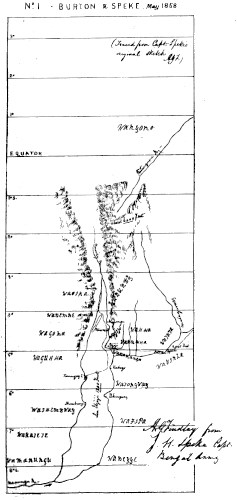
Nº 1 BURTON & SPEKE. May 1858
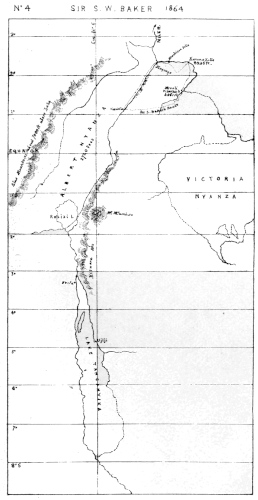
Nº 4 SIR S. W. BAKER. 1864
The Baringo Palus must act reservoir to the whole N.
Western declivities of Doenyo Ebor, whose snows have given
it a name. Ptolemy (iv. 8) distinctly mentions the χίονας,
or (melted) snows which feed the Nile; and though he
places them in S. lat. 12° 30′, he is correct as to the existence
497of snowy feeders. Some years ago a Swiss traveller
drew my attention to the fact that glacier-water would explain
the term White river as opposed to Blue river.
The quantity of melted snow or glacier-water which finds
its way to the true Nile may be comparatively inconsiderable,
but that little may perhaps modify the colourless
complexion of rain-water when its suspended matter has
been deposited, and distinguish it from the pure azure of
a stream issuing from a Lake Geneva. In 1857 Captain
Speke, an experienced Himalayan, easily detected, when
drinking from the Pangar-ni or Rúfu river, the rough
flavour of snow water.
More important, however, than Baringo is the new
Lake announced to us by Mr Wakefield’s African Pandit,
Sádi bin Ahedi. The latter ignoring Nyanza, calls it Nyanja,
possibly a dialectic variety, and therefore a difference
neither to be dwelt upon too much nor wholly to be neglected.
Of greater value is the name Bahari ya Pili, or
Second Sea, not called so, we are expressly informed, because
inland of the First Sea—Indian Ocean—but evidently
because leading to a neighbouring water on the
west. Most suggestive of all, and therefore adopted by
me, is the term ‘Bahari ya Ukara,’ or Sea of Ukara, the
latter being the region on the Eastern shore. Here we
detect the true origin of the ancient Garava, and of Captain
Speke’s Ukewere, which he applied to a peninsula
projecting from the Eastern shore, and which the Wanyamwezi,
translating ‘island water,’ gave to the Oriental
portion of the so-called Victoria Nyanza.
Respecting the length of the Ukara Lake, Sádi was
informed that it could be crossed by canoes in 6 full days,
paddling from sunrise to sunset; but if the men went on
498night and day, the voyage is to be accomplished in three
days. Now the native craft used upon these dangerous
plateau-waters never dare to cross them: the voyager
may rush over the narrow parts of the Tanganyika Lake,
but of course he would not attempt the physical impossibility
of navigating without chart or compass beyond sight
of land. It is impossible to believe in a canoe-cruise of 6
days across the lake: it is evident that a coasting-cruise
is meant. The total of hours, allowing the day to be 12,
and without halts, would be 72. Upon the Tanganyika
I estimated the rate at a little more than 2 knots an hour.
Thus, in round numbers, we have 145 miles, which probably
require reduction: an estimate of the mean amount
of error distributed on the whole of Mr Wakefield’s
‘Routes’ gives, according to the annotator, an exaggeration
of 1.24 : 1.0; and of course, when estimating the
length of these distant and dangerous navigations, exaggeration
would be excessive. We may, therefore, fairly
assume the semi-circumference of the Ukara Lake at 120
miles, and the total circumference at 240. Sádi, we are
told (p. 309), made Bahari-ni on the Eastern shore the
terminus of his long journey from Tanga Bandar to the
‘Lake Nyanza’ (Nyanja?). Let us protract the full 145
miles as the exceptional rate of 3 knots an hour upon
Captain Speke’s last map, without allowing anything for
the sinuosities of the coast, and the end would strike
the entrance of ‘Jordan Nullah’ off the ‘Bengal Archipelago,’
about half the width of the so-called ‘Victoria
Nyanza.’
As regards the breadth of the Ukara Lake, we read
(p. 310), ‘Standing on the Eastern shore, Sádi said he
could descry nothing of land in a western direction, except
499the very faint outline of a mountain summit, far, far away
on the horizon.’ This passage is again suggestive. The
sandy and level Eastern shore of the Nyanja (i. e. water) or
Ukara Lake about Bahari-ni, whence Sádi sighted, it is probably
in E. long. (G.) 35° 15′. The easternmost, that is, the
nearest, point of the Karagwah, or, as Captain Speke writes
it, the Karague Highlands, is in E. long. (G.) 32° 30′.
Thus the minimum width is 165 miles, whilst man’s vision
under such circumstances would hardly cover a dozen.
Here, again, we have room for a First as well as for a Second
Sea. Mr Johnston suggests that the mountain-summit in
question might be an island rising high in the midst of the
Lake; but, he adds, such a feature could not well have been
missed entirely by Captain Speke. Here I join issue with
him for reasons which can be deduced from these pages—my
companion and second in command never saw or heard
of the Ukara Lake. But it is highly improbable that
those who could tell Sádi the number of days required to
cross or to coast along the Lake would not have known
whether the summit was that of a mountain on terra firma
or of a lacustrine islet. The latter feature is not unfamiliar
to Mr Wakefield’s informant: he does not fail to
mention (p. 324) the small conical hill in the southern
waters of the Baringo Lake.
When Sádi declared that ‘he travelled 60 days
(marches?) along the shore without perceiving any signs of
its termination,’ he evidently spoke wildly, as Africans will.
His assertion that the natives with whom he conversed
were unable to give him any information about its northern
or southern limit, simply means that in this part of the
African interior neither caravans nor individuals trust
themselves in strange lands, especially with the prospect
500of meeting such dangerous plunderers as the Wasuku.
Similarly a ‘two months’ journey’ and ‘going to Egypt,’
asserted by ‘all authorities without exception, African and
Arab,’ signify nothing but the total ignorance of the informant
concerning the country a few leagues beyond his
home. A lake 120 miles in length, that is to say, even a
little smaller than the Baringo is supposed to be, will amply
satisfy all requirements in this matter.
Finally, we have Sádi’s report that 8 or 9 years ago
(before 1867?) the Ukara Lake was navigated by Europeans.
Certain very white men, we are told, who bought only short
ivories (Serivellos), refusing long tusks, and who purchased
large quantities of eggs—Africans have learnt by some
curious process to connect Europeans with oöphagy—came
up in a large vessel, carrying three masts and another in
front (bowsprit?), with many white cloths (sails). The
event took place only a month and a half before he
reached the Lake, and it is described with an exactness of
detail which seems to vouch for its truth. If this be a fact,
it is clear that the Nyanja cannot be Captain Speke’s
Nyanza, and that the visitors could not have made it viâ
his ‘White Nile,’ with its immense and manifold obstructions.
But it may be that of which he heard (Journal, p.
333) from the ‘Kidi officers,’ who reported a high mountain
to rise behind the Asua (Nyarus?) river, and a lake
navigated by the Gallas in very large vessels. We now
understand why the ‘King’ Mtesa (Ibid. p. 294) offered to
send the traveller home (to Zanzibar) in one month by a
frequented route, doubtless through the Wamasai and other
tribes living between the Nyanja and the Nyanza. Thus
Irungu of Uganda (Ibid. p. 187) expressed his surprise that
Captain Speke had come all the way round to that country,
501when he could have taken the short and safe direct route
up the mid-length of his own lake—viâ Umasai and Usoga,
by which an Arab caravan had travelled.
The Ukara Lake will be found laid down (A.D. 1712) in
the Africa of John Senex, F.R.S. (quoted by the late Mr
John Hogg, F.R.S., ‘On some old maps of Africa, in
which the central equatorial lakes are laid down nearly in
their true positions’). It is evidently the Garava of Mercator
(A.D. 1623), whose atlas supplies it with a northern effluent
draining to the Nile. The ‘Couir’ of D’Anville’s
folio atlas (A.D. 1749), and placed where the Lake No and
the Bahr el Ghazal actually exist, may be a confusion with
the equatorial Lake Kura Kawar, given by Ja’afar Mohammed
bin Musa el Khwarazmi (A.D. 833) in the Rasm
el Arzi, published in Lelawel’s Géographie du Moyen
Age (Brussels, 1850), and, like Garava, both may be derived
from Ukara.
The third water is evidently the Nyanza of which I
first heard at Kazah of Unyamwezi, whence Captain Speke
was despatched on a reconnoitre between July 29 and
August 25, 1858. After returning, he reported that this
lake being nearly flush with the surface of the level country
to the south, bears signs of overflowing for some 13 miles
during the rains. The second expedition found no traces
of flood on the marshy lands to the North and the N. West
of the so-called ‘Victoria Nyanza.’ This fact, combined
with a difference of level amounting to 400 feet in the
surface of the two waters, speaks for itself. We are justified
in suspecting a fourth lake, or broadening of a river
along whose banks Captain Speke and Grant travelled
northward to Uganda, and there must be more than one, if
all his effluents be correctly laid down.
502Briefly to resume: Mr Wakefield’s very valuable
‘Routes’ teach us these novelties:
1. That the Baringo is a Lake distinct from the so-called
Victoria Nyanza; that it has a northern effluent,
the Nyarus, and consequently that its waters are sweet.
2. That the Nyanja, Ukara, Ukerewe, Garava or Bahari
ya Pili, is a long narrow formation like the Baringo, perhaps
20 miles broad, with 240 of circumference, and
possibly drained to the White River or true Nile by a
navigable channel.
And I have long ago come to the following conclusions:
1. That the 30,000 square miles representing upon our
maps the area of the so-called Victoria Nyanza represent
not a lake, but a Lake Region.
2. That the Victoria Nyanza Proper is a water—possibly
a swamp—distinct from the two mentioned above,
flooding the lands to the south, showing no sign of depth
and swelling during the hot season of the Nile, and vice
versâ.
3. That the Northern and N. Western portions of the
so-called ‘Victoria Nyanza’ must be divided into sundry
independent broads or lakes, one of them marshy, reed-margined,
and probably shallow, in order to account
for three large effluents within a little more than 60
miles.
I cannot finish these lines without expressing my gratitude
to Mr Wakefield for the interesting information
with which he supplied us. He has returned to his labours
at Mombasah, amongst the Wasawahili and the Wanyika,
and as he has, I am assured by my friend Captain George,
503R. N., qualified himself to take astronomical observations,
we may rest assured that with his aid the ‘Mombas Mission’
will lose nothing of its well-won fame for linguistic study
and African exploration.
504JOHN CHILDS AND SON, PRINTERS.
The word ‘seaboard’ appears both hyphenated and unhyphenated.
The word ‘Kipiní’ on p. 387 is likely to be an error for ‘Kipini’.
On page 397, the printed Arabic word محکمّه) does not match the
Romanization. A reading as محكّمه does.
My thanks to Olive and Manny for providing assistance with the rendering
of the Arabic words and phrases.
Errors deemed most likely to be the printer’s have been corrected, and
are noted here. The references are to the page and line in the original.
| 6.30 |
[‘]And see the twain |
Added. |
| 45.15 |
the Gulf of Cambay.[’] |
Added. |
| 58.6 |
a subscrip[t]ion for exploring |
Inserted. |
| 63.25 |
(Map of the Lake Region of Eastern Africa[)] |
Added. |
| 126.20 |
to the [‘]Roman Port’ |
Inserted. |
| 127.13 |
‘Shirazían[’] dynasty |
Added (probably). |
| 129.5 |
(S. lat. 10° 41′ 2”[)] |
Added. |
| 129.25 |
[‘]men (des hommes):’ |
Added. |
| 131.21 |
Zeramu, and Gogo.[’] |
Added. |
| 131.35 |
with other words.[’] |
Added. |
| 174.7 |
and in 1856 [i/o]n August 26. |
Replaced. |
| 178.13 |
the inevitable ‘seasoning fever[’] |
Added. |
| 197.21 |
(Viverra civetta, and V. genetta)[./,] one small, |
Replaced. |
| 248.26 |
and ran a[.] vein of silver |
Removed. |
| 279.4 |
after touching at Makdish[ú/u] |
Replaced. |
| 300.26 |
It began, ‘Yá Dayyus! yá Mal’ún[’], |
Added. |
| 387.14 |
with leaden ‘Kipin[í/i’] (in the plural ‘Vipini’) |
Replaced. |
| 393.27 |
for [t]he occasion |
Restored. |
| 397.26 |
(محکمّه>) |
perhaps محكّمه |