BY
The Rev. ARTHUR T. PIERSON, D. D.
"There were giants in the earth in those days," is the simple record of
the age before the flood.
There has been no age without its giants; not, perhaps, in the narrow
sense of great physical stature, but in the broader sense of mental might,
capacity to command and control. Such men are but few, in the most favored
times, and it takes but few to give shape to human history and destiny. Their
words shake the world; their deeds move and mold humanity; and, as
Carlyle has suggested, history is but their lengthened shadows, the indefinite
prolonging of their influence even after they are dead.
One of these giants has recently fallen, at the commanding signal of One
who is far greater than any of the sons of men, and at whose touch kings
drop their sceptre, and, like the meanest of their slaves, crumble to dust.
This giant fell among us. We had seen him as he grew to his great
stature and rose to his throne of power. He moved in our streets; he spoke
in our halls; in our city of the living was his earthly home, and in our city of
the dead is his place of rest. He went from us to the nation's capital, to
represent our State in the Senate of the republic; he belonged to Michigan,
and Michigan gave him to the Union; but he never forgot the home of his
manhood. Here his dearest interests clustered, and his deepest affections
gathered; and here his most loving memorial will be reared. As he belonged
peculiarly to this congregation, surely it is our privilege to weave the first
wreath to garland his memory.
The annual Day of Thanksgiving is peculiarly a national day, since it is
the only one in the year when the whole nation is called upon by its chief
magistrate to give thanks as a united people. By common consent, it is
admitted proper that, on that day, special mention be made of matters that
affect our civil and political well-being. There is therefore an eminent fitness
in a formal commemoration upon this day of the life and labors of our
departed Senator and statesman.
With diffidence I attempt the task that falls to me. The time is too
short to admit even a brief sketch of a life so long in deeds, so eventful in
all that makes material for biography; a life full, not only of incidents, but
of crises; moreover, I am neither a senator nor a statesman, and feel incompetent
to review a career which only the keen eye of one versed in affairs of
state can apprehend or appreciate in its full significance; but, if you will
indulge me, I will, without conscious partiality or partisanship, calmly give
utterance to the unspoken verdict of the common people as to our departed
fellow-citizen; and try to hint at least a few of the lessons of a life that
suggests some of the secrets of success.
History is the most profitable of all studies, and biography is the key of
history. In the lives of men, philosophy teaches us by examples. In the
analysis of character, we detect the essential elements of success and discern
the causes of failure. Virtue and vice impress us most in concrete forms;
and hence even the best of all books enshrines as its priceless jewel the
story of the only perfect life.
To draw even the profile of Mr. Chandler's public career the proper limits
of this address do not allow. There is material, in the twenty years of his
senatorial life, which could be spread through volumes. His advocacy of the
great Northwest, whose champion he was; his master-influence, first as
a member, and then as the chairman of the Committee of Commerce;
his bold, keen dissection of the Harper's Ferry panic; his sagacious organization
of the presidential contests; his plain declarations of loyalty to the
Union as something which must be maintained at cost both of treasure and
of blood; his large practical faculty for administration, made so conspicuous
during stormy times; his efficiency as a member of the standing Committee
on the Conduct of the War; his exposure of those who were responsible for
its failures, and his defense of those who promoted its successes, his marked
influence in changing not only the channel of public sentiment, but the
current of events; his watchful guardianship of popular interests, political
and financial; his intelligence and activity in senatorial debates; his attentive
and persistent study of the problem of reconstruction; and his fearless
resistance to all Southern aggression and intimidation, are among the salient
points of that long and eventful public service, whose scope is too wide to
allow at this hour even a hasty survey.
But, happily, it is quite needless that in such a presence I should trace
in detail the events of his life; to us he was no stranger; and the mark he
has made upon our memory and our history is too deep not to last. His footprints
are not left upon treacherous and shifting quicksands; and no wave of
oblivion is likely soon to wash them away.
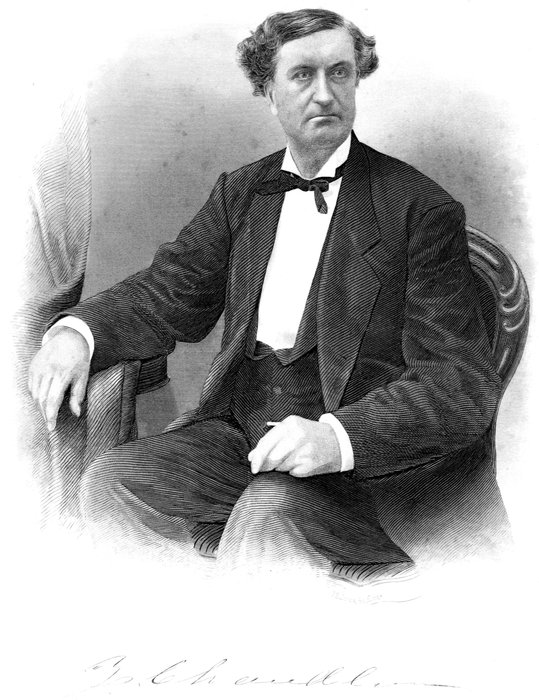
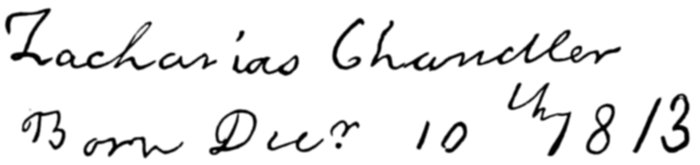
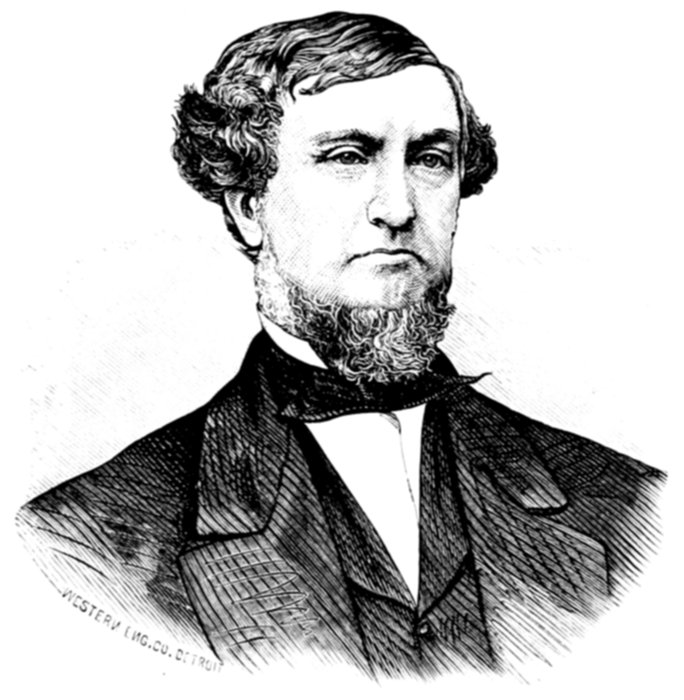
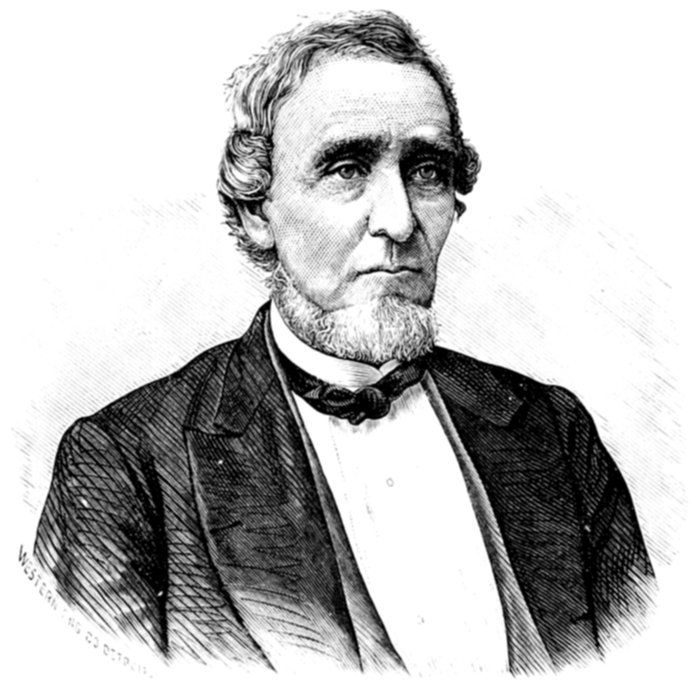
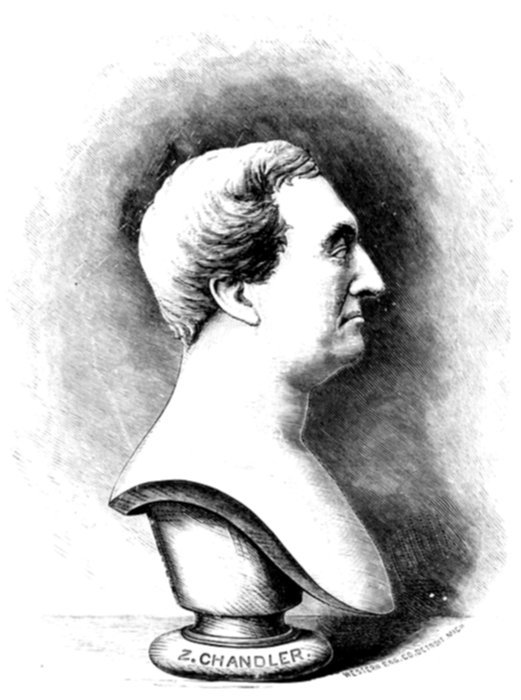
Zachariah Chandler had nearly completed his sixty-sixth year; forty-six
years he had been a resident of the City of the Straits. New Hampshire was
the State of his nativity: Michigan was, in an emphatic sense, the State of
his adoption. In our city his first success was won in mercantile pursuits,
where also was the first field for the exhibition of his energy, ability and
integrity. Here, as this century passed its meridian hour, he passed the great
turning-point in his career; and his large capacities and energies were
diverted into a political channel. First, Mayor of the city, then nominated
for Governor; when, more than twenty years ago, a successor was sought for
Lewis Cass in the Senate, this already marked man became the first representative
of the Republican party of this State in that august body at
Washington. There, for a period of eighteen years, he sat among the
mightiest men of the nation, steadily moving toward the acknowledged leadership
of his party, and the inevitable command of public affairs. After three
terms in the Senate, his seat was occupied for a short time by another; but,
upon the resignation of Mr. Christiancy, he was, with no little enthusiasm,
re-elected, and was in the midst of a fourth term, when suddenly he was
no more numbered among the living. It may be doubled whether, at this
time, any one man, from Maine to Mexico, swayed the popular mind and
will with a more potent sceptre than did he; and many confidently believe
and affirm that, had death spared him, he would have been lifted by the
omnipotent voice and vote of the people to the Presidency of the Republic.
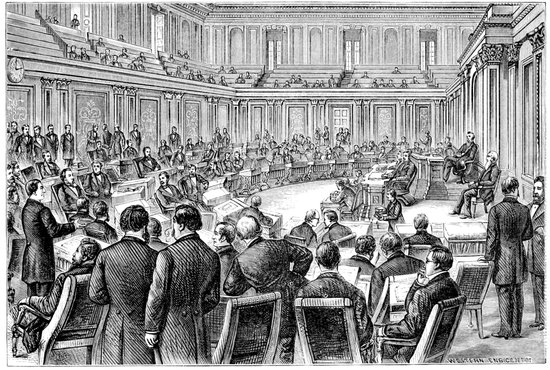
Mr. Chandler took his seat in the Senate in those days of strife when the
storm was gathering, which, on the memorable 12th of April, 1861, burst
upon our heads, in the first gun fired at Fort Sumter. He entered the Senate
chamber, to take the oath of office, in company with some whose names are
now either famous or infamous for all time. On the one hand, there was
Jefferson Davis; on the other Hannibal Hamlin, Charles Sumner, Benjamin
F. Wade and Simon Cameron.
Those were days when history is made fast. Every day throbbed with
big issues. Kansas was a battle-ground of freedom; and the awful struggle
between State Sovereignty and National Unity was gathering, like a volcano,
for its terrible outbreak. The Republican Senator from Michigan took in, at
a glance, the situation of affairs. Devoted as he was to the State, whose able
advocate and zealous friend he was; earnest and persistent as he was, in promoting
the commercial and industrial interests of the lake region; he was yet
too much a patriot to forget the whole country; and as the great conflict,
which Mr. Seward named "irrepressible," moved steadily on toward its
crisis, he armed himself for the encounter and planted his feet upon the rock
of unalterable allegiance to the Union; and from that position he never
swerved.
Mr. Chandler was a zealous party-man; in the eyes of some he was a
partisan, in the strenuous advocacy of some measures; but I believe that
when history frames her ultimate, impartial verdict, she will accord to him a
candid, conscientious adherence to what he believed to be a fundamental principle,
absolutely essential to our national life. He saw the South breathing
hot hate toward the North, planning and threatening to rend the Union
asunder. To him it was not a question simply of liberty and slavery, of
sectional prejudice, of political animosity; but a matter of life or of death.
He saw the scimitar of secession raised in the gigantic hand of war—but
what was it that it was proposed to cleave in twain at one blow? A living,
vital form! the body of a nation, with its one grand framework, its common
brain and heart, its network of arteries and veins and nerves. It was not
dissection as of a corpse—it was vivisection as of a corpus—that sharp blade,
if it fell, would cut through a living form, and leave two quivering, bleeding
parts, instead. Divide the nation? Why, the same mountain ranges run
down our eastern and western shores; the same great rivers, which are the
arteries of our commerce, flow through both sections. Our republic is a unit
by the decree of nature, that marked our nation's area and arena by the lines
of territorial unity, a unit by the decree of history that records one series of
common experiences; and, aside from the decree of nature and of history, it
is one by the decree of necessity, for we could not survive the separation.
Those were the decisive days, and they showed whose heart was yearning
toward the child; and God said, as he saw a unanimous North pleading with
Him to arrest the falling sword and spare the living body of a nation's life—"Give
her the child, for she is the mother thereof!"
Mr. Chandler has been charged with violent and even vindictive feeling
toward what he deemed disloyalty and treason.
You have heard the story of the Russians, chased by a hungry pack of
wolves, driving at the height of speed over the crisp snow, finding the beasts
of prey gaining fast upon them, and throwing out one living child after
another to appease the maw of wolfish hunger, while the rest of the family
hurried on toward safety.
There are sagacious statesmen that have declared, for a quarter of a
century, that State Rights represents the pack of wolves and the Sovereignty
of the Union the imperilled household. For scores of years, the encroachments
of the South became more and more imperious and alarming.
Concession after concession was made, offering after offering flung to the
sacrifice, but only to be followed by a hungrier clamor and demand for
more; and, at last, even men of peace said, "We must stop right here and
fight these wolves;" and, when it becomes a question of life and death, men
become desperate.
I have never supposed myself to be a strong partisan. As a man, a citizen,
and a Christian, I have sought to find the true political faith, and, finding
it, to hold it, firmly and fearlessly. The question of the unity of our nation
and the sovereignty of the national government has ever seemed to me to be
of supreme moment, transcending all mere political or party issues; and, as a
patriot, I cannot be indifferent to it.
When the long struggle between State Rights and National Sovereignty
grew hot and broke out into civil war, it was a matter of tremendous consequence
that the Union be preserved. History stood pointing, with solemn
finger, to the fate of the republics of Greece and Switzerland, reminding us
that confederation alone will not suffice to keep a nation alive. Mexico, at
our borders, was a warning against dismemberment or the loss of the supremacy
of a republican unity. And men of all parties forgot party issues in
patriotic devotion. It may be a question whether State Sovereignty, however
fatal to national life, deserved the hideous name of treason, before the war.
But, after the matter had been referred to the arbitrament of the sword, and
had been settled at such cost of blood and treasure, it can never henceforth
be anything but treason, again to raise that issue. Hence, even men that
were temperate in their opposition to Southern aggressions before the war,
now are impatient. They set their teeth with the resolution of despair, and
say, "We make no further effort to escape this issue, and we throw out no
more offerings of concession. We shall fight these wolves; and either State
Rights or National Sovereignty shall die."
This was Mr. Chandler's position; if it was a mistaken one, it is the
unspoken verdict of millions of the best men of all parties in the whole country;
and every new concession to this great national heresy is only making
new converts to the necessity of a firm and fearless resistance.
Some one has suggested that the old division of the church into militant
and triumphant is no longer sufficient; we must add another, namely, the
church termagant. In our country both sections were militant, and one was
triumphant; the other has been very termagant ever since. General Grant, at
his reception in Chicago, declared that the war for the Union had put the
republic on a new footing abroad. A quarter of a century ago, by political
leaders across the sea, "it was believed we had no nation. It was merely
a confederation of States, tied together by a rope of sand, and would give
way upon the slightest friction. They have found it was a grand mistake.
They know we have now a nation, that we are a nation of strong and
intelligent and brave people, capable of judging and knowing our rights,
and determined on all occasions to maintain them against either domestic or
foreign foes; and that is the reception you, as a nation, have received
through me while I was abroad."
On the same day we have a significant voice from the South, General
Toombs, in response to a suggestion that Governors of various States and
prominent Southern men should unite in congratulations to the ex-President
on his return, telegraphs in these words: "I decline to answer except to
say, I present my personal congratulations to General Grant on his safe
return to his country. He fought for his country honorably and won. I
fought for mine and lost. I am ready to try it over! Death to the
Union!"
Here we have simply two representative utterances; one is the voice of a
solid North; the other is, we fear, the voice of a South that is much more
"solid" than we could wish. It is no marvel if, after a war of so many
years, that cost so many lives and so much money, and left us to drag
through ten years of a financial slough, loyal men are impatient and even
angry, when they discover that the question is still an unsettled one, and that
we have not even conquered a peace! Even the interpretation now attached
to this seditious utterance by General Toombs himself, that "the result of
war was death to the Union, and that the present government is a consolidated
one, not a confederacy," does not essentially relieve the matter.
Mr. Chandler could not brook what he regarded as sentiments rendered
doubly treasonable by the fact that a long, bitter but successful war had
burned upon them with a hot iron the brand of treason. He fought those
sentiments, and it was as under a black flag that announced "no quarter."
But this does not prove malicious or vindictive feeling toward misguided men
who hold such views. There is a difference between fighting a principle
and fighting a person. In fact the only way to prevent fighting men is often
a vigorous and timely opposition to their measures. And if we wish to
avoid another war, and that a war of extermination, the ballot must obviate
the necessity for the bullet: we must stand together, and by our voice and
vote, by tongue and pen, by our laws and our acts, in the use of every
keen weapon, exterminate the heresy of State Rights. We need not do this
in hate toward the South: a true love even for the South demands it, for
to them as to us it is a deadly foe to all true prosperity and national
existence. How can a man who candidly looks upon the present attitude
of the South as both suicidal and nationally destructive be calm and cool?
The philippics of Demosthenes were bitter, but they were the mighty beatings
of a heart that pulsed with the patriotism that could not see liberty
throttled without sounding a loud and indignant alarm. The North owes a
big debt to every man who at this crisis will not suffer an imperilled
republic to sleep.
Mr. Chandler was not a college graduate. His early training was got in
the New England common school and academy. Yet he was in a true sense
an educated man: for education is "not a dead mass of accumulations," but
self-development, "power to work with the brain," to use the hand in cunning
and curious industries, to use the tongue in attractive and effective
speech, to use the pen in wise, witty or weighty paragraphs. Somehow he
had learned to hold, with a master hand, the reins of his own mind, and
make his imagination and reason and memory and powers of speech obey his
behests. That is no common acquirement: it is something beyond all mere
acquirement; it is the infallible sign and seal of culture. His addresses, even
on critical occasions, were unwritten, and, in some cases, could not have been
elaborated, even in the mind; yet in vigor of thought, logical continuity and
consistency, accuracy of diction, and even rhetorical grace, few public speakers
equal them.
The power to command the popular ear is a rare power, whether it be a
gift of nature or a grace of culture. With Mr. Chandler it was held and
wielded as a native sceptre. He had the secret of rhetorical adaptation; he
could at once go down to the level of the people and yet lift them to his
level. They understood what he said and knew what he meant. He threw
himself into their modes of thought and habits of speech; he culled his
illustrations mainly from common life. If he sacrificed anything, it was
rhetorical elegance, never force; his one aim was to compel conviction.
The simplicity of his diction was a prime element and secret of his power.
He did not speak as one who had to say something, but as one who had
something to say, and whose whole aim was to say it well; with clearness,
plainness, force and effect. If he could not have both weight and lustre, he
would have weight.
Walter Scott has exposed the absurdity of "writing down" to children,
and shown that it is really writing up, to make oneself so simple as to be
plain even to the child-mind. Simplicity is the highest art. To have thought
faintly gloom and glimmer through obscure language, like stars through a
haze or mist, may serve to impress the ignorant with a supposed profundity
in the speaker; but it is no more a sign of such profundity than muddy
water signifies depth in a stream; it may suggest depth because you can see
no bottom, but it means shallowness! It is a lesson that all of us may learn
through the life of our departed Senator, that the first element of good speaking
is thought; and the second a form of words fitting the thought, which,
like true dress, shall not call attention to itself but to the idea or conception
which it clothes. Any man who is long to hold the ear of the people must
give them facts and thoughts worth knowing and thinking of, in words which
it will not take a walking dictionary or living encyclopædia to interpret, or a
philosopher to untangle from the skein of their confusion.
Mr. Chandler was such a man, a man for the people. Free from all
stately airs and stilted dignities, he took hold of every political and national
question with ungloved hands. He understood and used the language of home
life, which is the "universal dialect" of power. His speeches were packed
with vigorous Saxon. He thought more of the short sword, with its sharp
edge and keen point and close thrust, than of the scholar's labored latinity,
with its longer blade, even though it might also have a diamond-decked hilt;
and in this, as in not a few other conspicuous traits, he was master of the
best secrets that gave the great Irish agitator, O'Connell, his strange power
of moving the multitude. His last speech, even when read, and without
the magnetism of his personal presence, may well stand as the last of his
utterances.
The simplicity of Mr. Chandler's style of oratory amounted to ruggedness,
in the sense in which we apply that word to the naked naturalness of a landscape,
whose features have not been too much modified by art. There is in
oratory an excessive polish, which suggests coldness and deadness. Some
speakers sharpen the blade until there is no blade left, the mistaken carefulness
of their culture brings everything to one dead level of faultlessness;
there is nothing to offend, and nothing to rouse and move. Demosthenes
said that kinésis—not "action," but motion, or rather that which moves—is
the first, second, third requisite of true oratory. He is no true speaker who
simply pleases you: he must stir you to new thought, new choice, new
action.
We must beware of the polish that is a loss of power, and, like a lapidary,
not grind off points, but grind into points. Demosthenes was more
rugged than Cicero; but he pricked men more with the point of his oratorical
goad. Men heard the silver-tongued Roman and said, "How pleasantly
he speaks!" They heard the bold Athenian and shouted, "Let us go and
fight Philip!"
Carlyle says, "He is God's anointed king whose simple word can melt a
million wills into his!" That melting wills into his own is the test of
eloquence in the orator; and a rugged simplicity has held men in the very
fire of the orator's ardor and fervor, till they were at white heat, and could he
shaped at will; while the most scholarly display of culture often leaves them
unmoved, to gape and stare with wonder, as before the splendors of the
Aurora Borealis, and feel as little real warmth. Emerson is right: "There is
no true eloquence unless there is a man behind the speech," and men care not
what the speech is if the man be not behind it, or, on the other hand, what
the speech is, if the man be behind it! And so it is that Richard Cobden
compelled even Robert Peel, who loved truth and candor, to become a
convert to his free-trade opinions; and so it was that John Bright, another
model of a simple utterance with a sincere man behind it, swayed such a
mighty sceptre over the people of Britain. The mere declaimer or demagogue
may win a temporary hearing; but the man who leaves a lasting impress on
the mind of the people must have in himself some real worth.
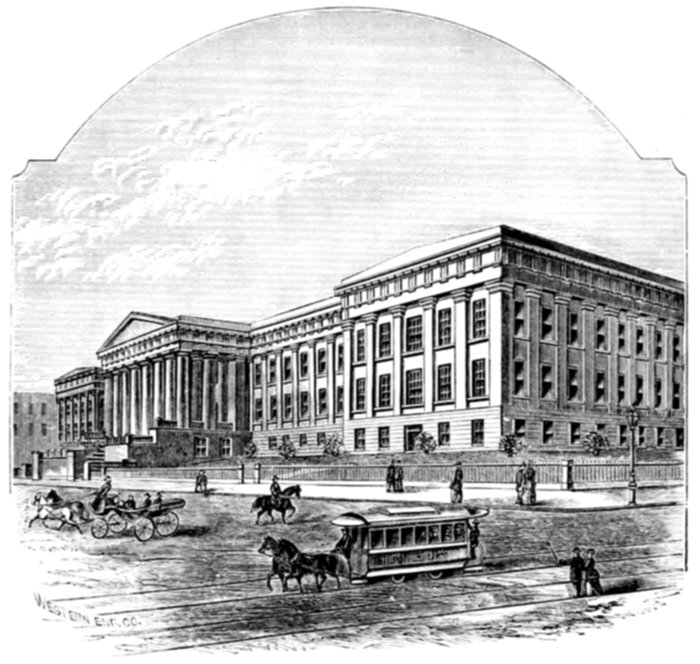
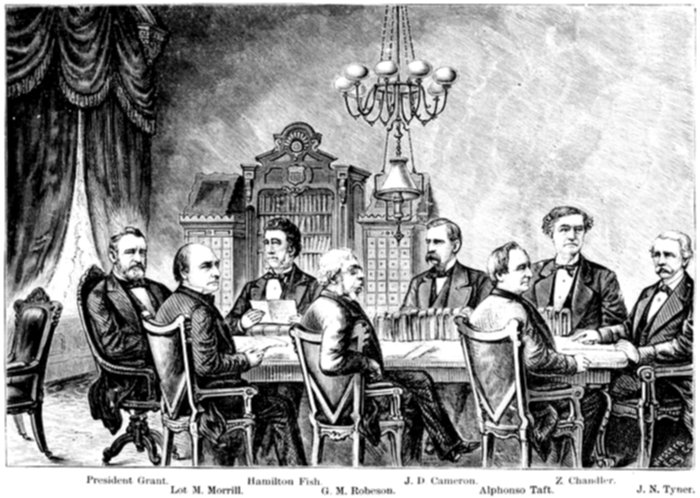
To Mr. Chandler's executive ability reference has been made. It was
never better illustrated than in his vigorous and faithful administration as
Secretary of the Interior. It was Hercules in the Augean stables again—purging
the department of incompetency and dishonesty. He sent a flood
through the Patent Office, that swept all the clerks out of one room;
and another through the Indian Bureau, that cleaned out its abuses and
exposed its frauds. It is said that the reconstruction of that department
saved millions annually to the treasury of the nation. Mr. Schurz, in becoming
his successor, paid a very handsome tribute to the retiring Secretary,
acknowledging the great debt of the country to Mr. Chandler's energy and
fidelity, and modestly declaring that he could hope for no higher success than
to keep and leave the department where he found it.
If there be any one thing for which the Senator from Michigan stood
above most men it was in this practical business ability. He had, in rare
union, "talent" and "tact." His good sense, clear views, ready and retentive
memory, prompt decision, patience and perseverance, quick discernment and
instinctive perception of the fitness of ways to ends, qualified him for energetic
and successful administration anywhere. Webster said, "There is always
room at the top." Even the pyramid waits for the capstone, which must be,
itself, a little pyramid. And he who has inborn or inbred fitness for the top
place will find his way there; no other will long stay there, even if some
accident lifts him to the nominal occupancy of such a position.
He had rare tact, that indefinable quality of which Ross says, that "it is
the most exquisite thing in man." Literally it means "touch," and is suggested
by the delicacy often found in that mysterious sense. It describes,
though it cannot define, the nice, skillful, innate discernment and discrimination
which tells one what to say and do, even on critical occasions; how to
reach and "touch" men, when a blunder would be fatal. This wisdom of
instinct may be cultivated but cannot be acquired; and it seems to be close
of kin with that common sense which, though by no means exceedingly
"common," represents a sound intuitive sense in common matters, such as
would be the common sense or verdict of wise and sagacious minds.
The Senator impressed men as one whose powers were varied and versatile.
Thomas F. Marshall, the "Kentucky orator," maintained that fine
speaking, writing and conversation depend on a different order of gifts. "A
speech cannot be reported, nor an essay spoken. Fox wrote speeches;
nobody reads them. Sir James Mackintosh spoke essays; nobody listened.
Yet England crowded to hear Fox, and reads Mackintosh. Lord Bolingbroke
excelled in all, the ablest orator, finest writer, most elegant drawing-room
gentleman in England."
Whether or not this philosophy be sound and this estimate correct, we
shall all agree that few men combine power of speech with force in composition
and grace in conversation. Our departed Senator certainly had more than the
common share of versatility. That last speech at Chicago thrilled a vast
audience when spoken, and kindled a flaming enthusiasm; yet it reads like
the compact and complete sentences of the essayist.
Versatility, however, is not to be coveted where it implies a lack of concentration.
An anonymous writer has left us a very discriminating comparison
of two great British statesmen. He likens Canning's mind to a convex speculum
which scattered its rays of light upon all objects; while he likens
Brougham's to a concave speculum which concentrated the rays upon one
central, burning, focal point. There are some men who possess, to a considerable
degree, both the power to scatter and the power to gather the rays. At
times they exhibit varied and versatile ability, they touch delicately and skillfully
many different themes or departments of thought and action; but when
crises arise which demand the whole man, they become in the best sense men
of one idea, for one thought fills and fires the soul; every power is concentrated
in one burning purpose.
The Senator, whose deserved garland we are weaving, was one of these
men. There were times when he seemed to turn his hand with equal ease to
a score of employments; now giving wise counsel in gravest matters, now
playfully entertaining guests at his table; now studying the deep philosophy of
political economy, now holding a Senate in rapt attention; now reorganizing
a department of state; now pushing a new measure through Congress; now
closeted with the President over the issues of a colossal campaign, and again
conducting a pleasure excursion; to-day leading on the hosts of a great
party, and to-morrow managing the affairs of an extensive farm. But, when
the destiny of the nation hung in the balance, or history waited with uplifted
pen to record on her eternal scroll the final decision of some great question,
he gathered and condensed into absolute unity all the powers of mind and
heart and will, and flung the combined weight of his whole manhood into the
trembling scale. When he felt that a thing must be, a mountain was no
obstacle to surmount, a host of foes no occasion for dismay. With intensity
of conviction, with contagious courage and enthusiasm, with indomitable
resolution, with tireless energy of action, he went ahead, and weaker men had
to follow; his conviction persuaded the hesitating, his courage emboldened
the timid, his determination inspired the irresolute. He was the unit that, in
the leading place, makes even the cyphers swell the sum of power.
It is no slight praise of Mr. Chandler to say that he was a man of
industry; the results he reached were won by work. There is a great deal
of blind talk about genius. That there is such a thing, apart from the practical
faculty of application, even great men have doubted or boldly denied;
but certain it is that there is such a thing as the genius of industry, and that
rules the world! Alexander Hamilton disclaimed any other genius than the
profound study of a subject. He kept before him a theme which he meant to
master, till he explored it in all its bearings and his mind was filled with it.
Then, to quote his words, "the effort which I make the people are pleased
to call the fruit of genius. It is the fruit of labor and thought."
And so for us all there is no royal road to a true success. We must
simply plod on, along the plain, hard, plebeian path of honest toil, and climb
up the hills, if we would get on and up at all. Spinoza grandly says that
that there is no foe or barrier to progress like "self-conceit and the laziness
which self-conceit begets." We venture to add that no conceit is surer to
beget laziness than the conceit of "conscious genius." Our peril is to learn
to do our work easily; that means poor work, if indeed any work at all,
shallow acquirements, superficial attainments, and no real scholarly or heroic
achievements.
Our regretted Senator did not despise honest work, and never claimed to
be a genius. He had a hearty contempt for all that aristocracy of intellect
that frowns on mental toil.
He spoke without manuscript, and without memorizing; or, as we say,
"extempore." That is another much-abused word. Extemporaneous speech
is not the utterance of words that shake the world, or any considerable part
of it, unless such speech be the fruit not of that time, but, as Dr. Shedd
says, "of all time previous." But when the orator first becomes master of
his theme and then of the occasion, and is thus fitted to deal with the real
vital issues before the people, he may, without having put pen to paper, or
having framed a single sentence beforehand, often find himself master also
of his audience. The careful study of his subject, the habit of thinking in
words, and of weighing words when he reads and talks, scoops out a channel
in the mind; and when he rises to speak he finds his thought flowing naturally
and easily in this channel.
No man can carefully read Mr. Chandler's public utterances without
detecting a brevity and terseness, a simplicity and plainness, an accuracy and
vigor, and often a rhetorical beauty, which shew care in preparation. These
qualities are not the offspring of indolence. Years of drill lie back of the
exact and daring touches with which the artist makes the canvas speak and
the marble breathe; and the extempore speech of the eloquent orator tells of
long, hard discipline that has taught him how to think and how to talk; it
may have taken him fifty years to learn how to hold and sway an audience
at will for fifty minutes. The ease and grace of true oratory are the signs of
previous exertion; of that systematic exercise of the intellect that has suggested
for our training schools the name, gymnasia. The laws of brain and
of brawn do not differ much in this respect. Men are not born athletes,
either in mind or muscle; and to all who have a true desire to succeed, in
any sphere of life, the one voice that, with the growing emphasis of the
successive centuries, speaks to us, is, "Whatsoever thy hand findeth to do, do
it with thy might." Your sword may be short; "add a step to it!" it may
be dull; add force to the blow or the thrust. There is no encouragement
from history, more universally to be appropriated by us, than the testimony
she furnishes to the power and value of honest endeavor. To will and to
work is to win. The highest endowments assure no achievements; all success
is the crown of patient toil!
While thus speaking a word in favor of hard work, one word of caution
and of qualification may not be out of place. I think God means that the
sudden decease of public men when in life's prime, shall not be without
warning. No thoughtful man fails to feel the force of this fact that somehow
the average duration of human life, especially on these shores and among
men of mark, is shortening; and that apoplexy, paralysis, angina pectoris,
cerebral hemorrhage, and softening of the brain are amazingly common among
brain-workers. The fatality among journalists is especially startling.
We are a fast-living and a fast-dying people. Our habits are bad. We
work hard half the time and worry the other half. We eat and sleep irregularly;
we tax our powers unduly, keeping the bow bent until the string snaps
simply from constant tension, lack of relaxation. We turn night into day,
without restoring the balance by turning day into night. We live in an atmosphere
of excitement, and push on to the verge of death before we know our
peril or realize our risk. We are tempted to put stimulus in the place of
strength, that we may do, under unnatural pressure, what we cannot do by
nature's healthy powers. Instead of repairing the engine, we crowd fuel into
the boiler and get up more steam; and, by and by, something breaks, or
bursts, and the machinery is a wreck.
I believe it is not hard work that kills us, so much as work under wrong
conditions. To do, with the aid of even mild stimulants, like tea and coffee,
not to say tobacco, opium, quinine, etc., what we cannot do by the natural
strength, is the worst kind of overwork; and yet our public men are subject,
to such strain, that they are almost driven to such resorts. Where they ought
to stop, and sleep and rest, they "key up" with a kind of artificial
strength, and get the habit of unnatural wakefulness; and then wonder why
they are victims of insomnia.
Professor Tyndall, one of the most tireless men of brain in our day, says
to the students of University College, London: "Take care of your health!
Imagine Hercules, as oarsman in a rotten boat; what can he do there but,
by the very force of his stroke, expedite the ruin of his craft! Take care
of the timbers of your boat!" And Dr. Beard adds: "To work hard without
overworking, to work without worrying, to do just enough without
doing too much—these are the great problems of our future. Our earlier
Franklin taught us to combine industry with economy; our 'later Franklin'
taught us to combine industry with temperance; our future Franklin—if
one should arise—must teach us how to combine industry with the art
of taking it easy."
The qualities that fitted Mr. Chandler for the conduct of affairs were,
however, not purely intellectual; they belonged in part to another and a
higher order, viz.: the emotions and affections.
He had great intensity of nature. Even his political opponents could not
doubt the positiveness of his conviction and the profoundness of his sincerity;
and here, as Carlyle justly says, must be found the base blocks in the structure
of all heroic character. It is no small thing to be able to command even
from an antagonist the concession and confession of one's sincerity. Candor
atones for a host of faults. Men will, at the last, forgive anything else in a
man who tries to be true to his own convictions and to their interests. The
utterances of impulse and even of passion, stinging sarcasm and biting ridicule,
unjust charges and assaults, all are easy to pardon in one whose sincerity and
intensity of conviction betray him into too great heat; men would rather be
scorched or singed a little in the burning flame of a passionate earnestness
than freeze in the atmosphere of a human iceberg—beneath whose rhetorical
brilliance, they feel the chill of a cold, calculating insincerity and hypocrisy
that upsets their faith in human honesty.
He was also peculiarly independent and intrepid. The determination to
be loyal, both to his convictions and to his country, inspired him to a bold,
brave utterance and invested him with a courage and confidence that were
almost contagious. We cannot but admire the political fidelity expressed by
Burke, in his famous defense before the electors of Bristol, when he said: "I
obeyed the instructions of nature and reason and conscience; I maintained
your interests, as against your convictions." Few men have ever dared to
say and do what Mr. Chandler has, in the face of such political risks and
even such personal peril. One brief address delivered by him in the Senate,
soon after he resumed his seat, will stand among the classics of our language,
and, if I may so say, among the "heroics" of our history.
He was also a man of great political integrity. In the long career of a
public life spanning more than a quarter of a century, no suspicion of dishonesty
or disloyalty has ever stained his character or reputation. Michigan
may safely challenge any Senatorial record of twenty years to surpass his,
either in the quantity or quality of public service.
Those who knew him best affirm that he was, politically and personally,
an incorruptible man. The position of a legislator is one of proverbial peril.
From the days of Pericles and Augustus till now, the men who make laws
and guide national affairs are peculiarly in danger of defiling their consciences
by "fear or favor." Bribery sits in the vestibule of every law-making assembly.
Greed holds out golden opportunity for getting enormous profits from
unlawful or questionable schemes and investments. Ambition lifts her shining
crown, and offers a throne of commanding influence if you will bow down
and worship, or even make some slight concession in favor of, the devil.
Only a little elasticity of conscience, a little blunting of the moral sense; a
little falsehood, or perjury, or treachery, under polite names; a lending of
one's name to doubtful schemes; and there is a rich reward in gains to the
purse and gratifications to the pride, which more than pay for the trifling
loss of self-respect. And so not a few who go to Congress with unsullied
reputation, come back smutched with their participation in "Credit Mobilier"
and "Pacific Railroad" schemes, or any one of the thousand forms of fraud.
So far as I know, Mr. Chandler has never been charged with complicity
as to dishonest and disgraceful measures such as have sometimes made the
very atmosphere of the Capitol a stench in the nostrils of the pure and good.
His name does not stand on the pay-roll of Satan, but with the honored few
whose eyes have never been blinded by a bribe and whose record has never
been blotted with political dishonor.
To have simply done one's duty is no mean victory. To stand—like the
anvil beneath the blows of the hammer—and firmly resist the force of a
repeated temptation is grand and heroic. To be venal is no venial fault; no
price which can be weighed in gold can pay a man for the sale of one ounce
of his manliness. Conscience is a Samson, whose locks are easily shorn, but
they never grow again; whose eyes, once put out or seared with a hot iron,
no prayer will restore. And men, as great and wise as Bacon, have like him
been compelled to confess to their own meanness and the mercenary character
of their virtue.
One of the worst signs of the times is this corruptibility of popular
leaders. One of the greatest of European journals moves like a weather-vane,
just as the day's wind blows. Much of the best talent of Europe is for
sale for or against despotism. Some of the most gifted men in the House of
Lords are of plebeian birth, bought by the bribe of a title, as Harry
Brougham himself was, when his great influence became a terror to the aristocracy;
and the Duke of Newcastle is said to have bought one-third of the
House of Commons. There is scarce a measure, however infamous, that may
not be pushed through our common councils and legislative bodies if the
lobbyists are only "influential and numerous," and the money is only plenty
enough. Let us give God thanks for every man in the community who is
not on the auction block to be knocked down to the highest bidder. In these
days of abounding fraud and falsehood, men are beginning to feel the value
of simple honesty. We have, in our admiration of the genius of intellect,
forgotten the genius of goodness, which has power to inspire men with heroism.
Better to strengthen a few timid hearts in loyalty to principle than to
have deserved the encomium of Augustus, who "found Rome brick, and left
it marble." The Earl of Chatham refused to keep a million pounds of government
funds in the bank and pocket the proceeds; as Edmund Burke, on
becoming paymaster-general, first of all introduced a bill for the reorganization
of that department of public service, refusing to enrich himself, through
the emoluments of that lucrative office, at public expense.
No wonder George the Second should have said of such "honesty" that
it is an "honor to human nature!" Such words were worthy of a king, but
it is only a crowned head bowing to royal natures that need no crown to tell
that they are kingly. The distinguished Hungarian exile will never be forgiven
for saying that he would praise anything and anybody to aid Hungary.
There is an instinct in the great heart of humanity which not even wickedness
kills, that no quality is so fundamental to character as absolute loyalty
to truth, it is the base-block of the whole structure; and great has been
many a "fall," where there is no better foundation than the treacherous and
shifting quicksands of what is called "policy," and which is to many the only
standard of honesty.
Mr. Chandler was known in politics as an enthusiastic and radical advocate
of his party and its measures. It was not in him to do anything by
halves, and it is difficult to see why one may not as naturally be zealous in
politics as in religion; in fact, none are more likely to charge upon him partisanship
than those who in their attachment to the opposite party shew their
own lack of moderation.
It has been well said that religion demands "a faith, a polity and a
party." The faith and the polity belong to it as necessary features; the party
is that on which it depends for organization and onward movement. There
is a philosophy, a political creed and economy, which are to the state what
religion is to the church; and no man can be a patriot without a political
faith and polity and party; though he may stand alone, he represents all
three. He may be in the largest sense a patriot, and adopt the sublime motto
of Demosthenes, "Not father, nor mother, but dear native land!" yet his
patriotism may compel him, us he looks at the matter of his country's interest,
to take a position on the side of a political party, and to hold it in the
face of ridicule and reproach and even of a pelting hail of hate. Others may
not be wrong in their espousal of a different political creed, but he is not
wrong, but right, in his honest adherence to his. It is so in religion; an
honest, intelligent man is loyal to his own denomination, yet is he none the
less, because of that, a Christian in the breadth of his charity.
In fact, religion is not the only sphere where self-sacrifice, for duty and
for conscience, may be pressed even to martyrdom. St. Ignatius, facing the
wild beasts in the arena, calmly said, "I am grain of God; I must be
ground between teeth of lions to make bread for God's people." That was
the grand confession of a Christian martyr. Tell me, how much lower down
in the scale of the heroic does he belong who, for the sake of the best good
of a constituency blinded by passion or prejudice, like the great English
statesman, consents to be hurled from his shrine as the idol of the people,
and calmly says, "I am under no obligation to be popular, but I am under
bonds to myself to be true!" When Regulus refused to buy his own liberty
and life, at the cost of Rome's disgrace, and persuaded the Senate to reject
the very overtures which he was commissioned to convey, himself returning
as his pledge required him if the negotiations were unsuccessful, and surrendering
himself to the will of his enemies that Carthage might put him to
death by slow torture, it seems to me something like the martyr-spirit burned
in that bosom. And, if there be nothing akin to moral martyrdom in bravely
standing in one's place and boldly holding one's ground, advocating what one
believes to be the only true creed in politics, and the only true policy for the
country, in face of sneer and threat, daring the blade and the bullet, the
open affront and the secret assault, for the sake of being true to one's self and
to one's native land—if there be nothing sublime and heroic in all this, the
verdict of reason is unsound.
This lamented statesman had also a genial temper, which won for him a
host of friends. Public men are prone to one of two extremes; either the
hypocritical suavity of the demagogue, or the arbitrary bluntness and curtness
of the despot. Some swing away from the fawning airs of the puppy, but it
is toward the repulsive manners of the bear. The man who, as you tip your
hat with a polite good morning, sweeps by, saying, "I haven't time," is too
often the typical man of affairs, who thinks the quick dismission of applicants
and intruders is the price of all energetic public service. It is said of
the great French statesman, Richelieu, that he could say "No." so gracefully
and winningly, that a man once became applicant for a position, upon which
he had not the least claim, just to hear the great Cardinal refuse. If common
testimony may be trusted, Michigan's esteemed Senator seldom lost the
hearty cordiality and courtesy of his manners, even under the fretting friction
of public cares.
I am tempted to add that, though a representative Republican, Mr.
Chandler was, in the best sense, a democrat. He weighed a man according
to the worth of his manhood. He could recognize true manliness beneath a
black skin as well as a white one, and behind the rough dress of a poor man,
as behind broadcloth; and, because he was the friend of humanity and of
human rights, you will find some of his warmest friends among the common
people and in the lower ranks.
I think both justice and generosity demand that among the tributes we
weave for him, there should be distinct and emphatic mention of this simplicity
of character. He was a man among men. From the first, he had none of those
assumptions of conscious superiority that mark the aristocrat. If anything,
he was rather careless than careful of his dignity, and would sooner shock
than mock the fastidious airs and tastes of those who prate about culture, or
pride themselves on their "nobility." Fox quaintly said, of the elder Pitt,
that he "fell up stairs" when he was elevated to the peerage. Many a man
cannot stand going up higher. He becomes haughty, proud; he affects dignity,
he lords it over God's heritage, he becomes too big with conscious
superiority. Like Jeshurun, he waxes fat and kicks. He falls up stairs, if not
down.
The warm, soft, genial side of Mr. Chandler's nature was unveiled in
social life and most of all in the domestic circle. The play of his smile, the
roar of his laughter, the delicacy and tenderness of his sympathy, his stalwart
defense of those whom he loved, the childlike traits that drew him to
children and drew children to him, none appreciate as do those who knew
him best as friend, husband and father. The man of public affairs, he could
lay one hand firmly on the helm of state, while with the other he fondly
pressed his grandchildren to his bosom, or playfully roused them to childish
glee.
This aspect of his many-sided character makes his death an irreparable
loss to his own household. Even the great grief of a nation cannot represent
by its "extensity," the intensity of the more private sorrow that secludes
itself from the public eye. He was, to those whom he specially loved, both
a tower for strength, and a lover and friend for comfort and sympathy.
Those who were "at home" with him and especially those who were the
peculiar treasures of his heart, knew him as no others could. Happy is the
minister who forgets not his parish at home—the church that is in his own
house—and happy is the public man, whose private life is not simply the
revelation of the hard, coarse and unattractive side of his character.
That is I am sure no ordinary occurrence, which has made forever memorable
the Calends of this November. Death, however frequent and familiar
by frequency, can never, to the thoughtful, be an event of common magnitude;
the exchange of worlds cannot be other than a most august experience.
But this death has about it colossal proportions; it stands out and apart like
a mountain in a landscape. It is recognized as a calamity not only to a
household, but to the city, the State, the Nation; and it may be doubted
whether, since the assassination of Abraham Lincoln, any single announcement
has so startled the public mind and moved the popular heart as when on the
1st day of November it was announced that Zachariah Chandler was found
sleeping his last sleep.
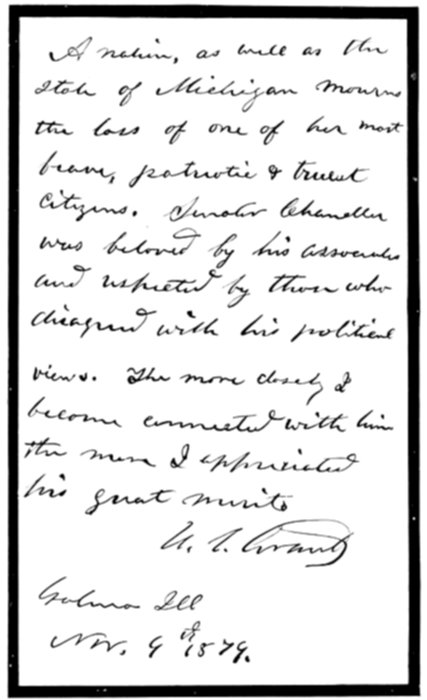
Ulysses S. Grant is a man of few words—and like his shot and shell
they weigh a good deal and are well aimed. Let us hear his verdict on Mr.
Chandler:
"A nation, as well as the State of Michigan, mourns the loss of one of
her most brave, patriotic and truest citizens. Senator Chandler was beloved
by his associates and respected by those who disagreed with his political
views. The more closely I became connected with him the more I appreciated
his great merits.
U. S. GRANT.
"Galena, Ill., Nov. 9, 1879."
It is evident that it is no ordinary man who has departed from among
us. It is not "a self-evident truth that all men are created equal," if we
mean equality of gifts and graces, capacity, opportunity or even responsibility;
and the people of these United States do not need to be told that Mr. Chandler
was no common man. It was by no accident that he held in succession,
and filled with success, posts of such importance and trusts of such magnitude.
He did not drift into prominence; he rose by sheer force of character
and by the fitness of things. Born to be a leader, endowed with those qualities
that mark a man destined to leadership, having rare business faculty, and
sagacity, tact and talent, large capacity for organization and administration,
his hand was naturally at the helm.
Mr. Chandler's leadership reached beyond and beneath the visible conduct
of affairs. As Moses was the inspiration, of which Aaron was the expression,
he was often the power behind the throne. He who has now left us, forever,
belonged to the illustrious few who were the special counselors of Mr. Lincoln
and the instigators of many of his wisest and best measures. There is an
inner history of the war which has never been written and never will be.
The lips that alone could disclose those secrets are fast closing in eternal
silence, and the scroll will find no man worthy to loose its seals.
Mr. Chandler could not have been wholly ignorant of the risk he ran in
his laborious and prolonged campaign-work; but when his country seemed in
peril his tongue could not keep silence. Just before starting on his last journey
westward, he said to me: "In my judgment the crisis now upon us is
more important than any since Lee surrendered, and as grave as any since
Sumter was fired on." Those who knew him best will not be surprised that,
with such an impression of the magnitude of the issues now before the
American people, he could not spare himself, but gave himself without reserve
to his country, sacrificing his life itself on the altar of his own patriotism.
And so our stalwart statesman has fallen, and we have a new lesson on
human mortality. Anaxagoras, when told that the Athenians had condemned
him to die, calmly added, "And nature, them!" All our riches, honors, dignities
cannot stay the steps of the great destroyer. The manliest and mightiest
leaders, and the humblest and meanest followers bow alike to the awful mandate
of death. And as Massilon said at the funeral of the Grand Monarch,
"God only is great!"
Of how little consequence after all are all the things that perish. Temporal
things derive all their true value from their connection with the invisible
and eternal. How small will all appear as they recede into the dim distance
at the dying hour and the world to come confronts us with its awful decisions
of destiny! What grandeur and glory are imparted to our humblest sphere
of service, here, when touched and transformed by the power of an endless
life!
We have reason to be glad that the popular recognition of Mr. Chandler's
abilities and services has been so prompt and hearty as to afford him not a
little satisfaction. Posthumous tributes are sometimes melancholy memorials,
reminding us of the monumental sepulchres of martyr-prophets.
Robert Burns's mother said about his monument, as she bitterly remembered
how the poet of Ayr had been left to starve, "Ah, Robbie, ye asked
them for bread and they hae ge'en ye a stane!" It can never be said that
our departed Senator had to wait for another generation to pronounce a just
or generous verdict upon his career; the trophies of victory and of popular
esteem were strewn along the whole line of his march; and his last tour of
the Northwest was a perpetual ovation.
There is to my mind no little inspiration of comfort in the fact that not
even human malice can falsify history. Men sometimes get more than their
share of praise or of blame while they live; but sooner or later the cloud of
incense or the mist of prejudice clears away and the real character is more
plainly seen. We can afford to leave the final verdict to another generation
if need be, grateful as it is to be appreciated by the generation which we
seek to serve.
But it is still more inspiring to know that God rules this world, and
reigns over the affairs of men. If He marks the flight and the fall of the
sparrow, we may be sure that no man rises to the seat of power or sinks to
the grave without His permission.
God is not dead, and cannot die. Generations pass away while He
remains the same. His hand is on the helm, whatever human hand seems to
have hold, and is still there when the most trusted helmsman relaxes his
dying grasp. If God's hand is not in our history, all its records are misleading,
and all its course a mystery. Admit the divine factor, and, from the
strange unveiling of this hidden Western world until this day, our national
life appears like one colossal crystal; it has unity, transparency and symmetry.
We can understand Plymouth Rock, the revolution, the French and Indian
wars, the war of 1812, the great rebellion, the Kansas problem and the California
problem, the Indian question and the Chinese question, Romanism and
Communism, Eastern conservatism and Western radicalism, the freedmen and
the emigrant, state rights and national sovereignty—all are the subordinate
factors whose harmonizing, reconciling, assimilating factor is the divine purpose
and plan in our history. My friends, the republic has a divine destiny
to fulfill. The Great Pilot is steering the ship of state for her true haven.
Scylla threatens on one side, Charbydis on the other; but He knows the
channel. The stormy Euroclydon may strike her, tear her sails to tatters and
snap her ropes like burnt tow, and splinter her masts to fragments; but He
holds the winds in his fists. Let us not fear. We have only to love, trust
and obey the God of our Fathers and He will guide us safely and surely
through all darkness and danger. The sins that reproach our people are the
only foes we have to fear; the righteousness that exalts a nation the only ally
we need to covet. If the people of Michigan would rear a grand monument
to the heroic men who have adorned our history, let us be true to the principles
which they have defended, and to the God who gave them to us as His
instruments.
The Doric Pillar of Michigan has fallen; but the State stands, and
God can set another pillar in its place. There is stone in the quarry—columns
are taking shape to-day in our homes and schools and churches; and
in God's time they shall be raised to their place. Let us only be sure that in
the shrine of our nation God finds a throne, and not the idols of this world,
and not even the earthquake shock shall shatter the symmetric structure of
the Republic.