The songs in this book are to be sung to old airs that
are presumably familiar to everyone. If any of them
should prove unfamiliar, however, the music will be found
in Denison’s “Songs Worth While,” one of the best arranged
and most carefully edited collections of old favorites
ever published. This book is beautifully printed
on non-glossy paper, measuring 10¼ by 7 inches, and is
well bound in a stout paper cover done in colors. It may
be obtained from the publisher for the price of $1.00,
postpaid.
INTRODUCTORY
It becomes more and more a part of Christmas gayety
to present the legends, or the spirit of it, to the eye
as well as the mind.
For this purpose the following pages have been prepared
in play and pantomime, songs and marches, drills
and recitations.
While the needs of adults have not been forgotten,
those of the children have been most largely remembered,
since Christmas is pre-eminently the children’s
festival.
A word to those who take charge of such affairs
may not be amiss.
Precision of movement is the keynote of success for
everything of this kind. This does not mean stiffness,
but it does mean exactitude and certainty. Uncertain
gestures in speaking; scattered attack and close in
singing; hesitation in acting; and, more than all, careless
motions and marching in the drills (corners not
formed squarely, motions only half in unison, etc.)—all
these are fatal to that success which makes such
entertainments entertaining.
Here, as everywhere else, “What is worth doing at
all, is worth doing well.”
YULETIDE ENTERTAINMENTS
PART I. Recitations, Monologues, Drills, Marches and Motion Songs
CHRISTMAS EVERY DAY.
Dear little Dorothy Dill Magee
Had a very beautiful Christmas tree;
And on it were hung the loveliest things,
Dolls, and sashes, and gloves, and rings,
Till nothing more, you would have thought,
Could possibly have been wished or sought.
But little Dorothy Dill Magee,
Although delighted as she could be,
Began to sob, to sniffle and cry
Because the day was so near passed by.
“I wish it was always Christmas Day,”
Little Dorothy Dill was heard to say.
Then what did round old Santa do
But pop right in through the chimney flue,
And say to Miss Dorothy Dill Magee
“Just as you wish I will make it be:
And I’ll tell every one of your friends and mates
That Christmas, to you, is of many dates.”
So Dorothy Dill forgot to cry,
And mourned no more when the day passed by,
But went to bed to dream of all things,
From dolls to fairies with gossamer wings.
The following morning stockings hung
By the side of her bed, and toys were strung
Beside the fire, and Dorothy Dill
Jumped up to explore with a right good will.
She had so many nice things that day
That she could do nothing but play and play.
But when night came with its Christmas tree
She was just as tired as she could be.
She scarcely could open her sleepy eyes,
And didn’t see half of her rich surprise.
When Dorothy Dill again awoke
The bulging stockings were like a joke,
A tiresome joke, and Dorothy sighed
With frowning brow at the gifts at her side.
She looked them over but couldn’t play,
And turkey and pudding at dinner that day
Weren’t good at all, and the Christmas tree
That night was horrid as it could be.
The troubles that followed I couldn’t rehearse,
For Dorothy’s Christmas grew worse and worse.
She had so many sashes and rings,
So many fine dresses and all such things,
That closets and drawers couldn’t hold them all;
She flung them on the floor of the hall,
“I hate the sight of them all,” quoth she.
And as for the turkey and Christmas tree,—
“They’re the pest of my life,” Miss Dorothy cried,
“I dread just the name of the Christmas tide.”
The dolls of all sizes came by the dozens
From uncles and aunts, from playmates and cousins.
Little dolls, big dolls, china and wax,
With dresses of reds and yellows and blacks.
Under the tables, and chairs and bed,
In closets, on stairs, those dolls were spread.
She gave them, and gave them, and gave them away,
And not with any of them could she play;
And she was so tired of the Christmas trees
She wished they were covered in deepest seas.
And as to the letters and words of thanks,—
They crowded before her, ranks upon ranks,
And begged to be written and said until
They seemed her whole mind to crowd and fill.
Now what Miss Dorothy Dill Magee
Did with her every-day Christmas tree,
And her every-day turkey, and pudding and pie,
I never have heard; but let’s you and I
Be just as thankful as we can be
That we have but one jolly Christmas tree.
FRED’S CHRISTMAS SHOPPING.
A Monologue for a Boy of Ten or Twelve Years.
Enters with arms full of bundles; begins talking
while he puts them down on the table.
Fred. Say! But this Christmas shopping wears on
a fellow! How in thunder the girls stand it—shopping
the way they do—I can’t see.
If I had all the money in creation it wouldn’t be
much better, for a fellow never knows what to get for
the other fellow, you see.
There’s Sis, now—big Sis, I mean, of course—the
little ones don’t count much. It took me the whole
afternoon to think of something for her. She’s got
most everything that counts for anything, like skates.
All the fixings girls wear she don’t want, of course.
She’s got plenty of jewelry—I did think some of a
carnelian ring for her—and finally I thought of just
the thing. (Tugs at a big candy box in his coat pocket,
holds it up.) Candy! Yes, sir; that’s one thing a girl
can never have too much of. And I got it all in licorice
and gum drops, good, chewy ones—and “jawbreakers”—kinds
that will last a while. (Nods emphatically.)
There’s a train of cars for little Sis (indicating
packages as he talks). I think after Christmas I’ll build
a track and make some semaphores and switches—and
a bridge—and a station-house—all for those cars.
’Course I don’t care for cars, but I think it would be
real fun to fix ’em all up for little Sis. And I’ll show
her how to run ’em, too. “Dolls,” did you say? Oh,
pshaw! She don’t want any more dolls. Cars are lots
better. And Baby—’course he must have something,
so I got him one of those funny faces that squeak.
Say, do you know, I laughed till I was tired making
that go through its performances. Squints one eye
(illustrating), you know, and twists its mouth. Why,
you’d laugh yourself to see it. Guess I’ll take it to
school and show the boys on the sly. Won’t there
be a rumpus, though? Gee!
I couldn’t leave out Cook Nora, so I got her that
(showing cookie cutter). Good hint for some cookies,
I think, and a joke into the bargain.
And here’s a ball for Bill. (Bounces it.) A number
one. He lost mine last week. Now I can borrow his.
This (unwrapping a gay tissue paper parcel and
showing a large candy heart) is for Nellie—she’ll like
it. She’s pretty nice—for a girl—and she thinks I’m
great!
And here’s the best of all. (Shows a knife, opening
its many blades.) And who do you guess it’s for?
Why, Mother, of course. I always give her a knife
every Christmas. I always lose ’em, and so I am bound
to get her another, you know. Now that’s the best
one I ever got for her—four blades and a corkscrew!
My! But that’ll be fun!
And Father—when I got to him I had only a nickel
left, and couldn’t think of a thing, so I finally bought
him a pipe. (Shows a clay pipe.) I know he don’t
use that kind, but I thought it might do if he lost the
other. I only had a nickel, and anyhow it’ll be just
fine for soap bubbles. Oh, Christmas shopping isn’t
so bad, after all.
IN GRANDMA’S DAY. — DIRECTIONS.
Illustrated with Eight Tableaux. Directions at Close.
This is recited by the “Grandma,” who sits and knits
as she talks, with pauses when the tableaux are shown.
She speaks slowly, in a reminiscent way, adapting her
actions to the words.
During the showing of the tableaux she leans her
head on her hand, or looks ahead of her, not at them,
as if dreamily thinking of the pictures her memory
calls up.
It’s cold today, and Christmas time is getting very near.
I wish I knew just what to do to help the season’s cheer.
Things nowadays have grown so strange that I am puzzled quite.
I wonder if they care at all that Christmas comes tonight.
Son John has grown so gray and tired; he used to beg to hear
The Christmas stories—he and Bess. How sweet they were—and dear!
(No. 1 Tableau—The Stories.)
I told them of the blessed Child who in the manger lay.
Without these stories, so he said, it wasn’t Christmas day.
But now his children do not care to have these stories told;
They go to Christmas parties, and they, too, look tired and old.
They do not romp and jump about as children used to do,
They dance at “balls,” and go to “clubs” until it makes me blue.
(No. 2 Tableau—Children at Ball.)
The Christmas stockings have gone out of present fashion quite;
I wonder if they care at all that Christmas comes tonight.
Has John forgotten? He is tired and worn with business cares—
But every night I used to hear the children say their prayers.
(No. 3 Double Tableau—John and Prayers.)
And when the blessed Christmas Eve came with its cold and snow,
They used to hang their stockings round the fireplace in a row.
What fun it was! How happily they planned for Christmas Day!
How hard to wait for morn to come to light their merry way.
(No. 4 Tableau—Children with Stockings.)
His children now are grown-up people, proper, most polite.
They never hang up stockings, that is nonsense in their sight.
The little son has bank notes, and the girls some jewels gay;
A sober “thank you,” or a frown are what they bring the day.
Paul fills his time with wondering why mother gave him “that,”
And Helen wishes she had had instead “that stunning hat.”
(No. 5 Tableau—Children Discontented.)
Oh, deary me! How sweet ’twould be to have them at my knee,
A-listening to the sweet old tales that mine once heard from me.
Now when I was a little girl, I had my stockings hung
At Christmas Eve beside the fire, and Christmas songs were sung.
And after breakfast, Christmas Day, to church we all must go
And hear the Christmas sermon—it was rather long, I know.
But then, I always liked it, because, just back of me,
Sat Philip Deane, and he and I were dearest chums, you see;
And after church we walked back home together, he and I.
I used to think when he was near the sermons weren’t so dry.
(No. 6 Tableau—Grandma and Philip.)
Dear Phil! He grew so tall and strong—the handsomest of all.
I remember how he danced with me at Susan Elmer’s ball.
On Christmas was our wedding day, and I remember still
How Philip bent above me then—how clear his words, “I will.”
(No. 7 Tableau—Wedding.)
And every Christmas after that grew fuller of earth’s joys
As to us came the blessed gifts of darling girls and boys.
How long ago it seems—and yet—I always hold them dear,
Those memories so full of love and sweetest Christmas cheer.
(No. 8 Final Tableau.)
Characters—Seven Children, Five Adults.
Children—Two Boys, Three Girls.
Adults—Two Males, Three Females.
Group No. 1 signifies the boy and girl shown in
tableau No. 1. Their costume is the old-fashioned
style.
Group No. 2 signifies the boy and girl shown in
tableau No. 2. Their costumes are modern.
By using these two groups and retaining the two
styles of costume, the tableaux are much simplified,
as group No. 1 retains the original costume, only putting
a night dress or outdoor garments over it as required.
Group No. 2 does not change.
Fewer can be used if necessary, but it will add
greatly to the ease and quickness of presenting the
tableaux if the full number indicated are used. By
doing this very few changes in costume are required,
and the characters, being all dressed, or requiring but
little change, the tableaux can be quickly arranged.
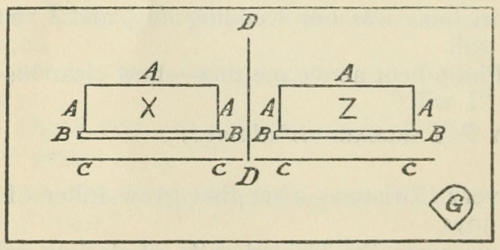
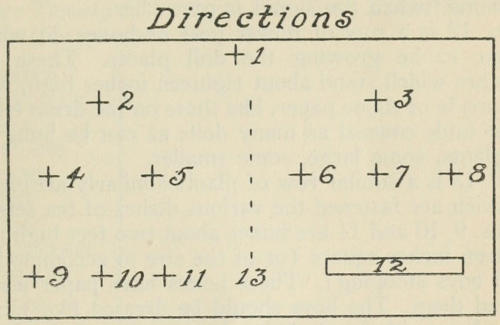
STAGE.
A-A-A—Curtains or screens.
B-B—Frames.
C-C—Curtains.
G—Grandma’s chair.
X and Z—Platforms.
One frame or setting can be used if the manager has
her pictures well in mind; but as the illustrations or
tableaux must be arranged quickly in order to be
shown just at the proper moment, it will be easier and
wiser to have two frames or settings, so that one picture
can be placed while the other is being shown to
the audience. The order of arrangement following
will insure the best results.
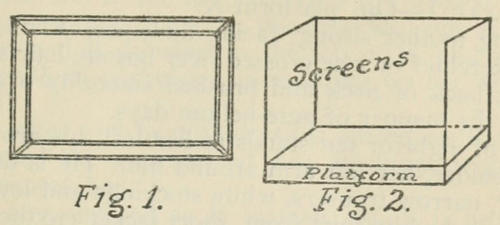
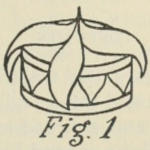
Fig. 1.Fig. 2.
These settings should be frames of light timbers.
See Fig. 1. The inner opening is seven feet high by
eight feet wide and the outer dimensions two feet
wider. This frame should be covered with a black
cloth and a gray gauze stretched across the opening.
The space behind the frame should be curtained or
screened at the back and sides with black or dark gray.
Fig. 2. The floor behind the frame should be raised
two feet in order to bring it well into view of the audience,
and of course the frame must correspond. The
pictures are arranged between the frame and the
screens.
The frame and gauze can be omitted, and the picture
presented in the space surrounded by the screens or
curtains; but of course the best way is the one indicated.
With all accessories ready, and some previous rehearsals,
these tableaux can be easily and rapidly presented.
In front and to one side the Grandma sits in an easy
chair. No other accessories. The tableaux are presented
in the settings described above, either one frame
in the middle of the stage and about four feet back,
or two frames set as in Fig. 3.
Tableau 1—On platform X.
Young mother sitting, facing audience. Plain, dark
dress, kerchief or lace crossed over bosom, hair in low
knot at back of neck and brushed smoothly over the
ears in the manner of ante-bellum days.
Boy of eight or ten stands at her left, his arm over
her shoulder, her left arm around him. He is dressed
in long, narrow trousers, white stockings and low slippers,
frilled white shirt front, short jacket (to the waist
only), wide collar and bow tie.
Girl of six or eight sits on stool or low chair, leaning
on the mother’s lap, looking in the mother’s face as
the mother looks down at her. Any dress with short
“baby” waist and short sleeves. Hair in two smooth
braids or loose curls.
Tableau 2—On platform Z.
Boy and girl from eight to twelve years dressed in
extreme of modern style party costumes. He has her
hand held high and they are in the attitude of some
figure of the Lancers. Their bearing is sober and
indifferent. These are children No. 2.
Tableau 3—
This is double and both curtains can be drawn at
the same time. On platform Z sits “Son John,” a
middle-aged man, gray, well dressed. He is in an
office chair or an arm chair, his elbow on the table, his
head on his hand. His attitude and face show weariness
as he sits thinking.
On platform X, prepared while tableau No. 2 is being
prepared and shown, children No. 1 kneel at the same
mother’s knee in prayer. They are in white nightgowns
and a small white bed is back of them. (This
may be omitted.) If one frame only is used divide it
by a movable screen, giving the single figure but one-third
the space.
Tableau 4—Children with stockings. Platform X.
The back of the space represents a fireplace. Painted
scenery can be used, or a framework to indicate it,
with andirons in the fireplace. No fire needed. Two
bulging stockings hang by the fireplace; one is small
and has a doll showing in the top of it, and a very
small child in nightdress is reaching up her arms to
the doll.
The other girl in nightdress is sitting on the floor
examining the contents of her stocking, with toys
lying around her.
The boy, dressed as in tableau No. 1, is astride a
rocking-horse in attitude of driving; or he is blowing
a trumpet with one hand, while he drums with the
other on a drum which is hung around his neck.
Tableau 5—Platform Z. Group No. 2.
Same costume as before. They sit facing each
other (not too near). The boy has one hand in his
pocket, leans lazily back in his chair and looks crossly
at an open pocketbook held in the other hand.
The girl wears much jewelry and has an open jewel
case in one hand and a watch and chain in the other,
at which she looks scowlingly.
Tableau 6—Platform Z. Group No. 1.
Dress as in tableau No. 1, but with the addition of outdoor
garments. These should be of the “Kate Greenaway”
type, pictures of which can be seen in children’s
books. They walk side by side, her hand in her muff,
he holding out to her a candy heart. They are smiling
shyly at each other.
Tableau 7—Platform X.
Wedding scene. Parson (who may be same one who
personated “John” in tableau No. 3) in Episcopalian
gown and bands, holding a prayer-book and looking
at the couple before him. He stands at one side of the
frame and close to it, slightly turned away from the
audience, so that the bridal couple may partly face the
audience.
The groom is tall and handsome, dressed in Colonial
style, with white stockings, low buckled shoes,
white satin knee breeches, long vest and long-skirted
coat (color to choice), with wide lace ruffles at wrists
and down the shirt front. He wears his hair long,
powdered and tied behind with a black ribbon.
The bride is small and slender, dressed in full Colonial
costume, with veil, etc. She either looks down or
smiles up at him.
Tableau No. 8—
This is a double tableau, both platforms and curtains
being used, and both pictures being shown at
once.
On platform Z “Son John” stands just behind his
children (group No. 2) and all look imploringly at
Grandma and hold out their arms to her.
On platform X the bride and groom stand back at
one side, his arm around her, both smiling at Grandma.
A double gauze should hang before them inside the
frame, so that they are but dimly seen.
Group No. 1 stand together at the right front of
the space and both reach their arms to Grandma as
they smile at her.
CURTAIN.
OLD AUNT DINAH’S CHRISTMAS.
A MONOLOGUE.
Go way fum hyar, chile! How you s’pose I gwine
git ready fer Sandy Claws ter come if you chillun
keeps a-hangin’ eroun’?
Doos Sandy Claws bring dem Chris’mus gif’s? Sho
he do. Does I put gif’s inter dem stockin’s, too?
Laws! Yo’ jes’ talkin’ foolishness. How Sandy
Claws gwine fill yer stockin’s ef dar ain’t no stockin’s
dar I like ter know? An’ ain’t I de one dat mends ’em?
Co’se I hangs up de stockin’s. Yer kaint ’spect Sandy
Claws ter tote a passel ob stockin’s ’roun’ wid him.
Don’t he be good ’nuff ter put tings in ’em I lak ter
know?
You Pete! Ef yer opens dat ar drawer yer gwine
cotch it sho’!
What’s in dar? Dat’s fer me ter know an’ you ter
guess, mo’ ’special jes’ eroun’ Chris’mus.
Why kaint yer see? What’s dat? Ef Sandy Claws
brungs de gif’s huccome I wants ter hide anyt’ing?
See yhar, chile! Some dese days yo haid gwine ter bus’
clar open wid its sma’tness. Oh, go ’long off an’ ’muse
yerse’f. Yer tongue hung in de middle an’ wags hese’f
all ways ter wunst.
’Lisbeth Maude! Leave my wu’k basket ’lone, will
yer? Yo tink dat look lak er doll dress, hey?
Yo’ jes’ better onhook dem eyes ob yourn f’um whar
dey don’t b’long.
Ya-as. Dis Chris’mus Eve, sho’. Ya-as, Sandy
Claws gwine come yere ef yer’s good. He ain’ gwine
come whar de chilluns is bad an’ don’ min’ dey ma,
an’ axes er lot ob fool questions.
Ma’y Bell! Quit teasin’ dat baby! Ain’t yer ’shame
yerse’f? Yo ’spec’ Sandy Claws gwine brung anyt’ing
to a leetle gal what—Abram Lincoln! Git outen dat
cupboard! Quick, I say! My lan’! Ef I jes’ kin git er
holt er yo’ fer five minutes I’m gwine mek yer dance!
Yas sar! Yer better cla’r outen yhar!
Genevieve Blanch! Come yhar an’ wit dese chilluns
an’ chuck ’em in baid! I’s plumb wore out, an’ ef dey
axes any mo’ ob dere fool questions I gwine ter
ex-plode! An’ den whar’ll Chris’mus be at?
TOO MUCH CHRISTMAS.
Christmas every day! Oh, what fun ’twould be.
With all the gifts and all the fun and jolly Christmas tree!
And yet, I’m not quite sure, we might get tired enough
Of fancy things and fol-de-rols and all the Christmas stuff
If it should come so often; and so, perhaps, it’s true
To keep it just the way it is I think is best, don’t you?
Christmas every day! One thing I can see
That all the gifts and all the sports and jolly Christmas tree
Can’t make us glad if we are bad and selfish and unkind.
Perhaps one way to make each day like Christmas we may find
Is just to feel like Christmas toward each one that we may see,
And make it happy, like that day, wherever we may be.
WE KNOW.
Recitation for Two Very Little Children.
We are just two little children,
Too small to work or sew,
But we know when it’s Christmas,
And what it’s for we know.
And we know what we’re good for;
It’s just to grow and grow,
And be two little children
For you to love and know.
So, Santa, dear old Santa,
Please come here soon, for oh!
We’re waiting and we’re waiting
Because we love you so.
WHAT COUNTS.
A MONOLOGUE.
Betty Holloway is a girl ten years old, and her
mother is a widow with a large family whom she supports
by making buttonholes. They are very poor, and
Christmas is coming.
Betty (speaks).
Yes, Christmis is a-comin’, and I feel worser and
worser the more it keeps a-comin’.
Ma an’ me we had all sorts of fun planned out, ’coz
I’ve been helpin’ much as I could, and we’ve been
savin’ up for Christmis.
Then what did Buddy do but go an’ break his arm,
and that cost lots. (Sighing.) Yes—I know—the doctor
didn’t charge nuthin’, but the drug store man did,
’coz Buddy had fever and had to have medicine to
stop it.
And Benny (that’s Buddy’s twin), he wasn’t goin’
to be left behind, so he broke a winder playin’ ball, and
ma paid for it. And it was hard work to keep ’em
from fightin’; ’coz Bud he said a broke arm was worst,
and Ben he would have it a broke winder was worst—cost
as much, anyhow.
(Suddenly.) Betty Holloway! What you whinin’
about? Cryin’ ’fore you’re hurt, are you? (Scornfully.)
Didn’t know you was that kind. What did
ma tell you the other day?
“’Taint what comes to us, Betty,” she said, “It’s how
we take it when it comes that counts,” she said. “We
can’t sit down and cry, not one of us; we’ve all got
to count for something. All of us.” My! When ma
talks like that, with her eyes shinin’ and her lips
smiley, it makes me think of the band goin’ by; you
can’t help marchin’ in time and walkin’ straight, and
you feel like you could tackle anything.
Well, sir, I’m goin’ to tackle Christmis, and I’ll
make it count, now you see. With all these children
on our hands ma ’n’ me has to hustle, but we’ll never
let Christmis go and nothin’ doin’.
Now, le’s see. “When you ain’t got money you got
to make your know-how and your hands do instead,”
ma says. That’s true this time if it never was before.
(Looks at her hands.) Ten fingers—and that’s all.
(Shakes head doubtfully, then cheerily says:) Ho, you
Betty! Where’s your know-how? Stir that up a bit
and get to work. Well—first of all there’s the twins.
They’re always playin’ store. I’ll make ’em a store.
I’ve got a box the grocer gave me yesterday, and that
shall have shelves in it, and a counter; and I know
where to get some little bottles, and I’ve got two
cardboard boxes, big ones, and I’ll make no end of
things out of ’em—little boxes and scales, and sugar-scoop—’n’
lots of things. Sand shall be sugar, and
plenty of things will do for spice and coffee, and
such. Oh, you’ll see! It’ll be a nilligant store. I don’t
b’lieve that one in the toy store is much nicer. And I
can make paper bags, and—oh, what fun! And won’t
they be tickled!
Then, besides the store I’ll make ’em some paper
soldier caps. Ma gave me some be-u-tiful paper last
week; it came around a bundle of work. And some
badges—I’ve got some silver paper that come ’round
some chocolate once—I found it; it’ll make beauty
badges. Oh, I tell you! They’ll be so fine they can
hardly step. Stripes down their trousers, too. Why,
I couldn’t get ’em anything that would tickle ’em
more if I had a whole bag of money. And this won’t
cost a cent.
Then there’s Jennie and Bess. They’re not twins,
but they might just as well be. They’re just of a size,
if one is older ’n the other, and they look just alike,
and they want to do the same things.
’Course it’s dolls for them. I had meant to get ’em
some of those dear little ones with real hair and arms
and legs that move. Oh, dear! (Sighs. Then, straightening
up.) Keep your whinin’ in your pocket, Betty.
I’ve told you that before. I’m makin’ this Christmis
count for a good time, and whinin’ isn’t part of a
good time; so keep it still, I say.
Well—about the dolls—let’s see. Oh, I know. I’ll
make ’em a playhouse. I’ve got lots and lots of cardboard
spool boxes, and you’d be s’prised to see what
dandy things they make; beds, and chairs, and sofys—why,
I can make everything a doll house could
want. Dolls will have to be rag ones of course, which
isn’t so very stylish; but then! The house will be so
fine they’ll hardly notice the dolls, I guess. So that
settles it for the girls.
Then there’s the baby. He’s most three and such
a dear! But sakes alive! He’s easy. Why, a little box
with a string to it makes a fine wagon. And I can
make him a nilligant ball out o’ bright pieces. And I’ll
ask Mr. Sweeny if I may go into his planing mill and
pick up some little blocks; there’s all sorts of cute-shaped
ones there. Oh, baby’ll be happy.
Now, I haven’t got a tree, and I can’t get one—there’s
no use talking about it—but I can get a couple
or so of barrel hoops and trim ’em up with paper
fringe and things, and tie the little things to ’em.
They’ll look real Christmis-y hung up on the wall, and
the store and playhouse can be underneath. And I’ve
got a red bell I saved from last year. I can make it
real pretty! And as to candy and such, the youngsters
may get some at the Sunday School, and I’ll coax ’em
to let me save it for ’em, and I’ll trim things up with it.
And ma (stops and looks troubled). Ma must have
something, she’s so good. Why—sir! My mother is as
brave as ever a soldier was! Talk about battles! If my
mother doesn’t have as hard things to do as if it was
battles I would just like to know. She deserves Christmis
more ’n any of ’em. But, oh, dear! What? Well,
I know how to make a dear little paper-fold tray for
pins, and I’ll make a big bunch of twisted tapers;
they’re awful handy, and they save matches, you
know. And—le’s see. Yes, I’ll make a whole bunch
of paper flowers. Hooray! That’s a great idea. They
won’t fade, and they’ll stay pretty better ’n the real
ones. Oh, goody, goody! Won’t we have a lovely
Christmis?
Mother’s right. She always is. “’Taint what comes
to us, it’s how we take it that counts.”
I thought at first we couldn’t have any Christmis,
and here we’re going to have a perfectly lovely one.
Me? Presents for me? Oh, I don’t need presents.
I’m going to have all the fun of makin’ ’em and some
more fun seein’ the others have ’em. And when my
mother looks at me with that shine in her eyes and
says, “Betty, you’re my comfort,” the way she does,
do you s’pose there’s any gift in the whole world could
make me feel so glad?
Oh, Christmis is great, all right, but a mother like
my mother—what counts—beats all your Christmises
holler. Merry Christmis!
THE BELL SONG. — SONG. — DIRECTIONS. — COSTUMES. — MARCH.
Chorus for Thirteen Children.
They may be all boys, all girls or both together, and
there may be as many additional as desired.
Tune: “Jingle Bells.”
Hear the Christmas bells as they gayly ring.
And our voices join as merrily we sing.
All the world is glad, hearts with joy are light,
For ’tis the best of all the year and Christmas comes tonight.
CHORUS.
Merry bells, merry bells, ring, oh, ring today.
Oh, how happily we sing, for joy is on the way.
Christmas bells, Christmas bells ring your music sweet,
While our hearts keep merry time to children’s dancing feet.
Tender are our thoughts, tears we bid depart,
Happiness we long to bring to every saddened heart.
Join us as we sing, banish every tear,
Christmas is the dearest time that comes in all the year.
CHORUS.
Pain is banished quite, sorrow goes away,
Anger dares not show his head on this glad Christmas Day.
Peace o’er all the earth, good will to all men,
Is the song the angels sang, we sing it here again.
CHORUS.
The leader should be older than the others if small
children are chosen. He carries a triangle, the others an
inch wide red ribbon two feet long, with six small
sleighbells sewed on each ribbon. Be sure and have
the bells small, as otherwise the number of them makes
their accompaniment too loud.
These ribbons are held by the ends with both hands.
No elaborate costumes are required, but as some uniformity
of dress is always effective, white dresses with
red ribbons, for the girls, and dark suits with holly
berries or knots of red ribbon in the coat lapel for the
boys, would add much to the effect.
Or, all might dress in outdoor costume with fur
caps, mittens, etc.
Enter at rear, center or either side.
1. March in single file all around the stage during
the first stanza. Let all shake the bells once on the first
beat of each measure as they march.
2. During chorus let the leader strike his triangle
on the first beat of each measure. One-half of the
other shake the bells once on first beat, and the other
half on the third beat of each measure. At the word
“way” (which is slurred through a whole measure)
the leader strikes his triangle once for each beat, thus
making four strokes; and at the word “children’s
dancing feet” he does the same, and all shake or tinkle
their bells through the last two measures. During the
chorus the children halt and face front, while they
keep time to the music as they sing.
3. At second stanza step backward diagonally, first
with right foot, then with left foot on alternate beats
of the music, at the same time swing the body and the
bells in the direction the steps are taken. The leader
stands before the line, facing the audience, and steps
as the others do, waving his triangle to right or left,
but not striking it.
At chorus the line halts and keeps time with the
music as before.
4. At the third stanza the line advances to the front
with the same step and motions as during the second
stanza, only in a forward direction.
Chorus as before.
CRANBERRY MARCH. — SONG. — DIRECTIONS FOR MARCH.
For Sixteen Children, Boys or Girls, or Both.
Costume all of scarlet, the boys in blouse waists, and
knickerbockers, the girls’ dresses with long or short
sleeves as desired. All wear scarlet stockings and slippers
and pointed scarlet caps.
Tune: “The Drum-Major of Schneider’s Band.”
When the Christmas time is here with all its cheer and frolic dear,
Then we come to help the fun at merry Christmas time.
Other things may welcome be, but only we can bring such glee,
Nothing else can fill the place of ripe red cranberries
Christmas! Oh, jolly Christmas!
We come to you in Christmas pies.
So fine the stringing,
Our gay beads bringing,
Each child is singing
Of cranberries.
And on the Christmas tree we glow,
In festoons gay we grow.
In every part of Christmas time we share,
We help to drive away all pain and care,
For we grace the glorious Christmas tree,
Pies and tarts we fill right juicily.
Yes, with the Christmas light
We gleam like blossoms bright.
And on the Christmas tree is gay red cranberry
A-shining and a-twining on the tree.
1. Enter at left rear in couples—march across rear.
2. Front face—march to front of stage in two rows.
3. Retreat to rear in same order.
4. Left face—march to rear right corner, turn to
right, march diagonally to left front corner, in single
file, alternating from each row in turn.
5. Turn to left—march across front of stage, changing
at the turn to couples.
6. Retreat to rear in same order.
7. March to front of stage.
8. Divide—four couples at each side swing back to
sides, the right and left end couples serving as pivots.
9. Both sides march to center—when they meet, halt;
mark time vigorously.
10. Retreat to sides.
11. Swing to front.
12. Separate, facing right and left, march in couples
to sides, take single file, march to rear, across rear to
rear center.
13. As they meet at center each faces front and the
lines march down center to front of stage; repeat 12
and 13, then march in couples around the stage.
14. As the couples reach the rear center they march
in single file until a ring is formed, and when the end
of the stanza is reached all, as suddenly as possible,
step into the circle and stoop down in a solid, circular
figure, thus forming the “pie.” Remain still until the
curtain is drawn.
DANCE OF THE HOLLY AND MISTLETOE. — DANCE. — DIRECTIONS.
For Eight Young Girls, or the Number May Be
Doubled.
Costumes at close.
Music: Waltz with marked accent, moderate tempo.
C means center; F means front; wreaths position
means wreaths held low in front, one hand at either
end of wreath. The number of measure given to each
figure must be determined by the music and its phrases.
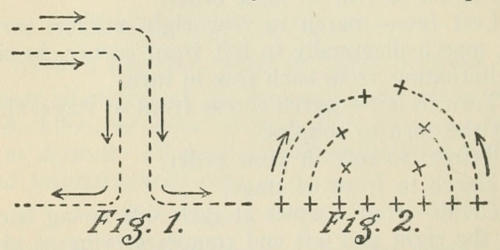
Fig. 1.Fig. 2.
1. Enter in couples at rear, wreaths in position, waltz
step. Sway wreaths from side to side in unison with
the step. Dance to center, turn to front; there separate
to right and left. Fig. 1.
2. When in a line across the front of the stage, halt,
front face, salaam. This last is a bow, bending from
the waist forward, the wreath held low with both hands.
3. To position, ends of line retreat to form a circle,
facing outward. Wreath in both hands behind the
head. Fig. 2.
4. Right face—wreath overhead—dance in a circle,
swaying the body and wreath alternately to right and
left. (This swaying body means bending from the
waist to one side or the other.)
5. Circle faces in. Wreath in right hand and high
so that the ends of all wreaths touch in center. Left
hands on neighbor’s shoulder. Dance, without leaving
place, toward the center and back, through one or more
measures.
6. Break line on side toward audience, retreat to
rear, wreaths position.
7. Dance forward in even line to front, wreath back
of the head.
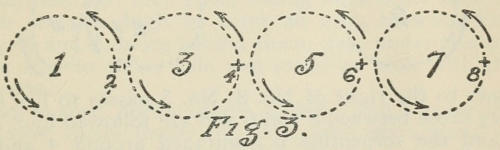
8. At front the odd numbers kneel, wreaths back of
the head; the even numbers dance around the others
twice, Fig. 3, swaying wreaths over their heads from
side to side. Let this swaying be done in unison by all
dancing.
Fig. 3.
9. Those kneeling rise; all dance backward to the
rear, swaying wreaths right and left with the step.
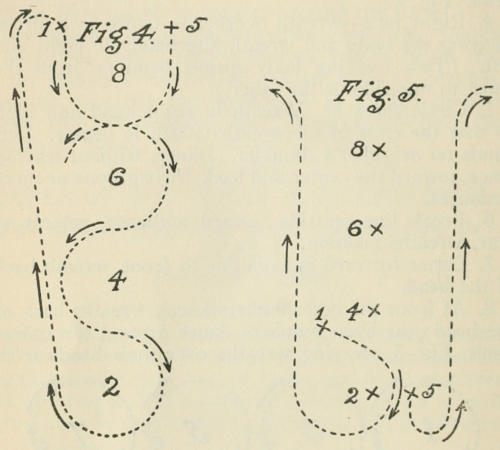
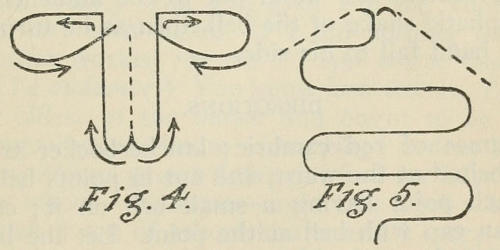
10. The even numbers now form a line from R. to
F. down the center. In this way No. 2 dances in front
of the line to R. center, then down middle of stage to
positions indicated in Fig. 4. Number 4 follows her,
and 6 and 8 do the same. These sway their wreaths
overhead alternately with the odd numbers, who dance
in serpentine around them, swaying their wreaths
overhead. This serpentine is led by No. 1, who dances
to the rear center, then, passing to the right of No. 8,
begins the serpentine as shown by Fig 4. When No. 1
passes to the right of No. 8, No. 5 passes to her left.
They cross between 8 and 6 and are followed by 3 and
7, and the serpentine is continued around 4 and 2.
This is continued until the odd numbers have reached
the front, gone back to the rear, passed around No. 8
and danced again to the front.
Fig. 4.Fig. 5.
When No. 1 has completed this figure she dances
again around No. 2, then in a straight line, and close
to the standing numbers, back to the rear, and to her
position. No. 3 follows her. Nos. 5 and 7 turn at the
left of No. 2 without going around her, and also dance
in a straight line to the rear, and to their places.
11. Line across rear; wreath in position.
12. Odd numbers stand, wreaths held behind head.
Even numbers right face, sway wreaths before them,
dance twice around those standing.
13. Couples link arms, hold wreaths overhead to
form an arch, waltz in this way to front, and back to a
line midway of the stage.
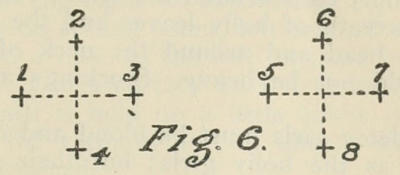
14. Two couples on either side form cross, Fig. 6,
crossing hands in center, holding wreaths over shoulders
with free hand. Those at right of stage cross right
hands and dance to right; the others the reverse.
Fig. 6.
15. Break circles, retreat to rear, wreaths position.
16. Repeat No. 8.
17. Repeat No. 10, except that as numbers 1 and 5
reach the rear, they stand facing each other and hold
their wreaths high to form an arch between them.
Nos. 3 and 7 dance behind them, pass under the arch,
then stop to either side and make an arch with their
wreaths.
So, in turn, do the others. Then 1 and 5 lower their
wreaths, dance under the arch, and again stand and
help form the arch, until the front of the stage is
reached. Here the dancers pass to right and left and
dance back to the exit, and out, swaying wreaths overhead.
Let the alternate numbers represent holly and mistletoe.
All wear dresses of soft material (cheesecloth
or silkaline), falling full from a yoke to the ankles.
Bare neck and arms are prettiest with this costume,
but if not desired have plain sleeves to the elbow,
finished with a six-inch frill of the same, and the neck
finished without a collar.
The holly girls should be brunettes and wear dresses
of bright green, as near the color of the holly leaf as
can be had, with a sash of scarlet ribbon about three
inches wide tied and fastened there, high under the
arms, “empire” style, with long loops and ends tied in
front. A narrow scarlet ribbon should be tied with
loops and short ends around the sleeve just above the
elbow. A wreath of holly leaves and the bright berries
on the head and around the neck of the dress.
These should not be heavy. Stockings and slippers
scarlet.
The mistletoe girls must be blond and dress in the
same style as the holly girls; but their dresses are
white, their ribbons and slippers pale green, and the
wreaths are of mistletoe with its white berries.
Each girl carries a half wreath (the half of a barrel
hoop is right for size) covered with holly or mistletoe
to match her dress.
HOLLYBERRY DRILL. — DRILL.
For Ten or Twelve Little Girls.
A prettier drill for small children can scarcely be
prepared. Costumes are of simple white, with red ribbons
and stockings, and hollyberry wreaths in the hair.
Each carries a wreath of holly and its red berries
and a fancy basket filled with bits of paper cut fine to
represent snow. The girls enter in time to a lively
march, in couples, each carrying her wreath lifted high
in the hand toward her mate, and the basket held in
the free hand. Enter at left rear.
1. Couples advance to rear center of stage, set baskets
down.
2. By couples, down center to front.
3. Couples separate, march round on either side to
rear.
4. Lines meet at rear center, pass, march down opposite
sides to front, meet and pass, back to rear.
5. Lines meet again at rear center, front face, advance
to front in a single line across the stage with
curtsey step.
In this step the right foot is advanced a step forward
and to the right on first count, right knee bent
in a curtsey on second count, left foot advanced a step
forward and a little to the left on third beat, and the
left knee bent in a curtsey on fourth beat, etc.
The wreath is held up a little above the face and
swayed to the right or left in unison with the foot
which is advanced.
6. When the line reaches the front of the stage, the
wreath is held over the head with both hands, and the
children retreat to the rear by skipping.
7. Down center in couples to front; wreaths held
high to touch mate’s wreath.
8. Couples separate; march either side to rear.
9. Lines meet. Then each line or side forms in a
group by itself, the free hands clasped and crossed in
the center, the wreaths held above the head.
10. Both groups then skip around, like a wheel
turning.
11. Groups form in line again at rear, forward to
front with curtsey steps as at No. 5.
12. Repeat No. 6.
13. Groups form again, one-half being in each
group, and form circles, the wreaths hung on their
arms while they join hands and skip in a circle.
14. Repeat Nos. 11 and 12.
15. Repeat Nos. 7 and 8. Put wreaths down at the
back and take up baskets.
16. Couples down center to front.
17. Mates face each other. The two facing lines
retreat to the sides, skipping backward.
18. Lines skip to center, throwing “paper snow”
from the baskets at each other, then skip back to sides,
throwing the paper continuously, so as to keep the air
full of the white snow. Repeat this advance and retreat
twice more. When the lines meet the third time
the throwing ceases, the couples march together down
center to front, holding hands together high, and carrying
the empty baskets in the other hands.
March around the stage and off.
THE PICKANINNY’S CHRISTMAS. — DIRECTIONS. — DANCE.
For Three Boys. More Can be Added at Pleasure.
Directions at close.
Tune: “Dixie’s Land.”
Oh, Chris’mas sho’ly am a-comin’,
Don’ you hear the banjos tummin? (Imitates banjo.)
If there are three who take part in this, one boy
can sing the song and the others join in the chorus, or
all can sing the entire song together. Let the one who
sings the verses stand between the other two. If there
are more let the leader, who sings, stand before the
others, who form a straight line from right to left behind
him. All face the audience. During the stanzas
they clap gently, keeping time as the leader sings.
At the chorus, while singing, they put their arms
across each other’s shoulders, the end ones with outer
hands on hips, and take the following steps:
1. Step three steps to the right, hop on right foot,
and swing the left foot before the right.
2. At accented measures (corresponding to “hurray,
hurray”) stamp in time first with left, then with right
foot.
3. Three steps to left, hop on left foot and swing
right foot before the other.
4. Three steps to front (starting with right foot),
hop on right foot, swing left before the other.
5. Stamp in time, first with left foot, then with right,
then hop on left foot and swing the right in front of
the left, then hop on right foot and swing the left foot
in front of the right.
6. Stamp with right foot, then with left; hop on left
foot, swing right; hop on right foot, swing left.
This completes the first stanza and chorus. Then,
without singing, and in time to the same tune, let the
line behind, led by the leader in front, give a dance.
The motions are given below, but the time of them
must be found as the boys practice.
It is called a “dance,” but in reality is posturing and
stepping. Any other motions than those given can
be used if desired, the only requirement being that
those in the line move in unison.
If the leader can do so, let him elaborate upon the
motions, dance a clog dance or a shuffle; or let him
attitudinize in any absurd way. At the close let him
come to position, clapping in time as the second stanza
is sung, stepping as before at the chorus, and repeat
the dance afterward.
1. All turn to right, the first boy with hands on hips,
the others with hands on the shoulders of the one in
front. Hop on right foot, throw left foot high, hop
on left foot, throw right foot high. This takes four
measures and carries them four steps toward the left
of the stage.
2. This starts at the words (or where they would
be if sung) “Chris’mas gif’,” etc. Each boy, with arms
held at full length over head, and hands clasped, whirls
entirely around, once for each measure, ending with
a stamp of right foot on the last word and a quick
wheel toward the right of the stage.
3. Repeat Nos. 1 and 2 toward the right. It is now
the chorus.
4. Front face, arms across shoulders; step obliquely
to right one step first beat, bend right knee second
beat, with body and head bent to right. Second step
obliquely to left third beat, bend left knee fourth beat,
bend body and head to left. Alternate in this way
until eight steps are taken, when the next words would
be “Ain’ I glad? Ain’ I glad?” (the second time).
5. Each boy raises arms overhead, clasps his hands
together and whirls once for each “Ain’ I glad.” At
the words “I’m glad ’tis merry Christmas” he stamps
with left foot, whirls as before at the next two repetitions
of “Ain’ I glad,” but does not stamp at the last
line, only folds his arms and bows, first to right, then
to left.
CURTAIN.
POP-CORN DANCE.
For Sixteen Little Girls.
Dresses white, short and fluffy; white stockings and
slippers. Capes and caps of yellow cambric. The capes
reach the bottom of the dresses and have openings for
the arms to pass through, and the caps are round skull
caps fitting the top of the head closely. The “dance”
is a series of simple steps and movements which are
easily learned.
Music: A march or two-step.
1. Enter at left rear in couples to a slow march, and
for each step make a turning motion of the body to
right or left as the right or left foot advances. March
across the rear to right corner and turn diagonally and
sharply. March to left front and again turn and march
across the front of the stage. When the double line is
in the center, halt, front face, and, beginning with the
leader nearest the audience, let one at a time, first in
the front, then in the rear line, give one hop on the
right foot, then rest until this hop has been made by all.
2. (Music slightly quickened.) Lines step back with
left foot a little to the left, curtsey, rise, as the beats
of the music indicate. Repeat, with right foot toward
the right, curtsey, rise and repeat these backward
movements until the rear of the stage is reached, both
lines moving in unison.
3. Advance to front of the stage with same motion,
front line stepping to right, and rear line to left simultaneously,
thus giving a zig-zag motion.
4. Still holding hands the ends of the two lines move
back until an angle is formed, the joined hands of the
lines as they are held forward, forming the apex. The
step for this motion is a hop, first with right, then with
left foot, bending the body almost at right angles to
right or left in the direction the step is taken.
5. Reverse the motion with steps forward until a
straight line is again formed.
6. Front line kneels on right knee, raises joined
hands high on first measure, lower them on second
measure, repeat for four measures. Rear line advances
one step in such manner that the girls of rear line alternate
with those of front line, but behind them. Unclasp
hands and each make four hops, first on right,
then on left foot, turning as she does so. This completes
a revolution. Then take one step to the right
on the first beat of the music, bend right knee (thus
dipping or curtseying) on the second beat, one step
to the left on third beat, bend left knee on fourth beat.
This completes four measures.
7. Rear line kneels on right knee, but does not join
hands until the front line rises, unclasp hands and
steps quickly backward between those kneeling. This
takes one measure. Then the kneeling line clasp hands
as at No. 6a, and those standing repeat No. 6b. Repeat
this until each line has knelt twice. This should bring
them to the position they had before Nos. 6 and 7, viz.,
in parallel rows facing the audience, only at the rear of
the stage instead of the front.
8. Both lines clasp hands. Rear line steps close to
the front line and puts the clasped hands over the heads,
and in front of the front line. This brings the girls
alternating. The solid line thus formed runs forward
four steps (starting on left foot) in double time, viz.,
two steps to each count. At the fifth step (which
brings them on the left foot) hop on the left foot, then
on the right foot. Repeat these two movements—the
running forward and the hopping—until the front of
the stage is reached. It should take three, perhaps
four, repetitions.
9. Both lines unclasp hands. Rear row steps back
to its place behind the front row as it was before No. 8,
and each girl puts her hands over the shoulders of the
girl directly in front of her, who raises her hands to
clasp them. The four couples on the right now turn
to the right (away from the center) and those on the
left face left. The two sets now move away from each
other with short steps and double time four steps forward
(always left foot first). The rear girl steps to
the right of her partner and they run four steps diagonally
to the right. The rear girl then steps behind
her partner and they run four steps forward. The
rear girl then steps to the left of her partner and they
run four steps diagonally to the left. This figure is a
little like that in the skate or barn dance.
10. The two sets now right-about-face and dance to
the center as they danced away from it, the front girl
now being the rear one and dancing at either side of
her partner, etc.
11. When they meet at the center they face front,
and all in unison dance to the front as in No. 3, except
that the forward movement is in the same direction,
and not zig-zag.
12. Repeat Nos. 2, 3, 4, 5, 6 and 7.
13. Dance to the front of the stage with the couples
holding hands as in No. 10, but the figure is different.
Let the couples run four short steps diagonally to the
left on the first two beats of a measure, then hop first
on the left foot, then on the right; then run diagonally
to the right four steps, hop twice, etc., repeating these
movements until the front of the stage is reached.
14. Retreat to rear with the same steps as in No. 13,
only running backward. Here throw off the cloaks.
As they are buttoned only at the neck, this can be done
suddenly and all together. By throwing the capes quite
to the back of the stage as they stand they will be out
of the way of further movements. All the time they
are doing this (which should occupy not more than
two measures, and one if possible) the hopping is kept
up. This is the popping of the corn, which thus comes
out in its fluffy white.
15. Dance to front again by the following steps:
Four steps to left and forward, hopping alternately on
either foot, then four steps to right in the same way;
four steps to left, etc., and then, without losing step—
16. Retreat to rear, going backward with the same
step. At the rear form a line in front of the capes on
the floor. During the last four numbers the music has
quickened until it is as fast as can possibly be kept time
with.
17. The instant this line is reached let the children
step side by side to form one continuous line,
all holding hands. The two at the ends of the line
now put their free hand on their hips, and raise the
hands clasping their neighbors as high as they can.
The next ones hold the hands of the third numbers
level with their shoulders, and tip their heads toward
the third ones. These third ones kneel on the right
knee, and have one hand up to hold the hands of the
second ones, and the other hand lower to hold the
hands of the fourth in line, who kneel on both knees
as flat as possible.
The two in the middle of the line stand holding
their joined hands as high as possible, the others take
positions as the second, third and fourth in the lines
have done. The result is a pop-corn chain in two
festoons.
If this is done instantly the effect is very pretty.
The change from the “popping” of the corn to the
stillness of the festoons being unexpected and striking.
At the same time the music, which continues to the
end, is played softer and slower.
18. This pose is held for several measures. The
music then gives the signal by resuming a marching
tempo, and playing louder; those kneeling rise, and
the whole line forms a circle, holding hands. The
circle dances around twice one way, then twice the
other way, by running two steps, hopping at the third
step, and repeating.
19. The circle parts and swings back to a single
line, where the festoon is again formed, and held
several measures.
CURTAIN.
THE SLEIGHBELL DRILL. — DIRECTIONS.
For Twelve, or More, Boys, Ten to Twelve Years Old.
Music: Any brisk march or two-step will be suitable.
The music of “Jingle Bells” or any similar piece in the
same kind of time may be used.
Costumes described at close.
The step for this is merely a trot, with short steps,
and following the leaders closely. The wands are
to be shaken in time to the music constantly, except
where otherwise indicated.
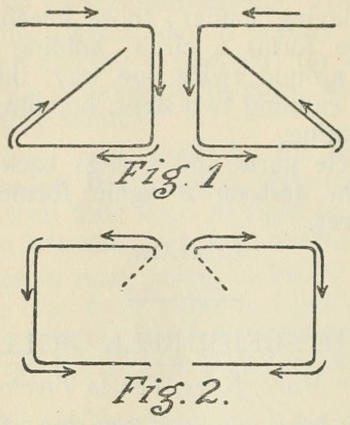
1. Enter at opposite sides of rear, wands held in
right hands at sides, left hands on hips.
Cross stage toward each other, meet, turn and go to
front, then diagonally back to rear center. Fig. 1.
2. Leaders turn to right and left, across rear, down
sides to front, across front till they meet. Fig. 2.
3. All put left hands on shoulder of next one, the
one at extreme left keeps his hand on his hip. All
step back diagonally with left foot one step, bend left
knee, and keep right knee straight. This makes the
line sink backward. At the same time extend right
hand diagonally to right, shaking wand in time to
music. Hold two measures.
4. Left foot and right hand back to position; hold
two measures.
Fig. 1.Fig. 2.
5. Step diagonally back one step with right foot—bend
right knee—left knee straight—right arm held
directly overhead—wand shaken in time. Hold two
measures.
6. Back to position, as at No. 4.
Fig. 3.
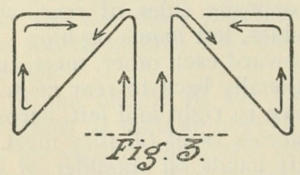
7. Leaders turn toward rear—pass to rear—march
diagonally to front at the extreme right and left—back
to rear at sides—across back to center—all in the trot
which is in double time. Fig. 3. In this figure, and
in all of them, let every boy, in following the leader,
go to the precise spot that the leader does before turning.
Unless this rule is carefully followed the outlines
of the figures are lost, corners are missed, and the
whole drill becomes confused instead of effective.
8. Down center to front in single file, stepping into
place alternately from each side—halt.
They are now in one line, in the center, facing front.
Beginning with the foremost boy as No. 1, the odd
numbers bend at right angles toward the right, and
stretch the wand out at the right, shaking it rapidly
so as to make a quivering sound with the bells. The
even numbers take wands in left hands, right hands
on hips—bend to left—hold left arms at right angles—and
also quiver their wands. Hold two measures.
9. All erect—hands holding wands held up overhead—all
quiver wands—hold two measures. Execute
these two movements, alternating, four times each.
10. Wands in right hands—left hands on hips. All
to front, where they separate, the leaders turning to
their own sides, right or left, and the others following.
They turn backward close to the center line, and march
to the rear. Sides turn right or left, then back in a
loop, to the center, where they again form in a single
line. Fig. 4.
11. This line, led by No. 1 (the foremost one as in
No. 8), takes a line like Fig. 5—all holding wands
overhead and shaking them in time to the music.
Fig. 4.Fig. 5.
12. When the front is reached the line separates,
the leaders turning to their own side, and the others
following. March to sides—up side to rear—across
rear to center—where they meet, halt, front face.
13. The line now moves forward four steps—halts—and
the boys, by couples, strike each other’s wands
twice; the first time one strikes and the other parries,
the second time reverse. Move four steps forward
again, repeat the striking, and so continue to the front.
(The words “march” and “move” have been used; but
it must be kept in mind that unless other steps are indicated
all moving is done with the trot before referred
to.)
14. At front repeat Nos. 3, 4, 5, 6 twice.
15. Line separates, turning to sides—up sides to
rear—across rear till they meet at center, where they
repeat Nos. 8, 9, 10 and 11. (Notice the difference
between “No. 3,” or 4, and “Fig. 3,” or 4.)
16. When leader is at front he turns toward rear,
others following in a single line, and they go in a
circle, twice; the first time arms held at right angles,
shaking the wands in time to music; the second time
around the wands held overhead and quivered.
17. At completion of the second circle the line separates,
each leader leading his line to right or left as
they reach the front—across front to sides—up sides
to rear, where they go out as they came in. As each
boy reaches the side where he turns to go toward the
exit, he reaches his wand out to the audience, gives
one emphatic shake of the bell, then as he turns away
lets his hand fall to his side.
Costumes of red cambric; knickerbocker trousers,
jacket belted at the waist, and cut in points below the
belt, each point having a small bell on it; cap like
toboggan cap with bell at the point. Let the boys go
in stocking feet, or with red cloth slippers. Stockings
red. Each carries a stick a foot long, and one-half
the size of a broom handle. This is covered with cloth
like the suit, and has a bell at the tip.
PART II. Dialogues, Exercises, Musical Pieces and Plays
ALL THE YEAR ’ROUND.
For One Adult or Large Boy and One Small Boy.
Santa Claus must be made to look very short and fat.
Boy enters, sits down, leans elbow on table and his
head on his hand.
Boy. Whatever shall I do? Christmas is almost
here and not a single thing finished. You see (addressing
audience), when a fellow’s folks have a small purse
and a large family there’s no such thing as spending
money for us boys. (Gets up, walks back and forth
talking, with hands in pockets.) All we earn goes for
shoes, I guess. (Stops and looks at his own, then looks
up laughing.) Anyhow, they wear out fast enough.
(Resumes walk.) But I’m glad I’m big enough to
work for my own shoes. If I did nothing but play
while father worked for me I’d feel worse than anything.
(To audience.) You know how that is. Besides,
I’m the oldest of the bunch and ought to be worth
something. But you know—(stopping) it does beat all
how many things grown folks can find for boys to do.
I go to school—of course—and I take a job whenever
I can catch it out of school hours, and I carry papers
mornings, but that don’t take all the time, and I thought
I’d get a lot of things done for Christmas since I can’t
buy things. But do you s’pose I’ve done it? (Sits
down.) No, sir-ee. Not a thing finished.
I was making a shoe box for father and I haven’t got
any farther than getting a box to work on, for I’ve had
to milk the cow and feed the chickens—and mend the
gate—’cause father was away. Then I had a new
woodbox for mother—a jolly nice one—all trimmed
with bars of wood and stained; but, no, sir, mother, she
needed me for ’bout a hundred and ’leven things, and
work at it I couldn’t. And this boat for Bub (shows
it), not half done. And a bob-sled for little Sis—and
a photograph frame for Gramma—and—oh, pshaw.
I’m just plum disappointed, and that’s the truth. Not
a gift done for anybody. (Leans elbows on knees and
chin on hands.) If I was a girl I guess I’d cry.
(Santa Claus walks in, lays his hand on Boy’s shoulder.
Boy jumps up as he looks around.) Jiminy! You
most scared me. (Bows.) How de do?
Santa Claus. Very well, thank you: and how do
you do? What’s the trouble?
Boy. Excuse me; but how’d you know it was
trouble? It isn’t a serious trouble, you know; only boy
trouble.
S. C. Boy troubles are hard to carry sometimes.
What are yours?
Boy. Mostly, I guess, that I’ve not got my gifts
done—and can’t finish them now, ’cause there’s not
time. And that means that there will be less for the
stockings, you know.
S. C. That is hard lines. But why couldn’t you
finish them?
Boy. Sit down, won’t you? (They sit down.) Why—because—well,
I had to do lots of things. Kindling,
you know, and bringing in wood for mother—and taking
care of the baby sometimes—and keeping little
Bud out of mischief—and sometimes—well, you see,
I’m the oldest, and the others are too little—sometimes
I wash the dishes. Mother has so much to do,
and I ought to, don’t you think so?
S. C. Indeed, you ought, and I’m proud to find a
boy who does it. But do you know, son, I think you
are making a great mistake.
Boy (looking alarmed). Am I? What? I’m sorry.
S. C. You say you have nothing to give at Christmas.
It strikes me that you are giving a good many
things, and very nice ones, too.
Boy (bewildered). I don’t understand.
S. C. No? (Smiles, winks at audience.) What is
Christmas for, anyhow?
Boy.For? Why—it’s Christmas, Santa Claus’
birthday, you know. (S. C. nods.) And it’s for—for
good will to men, I guess—and—
S. C. (nods). Right you are, son. And what do you
give Christmas gifts for?
Boy. Oh—because it’s fun; ’cause a fellow likes to
make it nice for the other folks and give ’em a good
time, and—well, ’cause it’s fun.
S. C. Right you are again, son. See here, now.
Didn’t you milk the cow for father and all such things
while he was away?
Boy. Yes—’course.
S. C. And didn’t it make him feel comfortable to
know that things were going right while he was gone?
Boy. Guess so. Sure.
S. C. More comfortable than to have a shoe box?
Boy (slowly). Per—haps—yes.
S. C. And you got kindling, and took care of the
baby, and washed dishes for mother?
Boy. ’Course.
S. C. And didn’t that make it easier for her than
if she had a pretty woodbox?
Boy (slowly). I guess so. Yes—sure.
S. C. And doesn’t little Sis enjoy having long rides
on your sled better than to have a sled of her own to
go alone on?
Boy. I’m not so sure about that.
S. C.I am. And didn’t little Bob like the snow
man it took you so long to make for him better than
the little boat? And didn’t dear old Grandma care
more for the yarn you wound, and the needles you
picked up, and the fires you built, and the errands you
did, and—
Boy (squirming). Aw. Hold on. Those are such
little things.
S. C. True enough, and each of them took some
of your time, and kept you from making the photograph
frame; and each of them made her lonely day
a little easier, didn’t it?
Boy. Well, I should hope so. Say. I think it must
be awful when you can’t run and holler and have fun—and—I
guess some day I’ll be old like that. (Shrugs
shoulders.) Gee! (Whistles softly.)
S. C. (rises, puts arm across Boy’s shoulder). Don’t
you begin to see, my son, what I mean?
Boy (looks at him a minute). That little things
strung along are better to make folks happy than a
bigger thing for a gift at Christmas?
S. C. (slaps Boy on the back, grabs his hands and
shakes them vigorously while he laughs. Boy rises.)
That is it, to a tee. And do you begin to see any
farther?
Boy (looks at S. C. in silence a minute). Perhaps
you mean—do you mean—that to live that way—doing
little things all the time—would be like Christmas?
(Excitedly.) Jiminy Christmas! I see! I see! Why!
I can keep Christmas going the whole year ’round that
way!
S. C. That is the only Santa Claus worth while, and
the only Christmas that can ever be real, for it is the
Christmas spirit of love and kindness. (Boy whirls
around, tosses up his cap. S. C. exit.)
Boy. Christmas and Santa Claus all in one. And
every day in the year. Say—(turns suddenly and S. C.
is gone). Why—where—(looks all around, then says
slowly) well, I’ll be—isn’t that the queerest thing?
(Puts hands in pockets.) But I see it just the same.
(Musingly.) “The Christmas spirit of love and kindness.”
“The only Santa Claus worth while.” Christmas
every day in the year. (Shouts.) Hooray for Christmas.
I’m going to tell mother. (Exit.)
A BOY’S CHRISTMAS.
For Three Boys of Ten or Twelve Years.
Two sit whittling, one working on the edge of a
small wooden box, the other at the edges of a piece
of wood about one inch thick by a foot square. The
third has an oblong box partly together and is sawing
the other piece or whittling the edges as they talk.
Frank—
Christmas is coming—it’s awfully slow—
What do you think you will get? Say, Joe.
Joe—
I don’t know, Frank, and I don’t much care
If only I get some good skates—so there!
Tom—
That isn’t what bothers me most, you see,
I always get lots on the Christmas tree,
But what shall I give? That’s the hardest part.
Joe—
I’m making my little kid brother a cart.
(Holds it up.)
But somehow this wood won’t saw a bit straight,
And it splits where I nail it. That’s what I hate.
Frank—
Right you are there, Joe. See what I’ve made?
My knife’s pretty dull, so I broke the best blade.
Tom—
What do you call it?
Frank—
A box, at the start,
For sister’s best ribbons; but it would come apart
Till I put some big nails in. They broke it in two,
And I had to stick it together with glue;
And now it don’t look so awfully well.
(Looks at it dolefully.)
Joe—
Put pictures all over it, then you can’t tell
It ever was broken. That’s what I would do.
But say! How it bothers when one works with glue.
Now this! (Holds it up.) It has stuck everywhere that it could
Except where I wanted to make it real good.
Tom—
That’s just what’s the trouble. It’s this way with me.
I work hard, and make things as nice as can be,
But somehow, they never seem quite the right way
To give for a present on Christmas-tree day.
Joe (exclaims suddenly)—
I know!
Frank—
Well, what is it?
Tom—
Out with it, then, Joe.
Joe—
We like to make gifts like the others, you know,
(They nod in agreement.)
But something or other most always goes wrong.
Frank—
I know how it is.
Tom—
Yes, you’ve put it quite strong.
But Mother can understand things at first sight,
And she will say “thank you,” and call it all right.
I’ll give this to Mother. She’s just the right one!
She’ll like it and use it, because I’m her son.
Frank—
Say, Joe, you’re a trump to think up a nice way
For us to give presents on Christmas-tree day.
My box goes to Mother—she knows about glue,
And she’ll fix it up till for something ’twill do.
Tom—
This board I have whittled all smooth, and ’twill make
A board to cut on for bread or for cake.
I’ll give it to Mother, and she’s sure to say
“Thank you, Tom; you make nice gifts for Christmas-tree day.”
A CHRISTMAS BARGAIN.
For Two Characters, Mother and Child.
Stage setting: The furnishings of a modern room.
Costumes modern and simple.
Mother (draws Child to her side, kisses her,
Child stands with Mother’s arm around her). It is
almost Christmas time, little girl. What would you
like to have Santa Claus bring you?
Child. I only want one thing, mother dear, and
Santa Claus can’t give me that, nor anyone else.
Mother. Are you very sure, dear? Santa Claus
can do wonderful things, you know.
Child. I’m very sure, motherkin. And if I can’t
have that, I don’t care about Christmas.
Mother. Why, my little Mary? Tell me about it,
dear. Possibly I can arrange it, for I want to have
you happy more than anything else in the world,
especially at Christmas time. Tell me.
Child. You won’t laugh at me?
Mother. No, dear; I won’t even think a laugh.
Child. Well, then, I want to be grown-up and
have you a little girl.
Mother. Why, Mary, Mary!
Child. Now you are laughing at me.
Mother. My dear! I’m just as sober as I can be.
Child (pouting). Your eyes laugh, anyhow.
Mother (takes Child by the shoulders and holds
the Child in front of her at arm’s length). Look in
my face, Mary; straight in my eyes, and tell me why
you want such a strange thing.
Child (hesitatingly). I—don’t—just like to,
mamma. You might not like it.
Mother. I shall like it if you tell me the true
reason, dear.
Child. And you won’t cry?
Mother. Not a tear.
Child (slowly). It’s because I’m so tired of being told
I can’t do things, and of having to do things I don’t
like. Oh, mamma! You don’t know how tired I am
of being somebody else. I want to be just me.
Mother (drawing Child to her side again). Are
you some other mamma’s little girl?
Child. Not another mamma’s little girl, but I can’t
be the me I want to be. The me inside of me wants to
be a very different me indeed.
Mother (They sit silent a moment). Would you
like to try it just for one day?
Child (standing up suddenly) Mamma, dear! What
do you mean?
Mother. I mean this, Mary. Suppose that just for
one day we pretend that you are mamma, and I am
Mary. I shall have to say that we must both stay at
home, just us two. If there were more time I wouldn’t
say even that. But if you’ll agree to that we’ll try.
Child (eagerly). To do just as I want to?
Mother. Yes, dear.
Child. And you will do what I tell you?
Mother. If I possibly can.
Child (jumps up and down). Oh, goody, goody!
And I can have what I want for dinner? And wear
the dress I want? And I needn’t go to school? Nor
practice? And I can sit up as late as I want to?
Really?
Mother. All of that.
Child. All right. When will we begin?
Mother. Right now, if you like. It’s morning,
and it isn’t school time yet. But I’d like to ask one
question. Is this to be the Christmas present you want
more than anything? And are there to be no other
gifts?
Child. Why, mamma, if I could be really the
mamma, and not just pretend, and if it could be all the
time, and not just one day, I wouldn’t want another
single thing. I truly wouldn’t. But I think—I wish—I
could have a few other things, little ones.
Mother. Very well, then. You are mamma now,
and I am Mary.
Child. First thing, then, I’ll have chicken for
lunch and cream puffs. (Goes toward the door.) And
some of that raspberry jam—and—coffee. (Turns to
Mother.) Yes, I’m going to have coffee. You can’t
have any, Mary. It isn’t good for little girls. But I
can have it. Mammas always do. (Turns to door
again.)
Mother. Are you going to cook them, mamma?
Child. No; ’course not. Bridget’ll cook ’em.
(Turns suddenly to Mother.) Oh, mamma! Will you
tell Bridget to mind me? ’Cause she don’t know I’m
mamma, you know.
Mother. Very well. I’ll do it now. (Goes out.)
Child. And hurry back, please, ’cause I want you
to be Mary.
CURTAIN.
Scene II—Mother sewing. Child comes in dressed
fancifully.
Child. Mary, have you finished that hemming?
’Cause I want you to practice.
Mother. Not quite, mamma. But can I play when
this is done?
Child (severely). No, Mary, you can’t. You’ve
played enough; and if you don’t go to school, why,
you’ve got to study at home—just lots. (Sits down,
adjusts dress, folds hands.) You’ve got to do lots of
sums, and most fifty words in spelling. And you’ve
got to practice—two—hours. Just scales and finger
exercises, nothing else. (Apologetically, aside.) I’m
not doing this to be mean, mamma, I truly ain’t. But I
want you to see how it feels to have to do things you
don’t like. (Continues with dignity.) You see Mary,
mothers know lots more than little girls. I mean they
think they do—and I know you must do that way.
Mother. But I’m hungry, and it’s long past lunch
time.
Child. I know it, Mary, but you finish that before
you can have any lunch. (In a little girl’s tone.)
Really and truly Bridget is horrid. She said it would
take her too long to fix all the things I told her to, and
when I in-sis-ted—I had to stamp my foot at her—she
just said all right, but I’d have to wait for ’em then.
Does she do that way when you are the mamma?
Mother. She is rather trying sometimes.
Child. Mercy! I should think so! (Resumes
grown-up air.) Now, after lunch—when it comes—if
it ever does—I’m going to play all the afternoon.
Oh! I forgot. Don’t mothers ever play? Don’t you
play sometimes, when you are the mamma?
Mother. Oh, yes.
Child. But how?
Mother. I read (Child makes a face) or do fancy
work.
Child. I hate sewing.
Mother. Or I have a friend to lunch.
Child. Yes, but you only sit and talk.
Mother. Or I write letters.
Child. That’s worse than sewing.
Mother. Or I play the piano. Oh, I enjoy myself
very much.
Child. Well, I don’t think mammas have a bit
good time if that is all they do. (Jumps up, skips
across the floor.) Oh, I know! (Stops, sits down in
another chair, is dignified again.) I forgot. (Apologetically.)
You see, I’ve been Mary so long. Well,
Mary, you go and bring me my jewelry. (Mother
hesitates.) Go right along, child. You must obey me
at once. (Mother goes out, Child smiles.) I guess she
finds that isn’t very easy. (Bounces up and down on
her chair.) My! But it’s horrid to sit still so long!
I’d like to go swing, only mammas never do. (Squirms
about. Mother enters, hands her two jewel boxes.)
Mother. Shall I practice now?
Child. No; do your sums. All those on the four
pages I showed you—all of them. (Opens boxes.)
Now I’m going to put all of these on—all the rings
and all the bracelets. (Tries them on.)
CURTAIN.
Scene III—Evening. Mother reading, Child sitting
upright and nodding, trying to keep awake. After
three or four hard nods she yawns and says:
Child. Mary, it’s time you went to bed. I’d have
sent you long ago, only papa was away and I was
lone—I mean—I missed him.
Mother. Shall I go to bed now?
Child. No. My head aches.
Mother. Shall I smooth it? Little girls can’t help
much when folks don’t feel well, can they?
Child (snappishly). Don’t talk like that to me. I’m
feeling real mizzable. (Sighs, leans back in chair.)
Read to me. Quick.
Mother. What shall I read?
Child. Oh, for goodness sake! You ask foolish
questions. Read what mammas like, of course.
Mother. Not Cinderella?—nor the Fairy Prince—or—
Child (wistfully). If I was Mary I would say,
“Yes.” But I’m mamma. (Then suddenly runs to her
mother and leans against her.) Oh, I don’t want to
be Mother any more. It’s hard and tiresome. I want
you to cuddle me—my head aches—and I haven’t
played all—day—lo—o—ng. And Bridget has been
horrid—and I never want to taste cream puffs again—nor
fruit cake—nor lots of sugar in my tea. Bridget
said I ate enough of ’em to sink a ship. And I feel
awful here. (Hand on stomach.) Oh, mamma, mamma!
(Mother holds her close and kisses her.) And,
mamma, it’s almost Christmas, and I promised to take
this for a present. And it’s all—just—wasted! Oh,
dear me!
Mother. Little Mary, listen to me. Some day you
will be as happy to be a really mother, I hope, as I am;
but just now you are a little girl, and I don’t want you
to be anything else.
Child. I don’t want to any more.
Mother. And I think the nicest present you can
have will be to forget all about yourself, and have a
lovely, happy time with some other children. Shall we
ask Santa Claus for that?
Child. Yes, oh yes! But, mamma, I know there
isn’t any really Santa Claus, but I like to think there is.
Mother. So do I, dear. There really is a Santa
Claus spirit, though, which every one can have.
Child. Sing to me, mamma. Christmas wouldn’t
be Christmas without it.
Mother (taking Child in her lap). You are rather
a big little girl to be rocked, but I’ll try it. (Sings
Christmas carol.)
CURTAIN.
In the foregoing it is well to have the one personating
“Mother” a large woman in order to make as
much contrast as possible between her and “Mary.”
As Mary has a good many lines to learn, her part must
be taken by one not too young; but with proper dressing
the effect of a little girl can be attained. If Mary
is too large to be held in the lap in the last scene, let
her sit on a footstool and lay her head on Mother’s
lap.
THE FIRST CHRISTMAS. — COSTUMES.
For One Adult or Large Girl and One Child as Small
as Can Learn the Part.
This may be presented wholly without accessories,
except a chair and a small table and work basket, or
made to picture a Puritan home.
The effect of this simple thing lies in the spirit put
into it by the actors. Well done it is exceedingly effective.
Costumes and directions at the close.
Child (enters,
goes to Mother, who sits sewing—leans
against her knee)—
Mother, I heard the children say
That Christmas will be here tomorrow.
I never heard of that before,
Is it a time of joy or sorrow?
Did you keep Christmas years far back
In your old home across the water?
Mother—
Yes, child, with gifts and great yule logs.
But that was long ago, my daughter.
Child—
Tell me about it, mother dear,
Why did you have such Christmas gladness?
And did you give to all you loved?
Did you help all who lived in sadness?
Mother—
Dear child, this is the time of year
The dear Lord’s birth is celebrated.
But heathen rites and wicked mirth
Have marked for theirs all things created.
And so ’tis wrong for us to join
In ceremonies so unfitting.
(Puts down her work, takes Child’s hand.)
But come. The storm is fierce without,
And glistening snow is downward flitting.
(Rises.)
To bed, oh little daughter mine.
The pines and winds their songs are singing,
And all the stars—and Lady Moon—
Their watchful care to you are bringing.
(Mother starts to go out, Child steps in
front of her and looks up into her face.)
Child—
But, Mother dear, on my birthday
You give me gifts, and I am merry.
Why is it wrong on Christ’s birthday
For us to help make others cheery?
Mother—
To bed, my little daughter mine,
Nor vex your childish heart with fretting.
(Starts to go, Child again stops her.)
Child—
But, Mother, you had Christmas time,
You told me so; you’re not forgetting?
Mother—
Nay, child, I don’t forget.
Child—
Then why
Can it be wrong if you could do it?
You are so good. It made you glad.
Mother—
But I have learned to sadly rue it.
Child—
But tell me why. I cannot see
Why joy displeases the good Father.
For when we’re glad we want to share,
And make all others glad together.
Mother (moves toward the door)—
’Tis time my little maid should go
And on her pillow white be sleeping;
While God shall guard through all the night.
And winter stars their watch be keeping.
(They go out.)
Mother (returns alone, clasps hands as she says:)
My little maid! Can it be wrong
To give her Christmas joy, I wonder?
(Thinks, gets work basket, sits down, fashions a
rough doll, previously prepared, from bits of cloth.
She puts on a dress of gray, like her own—it can be
tied and pinned together by previous practice—with
apron and kerchief. This is done as she talks, with
occasional pauses, finishing it silently and holding it
up to view.)
Was it all wrong—that happy mirth—
In the old home in England yonder?
Her childish questions reach my heart.
God loves to have us glad, most surely;
And loving Him, our love for all
Must stronger be, and grow more purely.
(Goes out holding up the doll for her own admiration.
After short interval returns without the doll,
goes to window and looks out, speaking slowly.)
And now ’tis dawn; the night is gone,—
And it is holy Christmas morning.
Snow-drifts and ice and glittering stars
Are miracles for its adorning.
(A pause. Child runs in joyously, hugging the
doll. As she talks she clasps her Mother and shows
all possible joy, dancing up and down, etc.)
Child—
Oh mother dear! Oh mother dear!
See what I found beside me sleeping!
If God kept watch He knew it came,
And knows how Christmas we are keeping.
If you love me so much, and love
To give me gifts like this, dear mother,
How very loving God must be!
He must love more than any other!
Mother (takes Child’s hand and puts her arm around her)—
Dear little maiden mine! Your faith
That best of lessons holy,
That loving God is loving all;
And Love is Help to high and lowly.
CURTAIN.
Both dress alike. Dress gray, plain waist and close
sleeves, skirt to ankles. White apron, white kerchief
crossed over the shoulders, plain muslin caps, not tied
under the chin, white stockings, low shoes.
The mother is very gentle and loving, the child
eager and impetuous. This can be made very “taking”
by having both the characters children; the smaller
the better.
THE KING OF THE YEAR. — CHARACTERS. — GREETING SONG. — DIRECTIONS. — DIRECTIONS. — COSTUMES.
For Seventeen or More Characters.
This can be carried out with children entirely or with
part adults.
New Year.
Saint Valentine.
Saint Patrick.
Easter.
May and
June.
Boys.
April Fool.
Fourth of July.
Vacation Twin.
Girls.
Hallowe’en.
Thanksgiving.
Vacation Twin.
Santa Claus, the King.
No stage setting required except throne for the King.
Tune: “A-Roving.”
Children (enter, curtsey to audience. Sing.)—
We’ve gathered here, kind friends so dear,
To choose ourselves a King;
And when we find the nicest kind
We’ll clap our hands and gayly sing,
A welcome to our king
We will gayly sing.
CHORUS.
Oh, glad will the day be when
We have a king who joy will bring!
We’ll give a joyous welcome
To our king.
(New Year enters, bows to children. They curtsey to
him. He sings.)
Tune: “Kingdom Comin’.”
My little friends, I bring you greetings
For a happy New Year’s Day.
I’m the holiday of hope and rejoicing,
And I drive dull care away.
You all enjoy the rosy pictures
Of the future that I bring,
And you like to make my good resolutions,
So you’d better crown me king!
Children (singing chorus).
The New Year comes, ho, ho! We hate to see it go;
For we like to make good resolutions
Which we never keep, you know!
(New Year steps to one side. Valentine enters,
salutes the children first, then the audience.)
Tune: “She’s Gone; Let Her Go.”
Valentine—
I’m the patron saint of the children,
But I care for all true hearts as well.
Be they sixteen or sixty I love them all,
And they long for my magic spell.
Dear Cupid’s my merry attendant.
He obeys me where’er he may be.
You may roam this wide world over,
But you’ll never find a friend like me.
Children—
Valentine is a good saint, we love him;
Cupid dear is a very good friend,
With his kisses and darts, and his loving hearts,
There are thrills for us without end.
(Valentine retires. Saint Patrick enters, salutes,
and sings.)
Tune: “Mush, Mush.”
Saint Patrick—
Oh, me darlin’s, I’ve come to remind ye
That ’tis I’m the best fri’nd can be found.
Where’s the toime for sich rollickin’ fun now
As ye’ll get when my day comes ’round?
All (join)—
For ’tis mush, mush, mush tu—ral—i—ad—dy,
Sing mush, mush, mush tu—ral—i—ay,
(Pat. dances, all keep time.)
There’s ne’er a gossoon in the village
But welcomes Saint Patrick’s fine day.
Saint Patrick—
So children dear, don’t ye forget me,
I’ve hearts of all kinds for yer choice,
Take yer pick,—but don’t fail to remember
An’ shout fer me wid yer swate voice.
All—
For ’tis mush, etc.
(Pat. dances, etc.)
(Saint Patrick retires, Easter enters, salutes, etc.)
Tune: “Upidee.”
Easter—
I come to bring you Easter morn,
Easter morn, Easter morn,
It tells the winter’s cold has gone
Happy Easter morn,
The day when come the flowers of spring,
The day when all the sweet birds sing.
All—
Happy Easter day is here,
Happy day, happy day!
For winter’s death has gone away,
Blessed Easter day.
(April Fool dances in, sings joyously, attitudinizing.)
April Fool—
I come to banish solemn thought,
April fool! April fool!
You’re free for jokes—but don’t get caught,
Jolly April fool!
(Points to Easter.)
She’s all right, sure, but follow me,
And fun and frolic you shall see.
(Music, but no singing. April prances and dances,
Children wave hands in time, others move heads in
time. At close April bows himself back into a place
with the other holidays. May and June enter.)
Tune: “Noah’s Ark.”
May and June—
Oh children dear, see here, see here,
We’ve come with beautiful flowers.
The winter gray has gone away,
And we’re not afraid of the showers.
May—
May time posies
Are all for you to be picking;
June—
June time roses
Are yours, you may gather them all.
May—
The grass is green, come choose your queen,
Here’s crown and scepter of flowers;
June—
On bush and vine my blossoms twine,
And sweeten the sunny hours.
CHORUS.
May time posies, etc.
Children—
The flowers have come, the blessed flowers,
With joy our voices are ringing.
For May-time posies, June-time roses,
Give we thanks as we sing.
May-time posies
Are all for us to be picking!
And June-time roses
Are ours, we may gather them all!
(May and June retire, July enters, keeping time
with a slight tap of his drum until he reaches his place,
and very lightly through the first verse, then louder at
the chorus.)
Tune: “Rumsty Ho!”
July—
The firecrackers pop, and the guns go bang!
Hip hurrah! Hip hurrah!
The cannons go “boom!” and the gay bells cling-clang!
And the boys shout the message “Fourth of July!”
Hip—a—yi! Fourth July!
This day is jolliest of them all.
Hip hurrah! Hip hurrah!
The crackers are popping, and drums do call,
And the flags are a-flying on house and hall,
Hip—a—yi! Fourth July!
(Children join. July marches, taps drum, all keep
time, softly patting hands, strike hands at second syllable
of “Hurrah, hurrah!” and again at last syllable of
hip—a—yi and July.)
The drummer boys drum, the band calls sweet,
All—
Hip hurrah! Hip hurrah!
July—
The soldiers are marching along the street,
And you have to keep time with your hands and feet.
All—
Hip—a—yi! Fourth July!
(July retires, Vacation Twins enter.)
Tune: “McSorley’s Twins.”
Vacation Twins—
Oh, we are Vacation, and we are the twins,
Who are worth all the rest of the year.
No school times for us, but we play all day long,
And nothing but fun you can hear.
And ’tis camping and riding and fishing we go,
With tramping o’er mountains and lea,
Will you tell us if ever a king there could be
Who would rule you so kindly as we?
CHORUS.
Children—
Yes, we know you, Vacation, we know you so well
You will be a delight, that is clear,
Such elegant times you give us, yes we know
You’re the best of them all in the year.
(Repeat the chorus.)
(Hallowe’en hurries in.)
Tune: “Mary Had a Little Lamb.”
Hallowe’en—
Wait a little, children dear,
Wait and hear! Wait and hear!
You’ve forgotten something near,
Listen, you shall hear.
(Slower and with much emphasis on each word.)
In autumn time there comes a night
Full of fright—a ghostly night,
When you see full many a sight,
Many a sound shall hear
(She continues, using the college chorus.)
Here the witches call! A—a—a—ah!
(Sung slowly with a wail.)
(Stage whisper.)
Oh aren’t you glad to hear such a call as that?
Hearts going pit—a—pat, hair rising ’neath your hat,
Oh, aren’t you glad at the call of the witches’ cat
At old Hallowe’en?
(Quicker.)
Wait a little, children dear,
Wait and hear! Wait and hear!
You’ve forgotten something near,
Something you shall hear.
(Slower, with earnestness, marks signs in the air.)
Magic tokens then appear,
Spells are wrought, sounds you hear,
(Slower.)
Fortunes told for all the year,
(Very slow and soft.)
Told you soft and clear.
All (very loud)—
Hear the witches call! A—a—a—ah!
(Repeat, with hands over ears, then a third time very softly.)
CHORUS.
All—
(Remove hands from ears, reach out both hands to
Hallowe’en.)
Yes, we are glad (hands clasped over head, eyes staring)
to hear such a call as that,
(Softer.)
Hearts going pit—a—pat, at such a call as that,
Yes, we are glad (pause, count five) to hear such a call as that
(Silence, all listen with hand at ear, count ten slowly,
then loudly.)
At old Hallowe’en.
(Thanksgiving sings behind scenes, all start, listen,
and as she enters, as indicated, all smile and Children
take hold of hands.)
Tune: “Auld Lang Syne.”
Should auld acquaintance be forgot
And never brought to mind?
Should auld acquaintance be forgot,
And days of auld lang syne?
(Enters slowly.)
For auld lang syne, my dear,
For auld lang syne,
We’ll tak’ a cup o’ kindness yet,
For auld lang syne.
For all the blessings sent to us,
For all the love that’s given,
For country dear, for home, for friends,
We thank thee, God in heaven.
Thanksgiving gives us sweetest cheer,
It turns our thoughts above.
For all the blessings of the year,
We thank thee, God above.
(Second verse repeated by all. Raise faces and fold
hands during the last lines. Thanksgiving retires.)
(Santa Claus, behind scenes.)
Tune: “Oh, Dem Golden Slippers.”
Santa Claus—
I am coming near, I am almost here,
(All listen.)
I am bringing you merriment and joyous cheer,
(Enters. As he sings Children show various degrees
of delight.)
Happy hearts and faces that smile, and smile,
I am bringing to you children, as I come.
(Winks, nods, shows full stockings and bundles in
his pack.)
And the varied fruits of the Christmas tree,
And the overflowing stockings you soon shall see;
And the bundles queer, and surprises dear,
I am bringing to you, children, as I come.
Children—
(Clap hands at “merry” wherever it comes in the
chorus, surround Santa Claus, taking his hands, etc.)
(Repeat chorus, they all surround Santa Claus,
taking him with them as they march around the stage,
half the children on either side. If necessary, sing the
chorus a second time to prolong the march. They end
by leading Santa Claus to the throne and placing
him upon it, and as the children sing the next verse
they crown him. The holidays stand half on either
side.)
Children—
There’s no other one under all the sun
Brings us such gay hearts and such cheery fun.
So we crown him king, and we love to sing
How we love him, as we crown him our king.
(Holidays join.)
CHORUS.
Oh, ’tis merry Christmas, etc.
All (sing)—
Oh, our hearts grow tender when he comes ’round,
And we try to make happiness for all abound;
For his love for us makes us love you all,
So we love him, and we crown him for our king.
CHORUS.
Oh, ’tis merry Christmas, etc.
CURTAIN.
As they sing each holiday comes forward in turn
and offers Santa Claus an emblem, which he hands
to the children, and which they fasten—with pins or
otherwise—to the high back of the throne, or to the
curtain behind him, except the basket of flowers which
May brings, and the roses from June. The basket is
placed at his feet, and the wreath on the arm of the
chair which forms his throne. The horn of plenty is
also placed at his feet.
Each makes a low bow as he presents his offering.
New Year offers a large card.
St. Valentine a huge valentine.
St. Patrick a big green shamrock, cut from green
cardboard.
Easter a stalk of lilies.
April his cap and bells which he takes off for the
purpose.
May-day her basket.
June her wreath of roses.
July a flag.
Vacation Twins a tennis racket and a butterfly net.
Hallowe’en a witch riding on a broom, cut from
black cardboard.
Thanksgiving a horn of plenty, full of grain and
fruit.
Each bows, gives offering and retires to place.
No stage setting is absolutely needful for this little
play except the throne for the king, but if there can
be a small platform on either side of the throne large
enough to accommodate the children, or those personating
them, having the holidays on the level, it will
give a better effect. The throne can be merely a large
upholstered chair, or it may be draped and surrounded
with curtains and a canopy overhead.
New Year should be quite a small boy (if children
take the parts) in full dress suit. This is not difficult
to make and may be of cambric. If an adult takes the
part, the costume may be the same, or the traditional
figure of Father Time may be followed.
Saint Valentine—Shakesperian costume, tights,
trunks, cloak, etc. Carries a mandolin.
Saint Patrick—Knee breeches and long frock
coat of gray, battered “plug” hat, green vest and
stockings, low shoes with buckles.
Easter—Long white dress with gold cord and tassel
around the waist, gold band around the head, hair
hanging loosely. Carries a stalk of lilies.
Fig. 1.
April Fool—Jester’s suit (can be of cambric),
black tights and trunks, jacket reaching half way to
knees and belted in, bottom of jacket, and the wide
collar cut in long points and trimmed with orange,
with tiny bells on points. Hood close fitting to head
(see Fig. 1), with three curved horns turning forward.
These horns are stuffed with hair. The collar
is fastened to the hood, not to the jacket.
May and June—Two little girls. White or light
dresses trimmed with flowers, wreaths on head. May’s
flowers are delicate spring flowers, those of June are
roses, and she carries a wreath of them.
Fourth of July—Boy with drum hung before him,
firecrackers around his neck, carries a flag over his
shoulder, drumstick in right hand.
Vacation Twins—Sailor or khaki suits; one carries
a butterfly net, the other a tennis racket.
Hallowe’en—Long black gown, white cloth over
the head, hanging evenly all around the shoulders,
places cut for eyes. Carries witch riding on broom
cut from black cardboard.
Thanksgiving—Puritan costume; or it may be
brown, flowing robe trimmed with autumn leaves.
Carries a horn of plenty, full of grain (in the grass
form) and fruit. This with either costume.
Santa Claus—The traditional dress.
MRS. RANDY’S CHRISTMAS. — DIRECTIONS.
A Christmas Play in One Scene.
Eight Characters; Three Adults, Two Little Boys
and Three Little Girls.
Mrs. Randy
The Mother
Mrs. Van Dusen
⎫
Visitors
Mrs. Graham
⎭
Mary
⎫
Mrs. R.’s Children
Susie
⎪
Annie
⎬
Teddy
⎪
Johnnie
⎭
Stage setting: A bare room with one pine table and
two chairs. Mrs. R. is seated by the table darning
stockings. Her work basket is on the table.
Mrs. Randy. Dear me! How late it’s a-gettin’. I just
have got to finish this mendin’ before the children get
home, ’cause they’ll distract me so I don’t know what
I’m doin’.
This is the first day I’ve had at home in goodness
knows when, ’ceptin’ Sundays, of course, and there’s
enough needs doin’ here to keep a dozen busy.
Now let’s see. Tomorrow’s Christmas, and I ain’t
got nothin’ to speak of ready for the children. I
thought I’d ’a been able to save just a little by now;
but that winder Teddy broke took all I’d laid by to
pay for it; and the spankin’ he got didn’t pay it back
neither.
So here I be, stockin’s most mended, but just about
nothin’ to put in ’em. There’s those red apples Mrs.
Jones gave me yesterday, and there’s that pair of
white kid gloves I’ve been savin’ for most two years.
I was goin’ to wait till Mary got a little bigger ’fore I
gave ’em to her, but I guess she’ll have to be big
enough now. She’ll be real proud to have a pair of
white kid gloves, like what real ladies wear. I know
these are genooine, for the lady what wore ’em gave
’em to me. Then I was plannin’ to buy a fine silk tie
for Teddy, but now I can’t, so I’ll just see what I can
do with that old one that used to be his father’s.
But there isn’t anything for the little ones, and now
I can’t buy ’em anything. I must do something, but
I surely don’t know what.
Teddy (rushing in excitedly). Ma! Just look!
There’s a fine motor car stopped out in the street.
Mary (following). And Ma! See! A fine lady is
gettin’ out.
Mrs. R. Well, if she ain’t a-comin’ right in here.
Run out, quick, all of you. You ain’t one of you
dressed fit to be seen by a lady like that. (A knock—she
shoos them out.) And I ain’t fit neither. Oh,
my! (She turns her apron wrong side out, hastily
picks up some stockings from the floor. Another
knock. She opens door.) How d’ye do? Won’t you
come in? It’s a fine day, ain’t it?
Mrs. Van (steps one step inside the door). I
believe you are the person who takes care of the rooms
occupied by the “Ladies’ Literary Club,” are you not?
Mrs. R. Yes, ma’am. There ain’t nothin’ wrong,
is there?
Mrs. V. (ignoring her question as before). I am
Mrs. Van Dusen, of the charitable committee of the
club. I presume you have some children?
Mrs. R. Pleased to meet you, Mrs. Van Dusen.
I am Mrs. Randy. Yes, I have five children.
Mrs. V. Oh, yes. (Aside.) What large families
these people have. I see my surmise was correct. I
presume you have nothing ready for their Christmas?
Mrs. R. Yes, I have for two of ’em, though it ain’t
what I’d like. See. (Showing the gloves.) Mary’ll
be real pleased to have these. They’re real ladies’
gloves, ain’t they?
Mrs. V. Don’t say “ain’t.” It’s bad grammar and
it gets on my nerves. (Looks at gloves through lorgnette.)
Goodness! Those dirty things? You ought at
least to send them to the cleaners first, though even
then they are in dreadfully bad taste. But I must go,
for I have other charitable calls to make. Here is
money to buy something for the children. (Hands a
coin from her purse.)
Mrs. R. Thank you; but I’d rather not. We’d
a-done somehow if you hadn’t called.
Mrs. V. Now, Mrs. Randy, don’t be foolish. You
know it is wrong to be proud, and it is especially unbecoming
to the poor. (Puts money on the table.)
Now you can get presents for them and say they
came from Mrs. Van Dusen. Goodby. (Exit.)
Mrs. R. Well, I s’pose she means to be kind, but
I must say I don’t think she knows how very well. I
didn’t want to take her money, but now I’ll have to.
I wish Providence didn’t provide in such queer ways,
sometimes. Well—as she says—it’s wrong to be proud,
so I’ll get something with it. (Picks up the coin.) Fifty
cents. Now ain’t that fine? Why, I can buy some
presents and most a Christmas dinner, too. But I
must get the children to bed early so I can fix things
up. (Calls at the door.) Mary! Teddy! Oh, children!
All of you come in now. (Children enter.)
Mary. Who was that lady, Ma?
Teddy. What did she come for, anyway?
Johnny. Gee! But wasn’t that a swell automobile,
though!
AnnieandSusie. Ma, who was it?
Mrs. R. Just you wait till tomorrow an’ see. It’s
a secret now, and if you ask another word I won’t tell
at all. Were you playin’ with the Smith youngsters?
Mary. Yes. An’ oh, Ma. They’re a-goin’ to hang
up their stockin’s. Can’t we hang up ours, too?
Mrs. R. Now, I just wondered if you’d remember
about tonight’s being Christmas Eve, and you did,
didn’t you?
Mary. Yes, of course.
Teddy. You bet.
Mrs. R. We ain’t got no chimney, and Santa Claus
can’t come that way, but you just hang ’em on the
back of the chair and I’ll leave the door open so he
can get in that way, and I hope he’ll not forget and
pass us by. Now, Mary, here’s a stockin’ for you.
The foot is too full of holes for you to wear ’em, or
me to darn ’em; so I just sewed it across the heel, and
it’ll have to do. Teddy, I must have lost your other
stockin’; anyway I can’t find ’em now, so you can just
use this old sock that used to be your father’s before
he went to the Philippines. And here are your stockin’s,
Johnnie, and Susie and Annie. (Helps pin them
up.) Now you all get to bed quick’s you can. Mary,
you look after the little ones, won’t you? You
see, I’ve got so much to do to make things tidy for
Santa Claus, that I can’t bother ’bout ’em. Now just
scoot! All of you. And don’t you dare peek, or Santa
Claus won’t leave you nothin’. (All hurry off. Mrs. R.
opens the table drawer and takes out gloves and tie and
places them on the chair, gets apples and puts in the
stockings, also.) Now that ain’t enough for ’em all,
so I’ll go buy somethin’ with that money. (Musingly.)
Let me see. Oh, yes; I know. (Door opens and Teddy
puts head in, saying, “Ma.” Mrs. R. slams drawer
shut and hurriedly covers chair with apron, then
answers, “What?”).
Teddy. Ma, where’s my nightgown?
Mrs. R. Land sakes, Teddy. I forgot. I lent it
to Mrs. McRoy to cut a pattern for Joe, an’ I s’pose
she forgot to bring it back.
Teddy. But Ma, what’ll I do?
Mrs. R. Wear Johnnie’s other one.
Teddy. Can’t. It’s too little.
Mrs. R. Well, then wear Mary’s other one, but
for goodness sakes go to bed or Santa Claus won’t
never come. (Children go out.) Now I’ll go over
to the store and get some things. I’ve a fine idea.
(Puts on shawl and hat, takes basket.) I’ll be back in
a minute, and they won’t know I’ve been away. (Exit.
After a moment the door opens and Mary puts her
head in. Dodges back and then enters in nightdress.
Closes door and starts to go toward the table, when
the door opens again and Teddy starts in. She motions
him back, tries to push him out, then pulls him
in and both go to the table. The door again opens and
the others come in in their nightgowns. All go toward
the table on tip-toe, stop and listen and rush out. After
a pause the children come cautiously in and get nearly
to the table when they hear their mother coming, and
rush out again. Mrs. R. enters with a loaded basket
on her arm, sets it on the table.)
Mrs. R. There we are. Things for a good dinner,
anyhow. I know what I’ll do for the playthings.
(Takes off shawl and hat, sits down and works. Directions
for this at the end.) Susie always did want a
doll baby, and here’s one she can’t smash. (She works
with frequent pauses, holding up her work from time
to time.) I think that is real scrumptious. I’ve seen
’em in stores lots of times that didn’t look a mite
better. Won’t she be tickled? And I’ve thought how
to make a elephant just like the one in the store that
Joe’s been begging for. Here’s just the thing. Queer
how things grow sometimes. You can work hard and
you can’t do no better than nature. See that now!
You never know what you can do till you try. ’Tain’t
quite what I wanted, but it’ll have to do. Leastwise
it’s all he’ll get, so he’d better like it. There’s Annie,
now. She’s allus beggin’ for something pretty, so I
got her some beautiful tissue paper to cut out fancy.
(Takes paper from basket.) It only cost three cents,
and she’ll be just happy. (She begins to put things
in stockings. Knock at door. She opens door to a
lady.) How do you do, Miss? Have you lost your
way? I can show you real easy.
Mrs. Graham. Thank you, but I think this is
where I wanted to come. Aren’t you Mrs. Randy, the
mother of little Mary and Teddy, and Susie, Annie
and Johnny?
Mrs. R. Yes, ma’am, they are my little folks. I
hope they haven’t broken anything, or made any
trouble. Are you one of the school teachers or anything
like that? How did you know them?
Mrs. G. Oh, no. I’m not a school teacher; only a
friend of one of the teachers; and as I have no little
children of my own I wanted to find some little folks
to help have a good time this Christmas. Just think
how lonely it would be not to have any children to
share your Christmas with. So I am going to ask you
to let me have the pleasure of giving something to
yours. Won’t you? Please let me, Mrs. Randy.
Mrs. R. Well, I must say that it’s very kind and
friendly of you to want to do that; and when you ask
it that way, of course I’ll let you if it will give you
pleasure, though I must say I would hate to take
presents from some. But you don’t know how thankful
I am, for the children’s sake. I just didn’t know
what I was going to do for some of them.
Mrs. G. Don’t say any more about it, please, but
put these little things with the others in their stockings
tonight, and say they came from Santa Claus.
Wouldn’t you like to wear these yourself? (Hands
her the red holly berries from her own dress.) They
will be becoming to you. Good-night, and a merry
Christmas.
Mrs. R. Thanks, ma’am. The same to you and
many of ’em. (Exit Mrs. G.) There now, just look
at that. (Surveying the parcels.) I ought to be pretty
kind if I am to deserve such a friend. How different
she is from that Mrs. Van Dusen. Why, I declare.
She didn’t even tell me her name. I guess she wasn’t
thinkin’ much about herself. Well, this surely does
make me happy. I wonder what’s in this bundle.
(Opens it, admires things, fills stockings.) And now,
so much has happened that I should be perfectly happy
if I could only get word from my John in the Philippines.
It’s been so long since I heard from him that
I can’t help bein’ worried ’bout him. Seems as if he
surely wouldn’t let Christmas go by without sendin’
me word—if he’s alive—but it’s been so long—(knock
at the door. A voice asks, “Is this Flower Street?”)
No, this ain’t Flower Street. You’ve got a long way
off. You go down that way (pointing) nearly half a
mile and you’ll cross it. Good-night. (Comes in and
sits down again.) Dear me. That gave me quite a
turn. I must be gettin’ silly tonight, but it does seem
as if my John was a-comin’—or was near—or somethin’.
(Knock at the door, which she opens to receive
a telegram, which she reads, then waves it over her
head, calling to the children, who run in in their nightgowns.)
Oh, hurry! Merry Christmas! Oh, just think!
Your father is comin’ tomorrow!
Children (dancing around the chair). Santa Claus
has been here already! Hurrah! Hurrah! Merry
Christmas!
CURTAIN.
When Mrs. Randy returns from her purchase of
Christmas things, she lays aside her hat and shawl,
sits down and takes a clothes-pin or a potato from the
basket. If a potato is used, one of the odd-shaped ones
with a small, round knob at one end, which can be
made to look like the head of the doll, is best. Then
out of the table drawer she takes some pieces of
bright cloth and dresses the potato, or clothes-pin, for
a doll, tying on a skirt with a string, folding a square
of cloth for a shawl and pinning it on the shoulders,
and folding another piece for a bonnet, and tying it
on with a bit of string. No sewing is needed.
The elephant for Joe is made of potatoes or carrots.
A large oblong one is the body; a small long one is
the trunk, fastened to the body by long wire nails or
brads. In the same way four small ones form the
legs of the beast; two large, black-headed pins are
the eyes, and two flaps of brown paper, pinned on,
the ears. A square of red cloth is a blanket for the
back, and is pinned to place. The tail is a bit of string
with ravelled end.
These things made, as she talks, with fitting pauses,
and held up to view, cause much merriment among
the children in the audience.
READY FOR SANTA CLAUS. — SONG. — DIRECTIONS.
Illustrated Song for Twenty-seven or More Children.
This is an attractive form of entertainment for the
younger grades of school. Just the number indicated
may be used, or more of each kind can be added as
desired.
Directions at the close.
Candy Bags—
Tune: “Rig-a-jig.”
(Candy Bags march around the stage, then stand at
front, on left side, in double row facing the audience,
and sway from right to left in time as they continue
the song. They should be singing as they enter.)
In stockings by the fireside hung,
Wherever wreaths and toys are strung,
At Christmas time our praise is sung,
Heigh-ho! Heigh-ho! Heigh-ho!
What joy we bring at Christmas tide,
What pleasure scatter far and wide,
We are the Christmas candy bags,
Heigh-ho! Heigh-ho! Heigh-ho!
CHORUS.
We are the Christmas candy bags,
The candy bags, the candy bags,
We are the Christmas candy bags,
Heigh-ho! Heigh-ho! Heigh-ho!
Packages—
Tune: “Solomon Levi.”
(They enter at rear, march across the stage, then
turn and march back toward the entrance, but a space
forward. This is during the first two lines. When the
Skates sing, all halt and front face during the next
two lines.)
All—
We are the various Packages that come at Christmas time,
So interesting, so delightful, aren’t we big and prime?
(All halt, front face. Skates step forward, bow,
hold out their hands to audience and sing.)
We are the Skates for Joe and Jim, for Nell and Polly Ann,
And won’t they shout when we come out?
Just beat us if you can.
All—
(Resume the march as before, turning back to the
other side when they reach one side, thus weaving back
and forth across the stage, and getting a little nearer
the front each time.)
Oh, isn’t it jolly, tra-la-la-la-la-la,
Green wreaths and holly, tra-la-la-la-la-la-la-la-la-la,
(Halt, Gloves step forward and sing.)
Gloves—
And we are the Gloves for Mary, and for Bess and Sister Sue,
We’ll help them dress in tip-top style
And that is what we’ll do.
(All mark time and continue.)
All—
Christmas is a-coming soon and everything’s fine and gay,
Hurrah, then, for the Christmas time, it is the merriest day!
Package—
(Steps forward, sings, steps back. Others the same.)
I am a silk dress for Mother, I am rich and dainty, too,
Another Package—
And I’m a shawl for Grandma dear, both warm and bright in hue.
Another Package—
And I’m some furs for little May, oh won’t she happy be?
Another Package—
And I’m the book that Helen wants, she’ll gladly welcome me.
All (resuming the march)—
Oh, isn’t it jolly. Tra-la-la-la-la-la.
Green wreaths and holly, tra-la-la-la-la-la-la-la-la-la.
(Halt, front face.)
Jewelry—
And we are the necklaces and pins, the dainty, sparkling rings
Which all the girls are longing for, they love such pretty things.
All (marking time)—
Christmas is a-coming soon, and everything’s fine and gay,
Hurrah, then, for the Christmas time, it is the jolliest day.
All (repeat and march)—
Oh, isn’t it jolly. Tra-la-la-la-la-la.
Green wreaths and holly, tra-la-la-la-la-la-la-la-la-la.
For we are the various Packages that come at Christmas time,
So interesting, so delightful, aren’t we big and prime?
Christmas is a-coming soon, and everything’s fine and gay,
Hurrah, then, for the Christmas time, it is the jolliest day.
(The Packages stand behind the Candy Bags.)
Tin Soldiers—
Tune: “Co-ca-che-lunk.”
(Soldiers are heard behind the scenes marking
time. Music soft at first. As it grows louder the marking
time grows louder; then they enter, march to the
center of the stage and halt in two lines, facing the
audience.)
We are coming, for ’tis Christmas, and it’s time that we were here,
For the little boys are waiting
And our duty is most clear.
(Mark time stiffly and vigorously.)
We are tin soldiers, and we’re marching,
See how we move so straight and grand.
We are tin soldiers, and we’re coming,
Heigh-ho! Can’t you just hear the band?
(March during the next few lines to front and right
of the stage opposite the Candy Bags, halt and front
face. At the chorus mark time as before.)
See our uniforms so gorgeous
And our gay tin guns that shine,
All the little boys will greet us
As we stand so straight in line.
We are tin soldiers, and we’re marching.
See how we move so straight and grand,
We are tin soldiers, and we’re coming,
Heigh-ho! Can’t you just hear the band?
Dolls—
(Enter, stand in the center in two rows, the rag doll
and the baby’s knit doll in front, the others behind in
couples. When one or more sing they step to the front,
and after singing stand in line in front of the Tin
Soldiers, who move back to give them room.)
Tune: “The Wearing of the Green.”
All (sing)—
We are the dolls who come to little girls on the Christmas tree.
We’re sent by good old Santa, and we’re glad as we can be,
Our little mothers love us well, but we’re not quite sure
Of the fate we’ll meet from children sweet, or the ills we must endure.
Rag Doll—
I’m the best loved of the dollies;
I’m the old Rag Doll, you see.
There’s no other doll who’s ever
Loved so much as I shall be.
All—
Oh, we all are the best-loved dollies;
Little girls will love us well,
And we’ll always be to the Christmas tree
Worth more than tongue can tell.
Knit Doll—
I’m going to live with the darling child,
She of the blue, blue eyes.
I love her, but I know she’s sure
To give me much surprise.
But let her pound me, poke my eyes out,
Chew me, pull my hair,
I’ll love her, for she’ll love poor me—
The darling baby fair.
Cheap Doll—
I’m the cheapest of the dolls; my home will be both poor and mean,
But my owner’s sure to love me true as if I were a queen.
All—
Oh, we all are the best-loved dollies;
Little girls will love us well,
And we’ll always be to the Christmas tree
Worth more than tongue can tell.
French Dolls—
We are the most expensive dolls
That can be bought and sold;
Yet Santa sends us, just the same,
For little girls to hold.
All—
(Pointing to the broken dolls who are moving slowly
toward the front.)
Who is it coming? What a sight!
It moves us all to tears.
Broken Dolls—
We are the poor dolls who’re played out;
We’ve furnished fun for years.
French Dolls—
Oh, it surely is most shocking. Shall we all be treated so?
Broken Dolls—
We are glad we came; we’re loved the same
As all the rest, you know.
All—
Oh, we all are the best-loved dollies;
Little girls will love us well,
But we’ll always be to the Christmas tree
Worth more than tongue can tell.
(The pianist now plays a lively march, and all the
toys parade around the stage and off.)
The Candy Bags are four little girls, two dressed in
red and two in white. Their dresses are of tarletan
or cheesecloth over slips of the same color. They are
just wide enough to go over the ordinary dresses and
long enough to reach from the neck to an inch or
so below the bottom of their skirts. Let all be the
same length. The top of the bags (or dresses) are
gathered with a ruffle around the children’s necks.
Their arms are kept inside of the dresses.
The Packages are ten boys or girls, or both. Their
costumes are shaped of cardboard, inside of which the
children stand, their legs showing below and their
arms coming through at the sides. Holes are cut
through the cardboard for them to see and breathe
through, and these holes must be located so as to be
the inner corners of the eyes, or in the nose of the
large faces which must be marked upon the wrappings
of the packages. Close fitting sleeves of the same color
as the paper wrapping the packages are upon the arms,
and the stockings should also match the paper.
The package of skates is covered with brown paper
over a cylinder of cardboard, with a twist at the top
and tied with a large cord.
The Dress, also of brown paper, but larger, and in
an oblong parcel.
Grandma’s shawl, a lighter brown paper, tied with
ribbon.
Jewelry and Gloves, smaller, one flat, one round,
covered with white paper and tied with red ribbon.
The Tin Soldiers are six little boys. Trousers long,
of shiny blue cambric with yellow stripes at the sides;
shiny red jackets, with buttons and bands across the
front and on sleeves of yellow. Toy guns. Their
cheeks and lips should be very red to imitate the toy
soldiers, and they should walk straight and very stiffly,
and not turn their head.
The Dolls are seven little girls.
Two are dressed to imitate French dolls.
One for a rag doll.
One for a cheap doll, imitating it as closely as possible.
One for a knit doll for the baby.
Two for broken dolls. Of these latter have one without
an arm (held hidden under the dress) and limping
on a crutch, and the other dressed so as to seem to
have no head. This can be done by making the dress
with its neck above the head of the wearer, thus leaving
the doll without a head. Have but one arm, and
the dress waist and real arms hidden under a “Mother
Hubbard” dress. The clothes must be faded and
ragged.
SANTA CLAUS’ GARDEN. — DIRECTIONS. — COSTUMES.
For Eight Characters.
Santa Claus
⎫
Adults or Large Boys
Deeno, the Gardener
⎭
Jacks in the Box
Three Small Boys
French Dolls
Three Small Girls
DIRECTIONS AT CLOSE.
Santa. It is a fine day, a very fine day. I’ve been
looking all over my toy garden and things are growing
very well indeed. The bicycles are all in bloom and
the velocipedes are full of buds. (Inspects the trumpet
vines.) These trumpets are about ripe. (Calls.) Deeno!
Hey there, Deeno!
Deeno (enters, touches hat, says). Here I am, sir.
What is it, sir?
Santa. I think these trumpets are ripe, Deeno.
Have them picked at once. If they get too ripe, you
know, they’ve a bad sound to them and then they’re not
popular. (Pulls one, blows it.) There! That has a fine
tone to it. Nobody could object to that now, could they,
Deeno?
Deeno. No, sir, indeed. I’m sure not, sir.
Santa. Ah, Deeno, you know a good thing when
you hear it. You’re a sly rogue. (Shakes finger at
Deeno.) But, Deeno, I don’t see those skate vines.
You surely didn’t forget to plant them.
Deeno. Oh, no, sir. Indeed, sir! I planted ’em
twice, sir; but the seed must have been bad, for not
one of ’em grew, sir.
Santa (much excited). What! No skates for my
boys this Christmas? Whatever shall I do? Why,
Deeno! You should have told me before.
Deeno. Oh, sir; it’s all right, sir. I sent to the
South Pole by a flying machine man, and spoke for
their whole crop of skates, sir, and they got here this
morning.
Santa. Good for you, Deeno! You have taken a
load off my mind. You’ve never failed me yet. Let
me see some of them.
Deeno. All right, sir. (Exits. Santa examines
the drum tree.)
Santa. Doing well. Doing well. They’ll ripen in
time for Christmas. Some are most ready now. (Taps
various drum—examines buds—calls.) Hey, Deeno!
(Deeno enters.) Oh! Here you are. (Deeno has
wheelbarrow full of boxes wrapped, and two or three
open, showing skates. Hands them to Santa, who
examines them. Then he turns to the drum tree.)
Where are all the sticks for these drums?
Deeno. Bless you, sir! They’re growing right along,
rows and rows of ’em, sir. And when the wind blows ’em,
sir, they act as if they were trying to drum. Yes,
sir, they do.
Santa (smiling). They’ll have a chance to drum
before long. I’ve selected boys for every pair of them.
(Turns to skates again.) So these are the skates, hey?
Pretty fair skates, but not quite up to your work.
Hey, Deeno? (Deeno grins and touches hat.) But I
think the boys who get them won’t grumble. (Takes
up a pair of roller skates.) And these are the rollers.
Are they all like these?
Deeno. Yes, sir. All alike, sir.
Santa. That’ll do. Take ’em in to Mrs. Santa
Claus, and ask her to see to it that they are properly
labeled. She’ll find the list of the boys and girls they’re
going to in my desk.
Deeno. Yes, sir. All right, sir. (Goes off.)
Santa (bending down to examine them). These
tea set plants are very slow growing this year. I’ll have
them planted earlier next year. Just see how small
these dishes are. Those on the east side of the garden
are much larger than these. (Examines plants in pots,
opens the buds, one after another, and shows the dolls
within.) Oh, here you are, Miss Dolly! You are to
go to a dear little girl, so you must hurry up and grow.
And you (to another doll bud) will go into Annie’s
stocking. And you (to another) will go to lame Mary.
Oh, yes, I think dolls are one of the most satisfactory
crops. (Turns to the French Dolls, who are covered
by a frame of mosquito netting.) Now these big
French dolls are very hard to grow. I see Deeno has
them covered. (Calls.) Deeno! Oh, Deeno!
Deeno (hurries in). Yes, sir; I’m coming, sir.
Santa. Why are you sheltering these dolls again
this year? Is it the wind?
Deeno. No, indeed, sir. The wind wouldn’t hurt
’em, sir. It’s the birds, sir.
Santa. Birds! I never heard of such a thing.
Birds injure them when they have grown to that size?
Deeno. Oh, yes, indeed, sir. Why, they spoiled
two long-rows of ’em last week, just after I transplanted
’em, sir.
Santa. How spoil them?
Deeno. Pick their eyes out, sir. That’s how they
spoil ’em. Oh, yes, sir.
Santa. Let’s see them. (They lift off the netting.)
Well, these are beauties, Deeno. They certainly are
beauties. Any of ’em talk?
Deeno. This one, sir. (They wind her up. She
says “Papa” and “Mamma.”)
Santa.I think these had better be picked.
Deeno. Perhaps so, sir. (They appear to loosen
the doll, lift her from her leaves and set her out in the
path. In the same way they set the other two out.)
Santa. We’ll take those in with us when we go.
Better try those balls over there. (Pointing. Deeno
goes to the ball tree and tries several of the balls.)
Deeno. We’ll pick these about next week, sir.
They’re green yet.
Santa. How are these Jacks-in-the-box? Have
any of them popped yet?
Deeno. Yes, sir. One or two of ’em, sir. They
must be quite ready by now, sir.
Santa (opens a box, Jack springs up). Just see
that! (Deeno opens a second box and Santa a third.
The Jacks pop up.) And here’s another! I always did
like a good Jack-in-the-box, and they nearly always
make me jump a little. (To Jack.) Go in there again.
(Shuts cover, opens it again.) Oh, there you are!
(Tries each one two or three times. Leaves them
standing.) Well, Deeno, set those dolls out of the way
and bring up your wheelbarrow. (Deeno does so.
They put one Jack into the barrow. Deeno wheels him
away. Santa lifts and carries off one of the dolls, the
curtain falls.)
Let the stage be set like the diagram. No. 1 is a
trumpet vine, made of branches fastened to the rear
wall or curtain, like a vine, with a few tin trumpets,
and many to simulate them of cardboard, sticking out
on the vines like blossoms.
No. 2 is a tree as large as is feasible, with large
buds of green tissue paper, some closed, others parted
and showing small drums in the center.
Directions
The leaves forming these buds should be a pointed
oval in shape, and vary in size as they represent buds
or open flowers. The drums hang down from the
branches and the petals, when open, hang over and
partly cover them. See Fig. 1.
Fig. 1.
No. 3 is another tree hung with bright-colored balls
of tissue paper, representing candies.
Nos. 4 and 5 are clusters of branches arranged to
look as if growing, and about three feet high, hung
with balls of various kinds and colors.
Nos. 6, 7 and 8 are three little girls who are dressed
to represent French dolls. They stand in a row facing
the audience. At either end of the row is a frame to
support the cheesecloth or mosquito netting which covers
them all over, until Santa is ready for them. Their
part, of course, is to stand stiffly, like dolls, not turning
their heads, and with their arms held out in front like
the small china dolls. One is to say “Papa” and
“Mamma” when the signal is given her.
No. 12 is a row of flower pots or boxes, in which
appear to be growing the doll plants. These are
branches which stand about eighteen inches high, with
buds made of tissue paper, like those on the drum trees.
These buds conceal as many dolls as can be hung on
the plants, some large, some smaller.
No. 13 is a similar row of plants similarly arranged,
on which are fastened the various dishes of tea sets.
Nos. 9, 10 and 11 are boxes about two feet high and
eighteen inches square (or of the size to accommodate
small boys stooping). These boxes have paper leaves
around them. The boys should be dressed like Jacks-in-the-box,
with frizzly hair, grotesquely painted faces,
etc. Their part is to remain hidden in the boxes till
Santa opens them (they should be provided with
stools to sit on or they cannot keep still.); then to
spring up suddenly and remain standing until shut in
again.
Santa Claus wears the traditional costume, and
Deeno may be short and fat, or tall and very thin. He
wears blue overalls and a broad-brimmed hat, and a
fringe of white whiskers around his face.
SANTA CLAUS IN MANY LANDS. — DIRECTIONS. — COSTUMES.
For Twenty Characters—Six Girls, Nine Boys, Four
Little Children and One Adult.
America
⎫
Boys
Hindustan
⎪
China
⎪
Scotland
⎪
Ireland
⎬
Russia
⎪
Indian
⎪
Philippine
⎪
Esquimau
⎭
France
⎫
Girls
Germany
⎪
Japan
⎪
England
⎬
Spain
⎪
Italy
⎭
Santa Claus, An Adult.
Four Little Children.
This is good to introduce a school Christmas tree.
At the close of the play let Santa Claus distribute
the gifts with the help of the various characters.
If desired, the number participating can be doubled
by having a boy and a girl for each country. Or, the
number can be reduced by omitting some of the characters
and the lines referring to them. As the stanzas
are not of set length they can easily be reduced or
combined. Costumes at end of the play.
America enters—
Christmas is coming. How glad I am
That I live where there is an Uncle Sam.
I suppose it is Christmas everywhere,
But for some Christmases I wouldn’t care.
It can’t be jolly in Hindustan,
For there it is never what I would plan.
Hindustan enters—
No country is quite so good as mine
Where Buddha and Brahmin rule and shine.
We follow their birthdays all the year,
And many a feast-day comes to cheer.
Is Santa Claus Brahmin? I do not know,
Is Christmas Buddha? Where does it go?
(To America.)
Why do you seem to love him so?
And what is Christmas, I’d like to know?
Germany enters—
Our own is the dearest Fatherland
Of any that there can be.
Kriss Kringle brings toys to all who are good,
With cakes and sweetmeats and all nice food,
And the beautiful Christmas tree.
And always we in dear Germany
Are glad when the Christ-child comes.
He leaves fine gifts and brings much joy
To every good little girl and boy
In all the dear German homes.
China enters—
Melican Santa Claus velly big Joss.
Me sabe (pronounced “sabby”) him, me likee.
He tellee me allee time bling toys when me good,
Me likee, me be good allee time. Sabe?
My countlee (country) we hab plenty big Joss
No same like Melican Santa.
Santa tellee me be good all time, to ev’ly body.
Me sabe him. Me likee.
France enters—
Maybe your wonderful Christmas time
Is not quite alike in every clime,
But here, in beautiful, sunny France
It brings us music and many a dance,
(Whirls and dances through these two lines.)
With feasting and calling on each dear friend,
With pleasure and jollity without end.
(Bows, curtseys back to place, throwing kisses.)
Ireland enters—
Ould Scotland has her heather,
An’ England has her rose,
But Ireland has her shamrock green,
The darlin’est thing that grows.
An’ to you now, ould Santy,
We bring the shamrock dear.
It manes good luck to ivery wan,
An’ good luck all the year.
An’ whin ’tis Christmas comin’
Wid all its games an’ toys,
Oh, thin ’tis sure the shamrock land
Is best fur gurruls an’ boys.
Eskimo enters—
It is cold and beautiful where I live,
No place can be quite so good;
But the things I hear about today
I have not quite understood.
But Santa, you say, loves children well,
And I hope he’ll visit me,
For my country lies along his way
When he comes from the Arctic sea.
Come bring my people, Santa dear,
The happy times they tell of here.
Russia enters—
Midst the great white snows of our great white land
Live hundreds of boys and girls,
And Christmas time brings us many a joy
As the snow and the storm wind whirls.
No Christmas tree, but a gathering great
Of friends by the warm house fire,
With games and giving,—oh! Christmas time
Is the Russian child’s desire.
England enters—
Christmas is coming in England dear.
’Tis the gladdest time of all the year;
With the big boar’s head, with the pudding ablaze,
’Tis the merriest one of all our days.
The Waits are singing—the Mummers shout,—
In the great cathedrals the bells ring out.
For rich and poor, for young and old,
The Christmas message is sung and told.
“Peace, peace on earth, good will to men,”
We love to sing it each year again.
Scotland enters—
In bonnie Scotland, our own rugged land,
Where moors and mountains are so wild and grand,
We go most soberly to our dear kirk
And hear the sermons—rather serious work
For us it is sometimes—but still we love
To hear the story of the Lord above.
No Christmas tree we have, but quiet giving.
We trust to goodness in our daily living.
Ireland—(Speaking to England and Scotland as he joins
them.)
We’re cousins—the three of us—what do we care
How different—or same—are our countries, they’re fair
To each of us. Isn’t it so? Then hurrah!
Hurrah for ould Christmas, whoever we are!
Spain enters—
In sunny Spain we celebrate with flowers;
The sweet guitar with music fills the hours.
We do not have a tree; in hall or street
Our gifts are given to the friends we meet.
Christmas is gay for us in sunny Spain,
We’re always glad when gift-time comes again.
Italy enters—
The sun shines fair upon our Italy,
And gives its gold to everything we see.
And when the blessed Christ-child comes each year
We worship him, and beg that he will hear
And bless us as we kneel, and so we know
We shall be happy everywhere we go.
And when again our homes we reach, there, piled,
Are lovely things sent by the holy child.
Japan enters—
Our holy Buddha has a birthday, too,
A sacred day it is. The children strew
The lovely flowers all along the way,
And chant the legends of that holy day.
All have new robes, and every girl and boy
Wish for their elders greatest peace and joy,
And then receive sweet cakes and cups of tea.
No children anywhere more blest could be.
Philippine enters—
They come to our islands far beyond the seas
And tell us of such lands and tribes as these.
They teach us words like “peace,” “to men good will,”
And show us what it is to drive and kill.
I can’t quite understand the things they say,
It seems to me a very curious way;
But these are children just like me, and so
They have good times in their own lands, I know.
If Santa Claus can make me glad like these,
And bring such ways to us beyond the seas,
I’m ready now to follow—love him, too,—
And then perhaps I’ll know just what is true,
Know what it means to hear now and again
Such words as “love” and “peace, good will to men.”
Indian enters—
(Walks slowly to his place, folds arms, looks about
him, speaks slowly.)
You speak too many words. All spirits good
Will love all children dwelling in the wood
Or tepees of the land. They take
Great care of all deserving ones, and make
Them wise and great. Your toys we do not need.
Still, if there’s a children’s saint, indeed,
He might at Christmas time to us come round.
The tales these tell (pointing around) have quite a pleasant sound.
Children—
(Rush in pulling Santa Claus with them, two at
each hand. Others may be with them to any desired
number.)
Santa—
In every land the little children dwell,
And all of them are mine; I love them well.
Some call one day each year the Christmas day.
And celebrate with joy. And some lands say
That other days are best; yet every child
Who’s good and kind, with tender hearts and mild
To help another’s pain, or comfort tears,
That child keeps Christmas day all through the years.
All, all are mine. In every land or creed,
Who love to help another’s want or need.
(Children dance around Santa Claus singing.)
Tune: “For He’s a Jolly Good Fellow.”
Santa Claus has brought us Christmas,
Santa Claus has brought us Christmas,
Santa Claus has brought us Christmas,
Hurrah for Christmas day!
(All the characters join hands and skip around
Santa Claus, singing together.)
Hurrah for Christmas day!
Hurrah for Christmas day!
Santa Claus has brought us Christmas,
Santa Claus has brought us Christmas,
Santa Claus has brought us Christmas,
Hurrah for Christmas day!
CURTAIN.
As each character enters and speaks, let him use gestures
or actions according to his words. This must be
left to the judgment of the one in charge.
Santa Claus—Traditional red suit and cap, long
whiskers, etc.
Four Little Children—Any pretty dress.
America—Modern dress.
Hindustan—White robe with loose sleeves. This
reaches to the feet. Wide white belt, white turban.
Ireland—Green stockings, low, buckled shoes, gray
knee trousers, white blouse waist, green tie, gray jacket.
Eskimo—Trousers, jacket and pointed hood of
fur. Cotton flannel with the fuzzy side out answers
very well.
Indian—Moccasins, brown overalls with a pleat laid
on the outside of the leg, thus fitting it as close as is
convenient. Over this pleat is a fringe of brown leather
or tan cotton. Bright blanket over the shoulders. Red
band around the head, with feathers standing up in it.
Long black hair, painted face.
Scotland—Highland dress; plaid kilt and stockings,
low shoes, dark jacket and red or plaid sash over the
shoulder; fur pouch in front; Scotch cap.
China—Wide, loose trousers and blouse of dark
blue, round cap of blue or black, with red button on
top; “pigtail” and slanting eyes.
France—Fancy pink and blue frilled dress, arms
and neck bare, slippers.
Philippine—Close fitting waist and tights of
brown, hands and face brown, woolly wig. Skirt of
raffia or grass reaching to the knees. Beads around
the neck; carries a spear.
Germany—Blue skirt to ankles, white waist, black
bodice, Dutch cap with flaps turned back from the
face, long flaxen braids.
Japan—Gay kimono and sash, hair dressed high
with tiny fans stuck in it.
Spain—Yellow dress with black bands around it,
black bodice, large gay fan, hair dressed with high
back comb and large red roses below each ear.
Italy—Green skirt with bands of bright trimming,
white waist and apron, black bodice. Hair in
braids with white headdress, which is a band of muslin
six or seven inches wide and sixteen to eighteen inches
long, one end pinned on top of the head, the other
falling behind.
Russia—High, fur-trimmed boots, dark skirt and
jacket and cap, all trimmed with fur.
England—A fair child with delicate features. Modern
dress.
THE SPIRIT OF CHRISTMAS. — CHARACTERS.
A Sketch.
For Eight Characters—Four Males, Four Females.
Mr. Radcliffe
Bachelor of 35, or Thereabouts
Bob
The Janitor’s Boy
Bill
Who Brings Home His Suit
Jimmy
Mr. Radcliffe as a Boy
Miss Dayton
Lady in the Late Twenties
Gretchen
German Maid
Annette
Washwoman’s Child
Kitty
Miss Dayton as a Girl
Scene: Interior of Miss Dayton’s room. Table
with books and sewing upon it, two chairs and a lounge,
etc. Miss D. sits reading.
Miss Dayton (puts down book, yawns). Heigh-ho!
What a dreary day! Cold as Greenland, and raining as
well. If I had my way in the making of the world we
never would have had such days as this. (Knock at
door.) Come in.
Enter Gretchen with letters.
Gretchen. Some letters, Miss Dayton.
Miss D. Very well, Gretchen. Put them on the
table.
Gret. (picking up scraps, dusting, etc., as she talks).
It vas a nice day, Miss Dayton.
Miss D.I think it is a horrid day, Gretchen.
Gret. Nein, Miss Dayton. It vas by Christmas day.
(Smiles broadly.)
Miss D. What is that to me, Gretchen, or to any
sensible person, for that matter?
Gret. (astonished). Und you don’d like Christmas,
Miss Dayton?
Miss D. Christmas is nothing, Gretchen. Nothing
at all. Just a day for silly people to spend money on
foolish things, and other people to be bored with their
foolishness. You don’t catch me joining in any of it.
Gret. (aghast). But it vas Merry Christmas, Miss
Dayton.
Miss D. (snappishly). “Merry Christmas!” And
what have I to be merry about, I’d like to know?
Gret. Don’d you haf a fader, Miss Dayton?
Miss D. Dead, long ago.
Gret. Und a mudder? Und some brudders? (Puts
apron to her eye.) Ach himmel! It makes me cry. I
don’d haf ’em so long alretty yet.
Miss D. Oh, for goodness sake, Gretchen! Stop!
I haven’t a living soul who cares whether I live or die.
And I don’t want to have, if the price of them must
be this nonsense about Christmas. If ever there was
a heathen custom carried out without cause or reason,
this one of Christmas is the one. Don’t talk to me.
Gret. Und you don’d half der Christmas kuchen?
Und der ribbons? Und der dinner? Und der Christmas
heim-lied? Ach, Miss Dayton! It vas all so dear.
Miss D. (angrily). No! I tell you. No! (After a
pause, wearily.) How much you talk.
Gret. (pitifully). Some of mein Christmas kuchen
comes to you, Miss Dayton, and then you vill not so
lonely be.
Miss D. I don’t want it, Gretchen. I don’t want it.
Why do you bother me so? (Takes up book.) Can’t you
see I’m reading? Go and have your old Christmas
cakes, if you want them; but let me alone. (Reads.)
Gret. (backing toward the door and speaking timidly).
Und you don’d gif nottings on Christmas? (No
answer. She goes slowly out, turns at the door, and
says.) Tomorrow vas Christmas. (No answer. Goes
out slowly, putting one eye to the crack of the door
and looking long at Miss D. before she softly closes
it. Miss D. continues reading. Knock at the door.)
Miss D. Come in. (Annette enters, poorly dressed.
Carries a large basket of laundry.) Oh, it’s you,
Annette.
Annette. Please, Miss Dayton, here’s yer washin,’
an’ Maw says cud ye be afther payin’ her, ’cos termorrer’s
Christmas.
Miss D. Certainly. Here’s your money. (Pays
her.) But surely your mother won’t be so foolish as to
spend her money on Christmas nonsense.
Annette (smiling). Aw yis, miss. We do be goin’
ter have Christmis to our house—an’ stockin’s hangin’
by the chimbly—an’ candy in ’em, an’ sich. An’ mebby
sumpin’ nice—m—m! (Nods her head and smiles
knowingly.)
Miss D. (sternly). Now, Annette, that is actually
wrong. When a woman has to work as hard as your
mother does to support seven children, it’s worse than
folly. It’s wicked to buy Christmas presents. As to
Santa Claus, there isn’t any such person, as of course
you know. I really think I shall make it my business
to see your mother myself, and see if I can’t stop such
wasteful, useless doings.
Annette (with a wail). Aw Miss Dayton! Now,
don’t yer be doin’ that! Not have Christmis? Aw!
Yer don’ know what fun it be! Not have Christmas!
Aw Miss Dayton! Let us be, can’t yer? (Hides her
face in her apron and sobs.)
Miss D. Now, Annette, stop this at once. You are
a very silly child, indeed. I’m quite surprised at you.
Here’s your money, and when you get home you tell
your mother she is not to spend it for Christmas nonsense.
Do you hear? (Resumes her reading.)
Annette (goes dejectedly to the door, but opens
it again after she has gone out, and puts her head in,
calls.) Christmis gif! (No answer—a pause.) Christmis
gif, Miss Dayton.
Miss D. Run along, child. No. No Christmas gifts
from me. I don’t approve of them at all. (Resumes
the reading of her letter. Annette goes.) Of all
things! Here’s a letter from the ladies of the church
asking me to help with their Christmas tree for poor
children. I think I see myself! It is no better than a
bid for pauperism. All nonsense! No indeed! Not I.
(Reads other letter.) And if here isn’t more of the
same! Mr. Fletcher wants me to help a poor woman
with four children so she can have Christmas. The
idea! As if there was nothing to use one’s money for
but buying toys and candy and such nonsense. (Lets
letter drop in her lap. Seems to be thinking. Silence.)
CURTAIN.
Scene II: Interior of Mr. Radcliffe’s room. Table,
chairs, couch, clothes scattered over the room. Mr. R.
is sitting reading the paper, his feet on a chair. He
puts paper down, yawns, resumes paper.
Mr. Radcliffe. Jupiter! What a wretched day!
Cold and rainy outside and stupid and tiresome inside.
(Knock.) Come in. Oh, it’s you, is it, Bob?
Bob (briskly). Yessir. It’s me, sir. Here’s yer mail,
sir.
Mr. R. Toss ’em over, then. (Drops paper, takes
letters.) Beastly day.
Bob (picking up Mr. R.’s paper from the floor, setting
chairs straight, etc.) Oh, no, sir. Fine day, sir.
Most Christmas, sir.
Mr. R. (sharply). What of it, then? What if it is
most Christmas?
Bob (surprised). W’y, sir! Ev’rybody’s glad w’en
Christmas comes.
Mr. R. I’m not. Why should I be glad? Tell me
that.
Bob. W’y—Mr. Radcliffe! W’y—jes’—’cos—it’s
Christmas.
Mr. R. (sitting up suddenly). And what’s Christmas?
Just a chance for some fools to spend other
fools’ money. (Pounds table.) All foolery, I tell you!
All foolery!
Bob (protesting). Oh, Mr. Radcliffe! No, sir!
Leastways not as I ever see. We’re glad at Christmas,
sir—and give things, sir, an’ gets ’em—an’ we feels
kind to everybody, sir—that’s Christmas, sir.
Mr. R. (pounds table so suddenly Bob jumps). Don’t
contradict me, sir! Do you hear? Don’t contradict me.
I said it is all foolery, and it is. (Bob promptly departs.)
And this fellow proves it when he talks as he
does. “Get ’em!” Of course. That’s all they want—to
“get” things. “Feel kind?” Slush! (Puts feet on table,
takes paper. Knock at door.) Come in. What is it?
(Small boy, Bill, with very large bundle.)
Bill. Here’s yer suit, sir. From the cleaners.
Mr. R. Set it down. (Resumes reading. Bill puts
down the suit and waits. After a moment Mr. R. looks
over his paper.) Well, what are you waiting for?
Bill. Please, my paw—he says he’d like the pay,
’cos termorrer’s Christmas. An’ here’s the bill. (Offers
it.)
Mr. R. (sarcastically). I’ll warrant he’d like the
pay. And he can have it. But what in thunder does
Christmas have to do with it?
Bill (backing hastily away and putting the bill behind
him.) Please—we’re to have a tree; a little, nice
tree. An’ paw—he’d like the pay ’cos (eagerly) I’m to
have a dandy knife, an’ maw’ll have a new dress, an’
a pot o’ posies—and little Sis’ll have a new dress, an’
have candy, too; an’—an’ it’s Christmas; a Christmas
tree, sir.
Mr. R. Here. Take it and get out. (Bill goes
hastily.) They are all fools together, and a fool and
his money belong to the Christmas crowd. (Boy puts
head in and says timidly.)
Bill. Christmas gif’, please. (Dodges out as Mr.
R. throws the paper at him.)
Mr. R. Thunderation! Are we to be pestered by
gifts, too? Not if I know it. (Lies back in his chair
again.) It’s a beastly day. (Sees letters, opens one.)
I forgot these. (Glances over it.) Here’s another fool.
That Phil Warner wants me to come to Christmas dinner.
I look like going to a Christmas dinner now, don’t
I? (Sarcastically.) Oh, yes! I’m the kind that’ll go and
admire the babies, and let them climb all over me—and
see them spoiled with this fol-de-rol about Christmas!
No, thanks, old boy. I have an appointment elsewhere.
(Takes up other letter, reads, slams it down.) Is everybody
Christmas crazy? Here’s the minister of the
church yonder asks me to contribute to their Christmas
tree for poor children. Now, that’s a little too much!
I may be easy, but I’m not ready for the asylum.
(Puts feet on the table, lies back in his chair, puts
handkerchief over his face. Silence.)
CURTAIN.
Scene III: When the curtain is drawn again it
shows Mr. R. seated at front and extreme right of
the stage, facing the center, with his feet up and his
handkerchief over his face as at close of last scene.
At the front and extreme left of the stage, and facing
center, is Miss Dayton, asleep in her chair, as at close
of Scene I. Between them, and set back a little from
the front, is a space eight feet wide by four or five feet
deep, curtained around with gray. For the best effect
a gray gauze should be stretched before this space,
though it is not a necessity. Another smaller curtain
hangs before this space, and is drawn aside for each
of the dreams. Here are presented the tableaux representing
the dreams of the sleepers. Allow less than
a minute to each dream.
Dream I—A boy and a girl are walking together.
They are in outdoor garments, and he is offering her
an apple, which she is about to take shyly.
Dream II—The same children. The boy is pulling
a sled on which the girl sits. He is looking back at
her, and she is laughing.
Dream III—The same children. Indoor scene and
dress. The boy is bringing in an armful of Christmas
greens. The girl holds up to him the wreath of holly
and berries she has been making.
Dream IV—The boy holds a piece of mistletoe over
the girl’s head, and is just ready to kiss her, while she
laughingly holds the Christmas wreath between them.
OUTER CURTAIN.
Scene IV: When the curtain is again drawn, it
shows a high screen, or a curtain through the middle
of the stage from rear to front. On the right side of this
screen from the audience sits Mr. Radcliffe, asleep
as he was during the dream pictures, and on the left
side it shows Miss Dayton, asleep as she was then.
Reproduce as much of the original rooms as possible
in the space. She rouses, sits up, looks about her with
a bewildered air. Mr. R. remains asleep.
Miss D. How strange! It must have been a dream,
yet it was so real. (Leans head on hand. Speaks
musingly.) I wonder where Jimmy is now. We used
to be close chums for a long time. And what romps
we used to have at Christmas time. (Silent a moment.)
Why! This is Christmas Eve! Oh! I remember that
Gretchen talked about it. Poor Gretchen! I’m afraid
I was cross. No, I was rude—just plainly rude—to her
because she was glad Christmas was here. Jimmy always
used to be so jolly at Christmas, and so kind. I
wish Gretchen—(thinks a moment.) And there’s Annette!
I was worse than cross to her. I was unkind.
I wish—(rises)—well—I’m old and lonely—and I’ve
been rude and unkind—but Christmas isn’t over yet,
and perhaps I can make it brighter for some of them.
I’m going out to get some things for Gretchen and
Annette. (Looks out of the window.) It’s raining still,
but what do I care! (Puts on waterproof cloak and
her hat; takes umbrella.) It’s fun to be out in the rain.
Jimmy and I used to love to go out in the rain. Oh! I
forgot my rubbers. (Begins to put them on.) How
nicely Jimmy used to put mine on for me. My feet
were smaller then. (Looks at her feet and smiles.)
What fun we used to have at Christmas! (Hurries out.)
Mr. R. (rouses, pulls handkerchief from his face,
takes feet down, sits up and stares about him, exclaiming)
Why, Kitty! Oh! (Disappointedly.) It must have
been a dream, but it seemed so real. (Leans elbow
on chair arm and head on hand.) Say! But she was a
pretty girl! And jolly, too! And didn’t she love Christmas?
What larks we used to have! We two—with
the Christmas trimmings and the mistletoe. (Sits up
suddenly.) And it’s Christmas time now! What fun!
(Drooping dejectedly.) But that was long, long ago.
And I’m growing old, and—I think—I’m crusty and
mean as well. Yes, a crusty, mean old bachelor. That’s
what I am. How I did act to those boys this morning!
Poor little chaps! (Starts to his feet.) But there’s
time to get straight again. It’s Christmas Eve! (Excitedly.)
Hurrah! (Hurries on his hat and coat, catches
up an umbrella.) I’ll make it all right. They shall
have their Christmas from me yet! (Rushes out.)
CURTAIN.
Scene IV: Miss D. enters at left, Mr. R. at right.
Both have umbrellas held in front of them with heads
bent down as if walking against a wind, and hurry
ahead. They run into each other, start back, lift umbrellas.
Mr. R. I beg pardon, Madam. I didn’t see you.
I’m out for some Christmas shopping—
Miss D. No apologies needed. I am on the same
errand—in memory of many years ago.
Mr. R. (eagerly). That’s my case, Madam—many
years ago—(stops, lifts hat). I beg pardon, I forgot
myself.
Miss D. (bowing and starting to go). Good evening,
and a merry Christmas to you.
Mr. R. A merry Christmas. (They pass, then both
stop and each looks back at the other. He comes back.)
You may think me a little out of balance—but I must
ask if you ever knew anyone by the name of Dayton?
Kitty Dayton, she used to be when I knew
her. Your way of saying “Merry Christmas” made me
think of her.
Miss D. That is my name, but (doubtfully) you—?
Mr. R. (eagerly). Did you ever know a boy named
Jimmy Radcliffe? Many years ago?
Miss D. Indeed, I did. Jimmy and I were good
friends.
Mr. R. I’m Jimmy! Aren’t we good friends still!
(Dropping umbrella, she doing the same, he grasps
both her hands.) Oh, Kitty! I mean—Miss Dayton!
I’ve never forgotten you, and today I dreamed I was
Jimmy and you were Kitty again, and we were having
our Christmas larks together.
Miss D. (eagerly). So did I.
Mr. R. And I had been beastly to some poor little
chaps, and was going out to set myself straight, if I
could, and play Santa Claus.
Miss D. (laughing). Oh, Jimmy! You’re the same
boy still. I’ve been lonely and cross, too, and I was
coming out to try and redeem myself.
Mr. R. (picking up her umbrella, closing it and putting
it under his arm; tucking her hand also under his
arm and taking his own umbrella.) Now, this is real
“comfy.” We’ll go together. It’s like old times. This
is “merry Christmas!” What a lark! (They go out.)
CURTAIN.
The End.
SONGS WORTH WHILE
For School, Home, and All Kinds of Entertainments
Price, $1.00
A collection of 159 old familiar songs that
all the world loves to sing—American patriotic
airs, folk songs and ballads of many
lands, college and glee club ditties both sentimental
and humorous, plantation songs and
Negro spirituals, songs of the sea, and a few
juvenile and sacred numbers. Words and
complete piano music are given for each selection.
Careful editing is one of the strong
points of this admirable collection. Printed
on a good quality of paper, well bound to
open flat, size 7 by 10¼ inches, with a stout paper cover in colors.
Partial Contents: Ah! I Have Sighed to Rest Me; Alice, Where Art
Thou?; A-Roving; Believe Me, if All Those Endearing Young Charms;
Ben Bolt; Bold Fisherman; Boola Song; Campbells Are Comin’; Co-Ca-Che-Lunk;
Come Back to Erin; Come, with Thy Lute; Comin’ thro’ the
Rye; Cousin Jedediah; Cruiskeen Lawn; Darling Nelly Gray; Dear
Evelina; De Camptown Races; Deep River; De Golden Wedding; Drum
Major of Schneider’s Band; Faded Coat of Blue; Flow Gently, Sweet
Afton; For He’s a Jolly Good Fellow; Gaily the Troubadour; Girl I Left
Behind Me; Good-bye to Summer; Grandfather’s Clock; Hail, Hail! the
Gang’s All Here; Harp That Once Thro’ Tara’s Halls; Home, Home, Can
I Forget Thee?; I Cannot Sing the Old Songs; I’ve Lost My Doggy;
Juanita; Killarney; Kingdom Comin’; Larboard Watch; Lily Dale; Listen
to the Mocking Bird; Little Brown Jug; Long, Long, Ago; Mandolin
Song; Marseillaise; McSorley’s Twins; Michael Roy; Minka; Mollie
Darling; My Last Cigar; Oh, Come, Come Away; Oh, Dem Golden Slippers!;
Oh, My Darling Clementine; Old Zip Coon; Over the Banister;
Polly-Wolly-Doodle; Quilting Party; Reuben and Rachel; Rocked in
the Cradle of the Deep; Rumsty Ho!; Sally in Our Alley; See, the
Conquering Hero Comes; Sleep, Baby, Sleep; Soldier’s Farewell; Solomon
Levi; Spanish Cavalier; Steal Away; Sweet and Low; Sweet Genevieve;
Swing Low, Sweet Chariot; There Is a Tavern in the Town; There’s a
Meeting Here To-night.
T. S. Denison & CompanyPublishers
623 South Wabash Ave. CHICAGO
DENISON’S CHRISTMAS
SONGS and CAROLS
For All Kinds of Indoor and Outdoor Christmas Programs
Price, 40 Cents
An attractive collection of thirty-two
Christmas carols, hymns, and juvenile songs,
practically all being old favorites, with the
addition of one or two new numbers. Just
what teachers and musical directors need
when they want to brighten up a Christmas
exercise, play, or dialogue with an appropriate
song. It contains a fine selection of song
material for community Christmas tree celebrations,
and church, school, lodge, and home
programs. Each selection has an easy and practicable accompaniment.
The book is carefully edited, and printed on a good quality
of paper, well bound to open flat, with pages 7 by 10¼ inches,
and a stout paper cover handsomely designed in two colors.
Contents: Angels From the Realms of Glory; As With Gladness Men
of Old; Away in a Manger; Brightest and Best of the Sons of the Morning;
Carol, Brothers, Carol; A Child Is Born in Bethlehem; Christians,
Awake! Salute the Happy Morn; Christmas Is Here; The Christmas
Tree; Deck the Halls With Boughs of Holly; The First Christmas; The
First Nowel; God Rest Ye, Merry Gentlemen; Good King Wenceslas;
Hang Up the Baby’s Stocking; Hark! the Herald Angels Sing; Hark!
What Mean Those Holy Voices?; Jolly Old Saint Nicholas; Joy to the
World; In Bethlehem a Babe Is Born; It Came Upon the Midnight
Clear; O Come, All Ye Faithful; O Little Town of Bethlehem; O Sanctissima!;
O Verdant Pine!; Silent Night! Holy Night!; Up on the House-Top;
The Wassail Song; We’re Going Home for Christmas; We Three
Kings of Orient Are; What Child Is This?; While Shepherds Watched
Their Flocks.
T.S. Denison & CompanyPublishers
623 South Wabash Ave. CHICAGO
Denison’s Plays Cover the Field
Hundreds of Titles in these Series
Send for Complete Descriptive Catalogue
T.S. Denison & CompanyPublishers
623 South Wabash Ave. CHICAGO
Denison’s
Plays stand
for
Quality
Send for Complete
Descriptive Catalogue
T. S. Denison & CompanyPublishers
623 South Wabash Ave. CHICAGO