Throughout the fighting of the Fourth Army during
October, the Sixth Army under Crown Prince Rupert
of Bavaria had remained on the offensive on the
line Arras-La Bassée—east of Armentières;[48] but
although fresh reinforcements had been sent up to
that part of the front by the German General Staff,
a break-through had not been possible. Both sides
had gradually changed their objectives and now
merely sought to prevent any movement of the opposing
forces from that front to the decisive zone of
operations between Nieuport and Ypres. Any weakness
in the enemy’s line, however, was utilised to gain
new and improved positions from which another effort
to break through might be made as soon as possible.
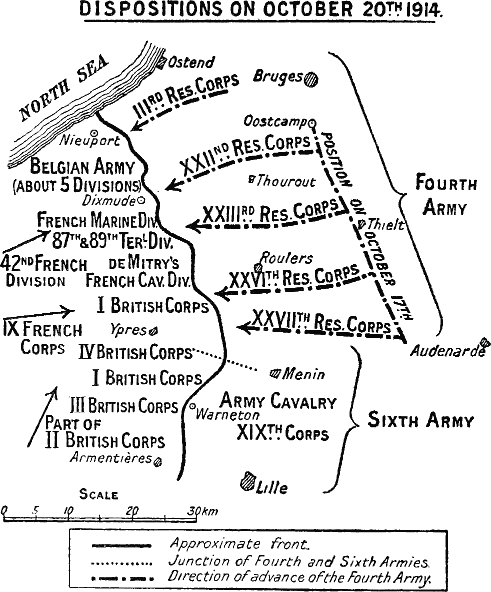
Owing to the failure of the offensive south of Nieuport,
a decision under the conditions existing there
could not be hoped for; the German General Staff
therefore began considering a plan for concentrating
a strong new army of attack between the Fourth and
the Sixth Armies behind the position occupied by the
Army Cavalry, and for breaking through with it on
the front Werwicq-Warneton, south of Ypres.
On 27th October Lieut.-General von Falkenhayn
arrived at the Headquarters of the Sixth Army to
discuss this operation. The plan was arranged and
orders were issued accordingly. A new ‘Army Group’
was to be affiliated to the Sixth Army, under the
command of General von Fabeck, commander of the
XIII Würtemburg Corps.[49] It would consist of the
II Bavarian and the XV Corps (now on its way up
from the south to join the Sixth Army), the 6th
Bavarian Reserve Division (still in reserve to the
Fourth Army), and the 26th Würtemburg Division
(of the Sixth Army, which was about to be relieved by
the 48th Reserve Division recently arrived from the
Fifth Army). In addition to these formations all
the available heavy artillery of the Sixth Army would
be brought up to assist, and if necessary the attacks
further south would be partially discontinued. The
offensive was to take place on the 30th October from
the general line Werwicq-Deulemont in a north-easterly
direction. In the meantime the 3rd Division
of the II Corps was also to be brought up by rail to
Lille. The orders of the German General Staff
pointed out that the united co-operation of the Fourth
and Sixth Armies was an essential condition for the
success of the operation. Crown Prince Rupert of
Bavaria therefore ordered the entire right wing and
centre of the Sixth Army to continue their holding
attacks, and Duke Albert of Würtemburg ordered a
general attack of his Army for the 30th October.
How the flooding of the Yser on the front of the
right wing of the Fourth Army brought the offensive
of the III and XXII Reserve Corps to a standstill
has already been described. From the 1st November
the 4th Ersatz Division took over the protection of
the line of the flooded area from the coast to Tervaete,
whilst the III Reserve Corps was moved southwards
to the district Zarren-Staden in order to reinforce
the XXIII or XXVI Reserve Corps, as the situation
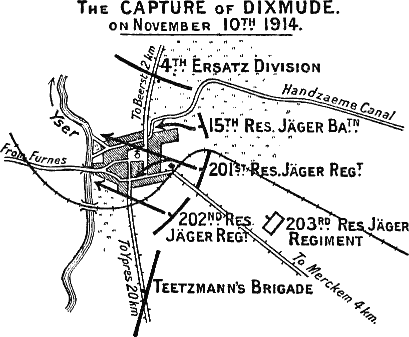
might require.[50] To the XXII Reserve Corps was
allotted the task of holding the two French divisions
stationed in the Dixmude bridge-head, which formed
a constant threat to the German front. The Corps
carried out this task admirably.
On the morning of the 30th October the XXIII,
XXVI and XXVII Reserve Corps advanced to the
attack as ordered. The first-named under General
von Kleist succeeded in storming and holding the
ruins of Bixschoote. After five hours’ desperate
fighting, the 211th and 216th Reserve Infantry Regiments
entered the devastated village which had been
occupied by two French infantry regiments. Its low-lying
situation, and the hopelessness of finding cover
among the battered houses, resulted in the victorious
German regiments being exposed to a very heavy
artillery fire to such an extent, that the casualties
in the village were greater than during the assault.
In consequence the commander decided to withdraw
and take up a line along the northern edge of Bixschoote,
leaving in the village itself only sufficient
outposts to repulse hostile counter-attacks. The
division on the left wing of the Corps also made progress
and reached the main road Bixschoote-Langemarck
in places. The XXVI Reserve Corps attacked Langemarck
with its right wing, but was unable to take it.
In spite of gallant efforts only a few hundred yards
of ground were gained by the evening of the 31st,
when these useless attacks were stopped by order.
The centre and left wing of this Corps as well as the
right wing of the XXVII Reserve Corps were held to
their positions by superior hostile artillery fire, and
also by mass attacks of the British and French during
the 30th and 31st. The II and IX French Corps had
just arrived, and in the presence of General Joffre an
attempt to break through our line was to be made on
this sector of the front.[51] The German defenders,
however, held stoutly to their positions, and thus
enabled the offensive of the Army Group of General
von Fabeck to take place. In conjunction with this
the centre and left wing of the XXVII Reserve Corps,
under its new commander, General von Schubert,
simultaneously advanced in the direction of Gheluvelt.
During the night of the 27th-28th October the 26th
Infantry Division was relieved in its battle-position
west of Lille by the 48th Reserve Division, and by
the evening of the 29th the assembly of the Army
Group Fabeck was completed without disturbance.
The heavy artillery placed at the disposal of the
Army Group consisted of 8 batteries of mortars, 20
battalions of heavy field-howitzers, each of 3 batteries,
and a 30·5 cm. coast defence mortar.[52] In addition
to the troops already mentioned, the 1st Cavalry Corps,
the four Jäger battalions of the Army Cavalry and the
11th Landwehr Brigade were put under the command
of General von Fabeck. On the night of the 30th
October this new army of attack relieved the two
northern Cavalry Corps, and took over their outpost
lines. On the following morning the offensive began.[53]
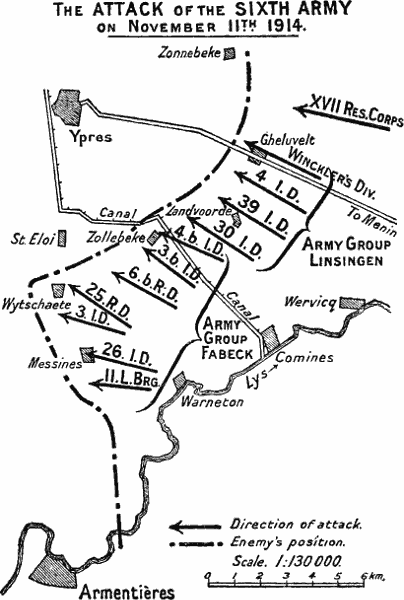
The XV Corps under General von Deimling attacked
south of the Menin-Ypres road, with its left wing on
Zandvoorde, the II Bavarian Corps was on its left, with
its left wing on Wambeke; further south again was the
26th Infantry Division with its left wing on Messines.
In co-operation with these the 1st Cavalry Corps with
the 4th and Guard Cavalry Divisions, strengthened
by two battalions of the XIX Saxon Corps, which
was attacking to the left of it, was ordered to advance
on St. Yves and Ploegsteert Wood. The 6th
Bavarian Reserve Division moved to the line Menin-Werwicq.
The Army Cavalry which had been relieved
was withdrawn to act as reserve to the Sixth
Army, one Cavalry Corps being placed behind the
right wing of the Army to be at hand to fill up a slight
gap which existed between the Fourth Army and the
Army Group Fabeck should it be necessary.
The enemy had intercalated part of the XVI French
Corps between the 7th Division of the IV British
Corps and the British Cavalry Corps, before the advance
of von Fabeck’s Army; the II and IX French
Corps had also recently arrived[54] on the northern side of
the Ypres salient.[55] Again, therefore, the enemy had
a numerical superiority[56] in what was the second and
severest part of the battle on the Yser. The British
in their reports have added together all the German
Corps which were brought up piecemeal for the fighting
on the Yser and at Ypres, both at this period
and later on; and they describe the situation so as
to give the impression that they had held up with
inferior numbers the simultaneous attacks of all these
Corps from the outset. They go further and use the
figures obtained in this way to turn their defeat into
a victory. They boast of having held out against
great odds, gladly forgetting that their original intention
both before and during the battle had been to
overrun our positions and drive us back to the Rhine.
The character of the fighting which began with the
appearance of the new German Army Group on the
scene had almost the savagery of the Middle Ages in
it. The enemy turned every house, every wood and
every wall into a strong point, and each of them had
to be stormed by our men with heavy loss. Even
when the first line of these fortifications had been
taken they were confronted by a second one immediately
behind it; for the enemy showed great skill
in taking every advantage of the ground, unfavourable
in any case to the attacker. To the east and
south-east of Ypres, even more developed than in
the north, there were thick hedges, wire fences and
broad dykes. Numerous woods also of all sizes with
dense undergrowth made the country almost impassable
and most difficult for observation purposes. Our
movements were constantly being limited to the roads
which were swept by the enemy’s machine-guns.
Owing to the preparatory artillery bombardments
the villages were mostly in ruins by the time the
infantry reached them, but the enemy fought desperately
for every heap of stones and every pile of bricks
before abandoning them. In the few village streets
that remained worthy of the name the fighting generally
developed into isolated individual combats, and
no description can do adequate justice to the bravery
of the German troops on such occasions. Our men
advanced to the attack as if they were back on the
barrack square, and an Englishman writes: ‘They
advanced towards us singing patriotic songs and with
their bands playing.’ There was such enthusiasm
that even the weakest were carried along by it, and
made regardless of losses. The battle of Ypres in
the autumn of 1914 will be a memorial to German
heroism and self-sacrifice for all time, and will long
remain a source of inspiration for the historian and
the poet.
By the 29th Field-Marshal French had realised the
importance of the attacks developing from the south-east
against Ypres. They threatened his position along
the high ground on the line Gheluvelt-Passchendaele
and aimed directly at, and by the shortest way
to, the town, the pivot on which all the Franco-British
offensive plans rested. On this day, therefore, the
British commander sent up the 7th Division into the
line again, although it had only just been relieved
owing to its heavy losses.[57]
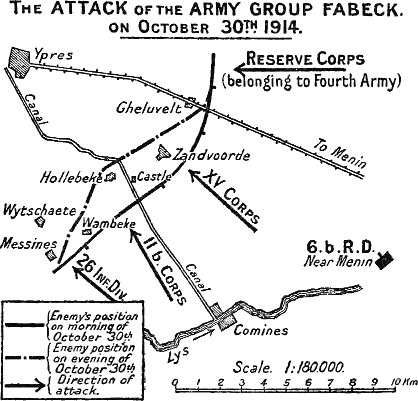
Daybreak on the 30th October was dull and misty.
Our heavy guns began the bombardment of the enemy’s
well-constructed lines at about 7.45 A.M., but observation
was made very difficult by the weather conditions,
and could only be carried out from the foremost
infantry lines. The telephonic communication rendered
necessary was frequently cut by the enemy’s
shells; but, in spite of this, our heavy batteries were
able to make such excellent practice that at the most
vital points of the enemy’s position the spirit of the
defenders appeared to be completely broken. The
high ground about Zandvoorde offers a typical case.
Although only 130 feet high, it was a corner-stone of
the British defence and one of the main observation
posts for the artillery. At 9 A.M. our troops charged
the hostile position there, and by 11 A.M. Zandvoorde
itself was in the possession of the 30th Infantry Division;
the 4th, 10th and 1st Bavarian Jäger battalions
of the Army Cavalry took a great share in the success.
Soon afterwards the high ground north-east and
immediately west of the village fell into German
hands. Two whole British squadrons with their
machine-guns lay, dead and wounded, completely
annihilated in one meadow on the battlefield.[58] Further
south the II Bavarian Corps had driven back British
cavalry supported by part of the III British Corps.
After a severe hand-to-hand encounter it took possession
of the château, and finally also of the village
of Hollebeke. The left wing of the Corps pushed
forward as far as the Wambeke stream, north of the
village of the same name, but had here to put in all
its reserves to hold its ground against strong hostile
counter-attacks.[59]
On the left of the Bavarians the 26th Infantry Division
was engaged in heavy fighting, the position confronting
it being a particularly strong one. It lay
along a prominent ridge from 180 to 250 feet high,[60]
running north and south, eastwards of Mount Kemmel,
and gave the enemy an extensive view eastwards over
our lines. The defence of this ridge was greatly
facilitated by the villages of Wytschaete and Messines
on it. These had been turned into fortresses,
and were connected by deep trenches protected by
broad wire entanglements.[61] Owing to observation
difficulties, and to the misty weather preventing the
airmen from giving assistance, our artillery was
unable from its positions in the valley to bring a
sufficiently heavy bombardment on the enemy’s lines;
and, though the Würtemburg troops attacked with
great gallantry, the enemy was too well prepared for
the assault. On the right wing the 122nd Fusilier
Regiment (Emperor Franz Joseph of Austria) took
the fortified village of Wambeke, and on the left wing
the 51st Infantry Brigade worked forward slowly
towards Messines. The ridge north-east of the last-named
village was stormed, but the assault on the
locality itself, which was to have been delivered at
7.10 in the evening, could not get on owing to heavy
enfilade fire from the south which held back the
attackers some hundred yards away from its edge.[62]
The Cavalry Corps[63] had gained ground at first, but,
in consequence of their weakness in artillery, they
had been unable to take St. Yves or to make progress
against the strongly fortified wood south-west of it.
The same story describes the day’s work of the XIX
Corps[64] fighting to the south of the cavalry.
On the extreme right wing of the Army Group also
the attack on the 30th October had not had the success
expected. The combined efforts of the 54th Reserve
Division and the right wing of the 30th Division had
not been able to carry us into Gheluvelt.[65] General
von Deimling and Major-General Wild von Hohenborn
went forward themselves into the front line to
encourage the men, but the enemy defended his positions
desperately, and held on firmly to the main
points of his line. Another artillery bombardment
was therefore considered necessary.
From the enemy’s point of view, however, the
situation was anything but rosy on the evening of the
30th October. The entry of General von Deimling’s
troops into Zandvoorde endangered the southern
side of the Ypres salient, and the capture of Hollebeke
brought the Germans within three miles of
Ypres itself. Ypres was indeed in danger. Field-Marshal
French had put Indian troops into the fighting
line on the 30th, and he now brought all the available
British and French reserves towards the line
Zandvoorde-Hollebeke in order to support the
7th British Division, which had been fought to a standstill.[66]
During the night, therefore, the fighting never
ceased: attacks and counter-attacks continued along the
whole front, and under cover of darkness the indefatigable
Würtemburg troops again tried to storm Messines.
On the 31st October the Germans had at first but
few fresh troops to meet the enemy’s reinforcements;[67]
so the 6th Bavarian Reserve Division was brought up
in readiness north of the Lys behind the II Bavarian
Corps. General von Fabeck had from the outset
realised that the Wytschaete-Messines ridge was
of decisive importance, and that every effort must
be made to take it; on the 31st, therefore, the main
pressure was to be exerted along the southern sector
of attack of the II Bavarian Corps.
According to the enemy’s accounts the 31st October
1914 was one of the most critical days at his headquarters.
For us it was a day of great glory, and the
British state unreservedly in their reports of the fighting,
that the bravery of our men was beyond all praise.
It is true that this last October day of the first war-year
did not give us Ypres, but our semicircle around
the town became so reduced that it was brought within
range of our artillery from three sides, and there could
be no more threats of a big hostile offensive based on
the Ypres district. The fact that neither the enemy’s
commanders nor their troops gave way under the
strong pressure we put on them, but continued to
fight the battle round Ypres, though their situation
was most perilous, gives us an opportunity to acknowledge
that there were men of real worth opposed to
us who did their duty thoroughly.
At dawn on Sunday the 31st October, in fine weather,
a heavy artillery bombardment of the new hostile positions
was begun on a front of ten and a half miles. The
enemy’s batteries were not long in replying; being so
difficult to locate they had not suffered much in the
previous fighting. Terrific artillery fire lasted throughout
the morning, the British and French shells fell long
distances behind our lines, blocking streets and bridges,
and devastating the villages as far back as the Lys,
so that any regular transport of supplies became impossible.
At Gheluvelt, however, the important
northern corner of the Army Group Fabeck, the enemy’s
hail of shells had but little result, because our capture
of the high ground at Zandvoorde had made the
work of observation very difficult.
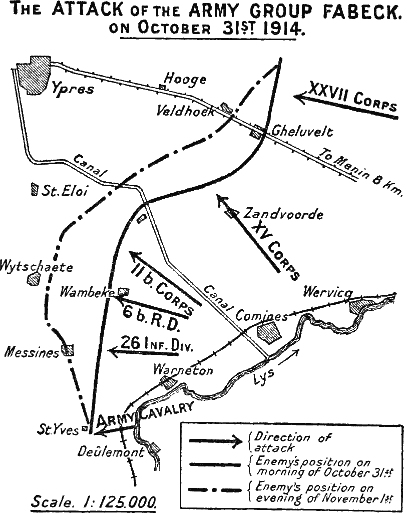
After sufficient artillery preparation the British
stronghold of Gheluvelt was to be attacked from
south and east simultaneously. Colonel von Aldershausen,
commanding the 105th Infantry Regiment,
was to direct the attack from the east. Besides two
battalions of his own regiment, there were placed under
his command the 1st Battalion of the 143rd Infantry
Regiment and a strong mixed detachment from the
54th Reserve Division, mainly belonging to the 245th
Reserve Regiment and the 26th Reserve Jäger Battalion.
The 99th Infantry Regiment was to make the attack
from the south.[68] During the morning, in spite of the
heaviest fighting, no success was achieved, and isolated
attacks were repulsed by British counter-movements.
At about 11 A.M. our converging attack was begun.
The commanders of the 54th Reserve and 30th Infantry
Divisions with their artillery leaders, as well as
the general commanding the XV Corps, were again in
the foremost lines, though the last, General von Deimling,
was wounded almost at once by a shell-splinter.
Towards midday the attack began to gain ground.
His Majesty the Kaiser, who had arrived at the battle
headquarters of the Sixth Army, watched the infantry
working its way through the maze of the enemy’s
obstacles and entrenchments. It was well supported
by artillery, some of the guns being moved forward
with the front line. The British and French artillery
fired as rapidly as they knew how,[69] and over every bush,
hedge and fragment of wall floated a thin film of smoke,
betraying a machine-gun rattling out bullets. But it
was all of no avail: the attackers kept on advancing.
More hostile strongholds were constantly being discovered;
even all the points known to be of importance
could not be given sufficient bombardments by our artillery,
so that many attacks had to be delivered against
fresh troops in good sheltered entrenchments untouched
by our guns.[70] Many of our gallant men were killed,
and the officers, who were the first to rise in the assault,
were the special target of the enemy’s sharpshooters,
well trained in long colonial wars.[71] Once our troops
entered an enemy’s position, the resistance was only
slight, and the German showed his superiority in single
combat. It was only the enemy’s counter-attacks,
delivered with remarkable accuracy and rapidity, that
regained some of his lost ground, but they did not,
however, compromise the general success of the day.
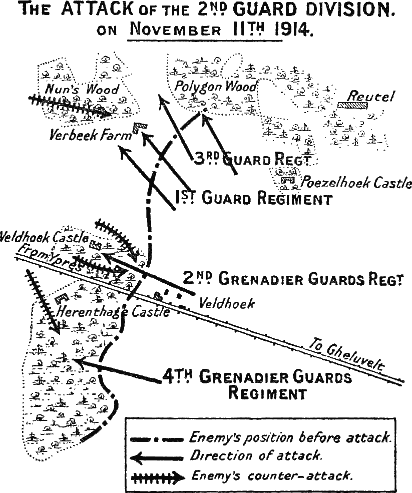
The XXVII Reserve Corps pressed forward into the
dense woods near Reutel,[72] which were defended by
a strong system of obstacles and by a quantity of
machine-guns, hidden in some cases up in trees.[73]
While this was in progress the last assault on Gheluvelt
was taking place. The attacks from east and
south both broke into the village, and by 3 P.M. the
whole place with its château and park was in German
possession.[74] Colonel von Hügel took his storming
parties of the 54th Reserve Division northwards through
and beyond the village, while Captain Reiner galloped
his batteries close up to it. It was then, however,
that fresh hostile reserves were launched against Gheluvelt.
The 16th Reserve Regiment of the 6th Bavarian
Reserve Division was hurried up to meet them, its
gallant commander, Colonel List, dying a hero’s death
during the movement. For a short time our own
artillery fired into the backs of the Bavarian ranks:
for the men were wearing caps and were thus mistaken
for British troops. Nevertheless the enemy’s counter-attack
failed and Gheluvelt became and remained
ours, and we captured besides 17 officers and 1000
men, and 3 guns.[75] The enemy prevented our further
advance beyond Gheluvelt by a heavy fire from a
new and strong position along the edge of the woods
west of Gheluvelt. Here a new fortress had been
made, which would have to be broken down by our
artillery before it could be attacked. On the left wing
of the XV Corps the German assaults also failed in
front of some small woods which had been turned into
strong points; the 39th Infantry Division was able
to advance only some 500 yards, though it took a
number of prisoners.[76] The artillery of the XV Corps
had an accidental success on this day which must
have interfered with the enemy’s staff work for some
time. During the bombardment of Hooge, a direct
hit was made on a house in which the Staff of the 1st
British Division were working: one general and
several staff officers were killed.[77] After heavy fighting
at close quarters the II Bavarian Corps gained ground
along the whole of its wide sector of attack on the 31st
October. The right wing took possession of the edges
of the woods west of Hollebeke, whilst the left of
the Corps advanced as far as Oosttaverne. The 6th
Bavarian Reserve Division had been brought into line
immediately south of it, in order to make the attack
on Wytschaete.
We now come to the most vital point of the battle:
who was to be the victor in the fight for the Wytschaete-Messines
ridge? The 6th Bavarian Reserve
Division had worked forward by daylight towards
Wytschaete, regardless of the heavy artillery fire
directed from the high ground on our troops moving
up from the valley.[78] At nightfall the left wing of the
II Bavarian Corps was still hanging back, unable to
break the strong resistance opposed to it, but in spite
of this the Bavarian Reserve Division dared to make
its attack. The 17th Reserve Infantry Regiment
was to enter Wytschaete from the east and the 21st
from the south. All the preparations had been carefully
made. The men wore white arm-bands as a
distinguishing mark when at close quarters with the
enemy in the darkness. Water bottles were packed
away in the haversacks; rifles were unloaded and
bayonets fixed. It was hoped to take the enemy by
surprise, and not a light betrayed our arrival in the
assembly positions. The hostile artillery fire slackened
during the night, but frequent star-shells lighted up
the darkness and showed that our opponents were
keeping a careful watch. The clear moon must have
helped them to see our movements. At 2 A.M. (1st
Nov.) the Bavarians advanced from their assembly
positions, taking little notice of the enemy’s artillery
which began to open on them. The general direction of
the attack was given by the windmill of Wytschaete,
which was clearly outlined in the moonlight against
the sky. The 17th Reserve Infantry Regiment under
Colonel Hofmann rapidly reached the edge of the
village and pushed through to the western exit. The
surprise had succeeded, and numbers of the enemy
who still held out in isolated ruins were either killed
in a hand-to-hand fight, or taken prisoner.[79] Unfortunately,
however, our own guns continued to bombard
the village, as the news of the victory of the 17th
Regiment was not communicated to them sufficiently
quickly. At about 6 A.M. Colonel Hofmann therefore
decided to withdraw his victorious troops temporarily
to the eastern edge of Wytschaete, and to reorganise
there. It so happened that the 21st Reserve
Regiment arrived on the southern side of the village
at this moment, its advance having been delayed by
a heavy enfilade fire from the south-west. When the
men of the 21st Regiment in the first dim light of
dawn saw the figures of men wearing caps running
eastwards among the ruins, they immediately opened
fire on them. Nevertheless, in spite of the losses
incurred through this mistake, the 17th Regiment
held its ground at the eastern edge of the village.
The error was quickly remedied by singing patriotic
songs and by flag-signals, and communication was
regained with the neighbouring infantry and with the
artillery. A strong counter-attack, however, was now
made by six regiments of the XVI French Corps, which
had arrived during the night, and the gallant 17th had
slowly to withdraw again from the high ground.
The fighting around Messines on the 31st had been
equally severe. On the 30th the 26th Infantry Division
under Duke William of Urach had already got its
patrols up to the edge of the village, but before any
assault could be made an artillery preparation was
required, especially against the northern sector. On
the morning of the 31st October our howitzers and
trench-mortars bombarded the enemy in his trenches,
and by 10.30 A.M. the moment had arrived for the
Würtemburg troops to advance.
The 122nd Fusilier Regiment was to attack the ridge
north of Messines, along which runs the road to
Wytschaete, whilst the 125th Infantry Regiment
was to advance against Messines itself, and the 119th
Grenadier Regiment against the enemy’s trenches
immediately south of it. The hostile position was so
strong that a force greatly inferior in strength would
be able to hold it against an attack coming up from
the valley. Bare sloping ground lay in front of it, and
only a few hedges limited the field of view, so that
every advance and assembly position for miles round
could be seen. A strong British garrison held Messines:
the trenches had been well made, and were covered
by a continuous and broad system of obstacles.[80]
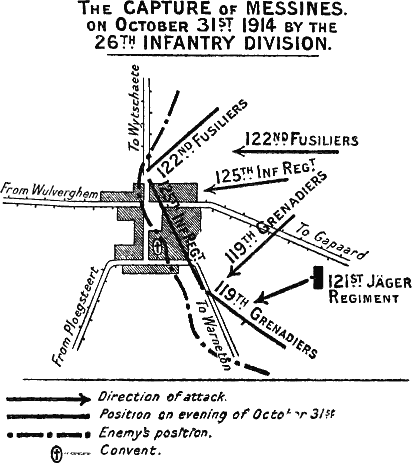
The way in which the Swabian troops[81] broke down
the enemy’s resistance was indeed a masterpiece.
Neither the enemy’s artillery fire, which imperilled the
advance of the reserves, nor the British machine-guns,
a large number of which enfiladed the attack from
the south, could restrain the dash of the Würtemburg
troops. At 11 A.M. the 125th Stuttgart Infantry
Regiment had got possession of the north-east corner
of Messines. The road entering the village from
Gapaard was blocked by a barricade; and after storming
it, another one, a hundred yards further inside
the village, closed the way. The streets could not be
used for our advance, being choked with debris, and
under heavy rifle and machine-gun fire, so the attackers
had to make their way through or over the walls.
There are a number of large, well-built houses in
Messines, which the enemy had turned into a succession
of strongholds, but they were rapidly blown up
by our sappers. The convent looked especially impregnable
with its walls a yard thick, and strong
towers from which machine-guns and rifles fired frantically.
Captain Heinrich’s Würtemburg battery of
the 65th Field Artillery Regiment was therefore brought
up, the men dragging the guns through the streets, as
horses could not move along them, and the infantry
carrying up the ammunition. The convent was soon
in flames, burying its stubborn defenders under its
ruins. Lieutenant Mösner of the 125th Infantry
Regiment, following a narrow footpath through gardens
and backyards, was the first to make an entry into the
market-square. With a few stout-hearted followers
he occupied a large building there which he defended
without any support till the evening against great
odds. Not until nightfall were others of his regiment
able to reach him, and secure the position he had held
so courageously. This day of street fighting had cost
very dear, and our casualty list was a large one. A
part of the 122nd Fusilier Regiment fighting north of
Messines had also had to be directed on to the village,
and by the evening a continuous line had been successfully
formed through the centre of it. Isolated fighting
continued throughout the night, and in order to
keep up communication amidst the ruins and recognise
one another in the dark, the Würtemburg troops sang
folk-songs. The chorus of voices mixed with the
rattle of machine-guns, the roar of artillery in the
streets, and the crackle of the burning and falling
houses, all combined to make a magnificent and unsurpassed
piece of battle-music.
North of the village the left wing of the 122nd
Infantry Regiment established itself on the Messines-Wytschaete
road: but its right wing was unable to
capture the high ground, as Wytschaete itself was
still in British hands. The 119th Grenadiers suffered
severely: the progress of the other regiment of their
brigade, the 125th Infantry Regiment, had roused
their ambition, but a heavy enfilade fire swept their
ranks from the south where the Cavalry Corps were
still unable to advance. They were compelled by
heavy losses to be content with the task of securing
the left flank of their division.
On the evening of the 31st the gallant attackers
were rewarded for their deeds of immortal fame by a
message of warm praise from the Emperor.
The final objective, however, had not yet been
attained, although in the south the high ground had
been reached and artillery observers sent forward there,
so that the enemy’s positions could be accurately
ranged on right up to Mount Kemmel. The main
pressure of the attack would therefore have to be continued
here, on the left wing of the Army Group Fabeck.
During the 1st November the 3rd Infantry Division
arrived in the area Comines-Warneton, north of the
Lys, as reserve to the Army Group.
On the morning of the 1st November a thick mist
lay over the country, so that the infantry got a few
hours’ rest before the continuous shelling of the enemy’s
artillery began. As soon as the mist cleared, the
battle broke out anew, on a twelve-mile front. In the
north the Saxon and Würtemburg divisions of the
XXVII Reserve Corps further extended their successes
of the previous days. The line was advanced
up to the château of Poezelhoek, which was taken
from the 1st British Division after a heavy fight.[82]
The divisions of Deimling’s XV Corps attacked with
the right wing on the Gheluvelt-Ypres main road
and the left on Klein Zillebeke. They advanced
but slowly, fighting hard the whole day. The small,
dense woods, defended with the utmost tenacity, again
made progress very difficult. The 30th Division
managed to reach the eastern edge of the Herenthage
Wood, where the 3rd British Cavalry Division,
supported by infantry, was in position. The wood
north of Zandvoorde gave exceptional trouble, but it
was finally outflanked on both sides, and its defenders
taken prisoner.[83]
The II Bavarian Corps advanced to the attack on
both sides of the Comines-Ypres canal, and drove
the enemy back as far as the sharp bend in it. The
left wing captured the small wood west of Oosttaverne
which was defended by Indian and British
troops. The treacherous methods of the Indians
greatly exasperated our men: crouching in the hedges,
and with machine-guns concealed up trees, the defeated
Asiatics allowed our troops to pass them, and then
got up and stabbed them in the back with their knives.[84]
The 6th Bavarian Reserve Division had withdrawn, on
the morning of the 1st November, to its positions of
the previous evening, and at midday began its attack
once more. Confidence and enthusiasm served to
obliterate the bad memories of the past night, and the
dense lines now rose simultaneously from their positions
as if on parade. Very many of their dead or
wounded still lay at the foot of the heights, but the
gallant division stormed the slopes again, and by
4 P.M. had reached the eastern edge of Wytschaete.
It was not possible to push up reserves owing to heavy
artillery fire, and at this moment the enemy counter-attacked
with two fresh divisions.[85] The Bavarians,
who had become disorganised during the assault, were
forced to evacuate the village again under cover of
darkness, after having actually entered it at about
5 P.M. They had suffered very heavily during the
attack, being fired at from flank and rear, for the right
wing of the 26th Infantry Division was unable to
take all the high ground north-west of Messines until
the evening of the 1st November. Fierce street fighting
had gone on in Messines throughout the day, till
finally the Würtemburg troops gained the upper hand
and cleared the enemy out of the village to its western
edge. The British were driven back down the western
slope of the ridge, and had to entrench themselves in
the valley, losing heavily in the operation. As soon
as its right wing reached the Messines-Wytschaete
road that evening the 26th Infantry Division held
almost the whole of the famous ridge, and the preliminary
condition for the capture of Wytschaete
was obtained. The 6th Bavarian Reserve Division, however,
was not able to carry out a third assault without
assistance, and General von Fabeck during the night
of the 1st-2nd therefore advanced the 3rd Prussian
Division from its assembly area Wambeke-Garde
Dieu into the fighting line, in order to carry forward
the attack through and beyond Wytschaete towards
Kemmel.
After a comparatively quiet night the battle opened
again on the morning of the 2nd November along the
whole front of the Army Group Fabeck. His indefatigable
troops, some of whom had already endured
twelve days of the heaviest fighting that had taken
place in the campaign, attacked their strongly entrenched
opponent once more. The enemy was at
least as strong as they were in fighting units on the
battle-front, and besides was able to bring up reinforcements
of newly arrived British and French
troops.[86]
On the eastern side of the Ypres salient General
von Deimling attacked on a front of nearly four miles.
His Corps, which had won its laurels in Alsace, in Lorraine
and in Northern France, again, in spite of heavy
casualties, continued its advance of the previous days.
The 30th Division entered Veldhoek and established
itself firmly in the north-eastern corner of the Herenthage
Wood.[87] The attack had been facilitated by
a simultaneous advance of the XXVII Reserve Corps,
which had pressed forward some hundred yards north
of Veldhoek. Von Deimling’s left wing had advanced
in the direction of Klein Zillebeke, but was held up
by the difficult wooded country east of Zwarteleen.
It had to wait here for assistance from the neighbouring
troops on its left.
The II Bavarian Corps had been held up early on
the morning of the 2nd November by strong hostile
counter-attacks in the sector west of Hollebeke.
They were all, however, repulsed and the Corps was
even able to make a slight advance on the right wing
during the day.
Wytschaete was again the centre of the heaviest
fighting on this day.[88] The Bavarian Reserve Division
was, at its own request, to attack the village; the
enemy’s position immediately south of it was allotted
as objective to the 3rd Division. The 42nd Infantry
Regiment and an Abtheilung (3 batteries) of the
17th Field Artillery Regiment remained in Army
Reserve. At 7 A.M. a fierce artillery duel began, and
the enemy, quickly realising the danger threatening
him, hurried up strong reserves to Wytschaete.
Kiefhaber’s brigade of the 6th Bavarian Reserve Division
rose to the assault. Under a hail of shrapnel
the youngsters stormed the eastern and southern
slopes of the Wytschaete ridge for the third time,
though with considerable loss, the enemy’s machine-guns
causing great havoc in their ranks. As soon as
the foremost of them had reached the windmill the
enemy launched a counter-attack; but this time the
Bavarians were not content with simply holding their
ground; their supports were brought up at the critical
moment and pressed forward into the village. Furious
street fighting now ensued, and the Bavarians having
to deal with every house became greatly disorganised.
Taking advantage of this the British and French commanders
sent forward fresh masses into the line,
trying to turn the balance in their favour at this
important point by employing every available man.
It was 3.10 P.M. when a cry for help reached the Pomeranian
(3rd) Division from their Bavarian neighbours,
and it was not uttered in vain. Shortly before, the
Stettin Grenadier Regiment had captured the long-coveted
high ground south-west of Wytschaete, the
struggle for a large farmhouse on it having been
especially severe. Without possession of this the
south flank of the village could not be held. Count
Gneisenau’s Colberg Grenadiers were then sent forward
to support the Bavarians, and the enemy was unable
to hold out in Wytschaete against the rifle-butts and
bayonets of the united Pomeranians and Bavarians.
Soon after 5 P.M. the village, as far as its western edge,
was in German hands, although the fighting continued
till well into the night among the ruins with detachments
of the enemy who would not surrender.
By the capture of Wytschaete a fine commanding
position had been obtained, but the village itself, once
so pleasant to the view, was now terrible to look upon.
The church was in flames, and the windmill flared like
a beacon in the darkness. Friend and foe lay wounded
side by side among the smouldering ruins. The
enemy was fully aware of the importance of Wytschaete,
but he had been so weakened that he was
unable to recover for another big counter-attack.
He therefore contented himself with small and fruitless
efforts, only one of which succeeded in temporarily
entering the village during the 3rd. Nevertheless for
the next few days it lay under the constant fire of
heavy artillery, though our heroic observers did not
allow this to interfere with their work.
Many of the inhabitants still remained in Wytschaete,
as in Messines, and it was pathetic to see
how they clung to their devastated patches of ground,
regardless of danger. In spite of many offers from
the Germans, these Belgian inhabitants remained with
their last scrap of property, preferring to die by the
shell that destroyed their homes.
A small wood north-west of Wytschaete, called the
Park, was still a dangerous point. This dense copse
was surrounded by a system of trenches and several
rows of obstacles. With the help of skilfully sited
flanking arrangements and shell-proof shelters, it
had been turned into an almost impregnable stronghold,
and cost us many days of heavy fighting before
it was finally taken.
The 26th Infantry Division, after its capture of
Messines, immediately put the high ground into a
state of defence. Its left brigade, the 51st, which
was in position there, was relieved on the 2nd November
by the 11th Landwehr Brigade, and sent back to the
Army Reserve. The 52nd Brigade, on the right wing
of the division, in co-operation with the 3rd Infantry
Division, advanced across the Steenbeek stream.
However, no progress of importance could be made
there, as every movement could be immediately
brought under most effective artillery fire from the
commanding positions on Mount Kemmel.[89]
On the 3rd November the formation of a ‘Group
Urach’ was ordered, consisting of the 3rd and 26th
Infantry Divisions, to continue the attack against
the high ground east of Kemmel; but in the following
days it was unable to make any essential alteration
in the general situation in this sector.
A part of the Army Cavalry was still in action south
of, and co-operating with, the 26th Infantry Division,
in spite of the small force of artillery and engineers
included in it. On the 2nd November it made a
surprise attack on foot against the farm Klein Douve
with complete success.[90] On the 4th November the
I Cavalry Corps was relieved by the II, consisting of
the 3rd and 7th Cavalry Divisions.
In the early days of November the conduct of the
enemy’s operations against the Army Group Fabeck
underwent a very noticeable change. The German
attacks had destroyed any prospect of success for the
big offensive movement which had been planned.
The British troops, especially the I and IV Corps,[91]
were so played out that they had to be relieved by
parts of the French Army. The enemy’s commanders,
however, realised that even these fresh troops would
be unable to make much headway against our men,
and they therefore decided to remain on the defensive
and to create a deep zone of trench-systems. The
heavy fighting had made havoc of their front trenches,
or at least had badly damaged them. The civil population
and all other available labour, therefore, were
now called upon to dig successive lines of rearward
positions for a long way westwards.[92] These preparations
were soon discovered by our airmen.
During the early days of November the commander
of the Sixth Army came to the conclusion that the
offensive of the Army Group Fabeck could lead to no
decisive results. The forces available were still too
weak to break through the enemy’s strongly entrenched
positions, particularly as he was continually bringing
up fresh reinforcements to the battle-front.
If the attempt to break through south of Ypres was
not to be entirely abandoned, and a purely defensive
war on the Western Front thereby avoided, more
troops would have to be brought up for the Ypres
battle from other sectors of the front. As a beginning
the 2nd and the Bavarian Cavalry Divisions were
affiliated to the Army Group Fabeck, the Bavarian
Cavalry Division being allotted to the XV Corps and
the 2nd Cavalry Division to the II Bavarian Corps.
The German General Staff also placed the II Corps
and the 4th Infantry Division at the disposal of General
von Fabeck, and they began to detrain at Lille on
the 5th November. On the 3rd Crown Prince Rupert
of Bavaria ordered the XXIV Reserve Corps and the
25th Reserve Division to be taken from the Sixth
Army, west of Lille; and this was followed by an
order on the 4th to withdraw all the troops of the
Guard Corps available from their positions, and for
their sector of the front to be taken over by the IV
Corps at Arras. Accordingly a composite Division
of the Guard Corps, consisting of the 1st and 4th
Guard Infantry Brigades, under Lieutenant-General
von Winckler, marched for Roubaix, which was reached
on the 7th. More heavy artillery was also handed
over to the Army Group Fabeck, and, in addition, all
the artillery ammunition allotted to the Sixth Army.
The intention of the German General Staff, communicated
to the commander of the Sixth Army on
the 4th November, was: to push the attack to the
immediate north (of the elbow) of the Comines-Ypres
canal, and to put in all available forces to break
through there. In the meantime, however, General
von Fabeck, in accordance with instructions previously
issued by the commander of the Sixth Army, had
placed the XXIV Reserve Corps and the 25th Reserve
Division on the left wing of the II Bavarian Corps,
and had there formed a Group Gerok, to which the
6th Bavarian Reserve Division was added. Thus for
the offensive north of the Comines-Ypres canal there
were left the II Corps and Guard Corps (the 4th Division
and the mixed Division of von Winckler), besides
the XV Corps which was already in position there.
The fighting continued along the front of the Army
Group until the 10th, when these troops were ready
to attack. No time was to be given the enemy to
recover, or to strengthen his positions.
The XV Corps, which in the meantime had extended
its left wing to the Comines-Ypres canal, won ground
daily, especially on the 6th November, when the 39th
Division delivered a heavy attack near Klein Zillebeke
and drove the recently arrived French troops
from their position, capturing four hundred prisoners in
the farm buildings. The troops, advancing with their
bands playing, also stormed parts of Zwarteleen, a
village widely scattered among the woods and meadows.
The artillery fired at point-blank range, as the
November mist made observation impossible at any
distance. French counter-attacks and an attack
by British cavalry, which attempted to make good
the retirement of the French, were repulsed. Their
casualties were heavy, the 1st and 2nd British Life
Guards being decimated. The enemy’s counter-attacks
on the 7th and 8th November, in which the much
weakened 7th British Division, as well as the Zouaves,
took part, had also no success. On the 8th November
the 148th Infantry Regiment captured the fortified
position along the western edge of Veldhoek; with
a strong counter-attack the French made a bid to
recover the lost ground. Lieutenant-Colonel Linker,
the gallant regimental commander, hastily gathered together
all the supports within reach, including Landwehr
men of the 54th Reserve Division, and led them forward
to meet the advancing enemy; he himself was mortally
wounded at the head of his victorious followers. The
French hurriedly retired, suffering considerable loss.[93]
The II Bavarian Corps was kept busily employed
by the hostile counter-attacks near the canal; the
enemy offered very stubborn resistance in order to
keep possession of the high ground from which Ypres
can be seen. The Bavarians, however, not only maintained
their positions, but, by an irresistible attack on
the 9th and 10th November, took the high ground
on which St. Eloi is situated.[94] To the 5th Bavarian
Infantry Brigade is due all the credit for this fine feat.
The enemy remained for a long time in the houses of
St. Eloi, but the high ground was of primary, perhaps
even decisive, importance; for it gave us a bird’s-eye
view of the country east of Ypres, where the mass of
the British field artillery was in position.
The fighting further south which the troops of the
Group Gerok had in and north of Wytschaete was
equally heavy. The northern edge formed the dividing
line between the Groups Gerok and Urach. The
enemy kept the village under heavy fire in order to
hinder the work of our observers, the mere sight of a
man anywhere being sufficient to draw his artillery
fire. Our stereo-telescopes were therefore used through
loopholes in the ruins or at the chimney openings,
and the observers were often far safer on such lofty
perches than our reserves in the cellars of the battered
village. Only slow progress could be made in the
woods lying to the north-west.
The Group Urach also was unable to make much
headway. On its right wing, the 3rd Infantry Division
struggled hard to get possession of the Park
north-west of Wytschaete. After a whole day’s
fighting the 34th Fusilier Regiment forced its way
into the hospice, a fine old convent at the northern
entrance to the village; from its roof the enemy had
been able to get a splendid view of our positions in
the valley south of Wytschaete. In spite of a most
thorough bombardment our attack was very costly,
and although the Park was enveloped on two sides, it
was found impossible to enter it. From this patch of
wood heavy enfilade fire swept the positions of the
6th Bavarian Division to the north, and the trenches
of the 3rd Prussian Division to the south. It was
surrounded by a wall and moat as well as by wire
entanglements, the impenetrable undergrowth being
entangled with a maze of wire. Frenchmen with
machine-guns were roped to the trunks of some of
the trees, and they were found dead hanging from
the shell-torn stumps when the Park of Wytschaete
was finally stormed on the 13th November by the
21st Reserve Infantry Regiment of the 6th Bavarian
Division, with the 2nd Grenadiers and 34th Fusiliers
of the 3rd Prussian Division. There is a legend connected
with Wytschaete Park, and the scene was
worthy of it.[95]
The 26th Infantry Division during these days had
advanced its lines to the western slopes of the Wytschaete-Messines
ridge, and in places across the
valley, by sapping. This operation cost many casualties,
as the British on Mount Kemmel were able to watch
every movement in our trenches, and could immediately
bring them under the fire of field or heavy artillery,
or even of long-range naval guns, and they were by
no means sparing with their ammunition. Fortunately
our losses were for the most part only in the
front lines, but our shortage of ammunition compelled
us to husband it.[96] Owing to the conformation
of the ground and to the weather preventing any air-reconnaissances,
we were unable to range accurately
on the enemy’s artillery, and the most we could do
was to disturb their means of fire-direction. Their
observation posts on Mount Kemmel were soon discovered,
and the fight now began against the observers
there as well as against those posted in the towers of
Ypres. So the blame must not be laid on us for the
gradual destruction of those magnificent buildings of
Ypres, which gave such a fine view of the whole
countryside.
Further to the south no noteworthy progress was
made either by the Cavalry Corps, or on the front of
the Sixth Army.
Such then was the general situation when, on the
10th November, the new forces lay ready to take the
offensive in their positions north of the Comines-Ypres
canal. Before going further, however, the
operations of the Fourth Army from the last days
of October must for a moment be touched on.