YOUTH — A BATTLE WITH A WINDMILL
By Frank H. Coleburn
SHORTLY after I left college, my father
died, leaving me, his only son, so well-nigh
penniless that I was very glad,
indeed, to accept the position which Mr.
Eller, an old friend of the family, offered
me in his vineyard.
My benefactor’s home was in southern
California, a region where the people’s
livelihood depends upon grapes and wine-making.
One day, not long after my arrival, the
big windmill, which supplied the whole
winery with water, got out of order and
refused to pump. Mr. Eller examined it
carefully, but was unable to learn where
the difficulty lay. He came down from the
tank much disturbed, for water was a great
necessity in that dry country.
“Harry,” he said to me, “you’re something
of a mechanic, aren’t you?”
“I did pay a little attention to the study
at one time,” I answered, modestly.
“Well, I wish you would try what you
can do in the way of fixing that windmill.”
I promised that I would, and Mr. Eller
left me.
After supper that night I secured a hammer
and a chisel and started for the windmill.
I had need to make haste if I expected
to accomplish anything that evening,
for the days were shortening and already
darkness was falling.
The windmill stood some two or three
hundred yards from the house directly behind
the wine cellar. It was about seventy-five
feet high—from the base to the top of
the wheel—but in that deceptive twilight it
looked like some giant finger reaching to the
sky.
I stuck my tools in my coat pocket and
began to climb the long ladder which
stretched to the top of the tank. From
thence it would be easy to reach and manipulate
the wheel.
I made the ascent in safety, and after a
little stood on top of the rough boards
with which the tank was covered. For
some time I stood, admiring the splendid
view and wondering at the extent of country
that came under my gaze, until warned by
the ever-increasing gloom that I was out
on business, not pleasure.
I forget just what was the matter with
the wheel. Some simple disarrangement
of the machinery which took me but little
time to ascertain and less to remedy. Feeling
certain that the mill would now perform
its duty as well as before, I turned
to retrace my way. In doing so I stepped
upon a half-concealed trap-door, intended
to be used as a means of ingress into the
tank in case of repairs being needed. This
door was old and rotten; its hinges were
broken and it rested very insecurely upon
its foundation. Consequently, it was unable
to retain my weight and tilted suddenly.
I fell with a prodigious splash into the
water beneath.
There were about two feet of water in
the tank. I gurgled and sputtered and
struggled as though there were twenty.
However, I quickly regained my feet, dripping
and shivering, and very much confused
from my sudden immersion, but uninjured.
I was a prisoner, however.
The tank was about ten feet in height.
The sides were perfectly smooth and
afforded no foothold. There was no ladder
or other means by which I could clamber
out. I vowed that if ever I built a tank I
would provide in some way for such an
emergency as the present.
About three and a half feet above my
head was the supply pipe. It extended a
little ways into the tank. If I could only
manage to reach that I might possibly pull
myself up and escape. I knew perfectly
well I could not reach it, but hope, like love,
is blind to all obstacles, and I jumped desperately
for it. I failed, of course. I
didn’t come within a foot of it. However,
after I had continued my effort for some
time I began to feel a comfortable warmth
creep over that portion of my body which
was above water. Therefore, in lieu of
anything better to do, I kept on jumping.
By and by my teeth stopped chattering—somewhat—and
I stopped leaping altogether.
“Here’s a pretty mess,” I said to myself.
“I wonder how long I’m to be penned up
in this place. Goodness knows my legs are
tired enough already without having to
stand on them all night; and I can’t very
well sit down in two feet of water.”
It suddenly occurred to me that I possessed
a voice of tolerable strength and
clearness, and that I might make good use
of it upon the present occasion. Accordingly,
I gave utterance to a few of the most
startling shouts that probably ever assailed
the ears of a mortal. But they were unsuccessful
so far as escape was concerned.
After I had shouted myself hoarse, I
waited with patience for the arrival of a
relief party. At the end of five minutes it
hadn’t come; at the end of half an hour I
didn’t believe it would come.
“Surely,” I thought, “they must have
heard those war-whoops at the house. At
any rate it’s about time Eller started out to
hunt me up. He certainly don’t think it’s
going to take me forever to fix his plaguey
windmill.”
I was becoming worried. The prospect
of having to remain cooped up in my present
narrow quarters all night was by no
means pleasant. The expectation of having
to stand for the next ten hours in two feet
of cold water was not pleasing to a person
of my tastes. It might have done for one
of those old-time monks, who were always
imposing penances upon themselves for sins
committed, but it was not suited to my constitution.
Most cheerfully would I have resigned
my position to any one expressing a
wish for it.
It was now pitch-dark in the tank. The
only light I obtained was the feeble glow
of the stars shining through the trap-door.
I stood under this, gazing up wistfully into
the heaven so high above me. After a time
my eyes grew heavy, my head fell forward
onto my breast, and, strange as it may
appear, I dropped off into a gentle doze.
I was awakened by a slight breeze fanning
my cheek.
I opened my eyes dreamily. Overhead I
could hear a deep, rumbling, grating sound;
something going up and down, up and
down, as it were a monstrous churn in
motion.
“What can that be?” was my ejaculation.
I was not left long in suspense. A perfect
deluge of the coldest kind of water came
pouring down over me, drenching me to
the skin; giving me, in fact, a regular
shower-bath.
The stream continued without abatement,
and I soon recovered sufficiently from my
momentary astonishment and confusion to
move out of the way. No one should say
that I did not know enough to come in when
it rained.
As yet I was hardly awake. I stood to
one side, getting splashed, and stupidly
staring at the supply pipe, which was belching
forth water. Then the solution of the
problem flashed through my brain. The
windmill was pumping.
I was too startled at first to realize my
peril. But gradually it dawned upon me
that the water was rising fast, and that if I
did not escape or relief did not come, in
the course of a few hours I would be
drowned like a rat in a trap.
I thrust my hand into my trousers pocket
and pulled out my knife. The large blade
was open in a second, and I was at work
with all my might trying to dig a hole
through the side of the tank. I quickly saw
that my task was hopeless. The wood was
soft, but the planks were very thick, and it
would be hours before I could produce
the smallest opening.
I must have something to occupy my attention,
else I would go wild. So I dug on
till I broke my blade off short.
I dropped the useless knife into the water.
It sunk with a dull splash. I stood feeling
the water slowly creep its way upwards. I
calculated that I had about an hour and a
half of life left to me.
The water reached my waist. I threw
myself against the walls of my prison,
shouting for help. But none came. The
sound of my voice echoed again and again
into my own ears—it reached no others. I
thought the reverberations would never
cease. It seemed to me as though the whole
world must have heard that despairing cry.
I listened—every nerve strained to catch
some echoing shout. But the only sound
that broke the stillness was the steady, incessant
splash, splash, splash of falling
water; and the heavy noise of that great
pump working overhead. I called and listened
again. Still no answer.
My past life came up before me like a
dream. I could see my mother—my good
mother—as plainly with my mind’s eye, as
I had ever seen her with the flush of life
upon her cheek. I remembered the long
confidential talks we had together and the
many times she told me to be good and
true and noble, and that was all she would
ever ask. Then I recalled many of the
things I had said to her, and, strange to
tell, there dwelt in my recollection not the
kisses I had given nor the love I had bestowed
upon her: I could call back only my
unkind, cruel remarks, and the heartbreaks
I had caused her. I thought what a wretch
I had been, and did not believe that we
could ever meet in heaven.
The water was up to my shoulders now,
but I hardly noticed it.
My thoughts turned upon my father—so
recently deceased. I remembered his
kind face, his noble brow, those premature
wrinkles, and that iron-gray hair. His
failure, which had been the cause of his
death, was more the result of a lack of
business instinct than anything else. His
tastes—like mine—had been wholly literary.
The water was up to my neck. Ugh!
how icy-cold it was—right from the bowels
of the earth. It seemed to freeze my blood.
Ah, how stealthily it crept up, little by
little, inch by inch. It knew it had a victim
in its grasp, and had no fear of being
cheated of its prey. In another moment it
would be at my mouth; another instant and
it would be all that I could do to breathe
on tiptoe; another short minute and—I
turned and furiously beat again upon my
prison wall with both my fists. What madness!
my eyes were almost starting from
their sockets; I imagined that they had the
strange, hunted look of a poor rat when
cornered. I could understand the feelings
of the little creature now.
My hands fell nerveless to my side.
They struck upon something hard in either
pocket of my coat. I thrust them in—almost
unconsciously, and drew forth—the
hammer and the chisel.
I uttered a cry of delight, and in another
moment I was chiseling away for dear life
under water. In no time I had hacked out
two rude steps. I formed another just
above the surface of the water, another
still higher, and another as high as I could
reach.
The water was to my nose. I dropped
my tools and by the aid of nail and hand
and foot managed to draw myself up step
by step, until I could grasp the edge of the
trap-door. Thus much accomplished, it
was an easy matter to lift myself out. I
fell, panting and trembling in every nerve,
upon the rough board covering of the tank.
Mr. Eller had not heard my shouts for
the simple reason that he had been called
by business into Fresno. The men slept in
a house too far distant from the windmill
for my cries to reach. Thus it was that I
had been allowed nearly to yell my voice
away without attracting attention.
I had had a pretty good scare it must be
confessed; so good, indeed, that I have forever
ceased to emulate Don Quixote in any
more adventures with a windmill.
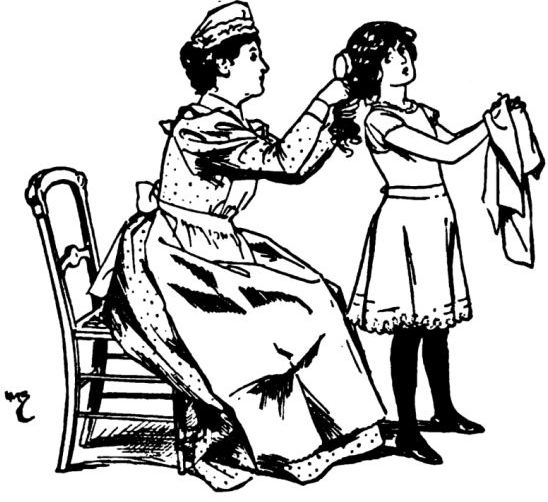
THE MORNING’S TRIAL
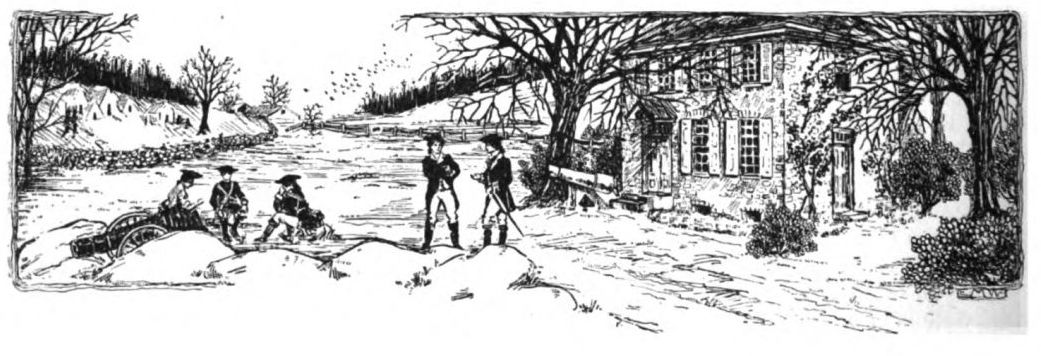
WITH WASHINGTON AT VALLEY FORGE — CHAPTER XIV The Occupation of Philadelphia — SYNOPSIS OF PREVIOUS CHAPTERS.
The story opens in the year 1777, during one
of the most critical periods of the Revolution.
Hadley Morris, our hero, is in the employ of Jonas
Benson, the host of the Three Oaks, a well-known
inn on the road between Philadelphia and New
York. Like most of his neighbors, Hadley is an
ardent sympathizer with the American cause. When,
therefore, he is intrusted with a message to be forwarded
to the American headquarters, the boy gives
up, for the time, his duties at the Three Oaks and
sets out for the army. Here he remains until after
the fateful Battle of Brandywine. On the return
journey he discovers a party of Tories who have
concealed themselves in a woods in the neighborhood
of his home. By approaching cautiously to the
group around the fire, Hadley overhears their plan
to attack his uncle for the sake of the gold which
he is supposed to have concealed in his house.
With the assistance of Colonel Knowles, who,
although a British officer, seems to have taken a
liking to Hadley, our hero successfully thwarts
the Tory raid. No sooner is the uncle rescued,
however, than he ungratefully shuts the door upon
his nephew. Thereupon Hadley immediately returns
to the American army and joins the forces
under that dashing officer, “Mad Anthony” Wayne.
In the disastrous night engagement at Paoli our
hero is left upon the battlefield wounded.
THE sun shining warmly upon his face
through the rapidly-drying bushes
which during the night had partly
sheltered him, was Hadley’s first conscious
feeling. Then he felt the dull pain in his
leg where the spent ball had become imbedded,
and he rolled over with a groan.
The wood lay as peaceful and quiet under
the rising sun as though such a thing as
war did not exist. Here and there a branch
had been splintered by a musket ball, or a
bush had been trampled by the retreating
Americans. But the rain had washed away
all the brown spots from the grass and
twigs, and the birds twittered gayly in the
treetops, forgetting the disturbing conflict
of the night.
The boy found, when he tried to rise, that
his whole leg was numb and he could only
drag it as he hobbled through the wood.
To cover the few rods which lay between
the place where he had slept and the road,
occupied some minutes. The wound had
bled freely, and now the blood was caked
over it, and every movement of the limb
caused much pain.
Where had his companions gone?
When the company rolls were called that
morning there would be no inquiry for
him, for he was not a regularly recruited
man. He had been but a hanger-on of the
brigade which was so disastrously attacked
during the night, and they would all forget
him. Captain Prentice was far away, and
Hadley had known nobody else well among
Wayne’s troops. The fact of his loneliness,
together with his wound and his hunger,
fairly brought the tears to his eyes, great
boy that he was. But many a soldier who
has fought all day with his face to the
enemy has wept childish tears when left
at night, wounded and alone, on the battlefield.
However, one could not really despair on
such a bright morning as this, and Hadley
soon plucked up courage. He got out his
pocket knife, found a sapling with a crotched
top, cut it off the proper length, and used
it for a crutch. With this, and dragging
his useless musket behind him, he hobbled
up the road in a direction which he knew
must bring him to the American lines, and
eventually to Philadelphia. But such
traveling was slow and toilsome work, and
he was trembling all the time for fear he
would fall in with the British.
He had not been many minutes on the
way, however, when a man stepped out of
the brush beside the road and barred his
way. Hadley was frightened at first; then
he recognized the man and shouted with
delight.
“Lafe Holdness! How ever did you
come here?”
“Jefers-pelters!” exclaimed the Yankee
scout. “I reckon I might better ask yeou
that question, Had. An’ wounded, too!
Was yeou with that brigade last night that
got bamfoozled?”
“The British attacked us unexpectedly.
Oh, Lafe! they charged right through our
lines and bayonetted the men awful.”
“I reckon. It’s war, boy—you ain’t
playin’.” Meanwhile the man had assisted
Hadley to a seat on the bank and with his
own knife calmly ripped up the leg of
Hadley’s trousers. “Why, boy, you’ve got
a ball in there—as sure as ye live!”
“It hurts pretty bad, Lafe,” Hadley admitted,
wincing when the scout touched the
leg which was now inflamed about the
wound.
There was a rill nearby, and to this the
scout hurried and brought water back in
his cap. With the boy’s handkerchief he
washed the dry blood away and then, by
skilful pressure of his fingers, found the
exact location of the imbedded bullet.
“Oh, this ain’t so bad,” he said, cheerfully.
“We’ll fix it all right in no time. But ye
musn’t do much walking for some days to
come. Yeou can ride, though, and I’ve got
a hoss nearby. First of all, I must git the
ball aout and wash the hole. Ye see, Had,
the ball lies right under the skin on the
back of the leg—so. D’ye see?”
“I can feel it all right,” groaned Hadley.
“Well, it’s a pity it didn’t go way
through. Howsomever, if you’ll keep a
stiff upper lip for a minute, I’ll get the
critter aout. ’Twon’t hurt much ter speak
of. Swabbin’ aout the hole, though, ’ll
likely make ye jump.”
He opened the knife again and, before
Hadley could object, had made a quick incision
over the ball and the lead pellet
dropped out into his hand. The boy did
not have a chance to cry out, it was done
so quickly. “So much for so much,” said
Lafe, in a business-like tone. “Nothin’
like sarvin’ yer ’prenticeship ter all sorts of
trades. I ain’t no slouch of a surgeon, I
calkerlate. Now, lemme git an alder
twig.”
He obtained the twig in question, brought
more water, and then proceeded, after having
removed the pith from the heart of the
twig, to blow the cool water into the wound.
Hadley cried out at this and begged him
to desist, but Lafe said: “Come, Had, yeou
can stand a little pain now for the sake of
being all right by and by, can’t yeou? It’s
better to be sure than sorry. P’r’aps there
warn’t no cloth nor nothin’ got inter that
wound, but ye can’t tell. One thing, there
warn’t no artery cut or ye’d bled ter death
lyin’ under them bushes all night. I ’spect
many a poor chap did die in yander after
the retreat. Anthony Wayne’ll have ter
answer for that. They say he’s goin’ ter
be court-martialed.”
Having cleaned the wound, Holdness
bound it up tightly with strips torn from
the boy’s cotton shirt, and then brought up
the horse which he had hidden hard by.
He helped the boy into the saddle and
walked beside him until they were through
the American picket lines. The wounded
had been sent on to Philadelphia, for there
were few conveniences for field hospitals.
“Yeou take that hoss and ride inter Philadelphy,
Had,” said Holdness. “Leave it
at the Queen and take yourself to this
house”—he gave the wounded lad a brief
note scrawled on a bit of dirty paper—“and
the folks there’ll look out for ye till the
laig’s well. I’ll git another hoss somewhere
else that’ll do jest as well. Yeou can’t go
clean back to Jarsey with your laig in that
shape.”
It was a hard journey for the wounded
youth, and before he crossed the Schuylkill
and followed Chestnut Street down into the
heart of the town, he was well-nigh spent.
He fairly fell off the horse in front of the
Indian Queen Tavern, and the hostler had
to help him to the address which Holdness
had given him. Here the good man and
his wife—Quaker folk were they, who
greatly abhorred the bloodshed of the war,
yet were stanch supporters of the American
cause—took the boy in and cared for
him as though he was their own son. For
a night and a day he kept to his bed; but he
could not stand it any longer than that.
The surgeon who was called to attend him
declared the wound had been treated very
well indeed by the scout, and that it was
healing nicely; so what does Master Hadley
do but hobble downstairs to the breakfast
table on the second morning, determined
no longer to cause the good Quakeress,
Mistress Pye, the extra trouble of sending
his breakfast up to him.
He was anxious to learn the news, too.
Affairs were moving swiftly these days in
Philadelphia. The uncertainty of what
the next day might bring forth forced
shops to close and almost all business to
cease. The Whigs were leaving by hundreds;
even the men who held authoritative
places in the council of the town had departed,
fearful of what might happen when
the redcoats marched in. And that Washington
could keep them out for long, after
the several reverses the American troops
had sustained, was not to be believed.
A sense of portending calamity hung over
the city like an invisible cloud. A third of
the houses were shut and empty. Many of
the others were occupied solely by servants
or slaves, the families having flown to the
eastward. Hadley did not get outside the
door of the Pye house that day, for he was
watched too closely. But early on the
morning of the 26th the whole street was
aroused by the swift dash of a horseman
over the cobbles; and a cry followed the
flying messenger:
“The British are coming!”
The people ran out of their houses, never
waiting for their breakfasts. Was the news
true? Had the redcoats eluded the thin
line of Americans that so long had stayed
their advance upon the town? Soon the
truth was confirmed. Congress had adjourned
to Lancaster. Howe had made a
feint of marching on Reading, and when
the Americans were thrown forward to
protect that town the British had turned
aside and were now within sight. They
had surprised and overpowered a small detachment
left to guard the approach to
Philadelphia, and—the city was lost! His
Excellency was then at Skippack Creek
with the bulk of his army, and the city
could hope for no help from him.
Hadley, hobbling on a crutch, but too
anxious and excited to remain longer indoors,
soon reached Second Street. From
Callowhill to Chestnut it was filled with old
men and children. Scarcely a youth of his
own age was to be seen, for the young men
had gone into the army. It was a quiet,
but a terribly anxious crowd, and questions
which went unanswered were whispered
from man to man. Will the redcoats really
march in to-day? Will the helpless folk
left in the city be treated as a conquered
people? Why had Congress, spurred on
by hot-heads, sanctioned this war at all?
Many who had been enthusiastic in the
cause were lukewarm now. The occupation
of the town might mean the loss of
their homes and the scattering of those
whom they loved.
Here and there a Tory strutted, unable to
hide his delight at the turn affairs had
taken. Several times little disturbances,
occasioned by the overbearing manners of
this gentry arose, but as a whole the crowds
were solemn and gloomy. At eleven
o’clock a squadron of dragoons appeared
and galloped along the street, scattering
the crowd to right and left; but it closed in
again as soon as they were through, for far
down the thoroughfare sounded the first
strains of martial music. Then something
glittered in the sunshine, and the people
murmured and stepped out into the roadway
the better to see the head of the approaching
army of their conquerors.
A wave of red—steadily advancing—and
tipped with a line of flashing steel bayonets
was finally descried. In perfect unison the
famous grenadiers came into view, their
pointed red caps, fronted with silver, their
white leather leggings, and short scarlet
coats, trimmed with blue, making an impressive
display. Hadley, who had seen
the nondescript farmer soldiery of the
American army, sighed at this parade.
How could General Washington expect to
beat such men as these? And then the
boy remembered how he had seen the same
farmers standing off the trained British
hosts at Brandywine, and later at the Warren
Tavern, and he took heart. Training
and dress, and food, and good looks were
not everything. Every man on the American
side was fighting for his hearth, for
his wife, for his children, and for everything
he loved best on earth.
Behind the grenadiers rode a group of
officers, the first a stout man, with gray
hair and a pleasant countenance, despite the
squint in his eye. A whisper went through
the silent crowd and reached Hadley’s ear:
“’Tis Lord Cornwallis!” Then there was a
louder murmur—in some cases threatening
in tone. Behind the officers rode a party
of Tories hated by every patriot in Philadelphia—the
two Allens, Tench Coxe,
Enoch Story, Joe Galloway. Never would
they have dared return but under the protection
of British muskets.
Then followed the Fourth, Fortieth and
Fifty-fifth regiments—all in scarlet. Then
Hadley saw a uniform he knew well—would
never forget, indeed. He saw it
when Wayne held the tide of Knyphausen’s
ranks back at Chadd’s Ford. Breeches of
yellow leather, leggings of black, dark blue
coats, and tall, pointed hats of brass completed
the uniform of the hireling soldiery
which, against their own desires and the
desires of their countrymen, had been sent
across the ocean by their prince to fight for
the English king. A faint hiss rose from
the crowd of spectators as the Hessians,
with their fierce mustaches and scowling
looks marched by.
Then there were more grenadiers, cavalry,
artillery, and wagons containing provisions
and the officers’ tents. The windows
rattled to the rumbling wheels and
the women cowered behind the drawn
blinds, peering out upon the ranks that, at
the command of a ruler across the sea who
cared nothing for these colonies but what
could be made out of them, had come to
shoot down and to enslave their own flesh
and blood.
Hadley could not get around very
briskly; but he learned where some of the
various regiments were quartered. The
artillery was in the State House yard.
Those wounded Continentals, who had lain
in the long banqueting hall on the second
floor of the State House, and who could
not get away or be moved by their friends,
would now learn what a British prison pen
was like. Hadley shuddered to think how
he had so nearly escaped a like fate, and
was fearful still that something might happen
to reveal to the enemy that he, too, had
taken up arms against the king. The
Forty-second Highlanders were drawn up
in Chestnut Street below Third; the Fifteenth
regiment was on High Street. When
ranks were broken in the afternoon the
streets all over town were full of red or
blue-coated figures.
Hadley hobbled back to the shelter of the
Pye homestead and learned from the good
Quaker where some of the officers had been
quartered. Cornwallis was just around
the corner on Second Street at Neighbor
Reeves’s house; Knyphausen was at Henry
Lisle’s, while the younger officers, including
Lord Rawden, were scattered among the
better houses of the town. A young Captain
André (later Major André) was
quartered in Dr. Franklin’s old house.
The British had really come into the hot-bed
of the “rebels” and had made themselves
much at home.
CHAPTER XV HADLEY IS CAST OFF BY UNCLE EPHRAIM
THE army of occupation brought in its
train plenty of Tories and hangers-on
besides the men named, though
none who had been quite so prominent in
affairs or were so greatly detested. It now
behooved the good folk of pronounced
Whig tendencies to walk circumspectly, for
enemies lay in wait at every corner to hale
them before the British commander and
accuse them of traitorous conduct. Hadley
Morris, therefore, although he did not expect
to be recognized by anybody in the
town, resolved to get away as soon as his
wound would allow.
He could not resist, however, going out
at sunset to observe the evening parade of
the conquerors. There was something very
fascinating for him in the long lines of brilliant
uniforms and the glittering accoutrements.
The British looked as though they
had been simply marching through the
country on a continual dress parade. How
much different was the condition of even
the uniformed Continentals!
To the strains of martial music the sun
sank to rest, and as the streets grew dark
the boisterous mirth of the soldiery disturbed
those of the inhabitants who, fearful
still of some untoward act upon the part of
the invaders, had retired behind the barred
doors of their homes. In High Street and
on the commons camp fires were burning,
and Hadley wandered among them, watching
the soldiers cooking their evening meal.
Most of the houses he passed were shut;
but here and there was one wide open and
brilliantly lighted. These were the domiciles
where the officers were quartered, or
else, being the abode of “faithful” Tories,
the proprietors were celebrating the coming
of the king’s troops. Laughter and music
came from these, and the Old Coffee House
and the Indian Queen were riotous with
parties of congratulation upon the occupation
by the redcoats.
As Hadley hobbled back to Master Pye’s
past the tavern, he suddenly observed a
familiar face in the crowd. A number of
country bumpkins were mixing with the
soldiery before the entrance to the Indian
Queen, and Hadley was positive he saw
Lon Alwood. Whether the Tory youth
had observed him or not, Hadley did not
know; but the fact of Lon’s presence in
the city caused him no little anxiety and he
hurried on to the Quaker’s abode. He
wondered what had brought Lon up to
Philadelphia—and just at this time of all
others?
“The best thing I can do is to get out of
town as quick as circumstances will permit,”
thought Hadley, and upon reaching
Friend Pye’s he told the old Quaker how
he had seen somebody who knew him in
the city—a person who would leave no
stone unturned to injure him if possible.
“We must send thee away, then, Hadley,”
declared the Quaker. “Where wilt thou
go with thy wounded leg?”
“I’ll go home. There isn’t anything for a
wounded man to do about here, I reckon.
But the leg won’t hobble me for long.”
“Nay, I hope not. I will see what can
be done for thee in the morning.”
Friend Jothan Pye was considered, even
by his Tory neighbors, to be too close a
man and too sharp a trader to have any
real interest in the patriot cause. He had
even borne patiently from the Whigs much
calumny that he might, by so doing, be
the better able to help the colonies. Now
that the British occupied the town, he might
work secretly for the betterment of the
Americans and none be the wiser. He had
already gone to the British officers and obtained
a contract for the cartage of grain
into the city for the army, and in two days
it was arranged that Hadley should go out
of town in one of Friend Pye’s empty
wagons, and he did so safely, hidden under
a great heap of empty grain sacks. In this
way he traveled beyond Germantown and
outside the British lines altogether.
Then he found another teamster going
across the river, and with him he journeyed
until he was at the Mills, only six miles from
the Three Oaks Inn. Those last six miles
he managed to hobble with only the assistance
of his crutch, arriving at the hostelry
just at evening. Jonas Benson had returned
from Trenton and the boy was
warmly welcomed by him. Indeed, that
night in the public room, Hadley was the
most important person present. The
neighbors flocked in to hear him tell of the
Paoli attack and of the occupation of Philadelphia,
and he felt like a veteran.
But he could not help seeing that Mistress
Benson was much put out with him.
As time passed the innkeeper’s wife grew
more and more bitter against the colonists.
She had been born in England, and the
presence of Colonel Knowles and his
daughter at the inn seemed to have fired
her smoldering belief in the “divine right,”
and had particularly stirred her bile
against the Americans.
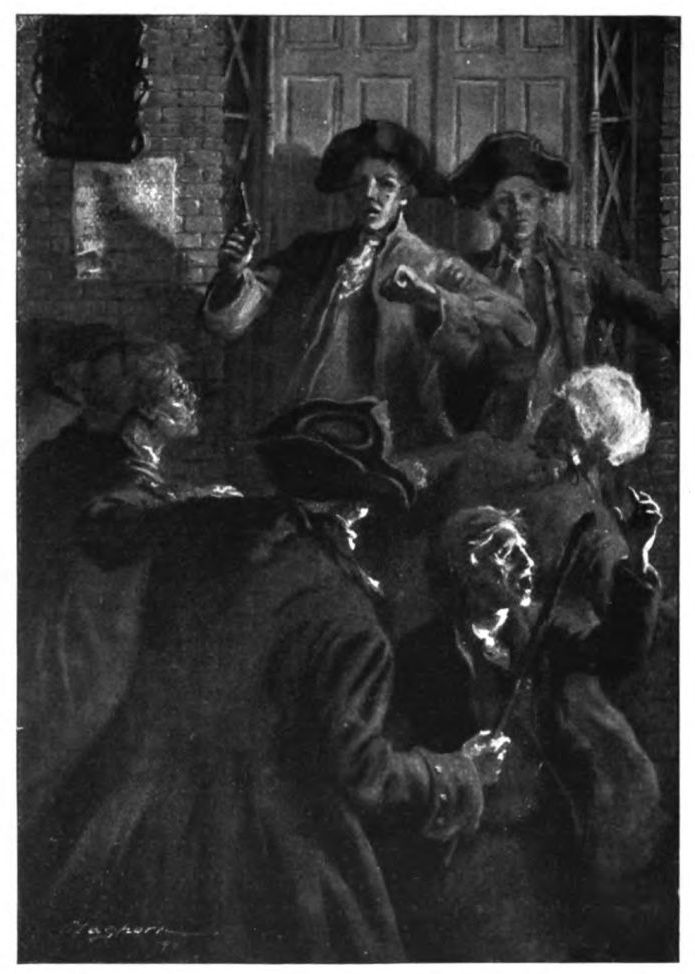
THERE WAS AN OCCASIONAL OUTBREAK IN THE QUIET TOWN
“I’m sleepin’ in the garret, myself, Had,”
groaned Jonas, in an aside to the boy. “I
can’t stand her tongue when she gets abed
o’ nights. I’m hopin’ this war’ll end before
long, for it’s a severin’ man and wife—an’
sp’ilin’ business, into the bargain.
She’s complainin’ about me keepin’ your
place for ye, Had, so I’ve got Anson
Driggs for stable boy. And, of course, she
won’t let me pay Miser Morris your wage
no more. I didn’t know but she’d come
down from her high hosses when them
Knowlses went away, but
she’s worse ’n ever!”
“Have the Colonel and
Mistress Lillian gone?”
“They have, indeed—bad
luck to them!—though
I’ve no fault to find with
the girl: she was prettily
spoken enough. But the
Colonel had been recalled
to his command, I understand.
His business with
your uncle came to
naught, I reckon. D’ye
know what it was, Had?”
Hadley shook his head
gloomily. “No. Uncle
would tell me nothing.
But the Colonel seemed
very bitter against him.”
“And what d’ye think of
doing?”
“I’m not fit for anything
until this wound heals
completely. I can’t walk
much for some time yet.
But I’ll go over and see
Uncle in the morning.”
“Ride Molly over.
There’s no need o’ your
walking about here. And
come back here to sleep.
Likely Miser Morris will
be none too glad to see ye.
Your bed’s in the loft
same’s us’al. Anson goes
home at night. The place
is dead, anyway. If this war doesn’t end
soon I might as well burn the old house
down—there’s no money to be got by keeping
it open.”
On the morrow Hadley climbed upon
Black Molly and rode over to the Morris
homestead. Most of the farmers in the
neighborhood had harvested their grain by
this time. The corn was shocked and the
pumpkins gleamed in golden contrast to
the brown earth and stubble. In some
fields he saw women and children at work,
the men being away with the army. The
sight was an encouraging one. Despite the
misfortunes and reverses of General Washington’s
army, this showed that the common
people were still faithful to the cause of
liberty.
News, too, of an encouraging nature had
come from the north. The battle of Bennington
and the first battle of Stillwater
had been fought. The army of Burgoyne,
which was supposed to be unconquerable,
had been halted and, even with the aid of
Indians and Tories, the British commander
could not have got past General Gates.
News traveled slowly in those days, but a
pretty correct account had dribbled through
the country sections; and there was still
some hope of Washington striking a
decisive blow himself before winter set
in.
The signs of plenty in the fields as he
rode on encouraged Hadley Morris, who
had seen, of late, so many things to discourage
his hope in the ultimate success of
the American arms. When he reached his
uncle’s grain fields he found that they, too,
had been reaped, and so clean that there
was not a beggar’s gleaning left among the
stubble. He rode on to the house, thinking
how much good the store of grain
Ephraim Morris had gathered might do
the patriot troops, were Uncle Ephraim
only of his way of thinking.
As he approached the house the watch
dog began barking violently, and not until
he had laboriously dismounted before the
stable door did the brute recognize him.
Then it ran up to the boy whining and
licked his hand; but as Uncle Ephraim appeared
the dog backed off and began to
bark again as though it were not, after all,
quite sure whether to greet the boy as a
friend or an enemy. Evidently the old
farmer had been in like quandary, for he
bore a long squirrel rifle in the hollow of
his arm, and his brows met in a black
scowl when his gaze rested on his nephew’s
face.
“Well, what want ye here?” he demanded.
“Why, Uncle, I have come to see you—”
“I’m no uncle of yours—ye runaway
rebel!” exclaimed the old man, harshly.
“What’s this I hear from Jonas Benson?
He says ye are not at his inn and that he’ll
no longer pay me the wages he promised.
If that doesn’t make you out a runaway
’prentice, then what does it mean?”
“Why, you know, Mistress Benson is
very violent for the king just now—”
“Ha!” exclaimed the farmer. “I didn’t
know she had the sense to be. It’s too bad
she doesn’t get a little of it into Jonas.”
“Well, she doesn’t want me around.
And Jonas can’t pay two of us.”
“She wouldn’t have turned ye off if ye’d
stayed where ye belonged, Hadley Morris.
Oh, I know ye—and I know what ye’ve
been doing of late,” cried the farmer.
“Ha! lame air ye? What’s that from?”
“I got a ball in my leg—”
“I warrant. Crippling yourself, too.
Been fighting with the ‘ragamuffin reg’lars,’
hey? An’ sarve ye right—sarve ye right,
I say!” The old man scowled still more
fiercely. “And now that you’ve got licked,
ye come back home like a cur with its tail
’twixt its legs, arskin’ ter be taken in—hey?
I know your breed.”
“If you don’t want me here I can go away
again,” Hadley said, quietly.
“What would I want ye for? You’re a
lazy, good-for-nothing—that’s what ye air!
There’s naught for ye to do about the farm
this time o’ year—an’ crippled, too. Ye’d
never come back to me if that ball hadn’t
hit ye. Ye’d stayed on with that Mr.
Washington ye’re so fond of talking about.
Ha! I’m done with ye! Ye’ve been naught
but an expense and a trouble since your
mother brought ye here—and she was an
expense, too. I’m a poor man; I can’t have
folks hangin’ ter the tail o’ my coat. Your
mother—”
“Suppose we let that drop, sir,” interrupted
Hadley, firmly, and his eyes flashed.
“Everybody in this neighborhood knows
what my mother was. They know that she
worked herself into her grave in this house.
And if she hadn’t begged me to stay here
as long as I could be of any use to you,
I’d never stood your ill treatment as long as
I did. And now,” cried the youth, growing
angrier as he thought of the slurring tone
his uncle had used in speaking of the dead
woman, “it lies with you whether you
break with your last relative on earth or
not. I will stand abuse myself, and hard
work; but you shan’t speak one word
against mother!”
“Hoity, toity!” exclaimed the old man.
“The young cock is crowing, heh? Who
are you that tells me what I should do, or
shouldn’t do?” Hadley was silent. He
was sorry now that he had spoken so
warmly. “Seems to me, Master Hadley,
for a beggar, ye talk pretty uppishly—that’s
it, uppishly! And you are a beggar—ye’ve
got nothing and ye never will have anything.
I’ll find some other disposal to make
of my farm here—”
“I’m not looking for dead men’s shoes!”
flashed out the boy again. “You’ve had my
time, and you’ve a right to it for three
years longer. If you want to hire me out
as soon as my wound is well, you can do so.
I haven’t refused to work for you.”
“Yah!” snarled the old man. “Who
wants to hire a boy at this time of the year?
The country’s ruined as it is—jest ruined.
There’s no business. I tell you that you’re
an expense, and I’d ruther have your room
than your company.”
Hadley turned swiftly. He had clung to
Black Molly’s bridle. Now he climbed
upon the horse block and, in spite of his
wound, fairly flung himself into the saddle.
“You’ve told me to go, Uncle Ephraim!”
he exclaimed, with flaming cheeks. “You
don’t have to tell me twice,” and, pounding
his heels into the mare’s sides, he set off
at a gallop along the path, and in a moment
was out of sight of the angry farmer.
There was bitterness in the boy’s heart
and angry tears in his eyes as Black Molly
fled across the pastures and out upon the
highway. Hadley Morris did not really
love his uncle. There was nothing lovable
about Miser Morris. The boy had been
misjudged and his mother spoken ill of—and
that fact he could not forget. He had
tried for a year and a half to keep from a
final disagreement with Uncle Ephraim;
but to no avail. The old man did not consider
Hadley old enough to judge for himself,
or to have any opinions of his own.
The times were such that children grew
to youth and young men to manhood very
rapidly. When the fathers went to the
war the sons became the providers and
defenders of the household; if the fathers
did not go, the sons were in the ranks
themselves. Questions were not asked regarding
age by the recruiting officers, providing
a youth looked hearty and was able
to carry a musket. And Hadley felt himself
a man grown in experience, if not in
years, after the exciting incidents of the
past few weeks.
“I am able to judge for myself in some
things,” he told himself, pulling Molly
down to a walk, so as to ease his leg. “If
Uncle would accept the fact that I have a
right to my own opinion, as he has a right
to his, we never would have quarreled.
I’d never gone over to the Three Oaks to
work. And then I’d never seen any active
service, I s’pose. He’s got only himself to
thank for it, if he did not want me to join
the army.
“But now, I reckon, there isn’t anything
left for me to do but that. Jonas can’t have
me and keep peace in the family; and I
wouldn’t stay after the way Mistress Benson
talked last night—no, indeed. I’ll go
to some of the neighbors. They’ll give me
a bite to eat and a place to sleep till my leg
gets well enough for me to walk. Then
I’ll go back to the army.”
He so decided; but when Jonas heard
his plan he vetoed it at once. “What,
Had!” cried the old innkeeper, “d’ye think
I’ll let a nagging woman drive you away
from here to the neighbors? Nay, nay!
I’m master here yet, and she is not really
so bad, Had. She doesn’t begrudge ye the
bite and sup. Stay till your leg is well.”
“But I shall not feel comfortable as long
as I stay, Jonas,” declared the boy.
“And how long will that be? Your leg
is mending famously. If you could but
ride ye’d be fit to go into battle again now.
Ah, lad, I’m proud of you—and glad that
it was part through me ye went to the wars.
I can’t go myself; but I can give of what
I have, and if the mistress does not like
it she can scold—’twill make her feel better,
I vum.” Then he looked at Hadley curiously.
“You’re anxious to get back to
General Washington again, eh, lad?”
“I wish I had hunted up Captain
Prentice, or Colonel Cadwalader, when I
got out of Philadelphia, instead of coming
over here,” admitted the youth.
“Then start back now,” Jonas said.
“Ride Molly—she knows ye, and ye’ll
get back in time to be of some use, mayhap,
for I heard this morning that there’s a
chance of another battle in a day or two.”
“Take Molly, sir?” cried the astonished
boy.
“Yes. Most of my horses have already
gone to the cause. I’ve got a packet of
scrip, as they call it, for ’em, but it’s little
worth the stuff is now, and perhaps it will
never be redeemed. But I’m a poor sort
of a fellow if I mind that. You take
Molly. I know if you both live you’ll come
back here. And if she is killed—”
The innkeeper stopped, for his voice had
broken. He was looking hard at the boy’s
flushed face, and now he reached up and
gripped Hadley’s hand with sudden
warmth. The youth knew that it was not
the thought of the possible loss of Black
Molly that had choked the worthy innkeeper,
but the fear that, perhaps, her rider
would never come back again.
“I’ll take her, Jonas—and thank you.
I’ll be happier—better content, at least—away
from here. Uncle doesn’t want me,
nor does he need me; and certainly Mistress
Benson doesn’t wish me about the inn.
So I’ll take Molly, and if all comes
well you shall have her back safe and
sound.”
“That’s all right—that’s all right, Had!”
exclaimed the other, quickly. “Look out
when them army smiths shoe her. She’s
got just the suspicion of a corn on that
nigh fore foot, ye know. And take care of
yourself, Had.”
He wrung Hadley’s hand again and the
boy pulled the little mare around. There
was nothing more to be said; there was
nothing to keep him back. So Hadley
Morris rode away to join Washington’s
forces, which then lay idle near the beleaguered
city.
[TO BE CONTINUED]
Mary Lane’s Higher Education
MRS. LANE dropped down on the
door-step and fanned herself with
her apron. “It does beat all,” she
said, aloud to herself, “how trifling these
heathens are. Here I am paying seven dollars
a week to this miserable Chinaman to
do nothing but the cooking, and now if he
doesn’t slip off without a word and leave
me to do all the work.”
“Don’t bother about it, mamma,” answered
Mary Lane, with an abstracted air,
“pingo, irregular, we can eat, pingere, anything.
It’s too hot to worry, pinxi,
pinctum.”
Mary meant to be kind, but as she
hunched her shoulders over her book again,
her mother’s trials were entirely out of her
mind. But for once in her life the overworked
woman’s patience forsook her.
“I’ve got to bother,” she said, wearily,
“what with a houseful of city boarders, and
this being quarterly conference and the ministers
coming here to dinner, and that
heathen away. I can’t let it go, I’ve got to
bother.” Then she arose and walked away
quickly so her plaints should not disturb
her daughter’s studying.
A few moments later a gentle knock was
heard at the door, and—“Mamma says she
would like to have screens put into her
windows, Mrs. Lane,” said a crisp-looking
young girl who put her head into the door,
“and the water won’t run upstairs, and we
need more—why, what in the world is the
matter?” she finished abruptly, for poor
Mrs. Lane had put down her pitcher, looking
as if this was the last straw.
“Everything is the matter,” the tired
woman answered, and motioned the girl
into the hall to explain that all her troubles
seemed to have culminated that morning
and that the ministers were to be there for
dinner.
“Can’t you get any one to help you?”
the girl asked, looking inquiringly through
the door at Mary.
“No, she’s too busy studying; I wouldn’t
have her stop preparing for her Latin examination
for anything; she is going to
have a higher education, you know,” she
added, with a touch of pride.
The youthful summer boarder looked
down at the tired little woman with a bright
smile. “Oh, Mrs. Lane, I’m coming right
in to help you, myself,” she said; “I just
love to do things in the kitchen, honestly
I do,” commencing to take off her rings
and rolling up her sleeves, as she saw Mrs.
Lane had not fully grasped what she had
said.
“No, you must not stay in this hot place,”
the woman said, noticing the stiff collar and
freshly starched duck skirt; “and, besides,”
she continued, to herself, as she remembered
how some of her boarders, last summer,
had tried to have a candy-pull and had
set the house on fire, “I can’t be bothered
now showing her. I know how these city
girls work.”
But by this time the “city girl,” unconscious
of Mrs. Lane’s thoughts, had one of
the latter’s big kitchen aprons tied around
her waist and was waving a wooden spoon
by way of punctuating her orders.
“Now, Mrs. Lane, I’m the new hired
girl, Blanche is my name, and although I
have no recommendation from my last place
to give you, I assure you I am honest and
willing. You don’t know how I just love
to get a chance to fuss around a kitchen; it
is such a change from the grind of—”
Here the potatoes boiled over and she flew
to take off the lid.
The morning wore away much more
peacefully for Mrs. Lane than it had begun.
Many steps were saved her by the “new
girl’s” watchfulness, and there were even
several bursts of merry laughter from the
buttery, which dispelled more clouds than
the real assistance did.
“I may not be so skilled in making bread
and doing the useful things,” Blanche
apologized, “for I have taken only the
‘classical course’ in cookery. Nettie and I
spent last summer down at Aunt Cornelia’s
while the rest of the family were in Europe,
and she told us we could do whatever we
pleased, and what do you suppose we chose?
I chose puttering around the kitchen, and
Nettie took to hoeing the weeds out of the
vegetable garden. And it was such fun!”
The ministers came earlier than they
were expected, and Mrs. Lane was hurried
out of the kitchen to put on her good dress,
with a pledge to secrecy as to the force in
the culinary department.
By dinner-time, the Chinaman, having
unexpectedly put in his appearance, was
waiting on the table as if nothing had
happened, but Mrs. Lane was too nervous
and apprehensive at first even to notice
how different the table looked. There
were roses everywhere, a gorgeous American
Beauty at each place, and the fish globe
in the centre of the table was full of them;
but they were all of one variety. Mrs.
Lane thought secretly that when the larkspurs
and hollyhocks were so fine it did
seem a pity not to mix a few in just to
give it a little style. She had grave doubts
as to the salad when she saw it brought on,
although she was bound to admit the
yellow-green lettuce looked very pretty,
garnished with the bright red petals; but
when she tasted it she was reassured. She
could not make out what it was made of,
but she only hoped it seemed as palatable
to every one else as it did to her.
The boarders were all delighted with this
new departure, and attributed it to the
presence of the ministers, consequently
they warmed toward them with a friendliness
born of gratitude, and the ministers
in their turn did their utmost to return the
graciousness and courtesy of the boarders,
till the board might have been surrounded
by a picked number of congenial friends, so
beautifully did everything progress.
“Brother” Mason eyed the array of forks
and spoons at his plate somewhat suspiciously,
wondering if he had them all and
was expected to pass them along, but
Blanche clattered hers so ostentatiously that
he noticed she had the same number and
was satisfied.
The success of the next course was due to
Mrs. Lane, for the “new girl” explained to
the mistress that meats and vegetables did
not come in the “classical course.” “Brother”
Hicks talked so volubly about foreign
missions that Mary did not notice that even
the currant jelly was made to do its part
in developing the color scheme of the table
and that it matched the roses as exactly as
if it had been made after a sample. But
when the cake was brought in and set before
her to be cut she thought at the first
glance it was another flower piece, but she
saw the quick, approving glance shot from
her mother to Miss Blanche, and suspected
the new boarder might have suggested its
design. It was set on the large, round
wooden tray used to mash the sugar in.
Even the frosting was tinted an American
Beauty pink, and around its base a garland
of the same glowing roses. Through the
jumble of irregular verbs and the rules for
indirect discourse the secret suddenly
dawned upon her. It was the city girl who
walked with her head so high and wore
such beautiful dresses who had made the
dinner such a success, while she—but that
was different, she was preparing for
college.
Mrs. Lane was complacent and happy the
remainder of the evening and less tired than
she had been for many days, and when the
ministers took their leave of her the Presiding
Elder said, “I shall remember this
evening and the beautiful repast you
have given us for a long time to come, Sister
Lane.”
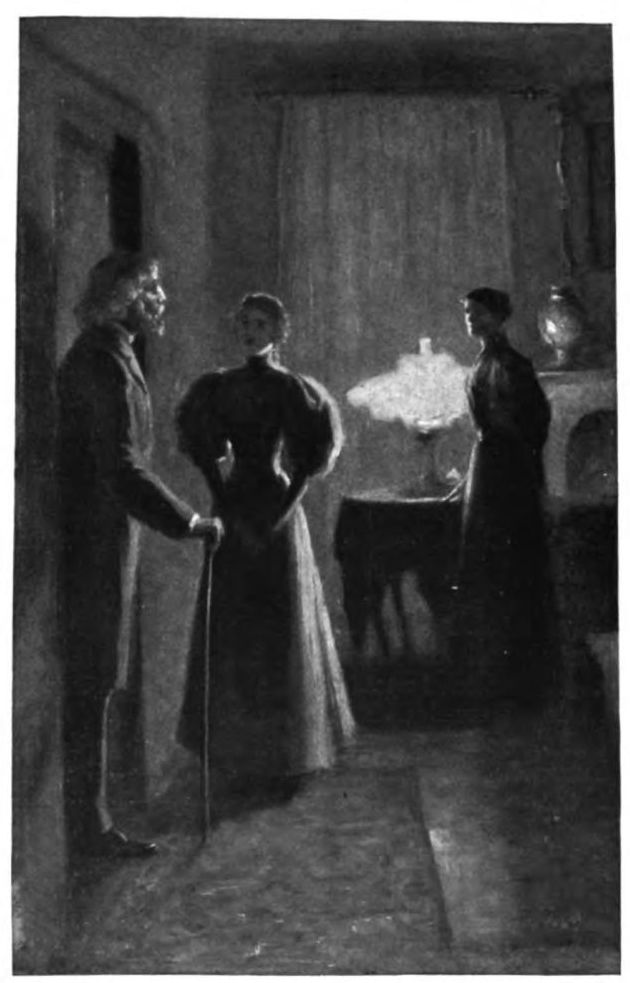
“I SHALL REMEMBER THE BEAUTIFUL REPAST FOR A LONG
TIME TO COME, SISTER LANE,” SAID THE PRESIDING ELDER
Blanche’s bright eyes sparkled with fun,
and Mary, although she could not have told
why, felt just a bit uncomfortable. “Isn’t
it interesting to know that our English
words transfer and translate come from
the same root?” she said, presently, in her
own mind trying to vindicate herself for
not helping her mother.
“Oh, don’t,” broke in Blanche, laughingly,
“talk about the dirty old roots under
ground when we have these glorious flowers
that grow on top.”
It had grown too dark for any one to
see the pity in Mary’s smile for this frivolous
city-bred girl who wasted her time on
amusements and learning a little chafing-dish
cooking, and didn’t even know what
a Latin root was.
Blanche’s mother was kept in her room
the next day with a headache, so Blanche’s
time was divided between taking care of
her invalid and lending a hand to Mrs.
Lane till she could get another cook. Mrs.
Lane had never expected Mary to help her;
knowing how hard her own life had been,
she was trying to fit her for a teacher, but
as she watched Blanche flying
about the house, setting the table,
rolling out her cheese straws,
running up and down to her
mother’s room with a patch of
flour on her curly hair, and singing
gayly about her work, her
tired eyes followed the young girl
wistfully. It would be worth a
great deal, she admitted, to have
a daughter like that, even if she
had not a word of Latin in her
head. But, of course, the higher
education could not be interfered
with by the old-fashioned way of
bringing up a daughter, and
Mary took to books.
“I am going to college this fall
if I pass the entrance examinations,”
Mary announced at the
lunch table, with just a touch of
superiority in her tone. She
could not have explained just why
she felt so resentful toward the
city girl.
“Are you going East, or will
you stay out here on the coast?”
Blanche asked, as if it were the
most every-day thing to go to
college.
“I have not decided yet, for I
shall be the only girl anywhere
around here who has gone to college,”
she answered, nibbling one
of Blanche’s cheese straws with
an evident relish.
“Have another,” Blanche interrupted,
passing her the plate with
a hand that showed two burns and a slight
scald. “We used to serve them with tamales
when our friends came down from
town to the trial foot-ball games.”
“Why, I thought you lived in San Francisco?”
Mary said, looking up in surprise.
“I do,” Blanche answered, “but I’ve been
down at Stanford the last four years, and
have just finished this last semester.”
Mary’s eyes almost popped out of her
head. “Why,” she began, incredulously,
“I thought you—you—” She did not like
to say she had thought that the sunny-faced
girl before her had no appreciation of
education because she liked to do useful,
domestic things, too.
“You thought I could do nothing but
cook?” Blanche finished, laughingly.
But Mary did not answer. Blanche
Hallsey was certainly not much older than
she, and yet, with all her college education,
she had been in the kitchen all that hot
morning, kneading bread and scouring
silver for Mrs. Lane.
“If you decide to go to Stanford, I can
write to some of the girls to look out for
you,” Blanche went on, for she had not
noticed Mary’s attitude of superiority the
last few days.
“Oh, would you, please?” Mary Lane
pleaded, in a tone that would have greatly
surprised her mother had she heard it, for
not even she guessed how the fear of going
among strangers for the first time in her
life had been haunting her diffident little
girl.
It was several days, however, before
Mary, with her forehead puckered into
knots over the “ablative absolute,” could
bring herself to knock at Miss Hallsey’s
door, and ask for a little assistance.
But that was the beginning of the end of
Mary Lane’s priggishness, and the first step
toward a higher education in the true sense
of the word. She passed her entrance examinations
with honors, due, perhaps, to
the patient coaching she received during the
rest of the summer from Blanche Hallsey.
She learned, too, besides irregular verbs, a
great many other things fully as useful,
topping off with what the college girl called
“a classical course in cookery.”
LITTLE POLLY PRENTISS — CHAPTER XV ARCTURA’S STORY — SYNOPSIS OF PREVIOUS CHAPTERS.
BY ELIZABETH LINCOLN GOULD
Polly Prentiss is an orphan who, for the greater
part of her life, has lived with a distant relative,
Mrs. Manser, the mistress of Manser Farm. Miss
Hetty Pomeroy, a maiden lady of middle age, has,
ever since the death of her favorite niece, been on
the lookout for a little girl whom she might adopt.
She is attracted by Polly’s appearance and quaint
manners, and finally decides to take her home and
keep her for a month’s trial. In the foregoing
chapters, Polly has arrived at her new home, and
the great difference between the way of living at
Pomeroy Oaks and her past life affords her much
food for wonderment. In the meantime Miss
Pomeroy has inwardly decided that she will keep
Polly with her, but as yet she has not spoken to
the little girl of her intention.
ARCTURA’S prediction came true, for
the first sound Polly heard when
she woke the next morning was a
soft, steady patter on her window-pane;
the trunk of the elm tree was wet and black
as if it had been raining all night. Polly
was reminded of that stormy afternoon not
quite two weeks ago when she had sat close
to Uncle Blodgett in the old shed at
Manser Farm and heard him tell about his
brave young nephew who had gone to the
war and died for his country.
“I wonder if they miss me?” thought
the little girl at Pomeroy Oaks. “Maybe
they do, because they used to say I made
all the noise there was in the house. It
seems a pretty long time till next winter,
but if I get real well acquainted with Miss
Pomeroy so I can tell her that my loving
the Manser Farm folks won’t make me stop
wanting to be like Eleanor, maybe she’ll
let me go to see them by Thanksgiving.
I wonder how my rag dollie likes it up in
the garret in that tight box where Mrs.
Manser put her. I expect she’s lonesome,
poor dolly! And Ebenezer—I don’t persume
anybody gets down on the floor to
play with him, because they’ve all got
rheumatism except Mrs. Manser, and she
has pains in her head.”
There was no trip to the village for Miss
Pomeroy and Polly that morning. Toward
noon Hiram drove off in the light wagon,
holding a large umbrella over his head, and
returned well splashed with mud an hour
or so later.
Polly spent part of the morning in the
library with Miss Pomeroy, darning some
stockings and a rent in the old red frock.
Miss Pomeroy had a book in her hands,
but almost every time the little girl looked
up from her work she found the keen, gray
eyes fixed on her face, and it made her
uneasy. She thought there must be something
unsatisfactory about her appearance,
for her kind friend looked grave and
troubled. Polly decided to speak.
“My hair isn’t quite as flat as it is sometimes,”
she ventured, after a long silence.
“Mrs. Manser used to say that she believed
Satan got into it when the weather was
damp, and perhaps he does. I suppose the
nicest folks all have straight hair, don’t
they, Miss Pomeroy?”
The only answer was a smile and a stroke
of the brown curls, and Polly was instantly
confirmed in her opinion, while Miss
Hetty’s mind was far away.
“But, perhaps, as I get more and more
like Eleanor, my hair will change just as
my cheeks are changing,” she thought,
hopefully. “And I think I’m stretching out
a little bit, too, practicing the way
Ebenezer did.”
The library was a delightful room, but
the hour with Arctura before the kitchen
fire in the afternoon had a different sort
of charm for Polly.
“You’re so comfortable, Miss Arctura,”
she said, confidingly, to Miss Green, when
they were fairly settled with their work.
Polly’s task was an iron-holder, and that
of her hostess the flaming sock designed
for Hiram’s ample foot. Miss Pomeroy
was in her room, writing letters; she had
many correspondents in the world outside
the little town, and they kept her busy.
Besides that, she had a purpose in leaving
Polly with the faithful Arctura a good
deal of the time.
“The child is happier with you, and I
want her to be happy,” she said, with perfect
frankness. “She’s a little afraid of
me for some reason, and though it hurts
my vanity, I don’t want to hurry her confidence.
I believe I shall win it in time.”
“Of course, you will,” said Arctura,
stoutly. “I can’t quite make her out sometimes.
She’ll seem real gay for a few
minutes and then sober down all of a
sudden, as if she remembered something.
She’s just as anxious to please you as ever
a child could be. Do you suppose that
Manser woman could have scared her any
way? Told her you were set on having
her act any particular way, or anything?”
Miss Pomeroy’s life had been singularly
apart from the current of village gossip;
she stared blankly at this suggestion and
then shook her head.
“It wouldn’t be possible,” she said, decidedly.
“Mrs. Manser never spoke to me
until I waylaid her after church that Sunday,
three or four weeks ago. And there
is nobody to tell her anything of me or my
ways of living. She simply knows that I
took a fancy to Mary, and—since yesterday—that
I wish to adopt her.”
“M-m,” said Arctura, softly, as Miss
Pomeroy turned away. “I shouldn’t want
to be too sure what folks know and what
they don’t, in any place where there’s a
post-office, two meat-men, and a baker’s
cart.”
“I’ve written my letter to go with the
candy to-morrow morning,” said Polly, as
she basted a strip of turkey-red binding
around a square of ticking after Miss
Green’s instructions. “It took me ’most an
hour and a half by the big clock, and I made
four blots and had to look in the dictionary
three times, and now I expect it’s just full
of mistakes. I carried it to Miss Pomeroy,
but she said she wanted Aunty Peebles to
have the first reading of it, and she helped
me seal it with a great splotch of red
sealing-wax, and marked it with her big
stamp.”
“Won’t it mix ’em all up to see a ‘P’ on
the letter?” inquired Arctura. “Why, no;
what am I thinking of? ‘P’ stands for
Prentiss just as well as Pomeroy.”
“Yes, and for—for other names, too,”
said Polly, remembering just in time.
“Polly Perkins—that’s in your song—it
stands for both of her names.”
“To be sure it does,” said Arctura.
Then the chairs rocked in silence for a
few minutes. Arctura stole a glance at the
face so near hers. The little mouth was
shut firmly, but there was a downward
droop at the corners, and it certainly appeared
to Arctura that something glistened
in the long lashes that hid the great brown
eyes.
“H-m—it’s a kind of a dull day for little
folks and big folks, too,” she said, poking
vigorously at the ashes in the grate with
her back to Polly. “I don’t know as
there’ll ever come a better time for me to
tell you about the Square and me when I
was your age.”
When she turned around the brown eyes
were shining to match the eager voice, and
Arctura smiled with satisfaction.
“This occurred forty-five years ago,” she
began, briskly. “I might as well break it
to you that I’m all but fifty-five. I suppose
you’ve met folks as old as that, haven’t
you?”
“Why, everybody at Manser Farm is
ever and ever so much older, except Mrs.
Manser and Father Manser, and Bob Rust,”
said Polly, earnestly. “They’re all traveling
on toward their end, Uncle Blodgett
says, and he doesn’t care how soon he
gets his marching orders for the heavenly
land, but I care,” and the brown curls
danced, “for I just love Uncle Blodgett.”
“I’m glad to hear it,” said Arctura,
heartily. “Well now, about the Square
and me. You see, my mother—‘marm,’
we all called her—was a notable cook. I
don’t approach her on pie crust nor muffins,
and there was a sort of rye drop cake,”
said Miss Green, lowering her voice, “that
nobody but her could ever make. And she
was a great one to invent cake receipts,
and then invite folks in to take a dish
of tea in the afternoon and test the new
cake.
“The Square’s wife was a good deal
younger than he—she’d only be seventy if
she was alive to-day, while he was eighty-five
when he died—and she’d often accept
marm’s invitations, and come to our old
house—’twas burned years ago—and spend
the best part of an afternoon just as friendly
as you please. Not that ’twas any great
come down, either,” said Arctura, with
proper pride, “for my marm was of excellent
stock, and I’m the first woman in
the family records to work for pay.
“But that’s nothing to do with the story.
One morning when John and I were starting
off for school—Hiram was only a baby—marm
gave us each an errand to do on
the way. I can remember I stood barefoot
in the grass—what did you say?” as Polly
made a sound.
“Nothing but ‘oh!’” said Polly, quickly.
“I didn’t mean to interrupt, Miss Arctura.”
“Never mind, I’m glad to have you take
an interest,” said the story-teller. “I can
remember standing there in the grass waiting
for John, and saying over and over to
myself, ‘Please, Mrs. Pomeroy, marm sends
her compliments and would like to have—no,
that isn’t right—please, Mrs. Pomeroy,
marm sends her compliments and would
be happy to have you take tea with her this
afternoon.’
“Pretty soon John came running out, and
we took hold of hands and started for
school. John said marm had told him to
get an ounce of camphor at the store, and
he was wishing she’d said a pound instead
of such a stingy little mite, and I had to
set forth to him how much an ounce of
camphor could do before he was anyways
reconciled.
“We had nearly two miles to go to
school, and that morning when we got to
the fork in the woods I ran across lots to
get there quicker, and John went on down
to the store. It was way out at the corners,
not where the Burcham block is now,” explained
Arctura. “Folks expected the village
would grow this way, but it went the
other.
“I ran to the front door, as marm had
charged me to, and reached up for the
knocker and gave it a good bang. And
what should I see but the Square, instead
of Mrs. Pomeroy that I was prepared for.
He was tall and stern looking, and my ideas
just fled away when I saw him, but I
managed to remember my manners. I
dropped a courtesy and said, ‘Please, marm
wants Mrs. Pomeroy’s tea, and she’d be
happy to have her compliments this afternoon.’”
“Then it came over me what I’d said,
and with being scared and all I began to
cry. And the Square just reached down
and took my hand and led me into the
house, and Mrs. Pomeroy understood the
message right off, and said she’d be most
happy to come. The Square kept hold of
my hand all the time, and when the message
was straightened out he said, ‘May I
walk with you as far as our ways lie together,
my little maid?’”
“Oh, wasn’t that beautiful!” cried Polly.
“‘May I walk with you as far as our ways
lie together, my little maid?’ That’s something
like Mr. Shakespeare’s works that
Uncle Blodgett has.”
“’Twas pretty fine talk, I think myself,”
said Miss Green, “and ’twas followed up by
finer, though I can’t recall anything else
word for word. But we kept together
hand in hand, he taking long strides and I
running alongside, as you might say, till
we reached a house where the Square had
to stop. He took off his hat to me when
he said good-bye and shook my hand, and
said, ‘I beg you to accept this trifling remembrance,
my little maid,’ and when I
came to, there was a shining gold-piece in
my hand.”
“‘I beg you to accept this trifling remembrance,
my little maid,’” repeated
Polly. “I think that’s even beautifuller
than what he said at first. I guess Uncle
Blodgett and Grandma Manser, too, would
like to hear that. They love beautiful
language.”
“When I got to school,” continued
Arctura, after an appreciative smile at
Polly, “John was in the middle of a group
of children on the green. He’d taken off
his coat and was showing ’em his first pair
of ‘galluses’—bright red, they were, about
the shade of this very yarn. One of the
children ran up to me and said, ‘I suppose
your brother John thinks he’s a man now,
for he says his suspenders are just like
your father’s.’”
“I never answered her, but I just
opened out my palm to let her see the gold-piece,
and I said, ‘The Square walked with
me ’way to Mrs. Brown’s, and gave me
this.’”
“John had considerable interest for the
boys that day, but the girls were all taken
up with me, and for weeks afterward when
we got tired playing, somebody’d say,
‘Arctura, now you tell about your marm’s
message, and the Square walking part way
to school with you.’”
“Oh, I think it was ever so much more
interesting than John’s suspenders,” said
Polly, breathlessly. “I never heard anything
so wonderful that happened to a
little girl, Miss Arctura.”
Miss Green loosened the ruffle at her
neck and slowly drew up a slender chain
on the end of which something dangled.
“Suspenders wear out, even the best of
’em,” she said, softly leaning toward her
little guest. “You look at that. My father
bored a hole in it, and marm gave me this
chain that was her marm’s, and I’ve worn
it from that day to this.”
“And mind you,” said Miss Green, as
Polly looked with awe at the little gold-piece,
kept shining by Arctura’s loving
care, “whenever the Square was a mite
cross or unreasonable those last years, from
his mind getting tangled, I’d put my hand
over this little dangling thing, and I’d say
to myself, ‘Arctura Green, who gave you
the proudest day you ever knew as a little
girl?’ and ’twould warm my heart up in
a minute. There’s some that forgets, but,
with all my faults, I ain’t one of the
number.”
CHAPTER XVI POLLY’S LETTER
WHEN Father Manser returned from
his trip to the post-office the next
evening he found the residents at
Manser Farm, with the exception of his
melancholy spouse, gathered in the kitchen.
Mrs. Manser had gone to bed with a headache,
but her absence failed to cast a gloom
over the company. It was the most cheerful
evening that had been known since
Polly left them, for Uncle Blodgett had not
only read the weekly “Sentinel” in so clear
a tone that even Grandma Manser, near
whom he sat, could hear, but he had, after
urging, recited several poems.
“I admire to hear battle-pieces,” said
Aunty Peebles, just as the door swung
open to admit Father Manser. “When you
spoke that ‘Charge of the Light Brigade’
it gave me chills all along my spine, and
made me feel as if I could step right forth
to war.”
“I expect you wouldn’t be a very murderous
character, though, come to get you
on the field of battle,” said Uncle Blodgett,
good-naturedly. “Now, there’s Mis’ Ramsdell,
I reckon she’d make a good fighter if
she was put to it.”
“I come of war stock,” said Mrs. Ramsdell,
her black eyes snapping, and nostrils
dilating as she acknowledged the compliment.
“My father and his three brothers
were in the war of 1812, and back of that
their parents and uncles were in the thick
of ’76, and led wherever they were.”
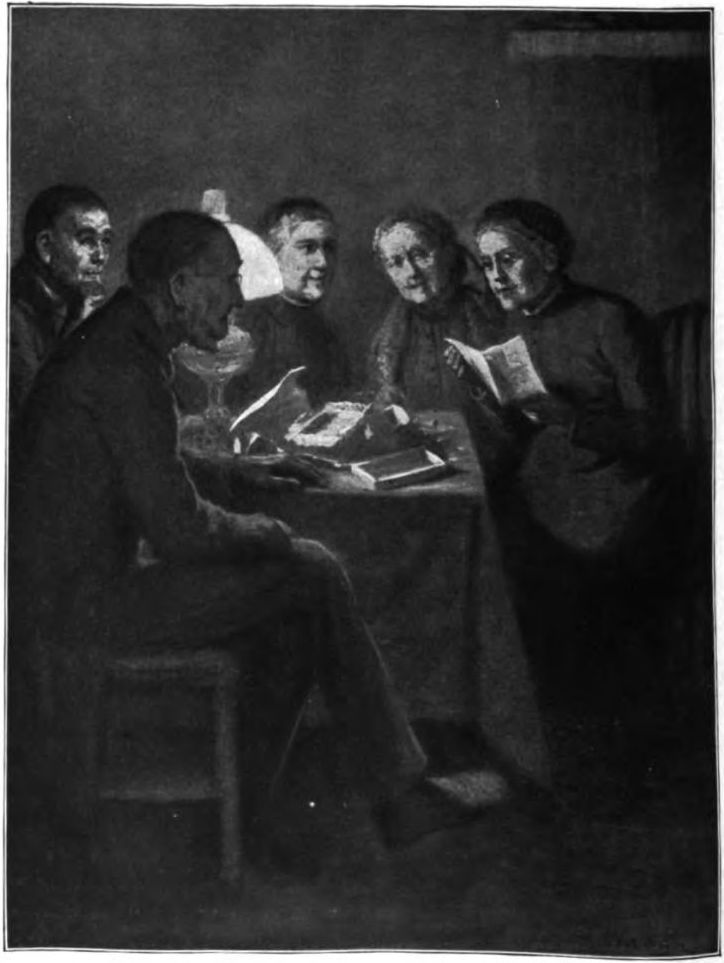
“Ain’t you kind of reckless, speaking of
‘parents’ that way?” inquired Uncle Blodgett.
“Did your grandmarm conduct a
regiment, or what was her part in the
proceedings?”
Mrs. Ramsdell directed a look of withering
scorn at her old friend, but her eye
caught sight of a package in Father Manser’s
hand and she was suddenly alert.
“What you got there?” she demanded,
and at once all the old heads turned toward
the new-comer.
Usually they took no special note of
Father Manser’s return, as there were
scarcely ever any letters, and they well
knew the paper must be Mrs. Manser’s
spoil for the evening.
“It’s a box,” said Father Manser, turning
the package over and over in his hand.
“We can all see that,” said Mrs. Ramsdell,
sharply.
“And it seems to be directed to Miss
Anne Peebles,” proceeded Father Manser,
taking no offence.
Aunty Peebles began to tremble with
excitement as the box was handed to her,
and a flush rose in the other old faces as
the group closed in around the table, so
that the lamp might shed its light on this
surprising package.
“If you could wait till I’ve taken the
paper in to Mrs. Manser, I’ve got a sharp
knife that would cut those fastenings,”
said Father Manser, wistfully. “Her door’s
closed, and I won’t be but a minute. I
won’t speak of the package, and I’ll mention
that the fire needs more wood, for I see it
does.”
“I’ll wait,” said Aunty Peebles, and
spurred by a “Hurry up, then, for goodness’
sake!” from Mrs. Ramsdell, Father
Manser sped off with the paper.
“It’s Polly’s writing,” said Uncle Blodgett,
after a long squint at the address on
the brown paper covering of the box.
“I’ve got one of her exercises that the
teacher said she might keep—one of that
last batch, if I haven’t lost it.”
Uncle Blodgett drew from his coat
pocket a long, flat wallet, and took out of it
a piece of paper carefully creased and bearing
evidences of frequent handling. He
spread it out close to the box, so that all
might see.
“You mark that cross on the T,” he said,
triumphantly. “She begins it with a kind
of a hook, different from most that you’d
see. I—I noticed it the day she made me
a gift of the paper,” said Uncle Blodgett, as
he replaced his treasure in the wallet.
“The box is from Polly Prentiss,” cried
Mrs. Ramsdell in Grandma Manser’s ear.
“I guess your daughter-in-law’s made a
mistake about her forgetting us, after all.”
Then the old lady put her arm through
Grandma Manser’s and pressed her fiercely
as if to make amends for this reference to
the doubting one. “’Taint as if she was
your daughter, dear heart,” she said, remorsefully.
When the string had at last given way—Father
Manser had slashed it recklessly in
half a dozen places in his haste—and the
box cover was lifted, there lay the letter on
which Polly had spent so much time and
thought, with seven chocolate drops on it.
Aunty Peebles passed the box around and
each of the company took a piece of candy;
even Bob Rust had his portion, which he
carried to his favorite seat near the door
into the shed, and handled as if it were
something rare and wonderful, as, indeed,
it was to him.
Father Manser set his wife’s piece carefully
aside. Nobody failed for a moment to
understand little Polly’s loving thought for
them all. Below the letter lay row after
row of the chocolates, but they could wait.
“Now we’ve—ahem!—eaten part of the
message,” said Uncle Blodgett, gruffly,
“suppose you read us the rest of it, Mis’
Peebles. Seems to be some time since
we’ve heard direct from the child.”
Aunty Peebles’s voice quavered many
times during the reading, and there was a
frank use of handkerchiefs at some points,
but the interest in Polly’s letter never
flagged.
“Dear folks at Manser Farm,” read
Aunty Peebles, “this is a beautiful place
and every one is very kind to me. How
do you all do, and is Ebyneezer well and
the other Animals? The minister came to
dinner Sunday, that was why I was so
late and you had gone, but I heard the
Wagon up the hill. This is a beautiful
place, with big trees, and in the house
there are books and books and Cabbynets
with kurous Shells and other things. And
there is silver that shines, and my bed and
chairs are white with a pink Strype. Mrs.
Manser, I am being careful of my Close
and I allways wear an apron. There are
two little kittens here. Their names are
Snip and Snap.
“When folks have such a beautiful place
I guess they do not care much about going
out-doors, but there is a Pyaza and I walk
on that a great deal, beside I have been to
walk down the road most every day with
Miss Pomeroy and she is just as good to
me! And once I have been in the Woods
with Miss Arctura, and she said ‘next
time,’ so that means we are going again.
Mr. Hiram that is her brother can resite
pieces and he is teaching me On Linden
when the Sun was Low, Uncle Blodgett do
you know that piece? He says he would
give all his boot buttons to hear you resite
Mr. Shakespeer’s Works. I do not think
I have spelled that name right. Perhaps I
can see you all before Christmas, but perhaps
I cannot, for I am going to be adopted.
Do you miss me, Grandma Manser and
Mrs. Ramsdell? Do you miss me, Uncle
Blodgett? and Aunty Peebles do you miss
me? This is a beautiful place, and I read
and sew and play with the kittens and
Miss Pomeroy says I am a quiet little girl,
Mrs. Manser. Father Manser do you
remember giving me Pepermints? I hope
you will all like this Candy. I have been
to the Village once with Miss Pomeroy,
but I did not see any folks I knew.
“I hope Grandma Manser will have her
ear Trumpet pretty soon. Aunty Peebles
I love that Cushion I look at it very many
times, and Uncle Blodgett Mr. Hiram will
have that knife fixed for a Present he says.
Now I must say Goodbye with heaps and
heaps of love. I put Aunty Peebles’ name
on this because she admires to get things
through the Post Office.
“Mary Prentiss.”
“Miss Pomeroy is not going to look at
this. I am trying to be just like Ellynor,
but I expect I am not. Will you please
call me Polly to yourselves? Nobody here
knows it ever was my name.”
The last few lines were evidently written
in great haste. Polly had run upstairs to
add them when she found the letter would
not be inspected. There was a short silence
when the last word had been read. Mrs.
Ramsdell fidgeted in her chair.
“She seems to be real contented and
happy, don’t she?” said Father Manser,
looking from one to another for confirmation
of his views. “I guess they’re mighty
kind to her.”
“Kind! who wouldn’t be kind to that
darling little thing, I’d like to know?”
snapped Mrs. Ramsdell. “But she’s grieving
for all the folks she’s been used to, and
trying not to let anybody know it. It isn’t
that we’re such remarkable folks, but it’s
because she’s such a loving little thing;
that’s the reason of it.”
“What do they mean by keeping her
housed up so?” demanded Uncle Blodgett,
sternly. “They’ll have her sick of a fever
next thing we know. Out-doors has been
the breath of her living and her joy. I
guess what those folks need is somebody
to make a few points clear to ’em. What
was this Eleanor the child talks of, that
she should be set up for a pattern? Wa’n’t
she mortal like all the rest of us?”
“Mrs. Manser says Miss Pomeroy
thought she was perfection,” ventured
Father Manser, as nobody else seemed
prepared with an answer. “She used to
talk with Polly about her, every day before
she went, advising her what she’d better
do—Mrs. Manser did.”
“I’ll warrant she did,” said Uncle Blodgett,
bitterly. “That’s the whole root of
the trouble. Now, you mark my words, all
of you women folks”—Uncle Blodgett
evidently included poor Father Manser in
his summing up—“I’m going to have
speech with that Pomeroy woman before
many more days have gone over my head,
and I’m going to set a few things straight.
As for having that child carry the weight
of this whole establishment, leaks, ear-trumpets,
shingles, and all on her mind,
and try to live up to nobody knows what—I
won’t stand it!”
“What do you plan?” asked Mrs. Ramsdell,
with unwonted respect.
“I shall fare down to the village with
Father here,” said Uncle Blodgett, indicating
the object of his choice with a careless
nod, “and if she doesn’t happen to drive in
that morning, I shall foot it to Pomeroy
Oaks. My legs are good for a little matter
of three miles or so.”
“It’s a good four miles, as I remember
it,” muttered Mrs. Ramsdell.
“Well, call it four, then,” roared Uncle
Blodgett in a sudden fury. “Call it five or
six or ten if you’ve a mind. My legs are
good for it, I tell ye. And if I have to foot
it there,” he added, turning quickly on poor
Father Manser, “you may say to your wife
I’ve gone a-visiting an old friend for the
afternoon. If Polly Prentiss ain’t an old
friend, I haven’t got one in this world.”
Uncle Blodgett sat heavily down in his
chair, exhausted by his unwonted outbreak,
but Mrs. Ramsdell stepped over to him and
held out her hand.
“If I was five years younger,” said the
old lady, whose age nobody knew, “I’d put
on my bonnet and shawl and foot it with
you!”
[TO BE CONTINUED]
HOW PLANTS LIVE
IN the hot August days, when the air
scarcely stirs, the birds sit silent in
their coverts, the cattle stand under the
thickest shade or knee-deep in the ponds.
Only the insects seem to rejoice in the burning
rays of the sun, and gayly hover around
the splendid profusion of flowers.
In this season we may make various
studies in plant life. Seated upon some
shady veranda, we have the glory of the
garden spread out before us. Or we may
be on some hill, tree-crowned, not far from
the sea; we find within hand reach
golden-rod, asters, milfoil, blazing-star,
indigo. Looking down the gentle slope to
the level land, we see black-eyed Susan
flaunting beside St. John’s wort and wild
snap-dragon. Yonder, the little brooklet
slips along without a ripple, cherishing on
its border loosestrife and jewel-weed. Out
in the roadway, defiant of the summer dust,
almost in the wheel track, the mullein lifts
its dry, gray foliage and unfolds its tardy
pairs of clear yellow bloom beside that exquisite
flower, the evening primrose, of
which the harsh, dusty stem and leaves
are such rude contrast to the fragrant
salvers of pale gold—the blossom of one
night.
We have ample opportunity in some or
all of these to study the motion, food, and
some of the varied products of the plant
world.
Motion? What motions have plants other
than as the wind sways them? True,
there is an upward motion: they grow up
inch after inch, foot after foot, the law of
growth overcoming the law of gravitation.
The sap rises in the vessels by root-pressure,
by capillary attraction, by the forming of a
vacuum in the leaf-cells, by evaporation,
and so the climbing sap builds up the plant.
This getting up in the world is not a
trifle in plant life any more than in human
life.
Many a plant seems to have an extreme
ambition to rise, and if its stem proves too
weak to support any decided advancement
in growth, it takes measures to secure aid.
It twines, bodily, perhaps, around the
nearest support, as do the trumpet-creeper
and honeysuckle; it modifies leaves into
tendrils, as does the sweet pea; it puts forth
aerial roots at its nodes, as does the ivy;
it elongates a leaf stem to wrap around and
around some proffered stay, as does the
clematis, or diverts a bud for such purpose,
as the grape-vine.
Other plants of lowlier mind creep along
the ground. The prince’s pine forms a
strong, thick mat, cleaving to every root,
twig, grass-stem, in its way, striking rootlets
here and there, until only a strong hand
and a firm wrench can drag it from the
earth, its mother. Cinque-foil and its
cousin, strawberry, send out runners from
all sides, which root and shoot up new
plants until the whole bed is a solidarity,
and would so remain did not the thankless
plants keep all the food and moisture for
themselves, and deliver over the runners
to death by starvation.
The walking fern has a most original way
of getting over the ground. It bends its
slender frond and starts a root by extending
the tip of the mid-rib; so it sets up a new
plant and is anchored fast on all sides by its
rooted frond tips, covering the ground with
a rich carpet of verdure. The variety of
runners along the ground is as great as the
climber. All motion of the plant is a form
of growth. The plant grows by day and
by night, but more by day, as light and
heat are incentives to growth.
Interesting as is the study of plant
motion, let us forsake it and consider for
a little plant food. The plant receives food
from earth, water, and air. The earth gives
the plant sulphur, iron, soda, magnesia,
phosphorus, and other mineral substances.
These are all fed to the plant in a solution
of water.
From the rain the plant receives as food
hydrogen and forms of ammonia.
From air the plants absorb carbon, oxygen,
nitrogen, and ammonia; very much
of the first, little
of the second,
and very little
of the others.
When plants
grow out-of-doors,
the
winds, dews,
and rains free
the leaves from
accumulations
of dust which
obstruct the
pores and hinder
the receiving
of food. In
very dry and
dusty seasons
we notice that
the plants become
sickly
from the stopping
of the pores. Plants need clean skins
as human beings do.
House plants should be well washed all
over now and then, to admit of their getting
their proper amount of food from the
air.
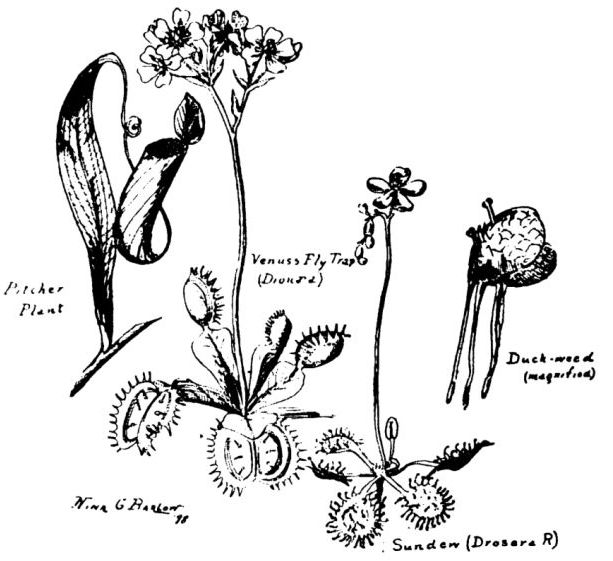
INSECT EATERS
Certain classes of plants use a portion of
animal food. We are accustomed to the
idea of animals eating plants, but when we
see the tables turned, and the plants eating
animals, that is queer, indeed! The animal
food of the “flesh-eating,” or carnivorous,
plants is really the juice sucked from the
bodies of insects.
The sun dew, common in marshes, expands
a little, sticky, pink-green shirt-button
of a leaf, on which are numerous
stiff hairs. The clear drops of gum attract
insects to the leaf, and they are held by the
feet or wings. Their struggles cause the
leaf to fold together,
when
the hairs pierce
the body of the
insect and drink
up the juices.
When only a
dry husk remains
the leaf
opens and the
wind shakes the
shell away.
The pitcher-plant
invites insects
by a
honey-like secretion.
They
fall into the
liquid stored
in the pitcher
and are thus
drowned, because,
owing to numerous downward-pointing
hairs in the throat of the pitcher,
they cannot climb back. Easy is the descent
into evil! The acrid liquid in the
pitcher digests the bodies of the insects,
turning them into plant food. Flies, ants,
gnats, little beetles, are often caught, but
bees very seldom. Bees have their own
affairs to attend to, and cannot go picnicing
into pitcher-plants.
A DAUGHTER OF THE FOREST — CHAPTER XVI Science and Superstition — SYNOPSIS OF PREVIOUS CHAPTERS.
Brought up in the forests of northern Maine, and
seeing few persons excepting her uncle and Angelique,
the Indian housekeeper, Margot Romeyn knows
little of life beyond the deep hemlocks. Naturally
observant, she is encouraged in her out-of-door
studies by her uncle, at one time a college professor.
Through her woodland instincts, she and her uncle
are enabled to save the life of Adrian Wadislaw,
a youth who, lost and almost overcome with hunger,
has been wandering in the neighboring forest. To
Margot the new friend is a welcome addition to her
small circle of acquaintances, and after his rapid
recovery she takes great delight in showing him the
many wonders of the forest about her home.
But finally, after many weeks, the uncle decides,
because of reasons which will be known later, that
it would be better for Margot if Adrian left them.
Accordingly, he puts the matter before the young
man, who, although reluctant to leave his new
friends, volunteers to go. Under the guidance of
Pierre Ricord, a young Indian, the lad sets out for
the nearest settlement. The journey for the most
part is made by water, and while attempting to
shoot the rapids of the stream which they have
been following their canoe is dashed against a
rock and both occupants are thrown into the seething
whirlpool.
For an instant Adrian closed his eyes
that he might not see the inevitable
end. But—was it inevitable? At the
logging camp he had heard of just such
accidents as this and not all of them were
fatal. The water in its whirling sometimes
tossed that which it had caught outward
to safety.
He flung himself prone and extended the
pole. Pierre’s body was making another
circuit of that horrible pit, and when—if—should
it? The drowning boy’s head was
under the current, but his legs swung round
upon its surface, faster and faster, as they
drew nearer the centre.
Then—a marvel! The long pole was
thrust under the invisible arms, which closed
upon it as a vise.
“Hold! hold! I’ll pull you out!”
But for the hard labor of the past few
weeks, Adrian’s muscles could not have
stood the strain. Yet they did, and as he
drew the nearly senseless Pierre upon the
rock beside himself, his soul went up in
such glad thanksgiving as he had never
known or might know again. A life saved.
That was worth all things.
For an hour they lay there, resting, recovering;
then Pierre himself stood up to
see what chance there was for a fuller deliverance.
He was a very sober and altered
Pierre, and his drenched clothing added to
the forlornness of his appearance.
“Nothing left but—us. Came nigh bein’
only you. Say, Adrian, I sha—shan’t forget
it.”
“How are we going to get ashore?”
“’Tisn’t much harder ’n Margot’s
stepping-stones. Done them times
enough.”
Again Adrian was grateful for his forest
experience; but he asked with some
anxiety:
“Suppose you are strong enough to do
it?”
“Isn’t any supposin’ about it. Got to.
Might as well died in the pool as starve on
this rock.”
Adrian didn’t see that there was much
better than starvation before them, even if
they did reach shore, but he kept his fear
to himself. Besides, it was not probable
that they had been saved from the flood to
perish in the forest. They would better
look at the bright side of the situation, if
they hoped to find such.
“I can jump them.”
“So can I.”
“Don’t let go that pole. I mean to keep
that as long as I live—’less you want it
yourself. If you do—”
“No, Pierre. It belongs to you, and
doubly now. Which should go first—you
or I?”
“Draw lots. If that one falls in, the
other must fish him out. Only we won’t
try it on this side, by the pool.”
They carefully surveyed the crossing,
almost as dangerous an affair as shooting
the rapids had been. Yet, as Pierre had
said, they “had to.”
Adrian picked a bit of floating weed that
had swept within his reach and broke it
into unequal portions. The shortest bit
fell to him, and with as cheerful a “Here
goes!” as he could muster he sprang for
the next stone. He made it more easily
than he had hoped, and saw that his best
chance lay in looking straight ahead to the
next landing point—and the next—never
down at the swirling river.
“Landed. Come!”
Pierre was heavier but more practiced
than his mate, and in a few seconds the
two stood together on the shore, regarding
the ruins of their boat and thinking of what
they would not have for supper.
All at once Pierre’s eye brightened.
“Say! there’s been a camp here. Not so
long ago, either. See that barrel in the
brush? There’s an old birch shed yonder.
Hurrah!”
They did not linger, though Adrian kept
hoping that something from their lost outfit
might be tossed outward toward them,
even as Pierre had been; but nothing came
in sight, and he reached the dilapidated shed
only a few feet behind the other.
“There’s a bed left still, but not such a
soft one. And there’s pork in that barrel.
Wonder the hedgehogs haven’t found it.”
But as Pierre thrust his nose into the
depths of the cask he understood the reason
of its safety.
“Whew! even a porkypine wouldn’t touch
that. Never mind. Reckon our boots’ll
need greasing after that ducking, or mine
will, and it’ll answer. Anything under the
shed?”
“Don’t see anything. Wait. Yes, I do.
A canvas bag hung up high. Must have
been forgotten when the campers left, for
they took everything else. Clean sweep.
Hurrah! it’s beans!”
“Good! Beans are good fodder for
hungry cattle.”
“How can you eat such hard things?
Should think they’d been resurrected from
the pyramids.”
“Well, I don’t know ‘pyramids,’ but I
do know beans, and how to cook them.
Fall to. Let’s get a fire. I’m near froze.”
“Fire? Can you make one?”
“I can try and—I’ve got to. When needs
must, you know.”
Adrian hastily collected some dry twigs
and decaying chips and heaped them in the
sunniest place, but for this was promptly
reprimanded by the shivering Pierre.
“Don’t you know anything at all? Wood
won’t light, nor burn after ’tis lighted, in
the sunshine. Stick up something to shade
the stuff, whilst—”
He illustrated what he did not further say
by carefully selecting some hard stones and
briskly rubbing them together. A faint
spark resulted and a thistledown caught the
spark. To the thistledown he held a dried
grass blade and another. By this small beginning
they had soon a tiny blaze and very
soon a comforting fire.
When they were partially dried and
rested, said Pierre:
“Now, fetch on your beans. While
they’re cooking, we’ll take account of what
is left.”
Adrian brought the bag, refraining from
any questions this time. He was wondering
and watchful. Pierre’s misadventures were
developing unsuspected resources, and the
spirits of both lads rose again to the
normal.
“You’re so fond of splitting birch for
pictures, split me some now for a bucket,
while I sharpen this knife again. Lucky
for me, my pocket buttoned, else it would
have gone to the bottom of that pool. Got
yours?”
“Yes. I didn’t fall in, you know.”
“Then I don’t ask odds of anybody. I’d
rather have a good ax, but when I can’t get
my rather I take the next best thing.”
Adrian procured the strips of birch, which
grows so plentifully to hand in all that
woodland, and when Pierre had trimmed it
into the desired shape he deftly rolled it and
tied it with stout rootlets, and behold! there
was a shapely sort of kettle, with a twig for
a handle. But of what use it might be the
city lad had yet to learn.
Pierre filled the affair with water and put
into it a good handful of the beans. Then
he fixed a crotched stick over his fire and
hung the birch kettle upon it.
“Oh! don’t waste them. I know. I saw
Angelique soak them, as they did at camp.
I know, now. If we can’t cook them we
can make them swell up in water, and starving
men can exist on such food till they
reach a settlement. Of course, we’ll start
as soon as you’re all right.”
“We’ll start when we’re ready. That’s
after we’ve had something to eat and made
our new canoe. Never struck a spot where
there was likelier birches. ’Twon’t be the
first one I’ve built or seen built. Say!
seems as if that God that Margot is always
saying takes care of folks must have had a
hand in this. Don’t it?”
“Yes, it does,” answered Adrian, reverently.
Surely, Pierre was a changed and
better lad.
Then his eyes rested on the wooden
dinner-pot, and to his astonishment it was
not burning, but hung steadily in its place
and the water in it was already beginning to
simmer. Above the water-line the bark
shriveled and scorched slightly, but Pierre
looked out for this and with a scoop made
from a leaf replenished the water as it
steamed away. The beans, too, were swelling
and gave every promise of cooking—in
due course of time. Meanwhile, the cook
rolled himself over and about in the warmth
of the fire till his clothes were dry and
all the cold had left his body. Also, he had
observed Adrian’s surprise with a pardonable
pride.
“Lose an Indian in the woods and he’s as
rich as a lord. It’s the Indian in me coming
out now.”
“It’s an extra sense. Divination, instinct—something
better than education.”
“What the master calls ‘woodcraft.’
Yes. Wonder how he is, and all of them?
Say, what do you think I thought about
when I was whirling round that pool, before
I didn’t think of anything?”
“Your sins, I suppose. That’s what I’ve
heard comes to a drowning man.”
“Shucks! Saw the mére’s face when
she broke that glass. Fact. Though I
wasn’t there at the time. And one thing
more; saw that ridiculous Xanthippé,
looking like she’s never done a thing but
warble. Oh, my! how I do wish Margot’d
sell her.”
“Shall I help you get birch for the canoe
now? I begin to believe you can do even
that, you are so clever.”
This praise was sweet in Pierre’s vain
ears and had the result which Adrian desired,
of diverting the talk from their island
friends. In their present situation, hopeful
as the other pretended to find it, he felt
it best for his own peace of mind not to
recall loved and absent faces.
They went to work with a will, and will it
was that helped them; else with the poor
tools at hand they had never accomplished
their undertaking. Indeed, it was a labor
of considerable time. Not only was that
first meal of boiled beans cooked and eaten,
but several more of the same sort followed.
To vary these, Pierre baked some, in the
same method as he had boiled them, or else
in the ashes of their fire. He even fashioned
a sort of hook from a coat button, and with
cedar roots for a line, caught a fish now and
then. But they craved the seasoning of salt,
and even the dessert of blueberries which
nature provided them could not satisfy this
longing, which grew almost intolerable to
Adrian’s civilized palate.
“Queer, isn’t it? When I was at that
lumber camp I nearly died because all
the meat, or nearly all, was so salt. Got
so I couldn’t eat anything, hardly.
Now, just because I haven’t salt I can’t eat,
either.”
“Indians not that way. Indians eat one
thing same’s another. Indian just wants
to live; don’t care about the rest. Indian
never eats too much. I’m all Indian now.”
Adrian opened his eyes to their widest,
then threw himself back and laughed till the
tears came.
“Pierre, Pierre! Would you had been
‘all Indian’ when you tackled Angelique’s
fried chicken. Um-m! I can taste it
now.”
But at length the new canoe was ready.
They had put as few ribs into it as would
suffice to hold it in shape, and Pierre had
carefully sewn it with the roots of the black
cedar, which serves the woodsman for so
many purposes where thread or twine is
needed. They had made a paddle and a
pole as well as they could with their knives,
and, having nothing to pack except themselves
and their small remnant of beans,
made their last camp-fire at that spot and
lay down to sleep.
But the dreams of both were troubled;
and in the night Adrian rose and went to
add wood to the fire. It had died down to
coals, but his attention was caught by a ring
of white light upon the ashes, wholly distinct
from the red embers.
“What’s that?”
In a moment he had answered his own
question. It was the phosphorescent glow
from the inner bark of a half-burned log,
and further away he saw another portion of
the same log making a ghostly radiance on
the surrounding ground.
“Oh! I wouldn’t have missed that for
anything. Mr. Dutton told me of beautiful
sights he had witnessed and of the strange
will-o’-the-wisps that abound in the forest.
I’ll gather some of the chips.”
He did so, and they made a fairy-like
radiance over his palm; but while he was
intently studying them, he felt his hand
rudely knocked up, so that the bits of wood
flew out of it.
“Pierre, stop that!”
“Don’t you know what that is? A warning—a
sign—an omen. Oh! if I had never
come upon this trip!”
“You foolish fellow! Just as I thought
you were beginning to get sense. Nothing
in the world but decayed bark and
chemical—”
Pierre stopped his ears.
“I was dreaming of the mére. She came
with her apron to her eyes and her clothes
in tatters. She was scolding—”
“Perfectly natural.”
“And begging me—”
“Not to eat so many half-baked beans for
supper.”
“There’s something wrong at the island.
I saw the cabin all dark. I saw Margot’s
eyes red with weeping.”
“No doubt, Tom has been into fresh
mischief and your mother has punished
him.”
Pierre ignored these flippant interruptions,
but rehearsed his dismal visions
till Adrian lost patience and pushed him
aside.
“Go, bring an armful of fresh wood:
some that isn’t phosphorescent, if you
prefer. That’ll wake you up and drive the
megrims out of your mind.”
“’Tis neither of them things. ’Tis a
warning. They were all painted with black,
and all the Hollow creatures were painted,
too. ’Tis a warning. I shall see death
before I am—”
Even while he maundered on in this
strain, he was unconsciously obeying the
command to fetch wood, and moved toward
a pile left ready. Now, in raking this together,
Adrian had, also, swept that spot of
ground clean and exposed; and what neither
had observed in the twilight was plainly
revealed by the glow and shadows cast by
the fire.
This was a low, carefully-made mound
that, in shape and significance, could be
confounded with no other sort of mound,
wherever met. Both recognized it at once,
and even upon Adrian the shock was painful;
but its effect upon superstitious Pierre
was far greater. With a shriek that
startled the silence of the forest he flung
himself headlong.
CHAPTER XVII DIVERGING ROADS
“GET up, Pierre. You should be
ashamed of yourself!”
It needed a strong and firm grasp
to force the terrified lad to his feet, and even
when he, at last, stood up he shivered like
an aspen.
“A grave!”
“Certainly, a grave. But neither yours
nor mine. Only that of some poor fellow
who has died in the wilderness. I’m sorry
I piled the brush upon it, yet glad we discovered
it in the end.”
“Gla-a-ad!” gasped the other.
“Yes, of course. I mean to cover it with
fresh sods and plant some of those purple
orchids at its head. I’ll cut a cedar headstone,
too, and mark it so that nobody else
shall desecrate it as we have done.”
“You mustn’t touch it. It’s nobody’s—only
a warning.”
“A warning, surely, that we must take
great care lest a like fate come on us; but
somebody lies under that mound and I pity
him. Most probable that he lost his life in
that very whirlpool which wrecked us.
Twice I’ve been upset and lost all my belongings,
but escaped safe. I hope I’ll not
run the same chance again. Come—lie
down again and go to sleep.”
“Couldn’t sleep; to try in such a haunted
place would be to be ‘spelled’—”
“Pierre Ricord! For a fellow that’s so
smart at some things, you are the biggest
dunce I know, in others. Haven’t we slept
like lords ever since we struck this camp?
I’m going to make my bed up again and
turn in. I advise you to do the same.”
Adrian tossed the branches aside, then
rearranged them, lapping the soft ends over
the hard ones in an orderly row which
would have pleased a housewife. Thus
freshened, his odorous mattress was as good
as new, and stretching himself upon it he
immediately went to sleep.
Pierre fully intended to keep awake, but
fatigue and loneliness prevailed, and five
minutes later he had crept close to Adrian’s
side.
The sunshine on his face and the sound
of a knife cutting wood awoke him; and
there was Adrian whittling away at a broad
slab of cedar, smiling and jeering, and in the
best of spirits, despite his rather solemn
occupation.
“For a fellow who wouldn’t sleep, you’ve
done pretty well. See—I’ve caught a fish
and set it cooking. I’ve picked a pile of
berries, and have nearly finished this headstone.
Added another accomplishment to
my many—monument-maker. But I’m
wrong to laugh over that, though the poor
unknown to whom it belongs would be
grateful to me, I’ve no doubt. Lend a
hand, will you?”
But nothing would induce Pierre to engage
in any such business. Nor would he
touch his breakfast while Adrian’s knife was
busy. He sat apart, looking anywhere
rather than toward his mate, and talking
over his shoulder to him in a strangely
subdued voice.
“Adrian.”
“Well?”
“Most done?”
“Nearly.”
“What you going to put on it?”
“I’ve been wondering. Think this:
‘To the Memory of My Unknown
Brother.’”
“Wh-a-a-t!”
Adrian repeated the inscription.
“He was no kin to you.”
“We are all kin. It’s all one world—God’s
world. All the people and all these
forests, and the creatures in them. I tell
you, I’ve never heard a sermon that touched
me as the sight of this grave in the wilderness
has touched me. I mean to be a
better, kinder man, because of it. Margot
was right—none of us has a right to his
own self. She told me often that I should
go home to my own folks and make everything
right with them: then, if I could, come
back and live in the woods, somewhere, if I
felt I must. But I don’t feel that way now.
I want to get back and go to work. I want
to live so that when I die—like that poor
chap yonder—somebody will have been the
better for my life. Pshaw! why do I talk
to you like this? Anyway, I’ll set this
slab in place, and then—”
Pierre rose, and still without looking
Adrian’s way, pushed the new canoe into
the water. He had carefully pitched it, on
the day before, with a mixture of the old
pork grease and gum from the trees, so that
there need be no delay at starting.
Adrian finished his work, lettered the slab
with a coal from the fire, and rewatered
the wild flowers he had already planted.
“Aren’t you going to eat breakfast first?”
“Not in a graveyard,” answered Pierre,
with a solemnity that checked Adrian’s desire
to smile.
A last reverent attention, a final clearing
of all rubbish from the spot, and he, too,
stepped into the canoe and picked up his
paddle. They had passed the rapids and
reached a smooth stretch of the river where
they had camped, and now pulled steadily
and easily away, once more upon their
journey south. But not till they had put a
considerable distance between themselves
and that woodland grave, would Pierre consent
to stop and eat the food that Adrian
had prepared. Even then, he restricted the
amount to be consumed, remarking with
doleful conviction:
“We’re going to be starved before we
reach Donovan’s. The food stick burnt off
and dropped into the fire last night.”
Adrian remembered that his mate had
spoken of it at the time, when by some
carelessness they had not secured the
crotched sapling on which they hung their
birch kettle.
“Oh! you simple thing. Why will you
go through life tormenting yourself with
such nonsense? Come—eat your breakfast.
We’re going straight to Donovan’s as fast
as we can. I’ve done with the woods for a
time. So should you be done. You’re
needed at the island. Not because of any
dreams, but because the more I recall of
Mr. Dutton’s appearance the surer I am
that he is a sick man. You’ll go back,
won’t you?”
“Yes; I’m going back. Not because you
ask me, though.”
“I don’t care why—only go.”
“I’m not going into the show business.”
Adrian smiled. “Of course, you’re not.
You’ll never have money enough. It would
cost lots.”
“’Tisn’t that. ’Twas the dream. That
was sent me. All them animals in black
paint, and the blue herons without any
heads, and—my mother came for me last
night.”
“I heartily wish you could go to her this
minute. She’s superstitious enough, in all
conscience, yet she has the happy faculty of
keeping her lugubrious son in subjection.”
Whenever Pierre became particularly depressing,
the other would rattle off as many
of the longest words as occurred to him.
They had the effect of diverting his comrade’s
thoughts.
Then they pulled on again, nor did anything
disastrous happen to further hinder
their progress. The food did not give out,
for they lived mostly upon berries, having
neither time nor desire to stop and cook
their remnant of beans. When they were
especially tired, Pierre lighted a fire and
made a bucket of hemlock tea, but Adrian
found cold water preferable to this decoction;
and, in fact, they were much nearer
Donovan’s, that first settlement in the
wilderness, than even Pierre had suspected.
Their last portage was made—an easy
one, there being nothing but themselves and
the canoe to carry—and they came to a big
dead water where they had looked to find
another running stream; but had no sooner
sighted it than their ears were greeted by
the laughter of loons, which threw up their
legs and dived beneath the surface in that
absurd manner which Adrian always found
amusing.
“Bad luck again!” cried Pierre, instantly;
“never heard a loon but—”
“But you see a house. Look! look!
Donovan’s, or somebody’s, no matter whose.
A house, a house!”
There, indeed, it lay, a goodly farmstead,
with its substantial cabins, its out-buildings,
its groups of cattle on the cleared
land, and—yes, yes—its moving human
beings, and what seemed oddest still, its
teams of horses.
Even Pierre was silent, and tears sprang
to the eyes of both lads as they gazed.
Until that moment neither had fully realized
how lonely and desolate had been their
situation.
“Now for it! It’s a biggish lake, and
we’re pretty tired. But that means rest,
plenty to eat—everything.”
Their rudely built canoe was almost useless
when they beached it at last on Donovan’s
wharf, and their own strength was
spent. But it was a hospitable household
to which they had come, and one quite used
to welcoming wanderers from the forest.
They were fed and clothed and bedded,
without question; but, when a long sleep
had set them both right, tongues wagged
and plans were settled with amazing
promptness.
For there were other guests at the farm;
a party of prospectors going north into the
woods to locate timber for the next season’s
cutting. These would be glad of Pierre’s
company and help, and would pay him “the
going wages.” But they would not return
by the route he had come, though by leaving
theirs at a point well north, he could easily
make his way back to the island.
“So you shot the poor moose for nothing.
You cannot even have his horns,” said
Adrian, reproachfully. “Well, as soon as I
can vote, I mean to use all my influence to
stop this murder in the forest.”
The strangers smiled and shrugged their
shoulders. “We’re after game ourselves, as
well as timber, but legislation is already in
progress to stop the indiscriminate slaughter
of the fast-disappearing moose and caribou.
Five hundred dollars is the fine to be imposed
for any infringement of the law, once
passed.”
Pierre’s jaw dropped. He was so impressed
by the long words and the mention
of that, to him, enormous sum, that he
was rendered speechless for a longer
time than Adrian ever remembered. But,
if he said nothing, he reflected sadly upon
the magnificent antlers he should see no
more.
Adrian’s affairs were, also, speedily and
satisfactorily arranged. Farmer Donovan
would willingly take him to the nearest
stage route; thence to a railway would be
easy journeying; and by steam he could
travel swiftly, indeed, to that distant home
which he now so longed to see.
The parting of the lads was brief, but
not without emotion. Two people cannot
go through their experiences and dangers, to
remain indifferent to each other. In both
their hearts was now the kindliest feeling
and the sincere hope that they should meet
again. Pierre departed first, and looked
back many times at the tall, graceful figure
of his comrade; then the trees intervened
and the forest had again swallowed him
into its familiar depths.
Then Adrian, also, stepped upon the
waiting buckboard and was driven over the
rough road in the opposite direction.
Three days later, with nothing in his
pocket but his treasured knife, a roll of birch
bark, and the ten-dollar piece which,
through all his adventures, he had worn
pinned to his inner clothing, “a make-peace
offering to the mater,” he reached the brownstone
steps of his father’s city mansion.
There, for the first time, he hesitated.
All the bitterness with which he had descended
those steps, banished in disgrace,
was keenly remembered.
“Can I, shall I, dare I go up and ring
that bell?”
A vision floated before him. Margot’s
earnest face and tear-dimmed eyes; her lips
speaking:
“If I had father or mother anywhere—nothing
should ever make me leave them.
I would bear everything—but I would be
true to them.”
An instant later a peal rang through that
silent house, such as it had not echoed in
many a day. What would be the answer
to it?
[TO BE CONTINUED]
Wood-Folk Talk — ROBIN’S RED BREAST
ALTHOUGH you are all in the habit
of referring to Robin as “Redbreast,”
do you not often wonder
why the baby Robin always has a spotted
breast so very different from his parent?
True, he does not keep it very long, but
why, then, should he wear it at all?
At one time Robin did not live in our
yards and orchards as he does at present,
but remained in the deeper woods, as his
cousin Wood-thrush does now. In those
times, of course, he did not have his bright
red breast, but was clothed in a spotted
plumage very similar to Wood-thrush. To
narrate much of Robin’s history would
make a very long story, but we can at least
tell what brought about the change in his
dress.
Besides being first cousins, Robin and
Wood-thrush had lived close together all
their lives, and it is only natural that they
should be fast friends, as they were, until
that eventful year when Bluebird arrived in
Birdland.
Of course, from the very first, folks made
a great deal of fuss over this newcomer,
and the wonder of it is that Bluebird’s head
was not turned by the attentions showered
upon him instead of remaining the same
modest fellow he is to-day.
Naturally, everyone wished to be as well
acquainted as possible with the beautiful
stranger, but in spite of his courageous song
of “Cheer! cheer!” there was always a
touch of sadness about Bluebird which folks
could not understand, so that they never
felt quite at home in his presence.
Now, among the birds who thus wished
to become intimate with Bluebird, there was
no one more conspicuous than Robin. Indeed,
some folks thought that he made himself
ridiculous by the way he toadied to the
newcomer. But even this talk did not deter
him. When, therefore, he learned later that
Bluebird and himself were members of the
same family, he could not conceal his pride.
But he had no more reason to be proud
than Wood-thrush, for he, too, was a relative
of Bluebird.
Still, as time went on, Robin thought
more and more of his new cousin, and it
was noticed that he paid less attention than
formerly to the other birds. Most of
them, of course, did not mind this, for they
thought that he would soon come to his
senses and be the same hearty fellow he had
been before Bluebird came. But, instead,
Robin became prouder than ever, and the
way he followed and imitated Bluebird
would certainly have provoked that person
had he not been a model of patience.
He soon moved his nest from the thicket
near his cousin Wood-thrush to the apple-tree
next to Bluebird’s home. This caused
so much hard feeling between Robin and
Wood-thrush that they have ever since built
their nests in very different localities. But
this isn’t all, and here comes the event
which changed the former’s whole life.
Until this time Robin had always worn a
spotted breast, but no sooner did he move
to his new home than he decided to have
a vest of red like Bluebird’s. But with all
his pains he could not make himself as handsome
as his cousin, for, like many folks
when they try to imitate others, he overdid
it. Instead of Bluebird’s delicate tint of
carmine, he had taken on a less pretty
though showier red, and, unlike the other,
he wore it over his entire breast in a way
that made some folks say that he showed
very poor taste, indeed.
Now, at this last assumption of Robin,
Birdland was outraged, and the indignation
spread so widely that Kingbird had almost
decided to banish him. It was not until
then that Robin, terrified at the suggestion,
saw how foolish he had been, and he very
quickly came to his senses. First of all, he
went around to all his old friends whose
feelings he had hurt and apologized so sincerely
that, we are happy to say, every one
of them, except, perhaps, Wood-thrush,
who could not forget the red vest, were
glad to extend a friendly wing to him, now
that he had gotten over his sudden pride.
But we, who are better acquainted with
him, must admit that Robin never did quite
conquer his pride. Everybody knows that
he is one of the best hearted of birds, and
that whenever any danger threatens Birdland
he is always among the first to defend
it. But the influence of Bluebird has refined
him to such an extent that there is
little doubt in our mind that he still thinks
his other cousins, the Thrushes, in spite of
their splendid musical ability, are backwoodsmen,
so to speak.
Fortunately, however, there is one thing
which will forever keep him from forgetting
his plainer kinsmen, and that is the fact that
his children, until they are several months
old, are made to wear the same spotted
plumage which he once wore.
And it is this which shows Robin’s pride
more than anything else. Should you approach
his nest when it contains young,
you will see how mortified he is, for he
fears that you will take them for Wood-thrushes.
And what a fuss he does make?
He flies almost in our faces, as if to show
us that they are his children. And how
anxious his voice is as he calls to them to
“Speak! speak!” Just as if young Robins
could tell us that they are not Wood-thrushes!
WITH THE EDITOR
AUGUST is the high-tide month of outdoor
life. At this season, young
folks, in preparation for the new
school term, are hurried off to draw their
last breath of vacation at the country, the
seashore, or mountains, and the older
people, wherever it is possible, leave their
work and join the children on the court and
field. Athletics supplant business and
study.
The habit of taking physical exercise can
be traced as far back as the time of Homer.
With the old Greeks, systematic gymnastics
was a part of the young person’s education.
Further than that, it even became a matter
of legislation, and to this fact can be attributed
the splendid physiques which are
portrayed in the old Greek statues.
At Athens, the government erected
public gymnasiums. In connection with
them were medical attendants whose duty
it was to prescribe the special kind of exercise
needed by each pupil. To show still
further the regard for athletics at that
time, it might be said that both Plato and
Aristotle believed that public gymnasiums
were essential to a perfect nation.
Athletics now are regarded in a different
light. Very few of us go through the
tedious systematic drill necessary to a perfect
physical condition. By many, indeed,
the exercise of the entire year is crowded
into the short space of a fortnight, and
then it is taken only as recreation.
A better form of the practice is found in
what we might term team athletics, but
even here we lack the wise purpose of the
ancients. The object in this case is to develop
a squad of athletes, generally those
already well gifted by nature, to compete
with and defeat another such team of
picked men. As a consequence, in the great
effort to produce a winning crew or eleven,
the especial needs of the individual are forgotten.
So, notwithstanding the fact that every
one is welcomed as a candidate for these
teams, the final result is to turn out, perhaps,
a score of exceptionally well drilled
men, while hundreds of others, who, in
reality, most need the exercise thus afforded,
are content to fill the grand stands and
cheer their men to victory.
Undoubtedly, team athletics does much
good. It stimulates a greater interest and
brings more men into the field than any
other influence; but it still falls short of the
ideal purpose of athletics—to get everyone,
gymnasts or invalids, to develop their
bodies with the same systematic care with
which they train their minds.
Physical exercise must not be considered
merely as a form of recreation or a detail
in the making of an athletic team, but rather
in the light of a training which, in the
future, will have a very telling effect upon
our lives. Even if we can never hope to
lower a track record or win a place upon
the gridiron, we should not wholly surrender
the field to those who already excel:
but see that a corner of it, at least, is left
for those who are not born athletes—those
who, in fact, are most in need of
exercise.
EVENT AND COMMENT — The King’s Illness — The “Finland” — Philippine Affairs — The King’s Dinner — The Petrified Ship
Almost on the eve of the coronation in
London came the announcement of the serious
illness of King Edward. Falling suddenly upon
the people, as it did, the news put a stop to
the preparations for a spectacular display
seldom, if ever, equaled.
Thousands of carpenters, painters, and decorators
were putting on the finishing touches
all along the path of the triumphal procession.
Sixty thousand troops had received orders to
guard the route, while at Spithead an immense
fleet was preparing for a grand naval review.
For a time following the announcement the
world waited anxiously for news. Happily, the
worst anticipations were not realized, and the
recovery has been so speedy that already the
time for the coronation has been decided upon.
It will take place between August 12th and 15th
of this year.
In comment of the occurrence we quote the
London Spectator as follows:
“While contemplating the events of the last
few days, it is impossible not to be struck by
the fact that the sympathy felt for the king
will have a marked effect on the future position
of the dynasty—an effect which will last far
beyond the life of the king. It is a commonplace
that men do not so much love those who
confer actual benefits upon them as those with
whom they have sympathized and suffered. The
king will be more to the nation after his illness
than he was before.”
The largest vessel ever built in this country
was the “Finland,” recently launched at Cramp’s
shipyard in Philadelphia. Her length is 580
feet, while the width and depth are 60 and 42
feet respectively. The gross tonnage is 12,000
tons, or about 400 tons greater than either the
“St. Paul” or “St. Louis,” the next largest
vessels built by Cramps. The “Finland” will
make her first transatlantic voyage early in
the year 1903.
The “Great Eastern,” constructed some fifty
years ago, had a length of 680 feet, and was
finally destroyed for the reason that she was
too large for ordinary use. The advance in
the science of steam navigation, however, has
been so great since that time that shipbuilders
no longer have any fear of making vessels too
large for use.
Concerning the proclamation of amnesty
issued at Manila on July 4th, we quote Public
Opinion:
“It declares the insurrection in the Philippines
at an end and peace established in all
parts of the archipelago, except the country inhabited
by the Moro tribes. Complete amnesty
is granted all persons in the Philippines who
have participated in the insurrection. This includes
as well those concerned in the outbreaks
against Spain as early as August, 1896, and extends
pardon to natives who may have violated
the laws of warfare, but not to persons already
convicted of criminal offenses.”
The Fourth of July, 1902, will be well worthy
of its precedent if it has brought with it a
lasting and praiseworthy end of the Philippine
trouble.
One feature of the coronation festivities which
was not interfered with was the king’s dinner to
the poor. It took place on July 5th, and tables
were set in four hundred places throughout the
country. Here liberal provision was made for
the banqueting of over half-a-million people.
The greatest number gathered in any one place
was 14,000.
It is very creditable to King Edward that in
the preparation for festivities of such a magnificent
nature, he did not forget the poor, but
wished them, also, to join in the general
celebration.
A rumor which is beginning to arouse interest
in the northwest, is founded upon a story
told by the Alaskan Indians. According to
them, they have discovered in the vicinity of
the Porcupine river, near the Arctic circle, the
remains of a gigantic petrified ship, whose
length approaches 1,200 feet. It is situated upon
a hill some thousands of feet above sea level.
An expedition is now on foot to investigate.
Although there is little use in anticipating
these researches, the rumor at least serves to
remind us how much of the world is as yet unexplored
and what great room there still is for
new discoveries.
OUT OF DOORS
THE two great aquatic events in the
college world this season, were the
Inter-collegiate regatta, at Poughkeepsie,
on the Hudson, and the Yale-Harvard
race at New London.
In the former, Cornell again demonstrated
Coach Courtney’s ability to turn
out a winning crew by taking first place.
Not far behind came the sturdy Westerners,
Wisconsin, followed closely by Columbia.
Then came Pennsylvania, Syracuse, and
Georgetown in the order named.
Besides winning the Varsity race, Cornell
also carried off the honors in the Four-oar
and Freshman races.
At New London, on June 26th, Yale
won because of her greater endurance.
For the first half-minute Harvard had a
little the lead, but soon, in spite of her
plucky efforts, the superior strength of
Yale told. The latter then pulled slowly
away from Harvard, gaining a lead which
at the finish had grown to four lengths.
A fitting and interesting termination of
the rowing season would have been a race
between Yale and Cornell.
THE deciding base-ball game between
Yale and Harvard proved to be the
most exciting one of the series. In
the ninth inning, with the score tied, Yale’s
men were put out in rapid succession, and
Harvard, by some clever batting and base-running,
enabled Mathews to cross the
plate with the winning run.
IN the Round Robin tennis tournament
at the Crescent Athletic Club, Wright
defeated Hobart by a score of 6-4,
8-6. In the other games, the Wren
brothers, although neither of them were
up to their usual form, showed that they
will be a consideration in this year’s championship.
AT the Traver’s Island swimming contest,
E. C. Schaeffer established new
American records for both the 220-yard
and half-mile events. The time of
the former was 1 min. 19 3-5 sec., beating
the previous record, held by H. H. Reeder,
by 2 2-5 sec.
In the half-mile race Schaeffer broke
five records—the 330-yard, 550-yard, 660-yard,
770-yard, and 880-yard. The time
of the 880-yard, or half-mile, event was
13 min. 27 2-5 sec.
MOST Americans were not surprised
to hear the outcome of the polo
games in England. In the last
game the American team was defeated by
a score of 7-1. This gave the entire series
to the English. Sometime, perhaps, when
polo is more widely played in this country
and there are more candidates for an All-American
team, we may make a better
showing. Until then we must acknowledge
England’s superiority.