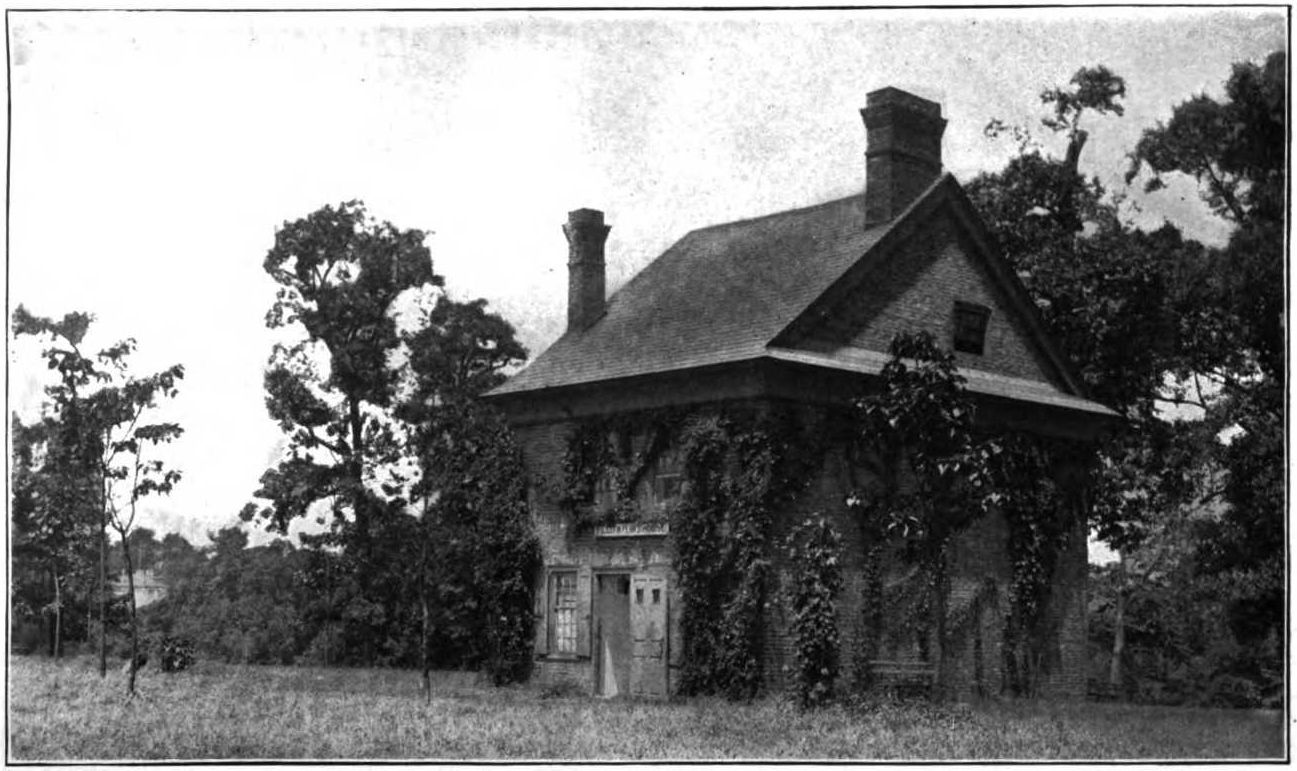
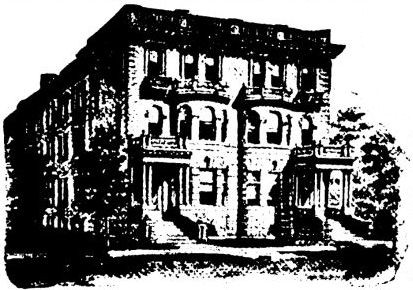
THE PENN COTTAGE
BY ALLEN BIDDLE
“Pitch upon the very middle of the plat
where the town or line of houses is
to be laid or run, facing the harbor
of the great river, for the situation of my
house; ... the distance of each house from
the creek or harbor should be, in my judgment,
a measured quarter of a mile; or, at
least, two hundred paces, because of building
hereafter streets down to the harbor.”
Such were the instructions which William
Penn, founder of Philadelphia, gave to his
commissioners, William Crispin, John
Bezar, and Nathaniel Allen, for the building
of what is now known as Penn’s
Cottage.
It was in 1681 that the great Quaker
completed the negotiations for the grant of
Pennsylvania, and in the next year the first
work of the building of the Proprietary
House was begun. The plat chosen for its
site was the one bounded by Front,
Chestnut, Letitia, and High streets, the last
now being named Market. In the place of
the little cottage and its surrounding yard
there is, to-day, one of the most thickly-built
portions of Philadelphia. But the
true centre of the city, at one time radiating
from this point, has now, owing to the
growth of two hundred years, moved a mile
to the westward.
According to one tradition, the Penn or
Letitia House was the first brick building
erected in Philadelphia; to another, it was
the first house to have a cellar. The name,
“Letitia,” was given to it by Penn himself,
as the house was intended eventually to be
the portion of his daughter, Letitia. It is
from this source, too, that Letitia Street
gets its name.
One of the most interesting stories of this
little structure is that the bricks and most of
the finer building materials used in its construction
were brought over from England.
More recently doubt has been thrown upon
this statement by the discovery that even at
that time quite as excellent a quality of
brick was being made in Philadelphia.
Despite its diminutive size, the cottage required
what, to-day, would be an unusual
time in its building, and it was well into the
year 1683 before it was ready for the house-warming.
Quaint, angular, and comfortable
in appearance, it faithfully reflects the
spirit of Philadelphia’s early people. True
to the founder’s ideal in the laying-out of
the city, the house, too, is characterized by
economy of space and absence of mere ornament.
Doors, windows, sills, and sashes—everything,
in fact, except the gabled roof,
is plain and rectangular.
From the front door, we enter its largest
room, serving, perhaps, at one time as
dining hall, sitting-room, kitchen, and
library. On its plain, bare walls we now
see collections of old wood cuts, illustrating
events which occurred in the time of the
founder, including reproductions of Benjamin
West’s painting of that famous treaty
with the Indians which “was not signed
and never broken.” Above the door hangs
an old print of the wampum belt which was
presented to Penn by the Indians upon that
occasion. Near by are facsimiles of the
charter of the Province of Pennsylvania,
granted by Charles II, and also the first
charter of the city of Philadelphia, granted
in 1691. In the further corner to the left
is an ample fireplace before whose glow we
can readily recall to our imagination the
serene features of the great founder surrounded
by his family.
From this room, extending to the rear of
the building, is a short hallway, on either
side of which is a room so small that we
wonder what could have been their function
in the Penn household. Quaint and cozy
as is the little mansion, we can scarce believe
it to have been the home of one who
owned our whole great State of Pennsylvania.
In the year 1684, after a stay of twenty-one
months, Penn was forced to return to
England to protect his proprietary interests,
as they were at that time threatened by the
plans of Lord Baltimore. In his absence,
the proprietorship fell upon his cousin,
Markham, the Lieutenant-Governor, who
then took up his abode in the Letitia House.
Later, according to the wish of Penn, who
desired that his house be devoted to public
service, it became the State House. It is
hard to imagine such a dignified body as
was undoubtedly the provincial council
meeting in the tiny brick cottage. What a
contrast it makes with Independence Hall,
or the great capitol now at Harrisburg!
In after years, when other houses had
grown up on all sides, the little cottage fell
into obscurity. At one time, even, it was
thrown open as a public inn, and the little
room which at one time held the Penn family
circle now became the haunt of the wayfarer
and the chronic idler. But, recently, folks
of the great State have come to think more
of the little house and to recognize gratefully
the part which it played in their history.
They have lifted it from its late
dingy surroundings and, as if to put before
it the city’s best, have placed it on the west
bank of the Schuylkill, overlooking Fairmount
Park. Here, far away from the
city’s centre, with its face toward the broad,
green valley of the river, the little mansion
rests patiently, as if waiting until the city
shall again closely encircle it in its westward
growth.
As would have been the wish of the great
Quaker, the door is still left hospitably
open, and citizen and stranger alike may
freely enter the house of him who founded
their State. Here, daily, come many pilgrims.
The Schuylkill, too, winding placidly
down from its hills, loiters gently in its
course through the picturesque valley, as if
to catch a momentary glimpse of the quaint
old house.
WITH WASHINGTON AT VALLEY FORGE — CHAPTER XVI From Germantown to Valley Forge — SYNOPSIS OF PREVIOUS CHAPTERS — CHAPTER XVII A PERILOUS MISSION
The story opens in the year 1777, during one
of the most critical periods of the Revolution.
Hadley Morris, our hero, is in the employ of Jonas
Benson, the host of the Three Oaks, a well-known
inn on the road between Philadelphia and New
York. Like most of his neighbors, Hadley is an
ardent sympathizer with the American cause. When,
therefore, he is intrusted with a message to be forwarded
to the American headquarters, the boy gives
up, for the time, his duties at the Three Oaks and
sets out for the army. Here he remains until after
the fateful Battle of Brandywine. On the return
journey he discovers a party of Tories who have
concealed themselves in a woods in the neighborhood
of his home. By approaching cautiously to the
group around the fire, Hadley overhears their plan
to attack his uncle for the sake of the gold which
he is supposed to have concealed in his house.
With the assistance of Colonel Knowles, who,
although a British officer, seems to have taken a
liking to Hadley, our hero successfully thwarts the
Tory raid. No sooner is the uncle rescued, however,
than he ungratefully shuts the door upon his
nephew. Thereupon Hadley immediately returns to
the American army and joins the forces under that
dashing officer, “Mad Anthony” Wayne. In the disastrous
night engagement at Paoli our hero is left
upon the battlefield wounded. In this condition he
is found by his old friend, Lafe Holdness, the American
scout, who treats the wound so skillfully that
our hero is enabled to return home. But not for
long. No sooner is he strong enough to ride than
he again sets out for the army, which is just then
preparing for that terrible winter at Valley Forge.
Hadley slept that night at a friendly
farmer’s, some miles to the north of
Germantown. A large force of
British were quartered about where Washington’s
army lay the first day the boy had
crossed the river and made his way to the
Commander-in-Chief’s headquarters with
the dispatches so nearly lost by the wounded
courier. As far as he could learn, the
Americans still rested at Skippack Creek,
to which locality they had retired after the
enemy entered Philadelphia.
He made a long detour the next morning
to avoid the Germantown outposts, but fell
in with a foraging party of Continentals before
noon, and was near to losing his horse.
But he was not so afraid of these marauders
now as he had been the night he was halted
on the Germantown road and his dispatches
seized. So, after an argument with these
fellows and the mention of Colonel Cadwalader’s
name, he got away, with directions
regarding the shortest path to headquarters.
He was halted a good many
times before he found the Pennsylvania
troops; but the pickets saw that he was
a recruit and let him through without
trouble.
He found John Cadwalader with General
Wayne, and was able to obtain speech with
him without dismounting from his horse, as
the officers were about starting on a tour of
inspection through the camp. “And you
want to see more fighting, do you, my lad—and
your wound not healed yet?” said the
colonel. “What good d’ye think a wounded
man will be to us?”
“But I’m all right on horseback, and I’ve
brought my horse,” Hadley declared.
“I wish we had more such fellows—and
as eager to fight, Colonel,” said General
Wayne. “He’s but a boy, too!”
“And how about the promise to your
mother, Master Morris?” queried the other
officer.
“My uncle has cast me off for carrying
dispatches, and for being in the Paoli fight,
where I got wounded,” the boy said, sadly.
“I can do nothing for him now. So I have
come to do what I can.”
“Well, well. I will speak to His Excellency
about you. There is a certain long-legged
Yankee hereabout who, if I mistake
not, has been inquiring for you through the
camp.”
“Lafe Holdness!” exclaimed Hadley.
“The same. He said he knew you had
got away from Philadelphia; but where you
had gone was another matter, and one of
which he was not cognizant. Now, Master
Morris, you will find your friend, Captain
Prentice, somewhere to the west of here.
Keep near him and then you will be near
me. When the propitious moment comes
to present you to the Commander-in-Chief,
I shall want you in a hurry.”
The officers rode on, and Hadley sought
out Captain Prentice. “My faith, Hadley!”
was the captain’s exclamation, “but we’re a
pretty pair of winged birds.” His own arm
was still in a sling, but he had taken active
command of his company again.
“You can scarcely call me winged,” said
Hadley, “for the ball went through my leg.”
He climbed down from Molly and allowed
a soldier to take her away. He could
scarcely walk, having been so many hours
in the saddle; but Captain Prentice made
him welcome and saw to it that he had a
bed for a few hours, where he slept away
much of his weariness.
At this time Washington’s forces lay
about twenty miles from Philadelphia and
fourteen from Germantown. For some
days the Continentals had been resting after
the arduous campaign which had followed
the landing of the British troops. The officers
were planning some important move;
but the army was kept in ignorance of its
nature until the night of the 3d of October.
Then the columns were put into motion
quickly and took the road to Germantown.
It was to be a night march to surprise the
enemy, and never did Hadley Morris forget
it. He and his friend, Captain Prentice,
were both mounted—the latter on a sorry
nag which his orderly had picked up somewhere—and
there might have been some ill-feeling
expressed among the other officers
of the infantry over Prentice’s riding had
he not been wounded. But those fourteen
miles were hard enough for both the captain
and Hadley, despite the fact that they
were not obliged to tramp through the
heavy roads.
Before the head of the column was half
way to Germantown, the night fog began to
gather, and before daylight it was so thick
that it was almost impossible to clearly distinguish
figures moving a rod ahead. Just
at daybreak, however, despite the fog which
had enveloped the whole territory, sharp
firing broke out ahead. The troops were
rushed forward, and the British, who at first
had supposed the firing to be but a skirmish
between outposts, were quickly being driven
back by a solid phalanx of Americans.
After the first surprise the enemy formed
and stood their ground; but the attack of the
Americans was so desperate that they would
surely have been overwhelmed in a short
time had it not been for two things. Howe,
hearing early of the battle, rushed forward
reinforcements and came in person to encourage
his soldiery. And the other thing
which stayed the Americans, beside the
smother of fog, was the imposing mansion
belonging to Master Chew, which, occupied
by the British, was a veritable fort, and
withstood every effort of the attacking
force.
It was a stone building, and with its doors
and lower windows barricaded, and a strong
force of the enemy using the upper casements
to fire from, it soon became the
pivotal point on the battlefield. The British
kept up a destructive fire upon the American
lines from the house, and, in spite of
the fog, the casualties were considerable.
Attempts again and again were made to
capture it. The American lines could not
go past, and it guarded the way to the
British front.
And, with the long delay occasioned by the
obstinate defence of the Chew house, the
elements themselves seemed to be arrayed
against the Americans. The fog became
so dense that the men could not see each
other a few paces apart, and only the spurts
of red flame ahead betrayed the whereabouts
of the enemy. The Continental troops grew
bewildered; aids were unable to find the
officers to whom they were sent with messages
from the commanders. There were
shoutings and reiterated commands in the
fog, but the files did not know where their
officers stood and became
bewildered and
unmanageable.
General Washington’s
plans were disarranged.
The Americans had
fought bravely and,
without doubt, were on
the eve of a decisive
victory. But an alarm
was created—the tramp
of a regiment of American
troops brought up
from the rear was
thought to be the approach
of a flanking
force—and the men who
had fought so tenaciously
during the day
retreated in disorderly
confusion.
Added to the general
depression caused by
this defeat was the fact
that half the Maryland
militia was reported to
have deserted before the
battle. It was the beginning
of that awful
winter when naught but
the extraordinary virtues
of George Washington
himself kept the
semblance of an army
together. The American
forces were rapidly
becoming a disorganized
mob, and the fault lay
with Congress, which
numbered in its group
few of the really great and unselfish men
who had once met in Philadelphia to approve
of and sign the second greatest
document in our history.
The period had now arrived when men of
the second rank had come to the front in
charge of the uncertain affairs of the struggling
Colonies. Dr. Franklin was in Paris
and John Adams joined him during the
winter, for the purpose of watching Silas
Deane, who was a bitter foe of Washington,
and had sent over the infamous Conway to
hamper and embitter the great man’s very
existence. Jay, Rutledge, Livingston,
Patrick Henry, and Thomas Jefferson were
employed at home, and Hancock had resigned
from the governing house. Samuel
Adams was at home in New England for
most of that winter; and men much the inferior
of these had taken their places—men
who lacked foresight and that loftiness of
purpose and love of country which had,
earlier in the war, kept private jealousies
and quarrels in check.
Without an organized quartermaster’s
department, the soldiers could not be properly
clothed or fed, and the warnings of
Washington were utterly disregarded by
Congress. The troops began to need clothing
soon after Brandywine, and by November
they were still in unsheltered camps
without sufficient clothing, blankets, or tents.
Hadley Morris, suffering with the rank and
file, saw them lying out o’ nights at Whitemarsh,
half clad and without protection
from either the frozen ground or the desperate
chill of the night air. Forts Mercer
and Mifflin had fallen, and there was little
cheer brought to these poor fellows by the
news that Burgoyne had actually surrendered
to General Gates and that the British
army of invasion which had started so confidently
from Canada was utterly crushed.
December came, and snow followed frost.
The British were snug and warm in the
“rebel capital.” Well fed, well clothed,
spending the time in idleness and amusement,
the invaders were secure of any attack
from the starving, half-clothed men who,
with Washington at their head, crawled
slowly over the Chester hills toward the
little hollow on the bank of the Schuylkill.
There was gold in plenty at the command
of General Howe, and for this gold the
farmers about Philadelphia were glad to
sell their grain. And who can blame them
for preferring the good English gold to the
badly-printed, worthless currency issued by
the American Congress?
The ten redoubts from Fairmount to
Cohocksink were stout and well manned.
There was little danger of the Continentals
attacking them, for the hills were already
whitening with the coverlet of winter. The
river was open, supplies and reinforcements
were on the way from across the ocean, and
the British had nothing to fear. So they
gave themselves up to ease and merriment.
And fortunate for the cause, then trembling
in the balance, that they did so, for had they
then conducted the campaign against Washington’s
starving troops with vigor, the “rebellion”
would never have risen in history
to the dignity of a “revolution”!
To-day, after the passing of a century
and a quarter, the Chester hills are
much as they were on that chill
winter’s day when the straggling lines of
ragged, almost barefooted men marched
along the old Gulph road. It is a farming
country still, and although the forest has
been cut away, in places the woodland is
now as thickly grown as then. Here and
there along the route the admiring descendants
of those faithful patriots have erected
monuments to their name; yonder can still
faintly be defined the outlines of the Star
Redoubt; there stands the house which was
the headquarters of General Varnum, who
commanded the Rhode Island troops; to the
left of the road as one travels toward Valley
Forge, is the line of breastworks running
through the timber, which has been felled
and grown up thrice since the axes of the
Continentals rang from hill to hill.
One night they rested on the toilsome
march near the old Gulph Mills, where the
road passed through the deep cut between
wooded heights: then on again, the various
brigades separating and following different
roads to the places assigned them. But the
roads were, many of them, ill-defined, the
timber was thick, the fields rugged. Little
wonder that Baron de Kalb described the
site chosen for the winter quarters of the
American army as a wilderness.
Nevertheless, the situation selected for the
encampment was a good one. In some of
the towns, perhaps—Trenton, Lancaster,
Reading, or Wilmington—there would have
been shelter for the troops; but there were
many objections to each place named. Had
clothing and supplies been abundant, the
little army might have harassed the British
all winter long, and even shut them up completely
in Philadelphia when the spring
opened. If the officers quarreled with the
commander for his obstinacy in choosing this
position, the men set to in some cheerfulness
to build shelters. They were not afraid of
hard work, and they had suffered enough
already from the cold and storms to appreciate
the log cabins which went up as if by
magic on hillside and in hollow.
On the bank of Valley Creek, near its
junction with the Schuylkill, stood a stone
cottage (as it stands to-day) of two small,
low-ceiled rooms on each of its two floors.
Behind it was a “lean-to” kitchen, in the
floor of which was a trap which was the
entrance to a secret passage which, when the
house had been erected, led to the river,
being a means of escape should the stone
house be attacked by Indians. When
Washington selected this house for his
headquarters at Valley Forge the secret
passage had long since been walled up and
the entrance chamber was simply a prosaic
potato cellar. The house itself was
meagrely furnished—not at all the sort of a
headquarters that Lord Howe enjoyed in
Philadelphia.
Some distance up the creek, beyond the
forge which lent its name to the valley, were
the headquarters of big Major-General
Henry Knox, of the artillery, and near him
was the young French Marquis, Lafayette,
but then recovering from the wound received
at the battle of the Brandywine—also
a Major-General, and trusted and loved
by the Commander-in-Chief to a degree
only equaled by the latter’s feeling for Colonel
Pickering. General Woodford, of Virginia,
who commanded the right of the line,
was quartered at a house in the neighborhood
of Knox and Lafayette.
Up on the Gulph road, the southern
troops, lying nearest to Washington’s
headquarters, were commanded by that
Southern-Scotsman, Lachlin McIntosh, and
strung along within sight of the road were
Huntingdon’s Connecticut militia, Conway’s
Pennsylvania troops, Varnum’s Rhode
Islanders, and Muhlenberg, Weeden, Patterson,
Learned, Glover, Poor, Wayne, and
Scott on the extreme front of the embattled
camp. Hadley Morris, still with Wayne’s
division, messed with Captain Prentice, but
found himself often attached to “Mad
Anthony’s” personal staff in the capacity of
messenger, for the Quaker general occupied
a house in a most exposed quarter, some
distance beyond the line of defences, and
was in constant communication with the
Commander-in-Chief.
Hadley, indeed, scarce knew whom he
served. At first his wound had incapacitated
him from participating in much of the
work which fell to the lot of the rank and
file, and, as he rode one of the fleetest
horses in the American camp, he came to be
looked upon as a sort of volunteer aide,
for he had never been regularly mustered
into the service. He often saw Lafe Holdness
in the camp, and was not surprised,
therefore, one day, when he had been sent
post-haste to General Washington with
some papers from Wayne, to find the
Yankee in the front room of the Potts’
cottage in close conversation with His
Excellency.
Hadley never entered the presence of the
great man without, in a measure, feeling
that sense of Washington’s superiority
which he had experienced when first he
saw him, and he stood at one side now, ill
at ease, waiting for a chance to deliver his
packet. The Commander had a way of
seeing and recognizing those who entered
the room without appearing to do so—if
he were busily engaged at the time—and
suddenly wheeling in his chair and pointing
to the boy, said in a tone that made Hadley
start:
“Is this the young man you want, Master
Holdness?”
“I reckon he’ll do, Gin’ral—if he can be
spared,” Lafe replied, with the usual queer
twist to his thin lips. “He’s gettin’ more
important around here than a major-gin’ral,
I hear; but ef things wont go quite ter rack
an’ ruin without him for a few days, I
guess I’ll take him with me on this little
ja’nt.”
Hadley blushed redly, but knew better
than to grow angry over Lafe’s mild sarcasm.
His Excellency seemed to understand
both the scout and his youthful friend
pretty well. “I have a high opinion of
Master Morris,” he said, kindly. “Take
care of him, Holdness. It is upon such
young men as he that we most earnestly depend.
Some of us older ones may not live
to see the end of this war, and the younger
generation must live to carry it on.”
Hadley did not think him austere now;
his eyes were sad and his face worn and
deeply lined. Not alone did the rank and
file of the American army suffer physically
during that awful winter; many of the officers
went hungry, too, and it was whispered
that often Washington’s own dinner was
divided among the hollow-eyed men who
guarded his person and sentineled the road
leading to the little stone cottage.
Lafe nodded to the boy and they withdrew.
On the road outside the scout placed
his hand upon Hadley’s shoulder. “Had,
that’s a great man in yonder,” said he, in
his homely way. “You ’n’ I don’t know how
great he is; but there’ll come folks arter us
that will. He’s movin’ heaven an’ airth ter
git rations for this army an’ they aint one
of us suffers that he don’t feel it.”
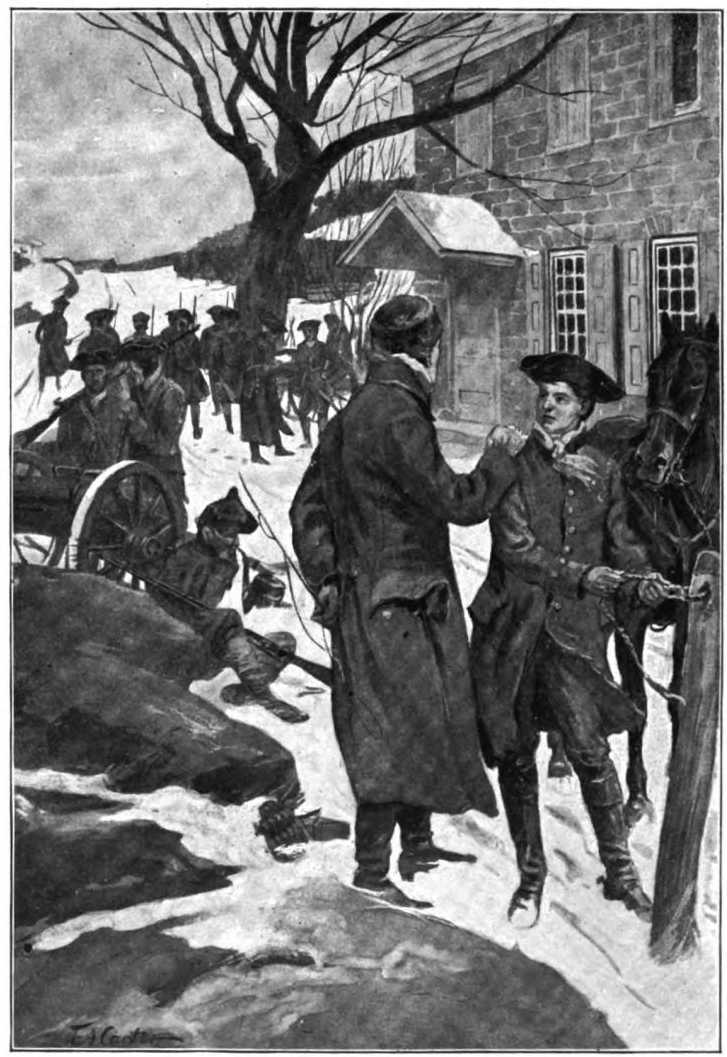
“HADLEY UNTIED HIS HORSE.”
Hadley untied his horse and they went
on in silence until they came to the sheds behind
an old country inn not far from headquarters.
Here Holdness had left his great
covered wagon and team of sturdy draught
horses. Despite the condition of affairs in
the territory about Philadelphia, the scout
retained his character of teamster and continued
to go in and come out of the city as
he pleased. How he allayed the suspicions
of the British was known only to himself;
but, evidently, General Washington trusted
him implicitly.
Hadley, as they drove slowly through
the camp, gave Black Molly over into
Captain Prentice’s care. Not until they
were beyond the picket lines of the Americans
entirely did Holdness offer any explanation
of the work before them.
“We’re goin’ ter stop at a place an’ take a
load of grain into Philadelphy,” he began.
“I ’greed ter do this last week. I aint sayin’
but I’d like ter turn about an’ cart it inter
aout lines; but that can’t be. The man ’at
owns it is a Tory an’ he’s shippin’ his grain
inter town so as to save it from the
’Mericans. He’s got his convictions, same’s
we’ve got ourn; ’taint so bad for him to sell
ter them Britishers as it is for some o’ these
folks ’t claim ter have the good of the
cause at heart, an’ yet won’t take scrip fer
their goods.”
When they came to the farmer’s in question
the great wagon was heavily loaded
with sacks of grain. Hadley, who had so
plainly seen the need of such commodity
in the American camp, suggested that they
take a roundabout way and deliver the sacks
of grain to their friends instead of to the
British, without the Tory being any the
wiser. “And spile my game?” cried Lafe,
with a chuckle. “I guess not. Reckon His
Excellency wouldn’t thank us for that. I’m
wuth more to him takin’ the stuff into Philadelphy
than the grain would be. We’re
goin’ in there to git some information.
Hadley, my son—this ain’t no pleasure
ja’nt.”
“But what can I do?” queried the boy.
“What you’re told—and I reckon you’ve
l’arned that already with Gin’ral Wayne.
A boy like yeou can git ’round ’mongst folks
without being suspicioned better’n me. It’s
whispered, Hadley, that them Britishers
contemplate making a sortie on aour camp.
You know the state we’re in—God help us!—an’
if the British mean to attack we must
know it and be ready for them. Every
crumb of information you can pick up must
be treasured. I’ll take ye to Jothan Pye
an’ you can be an apprentice of his. He
kin git you access to the very houses in
which some o’ them big bugs is quartered.
If plans are really laid for an attack, you’ll
hear whispers of it. Them whispers yeou’ll
give to me, sonny. D’ye understand?”
Hadley nodded. He understood what
was expected of him; also he understood
that the mission would be perilous. But he
had been in danger before, and he did not
lack some measure of confidence in himself
now.
The huge wagon rumbled on toward the
British lines. When they were halted, Lafe
managed to give such a good account of
himself that he was allowed to pass through
with little questioning, for the grain was
assigned to the quartermaster’s department.
Hadley was simply considered a country
bumpkin who had come into town to see the
sights. Soon the old scout and the boy
separated, Hadley making his way swiftly
to the Quaker’s habitation near the Indian
Queen, where good Mistress Pye welcomed
him warmly.
Friend Pye was a merchant and dealt in
such foreign commodities—particularly in
West India goods—as were in demand
among the British officers. As previously
noted, the Quaker had lived so circumspectly
in the city throughout the war that
his loyalty to the king was considered unshaken
by his Tory neighbors, and yet he
was so retiring and so worthy a man that
the Whigs had not considered him a dangerous
enemy.
If anybody noted, during these cold
days of middle winter, that Friend Pye had
a new ’prentice boy, it was not particularly
remarked. The gossip of the camp and,
indeed, all conversation was tinged with
military life and happenings. Friend Pye’s
young man carried goods to the Norris
house where My Lord Rawdon—that
swarthy, haughty nobleman, both hated and
feared by all who came in contact with him—was
quartered, and even to Peter Reeves’
house on Second Street, where Lord Cornwallis
held a miniature court. Hadley was,
in his new duties, quick and obliging. The
British officers often remarked that, for a
country bumpkin, Pye’s apprentice was
marvelously polite and possessed some grace
and gentleness. But all the time Hadley
Morris was keeping both his eyes and ears
open, and when Holdness came to the
Quaker’s house under cover of the night,
he told him all he had heard and seen, even
to details which seemed to him quite worthless.
“Ye never know how important little
things may be,” Holdness had told him.
“It’s the little things that sometimes turn
aout ter be of th’ greatest value. Stick to
it, Had.”
But, one day, Hadley experienced something
of a shock—indeed, two of them.
He was walking through Spruce Street,
carrying a bundle with which his employer
had entrusted him to deliver at an officer’s
residence, when a carriage came slowly
toward him. It was a very fine coach—much
finer than any he had observed in
Philadelphia thus far—and it was drawn
by a pair of magnificent horses. The horses
were bay, and before many moments the
boy, with a start, recognized them. His
eyes flew from the handsome team to the
coachman, perched on the high seat.
The bays were the same he had seen so
often while Colonel Creston Knowles was
a guest at the Three Oaks Inn, and the
driver was William, the silent Cockney.
The coach window was wide open and Hadley
could see within. There, on the silken
cushions, was seated Mistress Lillian herself!
The boy stared, stopping on the edge
of the walk in his surprise. Of course, he
might have expected to find the British
officer and his daughter here, yet he was
amazed, nevertheless.
But he was evidently not the only person
astonished. Lillian saw him. She leaned
from the carriage window and, for an instant,
he thought she was about to call to
him. Then she glanced up at the driver’s
seat and said something to William. At
once the bays began to trot and the carriage
rolled swiftly past. But Hadley had looked
up at the driver, too, and for the first time
saw and recognized the person sitting beside
William on the high perch.
William was gorgeous in a maroon
livery: the person beside him was in livery,
also, and evidently acted as footman. But,
despite his gay apparel, Hadley recognized
this footman instantly. It was Alonzo Alwood,
and as he gazed after the retreating
carriage, the American youth was conscious
that Lon had twisted around in his
seat and was staring at him with scowling
visage.
[TO BE CONTINUED]
In the Florida Everglades
By William A. Stimpson
“Good-by, fellows; don’t expect me
back before supper time.” Waving
his hand to his friends, Alfred
Whyte pushed the bateau into the water,
took his seat in the centre, and with a few
strong, even strokes of the paddle sent the
frail craft out of sight around a bend in the
stream.
It was on the edge of the Florida Everglades,
those low, marshy tracts of swamp
land that cover the whole of the lower end
of the peninsula. Two New York boys,
Willard King and Marvin Stebbins, had
homesteaded a claim in the heart of the
morass and were engaged in growing
tomatoes for the northern markets. Alfred,
a former schoolmate, was spending a few
weeks with them in their southern home.
The piece of land upon which the two
northerners had settled was about fifty acres
in extent. It rose, island-like, from out
the midst of the network of little creeks and
streams that crisscrossed in every direction
and made a veritable land-and-water
spider’s web of that part of the State.
The tomato plants were set out in February
and now, the first of April, the tomatoes
had begun to turn red and were large
enough to be picked. They had to be
handled very carefully, wrapped in tissue
paper, and packed in light wooden crates,
so as to permit the process of ripening to
be completed on the trip north. Picking
and packing them was tedious and took considerable
time. Both the young truck
farmers had their hands full, and when a
flock of wild ducks flew overhead on their
way to the feeding grounds half a mile further
inland, they merely directed a passing
glance upward and then, stifling their
sportsmen’s instinct, turned to their work
again.
All the morning the wild fowl could be
heard thrashing about in the tall grass at
the lagoon, and both King and Stebbins
were sorely tempted several times to slip
up stream in the hope of bagging a couple.
But the steamer on which they intended
shipping their produce sailed from Lincoln,
fifteen miles east, the next afternoon, and by
working persistently until dark they could
hardly get their crop ready for an early
start on the following morning for the
river town.
“If neither of you fellows can spare the
time to go duck shooting, why can’t I paddle
up there and try a shot or two?” asked
Alfred, late in the afternoon.
“All the reason in the world, Al,” replied
King. “No one except a native, or a person
who has lived here as long as we have, can
traverse this swamp in safety. Why, before
you reach the lake where the ducks are you
will pass eight or ten little streams, any one
of which you are just as likely to enter as
to keep on up the main channel. We’re
afraid you’ll get lost, Al. Don’t you think
so?” he asked, turning to Stebbins.
“But I’ve been all around there with you
fellows,” explained Alfred, trying in vain to
conceal his disappointment. “I’ve been up
to the lake, too, and I know the main stream
perfectly well. I’m going to try it, for
I must have some roast duck.”
Both the boys tried to dissuade him from
the undertaking, but he was insistent, and
finally they gave a reluctant consent. Realizing
fully his lack of acquaintance with the
swamp, Whyte paid particular attention to
his surroundings as he paddled on, fearing
that he might turn into one of those little
side streams of which King had warned
him.
Suddenly, ahead of him, he saw the
ducks. Paddling noiselessly, scarcely
rippling the water as he passed through, he
got within range of the flock without alarming
them. Bang! bang! went both barrels
of his twelve-bore, and at the reports
the ducks rose from the water with a
loud whirr. One bird was wounded and
lagged behind the others. It fluttered along
a hundred yards or so, then sank in a clump
of marsh grass, took wing again, but went
less than ten yards, when it turned a somersault
in the air and dropped.
A few strokes of the paddle carried the
bateau close to where the bird had fallen,
but when he reached the spot Whyte found
that a stretch of marsh lay between the edge
of the water and his prize. He tried to
reach the duck with the paddle but could
not do so. It was a fine, fat bird, as he
could plainly see, but it lay beyond his reach.
“Just my luck,” he muttered, after several
unsuccessful attempts to reach the bird. “I
wonder if those hummocks will hold
me,” noticing the tufts of thick, coarse
grass that dotted the morass in every
direction.
The hummocks looked firm enough to
bear his weight, so pushing the prow of the
boat as far into the edge of the bank as he
could, he stepped out and tried the first one.
It was solid and unyielding. Certain, then,
that his plan was a feasible one, he sprang
to the next hummock and on until he had
the bird in his hand. In returning, he rested
too much weight upon one of the tufts of
thick grass. The treacherous mud gave
way, his foot slipped, and down he went
into the black ooze up to his thighs.
With an exclamation of impatience, he
endeavored to withdraw his feet and legs.
They stuck fast. He tried a second time, but
the mud held him as in a vise. Putting
forth all his strength and seizing several
blades of the long, coarse grass within his
reach, he tried his best to extricate himself,
but to his dismay he found the sticky mud
to be as unyielding as quicksand. What
was worse, when he ceased his efforts he
discovered that he had sunk deeper in the
mire and was now embedded nearly up to
his breast.
Thoroughly frightened, he remained perfectly
passive and began to think. He realized
that he was in a serious predicament,
held a prisoner, as he was, in the black,
slimy mud of the swamp, and it was cold
there, too. His gun lay within reach, and,
resting the arm lengthwise, he made another
attempt to release himself, but his efforts
were unavailing. The gun sank in the ooze,
and in extracting it he found that his exertions
had caused him to sink several
inches deeper. The top of the mud now
reached to his armpits.
He glanced at the sun, and, seeing it low
in the west, was comforted. King and
Stebbins, becoming alarmed at his non-appearance,
would soon be setting out to
look for him, he thought, if they were not
already doing so. His eyes wandered towards
the opposite bank, and he was struck
with its unfamiliar appearance. Instead of
the low, flat marsh that lined that side of
the stream, as he well knew, he was looking
upon a patch of higher land similar to the
one upon which King and Stebbins had
their home. It dawned upon him then for
the first time that he had left the main
channel.
As the realization of his true position
came home to him, hope died. Thinking
that he was somewhere along the stream,
he had felt sure of rescue, but his discovery
altered the situation completely.
How far out of his true course he was he
had no way of knowing, and the thought of
the awful days and nights that would pass
while he stood there dying, if the mud did
not eventually bury him and make his
death even a more horrible one, was far
from pleasant.
Frantically he struggled to free himself,
but he was held fast as though he had
been shackled in irons, and his struggles
only left him exhausted. Great beads of
perspiration stood out on his brow. His
mouth was dry and parched and his head
began to swim. He felt that he was losing
his reason, but he pulled himself together
with a herculean effort. His legs and feet
were cold and numb, and the keen night
wind nipped his ears and nose cruelly. The
mud under his arms had begun to freeze,
and unless he kept breaking it continually
with his hands, a stiff crust would form at
the top.
He racked his brain to devise some plan of
escape from his terrible position, but could
think of nothing except to shout. That, he
supposed, would only be a waste of energy,
but he must do something. Gathering himself
together, he essayed to call, but his
mouth was so parched that his voice did not
penetrate further than ten yards. He tried
again, and this time found himself shouting
louder. Again and again he shouted until
his voice echoed and re-echoed through the
everglades.
As the sounds died away his ear caught a
faint call that seemed like an answer to his
own. Flushed with hope, he shouted again
and then strained his ears to listen. But
silence, broken only by the twittering of the
night birds, reigned about him.
Once more he shouted, and again he
thought he heard a reply, or was it an echo
of his own voice? The ordeal was too
much for him, and with a groan his head
drooped and he lost consciousness.
With King and Stebbins the time passed
until sundown before they realized how late
it was, and then they dropped their work
and looked along the stream in the direction
taken by their guest.
“It is nearly seven o’clock, Marvin,” remarked
King, consulting his watch. “Al
said he would be back by supper time, and
here it is an hour after. I believe he’s lost.”
“If that’s the case, we must find him before
dark, or he’ll have to stay in the swamp
all night,” said Stebbins.
Both young men were hurrying towards
the boat landing as they spoke. “Maybe
he’ll row around there a week before he
finds his way out,” declared King.
Stepping into the remaining boat, they
both seized a paddle and sent the light skiff
whirling along towards the lake, keeping a
sharp lookout for any signs of the missing
boat. “He promised not to go further than
the lake,” said Stebbins, as they reached a
point where the stream began to widen.
“Let’s course over some of those creeks back
there,” indicating a part of the swamp in the
rear of their island home.
The boat’s prow was accordingly turned
in that direction, and they had proceeded but
a few yards when King’s ear detected a
faint call somewhere in the distance. It
was so low and indistinct that he was unable
to tell from what direction it came, but
shouted loudly in answer.
“Did you hear anything?” asked Stebbins,
whose hearing was not so keen.
“I thought I did,” answered King, “and
shouted in the hope that it might be Alfred.
He’s certainly out of the channel and is
calling us. Halloo! halloo! we’re coming!
Where are you?” he shouted.
The boys rested a moment or two and
listened for a reply. None came. “We
don’t know which way to go,” said King.
“Let’s go south on a venture.”
“Call again,” said Stebbins, after they had
been paddling for a few minutes. King did
so, and in answer came a faint shout that
both boys heard. “We’re right, keep on
straight ahead,” said King, excitedly.
“Where are you?” he called, but they did
not receive any further answer.
They paddled an eighth of a mile along
this course, calling constantly without seeing
anything of the person for whom they were
looking. “Strange he doesn’t answer us,”
remarked Stebbins, thoughtfully. “I’m
afraid something’s happened to him.”
King said nothing, but kept peering
ahead into the gathering gloom. Darkness
had fallen by this time and objects were
hardly distinguishable. Rounding a bend
in the stream, they suddenly saw a boat—the
one in which Alfred had rowed away—drawn
up on the bank. With a shout the
boys pushed ahead with rapid strokes.
“Alfred, where are you?” they called. As
there was no response, they backed water,
and bringing their bateau to a stop, looked
with blanched faces into the empty boat.
“Where can he be?” muttered Stebbins.
“Look there! look there!” exclaimed
King, rising in the skiff and nearly upsetting
it.
Stebbins followed the direction indicated,
and saw what appeared to be a man’s head
upright on the ground.
“It’s Alfred, and he’s fast in the mud,”
exclaimed Stebbins, grasping the situation.
“He’s dead!” he groaned.
Without further words, the boat was
driven to the bank, and, stepping on the very
hummocks that had supported Whyte, they
reached his side. “Quick, Stebbins, get
your paddle under his left arm; I will do the
same on my side,” said King, and, working
together, they succeeded in raising the apparently
lifeless form from its position.
In another moment they had placed the
unfortunate youth in the boat beside them,
and while one sent the skiff skimming
towards home, the other rubbed and chafed
the cold hands and feet. At last they were
rewarded by seeing the eyes open and feeling
the heart beat faintly.
By the time the party reached the house,
Whyte was himself again, but so weak and
sick that he had to be carried from the
landing and put to bed. A doctor was
brought from Lincoln the next day and left
some medicine and a few directions, but
Alfred’s robust health and good constitution
did more for him than all the pills and
powders, and in a few days he had recovered
from all traces of his terrible experience,
except the memory of it. That
will stay with him always.
A DAUGHTER OF THE FOREST — CHAPTER XVIII In the Hour of Darkness — SYNOPSIS OF PREVIOUS CHAPTERS. — CHAPTER XIX THE LETTER — STATE FLOWERS
Brought up in the forests of northern Maine, and
seeing few persons excepting her uncle and Angelique,
the Indian housekeeper, Margot Romeyn knows
little of life beyond the deep hemlocks. Naturally
observant, she is encouraged in her out-of-door
studies by her uncle, at one time a college professor.
Through her woodland instincts, she and her uncle
are enabled to save the life of Adrian Wadislaw,
a youth who, lost and almost overcome with hunger,
has been wandering in the neighboring forest. To
Margot the new friend is a welcome addition to her
small circle of acquaintances, and after his rapid
recovery she takes great delight in showing him the
many wonders of the forest about her home.
But finally, after many weeks, the uncle decides,
because of reasons which will be known later, that
it would be better for Margot if Adrian left them.
Accordingly, he puts the matter before the young
man, who, although reluctant to leave his new
friends, volunteers to go. Under the guidance of
Pierre Ricord, a young Indian, the lad sets out for
the nearest settlement. After many adventures,
including a narrow escape from the dangerous rapids,
in which the travelers lost the canoe and nearly all
their possessions, the two reach Donovan’s, their
destination. Here they separate, Adrian going
straight to New York and the home which he left
seemingly so long ago. We leave him on the threshold
of his father’s city mansion, wondering what
welcome there will be for the prodigal. Pierre
returns to Peace Island, where, with Margot and her
uncle, we again take up the story.
“No sign yet?”
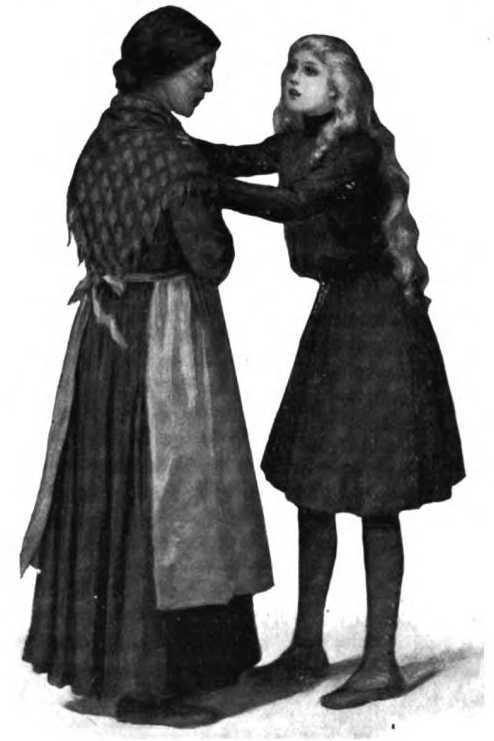
“No sign.” Margot’s tone was
almost hopeless. Day after day,
many times each day, she had climbed the
pine-tree flagstaff and peered into the distance.
Not once had anything been visible,
save that wide stretch of forest and the
shining lake.
“Suppose you cross again, to Old Joe’s.
He might be back by this time. I’ll fix you
a bite of dinner, and you better, maybe—”
The girl shook her head and clasped her
arms about old Angelique’s neck. Then
the long repressed grief burst forth in dry
sobs that shook them both, and pierced
the housekeeper’s faithful heart with a pain
beyond endurance.
“Pst! pouf! Hush, sweetheart, hush!
’Tis nought. A few days more, and the
master will be well. A few days more, and
Pierre will come. Ah! but I had my hands
about his ears this minute. That would
teach him—yes—to turn his back on duty—him.
The ingrate! Well, what the Lord
sends the body must bear, and if the broken
glass—”
Margot lifted her head, shook back her
hair, and smiled wanly. The veriest ghost
of her old smile it was, yet, even such, a delight
to the other’s eyes.
“Good. That’s right. Rouse up. There’s
a wing of a fowl in the cupboard, left from
the master’s broth—”
“Angel, he didn’t touch it, to-day. Not
even touch it.”
“’Tis naught. When the fever is on the
appetite is gone. Will be all right once
that is over.”
“But, will it be over? Day after day,
just the same. Always that tossing to and
fro, the queer, jumbled talk, the growing
thinner—all of the dreadful signs of how he
suffers. Angelique, if I could bear it for
him. I am so young and strong and worth
nothing to this world, while he’s so wise
and good. Everybody who ever knew him
must be the better for Uncle Hughie,
Angelique.”
“’Tis truth. For that, the good God will
spare him to us. Of that be sure.”
“But I pray and pray and pray, and there
comes no answer. He is never any better.
You know that. You can’t deny it. Always
before, when I have prayed, the answer
has come swift and sure; but now—”
“Take care, Margot. ’Tis not for us to
judge the Lord’s strange ways. Else were
not you and me and the master shut up alone
on this island, with no doctor near, and only
our two selves to keep the dumb things in
comfort. Though,
as for dumbness,
hark yonder
beast!”
“Reynard! Oh!
I forgot. I shut
him up because he
would hang around
the house and
watch your poor
chickens. If he’d
stay in his own
forest, now, I
would be so glad.
Yet I love him—”
“Aye, and he
loves you. Be
thankful. Even a
beastie’s love is of
God’s sending. Go
feed him. Here—the
wing you’ll not
eat yourself.”
They were dark
days now on the
once sunny Island
of Peace.
That day when
Mr. Dutton had
said, “Your father
is still alive,” seemed now to Margot,
looking back, as one of such experiences
as change a whole life. Up till that morning
she had been a thoughtless, unreflecting
child, but the utterance of those fateful
words altered everything.
Amazement, unbelief of what her ears
told her, indignation that she had been so
long deceived, as she put it, were swiftly
followed by a dreadful fear. Even while he
spoke, the woodlander’s figure swayed and
trembled, the hoe-handle on which he rested
wavered and fell, and he, too, would have
fallen had not the girl’s arms caught and
eased his sudden sinking in the furrow he
had worked. Her shrill cry of alarm had
reached Angelique, always alert for trouble
and then more than ever, and had brought
her swiftly to the field. Between them they
had carried the now unconscious man within
and laid him on his bed. He had never
risen from it since;
nor, in her heart,
did Angelique believe
he ever
would, though she
so stoutly asserted
to the contrary before
Margot.
“We have
changed places,
Angelique, dear,”
the child often
said. “It used to
be you who was always
croaking and
looking for trouble.
Now you see only
brightness.”
“Well, good
sooth. ’Tis a long
lane has no turnin’,
and better late nor
never. Sometimes
’tis well to say,
‘Stay, good trouble,
lest worser comes,’
eh? But things’ll
mend. They must.
Now, run and
climb the tree.
It might be this ver’ minute that wretch,
Pierre, was on his way across the lake.
Pouf! but he’ll stir his lazy bones, once he
touches this shore! Yes, yes, indeed. Run
and hail him, maybe.”
So Margot had gone, again and again,
and had returned to sit beside her uncle’s
bed, anxious and watchful.
Often, also, she had paddled across the
narrows and made her way swiftly to a
little clearing on her uncle’s land, where,
among giant trees, old Joseph Wills, the
Indian guide, and faithful friend of all on
Peace Island, made one of his homes. Once
Mr. Dutton had nursed this red man
through a dangerous illness, and had kept
him in his old home for many weeks thereafter.
He would have been the very nurse
they now needed, in their turn, could he
have been found. But his cabin was closed,
and on its doorway, under the family sign-picture
of a turtle on a rock, he had printed,
in dialect, what signified his departure for
a long hunting trip.
Now, as Angelique advised, she resolved
to try once more; and, hurrying to the
shore, pushed her canoe into the water and
paddled swiftly away. She had taken the
neglected Reynard with her, and Tom had
invited himself to be a party of the trip;
and in the odd but sympathetic companionship
Margot’s spirits rose again.
“It must be as Angelique says. The long
lane will turn. Why have I been so easily
discouraged? I never saw my precious
uncle ill before, and that is why I have been
so frightened. I suppose anybody gets
thin and says things when there is fever.
But he’s troubled about something. He
wants to do something that neither of us
understand. Unless—oh! I believe I do
understand. My head is clearer out here
on the water, and I know, I know! It is
just about the time of year when he goes
away on those long trips of his. And we’ve
been so anxious we never remembered.
That’s it. Surely it is. Then, of course,
Joe will be back now or soon. He always
stays on the island when uncle goes, and
he’ll remember. Oh! I’m brighter already,
and I guess, I believe, it is as Angelique
claims—God won’t take away so good a
man as uncle and leave me alone. Though
I am not alone. I have a father! I have
a father somewhere, if I only knew—all in
good time—and I’m growing gladder and
gladder every minute.”
She could even sing to the stroke of her
paddle, and she skimmed the water with
increasing speed. Whatever the reason for
her growing cheerfulness, whether the reaction
of youth or a prescience of happiness
to come, the result was the same; she
reached the further shore flushed and eager-eyed,
more like the old Margot than she had
been for many days.
“Oh! he’s there. He is at home. There
is smoke coming out of the chimney.
Joseph! Oh, Joseph! Joseph!”
She did not even stop to take care of her
canoe, but left it to drift whither it would.
Nothing mattered, Joseph was at home.
He had canoes galore, and he was help
indeed.
She was quite right. The old man came
to his doorway and waited her arrival with
apparent indifference, though surely no
human heart could have been unmoved by
such unfeigned delight. Catching his unresponsive
hands in hers, she cried:
“Come at once, Joseph! At once.”
“Does not the master trust his friend? It
is the time to come. Therefore, I am here.”
“Of course. I just thought about that.
But, Joseph, the master is ill. He knows
nothing any more. If he ever needed you,
he needs you doubly now. Come, come at
once.”
Then, indeed, though there was little outward
expression of it, was old Joseph
moved. He stopped for nothing, but leaving
his fire burning on the hearth and his
supper cooking before it, went out and
closed the door. Even Margot’s nimble
feet had ado to keep pace with his long
strides, and she had to spring before him
to prevent his pushing off without her.
“No, no. I’m going with you. Here—I’ll
tow my own boat, with Tom and Reynard—don’t
you squabble, pets—but I’ll
paddle no more while you’re here to do it
for me.”
Joseph did not answer, but he allowed her
to seat herself where she pleased, and with
one strong movement sent his big birch
a long distance over the water.
Margot had never made the passage so
swiftly, but the motion suited her exactly;
and she leaped ashore almost before it was
reached, to speed up the hill and call out to
Angelique wherever she might be:
“All is well! All will now be well—Joseph
has come.”
The Indian reached the house but just
behind her and acknowledged Angelique’s
greeting with a sort of grunt; yet he paused
not at all to ask the way or if he might
enter the master’s room, passing directly
into it as if by right.
Margot followed him, cautioning, with
finger on lip, anxious lest her patient should
be shocked and harmed by the too-sudden
appearance of the visitor.
Then, and only then, when her beloved
child was safely out of sight, did Angelique
throw her apron over her head and give her
own despairing tears free vent. She was
spent and very weary; but help had come;
and in the revulsion of that relief nature
gave way. Her tears ceased, her breath
came heavily, and the poor woman slept,
the first refreshing slumber of an unmeasured
time.
When she waked, at length, Joseph was
crossing the room. The fire had died out,
twilight was falling, she was conscious of
duties left undone. Yet there was light
enough left for her to scan the Indian’s
impassive face with keen intensity; and
though he turned neither to the right nor
left, but went out with no word or gesture
to satisfy her craving, she felt that she had
had her answer.
“Unless a miracle is wrought, my master
is doomed. Oh, the broken glass—the
broken glass!”
From the moment of his entrance to
the sick room, old Joe assumed all
charge of it, and with scant courtesy
banished from it both Angelique and
Margot.
“But he is mine, my own precious uncle.
Joe has no right to keep me out!” protested
Margot, vehemently.
Angelique was wiser. “In his own way,
among his own folks, that Indian good
doctor. Leave him be. Yes. If my master
can be save’, Joe Wills’ll save him.
That’s as God plans; but if I hadn’t
broke—”
“Angelique! Don’t you ever, ever let me
hear that dreadful talk again. I can’t bear
it. I don’t believe it. I won’t hear it. I
will not. Do you suppose that our dear
Lord is—will—”
She could not finish her sentence and
Angelique was frightened by the intensity
of the girl’s excitement. Was she, too,
growing feverish and ill? But Margot’s
outburst had worked off some of her own
uncomprehended terror, and she grew calm
again. Though it had not been put into
so many words, she knew both from Angelique’s
and Joseph’s manner that they
anticipated but one end to her guardian’s
illness. She had never seen death, except
among the birds and beasts of the forest,
and even then it had been horrible to her;
and that this should come into her own
happy home was unbearable.
Then she reflected. Hugh Dutton’s example
had been her instruction, and she had
never seen him idle. At times when he
seemed most so, sitting among his books,
or gazing silently into the fire, his brain
had been active over some problem that perplexed
or interested him. “Never hasting,
never wasting” time, nor thought, nor any
energy of life. That was his rule, and she
would make it hers.
“I can, at least, make things more comfortable
out-of-doors. Angelique has let
even Snowfoot suffer, sometimes, for want
of the grooming and care she’s always had.
The poultry, too, and the poor garden. I’m
glad I’m strong enough to rake and hoe,
even if I couldn’t lift Uncle as Joe does.”
Her industry brought its own reward.
Things outside the house took on a more
natural aspect. The weeds were cleared
away, and both vegetables and flowers
lifted their heads more cheerfully. Snowfoot
showed the benefit of the attention she
received, and the forgotten family in the
Hollow chattered and gamboled in delight
at the reappearance among them of their
indulgent mistress. Margot herself grew
lighter of heart and more positive that, after
all, things would end well.
“You see, Angelique dismal, we might
as well take that broken glass sign to mean
good things as evil; that uncle will soon
be up and around again, Pierre be at
home; and the ‘specimen’ from the old cave
prove copper or something just as rich, and—everybody
be as happy as a king.”
Angelique grunted her disbelief, but was
thankful for the other’s lighter mood.
“Well, then, if you’ve so much time and
strength to spare, go yonder and redde up
the room that Adrian left so untidy.
Where he never should have been, had I my
own way, but one never has that in this
world; hey, no. Indeed, no. Ever’thin’
goes contrary, else I’d have cleared away all
trace long sin’. Yes, indeed, yes.”
“Well, he is gone. There’s no need to
abuse him, even if he did not have the
decency to say good-by. Though, I suppose
it was my uncle put a stop to that.
What Uncle has to do he does at once.
There’s never any hesitation about Uncle.
But I wish—I wish—Angelique Ricord, do
you know something? Do you know all the
history of this family?”
“Why should I not, eh?” demanded the
woman, indignantly. “Is it not my own
family, yes? What is Pierre but one son?
I love him, oh, yes! But—”
“You adore him, bad and trying as he is.
But there is something you must tell me,
if you know it. Maybe you do not. I did
not, till that awful morning when he was
taken ill. But that very minute he told me
what I had never dreamed. I was angry;
for a moment I almost hated him because he
had deceived me, though afterward I knew
that he had done it for the best and would
tell me why when he could. So I’ve tried
to trust him just the same and be patient.
But—he may never be able—and I must
know. Angelique, where is my father?”
The housekeeper was so startled that she
dropped the plate she was wiping and broke
it. Yet even at that fresh omen of disaster
she could not remove her gaze from the
girl’s face nor banish the dismay of her own.
“He told—you—that—that—”
“That my father is still alive. He would,
I think, have told me more; all that there
may be yet to tell, if he had not so suddenly
been stricken. Where is my father?”
“Oh, child, child! Don’t ask me. It is
not for me—”
“If Uncle cannot and you can, and there
is no other person, Angelique—you must!”
“This much, then. It is in a far, far
away city, or town, or place, he lives. I
know not, I. This much I know: he is
good, a ver’ good man. And he have
enemies. Yes. They have done him much
harm. Some day, in many years, maybe,
when you have grown a woman, old like
me, he will come to Peace Island and forget.
That is why we wait. That is why the
master goes, once each summer, on the long,
long trip. When Joseph comes, and the
bad Pierre to stay. I, too, wait to see him,
though I never have. And when he comes,
we must be ver’ tender, me and you, for
people who have been done wrong to, they—they—pouf!
’Twas anger I was that the
master could put the evil-come into that
room, yes.”
“Angelique! Is that my father’s room?
Is it? Is that why there are the very best
things in it? And that wonderful picture?
And the fresh suits and clothing? Is it?”
Angelique slowly nodded. She had been
amazed to find that Margot knew thus much
of a long-withheld history, and saw no harm
in adding these few facts. The real secret,
the heart of the matter—that was not yet.
Meanwhile, let the child accustom herself to
the new ideas, and so be prepared for what
she must certainly and further learn, should
the master’s illness be a fatal one.
“Oh, then, hear me. That room shall
always now be mine to care for. I haven’t
liked the housewifery, not at all. But if I
have a father and I can do things for him—that
alters everything. Oh! you can’t mean
that it will be so long before he comes.
You must have been jesting. If he knew
Uncle was ill he would come at once,
wouldn’t he? He would, I know.”
Poor Angelique turned her face away to
hide its curious expression, but in her new
interest concerning the “friend’s room,” as
it had always been called, Margot did not
notice this. She was all eagerness and loving
excitement.
“To think that I have a father who may
come, at any minute, for he might, Angelique,
you know that, and not be ready for
him. Your best and newest broom, please,
and the softest dusters. That room shall,
indeed, be ‘redded’—though uncle says
nobody but a few people like you ever use
that word, nowadays—better than anybody
else could do it. Just hurry, please,
I must begin. I must begin right away.”
She trembled so that she could hardly
braid and pin up her long hair out of the
way, and her face had regained more than
its old-time color. She was content to let
all that was still a mystery remain for the
present. She had enough to think about
and enjoy.
Angelique brought the things that would
be needed and, for once, forebore advice.
Let love teach the child—she had nought to
say. In any case, she could not have seen
the dust, herself, for her dark eyes were
misty with tears, and her thoughts on
matters wholly foreign to household cares.
Margot opened the windows and began to
dust the various articles which could be
set out in the wide passage, and did not
come round to the heavy dresser for some
moments. As she did so finally, her glance
flew instantly to a bulky parcel, wrapped in
sheets of white birch bark, and bearing her
own name, in Adrian’s handwriting.
“Why, he did remember me, then!” she
cried, delightedly, tearing the package open.
“Pictures! the very ones I liked the best.
Xanthippé and Socrates, and oh! that’s
Reynard. Reynard, ready to speak. The
splendid, beautiful creature; and the
splendid, generous boy, to have given it.
He called it his ‘masterpiece,’ and, indeed,
it was by far the best he ever did here.
Harmony Hollow—but that’s not so fine.
However, he meant to make it like, and—why,
here’s a note! Why didn’t I come in
here before? Why didn’t I think he would
do something like this? Forgive me,
Adrian, wherever you are, for misjudging
you so. I’m sorry Uncle didn’t like you,
and sorry—for lots of things. But I’m
glad—glad you weren’t so rude and mean as
I believed. If I ever see you, I’ll tell you so.
Now, I’ll put these in my own room and
then get to work again. This room you
left so messed shall be as spotless as a snowflake
before I’ve done with it.”
For hours she labored there—brushing,
renovating, polishing; and when all was
finished she called Angelique to see and
criticise—if she could. But she could not;
and she, too, had something now of vital
importance to impart.
“It is beautiful’ done, yes, yes. I couldn’t
do it more clean myself, I, Angelique, no.
But, ma p’tite I hear, hear, and be calm! The
master is himself! The master has awoke,
yes, and is askin’ for his child. True, true.
Old Joe, he says, ‘Come! quick, soft, no
cry, no laugh, just listen.’ Yes. Oh, now
all will be well!”
Margot almost hushed her very breathing.
Her uncle awake, sane, asking for
her. Her face was radiant, flushed, eager,
a face to brighten the gloom of any sick
room, however dark.
But this one was not dark. Joe knew
his patient’s fancies. He had forgotten
none. One of them was the sunshine and
fresh air; and though in his heart he believed
that these two things did a world of
harm, and that the ill-ventilated and ill-lighted
cabins of his own people were more
conducive to recovery, he opposed nothing
which the master desired. He had experimented,
at first, but finding a close room
aggravated Mr. Dutton’s fever, reasoned
that it was too late to break up the foolish
habits of a man’s lifetime; and as the woodlander
had lived in the sunlight, so he would
better die in it, and easier.
If she had been a trained nurse, Margot
could not have entered her uncle’s presence
more quietly, though it seemed to her that
he must hear the happy beating of her heart
and how her breath came fast and short.
He was almost too weak to speak at all, but
there was all the old love, and more, in
his whispered greeting.
“My precious child!”
“Yes, Uncle. And such a happy child
because you are better.”
She caught his hand and covered it with
kisses, but softly, oh! so softly, and he
smiled the rare, sweet smile that she had
feared she’d never see again. Then he
looked past her to Angelique, in the doorway,
and his eyes roved toward his desk in
the corner. A little fanciful desk that held
only his most sacred belongings and had
been Margot’s mother’s. It was to be hers,
some day, but not till he had done with it,
and she had never cared to own it, since
doing so meant that he could no longer
use it. Now she watched him and Angelique
wonderingly.
For the woman knew exactly what was
required. Without question or hesitation,
she answered the command of his eyes by
crossing to the desk and opening it with a
key she took from her own pocket. Then
she lifted a letter from an inner drawer and
gave it into his thin fingers.
“Well done, good Angelique. Margot—the
letter—is yours.”
“Mine? I am to read it? Now? Here?”
“No, no. No, no, indeed! Would you
tire the master with the rustlin’ of paper?
Take it, else. Not here, where ever’thin’
must be still as still.”
Mr. Dutton’s eyes closed. Angelique
knew that she had spoken for him, and that
the disclosure which that letter would make
should be faced in solitude.
“Is she right, Uncle, dearest? Shall I
take it away to read?”
His eyes assented, and the tender, reassuring
pressure of his hand.
“Then I’m going to your own mountain
top with it. To think of having a letter
from you, right here, at home! Why, I
can hardly wait! I’m so thankful to you
for it, and so thankful to God that
you are getting well. That you will be
soon; and then—why, then—we’ll go
a-fishing!”
A spasm of pain crossed the sick man’s
wasted features, and poor Angelique fled the
place, forgetful of her own caution to “be
still as still,” and with her own dark face
convulsed with grief for the grief which
the letter would bring to her idolized
Margot.
But the girl had already gone away up
the slope, faster and faster. Surely, a letter
from nobody but her uncle, and at such a
solemn time, must concern but one subject—her
father. Now she would know
all, and her happiness should have no
limit.
But it was nightfall when she, at last,
came down from the mountain, and though
there were no signs of tears upon her face,
neither was there any happiness in it.
[TO BE CONTINUED]
The heights by great men reached and kept
Were not attained by sudden flight;
But they, while their companions slept,
Were toiling upward in the night.
The following are the “State flowers,”
as adopted by the several States. In
Maine, Michigan, and Oklahoma
Territory the decision was made by the
Legislature, in the other cases by the
votes of the scholars in the public
schools.
Alabama, goldenrod; Arkansas, aster;
California, California poppy; Colorado,
columbine; Delaware, peach blossom;
Idaho, syringa; Iowa, wild rose; Maine,
pine cone and tassel; Michigan, apple
blossom; Minnesota, moccasin flower;
Missouri, goldenrod; Montana, bitterroot;
Nebraska, goldenrod; New Jersey (State
tree, maple); New York, rose (State tree,
maple); North Dakota, goldenrod; Oklahoma
Territory, mistletoe; Oregon, Oregon
grape; Rhode Island, violet; Vermont,
red clover; Washington, rhododendron.
In Kansas, the sunflower is usually known
as the State flower.
The largest bell in the world is the great
bell at Moscow, at the foot of the Kremlin.
Its circumference is nearly 68 feet, and its
height more than 21 feet. It is 23 inches
thick in its stoutest part, and weighs 433,722
pounds. It has never been hung.
THE FLOWERLESS PLANTS — Fungi — INDEPENDENCE
By JULIA McNAIR WRIGHT
The year around and the world around,
journey the plant pilgrims. Among
those perennials which are found in
all latitudes and seasons are the lichens and
fungi. In September, while we wait for
fruits and seeds to finish ripening, let us
make small studies in these related groups
in the vegetable sub-kingdom called the
thallogens.
This sub-kingdom, one of the chief divisions
of the vegetable kingdom, is known
as the class thallophytes. It contains the
simplest forms of vegetable life. Its chief
groups are the fungi and algæ, the lichens
being related to both, as if algæ and fungi
had united in one plant, dividing and somewhat
changing the characteristic of each.
At any period of the year you can find
lichens in abundance. They cover ragged
rocks, dress up old roofs, walls, fence rails
and dead stumps, especially delighting in the
north side of trees. If we examine them
through a magnifying glass, we shall see
that they are made up of cells, laid side by
side like little chains of beads, or of cells expanded
into short tubes or threads lying
like heaps of tiny fagots. Instead of seeds,
lichens have a fine dust, called spores, from
which they develop.
Lichens are exceedingly long-lived and
excessively slow of growth. The lily attains
its lovely maturity in a few months;
the oaks, elms, pines, become great trees
in twenty or thirty years; the humble lichen
often lives forty or fifty years before it is
old enough to complete its growth by producing
spores. Botanists say that the life
of a lichen is fitful and strange, and is practically
indefinite as to duration. Lichens
simply live on and on.
Some lichens have been known to live
nearly fifty years without seeming to grow;
they appear to dry up, and nearly vanish;
then, suddenly, from some cause there is a
revival of growth—they expand again.
Small and insignificant as these lichens are,
they often outlive those longest-lived of
trees, the cedar of Lebanon and the California
redwood.
The condition of lichen existence is water,
for from moisture alone, in dew or rain,
they secure their food. The carbon, oxygen,
ammonia, hydrogen, in air and rain,
afford them their nourishment. The lichen
generally refuses to grow in foul air laden
with noxious gases. In the impure air of
cities few appear, but they abound in the
open country. They absorb by all the surface,
except the base by which they are
fastened to their place of dwelling. They
have no roots, and simply adhere to bare
rocks, sapless wood, even to naked glass,
from which they can receive no nutriment
whatever.
In comparison with what is known of
plants in general, our knowledge of lichens
is yet very limited. They seem to be made
chiefly of a kind of gelatin which exists in
lichens only. Humble as they appear, they
have always been of large importance in
arts and manufactures. They produce exquisite
dyes—a rich, costly purple, a valuable
scarlet, many shades of brown, and
particularly splendid hues of blue and
yellow are obtained from these common
little growths, which in themselves display
chiefly shades of black, gray green, varied
with pink, red, and orange cups, balls, and
edges.
While not so abundant as lichens, the
fungi are well known everywhere. We
cannot claim, as for the lichens, that they
are harmless, for many are a virulent
poison: others have a disgusting odor, and
nearly all are dangerous in their decay. On
the other hand, many of them are a useful,
delicious food, and nearly all are beautiful
when first developed. Their variety, also,
is very fascinating.
In a walk of less than two miles in a wet
summer, may be found twenty different
kinds of fungi—some no larger than a pea,
some eight inches in diameter. They may
be round, oval, flat, cup-shaped, horn-shaped,
cushion-shaped,
saucer-shaped; they
are snow-white,
gray, tan, yellow,
lavender,
orange, dark
brown, pink,
crimson, purple,
and variously
mottled, scaly or
smooth as with
varnish. Placed
on a large platter
among dark
green mosses,
they will be, for
one day, a magnificent
collection.
One large,
egg-shaped variety,
growing
in pairs, is of a
purple shade,
very solid, and
when broken
open seems filled
with glittering
matter like iron or steel filings. Another
tan-colored, plum-shaped fungus, firm and
smooth, is of a nearly royal purple within.
September is a good month for the study
of fungi, especially after the early fall rains,
when the woods and pastures will be found
well-filled, not only with brilliant, useless,
or poisonous varieties, but with delicious
edible kinds. Popularly, people call the
edible specimens “mushrooms,” and the rest
“toadstools,” the number of poisonous or
of edible instances so named depending
rather upon the amount of knowledge of the
collector than upon the real qualities of the
fungi, for many denominate as “toadstools”
what others know to be an excellent food.
Many varieties not usually eaten are
wholesome, and many which human beings
reject, other animals thrive upon. One
large, brown “toadstool” of the woods is,
at this season of the year, the chief food
of that epicure, the wood-tortoise.
In general a
fungus may be
defined as a thallophyte
without
any chlorophyl
or leaf-green in
its composition.
Among the brilliant
colors displayed
by fungi
no green or blue
can be found.
The most
popular and
most useful fungus
is the table
mushroom. This
rarely ever
grows in the
woods, in shade,
on wet lands, or
on decaying
stumps. It prefers
the open,
breezy, well-sunned
pastures,
where the grass
is kept short by
the grazing of
sheep or cattle. Early in the morning or
shortly before sunset, the dainty white or
cream-colored buttons, borne on snow-white
stalks, push up through the soil and
gradually expand until the discs are flat or
slightly convex. From two to six inches
is the diameter, seldom more than three.
Varieties of the pasture mushroom are
few and can readily be learned. The mushroom
is composed of stem and cap; the stem
is finger-shaped, with the roundish end in
the earth. About half way up is usually a
ring of the covering skin, where, in the
button shape, the veil of the mushroom was
attached.
This veil extends over the cap and is left
at the edge of a little frill; it can be easily
stripped off. Under the veil the flesh is
ivory-white, and is smooth and firm.
The under side of the cap is laid in plaits,
called gills, from their resemblance to fish
gills. They never grow fast to, or down
upon, the stem, usually stopping short off,
about one-tenth of an inch from its juncture
with the cap. Mushrooms are cultivated in
gardens or cellars. They grow from spores
or little finger-like lengths, called spawn,
which are produced by the spores. Mushrooms
turn black or purplish after the first
twenty hours of growth. When the gills
have taken this dark hue, the mushroom is
unfit to eat.
Some fungi grow in very wet places; the
woods are likely to be full of them after a
few rainy days. They are all short-lived.
Although not new to some of our
readers, we think the following anecdote,
illustrating one phase of
Benjamin Franklin’s character, will bear
repeating:
Not long after he began editing his newspaper,
Franklin’s free manner of criticism
called forth the disapprobation of many of
his patrons. One of them in particular felt
so greatly moved as to make it his duty to
tell him so. “The doctor listened with patience
to the reproof, and begged the favor
of his friend’s company at supper on an
evening which he named; at the same time
requesting that the other gentlemen who
were dissatisfied with him should attend.
“When the guests arrived, the doctor received
them cordially, and his opinions
were thoroughly criticised and much advice
given. Supper was at last announced and
the guests invited into an adjoining room.
The doctor begged the party to be seated,
and urged them to help themselves: but the
table was only supplied with two puddings
and a stone pitcher of water. Each guest
had a plate, a spoon, and a bowl. They
were all helped, but none of them could eat.
The doctor took freely of the pudding, and
urged the others to do the same; but it
was out of the question. They tasted and
tried in vain. Upon inquiry, they learned
that the pudding was made of sawdust.
“When the facetious host had made sure
that they could not eat, he rose and addressed
them thus: ‘My friends, anyone
who can subsist upon sawdust pudding, as
I can, needs no man’s patronage.’”
The doctor’s life has proved his statement.
The person who can adapt himself
to all circumstances and deny himself when
necessary can attain true independence.
LITTLE POLLY PRENTISS — CHAPTER XVI IN THE BARN — SYNOPSIS OF PREVIOUS CHAPTERS. — CHAPTER XVIII A DREADED VISITOR
BY ELIZABETH LINCOLN GOULD
Polly Prentiss is an orphan who, for the greater
part of her life, has lived with a distant relative,
Mrs. Manser, the mistress of Manser Farm. Miss
Hetty Pomeroy, a maiden lady of middle age, has,
ever since the death of her favorite niece, been on
the lookout for a little girl whom she might adopt.
She is attracted by Polly’s appearance and quaint
manners, and finally decides to take her home and
keep her for a month’s trial. In the foregoing
chapters, Polly has arrived at her new home, and
the great difference between the way of living at
Pomeroy Oaks and her past life affords her much
food for wonderment. In the meantime Miss
Pomeroy has inwardly decided that she will keep
Polly with her, but as yet she has not spoken to
the little girl of her intentions.
While the old people at Manser Farm
were reading Polly’s letter, the little
girl herself was listening with a
sober face to a piece of news which had
come to Miss Pomeroy. It was eight
o’clock—past Polly’s bed-time—but she was
so anxious to finish the wonderful story of
the Snow Queen that Miss Hetty had
offered to read the last pages aloud. She
had reached the end only a moment before
Hiram brought the mail.
“Bobby—my little nephew—is coming
here to spend Sunday on his way to see
another aunt, his mother’s sister,” said Miss
Pomeroy, looking up from her letter to
Polly, who stood waiting to say good-night.
“I’m very glad, Mary, for I am sure you
two children will enjoy each other, you are
both so quiet and fond of books. Perhaps
we can persuade Bobby to make us a longer
visit on the way home.”
That night and the next morning Polly
stretched in Ebenezer’s fashion until her
little arms and legs ached. She made up
her mind that she would lose no opportunity
for the next three days of performing this
gymnastic exercise or of hurrying on her
growing likeness to Eleanor in other ways.
She sat for hours with Miss Pomeroy,
sewing patchwork and listening to stories of
the old curiosities in the Indian cabinet that
stood in the parlor. They were interesting
stories, but the room was kept very warm
because of Miss Hetty’s rheumatism which
was troublesome just then, and Polly’s head
grew hot and tired as she sat quietly in the
little chair at Miss Pomeroy’s side. She
ate as much as she possibly could at every meal,
and she did not speak of going out to
walk in the afternoons after her hour on
the bed.
“I shall be glad when I get over this stiffness,
so we may have our walks together
again,” said Miss Pomeroy, when Friday
night came. “I’m afraid if it were not for
me, Mary, you would not have enough outdoor
air. But I am glad you are so contented
in the house, for it is very pleasant to
have a little companion while I am obliged
to keep still so much of the time.”
Polly smiled affectionately at her, but the
little girl’s heart was heavy. She was listless
in her movements except when under
some one’s eye, and felt a strange indifference
to the things which had always delighted
her.
“I guess I’m getting just exactly like
Eleanor in some ways,” she said to herself
many times a day. “The brook calls and
calls me just the way it did at first, but my
legs feel so queer and my head is so funny.
I don’t seem to care so much about paddling
in the water now. Miss Arctura says it is
too cold in the woods yet, anyway. She
says her brother John’s wife caught her
death once, neglecting to use her judgment
when a cold spell came in April. Oh, dear.
I wish Bobby had been here and gone away!
S’posing he doesn’t ’prove of me. Wouldn’t
that be dreadful!”
Hiram was Polly’s stay and comfort in
this trying time. Arctura—the truth must
be told—had suffered more or less from a
grumbling toothache ever since her afternoon
in the woods. Arctura objected to
going to the dentist “on principle,” she
said, though Miss Pomeroy had never been
able to understand just what she meant by
that. Hiram was the only person who ventured
to brook the subject to his sister, and
his advice was sharply scorned.
“Don’t you think you’d ought to have that
tooth pulled, ’Tura?” Hiram had mildly
asked as he washed his hands at the noon
hour on Thursday, and Miss Green had
turned upon him with swift contempt.
“Better have my legs removed next
time they get a mite overtired and ache a
little, hadn’t I?” she said, severely. “Go
and have all your own teeth out whenever
you want, but just leave mine alone, if you
please!”
Polly had overheard this dialogue as she
entered the kitchen on an errand, and she
could hardly believe her ears.
“But, ’Tura’ll be all right soon as the
weather warms up again,” Hiram had explained
to Polly in the barn at milking-time.
“She ain’t been quite herself the last day or
two; toothache appears to upset her more
than anything else in this world. I saw her
grinding her jaws together yesterday morning,
and I knew ’twas that old left-hand
wisdom of hers at it again. She’s got a
roasted raisin in it now, I know by the way
she mumbled at me when I went in for the
milk-pail, but I dursn’t refer to it. We’ll
just step kind of easy for the next twenty-four
hours and it’ll be all clear weather
again. She hasn’t got any real malice in
her, ’Tura hasn’t.”
“I think she’s just as kind as she can be,”
said Polly, warmly. But it was a sober
little face at which Hiram smiled broadly
down when he arose from the milking stool.
“You stay here while I take this in,” he
said, cheerily, “and I’ll fetch out a lantern
so we can run through ‘On Linden’ far as
we’ve gone. You said old Marm Hackett
was with Miss Hetty, I believe?”
“Yes,” said Polly, “and she told me to
run out for a while as she had something
to lay before Miss Pomeroy. Do you think
she’s a very pleasant old lady, Mr. Hiram?”
“Well, now, let’s see if I’ve ever heard
anybody speak of her that way,” said
Hiram, cautiously. “I guess I’d better consider
it while I’m carrying off the milk.”
Polly knew that his opinion agreed with
hers, and she gave a little laugh as he swung
out of the barn with the pail of milk.
When he returned with the lantern she was
standing in the middle of the barn floor and
made a sweeping courtesy to him as he entered.
“That’s good,” said Hiram, setting down
the lantern and seating himself on the lowest
stair of the flight that led up to the loft.
“That’s first-rate. How would it be if you
should make two of ’em—one to the left and
one to the right? In case folks were seated
promiscuous—that is here and there,” explained
Hiram, “it would be fair to all
parties. That’s it—that’s the way to do it!”
and he clapped his hands as Polly greeted
an imaginary audience. “Nobody’s going
to feel left out with that beginning. Now
for it.”
“Ladies and gentlemen,” said Polly, with
a wide sweep of her arms, “the piece that I
am about to speak to you is ‘Hohenlinden,’
by Mr. Thomas Campbell.”
“Little louder, if you please,” said Hiram,
in a disguised voice, “there’s a couple of old
ladies at the rear that don’t want to miss
a word.”
“‘On Linden, when the sun was low.’”
said Polly, in a clear, loud voice—and as
she spoke, she stooped and indicated the
position of the sun with her right hand—
“‘All bloodless lay the untrodden snow,
And dark as winter was the flow
Of Iser, rolling rapidly.’”
The rapidity of Iser’s flow was shown by
Polly’s two little arms, which swung back
and forth from her shoulders as fast as she
could possibly move them.
“That’s prime!” said Hiram, approvingly.
“Seems as if I could see old Iser right before
me. Now, the next verse.”
“‘But Linden saw another sight,’”
said Polly, flushed with pleasure, shielding
her eyes with her hand and gazing
anxiously about the barn.
“First-rate!” cried her instructor. “I tell
you, little Mary, you’ve got the real spirit
for reciting! Now that gesture had never
come into my mind, and yet there ’tis, fitting
in complete. I make no doubt Linden folks
were out looking just that way, bound to
see, yet scared of what would meet ’em.
Now for the drums!”
“‘When the drum beat at dead of night,’”
said Polly, valiantly belaboring her right
palm with the clenched fingers of her left
hand.
“‘Commanding fires of death to light
The darkness of her scenery.’”
“There’s not a bit of fault to be found
with that,” said Hiram, as he received the
lantern from the hands of his pupil, who
had seized it and swung it wildly about
when the “fires of death” were lighting.
“Of course, the lantern will be behind you
the night of the entertainment, ready for
use.”
“Of course,” said Polly. “Now comes
the best verse of all, I think, Mr. Hiram:
“‘By torch and trumpet fast arrayed,’
I shall have a candle and the tin horn that
night, you know—
“‘Each horseman drew his battle-blade—’”
Uncle Blodgett’s gift was drawn with a
fierce flourish—
“‘And, furious, every charger neighed
To join the dreadful revelry.’”
The verse ended with an indescribable
sound, and Hiram drew his hand across his
mouth before he spoke in answer to Polly’s
questioning eyes.
“I call that a pretty fair neigh,” he said,
encouragingly. “I don’t know as I’d go so
far as to say ’twould deceive anybody into
thinking there was a horse right on the
spot, but it’s improving in its quality all the
time, I notice.”
“I’m so glad,” said Polly, “because, you
see, I can’t make the roars and other noises
for the ‘dreadful revelry’ the way you can,
and I wanted to do something.”
The next two verses finished Polly’s recitation
for that evening. Hiram had
promised to assist with “the hills with
thunder riven” and the “red artillery.”
The thunder was to be made with a pair of
wooden dumb-bells, and the “red artillery”
was a little old lantern with a red glass
front which would dart about Polly’s figure
in Mr. Green’s hand.
“That was an extra good rehearsal,” said
he, as the little girl sat down beside him on
the stairs. “Now, we’ll learn the next
verse, shall we, and call it we’ve finished
for the night?”
When the next lines, with their “furious
Frank and fiery Hun,” were pronounced
perfect, Polly begged for a story.
“Just a little bit of a short one, Mr.
Hiram, before I go to bed,” she said, coaxingly,
“and I don’t care whether it is true or
not.”
“That being the case,” said Hiram,
soberly, as they sat close together with the
lantern at their feet, “I’ll relate a little circumstance
that a man once told me. It’ll
give you something to think about, but I
shouldn’t want to say how true ’tis, for it
seems a mite improbable. This man said
that a friend of his out West somewhere had
always had trouble with the chimney in his
parlor—I would say with the draught of it
up from the fireplace. He had it tinkered
off an’ on for years, and finally he decided
he’d have the old contraption torn down and
a bran’ new chimney put up.
“Someway the mason made a mistake and
got the new chimney on wrong side up, and
the draught was a powerful one, and, first
they know, rain, hail, snow, and what-all
were drawed right down into the room,
making dreadful work.
“They sent for the mason, of course, and
he took the chimney down and put it on
again right side up, and then the draught
was so powerful that it drawed a braided
rug and a pair o’ tongs and a three-legged
stool and a number of other articles right
up the chimney.
“Then they saw something had got to be
done, so they put a poultice—a flour
poultice, I understood him to say—on the
jamb of the fireplace, and that drawed down
so it balanced and counteracted the draught,
and after that the chimney gave perfect
satisfaction.”
Polly had stared at the narrator when he
began the story, but as he progressed she
covered her mouth with both hands for fear
she should laugh out and interrupt him.
“Mr. Hiram,” she cried, as the storyteller
rose, chuckling, and began to close the
barn for the night, “next to Mr. Hans
Christian Andersen’s I would rather hear
your make-believe circumstances than anybody’s
that ever I heard!”
“Compliment number two,” said Hiram,
as they stepped out of the barn, side by
side. “You’d better be looking sharp or
you’ll have me all stuffed out with pride before
you know it, young lady.”
Nobody but the kittens knew that
Polly dreaded the coming of
Eleanor’s twin. She told them all
about it Saturday morning as they sat in
her lap, cuddled up into a warm heap under
the gray shawl that Arctura had wrapped
about her.
Arctura’s tooth had not quite stopped its
grumbling and she had firmly declined
Polly’s aid in the kitchen that morning.
“I’ve got some bothersome cooking to
do,” said Arctura, without the smile which
might let in a draft of air on the convalescent
jaw, “and I’d best be alone, for my
nerves are sort of jumpy along with a pain
I’ve been enduring in my head without
speaking of it, for some days. The air’s
mild enough for you to sit out on the piazza
and watch for Miss Hetty and Bobby, if I
wrap you up well. It’s getting ready to
rain again to-morrow, and then I have
hopes of some fair, warm weather when
it clears off finally.”
Miss Pomeroy’s rheumatism was much
less troublesome than it had been for some
days, and Hiram had helped her into the
low basket phaeton an hour before.
“I expect she’s ’most home now,” said
Polly to the kittens, with a little shiver,
“and she’s bringing that boy—that Bobby—home
with her. He’s going to stay till
Monday morning. You needn’t be frightened,
Snip and Snap, for he’s a boy that
just likes to read; he wouldn’t do the things
to kitties that the Higgins boys do—things
with strings and spools, till the teacher
stopped them. And, anyway, you’ve got
lots of places to hide, where nobody could
get you. But I can’t hide. I’m obliged to
be right out where he can see me, and tell
whether I’m like his sister Eleanor that died,
and maybe change Miss Pomeroy’s mind
after all, and lose Grandma Manser her ear-trumpet,
and the money for the leaks and
shingles and everything!”
Polly buried her face in the old shawl for
a minute, and then sat up straight with a
little gasp.
“I hear the phaeton!” she whispered,
squeezing the kittens in her excitement. “I
hear it coming over the bridge—fast!”
Snip and Snap objected to squeezing.
They struggled under the shawl and dashed
out over Polly’s knees, clutching wildly at
the fringe. They looked up at her cannily
with arched backs, and then scurried off
toward the barn.
As the phaeton came around the curve of
the driveway, Polly stood up, clasping her
hands under the old shawl. She heard Arctura
bustling out of the kitchen to the porch,
and moved slowly along to stand beside her.
In a moment more she found herself
solemnly shaking hands with a boy who had
jumped into the phaeton and then politely
helped Miss Pomeroy out.
“This is my nephew Bobby,” Miss Hetty
was saying. “And this is little Mary
Prentiss.”
“I am very pleased to make your acquaintance,”
said Polly, lifting her brown
eyes to meet a pair of very large blue ones
which gazed at her through spectacles.
“How d’you do?” said the boy, pleasantly.
“Haven’t you got about through
with my hand?”
He laughed as he said it, and so did Polly,
but when the hand-shaking stopped they
stood looking at each other awkwardly until
Arctura broke the ice.
“You two children step out to the dining-room,
while Miss Hetty goes and rests after
her ride,” said Arctura, cordially. “I’ve set
a tray with two tumblers of milk and some
crullers on the buffet, and you can stand up
and eat on to it, so’s not to scatter the
crumbs. I never saw the time a boy wasn’t
ready to eat, and Mary here’s got a most
excellent appetite of her own. Dinner
won’t be ready for nearly two hours yet.”
“Thank you,” cried Bobby. “You’re a
trump!”
“Seems to me you’ve thickened up a little
since last time,” said Miss Green, cautiously
guarding the entrance to the cavern wherein
dwelt her wisdom tooth, as she acknowledged
this commendation. “I suppose
you’ll drop into the kitchen along in the
afternoon while Miss Hetty and Mary are
taking their naps? I don’t see my way
clear to sitting down at dinner for a talk
with you, for I’ve been having a little
neuralgy and the air in the dining-room
seems kind of chilly after the kitchen.”
“Do you take a nap every day?” asked
Bobby, curiously, as he and Polly drank
their milk and ate the crisp crullers. “I
s’pose girls like to do that kind of thing, but
I’d rather read all night than waste time
sleeping in the daylight. I’ve never known
any girl very well except my sister. I’m
afraid of them, they’re so queer.”
“Oh, they’re not half so queer as boys, I’m
sure!” asserted Polly, with much decision.
“I guess if you knew the Higgins boys that
I’ve been to school with, you’d say so. I
never could get those boys to play house
with me once! They said it wasn’t any fun.”
“Well, ’tisn’t, you know,” said Bobby,
without a moment’s hesitation. “Of course,
nothing happens when you play house, no
adventures—no accidents—no anything.”
“No accidents!” echoed Polly, in amazement.
“I should think it was a pretty
dreadful accident to invite four dollies to tea
(cut out of a newspaper, they were, beautiful
ones, Uncle Blodgett did them for me),
and find you had burned up every biscuit to
a crisp while you were setting the table.
I mean they had burned themselves up!
Don’t you like to play any make-believes?”
“Yes, I like some,” admitted the boy,
frankly, “but you wouldn’t like my kind,
and I call yours pretty slow.”
“What kind of make-believes do you like
best?” asked Polly, as she and the dreaded
guest sat together in the library at dusk.
Miss Pomeroy was entertaining Marm
Hackett in the parlor, much to the old
woman’s rage, she having desired a talk
with the newcomer, for whom she had prepared
a list of searching questions.
“I like the kind of make-believes that are
in books,” said the boy, staring into the fire.
He sat on the hearth-rug with his legs
crossed in a position of tantalizing comfort.
Polly sat in a straight-backed chair
and viewed him with envy. She would
have liked so much to be beside him on the
rug with her hands clasped over her knees
and her chin resting on them. And he had
not felt obliged to take any nap. She had
heard him talking to Arctura while she lay
on that hot bed.
“‘Treasure Island’ is a mighty good
make-believe,” remarked Bobby, after a
short silence. “I shouldn’t have had any
objections to living that story right along.”
“I’ve never read it,” said Polly, with a
little sigh. “I’ve never read much of anything
till now. Is ‘Treasure Island’ as beautiful
as the ‘Snow Queen’?” she asked,
doubtfully. “It doesn’t seem as if it could
be.”
“Beautiful isn’t the word for it,” said
Bobby, turning his spectacled eyes toward
her for a moment. “It’s wild, and murderous
in places, and it carries you along
with it. So does ‘Kidnapped.’ That’s
what you want of a book. I never can
make up my mind whether I’d rather have
been David Balfour or Napoleon. If I had
my choice, I believe I’d have to draw lots.”
“There are places in the woods where
Miss Arctura and I went one day that
would be splendid for make-believes, I
should think,” ventured Polly, anxious to
please this remarkable boy. “There are
rocks that you could hide behind and jump
out at me. I shouldn’t be a bit afraid—truly,
I shouldn’t!”
“We’ll see,” said Bobby, “only to-morrow’s
Sunday, you know, and, of
course, we have to go to church—and, anyway,
I couldn’t be as fierce about it as if
you were a boy. I couldn’t knock a girl
over, or pitch into her and wrest her sword
from her grasp. That’s where the fun
comes in.”
“I thought they said you didn’t care
much about play,” said Polly, much surprised.
“I don’t care for ball, or marbles, or any
of those things,” said Bobby, scornfully.
“I’d rather read, any day. But there’s a
fellow at home, George Rogers—just
twelve, my age, you know—and he and I
play a robber band piece that we’ve made
out of different books. I can tell you it’s
worth seeing. Only, I suppose, ’twould
scare a girl blue.”
“It would not scare me blue.” said
Polly, shaking her curls. “I should like
it!”
“Eleanor never minded it,” said the boy,
softly, to himself, but Polly heard him,
and her heart beat high with hope as he
took off his spectacles, rubbed them for a
minute with a big, white handkerchief, and
then adjusted them carefully to his nose, as
Uncle Blodgett always did when preparing
to read the newspaper.
“Perhaps he’ll think I’m something like
Eleanor, after all,” said Polly in her heart.
She hesitated for a moment and then leaned
over until her head was almost against the
boy’s shoulder, as he sat gazing into the
fire.
“Do you like ‘Mary’ for a name?” she
asked, scarcely breathing the words.
“Why, yes, I don’t know but I do,” said
the boy, turning to face her. “But what
are you whispering for? I can tell you
what I don’t like—I despise ‘Bobby’ for a
name! It’s just like baby talk—but I’m
afraid of hurting Aunt Hetty’s feelings if
I say anything about it. Next time she
comes over to our house, I’m going to get
grandfather just to suggest to her that it’s
time to give up nicknames when a boy’s all
but in his teens. He can do it all right.
Maybe she’ll bring you over. I’d like to
show you George Rogers, and we could do
our act for you.”
“Perhaps I shall be in school then,” said
Polly, feeling highly honored by this invitation,
“there are only two weeks more
vacation.”
“You’re not going to school next term,”
said Bobby. “I know, for Aunt Hetty told
me. She wants to get you more ‘chippered
up,’ Arctura says. Isn’t Arctura an old
dear? Did she ever tell you what the
children used to sing about her nose when
she was a young one? It’s funny, and she
says she never minded, but I’d have soon
stopped them if I’d been there.”
“She never told me,” said Polly, with a
glance of admiration at the boy who spoke
so valiantly while he looked so mild, “I’d
like to hear it.”
“Her nose is pretty prominent, of
course,” said the heir of the Pomeroys, reluctantly,
“and she says it got its growth
before the rest of her. And when they’d
see her coming they’d sing out:
“Hark! hark!
’Tura’s bark!
’Spose her nose
Came out o’ the Ark!”
“How mean!” cried Polly, indignantly.
“That’s what I say, but she laughed like
everything when she told me about it,” said
the boy. “She says her voice was hoarse
and queer because she was always having
coughs and colds. She seemed to think it
was a good joke.”
“That’s because she’s so good-natured,”
said little Polly.
“I say, let’s act a charade to-night and
make Aunt Hetty guess it.” said the boy,
after staring at the old andirons in silence
for a few minutes. “I know a fine one that
I’ve just thought up, and I’ll tell you how
to do your part. George Rogers and I are
always making them up, and then our
families try to guess them.”
Polly assented with mingled joy and
fear. Bobby pressed Arctura into his
service to collect materials for this impromptu
entertainment, and at seven
o’clock Miss Pomeroy sat in the library,
waiting for the first syllable. The door
that led into the little porch hall was open,
and Arctura and Hiram were seated side
by side just over the threshold of the
dining-room.
“I don’t want to sit in the library along
with your aunt, for it gets het up so with
that fire,” Miss Green had explained to the
actors. “Hiram and I will sit outside
where we can see all, and yet keep comfortable.”
The children had exchanged a glance of
perfect understanding and some amusement,
but loyalty to the faithful Arctura
kept them silent.
A moment after the tall clock had given
its seven silvery strokes, the door into the
front hall burst open and in rushed a
strange figure. He was wrapped in a
blanket with a bright red border, tied about
the waist with a blue and green plaid shawl.
In this belt were two carving knives and a
hammer. A feather duster waved above
the boy’s head, its handle imparting a
peculiar stiffness to the action of his neck.
A brown calico mask was drawn over his
face. In each hand was an old hatchet.
“Never you fear, Miss Hetty,” came
Arctura’s voice from the porch hall, as this
extraordinary figure began to caper about
the room, uttering discordant yells and
brandishing the hatchets, “there isn’t a
weapon in his outfit that would cut a string.
Mercy on us, keep away from me!” she
shrieked, as the calico mask turned in her
direction.
Presently Polly appeared with a little
basket on her arm, walking along with eyes
cast down. There was a wild whoop from
the figure in the blanket, a shrill cry from
Polly, and the two rushed from the room,
leaving the audience to reflect upon what
they had seen.
“Looked like murder to me,” said Hiram,
chuckling, “but I suppose that ain’t the
answer.” Just then Bobby stuck his head
in the door.
“We think it’s only fair to you,” he said,
bowing to his aunt, and casting a glance
beyond her into the darkness where sat the
Greens, “to tell you that there were three
syllables to the first act—there’ll be two to
this next one—and one to the last.”
“Three syllables—that settles it—murder’s
only got two,” remarked Hiram,
solemnly. “Well, I’ve guessed wrong the
first time. Got any light on it, Miss
Hetty?”
“I’m not sure, of course, Hiram,” said
Miss Pomeroy, with a laugh, “but I have
the glimmer of an idea.”
Hiram’s chuckle ended abruptly as the
door opened to admit Polly, bearing a slate,
on which was drawn an irregular-shaped
object, from the top of which a long line
curved off to one edge of the slate.
“I call that a pin-quishion,” said Hiram,
meditatively, “or else a balloon. I don’t
know which. It’s first-rate for either
one.”
“It isn’t,” said Polly; then she blushed,
shook her head, and ran out of the room,
to be received by her partner in the hall
with a good deal of reproach.
“I seem to be sinking in deeper every
time,” said Hiram, in a loud voice, intended
to reach the other hall. “Murder—quishion
is the nearest I’ve come.”
“In this next scene you’ve got to pretend
you’re all English,” said the boy, pausing
on the threshold before he and Polly entered,
“for that’s the only way we can make
it come out right.”
“Pretty short notice for a man that’s
never been thirty miles from home,” said
Mr. Green, in a melancholy tone.
The actors paid no heed to him. Polly
put her little right hand to her ear and
assumed a listening attitude, while the boy
fell prone upon his stomach, and, raising
his head, began to squirm over the floor,
making a strange sound suggestive of
tightly-shut teeth and breath drawn in and
let out with all possible force. At last he
squirmed out of the door, followed by the
listening Polly.
There was a sound of animated dialogue
in the hall, and then just as Hiram had
made the doleful announcement that all was
lost as far as his guessing was concerned,
in came the boy and girl, hand
in hand.
“We can’t do the whole word,” announced
Bobby, “for we’ve decided we
don’t either of us draw well enough. But
all I can say is, it’s on the map. Now,
have you guessed? You have, Aunt Hetty,
I know you have!”
“I’m not at all certain,” said Miss Pomeroy,
cautiously. “Could it be—Indianapolis?”
“I knew you’d guess,” said the boy, delightedly.
“Wasn’t it pretty good? Indian—apple—’iss.
’Twas her idea, thinking of
dropping the h off hiss, because her Uncle
Blodgett told her once that was the way
English people talked.” He looked with
appreciation at Polly, as he gave her this
generous tribute. “Wasn’t it bright of
her?”
“I move we clap the whole company,”
said Hiram—and the entertainment closed
in a burst of applause, while the two actors
made their very best bows to the audience.
[TO BE CONTINUED]
Wood-Folk Talk — WHY BIRDS MIGRATE
By J. ALLISON ATWOOD
There are very few people who really
know why birds migrate—that is,
fly south in the fall, and then return
to us in the springtime. Some say that they
cannot stand the cold, and so escape it by
going south where it is warm all winter.
Others believe that at the end of summer
the birds have eaten all their food, so they
have to go to some locality where the insects
and other dainties have not all been
devoured. Both of these explanations
seem reasonable until one has learned the
real cause.
A great many years ago, hundreds and
hundreds in fact, birds stayed all year
round in the same place they had built their
nests, and, no doubt, they would do so now
if they had their choice. But as it is, they
no sooner feel the first breath of winter than
they hurry away as if pursued by some
enemy. And that they have some reason to
fear, I’m sure you will agree when you have
heard it.
It was a very cold winter. Most of the
birds had to move out of their summer
homes. Brown-thrasher and Song-sparrow
had been forced to give up their thickets,
all the undergrowth being dead. Thereupon
the former grumbled much because
Flicker was so well sheltered from the cold.
In the summer time, Thrasher had been
among the first to make fun of the carpenter
for building such a peculiar house, but now
he looked longingly at him as he disappeared
within the comfortable-looking
hollow limb. Kingfisher, too, was regarded
with more respect as he took shelter in the
long tunnel which he had made during the
previous summer. But as for those most
unfortunate birds who had built on the
ground, as Bobolink and Meadowlark, they,
indeed, were very much put out, for their
houses were entirely covered with snow.
Still, it is very probable that everyone
would have stayed north all winter had
not something far more dreadful occurred.
On the evening of the winter’s heaviest
storm, the birds had all gathered under an
evergreen to sleep. Among them were
Flicker and Kingfisher, for they, much to
Thrasher’s delight, had been driven from
their homes on the day before by those improvident
fellows, Squirrel and Muskrat,
who thus obtained houses far better than
any they could have built for themselves.
The wind was whistling frightfully, and
each one had his head tucked under his
wing for warmth. Suddenly Bobolink
stood upright and peered out anxiously
into the darkness. His keen ear had
caught some other sound than the harsh
wind and spluttering snow. In an instant
Bobolink was alert. Then he saw something
that, even cold as he was, made him
shiver. Before him, gliding on noiseless
wing, was a gigantic white object. Its
large yellow eyes gleamed terribly in the
dark, and Bobolink was all but paralyzed
with fear. Then, in desperation, he called
out loud enough to wake his neighbors.
They, too, saw the dim white form and
scattered like leaves before the wind, just
as the huge monster swooped down among
them. Barn-swallow, in his haste to get
away, caught his tail on a twig and made
a great tear right in the middle of it. So
badly was it torn that the feathers have
never grown in properly, as we can see
even to this day. But he was too frightened
then even to know it.
For hours afterwards the terrified birds
hid as best they might in the dark woods.
Then, when at length, he thought the danger
past, Bobolink gave a chirp, as if to
let his whereabouts be known. After a
time the other folks answered his call, and
in this way they soon collected, every one
of them still trembling with fear. Then,
although it was midnight, they prepared to
flee. So dark was it that there would have
been great danger of getting lost had not
Bobolink suggested that they keep up chirping
as they flew, and in this way be able to
hold together.
In such a manner and at such a time the
birds made their first journey south. When
once they reached the warmer lands they
scattered, for they had learned that to remain
in flocks was dangerous. But what
was more important, they had learned that
they could migrate at night, and that it was
the safest way, as then they could not be
seen by their enemies.
Hear them chirp as they fly overhead
some night in the spring or fall. That was
Bobolink’s idea, and it was a good one,
too. It keeps them from separating in the
darkness.
None of the Woodfolk ever learned who
the white stranger was. Some thought him
a ghost or spirit, but all of them fear even
the thought of him. No wonder they have
never since dared to stay north during the
winter. Of course, the larger ones, like
Hawk or Crow, do not always leave, for
they are not afraid of the stranger. But all
of those who first saw him on that dreadful
night have always migrated. Indeed, poor
Bobolink is still so fearful of the “white
spirit” that he never feels safe until he has
flown all the way to South America.
But how do they know when the stranger
is coming? Ah! that is what has puzzled
so many of us. Have you ever noticed in
the winter the little slate-colored fellow
with a white breast, who comes to us just
before the snow season? It is Snowbird,
of course. He, too, lives in the north, but
not so far away as the white enemy. At the
first sign of danger he hastens south to
warn his friends. Then, remaining between
the Woodfolk and the enemy, he
keeps a close watch all winter. There can be
little danger to the birds as long as Snowbird
is there to warn them. But how cold
it must be for him? Indeed, some folks
say that is what has made his bill and feet
so pink just as our hands and noses grow
red from the cold. But he is courageous.
He stands guard between his friends and the
terrible white danger, even during the
heaviest snows. So you see that it was not
without reason that folks gave him the
name, “Snowbird.” Few of the birds
would brave the cold as he does.
But when spring comes! How eager
they all are to get back, for they know now
that the enemy has fled to the far north. It
is a race to see which of the Woodfolk will
be the first to reach his northern home.
Occasionally they arrive too early, Blackbird,
Robin, and Bluebird first, of course,
and then a warning from Snowbird sends
them scurrying south again. The thought
of the white spectre still terrifies them.
But this does not often happen, and for
the most part when we hear them exulting
on their arrival we know that they are here
to stay. Just listen how Blackbird chuckles
as he passes over our heads, for he knows
that he will be the first to get home. Kentucky-warbler
is a very slow flyer, yet he
dreads to be the last. His mind is always on
his favorite feeding-place, and he fears that
Blackbird will find it. That is why he calls
after him, “Greedy! greedy! greedy!”
And the white spirit? Oh, yes! That
is only Snowy Owl. He lives in the far
north and comes down to us only in the
very cold weather, when snow covers the
ground. When we see the great white
fellow with his large yellow eyes, we can
hardly wonder why the Woodfolk were so
frightened. But the truth of it is that
Snowy Owl, unless very hungry, would not
harm the birds at all, for he lives mostly
upon the small four-footed animals. What
a pity it is that our birds leave us in the
winter, some of them to go all the way to
South America, just because of a superstitious
fear for an arctic visitor who would
not harm them if he could! If we could
only explain to them, what a blessing it
would be to both of us!
WITH THE EDITOR
As we look forward to the opening of
school it is with feelings of a mixed
nature. There is undoubtedly among
some of us a lack of that ardor with which
we hailed vacation. Nevertheless, none of
us can fail to anticipate gladly the greeting
of old friends and the return to that life
which, though routine in its nature, will,
in after years, be regarded as the brightest
period of our existence.
In school, as in any other path of life,
we can only get the most out by putting
the most into it. The amount we accomplish,
therefore, is determined in a
great way by our powers of application.
The boy or girl who can bring to bear his
whole mind upon his lesson is bound to
accomplish more than one who devotes a
much longer period of time to broken
study. Our great desire, then, if we wish
to make the most of our school life, is to
concentrate.
But this power of application is not only
the secret of success in the school-room.
Anyone who has cultivated it has taken an
important step in their life, whether it be
dedicated to study, business, or profession.
We are often brought into contact with
persons not otherwise gifted, who continually
surprise us by the amount they
accomplish. Could we but make a study of
them we would see that the greatest part
of their ability lies in this same power of
concentration. On whatever they undertake
they put their whole mind. What appears
to be a wonderful versatility is merely
the ability to do one thing at a time, and
to do it well.
Even in athletics, where success often
comes to those who are apparently not
making the most of themselves otherwise,
it is this same power which excels. Should
many of the young folks who have become
proficient in athletics at the expense of their
studies, concentrate upon their lessons as
closely as they do upon their exercise, they
would have become intellectual leaders as
well.
Now, as the new period of our school
life approaches, let us meet it with a full
realization of its value to us. Then only
will we be able to reap its full benefit. The
secret of accomplishing the most and
making the best of our time is by concentrating
upon our task. Whether it be our
lessons, our work, or our play, we can succeed
only by bringing to bear upon it our
whole mind and strength. Then, too, it
is only when we have made our school days
days of accomplishment that we can derive
the fullest enjoyment from our vacation.
Event and Comment — The Coronation — The Great Rifle — The Seven-masted Schooner — Preservation of the “Buffalo” — Fire Damp
The coronation ceremonies of King Edward,
postponed from June last and threatened with
frustration, took place on August 9th in Westminster
Abbey. Here were assembled no less
than 7,000 people, including the nobility and
clergy, together with foreign princes, ambassadors,
and rulers from various quarters of the
globe. Among them were nearly 100 Americans,
all more or less prominent.
In the midst of such an assembly the climax
of the event came when the venerable Archbishop
of Canterbury placed the jeweled crown
upon the king’s head.
Thereupon the electric lights throughout the
Abbey sprang into brilliant existence, illumining
the magnificent apparel and glittering jewels of
both participant and spectator, and giving an
effect of splendor which, according to one who
beheld it, has never been equaled.
While on this side we are all too much interested
in our own country to join in the chorus
of “God Save the King” with any great enthusiasm,
we can, nevertheless, wish King Edward
VII a long and successful reign.
What is, without doubt, the most formidable
gun ever constructed is the one recently built
at the Watervliet Arsenal for the defence of
New York harbor. While its calibre is but 16
inches, smaller than many guns already in use,
its range is 21 miles, or half again more powerful
than its nearest rival.
The length of the new gun is 49 feet 2 inches
and its weight 126 tons. It throws a projectile
whose length is 5 feet 4 inches.
The cost of firing a single shot is $1,000.
Eighteen other such guns are to be constructed
and placed at such vital points along
our coast as New York, San Francisco, Boston,
and Hampton Roads.
There is something about these large rifles
which appeals to and fascinates nearly every one
of us. We all wish to see the series completed
and distributed. But, further than that, let us
hope that such terrible engines of destruction
will never be turned upon a human foe.
Almost simultaneously with the completion of
the great rifle at the New York arsenal, came
the launching of the “Thomas W. Lawson,” the
first seven-masted schooner ever built.
Differing from our usual idea of a sailboat,
the new ship is constructed almost entirely of
steel. So manageable are the six powerful steam
engines which control the sails, spars, anchors,
and rudder, that this, the largest sailing vessel
afloat, requires a crew of but sixteen men.
The length of the “Lawson” is 403 feet, and
she carries a cargo of 8,100 tons.
There is a system of electric lights and telephones
throughout, while the cabins are heated
by steam.
The “Lawson” will be used at first as a collier
on the Atlantic coast, where her owners expect
she will make a great profit.
It is to this application of steam and electricity
to sailboats that we may look for strides
in that science, which has probably advanced less
than any other in the past two thousand years—the
science of sailing.
The Secretary of the Interior has announced
plans for the perpetuation of the American bison
or “buffalo.” For this purpose he has secured
an appropriation of $15,000 to build a wire
corral at Yellowstone Park. Here the bison,
both wild and tame, will be protected in every
way. At present there are but twenty-two bison
in the park, but this number will be greatly
increased by purchase in the near future.
A numerical estimate of the pure-blooded
bison now in existence gives, in the United
States, 968, mostly tame, and in Canada, 600, all
of which are wild.
There is no place where the old adage, “Put
not off until to-morrow,” can be better applied
than in the protection of our wild animals. If
the American bison is to be preserved, it must
be to-day.
Fire damp and carelessness, perhaps, upon the
part of one of the miners were responsible for
the terrible disaster which again brought Johnstown,
Pa., into prominence. Over a hundred
lives were lost in the perilous “Klondike dip.”
Although it always seems a little heartless to
point to any good resulting from such a catastrophe,
it is probable that it will lead to a more
careful inspection of our mines and greater precaution
against that terrible explosive, fire damp.
·OUT·OF·DOORS·
The tennis doubles of the Round
Robin Tournament at Westchester
drew forth most of the country’s
best players.
The hottest contest was between the
champions, Ward and Davis, and Whitman
and Ware, which, after four sets, resulted
in a draw with the score 2 all.
The Wrenn brothers then took to the
court, and after playing Ward and Davis
in a set which ran as high as 10 all, finally
defeated them.
At the end of the tournament the standing
was: Wrenn brothers won 4, lost 0;
Whitman and Ware won 3, lost 1; Ward
and Davis won 2, lost 2; Little and Alexander
won 1, lost 3: Clothier and Ogden
won 0, lost 4.
In the Henley meet, in England, the race
for the Diamond Sculls was the most
interesting event to the Americans in
spite of the fact that it resulted in a defeat
for our candidate, C. S. Titus.
After winning from Scholes, the Canadian,
and Fields, one of the English oarsmen,
Titus was defeated by Kelley, although
the time made in the last race was
20 seconds slower than that of the one in
which Titus defeated Scholes.
The all-around championship in athletics
was decided this year at Celtic
Park, Long Island. Gunn, of the
Buffalo Y. M. C. A., in winning first place,
showed great improvement over his last
year’s form. Second to him in the number
of points won was Merrill, of the Milwaukee
Athletic Club, while the third place
fell to Prinstein, the great jumper and
hurdler.
Golf players of this country were
somewhat surprised at the result
of the National Golf Tournament
at Glenview, Chicago.
The two-year national champion, Walter
J. Travis, was defeated by E. M. Byers,
of Pittsburg, the former Yale individual
champion. Later, however, Byers, himself,
was defeated by L. N. James, of Chicago.
In spite of the fact that England will
not try for America’s cup this year,
the yachting world is more active than
usual. In the race of the New York Yacht
Club for seventy-footers, Cornelius Vanderbilt’s
“Rainbow” showed her superiority
over August Belmont’s “Mineola,” winning
by one minute and ten seconds.
The German Imperial Yacht Race, too,
aroused much interest among the Americans,
because of the fact that the boats
finishing second and third, the “Meteor”
and “Navahoe,” were both built in this
country.
WITH THE PUBLISHER — YOUTH — GREETING — A NEW FEATURE — TO OUR READERS — 50c. FOR TWENTY-FIVE NAMES — SPECIAL SUBSCRIPTION OFFER
An Illustrated Monthly Journal for Boys and Girls
Edited by HERBERT LEONARD COGGINS
Single Copies 10 Cents Annual Subscription $1.00
Sent postpaid to any address. Subscriptions can begin at any
time and must be paid in advance.
The publishers should be promptly informed of any change
of address.
Subscribers who have not received their magazine regularly
will please notify the publishers.
Remittances may be made in the way most convenient to the
sender, and should be addressed to
THE PENN PUBLISHING COMPANY
923 Arch Street, Philadelphia, Pa.
As the end of vacation draws near, Youth
wishes to assure its friends that it is in the
best of health, both physically and mentally.
The long summer, usually so trying to periodicals,
has in no way fatigued its energies. On the
contrary, it has strengthened them. Each day
we have been making many new friends, more
even than we had anticipated, so that now, encouraged
by this generous support, we meet the
coming season with a new vigor.
Beginning with this issue, Mr. Allen Biddle
will contribute to Youth a series of short articles
on “Quaint Philadelphia.” As Mr. Biddle
has made a specialty of juvenile writing, and is
also well versed in Philadelphia’s early history,
we believe that the new feature cannot fail to
prove of interest to our young readers.
Our recent encouraging experience has shown
us that there is no surer way to increase our
circle of acquaintances than through our present
friends. During the past months many of our
readers have taken advantage of the Special Subscription
Offer which appears on this page, and
in this way have obtained for themselves very
complete libraries. Others, induced by our liberal
cash premiums and by means of our easy
arrangements for obtaining subscriptions, have
proved of great service to us in enlarging our
list, besides making for themselves a very considerable
sum of spending money. Should any
of our readers who have not already made use
of these offers be inclined to aid us, we should
be glad to forward them full particulars as to
the premiums and the methods of undertaking
the work.
Anyone who will send us the names and addresses
of twenty-five of his friends, boys or girls,
and fifty cents additional, will receive a year’s
subscription to Youth. The magazine will be
sent to any desired address. This is a very easy
way for any person, young or old, to obtain a
year’s subscription. We wish the twenty-five
names for the sole purpose of distributing sample
copies of Youth. They will be put to no other
use, so that no one need have any hesitation in
sending the list.
In order to make it a substantial object for our
subscribers to interest themselves in extending
the circulation of Youth, we have decided to
make the following special offer:
For every new subscription sent us we will send,
free of all cost, one of any of the books named in
the accompanying list. These books are the
latest and best stories of the most popular writers
for boys and girls. They are beautifully illustrated
and handsomely bound. The regular price
of each book is $1.25. This is an exceptional
opportunity for any one to add to his library
with little effort, and we trust that a very large
number of our subscribers will quickly avail
themselves of this special offer. This, of course,
does not apply to those taking advantage of our
other subscription offers.
| Earning Her Way | By Mrs. Clarke Johnson |
| Her College Days |
By Mrs. Clarke Johnson |
| A Maid at King Alfred’s Court |
By Lucy Foster Madison |
| A Maid of the First Century |
By Lucy Foster Madison |
| A Yankee Girl In Old California |
By Evelyn Raymond |
| My Lady Barefoot |
By Evelyn Raymond |
| Dorothy Day |
By Julie M. Lippmann |
| Miss Wildfire |
By Julie M. Lippmann |
| An Odd Little Lass |
By Jessie E. Wright |
| An Every-day Heroine |
By Mary A. Denison |
| Uncrowning a King |
By Edward S. Ellis, A. M. |
| At the Siege of Quebec |
By James Otis |
| In the Days of Washington |
By William Murray Graydon |
| On Woodcove Island |
By Elbridge S. Brooks |
| Under the Tamaracks |
By Elbridge S. Brooks |
| The Wreck of the Sea Lion |
By W. O. Stoddard |
| The Young Financier |
By W. O. Stoddard |
| True to His Trust |
By Edward S. Ellis, A. M. |
| Comrades True |
By Edward S. Ellis, A. M. |
| Among the Esquimaux |
By Edward S. Ellis, A. M. |
| The Campers Out |
By Edward S. Ellis, A. M. |
| The Young Gold Seekers |
By Edward S. Ellis, A. M. |
| Andy’s Ward |
By James Otis |
| Chasing a Yacht |
By James Otis |
| The Braganza Diamond |
By James Otis |
| The Lost Galleon |
By W. Bert Foster |
| Exiled to Siberia |
By William Murray Graydon |
| The Lost Gold Mine |
By Frank H. Converse |
| A Cape Cod Boy |
By Sophie Swett |
| Making His Mark |
By Horatio Alger, Jr. |
| The Young Boatman |
By Horatio Alger, Jr. |
| The Odds Against Him |
By Horatio Alger, Jr. |
Read Book News!
Are you a reader of new
books?
Do you try to keep pace with
current literature?
It makes it easy for you by giving you a bird’s-eye view of the whole literary field,
thus keeping you in constant touch with the doings of the book world! Book News
tells you what is best and what is least worth reading among the latest books and tells
you at once. No need to wait three months to learn what the critics have to say about
a book! Book News tells you the first month! It criticises without bias all works of
importance, gives a full, classified list of recent publications and reviews the leading
magazines. Book News Biographies, illustrated with portraits, introduces a number of
the newest writers. A frontispiece portrait of some prominent author accompanies every
number, while new poetry and articles of interest on timely subjects add each month to
the general attractiveness.
Book News is a complete, up-to-date, original and purely literary magazine and
reviews more books in the course of a year than any other literary journal.
BASE BALL
How to become a Player
With the Origin, History, and Explanation of the Game
By JOHN MONTGOMERY WARD
Of the New York Base Ball Club
The work is adapted equally to patrons and players. Under the
various chapters of Captain, Pitcher, Catcher, Short Stop, First Baseman,
Batter, Base Runner, etc., it not only tells how every position should be
played, but shows how to use the different curves, how to mislead the
batter, how to hit safely, how to steal bases, how to stop ground hits,
how to catch fly balls, in fact, gives complete directions for becoming an
expert player.
Paper binding, 25 cents Cloth, 50 cents
Sold by all booksellers or mailed upon receipt of price
The Penn Publishing Company
923 Arch Street
PHILADELPHIA
It will be of advantage to mention this Magazine in answering these advertisements