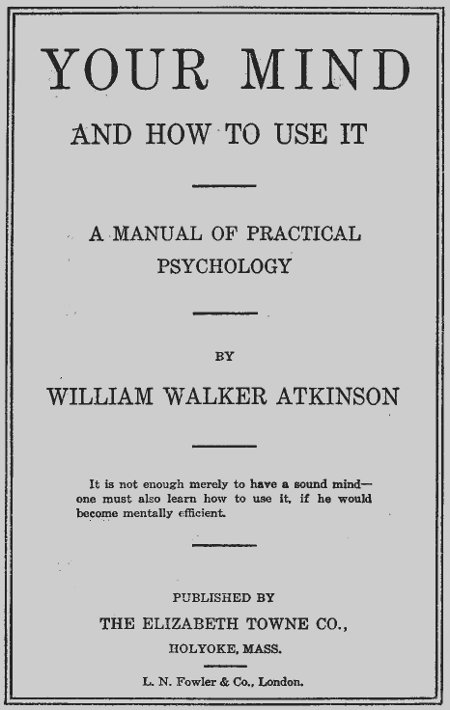
Your Mind and How to Use It
by William Walker Atkinson
★★★★★No ratings yet
Language: English
Sign in to rate this book.
Sign in to shelve this book.
About this eBook
- Author
- Atkinson, William Walker, 1862-1932
- Title
- Your Mind and How to Use It: A Manual of Practical Psychology
- Credits
- E-text prepared by sp1nd, C.M., and the Online Distributed Proofreading Team ( www.pgdp.net) from page images generously made available by Internet Archive ( archive.org)
- Language
- English
- LoC Class
- BF: Philosophy, Psychology, Religion: Psychology, Philosophy, Psychoanalysis
- Subject
- Psychology
- Category
- Text
- eBook-No.
- 42055
- Project Gutenberg
- https://www.gutenberg.org/ebooks/42055
- Release Date
- February 9, 2013
- Copyright
- Public domain in the USA.
Contents
- 1.YOUR MIND AND HOW TO USE IT
- 2.Contents.
- 3.CHAPTER I. What is the Mind? — Mind Defined. — " Think About That Which Thinks. "
- 4.CHAPTER II. The Mechanism of Mental States. — The Nerves. — The Sense of Touch. — The Sense of Sight. — The Sense of Hearing. — The Sense of Smell. — The Sense of Taste.
- 5.CHAPTER III. The Great Nerve Centers. — The Spinal Cord. — The Ganglia or "Tiny Brains." — Reflex Action. — The Three Brains. — The Cortex.
- 6.CHAPTER IV. Consciousness. — Subconscious Planes.
- 7.CHAPTER V. Attention. — Training the Attention.
- 8.CHAPTER VI. Perception. — Developing Perception.
- 9.CHAPTER VII. Memory. — Retention. — Visualization in Memory. — Perception in Memory. — Understanding and Memory.
- 10.CHAPTER VIII. Memory—Continued. — The Law of Association. — Association in Memory. — Repetition in Memory. — General Rules of Memory. — Making Impressions. — Recalling Impressions. — Final Advice.
- 11.CHAPTER IX. Imagination. — Developing the Imagination. — Imagination and Ideals.
- 12.CHAPTER X. The Feelings.
- 13.CHAPTER XI. The Emotions.
- 14.CHAPTER XII. The Instinctive Emotions. — The Instinctive Emotions.
- 15.CHAPTER XIII. The Passions.
- 16.CHAPTER XIV. The Social Emotions.
- 17.CHAPTER XV. The Religious Emotions.
- 18.CHAPTER XVI. The Aesthetic Emotions.
- 19.CHAPTER XVII. The Intellectual Emotions. — Blended Emotions.
- 20.CHAPTER XVIII. The Role of the Emotions.
- 21.CHAPTER XIX. The Emotions and Happiness.
- 22.CHAPTER XX. The Intellect. — Concepts.
- 23.CHAPTER XXI. Conception. — Perception. — Memory. — Abstraction. — Comparison. — Classification or Generalization.
- 24.CHAPTER XXII. Classes of Concepts. — Imperfect Concepts.
- 25.CHAPTER XXIII. Judgments.
- 26.CHAPTER XXIV. Primary Laws of Thought. — Fallacious Application.
- 27.CHAPTER XXV. Reasoning. — Immediate Reasoning. — Reasoning by Analogy. — Higher Forms of Reasoning.
- 28.CHAPTER XXVI. Inductive Reasoning.
- 29.CHAPTER XXVII. Deductive Reasoning. — Cultivation of Reasoning Faculties.
- 30.CHAPTER XXVIII. Fallacious Reasoning. — Fallacies. — General Rule of Inference. — Sophistical Arguments. — Fallacies of Prejudice.
- 31.CHAPTER XXIX. The Will. — (1). Desire. — (2). Deliberation. — (3). Action. — Types of Will.
- 32.CHAPTER XXX. Will-Training. — Training the Will. — Habits.
- 33.CHAPTER XXXI. Will-Tonic. — Words of the Wise.
Community reviews
Sign in to write a review.
No reviews yet.