Little Bear sat far back in the great wigwam.
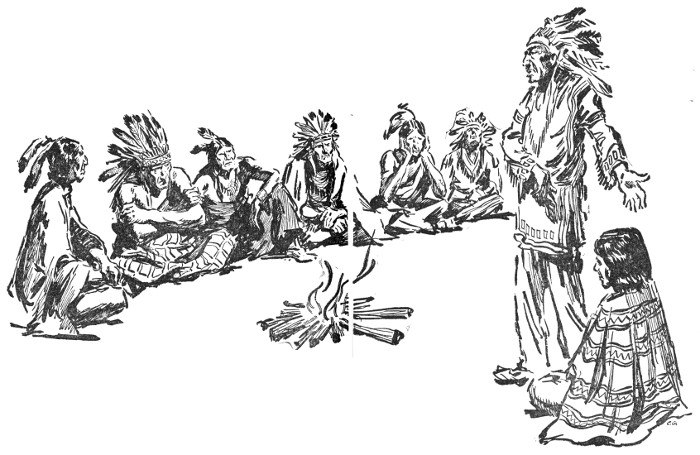
The warriors formed a circle
around the council fire in front of him. Little
Bear had listened to the long debate wishing
he dared speak. Plainly two of the older warriors
wanted this small hunting party to return
to the main Sioux camp. He bent forward
to listen as Big Buffalo, one of those two
warriors, stood up to speak.
14
“It is foolish to stay longer.” Big Buffalo
spoke slowly. “The Pawnees have driven the
buffalo from our hunting grounds. Next they
will attack this small party.”
The moment Big Buffalo sat down, Flying
Arrow leaped to his feet.
“Let’s drive the Pawnees out,” he roared.
Little Bear had to clap his hands over his
mouth to keep from shouting his approval.
With deep disappointment he saw the heads
around the circle shake in disagreement. Even
the young warriors, whom he would have
expected to approve Flying Arrow’s words,
shook their heads. Little Bear’s eyes lighted
with hope when he saw his grandfather, Great
Bear, get to his feet.
“The Pawnees on the other side of the river
are many,” Great Bear pointed out. “We are
too few to attack them. We could send to the
main camp for more warriors, but that would
take long. Yet, if we are alert, we can get meat
to take back to the main camp.”
When Great Bear sat down, Rain-Maker
got to his feet.
15
“Great Bear spoke words of wisdom,” Rain-Maker
agreed. “We can hunt buffalo on our
way back to the main camp. We may get
much meat.”
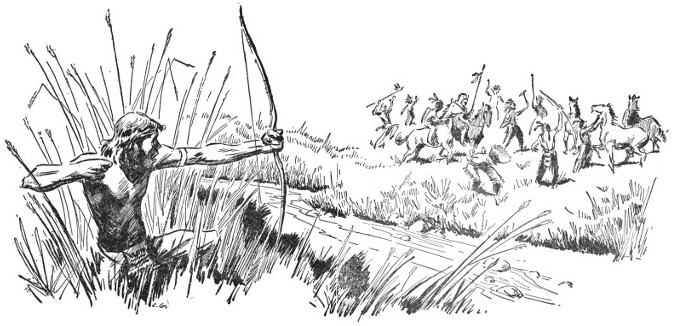
Little Bear looked expectantly at his grandfather.
He knew this wasn’t the plan Great
Bear had in his mind. The old warrior would
never suggest they should run from the Pawnees.
Little Bear expected Grandfather to
jump up and angrily deny that this was his
plan. But Grandfather made no move to get
to his feet. Instead, he waited to give others a
chance to speak.
“He meant we’d hunt buffalo here and
not run from the Pawnees.” Little Bear was
frightened when he realized he had spoken
aloud.
He drew his blanket over his head and
huddled down to make himself as small as
possible. He wanted to stand up and dash
out of the wigwam, but that would be still
worse. A Sioux boy must wait and follow the
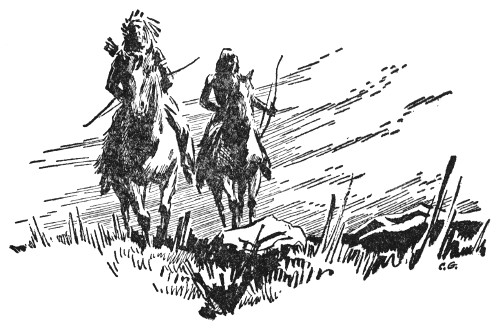
warriors. He held himself quiet. He had spoken,
in the warriors’ council without permission.
He must stay and take his punishment.
16
“The small one with the big mouth has
spoken truly.” Flying Arrow had stood and
was talking. “Great Bear would not counsel
us to run from the Pawnees.”
Little Bear hung his head in shame. He
had been called “the small one with the big
mouth.” He knew he deserved the name. It
would not have seemed quite so bad if someone
other than Flying Arrow had given it to
him.
Nevertheless from then on, the discussion
changed. There was no more talk of starting
back to the main camp without meat. The
warriors agreed the Pawnees were not likely
to attack while the Sioux were on their own
hunting grounds. They decided they would
stay and hunt buffalo. When they had enough
meat, they would start for the main camp.
Even though they were sure the Pawnees
would not attack, they decided they would
have outriders, scouts, and sentinels on every
hunting trip.
17
When the council was over, Great Bear was
among the first to leave the council wigwam.
Little Bear waited until every warrior had
stepped through the flap before he left. As
soon as he was out of the wigwam, he hurried
to catch Grandfather. His hope that Grandfather
would let him go with the warriors on
tomorrow’s hunting trip made him forget he
would be scolded for speaking in the council.
Great Bear reached his tepee before Little
Bear caught up with him. The old warrior
went into the tepee without stopping. Little
Bear knew his grandfather would want to
make medicine before tomorrow’s hunt.
There was nothing he could do except wait
outside until Grandfather came out.
Time dragged slowly. It seemed to Little
Bear the sun had stopped in the western sky
and wasn’t trying to sink to rest in the west.
At last there was a faint rustle at the flap of
the tepee. Little Bear looked up to see Great
Bear step outside. For some time Great Bear
stood looking silently at him.
18
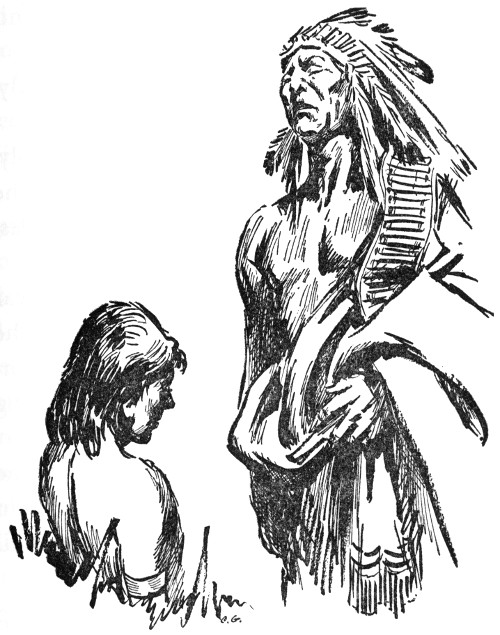
“You spoke in the council today,” Great
Bear said sternly. “It was a great honor to a
boy to be allowed to enter the council tent
with the warriors. Speaking without permission
was poor repayment of an honor.”
“I know, Grandfather.” Little Bear spoke
hesitantly with his eyes upon the ground. “I
am ashamed.”
“You earned a new name. One which will
be hard to live down.”
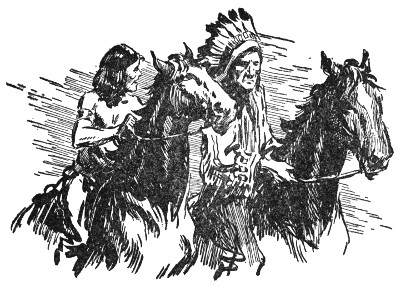
There was a hint of a smile in the old warrior’s
eyes.
“I am ashamed,” Little Bear repeated.
Without another word Grandfather turned
and reached inside the tepee. He straightened
up with a bow in his hand.
“Tomorrow you will be twelve summers,”
Great Bear told him. “It is time you learned
to use a good Sioux bow. I made this for you.”
Little Bear took the bow Grandfather held
out to him. He tried to find words to thank
his grandfather, but there was a lump in his
throat. For a terrible moment he thought he
was going to cry. Any warrior in the Sioux
camp would be proud to own a bow Great
Bear had made. He held the bow towards his
grandfather.
19
He tried to find words to thank his grandfather
20
“Keep it, Grandfather,” he said slowly,
“until I earn the right to have it.”
“Nonsense.” Great Bear spoke sharply.
“Even Sioux warriors make mistakes. The
bow is yours. Tomorrow we shall have a lesson
in its use.”
“Thank you, Grandfather.” Little Bear
smiled happily. Then he understood the
meaning of Grandfather’s words. “Tomorrow
we shall have a lesson? Aren’t we going
with the hunting party?”
“No.” Great Bear shook his head. “The
Great Spirit warned me I should stay in
camp. You and I and the two old ones will
stay while the others hunt.”
21
The next morning Little Bear was up
early. He carried his new bow as he went to
watch the hunting party leave camp. By the
time the hunters had ridden out of sight,
Little Bear was feeling less disappointed.
Grandfather was going to give him lessons
in the use of the bow. That would be almost as
good as the excitement of a buffalo hunt.
“First you and I will scout to the river to
see if any Pawnees are near,” Great Bear told
him.
Grandfather took two arrows from his
quiver and handed them to Little Bear. As he
followed his grandfather out of camp, Little
Bear felt he was almost a warrior. As soon as
they were out of camp, Great Bear moved as
carefully as he could. At each step he made
sure he didn’t tread on a stick that might
snap under his foot. Little Bear followed
carefully behind him, stepping in Grandfather’s
tracks. Instead of following the most
direct route to the river, Great Bear took
advantage of all cover.
22
When they were near the river, Great
Bear got to his hands and knees and then
stretched out on his stomach. Little Bear
needed no signal to follow his example. They
inched forward until they were near the
river’s bank. Here they lay silently watching
the opposite bank for any sign of their enemies.
A big ant crawled across Little Bear’s
shoulders, but he made no move to brush it
off. Slowly the sun climbed high in the sky,
and yet Great Bear continued to watch. Finally
he began to edge back from the river
bank. They crawled back many paces before
Great Bear got to his feet.
“The Pawnees must have moved upstream,”
he decided.
Little Bear thought of the Sioux hunting
party riding upstream on their own side of
the river.
“Shouldn’t we warn our hunters?” he
asked.
“If they have scouts ahead and a sentinel
behind as we agreed,” Grandfather explained,
“they can’t be surprised.”
23
When they were well back from the river,
Great Bear stopped. He took Little Bear’s bow
and aimed an arrow at a sapling about twenty
paces away. Little Bear watched closely. Great
Bear pulled the bow string back and let the
arrow fly. There was a sharp thud as the arrow
struck. It split the sapling in two. Grandfather
handed the bow to Little Bear.
“Put an arrow in that sapling next to the
one I hit,” he directed.
The other sapling was larger than the one
Great Bear had hit. Little Bear had used a
bow and arrow before. He had owned a small
bow as long as he could remember. This
large bow was better made than his small one
and would shoot much straighter. He fitted an
arrow to the string and aimed just as Grandfather
had done. He fired for the sapling. The
arrow whizzed past it.
“I missed,” he exclaimed disappointedly.
“That was close,” Grandfather encouraged
him. “Let’s get the arrows and you can try
again.”
24
It took some time to find the arrow Little
Bear had shot. When they did find it, he
started practicing again. Grandfather watched
him and showed him better ways of holding
the bow and taking aim. Although few of
Little Bear’s arrows hit the sapling, most of
them came close.
“Practice every time you have a chance,”
Great Bear advised. “You are doing very
well.”
The sun was almost straight overhead when
they returned to camp. Little Bear wondered
at Grandfather’s restlessness. Plainly he was
worried about something. As soon as he had
eaten, Little Bear started towards the meadow
to see about their horses. The warriors had
been sure no Pawnee would dare try to
steal horses so near a Sioux camp and they
had left no guards. Little Bear was sure the
warriors were right, but he knew Grandfather
would expect him to look anyway.
25
He climbed the low hill to the north of the
camp. From the top of it he could look down
into the small valley where the horses were
grazing. He gave a little gasp of dismay. Great
Bear’s best horse wasn’t with the rest of the
herd. Little Bear felt a tremendous relief
when a group of horses, standing close together,
moved apart and he saw Great Bear’s
horse was there after all. Next he turned his
attention to a roan colt owned by Flying
Arrow. The colt was not yet two summers old,
but he was almost large enough to begin his
training. Little Bear wanted to own that colt.
It was going to grow into a fine horse, but
Flying Arrow prized it highly, too. He would
want a tremendous price for it.
“I’m going to find a way to own that
horse,” Little Bear promised himself.
He turned back towards the camp. When
he came within sight of their tepee, he saw
that Grandfather was waiting for him. He
increased his speed.
“The horses are all right, Grandfather,”
he reported.
“Good.” Grandfather nodded. “I am glad
you went to look at them without waiting to
be told. A good warrior looks after his horse.”
Little Bear glowed with pleasure. Grandfather
was quick to scold when he did wrong,
but he was equally quick to praise when
Little Bear did well.
26
Great Bear went into the tepee to rest.
Little Bear sat outside to wait. He would
have liked to take his bow and go hunting.
However, Grandfather hadn’t told him to go.
Perhaps it would be better to wait until Great
Bear was ready to go with him.
27
He had sat in front of the tepee for some
time when he became aware of a faint drumming
sound. He listened carefully. The sound
was too faint for him to be sure, but it did seem
to be that of a horse ridden at full gallop. He
stepped away from the tepee in order to hear
better. Now the sound was quite plain.
28
Little Bear had heard no sound from the
tepee, but there was Grandfather standing
beside him. They had stood together for only
a few breaths when the rider raced into view.
“It’s Flying Antelope,” Great Bear exclaimed.
It was Flying Antelope, one of the hunters,
charging into camp as though the whole Pawnee
nation were chasing him. The other two
warriors who had stayed in camp came hurrying
towards them as Flying Antelope pulled
his horse to a sliding stop.
“The Pawnees have our hunting party cornered
in Buffalo Trap Canyon,” Flying Antelope
gasped. “I must ride to the main camp
for help.”
“It is a long journey,” Great Bear protested.
“Help will be too late.”
“It is my only chance,” Flying Antelope
insisted.
Great Bear looked at the other two warriors.
They shook their heads. They had no
other plan to offer.
“Then you must have a fresh horse,” Great
Bear decided. “Little Bear, bring one of my
horses for Flying Antelope.”
29
Almost before Great Bear had finished
speaking, Little Bear was racing up the hill
towards the meadow where the horses were
grazing. As soon as he crossed the hill, he
slowed to a walk. He didn’t want to startle
the horses. He gave a low, shrill whistle. His
own horse raised its head. When Little Bear
repeated the whistle, the horse started towards
him. He noticed that Flying Arrow’s
roan colt took a few steps towards him, and he
thought how easily the colt could be trained.
In a moment Little Bear had mounted his
own horse. It took him only a short time to
catch one of Grandfather’s horses. Then, sure
that Great Bear would want a horse for his
own use, he caught another one.
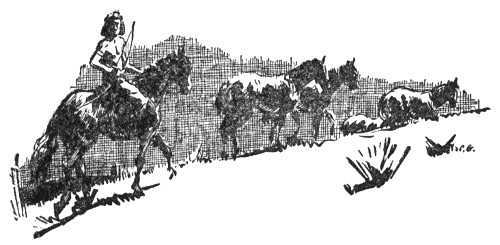
As soon as Little Bear returned to camp,
Flying Antelope mounted one of the horses
and sped out of camp.
“He will be too late,” Great Bear said, shaking
his head.
30
CHAPTER TWO
Little Bear watched silently as Grandfather
moved restlessly about the camp. He
seemed to be studying, trying to find some
plan by which he could rescue the hunters
from the Pawnees. Little Bear had decided he
might as well take the horses back to the
meadow when Grandfather spoke.
“Flying Antelope will be too late,” Great
Bear repeated. “I will ride to Buffalo Trap
Canyon. Perhaps I can find a plan to save our
warriors.”
31
Little Bear waited, hoping Grandfather
would tell him to come, too. But Great Bear
mounted his horse without another word.
“Suppose you want to send a message
back?” Little Bear asked. “You have no one
to bring it, Grandfather.”
A brief smile touched the corners of Great
Bear’s mouth.
“You were going to offer to go with me and
be my messenger?” he asked. He shook his
head. “It is too dangerous.”
“I am a Sioux.” Little Bear drew himself
up proudly. “Many times you have told me,
‘A Sioux’s first duty is to his tribe.’”
Still Great Bear hesitated. At last he
nodded.
“I can trust you to obey orders,” he agreed.
“I will have you stay behind, as much out of
danger as possible. I may need a messenger.”
32
Great Bear turned his horse to the west, and
Little Bear followed him. Little Bear wanted
to ride as fast as their horses could go. He was
afraid the Pawnees might start an attack before
he and Great Bear could get to Buffalo
Trap Canyon. But Grandfather kept his horse
at a steady, ground-eating lope. Despite his
impatience, Little Bear knew Grandfather
was right. When they reached the canyon,
their horses would not be too tired to run.
He watched anxiously as the sun climbed
across the sky. It seemed to Little Bear they
must have ridden far enough to reach the
place where the sun went to rest at night. At
last Great Bear pulled his horse to a stop in
a small valley.
“Buffalo Trap Canyon is not far ahead,”
Grandfather explained. “You watch the
horses. I will go to the top of the hill and see
what is happening.”
“And if you need a messenger, Grandfather?”
Little Bear asked.
Grandfather hesitated.
“I am old and slow,” he admitted. “We
might need speed. You follow me. If anything
happens to me, you are to run to our horses
and ride to our camp. You will wait there
until help comes from the main camp.”
33
Great Bear led the way up the hill. Near
the top he got on his hands and knees and
crawled forward. Little Bear followed his
lead. It was slow work as they had to be careful
not to make the least sound. The top of
the hill was flat with a few small trees scattered
about. It was covered with thick, dry
grass.
34
Now they had to be doubly careful. They
had to get through the dry grass without making
a sound and at the same time keep a sharp
watch for enemies. The Pawnees might be
careful enough to have a lookout on this hill.
They edged forward to the rim of the hill.
The last few yards they lay on the ground and
wriggled forward like snakes. When Little
Bear parted the grass and looked down, he
could see a small valley with a little stream
running through it. Across the stream a large
party of Pawnees was waiting at the mouth
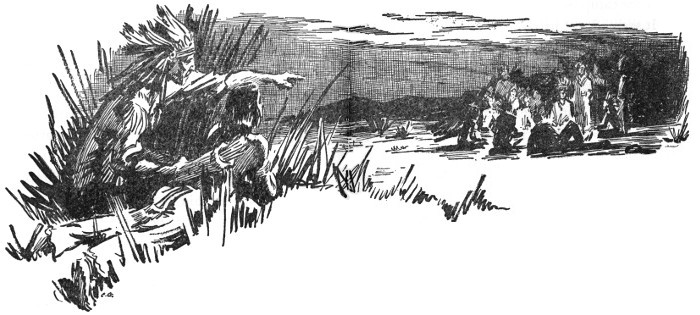
of Buffalo Trap Canyon.
“That is the only way out of Buffalo Trap
Canyon,” Great Bear whispered. “Our men
can’t escape.”
“We must help them,” Little Bear whispered
fiercely.
“What can two of us do against all those
Pawnees?” Great Bear asked hopelessly.
“Perhaps we could give the Sioux war cry,”
Little Bear suggested. “They might think a
war party was coming to help our hunters.”
“The Pawnees aren’t very smart,” Great
Bear answered, “but they are too smart to be
fooled so easily.”
35
For a time they watched the Pawnees in
silence. It soon became plain the Pawnees
were ready to go into action. Whatever the
two of them would try to do to save the
hunters, they would have to do soon. There
were four mounted warriors at the entrance
to Buffalo Trap Canyon. Now one of them
wheeled his horse and raced up to the main
group of Pawnees. He waved his bow and
shouted something to the other warriors. Immediately
they began to gather their bows
and equipment. They were ready to start
their attack!
“This isn’t a very good plan,” Little Bear
whispered, “but if I can get down this hill
without being seen, it may work.”
Quickly he outlined his plan to Great Bear.
He pointed out the tall grass next to the
stream as he spoke. Great Bear looked where
Little Bear pointed. He studied the hiding
places the hillside offered. He turned his
glance towards the Pawnees. They had hesitated
and were talking together. At last Great
Bear nodded.
36
“It might work,” he agreed. “Only I shall
go and you will stay here.”
“That wouldn’t work, Grandfather,” Little
Bear pointed out. “I am small. I can bend
over and go rapidly. If the Pawnees see the
grass moving, they will think I am some kind
of animal. Besides, if I have to run, your bow
will protect me.”
Great Bear hesitated for so long a time that
Little Bear was sure he was not going to give
his consent.
“We must try, Grandfather,” Little Bear
insisted.
“Yes.” Grandfather nodded grimly. “You
may be able to do it. Be sure your first arrow
only scares a horse. As soon as you shoot, turn
and run this way.”
37
Now that it was time for action, Little Bear
was thoroughly frightened. He could feel his
heart pounding against his ribs. It took all
of the power of his will to force his legs to
shove him forward across the rim of the hill.
The top part of the slope was almost bare of
grass. If a Pawnee warrior looked that way,
he would be sure to see Little Bear. It seemed
to Little Bear it took hours for him to wriggle
forward until he was in grass high enough to
cover him.
A bit farther on he came to grass high
enough so that he could get on his hands and
knees. Now he could go faster. As the grass
bent in front of him, he was able to watch the
Pawnees. One of them turned towards him.
Little Bear came to a complete halt, holding
his breath. The Pawnee took a step in his
direction. Little Bear could see the warrior
so plainly that it seemed impossible the warrior
would fail to see him. Another warrior spoke
to the one watching. The watcher turned towards
the speaker. Little Bear let his breath
out in a sigh of relief.
38
The warrior did not turn back towards
Little Bear. With new hope Little Bear
started forward. He kept his eyes on the Pawnees
and was not able to watch where he put
his hands and knees. Sharp stones cut into
his hands and through his leggings. He saw
the warriors were ready to start for their
horses. He moved ahead more rapidly.
39
When he reached the grass at the side of
the stream, he found it wasn’t as high as it
had looked from the top of the hill. He didn’t
dare stand erect. He fitted an arrow to his
bow and, still kneeling, took careful aim. The
Pawnees were moving towards their horses.
They were sure to see the arrow and mark the
spot from which it came. This first one had
to be exactly right. There would be no chance
to fire a second one. Little Bear drew the bow
back and let the arrow fly.
40
It was an almost perfect shot. The arrow
scraped across the back of one of the Pawnee
horses, just enough to hurt and frighten it.
The horse gave a squeal of terror and lunged
forward. Instantly the whole herd of horses
stampeded.
The Pawnees had seen the arrow almost
the moment it left Little Bear’s bow. Two of
them whirled towards him, drawing their bow
strings back as they turned. One of them sent
an arrow flying towards Little Bear, but before
the other one could shoot, an arrow from
the top of the hill knocked him to the ground.
For a moment the Pawnees were in complete
confusion. Little Bear sent an arrow
towards them and then slipped downstream
in the tall grass. He moved so carefully that the
Pawnees could not tell he had left his hiding
place. Arrows struck where he had been hiding
moments before. He lay quiet, hoping
they would think that they had hit him.
41
He raised his head enough to get a look at
the war party. Their leader had taken charge.
He had called the mounted men from the
entrance to Buffalo Trap Canyon and sent
them after the horses. Two warriors were
starting up the hill towards Great Bear and
two more were coming towards Little Bear.
The rest of the party were running to try to
help recapture their horses.
Little Bear hesitated only a moment. He
knew he would have no chance against two
Pawnee warriors. If the Sioux warriors would
come charging out of the canyon while the
Pawnees were scattered, all of them could
escape. But evidently the Pawnees had kept
the hunters so far back in the canyon that they
couldn’t see what was going on outside. Little
Bear knew there was only one chance for him
to escape. He leaped to his feet giving the
Sioux war cry.
42
The two Pawnees, taken by surprise, hesitated.
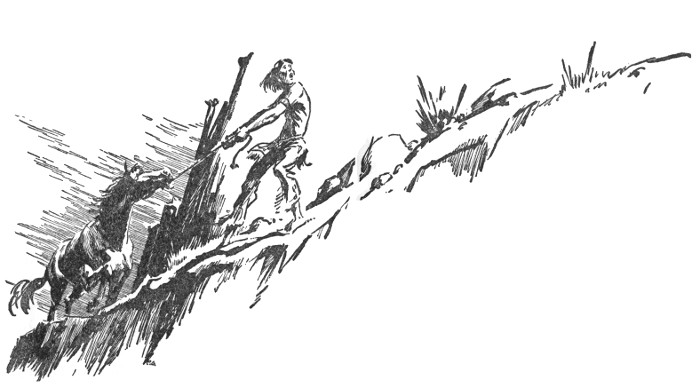
Little Bear turned and started running
up the steep hill. He heard Great Bear echo
the war cry. Then he gave all of his attention
to escaping his pursuers. He ran in a zig-zag
course to make it harder for them to hit
him. He saw Great Bear stand and saw his
arrow come whizzing by. There was a cry
behind him. Great Bear had stopped one of
the pursuers.
Little Bear risked a backward glance. Great
Bear’s arrow had knocked down one of
the Pawnees. The other warrior was bending
over the one on the ground. The two warriors
who had been going towards Great Bear had
stopped. Both of them were sighting arrows
towards Great Bear. Little Bear gave a warning
cry, but Great Bear was too slow. Little
Bear saw the Pawnee’s arrow strike and Great
Bear crumple to the ground. Little Bear
stopped and turned towards the Pawnees. But
their leader had seen the danger of the Sioux
hunters charging from the canyon. He was
roaring orders at the Pawnee warriors. The
two who had started towards Great Bear
turned back. They went over and helped
carry the warrior Great Bear had hit.
43
The Pawnees, who were afoot, formed a
compact squad and moved away from the canyon
mouth. At first they moved slowly, but
when Little Bear again raised the Sioux war
cry, they broke into a run. Little Bear didn’t
wait to see if the hunters came out of the
canyon to pursue the Pawnees. He turned and
dashed up the hill to Great Bear.
As Little Bear ran up to him, Great Bear
was just struggling to a sitting position. The
Pawnee arrow had grazed the side of his head.
It had made a deep cut in the skin, which was
bleeding badly. Little Bear examined the cut
quickly.
“I’m all right,” Great Bear assured him.
“It just knocked me down.”
He got to his feet. Little Bear again gave
the Sioux war cry, and Great Bear joined him.
They saw a Sioux warrior carefully edge out
of the entrance to the canyon. Both of them
waved at the warrior. He saw them and returned
the signal. Then he darted back into
the canyon. A few minutes later the whole
Sioux hunting party charged out of the canyon.
They crossed the stream and raced towards
Little Bear and his grandfather.
44
When the hunters were safely on top of the
hill, all of them turned to look towards the
Pawnees. It was plain that the stampeded
horses had not yet been caught. A rider had
come back to get the wounded warriors. The
others were still plodding away from the canyon.
“They won’t be back,” Big Buffalo stated.
“What became of their horses?” Flying
Arrow asked.
“Stampeded,” Great Bear answered. “Big
Buffalo is right. By the time they catch their
horses, they won’t want any more fighting.”
“You have saved our lives, Great Bear,”
Flying Arrow said.
“Not I,” Great Bear answered quickly.
“Little Bear stampeded their horses.”
Flying Arrow turned to Little Bear.
“In the council I said you had a big
mouth.” He spoke slowly and gravely. “Now
I say I was wrong. You shoot well. You have
a strong right arm.”
There were grunts of approval from the
other warriors. Flying Arrow held up his
hand for silence.
45
“Since you have saved my life,” he went
on, “I want to give you a present. I know
you want my roan colt. He is yours.”
Little Bear gave a choked gasp of pleasure.
He had the bow Grandfather had made for
him and now the young horse he wanted. He
searched his mind for words with which to
thank Flying Arrow. His glance moved to his
grandfather. Great Bear was watching him
intently. There was some question in Grandfather’s
sober eyes, but Little Bear couldn’t
decide what it was. He wished he could ask
Grandfather. Then he remembered something
Great Bear had told him about when it
was proper to accept gifts from friends. Slowly
he turned towards Flying Arrow.
“I thank you.” He spoke as gravely as Flying
Arrow had. “I cannot accept my friend’s
horse for doing what any Sioux should do.
But if my friend should care to give me something
he has made with his own hands, I
would treasure it.”
46
A chorus of approval ran around the circle
of warriors. Little Bear saw the pleased
look on Great Bear’s face. He heard one of
the warriors say, “Spoken like a Sioux warrior.”
Flying Arrow smiled at him.
“Sometime I will repay you, Little Bear,”
he promised. “I see Great Bear has made you
a bow. Take this quiver I made. May it always
hold arrows that fly true!”
Flying Arrow took his quiver from around
his neck. He tied his arrows with a thong and
handed the quiver to Little Bear. It was a
beautiful piece of leather. On it, Flying
Arrow had carved a warrior chasing a buffalo.
He had worked the top with beads. As soon
as Flying Arrow had handed Little Bear
the quiver, each of the warriors selected his
straightest arrow and put it in the quiver.
As Little Bear was trying to find the right
words to express his thanks, Flying Arrow
glanced towards Great Bear.
“We must have buffalo fat for Great Bear’s
wound,” the warrior said. “Bring one of the
fat young buffalo we killed.”
47
“That was a large party of Pawnees,” Rain-Maker
reminded him. “They may come back
to attack us.”
“I don’t believe they will,” Flying Arrow
answered. “However, the wind is blowing
from the north. When you get across the
stream, set the grass afire. They will have to
flee from a prairie fire.”
Rain-Maker and another young warrior
mounted horses and rode towards Buffalo
Trap Canyon. As soon as they were across
the stream, they stopped and set the grass
afire. Then they raced into the canyon to be
out of the path of the fire. When they returned,
they were carrying the meat they had
taken from the carcass of a young buffalo.
Some of the hunters had built a fire. While
Flying Arrow tied buffalo fat across Great
Bear’s wound, others cooked meat for their
meal. Little Bear stood and watched the fire
Rain-Maker and his companion had started.
It had already burned across the valley below
and was sweeping over the hill. Any Pawnees
in front of it would have to run for their lives.
48
As soon as they had eaten, the hunters
returned to Buffalo Trap Canyon. They removed
the meat from the buffaloes they had
slain, wrapped it in buffalo hides, and loaded
it on the extra horses. When the party was
ready to leave, two young warriors were sent
ahead. They were to ride in front and stop
any war party that might be coming from the
main Sioux camp. There was no longer any
danger from the Pawnees.
The sun was down and it was almost dark
when the party rode into camp. The warriors
dismounted and unloaded the meat from the
pack horses. Then Little Bear drove all of
the horses across the hill to the meadow. At
the top of the hill he dismounted and let his
own horse go with the others.
He hurried back to Grandfather’s tepee
and crawled into his blankets. Soon he was
fast asleep, dreaming he was training the roan
colt Flying Arrow had wanted to give him.
49
CHAPTER THREE
Little Bear was out of the tepee the next
morning before the sun had started up
the eastern sky. Early as he was, Great Bear
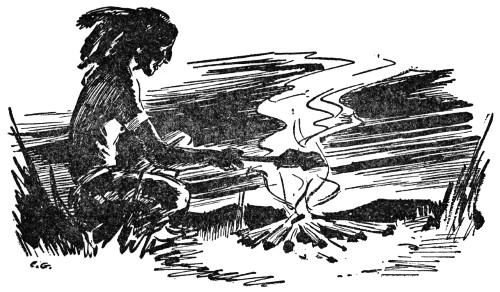
was already broiling buffalo steaks over a low
fire.
“You are early this morning, Grandfather,”
Little Bear greeted him.
“It seemed the Great Spirit was trying
to warn me,” Great Bear explained. “He
wouldn’t let me sleep. I feel there is danger.”
50
Little Bear had no thought of laughing at
his grandfather. Many times Grandfather had
thought the Great Spirit was trying to warn
him of danger, and danger had appeared soon
afterwards. No, if Great Bear was afraid of
danger, danger must be near.
“Bring me a horse,” Great Bear ordered.
“I’ll make a scouting trip before the others
are ready to break camp.”
“Have our hunters decided to return to the
main camp?” Little Bear asked.
51
“It is time for Old-Man-of-the-North to
send snow,” Great Bear answered. “We will
join the other Sioux and move with them to
the winter camp.”
Little Bear opened his mouth to make a
request, but thought better of it and remained
silent. Grandfather noticed his hesitation.
“Bring your horse, too.” He smiled. “You
may as well learn about scouting. Besides, you
were a great help yesterday.”
Little Bear looked at the wound on the side
of Great Bear’s head. Great Bear had removed
the bandage. The wound had healed remarkably
overnight and now seemed only a deep
scratch.
“Your wound is healing well,” Little Bear
said.
“It was just a scratch.” Great Bear snorted.
“Off with you.”
52
Little Bear didn’t want Grandfather to
change his mind about the scouting trip.
He turned and hurried away towards the
meadow. As usual, when he came within sight
of the horses, Little Bear slowed to a walk.
As he neared the herd, he gave that low
whistle.
He knew at once something was wrong. He
saw his own horse lift its head and look towards
him. He repeated the whistle, still looking
carefully at the herd. He was sure some
of the horses were gone. He gave a gasp of
dismay. Flying Arrow’s roan colt was gone.
Impatiently he whistled again. His horse left
the herd and trotted towards him. As he was
waiting for his own horse, Little Bear saw the
roan colt come out of the brush to the west
and join the rest of the herd. At least it wasn’t
gone.
He mounted his horse and rode into the
herd. He had been right. Some of the horses
were gone. Grandfather’s best buffalo horse,
the black one, wasn’t there. Flying Arrow’s
Blazed Face and some of the other horses were
missing, too. He turned his horse and rode
around the herd to the place where he had seen
the colt coming out of the underbrush. There
he found tracks leading from the meadow.
53
Little Bear was careful to keep his horse
away from the trail the other horses had left.
If the horses had been stolen, he wanted to
leave all possible signs for the trackers to
read. He followed the trail some distance,
but he didn’t find the missing horses. He
pulled his horse to a stop and sat motionless,
trying to decide what to do. If the
horses had merely wandered from the herd,
the sooner he hunted for them, the easier it
would be to find them. But it didn’t seem
likely that a few of the horses had wandered
off and the others remained. Far more likely
the missing ones had been stolen. He should
notify Great Bear and the other warriors at
once.
He swung his horse around and rode back
to the herd. It would save time if he brought
the horses into camp for the warriors. He
drove most of the herd ahead of him into
camp. Grandfather and several other warriors
heard him coming. They were waiting for him
beside Great Bear’s tepee.
“Some of our horses were stolen during the
night,” Little Bear reported.
54
“The Pawnees wouldn’t dare,” Red Cloud
growled. “The horses have strayed away.”
“I hunted for them,” Little Bear explained.
“Their trail showed they had gone
fast. If they had strayed, they would have
stopped often to graze.”
“The Pawnees had their lesson yesterday,”
Red Cloud insisted. “They wouldn’t dare
come back that close to our camp.”
“Others besides Pawnees like Sioux ponies,”
Great Bear observed.
The warriors looked questioningly at Great
Bear.
“Crows steal Sioux horses, too,” he explained.
Flying Arrow nodded excitedly. “Let’s follow
their trail and get our horses back,” he
exclaimed.
“It may not be so easy,” Great Bear
warned. “Whoever stole our horses has a long
start. Perhaps he was careful to leave a poor
trail. Little Bear, take us to the trail.”
55
Little Bear led the way back to the place
where he had found the trail. The other warriors
waited while Great Bear got down and
examined the tracks. He studied them carefully.
At last he turned to the other warriors.
“It was a Crow,” he told them, “and only
one. He got our horses soon after our camp
went to sleep. He has almost a sun’s start on
us, and you may be sure he will try to hide
his trail as soon as he is away from our camp.”
“We must follow at once,” Flying Arrow
insisted. “We won’t let him steal our horses.”
“Some of us must stay and guard the meat,”
Red Cloud objected. “The chiefs will be expecting
us to bring it to the main camp.”
“The chiefs will be angry if we delay the
tribe’s start to winter camping grounds,”
Limping Fox warned. “It will not be long
until Old-Man-of-the-North sends snow flying.”
“Red Cloud and Limping Fox have spoken
wisely,” Great Bear agreed. “We must take
our meat to the main tribe at once, but I will
not lose my horses to a thieving Crow. While
the rest of you return to camp, I will go after
the horses.”
56
“You should not go alone,” Flying Arrow
protested. “I will go with you.”
“The chiefs put you in charge of this hunting
party,” Great Bear reminded him. “You
must return with it.”
“That is true,” Flying Arrow admitted.
“Still, you should not go alone.”
“I will go with Grandfather,” Little Bear
offered.
“Why of course,” Great Bear exclaimed. “I
should have thought of that. Little Bear has
proved himself dependable.”
None of the warriors offered a protest. If
any of them thought a boy would be small
help on so dangerous an errand, they didn’t
say so. The party rode back into camp where
Great Bear busied himself gathering the
things they would take with them. When
he had finished, there were only two small
bundles.
“We can travel faster if we travel light,”
he explained. “We will find our food as we
need it.”
57
Despite their haste, the sun was almost
overhead when they reached the trail again.
Great Bear took the lead and Little Bear followed
behind. They went rapidly, as whoever
had stolen the horses had made no attempt
to hide his trail. They had not gone
far before Little Bear realized the trail was
leading straight towards Buffalo Trap Canyon.
He could see Grandfather was troubled
because the trail was running so straight and
was so well marked.
When they came to the stream that ran
through the valley in front of the entrance to
Buffalo Trap Canyon, Little Bear saw why
Grandfather had been troubled by the plain
trail. The trail led straight across the stream
into the place where the grass had been
burned off. Here it became a maze of criss-crossing
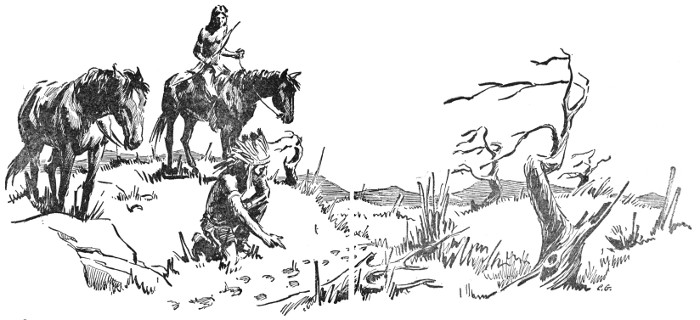
tracks. Great Bear dismounted and
carefully studied the marks. Little Bear
jumped from his horse and looked, too. The
tracks completely puzzled him.
58
“He led the horses in and out of the stream
so that we wouldn’t know whether to look upstream
or downstream for his trail,” Great
Bear explained.
He led Little Bear along the trail upstream.
There were many places where the horses had
been led into the stream and back out again.
They returned to the stream they had followed
and went downstream. It was the same
here. The horses had been led in and out of
the water so many times it was impossible
to tell whether they had finally gone upstream
or down.
“He is clever,” Great Bear admitted grudgingly.
“We shall have to search upstream and
downstream to find which way he really
went.”
Little Bear looked over the valley where
yesterday’s fire had burned off the grass.
“Perhaps it wouldn’t make any difference
whether he went upstream or downstream,”
Little Bear suggested. “I think he would
circle around and get on the trail the Pawnees
made when they ran yesterday. He would
think we couldn’t find his trail there.”
59
Great Bear gave him a surprised look.
“Very good,” he praised. “Of course that is
what he would do. When we find the Pawnees’
trail, we shall find his, too.”
Where the fire had burned, it had covered
all traces of the Pawnees’ tracks. But Great
Bear judged the Pawnees would ride out of
the path of the fire as quickly as possible. He
led the way out of that valley and into the
next one. The fire had burned over this one,
too, but had not gone very high on the hills
that formed the south boundary of it. Great
Bear led the way in that direction.
Little Bear anxiously watched the sun. It
was dropping to the ground rapidly. It
seemed to be trying to hide its light so that they
would have more trouble finding the Crow.
From the time he and Great Bear had started
on the trail, he had known they couldn’t find
the horses before night. Still, he had hoped
they could at least find the Pawnees’ trail
before darkness fell. Suddenly Great Bear
stopped his horse.
60
“Here is the Pawnee trail,” he pointed out.
“The Crow didn’t ride along it here, but I
think you are right. In the morning we shall
find his trail, too.”
They rode across the next ridge of hills and
down into another small valley. Here the
grass was tall and a small spring gurgled up.
Little Bear hobbled their horses while Grandfather
got out cold meat for their supper.
“We’ll have no fire tonight,” Grandfather
told him.
While they were eating, Grandfather explained
to Little Bear that the Crow warrior
must have seen the Sioux escape from the
Pawnee trap. The Crow would know the
Sioux would feel safe after the Pawnees had
fled. He would guess they wouldn’t have a
guard watching their horses. It would give
him a good chance to make a raid.
“He would go towards the land of the setting
sun, wouldn’t he?” Little Bear asked.
Grandfather nodded.
61
“He would circle around and get onto the
Pawnees’ trail. He would follow it until he
was sure we had given up trailing him. Then
he would turn directly towards the land of
the setting sun,” Great Bear judged.
As soon as he had finished eating, Little
Bear rolled himself up in his buffalo robe and
quickly fell asleep. He was awakened during
the night by the sounds of the horses moving
about. He sat up quickly. Then he remembered
the horses were not used to hobbles.
They were making so much noise because
they were moving awkwardly. He rolled himself
in his robe again and fell asleep.
Morning light was showing only faintly in
the east when Grandfather awakened him.
Little Bear rolled his robe into a bundle and
tied it on his horse. He accepted the food
Grandfather gave him and munched it as they
rode towards the Pawnees’ trail. When they
reached the trail, Grandfather rode to the left
of it and motioned for Little Bear to ride to
the right.
62
63
Little Bear would have liked to let his
horse go racing along the trail. He was sure
the Crow was speeding away with the stolen
horses while they were following slowly,
searching for his trail. But he knew they
couldn’t find the Crow’s trail unless they went
slowly. The farther they rode, the surer Little
Bear became that his idea had been wrong.
The Crow wouldn’t have circled that far
before getting on the Pawnees’ trail. He
looked across at Great Bear. How much
farther would Grandfather ride before he
gave up and turned back to search for the
Crow’s trail at the stream?
64
Then Grandfather called to him softly.
“Here’s where he rode into the Pawnees’
trail.”
Little Bear turned his horse to Grandfather’s
side of the trail. The grass was bent
down, and there were plain tracks where the
rider had brought his horses into the trail.
Grandfather dismounted and studied the
tracks.
“One horse has a bad stone bruise,” he
pointed out. “See how light the foot print is.
That horse is limping.”
Little Bear dismounted and bent over the
tracks. He could see that one hoof had not
cut as deeply as the others.
“We should soon catch him,” he exclaimed.
“We have lost much time finding the trail,”
Great Bear reminded him. “He is far ahead
and today we must find game. Our food is
gone.”
He smiled at Little Bear’s look of disappointment.
“Never fear,” he promised. “We will catch
him and get our horses.”
65
CHAPTER FOUR
Grandfather’s words warned Little Bear
the chase was going to be much longer
than they had planned. If there were hope
of catching the thief before another sunrise,
Grandfather wouldn’t stop to find food. He
began to worry that a storm might erase the
trail, or that the warrior would get back to
the land of the Crows, where he would have
friends to help him and it would be too
dangerous for them to follow.
66
Now that they were sure they were on the
trail of the Crow, Grandfather increased the
pace to an easy lope. It was a pace the horses
could keep up all day. It would carry them
over a great distance. The Pawnees’ trail led
almost due west so that there was no need to
watch for a place where the Crow had left it.
He was sure to stay on it as long as it went in
that direction. The sun was almost straight
overhead when they came to a small stream.
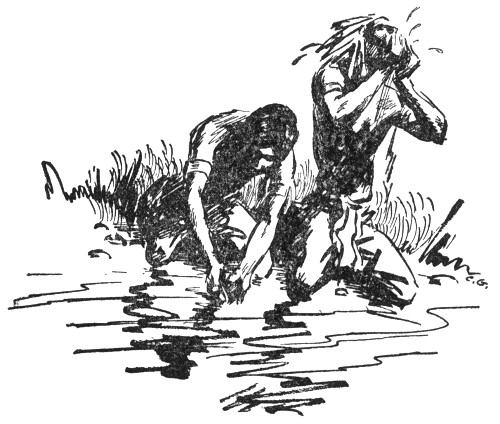
Both Grandfather and Little Bear knelt and
drank the clear, cool water. They let the horses
drink their fill, too.
Grandfather and Little Bear sprawled in
the sun while they allowed the horses to graze.
Little Bear was very hungry, but he made no
complaint.
“This afternoon we will get a buffalo,”
Great Bear announced.
“Food will be good,” Little Bear agreed.
67
After a short rest, they started on the trail
again. It led them across a shallow, sandy
stream, wider than any they had crossed before.
They had ridden about an hour after
crossing the stream when the trail turned
sharply to the left. Great Bear kept his horse
to the right side of the trail and motioned
for Little Bear to follow behind him. Both
watched to the right. It was certain the Crow
would not follow the trail far in this direction,
and when he turned off, he would turn
to the right and go west. After a time Great
Bear slowed his horse to a walk.
68
“He wouldn’t have followed the Pawnees’
trail much farther,” Grandfather said uneasily.
“We must be sure we don’t lose his
trail. If we do, we’ll lose more time.”
Both of them watched the trail carefully.
The grass on both sides was tall and dry. Five
or six horses, turning out of the trail, would
leave a track that could easily be seen. Yet
they went on and on without finding a sign
that any horses had turned out of the trail.
Finally Great Bear stopped his horse and dismounted.
He bent over the trail and studied
it carefully.
“There is no sign of a limping horse,” he
said.
“The warrior could have the lame horse
at the front of the line so that the others would
walk over his tracks and hide them,” Little
Bear suggested.
“He could,” Great Bear agreed, “but I
don’t think he would. He’s probably sure no
one is following him and the lame horse
would travel better at the end of the line.”
69
“Grandfather,” Little Bear exclaimed in
dismay. “Do you remember that wide, sandy
stream we crossed far back there?”
Little Bear almost had to laugh at the disappointed
look on Great Bear’s face.
“Of course,” Great Bear moaned. “The
stream is wide enough so that the Crow could
lead his horses up it and hide his trail. That
is where he turned off.”
He and Little Bear turned their horses
back the way they had come. Now they rode
at a headlong pace, as though trying to recapture
the time they had lost. When they
came to the river, Great Bear turned upstream.
Both Grandfather and Little Bear
rode slowly along the bank, watching for the
place where the Crow had left the stream.
They had gone so far that Little Bear was wondering
if they had been wrong, when Grandfather
stopped his horse and pointed. There
was the trail the horses had left as the Crow
brought them out of the water.
70
The plainly marked trail led straight west.
No one could have hidden a trail made by
several horses in that dry grass.
“It is nearing time for the sun to go to
rest,” Grandfather said after they had followed
the trail some distance. “We must get
a buffalo for our food.”
Great Bear kept a careful watch to each
side. Little Bear was puzzled by the old warrior’s
carefulness. Finally Great Bear stopped
by a tree-lined stream.
“I have been watching for signs of buffalo,”
Great Bear explained. “I am sure there are
buffalo near. You gather wood while I go to
the top of that hill to the north.”
Great Bear left his horse with Little Bear
and set off on foot for the top of the hill.
While Grandfather was gone, Little Bear
searched for wood. He picked up only sticks
which were thoroughly dry. These would
make a hot fire, but would give off very little
smoke or flame. An enemy would have to be
close to find a fire built with such wood.
Great Bear soon returned.
71
“There is a big herd of buffalo in the valley
across the hill,” he told Little Bear, “but I
am afraid we don’t dare shoot one of them.”
“Why?” Little Bear asked anxiously.
“The hills to the north of the herd are high
and steep,” Great Bear explained. “When
we ride towards the herd, the buffaloes will
run to the west. If they run far, their dust
and noise will warn the Crow someone is
following him.”
“Couldn’t we ride to the west and come
towards the herd from that direction?” Little
Bear suggested.
“Of course not,” Great Bear answered
sharply. “The wind blows from that direction.
The buffaloes would catch our scent
long before we were near them.”
Little Bear was ashamed of the question
he had asked. He should have remembered
the wind would carry the scent of anyone
to the west of the herd.
72
“I could ride to the setting sun and start
the buffaloes running this way,” Little Bear
proposed. “You could ride from this direction
and shoot a buffalo for us.”
“That plan might work,” Grandfather
agreed. “However, the one riding from the
west would need to know how close he dared
ride and how fast. Only an experienced
hunter would know that.”
“Perhaps you could circle the herd and I
could shoot a buffalo for us,” Little Bear
suggested.
“It is our best chance,” Great Bear agreed.
“We shall try it.”
Grandfather gave Little Bear careful instructions
as to how long he should wait
before crossing the hill and just how he was
to shoot a buffalo when he rode into the herd.
“Shoot the first fat calf you can,” Great
Bear instructed. “Then wait for me.”
After Grandfather had left to circle to the
west of the herd, Little Bear checked his
arrows. Two of them were not quite true.
These he laid near the wood he had gathered
for the fire. Then he mounted his horse and
rode halfway up the hill. He dismounted
and tied his horse to a shrub.
73
On foot, Little Bear went forward slowly
and carefully. Halfway from his horse to the
top of the hill, he dropped to his hands and
knees and crawled forward. Near the top of
the hill he lay on his stomach and squirmed
ahead. When he reached the top of the hill,
he slowly raised his head and looked into the
valley below him.
It was a much larger valley than any they
had crossed that day. The hill on which he
was lying sloped gently down to the valley
floor. There were so many buffaloes in the
valley that trying to count them would be
like trying to count the sands on a river bank.
Many of the buffaloes were grazing. A few
young ones were scuffling. Not far from Little
Bear an old bull buffalo was rolling on the
ground. There were many buffalo cows with
calves at their sides. Little Bear picked out
one large, fat calf as the one he would shoot
for their food.
74
He waited patiently for the signs Great
Bear had told him the buffaloes would make
when they caught the first faint trace of man
scent. He saw a cow, far out in the valley, lift
her head and sniff to the west. Another cow
did the same. This was the sign they were
catching a trace of Great Bear’s scent. Little
Bear slid back a few paces, jumped up, and
ran to his horse.
75
Little Bear’s horse pulled excitedly at its
rope. Grandfather had used that horse as his
buffalo-hunting horse before he gave it to
Little Bear. It had caught the scent of buffalo
and was as excited about taking part in the
chase as Little Bear was. The moment Little
Bear untied the horse and jumped on its
back, it sped off like an arrow shot from a
bow.
76
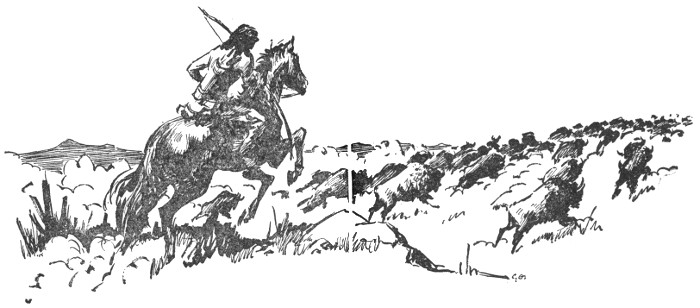
When horse and rider charged over the
hill, the bull buffalo that had been rolling
on the ground scrambled awkwardly to his
feet. The buffaloes nearest Little Bear pushed
forward. In a matter of moments the whole
herd was running. The cows and calves
moved to the front while the bulls ran clumsily
at the rear of the herd.
Little Bear spied the calf he had selected.
By the pressure of his knees against the horse’s
side, he guided it towards the calf. Two bulls,
running side by side, were in the way. The
horse raced straight towards them. The bulls
floundered aside and the horse sped between
them.
Nearer and nearer to the calf the racing
horse carried its rider. Little Bear fixed an
arrow to his bow. As his horse brought him
alongside of the calf, Little Bear let the arrow
fly. It struck the calf in the foreleg, but the
calf didn’t even waver in its stride. Little Bear
fitted another arrow to his bow. He pressed
his knees tightly against the horse’s side and
leaned far over towards the calf. He took
careful aim for the spot just back of the calf’s
foreleg, as Great Bear had told him to do.
He drew the bow string back with all of his
strength and let the arrow fly. It flew straight
to the mark. The calf lunged forward and
fell to the ground.
77
Little Bear pulled his excited horse to a
stop and turned back to the calf. The buffaloes
that had been behind swerved to the
side and raced on. Little Bear saw the herd
veer from the west and make for the steep
hills at the north end of the valley. After a
time Great Bear rode into sight from the west.
The buffaloes soon slowed their speed.
Little Bear had heard warriors tell that buffaloes
couldn’t see very far. This herd soon
proved the truth of the warriors’ statement.
As soon as the buffaloes had run far enough
to lose Great Bear’s scent, they stopped. The
plan had worked. Even if the buffalo herd
was near the Crow who had stolen the Sioux
horses, it had not run far enough to alarm
him.
78
Grandfather pulled his horse to a stop
beside Little Bear. He glanced down at the
buffalo calf.
“Good,” he praised. “Not many hunters
are able to get their first buffalo with only two
arrows.”
Little Bear helped his grandfather skin and
butcher the buffalo. Despite the fact that they
wanted to travel light, Great Bear insisted
that they save the buffalo hide.
“A hunter should save the hide of his first
buffalo,” he said.
They returned to the spot they had selected
for their camp. Great Bear examined the
sticks Little Bear had collected for their fire.
He nodded approval. He was very careful as
he started the fire to make sure he didn’t put
too much fuel on at once. He wanted no tell-tale
smoke rising from the flames. He did so
well that Little Bear could see no smoke
rising from the fire when he was only a few
paces away.
79
“Grandfather?” Little Bear questioned as
they were eating their supper. “If we get
Flying Arrow’s horses back for him, would
it be right for me to accept the roan colt as
a reward?”
“It would be.” Grandfather nodded. “The
Sioux law is that horses which have been
stolen and are not recovered within three
days belong to whoever recaptures them
later.”
“When we find that Crow,” Little Bear
went on, “will you let me help recapture the
horses?”
“You are anxious to have that roan colt,
aren’t you?” Great Bear smiled.
“He will grow up to be a fine horse,” Little
Bear replied. “Will you let me help capture
the horses?”
“No matter which of us takes the horses,”
Great Bear explained, “they will belong
equally to each of us. Each is doing his part
to get them.”
80
They sat together in silence as the fire died
down. Little Bear was thinking of what a
good horse he could train that roan colt to be.
The horse he had now was the best trained in
the whole Sioux camp, and it had been almost
too old to train when Grandfather gave it to
him. If he had the colt to train, he could do
still better.
“The Great Spirit does not help us much,”
Great Bear said after they had sat in silence
for some time.
“The Crow has strong medicine,” Little
Bear agreed. “His trail is hard to follow.”
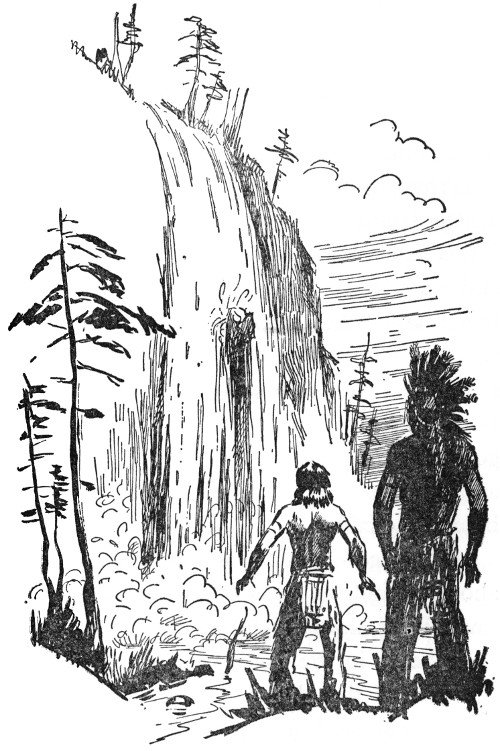
“We are nearing the place of water-that-falls,”
Great Bear told him. “If we are not
near the Crow tomorrow when the sun sinks,
we will turn aside. I shall go to the falls and
listen for a message from the Great Spirit.”
“May I try to get a message from the Great
Spirit, too?” Little Bear requested. “I should
like to find medicine which will make sure
that I get the roan colt.”
“You may try for a vision,” Great Bear
agreed. “Spirit-of-Water-That-Falls may have
a message for you. Now go to sleep. In the
morning we start early.”
81
Obediently Little Bear curled up in his
robe. The last thing he saw as he pulled the
robe over his head was the hide of the buffalo
he had shot. Grandfather had hung it over
a large bush. Little Bear dropped off to sleep,
dreaming he was mounted on a big roan horse
and chasing the whole Crow tribe ahead of
him.
82
CHAPTER FIVE
The light of the tiny fire Great Bear had
kindled awakened Little Bear the next
morning. Grandfather had meat cooked for
their meal. As soon as they had finished eating,
Great Bear cooked all of the meat that
was left.
“When we get near the Crow, we won’t
dare start a fire,” he explained.
83
They lost little time getting started. Great
Bear packed the cooked meat in one bundle
and tied it on his horse. The buffalo hide was
added to Little Bear’s pack. They pushed
their horses as fast as they dared. Little Bear
watched the trail left by the Crow. He was
disappointed to see it was getting no fresher.
Their enemy was traveling as fast as they
were.
Their rest at noon was brief. When they
started on again, Little Bear noticed Grandfather
was constantly looking towards the
northwest. As the afternoon wore on, the old
warrior showed more and more anxiety. Little
Bear noticed a bank of rain clouds in the
northwest, but it was odd for Great Bear to
worry about so small a thing as a soaking by
a rainstorm.
“Why do the clouds trouble you, Grandfather?”
Little Bear asked.
“I have the feeling of bad weather,” Great
Bear replied. “These canyons are dangerous
places when Old-Man-of-the-Sky dumps much
water.”
84
They had left the wide flat valleys and were
riding through narrow canyons with steep
sides. There were many openings leading
into these canyons. Little Bear wondered if
Grandfather could find his way if there were
no trail to follow. Probably he could. He
seemed to know where they were. Little Bear
had been thinking how easy it would be for
the Crow to hide his horse in one of the
canyons leading from the one they were in.
He could wait for them and easily ambush
them. He hadn’t thought at all of the danger
of a heavy rain sending water roaring down
the narrow canyon. Now that Grandfather
had mentioned his fears, Little Bear remembered
tales of warriors who had been caught
in sudden floods and drowned.
85
He heard the faint roll of distant thunder.
Soon the sound came nearer and became an
almost continuous rumble. Little Bear saw a
fork of lightning streak across the clouds.
“We must get to higher ground,” Great
Bear warned. “Watch for a way out of this
canyon.”
86
They urged their horses to a faster pace.
The sound of thunder was no longer a distant
rumble, but had become a crashing roar. Old-Man-of-the-Sky
was throwing his lightning
bolts all around them. Great Bear halted at
a place where it seemed it might be possible
for the horses to climb the canyon wall. He
jumped from his horse and grabbed the halter
rope. It was a steep slope and the ground was
loose, giving the horse poor footing. With
Great Bear pulling at the rope, the horse
slowly struggled up the bank. Little Bear
waited until Great Bear had his horse halfway
up before he started to follow. Both
horses slipped and struggled, but slowly
fought their way ahead.
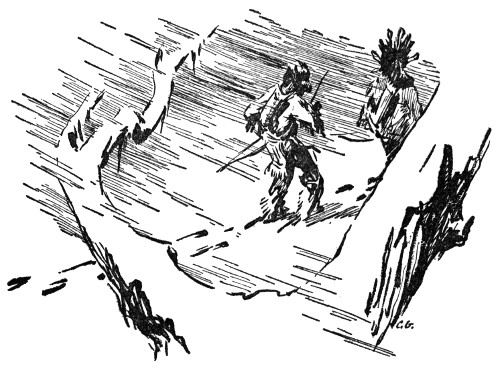
At last they came to a wide shelf on the
side of the hill. It didn’t appear to be a very
safe place. Little Bear wondered how much
rain it would take to loosen the ledge from
the side of the cliff and send it crashing to
the bottom of the canyon. They had no choice
except to stay. The walls of the canyon above
them were so steep that they couldn’t go any
higher.
87
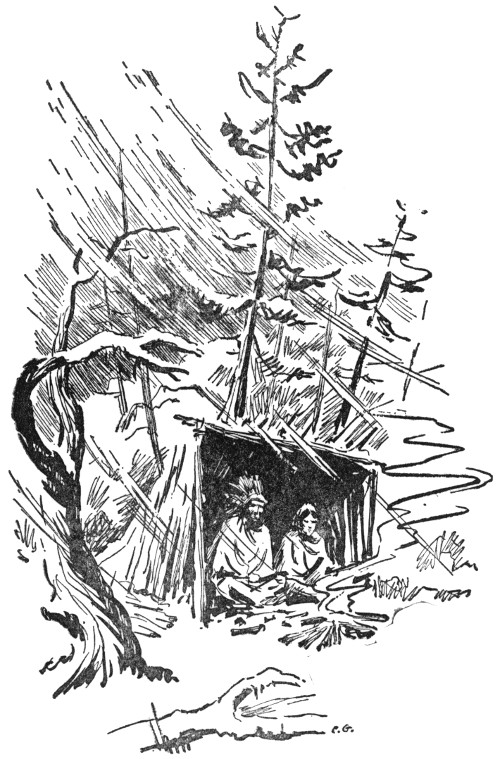
The rain started with a few scattered drops
which soon became a pounding downpour.
Both Little Bear and Grandfather grabbed
their buffalo robes and pulled them around
their shoulders as they crouched against the
side of the cliff. Little Bear could hear the
thunderbolts, which Old-Man-of-the-Sky was
throwing at the earth, crashing and bouncing
back. There was the mounting roar of the
wind around them.
The horses had moved about the ledge,
looking for grass. As the wind rose, they, too,
crowded against the cliff for shelter. Little
Bear thought he could hear another roar
mounting above the roar of the wind. Great
Bear crouched forward in order to hear
better.
“It is a wall of water going down the
canyon,” Great Bear guessed, shouting to
make his voice heard.
“Will it be this high?” Little Bear tried to
keep the fear out of his voice.
“We can only wait and see,” Grandfather
answered.
88
The storm had shut out the light so quickly
that it was almost dark. Little Bear crouched
despairingly against the cliff. He felt above
his head in the hope he could find rough
places which could be used as steps out of the
canyon. The wall was smooth and water running
down it made it slippery. If the water in
the canyon rose to their shelf, there was no
way of escape.
He couldn’t talk to Great Bear. The thundering,
crashing roar of water was so loud
he couldn’t have made himself heard if he
had leaned close to Great Bear’s ear and
shouted. The rain began to slacken, but the
roar of water in the canyon grew louder.
Little Bear knew that even if the rain stopped
at once, the water in the canyon might still
rise to their shelf.
89
He waited for what seemed hours. The rain
decreased until there was only a light drizzle
falling. Little Bear’s muscles ached from sitting
in his cramped position. At last he could
stand it no longer. Slowly he got to his feet.
Sharp pains ran up and down his arms and
legs, but as he continued to move around, the
pains soon left. Was the deafening roar of
water in the canyon decreasing? He waited,
listening. He saw Great Bear raise his head in
a listening attitude. Slowly Grandfather got
to his feet.
“The water is going down,” Great Bear
shouted.
It was true. Only a few minutes earlier he
couldn’t have heard Grandfather shout. The
roar of rushing water lessened rapidly. In a
short time the sound was no more than what
a small river would have made.
Not until his fear of rising water had completely
disappeared did Little Bear realize
how uncomfortable he was. He was wet
through and thoroughly chilled. He had to
clamp his jaws tight to keep his teeth from
chattering.
As the downpour of rain had lessened into
a drizzle, it had grown lighter, but it was only
the light of evening. Soon it would be pitch-dark
again.
90
“We must find fuel and build a fire,” Great
Bear warned.
There were no trees on the small shelf.
Finding wood appeared to be a hopeless task.
Darkness fell rapidly, adding to their difficulties.
Little Bear searched to the right and
Grandfather to the left. Little Bear found a
small clump of brush and a few dead branches.
He got down on his hands and knees and
groped around, but could find no more. He
carried the few he had found back to the
cliff. Great Bear had been more fortunate.
He had brought back a large, dead limb.
“There must be more wood where I found
this branch,” Great Bear said. “It must have
blown from a tree at the top of the cliff. When
we get a fire started, we may be able to find
more.”
They had a hard time starting a fire. The
branch Great Bear had found seemed to be
soaked almost entirely through. Great Bear
took his knife and peeled away the outer part
of the limb. When he had whittled to a part
of the limb that was almost dry, he had Little
Bear hold his robe to shield the shavings from
the rain. Grandfather whittled off a good-sized
pile of shavings and then cut a few
thicker pieces of wood.
91
When he thought he had enough shavings
to start a fire, Great Bear laid aside his knife
and picked up flint and steel. He struck them
together. A spark fell on the pile of shavings
and immediately went out. Great Bear moved
the shavings about, trying to get drier ones to
the top of the pile. He struck another spark,
but again it died without lighting the shavings.
“These shavings aren’t dry enough,” Great
Bear declared. “I’ll have to get drier shavings.”
He took up his knife and cut into the
branch in another place. Little Bear’s arms
were aching from holding the heavy buffalo
robe. Great Bear whittled carefully until he
had another pile of shavings ready. He struck
flint to steel. A spark dropped on the shavings
and went out. He struck again. Another spark
fell, smouldered a moment, and blazed up in
a tiny flame. Great Bear slowly added shavings
and, as the flame leaped up, put thicker pieces
on the fire.
92
“You won’t need to hold the robe over it
now,” he told Little Bear.
Thankfully Little Bear laid the buffalo
robe on the ground. He would have liked to
sit down and rest, but they needed more fuel.
As Great Bear slowly built up the fire, Little
Bear started out to find more wood. The tiny
fire gave little light. Yet when Little Bear was
some distance from the fire and turned to face
it, he could see better. He found two more
small limbs.
As soon as Great Bear had the fire burning
well enough so that he dared leave it, both
of them went back and searched. In the darkness
they had to move carefully for fear they
would slip over the edge of the cliff. Although
they searched carefully, they found only two
small handfuls of wood. By the time they returned
to the fire, the rain had stopped.
“We’ll dry our robes first,” Great Bear
decided.
93
He set up some of the larger sticks to make
a framework near the fire. They laid the robes
over the framework. When the robes were
dry, they removed their clothes, wrapped
themselves in the robes, and hung their clothes
on the framework to dry.
It was not until he was comfortably warm
that Little Bear realized how hungry he was.
He found the package of meat they had
brought with them. While they were eating,
Little Bear noticed how their tiny fire made
a flickering light on the canyon wall.
“Won’t our enemies be able to see this fire
a great distance?” he asked anxiously.
“No,” Great Bear assured him. “There are
hills high above us in every direction. Besides,
anyone caught in this rain would be as busy
trying to get dry as we are.”
It was then that a terrible thought struck
Little Bear. “The rain washed away the Crow’s
trail,” he exclaimed.
“Yes,” Grandfather agreed sadly. “Now we
won’t be able to track him. We may as well
start for the winter camp in the morning.”
94
“We can’t give up,” Little Bear protested,
thinking of that roan colt he hoped to own
when he returned Flying Arrow’s other
horses. “We must be near the Crow.”
“Very likely we are near him,” Great Bear
agreed, “but this land is made up of many
small canyons like the ones we came through.
How are we to find the Crow?”
“You said we are near the place of water-that-falls,”
Little Bear said thoughtfully.
“Let’s go there before we give up. Perhaps
Spirit-of-Water-That-Falls will guide us to
our enemy.”
“All of the spirits seem to work for our
enemy,” Great Bear pointed out. “Yet it
might be a gift would win the help of
Spirit-of-Water-That-Falls. But what do we
have to offer as a gift?”
“We could make him a present of the buffalo
hide,” Little Bear suggested. “He should
like a present of the hide of my first buffalo.”
“That would be a fine present indeed.”
Great Bear smiled. “We shall take it to him
tomorrow.”
95
Little Bear wrapped himself in his robe
and fell into a fitful sleep. He dreamed that
he was climbing up and down steep canyon
walls while a splendid roan horse was leaping
across the canyons. The horse seemed never
to run off and leave him, but always stayed
just the width of one canyon ahead of him.
96
CHAPTER SIX
The sun was just climbing over the hill to
the east when Little Bear awoke. There
was an unusual stillness about the camp. He
sat up with a puzzled look. A glance at Great
Bear’s robe showed part of the reason for the
stillness. Great Bear was still asleep. Little
Bear crawled silently out of his robe and
looked around. The horses were gone!
97
Into Little Bear’s mind flashed a picture of
Grandfather and him, trudging afoot that
long, weary journey to the main Sioux camp.
He went over to the spot where the horses had
been standing. He felt some relief when he
wasn’t able to find any moccasin tracks. If the
horses had strayed off, he might be able to
catch them.
The horses’ tracks led to the edge of the
shelf and down the steep bank. There were
great furrows plowed in the soft mud where
the horses had set their feet and slid down.
Little Bear went slipping and sliding down
the trail the horses had made. When he got to
the bottom of the canyon, he found a small
stream of water was still running. He noticed
the horses had stopped to drink from the
muddy stream. He glanced back at the side
of the canyon. The high water mark was far
above his head. He and Grandfather would
have been swept away by the torrent if they
hadn’t climbed out of it when they did.
98
He had no trouble following the horses’
tracks. The animals’ hooves had left deep
marks in the wet ground. Nevertheless he was
pleased to find the two horses grazing on some
bunches of grass that had not been covered
with mud. Since he was sure the horses would
not stray far, Little Bear started back to camp.
He had trouble climbing up the slippery
bank, but finally got back to the shelf. Great
Bear was crawling out of his robe as Little
Bear returned.
“Where are the horses?” Great Bear demanded
anxiously.
“They are grazing in the canyon,” Little
Bear explained.
“If we can find wood, we will build a fire,”
Great Bear decided. “There is small danger
anyone will see the smoke.”
They searched the place where they had
found wood for last night’s fire. There were
only a few small sticks they had missed in the
darkness. Great Bear whittled these into fine
shavings. After many failures, he finally managed
to get a fire started. The damp wood
didn’t make a very good fire, but it did give
off some heat.
“How far is it to the place of tumbling
waters?” Little Bear asked.
99
“Not far,” Grandfather answered. “We
should be there by the time the sun is straight
overhead.”
The trip towards the place of tumbling
waters was slow and tiresome. Great Bear had
lost all hope of recapturing the stolen horses.
Little Bear, too, was greatly discouraged. Unless
Spirit-of-Water-That-Falls told one of
them in a dream how to find the trail, the
Crow was almost sure to escape. At first Little
Bear took some pleasure from the thought that
the Crow might have been caught in the flood.
It would be good to have the Great Spirit get
rid of one enemy. Then he remembered that
if the Crow were drowned in a flood, the
horses would be, too, and the thought was
less pleasant.
Great Bear’s horse plodded slowly along
with Little Bear’s following. There was a
heavy carpeting of grass in the canyon, but
the flood had so soaked the ground that the
horses sank deep. The sun was almost straight
overhead when they came out of the canyon
onto higher ground. Here the footing was
more solid and the horses moved faster.
100
“Are we getting near, Grandfather?” Little
Bear asked.
“It will take longer than I expected,”
Grandfather admitted. “Still, we should be
there before dark.”
After following high ground for a time,
Great Bear turned his horse to the left. The
ground sloped to the south, and soon Little
Bear saw they were nearing a river. Grandfather
led the way along the bank of the
stream. For some time Little Bear had
thought he heard a roaring sound like that
of the night before. Now there could be no
doubt of it. It was the roar of rushing water.
He wondered anxiously why Great Bear
didn’t turn towards higher land so that they
could escape this flood.
“We are near the place of tumbling
waters,” Great Bear explained, stopping his
horse. “We will turn the horses loose to graze
while we go ahead on foot.”
101
Little Bear looked about the place where
they had stopped. He saw a small stream
winding through a clump of willows and
emptying into the river. Great Bear led the
way along the bank of this stream. As they
went ahead, the roar increased steadily. Little
Bear kept a watch on all sides, half expecting
Spirit-of-Water-That-Falls, or some other
spirit, to step out and stop them. Little Bear
was carrying the skin of the buffalo he had
shot, and he was ready to drop it and run if a
spirit appeared.
They rounded a clump of trees and came
into view of the waterfall. Little Bear stopped
to look. High above them the water dropped
over a rocky ledge and came cascading down
to a pool below. Part way down, a huge
boulder split the sheet of water into two
separate sprays. Both sprays fell into one large
pool and churned the water up as though
there were an evil spirit stirring it.
Great Bear had to lean close to Little Bear’s
ear to make himself heard above the roar of
the falling water.
102
“You go behind that fall,” he directed,
pointing to the fall at the left. “Behind it you
will find a place that is almost dry. Lay the
buffalo skin near the water where the Spirit
will be sure to find it. Then sit down and wait
for a vision. I will go behind this one. If the
Spirit sends you a vision, be sure to ask how
we can get our Sioux horses back.”
Little Bear nodded. He went to a narrow
place below the pool and jumped to the other
side. He went slowly and fearfully towards
the roaring falls. If he had been alone, he
would have turned back. He wondered how
he could possibly get through that sheet of
falling water to get behind it. But as he came
closer, he saw that the water spurted out a
considerable distance from the bank. He
could walk to one side and get behind the
falls.
Behind the falls the roar of water was not
nearly so loud. Little Bear took the buffalo
skin and carefully stretched it out near the
falling water. There was a fine mist spraying
upon him, but when he moved back near the
bank, the spray no longer hit him. He found
a large boulder where he could sit with his
back against the wall. He held himself motionless,
waiting for a visit from Spirit-of-Water-That-Falls.
103
He went slowly and fearfully towards the roaring falls
104
Perhaps it was because he was more than
a little frightened at being there, or because
it was all new and wonderful that he was alert
and wide-awake. In all of the stories Grandfather
and other warriors had told him of
speaking with spirits, the warriors had always
been asleep when the spirits appeared. Little
Bear tried closing his eyes, but that did no
good. He thought of getting up and walking
around, but there was scarcely enough room
behind the falls.
105
He noticed mud swallows were darting
about behind the sheet of falling water. The
small birds would light on the ground, dip
their beaks in the mud, and fly high up on
the face of the cliff. They never flew in a
straight course, but always zig-zagged irregularly.
Since he had nothing better to do and
needed practice with his bow, Little Bear
began to shoot at the darting birds. They flew
so swiftly and darted so unexpectedly that he
couldn’t hit any of them. He had shot his
fifth arrow when suddenly a large warrior,
mounted on a beautiful roan horse, rode out
of the falls straight towards him. Little Bear
knew at once this was Spirit-of-Water-That-Falls
coming to visit him.
“I see you like my little birds,” the Spirit
said in a rumbling voice.
Little Bear could find no words to answer
him.
“I know you are here because a Crow warrior
has stolen horses from your hunting
party,” the Spirit went on. “You want to get
them back so that your grandfather will have
a good buffalo hunting horse and you can
trade for a roan colt. You gave me a present.
Come, I will show you how to get your
horses.”
106
Little Bear got on the horse behind the
Spirit and they rushed off towards the setting
sun. They soon saw the Crow running ahead
of them. They followed him through woods,
across streams, and over rocky ground. Once
they lost the Crow in a snowstorm. The wind
blew the snow at them so hard that the Spirit
and Little Bear had to get off and walk. They
came upon the Crow again in a small canyon.
He was scraping snow aside to make a place
where he could build a fire.
“We can get the horses while he isn’t
watching,” the Spirit said.
At that moment Little Bear woke up. He
was still sitting on the rock behind the waterfall.
He was cold, hungry, and bewildered.
Had Spirit-of-Water-That-Falls shown him
how to get their horses back, or was the
whole adventure only a dream? Perhaps
Grandfather could tell him. Little Bear
gathered his arrows and stepped out from behind
the waterfall. The sun had gone down
and it was almost dark. Great Bear was waiting
for him below the pool.
107
Little Bear jumped across the stream and
joined his grandfather. Without a word Great
Bear led the way back to their horses. Little
Bear noticed Grandfather seemed even more
discouraged and disturbed than when they
had started for the falls. As he gathered wood
for a fire, Little Bear became more worried,
too. Probably he hadn’t had a message from
the Spirit, but had only dreamed the whole
thing.
“Did you get a message from Spirit-of-Water-That-Falls?”
Grandfather asked as they
were eating.
Little Bear told him what had happened.
“Was it a message or only a dream, Grandfather?”
“I don’t know,” Great Bear answered sadly.
“I, too, had a vision. All I saw was that we were
going towards the land of the setting sun.”
Suddenly his face lighted up.
“Of course it is a message.” Great Bear
gasped. “The Crow is going towards the setting
sun. We shall find his trail again.”
108
The next morning they were up early. The
sun had not yet risen over the hill when they
mounted and rode off. They rode out of the
valley and then turned west. Instead of having
Little Bear follow as before, Great Bear had
him ride well to the left. Both of them constantly
searched the ground for signs of their
enemy’s trail. They were so intent on watching
for signs of a trail that neither of them
noticed that birds were no longer flying up,
ahead of them. They would have ridden
straight on if Little Bear’s horse hadn’t tossed
its head and come to a stop.
“There is something ahead,” Great Bear
warned in a low voice. “Quick, get into that
clump of brush.”
They put their horses behind a small
clump of brush growing on the hillside. The
clump was too small to make a good hiding
place, but anyone coming from the other side
of the hill would have to get to the top of the
hill before he could see them there.
“What do you think is over there?” Little
Bear whispered as they tied their horses.
109
“It must be that Crow warrior we are
hunting,” Great Bear guessed. “Probably he
had to make a circle after the flood. He must
be just ahead. We will scout to the top and
see.”
They crouched low and slowly worked
their way to the top of the hill. At the top
Little Bear had to choke back a gasp of surprise.
A party of at least twenty Pawnees was
riding into the glade on the other side of the
hill. If Little Bear’s horse hadn’t given the
warning, the two Sioux would have ridden
straight into that Pawnee war party without
a chance of escape. Even now the danger was
great. The Pawnees were sure to send scouts
to the top of the hill. Grandfather and Little
Bear must move quickly to have a chance of
escaping.
110
Careful to make no sound they crawled
back. As soon as they were far enough down
the hill, they got to their feet and hurried to
the horses. They jumped on their horses and
started back the way they had come. Little
Bear would have liked to kick his horse with
his heels and send it flying, but Grandfather
led the way at a walk. Although the ground
was soft from the heavy rain, the sound of
running horses would carry across the hill to
the Pawnees.
Great Bear turned his horse towards a coulee
which cut into the hillside for some distance.
Little Bear kept a constant watch
towards the top of the hill. He and Grandfather
were almost to the coulee when he saw
the head feathers of a Pawnee warrior rising
from the other side of the hill.
“Run for it, Grandfather,” he whispered
urgently, but at that moment the head feathers
disappeared.
The Pawnee had turned back before he
had reached a point high enough so that he
could see them.
“He turned back,” Little Bear called softly.
111
No other Pawnee appeared before Great
Bear led the way into the coulee. When Little
Bear and his grandfather dismounted, the
banks of the coulee were almost high enough
to conceal the horses. Great Bear motioned
for Little Bear to take the halter ropes and
lead the horses down the coulee. Great Bear
leaned against the bank and watched towards
the top of the hill.
“Wait,” Great Bear ordered. “Two warriors
are coming over the hill.”
Little Bear stopped. He crouched low and
held the lead ropes firmly so that the horses
could not toss their heads. The Pawnees would
be sure to investigate any movement in the
coulee.
“They turned back.” Great Bear spoke in
relief.
Little Bear got to his feet and started forward
again.
“Here comes another one,” Great Bear
whispered warningly.
112
Little Bear crouched and waited. He saw
Great Bear fit an arrow to his bow. Little Bear
waited tensely. If the warrior came only a
short distance over the hill, he would be able
to see into the coulee. Great Bear could pick
him off with an arrow, but the Pawnee’s horse
would be sure to bolt back to the Pawnee
camp. Chance of escaping was fading rapidly.
“He turned back.” Great Bear breathed a
great sigh of relief. “We’ll go ahead now.”
Little Bear led the horses while Grandfather
stayed behind to watch for other Pawnees.
The coulee deepened rapidly until soon
Little Bear and the horses were well hidden.
As soon as Little Bear had the horses in the
deeper part of the coulee, Great Bear joined
him. They pushed through the coulee until it
opened into a small valley. Here Great Bear
called a halt.
“It will be better for us to wait here until
the sun sets,” he decided.
113
CHAPTER SEVEN
“I believe those are the Pawnees who had
our hunting party trapped,” Little Bear
said as they waited. “I thought I recognized
some of the horses.”
“I’m sure it is the same party,” Great Bear
agreed.
“We ought to punish them,” Little Bear
suggested.
There was a hint of a smile at the corners
of Great Bear’s mouth.
“And how do you think two of us are to
punish twenty Pawnee warriors?” he asked.
114
“We could capture some of their horses,”
Little Bear proposed.
Grandfather remained thoughtfully silent
for a long time.
“It might be done,” he agreed finally, “although
it would be dangerous. Pawnee war
parties usually hobble their horses and keep
them near camp.”
“Then there will be no sentry watching
the horses,” Little Bear pointed out.
“We shall try,” Great Bear agreed. “I shall
try to think of a plan that will work.”
While Great Bear was trying to think of a
plan, Little Bear was thinking, too. He remembered
how easily the Crow had made off
with the Sioux horses, but those horses had
been across a hill from camp. The Pawnees
would have their horses near their camp. Besides,
the horses would be hobbled. The hobbles
would have to be removed before the
horses could be taken and that would add
much to the danger of the attempt.
115
“I believe I have a plan,” Great Bear said.
“When the Pawnees are asleep, we shall approach
their horses from this side. That way
the horses will be between us and the Pawnee
camp. There will be less danger of our being
seen. Above all, we must be careful not to
excite the horses. The Pawnees will be sure
to investigate any unusual sounds.”
As soon as the sun had gone down, and
before darkness closed in, they started off. As
usual Great Bear led the way. The path he
chose followed the valley in a winding course
to the west.
“We should be directly south of their camp
now,” Great Bear said as he halted. “This is
a good place to leave our horses.”
They tied their horses and started north on
foot. Their way led up a gently sloping hill,
which divided their valley from the one in
which the Pawnees were camped. By the time
Little Bear and his grandfather had reached
the top of the hill, darkness had closed around
them.
116
The Pawnees had selected a good spot for
their camp. It was in the middle of a saucer-like
valley. There were a few scattered trees
in the valley, but not enough to offer hiding
for anyone trying to sneak up on the camp.
The Pawnees had eaten their supper and were
lounging about a big campfire. Little Bear
could see large bundles lying at the edge of
the firelight. He knew those were bundles of
meat wrapped in buffalo hides.
117
“They are foolishly brave.” Great Bear
grunted. “They have killed buffalo on Sioux
hunting grounds, and now they have a big
campfire, as though they were in their own
land.”
“We will teach them to stay off Sioux hunting
grounds,” Little Bear whispered fiercely.
118
The two lay and watched the camp. The
north wind was chilly, making the campfire
look inviting. As Great Bear had planned, the
Pawnee horses were south of the camp. He
and Little Bear wouldn’t have to circle the
Pawnee camp to get to the horses.
It seemed to Little Bear the warriors would
never roll up in their blankets and go to sleep.
The campfire died down to glowing embers.
Finally the last Pawnee warrior rolled up in
his blankets. Little Bear started to crawl forward,
but Grandfather reached out and put a
hand on his shoulder.
“Wait,” Great Bear ordered. “Pawnees are
sly.”
119
Little Bear waited impatiently. It would
take a long time to crawl to those horses and
still longer to untie hobbles and get away
from the Pawnee camp. If he and Grandfather
didn’t start soon, the sun would be up
before they were out of the valley. Great Bear
lay motionless, and in a moment Little Bear
understood the wisdom of Grandfather’s caution.
He saw a shadowy movement in the
Pawnee camp. An ember in the dying fire
broke and sent up a flame of light. In that
light Little Bear saw a warrior crawl out of
his blankets and start circling the herd of
horses.
The warrior made a complete circuit of the
herd. Sometimes he was hidden from view
behind a horse or in its shadow, but at last
Little Bear saw the warrior return to his
blankets. Still Great Bear made no move to
start towards the horses. After a time, another
warrior left his blankets as the first one had
done. It was so dark Little Bear couldn’t follow
the warrior’s movements after he left the
glow of the fire, but at last he saw that warrior
complete his circuit and return to his blankets.
“Will they do that all night?” Little Bear
whispered despairingly.
“No,” Great Bear reassured him. “But
there will be one more and perhaps two.”
120
To Little Bear it seemed certain the night
would be gone while he and Grandfather
waited. At last he saw a shadowy movement
that told him a third warrior was making a
circuit of the herd.
“There may be another one,” Great Bear
warned, “but we can wait no longer. Keep a
sharp watch. We are starting.”
For some time they crawled forward side by
side. When they reached a point about halfway
to the horses, they separated as Great
Bear had planned. Little Bear swerved to the
left and Great Bear to the right. Little Bear
inched forward until he was near enough to
the horses so that the sounds they made would
hide any little noise he made as he crept forward.
He got to his hands and knees and
moved more rapidly. Suddenly he flattened
out and lay motionless. A few steps ahead,
between him and the horses, a Pawnee warrior
was circling the herd. Little Bear dared
not cry out a warning to Grandfather.
121
Little Bear’s heart was thumping so loudly
he was sure the Pawnee must come to investigate
the sound. Even when the warrior moved
on, Little Bear’s heart continued to race. The
Pawnee might still discover Great Bear. The
minutes dragged by with no unusual sounds
until finally Little Bear was sure the warrior
hadn’t seen Grandfather either.
Little Bear started forward again. When
he was near enough to the horses so that they
would hide him from the camp, he slowly got
to his feet. The nearest horse snorted loudly
and moved back awkwardly. Little Bear stood
motionless until the horse again started to
graze. Carefully Little Bear moved to the side
of the horse. It tossed its head restlessly and
then stood quietly.
Now Little Bear moved in front of the
horse and knelt down. Quickly he unknotted
the hobble ropes. He got to his feet and
moved to the next horse. It reared back excitedly.
Little Bear dared not take time to
quiet an excited horse, and so he left it and
stepped up beside another one. This horse
scarcely raised its head as Little Bear stroked
its side. He knelt and unhobbled it.
122
When Little Bear got to his feet again, he
stood motionless, trying to see into the darkness.
Any warrior making a circuit of the herd
would be sure to spot horses moving without
hobbles. He would investigate immediately.
At last, satisfied there was no warrior near,
Little Bear put his hand on the horse’s mane
and guided it towards the other horse he had
unhobbled. He kept the horse walking slowly
so that its movements would not easily be seen
by a watcher. At last he had the two unhobbled
horses together.
Little Bear had thought that when he got
the two horses together, the most dangerous
part of the raid would be over. He saw now
he had been wrong. The only way he could
get his horses to the edge of the herd was to
keep them moving side by side. He had to
walk between them with a hand in the mane
of each. Instead of staying close to other
horses so that their movements would hide the
movements of his horses, Little Bear had to
find places where the horses were widely separated.
At the edge of the herd, he stopped his
horses and wiped the sweat from his brow.
123
He left the horses standing and scouted a
short distance in the direction from which
each of the Pawnees had come to circle the
herd. He saw something move ahead of him.
Little Bear waited until he was sure it was a
Pawnee warrior. Then he carefully slipped
back and stood between his two horses. He
put a hand in the mane of each and held them
quiet. The Pawnee warrior came close. One
of the horses took a step forward, and Little
Bear’s heart quit beating. But the Pawnee
didn’t notice the horse wasn’t hobbled. He
went on around the herd.
Little Bear waited for a long time after the
warrior had passed. He would have liked to
jump on the back of one of the horses and go
racing away from the Pawnee camp. Still he
obeyed Grandfather’s orders and waited silently.
At last, sure the Pawnee warrior had
returned to his blankets, Little Bear started
his horses forward. Often he turned to look
behind him. He saw two horses come out of
the herd and start towards him. For a panic
stricken moment he was sure it was a Pawnee
warrior using the horses as a screen. He almost
laughed aloud with relief when he realized
it was Great Bear with the two horses he
had captured.
124
Little Bear swung his horses to the right so
that the four of them would be farther apart
and not so noticeable. He no longer allowed his
horses to stop and graze, but kept them moving.
Slowly he came towards the top of the
hill. Every moment he expected to hear an
outcry from the camp below. He reached the
top of the hill, and still there was no sound
from the Pawnee camp. It seemed to take
hours to cross the hill and get far enough
down the other side to be out of sight of the
camp, but at last it was done. The first part of
their raid had been successful.
“We made it,” Little Bear gloated as
Grandfather joined him beside their own
horses.
“We aren’t away yet,” Great Bear reminded
him. “The Pawnees will try to catch us.”
125
“How soon do you think they will miss the
horses?” Little Bear asked.
“Not until morning,” Great Bear guessed.
“We’d better start.”
“We will be a long way by morning,” Little
Bear vowed.
“Not as far as I would like to be,” Great
Bear warned. “We have to circle their camp
and then go north. If they guess that is what
we are doing, the Pawnees will take a short
cut. They may be able to catch us.”
Grandfather and Little Bear each mounted
his own horse and led the ones which he
had captured. Once the captured horses were
well away from the Pawnee camp, it would be
easier to drive them, but now there was too
much danger the horses would make a break
for camp. It was so dark Little Bear wondered
how Grandfather could find the way. Although
they went slowly, they went steadily.
They had gone a great distance before Great
Bear turned north.
126
Little Bear judged they must be about
straight west of the Pawnee camp when the
first faint light showed in the east. Grandfather
had been right. They were still too
close to the Pawnee camp. If the Pawnees
guessed the route he and Grandfather were
taking, there was still grave danger. As it became
light enough to see, Great Bear urged
his horse to an easy lope.
127
They rode into a country which was even
rougher than that behind them. There were
narrow valleys surrounded by steep hills.
Great Bear kept at an almost straight course,
as though he were sure of the route they were
to follow. Every time they started up a hill,
Great Bear rode ahead. Then he would dismount
and walk in front of his horse. At the
top of each hill he would look back and make
sure no Pawnees were in sight before he would
signal Little Bear to bring the horses across
the top of the hill. When the sun was straight
overhead, Great Bear halted beside a small
stream.
“We are safe now.” He smiled. “The Pawnees
will not dare follow us farther into Sioux
hunting grounds.”
Little Bear toppled off his horse and
stretched out on the ground. He hadn’t believed
anyone could get so tired riding a
horse. Grandfather stretched out beside him.
“We have been successful enough that we
can return to the main camp proudly,” Great
Bear exclaimed happily.
“Aren’t we going to try to catch that
Crow?” Little Bear asked.
Great Bear shook his head.
“You have two good horses,” he pointed
out. “I am sure Flying Arrow will trade you
the roan colt for either of them.”
128
“I suppose he will,” Little Bear agreed.
“And you have two good horses, but I don’t
believe either of them is as good as your
buffalo horse the Crow took.”
“We should return to the main camp,”
Great Bear insisted. “We have won a victory
over the Pawnees. That is enough.”
Little Bear looked at the four captured
horses. They were good horses. He and
Grandfather had been lucky to pick out such
good horses in the dark. Undoubtedly Flying
Arrow would trade the roan colt for any one
of the horses. Little Bear knew he and Grandfather
could ride into the main Sioux camp
in triumph. No other boy in the entire Sioux
nation was the owner of three such fine
horses. Yet it angered him to think of the
Crow warrior going unpunished. The Pawnees
had been punished for their attack on
the Sioux hunting party. That Crow warrior
should be taught it wasn’t safe to steal Sioux
horses.
129
“Spirit-of-Water-That-Falls pointed out we
could find the Crow if we went towards the
setting sun,” Little Bear reminded his grandfather.
“He warned of snow,” Great Bear remembered,
“and he said nothing of Pawnees. I
think it was only a dream and no message
from a spirit.”
“As you say, Grandfather,” Little Bear
agreed, “although I think that Crow should
be punished and I would like to have you get
your buffalo horse back.”
Great Bear smiled proudly.
“Someday you will be a great chief, Little
Bear,” he prophesied. “You have a ready
tongue and the courage to do what your
tongue suggests. We shall spend two more
days trying to find the Crow’s trail.”
130
CHAPTER EIGHT
Since their supply of meat was almost all
used, Great Bear decided he should get
a buffalo. While Great Bear was gone, Little
Bear busied himself around the camp. He
took the ropes with which the Pawnee horses
had been hobbled and spliced them to make
two long ropes. The long ropes could be used
to tie packs onto the backs of horses. He was
just finishing when Grandfather returned to
camp.
131
Grandfather had killed and butchered a fat
buffalo cow. He had the meat tied in two
large bundles, each bundle wrapped in half
of the buffalo hide. They used one of the
ropes Little Bear had spliced and tied the
packs securely on the back of one of the captured
horses.
“We shall ride west until time to make
camp,” Great Bear decided. “Tomorrow we
shall go south and west to see if we can find
our enemy’s trail.”
As both of them were tired from the long,
hard day’s ride, they stopped early to make
camp. Great Bear selected a small valley in
which there was a large grove of trees. Wood
was plentiful and as they were so deep within
Sioux territory, it was safe to build a fire.
When the fire died down to embers, Great
Bear roasted buffalo tongue over the coals.
Little Bear gorged himself on the delicious
meat.
132
They made an early start the next morning.
It was a cloudy, damp day and Little Bear
began to wonder if he had made a mistake,
urging Grandfather to return to pursuit of
the Crow. Spirit-of-Water-That-Falls had
promised a victory over the Crow. But the
Spirit had allowed a victory over the Pawnees.
Perhaps one victory was all the Spirit
intended for them to win.
“It looks as though the Great Spirit will
send more rain to hide the Crow’s trail
again,” Grandfather said, interrupting Little
Bear’s thoughts.
“We must be getting near the Crow.” Little
Bear spoke encouragingly.
“We should be,” Great Bear agreed. “After
the big rain, the Crow must have seen signs
of the Pawnees. He would lose much time
hiding his trail from them.”
“We’ll catch him,” Little Bear insisted
stoutly.
133
By noon, when they stopped to rest their
horses and cook food for themselves, the rain
Great Bear had expected began to fall. It was
only a light mist, but a light breeze from the
southeast drove it into their faces. Little Bear
noticed Grandfather was constantly casting
anxious glances towards the north.
“Why do you watch the north?” Little Bear
asked.
“I am afraid Old-Man-of-the-North is getting
ready to send snow,” Great Bear explained.
“Not this early,” Little Bear protested.
“We have had no ice yet.”
“Sometimes Old-Man-of-the-North is unreasonable,”
Great Bear answered. “It seems
all of the spirits have been working to protect
the Crow. I feel Old-Man-of-the-North is
sending snow.”
“Then let’s lose no time,” Little Bear
urged. “We must find the Crow’s trail before
snow covers it.”
Grandfather nodded.
“We are now on Crow hunting grounds,” he
said. “We cannot go much farther.”
134
When they started again, Little Bear took
charge of the captured horses so that Grandfather
could give all of his attention to looking
for the Crow’s trail. The rain was becoming
heavier, but it was warm rain. Great
Bear’s fears that Old-Man-of-the-North was
sending snow seemed foolish. Little Bear’s
spirits rose. He knew Grandfather was sure
they were near the Crow. Otherwise the old
warrior would not take the time to follow so
zig-zag a course. So Little Bear was not
greatly surprised when Grandfather pulled
his horse to a stop and triumphantly pointed
to the ground.
“Here’s the Crow’s trail,” Great Bear announced.
Little Bear rode alongside. Both of them
dismounted and studied the marks left by the
horses.
“I don’t see a track made by the horse with
a stone bruise,” Little Bear said doubtfully.
135
“He could be at the head of the string,”
Great Bear pointed out, “or since the ground
is soft from so much rain, the bruise may have
healed quickly. I am sure this is the Crow’s
trail.”
Little Bear knew Grandfather’s ability at
reading signs on a trail too well to doubt his
explanation.
“The trail is new,” Little Bear suggested.
“The Crow cannot be far ahead.”
“You are learning to read trail signs.”
Grandfather nodded approvingly. “We must
go carefully so that the Crow will not know we
are near. You stay behind with our horses. I
will scout ahead.”
Little Bear waited until Grandfather was
many paces ahead before he started with the
horses. The trail followed the low lands where
the Crow could travel easily. Evidently he was
so sure no one was following him that he
didn’t even stop on high ground to watch the
trail behind him. Occasionally while Grandfather
was carefully making his way to high
ground to get a better look ahead, Little Bear
would dismount and study the Crow’s trail.
Even if Old-Man-of-the-North did send the
snow Grandfather feared, the Crow wouldn’t
escape. Grandfather was sure to lead a raid
against the Crow’s camp tonight.
136
With a fire in front it made a comfortable shelter
137
Without warning the wind switched to the
north. Strong gusts whipped rain into Little
Bear’s face. It wasn’t long until the rain carried
an icy sting and flakes of snow were floating
among the rain drops. In a surprisingly
short time the rain had completely changed
to driving snow.
Grandfather waited for Little Bear in the
shelter of a clump of trees.
“We must make camp,” Great Bear told
him. “These early storms are often bad in this
country.”
Little Bear jumped from his horse and
quickly pulled the bundles off the pack horse.
He turned the horses loose to graze before
snow could cover the grass. Both he and Great
Bear worked rapidly making camp. There
were many dry branches under the trees.
These they heaped in a pile for firewood.
138
They had just turned to the work of cutting
green poles to use in building a lean-to
shelter when the snow quit falling. The wind
died down, and there was a rift in the clouds
to the west letting the sun shine through.
“It’s over,” Little Bear exclaimed. “Now
we can get back on the trail.”
“It’s only a lull,” Great Bear warned without
stopping work. “It will be worse in a few
minutes.”
Great Bear was proved right almost at once.
The wind came up again, driving icy snow
into their faces. The trees with their low
branches offered some protection, but even
here the swirling snow made it difficult for
Little Bear and his grandfather to see. They
worked as rapidly as possible. They drove two
large poles into the ground and lashed a third
pole to those two. Great Bear laid smaller
poles with one end against the cross pole and
the other on the ground. Little Bear helped
pile branches against the poles until the shelter
was completed. The finished shelter was
a lean-to, closed to the north and open to the
south.
139
Grandfather started a fire on the south side
of the lean-to where some of the heat would
reflect back into the shelter. Little Bear went
to a near-by pine tree and broke off great armfuls
of small branches. He shook the snow
from these and piled them in the lean-to. He
spread the buffalo robes over the branches.
With a fire in front the lean-to made a comfortable
shelter.
Great Bear took enough meat from one of
the packs for a couple of meals. He rerolled
the pack and hung it and the other pack of
meat in a tree.
“Animals can’t get our food there,” he said.
Little Bear shivered as he thought of the
kind of camp they would have had to make if
the snow had caught them on the prairie. Out
on the plains with no protection from the
wind, it would have been almost impossible
to make a camp and find fuel. Still Little
Bear knew that if he hadn’t coaxed Grandfather
to continue in pursuit of the Crow, the
two of them might now be safe in the main
Sioux camp.
140
“It is my fault Old-Man-of-the-North caught
us here with his snow,” Little Bear admitted.
Great Bear looked at him thoughtfully.
“It doesn’t matter whether we are here or
far to the north,” Great Bear answered. “Old-Man-of-the-North
would have found us with
his snow. The Crow has strong medicine. The
spirits are protecting him.”
“Yet we are nearer to him than we have
been before,” Little Bear pointed out. “He
can’t run from us until the storm stops and
then he will leave a plain trail.”
“That is true,” Great Bear agreed hopefully.
“Perhaps his medicine is not as strong
as I thought.”
For a time they sat in silence. The wind
rose, and the drifting snow seemed to close
them off from the rest of the world. If the storm
continued this way much longer, drifts would
be piled so high the horses would not be able
to wade through them. A short time before,
Little Bear had been eager to keep Great Bear
searching for the Crow. The storm showed
him they should start for the Sioux winter
camp as soon as possible.
141
“Will the storm be over so we can start for
camp tomorrow, Grandfather?” he asked.
Great Bear raised his eyes from the fire.
“Not tomorrow,” he replied. “Perhaps the
day after. But we are not starting back without
the horses that Crow stole from our
herd.”
Little Bear gave him a surprised look.
“The Crow’s trail will be covered,” Little
Bear protested.
“We may not need to find the trail,”
Grandfather said thoughtfully. “Tell me
about that dream you had at the place of
water-that-falls.”
Little Bear related what seemed to have
happened in his dream. Great Bear listened
closely as his grandson told about the part
where he and the warrior had ridden the roan
horse and especially to the part where they
had walked to the Crow’s camp during a snowstorm.
142
“It must have been a message.” Great Bear
nodded at the end. “It is the very place the
Crow would pick to camp until this storm is
over.”
Little Bear began to take new hope.
“Do you have a plan, Grandfather?” he
asked excitedly.
“If it is still snowing in the morning, we
may be able to surprise the Crow and get the
horses,” Great Bear said. “If it stops snowing
before morning, we will get the horses
tomorrow night.”
“Wouldn’t it be better to get them tonight?”
Little Bear urged. “We know the
Crow will be in camp now. In this storm he
won’t expect a raid.”
“There are several reasons why we couldn’t
get them tonight,” Great Bear pointed out.
“It would be difficult to find our way. Besides,
we might not be able to get the horses to
move out of the valley in the dark and the
storm.”
“How shall we be able to get them in daylight?”
Little Bear wondered.
143
“I believe the place where the Crow is
camped is a small canyon like Buffalo Trap
Canyon,” Great Bear explained. “It has only
one entrance and the Crow won’t be camped
there. He will find a protected place behind
some trees. The horses will be at the north
end of the canyon where high cliffs will protect
them. If we are careful, we may be able
to get all of the Crow’s horses without his
seeing us.”
“Tomorrow we will get the horses,” Little
Bear vowed.
There was no sign of the storm’s lessening.
To Little Bear it seemed the wind was blowing
harder than before. As darkness deepened,
the fire lighted up a space of only a few
feet in each direction. Before he crawled into
his buffalo robe, Great Bear rolled two large
branches on the fire.
“These will hold fire until morning,” he
said.
144
CHAPTER NINE
When Little Bear awoke the next
morning, Grandfather was just getting
up. Little Bear rolled over and lifted his head
for a look out from the lean-to. Snow was still
swirling in the air. It had drifted over the
pile of wood and up near the fire. Parts of
the two large branches Great Bear had put on
the fire were still there, but the fire itself
seemed to be out.
145
Great Bear went over to the fire. He tilted
one of the pieces of wood up and blew against
the charred end. Smoke began to curl from
that end, and soon a blaze flamed up. Great
Bear went to the wood pile. He brushed some
of the snow away and drew some small
branches from the bottom of the pile. He
placed the small branches against the charred
end of the wood and again blew on it. A
flame leaped up, caught the small branches,
and in a moment the fire was blazing cheerfully.
Little Bear crawled out of his buffalo
robe and stood beside the fire.
“I’ll see about our horses,” he offered.
He stepped away from the shelter and
faced directly into the wind. Hard-driven
snowflakes pelted his face. He could scarcely
move forward. By every small shrub there
was a drift of loose snow through which he
had to wallow. The strong wind drew the
breath from his lungs so that he often had to
stop and turn his back. When he got near the
hills at the north end of the valley, the snow
was deeper, but the wind hit him with less
force.
146
Little Bear found the horses standing at
the foot of the hills. They were huddled together
with their heads pointing away from
the wind. The grass was covered with deep
snow drifts, but Little Bear knew the horses
wouldn’t starve. When the animals got hungry,
they would paw through the loose snow
to the grass.
The trip back to camp was much easier.
The wind shoved Little Bear forward, and he
could see far enough ahead to avoid the deepest
drifts.
“How are the horses?” Great Bear asked.
“They’re near some steep hills to the
north,” Little Bear replied. “The hills protect
them from the wind.”
“They’ll be all right until we get back,”
Great Bear said.
“Isn’t there danger a mountain lion might
kill some of them?” Little Bear wondered. “I
have heard warriors tell of mountain lions
attacking horses after a storm.”
147
“It has happened,” Grandfather agreed,
“but usually only after a storm has lasted several
days. There will be no danger before we
get back.”
They ate the food Great Bear had cooked.
When they had finished, he cooked more and
made two small bundles of it. One he gave to
Little Bear, and the other he kept himself.
Great Bear stood for a long time looking at
the buffalo robes.
“Why are you looking at our robes?” Little
Bear asked.
“I am trying to decide whether or not we
should take them with us,” Great Bear explained.
Little Bear thought of the drifts of loose
snow through which he had waded on his way
to look at the horses.
“They would make a heavy pack to carry
through loose snow,” he protested.
“They would.” Great Bear nodded. “And
yet, if we are delayed in the storm, they would
save us much suffering.”
At last he made up his mind.
“We shall leave them,” he decided.
148
They gathered more wood and piled it near
the lean-to. It took some time to find a large
log to hold fire. Little Bear finally found one
under a large tree. Together he and Grandfather
dragged it to the fire and rolled it onto
the coals.
“It will hold fire until we get back,” Great
Bear stated.
Great Bear led the way from camp. He
went directly west. As soon as the two of them
stepped from behind the sheltering trees, the
wind hit them with full fury. Snow pelted
their faces so that they had to bend forward
and walk with eyes squinted. The nearer they
came to the base of the hills, the deeper the
snow became. Their progress was painfully
slow. They had not gone far through the
deeper drifts when Great Bear turned his
back to the wind and stopped to rest.
“I’ll take a turn at breaking trail,” Little
Bear offered.
“All right,” Great Bear assented.
149
Little Bear stepped past his grandfather
and began to plow through the loose snow.
At every step the drifts were deeper. They
hadn’t gone many paces when Little Bear had
to stop to rest. Grandfather stepped past him
and took the lead again. Thus, taking turns
at breaking a path, they slowly moved forward.
As they started up the slope, they found
the drifts were not so deep. Halfway up the
hill there was scarcely any snow at all.
150
While the snow was not as deep when they
got higher, the wind hit them with greater
force. The snow swirled around them until
Little Bear wondered how Grandfather could
find his way. If there were any landmarks,
drifting snow hid them. Still Grandfather
moved forward as surely as though he were
following a marked trail.
By the time they reached the top of the hill,
both of them were gasping for breath. They
tramped down the snow in the next drift they
came to and crouched down to rest. Out of
reach of the wind they were almost comfortable.
Little Bear dreaded starting again, but
if they were to reach the Crow’s camp and get
back before dark, they couldn’t lose much
time.
When they started on again, they were on
a flat plateau at the top of the hill. Here they
felt the full force of the wind. However, there
was an advantage, too. The wind had swept
most of the snow away and walking was easier.
They stopped only once while crossing the
plateau. The wind bit through their clothes
so that they were quickly chilled.
151
Great Bear led the way into another valley.
Here the drifts were deep and walking was
difficult. Little Bear thought with dread of
another hill ahead of them. He wondered if
he could climb it. He was so tired it seemed
every step must be his last. Yet he followed
without protest until Great Bear halted behind
a clump of trees.
They tramped out another shelter in the
loose snow and sank down to rest. Great Bear
opened one of the packages of food. Little
Bear had thought he was too tired to eat, but
the food tasted surprisingly good. He felt
much better after he had eaten and had rested
a few minutes.
“If I have judged correctly,” Great Bear
told him, “our enemy is camped in the next
canyon. It is a narrow one with the only
entrance from the south.”
“Shall we have to take the horses out that
entrance?” Little Bear asked.
152
“It is the only way,” Great Bear replied.
“We must use great care so that the Crow
does not see nor hear us. He could easily
ambush us at the entrance.”
“Do we go in through that entrance?” Little
Bear wondered.
“It is the easiest way,” Great Bear pointed
out. “Besides, we want to make sure the Crow
isn’t camped near it.”
Rest and food had so completely restored
Little Bear that he waited impatiently for
Grandfather to start. Great Bear smiled at his
impatience.
“This will be our last rest until we are back
in our own camp,” he warned.
At last Great Bear started on. He led the
way to the hills at the west side of the valley
and there turned south. Despite deep snow
Grandfather and Little Bear moved rapidly.
The wind at their backs pushed them along.
They kept close to the hills until there was
an opening to the west. Here they again
turned west. Now they had a steep hill protecting
them from the wind. The hill was so
high and steep that snow did not fall at its
base. That left a bare path for the two Sioux
to follow. In a short time they came to the
end of the hill. There was an opening leading
north. Great Bear stopped.
153
“This is the entrance to the canyon,” he
pointed out. “We will go slowly. This canyon
widens after a short distance. It will be safest
for us to stay at the east side and follow that
side to the north end. I am sure the horses
will be at that end.”
“And the Crow?” Little Bear wondered.
“I hope he has made camp behind trees on
the west side,” Great Bear responded. “It
would be the best place for a camp. If I am
right, we can get to the horses without the
Crow’s seeing us.”
“He is our enemy,” Little Bear reminded
his grandfather. “Perhaps we should hunt the
Crow before we take the horses.”
Great Bear hesitated, but finally shook his
head.
154
“It is what I should like to do,” he admitted,
“but we can’t take the time. If I am
wrong and he is not in this canyon, we shall
scarcely have time to get back to our camp
before dark.”
To follow Grandfather’s plan, they had
to turn directly into the wind. It whistled
through the narrow entrance to the canyon
with such force they could hardly move ahead.
They struggled ahead for a long time before
the canyon widened and they changed their
direction. Along the east edge of the canyon
the snow was piled high. Again Little Bear
alternated with his grandfather at the job of
breaking trail.
The worst came when they turned straight
north into the face of the wind. Either the
strong wind or the deep snow would have
made walking a difficult task. The two together
made it almost impossible. Slowly
Grandfather and Little Bear fought their way
forward. At last they reached the hills which
formed the north rim of the canyon. Little
Bear was breaking trail. He turned west. Now
he could go faster. The high hills broke the
force of the wind and there was no snow close
to the base of the cliffs.
155
“Go slowly,” Grandfather warned. “The
Crow may be camped east of the horses.”
Little Bear nodded. He knew it would be
easy to stumble into the Crow’s camp. He
came to a sudden stop and held up his hand
warningly.
“There are the horses,” he exclaimed.
Great Bear stepped up beside Little Bear
to get a better look.
“We must go carefully,” Great Bear
warned. “The Crow may be camped near his
horses.”
Great Bear took the lead. He led the way
out into the canyon away from the shelter of
the cliffs. In the deep snow it would have
been impossible for them to move swiftly. To
the impatient Little Bear, it seemed they were
scarcely moving at all. But, at last, they were
beside the horses. Little Bear counted ten
horses. So not only would he and Grandfather
get back the horses the Crow had stolen from
the Sioux, but they would get some of the
Crow’s horses, too.
156
Grandfather and Little Bear had mapped
their plans when they stopped to rest. Now
both of them acted as they had agreed. Great
Bear went to his own buffalo horse. He
mounted and rode a few paces along the trail
he and Little Bear had made. Little Bear
went to one of the horses that had belonged
to Flying Arrow. He climbed onto it and
turned it towards the rear of the herd. The
horse hung its head low and refused to move.
Desperately Little Bear drummed his heels
against the horse’s side until it finally started.
Little Bear had to fight the horse all of the
way, but finally got it to the rear of the herd.
Blowing snow almost hid Great Bear from
sight where he was waiting ahead of the herd.
He was watching Little Bear. As soon as he
saw Little Bear was in place, Great Bear
started. At first the herd was unwilling to
move from its sheltered place. Little Bear
crowded his horse towards the herd. The
other horses hesitated, but finally started to
follow Grandfather.
157
One horse broke from the herd and tried
to turn back. Little Bear’s horse, which had
been so reluctant to move before, suddenly
darted aside. It got in front of the runaway
horse and turned it back with the rest of the
herd. Two other horses tried to break from
the herd, but Little Bear’s horse was too
quick for them. Once aroused, it seemed to
enjoy keeping the other horses in line. The
entire herd finally settled into line following
Great Bear.
“We have done it,” Little Bear gloated to
himself. “We have really punished that Crow.
He will have to walk to the Crows’ winter
camp.”
158
Little Bear had to stifle the triumphant
Sioux war cry that welled up in his throat.
The next moment he was struck a terrific
blow on his left shoulder. The force of the
blow spun him off his horse, headlong into
the deep snow. He lay dazed, half choked
by snow in his nose and mouth. He put his
right hand to his shoulder. His shirt was badly
torn and blood was running down his arm.
He forced his fingers to feel the wound. It
was deep, but not deep enough to cripple his
arm. He flexed the fingers of his left hand.
Although it hurt badly, he could move them.
After his first dazed fright, Little Bear regained
control of himself. He knew what had
happened. The Crow had seen him. While
Little Bear was intent on driving the horses,
the Crow had sneaked up on him and shot. If
it had not been for snow and wind, the arrow
would have struck Little Bear’s heart.
Little Bear’s horse had stopped and was
standing with head hanging low. Little Bear
could look under the horse in the direction
from which the arrow had come. He could see
no sign of the Crow. Little Bear waited, puzzled
by the lack of movement. Suddenly it
dawned upon him what plan the Crow would
follow.
159
Little Bear got to his feet, putting his bow
in his left hand. There was a sharp pain in his
shoulder when he grasped the bow firmly, but
he forced his fingers to hold it. With his right
hand he fitted an arrow to the bowstring. He
stepped around his horse. His guess had been
right. The Crow had slipped ahead and was
taking aim at Great Bear. Great Bear had
sensed something was wrong. He had stopped
his horse and was turning his head to look
back at the herd of horses. His startled glance
fell on the Crow.
Great Bear reached for his bow, but he
didn’t have a chance. The Crow’s arrow was
pointed straight at him. The Crow’s movements
were deliberate. He was certain he had
plenty of time, and he was making sure his
first arrow got rid of his enemy. Hurriedly
Little Bear brought up his bow. He had no
time to take aim. He pulled the bowstring
tight and let the arrow fly. The arrow struck
the Crow a glancing blow along his arm and
knocked the warrior’s bow out of his hand.
160
The Crow bent forward quickly to pick up
his bow, but his left hand couldn’t grasp it.
Great Bear swung his horse to face the Crow.
Little Bear stepped forward, fitting another
arrow to his bow. When the Crow realized his
arm was so injured that he couldn’t use
his bow, he straightened up. He stood with
his injured arm hanging at his side and turned
to face Great Bear.
161
Great Bear rode slowly towards the Crow.
The warrior stood unflinchingly watching his
enemy. Great Bear took careful aim. Still the
Crow stood facing him. Little Bear came to a
halt and watched in amazement.
“That Crow is as brave as a Sioux,” he admitted
to himself admiringly and was sorry
it was necessary to kill so brave an enemy.
162
At the last moment Great Bear swerved
his horse aside and rode past the Crow. If his
plan had been to torment the Crow into
showing fear, it failed. The Crow stood as
motionless as a wood carving.
Great Bear completed a circle and for the
second time rode at the Crow. Little Bear
was ashamed of his own urge to cry out for
Grandfather to spare the warrior. The Crow
was his enemy. He had stolen Sioux horses
and shot at Little Bear. The Crow deserved to
die, and yet it took all of Little Bear’s will
power to force his eyes to watch the scene.
The Crow faced Great Bear without a sign
of fear. Great Bear stopped his horse a few
paces from the warrior. He drew his bowstring
taut and took careful aim. Then slowly
he lowered his bow. Great Bear raised his
right hand in the sign of peace. He untied
the package of food from his belt and dropped
it for the Crow. Then he turned his horse
and rode back to the head of the herd.
163
Little Bear watched unbelievingly. He kept
an arrow pointed at the Crow, ready in case
of treachery. The Crow picked up the package
of food and, with one hand, awkwardly
knotted it to his belt. Without another look
towards Grandfather and Little Bear, the Crow
turned and started away.
Little Bear climbed back onto his horse.
As there was no longer any need to avoid the
Crow, Great Bear turned off the trail and led
the way directly towards the canyon entrance.
The snow was not so deep in the middle of
the canyon, and Grandfather was able to set
a faster pace. Little Bear could feel blood
oozing from his wound. It hurt badly, but
he gave no sign.
The struggle back to camp in the swirling
snow was a blur in Little Bear’s mind. His
horse kept the unwilling herd following Great
Bear. Little Bear used all his remaining
strength to cling to his horse’s back. It seemed
to him he had been riding for hours by
the time Grandfather halted in front of the
lean-to. Little Bear slid awkwardly from
his horse and staggered to the shelter. He
sprawled out on his buffalo robe.
164
Grandfather came hurrying anxiously back
to the lean-to. He bent over Little Bear.
“You are wounded,” he exclaimed angrily.
“I should have killed that Crow.”
“He was too brave,” Little Bear murmured
and fell asleep.
165
CHAPTER TEN
Little Bear didn’t know how long he slept.
When he awoke, it was dark except for
the light of the campfire. The horses were
gone. Little Bear guessed Grandfather had
put them with their other horses. He could
see Grandfather was cooking something over
the fire.
Little Bear lifted his head to watch. He saw
with relief that there were no flakes of snow
drifting down into the fire. The storm was
over. Grandfather glanced towards the lean-to.
“How is the shoulder?” Great Bear asked
when he saw Little Bear was awake.
166
Little Bear felt of his shoulder. Grandfather
had cut the shirt away and applied a
poultice. The wound was sore, but the throbbing
pain was gone.
“It is better,” Little Bear answered.
Grandfather came from the fire carrying
something on a clean piece of bark. He bent
over Little Bear and removed the poultice.
Very gently Great Bear applied a new poultice.
“The soreness should be gone by morning,”
he assured Little Bear.
Grandfather returned to the fire and began
broiling the steaks he had cut. Little Bear’s
mouth watered at the smell of cooking meat.
He couldn’t remember ever having been
so hungry before. Despite his hunger, when
Grandfather offered him the first steak, Little
Bear remembered his manners.
“You first, Grandfather,” he said.
“Wounded warriors are always fed first.”
Great Bear smiled.
167
Little Bear felt a glow of pride. Grandfather
had said “wounded warriors.” Had
Grandfather meant to call him a warrior?
Little Bear was still puzzling over that
question when he went to sleep. It was his
first thought when he wakened the next
morning. He sat up in his buffalo robe, happy
to find his shoulder hardly pained at all.
There was no snow falling and the sky was
clear. As soon as the sun was a short way up
in the sky, it would start to melt the snow.
“Shall we start for home today?” Little
Bear asked.
“If your wound is healed enough,” Great
Bear answered.
Grandfather removed the poultice and examined
the wound.
“You can travel,” he decided. “I’ll put a
bandage on for safety.”
Little Bear went with Grandfather to get
the horses. As the two of them approached
the herd, Little Bear stopped to admire their
horses. He and Grandfather together had
sixteen good mounts, enough for a small
hunting party. Grandfather watched Little
Bear’s pleasure.
168
“You are rich.” Great Bear smiled. “Few
warriors own that many ponies. You can pick
a fine horse from this herd and it won’t
matter whether you are able to buy Flying
Arrow’s roan colt or not.”
“We have many good horses,” Little Bear
agreed, “but I must have that roan colt.”
Little Bear and his grandfather each selected
a horse to ride. They returned to
camp, packed the meat they had left, and tied
it on the back of one of the other horses.
They turned out of the valley and rode northward.
As much as possible Grandfather
avoided the deep drifts. Despite his care, they
rode through much deep snow and their
progress was slow.
169
Although the sun shone warmly most of
the day, the snow melted very little. Great
Bear constantly looked to the northwest.
Early in the afternoon he called a halt. He
had chosen a small valley, well supplied with
trees, for their camping place. Little Bear
found a place where the horses could paw
through the snow to grass.
“I saw you often looked to the northwest,”
Little Bear said, as they sat by their campfire.
“Are you afraid there will be more snow?”
“I am.” Great Bear nodded. “It doesn’t feel
like snow weather, but we have been fortunate.
The spirits have helped us. Some of
them are sure to turn against us. I am afraid
Old-Man-of-the-North will send another snowstorm.”
Despite Great Bear’s prediction the next
morning dawned clear. He and Little Bear
made an early start. In the country across
which they were now traveling, the snow had
not piled up so much. They were able to
avoid most of the deep drifts. They went
much farther that day than they did the first
day.
“How long will it take us to reach the
Sioux home camp?” Little Bear asked when
they stopped for the night.
170
“If this weather holds, we shall be there in
three more days,” Great Bear judged.
The next day was another clear, sunny day.
Grandfather and Little Bear moved steadily
ahead. When they had started, Great Bear
had always ridden at the front of the herd.
Little Bear was proud that now Grandfather
often let him ride ahead. It was almost admitting
he was a warrior.
When they camped that night, Grandfather
was very pleased.
“With another day’s travel as good as this,”
he exulted, “we’ll get home the following day
even if Old-Man-of-the-North does send more
snow.”
They moved as steadily ahead the next day
as they had the day before. About the middle
of the afternoon Little Bear was riding in the
lead. He rode to the top of a small hill. In
a wide valley just across the hill was a great
herd of buffaloes. The herd was moving east.
Since the wind was from the north, Little
Bear’s scent was not carried to the buffaloes.
He whirled his horse around and rode back
to stop Grandfather and the horses.
171
“What is wrong?” Great Bear demanded
anxiously.
“There is a great herd of buffalo just ahead
of us,” Little Bear told him.
Great Bear dismounted and walked to the
top of the hill. He soon returned.
“The herd is moving to the lowlands ahead
of the snows,” Great Bear explained. “We
can get all the meat our horses can carry.”
Little Bear’s eyes sparkled. He and Great
Bear would ride into camp with a long string
of captured horses. If they brought those
horses in, loaded with meat, they surely
would be heroes.
“Let’s get some buffaloes,” he urged.
Grandfather had been as excited as Little
Bear. Now he hesitated.
“Riding into a big herd when it is on the
move is dangerous,” he cautioned.
“I have killed a buffalo,” Little Bear reminded
him.
172
“I know you have.” Great Bear’s voice
snapped. “I know, too, the last time you
visited a council, you were called boy-with-the-big-mouth.”
“I am sorry, Grandfather.” Little Bear
hung his head. “I did not mean to boast.”
“You have done enough to make the warriors
forget that other name.” Great Bear’s
voice was softer. “Don’t boast and get it back.
Remember, when you do great deeds, others
will speak of them.”
“I will remember,” Little Bear promised.
“That is good,” Great Bear approved.
“Now, let us make plans for our buffalo hunt.
This time we want no calves; just young, fat
cows.”
They sat together while Great Bear explained
how they were to hunt buffaloes.
When Great Bear had finished, he and Little
Bear hobbled all of their horses except two.
Little Bear started to mount the horse he had
ridden when they took the horses from the
Crow. Grandfather stopped him.
173
Little Bear picked out a young fat cow
174
“You will ride my buffalo horse,” Grandfather
told him. “I have hunted more times
than you. I want you to have a well-trained
horse so that you will be sure to get two buffaloes.”
Buffaloes are nearsighted creatures, depending
upon their sense of smell to warn
them of danger. Since the wind was blowing
from the herd towards the two hunters, they
were able to get close before the buffaloes
were aware of danger.
Little Bear picked out a young, fat cow
and started his horse towards it. He gave his
whole attention to his bow and arrows, depending
upon his horse to bring him alongside
of the buffalo. When he was beside the
buffalo, Little Bear fired for the spot just back
of the foreleg. The arrow struck a bone and
glanced off. Little Bear took careful aim.
This time the arrow struck just back of the
buffalo’s foreleg and buried itself to the shaft.
The buffalo took two stumbling steps before
it fell.
175
Little Bear’s horse raced after another buffalo.
The buffalo swerved farther into the
herd and the horse followed. As the horse
carried Little Bear alongside of the buffalo,
some movement at the edge of the herd
pushed the buffaloes close together. The one
Little Bear was after was so close to him he
couldn’t get a shot at a vital spot. He took
a quick look over his shoulder. Two big bulls
were crowding close behind his horse. He was
surrounded by a sea of buffaloes. If his horse
stumbled, there would be no escape.
Desperately Little Bear pressed his right
knee against the side of his horse to try to
force it away from the buffalo on that side.
The horse tried to crowd over, but the close-packed
buffaloes did not yield. Little Bear
knew he had to get out of that herd. If a
buffalo ahead of him stumbled, or his horse
missed a step, he would be thrown under the
herd and trampled to death. A cow, ahead
of him and slightly to the left, did stumble
to its knees. There was a momentary lessening
of the pressure. The horse crowded to the
left. Now Little Bear had enough room to
try a shot at the buffalo he had been following.
He fired an arrow and saw it sink in. The
buffalo crumpled to the ground.
176
Instantly Little Bear’s horse moved over
into the opening left by the slain buffalo. Before
the herd could close together again, the
horse was edging to the right. With the skill
of a tightrope walker the horse worked its
way through narrow openings towards the
fringe of the herd. Time and again Little
Bear thought his mount would be knocked
down and both of them trampled underfoot,
but each time the horse escaped.
At last the horse carried its rider out of the
herd. Little Bear ran his hand across his wet
brow. He was thankful Grandfather had insisted
that he take this horse. No other horse
could have carried him out of that herd.
177
When he had somewhat recovered, Little
Bear looked around. Great Bear was busy
butchering one of the buffaloes he had
slaughtered. Little Bear rode back to help.
He and his grandfather worked steadily until
they had skinned and butchered all the five
buffaloes they had killed. The sun had gone
down by the time the task was finished.
Little Bear brought up the other horses
while Grandfather put the meat in packs.
They loaded the meat on the horses and rode
on until they found a suitable place for a
camp.
“Shall we reach the main camp tomorrow?”
Little Bear asked, as he helped Grandfather
prepare their camp.
“We can,” Great Bear assured him. “However,
if we ride to a place near the camp and
wait until morning, everyone in camp will
see us come in with our fine string of horses
and our big supply of meat.”
“That would be a way of boasting,” Little
Bear objected.
Grandfather smiled. “It would be,” he
agreed.
178
CHAPTER ELEVEN
Little Bear was up before daylight the next
morning. He built up the fire and, as
soon as he saw Great Bear stirring, set off
to get their horses. When he returned with
them, Grandfather had food cooked.
“You are eager to start.” Grandfather
smiled.
“I want to get back to the tribe.” Little
Bear nodded.
179
Great Bear’s guess that Old-Man-of-the-North
would send another snow before the
main Sioux camp was reached was surely
wrong. The sun climbed out of the east into
a cloudless sky. Little Bear helped his grandfather
pack the meat on the horses they had
captured from the Pawnees and on the two
Crow ponies. He wondered why Grandfather
didn’t put some of the meat on the Sioux
ponies, but Great Bear offered no explanation.
Each of them mounted the same horse he
had ridden when the two of them left the
Sioux hunting party. Little Bear knew this
was done to call attention to the horses they
had captured.
At times it seemed to Little Bear they were
scarcely moving. Yet he knew they were going
faster than on any other day since they had
started towards the winter camp. There was
little snow on the ground and no deep drifts.
The horses seemed to sense the long journey
was almost done. They pushed ahead rapidly
with little urging.
180
Each time Little Bear looked at the string
of horses, he wondered again why Great Bear
hadn’t loaded any of the Sioux horses. Surely
Grandfather didn’t intend to give the horses
back to their former owners.
“You told me,” Little Bear began when
they were stopped at noon, “that stolen Sioux
horses not recaptured within three days belong
to whoever takes them after that time.”
Great Bear glanced towards the string of
horses.
“That is right.” He nodded.
“Then all of these horses belong to us,”
Little Bear insisted.
“They do.” Great Bear nodded again.
“However, when hunters or warriors return
from a successful raid, they should give presents
to the poor and to their friends.”
“We should give half of our meat to Lone
Eagle’s widow and her children,” Little Bear
suggested.
“That will be good.” Grandfather smiled.
“Half of it is a generous gift. I am proud
that you are generous.”
181
They were silent for some time. Little Bear
had the odd feeling that Grandfather was not
quite pleased with him. Grandfather had said
that he was proud, but something was lacking.
“And our friends?” Grandfather asked
after a time.
Little Bear looked towards the horses. He
turned his eyes towards Grandfather, but the
old warrior was looking off to the west.
“We must bring our friends some presents,”
Little Bear agreed. “Do—do you think
we should give the horses back to the men
they were stolen from?”
“By Sioux law the horses are ours.” Great
Bear spoke gravely. “This has been your first
raid. You have played a warrior’s part. Now
you must make a warrior’s decision. Whatever
you decide we should do with the horses,
we will do.”
182
While they were still some distance from
the camp, Little Bear decided about the
horses. The gift of half of the meat to the
widow and her children was far more generous
than anyone would expect. He and
Grandfather could make presents for their
friends. Flying Arrow might demand two
horses for the roan colt or even three. Little
Bear was determined the only horses with
which he would part were the ones Flying
Arrow would demand for the roan colt.
Long before Grandfather and Little Bear
came within sight of the main Sioux camp,
they could hear the dogs barking. Little Bear
knew scouts would see Grandfather and him.
There would be a delegation of warriors riding
out to meet them. Great Bear wanted his
grandson to ride ahead, but Little Bear refused.
“You are the leader,” Little Bear insisted.
“You must lead into camp.”
As they rode around a high cliff and came
in sight of the Sioux camp spread over a great
valley, they saw a party of horsemen riding
to meet them. Great Bear raised his voice in
the victory chant, and Little Bear joined him.
183
The warriors circled the string of horses,
gazing admiringly at them. Flying Arrow’s
face lighted up when he saw the two horses he
had lost. Little Bear heard the warriors praise
Great Bear for his victory. It was strange that
Grandfather didn’t tell the warriors Little
Bear had helped win the victory. After the
warriors had circled the captured horses several
times, they formed a line on each side.
Little Bear thrilled with pride as he and
Grandfather were escorted into camp.
Before the party reached the first tepee,
every boy in camp was following. Great Bear
rode directly to the lodge of Lone Eagle’s
widow. He stayed on his horse and waited.
Little Bear ran forward and started unloading
meat. There were exclamations of approval
when he left half of the meat at the
widow’s lodge. The procession moved on to
Great Bear’s lodge. Here the rest of the meat
was unloaded.
“I’ll take the horses to the corral, Grandfather,”
Little Bear offered.
184
Grandfather hesitated. He seemed about to
say something, but changed his mind. He
nodded and turned away.
Little Bear declined the offers of help from
the boys surrounding the horses. He rode
slowly towards the corral. When he was near
it, he hesitated for some time. Finally he
made up his mind. He jumped from his
horse, tied the halter rope up, and turned the
horse into the corral. He did the same with
Great Bear’s horse, the two that had belonged
to the Crow and the four they had captured
from the Pawnees. When he came to the
Sioux horses he and Grandfather had taken
from the Crow, he removed the halter from
each before he put it in the corral. He carried
the halters back to Great Bear’s tepee.
When Little Bear entered the tepee, Great
Bear was gone.
“The warriors have called him to the council
to tell of our adventure,” Little Bear
thought to himself.
185
He stretched out on the buffalo robes to
rest. His head had hardly touched the soft
fur when a young warrior stuck his head
inside the tepee.
“You are wanted at the council tent,” the
warrior announced.
Little Bear scrambled excitedly to his feet.
This was indeed a great honor. He wrapped
a bright blanket around his shoulders and
picked up the halters. He hid the halters
under the blanket so that no one could see
them.
At the council wigwam, the young warrior
held the flap aside and politely waited for
Little Bear to enter. Little Bear’s heart
skipped a beat when Rain-Maker waved him
to a place of honor beside Great Bear in the
council circle.
There was a brief silence as Little Bear
settled down beside his grandfather. At a signal
from Rain-Maker, Great Bear got to his
feet.
186
“It was a good raiding party.” Great Bear
spoke slowly. “It is unseemly for a grandfather
to boast of his grandson, yet often,
when I would have turned back, like a true
Sioux, Little Bear urged me to go on. Much
of what we have done, we have done because
he wouldn’t give up. He suggested the generous
present for the widow. He will tell you
of presents we plan for our friends.”
187
Great Bear sat down. Every eye in the council
wigwam turned on Little Bear. He was
frightened, but not too frightened to wonder
how Grandfather had guessed about the presents.
Grandfather would not have mentioned
presents unless he was sure Little Bear had
some for their friends. Then he understood.
It was what Grandfather thought right. Great
Bear had been so sure Little Bear would see
and do the right thing that he had announced
the presents without waiting to hear Little
Bear’s plans.
188
Slowly Little Bear got to his feet. His eyes
searched out the hunters who had lost horses
to the Crow. To each of these he handed a
halter.
“This is the halter of the horse a Crow
stole from you,” he said to each warrior, as
he held out a halter. “Your friends, Great
Bear and I, are returning your horses to you.”
Flying Arrow was last. To him Little Bear
handed two halters. There was a chorus of
approval from the council as Little Bear sat
down beside his grandfather. When Grandfather
smiled proudly at him, Little Bear forgot
he didn’t have any horses left that were
good enough to trade for the roan colt.
Flying Arrow jumped to his feet.
189
“In many ways Little Bear has proved himself
a warrior,” Flying Arrow said. “Twice
he has done me a great service. I have a roan
colt which I want to have belong to a good
warrior. Since Little Bear has proved we are
friends, he cannot refuse my gift.”
With all the warriors watching, Flying
Arrow stepped in front of Little Bear. He
drew a halter from under his blanket and held
it towards Little Bear.
“My friend,” he said, “your roan colt is in
the corral. You will train him to be the good
horse of a good Sioux warrior.”
Little Bear hung his head. No one must
see his eyes. He knew those tears stinging the
backs of his eyelids were not warriorlike, but
he was so happy he couldn’t stop them. He
had been called a warrior and the roan colt
was his!
YOUNG SIOUX WARRIOR
By FRANCIS LYNDE KROLL
Illustrated by CHARLES H. GEER
It was in the days when the Pawnees and
the Sioux roamed the plains in search of
buffalo herds. In the camp of the Sioux,
Chief Great Bear sat at the council fire
with his braves who planned to drive the
Pawnees from the Sioux hunting grounds.
But Great Bear had other problems.
His grandson, Little Bear, was beginning
to grow up. He had to be taught how to
use a bow and arrow, how to shoot
straight, how to saddle a horse, how to
ride, and the many things a young Indian
needed to learn.
How Great Bear trained his little grandson
and how together they tracked a horse
thief who stole their horses: how the courage,
determination, and ability of Little
Bear saved the entire tribe, make absorbing,
exciting reading, and when at length
Little Bear is finally called “warrior,” the
reader has an authentic, historically accurate
picture of the real life of a boy in
an Indian tribe.
This is a Young Heroes Library Volume.
GROSSET & DUNLAP
Publishers of WORDS: The New Dictionary New York 10, N. Y.
OTHER BOOKS IN THE YOUNG HEROES LIBRARY
YOUNG SIOUX WARRIOR
YOUNG SAND HILLS COWBOY
YOUNG PONY EXPRESS RIDER
YOUNG VISITOR TO MARS
YOUNG BUCKSKIN SPY
YOUNG HERO OF THE RANGE
YOUNG INFIELD ROOKIE
YOUNG CIRCUS DETECTIVE
YOUNG CROW RAIDER
Transcriber’s Notes
Copyright notice provided as in the original—this e-text is public domain in the country of publication.
Silently corrected palpable typos; left non-standard spellings and dialect unchanged.
In the text versions, delimited italics text in _underscores_ (the HTML version reproduces the font form of the printed book.)