THE mutiny was quelled. The ringleaders among the mutineers were killed,
hanged or shot, and with them a lot of those who were innocent. Many of
the rank and file were pardoned, as no government could shoot or hang
all those who had taken part in the mutiny. Their number was legion. The
British Empire in India was saved, but the East India Company was gone.
The system of open pillage was ended. The crown assumed the direct
government of India. The Queen’s Proclamation and the policy of “mercy
and reconciliation” inaugurated by Canning calmed the country.
The Bengalee Babu. The only parts of the country which had received
some education on modern lines were the provinces of Bengal, Bombay and
Madras. The number of educated men even in these provinces was small. In
the work of settlement that followed the mutiny, these educated men
found ample scope for their ambition. Men who knew English had the
advantage over those who did not. Men with a knowledge of English were
few. The posts requiring a knowledge of that language were many.
Consequently, the English-knowing Indians were in great demand and
secured ample salaries to make them “happy and loyal.” The
English-knowing Bengalees spread over the whole of Northern India,
lately the scene of mutiny, and materially helped in bringing about
settled conditions of life. They were the pioneers in every department
of governmental activity and were looked to, both by the rulers and the
people, for advice and guidance. The Bengalee is a sentimental being.
His position under the Government filled him with pride and his
gratitude and loyalty were overflowing. The British also liked him
because he was useful, intelligent, keen, shrewd, ready to serve, and
willing to be of use. He relieved the British officer of much of his
intellectual work, and left him ample time for play and rest. Many a
departmental head ruled the country with the brain of the “Bengalee
Babu.” The Bengalee Babu worshipped the Feringhee[50] as Mai Bap,[51]
and began to imitate him in his tastes. He began to live as the
Britisher lived; English life, English manners and customs, became his
ideal. Gradually he became very fond of English literature and began to
think as an Englishman thought. The Bengalees were the first to send
their sons to England for their education and to compete for the I. C.
S. (Indian Civil Service) and the I. M. S. (Indian Medical Service).
They with the Parsees were the first to qualify for the English bar. In
England they lived in an atmosphere of freedom.

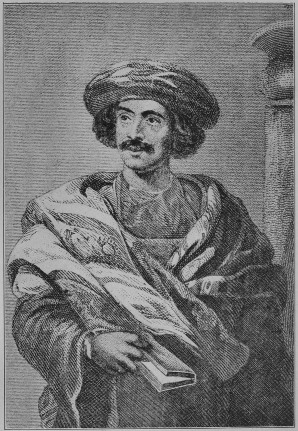 Ram Mohan Roy
With freedom in drinking and eating they also learned freedom of thought
and expression.
The first generation of the Bengalees was thus Anglicised through and
through. They looked down upon their own religion; they thought poorly
of Indian society. They knew nothing of their own past history, and they
glorified in being “Sahibs.”[52] Some of them became Christians. Alarmed
at this transformation, Ram Mohan Roy and a few others resolved to stem
the tide. For a time they succeeded, but only partially. Be it said to
the credit of the Bengalees that a fairly good number refused to be
carried down-stream, and in spite of their English education stuck to
their own religion and their own customs. They saw a good deal in their
society which needed reform; but they declined to make sweeping changes
and would not imitate. These veterans laid the foundations of the modern
Bengalee literature. They wanted to pour their knowledge, derived from a
study of English language and literature, into their own mother tongue,
and in order to enlarge the vocabulary of the latter for their work,
they had to study Sanskrit. Thus in spite of the Anglification of the
first generation of Bengalees, there grew up a class of men imbued with
nationalistic tendencies. Ram Mohan Roy, the founder of Brahmo Samaj,
was the first nation-builder of Modern India.
For a time the field that was opened for the employment of
English-educated Bengalees in Upper India (in the then N. W. Provinces,
in the Punjab, in Behar, in Central India, in Rajputana, even in Sindh)
checked the growth of these tendencies. The feeling of gratitude and
contentment was supreme. The Bengalee was indispensable in almost every
department. The reins of practical management were mostly in Bengalee
hands, whether it was a court of justice, or a Revenue Commissioner’s
office, or a commissariat depot, of an adjutant’s camp, or the
department of land survey, or education. The heads of departments were
always English, but the heads of ministerial establishments were
generally Bengalees. The English could not do without them. The former
did not know the language of the country, nor did they know the
character of the people. The Bengalees were thus an absolute necessity.
With the spread of a knowledge of the English language, the first
generation of English-knowing Indians in every province came to occupy
an important position. While the old-fashioned Pandit or Moulvie sulked,
the English-knowing Hindu or Mohammedan basked in sunshine and
flourished. The British laid down policies and gave orders; the
English-knowing Indian saw that they were carried out. They thus came to
enjoy the confidence of their masters and imitated their vices.
But what was most important was that they began to think like their
English masters. The English read their newspapers; so the Indians
started their newspapers. The English met in clubs and churches. So the
Indians started Samajes and Sabhas and debating clubs. For a time the
English-knowing Indian prided himself in imitating his master. He took
his dress, he took his cheroot and pipe, and also his cup and beefsteak.
He began to live in houses built and furnished in the English way. He
detested Indian life and took pride in being Anglicised. Everything
Indian was odious in his eyes. The Indians were barbarians; their
religion was a bundle of superstitions; they were dirty people; their
customs and manners were uncivilised; they were a set of narrow-minded
bigots who did not know that man was born free. So the English set the
fashion for them in everything. If their English masters went to church
and read the Bible, they did the same. If the English masters indulged
in free-thinking, they did the same. They wanted to be like their
English masters in every way. Their ambition, however, soon met a check.
They could equal the British in drinking and in free-thinking, but they
could not aspire to his position and place in the government of the
country. Some of them decided to try this in the case of their sons.
They sent them to England. A few passed the Indian Civil Service and the
Indian Medical Service examinations, others became barristers. Both
found out by bitter experience that, however able and clever they might
be, whatever their intellectual acquirements, no matter if they were
Christians, or semi-Christians, or free-thinkers, there was a limit to
their aspirations both in service and out of it. That was the first
eye-opener.
In the meantime, the thoughtful among the Indians, who had not taken to
English manners, were anxiously watching the flow of the current. They
saw the disintegrating and denationalising forces that were at work;
they saw that their national edifice was crumbling down brick by brick;
everything which they had valued and held sacred was being devastated
and treated with contempt and reduced to ashes. Their own children were
deserting the old banners to which innumerable generations before them
had clung with love and reverence. They saw all this; they were sorry;
they wept tears of blood; but they could do nothing. They were powerless
before the tide. They tried palliatives, but failed. What was fatal to
their pious wishes was that they could not themselves resist the fruits
which English education brought in the shape of emoluments and rank and
position. They wanted these fruits without the thorns. They soon found
that that was impossible, and so they gave up the struggle in despair
and became reconciled to the inevitable. What they failed to achieve
was, however, brought about by a combination of circumstances which we
will briefly enumerate below.
Forces Resisting Denationalisation. 1. The English education imparted
in schools and colleges established by the British, and the Christian
missions (in some instances supplemented by Indian agencies), opened the
gates of Western thought and Western literature to the mass of educated
Indians.
2. Some of the British teachers and professors who taught in the schools
and colleges consciously and unconsciously inspired their pupils with
ideas of freedom as well as nationalism.
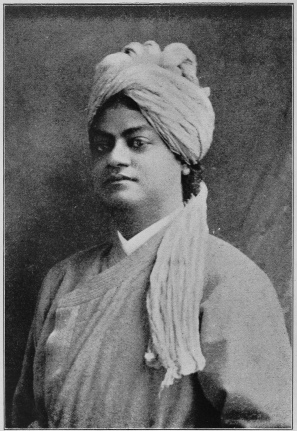 Swami Vivekananda
3. The over-zeal of the missionaries in their attacks upon Indian
religions and Indian thought suggested to Indian minds a closer and
deeper study of their own religion and thought.
4. In this they were materially helped by the awakening of Europeans to
the thought of the East. The labours of the European savants and their
appreciation of Eastern thought kindled a fresh fire in the bosom of
Hindus and Mohammedans.
5. The writings of Ram Mohan Roy, Debendra Nath Tagore, Rajendra Lal
Mitra, in Bengal, those of Ranade, Vishnu Pandit and others in
Mahrashtra, of Swami Dayanand and Sir Syed Ahmad Khan in Upper India, of
Madam Blavatsky and the other Theosophists in Madras, brought about a
new awakening, which afterwards received an even stronger impetus from
the writings and speeches of Mrs. Annie Besant and Swami Vivekananda.
This was on the religious and social side mainly, but its national
character was unmistakable.
Political Disappointments. The current produced by these causes met
another current, which was generated by political disappointments. The
aspirations of the educated Indian had met a check. The few successes
gained by Indians in the Indian Civil Service examinations alarmed the
British, and they sought for means of keeping them out. One of the means
adopted was to require that the candidates should not be more than 19 to
21 years of age at the time of examination, an age so young as made it
impossible for Indians to come over to England and successfully compete.
This raised a howl and cry in Bengal, and the rest of the country
followed Bengal. Then came other measures like the Vernacular Press Act
of Lord Lytton, and the remission of cotton duties,[53] and so on. The
generation educated in England had some experience of the methods of
political agitation in that country, and they soon began to organise on
those lines. Political agitation on modern lines thus became a fact of
Indian life, and English-educated Indians began to talk of liberty and
self-government.
Thus were laid the foundations of the national awakening, of which so
much has been heard of late. The methods of the English Government in
India, their educational system, their press, their laws, their courts,
their railways, their telegraphs, their post-offices, their steamers,
had as much to do with it as the native love of country, of religion and
nation, which had received a temporary check by the crushing defeat of
the mutineers in 1857, and by the Indian people’s too ready acquiescence
in the political and social domination of the foreigner which ensued.
This time, however, the movement was brought into existence by those who
had received their inspiration from Europe. Within less than twenty
years after the great mutiny, the Nationalist Movement of India was
born, almost at the same time and place at which Lord Lytton was
presiding at the great Imperial Durbar, and announcing that the great
Queen of England was assuming the title of Empress of India. The Durbar
reduced the chiefs of India from the position of allies to that of
feudatories, but it quite unconsciously and against the intentions of
its authors raised in theory the status of the Indian subjects of the
Queen to that of citizens of the British Empire. Little did the authors
of that Durbar realise the inner significance of the move they were
making. That Durbar, we may say, marked the beginning of the movement
which filled the educated Indian with the idea of obtaining his rightful
place in the Empire. He became articulate and began to assert himself.
He was no longer satisfied with the minor positions which he held in the
Government of India. He claimed his country as his own, and raised the
cry of “India for the Indians.” His cry gained strength when he found
that the India which he looked down upon in the fifties or sixties, the
system of thought and life which he considered barbarous, primitive and
old fashioned, and the past which he despised, were after all not so bad
as he had thought.
The latter was the contribution of the Brahmo Samaj, the Theosophical
Society, the Society for the Resuscitation of Sanskrit Literature, the
Bengal Sahitya Parishad, the Maharastra Sabha, the Arya Samaj, the
Sanatan Sabhas and other societies of a similar nature. The Bengali and
the Mahratta writers, who had carried on researches in Indian history
and unearthed valuable documents and written in their respective
vernaculars, contributed materially to the growth of this feeling. The
Theosophical Society began to praise and justify every Hindu institution
and to find science in every custom. In fact, for a time, the
thoughtful began to fear lest the pendulum was swinging the other way
and we were in the midst of a wave of reaction.
Lord Ripon. India was in this state of fermentation, religious, social
and political, when Lord Ripon was appointed to the viceroyalty of
India. Lord Ripon was an exceedingly kind man and commanded a broad
outlook. He was very lucky in having come on the heels of an exceedingly
unpopular Viceroy like Lord Lytton. Lord Lytton was a Tory of pronounced
imperial tendencies. Under the inspiration of Disraeli, he had by an
unworthy trick on the ruling chiefs of India changed their position from
that of allies to that of feudatories; he had gagged the vernacular
press by his press legislation; he had blundered into a bloody Afghan
war and was responsible for several other reactionary measures. Lord
Ripon started by undoing most of what Lord Lytton had done. He repealed
the Vernacular Press Act, which at once set the seal of popular approval
on his administration. The most important of his achievements were,
however, constructive. He formulated a policy of local government, and
thus laid the foundations of representative institutions in India; he
substituted merit for patronage and jobbery in filling public services,
by organising competitive examinations for filling a certain number of
posts in the higher branches of the subordinate services; last but not
least, he resolved to so alter the criminal law as to place the European
and the Indian on an equal footing in the matter of trials.
All this aroused the bitterest anger of the Anglo-Indian officialdom.
The Anglo-Indians opposed every one of these measures. They ridiculed
the idea of introducing any measure of local self-government in India,
and predicted that that must be the beginning of the end. They called
the measure rash and ill-advised and impracticable. The natives were
incapable of self-government, they said. Their religious and social
differences made it impossible. Officialdom was equally opposed to the
filling of any posts in government service by open competition. This
would bring in the “Babu,” and the “Babu” they had now begun to hate and
look down upon. The “Babu” was a “low-caste hybrid,” who wrote bad
English and talked of liberty and equality, who lacked in qualities of
docility and submissiveness, which had so far characterised persons
appointed by selection. This interfered materially with the prestige of
the Lord of the District, as people could now get “high” appointments
under the Government independently of him. Why should the people respect
him any more? His was a government by prestige, and measures like these
of Lord Ripon would destroy it. So prophesied the heaven-born “white
Brahmins.” But the worst offence of Lord Ripon was the “Ilbert
Bill,”[54] which aimed at placing the European and the Indian on an
equal footing in the eyes of the law, and would remove the disabilities
of the Indian Magistrate in the matter of the trial of the white men.
“Shall we be judged by the Nigger?” “shall he send us to jail?” “shall
he be put in authority over us? Never! It is impossible! Better that
British rule in India should end than that we be obliged to submit to
such humiliating laws.” The whole tribe of the Anglo-Indians (official
and non-official) opposed the measure most vehemently, and attacked Lord
Ripon as never viceroy was attacked before by his own countrymen in
India. They called him insulting names, passed resolutions condemning
his administration wholesale, proposed his recall before the expiration
of his period of office, and did everything possible to make him feel
that they hated him.
His unpopularity among the Anglo-Indians made him popular among the
Indians. The press and the platform sang his praise. The country was
ablaze with excitement. Never before under British rule had the country
been so enthusiastic in political matters. In Lord Ripon, they thought,
they had found a political Messiah. They gave him addresses, unharnessed
the horses from his carriage, in many places, and otherwise showed their
love and regard for him, which exasperated the European community beyond
measure. The Europeans saw in all this a menace to their power, and the
beginning of the end of imperial despotism in India. They thought they
were on the verge of losing India. In Lord Ripon the Indians recognised
the first British viceroy who was prepared to make an honest attempt at
giving effect to the pledges given and the promises made by Queen
Victoria in her famous proclamation of 1858, when the administration of
India passed into the hands of the regular British Government. Lord
Ripon lost the battle on the particular measure which had aroused the
anger of the European community more than anything else, viz., his
proposed amendment of the Criminal Procedure Code. A compromise was made
by which the principle of the bill was really abandoned. But he had
raised hopes and aspiration which were, so to say, the beginning of
political life in India. On the expiration of his term of office, the
Indians agitated for an extension of his term, which was not granted.
However, they gave him a farewell which still rings in the ears of the
older generation of Indians who took part in it, in Calcutta, in Bombay,
in Benares, and other places.
Lord Ripon left a permanent impression on the minds of the Indians. Lord
Hardinge has won a great deal of popularity, but it is doubtful if he is
so universally loved and honoured as Lord Ripon was.
Lord Dufferin. However, the point of the story is, that when Lord
Ripon left India, the country was in a state of perturbation. There was
a great deal of tension still lingering between the Indian and the
European communities. The fire was still smouldering when Lord Dufferin
took charge of the office of viceroyalty. He had been brought up in
diplomacy. To him diplomacy was like mother’s milk. He was a diplomat by
birth as well as by training. His mission was to appease the anger of
the governing class and in a quiet way to undo what Lord Ripon had done.
But he thought that perhaps it might be dangerous to go at it straight.
The cry of political liberty and political equality had been raised. It
was impossible to satisfy it; yet it might be dangerous to strangle it
by force. It was impossible to revive the Vernacular Press Act of Lord
Lytton. It was impossible to stifle political life which had sprung up
in the atmosphere created by Lord Ripon’s policy, and which was making a
rather precocious growth. The more it was opposed, ridiculed and
despised, the more it thrived. So he decided to guide it and to make it
as innocuous as it could be without rousing the suspicions of those who
were to be the tools.
Indian National Congress an English Product. It is an undisputed
historical fact, that the idea of the Indian National Congress was a
product of Lord Dufferin’s brain; that he suggested it to Mr. Hume,[55]
and that the latter undertook to work it out. We have no means of
knowing whether Mr. Hume communicated the fact to all the Indian leaders
who joined hands with him in organising it, but in all probability he
told some of them. It leaked out, however, in Lord Dufferin’s lifetime,
was published in the press, brought to his notice and never denied by
him. Nor did Mr. Hume, who died only in 1912, ever deny it. It has since
been admitted to be true by his biographer, another veteran Congress
leader, Sir William Wedderburn.[56] Sir William says on page 59 of his
life of Mr. Hume: “Indeed in initiating the National Movement, Mr. Hume
took counsel with the viceroy, Lord Dufferin; and whereas he was himself
disposed to begin his reform propaganda on the social side, it was
apparently by Lord Dufferin’s advice that he took up the work of
political organisation as the first matter to be dealt with.” We have
no hesitation in accepting the accuracy of the statement made by Sir
William Wedderburn as to what Lord Dufferin told Mr. Hume, because we
have no doubt of Mr. Hume’s sincerity of purpose. Lord Dufferin did
evidently tell Mr. Hume that “as head of the Government, he had found
the greatest difficulty in ascertaining the real wishes of the people;
and that for purposes of administration it would be a public benefit, if
there existed some responsible organisation through which the Government
might be kept informed regarding the best Indian public opinion.” Sir
William Wedderburn assures us that “these kindly counsels (i. e.,
those given by Lord Dufferin) were received with grateful appreciation
by all concerned,” and “indeed so cordial were the relations” between
the officials and the Congress leaders that “Lord Dufferin was
approached with a view to the first Congress being held under the
presidency of Lord Reay, then Governor of Bombay.” We are told that Lord
Dufferin welcomed the proposal as showing the desire of the Congress to
work in complete harmony with the Government, but he saw many
difficulties in accepting the proposal, and so the idea was abandoned.
“None the less the first Congress was opened with the friendly sympathy
of the highest authorities.”
So this is the genesis of the Congress, and this alone is sufficient to
condemn it in the eyes of the advanced Nationalists. There is no
parallel to this in the history of the world. Who has ever heard of a
movement for political liberty being initiated by a despotic government,
which is foreign in its agency and foreign in its methods?
Hume, a Lover of Liberty. It is obvious that when Lord Dufferin
expected a political organisation to represent the best Indian opinion,
it was far from his mind to suggest an organisation that would demand
parliamentary government for India, or self-government even on colonial
lines. What he evidently aimed at was a sort of an innocuous association
which should serve more as a “safety valve” than as a genuine
Nationalist organisation for national purposes. Mr. Hume may have meant
more. He was a lover of liberty and wanted political liberty for India
under the ægis of the British crown. He was an English patriot and as
such he wanted the continuance of British connection with India. He saw
danger to British rule in discontent going underground, and one of his
objects in establishing the Congress was to save British rule in India
from an impending calamity of the gravest kind which he thought was
threatening it at that time. In his reply to Sir Auckland Colvin,[57] he
admitted that “a safety valve for the escape of great and growing
forces generated by” British “connection, was urgently needed, and no
more efficacious safety valve than” the “Congress movement could
possibly be devised.” This correspondence between Sir Auckland Colvin,
then Lieutenant Governor of the United Provinces, and Mr. Hume, reveals
the whole genesis of the Congress movement, and is so clear and
illuminating that no student of Indian politics can afford to neglect
it.
It leaves no doubt whatsoever that the immediate motive which underlay
the idea of starting the Congress was to save the Empire from “the
danger” that loomed ahead “tremendous in the immediate future,” “the
misery of the masses acted on by the bitter resentment of individuals
among the educated class.” In the words of Mr. Hume, “no choice was left
to those who gave the primary impetus to the movement. The ferment, the
creation of Western ideas, education, invention, and appliances, was at
work with a rapidly increasing intensity, and it became of paramount
importance to find for its products an overt and constitutional channel
for discharge, instead of leaving them to fester as they had already
commenced to do, under the surface.” Mr. Hume further adds that though
“in certain provinces and from certain points of view the movement was
premature, yet from the most important point of view, the future
maintenance of the integrity of the British Empire, the real question
when the Congress started, was, not is it premature, but is it too late?
will the country now accept it?” Indeed, by that test, the events have
proved that the Indian National Congress has been a great success, and
that either Mr. Hume’s reading of the political situation was
exaggerated, or that his remedy has been amply justified.
Congress to Save British Empire from Danger. But one thing is clear,
that the Congress was started more with the object of saving the British
Empire from danger than with that of winning political liberty for
India. The interests of the British Empire were primary and those of
India only secondary, and no one can say that the Congress has not been
true to that ideal. It might be said with justice and reason that the
founders of the Indian National Congress considered the maintenance of
British rule in India of vital importance to India herself, and
therefore were anxious to do everything in their power, not only to save
that rule from any danger that threatened it, but even to strengthen it;
that with them the redress of political grievances and the political
advance of India was only a by-product and of secondary importance. If
so, the Congress has been true to its ideal, and no one can find fault
with it.
On the strength of an illuminating memorandum found among his papers,
Hume’s biographer has stated the nature of the evidence that “convinced”
Mr. Hume at the time (i.e., about 15 months before Lord Lytton left
India) that the British were “in immediate danger of a terrible
outbreak.” We will give it in Mr. Hume’s own words.
“I was shown seven large volumes (corresponding to a certain mode of
dividing the country, excluding Burmah, Assam, and some minor tracts)
containing a vast number of entries; English abstracts or
translations—longer or shorter—of vernacular reports or communications
of one kind or another, all arranged according to districts (not
identical with ours), sub-districts, sub-divisions, and the cities,
towns and villages included in these. The number of these entries was
enormous; there were said, at the time, to be communications from over
thirty thousand different reporters. I did not count them, they seemed
countless; but in regard to the towns and villages of one district of
the Northwest Provinces with which I possess a peculiarly intimate
acquaintance—a troublesome part of the country, no doubt—there were
nearly three hundred entries, a good number of which I could partially
verify, as to the names of the people, etc.” He mentions that he had the
volumes in his possession only for about a week; into six of them he
only dipped; but he closely examined one covering the greater portion of
the Northwest Provinces, Oudh, Behar, parts of Bundelkund and parts of
the Punjab; and so far as possible verified the entries referring to
those districts with which he had special personal acquaintance. Many of
the entries reported conversations between men of the lowest
classes,[58] “all going to show that these poor men were pervaded with a
sense of the hopelessness of the existing state of affairs; that they
were convinced that they would starve and die, and that they wanted to
do something, and stand by each other, and that something meant
violence,” (for innumerable entries referred to the secretion of old
swords, spears and matchlocks, which would be ready when required. It
was not supposed that the immediate result, in its initial stages, would
be a revolt against the Government, or a revolt at all in the proper
sense of the word. What was predicted was a sudden violent outbreak of
sporadic crimes, murders of obnoxious persons, robbery of bankers,
looting of bazaars). “In the existing state of the lowest half-starving
classes, it was considered that the first few crimes would be the signal
for hundreds of similar ones, and for a general development of
lawlessness, paralysing the authorities and the respectable classes. It
was considered also, that everywhere the small bands would begin to
coalesce into large ones, like drops of water on a leaf; that all the
bad characters in the country would join, and that very soon after the
bands obtained formidable proportions, a certain small number of the
educated classes, at the time desperately, perhaps, unreasonably, bitter
against the Government, would join the movement, assume here and there
the lead, give the outbreak cohesion, and direct it as a national
revolt.”
To this, Sir William Wedderburn adds further from his own personal
knowledge:
“The forecast of trouble throughout India was in exact accordance with
what actually occurred, under my own observation, in the Bombay
Presidency, in connection with the Agrarian rising known as the Deccan
riots. These began with sporadic gang robberies and attacks on the
money lenders, until the bands of dacoits, combining together, became
too strong for the police; and the whole military force at Poona, horse,
foot, and artillery, had to take the field against them. Roaming through
the jungle tracts of the Western Ghauts, these bands dispersed in the
presence of military forces, only to reunite immediately at some
convenient point; and from the hill stations of Mahableshwar and
Matheran we could at night see the light of their campfires in all
directions. A leader from the more instructed class was found, calling
himself Sivaji, the Second, who addressed challenges to the Government,
offered a reward of 500 rupees for the head of H. E. Sir Richard Temple
(then Governor of Bombay), and claimed to lead a national revolt upon
the lines on which the Mahratta power had originally been founded.”
So in the words of these two leaders, the immediate motive of the
Congress was to save the British Empire from this danger. There is,
however, one difficulty in believing outright that this was the
immediate reason of the birth of the Congress. Mr. Hume is said to have
seen this evidence at the time he was in the service of the Government,
viz., fifteen months before Lord Lytton left India. Between then and the
first meeting of the Congress in 1885 intervened a period of about seven
years. During this time Lord Ripon was viceroy for five years. The idea
of starting a political organisation on the lines of the Congress is
said to have originated with Lord Dufferin.
This is a little inconsistent with the theory that the Congress was
founded out of fear of a political outbreak and only in the nature of a
safety valve. Nor is the latter theory consistent with Mr. Hume’s first
political manifesto addressed to the graduates of the Calcutta
University in March, 1883. This document is so manly in its
outspokenness, so true in its principles, that we will quote the whole
of it (or at least as much of it as is given in Mr. Hume’s biography).
Addressing the graduates of the university, Mr. Hume said:
“Constituting, as you do, a large body of the most highly educated
Indians, you should, in the natural order of things, constitute also the
most important source of all mental, moral, social, and political
progress in India. Whether in the individual or the nation, all vital
progress must spring from within, and it is to you, her most cultured
and enlightened minds, her most favoured sons, that your country must
look for the initiative. In vain may aliens, like myself, love India
and her children, as well as the most loving of these; in vain may they,
for her and their good, give time and trouble, money and thought; in
vain may they struggle and sacrifice; they may assist with advice and
suggestions; they may place their experience, abilities and knowledge at
the disposal of the workers, but they lack the essential of nationality,
and the real work must ever be done by the people of the country
themselves.” “Scattered individuals, however capable and however well
meaning, are powerless singly. What is needed is union, organisation and
a well defined line of action; and to secure these an association is
required, armed and organised with unusual care, having for its object
to promote the mental, moral, social and political regeneration of the
people of India. Our little army must be sui generis in discipline and
equipment, and the question simply is, how many of you will prove to
possess, in addition to your high scholastic attainments, the
unselfishness, moral courage, self-control, and active spirit of
benevolence which are essential in all who should enlist?”
Even truer and nobler are the sentiments in the final appeal which ended
this letter and which runs thus:
“As I said before, you are the salt of the land. And if amongst even
you, the élite, fifty men can not be found with sufficient power of
self-sacrifice, sufficient love for and pride in their country,
sufficient genuine and unselfish heartfelt patriotism to take the
initiative, and if needs be, devote the rest of their lives to the
cause, then there is no hope for India. Her sons must and will remain
mere humble and helpless instruments in the hands of foreign rulers, for
‘they who would be free, themselves must strike the blow.’ And if even
the leaders of thought are all either such poor creatures, or so
selfishly wedded to personal concerns, that they dare not or will not
strike a blow for their country’s sake, then justly and rightly are they
kept down and trampled on, for they deserve nothing better. Every
nation secures precisely as good a government as it merits. If you, the
picked men, the most highly educated of the nation, can not, scorning
personal ease and selfish ends, make a resolute struggle to secure
freedom for yourselves and your country, a more impartial
administration, a larger share in the management of your own affairs,
then we, your friends, are wrong, and our adversaries right; then are
Lord Ripon’s aspirations for your good, fruitless and visionary; then,
at present, at any rate, all hopes of progress are at an end, and India
truly neither lacks nor deserves any better government than she now
enjoys. Only, if this be so, let us hear no more factious, peevish
complaints that you are kept in leading strings, and treated like
children, for you will have proved yourselves such. Men know how to
act. Let there be no more complaints of Englishmen being preferred to
you in all important offices, for if you lack that public spirit, that
highest form of altruistic devotion that leads men to subordinate
private ease to the public weal, that true patriotism that has made
Englishmen what they are, then rightly are these preferred to you, and
rightly and inevitably have they become your rulers. And rulers and
taskmasters they must continue, let the yoke gall your shoulders ever so
sorely, until you realise and stand prepared to act upon the eternal
truth, whether in the case of individuals or nations, self-sacrifice
and unselfishness are the only unfailing guides to freedom and
happiness.”
The capitals and italics are, except in two cases, ours. In the original
there are only two italics, (1) the word themselves in the sentence
“they who would be free, themselves must strike the blow,” and, (2)
“Men know how to act.” Now these are not the words of a diplomat, much
less those of a hypocrite. Mr. Hume was too noble not to mean what he
said, and the present writer has no doubt but that Mr. Hume was
absolutely sincere in what he said. He had a passion for liberty. His
heart bled at the sight of so much misery and poverty as prevailed in
India, and which according to him was preventable by good government. He
burned with indignation at the “cowardly” behaviour of his countrymen
towards Indians, and he could not help feeling ashamed at the way in
which pledges given and promises made were being ignored. He was an
ardent student of history and knew full well that no government, whether
national or foreign, had conceded to popular demands without pressure
from below. In the case of an alien government, the chances were even
still more meagre. He therefore wanted the Indians “to strike” for their
liberty if they wanted it. The first step was to organise. So he advised
organisation.
Nor are we prepared to believe that men like Ranade, Tilak, Naoroji, W.
C. Bonnerjea, Ajudhia Nath, and Tyabji, were only tools in the hands of
the Britishers. No, we do not think so. They were all true and good
patriots. They loved their country and they started the Congress with
the best of motives. It is possible that with some British sympathisers,
the interests of the British Empire were primary, and they sided with
the Congress because they believed that thereby they could best secure
the Empire; but the writer of this book knows from personal experience
how deeply the love of humanity and liberty is embedded in the hearts of
some Britishers, and he is compelled to believe that at least some of
those who showed their sympathy with the Congress were of that kind.
The Imperialist Junker and Jingo calls such men “Little Englanders,” but
the truth is that their hearts are too big to be imperial. They believe
in humanity, and in liberty being the birthright of every human being.
In their eyes a tyrant, one who robs others of their liberty, one who
bases his greatness on the exploitation of others, or deprives them of
their rights by might or clever diplomacy, does not cease to be so by
the fact of his being their countryman. They are patriots themselves and
will shed the last drop of their blood in the defence of their liberty,
and in the defence of their country’s liberty and independence, but
their patriotism does not extend to the point of applauding their
country’s robbing others of theirs. Yes, there are Britons who are
sincere friends of the cause of liberty all over the globe. They deplore
that their country should be ruling India at all, and if it were in
their power, they would at once withdraw from India. Some of these
sympathise with the Indian Nationalists in all sincerity, and have done
so ever since the Indian National Congress was started, or even from
before that time. It is no fault of theirs, if the Indian Nationalist
Movement has not been such a success as they would have wished it to be,
and if it has not been able to achieve anything very tangible. The
fault is purely that of the Indians, and of the Indians alone, or of the
circumstances.
Mr. Hume was quite sincere in his motives, but he forgot that a
political organisation started at the instance or even with the approval
of the rulers whose power and emoluments it proposed to curtail, whose
despotism and principles it questioned, in short, whom it proposed to
displace and dethrone, was an anomaly; it was unnatural. In their desire
to have an easy and unopposed start, the Indian founders of the National
Congress forgot their history, and consequently ignored the truth that
“those who wanted to be free must themselves strike the blow,” and that
it was monstrous to expect those against whom the blow was aimed to
bless the striker and the striking. We do not agree with Mr. Gokhale
that “no Indian could have started the Indian National Congress” and
that “if the founder of the Congress had not been a great Englishman and
a distinguished ex-official, such was the official distrust of political
agitation in those days that the authorities would have at once found
some way or other to suppress the movement.”
First, political agitation did not start with the Congress. It had been
started before and no attempt to suppress it had succeeded. Second, the
distrust of political agitation in India was not greater in those days
than it is now and has been during the life of the Congress. But if it
be true that the movement could not have been started by an Indian or by
the combined efforts of many Indians, all we can say is that that itself
would be proof of its having been started before time and on wrong
foundations.
Had not Mr. Hume said that “whether in the individual or the nation, all
vital progress must spring from within,” and that it was “to her own
sons that the country must look for the initiative?” Did not Mr. Hume
say in his manifesto of 1883 that “in vain may aliens like myself love
India ... in vain may they struggle and sacrifice ... they may assist
with advice and suggestion, but they lack the essential of
nationality, and the real work must ever be done by the people of the
country themselves?”
These may be only truisms, but they are fundamental and any political
effort made in defiance of them must be futile and impotent. The Indian
leaders of the Congress have never fully realised the absolute truth of
these principles and the result is the comparatively poor record of the
Congress. In his original manifesto issued in 1883, Mr. Hume wanted
fifty Indians “with sufficient power of self-sacrifice, sufficient love
for and pride in their country, sufficient genuine and unselfish
heartfelt patriotism to take the initiative and if needs be to devote
the rest of their lives to the cause.”
Of course there were many times fifty men of that kind in the country,
even then, who were devoting their lives to the service of their
country, but not in the political line. It took the Congress and the
country, by working on Congress lines, more than twenty years to produce
fifty, many times fifty, such men to devote their lives to the political
cause. But unfortunately these are neither in the Congress, nor of the
Congress. Barring Mr. Dadabhai Naoroji and the late Mr. Gokhale, who
among the living Congress leaders can be said to have devoted their
lives, in the way Mr. Hume wanted them to do, to the Congress cause?
Within the last thirty years India has produced many noble sons who have
given their all in the service of the Motherland. They come from all
provinces, all religions, all denominations, and all castes. But very
few of them have ever been active in the Congress or for the Congress.
Within the same period many Indians have given away many hundreds of
thousands of rupees, some the whole earnings of a lifetime, in aid of
education or for other public or charitable purposes; but the Congress
work has always languished for want of funds. The British Committee of
the Indian National Congress, located in London, have never had
sufficient money to do their work decently. The expenses of the British
Committee have largely fallen on Sir William Wedderburn. He and Mr. Hume
between them spent quite a fortune on the movement. No single Indian is
said to have spent even a fraction of that. The question naturally
arises,—why has it been so? The answer is obvious. The movement did not
appeal to the nation. The leaders lacked that faith which alone makes it
possible to make great sacrifices for it.
In the early years of the Congress there was a great deal of enthusiasm
for it among the English educated Indians. So long as no attempts were
made to reach the masses and carry on the propaganda among the people,
the officials expressed their sympathy with the movement. Lord Dufferin
even invited the members as “distinguished visitors” to a garden party
at Government House, Calcutta, when the Congress held its second session
in that city in 1886. In 1887 the Governor of Madras paid a similar
compliment to them at Madras,[59] but in 1888 when Mr. Hume adopted the
methods and tactics of the Corn-Law Leaguers of England, down came the
hand of the Government; and then the Congress movement at once adopted
an apologetic tone and abandoned the only method by which it could make
itself heard with effect. Why? Because, in the words of Mr. Hume, there
were no “men who could act.”
The Congress Lacked Essentials of a National Movement. Ever since then
the Congress has cared more for the opinion of the Government and the
officials than for truth or for the interests of the country. Again the
question arises, why? And the reply is, because the leaders had neither
sufficient political consciousness nor faith. They had certain political
opinions, but not beliefs for which they were willing to suffer. They
were prepared to urge the desirability of certain reforms in the
government of the country, even at the risk of a certain amount of
official displeasure, but they were not prepared to bear persecutions,
or suffer for their cause. Either they did not know they had a cause,
or they were wanting in that earnestness which makes men suffer for a
cause. Or, to be charitable, they thought that the country was not
prepared for an intense movement and considered it better to have
something than nothing. They perhaps wanted to educate the country in
political methods and bring about a political consolidation of all the
national forces, before undertaking an intensified movement. But with
the greatest possible respect for the founders of the Indian National
Congress, or for those who a few years ago took up the control of the
movement, we cannot help remarking that by their own conduct they showed
that their movement lacked the essentials of a national movement.
A movement does not become national by the mere desire of its founders
to make it so. In the opinion of the writer it is a mistake to start a
national political movement unless those who start it are prepared to
make great sacrifices for it. A halting, half-hearted political movement
depending on the sympathy and good will of the very class against whom
it is directed, consulting their wishes at every step, with its founders
or leaders trembling for their safety and keeping their purse strings
tight, only doing as much as the authorities would allow and as would
not interfere in any way with their own personal interests and comforts
and incomes, is from its very nature detrimental to real national
interests. A political movement is mischievous in its effects if its
leaders do not put a sufficient amount of earnestness into it to evoke
great enthusiasm among their followers, such as would prepare them for
great sacrifices for the cause on the one hand, and on the other,
produce a certain amount of fear of unpleasant consequences in those
against whom it is directed. For this it is necessary that the leaders
should be prepared to suffer for the cause. The sacrifice of money is
the least proof of earnestness which a believer in any cause can give.
It is a fact that the English friends of the movement showed more
earnestness than many of the Indian leaders. They spent their own money
over it and they incurred the displeasure of their countrymen and the
odium of being called traitors to their own country. Mr. Hume was “in
deadly earnest.” He started the movement with the good will of the
authorities and waited for results for two years. When, however, he
found that “the platonic expressions of sympathy by the authorities were
a mockery,” that nothing was done to lessen the “misery of the masses”
and to relieve their sufferings and redress their grievances, he decided
to put more intensity into the movement. He undertook to instruct the
Indian nation and rouse them to a sense of their right and to a sense of
the wrong that was being done to them. In his opinion, “the case was one
of extreme urgency, for the deaths by famine and pestilence were counted
not by tens of thousands or by hundreds of thousands, but by
millions.”[60] He concluded that “in order to constrain the Government
to move, the leaders of the Indian people must adopt measures of
exceptional vigour, following the drastic methods pursued in England by
Bright and Cobden in their great campaign on behalf of the people’s
food.” So, like Cobden, Hume decided that since the attempt of the
Congress leaders to instruct the Government had failed and since the
Government had refused to be instructed by them, the next step was “to
instruct the nations, the great English nation in its island home, and
also the far greater nation of this vast Indian continent, so that
every Indian that breathes upon the sacred soil of this our motherland,
shall become our comrade and coadjutor, our supporter and if need be
our soldier, in the great war that we, like Cobden and his noble band,
will wage for justice, for our liberties and our rights.”[61]
Hume’s Political Movement. Now these were noble words, pointing out
the only political weapon that ever succeeds against autocratic
governments. We are told by Mr. Hume’s biographer that “in pursuance of
such a propaganda in India, Mr. Hume set to work with his wonted energy,
appealing for funds to all classes of the Indian community, distributing
tracts, leaflets and pamphlets, sending out lecturers and calling
meetings both in large towns and in country districts. Throughout the
country over one thousand meetings were held, at many of which over five
thousand persons were present, and arrangements were made for the
distribution of half a million pamphlets, translations into twelve
Indian languages being circulated of two remarkable pamphlets, showing
by a parable the necessary evils of absentee state landlordism, however
benevolent the intention.”[62]
That was true political work, done with a real political insight. If it
had been persevered in, the history of the Congress would have been
different and perhaps the revolutionary party would never have been born
or would have been born earlier. In either case the country would have
been farther ahead in politics than it is now. What, however, actually
happened was that the Government was at once moved to hostility. Lord
Dufferin spoke of the Congress in terms of contempt “as the
infinitesimal minority,” at a Calcutta dinner. Sir Auckland Colvin
stirred up the Mohammedans, organised an Anti-Congress Association and
denounced the Congress in no measured terms, as mischievous, disloyal,
and much before the time.
Congress Overawed. Mr. Hume started to explain in an apologetic tone.
It was at this time that he came out with the “safety valve” theory. The
propaganda was at once abandoned, never to be resumed in the history of
the movement. The movement in England failed for want of funds. The
movement in India collapsed for want of perseverance, vigour and
earnestness. Here again we are disposed to think that Mr. Hume’s
subsequent conduct was influenced more by the fears and half-heartedness
of the Indian leaders than by his own judgment. If the Indian leaders
had stuck to their guns and pushed on their propaganda, the country
would have supplied funds and would have rallied round them. Perhaps
there might have been a few riots and a few prosecutions. But that would
have drawn the attention of the British public to Indian conditions more
effectively than their twenty-eight years of half-hearted propaganda in
England did. The political education of the people would have been more
rapid and the movement would have gained such a strength as to make
itself irresistible. It is possible, nay, probable, that the Government
would have suppressed the movement. But that itself would have been a
victory and a decided and effective step in the political education of
the people. The revolutionary movement would have come earlier and the
Government would have seen the wisdom of conciliating the moderates much
earlier than 1909. What was given to us in 1909 might have been given
twenty years earlier. The Mohammedans would have been happy to get in
1889 what they got in 1909. The Indian leaders, however, thought that
they were not sufficiently strong and that the movement stood the chance
of being suppressed. They gave in and abandoned the only effective
weapon they had forged to get redress of political grievances.
No nation and no political party can ever be strong enough to make their
voice effective, unless and until they put forward a sufficient amount
of earnestness (not bluff) to convince their opponents that in case
their demands are trifled with, the consequences might be serious to
both parties. The history of political advance in self-governed
countries like England, Germany, France, etc., amply proves this. No
political agitation need be started unless those who are engaged in it
are prepared to back it by the power of the purse and the power of
conviction.
Congress Agitation in England. The Congress overawed in 1888 and 1889,
failed in both respects. So far as the first is concerned, why, that has
been a theme of lamentation, appeals, and wailings from year to year.
Friends in England, whether in or outside the British Committee, have
lamented it in pathetic terms. The Congress agitation in England has
never been effective. The Congress has had precious little influence on
English public opinion, and although the British Committee of the
Congress have had an office and an organ in London for the last 25 years
or more, their influence in English politics has been almost nil. But
for the generosity of Mr. Hume and Sir William Wedderburn, the Congress
office in London might have been long ago closed. The leaders of the
Congress have talked very much of their implicit faith in the English
nation; they have held out hopes of our getting a redress of our wrongs
if we could only inform the British people of the condition of things
prevalent in India; yet the efforts they have put forward to achieve
that end have been puerile and paltry. There is a party of Indian
politicians who do not believe in agitation in England, but the leaders
of the Congress and those who have controlled the organisation in the
last 30 years do not profess to belong to that party. We shall now try
to explain why this has been so.
Causes of Failure of the Congress. (1). The movement was neither
inspired by the people nor devised or planned by them. It was a movement
not from within. No section of the Indian people identified themselves
with it so completely as to feel that their existence as honourable men
depended on its successful management. The movement was started by an
Englishman, at the suggestion of an English pro-consul. The Indians, who
professed to lead it, were either actually in government service or in
professions allied to government service and created by the Government.
A good many of the latter aspired to offices under the Government or to
a recognition of their merit and public spirit by the Government. They
were patriotic enough to give a part of their time and energy to the
movement, so long as it did not clash with their own interests, so long
as they were not required to mar their careers for it, or so long as it
did not demand heavy sacrifices from them. We do not question either
their motives or their patriotism, but it was not sufficiently intense
to induce them to stake their all on it.
(2). The movement lacked the essentials of a popular movement. The
leaders were not in touch with the people. Perhaps they did not even
want to come in touch with them. Their propaganda was confined to a few
English-educated persons, was carried on in English and was meant for
the ears of the authorities rather than for the people. The leaders
always felt shy of the masses, made no efforts to reach them, and
systematically discouraged the younger men from doing the same. Some of
them have openly opposed efforts in this direction.
(3). The leaders failed to inspire enthusiasm among the people, either
by their own failure to make sacrifices, or by the triviality of their
sacrifices. Their ordinary life, their income, their prosperity, and
their luxuries were in no way affected by the movement. There were only
two exceptions to this, viz., Dadabhai Naoroji and Gokhale. The
sacrifices of Messrs. Hume and Wedderburn shamed the people, but failed
to appeal to their imagination. In fact, they roused the anger of the
people against the leaders and created distrust. The spectacle of
leaders accepting high offices they were offered under the Government
added to this distrust.
(4). The movement was neither confined to a select few, nor open to all.
While the people were expected to add to the spectacular side of the
show by their presence in large numbers, by crowded meetings, by cheers
and applause, they were never given a hand in the movement. Differences
of opinion were always discouraged and free discussion was never
allowed. It was neither a public forum, nor a private meeting of the
select few. In the latter case it would have been less expensive and
would have saved money for work in England. In the former case it would
have been more effective.
(5). A national movement, demanding only a few concessions and not
speaking of the liberties of the nation and of its ideals, is never an
effective movement. It is at best an opportunist movement. It is
mischievous in so far as it diverts attention from substantial nation
building and character making. It brings fame without sacrifice. It
opens opportunities for treacheries and hypocrisies. It enables some
people to trade in the name of patriotism. No political movement can be
entirely free from these disadvantages, but the greatest mischief which
a political movement lightly handled and led does, is that it delays the
development of the people on normal lines by raising hopes which are
baseless and can never be realised by means recommended and methods
adopted.
The National Movement in India continued on its placid and humdrum
course until Lord Curzon’s ridicule of the movement convinced the people
that the political methods of the Congress were quite powerless to bring
them any relief against the despotism that trampled upon all their
rights and sensibilities. This led to a deeper and a closer study of the
political problem on the part of men who had convictions as
distinguished from opinions, who had faith as against opportunism, who
wanted a soul for their people, rather than a few more posts under the
Government. They discovered that the movement had suffered not only by
the adoption of wrong methods and by want of sacrifice on the part of
leaders, but by their failure to grasp principles and to formulate
ideals. Hence the cry of Swadeshi and Swaraj.[63]
Swadeshi and Swaraj. No sooner was the cry raised than the country was
swept by a wave of political activity which deeply and intimately
influenced the proceedings of the Congress in 1905 and 1906. Calcutta
might have witnessed in 1906 what Surat did in 1907, but for the
sagacity and patriotism of Dadabhai, who rose equal to the occasion and
blessed the cry for self-government. He declared in the words of Sir
Henry Campbell-Bannerman, the British Premier, that good government
could never be a substitute for self-government. So far good government
had been the ideal of the Congress. At the Calcutta session of 1906 it
was changed to self-government,—and from the mouth of a man who had
devoted his whole life to the political cause. That is the date of the
birth of the real National Movement in India.
The Surat Fiasco[64] was, among other causes, brought about by the
fear that the so-called moderate leaders wanted to go back past what had
been done in 1906. There is no doubt that they had gone back in spirit,
though perhaps not in letter. The enthusiasm, created by popular
propaganda of the Congress in 1888, was killed by the reaction that
followed in subsequent years. The same thing would have happened in 1907
but for the fact that this time the movement was sufficiently intense
to claim its martyrs.
The high ideals embodied in Swadeshi and Swaraj were the ideals worked
out by the sons of India: the miseries of the motherland had given an
impetus to the idea, but the idea itself stood on higher ground. It was
not the redress of grievances that filled the mind of the people, but
the desire for liberty. It was not concessions they wanted, but liberty.
Liberty is not a thing of the earth, and therefore it can neither be
given nor accepted as a gift. It has to be won. People felt that, and
were prepared to realise that in their lives.
After more than twenty years of more or less futile agitation for
concessions and redress of grievances, they had received stones in place
of bread. Lord Ripon was succeeded by a Curzon. People saw that a sort
of mist, a deep, covering fog, had prevented them from seeing ahead.
They had been wandering in pursuit of vain things. The haven had been
concealed from their vision and the result was that their tiny bark had
been following a wrong course. The waters were stormy and the sea was
heavy, but no ship could reach its destination unless the mariners and
sailors in charge knew what their goal was, and unless they were
prepared to put forth all they had in them to carry the bark through. So
far, the bark had been sailing under misleading stars, without a compass
to guide the captain. Now the compass was found and with the finding of
the compass the aspect changed. Ideas inspire men. Ideals prepare them
to breast martyrdom. The ideal of Swaraj found men ready to suffer for
it, to meet death like martyrs. The new movement has inspired a class of
men whose life is filled with that idea and that idea alone. They are
the worshippers of Swaraj; they love their motherland above everything
else. They do not want office, or incomes, or recognition, or applause.
What they want is liberty, not for themselves, because that they might
get perhaps by settling in other countries, but for their beloved
country. High Court Judgeships, Civil Service, Councils, mean nothing to
them.
The founders of the Indian National Congress began their movement under
inspiration of government and under the shadow of the high offices they
held or aspired to under that government, but the founders and inspirers
of the National Movement started their propaganda by boycotting
government and government patronage. The former wanted high offices, the
latter despised those who held them. The former asked for concessions,
the latter rejected them. The former wanted Councils, the latter would
have nothing to do with them. The former appealed to the British
Government and the British nation, the latter appealed to their own
people and to their own patriotism and to their God. The former were led
by the British, the latter by pure Indians. The former would not do
anything which would mar their careers, the latter threw away their
chances like poisoned bread. The former lived in bungalows, revelled in
drawing rooms, velvet-covered chairs, were attended by liveried
servants, ate at well-furnished tables, entertained governors and
magistrates; the latter gave up even the little comforts they had,
changed trousers for dhotis, coats for chapkans or kurtas
(shirts), overcoats for blankets, and boots for ordinary Swadeshi shoes.
The former owed their prosperity in life, their positions, and their
comforts, to the British system, and were therefore under obligation to
the British; but the latter chose the path of poverty and destitution to
avoid obligations. They threw away their chances deliberately and with
the conviction that that was the right thing to do. The former cared for
wines, for children, and for home. The latter gave up all, to devote
themselves completely to the cause and to the motherland. The former had
produced only two full time workers for the cause in the course of 22
years, the latter produced virtually hundreds and thousands in less than
two years. The former worked under the best auspices, the latter started
their work under overhanging clouds, which soon burst and swept away
many of them into prisons.
Is it any wonder that under such inspiration the movement spread like
wildfire and assumed wide proportions? Life met life. Forces met forces.
Conflict and clash resulted in fatal accidents to either party. The
casualties on the side of the Nationalists have been tremendously heavy
and out of all proportion to their number, but judging the conflict by
the resources, no one need hesitate in saying that the moral victory
lies with the Nationalists. Within less than five years of their
propaganda, they forced the hand of the Government to make concessions
which could not be even thought of in 1905. The Congress leaders claim
credit for themselves and so does the Government; but the verdict of
impartial and unbiased historians will be otherwise.
Lord Morley would rally the moderates because there were extremists in
the land. In the absence of the so-called extremists, the moderates were
extremists and the Government and its agents looked down upon them. The
Anglo-Indian statesman and his confidant, the moderate Congress leader,
say that the extremists are few, that most of them are those
good-for-nothings, who could do nothing at the universities, or with
their lives; that they are maniacs and men who have lost all sense of
right and wrong.
Men who have Inspired the Movement. But look at the men who have
inspired the movement, some of whom are leading it even to-day. Is
Arabinda Ghosh a failure? Is Har Dayal a failure? Were the nine
deportees from Bengal failures? How many high-class graduates have been
hanged; how many are in jail! Look at their university records and look
at their prospects, and then say if you can call them “malcontents” or
men who have arisen against the Government because they could not
prosper under it. Their propaganda has compelled the Government to adopt
the severest repressive measures open to a foreign government. The penal
code has been amended to make the definition of sedition more
comprehensive. The criminal procedure code has been amended to
facilitate convictions and to accelerate trials. Provisions have been
added to enable magistrates to award summary imprisonment for failure to
give security for good behaviour asked for on political grounds. A
Seditious Meetings Act has been enacted to make open propaganda
impossible. An Explosives Act has been placed on the statute book. A
Press Law has been passed to muzzle the press. Spies and detectives have
been employed out of number. Teachers, professors, friends, pupils,
class-fellows, parents, have all been requisitioned to crush the
movement. The number of publications confiscated under the Press Act,
the convictions for sedition, for seditious murders, for dacoities and
for keeping arms, the sentences for failure to find securities for good
behaviour, all continue to grow. The cry is, “Still they come!” In
prisons the political prisoner has been subjected to horrible treatment;
one committed suicide and another lost his senses in the Andamans. Many
a tale of misery and wretchedness, of torture and of insults comes from
the prisons in India, but still the movement is far from being crushed.
There is evidence that new recruits join the secret propaganda every
year and take the place of those hanged or imprisoned. A number has
exiled themselves and are carrying on their propaganda in distant lands
under very discouraging and depressing circumstances. The man who says
that the movement is dead or dying must be a liar or a fool. The
movement is alive and possibly as vigorous as it ever was. It has
captured the imagination of the younger generation. And at least 75 per
cent. of the students in India and in England sympathise with this
party. Almost all are Anti-Congress. Even those who are not Nationalists
do not like the Congress and feel no obligation towards it, because the
Congress failed to communicate high principles and lay down high ideals,
and because it failed to create that spirit of self-sacrifice, that
willingness to suffer, without which no national movement can grow,
prosper, and inspire.
The failures of the Congress evolved the Nationalist Movement. The
Congress did its work that way. It brought conviction home that no
amount of prayers, resolutions, protests, memorials, could move the
autocratic bureaucracy in India, and no amount of petitions were likely
to make any impression upon the people in England. The fact that the
Congress leaders would not make sacrifices for the Congress cause,
though they would give large amounts of money for educational purposes
and other charities, forced people to think that they themselves had no
faith in the Congress propaganda or in the Congress methods, though they
lacked the courage to say so or to change their methods. It was perhaps
unreasonable to expect that of the kind of men that led the Congress.
Most of them loved their country and were public spirited; they had
given proof of it, good and sufficient, in other sides of national
activity, in the cause of social reform, in the cause of public
education, in industrial propaganda. Outside the Congress they have done
enough to create an atmosphere which was bound to bring about the
development of the political movement along the lines on which it
eventually did develop in 1905.
The Nationalist child was, so to say, brought up on the lap of the old
Congress man and fed on the food provided by him; though, strange
enough, this bringing up and this feeding produced results for which the
Congressman was not prepared and which shocked him a bit. The first
shock over, some of them were happy to have lived to see the day, and
blessed the movement. Some made up their minds to throttle it, but soon
found that it was not in their power to do so. The worst they could do
was to condemn it and to denounce it. All they could achieve was to cut
the new movement, shake off all responsibility for it, and thus secure
their own safety. We do not say that they did it to save their skins.
But fortunately for them their convictions led them the way their safety
lay. In their heart of hearts they blessed the new movement and were
heartily glad that it came. It acted and reacted on their own movement.
It made it possible for them to put strength and force into their
demands for concessions. Whenever an extremist leader recanted or used
compromising language, they were sorry. They wanted the movement to
continue and to live, though they would not join it and though they
believed that it was harmful to the country in some respects. They
deplore the lack of enthusiasm and sacrifice in their own ranks, but
they admire the selflessness of the extremists and respect their real
leaders. An Arabinda Ghosh and a Tilak simply compel their admiration
and respect. Whatever the shortcomings of Har Dayal may be, he is a
unique personality.
We have stated wherein the new movement differed from the old, and we
have also stated what its dominant note is. We would now like to examine
how it intended to proceed and how its hands were forced to do the
things it has done since.
Lord Curzon and Indian Education. We have already hinted that Lord
Curzon’s policy and his utterances helped a great deal in the birth of
the new movement. When Lord Curzon came to India, he formulated a rather
ambitious programme of reforms to be introduced into the administration
of the country. One of these reforms related to education.
Every one in the country, who has had anything to do with education in
India, was of opinion that the country was very backward in education
and that the system of education there in vogue was defective. It laid
too great stress on the literary side and did not fit people for the
battle of life; it gave undue importance to the English language and
Western modes of thought, at the cost of the vernaculars and the
indigenous civilisation of the country; it encouraged “cram” at the cost
of real merit; it produced a class of imitators and left little scope or
none for originality; it invited third class men from England to fill
the highest positions in the educational service of the country, and
placed the best native intellect and talent under them to starve and rot
for want of opportunities; it did not recognise the duty of the
Government to look after the education of the child from the beginning
until he was fit to fight his own way in the world.
The educational system of the country required radical changes, but what
was most needed was that the Government should be prepared to spend
adequate sums of money for its spread and in order to make it efficient.
Lord Curzon’s pronouncements and programme therefore raised great hopes
in the minds of the people. His University Commission was simply flooded
with suggestions and statements from Indians and Anglo-Indians. The two
classes, however, discussed the matter from entirely different
standpoints: The Indians wanted greater facilities for education, more
schools, more colleges, more masters, more stipends, an extension of
primary school education, abler and better-paid teachers, freedom of
private enterprise, ample provision for technical and industrial
education; but what they wanted most and cared for most was that
education should be more nationalised and humanised. The Anglo-Indians
wanted a curtailment of the educational opportunities, a greater and
stricter control of private enterprise, a raising of university
standards, and a system of education which would curb the rising
generation and make them more easily amenable to discipline and
obedience.
Lord Curzon did go into all these questions, but the decision arrived at
convinced the educated Indians that the motive which underlay Lord
Curzon’s policy was the tightening of government control, the strangling
of all independence in matters educational, and the eventual weakening
of all national movement and national sentiment.
Lord Curzon’s Secret Educational Conference. The fact that he admitted
no Indian to the meeting of the Secret Educational Conference held at
Simla, when he formulated the government policy, strengthened that idea.
His University Legislation shocked the country beyond measure and left
no doubt whatsoever that what he aimed at was a complete official
control of all education in India. Educated Indians read between the
lines and concluded that it was a mistake to look to the Government to
do things or to follow a policy which might quicken the national pulse,
strengthen the Nationalist sentiment, or add to the efficiency of the
people so as to fit them to stand on their legs and desire to get rid of
the leading strings in which they were held by the British.
Indians and Lord Curzon at Cross Purposes. Indians saw that they and
Lord Curzon were at cross-purposes. They aimed at self-government and
freedom; Lord Curzon aimed at prolongation of the period of their
bondage and the permanence of the existing political conditions. We
wanted independence; he wanted us to be dependent on the British. We
wanted to quicken the pace of national advance; he wanted to slacken it.
We wanted to be assertive and self-reliant; he wanted us to be
submissive and in permanent control and tutelage. We wanted to go
forward, he mistrusted us. We wanted a policy of honest confidence;
instead of that he inaugurated a policy of suspicion. We wanted unity,
he proceeded to bring into existence fresh causes of friction between
community and community. We wanted the marshalling of our forces in the
common cause, he proceeded to divide us and to keep us apart. We wanted
consolidation, and he started active disintegration. We wanted an
extension of representative government, Lord Curzon did his best to
discredit the institutions that had been granted and to set back the
hands of the clock.
The Congress Deputation to England in 1905. The leaders of the Indian
National Congress saw all this; they resisted Lord Curzon’s policy
rather boldly; they spoke with courage; they sought his patronage and
sent their president to wait on him. Lord Curzon refused to see him and
thus slapped the Congress in the face. He characterised their activities
as the letting off of “gas.” Their resolutions he looked upon with
contempt because, as he said, nothing had ever come out of them. The
leaders felt offended, they fretted and foamed. But all they resolved to
do was to appeal to the British public. So a deputation was sent to
England in 1905 to place the grievances of India before the British
public.
This deputation was composed of Messrs. Gokhale and the writer of this
book. They addressed a large number of meetings in Great Britain, made
many friends, saw some politicians; but they were not very hopeful as to
the results. One of them on his return (the present writer) struck an
unmistakable note of despondency. He frankly told his people that the
British democracy was too busy with their own affairs to do anything for
them, that the British press was not willing to champion Indian
aspirations, that it was hard to get a hearing in England, and that the
influence and the credit of the Anglo-Indians was too strong to be met
successfully by the necessarily inadequate agitation which the Congress
could set up in England. On his return to India the message which he
brought to his people was, that if they really cared for their country,
they would have to strike the blow for freedom themselves, and that they
would have to furnish unmistakable proofs of their earnestness.
His message was in no way different from what Mr. Hume had told the
graduates of the Calcutta University in 1883, or in his pamphlets “The
Star in the East” and the “Old Man’s Hope.”
The Congress of 1905. This was the first time that an Indian publicist
had spoken in that strain. The swadeshi and boycott had already been
started in Bengal during his absence from India. Even Mr. Gokhale
approved of the boycott as a political weapon. So the message which he
brought fell on willing and sympathetic ears. The country was in a mood
to listen to it, and it did listen. The Congress Session of 1905, held
at Benares,[65] gave an opportunity for comparing notes and for settling
a programme. The reception accorded to Mr. Gokhale and the rather
uproarious meetings of the Subjects Committee afforded ample evidence of
the temper of the people. Gokhale was cautious, careful, but
enthusiastic. His presidential address was inspiring, though strictly
moderate. His Bombay friends, however, would not let him go sufficiently
far. The very first night the Subjects Committee sat, it appeared that a
split was inevitable and the proceedings could not be as unanimous and
harmonious as was customary. The old Congress leaders were accustomed to
unanimity, but the younger generation soon convinced them that unanimity
on the old lines was impossible.
When the meeting of the Subjects Committee broke up after its
deliberation on the first night, no unanimity had been reached with
regard to a resolution welcoming the visit of the Prince of Wales (the
present King) to India. The dissentionists threatened to oppose it in
the Congress. The reception committee and the older leaders were all
furious, threatened all sorts of retributions, and predicted all sorts
of evil consequences, but the younger men would not listen. The whole of
the morning was spent in efforts to induce them to withdraw their
opposition, but young Bengal refused to agree. The meeting was delayed;
Gokhale then made a personal appeal to the Mahratta and the Punjab
leaders, and they prevailed on their Bengalee friends to absent
themselves from the meeting and let the resolution be passed in their
absence. The resolution relating to Swadeshi,[66] boycott, and national
education, again evoked lively discussion resulting in compromise,
wherein the principles for which the Nationalists stood were conceded.
In the Congress camp, the younger generation had met in open conference
to discuss their future programme. It was then that Mr. Tilak gave out
the idea of passive resistance. No formal resolutions were passed, but
the better mind of the people present decided to inaugurate an era of
self-help and self-reliance based on an active boycott of government
service and of the semi-government institutions.
Object of the Passive Resistance Movement. The object was two-fold.
(1). To destroy the hypnotism that had caused the people and the country
to have faith not only in the omnipotence of their rulers, but also in
their altruism. In the words of one of the leaders of the Nationalist
thought (Babu B. C. Pal,[67] “The Spirit of Indian Nationalism,” page
42), the people had been hypnotised to believe in the altruism of their
foreign rulers:
“Untrained in the crooked ways of civilised diplomacy, they had believed
what their rulers had said, either of themselves or of their subjects,
as gospel truth. They had been told that the people of India were
unfitted to manage their own affairs, and they believed it to be true.
They had been told that the people were weak and the Government was
strong. They had been told that India stood on a lower plane of humanity
and England’s mission was to civilise ‘the semi-barbarous native.’ The
Nationalist school took it upon themselves to expose the hollowness of
all these pretensions. They commenced to make what are called
counter-passes in
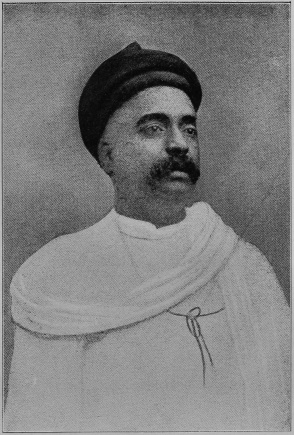 Bal Ganga Dhar Tilak
hypnotism, and at once awoke the people to a sense of their own
strength, an appreciation of their own culture.”
In the second place, the object was to create a passionate love of
liberty, accompanied by a spirit of sacrifice and readiness to suffer
for the cause of the country. This was to be done more by example than
precept. What the programme was may better be stated in the words of the
leader whom we have quoted above:
“Boycott both economic and political, boycott of foreign and especially
British goods, and of all honorary associations with the administration,
national education implying a withdrawal of the youths of the nation
from the officialised universities and government-controlled schools and
colleges, and training them up in institutions conducted on national
lines subject to national control and calculated to help the
realisation of the national destiny, national civic volunteering,
aiming at imparting a healthy civic training to the people by the
voluntary assumption of as much of the civic duties, at present
discharged by official or semi-official agencies, as could be done
without any violation of the existing laws of the country,—duties, for
instance, in regard to rural sanitation, economic and medical relief,
popular education, preventive police duties, regulation of fair and
pilgrim gathering,—settlement of civil and non-cognisable, criminal
disputes by means of arbitration committees:—these were the proclaimed
methods of the Nationalist school.”
As to the objects of this scheme, we will again quote the same writer:
“The evident object was to create in the first place a strong civic
sentiment in the people with the help of co-operative organisations for
the furtherance of the common good, and thus to train them gradually for
the larger and heavier responsibilities of free citizenship, and in the
next place, to cover the whole country with a net-work of active,
political organisations which would place the leaders in direct and
living touch with the people, and enable them to bring, from time to
time, the irresistible pressure of organised public opinion to bear upon
the Government, helping thereby the gradual expansion of popular
rights.”
Now it should be noted here in passing, that with the exception of
boycott and volunteering, every other item in the above propaganda had
been more or less tried and with varying success in all parts of the
country, but more particularly in the Punjab and Maharashtra before
this. The Deccan education Society and the Poona Fergusson College were
the offshoots of the desire to further the cause of education by
self-imposed sacrifices, with the underlying motives of quickening the
patriotic impulse and the Nationalist spirit. Similarly Swadeshi,
co-operative organisations, and private arbitration courts had been
thought of and tried. The motives underlying these attempts were
absolutely patriotic, combining an element of philanthropy in them. The
private colleges in Bengal, started by Vidyasagar and others, were also
due to the same impulse, and so was the Pachaipiya College at Madras.
Bombay had its own schemes and was ahead of the rest of India in purely
Indian industrial and trade organisations. Similarly in the Punjab the
idea of swadeshi had been started as early as 1877. The motives were
economic and patriotic. The idea of national education had found
expression in the D. A. V. (Dayanand Anglo-Vedic) College, and that of
national co-operative organisations in the “Punjab National Bank,” the
“Bharat Insurance Company” and other joint stock concerns. Religious and
philanthropic motives had brought into existence the Hindu orphan
movement, the famine relief movement, and so on. A little volunteering
had also been attempted in connection with the famine relief movement
and the Kangra earthquake relief movement. Long before 1905, the Punjab
had a network of privately organised, privately financed, unaided
schools and other charitable institutions, over which the Government had
little effective control. Patriotism and philanthropy were the
underlying motives of these institutions, but not politics.[68]
The ruling bureaucracy did not quite like these activities, but they
could not suppress them. Individual officers sometimes sympathised and
even helped these movements. So far Bengal had been rather backward in
the matter of national development on these lines. So, when Lord Curzon
proclaimed the partition of Bengal, attacked the veracity of the
orientals in his Calcutta University convocation speech, and on other
occasions called them cowards, windbags, unpractical talkers, and mere
frothy patriots, the Bengalees awoke to a consciousness of their
weaknesses, and resolved to revenge themselves upon Lord Curzon, and
prove to the world at large that Lord Curzon was a liar. What followed
may be briefly stated in a separate chapter.