This is the month when many of our birds depart
for their southern winter resorts. The common
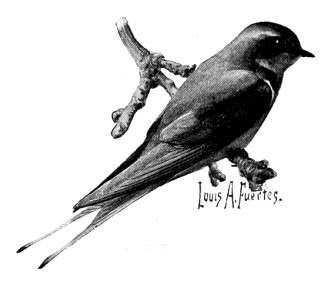
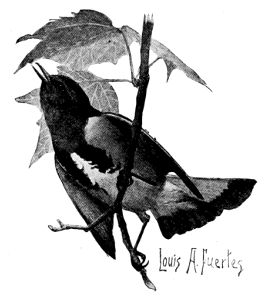
ones that leave this week are the scarlet tanager,
ovenbird, chimney swift, wood thrush, indigo
bunting, and redstart.
The workers and drone bumblebees die at the
approach of winter, but the queen takes shelter
under the bark of trees, in stone piles and in other
places which offer protection, where she remains
all winter. She then comes out and gathers moss
and grass for a nest, or she may appropriate the
deserted nest of a meadow mouse. After making
several wax cells, she fills them with pollen and
honey, deposits an egg in each cell, and when the
young hatch, they feed upon the sweets.
"'Among the crimson and yellow hues of the
falling leaves, there is no more remarkable object
than the witch-hazel in the moment parting with
its foliage, putting forth a profusion of showy
yellow blossoms, and giving to November the
counterfeited appearance of spring.'" (Newhall.)
When surprised while feeding, gray squirrels
will resort to an ingenious method of escape. As
the hunter approaches, the squirrel will scurry to
the opposite side of the tree trunk, and as the
hunter changes his position, the squirrel does likewise,
keeping the trunk of the tree between itself
and the enemy.
It is not always the large winged birds with the
light bodies that fly the fastest. The swifts, grouse,
pigeons, and ducks are the swiftest of fliers, yet
they have heavy bodies and short or narrow wings.
The eagles, hawks, owls, buzzards, and herons,
on the other hand, have large wings and comparatively
light bodies, yet they are noted for
their slow and graceful flight, still they can fly long
distances.
The white-footed mouse, deer mouse, or wood
mouse, usually makes his home in a hollow stump,
limb, or tree trunk. To prove that he can scramble
up rough bark, as well as run upon the ground, he
frequently builds a large, bulky nest of dried grass
in a bush or low tree. These nests have a tiny
aperture in one or two sides, and they are nearly
always located in trees traversed by wild grape, or
other vines.
Insects "supply us with the sweetest of sweets,
our very best inks and dyes, and our finest robes
and tapers, to say nothing of various acids, lacs,
and waxes; while few, who have not studied the
subject, have any idea of the importance of insects
and their products as articles of human diet."
(Riley.)
Many an amateur sportsman has mistaken the
fall song of the peeper, coming from the tall forest
trees, for that of a game bird or mammal. It is
loud and clearer than the peeper's spring song,
but the resemblance is easily detected after one
knows that both songs are sung by the same frog.
Now since the wood birds have ceased to sing, its
song is quickly noticed.
In size, shape, and actions, the English robin is
similar to our bluebird, to which it is related. The
English blackbird is a thrush, and our robin is the
largest of American thrushes. In the Bermuda
Islands the catbird is called "blackbird."
"The flight of the flying fish is usually from
four to six feet above the water, and it is sustained
for fifty to one hundred feet. The general enlarged
pectoral fins act as wings, and furnish the motive
power.... On all up grades it gives a stiff wing-stroke
about every three feet, rises to overtop each
advancing wave, and drops as the wave rolls on,
like a stormy petrel." (Hornaday.)
Mushrooms and apples are often seen resting in
the branches of trees. Should you examine one,
very likely you would find the marks of a rodent's
teeth in its sides. This is one of the ways a red
squirrel has of storing food. When he placed the
mushrooms there, did he know that they would dry
and be preserved? If so, why did not instinct tell
him that the apples would decay before spring?
Once the alarm note of a crow is heard and its
meaning understood, you can always tell when
those keen-eyed birds have discovered a hawk or an
owl. "Hak, hak, hak, hak, hak," they call,
much louder, quicker, and in a higher key than the
regular "caw, caw, caw." Rarely do they strike a
hawk or owl, but they keep diving at it until it soars
beyond their reach, or takes shelter in a tree.
If you can surprise a muskrat in a small pond,
notice that he does not use his front feet (which are
not webbed) in swimming; but, like the frog and
the toad, holds them close against the sides of his
body. Ordinarily the tail is used as a rudder, but
when he is hard pressed, he whirls it round and
round so that it acts like a screw propeller.
The brook trout is another fish that builds a nest.
It makes a hollow in the bed of a brook or a spring,
pushing the gravel aside with its nose, and carrying
the stones in its mouth. By using its tail the
cavity is shaped and then filled with pebbles, on
which the eggs are laid, and covered with gravel.
These "spawning" beds can now be seen in any
spring-fed trout stream.
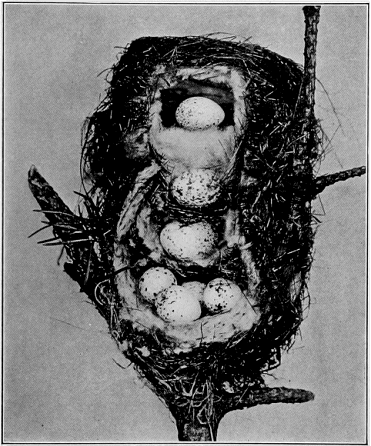
As soon as the foliage falls from the trees it is
easy to collect birds' nests; and it is no sin to do so
then, inasmuch as the birds mentioned this week
rarely use the same nest a second season. Take a
trip into the country with the sole object of hunting
for nests, and you will be surprised to see how many
you can find. One hundred and ninety-eight bird
homes have been counted during a three hours'
walk. When it is possible to take a part of the
limb to which a nest is attached, it is best to do so.
Besides the large pendent nest of the Baltimore
and the orchard orioles, skilfully suspended from
the end of an elm, maple, apple, or pear tree limb,
you will find many smaller hanging nests built by
the several species of vireos. They are about the
size of a tennis-ball; made of birch bark, paper,
and pieces of dried leaves, fastened with spider and
caterpillar webs, and they are lined with dried pine
needles or dried grass.
The American goldfinch, "thistlebird" or
"wild canary," usually places its nest in the angle
of three twigs at the end of a slender branch that
is nearly or quite perpendicular. The nest is larger
than a base-ball, deeply hollowed and composed
outwardly of pieces of cotton waste, plant fibres
and fine bark, with a thick lining of willow or dandelion
down, and other soft material.
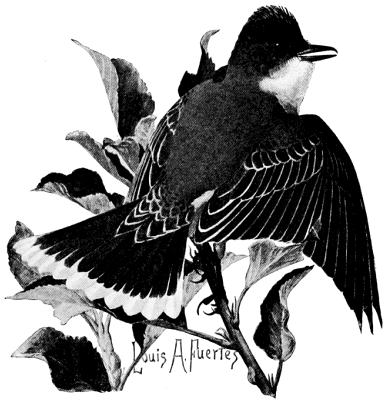
The chebec (least flycatcher), wood pewee, and
blue-gray gnat-catcher saddle their nests on the
upper side of limbs, as the hummingbird does, and
they use the same variety of material. They are so
delicate in construction that a severe storm will
send them to the ground.
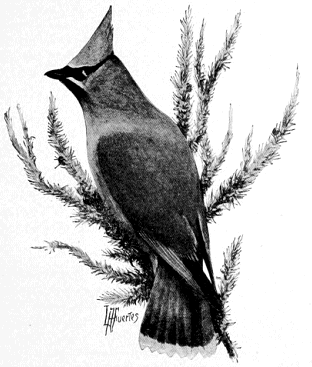
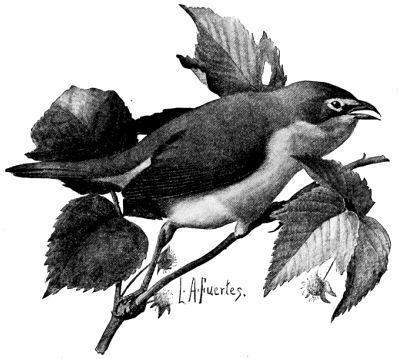
The bulky basket nests of the cedar-bird and
kingbird are usually found saddled on a horizontal
limb in an orchard. The kingbird prefers to be
near water, and will often use an elm, willow, or
thorn-tree for a nesting site. From the ground, the
nests resemble each other. They are about eight
inches across, are composed outwardly of sticks,
leaves, and moss, lined with fine roots and the like,
and sometimes wood or cotton is used.
Crows usually build in pine-trees, but where
there are no pines, they will choose an oak, chestnut,
maple, or poplar, not always high ones either. The
nest is made of sticks, leaves, bark, and mud, lined
with dried grass or fine bark. Most of the large
hawks make their nests in oak, maple, chestnut, or
beech trees, in the groves or forests. They often
occupy the same nest year after year.
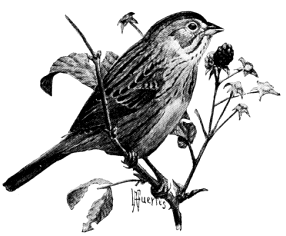
Of the birds that build in bushes or small trees,
the following are the common species: catbird
(twigs, leaves, and grass, lined with fine roots),
black-billed and yellow-billed cuckoo (a sort of
stick platform with a few dried leaves for a lining),
and yellow-breasted chat (leaves, sticks, and bark,
deeply hollowed and lined with soft grasses). Song
sparrows' nests are very common.
If it becomes necessary to protect their young,
most birds seem to lose all fear. When surprised
with her brood of chicks, the ruffed grouse and
nearly all ground-dwelling birds will feign injury
and flutter a few feet in front of the intruder,
seemingly in great agony. The cries and actions
are intended to lure you from the young. During
the interval that you are watching or chasing her,
the chicks have fairly melted into the earth.
The stickleback is a small fish that inhabits the
brackish waters from Cape Ann to New Jersey.
Mr. Hornaday says that the abdomen of the male
has been provided with a gland filled with a clear
secretion which coagulates into threads when it
comes in contact with the water. By means of this,
a hood-like nest large enough for the female to enter
is fastened to the vegetation at the bottom of the
sea, and the eggs are deposited in the nest.
Birds seem to have a common language, so far,
at least, as conveying a warning of danger is
concerned. The appearance of a hawk, or an owl,
will cause a catbird, robin, vireo, or song sparrow
to give a warning note which is at once heeded by
every feathered neighbor within hearing. Instantly
all is quiet until danger has passed.
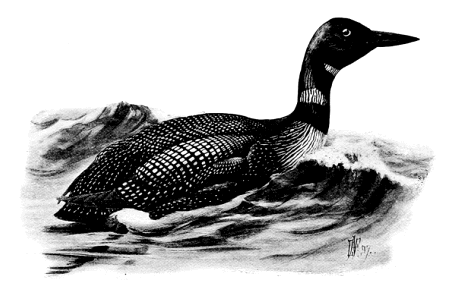
Grebes are expert swimmers and divers. Before
the invention of smokeless powder, the adult birds
could easily dive at the flash of a gun and were
beneath the surface of the water when the shot
struck. On land these duck-like birds push themselves
over the ground on their breasts, or waddle
along in a very awkward manner. They cannot rise
from the ground, and even when rising from the
water they must flutter over its surface for a long
distance before they are able actually to take wing.
A strong aversion for snakes prevails with many
of us. Most people think that the majority of
snakes are poisonous. In reality the only dangerously
venomous snakes in the United States are the
rattlesnakes (fourteen species), the moccasin, and
the copperhead, and they are not so aggressive as is
generally supposed.
How often the osprey or American fish-hawk is
mistaken for an eagle! The fish-hawk is the only
hawk that will poise in the air and then plunge into
the water for its prey. Unlike the kingfisher, of
which of course it is no kin, it carries its food in
its talons instead of in its beak. In captivity it may
be confined in an aviary with pigeons, quail, and
other defenceless birds, and will not molest them.
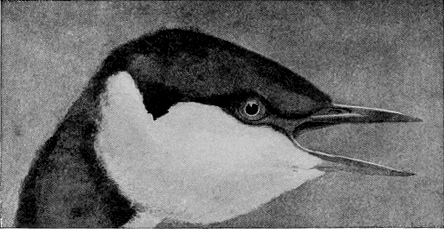
HORNED GREBE.
Winter Plumage.
The bull-frog, whose legs are considered such a
delicacy, often attains a length of fifteen inches.
Its food consists of insects, small frogs, birds, mice,
and young water-fowl, and one has been killed
which had eaten a bat. Birds have learned to look
upon it as a foe. Bull-frogs are fast becoming
extinct because of the demand for their legs.
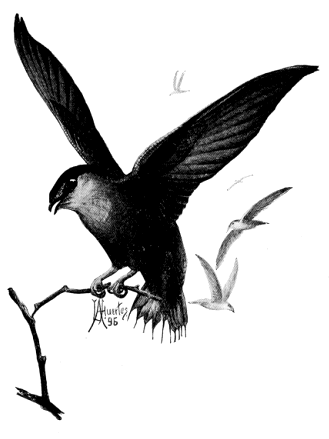
The sharp-shinned hawk is smaller in body, but
has about the same expanse of wing, as a domesticated
pigeon. It is one of the few hawks that is
destructive to birds and young poultry. Not only
in the country, but in the city parks and villages,
it is seen in late fall or in winter, skimming over
the tops of the bushes ready to pounce upon a
sparrow of any species the instant one appears.
Red squirrels and chipmunks differ in size,
markings, and habits. The red squirrel is nearly
twice as large as the chipmunk, it nests in trees, and
is usually seen among the branches. It is red on
the back and whitish beneath, sometimes having
one black line along each side. Chipmunks live
in the ground, hollow stumps, and roots. They
are poor tree climbers and will not jump from tree
to tree unless forced to do so. They have a black
stripe down the back and two on each side.
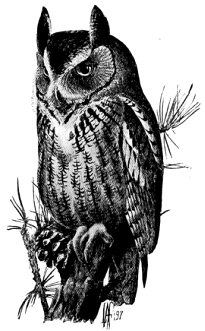
At dusk or early in the evening the weird, tremulous
wail of the screech owl may be heard. Sometimes
one will visit a favorite tree at the same hour
evening after evening, and after sounding his cry
several times, will glide away into the country to
hunt for a supper of beetles, meadow mice or
white-footed mice.