CHAPTER I. — CHAPTER II. — CHAPTER III. — CHAPTER IV.
AT THE PICNIC ON THE ISLAND.
"I don't believe in it!" exclaimed De Forrest, the third lieutenant of
the Young America.
"I can't say I like the idea very much," replied Beckwith, the first
master. "Tom Cantwell is a great scholar, without a particle of doubt,
but he is no more of a seaman than that English fellow, Clyde Blacklock,
and ought not to be captain."
"But under the rule of the ship, it can't be helped," added De Forrest.
"Then the rule ought to be changed. There are not half a dozen fellows
in the squadron who believe that Cantwell ought to be captain."
"He hasn't been three months in the squadron. He served his first month
in the steerage, and then jumped up to fourth master. Next month he will
be the captain of the ship. He doesn't know enough to set a topsail, and
couldn't get the ship under way to save his life."
"I shouldn't care so much about his seamanship, if he were only a decent
fellow," continued Beckwith.
"I don't want a fellow over me who don't know anything. I can't respect
him."
"Well, what are you going to do about it? We can't help ourselves."
"I don't know that we can," replied De Forrest. "Cantwell is a great
scholar, and seems to know everything without studying it; but he is
mean, conceited, overbearing, and tyrannical. I don't believe the
principal likes the idea of his being captain."
"But he can get along better as captain than he could as first
lieutenant; for he has only to say, 'Get under way,' 'Come to anchor,'
'Take in the main-topsail,' and the executive officer gives all the
orders in detail."
"That's true. Yet the captain is expected to know all these things, and
to see that they are properly done. But, after all, we are not sure that
Cantwell will be captain," suggested De Forrest.
"He has had a perfect mark in every lesson during the month; and I know
that Captain Lincoln slipped up on his geometry two or three times."
"But the captain has beaten him in his seamanship, I know."
"There's the difficulty. We have been in port, or lying at anchor among
these islands, nearly all the time, and there has been no chance to make
anything in seamanship. We have hardly had an exercise in which marks
were given out since we made the coast of Norway."
"Perhaps we shall, yet."
"If we do, Cantwell won't be captain, but he may be a lieutenant; and
that is almost as bad."
"We won't cry till we are hurt, then," said De Forrest; "though I think
something ought to be done to keep us out of such a scrape in the
future. I have a plan in my head, which, I think, would work first rate,
and be a fair thing for all."
"What is it?" asked Beckwith.
"I'll tell you. As the matter now stands, a fellow may jump from the
steerage into the captain's cabin without any experience at all in
commanding, especially, as during the last month, when we are running
about on shore, and we don't do much in seamanship."
"But you know that this struggle for rank puts the fellows on their good
behavior; and the principal would lose his sheet anchor if the present
system were abandoned."
"I don't propose to abandon it entirely. I would like to have the first
five officers made elective."
"You would have the captain and the four lieutenants chosen by ballot?"
asked Beckwith, interested in the plan.
"Precisely so."
"But the fellows in the steerage could have it all their own way under
such a plan. They could make Clyde Blacklock, Sandford, or any such
fellow captain."
"No, you haven't heard me out. The captain and the four lieutenants
shall be chosen from the cabin officers only."
"I rather like that."
"Any fellow will see that it is a fair thing."
"And who would be candidates for masters, pursers, and lieutenants?"
asked Beckwith.
"They must obtain their rank by their merit. By my plan, ten of the
fifteen cabin officers of the ship must get their positions by their
scholarship, conduct, and seamanship, just as they do now; but the
captain or lieutenant must first have served as master, purser, or
midshipman. Then a fellow can't be captain till he has served at least
one month as a cabin officer."
"The plan pleases me; but of course we can't tell how it would work
without a trial."
"It would work first rate. As the matter now stands, no officer has any
inducement to please anybody but the principal and the instructors, who
give him his marks. By my plan he would have to keep on the right side
of his inferiors in rank, or they would throw him over at the next
election."
"And there would be lots of electioneering for office," laughed
Beckwith.
"Well, that would give us a little excitement. Besides, we are all to be
American citizens, and we ought to learn how these things are done.
Under this plan Cantwell wouldn't behave as he does now in the cabin. He
is nothing but a lump of selfishness. He wouldn't take all the breast of
the chicken, or drown his coffee with the last gill of milk on board. I
have been thinking of this thing for a week, and have talked it over
with some of the fellows. All that I have spoken with like it first
rate."
"I do."
"I am going to get up a petition to the principal, asking him to make
this change in the system, and I want to get every fellow's name upon
it."
"I will sign, for one," replied Beckwith. "But you haven't said a word
about the commodore, De Forrest."
"That's only a kind of ornamental office, and I don't care much about it
any way; but I think that only the captains should be eligible to the
position."
Precisely as men do such things on a larger scale, De Forrest, satisfied
that he had added one adherent to the "cause" he was advocating, passed
on to "buzz" another officer on the same subject. The students connected
with the squadron were enjoying a picnic on one of the uninhabited Aland
Islands. It was a lovely spot, for the island was nearly covered by a
beautiful grove of pines, and one slope of it had a green carpet of
verdure. The sixteen boats of the squadron and of the yachts were moored
at the shore, and there was not a ripple on the sea to disturb them. The
ship's band had played all the pieces they knew; and a great variety of
games had been tried, with but indifferent success. The boys declared
that it could be no picnic at all without the ladies. Possibly the
attendance of Mrs. Kendall and Mrs. Shuffles suggested this idea to
them; and, though these ladies were young, lively, and agreeable, the
meagreness of the female representation on the occasion seemed to be
only an aggravation. Doubtless all of them had attended picnics and
other social gatherings, where the gentler sex is the charm of the
occasion, and they could not help feeling the loneliness of the
situation. Besides, the locality itself was suggestive of utter
isolation from the rest of the world.
All around them was a multitude of islands, but not a habitation of
any kind could be seen; not a human being, not a quadruped, not even a
bird enlivened the scene. The water was as calm as the repose of a
mountain lake, with not a single white sail to relieve the gaze of the
beholder. The squadron was anchored behind an island, where it could not
be seen. And the boys knew that they were north of the sixtieth parallel
of latitude,—nearer to the north pole than any of them had ever been
before; and the consciousness of this fact seemed to add to the
lonesomeness of the place. The days were very long and the nights very
short, and it was quite impossible to feel at home in such a region.
They were not the first to feel in this locality that the great, busy
world was far to the south of them, and to be impressed by the silence
and quiet of the place under such circumstances. A distinguished lady,
in narrating her voyage among these islands, says, "We never lost sight
of the shore, and sometimes were so near it that it seemed as though we
could leap to it from the boat. Yet I have never seen anything so
desolate as the voyage during this first day. On the open sea we should
not complain; but here, so near the land, and not a boat upon the water,
not a living creature on the shore, not a garden, not a human being, not
a dog, not even a fishing net, to show that man had been there,—there
was something awful in it."
And yet there is no lack of the beautiful in nature to charm the eye,
for the islands present an endless variety of forms, with green slopes,
with rocky steeps, and with forest-crowned heights. But one may be
lonely even in Paradise; and silence is sometimes more oppressive than
the roar of the tempest, or the din of the crowded city.
The students had resorted to all the games in the catalogue of dignified
sports available to young men; but the most exhilarating under ordinary
circumstances were dull and heavy on the present occasion. In the middle
of the afternoon they had abandoned in despair all attempts to have "a
good time;" and now they were seated on the rocks, or stretched at full
length upon the grass, engaged in discussion and conversation. Possibly
De Forrest was forced by the quiet of the scene to agitate reform in the
affairs of the squadron, which, to some extent, occupied his thoughts
during the stay of the vessels among the islands. With the zeal of youth
and inexperience, he believed that he had originated a new idea, that
he had discovered a fatal flaw in the working of the system on which the
squadron was organized. But his "original idea" had long before engaged
the attention of the principal. Years before he had foreseen that the
very difficulty which now appeared might arise. It is true that he had
provided no remedy, except the general rule that an incompetent officer
might be removed when his unfitness was apparent; but he had very
carefully considered the question and the consequences which it
involved.
The third lieutenant of the Young America was not the only student who
had observed and noted the remarkable scholarship of Cantwell. In the
midst of such a lively competition for the honors of the squadron, which
were not meaningless laurels,—for a state-room in the cabin was a
substantial luxury, independent of the desire to command rather than
obey,—the students did not fail to notice the character of the
recitations, and many kept a record of the value of them; so that the
standing of Cantwell was well understood in the cabin and in the
steerage. The obnoxious student was a thorough bookworm; but he was
cold, stiff, selfish, and haughty. He never did anything or said
anything that rendered him liable to discipline; but there was not a boy
in the squadron who had so few friends, if he had any at all. His father
was a very wealthy man, who supplied him liberally with money. It was
said that he had been expelled from an academy where he was fitting for
college on account of a difficulty into which his unpopularity had
driven him. His fellow-students hated him so cordially that they were
unable to conceal their real feelings. He was attacked in such an
ingenious way that he seemed to be the aggressor instead of the person
assailed, and the whole blame of the riot was cast upon him. When Prince
Bismarck decided that German unification required a war with France; he
was skilful enough to make the latter take the initiative, and France
was foolish enough to accept the issue. In like manner Cantwell, while
really the objective force in the quarrel with his fellow-students, was
weak enough to assume the subjective attitude; and, as France was almost
annihilated for her folly, which deprived her of the sympathy and
support of any other respectable power, he was ignominiously expelled
for his conduct. Like scores of others under the ban of expulsion on
shore, he drifted into the Academy Squadron. He was not a thorough
seaman, as Captain Lincoln and most of the officers were, neither was
he so utterly ignorant and entirely incompetent as De Forrest and others
declared him to be. But he was not qualified for either of the high
positions which the officers feared he would obtain.
De Forrest opened his theory to another officer of the squadron. He had
already spoken to half a dozen of them, and created as many advocates of
his plan, each of whom, interested in the scheme, went to work upon as
many more of the unconverted. In another half hour there were a dozen
who were entirely satisfied that the Academy Squadron would be utterly
ruined if Cantwell was elevated to the rank of captain. This dozen were
in turn soon at work upon another dozen, and the converts increased as a
continued proportional. This process, so often repeated, soon stirred up
a lively agitation among the crowd of students on the island. The
principal, the instructors, and the party from the yachts, with Captain
Lincoln and two other officers, were seated on a rock apart from the
others, engaged in conversation. They did not observe anything unusual
among the students, who seemed to be remarkably quiet, considering that
they were at liberty to follow their own inclinations. The agitators had
an excellent opportunity to carry on their operations without attracting
the attention of the principal and his assistants.
The subject under discussion concerned the young officers even more than
the seamen, and De Forrest's plan seemed to be so fair and so practical
that most of them gave in their adherence without much hesitation. The
crew, who were farther removed from the glittering prizes, which were
to be limited to the inferior officers of the cabin, were not so readily
converted.
"I don't see it," said Scott, the joker, when Beckwith approached him on
the subject. "You want to make a little one-horse aristocracy in the
cabin, and shut out us fellows in the steerage from any chance at the
big things."
"Not at all," replied the first master.
"Yes, you do. Take my own case, if you please. I'm a genius of the first
water. I got a pile of merit marks for getting tight on finkel, and
making an excursion to Stockholm. During all this time, of course I was
marked high on all studies. I used to talk Greek when I was a baby, and
nobody could understand me. And of course I am marked high in that
branch now. In Latin I always could decline faster than any other
fellow. French and German I learned of my nurse, who was brought up in
an Irish Canadian family, and married a Dutchman. None of these things
ever give me any trouble, you see, and I am marked high. In seamanship I
got a hundred and fifty for topping up the spanker boom in a seaman-like
manner. Now, I expect to be captain on the first of next month, and you
cabin nobs are getting up a conspiracy to deprive me of my rights. I
won't stand it, Mr. Beckwith. I am an American citizen in embryo. My
fathers and mothers all fought, bled, and died for the dearest rights of
man. My grandfather was killed in battle six months before he was
married; and I should be a degenerate son of a glorious sire if I
permitted you to pull wool over my optical members in this horrible
manner."
"Be serious, will you, for a moment?" interposed the earnest officer.
"I am serious. You ask me to sign a petition to change the solid
principles on which the eternal order of events is founded; and I
respectfully decline to do so, Mr. Beckwith. In other words, not for
Joseph."
"But you don't understand the matter, Scott."
"You cast an imputation upon my perceptive faculties."
"Nothing of the sort. You talk so fast that you won't hear what I have
to say."
"You say that the captain of this noble ship must either be selected or
be chosen from the cabin officers. Am I right?"
"You are."
"I am not the captain of the ship this month; neither have I the honor
to be one of the cabin officers; ergo I cannot be elected captain for
the month of June next ensuing."
"You are certainly right; but—"
"Then I understand the matter perfectly; and this movement is a
conspiracy to prevent me from being captain next month. I deserve to be
captain, and I respectfully submit that this is my inalienable right,
inherent in the contract under which I was sent to school. I object, I
protest, I denounce the vile scheme as a compact with infamy. By the
way, Beckwith, I didn't think you would treat me in this unhandsome
manner. We were always good friends, and I never did anything to injure
you. And I was always willing to help you spend your money when I hadn't
too much of my own to dispose of."
"Come, Scott, be reasonable."
"That's the very thing I ask of you—be reasonable, and don't try to cut
my out of my chance of being Captain next month."
"Of course you haven't any more chance of being captain than you have of
being Czar of Russia next month."
"Don't you think I should make a good czar?"
"No doubt of it," laughed Beckwith.
"Are you quite sure the Russians won't get up a revolution after they
have seen me?"
"If they only knew what a jolly good fellow you were, they would be
likely to do so."
"That's sensible; and I may go into the czar business, after all. And I
may be captain next month, if you nobs don't cut me out of my rights."
"But it is no worse for you than for any other fellow in the steerage. I
may be where you are next month; then it will hit me as hard as it does
you."
"Ah! then you are sawing off your own nose—are you?"
"For the general good, I am."
"Noble, self-sacrificing creature! Receive the homage of a humble
admirer."
"You, or any other fellow in the steerage, may become a master, purser,
or midshipman, by your merit, and then you may be captain, or a
lieutenant, the next month."
"But I shall have to wait a whole month before I can reach the summit of
my lofty ambition. That's too long to wait."
"I ask you to go with us for the public good."
"Pro bono publico! There you touch me where I am weak. For the public
good I would sacrifice this poor body to gout and dyspepsia. I would eat
grand dinners, as the aldermen do, at the public expense; I would accept
any fat office in which I had nothing to do but draw my salary; I would
be governor or president, and receive the homage of the people, for the
public good. There's my weak point."
"You know Cantwell?"
"Do I know him! Do I not know him? Am I unacquainted with the blooming
youth who thinks he must wind up the universe every morning, or
something will break before night? Ought not the deck to be carpeted
when he walks upon it? Ought we not to have a guard of marines to
present arms to him when he appears in the waist? Haven't I worn out
three caps in saluting him?"
"You understand him, then?"
"Mr. Cantwell is a great man; Mr. Cantwell is a profound scholar; Mr.
Cantwell knows what's what. Why, he is so much above us common, humdrum
sort of fellows, that we ought to get down on our knees when he
condescends to show himself."
"Exactly so, Scott. And, unless we can get this change in the tenure of
office—"
"Hold on! Will you oblige me by translating that high-flown expression?"
"Of course you know what the expression means," replied Beckwith,
impatiently.
"Perhaps I do; but I want to know what you mean by it."
"I mean a change in the manner in which the offices are obtained and
held."
"You mean right, as you always do."
"Well, unless we get this change at once, Cantwell will be the next
captain."
"He can't well be captain, and he can't well be otherwise."
"That's so."
"And you intend to put a stopper on him?"
"He isn't fit to be captain, and he can't well be, as you say. In one
word, are you with us? Yes or no."
"Yes or no. I must have time to think about it. When you attack a
fellow's inalienable rights, and all that sort of thing, I'm rather
inclined to go in for the bottom dog. The captaincy for next month lies
between Cantwell and me. For the public good, I am willing to waive my
own right, but I am not quite so clear that I ought to waive the right
of Mr. Cantwell, who is, by all odds, the greatest man in the ship."
"You will do the right thing, Scott; I know you will," said Beckwith,
moving off.
"Of course I will. I can't possibly do otherwise."
Beckwith walked away, for he saw Cantwell approaching him. By this time
the fourth master was conscious that something which concerned him was
in progress among his shipmates, for, as he came near the little groups
which were discussing the proposed change in the "tenure of office," he
observed that they either separated or suddenly changed the
conversation. His approach, wherever he went, invariably produced a
sensation. All hands watched him, and avoided him with even more care
than usual. Possibly his self-conceit prevented him from knowing that he
was very unpopular among his companions; but they did not avoid him
generally, as at the present time. He had no suspicion of the nature of
the agitation among the students; but his observation of their conduct
led him to the conclusion that they intended to play off some practical
joke or trick upon him. He was on his guard from that moment; but he was
fully resolved to be the victim rather than the assailant on this
occasion.
Scott stood just where Beckwith had left him. Instead of walking away,
as the others had done, when Cantwell approached, he looked at him, and
his expression was remarkably good-natured, and rather inviting for an
interview. He was almost the first one he met who did not avoid him. The
fourth master walked towards the joker, who, though not required by the
regulations to do so when off duty, promptly raised his cap, and
manifested a rather extravagant deference towards his superior. Cantwell
was a tall, slender young man of seventeen. Like many other great
students, he was somewhat near-sighted, and wore eye-glasses. He was an
exceedingly well-formed person, and was scrupulously nice in regard to
his dress. He had captured one of the new uniforms served out when he
was promoted to his present rank, and it was a much better fit than the
officers usually obtained.
"Do you happen to know the drift of all these private conferences which
I observe, Scott?" asked Cantwell, raising his head so that he could see
through the eye-glass, which had slipped down upon his nose.
"Yes, sir, I happen to know; and, as the matter concerns me more nearly
than any other fellow in the squadron, I don't object to telling you;
and I hope you will give me your sympathy and support," replied Scott,
putting on a most lugubrious face.
"Indeed! I don't know that I quite comprehend you. I notice that all the
students carefully avoid me this afternoon. If I approach any two or
more of them engaged In conversation, they stop talking, or separate,
and look very mysterious. I had come to the conclusion that I was to be
the subject of some practical joke."
"O, no. It is no joke, I assure you. It is a conspiracy, find I am to be
the first victim. Beckwith, the first master, was even impudent enough
to invite me to take a part in the amputation of my own nose! Did you
ever hear anything so absurd?"
"Perhaps I should be better able to judge if I were informed in regard
to the nature of the conspiracy," suggested Cantwell, as he readjusted
his eye-glasses.
"I shall be happy to inform you. They intend to apply to the principal
to have the tenure of office in the ship changed," replied Scott, in a
very impressive manner, as though he were revealing a startling fact.
"The tenure of office!" repeated Cantwell, with a puzzled look.
"Yes. Beckwith was kind enough to explain to me what it meant. I dare
say you know, without any explanation, Mr. Cantwell."
"Of course I know the meaning of the phrase, but I don't understand its
application to the affairs of the squadron."
"Then you will excuse me for telling you." And Scott explained in full
the nature of the proposed changes. "This is a plan, you will
perceive, to cut me off."
"Indeed!"
"I have been a good boy, and learned my lessons this month; and, under
the present regulation, I should be the captain of the ship next month.
I think that is clear enough."
Cantwell arranged his glasses again, and looked earnestly into the face
of the joker; but he was as serious as though he had been at a funeral.
"I was not aware that you stood so high on the record," added the fourth
master, more puzzled than before.
"Of course you are aware that you stand very high yourself," said Scott.
"I know that I have not had a single imperfect lesson, or been marked
down on any exercise."
"Just so. Then the highest office lies between you and me," replied
Scott, rubbing his chin. "The conspiracy is against us. If you should
get in ahead of me, I never have any hard feelings. I am willing to
abide by the regulations, and take whatever place belongs to me, even if
it should be that of captain or first lieutenant. I never complain of my
lot when there is fair play."
"And so the students are trying to have the highest officers chosen by
ballot," mused Cantwell.
"That's so; and it's a plot against you and me—a conspiracy against our
rights; and we must oppose it with all our might."
"It seems to me a very strange movement, just before the first of the
month."
"You are right; and we must go to work. The conspirators have had it all
their own way so far. We can make it lively for them.—Well, Laybold,
what is it?" said Scott, as the student addressed approached them.
"I am sent to notify you both of a meeting of all the students of the
squadron, at that flat rock on the top of the island," said the
messenger. "The fellows are going to appoint a committee to wait on the
principal, and ask for a change in the manner of giving out the
offices."
"We shall be there to vindicate our rights, and protest against this
conspiracy. How do you stand, Laybold?"
"I don't care much about it, any way," replied the messenger, glancing
at Cantwell.
"Then go against the change. This thing is got up to keep me from being
captain next month."
"You!" shouted Laybold. "You won't even be captain of a top! You won't
come within fifty of the cabin."
"So you say. But the highest office lies between Cantwell and me."
"That may be; but it's a long way from your side of the house," replied
Laybold, as the party moved towards the highest part of the island.
Cantwell was vexed and troubled, and he could not decide what course to
pursue.
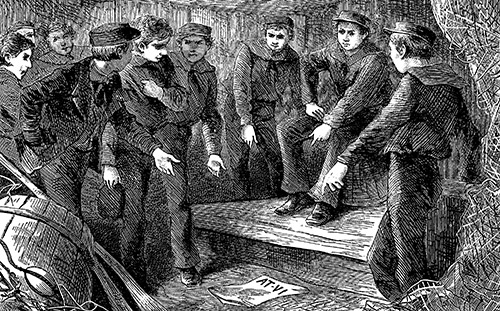
AN EXCITED MEETING OF OFFICERS AND SEAMEN.
Scott was one of the most popular students in the squadron. And it is a
lamentable fact, that mere "jokers" obtain a power and influence in
society which is denied to persons of infinitely greater dignity and
higher character. As Laybold declared, Scott had no personal interest in
the question under agitation, for, though he was a good seaman, his
scholarship was not above mediocrity. He lacked industry and
application; and it was not probable that he would ever win even the
lowest rank on the quarter-deck. But he had initiated what he regarded
as a stupendous joke, and he was determined to carry it through. While
the students were gathering at the flat rock, he electioneered against
the De Forrest plan, as it soon came to be called. He declared over and
over again, to the intense amusement of the seamen, that the plan was a
conspiracy against his individual rights, and was intended to prevent
him from being captain the next month. Before the meeting at the rock
was called to order he had rallied quite a respectable party under his
banner.
Every officer and every seaman of the fleet was present at the
meeting. The captain and the other officers sitting with the principal
had been summoned to the gathering; and those who were most interested
in the success of the effort were confident that the measure would be
adopted with little if any opposition. The meeting was called to order
by Lieutenant Ryder, the oldest officer of the squadron.
"The first business of this meeting is the choice of a chairman," said
Ryder, taking position on the flat rock, around which the students had
collected. "Please to nominate."
As in assemblages of older people, the arrangements had been "cut and
dried" beforehand, and Beckwith had been appointed by the "ring" to
nominate De Forrest as chairman; but Scott, more intent upon carrying
out his joke than anything else, had stationed himself close to the
rock, and disturbed the arrangements of the ring.
"Cantwell!" shouted he, at the top of his lungs, before Beckwith, who
certainly was not a dexterous representative of the ring, could open his
mouth.
"Cantwell!" repeated Laybold.
"Cantwell!" cried a dozen others, almost choking with laughter.
"I nominate Lieutenant De Forrest as chairman of this meeting," said the
tardy Beckwith.
"Lieutenant De Forrest is nominated," continued the chairman, anxious to
only carry out the programme which had been arranged by the officers.
"Mr. Chairman, I respectfully suggest that you are a little deaf in one
eye. Mr. Cantwell was nominated first."
"Cantwell! Cantwell!" shouted the supporters of Scott.
Ryder was perplexed. Common fairness required him to put the question
first upon the name of Cantwell; but he hesitated to do so. It seemed
absurd to make the student whom they desired to throw out of the line of
promotion the chairman of a meeting called for that purpose. While he
was in doubt, the opposition shouted, indulging in hideous yells,
cat-calls, and other demonstrations. It was fun to them.
"Lieutenant De Forrest has been nominated for chairman," repeated Ryder,
when there was a lull in the confusion.
"Mr. Chairman, we go in for a fair thing," said Scott, in a loud but
good-natured tone. "Mr. Cantwell was nominated first."
"Mr. Chairman, I don't know of any rule which requires the presiding
officer to put any name first," interposed Beckwith. "If the meeting is
not satisfied with the one named by the chairman, it can be voted down."
"But it looks more like a fair thing if the chairman puts the first name
mentioned," replied Scott. "If the meeting don't like it, it can be
voted down. If this thing is all cut and dried, I don't want anything to
do with it; and I invite all the fellows that are not in the ring to
step out and hold another meeting, where we can have fair play."
"Another meeting!" shouted at least twenty seamen, who, with many
others, seemed to regard the affair as a capital joke because it was
under the leadership of Scott, rather than because they could see the
point of it.
"No, no!" responded the officers. "Put Cantwell's name, Ryder."
"Mr. Cantwell is nominated," said the chairman; and the jokers were
delighted when they found they had carried their point; but Ryder
paused, and looked uneasily at the members of the ring.
"Vote for him," said Norwood. "Make him chairman, and that will take the
wind out of his sails. In the chair he can't oppose the plan, and we can
tell the principal, when we go to him, that Cantwell presided over the
meeting."
"Question!" shouted the officers.
"If it is your pleasure that Mr. Cantwell serve you as chairman of this
meeting, you will manifest it by saying,'Ay.'"
"Ay!" yelled nearly the whole crowd.
"Those opposed, 'No,'" continued the chairman.
"No!" replied a few, who did not understand the tactics of the ring.
"It is a vote," said Ryder, "and Mr. Cantwell is elected chairman of
this meeting."
"I move you that a committee of two, consisting of Lieutenant De Forrest
and Mr. Beckwith, be appointed to conduct him to the chair," shouted
Scott.
"You hear the motion of Mr. Scott; those in favor will say, 'Ay;' those
opposed, 'No.' It is a vote," said the temporary chairman, disgusted
with the proceedings.
De Forrest and Beckwith conducted the obnoxious fourth master to the
chair, which was the flat rock. As Cantwell mounted the natural rostrum,
the jokers applauded lustily, and the ring felt that the proceedings
were already turned into a farce. Of course Cantwell was more astonished
than any one else to find his merits so highly appreciated.
"Gentlemen, I thank you most heartily for the honor, unsought and
unexpected on my part, which you have conferred upon me," said he,
removing his cap. "I shall endeavor to preside impartially over the
deliberations of this meeting. The chair awaits any motion."
"Mr. Chairman," said De Forrest, who, after his defeat, had been
delegated by the officers to present the business to the meeting.
"Lieutenant De Forrest," replied Cantwell.
The originator of the plan for changing the "tenure of office" made
quite a lengthy speech, in which he set forth the advantages to be
derived from the adoption of the new method of filling the offices of
the highest grade. Of course he carefully abstained from any allusion to
the real objection to the present system, and would have done so even if
Cantwell had not been chosen chairman. His statement of the plan was
certainly a very clear one, and the subject was fully understood by
every student.
"And now, Mr. Chairman, having fully explained the plan, which has been
approved by a large number of the officers and seamen of the squadron,"
continued De Forrest, "I move that a committee of three be raised, to
wait on the principal, and request him to make this change in the manner
of filling the office of commodore of the squadron, and of captain,
first, second, third, and fourth lieutenant of each vessel."
"Mr. Chairman," said Beckwith, who had been selected to second the
motion, "I rise—"
"No, you don't," interposed Scott; "you haven't got up yet."
"I rise—"
"You were up before," persisted Scott; and a round of applause followed
the interruption.
"Mr. Chairman, I second the motion," said Beckwith, who, however, was
unable to make the little speech he had arranged in his mind favoring
the proposed change, for the laugh and the applause which followed
Scott's sally had sadly disconcerted him.
The chairman stated the motion, and the question upon its adoption was
fairly before the meeting. Several of the officers spoke in favor of it,
and even the commodore, the captain, and the first lieutenant gave it
the weight of their powerful influence. Two of the "short jackets" also
briefly addressed the meeting in favor of the plan; and thus far the
agitators had it all their own way.
"Question!" called some of the ring.
"Mr. Chairman!" shouted Scott, in a tone loud enough to be heard at the
farther side of the island, where the adults of the squadron were
enjoying the quiet beauty of the scene.
"Mr. Scott," replied the chairman, recognizing and bowing to the joker.
"Question! question!" shouted some of the officers, who were inclined to
retaliate upon the joker by using his own tactics.
"Mr. Scott has the floor," interposed the chairman.
"Thank you, Mr. Chairman; but I'm not to be floored so easily. Every
fellow that knows me knows that I go in for fair play."
"That's so," cried the crowd of his supporters, with a round of
applause.
"And what I give to others I ask for myself," continued Scott. "I'm a
modest fellow." (Tumultuous applause.) "I'm a modest fellow, Mr.
Chairman, and it gores my soul to feel compelled to speak of my own
merit; but this whole thing is a conspiracy against my rights." ("Hear,
hear.") "I have belonged to the ship about a year; I haven't the
purser's books in my trousers' pocket, and can't say to a day how long,
but about a year. I have faithfully discharged every duty, and even done
a great many things that were not required of me. I have eaten my grub
with untiring fidelity, except when I was seasick at the beginning."
(Applause.) "I have slept my eight hours out of the twenty-four with
exemplary diligence and punctuality; and even done more than this, when
the emergency seemed to require it, without grumbling." (Applause.) "I
have kept my watch below without flinching." (Applause.) "I have worn my
pea-jacket in cold and heavy weather without deeming it a hardship."
(Applause.) "I have never objected to going on shore to see a city, or
to take a tramp in the country, or to go 'on a time' of any sort."
(Applause.) "Indeed, I have always been willing to make myself as
comfortable as the circumstances would permit. And I have tried to use
every fellow about right, the officers as well as the seamen. I have
helped the fellows spend their money, when they needed my assistance"
(applause), "for I don't like to be selfish about these things. When a
fellow had any cake, fruit, or other good thing, I have taken hold like
a man, and helped him eat it." ("That's so," shouted several.) "I have
always been willing to let any fellow get my lessons for me, or do my
share in holy-stoning the deck. When any petty officer, having a soft
thing in the way of duty, such as coxswain of a boat, on a long pull,
was sick, I have always been willing to take his place, and not charge
him anything, either." (Applause.) "It's my nature to be unselfish; and
I would do as much for the captain, or any other officer, as for a
seaman."
"Mr. Chairman, I rise to a point of order," interposed Beckwith.
"Will the gentleman state his point?"
"That the gentleman is not speaking to the question," snapped the first
master, who was determined, if possible, to get even with Scott.
"The speaker stated in the beginning that the proposed measure, and the
action of this meeting in connection therewith, were a conspiracy
against his rights; and the chair decides that he is in order," said the
chairman, with dignity.
"But, sir, must we listen to his biography?" demanded Beckwith.
"Mr. Chairman, it is as painful for me to rehearse my own virtues before
this large audience as it is for him to hear me; and the sacrifice which
I make in doing so ought to be appreciated by the gentleman on the other
side." (Applause.)
"I appeal from the decision of the chair," said Beckwith.
"First Master Beckwith appeals from the decision of the chair,"
continued Cantwell, who proceeded to state the point at issue, and,
taking advantage of the privilege of his position, gave his reasons at
length for ruling that Scott was in order.
Most of the seamen of the ship and of the consorts enjoyed the fun, and
wished Scott to go on. When the question of order was put, a large
majority sustained the decision of the chair. Cantwell began to feel
that he had a host of friends, and that the plot of the officers would
be defeated.
"Mr. Scott has the floor, and may proceed with his remarks," said he,
when the vote was declared.
"I trust I have shown conclusively that I am a good fellow," continued
Scott. (Hearty applause.) "Now, to apply what I had said when I was so
ungenerously interrupted, if I am a good fellow, I deserve to be the
captain, or at least one of the lieutenants, of the ship" (rapturous
applause), "provided I get a greater number of merit marks than any
other fellow; of course I don't expect to wink the marks out of sight.
Not long since I made a little excursion through Sweden with some
friends of mine, without exactly running away. The fact was, we couldn't
find the ship, though we searched diligently for her." (Applause, and
cries of "Finkel.") "I hear 'Finkel.' Finkel was there, and had a
finger in the pie. Now, no one can tell how many merits I got for that
excursion, and for my struggles to find the ship; nor how many I got for
the glass of finkel I drank, which, I grant, deranged my ideas. Then I
was caught asleep on the anchor watch, and neither you nor I know how
many merit marks I had for that. We are not permitted to examine the
record books of the instructors, and therefore we cannot know how high
we are marked for any recitation or exercise; but, Mr. Chairman, I got
high this month" (violent applause), "and therefore I ought to have a
high office. At any rate, Mr. Chairman, the highest office lies between
you and me; and I think all present, who have considered the matter,
will agree that it belongs to one of us" ("Hear, hear"), "and my modesty
does not permit me to indicate which one. And now, Mr. Chairman, within
three days of the end of the month, when the prize of a noble ambition
is almost within my grasp, comes this cruel conspiracy to rob me of
reward!"
Scott was trying to imitate Forrest, or some other great tragic actor
whom he had seen, in the last clause of his speech, and the students
were convulsed with laughter at his deep tones and wild gestures. He
continued a few moments longer in the same strain, being frequently
interrupted by applause and other demonstrations.
"And now, Mr. Chairman, I have done. If my shipmates will thus sting me
to death when I am almost at the pinnacle of a noble ambition, I can
only yield, as the noble Caesar did when he declared that Brutus ate two
slapjacks for his breakfast. I shall fall, not by my own fault, but,
like Caesar, by the madness of ambitious office-seekers. But I shall
fall free from the taint of dishonor—scot-free."
The orator wiped his brow with his coat sleeve, having left his
handkerchief in the pocket of his pea-jacket, while the applause of the
seamen rang through the island groves and over the silent sea.
De Forrest was angry when he saw that the proceedings of the meeting
were turned into a farce, and he made haste to reply to Scott's
effective speech. The only point he made was, that the last speaker had
no expectation of obtaining the lowest cabin office, or even of being
the coxswain of the fourth cutter, and therefore his argument was simply
ridiculous.
"I should like to ask the third lieutenant if I did not say that the
highest office lay between the chairman of the meeting and myself,"
demanded Scott.
"Yes, yes," shouted a score.
"He did; but he spoke of a conspiracy against his own rights," replied
De Forrest.
"What is the right of one student, Mr. Chairman, is the right of every
one," said Scott—a sentiment which was warmly applauded.
"Question!" shouted the jokers.
The ring, trusting that the impression produced before the meeting by
personal appeal had not been destroyed by the orator of the opposition,
permitted the vote to be taken on the main question; and, indeed,
Scott's party would not permit anything else to be done. The chairman
stated the motion again, which was the appointment of a committee of
three to request the principal to adopt the plan of De Forrest.
"Those in favor of the motion will manifest it by saying, 'Ay,'" said
Cantwell.
"Ay!" replied the affirmative members of the meeting.
"Those opposed, 'No.'"
"No!" yelled the jokers, with all the power of their lungs.
It was impossible to determine which side had the majority; but as the
"noes" made the most noise, the chairman decided that it was not a vote.
"I doubt the vote," shouted De Forrest, much excited.
"The vote is doubted," said the chairman. "Those in favor of the motion
will muster on the right of the chair; those opposed, on the left."
Cantwell then appointed four tellers, two from each side. Two of them,
one for, and one against, the measure, were then directed to count the
number on each side.
"Form a line, and march between the tellers to be counted," added the
chairman.
The business was done fairly, for each party was watching the other. The
tellers on each side, after comparing their results, and finding that
they agreed, were ready to report.
"How many in the affirmative?" asked the chairman.
"Eighty-eight," replied one of the tellers.
"In the negative?"
"Eighty-one," replied one of the tellers for that side.
"Eighty-eight having voted in the affirmative, and eighty-one in the
negative, the motion is carried," said the chairman. "The next business
in order is the appointment of the committee. How shall they be chosen?"
"By the chair," shouted Scott.
"Second the motion," added a student.
"It is moved and seconded that the committee be nominated by the
chair."
"Mr. Chairman, it does not seem to me to be exactly right that the
committee should be nominated by the chairman, who is opposed to the
plan," suggested Beckwith.
"The chairman has not yet indicated whether he is in favor or opposed to
the plan," said Cantwell, with a contemptuous curl of his lips and nose.
"He intends to be entirely impartial in the discharge of his duty."
A shout of applause from the opposition followed this remark.
"The student who spoke against the plan mentioned the chairman in the
same category with himself."
"The chairman did not authorize him to do so," answered Cantwell.
"Question!" shouted the jokers.
"The question is called for, which is, that the chairman nominate the
committee."
The vote was taken and doubted. The count, by tellers, as before,
resulted in a tie; for several who had voted for the plan, moved by the
apparent impartiality of the chairman, broke loose from party
discipline, and voted with the other side.
"The chair votes in the affirmative, and the motion is carried," said
Cantwell, as soon as the tellers had reported. "The chair nominates
Lieutenants Judson and Norwood, and Mr. Scott. The question is upon the
confirming of the nomination of the chair."
"Mr. Chairman, Scott is opposed to the plan which this meeting has voted
to recommend," interposed De Forrest.
"The chair is aware of the fact, and for that reason nominated him,"
replied Cantwell. "The committee stand two in favor to one opposed to
the plan."
"How can one opposed to the plan, as Scott is, ask the principal to
adopt it?" demanded De Forrest.
"As I understood the matter, this committee is to represent this
meeting. Is it right that a committee unanimously in favor of the plan
should represent a meeting in which the plan was adopted by a majority
of only seven in a vote of one hundred and sixty-nine? Is it intended
the committee shall represent to the principal that this meeting is
unanimously in favor of the proposed change?"
"Certainly not."
"I have nominated a committee the majority of whom are in favor of the
measure. In my view this is all that parliamentary rule requires of me.
The question is upon confirming the nomination."
The question was taken, and the vote doubted again; but the nomination
was confirmed by a majority of two.
"Is there any further business to come before this meeting?" asked the
chairman.
"I move that the meeting be dissolved," said Scott.
The motion was put and carried. The students separated into little
squads, and of course nothing else was talked about the rest of the day
but the meeting. Scott, from a humble joker, found himself suddenly
transformed into a hero, and a person of no little influence among the
students. The ring were astonished and disconcerted at the result of the
meeting; and the victory they had gained was so nearly a defeat that
there were no rejoicings over it. De Forrest could hardly tell whether
his party was triumphant or not.
"What do you mean, Scott?" demanded Beckwith, when the commodore had
ordered all hands to be piped into the boats, and the students were
walking down to the shore.
"I told you I would do the right thing, and I've done it. Wasn't it a
fair thing—square and aboveboard?"
"It wasn't a fair thing to nominate Cantwell for chairman."
"If you didn't like him, why didn't you vote him down?" asked Scott. "I
think everything has been fairly done."
"Perhaps it was. Allow that it was. Why did you get up an opposition to
the plan?" demanded Beckwith, rather warmly.
"What do I care for the plan? You nobs in the cabin got up a ring, and
all you wanted of the steerage fellows was to give up their rights. I
have just as good a right to be a lieutenant next month as you have, if
my marks give me the place. It is only a game of the ring to keep the
best places among yourselves; that's all."
"Do you want Cantwell for your captain?" demanded Beckwith.
"I had just as lief have him captain as fourth master. He is over me
just the same. But I am not sure he is half so bad a fellow as you make
him out to be."
"I don't say he is bad, only that he is a conceited and disagreeable
fellow, and no seaman. We don't want a fellow of that sort over us."
"We in the steerage have him over us now, and shall have him, any way
you can fix it. He thinks pretty well of No. 1, I know, and so do some
of the rest of the cabin nobs. I'm not clear yet that he is no seaman. I
go for giving him the same chance that the rest of the fellows have.
Then, if he don't do his duty, and behave like a gentleman, it will be
time enough to do something."
"Then I'm to understand, Scott, that you have sold out to Cantwell."
"Did any of you cabin swells think you owned me?" laughed Scott.
"I saw you talking with Cantwell."
"Very likely Cantwell saw me talking with you. What does that prove?"
retorted Scott.
"But he's a very unpopular fellow. There isn't a fellow in the ship that
likes him."
"I don't, for one," added Scott, with refreshing candor.
"And yet you have got up this opposition, and nearly, if not quite,
defeated our plan. He ought to be very grateful to you."
"I don't think he ought to be thrown overboard, or deprived of his
rights, because he is not popular. When I saw that his brother officers
were down upon him, I was rather inclined to stand by him, for, as I
told you, I generally go in for the bottom dog. I believe in fair play
for every fellow, whether he is popular or not. I wouldn't kick a dog
because he didn't belong to anybody."
"You are on the committee, Scott."
"I have the honor; and I shall see that Cantwell has fair play before
the principal."
"You have done enough, Scott; why can't you keep still now, and let the
thing take its course?" added Beckwith, in an insinuating tone.
"And let Cantwell slip up, you mean?"
"What do you care for Cantwell? You don't like him any better than any
other fellow. If you will only keep still, the chairman of the committee
will simply represent to the principal that a majority of the students
desire the change," persisted Beckwith.
"And the next question he will ask will be, how the vote stood. If he
don't ask it, he isn't the fair man I have always taken him to be.
Besides, the chairman put me on that committee to represent the opinions
of the minority; and I'm going to do it."
"The opinions of the minority!" sneered Beckwith. "That is all bosh.
They haven't any opinions about it. You made your ridiculous speech as a
joke, and the minority took it up as a joke. They don't want Cantwell to
be captain any more than we do."
"That may be; but if they cut his nose off now, they may cut off their
own next month, just to make a soft thing for you nobs in the cabin.
Now, I want to tell you one thing, Becky—"
"Don't call me Becky; I'm not a girl," interposed the first master.
"I beg your pardon: Mr. Beckwith."
"I don't ask you to call me mister when off duty, either. You wanted to
tell me one thing."
"I'm not anxious to tell you anything; but, if I were Cantwell, I should
rather hope that the principal would grant the request, and make the
change."
"Do you think he could ever be elected to any office?"
"Perhaps not under ordinary circumstances; but if you cabin nobs will
only persecute him a little, only try to keep him out of his rights by
De Forrest's plan, he can be elected captain the very next month. You
see we fellows throw seventy-two votes in the steerage, and forty-five
is a majority of the whole ship's company. If any fourth-rate politician
on shore can only get himself persecuted, he can be elected to Congress,
for sympathy will do more than merit."
"You needn't tell me that the fellows in the steerage are going to elect
Cantwell to any office. He couldn't be chosen fourth lieutenant, to say
nothing of captain," protested Beckwith. "I believe you have lost your
wits, Scott."
"Perhaps I have; but you haven't found them. If you get the plan
adopted, we will try it on a little."
"What do you mean by that?"
"If De Forrest's plan is adopted, either Cantwell or I will be elected
captain."
"You! You would not even be a candidate under the new rule."
"Say Cantwell, then."
"It is absurd! There is hardly a fellow in the ship that does not hate
him, except you."
"I don't hate him, or any other fellow. But go ahead; there will be fun
and a lively time," said Scott, as they separated to take their places
in the boats.
The students and others embarked, and, as the instructors were now with
them, nothing more was said about the proposed changes. The squadron of
sixteen boats pulled out from the island, and, forming in order, rowed
to the several vessels which were anchored a couple of miles distant.
As soon as the boys were on board, the exciting topic was renewed. After
supper Scott was notified of a meeting of the committee in the after
cabin: but the regulations of the ship did not permit him to go there,
being only a seaman. Scott, of course, did not appear, though,
attempting to enter the cabin, he was ordered by the principal to go
forward. He obeyed, and was satisfied that the rest of the committee
intended to ignore him, or they would not appoint a meeting where he
could not attend.
In the cabin, at eight bells, the majority of the committee met. Norwood
was not in favor of acting without Scott; but De Forrest and Beckwith
advised them to do so. It was not proper for officers to meet in the
steerage; and they had accommodated the majority. It was decided to wait
upon the principal forthwith, and Scott was duly notified of the
intention. The joker, when the messenger gave him the second notice, was
engaged at an impromptu indignation meeting, in which he was informing
his audience that a meeting of the committee had been called in the
cabin, where he could not attend. He considered it an indignity to him,
and to the cause of which he was the representative and the champion.
After consulting Cantwell, he decided not to wait upon the principal
with the rest of the committee. After certain explanations which Scott
made, and certain schemes of future action which he suggested, the
fourth master was entirely satisfied with the proposition.
The majority of the committee waited upon the principal in the main
cabin, and fully stated the proposed changes in the "tenure of office,"
in the ship and in the two consorts.
"You represent a meeting of all the officers and seamen of the
squadron—do you?" asked Mr. Lowington.
"Yes, sir; all the officers and all the seamen of each vessel were
present," replied Judson, the chairman of the committee.
"Was the vote by which you were appointed unanimous?"
"No, sir; it was not."
"What was the vote?"
"Eighty-eight to eighty-one."
"A majority of only seven."
"But the minority were really in favor of the plan, as we ascertained
before the meeting," explained Judson, who then related the particulars
of the gathering, giving the details of Scott's speech, at which the
principal was much amused.
"The students voted against the plan just to carry out the joke," added
Norwood. "Scott was appointed on this committee, and was notified, but
he does not appear."
"I think I understand the matter," replied Mr. Lowington. "I will
consider the plan on its own merits, though substantially the same
system has occupied my attention several times before, and I am not
wholly unprepared for it. I will give you my decision on the first day
of the month."
The committee retired, satisfied with the result of the interview, and
hopeful that the plan would be adopted.
FINLAND AND THE AGITATORS.
The day which followed the excited meeting of officers and seamen on the
island was Sunday, and the agitation of the subject which disturbed the
ship's company in a measure ceased. The religious services were held on
shore, in the shade of a pleasant grove, and the Bible classes gathered
in favored spots chosen by the teachers. After these exercises were
finished in the afternoon, a couple of hours were spent upon the island.
Little groups gathered together to walk, or to engage in conversation,
while single ones, here and there, enjoyed their own thoughts. Cantwell
and Scott seated themselves on a rock near the water, and seemed to be
talking together very earnestly. On such occasions the brilliant student
usually remained alone, not because he was brilliant, but because his
shipmates were inclined to shun his companionship. He was really
grateful to Scott for the signal service he had rendered him the day
before, not in defeating the new plan, for that had not yet been
accomplished, but in preventing him from being wholly ignored, and for
making him chairman of the meeting. He had sought the present interview
himself.
"Of course these proceedings were all directed against me," said
Cantwell, after the subject had been introduced.
"No doubt of it," replied Scott, candidly.
"I don't know why my shipmates should be so prejudiced against me."
"Don't you?" asked the joker, rather incredulously.
"I do not; I certainly have not injured them."
"You won't get mad if I tell you—will you?"
"No; surely not," protested Cantwell.
"I'll tell you, then."
"I shall be much obliged to you, if you will."
"I don't know; I'm afraid you won't be," laughed Scott.
"I am sincere; and whatever you say, I shall believe you intend to do me
a kindness."
"That's so. The fellows are prejudiced against you because you are
selfish, conceited, overbearing, and tyrannical," said Scott, squarely.
"You don't mean all that; you only repeat what you have heard others
say."
"I do repeat what I have heard others say, and I'm bound to add that I
believe it myself. When you give an order, you do it just as though you
were a superior being; as though you were everybody, and I were
nobody—that's so."
"I was not aware of it."
"Then you put on airs, even in the cabin, and with your superior. You go
in for the breast of the chickens, and drown your coffee with the last
gill of milk in the ship."
Cantwell bit his lips, and seemed to be very much annoyed.
"Then you think you know everything, and other fellows nothing. You are
willing to give your own opinion, but you won't hear that of others,"
continued Scott, as bluntly as the case seemed to require.
"Go on; but of course you don't expect me to acknowledge all these
charges," replied Cantwell, with one of his most savage sneers.
"Do as you like about that; I was only telling you why the fellows are
prejudiced against you. You talk and act superciliously to your ship
mates, and they don't like that sort of thing. I don't, for one."
"I am sorry you don't."
"Do you like a fellow that treats you with contempt?"
"Of course not; but that's what my shipmates do to me."
"In self-defence, perhaps, they do. I suppose every fellow has his
faults, except me. I don't know that I have any," replied Scott, with
one of his telling smiles.
"You don't?"
"No; do you suppose you have any, Mr. Cantwell?"
"I suppose so; but not so many as most of my shipmates, I know."
"Exactly so; you admit the little things, so as to deny the big ones."
"I know I am a better scholar than any other student in the cabin. They
all know this, or they would not have raised this breeze."
"Better let others find that out before you discover it yourself. One
thing more: the officers say you are no seaman, and they don't want a
fellow in command of the ship who don't know his duty. No officer likes
to have one above him who knows less than he does about seamanship."
"I don't suppose I know as much about a ship as those students who have
been on board two or three years; but I think I am competent to perform
my duty, at least with the advice of the principal, in any position."
"I have told you all I know about it."
"And some things that you don't know," added Cantwell, who could not
believe that he was such a person as the joker had described.
"Just as you please about that."
"But I wish you to understand that I think you have been very fair and
candid; and I am very much obliged to you for your plain speech, however
disagreeable it may be to me."
"You are welcome to it," laughed Scott.
"Now, do you think the principal will make the change asked for by the
committee?"
"I don't know; but I hope he will."
"You hope so!"
"Yes; and if he does, we will show those cabin nobs that 'fair play is a
jewel,'" answered Scott, significantly.
The conversation continued until the students were piped into the boats.
The next morning exercises in seamanship were in order throughout the
squadron, for the principal was aware that this element of the course
had received but little attention during the month. Every officer and
seaman in each vessel was required to perform his duty in getting under
way, in making and furling sail, and coming to anchor. Evolutions in
reefing, tacking, wearing, scudding, laying to, bending sails, and
sending down topmasts, were performed, and each student marked according
to his merit. In addition to this, each student was separately examined
in problems in seamanship; and his knowledge of the standing and running
rigging of a ship, bark, brig, hermaphrodite brig, schooner, and sloop,
was tested. This examination was very carefully conducted, and the same
questions were put to every boy. The crew were all sent below at the
beginning, and four were called up at a time, so that no one could know
in advance what the questions were to be. Only the simpler problems were
required to be answered at this trial.
The principal, the boatswain, carpenter, and sail-maker, all of whom
were thorough practical seamen, were the examiners.
Mr. Lowington and Peaks, the boatswain, were on each side of the
mainmast, the carpenter at the foremast, and the sail-maker at the
mizzenmast, though each was obliged to take his pupil to the different
parts of the ship in the course of the examination. The questions were
such as these:—
"Point out the main-topmast stay, the main-topmast back-stay, the
weather main clew-garnet, the fore-sheet and fore-tack, with the wind on
the port beam.
"What is a pendant, a lift, a horse, a gasket, a jewel-block?
"How would you take in a topsail, wind fresh?
"How would you furl a royal?
"How would you reef a topsail?
"How would you turn out the reefs of a topsail?
"If two vessels are approaching each other, one by the wind, the other
going free, what is the rule for each?
"Make a square knot, a timber hitch, a bowling knot, a clove hitch, a
short splice."
For the last requirement two bits of rope were given to each student,
who was directed to bring in his work to the examiner, with a card on
which his name was written attached to it. The knots and hitches were
made with a whale line on a handspike. The other questions were answered
orally, or by pointing out the part of the rigging indicated. There were
twenty questions in the list, and the promptness, as well as the
accuracy, of the answers or the work was to be considered in marking the
value of them. If a student was obliged to try two or three times before
he could make a square knot, or a clove hitch, he was marked lower. If
he did what he was required without hesitation, he had five for each
question; if not, he was marked lower, for seamen have no time to
deliberate. Though the examination was a very simple and easy one, no
student obtained above ninety, and several were below fifty. Most of the
officers had over seventy. Captain Lincoln had ninety, and Cantwell only
fifty-two, though none of them knew the results till the first of the
next month. The addition of these marks to the merit roll for the month
made some important changes in the relative standing of the students.
"What do you say now?" inquired Scott, when he met Beckwith, after
supper.
"I say just the same that I have always said," replied the first master.
"Do you still desire to have the higher officers chosen by ballot?"
"Certainly I do."
"But the fellows all say that Cantwell can't well be captain or first
lieutenant when to-day's marks are added in."
"No matter for that; I still think that it is better to vote for the
captain and lieutenants."
"Just as you like; but I think you miss it."
"I don't believe I do," answered the first master, walking away.
The results of the examination were not known to the students; but they
were speculated over and guessed at very freely. It was generally
admitted that Cantwell's chances for either of the first two offices,
were lost for the next month; but it was certain that, if he were not
thrown off the track, he would be captain in two or three months, when
he had brought up his seamanship to the proper standard. Indeed, the
agitation had already roused the obnoxious officer to a realizing sense
of his own deficiency, and stimulated him to make an earnest effort to
acquire the needed knowledge. From that time he used all his spare hours
in studying the nautical books in the library. For hours he pored over
the large diagrams of a ship, in which the spars, sails, and rigging
were explained. The old boatswain appeared to be his best friend, so
much were they together; for Peaks delighted to instruct a willing
pupil.
On the last day of the month the squadron sailed for Åbo, in Finland.
During the week the vessels had remained among the islands; they had
been working gradually to the eastward, till it was only a short run to
this port. The town is on the Aurajoki River, about three miles from the
Gulf of Bothnia. The squadron came to anchor off the mouth of the river,
near the village of Boxholm. The steamers and small vessels go up to the
town, but large craft are obliged to discharge their cargoes at this
place. On a hill which commands the entrance to the river there is a
fort, which is also a prison—an ancient structure with the ruins of a
watch-tower, which has stood for centuries. Many of the houses on the
shore were painted red,—as in the country towns of New England fifty
years ago,—and were occupied by fishermen and laborers. The students,
who had been in the solitudes of nature for a week, and had hardly seen
a living creature, or anything connected with civilized life, were
interested in observing every indication of civilization in the
vicinity. For the time, even the exciting topic of the change in the
"tenure of office" was dropped. Scott, who had been quietly at work ever
since the meeting at the picnic, suspended his labors, and made queer
comments upon the old castle, the boats, and the people around the ship.
Though there was actually a village in sight, it did not entirely remove
the impression from the minds of many of the students that they were
almost "out of the world," for the oppressive fact that they were in
sixty and a half degrees of north latitude was not entirely removed by
the fort, the village, and the people.
"All hands, attend lecture!" shouted the boatswain, as his shrill pipe
rang through the ship, and was repeated in the two consorts.
"Lecture!" exclaimed Scott. "That's too bad! What does the professor
think we are made of? We have been patient and long-suffering in the
matter of lectures, and I didn't suppose we were to be dosed with any
more till we got to Russia."
"We are in Russia now," replied Laybold.
"Not much, if my soundings are correct. Finland isn't Russia, any more
than the Dominion of Canada is Great Britain. It is subject to Russia,
but the people here make their own laws, or at least have a finger in
the pie, which they don't under the nose of the Czar. Do you see that
big fish, Laybold?"
"What fish?" asked the other.
"Why, that one near the shore. He is over five feet long."
Scott pointed at a man who had just taken a small boy on his back, and
was wading out to a boat, with a man on each side of him.
"I don't see any fish," added Laybold, straining his eyes as he gazed
earnestly in the direction indicated by his companion.
"Don't you? Then you are a little blind in one of your ears. There he
goes towards the boat."
"What is it?" asked several others.
"A big fish," replied Scott, demurely.
"I see some men, but no fish," said Laybold.
"There, he has stopped by the boat."
"That isn't a fish; it's a man."
"I tell you it is a fish. Do you think I don't know a fish when I see
one."
"Nonsense!" shouted the others. "It's a man."
"I say he is a fish. Don't you see that he has a Finn on his back, and
Finns each side of him?" returned Scott.
"You get out!" shouted Jones. "A fellow that will deliberately make a
pun isn't fit to live in polite society."
"Then I'm finished for polite society," added Scott; "though I don't see
how you know anything about it, for you never were there, or your
manners belie you. By the way, did you know that our government had sent
over to this country for a fortune-teller, or seer—one of those fellows
they used to have in Scotland?"
"What for?" asked Laybold.
"They want to make him secretary of the treasury."
"Why so?" inquired Jones.
"Because they need a financier; for the fellow would certainly be one.
There, do you see that French conjunction on the shore? Hear him bark."
"That is a dog," protested Laybold.
"What of it? Isn't it afin que? Well, those are strange people,"
continued Scott, shaking his head.
"What's the matter with them?"
"Matter? Did you oversee the 'finny tribe' walking about on shore
before?"
"You are a monster, Scott," laughed Jones.
"Yes, a sea-monster; and if I were monarch of all I surveyed, I should
have plenty of Finns. Do you suppose those women have any nephews and
nieces?" asked Scott, still gazing at the group of men, women, and
children, who had gathered on the beach to see the squadron.
"Of course they have."
"Then we must go on shore and be introduced to them."
"But we can't speak Finnish."
"In that case we shall be obliged to finish speaking."
"But why should we be introduced to the 'women with nephews and
nieces?'"
"Because it is eminently proper and right that American young gentlemen
should be acquainted with finance. The boats are coming, and I am like
that shed on the beach."
"I don't see it."
"Yes—Finnish shed. Come, tumble down the hatchway," said Scott, as he
led the way to the steerage.
Mr. Mapps, the instructor in geography and history, was already at his
post, which post was the foremast of the ship, whereon was hung a large
map of Finland, drawn by himself on the back side of another map, with
black paint and a marking brush; for he had not been able to find a
printed one on a large scale. The students from the consorts soon
appeared, and a few raps with the professor's pointer procured silence.
"Where are we now, young gentlemen?" he began.
"Here, sir," responded Scott.
"A little more definitely, if you please."
"Eastern hemisphere, sir," added Scott.
"Excellent; but couldn't you venture to come a little nearer to the
point."
"Near Åbo, in Finland," said another student.
"Right; but the little ring which you see over the A in the printed name
of the town makes the pronunciation as though it were written O-bo. The
proper style of the country is the Grand Duchy of Finland; and in his
relations to it, the Czar of Russia has been called the Emperor Grand
Duke. The Finnish name of the country is Suomema, which means 'the
region of lakes.' You see, by a glance at the map,—which is rather
rudely drawn,—that this is the character of the country, even to a
greater degree than in Norway and Sweden. It has the Gulf of Bothnia on
the west, and the Gulf of Finland on the south, with Finmark, a province
of Norway, on the north, and Russia proper on the east."
"But where is Lapland?" asked a student.
"Lapland is a region which belongs to Russia and Norway, and part of it
is included in Finland. The name is not applied to a political division,
but to the country of a particular people. Finland has about one hundred
and forty thousand square miles of territory; about the size of Montana
Territory, more than half as large as Texas, or eighteen times as large
as Massachusetts. Its population is about the same as this last
state—in round numbers, one million four hundred thousand. A large
portion of the country is a desolate region. In the southern part; the
soil is good, and in former times Finland was the granary of Sweden; but
its agriculture has since declined. Vast forests cover a considerable
portion of its territory, and the lumber from them is the principal
source of wealth to the people, who are also largely engaged in the
fisheries. There are some extensive cotton and iron manufactures. All
the principal towns are on the coast, except Tavastehus; but the largest
place, Helsingfor, has only sixteen thousand inhabitants.
"Not much is known of the early history of Finland; but the country was
governed in tribes by chiefs, or kings. They took to the water very
naturally, and became pirates, harassing the Swedes to such a degree,
that Eric, their king, sent an expedition to Finland in the twelfth
century, where he established Swedish colonies, and introduced
Christianity. One of the colonies was planted here in Åbo, where the
first Christian church in the country was built. From this time the
Swedes and Finns blended, and the history of Finland was merged in that
of Sweden. Birger Jarl built Tavastehus, and confirmed the conquest. But
Russia coveted this desolate region, and first conquered Wyborg, its
most eastern province, and the Finns fought with Sweden in the various
wars with her powerful neighbor. The people suffered terribly from these
wars, and from famine. From 1692 to 1696, sixty thousand perished from
famine in the province of Åbo alone. In the wars of Charles XII.,
thousands of Finns were sacrificed, and five regiments of them were
killed or captured during the march into the Ukraine, and in the battle
of Pultowa. After this battle, in 1709, in which Charles XII. was
totally defeated, the Russians invaded the whole of Finland, and held it
until 1721, when, with the exception of Wyborg, it was restored to
Sweden.
"In 1741 the Swedes made an attempt to recover what they had lost, but
utterly failed. Again, in 1788, Gustavus III., commanding the Swedish
army in person, tried to regain the ancient province of Wyborg; but a
conspiracy at home compelled him to return, and the favorable
opportunity was lost. In 1790 the king renewed the attack by sea, and
his fleet of thirty-eight vessels was blockaded at Wyborg by a Russian
squadron of fifty-one ships. The Swedes cut their way out of the trap,
but with the loss of fifteen ships. The fleet, reduced by these heavy
losses, was again attacked by the Russians in overwhelming force; but
the result was a glorious victory for the Swedes, in which their enemy
lost fifty-three vessels and four thousand men. This event ended the war
for the time, and a treaty honorable to the Swedes was signed. In 1808
Finland was again invaded by the Russians, without even the formality of
a declaration of war. The Swedes were unprepared for the contest, and
slowly retired to the north, fighting several battles, and gaining some
unimportant victories, but were completely overwhelmed in the battle of
Orawais. By the treaty which followed, all of Finland and the Aland
Islands were ceded to Russia.
"By a special grant of Alexander I., graciously renewed by his
successors, Finland retains her ancient constitution, which provides for
a national parliament. The right to legislate and impose taxes upon the
people is nominally in this body, but is really exercised by a senate
appointed by the Emperor Grand Duke. The executive power is in the hands
of a governor general, who represents the sovereign. The people still
retain their national customs and language, and when you go on shore
this afternoon, you will find very little that is Russian. The money
is in marks and pennies, with the decimal system; and Russian paper is
not current in Finland. A mark is worth about twenty cents of our money,
and four of them make one ruble, the gold value of which is eighty
cents. The currency of Russia in actual circulation is all paper, so
that the value of the ruble is reduced about twenty per cent. Finland
also has a paper currency, which is of depreciated value, as is the case
in all countries where gold and silver are not in actual use."
The professor finished his lecture, and the students were about to
separate, when the stroke of the bell called them to order again, and
Mr. Lowington stepped upon the platform. The officers and seamen were
all attention in an instant, for it was expected that he would say
something upon the exciting subject which had been so thoroughly
discussed in all the vessels of the squadron.
"Young gentlemen," the principal began, "I have something to say to you
concerning the application which has been made to me to make certain of
the offices of the squadron elective. I have not the slightest objection
to the plan, if the elections can be fairly and honorably conducted. I
have considered the plan in substance, which has been presented to me
several times, and I like it, though in its practical workings I think
that grave objections will be developed. By the present plan, one with
very little experience and very little seamanship may reach the highest
offices, especially, as will sometimes happen, when the nautical branch
of the institution receives less attention in any one month than the
scholastic. By the plan you propose, you may elect the least worthy of
the officers to the rank of captain. Votes may be bought and sold, and
electioneering excitements carried to excess. The plan in use has worked
very well, and I am not aware that any injustice has ever been worked by
it. It has always happened that the best and most reliable students have
attained the highest places; though I must acknowledge that it may not
always happen so. For a change, I am willing to try your plan."
A demonstration of applause greeted this announcement, but it came
mainly from the officers.
"But I wish to say, that though I have considered substantially the same
plan several times, I should not now introduce it if you had not asked
for it. The present is certainly the fairest plan, for it places all
upon an absolute equality, and under it every officer is indebted
entirely to his own merit for his position, and not at all to the favor
of his instructors or his friends among the ship's company. A change,
therefore, is more properly inaugurated by you than by me.
"I am informed by the committee that the vote was not unanimous, and one
member of the committee did not choose to appear with the delegation."
"He was notified of the meeting of the committee," said De Forrest.
"I was notified," replied Scott; "but the meeting of the committee was
held in the after cabin, which I am not permitted to enter."
The opposition applauded till the snap of the bell silenced them.
"This does not look exactly like fair play, especially as Scott is
supposed to represent the opposition to the change."
"He was notified of the time when the committee would wait upon you,
sir, in the main cabin, but he declined to attend," answered De Forrest.
"If there was a preliminary meeting of the committee, he ought not to
have been excluded from it," added Mr. Lowington. "Your proceedings must
be revised, and the opposition must be heard."
"Mr. Lowington, as a member of the committee, I withdraw all
opposition," interposed Scott.
"I do not know that you are authorized to do so," replied the principal;
"but I am very glad to see this spirit of accommodation on your part."
"I don't think the new plan is so fair as the old one; but I wish to
have a fair trial of it. The new method was got up by the nobs in the
cabin—"
"The what?" inquired the principal, with a smile.
"The nobs, sir."
"If by an accident, or by any extra exertion on your part, you were
elected to an office in the cabin, would you be a nob?"
"Yes, sir."
"Though you do not seem to use the word in an offensive sense, I prefer
some other form of expression. You say that the plan was devised by the
cabin officers."
"Yes, sir."
"But we consulted the seamen, and they agreed to the plan before the
meeting. It would have been a unanimous vote if Scott had not got up an
opposition just for the sake of a joke," said De Forrest, rather
bitterly.
"I opposed the thing in my own way, and I never agreed to it; but we all
consent to it now."
"Does any one object to it?" asked Mr. Lowington.
Cantwell looked at Scott, but the latter shook his head.
"If there is any objection, I desire to hear it now."
No one offered any objection.
"There being no opposition, with the understanding on my part that
unanimous consent is given to the plan, I will adopt it—"
Violent applause on the part of the officers and others interrupted the
principal, which was silenced by a stroke of the bell.
"I will adopt it with an amendment," added Mr. Lowington. "I will
explain the amendment. By the new plan, the offices of commodore,
captain, and lieutenant are made elective within certain limits. The
commodore must be elected from the three captains; the captain must be
chosen from the cabin officers of the vessel to which he belongs. Now
suppose, for example, that one of the lieutenants for next month,
relying upon his popularity among his shipmates for his position the
following month, neglects his studies; what check have we upon him?"
There was no answer, for this case has not occurred to the agitators.
"Suppose the captain of this ship—but I grant in the beginning that
this is not a supposable case—should utterly fail in his duty so far as
study is concerned; you elect him captain or commodore, while the
present rule would send him back into the steerage. The amendment I
propose will correct this defect in your plan. It consists of two
sections," continued the principal, as he proceeded to read from a paper
in his hand. "1. No captain shall be eligible to the office of commodore
whose merit-rank is below No. 6 in the Young America, or below No. 5 in
the Josephine, or Tritonia. 2. No officer shall be eligible to the
office of captain or lieutenant whose merit-rank is below No. 16 in the
ship, or below No. 9 in the other vessels. Are you satisfied with the
amendment?"
"We are," replied the students.
"Then the merit-roll will be read and the elections take place
to-morrow, on the first day of the month," continued the principal. "We
will now go up to Åbo."
The students applauded, and left the steerage. The boatswains piped all
hands into the boats, and in half an hour the squadron of barges and
cutters were pulling in single file up the narrow river.
TWO HOURS A IN ÅBO, AND THE BANGWHANGERS.
In the captain's gig was Dr. Winstock, with whom Captain Lincoln always
delighted to walk or ride on shore, and whom he always invited to take a
seat in the stern-sheets of his boat. The doctor had inherited a
considerable fortune, which placed him above the necessity of practising
in his profession, and he had travelled all over Europe. He had not been
an idle wanderer abroad, going from place to place in search of mere
amusement; but he had been a diligent inquirer into the system of
government, the history, the agricultural and manufacturing interest,
and the manners and customs of the countries he visited. He was,
therefore, as he was often called, a walking encyclopædia of
information; and for this reason Lincoln sought his company.
"Of course you have been in Finland before, Dr. Winstock," said Lincoln,
as soon as the gig took her place in the line.
"I have," replied the surgeon. "Several years ago I went from Copenhagen
to Christiania, rode across the country in a cariole to Bergen, and from
there made the trip by steamer to the North Cape, where I saw the sun
at midnight. I came by steamer along the coast to Frederiksværn, and
from there to Gottenburg, and through Sweden. At Stockholm I embarked in
the steamer Aura, which starts at two o'clock in the morning now, as she
did then."
"I went on board of a steamer of the same line in Stockholm—I forget
her name."
"Perhaps the Grefve Berg, which is the best one. The other two are the
Dagmar and the Wyborg. The trip in one of these vessels to St.
Petersburg is a very delightful one. She arrives at this place the first
day, and spends the night here; the second day she goes to Helsingfors,
and the third to Wyborg, arriving at St. Petersburg in the forenoon of
the fourth day. Nearly the whole voyage is made among the islands,
which, almost without an exception, are as silent and still as those we
have visited. She stays long enough at these Finnish towns to enable one
to see them. The steamers are Finnish, the captains of them speak
English, and the table on board is very good. The fare is twenty
rubles—meals extra."
"Did you go into the interior?"
"Yes; I went as far as the group of lakes in the centre of the country,
and had some capital fishing there. I rode in a cariole, like those in
use in Norway. But some people use a kabitka, which is a cart, very
long and narrow, with a leather covering over about one half of its
length. In the bottom of the vehicle, which has no springs, there is a
quantity of hay or straw, or a feather bed, on which the traveller
stretches himself; but it is very hard riding, for the roads are rough,
and the hills are full of sharp pitches. All expenses are about six
cents a verst."
"How much is a verst?" asked the captain.
"Two thirds of a mile; or, more exactly, .6626 of a mile. Three versts
are two miles. Travelling in Finland is rather exciting at times, for
the horses rush at full gallop down the hills and over sharp pitches.
But the roads are pretty good, and an average speed of ten miles an hour
may be attained."
"How could you get along without the language?"
"I picked, up a few words, which I have forgotten, and had no trouble at
all. I went to Tavastehus, which is on one of the vast chain of lakes in
the interior of Finland. Small steamers ply upon them; and a trip by
water in this region is very pleasant. There is now a railroad from this
town to Helsingfors."
"There seems to be some business even in this out-of-the-way part of the
world," said Lincoln, as the squadron of boats passed a series of
buildings.
"Those are government works—founderies and machine shops."
The river rapidly diminished in size, until at the town it was a small
stream, over which was a bridge, connecting the two parts of the place.
The boats went up to the quay just below this bridge, and the students
landed. Dividing into parties, they went where they pleased. Some
crossed the bridge, and others went in the direction of the cathedral,
which is on the left bank of the river. Dr. Winstock and Lincoln were of
the latter.
"They have wide streets here," said the young captain.
"Yes; land is cheap, and they can have them as wide as they please. In
all modern-built Russian cities you will find broad avenues."
"The buildings are all but one story high."
"Nearly all; and the houses are very much scattered, so that the people
do not appear to be very neighborly. Large as the town seems to be, it
contains only thirteen thousand inhabitants."
"The houses look very neat and nice."
"Only a few of them can be very old, for in 1827 nearly the whole city
was destroyed by fire, including the university with its library, and
many other public edifices. When the town was rebuilt, the people placed
the houses at a considerable distance from each other, and built them
but one story, because they had not the means to erect larger ones."
Passing along the street next to the river, the tourists reached an
extensive square, in which there was a statue of Professor Porthan, a
learned Finlander. Just beyond it was the cathedral, which is of brick,
and far from elegant or imposing in its external appearance.
"This is the cradle of Christianity in Finland," said the doctor. "As
Mr. Mapps told you, this town was founded by Eric of Sweden, who
introduced Christianity into this region. The first bishop was located
here; and in this church, for centuries, the first families were buried;
and you will not only see their tombs, but also some of their bodies, if
you desire."
"I should not think that would be permitted," replied Lincoln.
"Nor I; but it is. The great fire burned out the interior of this
church, destroying the altar and organ, and even melting the bells. The
building was repaired by subscription. A baker, who had accumulated
about twelve thousand dollars in his business, having no near
relatives, gave his little fortune for the purchase of another organ,
and his wishes were carried out after his death."
A man with a bundle of keys presented himself at this time, bowed, and
solemnly opened the door of the cathedral. As the visitors ascended the
steps, the man pointed to a rusty ring.
"What's that?" asked Lincoln.
"In ancient times offenders used to be fastened to that ring, and were
compelled to do penance there," replied the doctor.
"There's nothing very fine about this," said the captain, as they
entered the church.
"Certainly not. I hope you did not expect to find a cathedral like St.
Peter's, or those at Antwerp and Cologne. This structure has been built
upon, increased in size, and improved, several times. There is the organ
which the baker gave. It has five thousand pipes—for a dollar would buy
more organ pipes years ago than now. Whatever there is here in the way
of ornament, including the frescoes, is the work of native artists,"
continued the doctor, as they walked up to the altar. "In the crypt
under this altar lie the remains of Queen Christina of Sweden."
"Mr. Mapps said she was buried in St. Peter's, at Rome," interposed the
captain.
"Not the celebrated Queen Christina, but the wife of St. Eric, whose
remains are intombed in the cathedral of Upsala. Here is an epitaph to
Katrina Mänsdotter," said the doctor, as they passed to the side of the
church.
"I never heard of her before, which is not very strange," replied
Lincoln.
"Do you remember who was the son and successor of Gustavus Vasa?"
"Eric XIV. He was deposed by the Swedish parliament, kept a prisoner
nine years, and then poisoned."
"Good! That is more than I could have told about him. Eric's father
proposed to marry him to Queen Elizabeth of England; and Eric, while the
negotiations were still pending, proposed to Mary, Queen of Scots, and
to two other princesses. He was actually flirting with four ladies of
royal blood at the same time. The accepting of either, he felt, would
make trouble; and he relieved himself of any difficulty by marrying Miss
Mänsdotter. She was a very pretty girl, the daughter of a petty officer
of the Guards, who had attracted his attention while she was selling
fruit in the market of Stockholm. She was sincerely attached to him,
tyrant and oppressor as he was, and clung to him through his
misfortunes. After his imprisonment she retired to Finland, and passed
the remainder of her days in obscurity."
"That's a good story for a novelist to work upon," suggested Lincoln.
"Very likely the incidents of the career of Katrina have been used by
the Swedish novelists; but I am not as familiar as I intend to be with
them. I see that the works of Madame Schwartz, a celebrated Swedish
writer, are now in process of translation in the United States. Several
volumes have been published, and they are having a large circulation.
This lady locates some of her stories, or parts of them, in Finland."
Many of the tombs in which the Finland worthies were buried are half
above and half below the pavement of the church. The conductor of the
little party opened the door of one of them, and the captain looked into
the gloomy space. Within it several coffins were crumbling to decay. The
man raised one of them, exhibiting the body of the occupant. The
features of the face were well preserved, though the person had been
dead three hundred years. They were of a brownish color, not unlike
guano. Following the example of the conductor, the visitors touched the
face, which was hard and rather spongy.
"I should think this body would decay," said the captain.
"No; there is something in the atmosphere which has changed it to
adipocere. Sometimes bodies buried in the ground are petrified, or
turned into stone. In Italy, and in some other countries, you will see
the bodies of saints in the churches, though I remember none as perfect
as this, for they are very black, and much shrivelled. In the vaults at
Palermo vast numbers of the dead are preserved by the conditions of the
vault in which they are buried."
Other monuments were examined, and the party left the church, giving the
solemn man—who had not yet spoken a single word—a mark for his
services, at which he solemnly bowed as he put the money in his pocket.
Crossing the river, Dr. Winstock and Lincoln walked over the rest of the
town, which, however, contained nothing worthy of note. There was
nothing in the costume of the people to distinguish them, and the shops
and houses were hardly different from those in England or America. The
streets are paved with cobble stones, and a few droskies may be seen;
but the people, who are more intensely Swedish than in the eastern
provinces of Finland, do not take kindly to Russian customs and
institutions. After the destruction of the university by fire, it was
removed to Helsingfors, and the hostility of the province to their new
ruler caused the transfer of the seat of government to the same place.
The town wears an aspect of desolation in its streets, for very few
people are seen in them; and, except on the wharf at the arrival of a
steamer there, nothing of the bustle of business is seen. The place has
lost much of its former importance.
The students wandered idly through the deserted streets, and it was
noticeable that but few of them paid any attention to their
surroundings. A group of the seamen sat on the quay above the bridge,
apparently engaged in an animated discussion. Though the Finnish women
were pulling about in boats on the narrow river, the boys were not
interested in their movements. Their conversation did not relate to
Finland or the Finns. Scott, the joker, was in the centre of the ring,
and did the greater part of the talking, and of course the subject was
that which had been introduced at the picnic on the island. Without
having any distinct plan in the beginning, Scott had become a leader
among the democratic element of the ship. His crude ideas, which had
formed themselves into objections to the De Forrest scheme, were now
seeking recognition as a plan. He had been laboring very earnestly to
defeat the wishes of the cabin "nobs," as he persisted in calling them.
"We can't go for such a fellow as Cantwell," said one of the students.
"He is a conceited and overbearing fellow."
"I don't care a fig for Cantwell, personally," replied Scott. "It is the
principle of the thing that I'm looking after. I know that Cantwell is
unpopular in the steerage as well as in the cabin. But there's a
conspiracy against him. Just as soon as he had earned his rank, the
fellows in the cabin put their heads together to cheat him out of it. I
was appointed on the committee, and they called a meeting in the cabin,
where I was not allowed to go, to prevent me from attending. Was that
fair?"
"No, no!" responded the seamen.
"Right! Besides, I want those swells in the cabin to know that we are a
power."
"But they came to us before the meeting on the island," suggested one of
the group.
"Yes; just so. But what did they come for? To know if we approved the
plan? Not a bit of it. The plan was cooked up in the cabin. They came to
us just as the politicians go to the dear people—for votes. They
argued, talked, and begged for our votes at the meeting. By and by they
will get up a plan by which no fellow shall be promoted from the
steerage to the cabin. Cantwell and Victory! That's my motto."
"I say, Scott, don't you think it is absurd for us to vote for the most
unpopular fellow in the ship?" asked Wainwright.
"No, I don't. He's the only fellow in the cabin that is not in the ring,
and therefore the only one we can vote for. Don't you see it?"
"I don't want to vote against Captain Lincoln," another objected. "He is
a first-rate fellow, and a good sailor."
"But Lincoln went in for this plan, was present at the meeting, and
voted in favor of it," replied Scott. "I like Lincoln as well as any
fellow, but I don't like this trying to keep any one out of the place he
has fairly earned."
"That's so," said a dozen of the boys.
This was only a specimen of the electioneering which was going on in a
dozen different places in Åbo at the same time. Only a few of the
students entered the cathedral, and not many of them could tell, when
they returned to the squadron, whether the streets of the town were
broad or narrow, or whether the houses were one or two stories high.
While the seamen were at work for Cantwell, the officers were speaking a
good word for Captain Lincoln, whom they desired to reëlect to his
present position.
At six o'clock most of the students were in the vicinity of the bridge,
ready to repair to the boats when the boatswains gave the signal. Dr.
Winstock and Lincoln were at the hotel on the quay called the Society's
House, which is said to be the most northern one in the world. Students
were arriving in the droskies, which many of them had employed for the
sake of a ride; and when they came to pay their fare there were many
amusing scenes, for neither party understood a word of the language of
the other. Most of the students, too, had changed their Swedish money
into Russian in Stockholm, and were unprovided with Finnish currency,
for they supposed that Russian money was current in Finland. The drivers
would not take the rubles and copecks, and some very cheerful rows
ensued. But the principal, with Professor Badois—who spoke
Swedish—at his elbow, interfered, and paid the fares. The students
embarked, the line of boats was formed, and the squadron moved down the
river, with half of Åbo on the quay, gazing in solemn silence at the
departure of the strange visitors, for as such they certainly regarded
them. In less than an hour the boats were alongside the vessels to which
they belonged, and were soon hoisted up to the davits.
The signal for sailing was shown on board of the Young America, and a
lively scene followed. Anchors were hove short, sails shaken out, and
the Finnish pilots were at their stations. As the breeze was fresh and
fair, the principal desired to take advantage of it; and, after a stay
of only five hours at Åbo, the squadron was under way again, threading
its course through the channels among the numerous islands. In the watch
on deck, and that below, the business of electioneering was continued
with the utmost vigor. Scott and his friends were busy everywhere, and
even the stale expedient of a secret society among the "anti-De
Forresters" was proposed, and enthusiastically adopted. Scott and Jones
were intrusted with the task of furnishing a constitution, and inventing
the necessary dark-lantern machinery for the organization.
Boys have a decided taste for secret associations, though, as the
experience of the present time shows, not more than adults, male and
female. The number of these "orders" among full-grown men is on the
increase, and the boys, in all parts of the United States, have
manifested a strong desire to keep up with the times, and follow the
example of their elders. Secret societies had several times been
formed on board of the Young America, but generally for purposes of
mischief, such as running away, or capturing one of the vessels. The
present association appeared to be for political purposes—to influence
the election of officers. Scott was, in the main, a very sensible
fellow; and his only idea of a secret society was to make some fun out
of it, though he was quite willing to have it used for accomplishing his
purpose, which, in its turn, was little more than a gigantic joke, so
far as he was concerned.
The wind, which had been fresh all day, diminished in force after the
squadron sailed, and at half past eight, while the sun was still above
the horizon, there was a dead calm, and the vessels were obliged to
anchor for the night, for the pilots declined to run during the darkness
in the intricate navigation of these seas. The squadron anchored near a
rocky island, the top of which was covered with trees. The same "eternal
silence" seemed to pervade the region as among the Aland Islands. When
everything was made snug on board, a portion of the students asked
permission to go on shore, which was readily granted to all who desired
to do so. This number was found to include the entire crew of the ship.
"The Bangwhangers will meet at the farther side of the island,"
whispered Scott. "Pass it along."
"The what?" asked Laybold.
"The Bangwhangers. Don't you belong to the night-bloomers?"
"I don't understand you," replied Laybold.
"You don't? Well, your head is thicker than a quart of molasses.
Didn't you fellows ask me to get up a secret society?"
"Yes."
"Well, I have done it; but you popsquizzles don't seem to know your own
chickens. The new institution is to be called the Bangwhangers, of whom
you are which. Now, don't tell any one who isn't a Bangwhanger anything
at all about it."
"I see."
"I should think you might, if your ears were only half as long as a
donkey's."
The students tumbled into the boats; and, as most of the officers were
busy preparing ballots for the election on the following day, none of
them went on shore, the boats being in charge of the several coxswains.
Ordinarily the seamen would not have been permitted to visit the shore
without at least one officer in each boat; but as it did not seem
possible that any mischief could be done on this uninhabited island, the
rule was waived. The students landed; and in a few moments several boats
from the Josephine and Tritonia brought a majority of the crews of these
vessels. Scott and several of his most intimate friends went to the
highest part of the island.
"Every Cantwell man may join our society; no one else," said Scott,
after he had told them the name.
"All right."
"And we will give them the first degree at once."
"What's that?"
"The first degree is next to nothing; only to get the fellows together
to organize," said Scott, as he leaped upon a rock. "Come up here,
Jones; I'll give you the first degree."
Jones joined the joker on the rock.
"Do you agree to vote for Cantwell, to say nothing to nobody, and never
to eat soup with a darning-needle?" asked Scott, in a low tone.
"Of course I do," laughed Jones.
"Answer in these words:—
"To all these three I do agree."
Jones repeated the words in due form.
"All right. I appoint you R. P. F. pro tem."
"R. P. F.! What does that mean?"
"I can't tell you till you have taken your second degree; only remember
the letters. Now, bring the fellows to me, one at a time."
Wainwright was the next one, who was obligated in the same manner, and
Jones was instructed to tell the candidates what to say in token of
their assent.
"To all these three, I do agree," replied Wainwright.
"I declare you a Bangwhanger, and appoint you L. P. F."
"What does that mean?" demanded the initiate.
"We can't tell you till you take your second degree," replied Jones.
In half an hour fifty had joined the association. The third one was
appointed I. L. M., and the fourth; O. L. M. Thus far only those who
were known to be ready to vote for Cantwell were invited to join; and
those who were admitted formed a ring to keep the outsiders at a
reasonable distance.
But there were plenty of applicants, and the number increased as those
outside of the circle heard the laughter of those on the rock. If Scott
was at the bottom of the affair, it was fun. One after another the R. P.
F. and the L. P. F. continued to bring in the candidates.
"Do you agree to vote for Cantwell, to—"
"No; I don't agree to that," interposed one of them.
"Turn him out!" added Scott. "R. P. F., do your duty."
This duty was a very simple one, and consisted only in leading the
refractory applicant outside of the ring. A dozen more that followed,
and had before refused to commit themselves, promptly agreed to all the
conditions. All on the island had joined except about twenty, who had
been turned out; but so great was the curiosity of some of these, that
they promised to accept the conditions, if admitted.
"Bangwhangers, I congratulate you on your admission to this honorable
and most respectable order," said Scott, when all who wished to join had
been admitted. "But there may be some black sheep among you, and the
obligation will be repeated;" and he repeated again, loud enough for all
to hear him, "All that agree will repeat the couplet in due form, and
sit down on the ground. Officers, turn out every fellow that don't sit
down."
"All down!" shouted the students, and all of them suited the action to
the word.
"All good men and true; but you must prove yourselves to be such. Do as
I do;" and the joker put the forefinger of his right hand on the end of
his nose.
All the members did the same.
"When I meet a Bangwhanger, I put my finger to my nose, and say, 'Bang.'
In reply, he puts his finger to his nose, and answers, 'Whang.' Now I
will do it with the R. P. F. Bang!"
"Whang!" replied Jones: putting his finger to his nose.
"Right. You can try it on with the brother nearest to you."
While the fraternity were practising this important part of the work,
Scott instructed Jones still further in the mysterious art. When the R.
P. F. fully understood his part, the joker called the members to order
again, and told them to learn the dialogue which he would rehearse with
Jones, for it was the form by which a Bangwhanger was to know a brother
of the order.
"Bang!" said Scott, putting his finger to his nose.
"Whang!" replied Jones, doing the same.
"Who knows?"
"Eye, nose," answered Jones, drawing his finger over his right eye, and
then placing it on the end of his nose, as he mentioned the name of each
organ.
"Who knows?"
"Eighty noes."
"Right, Brother Bangwhanger; come to my arms," added Scott. "But the
number is to be modified so as always to show the exact strength of this
honorable and most respectable order."
The joker and his companion went through the dialogue several times,
till every member was familiar with it, and then they practised it among
themselves, amid peals of laughter.
"Now, Brother Bangwhangers, we are to elect officers. The first and
highest is the C. B.," continued Scott.
"What does it mean?" asked half a dozen or more.
"I can't tell you till you take the second degree," replied the joker.
"Please to nominate."
"Scott!" shouted the members.
"Brother R. P. F., spare my modesty, and put the question," said the
joker.
Jones put the question, and of course Scott was unanimously elected.
"The next office, is the D. C. B. Please to nominate."
"Wainwright."
He was elected.
"Now for the Q. D."
"Hobbs." And he was chosen.
"The Y. D. K."
"Edson." And no one objected.
"The I. L. M."
"Merrill." And the vote was unanimous.
"The O. L. M."
"Hall." And he went in.
"The R. P. F."
"Jones." And the nomination was confirmed.
"The L. P. F."
"Brown." And he was the choice of the members.
"Eight officers, and they are all chosen. They will constitute the
original second degree men, and, after they have been instructed, we
shall be ready to admit you all to that enviable distinction. Now, the
Q. D. and the Y. D. K. will count the members."
The number reported was eighty-two, which was nearly a majority of the
students in the squadron.
"Who knows?" called the C. B.
"Eighty-two knows," replied several.
"That's enough to put a veto on the De Forresters. Now, remember the
solemn pledge you have taken, to vote for Cantwell, to say nothing to
nobody, and never to eat soup with a darning-needle."
"To all these three I do agree," responded the members, laughing.
"Although the last is the most important, the first is not to be
neglected; and any member who knows, and don't do, shall be headed up
in a mackerel kit and thrown overboard by the R. P. F., before he takes
the second degree, in which the sublime mysteries of the order will be
fully elucidated. Who knows?"
Scott coined jokes and puns for a few moments, to the intense enjoyment
of the members; and by this time four of the outsiders desired to become
members. They were immediately admitted.
"Who knows?"
"Eighty-six noes."
"Good! All hands to the boats."
The coxswains called their crews, and the students returned to their
vessels.
CHAPTER V.
AN EXCITING ELECTION.
It was the last day of the month, and the instructors in the three
vessels of the squadron were very busy in adding the merit-rolls on the
record books. It was necessary that all this work should be very
carefully done, for a mistake of a single mark might send a cabin
officer into the steerage, or a seaman from the steerage into the cabin.
Every addition was verified, therefore, by a second person. The students
had abundant opportunities to canvass and electioneer, as all the
instructors were at work in the main cabin. While the seamen were on
shore, the officers had been using the Novelty presses and the types in
printing the ballots for the next day. And they had just as much
difficulty in "making up the slate" as a ring of older politicians.
While few of the officers were willing to stand as candidates for
positions lower in rank than those they held at the time, some desired
to go a little higher. There were no little compromising and
"log-rolling" but it ought to be said that Commodore Cumberland and
Captain Lincoln, while they were willing to place themselves "in the
hands of their friends," refrained entirely from pressing their claims.
On the other hand, De Forrest and Beckwith had used their influence to
better their own condition. The former was afraid his merit-rank would
be lower than his present position, and he agreed with the latter to
make him second lieutenant, if Beckwith would work to nominate and elect
him as first. The nominations were full of difficulty. De Forrest, as
the originator of the plan which had been adopted, felt that he had some
claims to consideration. Of course, as Judson and Norwood were to be
displaced if De Forrest and Beckwith were advanced, it was necessary for
the latter aspirants to work privately and carefully. But the secret
could not long be kept, and when the first and second lieutenants
learned that there was a movement on foot to displace them, they were
very angry and indignant, and protested with all their might against the
injustice. The De Forrest plan was already at a discount with a
considerable portion of the cabin officers.
The discussion in the after cabin was becoming violent and noisy; and at
the suggestion of Captain Lincoln, it was voted to appoint a committee,
who should retire to a state-room and prepare a ticket. The commodore,
the captain, and Sheridan, the first midshipman, constituted this
committee; and after an absence of an hour, they reported that the
several officers should be nominated in the order of their present rank.
This report, if accepted, would defeat the aspirations of Beckwith, and
he refused to assent to it. De Forrest, who felt that his claims were
not recognized by the report, was not satisfied with it. As each of
these aspirants had several friends, the compromise was not agreeable.
The name of Cantwell had not been mentioned for any position. He sat in
a corner of the cabin, a silent but interested listener, until the vote
on the report of the committee was about to be taken.
"Mr. Chairman," said he, addressing Ryder, the fourth lieutenant, who
had been chosen to this position, "it strikes me that these proceedings
are slightly insular. Who are expected to vote this ticket when it is
made up?"
"All who are willing to do so, of course," answered Ryder.
"Then you are selecting candidates for the crew to vote for, as well as
the officers?"
"Certainly."
"It seems to me, then, that the seamen ought to be represented in a
meeting of this kind. They are to cast four fifths of the votes, but are
not permitted to say a word in regard to the nominations," continued
Cantwell, in a very quiet tone, in strong contrast with the one he had
usually adopted, showing that Scott's lesson on Sunday had done him some
good.
"How can we hold a caucus of the whole ship's company?" inquired De
Forrest.
"It can be done on deck without the least difficulty."
"It don't seem practicable to me," added Beckwith.
"I suppose the ticket nominated here is not binding upon any one,"
suggested Captain Lincoln. "For my part, I quite agree that the crew
ought to be consulted. Mr. Chairman, I move that this report be laid
upon the table. If my motion prevails, I shall offer another, looking to
a caucus of the whole ship's company."
"I second the motion," added Cantwell.
"Mr. Chairman, I don't see the use—"
"The motion to lay on the table is not debatable," interposed Ryder. "It
is moved and seconded that the report of the committee be laid on the
table."
The motion was rejected, only half a dozen of the officers voting in
favor of it. The report of the committee was accepted by a bare
majority.
"As I said before, I suppose the action of this meeting is not binding
upon any one," continued Lincoln, "but is simply an arrangement among
ourselves."
"I think it is binding upon all who are present at this meeting,"
replied the chairman, who was decidedly in favor of the report, for he
foresaw that, if De Forrest and Beckwith were advanced, Judson and
Norwood would be crowded down, and he would not be a candidate for
either of the five highest places in the ship.
"I certainly do not consider myself bound by it," said Cantwell.
"Nor I," added De Forrest.
"Nor I," repeated Beckwith.
But the business was finished, though nothing had really been done. One
Novelty press was immediately set at work in printing what Ryder,
Judson, and Norwood called the regular ticket, while De Forrest and
Beckwith seized upon the other to print their own ticket, in which Ryder
was utterly ignored. By the time the seamen returned from the island,
three hundred of each of these tickets had been printed.
Scott had carefully instructed the members of the new order to "say
nothing to nobody" in regard to the strength of the organization, or
anything else relating to it. Of course those who had been to the
island, but refused to join the order, knew something about the matter.
They were aware that the members were all pledged to vote for Cantwell;
but they had not estimated the number who had accepted the obligation.
As soon as the boats had been hoisted up, the friends of the two tickets
which had been made up in the cabin went to work upon the seamen. De
Forrest and Beckwith had made all sorts of promises to various officers
to support them at the election following that of the next day, if they
would go for the "independent ticket," as they styled their own, at the
present time. When the advocates of the "regular ticket" understood what
the "bolters" were doing, they crossed out De Forrest's and Beckwith's
names, and substituted that of Ryder for third lieutenant, and that of
Murray, the second master, for fourth. The young gentlemen were having a
foretaste of the complications of politics, and a great deal of ill
feeling was aroused. It was evident enough to the fair-minded, unselfish
ones in the cabin, that the new plan was not working well, and they were
very much disgusted at the conduct of De Forrest and Beckwith in
particular. It was nothing but a scramble for office, without much
regard for fitness among the candidates. The only redeeming feature of
the business was the fact that Lincoln's name was on both of the cabin
tickets; but then he was so popular, and so thoroughly competent for the
captaincy, that neither of the factions dared to think of displacing
him.
"I say, Longwood, I want you to go for the independent ticket," said De
Forrest, addressing one of the students who had declined to join the
Bangwhangers.
"The opposition have just formed a secret society, and all its members
are pledged to vote for Cantwell," replied Longwood.
"Cantwell! nonsense! He can't be elected to any office."
"No use; the fellows know him too well. We had a meeting in the cabin,
and there will be two tickets. This will be the winning one;" and the
third lieutenant handed Longwood one of the printed ballots.
"What's the other ticket?"
"The present officers; but I have just found out that they are taking my
name off the ticket, and putting on Murray's. What do you think of that?
Is it fair play?"
"Well, I don't know; but if you are working against the regular ticket,
you can't expect its friends to go for you," replied Longwood.
"But they want to shove me down, and I hope my friends won't let them do
it. I got up this plan, you know, but the fellows don't seem to give me
any credit for it. Vote this ticket—won't you?"
"I'll see," answered the voter, as the candidate passed on to another.
The first lieutenant, Judson, knowing the influence of Scott among the
crew, went to him the moment he came on board, to present the claims of
the regular ticket.
"I'm a Cantwell man," replied Scott.
"It's no use to go for him; he can't be elected," said Judson.
"Who knows?" added Scott.
"We have had a meeting in the cabin, and have regularly nominated a
ticket."
"Probably it didn't occur to you that the crew had any right to meddle
with the matter."
"Yes; we considered the subject; but we hadn't time to call a meeting of
the whole ship's company."
"Time is short," laughed Scott.
"If the fellows in the steerage wish it, perhaps we can put Cantwell on
the regular ticket as fourth lieutenant, instead of Murray."
"I am not authorized to speak for our fellows; and I don't know that
they would vote your ticket even if you put Cantwell's name on it."
"Cantwell's name wouldn't strengthen our ticket at all."
"Perhaps not."
Scott took one of the ballots, but would not even promise to consider
it.
"The officers have had a caucus in the cabin, Scott," said Cantwell.
"So Mr. Judson informs me; and they haven't put your name on the
ticket?"
"No; of course I didn't expect them to do it. I told them the crew ought
to be consulted, and Captain Lincoln tried to make a motion to that
effect, but they wouldn't do it."
"Never mind what they do; none of their tickets will be elected."
"I don't know about that. They have two tickets, and every fellow in the
cabin except me, is at work for one or the other of them. Whichever one
is elected, I shall be thrown overboard."
"Perhaps not—who knows?" said Scott. "You may be elected captain, after
all—who knows?"
"Impossible! I should be satisfied if I were fourth lieutenant, and I am
sure my merit-rank would give me that place. But it's no use; I'm
counted out."
"Not yet; wait till after election before you give it up. The fellows
like fair play; and if you hadn't put on airs before this plan came up,
they would make you commodore, just because the cabin nobs are trying to
count you out. That's what's the matter. They like your cause a good
deal better than they like you. As it is, they mean to see that you have
fair play to-morrow. If you should happen to be elected to any office
to-morrow, I hope you will try to be a good fellow."
"I certainly shall," replied Cantwell.
De Forrest was waiting for a chance to speak to Scott, and the C. B.
passed on, leaving Cantwell in a very desponding state of mind. The
situation had taken the conceit out of him. Conscious of his ability to
win even the highest position, he had taken no pains to conciliate his
associates, and he was reaping the legitimate harvest of his selfish
conduct and his overbearing manner. Certainly the De Forrest plan had
already done him a great good. His manners were changed, for he had
learned that he was not of half so much consequence as he supposed; and
his present depression of spirits did not permit him to put on airs,
he had learned that, in all communities, every individual owes something
of respect, kindness, and consideration to every other individual, even
the superior to the inferior. It was a lesson which he would have been
compelled to learn a few years later, if the circumstances had not
obliged him to accept it at the present time. It is certainly true that
young men are older and wiser at eighteen than at any subsequent period
of their lives, and in Cantwell's case this self-importance was
considerably exaggerated above the average. Most young men have to be
"taken down," and the rough circumstances of life generally do it in the
course of a few years, without any earthquake or other violent
commotion.
Scott's party did no electioneering. Knowing what the next day was to
bring forth, they were particularly jolly, and listened good-naturedly
to all the cabin politicians had to say. They were remarkably cautious
and prudent, and though the fact of the secret organization was known
throughout the ship, the officers did not suspect that it numbered
members enough to control the election. The canvass was lively till the
anchor watch was stationed on deck, and all hands were compelled to turn
in.
The next morning a dense fog hid even the nearest island from view. The
Finnish pilots declined to take the vessels through the intricate
channels among the islands, except under the most favorable
circumstances. After breakfast the principal sent a note to each of the
vice-principals. Scott pulled an oar in the boat which delivered them.
While the messenger was in the cabin, he went on the deck of the
Josephine, and walking about among the crew with the forefinger of his
right hand on his nose, he soon discovered half a dozen making the sign.
"Bang!" said he, selecting one of them.
"Whang," laughed the seaman.
"Who knows?"
"Eye, nose," answered the other, making the proper signs.
"Who knows?"
"Eighty-six noses."
"Right, Brother Bangwhanger; come to my arms. Vote for Lincoln for
commodore," said Scott; "and pass it along to every member."
After repeating this direction in due form to several others, the C. B.
returned to the boat, and did the same thing on board of the Tritonia.
In each of the two consorts, the members of the order were to nominate a
ticket to suit themselves; and so far as they were concerned, the pledge
to vote for Cantwell was meaningless. When the boat returned, all hands
were piped to muster, and the principal, with the merit-roll in his
hand, mounted the rostrum over the main hatch.
"Young gentlemen, in accordance with the change in the method of
appointing the officers, announced at Åbo yesterday, the election of
commodore of the squadron will take place at ten o'clock to-day," said
Mr. Lowington. "The result of the balloting in the consorts will be
transmitted without delay to the ship. The election of captain will
immediately follow, and then of the four lieutenants, each in the order
of rank, and on separate ballots."
"We have printed ballots containing the names of all the candidates,"
said De Forrest.
"I think it best to elect only one officer at a ballot."
"I hope the election will be postponed till eleven o'clock then, in
order to give us time to prepare the separate ballots."
"Very well; I consent to the change of time; and the consorts shall be
notified at once," replied the principal, who went to the cabin, wrote
two notes, and sent them to the vice-principals by the adult forward
officers.
"Now, let us understand the method of proceeding thoroughly," continued
Mr. Lowington, as he returned to his position on the hatch. "Only a
captain is eligible to the office of commodore, or the present incumbent
may be reëlected. Only the present cabin officers can be candidates for
the five highest offices in the ship; and agreeably to the proviso
relating to the ship, no officer who falls below the rank of No. 16 is
eligible to any office, but must return to the steerage. Are these rules
fully understood?"
"Yes, sir," responded the crowd.
"Further, if any student who is now the commodore, the captain, or a
lieutenant, should not be elected to one of these positions, what would
his rank be for next month?"
"Just the same as it would have been, if the new plan had not been
adopted," replied De Forrest.
"I am glad you understand it," added the principal, with a significant
look at the third lieutenant. "I will now read the merit-roll, in order
that you may know who are, and who are not, eligible to the elective
offices. Lincoln is number 1; Cumberland, 2; Norwood, 3; Judson, 4;
Murray, 5; Cantwell, 6; Sheridan, 7; Ryder, 8; Vroome, 9; Beckwith,
10; De Forrest, 11; Wainwright, 12; Jones, 13; Orlof, 14; Messenger, 15;
Brown, 16. All but three of these may be candidates for the first six
offices; and those not elected to higher positions will take their rank
by the merit-roll."
Three of the cabin officers had dropped into the steerage, and three in
the steerage had risen to the cabin; and when the names of the latter
were read, they were greeted with earnest applause. The rest of the
names on the roll were read, and the ship's company dismissed. The
Novelty printing presses were again in demand. Scott obtained one, and
De Forrest the other; and so rapidly was the printing of the ballots
accomplished, that by ten o'clock the required number were printed.
Promptly at six bells, or eleven o'clock, the ship's company were piped
to muster again. The principal made careful arrangements for a fair
vote. The box was placed on a water cask, and on each side of it one of
the instructors, to see that no one put in more than one ballot. The
students were then formed in a single line, on the starboard side, and
required to march around the box, deposit their votes, and then to come
round upon the port side, the forward officers standing amidships to
prevent any from passing over and voting a second time. The principal
was aware that the most intense excitement pervaded the crew, and he
deemed it proper, even for the appearances' sake, to guard against
"repeaters" and "ballot stuffers." One officer and two seamen were
appointed to count the votes, and when all had deposited their ballots,
the committee, attended by the two instructors, retired to the main
cabin to perform their duty. While they were thus engaged, a boat from
the Josephine, and another from the Tritonia, brought the result of the
voting in these vessels to the ship. The returns were in sealed
envelopes, and were sent down to the committee. In a short time the
votes were counted, the returns from the consorts added, and the whole
verified by the instructors present. Murray, the officer on the
committee who had been named first was to make the report.
When he came on deck, the ship's company gathered around the rostrum,
from which the result was to be announced, and there was intense anxiety
manifested by both parties.
"Give your attention to the report of the committee," said Mr.
Lowington.
"Whole number of votes, 170," said Murray, reading from the paper in his
hand. "Necessary for a choice, 86. Captain Wolff has 5; Captain Langdon
has 9; Commodore Cumberland has 64; Captain Lincoln has 92, and is
elected."
The De Forresters looked at each other in blank amazement, for this
result was wholly unexpected by them. It had never occurred to them that
Cumberland could be defeated, and all the anxiety they had in relation
to the vote for commodore was to ascertain the strength of the
opposition, who were understood to be running another candidate.
"Captain Lincoln, I congratulate you on your election," said Cumberland,
as soon as he could in some measure recover from his astonishment.
"I thank you, commodore; but this is none of my doings. I am more
astonished than you can be, and don't propose to stand it," replied
Lincoln.
"Three cheers for Commodore Lincoln," called one of the opposition, and
they were given on the instant; and Cumberland joined heartily in the
tribute.
"Mr. Lowington, I wish to decline!" shouted Lincoln. "I was not a
candidate for this position; I did not, and do not, desire the
position."
"All the captains were candidates," replied the principal. "If you had
given notice before the vote that you did not desire the position, and
would not accept, it would have been another thing."
"But I had no suspicion, till the ballot was taken, that any one
intended to vote for me," pleaded Lincoln. "I do not like to accept the
place for several reasons."
"I hope he will accept it, sir," said Commodore Cumberland; "and I wish
to say that, if another ballot is taken, I must decline to be a
candidate."
The opposition applauded violently. It was understood that Lincoln
declined out of regard to his friend and superior; but the noble conduct
of the commodore put to the blush some of the smaller aspirants for
office.
"I do not think that Captain Lincoln can decline, under the
circumstances," said the principal. "Such a step does not seem to be in
order. Besides, young gentlemen, you desired to vote, and I shall not
interfere with the freedom of the elections. I hope you will have voting
enough to-day fully to satisfy you. We will now proceed to the election
of the captain of the ship."
The boats from the Josephine and the Tritonia returned with the result
of the vote for commodore, and the balloting proceeded as before. This
was really the exciting contest of the day, and the De Forresters were
somewhat demoralized by the result of the ballot for commodore. Under
the arrangement made by the principal, the most perfect order prevailed.
Every student on board had been provided with all the ballots in
circulation, and the time for electioneering had gone by. But the
unexpected election of Lincoln as commodore had deranged the plans of
all but the opposition. All others, however, voted for Cumberland for
captain, for the ballots had nothing upon them but the name of the
candidate, and "Regular," "Independent," or "Equal Rights" ticket, the
last being the rallying cry of the opposition. The votes were deposited
in silence, and it was a very anxious period for the cabin officers, for
the present ballot would effectually prove where the strength lay. The
committee retired, and all hands nervously awaited the result. In ten
minutes Murray appeared with the paper on which the state of the vote
was written. As this ballot decided the great question of all the
elective offices, the hearts of the officers were in their mouths, and
the agitation of some of them was even ludicrous.
"Give your attention to the report of the committee," said the
principal; but this was an unnecessary request, for every student was
all attention the moment Murray showed his head above the companionway.
"Whole number of votes, 88," said the chairman "Necessary for a choice,
45; Lieutenant Judson has 1; Commodore Cumberland has 39; Fourth Master
Cantwell has 48, and is elected."
The opposition cheered lustily, and laughed their satisfaction, as they
beheld the blank dismay of the agitators.
"I'll quit the ship!" cried De Forrest, his face red from the violence
of his wrath. "I'll run away the first chance I get."
"So will I," replied Beckwith. "We are sold out."
"Mr. De Forrest," said the principal, in a loud tone, which immediately
produced the silence of curiosity.
"Sir," replied the malcontent.
"Did I understand you to say you would leave the ship?"
"I did say so, sir," replied the third lieutenant, who, however, did not
intend to be over-heard by the principal. "I didn't mean anything by it."
"It is well you did not. I see that you are not satisfied with this
result."
"No, sir, I am not; and I don't think any one else is. We have been
cheated."
"Do you mean to say that the ballot was not perfectly fair."
"That was fair enough, but there is cheating somewhere."
"I don't think there is. The result is not much different from what I
expected," replied the principal, with a pleasant smile on his face.
"When I learned that the officers had held a caucus for the nomination
of candidates in the after cabin, and refused to consult the seamen on
the subject, it seemed quite probable that the regular ticket would be
defeated. I heard that Captain Lincoln attempted to have a meeting of
all hands to consider the subject, but was overruled. I am not
astonished that he is elected commodore. Young gentlemen, you wished to
vote, and you have voted."
The opposition cheered and applauded furiously. They cheered Lincoln and
the principal, and had begun to give three groans for De Forrest, when
they were checked by Mr. Lowington.
"It is weak and foolish now to say there has been cheating, when the
result does not please you," continued the principal. "It appears now
that Cantwell, who is No. 6 on the merit-roll, has been elected captain
by a majority of the votes. Captain Cantwell, I congratulate you on your
election, and you shall have every facility for discharging your duty."
"Thank you, sir. I am very much obliged to those who voted for me; and I
will endeavor to do my duty faithfully, courteously, and kindly,"
replied the new captain.
There were two or three attempts to hiss but the demonstration was
promptly checked, even before it was drowned out by the vociferous
applause of the opposition. Commodores Lincoln and Cumberland manfully
congratulated Cantwell, and promised to support him fairly and honorably
in the discharge of his duty.
"Young gentlemen, the fog is lifting, and we must proceed with the
elections," resumed the principal, "You will now bring in your ballots
for first lieutenant."
Cumberland was the nominee of the opposition for this office, and as
the regulars voted for him also, he was elected over the independent
ticket of De Forrest, who had put himself in nomination, and who
obtained but thirteen votes. Of course he was more disgusted than
before. He declared that his friends had deserted him, and served him a
mean trick. Judson was chosen second lieutenant, and Norwood third, by
about the same vote. Sheridan, who was the candidate of the opposition,
received just the number necessary for a choice, which seemed to be the
exact strength of the Bangwhangers in the ship, the rest of them being
in the consorts. The elective offices being filled, it was necessary to
fix the rank of the remaining officers by the merit-roll. Murray was the
new first master; Beckwith's rank was the same as before; and De Forrest
was first purser—an office of trust, but generally disliked by the
students, who did not wish to be mere clerks. By the changes of the
month, three of the Bangwhangers became officers.
The students were dismissed from muster, and the new officers ordered to
put on the uniform of their rank. Very exciting conversations in the
after cabin and steerage followed. Lincoln and Cumberland treated the
new captain kindly, for which he was very grateful. Wainwright, Jones,
and Brown, who had been promoted from the steerage, congratulated him,
but no other officer said a word to him. He was captain, but the
position promised to have its thorns as well as its roses. However, his
first lieutenant, the late commodore, who was one of the ablest seamen
on board, and was above any jealousy or meanness, had treated him
handsomely, and promised to support him. At dinner, after he had put
on his captain's uniform, Cantwell seated himself at one end of the
table, while Lincoln sat at the other, and the first lieutenant at the
captain's right. Most of the officers looked ugly, and it was not a
cheerful meal.
CHAPTER VI.
A CALL AT HELSINGFORS.
Cantwell, since the examination in seamanship, had used every moment of
his spare time in studying the books on this subject, and in
conversation with Peaks and the other adult forward officers. When his
shipmates went on shore, he remained on board, because the veteran
boatswain was less engaged at these times. He was thoroughly in earnest,
but of course it was not possible for any one to master a profession of
so many details in a few days, or even a few weeks. The new captain was
conscious of his deficiency in this respect, and even willing to
acknowledge his unfitness for the position to which he had been elected.
Under the former rule it would have been hardly possible for him to
reach either of the first two offices of the ship until he had learned
all the details of his business, for even a single examination, such as
that which had so greatly changed his relative rank a few days before,
would have prevented his improper elevation. Ordinarily, there was such
an exercise every week, and every day instruction was given in knotting,
splicing, and other work on rigging; in sea-terms and the names and uses
of ropes, blocks, spars, sails, and other parts of a ship; while
navigation and the practical working of a vessel were a daily lesson
conducted by the principal.
Probably there was not a boy in the squadron who had not some taste for
nautical matters, and, with hardly an exception, every one had entered
the Academy Ship or her consorts at his own request, or at least with
his own consent. Though some found their sailor life quite different
from what they expected, all were more or less ambitious to learn their
duty as seamen. It was always the case that a large majority of the
ship's company had been connected with the institution one or more
years, and were thoroughly familiar with all the minor details of
seamanship; could hand, reef, and steer, set and furl a sail, and knew
with more or less certainty what should be done in nearly every
emergency liable to occur to a vessel. In other words, a large majority
of the officers and seamen were old sailors. These young men were not
ignorant, stupid persons, into whose heads it was necessary to hammer an
idea; but nearly all of them had a tolerable education when they entered
the institution. The fact that a large portion of them were wild and
wayward did not detract from their natural ability, for the wildest and
the most wayward are often the most brilliant and quick-witted. With
such a proportion of well-trained seamen on board, the new comers
learned more from them incidentally, than from the set exercises in
seamanship. They were interested and anxious to become familiar with the
details of their profession, for he was a dull and stupid fellow who did
not expect, some time or other, to be an officer. But Cantwell had not
been long enough in the ship to master the details; besides, his
manner was cold and repulsive, and the veterans were not disposed to
make much talk with him. He realized now that he had made a mistake in
not cultivating the good will of his shipmates.
Captain Cantwell expected trouble among the officers. He knew that, with
half a dozen exceptions, they disliked him exceedingly. Cumberland
treated him very handsomely. Sheridan, the fourth lieutenant, had been
elected to a position higher than his merit-rank by the opposition, and
therefore the captain counted upon his influence and support; and the
second purser and first and fourth midshipmen had come into the cabin
from the crew by their own merit. But at least nine of the officers were
hostile to him; some of them bitterly hostile, as Beckwith and De
Forrest. He was confident that a few of them would do all they could to
expose his deficiencies, and to make his position uncomfortable. When he
appeared in the cabin, in the uniform of his rank, he could not fail to
see the sneer which was on the faces of several of the officers. But he
maintained his dignity, resolved not to notice any demonstration unless
it was an open and palpable insult. After dinner most of the officers
went on deck, and in a short time the principal sent for the captain.
"The fog has lifted, and the pilots say they can go to sea now. You will
get under way immediately," said the principal.
Captain Cantwell touched his cap, and called to Brown, the fourth
midshipman, who approached him with the proper salute.
"You will ask the first lieutenant to come on deck," said the captain.
"On deck, sir," reported Cumberland, touching his cap to the new
captain; and it seemed very strange to Cantwell to see the late
commodore paying this mark of respect to him.
"You will get under way immediately."
"Under way, sir," replied the executive officer, saluting his superior
again.
It is rather doubtful whether Cantwell could have given all the orders
in detail which were necessary to execute this manœuvre, and
certainly his position as captain was much less trying than it would
have been as first lieutenant. If a majority of the officers were surly
and dissatisfied, a majority of the crew were delighted when they saw
the new captain on the quarter-deck; not that they had any particular
respect or regard for him personally, but because he represented their
cause, and was the evidence of their triumph. All hands were called, and
never were orders more promptly obeyed. In a few moments the Young
America was standing off before the wind, followed by the rest of the
squadron. The vessels threaded their way through the channels among the
islands, and passed out into the broad bay, for it was not deemed
prudent to take the steamer's course, nearer the main shore. The usual
routine of study was pursued during the afternoon, as the squadron,
with a light breeze, rolled lazily along towards her next port.
"Your plan does not seem to work very well, De Forrest," said the
principal to the new first purser, whose duties required his presence in
the main cabin, when he had finished his recitations.
"No, sir; we didn't have fair play. Scott got up a secret society, and
dragged more than half the seamen into it," replied De Forrest,
bitterly. "I hope such things will be prevented."
"What things?" asked Mr. Lowington, mildly.
"Secret societies, sir."
"I am not in favor of such associations for political purposes; but I
think the crew had a perfect right to organize for this election."
"But the students who joined the society had to pledge themselves to
vote for Cantwell."
"That is virtually done at all caucuses and political conventions. You
think such societies ought to be suppressed—do you?"
"I certainly do, sir."
"Then I suppose we must begin in the cabin," laughed the principal.
"We had no secret society in the cabin, sir."
"No?"
"Certainly not, Mr. Lowington."
"Inasmuch as no seaman is allowed to enter the after cabin, your
meetings there were, to all intents and purposes, secret. You proposed
to keep the offices among yourselves, and you nominated the candidates,
without consulting the crew, who were to find most of the votes to elect
them, if they were elected. I think Scott was perfectly justified in
taking the course he did. The secret society, I suspect, is rather for
amusement than for anything else. You knew of its existence, and it is
only a fair counterbalance for your meetings in the after cabin."
"We have come to the conclusion, sir, that our plan does not work very
well," added De Forrest, rather sheepishly.
"It has not been tried under favorable circumstances. I have a higher
opinion of it than you seem to have," replied Mr. Lowington. "It was
brought forward, I am told, by yourself and others, to prevent Cantwell
from becoming captain or first lieutenant. This was an unworthy purpose,
and in the eyes of the crew it amounted to persecution."
"We did not think he was fit for either of these places."
"Perhaps he was not; and if your plan had not been adopted, he would
only have been fourth lieutenant. As the matter stands now, you have
actually made an unpopular officer your captain by your attempt to
persecute him. However odd and ridiculous Scott's tactics may have been
to defeat your intentions, they were based upon a genuine love of fair
play. You have been caught in your own trap."
"I confess that we have, sir; and we would like to get out of the trap,"
replied De Forrest.
"That is quite impossible. Cantwell has been fairly elected, and he
shall serve out his month."
"But after that, sir?"
"I adopted the new plan to please you, and I purpose to give it a full
and fair trial. It has some very manifest advantages, the principal one
of which is, that it makes the officers in some measure responsible to
the crew for their conduct. It encourages courtesy and kindness in the
superior. But I am aware that it has some disadvantages, not the least
of which is this electioneering, though this is inseparable from
republican institutions."
"I think we shall ask to have the old plan restored," added De
Forrest.
"After two or three months' trial of the present plan, if a large
majority of the squadron desire it, I shall be willing to make the
change; but I hope to see one election which shall be fairly conducted,
and in which no false issues shall be introduced. In the last, the main
question was whether the officers should deprive Cantwell of his
merit-rank; and every other issue was in some manner related to this."
"But Cumberland, whose rank by merit was No. 1, was displaced from his
office, though all the students like him very well; perhaps not so well
as Lincoln, but very well," suggested De Forrest.
"It was known to the crew that Lincoln wished to have a caucus of the
whole ship's company—a spirit of fairness to which he owes his
election. If Cumberland desired the same thing, it was not known in the
steerage."
"The fellows say that three of the new cabin officers are members of
Scott's secret society," added De Forrest.
"Then they will be likely to interfere with the secret proceedings of
the after cabin."
"Brown, the fourth midshipman, is one of them. He may be the next
captain;" and there was an expression akin to horror on De Forrest's
face.
"He may be; and he is a better seaman than Cantwell, for he has been in
the ship two years."
"But it will be too bad to jump him over the heads of all of us."
"That is one of the difficulties incident to your plan. Even politicians
will acknowledge that the ablest and best statesmen in our country are
very seldom elected to the highest offices; but in the army and navy,
in time of war, the ablest men are almost certain to find their proper
sphere."
"I hope the old plan will be restored, sir; for I don't like the idea of
a secret society jumping the lowest officer over all our heads, simply
because he is a member. It doesn't look right to me."
"It isn't right; but I expect to see the same spirit of fairness at the
next election which was displayed at the last one. If the cabin officers
give the crew fair play, I have no doubt the seamen will exhibit the
same spirit. If you wish to do the business just right, have a fair
caucus, and you will nullify all the influence of the secret society."
The principal went on deck then, but in the evening he had a long talk
with Scott, who declared that all he wanted was fair play, and that the
secret society would not, and could not, be used in the interest of
anything but fair play.
The next morning the squadron was approaching Helsingfors. The town is
protected by the extensive fortifications of Sveaborg, planted on seven
islands, and from its great strength the fortress has been called the
"Gibraltar of the North." The scenery in the vicinity, consisting of
vast numbers of islands, is quite picturesque. The works were bombarded
by the combined English and French squadrons during the Crimean war, in
1855; but though the attack was a very fierce one, it was entirely
unsuccessful. It was the last stronghold of the Swedes in Finland, and
when it was besieged by the Russians, in 1808, it was surrendered to
them by Admiral Cronstedt, while he had still sufficient means of
defence; and he is charged with treachery, though it has never been
proved, for he did not enter the Russian service, and left no fortune at
his death. The Finns were indignant at his conduct, and their patriot
poet, Runeberg, has written some indignant verses, which have the ring
of Scott's minstrel poem:—
"Conceal his lineage, hide his race;
The crime be his alone;
That none may blush for his disgrace,
Let it be all his own!
He who his country brings to shame,
Nor race, nor sire, nor son may claim."
The appearance of Helsingfors, approaching from the sea, is very
imposing, for its public buildings are large, elegant structures, the
principal ones being on elevated ground. The inner harbor is nearly in
the shape of a square, and vessels go up to the wharves on the left.
"What is that large building, Dr. Winstock?" asked Commodore Lincoln, as
the ship stood up the harbor.
"That is the Russian church."
"It is a magnificent building," added the young officer, as he gazed
with admiration upon the lofty building with its gilded dome.
"All the Russian churches are beautiful buildings; and you will find
that those in St. Petersburg and Moscow far excel this one. The large
structures in front of us are the Lutheran church, the
University,—which was moved from Åbo to this place,—and the Senate
House."
"I did not expect to find any such place as this away up here. Why, it
is one of the finest cities I ever looked upon!" exclaimed the
commodore.
"I was as much astonished as you are when I first came here," added the
doctor.
The squadron anchored quite near the shore, and after the sails had been
furled, the yards carefully squared, and everything hauled taut, the
recitations in the steerage proceeded as usual. They were continued
without interruption, except for dinner,—though of course all the
classes were not occupied at the same time,—till three o'clock in the
afternoon, when the boats were manned, and all hands were allowed to go
on shore.
"The gig is ready, sir," reported the officer to whom the charge of this
boat had been given, to the captain.
"I shall not go on shore," replied Cantwell.
"Not go on shore, Captain Cantwell?" said Mr. Lowington, who stood near
him.
"No, sir; not unless it is necessary that I should do so."
"It is not necessary that you should go, but I should think you would
desire to see the town."
"I cannot spare the time, Mr. Lowington," answered the captain, with a
smile. "As you are aware, sir, I am deficient in seamanship; and Mr.
Peaks, who has kindly consented to help me, has more leisure when the
ship's company are on shore than at any other time."
"I commend your zeal, and I will not interfere with your purpose,"
replied the principal, as he went over the side, and took his seat in
the professor's barge.
On the shore, the doctor, the commodore, Paul Kendall, Shuffles, and the
ladies, made up a party, and went to the Society's House, which is the
name of the principal hotel here, as well as in Åbo and Wyborg, where
they endeavored to procure a commissionaire who spoke English; but
none was to be had. The elegant Greek church was the first object of
interest, and they walked over to the hill on which it is located. As if
to follow literally with the words of Christ to Peter, this church "is
founded upon a rock." It is built of brick, and, like nearly all Russian
churches, is in the form of a Greek cross. At a little distance from the
main structure, but connected with it, is the bell tower. As the party
approached, the bell began to ring for a service. Its tones were quite
different from those heard in other countries, but more melodious, and
lacking the sharp qualities. Instead of a wheel and rope to ring it, as
most bells are rung, two men were stationed in the belfry, and, by a
rope attached to the tongue, were swaying it hack and forth, till it
struck the metal on each side.
As the tourists entered the building, they were passed by a man with a
long, heavy, red beard, clothed in a kind of brown gown, or robe, who,
the doctor said, was a priest. The interior of the church was different
from any other which most of the party had seen. Opposite the entrance
was a screen, or partition, extending to the ceiling, which was covered
with pictures of the saints, or other holy persons, of the Greek church.
Only the face, and sometimes the hands, of the person represented are
shown, the rest of the picture being covered with gold. In the middle
of this partition is a lofty archway closed by two doors of gold, or
gilt. In front there is a platform, on which the priests stand in
performing the service. In various parts of the church are pictures of
the Russian saints, before each of which is a candle, or other light. In
one corner there was a cenotaph, covered with gold, which represents the
tomb of Christ, used at Easter and Christmas in the service. There was
no seat, bench, or other convenience for sitting, for no one is allowed
to sit in a Russian church. Men were lighting the candles and lamps
before the pictures of the holy persons, reverently bowing and crossing
themselves as they approached them. The party were deeply interested,
but they obtained a better idea of the religion of the Russians in St.
Petersburg.
The travellers next obtained admission to the Senate House, in which the
hall intended for the meeting of the senate on state occasions is the
principal attraction. It contains a magnificent throne for the emperor,
who has twice presided in person at the sessions of this body; but
whether he is there or not, his gaudy seat seemed to be the
representative of his power. This building contains the remains of the
library saved from the great fire at Åbo, which has been increased to
one hundred thousand volumes. After a walk through the University,
founded by Queen Christina, which has usually about five hundred
students, and a walk up the long flight of steps leading to the Lutheran
church, the party returned to the great square.
"There's a costume!" exclaimed Lincoln, when, in turning a corner, they
came suddenly upon a Russian drosky, the driver of which was dressed in
the long pelisse and bell-crowned hat of his class.
"Yes; and that's just what you will see in every Russian city," replied
the doctor. "All the drivers are dressed just alike, and this garb is
worn only by them."
The pelisse was a long green garment, reaching down to the ankles, with
bright globular buttons. The hat was similar to a European fashion which
had its day at least fifty years ago, and an occasional one was seen
even forty years ago. The diameter of the body at the top was about
twice that at the brim. The drosky was a narrow vehicle sitting low on
four small wheels. The seat for the passengers was narrow, though two
persons can crowd into it. In front, and higher up, is a seat for the
driver. At the end of the shafts was a wooden bow, or arch, over the
horse's shoulders.
"What in the world is that bow for?" asked Lincoln.
"That's a question which is more easily asked than answered," replied
the doctor. "I have looked at it a hundred times, but I have never been
able to see that it is of the slightest use, though I have seen a check
rein attached to it. For this purpose it is worse than useless; and if
there is a society for the prevention of cruelty to animals in Russia, I
hope it will take hold of the matter, for it is infinitely worse for the
poor beast than when the check is hooked at the saddle."
"If it is useless always, and sometimes cruel, I hope all the bows in
Russia will be banished," laughed Mrs. Kendall.
"Sent to Siberia," suggested Mrs. Shuffles.
"Beaux are very well in their places," added Dr. Winstock; "and
marriage seems to be a better remedy than banishment."
The driver of the drosky gathered up his petticoats and jumped off his
box, when the party paused before his vehicle. He looked vastly more
pleasant and amiable than a New York hackman, touched his hat, bowed,
and smiled blandly, as he pointed insinuatingly at the carriage. At the
same moment three more droskies rushed to the spot, the drivers intent
upon obtaining a job. They talked, but of course none of the Americans
could understand a word they said. The party intended to ride, and three
of them were taken; but it was no easy matter for either of the ladies
and her husband to crowd into the seat. Paul Kendall solved the
difficulty in his own case by taking half of the driver's place. Lincoln
and the doctor were better accommodated, and led the way, the latter
pointing in the direction he wished to go. They went up a very broad
street, with a green in the middle, like the Champs Elysées in Paris, in
which there were well-kept avenues. On the walks were several neat
stands for the sale of soda, which were attended by pretty girls, who
seemed to be doing a good business. A ride up this street, and down
another, with what they had seen before, nearly exhausted the town,
which contains twenty-four thousand inhabitants, but is spread out over
a large extent of country. All the streets were wide, some of them
disagreeably wide, when any one wishes to cross to the opposite side.
Returning to the square, Dr. Winstock pointed down a street by the
steamboat landing, which extended along the west shore of the bay. The
driver understood him promptly, for this street led to the Botanical
Gardens, which is a popular place of resort for the people. It was about
a mile from the town, and on the arrival of the party a band was playing
in front of a large building which contained a very handsome restaurant,
sometimes used as a ball-room. The tourists entered this place, and
seated themselves at one of the tables.
"What's the use of coming in here, when we can't speak a word of the
lingo?" laughed Paul.
"I never go hungry for the want of language," replied the doctor, as a
very polite waiter presented himself.
"Do you speak English?" he added to this man.
The waiter shook his head.
"Do you speak French?" asked the doctor in this language.
The attendant shook his head again.
"Sprechen sie Deutsch?"
"Ya; ein wenig; nicht fiel," replied the man, a gleam of sunshine
lighting up his face, when the difficulty seemed to be solved.
But his knowledge of German was exceedingly limited, though after
several blunders he brought the lunch and coffee which the surgeon
ordered. The feast consisted of the same "snack" which is served in
Sweden—little fishes, thin slices of sausage, and of salmon, and the
inevitable sandwich of caviar, or fish spawn. As in Sweden, the coffee
was excellent; but none of the party had yet conquered their repugnance
to the slimy caviar. When they had about finished the lunch, the
attentive waiter appeared with half a dozen dishes of veal cutlets.
"What have you there?" asked the surgeon.
"Kalbfleisch,"—which means veal,—replied the waiter.
"I did not order it."
"Ja, mein herr."
"No; I said kalt Fleisch," added the doctor; and Paul laughed
heartily, though this was only a specimen of the blunders the man made.
The surgeon had called for kalt Fleisch, or cold meat, and the first
word is not unlike Kalb.
"Rechnung," said Dr. Winstock, which means, "Bring me the bill;" as
the French say, "Addition," for the same thing, and the Austrians,
"Bezahlen."
The bill, which doubtless included the veal cutlets, was three marks, or
sixty cents, for each person—a foretaste of Russian prices, dearer than
in any other part of Europe. It was paid, and the party took a walk
through the gardens, extending down to the sea-shore. It is simply a
pleasant place, without being very attractive. A hill near the point of
the peninsula commands a fine view of Sveaborg and the Gulf. There is an
extensive bathing-house near the rocky shore. A trip among the islands
in the vicinity is very agreeable, and little steamers may be chartered
for such excursions at three rubles an hour. The party returned to the
town, and drove to the landing-place, where they were fortunate enough
to find Professor Badois, to act as interpreter in paying the drosky
fares; for however bland the drivers were in their manners, they were
evidently familiar with the tricks of their craft.
The several ship's companies went on board at once. The next morning the
squadron sailed for Wyborg, where she arrived after a day and a night
at sea, though the steamers make the trip in twelve hours. Twelve versts
from the town, the vessels passed into the harbor, which is an extensive
bay, through a narrow passage, on both sides of which were vast piles of
lumber, from which craft of all sizes and kinds were loading. Off the
town the squadron came to anchor, but no one was permitted to go on
shore until after the recitations in the afternoon.
CHAPTER VII.
WYBORG AND THE SECOND DEGREE.
"I should like to know what the name of this place is," said Lincoln to
Dr. Winstock, who was seated near him in the commodore's barge, which
was leading the line to the shore. "In one book it is Viborg; in
another, Wiborg; in a third, Wyborg." "The different spellings of the
same word simply indicate the attempts of authors to render the foreign
sounds into English," replied the surgeon. "We have the same variety in
many other words. On the English maps of Russia, you will find the names
of rivers, provinces, and towns given in many different ways; as, Kief,
Kiev, and Kiew, the latter being the German rendering of the word;
Nyzni, Nysni, Nezhnii, and a dozen other forms. Of course you can take
your choice. As for Wyborg, I think it will hardly pay to land, for
there is really nothing to be seen here. Like Constantinople, the best
view of the town is from the outside."
"It certainly looks well from the bay."
The students landed at the town, which is built on uneven ground. Most
of the streets are narrow and crooked, and the travellers soon realized
the truth of the surgeon's view. At the east side of the place is an
old castle in ruins. On a rock, rising from an arm of the sea, is a
lofty old tower, which has played its part in many a battle and siege,
for Wyborg was long a bone of contention between Sweden and Russia,
before the latter obtained possession, of it. Looking to the eastward of
the town, vast sheets of water may be seen, on which small steamers ply,
as at Stockholm, and a few miles distant are a garden and summer resort
for the people. A series of rivers and lakes connects Lakes Ladoga and
Saima, and a canal at Wyborg joins both of these great sheets of water
to the Gulf of Finland. Lakes Onega and Ladoga are united by the River
Svir, upon which plies a small steamer. The waters of Lake Onega also
mingle with those of the Volga. The Volkof River flows from Lake Ilmen
into Ladoga, and is navigable for barges; and Lake Ilmen, by the help of
a canal, is also connected with the Volga. A boat may, therefore, start
from the upper waters of the Finnish lakes, and go through to the
Caspian Sea.
A couple of hours in Wyborg fully satisfied the party, and they returned
to the boats for an excursion by water around the town. The scenery in
the vicinity is very pleasant, and at seven o'clock the students landed
at a green island.
"Now, fellows, we can attend to the second degree," said Scott, when he
had gathered some of the Bangwhangers around him, and found a retired
place.
The members of the fraternity knew each other so well, that there was no
difficulty in separating themselves from the rest of the ship's company.
The eight officers assembled near the shore, on a point of land where
there was a wooden shanty, that had evidently been used for cleaning and
curing fish, for a villainous smell came from it, which
was very trying to the olfactories of the members.
"How will this do?" asked Jones, as he opened the door of the shanty.
"First rate. We shall initiate the candidates into the mysteries of a
horrible odor at the same time," replied Scott, as the officers entered
the rude building.
"A fellow that has been to sea three months needn't mind this," laughed
Jones.
"All right; place the O. L. M. outside of the building, the I. L. M.
inside, near the door," said Scott, as he turned over a fish-tub for his
own throne as C. B., and placed it at one end of the building, while
Wainwright, the D. C. B., located himself at the other end.
"Officers, to your stations; proceed to open a lodge of Bangwhangers. Y.
D. K., on my right; Q. D., on my left; R. P. F. and L. P. F., on my
left. Brother D. C. B., are you a Bangwhanger?"
"Of course I am."
"Bang!"
"Whang!"
"Who knows?"
"Eye, nose."
"Who knows?"
"Eighty-six noes."
"Right; come to my arms. How many officers in a lodge of Bangwhangers?"
"Eight; and nothing can be done with a less number," replied the D. C.
B., who answered all these questions, and named all the officers.
"Brother O. L. M., what are you?"
"I am the Outside Lookout Man," replied Hall, who had been called in to
answer.
"What do you do?"
"Keep a sharp lookout on the outside of the lodge."
"If any outsider approaches, what do you do?"
"Give him fits."
"Right; keep your weather eye open. Brother I. L. M., what are you?"
"The Inside Lookout Man."
"What do you do?"
"Keep a sharp lookout inside."
"If any outsider comes in, what do you do?"
"Kick him out."
"Suppose he is bigger than you are?"
"Give him a stick of candy, and tell him his grandmother is waiting for
him round the corner."
"Right; keep a stiff upper lip. Brother R. P. F., what are you?"
"The Right Pilot Fish."
"What do you do?"
"Stand on the starboard side of the candidate, and tow him round."
"Right; heave ahead, my hearty. Brother L. P. F., what are you?"
"The Left Pilot Fish."
"What do you do?"
"Stand on the port side of the candidate, and help tow him around."
"Right; stand by the hawser. Brother Q. D., what are you?"
"The Quill Driver."
"What do you do?"
"When anything is done, make a note of it."
"Right; mind your eye, my hearty. Brother Y.D.K., what are you?"
"The Yellow Dirt Keeper."
"What do you do?"
"Keep the money."
"Will you keep it?"
"I'll bet I will."
"Right; stand by the locker. Brother D. C. B., what are you?"
"The Deputy Chief Bangwhanger."
"What do you do?"
"Make faces at the C. B. when he is present, and take his place when he
is absent."
"Your duties are important—where do you sit?"
"Opposite the C. B."
"What for?"
"To help him keep up his dignity."
"How?"
"By making faces at him."
"What is the C. B.?"
"The Chief Bangwhanger."
"What does he do?"
"Bosses the job, and is the biggest toad in the puddle."
"Why is he like strong drink?"
"Because he goes to the head," replied the D. C. B., with a hideous
grimace, which made all the officers laugh.
"Right; you have said enough; clap a stopper on your jaw tackle," said
Scott. "The ship is under way, and the officers are at their stations."
Scott added that they had no time to spare, and the business must
proceed at once.
"Sail ho!" shouted the lookout, outside of the door.
"Sail ho!" repeated the one on the inside.
"Where away?" asked the C. B.
"Alongside now," replied the I. L. M.
"The name?"
"Clyde Blacklock; and he wants to come on board."
"Has he been instructed in the Rule of Three?" which meant the three
clauses of the obligation.
"Ay, ay, sir."
"Let him in."
The R. P. F. and the L. P. F. went out, and soon returned with Clyde
Blacklock between them. On his head, and drawn entirely over it, was a
white cap. A yard of cotton cloth had been purchased at Helsingfors,
which had been sewed up like a meal bag. This was pulled down over the
candidate's face, and the square end of it hung down in front of him,
having upon it, in letters cut out of black cloth, and sewed upon the
cotton, the mysterious device AT-VI., which, however, did not relate to
"Plantation Bitters."
"Hah! You have caught him!" exclaimed the C. B., in the most savage of
tones.
"Ay, ay, sir! We captured him outside, and in spite of his frantic
struggles, have brought him before you to be examined," replied the R.
P. F.
"What is he?" demanded Scott, in gruff notes.
"A vile Indian."
"Hah!"
"A 'ticklarly vile Indian."
"When was he caught?"
"At six."
"Has he been searched?"
"Not yet."
"Does he confess?"
"Not yet."
"Clyde Blacklock, answer me truly," said Scott, solemnly. "Did you steal
it?"
"Answer him," said the candidate's conductor, in a low voice.
"Steal what?" asked Clyde.
"The bag out of which a faithless Brother of the Most Respectable Order
of Bangwhangers let the cat," added the C. B., tragically.
"No, I didn't."
"Let him be searched!" continued Scott, in a sepulchral tone.
Whereupon the officers, who had silently gathered around the candidate,
began to punch him in the ribs, and under the ears, not to hurt, but
only to tickle him. As Clyde was sensitive in this direction, as almost
anybody would be when taken by surprise, the effect was very decided,
and the candidate wriggled, and squirmed, and roared.
"He has it I We have found it upon him!" said the R. P. F., suddenly.
"Hah!" cried Scott. "The vile Indian is guilty."
"Guilty!" responded all the other officers.
"Does he see it?" demanded the C. B.
"He don't see it."
"Let him see it!"
Then the R. P. F. and the L. P. F. seized the white cap by the corners,
and jerked it violently from Clyde's head, and laid it on the floor
before him, with the letters right side up to him. All the officers
pointed at the cap, with the most extravagant expressions of surprise
and indignation upon their faces.
"Behold the bag!" exclaimed the group, in concert.
"And it has our mark upon it," replied Scott, with indignation in his
looks and tones. Then suddenly changing his voice and manner, he
continued, very gently, "Brother Blacklock, this degree is founded upon
the story of a vile Indian in the wilds of America. Some emigrants were
travelling over the prairies of the great west, intending to settle in
Nevada. One of them had a favorite Maltese cat, of which the whole party
were very fond. They were very much afraid of losing the creature, and
for greater security they carried her in a bag,—precisely like that
just found upon you,—bearing upon it the initials of the owner's name,
which was, in full, Andrew Thomas Vincent Iverson. For a guide they had
a vile Indian, who, like all vile Indians, was very fond of whiskey. One
night this vile Indian was particularly 'dry.' and wanted to 'wet his
whistle' with fire-water. After the emigrants had gone to sleep, he
searched the camp for some of his favorite beverage. He came across the
bag containing the Maltese cat. As the contents thereof seemed to be
lively, he thought it contained a bottle of whiskey. He opened the bag,
and the cat leaped out, not whiskey; in other words, he let the cat
out of the bag—at all times a very grave and terrible offence. When he
saw what he had done, he was alarmed, and concealed the bag within his
clothes, intending to make the emigrants believe that the cat had run
away, carrying the bag with her. But, vile Indian that he was, his
employers suspected him, and punching him in the ribs, they discovered
the bag. Then they knew that he had let the cat out of the bag, and as
the penalty of his crime, they compelled him to eat Bologna sausage
until he couldn't help barking. Brother Blacklock, this solemn ceremony
is intended to convince you that, should you ever let the cat out of the
bag, you will be subjected to the same penalty as the vile Indian, who
was A 'Ticklarly Vile Indian. This bag bears our mark,—AT-VI.,—which
relates to the hour you were caught—at six. It also means A 'Ticklarly
Vile Indian, and alludes, besides, to the rallying number of our
order—AT., eighty; VI., six. Brother Blacklock, it is your next move.
Take a seat where you find one."
"This will never do," interposed the D. C. B. "Some of the members will
die of old age before we can give them the second degree at this rate."
"I was thinking of that myself," replied Scott; "and I have the remedy.
We will go through the first part with the candidates singly, and
explain the meaning of it to the crowd all together. Then it won't take
two minutes apiece."
"Right, Most Respectable C. B.," replied the D. C. B.
Another "vile Indian" was easily captured outside of the fish-house,
and was passed through the same ceremony. He was duly tickled till he
rolled on the ground, pronounced guilty of stealing the bag, allowed to
see it; and when the mark upon it was indignantly identified, the
candidate was sent to a seat. About twenty went through this part of the
performance, and then, when all of them were placed in front of the C.
B., he told them the story of "A 'Ticklarly Vile Indian." All of them
were solemnly warned not to let the cat out of the bag; and in closing
the lodge, those who had just been "elevated" to the second degree, were
permitted to learn the meaning of the mysterious initials. All who had
participated in the ceremonies, either as active or passive agents, were
delighted with the fun, and those who were patiently waiting their turn
to be elevated, were very much disappointed when obliged to go on board
their respective vessels without their second degree, especially as
those who had taken it looked wise and mysterious, and would not even
hint at anything which had transpired in the lodge.
"How's that for high?" asked Scott, as they left the fish-house.
"Tip-top," replied Wainwright, the D. C. B., who was now the second
purser of the ship; "but we may not get a chance to do anything more for
weeks."
"I think we can find some place to do it in the ship. The mess-rooms are
rather small, but we can make one of them answer on a pinch," replied
Scott. "By the way, Wainwright, I don't know that you want to belong any
longer."
"Why not?"
"Because you are an officer now."
"That won't make any difference. The seamen can't go into the cabin; but
the officers can go into the steerage. I think the lodge makes rare fun,
and I, for one, enjoy it hugely. I would rather go back into the
steerage than lose the sport."
"You'll do," laughed Scott. "I was thinking it was about time for you to
begin to put on airs."
"You will begin about the time I do. You are my superior officer in the
Bangwhangers."
"But I will give up my office to a bigger fellow."
"No fellow that belongs would be willing to have you give it up."
"You are very kind."
"Now, can't we get up another degree?" asked the second purser.
"When we have given all the fellows the second degree, it will be time
enough to talk about the third. How does Cantwell get along in the
cabin?"
"First rate. What you said to him did him a heap of good, for he don't
put on airs, and don't exhibit so much selfishness as the officers say
he did. I suppose you know that the De Forresters are sick of their
bargain?"
"I concluded that they were. It was a hard nut to have Cantwell elected
over them."
"De Forrest has already got up a petition to the principal to restore
the old way of electing the officers; but the fellows in the cabin don't
like the idea of signing it yet. It looks too much like backing down."
"I rather like the present plan," laughed Scott; "and I want it to have
a fair trial."
"That's just what the principal says," added Wainwright.
The students embarked, and were soon on board of their vessels.
"What were you fellows up to in that old shanty?" said De Forrest to
Wainwright, as they met in the cabin.
"That's telling," replied the second purser.
"It was that secret society."
"Well, what if it was?"
"What are you up to now? Are you getting ready for the next election."
"That's our affair."
"I don't believe in a secret society to control the elections."
"You are entitled to your own belief."
"It isn't right."
"But it's just what you fellows in the cabin did before Cantwell was
elected," answered Wainwright.
"We hadn't any secret society: we only met in the cabin to talk over the
matter."
"In the cabin, where no one but yourselves could come."
"We are going to do away with this thing, anyhow, and go back to the old
plan," added De Forrest.
"And confess that your famous plan was good for nothing?"
"The plan was a good one, but the fellows won't be fair."
"Which means that they wouldn't make you first lieutenant."
"It don't mean that. It means that a majority of the fellows—all of
them in the steerage—voted for a fellow for captain whom they did not
like, and who, they knew, was not fit for the place, out of spite to the
officers. If they had voted on their own judgment, instead of following
Scott's lead—"
"They would have elected you," laughed Wainwright.
"No; they would have chosen Lincoln captain."
"But they did choose him commodore."
"And shoved Cumberland down to first lieutenant."
"And you down to first purser—the ship's chief clerk."
"I think I ought to have had a better position than the one I got."
"But you have your merit-rank; and it looks now as though your plan was
intended to save yourself from a bad fall, rather than to keep Cantwell
from being captain."
"I wasn't thinking of myself at all."
"All the fellows say that you nominated yourself for first lieutenant."
"I suppose all the officers wanted to get as good places as they could."
"If that was what they were driving at, they needn't blame the fellows
in the steerage for taking things into their own hands."
"I say, Wainwright, can't a fellow join the secret society?"
"That depends upon who the fellow is."
"One about my size."
"Yes, if the society will take him in."
"Will they take me in?"
"I don't know."
"I want to join."
"Because you want to be captain, or something of that sort," laughed the
second purser. "I don't believe it would do you any good. Are you
willing to vote for Cantwell for commodore next month?"
"No! I am not. Is that your game?"
"I didn't say it was."
"If it is, I won't join."
"No one has asked you to do so."
"Cantwell for commodore!" exclaimed De Forrest, in disgust, as he walked
away from his companion.
In ten minutes he had told half of the officers that the secret society
intended to make Cantwell commodore next month, and when his duties as
first purser required him to visit the main cabin soon after, he
revealed the momentous secret to Mr. Lowington.
"If this is a secret society, how do you know?" asked the principal.
"Wainwright, who is a member, said as much to me," replied the purser.
The second purser was called.
"I have heard a great deal about your secret society, Wainwright,"
continued the principal. "You have just had a meeting on the island?"
"Yes, sir."
"I do not believe in secret societies for political purposes. Do you
intend to make Cantwell commodore next month?"
"We have no such plan at present."
"Didn't you ask me, when I spoke of joining, if I would vote for
Cantwell for commodore?" asked De Forrest.
"I did."
"I think that's enough, sir," added the first purser.
"If Cantwell is using this society to make himself commodore, it is time
to suppress the society."
"Cantwell is not a member of it, sir," replied Wainwright. "It was got
up simply to defeat the plan of the officers to control the election. At
the meeting on the island to-day, not a word was said about the
elections in any way. If the nominations are fairly made next time, I
don't believe the society will meddle with them."
"I hope not," added Mr. Lowington.
"If the officers nominate in the cabin, without consulting the seamen,
very likely the society will do something."
"In that case, I should not object; for a secret society in the steerage
is no worse than one in the cabin."
"But what is the society for?" asked De Forrest, dissatisfied with the
situation.
"Simply for fun, for amusement—nothing else." replied Wainwright.
"Where do you meet?" asked the principal, curiously.
"We met in that old fish-house on the island. We have no place in the
ship. I was going to ask you, sir, if we might fit up a place in the
hold," added Wainwright.
"The hold is not a fit place for any meeting. I can do better, if
assured that your society is a proper one."
"I think it is, sir. There is nothing in it contrary to the rules of
the ship. In all the colleges there are secret societies, such as the
Φ. Β. Κ."
"You may have the main cabin one evening in a week."
"Thank you, sir. We shall be very grateful to you," replied Wainwright,
utterly confounded by the generosity of the principal.
De Forrest was disgusted, and went away with "a flea in his ear." Of
course the action of the principal was immediately known among all the
officers. Cumberland only laughed, while others looked grave, and
proposed that they should get up a society among the officers. The
proposition was hailed with a shout of satisfaction, and a committee
appointed to prepare a plan. Wainwright hastened to Scott with the
pleasant news he had to tell, and the main cabin was obtained for that
evening. As the instructors spent most of their unoccupied time on deck,
this was no hardship to them. The lodge opened again, with those present
who had taken the second degree. In older to make the thing more
ludicrous than before, the officers enveloped themselves in blankets,
sheets, and such other fantastic apparel as they could lay hands upon,
and each one placed his small tin wash-bowl on his head, the handle of
which stuck out like a queue behind. The curtain over the skylight was
drawn so that no one on deck could see into the cabin. The pantry was
built out from the bulkhead, which separated it from the main cabin,
into the steerage, forming a space, or gangway, four feet wide, between
the pantry and the mess-rooms, from winch one of the doors opened into
the cabin. A blanket was extended across from the front of the pantry,
before the starboard door, making an apartment four feet square, in
which the O. L. M. was stationed. The candidate was admitted to this
place, and when the bag was drawn over his head, he was conducted into
the lodge. The ceremonies were performed with even more spirit than in
the old fish-house, and the roars of laughter that went up from the main
cabin assured those within hearing that the members were having a good
time. All the rest in the ship who had taken their first degree were
"elevated" to the second on this occasion. At the close of the
initiation, a vote of thanks to the principal was unanimously passed,
for his kindness in granting the society the use of the cabin; and after
some debate, he was also elected an honorary member of the order, with
the privilege of attending any and all its meetings—a privilege of
which, however, he magnanimously declined to avail himself.
The next morning the squadron sailed for Cronstadt, and, as the weather
was beautiful, the trip was a very pleasant one. The gulf was lively
with steamers, and sailing vessels of all kinds, from the smallest
Russian fishing shallop up to the largest man-of-war. There were
iron-clads and steamers of all sizes belonging to the Russian navy, and
the students gazed with interest at half a dozen monitors. These war
vessels were all engaged in various manœuvres and evolutions for
practice.
"What flag is that, Mr. Lowington?" asked Captain Cantwell, as a vessel
passed them.
"The Russian flag," replied the principal, surprised that the captain of
the ship should ask such a question.
"But I thought that on the men-of-war was the Russian flag."
"Both of them."
"I saw this white flag, crossed with a stripe of blue from the corners,
on the Russian fleet which came to America several years ago, and I
supposed that was the Russian flag."
"It is the Russian man-of-war flag. The Russian merchant flag consists,
as you see, of three equal strips of bunting, extending lengthwise—the
top one white, the bottom red, and the middle one blue. The Russian
royal standard is a yellow flag, with the double eagle in the middle.
Most of the European nations have several flags. You will find diagrams
of all these flags, standards, and jacks, in several volumes in the
library."
"Thank you, sir. I will study them," replied Cantwell, touching his cap.
In the afternoon, as seven bells struck, the squadron was approaching
Cronstadt. The channel was indicated by a light-house on the port side,
and a light-ship on the starboard. The water in the vicinity was covered
with fishing boats, from which men were engaged with lines, seines, and
hoop-nets. Around the town are several islands, all of them fortified,
some of them having three-story forts, and others extensive earthworks.
In 1854 the Baltic squadron, under Sir Charles Napier, visited this
locality, but made no attack, though the British vessels found a channel
by which it was possible to pass the fortifications; but it has since
been closed. The town, which contains a population of thirty-seven
thousand (two thirds of it constituting the garrison), is built on an
island, and is cut up by two canals, one leading to the "Merchants
Harbor," and the other to the naval repairing dock South of the town is
an immense harbor, capable of holding thousands of vessels.
Cronstadt is Russia's principal naval station, and contains vast
manufactories and storehouses belonging to the government. Scores of old
seventy-four gun ships, built of wood, and now practically useless for
modern warfare, are laid up here. The town is the port of St.
Petersburg, seventeen miles distant and all large vessels are obliged to
discharge and load here, though most of the steamers from foreign
countries run up to the city. The bar of the River Neva has only from
eight to ten feet of water.
The squadron ran into Merchants' Harbor, and came to anchor there.
Within it, vessels were loading and unloading at the very doors of the
warehouses. The students were allowed to land at once, but there was
little to be seen in the town, which is simply a commercial place,
though the government buildings are lofty and substantial structures. A
better idea of the fortifications was, however, obtained, and the boys
realized that St. Petersburg was safe from capture by sea, until
something even more terrible than iron-clads should be invented.
CHAPTER VIII.
THE LECTURE ON RUSSIA.
On the day after the arrival of the squadron at Cronstadt, when the
usual recitations of the day had been completed, all hands were summoned
to the steerage of the ship to listen to the preliminary lecture on
Russia. As the students knew less of this vast country than of most of
the others of Europe, they were more interested in the exercise than
usual. Mr. Mapps had a large map of Russia in Europe suspended to the
foremast, upon which he had drawn the railroads completed up to that
time, and made such other additions as the recent changes in the country
demanded.
"Russia is probably the largest empire, territorially, that exists now,
or ever has existed," the professor began.
"Can you tell us how to pronounce the name?" asked Commodore Lincoln.
"I do not speak Russian, but Professor Badois does, and I have asked him
to give us the name in Russian characters or letters," replied Mr.
Mapps, pointing to a large sheet of printing paper, upon which this name
and certain statistics were written. "Here it is—РОССІЯ."
"That R is backward," suggested the commodore.
"No," interposed the professor of languages; "that letter has the value
of ya in English. The first letter is the same as the English R; the C's
have the value of S, and the I sounds like long E. In Russian the name
is pronounced as though it were spelled Ro-see´-ya."
"It looks like poke ear," laughed Scott.
"You will not be able to read even a word of Russian, the letters are so
different from ours," added Mr. Badois.
"Like other countries, it has different names in different languages,"
continued Mr. Mapps. "In German, it is Russland; in French, Russie; in
Italian, Russia, but pronounced Roo´-see-ah; in Spanish, Rusia. The
best English authorities pronounce it Rush´ee-a, though it is often
given with the u like oo. It was formerly called Muscovy. It has
an area, in Europe and Asia, of about seven and one quarter millions of
square miles; or one seventh of all the land on the globe. The United
States,—including Alaska, has about one half as much territory; but
Russia in Europe contains only one third of this vast area. It has a
population of seventy-four millions—I give you the figures in round
numbers,—of whom four millions only are in Asia. It has about double
the population of the United States, which would give the same number of
people to the square mile, on the average. Russia consists mostly of two
great plains rather indefinitely separated by the water-shed between the
rivers that flow south into the Black and Caspian Seas, and those which
flow north and west into the Baltic and the Arctic Ocean. The Valdai
Hills, in the west-central part, which are not over a thousand feet
above the level of the sea, are the only elevations or any consequence,
except on or near the frontiers, where we find the Ural and Caucasus
ranges. Some portions of the country are uneven, as Russian Poland and
the Crimea; but there is very little variety of scenery in the greater
part of this vast region. In such a country you would, of course, expect
to find large rivers. The largest of these is the Volga, twenty-two
hundred miles long, and navigable to within fifty miles of its source.
The Don and the Dnieper are about a thousand miles long. The Ural, the
Dwina, the Petchora, and the Vistula are important rivers. Russia
contains thousands of lakes, most of them in the northern and
north-western part. Lake Ladoga, the largest in Europe, is about the
size of Lake Ontario; Onega is half as large; Lake Peipus is twice as
large as Lake Champlain; and Lake Ilmen is a little larger than
Moosehead, in Maine. Nearly all these rivers and lakes are navigable for
steamers and barges. You may take a boat,—the commodore's barge, if you
please,—go up to St. Petersburg, through the Neva to Lake Ladoga, by
the Volkof to Lake Ilmen, by canals, lakes, and rivers, into the Volga,
which becomes navigable for steamers at Tver, a town on the railroad
from Petersburg to Moscow. Continuing on your voyage down the river to
Nijni Novgorod, where the traveller by steamer takes a larger boat,
fifty-three miles below Kazan, or eight hundred and fifty from Tver, you
will reach the Kama River, the longest tributary of the Volga. Pursuing
your voyage up this river, you would arrive at Perm,—if you went by
steamer;—in about a week; and this town is within two hundred miles
of Asia. This is the usual route to Siberia below Nijni, and the one by
which convicts are sent. Instead of going up the Kama, you could
continue down the Volga, passing the large towns of Simbirsk, Saratoff,
to Tsaritsin, from which there is a railroad to Kalatch, on the River
Don, down which steamers descend to the Crimea. From Tsaritsin you may
proceed down the river to Astrakhan, on the Caspian Sea, on which
steamers ply to ports in Persia and elsewhere. The Volga is the
Mississippi of Russia, and of quite as much importance to that country
as the Father of Waters to us. The Baltic and the Black Seas are also
connected by a canal which unites the Beresina, a branch of the Düna, or
Western Dwina, to the Dnieper. There are several other canals which
connect the great natural water-ways, so that boats may go from either
of the seas on the border of Russia to either of the others.
"A grand system of railroads has also been projected, as you may see on
the map. The first important one built was that from St. Petersburg to
Moscow, which was constructed by Americans at a vast expense,
considering the nature of the country through which it passes. An
English gentleman waited upon the Russian minister of finance with a
letter of introduction.
"'Then you have come to see Russia,' said his excellency.
"'Hardly the whole of it; I only desire to see what is most curious in
the country,' replied the tourist.
"'Ah! I then I will first show you the contract with the Americans to
build the railway to Moscow,' added the minister.
"Doubtless it was a very curious document, especially in the price which
his imperial majesty agreed to pay for the work. When he was asked where
he would have the road located, he took a ruler, and drew a straight
line on the map between the two cities; and except one deviation to
avoid the erection of an expensive bridge, this line was followed, and
consequently very few towns are upon the road. A line extends south from
Moscow to Kief, over six hundred miles, and the communication of St.
Petersburg with Odessa will soon be completed. Lines from Cracow and
Warsaw to Odessa are also in course of construction. One may now go all
the way by express train from Paris, Ostend, or Calais, to St.
Petersburg, in three days. Russia has now forty-seven hundred miles of
railway open for traffic; and nearly ten thousand miles more are to be
completed in four years.[A]
"The principal productions of Russia are grain, hemp, flax, linseed,
tallow, and lumber. Wheat is by far the most important crop, and is
raised in vast quantities on the plains of Central Russia, and the
steppes of the south. It exported, in 1867, nearly one hundred
millions of rubles' worth of this grain. Next in value is the flax crop,
of which the exports amounted in the same year to about twenty million
rubles."
"How much is a ruble?" asked Captain Cantwell.
"That is rather a difficult question to answer," replied the professor.
"Harper's Hand-book says in one place, a ruble is eighty cents; in
another, that it is seventy; in another, eighty-three," suggested
one of the students.
"Nearly all the money in circulation is paper, subject to varying
discounts, from ten to twenty per cent. Our money is also paper, and at
a discount of twelve or fifteen per cent. I have made a careful
comparison of the values of a dollar and a ruble, using the weight of
pure silver in each as a basis, and I find that a ruble is 74.88+
cents; call it seventy-five cents. When gold bears a premium of twenty
per cent, in Russia,—which I understand is the usual rate at the
present time,—a ruble is worth sixty-four cents; but with our gold at a
premium of twelve and a half per cent., its value would be raised to
seventy-two cents."
"Of course these figures are useful only in comparing values as they
exist in the two countries," interposed Dr. Winstock.
"Precisely so. I make no account of exchange."
"With your permission, I will make an actual statement of a case," added
the surgeon; and the boys were interested in the discussion. "Being in
St. Petersburg, I want money, and go to Asmus, Simonsen, & Co., bankers.
My letter of credit is payable in pounds sterling, and the bankers draw
on Bowles Brothers & Co., London, for the amount which they pay me,—say
twenty pounds,—and Bowles Brothers & Co. draw on New York or Boston. My
twenty pounds, with gold at sixteen and two thirds, and exchange at ten
per cent., costs me in New York $114.07. With exchange between St.
Petersburg and London at twenty-nine and a half pence to the ruble,
twenty pounds produces R 162.71 copecks. Deducting one half per cent.
commission, 81 copecks, and 40 copecks for postage, my net return is R
161.50 copecks. Now, comparing what I pay in New York with what I
receive in St. Petersburg, I find that my paper ruble has cost me
seventy and one tenth cents in currency, which reduced to gold; at
twenty per cent. premium, is sixty one and two thirds cents."
"And in England, France, North Germany, with the exchange at the same
rate, that would be the real value of the money you receive," added Mr.
Mapps. "On account of the depreciation of the money in Russia, the
prices are higher. I was speaking of the value of the exports, and when
I speak of twenty million rubles, it means three fourths as many
dollars. Flaxseed, or linseed, brings in almost as much money as the
flax itself."
"What is it for?" asked a student.
"For making painters' oil. The exports of tallow and lumber are each
about twelve million rubles. The chief imports are raw cotton, metals,
machinery, tea, and manufactured goods. The soil of Russia varies
greatly, and large portions of it consist of sandy plains and vast
morasses. The condition of agriculture is improving under the
encouragement of the government, but does not yet compare favorably with
most of the western countries of Europe. Nearly half the land is
unimproved, and one fourth is forest land, which, however, is so badly
managed that it produces but a small fraction of what it might yield.
Iron, copper, gold, silver, and platinum are mined in the Ural Mountain
region and in Siberia. Iron is produced in excess of the wants of the
empire, and almost all the platinum in use in the world comes from
Russia. Vast quantities of salt are mined, and manufactured from the
brine springs. Peter the Great and all his successors have encouraged
manufactures, and the empire has made great progress in this direction.
Raw cotton, to the value of about forty million rubles, is imported for
the use of the mills. Woollen and silk goods are also manufactured in
considerable quantities.
"Nearly the whole of Russia is in higher latitude than the United
States, the Crimea, or southern portion, being in the latitude of Maine,
and St. Petersburg on about the same parallel as the northern point of
Labrador and the southern point of Greenland. About the middle of
November the Neva freezes, and is not open again till the last of April.
In December and January the thermometer sometimes indicates twenty-five
degrees below zero; but the average temperature at St. Petersburg in
winter is eighteen degrees above zero; in Moscow, fifteen degrees; in
Archangel, nine degrees. The average in summer is sixty degrees in St.
Petersburg, sixty-five degrees in Moscow, and fifty-eight degrees in
Archangel. The climate is generally healthy, though there are various
maladies peculiar to different regions, as scrofula and scurvy.
"The government of Russia is an absolute hereditary monarchy; in other
words, the Czar or Emperor, is the legislative, executive, and judicial
power of the empire, which is the same thing as saying that his will is
the law of the land. But it ought to be added, that certain traditions
and rules are considered of binding force by the sovereigns; as the
law of succession to the crown, established by the Emperor Paul;
otherwise the Czar might select the next ruler; every sovereign, his
wife and children, must be of the Greek church. The heir apparent is
deemed to be of age at sixteen, which proves that a boy of this age may
be good for something. The members of the imperial family cannot marry
without the consent of the Emperor; and the children of any union
without his permission cannot inherit the throne. The present Emperor is
Alexander II., son of Nicholas I. and the Princess Charlotte, of
Prussia, who was the daughter of King Frederick William III., and sister
of the present king of that country. The Empress, his wife, is the
daughter of the late Grand Duke Ludwig II., of Hesse Darmstadt. They
have six children, of whom the oldest is the Grand Duke Alexander, heir
apparent to the throne. He was born in 1845, and is, therefore,
twenty-five years old. At the age of twenty-one he was married to Maria
Dagmar, daughter of the King of Denmark. The style of the emperor is
Autocrat of all the Russias, Czar of Poland, Grand Duke of Finland, &c.
His sons are called Grand Dukes. The hereditary Grand Duke is often
called the Czarowitz. The term Czar, which evidently comes from
Cæsar, is variously spelled. In the Slavonic, which is the church
language of Russia, it is Tsar.
"The government of Russia, under the Emperor, is in the hands of four
great councils, the principal of which is the council of the empire,
consisting of the Ministers, the Grand Dukes, and such other members as
the sovereign may appoint. Though this board has a president, the
emperor often presides at its sessions. Its general duties are to
propose new laws, or alterations in old ones, and to attend to the
execution of the laws. The second council is called the Directing
Senate, and it is also the high court of justice, controlling all the
inferior tribunals. It is resolved into eight committees, five of which
sit at St. Petersburg, and three at Moscow, each of which has its
peculiar function. Appeals from the lower courts go to this council,
either in committee or as a whole, though the former may decide certain
cases. This body examines into and reports upon the revenues and
expenditures of the empire, appoints many public officers, and advises
the sovereign in matters within its jurisdiction. The third council is
the Holy Synod, having charge of all matters pertaining to religion. It
is composed of the chief dignitaries of the church, of which the emperor
is the head, and its decisions have no force without his approval. The
fourth board is the Council of Ministers, consisting of eleven members,
whose functions are substantially the same as in other countries. Of
course the emperor has absolute control over these councils, to the
extent he pleases to exercise it.
"You have already noticed that this map is cut up into small divisions.
These are governments, corresponding to departments in France, and
counties in America. Besides these, the country is divided into
vice-royalties, or general governments, at the head of each of which is
a viceroy, or general governor, who represents the emperor, commands the
troops, and has the supreme control of all affairs, civil and military.
In each government, or province, a civil governor is appointed to
represent the general governor, who is advised by a council. Governments
are divided into districts, which are again subdivided into smaller
ones. The officers of these smaller districts are elected by the people.
Every five houses in a place may choose one delegate to the assembly of
the commune, who elect delegates to the district assembly, one for every
ten houses. There are certain village courts, presided over by two
members elected by the commune, called 'conscience men,' who try cases
relating to property in which no more than five rubles is involved. You
see that the Russians vote under their absolute monarchy.
"The Russian nation is composed of more than a hundred different races,
speaking forty languages. The Russians—properly so called—are the
inhabitants of Great and Little Russia, who are from the Slavic races.
Besides these, there are Tartars, Poles, Germans, Jews, Finns, Mongols,
Persians, and others, who have been united in one nation. The government
has permitted these people, as their territory was conquered and annexed
to the empire, to retain their own laws and customs, so far as they were
not inconsistent with the general code of Russia.
"The original nobility of the country were the boyars; but Peter the
Great established a new order, and there are now in the empire over half
a million whose titles are hereditary, and a quarter of a million who
have only personal rank. The citizens of towns are ranked in six
classes, the first owning real estate; the second, having a certain
amount of taxable property; the third, mechanics; the fourth, resident
foreigners in business; the fifth, artisans, soldiers, and scholars;
and the sixth, all others. There are forty-seven million peasants, of
whom twenty-two millions were serfs, emancipated in 1863, though
indirectly they are obliged to pay for their freedom, for the government
compensated the owners of the land to which they were attached, and
collects the amount paid by an annual assessment on the emancipated for
the succeeding forty-nine years.
"The state religion, which is professed by a great majority of the
people, is the Greco-Russian, officially Styled 'Orthodox-Catholic
Faith.' When the Roman empire was divided into two portions, the
Eastern, or Byzantine, empire retained the Catholic religion, and the
bishop, or patriarch of Constantinople, was officially recognized as
second only to the Pope at Rome. But there was a schism in the Eastern
division, which resulted in a total separation in 1054. Then the
Patriarch of Constantinople became the head of the Eastern church, of
which the Russian church was a part. In 1588 a separate patriarchate was
established in Russia, and the Greek church is now made up of ten
independent organizations. The Russian church is governed by the Holy
Synod, at the head of which is the emperor, who has greater power than
the Pope of Rome in the external affairs of the church, but cannot
render a decision himself on theological questions. In critical
doctrinal cases, the patriarchs of Constantinople, Jerusalem, Antioch,
and Alexandria are consulted, and when a decision is reached, the
emperor is as much bound by it as the prelates; and he does not
officially style himself the Head, but the Protector and Defender of the
Church.
"The Greco-Russian church differs from the Roman Catholic in denying the
supremacy of the Pope, and in not prohibiting the marriage of the
clergy. No priest can perform his spiritual functions before he is
married, and he is incompetent to do so at the death of his wife. As he
is forbidden to marry a second time, his occupation as a priest is gone,
though he may go into a monastery, and be eligible to office in the
church. There are important differences of doctrine also. Russia has
five hundred cathedrals and twenty-nine thousand churches of the
established religion, with two hundred and fifty-four thousand clergymen
of all ranks. There are four hundred and eighty monasteries for men, and
seventy convents for women. Peter the Great and Catharine II.
confiscated the immense wealth of the church not required for the actual
service, and the salaries of the clergy are very small, hardly
sufficient to support them. Jews are not allowed to settle in Russia
proper, but there is no other restraint on the non-Russian sects. The
Russian cannot renounce his creed. The subject of education among the
common people is receiving considerable attention at the present time,
and there are over one million pupils in the schools.
"There are in Russia fifteen cities having over fifty thousand
inhabitants, four of which have over a hundred thousand—St. Petersburg,
five hundred and forty thousand; Moscow, three hundred and fifty-two
thousand; Warsaw, one hundred and sixty-three thousand; and Odessa, one
hundred and ninety-two thousand.
"The army of Russia is raised by conscription, by the adoption of the
sons of soldiers, and by voluntary enlistment. The period of service
is from twenty-two to twenty-five years; but of late years the soldiers
are sent home after ten or fifteen years' service, to be recalled in
case of war. The Cossacks of the Don are not taxed, but do military duty
in payment for their exemption; and in case of necessity, every man
among them between the ages of fifteen and sixty is obliged to serve.
These are all in the cavalry service, and every Cossack is obliged to
keep his own horse, and to arm, equip, and clothe himself, except when
sent out of the country. The number in the service is fifty-six
thousand, and more than double this number are available. On a peace
footing the army has eight hundred thousand men, on a war footing over
one million.
"The navy of Russia contains two hundred and ninety steamers and
twenty-nine sailing vessels, with sixty thousand seamen.
"We are now prepared to sketch very briefly the history of Russia. It
contains a great many exciting incidents; but the time does not permit
me to give many of them. The Scythians and Sarmatians of the Greek and
Roman historians inhabited Russia in classic times. The Slavonians are
believed to be the same people, and they founded the towns of Novgorod
and Kief, which were the capitals of separate empires. These people were
savage and warlike races, and were at war with similar tribes around
them. The Varangians of the north attacked them, and were nearly
overwhelmed, when they invited the Russian prince Rurik to Novgorod; and
he came with his two brothers. From that time the different tribes were
united, and called Russians, but the Slavic language and customs were
retained. This was the foundation of the Russian empire. Rurik died in
879, and left the regency of the empire to his cousin, Oleg, his son
Igor being only four years old. He conquered Kief, and annexed it to his
realm. He then got up an expedition against Constantinople, and secured
an advantageous treaty. He also subdued all the tribes within reach of
his armies. He had a favorite horse, which the soothsayers declared
would be the death of him; whereupon he sent the animal away, and heard
no more of him for years. Recalling the prediction, he asked what had
become of the horse, and was told he had long been dead. Exulting over
the defeat of the seers, he wished to see the bones, and was conducted
to the place where the skeleton lay. 'So this is the creature that was
destined to be my death,' said he, putting his foot on the skull. At
that moment, a serpent, coiled up within the skull, darted out and gave
Oleg a bite, from the effects of which he died. This is the story.
"The son of Rurik, Igor, came to the throne at the age of forty, and
after, much fighting was killed. His son, Sviatoslaf, was too young to
reign, and Olga, Igor's widow, was the regent. She was a bold and cruel
woman, and her adventures were very curious and romantic. After severely
chastising the Drevlians,—who had killed her husband,—they offered her
a tribute of honey and fur, which she declined, saying she would be
satisfied with a dove and three sparrows from each house, which were
promptly supplied. Having tied lighted matches to their tails, she let
them all loose in the evening, and flying back to the nests, they set
all the houses on fire, and the whole town was consumed. The
inhabitants escaped only to fall upon the swords of Olga's army. You
need not believe any more of these stories than you please, young
gentlemen," said the instructor, with a smile. "Olga went to
Constantinople to be baptized and instructed in the Christian religion.
When she exhorted her son to follow her example on her return, he wanted
to know if she wished him to be the laughing-stock of his friends. Her
son was a great warrior, won many victories and was killed in battle.
His empire was divided among his three sons, Yaropolk, Oleg, and
Vladimir. They soon quarrelled; Oleg was slain, and Vladimir fled,
leaving the entire realm to Yaropolk. But Vladimir returned, and with
the aid of the Varingians, conquered Novgorod and Kief, and put his
brother to death. He was a pagan at first, and gave honors to his
heathen deities. The neighboring nations, recognizing his power and rude
greatness desired to convert him to their own faith, and he was induced
to examine the religion of the Greeks, the Roman Catholics, and the
Jews. Olga, his ancestress, had been a Greek Christian, and he was
inclined to follow her example. When he had decided to embrace it, his
pride would not permit him to be baptized in his own capital in the
ordinary way, and he insisted that only bishops from the parent church
were worthy of so great a achievement as the conversion of himself and
his people. He resorted to a remarkable expedient to accomplish his
purpose: he made war upon Greece, marched into the Crimea, and laid
siege to Cherson, near Sevastopol, intending to extort the rite of
baptism. He demanded its surrender, saying he was prepared to stay
before its walls for three years. For six months he made no progress,
and was on the point of abandoning the conquest, when a priest sent an
arrow to which was tied a letter, informing him that the city was
supplied with water from a certain spring outside the walls. Removing
the pipes by which the water was conducted to the town, Vladimir
subjected the inhabitants to the pangs of thirst, and thus compelled
them to surrender. Everything was now favorable for his baptism; but he
had other views also. He demanded the sister of the Greek emperors,
Basilius and Constantine, in marriage, and threatened to take
Constantinople if his demand was refused. He was too powerful to be
denied, and the lady was sent to him. Vladimir received his
instructions, and was baptized with the name of Basil on the day of his
marriage to the princess, in 988. Returning to Kief, he destroyed the
wooden gods, and built churches and towns. His nature was changed, and
he became gentle and humane. He established seminaries of learning,
labored to extend Christianity in his dominions, and is now enrolled
among the Russian saints. At Moscow, if you go there, you will see the
remarkable cathedral of St. Basil. In history he is called Vladimir the
Great.
"This powerful prince divided his empire among his twelve sons, who, as
usual in such cases, went to war, and Sviatopolk I., after murdering
three of his brothers, obtained the throne. In 1019, Yaroslaf, the
brother who had received Novgorod as his portion, procuring the
assistance of Henry II. of Germany and of the King of Poland, after a
battle on the Alma which lasted three days, wrested the crown from
Sviatopolk, who died while fleeing into Poland. Another brother
compelled Yaroslaf to divide the empire with him; but at the death of
the former it was united again, in 1036. He was a powerful prince, and
greatly enlarged his territory. He built many churches, encouraged
learning, and caused the first code of Russian laws to be compiled. At
his death he gave the empire to his four sons, requiring the three
younger to be subject to the eldest; but his will was disregarded, and
Russia became a confederacy, instead of an empire, with four rulers. The
division and anarchy in the country enabled the Poles, Lithuanians,
Danes, and others to wrest large territories in the west from the
Russians. The progress in civilization which had continued during the
two preceding reigns was barred; famine and pestilence raged in the
land, and Genghis Khan, with vast hordes of Asiatics, invaded and
conquered the country. From the year 1054, when the civil wars
commenced, to 1462, when the Tartar power and influence were finally
broken, Russia was torn with dissensions, overrun by her powerful
neighbors, often visited by famine and pestilence; yet within this
period are recorded many great events. Moscow was founded in 1147;
Alexander, Grand Prince of Novgorod, won a great victory over the Swedes
and others on the Neva, which gives him the name of Alexander Nevski.
"With Ivan III., or Ivan the Great, in 1462, begins a more glorious
period of Russian history. He was the Grand Prince of Moscow, and
conquered Novgorod, Kazan, Perm, Tver, and other principalities. He
married Sophia, niece of the Greek emperor Constantine XIII., on which
occasion he adopted the double-headed black eagle as his standard, and
was the first prince who claimed the title of 'Autocrat of all the
Russias.' He was succeeded by his son Basil IV., in whose reign the
empire was still further united, and the Tartars completely subjugated
at Kazan. Basil was followed, in 1533, by his son Ivan IV., only three
years old at his accession. During his minority the empire was torn by
anarchy and civil war; but when Ivan was only fourteen years old, he
seized the reins of power, and commenced the career of cruelty and
tyranny, which gave him the name of the 'Terrible.' But he did more for
Russia than any of his predecessors. He conquered Kazan again, which had
asserted its independence during his minority, added Astrakhan, the
Crimea, Siberia, and the country of the Don, to his empire. He
encouraged commerce, and established a printing office in Moscow. He was
a cruel tyrant, and caused the massacre of sixty thousand people in
Novgorod, and thousands in Moscow and Tver. Finally he murdered his
eldest son, and the only one who had the capacity to succeed him, with
his own hand. His son Fedor, who came to the throne at his death, was
weak in body and mind. His brother-in-law, Boris Godunoff, was an
ambitious man, and sought to obtain the crown. He put out of the way
several rivals and members of the imperial family, and finally
accomplished his purpose in 1605; but his cruelty caused great
dissatisfaction, and the people were ripe for revolt. At this time
appeared in Poland a very remarkable impostor, claiming to be the
Czarovitz of Russia, who was more successful than the pretenders that
sought the crown of England. In carrying out his ambitious project,
Boris Godunoff had procured the assassination of Dimitri, the youngest
son of Ivan the Terrible, a lad only ten years old. A Polish prince,
irritated by the negligence of a young man who had been in his employ
but a short time, gave him a blow on the side of the head, which was
accompanied by a very opprobrious epithet.
"'If you knew who I am, prince,' replied the young man, with tears in
his eyes, 'you would not treat me so, nor call me by that name.'
"'Who are you, and where do you come from?' asked the prince.
"'I am the Czarovitz Dimitri, son of Ivan IV.'
"He then detailed the manner of his escape from Boris's assassin, and
exhibited a Russian seal, bearing the names and arms of the Czarovitz,
and a gold cross adorned with jewels, which he declared was the
baptismal gift of his godfather. The prince believed his story, and
rendered him efficient help. He was presented to the Palatine of
Sandomir, whose daughter was plighted to him in marriage. He procured
the favor of Sigismond, King of Poland, by promising to bring Russia
over to the church of Rome. With a considerable army, including many
Polish knights, he marched into Russia, and after some discouragements,
took the city of Novgorod, and finally, by the treachery of some of
Boris's dependants, entered Moscow, and was duly crowned. Though he had
renounced the Greek Church, he concealed the fact. The widow of Ivan IV.
was brought from a convent to see him, and after a private interview
between them, she acknowledged that he was her son. His affianced wife
came to him in Moscow, attended by a numerous retinue of Polish knights.
The marriage was solemnized according to the rites of the Russian
church. But Dimitri was not skilful in concealing his religion, and
excited the suspicion of the priests and others. While he was generous
even to his foes, his heterodoxy was the ruin of him. A conspiracy was
organized, and he was murdered in cold blood, with many of his
followers, and his corpse exposed to great indignities.
"After his death the boyar Shuiska was crowned as Czar, under the title
Basil VI. Encouraged by the example of the false Dimitri, another
appeared, and many Polish knights supported his claim with arms. The
Czar appealed to Sweden for aid, which compelled the King of Poland to
espouse the cause of the pretender. The Swedes soon went over to the
Poles, Moscow was captured, and Basil VI. died in a Polish prison. The
Poles compelled the boyars to elect Vladislas, son of Sigismond, their
Czar. The new power treated Russia as a subdued province, which caused
an insurrection, and the Poles were driven from the country.
"The throne was now vacant, and in 1613 Michael Romanoff, the first
sovereign of the present royal family, was chosen emperor. He made peace
with the Swedes, and restored the commercial ties which had been broken
by the wars. In 1645 he was succeeded by his son Alexis, who won the
allegiance of the Cossacks of the Don, and regained the western part of
Russia, which had been held by the Poles. In this reign a third false
Dimitri appeared; but he obtained few adherents, and was executed by
Alexis. This Czar was followed by his son Fedor, in 1676, who lived but
six years after his accession, leaving no children; but he had a brother
and several sisters, children of his own mother, and a half brother and
half sister, children of his father's second wife. The heir apparent was
his own brother Ivan, who was weak in body and in mind, while the half
brother, Peter, was a brilliant youth of ten. An attempt was made to set
Ivan aside; but his sister, the Princess Sophia, frustrated the plan so
far as to cause both to be declared sovereigns of Russia, and she was
proclaimed the regent, who was practically to rule the country. It is
alleged that Sophia and Prince Galitzin, her minister, organized a
conspiracy to take the life of Peter, when he was about seventeen, in
order that she might continue in the regency during the reign of his
imbecile brother. Peter fled to a monastery, followed by a portion of
his party, and there organized a counter movement. He managed his case
so well that it was entirely successful.
"The conspirators were severely punished; some of them were cruelly
tortured. Prince Galitzin escaped with his life, but forfeited his
immense property, and was banished to the northern regions of Russia,
while Sophia was shut up in a convent during the rest of her life. Ivan
declined to take any share in the government, and Peter was the sole
ruler in fact, if not in name. He is the Peter the Great of history, and
the founder of Russian greatness. In a brief period he made his country
one of the most powerful in Europe. In 1703 he founded St. Petersburg,
in a very unfortunate location, it must be confessed, for at times the
city has hard work to keep itself above water. His ruling passion was to
extend his empire, as well as to build it up, by developing its
resources. Though he suffered great defeats, he finally carried all his
plans. He made war on Sweden, and crushed Charles XII. in the battle of
Pultowa. He conquered the Ukraine, and carried his conquests to the
Caspian. He was a wonderful man; but he was a drunkard and a brute in
his manners. He was a genius in mechanics, and possessed remarkable
energy in the execution of his purposes; but he was passionate,
cold-blooded, and cruel. It is no wonder that his country venerates his
name, for no single man ever did so much for a nation as he for Russia.
"Peter hated his first wife, who was the mother of the Czarovitz Alexis,
and he extended his hatred to his son, whom he first disinherited, and
afterwards poisoned with his own hands, in the fortress of St.
Petersburg. Though the fierce Czar had quarrelled with Catharine, his
wife, and had some doubts in regard to her character, she was his
successor. She was almost as remarkable a person as he was, and had a
powerful influence over him. She was born in Sweden, but spent her
earlier years as a servant in Livonia, one of the Baltic provinces of
Russia, which formerly belonged to Sweden. At the age of sixteen she was
married to a Swedish dragoon, who was ordered away two days after the
marriage. The town in which she lived was captured by the Russians, and
she was employed as a servant in the family of the Princess
Mentchikof, where Peter first saw her. He carried her away with him, and
perceiving that she had a large capacity for assisting in the mission of
his life, he privately married her in 1707, and repeated the ceremony
publicly four years later.
"From a common servant girl of the humblest parentage, she became the
empress of a mighty nation. After her husband's death, she endeavored to
carry out his progressive measures, during the two years of her reign;
but she softened the rule of the Czar by lowering the taxes, and
recalling the exiles from Siberia. Mentchikof was perhaps the real
ruler, though her gentleness and humanity are apparent in public
measures. Peter II., the son of the unfortunate Alexis, succeeded her,
according to the will of the empress. He was only twelve years old, and
a council of regency was appointed to rule during his minority; but
Prince Mentchikof soon seized the supreme control, and the young emperor
was betrothed to his daughter. He was so arrogant and brutal, that he
finally disgusted his imperial master, and with his whole family,
including the affianced of Peter, was banished to Siberia, and his
wealth confiscated. He had nine million rubles in notes and securities,
one million in cash, one hundred and five pounds of gold utensils, four
hundred and twenty pounds of silver plate, and a million rubles' worth
of precious stones, besides his palaces, and numerous landed estates,
all over Russia. His property was not less than forty millions, or
thirty millions of our money, most of which he had stolen from the
public treasury. Prince Dolgoruki took his place at the head of the
government.
"Peter died of small-pox, three years after his accession. He was the
last male member of the Romanoff family. Instead of following the line of
succession indicated in the will of Catharine I., who had daughters
still living, the nobles elected, as their empress, Anna, Duchess of
Courland, daughter of Ivan V., half brother of Peter I., who had
nominally reigned with him. It was intended that the boyars should be
the real rulers, and they induced Anna, before she was crowned, to sign
an instrument which placed all power in their hands; but when she became
empress, she repudiated the compact, and retained the absolute power of
her predecessors. In a civil war for the throne of Poland, Anna sided
with Augustus III., whose success gave Russia a controlling influence in
the affairs of this unhappy kingdom. Her favorite, Duke Biren, her prime
minister, and the actual ruler, was an arrogant and cruel man, whose
influence over the empress was all-powerful. By his advice, she named,
as her successor, the son of her niece Anne,—a child in the
cradle,—with Biren as the regent. He was Ivan VI.
"The unpopularity of the regent soon caused his overthrow, and Anne was
appointed in his place; but in a year after the death of the Empress
Anna, Elizabeth Petrovna, the daughter of Peter the Great and
Catharine,—a woman of no character,—usurped the throne. In a single
night her adherents captured the palace, and completed the revolution.
She reigned twenty-one years, and founded several universities, and
other literary and scientific institutions. She abolished the death
penalty and the rack, but the knout and other tortures took their
place, and the exiles to Siberia were numerous. In the Seven Years' War,
Russia was on the side of Austria. Elizabeth was a vain and extravagant
woman. She impoverished her treasury, and left a bad reputation behind
her.
"By her will she made her nephew Peter, late Duke of Holstein-Gottorp,
emperor; and from him, the present royal family is called the House of
Holstein-Gottorp. He attempted many reforms, and closely allied himself
to Frederick the Great, of Prussia; but many of his measures were
imprudent and impolitic. His wife Catharine was the daughter of a
princess of Holstein-Gottorp. Peter neglected her, and incurred her
hatred. She got up a conspiracy against him, which resulted in the
dethronement of her husband, only a few months after his accession, and
she was proclaimed empress as Catharine II. Peter was thrown into
prison, and there strangled. Her reign of thirty-four years was
brilliant for Russia, which became one of the Great Powers, without
dispute. She greatly enlarged its territory by the infamous partition of
Poland, the conquest of the Crimea, and the addition of Courland, on the
Baltic. Her most noted ministers and favorites were Orlof and Potemkin.
"Her son Paul I. succeeded her in 1796. His mother had neglected him in
early years, and hated him when he became a man, keeping spies near him,
compelling him to live away from the court, and depriving him of all
power and influence. She had caused the murder of his father, and the
hatred was reciprocal. After his accession, he gave funeral honors to
his father, disinterred his mother's last favorite, Potemkin, and threw
his remains into a ditch. His temper had been soured by his mother's
treatment, and he took a malicious pleasure in undoing what she had
done. The revolution in France was in progress when he came to the
throne, and Paul joined the coalition against her, sending his armies
into Switzerland, Italy, and Holland, to fight against the French
republic. Suvarof, in these campaigns, proved himself to be one of the
greatest generals of his age, and is still held in the highest
veneration by the Russians. But the emperor, dissatisfied with his
allies, withdrew his armies from the coalition, and, with Denmark and
Sweden, joined in the armed neutrality, of which I have spoken to you
before.
"Paul was capricious, despotic, and subject to fits of partial insanity,
which aggravated his ill temper, and caused him to commit the most
atrocious deeds. By his second wife he had ten children, the oldest of
whom was Alexander, the Czarovitz; the second, Constantine; and the
youngest but one, Nicholas. Paul's humors were unendurable, and
Alexander consented to his dethronement, to avoid greater evils to the
empire. He signed a proclamation, announcing his assumption of the
crown. The conspirators found the emperor in his palace. Breaking into
his chamber, they required him to sign his abdication, and his refusal
brought on a struggle, in which, after a desperate resistance, he was
strangled with a sash. Alexander had not consented to the assassination
of his father, and the event filled him with passionate grief. This was
in 1801, and the new emperor was twenty-five years old, and a man of
decided ability. He was in favor of peace; but it was impossible for him
not to take part in the general war against Napoleon, though he first
entered into an alliance with him.
"The Russians and Austrians were defeated at Austerlitz in 1805.
Alexander joined his army to that of Prussia, and both were disastrously
defeated at Friedland in 1807, and the emperor was obliged to conclude a
peace with Napoleon at Tilsit, in which he was arrayed against England
and Sweden. The French stirred up a war in Turkey, in which the Russians
obtained Moldavia and Wallachia. A war with Sweden resulted in the
conquest of Finland. In 1810 Alexander, finding that he had nothing more
to gain by an alliance with France,—that his commerce was suffering
under the provisions of the treaty of Tilsit, and that the marriage of
Napoleon with Maria Louise would prevent him from obtaining any more
territory from Austria,—broke the treaty, and prepared for war. In 1812
Napoleon marched into Russia late in the season, with half a million
soldiers, intending to crush Russia. The Russians lost the terrible
battle of Borodino, near Moscow, and even this city fell into the hands
of the French; but those who could not defend it burned it. The winter
suddenly set in, and the army of Napoleon, robbed of their expected
supplies and shelter in Moscow, commenced that disastrous retreat which
ended only in the total destruction of the Grand Army. Prussia and
Austria joined Russia the next year; in the battle of Leipsic, the power
of the French was effectually broken, and in 1814 the allies entered
Paris, and Napoleon was sent to Elba. He returned, and was finally
defeated in the battle of Waterloo, and sent to St. Helena. The war
ended, and Alexander turned his attention to the internal affairs of the
nation. He labored earnestly to promote the civilization of his people,
and to develop the immense resources of his vast empire. In 1825 he set
out on a tour through his dominions, and died at Taganrag, near the
mouth of the Don, of the Crimean fever. He had been the champion of
absolute power, and had welded more closely the chains of Poland; yet,
judged by the Russian standard, he was an amiable and good man.
"At his death his brother Constantine was the Czarovitz; but this prince
had voluntarily renounced his right to the throne in favor of his
younger and only surviving brother Nicholas, who was proclaimed Czar. A
conspiracy, fomented before his accession, was sternly and severely
suppressed. Nicholas, like his brother, was despotic in his ideas, and
remorselessly crushed the insurrection in Poland in 1830, making the
kingdom a province of Russia. He enlarged his dominions, and carried on
the war in Circassia, which lasted fifty years. In 1853 Nicholas
demanded of the Turkish government certain guarantees of the rights of
Greek Christians in Turkey, which the latter could not give without
yielding its sovereign rights, and a war ensued, in which England,
France, and Sardinia took part with the Turks. It was the evident design
of the Czar to conquer Turkey, and extend his dominions to the
Mediterranean.
"Nicholas did not live to see the end of this war, and was succeeded by
his son, Alexander II., in 1856. Sebastopol was captured after a siege
of about a year, and a treaty of peace was signed, by which Russia lost
her naval superiority in the Black Sea.[B] The war in the Caucasus was
continued, and ended by Alexander II., who is still the reigning
emperor."
The professor closed his lecture, which, though longer than usual, was
listened to with interest to the end by the students.
"Young gentlemen," said the principal, "I desire to give you an
opportunity to see as much as possible of Russia, and for this purpose
you will all have an opportunity to visit Moscow; but I do not purpose
to go there in a body. There will be no ship's duty done at present. We
will divide you into four squads; the ship's companies of the consorts
forming two of them, the starboard watch of the ship the third, and the
port the fourth squad. A fifth party will make a more extended trip to
Nijni Novgorod and Kazan, down the Volga. The captain of each vessel may
appoint one to go on this journey, and four more will be elected by
ballot to-morrow night, two for the ship, and one for each of the
consorts, after your return from St. Petersburg."
Mr. Lowington retired amid the applause of the students.
CHAPTER IX.
SIGHTS IN ST. PETERSBURG.
"Appointed by the captain!" sneered De Forrest, as the students left the
steerage.
"I wonder what that's for," added Beckwith.
"I don't know; it's a puzzler to me. But the principal seems to be
trying to make Cantwell as big a man as he can."
"Well, I don't think you ought to find any fault about it. You worked
this thing up, and made him captain," interposed Sheridan, the new
fourth lieutenant, who had been raised to his present rank from first
midshipman, by the votes of the Bangwhangers.
"I made him captain!" exclaimed De Forrest.
"Certainly you did; his merit-rank would only have made him fourth
lieutenant. We don't always do just what we intend," laughed Sheridan.
"It was your idea to make the captain dependent upon the crew for his
office."
"I think it's a good thing to do so," replied De Forrest.
"Then it's a good thing also to make the crew dependent upon the
captain. If he can appoint one of the party for the Volga excursion, his
favor is worth something," added Sheridan, good-naturedly.
"I would give fifty dollars out of my spending money for the privilege
of going," said De Forrest.
"Suppose you make the captain the offer?"
"I! Humph! Do you think I would go down on my knees to Cantwell?"
sneered De Forrest.
"Don't you do it! There's no law to compel you to do so," laughed
Sheridan.
"Of course the captain will reward some one of his friends," said
Beckwith.
"Yes, I suppose he will."
"Would you appoint a fellow that had worked against you?" asked
Sheridan.
"I should try to be fair," answered the first purser, with a struggle to
look dignified.
"Precisely so! Just as you nominated yourself over the heads of Judson
and Norwood, and tried to cut them out."
"They worked for themselves, and I only did the same."
"If every fellow works for himself, we shall not come out anywhere."
"You needn't say anything, Sheridan. You went from first middy up to
fourth lieutenant by the voting," said De Forrest.
"I went just one place higher than my merit-rank, while you were No. 11,
and tried to get into No. 3."
"Never mind that now," interposed Beckwith. "Whom shall we elect? That's
the question."
"I don't think we need trouble ourselves much about that matter,"
replied De Forrest, gloomily. "The fellows in the steerage will attend
to all that, and neither of the two will be taken from the cabin."
"I will venture to say that one of the two will be elected from the
cabin," said Sheridan.
"Do you belong to that secret society, Sheridan?" asked Beckwith.
"I do not; but I think that the fellows that manage it mean to be fair."
"Humph! They lifted you up."
"That's so. They did; but I never asked them to do it, or electioneered
with any of them," responded Sheridan.
"But can't we do something?" suggested Beckwith. "The vote for captain
stood forty-eight to forty; and Cantwell's vote was the strength of the
opposition. If we can change five votes, we can elect our men."
"Very true; but can you unite your forty votes on two candidates."
"Yes; why not?" asked De Forrest, encouraged by this presentation of the
subject.
"Who shall the candidates be?" inquired Sheridan, with a twinkle of the
eye. "You want the two most popular fellows in the ship."
"Lincoln for one," said Beckwith.
"Good! He runs well with both parties. You can elect him. Who next?"
continued Sheridan.
"I should like to go for the other," said De Forrest.
"I thought so," laughed Sheridan.
"Why shouldn't I go, as well as any other fellow?" demanded the first
purser.
"And why should you in preference to any other fellow? If you want to
carry your ticket, you must nominate the other candidate from the
steerage. That's fair."
"I don't believe in it," protested De Forrest. "I won't vote for a
fellow in the steerage."
"Precisely so. Then you, and such fellows as you, will throw the
election into the hands of the secret society. That's the whole of it.
Be fair, and the steerage will go with you."
"Whom do you say in the steerage?" asked Beckwith.
"Any good fellow; say Scott."
"No, sir!" exclaimed De Forrest, decidedly. "I would jump overboard
before I would vote for him."
"Suppose the captain should select Lincoln," continued Sheridan, his eye
still twinkling merrily.
"Then we should have to take some other fellow from the cabin," replied
Beckwith.
"There your chance comes in, De Forrest," winked the fourth lieutenant.
"I think I have just as good a right to go as any other fellow."
"Say De Forrest and Scott; and Scott's name on the ticket will carry the
other name," chuckled Sheridan, though he spoke as soberly as he could.
"That alters the case," added De Forrest, musing. "If Lincoln is not to
be on the ticket, it makes it altogether a different affair."
"But if you are going to scratch Scott's name, and jump overboard,
rather than vote for him, it's no use of talking."
"I should like to have all these differences healed up, so that my plan
may have a fair trial," said the first purser.
"Well, think of it," continued Sheridan; "and if the fellows conclude
to nominate the ticket I suggested, I have no doubt it can be elected."
"I think, under the circumstances, I should conclude to vote for Scott."
"Well, that would be a great concession on your part," laughed Sheridan,
as he went forward to talk with others about the matter which so deeply
interested all hands.
Of course he spoke with Scott first on the subject, and suggested a
general caucus of officers and seamen, to which the joker readily
assented, and promised, if the business was fairly conducted, to keep it
out of the secret society. The matter was talked over till the lights
were put out.
The next morning, after the decks had been washed down, and breakfast
disposed of, a small steamer, which had been engaged by the principal,
came alongside, and all hands went on board of her. All the students
from the consorts, with their instructors, joined them, and the steamer
started. Though she was Russian, she was not very different from any
other of her class. After passing out of the harbor, the boat entered
the broad estuary which forms the mouth of the Neva. It was shoal water,
and the channel was narrow and very crooked, and the craft twisted about
almost as much as on one of our western rivers. As the distance from
Cronstadt to the capital is only seventeen miles, the expectant
excursionists were soon in sight of St. Petersburg. Though the city is
built on low, level ground, the aspect of it, seen from the sea, is very
striking. It was different from any other city the students had seen.
"There's a gilded dome," said Commodore Lincoln.
"That's St. Isaac's Cathedral," replied Dr. Winstock. "And you see blue,
green, and white domes."
"There is one with stars on it."
"A very common decoration," added the doctor, as the steamer entered the
Great Neva.
At the city the river divides into several branches, and forms half a
dozen large islands, and some forty smaller ones, on which a portion of
the town is built. The southern branch is called the Great Neva, on
which are most of the landing-places of the steamers. Another branch is
called the Little Neva, and the two on the north are the Great and
Little Nevka.
"This is the English Quay," continued the surgeon, pointing to the right
as the steamer approached the long iron bridge, which takes the name of
Nicholas, in whose reign it was built, and is eleven hundred feet long.
"This seems to be about the end of this cruise," added Lincoln, as he
glanced at the bridge.
"The steamer stops at this floating stage on the left; but there is a
draw in the bridge, by which vessels may go up into Lake Ladoga."
The boat came up to the stage, on which was a house. Mr. Fluxion, the
first vice-principal, was there, for he had been sent up the day before
to make the arrangements for the visit. A dozen omnibuses stood in the
broad street, in and on which the students bestowed themselves. The
surgeon and the commodore took places with a driver. The two horses at
the pole were harnessed as in America; but on the nigh side was a third
horse attached to the carriage by an extra whiffletree. Some of the
omnibuses had four horses, but they were all abreast. The two wheel
horses were driven by four reins, while the outsiders had only a single
rein. Half a dozen commissionaires, who spoke very indifferent
English, had been engaged, and one of them was with the surgeon. The
procession started, and crossed the Nicholas Bridge, near which is the
English Church. At the north end of it is the Academy of Arts, an
immense structure, which conveys a good idea of the general size and
splendor of the public buildings of the city.
Turning to the left, after crossing the bridge, passing Nicholas Palace,
the Senate, and Synod, the line entered St. Isaac's Square, in the
middle of which stands the church, one of the most imposing in the
world. Admiralty Square is opposite, in which is the equestrian statue
of Peter the Great. The great Czar is represented as reining in his
horse at the verge of a precipice. The artist modelled his design from a
bold Russian officer, who rode a spirited Arabian steed up an artificial
slope. The horse is gracefully poised on his hind feet, beneath which is
a serpent, emblematic of the difficulties that Peter overcame. The tail
of the animal appears to rest lightly on the serpent, but is in reality
part of the support of the figure. The rock upon which the statue is
elevated was brought from a Finnish village, four miles from the city,
and weighs fifteen hundred tons. It is forty-three feet long, fourteen
feet high, and twenty feet wide.
Passing the immense Admiralty building, the procession paused for a few
moments in front of the vast edifice called Hôtel de l'Etat Major, which
is the headquarters of the army. The front is semicircular, and in the
centre of the building is a triumphal arch, over which is the chariot of
Victory, the horses of which are headed towards at least half the points
of the compass, though the team is only a pardonable exaggeration of
those which draw the omnibuses.
In the vast square in front of the structure is the Column Alexander I.
Opposite this monument are the Hermitage and the Winter Palace, which
are on the river. Looking across the Great Neva, where the Little Neva
branches off, the Exchange may be seen on the point of land between the
two streams. It is an imposing structure, with lofty columns around it,
and flights of steps leading down to the river. On each side of it is a
lofty pillar, one hundred feet high, adorned with the prows of ships,
which project from the sides, and give it a very singular appearance
when seen from a distance.
The omnibuses turned, and went back to the Admiralty, some of whose
windows command a view down the Nevski Prospect, which is the principal
street of the city. As the procession passed down this avenue, which is
wider than Pennsylvania Avenue, at Washington, in places, the students
had to keep their eyes wide open, in order that nothing should escape
them. The droskies were as thick as snow-flakes at Christmas, and
rattled at great speed through the streets. Every driver wore the long
pelisse and the bell-crowned hat. A horse railroad extended through this
street. There were plenty of omnibuses, drawn by three or four horses
abreast, the driver having a whole handful of reins. The wagons, on
which merchandise is conveyed from one part of the city to another,
were really ludicrous to the students, and seemed to be constructed so
as to give the horses the greatest possible amount of work. The wheels
were quite small, and ran on wooden axletrees, with at least six inches'
"play" between the hub and linchpins, so that, in rough places, the body
slid on the wheels from right to left. From the end of each forward
axletree, a rope, or a wooden bar, extended to the shafts. The vehicle
was very heavy and clumsy, and evidently ran hard. The bow or arch over
the ends of the shafts was very large and heavy, adding a useless burden
to the labor of the poor horses.
"That's a singular-looking building," said Lincoln.
"That is the Cathedral of Kazan," replied the doctor, "or the Church of
Our Lady of Kazan. It is a poor imitation, on the outside, of St.
Peter's. There is a Don Cossack."
The surgeon pointed to "a solitary horseman," who was riding slowly
along the sheet. He wore a short jacket, with stripes across the front,
and secured by globular buttons. He had on a Tartar cap, and carried in
his hand a lance.
"He don't look like the terrible being we have read about," laughed
Lincoln.
"No; the Cossacks are a well-disciplined body; but perhaps, in their
wild condition, they are all you imagine."
A canal crossed the Nevski Prospect, under a stone bridge near the
church. At one side of it was moored a vast flat-boat, as it would be
called on the Mississippi, loaded with firewood, sawed and split ready
for use. Several canals like this one extend quite through the city, so
that the merchandise from the Caspian Sea, the White Sea, and almost
every part of the interior of Russia, may be delivered at the very doors
of the warehouses.
Opposite the Great Market, which is the business centre of the city, the
conductor stopped the omnibuses, to enable his charge to see the several
objects of interest which were presented at this point. The Gostinnoi
Dvor is an institution in every Russian city, but is more like the
Bazaar of Constantinople than anything to which other Europeans apply
the name of market. In St. Petersburg it is a vast structure, occupying
an immense square, in which every article of commerce is exposed for
sale. It consists of little shops and stalls, in front of which the
merchant stands, ready for a trade. He importunes the passers-by to
purchase, and it is not always prudent to stop and examine the goods,
unless one wishes to be dragged into the shop. The bazaar itself has
outgrown the building, large as it is, and extends into the neighboring
streets; indeed, the whole territory in the rear, and to the eastward of
it for a considerable distance, is appropriated to its uses. The Nevski
Prospect, in front of the great market, is very wide, and a large
portion of it is used for booths and stands, at which every conceivable
article is offered for sale, such as provisions, fruit, fancy goods,
furs, clothing, boots and shoes.
"You can see here the national costume of the Russians, commodore," said
the doctor.
"I don't see anything very peculiar," replied Lincoln.
"You observe that every man here has his pants stuffed into the tops of
his boots. I don't know of anything that is more national than this,
though in the interior you will see something more peculiar. Look at
that fellow," added the surgeon, pointing to a fruit-seller. "He doesn't
indulge in the luxury of a shirt, but has under his coat a calico tunic,
which he wears outside of his pants."
"They don't look particularly clean."
"The common people are not; but the higher classes are as neat and
refined as any people in Europe."
"What is this tower?" asked Lincoln.
"That is on the Town Hall, in which the business of the city is
transacted. It is a watch-tower, and those poles upon it are for the
purpose of hoisting signals, to indicate the location of a fire. Men are
on the watch on that tower at all times of day and night. The street
opposite is St. Michael Place, in which the Hôtel de Russie, commonly
called Klée's Hotel, is situated. Next to the tower is one of the street
chapels, which you will see in every Russian city. It is a church in
miniature, erected by the contributions of the people in the bazaar. You
see within it pictures of the saints, with lights burning before them.
There is generally a priest on duty there, and you perceive that many
people enter, or pause in front of the door, and salute the
representatives of the holy persons."
"Yes, and even on the other side of the street," added Lincoln, who
had been observing the devotions of the Russians.
Men paused on the sidewalk of the crowded avenue, knelt, crossed
themselves many times, and bowed low, with their faces towards the
chapel. The poorer and the more humble the individual, the lower he
bowed, and the more earnest were his devotions.
The drive in the omnibuses was continued for a couple of hours longer,
until the students had seen the principal streets of the city and the
public buildings. Finally, the line stopped at the Taurida Palace, a
long, low building, near the Neva, at the eastern extremity of the city.
It was built by Catharine II., and presented to her favorite Potemkin,
who conquered the Crimea, the Russian name of which is Taurida. The
party entered the great ball-room, which is about all that is shown of
the palace, for it is occupied by the superannuated ladies of honor of
the court. It is an enormous apartment, the ceiling supported by columns
covered with plaster. In this hall Potemkin gave balls in honor of his
imperial mistress, when it was lighted by twenty thousand wax candles.
On the columns were hoops to contain candles, for the room is
occasionally used at the present time for balls and feasts. At one end
was a full-rigged brig, of miniature proportions, formerly in the water,
but now set in the floor, and used for the amusement of the royal
children.
The party had entered this room, which certainly had the appearance of
"some banquet hall deserted," for a purpose, and the students were
collected around the little brig, upon the deck of which, as a rostrum,
Mr. Mapps took his place.
"The region in which St. Petersburg is situated was formerly Ingria, and
belonged first to Novgorod, and then to Moscow," said the professor.
"The Swedes obtained it in 1617; but it was reconquered by Peter the
Great, who laid the foundations of this city in 1703, in order, as he
expressed it, to have 'a window looking out into Europe;' or, in other
words, to obtain a seaport by which he could carry on commerce with
other parts of the world. He gathered together a vast number of Russian
and Finnish peasants, and went to work, drafting forty thousand men
annually, some of them from the most distant parts of his vast empire,
to perform the labor. Peter superintended the laying out of the city
himself, living in a small cottage, which exists at the present time,
and which we shall soon visit.
"As I have said before, the location is most unfortunate. The Neva is
the outlet of Lake Ladoga, and when the ice breaks up in the spring, the
city is peculiarly liable to an inundation, if a westerly storm forces
in this direction the waters of the Gulf of Finland; and at other
seasons there is great danger from these storms. It is said that Peter
was warned of this peril. After he had laid the foundation of a portion
of the city in the marshes, he happened to see a tree with a ring cut
around the trunk. He asked a Finn what the mark meant, and was told that
it indicated the height to which the water rose in the inundation of
1680. He angrily told the man that he lied, for what he said was quite
impossible, and with his own hand he felled the tree. It was practically
saying, 'So much the worse for your facts,' when they conflicted with
his theory. There have been seven terrific floods in the city, the last
of which was in November, 1824. A driving westerly storm heaped up the
waters in the Neva till they overflowed the low banks, and swept in
floods through the streets. Wooden houses were lifted from their
foundations, and floated about still occupied. Carriages had to be
abandoned in the streets, and the horses were drowned. The Emperor
Alexander I. gathered together a few resolute men in a large boat, and
went himself to the relief of the sufferers, exposing his own life, and
saving many from destruction.
"After the water subsided, many buildings fell, and much sickness
followed from the dampness in the houses. The damage was estimated at a
hundred million rubles. A gardener, surprised by the storm, sought a
place of safety on the roof of a summer-house, to which also an army of
rats was driven, and he was fearful that they would devour him; but a
cat and a dog swam to the roof, and neutralized his dangerous enemies,
so that all of them passed the night in safety. A Protestant merchant
hauled in at his second story window, from a fragment of a bridge, an
Orthodox Greek, a Jew, and a Mohammedan Tartar, supplying them with
food, raiment, and shelter."
The professor finished his remarks, and the party, after a glance at the
handsome gardens of the palace, resumed their places in and on the
omnibuses. Looking down the street, the students could see the Smolni
Church, on the bank of the river, which here makes a sharp turn to the
south. The structure is of white marble, with fine blue domes, spangled
with golden stars. At one side of it is a large building, in which the
daughters of citizens are educated; at the other, one in which those of
the nobles are educated. The procession moved through several streets,
and passed between the Michael and the Summer Palace, attached to the
latter of which are the gardens of the same name, forming the park most
used by the people of the city. The middle one of the three openings at
the grand gateway is now occupied by a small chapel, dedicated to St.
Alexander Nevski, for on this spot an assassin attempted to take the
life of the present emperor in 1866. Over the principal entrance is
placed, in gold letters, the text, "Touch not mine anointed." The chapel
was built by subscription, as a token of the love of the people for
their sovereign.
The omnibuses crossed the river on the Troitsa, or Trinity Bridge, which
is built of boats, and removed in winter, when the people cross on the
ice, and stopped at the cottage of Peter the Great, where the students
alighted. The original house is contained within another, built by
Alexander I. to preserve it from decay. It is fifty-five feet long by
twenty in breadth, and has three rooms. One of these is now used as a
chapel, and contains the miraculous image of the Saviour which Peter
carried with him in his battles, and to which he ascribed his victory at
Pultowa. In front of it is a circular board, full of holes of all sizes,
in which the faithful place their lighted candles, as a votive offering
to the picture. Near the door is a stand for the sale of these candles,
which are in size from twice the thickness of a pipe stem, up to double
the ordinary size. They are sold at from five to twenty-five copecks
apiece. Near the picture are some glass cases, in which are a great many
small legs and arms of silver, and other valuable articles, presented by
people who had recovered from various maladies, in token of their
gratitude. These cases were robbed by a soldier in 1863, who murdered
the two keepers of the house. The building contains many relics of the
great Czar.
A short ride brought the tourists to the fortress and Cathedral of St.
Peter and St. Paul. The fortress is separated from Petrofski Island, on
which Peter's cottage is situated, by a moat crossed by two bridges. It
is completely walled in, and has been used as a state prison. In one of
its gloomy dungeons, Alexis, the son of the great Czar, perished by the
hand of his father, and the rebels of 1825, who conspired against
Nicholas, were confined, tried, and some of them executed in this
castle.
In the centre of the enclosure rises the cathedral, the spire of which
is tall, slender, and tapering, so that it looks like a needle in the
air, and is really one of the curiosities of the city. The spire itself
is one hundred and twenty-eight feet high. It is crowned with a globe,
five feet in diameter, on which is an angel supporting a cross,
twenty-one feet high, though no one would suspect them to be of these
dimensions, for they look like toys in the air. The summit of the cross
is three hundred and eighty-seven feet from the ground. The spire is
covered with copper, and gilded, and twenty-two pounds of pure gold were
used upon it. The students gazed with wonder and admiration at the
shadowy spire, and listened eagerly to the explanations given by Mr.
Mapps.
"What do you think of climbing that spire, as you would go aloft?" asked
Mr. Mapps, with a smile.
"I don't aspire to do it," replied Scott.
"It has been done," added the instructor. "In 1830 the angel on the ball
was out of repair, and it was found that the stage for the purpose would
cost an immense sum of money."
"Did the man who did it think of going up in a stage?" asked Scott,
demurely.
"No; he intended to go up on the outside of the stage," replied the
professor.
"He might have leaped up, if he could only have taken a spiral spring,"
said Scott.
"Among those who looked at the spire was a Russian workman, a roofer of
houses, by the name of Telouchkine."
"I should think he would have 'gone up,' if he had such a name."
"This man offered to make the repairs without staging or assistance, on
condition that he should be well paid, and his offer was accepted.
Provided with a quantity of strong cord, he went as high as he could go
in the interior, and then stepped out at the highest window. He had cut
off two lengths of his cord, and made loops in the ends. The heads of
the nails which secured the sheets of gilded copper projected enough to
enable him to fasten a loop of each cord upon them. In these stirrups he
placed his feet. Clinging to the edges of the copper, where the joints
were made, with one hand, he raised one of the stirrups with the other
hand, until he passed the loop over a nail head higher up. Repeating the
process for the other foot, he slowly ascended till he could clasp the
spire in his embrace and finally reached the ball, where his troubles
seemed to begin. Passing the cord around his waist, he made it fast to
the spire, with a considerable spare line between it and his body.
Planting his feet against the needle, he dropped back, and straightened
out, with nothing but the cord to support him. In this position, his
body at right angles with the spire, he threw a coil of line over the
ball, and with it hauled himself up to the summit of the globe. Then
Telouchkine stood by the side of the angel, and listened to the applause
of the vast crowd which had gathered below to witness the feat.
Fastening the cord securely above the ball, he descended with
comparative ease. The next day he carried up a rope ladder, by the aid
of which he was able to make the needed repairs at his leisure."
"Bully for Telouchkine!" said Scott. "I shouldn't think any cord he
could carry up that height was strong enough to bear him."
"But it seems it was."
"It must have had some of the Russian bear in it, else it wouldn't have
held him."
"I hope your bear will eat up your bully," added the professor. "Now we
will go into the church."
Several soldiers offered their services as guides, and conducted the
students to the interior. The walls are nearly hidden by the standards,
flags, shields, battle-axes, and other trophies taken from the French,
Poles, Turks, Persians, and Swedes. All the sovereigns of Russia, since
the foundation of the city, with the single exception of Peter II., have
been intombed in this church. Their remains are placed in the vaults
beneath the pavement, but the situations of their several resting-places
are indicated by white marble sarcophagi, with gilded corners, crosses,
and other ornaments. The tomb of Peter the Great is near the south door,
opposite an image of St. Peter, which is just the size of the Czar at
his birth. Next to him is Catharine I. Near the tomb of Paul is an image
of St. Paul, of this Czar's size at his birth. The diamond wedding-ring
of Alexander I. is affixed to an image by his tomb. On that of the Grand
Duke Constantine, who waived his right to the throne in favor of
Nicholas, are placed the keys of the Polish fortresses he captured. On
the tomb of Nicholas there was a quantity of flowers, and also upon that
of his daughter, who died in 1844.
"This is the tomb of the present emperor's oldest son, Nicholas, who
died at Nice in 1865," said Dr. Winstock. "It has been erected since my
last visit, and you see it is covered with fresh flowers. He was only
twenty-two, and had just been betrothed to the Princess Dagmar, of
Denmark."
"I thought Mr. Mapps said she was married to the present heir of the
throne," added Lincoln.
"That was quite true also. She was only engaged to Nicholas, and was
married to his brother two years after the death of the former. It is
said that the Czarwitz, on his death-bed, expressed a wish that his
brother Alexander might succeed him in all things, including his
intended wife."
The party were then conducted to a building where the boat of Peter the
Great is kept. As he built it with his own hands, it is a great
curiosity, and the students were willing to believe that the Czar had
done his work well. The excursionists returned to the omnibuses, and
were driven to the Hotel Klée, where dinner had been prepared for them.
The meal was not at all Russian, for the people in the hotel are German
in their tendencies. It was at this hotel that Mr. Burlingame, of the
Chinese mission, died; and several of the students visited the room in
which he breathed his last.
CHAPTER X.
BILLY BOBSTAY AND FRIENDS.
The omnibuses had been dismissed for the day, for the afternoon was to
be used in visiting two of the principal churches, which were within
walking distance of the hotel, and on the way to the English Quay, where
the party were to embark at six o'clock for Cronstadt. The students
separated into small squads, the more studious and thoughtful ones
clinging to the guides and others who knew something about the city, in
order to obtain proper explanations of what they saw. All of them walked
through the bazaar, and most of them looked into the little chapel near
it, and studied the signals on the watch-tower above the Town Hall. Some
amused themselves by trying to read the signs; but they could make
nothing of them, though there was occasionally one in French. All the
educated Russians speak French fluently, and in the larger stores there
is generally one or more who converse in this language. A short walk on
the Nevski Prospect brought the tourists to the Kazan Cathedral.
This church was founded in 1802, and consecrated in 1811, and cost about
three million dollars. The cross above the dome is two hundred and
thirty feet from the ground. In the semicircle formed by the colonnade
in front are statues of Kutuzoff and Barclay de Tolly, two generals who
distinguished themselves in the Moscow campaign against Napoleon. The
interior of the church contains fifty-six columns of Finland granite,
each being a single stone, thirty-five feet high, which support the dome
and roof. The screen, or partition,—in Russian, ikonostas,—that
separates the altar from the body of the church, is of silver, the
material for which was captured from friend and foe by the Cossacks in
the Moscow campaign, and became an offering to the Madonna of this
church. In the centre of the middle doors of the screen is inscribed, in
precious stones, the name of God. In a conspicuous place in the
partition is placed the miraculous picture of the Virgin, found unharmed
in the ashes of the convent in which it was kept, after the burning of
Kazan carried to Moscow by Ivan the Terrible, and removed to St.
Petersburg in 1821. It is loaded with gold and precious stones to the
value of seventy-five thousand dollars, enough to build half a dozen
churches in the country in America. This is the church of the imperial
family, which the emperor attends on special occasions. After his escape
from the assassin at the gate of the Summer Garden, he came twice to
give thanks; and when the Princess Dagmar was escorted through the
streets, as the betrothed of the present Grand Duke Alexander, the
procession paused in the street while the royal party entered the church
to return thanks for her safe arrival. Opposite the ikonostas is a
chair for the Czar, who is the head of the church and the only one to
whom the privilege of being seated is allowed. The walls and columns of
the interior are hung with flags, banners, keys, and other military
trophies. In a glass case is the baton of Davoust, one of Napoleon's
generals. A great many keys of towns and fortresses are exhibited, and
the church has somewhat the appearance of an arsenal.
From this church the students walked to St. Isaac's, in the square of
the same name, a large, open space, flanked by some of the finest public
buildings and monuments in the city. On this spot Peter the Great built
a wooden church, in 1710, which gave place to another, built by
Catharine I. The present edifice was commenced in 1819, and consecrated
in 1858. The ground is swampy, and the piles which were driven to
support the foundation cost a million dollars—enough to build a dozen
substantial churches in any city in America. It is in the form of the
Greek cross, with four grand fronts, which are similar to that of the
Pantheon at Paris, with columns sixty feet high and seven in diameter,
of highly-polished Finland granite, of a reddish hue. The dome is nearly
like that of the Capitol at Washington, and is gilded, so that it is a
"shining mark" for a great distance. On the four corners are smaller
bell-towers, each containing several bells, though such a thing as a
chime is unknown in Russia. Externally, this church is one of the
grandest and most beautiful in the world.
The walls of the interior are covered with marble, and are adorned with
pictures of the saints, decked with gold and precious stones, before
which are the circular stands for the offerings of candles. Near the
door is an official, who is authorized to sell these candles to
worshippers. As in all the Russian churches, the ikonostas, or
altar-screen, is the most prominent object, which is almost covered with
the gilded plates which form the raiment of the holy persons, with
spaces cut out to exhibit the faces, hands, and feet of the painting.
Before the principal saints elaborate lamps are suspended, which are
lighted during service. In the screen are three doors, the double ones,
in the middle, being "the royal gates," so called because the emperor
passes through them at his coronation. On each side of them is a pillar
of lapis lazuli, set on iron columns, the two costing sixty thousand
dollars. The doors are of bronze, of very elaborate construction. The
space behind the screen, which occupies about one eighth of the interior
of the church, is the altar, in which stands a small round temple, with
eight columns of malachite, eight feet high, the material for which cost
a hundred thousand dollars. This temple is really the altar, the shrine
of the church, in which are placed a richly-bound volume, called the
"Gospels," a gold cross used in the service, the vessel for the sacred
elements, and the silk in which they are placed when consecrated. Behind
the altar, on the window, is an immense painting of Christ.
Services are held three times every day in most of the churches; and
when the students entered the edifice, the preparations were in
progress, and they remained to witness the worship. All who entered
crossed themselves, and many purchased candles and made offerings of
them to the saints, St. Isaac of Dalmatia being the principal one, and
women and children kissed the hands of the Virgin, and other holy
persons represented by pictures. The church gives a literal
interpretation of the commandment, "Thou shalt not make unto thee any
graven image," and no part of the person—only the raiment—of the
saints can be sculptured for purposes of worship. The service consisted
of intoned readings by the priests and deacons, the former being within
the royal doors a portion of the time, and is interspersed with singing,
generally in recitative style, by the choir, at the end of the platform
in front of the screen. The singers seem to break in upon the priests'
prayers at times, often with a short phrase or single word. No female
voices are allowed in the choir, and no organ or other musical
instrument is permitted.
During the service the worshippers in front frequently cross themselves,
the more devoted kneeling and bowing till their foreheads touch the
pavement. Only a few, however, bend thus lowly, and it is noticeable
that these are of the lower order. Well-dressed ladies and gentlemen are
not seen to do anything more than cross themselves, though all appear to
be devout and solemnly engaged in the exercises. Outside of the doors
there are always a number of beggars, who stand with hand extended, as
the people come out of the church. Besides the chance alms-giving of the
worshippers, wrung from them by importunity, one is occasionally seen
evidently roused by the service to a keener sense of duty, who makes a
systematic business of it, bestowing upon each of the beggars a smaller
or larger sum, according to his means. After the service some of the
students were permitted to enter the altar, which is the Holy of
Holies, as in King Solomon's Temple. Paul Kendall and his wife were
about to follow them, when the uniformed official interposed, and shook
his head earnestly. Paul did not understand him, and one of the guides
was called.
"No female is allowed to enter the sanctuary," the man explained.
"Woman's rights haven't been attended to here," replied Paul, as he
retired with Grace.
But there was nothing particular to be seen in the altar space, except
the consecrated articles used in the service. Lincoln was on the point
of passing between the altar itself and the royal doors, when the church
official stopped him, saying that none but the priest and the emperor
were allowed to pass in that direction.
"I wish I could understand more of it," said Lincoln, as he walked with
his friend, the doctor, towards the quay.
"The language of the Russian church is the ancient Sclavonic," replied
the surgeon, "as Latin is of the Roman Catholic; and probably not many
of the people understand it. But they are very devout."
"I have seen that about the streets. Did any one ever hear such bass
voices as some of these singers have? Why, they sounded like the
rumbling of an earthquake."
"That is one of the great peculiarities of the churches in Russia; and
these deep, heavy bass voices are considered very desirable. You will
find that the wealthier the church, and the more popular the service,
the deeper and heavier are the tones of the bass singers. Doubtless
those in St. Isaac's are among the most celebrated; but in the Kazan
Cathedral, and the Church of St. Alexander Nevski, you will hear those
of about the same volume and power. Of course it requires much
cultivation to develop such a voice; but these singers are so much in
demand that they are amply compensated for their labor."
"I suppose this religion is very much like the Roman Catholic," added
Lincoln.
"Yes, it is quite similar; but there are important differences. The
Russian church rejects purgatory, predestination, indulgences, and
dispensations. In baptism, the body must be completely submerged, and
anointed with consecrated oil. The people have not the same respect for
the clergy which you will find in Catholic countries, for though they
venerate the office, they often despise the priests, who are a peculiar
class; and the office is, in a measure, hereditary among them, though
not closed to others. The nobility do not take the priestly office. A
clergyman's sons generally follow him in the choice of a profession, and
his daughters are oftener than otherwise married to priests. Sometimes
the candidate for a position as priest gets his office by marrying the
daughter of a deceased incumbent. The consistory, which has the giving
of these places, knows the affairs of the whole diocese. If a priest
dies, leaving a marriageable daughter, the council often provides for
her and the church at the same time, by giving the vacant place to one
who will take the maiden. The priests are not very well educated, though
in this respect they are improving. An ecclesiastic cannot marry a
widow, and when his wife dies he cannot perform the service, but may
be a monk, and be eligible to the highest offices in the church. The
scriptural injunction that a bishop must be the husband of one wife,
does not mean, to the Russian, at least one, as with the Mormon, but
only one, not even one at a time, as other Christians interpret it. Any
one who marries a second time cannot partake of the communion for one
year; and a third time, for four years."
"The priests take good care of their wives, I suppose, since their
office depends upon them."
"Yes, such is the fact," added the doctor, as they went on board of the
steamer.
The students were on the quay promptly at the hour appointed, and the
steamer departed for Cronstadt. Although the sights in St. Petersburg
had been unusually interesting, the boys could not entirely forget the
subject of the delegates who were to go down the Volga, and some
electioneering was done. De Forrest had been at work upon what he called
the compromise ticket. He had even made some advances to Scott, but had
not found a favorable opportunity to discuss the subject with him. On
board of the steamer he made the occasion.
"I want to talk with you, Scott," said he.
"Right; say on," replied the joker.
"I suppose you feel some interest in the question of going that
journey."
"You are a wizard! Who told you I did?"
"No one; I suppose every fellow wants to go. I do, for one."
"And I, for another; and there will be a great many fellows
disappointed."
"The ship's company are to vote for two, you know," added the first
purser, feeling his way to the question.
"That's so; if you want to say anything about it, speak right out; you
needn't beat about the bush any more."
"I think the other one ought to have been elected, instead of being
appointed by the captain."
"Perhaps Captain Cantwell will select you," suggested Scott.
"Of course he will not; and if he did, I could not accept the privilege
from him," said De Forrest, stiffly.
"On your dignity—eh?" laughed Scott.
"I was opposed to him in the election, and I have no doubt he dislikes
me as much as I do him. I neither ask nor will take any favors from him.
But there is a chance for me to go by the election."
"There is a chance for any of us."
"It has been suggested that you and I may be voted for on the same
ticket. What do you say to that?"
"If any of the fellows want to vote for me, tell them to fire away; I
can stand it as long as they can. If they want to vote for you, I have
no doubt they will do it."
"But won't you do something to help the ticket along?"
"No, sir!" replied Scott, decidedly. "I won't nominate myself or any
other fellow. Let the crowd do that."
"They will do it, of course; but every fellow has some influence, you
know. It will be a fair thing to take one from the cabin, and one from
the steerage."
"Yes; but whom from the cabin, and whom from the steerage?"
"You and me. I don't see why we haven't just as good a right to it as
any one."
"I made up my mind that I should go for Commodore Lincoln for one,"
added Scott, to bring the matter to a head, for he did not like to see
any student working for himself.
"I think the fellows did enough for him when they made him commodore,"
growled De Forrest, disgusted at the want of appreciation on the part of
the joker.
"Perhaps the commodore will go for me, if I do for him," laughed Scott.
"Then you won't go in for the arrangement which the fellows are talking
about?"
"Who were talking about it?" asked Scott, who had his doubts whether any
one had spoken to De Forrest on the subject.
"Sheridan, for one. If you won't do anything for this ticket, I will say
no more about it."
"Don't say any more, then," replied Scott; and De Forrest left him,
angry and disgusted.
"What's up now, Scott?" asked Sheridan, stepping up to the joker at this
point.
"The first purser's dander," answered Scott. "I hear that you proposed
my name with his for the journey."
"I did mention it, certainly; but he had told me in the beginning that
he would not vote for you; he would jump overboard first. I suggested
the names, then, by way of jest, and he snapped at the idea as a codfish
at a clam."
"I see," laughed Scott. "I couldn't give him any comfort, and declined
to vote for the ticket. I won't vote for any fellow that goes around
electioneering for himself."
"My sentiment exactly," replied Sheridan. "But we ought to agree on some
fellows to vote for."
"I go for Lincoln, for one."
"I'm with you!" exclaimed the lieutenant. "I am sure that he has not
asked anybody to vote for him. Now, we want another real good fellow,
from the steerage. Who shall it be?"
"I don't know; we have so many good fellows it is hard to fix upon any
one. I will look them over and let you know."
"But do you know whom Cantwell will select?" asked Sheridan.
"I don't. I'm not in the way of seeing much of him since he went into
the captain's cabin. He don't go on shore at all now, and I suppose he
has been studying rigging, and making knots and splices, all day with
Peaks."
"Perhaps he will select himself," suggested Sheridan.
"If he does I will never vote for him again for anything. But he won't
do it."
"I don't see that we can agree on anything till we know whom he chooses.
He may pick out the very one we decide to vote for."
"I go in for a caucus of all hands."
"So do I; that is the fairest way," replied Sheridan, as the steamer
stopped at the side of the ship, and the students, without waiting for
planks and steps, leaped to her deck.
After supper all hands were called, and Captain Cantwell was requested
to appoint the student for the journey to the interior. The ship's crew
were all silent, curious and anxious to know who the favored one was to
be. The captain mounted the rostrum with the principal, and took off his
cap.
"I appoint Thomas Scott," said he.
The announcement was greeted with the most emphatic applause on the part
of the seamen, in which a few of the officers joined.
"Of course Scott knew he was to be appointed before," sneered De
Forrest.
"He did not know it," replied Sheridan; "and if he did, I don't know
that it alters anything."
"Scott made him captain, and this is his reward."
"You made Cantwell captain," retorted Sheridan. "Scott worked for him,
and I am glad to see that he remembers his friends."
"I supposed the captain would appoint himself."
"You judged him by yourself. I can tell you one thing, De Forrest: these
fellows that work for themselves don't accomplish much."
"The ballot for the other two will be taken in half an hour," said the
principal, who had been studying the effect of the captain's choice upon
the students.
"I congratulate you, Scott," said Sheridan. "You are sure of going, for
one."
"Thank you. I am sure, and I hope I shall have good fellows to go with
me," replied Scott.
"How about the caucus?"
"I have talked with some of the fellows forward, and they prefer to have
every fellow vote as he likes."
"All right. I am satisfied."
Scott went to the captain, and thanked him heartily for the favor he had
bestowed upon him.
"I am glad to serve you," replied Cantwell, "We are not even yet. I owe
my position to you, and I am grateful for your interest."
"Not at all; you may thank De Forrest more than me for your election,
for if those fellows in the cabin had not got up a conspiracy against
you, we could not have carried you in."
"I am trying hard to make myself worthy of the place; and I want to add,
that what you said to me that Sunday did me a great deal of good. I
shall try to make my shipmates like me," added the captain, as he went
aft.
"He's a good fellow, after all," said Scott to himself.
Certainly he had improved wonderfully since his election, for he was
gentlemanly and kind to all, and used no offensive condescension to his
inferiors, as all were to him now except the commodore. He had found his
weak points with the help of Scott, and was doing his best to correct
them.
In half an hour the balloting was commenced, and was conducted in the
same manner as that for the officers had been. The two persons to be
selected were voted for separately. No one had a majority; and a great
many had a single vote, leading to the suspicion that a considerable
number had voted for themselves. Among the latter was De Forrest, who
had done more electioneering on his own account than any other student
in the ship. Lincoln had the largest number, and it lacked only a few
votes of the required majority. The balloting was repeated, and this
time Lincoln was elected by a very handsome majority. De Forrest had one
vote again. The indications of the first two ballotings were a guide for
the next one. A little fellow, who had been nicknamed Billy Bobstay, had
thirty-one votes, which was next to the commodore's vote. His real name
was Bradshaw, and he was an orphan. He had lived in Brockway with his
uncle, who did not use him well, and the boy had attempted to run away
to sea, but had been returned to his guardian, who was a poor man, and
perhaps would have been glad to get rid of him, though he gave him an
unmerciful flogging. He compelled the boy to work beyond his strength,
thus exciting the sympathy of the neighbors. Mr. Lowington was at home
at this time, and heard about the case. He examined the matter himself,
and having satisfied himself that the little fellow was abused, he
offered to take him on board of the ship, feed, clothe, and educate him.
The uncle did not object, since he was thus wholly relieved of the
support of the boy, whose labor, hard as it was for the youth, was not
worth much to him, and Billy went on board of the Young America,
delighted both with the idea of going to sea, and of getting away from
his cruel and exacting uncle.
Though Billy had a great deal of spirit and energy, he was very kind and
obliging to all his shipmates, and soon became a great favorite among
them. As his education had been neglected, he could not compete with his
fellow-students yet, though he was making rapid progress in his studies.
His story was well known in the ship, and it excited the sympathy of
all the good-hearted boys on board, and these included many of the
wild and rude ones. If any one wanted to "pick" upon Billy, he had a
dozen champions always at hand to take his part. He was very active and
daring, and seemed to have been born for a sailor. His station in making
and furling sail was on the main royal, for though he was nearly
sixteen, he was one of the "lightest weights" on board. Though he never
had any money, except the small sums given him by the principal, who was
not a strong advocate of pocket-money for boys, he shared the luxuries
of the steerage as fairly as though he had purchased his portion.
Perhaps it was a freak on the part of a few of the boys to vote for him,
which had become contagious. At any rate, on the next ballot, Billy
Bobstay had a clean majority of all the votes, and the result was hailed
with lusty cheers by the crew.
"I can't go," said Billy, when his shipmates began to congratulate him.
"Why not?" asked one.
"I haven't any money," replied Billy, frankly and innocently. "Besides,
I don't want to take this chance when so many of the others wish to go."
"You shall have the money, my dear Billy," said Scott. "But who pays the
bills for this little excursion?"
No one knew; nothing had been said on this subject; and a messenger was
sent to the principal to ascertain his purpose in this important
particular.
"The expenses of all will be paid to Moscow; beyond that the party will
pay their own expenses," replied Mr. Lowington. "If, however, when
they return, I think it proper to reimburse them, I shall do so. Of
course any one may decline the privilege extended to him. It is not
forced upon him."
"Of course I can't go, then," said Billy Bobstay, decidedly. "I haven't
a dollar, nor a ruble, nor a copeck."
"Don't you decline yet, Bubby," interposed Scott.
"Yes, I shall. It wouldn't be fair for me not to do so."
"Don't you do it. We'll raise the money for you," persisted Scott.
"But I don't want to take any other fellow's chance. I am much obliged
to those that voted for me, but I can't go."
"Steady, now, my darling baby," continued Scott. "I want you to go, so
as to help me, for I have a big job on my hands."
"I tell you I can't go. It's no use to think of it."
"Then you won't help me?" added Scott, in sad tones.
"I shall be glad to help you. What can I do?"
"You can do a big thing for me—the greatest kindness that one good
fellow ever did for another. You are generally very obliging, William
Bobstay."
"What can I do for you?" asked Billy, much troubled at the thought of
disobliging any one.
"You can help me spend my money," pleaded Scott. "I have always been
willing to help any fellow in this way, even when he didn't have half as
much in his trousers pocket as I have."
"O, nonsense, Tom Scott. You are making game of me!" laughed Billy.
"Making game of you, my beloved infant! I should like to see the fellow
that would do it! I would make him up into Bologna sausages, and then
make him eat them. You are going, my child, and I'm going to take care
of you. Not another word; if you do it will choke you;" and Scott ran
off to execute a little scheme of his own, no less than to take up a
collection for the favorite.
"What's the matter?" asked Captain Cantwell, as Scott rushed by him.
The joker explained the situation, and said he was going to get up a
subscription.
"Don't do it, Scott. I shall not go on shore this month, and you shall
take my allowance for Billy. He shall go, and I will pay all his
expenses."
"That's handsome, captain," replied Scott, heartily; "but the fellows
that like Billy can give him a small sum each."
"They will all want their money on shore; I shall not. Wait a moment
till I go below for my rubles;" and the captain hastened down into the
cabin.
"Billy Bobstay, I will give you twenty rubles for your chance," said De
Forrest to the little favorite.
"I can't sell it."
"Yes, you can; just go to the principal, and tell him you would like to
have me go in your place. Don't say a word about the rubles, and he will
let you do it."
"I can't; the students elected me to go, and it wouldn't be right for me
to sell my chance," replied Billy, very respectfully, but firmly.
"Nonsense! Say quick, and run to the principal. I'll go with you."
"I can't do it."
"Do what?" asked Scott, coming up at this instant.
"It doesn't concern you. I didn't speak to you," said the purser,
sourly. "I order you to go forward."
Scott touched his cap, and obeyed; but De Forrest dared not say anything
more to Billy about the bribe, except to tell him not to mention what he
had offered.
"Here, my darling Billy!" exclaimed Scott, as the little fellow went
forward. "Here is a hundred rubles to pay your bills on the journey. It
is the free gift of Captain Cantwell, who insists upon paying all your
expenses, and declares that you must go. You see, my darling, he has so
much money he can't possibly get rid of it without your aid, and you
must do him the favor you refused me."
Scott repeated the story of the captain's generous gift so that all the
students on deck could hear it.
"Three cheers for Captain Cantwell!" roared one of the big fellows; and
they were given with a will.
The principal wanted to know what it meant, and Scott told him. He
smiled, and approved the act; and Billy Bobstay was actually crying, he
was so overcome by the kindness of his friends. Then Scott hugged him,
and made him laugh; and with the tears dropping down his cheeks, he went
to Cantwell and thanked him for his liberal gift. With but few
exceptions, the ship's company were pleased with the result. The growing
popularity of the captain troubled De Forrest, Beckwith, and a few
others, and they were thinking how they could safely turn the tide
against him.
CHAPTER XI.
PALACES AND GARDENS.
At half past seven the next morning, breakfast had been disposed of, and
the little steamer came alongside the ship to convey the students to St.
Petersburg again. At nine o'clock she landed them on the English Quay,
near the Nicholas Bridge. A procession was formed, which was but the
work of a moment, for every student knew his place in the line. The
column moved along the quay to the Winter Palace, under the guidance of
an officer of the emperor's household, who had been detailed for the
purpose, when Mr. Fluxion applied for permission to see the palace.
Every courtesy had been extended to the tourists, and not a word was
said about passports.
At the Hotel Klée, Kendall and Shuffles had sent their passports to the
police office. They had been visé at the Russian consulate in
Stockholm, and permission was indorsed upon them for the owners to abide
in the city. The people at the hotel attend to all this business, and
ask for the traveller's passport as soon as he arrives, charging the
fees, which are quite small, in the bill. In every additional city or
town in which the tourist remains over night, his passport must be
sent to the police, who indorse upon it the permission to remain.
Letters from abroad are delivered to travellers, but newspapers, unless
they are on the permitted list, are detained. A few New York papers are
on this list, and it is useless to send any others into Russia, for they
will not be forwarded to their address. The custom-house officers were
formerly very strict in regard to the admission of books, and are so
still where there is any suspicion of revolutionary works, or of those
directed against the Orthodox Greek church. Such books as ordinary
travellers desire to carry, as the Bible, Prayer-books, and Guidebooks,
are permitted to pass.
The students had seen the Winter Palace and Hermitage, which are
connected by galleries, when they rode through the streets the day
before. The grand entrance is on the Neva, but there is another opening
into the square in front of the Etat Major. The exterior, except in
size, is hardly as imposing as many other European palaces, though the
building has the reputation of being one of the most elegant on the
continent. It is four hundred and fifty-five feet long by three hundred
and fifty wide, and eighty feet high. In winter it accommodates six
thousand persons, forming the emperor's household. On the site of the
palace was the estate of the high admiral of Peter the Great, who
bequeathed it to Peter II. The Empress Anne commenced a palace on the
spot, which was completed in the reign of Catharine II., but it was
destroyed by fire in 1837. In two years more the present vast structure
was completed. The entrance from the Neva side is by a magnificent
staircase of marble. The students went in at the entrance on the
square, and walked through all the apartments which visitors are
permitted to enter, and all of them were magnificent. The White Hall, as
its name indicates, is of clear white, adorned with gold, and is the
room in which the court balls and other festivities are held. St.
George's Hall, which is one hundred and forty feet long by sixty wide,
is the apartment in which the ambassadors are received; and there is
another throne room, in which the emperor meets the diplomats on New
Year's Day. There were hundreds of other rooms, all of them hung with
pictures, which are mostly portraits of persons noted in Russian
history, and battle-pieces in which the armies of the czars have been
victorious. In the Romanoff Gallery are the pictures of all the
sovereigns of this line, from Michael down to the present time. In this
hall is a tablet, covered with a curtain, on which are inscribed the ten
rules that Catharine II. enforced at the meetings of her friends. The
visitor was enjoined to leave his rank, and his right of precedence,
outside the door; to be gay, and sit, stand, or walk, as he pleased,
without regard to any one; to talk gently, and argue without excitement;
to eat what was good, and drink moderately, so that each might find his
legs when he wanted to use them; that all should join in any innocent
game when one proposed it, and tell no tales out of school. The penalty
of a violation of these rules was the drinking of a glass of cold water,
and the reading of a page of a poet who appears to have been the Martin
Farquhar Tupper of Russia. If any one broke three of the rules in the
same evening, he was condemned to commit six lines of this poet to
memory; and the one who told tales out of school was not again admitted.
The students were conducted to a room on the second floor, which is
guarded day and night by officers of the household, where the crown
jewels are kept. On the sceptre is the great Orlof diamond, the largest
in Europe, presented to Catharine II. by her favorite, whose name it
takes. It is said that it once formed the eye of an idol in India, and
was stolen by a French soldier. After passing through various hands, it
was purchased by Count Orlof, who paid four hundred and fifty thousand
rubles for it, besides conferring a patent of nobility, and an annuity
of two thousand rubles upon the seller. The crown of the emperor is
shaped something like a bishop's mitre, and is covered with diamonds and
pearls. On the top is an immense ruby, which supports a cross formed of
five beautiful diamonds. The crown of the empress is a mass of diamonds
of the most perfect hue and lustre. There are many other treasures, such
as the plume of Suvaroff, presented by the Sultan of Turkey; the "Shah,"
a diamond from Persia; and necklaces, bracelets, brooches, and other
articles, glittering with diamonds, and studded with immense pearls.
Millions upon millions of rubles in value lie idle and useless in this
apartment, which would plant a common school in nearly every town of the
vast empire.
On the lower floor is the room in which the Emperor Nicholas died, in
1855, with everything just as it was on the day he breathed his last. It
is one of the smallest and plainest apartments of the palace, and a
grenadier of the guard is always on duty within it to protect the sacred
relics of the czar. It is furnished with a narrow iron camp bedstead, on
which he expired. On it lies his military cloak, and his sword and
helmet are just as he left them. On the table is a quartermaster's
report, given to him on the day he died. Everything in the room is of
the simplest manufacture, with nothing of the luxuriousness of the other
parts of the palace.
From the palace the students passed into the Hermitage, which is a
museum and gallery of paintings, and is hardly equalled in all Europe.
It is somewhat larger than the palace, enclosing two large courts. It is
a perfect labyrinth of apartments, and all of them filled with
paintings, works of art, and historical relics. All the old masters are
represented in the picture galleries, and rooms or suits of rooms are
devoted to each school of painting. Not many of the students were able
to appreciate the treasures of art, and most of them preferred the
military and naval pictures in the Winter Palace. In the vast numismatic
collection are many very rare Greek coins. In the gem room is a
mechanical clock, which a poor woman drew in a lottery, and sold for
fifteen thousand dollars. It played overtures with all the effects of
the modern orchestrion, and was wound up for the gratification of the
visitors. In the gallery of Peter the Great, the party were disposed to
linger for a long time. It contains works of art and industry in the
time of the Czar whose name it bears, and the turning lathes and carving
tools he used himself. His spy-glasses, mathematical instruments, books,
canes, and other articles are exhibited. The gilded chariot in which
he occasionally rode, his dogs, and his war horse, stuffed, and various
casts and portraits of him, taken after death, were examined with
interest. A broken clock, with wonderful mechanical movements, excited
the attention of the boys. It consists of a peacock, which, at the
striking of the hour, expands his tail, while a rooster flaps his wings,
an owl rolls his eyes, and a grasshopper feeds on a mushroom. Near it is
a collection of snuff-boxes, which belonged to various sovereigns of
Europe. In this room, enclosed in cases, was a great variety of
curiosities, including articles which had belonged to the members of the
royal family.
On the lower floor are the galleries of ancient sculpture. In the Kertch
collection are medals and other articles proving the existence of a
Greek colony on the northern shores of the Black Sea six hundred years
before Christ. In 1820 a tomb was found at Kertch, which is at the
entrance to the Sea of Azof, containing a chamber of hewn stone, in
which were the remains of a Scythian prince, with his wife, his horse,
and his chief groom. His crown, weapons, ornaments, and golden robes,
with vases of bronze and other material containing the remains of
provisions, were found where they had lain for two thousand years, and
were conveyed to this museum. The tomb of a priestess of Ceres, buried
with her ornaments, and with four horses, was found in 1866. The
Scythian collection is equally rich in the treasures of a former race.
The students wandered during the forenoon through these numerous
apartments till most of them were very tired; for there is no harder
work for the human frame than that of exploring museums and galleries.
The party dined again at the Hotel Klée, and in the afternoon walked to
the Arsenal Museum, which contains specimens of arms and accoutrements
of many periods, and a vast quantity of historical curiosities. Among
the former are some curious guns, pistols, revolvers, and warlike
machines; and among the latter are many relics of Peter the Great, as
the hat and sword he wore at Pultowa; the leather coat in which he
worked at Saardam; the uniforms in which he passed through the several
military grades of private, captain, and colonel; and a cabriolet in
which he measured distances on the road by means of machinery like that
of a clock connected with the wheels. At the head of the staircase is a
Russian eagle, the body, neck, and legs made of gun-flints fixed on the
wall, the wings of sword blades, and the eyes formed by the muzzles of a
pair of pistols, in the same manner as the several objects in the Tower
of London are composed.
The Museum of Imperial Carriages was next visited. After passing through
several rooms in which some beautiful Gobelin tapestries are exhibited,
the students entered the large hall which contains the vehicles. The
first was the carriage presented by Frederick the Great, of Prussia, to
the Empress Elizabeth, in 1746, and in which the Princess Dagmar rode
into St. Petersburg with the empress. It is gilded, with paintings on
the panels and doors. There are a dozen of these large, clumsy state
carriages, glittering with gold, and rich with silk, satin, and
embroidery. Some of them are over a hundred years old, and have been
"restored" several times. Those used by the various sovereigns, from
Peter I. to the present time, were pointed out. After the party had
critically examined one of them, the only interest the others had was
the fact that Catharine II. had spread herself in one, and Nicholas had
sternly looked out from the windows of another. Besides these state
coaches, there were many modern vehicles from different parts of Europe,
and a number of sleighs, used by the court in carnival time, some of
which are very ingeniously constructed. By all odds, the greatest
curiosity in this collection is the sledge of Peter the Great, in which
he travelled, in winter, on his long journeys to the distant parts of
his vast empire. It is a kind of coach on runners, and was entirely
constructed by the Czar's own hands. Behind it is a trunk in which he
carried his clothes and provisions. Peter made a journey in this sledge
to Archangel, on the White Sea, and there came a thaw which compelled
him to return to his capital on wheels. Alexander I. caused the sleigh
to be brought to St. Petersburg. It is placed in a large glass case, to
protect it from injury. A sleigh in the form of St. George and the
Dragon is unique. A mechanical drosky, invented by a Siberian peasant,
has an apparatus which records the time and distance travelled, besides
playing several tunes. Near Peter's sledge stand two or three diminutive
carriages for the use of the royal children.
In another room are kept the harnesses and trappings used for the
imperial state carriages, with liveries for eight hundred men. In one
set, each horse has to carry about one hundred and twenty pounds. The
carriages are all in the second story of the building, and there is a
kind of platform elevator, by which they are hoisted up. The state
coaches are used at the coronation of the emperors, and this ceremonial
always takes place at Moscow, whither they have to be transported,
though, since the railroad was completed, this is not so difficult a
matter as formerly.
The students walked on the quay to the vast Admiralty building, and went
into the Naval Museum, in which there are models of all kinds of boats
and vessels, which were full of interest to the nautical young
gentlemen. This completed the labors of the day, and the company
returned to Cronstadt in the steamer.
At the usual hour on the following morning they embarked again, and were
soon landed at Peterhoff, which is sometimes called the Versailles of
Russia, on account of the number and variety of the fountains in the
palace grounds. The place is on the south side of the broad bay inside
of Cronstadt, and about ten miles distant from it. It is a favorite
summer resort of the people from the capital, steamers plying frequently
between the two places. It has a great many attractions, the principal
of which is the palace, erected in 1720, under the direction of Peter
the Great, on an elevation of sixty feet,—a considerable hill in
Russia,—and the magnificent grounds, laid off in parks, lawns,
terraces, groves, and gardens. The buildings are extensive, but not very
elegant outside. The apartments contain a great many paintings,
including portraits of three hundred and sixty-eight beautiful young
girls, from fifty different provinces. The rooms for use contain the
usual gilded chairs, sofas, tables, and other furniture, which soon
become very tiresome to the traveller in Europe, for they are about the
same thing in all the palaces, and, to a republican, would have a cheap
look, if it were not for the silks, velvets, and brocade with which they
are upholstered.
The palace faces the sea, and the slope of the hill is cut into
terraces, which are adorned with fountains, waterfalls, and basins with
Neptunes, swans, nymphs, tritons, and other aquatic ornaments. Beneath a
fountain, which throws a jet eighty feet high, is a kind of canal,
extending five hundred yards down the slope to the bay, in which there
is a succession of cataracts. The fountains play at five o'clock every
Sunday afternoon in the summer, but on this occasion the water was let
on as a special favor, which can perhaps be obtained at any time by
paying a ruble or two. The effect was very fine, and compared favorably
with the water works at Versailles. On fête days, lamps are placed under
the sheets of water in the evening, and the appearance is said to be
both unique and brilliant. In the garden below, near the sea-shore, are
the small structures called Marly and Montplaisir. In the former Peter
used to look out upon his fleet at Cronstadt. In the latter the great
Czar died, and his bed is still preserved, as he used it, with his night
clothes and dressing gown on the pillow. It is a small, Dutch-built
house, and the interior looks very much like that of a country
farm-house. Peter's boots, slippers, writing-desk, sedan-chair, and
other articles belonging to him, are to be seen in the several
apartments. The Hermitage is the cottage of Catharine. A table in the
dining-room is provided with a contrivance by which dishes are sent down
through the floor, or sent up, without the servants coming into the
apartment. The same thing is shown in one of the palaces at Potsdam,
where Frederick the Great used to carouse, without any menials to
witness his revels. In an oblong pond a vast number of tame fish are
kept, and regularly fed. The man in charge of the straw cottage goes to
the edge of the water and rings a bell, with some parade, when visitors
are present, and the fish are supposed to come at his call; but Scott
protested that it was all a humbug, for not a fish was seen until the
man had thrown the food into the water. Then they scrambled for the bits
of black bread, piling themselves up in stacks, to the intense amusement
of the boys. There are several other palaces near Peterhoff, one of
which was occupied by Nicholas as his summer residence; and Stretna, the
palace of the Grand Duke Constantine, is about half way to St.
Petersburg by railroad. At ten the company took the train, and stopped
at Krasnoé Sélo, where there is an immense camp, containing forty
thousand troops or more, during the summer season. The soldiers were
drilling, marching, and manœuvring in large bodies. In every Russian
camp there is a quantity of simple gymnastic apparatus, on which the men
are required to exercise regularly. Near the end of August the emperor
reviews the troops, when sham fights and other kinds of mimic warfare
are exhibited. Taking the next train, the party reached St. Petersburg
in season for dinner.
In the afternoon, omnibuses were again in demand and the students rode
to the Monastery of St. Alexander Nevski, on the river at the end of the
Nevski Prospect. This establishment is the seat of the Metropolitan, or
Patriarch of St. Petersburg, and is therefore of a higher order than the
ordinary monastery. It is called a Lavra, and only ranks below two
others in the empire—the one at Moscow, and the other at Kief. It was
founded by Peter the Great in honor of the Grand Duke Alexander, who
defeated the Swedes on the Neva in 1241, which battle gave him his
surname. His remains were brought to this monastery with the most solemn
pomp, and he was canonized. He is the patron saint of the present
emperor, who takes his name. The shrine of St. Alexander Nevski in the
principal church, beneath which his remains repose, is of solid silver,
and weighs thirty-two hundred and fifty pounds. Over it hang the keys of
Adrianople. The establishment encloses a considerable tract of land, and
includes several churches, buildings for the monks, cells, refectories,
towers, gardens, and a cemetery. It is endowed with immense wealth, and
contains many costly gifts of the Persians, as well as valuable works of
art. In one of the chapels is the tomb of Suwaroff—which is only a
plain marble tablet—and many other noted men. The cemetery is regarded
as peculiarly holy ground, and wealthy families pay large sums for the
privilege of burying their dead in its consecrated earth. The party
walked through the churches, visited the dining-room of the monks,
whose fare is certainly very plain, looked into one of their cells, and
inspected some of the curious monuments in the cemetery.
The omnibuses then conveyed the company to some of the public gardens of
the city, several of which are situated on the islands. Kamannoi, or
Stone Island, situated on the Great Nevka, a drive of three miles from
the Nevski Prospect over a broad avenue, is covered with the villas of
the nobles and other wealthy people of the city. Upon it there is an
extensive public garden, with an immense refreshment establishment and a
summer theatre, while the grounds are filled with towers, temples,
kiosks, and almost every appliance for the amusement of the visitors. In
the theatre the plays and songs are generally in French, and one will
observe that a large proportion of the people who frequent this place of
resort speak the "polite language" in their conversation, as they walk
about the grounds, listening to the concert. Up the Neva, three miles
from Trinity Bridge, are the Tivoli Gardens, which may be reached by
small steamers that ply on the river. In the winter there is a skating
rink at this place, where this amusement may be had under cover. The
visit to the gardens finished the excursion for the day, and the
tourists returned to the squadron at Cronstadt. The next day was Sunday,
and in the forenoon the students attended service at the British Chapel
in the town; in the afternoon, in the steerage of the ship. As in most
of the countries of Europe, Sunday is a holiday in Russia. The people
attend church in the morning, and devote the afternoon to recreation and
amusement.
On Monday the company went up to St. Petersburg again, and walked from
the English Quay to the station of the Czarskoé Sélo Railroad. On the
way they halted in the square upon which the Great Theatre and the Marie
Theatre are situated. As in Paris, the government pays large sums for
the support of the theatre, and for the Great Theatre, which
accommodates three thousand people, the best operatic talent of Europe
is engaged. Dancing is an especial attraction to the people, and a
school for the training of actresses and dancers is maintained. The
finest performances are given on Sunday. Masked balls are also given in
this theatre in the winter, which are attended by the emperor and other
members of the imperial family. The Marie Theatre is more especially for
the representation of Russian dramas and the opera.
There are four railway stations on the south side of St. Petersburg,
the Peterhoff, the Warsaw, the Czarskoé Sélo, and the Moscow, though the
latter is at the bend of the Nevski Prospect. Czarskoé Sélo, fifteen
miles from the city, is the principal summer residence of the emperor.
The railway to this place was the first one built in Russia. A ride of
forty minutes brought the party to their destination. The grounds of the
palace, which are entered by a gateway with two towers, covered with
Egyptian figures and hieroglyphics, are eighteen miles in circumference.
They are kept in the nicest order by six hundred old soldiers, who are
pensioned off in this way. Not a dry leaf, a cigar stump, or any unclean
thing is permitted to remain in the walks, for the veterans capture it
as an invader, and put it out of sight. The front of the palace is
seven hundred and eighty feet long. Peter the Great erected a building
here, but the present edifice was built during the reign of Elizabeth,
and was embellished by Catharine II. Originally, every statue, pedestal,
capital of a column, and all the ornaments, were gilded, the gold for
which was worth over two millions of dollars. In a short time the
gilding was badly injured by the weather. The contractors employed in
repairing the building offered Catharine half a million silver rubles
for the gold leaf which remained on the ornaments, to whom she replied,
"I am not accustomed to sell my old clothes." The front of the palace is
now gaudily painted with white, green, and yellow, the only gilding
being on the dome and cupolas of the church. Parts of the interior,
however, are very lavishly gilded, as the chapel, the ceiling of which
is one sheet of gold. One small apartment has strips of lapis lazuli
inlaid upon the walls, and the floor is of ebony, ornamented with
mother-of-pearl. In another room the walls are panelled with amber,
wrought into a variety of designs. The amber was presented to Catharine
by Frederick the Great, and their initials and arms are blended in the
panels; that of the Czarina being an E, for her Russian name was
Ekaterina. There seems to be enough of this costly material to make
mouth-pieces for all the pipes in Christendom. Catharine's sleeping
apartment has pillars of purple glass, and the walls are decorated with
porcelain. The bed-clothes are those under which she slept the last time
she dwelt in the palace. The banqueting-rooms and the ball-rooms are
profusely gilded, and, as may be seen in several of the palaces of
Europe, especially those of Poland, Russia, and Sweden, there is a
Chinese room, in which everything is fitted up in "Celestial" style. The
rooms of Alexander I. are kept just as he left them when he started for
Taganrog, where he died. In his cabinet is his writing-desk, all in
confusion, with blotted paper, and quill pens, stained with ink, as
though he had but just used them. Next to this is his bed-room, which is
plain enough for an ordinary farmer. In an alcove is a camp bedstead on
which the Czar slept. His toilet articles are on the table, and on a
chair is his well-worn overcoat under which are his boots.
The party walked through the Alexander Palace built by Catharine for her
grandson, and occupied by Nicholas, whose military tastes are apparent
in the pictures, models, and other ornaments. From this they went to the
Arsenal, in which there is a vast collection of ancient armor, arms, and
Oriental trappings. In a glass case are a miniature drum and trumpet of
silver, given by Catharine to Paul in his childhood. The grounds were
very attractive to the students, for they are filled with towers,
kiosks, Chinese pagodas and other odd structures. The mast of a frigate,
full rigged, afforded the present High Admiral, the Grand Duke
Constantine, the means of obtaining some experience aloft without going
to sea. On one of the ponds there is a fleet of miniature vessels, which
was used for the amusement of the same young gentleman. A Chinese
village, an aerial flower garden, supported on an Ionic pillar, a marble
bridge, columns erected by Catharine to her favorites, hermitages,
ruins, Roman tombs, grottoes, and waterfalls add to the wonders of the
place. On a small lake is a pavilion, in which the daughter of Nicholas,
who died in 1844, used to feed her swims. Since her death, black swans
have been kept in the pond. In the pavilion are a picture and a marble
statue of the youthful Grand Duchess.
"I think I could pass a summer here very comfortably," said Lincoln, as
he gazed with admiration upon the beautiful grounds and the many curious
structures it contains.
"Perhaps you would alter your mind before the season closed," replied
the doctor. "I was in Russia one year in August, and I think I wore an
overcoat every day for a fortnight, not at night merely, but in the
middle of the day. Still the weather is sometimes very warm here. On the
whole, I think I should prefer to be here in the winter. St. Petersburg
is very lively then, the court is in town, and there is a variety of
amusements."
"I should like to see the fun for a while, and the strange sights which
are to be seen only in winter, such as the sleigh-riding, skating, and
frolics on the ice," added Lincoln.
"I think the want of ventilation in the houses must be one of the
greatest evils of a residence here," continued Dr. Winstock, as the
party left the palace gardens.
The company returned to St. Petersburg, and spent the rest of the day in
visiting palaces and other places of interest. At the usual hour they
embarked on the steamer, and returned to the squadron.
CHAPTER XII.
THE JOURNEY TO MOSCOW.
"I think it is absolutely villanous to let that little pauper go down
the Volga, when there are so many of us who pay our bills, that wish to
go," said De Forrest, angrily, when it was rumored that the first
division of the students, with the Volga party would start that day for
Moscow.
"Well, he was fairly elected, I suppose," replied Beckwith.
"Elected!" sneered De Forrest. "Scott elected him. When he takes snuff,
all the fellows in the steerage sneeze."
"I thought you were going to get up a petition to the principal to have
the old method of giving out the offices restored, and have this voting
business done with."
"I talked with some of the fellows about it, but most of them said they
wouldn't sign."
"Why not?"
"Some of them said they rather liked the fun and excitement of the
election; others said they had gone in for the thing, and didn't like to
take the back track. I shouldn't wonder if they had joined the
Bangwhangers. Between you and me, Beckwith, I am getting a little
tired of the ship."
"Tired of it? I thought you considered it the biggest thing in the
world."
"Well, I did; but it is about played out. I worked hard to be captain,
but never got higher than third lieutenant; now I'm only a purser."
"You didn't work very hard last month," suggested Beckwith.
"I didn't think it was any use when I saw such fellows as Cantwell,
Sheridan, and Murray getting in ahead of me, in spite of all I could do.
No matter for that; Russia is a big country."
"That's so."
"A fellow could easily get lost in it, for none of us speak a word of
Russian, and most of us not much French or German," added De Forrest,
dropping his voice down to a whisper.
Beckwith looked at him, and tried to comprehend his meaning.
"Those fellows that ran away in Sweden, pretending they couldn't find
the ship, got off easy," added the purser.
"Not one of them has been punished, except Stockwell, who was only
deprived of his position as coxswain of the second cutter," replied
Beckwith, beginning to understand his friend. "All of them have been
allowed to go on shore with the rest."
"I should like to take just such an excursion on the same terms,"
continued De Forrest.
"But those fellows owned up, made a clean breast of it, and promised to
be good boys. The penalty hung over them for a week, and only their
good behavior saved them."
"Do you want to go down the Volga, Beck?"
"Of course I do. I would buy out any fellow's chance if I could."
"Perhaps we may go yet," replied De Forrest, with a wink.
"How?"
"Never mind it now. We are both in the first division, and shall go to
Moscow with the others. We will talk about it when we get there. I
expect to drop into the steerage next month, and I had as lief be hanged
for an old sheep as a lamb. Don't say anything."
"Of course not; but you don't mean to run away—do you?"
"Dry up!"
"Nobody is near us."
"I never was so disgusted with anything in my life as I am with this
election business. If I say anything, the fellows tell me it is a
chicken of my own hatching. Now, Cantwell pretends to be one of the
chaplain's lambs, affects a gentlemanly bearing, and studies seamanship
when all of us are on shore. Then he gave that Billy Bobstay a hundred
rubles, and the fellows all cheered him for it. I am so mad, I can
hardly hold in. I would rather be in a slave ship than here. I'm nobody
now."
De Forrest's schemes for his personal advancement had been utterly
defeated, and this fact was the key to his disgust. Though he had been a
wild boy on shore, he had done very well on board of the ship,
stimulated by the hope of promotion, and by the enjoyment of his
position in the cabin. His fall from the rank of lieutenant had a bad
effect upon him, for instead of working to recover his lost position, he
permitted evil thoughts to take possession of his mind, and chose to
regard himself as an abused individual. Like many men in public life, he
had frittered away whatever influence he had by laboring for self,
instead of the general good. The students of the Academy "saw through
him," and realized that he acted only from selfish considerations, just
as the sensible people penetrate the motives of the politicians. If he
was "nobody" now, it was clearly his own fault.
"What are you going to do, De Forrest?" asked Beckwith.
"We won't talk about it now, for there will be plenty of time to
consider that matter when we get to Moscow. Do you know who will have
charge of our party?"
"I heard some one mention the chaplain."
"Good!" exclaimed De Forrest. "He is not particularly sharp."
"But Dr. Winstock will go to Moscow with us, and accompany the Volga
party to Kazan."
"All right; he will leave us in a day or two," replied the purser, with
a significant smile, as though the arrangement just suited him. "How
much money have you, Beckwith?"
"I drew twenty pounds in St. Petersburg the other day, and I changed my
money in Stockholm into Russian paper. I have nearly two hundred
rubles."
"Is that all you have?"
"I thought that was a pretty big pile."
"I have a letter of credit for a hundred pounds, upon which I can draw
in any city of Europe," added the purser.
"Well, I can get more when I write for it."
"You had better write, then, for you haven't enough left to last you
three weeks."
"I don't know where we are going next," said Beckwith.
"The squadron is going to Hamburg, I believe, and from there on a long
cruise, which may use up five or six weeks."
"You mean up the Mediterranean."
"Yes; and if I were you, I would have a letter of credit sent to me at
Constantinople."
"Perhaps I will; but what's up, De Forrest?"
"Don't say a word now. All our chances for a soft thing are gone in this
ship, and if you want to enjoy yourself for the rest of the season, keep
your weather eye open, and follow my lead—that's all for the present."
At ten o'clock in the forenoon, the first division of the tourists, with
the Volga party, embarked in the steamer for St. Petersburg. Each of the
students had his pea-jacket and small bag. Mr. Agneau, the chaplain, was
in charge of the division, and the surgeon, of the Volga party. On their
arrival they took omnibuses for the Moscow station. Tickets for the
party were procured, with places in the voiture au lit, or sleeping
car. The distance to Moscow is six hundred and four versts, or four
hundred miles. The fare is nineteen rubles, first class, and thirteen
rubles, second class. The time is twenty hours by the express train,
and four or five more by ordinary trains. Twenty miles an hour is rather
slow for a fast train, but it is about the usual rate in Russia.
"That's it; this is a Yankee invention," said Scott, as Dr. Winstock
handed him his ticket, which was precisely like those of the patented
system used on most of the American railroads. "This looks like home. It
is stamped with the date, and I suppose they have the machine for doing
it. Here, doctor; the date is wrong."
"Wrong?" replied the surgeon, glancing at his ticket. "June 2; that's
right."
"To-day is the 14th, sir."
"The 2d in Russia, my boy," laughed the doctor, hastening away to
distribute his tickets.
"I suppose you know what Old Style means, Scott—don't you?" said
Lincoln.
"Well, I have heard of such a thing, but I didn't suppose any nation was
insane enough to use it."
"The Russians are, and consequently are just twelve days behind the
times."
"More than that."
"Pope Gregory reformed the calendar, and for this reason the Russians
will not adopt the Gregorian system, but use the Julian, or Greek
calendar."
"I say, commodore, don't your head ache?"
"No; why should it?"
"Because it is so full. I couldn't carry so much useful knowledge around
with me, unless I had a basket to tote it in."
"I have looked the matter up since I came here. Have you drawn any money
in St. Petersburg."
"Unfortunately, I have before me the melancholy duty of spending nearly
two hundred of these yellow paper rubles. Sad—isn't it?"
"Have you your bordereau?" asked the commodore.
"My what?"
"Your bordereau."
"No, no; I haven't that. I ate it instead of pickled onions for my
dinner yesterday," replied Scott, gravely.
"Indeed!"
"Yes; and if you have one you had better eat it, for they are first
rate."
"Here is mine," added Lincoln, taking from his pocket the memorandum,
which the banker had given him, of the rate of exchange and amount of
money paid him. "You see the date is back in May, for I drew on the 10th
of June."
"Just so; and that is a bordereau—is it?"
"Yes."
"Well, it looks like one."
"Would you like to eat it instead of pickled onions?"
"No; instead of caviar. But suppose we look into the cars," added
Scott, as they passed into the room from which passengers step upon the
trains.
They entered the second-class sleeping-car. It was altogether a
different affair from that used in the United States; but only two
rubles extra are charged for this accommodation, though that is all it
is worth. It was a large, clumsily-built carriage, with a door in the
middle of each side, and one at each end opening upon a platform. On the
top was a second story, which, however, was only about half the size of
the lower part. The side doors open into an apartment in the middle of
the car, furnished with one large arm-chair in a corner, and seats on
the sides. From this room a flight of steps ascends to the second-story
apartment. From this central corridor two long passage-ways, on opposite
sides of the car, lead to the ends. From each of these passage-ways
three or four compartments are entered, each with two seats facing each
other. The passengers lie upon these seats at night, being provided with
a pillow, but with no covering of any kind. Each compartment has one or
two swinging shelves, or berths, besides, which are placed above the
windows. Of course only three or four passengers can be accommodated in
each compartment. There is no ventilation except at the windows; and if
a Russian cannot sleep, he lights a paper cigar every half hour, while a
dozen others may be smoking in their seats. There are conveniences at
each end of the car, which are hardly to be found on the trains of any
other country in Europe.
The first-class sleeping-car is precisely like the second, except that
it is fitted up in a little better style. The train also includes other
carriages, some like those in common use on the continent, and one or
two quite different. In one first-class there were two apartments, one
at each end, with seats at the sides, and containing a table for
card-playing. These rooms are sold at one hundred rubles the trip,
whether occupied by one or a dozen persons, for they will seat sixteen.
Between these apartments is one for general use, fitted up with stuffed
arm-chairs. When the private apartments are not taken by parties, a
ruble or two, given to the conductor, will procure admission to them
after the train has passed a certain station. The conductors generally
speak German, and some of them French.
The doctor, Lincoln, Billy Bobstay, and Scott, took one of the
compartments in the second-class sleeping-car. They made some
comparisons between the vehicle and those in use at home, and wondered
why the people of Europe insist upon making night travel by railroad as
uncomfortable as possible. At half past two the train started, and the
students were fully occupied for a time in observing the suburbs of the
city; but in half an hour there was nothing to be seen but the low,
level, marshy country, which is the same thing all the way to Moscow,
with hardly anything to vary its monotony.
"We haven't seen any of the triumphal arches of St. Petersburg," said
Dr. Winstock. "The Moscow Gate is one of them, and is a very elaborate
work of art."
"Where is it?" asked Lincoln.
"On the road to Moscow, just outside of the city. It was erected in
honor of the Russian armies that fought in Persia, Turkey, and Poland.
The Triumphal Arch of Narva, on the road to the Baltic provinces, is
also a beautiful work, and commemorates the victories of the Russian
troops, who returned in 1815."
"There's a village," said Lincoln.
"I should think it was a collection of pigsties," added Scott.
The houses were of the rudest construction, and looked more like
shanties than the abodes of human beings. They are built of logs
generally, some hewn and others just as they fell, with roofs of boards,
the ends in many instances not squared. There was nothing like order in
their location. After running over two hours the train stopped at a
station. Like all the others on the road, it was a large and substantial
brick structure, with everything about it kept in good condition.
The trains stop from ten minutes to half an hour at these stations, and
most of the students got out of the cars, anxious to see what they could
of the place and the people. The principal room was a large hall, in
which was a table set for meals. At one end was a bar, and in other
places were minor stands for other refreshments. One was for dispensing
tea, which may be said to be the national beverage of the Russians,
though they drink vodka—a strong liquor, not unlike the finkel of
the Swedes—to excess. A woman usually serves the tea in the station. In
front of her is an array of tumblers, in which the people drink their
tea, with a bowl filled with square lumps of sugar. Little pitchers of
milk are available, but the Russians seldom use this article. There is
also a plate of thinly sliced lemons. The traveller takes one of the
glasses, puts about three lumps of sugar in it, and the woman fills it
with the beverage, upon which is placed a slice of lemon. The tea is
quite yellow, and its flavor is excellent. It is brought from China over
land, and without doubt is the best to be had in Europe. The Russians
drink their tea very hot, and in enormous quantities. In the course of
his journey to Moscow, a passenger often drinks half a dozen glasses of
strong tea before he goes to sleep, and then the mystery is, how he
can go to sleep at all. The lemon is not squeezed in the beverage, but
is simply stirred about with the spoon. One not skilled in the art of
tea-drinking would hardly know that the lemon had been added.
Coffee may be obtained at the same stand, but not one in twenty calls
for it. The tables are well supplied, and excellent roast beef is
served, with a variety of other simple dishes. At another station,
similar to the first, the students had their supper, or more properly
their dinner.
"Can we eat Russian provender?" asked Scott.
"Why not? It doesn't seem to be at all different from the diet of other
Europeans. Here is roast beef, and there are veal cutlets. The bread,
you perceive, is most excellent," replied Dr. Winstock. "Indeed, I think
the whitest and best bread in Europe is to be had in Russia."
"But I had an idea that the Russians ate strange messes," added Scott.
"There are peculiarly Russian dishes, but you do not find them to any
great extent in the restaurants on the railroads. Kvas is a beverage
of fermented rye. From this they make an iced soup, into which they put
meat, chopped herring, and cucumbers."
"Whew!" whistled Scott, as the party seated themselves at the table.
"They have cabbage soups and fish soups, which we should call chowder.
The finest fish in Russia is the sterlet, which is very expensive. The
poor people live on buckwheat and other coarse grains, and among them
the common dish is cabbage soup thickened with buckwheat or barley meal,
with meat or fish when it can be afforded, which is not often among the
poorest."
"I shouldn't like that kind of grub."
"Probably not; but you need not starve while you can get roast beef as
good as this, though it is a little tough."
"No, sir; but I should starve on another article I see here; that is,
caviar—the abominable fish spawn. I tried it in Sweden, and didn't
get the taste of it out of my mouth for three weeks."
"Yet it is esteemed a great delicacy in this country, and many
foreigners so regard it."
"Their mouths and stomachs must be lined with cast-iron," laughed Scott.
The party returned to the train, and the journey was continued. The
country was still level, with hardly anything like a hill to be seen.
Much of it was covered with pine and birch wood. A village of shanties
was occasionally passed, and around it were fields of grain, but there
were no fences. The view from the windows of the cars was ever the same,
and the travellers were soon weary of it. Scott wandered through the
carriage to see the passengers, for a few Russians had taken places in
it. He made a study of the conductor, who was certainly a fine-looking
fellow. He wore a Cossack cap, a short frock coat with a belt, and large
trousers stuffed into the top of his boots. At dark, which was late in
the evening in this high latitude, nearly ten, the students tried to go
to sleep, and most of them succeeded.
At five o'clock in the morning, nearly all of them were awake when the
train stopped at Tver, which is the head of steamboat navigation on the
Volga. Those who had their eyes open went into the station for a cup of
coffee and a roll.
"Now's our time," said De Forrest, in a low tone, as he finished his
coffee, and paid for it.
"What do you mean?" asked Beckwith, as he followed the purser to the
rear of the station, where no one observed them.
"Have you pluck enough to go with me?" replied De Forrest.
"Go where?"
"Down the Volga."
"Run away?"
"Yes."
"I don't know about that. It is played out."
"No, it isn't. We can have a good time, and not be under the nose of any
one. While the rest of them go to Moscow, we will go down to Nijni and
Kazan."
"But I want to see Moscow."
"We will see that by and by. We will go down the river, and keep out of
the way till all hands have returned to the ship. Then we will go it to
Berlin or Warsaw."
"I haven't money enough to go such a trip."
"I will lend you some when you are short."
De Forrest argued the matter until Beckwith yielded the point, but
rather reluctantly. They wore their pea-jackets, and had their bags in
their hands, for the purser said they would change their seats when they
returned to the train. Retreating from the station, they kept out of
sight till the cars had started, and then hastened to find the steamer
on the river. The captain was a Finn, and spoke a little English, so
that they had no difficulty in obtaining tickets and places. As De
Forrest had declared that they intended to change their places, the two
students with whom they had occupied a compartment in the car, did not
suspect that they had been left behind when the train moved off, and
they were not missed till the party arrived at Moscow, at ten o'clock.
The students piled into the droskies,—two on the seat, and one with the
driver,—and were driven to the Hôtel d'Hambourg, which is kept by
Madame Billet, an English lady, in the Rue Lubianka, near the centre of
the city. The lady proprietor is a most excellent woman, very attentive
to her guests, able and willing to give all needed information in regard
to the city. Either she or her charming sister presides at the table,
and to an American or an Englishman there is no more home-like
establishment on the continent. When the roll of the first division was
called, in assigning rooms to the party, the absence of De Forrest and
Beckwith was discovered; but it was not supposed that they had
absconded, and a servant was sent back to the station to find them. The
chaplain was very much troubled; but the surgeon assured him that no
possible harm could have come to the absentees.
Lincoln, Scott, and Billy Bobstay were assigned to one room. It was in
no respect different from a chamber in an English hotel, except that a
large stove or furnace was set in the wall, the fire-door opening into
the hall. Every room was provided with this heating apparatus. Having
arranged their toilets, the party gathered again in the coffee-room for
breakfast. The meal was in English style, consisting of cold tongue,
cold chicken, and capital coffee. When it was finished, Dr. Winstock
gave a brief description and historical account of Moscow.
"Moscow was until 1720 the capital of the Russian empire," said he.
"This part of it was called Muscovy, and came to include Novgorod and
Tver, the two provinces, or governments, through which we passed in
coming from St. Petersburg. What is called Great Russia comprises
sixteen governments, among which are nearly all the ancient grand
dukedoms. It was founded in the middle of the twelfth century, and was
taken and plundered by Tamerlane in the fourteenth century; nearly
consumed by fire in 1536, and again in 1572, when it was fired by the
Tartars, and one hundred thousand people perished in the flames and by
the sword; the Poles fired it in 1611, and in 1812 it was burned by the
Russians to prevent the French from wintering in it. Moscow is the Holy
City of the Russians. It is a place of great commercial importance,
having a vast trade, extending into Asia, and it is also a large
manufacturing place. The emperors are crowned here, and on account of
its holy character and sacred associations, no Czar would dare to
neglect at least a semiannual visit; and custom requires that he should
present his oldest son and heir in this city soon after he becomes of
age.
"Moscow is one of the most irregularly built cities in the world. The
Kremlin is in the centre. Half a mile from it there is a series of
streets nearly encircling it, on the site of which was formerly the
moat of the castle. A mile and a half distant there is another series of
avenues, which form a complete circle. Within this line the map of the
city looks very much like a well-constructed cobweb; but the town
extends far beyond this line, and has a circumference of twenty miles.
The Moscow river, a branch of the Oka, runs through the city, with a
great bend extending up to the Kremlin."
"What is the Kremlin, sir?" asked a student.
"It was originally the citadel or fortress of the city. It was first
enclosed with oak walls, and afterwards with stone. It is in the form of
a triangle, with a perimeter of about a mile, and contains the palace,
the holiest churches, and many other public buildings. Moscow has
between three and four hundred churches, the number being variously
estimated, for some writers include several in one establishment, while
others count all as one. A monastery may have two or three churches
within its walls. Now we will walk to the Kremlin, and ascend the Tower
of Ivan Veliki, or John the Great, from which you will obtain a fine
view of the whole city."
In Moscow it is difficult, if not impossible, to obtain a guide who
speaks English; but a German was procured, and the students left the
hotel under his direction. The walk through the streets was full of
interest, and there was no lack of variety. There is not a straight
avenue in the city, and there seems to be no fixed line upon which the
houses are erected. Now the street is narrow, and then it suddenly
doubles its width for a short distance, and some of them are nearly in
the shape of a wedge. They twist about even worse than in Boston, where
the tradition is that the early fathers followed the cow-paths when they
laid out the streets. They are paved with irregular stones, and there
seem to be no particular localities in which the wealthier class erect
their elegant residences, for next to a lofty and beautiful mansion may
be the humble low house of the poor man. The buildings are painted or
colored in nearly all the hues of the rainbow.
One cannot walk far without coming to a church, either small or large,
and at least a dozen domes are always in sight—gold, green, and blue.
The signs in the streets, too, are peculiar, and more intelligible than
in most Russian cities, for pictorial effects seem to be the fashion,
and the butcher, baker, grocer, and other merchants cover all the
available space in front of their shops with representations of their
various wares.
In many of the open spaces there are drosky stands and several new
varieties of carriages were presented to the students. Most of the
droskies have hoods, or covers, like a chaise, and are wider than those
of St. Petersburg. One kind of vehicle consists of a board, covered and
stuffed, extending from the forward to the hind axletree. The drivers
are dressed as in other Russian cities, and carry their white gloves,
while waiting for a job, in their belt. These men are very polite, and
take off their hats when they solicit employment.
"There is the Kremlin," said the doctor, as he pointed to the high
walls, upon which, at intervals are several elaborate towers. "You will
enter by the 'Sacred Gate,' or 'Porta Triumphalis.' Be sure and take
off your caps, and do not put them on till you have passed entirely
through the archway."
This opening was under a Gothic tower, and is sometimes called the
"Redeemer's Gate," from the picture of the Redeemer, of Smolensk, which
is placed above it. It is held in the highest reverence by the Russians,
who believe that the Tartars were driven back by it, and that miraculous
clouds concealed the defenders of the fortress, who sought its
protection from the eyes of the enemy. It is in a glass case, and a huge
lamp, raised and lowered by a large chain over a pulley, is always
burning before it. It is said that the French, supposing the frame to be
of gold, wished to plunder it, but every ladder planted beneath
instantly broke in twain. The invaders then loaded a cannon to batter
down the wall, but the powder would not burn till they made a great fire
of coals over the vent, and then it went off the wrong way, blowing out
the breech of the gun, and killing some of the artillerists. The
Frenchmen then acknowledged the miraculous character of the picture, and
retired, leaving it unharmed. It was borne in the battle-field by the
armies of Pojarski, and the Poles fled before it. On account of the
signal service it has thus rendered, every one must bare his head as he
passes through the gate, be he Czar or peasant, Greek or Christian. At
the entrance stood a soldier with a drawn sabre in his hand, who
enforced this behest of custom. Umbrellas must be closed, and care is
taken to prevent dogs from entering the enclosure by this gate. The
students uncovered, and passed through. The Russians bowed, knelt, and
crossed themselves repeatedly, as they did so.
CHAPTER XIII.
IN THE KREMLIN OF MOSCOW.
The guide led his party directly to the Tower of Ivan Veliki, though the
students saw the great bell and a dozen other objects which challenged
their attention at the same moment. The curious spires, domes, and
cupolas, so different from anything they had seen before, were full of
interest. They were covered with gold, and glittered in the sunshine.
These domes are not such as are seen in the United States, but are
purely Oriental. They are somewhat in the shape of an inverted onion.
But there are also cupolas of almost every other shape—round, square,
and octagonal, and even all three in the same one. The doctor hurried
the boys into the tower, wishing them to obtain a general view before
they attended to the details.
This tower is a very singular structure. It was built in 1600, by Boris
Godunoff. It is three hundred and twenty-five feet from the ground to
the top of the cross, and contains five stories, the first four of which
are square, and the last circular, with a dome. In the lower story is a
chapel, and the next three contain thirty-four bells of all sizes, the
largest of which weighs sixty-four tons. Though it is a pygmy compared
with the great bell at the foot of the tower, it is a monster beside
those in ordinary use, for our church bells rarely exceed one sixth of
its weight. There are forty or fifty bells in the entire tower, all of
which are rung at Easter, to proclaim anew that "Christ is risen." The
great bell thunders forth the glad tidings, which are also gently
chanted in the sweet tones of the small silver bells.
From each story of the tower a view of the city is obtained, but in the
highest beneath the dome, the most sublime panorama is presented. There
is no such city as Moscow in the world, and the sight is therefore as
unique as it is beautiful. For half an hour the students gazed with
wonder and admiration upon the beautiful picture.
The party descended, and hastened to the Great Bell, called the Czar
Kolokol, or Czar of Bells. Some say that it was never hung, though a
Polish traveller, in 1611, speaks of a bell he saw that required
twenty-four men to swing the clapper in ringing it. The present bell was
recast by order of the Empress Anne, in 1733, its predecessors having
fallen in the several fires, and been broken. This one also had a fall
in a fire in 1737, which knocked a piece out of the side. It lay buried
in the ground where it fell till Nicholas caused it to be placed on a
stone platform in 1836. The bell weighs about two hundred and twenty
tons. The piece broken out weighs eleven tons. The interior is twenty
feet high, with a diameter of twenty-one feet. It is two feet thick, and
has figures in relief of Alexis and Anne, and of some sacred subjects,
with an inscription relating to its origin and size. On the summit is
a cross, and the interior has been consecrated as a chapel. The bell is
regarded as holy by the people. At five cents a pound, the material
would be worth over twenty thousand dollars. As the thing is utterly
useless either for service or as a work of art, and perpetuates no
historical event, this dead capital would be better employed in planting
school-houses in the villages, the influence of which would soon
transform the shanties into houses, and add wealth to the nation by the
more intelligent and rapid development of its vast resources.
The party next visited the palace occupied by the members of the royal
family when they visit Moscow. On this locality stood the palaces of the
ancient sovereigns, which were partially destroyed by fire, and rebuilt.
The present structure was built in the reign of Nicholas, and all that
was left of the old palaces was incorporated in it. A porter was
detailed to accompany the students, and they passed through the private
apartments of the emperor and empress, which are very elegant, and the
boys looked with no little curiosity into bed-rooms, cabinets,
bath-rooms, where royalty slept, wrote, and took its bath in marble
tubs. The guide was very particular to show an elevator in which the
empress is raised to her apartments above; but it was hardly a curiosity
to the young Americans, who had seen vastly superior machines of this
kind in the hotels of their own country.
In the palace are three magnificent halls, which are not surpassed by
anything in Europe. The one devoted to the order of St. George is two
hundred feet long. The old parts of the palace, which have been
restored in the ancient style are as curious as they are interesting.
Connected with the main building are the throne-room and
banqueting-hall, where the emperor, after his coronation in the church,
sits in state, wearing for the first time the imperial insignia; and
here also he dines with the nobles. Near this is the Terema, a most
singular edifice, four stories high, but each of them diminishing in
size till the upper one contains but a single room. In ancient times it
was occupied by the Czarina and her children. Above the first, each
story opens upon a balcony on which the inmates could walk. The affair
looks more like a pyramid than a house. It contains many relics of the
ancient sovereigns.
Near the palace is the treasury, in which are kept the venerable relics
of Russian history. It contains vast quantities of armor, weapons,
banners, and other military trophies. In one room are original portraits
of the Romanoff family, and the coronation chairs of several sovereigns.
In the next room is the throne of Poland, brought from Warsaw; an ivory
throne brought by Sophia from Constantinople on her marriage with Ivan
III. Another throne came from Persia, and is studded with diamonds and
rubies, nearly a thousand of the former. An orb sent by the Greek
emperor to Vladimir is covered with precious stones. In a wardrobe are
the masquerade dress of Catharine I., her coronation robes, and articles
of dress which belonged to Peter the Great, Peter II., and Paul I. There
are also in this room the crown of the Kingdom of Kazan, and several
others, all of them glittering with jewels; that of Anne, containing
over twenty-five hundred diamonds; with more thrones and coronation
robes. Millions upon millions of dead capital lie here, which, however,
would make diamonds and rubies a drug, if thrown upon the market. The
walking-stick of Ivan the Terrible, having a sharp point, with which the
fiery Czar used to punch the feet of those who vexed him, may be seen.
Another room, up stairs, is filled with curious plate, cups, jugs, jars,
candlesticks, and other articles of silver—most of it presented to the
Czars. But the students were tired of curiosities, and hardly glanced at
the old carriages of the court in the last apartment.
Opposite the great bell is the little palace, in which Nicholas
sometimes lived, and in which the present emperor was born. One of the
rooms contains a number of loaves of bread presented to the emperor on
his visits to the city. When the sovereign arrives at Moscow, it is
the custom for the chief magistrate to present to him a silver salver,
on which are a gold vessel filled with salt, and a loaf of bread,
requesting him to taste the bread of Moscow. The emperor nibbles the
loaf, and invites the official to dine with him in the palace. By this
time the Cathedral of the Assumption was open, and the party entered.
It does not conform to the idea of a cathedral in other countries, for
it is rather contracted in its dimensions. It is crowded with pictures
and shrines. On the screen is a picture of the Holy Virgin of Vladimir,
which the visitor is informed was painted by St. Luke, adorned with
jewels to the value of over two hundred thousand dollars. On the other
side is the shrine of St. Philip, the patriarch of the church, who had
the courage to say to Ivan the Terrible, "As the image of the Divinity,
I reverence thee; as a man, thou art but dust and ashes," and who was
finally murdered at a monastery in Tver by Ivan's order. His tomb is in
this church, which also contains the remains of other holy men. Behind
the altar-screen there is a gold model of Mount Sinai, in which is a
gold coffer to contain the Host, the whole worth about a quarter of
a million dollars. Under it are deposited some of the most important
state papers, including the Act of Succession, decreed by Paul I.,
the abdication of Constantine, and similar documents. Belonging to
the cathedral is a Bible, presented by the mother of Peter the Great,
weighing a hundred and twenty pounds, the cover of which is studded
with precious stones, worth nearly a million dollars.
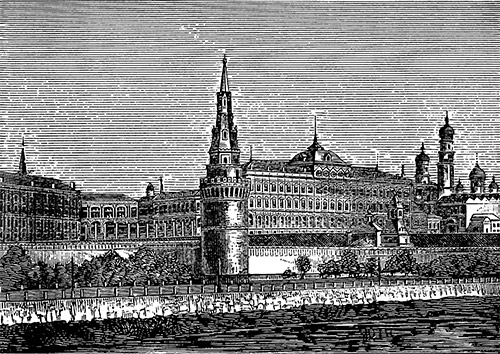
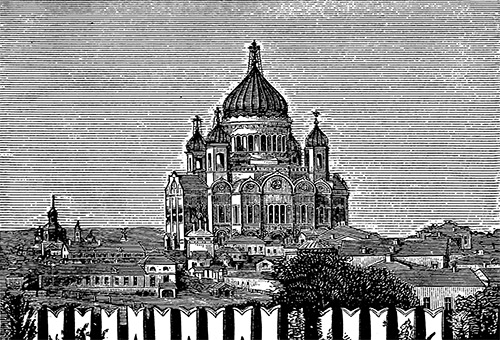
The Temple of the Saviour, Moscow.
MOSCOW PHOTOGRAPHS.
In front of the platform is a throne for the empress, another for the
Patriarch, and a third is the ancient throne of Vladimir. Behind the
screen are several chapels, one of which contains tombs of the
patriarchs; in another are some sacred relics, as a nail of the true
cross, a robe of the Saviour, and part of one worn by the Blessed
Virgin, with a picture of the latter, said to have been painted by one
of the apostles. The Assumption is the holiest and most highly venerated
church in Russia. The coronation of the emperor, which takes place here,
is a most solemn ceremonial, for it is the consecration of the
sovereign. It is preceded by fasting and seclusion for preparation. The
Czar recites aloud the confession of faith, and on his knees offers the
prayer for the empire. He places the crown upon his own head, and
walking through the royal gates, takes the bread and wine from the
altar without the aid of the priest, as in ordinary cases, the recipient
is not permitted to touch the elements himself.
Close by the Assumption is the Cathedral of the Archangel Michael, which
is the mausoleum of the sovereigns of the Rurik and Romanoff families
from an early period down to the time of Peter the Great, and of Peter
II. since that time. The cenotaphs are covered with faded crimson palls,
badly spotted with grease from the candles above them. The tomb of young
Dimitri, son of Ivan the Terrible, murdered by Boris Godunoff, is
venerated by the faithful, because, after the anarchy and bloodshed
produced by the false Dimitris, the coffin and body of the true one were
discovered by a miracle. The tomb of Ivan the Terrible is next to the
altar, though he often broke the canons of the church. His cross, set
with very large pearls and an emerald a third of an inch in diameter, is
preserved here.
The churches of the Annunciation and of the Redeemer are close by; but
the students declared that they had seen churches enough for one day,
and they entered the House of the Holy Synod, containing the wardrobe
and treasury of the church, where robes, mitres, and crosiers, decked
with precious stones, are exhibited. In this house is prepared the holy
oil used in baptism, in consecrating churches, and in anointing the
emperor at his coronation. The vessels used in compounding it are of
solid silver, weighing thirteen hundred pounds. It is composed of thirty
different ingredients, the principal of which is pure Florence oil,
with wine, fragrant gums, balsam, and spices. It is made according to
the ancient rule, and a few drops of the chrism brought from
Constantinople is mingled with it. Some say this is a part of the
ointment used by Mary Magdalen in anointing the feet of the Saviour; and
a portion of the new chrism is returned to the "Alabaster," which
contains it, each time any is used. All the children of Orthodox parents
are anointed with this oil at their baptism.
The baptism of the child consists of four ceremonials. By its sponsors
it first makes the confession of faith. The priest, after crossing the
child and saying prayers, blows upon it, to drive away evil and unclean
spirits. After the prayer the parents leave the room, thereby
symbolizing the entire giving up of the child to the sponsors; and this
custom is followed even in the imperial family. The second step is the
immersion; and the priest, in full canonicals, blesses the water, and
anoints the infant, for the first time, on the breast for "the healing
of body and soul;" on the ears for "the hearing of the Word;" on the
hands, because "Thy hands have made and fashioned me;" on the feet, that
they "may walk in the way of thy commandments." He then rolls up his
sleeves, takes the child in his hands, stopping the ears with his thumb
and little finger, the eyes with two other fingers, and the mouth and
nose with the palm of his right hand, and holding up its body with the
left, he skilfully plunges it into a font three times, in the name of
the three persons of the Trinity.
The next step is the sacrament of unction, in which the child is again
anointed with the holy oil, the brow, eyes, nose, ears, lips, breast,
hands, and feet being touched with the chrism, by means of a pencil or
feather: it is "the seal of the gift of the Holy Ghost." The last step
is the washing of the child, and the cutting off its hair in four
places, forming a cross, which is regarded as a sacrifice, its hair
being the only gift the infant has to offer to its Maker. As it is cut,
the priest says, "The servant of God, Nicholas, is shorn in the name of
the Father, Son, and Holy Ghost." The service is accompanied by prayers
and litanies.
Near the Redeemer Gate of the Kremlin are the Miracle Monastery and the
Ascension Convent, in which are the tombs of many Czarinas, including
the mother of Ivan the Terrible, and four of his six wives, the wife of
Michael, the first wife of Peter the Great, and others. The arsenal
contains the cannon lost by the French in the disastrous campaign of
1812, represented by three hundred and sixty-five guns.
The huge piece at the corner of the building weighs forty tons. Outside
of the original Kremlin, in the part added by Helena, the mother of Ivan
the Terrible, and the regent during his minority, and called the Kitai
Gorod, or Chinese Town, is the most remarkable building in Moscow, the
Cathedral of St. Basil. It has no less than eleven domes, each different
in shape and color from the others, over as many chapels, with other
spires and cupolas. It looks like a little forest of grotesque temples.
One dome is gilded; another is checkered with green over a ground of
yellow; another is bright red, with white stripes; another looks like a
honeycomb, and another like a coat of mail. Some forty years ago a
mechanical diorama was exhibited in the United States, called
"Maelzel's Burning of Moscow," in which the French troops marched into
the place, the Russians fired the city, the show ending with the
"terrific explosion of the Kremlin." The prominent object was a building
like the church of St. Basil, which was popularly understood to be the
Kremlin, and which was blown sky high at the conclusion. Happily it is
still safe, though other buildings in the Kremlin fared worse. The
visitor winds about in the little circular chapels inside, open to the
roof of the domes, and perhaps thinks he has fallen into a nest of
chimneys. They are dedicated to different saints, and are half filled
with relics and holy vessels. On the site of it stood an ancient church
and cemetery, where St. Basil, a prophet and miracle-worker, was buried
in the middle of the sixteenth century. He was said to be "idiotic for
Christ's sake." Ivan the Terrible ordered a church to be built over him,
and this was erected by an Italian architect. The cruel tyrant was so
delighted with the curious edifice, that he ordered the eyes of the
architect to be put out, so that he could not see to build another to
equal or surpass it.
The view of St. Basil closed the labors of the day, and the tired party
walked back to the hotel, where dinner was served. Mr. Agneau's first
inquiry was for De Forrest and Beckwith, but nothing had been seen or
heard of them.
"Can anything have happened to them?" asked the troubled chaplain.
"I think not," replied the surgeon. "Probably they have done as others
have—run away for a time."
"Impossible!" exclaimed Mr. Agneau. "They were officers, and
well-behaved young gentlemen."
"Very likely; but they have been much dissatisfied since the election. I
have feared that De Forrest would make trouble."
"But in a strange land, like Russia, unable to speak a word of the
language, they would not be likely to run away."
"We have the fact, which is better than theory."
"Who saw them last?" asked the chaplain, turning to the students.
"They were in the compartment with me," said Vroome, the third master.
"Early this morning, when we crossed the river,—I forget the name of
the place—"
"Tver," suggested the surgeon.
"Yes, sir; that was it. They took their bags and said they were going to
change their seats," added Vroome.
"That makes it all plain. They have taken the steamer down to Nijni
Novgorod, and very likely we shall find them there. Give yourself no
uneasiness about them, Mr. Agneau. I will warrant that they are safe
enough, and will return when their money is gone, if not before. I will
look out for them."
Dr. Winstock, who had been in the ship since she was launched,
understood the boys better than the meek, gentle-hearted clergyman, and
had seen too much running away to be alarmed for the safety of the
absentees. The party were somewhat rested in the evening, and, taking
carriages, drove to the Petrofski Park and Gardens, where a band played,
and where the people of the city in large numbers were to be seen. On
the return they visited an immense restaurant, in order to see more of
the people. In this place there was a large orchestrion, a musical
instrument, which, being wound up, plays a variety of airs with all the
effects of a full orchestra, with drums, cymbals, and trumpets. It
executed the Russian National Hymn nearly as effectively as a band could
do it. The waiters in this establishment were all Tartars, dressed in
loose white pants and tunics. The visitors were drinking tea generally,
but a few indulged in beer and stronger drinks.
The students slept soundly that night, for they were generally very
tired, and even Scott's jokes were of the most sickly character. But at
eight o'clock in the morning they were on their feet again, exploring
the city on their own hook, in the vicinity of the hotel. Lincoln find
Scott ventured to enter a shop to purchase some photographs. One of the
salesmen spoke French very well, and the business was made easy to them.
After breakfast, the party started together again, and their first point
was the Romanoff House, the birthplace of Michael, the first sovereign
of the present dynasty. The original was built in the sixteenth century,
but it has been carefully restored after suffering much from fire and
the sack of the invading French. It is filled with relics of the ancient
time, and in the nursery are a cradle, and the toys and playthings of
the Czar. The furniture of the bed-room is rather curious, and in a box
are the slippers of the monarch, and the night-dress of his wife. The
walls are covered with stamped leather.
From this house the party went to the Bazaar in the Kitai Gorod. Its
stalls contain everything that can possibly be wanted by a Russian or
anybody else, from old clothes up to paintings and statuary. Second-hand
articles of every description form a considerable portion of the trade.
Siberian and Circassian wares, and specialities from other remote
regions of the empire, are on view and sale here. The Bazaar is a
perfect labyrinth of stalls, and the scene is sometimes quite exciting.
Opposite the principal entrance are the statues of Minin and Pojarski;
the former, a peasant, urging the latter, a boyar, to deliver Moscow
from the dominion of the Poles, which was accomplished by their
inspiration and labor. Outside of the walls of the Kitai Gorod is the
Winter Market. As soon as the cold weather comes, the farmers slaughter
their live stock in vast numbers, and the carcasses are immediately
exposed till they are frozen, and then sent to market. Housekeepers then
lay in a large supply of frozen provision, which is always ready for
use, the quantity required for cooking at any time being first thawed in
cold water. Frozen oxen, sheep, calves, and other animals stand up in
the market, ready to be chopped and sawed into pieces. Fish from the
White Sea, the northern lakes, and the great rivers, are brought to the
market in this condition. Sometimes, but very rarely, a sudden thaw
produces sad havoc among the frozen provisions.
Between the two gateways which form the principal entrance to the
Chinese Tower is the chapel of the "Iberian Mother of God." It Is a
picture brought from Mount Athos, a holy mount of the Greeks, where four
thousand monks dwelt, during the reign of Alexis, who is said to have
invited the saint to take up her abode in Moscow. The picture, placed
in a sanctuary at the end of the chapel, is believed to have the power
of working miracles, and is regarded with the deepest veneration by the
Russians. All who pass bow and cross themselves, and many kneel and
prostrate themselves on the ground. On a holiday several hundred may be
seen at their devotions. Elegantly dressed ladies leave their carriages,
and bow down with the beggars. The emperors frequently visit it, and
Nicholas, when he could not sleep at night, is said to have roused the
monks at midnight to enable him to attend to his devotions in this
chapel. The religious zeal of the people in Moscow even exceeds that of
St. Petersburg. Donations for the church are received at this chapel to
the amount of about fifty thousand dollars a year, of which thirty-five
thousand is appropriated to the salary of the Metropolitan of Moscow,
who need not starve on this sum, though it is not the whole of his
income.
The party next walked to the Manège, or Great Riding School, which is
believed to be the largest apartment in the world with the roof
unsupported by columns. It is five hundred and sixty feet long, one
hundred and fifty-eight feet wide, and forty-two feet high. Two
regiments of cavalry can go through their evolutions at the same time in
this vast space. It is heated by twenty immense stoves, so that it can
be used in the coldest weather. At this point carriages were taken for a
ride to Sparrow Hills. On the way, not far from the Kremlin, the
tourists stopped at the new Temple of the Saviour, in process of
erection. It is the noblest church in Russia, and was built to
commemorate the expulsion of the French. It was to have been erected
at Sparrow Hills, from which Napoleon had his first view of the city,
and doubtless his last; but a good foundation could not be obtained, and
it was commenced on the present site, more than fifty years ago. Like
other Russian churches, it is in the form of a Greek cross. Though
sculpture is not often seen on Greek churches, this one is ornamented on
the outside with scenes from Scripture and the national history in high
relief, the figures being of colossal size. As these "human and divine
forms" are not for purposes of worship, they do not seem to be
inconsistent even with the Russian belief. The stone is of a light
color, and the structure is crowned with a magnificent golden dome,
which surpasses everything else in beauty in the country. The interior
was filled with stagings, though a glimpse of the rich and beautiful
paintings on the inside of the dome could be obtained. The walls are
covered with variegated marble. The building has already cost ten
million rubles, and it is said that the entire cost will be fifteen
millions.
Crossing the Moskva River, the carriages proceeded by a very broad,
straight avenue, through a gate, into the suburbs. The ascent of the
hill is by a soft, oozy road, so trying for the horses that most of the
students preferred to walk. The summit was gained. On it is a villa of
the empress, and an estate of Prince Galitzin; but the party went to a
cottage, where tea, coffee, and other refreshments are furnished. In the
rear of it is a spacious veranda, with tables, where the students seated
themselves, and from which a splendid view of Moscow is obtained.
Beneath them flowed the Moskva, which could be seen for miles, winding
through the level plain. The party drank coffee, enjoyed the view for an
hour, and then returned to the city, visiting one of the monasteries on
the way. Near the Kremlin they encountered a funeral on a grand scale,
and the drivers of the carriages stopped at once. The aspect of the
street was suddenly changed, for all business was suspended, all heads
uncovered, and every passer-by halted. The procession was headed by a
body of priests, clothed in black robes, and bearing lighted tapers and
various religious emblems in their hands. The hearse was drawn by four
horses, caparisoned in black, which covered their legs, with plumes on
their heads. The vehicle was an open platform on wheels, upon which lay
the coffin, covered with a pall. It had steps at the sides, on which
stood priests, holding images over the body, while others followed it.
The bells were tolling, and a strange chant rose from the procession.
The spectators uttered prayers for the repose of the dead, which they
always do on meeting a funeral, though the deceased be an entire
stranger to them. The students took off their caps, and this custom, not
entirely unknown in our own country, is worthy of respect.
"In Russia, it is believed that a person cannot die easily, if at all,
when there is a pigeon feather in his pillow," said Dr. Winstock, as the
carriages continued on their way. "When the sufferer seems to die hard,
they think there must be a pigeon feather in the pillow under his head,
and they often change it, so as to be sure on this point."
"What harm does the pigeon feather do?" asked Lincoln, curiously.
"The dove, or pigeon, is the emblem of the Holy Ghost, and the bird is
never eaten by the most rigid believers; and on no account would they
use its feathers to make a pillow, for the bird is held in the highest
respect."
The party arrived at the hotel, where an early dinner was ready for
them, after which the Volga partook droskies for the Nijni Novgorod
Railroad. The first division, visited the Troitsad Monastery, forty
miles distant, the next day. It was founded by St. Sergius, in the
fourteenth century. He was the most holy of all the monks, and the
monastery is the most sacred shrine. Russian tradition says that he was
visited in his cell by the Virgin, attended by the apostles Peter and
John. It is a fortress, in fact, and has withstood many sieges. Neither
plague nor cholera has ever entered its walls. It includes ten churches,
is endowed with immense riches, and at one time held over a hundred
thousand serfs. The monks in Russia are called the Black Clergy, to
distinguish them from the White Clergy, who are the priests that
officiate in the churches. When the wife of one of the latter dies, he
must either secularize himself or enter a monastery. The highest
officers in the church and the members of the Holy Synod, however, are
taken from the monks.
The division returned to Moscow in the afternoon and on the following
day took the train for St. Petersburg. The second division arrived on
the forenoon of the same day, and proceeded to see the sights already
described.
CHAPTER XIV.
DOWN THE VOLGA.
A difference of three rubles in the fare does not compensate the
traveller for the discomforts of the second-class cars from Moscow to
Nijni Novgorod, and Dr. Winstock took first-class tickets for his little
party; indeed, it does not pay to go there at all, except during the
great fair. The cars were very good, in one of which was the innovation
of a door connecting two compartments, and our party took possession of
it, though one gentleman had already seated himself there. He was very
polite, and spoke French, so that the doctor was not at all anxious to
get rid of him. The train started. The landscape was about the same as
on the road from St. Petersburg; consequently there was little to be
seen from the windows.
The train was late, and did not arrive at its destination till nine
o'clock in the morning. Most of the students, by doubling up on the
seats, had slept very well, and were tolerably fresh. They entered the
fine brick station, and seated themselves in the restaurant. The Tartar
waiters were all attention.
"Breakfast—Déjeûner—Frühstück," said Lincoln who had seated
himself with Scott and Bill Bobstay.
The waiter smiled blandly, and shook his head.
"Café," added the commodore.
"Da," which is the Russian for "yes."
"Bifstek?"
"Da."
"Will you have the same, Scott?" added Lincoln.
"No; I think not. Please to ask him for mutton chops, boiled eggs, and
fried potatoes," replied Scott.
"Suppose you ask him yourself," laughed the commodore.
"I don't speak any Russian. I'm afraid to learn it; think it would knock
my teeth out."
"What will you have, Billy?" added Lincoln.
"The same that you do."
"I don't see that I can get anything else. Where is Mr. Blownynozeoff?"
continued Scott.
"Who is he?"
"Why, the Russian that rode with us."
This gentleman now appeared with the doctor, whom he had been assisting
to procure tickets for the steamer, and he was kind enough to order
breakfast for the whole party. It was good, and well served, with
nothing peculiar about it, except that the butter was in glass jars, the
inside of metal, and very dirty and cheesy. There were plenty of
droskies at the door, and three of them were taken for the ride to the
steamer.
"Go ahead, Switchemoff," said Scott, as he seated himself with Billy
Bobstay.
The Russian gentleman directed the drivers where to go, and they
started. Descending a gentle slope, the party came to the fair grounds;
but they were not to examine these till their return from Kazan. The
road was very dusty, and in wet weather the mud is very deep. Crossing
the Oka River on a bridge of boats, the travellers entered what is
properly the town, and soon reached the point on the river where the
steamers lay. There were several of them at the quay, and it was
difficult to determine which was the right one, since neither the doctor
nor the students could read her name on the ticket or on the boat. But
the card was shown to a man, who pointed to the right steamer, and they
went on board of her. As in other parts of Europe, porters always stand
ready—too ready, sometimes—to carry the travellers' baggage, and one
who cannot speak the language has only to show his ticket to one of
them, and he will be conducted to the right place.
The party, having first-class tickets, hastened aft to where the best
cabin is usually located, and went below. The accommodations were not
elegant, certainly. There were no berths, only divans around the
apartment, which the students made haste to secure, by placing their
bags upon them. Having performed this necessary duty, they returned to
the deck to examine the steamer, and see the strange sights. The craft
was rather odd in shape, her bow and stern being depressed more than the
part amidships, so that the deck sloped down, going forward or aft. The
"bridge" is a platform between the paddle-boxes, of considerable size,
which only first-class passengers are permitted to occupy. Upon it is
the steering-wheel, which is about six feet high.
"See here! How's this?" said Scott, as he led the way forward. "What is
this coop for?"
It was a house on deck, containing a stairway, and a small room with a
table in it. The apartment was handsomely furnished, and was even
luxurious compared with the after cabin.
"Let us go in, and see," replied Billy Bobstay; and they entered.
Descending the stairs, they came to a cabin in the forward part of the
vessel, with a broad divan around it, like the other, but covered with
drab cloth. It was very neatly furnished, and provided with every
convenience except berths.
"We are first-class, and we have got into the wrong coop," said Scott.
"That's so," added Lincoln. "We will change our baggage."
"Perhaps we may be mistaken. This may be the Czar's cabin," suggested
Scott.
At this moment a short man, wearing a very long black frock coat,
entered. When he saw the passengers, he promptly removed his cap, and
bowed, so that the students concluded he was one of the stewards.
"I say, Knockmyheadoff, is this the first-class cabin?" demanded Scott.
The man smiled sweetly, and shook his head.
"He don't speak English," said Lincoln, producing his ticket, and
showing it to the steward.
The man glanced at it, bowed, smiled, and swung his hands about to
indicate that it was all right.
"Do we belong in here, or not?" asked Scott.
"What's the matter?" said a short, stout man, entering the cabin at this
moment.
"Do we belong here, sir?" added Lincoln, showing him the ticket.
"Yes, sir; this is the first-class cabin."
"Do you belong to the boat, sir?"
"I do. I am the captain."
"Good! and you speak English like an American," added Scott.
"I can speak it some. I have been in New York."
"Have you? Give me your hand!" shouted the joker. "I am glad to see a
man who has been in the United States."
The captain took the joker's offered hand.
"I have been in New York and San Francisco," he added.
"You are my friend for life. My name is Scott."
"And you are a seaman?"
"Salt as the inside of a pickle barrel. Allow me to introduce you to
Commodore Lincoln, in command of our squadron at Cronstadt."
The captain took off his cap to Lincoln, and accepted his offered hand;
but he seemed to be a little puzzled at his title.
"What steamer is this, captain?"
"The Stafet, Captain Ekovetz."
The conversation was continued for some time. The steward was sent for
the bags in the other cabin, and orders given to make the Americans as
comfortable as possible. The captain was very zealous to serve his
passengers, and they all went on deck together.
"Can you tell me, captain, when a steamer, which left Tver on
Wednesday, arrives at this place?" asked the doctor, who had joined the
students below.
"She should be here now, sir," replied the captain; "but I think she has
not come yet."
"Two of our young men ran away from us at Tver, and must have taken this
steamer."
"Ran away—did they?" laughed the captain. "This is a bad country for
them, then, for we don't have any habeas corpus, or anything of that
sort. The police will stop them, if you wish it."
"I do wish it."
The obliging commander of the steamer went on shore with the doctor to
the police office, attended by Vroome, the third master. A description
of the fugitives was given through the captain, and the police officer
made a note of Vroome's uniform, as like those worn by De Forrest and
Beckwith. The party returned to the steamer, and as the hour for
starting had arrived, the fasts were cast off, and the Stafet was soon
making her way down the mighty Volga. Her deck was crowded with
third-class passengers, who were the peasants and laboring men of the
country. They were abominably dirty and miserably dressed, several of
them wearing the long sheep-skin coats, the wool inside. Others wore
long, light-colored coats, very ragged. Not a few of them, instead of
boots, had coarse cloths wound around their feet and ankles, bound on
with strings nearly as large as a bed-cord. Some of them were eating
their dinners, which they carried with them, consisting of the blackest
of bread and dried fish. These men were the serfs who had been liberated
by the noble policy of the present emperor.
The Volga, at Nijni, is about two thirds of a mile wide, and is covered
with boats of all sorts and sizes. The depth of water between this point
and Kazan does not admit of the passage of the largest passenger
steamers. The voyager from Tver to the Caspian would change steamers for
larger ones at Nijni and at Kazan. Merchandise is transported on the
river in boats, the largest of which are about a hundred and fifty feet
long, with a single mast, well forward, and appear to be very
substantially built. In the middle there is a house on deck, generally
with an Oriental dome, painted green, which is possibly a chapel. There
are other smaller boats, and a tug steamer tows from four to eight of
the different sizes. These boats are owned by corporations, such as the
Volga Transportation Company. Vast quantities of wheat are conveyed from
Saratoff, and other places, to the head of navigation.
The students gathered on the bridge, or hurricane deck would be a more
proper name for it. Two Russian pilots were at the tall wheel, and they
looked as little like sailors as it is possible to conceive. They wore
the long sheep-skin pelisse, with pants stuffed into their boots, and
Cossack or Tartar caps. They looked particularly solemn; but they are
said to know their business perfectly.
The navigation of the river is very difficult in some places, and it
requires not a little skill and experience to keep the boat in the
channel. In shoal places, dikes have been built to turn the course of
the current, or to keep it within certain limits. Large sums of money
have been spent by the government in dredging and otherwise improving
the navigation. In August the river is generally low, and there is an
extensive prospect of sand-bars between the banks of the stream. The
Volga flows through a flat country, but there is a ridge on the right
bank, which, in places, causes the formation of a considerable bluff.
The regulations for steamers passing each other appear to be excellent,
and collisions to be impossible. The boat going down stream has the
right of way. She whistles, and the officer of the deck waves a flag in
the daytime, a lantern at night, on the side which the other boat is to
pass him. The steamer going up stream whistles in reply, and a flag is
waved in the direction the down boat is to take. If they are to pass on
the starboard hand, both officers go to the starboard side, on the
paddle-boxes, raise the flag, and drop it over on this side, repeating
the movement several times; if on the port side, the signals are made
accordingly.
There is nothing like variety of scenery on the river, and in a short
time the view becomes very monotonous. There are occasional villages to
be seen on the shore, but they are composed only of log-houses. The
larger towns have one or more fine churches. Late in the afternoon the
Stafet made a landing at one of these places, and the greater part of
the deck passengers left the boat. On the bluff was a church with a
green dome, and the Russian cross at the summit. As soon as they landed,
all the peasants turned their faces towards the church, crossed
themselves, and bowed reverently. A few dropped upon their knees, and
bent to the ground. In this manner they thank God for bringing them in
safety to their journey's end. No one seems to notice them, or to regard
their conduct as at all singular.
The boat stopped long enough at this place to "wood up," the work of
which was done by women, while scores of stout men stood by, looking on.
These women were of all ages; but none of them were handsome enough to
excite the sympathy of cold-blooded foreigners. They wore calico
dresses, with the belt or waist directly under the arms. The wood was
carried on two poles, forming a hand-barrow, and the women bore loads
which would have strained the backs of ordinary men.
"That's mean," said Scott. "I don't see how those men can stand by, and
not lend a helping hand."
"You are in Russia," replied Lincoln.
"Don't men have souls in Russia?"
"Yes; and customs too. This seems to be one of them," laughed the
commodore.
"See that little one. She is not more than sixteen. She isn't bad
looking, either; at least, not so bad looking as the rest of them."
"If you feel bad about it, Scott, you can take a hand in the job
yourself."
"I will," said the joker, as the girl passed him, laughing merrily, with
the pole in her hand. "Let me carry it for you;" and Scott attempted to
take the pole.
She stoutly resented this interference, till Captain Ekovetz spoke to
her, for he had heard the conversation. The girl laughed, and so did the
old woman who worked with her. The poles were laid down and loaded,
and Scott picked up his end. His share of the weight was all he could
stagger under, and the solemn Russians laughed heartily at his
gallantry.
"That's enough for me," said the joker, when he had dumped the load.
"Here, Miss Maidenoff, I'm off."
The girl tittered, and Scott gave her a twenty-copeck piece, which she
accepted with surprise and pleasure.
"Don't back out, Scott," said Lincoln.
"I thought I would back out while I had a back to back out with. The
idea of that girl carrying such a load is cruel. It is enough for a pack
mule."
"But the old woman sold you," laughed Billy Bobstay.
"Sold me?"
"She evidently understands the mechanical powers in practice, if not in
theory, for she loaded the poles so that you carried two thirds of the
weight. Probably she takes the other end with the girl."
"These women claim this work as their privilege," said the captain. "If
the men should attempt to bring the wood on board, the women would think
it was mean in them."
"Their education has been neglected," replied Scott. "This is going in
for women's rights with a vengeance."
"At every railroad station where I have bought tickets, they were sold
by ladies, and all of them spoke French," added the doctor. "Women have
a sphere in Russia, and some of them are well educated. You will find
the women at work in the fields in every country of Europe, and in
some of them they do all the worst drudgery. In Holland we saw women
dragging boats on the canals, while a man stood at the tiller, with a
pipe in his mouth, smoking."
The steamer started again, and the party went into the cabin to order
their dinner; but with the Russian steward this was no easy matter,
though he knew half a dozen words of German. He set the table, and
brought on the dinner, which, however, was anything but what was
ordered. The first dish after the soup was meat, chopped fine, made into
cutlets, breaded, and fried. It was followed by a course of small birds
with jelly, and ended with a dessert of dried fruit. It was a very good
dinner, and the party were well satisfied with it.
On the bridge Scott got acquainted with the mate, a short man, and about
as thick as he was long. Though he could not speak a word of English,
and the joker not a word of Russian, they had some long talks, to the
great amusement of the other students. The mate laughed prodigiously
when he spoke, and permitted Scott to make his speeches, the joker being
equally indulgent to him.
"I say, Mr. Fatmanoffsky, don't you think that wheel is twice as big as
it need be?" said Scott.
The mate laughed, and talked Russian, but, as he pointed at the wheel,
he was evidently talking about it. Even the solemn pilots were amused,
either at what the Russian said, or at the absurdity of two persons
talking together when neither could understand the other.
The party retired early. There was a pillow to each divan, but no
bed-clothes—none are furnished on any of the Volga steamers, and
travellers usually carry a robe or two. They slept very well, for all of
them were accustomed to "turning in" with their clothes on. In the
morning the country appeared to be about the same, though the bluff on
the right was higher, and a range of hills was seen in the distance, on
the same side. At eleven o'clock, the steamer arrived at Kazan, in just
twenty-four hours from Nijni. The city is seven versts from the river,
though there is a small village on the bluff. The shore is lined with
steamers and boats, loading and unloading. There was nothing attractive
in the locality, and nothing interesting except the Tartar teamsters, on
shore, who wore white felt hats, and sheep-skin coats; some of them with
their feet and legs tied up in rags, others in boots or straw sandals.
Four droskies were hired at three rubles apiece for the day, to go up to
the city and return. Dr. Winstock wished to find the Professor of
English of the University of Kazan, to whom he had a letter of
introduction. It would be impossible for the party to speak a word to
anybody, and the captain kindly sent the steward with them to the
university.
The ride is a dreary one, over a region which is covered with water when
the Volga floods its banks. On the left of the road is a curious
pyramidal monument to the memory of the Russians who fell in the capture
of the city from the Tartars. It was the capital of the Kingdom of
Kazan, founded in the thirteenth century by the Golden Horde, a tribe of
Tartars who invaded Russia. They were continually at war with the
people of Muscovy, and after repeated expeditions on the part of the
Russians against the city, it was finally subdued by Ivan the Terrible,
and the kingdom incorporated in his dominions.
"I suppose we shall not go any farther east than we are now," said
Lincoln, who was riding with the doctor.
"No; we are within three hundred and twenty miles of Asia now, the
nearest part of which lies a little east of south of us."
"What do you suppose the people of New York and Boston are doing just
now, doctor?"
"They are asleep, I hope."
"It is quarter past twelve now," added Lincoln, looking at his watch,
which he had set by Kazan time. "In Boston it is two minutes of four
o'clock in the morning, and in New York fourteen minutes of four. It
seems very odd."
"I don't know that it does."
"My father and mother haven't begun to think of getting out of bed yet!"
laughed Lincoln. "I shall remember this place as the farthest easting I
have made."
After a ride of an hour the vehicles entered the city, and turned into a
wide street, with fine buildings. Presently they stopped at the
university, which is a very large establishment, with four hundred and
fifty students. The steward led the way into the vestibule, and spoke to
the porter. Then there was a difficulty which the man could not explain.
He talked, made signs, and gesticulated; and it was clear that the
professor was not in. The doctor spoke English, French, and German to
the porter, who could not comprehend a word of either. But suddenly his
face lighted up with a smile, and beckoning to the party to follow him,
he led them up three flights of stairs, unlocked a door, and entered.
Conducting the surgeon to a glass case, he triumphantly pointed to a
small Egyptian mummy! The visitors courteously examined it, and other
curiosities in the room, which was the museum of the university. While
the party were thus engaged, an elderly Russian entered the apartment,
and looked curiously at the strangers. The doctor attacked him in all
the languages he could speak, but without avail.
"Professor Anglisky!" shouted Dr. Winstock.
"That ought to fetch him," said Scott; but it did not.
"Anglisky," repeated the surgeon.
"Da!" replied the old man, at last, his face beaming with smiles, as
though he had solved the problem.
Making a gesture to indicate that the party were to follow him, he led
them down one flight of stairs, through a hall a hundred feet long, up
another flight, through another long hall, and opened a door. The
travellers entered, and he led them to a case of minerals, to which he
pointed with an expression of the utmost satisfaction on his wrinkled
face.
"No, no, no!" exclaimed the doctor, impatiently; and the party
retreated, without taking a second look at the case.
The porter led them back to the entrance hall, where Lincoln and the
surgeon began to ask the people who passed if they could speak English,
French, or German. No one could; but at last the puzzled steward
seemed to have obtained an idea, and made signs for the party to return
to the droskies. They did so, and were driven away again; but the doctor
expected to be taken to a church or a cemetery. He was mistaken, for the
steward's idea was really a brilliant one, and he set his party down at
the residence of the professor. He rang the bell, and sent in a message
by the servant, who in a moment returned and conducted the tourists to
the second floor, where Professor Beresford received them. The letter
was delivered, and the professor extended a cordial welcome to the
party. For an hour he entertained them with his accounts of the
Russians, and then volunteered to show them some of the sights of the
city. They went to the Kremlin, which contains a cathedral; a tower in
the form of a pyramid, nearly two hundred and fifty feet high; the
convent built for the miraculous picture of Our Lady of Kazan, now in
St. Petersburg, though it has a copy of the original, on which glitters
a crown of diamonds, presented by Catharine II.
The city of Kazan has a population of sixty thousand, of whom more than
half are Tartars. They live by themselves, in their own quarter of the
town, and retain their own manners and customs. They are Mohammedans,
and have twelve mosques. Under the guidance of the professor the party
drove to this section. The houses were generally of two stories, but the
lower one among the poorer classes is devoted to the horses and other
stock, or used as a store-room, while the family occupy the second
story. The Tartars were easily distinguished from the Russians by
their Asiatic faces and their costume. The men of the better class wear
a calico tunic, and trousers of the same material. Over these they wear
a long coat. The trousers are stuffed into the boots, which are
generally of colored morocco, fancifully ornamented; and most of them
wear overshoes, doubtless for convenience in entering the mosque. The
head is close shaved, and they wear a skull-cap, often richly
embroidered, but on the street they have a fur cap over it.
"It's easy enough to catch a Tartar here," said Scott.
"Don't try," replied Billy Bobstay.
"High O! What's that? A Tartar carriage, with two ladies! That's the
kind we read of."
It was an odd vehicle. The fore and hind wheels were at least twelve
feet apart, and connected by two strips of board, on which rested the
body of an ordinary wagon. Seated in this carriage were two Tartar
ladies, in the full costume of Mohammedan countries, including the
robes, and the bandages over the face, which concealed all but the nose
and the eyes. Both of them were young, and they looked mischievous, as
they glanced at the Americans; but they were not pretty. Scott had the
presumption to touch his cap and bow as they passed. The droskies
stopped at this moment.
"You will catch a Tartar if you do that, young gentleman," laughed the
professor. "You mustn't take any notice of the ladies here."
"Can't one be civil and polite to them?"
"No; give them the cold shoulder."
"They smiled, and looked roguish," persisted Scott. "Their faces are
painted, too."
"All the Tartar women paint. Here is a mosque; we will go in, if you
please. But you must scrape your feet, and use the mat vigorously. The
Tartar gentlemen take off their overshoes before they enter, and in most
Mohammedan countries they compel strangers to remove their shoes; but
they are not so particular here."
The party complied with these directions, and a man admitted them. The
interior of the mosque was very plain, with a gallery on one side. On
the floor were dirty and ragged carpets for the faithful to kneel upon.
There were no seats, and the only furniture was a stand some eight feet
high, on which the Koran is read and expounded. This was one of the
plainest and simplest mosques, and a few months later the students had
an opportunity of seeing them in all their glory in Constantinople. The
party now drove to Commonens's restaurant for dinner; after which they
took another drive through the streets. Most of the students were again
astonished, as they had been before, to find that a city in the eastern
part of Russia is so much like one in America, though they did not
cherish this view when they stood before such a quaint structure as the
Cathedral Nicolski. Thanking Professor Beresford for his kindness, the
party started for the steamer again, which was to leave at eight o'clock
the next morning, and they had decided to sleep on board.
At an early hour they were awaked by the advent of a number of
passengers coming into the cabin. Several of them were Tartars of the
highest class, and Scott called them "Cream Tartars," for they were very
richly dressed. The boat started, and the students in the cabin
continued to gaze at their singular companions. They called for tea, and
produced their own provisions, consisting of bread and caviar, upon
which they made their breakfast. It would be considered rather shabby
for first-class passengers in America to carry their own provisions, but
it is all right on the Volga. At noon these Tartars attended to their
devotions on the bridge without any regard to the bystanders. They
spread a robe on the top of the paddle-box, and taking off their
overshoes, knelt upon it. Then they put their hands behind their ears,
and over their eyes, bowing their heads to the floor, and repeating
their prayers.
In the afternoon the steamer passed a large boat going down the river,
towed by a steamer. It had a cabin, extending nearly the whole length of
it, with small, grated windows. The captain said this was a convict
boat, in which prisoners were conveyed down the Volga, and up the Kama
to Perm, from which they have to march to Siberia. When they reach their
destination, they are compelled to work in the mines. The captain said
that many of them returned, and made good citizens. At three o'clock on
the afternoon of the next day, the Stafet arrived at Nijni Novgorod.
CHAPTER XV.
THE MOVEMENTS OF THE RUNAWAYS.
While the voyagers were taking leave of Captain Ekovetz, who had been so
attentive to them, an officer spoke to him in Russian.
"The police have your runaways," added the captain.
"Indeed! Where are they?" asked the doctor.
"At the police office. They came down in the boat from Tver, and were
about to take the steamer for Kazan," said the captain, after some
further conversation with the officer. "This man will conduct you to the
police office."
The party followed him, and in a short time came to the place where De
Forrest and Beckwith were held, not exactly "in durance vile," but in
the office of the police. The runaways looked decidedly crestfallen.
"This is rather unexpected. I thought you were going only to Moscow; but
it appears that you have not even been there at all," said Dr. Winstock.
"No, sir, we have not," replied De Forrest. "I suppose you will think we
ran away; but we did not."
"I must acknowledge that the course you have taken is open to that
interpretation," added the doctor.
"I knew you would think so," said Beckwith, trying to look honest and
innocent.
"Nothing of the sort, sir," continued De Forrest. "We took a cup of
coffee at Tver, and then stepped out in the rear of the station to get a
sight of the town and the river. The conductor told me the train would
not start for fifteen minutes, or I didn't understand him. I don't know
which."
"Did he tell you in Russian?"
"No, sir; in German."
"Do you remember what he said?"
"'Fünfzehn minuten.'"
"What question did you ask him?"
"'Wie lange bleiben sie hier?'"
"You asked him how long he remained at the station, after he had been
there ten minutes?"
"Yes, sir."
"Your German was better than your logic."
"I supposed he meant fifteen minutes more."
"You had no right to suppose so, if you did suppose any such thing.
However, it is not for me to decide on this case."
"The train went off in less than five minutes. We ran after it, and
yelled with all our might. Didn't you hear us, sir?"
"I confess that I did not," replied the doctor, with a smile; "but that
doesn't prove that I am hard of hearing. You came down the Volga?"
"Yes, sir. I thought Moscow was on the Volga, but Beckwith said it was
not," replied De Forrest.
"I knew it was not, and told him so," protested Beckwith.
"But still you went with him?"
"The captain spoke English a little, and told us we could take the train
to Moscow. We didn't like to wait in that station till five o'clock the
next morning."
"A train left Tver at about eleven that forenoon, and I supposed, if you
were left, that you would come down in that."
"We didn't know it."
At this moment Captain Ekovetz came into the office, and through him it
was ascertained that the runaways were captured while they were going on
board of a steamer about to start for Kazan, and had their tickets, for
which the police compelled the seller to refund the money. De Forrest
attempted to explain, but his statement was rather improbable—quite as
much so as the rest of his story.
"How long have you been here?" inquired the doctor.
"Three days, sir."
"As prisoners?"
"We staid at the Hotel Odessa, but the police and the servants watched
us all the time."
"This isn't a good country to run away in," laughed the doctor.
"We had no idea of running away, sir."
"Getting left is about the same thing. But we will move on, for we have
not much time to spare."
Droskies were taken, and the captain directed them to drive to Minin's
Tower. It is on a bluff, where the old town stood, including a part of
the Kremlin, and commands a fine view of the river and the fairgrounds,
on the tongue of land between the Volga and the Oka. The party entered
the Cathedral of the Transformation, where Minin is buried.
"Who was Minin?" asked Lincoln, as they stood by the obelisk erected to
his memory.
"You remember Mr. Mapps told you about the false Dimitris, and that, in
the confusion and anarchy brought about by them, the crown was offered
to Vladislas, son of the King of Poland, for the Poles were really the
masters of the country. The Russians had been beaten by them in many
battles, for the former had no suitable leader. When everything seemed
to be lost, Kosma Minin, a butcher of this town, obscure and uneducated,
but possessed of good judgment, brave, honest, and unselfish, roused his
fellow-citizens to a sense of their peril. His words and his example
induced the people to take up arms, and appropriate all their fortunes
for the deliverance of the nation from its oppressors. This spirit of
patriotic devotion extended to other places, and Prince Pojarski, was
soon able to take the field at the head of a large force. Minin seconded
all the efforts of the prince, and by this sudden uprising the Poles
were driven from the country. The movement was followed by the election
to the throne of Michael Romanoff. The bronze statues which you saw in
Moscow, opposite the bazaar, represents Minin urging Pojarski to deliver
Moscow from the Poles."
The tourists returned to the droskies, and the doctor directed his
driver by pointing in the direction of the fair grounds.
"This does not look much as it does during the fair," said the surgeon,
as they drove across the bridge of boats. "The rivers are crowded with
boats of every description, from all parts of the vast empire. The Oka
here is literally filled with them, so that there is hardly a channel
for the passage of others. These craft are quite a study, for they
comprise an immense variety, and it is said that the floating
population of this vicinity during the fair is about fifty thousand.
This bridge is quite as crowded as London Bridge during business hours,
and mounted Cossacks are stationed upon it to keep it from being
obstructed. These soldiers are also on duty in the crowded streets, to
preserve order. The mud here is sometimes a foot deep—at least it was
when I visited the fair several years ago. Even the paved streets are
ploughed and furrowed by the wheels of heavily-loaded vehicles."
"It is a hard road to travel now," added Lincoln; for the vehicle jolted
so that it was not easy for the passengers to keep their seats.
"Most of the goods for the fair come in boats, and have to be hauled to
the shops in wagons, making bad work of the roads. When not muddy, it is
very dusty."
The party entered the grounds of the fair, the doctor instructing his
driver by signs. The entire space between the Volga and the Oka is laid
out in streets and squares. There are ten miles of wharf on the two
rivers. There are about four hundred steamers on the Volga, many of
which were built in England, Belgium, and other countries, and have been
brought to the river through the various canals, or in pieces, and put
together again; but Russia can build her own steamers now. The streets
are lined with shops, most of the buildings being of brick, a few of
stone. Some of the open spaces are covered with booths and tents. The
stores are generally quite small, not more than twenty by fifteen feet.
In the rear of them are living-apartments for the merchants and their
employees. In the centre of the fair are the headquarters of the
governor; but the ground floor of the building is devoted to a bazaar
for the sale of fancy articles and manufactured goods, and a band of
music usually plays here. Concerts are also given in the square by a
military band. Near the official residence are theatres and exhibitions
of every description.
The Great Fair is the harvest time of beggars, and thousands of them
visit it, some of them coming from great distances. The lame, the halt,
and the blind come, and very many of them are impostors, who pretend to
have bodily ailments, or who have produced sores on their persons by
artificial means, to excite the sympathies of the benevolent.
The number of persons in attendance on the fair is estimated by the
amount of bread consumed, and the bakers are required to make daily
returns to the governor of the quantity sold. By this means it is
ascertained that the fair is visited, during the season of eight weeks,
by from one hundred and fifty thousand to three hundred thousand
persons. The amount of business transacted by sale and purchase, is
about one hundred million dollars.
There is as much variety in the shops as in different parts of a large
city. Certain sections are devoted to the wholesale trade, and others to
the retail. Many of the shops are filled with large bundles and bales,
while others glisten with ornamental articles. Some of the avenues
hardly differ in appearance from Broadway in New York, except in the
uniformity of the buildings. The windows are filled with displays of
jewelry, fancy goods, toys, dry goods, clocks, and watches, furs, silks,
and, indeed, everything that one would see in a great city. Some shops
are devoted exclusively to furs, and the assortment is large and fine.
Dried fish is a great article of commerce here. The value of the
sturgeon fisheries on the Volga is estimated at two and a half million
rubles, while thirty thousand casks of caviar have been sent up from
Astrakhan in one year. The productions of Asia are largely represented
at the fair, the most important of which is the tea of China. The
Chinese quarter is fitted up in Celestial style, with verandas and
pagodas; but very few Chinese attend the fair of late years. Fifteen
million pounds of the finest tea are brought into Russia, most of it to
this bazaar. It is transported to Perm by boats, sledges, and camels,
and thence by the Kama and Volga to Nijni.
Along the rivers are the coarser articles of merchandise—iron in bars
and sheets, and manufactured into kettles and household utensils,
millstones, vast quantities of wheat, rolls of leather from Kazan, boxes
of candles from Asia, copper and platinum from the Ural Mountains, and
bells of all sizes, hung so that their tone can be tested.
Perhaps the most interesting feature of the fair to an American or
Englishman is the people that gather there, especially the Asiatics. But
the variety is by no means as great as the visitor will expect to find
after reading the descriptions of them which have been published. There
are plenty of Persians and Tartars in full costume, the former with
knives and pistols in their belts, placed there for ornament rather than
use. A few grave Chinamen may also be seen; but the great majority of
the people are Russians. Unless one wishes to make it study of it, a few
hours are enough to enable the stranger to see the fair.
A canal extends through the ground, as a protection against fire, and no
smoking is allowed in the streets, on penalty of twenty-five rubles, and
the rule is enforced by the Cossacks on duty. Under the streets there is
a system of sewers for the draining of the land and the carrying off of
refuse matter. A stream of water is made to flow through them several
times a day, to remove the deposits there. In the streets there are, at
regular intervals, small white towers over staircases to descend into
the sewers, where are small apartments for men, in which alone they are
allowed to smoke. These improvements have cost large sums of money, and
the merchants are taxed to the amount of forty thousand dollars a year
to pay the expenses.
The tourists drove through the principal avenues of the deserted
grounds, and the doctor told them what he had seen there during his
former visit when the fair was held. During the ride De Forrest and
Beckwith were not much interested in the sights to be seen, or in the
descriptions of the surgeon. They realized that the explanation of their
absence was not accepted by the surgeon, and probably would not be
better received by the principal.
"We have made a mess of it," said Beckwith. "I didn't believe in the
scrape at all."
"You wouldn't have come with me, if you had not," replied the purser.
"We haven't been to Kazan, or down the Volga, and we haven't even seen
Moscow, as the rest of the fellows have."
"We are going there to-night."
"Yes; but we leave in two or three hours after we arrive. We shall go on
board at Cronstadt, and not be allowed any liberty again. That's all we
shall make by running away."
"Perhaps not. You may go back to the ship, but I shall not," replied De
Forrest, doggedly.
"What will you do?"
"I told you what I wouldn't do, and that is just the same as telling you
what I will do. As you seem to be dissatisfied with what you have done,
you can do as you please," growled the purser.
"I don't think we have made anything so far by the course we have
taken," added Beckwith.
"Of course we haven't; we were tripped up."
"We may be tripped up again. These Russian policemen don't make anything
of stopping a fellow."
"We ran right into a trap here in Nijni. The doctor and his party got
here before we did, and were looking for us. We shall do well enough if
we take another track."
"But where do you mean to go?"
"If you are going to back out, I won't say anything about it."
"I'm not going to back out. I will go with you to the end of the earth."
"All right. That sounds like something. We will go right through from
Moscow to Warsaw. You know that German Cours-Buch we found at the
hotel yesterday?"
"Yes; but I couldn't make anything of it."
"I laid out a route, and wrote it down on a piece of paper."
"But how will you get away? The doctor will keep watch of us all the
time now," suggested Beckwith. "Besides, the other divisions of the
squadron are coming to Moscow, and the principal may be there by the
time we arrive."
"No matter if he is; we can easily manage it. You follow my lead, and I
will bring you out all right."
By this time the droskies arrived at the railroad station, where the
travellers dined, and obtained their tickets for Moscow. As the students
paid their own fare, they were permitted to take first or second class
cars, as they preferred. Following the example of the surgeon, most of
them went first class, and when they came to take their seats it was
found that only Scott and Beckwith had elected to go by the second
class. There were very few passengers, and as the doctor gave the
conductor a ruble, he disposed of the party so that there were only two
or three in a compartment, which afforded them plenty of room to lie
down and sleep. As a specimen of the Russian letter, we give a copy of
the surgeon's ticket:—
It is translated:
Nijni Novgorod.
Moscow.
1st Class 12 R. 30 C.
The train arrived at Moscow at nine the next morning, and the tourists
went to the Hotel de Hambourg. The third division of the squadron had
come, and the second was to leave that day. Mr. Lowington and Mr.
Fluxion were both at the hotel, and as soon as De Forrest saw the doctor
shaking hands with the principal, he decided that he would not wait to
be introduced to him. Nodding to Beckwith, he led the way through one of
the long halls of the hotel, and found a staircase which led down to an
arch under the house. On the other side of it was the dining room, which
they entered. This room was on the ground floor, and the windows were
open. No one was in sight, and they stepped out through one of them into
the street.
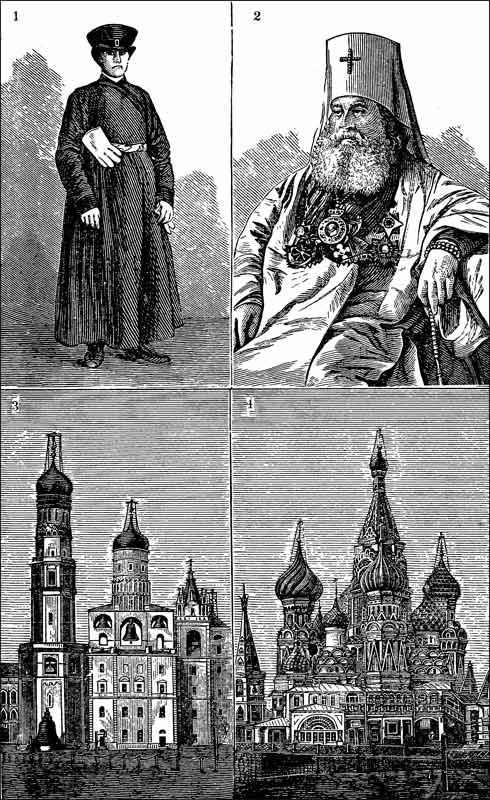
MOSCOW PHOTOGRAPHS.
- 1. Drosky Driver.
- 2. The Metropolitan of Moscow.
- 3. Tower of Ivan Villikof.
- 4. Cathedral of St. Basil.
"Where are you going, De Forrest?" asked Beckwith, nervously.
"I thought we had better keep out of the principal's sight," replied the
purser, as he led the way up the Rue Lubianka. "Here is another
hotel," he added, as they came to the corner on which is the house kept
by Mr. Billot.
"But we can't do anything here, without a word of the language."
"We will go into the hotel;" and De Forrest entered, followed by his
companion.
"Good morning, young gentlemen," said the proprietor, in good English.
"Good morning, sir," replied De Forrest; "can you give us a room?"
"O yes."
"And send breakfast to the room?"
"Certainly."
"That suits our case," said De Forrest; and a servant was sent up stairs
with them.
The apartment to which they were shown was on the second floor, with
windows opening into the Rue Lubianka, so that the runaways could
observe the movements of the party. Presently the landlord called to see
them, and asked if the room suited them. Then he inquired who and what
all the young men in uniform were whom he had seen during the past week,
and De Forrest explained the whole matter to his satisfaction.
"But why don't they come to my hotel?" asked Mr. Billot.
"I don't know, sir; it must have been a mistake on the part of the
principal."
"A very great mistake," added the landlord, laughing.
"We preferred to come here, but very likely the principal will blame us
for it; so, if you please, don't mention to any one that we are here."
"I will not."
"Thank you."
The landlord was vexed to have his house passed by, and, afraid that he
should lose his two customers if he mentioned them, he was content to
keep still. Breakfast was sent up to the runaways, at an extra charge.
They staid in their room all day, not daring to leave it lest they
should be seen by some of their shipmates. If they had been condemned to
such an imprisonment on board of the ship, even for running away, they
would have called it tyranny. They looked through the apertures at the
sides of the curtains, and saw the second division depart for St.
Petersburg, and the third starting for the Kremlin. They dined in their
room at five, and at half past eight in the evening, when the party at
the other hotel had gone to the Petrofski Gardens, they paid their bill,
and took a drosky for the Kief Railway station. The lady who sold the
tickets spoke French, so that they had no difficulty there. At noon the
next day they arrived at Orel, from which they departed at half past one
for Dunaburg, on the line from St. Petersburg to Warsaw. They reached
this town at six o'clock on the evening of the next day, and were
obliged to wait till two o'clock the next morning for a train, by which
they proceeded to Warsaw. They had been three days on the road, and had
slept three nights on the train, travelling eleven hundred miles, and
paying fifty rubles each for the fares, besides six more for meals. They
were tired out, and utterly disgusted with railroad travelling. Taking a
carriage at Praga, a suburb of Warsaw, where the station is located,
they crossed the high bridge over the Vistula, and were left at the
Hotel de l'Europe. They were shown to a room twenty feet square, for
which the charge was two rubles a day.
In the restaurant on the lower floor, where the waiters spoke German as
well as Polish, they found themselves seated near a party who were
conversing in English. It consisted of a gentleman and two ladies, one
of the latter being but about seventeen years old. They were dressed in
black, and the younger was very pretty,—so pretty that De Forrest could
not help looking at her, as opportunity favored him. But the young lady
seemed as much inclined to look at the runaways, and their eyes often
met. The party spoke in a low tone, and were evidently talking about the
young officers. Presently the gentleman rose from his chair and
approached them.
"I beg your pardon," said he; "but I think we have met before."
"Indeed! I was not aware of it; though I am very glad to see any one who
speaks the English language," replied De Forrest.
"You belong to the school ship, if I mistake not. We went on board of
her at Christiansand; you had just arrived from America, and we had come
in the Orlando from Hull."
"Yes, sir; I remember that steamer, and the party that came on board the
ship."
"My name is Kinnaird."
"I am happy to see you, Mr. Kinnaird. My name is De Forrest, and my
friend is Mr. Beckwith."
"Now permit me to present you to the ladies, who were much interested in
your ship, and especially in her young officers," added the polite
gentleman, as he conducted them to the table his party had taken. "Mrs.
Kinnaird, my wife."
De Forrest and Beckwith made their best bows.
"Miss Julia Gurney, my wife's sister," added Mr. Kinnaird.
"I am delighted to make your acquaintance, Miss Gurney," answered De
Forrest, as he bowed to the pretty young lady.
"I was so pleased with the ship in which you sail, and the nice-looking
young officers, that I have been wishing I might meet them again," said
Miss Gurney.
For half an hour they talked about the ship and the other vessels, and
each party told where they had been.
"And you are one of those fine young officers," said the young lady,
suddenly, laughing her satisfaction as she spoke.
"I am," replied De Forrest, though he had some doubts on this point.
"And where is your ship now?"
"At Cronstadt. The squadron will go to Königsberg or Danzig next; then
to Stettin or Swinemünde. The students will make a trip to Berlin and
Dresden."
"O, then I shall see them again," exclaimed Miss Gurney. "But don't you
sail with the others?"
"Yes, yes; but you see we make journeys on shore. We all went to Moscow,
and some of us down the Volga to Kazan."
"How delightful! I wish I was a boy! If I were I would be a sailor, and
join your ship. It must be elegant?"
"O yes—yes; very," replied De Forrest, glancing at his shipmate, who
could hardly keep from laughing.
"I think I should like it so well, that I wouldn't go on shore. It is so
stupid to be dragged through all these old palaces, and churches, and
tombs, though I like to look at the pictures."
De Forrest was fascinated by the beauty and sprightliness of Miss
Gurney. Her innocence and simplicity imparted a candor to her speech
which pleased him, and, fatigued as he was, he was sorry to lose sight
of her when the party retired to their rooms. Then her image went with
him, and followed him into his dreams. He met her again in the morning,
and the runaways were invited to accompany the party to Villenoy, and to
see the sights of the capital of Poland. In a few days they left for
Bromberg, and though Beckwith protested, De Forrest insisted upon
accompanying them. Then he could not resist his inclination to go with
the party to Königsberg, where Mr. Kinnaird desired to see a friend; but
he hoped the squadron would not come there. It did not go to Königsberg,
because the water was not deep enough, but it anchored at Pillau, the
port of the city, twenty-six miles distant. While the runaways were
dining with their new friends at the Hôtel de Prusse, feeling
perfectly secure because they had heard nothing of the squadron, the
officers and students marched through the room to another, where dinner
had been prepared for them.
"O, I am so delighted to see them!" exclaimed Julia. "How glad you must
be, Mr. De Forrest!"
"Yes—yes—very glad," stammered the purser. "Will you excuse us for a
few moments? I want to speak to some of them."
"O, certainly! How delighted you must be!" chattered the pretty Miss
Gurney.
Before they had time to retire, the principal confronted them, and
prevented their escape.
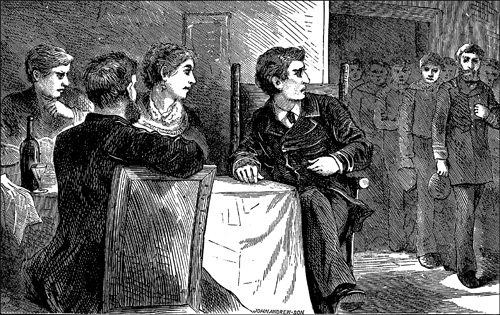
De Forrest and Julia. Page 294.
CHAPTER XVI.
SOMETHING ABOUT PRUSSIA AND GERMANY.
Dr. Winstock grasped the hand of the principal when they met in Moscow,
and briefly reported the incidents of his trip down the Volga, with the
little party.
"Of course you knew that De Forrest and Beckwith left us at Tver?" added
the doctor.
"Yes; Mr. Agneau informed me, and, poor man, he was very much worried
about the absentees," replied Mr. Lowington.
"I concluded they had gone down the Volga to Nijni. I asked the police
to detain them, and they did so. On my return from Kazan, I found them
in custody, and not at all satisfied with the results of their runaway
excursion. I brought them up with me, so that they are all right now.
They claimed to have been left by the train at Tver by accident."
"I suppose they tried that plan because they thought it succeeded in
Norway and Sweden; but I did not punish those because they made a full
confession, and seemed to be sorry for what they had done. Where are the
runaways?"
"They are here, sir. I saw them come into the hotel with the others."
The word was passed along for De Forrest and Beckwith, but they were not
there to answer. A dozen had seen them come into the house, and a party
who were standing at the door were sure they had not gone out. They
could not be found, and the doctor was even more chagrined than the
chaplain had been.
"Never mind, doctor; I shall not run after them. Running away has been
so common that I have ceased to worry about it," said the principal.
"They will come back when their money is all gone, if not before."
"Probably they intend to see Moscow," added the surgeon; "and they may
appear before the fourth division returns."
The Volga party returned to St. Petersburg with the second division, and
the next afternoon were on board of their vessel, attending to their
studies, for the students on board were kept at work, because it is
easier to be busy than to be idle.
On the 25th day of June, all hands had returned, having seen all of
Russia it was practicable to see, and the squadron went seaward, bound
for Königsberg. The officers below Beckwith and De Forrest were moved up
two grades, to fill the vacancies caused by the absence of the runaways,
and the two highest in rank in the steerage were sent into the cabin. On
the passage there were two examinations in seamanship, in which Cantwell
obtained very high marks. On the voyage, which lasted four days,—for
there was very little wind,—the captain performed his duty to the
entire satisfaction of the principal, and without being obliged to ask
for instructions.
On Tuesday afternoon the squadron anchored off Pillau, a town of four
thousand inhabitants, having a strong fortress at the entrance of the
Haff, a nearly landlocked bay, at the head of which Königsberg is
situated.
"All hands, attend lecture," called the boatswain, after breakfast the
next morning, and while the signal was flying on the ship.
The students gathered in the steerage, where the professor of geography
and history had hung up a map of Prussia on the foremast, which he had
colored to suit the occasion, so as to show the rapid enlargement of the
country by annexation.
"Young gentlemen," Mr. Mapps began, "Prussia is now one of the most
powerful states of Europe. We may say of her as of the United States,
'Westward the course of empire takes its way,' for Prussia had a small
beginning in the eastern part of its present territory, and now extends
westward beyond the Rhine. Contrary to my usual custom, I shall commence
with the history of the country. At the present time, Prussia is divided
into eleven provinces, the most eastern of which is Prussia Proper—the
part in which we now are. The region was originally inhabited by the
Lithuanians, who were conquered by the Goths. They were compelled to
embrace Christianity by the Poles in the eleventh century; but the
conquerors were soon repelled, and in their turn defeated, the
barbarians holding a part of Poland for a time. In the thirteenth
century they were the terror of the adjoining countries, and repelled an
army sent against them by Germany. The Teutonic Knights finally
conquered Prussia."
"What were they, sir?" asked a student.
"They were a powerful military order, formed during the crusades, who
fought for the Holy Sepulchre in Palestine. After the siege of Acre, a
charitable society for the care of the wounded and sick was organized by
the people of Lübec and Bremen, which was made into an order of
knighthood similar to the Templars. Only nobles were admitted to its
membership, and the Grand Master lived in Jerusalem at first, then in
Venice, and afterwards in Germany. After the crusades, they regarded
themselves as called to convert the heathen, which benignant work they
did, by first conquering the pagan territory. The order became immensely
rich and powerful, holding the territory from the Oder to the Gulf of
Finland, and deriving from it an immense revenue. They were constantly
at war with Poland, which, with their extravagant demands upon the
people, turned the nobility and the people against them. The oppressed
called upon the King of Poland for assistance, and a war of twelve years
followed, in which the order lost West Prussia, holding the rest by
paying tribute to the conquerors. The knights were deprived of much of
their power and wealth, though they still retained vast possessions. The
Grand Master became a kind of spiritual potentate in Germany, and
collected his revenues till 1805, when they went to the Emperor of
Austria. In 1809 Napoleon abolished the order, and its territories
reverted to the sovereigns in whose dominions they were located.
"The nucleus of the present kingdom of Prussia was the margraviate of
Brandenburg, of which Berlin is near the centre. By the extinction of
the family of its ruler, it was inherited by Sigismond, Emperor of
Germany, who sold it to Frederick VI., Burgrave of Nuremburg, in 1417.
He was of the house of Hohenzollern, from which the present King of
Prussia is descended, and with the territory the electoral dignity was
conferred upon him. His successors ruled the electorate for over two
hundred years, one of whom signed the protest at Spires, from which the
Protestants obtained their name.
"Poland held Prussia after it had conquered the Teutonic Knights, and in
1525 gave the sovereignty of the country to Albert of Brandenburg; but
it was not till 1656 that Prussia was declared independent by treaty. In
1618 John Sigismund, Elector of Brandenburg, acquired the Duchy of
Prussia, in the right of his wife, who was the daughter of Duke Albert
II. By the Thirty Years' War the united country was reduced to misery
and desolation, when, in 1640, Frederick William, commonly called the
Great Elector, succeeded to the government. He annexed considerable
territory to his dominion, and added greatly to its power and influence.
His son Frederick, the third elector of that name, by the consent of
Leopold, Emperor of Germany, obtained by a bribe, tendered through the
imperial confessor, raised his domain into a kingdom, and placed the
crown upon his own head at Königsberg, in 1701, taking the title of
Frederick I. This was the origin of the kingdom of Prussia. Frederick I.
extended his domain, which has been the policy of all his successors. He
was succeeded by his son, Frederick William I., who reigned
twenty-seven years, and left a well-disciplined army, and six millions
of dollars in cash in the treasury, to enable his son Frederick II. to
commence business. This son was the renowned Frederick the Great. He
used his capital stock to the best advantage for himself, wrested
Silesia from Austria, and took part in the partition of Poland. He
reigned forty-six years, and at his death had increased his territory
from forty-eight thousand to seventy-seven thousand square miles.
"Prussia now ranked as one of the great powers of Europe. Frederick the
Great left for his successor an army of two hundred and twenty thousand
men, and treasure to the value of fifty million dollars. He was
succeeded by his nephew, Frederick William II., in 1786, who added forty
thousand square miles to his kingdom by engaging in the second and third
partitions of Poland. In 1797 he was followed by his son Frederick
William III., who was the father of the present King of Prussia. He
lacked the decision necessary to carry his kingdom safely through the
troubles of his time. His armies were defeated by Napoleon, and for six
years the conqueror held him in subjection, and deprived him of half his
domain. The Prussian soldiers under Blucher, however, took an important
part in the overthrow of the Emperor of the French, and in the Congress
of Vienna, when the affairs of Europe were readjusted, his territory was
restored, and even increased, so that the kingdom, at his death,
consisted of one hundred and seven thousand square miles. In 1840 he was
followed by his son Frederick William IV. In 1848 an insurrection broke
out in Berlin, the result of which was a considerable modification of
the absolutism of the government. A constitution was adopted, and
repeatedly altered and amended. But the king had the best of it in the end,
and Prussia was finally pacified. In 1857 the king was attacked by
disease of the mind, and his brother William became regent, and in 1861
succeeded him as king, under the title of William I. He is decidedly
absolute in his tendencies, and claims to hold his crown by the grace of
God, and not by the will of the people.
"In speaking of Denmark, I told you in what manner the war of 1866,
between Prussia and Austria, was produced. In the terrible battle of
Sadowa, Austria was completely humiliated. Prussia dictated her own
terms of peace, and annexed a territory nearly equal in size to the
state of Maine, including Hanover, Schleswig-Holstein, Hesse Cassel,
Nassau, and other German states. The population of Prussia, with these
additions, is nearly twenty-three millions. The real engineer of
Prussia's magnificent fortunes is not the king, but Bismarck—Count Otto
von Bismarck-Shönhausen. He was born in 1814, was liberally educated,
and elected a member of the Constituent Assembly in 1848. He served as
minister or ambassador to Russia, France, and the Diet at Frankfort, and
was appointed minister of foreign affairs and chief of the ministers in
1862.
"Prussia is a constitutional monarchy, and the crown is hereditary in
the male line, in the Hohenzollern family. The executive and part of the
legislative power are vested in the king, who is of age at eighteen. The
legislature is composed of a House of Lords and a Chamber of Deputies. A
bill passing both branches and being approved by the king becomes a
law. Bills may originate with the king or either of the chambers. A bill
vetoed by the king, or rejected by either house, cannot be moved again
during the same session. The upper house is composed of the princes of
the royal family who are of age, and a few other princes; the heads of
certain noble families, life peers chosen by the king from rich
land-owners, great manufacturers, and celebrated men, eight noblemen
chosen by the eight former provinces of Prussia; representatives of
universities, the burgomasters of towns having over fifty thousand
inhabitants; and any number of members nominated by the king for life,
or for a limited period. The lower house consists of four hundred and
thirty-two members, chosen indirectly by the people.
"The royal family of Prussia are Protestants, but all denominations of
Christians have equal rights and privileges. Nearly two thirds of the
people are Protestants, and about one third Catholics. Education is
universal, and compulsory. Every town must maintain schools, and all
parents are obliged to send their children to them. A small tuition fee
is charged,—about two or three cents a week,—but this is not exacted
when the parents are too poor to pay it. The compulsion applies only to
the elementary schools; but the higher schools are open to the poor at a
very small charge. There are eleven grades of schools, from the
elementary up to the university, including normal, industrial, and
veterinary, schools for agriculture, mining, and architecture.
"The military system under which Prussia has obtained such tremendous
successes in war was established in 1814, on the principle that every
man capable of bearing arms should be instructed in military tactics,
and actually serve in the army for a specified period. No substitutes
are allowed, and there are very few exemptions, and these only of the
most obvious character. Every man is enrolled as soon as he is twenty,
and must serve seven years, the first three in the regular army, and the
other four in the reserve. At the end of this term he belongs to the
Landwehr, or militia, for nine years, during which time he is liable to
be put into the regular army in case of war. At the expiration of this
period he is thirty-six years of age, and then he is enrolled in the
Landsturm, until he is fifty; but this body are not sent out of the
country, and are called into service only in case of invasion. For
thirty years of his life, therefore, the Prussian is a soldier. The
military organizations, such as companies, regiments, brigades,
divisions, corps d'armée, are always kept up; the officers are ever
ready, and in case of war it is only necessary to call in the men. It
requires only two weeks to organize the reserves and Landwehr. On a
peace footing, the army consists of about four hundred thousand; on a
war footing, double this number.
"Nearly the whole of Prussia is in the great plain of Northern Europe.
It contains no high mountains, the most important range being the Harz,
the highest elevation of which is thirty-five hundred feet. The
acquisition of Schleswig-Holstein and Hanover has added largely to the
extent of Prussian sea-coast. There are but few good harbors on the
Baltic, for the water is shoal, and full of sand-banks. There are many
haffs, or lagoons, like the one on which Königsberg is situated.
Prussia has an immense number of lakes, especially in the eastern part,
the largest of which is the Spirding See, with an area of thirty-seven
square miles; but all these lakes are too shoal for navigation. The
rivers of Prussia flow into the Baltic and North Seas. The principal are
the Niemen or Memel, the Weichsel, or Vistula, the Oder, the Elbe, the
Weser, and the Rhine, all of which are navigable. These river systems
are connected by canals.
"The climate of Prussia is healthy, the average temperature varying in
different parts from forty-three degrees to fifty degrees. The soil is
generally fertile, though there are some sandy plains, and desolate,
hilly regions. The agriculture, fostered by the government, is of the
highest efficiency. All kinds of grain are produced in abundance, and
largely exported. Two hundred million pounds of sugar were made from
beets ten years ago. Thirty million tons of coal were mined last year,
and the country is rich in minerals. In its agriculture, commerce, and
manufactures, Prussia is remarkably prosperous. The country has a
complete network of railroads, about seven thousand miles in all.
"Berlin has a population of seven hundred and two thousand, and is the
fifth city of Europe. Next to it is Breslau, with one hundred and
seventy-two thousand. Cologne has one hundred and twenty-five thousand;
Königsberg, one hundred and six thousand. All the others have less than
a hundred thousand. New York has a larger German population than any
German city except Berlin.
"The money of Prussia is in thalers, silver, or new grosschen and
pfennings. A thaler is about seventy cents of our money. Thirty new
grosschen, of two and one third cents each, make a thaler, and twelve
pfennings make a new grosschen.
"And now, young gentleman, I will close with a brief statement in regard
to the Germanic Confederation, which is a union of states for certain
purposes, similar to that of the United States. In modern times the two
most powerful members have been Austria and Prussia; but the events of
1866 broke up the confederation, and caused the expulsion of Austria,
leaving Prussia as the ruling power. The North German Confederation,
consisting of twenty states, was then formed under the leadership of
Prussia. The six remaining states, the principal of which are Bavaria,
Baden, and Würtemberg, cannot be said to be united. Prussia had ratified
treaties with the three states mentioned, by which each of the
contracting powers guarantees the integrity of the others' territory. In
other words, in case of war, each is to assist the others; but it is
stipulated that Prussia is to have the command of the armies.
"A German Parliament, elected by the people, at the rate of one member
for every hundred thousand inhabitants, met at Berlin in 1867, and
adopted a charter, or constitution, drawn up by the Prussian government,
which means Bismarck."
Mr. Mapps proceeded to explain the nature of the constitution, which has
again been changed by the events of 1870. After the humiliation of
Austria in 1866, and Prussia's consequent increase of power and
influence, France, which has always held a commanding place among the
powers of Europe, felt that her position was threatened. Prussia had
attained a degree of power and influence which overshadowed France. A
war in the future was certain, and it came in 1870. The desire on the
part of France to check the ambition of Prussia, to cripple her power,
and diminish her influence, was the real cause of the war, and the
immediate events which led to the conflict are now of little
consequence. The attempt to place Leopold of Hohenzollern on the throne
of Spain was undoubtedly a real grievance to France. The French and
their supporters say he was brought forward to provoke a quarrel; that
Bismarck desired a war, in order to complete the unification of Germany.
The prince was withdrawn from the candidacy for the Spanish throne, but
France was not satisfied without a guaranty, which Prussia would not
give. France seemed to be determined to fight, and declared war.
Probably Louis Napoleon depended upon the coöperation of Austria and
Italy in humiliating a power whose rapid growth threatened the integrity
of all her neighbors' territory. But Italy had practically received
Venetia from the hands of Prussia, after the struggle of 1866, and
Austria was not in condition to carry on another war with her powerful
opponent. The emperor counted, too, upon the disaffection of Bavaria,
Baden, and Würtemberg, if not Saxony and Hanover, all of which had been
hardly used by Prussia in the war of 1866; but the South German states
promptly placed themselves on the side of Fatherland, led by Prussia.
France was obliged to fight her battles all alone. She was thoroughly
beaten, and absolutely crushed, by the vast legions of Germany. France,
which had been demanding the Rhine provinces, so that the river should
be her boundary line, was deprived of the greater portion of Alsace and
Lorraine, lying next to Germany, and on the Rhine.
Bismarck's plan to unite all Germany under one emperor was fully
realized, for, while the army of King William was still laying siege to
Paris, the King of Bavaria proposed to the sovereign princes of Germany
to urge William to assume the title of Emperor of Germany. A bill passed
the German Parliament at Berlin, almost unanimously, by which all the
states were united into an empire. The king was elected emperor by the
Diet, and accepted the honor; Bismarck was appointed chancellor of the
empire.
The members of the Diet, or Parliament, are elected for three years by
the people. As in the United States, each of the sovereignties is
independent in its local government, and exercises all powers which are
not expressly delegated to the Diet. All legislation relating to trade,
commerce, emigration, colonization, and insurance companies, belongs to
the Parliament. The empire also regulates the tariff, coinage, weights
and measures, banking, patents and copyrights, navigation, both internal
and external, post office and telegraphs, the army and navy, and laws
relating to the press.
The legislature consists of two branches, the Federal Council and the
Diet, or Parliament, the latter of which has nearly four hundred
members. The Federal Council is composed of the representatives of the
several governments. Prussia has seventeen votes in this body;
Bavaria, six; Würtemberg and Saxony, four each; Baden and Hesse, three
each; Mecklenburg-Schwerin and Brunswick, two each; and all the others,
one each, making fifty-eight in all. Each state may send as many members
as it has votes, but all from one state must vote together, representing
but one opinion.
The emperor represents the empire, concludes treaties, sends
ambassadors, and receives the ministers of other powers. He declares war
in the name of the Confederacy, but unless its territory is invaded or
menaced, he must have the consent of the Federal Council. The executive
power is practically delegated to the King of Prussia, whose navy now
belongs to Germany, and the army is under his command. To all intents
and purposes Prussia is Germany.
The Zollverein, or Customs Union, controls all matters relating to the
trade and commerce of the German states. It has a council and
parliament, like those of the empire. Its object is to levy uniform
duties on imported merchandise, to superintend the collection of the
revenues, and to regulate trade. All the receipts of the Zollverein are
paid into a common treasury, and distributed according to the population
among the several states.
As soon as the professor finished his lecture, a steamer came alongside,
and took off the students who were to make an excursion to Königsberg.
CHAPTER XVII.
FROM KÖNIGSBERG TO DANZIG.
"Do you remember that amber chamber we saw in the palace of Czarskoé
Sélo?" asked Dr. Winstock, as the steamer left the ship.
"Yes, sir; the amber was presented by Frederick the Great," replied
Lincoln.
"Probably he obtained it from this vicinity, where it is largely
gathered on the sea-shore, after a storm. It is also dug out of the
ground in the interior of the country."
"What is amber?" inquired Norwood, who was listening to the
conversation.
"It is a resin, or gum, of vegetable origin, supposed to come from a
kind of tree now extinct, hardened into a mineral. It is noted for its
electrical properties. About one hundred and fifty hogsheads of it are
annually collected on this coast. A piece weighing a pound is worth
fifty dollars; but like diamonds, its value increases in a much greater
ratio than its size. The Grand Masters of the Teutonic Knights took
possession of the trade, and derived large revenues from it. At the
present time the King of Prussia receives an income of sixteen or
seventeen thousand dollars from its collection. Amber is exported in
large quantities to Mohammedan countries, where it is used for
mouth-pieces of pipes and for ornaments. In the city you will find many
amber-workers, and a large assortment of goods made from it."
The steamer ran up into the Pregel River, and the company landed.
Königsberg was once the capital of Prussia Proper, and for a long time
the residence of the Electors of Brandenburg. The old palace was the
residence of the Grand Masters of the Teutonic Knights, and of the Dukes
of Prussia. In the church connected with it, Frederick I. placed the
crown upon his own head; and here, also, the present king followed his
example. The Cathedral is a Gothic building, five hundred years old,
which contains the tombs of many Teutonic Knights, and that of Kant the
philosopher, whose house is also pointed out in the city.
"There isn't much here to be seen," said Lincoln, as he walked about the
parade-ground.
"No, not much; but it has been a royal residence, and visiting it makes
the facts of history more real to us," replied Dr. Winstock. "Great
events have transpired here and in this vicinity. Twenty-two miles south
of this city is Eylau, where Napoleon defeated the Russians in 1807, and
a dozen miles from there is Friedland, where he again routed them in the
same year. These events led to the treaty of Tilsit, which is some
ninety miles north-east of this city, on the Niemen, near the frontier
of Russia. The treaty was signed on a raft, moored in the middle of the
river, on which was a pavilion magnificently fitted up. The three
sovereigns of France, Russia, and Prussia met upon it. By this treaty
Prussia lost nearly half her territory, as Mr. Mapps told you, though
she regained it in the treaty of Vienna."
"What did they meet on a raft for?"
"It was evidently a whim of Napoleon, and in our time the idea would be
considered rather sensational," laughed the doctor.
Having exhausted the sights of the city, the party walked to the Hôtel
de Prusse, where dinner had been ordered for them. They passed through
the restaurant, in which De Forrest and Beckwith were dining with the
Kinnairds. If the runaways had been prudent they would have removed the
gold lace from their coats and caps; but as Miss Julia Gurney liked the
appearance of it, and it seemed to obtain consideration for them in
hotels and other places, they did not lay it aside. Beckwith suggested
the idea of doing so, but De Forrest thought it would cause the pretty
English girl to ask hard questions, and he declined to adopt the
suggestion. When the students entered the restaurant, De Forrest asked
to be excused, and they tried to get out of sight; but the quick eye of
Mr. Lowington was upon them, and he placed himself in their way.
"Ah, young gentlemen, I'm glad to see you," said the principal. "It was
unfortunate that you missed the train at Moscow, or took the wrong one."
The runaways studied the floor.
"Perhaps you had better dine with us," suggested the principal, as he
pointed to the adjoining room.
"We have been with a party of English people for some time," stammered
the late purser. "Will you allow me to speak to them before I leave?"
"It is unnecessary. You were not so particular when you left our party
at Moscow. If any explanations are required, I will make them for you;"
and the principal pointed to the door again.
Seats were assigned to them at table d'hôte, but somehow their
appetites were not very sharp.
The Kinnairds hardly missed the runaways, for Miss Gurney began to
recognize the young officers who had been so attentive to her on board
the ship, when she visited her at Christiansand. As Lincoln, Cumberland,
and others were only human, probably they had been more polite to her
because she was very pretty, than they otherwise would have been.
Lincoln promptly recognized her, and so did Cumberland.
"I am very happy to meet you again," said the former.
"Thank you. I am delighted to see you," replied Julia.
"Is your ship here?" asked Mr. Kinnaird.
"No, sir; she is at Pillau," answered the commodore.
"That is unfortunate, for Julia very much desires to go on board of her
again."
"We must go to Pillau, Mr. Kinnaird," laughed the pretty maiden. "We
have been travelling with two of your officers for more than a week, and
my interest in your ship is greater than ever. You are one of the
lieutenants, if I remember rightly."
"I was third lieutenant at the time I met you, but I am not now,"
replied Lincoln.
"He is commodore of the squadron—the highest office," interposed
Cumberland.
"What a great man you must be!" exclaimed Julia. "And you were captain
when I saw you," she added to Cumberland.
"Yes; but I have fallen to the rank of first lieutenant."
"Not by any fault of his own, let me add," said Lincoln.
"Will you allow us to go on board of the ship if we go to Pillau?" asked
the young lady.
"Certainly; but we sail for Danzig to-night," replied the commodore.
"We are going to Danzig to-morrow," suggested Mr. Kinnaird.
"Then we shall certainly see your ship. But I wonder where Mr. De
Forrest and Mr. Beckwith are," added Julia.
"They are in the next room, with the rest of our people," answered
Lincoln, who had seen the principal pointing the way for them.
"They must be delighted to see all their friends again."
Lincoln thought not, but he did not say so. The two officers entered the
dining-room, and joined their companions. After dinner, the principal
had an interview with the Kinnairds, and as Miss Gurney manifested so
much interest in the ship, Mr. Lowington invited them to go to Danzig in
her, and the pretty maiden leaped with rapture at the idea. The
invitation was accepted, and at seven o'clock in the evening all hands
were on board. De Forrest and Beckwith had looked about them for a
chance to escape; but none was offered, and they were compelled to go to
the ship. They were required to take off their uniform, and clothe
themselves in seamen's dress at once. They were stationed without delay
by Cumberland, the first officer. Of course they were heartily
disgusted, for both of them had occupied places in the cabin for several
months, and it was not pleasant to return to the steerage, and do duty
before the mast. The fact that Miss Julia Gurney was on board added a
hundred fold to their mortification. De Forrest determined not to appear
on deck till he was obliged to do so; and then, unhappily, he was
stationed on the mizzen topsail-yard in furling and setting sail, and at
the spanker sheet in tacking and wearing.
Two spare state-rooms in the after cabin of the Young America were
appropriated to the guests. The principal was always glad to have ladies
come on board of the vessels of the squadron, because he believed that
female society had a refining influence upon the students. During the
preceding winter he had remodelled the interior of the ship, so as to
have more state-rooms for the accommodation of occasional passengers.
Miss Gurney was delighted with her room and the cabin, and perhaps more
than anything else with the gentlemanly young officers, who were, of
course, put on their good behavior. At supper she was placed on the
right of the commodore, while Mr. and Mrs. Kinnaird were on the right of
the captain. Lincoln was very much pleased with the fair girl, and,
after the meal, escorted her to the deck.
There was not a breath of wind, and the German pilot on board was
unwilling to sail without a good breeze, so that the ship would work
lively. The runaways, therefore, were not obliged to show themselves
that evening. The commodore conducted his charge to every part of the
ship which it was proper for a lady to visit. The students gazed at her
with admiration, and some of them doubtless wished they were the
commodore, in order to be in a situation to perform such agreeable duty.
The breeze did not come during the night, and at seven bells the next
morning the squadron was still at anchor.
"If you are tired of waiting, Miss Gurney, we will send you ashore,"
said Commodore Lincoln.
"Indeed, I'm not tired. I enjoy every moment of the time. I think it is
delicious."
"I am glad you like it; but I am sure if you were not here, I should
think it was very dull indeed," added Lincoln, laughing.
"Thank you, Mr. Commodore. You are very kind," continued Miss Gurney,
blushing just a little.
"We have to go to work in a few moments; but I hope you will find some
way to amuse yourself."
"To work?"
"Yes; we have to study and recite our lessons; but there are plenty of
books in the library."
"May I go into the school-room, and see what is done?"
"Certainly, if you please. You may come into our class. It is Greek,
navigation, and French to-day."
"I will join the class, for I have studied Greek and French, but I don't
know anything about navigation."
"The lesson to-day in navigation is, 'To regulate a chronometer by
means of a transit instrument;' and I have no doubt you will find it
very interesting," laughed the commodore.
"I have no doubt I shall, but I'm afraid my interest will centre in your
perplexity."
"Thank you; but I have learned my lesson, and don't intend to be
perplexed. Just as soon as a breeze comes, we shall get under way."
"That means to start, I suppose."
"'Only this, and nothing more;' but if I should say start, my shipmates
would laugh at me, and declare that I was not fit to be an officer."
The recitations commenced, and the guests were as much interested in
them as they had been in other proceedings on board. But at ten in the
forenoon, there was a good sailing breeze, and the students were
dismissed from the steerage.
"Now you are going to start—I mean, to get under way," said Miss
Gurney.
"We are," replied the commodore, as he gave the order to run up the
signal for sailing at once. "Captain Cantwell."
"Commodore Lincoln," replied the captain, touching his cap to his
superior.
"You will get the ship under way immediately."
"Dear me! how fine!" exclaimed Julia. "But why don't he do it?"
"Pass the word for Mr. Cumberland," added the captain to one of the
midshipmen.
The first lieutenant reported himself, and received his orders from the
captain. The boatswain's whistle rang through the ship, and the call was
heard from the consorts.
"All hands, up anchor!" shouted the executive officer, when the crew had
mustered; and the anchor was heaved up to a short stay.
"Stations for loosing sail," continued Cumberland; and the order was
repeated by the officers forward, "Lay aloft, sail-loosers!"
The seamen scrambled up the rigging like cats, and Miss Gurney expressed
her delight in many exclamations. In a few moments the white sails
dropped down, and all hands aloft, except a few whose duty it was to
remain and overhaul the rigging, descended to the deck.
"Sheet home and hoist away!" said the first lieutenant; and up went the
yards. "Top up the spanker boom."
At this last order the sheet men were obliged to take their stations,
and De Forrest cast off the sheet.
"Why, that is Mr. De Forrest," said Julia, as she recognized her late
travelling companion.
"That's De Forrest, certainly; but we don't call anyone mister, unless
he is an officer," replied Lincoln.
"But how different he looks!"
"A little change in his appearance."
"Good morning, Mr. De Forrest," said the fair girl, seeing that he was
disengaged, while the other hands were walking away with the lift.
"Good morning, Miss Gurney," replied the runaway, sheepishly, as he
counted the seams in the quarter-deck.
"But I thought you were an officer," added the astonished maiden. "Where
are your gold lace and gold-banded cap?"
"I'm not an officer now."
"Belay the sheet," said the fourth lieutenant.
"Man the bars!" shouted the executive officer; and De Forrest had a
chance to escape.
"What does it mean? Mr. De Forrest said he was an officer," continued
Julia.
"He was; but when he came on board yesterday, he was reduced to the
steerage."
"That's too bad! But why was it?"
"I am sorry to tell you the truth, but he ran away from the ship."
"Is it possible? Such a nice young man!"
"Unfortunately it is true."
As the jib and flying-jib were run up, the ship began to move through
the water, and De Forrest was called aft again to help set the spanker.
In a few moments everything was drawing, and the ship went off on the
port tack. The starboard watch had the deck, and the port watch went
below to attend to their lessons again. The commodore was obliged to
leave his pretty friend, who preferred to remain on deck. De Forrest was
one of the two hands at the wheel, in charge of a quartermaster, and his
mortification was as long continued as it was deep.
"I didn't see you again after you left us yesterday, Mr. De Forrest,"
said Julia.
"You will excuse me, but I am not allowed to talk with any one while at
the wheel," stammered he.
"His conduct was such that I declined to permit him to return, and I
promised to explain the matter to you," interposed the principal.
And he did explain the matter in full, and in the culprit's hearing.
De Forrest could not help seeing that he had sunk to zero in the
estimation of the fair girl, who, after this, hardly looked at him. At
eight bells the commodore came on deck again, and entertained Miss
Gurney, till the squadron anchored off Neufahrwasser, the port of
Danzig, at an early hour in the afternoon.
"I am sorry we have arrived so soon," said she, when the ship had
anchored.
"Why?"
"Because I suppose I must leave you now."
"Aren't you tired of going to sea?"
"No, indeed! I think it is so delightful!"
"Then I hope you will stay with us longer. We are going to look at
Danzig, and then sail for Swinemünde."
"Will you allow us to stay any longer?"
"Certainly; we shall be very glad to have you remain on board as long as
you will."
The principal indorsed this request, and the Kinnairds assented.
"You will see something new on board to-morrow, if you stay," added
Lincoln. "To-morrow will be the first day of the month, and we have an
election of officers."
"And will you be the commodore next month?"
"I don't know," laughed Lincoln. "Perhaps I shall not have votes
enough."
"O, I hope you will!"
"Thank you, Miss Gurney; my position is certainly a very comfortable
one, for I have but little to do, except to entertain the ship's guests,
which in this instance is an exceedingly pleasant duty."
"You are very kind, Commodore Lincoln. I wish I was a young man," added
Miss Gurney.
"I don't; I'm afraid I shouldn't like you half so well if you were."
"But if I were I should be a sailor, and would study till I became a
commodore," replied the young lady, blushing.
"You overrate the office."
"Nothing could be more delightful than to live in the cabin, and go from
place to place in this beautiful ship."
"If you were on board in a gale of wind, perhaps you would not think her
so very beautiful."
"Well, I think so now."
The conversation was interrupted by the call for all hands to go on
shore. The boats were lowered, and the ship's guests were invited to
take passage in the commodore's barge. De Forrest pulled the stroke oar
in this boat, and his disgust was intolerable. The fair Miss Gurney sat
directly in front of him, chatting with the commodore. He had flattered
himself that this young lady had some regard for him, and he had
accompanied her party from city to city, solely for the sake of being
with her—she was so fascinating. He had permitted her to lead him to
the shores of the Baltic, where he had been captured by the principal.
And this was the reward of all his devotion! Thus she gave him the cold
shoulder, and bestowed her smiles upon the commodore! It was real agony
to him, and the coxswain was obliged to call out to him more than once
to mind his stroke.
The company landed, except De Forrest and Beckwith, whose liberty had
been stopped, and they were handed over to the care of Peaks, the
boatswain, who put them both into the fourth cutter, and pulled back to
the ship, leaving the other forward officers in charge of the rest of
the boats. The party took the train at Neufahrwasser, and in a quarter
of an hour were in Danzig.
"Large vessels used to go up to the city," said Dr. Winstock, who was in
the compartment with Lincoln and the Kinnairds; "but on the breaking
away of the ice in the Vistula in 1840, a new passage to the sea was
opened, and the water was diverted from the deep channel."
"Danzig is a great grain city—isn't it?" asked Lincoln.
"Yes; immense quantities of wheat come down the Vistula from the grain
regions of Prussia, Poland, and other countries. It was formerly the
greatest grain port in the world, but is now far surpassed by Chicago.
It is five miles from the Baltic. The granaries are on an island in the
river, where no dwelling-house can be built, and no fires or lights are
allowed."
The company left the train in the city, and went to the cathedral,
commenced by one of the Grand Masters of the Teutonic order in the
fourteenth century, and finished in the sixteenth. It is a fine church,
and has fifty chapels, founded by the chief citizens as burial-places
for their families. The principal curiosity in the church is a picture
of the Last Judgment, painted for the pope, but captured by pirates on
its way from Bruges to Rome. It was retaken by a Danzig vessel, and
placed in this cathedral, but in 1807 was carried to Paris by the
French. It was reclaimed after the war by the King of Prussia, who
offered forty thousand thalers for the privilege of retaining it in
Berlin; but when the owners declined the offer, he returned it to them.
Danzig is one of the oldest cities in Germany, and resembles Nuremburg
in the quaint old structures which it contains, and the walk through the
Langgasse, the principal street, and the Long Market, was full of
interest to the students. At half past seven all hands had collected at
the railroad station, and before nine were on board the vessels. As the
breeze was both fresh and fair, the squadron got under way, and the next
day it was far out in the Baltic.
CHAPTER XVIII.
THE STRANDED STEAMER IN THE BALTIC.
On the morning of the first day of July, at nine o'clock, the squadron
had accomplished half the distance from Danzig to the mouth of the Oder,
or rather to Swinemünde, on the outlet of the Haff to the Baltic. This
Haff is the estuary of the Oder, and forms a considerable lake inside of
the two islands which separate it from the sea.
All hands were called, and the merit-roll for the preceding month was
read by the principal, so that the students might know who were eligible
to the elective offices. There was hardly a change in the relative rank,
for very little had been done upon the lessons during the month. The
most remarkable event was, that Scott came out No. 16, which gave him
the rank of fourth midshipman. The joker was a first-class seaman, and
probably he owed his good fortune largely to the several examinations in
nautical matters, though he had exerted himself more than ever before in
the scholastic department. The reading of his name in this connection
called forth a shout of applause. As usual, Lincoln and Cumberland had
the highest number of marks, and Cantwell was the third. De Forrest
and Beckwith stood at the foot of the list, for they had been absent
from most of the recitations during the month. Cumberland was not
eligible to the office of commodore. Lincoln, Cantwell, and the two
captains of the consorts were the only candidates for this position.
"Of course Cantwell will be chosen," sneered De Forrest. "This thing is
played out, and all I want is a chance to get off."
"I don't believe you will find any such chance," replied Beckwith. "I
don't think we have made anything by running away."
"We had a good time while we were away."
"I didn't. You tagged after that girl, and made me follow you. Now she
has cut you."
"I'll get even with Lincoln on that yet."
"I don't believe you will. It isn't his fault. When the girl found out
that you had run away from the ship, she wouldn't look at you again.
That's the whole of it," replied Beckwith.
While they were talking, the word was passed for all hands to assemble
in the waist to hold a caucus for the nomination of officers.
"Scott has got into the cabin, and I don't believe he will lead all the
fellows in the steerage by the nose now," said De Forrest. "I suppose he
will try to make Cantwell commodore."
The meeting was organized by the choice of Ryder, the second master, as
chairman, and Vroome as secretary.
"The meeting is ready for business," said the chairman.
"I move that Captain Langdon, of the Josephine, be nominated for
commodore," shouted De Forrest.
"Second the motion," added Lincoln, promptly.
"Question," called several.
The motion was put, and voted down without a count.
De Forrest tried again with the name of Captain Wolff, of the Tritonia,
in order to throw out Lincoln and Cantwell, and Beckwith seconded his
motion.
"I don't think this is a fair thing, Mr. Chairman," said De Forrest. "A
great deal has been said about fair play; but now the ship's company of
the Young America want to nominate for commodore, without giving the
students in the consorts any voice in the matter."
"I desire to say, for the information of the last speaker, that an
arrangement has been made by which the ship is to have the office of
commodore for two months out of four, while the consorts are to have it
the other two months," interposed Cumberland.
"I don't recognize any such arrangement," replied De Forrest, angrily.
This remark was greeted with a shout of laughter, for the runaway spoke
as though he had the control of the whole matter.
"If the speaker had been on board at Cronstadt when the agreement was
made, he would understand it better," said the chairman. "The question
is upon the nomination of Captain Wolff."
It was voted down almost unanimously.
"I move that Captain Cantwell be nominated," said Billy Bobstay, who was
filled with gratitude at the generous conduct of the captain towards
him.
"I second the motion," added Lincoln.
"Mr. Chairman, I wish to decline being considered a candidate. I cannot
accept the nomination on any conditions," said Cantwell, in a loud,
clear, and decided voice.
His remark was hailed with the most emphatic applause; and Cantwell
hastened to Billy Bobstay, and begged him to withdraw his motion, which
he did.
"If there is no objection, the motion may be withdrawn," said the
chairman.
"I object," interposed Lincoln.
"Then I hope the ship's company will vote it down, as a favor to me, if
for no other reason," added Cantwell.
"Question!" called the impatient seamen.
It was voted down, but in a mild and gentle manner, which indicated that
the students did not do so from any ill will to Cantwell.
"Now, Mr. Chairman, I nominate Commodore Lincoln for reëlection,"
continued the captain.
The motion was seconded, and carried with only a single voice against
it, and that was De Forrest's, his "no" being uttered in the most
malignant tone.
"Mr. Chairman," shouted Scott, as soon as this question was settled, "I
made a speech somewhere up north of here, among the eternal solitudes of
nature, and all that sort of thing, you know. I went in for fair play
then, as I do now. Some of us didn't vote the regular nominations at the
election, and the consequence was, that Captain Cantwell was chosen. I
think he has made a very good captain, and been very courteous and
gentlemanly to all hands. I shall therefore move that he be nominated
again."
"Mr. Chairman," said Cantwell, interrupting the applause which followed
the joker's speech. "I am very much obliged to those who have supported
me, and for this kind response to the motion of the last speaker; but I
have already made up my mind not to accept the nomination of captain. In
the excitement of the last election, I was chosen to a position for
which I was not as competent as many others. I have done my best to
improve in seamanship, but I will no longer occupy a place for which
others are better fitted than I am."
Scott persisted, and Cantwell was nominated; but he positively declined
to accept the nomination, though most of the students supposed he was
declining for effect, at first. Finally, the principal interposed, for
there could be no doubt that the captain was fully in earnest.
Cumberland was then nominated for captain, and Cantwell for first
lieutenant. Judson, Norwood, and Sheridan were selected for the other
three elective places. The balloting was commenced, and all the nominees
of the caucus were chosen. The result of the vote for commodore was
signalled from each of the consorts, and Lincoln was reëlected.
"That's what I call fair play," said Scott.
"Yes, it is; but those same fellows will be chosen as long as they
remain in the ship," replied Wainwright, who was now the fourth master.
"Well, they don't remain much longer," replied Scott. "Nearly all of the
fellows in the highest offices will be graduated this summer, and I
suppose they will leave. That will open the way for others. I wonder how
I shall feel in a frock coat."
"Probably you will feel good, as all the others do," answered
Wainwright, as he led the way into the cabin, where he was presented by
the commodore to Miss Gurney and the Kinnairds.
"I am glad to see you here, Scott," said Cantwell, taking him by the
hand.
"I'm afraid there is some blunder in the reckoning," replied Scott.
Lincoln had been most heartily congratulated by the ship's guests on his
reëlection, and Miss Gurney could not help expressing to Cantwell her
admiration of his unselfish conduct. Everybody seemed to be satisfied
with the result of the election, except De Forrest. The new plan, of
which he claimed the authorship, worked very well, and the students were
obtaining some experience in the machinery of politics. Clyde Blacklock,
who, when he found it was useless to attempt to run away, or to resist
the authority of the ship, had exerted himself to learn and to do his
duty, was particularly pleased with the result of his struggles during
the month. He was a young man of good parts, and had the English love of
invigorating sports. He had taken kindly to his duty, and had made great
proficiency during the two months he had been on board. He was the
coxswain of the second cutter, and he was prouder of the position than
many who had won places in the cabin. Some of the crew of the boat were
inclined to sneer at him, but he took especial pains to conciliate them.
On the afternoon of the election day it rained, and the guests were
compelled to remain in the cabin; but the young officers who were not on
duty did their best to entertain them. At night a dense fog set in;
but the wind was fair, and the squadron held on its course, and having
the starboard tacks aboard, the fog-horns were blown every two minutes.
The next morning, at seven bells, pilots were taken, just as the fog
began to lift, though it still lay over the land on the port bow.
Repeated whistles, as of a steamer, were heard from this direction, and
the pilot of the ship declared that some vessel was in distress,
probably a steamer, which had run ashore in the fog.
"Steamer aground on the port bow," shouted the lookout forward, half an
hour later.
"I see her!" exclaimed Captain Cumberland, who had placed himself in the
lee mizzen-shrouds. "She is on a sand-bank."
The ship was within half a mile of the steamer, but the pilot declared
that it was not prudent to go any nearer. Two guns from the grounded
vessel announced that she needed assistance.
"Mr. Cantwell, call all hands; clear away the second cutter," said the
captain.
"All hands, on deck; second cutters, clear away your boat!" piped the
boatswain, when the first officer had given the order.
"Now, heave her to," added the captain.
"Man the main clew-garnets and buntlines!" shouted Cantwell; and his
orders were repeated by the other officers at their stations. "Let go
the lee braces! Down with the helm, quartermaster!"
"Down, sir," responded the quartermaster at the wheel.
"Up mainsail! Brace her aback!"
The ship rounded up into the wind, the main topsail swung round, and in
a few moments the headway of the vessel was checked.
"Mr. Scott, in charge of the second cutter!" continued the first
lieutenant.
Scott leaped lightly into the boat.
"Lower away!" said Cantwell, as soon as it was prudent to drop the boat
into the water.
"Up oars!" shouted Clyde Blacklock, the new coxswain, proud and happy to
have a real duty to perform. "Let fall! Give way together!" And away
went the second cutter over the waves towards the stranded steamer.
Mr. Lowington thought it best to send another boat, and the first
cutter, pulling twelve oars, was despatched, in charge of Sheridan. The
second cutter was far ahead of her, and was the first to reach the
unfortunate vessel, which proved to be one of the mail steamers from
Stockholm. She had run her bow hard on a sand-bank, and then toppled
over on her starboard side, her stern nearly submerged in the deep
water.
"Way enough!" said Clyde, as the cutter approached her gangway.
Scott stood behind the bowman, ready to step on board as soon as the
boat was secured.
"O Clyde! My son!" shouted a lady among the passengers. "Save us! Save
us!"
"That's my mother!" exclaimed the coxswain, as Scott leaped upon the
deck.
"Don't be alarmed, madam. You are perfectly safe," said the fourth
midshipman, as he approached the captain, whom he easily recognized by
his dress and appearance. "You seem to be in a tight place."
The Stranded Steamer. Page 330.
The captain, who was a German, did not seem to understand
this remark, though he spoke English.
"You belong to the boy-ship?" said he.
"The Academy Ship, sir. What can we do for you?" replied Scott.
"I want a steamer to pull me off."
"Then I don't know that we can do anything for you."
"You can send a steamer, if you are going on to Swinemünde. My
passengers are very much frightened, though there is no danger, unless
we have a storm."
"We will take off your passengers, sir."
"Thank you; that will relieve them. I have only ten."
The second cutter was swung round, and the officers of the steamer
assisted the passengers into the boat. As the first cutter soon arrived,
a part of them were placed on board of her.
"O Clyde, Clyde!" exclaimed Mrs. Blacklock, as she hugged her boy. "I
thought I should never see you again."
"Come, mother, don't be too demonstrative. You will make all the fellows
laugh at me."
"I'm so glad to see you, Clyde!" added Miss Celia Blacklock, his sister.
Clyde kissed them both, and then begged them to allow him to attend to
his duty.
"Up oars!" shouted he, with vigor. "Shove off!"
"I am so glad to get out of that steamer!" added Mrs. Blacklock. "I
thought we should all be drowned."
"Let fall!" said Clyde, too much interested in his new duties even to
heed his mother. "Stern, all! Give way!"
"And I'm very, very glad to find you again, Clyde!" continued the lady.
"Oars! Now give way together!" and Clyde gathered up his tiller-ropes,
and for the first time had an opportunity to attend to his mother, whom
he had not seen for nearly three months.
The young Englishman was an only son, and his mother a widow, who had
been utterly unable to manage him, after she had spoiled him by early
indulgence. The youth had a freak, when he saw the Academy Ship, that he
should like to join her, but soon changed his mind. As the institution
seemed to be the only means of saving him from his own folly and
wilfulness, Mrs. Blacklock had reluctantly permitted Mr. Lowington to
take the control of him. Though he had run away, and had been subjected
to sharp but excellent discipline, he had done very well as soon as he
found it was no longer possible for him to have his own way.
"I have been looking for you these two months, Clyde," said his mother.
"Where have you been?"
Clyde told her where he had been.
"I went to St. Petersburg, but the ship had not been there, and I
returned to Stockholm, and have spent the last month in Sweden."
"We were rusticating among the islands in the Gulf of Bothnia while you
were looking for me."
"Why haven't you written to me, Clyde?"
"I did not know where you were."
"I hope you have had enough of the sea," sighed his mother.
"I am just beginning to like it first rate. Don't you see I am an
officer?"
"Are you the captain of the ship?"
"Well, no; not exactly that, mother; but I am in command of this boat."
Scott turned away, and laughed, as did the stroke oarsman, who also
heard the remark.
"I want you to go with me now. I am very, very lonely without you,"
added Mrs. Blacklock.
"Not much, as the Americans say," replied Clyde, shaking his head.
"Much what, my son?"
"I don't want to leave the ship. I have done very well, and I am going
to be the captain of her one of these days. I have been studying
geometry, and algebra, and navigation, and French, and German; and a
fellow can learn something in that ship. It's the best school I ever
went to.—Way enough!" said the new coxswain, as the cutter approached
the gangway of the Young America, the steps of which had been rigged out
as soon as it was seen that ladies were coming on board.
The passengers of the stranded steamer were assisted to the deck, the
boats hoisted up, and the ship filled away. Mrs. Blacklock and her
daughter, as well as the others, were cordially welcomed on board by the
principal. Breakfast was immediately served for them, and they were made
as happy as possible by the young officers, though only a few of the new
guests spoke English.
"I want to take Clyde away now, Mr. Lowington," said Mrs. Blacklock, as
the ship was entering the harbor of Swinemünde.
"I would not, madam. He is doing exceedingly well on board," replied the
principal. "He was surly and dissatisfied for a time, but now he takes
an interest in his studies, and is making rapid progress. He is a good
sailor, too."
"But I miss him very, very much."
"I dare say you do; but you ought to think of the boy's good. I never
had a more hopeful case in the ship than he is just now. I am confident
we shall make a man of him if you allow us to do so."
Clyde was called up to speak for himself, and he begged that his mother
would not think of such a thing as removing him. He would write to her
every week. The weak lady finally consented, when the youth declared
that he would be captain of the ship in due time.
The squadron came to anchor at Swinemünde, and a boat was immediately
sent on shore, with the passengers who wished to land, and with an
officer to inform the agents of the steamer of her condition.
Arrangements had already been made for sight-seeing in this part of
Germany, and the whole ship's company were to make an excursion to
Berlin and other places. The Kinnairds and the Blacklocks were to go
with them. The party, after remaining on board over Sunday, embarked in
the regular steamer for Stettin, which is a four-hours' trip, on Monday
and arrived at two o'clock in the afternoon. Having an hour or more to
spare before taking the train for Berlin, they had an opportunity to
see the principal street of the town, and to visit the old castle, but
there was nothing of special interest in the place.
The train left Stettin at half past three, and arrived in Berlin at six.
The officers and seamen had again been arranged in four divisions, so as
not to overwhelm any hotel, and to enable those in charge of them to
exercise a proper supervision. Dr. Winstock had gone up to the city to
make arrangements for their accommodation, and was at the station on the
arrival of the tourists with omnibuses and droschkes enough to convey
them to the hotels. The Kinnairds, with the surgeon and the commodore,
went to the Hotel de Rome, Unter den Linden, as the principal street
of the city is called.
CHAPTER XIX.
BERLIN, POTSDAM, AND DRESDEN.
Berlin is built on a plain, and there is nothing in the site to
recommend it. Like a drunken man, it is on the Spree, which wanders
through the centre of the city, with a branch that forms an island, and
a canal that winds around the city, and through the adjacent country, so
that the Oder on the east and the Elbe on the west are united. The
streets are generally broad, with plenty of squares and other open
spaces. The houses are of brick, covered with stucco, upon which the
Baltic fogs that prevail here have a bad effect, injuring the appearance
of the buildings. The principal street, on which the palaces, museum,
and hotels are situated, a very wide avenue, in imitation of the Champs
Elysée in Paris, but not at all to be compared with it, is Unter den
Linden. The middle of it is a broad gravelled walk, with double rows of
lime and other trees to shade it for pedestrians. On each side of this
is a narrow roadway for equestrians. Outside of these roads, and
separated from them by a fence and a line of trees, are two streets for
general use.
The weather was warm and pleasant, and Dr. Winstock proposed a ride
through Unter den Linden, which is about a mile in length, terminating
in the palace at one end, and the Brandenburg Gate at the other. Two
droschkes—four-wheeled carriages, with one or two seats, similar to
the voitures de place of Paris—were procured. Lincoln and Miss
Gurney, with the doctor, occupied one of them. The great avenue was full
of people, and the scene was very lively. The party drove towards the
palace first, near which the hotel is located. In a moment the doctor
stopped the carriage at the colossal statue of Frederick the Great, one
of the most magnificent monuments in Europe. The Statue itself is
seventeen feet high, resting on a granite pedestal twenty-five feet
high, on the sides of which are bronze figures in high relief, life
size, of thirty-one persons, including the heroes of the Seven Years'
War, and the eminent men of the great monarch's reign.
"The king lives in that house," said Dr. Winstock, pointing to a very
plain edifice nearly opposite the statue. "He may often be seen sitting
at the corner window. There is the queen now, at the second story
window."
Of course this was a genuine sensation, and the party gazed at her
majesty, who stood before the window. She wore a white dress, and though
she was nearly sixty, she looked much younger.
"Is that the queen?" asked Lincoln.
"That is Queen Augusta," replied the surgeon.
"She don't look like a queen."
"Of course she is human," laughed the doctor.
"But she looks like any other woman."
"Certainly she does. If you met her in the street you could not
distinguish her from any other lady."
"Have you seen Queen Victoria, commodore?" asked Miss Gurney.
"I have not."
"I have seen her several times; and she isn't a bit different from any
other woman; but I suppose on state occasions, when she wears the crown
and her robes, she looks like a queen."
"Did you think, Lincoln, that kings and queens went about with crowns on
their heads and sceptres in their hands?"
"Well, no, sir; but I had an idea that they must appear different from
other people."
After a drive to the garden opposite the Royal Palace, the party
proceeded through Unter den Linden, pausing a moment at the
Brandenburg Gate, an immense triumphal arch, on which is a car of
Victory, carried to Paris by Napoleon, but returned, after much
negotiation, in 1814. Beyond this is the Thiergarten, or "garden of
animals," a vast tract of land, covered with trees, with roads and paths
through it. Very little has been done to make a park of this territory,
so that it does not compare with the Bois de Boulogne in Paris, or with
Central Park in New York, which is, without doubt, the finest in the
world. It was well filled with people at this hour; but generally it is
dull and monotonous, like a drive through the woods in the country. Half
an hour's ride brought the party to the Zoölogical Gardens, which
contains a very large collection of animals, and a fine park. Part of
the latter is used as a beer garden, in which there is a large,
semicircular, covered stage for the music. There are also several
buildings for restaurants, though most of the people were seated at
little tables under the trees. A band of about one hundred pieces was
playing German airs when the tourists entered, and two or three thousand
people were present in the grounds. Ladies and gentlemen, in groups of
three or four, were seated at the tables. Nearly all the men were
smoking and drinking wine or beer. A few of the ladies drank beer, but
most of them were partaking of chocolate, ice-creams, tea, and coffee.
The scene was peculiarly German, and everybody seemed to be happy. From
this place the party went to Kroll's Garden, where the same scene
appeared, though it contains a large hall, with a stage where opera is
given at twenty-five cents a ticket, with a good seat. The excursionists
returned to the hotel, and the next morning the business of sight-seeing
was commenced in earnest by the entire company.
They walked to the Lustgarten, an open space at the end of Unter den
Linden, on the three sides of which are the Royal Palace, the
Cathedral, and the Museum. The first is a vast structure, owing more of
its grandeur to its size than to its beauty. At the gate are some bronze
horses, held by grooms, like those on Monte Cavallo, at Rome, presented
by Nicholas of Russia. The ascent to the second story is by a winding
inclined plane, up which a carriage can be driven. In the guard-room the
visitors were provided with felt slippers, worn over the boots or shoes,
to avoid scratching the polished floors. The apartments are
magnificently furnished, but they need not be described, for every
palace contains substantially the same series of rooms. The White Hall
is the most elegant, containing the statues of the Brandenburg Electors,
and allegorical figures of the eight Prussian Provinces before the
recent wholesale annexation. In one room there is a silver gilt mantel,
representing one of pure metal which Frederick the Great melted down to
obtain the money to build the new palace at Potsdam, in order to show
the princes of Europe that his funds were not exhausted. The new chapel
is very rich, and has a lofty dome, from which it is lighted. The floor
is of the most beautiful marble, and the walls and ceiling are elegantly
frescoed. The palace formerly had the reputation of being haunted by a
"White Lady" who appeared only to announce the death of a member of the
royal family.
The company passed through the Cathedral, and entered the Museum, which
is a very handsome edifice. Its art collections are hardly excelled in
Europe. Besides vast galleries of painting and sculpture, it contains
antiquities from the north, and from Egypt, and curiosities from distant
lands, which are among the finest in the world; but the students were
more interested in the historical collection than in anything else,
particularly the relics of Frederick the Great. Among the latter are the
cast of him taken after death, the bullet with which he was wounded at
Rossbach, a wax figure of him, clothed in the uniform he wore on the day
of his death, his books, cane, and a flute. A dress of the Great
Elector, his pipes, and a glass case containing the stars, orders, and
decorations of Napoleon, taken at Waterloo by the Prussians, in the
carriage now at Madame Tussaud's exhibition in London, are also to be
seen in this Museum. The beautiful frescoes in the grand hall were
carefully examined, and their allegorical meaning explained.
The party went through the Arsenal, and then visited the Aquarium, a
private exhibition. The various apartments were in the shape of grottoes
of artificial rocks, in which the tanks were ingeniously arranged. The
animals were fishes, reptiles, and birds, of which there was an endless
variety; and the students generally were more pleased with this
exhibition than with anything else they saw in Berlin.
After dinner, a portion of the party went out to Charlottenberg in the
horse car. The town contains a palace built by Frederick I. The gardens
are prettily laid out, but almost the only attraction of the place is
the monument of Queen Louisa, the most beautiful and amiable princess of
her day. She was the wife of Frederick William III., and the mother of
the present king. The monument is the reclining form of the queen in
marble, on a sarcophagus. It is the work of Rauch, the great sculptor,
and is universally appreciated. By its side is a similar monument to the
king, her husband. They are contained within a Doric temple.
Some of the party who did not visit Charlottenberg went to the Town
Hall, under which is a vast beer hall and restaurant, where they had an
opportunity to see the manners of the Germans. The same students went to
the Jewish synagogue, a large building in Oriental style, holding four
thousand people, which cost a million dollars. It contains a gallery for
the women, and has a lofty dome. On the backs of the settees were the
names of persons who had purchased seats at a thousand thalers each. It
is said that those who built this synagogue realize a handsome
percentage on their investment from the letting of seats. The Bourse is
a handsome building, the interior of which is seventy feet high, with a
gallery for visitors extending across the middle, over a partition which
divides the grain and the stock exchanges.
The next day the entire company went to Potsdam, which may be called the
city of palaces, for there are not less than five royal residences in
the town. It is eighteen miles from Berlin, and was the favorite
summer-home of Frederick the Great, as it is of the present king.
Carriages of all sorts and kinds were gathered for the use of the party,
and they drove to Babelsberg, which is several miles from the railroad
station. As they approached their destination, they crossed the River
Havel, which here widens in a broad lake. The carriages were left at the
entrance of the grounds, and a walk through a pleasant grove brought the
tourists to a lovely lawn, bordering on the river, and presenting one of
the most beautiful landscapes to be found in any country. This region is
diversified by gentle elevations, on one of which stands the castle or
chateau of the present king. The estate is his private property, and he
pays all the expenses of keeping it, even to the soldiers who are
sometimes on duty there. The castle is built on the side of a hill, with
an entrance from the lawn, though the principal one is on the other
side, one story higher. The party entered at the rear, and came into
small apartments, cosily furnished. The skins and heads of several
deer, killed by the king, are displayed here. Up one flight the rooms
are larger, but they are entirely different from those usually found in
palaces. They are elegantly but simply furnished, and contain a great
variety of objects of art, with small paintings of the best artists:
indeed, everything about them indicates the highest taste and
refinement. The queen's rooms are very cosy and home-like. Up stairs are
the apartments of the Grand Duchess of Baden, the king's daughter, and
of the crown prince. His majesty's bed-room is exceedingly plain, having
a narrow bed with chintz curtains. On the wall over the bed hangs a
water-color picture, given him by the queen at their silver wedding.
Near this chamber is the king's working room; and the students gazed
curiously at the books open on the table, the pens with which his
majesty wrote, and various other articles he used. In the room are
chairs for the ministers when he holds a council here. The view from the
windows of the lawn, the lake, and the grove is very fine. Babelsberg,
for quiet beauty and taste, cannot be surpassed.
The students did not enter the Marble Palace on the banks of the lake.
In the water are several miniature vessels and a little steamer, all of
them for the amusement and instruction of the little folks. Passing the
Russian village, which contains eleven houses like those to be found in
Russia, belonging to the better class in the country, built by a party
sent here by Nicholas, the sight-seers arrived at the gardens of Sans
Souci. They are rather stiffly laid out, with plenty of fountains,
statues, fish-ponds, and other ornaments. On a hill, with a very long
flight of steps leading down to the principal avenue of the garden, is
the Palace of Sans Souci,—"without care,"—built by Frederick the Great
in 1745. At the end of the terrace are the graves of his favorite dogs,
and of the horse he rode in many of his battles. In his will he directed
that he should be buried among them, but his request was not heeded. In
the palace the room where he breathed his last is shown. A clock, which
he always wound up himself, stopped at the instant of his death, and
still indicates the time—twenty minutes past two.
On the hill near the palace is the historic windmill of Sans Souci,
separated from it only by a road. Frederick the Great wished to extend
his grounds in the direction of the mill, but the miller refused to sell
it. In a lawsuit with the owner the king was defeated, and submitted to
the decision. He was so well pleased with Prussian justice, that he
pulled down the original mill, which was a very small one, and erected
for the miller the present one, on a much larger scale. In the reign of
Frederick William IV., the miller who owned it, doubtless a descendant
of the one who defeated the monarch at law, became embarrassed, and
offered to sell it; but the king settled on him a sum sufficient to
extricate him from his difficulties, declaring that the mill was a
national monument, and belonged to Prussian history.
Not far from the mill is the orangery of the palace, and the Raphael
Saloon. The New Palace is the one built by Frederick the Great at the
close of the Seven Years' War, to prove that his funds were not
exhausted. It contains seventy-two apartments, many of them very gaudy.
Some have walls and floors of fantastic marble mosaics. There is a
hall whose walls are all composed of shells, and in one various kinds of
minerals are inlaid on the sides. Some relics of the great monarch are
shown. In the library is a copy of his works, with notes and criticisms
by Voltaire, whom Frederick admired and invited to his palace. The New
Palace is now one of the residences of the crown prince, Frederick, who
married the Princess Royal of England. In the Antique Temple, near it,
is a statue of Queen Louisa, the work of Rauch, who labored fifteen
years upon it, and it is regarded as even superior to the one on her
tomb.
From this palace the company went to the Garrison Church, where, under
the marble pulpit, above ground, is the tomb of Frederick the Great and
Frederick William I. The sexton opens the tomb, and visitors are
permitted to gaze upon the coffins of the two monarchs. That of the
great king is a large and perfectly plain metallic coffin. His sword
formerly lay upon it, but was stolen by Napoleon, who visited the tomb.
On each side of the pulpit hang the eagles and standards taken from the
French by the Prussians, and their presence seems to be a just
retaliation for the theft.
The old Royal Palace, or Residenz, commenced in 1660, is a very large
building, with interminable suites of rooms, some of them
occasionally used at the present time. Within it are shown several
articles belonging to Frederick the Great, as one of his flutes, some
music composed by him, and his old boots. His little dining-room
contains a table, in which is a slide, to enable him to dispense with
the attendance of a servant. The apartment is provided with double
doors, so that he could entertain a friend without being over-heard.
The party then returned to Berlin before five in the afternoon. At
quarter of eight in the evening, they took places in the schnellzug,
or fast train and arrived at Dresden about half past twelve. In half an
hour more, most of them were asleep at the Hotels de Bellevue, Victoria,
Saxe, and Stadt. The Bellevue, on the bank of the Elbe, is one of the
pleasantest and best kept hotels in Europe.
Dresden is the capital of the Kingdom of Saxony, whose territory is a
thousand square miles smaller than the State of Massachusetts, but has a
population of two million four hundred thousand. It is an independent
state, except that its army is under the control of the King of Prussia
in time of war. Its royal house is one of the oldest in Europe, and in
the tenth century gave an Emperor to Germany. The population of Dresden
is one hundred and fifty-six thousand. It is in a healthy and pleasant
region, and has many attractions, so that it has long been regarded as a
desirable residence by Americans. Hundreds of families from the United
States live there, not only because it is cheap and pleasant, but
because the place affords the best advantages for education, while its
art collections and curiosities are not excelled by many of the capitals
of Europe.
Not many of the students appeared the next morning before nine o'clock,
though most of them had slept all the way from Berlin to Dresden.
Palaces and museums with waxed floors are very tiresome. One needs a
week properly to digest the sights of the capital of Saxony; but our
party were to do what they could in a single long day. Mr. Ferdinand
Spott, one of the most honest, faithful, and reliable commissionaires
to be found in Europe, was engaged to engineer the sight-seeing, and to
make arrangements for a visit to the Saxon Switzerland the next day.
Dresden is on both sides of the Elbe, the old city being on the left
bank, and the new on the right. They are joined by a noble stone bridge,
fourteen hundred feet long, originally built with funds procured by the
sale of dispensations from the pope of indulgences to eat eggs and
butter during Lent. One of its arches was blown up by Davoust, to favor
the retreat of the French army after the battle of Dresden, but was
promptly restored by the Emperor of Russia. Near the bridge, in the old
city, is a large square, part of it beautifully laid out in groves,
gardens, and winding walks, with a pond and island in it. On or near
this square are most of the attractions to strangers. The Hotel de
Bellevue is on the river, in one corner. Next to it, on the river, is an
extensive restaurant and beer garden. The theatre which stood in the
centre of the square has been destroyed by fire, a temporary structure
of wood taking its place. On one side stands the Zwinger, originally
intended as the vestibule of a vast palace, the rest of which was never
erected, contains the Armory and Museum of Natural History. Opposite the
bridge is the Catholic Church, a very odd and profusely ornamented
structure. The royal family are Catholics, though the great majority of
the people are Lutherans. Next to this is the Schloss, or palace, and
connected with it is the picture gallery.
The principal attraction of the palace is the Green Vaults, a series of
eight apartments, taking their name from the former color of the
furnishings, in which are kept the treasures of the kingdom, and an
immense variety of curious, rare, and costly articles. Only six persons
can be admitted at one time, and the fee for this or any less number is
two thalers, or a dollar and a half. An arrangement was made by which
the entire party could see them in the course of the day. A portion of
the students went to the picture gallery first, another to the Green
Vaults, and a third to the Armory in the Zwinger, so as to avoid
uncomfortable crowds.
One room in the Green Vaults is said to contain jewels to the value of
fifteen million dollars, which is only a portion of the riches of the
palace. The Saxon princes were formerly the wealthiest monarchs in
Europe, the silver mine of Freiberg yielding them an immense revenue.
They used much of their riches in accumulating valuable and costly works
of art, jewels, trinkets, and curiosities. The first room contains
articles in bronze; the second, carvings in ivory, of the most elaborate
description; the third, Florentine mosaics; the fourth, gold and silver
plate, used at the banquets of the kings; the fifth, vessels and
articles cut from various minerals; the sixth, figures in ivory and
wood, and jewels and trinkets; the seventh, the regalia worn by Augustus
II., who was elected King of Poland, at his coronation. The eighth
contains a collection of jewels and other costly articles, calculated to
astonish and bewilder a simple republican—rubies, diamonds, sapphires,
and emeralds, chains, collars, crosses, rings, swords. The court of
the Great Mogul is composed of one hundred and thirty-two figures, of
pure gold enamelled, which cost nearly fifty thousand dollars.
The Armory contains one of the finest collections of armor and
historical relics in Europe. In one room is a cabinet given by the
Elector of Saxony to Martin Luther, which contains several articles that
belonged to the reformer. In another are the coronation robes of
Augustus the Strong, the horseshoe he broke with his fingers, and his
iron cap, weighing nineteen pounds. The saddle of Napoleon, the boots he
wore at Dresden, and the shoes he wore at his coronation, are to be
seen. One room contains a tent taken from the Turks at the siege of
Vienna, with various memorials of John Sobieski, who saved the city. The
rooms were all full of interest, but the students were obliged to hasten
through them.
The picture gallery contains twenty-seven hundred original paintings,
including some of the best works of the old and of modern masters. The
most celebrated picture is the Madonna di San Sisto, of Raphael. The
Madonna is rising to heaven with the infant Jesus in her arms, while
Pope Sixtus, from whom the picture takes its name, is gazing at them
with reverential awe. Below are two cherubs looking upward. Opposite the
pope is the kneeling form of St. Barbara, while the background of the
picture is made up of "the innumerable company of angels," whose faces
cover the canvas, but are hardly noticeable at first. This painting cost
forty thousand dollars, and occupies an apartment by itself at one
corner of the building. At the opposite end, another room is
appropriated solely to the Madonna of Holbein, which is his masterpiece.
It represents the burgomaster of Basle, with his family, praying the
Virgin to save his dying child. She is laying down the infant Jesus, to
take up the sick child. The gallery contains many other remarkable works
by Correggio, Titian, Paul Veronese, Van Dyck, Rubens, Rembrandt, Albert
Dürer, and, indeed, pictures by nearly all the old masters.
In the afternoon some of the party rode to the Great Garden, where there
is a palace of Augustus II., with eight pavilions for his favorites, and
then to the Japanese Palace, so called from the style of some of its
rooms, in the new city. It is near the bank of the Elbe, with extensive
gardens on the river. It contains antiquities, statuary, mostly ancient,
bronzes, collections of porcelain and Dresden china, and some Roman
tombs, with urns filled with the ashes and burned bones of the dead.
In the evening at six o'clock many attended the opera, which was, "The
Master Singer of Nuremberg," by Wagner, introducing Hans Sachs, the
author of so many German ballads. The music seemed like a general crash,
and the students were unable to appreciate it. The next morning the
whole company took the train for Pötzscha.
"There is our king," said Mr. Spott, as the train stopped at a station.
"Where? Where?" demanded the students.
"The old gentleman in a white hat, and that is the queen with him."
Most of the students got out of the cars. The king had no attendants
whatever, a single policeman clearing the way for them. He wore a dark
coat, with striped pants, and the queen was dressed with equal
simplicity. There was no mark by which they could be distinguished from
other people, and the king might easily have been mistaken for a
merchant or farmer. Mr. Lowington thought that he looked like General
Anderson, of Fort Sumter fame. Their majesties were attending their
daughter, the Duchess of Genoa, who was on her way to Italy, simply
coming to see her off. The queen wept like other people, and the king
looked very sad.
The party arrived at their destination, crossed the river, and walked
through a wild region, abounding in narrow passes, deep glens, and
headlong steeps. Near the end of the walk they came to a remarkable
chasm, which looks like an immense dry dock. It is nearly a thousand
feet deep, with perpendicular sides of basaltic rock, like the Giant's
Causeway. The students cried out with wonder and admiration as they
gazed into the deep abyss, in which they looked far down upon the tops
of the tall trees. The party wandered about over rocks, peeping over
cliffs, till they came to the hotel on the highest hill. Near it is an
observatory, which commands a fine view of the winding Elbe, of
Königstein, a fortress on a rock twelve hundred feet high. Crossing a
bridge, they stood upon the Bastei, which is a flat rock, surrounded by
an iron railing. It rises nearly a thousand feet perpendicularly from
the bank of the river, and commands a splendid view of the valley
beneath. A precipice extends for miles along the right bank of the Elbe;
and nowhere in Europe is so much picturesque scenery crowded into so
small a space as in the Saxon Switzerland. The party returned to Dresden
by steamer from Schandau, the descent to which from the Bastei is, in
part, by a deep ravine over bridges, and through clefts in the rocks,
wild and full of interest. The boat passes Pillnitz, the summer
residence of the king, and the students saw the palace and grounds.
On the following morning the students and the instructors returned to
the squadron, arriving at a late hour in the evening. As the vessels
were to remain a few days at Swinemünde, Paul Kendall and Shuffles
decided to visit Leipzig, Magdeburg, and Hamburg. Lincoln was about to
be graduated, and was allowed to remain with them and the Kinnairds,
Miss Gurney being the principal attraction to him.
CHAPTER XX.
GREAT CHANGES IN THE SQUADRON.
The party that remained in Dresden went to Leipzig in the afternoon, and
found very comfortable quarters in the Hôtel de Pologne. They visited
the usual round of sights; but it must be acknowledged that they did so
rather from a sense of duty, than because they were interested in most
of them. Doubtless they were troubled by that bugbear of travellers—the
fear of missing a sight about which some one in the future might
inquire. If they failed to see it, tourists more fortunate in their own
estimation would assure them they had lost the most interesting object
in the city. Lincoln missed his good friend, the doctor, very much,
though, as far as company was concerned, Miss Julia Gurney was an
excellent substitute. But Mr. Kinnaird was exceedingly well informed,
and was able to impart all needed information.
The population of Leipzig is nearly a hundred thousand. The productions
of the printing press form one of the most important branches of
commerce. Three fairs are held here every year, the principal of which
is just after Easter; and the commercial transactions at all of them
amount to nearly fifty millions of dollars. Like the fair at Nijni,
they attract visitors from the most distant parts of Europe, and even
from Asia, and formerly, during the Easter Fair, the population of the
city was doubled. On this occasion the booksellers from all parts of
Germany, with many from adjoining countries, assemble to make sales and
exchanges of books, and to settle their accounts. The booksellers of
Leipzig have an exchange, or bourse, of their own.
The party took carriages and rode through the streets. There are many
quaint old structures to be seen in the Great Market-place, for the town
is very old. The allied monarchs met in this square after the battle of
Leipzig, in 1813, which the Germans call the Völkerschlact, or Battle
of the Nations, because the affairs of Europe were settled for the time
by it. Nearly five hundred thousand men were engaged in the battle, with
sixteen hundred cannon. It lasted three days; but as the troops of
Napoleon were outnumbered by those of the allies nearly two to one, the
emperor was disastrously defeated in the end, and came very near being
captured himself. The bridge over the Elster was prematurely blown up,
and twenty-five thousand of the French had to ford the stream.
Poniatowski, the brave Polish prince, who commanded a corps of his
countrymen in the Grand Army, was drowned in crossing.
"I suppose you have read Göthe, commodore," said Mr. Kinnaird, as he
ordered the driver to stop in a street near the market-place.
"Very little in German, sir."
"Of course you have seen the opera of Faust. This is Auerbach's
cellar, where some of the scenes in the poet's tragedy are laid," added
Mr. Kinnaird, as he pointed to the lower part of an old building. "It is
still a wine and beer shop. It is said that Göthe used to drink deep in
this place himself."
The party drove to the University, which is one of the oldest and most
extensive in Germany, and has eight hundred students. An excursion to
the Castle of Pleissenburg, and to the suburbs, where a view of the
battle-field was obtained, completed the day, though in the evening the
tourists went to the Schützenhaus, which is a beer garden, with the most
elaborate decorations. The place is illuminated with lights of all
colors, and contains castles, grottoes, waterfalls with crimson lights
under them, and a great variety of other attractions.
The next day the travellers went to Wittenberg to see the memorials of
Luther, and thence to Magdeburg, to examine the grand old cathedral.
Spending the night here, the party went to Hamburg the next day. Lincoln
was particularly interested in the little steamers which ply on the
Alster, a large sheet of water in the rear of the city. The
Jungfernsteig, the principal street, borders on this lake, which opens
by a narrow passage, under a bridge, into the Great Alster, on which are
the summer residences of the principal merchants and other wealthy men.
The tourists remained but a day in Hamburg, and then proceeded to Lübec,
where, after a ride through the streets, and a visit to its old church,
they embarked in a steamer for Swinemünde. The trip down the river from
Lübec to the Baltic is very interesting, for the river is so narrow,
that the boat seems to be making its way through the back yards and
gardens of the farm-houses on its banks.
During the last days of this journey, the country had been greatly
excited by the prospect of a war with France. When they arrived at
Swinemünde, on Saturday morning, they learned that war had actually been
declared, and that direct communication with France, whither the
Kinnairds intended to go, had ceased. They decided, therefore, to return
to England immediately.
The tourists were warmly welcomed on board of the ship, and the
unexpected intelligence of war was anxiously discussed. But the
disturbed condition of France and Germany did not affect the plans which
the principal had already matured. About thirty of the students were to
be graduated, and as some of them intended to enter college, it was
necessary that they should be sent home. The principal had arranged that
the graduates should proceed to the United States in the Josephine,
under the charge of Mr. Fluxion, who was to return in the vessel with an
equal number to be admitted to the Academy. A dozen "old salts" were to
remain in the Josephine and return in her, so that the schooner should
have some besides green hands to work her. Among the graduates were
Lincoln, Cumberland, Judson, Norwood, and several of the officers of
each of the consorts.
The Josephine had already been prepared for her voyage, and her new crew
were sent on board of her. The ship's company elected their own officers
from the highest in rank, and Cumberland was chosen captain, and Lincoln
first lieutenant.
"Then you are to leave us, commodore," said Miss Gurney, when Lincoln
came on board of the ship, after the arrangements were all completed.
"I am sorry to say I am," replied he, rather gloomily.
"And I shall never see you again?"
"I hope we shall meet at no distant day. I haven't completed my tour in
Europe yet, and I intend to return soon, to travel in England and on the
Continent."
"O, I am so happy! I hope you will come soon," replied Miss Gurney.
"But we will not part to-day, unless Mr. Kinnaird insists upon doing so.
As you are going to England, I am permitted to invite you to take
passage in the Josephine to Christiansand, where you can take the
steamer to Hull."
"O, thank you! I shall be delighted to go; and I hope the passage will
be a real long one. I will ask Mr. Kinnaird at once."
This gentleman consented, and in the middle of the afternoon the
Josephine sailed. Unhappily, she made a quick passage to Christiansand,
and landed the Kinnairds much sooner than Julia desired. They were just
in season for the Orlando, and the parting was very hasty between the
young friends, each of whom promised to write early and often to the
other. Lincoln had to take a great deal of pleasant badinage from his
shipmates on account of the young lady, and the probability is, that at
some future time they will be more intimately associated in the
relations of life.
The sending away of over forty of the students from the three vessels,
and the departure of the Josephine, entirely broke up the organizations
of the Young America and Tritonia. But the prospect was entirely
satisfactory to those who remained, for most of those who had held the
highest offices were removed, and the way to promotion was open to
others. It was the beginning of a new school year, and this was the only
time when changes from one vessel to another could be made, though the
squadron could not be fully organized till the return of the Josephine
with the new students.
Scott had taken a fancy that he should like to sail in one of the
consorts, and had requested the principal to transfer him to the
Tritonia. Wainwright, in order to be with his friend, had made the same
request, which was granted in both instances. A whole day was spent in
making transfers from one vessel to the other, for not all who desired
to change could be accommodated. At the close of the day the two ships'
companies had been detailed. The officers were next to be chosen for the
rest of July, and for August. As but little school work had been done
during the current month, the merit-marks were added to those of the
preceding month, and it was soon ascertained who were eligible to office
in the cabins.
De Forrest and Beckwith were not candidates. Both of them had applied
for a transfer to the Tritonia, but for obvious reasons their request
was not complied with. They had been constantly on the lookout for a
chance to run away, but the eye of Peaks, the boatswain, seemed to be
always upon them.
The principal decided that the office of commodore should be suspended
until the return of the Josephine. The next day, after a great deal of
electioneering, the officers were chosen. In the ship, Cantwell was
elected captain, Sheridan first and Murray second lieutenant. In the
Tritonia, Scott and Wainwright, as well as several of the former
officers, were eligible, and the canvassing was particularly lively in
this vessel. Morley and Greenwood had been respectively first and third
lieutenant, but the voters were now brought together for the first time
in one organization, and they were not disposed to recognize former
distinctions. Scott worked for Wainwright, and to the intense disgust of
Morley, he was elected. The joker's popularity was sufficient to have
elected him to the highest position, if he had not worked for his
friend; but to the added disgust of the former first lieutenant of the
Tritonia, Scott was elected to this place. Morley and Greenwood were
chosen second and third lieutenants; but they were intensely
dissatisfied with the result. Allyn, who had been third master before,
became the fourth lieutenant.
The elections were completed, and the new officers put on their
uniforms. In the ship, Clyde Blacklock's merit-marks gave him the
position of first midshipman, with a place in the cabin; and probably he
was the happiest student in the squadron. The vessels had been
provisioned and otherwise prepared for their long voyage to
Constantinople, and after a few days' practice to enable the officers
and seamen to feel at home in their new stations, they sailed from
Swinemünde.
The Bangwhangers continued to afford much amusement to the members of
the order. A lodge had been organized in each vessel, and Scott was made
Grand Chief Bangwhanger. The joker was at work on a new degree, for
which the members are impatiently waiting, and which will be fully
exposed in the future.
Paul Kendall desired to see more of the western part of Europe, and he
and his lady decided to make a journey by land through Warsaw, Cracow,
and Vienna, down the Danube, and to Constantinople by the Black Sea.
Shuffles and his wife concluded to go with them, and the two yachts, in
charge of the sailing-master, departed with the squadron. The voyage was
a pleasant and a prosperous one, though there was a great deal of
trouble in the cabin of the Tritonia, until the vessels reached the
English Channel, where they put into Cowes to obtain fresh provisions.
The exciting events which occurred in the Tritonia, during the voyage,
and what the students saw and did among the Greeks and the Turks, will
be related in Cross and Crescent, or Young America in Turkey and
Greece.