Footnotes have been collected at the end of each chapter, and are
linked for ease of reference.
Minor errors, attributable to the printer, have been corrected. Please
see the transcriber’s note at the end of this text
for details regarding the handling of any textual issues encountered
during its preparation.
Any corrections are indicated using an underline
highlight. Placing the cursor over the correction will produce the
original text in a small popup.
Any corrections are indicated as hyperlinks, which will navigate the
reader to the corresponding entry in the corrections table in the
note at the end of the text.
You Can’t Print That!
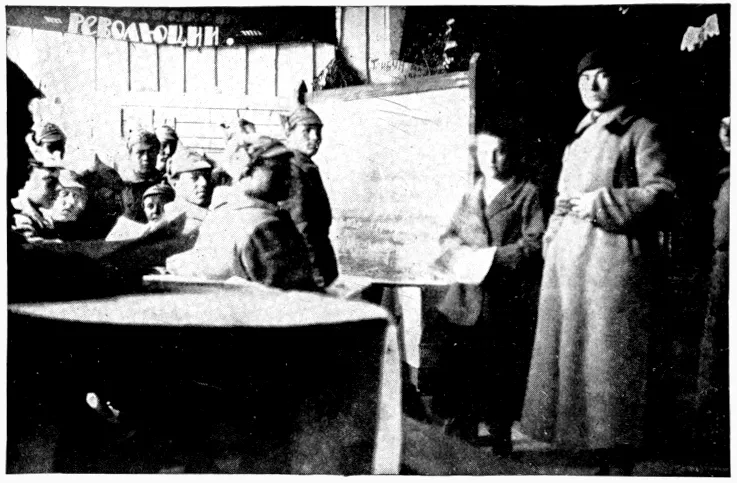
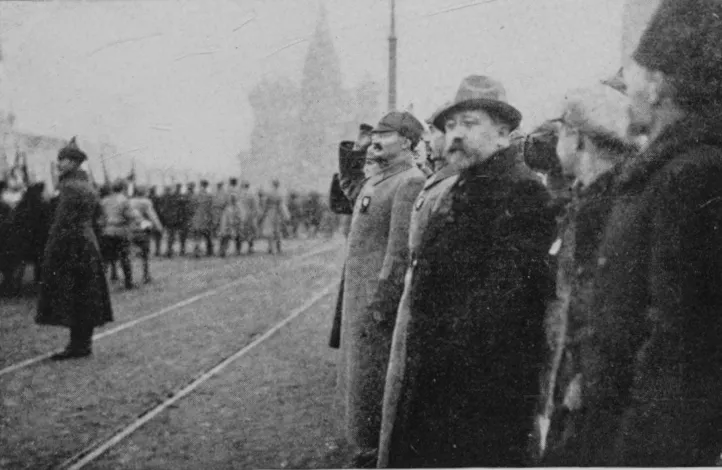
Teaching Communist propaganda in the Red Army School for illiterate soldiers in Moscow.
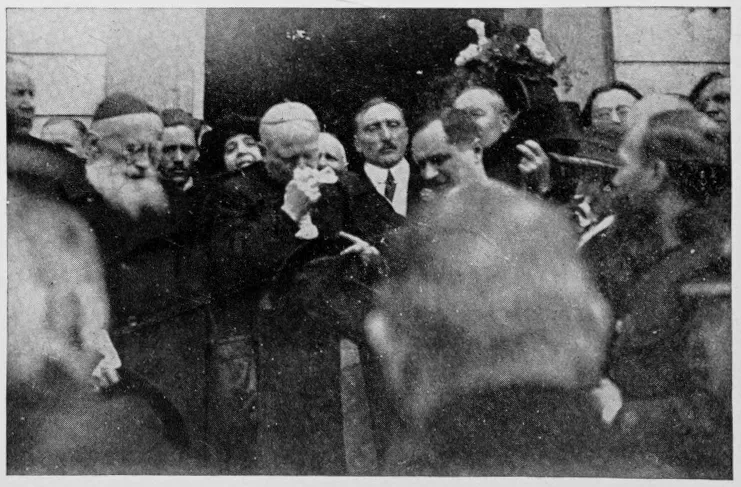
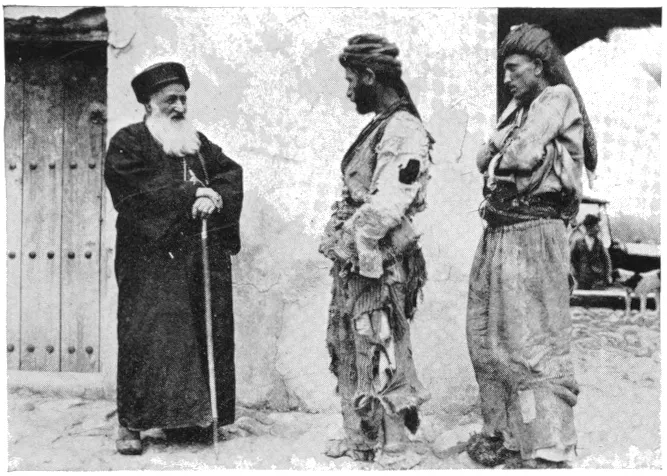
Archbishop Zepliak, tried for treason in Moscow, at his homecoming in Warsaw.
I“All men were created free, and
now they are everywhere in chains.”
J. J. Rousseau
Introduction—Billions and Bunkum
9
“... True opinions can prevail only if the facts to which
they refer are known; if they are not known, false ideas are
just as effective as true ones, if not a little more effective” ...
Walter Lippmann,—“Liberty and the News.”
In his search for facts the newspaperman on foreign service
contends with more censorship, propaganda, intimidation
and frequently terrorism in Continental Europe nowadays than
in that supposedly dark journalistic age which preceded the
world war. Progress has been made in the past ten years but
of all the liberties which were outlawed and debased during
the great conflict that of the press seems to have recovered least.
For many and mighty reasons all governmental agencies
of suppression in many countries continue to function with
unrelenting thoroughness. They are directed against public
opinion in the United States and England because these are
the dominant nations. So long as Lombard Street ruled the
money market the Continent sought to influence British public
opinion; now that the United States has increased its foreign
investments to $15,000,000,000, European chancelleries are dividing
their effort, but they are also increasing it because they
realize how much depends on the loans they raise and the
moral support they obtain from their creditors.
The British investment has always been conservative; the
fifteen billion dollars which America has spent has been
plunged with a sometimes reckless, frequently ignorant hand
into the rehabilitation of Europe. Some of this money has
10been used to raise wheat, some to build submarines and perfect
poison gases; billions may be safe and at work for material
progress and peace, but billions are unsafe because they prepare
for new wars.
The presidents, kings and dictators of Continental Europe
have been taught the full power of the press but recently,
yet they are making extreme use of their knowledge. They
have their friendly or their purchased press in Great Britain;
toward America, which knows so pathetically little about the
numerous lands over which it has cast its billions, the foreign
offices have exercised a refined, more subtle, sometimes Machiavelian
system of propaganda and censorship.
In one country the bankers’ and manufacturers’ associations
have assumed arbitrary power, in another a perverted philosophy
is in control of human fate; in a third an egomaniac
rules and in a fourth medieval corruption has temporarily
crushed all liberal resistance; therefore the word is spread
throughout the dominant nations, America and Britain, that
democracy is unsuitable for most of Continental Europe, that
it has proven a fraud and a failure, that parliaments are a drag
on the efficient expression of the will of a people, freedom
is a modern delusion, truth is a false god and liberty nothing
but a chimaera. The new propaganda reigns.
It boasts material progress. It points to trains running on
time, to roads built, to budgets balanced, to efficiency in mines
and factories. It says nothing of the fear of death and the fear
of violence which are crushing the last remnants of those fighting
for individual and mass liberty in many lands. Anyone
can see the trains running on time, but who is willing to open
his eyes to see the hidden terror which is holding many millions
of civilized people captive? The international bankers and all
11their agencies of publicity, the foreign offices with their intimidation
of journalists and their censorships and all the
silly tourists who travel by the hundred thousand nowadays,
all report to the holders of billions of bonds that the sun is
shining brightly in all the 7 and 8 per cent. lands, that God’s
in his heaven and all’s well with the postbellum world.
* * * * * *
I believe with Mr. Lippmann that false ideas are frequently
more effective than true ones and I know that there is a world
of difference between the mistakes which journalists make
frequently but honestly and the official propaganda, the half
truths, the ballons d’essai, the canards, and, to drop euphemism,
the official lies of many dictators and premiers of Continental
Europe. I also cling to that very old-fashioned belief that the
press is the most powerful estate and that the journalist is (or
should be) the great moulder of public opinion. Yet for twenty
years I have heard again and again the layman’s question:
Why don’t the papers print the truth; why don’t the reporters
write the truth?
Many answers have been written concerning national journalism;
this book, by incident and adventure and the presentation
of documents and facts, is an attempt to illustrate the
foreign situation. There are many reasons behind the failure
of the press to present the whole truth about Europe.
For one, there is censorship. In time of crisis almost every
nation establishes a censor bureau; in all dictatorships such
bureaus function continually, some openly, some secretly.
There are the bond issues of many billions. News must be
suppressed when unfavorable, otherwise the market will crash;
news must be perverted at all times, otherwise new loans will
12be more difficult, and rates will be too high. The foreign offices
and the bankers combine in this attack on a free press and
both are powerful and effective.
There is the political terrorism which still prevails in many
lands and which touches the pen of the foreign correspondent
as well as the lives of the suppressed citizens and subjects. You
can’t do much free writing when you know there is a detective
outside your door (as in Russia) or a secret agent in your office
(as frequently in Italy) or squads of police officials detailed to
watch you (as in Roumania and many other countries).
And, finally, there are so few great newspapers in America
and England brave enough to disregard the wishes of certain
foreign offices and the “business at any price” international
bond houses and the tourist and steamship organizations which
spend large sums advertising, that when the truth is published
it reaches so small a public that it is ineffective beside the half-truth
which the majority of newspapers publish.
Almost always the foreign correspondent works honestly,
but he is no modern Prometheus to defy the gods of European
Real Politik by waving an iconoclastic torch over their conferences
and their plans, their secret plots and their open betrayals.
Against governmental systems the journalist can do
little. He can, as witness a letter from one who had to submit
to Mussolini’s terrorism, “break his heart” and remain silent.
Or, being all too human and able to distinguish the buttered
side, and finding encouragement in American editorial offices
for a policy of suppression, and being also susceptible to worldly
flattery and the delights of social advancement, the American
journalist, once having found it doesn’t get him anywhere to
be an iconoclast, may adapt himself to the desired compromises.
What Professor Salvemini says of the situation in
13Italy may be read with a few necessary changes, for Russia,
Poland, Hungary, Roumania, Spain, Bulgaria, Greece, Portugal
and several other nations and still hold its truth. Salvemini
says:
The difficulty of understanding the present situation of the Italian
people is increased by the fact that French, English or American journalists,
as soon as they arrive in Italy, are immediately surrounded by
agents of Fascist propaganda and are introduced into aristocratic and
high Fascist bourgeois circles; here they are flattered by every possible
kindness and loaded down with statistics, information, interpretations,
explanations ad usum delphini. Often they are salaried for translating
and sending to their papers articles and news concocted in the offices of
Fascist propaganda. A few intelligent and honest foreign journalists
succeed little by little in seeing the light but their letters must omit
much that they know and if they wire their papers accurate information,
their telegrams are intercepted: they themselves are expelled from
Italy. The most enthusiastic are forced to send unsigned articles to their
papers and magazines, resorting to a thousand expediencies in order
not to be discovered. Telegraphed news, which is most likely to impress
the reading public, is ruthlessly controlled by the government censorship
if it does not coincide with the taste of the Mussolini government.
Or with the taste of the Soviet government, or the Primo de
Rivera government, or that of Horthy, Pangalos, Waldemiras,
Bratianu I and Bratianu II, Pilsudski, Kemal Pasha, or that
of the French in Syria and Morocco, the British in Mesopotamia
and other protectorates, the Italians in Libya, or the dictators
of many other lands.
* * * * * *
The American foreign correspondent who succumbs to flattery
and the ribbons of various legions of honor, to occasional
meetings with princes and marquesas, to handshakes with
14various Mussolinis and Stalins, to bows and smiles from the
Great of Our Age, usually finds many of the complexities of
everyday life removed and receives praise from New York and
Chicago for his diplomatic progress.
He who would be a man and a nonconformist may find
himself in jail.
Of the hundred or more American journalists abroad whom
I know well, so many have been imprisoned, so many have
been expelled from countries and so many have just evaded
either imprisonment or deportation by hook or by crook,
usually by both, that it is only fair to emphasize their integrity
and to do considerable pointing with pride. Newspapers as
a rule do not fuss over the troubles of their representatives
because editors believe the public is not interested in newspaper
men. Yet correspondents’ troubles illustrate better
than anything else I know the vicious situation in many
places.
Almost half of Europe today is governed by violence and
terrorism. Proclaim liberty tomorrow and you would have revolutions
in twenty countries. Almost half of Europe’s population
does not enjoy the fundamental rights of the days before
the so-called war of liberation. It is not true that the people of
Soviet Russia are happy or that the people of Italy are happy
with their dictatorships, or that the parliamentary system has
failed. Suppression by force does not mean failure. For corroboration
of these statements I can refer to ninety or more of the
hundred American and British journalists I know, who are
working in Europe, who have investigated and who have the
real knowledge. The bond dealers and the tourists and the
noted magazine writers who make two-week visits (with half
their articles written in advance in accordance with the views
15and instructions of their editors) may tell you differently, but
the resident reporters know it is not so.
But it is too difficult to say the opposite when political police
systems hang around the office doors, and American ambassadors,
most of whom cringe before dictators, offer no protection,
and when, after all, the editor frequently is on the side
of the tourists and bankers and the noted magazine journalists.
And what, let me ask, dare an American write about the success
or failure of the League of Nations when 48 per cent. of the
American papers for political party reasons are blindly opposed
to it and another 48 per cent. for the same reasons, are blindly
in favor of it, and not one of the 96 per cent. wants an impartial
and objective cablegram?
I defied anyone to challenge the statement that Roumania was
the most politically corrupt state in Europe in 1928 and that
a loan would be a considerable risk for American pocket-books.
Dictatorial terrorism, unrest and the danger of revolution prevailed
under Vintila as under Jon Bratianu. Yet when M. Quesnay
and M. Rist of the Bank of France came to New York
to speak about an $80,000,000 loan (which is really a $200,000,000
French political manœuvre to outwit Italian intrigue in
Bucharest), certain American journals began a campaign in
favor of Roumania, aiming to hide the truth about terrorism
at a time when important minorities and the whole peasantry
threatened a revolt which would endanger the American dollar
investments.
In what position does such a loan campaign place the American
correspondent in a capital such as Bucharest?
1. If his paper is supporting the loan, he is silenced. (If
Queen Marie has already visited his editor and let him kiss her
hand, he is already, journalistically impotent.)
162. If the bankers favor the loan and are using the reporter’s
newspaper, he is again silenced.
3. If neither 1 nor 2 is true, and he tries to write or cable
an honest warning, thereby doing a great service to thousands
of Americans who might be foolishly attracted by the 7 or 8
per cent. which such a speculative loan must pay, he will be
arrested or expelled, the frontiers permanently closed to him,
and his future usefulness curtailed.
The same holds for Russia, Italy, Poland, Spain, and other
despotic lands.
* * * * * *
Billions and bunkum. Billions of dollars, at home and
abroad, are able to control or hide the international truth, while
bunkum, thanks to censorship of facts, frequently replaces
them entirely. If America or England had known the whole
truth about the Continental European system, and there had
been no propaganda, would the necessary emotions have been
aroused to bring either into war?
If America were allowed by its editors to know the whole
truth about Mexico, would we ever engage in warfare there?
If America and England—the public not the politicians—had
known the facts of March 1917, could they not have insured
a Russian democratic revolution without Bolshevism?
If America knew the whole truth about Italy today, would
it float the Italian bonds? Likewise the Polish bonds? Or
the bonds of other terroristic countries?
If America had known the truth about Queen Marie, would
not the royal farce of 1927 have been different?
These are typical questions the American journalist abroad,
who cannot for the life of him tell the whole truth, is asking
pertinently.
17He sees Continental Europe drifting towards new wars;
dates are being mentioned. He sees American relations with
free England frequently grow cold and distant, while our relationships
with despotic régimes suddenly grow warm and
friendly, thanks to no sound reasons, but to efficient propaganda.
Misunderstandings undermine solid foundations. Solid
foundations are frequently replaced by dangerous golden ones.
Billions and bunkum more and more order our relationship
to foreign nations. The journalist sees passions pass for realism.
He sees propaganda overwhelming truth. He sees the race for
armament continuing. American dollars frequently encourage
it. False frontiers and injustices more cruel than any before
1914 give cause for bigger and better world wars. Many say
the future of western white civilization is endangered. Some
believe only America, now the moral and financial super-nation,
can save it. And yet our portion is so much bunkum
and propaganda that in ten years we have done almost nothing
to further international relations with the free nations.
If ever there was a voice crying in a political wilderness, it is
that of the American journalist on foreign service. Cassandra
had a larger audience despite the thunder and waves on the
rocks of the Mediterranean. She at least was close to the
national ear. But the American correspondent does not seem
able to penetrate the curtain covered with $15,000,000,000 of
gold on one side and on the other the thickest veils of censorship
that have ever existed.
Peacetime censorship exists for one reason only: to hide rotten
affairs of state. Wartime censorship alone is justifiable—but
we who were in the press section of the American Army
in France may doubt if even then it has any value, inasmuch
as General Pershing always gave us the fullest information
18about the enemy and, as we later learned, the enemy knew
everything there was to know about our side. (Three days
before our attack the Germans moved out of the St. Mihiel
salient because they knew almost as much as Pershing did
about the plans for that battle.)
In the chapters which follow I have begun with wartime
and armistice censorship incidents; followed by experiences in
those parallel despotisms, Italy and Russia; the League of
Nations mandated territoriesterritories which should be free from the
domination of any European country but which are not; a visit
to Mexico where censorship exists from time to time, but which
is not a tenth as stupid or vicious as that practised in American
newspaper offices where owners and editors have policies of
war and interventions which force their editorial writers and
reporters to prostitute themselves; and I have concluded with
side trips to several European countries, including the most
corrupt of all, Roumania, where censorship exists to cover not
only political terrorism as in other countries, but also moral
corruption which begins in the royal palaces.
I have given only my own experiences. Every one of a hundred
colleagues, many of whom I thank for aiding me in
gathering the facts and bringing them up to 1929, could supplement
this book, and a score could, if they were free, easily
surpass both in number and significance the episodes of censorship,
foreign office intimidation and the frequent national terrorisms
here recorded.
What I have tried to do is realize the hope of every one of
my colleagues who says: “Some day I am going to take a holiday
and write The Truth Behind the News.”
Paris—New York, 1928-1929.
Part I—War — Chapter I Marching Back to the Trenches Again — Chapter II “U.S. Infantry Won the War,”—Hindenburg — Chapter III The Truth About the War at Sea — Scheer’s Report to the Kaiser — Captain Groos’ Comment on the Report — Scheer’s Final Word — The Future of Naval Warfare — Big Ships or Submarines? — Admiral Scheer on the 5-5-3 Plan
19
The Rainbow Division. Wallowing in the mud of the
Luneville training sector. Learning to hate like men, the
night the enemy threw a shell into our line which made a
dugout the tomb for twelve. Raids and little encounters to
take the godawful fear out of our bellies.
Standing up before a moving wall of flame and hot iron and
blinding gas and whirling infernos of the sand of Champagne.
The first two lines given up to the enemy. The artillery smashing
hell out of them, foe and comrade alike, there in the first
two lines, where irresistibly wave after wave, five inhuman
times, the ugly grey surf had broken, subsided, and left only
blood and broken bodies on the dazzling chalk of Champagne.
St. Mihiel!
Days of anxious preparations, days of building up courage,
all numbed in one universal roar of barrage fire. Finally the
zero silence. Finally release of all emotions. Finally the command,
let’s go, come on you, and over the top comes the unleashed
bound of ten thousand men, and—nothing! Nothing.
No enemy. No sound.
Victory!
And then the Argonne.
And now, marching back to the trenches again.
Where were the old men of the Rainbow, eager youths of six
months ago? Scattered. In hospital. Dead. Over all the fields
of France, from down there near the neutral border, to up
20here on the road to Sedan. “Replacements” for ever arriving.
The Rainbow Division for ever marching back to the trenches.
A little rest—rest?—and marching back to the trenches.
Then fire and flame and blood, and a little rest, and again
marching back to the trenches. This war was never going to
end. This war was never going to end.
* * * * * *
They sang their moods.
Sometimes they sang:
K-k-k-k-katy, beautiful k-k-k-katy,
You’re the only girl that I adore....
Sometimes they sang lugubriously, but with humor, a macabre
folk-song, jerking the words to their step:
The worms—crawl in
The worms—crawl out
They crawl—in your eyes
And they crawl—in your mouth....
And I some—times think
When I’m—dead and gone....
Dead? Death? Why think of it? Why think of anything?
Close your eyes and erase your mind and think nothing. Until
the first shell falls into your hiding place and a white fear
and a red hate bring fit thoughts for soldiers.
The mood changes.
A song is finished. Without losing a beat, as is custom, another
is begun. As the solemn ballad is ended, a mocking
voice sings:
I didn’t raise my boy to be a soldier
21The singer smiles out of the corners of his eyes and out of the
corners of his mouth. Hardly has he finished the first stanza
when a roar of ironic laughter doubles up his squad, the men
hardly able to compose themselves in time to join in with
I raised him up to be my pride and joy
Laughter spreads with the singing, a strange commotion of
laughs, the hearty voluminous outbursts of new men up ahead
and near behind them, their first amazement at this mad
choice of a marching song; and the soft dry laughter of the men
who had already bellowed their surprise and are now realizing
that for them, that day, that marching moment, this cheap
meretricious jingle, this drivel of a song, held a strange and
terrible mockery, a prophetic irony.
Who dares to lay a musket on his shoulder
To shoot some other mother’s darling boy?
Let nations arbitrate their future troubles,
It’s time to put the sword and gun away....
In a few minutes the song has roared towards the infantry
on ahead, through the Ohios and the New Yorks and the
Alabams and the Iowas, and down the artillery, Reilly’s Chicagos,
and all the rest. It leaps from regiment to regiment, losing
a few seconds in each skip, so that while the original Ohios are
singing
It’s time to put the sword and gun away
the Kansans have just gotten wind of it and are beginning
I didn’t raise my boy to be a soldier
I raised him up to be my pride and joy
and so the whole division is shaking with laughter and song
22as it is marching, back to the trenches, back to the blood and
mud, singing
There’d be no war today, if mothers all would say
I didn’t raise my boy to be a soldier
* * * * * *
When the Ohios finished it they were silent. There seemed to
be no mood to be tricked out with a new song, and when the
New Yorks and the Alabams and the Illinois and the Kansans
finished their verses, they were silent too for a few seconds,
listening to the sound of nails and leather on hard stone road
and from the north the uninterrupted sputtering—like
a man choking in the sea—no louder at this distance, but
somehow filling all the universe. Now subterranean coughing—all
the Titans of the earth and sky, invisible, smiting their
breasts and making incoherent sounds: that was the war front
to which they were marching back again. Occasionally a
“jeeze” or a “christamighty” from one of the singers. Twenty-five
thousand men, volunteers and conscripts, men out of colleges
and men out of sewers, all going north again, marching
to meet death half way, up there where that choking, sputtering
noise was the whole world at war—and singing a ridiculous
song that only two years ago had been the sentimental
rage of a whole nation.
There’d be no war today, if mothers all would say
I didn’t raise my boy to be a soldier
What a prophetic irony this foolish song had become. They
all felt it in that fleeting moment of silence. And being good
soldiers they met it with laughter. Yes, that was the only way
to meet irony and tragedy at the front. After their little silence
23they laughed again and looked at one another, each to see if
the next man detected any weak emotions behind the laughter,
as they kept pounding northward, towards the trenches.
* * * * * *
I thought this episode was humour for the Homeric gods.
I thought it the grandest thing I ever could write about the
spirit of our men. Nothing during the war had so stirred me—not
my first night in the trenches east of Luneville with these
same Ohios—nor the day of the St. Mihiel push when we
went to taunt death and found silence and sunshine—nor
any lying out in the open in the rain, with gas shells exploding
like duds a few feet away—nor any other encounter with
victory or danger.
So the next day I did my best to draw this picture of heroic
soldiers going back to the trenches singing ironically “I didn’t
raise my boy to be a soldier,” and laughing as they marched.
I thought it grand wartime stuff.
“Say, what the hell is all this?” said the army censor.
“What are you trying to put over, Seldes? This is damned
pacifist propaganda.... Yes, I know it is true, but that
doesn’t matter. You can’t print that....”
24
The charge against us was simply: first violation of
the Armistice; crossing into Germany; passing through
the Great German Retreat; and interviewing Hindenburg the
week the war ended. We made no defense.
General Dennis Nolan, under special orders of General
Pershing, conducted our trial at Chaumont. The verdict put
us into an awkward position—either resign from the Press
Section, lose our army standing, and depart for home, or remain
in the A. E. F. under technical arrest and refrain from
writing the greatest story of our lives. Thus spoke army discipline
and military press censorship.
Today we are proud of our crime, if crime it was. We can
afford to forget the humiliation of arrest, the discomfiture of
the trial, but we remember the thrill of that day we left Luxembourg,
the sudden terror of being caught (in the midst of his
marching men) by a furious Prussian colonel, and the great
climax, the meeting with Hindenburg.
For it was then that the commander of the enemy, the one
man in the world who could best make a historical judgment,
made an admission in the honesty of tears, an admission which
for political reasons he can never repeat:
“The American infantry,” said Hindenburg, “won the
World War in battle in the Argonne.”
* * * * * *
First, a word on the nature of our “crime.” We were all
members of the Advance Section, G-2-D, G. H. Q., A. E. F.
25In other words, in that part of the Intelligence Corps of the
American army known as the Press Section. We were given
the uniforms of officers without insignia of rank and entitled
to the privileges of generals. We ranked with the doughboys
when we were in the trenches and just below Pershing on our
visit to Chaumont. We found the question of saluting and
getting saluted difficult because we had refused to take the
two bars of a captaincy which our British colleagues wore.
But more important, we considered ourselves more free than
a ranked and placed person in uniform the day the eager
doughboys, still hoping for laurels, fired cannon five minutes
after eleven and the Armistice hushed the thundering front.
That minute we felt ourselves civilians again. Again we
felt free to use our wits in getting scoops—to think up some
big stunt which would rattle the morale of our competitors and
amaze the world.
“Let’s cross into Germany.”
Spoken as a joke—hiding a mighty desire—needing only
a seconding motion to light an enthusiasm which would carry
us over that yesterday’s horror which was No Man’s Land and
that yesterday’s hatred which was Enemy Land—and to a
tomorrow which was grand and thrilling and perhaps laden
with death.
But someone must have suspected such a plan even before
it was born. We had already heard our sergeant and corporal
chauffeurs whispering instructions received either from Pershing’s
headquarters or through the major commanding us
that there must be no violation of the Armistice, that while we
might drive into No Man’s Land, we must never drive across
the Armistice line.
“Youse guys can boss us anywhere you want to go,” Sergeant
26Jack Corper, one of the best drivers in the army, told me,
“but dere’s one thing you can’t make us do and dat’s cross
over. We got superior orders, see?”
I still believe the two chauffeurs innocent, but I do not
credit it altogether to our superior guile, for the spirit of adventure
must have blinded their eyes too, to the many false roads
and wrong turns we methodically took. They did protest at
first.
“The map shows to the right—”
“The map is wrong. Take the turn to the left.”
Every half hour a similar conversation.
And so we rode out of gay Luxembourg, that lovely city on a
cliff where our doughboys had had the time of their lives what
with being treated as a quarter million heroes and dragged by
squads and companies from the open peaceful highways into
the homes of happy and rich Luxembourgeoises where champagne
and song lasted a full seven days.
It was still Armistice week when we started, dull and early,
towards Germany. Well, it didn’t take long to cross that tiny
“Grand-Duchy,” and as there was no longer an organized
German frontier, we must have ridden into Enemy Land with
no more excitement than the noise automobiles make on hard
military roads.
But excitement, which was to hold us breathless for a week
and more, began almost immediately. As we flew into the first
German village we passed a triumphal arch, if you please, all
decked out with flowers and laurel and bearing on its keystone
the legend “Welcome Our Undefeated Heroes.” And then
we saw the flag we had never dreamed we would ever see, the
red, white and black of the Kaiser’s monarchy, waving in ignorant
pride from many windows.
27They say the civilians have the most hate and fear. At the
front, Heaven knows, we had had our share of both. But certainly
the civilians across the sea felt the war was over when
the Armistice was signed while on the other hand so many at
the front who had been in or watched the slaughter and the
mud day by day, unchanging, unceasing, had felt there must
be a catch in it somewhere, that it wasn’t really true, that it
didn’t mean what it seemed. So when the chauffeurs of both
cars put on the brakes bringing us to a crunching, huddled
halt, we too had forgotten the Armistice and felt civilians’
hate and fear pointing at us in the snake-ends of the wind-snapping
enemy banners.
The chauffeurs argued perhaps half-heartedly. Army discipline
had never really existed in our outfit. Adventure lay
ahead and nothing but explanations behind. “You might as
well go on, we are ten miles inside Germany already,” was
someone’s conclusive statement, and ahead we went.
In this town of Borg we found the German army in full
retreat. We came up behind it, noting immediately the splendid
discipline of the defeated. Their lines were right and their
step firm: even in facial expression there was no sign of a collapsed
morale. Their uniforms and equipment seemed shoddy.
“Amerikaner—Amerikaner.”
Without hatred or passion the surprised soldiers passed the
word along the undulating ranks.
We rode slowly alongside, our hearts beating high.
Soon we were in the town square, a triangle between streets,
where the German colonel on a horse was directing operations.
He saw us at a distance and rode forward.
“Halt!” he commanded with a mean voice and uplifted
hand.
28We halted.
“What in thunder and lightning are you doing here?”
Our spokesman stammered an answer.
“You are interfering with our military movements—you
must go back to the American line,” the colonel said decisively.
“But—”
“I forbid an answer!”
At our left, meanwhile, hundreds of German soldiers with
rifles on their shoulders, an occasional 77, and a frequent
“goulash cannon” were thudding and clanking onward.
We all began to talk at once. The colonel became furious.
“I tell you to get out, and immediately, or I take the lot of
you prisoner. You are in great danger. Your lives are at stake
here. You are the enemy—the men might shoot you all—or
the civilians attack you—any moment. I tell you to return—”
At this black moment there was a civilian flurry in the square
from which a sailor emerged, running towards us. He had that
universality of blue serge and seaworn face which make the
sailors of all lands alike.
”What’s the trouble here?” he asked.
We were immediately amazed by the daring of an enlisted
man in the presence of high officers. But we noticed also there
was something different about this sailor’s uniform—a red
band on his left arm. Later we read the black print on it:
“Arbeiter—und Soldaten—Rat,” or Workers and Soldiers
Council, or Soviet.
Seeing sympathetic ears, we poured a broken German explanation
into them. We noted, too, a change in the behaviour
of our swell colonel. His starch and bluster were gone. He sat
on his horse, looking disgusted and arguing less vehemently
than ourselves.
29”They’re in danger here,” he repeated.
”Not while I’m in command in this area,” replied the sailor
cockily.
“They must leave at once I tell you,” said the colonel.
But the colonel’s antagonism reflexed the sailor’s sympathy
for us.
“You go and mind your own business,” he ordered.
The colonel went.
“My name is Fritz Harris,” the sailor beamed. “Does any
one of you know my uncle in Cleveland?”
“But what does all this mean?” we asked, shaking negative
heads.
”Well, I’m in control,” replied the sailor, jumping on the
running board and shooing away the old men and women who
now dared crowd our automobiles. ”We started the revolution
in Kiel. On the ships. Just before the Armistice. Everything is
going in good order. Don’t worry. We did everything with
shipshape discipline. Each sailor was assigned a city, his own
city usually, and went with orders to proclaim the German
revolution there. This is my home. Not a drop of blood was
shed here. It was different in Trier and Frankfurt. Now,
honoured gentlemen, what is it you want?”
This piece of diplomacy we left to our spokesman. He had
considerable hold of the language but I still believe it was
a slight error that made the rest of our adventure possible. He
had tried to say we were a part of the press section which had
come to see how Germany had lived during the war, what the
food situation was, and all that, and sailor Fritz Harris interrupted
him with:
“Ah, the American Food Commission—yah, yah, we had
heard you would send us food. Willkommen, willkommen.”
30(This promise of white bread had been probably our most
effective propaganda. For months our aviators had dropped
cards over the German lines saying every prisoner, and everyone
who surrendered voluntarily, was getting two pounds
of white bread a day—and many a German came to claim his
portion.)
We let Fritz’s mistake go unchallenged and were conducted
with rejoicing to the Rathaus, where we were welcomed by
the soldier and civilian Soviet of the town. At our request they
telephoned to Trier asking that everything be done to insure
safety for our lives and means for getting the information we
wanted.
On the road out of Borg we had a great panorama of the
German forces endlessly flowing eastward. Despite the seeming
discipline peasants told us how they had bought artillery horses
for 50 marks and exchanged a goose for a brace of rifles and an
egg for a parabellum pistol. No bloodshed was reported in the
countryside.
In Trier a reception committee met us and wanted to entertain
us but we pressed on to Frankfurt which we reached
the next day.
Up to now we had no thought of Hindenburg. Our secret
ambition had been to be the first Americans in Berlin. We confided
it to our host at Frankfurt, the usual Arbeiter-und-Soldatendrat,
who agreed to help us, but first we had to be given a
banquet.
We sat in the spacious hall of the Frankfurterhof, now revolutionary
headquarters, and ate as bad a meal as one can
imagine, thin soup whose only distinguishing taste was salt,
some goose, the only meat we found anywhere, potatoes and
very soggy black bread. The wine was excellent.
31Our hosts held long discourses and our spokesman replied.
My own contribution was a one line speech: “Es lebe die
Republik”—long live the Republic—which was an excuse
for draining another green decanter of Rhine.
During prolonged arrangements for continuing our journey,
one of the council said timidly:
“We would like you to see Hindenburg first.”
Hindenburg!
It was almost as amazing as the Armistice itself. The latter
was a bit unreal, but this was a dream-desire—to call on and
interview the leader of the enemy, the second best-hated man
in the world then, the general whose men were killing our
men, the apotheosis of German frightfulness, the incarnation
of that which six days before was all the evil in the world—such
a thought was beyond our still khaki-clad minds.
“It can be arranged,” said the Rat.
Two German cars were given us, so we could release the
doughboys who were becoming indignantly mutinous—perhaps
through ignorance of what was to come—and with tires
exploding every hour and engines going wrong every three,
we managed to arrive in Cassel, where Hindenburg had removed
his grand headquarters from Aix-la-Chapelle.
We came to the Rathaus confident all was well. But it wasn’t.
Hindenburg politely refused to see us. He said he would meet
no one in the uniform of the enemy.
That day and the next we spent in conferences with members
of the Rat at City Hall and sulking at our hotel, where, by
the way, our presence was objectionable. The owner was surly
and the help mean. Our finances were low. I still have a grudge
against that hotel man who gave me 60 paper marks for my
reserve 20 dollar gold piece.
32We decided to go to Berlin at once. We went to the Rathaus
to say good-bye. Then a sergeant-major member of the council
took up the telephone and insisted on speaking to Hindenburg
himself.
It was a long conversation in which our sergeant-major, an
ugly, emaciated person with protruding yellow teeth, very
much the “Hun” of British war cartoons, became more and
more exasperated. Finally he shouted:
“This is an order to you, Excellency, not a request.”
A moment of silence for Hindenburg’s reaction.
“Then at three o’clock, you will send one of your cars.”
He hung up the telephone and a proud smile came over his
distorted face.
“At three this afternoon he will send his car.”
The car came on the stroke. Our hotel keeper with almost
oriental obeisances directed seven employees who grovelled
us into Hindenburg’s grey monogrammed limousine.
In the marble castle of Wilhelmshohe an aide-de-camp took
us upstairs. A squat, stoutish man in a regulation general’s
uniform with an additional white cloth around his head,
received us.
“General Groener,” he said to each, snapping his feet.
We shook hands.
“The general hasn’t been wounded?” queried our spokesman.
“No,” he smiled, “but I have a terrible headache.”
Our spokesman interpreted. “He has a terrible headache.”
“He should have,” whispered the roughneck among us. “He
has just lost a world war.”
General Groener bowed us into the next room, marvellous,
rococo, pale blue and gold and palatially uncomfortable.
33Hindenburg arose.
He was dressed in field grey-blue. Tall, red-faced, broad-shouldered.
The usual officer’s decorations on the wide chest
were absent. Around his neck, unbuttoned for comfort, was
the small blue cross of the Pour le merite. His head was covered
with stiff toothbrush-like white hairs, cropped to about
a half-inch, and revealing, by their scarcity, a very pink scalp.
But what I thought was funny, was the famous Hindenburg
moustache. It looked theatrical. It looked false, and stuck on,
and it certainly curved itself along the cheeks as no non-Thespian
moustache has ever done.
“Die Herrschaften sprechen Deutsch, nicht wahr?” said Hindenburg
in a kindly smiling voice, shaking hands for the first
time since the war with men in the uniform of his enemies.
Three disclaimed speaking German so Hindenburg fixed on
our spokesman, motioned us to a circle of chairs, and began:
“I will answer any military questions. I am a soldier. But
I refuse to answer any political questions.” He shrugged his
shoulders. “I am a soldier.”
We had previously discussed no questions for this interview—it
was one of those cases where any word given us, on any
subject, was precious.
“Is the demobilization proceeding satisfactorily—we have
heard of some fighting and bloodshed.” Our first question.
“Yes,” he replied, “although there is some trouble when
the men come to the cities, the return from the front is fully
disciplined. Men and officers remain in their usual relationship.
The troubles are not serious among the troops, officers
and civilians, except when there is an attempt to disregard the
present change in government.”
“What is your position at present?”
34“I have given my pledge to Mr. Ebert, who is in control of
the government in Berlin, that I will stay in command until all
the troops are safely returned from the front and to their
home barracks. My functions then cease. I have finished my
duties. I mean to retire into private life.”
“Do you think the present socialist government will remain
or will fall soon?”
“I cannot answer that. I am not a politician. I am a soldier.”
Several questions followed. Either of minor importance
or of a political nature.
“I cannot answer. I am a soldier,” was the inevitable reply
to the latter category.
All these minutes undoubtedly each of us was steeling himself
for another question—a question we were burning to
ask, and which was merely “Who won the war?” heavily
muffled in diplomatic garments. We fell to debating “the next
question” among ourselves, and finally someone said:
“Go ahead—ask him—you know what.”
So the spokesman with considerable throat clearing and
much redundancy, asked it.
When we asked “Who won the war?” we were ignorant
of what home papers had said. Our American papers in France,
like the Entente press, from October to November 10th reported
nothing but French, British, Italian, Belgian victories.
“British troops advance 20 miles,” “Brussels captured,” “Lille
entered,” “Italians cross three rivers.” The three armies northwest
of us had advanced many miles each day. City after city
was captured by them. But what was the American army doing
all this time? Merely fighting. Yes, fighting. In the Argonne.
Through dense, almost impassable forests, over cliffs
and hills, wading in ravines, struggling through mud thick
35as boiling rubber, bombing, hand-grenading, machine-gunning,
bayonetting their way northward towards the jugular of the
German armies, the Metz-Longuyon railroad, the one means
of retreat of the enemy.
Hindenburg was shortening his lines. He was quitting
northern France and Belgium. But he was holding the Argonne.
Day by day the representative of our G. H. Q. had
shown us the map with every enemy division and reserve force
marked. Hindenburg had thirty-two reserve divisions at the
beginning of our Argonne drive. When November began two
or three remained. What had become of an army of German
reserves?
Very few had appeared on the French or British front—almost
all were thrown against us. We were doing almost all
the fighting while the Allies were marching unhindered into
famous cities and famous battle fields of 1914, and capturing
the headlines of the world. We were losing men and taking
prisoners and trenches—fighting most of the war then and
getting no credit from the press because our work was not
spectacular. Hindenburg and Pershing knew what we were
doing. What would Hindenburg say?
“I will reply with the same frankness,” said Hindenburg,
faintly amused at our diplomacy. “The American infantry in
the Argonne won the war.”
He paused and we sat thrilled.
“I say this,” continued Hindenburg, “as a soldier, and soldiers
will understand me best.
“To begin with I must confess that Germany could not
have won the war—that is, after 1917. We might have won on
land. We might have taken Paris. But after the failure of the
world food crops of 1916 the British food blockade reached
36its greatest effectiveness in 1917. So I must really say that
the British food blockade of 1917 and the American blow in
the Argonne of 1918 decided the war for the Allies.
“But without American troops against us and despite a food
blockade which was undermining the civilian population of
Germany and curtailing the rations in the field, we could still
have had a peace without victory. The war could have ended
in a sort of stalemate.
“And even if we had not had the better of the fighting in
the end, as we had until July 18, 1918, we could have had an
acceptable peace. We were still a great force and we had
divisions in reserve always which the enemy attacks could
never use up completely.
“Even the attack of July 18, which Allied generals may consider
the turning point in the war, did not use up a very important
part of the German army or smash all our positions.
To win a war it is necessary, as you know, to place the enemy
forces hors de combat. In such a manner of warfare which
began when Japan and Russia met in the wheat fields of the
Far East, you must engage and defeat hundreds of thousands,
millions of men.
“In the summer of 1918 the German army was able to
launch offensive after offensive—almost one a month. We
had the men, the munitions and the morale, and we were not
overbalanced. But the balance was broken by the American
troops.
“The Argonne battle was slow and difficult. But it was
strategic. It was bitter and it used up division after division. We
had to hold the Metz-Longuyon roads and railroad and we
had hoped to stop all American attacks until the entire army
was out of northern France. We were passing through the
37neck of a vast bottle. But the neck was narrow. German and
American divisions fought each other to a standstill in the Argonne.
They met and shattered each other’s strength. The
Americans are splendid soldiers. But when I replaced a division
it was weak in numbers and unrested, while each American
division came in fresh and fit and on the offensive.
“The day came when the American command sent new
divisions into the battle and when I had not even a broken
division to plug up the gaps. There was nothing left to do but
ask terms.
“Until the American attack our positions had been comparatively
satisfactory. We had counted on holding the Argonne
longer. The advantage of terrain was with us. The American
troops were unseasoned. We had also counted on their impetuosity.
There was great wastage in your army due to carelessness,
impetuosity and the disregard of the conditions of modern
warfare.
“Yet from a military point of view the Argonne battle as
conceived and carried out by the American Command was the
climax of the war and its deciding factor. The American attack
was furious—it continued from day to day with increasing
power, but when two opposing divisions had broken each
other, yours was replaced with 27,000 eager for battle, ours
with decimated, ill-equipped, ill-fed men suffering from contact
with a gloomy and despairing civilian population.
“I do not mean to discredit your fighting forces—I repeat,
without the American blow in the Argonne, we could have
made a satisfactory peace at the end of a stalemate or at least
held our last positions on our own frontier indefinitely—undefeated.
The American attack decided the war.”
Hindenburg bowed his head and tears flooded his pale,
watery eyes. His huge bulk was shaken. He wept for his “poor
fatherland.”
We sat and wondered over so much emotion in a military
leader supposedly devoid of sentiment and sentimentality.
Thus the interview terminated with a strange human spectacle
and in an uncomfortable silence. A fallen Colossus. A
broken Superman. Blood and iron suddenly tears and clay.
* * * * * *
There was no more to ask. Here we were with the biggest
story in the world, and even before Hindenburg was through
speaking, our thoughts were searching cable ends or messengers
or some new means of communication with our papers.
There came the usual anticlimax. “Where do you go from
here?” asked Hindenburg. “Ach, Berlin, so? Well, glückliche
Reise.”
“Auf Wiedersehen.” A loose handclasp. We were ushered
out by the snappy aide-de-camp.
My colleagues started for Berlin; I got up at four the next
morning to make the 5 A.M. train for Luxembourg. As I
reached the station I saw part of the real German revolution.
Mingled with the monarchist flags and drapery over the
Cassel railroad station and triumphal arches were red streamers
and bunting placed by the revolutionary sailors and town
Soviet. The troops coming by train knew nothing of the
Kaiser’s cowardice or the change to a republic.
A regiment was detraining. As the colonel led his men from
the station into the public square he seemed lightning-struck
when he beheld the revolutionary color mingling with his
Kaiser’s.
39“Tear the red rags down!” he ordered his captains.
A captain in turn spoke to his men, who refused to move.
“I’ll do it myself,” said the captain, and grabbing a red
streamer from the triumphal arch, he pulled.
Two soldiers with red arm-bands approached threateningly,
and I stopped too.
“Pardon, captain,” said one, “but we have had a revolution.”
“Revolution, to the devil—” replied the captain, pulling.
The two soldiers raised their rifles.
The captain drew his pistol.
Click!—Crack!
At this precise moment the little experience I had had in the
Luneville-Baccaret section with the Rainbow Division, pulled
my habit muscles. I dropped flat.
A dozen rifles and a pair of revolvers snapped. A man fell
partly on me. I turned cautiously on my left side. His face
was in pain, and his hands were at his middle, and blood was
flowing from his stomach. He was the captain who had pulled
the red flag. The soldiers had shot him.
Men ran over us, around us. Lying flat, I had a panorama of
flying feet in the semi-darkness. Shooting was spasmodic, now
near, now at a distance. I wondered what I could do for the
man lying over my feet. I pulled myself up. I think he died
without a groan.
Bodies were writhing in the open square. One wounded man
was shrieking. But the troops were gone and scared civilians
were appearing from hiding places and the station.
“Too bad,” they murmured, “but these officers won’t believe
the guards who tell them there has been a revolution—and
a republic.”
In three days and three nights the train meandered a hundred
40miles. It was crowded with German officers who mistook
me for a returning prisoner of war and who were kindlier than
any German civilians and who gave me their precious bad
bread.
At Wasserbillig, the Luxembourg frontier, was the most
welcome sight in the universe: a doughboy. He got me a car
to Luxembourg. I was promptly arrested. Pershing insisted the
German government return my colleagues from Berlin, and
our trial at Chaumont followed.
I have seen Hindenburg since. No longer the broken old
man weeping. Nor quite Hindenburg of the iron-nailed statue.
But times had changed in Germany. Seven or eleven political
parties were bitterly fighting for power, and the old monarchists
and the old militarists were spreading the myth that the
war was lost, not by Wilhelm’s armies, but by the republican
Dolschstoss—the civilian “stab in the back.”
I recalled the Cassel meeting. Hindenburg shook his head in
acknowledgment.
But for political reasons he can never again repeat his confession
of Armistice week.
41
The man who won the one big naval battle of the world
war was living quietly in a plain blue serge suit in a little
house in Weimar. If his nation had been the winner he would
be standing head and shoulders above Nelson now, guides
would point him out and his words would be considered law
by laymen who know all about land fighting and, because of
their nautical ignorance, admire sea fighting the more.
There was once a time, however, when the whole world
waited breathlessly for the publication of Admiral Scheer’s
report to the Kaiser giving away the secret of Jutland. The
world then was juggled by two camps, the big ship and the
little ship camps, just as it may be juggled again now that naval
disarmament conferences have a habit of failing and marine
armament lobbies are at work in Geneva as well as in Washington,
London and Paris.
Scheer’s report and Scheer’s views, it was conceded, would
do much to alter the course of warship construction for our
generation. In London especially the cry was raised by The
Times and Daily Mail for publication of the Kaiser’s letter.
But the censors of the British Admiralty, who had captured
one of the rare copies (probably from the admiral’s room of a
superdreadnaught sunk at Scapa Flow) suppressed the document.
A bitter and insinuating battle was waged in the press
of all the great nations. In Berlin I learned that no more than
half a dozen copies of the Scheer report, of which 75 had been
42printed, were in existence, of which one was in Holland with
the Kaiser, another in the war archives, a third in the library
of the admiral himself and the others in the possession of former
high officers who were duty bound never to permit publication.
An appeal to patriotism added to a certain sum of
money, however, gave me three hours possession of one copy
of which I cabled enough to cause an international sensation,
the revival of the question of who won the war at sea, and the
most important answer to the question, superdreadnaughts or
submarines. I realized why the British Admiralty, despite
thunders in Parliament and press, had for years succeeded in
suppressing the report, and would have censored it probably to
this day. It proves easily the victory of Germany at sea.
Admiral Scheer discloses the remarkable opportunity the
British had to surround and destroy the German fleet. In the
numerous drawings, one for every five or ten minutes of
the battle, he explains to the Kaiser how Jellicoe’s fleet had
formed a semi-circle, while the German was a horizontal line
tending to bisect it. Realizing his serious situation, and hoping
to save his fleet at all costs, Admiral Scheer sent out his torpedo
fleets which hurled themselves on the enemy. Then Jellicoe
turned away. Admiral Scheer said later Jellicoe probably made
this capital error of the war at sea through conviction that it
was the main German fleet, not a torpedo-boat fleet, which
attacked. Had Jellicoe attacked the horizontal German line,
picking off his enemy one by one, by concentrated fire
on the spearhead, Germany’s navy probably would have
been destroyed and the war ended without America’s
participation.
The famous document describes other most dangerous situations
of both fleets and concludes by informing the emperor
43that sea battle could not enforce peace. He advises the strongest
submarine warfare in the future, advice which was not
taken by the Kaiser for more than a year, and then too late to
change the outcome of the war. Admiral Scheer also foresaw
trouble with America for he added “despite submarine
commanders’ conscientiousness, it is impossible to avoid
incidents in English waters where American interests are
very strong, incidents which afterwards force us to make humiliating
concessions when we are unable to go through with
severity.”
Scheer tells how he forced the battle throughout. He admits
his own mistakes. He mistook Beatty’s three “Invincibles”
for the British main fleet and headed towards them, thus giving
Jellicoe with the main fleet an opportunity of a flank
attack. He shows that Jellicoe and Beatty instead of attacking
during the night of the battle, drew in their torpedo-boats
defensively, thereby losing their great opportunity, while the
Germans passed through the entire British fleet and reached
their base. Five Zeppelins co-operating with the ships failed to
supply information although they hovered over the battle.
Of the 15,000 word document, here follow the most important
parts.
* * * * *
“Our April 23rd enterprise against Lowestoft had the effect
anticipated in our plans of operation. The enemy felt the challenge
and, unwilling to accept a similar stroke without counter-attack,
began to move. By the middle of May 1916 I had sent
all my submarines into the North Sea to take up attacking
positions before the enemy’s main points of support: the Humber,
44Firth of Forth, Moray Firth, Scapa Flow, when the enemy,
coming out, would be forced to engage in battle under conditions
favorable to us.
“Early in the afternoon of May 31 Zeppelins went reconnoitering.
They did not participate in battle; they saw nothing
of our own or the enemy’s fleets, nor heard the sounds of
battle, although Z 14 hung over the battle sea. At 6:13 in the
afternoon the warship Von der Tann sank the British Indefatigable.
(The Von der Tann was commanded by Captain
Otto Groos, the German marine historian who aided me in
obtaining this document, and whose notes appear from time
to time.) Fire superiority was on our side until four or five
ships of the Queen Elizabeth class arrived, when our situation
became critical, therefore our Ninth torpedo flotilla was ordered
by me to attack the enemy forcing them to withdraw
in ten minutes. The enemy did not attempt to save the crews
of its sunken destroyers.
“Our attack resulted in the enemy fire being forced to stop
for some time. Now came the news of greater forces
seen, whereupon I gave the order to clear ships for action.
The situation of our First scout group might become
critical; it was necessary for the fleet to come into close
formation.”
Here Scheer at length describes the fighting, showing that
the British scouts turned northwest before the German main
attack.
“At 7:30 the leader’s impression was that the enemy had
succeeded in escaping so I gave the order to take up the pursuit.
The weather became less clear. Smoke sticking to the water
blocked the view. I could not see our own reconnoitering forces.
The fact is that when the leader of the scouts (Admiral Hipper)
45got the order to pursue, he had already passed by the enemy
cruisers and light forces and was forced by their pressure to
head northwards. Of this he was unable to inform me because
both his wireless stations had been shot away.
“At 7:40, the enemy, judging the situation rightly, attacked
with torpedo-boats forcing the German advance to give way
towards the southwest and in the meantime the main fleet was
forced to give way toward the east. The leaders recognizing
the seriousness of the situation then attacked, being taken
under fire by numerous battleships.”
(Note: at this point a footnote by Captain Groos says that Scheer is
in error in the foregoing. He states that there were only three “Invincibles”
there. This error Groos goes on to say, badly influenced the next
movements because the German fleet believed the “Invincibles” to be
Jellicoe’s main fleet. In later interviews Admiral Scheer admits this
error and discusses the errors on both sides.)
“About this time Jellicoe and Beatty united their fleets.
In consequence of the enduring battle the armoured cruisers
were forced to give way so much that I was necessarily forced
to turn the line westward. And it was too early to begin the
night march to get away.
“The enemy, before darkness, might have forced us to stay
and have taken from us the liberty of decision, finally blocking
the way to German shores. There was only one possible way to
prevent this; a reckless attack giving the enemy a second
blow, using torpedo-boats violently.
“The manœuvre must surprise the enemy and destroy his
plans and if possible facilitate the separation at night.”
(Captain Groos explains Admiral Scheer’s sketch number
nine which pictures the nautical term ‘crossing the letter
“T.”’ Jellicoe and Beatty were drawn up in an enormous
46semi-circle at 9:17 in the evening which was the most critical
moment of battle for the German fleet. Groos declares that a
British attack at this moment with a converging movement
would have undoubtedly met with success, but the enemy continued
with caution to preserve a defensive throughout. There
was no Nelson to direct. Beatty, too, was under orders now.
This fact, Groos believes, explains the reason why the British
Admiralty refuses the document for publication but he has declared
that the British on account of the weather may not have
realized their opportunity.)
“Our torpedo-boats took upon themselves the heavy fire
which hitherto had been directed against the cruisers carrying
the attack to within seven thousand yards against the middle
of the British semi-circle composed of more than twenty
dreadnaughts. Only one torpedo-boat was lost. Using the
torpedo-boats as an objective my attack was realized. My line
was therefore taken back to the west, manœuvring finally
toward the southeast in order to avoid a semi-circling movement
of the enemy who was already heading southeastward.
The enemy fire ceased when we turned. The enemy must have
turned away after our torpedo-boat attack. We surely expected
the enemy to attack us by night with strong forces to push us
to the west in order to fight again toward the dawn. The enemy
furthermore had the power to do so. If it were possible to stop
the enemy’s encircling manœuvre and to reach the base at
Hornesiff before the enemy, we would be free in our movements
the next morning. The torpedo-boats sent out to attack
failed to find the main fleet, and in the meanwhile our fleet
engaged in short but heavy fighting and gave way and turned
in scout groups. We were attacked all night from the east by
light and part heavy forces.”
47
(Note: Groos here explains that Jellicoe meanwhile had gone northward
while Beatty in attacking had passed in front of the German fleet
thereby enabling the German fleet to proceed toward its base.)
“On the morning of the first of June, Zeppelin 24 observed
at Jammerbucht twelve superdreadnaughts and many cruisers
bound southward.”
Summing up his narrative on the results of the battle Scheer
continues:
“The success we gained was due to leadership in the attack,
the spirit of our officers and the splendid morale of the crews.
The battle proved that we were guided by true views in
the building of our fleet. The successful decision was due
to the far-reaching heavy artillery of our ships, which artillery
caused the greater part of the enemy’s losses. The merits
of our torpedo flotillas which permitted us to shake loose
from the enemy are undiminished by the foregoing statements.
Heavy superdreadnaughts remain the foundation of
naval power. By August your majesty’s high seas fleet will
be ready for battle again, except for the Derfflinger and the
Seydlitz.
“Without doubt, this most successful sea battle will not
force England in this war to make peace. Our military and
geographical situation, and the enemy’s material superiority,
are drawbacks which the fleet cannot overbalance so far as to be
able to break the blockade or overpower England even if submarines
are used wholly for military purposes. A victorious
end of the war is conceivable at this time only by crushing
England’s economic life, that is, by using submarines against
British commerce. I urgently advise again against using submarines
moderately. Even when commanders are conscientious
it is impossible to avoid accidents in British waters wherein
48American interests are very strong, incidents which afterwards
force us to make humiliating concessions when we are unable
to go through with our actions with severity.”
A second letter from Scheer to the Kaiser, dated July 16,
discussing Jellicoe’s report to the British Admiralty, is attached.
It says:
“At 8 in the evening Jellicoe could not discover our position.
He had chart differences with Beatty (eleven miles, according
to Groos). We cannot understand why part of the British fleet
was at Jammerbucht. Neither can we understand why the
enemy light forces which were in touch at night could not
inform Jellicoe and Beatty of our whereabouts.
“Evidently the enemy was split in three groups on the
morning of June 1, the group at Jammerbucht, Beatty’s group
northwest of Hornsriff and Jellicoe’s southwest of the Hornsriff
base. This is apparently explainable by Jellicoe’s losing the
general leadership after the daytime battle.”
* * * * *
“Although outnumbered and outgunned our fleet succeeded
in reaching its base and inflicting double to triple tonnage
losses on the English. The battle shows Britain no longer has a
Drake or Nelson.” Groos emphasizes the point that at 9:17
the evening of the battle the German fleet was partly surrounded,
that the British command cannot be forgiven for
failure to attack then, and that Admiral Scheer cannot be
praised enough for his torpedo-boat attack, “a masterful bluff
which saved the German navy.”
“Nelson said the most daring measures are the safest
49measures,” continues Groos, “a principle based on the unconditional
feeling of victory, a feeling which was lacking in the
British Admiralty from the beginning of this war. They did not
feel certain of victory, therefore they avoided a decisive battle
and did not finish the Skagerrak fight.
“Before and after Jutland the British Admiralty better estimated
the capacity of the action of the German fleet and its
own chances of victory than public opinion or the Nelsonites
estimated it. The British public became suspicious because of
the Admiralty’s silence, and was tired of lies; it demanded the
whole truth as to why the German fleet was not crushed, even
if this truth endangered the British Navy’s prestige. Across the
Atlantic there is developing mightily the American war and
commercial fleet, which is endangering British supremacy and
spoiling the joy over Germany’s loss of her fleet. The British
motto for Jutland was: ‘I came, I saw, I avoided battle.’”
Doctor Struve, member of the naval committee of the Reichstag,
commented:
“When I demanded the publication of the Scheer letter in
1916 I was accused of treason. I had obtained a copy. Admiral
von Capelle accused me of obtaining it by bribery. It was Admiral
von Capelle who despite Scheer’s recommendation for unlimited
submarine warfare, which we are certain would have
won us the war, gave the orders curtailing submarine building.
It was a crime not to concentrate on submarine construction
and this failure led to our defeat.”
* * * * *
50
Admiral Scheer’s report to the Kaiser was written shortly
after the battle and for years he had not added to it. After the
war he maintained his silence, a silence which contrasted magnificently
with the loud caterwaulings of Ludendorff, the man
who Germans say lost the war and who is devoting his
life to shifting that blame to everyone on earth or in heaven
except Baldur and Loki and Freya, the pagan gods he now
worships.
After I had obtained his secret and confidential report, however,
Admiral Scheer could no longer maintain his silence,
especially as the entire British press and the British naval leaders
were attempting to explain away Jutland. He therefore
consented to receive me and add the final word to the controversy.
The great climax, it seems to me, was Scheer’s telling for the
first time of how the German fleet put to sea in August following
the battle, how a decisive engagement with Jellicoe was
sought, and how the British fleet returned to its bases when ten
German submarines, acting as a screen for the main fleet,
attacked it.
From that day on there was no decisive naval engagement.
From that day on, thinks Admiral Scheer, all naval warfare
changed, because of the submarine.
“The world’s first impression of Skagerrak,” said the admiral,
“was that it was a German victory, but shortly afterwards
Great Britain, which controlled all the avenues of propaganda,
began using every means among neutrals, especially
America, to change that impression, so that at the end of the
war it was generally believed that Britain did not fare so badly
51after all. But nowadays Britain claims it was a victory, because
admission of defeat must hurt a navy claiming it is the
largest and best in the world.”
The admiral spread before him copies of many British newspapers,
including the old thunderer, The Times. He found
some old maps and brought out a box of matches which he
called warships. With them he refought the whole battle while
I watched.
“There is no doubt in fair minds about who won the battle,”
he continued, “why, look at the dissatisfaction in England itself
both in 1916 and now. British naval conduct disappointed
the country. The insular feeling of security, based on the all-powerful
British fleet, is fast disappearing. The whole discussion
as to whether the battleship or the submarine is the best
weapon for the future shows disappointment with the fleet in
wartime.
“At Skagerrak the Germans had 27 capital ships, the British
45. We inflicted double losses and took the offensive throughout,
showing a superiority in gun fire and many other ways.
On the other hand, the British failed in their attacks or in holding
on when times were most favorable to them. The Times
says: ‘The first impression of the battle was that the Grand
Fleet suffered a severe reverse. The effect of this impression
was never wholly dissipated. The publication of all the papers
will not bring this very desirable consummation.’ Good! Later
The Times speaks of the British driving the Germans ‘once
for all from the high seas.’ This is not true. Again such statements
as that made by King George in Parliament that ‘the
retirement of the enemy immediately after the opening engagement
robbed us of an opportunity of gaining a decisive victory’
shows that the king’s words were based on false information,
52and this fiction is kept up in a part of the British press in order
to support belief in a British victory which never existed.
“Jellicoe is honest enough to hint at our two 16-point turns,
which were really our attacks, but such hints can easily be
overlooked by those unacquainted with every move of the
battle. Jellicoe does not declare he did not follow the German
invitation to fight, and he does not mention that he himself
did not carry out any manœuvre to follow up the movements
of the Germans, or to hold the Germans down to an engagement
even if he felt himself justified in so doing.
“At Skagerrak we did not bring our submarines into battle
as the British explain: the great forward rush of our torpedo-boats
was enough to make Jellicoe turn tail.
“Later when the British propaganda machine began to
make up for what the ships failed to do at sea, it exaggerated
our losses, claiming we lost two of the Koenig class and
alleging that the German fleet’s return to its base was a flight,
whereas we marched in complete order. And finally the British
propaganda machine thought it had the conclusive argument
when it stated that the Germans were driven from the face
of the sea. The truth is we came out seeking a decision in
August.
“Now this is the crux of the Skagerrak battle: from the
beginning Beatty led us towards Jellicoe, which was excellent
strategy. Jellicoe’s maps show the fleets in concentric semi-circles.
Jellicoe’s footnote which The Times omits says ‘Enemy
apparently made two 16-point turns.’ This footnote is all Jellicoe
says of two great attacks lasting two hours, at which we
went at the British lines continually. It is true we covered less
distance, because we were the inner circle, but the whole point
of my argument with Admiral Jellicoe, is that he speaks of
53two turns while I speak of two hours of continual attack by the
German fleet.
“Likewise my turn from the spearhead position, which is
another important part of the battle, will be understood by any
naval man as a manœuvre, not a withdrawal. It was then that
Jellicoe had his great opportunity. We were in a most serious
position, this spearhead position, and manœuvred out of it.
Of course at this point I was not attacking. I do not butt my
head into a stone wall because I know I’ll crack my skull. But
Jellicoe by concentrating fire on my spearhead formation, by
attacking with the same ferocity with which we had previously
attacked, would have been successful in destroying part or
whole of my fleet, and no amount of explanation can cover
this paramount failure.
“It was at this turn of the battle that I used my torpedo-boats
with great success. Jellicoe turned away under their
attack. I manœuvred westward with excellent results. Jellicoe’s
encircling movement was broken. I saved the German fleet
from being surrounded and drew the fleet in parallel long
straight lines, obtaining equality of position with my enemy.
The German turn was a manœuvre; the British failure to
attack was an error.
“Again, Jellicoe failed to hold on to our flank. We were able
to shake off the enemy and return to our bases during the night.
“Now comes the big question: why, being successful, I did
not attack the next morning. The reason is that the fog and
mist were impenetrable. There was a visibility of four miles
and my battle fleet covered five miles. It was utter foolhardiness
to invite the British torpedo-boats to appear suddenly from
curtains of smoke and fog, pick off my line ships one by one,
and disappear behind the curtains.
54”But we came out in August. It is unjust of the London
Times to say ‘The British fleet at Jutland once for all drove
the Germans from the high seas.’ This statement is unjust and
untrue. I put to sea on August 19 with the purpose of attacking
Sunderland, infuriating the English, and forcing a naval engagement.
I made one change. Instead of sending submarines
to cover the British harbours, as before Skagerrak, I used them
for flank protection. I also left my pre-dreadnaughts at home.
My fleet consisted of twenty capital ships.
“I steamed into the North Sea. Yes, Germany was the first to
appear there after Skagerrak. And this is what The Times,
which declared we were driven from there, says of our exploit
in a letter signed ‘Flag Officer’: ‘Again on the nineteenth of
August the commander of the Grand Fleet with superior forces
for a second time was in contact with the enemy and made the
remembered signal “I expect to be in action in a few moments
and have every confidence of the result.” Immediately afterwards
he was attacked by many torpedoes. Two cruisers were
sunk but no battleships came into action, and within half an
hour the battle fleet was steering to its base.’
“Yes, our fleet remained in possession of the North Sea
that day. The snarl of torpedoes which ‘Flag Officer’ describes
in the midst of Jellicoe’s fleet, came from our submarines. Our
submarines taught the world a lesson on that day that is never
to be forgotten, and it is this, that a few submarines could
make England uncertain of the value of the Grand Fleet. Thus
the August battle showed that the British fear of losses through
submarine attacks kept them from engaging in an important
battle. Skagerrak had lifted the German hopes. We had thought
that a second battle would again cut down the British tonnage
without our side losing any, so that eventually we would equalize
55the fleets, and then we were optimistic for full victory. But
the August engagement showed that the British were unwilling
to risk a decision at sea.
“The course of naval history was changed. Britain blockaded
Germany. Germany engaged in submarine war against British
commerce. Both fleets remained in their harbours. We built 360
and lost 180 submarines, a heavy sacrifice. Without history,
experience or tradition we built a navy that came out victorious
in the one great battle, and wrote a gallant record of heroic
exploits. The Allies robbed us of our navy, but British propaganda
must not rob us of our glory.”
* * * * *
Having broken his years of silence, I asked Admiral Scheer,
who was perhaps the best qualified naval officer then alive to
pass judgment and make predictions, to discuss the future of
naval warfare, naval holidays, disarmament conferences, a
possible war involving America, Japan, Britain, and the question
of big warships or submarines.
“I would like,” replied the taut, sharp, gentle little man
whom at least half the world regards as the hero of the war at
sea, “I would like to see this world pass from hatred—national
hatred, class hatred, religious hatred, which, it seems
to me, have increased since the Armistice; from Bolshevism’s
dangers and from chaotic economic conditions, all of which
result from the war—to an era of peace, justice and friendship.
Universal disarmament would be a step towards that goal. But
when nations having the biggest fleets propose that their rivals
join in a suspension of ship-building, when nations agree to
56cease building huge superdreadnaughts but are unlimited in
their submarine tonnage, when these and other naval tricks are
played upon the conscience of the world, it looks to me like
a swindle.
“Let us have honesty, not hypocrisy. Disarmament congresses
interest me greatly. Idealism, it seems, still remains
rooted in America despite the fourteen points which were
sold, traded, lost or blunted at Versailles. America, I know,
has a fleet whose purpose is not to attack or destroy rivals
in world commerce; America has never been aggressive militarily.
“Naturally a naval holiday benefits England more than any
other nation. At the end of the war England had not the money
to enter a naval building race with America and she did not
know what kinds of ships to build. The last is the reason that
so much value was put on my report to the Kaiser because the
British press said it would contain the answer to the riddle:
big or little ships. England was therefore willing to make any
kind of a deal to end expenditure and gain time. In five years
or so she might have money again and the question of dreadnaughts
or submarines might be answered. She would build
again and again rule the waves.
“More important than money, it seems to me, is the question
of size and kind of war-craft for the future. Skagerrak was
followed by disillusion in England. Big ships, it seemed, had
had their day. Capital ships decided nothing, they stayed in
port. One political party gathers in a lot of naval men who say
the line ship is dead; they clamour for submarines, torpedo-boats,
destroyers, air-craft. The old-timers waver. I therefore
read between the lines of the universal clamour for a naval holiday
and disarmament which went up in England a frank confession
57that England lost the battle of the North Sea which
ended the usefulness of its Grand Fleet.
“Japan has money to build but is also uncertain. She is an
island empire, like England, and to some extent has to meet
the same problems. America is a continent and does not face
the most important of all naval warfare problems, the possibility
of economic and food blockade. America therefore can
more easily afford to disregard all naval holiday and disarmament
talk and carry out whatever program it chooses.
“If I were an American I would not listen to either Britain
or Japan but write a program for universal disarmament and
the maintenance of peace, and neither compromise nor make
temporary agreements.
“But I see no reason for America fearing a war with either
Japan or England now or in the future. In such wars the action
would be entirely naval, as the American land frontiers,
Canadian and Mexican, are comparatively safe. Mexico is impotent;
Canada would hardly fight the United States; and a
Japanese landing on either American or Mexican soil is impractical,
almost impossible.
“I say almost impossible, for a landing would necessitate
the complete destruction of the American fleet. I have shown
in the battle of Skagerrak that a fleet double in strength cannot
enforce its will upon the weaker, and two months later I
showed the possibility of a few submarines driving off a fleet
of capital ships. Again throughout the war Germany showed
that submarines and minefields made our coast safe against
enemy landings.
“Now consider a Japanese war against America. Consider
even the complete defeat of the American fleet by the Japanese.
They come across the thousands of miles with their warships
58and transports. They arrive off Mexico with their bunkers
empty. Mexico cannot supply coal or oil because to coal a fleet
requires enormous stations which Mexico has not got. Then the
Japanese approach the coast and a few American submarines
engage them, probably sink some of their transports, and prevent
a landing.”
“But these conditions do not hold for the Philippines,”
I said.
“Yes and no,” replied the admiral. “It is my opinion that
a fleet of submarines supported to some extent by forts and
warships, enough at least to keep the submarine bases from
being destroyed and permitting them full liberty of action,
would prevent enemy landing. Otherwise they would fall an
easy prey. Should the American navy decide to fight a decisive
battle on the Japanese side of the Pacific it would have advantages
over Japan in a series of bases, Hawaii, Guam and
the Philippines, while Japan in coming to the American side
would have almost no support.
“However, Japan has as a result of the war extended her
naval bases into the ocean. I do not as a rule interest myself
in American-Japanese politics but I do not see why
America does not let Japan go westward if America wants to
bar the way east. If you do not want them in California, let
them go into Manchuria and ship their superfluous population
there. You can do that and still arrange for keeping the China
door open.
“I fear the Japanese want the Philippines badly and I should
think that America ought not to prize them too highly. Japan
wants to expand. Japan, like the other victor states, Britain
and France, has the militant feeling reborn. Japan looks
towards the Philippines. America makes them out to be of
59more value than they are. This exaggeration of value may lead
America to compromise her honour in the defence of the
Philippines so that she would have to go to war.
“I think Britain now realizes she made a mistake in permitting
the Japanese to occupy the former German Pacific
islands. Had these islands remained German, a conflict of
interests would have been avoided for Germany would not
be feared in these waters. Now these islands have become a
bridge for expansion which England offered the Japanese, inviting
that country to walk out, from naval station to naval
station, far into the Pacific. The bridge tends to encircle
Australia. The map shows the two semi-circles about Australia.
Japan is astride one and this danger is realized. In other words
England has driven her own daughter Australia into the hands
of America whose interests in the Pacific are identical.
“From a purely strategic point of view, leaving aside sentiment
and ideals as they were left aside at Versailles, I would
say that America should have taken over the German Marianna
islands as her share of the spoils. America would not have
been accused of militarism had she done so and Japan would
have been kept in a smaller radius of operations. As it has
turned out to be, however, Australia comes closer to America,
which is good for both.
“Another point to be considered is the use of the air arm
in a war between America and either England or Japan. In our
war against England our stations formed a right angle and
our air-craft had to concentrate on a rather narrow strip of
land so that an unfavourable wind quickly drove them from
their course.
“The long straight American coast lines are good for aerial
wireless co-ordinance. You can concentrate Zeppelins or heavier-than-air
60machines on a given point in the Pacific and direct
them from a series of stations from Washington to Lower
California, from Maine to Key West.
“But do not place too much hope in air-craft as a naval
weapon. The ship has laid chains on the waves. We sink sometimes
but we sail every day. But aviation remains at the caprice
of the four winds and I see no way to chain them.
“America should defend itself by adequate railroad construction.
There should be more horizontal lines, more trans-Rocky
Mountain lines to protect the Pacific Coast in case of
war. The east seems to have adequate railroad protection.”
* * * * *
I then propounded the following question to the admiral:
Should America in the future build superdreadnaughts or
cheap submarines; battle-cruisers or air-craft; should it place
its reliance on the old style navy or on new and improved naval
invention?
“I said in my report to the Kaiser—and I must thank you
again and again for publishing it to the world—that the
heavy lineship remains the backbone of any navy,” replied the
admiral. “That was just after the battle where we had bested
a British fleet more than twice our strength. Since then, in my
letter replying to your request for an interview, I said that submarine
development makes it possible for a nation possessing
but a few of these weapons to withstand any of the world’s
four big navies.
“These statements are not as contradictory as they seem.
From 1916 on Germany waged a great submarine campaign
61in which we gained great knowledge of this weapon. My final
conclusion is that a fleet composed of capital ships only, or of
submarines only, is not complete. Every fleet must be completed
according to the geographical position of the country
and according to political objectives. An island empire and a
continental republic require navies composed of both types of
weapons but in different proportions.
“I would not abandon the building of capital ships entirely
in favour of the submersible. There should certainly be a greater
concentration on submarines in the future. This new arm
must be developed to its utmost for the possible destruction
of enemy trade; it affords, however, a defence hitherto undreamed
of.
“I do not hear much nowadays of a big program of submarine
expansion in America. It seems to me that America is
not paying enough attention to the extraordinary effectiveness
of this new weapon. To speak hypothetically, in a war
between England and America, or Japan and America,
the American submarine flotillas could raise havoc with
Japanese or British commerce, endangering the lives of
these island nations which live on imports. But it would
take a great fleet of dreadnaughts and cruisers to safeguard
New York or San Francisco harbors from the British or
Japanese fleets and protect the American submarine bases
from being blown up.
“You see, each weapon has its uses and each nation its own
coastal problems and must adopt an individual program, but
if I were in the American naval service, or if my advice were
asked, I should answer: ‘Do not listen to persons technically
ignorant; do not throw aside the big ships in favour of the submarine
or aircraft, but build all three in the proportion you
62need for a defensive or offensive policy. And by all means
build more submarines.’
“Land warfare has changed but little. We used Napoleon’s
tactics against Russia and Roumania, crushing them both. But
the lessons of Trafalgar do not hold for Skagerrak. Submarines
have changed naval warfare even if they have not killed the
capital ship. The greatest lesson is this: for the nations fearing
naval militarism, protection is guaranteed with a small inexpensive
fleet of submarines. The submarine-owning nations
are practically secure against invasion. Britain won the war
but has lost the mastery of the seas. This seeming paradox is
the lesson of Skagerrak. The mastery of the seas is now disputable,
and any second- or third-class power having many
submarines can withstand the whole navies of the first-class
nations.
“Some day the world may realize the debt it owes us. In
August my few submarines used as a screen caused the British
navy to retire instead of fighting a decisive battle. The submarines
have made big navies powerless as an offensive weapon
and given the nations not having them a chance to remain
safe from them, provided they build submarines.”
I asked the admiral if he believed the popular theory that
terrible electric man-killing inventions, or tanks, gas, airplanes,
would end warfare in the future.
“No,” he replied, “I cannot foresee mere terror preventing
men fighting but I do foresee the submarine weapon helping
to maintain peace. It will prevent wars, especially when nations
possessing great fleets have to consider their impotence
faced by smaller nations possessing a few submarines which
would prevent decisive naval operations or coastal landings.
Once Britannia ruled the waves. Now Britain passes from
63offensive to defensive, from arrogance to doubt of her own
security. My conclusion is that the submarine gives weak nations
peace, checks wars and equalizes the world powers considerably.”
* * * * *
(After reading the translation of the Kaiser’s report and my
interview Admiral Scheer corrected the word “desperate”
with which I had described his position in the “spearhead
formation” by replacing it with “serious,” and kindly consented
to write the following criticism of the 5-5-3 program
entered into between the United States, Britain and Japan.)
“The formula 5-5-3 tends to equalize the British and American
fleets, while the Japanese is left about half as strong as
either. The main question is whether there is a healthy idea
behind this plan. England’s naval supremacy, hitherto always
admitted, ceases to exist and is replaced by a balance of naval
powers, so balanced that alliances between two of them make
them extremely dangerous to the third, forcing the third to
yield.
“There is no chance of a single nation becoming dangerous
to another by attacking it: the attacked nation is always in the
more favourable position. For instance, should England’s fleet
want to attack America, it must first cross a distance six times
greater than that separating Germany from England, only
to find a fleet as strong as itself, and with all the help which
resources of a background can give.
“Likewise in the Pacific. Japan has no chance against the
American coast but Japan does have a great chance for attacking
America’s vanguard, the Philippines. The loss of the
64Philippines would be more a loss of prestige to America than
a damage which would decide the war. To develop the Philippines
into very strongly fortified positions would represent a
direct threat against Japan on account of proximity. The main
factor is therefore the development of submarines. With
a hundred of them of 1000 tons each or fifty with 2000
each, each power would have a great chance in a commercial
war against the other. The owner of the biggest commercial
fleet needs commerce most and must be the main
loser in a war on commerce. England therefore is in the
weakest position.
“The 5-5-3 disarmament plan is the result of experience
during the war which showed that the value of dreadnaughts
had diminished. War on commerce is always the chief aim of
naval warfare. It is based on the right to take booty, which
is imposed also on neutral navigation by the right of contraband
and blockade which could be increased arbitrarily according
to a nation’s naval strength—arbitrary measures and
power always go hand in hand. England never wanted to resign
the right to take booty, but her punishment for the
starvation by blockade against Germany showed her vulnerable
point to the world.
“It will be impossible to suppress arms such as the submarine,
just as it is impossible to suppress aviation. It would
be unnatural to build 45,000 ton ships which must be kept
always in groups because of fear of meeting a superior number
which would destroy them, when you can build twenty submarines
for the same money, each capable of cruising independently,
fearlessly, for weeks.
“In the future the fight for the suppression of the right to
naval booty will probably grow more acute. It has gone on
65for years. I recall the fact that America demanded its suppression
at the Paris conference in 1856. She did not succeed. At
The Hague, England prevented its suppression. Should America
insist on the suppression of the right to seize and capture
commercial ships,ships, especially neutrals, she would end one of the
greatest threats against world peace and give unimpeachable
proof of America’s unselfishness.”
(In conclusion Admiral Scheer also sent me the following
page of naval convictions and aphorisms.)
“In former wars naval predominance was the aim because
the commercial war was the principal thing and will remain
the most important.
“The owner of the strongest fleet had the opportunity for
victory if he forced his adversary to stay in port or beat the
fleet so that it could not show itself again. Thus his own trade
was protected. Nowadays naval predominance cannot guarantee
complete safety for the mercantile fleet by over-water
fleets. The bases of U-boats must be destroyed. This is
a far more difficult task than defeating a fleet on the high
seas.
“Nowadays a weak fleet is able to do so much harm to the
enemy, thanks to the submarine weapon, that he will not dare
to take up the fight to the finish.
“If the British fleet did not take up the fight in the North
Sea how much more difficult will it be for America’s enemies
to take up a fight across an ocean.
“The capital ship has lost power because the nation owning
the best and the most is no longer able to claim naval superiority
with any certainty.
“The small number of capital ships can be made up for
through submersibles which cost much less, yet which can
66kill the war spirit of the enemy in proportion to the damage
they inflict and the danger the enemy must expect.
“The submarine has changed naval warfare inasmuch as it
places the attacker in the disadvantage. This should be a drawback
to engaging in wars in the future. Thus the U-boat becomes
a military agent urging universal peace.”
Part II—Italy — Chapter I The Truth about Fascist Terrorism and Censorship — Chapter II “The Sword,” Cries Mussolini — Chapter III The Pope and Fascism — Chapter IV Mussolini’s Siberia — Chapter V Fascism in 1928 — The New Leaders in Italy — Censorship and the Press — Fascism and Catholicism — The Philosophical Defence of Fascism
67
69
We are bound by the worst censorship ever imposed. We
must not write anything that might reflect on the
Fascisti. We are confined to an apology for political assassination.
It broke my heart not to be able to report the Matteotti
case as it should be done, but it would have meant arrest and
expulsion from Italy.”
To me this extract from a letter written by one of America’s
best-known newspapermen, one who is still resident in Rome
and who is proud to call himself a friend and admirer of Mussolini,
is a most illuminating protest against the situation in
Italy today. It states in one paragraph the facts of censorshipcensorship,
expresses the American desire to tell the truth and states the
helpless tragedy of a land where an unseen terrorism rules. It is
the sincere confession of one of the many American journalists
who are trying to do an honest day’s work despite Mussolini’s
orders and the fear that hangs over them. Compare this statement
to the boat interviews of returning tourists, the “all’s
well with the world” of the men who have just floated Italian
loans, and all the Fascist apologist propaganda, much of it paid
for, which tells of the political and social Paradise suddenly
wrought out of decaying Italy. Which is the truth?
I came to Italy with the same open mind I took to Russia;
in fact, having been expelled by the Bolsheviki and being under
the power of that now proven myth that the Fascisti had
70smashed Bolshevism, I was probably more friendly to the idea
of Fascismo.
I went to Italy as the representative of an American newspaper
after nearly fifteen years of experience as a reporter,
nine of which I had spent in Europe, writing cables almost every
day and studying the collapse of old systems and countries, the
birth of new. I had been forced to leave Russia because I would
not submit to the Bolshevik censorship; but I felt I had a right
to expect that in Rome I should find comparative journalistic
freedom. This was to be a permanent assignment; it followed
four professional trips to Italy from the years 1919 to 1925,
during the first of which I had reported the communist uprising
in Milan and Turin and had visited Fiume, where the
romantic d’Annunzio had organized the black-shirted, black-fezzed
Arditi who were later to form the swashbuckling leaders
of the Fascist militia.
I was soon disillusioned. “You must watch yourself here;
you cannot write about the Fascisti as you do about politics in
defeated Germany,” everyone at the Sala della Stampa Estera,
the press club, warned me. “You’ll be expelled if you tell
everything.”
“Is there a censorship?” I asked.
“There is, for the local press; you won’t get much information
from the papers; sometimes there is some news in the
first editions, but the censor cuts it to bits. There is no official
censorship over cables. We wish there were. But the foreign
office watches you, delays your cables, sometimes suppresses
them, sometimes alters them. It’s all done secretly. And if you
write anything unfavourable to Fascism you will be expelled.”
Within a few weeks I received a letter from the American
ambassador asking me to call. Mr. Fletcher was apologetic. He
71began by assuring me that he had informed Dino Grandi, the
under-secretary of state, that my news dispatches were no
business of the embassy. Yet he had consented to transmit to
me a warning from Mussolini. Mussolini didn’t like my work.
Strange how these grand dictators sitting in their Kremlins
and their Palazzos always have time to look into some reporter’s
dispatches! But almost everyone who has ever interviewed
Mussolini and Trotsky or Chicherin will remember
the coloured pencil scanning the columns of the local or foreign
papers. These great men seem to care so much for public
opinion!
The ambassador and I discussed the news to which the
Fascist chieftains had objected. Certainly not to any item of
the grandiose plans for a world-conquering army and navy,
for magnificent colonies, for Italianization of the Mediterranean,
for the “battle of the wheat” to make Italy self-supporting
in food; not to my reports of the fight to stabilize
the lira, or of the efforts to obtain a loan from American
bankers. Certainly not to any of these items which came up
almost daily in the carbon files. But there was an item about
the persistent troubles due to the unpunished Matteotti murder,
and there was another telegram about the revolt of five
political parties under the leadership of Amendola, the only
strong force left to the Aventine, the Opposition.
After a long talk with the ambassador, who seemed to
sympathize with the difficulties of the American reporters in
giving the two sides of the Fascist case, I wrote a long letter
to the foreign office. It said in part:
It would not be honest for the Paris correspondent to give only the
radical-socialist viewpoint, the Berlin correspondent to give only the
coalition viewpoint or the Moscow correspondent to state the successes
72of Bolshevism and leave out the Soviet terrorism. For the same reason
it is necessary for the Rome correspondent to give more than the official
Fascist press viewpoint.
We are required to give the facts, to relate happenings; not viewpoints
of foreign governments, but facts of interest to the American
viewpoint. The American people are not satisfied with official governmental
statements alone. The bankers, tourists, holders of foreign
bonds, business men, the foreign-born, want the journalists to tell them
the truths which the consuls and ambassadors send to the state department
in confidence. Sometimes this is most difficult, especially where
censorship prevails, as in Bolshevist Russia. If you permit me to speak
frankly, I will say that the greatest alarm prevailed in America when
the Italian censorship was announced, and even today the greatest
suspicion attaches to Italian news. Even your great friend, Cortesi, the
correspondent of the Associated Press, representative of a co-operative
society known for its disinterestedness, objectivity and honesty, has
been forced to mail his telegrams to Paris this week, and from there
these news items affecting Italy’s foreign relations have been disseminated
throughout the world.
My duty is to my American employers, who ask a fair, unprejudiced
report of facts, and I must give both sides to every question. If you
would read all my telegrams for the past three months I am sure you
will withdraw your charge that they are misleading and alarming. They
are a recital of events as they happen. I hope I have made my position
clear.
There was no immediate reply. In the next two months
much happened to bolster Fascist credit abroad, but the Matteotti
affair stalked like a hundred ghosts of Banquo through
every Fascist ministry, every session of the chamber of deputies,
and every editorial room. Fascist signs appeared: “We
have 6,700 martyrs, the Opposition one.” Every department of
the government was furiously working to eliminate the
Matteotti case from the public mind, and about once a week
73some important incident warranted a cable in which the
assassinated deputy was mentioned.
My Italian assistant was approached by a minor official of
the press bureau with the request that we refrain from naming
Matteotti. “No correspondent of any nationality is mentioning
this affair,” the agent said, “and it will lead to unpleasantness
if your paper persists.”
“But the Matteotti case is the biggest news item in Italy; it
involves the future of Fascism; it is the outstanding subject in
politics today,” I protested.
The agent shrugged his shoulders.
Then everything came to a climax.
General de Bono, chief of police at the time of the assassination,
was freed from complicity in the murder of Matteotti for
“lack of evidence.” The courts which are under orders as
absolute as the Soviet courts, were commanded not to accept as
evidence the confessions of two co-accused because they had
written confessions, and the confessions involved persons in
highest Fascist authority.
Matteotti had detected certain Fascist leaders attempting to
collect a lot of money for themselves from an American oil
company which sought a concession. He accused Filippo Filipelli,
editor of the Corriere Italiano, Mussolini’s own newspaper;
Cesare Rossi, head of Mussolini’s foreign office press
bureau and then the Duce’s right hand man; and Giovanni
Marinelli, treasurer of the Fascist party.
The radical elements, with Matteotti leader, led the attack
on Fascismo using this oil corruption as an example. Mussolini,
shaking his fist at the radical members, replied, the press reporting
as follows:
74
Mussolini: “In Russia are great masters! We have only to imitate
what is being done in Russia! (Noises, applause, exchange of remarks
between the extreme right and left.) They are magnificent masters and
we are wrong not to imitate them in full, for you would not now be
here—you would be in jail. (Noise, applause.) You would have had a
bullet through your spine. (Interruptions.) But we have the courage
and we will prove it. (Applause, noises.) We are always in time! And
it will be done sooner than you think.”
Four days later Matteotti was assassinated; a chaotic week
followed in which the Opposition could have destroyed Fascismo
had they been willing to shed blood; calm followed the
arrest of Rossi, Filipelli, Marinelli, Dumini (called an American-born
gunman at the trial), the head of the Italian Chekah,
and two other Milanese terrorists. From out of jail Rossi smuggled
a copy of a previous letter to Mussolini and a confession.
The letter says in part:
If during the coming days you fail to furnish me proof of solidarity,
not so much for the past and for my position as your collaborator and
executor of our sometime illegal orders, but of your solidarity for essentially
governmental reasons, I shall put into effect what I told you
this morning. I deem it superfluous to warn you that if the revolting
cynicism which you have displayed up to now, complicated by fear that
has seized you just at the time you should dominate a situation
created exclusively by you, should advise you to order free violence, while
I am in jail or in the unfortunate case of my arrest, you will equally be
a doomed man, and with you will be destroyed the régime....
The confession says in part:
All this has happened according to the direct will or complicity of the
Duce. I allude to the clubbing of Amendola (Deputy), the order given
De Bono (commander general of the militia and director of police), by
Mussolini, unknown to me and executed by Candelori (Console of
75militia); the beating of Misuri (Deputy) carried out by Balbo (generalissimo
of the militia) at the suggestion of Mussolini; the aggression
upon Forni (candidate in the political elections of April, 1924), the
order given me personally by Mussolini and carried out in agreement
with Giunta (Secretary General of the Fascist Party and a Deputy);
the demonstration against the villa of Nitti (ex-Premier); the recent
demonstrations against the opposition parties ordered by Mussolini to be
undertaken by Foschi (Secretary of the Party for the Province of Rome);
the proposal advanced by Mussolini to the Quadri-univierto (central
assembly of the Fascist Party), in order that the Honourable Ravazolo
(Fascist Deputy) should be given a well-earned lesson in consequence
of his insubordination; the destruction of the Catholic circles in
Brianza, ordered by Mussolini to be undertaken by Maggi (Fascist
Deputy) and then complacently repeated to me. I add that daily the
Comm. Fasciolo (attached to Mussolini’s Cabinet) had to order, at
the suggestion of Mussolini, to forward to the Fascist locals the names
of the subscribers of the Voce Republicana, Avanti, Giustizia, Unita,
Italia Libera, et cetera, so that they might be dosed with castor oil and
clubbed.
Filipelli confessed. His memorial says in part:
On Wednesday Rossi told me that Dumini used my machine in good
faith; that the situation was grave; that Mussolini knew everything; that
he and Marinelli were given orders to do what they did, after a conference
with Mussolini; that it was necessary to hush up everything
otherwise even Mussolini would be overthrown. I went to the police and
reported (about my car). I learned that Dumini’s victim was Matteotti,
that the order to kill Matteotti came from the Fascist Chekah whose
chief executioners were Dumini and (other names); whose deeds were
known to Mussolini; that they had conferred with Mussolini on Wednesday;
that Mussolini received Matteotti’s passport and other papers in
proof of Matteotti’s death. They asked me to suppress the facts about
my machine as the régime and Mussolini’s head were at stake.
* * * * *
76The five Opposition parties prepared a protest to the king
and a document embodying both confessions. The Fascisti issued
a new order that, instead of suppressing editions of the
liberal newspapers daily, they would suppress them altogether
after three warnings. The confessions and the Aventine document
were duly sent from my office and so keyed that within
three days I knew they had been suppressed by the censor.
We then telegraphed our Paris office, which had received
by mail carbon copies for filing, to cable them to America;
and three days later Mussolini ordered my expulsion from
Italy.
Again the foreign office attempted to force my deportation
through the American embassy. The letter spoke of “tendenziose
ed allarmistiche” telegrams, pleaded for “serena, spegiudicate
ed obiettive” news, and was supplemented by Dino
Grandi’s remark to Ambassador Fletcher that “he (Seldes)
has represented the Mussolini Government in the worst possible
light and given the views of the political opponents of the
Duce.”
This time the Palazzo Chigi appended the suppressed telegrams.
No. 1 related the attempt to assassinate Amendola. The
second most important figure in Italy had gone to a hotel at
Montecatini for a rest cure. He left Rome secretly at night. But
somehow the Rome head-quarters of the Fascist party heard
of it, and the telephones rang in Fascist head-quarters throughout
the Montecatini district, so that shortly after Amendola
arrived at his hotel a thousand black shirts appeared, some of
whom had travelled twenty miles. They demanded the surrender
of the Aventine chief and, being refused, stormed the
hotel, smashing down every resisting door, searching the rooms
of American and European guests who had retired for the
77night, and threatening with death anyone who might be
harbouring the fleeing man.
Amendola was pursued in automobiles, overtaken, and
clubbed by twenty Fascists. Many of his bones were broken
and his seemingly lifeless body was left for dead in his
wrecked car. (He expired three months later, and since then
no man has arisen in Italy to lead the Opposition parties which
have now been outlawed and crushed.)
Exhibit No. 2 began: “One hundred and seventeen members
of Parliament out of the 140 comprising the five political
parties of the Opposition have signed a document addressed
to the people of Italy and warning the King not to ratify Mussolini’s
appointment of General de Bono as governor of Tripoli
following his release from prison for complicity in the Matteotti
murder, nor to issue an amnesty for the five arrested
leaders of the Fascist party charged with murdering Deputy
Matteotti.”
There followed a summary of the 15,000 word document
which included the Rossi and Filipelli confessions which the
courts had refused to read when they freed De Bono.
Exhibit No. 3 concerned Salvemini. Gaetano Salvemini is
now well known in the United States, but at the time of his
arrest and trial the chief interest in his case arose through the
fact that it brought to official light the afore-mentioned confessions.
Salvemini was accused of printing them. He was found
not guilty by a Fascist court. Several hundred Fascisti, knowing
there was no evidence against the venerable professor, gathered
in tens and twenties at each exit of the palace of justice in
Florence, and when the professor, his attorney, and the war
hero Rosetti emerged, they attacked the three, beating them
with clubs and stones.
78Of the three items of news which Mussolini’s office sent to the
American ambassador, the first never appeared in the Italian
press, the second appeared three days after my cables had
been published in America and Europe, and the third appeared
in one edition of a liberal paper, Il Mondo, which was immediately
suppressed.
Now, it had been either my fortune or misfortune to obtain
the first two items exclusively. Regarding the third, I know
that the Italian head of one of the largest American press bureaus
ordered his American assistant not to write anything
about the attack on Salvemini because “such little things are
of no interest in America,” and that this young American
secretly and at night cabled a report which was published
everywhere. It was quite true that despite the threat of deportation
my dispatches never toned down the news, never
aimed to apologize for violence or veneer with propaganda
favourable to the Fascisti certain acts of which they were proud
at home but which made a bad impression abroad and sometimes
caused their loans to drop three points. Perhaps it was
true that these items “depicted Mussolini’s Government in
the worst possible light.” But such was the light that beat upon
the throne in those days. There was no question of either the
importance or the authenticity of the news. Moreover on the
days when these reports of bloodshed and suppression were
being sent abroad my office had also sent dispatches pleasing to
those who cry out against “destructive” journalism. On the
“constructive” side my file showed such items as these: “Complete
recovery of Mussolini,” “Economic improvement of Italy
shown by minister of finance,” “Italy scores success with
artificial silk industry,” and dozens of minor stories of Fascist
triumphs in business and politics.
79All of this I duly explained to the ambassador. It was
not the first time this envoy had fought for the liberty of
the press; the time he banged his fist on Carranza’s table
and demanded the release and freedom of movement of
American newspapermen in Mexico City is still well
remembered.
Mr. Fletcher went to the foreign office to protest against
my expulsion, and the same day the American and British
correspondents also went to the palace; to the ambassador it
was the rights of an individual citizen, to the press representatives
it was the climax of a long battle against censorship and
suppression. Concerning this protest meeting the Fascist Epoca
could not bring itself to tell the truth. It said: “L’on Grandi ha
ricevuto a Palazzo Chigi S. E. Fletcher, Ambasciatore degli
Stati Uniti, ed un gruppo di corrispondenti Americani che ha
intrattenuto in cordiale conversazione.”
This “cordial conversation” was a bitter dispute lasting a
long time and ending with Grandi’s statement that “the foreign
office would reconsider the case.” The correspondents
thought it was a victory. Jubilation and a banquet followed.
But it was interrupted by an agent of the police who came to
my apartment to tell me how much longer I might stay in
Italy. The embassy was puzzled too. At the ambassador’s
suggestion I requested that a formal order of deportation be
given me, and my office requested Secretary Kellogg to cable the
Italian foreign office to safeguard life and limb. These things,
however, are not important; it is important that in the four days
allotted me to settle my Roman affairs I was visited by all the
American newspapermen, many of the British, French and
German journalists, and some Italian ones; they came with one
demand, that on reaching some free country, Switzerland or
80France, I publish a full report about the intolerable conditions
under which the press of the world works in Italy.
* * * * * *
The hundred or more representatives of the foreign press in
Rome have to ask themselves every day, “Is this piece of Fascist
terrorism worth mentioning? Am I to risk being thrown into
the ‘Queen of Heaven’ Jail or being thrown over the frontier
for this small item?” And the reply is always, “This is too
small. Wait for something big; another Matteotti assassination;
a national uprising, something big enough to warrant
the risk.”
Thus we voluntarily suppressed the truth about blackshirt
terrorism, waiting for a big day. Occasionally we risked a
small item, and immediately there would be a call from Baron
Valentino’s office, and the chief of the press bureau would
complain that anyone who mentioned violence was an enemy
of the greatest movement for the salvation of humanity the
world has ever known.
Valentino spoke as an idealist. The real intimidation department
was operated by Grandi, a subordinate in the department
of state of which Mussolini holds the portfolio.
Grandi likes to work through foreign embassies, and by this
method has had considerable success in keeping the French
and German journalists in line. He tried it once with the
representative of The London Times. This correspondent, instead
of going to the embassy to listen to protests from Grandi,
notified his paper, which is said to have replied: “Tell British
ambassador to mind his own business; we mind ours.” But
The Manchester Guardian correspondents, who are frequently
asked to report the true state of elections, crime, and the budget,
81the movements of the liberal elements and leaders, and news
generally more interesting to a liberal newspaper, are continually
warned and threatened with deportation.
Hardly a day passes in which every correspondent does not
learn of several happenings worth cabling if there were liberty
of the press. When I was in Italy it was still possible to find in
the first evening editions of the Rome papers a budget of items
which were suppressed in later editions and therefore doubly
interesting.
Here is a sample day:
Item: Boara.—As a result of a fight between Fascisti and
Opposition, one Fascist militiaman killed; Fascist reinforcement
arrived, killed two Opposition.
Item: Padua.—Fascisti staged demonstration smashing office
and printing plant of the Popolo Veneto, Catholic newspaper
opposed to the dictatorship.
Item: Rovigo.—A Fascist quarrelled with a shopkeeper. Both
drew knives. The Fascist was killed. The Fascist local came in
an auto truck, killed the shopkeeper and his brother, and
wrecked the house. General de Balbo made a speech lauding
the heroism of the first Fascist killed in the knife battle.
Item: Rome.—The public prosecutor asks that the parliamentary
immunity of Amendola, leader of the Opposition, be
lifted so that he may be tried for criminal assault of a Fascist.
Five Fascisti attacked Amendola with clubs but the Opposition
leader, armed with an old umbrella, succeeded in driving the
gangsters off, hitting one rather severely on the head.
Item: Milan.—Rioting in favour of the king of Italy and
against Fascism was a new phase of the political situation
when the sovereign came to inaugurate the cancer hospital. A
large part of the industrial population engaged in a demonstration
82and strike. Battles between Fascisti and workingmen,
many arrested. The labourers shouted “Long live the king,
long live liberty” and “Down with Fascism.” Leaflets were
distributed calling for a return of free labour unions, free
speech, free press, all the old constitutional guarantees promised
by the king and suppressed by Mussolini. A banner was carried:
“King Victor, restore us our former freedom.”
None of these items was worth the risk of deportation. If I
had had a three-year lease on a house in Rome, or a wife and
children and other obligations there, I too should have waited
for bigger news; having obligations only to my paper, I accordingly
cabled the Milan story and it was recorded in the Roman
foreign office against me and reported in the Fascist journal
Impero as a libel on fair Fascism written by a “grosso porco,”
a fat swine.
Much more interesting for America were the attacks on two
American consuls by Fascist mobs, incidents which the government
was afraid might hurt the tourist business if given
wide circulation. Unusual efforts were made to suppress the
news of these attacks, but the facts were revealed despite the
censorship of the state department and the American embassy
at Rome. This story of Fascist brutality and American docility
is related in the chapter on American diplomats as censors.
And so it goes. Every newspaper representative in Italy,
including perhaps the Fascist Italians still employed by American
agencies and newspapers, could supplement these cases
with scores just as important, many of them unknown to most
of the Italian people. There was a time when non-Fascist newspapers
published a small proportion of this sort of news; even
the Becco Giallo, the satirical weekly, could hit unmolested at
some acts of violence in the Fascist Utopia. But by a campaign
83begun in 1923 and concluded in 1927 the government has completely
suppressed the liberties of the national press, so that
today the average Italian knows nothing except what his
masters want him to know.
* * * * * *
The suppression began with an edict prepared by Mussolini,
signed by the king in 1923 against his will it is said in diplomatic
circles, and kept on Mussolini’s desk until the danger of
a national mutiny followed the Matteotti murder in 1924. On
July 12 the edict was promulgated. It provided for warnings
(i. e., suppression) “if any newspaper or periodical by false or
misleading news causes any interference in the diplomatic action
of the government in its foreign relations or hurts the
credit of the nation at home or abroad, causing undue alarm
among the people, or in any way disturbs the public peace ...
if the newspaper or periodical by editorial articles, notes, titles,
illustrations or inserts incites to crime or to class hatred or to
disobedience of the laws of the established order or upsets
the discipline of those engaged in public service or favours the
interests of foreign states, groups, or persons as opposed to
Italian interests, or insults the nation, the king, the royal
family, the Summo Pontifex, the religion, the institutions, or
the authority of the state or of other friendly powers.
“Newspapers or other periodicals published in violation of
the preceding provisions shall be suppressed....”
On January 8, 1925, a manifesto to the Aventine group was
suppressed but read at a meeting of one hundred members of
the chamber of deputies—a private meeting because their
immunity had simultaneously been abolished. (The date,
therefore, is a landmark.) The document said in part:
84
The mask of constitutionality and normality has been thrown off.
The government is trampling on the fundamental laws of the state and
suffocating the free voice of the press with a despotism hitherto unheard
of, suppressing every right of assemblage, but mobilizing the
armed forces of its party, persecuting citizens and associations while
it tolerates and leaves unpunished acts of devastation and destruction
against its opponents which degrade Italy in the eyes of the civilized
world.
In November, 1925, the Corriere della Sera was suppressed.
The London Times editorially declared that Mussolini was
making Italy a suspected and incomprehensible state, like
Russia, and concluded, “It will be hard in the future to understand
Italy and Fascismo. The disappearance of the independent
Corriere della Sera is a serious loss to European civilization.”
On December 31, 1925, a new censorship law was passed
which almost completely suppressed independent journals and
herded journalists into registered police dockets. The law contained
ten points, No. 10 being:
Prefects of police are empowered to seize editions of newspapers which
attack the government in the foreign policy, or which injure the national
credit at home or abroad, or which alarm the people without justification.
In 1927 all non-Fascist newspapers and periodicals were
abolished.
But even that was not enough.
In 1927 the directorate of the Fascist party divided all publications
into two categories, those officially recognized by the
party and those which did not enjoy that honor. The first
category includes those newspapers “which by their origin,
their activity on behalf of the Fascist cause, the political loyalty
85of their directors, editors and administrative staff, give secure
guarantees of being worthy to be considered the true and real
organs of the régime.”
The second category is made up of journals sympathetic to
the régime, and control over them will be exercised by means
of the ordinary press laws in force. No non-Fascist writer may
join the staff of a Fascist publication.
The perfect Fascist journalistic state has thus been achieved.
The Fascisti have finally reached the same point as the Bolsheviki.
* * * * * *
Occasionally some intrepid soul still publishes a pamphlet
or a secret sheet listing Fascist crimes. Immediately local terror
is instituted. Suspected persons are clubbed, shot; their homes
are wrecked, and any printing presses found are smashed.
Sometimes an editor reaches Paris, sometimes he is exiled. The
Italian government admitted in January 1927, that in addition
to the thousands of persons convicted by regular courts, 942
persons tried by self-appointed Fascist courts had been exiled
to the islands of Ustica, Lampedusa, Favignana, Pantellaria,
horrible waterless, criminal-infested islands which constitute
Italy’s Siberia. Mussolini once stated that only anarchists and
communists are sent there, but it is a fact discovered by an
American newspaperman that Liberal and Catholic deputies,
editors, moderate Socialists, professors and professional men,
most of whom have written something unfavourable to Fascismo
or critical of Mussolini, constitute the majority in exile.
The year 1927 heard the last death-rattle of the free press in
Italy; it also marked a new campaign to spread Fascist propaganda
and stop criticism abroad. Numerous Italian and Italo-American
86publications are being subsidized. Their editors are
given trips to Rome and permitted to shake hands with the
Duce. A few big orders are placed with outstanding American
concerns. Sometimes the equivalent to the French legion
of honour ribbon is pinned on a leading citizen. Money and
flattery and honours are lavishly given to the friends of Fascismo.
Whenever the Italian loan seems to float less easily in New
York and when new loans are contemplated, important American
visitors find that it is not so difficult after all to visit Mussolini.
His hand-shake is cordial, his undeniable charm, his great
histrionic talent, make delightful impressions. Senators, representatives,
mayors, editors, big bankers and novelists, many
of whom think the Duce the greatest man of this era, have all
their doubts about dictatorships, all their beliefs in American
democracy, delightfully transformed when they emerge radiant
from the palace ready to carry the standard of Fascismo to the
uttermost Main Streets of the United States. It is no mean
honour to interview the Caesar and Napoleon of our own day.
A few words from Mussolini, and all American traditions, the
inheritances from Pilgrim forefathers, the ideals which roused
an embattled nation in 1861 and 1917, and everyday opinions on
political rights and personal liberties, are discarded as a cloak
suddenly grown threadbare and shabby and unfit for royal
company.
Some of these representative Americans come determined
not to be personally conducted through the Fascist Utopia.
They must see for themselves. They refuse foreign office guides
and literature. They stay more than the week-end; they stay a
full month, perhaps. They ask waiters and shopkeepers indiscreet
questions. But they fail to see the tongue-in-cheek which
87accompanies the replies confirming the official Fascist statements
that democracy is a failure, parliamentary government
ridiculous, a free press a danger to progress, and that the
Italian people owing to its economic, mental, and emotional
make-up, has been made happy and prosperous through the
only form of government fit for it.
This prosperity, which nobody can deny, is shown to every
visitor. But it is prefaced always with the statement that Mussolini
saved Italy from Bolshevism, a statement which, despite
repetition in every newspaper and every book by pro-Fascist
apologists, is a historical untruth. I saw Bolshevism raise its
red banners in Milan and Turin in 1919, and hide them early
in 1920; during the rest of that year and in 1921 and 1922, until
the Naples convention determined the Fascist “march on
Rome,” I saw parliamentary government survive, Bolshevism
collapse, and Italy slowly rise to her feet without violence or
terrorism.
The American visitor is shown faits accomplis: a balanced
budget, cleaner railway trains and trains that run on time; a
people becoming more and more disciplined and imperialistic;
much material progress. The same American visitor, could he
enter Russia with the same preconceived friendly attitude,
would find exactly the same material progress. Walter Duranty,
the leading American authority on Russia, told me recently
that it is now possible for a stranger to tour Russia in comfort
and safety, enjoying decent food and comparatively decent
housing accommodations. But the Chekah terror, although
invisible, still rules and still crushes the soul of the Russian
people.
It is impossible for the visitor to go behind the scenes. It takes
months of residence and investigation and a trained as well
88as an open mind, to determine the feelings of a people living
in fear and to obtain the news of how dictatorship works in the
country-side, far from the prying eyes of tourists. No one is
better able to tell the truth about Fascism and its censorship
than the American correspondents resident in Rome. I have
already mentioned suppression of news by Italian Fascists or
pro-Fascists representing the American press; the general attitude
of the American corps, however, is not to compromise
with truth, but to compromise with the powers. The men and
women take circumstances into consideration. Sometimes it
hurts to do so, but they must trim their sails to fit the Fascist
winds if they are to remain at work in that stormy country.
The independents, those who do not conform, men and
women alike, mostly American and British, some sunny day
find a detective on their front door-step or at an adjoining table
in the restaurant, who will take notes on every person seen,
talked to; or they may receive a call from Baron Valentino,
who lays before them clippings from their papers, news which
never went direct from Rome by wire or wireless. Once they
wondered where Valentino got the clippings; now they know
that Mussolini has ordered every consul abroad to watch the
press, to send clippings, and to report the attitude of every foreign
newspaper, especially those in New York, Washington,
and Chicago. Mussolini reads many of the clippings himself.
Nor are Italian journalists abroad safe if their views do not
conform. Their property is confiscated by the state, their citizenship
is revoked; they are in constant fear of being beaten
up by members of the Fascist locals which are planted by Rome
in whatever country they may reside, and their lives are made
generally miserable so long as they continue their non-Fascist
attitude. The censorship, by fair means or foul, reaches throughout
89Europe and extends to the United States. An example is
furnished by the following case reported to Sir Eric Drummond,
secretary-general of the League of Nations.
Angelo Monti and Carlo a’Prato are two Italians of high
reputation, members of the International Association of Journalists
Accredited to the League of Nations. Monti represented
Il Secolo for twenty years, a’Prato was once secretary to Nitti,
later to Count Sforza. He became associated with Don Sturzo,
leader of the Catholic Opposition to Mussolini, and was forced
to flee for his life. He is representing a Paris paper in Geneva.
The two journalists complained to the association that the
Swiss police, at the request of the Fascisti, have done everything
to make their residence in Switzerland unbearable, their
work impossible. They have been arrested, their credentials
frequently questioned, their expulsion threatened. The chief
of police, M. Turritini, they alleged, is a pro-Fascist who enjoys
terrorizing Mussolini’s enemies when they escape to Switzerland.
The association has determined to defend its members
before the Council of the League of Nations, the International
Press Conference, and, if necessary, the League Assembly.
A part of the European press is easily controlled by Mussolini.
The pre-war system of selling “zones of influence” to governments,
although curtailed by rearrangement of boundaries,
still prevails. A Paris newspaper, for instance, may offer its
services to two governments about whose politics France is
not vitally concerned, say Peru and Chile; whichever pays the
price will be supported in whatever it does in its zone, even in
war, perhaps.
Support can be bought outright or by indirect means. Many
big organizations, the Ente Nazionale per le Industrie Turistiche,
now known as the C.I.T., the Grandi Alberghi Association
90of Hotel Keepers, and various associations of hotel men
and tourist agencies, are heavy advertisers in almost every
part of the world. These organizations demand subservience to
Fascism as part of their advertising contract. They dangle
their millions of lire before business managers and withdraw
their advertisements if the editors mentionmention Fascist violence in
Italy. Following my expulsion from Rome, the big hotel and
tourist groups and the government railroads cancelled their
advertising in my papers and wrote many letters which I have
read in my office to say they would resume if unfavourable news
were suppressed in the future.
Finally there is the splendid bribe of five thousand words
a month free over the Transatlantic cable for all correspondents
and newspapers who agree to send and print propaganda favourable
to the Fascisti. When I took over the Rome bureau of
my paper I found that my predecessor, an Italian-American
blackshirt enthusiast, had been given this award for faithfulness
to the cause, and that other American newspapers had
accepted it also. At my first encounter with the censorship I
was threatened with its withdrawal, and at the second it was
withdrawn. Today nearly all the pro-Fascist organs in America
are partly subsidized by this means.
* * * * * *
But somehow Mussolini cannot prevent the American reporter
from telling at least a part of the truth. With the possible
exception of two Italians who place Fascismo above their duties
to their American employers, the corps representing America
today makes every effort to break the censorship. Its methods
are many and various. The easiest is a letter to a private address
in Paris or London which eventually becomes a cable with a
91Swiss date-line. The second method is aptly termed the “grape-vine.”
It passes from one side of the wall to the other. Somebody
in Rome communicates (by telephone or letter) with an agent
in Lugano or Chiasso or another frontier town. The agent
crosses the border—a mere city street sometimes—and telephones
to Paris. In all cases the Rome correspondent remains
protected and anonymous.
The cleverest, most effective means of obtaining the news
is “relay reporting.” Floyd Gibbons first introduced the system
of sending a stream of men from country to country, each of
whom was met by foreign office rebuffs and sneers, really
meant for a predecessor, and each of whom gave lengthy explanations,
perhaps an apology, and departed to write freely
at a distance of conditions that existed. The system was tried
during the Irish troubles, the Silesian plebiscite scandal, the
Fiume madness, during a score of European events concerning
which it was really dangerous for a man to tell something of
the truth and remain on the scene. Today one New York newspaper
(The World) has adopted the relay method with great
success in Italy. Apparently three representatives of this paper
were at the Matteotti trial in relays, and could, by going to Nice
or Lugano, report the brutal Fascization of justice at Chieti.
Readers of almost all the papers of the whole world got only
a distorted, censored, almost totally untrue report of this trial
which, if reported faithfully, might have undermined the Mussolini
régime and certainly would have changed the sentiment
of many people towards Fascism. Only one paper (The New
York World) was able to report the truth. The other newspapermen
simply broke their hearts and kept quiet.
But it will not be for always. An important effort is now
being made through the League of Nations which, while it may
92not prove successful, will at least officially call the attention of
both hemispheres to the terroristic censorships of several countries.
Under the leadership of Sir Eric Drummond meetings of
two hundred accredited representatives of the press have been
held in Geneva and a program adopted. It demands, first of all,
the abolition of censorship in time of peace. The report says
in its preamble:
Censorship in peace-time is a fundamental obstacle to the normal
exchange of international information and makes understanding between
peoples more difficult.
Where censorship exists at present, the League committee
asks:
1. That telegrams be censored promptly.
2. That journalists be informed of the censorship orders.
3. That journalists be informed of deletions and given an
opportunity to withdraw their dispatches completely.
4. That money paid for suppressed telegrams be returned.
5. That all journalists receive equal treatment.
6. That a committee of journalists examine the case of any
journalist whom a government would expel.
Russia is outside the League. Of the twenty or more League
members which maintain censorships, either by blue pencil
or intimidation, Italy is the only big nation which must reply
to the above indictment. With the exception of Russia, Italy
offers today the most flagrant example of journalistic terrorism
in the civilized world.
93American Bankers and Tourists on Fascism
About Bolshevism one general opinion exists, but about its
blood brother Fascism, there are two such violently different
opinions in America that it is hard to recognize them as relating
to the same country or policy. Public opinion regarding
Fascism is formed 1.—by the press: 2.—by the reports of eyewitnesses
(tourists): 3.—by the propaganda of politicians and
bankers.
It is an undisputable fact that the entire press in Italy is
completely corrupted and that American reporters dare not
tell the whole truth for fear of deportation. A vast system of
propaganda in favor of Fascism counteracts the few unpleasant
truths that do get printed. So, with the main fountain of
intelligence polluted, it is already evident that only a perverted
public opinion regarding Fascismo can exist.
The international bankers of course are out for money,
which is no crime. (Eventually they will be “shaking
hands with murder” in Bolshevik Russia and liking it.) If
I could violate a confidence I could dispose of the favourable
opinion for Mussolini’s régime created by American bankers
by appending the name of the man who made the following
statement. However, if the reader will name three of the biggest
international bankers in America he will probably include the
one in question.
This banker does not permit himself to be interviewed. When
members of the American press suspected he was in Italy to
arrange a loan of hundreds of millions, he consented to an
informal talk. His name, as usual, was “not for publication.”
He said:
94“No dictatorship is reliable, especially a one-man dictatorship.
When Mussolini goes, chaos will follow. It will be worse
than Bolshevik Russia in its worst days. This is the most dangerous
country in Europe (outside Russia) for an international
loan. Why, I could as easily float a ton of lead in New York
harbour as an Italian loan in Wall Street. I do not dare betray
the American people by asking them to risk their money
here.”
What happened in Wall Street in the next three months I
cannot know, but we in Italy read with great surprise a statement
from this same great international banker, which said
in part: “Italy now has the soundest and safest government
in Europe.”
Several weeks passed silently. We were not surprised when
this man floated the Italian loan easily on Wall Street’s troubled
waters.
So much for bankers. There remain therefore the hundreds
of thousands of tourists who mould public opinion. They go
on rubbernecking parties from ruin to ruin and proclaim:
“Italy under Mussolini has found her soul: the trains run
on time,” “Mussolini has saved the country.” “Mussolini is
the greatest man in the world.” And they are believed. Occasionally
there are a few American consuls or plain citizens
who have bloody experiences, and sometimes a radical comes
back with the report: “Terrorism reigns in Italy.” “Bloodshed
and murder are daily.” “Worse than Russia.” “Revolution is
near.” These two extremist views, of course, are exaggerated.
Italy’s Chekah and Italy’s reign of terror are neither as drastic
or universal as Russia’s; in quality and quantity Fascist terrorism
has never approached Communist terrorism, but the
amazing truth about Italy is that it is the only country where
95a beautiful serene surface is offered the visitor who may stay
months and never see the hidden terror. Tourism and Terrorism
in Italy are skilfully combined.
A thousand tourists and the writer spent the same night in
Bologna. If the hundred Americans who slept tranquilly the
eight dark hours in their good hotels want the exact date to
compare it to their recorded diaries, it was April 8 of the year
1925. For tourism it was a perfect day. It was also a good day
for terrorism.
There had been an encounter the day before between Fascists
and anti-Fascists. The one fatality was a Fascist militiaman.
Throughout the day of April 8 Fascist head-quarters were
humming with plans for vendetta, and at night the poorer
section of Bologna was the scene of rioting in which hand-grenades
were thrown into houses, stabbing and shooting occurred
in twenty places and several names were recorded by
whoever plays the county coroner.
Groups of blackshirts roamed the streets looking for blood.
One band met a drunken man whom they jostled on the street.
The drunkard stammered. An argument followed. The Fascists
killed him with their clubs and left him in the street.
They picked quarrels with every man they met in the workers’
section of Bologna. They didn’t ask whether their victim
was a Fascist or not. They clubbed everyone who didn’t
give them the street free, and they beat two more men to
death.
Another group entered a trattoria, a cheap saloon, threw the
chairs and tables about, and finding one wine-drinker ready to
oppose them, shot him through the head. Throughout the
night frequent explosions of war-made hand-grenades inside
houses and alongside walls kept the quarter in terror. Citizens
96bolted doors and shuttered windows and prayed. It was something
like a Zeppelin night in London, a Gotha night in Paris,
with the fun left out.
And the next morning, in the sunshine, a thousand careless
tourists went looking at the cathedrals and the University of
Bologna, and declared the city beautiful and peaceful, Fascism
the God-sent restorer of public safety, Mussolini the saviour.
(Five dead, 22 wounded, the Fascist victim revenged.)
The tourist has seen nothing, heard nothing, suspected nothing,
but on arriving in Paris he has had his vanity fed when
a reporter from Paris editions of American newspapers has
given him a chance for free publicity when he will talk well
of Fascism. For days, weeks, years this constant tourist drivel
is published by sycophanticsycophantic newspapers, every line of it impressing
other tourists, and the whole lot making a body
of propaganda which cannot help moulding public opinion.
Here are samples of tourist bunkum, mostly from The Paris
Herald:
Senator David A. Reed (Republican), Pennsylvania:
Washington: An eloquent and impassioned defence of Prime Minister
Mussolini was made today by Senator Reed in which he depicted
the Fascist chieftain not only as a saviour of Italy but as a benefactor
of Europe, who saved the old world from the menace of Communism.
“Signor Mussolini has given Italy a particularly strong and stable
government; he has restored order where once chaos ruled; he has increased
the productive capacity of Italy and conferred happiness upon
all classes, the high and the low, the rich and the poor,” said the Pennsylvania
solon.
Bishop Ernest M. Stires, of the Episcopal Diocese of Long Island:
“Only the personal unselfishness and the modesty of Signor Mussolini
added to his great self-discipline and strength could give him
the ascendancy over the Italian people enabling him to fan into purifying
97flame the vital spark inherent to the Italian race since the time
of the Romans, thereby bringing about a new renaissance. Three years
ago when I was in Italy and met Mussolini, Fascism seemed to be a
noble experiment; from what I see now it appears to have become a
fixed principle.”
Colonel James H. Logan of Dillon, Read & Co., international bankers:
Rome—Colonel James H. Logan of Dillon, Read & Co., who has
been visiting Rome, declares that he is impressed with the continued
economic and financial development in Italy. According to Colonel Logan,
this should be reckoned among the achievements of “Italy’s great
son and leader,” Signor Mussolini.
“Everyone who has been so fortunate as to visit frequently the great,
charming, happy and hospitable country of Italy, as I have done, must
surely receive the same impression,” continued Colonel Logan.
Harold MacGrath, the “great” novelist:
“Having snatched his countrymen from out a chaotic state and injected
verve, spirit and pep into their very souls, so much so that Italy is one
of the most thriving nations in Europe today, Premier Benito Mussolini
has proven himself to be the greatest leader of men in Europe since the
days of Napoleon.
“Everywhere you go in the land of the boot, you are impressed by
the sincerity of purpose, the diligent way they attack their work and
the apparent happiness of all the Italians.
“When one stops to consider that Italy was on the brink of red-radicalism,
revolution and tyrant Socialism and that Mussolini stepped
in and with one mighty grasp of the reins brought the entire nation
to its senses, one must give credit to whom it is due.
“The greatest cankers that have existed there, the Mafia, Camorra
and the Black Hand are now things of the past. The great secret organizations
that formerly held Italy in dreaded fear have been stripped
of their mask by the premier, so that they can no longer operate.
“The strongest attribute that strikes all of those that have had the
good fortune to talk with Mussolini is absolute sincerity.”
S. S. McClure (In his youth a publisher for muckrakers):
“Italy is undergoing a bloodless revolution, and it is only partly
completed. It is accomplishing what could not be done by parliamentary
98debate. In my study of governments for twenty-five years I found in Italy
the first contribution to the science and theory of good government
since the founding of the American Republic. The Italians have real
self-government. The difference between the government of America and
that of Italy is theoretical rather than actual. If three or more men quit
work in Italy, they could be arrested and the attempted strike ended.”
“Just how do the people of Italy feel about the new government?”
Mr. McClure was asked.
“They feel,” he replied, “they are the only free people in the world.
They are free from caprice and oppression.”
Vera Bloom, semi-journalistic daughter of no less a person than the
grandiose American congressman Sol Bloom, Esq.:
“Premier Mussolini has sold to the Italians the idea that Italy is a
worthwhile enterprise, and he is making them invest in it willingly.
They do nine hours’ worth of work for eight hours’ pay, they curtail
their use of white flour, but what does Mussolini himself do? He gets
a salary of less than $1,000 a year and lives in a small bachelor apartment
of a friend at Rome. He has taken his tremendous personality and
impressed it upon the people in the last three years so that one sees a
change that is almost miraculous and he continues to impress himself
upon them.
“But even though the latter may be true, it is a great fallacy to believe
that Mussolini is a two-faced actor. When he appeals to his people at a
public assemblage in a dramatic manner, he is intensely sincere, just as he
is intensely sincere when he is sombre a few hours later in his office.
He has a characteristic that many Italians possess—that of living fully
and ardently every situation in which they find themselves placed.”
Cultured men and women, humanitarians, leaders of organized
labour, liberal college professors, broad-minded lawyers,
liberal preachers and untrammelled writers also visit Italy
and come to Paris, but I have never seen their views on Fascismo
played up in the Paris editions. Balance the foregoing expressions
with the following, which certainly cannot be called the
expression of trashy writers, corporation attorneys, lickspittle
99politicians, publicity seekers, venal editors, narrow-minded
reactionaries, or loan-raising bankers, and wonder why these
American papers never find a non-conformist opinion regarding
their pet theory and dictator:
William F. Green, president of the American Federation of Labor:
“The American Federation of Labor will work with you (the anti-Fascist
Alliance of North America) until we have succeeded in driving
Fascism from the face of the earth. I am deeply in sympathy with the
anti-Fascist movement. I should like to call it the movement of human
freedom and human liberty.
“Fascism stands for repression and denial of freedom and democracy,
and any movement which is seeking to deny natural expression to the
human race, is an enemy to society.”
Professor F. W. Taussig of Harvard:
“The Mussolini régime seems to me hateful, and full of danger for
Italy and almost so for other countries. I cannot but believe that
eventually it will come to a complete crash, and I hope the end will
come soon.”
Professor E. A. Rose, University of Wisconsin:
“Fascism is the most sinister thing that moves on the political stage
today. It behooves us to look closely at the case of this beast in Italy,
for in every society there are elements which yearn to stamp democracy
into the dust and bring the people under the yoke of condottieri paid
and supported by the rich.”
Charles Nagel, former secretary of commerce and labour:
“If Italy’s affairs could be confined to her own borders, well and
good. But this can never be. The policy of Mussolini means repression
at home and expansion abroad. Its unprovoked threats of war, without
cause or excuse, are a menace to the peace of the world, in which we are
directly interested. But apart from the immediate effect upon Italian
conditions, the influence upon civilization generally must be deplored.”
Rev. John A. Ryan, professor, Catholic University, Washington, D.C.:
“In principle, Fascism is naked political absolutism rejecting representative
government and upholding government by force operated
100by persons who regard themselves as alone qualified to govern. Formal
refutation of this theory is superfluous. As applied in Italy, Fascism
has destroyed liberty of speech, of the press, of assemblage and association,
and has likewise abolished local self-government and democratic
representation. ‘By their fruits you shall know them.’”
Louis Marshall, lawyer:
“To those who regard the liberty of the individual as a sacred right,
Fascism is an abhorrent reversion to the brutality of primitive man.
In essence it is despotism and tyranny. It means the overthrow of
the noblest ideals of mankind achieved after centuries of struggle—free
thought, free speech, a free press, the free choice by an untrammelled
ballot of representatives protected in the exercise of their
political functions and free from the ever-threatening menace of dictatorship,
whether it be that of monarch or mob. Fascism is a new
form of slavery. It may flourish for a time, but like all its prototype it is
doomed to destruction.”
Robert Morse Lovett, professor, University of Chicago:
“The Fascist régime is a complete repudiation of all that has been
gained in the last two centuries in political democracy, and control by
the people of their common interests ... a return to the age of the
despots without the enlightenment and toleration which individuals
among these manifested. The danger to all Europe from such a dictatorship
is evident. The crusade which President Wilson preached
against governments not responsible to the will of their own people, has
direct application to the dictatorship of Mussolini.
“The peace of the world rests on the mutual goodwill of free peoples.
Italy is today a menace to that peace, a heavy liability to the cause for
which Wilson called on his countrymen to fight. It is disheartening
to find Americans who were most active in insisting that such a call
should be made, now supporting with their influence and their loans
a régime so hostile to all that this country assumes to represent.”
Professor Holcombe of Harvard:
“Mussolini’s first years do not augur well for Italy or for Europe. The
most ominous symptom is his apparent disposition to increase rather
than diminish his reliance upon force and violence. Long ago Machiavelli
pointed out the error of that policy.”
101Rev. John Haynes Holmes, minister, Community Church, New York:
“Fascism is without exception the most dangerous and despicable
power now existing in Europe. It is the incarnation of force which has not
in this case the excuse of liberation and enlargement of life for the multitudes,
as in Russia, but represents a frank reversion to old ways of
tyranny and death.
“The megalomania of its leader, Mussolini, is the perfect symbol of
its essential character of madness. At one stroke Fascism has robbed
Italy of the glory bestowed upon her by Mazzini and his compeers, and
may at any moment plunge Europe into the vast disaster of another war.
While Fascism endures there can be no freedom for Italy, no security
for the world. To protest against the Fascist despotism, to expose its
injustice and horror, to labour for its overthrow, is a first duty to the
cause of human liberty.”
Felix Adler, leader, American Ethical Culture Society:
“Democracy is challenged today on two sides: by the Soviet minority
which rules Russia, and by the Italian dictator, who would substitute
discipline for liberty, the control of the economic forces of a nation for
self-government, and dangerous imperialistic ambition as the motive
for consolidating and subordinating the nation.
“The poignant challenge comes from these two directions, and with
the exception of a few commendable utterances there seems to be no
pronounced reaction in the United States. Have we no publicists potent
enough to take up the challenge?”
It is a balance of Brains versus Babbittry, but the Babbitt
tourists, who are in the same proportion in Europe as in
America, have succeeded in maintaining the myth of peace,
contentment, freedom, liberty in Italy—thanks to a rotten
press.
I have already quoted an experience during a riot in Bologna.
Take, again, the case of ten thousand tourists during an election.
Of course elections in Italy always did entail some disorders,
and it is certain that the Opposition to Mussolini did
102not hesitate to exaggerate tales of this violence, but it is also
true that even if the American tourists had numbered a million
that day, the election could have been held without ten of
them feeling the state of terror which existed.
Rome, Milan, Florence, Naples, Venice hardly felt this terror;
only the workers’ sections where tourists never go, saw
the disorders. But throughout the country it spread like a
nightmare. The newspapermen in Rome who remained in the
capital saw and felt nothing. But throughout the country-side
the terror reigned and Fascism won.
Many an anti-Fascist head was split that day. In every town
and village the local blackshirt organization armed with black-jacks,
revolvers, knives, drove the faithful to the ballot-boxes;
attacked the Opposition; they broke ballot-boxes; stuffed them;
reported majorities where none existed. Castor oil was administered
to protestants. It was like a state of martial law in which
illegal elements enforced illegal methods to obtain an illegal
end.
An English woman journalist, representative of an American
newspaper, and an ardent friend of Fascism, went from Rome
to Molinella because she wanted to disprove statements that
terrorism existed in the country-side. She was surrounded by
Fascist militia and, despite her protestations of love for the
Duce and all his works, was driven from town. In a village
near Mantua a young American sent by a Rome correspondent
was arrested, not by the government police, but by Fascists,
taken to party headquarters, cross-examined, and because he
was an American he escaped a beating and a dose of castor oil.
But he was driven from town. He did, however, see something
of the terrorism. Blackshirts controlled the polls. Opposition
voters were not permitted to cast votes. At Fascist headquarters
103a list of proscriptions was being checked up, absent voters were
being accounted for and Opposition voters were being marked
with a cross for future reprisals.
As he was escorted to the outskirts of the village and told to
go to Rome, the Fascist leader gave him the following warning:
“The tourists must stay in the cities. The country is no place
for them during an election.”
The American tourist hears nothing, sees nothing, understands
nothing. He finds the surface serene and bursts into
print in Heralds and Tribunes with his discovery. If he went
to Russia with an open mind, to that terroristic Russia which
still shoots the Opposition down every night in the Chekah
prisons, he would have to report even a sweeter Utopia of freedom
and liberty under the Soviets.
Because the Soviet terror is even more secret than the Fascist;
they order things better over there.
104
After Wilson and Lenin, Lloyd George and Trotsky,
my hope was set on meeting the hero of our time, the only
hundred per cent. dictator, Mussolini. But I did not want to
ask him political questions. I was sick of politics and I hoped
he was the same. He had given so many useless political interviews
and I had written so many useless thousands of words.
I wanted to know what manner of man he was and what he
did out of dictatorial hours. But when I did interview Mussolini
I could not print the whole story. There was censorship
in Rome, there was censorship in my editorial office, and there
was my fear of expulsion if I dared write one uncomplimentary
word. Only in a book can the truth be told.
I first met Mussolini at the Palazzo Venezia. This noble
building had been outlined in flares one midsummer night in
the year when some of the formalities of freedom were still
observed in Italy, for the meeting was to mark the opening of
the nationalist Fascist election campaign against the Opposition.
All the minor heroes of Fascismo were there, the politicians
and the warriors, talking their heads and hands off. They were
in the tapestried marble hall, a thousand of them, men who
had discarded the black shirt that night for the more conventional
black evening clothes, and they were impatient for
their chieftain, their Duce. The hall was shimmering in waves
of light. There was but one dark mass, the heavy velvet curtain
nearest the rostrum.
105Suddenly through this black velvet curtain a white hand appears,
disembodied, thrilling, like a spiritual seance. The white
hand, fist flat, rises quickly, appears over the heads of the
thousand heroes, so that falling silent and looking up, they
immediately recognize the Roman salute, the sign of greeting
of their order, and recovering from their silent surprise with
a rumbling of a thousand men in movement, they acknowledge
the Fascist signal.
Then, into the now whisperless super-lighted room, emerges
from the black mass of curtain behind the white hand growing
into an arm and then a man, the dark figure of Benito Mussolini,
successor to the Caesars in Rome, founder of the third
New Italy, self-styled Napoleon, and—actor extraordinary.
* * * * * *
“Giovinezza! Giovinezza!
Primavera di bellezza!”
The thousandthousand leaders of Fascismo sing as soldiers sang, full
throated and gaily: Mussolini raises his hand again and there
is silence. Then he speaks.
He began coldly, in a voice northern and unimpassioned. I
had never heard an Italian orator so restrained. Then he
changed, became soft and warm, added gestures, and flames
in his eyes. The audience moved with him. He held them.
Suddenly he lowered his voice to a heavy whisper and the silence
among the listeners became more intense. The whisper sank
lower and the listeners strained breathlessly to hear. Then
Mussolini exploded with thunder and fire, and the mob—for
it was no more than a mob now—rose to its feet
and shouted. Immediately Mussolini became cold and nordic
106and restrained again and swept his mob into its seats,
exhausted.
An actor. Actor extraordinary, with a country for a stage,
a great powerful histrionic ego, swaying an audience of millions,
confounding the world by his theatrical cleverness.
When I began plotting my interview I asked friends of the
Duce to tell salient stories of his youth and career. Was he
always acting a part? Did he give signs in his boyhood of a
consuming ego? Was he a leader? A superman?
When a boy, said one who knew him, Benito led a gang
which robbed orchards. He did not share in the spoils; he was
content with the glory; he played the hero. At Forli, his birth-place,
he distinguished himself one day when some learned
professor failed to arrive for a lecture on some literary topic.
Benito sprang to the platform and held discourse. One day
his mother, to whom he like Napoleon says he owes everything
he is or hopes to be, heard him pacing his room, shouting,
gesticulating wildly.
“What is the matter—are you ill?” she cried.
“Do not worry, mother,” he replied, “I will become a great
man. Italy will tremble before me.”
And later, as a rebel, an international Socialist, hammering
at society just as his rebel father, the Forli village blacksmith,
hammered horseshoes, he faced trial for anti-militarist activities.
He was then the editor of La Lotta di Classe—The Class
Struggle—which urged Italians not to enlist for the war in
Tripoli. Found guilty, Mussolini addressed the court:
“If I were in your place I would sentence such a fellow
as I. If you should free me you would do me a favour. If you
convict me, you do me an honour.”
And that was the first time that Mussolini went to jail for
107his radicalism. Of a year’s term he spent six months in a cell
feeding his rage against bourgeois society, studying Karl Marx
and other Socialist philosophers, and tightening his determination
to be a leader of the people. He came back to them a martyr
to the cause of Socialism. He enjoyed his martyrdom thoroughly,
and, like most other modern martyrs to that cause, he
exploited it fully. The mob of radicals paid homage to him.
He accepted it with dignity and led the mob.
And among the stories of his more recent shows of superiority
and histrionic egotism, there is one which concerns his duelling
lessons. In aggression he was superb. The instructor said:
“I will now teach you retrocession.”
“Why?” demanded Mussolini.
“You must learn to defend yourself when your enemy
presses too hard.”
“That will never be my strategy,” replied Mussolini nobly.
* * * * * *
So I studied his character in those doubtful days while I was
waiting for the interview. Finally all the doors of the Palazzo
Chigi opened. A blue and gold flunkey pushed apart the last
barrier revealing an enormous museum-like room, gloomy,
hung with dark paintings, empty but for a few chairs, a great
globe on its stand, and at the farthest corner, the dictator of
Italy, the most interesting man of our era.
On the right of his desk was a battery of telephones, four
or five, and he was speaking through one, as all Latins speak,
passionately and with illustrative motions of the free hand,
which, alas, his auditor was missing. I had an interpreter with
me in case my fallow French of A. E. F. days should fail, and
we halted on the threshold. Mussolini rang off. Without looking
108up he made notes on a pad, and while his eyes were still
on his pencil he cried:
“Avanti.”
It was like the command of an officer.
We advanced our positions at least ten yards. (The room was
enormous, fit for a museum.) He let us stand at the side of his
desk, as he lets all his interviewers stand, until they become
somewhat nervous, then he arose, extended a hand quickly,
motioned to a chair.
“Dunque!” he exclaimed, “you have asked to see me. Eccomi!
Here I am....”
“And to ask a few questions.”
“No questions,” with a definitive gesture.
“But—”
“I never answer questions.”
He frowned. He pouted. His eyebrows came down over his
wonderfully large, expressive, fine Italian eyes. Yet he seemed
to be acting again.
“No questions about politics,” I hastened to explain, “but
about you, your life....”
“There are books—read the books.”
“But I want to know the things that are not in books. I want
to know neither the history nor the politics of Mussolini, but
the human Mussolini, the man who plays the violin and has
lion cubs for pets, the man who does not touch spirits or wine,
the man who....”
“Because drinking is useless,” he interposed at the word
“wine,” and suddenly he smiled and added “I have never
been interviewed that way. Tiens. It would amuse me. Proceed.”
“You have given up alcohol?”
109“Yes. There is but one explanation. Alcohol bores me. Alcohol
is useless. But I am no bigot. I read with amusement and
sympathy all the efforts to make or keep America dry, all the
efforts to restore wine and beer. I say, let those who want it,
drink. I would not infringe upon the personal liberty of any
man. If the Italian people want their chianti, they shall keep
it. If they feel it makes life brighter, so much the better. But as
for me—water.”
“And your hobby is the violin?”
“From childhood. I must thank my sainted mother. I was
a quiet lad, and I found joy in music. Now it is my refuge.
People have said sometimes ironically that music sometimes
brings tears to my eyes. As if it were a sign of weakness! But
I am not ashamed to admit it. I play—always—now—in
the midst of all the cares of state, yes, in fact, when the cares of
state are heaviest. And I suppose,” he added, “that my enemies,
for want of something better, will say, ‘Mussolini, like Nero,
plays the violin when Rome burns,’ but I do not care. In music
I find rest!”
Now as he spoke about his hobby he became a changed man.
All of his first pose, the actor’s pose, was gone. Gone the frown
and the scowl and the pouting lips, and his forehead cleared
of the furrows, even revealing that one of them was a large
scar. He not only smiled gently but a pleasant fire was kindled
in his eyes. He became real and human.
“Music for me,” he said, “means Italian music. I like the
German’s too, but Italian music, seventeen hundred to
eighteen hundred, appeals to me most. My favorite composer is
Vivaldi.” And he added dreamily, “Music must be an experience
of the heart and soul. It is the one experience that brings
us into relationship with all that is divine....”
110At that word “Divine,” I wanted to ask abruptly: “In what
do you believe?” but thought such a question undiplomatic.
Years before Mussolini in his Socialist speeches and writings
had acknowledged himself agnostic, if not wholly atheist, but
since coming into power he had engaged upon a constructive
program of rapprochement with the Catholic church.
He had first of all restored the crucifix to the schools, later
permitted priests to give religious instruction in them and
finally raised the cross in the ColosseumColosseum, thereby atoning for an
affront from Garibaldi many years ago.
Of course, the Catholic Fascisti used these facts to point the
redemption of Mussolini’s soul. His enemies, however, called
it hypocrisy—political expediency—religious opportunism, of
a match with his political opportunism. To seek the aid of the
church, to make a friend of the Pope in a land where all the
voters and all his own followers are Catholics, was simple
strategy. Mussolini, argued the realists, had not been “converted”
or “saved.” In the old days when he was a radical agitator
preaching the dictatorship of the proletariat and materialism
über alles, he had cared little for God or the Devil. He was
an agnostic and a fatalist.
“Are you still a fatalist?” I asked.
“I am,” he replied. “All I believe in is a star of destiny. I am
a fatalist in that I believe that what must happen must happen
and nothing can change the destiny of any man. That is my
religion in its entirety.
“I have lived according to it. I have no fear. I am not afraid
of anything in this world. I am not afraid of life. I am not afraid
of death.
“I believe in my star of destiny. I go up in an airplane. It
falls. I am wounded. I am not afraid. I go up again. It falls.
111I have no fear. I drive my car—I am a speeder you know,”
(with a vast smile) “and I run into the gates of a railroad
crossing, lowered to let a train go by. I crash. I am seriously
hurt. But my nerves are not shaken. Why? Because I have no
fear, because I believe it is all so written in the star of my destiny
which alone is my guide, my present and my future.”
(Could he have read Napoleon’s: “I have become great
through the influence of my star,” I wondered. Much that he
had said and was to say savoured of that other Italian dictator
who shook the world. Napoleon himself liked to imagine
himself a reincarnation of Charlemagne or Caesar; Mussolini,
it is no secret, not only believes himself the successor of Caesar
and Napoleon but kin to the latter. He is in fact Napoleon—Napoleon
Bonaparte stripped of his Concordat, his Constitutions,
his great Napoleonic Code and the Napoleonic victories.)
Like Napoleon, Mussolini says he owes much of his religious
and political views to books. Character and career, he says, were
greatly influenced by what he read. He prepared himself for
mastery in quiet libraries and in hall bedrooms, when he came
home weary from a day’s manual labor. Then it was he pondered
the philosophers. Essentially Mussolini is a book-made
Hero-Conqueror.
“My whole life,” he told me, “has been shaped by what I
read. Sorel, Machiavelli, Nietzsche, have been my friends, counsellors,
instructors. To each I owe a great debt. Machiavelli
I have studied from page to page. (Cf. Napoleon’s Machiavelli
and Plato.) For the conduct of public affairs, such as I perceive
them, there is no better guide than Machiavelli even today.
I not only study every word of his advice but I put his ideas into
life.
“Nietzsche, I must admit, has influenced me more than any
112man alive or dead. Those who know Nietzsche will understand.
His ‘Will to Power’ I took as a personal message....”
Even at the mention of these words Mussolini clenched both
fists and seemed to radiate power from his massive face.
“Sklavenmoral,” he exclaimed, “the morality of slaves, that
is what the world is made up of today. We are ‘Human, all too
Human.’ Our ideas of good and evil are old and stupid—we
must look ‘Beyond Good and Evil’ toward ‘The New Day’
when the present religions of all peoples, which are the religions
of enslaved minds, will be replaced by ‘The Will to Power,’
the motive force of the Superman.”
He showed he knew Nietzsche thoroughly, even to that
ridiculous discussion which once followed the publication of
one of Nietzsche’s phrases, torn from its setting, and given to
the world by sensational newspapers as a mad German philosopher’s
guide for the treatment of women: “Thou goest to
women, do not forget thy whip.”
Mussolini smiled at this and coined his own epigram:
“La fortuna è donna—bisogna prenderla e batterla.” “Fortune
is a woman—you must seize her and beat her.” And
laughing quietly, he added: “Frequently the best proof of a
man’s love for a woman is shown in beating her.”
But this is part of his misogynistic pose. He has read that
there is no place for women in the lives of philosophers and
emperors, and pretending that he is both, he has let himself
be influenced by such Nietzschean precepts as please him. In
Rome Mussolini has a large reputation as a Don Juan. His
physicians, his intimates and his political cronies love to delight
even foreign correspondents with tales of Mussolini’s amorous
adventures and easy conquests in an idol-worshipping land.
But for public interviews Mussolini prefers to paint himself
113kin to that Kipling hero who rises to heights and who travels
the fastest because he travels alone.
This self-announced misogyny of course has only served to
intrigue all the women who come near him, the nobility, the
theatre, even the visiting “lady” journalists. Women who
would guard their secret of any illicit love-affair with a lesser
mortal, are proud to entertain social gatherings with details of
the hero’s love-making. When Mussolini himself is discreet
they can at least describe his garçonniere in a little side street
not far from the palace. Paul Morand writes somewhere a little
interview with Miss Constance B—— whom he asked what
she thought of Il Duce.
“Mussolini,” replied Constance, “is the greatest man of our
time. I interviewed him about two weeks ago—look! My arms
are still black and blue.”
Signora Rachela Mussolini is in “exile.” Her husband has
done handsomely by her, he has provided her and his “first
series of children” and the “first of his second series” as he
so delicately called his new son, with a better apartment than
they ever had in days of his poverty, and does he not call to see
them all once a year? On this grand occasion all the photographers
are invited to be present and to make as many exposures
as they wish of scenes of connubial perfection and bliss.
But Signora must not visit the capital or otherwise interfere
with the career of the hero.
She is a daughter of the proletariat and was a fitting companion
and housewife for a struggling man. But Mussolini outgrew
her when he quit waving the red shirt and put on the
black, so making a virtue of his marital failure, he boasts the
philosophy of Schopenhauer and Nietzsche.
Let the great man have his little jest! Brilliant or beautiful
114women take up a large part of Mussolini’s life. Spiritual consolation
at least he has found in the friendship of a marquesa,
a leader of the women Fascisti, and although he professes to
hate high society and the dramatic stage, he is credited with
many a conquest among noble ladies and footlight stars.
But we did not linger long on the dangerous ground of sex
relationship. In an impasse I asked: “What would you say was
the turning point in your life....”
“... from Socialist to patriot,” supplemented my interpreter.
To this addition Mussolini objected.
“No. That is wrong. I have always been a patriot. Even
when I was a radical Socialist. Socialist and patriot are not
incompatible.”
“Well, from internationalist to nationalist patriot,” I suggested.
“The turning point was the war,” the dictator then resumed.
“The war showed the world plainly, I think, the utter bankruptcy
of internationalism. We had been fighting for a hollow
fraud. I had fought for internationalism all my life, preached
it, gone to prison for that same cause, and suddenly the war
came, and I realized first that internationalism was dead, because
it had never really lived, and that I had a real duty in life,
and that was to my country.”
I made a long pretence of writing all this down while my
brain itched to ask him a question I dared not ask. I had made
one such faux pas years ago, in 1909, when I was a cub in Pittsburgh
and my city editor, being a staunch Republican hireling,
had sent me to interview William Jennings Bryan and to ask
him if he would run for president again. How I trembled in
the presence of the Great Man, that day, in the big room in the
Fort Pitt hotel. I trembled, yet I had to ask, and I did.
115“Get out of here,” roared the silver tongued mountain, “get
out quick, you are the most impertinent cub I’ve ever met.“
It made a good Republican story, but I have learned self-censorship
since. So I did not ask whether the 400,000 francs
(more or less) with which the French government subsidized
the Milan newspaper of which Mussolini was the editor, had
any bearing on his discovery of his patriotic duty on the side
of the Allies, suddenly, in 1915. We talked about the war. Of
this there is agreement among friends and enemies alike:
Mussolini was a good soldier. He joined the Bersaglieri, distinguished
himself in the mountain trenches, was wounded
with some thirty splinters of a hand-grenade, was promoted,
and at the terrible defeat of Caporetto, a name which you
dare hardly whisper in Italy even today, Mussolini was
seen to weep freely. This fact is much talked about. Because
Mussolini, legend has it, has cried but twice in his life, the first
time, also during the war, when his mother died at home, in
Forli.
Mussolini recorded his experiences in his book “Il Mio
Diario de Guerra,” a fairly honest document despite the inevitable
posing which goes into all diaries.
“I am not a militarist,” he said, resuming the interview.
Then I remembered a question, trite in itself, but interesting
in relation to the man. Both Trotsky and Mussolini were journalists,
and both had become heads of armies. Both were expert
with pen and sword. One day I had asked Trotsky in the
Kremlin, in Moscow, “Which do you think is mightier, the
sword or the pen?” and Trotsky, chief then of a movement
which had sprung full grown from the head of the great god
Propaganda, had replied: “The Pen.”
“The Sword,” replied Mussolini.
116“But why?”
“Because it cuts.”
“Cuts?”
“Yes. Cuts. Ends things. Finish.” This last word in
English, with both the i’s pronounced like double e’s, thus,
“feeneesh.”
“The time comes,” added Mussolini, “when there must be
an end to idle talk, idle writing. Dio mio, we have too much
of it in this world. Words. Words. Words. And then, one blow—the
sword—it is all over. It is decided. It is finished. What
was Fascismo? Talk. For years. And then one day, the march
on Rome. The sword is drawn. The old order is finished.
“Yes, I believe in action, I believe in the sword. But please
explain to your readers who might think I talk militarism,
that I am not a militarist. I do believe that when the limit has
been reached, when it is a last necessity, as an extreme it must
be the sword. That alone, not the pen, can end intolerable
things. The sword is decisive. It cuts.”
Home from the war, with the scars of battle, Mussolini was
to learn that the rapier also cuts. He was to add new scars
through duels. He had become editor of the Popolo d’Italia,
and had made enemies of all his old Socialist friends who
were refusing to recognize that a new era was opening for
Italy and who were attacking him as a renegade and deserter
from their cause. He fought three duels. Fencing remains
a great sport with him, but it has not replaced riding or automobiling
or flying. When I began questioning him about sports
he was happy again. When I had mentioned music he had
become human; on the subject of sports he actually became
friendly.
“I love all sports,” he said in a voice which embraced them.
117“I want more sports for Italy. For myself, I prefer those which
have danger in them. Live dangerously! I hate saturated men.
Man’s best qualities are brought out by the dangerous life—energy,
power, pride. I fence. I fly an airplane. Look!” and he
pointed to a scar across his forehead which had made an
artificial furrow—“this is a reminder of the time I fell in
flames. I have crashed twice. But I am an enthusiast for airplaning
and I must live to see the time when the air will be
black with them, when they will darken the sun and cast
shadows over the peasants’ fields like swift travelling rain
clouds.”
* * * * * *
Mussolini’s co-workers in the Foreign Office, the Palazzo
Chigi, had told me that much as the Duce loved the open-air
life, he hated the indoor social whirl. Mussolini could rule
Roman society had he such ambitions. But when he put aside
his wife he put aside such temptations—and saved himself
from the errors of other statesmen. He was asked to join
the Club de la Caccia, composed of noblemen exclusively,
and did so. He came to one reception, was initiated, but
rarely afterwards went there again. Idle noblemen bore
him. Society bores him. The man of action prefers the
simple life.
“Do you have time for the theatre?” I asked, wondering
what he did with all his evenings.
“I do not care for the theatre,” Mussolini replied. “It seems
to me there is enough sadness in life, enough tragedy, without
a repetition on the stage. As for comedy and farce, musical
shows and all that, no man who has ambition and a rôle to play
in this world, need waste his time on them. Tragedy is what
the theatre is for—for those who need that catharsis. I do not.
118Nor do I go to the café—in a land where national politics
have always been made in cafés.”
“So of course you do not care for the movies,” I ventured.
“Ah, but I do,” he hastened to reply, “that is, comedies—American
comedies. I care for no other films, European or
American. The attempt to create serious movies in America
leaves me unmoved. They are nearly all sickly in their sentimentality,
puritanical and filled with such unbelievable bunkum
as to make any European burst with amazement to find
such trashy naïveté still existing. But your comedies! Need
I mention Carlino—Charles Chaplin? That is where the American
film approaches a great art and has a value. The American
comedies are among the best things we get from America and
I never miss them.”
We discussed American art and letters for a while, American
customs and manners.
“Is it true you once planned emigrating to America?”
“Yes. When I was nineteen—a political exile working in
Switzerland. I thought I would like to try my fortune in
America as so many Italians did at that time. I intended to
engage in my calling of that time. I was a mason. Well, I
tossed a coin.” He went silent, meditating, he seemed to see
that coin spinning in the air, falling, sending him to America,
to be swallowed, obliterated in the ranks of labor-union masons
in New York.
“Youth—youth,” he sighed, “a dream—a dream. I wonder—what
would have become of me in America? Had I
gone over as an emigrant what would I be now?”
Could I reply that I thought his talents as an actor at least
could never have been lost?
* * * * * *
119I was to see Mussolini almost a score of times before my
expulsion. If this was Nietzsche’s Superman I must study him
closely. So I attended every session of Parliament and watched
him from my office window in the Galleria Colonna whenever
he came out to address his followers clamouring outside the
Palazzo Chigi just opposite.
In Parliament he sat, a bored and thirsty lion, tugging
with the last chains which bound him to democratic government.
He paid no attention to the speakers; sometimes when
the Communists and the Fascists quarrelled (the other five
parties had gone on strike after the murder of the Deputy
Matteotti) he showed a wan interest. Frequently black coffee
was brought him on a tray and he drank to overcome his
sleepiness.
So the debates would run endlessly.
Suddenly:—
“Basta!”
“Enough!”
With a smash of his fist Mussolini would rise to his feet
and break the flow of words. “Basta! We have had too much
talk. Now we will vote. You will now pass the resolution as I
have prepared it.”
The vote would be taken—as he had prepared it.
Thus one day, with a noble gesture of a modern emancipator
he gave women the vote and received the applause
of the Marquesa Piccolomini and other gaily-dressed noble
ladies of Rome who had brightened the galleries. Shortly
afterwards, in accordance with the long laid program of
Fascismo, he abolished the right to vote of both men and
women.
At the Augusteo another day I heard the Duce make the
120famous speech which severed him finally from all pretences of
democracy and free human institutions as the rest of the
world, with the exception of Russia, understands them and
struggles for them. Not only did he declare democracy a failure
and the Parliamentary system of government dead, but he
spoke for the Terror.
“La violenza è profondamenta morale,” he said, “più morale
del compromesso e dello transazione.” (Violence is profoundly
moral, more moral than compromise and dealings.)
One of Ibsen’s Enemies of the People might have said that.
Surely it would have been applauded too in Nietzsche’s Superman,
and it was heartily applauded by the mob in the Augusteo
which applauded every time Mussolini stopped for applause.
But a few days later some Fascisti attacked a Catholic procession,
and the Pope in an address to a pilgrimage from Perugino
blamed this declaration for the act of violence, thus showing
the gulf between theory and practice in a rather sudden
way.
Superman as he undoubtedly appears to the vast majority
of this world’s population, Mussolini was not able then, nor is
he able to this day, to explain away to the satisfaction of non-Fascists
the assassination of Matteotti.
Matteotti stood in Mussolini’s way, just as other men have
stood in the path of Caesars and Neros, Napoleons and Robespierres.
And there is the sworn testimony of former aides
who have fled the country that Mussolini said “Remove
that man.”
Matteotti was removed. Mussolini’s closest friends murdered
Matteotti—and two years later confessed the whole miserable
affair. It is the cruellest crime in the long criminal record of
Fascismo. No one can deny that unleashed violence has marked
121the reign and that bloodshed was an almost daily occurrence for
several years. Nor can anyone deny that the Anti-Fascists killed
many enemies. Workingmen, policemen, journalists, priests,
landlords, shopkeepers were slain in riots and brawls and plots.
But party-planned political assassination startled Europe almost
as much as Sarajevo. Giaccomo Matteotti is to Mussolini’s conscience
what the Duke of Enghien was to Napoleon. At St.
Helena Napoleon until almost his dying day exposed his tortured
soul by continual defence of the duke’s assassination.
Mussolini has shown no remorse. Nor has his press yet been
able to disprove the Rossi and Filipelli confessions, the Aventine
documents and all the evidence necessarily given abroad by
refugees, of which I give extracts elsewhere.
* * * * * *
Because there was nothing outwardly important about Lenin,
whom I saw several times during my year in Russia and talked
to twice, Mussolini remains the most impressive public
personality of my eighteen newspaper years. Europe regards
Mussolini as its strongest man, now that Lenin’s mantle
no longer covers one person but a group. Recently I
had occasion to ask Dr. Alfred Adler of Vienna, founder
of the school of individual psychology, to discuss Mussolini as
Superman.
Dr. Adler said he considered Mussolini the product of an
intense inferiority feeling acquired in childhood from a Socialist
blacksmith father and a doting mother. With Mussolini it is
not strong enough to be called an inferiority complex, for complexes
might drive one into an insane asylum, where many of
his enemies think Mussolini now belongs, but a just strong
122enough feeling of inferiority to compensate itself in extraordinary
shows of superiority in recent years.
“Inferiority,” continued Dr. Adler, “is a natural feeling.
We must not be ashamed of it but must admit it and fight it.
We all have it, you and I and Coolidge and Mr. Tunney, and
the milkman, and of course Mussolini. In fact Mussolini,
from all one learns by reading about his early life and studying
his history, had a particularly hard case of inferiority feeling,
consequently today his expression of superiority is so
violent.
“Nations and individuals, you can study their psychology
in the same manner. The present reactionary movement in
many countries of Europe, the arrival and successes of dictators,
and the intense nationalistic movements accompanied by so
many proclamations of superiority, are particularly striking in
countries either crushed during the war or generally suffering
from an intense feeling of inferiority.
“Italy the nation and Mussolini the man synchronize in
movement. Mussolini’s father was a rebel; he wanted to reform
society; he was a Socialist, a syndicalist of some sort. His mother
was superior mentally to the father and the neighbouring
peasantry, but too much the kind, doting mother who is responsible
for so many difficult cases of inferiority feeling. The
father wove rebellion into the child’s inevitable sense of
inferiority.
“Benito Mussolini as a child suffered the slings and arrows of
various misfortunes, and as a youth found Socialist activity the
one outlet for his strife with his inferiority feeling.
“I quite agree with H. G. Wells that Socialism is an expression
of the inferiority feeling of the perpetually disinherited. Certainly
123the depressed and oppressed and suppressed of the world,
the unhappy and the have-nothings, do suffer from a more
intense feeling of inferiority, and certainly the strife is more
severe and very often the reaction, the compensation, the arrival
of the feeling of superiority, is more violent.
“The whipped, starved, unloved slum child becomes a bank
robber or a gunman; his subconscious battle with his feeling
of inferiority sends him shooting and robbing. The gunman
sees himself a romantic hero, bold and brave, and he may even
go to the scaffold with a noble song on his lips—it is all part
of the same behaviour pattern, woven by suppression and cruelty
and endless sufferings in the first years of life, the years of the
birth and intensification of inferiority which require almost
a lifetime to overcome.
“Mussolini became dictator through violence, the violence of
the gunman on a national scale, and he rules through violence,
stimulating a meek people to shake off the unseen, terrible
chains of inferiority and become brave and successful, full of
pride, respected in the society of nations, conquering and ruling
and altogether superior.
“The more intense the inferiority, as I have said, the more
violent the superiority. Such is the equation. Mussolini’s life
shouts it: so does the history of modern Italy. It accounts for
all that you find in that man and that people today. It accounts
for their threat to the peace of the world. It accounts for that
bombardment of Corfu which astonished the world, for the
defiance of other smaller, weaker nations, all the sword rattling
which keeps France mobilizing troops on her side of the
frontier, for the threat to England in Malta and Cyprus and
Gibraltar, for the re-use of Bismarck’s historic expression,
124usually credited to Kaiser Wilhelm, “Our future lies on the
sea,” which you see posted up in Rome today; for the attempt to
spread Italian culture in the Austrian Tyrol as a holy crusade;
and it accounts for the forcible suppression of all individualistic
movements which oppose Fascism or advocate liberalism and
democracy and personal liberty or in any way differ from the
dictator’s formula.
“Men and nations cannot bear to feel inferior. Strife for
power develops. Robespierre the aristocrat, Marat the sansculotte,
Mussolini the downtrodden Socialist, each sought the
equation for his individual inferiority. By a turn of fate the
Socialist party crushed Mussolini, where he had already found
considerable compensation and power, so he sought a larger
outlet for his driving force.
“After the war Europe was full of discounted gentlemen.
France had been that way before her revolution. The men who
grasp power in time of hesitation need not necessarily be great—their
contemporaries are too small. The clever man, the
orator, the organizer, wins easily when the other leaders of
parties are discounted and weak. Italy needed satisfaction. It
wanted the world to value her. Mussolini promised satisfaction
and valuation. Napoleon came and was successful in a similar
period of history.
“The behaviour pattern of persons can be studied from their
relations to three things: to society, to work, to sex. The feeling
of inferiority affects the man’s relations to society, work, sex.
But there is no ‘complex,’ no need to consult an expert unless
a man says, ‘I cannot work. I cannot love. I have no friends.’
Mussolini’s behaviour pattern is quite clear in two things—society
and work. Of what is generally whispered regarding
his ‘superiority complex’ in sex I cannot judge. History will
125have to study that too as it has studied the sex expressions of
Napoleon and other conquerors.
“Mussolini as Superman? I do not think so. Mussolini as
super-Italian? That is evident. Mussolini as the personification
of man’s battle with inferiority—that is one way history must
regard him.”
126
The Vatican holds itself aloof from the usual methods of
governmental propaganda: there are no press conferences,
no confidential sources, no “well-informed circles,” no
“semi-official authority.” Therefore every correspondent knows
that the subject “what the Vatican thinks” about world affairs
is a dangerous one, and in place of government censorship or
police censorship, you have self-censorship. Great care is exercised
and very little sent about Vatican politics although it
plays so great a rôle in European affairs.
Every week for months Monsignor X——, whom I will
identify only as a priest who was the advisor of the Pope when
the latter was Cardinal in Poland and who today occupies the
same confidential position, came to my office to discuss politics
with Signor Cianfarra, my Italian assistant, a cultured, broad-minded
liberal, a friend of Amendola and yet no narrow enemy
of Fascismo. From these conversations I learned much of the
relationship of Catholicism to Fascism.
I had come to Rome under the impression that the Pope was
the friend of the atheist Mussolini, and that Catholics the world
over shared this view. I had heard at least a hundred Americans
say, “Whatever may be said against Mussolini as a dictator, we
American Catholics are for him because he is the first Italian
premier to be fair to our religion. He has restored the cross
to the public schools and permitted the reintroduction of
religious instruction in them.”
127These two facts are incontrovertible. Mussolini did just what
they say. Italy is some 90 per cent. Catholic and it did not take
a particularly Machiavellian brain to see the value of friendship
with the Vatican. Mussolini always did place opportunism
above his agnosticism.
Throughout the first years of his reign Mussolini exerted
himself to win the church. An attempt was made to heal
all the wounds Garibaldi once inflicted. Church and state
were to become friends—Quirinal and Vatican were to co-operate,
and the Pope was to be released from his noble
prison.
In November, 1922, the Pope sent an order to all the bishops
of Italy to help the new government, which then consisted of
a cabinet including Liberals, Catholics and Democrats as well
as Fascists. Gradually all non-Fascists were eliminated and
simultaneously a policy of violence was inaugurated to crush
them. When the violence increased, and the dead and wounded
began to number thousands, the priests of the victims’ congregations
were alarmed; when the Catholic churches and institutions
were attacked, the Cardinals complained to the Pope.
The church, which was preaching Christ, had to denounce the
crucifixion of the non-Fascist parties.
In Pisa anti-Catholic outrages had been particularly violent
and persistent. The Catholic clubs and their newspaper had
been attacked, the rooms and machinery wrecked, men assaulted.
Cardinal Maffi, one of the intellectual leaders of the
church, following the murder of Matteotti, issued a pastoral
letter which deeply impressed the Pope. It was entitled “Thou
shalt not kill” and in it the Fascisti are called “The Race of
Cain.” The Fascist government twice suppressed this pastoral
letter. It begins:
128
“It is with feelings of surprise and sorrow and unspeakable bitterness
of soul that I bring myself to the performance of a duty which I never
thought would have fallen to my lot. But recently there has been crowding
in upon my mind, ever closer and closer, the feeling that I ought to
bring to your notice and comment upon the fifth commandment of the
Decalogue: Thou shalt not kill. Considering our wide-spread and manifold
education, the progress of civilization, and our vaunted brotherhood
of nations and mankind, I allowed myself to be deluded into
believing in a general cessation and total disappearance of crimes of
blood. I thought that they could have remained only as words in the
dictionaries and fading records and in the memories of veteran survivors
of an age that had passed.
“Delusion. The dismal heritage of the war, the familiarity with arms
and with blood, and, even before the war, the bitter and violent hatreds
between classes and parties, the decadence and disappearance of the
religious sentiment, to these we must attribute the fact that if there be
one thing which no longer counts and is of no price or value on the
market, it is life itself, our own and that of others.”
and concludes:
“It is said of murderers that they boast of the number of their victims.
But the word is merely on the lips, presented rather than pronounced,
in a moment of confusion and excitement. Other words come
in the night and ring with a different sound, causing fears to arise that
are uncontrollable and sometimes even insane. O, Cain! O, Judas! O,
all ye who shed the blood of your brothers, you lie when you speak of
security; for we know you have it not. Nor could you have it. Do we not
see you turn pale and look furtively around, as if seeking some way of
escape, at a chance sound that may strike the ear, at a chance light
that may strike the eye, even at the murmur of the wind, at the chirping
of the birds?...
“War had and has its poison-gas, its liquids of destruction; but bear
this well in mind: No acid, sulphuric or nitric or prussic and no sublimate
is so corrosive as one drop of blood criminally shed. There is no
chemical basis that will resist or neutralize it. There are no forces to
129control it. Armies will not hold it in check. It flows on. It corrodes. It
destroys. Woe to the hand that sheds blood. Woe to the feet that trample
on the corpse. O, Dynasty of Cain, carry on. But listen to this, where
men fail God is to the rescue—God who gives no quarter to the culprits
but incessantly pursues them, crying out judgment over them: Accursed.
Accursed. Accursed in time; accursed in eternity.”
After Cardinal Maffi had braved Fascist wrath by speaking
out, the Osservatore Romano, the official organ of the Vatican,
printed numerous reports of Fascist violence directed against
Catholics. Where party politicians were afraid to open their
mouths and where the terror-stricken press failed, the Catholics
dared. One day the Osservatore Romano recounted:
“Unfortunately the bellicose discourses of Farinacci (Secretary of
the Fascist party) coincides with a vigorous recrudescence of violence.
Besides an attack on Deputy Amendola, we are informed of other similar
attacks in which Catholic groups were the victims.
“In Alife, in Piedmont, a FascistFascist parade, unprovoked, invaded the
Catholic club, ‘God and Fatherland,’ smashing the furniture, pictures
and windows. The under-prefect, upon receiving protests, expressed
surprise that these facts were not known to him. This is not surprising,
inasmuch as the commissary of public safety, who reported to the under-prefect,
was the leader of this Fascist expedition.
“On the 21st, the club rooms of the Saint Marius club were invaded
and everything smashed. The same thing happened at the Saint Domingo
club, where the door was broken in and the furniture and pictures were
smashed. This invasion was preceded by a number of revolver shots
to intimidate the population.
“The following night, Fascist squadrons at Spezia devastated the
Catholic club, Silvio Pellico, burning the furniture and also burning a
crucifix, a picture of the Sacred Heart and a portrait of the Holy Father.
“When will this sad chronicle end?”
The climax of the controversy between the church and the
Fascisti came, according to Monsignor X——, when Monsignor
130Pizzardo, under-secretary of state for the Vatican, following
the receipt of numerous telegrams by Cardinal Gaspari from
Spezia and other towns relating to Fascist attacks, went to the
Pope with the facts. The Pope expressed surprise at the sudden
anti-Christian move on the Fascisti’s part. Pizzardo said there
had been numerous cases before in the past year, but he had
not believed them important and he had not wanted to trouble
the Pontiff, whose time was already overcrowded with the exactions
imposed by the millions of Holy Year pilgrims.
“Don’t keep the truth from me—I want to know all about
such matters,” the Pope said. Monsignor Pizzardo then explained
how for a year there had been more and more cases
until in the last fortnight there had been a series which were
not coincidences.
The Pope already knew of the Pisa outrage and how Cardinal
Maffi had branded the rioters. Moreover, the Pope had read
Mussolini’s speech at a recent convention of the Fascisti when
violence as a moral measure was upheld in words which Mussolini
had once learned from a French communist. In his discussion
with Monsignor Pizzardo the Pope further learned of
Signor Farinacci’s fire-eating speeches in Sicily urging physical
violence against the Opposition and his speech which resulted
in the attack on Amendola, the leader of the Opposition.
Accordingly the Supreme Pontiff ordered the Osservatore
Romano to write an editorial which would not be signed,
meaning that the Vatican and not any individual was responsible
for it. The editorial which the Pope inspired did not
hesitate to blame Mussolini and his violent speeches. It mentioned
the violence at Spezia, Montecatini, Alife, Florence,
Signa, Parma, Sarzana, etc. The Osservatore Romano warned
the Fascisti that the stories of their violence were creating a
131bad impression, especially in Catholic countries, and that they
would create a worse impression unless the government did its
duty and punished the guilty. Finally the inspired editorial
concluded with a significant Latin phrase which may be translated,
“Nothing built on violence endures.”
Then on June 14, 1925, the Corpus Christi procession was
attacked and broken up by blackshirts, and on the 21st, addressing
the Holy Year pilgrimage from Perugia, the Pope, who
rarely even remotely refers to political events, protested against
Fascist attacks on Catholics and especially the Corpus Christi
outrage. The Catholic newspapers used the mild heading, “Il
Papa deplora le violenze contro i Catholici,” and stated that the
Pope had declared that religious demonstrations had been from
time to time disturbed, even in Italy, by acts which, he said,
might be called “neither human, nor Christian and certainly
not Italian.” Such acts, the Pope said, had occurred in this
sacred city on the occasion of a solemn festival of the church.
He added that such acts should be prevented by the authorities,
or, if they happened, punished in an exemplary manner.
The Osservatore Romano, official organ of the Vatican, gave
some details of the incident to which the Pope referred. Among
the victims, according to the Osservatore, was a certain student,
Allessandro Dofano, who was assaulted by eight or nine men
in the Fascist blackshirt uniform, including one in the uniform
of the “musketeers,” Mussolini’s personal bodyguard. The
police arrived in time to rescue him from the worst of the beating
which the eight or nine were administering—but made
no arrests. Instead, the Fascisti quietly repaired to the “Senato
Café” and ordered drinks.
I have already mentioned the Catholic Party which in 1922
co-operated with Mussolini. After the Matteotti murder it joined
132the Opposition. Although this party is by no means a Vatican
party, it is a Catholic party and numerous priests and leading
Catholic politicians belonged to it until its suppression in 1927.
The Fascisti carried on a bitter political war against the Populari,
as the Catholic party was called, and against the “preti
politicanti,” of politician-priests. The Vatican had discouraged
the activities of the Populari and the parish priests in the early
days of Fascismo. But the blackshirts had little respect for tonsured
heads. One of the most serious Fascist crimes was the murder
of the priest Don Minzoni of Argenta, near Ferrara, who
was killed for revenge because he denounced violence. That the
Mussolini government was directly blamable was indicated by
letters written by Italo Balbo, a hero of the Fascist march on
Rome and a pillar of Mussolini’s strength. One of Balbo’s letters
urged making life unlivable for the Argenta element and others
prepared for the escape of assassins. These letters brought about
the fall of Balbo from his official position, whereupon Mussolini
sent him a letter saying he had acted as “a Fascist and a
gentleman.”
Mussolini, in 1925, in addition to delivering the orations in
favor of violence which caused the Papal organ to lay much
blame on him, almost single-handed passed the anti-Masonry
bill. This caused considerable disillusion in American Babbittry
and probably cost the dictator more votes of sentiment than any
other action, including the Matteotti murder.
The general impression prevails that Mussolini forced the
bill in order to please the Catholic church. Nothing is farther
from the truth. The Catholic church was considerably displeased
by Mussolini’s measure, which, while aimed at Freemasonry,
was worded so that any lodge could be broken up
and the Jesuit or Trappist orders were in the same danger as
133the Oriental lodge of Freemasons. Mussolini merely killed
another potential source of political opposition; religious views
had nothing to do with the case.
* * * * * *
These are some of the cross-currents in the history of the
Vatican and the Palazzo Chigi. The undertow is philosophical.
From my friends in the Vatican I learned that there have
grown up two parties in the Roman Catholic Church of Italy,
one favoring co-operation with Mussolini, the other bitterly
demanding that the church anathematize him as Anti-Christ.
It is said that the Cardinals are divided, with Cardinal Maffi
the leader of the anti-Fascist group. The Pope and his cabinet,
despite the famous attack on violence, while not being completely
satisfied with the gains the church has made under
the friendly régime, favour support for many reasons. One, and
a most important one, is that Fascism is the enemy of radicalism.
Although Fascism despite such a claim did not kill Bolshevism,
which had committed suicide in 1920, it had stamped out its
remnants, with Socialism and all sorts of radical movements,
when it made a clean sweep of all its opponents. Fascism had
restored national discipline and individual acquiescence to the
state of things as they are. The Vatican approved.
In the church opposition there are many Jesuit leaders who
are alarmed by Mussolini, his philosophy of violence, and his
tremendous grip on the soul of the people. The Jesuits believe
that the soul belongs to the church. They see “Mussolinism”
growing up as a religion, a fanatical religion. Devotion to it
surpasses Pope and king.
The Jesuits see Mussolini’s new philosophy making the State
warden for the human being. The State is supreme; individualism
134must cease; not only democracy but personal liberty must
come to an end because they interfere with the powers of the
Fascist Corporate State, and slavery of the worker, if necessary,
must be accepted because the State and not the man must
succeed.
The Jesuits see the church left out.
The era of violence against the Catholic church is passing
but the conflict with the church and between church and state
is entering a new phase; the battle-ground is a philosophy. The
struggle has been sensed by a newspaper, Il Piccolo, which said
one noon:
“We cannot live on good terms both with God and Duce Mussolini.
Christianity and Fascism are absolute antipodes. The choice, therefore,
of good Catholics of Italy is love or violence—Christ or Mussolini.”
The edition was suppressed.
* * * * * *
At the end of March, 1928, the French press, which is largely
Catholic, surprised its readers with a repetition of the 1925
headlines: “Le Pape contre le Facisme italien.” All the propaganda
written to prove that the Pope and Mussolini, the Vatican
and the Chigi, were working hand in glove, was suddenly
destroyed. When Fascism, continuing its policy of capturing
the spirit as well as the body, ordered the disbanding of the
Catholic Boy Scouts, because, “only the Fascist state has
the right to bring up the youth of Italy,” the Pope protested. The
Osservatore Romano again elaborated the Papal views, and
Mussolini again remained defiant. However, there is sure to be
a big “Vatican-Mussolini Rapprochement” story in the papers
some day soon.
135
Whenever there is a conference of editors and reporters
in Europe it is inevitable that the question:
What is the big story to get right now? is asked. For years the
answer has been: Russia. The Bolsheviki turned the key of
censorship in the lock of terrorism, and excluded impartial
journalism for a long time. Therefore they provided a goal for
truth-seekers.
Today the answer is: Mussolini’s Siberia. Ever since the Duce
took his lesson from the Czars and established exile for all
Italians who were vocal and active and non-Fascist, foreign
correspondents have known that a big and good story can be
had at any time for a little exertion, not too many dollars, and
considerable ingenuity.
For a long time I doubted my own news sense; I have been
expelled from Italy and try as I can to be objective to the Fascist
experiment I may have prejudices. It may have been a prejudice
that made me believe a secret visit to Mussolini’s Siberia would
result in a sensational series of articles, almost as good as a
visit to the similar Bolshevik horror in the Arctic Sea.
But one day I heard the correspondent of a New York evening
paper assert that the Liparian Islands today hold the biggest
chance for a newspaper sensation. And another day I saw a
number of telegrams addressed to the big American news-agencies
and newspapers suggesting an assignment there. In
Paris and London I heard the leading American correspondents
136say what a great chance was being missed, and whenever Rome
correspondents came north they recommended that some one
else—for them it was too dangerous—should do the Fascist
Siberia.
But nothing seems to have come of it all. James Vincent
Shean, after receiving many smuggled letters describing conditions
in one of the islands (which corroborate many statements
in this chapter), attempted to land at a town where a
friend is imprisoned. He found that blackshirt guards had replaced
government guards and the Fascist régime forbids even
the natives to speak to the politicals. With the change in police
has come more savage treatment. One case has caused quite a
scandal recently: a Fascist guard during an argument with an
unarmed political stuck a bayonet into the latter’s eye and
blinded him. Violence marks the island as well as the mainland
régime. Mr. Shean tells me the Fascisti are efficient policemen
and the cordon is now more difficult to break. He believes,
however, that an American reporter, if backed with sufficient
money and enthusiasm in the home office, could penetrate the
prisons. But it is still obvious that American editors (1) do not
think the story good enough to warrant the adventure or (2)
are afraid to offend Mussolini. So far as I have been able to find
out, the only statements regarding the entire system of island
deportation have appeared only in The New York World and
The Manchester Guardian.
The institution of “confino” is not new in Italy. Before our
immigration quota law was passed an Italian criminal sometimes
had the choice of confinement on one of the barren,
waterless, flea-infested islands which surround Sicily, or of going
to the United States. Many preferred the latter. In fact my last
assignment in Italy was an investigation into the relationship
137between crime in America, chiefly Chicago, and the land of
birth of a large number of the criminals, Italy. My Italian assistant,
Camillo Cianfarra, a former member of the Italian embassy
in Washington, an expert on emigration, a cultured man and
a liberal thinker—(he died two weeks after my expulsion
from Rome, from heart failure, as a result of being beaten up
by Fascisti, apparently for the reason that he helped me obtain
the documents which charged Mussolini’s complicity in the
Matteotti assassination)—was able to obtain very interesting
information. Cianfarra showed that Sicilian judges, especially,
made it a practice to suggest to members of the Mafia and other
habitual murderers, cut-throats and bandits, to emigrate to the
United States. There was no death penalty in Italy then. When
criminals were sent to the islands there was the danger of their
escape and return, and always they proved a drain on the
treasury because their living expenses had to be borne by the
government. The judges therefore suggested the name of a boat
a week or so before the criminal was to be sentenced, and in
nine cases out of ten Italy thereby rid herself of a bad citizen
and the United States gained one.
Mussolini’s magistrates do not offer an alternative to the
political prisoner. Although America is closed, there are other
lands for emigrants, but these are too dangerous for the Fascist
régime, because in other lands there is freedom, of voice and
press, and the exiled editor or politician could remain an active
force opposed to Fascism.
The anti-Facisti say there are five or more thousands of prisoners
in the islands, the Fascisti admit only one thousand,
which, they add, was reduced to 700 by Mussolini’s amnesty
last Christmas. In addition there are probably as many in
“exile” on the mainland. Almost without exception the prisoners,
138no matter what their number, are men of considerable
worth, whose only crime has been activity in behalf of an
ideal which did not fit into the Fascist paradise. They are doctors,
lawyers, schoolmasters, journalists, priests, writers, college
professors, members of the chamber of deputies and politicians.
In almost all cases the victims were tried by self-constituted
Fascist militia courts. In the island of Lampedusa the political
prisoners were domiciled with murderers and thieves, criminals
so dangerous that the state could not take the risk of keeping
them in mainland prisons.
In Pantelleria the politicals are allowed to buy housing and
food if they have private incomes, which many have not, having
either lost their means of livelihood when unable to continue
their professions, or having had their property confiscated by
the Fascisti.
In Ustica 350 politicals are housed by the government, from
eight to twelve sharing each filthy and unsanitary room.
The curse of the islands is monotony. There is nothing to
do. The criminals cannot feel the torture so much; they are not
sensitive, but the intelligent politicals are, in some instances,
driven actually insane, not by torture, but by the horrible
monotony of unchanging existence. Some find relief by reviving
the stale political quarrels of the mainland! Others exchange
lessons in languages. Tyrolese patriots, who are maintaining
a feeble struggle against a Versailles iniquity which
deeded them without plebiscite or protest to their enemies,
have brought in the German language with its soft, pleasant
Austrian intonation and a new element of political discussion.
“Bolsheviks,” “anarchists,” “communist rascals,” are the
words used by Mussolini in his usual immoderate speeches
whenever he refers to the island prisoners. Occasionally one or
139two of the political prisoners having a choice between misery,
suicide, or recantation, embrace the Fascist faith, are released
and received with loud “evvivas” in the camp of the new Czar.
But it seems no American newspaper, despite the frequent
and urgent requests of its Paris and Berlin and Rome representatives,
despite the fact that every report confirms the existence
of a big and sensational story, can bring itself to spend
the necessary dollars to smash the black halo of the Latter Day
Saint of Italy.
140
Despite my expulsion from Italy and blacklisting at consulates,
I have been able to make an investigation of Italy
in 1928, thanks largely to several American newspaper correspondents
who, being unable to write the whole story of Fascismo,
probably derive a vicarious pleasure from assisting those
who are free.
The gains in Italy are material and evident and one would
have to be not only deaf, dumb and blind, but worse, prejudiced
and unfair, to disregard them. The moral values are harder to
estimate. The conflict of State versus individual continues—in
fact it has become so important that it is arousing more and
more discussion in the church, which also is alarmed over the
shackles government is attempting to fasten on the free will
and spiritual autonomy of a people.
In 1928 (as in Russia) the terror by which government is
maintained is less in evidence; as in Russia there is less need of
force, violence—even murder—when the will of the opposition,
like the will of a young child, is completely broken and a
sullen, sour, impotent submissiveness takes its place. Italy like
Russia has achieved peace and calm through crushing the free
spirit of the intellectual, intelligent and articulate class: the
mob, peasant and common worker, have never had any power
nor have they today in either country.
What is left of an opposition, Russian or Italian, resides
abroad and bides its time. Many doubt if there is the smallest
141hope for them. All they can do is write and talk. If we contrast,
however, the following two statements of the leaders of Fascism
and anti-Fascism, we can see that the fight has not been abandoned
in Italy—as it has been largely in Russia. Mussolini said
recently:
“In the creation of a new State which is authoritarian but not absolutist,
hierarchical and organic—namely, open to the people in all its
classes, categories and interests—lies the great revolutionary originality
of Fascism, and a teaching perhaps for the whole modern world oscillating
between the authority of the State and that of the individual,
between the State and the anti-State. Like all other revolutions, the
Fascist revolution has had a dramatic development but this in itself
would not suffice to distinguish it. The reign of terror is not a revolution:
it is only a necessary instrument in a determined phase of the revolution.”
To which ex-Premier Nitti, one of many leaders of Italians
who seek the re-establishment of human liberty, replied:
“The ignoble phenomenon of a dictatorship is a shameful blot on
European civilization. Reactionary minds, which are indignant at red
dictatorships, have only sympathy with ‘white’ dictatorships, which
are equally, if not more bloodthirsty, no less brutal and unjustified by
any ideal, even a false one.
“The Fascist government abolished in Italy every safeguard of the
individual and every liberty. No free man can live in Italy, and an
immoral law prevents Italians from going to a foreign country on pain
of punishment. Italy is a prison where life has become intolerable. Everything
is artificial—artificial finance—artificial exchange—artificial
public economy—artificial order—artificial calm.
“Without a free parliament, a free press, a free opinion and a true
democracy, there will never be peace.”
142* * * * *
The anxious world which opposed bolshevism waited for
the passing of Lenin and Trotsky to mark the collapse of that
movement; likewise anti-Fascists predict that the passing of
Mussolini will mark the end of his régime. The death of Lenin
and the political passing of Trotsky had no more significance
than accompanies the birth of an heir to a throne nowadays.
The system did not change.
In Italy small changes have taken place. Mussolini has now
taken to himself even the few powers he had loaned to his two
strong assistants, Farinacci, secretary of the Fascist party, and
Federzoni, minister of interior.
These two men once sat at his left and right hand. Farinacci,
the so-called “left hand” of Mussolini, preached more and
more violence; Federzoni, the “right hand” represented the
old conservative royalist support, and had the backing of the
army and the clergy. Both were too strong for an egotist’s entourage
and both have gone. There is a rumour that Farinacci
was preparing to seize the dictatorship, but, while this is in the
character of the man, the accusation has never been proven.
Italo Balbo is having his troubles in the air ministry. He is
the same Italo Balbo who was forced to quit the command of
the Fascist militia following the murder of the priest Don Minzoni
of Argenta, one of the many Jesuit victims of blackshirt
violence. Gentile, who for years represented the few intelligent
Italians who remained Fascists, and who saw himself derided
by all the writers and poets and dramatists and liberal and
ethically alert minds, has quit the ministry of education.
Three new men have arrived. Dino Grandi, under-secretary
for foreign affairs, is becoming a power, but a power in the
143shadow of Mussolini. He has had an interesting career, typical
of the new generation of diplomats in the Fascist service. During
one of the early revolts, when the Duce was within an inch
of being crushed, Grandi smashed the uprising, and since then
has been honoured by doing many of Mussolini’s dirty little jobs,
such as intimidation, personal terrorism of opponents, diplomatic
espionage and press censorship.
He started his Fascist career in Bologna as head of the secret
service commonly called after its Russian model, the Chekah.
A Bologna banker, Baroncini, was his opponent. The latter
edited a newspaper (Assalta) which discovered and exposed a
300,000,000 lire Fascist graft in the construction of the 700,000,000
Florence-Bologna tunnel. Baroncini blamed Grandi’s Chekah
gang for the graft. The Fascist secret service conspired to
assassinate Baroncini, obtaining, at a price, the services of a
doctor to administer poison and disease germs. At the last
minute, it seems, the physician remembered his calling, and
confessed. Assalta published all this evidence.
Grandi then challenged Baroncini to a duel. The latter
replied:
“Physical strength is cheap, but moral courage is rare in Italy
today.” He refused to meet Grandi.
Another big figure in the Fascist State was Count Volpi.
He is one of the “new” Fascists, having joined the party in
order to hold office. It was Volpi who stabilized the Italian lira,
a process, however, which brought considerable conflict between
him and Mussolini, the bankers and the government.
Volpi was the accredited agent of the Banca Commerciale
Italiana in the Fascist government. The bankers and the Milan-Turin
metal industries bought and paid for Fascism from the
day they took over the romantic d’Annunzio’s flowery and
144shouting blackshirts, but this was the first time the owners of
Fascismo ever placed one of their own men in a position to
administer its finances. But now Volpi, too, has resigned because
he could not agree in everything with Mussolini.
Rossoni is the third important new man. He represents labour.
In the Fascist attempt to make capital and labour one class by
imposing a new set of laws regarding strikes and lock-outs,
wages and profits, Mussolini has chosen a man who still keeps
alive the old aspiration and idealism of labour seeking a better
day and a better world for itself.
With Farinacci, Federzoni, Gentile and Balbo made impotent,
Mussolini, unlike the Bolshevik dictators, has amassed rather
than divided power. His Grandi, Volpi and Rossoni affiliations
have not affected his personal strength. Italy has become more
and more a one-man show.
* * * * *
All outgoing telegraphic dispatches are still censored but the
government denies that letters are being opened. Censorship
is done in the foreign office, by a secretary who calls Grandi’s
attention to anything suspect. The correspondent is then sent
for and lectured or threatened. But not as severely as formerly.
Recently a Hearst representative named Horan was on the
carpet for a dispatch regarding the tribal uprising in Libya,
but he was not expelled. All correspondents are lectured when
their Paris or London colleagues send news unfavorable to
Fascism: Grandi and Mussolini not only control the reports
from Italy but try to affect the news regarding Italy sent from
other countries.
145The Rome bureau of the Associated Press, the largest news
distributing agency in the world, is still in the hands of Commendatore
Salvatore Cortesi, and the Rome bureau of The New
York Times is still in the hands of Arnaldo Cortesi. Both these
journalists claim they are not members of the Fascist party.
Both are Italians, however, and their sympathies are well
known. As their dispatches are public property, it is not difficult
for the reader to form his own opinion of their fairness.
Two Americans, Hudson Hawley and Hal Walker, have now
been assigned as Commendatore Cortesi’s assistants in Rome.
In the past year numerous dispatches have been suppressed.
There has, however, been no scandal equalling the Matteotti
case. The foreign journalists were particularly vexed by the
complete suppression of cables which pictured the fraud as well
as the glory of the Fifth Anniversary Celebration of Fascism.
This event was featured by the secret, furtive arrival of Mussolini
at Villa Gloria, and his departure in a seemingly runaway
automobile, as if in flight from an assassin, and the police
measures which rivalled anything in Russia in Czarist days.
Only dispatches which lauded the event were passed.
Much more important is the fact that many telegrams were
never written because of fear of Fascist consequences. For
example:
Genoa: Anti-Fascist demonstrations, thousands of workmen
paraded the streets with their pockets turned inside-out to show
they had nothing.
Palermo: The new 2-lire coin systematically defaced by the
populace despite threats of imprisonment, because the new
national money bears the Fascist party emblem.
Savona: Anti-Fascist demonstrations and riots during trial
of men accused of helping Filippo Turati leave Italy. Turati
146reached Corsica, then London, where he exposed the newest
terrorism in Italy. The riots in favour of Turati’s helpers in
Savona became so important that the Fascist court had to
content itself with the minimum sentence.
(Not as violent as 1922-1927—but the same old story.)
And the Italian press? Despite its Fascist control, the Milan
Corriere della Sera remains, as heretofore, a distinguished newspaper.
Sometimes it is allowed to discuss Fascist problems academically.
Recently it has brought up the subject of a left and a
right Fascist party, which might give Italy the appearance of
having some show of political liberty. The Tevere in Rome
can be bright at times. The rest of the Italian press is sunk in
party corruption. All the important journalists are either in
prison, in exile, out of a job, or poverty stricken. The press is
dominated by the example of the Duce’s brother, Arnaldo
Mussolini, who, lacking the brilliance of the former, fulminates
daily in his own paper, threatens friendly nations, and throws
dirt at his enemies.
* * * * *
The latest phase of the Fascist-Catholic conflict is summed up
by The Manchester Guardian as follows:
“Fascismo has lent itself generously to the church as an ally
in the battle against ‘immoral fashions,’ ‘pornographic publications,’
‘deleterious amusements,’ and so on. Indeed the pleasure
life of the great cities has been reduced to a minimum. One
may find this zeal praiseworthy, but the dark spirit of the
Counter-Reformation is abroad; and the lip-service paid to the
moralizing campaign by the younger Fascist leaders is hypocritical.
147Indeed the whole association of Fascism with the
Catholic Church sometimes seems to have had bad effects on
both. It is the reactionary elements in both which profit by the
alliance, at the expense of the liberal elements.”
* * * * *
Actually and practically, Italy is far better off than anti-Fascists
charge. Money has been stabilized; the internal public
debt has been reduced from 95 billions to 85 in four years;
trains leave and arrive on time (cf. Russia); there is a more
wholesale acceptance of Fascismo than two years ago; the
theory of government is, after the manner of William James,
a pragmatic affair because “it works.”
It has been discovered, suddenly, that Fascism is Real Politik
as contrasted to the rest of Europe’s and America’s fantastic and
impossible belief in life, liberty and the pursuit of happiness,
democracy, parliamentary government and other such romantic,
impractical illusions. Even the Bolsheviks, who have hitherto
announced themselves the only realists of our age, have
been put in the second row because they have not compromised
so much as Fascism, nor changed horses so often in all the
muddy streams of politics, but have abided strictly by the tenets
of Marx and Lenin.
Fascist realism has given this not new nor brilliant thesis
to the world: the state is everything, the individual nothing;
efficiency and economic welfare stand above the rights of man;
man exists for society, not society for man. It is therefore no
longer necessary for freedom to exist as man is to become the
slave of the state, and the state is to be responsible for him to
148God—and Mussolini. Out of pragmatism, Fascismo hopes to
create Robotism.
The Bolsheviks were the first to appeal to realist philosophy
as a defence for their restriction of social liberty; the apologists
for Fascismo in these more peaceful days when there seems to
be absolutely no reason for non-resumption of normal parliamentarianism
in Italy, are also looking for philosophic excuses.
But how in 1928 is Fascist “philosophy” actually working out?
Certainly the country is feeling its nationalistic oats. Patriotism
and sword-rattling have made the Italians a prouder people,
a people emerging from the shadows of inferiority which were
never wholly dispelled by Garibaldi. Italy is more efficient,
produces more, seeks a larger place in the sun and enjoys those
same blessings which a strong healthy nordic people enjoyed
before the world war. The German spirit is gaining in Italy.
The Gentile school system, which aims to create a Fascist
aristocracy, is working successfully so far as its athletic program
is concerned. The philosopher Giovanni Gentile aimed to have
the schools “brought into close contact with life in all its manifestations
of force, beauty, work.” As there are no intellectual
leaders left in the government or party, the idealistic part of the
program makes no headway and the Fascisti say: “give us
time.” On the other hand Mussolini, the realist, encourages the
Avanguardia and the Balilla, two boys’ organizations which
have military training and are the hope for the continuation of
military dictatorship. The Balilla boys have frequently beaten
up unarmed Catholic boy scouts during processions, much to
the alarm of the Pope, and in several public schools the masters
have put up signs, “Balilla members must not bring their
fathers’ revolvers to the classrooms and must not terrorize
non-Balillas.”
149Culture is at a low ebb. Fascism seems to have produced
nothing in the seven arts. The writers have fled the country—with
the exception of Pirandello who has had a theatre subsidized
with Fascist money, Ferrero, the great historian, who
has tried to get out of Italy time and again but is held a prisoner,
and d’Annunzio, the spiritual leader of Fascismo, who has never
quite reconciled himself to the régime.
Political repression has resulted in national stultification. But
intelligence has not been crushed completely. It exists even
among the Fascisti. They, who have preached the rebirth of
nationalism, and salvation through action, efficiency, and uncomplaining
labor, are at last beginning to be a bit doubtful
whether or not, after all, that is all there is to human existence.
Even Mussolini, who all his life has been a rebel against a
society of Things as They Are, is said to be wavering in his
absolutist program. He who has preached against the corruption
which tyrannical power gives a man or government, may
yet become a leader of liberalism.
Certainly throughout Italy a wave of unrest is passing today.
That Italy which never knew liberty but which followed a
Garibaldi and a d’Annunzio and a Mussolini when they
preached liberty, is now experiencing a real desire for freedom.
The working masses, of course, have never seen anything in
Fascism except the victory of the bankers and employers; the
peasantry, like all peasantry, is apathetic except when something
affects the price of food; the very men who tell the tourists
all is healthy and beautiful in Italy, change their tune when
they find a sympathetic ear. On the Riviera and in Southern
France there are about a million Italians at work. Only a few
are refugees. Talk to any group or individual, unafraid of the
police, and you learn of the vast unrest, the longing for freedom
150in the native land. The majority are not anti-Fascist; they
are rather proud of the place in the world Mussolini has made
for Italy; but, they argue, is it absolutely impossible for Fascismo
and human liberty to go together in the making of the New
Italy?
Part III—Russia — Chapter I Censorship in Red Russia — Note to Editors — Chapter II The Red World Plot — Chapter III The Terror in Russia Continues — Chapter IV The New Red Army — Chapter V How Methodism Tried to Capture the Church of Russia—And How a Bishop Got His Pockets Picked — Chapter VI Carmagnole Christmas — Carmagnole Easter — Chapter VII The Catholic Trials in Moscow — Chapter VIII Lenin — Chapter IX Checking up on Chicherin — Chapter X “ Food Iz a Veppon! ” — Chapter XI A Damn Bad Accent — Chapter XII The Moral Regeneration of Russia
151
153
You climb five flights of dirty steps in the Narcomindel
building and come to the press bureau of the foreign
office; you arrive with a thumping heart, a little perspiration in
your hatband and your breathing a bit out of control; altogether
at a physical disadvantage in bearding the Bolshevik
press lions in their pens.
Customary introductions. A pause.
“You must be surprised to find me here,” I say.
(I myself was surprised: the Soviets had vowed that my
paper would not be allowed a representative but the “Hoover
Treaty” had made my entry possible.)
“Why should we be surprised?” This from Gregory Weinstein.
Question for question. The subtle, suspicious, oriental manner
of an interview.
We indulged in discussing arrests and expulsions of newspapermen.
A fine introduction to work in Russia. They brought
up Edwin Hullinger.
“I knew Hullinger for years—we both worked for the
United Press in London,” I said. “He was wild about Russia—studied
the language—I know he came here as a friend. Why
did you banish him?”
“Hullinger,” replied Weinstein, “consorted with our enemies.
He held conferences with reactionaries and counter-revolutionaries.
This man interfered with our political affairs.”
154“You mean he sent a telegram to a colleague in Genoa asking
him to try and get the censorship lifted through the agency of
the League of Nations?”
“Yes, he sent a telegram which we had turned down. We
do not know how he got it out. It was submitted and refused.
He threatened to get it out. We warned him of the consequences.
But he went ahead. There was nothing left for us
to do—”
“Didn’t you realize that the expulsion of a reputable newspaperman
makes a deep and bad impression throughout the
world?”
“Russia,” interposed Samuel Kagan, the censor, “is used
to that. We have been slandered a good deal, and can
afford more.”
That exhausted the subject of deportation. I asked what the
press department of the Soviet Government could do in arranging
interviews, obtaining statistics, transportation, safe conducts,
etc.
“Russia is a free country,” replied Weinstein with a grand
gesture. “Go where you like. Get what you can. You are free
here. We have nothing to do with your work.”
“And where are telegrams submitted for censorship?”
Uneasiness. Tension.
“You just file your stuff at the post office and it will get
through,” replied Kagan, who was the secret censor. “If you
want to use the airposts, bring your letters here and I will forward
them for you.”
It looked all right.
But the press corps had another story to tell. From the group
representing all the agencies and important newspapers I soon
learned that nothing could be sent out of Russia which was
155disagreeable to Soviet political policies or to communist
philosophy.
“It is the only honest censorship that exists,” I was told,
“they will tell you frankly, when they get to know you better,
that they are not censoring the facts or the truth, but the tone
and attitudes of your dispatches. They ask you to be objective,
but they really want you to do propaganda for them. Every
dispatch must be important for their party or on a subject they
care nothing about; otherwise it doesn’t get by.”
I soon found there were three government and Communist-party
controlled newspapers, Pravda, Izvestia and Economic
Life, and the official government news bureau, Rosta, which
supply news. But even a plain translation of communist news
was frequently censored because the effect abroad might not be
favorable.
The Rosta news was at that time bought by the United
Press; now it is the property of the Associated Press. By a little
bribery and corruption one good Communist editor “lent” me
his Rosta sheets for a while every night. When I presented
copies of Rosta news to the censor later he frequently denied the
truth of certain items or suppressed them for political reasons.
Every day we heard marvellous and sensational news. Some
of it required investigation, some we knew to be true. But what
was the use of investigation, when we could not dare to send
the telegrams even if confirmed? We compromised. But, as I
was to find similarly in Fascist Italy, every member of the
press corps, with one or two exceptions, was preparing to end
his state of compromise when the big story came for which
it would be worth risking expulsion. We were a lot of camels
praying for the last straw to break the back of an anomalous
position. (That straw was the Catholic persecution story.)
156Meanwhile, without endeavouring to find conflicts, we had
our daily difficulties with the censors. Little matters, because
we had not tried to write the big sensations. Here are a few
samples of censorship:
During the Turko-Greek conflict, when Russia insisted on
sitting beside Turkey in any question affecting outlets from
the Black Sea, the following was suppressed:
“In the past weeks there have been small but dangerous rifts
in the Russo-Turkish lute which may change its tune. The
first is a series of persecutions of Communists in Angora for
which Kemal is blamed.... Secondly, Russia believes that a
series of agreements are being made by the Entente nations
with Turkey which may persuade Kemal to drop his Russian
alliance.”
The words “from watching Black Sea manœuvres” were
stricken out from a dispatch beginning “Trotsky returned to
Moscow.”
A telegram addressed to me saying that American Negroes
were participating in the Comintern Congress, and asking
me to get interviews, was suppressed. But while I was permitted
to receive a telegram saying Marguerite Harrison had
been arrested in the Far East, my reply saying that nothing
was known about it in Moscow was suppressed.
When the long series of attacks on the American
Relief reached their climax we were permitted to send
translations of all Soviet scurrility, but the following was
suppressed:
“The A. R. A. has taken no steps to obtain an apology from
official Russian newspapers for alleged libellous attack but
has cabled its New York and Washington offices to await
advices from Hoover and Haskell. Indignation is general
157throughout American relief centres in Russia. A foreign office
official said today: ‘It is a regrettable incident—merely newspaper,
not the government view—’”
The words “regret my previous telegrams unanswered”
were cut out, as were all references to possible word shortage
due to censorship.
During the religious troubles the censor encouraged us to
write stories of violence and sacrilege. The story of the burning
of crucifixes in the public square was approved, but when a
similar attack was made by the atheistic League of Communist
Youth on a synagogue the following line was cut out: “Jewish
patriarchs protested against non-believers who on Yom Kippur
and other Hebrew holidays cut the electric wires and spoiled
celebrations in synagogues.”
The words “no speaker credited the American Relief organization
with pulling Russia through the worst period of
famine” were eliminated from a description of the Fifth Anniversary
Soviet celebration.
Every mention of American Communist delegates attending
the congress was suppressed because the visitors had entered
Russia secretly. Of course our detectives at Riga and Terioki
had a full list of them. But the censor tried to suppress the fact
that such things as American delegates existed. He cut from my
first dispatch: “The Americans are living in gorgeous hotels,
given free theatre, ballet and opera tickets, free meals, free
transportation, having a regal time. Greatest secrecy their identification.”
I tried it again, a day later, when the words “Six American
delegates arrived” were passed; the following was suppressed:
“Each approached denies he’s delegate, says merely tourist,
refuses name, American names suppressed meetings. Startling
158contrast with boastful pride German French British who announce
themselves Communist delegates.”
My third attempt was a dismal failure. Instead of talking
of delegates I mentioned all Americans apart from accredited
newspapermen, who were in the reviewing stand: “Max
Eastman editor Liberator, Claude Mackay, Mrs. Eleanor Pointz,
William Lindsay, Chicagoan, Prof. Trachtenberg, New York.
Mackay Negro poet had place honour besides Zinovieff although
declares not delegate.” Out all this went. And naturally
the following was also deleted:
“American delegates complaining their position in Communist
International altered; say haven’t same rights privileges
others, cannot participate secret meetings conferences except
those unimportant or public. Explain Russian colleagues
chagrined over bungling session Michigan woods which department
justice raided.”
In their dealings with us the censors and press politicians
pleaded for a fair deal. Here is a sample of one of theirs:
A woman journalist, the wife of an American delegate to
the Communist International (Miss Louise Bryant) had obtained
an important interview with Trotsky relative to the
disposition of the red army, and Soviet relations to other
States. The Moscow press bureau, however, had no interest
in publication in America; it needed publicity in London for
an immediate political effect. The interview was offered to the
representative of a British paper (Mr. Henry Alsberg, London
Herald).
This journalist’s sudden jubilation, however, turned sour
when he recognized the interview as belonging to a rival, and
bourgeois (?) ethics made him refuse it. Imagine his surprise
when three days later he received cabled congratulations from
159London for his splendid Trotsky interview. The realist Bolsheviks,
combining censorship and propaganda, had taken the
liberty of transmitting the American correspondent’s hard-gained
story to the British correspondent’s paper, even signing
the latter’s name.
But what was going on in Russia which we might have
cabled had there been no censorship? There was, for example,
a plot to upset the Bolshevik government.
While the non-communist world was confusing the wish
for the fact, and reporting the impending collapse of the
Soviets—“in six months at most,” ran the predictions of 1918,
1919, 1920, 1921, 1922 and 1923—the newspapermen in Moscow,
seeing the growth of internal power, realized that the
only successful third revolution could come from the army. It
began with a plot and ended with a fiasco. Trotsky, then
commander-in-chief, had all the ringleaders invited to his
home, confronted them with their treachery, clapped his hands,
and gave the score over to the Chekah agents.
There were revolts. There were serious troubles between
the government and the American Relief. There were splits in
the Communist party. There were, in short, news items which
were tremendous in those days.
Some we smuggled out through the American Relief diplomatically
immune mail pouches. Colonel Haskell had told us
we could use the pouch for letters only. By putting “Dear Mr.
Steele” at the head of a sheet and “very truly yours” at the
tail, our news items conformed. Nevertheless stories sent out
that way took two weeks or more to reach London and print;
too long a time for political matters. In one of my smuggled
letters I sent the following memorandum to the 35 newspapers
which took my service:
160
With the opening of the Lausanne conference the Russian censorship
has been sharpened a hundredfold. Although claiming it is merely a
military censorship and exists owing to the state of affairs in Russia,
it exercises the meanest sort of political censorship. Truth is not a factor
taken into consideration: the standard for censorship in Russia is whether
the influence of the dispatches will help or harm Russian policies. The
technical methods of the Russian censor are also different from those
correspondents have had to struggle with in other countries. The Russian
censor does a neat copy-reading job. He eliminates adjectives he doesn’t
like, changes verbs, cuts phrases, and writes words in to join paragraphs.
This sometimes leads to complete destruction of the facts you
intended sending. It would be much better if the entire item were suppressed.
In the Saturday Evening Post of a few weeks ago appears an article
slandering the entire foreign news service of all American papers. It
alleges the foreign correspondent and especially the one in Moscow,
curries favour with the officials, bends the knee to the government. The
fact is that in Moscow it is a continual battle against the government officials
and the censorship they exercise over us.
I suggest that all Moscow dispatches be marked “censored” and
when delayed more than 10-15 hours to London also “censored and
delayed in Moscow.” The American correspondents in Moscow have
been hurt so badly by the censorship in the past three weeks that a joint
protest will be made to Chicherin when he returns. To make a protest
now would be to place ourselves in the class with Hullinger and invite
expulsion.
We were put under surveillance day and night. Go to the
window of the crawling, rat-infested, Soviet official hotel, officially,
but it seemed to me ironically, called the “Savoy,” and
across the street in a shadowed hallway was a Chekah agent.
Leave the hotel and he followed you everywhere. Our consciences
161may have been clear, but our nerves were soon unravelled.
Representatives of American papers who did not carry American
passports fared badly. Georges Popoff (of the Hearst
Service) was imprisoned and terrorized by Chekah third degree
methods and P. Michaeloff (an assistant for the Associated
Press) was exiled to Solevetsky, that vast white wilderness of
an island in the Arctic where nature and starvation and disease
play the rôle of Bolshevik executioner.
Curiously enough, after our united protest and intervention
by Colonel Haskell had obtained the release of Popoff, officials
of the foreign office, forced to admit that they had no evidence
to connect him with a White Russian plot, spread reports attacking
the morals of this correspondent, and the Chekah so
shattered his nerves by continual surveillance that he quit
Russia, and took his revenge in a book published in Berlin
exposing the Chekah inquisition.
The Chekah terrorized and deported Francis McCullagh
(of The New York Herald) because it found he had become too
deeply interested in the work to free the Roman Catholic
priests. It was the trial of Budkiewicz and Zepliak which
aroused the world for the first time in years over events in Russia,
and when the Chekah realized it they not only suppressed
our work entirely, but they even deceived the minister of justice
and Chicherin himself. Lies were told them and told us.
The situation became unbearable. We felt like inarticulate
prisoners. This was the ultimate straw.
At the request of my paper I presented an ultimatum to
Chicherin.
“You must abandon the censorship and guarantee freedom
of expression otherwise our correspondent will be withdrawn
162and so will the correspondents of other American newspapers,
so that Russia will find herself without means of communication
with the outer world.”
When I went to the foreign office to present my cable the
officials were prepared for me. They had of course intercepted
and copied the ultimatum. Chicherin was furious. “The newspaper
speaks to me as if it was a government of equal power,”
he had said. But I was admitted with friendly smiles. My expulsion
had already been agreed on. (It was a Tuesday.)
“Yes, yes, we know all about it,” they said in chorus, “and
by a most peculiar coincidence we find that your visa expires
just today. But we are not cruel, we Bolsheviks. If you happen
to miss tomorrow’s train to Riga you can certainly make
Saturday’s.”
I made Wednesday’s.
163
In Moscow, annually, the Third International conspires to
grasp the bourgeois scheme of things entire, shatter it to bits,
and remould it nearer to the Red desire.
It is an open and shut conspiracy; the open part is the congress,
the shut part the secret meetings and the distribution of
orders and money. But even in the open congress, ways and
means of fomenting revolutions in Poland, Germany, China,
America, are discussed and the part the Russian army is to play
as an international communist army is outlined.
The same leaders who meet one day as premier and cabinet
of Russia meet the following day as heads of the Communist
party and on another day as chiefs of the Third International.
No plot against the safety and forms of government of other
nations has ever been carried on on such a vast scale and with
such trumpeting and drumming. And yet we were censored
for writing these apparent facts.
Lenin gave the secret away when after listening to reports
of progress of the communist plot in all countries, he declared
revolution was necessary somewhere adjoining Russia. He preferred
Poland or Germany.
“Unless the communist movement captures other countries
its whole meaning is lost, and Russia is a failure,” said Lenin.
Since Lenin’s death, however, the one significant change in
Russia has been the nationalization of Communism. The internationalist
leaders like Trotsky, Kameneff, and Zinovieff, have
164fallen because their plans have miscarried, and the nationalist
Communists are in control. The Russian Communist party has
moved away a bit from the Third International. But the latter
is still meeting in Moscow and still plotting. As reporters we
heard rumors only of the secret sessions, but at the open congresses
there was enough evidence of Moscow’s control of
conspiratorial work in every land. First of all we discovered
something we dared not publish, namely, that there is a legal
and illegal Communist party in every land in Europe and the
Americas. Both were represented at the congress.
The sessions were usually gala affairs full of red banners,
mottoes, and sixteen or seventeen renditions of the “Internationale.”
The Bolshoi Theatre, which houses more than 5,000
people, is usually employed. The heroes sit on the stage and in
the boxes; the press in the orchestra pit and the furred proletarian
delegates who overwhelm your nostrils with the news
that washing water is scarce in all Holy Russia, fill the orchestra
and galleries.
Count Brockdorf-Rantzau was uncomfortably doing his duty
as doyen of diplomacy in the Czar’s loge. Chicherin, shy and
self-consciously smiling in a red army uniform, was part of the
stage setting. The left of the proscenium arch had a picture
of Marx, the right one of Trotsky and the keystone one of
Lenin. Red bunting made a triangle of the three black drawings.
A huge wall motto read: “We Vill stand by the Soviets.”
Clara Zetkin, a member of the German Reichstag, was the
heroine of the congress I attended. Sweet, grey, wrinkled,
plump and motherly she was still capable of verbal vitriol.
Every year she had brought a promise of an impending communist
overthrow in Germany and they had always believed
the sweet old lady.
165Katayama of Japan was lionized as a Messiah of the oriental
peoples. (Afterwards the Soviets made some plain bourgeois
deals with Japan which made a joke of their adoration.) He
was a simple soul who let one of the big secrets of the communist
plot escape when he said:
“Now that the Russian revolution is safe, the red army
must be made an international army to fight everywhere to
create more communist revolutions.”
Zinovieff, the dictator of Petrograd, in a fairy-like voice
spoke as follows:
“The chief aim of our epoch is to suppress the Socialist
parties which are now the most active weapons of the
bourgeoisie.”
Kamineff reported on the “temporary victory of capitalism
in the west.” He mentioned Poincaré and Mussolini, and concluded,
“The workers must hold fast to their rifles.”
Schmerl of Czecho-Slovakia puffed himself up. He said
practically nothing. Beer and biliousness, not oratory, was the
impression of this revolutionist’s speech.
Heckert, representing Germany, in a hoarse, painful voice,
with German lack of tact, diplomacy, or manners, made a
soap-box Lustgarten harangue, shouting and screaming: “The
Social Democracy is the Judas party. She must pay for her
treason with her life. She must die. Nieder! Nieder!! Nieder!!!”
Radek, with a little clay pipe in his mouth, bowl down, and
a lot of side whiskers and some under his clean shaven chin,
looking very much a Jewish Ancient Mariner, made the only
brilliant oration of the congress:
“In America there is no real Communist party because Communist
parties are not created by proclamation, but are tempered
by civil strife.
166“Some say a labor party government is a necessity, the step
between Capitalism and Communism. Well, in the world’s evolution
between a monkey and a Soviet commissar, you must go
through a labor government.”
But the glory of the congress was Bordega, Bordega of Italy,
who spoke his own language which no one understood, yet with
an eloquence, a gesture and a passion which captured even the
most ignorant peasant. He concluded an oration on the sufferings
and battles of his party with these words:
“Ferro contro ferro,
Sangue contro sangue,
Forza contro forza
E terrore contro terrore!”
The vast Bolshevik audience understood the poetry and the
passion, also the word terror, and it rose and cheered. Bordega
stole the play!
But after the Bordegas and Heckerts and Schmerls get
through poetizing and screaming and panting world revolution,
the secret meetings are held and the plans made. Big
questions of policy are settled. Shall the Communist party fight
alone or shall it join in with bourgeois elements in labour disputes,
strikes, coalition governments? For years the policy of
individualism was pursued, suddenly it was reversed at a secret
session and from that day on Communists have joined every
pale movement of unrest, which they have tried then to turn
red. The Vienna revolution was a splendid example of this
plot.
John Reed, Boris Reinstein and Big Bill Haywood sold Lenin
a communist revolution in America annually. With colossal
naïveté the Russians accepted American promises.
167“We can wait a year or two,” Trotsky told the American
delegation once.
On the other hand the leaders were much better informed
and much more successful in the Chinese zone. After various
disappointments in Europe the policy of plotting was shifted
to the east. The Soviet radio to Tashkent was the busiest.
The Trans-Siberian express carried money and men between
China and Russia. The revolution was seen by Lenin whose
last written statement contains the significant lines:
“The proletarian masses in India and China are becoming
enlightened enough to wage the struggle side by side with
Russia. When that happens world revolution will be successful.”
The question of the uses of the red Russian army in neighbouring
states is of vital concern to the peace of Europe. All
evidence points to Russia’s readiness to employ her forces in
Poland, Germany, Roumania and other lands the moment an
uprising is scheduled. Bucharin discussed the subject twice, once
in an open, once in a secret session of the Third International.
He went into details of co-operation. Proletarian Communists
in the countries to be invaded were to be supplied with Russian
arms, and a joint leadership of the troops was to be established.
The German delegates said the mere knowledge that Russian
troops would be sent at the very outbreak of a civil war, made
its beginning much easier.
When the Revolutionary Church gave its intimidated blessings
to Trotsky’s soldiers it revealed the fact that the army was
to fight in other countries. Archbishop Vedyensky, addressing
the All-Russian Ecclesiastical Council, said: “We bless our
red army whose final aim is to put an end to all armies,” and
the Metropolitan Antonin of the Living Church was coerced
168into having his council pass a resolution endorsing the Communist
party and supporting the red army “as the best means
of establishing world revolution.”
Real evidence of the preparation to make an international
instrument out of the Russian army was amply furnished by
the teachers in the barracks, where I saw the signs painted
everywhere: “Down with the international bourgeoisie” and
“The red army is the instrument of international communism.”
I asked the teachers if they really intended preparing
the army for furthering revolution in the neighbouring states.
“We certainly will not help the present bourgeois government
of Germany,” was the reply, “but once our comrades
(the German Communist party) take over control in Germany,
we will use the Russian army to form a union with the German
communist army. We will likely go through Poland, incidentally
restoring Silesia to Germany, and form a red bloc
to the Rhine. Then French capitalism had better look out. After
that, who knows? We will use the international army to make
all Europe red, and eventually,” he added laughing, “we will
try to have your country join.”
Generally it is expected that the new red international army
will be used when any communist revolution breaks out in any
nation whose frontiers adjoin Russia. The plan is to place the
Russian troops on the border at such times and rely upon an
international attack upon the existing government in the contiguous
country, causing complete chaos and demoralization,
and giving the Communists within and without an opportunity
to seize power.
There is also corroborative evidence in a statement I heard
Trotsky make that with the beginning of good harvests, a part
of the yield would be set aside each year for feeding revolutionary
169elements in foreign countries at such times as they begin
active revolutions. Trotsky officially stated that the United
States would certainly stop its grain ships when revolutions
began, whereupon Russia would immediately save the revolutions
by sending “a meal to every revolutionary proletarian.”
The foregoing declaration by Trotsky is also an excellent
example of the kind of talk that fills the Third International.
While the tone of this yearly congress is an open international
plot, and while closer neighbours are more definitely discussed
as coming victims, the United States comes in for its share of
open and secret conspiracy. And as America grows richer and
more contented, and Communism disappears, the language
becomes more violent.
“The American bourgeoisie are glutted with the blood and
gold of Europe.” “The American bourgeoisie warmed their
hands at the bonfire of European war. When the flame of
revolution is lighted the American bourgeoisie will be consumed.”
So Trotsky thundered. A few minutes later he had the American
delegation in secret session where he denounced them
for their stupidities and failures and admitted “nothing can
be done to further Communism in America under the existing
favorable economic circumstances.”
In the secret sessions the delegates are given their orders on
the treasury and the funds for propaganda abroad. Money
for newspapers is apportioned and the expenses of the trip to
Moscow refunded. Arrangements are made for money and
propaganda via the Soviet embassies, legations, consulates,
trade missions and other agencies in many lands. But the chief
object of the secret sessions is to hear the report on the progress
of the illegal Communist party and to give it its instructions for
170the next year, how to work in time of emergencies created by
other parties, and how to create emergencies leading to the
overthrow of established governments.
Everything that happens in America, the West Indies, Mexico,
Japan, Germany, Bulgaria, Turkey—every communistic
event is either under the direction of Moscow, attaches itself
to Moscow eventually, or is taken in hand by Moscow’s agents.
Nothing communistic throughout the world is small enough
to escape the interference of the Third International.
Although the tendency has been a little towards separation,
the “interlocking directorate” of the Russian government,
the Russian Communist party, and the Third International is
almost identical. The Soviet government is continually denying
it is active in propaganda in the United States, Mexico,
China, wherever there is communistic enterprise. The Soviets
lay the blame on the Third International which they claim
is an international organization outside their control. To anyone
who has seen the three communist bodies function in Moscow
and who knows the philosophy believed there, such a statement
is quibble and hypocrisy. The three are one. When Secretary
Hughes asked the Soviet government to drop its program
of world revolution and world propaganda, a Communist
replied: “Why doesn’t the American department of justice
ask the bootleggers to carry only a line of sarsaparilla?”
171
(Being a report written for Senator McCormick for use in a
Congressional Committee)
Addressing an anniversary celebration of the troops
of the G. P. U., the Government Political Militia, which
is the old Chekah except for name, Dzerdzinsky said:
“Our enemies are now suppressed and are in the kingdom
of the shadows.”
In the speech following his, I heard Kameneff say:
“Not a single measure of the Soviet government could have
been put through without the help of the Chekah. It is the
best example of communist discipline.”
The Chekah (Chesvychaika), or G. P. U., is the instrument
of the red terror, organized in 1918, through which the Soviet
government, the Communist party and the Third International,
Russia’s indivisible trinity, maintains itself in dictatorial power
to this very day. The years have brought a change in name,
less activity, more secrecy.
The era of wanton murder has passed, it is true; public trials
within fourteen days after arrest are now ordered by law and
in most cases given. But the terror has entered into the souls
of the Russian people.
Because of the Chekah, freedom has ceased to exist in Russia.
There is no democracy. It is not wanted. Only American apologists
for the Soviets have ever pretended there was democracy in
172Russia. “Democracy” says a communist axiom “is a delusion
of the bourgeois mind.” Justice in Russia is communist justice:
the end justifies the means, and the end is Communism at all
costs, including the lives of its opponents.
Freedom, liberty, justice as we know it, democracy, all the
fundamental human rights for which the world has been
fighting for civilized centuries, have been abolished in Russia
in order that the communist experiment might be made. They
have been kept suppressed by the Chekah—G. P. U.
The Chekah is the instrument of militant Communism. It
is a great success. The terror is in the mind and marrow of
the present generation and nothing but generations of freedom
and liberty will ever root it out.
The Chekah began its existence as a revolutionary tribunal
(in the manner of Robespierre’s) shortly after the Bolsheviks
routed the Mensheviks and obtained control in Petrograd. It
then did police and spy duty much after the manner of the
Czar’s “Okhrana,” but was considered a more liberal organization.
In 1918, however, a girl revolutionary named Fanny Kaplan
attempted to kill Lenin. She wounded him twice. A week
later the red terror was announced officially and all the horror
and bloodshed attached to the Soviet régime occurred between
the end of 1918 and 1920, when Lenin announced the New
Economic Policy.
According to a dispatch from Riga published in The London
Times during the unfortunate ownership of Lord Northcliffe,
the Chekah executed 1,700,000 persons. The dispatch listed the
victims by profession. For example, it listed some 6,000 college
professors as having been killed. As there had never been a
total of 6,000 college professors in Russia, the report was evidently
an exaggeration. I tried on the basis of this report to
173obtain an official statement from the Chekah headquarters in
Moscow. After months of refusal, Peters, head of the red terror
in Petrograd when it was the seat of the government, received
me and gave me the following statement which I have recorded
literally in my diary under date of December 9, 1922:
“We have executed some twenty or thirty thousand persons,
perhaps fifty thousand. They were all spies, traitors, enemies
within our ranks, a very small number in proportion to the
persons of this kind then in Russia. We instituted the red terror
at a time of war, when the enemy was marching upon us from
without and the enemy within was preparing to help him.
Scotland Yard executed spies and traitors also in war time.”
The victims of the Chekah are estimated anywhere from
50,000 to 500,000, with the truth probably mid-ways. But it is
not a matter of numbers. The outstanding fact today is that
by their tortures, wholesale arrests and wholesale murders of
liberals suspected of not favouring the Bolshevik interpretation
of Communism, the Chekah has terrorized a whole generation,
the people of our time.
Even today there are wholesale arrests periodically. It is
notorious that before the four big holidays, the November 7th
and the May 1st national days, and the opening of the Profintern
and Comintern congresses, five thousand usually are
jailed in Petrograd and Moscow. The victims are usually non-Bolshevik
radicals, especially Socialists, social-revolutionaries
and Mensheviks, who, incidentally, are more hated by the Bolsheviks
than the capitalists, the nobility or the bourgeoisie.
In addition, there are hundreds of arrests in the cities daily.
The workingman, knowing it is treason to strike, finds out
that it is worth a month in jail just to complain. Then there
are lists of thousands of radicals taken from the Czarist records.
174All who live in Russia and who have not shown themselves
Communists are therefore suspected of counter-revolution, and
arrested periodically just for precaution’s sake. Then there are
the speculators, small bourgeois business men, vendors in the
markets; in fact everyone except a true Communist party member
is always in danger of arrest, and party members who are
inactive are suspected.
This form of present day terrorism is legalized by the criminal
code of the Soviet system. The code justifies everything.
For example, here are paragraphs 57 and 62. Fifty-seven says:
“As counter-revolution is to be accounted every action directed to
overthrow the régime of the Soviets which was won by the proletarian
revolution, and its workers’ and peasants’ government based on the
constitution of the Russian Socialist Federated Soviet Republic, and also
actions directed to help that part of the international bourgeoisie which
does not recognize the equality of the communist system coming to replace
capitalism, and which is attempting to overthrow it by means of
intervention, blockade, espionage, financing of the press, etc.”
Paragraph 62:
“As counter-revolution is to be accounted participation in an organization
acting for the purpose noted in article 57 by means of exciting the
population to mass commotion, the non-payment of taxes, the unfulfilment
of duties or by any other means clearly detrimental to the
dictatorship of the working class....”
In ninety-nine cases of a hundred today the charge is “counter-revolution”
under the above two paragraphs of the criminal
code, which, as can be seen, can be interpreted to any limit. For
example, petty shopkeepers, calling upon American newspapermen
in the Soviet hotel, the Savoy, in Moscow, have in two
instances been arrested and given the third degree after three
175days in solitary confinement. They were accused of counter-revolution
inasmuch as they might have given anti-Bolshevik
information to foreigners who would publish it in the foreign
press, to the harm of the Bolshevik régime.
It is claimed by the present Chekah that the terror can now
be maintained without inquisitional tortures. Yet it is true that
the torture chambers have not been destroyed. In the Petrograd
Chekah prisons rooms made of cork are used for prisoners, kept
without light or air until they go half mad and make any sort
of a confession, preferring death by a bullet to living in the
cells.
Forcible feeding is resorted to in case of hunger strikes.
“Solitary” prisoners are awakened at two o’clock in the morning
for ten minutes exercise in the dark. Prisoners attempting
to look through windows are fired upon and in one week
recently three were shot through the head and killed in
Petrograd.
Physical tortures are not necessary to drive persons insane in
Chekah prisons. All survivors tell of cases of insanity. Sanitary
conditions even now cannot be described either in press or
public speech.
The Soviet system and the Third International are justly
proud of the success of the Chekah, admitting that without this
organization the régime could not have survived. The writer
attended the fifth anniversary celebration of the Chekah in
mid-December, 1922, in Moscow. It was the first time that any
great part of the personnel of the dread organization came out
into the open. Some ten thousand Chekah troops paraded. Government
leaders, Third International notables and Felix Dzerdzinsky,
head of the Chekah, reviewed the troops and praised
them.
176Dzerdzinsky was then head of the Chekah commissariat and
his two right-hand men were Peters and Unschlicht, the latter
the personal watcher over Lenin. Other notables of the commissariat
are Manzhinsky, Yagoda, Lazis, Artabakow. Dzerdzinsky
was a Pole and Peters is likewise a foreigner, a Lett. This mixture
of nationalities is another illustration of the fact the Soviets
accept any one in any post, no matter how important, without
regard to race, colour or creed so long as he is a tested Communist.
(Note: Atheism is Communist party religious requirement
in Russia, members being expelled frequently for attending
church.)
The Chekah organization consists of between 100,000 and
500,000 men—it is impossible to obtain reliable figures inasmuch
as one of its four departments is secret. There is first of
all the armed uniformed militia which is the police system of
the big cities. The organization system of the Czarist Okhrana
is closely followed in the division into three departments much
as the American army command has its G-1’s, G-2’s, etc. The
Chekah organization consists of Militia, the Sekretnaya Operative
Odyel for prison work, the Administrative (Third) section
and the Soviet Espionage and Counter-Espionage department.
The commissariat controls all the work. Dzerdzinsky during
his lifetime centralized the entire Chekah system so that its
ramifications throughout Russia are directed from the headquarters
in the Lubyanka on the Lubyanka Square, Moscow;
the Petrograd and other branches have been shorn of most of
their powers. The large Chekah organization is not necessarily
composed of Communists. Like the army, it contains thousands
of professional men who know only their job and do not care
for whom they work. Many old Czarist spies are working now
for the Bolsheviks.
177Much more important is the fact that every member of the
Communist party in Russia is a potential Chekist. Years ago
Myasnikoff wrote in the Isvestia an appeal for every Communist
to extend his duties to spying for the cause voluntarily,
and inasmuch as the Communist party is a great secret society
continually fighting enemies, it is the natural thing to find
every Communist reporting suspicions to the Chekah. In fact
one of the reasons for the continued terror in Russia is the fact
that in hundreds of thousands of cases denunciations are made
for personal reasons by voluntary Chekists.
The Chekah rule is absolute. No one was ever beyond suspicion
with the possible exception of Lenin himself, and it was
frequently boasted in Moscow that if Lenin asked the arrest
of Trotsky it would follow without hesitation. Chekists told
me in 1923 that they would exile Lenin or Trotsky if they
believed either dangerous to party amity.
The main work of the Chekah is to catch the faintest whisper
of Socialist or monarchist expression. The Chekah hounds the
liberal Socialists, in fact all radicals who are not out-and-out
Communists, more than the monarchist or bourgeois oppositions.
The Chekah begins its work in the peasant villages and
continues up through the very All-Russian Executive Committee
itself. It suspects everyone, spares no one. In fact, it is considered
a point of pride by a Communist to be arrested, tried, acquitted
and restored with honour to his position in the party. There
can be no severer test of membership.
In the villages the Chekah keeps the few communist officials
in the saddle because in every instance they are outnumbered by
non-communist peasants a hundred or more to one. The most
intensive campaign of communist propaganda is waged in the
villages to win farmer support, but the moment a peasant voices
178opposition or fails to pay taxes he comes under Chekah persecution.
He may not be executed as in the old days or even tried,
but his life is not worth living and his beloved land may be
taken away from him.
One of the chief duties of the Chekah is to control the elections.
The law in Russia says only a proletarian may vote, which
almost restricts voting to Communists, yet in the peasant villages
where there are less than two or three per cent. of Communists,
the peasants, being called proletarians, may vote. The
Chekah sees that they vote “right.” When the writer visited the
office of Peters he saw on this Chekah leader’s desk a budget of a
hundred closely typewritten sheets on the subject of banditry
in the country-side and another lot of 200 sheets of political reports
from Chekah agents in every hamlet in Russia. The
political situation is absolutely in the grip of the Chekah
system.
In the factories, mines and workshops the Chekah conducts
espionage and employs provocateurs. Peters said proudly that
American “comrades” showed them how it was done in the
steel plants in Pittsburgh and in Gary and that they have
improved on American methods. Chekah agents are continually
forming anti-communist groups of workingmen especially in
the Putiloff works in Petrograd where some 40,000 are employed
and in the railroad works in Kharkoff. When the time comes
the Chekah betrays the whole group, some of which are exiled
or executed.
Not lacking in humour was the trick the Chekah played on
the remnants of the last legal opposition in Russia, the S-R’s or
Social Revolutionary party. After the big trial in the summer of
1922 when most of the leaders were imprisoned, the Chekists
began joining the “underground” organizations of the S-R’s
179until they outnumbered the original membership, whereupon
they called a national convention to decide to give up the party
and to join the Communists. Sixty per cent. of the members attending
the congress were Chekists.
The S-R party continues to exist—abroad. Its headquarters
are in Berlin, and it is interesting to note that in the memorandum
of its congress in April, 1922, when it set forth a list of
demands, the first one dealt with the Chekah:
“We demand the union of Socialists in Europe and Russia
for the purpose of clearing out first of all the horrors of the
terror régime, the Chekah, with its despotism, bloodshed and
filth.”
On the other hand contrast the statement of Gregory Zinovieff,
once head of the Third International, member of the
Executive Committee, and “mayor” of Petrograd:
“The red army and the Chekah build the fame and the
honour of the Communist party.”
No foreign business man, diplomat or journalist is free from
being shadowed by the Chekah. American and British business
men frequently found their offices sealed while the Chekah
went through their books and papers. In one instance to
which the writer was a witness, two British steamship and iron
works’ representatives were arrested on leaving a cabaret, kept
four hours in a Chekah prison, after which they received profoundest
apologies for the Chekah “mistake.” Arriving at their
rooms in the Savoy hotel everything seemed in order but closer
examination revealed that all their papers had been examined,
copied, and some taken.
This is not an exceptional case. It happens in practically 100
per cent. of American and other foreign businesses in Russia.
Wanton executions, mass murders, wholesale searches are
180perhaps a thing of the past in Chekah history, being replaced
by imprisonment in vile pens and exile to Siberia in much the
Czarist fashion. But the most important fact about the Chekah
today is that by its never ceasing persecution it has smothered
all liberty of expression, it has cowed the souls of the people, it
has continued a reign of terror which makes Bolshevism supreme,
and will not let any change or liberalizing movement
come into Soviet Russia.
Soldiers taking the “Red Oath” in Kremlin Square, Moscow.
When Trotsky reviewed his new army at the fifth anniversary celebration
of the November Revolution. Kamineff is in the foreground with
Trotsky (saluting) behind him.
The “Avis” is a warning from the French army against sending false
or tendancious news, but actually intimidation of the correspondents
suggesting that only French victories were to be reported.
181
Once there were mercenary troops; then a nationalist spirit
came over the people of Europe which you can find
dramatized by Gobineau in his “Renaissance” and Shaw in
“Saint Joan”; and now, after thousands of years of fighting, including
that grandest tragic farce of all, the War to End War,
comes the first international army, the new red army of Soviet
Russia, the only force in the world organized to fight, not
for feudal lord, or a nation, but for a class of society and in every
country where it can be sent expeditiously.
So far as I know no one but Sam Spewack, former World
correspondent, and myself ever penetrated the mystery of the
red army, and as we were both expelled from Russia simultaneouslysimultaneously
a few days later it is obvious that this enterprise bore
its punishment quickly.
Like so many of the great scoops and experiences of newspaper
life, this visit to the red army was arranged by fortunate
accidents. Spewack had succeeded in entering the Kremlin
to see the Czar’s jewels at a time when the Bolsheviks were
looking for buyers. Many months afterwards we met the
officer who had been detailed to guard the fabulous, impractical
treasure. He told us that he had rejoined his regiment and
invited us to visit him. Thus all of Trotsky’s refusals and silences
were overcome and one bright, brittle, May-time morning a
little automobile composed of Ford, Buick and other parts took
us to visit regiments comprising at least a fifth of the armed
forces of the R. S. F. S. R.
182We were introduced first to the “Comrade-General” who
shook hands cheerfully, then to the “Comrade-Commissar,”
the political agent, who nodded and scowled in a superior
fashion. Political officials are attached to every officer, from
colonel to generalissimo; they report to the Chekah and
the war department, act as spies and advisors, keep the
officer in alignment withwith Bolshevism, and superintend
the teaching and training of the international communist
soldier.
First we went to see the “initiation” of new conscripts. They
were fine, healthy, ignorant, peasant animals dressed in new
clothes and frightened. At a command they bent their knees,
bowed to kiss the blood-red banners, stood and swore the “red
oath”:
“I, son of the working class, citizen of the Soviet Republic,
accept the title of a warrior of the Workers and Peasants Army.
“In the presence of the working class of Russia and of the
whole world I vow to honour this title, to learn the profession
of arms conscientiously, and to protect the apple of my eye, the
good of the people, from ruin and corruption.
“I swear to obey the stern revolutionary discipline and to
carry out without dissent all the commands of those commanders
appointed by the Workers and Peasants Republic.
“I swear to hold myself back from any step, and to hold
back my comrades from any step, which could lower the worth
of a citizen of the Soviet Republic and to direct all my thoughts
to that great goal, the liberation of all workers.
“I swear to be ready at the first call of the Workers and
Peasants Government for the defence of the Soviet Republic
against all dangers and attacks from any of its enemies and in
battle for the Russian Soviet Republic, for the cause of Socialism,
183and the brotherhood of all peoples, to spare neither my efforts
nor my life.
“Should I maliciously violate this, my solemn vow, so may
I be rewarded by universal contempt and the stern punishment
of revolutionary law.”
Many of them no doubt had no idea what the words meant.
The vast majority were illiterate. But reading and writing are
an important part of Russian army life.
After the ceremony we entered a regimental “study room”
where I heard this “Red Catechism” propounded by the communist
instructor of the Fourteenth Division to two hundred
men:
Q. “Why do we maintain the Red Army?”
A. “To save Russia from its enemies.”
Q. “Who are Russia’s enemies?”
A. “The bourgeois class throughout the world.”
Q. “Where are your bourgeois enemies concentrated?”
A. “In England, France, and America.”
Q. “Why must we prepare to fight our bourgeois enemies?”
A. “Because the bourgeois nations are fighting against Russia”Russia”
Q. “Why are the bourgeois nations fighting Russia?”
A. “Because they know that the proletariat class and the
Red Army will establish a workers’ and soldiers’ government
in their countries instead of the present capitalistic
governments that rule them now.”
At this point the regimental teacher of Communism digressed
into the usual propaganda talk lasting half an hour, after
which he asked the questions of the catechism again, this time
picking out soldiers at random to answer them.
A few minutes later with the officers of the same division I
was walking in the yard between barracks. It was slush underfoot
184and in the shadows there were still piles of snow covered
with black grime. But spring had at last come to Russia and
with spring....
“Devil take it,” said the staff colonel, “I’d like to take a
crack at somebody with this new army—Poland or Roumania—they’re
damned fresh and the men are just aching for
action.”
Half an hour later, ten miles away, two squadrons of cavalry
were trotted out for a cavalry charge and mimic battle—all to
please and impress two American newspapermen. And then
again....
“If people back there,” said the Comrade-General, pointing
to the invisible Kremlin, “would only let us try out the men in
real action. The soldiers are willing and anxious.”
I visited the artillery too, and I spoke to some of the young
aviators who fly the Vickers Vimy bombers and the metal Junkers
over Moscow. Everywhere the same thing. They wanted to
fight somebody. They were young, they were full of Bolshevik
propaganda; they were neither German nor French soldiers
full of memories of the horrors of modern war. They wanted
war.
And that is the biggest impression the red army made
on me.
In the Kremlin there had been a different opinion. Trotsky,
the chief of staff schools then, Petrofsky, General Danielef, and
the politicians who are not officers, were united in the idea
that the time was not opportune for any war-making. One party
even announced as Russia’s policy: “to remain neutral, sell to
both sides, and with the money build up the Russian army.”
At all events, it was peace talk, not war talk, that you heard in
diplomatic circles and the opposite in military circles.
185The thing that impressed me next to the process of communizing
the army and the war talk, was the statement that the
artillery commander made. I was looking at the artillery park
outside the barracks and remarked on the number of guns—there
were about fifty three-inch rifles and a half dozen larger
pieces.
“Enough,” said the general, “to blow them off the map in
five minutes if they start any counter-revolution.”
By “them” he meant any anti-Bolshevik elements which have
not been executed, exiled or terrorized into a state of helplessness
in Moscow. In Moscow some time previously I had seen
some of the 80,000 armed workingmen. These men, mostly
Communists, were being trained to suppress any counter-revolution
even if it came from the army. And so the
game went, Trotsky building up, arming, safe-guarding his
army through communistic teaching; and likewise building
the Chekah army, one to defeat the other, should it get out
of control.
The best impression was made by the cavalry.
“What would you like to see?” asked the cavalry Comrade-General,
“some hurdle jumping or a cavalry charge?”
We made the expected reply. The general smiled, rather
pleased. “Let’s warm up the forces first with a little jumping,”
and away galloped the general with his staff to join the cavalrymen.
They went through a manœuvre, dividing into two squads,
riding easily down the length of the parade grounds, meeting,
parting, putting on speed. Then across the field they raced
toward the hurdle and over the top they went a few feet and
a few seconds apart. Two red soldiers immediately raised the
pole a notch and the performance was repeated.
186Finally the pole was placed on top of the supports and the
general alone dashed for it. He was mounted on a wonderful
mare, as wild an animal as ever carried a Cossack. But when he
came to the pole she balked. Stopped dead. The general was
chagrined but not angry. He called her by her pet name but
did not give her the spur. And quite unexpectedly the mare,
standing on her hind legs, drew herself together like a crouching
lion, and just leaped over the pole.
“Now the charge,” ordered the general and a hundred
horsemen went splashing through the mud squaring the field
until they came to the far corner. Then every horseman stuck
his pennoned lance forward, crouched on his horse’s neck, dug
his spurs into his horse’s flanks and charged. It sounded like
barrage fire heard miles away, a muddy roar of four hundred
hoofs in the soft earth, the clanking of horses’ gear and the wild
shouts of the charging cavalrymen. They came at terrific speed,
the little hairy Siberian ponies seeming to rush over the ground,
feet hardly touching, in one mad flight that amazed the eye.
We stood midway of the six-hundred-yard charge, yet they
came, passed us and were at their goal in seemingly a minute.
All we saw was a streak of mixed coloured bodies, black and
white and bay with an occasional lightning-like flash of flaming
crimson of the pennons. What would have happened to men
who stood in the way—even if they had had a machine gun
in action?
The officers meanwhile ordered ranks formed again—frothing
horses white at the mouths, sweat turning white on their
hides, mud-caked, red nostrils distended, and their riders
breathing hard and laughing jerkily.
At the infantry division barracks we went through the building
from basement to bedrooms. We started with the kitchens.
187Here as elsewhere everyone snapped to attention, a bit ludicrously
to be sure, in their white aprons and hats, especially the
chief cook, a little pot-bellied fellow who probably never did or
never will go through drill.
“Comrade-commander-there-is-nothing-new-to-report-since-you-were-here-last.”
The cook delivered himself
of the standard recipe all in a mouthful, the general smiled and
shook him by the hand and democracy was restored here also.
“Would you like to taste the food?” the general asked me.
What could I answer? I was a guest. I looked at the huge
pots, at the not-too-clean dishes, and the pot-bellied cook in the
dirty white apron and said I would be delighted. This made
everybody happy. A huge spoonful of soup was dipped up from
the twenty-gallon vat and given me in a small bowl. There was
a lot of cabbage, some pieces of onion, a considerable amount of
fat and some, to me, unknown ingredients in the bowl. I tasted.
The soup was excellent—much better in fact than the soup
served us daily in the Savoy.
“Now the kasha,” said the general. The kasha is a mush
made out of dark grain which is used for feeding parrots and
other birds. It too was excellent. Fortunately the meat was not
ready. It was the one suspicious part of the meal. I had previously
seen chunks of frozen beef looking very black and
somewhat green in spots. I looked on the blackboard. Here is
the red soldier’s daily meal.
Bread
1½ pounds.
Meat
½ pound.
Soup
2
bowls.
Kasha.
Tea.
188“Do you give them anything to drink besides tea?”
“Alcohol, you mean?” replied the officer. “No. Not even a
drink of rum when in action. But beer and wine are not prohibited.
The national law is observed. No spirits containing
more than 20 per cent. alcohol for anyone. But we go further.
We bar all alcoholic drinks in barracks or while on duty. The
soldiers may drink their beer and wine elsewhere, provided they
do not get drunk. No, not a drop must be carried into the barracks.
Our army, in fact, drinks almost nothing and no one
complains.”
Here the chief cook came up with a book much like a cheap
autograph album much-thumbed, dog-eared and grease-spotted.
“If you like the food, please write to that effect,” he said.
I wrote “Excellent,” my name, New York, and the date in
English in the columns provided, and the general, looking
through the back pages, showed that a few days ago the word
“Excellent” had been written followed by the name Trotsky.
Well, there can be no doubt that the red army is well fed
and well clothed, better, one might say, than the average Russian
if in the average you include the masses of the underfed
and the masses of the badly clad of the country-side. Certainly
the army is much better off than the average Moscow or
Petrograd workingman.
Next to the spectacle of having a regiment drilled and
cavalry put on a charge for two American newspapermen,
what interested me most was the communizing process of
which the catechism is only a part. Every day in every way
Communism was being instilled into the new red army. Take
for instance such a thing as a “communist roulette wheel.”
The communist catechism, you see, was school work—school
work for young peasant sons of not too high a mental
189calibre. Undoubtedly they liked it no more than the boys in
the little red schoolhouse who hear roaring above the teacher’s
words, the springtime flooding river, and the loud invitations
to play hookey.
The communist roulette wheel is a sort of red army Montessori
idea. It is played in the club-room of the barracks. There
are some twenty numbers and the wheel is spun until every
soldier gets one. The number entitles the recipient to a typewritten
piece of paper on which is printed a question:
“What is the purpose of the dictatorship of the proletariat?”
“Why must religion be abolished?”
“What is the difference between the proletarian red army
of Russia and the capitalistic armies of Europe?”
“Why must capitalism be destroyed and Communism be established
throughout the world?”
To these questions the soldier may write an answer. It is not
obligatory. It is a game. He writes an answer. For “correct”
answers—the divisional communist instructor is judge of the
correctness—or for the best answer, the soldier gets a prize.
The prizes as I saw them displayed in a case consisted of pieces
of soap, cheap razors, brushes, packages of biscuits and other
useful things.
Again, a few minutes later, in a barracks across the square, we
came upon a girl teaching a group of peasant boy soldiers the
rudiments of reading, writing and arithmetic. But instead of
the stuff that goes into little children’s heads throughout the
world, “I am a man,” “I see a cat,” “This is a dog,” the communist
girl teacher was calmly writing:
“The red army is the instrument of the masses for conquering
the world.” “Death to the Middle Class Governments,”
“Down with the enemies of the Third International.”
190Everywhere, everywhere, the communist idea pumped into
the heads of the communist army.
No wonder that asking an interpreter to read some of the
soldier contributions to the bulletin board which also served
them as a regimental newspaper, I found the soldiers expressing
themselves in an echo of their communist instructors:
“Death to the bourgeoisie.”
“Down with capitalism.”
“Down with priests and the church.”
“Religion is narcotic for the masses.”
“Long live the Third International.”
These things I actually saw scrawled, painted, printed, in
every barracks. Every barracks was decorated with pictures of
Marx, Lenin, Trotsky, and scores of examples of the soldiers’
art. These examples in oil, water-colours and pencil are sometimes
neutral subjects, rather exaggerated swallows singing
over green fields, sometimes horrible cartoons of manlike monsters
eating human beings, their fangs dripping blood. And
these monsters are labelled either “Capitalism” or “The Greek
Church.”
Evidence of the anti-religious teaching campaign was to be
seen on all the walls of the clubs and sleeping-quarters. I asked
whether the army officially conducted an atheistic movement.
The officers said that was a private matter but the League of
Communist Youth had the right to preach anti-religion in the
club-rooms.
In the club-rooms, general and private are of equal rank.
Democracy in the relations of commanders and followers provides
that the soldier must salute his officer only when on service
or addressed. In the club-room there are no salutes known nor
is any official deference shown a general. My visit to the different
191branches gave me the feeling that there was a considerable
amount of friendliness as well as democracy in the army.
This is encouraged. As the number of Czarist officers diminishes
every day and the number of workingmen officers risen from
the ranks increases, this democracy naturally increases. How it
will affect discipline is hard to say. From the look of things
there is discipline in the barracks. Certainly orders are obeyed
with considerable snap. In the manœuvres and on parade not
only is there discipline but an increase in precision noticeable
even to eyes which remain civilian (despite seeing the American
army through all its campaigns in France).
There is nothing mysterious about the red army. In accordance
with the habits of European nations, however, the strictest
secrecy is now being maintained about modern equipment,
chemical warfare, and the aviation section.
* * * * * *
Officially Russia announces today an army of less than 600,000.
But in addition there is the G. P. U. army, the picked troops
of the secret service, numbering between 100,000 and 500,000.
In Moscow there are now about 100,000 armed communist
workmen; in Russia the total of communist irregulars, half-trained
yet most reliable of all, is another 250,000. With the
veterans of the world war Russia has a force of two to three
million men.
Russia needs heavy cannon, airplanes, tanks, gas, all the
machinery of modern warfare. I have seen at least a hundred
military airplanes and twenty British tanks being repaired in
the vast railroad shops in Kharkoff. The officer there claimed
there were a hundred in service. But there can be no question
of the Soviet’s lack of materials, and on this lack are based the
192Allied reports that Russia could not fight a modern war
successfully.
Food, clothing and propaganda have made the army loyal.
Trotsky’s personality and his knowledge of military strategy
were an important factor for years. Although he has spent most
of his life as a red agitator and writer, he has always been a
student of military strategy, has written a book on Napoleon’s
manœuvres and has been given credit for building the keenest
morale and using the keenest military strategy in the numerous
campaigns in which Russia defeated her enemies in the civil
wars.
The Russian leaders, who know the historic course of the
French revolution very well, and who see history repeating itself
in many ways, have planned to avoid that chapter which Carlyle
heads “a whiff of grape-shot.” It was a whiff of grape-shot
which put an end to the years of indecision and opened the
way for the strong man, Napoleon, to seize the country and
change the tenor of the revolution. Russia has been determined
never to let Trotsky do likewise.
In 1925 the communist element in the red army was about
ten per cent. or 100,000 men in the then official army. It was
Trotsky’s plan to make the army and navy 100 per cent. communist.
Much headway has already been made with the officers.
So late as the Russo-Polish war the system was to retain an efficient
Czarist officer in joint command of every unit with a communist
zealot who watched but who probably knew nothing
of war-making. There is still a large group of old-time officers
in the red army but most of them are either professional
soldiers who are not unwilling to fight for Bolshevism or the
communist converts. A notable case was General Budyenny, the
famous Cossack cavalry leader, who was popular, a Communist,
193and later a member of the All-Russian Congress præsidium.
The total communist force in the red army in 1928 was estimated
at 27 per cent.
All the new officers are proletarians, men risen from the
ranks. “An officer,” Trotsky once announced officially, “is a
comrade who knows more than an enlisted man.” According
to Trotsky the friendliest relations must prevail between officers
and men not on duty but the strictest discipline while on
duty. Recently the staff of a regiment was court-martialed for
getting drunk in the presence of the enlisted men. Trotsky published
the minutes of the court-martial throughout the army
and press.
Although Trotsky claimed that the men and officers were all
of one “class,” the recruits are almost all peasant sons, the officers
almost all industrial workers.
Almost every unit in the army and navy is “adopted” by
some social organization. Thus the League of Communist
Youth is the “owner” of the navy, a sort of godfather which
looks after the comfort and well-being of the sailors, hears their
complaints, supplies extra food, clothing, reading-matter and
propaganda. Each big factory adopts a regiment, the All-Russian
Congress Executive Committee adopts a division, etc. Another
interesting fact is that Trotsky formed an all-communist
division of some 10,000 men distinguishable by their blue helmets
with red stars. Trotsky undoubtedly is a military genius.
He was in due time exiled to Siberia.
194
Bishop Blake came to Moscow with his eyes open. So, at
least, read his declaration the day he set out from Paris,
and he repeated it flamboyantly to the newspapermen in Riga,
then to us in Russia.
It was during the vast religious upheaval that this ardent
and apparently sincere leader of American Methodism had
the practical vision of capturing the whole old Orthodox
Church and its one hundred and thirty-odd million blind followers,
somewhat muddled by Bolshevism and groping for a
new Moses. The Blake vision was as grandiose as a crusade and
much more likely of fulfilment.
Russia had never had a real reformation. Church and state
had worked as one, and just as corruption and terrorism spread
under Czarist dictatorship, so had corruption and decay penetrated
the monasteries and churches of Holy Russia. If ever a
people were rotten-ripe for a reformation it was Russia in the
first year of Bolshevism.
The Soviets had succeeded in replacing the Czarist terror
with their own terror by 1923. They had exterminated the ruling
nobility and crushed bourgeois opposition completely. But they
had one enemy left, the greatest of all, the ignorant, fanatical,
priest-ridden peasant church congregation.
While the American Methodist Church was surveying the
195land in hope of one of the greatest Protestant victories of all
history, the Bolshevik politicians were not idle. They were
working with all their means, unhampered by what they termed
bourgeois morals and bourgeois ethics. With recklessness and
unshakable determination they set about to destroy the power
of organized religion.
The Consomols, or League of Communist Youth, and other
anti-religion groups were encouraged for an atheistic campaign
the like of which the world has not seen since the French Revolution,
and the principle of “boring from within,” which the
Third International had advocated for political parties and labor
unions in foreign countries, was practiced in the Orthodox
Church itself.
Quick to see the first signs of dissaffection among the honest
and sincere priests who were disgusted with the old church and
who wanted to cleanse Christianity in Russia, the Soviets came
to the support of the group led by Archbishop Vedyensky.
Through him the Soviets organized the Living Church and
at one stroke split off a large part of the Orthodox Church,
thus diminishing greatly the hitherto united power of its last
enemies.
With this knowledge the American press corps in Moscow
called upon Bishop Blake the day he arrived. There followed a
very strange interview. We had come for a story: we devoted
two hours to telling things and to answering questions posed
by the churchman and his aides. It was apparent to us that
either the bishop did not know of the grand Soviet plot which
was the real spiritual father of the Living Church, or he did
not care about it. His zeal for conquest seemed to blind him
to these details.
“Our Mission is one of Christian courtesy and goodwill to
196a great Church and a great people,” he said. “If by any word
or action we can give courage and support to Russian Christianity,
we shall count it a great opportunity and an honour
to be permitted——” and more in the line of Mr. Babbitt.
The kindly old soul, it seemed to all of us, knew nothing of
the oriental depth of Soviet intrigue. We proceeded to enlighten
the Methodist Mission and to warn them. We left them naïvely
incredulous. Oh, they had their eyes open all right, but they
had seen nothing.
Then came the great first congress of the Living Church.
Archbishop Vedyensky had been a handsome priest in the
days of the Czar in Petrograd. He had education, charm and an
unmistakable sincerity. Women had adored him. He had
preached to royalty, nobility and wealth. Despite such close
association, or perhaps because of it, Vedyensky had begun
to express radical opinions—that is, radical for those Czarist
days, because he preached Essene Christianity, humility and
self-sacrifice, “do unto others,” the curse of riches, the necessity
of pure and holy living.
Under the Bolsheviks, Vedyensky saw the old corrupt church
become more and more impotent and atheism grow. He proposed
church reform and may have been amazed by the speed
of communist acceptance. At any rate, the opportunity of his
life had come to him.
At the very first meeting of the “All-Russian Ecclesiastical
Council” Vedyensky presided. He was clad in a long black
robe, flowing from head to floor, giving him an unearthly tallness,
and his face would have been worth a fortune to any artist
looking for models for the Christ. He alone had no beard; his
forehead was high, his lips moist and his eyes flaming. He spoke
softly but with a terrible intensity and when he raised his fine
197face and long delicate fingers in supplication, as he prayed to
heaven, he seemed magically enhaloed. It was no great strain of
the imagination, watching Vedyensky, to see nineteen hundred
years back, the amazement on the faces of the Galileean fishermen
clustered round the delicate, long-robed, beardless young
Jesus.
“Bolshevism fulfils the mission of Christ,” Vedyensky was
preaching. “Verily the Communists proclaim themselves plain
materialists who have no time for spiritual affairs, even unbelievers
in anything but proletarian dictatorship. But their
leaders, but Lenin, walks in the ways of Christ. In many countries
of this world there is a pretence of Christianity, but capitalism
not Christ is worshipped, Rockefeller not Christ rules.”
He then presented the congressional resolution which begins:
“Capitalism is one of the seven deadly sins. The Soviet government
is the only government fighting capitalism,” and concludes
with:
“The Ecclesiastical Council condemns the counter-revolutionary
acts of the Patriarch Tikhon and his followers. The
Ecclesiastical Council lifts the anathema put on the Soviets by
Tikhon and denounces Tikhon as a traitor to the Church and
to Christianity. The Ecclesiastical Council abolishes the
Patriarchate.”
“Oh, I am ashamed of the old church,” cried Vedyensky
when he had finished reading. “The old church was a pigsty.
And Tikhon was a member of the Black Hundreds. Tikhon
opposed the order to help the women and little children, victims
of starvation; Tikhon caused bloodshed by resisting the Soviet
government. Tikhon was an anti-Christ.”
Then the Council voted to unfrock Tikhon and to leave him
plain citizen Andray Belavin; the man second only to the Czar
198in power was cast out as a traitor to Christ and an eleventh
day which shook the world was recorded. We were all duly
impressed. Bishop Blake was duly impressed.
But the newspapermen were not taken in. Although we
could not trust our interpreters, because they censored as they
talked, and despite the fact we could not send the truth by
wire or mail, we made an effort to get it. There were some men
we could trust. Bishops who voted “anti” told us that the
resolution casting out Tikhon, lifting the anathema on all things
red, and sending the church’s greetings to Lenin and the
Soviet army, had not been passed unanimously. There had been
violent protest, and the opposition had been denied the right
to speak. Of the 308 delegates a score had refused to vote until
threatened with having their names given to the Chekah.
Delegates, priests and bishops told us that the hall had been
crowded with Chekah agents who noted all dissenters for future
persecution. But that was not all. Later we were informed by
participants that whereas many of the 308 delegates, representing
308 church districts, were honest followers of the new
church, the majority had been chosen by Chekah intimidation
and terror in their home towns. The whole congress had been
a fraud. Seventy or more per cent. of the delegates had been
chosen by fraud. The Chekah had controlled the church congress
from the first meetings of the congregations in peasant
villages to the final passage of the resolution unfrocking Tikhon.
Bishop Blake did not believe us.
He had been the only foreign churchman present, thanks
also to Soviet intrigue, and he had delivered himself of a little
speech, bringing the greetings of American Methodism to the
Russian Reformation. His reception had been so cordial that
he could see progress for his vast vision. So he preferred to believe
199the reports of the Rev. L. O. Hartmann of Boston, one-time
editor of Zion’s Herald, and now associate councillor and
interpreter.
Some days later we had more news for Bishop Blake. Even
before the “red clergy” had whitewashed the Soviets, a trade
had been made by which Tikhon’s life had been saved. The
price had been the surrender of the Living Church to Bolshevism.
This was the contract:
“For the Bolshevists: 1.—The church lifts the anathema
which Tikhon pronounced against the Soviets.
“2.—The church unfrocks Tikhon, lifts his immunity from
trial and virtually surrenders him friendless to Bolshevist justice.
“3.—The church blesses the Soviet régime and accepts the
Communist program and its Marxian philosophy, excepting
the clause against religion.
“4.—The Church blesses the red army.
”For the church: 1.—Metropolitan Antonin, the arch-enemy
of Tikhon, becomes head of the Russian church.
“2.—The priest Vedyensky of Petrograd becomes archbishop.
“3.—The anti-Tikhon group of reformists obtains the best
church properties.
“4.—The ‘red’ clergy will receive the proper support and
favour of the Soviet government, the army, the Chekah in every
town in Russia.
“5.—Tikhon turned plain citizen will be tried but his life
will be spared.”
Naturally the Soviet censorship would permit no word of
this business to reach the outer world. How the board of bishops
200of the Methodist Episcopal Church, meeting in Darkest Kansas,
heard of affairs in Moscow I do not know: perhaps they had not
heard the facts but were merely acting from a native distrust
of everything Bolshevik. But they took action immediately. So
one day I brought the Methodist representative a telegram
which read:
“Board bishops Methodist Episcopal church resolutioned
recall delegation Russia—refuses accept responsibility remarks
purported Blake conclave at which Tikhon unfrocked.
”Resolution declares church neither supports nor defends
Soviets as Blake alleged and assured council.
“Reported here Blake in address said church couldn’t stand
aside but must follow revolutionary upheavals and accept every
movement towards greater brotherhood. First time history,
bishop is reported to have said that a great nation is dedicating
itself to go forward on behalf masses humanity and church
couldn’t anathematize such movement—”
The last time I saw Bishop Blake in Russia we had a long
argument about the actions of the Soviets. I concluded with:
“If everything is right there would be no censorship. They
maintain a censorship to hide their terrorism.”
“But,” contended the bishop, “I saw a dispatch of yours in
the paper in which you described the anti-religious campaign—even
the crowds burning crucifixes and shouting ‘down with
the church.’ Now if the censor lets you pass such a terrible item,
you certainly cannot complain of Soviet censorship.”
Bishop Babbitt!
A few days later I was expelled from Russia. The Methodist
Mission was moving also. I went to the American Relief Administration
building to say good-bye. I also settled my financial
matters in the auditing office.
201Suddenly a nervous, troubled little lady burst into the room
and demanded aid from Colonel Haskell.
“We are in a lot of trouble—we’ve lost everything—money,
watches, letters of credit and our return tickets—You must
help us.”
“Whom?” asked one of the Relief men.
“Bishop Blake and his party—I am Mrs. Hartmann, the
wife of the Rev. Dr. Hartmann.”
“But how did this all happen?”
“They were at the last session of the church congress and
they had their pockets picked—and the Bishop’s watch gone
too—”
* * * * * *
And so ended a vision. The Living Church of Russia faltered
along; the atheistic campaign crashed through its own weight
of stupidity, Tikhon’s life was saved as per arrangement and
the American Methodist Church continued to gain converts—in
China or Africa.
And the Chekah no doubt eventually won the gold watch.
202
Had Mr. Carlyle been alive and devised means for breaking
censorship, he could have spared his amazing imagination
for a chapter by merely photographing Carmagnole in
Moscow. For history waited just a hundred and thirty years
to repeat in Russia scenes from the French Revolution. Once
again girls dressed in the vestments of priests danced the Carmagnole
and images and ideas which men had worshipped,
held sacred, and had been willing to defend with their lives,
were burned or spat upon or flung into the snows.
In the Red Square a group of students from Sverdloff University
inaugurated the Bolshevik Anti-Religious Campaign.
Laughing boys and girls, red-cheeked and good-natured, bobbed
hair alike for both sexes, poorly clad, they began with a travesty
of a Greek Catholic ritual service, mocking the phrases and
rhyming them with Marxian epigrams.
A crowd gathered and grew.
When the players interpolated the newest street slang into
the prayers there was laughter. Girls became shrill and hilarious.
On the outskirts of the mob a pious peasant crossed himself
and muttered a curse.
There appeared a travesty of an ancient Hebrew rabbi, jestingly
chanting the psalms with exaggerated Jewish gestures
and many a wink. He wore a praying cloth around his fat
stomach and dozens of phylacteries in strange places.
Merriment reigned.
203There appeared a long, lean, wily Oriental who turned
somersaults with marvellous abandon. He was labelled Mohammed.
With him were several students dressed as Greek Catholic
priests. Some were praying, juggling prayer-books and vodka
bottles, others would catch a bottle in mid-air and pretend to
drink the alcohol. The juggling was excellent.
Applause.
There appeared a procession of boys and girls, men and
women, the children of pious folk carrying paper and wood
effigies of all the leaders of this world’s religions, Jesus and
Moses, Buddha and Confucius, Mohammed, Osiris, Archangel
Gabriel, Saint George, Abraham and the Virgin Mary. In
groups of hundreds and two hundreds they came to the Red
Square from every direction. One group passed the Shrine
of the Iberian Virgin, the most sacred in all Russia. The local
priests had doubly padlocked the little blue building and disappeared
to pray discreetly for divine aid. But braver souls,
lay souls, had come to guard the doors. A woman in jewels and
sables, a peasant in a greasy sheepskin, a beggar wearing ten
or more cast-off coats so badly torn that his body was visible
in spots where the holes in all ten coincided. Twenty in all, the
rest nondescript in appearance but fanatic of eye.
Jeers. Exchange of curses and filth. But no violence.
The faithful crossed themselves. Those who jeered crossed
themselves mockingly and shouted their laughter. The faithful
thereupon fell upon their knees, first one then everyone in a
mass movement, and there in the dirty snow, in the intense
mid-winter frost, under a morbid sun, they prayed for their
shrine while company after company of marchers filed by them,
mocking, laughing, jeering, spitting and heaping sarcastic and
ironic benedictions upon the prostrated.
204Five thousand students and at least ten thousand onlookers
had now filled a large part of the Red Square. The audience
itself was inarticulate. Only an occasional individual had the
courage to protest, applaud or show his disgust by word or
gesture. The student leaders were gay and as alert as cheer
leaders of a Harvard-Yale game. They kept their groups in line,
found them their locations and prepared the final ceremony.
In the centre of the Red Square the snow had been cleared,
and a hill of debris collected. Soon it was alight. When the
flames were high and reflecting on the red Kremlin walls and
the madly coloured onion and pineapple domes of the Vasilly
Church, the students began to sing. They marched round and
round the fire, singing first the “Internationale,” then an anti-religious
song to the tune of a famous hymn. Then the “Internationale”
again, and as they crowded, fought their way to
the fire, shouting and laughing, they threw, one group after
another, the various images they had brought from the schools
and universities, into the common flames.
A shout of glee, a roaring wave upon wave of joyful wordless
sound greeted the appearance of a figure labelled Jehovah.
It was that of the burlesque stage Jew, wearing praying cloths, a
huge six-pointed star on his chest, and phylacteries on forehead
and arm. Into the fire it went. Another figure labelled “God
Almighty” was pushed through. It was an enormous straw
dummy, bulbously red-eyed, heavily bewhiskered, much like
the drunken type of Russian peasant, but carrying two gold-bags
in one hand and the Greek cross in the other. Into the fire
it went while the round waves of wild enthusiasm sped to the
outer edges of the throng. Twenty times ribald posters called
“God Creating Man,” mostly scenes of drunkenness and Rabelaisian
horse-play, came to the fire. Finally came a procession
205of coffins on each of which a communist student was perched
dispensing mock benedictions. Everywhere showers of labels
like confetti at a carnival. The labels were printed “Religion is
Opium for the People.”
Just as the climax of marching and burning passed, the
oratory began.
“Our demonstration is not anti-church but anti-religious,”
declared one student.
“We are here to break the chains which have enslaved the
Russian peasants to the church,” said another.
And a third stood on a coffin and shouted:
“Your priests have told you that we would be stricken dead
by a thunderbolt from Heaven if we did this. But no thunderbolt
has come. See. I defy God to send down a thunderbolt!
But none comes.”
No thunderbolt came. The laughter and shouting continued
until the last embers ceased to glow and the weird shadows of
the fire had mingled in the universal semi-darkness. The onlookers
and the actors began to depart. Last to go were the
twenty men and women guarding the shrine of the Iberian
Virgin, the most sacred in all Russia.
* * * * *
From “forty times forty” churches, the pale-blue domed
churches and the gold domed churches, the fantastic church of
Vasilly and the beautiful marble Cathedral of the Holy Saviour
on the River Moskva, the thousands upon thousands of bells
tolled brazenly, announcing the Resurrection.
206Over the whole capital the air vibrated with the clangour.
The clangour was a challenge. This day the Soviets had permitted
celebration in all the churches, despite the anti-religious
campaign, and those who pulled the cords were firing their
reply.
It was midnight. Inside Tikhon’s church there was no room
to kneel, so thickly were the devout pressed. Outside the church
the League of Communist Youth had gathered for a religious
demonstration.
“Boom! boom! clang! boom! clang! boom!” went the bells.
“Down with the Church,” shouted the boys and girls, shaking
their fists at the bell towers.
“Boom! boom!” clashed the bells.
“Down with the Church.”
“Down with the Priests.”
“Down with Religion.”
“Down with God,” sang the communist youth in chorus.
Bearded Antonin, bishop of the new “Living Church,” was
preaching. Just outside the door was the newest movement in
Soviet Russia, aiming at the destruction of all religion. Bishop
Antonin was silent about it. Further away there was the split in
the great Greek Church. Bishop Antonin ignored it. Not a word
did he say of all the religious and anti-religious agitation which
was filling the hearts and minds of the people in once Holy
Russia. He spoke of man and his sins and how they would be
washed clean in the Blood of the Lamb. He pleaded for clean
lives in heart and body. At the conclusion he raised his hands
to the golden ikon, the colourful painting of a haloed Christ,
and in a voice full of pain exclaimed:
“Father, forgive them, for they know not what they do.”
For a moment there was intense silence, then a groan, faint,
207gathering volume like a thunder, burst against the walls of the
marble church and spent itself in the high vaulted ceiling. There
was silence again.
The thousands were wedged shoulder to shoulder in a heavy
crushing sweaty mass. Sables saved from the revolution by hook
or by crook, chiefly the latter, and rags filled with lice—aristocrats
and beggars and cripples. Some held candles, flickering
dismally in such a huge space, spattering their neighbours’
clothes with grease. The once clean, cold, sweet-smelling church
had in a few hours become hot, fetid, stinking with human
odors so that many reeled as if drunk and fainting. But there
was no room to faint nor even to kneel.
The singing began. The slow unlyrical booming of the bells
was followed by an old Gregorian chant. The beautiful belcanto
voices smote the hearts of the worshippers. Tears flowed. An
hour went by. Still the Gregorian chant continued, and as the
singing reached a higher pitch a strong religious emotion overcame
all within.
Without, there was revelry.
Mounted on a small portable platform on the top step of the
church itself, a communist youth was haranguing the thousands
of university students.
“We have destroyed the Czars of earth: now we destroy the
Czars of heaven,” he shouted.
“Down with Religion. Down with God,” they replied.
An “American comrade” was introduced, evidently a Russian
who had spent some time in a Pittsburgh steel mill.
“Comrades,” he cried, “I am glad to be back in a land where
we have succeeded in destroying the superstitious church which
has enslaved mankind from tribal days. The church is the
instrument of the capitalistic exploiters, nothing else, and religion
208is the opium of the people. How wonderful it is that we
in Russia have obtained our freedom from religious tyranny.
Over in America millions upon millions believe all this damned
nonsense of priests and rabbis—”
“Down with Priests and Rabbis,” assented the mob.
From the domes of the Cathedral of the Holy Saviour fire-crackers
were exploding, apparently an old Russian custom.
Mocking approval from the mob. Green and gold and silver
lights circled over the marble domes. The communist boys
and girls built a bonfire. They marched round it and sang.
They held hands and danced, kicking their feet at the fire as
they circled in faster and faster time, speeding it up with their
singing:
“Down with the Church
Down with the Priests
Down with Religion
Down with God.”
The doors of the cathedral were flung open. The worshippers,
filled with religious ecstacy, came from the mysterious candle-lit
and song-filled vault out into the cool, blue, starry, Moscow
night. Behind them the voices were still chanting:
“Glory to God in the Highest.”
The dancing children of Moscow replied withwith the “Internationale.”
“Arise ye victims of starvation
Arise ye wretched of the earth.”
“Peace on Earth, good-will to men,” came from the interior
of the cathedral.
209“Down with God,” cried a crazy-eyed girl, and acting on her
suggestion a thousand joined hands, encircling their bonfire and
the cathedral and all the departing worshippers in one vast
circle which moved slowly round the vast edifice, keeping time
with dancing feet and nodding heads to their own mad anti-religious
songs, while the devout looked on amazed and silent.
210
The cry of horror and indignation throughout the world
which followed our first reports of the anti-religious campaign
and the trial of the Roman Catholic Clergy in Moscow,
led to such bitterness against the Soviets, so many “official
representations,” so many threats against their régime and such
a universal attack on their sovereignty that they, with the
naïveté and vindictiveness and brutality of schoolboys, murdered
one churchman and imprisoned others. The severest censorship
since the terror of 1918 was then enforced.
When the trials began the Soviet leaders knew exactly what
course they would take, their purpose, and the result. It was
all arranged beforehand to pass a death penalty, to use the
verdict for a further suppression of church power in Russia,
and to pardon the victims in due time.
“The representatives of the Roman Catholic Church in Russia,”
said the prosecutor, Krylenko, “have been proven agents
of foreign governments. They have expressed friendship for
Poland during our war with Poland. We do not want to stir
up hatred but we must uproot all organized religions which
oppose us.
“We ask the death penalty for four men.
“We should ask death for all but we are not over-thirsty for
blood. When necessary we can be merciless.”
Krylenko had been head of the Extraordinary Commission,
the dread tribunal of the red terror which the Chekah instituted
211after the attempt on the life of Lenin by a radical young
woman who had confused Bolshevism with Liberty and Freedom
and in her disillusion had taken a revolver and wounded
the chief enemy of her dreams. Krylenko had sent tens of
thousands to their death. A relentless man. But at the Catholic
trials, as public prosecutor, he seemed merely a soft, inspired
fanatic, somewhat aware of his nice voice.
It was an enormous hall and it stunk almost as heavily as
the cloak-rooms of the Opera House. Old Harvard men who
remember the reek of perspiration in the aristocratic timbers
of Hemenway Gymnasium and can imagine it intensified a
hundredfold, will understand the horror a bathed person
would have in going to either the grand ballet or a Soviet convention
or this famous trial. The mob sat there in sheepskin
coats, Persian lamb fezzes and ragged clothes, which had not
been washed or cleaned for a long time. It ate garlicky food.
Breath and body reeked of primitive humanity.
Electric lights none too brightly lit the oblong hall. A bare
path divided the audience in two equal smells. Up and down
the divide soldiers in brown or red-brown uniforms with scarlet
frogs in place of hessians, giving them a pyjama effect, paraded
with rifles in hand. Chekah agents, in uniform and in secret
mufti, stared and noted. At the upper end of the room sat the
accused and the Soviet officials, the priests unmoved, the Soviet
judges in everyday garb without the least distinction from the
laity.
Our attention was focussed on Archbishop Zepliak, a Pole,
almost bald with a fringe of grey hair protruding from his
small cap, in the conventional cassock and with a sympathetic
pink face. Next to him sat Monsignor Budkiewicz whose fate
stirred the world. They were a group of ten or eleven on trial.
212There were no fireworks at the beginning. It was quiet and
conventional. The accused pleaded they had acted within the
canonical law of Russia; the prosecution denied the law and
charged them as it would charge laymen, with treason. It was
testified that Cardinal Roop before leaving Russia in 1919
had signed agreements with the Bolshevik régime whereby
communist control of church property was recognized and
placed in the collective hands of the congregations, instead of
the control of priests.
When Archbishop Zepliak came to be head of the church
it was forbidden for the clergy to sign more agreements
and in Petrograd the signed agreements were repudiated by
the priests, so that the government had retaliated by closing the
churches.
Zepliak pleaded that the treaties were invalid because they
infringed canonical rules, that the property belonged to the
church, not to the congregations, and that it could be released
only by the consent of the Pope; therefore the Soviet order to
seize church treasures was resisted. As for giving aid and comfort
to the enemy, Poland, during the Russo-Polish war, the
priests denied all treasonable activities.
Krylenko replied with the production of a mass of evidence
the authenticity of which it was beyond our power to judge.
I think we all felt that the prosecution was unjust, that the evidence
was insufficient, and that it was all a piece of theatricality
in the existing anti-religious campaign. No one who was sane
or sober believed the death sentence, which we knew in advance
would be asked for and probably granted, would ever be
carried out.
On Saturday, March 31, 1923, the Polish Minister, M. Knoll,
the head of the British delegation, Mr. Hodgson, and Father
213Edmund Walsh, the American priest in charge of the Papal
famine relief work, visited Chicherin who assured them that
he would do all he could to prevent the penalty. Mr. Hodgson
and Father Walsh told me that afternoon that they were certain
that Zepliak and Budkiewicz would be pardoned.
“Are you sure they are alive?” we asked.
“The Narcomindel (Mr. Chicherin’s foreign office) assured
me that they were,” replied the British diplomatic representative.
On Sunday, April 1, 1923, my interpreter who knew the minister
of justice well, telephoned him from my room and after
being told that the priests were alive and well, received some
ambiguous reply about a pardon.
On April 5, 1923, the official Soviet organ, Pravda, carried the
following miscellaneous paragraph:
“On March 31 the death sentence imposed on the counter-revolutionary,
Budkiewicz, was carried out.”
It was confirmed that the execution took place in the dark
morning hours, on the day Chicherin had promised to help
save the priest’s life, and the day before the Minister of Justice
had continued to assure us he was still among the living.
I am convinced the Minister of Foreign Affairs and the Minister
of Justice had not lied to us. They did not know what was
happening. Once again the dread Chekah had snapped its
fingers at the entire government.
Efforts of the representatives of the American press to report
the Catholic trials had resulted in almost daily battles with the
censor in the foreign office. It was partly due to this affair that
of the eight American reporters four were deported or departed
in protest. Before I was deported I was able to obtain from a
minor official of the Chekah, whose name I cannot mention
214because he gave me many tips and would be shot if this were
known, the real explanation of the execution of Budkiewicz.
“Russia’s most touchy point is her sovereignty,” said this
terrorist. “She is isolated, unrecognized, treated like a fallen
daughter by the smug capitalist nations. Russia’s Achilles’ heel
is her pride.
“Who is responsible for the death of Budkiewicz? The blood
of Budkiewicz is on the hands of the Archbishop of Canterbury,
General Sikorski in Poland, and the Polish Premier. They led
the world attack on us. The All-Russian Executive Committee
had had the reprieves all ready. Then the clamour began. The
world, led by the Archbishop of Canterbury and the Polish
politician did not plead for mercy; it threatened. The Poles
rattled the sword as usual. The rest of the world treated us like
a nation in uncivilized Africa. Our right to judge according to
our own laws was denied by other nations. This was mixing in
our internal affairs.
“Russia was treated as an inferior nation, and the execution
of the Catholic leader was the psychological reaction.”
Somehow, shortly afterwards, the Soviet religious prosecutions
fell off, and eventually they were abandoned. The arrival
of Archbishop Zepliak in Warsaw, which I also witnessed, surpassed
a national holiday.
215
Lenin himself was not stronger than the censorship and
the Chekah.
Many people trembled when the name of the dictator was
mentioned. But in dirty little offices sat little grey bureaucrats
who changed Lenin’s speeches when they feared he had spoken
too dangerously, and in other dirty little offices sat military
political police officials who bragged that they would arrest
the man if he acted too dangerously.
When we said to the censors, “Lenin himself said this,” they
laughed. When it served their purposes they added or deleted,
and sometimes they suppressed Lenin entirely. When it pleased
them they arranged interviews, but for years they did their
best to keep the “capitalist” journalists out of Lenin’s sight.
We heard him, however, at all the big congresses.
He spoke with a thick, throaty, wet voice. He was in very
good humour, always smiling, his face never was hard. All his
pictures are hard but he was always twinkling with laughter.
Eyes bright, crowsfeet, a real, unserious face. He had a clever
motion of the hand by which he could emphasize a point and
yet steal a look at the time on his wrist watch. Frequently he
pointed with both index fingers, upwards, shoulder high, like
the conventional picture of a Chinese dancer.
When he announced the occupation of Vladivostok and added
imperialistically, “We will never give up a single conquest we
have won,” he seemed surprised by the sudden burst of nationalistic
216applause which followed. Frequently he dropped
his voice, stuck both hands into his coat pocket, threw back his
head, and said something ironic. Sometimes he spoke from the
left side of his mouth.
In the loge on the left stood Unschlicht, a dark agent of the
Chekah, surveying the house. Always in the shadow. A man of
shadows. In the Kremlin, in the Red Square, in the Bolshoi
Theatre, wherever Lenin went, the dull, grey, one-day-unshaven
face of Unschlicht of the Chekah, was there, somewhat hidden.
Little cruel eyes, furtive, quick, dangerous, nervous, forever
watching, forever suspicious.
But the mob was always stricken with hero-worship. It cried,
“Long live the Saviour of Russia, long live the protector of
the poor,” when Lenin arrived. Then he spoke.
“We have come to the doors of Utopia,” said Lenin without
emphasis, without the theatrical effect of Mussolini who knows
a good line when he utters it. Lenin continued simply. “Utopia
no longer remains in the dreams of mankind, for we have
brought it to earth. Not today nor tomorrow nor in a year shall
we enter it, but Utopia is now within sight of the people of
our time.”
It was his first speech to the common people in many months.
They sat transfixed. If he were as bombastic as Napoleon or
Mussolini you could doubt his sincerity, but he spoke so plainly
and with a full heart. Three days earlier he had addressed the
delegates to the Third International, a selected gathering of
leaders of Communism, orators, debaters, parliamentarians in
various lands, a supercilious lot. In neither speech was there
any sentimentality, but to these last he could argue world
politics.
“We have made stupid mistakes,” he said, and a little shudder
217ran through the delegates. Communists never make mistakes.
They are Marx’s chosen people and can do no wrong. No
revolutionary ever admits mistakes. Lenin was the great exception.
But even he offered excuses.
“We have made stupid mistakes. No one knows better than
I. Because Russia is backward, because we have had no outside
help, because we are bureaucracy-ridden.
“Enemies will say Lenin himself admits stupidities and mistakes.
I say our mistakes consist of saying two times two are
five, while the undoubted stupidity of the Entente and the
Second International consists of saying twice two equals a wax
candle—or the Versailles Treaty.”
The first time I heard and saw Lenin was the day of his first
public appearance after his long illness during which his death
had been reported to a satisfied world several times. It was
in the throne room of the Czars, in the Kremlin, full of tables,
chairs and benches. The magnificent windows, the gilt and
brocaded walls, and the painted ceiling alone reminded one of
ancient splendours. A huge red sounding board had been
placed on the stage; behind it, carelessly out of joint, stood
the Romanoff throne, no longer an object of curiosity.
Krylenko was speaking. This man who had led the illegal
red terror which had claimed thousands of lives, now advocated
a change in the code of laws—more laws. The three hundred
listeners composed the All-Russian Central Executive
Committee. They came from all parts of Russia and they were
all cold. They sat in their fur coats and fur hats on which a
greasy sweat had gathered, and they illustrated how terribly
human beings can smell. They buzzed and yawned.
All at once there was a stir at the door. Two soldier guards
stiffened. They have been told to await some one important and
218to be careful of passes today. They do not know why but they
know their duty.
A little man in a plain black coat, hat in hand, approached
them. They did not recognize him and demanded the red card.
He fumbled in his pocket and presented it. He looked more
the small sleek business man than a communist leader. The
soldiers with peasant difficulty made out the name, one read
and nudged the other, who read also, and their dumb faces
opened in astonishment. The little man passed.
Krylenko was speaking drearily about more laws. The little
man came into the room, passed our press table, and I noticed
he was walking on his toes. Lenin tip-toeing so as not to interrupt
the speaker. Not until he got to the first two steps of the
platform, softly, did the congress recognize him, and there
was an uproar. Everyone rose. There were a few shouts. By
actual count it was an ovation of 35 seconds. While Lenin, who
hadn’t paused to acknowledge the applause, is still shaking
hands with the men on the platform, Krylenko resumed his
speech. He had the good sense to cut it short.
Another twenty seconds of applause greeted Lenin as he
advanced to the speaker’s pulpit. He had discarded his coat.
He was dressed in a cheap grey semi-military uniform, a
civilian transplanted into ill-fitting army-issue clothes. They
were grey-black but the crease in the trousers was already giving
because there is too much shoddy in the wool. The tunic, which
is high like the American doughboy’s, was open at the neck revealing
a flannel shirt and a bright blue necktie, loosely tied. His
eyes were not half as oriental as the photographs have made
him, because he has full eyebrows, not merely stubs at the nose,
which the pictures emphasize.
He glanced at the audience in the high arched room, cathedral-like
219but for the plain windows through which the sun
comes in garishly. He looked behind him, at the wall where
there is a masonic sign, the Eye of God, which has beheld a
dynasty of Czars. Outside the palace are the Kremlin walls,
snow-lined, battlements and buttresses, towers with royal pennants
in iron, the permanency of the Romanoffs in iron mockery.
Beneath, the River Moskva, slow and muddy, drab and
lazy, partly frozen, reflecting the gold and azure and red Kremlin
in a mighty, tarnished way. Khaki-clad soldiers move in line
like centipedes, their coats long to the ground, sweeping the
snow along with no sign of individual feet, the effect of mass
and machinery, with white human faces in ugly brown helmets,
with bright red stars.
“Tavarashi—Comrades,” Lenin began.
It was a historic moment for Russia, but no histrionics. He
had to tell them of a victory on land and a victory by diplomacy.
He reported on foreign and domestic affairs. He never
hesitated to acknowledge defeats and failures. But he was
always optimistic. My disillusion was profound. I wondered
how this man, who has so little magnetism, had come to the
fore in a radical environment where spell-binding oratory,
silver-tongued climaxes, soap-box repartee, have been the road
to success. Only once did he aim to produce a laugh, and even
that had his touch of irony. “We have pruned and pruned our
bureaucracy,” he said, “and after four years we have taken a
census of our government staff and we have an increase of
12,000.”
He concluded and the congress took a recess. Everyone went
into another room, one of the most regal—I shall never forget
a delegate trying to pick diamonds out of the cross and
crown emblem set in each of the doors. Lenin, Kalinin, Zinovieff,
220Kamineff and Chekah agents jostled the delegates, the
newspaper correspondents, the peasants in their sweaty sheepskin
coats and hats, all in good humour, crowding, elbowing,
shouting, while the inevitable Soviet photographer tried to organize
a historic picture.
Finally it was taken, and we American correspondents
crowded around him. “Do you speak Russian?” he asked in
Russian. “No, English,” we said. “I speak her, ze English
language—not zo verry good,” replied Lenin and his pronunciation
was confirmation. He could reply in German.
“I occupy a large portion of my time with American affairs,”
he said. “I am reading Pettigrew’s ‘Plutocratic Democracy’
which an American friend sent me. It is a great book.
I am interested in everything Senator Borah does and says. I
watch all events regarding Japanese-American relations. I am
interested in the American elections.” Then he smiled again
and added:
“Your American newspapers frequently report me dead.
Let them fool themselves. Don’t take away the last hope of a
dying bourgeoisie.”
We tried to ask all the political questions we could think
of, but he was nervous and parried.
“How do you like Moscow? Not quite like New York?”
He laughs quietly as if ashamed of his Babbittry.
The artist of a New York newspaper made quick sketches
because Lenin was fidgeting to be free. Lenin gave the artist
another moment.
“The world says Lenin is a great man,” said the artist in his
thankfulness.
“I am not a great man, just look at me!me!” Lenin replied with
a gesture deprecating his size and emphasizing his simplicity.
221On another occasion he showed the same stubborn prejudices
which characterize all the revolutionary leaders.
“When is the war between Japan and America coming?”
he asked. He was assured there would be no war because there
are no causes for war. “But there must be war,” he insisted,
“because capitalist countries cannot exist without wars.”
But he could return to his broad ironic views. To the Briton
of the press corps he said:
“As you know, we in Russia have only one party, and we
have to wear ourselves out without a relieving shift.”
Is this hypocrisy? There were other parties once, notably
the Mensheviks, also radical and communistic, but the Bolsheviks
have driven them to Berlin and Paris and Siberia,
slaughtered members by the thousand and finally annihilated
the movement. But Lenin took the curse off this hypocrisy
when he added:
“I think we shall begin a two party system like the British
or American—a left and a right party—two Bolshevik parties
of course.” He laughed.
While Trotsky and all the small orators in Russia were
snapping at America, Lenin, who was wise and who had a sense
of humour, saw the futility of a radical movement in the prosperous
United States.
“You might as well shoot peas at the rock of Gibraltar as to
arm the counter-revolutionaries against us,” he said, “and in
America it is the same: do you think the weak handful of Communists
we have there can upset the American form of government
by talking much and by making futile little plots?”
Lenin was big enough to see the humour of many little radical
episodes. He was fond of telling the story of some labour
troubles at the time when he was a refugee in London. He was
222already known as a Socialist leader then and many times shop
committees brought him their troubles. Once, he said, there was
a plan for a strike in some works and a delegation came with
many complaints, about which they were not definite and
could not agree. Finally, in desperation, he asked them for a
clear, final statement.
“‘All we want,’” he said the chairman told him, “‘is world
revolution and better toilets!’”
He realized keenly his weakness as an orator, and feeling his
lack of power over certain classes of listeners who were bored
by fine thinking and quick clear reasoning, he would say twice
or three times in his discourse: “I assure you I am not telling
you lies.”
Frequently he would speak in foreign languages. His many
years’ exile in Switzerland had made him conversant with
French and German, but he was not sure of himself. He would
approach the speaker’s table nervously, draw papers from his
pocket, put his hands to his head as if parting hairs which were
not there, and after waiting patiently for noise to subside, would
begin in German. Words would fail him. He would then
whisper the Russian word to a nearby friend who returned the
correct teutonic, quietly, which Lenin would quickly grasp
and turn it with force upon his audience. It was an actor being
prompted intelligently.
Although militant Communism or the reign of terror was
the direct result of an attempt on Lenin’s life, he tried to stop
it. He was never told the truth about the extent or viciousness
of the Chekah system. Lenin hated bloodshed.
When Bela Kun was defeated in Hungary and came to
Moscow he was received as a hero. Lenin, who knew masses
better than individuals made the mistake of sending Kun to
223pacify the Crimea after an uprising. In accordance with Lenin’s
suggestion an amnesty was published among the “White
Army” officers and leaders. They were asked three times to
register and Lenin’s name was pledged for their personal safety.
Thirty thousand are said to have registered. Then Bela Kun, in
accordance with instructions which the Chekah sent out without
Lenin’s knowledge, erected forests of scaffolds and hanged
all of the thirty thousand he could find. Lenin heard of this
atrocity. When Kun returned to Moscow Lenin refused to
take his hand or listen to explanations of military necessity. He
did not want Bela Kun around. The Hungarian ex-dictator,
however, was in favour with the Chekah, and could not
be cast aside. But he remained in disfavour with Lenin so
long as Lenin lived, and most of that time in far away
places. (Of course the censor never let us mention the Kun
incidents.)
When they addressed him as “Comrade” Ilyitch the word
had real meaning: for other leaders it was ridiculous, a word
too often profaned. Lenin had the greatness and the human,
all-too-human sympathy to be a comrade to all, the group of
fellow dictators and the peasants who loved him. In battle with
his enemies he was uncompromising and without pity.
He hated power, knowing its corruption.
His political wisdom was great; he understood mob psychology
thoroughly but was a little weak in his grasp of individual
psychology; he never made a mistake in dealing with
the masses but he frequently did in choosing men to share
power.
As an orator he was my greatest disappointment. Not understanding
a word he said, I waited for his dramatic effects. There
were none. Socrates sitting in the house of Cephalus and arguing
224on the floor was not less theatrical than Lenin addressing
the peasant delegates to the Third International. He had no
warmth. He was coldly intellectual. He was more effective
with his fellow theorists.
His private life was the exact antithesis of Mussolini’s. While
his enemies blamed his sickness on youthful excesses, not a
proof of them was ever produced; on the other hand his family
life was exemplary. His moral purity, in another age and condition,
could have been a claim to sainthood. He had no mistresses,
no secret sex life.
Long before the Soviets changed the name of Petrograd to
Leningrad, the peasants of his old home town showed their
love for him by substituting his name for the village of Kukushkino.
Lenin was so pleased when the boys he played with sent
him this remarkable letter, that he put it into his diary:
“Dear Comrade Wladmir,” they wrote, “do you remember the
horses in the woods we watched together at night? It was 45 years ago.
We have now rid our village of the landlords who for fifteen years
camped on our necks. Then came catastrophe—famine. The cattle
died. Our property was gone; our houses were falling to pieces. The
famine wiped out everything.
“We cannot send you a present. We have paid the grain levy and
two civil taxes. Two sorrows have befallen us. We have no horses and
we have no school in our village. We know the Soviet government is
giving horses on credit and we ask you as late co-villager to approach
the government for credit horses. Without this we are workers without
hands; we have land and nothing to work it with. We think it also
necessary to inform you that we have asked the Tartar republic to
organize a school for professions and literacy and to be named after
your mother Mary Alexandrovno. In conclusion we ask you to save
your health because you are the only one for us in all Russia. When
the school is built we ask you to come over to us as a guest in order
that we may reminisce over old days.
225“Henceforth village Kukushkino is named after you, Comrade
Lenin, and now, until we meet again, with brotherly greetings,
The community of the Village Lenin.
(late Kukushkino.)”
Now Lenin is dead and worshipped by the peasants. Some
never knew him but as another Czar who supplemented the
goodness of that Alexander who freed the serfs, by apportioning
the soil. A myth is growing throughout Russia and a
legend. He was divine, of immaculate birth, and he did not die
but ascended into heaven, where he sits by the side of the Trinity
as special intercessor for poor Russian peasants. This making
of a red god pleases all good atheistic Bolsheviks.
When I think of the red god’s appearance I see always that
cheap shoddy suit he wore. I see the neat crease in the cotton
trousers holding on like wool. In a year I saw Lenin many times
and always in the same clothes. First up from his sick bed the
clothes were new. That was in the Fall. But September’s creased
trousers became April’s baggy rags. They had held out bravely,
as the man within had done. But finally they flapped hobolike
as if acknowledging the surrender of all pretence to bourgeois
respectability. Shortly afterwards Lenin died.
226
Before going into Russia I helped cover the Genoa conference,
“il pui grande conferenza del historia dell’
mondo.” It being the first time the Bolsheviks had come out of
the land of communist mystery to participate in bourgeois
affairs, their every movement was important and eagerly reported.
A touch of human interest caused a laugh around the
world: the six big Soviet leaders had left Russia wearing proletarian
clothes; as they entered Germany they cast off overalls
and put on conventional suits, and the day of the king’s reception
they rushed out and bought boiled shirts, high silk hats and
swallow-tails. It was a journalistic climax equalled only by the
secret Russo-German treaty.
The Bolsheviks were in the open at last and no hunting
restrictions. Continental European journalists, most of whom
are party politicians, applauded or yelled derision at the daily
Rakowsky-Chicherin press conferences: “You blood-stained
murderers, when are you going to honour the Russian bonds
I bought,” a French journalist once shouted and broke up a
meeting. The Americans and Britons contented themselves
with taking notes in silence.
One day I received a series of questions to submit to Chicherin.
They were a bit hecklish. He refused to answer them.
Day after day the questions appeared in print with a request
for Russia to explain. Finally Chicherin called me to his rooms
in Santa Margherita and gave me written answers. I took them
227with me when I went to Russia later, and checked them up.
Here is the interview:
* * * * * *
Question—When will the Soviet government establish free
elections, freedom of speech and of the press, and freedom of
travel?
Chicherin—Elections to the Soviets are quite free. All working
sections of the community take part in elections. The
intellectuals, being, as a rule, employed in the offices of the
government or of the local Soviets or by industrial concerns,
take part in elections of officials and representatives for the
local Soviets.
No restrictions are placed on freedom of speech but, naturally,
those are liable to punishment who preach revolt against
the government. No government could act otherwise.
Freedom of travel is not subject to any other limitations
than those created by limited transport facilities. However,
regular passenger traffic was resumed some time ago.
As there does not exist in Russia a preventive censorship of
the press, newspapers hostile to the government can, without
check, attack it and preach revolt.
The Russian government, in consequence, will be able to
admit full freedom of the press only after the conspiracies of
counter-revolutionaries, which are still organized from abroad,
have ceased.
Question—In what manner is the present government more
democratic than the old régime?
Chicherin—The local Soviets, being direct representatives
of the working masses, are following closely the policy of the
government and constantly express their assent or dissent in
228revolutions. At the periodical All-Russian congress of the Soviets
they can directly give effect to their opinions.
The trade unions participate directly in state affairs. Local
administration is in the hands of local Soviets, not in the hands
of officials of the central government. A considerable number
of workers and peasants occupy high positions in the administration
and in the army.
Question—In what particulars more communistic?
Chicherin—Property in land is completely abolished. But
property in industries does not exist either and they are either
worked by the nation or else property in them is replaced by
long-lease concessions.
Question—Does the Soviet government consider that it is
holding property seized from Americans for the American
proletariat or for the Russian proletariat?
Chicherin—The Russian government does not hold
any property seized from Americans. Foreigners have been
subjected to laws of nationalization, seeing that legislation
applies to everybody. When one economic system takes the
place of another economic system there can be no oasis for
foreigners.
Question—How many people have been put to death by
order of the secret tribunals?
Chicherin—No secret tribunals exist in Russia. The number
of those executed by the extraordinary tribunals has been
officially published.
Question—If the Soviet government should obtain control
of any other country or countries, would it establish in them
secret tribunals of this kind?
Chicherin—Nor does the Soviet government intend to
establish secret tribunals in other countries. The Russian government
229has not the least intention of obtaining control of
other countries.
* * * * * *
Tavarish Chicherin is not a liar. When he says “The Russian
government has not the least intention of obtaining control of
other countries” it can pass as a legal statement which no one
need question. But what do you find in studying Soviet Russia?
This: the seven or nine men who are the Soviet government
and who have “not the least intention of obtaining control of
other countries,” meet again as the seven or nine men in control
of the Russian Communist party or the seven or nine men
in control of the Third International, and at these meetings
all the intentions and all the work are aimed at only one thing,
the Russian communist control of other countries.
M. Chicherin is not a liar. He says “Elections to the Soviets
are quite free.” Investigation reveals that no one but proletarians
are allowed to vote, and their votes are either Bolshevik
or so-called non-partisan. The rest of Russia has been deprived
of the vote; this makes the election to the Soviets free.
M. Chicherin is not a liar. When he says freedom of speech
and press are free he gives the impression that there is little
or no restraint. But an investigation shows that only Soviet
newspapers are allowed, and speech is confined to discussion
of communist policy. Any word, written or printed, which is
anti-Bolshevik means imprisonment or death.
M. Chicherin is not a liar. He is a diplomat, the foreign minister
of a very large country, a successful revolutionary, a man
of culture, and a master of euphemism, evasion, ambiguity, and
equivocation. But you have to go to Moscow to check him up.
230
Before the American Relief Administration was allowed
to enter Russia and save five millions from death, a
“treaty” had to be signed with the Soviet politicians. During
the two years of activities in which $66,300,000 were spent, as
many as 11,000,000 persons fed a day, 35,000 relief stations maintained
and 15,000 hospitals to down the plague, the American
relief heads and workers had to fight the Bolsheviks. If at any
time the newspapermen had broken the communist censorship,
disregarded the wishes of Colonel Haskell, and forgotten
their humanitarian feelings, they could have told such truths
about the Soviet sabotage that the American government,
yielding to press opinion, undoubtedly would have stopped
the work and many million more graves along the Volga would
have been dug.
It seems almost incredible, now, that we had to beg the
Bolsheviks for permission to rescue their dying people. Our representatives
could not understand the resistance at first. Litvinoff,
head of the Russian delegation, was proposing limitations.
The A. R. A. had talked as only Americans can talk:
speed, efficiency, power, quantity, brains, success. We would
send men by the thousand, food by the millions of pounds—.
“No you von’t,” said Litvinoff.
“But—why?” stammered the American negotiator, “we
do not come to fight Russia, we come to feed—”
“Yes,” smiled Litvinoff, “but food iz a veppon.”
* * * * * *
231How important a weapon food could be we found out very
soon. Colonel Haskell had stipulated that the press must come
in with him, so the Bolsheviks, who previously had permitted
only journalists favourable to their system, with bad grace allowed
us, “bourgeois” reporters, “agents of capitalistic sheets,”
to come to Moscow. But they set Chekah agents on us immediately.
The A. R. A. had committed itself to feed 1,000,000 children
until the end of 1922. But by August of that year it was giving
meals to 10,429,599 men, women, and children, a number five
times as great as the Commissary department fed in France,
and almost twice as great as the Hoover missions had ever fed at
one time in France, Belgium, Central and Eastern Europe. In
numbers, mileage, tonnage and area the job was the greatest in
the history of the world, civil or military.
In return all we got from the Bolsheviks were sneers, insults
and sabotage. These began with the arrival of the first relief
workers and helped drive the Americans out of Russia the
moment the famine was broken. No sooner had the men reported
to their stations when they began complaining that the
communist officials everywhere were trying to interfere with
their work. In several cases Haskell’s agents were forced to put
the food trains through to their destination at the point of revolvers.
Fist fights were numerous. There was bad blood
between the opposing forces throughout the years.
Investigation after investigation was made. One fact, paramount,
was discovered. The Bolsheviks were trying to feed
Communist party members and let the rest die. They were
also anxious to take the credit and the glory; they lied to their
starving mobs and deprecated the part America was playing.
But always and everywhere they strove to divert the food from
232the masses, which were being fed, irrespective of politics or religion,
to their own political followers.
Time after time Colonel Haskell threatened to withdraw
from Russia. One day I mentioned this possibility to a foreign
office official.
“Let him withdraw,” was the reply.
“Then millions will die,” I said.
“What of it,” replied the Bolshevik. “The world war cost
16,000,000 lives; what if another five or ten millions die. Communism
will survive.”
“But you will have a revolution.”
“Never,” he replied, “haven’t you learned yet that starving
people never revolt. It is the half-starved, the discontented man
who grumbles and eventually fights. But the famine-stricken
man has given up. He hasn’t the guts to revolt. Let the A. R. A.
withdraw. We don’t care.”
(What would have happened if we could have printed that?)
In Odessa a relief worker was robbed of his official papers;
every week others complained that they had been searched on
trains; hundreds reported lack of co-operation from Soviet officials.
During the fifth anniversary of the Bolshevik Revolution
celebration in Petrograd, the Soviet insisted that the man in
charge of the A. R. A. building hoist a red flag. When this was
refused the Bolsheviks decorated the building so that it appeared
that the Americans were joining in the festivities. Mr.
Warren tore the red decorations down and a dispute followed
lasting for weeks.
Then the Soviets attacked the Americans in their party
press. They had tried to form Haskell’s Russian employees into
a communist union but had failed. Now they tried to organize
a general strike among them. That the relief work would be
233interrupted and thousands more die, did not worry the Bolsheviks:
it was the principle of the thing!
Of course I used the diplomatic pouch of the A. R. A. to
smuggle letters containing censored and suppressed news out
to Riga and London. But one day I began to suspect that the
route was barred. I went to see C. J. Quinn, Haskell’s assistant.
Quinn admitted that the mail bags, which according to the
Litvinoff-Brown “treaty” were considered immune, and which
were shipped sealed with lead and string, had been opened
by Chekah agents en route.
“Moreover,” he said, opening a drawer of his desk and exhibiting
photographs, envelopes and statements, “we have
absolute knowledge that Chekah agents have taken letters
out of our offices here and in Riga, copied them and replaced
them.” He said every waste basket in the Moscow
office had its contents taken to Chekah headquarters every
night.
“Yes, and they have done a thousand other dirty tricks
on us.”
The communist organ Pravda said one day:
“Why is America charitable? Why is she sending us food?
Because the American farmers have so much grain they are
burning it up—and besides, they get trade information out of
Russia.”
Everywhere the charge was made that the entire Hoover
organization was in Russia for the sole purpose of getting trade
and military secrets.
A booklet was circulated widely which discussed famine
relief. It listed the agencies as follows:
Friendly: Quakers; 265,000 children.
Neutral: Nansen Mission; 138,000 children.
234Open Political Enemies: A. R. A.; 5,000,000 persons.
The booklet said: “Under cover of charity the bourgeois
relief agencies are systematically preparing for the coming of
concession seekers; they are boring a canal for the exploitation
of Russia by world capitalism. Hoover ... has spread a complete
net over Russia.”
The climax of the Bolshevik attack followed an unfortunate
incident. Although Colonel Haskell employed men of honour,
one of them indulged in a little smuggling. It may have involved
a thousand dollars or two. Immediately the corrupt communist
press opened a slanderous barrage on the entire relief mission.
“How they help” was the sarcastic headline in Isvestia which
declared Americans “were plundering as they go. This is how
they help the famished; this is how the representatives of
civilized America in barbarous Russia behave; this is how rich
America uses poor Russia.”
For eighteen months the representatives of the American
newspapers had refrained from printing anything about the
opposition of the Soviets; now we came in a body to call on
Colonel Haskell to discuss the possible effect which the publication
of the truth would have on America’s continuing generosity.
“If the government and the Hoover fund moneys are withdrawn,
will it mean another 5,000,000 dead?” we asked Haskell.
We were told that the worst of the famine was over. It was
this which no doubt accounted for the boldness of the Bolshevik
press attack.
“Have you informed Lenin how difficult relief work is becoming?”
I asked Haskell.
“Yes,” Haskell replied, “Lenin blames the antagonism on
235minor officials, on the bureaucracy which he hates but cannot
change.”
Haskell had found Lenin plain, frank, sincere and thankful.
He was amazed by the lack of egotism in the dictator and impressed
by the honesty of Lenin’s gratitude. Later he was to
take specific complaints to Kamineff and Radek, from whom
he also got assurances of change and co-operation.
But the battle continued to the end.
One day a report came in from Riga that showed how times
had changed. At the Riga docks a big American ship was disgorging
wheat into Russian freight cars of the A. R. A., while
nearby a dirty little Soviet tramp grain steamer, out of Russia,
was being unloaded by hand. While millions were still hungering,
while American charity wheat was still coming in, the
Bolsheviks were beginning to sell theirs abroad.
The famine was broken. Bolshevism was saved. The two
things went together because there was no possibility of separating
them. The Soviet government survived, thanks to the
American people feeding its millions during the worst period
of the régime. Only professional Communists believe it could
have come through the crisis and still maintain its power.
Gradually the American Relief Administration withdrew from
Russia. As it left the frontiers it could hear the insults which
continued to be directed at it from Moscow.
In all history there is probably no parallel case of such wholesale
national biting of the hand which fed them.
All the non-communist employees of the A. R. A. were
eventually arrested by the Chekah.
Most of the American press representatives were then expelled.
Friendly relations with Russia were never established.
Veritably, “food iz a veppon.”
236
The Bolshevik censors, who were also foreign office officials,
advised us bourgeois journalists to mingle with the
new communist proletariat and bureaucracy and report the
valor and enthusiasm for the new régime. But the story which
follows, and which illustrates better than statistics a phase of the
life of Moscow, could not be sent through the censored government
posts.
It begins in 1910, when a stranger came into my newspaper
office with an offer of $5 each for articles dealing with labour.
He said he was a labour leader of Swedo-Russo-German
parentage, and that he intended publishing a weekly, and
needed editorial assistance. As I have no interest in having
him executed in Moscow today I will not name the periodical
and will call him “Stan Stangaard.”
In 1910 I was a reporter on Alexander Pollock Moore’s
Pittsburgh Leader then, at $16. a week—or it might have
been at $14.; at any rate it was the lowest wage paid in Pittsburgh—and
$5 extra was that “little more, and how much
it is” of a sentimental Browning. So I went to work for Stan
secretly.
We hired a small office in a big building and painted the
weekly’s name in much gold leaf on the frosted door. Our
furniture was good and impressive. We had a good printer
too. But Stan made no effort to employ advertising men and
I wondered how he meant to survive.
237For several weeks I wrote two or three articles for the
weekly paper, praising the heroism of miners underground
and riveters up in the air. I pointed out all that was noble
in common day jobs and said that all that America was or
hoped to be, it owed to the workingman. But Stan never
allowed me to write specifically or to discuss wages. “We
might do that later,” he said in that Swedo-Russo-Germano-American
of his.
His ways were mysterious. He seemed to have a lot of money
and to enjoy playing the rôle of editor, although he could not
write or speak ten words grammatically in any known language.
I soon realized he was playing a game, and when he
knew I knew, he took me into his confidence.
At the end of two months Stan had spent a lot of money
and had nothing to show for it except a few copies of his
magazine. We used to run off only two hundred copies and
195 of these we mailed to the presidents, treasurers and directors
of coal and iron companies. We had no subscription
roll. It was the free list that had given me my first suspicion.
One Saturday the printer sent a man to say he wouldn’t get
the issue out unless money was forthcoming immediately and
that same day Stan had a lot of expensive apologies for not
paying me my $10. He assured me cheerily that all would be
well next week, but it was evident he was at the end of his
shoe-strings.
On the following Thursday, however, the crisis in our affairs
turned our way. Stan came into the office and produced a
check signed by the president of one of the largest Pittsburgh
coal companies, a name known throughout America. “Disz
brakes dee eice,” said Stan, and the ice broke all round us as
on a hot day off Newfoundland. Stan got lots of checks, cashed
238them, sent the money somewhere, paid his debts and suddenly
suspended publication. It seems there was now no longer a
reason for pointing out the heroism of miners underground or
riveters up in the air. Stan took me to a restaurant and bought
a good dinner with lots of cheap wine. When he had had at
least a quart himself, he beamed and bragged.
It was then I learned that the last town he had worked was
Youngstown, Ohio, and the next would be Bethlehem, Pennsylvania.
He made me an offer of $25. a week for which he
expected me to become an accomplice.
“No,” I said, “I can’t do it.” I was an idealist then. I believed
all the world’s ills could be cured by an honest press.
I told him I didn’t mind writing articles for him because what
I wrote I believed in, but I could not become a partner in his
business.
“Voddemadder die bizniss?” asked Stan. “Tamn goot bizness.
Die kohlmeiners dey get exploit, no? Yes. Den I go make
exploit die mens who exploit. In Rossia we have a national
hero, Stenka Resen, you know vod he done?”
“Yes—a sort of riparian Robin Hood.”
“Hoot? Vodt?” said Stan, “he voz one tamn fine feller
vodt die hold coundry sink aboudt heem—big hero. Sum tay
anodder kind Stenka Resen—beeger—come and mek revolution.
Shure. Lizzen Chorch, I’m a goot man, I am.”
“So am I, Stan, and I would not prostitute Fair Journalism
for your filthy $25. or ten times that amount.” (One could speak
like that in 1910.) I’d rather starve than debauch my principles.
You may think you are doing a noble work—I don’t mean
to criticize your methods—but Journalism to me is the noblest
work of man. (At that time I was rewriting 3-line items about
housemaids who fell down stairs and broke a leg, and minor
239bicycle accidents. Murders and divorces were to be my next
noble calling two years later.)
So I lectured Stan and turned down his seductions, but I
couldn’t help having a sneaking admiration for the adventurer
and the easy way which he had cleaned up some $50,000.
“How do you do it, Stan?” I asked him.
“Vall, I just go ride into de headman of die company
und tell heem I’m a beeg labour leader, and I show heem
my paaper wod I print by die week und I tells I need die
sooport, vaal, five tousand or even one tousand I take it
und I give von advertizemen’ page und nize editoriall. Und
dey bay.”
“But why do they believe you are a labour man? Why do
they fall so easy?” I asked. “What in the world have you got?”
“One tamn bat aczent,” replied Stan Stangaard.
* * * * * *
In 1916 in the list of dead on the channel steamer Sussex,
torpedoed by the Germans, I read the name of Stan Stangaard,
a Swedo-Russo-Germano-American citizen said to be going
to Russia to enlist in the Czar’s armies.
* * * * * *
In May, 1923, under the presidency of Karachan, the Soviets
opened a Far East Chamber of Commerce, the meeting in the
foreign office being attended by many notable commissars
and sub-commissars.
Out of curiosity several of us went to see the gathering of
the yellow and brown men who are under Russia’s domination.
As a study in faces it was a reward.
Walking along the gaily lit corridor I noticed a strangely
familiar face. The moment the picture of Pittsburgh came
240back, I knew whom this man resembled. “There, but for the
fact he is dead seven years, goes Stan Stangaard of Pittsburgh,”
I said to a friend.
Whereupon the stranger turned around and said in his unmistakable
voice:
“Hullo Chorch!”
“Hullo Stan,” I replied.
“Don’t call me Stan,” he whispered, looking around furtively
and dragging me away from my colleague. “Come here.
Mine name iz now Piotr Piotrovitch.” (Again I use a false
name.) “Don’d forged. Mine addrezz Boulevard Dmitrovka
23/4/3—vich means houz nummer 23, floor fordt, door
tree. Come. I giff you goot dinner. Best in Moscow. Remember
die dinner I giff you in Pittsabourg? Bedder!”
I went to Stan’s house the next night. He had a young
and beautiful Russian wife, all black hair and red lips and
blossoming like a tulip. More remarkable still was his having
four or five rooms, and still more remarkable were the
furnishings.
To begin with the Bolsheviki had communized dwelling
space more efficiently than they had done anything else in
Moscow. Every cubic inch within walls and under roof, had
been listed and distributed. A big room would be given to a
family. A ball-room for instance would be marked off like
claims in California during the gold rush, and families would
camp in their allotted space. Privacy was abolished by Bolshevism
when housing became the problem of the day.
Now Stangaard was a big commissar and stood high in
Bolshevik circles. But that did not mean he was entitled to any
special favors; in fact the party demanded that officials and
leaders be strict Puritans, get no more than their allotted few
241cubic feet of room per person, eat rationed food and live in
penury. Those caught grafting or squandering were arrested,
kicked out of the party, frequently sent to Siberia, sometimes
executed.
Stangaard’s home was hung with tapestries and fine oriental
rugs. Silver and black enamel stood on mantlepieces. Inlaid
furniture, expensive but bad oil-paintings, much too many
dust-collecting bric-a-brac, over-impressive tables and chairs,
garish objects of many genres filled all Stangaard’s rooms. Bad
but costly.
Caviar is not a rich man’s nor a general’s dish in Moscow,
costing only 85 cents a pound in those days. With it Mrs.
Stangaard served smoked salmon, sturgeon, sardines, anchovies,
ham, cold eggs, three or four salads and another dozen
things as hors d’oeuvres plus vodka which was then much
more a crime than our post-Volstead cocktails. And the other
eight or nine courses were as gorgeous. Red and white
wine. Before the coffee a glass of champagne in real Bourbon
style.
It was one of the three best meals of my lifetime and Russia
then was just emerging from a famine.
Stangaard offered me imported cigars and took me to see
the treasures in the other rooms. In a cupboard he pointed to
some clothes—nice European suits which he kept but never
wore because they would arouse suspicion and betray him.
I expressed my astonishment over everything. He knew I
knew all the Soviet laws about governmental corruption, even
to that law which once abolished capital punishment for murder
but proclaimed it for grafting.
“Oh, there are ways of getting along even here in Communist
Russia,” said Stan in German.
242“But what have you got that works with the Bolos here?”
I asked in English.
A broad smile came over his broad face.
“One tamn bat aczent,” replied the Swedo-Russo-Germano-American.
243
She was known to all as “The Morossova”; some called her
Santa Maria: the daughter of the Morossov who had made
millions in textiles and had subsidized the great Art Theatre of
Moscow. She was rich, beautiful, cultured, democratic.
The night she spoke to me of “the moral regeneration of
Russia under the Bolsheviks,” she was my hostess at her father’s
theatre. They were playing Eugene Onegin, an opera based on
a novel by Pushkin.
“The duel scene is quite famous,” she said, “Pushkin himself
was a good duellist and lost his life in such a combat. Onegin
is the personification of the blasé youth of old Petrograd,
incapable of a true emotion, careless of his relations with
women, full of a desire to conquer those whom other men desire.
Tatiani is moody, gloomy, living the life of the gloomy,
moody characters she finds in pre-revolutionary Russian novels
which she reads and believes ... were we ever like that...?
“You see, that was the old Russia....
“In the old Russia there was too much wealth for too few
persons, too much debauchery, too much disgust with life, too
much listlessness, too much seeking after new sensations, too
much trying to find something to make life less boring, more
worth living....
“In the new Russia there is the struggle to get a piece of
bread, true, but it keeps all Russia active, active, awake, alive.
It is a battle for life ... and in time of battle one does not
244get moody or degenerate, one does not commit suicide out of
boredom, out of disgust with life—the result of reading a morbid
novel ... no, one girds himself to the attack. The mind
clears ... the body exerts all its strength ... moral inspiration
comes for victory....
“That is the new Russia.
“Once there was too much time to kill ... leisure perverted
life. Now there is a tremendous energy, seeking not
artistic or noble expression as yet, but the daily bitter black
bread. For love and for friendship and for social intercourse,
for the amenities of civilized existence, for poetry and art there
is today less time and less passion. But that too will come in
time. Thank God we have broken with the old Russia. This
is the day of moral regeneration.”
* * * * * *
I put all this down in my note-book, thinking to use it some
day when I wrote the pros and cons of Bolshevism. With such
expressions I would refute the charge that I met only the
opposition and heard only anti-Bolshevik propaganda during
my year in Russia.
Could there be a better case than that of Marie Morossova?
The daughter of the beloved libertarian Prince Kropotkin was
in London, in Paris, in Berlin, working with the anti-Soviet
forces and the Tolstoy family had disowned the revolution.
Gorki had written gloriously of the flaming heart of Lenin
but he hated the bloodshed and terror of the new régime. But
here was a daughter of the old régime acclimated and spiritually
enthusiastic under the new order. She would be my proof of
impartiality.
But one day Santa Maria was missing. And when a person
245is “missing” in Moscow, there is but one place to search, and
that is the Lubyanka, the main prison and headquarters of
the Chekah, and its slaughter-house.
She was charged with visiting the British mission headquarters
and with being too friendly with foreigners. All that is
counter-revolutionary. For days and nights she was tortured in
the Chekah prison. When we saw her again, it was in a sanitarium.
She had gone mad.
So if you want to hear about the regeneration of Russia under
the Bolsheviks, you will have to read elsewhere.
(Naturally the censor suppressed all telegrams dealing with
this case. It was a matter of purely local concern, they said.)
Part IV—Arabia — Chapter I The Truth About France and the Eastern War — Pan-Arabian Plot and Abd-el-Kadr — Revolt in the Desert — Chapter II Revolt in the Foreign Legion — Chapter III Then Up Spoke the King of Iraq — Chapter IV “British Imperialism,” and a Note On Massacre
247
249
To break the censorship and print some truths about the
French in Syria, the new revolt in the desert, the attack
on the Christian Lebanon, the Foreign Legion, and daily additions
to an unfortunate situation, was an expensive but rather
easy adventure. But to tell the deeper truth about French
“Imperialism,” the causes of the war and the part General
Sarrail played, requires a statement on religious intrigue. This
subject is taboo in American newspapers. I believe this to be
the first and only account of all that happened from the time
Sarrail first attacked the powers of the church and the feudal
system to the ultimate military victory and diplomatic compromise
of his successors in Syria.
It is necessary, first of all, to know that Syria with its population
of 2,800,000 is a land of 29 religions and that murder for
religious reasons was and is practised there enthusiastically,
joyously, and in a wholesale way frequently. It is also necessary
to know that Sarrail who came as General and Governor
of Syria, was a fanatical anti-clerical. He is also accused of
being an atheist, a freemason and a Socialist, sometimes all
three.
Tragedy was therefore inevitable. You have the man, the
antagonistic mass, and the conflict of wills.
All his life General Sarrail had been at war with the clerical
forces in France and in the French army. When the anti-clericals
were on top, Sarrail won promotion and recognition; when
250a clerical premier came to power Sarrail was neatly shoved
under.
Other Catholic and Protestant generals in France did not
suffer or rejoice in the same way; most of them made their faith
a subject between their God and themselves; Sarrail was a
fighting sectarian.
Sarrail saved Verdun. Frenchmen admit him to be one of the
great heroes of the war. A man of amazing military intelligence
and unbounded initiative, he kept the eastern gate from the
great onslaught of Germany and by magnificent disobedience,
which may prove amazing to future historians, he won the
great battle.
But for political reasons Sarrail was relegated to Salonika.
No worse post could be found for a French commander. He
was chief of British troops there and faced the undecided and
well intimidated Greeks. Despite insufficient men and materials,
despite an almost evident antagonistic spirit in French
G. H. Q., despite sabotage and resistance by the British, he won
success after success and prepared the great coup against the
weak spot of the enemy. But he never got the laurels. He was
recalled just before the attack.
Herriot, of the Radical Socialists, sent Sarrail to Syria. It was
the reward given one anti-clerical by another. And immediately
the French clerical press, which had printed not a word when
rebellion broke out under the governorship of General Weygand,
began exaggerating the troubles under Sarrail and
screaming for his recall.
Why?
Because from the moment he arrived in Beirut General Sarrail
saw two things clearly; he saw the domination of the
churches and the domination of the feudal lords. He saw the
251population of the country bow to the Orthodox, Maronite,
Roman, Mohammedan, Sunnite, Shiyite and other churches
instead of to the Power of the State, and he saw misery, serfdom,
virtual slavery upon which emirs and pashas waxed
bulbous in well-stocked harems.
And so his socialistic, anti-clerical soul revolted and he said,
“I’ll change all that, and at once, too.”
He tried in three months to upset the customs, traditions, beliefs,
forms, taboos, usages, sacred prerogatives and impositions
of two thousand years.
He reaped a rebellion.
When Sarrail came to Syria advisors said to him, “You
can’t rule these people with kindness. They understand only
force. Terror and bribery are the means of taming the desert.
Give the city Syrians posts of honour in the government:
let there be graft! But the wild tribes cannot be treated
like Europeans. They are famous for biting the hand which
feeds them.”
Sarrail was obstinate. He heard from his intelligence officers
how Colonel Lawrence bought loyalty—at least temporary
loyalty, with gold pieces, but the French were opposed
to handing out money and Sarrail had the peculiar humanitarian
view that the savages would be satisfied with schools and
hospitals and good roads instead of Turkish pounds.
Again, they said to him, “Use force at the least show of
resistance.” But he wouldn’t. They showed him how the British
were ruling Mesopotamia, across the way, with lots of airplanes
and few men, because they had taught vagrant tribes and town
Arabs the terror of bombs dropped from the air. (This was
before the premiership of Ramsay Macdonald when Socialism
and sentimentality won out for a brief spell and notes instead of
252bombs were dropped on recalcitrant villages.) Sarrail was sure
he would win Arabs and Bedouins by acts of friendship and
generosity. Above all else, he determined to be absolutely fair
in settling the differences between Christian and non-Christian,
village and village, tribe and tribe.
(So for every air bomb he failed to use when it was time,
and as the British do, he had to import a hundred shells, and for
every gold piece he failed to give in bribery and corruption,
as the British did, he had to spend a hundred or a thousand gold
pieces on military supplies and men.)
Of course he made some terrible mistakes, being both aged
and fanatical. He refused, for instance, to visit the head of the
Roman Church, or the Chief Rabbi, or the Orthodox Archbishop
oror the Cadi or the Chief Mufti. He was willing to receive
them, but he did not step out of his way in their direction.
And there was no question of his attending mass with the
Jesuits as Generals Weygand and Gouraud had done. He found
the Jesuit order strongly entrenched in magnificent buildings
largely subventioned by the French government and all he
said was, “They think they are the centre of government.”
In his personal newspaper he ordered printed:
“The purpose of the mandate for Syria which was confided
to France, is not to favor principally the Roman Church but
to place above all religions the well-being of the Syrian people,
and to take care to give to the Mohammedans who are in the
majority, continual proofs of the friendship of France.
“But it seems that in Syria it is impossible for the Governor
to act independently of the Jesuits. The latter ask only one
thing, and that is to be the masters. The first duty of a French
patriot given the honour of governing Syria is not to place himself
in the hands of any religious sect.”
253Sarrail sent a man to ask questions. He stopped people in
the streets and such was the dialogue:
“Are you a Syrian?”
“No, I am a Maronite.”
“And you?”
“I am a Greek Orthodox.”
“And is the third man a Syrian?”
“No. I am a Sunnite.”
“What is a Sunnite?”
“A branch of the Mohammedan faith; we hate the Shiyites.”
“And the fourth?”
“Melakite.”
“And the last man there?”
“Greek Catholic.”
“Like your friend number two?”
“No—no. He is Greek Orthodox; I am Greek Catholic.”
“Are there no Syrians among you?”
“I am Arab.”
“I am Libanase.”
“I am Alouite.”
And so it went on, there were nothing but religious sects
and tribal groups in Syria.
Then Sarrail began to study the economic condition. He
was shocked. He found such poverty as the western world
rarely sees nowadays. He found men so poor and miserable
they would commit murder for five piastres. He found the
emirs and pashas living in idle luxury while serfdom flourished.
The Arabs in the desert and the thousands of homeless
in the cities knew only three things; sleep, eat when possible,
pillage when possible. A large mass semi-starved. And with
hunger he found cruelty. He heard tales of horror. Life was
254held too cheap. In war, he was told, the Druses tore out the
hearts of their enemies and ate them.
Sarrail was a kindly old man despite his religious fanaticism:
he was sentimental enough to stop public hangings and amazed
to find the natives had hanged a French soldier; he determined
to free the serfs and was surprised to find them not only ungrateful,
but taking up arms against him at the order of their
old masters; so far as his insult to the 29 religious cults was
concerned, he suffered no disillusion because he knew what
to expect.
He found that by merely enforcing existing laws he could
end slavery and eventually crush the feudal lordship of emirs
and pashas. He changed officers at Soueida, the capital of the
Druse tribe, until he had one, very unpopular with the natives,
but one who understood Sarrail’s ideals of civilization.
The law was enforced. A close relative of the pasha of the
Druses, himself a prince, arrested and found guilty of a common
crime, was treated as a common criminal, and given the
conventional sentence, to break stones on the highroad outside
his feudal village.
Therefore the serfs he wanted to free arose and rebelled for
their insulted ruler.
* * * * * *
When Henri de Jouvenal succeeded Sarrail as high commissioner,
“Christian” Lebanon chose a government, and this
is how it was announced:
Maronite Christian: Auguste Adeb Pasha: premier.
Sunnite (Mohammedan): Negeb Bey Kabbané: justice.
Maronite: Bechara Effendi Khoury: interior.
Melachite: Mr. Joseph Aftemos: public works.
255Orthodox Catholic: Mr. Negib Amrouni: education.
Druse (Semi-Pagan): Dr. Selim Talbouk: public health.
and in the Senate, composed of sixteen men, there were also
six religions announced, the Greek Orthodox being included,
the Melachite being omitted, Mr. Ayoub Tabet named as representing
“the minorities.”
They also tried to make peace in certain sectors where neither
Mohammedans, Christians, nor Druses had committed more
than desultory murder. I know of no better light on the character
of the people of the Orient than this peace treaty of the
Wadi Ajam zone, signed, sealed and delivered this 25th day
of September, 1925.
There were 111 delegates to the Versailles of the desert. They
met at Beitima, which flew the banner of neutrality, being Mohammedan.
There was no house big enough for the congress,
so it met in the open in a garden which was part of an oasis.
The treaty was for sixty-one days, as is the custom of the
tribes. The terms were:
(1) A certain sum shall be fixed by the contracting parties,
this sum to be known as the price of blood.
(2) A commission of neutral Mohammedans chosen from
the villages of Beitima shall count the number murdered during
the time of this treaty, on both sides.
(3) If the number of murdered is greater among one of the
contracting parties, the other party must pay the price of blood
multiplied by the difference in the number killed.
(4) The Druses restore the flocks taken from the Christians
and pay for those which have disappeared.
(5) The Druses and Christians are to be disarmed by a commission
of mukhtars (sheiks) of Caza.
256For the town of Kallat Yandal: Christians: Youssef Saad,
Elias Semaan, Nicolas bou Akl, Michael Elias Kousseiri.
Druses: Assaad Mejli.
For the town of Hiné: Christians: Moussa Dabe, Sabeh Abou
Diebe, Gerios Mossalem.
For the town of Arna: Druses: Mhamad Kassem Kaboul;
Fares Kaboul, Saleh Ahmeddine.
For the town of Kherbey: Druse: Fares Taleh.
* * * * * *
When I tried to write the story of the war of religions in the
Christian Lebanon I found not only French censorship but
actual perversion of my cables.
The French had been trying to prevent the tribal Druse rebellion
and the Nationalist Syrian uprising from becoming involved
in religion because once the holy war had been announced
they would be helpless despite their human and
material military superiority.
They had two most important truths to conceal: the formation
of the Christian Volunteer Army of the Lebanon and the
Mohammedan support of the Druses in the massacre of Kaukaba.
When I reported the latter fact French officials deliberately
changed my cables and calling me to headquarters explained
that this was a military necessity. Moreover when they
found that I had sent a courier to Cairo with duplicates of my
censored dispatches, they issued a statement to the Arab press
which said that I had admitted that no Mohammedans participated
in the massacre, and asked me not to deny their lie.
Realizing the importance of averting more religious massacres,
I conformed.
The religious war commenced with a surprise attack, the
257Druses, who deny they are pagans although they acknowledge
neither Jehovah, Christ nor Allah, and their Mohammedan
recruits from Damascus burst out of Syria and marched secretly
upon the Lebanon villages where American dollars and
American missionaries had spread a veneer of American civilization.
The Druses and Mohammedans entered the town peacefully;
their leader, the Druse Hamsy Dervish, came in a Ford car to
the home of the Christian Sheik, Khaleel Khoury Rizk, and
said:
“Do not be frightened. Our errand is one of peace.”
Sheik Khaleel ordered coffee, cigarettes and fruit served, and
Hamsy Dervish ate, drank and smoked. Now it is the first unwritten
law of the Orient that a man must respect the safety
of his guest, and the guest must respect the safety of his host,
and to eat and drink in another man’s house is the pledge of
safety.
So Sheik Khaleel believed. “But after he had eaten and
drunk,” said the Sheik to me a week later, “Hamsy Dervish,
being neither Christian, Mohammedan nor Jew, but a vile
pagan, went to my roof-tree and made a signal to his followers.
Immediately afterwards Druses arrived demanding rifles,
money and food as our ransom. We protested. Then shooting
began in the village.
“I saw one Christian killed, then three Christians killed, and,
with my few followers, I fled to the hills and we fired until
our ammunition was gone. My niece and I were stopped on our
flight to Sidon by other Druses who cried: ‘Hands up, Christian
dogs,’ and took our rings, watches and money.”
The sheik’s brother, the Reverend Joseph Rizk, rifle in hand
defended his church.
258“We fought to the end,” he said. “A handful, we covered
the flight of 200 unarmed civilians, after forty Christians had
been killed, and many more wounded, and the town pillaged
and set on fire.
“I saw the Druses enter my church, shoot down the holy
cross, defile the holy vessels, pillage the ecclesiastical garments.
My one regret is that I did not remain fighting in the church
and die there, rifle in hand.”
Following the massacre of Kaukaba two thousand men,
under the leadership of Patras bey Karam and Joseph Karam,
descendants of Joseph Karam, the national hero of Lebanon,
organized the Christian Volunteer Army, which fought valiantly
to save the Christian villages but became a complex
problem to the French because their very existence began to
stir up a religious war on a large scale.
The blame for arming the Christians was placed on the
Lebanon government, not the French command; the volunteers
engaged in battle and took Kaukaba. The Druses and
Mohammedans attacked, took Kaukaba, then entered Djedeide
Merjayoun, known as the “American Capital” of the Christian
Lebanon.
“If the National GendarmerieGendarmerie had remained with us we
would have saved the capital,” Patras bey Karam told me the
next day. “But they fled when they heard the enemy’s strength
was 3000. We killed 300 of them. But of our thousand many
had never had a rifle in their hands before; there was no discipline,
no self-reliance. Soon our forces dwindled away, it was
every man for himself. I’m old but hard. At least a thousand
enemy bullets went by me; when I fired I killed my man each
time. We saved most of the civilians, including the twenty
‘American’ families.”
259The town of Nabataya became the Volunteer Army’s headquarters.
Here Joseph Karam, a picturesque youth with a
strong face, a fez, khaki shirt, two bandoliers crossing his
chest, two automatic revolvers at his hips, and a rifle with a
Christ on the Cross carved on the stock, was holding the road
to Djedeide which was full of refugees, walking, riding
jackasses, crowding in Fords from which vast masses of bed-clothes
protruded and bed-sheets flapped in the wind like the
sails of a wrecked schooner. The refugees were paying as much
as $50. for a seat in a Ford, $25. for a foothold, and there
were many other good Christians who were glad to
profiteer on those fleeing for their lives. Children bound
tightly to jackasses were screaming and their mothers walked
and wept.
The French sent troops by land and sea. Ancient Sidon saw
dirty, smelly, smoky, little destroyers where once French
Knights had landed glistening in armour from square-sailed,
many-oared, red Venetian galleys. Crusade and Christian massacre
were no new thing in this terrible part of the world. In the
memory of man, in 1860, in the very same towns which were
later to see severe fighting, there had been massacres of Christians—and
as late as 1920 religious war had led to wholesale
murders there. Now the French were sending black Senegalese
troops in greenish-brown uniforms, fezzed, their bellies bound
in red flannel to ward off dysentery, to the ruins of the stronghold
called Beaufort, which Saint Louis himself had built and
which overtops Djedeide. Six centuries of religious bloodshed
looked down upon them.
The activities of the Christian army and the victories of the
Druse-Mohammedan invasion, which echoed eloquently in the
desert when fifty camels laden with loot appeared, made
260the danger of religious war acute, and Beirut was not beyond
danger. Consul-General Paul Knabenshue, as fine a man as
ever filled a diplomatic post intelligently and efficiently, had
previously told all American missionaries to stick to the seaports.
He now asked American war craft for Beirut. I wrote the
following dispatch:
“Bulletin in view of the situation, the destroyers Lamson
and Coghlan, commanded by Captain Fairfield, came to Beirut
at 9 this morning stop marvellous effect population both American
and native stop everybody is certain of the calming effect
American war craft in harbour will produce stop practically all
Americans are at Beirut with exception Consul Keeley and
family still in Damascus.”
Knabenshue had asked to see all reports on the arrival of
the destroyers. He had realized the danger and had requested
the state department to announce the visit as a mere formality,
because he did not wish to excite the already panicky Beirut
population nor to insult the French by showing them he did
not think their protection adequate.
I showed Knabenshue my telegram and he asked leave to
censor it. He cut out most of it, sending only:
“Bulletin in view of the situation the American destroyers
Lamson and Coghlan, commanded by Captain Fairfield, came
Beirut at nine this morning stopping a few days on tour Mediterranean
ports.”
This was censorship to which I could not object. Knabenshue
was in a particularly nervous diplomatic position and I was
glad to help him. Imagine his position when two days later
the state department gave out the information to Washington
correspondents that the American destroyers had been sent
“by the request of Consul-General Knabenshue at Beirut who
261considered the situation there as very serious and who wanted
the ships to stand by in case it was necessary to embark all
American nationals.”
The French poured troops into Nabataya, moved them to
Kleat, occupied Djedeide without a battle and prepared to fight
for Hasbaya. They assembled the Mohammedan sheiks, who
are the wise elders of the village, not young bloods full of
passion and romance as the fiction writers would have you
believe, and who can be distinguished by the length of their
beards upon which you can usually see the memories of yesterday’s
breakfasts and last week’s dinners, egg yellow and
mutton suet and filth of undeterminable origin. They told
these sheiks just how far the shells from the destroyers in the
harbours of ancient Tyr and Phoenician Sidon could carry and
they received the humble submission of all towns within gun
range.
But the wily Druses and their Mohammedan recruits,
quitting Hasbaya, attacked Rashaya, necessitating another
split in the French forces, another march on foot, another dash
of a Ford convoy bulging with soldiery.
Here on the Bekaa plain, known as the field of Armageddon
to the natives, I saw the magnificent spectacle of an army
deploying for attack.
In fact my big car passed through the French lines and proceeded
to a hilltop overlooking Rashaya where a French garrison
was fighting for its life. Occasionally shrapnel exploded in
mid-air; there was the stutter of machine-gun fire and the explosion
of hand-grenades; in the silences the cuckoo sang
blithely in its alien nest.
Standing by the roadside, between the advancing French
army 5,000 strong, and the Druses surrounding the town, 3,000
262strong, I saw the refugees streaming into the Bekaa plain. They
came in Fords shouting:
“They’re killing; they’re looting; they murdered my mother;
fly with us or you will be killed,” they cried as their Fords
slowed down then sped away.
I rode towards the battle. Soon I was able to see the Druse
horsemen attacking. The citadel of Rashaya is historic. In
1860 the Druses had massacred 265 Christians in the town, and
when peace had been won by the French, the thankful Christians
bought and restored the Crusaders’ citadel and prepared
it for just what I was witnessing that day.
Suddenly I saw myself surrounded by Druses. Five of them
came up with rifles in hand and spoke in Arabic to George
my Syrian interpreter. They asked information about the
French who were marching and wanted to know why we
had come. George had but to use the magic word “English”
to make them friendly. They let us go. But as we sped back
we found the road had been blocked with telegraph poles and
wires. It took us a long time to get through but although we
saw armed Druses in the distance, sighting us through rifles,
none fired.
The next day I was on the plain again, this time behind the
French army, and saw Captain Landriot of the Foreign Legion
charge the Druses in the citadel and defeat them while the
column under Colonel Lobez routed the enemy without.
Rashaya was relieved. The French set fire to the neighbouring
towns from which Druses were firing rifles.
I entered Rashaya to find the results of concentrated slaughter.
In the courtyard of the citadel lay hundreds of Druses and
hundreds of Druse horses, heads and limbs and entrails mixed,
a scene of red and purple horror unparalleled.
263The next day eight burning Druse villages sent up signals
like American Indian flares, signals of victory and the progress
of modern arms. Mount Hermon with its snow-white head
was wreathed in smoke. When I tried to enter Rashaya again
the officers told me my pass was not valid despite General
Sarrail’s signature. But it didn’t matter much. The war between
Christians and Druses was over.
* * * * * *
And so France saved the Christian Lebanon but got no
thanks.
She built schools and roads. She found epidemics and conquered
them. Trachoma and syphilis infested the country; new
hospitals were built. Religious orders and schools were aided.
Law and order were enforced. Billions of francs were spent.
“Imperialism” was at work.
What did France take out of Syria? Nothing. It is an almost
barren land, spotted with beautiful oases, containing the most
imposing ruin in the world, Baalbek, the lovely Bekaa plain,
historic monuments, some goats, but no cotton plantations, no
vast mineral wealth, no agriculture, no oil, no hope of oil. At
most Syria has a trade value as a port of entry to Iraq and India.
Militarism, exploitation, imperialism? All I found was intense
disgust with the mandate on the part of the French while
the natives who cried for freedom and independence feared
that the enemy religious cult would fight them unless a foreign
power spent its money there maintaining order.
“What we want,” the whole nation seemed to shout at me,
“is the Syrian mandate in American hands.”
“Because,” one strangely honest native confided to me,
“if we have Italy or France they’ll try to milk us and we have
264no milk; if Britain gets the mandate we will try to milk each
other; but if America comes we could milk her with both
hands.”
Impoverished Syria, birth-place of almost all the religions of
the world which teach brotherly love, home of a score of peoples
practising brotherly murder, is still a political pawn, General
Sarrail, whom even the liberal press of America, The New
Republic and The Nation, assailed bitterly, has disappeared
from public life; and whenever the political winds require it the
phrase “Imperialist France” will be blown through the length
and breadth of England, Germany or Italy, or perhaps America.
Sarrail was a tragic failure. His successors had no intention
of fighting the dominating religions and took the hint from
British diplomacy in the East; they created political posts, gave
away honours, spent a little money where it brought the most
loyalty. Church and Feudalism continue to rule, conscious of
victory over another would-be destroyer of things as they are
and always have been. The people of Syria are still willing to
have rich America take over the troubled mandate. Milk and
honey have disappeared from the Holy Land. But milk and
honey could be imported.
* * * * *
One of the reasons the Nationalists in Damascus sent me a
threat of disembowelment was my discovery of documents
revealing a Pan-Arabian plot. These documents, I can now say,
were shown me by an American consular official who was
rather sympathetic to the Syrian cause, and who sent the originals
to the state department where they are probably on file
265today. I had cause for much secret amusement for many months
when I heard Syrian notables complaining about me to this
consular official, who merely looked sympathetic but dared not
admit the documents were really his.
They were a series of proclamations and letters exchanged between
Moslem organizations throughout the Mohammedan
world plotting—and why shouldn’t they plot—freedom from
the British, French and Italian yoke in Asia and Africa.
The bombardment of Damascus was used by Arab propagandists
for spreading the grandest lies in post-war history.
Islam was aroused. Headquarters in Cairo were particularly
active. Victories by Abd-el-Krim were still being reported.
Then was the time for all good Moslems to come to the aid
of their brethren.
The Party of the People which had been led by the exiled
patriot, Dr. Shabander, was dispersed and impotent, but some
of its members had gone to Egypt and obtained money and
moral support. The first document is signed “Committee for
the Liberation of Syria” and opens with the statement that the
successive French governing generals, Gouraud, Weygand and
Sarrail were “a group of assassins.” It continues:
“The hour for the liberation of North Africa and Arabia
from the foreign yoke, from French, English and Italian
oppression is near at hand. From Tangiers and the Near East
to Shanghai and the Far East the Mohammedan people will
soon attack the oppressors. Syrian brethren, follow the example
of the Riffians and Turks and Chinese! Drive out the foreign
nations which enslave us! Aid the Druse revolt! Fraternize
with the French soldiers of the Army of the Orient, most of
whom are Moslems, and win them over to our cause!”
The second document, signed “Central Committee for the
266Liberation of North Africa,” and listing branches in all Mediterranean
countries, begins by congratulating the Damascenes
for their revolutionary attempt and continues:
“The patience of Araby is exhausted. The fires of revolution
are blazing. You have acted like brave men. Help the Riffian
brethren. Make the Mohammedan soldiers desert the French.
Death is preferable to the foreign yoke. Arabians! never sheathe
the sword until you have won independence!”
The patriots accused me of being a French agent and for
months would not listen to my protestations of neutrality. For
months I challenged them to state their side of the dispute,
promising I would print any statement they made. Finally
this challenge was accepted. Arrangements were made for
me to meet the leaders. I was to be taken to the house of
a prince; I was not to ask questions about where the
house was or to try to identify any person present. To this I
agreed.
Now it was notorious that Al Bakry, and other Syrian leaders
who were fighting the French, made a habit of coming into
Damascus at night through the orange groves. They slept, ate
and drank well while 5,000 French looked for them in the
desert and oases. It was that kind of a war.
We traversed the oldest streets of the oldest city in the world,
rode through narrow alleys where our open carriage frequently
would bump innocent bystanders against the walls on both
sides, and where flat oriental unleavened bread was offered for
sale lying in heaps on the uncovered cobblestones, swarming
with flies which could not be scared away by curses or motions,
and spattered with camel dung, which Arabs would wipe off
after spitting a little on the bread. We rode around and around
until my sense of direction was completely gone, and finally
267came to a veritable palace, not quite up to the Thousand and
One Nights in splendour, but lovely by contrast to the filth and
mud and dung of all the Orient.
There was a rustling of silks as the women of the harem
were quickly driven behind their screens, and several pashas,
emirs and assorted beys rose to meet me, saluting me by touching
their breasts and fezzes, as if to say in that oriental exaggeration
which means nothing at all, “My heart and my
head are at your disposal.”
They remained wary and suspicious. One of them wore a
splendid oriental costume which I recognized as Algerian
and I took him to be the Emir Abd-el-Kadr although I asked
no questions. He was spokesman. There were two interpreters
who apparently interpreted nothing but gave their own views
so that most of the afternoon was lost in a dispute among my
dozen hosts.
They began by listing their grievances: the atrocities committed
by the Armenians; the failure to treat a mandate as a
mandate instead of as a colony; the loss of Syrian independence
which Wilson had promised them indirectly. Finally one and
all came to the same conclusion: “We cannot trust the French.
Every French governor has betrayed us; why shall we believe
in de Jouvenal’s peace terms?”
They proposed plebescites and League of Nation investigating
committees. They proposed a system of government like
that of Britain in Mesopotamia.
“Then you do not want complete independence, and the
European powers driven out?” I asked.
“No. Not now,” one replied, “because there would be chaos.
The fatal trouble in Syria is not nationalism but religion. Murder
and massacre, between Christians and non-Christians,
268which has been our history for 600 years, would be repeated if
the mandate were given up.”
This caused a hubbub. Some attacked the mandate system;
some were for full independence; one for America to hold
the mandate; one for Britain; three wanted Syria divided into
four parts, each governed separately; one had another plan....
I did my best to write a dispatch giving the rebel point of
view. The French censor promptly suppressed it.
* * * * *
Strangely, quickly out of the rolling Arabian desert wastes,
appears the ruin of Palmyra, “a rose red city half as old as
time.” Here Queen Zenobia had found water, and so built an
empire. Here, today, there is a French outpost and the headquarters
of the Camel Corps, as brave and picturesque a fighting
unit as ever graced ancient or modern armies.
I had come out of Bagdad trembling with cold and burning
wet with the fires of malaria. For two days I had ridden in a
French convoy through the northern part of the Arabian desert,
hoping to make Damascus on the third morning. The sun was
setting as we rode through the avenue of kingly tombs into the
midst of the Græco-Roman ruins of the purple and gold capital.
It grew cold quickly as if the desert sand, in anger at the sun’s
daily attack, was driving out the heat with amazing celerity.
The one small building, a compound called a hotel, was
crowded. Travellers, consuls, oil and tobacco men and young
American Methodist missionaries, each without exception
accompanied by a wife and at least one howling child, had
filled every available bed and covered space. Our promised rest
269was gone. “Why didn’t your caravan pull out this morning?”
we asked.
“Because Damascus is being bombarded—fighting everywhere—revolt
in the desert,” they replied.
All my journalistic blood boiled. I ran out among the broken
Greek pillars and the futile barbed wire, found the leader
of our convoy and asked him when were we to start for
Damascus.
“Probably in a week—if all goes well.”
“But I must go there at once.”
The Frenchman merely shrugged.
A hundred yards away was the French military headquarters.
The commander was a very agreeable man. “We will do
our best to make you comfortable,” he said, “though food is
scarce and you may have to stay a week.”
I insisted on going at once. “But no car must leave Palmyra,”
he answered. “I’ll buy a car,” I said. “Even then,” he replied,
“I couldn’t return you your passport or let you go. I have
orders by radio to keep all civilians here.”
Military orders. Stalemate.
Three Englishmen gave me blankets and we went to sleep
amidst the ruins of the temple of Jupiter, watching the Arabian
moon, vast as a conflagration, burn up the few Palmyran palms
and blaze a path through the grandest galaxy of stars man has
ever seen. The rest was silence.
It was broken at five in the morning by the clarion of reveille
and the roaring of a motor, as out of the east a Cadillac car,
leaving a dust serpent miles behind, swept into our ruins. A
sand covered person emerged and asked for water. He explained
himself as Murdoch, driver for the rival British trans-desert
line, answering an emergency call for another car. He
270had driven all night and was prepared to go on after two
hours sleep.
I told him of the embargo. He went to the French headquarters
and returned with the information that he was considered
neither military nor civilian, that the French assumed no
responsibility for him, and that he would start as per his schedule.
I asked him to take me along. He agreed, provided the
French gave permission. But he would break no French laws.
At seven o’clock he tuned up.
“I’ll give you anything you ask—a hundred—two hundred—five—if
you’ll take me,” I said.
“Not without a passport in order,” he replied.
So I went to the French headquarters. The black sentry
saluted as he salutes every white man, and said nothing. I
knocked and got no answer. I entered a room. No one was
present. I knocked on another door and got no answer.
I entered. There, spread on a table were two dozen
assorted passports and all the trimmings of civilian bureaucracy.
I found my passport. No sound anywhere.
Without stopping for breath I seized two rubber stamps and
plastered them on the blue sheets. I slipped the passport into
my pocket and walked in dignified manner by the sentry,
answered his salute, and ran to Murdoch’s car. In a few minutes
only the tops of broken temples were sinking into the vale
of Palmyra.
The desert was hard and the going good. We rode twenty
miles in as many minutes, laughing and joking at the French
fears of an uprising. The trail was bordered with camel thorn
giving a dusty green to the desert which rose and sank in vast
sweeps towards the horizon sometimes jagged by aged, grey,
bare hilltops.
271Emerging from one thin valley we ran into a tribe of Arab
warriors mounted on camels and splendid with banners.
Out of the dust and the clamour of yells—Arabic yells
blood-curdling enough to frighten an Apache Indian—came
rifle shots. Bullets kicked up desert dust in funny little spatters,
no more than heavy raindrops sometimes make on tired city
pavements. The Arab tribe rode to the attack.
Of the great Arabian desert which stretches from the Yemen
and Has el Had north to the Taurus mountains and the Turkish
frontier very little is shifting sand. There are hills and valleys
all devoid of vegetation and in the north are wadies which fill
with water during the month of rain. Almost all that 600-mile
stretch between Damascus and Persia is bleak and barren
but hard, and a large part is covered by that mean clumpy
growth known as camel thorn.
Into this Murdoch flew at a speed of 60 miles. We bumped
along, losing velocity, tearing up thorn and getting it caught
in the wheels and radiator. We flew, without aim or goal, off
the trail and into the desert.
The Bedouins wheeled around. Mounted on war camels
which are faster than race horses for short distances, and unhampered
by thorn, they came after us at a great pace. But
Murdoch would not turn back. As he accelerated the car he
directed it at right angles to the road, keeping his eye always
on a spot just beyond the attackers. Bullets continued to fall
short of us. But if our engine failed our lives were worthless;
Bedouins never stop to ask for passports.
Riding the bumps into the desert, Murdoch succeeded in
getting the Arabs to follow him far from the road; suddenly
he wheeled, as if to ride at them, then headed at a wide angle
back to the road. The Arabs wheeled also. The three hundred
272of them and our car dashed on converging lines, back to the
main trail. They had the inside track and less to cover; we had
a Cadillac. As we came closer they began firing more heavily,
but they were either bad shots or the ships of the desert had
made their aim seasick; they hit the car in no vital spot and we
made the road. As our wheels bit clear hard ground again the
car leaped with joy and we left the Bedouins to be swallowed
up by their own dust and the horizon.
An hour later we came to the end of what had once been a
railroad line. Allenby or the Turks had torn up rails and cross-ties
but the stones remained. Over this we rode at the rate of
ten miles an hour, while Damascus was being bombarded, the
biggest story in the world with no one to report it.
Every five or ten miles there would be a break in the metal
road. Nothing but boulders and ditches through which men
had difficulty in climbing. Murdoch got over them too, but
one by one the leaves in his left front spring dropped off. This
he remedied by placing all sorts of levers and monkey-wrenches
in the open space and tying them with rope, piano wire and
a chain.
And so we made Homs and Tripoli at night.
From Tripoli the road leads perilously over hill and precipice,
along the waves of the Mediterranean to Beirut. Despite
a missing spring we made good time until we came to the outskirts
of Beirut when an Arab asleep on a jackass came across
the middle of the road. To save killing the valuable jackass
Murdoch was forced to run his car into the Mediterranean.
It sank into a mixture of stone and quicksand and we worked
for three hours raising it on pieces of log and cobbles. And still
the bombardment of Damascus continued.
At dawn Fords, each carrying from seven to ten Arabs, began
273collecting around our sunken car. For another hour we tried
every means, and finally, when we had seventy Arabs around,
we were able to pull the car out on to the road. By an irony
our Cadillac crashed through the Ford of the first seven Arabs
who had stopped to help us. So we paid.
We rode into Beirut, changed cars, got on the Damascus
road, came into town before noon, and when I got to the
American consulate I found James Keeley, his wife and their
baby standing on the roof, watching the cannon of Fort Gouraud
hurling three-inch shells into the bazaar section.
The bombardment of Damascus lasted just long enough to
have one journalistic eyewitness.
* * * * * *
Day and night the shells had passed over the consul’s house,
falling into the seething city. At night the bursting shells set
fountains of flame spurting brightly in the starry darkness; in
the strong sunlight they had turned to whirlpools of dust and
debris. The guns exploded with terrifying regularity and the
crash of the shells in the adobe city came as a louder echo.
In the European section there was no panic. In the native
section Arab women were risking their lives to save another
pillow. From Keeley’s roof could be seen the long line of wallowing
donkeys and laden men, a black stream flowing fitfully
out of the burning zone, emptying in the Merje Square or
breaking up again into all the inlets of the Christian and rich
Mohammedan quarter.
Regularly the shells clattered and crashed, followed by deep
rumblings of mud and timbered houses, which had leaped in
the air, and collapsed into the shell holes. Once a shell fell
short, into the bath-house which looked like a mosque; another
274time a stately minaret lost its head. Unceasingly the stream of
refugees flowed on.
Between the Hamadya, which contains the best bazaars, and
the Street Called Straight which Saint Paul had once sought,
all was fire and death. The French shells tore open the corrugated
roofs and again flooded the damp thoroughfares with
strange sun-shine. The Palais Azam, noblest of buildings,
smouldered.
The battle in Damascus had started on a Sunday when 600
Druses, their typical turbans exchanged for those of conventional
Arabs, had filtered into the native section to sound the
call for revolt.
Two Cherkassian soldiers, irregulars employed by the French,
were quarrelling in a bazaar. One drew a revolver and fired at
the other. He killed an innocent bystander. The bystander was
a Mohammedan. From the howling mob which gathered
around the body and the soldiers, the cry of “Massacre” arose.
Immediately the Druses appeared to lead the aroused fanatical
Mohammedans. The riff-raff of the bazaars took up the cry,
“Massacre.” Within a few minutes the reeking overcrowded
native quarter was in revolt.
The cry went up, “Death to the Armenians.” The mob
attacked and killed all they found, at least fifty. They pillaged
and burned. The cry went up, “Death to General Sarrail.” The
mob rushed towards the Palais Azam, believing that Sarrail
was staying that night in the wing which was his headquarters.
At the Palais Azam, now a museum, the sight of splendid
carpets and of money, gold and silver coins of many ages,
proved too strong a temptation. The mob broke the museum
cases and grabbed the gold drachmas of Philip of Macedon and
Alexander the Great. From the walls they tore priceless carpets.
275The Roman vases and old Syrian glass, buried a thousand years
and resplendent as the rainbow, were crushed on the stones
of the museum. Hittite antiquities fared no better.
At the doors of Sarrail’s headquarters the rebels killed the
guards, then stormed the building, pillaged it, and failing to
find their victim set the house on fire. They roamed through
the streets shouting death and destruction.
General Sarrail was faced with a great problem. He had
inadequate troops to quell the uprising, and to use those he had
in hand-to-hand fighting in crowded streets meant risking the
safety of the Christian quarter. As a soldier his strategy was
clear, and no one who ever saw the American army smash
up a French village housing Germans can deny he acted
for the best: he withdrew his men, ordered all peaceful citizens
out of the rebellious district, and gave the order to
bombard.
The night I arrived in Damascus it was a city of terrible
silence. No prayers rose from the many minarets, only a few
lights burned in the European section and not a soul was
permitted to walk out of his home or place of shelter. Tanks
and armoured cars stood at street corners and barbed wire had
been wound on clothes-horses and placed at the openings to the
Christian section. Sandbag barricades had been thrown up,
behind which French soldiers whispered in the dark, making
coffee and drinking red wine by the flickerings of pocket
torches. The American consulate was crowded with foreign
refugees, a few born Americans and seventeen naturalized citizens
whom Mrs. Keeley had fed.
Sarrail had saved the city and the lives of all the Christians;
for thanks he got curses from all the inhabitants, regardless
of religion, and his eventual recall. I believe this was the result
276of the protest which arose in the press of the entire world
a week after the bombardment.
This is exactly what happened. As I was the only newspaperman
in the East, my dispatches, narrating the facts as here
given, should have been sent to America and Europe. But
French censorship, with the congenital stupidity of all censorship,
believed it could suppress the news entirely. I had sent
a dozen telegrams in one of which I estimated the dead at 1000.
To this the French objected. They said there were no more
than 500 dead, and a count many days later revealed 300 bodies.
Undoubtedly there were more in the ruins. My thousand included
50 Armenians and the French military losses, and to
this very day I am sure I was right.
But the French delayed and changed my telegrams. Meanwhile
runners were sent by the Arabs to the Pan-Arabic Executive
in Jerusalem. By the time the news reached Jerusalem
the four blocks of destroyed houses, no more than 500, all of
adobe—filthy hovels worth the price of mud—had risen to
10,000, and the dead were counted at 25,000.
The United Press had cabled to the Pan-Arabic Executive
for news, and received this report; correspondents of the Associated
Press, The London Express and London Daily Mail had
also obtained similar reports from the same source. By the end
of the week, thanks to the French censor, the newspapers of the
whole world were flaming with lies.
These lies are generally believed to this day.
277
Where the Foreign Legion is today the big battle will be
fought tomorrow. “Where is the Foreign Legion today?”
Everywhere I went I asked and sometimes I came very
close to it, but it was not until the end of my year as sole war
correspondent with the French expedition in Syria that I became
involved with the Foreign Legion.
“Involved” barely expressed it. It was my destiny not only
to find the glorious regiment but to see it go into battle, to visit
it in the captured capital of the enemy, to find my American
hero, to be accused of causing a mutiny in the desert, and to be
the instrument for saving a human life.
I knew the French had divided the Legion into its component
two regiments, one to fight Abd-el-Krim in Morocco, the
other to subjugate Sultan Pasha Atrashe whose stone capital
lay in the hills of Syria, overlooking the Palestine frontier and
the rolling desert to the south and east.
I sought the Legion because I was determined to find an
American soldier in its uniform, and on this nail I could hang
the whole dust-bitten tableau of the revolt in the desert. I needed
just one American. Through him the Syrian war, the dreadful
sunshine, the suffering and horror, victory and defeat, sacrifice
and bravery, hunger and thirst, could be brought home to
the millions of American readers.
* * * * * *
278First there was the battle of Rashaya. In the besieged citadel
was a small part of the Legion which fought in the tradition
of its organization. In a savage and bloodthirsty battle in which
the French were forced into primitive barbarism by attackers
who knew nothing of the codes and ethics which modern warfare
had imposed, the opponents murdered the wounded and
used teeth and nails in hand-to-hand encounters.
When relief came the Legion got drunk. They emerged from
the charnel house and sang and looted. Into the eight neighbouring
villages they ran sparing neither friend nor foe, they
made no distinction between Christian Syrians and Pagan
Druses. They killed and took.
Rifle shots could be heard all around as I walked down the
road into the valley towards the cliff on which the Citadel of
Rashaya was perched. The sun was low, the desert suffused in
gold, the white cliffs gilded. Towards me came a bed walking.
It was covered with numerous feather quilts, sheets, two
pillows; bed-clothes dragged behind it and from it protruded
night lamps and candles. Under it a LegionnaireLegionnaire could be seen
as the motive force.
The soldier had a double load: he was drunk.
“Well, how goes it?” I said in French.
“Wass?” he replied.
“Who are you?” I asked in German.
“Wilhelm Bloemler,” replied the Legionnaire, “aus Bonn,
Rheinland.”
“What have you been doing?”
“Helping myself to what the Druses left behind,” he replied.
Then without any questioning he volunteered this bit of
Legion information:
“The French officers are all right. We like them. They know
279how to treat soldiers. But our sous-officiers—non-coms—they
are swine and devil dogs. They are all German non-coms. Gott
verdamt! They have spoiled the Legion. Didn’t I have enough
of them during the world war? Would I have enlisted if I had
known the feldwebel was going to be a German? Pfui!”
And he staggered merrily away under his bedding.
My next encounter with the Legion was at Moussifrey. It
was here that all French forces were gathered for the great
attack on Atrashe’s capital, Soueida.
Commandant Muller, who had built the great Roman camp
at Ezraa, had invited me to assist at an armoured car reconnaissance,
to feel out the Druses. Some ten thousand of them were
in the field. They had surrounded three French infantry companies,
some artillery and some small units in the citadel of
Soueida and were starving them to death. In turn the
French were moving in from Ezraa, Deraa, Moussifrey and
other towns. The Land of Job was again flowing with blood
and tears.
The sortie was made with the usual grey-blue armoured cars.
“How far are we going?” I asked Commandant Muller.
“I don’t know,” replied the officer. “This isn’t European
warfare and all our means of information are not sure. In
France we knew every outpost of the trenches, the position of
every gun, the disposition of all the men of the enemy. Here it
is like your wars against the American Indians. Guerrilla warfare.
We shall proceed with our reconnaissance until we draw
fire. When you see rifle bullets knocking up the desert sands
or hear them clicking on your armoured car, you will know
that the enemy has been located.”
So we went first to Bors-el-Harriri, through the bad-lands
flanking the Arabian desert, through nothing but sand and
280volcanic black stones scattered like seeds by a drunken sower,
sometimes strangely stacked up like ugly idols in the fields.
There was a jackal feasting on a dead camel killed in the
recent battle. Hot gusts of desert winds ravaged the car, blinding
white dust penetrated everywhere, cutting our eyes and
stuffing our throats. Occasionally the terrible stink of a dead
horse came in with the sand. Obscene fat white birds waddled
out of the carcasses of camels, rose heavily and settled nearby
to await the passing of our motors.
Suddenly I saw a great lake stretch itself across our path,
inundating our auto road. But we never reduced speed. I
tapped the driver’s hand. “Mirage,” he said. We sped towards
the lake and the lake sped towards the hills.
“Yes, we have to fight mirages in this damned country,”
commented the driver, “mirages and tribesmen, heat and sand
and lack of water. Only yesterday one of our airplanes directing
artillery fire had to quit in the midst of a régelage because
the observer saw nothing but water which wasn’t there. Lakes,
river, oases suddenly appear before columns of marching men
and aviators. Imagine setting guns for direct fire against the
enemy and finding them pointing into an ocean covering the
enemy in the midst of an infantry attack. C’est la guerre.”
Soueida with its black stone houses, its red citadel and its
white barracks was just ten minutes to the east when the
Druses spotted us and began firing from behind stone piles.
Their bullets puffed the sand before us and our cars halted.
Two old Breguet planes which had started behind us now flew
overhead, each carrying fourteen small bombs. Hardly had the
Druses revealed themselves with futile rifle fire when the
aviators were upon them, using their machine-guns and releasing
a bomb or two, which fell in the silent plain scattering
281the stones, raising fountains of sand and scaring the tribesmen
into the open.
The planes then radioed directions to the artillery and as
our decoy reconnaissance returned to Bors-el-Harriri the guns
were peppering the fields with steel.
At Bors-el-Harriri the sheik invited Commandant Muller
and me to dine with the elders of the village in the communal
hall. It was a strange one-room building, the outer walls covered
with mud and dirt, the inner ones bearing signs of
Roman origin. The arches were unmistakably Roman. Some
red was smeared on the walls. A few odd things were
fastened on them. Although the Mohammedan must not
make a graven image or look upon one, there were some old
chromos held up by nails, a large coloured picture of Lillian
Russell in tights, and what was undoubtedly the “premium”
of a popular brand of American cigarettes of 1890, a little picture
of “The Yellow Kid.”
In the centre of the floor a huge hole. It puzzled me at first.
The sheik clapped his hands and reed mats into which a
green and red design had been woven, in Aztec-Mexican
fashion, were brought us, and pillows. Commandant Muller
stretched himself uneasily on his mat which bordered the hole
in the floor. If this is oriental comfort, I did not realize it. Ill
at ease, I did likewise on my side of the hole. The main sheik
and the main priest occupied the two other sides of the quadrangle,
and the food was brought in.
First we were given a circumference of damp flabby bread,
thin as a dollar and big as a barrel. Then came the pilaff.
It was an enormous plate, heaped with greasy rice, so much of it
that it hid a whole lamb. The lamb, head included, had been
cut into suitable pieces of a pound or two, and each man
282rolled up his sleeves, dug his fist into the mess, worked his
fingers around until he struck something solid and pulled.
Whatever he found he had to eat to a finish, or he would
insult his hosts. Bones were spat into the centre. The hole in
the floor was the Arab garbage system.
Servants stood around helping us and waving fans at the
thousands of stubborn flies.
The enormous bread, which resembled a Roman shield,
we used as plates, napkins, knife and spoon, and table-cloths.
A vile, bitter, sour, aromatic coffee was poured into a cup
and passed from mouth to mouth. “Take it at least three times,”
the Commandant whispered to me, “or they will be offended.”
Grapes came on another woven mat and date water, slightly
fermented, turning sour and sickish, was served. Well, starvation
in the desert sands seemed preferable.
* * * * * *
The night at Moussifrey saw the bloodiest battle of the year.
In slaughter it surpassed almost anything of the world war.
Knowing that the French had gathered the Foreign Legion
there for the attack on Soueida, the crafty Druses came out
of their capital and all the surrounding towns and attacked.
Twenty-five loyal villages had answered the Pasha’s proclamation,
each with its war flag blessed in an imposing religious
ceremony, each with its sheik.
At four in the morning when it was still dark, the vanguard
of three thousand Druses galloped towards Moussifrey. Without
a halt they charged the barbed wire and yelled. The horses
caught. With flesh torn open they fell into the wire, struggling.
Riders tried to disentangle themselves. Horsemen pressed those
in front. They fired into the air. The gunners of the Foreign
283Legion poured devastating bullets into the mass of men and
horses caught in the wire. Horses screamed, men shouted and
a clatter of machine-gunnery arose from all of Moussifrey.
Unable to break through the wire the Druses withdrew,
consulted, yelled and charged again. Again they rode into the
barbed entanglements and upon the dead and dying horses
and men lost in the first fury. Again they caught and again the
machine-guns perforated their struggling mass.
The sun arose revealing the horror.
From four to ten that morning, in intervals of about an hour,
the Druses made six attacks, until they filled almost all the
entanglements with their dead. In the last attack those who
had lost their horses, but not their fanatical courage, stripped
themselves, placed their bullets in a rag held in their teeth,
and charged over the dead, naked, clearing the three rows of
wire, to fall dead and wounded at the very edge of the machine-gun
nests of the Foreign Legion.
An elderly bearded sergeant who had fought alongside the
American Marine Brigade when the Moroccan Division, placed
between the American First and Second Divisions, formed a
spearhead for the memorable attack of July 18, the attack
launched from the Villiers Cotterets which marked the turn
of the war in France, said of this battle of Moussifrey:
“No one ever saw such bloodshed as we did last night.
Realize that the entire attack was at one point; the Druses
hoped to fill in the wire with their own bodies, and charge
over them! My machine-gun crew bore the brunt of it. Look,
here lie two hundred and fifty-seven bodies of men. Certainly
the enemy took another two hundred and fifty dead with them
because by their religion they must do so. That makes five
hundred killed by one machine-gun nest. Then there are probably
284one thousand wounded. So it can be said one crew defeated
an attack of three thousand and inflicted one thousand five
hundred casualties. There was nothing like that in France.
Think of the spirit of this enemy. It is beyond human belief.
Now we must make ready to attack them. Au revoir.”
Pagans, Romans, Mohammedans, Christian Crusaders and
Turks have fought for Soueida. Caesar’s legions had called
the spot where they found water, Dionysus. Napoleon’s emissaries
had visited it when he was trying to stir up their traditional
hatred of the Turk the time he made the campaign
against Acre, near by. Now the Foreign Legion was to lead the
victorious attack.
“The Druses fought like a nation released from a lunatic
asylum,” General Andrea said, as, during dinner in Soueida,
he described the final battle. “For example, twenty charged
one of my tanks, trying to stop the wheels with their bare
hands. Five were crushed under the caterpillar tractor; ten
were shot down by the machine-guns, but the remaining five
still fought. Once another twenty charged a machine-gun.
The crew killed or wounded nineteen but the twentieth never
paused until he had entered the nest and cut the machine-gunner’s
hand with the only weapon he had, a knife.
“It is a nation committing suicide.
“Three hundred of these fanatics sacrificed their lives trying
to kill me. They hid in a ravine, letting our advancing army of
12,000 men cross over. Then they appeared right in our centre.
It was clever but futile. We had to turn our cannon, which had
advanced, backward, and fire point blank until we had annihilated
the three hundred.”
The White Man’s Burden, or How the Orient is Ruled. Arabs, accused
of various crimes, hanged in the Merje Square, Damascus, by the
French military. The signs detail the crimes and warn the populace.
“Gilbert Clare” (Bennett S. Doty) photographed by the author, on the
eve of his taking “French Leave” from the Foreign Legion at SoueidaSoueida.
This caused the Syrian Revolution. French military exhibiting bodies of
twenty-four men they killed. The Syrian nationalists claimed the dead
were martyrs, not bandits and the uprising followed.
A camel may look at a tank, or the old and the new meet in the Arabian desert.
Bombardment of Damascus: “The Street Called Straight” after the French shells had torn off the roof and ruined the famous bazaar.
The general described the tank attack on the city. It was remarkable.
The little Renaults, one protecting the other, had
285crawled up the slope until one actually knocked at the gate
of the citadel where the heroic garrison, commanded by a
French major named Tommy Martin, had held out for two
months on food and shells and radio lamps dropped by airplanes.
Other tanks had attacked the rows upon rows of stone
houses which, joined by common walls, had made one vast fortress
of the city. Some walls they crushed; arches built by
Romans which had resisted centuries and wars, crumbled
under wheels made in Ohio factories.
If only the Druses had remained in their fortress city!
Six thousand of them, fighting in that stone wall labyrinth
could have held up the French indefinitely and could have
saved themselves. But they chose to leave their defences and
race wildly and in circles, almost barehanded, against guns
and shrapnel and all the inventions of wholesale slaughter
save gas.
And they had almost won. Despite machine-gun fire, mine
throwers, grenades, artillery shells, and bombs dropped from
airplanes, 3,000 Druses, by an impetuosity born of religious
fatalism, had succeeded in joining the battle. It was actually
hand-to-hand fighting in the open, until the column under
Colonel Duclos arrived, a bayonet charge was ordered, and
confusion was turned into decisive victory.
The guns were being mounted near the citadel when I was
taken to see it and the graveyard from which the corpses of
French dead had been disinterred by the Druses, the rotten
flesh given to dogs, and the bones placed along the roads
as a warning to the foreigner. As the newly placed guns were
trained on more villages, and intimidation by 3-inch shells
began, white flags appeared over tall buildings and the elders
came to Soueida to make deep submission to General Andrea.
286I met one pasha, one emir and a dozen sheiks, each the father
of a town.
“These are my guests,” said the general. “They come here to
discuss peace. I am inviting them to remain until other villages
learn wisdom.”
This was his way of saying the princes and sheiks were hostages,
whose lives were in pawn for the lives of French aviators
who were being fired on continually by “civilians” in “neutral”
villages.
“Have you got an American in your Foreign Legion?”
“Yes,” replied General Andrea, “and I hear from his commander
he is a real soldier.”
This one American was worth journalistically many times the
victory of Soueida to me. So away I stumbled over the volcanic
stones to find him and the Legion.
I presented myself first to Major Kratzert, who recalled with
enthusiasm the bravery of the American First and Second
Divisions in the battle of July 18, 1918.
“Is your Legion today as good as it was then?” I asked.
“The Legion is always as good,” he replied proudly. “You
may fill it up with the men from any country, old or young,
strong and weak, and in the end it finds the spirit and the tradition
and the glory of the Legion. The Legion is always victorious—in
France, in Morocco, here.”
I asked for “The American.”
“Find the American—don’t mistake him for the Englishman,”
the major commanded an orderly, and in a few
minutes we emerged from the tent to talk to him. He saluted
his commandant smartly, looked at my civilian clothes and got
a nod of permission.
“God, I’m glad to see someone from home,” he exclaimed,
287“when did you come over? I’ve been in nine months—haven’t
spoken to anyone from home—”
“Where are you from?”
“Memphis, Tennessee,” he replied in an unmistakable accent.
“And your name?”
“Gilbert Clare is my name. Yes, that’s my real name. Most
everybody here gives you a false name. Some of these fellows
may be wanted for murder, some of them had a fight with
their girls—oh, any reasons—they don’t give their real names,
but mine is my own—Gilbert Clare,” he repeated as I noted
it on an envelope.
His insistence on his “real” name puzzled me at once. It was
only after I had started the work to save his life that I learned
from the State Department that he too was giving a false name,
the real one being Bennett J. Doty.
He wore the regulation khaki of the Army of the Orient
and a pith helmet. He was bronzed and handsome: a blond
moustache and a cheerful smile.
“Say,” he continued apropos of nothing, “we just stole
a sheep. What the hell do we Legionnaires care about orders.
We stole, killed, roasted, ate that sheep before our officers could
start an investigation. We steal, we fight like hell, we die, but
we are always victorious. That’s the Foreign Legion for you.”
“How’d you come to join it?”
“I was in the Thirtieth Division. We didn’t get to France
till late. I never saw much of war. Well, I was moping around
in New Orleans, and one day, about a year ago, I decided to
go to France and see some fighting. I’m glad I came. I came
for adventure. Lots of fellows come for that. Harvey, that’s the
Englishman, says that’s what he came for. Maybe. Some come
because they have no jobs, some because they love France. The
288place is full of Germans and Russians who came because they
had nowhere else to go. Nobody asks questions in this man’s
outfit.”
“Did you get into the Moussifrey battle?”
“Yep. That was real fighting. So was Soueida. Not like
France. No damned trenches here. You get behind a stone and
blaze away at the enemy. Or you charge with the bayonet.
Christ—!”
He shook his head as if to drive a horrible scene from his
eyes. Companions were forming in a little semi-circle behind
him, envying his talk with a man from home. There were
bearded men, unmistakable Russians, blue-eyed fair Germans,
blond and nordic, dark Balkanites and not a few Frenchmen,
who, to atone for a crime or a desertion, had joined as Belgians
or Swiss.
“We pity the poor devils,” continued Clare-Doty, indicating
the Druses in the villages and the fortified extinct volcano
craters beyond. “They are fools. They fight machine-guns,
tanks, airplanes as they fought the Turks. Say, you know they
believe in the transmigration of souls. They’ll never die but
reappear in flesh and blood after a fifteen year rest in a Chinese
heaven filled with beautiful chorus girls or such.
“They fight to die. They want to die on the battle field so
they can get to heaven quickly and honorably and enjoy themselves
there for spell. I’d hate to be a tanker crushing them.
We Legion infantry fight them fair.
“I thought they’d got me at Moussifrey. You ought to see
them dancing as they dashed into the barbed wire which was
full of their horses and men wriggling and kicking. Hundreds
of dead. It only made them more furious. They are savages.
They are good and crazy.
289“When we were fighting around Damascus it was different.
Those Arabs we fought didn’t have one hundredth the courage.
The Arabs did ambushes, dirty tricks, they never came into
the open. Well, we were glad when our battalion got marching
orders.
“This was a great show. We were getting all ready to storm
the place—every house a blockhouse—when they burst out
of it and met us in the open. The guy next to me got shot in
the neck. Killed. We fought for six hours. I didn’t get a scratch.
We went at it with bayonets three times. Our losses were
light. Funny thing, we didn’t find any dead Druses. I shot one,
I saw him fall, then we charged and I looked for him, but
couldn’t find him. Ask the men—” pointing to the eager group
always expanding behind us—“not one of them could find
a dead Druse. They take them away and keep their bodies in
the open so their souls can take their time in making ready
for the trip to China and heaven and chorus girls.
“The Legion takes no prisoners. Neither does the enemy.
We enlist to fight; why ask, why grumble. Sometimes the food
is bad. The water is bad. The heat is hell—and the fleas worse
than hell. They could eat you alive unless you are tough—and
we are tough.
“The Germans are the best soldiers of the Legion. Their
sergeant-majors are sons of she-dogs to their own people. The
Russians are the friendliest. Mostly Wrangel men, officers and
wrecked noblemen among them. They are real pals. The Germans
are so damned stingy. Imagine companions facing death
every minute who won’t lend you a needle.
“There’s one Englishman, John Harvey. Glad I have someone
to talk to. I guess Harvey is a fake name. But I don’t ask
him why or what. I guess I’m the only one who gives his
290right name. Our lieutenant, Vernon, speaks a little English,
and now I parley-voo some too. I treat my officers decent. They
can’t make me out. They shake their heads and say ‘crazy
American’ and laugh. I’m an American and they’ve got to
swallow me whole.”
Bugles interrupted.
“Say I’ll be glad to get back to the South,” he said, shaking
hands. “I’m homesick I guess. Send me some newspapers,
magazines, something to read in English. You may think I’m
tough, when you look at me here, you wouldn’t believe I was
a gentle student in the University of Virginia not so long ago.
When you write that piece, tell them in Memphis I came for
adventure and I’m getting my bellyful.”
He departed with a smile after saying he had something very
important to tell me at reveille, at 4:30, but whether he wanted
to hear about the new skyscrapers in New York or the latest
Broadway wisecracks, or to tell me of his plan to flee the Legion
I never found out because early next morning I begged General
Andrea to let me take the first plane out as I had no desire
to add myself to the casualties at Soueida.
Three or four days later, in my hotel at Beirut a French
settler in Tunis, a friend of General Andrea and a semi-journalist
who had visited the Legion with me, came back full of fever
and dysentery. While I was giving him some of my large stock
of malaria and dysentery medicine, he remarked weakly and
casually:
“Too bad your friend in the Legion will be executed tomorrow.”
My first thought was, it is Sunday and there is no one at the
consulate.
“Desertion,” M. Brochier replied to my question. “Yes, desertion
291and mutiny. He led the others. And you—I, personally,
believe you guiltless—but General Andrea holds you responsible
for mutiny in the Foreign Legion.”
It was Sunday and he was ill in bed, but when I sent in word
that the life of an American was in danger Consul-General Paul
Knabenshue came into action. He telegraphed to Damascus
where Clare-Doty was imprisoned in the citadel, informed the
state department, and went immediately to call on the High
Commissioner of France, Henri de Jouvenal. I went to see the
commanding officer at Beirut and prepared a statement to
General Andrea, which follows:
“It was with great regret that I learned of the incident of the American
Legionnaire, Clare, but I was greatly mortified to hear from M. Brochier
that you held me responsible for the action.
“The facts of my interview with the American are just as I recounted
them at dinner with your staff that night. I found Clare a real enthusiast
for the Legion. He said he never regretted joining, loved the
life, liked his companions, was proud to be the only American in the
Legion in Syria and glad to be fighting for France. Not a single word
he said indicated any dissatisfaction to me. He asked for some newspapers
and I promised to send him some. Moreover, M. Brochier tells
me he deserted the next morning, whereas it is a fact that I had intended
staying another day in Soueida (were it not for the fleas) and that I had
intended asking you permission to talk to Clare the next day, as he had
asked to see me again.
“I have now discussed the matter with the officers at the serail here,
and they are of the opinion that it may have been homesickness (“cafard”)
due to his for the first time talking to an American, which caused
the American to take the terrible decision to desert. While this may be
true I must recount that in our talk Clare evidenced no great homesickness
but his complete contentment in the Legion.
“Our interview was held in a group which included Major Kratzert
and M. Brochier. They stood a little apart, but it was possible for M.
292Brochier, who speaks English perfectly, to listen to everything we said.
I want to assure you on my word of honour that not a single word was
used on either side which could in any way be termed subversive. On
the contrary, it was a patriotic discussion on both sides and I was deeply
impressed by the loyalty and good spirits of the American soldier. A
clipping of the interview I have already mailed to Captain Georges Picot.
“You have been exceedingly kind and generous to me, and I have
already written you to say how much I appreciate it. Of my attitude
to you and to France there can be no doubt. I want to add that I came to
Damascus despite two threats received in Beirut from the rebels that
they would disembowel me if I ever entered Damascus. M. Lapierre
knows of this and even offered me a body-guard, which I refused. I have
within the past three days received another threat from Damascus, this
time I am threatened with either hanging or kidnapping until the war
is over.
“I hope I have made my position clear and I earnestly beg of you to
alter any unfavourable impression you have of me.”
Through the secretary of the American Consulate at Damascus,
Donal McGonigal, I obtained the only statement the
American Legionnaire made before his second court-martial.
“‘A few hours after you left our camp near Soueida citadel,’ Clare
said, ‘I was speaking to Harvey, the only Britisher in the Legion. Harvey
was sore that he hadn’t a chance to speak English to some one. We
got gassing about home and suddenly decided to get away. Some Germans
and others asked us where we were headed. We said to Palestine,
and they said they would go, too. So we headed.
“‘It is not true that we all carried rifles. We took one for self-protection.
Well, we needed it. After taking French leave we went south
through the Druse mountains. At day-break we spied a bunch of men
headed our way. They began shooting. They were Bedouins or Arabs and
probably wanted to rob us. We fought for our lives. I had the gun at the
time and killed two Bedouins and the rest quit.
“‘We headed at another angle. Again the Bedouins attacked. This
time it was a big group. We headed around the oncoming first band.
293That night we tried to break through the encircling groups of Bedouins,
all of whom were armed but couldn’t shoot straight.
“‘The next morning the Bedouins were attacked by French and
Syrian militia, which defeated them and captured us. When they came
up we saw the uselessness of trying to beat them and the Bedouins, who
were still cutting off our flight to the Palestine frontier, and we thought
we might as well face death by court-martial as be cut to pieces by the
Arabs.
“‘I am not afraid of death. I am told they do not kill deserters now
as it is not wartime. I suppose I will get Devil’s Island. Well, I have
had my fling. I told you at Soueida I was getting a bellyful of adventure.
Now I am fed up. Send me a tooth-brush and bed-bug powder. I am
lousy. And tell the folks back home not to worry. I will get through
somehow.’”
I had a consultation with Knabenshue twice a day. The officers
at Beirut had said to me, “It was a case of mental suggestion,
after talking with an American the Legionnaire got homesick.
It is not unusual in the Legion where the enlistment is
seven years and life is hard. But anyone who appreciates military
necessity realizes that the court-martial decision of death
for desertion and mutiny was justifiable. An army without discipline
cannot exist.”
I told this to Knabenshue, who had already engaged a lawyer
for the rehearing in Damascus.
“Will you care if the lawyer harps on your visit to Clare—makes
it responsible for his homesickness and his desertion?”
Knabenshue asked me. The case was considered so grave only
an order from the president of France could save Clare. The
French had informed the consulate that Clare and his followers
had fired on the French who rescued them from the
Bedouins.
I went to Cairo to escape the French censorship and filed
294the complete story of the desertion with the request that it be
played up in the newspapers at home and in Paris so that a
public opinion in favour of saving the man’s life would be
created and pressure brought on the president of France. All
this was done. Clare, who had become Doty, was sentenced to
eight years at hard labor, and after thirteen months imprisonment
was reprieved and permitted to return to America. I
never received a reply from General Andrea.
295
This is the story of a story I myself censored.
The French troops had marched out of Beirut and defeated
the King of Syria, better known as the Emir Feisul, in
battle outside Damascus. The British had been deep in political
intrigue since the days of Allenby and Lawrence; now the
French had given the Arabs a taste of superior grapeshot and a
new régime came into power.
Feisul, crushed by French guns and left stranded temporarily
by Lloyd George’s diplomacy, moved out of the East to Italy
where in 1920 all the oriental monarchs and would-be monarchs
were intriguing with the secret aid of the politicians in
Rome whose eyes were greedy for the Levant.
By that time the whole world knew of many secret treaties
for the spoils of which Russia and France and Britain were
fighting. There was a rumour that such pacts had existed for
the Near East also, and that the Emir Feisul, in his chagrin,
might do for Araby what the Bolsheviks did for civilized
Europe; tell the truth for once.
Feisul had come to Lake Como not only officially incognito,
but secretly. I was on a train which might and might not get
to Milan, because revolution was reported from industrial Italy;
the red flag was flying over the Fiat works; the “Red Flag”
was being sung in the streets, and where “Evviva Wilson”
had once appeared in black paint on house fronts now appeared
the words “Evviva Lenin.” (This was the Bolshevik uprising,
296please note, which ruined itself by early 1921 and which was
dead and gone when Mussolini so bravely saved Italy from it
at the end of 1922.)
On that train I got a tip from a British journalist who knew
Feisul’s whereabouts. The revolution proved bloodless and ineffective.
An earthquake in Fivizzano was a diversion for three
days, and returning via Pisa, Genoa, and Turin to Milan, and
finding no bloodshed for the American newspaper readers’
appetite, I took a day off and came to the marvellous Villa
d’Este on Lake Como where the deposed Royal Majesty received
me with an Arabic salute and guttural mumbles in
French.
Tall, handsome, a dark Adonis of the withering Arab sun,
faultlessly dressed in a blue serge pinched-back suit, Feisul sat
in state surrounded by other dark men, several in more or less
native dress, abbayahs and kaffeyas and agals in black and gold
and colours in stripes. The aged Patriarch of Damascus, the
head of the Eastern Greek Catholic Church, a man holding in
many lands a position similar to the Pope in Rome, had the
seat of honour at the emir’s right.
“By the secret treaty of 1914,” Feisul began, “Great Britain
agreed to French Sovereignty throughout Arabia. Then came
the British conquest, and a new secret treaty was drawn up by
which France and Great Britain recognized the complete independence
of Arabia, and agreed that my family were to be the
future rulers.
“I now accuse Great Britain of failure to maintain this secret
treaty so far as concerns my retention of the throne of Syria.
I accuse France of instituting a reign of terror in Arabia and
condemning 434 leaders of the Syrian people to death. I accuse
the rest of the Allies, chiefly the United States, of failure to live
297up to their promises regarding the sovereignty of Arabia. President
Wilson promised us complete independence, and today
more than half the Arab lands are under Allied rule.”
The deposed king continued his accusations gutturally. The
Oriental chieftains nodded approval. Occasionally the emir
looked hard at the Patriarch, who gave a hasty though tardy
nod.
“The Allies today are treating the Arabs in a worse way
than our proverbial enemies, the Turks,” continued Feisul. “I
am sure the French people do not know of the atrocities which
French imperialism commits, nor do the American people
know that the promises of President Wilson and the American
Mission are forgotten.”
I asked him his policy for the future.
“I shall insist on a throne,” he replied. “I am the logical
ruler—also the one ruler the people want. My program is
peace and prosperity. I would restore liberty in Arabia, break
the yoke of oppressors, let all the people live in peace and
harmony, Christian and Moslem alike. See,” he added in a more
intense voice, “I, a Moslem, have with me the head of the
Christian Church who has come voluntarily to testify that I
am the right man to be king, that the people of all creeds
want me, that the Christians especially trust me to keep them
safe and happy in the future—isn’t that so?”
He looked sharply at the Patriarch. The Patriarch came out
of a reverie and approved in a manner which for one of his age
was violent.
“Yes, yes, yes,” the Patriarch spoke up. “I come to support
His Highness. The Christians of the East, who have suffered
much and suffer now, approve the candidacy of the emir for
the throne of Syria.”
298When lunch was served in a private princely hall, Feisul
came in wearing the uniform of a British officer of Allenby’s
staff, embellished with crescents in green and gold. As each
course was served different wine appeared in small and large
glasses which the oriental monarch raised to his lips but did
not taste. The table became littered with wine glasses, all full
but mine. Red and pink, yellow to red-gold, they stood in
front of princes and sheiks like so many raised pools. Finally
came the dessert, and just before he gave the signal to retire for
coffee, the emir ordered a number of bottles of champagne
brought in. These were opened and poured. Feisul raised his
to his lips, set it down, and as abruptly rose again. We all rose
and followed him out. Even my glass remained sparkling
with the others.
After coffee I found I had an hour before train time. So I
walked through the gardens of the Villa d’Este. Once or
twice I saw the Patriarch, who had separated from his Mohammedan
fellow travellers, skirting the trees furtively.
As I left the grounds there was a sound of heavy running
and of a cassock flapping. Also a feeble shout. Behind me,
waving a weak arm, and safe-guarding his enormous, black,
churchly, stove-pipe hat with the other, panted the Patriarch.
“You know who I am?” he wheezed.
“Yes,” I said, “the Patriarch of Damascus.”
“Believe in me,” he said, breathing fast, “believe in me.
Look. Here is my ikon.” From somewhere in the cassock he
produced a small bronze bas-relief of the Trinity.
“I need no proof,” I said.
“Good,” he replied, and his old, red, watery eyes lit up. “This
man,” he whispered, “this Emir Feisul—he says I come to say
all the Christians want him king. Do you know why I came?
299Because if I did not come it might have meant death and suffering
to my people. He—the emir—is a terrible man. But
I had to come. Look at him, in his nice European clothes—civilized—eh?
But see him in his oriental costume at home.
Oh, dear God, what a difference. What a difference. Here he
speaks as a benefactor of Moslems and Christians. Over there
he is a terror of both his own and my people. When he wears
those European clothes he is civilized—when he puts on his
turban and draws his sword he is a barbarian, a slaughterer, an
enemy of Christianity; Oh, I am afraid, I am afraid of him.
Christians tremble before him. We fear him. What shall we
do? I do not know. But you, young man, do not believe what I
said in his presence. If he makes a deal with Lloyd George he
will have to protect Christian lives, and that is why I am here
to help him. If he makes no deal he may massacre us all. That
is the truth. I cannot let you go away without telling you the
truth.”
With tears in his eyes he wrung my hands and walked slowly
back to join the oriental monarch while, somewhat dazed
by this sudden almost incoherent confession, I kicked the dust
down to the railroad station.
I filed a dispatch giving Feisul’s plea. I did not mention
his claim of Christian support. As for the Patriarch, to protect
his life I censored all he said. He died in Damascus when I
was there about the time of the bombardment, and I saw many
Mohammedans at the funeral, all of whom seemed to share
the grief of the Christian population.
* * * * * *
When I came to Bagdad I found that Lloyd George had
compromised on his secret treaty. The family of Feisul was
300having difficulties in Transjordania and Nejd and in exile,
but not in Mesopotamia. Here a throne had been created for
the ex-king of Syria, and he was reigning over the people
known as Iraqi. He sat on the throne and his ministers of state
wore regal uniforms, but the R. A. F. did the bombing of
the villages when revenue was not paid and Messrs. Smith
and Jones and Brown from London were running the various
departments of government.
There’s oil in them deserts, stranger.
I went to the palace to interview the king of Iraq. Many
years had passed and there was now nothing for him to talk
about, no secret treaties, no throne to fill, no protection of religious
minorities. Everything was running so well, thanks to
British diplomacy and “imperialism.”
I tried my best to make a story. I asked about the bombing
of Sheik Machmud, about the oil dispute, about the army, about
relations with neighbouring states.
“It is everyone’s duty,” said the King of Iraq, “to help his
neighbour and his fellow people. If we all co-operate, in one
common endeavour, we shall succeed. What the world needs
is a policy of service—”
Emir Babbitt!
301
A rumour of massacre reached America. The editor thereupon
took his nice new atlas down and measured the
miles: somewhat over 600. Good. We have a man at Damascus;
he should reach Zakho in twenty-four hours, with due allowances
for the slowness of foreign trains, and in thirty-six hours
we should have a swell scoop.
It took just about two weeks to investigate that Turkish massacre
of British subjects—Christians needless to say—and that
fortnight also gave me a small but compact picture of that
terrible nightmare of the chancelleries and bugaboo of Europe
and America: British Imperialism. Incidentally it showed me
that the glamourous orient is All Bunk.
When you get your delayed and censored telegram from
the lazy Syrian post office you find there are two routes to
Bagdad: the Nairn route and the Opposition. The opposition
bankrupts frequently and is replaced by a new lot of optimists
who dream fortunes out of the $125 fare per person for the 600-mile
desert ride. But the Nairn boys who first traversed the
northern Arabian desert, navigating automobiles like ships at
sea with the aid of stars and compass, have made the trip an
adventurous success.
Where the desert is hard and flat you run along at forty miles
or more per hour. The car behind with a burst of speed draws
up alongside, then the next car and the next, until the whole
convoy of ten or twenty is drawn up over a stretch a mile wide,
302and a race begins. You do fifty, sixty, and more, flying into the
horizon over a land which is a barren virgin, while behind you
earth and sky are mingled in one vast cloud of universal dust. It
is a thrill which comes rarely in a lifetime.
Sometimes you meet a gazelle. What is it doing out in the
waste? How does it live? You catch up and run alongside the
frightened animal. If your driver is good—and all desert
drivers have to be good—you can climb out on the running
board and stroke the gazelle. Sometimes you see a jackal.
Twice on the route you descend craters of old volcanoes, circle
around, and ascend the other side, a fine sight at night with all
the cars bumping up and down, shooting their head-lights into
the air like so many search-lights on a Zeppelin raid night in
Paris or London.
The trip lasts from eighteen hours to seven days depending
upon the weather and the revolts in the desert. Eventually the
Euphrates comes into view, a stale river, narrow and serpentine,
going backwards almost as often as forward, like a drunken
man unsure of any goal. Then in the distant haze the golden
domes of Kademein on the left, and the Tigris, wide and dirty,
and at last Bagdad.
* * * * * *
Bagdad! Bagdad the City of the Caliphs, the successors to
Mohammed, the City of Haroun al-Raschid, the Thousand and
One Nights, the city of poets, the vision of wondrous beauty,
the glory of all the Orient!
Bagdad. A large Mohammedan village, built of mud and
camels’ dung, infested with flies and malarial mosquitoes, filled
with oriental peoples in rags and patches, numerous cripples,
children with the purple eyelids of trachoma on which their
303ignorant superstitious mothers have placed ordures and blue
beads to exorcise the evil one; men with their faces eaten by
syphilis; beggars—and beggars who try to touch you in humble
piety and arouse fear and disgust instead of pity; sewage in the
streets, the streets filled with nauseating stinks; shops where
vile offal is displayed for sale, rotting and stinking and covered
with thousands of flies and worms; streets crowded with men,
women and children, dogs and camels, all equally filthy and
many diseased; the town reeking with all that is low and
horrible in humankind, while above it a devastating sun gives
it life and death, selects for survival and destroys much of this
flowing, palpitating mass which seems so shortly removed
from the primeval ooze.
Bagdad in the valley of the Tigris-Euphrates, the scene of the
Garden of Eden, the home of primitive man, the birth-place of
civilization! The Orient is bunk. Beautiful Bagdad never was.
The myth is kept alive by the “fortunate” who have spent much
money to get to far away places. Of all travellers at least one,
Aldous Huxley, has had the courage to tell the truth.
“Travelling gives one something to talk about when one
gets home,” writes Huxley, “the subjects for conversation are
not so numerous that one can neglect an opportunity for adding
to one’s store. To justify this snobbery a series of myths has
gradually been elaborated. The places which it is socially smart
to have visited are aureoled with glamour, till they are made
to appear, for those who have not been there, like so many
fabled Babylons or Bagdads.”
If the British had not occupied Bagdad during the war and
kept it until this day I would have been at a loss for refuge in
this repulsive capital. But British “imperialism” has been at
work more than ten years. It cut right through the hovels,
304parallel with the Tigris, and built New Street. Two hotels
with electric light and bath-rooms have been established, there
is an officers’ club, a newspaper, taxi-cabs, hospitals, schools,
sanitary work on a vast scale, policemen, civilization, and—the
British.
Cool men. Clean men. White men. The officers walk down
New Street and the oriental mob parts and lets them pass.
They do not have to rub elbows with trachoma and syphilis.
They clap their hands and brown servants, clad in white and
bathed because they have white masters, leap humbly to the
bidding. They go to the post office where the brown Indian
babu, the imported little officials who have brains and are
efficient, scatter the mob of filthy Iraqi who are clamouring
before the postage window, and ask for the white man’s wants.
They do it for me too, because I am a white man. When I go
to the palace to call on the British general a guard of six men
answers a bugle and stands at attention, and as I have left my
book of etiquette behind me I am flustered by this homage.
An officer comes along and puts them at ease. Everywhere I
go I share with the military and British civilians the prerogatives
of a superior race.
In the courts the British have brought justice in place of the
tribal bloody sword. The government of King Feisul is largely
a stage curtain behind which Britain works, but altogether it
is not as alien or inimical a government as that of the previous
régime, which was Turkish.
The British are in Mesopotamia by consent of the League of
Nations. Of moral reasons there were none. But if all British
imperialism is as terrible as this sample I have experienced, I
am a convert to it, and so, I believe, would be any neutral who
ever set a foot, hesitatingly, in this vile part of the world. And I
305have seen the horrors of commercial exploitation also. When
the British came there was no industry. A little robbery, a little
murder, and dates constituted the fare of many individuals
and tribes. When the imperialist British government frowned
upon robbery and murder—when they put up gallows and
filled them frequently—many natives lost their occupation.
Then along came the exploiters of oil and cotton fields with
their offer of a rupee a day for labour, and so this Utopia was
commercialized.
But violence is by no means at an end. Internally and externally
there is danger because there is an intense dissatisfaction
especially among the sheiks of powerful families and towns
who do not like to see a fine country where pillage and rapine
made living so pleasant, go the way of occidental law and order
and gold based on labour. The old order prefers the Biblical
times—of Chronicles and Kings.
* * * * * *
My Iraq assignment was to learn the truth of these tribal
conflicts. Assyrians, Nestorians and Chaldeans, all Christian
tribes descended right out of the Bible, had been reported massacred
by Turks.
I made a full investigation and told the first real story of
the atrocity. I really hated to do it, but I had a duty, and it was
to tell the truth. If Kemal Pasha has put me on the passport
black list, as fellow newspapermen have informed me, I can
only answer that I respect the Turk and believe that he has
never gotten a square deal; that I know that German generals
not Turkish diplomats were really responsible for the Armenian
massacres in war time; that Armenians massacred Turks when
they had the upper hand; and that the Greek massacres of Turks
306in the Smyrna war were greater in number and cruelty than
the Turkish revenge. But it so happened that I was the only man
to get the evidence of a Turkish massacre of Christians and I
told the facts without prejudice.
To get the facts was a difficult undertaking. From the Bagdad
railroad station the “Berlin” railroad runs slowly into
Sherqat and stops forever. I was lucky in sharing a sleeper with
a Major Long, a medical officer who was returning to Mosul
cured of rabies, and he fed me quinine after diagnosing my
fever as malaria. At Sherqat, I paid $25 for a seat in a car for
which Henry Ford should send $10 at once and put it into his
museum. In Mosul I spent the night in the “International
Hotel,” which I recommend highly to naturalists who have
never seen bedroom scorpions and eight-inch cockroaches, let
alone the conventional mattress fauna of Europe and America.
Early the next day another Ford took me to Zakho.
Outside of Mosul, at the suggestion of my Assyrian chauffeur,
I stopped at Nineveh to visit the mosque. The Mohammedans,
as is known, incorporated the Hebrew and Christian religions
when their saviour announced that he was establishing a
superior one which would include more sword-play and polygamy
among its attractions. Jonah and Jesus are ranked as
minor prophets to Mohammed, and the whale story goes as
big in Mesopotamia as in Tennessee. Nineveh claims to be
Jonah’s old home town, and in the mosque they have a piece
of evidence which the Fundamentalists overlooked at Dayton:
they have the jaw-bone of the original Jonah whale. No less
a person than Jonah himself brought the jaw-bone there. The
souvenir is guarded closely.
We passed Gayara where the Germans put in three pumps
which supply five barrels of oil daily. This is the only oil flowing
307in all Mesopotamia. Of course there must be more, because the
little streams feeding the Tigris are smudged and iridescent
with oil seepage. The car wound through two mountain passes
and was hailed by a thousand persons whose Biblical primitiveness
had been disturbed by an advance telephone call.
* * * * * *
They took me first to Archbishop Timothy, venerable and
bearded, a priest of the Roman Catholic Church who looks
every inch a Hebrew patriarch except for the flat round headdress
about six inches in height which seems to be more in
the style of the Greek Orthodox Church. The Mohammedan
Arab mayor, six priests, and various local dignitaries then conducted
me into the courtyard of the local church which was
packed thick with the refugees of the massacre. There were
very few women and almost no young girls among them. Many
of the men had bandages and reeked with iodoform.
Under the cool arches they had set some tables and asked me
to take the centre seat. Before me they placed a large Bible.
Then Archbishop Timothy arose and spoke while some two
thousand victims listened in misery.
“I now call the mukhtar, the chief of Murga to testify,” said
the archbishop.
The mukhtar of Murga came forward, a man dressed in tiny
rags. If he had been dressed in clothes made from a New England
crazy quilt, and this uniform had been clawed to bits, it
would have equalled the torn collection he wore. Yet there was
a majesty about this Christian sheik.
He came to me, knelt, and kissed my hand as he would his
priest’s. He placed one hand on the Bible and raised the other
to the sun-filled heavens.
308“As God is my witness, and by the Blood of Christ I swear,”
he began in sing-song Arabic, which a priest interpreted into
French, “I will tell you what happened on those sorrow-laden
days. On the march north the first day the Turks killed five
men of Murga, patriarchs of my village, who in their feebleness
could not keep up with the younger. One by one they shot the
elders and left them lying by the roadside.
“Three of our women who were ill and who sat down to
rest from time to time they killed by stoning.
“On the first night we camped near a fountain, drank and
were refreshed. The heavens were clouded and it was dark. In
the Turkish camp lights were burning and the soldiery were
merry. Their voices were loud with laughter. Before midnight
Turkish soldiers came among us seizing all the young and
pretty girls whom they carried off into the officers’ camp. They
violated our girls. All night we heard the screams. They clouded
the skies with their mournful cries and it was like the Last
Day of Judgment.
“On the second day two of our elders were shot when they
lay down to rest.
“On the third day one of our women was prematurely in
child-birth. The Turks stood around unmoved by cries and
tears, until the child was born, and, seeing that it was alive,
they gave it to other women, but the mother remaining on the
ground, and too feeble to arise and march with us, they shot
her.
“That night at the Ozozan mountains two women who
tried to escape from the officers who were taking them to their
quarters and two men who tried to run away were shot to
death. Their young orphaned children were then killed.
Turkish massacre of Christians. Archbishop Timothy listening to testimony from two sheiks who escaped Turkish exile.
Bombardment of Damascus. Photograph taken by the author while shells were falling.
Stresemann (then Chancellor of Germany) saying to the author: “Sometimes
you think you hear the voice of Almighty God, and it is only
that of a Privy Councillor.”
The Vienna Revolution. Barricades created by the peaceful citizens after Moscow agitators had gained power over the mob.
“On the fourth day I escaped—”
309Archbishop Timothy signalled him to go, and called the
mukhtar of a neighbouring village. One after another five
picturesque figures appeared, knelt, kissed the Bible, and gave
their testimony. It was always the same. “The old men could
not keep up with the march. A soldier came and bayonetted
them.” In one instance it was testified that three children were
thrown over a precipice because they could no longer walk
and there was no place for them on donkeys or carts or the
shoulders of men.
When the mukhtars had finished I asked if there were relatives
of those who had been massacred present, and many rose
to give corroboration. I asked that children be heard and cross-examined
them as to what they saw. Always the same: the old
men lagged behind and were shot.
* * * * * *
“Military necessity,” said the British representative in Mosul
the next day, “the Turks will plead military necessity. We
know that the Angora government issued the order to clear the
disputed Mosul frontier zone of all civilians, especially of those
who might fight on our side. This has been done by the deportation
of 8,000 Chaldeans, Assyrians and Nestorians. I am
convinced that Kemal Pasha knows nothing of the massacre
and will show his good sportsmanship by disowning it and
court-martialling the major and other officers responsible. We,
the British, have always called the Turk a fair fighter, but
there is no telling what people will do when they can blame
‘military necessity’ for their actions.”
“You are absolutely convinced that the massacre took
place?”
“The bodies are on the road. You can see them from airplanes.
310And besides, five thousand persons may exaggerate but
five thousand cannot all lie. Don’t forget that the people you saw
have been released by their captors. Where are the missing two
hundred?”
At Mosul there was no special preparation for the war with
Turkey which then threatened. I returned to Bagdad, cabled
the result of my investigation, found out that the British maintain
a censorship in Iraq, all suspicious telegrams being sent
to the high commissioner for inspection, and then I went to
Hinaidi, the largest military air base in the world.
Here the British, with 350 planes and as many pilots, believe
they can hold up the entire Turkish infantry and artillery. The
men think so too, and were ready to try it. I found no one who
hated the Turks. They did not especially care for a war just
then. But they were keen on getting some action.
They showed me pictures of some of their recent work. Sheik
Machmud was their only real enemy—he had killed British
officers and they needed revenge. Several times they had flown
over his town and set his palace on fire. On one raid they had
succeeded in dropping four high explosive shells through the
four corners of his solidly roofed citadel, then planting some
liquid fire through the shell holes so that the building was
burned out. Not a single mud hut nearby was destroyed.
On another occasion a tribe had revolted. Before one of the
two regiments stationed in Iraq could be marched up it was
likely the revolt would spread throughout the country-side. So
the commander of Hinaidi sent ten Vincent planes with ten
men and two machine-guns in each, landed all outside the rebellious
town, and quelled the mutiny in a few hours.
Flight Commander Corballis of 55 Squadron took me up in
his de Haviland 9 for a trip over the desert. I was impressed
311with the casualness of the thing. My previous flight had been
in a French warplane in Syria, and previous to that I had had
several flights with American aviators behind or over the front;
on all occasions the tinkering and tuning had lasted for hours.
“Like a hop over town?” said Corballis.
“Yes,” I replied.
“Climb in—any bus will do.”
I climbed in. A motored steel arm seized the propeller in the
middle and whirled it around. In less than sixty seconds after
the invitation I was having a look at Bagdad from the air. From
there, at least, it is not so bad.
From the north a sand-storm, like a great dragon rolling over
and over, was coming towards the city. We flew over it and
along the Tigris which cut numerous dark pretzel patterns in
the golden-white waste. The golden domes of Kademein likewise
were somewhat picturesque from above, where the surrounding
filth could not be seen or smelt.
* * * * * *
I went back to the hotel and heard Britons discussing the
future of Iraq.
“Irrigation,” said one, “will make this the Garden of Eden
again. Only we will raise cotton instead of apples and snakes.”
“What we need now,” said another, “is a pipe line to Haifa,
direct, all British territory, where the Syrian rebels can’t break
it, and then get at the oil—”
“This country,” said a third, “has more mineral wealth and
more agricultural possibilities than any on earth. Look what
we British made out of Egypt. We’ll beat that here some day—and
probably get the same sort of thanks.”
I went to see Gertrude Bell who told me fascinating stories
312about the history of Mesopotamia. I went to see Reouf Bey
Chadirchi, minister of finance, whom I had known in Berlin
years before and who said that if Britain pulled out Iraq would
sink a hundred years into her torpid past. I went to see the
king and his younger brother who goes to Oxford sometimes
and I tried my best to get a straight occidental yes or no about
the British mandate, but got only a turgid oriental however
and perhaps. But, after all, who wear the regal robes in Iraq?
Imported kings. I did not ask the “man in the street.” Keep
away from him if you value your life and your health. If the
“man in the street” in Mesopotamia objects to British “imperialism”
I hope I’ll never find that out.
Part V—The Truth about Mexico — INTRODUCTION — Chapter I Our Diplomacy in Mexico: A Heritage of Hate — Chapter II The State Department, the Embassy and the Assassination of a Mexican President — Chapter III Mexican Documents to Order — Chapter IV American Reporters and Mexico — Chapter V The Case for Intervention — Chapter VI Calles — Calles and the Catholic Attack — The Catholic Peace Plan — Mexico a Dictatorship of Labour — Mexico, the Land of Corruption — Chapter VII The Bolshevik Plot — Chapter VIII I Report on Mexico to Secretary Kellogg and Mr. Green
313
315
After ten years of investigating European affairs I went to
Mexico, a land about which I knew nothing except what the
newspapers reported and about which I am sure I had no
emotions whatever.
I had read about a war between the Calles government and
the Catholic Church; about Bolshevik plots; about American
plans for intervention; about American oil troubles and always
about acts of violence against Americans. I believe I came to
Mexico as open-minded a journalist as ever visited a strange
land. My one idea was to treat Mexico as a foreign country, a
European nation towards which neither the reporter nor the
United States had ulterior motives or propaganda-made
prejudices.
But from the moment I arrived at the Texas frontier, every
town of which I visited, I was deluged with propaganda, most
of it, as I later found, as vicious as it was untrue. Catholic propaganda
would have Calles the new anti-Christ and Ku Klux
propaganda would install him in some hall of Methodist saints.
The interventionists were roaring all along the border. Anti-Calles
Mexicans were collecting dollars and talking about organizing
armies. Mexico, many said, had gone completely Bolshevik
and the time had come for intervention, war, annexation—disappearance
of Mexico as a sovereign power.
In Mexico I heard much the same kind of talk from Americans.
But I also found a new experiment in government as dangerous
and as interesting as Bolshevism or Fascism. I found the
316Catholic war with banners flying. I talked to diplomats, newspapermen,
government officials and American business men
who had lost their concessions or actually their shirts. I found
friends of Mexico, “good-willers.” But I also found censorship.
In the chapters which follow I have tried to tell some truths
about Mexico as they appear to an objective ear and eye, accustomed
to being disinterested and objective in all the political
hurly-burly of the European scene. Owing to the press censorship
I made no attempt while south of the Rio Grande to
send any messages; whether all or part of the following would
have been suppressed I cannot say, I can only suspect. But censorship
or not, I know that certain chapters could never appear
in the American daily press. The reader will quickly discern
why.
317
In the belief that our diplomatic and newspaper representation
is largely responsible for misunderstandings between
the United States and Mexico, misunderstandings which have
led to violence in the past and may still lead to war, I intend
to disregard the so-called “code of journalistic ethics,” a code
which is just about as immoral and hypocritical a collection of
unwritten taboos as has ever been imposed upon an art or a
profession by a mobilized bourgeois Babbittry.
I have met American diplomats in thirty-seven countries. I
make the statement that, with an occasional commendable
exception, they did not impress me as wholly representative
of America. It may be a personal reaction, a prejudice, but this
fact stands out: in Europe, Asia and Africa I have never met
a diplomat who whole-heartedly hated the country to which he
was accredited. I found many who were not satisfied, who
longed for a change even if it were not a promotion; true, but
they had a kind word to say for at least the climate, or the beer
or the sea-coast or the sun-shine. When I went to Mexico I had
my first experience with an American diplomatic corps which
was so imbued with enmity for the country to which it was
assigned that it could not or would not see nor admit the beauty
of Popocatepetl or Indian blankets, or the picturesque peon,
let alone the significance of a new experiment in social progress.
The advent of Ambassador Dwight W. Morrow (closely
followed by Lindbergh) has been acclaimed a Mission of GoodWill;
318there have been other times of great mutually profitable
friendship, notably that during the Maximilian incident following
the American Civil War, but generally speaking, for a
hundred years our embassy in Mexico City has housed a heritage
of hatred for Mexicans and Mexico itself.
Ambassador has followed ambassador, the rare, open-minded,
objective, friendly man making a failure of his job; the prejudiced,
small-calibred state department agent seizing his inheritance
greedily, saturating himself with the ever-present
spirit of malice, and propagating it at home and in Mexico.
Oil, mining, banking and plantation interests, which to this
very day scorn and curse the land which gives them wealth,
and the diplomatic corps, have worked together without friction,
each renewing and feeding the other’s hatred. Since the
Diaz overthrow in 1910 a new element has entered further to
intensify this attitude: the old native aristocracy and the ousted
Cientifico, or big business interest, which grew fat with Diaz.
Naturally the newly arrived ambassador and his assistants look
up the “best people” in Mexico as they do in Europe. They
find no broken nobility, no tarnished golden royalty to invite
and to consult in Mexico, but there are always the remnants
of “good” families which surrounded Diaz, which have little
taint of Indian blood and which are eager and implacable
co-operators in the hatred against the upstart democratic
régime.
Diaz, the captain for Juarez the Liberator, had surrounded
himself in the beginning with a group of idealists and liberals.
Gradually the material trend of Diaz’s political scheme of life
led to the elimination of these idealists and their replacement
by a group of hard-headed, practical, rapacious individuals who
proceeded for a generation to rule “scientifically.” Diaz the
319Liberator became Diaz the Dictator, and the Cientificos in their
later days grew rich and powerful, while Mexico sold concessions
to Americans for almost all the natural wealth of the
nation. Not a single business was carried on without graft and
corruption. The contracts and concessions, according to an
American lawyer in the University Club of Mexico City, would,
almost all of them, be invalid if made in the United States.
The Madero-Carranza-Obregon-Calles régime announced
agrarian reforms, an attempt to restore the lands and their
wealth to the people and the nation, and the confiscation or
semi-confiscation of property, if necessary, to carry out this
policy. The Mexican Cientificos suffered as much as the American
interests.
And the policy of the American embassy has always agreed
with American business interests and the Cientificos. The
new type of Mexican official, who perhaps carries a revolver
on his hip and much more explosive experimental sociological
matter in his head, has never had a welcome in our
embassy. He has been hated without being seen or heard.
The American business men who have surrounded and influenced
the official acts and attitude of the embassy are almost
one hundred per cent. Mexico-haters and interventionists. If
it is the duty of an ambassador to work for the interests of his
own country, and if he sees his fellow expatriates as representatives
of American public opinion, it is obvious that the diplomat
believes himself to be in the right when he lends his position
and his power to the views of all those Americans he finds
surrounding him.
In my three month Mexican assignment I was able to discover
only one centre of American opinion which was not
anti-Mexican and which expressed itself much more unqualifiedly
320than I do regarding our diplomacy. This centre was the
University Club. In this pure one hundred per cent. American
institution I found no politicians, no grafters, no big oil concessionaires,
but successful young American business men, engineers,
professional men, who spoke the first words I had heard
in the country for fair play and sportsmanship in dealing with
Mexico. In many cases they were Americans who were employing
Mexican labour or co-operating with Mexican employers,
in other words men who really had contact with Mexico, and
their attitude was friendly. They saw the mistakes and failures
of Calles but they did not hate.
The Americans who have influenced the embassy, however,
are not of the University Club type. They are largely the interventionists
and the possessionists. The old cry, “The United
States, from Alaska to the Isthmus of Panama,” born during the
honest, expansionist, pre-Civil War era, can be heard here.
Among the interventionists is one type which cloaks the issue
in moral sackcloth, which says that we should occupy Mexico
for its own good and for noble reasons of civilization. Another
type displays no sackcloth hypocrisy: it says, “Take Mexico
for our own good.”
The atmosphere of the American embassy before and during
my visit, was openly interventionist.
Then there is a little resident group in the capital which
opposes intervention or occupation and its attendant bloodshed,
also an occasional body of American pacificists or clergymen
which pays a visit and reports favourably for Mexico. All these
elements are derisively labelled “good-willers” by the embassy
and newspaper corps. (They will have to invent a new
word now that the Morrow-Lindbergh Missions have been
termed “good-will visits” by the world.)
321Of the resident or semi-resident group I met Dr. Ernest Greuning
who was at work on a history of Mexico; Roberto Haberman,
an organizer for the American Federation of Labour;
Carlton Beals, a brilliant young writer, the author of “Mexico;
an Interpretation,” and “Brimstone and Chili”; Frances Toor,
the editor of Mexican Folkways; Howard Phillips, the editor
of Mexican Life, each with a friendly, fair word about the
Calles régime. I met them after weeks of listening to the same
song of hate which starts on the Texas frontier and never ends
in the south. So many hundreds of persons had assured me that
Calles was a Syrian, a Bolshevik, a cheap grafter; that his
régime was pure Bolshevism and corruption, that Mexicans
hated the United States and were preparing for war, that they
delighted in the murder of Americans, so many, indeed, that
it was difficult for me to get over the shock of an entirely
opposed view.
The “good-willers” were not blind to Mexico’s shortcomings
nor her acts of censorship and terrorism, nor her electoral
corruption, nor her extremism in dealing with business and the
Catholic Church; they saw mistakes and suggested calmness,
tolerance, patience, a square deal and friendly watchful waiting.
One day when diplomatic officials were repeating the charges
of terrorism and Bolshevism, I mentioned the views of the
“good-willers.”
“Skunks—liars—traitors,” thundered the embassy speaker.
“They are all paid agents of the Mexican Bolshevik régime—pay
no attention to them—anyone who says a friendly word
for the Mexicans is a traitor to the United States.”
There was such passionate fury in the American diplomatic
official’s eyes and voice that I found myself saying:
“How can you call them traitors,—even if they work for
322Mexico?—I find hundreds of Americans working for foreign
governments in Europe—”
“But it’s different here.”
“We are not in a state of war yet.”
“But we may be any day. And anyhow for an American to
work for Mexico, with relations as they are at present, is treason.
The Americans you named ought to be hanged.”
I mentioned the American senators who favoured friendship
instead of intervention.
“They are traitors, too—they are subsidized by the Mexicans,”
was the reply.
Later, documents were offered me by Miguel Avila, former
military secret service operative, whose bona fides were approved
by both embassy and consulate. These documents, which were
proved false at the senatorial inquest, had pretended that Calles
was giving money to senators who were friendly to Mexico.
This incident I mention elsewhere; what I want to underline
here is an embassy attitude so violently prejudiced that it gave
its approval to vendors of false documents, forged for the
purpose of discrediting not only Mexico but all “good-willers”
who stood in the way of an officialdom’s unanimity for war,
intervention, occupation.
One reason for such passionate hatred of the “good-willers”
is that they were all more or less making favourable publicity
for Mexico. The embassy has failed to control them as it has the
representatives of the regular press. The latter are offered anti-Mexican
poison from the day of their arrival and very few fail
to drink from the bottle bearing the official label, the guarantee
of their own government.
The American ambassador at the time of my investigations
and President Calles made a fine contrast, although both were
323fanatics. Calles was the warm, sometimes violent radical fanatic;
our ambassador the cold, phlegmatic, unemotional fanatic
whose god is property and whose saviour is the law of vested
interests.
Our ambassador manifestly understood absolutely nothing
about the new era in Mexico; he seemed congenitally incapable
of understanding Change. Everything that wasn’t done according
to previous formulae was Bolshevism.
Men of this type who were alive when George Washington
led a revolution remained Tories, not because they liked a tax
on tea but because it was bolshevistically wrong to throw
property off a wharf.
When Calles spoke of ideals in government our ambassador
could see only violations of property laws; when Calles explained
his reforms, our ambassador saw Bolshevism and when
Calles asked for co-operation he received nothing but threats.
The entire attitude of the American embassy can be summed
up in the words of one of its minor officials who said: “We
can’t do business with the dirty crooks.”
In all fairness it must be said that the Calles authorities,
while not adding electric light to the fountains of mutual hatred,
did not show any too friendly an attitude to the American diplomatic
group nor try too hard for a peace of mutual concession
and understanding. The few Calles politicians I met—they
were not many because my paper was openly opposed to the
régime and I was not particularly persona grata in Mexico—expressed
the historical hopelessness of dealing with U. S. officials.
Frequently I heard them revive stories of our diplomacy
at the time President Madero was assassinated and two conspirators
allowed to take over the country and plunge it back
into political chaos.
324“Complete confidence between Mexico and the United States
can never be re-established,” they say, “until this whole Madero
affair is explained and atoned for to the satisfaction of our
people.”
Once it is admitted that the assassination of President Madero
was made possible by the negligence of the diplomatic
service of the United States, it follows that Mexicans have a
right to ask what indirect part American diplomacy played
in the tragedy, and it makes it easier to see why so much distrust
of our diplomacy still persists in Mexico.
I produce elsewhere Madame Madero’s statement, sworn
and attested at the American consulate, giving her version of
meetings with the ambassador, and their conversations.
Madame Madero declared she had the assurances of Mr. Wilson
that her husband’s life would be spared.
It was not. Madero and his vice-president were taken from
prison and murdered by the men or agents of the men who
plotted a revolution, accomplished it, then met in the American
embassy and, with the assistance and countenance of the ambassador,
organized a government to replace that which Madero
had headed. The revolution and the assassination could have
been prevented by the United States, say Mexicans today. They
want the telegrams between the president and the ambassador
published, they want to know if Ambassador Wilson’s telegram
reporting Madero’s downfall was sent before or after the fact,
and they want to know, first of all, what advance knowledge
Wilson had of the conspiracy. These desires do not seem
unreasonable.
Whenever there is seated in Washington an American administration
which desires peace and has no arrière pensée for
intervention, it can exchange explanations with Mexico; the
325United States would not humble itself even if it apologized for
the use of its diplomatically immune building for planning the
setting up of a government founded upon treason and assassination.
And a word might also be said about the American oil
companies which subsidized Mexican counter-revolutionaries so
that they were able to raise whole armies to fight a government
which the United States had recognized. And similar breaches
of neutrality or international morals. Mexico, of course, might
have a few apologies to offer also.
Do we really want to understand Mexico? To understand is
to forgive; to forgive is to forswear. Could we march in and
take Mexico if we understood the new experiment? Can any
nation fight another without ignorance and hatred?
For the moment it looks as if the era of good-will has really
arrived. But one can never be sure about events in Mexico.
Ambassador Morrow and President Calles were succeeding
admirably in replacing hatred with friendship, suspicions with
mutual trust; the oil troubles were settled much to the applause
of our state department and our oil interests, and even the
religious conflict was approaching a peaceful end.
Suddenly an assassin’s pistol removed Alvaro Obregon
who was to spell Calles in the presidency and continue with
him the one modern dictatorship which really works for
national progress through emancipation, physical, spiritual and
material, of the masses. Obregon’s death revealed serious conflicts
among the important political units of Callesism: the
Obregonistas, the labour movement which made Calles, the agrarian
party and the radical labour associations. When Morrow
arrived Obregon and Calles had disputed the amount of concession
and compromise which was the price of friendship with
the United States. Obregon had won. The labour unions, led by
326Luis N. Morones, continued to attack and were in turn attacked
by Obregon, so severely in fact that Morones was later accused
of encouraging the assassin.
However, the progress of Ambassador Morrow continues and
in Mexico many hope that he will be retained by whatever administration
is in power. To return to the old ambassadorial
policy of ignorance and hatred would be to prepare an eventual
and final war. The good imperialists are still hoping for it.
If Morrow fails, and if Mexico is ever annexed, a monument
should be set up, not for a president, a general or an admiral,
but a massive statue in solid concrete, of a man with a silk hat,
a morning coat, a silver-headed cane, spats perhaps, but with no
individual face. The legend would then be: “Ambassador Babbitt—whose
ignorance, stupidity and mediocrity added a new
State to the Union.”
327
In the night of February 22, 1913, Francisco Madero, president
of Mexico, and Pino Suarez, vice-president, were assassinated.
A counter-revolutionary plot fathered by Victoriano
Huerta and Felix Diaz was temporarily successful. Huerta and
Diaz had met and come to terms in the American embassy. Mr.
Henry Lane Wilson, the ambassador, was in touch with the
state department before, during and after the coup d’etat.
To the present administration, for almost all citizens of the
United States and for the tabloid press this episode is dead
history. But for Mexico, and for Central America which is
beginning to look to Mexico for leadership, and for South
America, which also lives in the shadow of the Monroe Doctrine,
the assassination of President Madero and the part American
diplomacy played, is a subject still alive and demanding
explanation. The Mexican charges may be summed up as
follows:
1. That Ambassador Wilson is proved by his own dispatches to the
state department to have possessed prior knowledge that Huerta was
to seize the government and arrest Madero.
2. That despite the fact that this knowledge was in the possession
of the state department, despite the fact that it knew its representative
knew all about the plot, it did not warn him to keep his hands off conspiracy
and to discourage Huerta and other traitors.
3. That the facts clearly indicate that Huerta’s coup could not have
succeeded without the assistance and approval of the ambassador and
328indirectly the state department, because Huerta could not have taken
any action unless he knew he had American support.
4. That it was not what the ambassador and the state department
did, perhaps, but what they did not do, viz: take good care that no harm
came to Madero by warning Huerta resolutely and in unmistakable
terms—that earned for them, according to opinion in Latin America,
a moral responsibility for the fate of Madero and Suarez.
5. That through the actions of its ambassador, the United States incurred
moral responsibility for the entire episode, the downfall of the
Mexican government and the assassinations, from which it has not yet
freed itself, which damned it in the eyes of all Latin America, and
which still operates to the disadvantage of the protagonist of the Monroe
Doctrine.
In the following remarkable j’accuse, which was written
by Mme. Madero, August 15, 1916, and sworn to by her before
the American vice-consul in Mexico City, April 29, 1927, American
diplomacy in Mexico is arraigned before the world—at
least the Latin world. This document has been refused publication
by several big American newspapers whose editors admitted
its importance but believed it to be somewhat “old,”
because American interest had somewhat subsided and it
wouldn’t do to reopen old wounds. The document, with its
original errors in spelling, follows:
Q. Before going into detail on the subject of your personal experiences
with former Ambassador Henry Lane Wilson, between the day of
President Madero’s arrest, on Tuesday, February 18, 1913, and his
assassination on the night of Saturday, February 22, when you with
other members of the President’s family were vainly entreating the
American Ambassador to utilize the power of the United States government
and his undeniably potent influence with Victoriano Huerta to
save the lives of President Madero and Vice President Pino Suarez, is
it not true that the attitude of the American Ambassador toward President
Madero and his government was regarded as unfriendly?
329A. By President Madero and virtually all the members of the government
it was firmly believed, and apparently with reason, that the
attitude of the American Ambassador, not only toward my husband’s
government, but toward the Mexican Republic and the Mexican people
was unfriendly—actively unfriendly. I am not in a position to say
positively to what extent this feeling toward the American Ambassador
was justified by the facts, but it is true that this feeling did exist and
that foundation for it seemingly was warranted by the evidence which
almost daily came to the attention of my husband.
(The following question and answer are written on the margin of
the first sheet of the statement in the handwriting of Mrs. Madero.)
Q. Was the desirability of requesting the United States gobernment
(sic) to recall the Ambassador ever suggested to the President?
A. President Madero was repeatedly urged to ask the government at
Washington to recall the Ambassador.
Q. Why did he refuse?
A. He said: “He will be here only for a short time, and it is best
to do nothing that will antagonice (sic) him, or his government.
Q. Were the actions of the Ambassador during the events which took
place between Sunday, February 9, when the rebellion against President
Madero’s government began, and Tuesday, February 18, when Huerta
seized the government and made prisoners of the President and his
cabinet, regarded as frieldly (sic) and helpful to the federal government?
A. In answer, let me suggest this question: What evidence is there
to indicate that during this interval the Ambassador exerted himself
to do one proper, friendly act, or say one friendly word in behalf of the
legal government of Mexico which was beset by rebels and traitors?
Does any honest, unprejudiced person believe that had the American
Ambassador set his face against Huerta and his plot that Madero government
would have fallen? Does any honest, unprejudiced person believe
that had the Ambassador made proper and sufficiently firm representations
to Huerta the lives of the President and the Vice President
would have been sacrificed?
Q. Were you with the President during the revolt?
A. I did not see my husband after he left Chapultepec Castle to go
330to the National Palace on the morning of February 9. He remained
at the Palace and I was at Chapultepec.
Q. When did you first become aware of the seizure of the government
by Huerta and the imprisonment of the President and his cabinet?
A. Early in the afternoon. I tried to get in communication with the
President over the private telephone. No one replied. I grew apprehensive,
and called the Department of Communications. I asked them if
anything had gone wrong. They assured me that everything was progressing
favourably, thta (sic) the fighting that day had been in favour of
the government and that the army and the people, as a whole, remained
loyal to President Madero. While I was talking, three of the President’s
aides, Captains Garmendia, Montes and Cæarin, who had escaped
from the Palace, came to me. They told me what had happened at the
Palace—that Huerta had seized the government, that there had been
an attack upon the President in his office; several men had been killed;
that the President had escaped the bullets and fled to the lower part of
the Palace to hanange (sic) the soldiers, where Blanquet arrested him.
Q. The Ambassador in his dispatches speaks of murders having
been committed by the President, of men whom he had shot during the
mêlée in his office. Is this true?
A. It is not true. He never carried a weapon.
Q. Where did you go from the Castle?
A. Immediately after the President’s aides had told me what had
happened I took refuge in the Japanese Legation.
Q. What were the conditions under which the President and the
Vice President were induced to resign?
A. By agreement with Huerta and upon his pledge that they were
to be allowed to leave the country and proceed to Europe, it was arranged
that they should resign.
Q. Did you attempt to see the President?
A. Yes, several times without succeeding.
Q. When did you have your interview with the Ambassador?
A. That afternoon. Mercedes, my sister-in-law, was with me. The
Ambassador was not in when we entered the Embassy. Mrs. Wilson
received us, and caused a telephone message to be sent to the Palace,
notifying the Ambassador that we were there.
331Q. What was the manner and appearance of the Ambassador?
A. ... His manner was brusque. At times Mrs. Wilson tugged at
his coat, apparently to try to induce him to speak diffwrently (sic) to
us. It was a painful interview. I told the Ambassador that we had
come to seek protection for the lives of the President and the Vice
President. “Very well, Madam,” said he. “What is it that you want
me to do?”
“I want you to use your influence to protect the lives of my husband
and other prisoners.”
“That is a responsibility that I do not care to undertake, either for
myself, or my government,” replied the Ambassador.
“Will yoy (sic) be good enough, then,” I asked, “to send this telegram
to President Taft?”
I handed him a message addressed to President Taft, which had been
written by the President’s mother and signed by her. It was through
the Ambassador that our only hope lay in obtaining communication with
President Taft. We supposed that the cable was in the hands of the
government, and that it was useless to expect that a message of this sort
would be allowed to pass. This is a copy of the message:
“Mexico, D. F., 20th February, 1913.—To the President of the
United States, Mr. William H. Taft: I pray you to intercede in order
that the agreement mede (sic) with my son and his friends with General
Huerta to permit them to go to Europe may be carried out. Their lives
are in danger, and above all, they have a right to their liberty because
they were honourable men, and this is the expressed condition on which
he resigned, as is known to some of the foreign diplomats who intervened.
I address you as a mother in trouble, who appeals to the only
person whose influence can save the life of her son and assure him his
liberty. MERCEDES G. de MADERO.”
Q. What was the reply of the Ambassador to your request, after
he had read the message?
A. “It is not necessary to send this,” he said. But I persisted. “All
right,” promised the Ambassador, “I shall send it.” He put the message
in his pocket.
Q. Did he send the message?
A. You can see the answer I received from the State Department:
332“April 30th, 1913. Mrs. Sara Perez de Madero, New York city;
Madam: Your letter of March 2nd, addressed to the Honourable William
H. Taft, then President of the United States, in which you request to
be informed whether or not the message, of which you enclose a copy,
with your letter, came into the possession of President Taft, reached
the Executive offices after Mr. Taft’s term of office had expired, and
was referred to this Department. The records of this Department show
that this message was brought to the President’s attention. Instructions
in the matter had already been given the Embassy and the action it took
on behalf of ex-President Madero and ex-Vice President Pino Suarez
was taken with the knowledge and under the direction of the President.
The Ambassador states, in reporting to the Department in connection
with the death of the ex-President and the ex-Vice President of Mexico,
that the action on their behalf could not have been more energetic than
it was. I am, Madam, your obedient servant, JOHN B. MOORE, Acting
Secretary of State.”
Q. Did you put forth efforts to ascertain if the message ever was received
by President Taft?
A. When I was in Havana, on my way to New York, I sent this letter
to President Taft:
“Havana, March 2nd, 1913: To His Excellency, The President of The
United States, Honourable William H. Taft, Washington, D. C.; Sir:
I address these lines to Your Excellency in order to enclose a copy of a
telegram which my mother-in-law Señora Mercedes G. de Madero, directed
to Your Excellency on February 20th last, through the United
States Ambassador, Honourable Henry Lane Wilson, and which telegram
I personally delivered to him with the request that he be kind
enough to forward same in code. As Your Excellency will see by the
contents, we implored your influence to save the life of my husband,
Señor Don Francisco I. Madero, so dear to us. As events transpired,
and we received no reply from Your Excellency, we desire to know
whether or not this telegram came into your possession. Anticipating my
thanks for the attention my request will receive from the hands of
Your Excellency, and awaiting your kind reply, I am, Respectfully,
Sara Perez de Madero.”
333(The following question and answer were written and then crossed
out by Mrs. Madero.)
[Q. What reply, if any, did Mr. Taft make?]
[A. His reply, which came a long time afterwards, contained nothing
to indicate if my mother-in-law’s message had, or had not, been
received by him on time.]
Q. What followed after you had delivered to the Ambassador the
message directed to President Taft?
A. The Ambassador said: “I will be frank with you, Madam. Your
husband’s downfall is due to the fact that he never wanted to consult
with me.” I could reply nothing to this, for I had gone there to ask
a favour, to plead for my husband’s life, not to discuss questions of politics,
or policies with the Ambassador.
Q. What else did the Ambassador say?
A. The Ambassador continued: “You know, Madam, your husband
had peculiar ideas.” I said: “Mr. Ambassador, my husband had not
peculiar ideas, but high ideals.” To this the Ambassador did not reply,
and I proceeded to say that I asked the same protection and assurance
for the life of Vice President Pino Suarez as I asked for President Madero.
The Ambassador’s manner grew very impatient. “Pino Suarez
is a very bad man,” he said, “I cannot give you any assurance for his
safety. He is to blame for most of your husband’s troubles ... he is one
of the leaders of the ‘Prra’ (sic),” (meaning the popular name given
to one of the political factions which favoured the Madero government,
“The Porra,” which means stick, or club).
The Ambassador used the common designation of the Progressive
Party which President Madero had founded during his political campaing
(sic).
Q. ....
A. ... I then represented to him that Mr. Pino Suarez had a wife
and six children who would be left in poverty in the event of his death.
Q. What did he say to that?
A. He merely shrugged his shoulders. He told me that General
Huerta had asked him what should be done with the prisoners. “What
did you tell General Huerta?” I asked. “I told him that he must do
what was best for the interests of the country,” said the Ambassador.
334Here my sister-in-law interrupted and said: “Why did you say that?
You know very well what kind of men Huerta and his people are and
that they are going to kill him.”
Q. What did the Ambassador say?
A. He made no response, but turned to me and said: “You know
that your husband is unpopular; that the people were not satisfied with
him as President.” I asked: “Why, then, if this is true, is he not permitted
to go free and proceed to Europe, where he could do no harm?”
The Ambassador replied: “You need not worry; the person of your
husband will not be harmed. I knew all along, that this was going to
happen. That is why I suggested that your husband should resign.”
“But why if you knew of this in advance, Mr. Ambassador,” I Asked
(sic) him, “why did you not warn my husband?” “Oh, no,” he replied,
“that would not have been good policy, for then he would have prevented
it.”
Q. The Ambassador is quoted in an interview in The New York
Herald on March 21st, 1916, as saying that you had requested him to
ask Huerta to “put your husband in the Penitentiary for safekeeping.”
Did you make such a request of the Ambassador?
A. No. We discussed only his personal safety and the urgency of
Huerta being compelled to keep his promise to allow the President and
the other prisoners to leave the country. I speke (sic) of the uncomfortable
accommodations they had. “He seems to be getting along all
right,” said the Ambassador. “He has slept for five hours without
waking.”
Q. What was the outcome of the conversation?
A. When the interview terminated and we went away, we had gained
nothing excepting the Ambassador’s assurance that the President would
not suffer bodily harm, and his promise to send the message soliciting
the intervention of President Taft to save the lives of the prisoners.
Q. Was the Ambassador’s assurance carried out?
A. Two days later the prisoners were assassinated.
Q. Did you converse with the Ambassador in Spanish, or in English?
A. In English.
Q. Is it your opinion that the lives of the President and the Vice
President could have been saved by the Ambassador?
335A. It is my belief that had the properly energetic representations been
made by the Ambassador which it was reasonable to expect him to make,
in the interest of humanity, not only would the lives of the President
and the Vice President been spared, but a responsibility would have been
averted from the United States which was thrust upon him (sic) by the
acts of its then diplomatic representative in Mexico.
Mexico, D. F., Agosto 15 de 1916,
(signed) Sara Perez de Madero.
336
The Hearst Mexican documents and many others were
offered to me, some the second evening of my stay in
Mexico City, others almost every day for weeks. The document
vendor was Miguel Avila. He was introduced to me by fellow
newspapermen who hated the Calles régime. At the American
embassy and consulate where I went expressly to get advice
about buying documents from Avila, his reputation and integrity
were affirmed.
Despite the approval of American diplomacy I advised against
buying the documents which eventually became the property
of the Hearst press, caused a senatorial investigation and a
complete exposure of the crookedness of the deal. On one other
occasion I had been offered documents and when the agent
was approved by the American consulate, I bought them. One
was a letter about $25,000 sent by the Third International for
Bolshevik work in Buenos Aires. The man who sold me this
document confessed forgery (according to the Moscow press),
but American newspapermen in Russia say Drushilowsky
always was and is now a secret agent of the Chekah. I suppose
the documents were his forgeries but I cannot understand the
excitement in the radical press about them because in open
sessions of the Third International Congress of 1922 I heard
announcements about the sending of money for Bolshevik
enterprises in South America. The document may have been a
forgery; the forged words, however, relate historic facts.
337There were several reasons for my dropping negotiations with
Miguel Avila.
I have dealt with secret agents, detectives, terrorists and spies,
some of whom were quite big men in their way, but I got a
very bad impression of Avila from the following incident.
The day Avila offered me the first documents I was invited
to dinner by an American I had met once in New York. When
I came to his apartment I met three or four Americans known
as “good-willers,” or friends of Mexico. Early the next morning
Avila came to my room in the hotel, furious:
“You had dinner with our enemies,” he cried, “I know what
you had. Both beer and wine. Chicken. Six courses. They
are trying to buy you over: they told the cook you were important
and to spend money freely—twenty pesos!”
By the end of the week in addition to my dealings with Avila,
the following reports were made to me:
From the good-willers: “Avila offers to spy on you and sell us
a report on your daily activities.”
From a Calles official: “Avila claims you are a state department
spy and is willing to report on you.”
From an American official: “Avila says you are in the company
of traitors and Bolsheviks”—(meaning, of course, good-willers).
From an American newspaperman: “Avila is willing to sell
me the documents he offers you.”
The Hotel Regis became a beehive of espionage. The buzzing
was enormous. It was complicated one day by the arrival of a
secret agent from the Ku Klux Klan who wanted to work
hand in hood with Calles and refused to be disappointed when
Calles turned him down. Then came a secret agent for the
Knights of Columbus.
338He had a strong German accent and credentials for a
Catholic weekly in Iowa. He seemed hard of hearing and he
shouted his whispers.
“I’m a newspaperman myself,” he yelled to me in the
crowded lobby, “I’m a big secret agent for the Knights of
Columbus—”
“Are you sure it is a secret?” someone asked.
“Sure!” he replied.
“Then you might remove your Knights of Columbus pin
from your lapel.”
“Oh my God,” he exclaimed, terrified, and tore the pin out
of his coat. He took out a pill box and placed the pin among.
He came in once a week to exercise his calling. The Ku Kluxer
disappeared suddenly. But Avila, who claimed to represent
various elements, kept negotiating with me.
It was a bad season for documents because some three hundred
had mysteriously passed between the American embassy
and the office of President Calles, and both governments, after
the original shock of publicity, were reticent about them. Avila
claimed the whole three hundred genuine. But it was not from
him that I obtained a copy of one of them. Next to alleged documents
of military invasion, this one is believed to be largely
responsible for a diplomatic crisis which almost brought on a
rupture of diplomatic relations. It is in the form of a circular
letter allegedly sent by Calles to the governors of the twenty-eight
Mexican states. It was sold as an original, bearing on it
the name of the governor, rubber stamps showing date of receipt
at the state capitol, and initials of the governor. Not only
did the American embassy obtain the alleged original but copies
were offered by the dealers to other persons.
According to the Calles followers the first part of the document,
339the letter sent to all the governors discussing Mexican
internal and external politics is genuine. They, however, claim
that the sensational part of the document is apocryphal. The
date is January 1, 1927. The first part deals with the progress of
agrarian reconstruction, road-building, school system, irrigation,
land bank developments, etc., and the apocryphal part
follows:
“This progress has had as a consequence, the natural resistance
and lack of confidence which meet all social innovations
and has met internal and external resistance which I am accustomed
to in carrying out my policies and in enforcing the application
of the fundamental laws of my country. Unfortunately
the application of the laws has provoked such a situation
on the exterior and such an agitation and resistance in the interior
as to endanger the fundamental peace and public tranquillity.
It has led to the formation of groups of discontented,
especially to activities by the fanatical Catholics, enemies of my
government, who have begun a rebel movement, supported
by American money and attempting to destroy our institutions.
“Unfortunately many of the means taken by my government
for the protection and betterment of the social interests of the
Mexican people have been wrongly interpreted in foreign countries
by selfish elements who have given them the appearance
of dissolvent social actions. They have found a badly interpreted
echo in the capitalist American press which has wished to
present Mexico as desirous of sustaining imported doctrines
and as propagandists of these doctrines in Latin America, and as
desirous of bringing into our national life a political system
absolutely foreign to it.
“To this is added the fact that some foreign diplomats,
among them the ambassador of the United States, abusing the
340diplomatic immunity with which they are invested, have made
common cause with the enemies of my government. He has
manufactured all kinds of intrigue in order to create international
difficulties between Mexico and the United States and
to bring about a state of lack of confidence and bad understanding
which would necessarily lead to the rupture of diplomatic
relations between these two countries, and this in turn
would give an opportunity to the enemies of my administration
to organize and to make possible the realization of their
iniquitous and dastardly plans.”
In the original Spanish document, according to the spokesman
for President Calles, there are errors of spelling and grammatical
construction. These facts and the whole style of the
allegedly inserted paragraphs, according to the spokesman,
point to a forger whose knowledge of the English language
is better than of the Spanish.
Regarding the whole series of documents treating of the
military invasion of Mexico, little was said because officials
realize that every nation in the world prepares such plans.
But there was considerable excitement over several other alleged
documents of President Calles in which orders are given the
Mexican war department to send arms and munitions to the
Sacasa faction in Nicaragua. Naturally the Calles spokesman
claims that these were also forged. Whether forged or not, it
is the understanding of the Mexican government that supposedly
originals were forwarded by the American embassy
to Washington and were accepted by the state department
as genuine.
While there is no doubt that an American embassy employee
had trafficked with the Calles government, there is also considerable
belief that numerous Mexican employees have sold
341genuine documents, directly or indirectly, to the American
embassy. No one doubts this because it is a usual method for
Mexican government employees who are disgruntled with the
régime for which they work, and who are always glad to
take silver on the side.
When the Hearst documents, thanks to the senate’s actions,
became a public scandal, I received a cabled request for a
statement of my relations with Avila. Following is the
reply intact:
“Immediately on my arrival in Mexico, Miguel Avila offered
me various documents allegedly stolen from El Sol Petroleum
Company, the only oil concern co-operating with the Mexican
government.
”According to Avila the Mexican government was unwilling
to issue checks directly to politicians, writers, journalists and
others, for propaganda and other efforts in the United States
but authorized El Sol to pay vouchers which the Calles Government
would reimburse.
“Avila produced a document stating the above idea.
”On this document the words ‘department treasury’ were
typewritten over ‘department education’ which aroused my
suspicion. When I showed the document to Americans knowing
Spanish, the latter pointed out that the document was badly
spelled, was bad in its grammar, which showed it to be the work
of a non-Spaniard, presumably an American, because the expressions
were direct translations from English.
“At the same time, Avila offered a document claiming to
be an original letter which Calles dispatched to each governor,
wherein Mexican-American relations were discussed and the
American ambassador called a trouble maker.
”This document was declared an absolute fraud by officials
342who gave copies out as a sample of the alleged three hundred
forged documents which figured in the news last spring.
“Simultaneously two Americans told me Avila had offered
to spy on me for them, and another claimed he paid Avila
twenty pesos to report on whom I was meeting in Mexico.
”Finally when Robert Murray informed me that Avila was
willing to sell him a statement that the documents all were
forged and give the name of the forger, I decided to end all
dealings because I was convinced that everything was crooked.
Avila then said he would sell the documents to other interests.”
About all that need be noted about the whole tawdry affair
is the approval which our diplomacy has given so easily when its
policy is furthered, and which is accepted as pontifical by newspapermen
even when it concerns forgeries which may lead to
the most serious international events.
343
The day we got the news of the attack by the Catholic
rebels on a train with its civilian and military passengers,
a slaughter paralleled in modern times only by some sanguinary
exploits of the Druses and Arabs in Syria, almost the entire
American press corps was gathered at the Western Union office
in Mexico City.
There was a new sign up: “Censorship today.”
I was fresh from the French Army of the Orient and I had
seen similar guerrilla warfare. I said:
“Why the devil doesn’t the government do what the French
are doing in Syria: mount two machine-guns on airplane
swivels, one fore, one aft, and stop attacks on trains? The
attackers have only rifles and revolvers and would be beaten
off easily.”
“For God’s sake,” replied one of the men representing Mr.
Hearst’s papers and news-agencies, “don’t repeat that. The
government might hear it, and do it.”
I had no more interest in the Mexican war than in the Syrian
war; my viewpoint was that of a potential civilian train passenger.
I was shocked.
“You don’t seem neutral in this war,” I said to my colleague.
“No, I’m not,” he replied. “If you had lived in Mexico as
long as I, you would not be neutral either.”
Five minutes later I was walking up the street with another
representative of the American press in Mexico.
344“The Hearst man,” I said, “told me that the rebels will be
victorious in three weeks.”
“He is too much of an optimist,” replied my other colleague,
“I am hoping for victory in three months.”
At this moment his “hoping” has lasted more than a year.
To a third colleague, the representative of a great New York
daily, whose attitude is friendly and anti-interventionist, but
whose reporter’s name was joined with Miguel Avila’s in testimony
before the senate committee which was investigating
forged documents, I said:
“I want to hear both sides of the Mexican question.”
He replied:
“There is only one side: we are all anti-Calles.”
The rest of his declaration was a series of oaths.
A fourth colleague had a pocketful of forged documents
and was begging his paper to recall him to Texas.
“I’ll blow this government to pieces when I get out,” he
said.
We were only nine or ten Americans in the Mexico City press
corps and I have quoted four directly to illustrate the general
anti-Mexican, anti-Calles, pro-Catholic revolutionary attitude
of the majority. With one or two exceptions the press corps
with, to my knowledge, only one member a professed Catholic,
sympathized with the rebels whenever it was safe to do so and
on many occasions tinged the news dispatches to favor them.
Yet I find in the New York Catholic organ Commonweal
the following editorial comment:
“Necessarily, therefore, American public opinion has not merely the
right but even the duty to expect that those upon whom it relies for information
will supply it with the facts. And it has been distressing to
note with what inert indifference the American press has accepted the
345exile or the gagging of its correspondents, and has hastened to publish
without comment whatever the Calles government offered it for consumption.”
This comment followed a report of the views of Pope Pius
XI who, also under the impression that the reporters in Mexico
were favouring the Government, not the Catholics, “abandoned
the official manner of speaking through encyclicals and allocutions”
and addressed the American press as follows:
“Again and again the voice of the Pope has been raised both in
solemn allocutions and encyclical letters to tell the truth about Mexico
to the world; but the carefully laid plans of the persecutors of the church
have prevented it being heard by all in its entirety; indeed, sometimes
it has not been understood at all.
“Nothing like this persecution has ever been known in history, not
even in the first centuries of the church. For then, even under Nero,
Caligula and Domitian, there was no general persecution of private
religion in homes, the catacombs or the cemeteries. But now in Mexico
nothing that is Catholic is tolerated, not even the private celebration of
the Mass and the administration of the sacraments, punishment for
which has, in many cases, been the death penalty, and always fines,
imprisonment and murderous outrages....
“Notwithstanding their noble resistance—the admiration of ourselves,
and of the whole world that knows the facts—this people of
confessors and martyrs finds hardly a soul to respond to their cry for aid
to save them from utter ruin, and to save all civilized nations, and
indeed the whole human race, from the infamy of a savage persecution
now being tolerated in the twentieth century, the boasted era of civilization
and progress. If the whole press, the whole nation, of the United
States can find an opportune remedy for this disastrous social catastrophe,
it will merit glory in the history of civilization and religion.”
Again America, a journal of Catholic opinion, declares the
American press “does not try to find out and publish the facts
connected with the present (Mexican) régime, and not only
346displays no curiosity as to what is happening in Mexico but
absolutely refuses to consider publication of the facts as attested
by an experienced and impartial newspaperman.” The
writer in America believes this is the dark work of “unseen
powers” which exercise a censorship.
It would be useless here to discuss the rights and wrongs of
the Catholics in Mexico or the possible justification for the
violence with which the government has attacked the church,
or the violence with which the Catholics have replied. My point
is that the American reporters in Mexico as a body are pro-Catholic,
not because they care for the church or the rebels,
but because they hate the Calles régime so much that they will
support anyone who fights it, be he Ku Kluxer or Knight of
Columbus, oil man or priest or ambitious, treasonable, Mexican
general.
As best proof of this statement I can recount another detail of
that afternoon in the Western Union office. Everyone, including
myself, was protesting the censorship. But most of the press
telegrams were put through. An official who sat at a desk with
the Western Union clerks said:
“The main object of today’s censorship is to stop internal
telegrams: we have evidence that the bishops here are communicating
with the rebels regarding guns, ammunition, trains,
and future attacks—and also with enemies of the government
in the United States.”
He said also that President Calles had prepared a press statement
on the train massacre and, knowing that the Mexican
editors would write headlines or editorials giving an opposite
impression to the one he wanted spread, had forbidden changing
a word or comma, and for headlines permitted only the
use of his first paragraph in larger type. The American reporters,
347the first day of the news, had to content themselves with
Calles’ meagre report.
This was a very astute move on the part of the president.
He had laid the blame for the deaths of one hundred men,
women and children on the train, on the three priests whom
he named, who had led the attack! In Mexico this caused no
astonishment. Ever since Archbishop Orozco, for whom the
government offered a reward of 10,000 gold pesos, dead or
alive, raised the standard of revolt and placed the Guadalupe
Virgin on the red, white and green flag in place of the Eagle
and Snake, the priests have led the smaller rebel groups in the
field.
Leading Catholics considered the train attack a big victory
in the new revolution; but the American newspapermen,
mostly Protestant but mostly anti-Calles, realized the bad impression
that would go through the world when the details
of that fight became known. Right as they considered the
Catholic effort to free itself from the Calles persecution, they
were afraid that the cause they were so eager to defend would
get a set-back if they printed the fact that three priests had led
the mob which, while fighting (Catholic) soldiers, had murdered
one hundred (Catholic) passengers.
“I do not believe priests were present,” said one American
correspondent.
“Nor do I,” said another.
A third, who had a relative on the train who told him of
seeing the priests leading the attacks, said:
“Well, I am sorry to say I know it is true priests were present,
but we need not play that up in America.”
With one exception, I believe, the press corps in Mexico
favoured the Catholic rebellion and I cannot for the life of me
348see any reason for the Pope or the church press to complain
of news dispatches; as regards the editorial attitude of the
American papers themselves, that is another matter.
I repeat that almost all the news sent out of Mexico by
American correspondents during my stay was pro-Catholic
because the press corps is anti-Calles, anti-government.
One reason for the general anti-Calles attitude was the American
embassy. Here in Mexico City, where I found so many
contrasts in the relations between diplomacy and journalism
to those in Europe, I also found the embassy leagued with the
press corps. Here, for the purpose of spreading ill-will, I found
that perfect co-operation which I had sought in Europe, never
found, and proposed to Secretary Hughes and Secretary Kellogg
on my visits to Washington.
The second great contrast was the relations of the Mexico
City correspondent to his editor as compared with the relations
of a European correspondent to his editor.
In Europe, thanks no doubt to the fact that America is still
uninvolved in Transatlantic politics, the newspaperman is
almost entirely free from editorial political instructions. In my
nine years with The Chicago Tribune, for example, I never received
an order from Colonel McCormick to support or attack
any party, system or cause. When I was expelled from Italy,
Colonel McCormick stood by me as gallantly as when I was
deported from Russia by the Bolsheviks; I could and did describe
the failures of Republican Germany, the stupidity of
Monarchist Germany, the ribald and ridiculous actions of the
Hohenzollerns, Ludendorff, d’Annunzio, Mussolini; the failures
of France in Syria; victories and defeats in the temperance
movement, Socialist movement, dictatorship movement. No office
policy bound me nor does it bind the big majority of foreign
349correspondents, nor are we chosen and promoted because of
the tacit understanding that we will support any petty local
policies in our dispatches from abroad.
In Mexico quite the reverse.
To begin with there are powerful newspapers in America
which want war with an annexation or occupation of Mexico,
and these papers pick men who believe in this policy or who
sell themselves to it. Another small section senses the newspaper
owner’s views,—ingratiates itself by playing up to him,
and thereby corrupts itself. The rest are influenced by other
forces. Where the editor and paper are liberal or open-minded,
the embassy and the Cientifico influences come in to pervert
the news. Or there may be unfortunate dealings with Mexicans,
such as gun smuggling or document forging, which influence
the reporter. Most of the correspondents rank in
intelligence, cultural background and appreciation of the
fundamentals of the Mexican situation with a $35. a week
police reporter in Chicago. Most of them are too young for the
job and are certainly paid so little that there is no incentive to
take it seriously. It appears that newspaper owners in the
United States refuse to pay the price necessary to staff themselves
in Mexico with first-class men. Despite the seriousness
of Mexican-American relations and potentialities—more important
to our own political future than those of any European
country, for, to a highly intensified extent, our present and
future status and understanding with all Latin-American
states depend vitally upon the outcome of dealings with Mexico—the
people and editors of our country are content to have
events in Mexico interpreted by ill-paid or incompetent or
prejudiced reporters. All are ill-paid and there are few who are
not compelled to engage in outside enterprises and to enmesh
350themselves with interests alien to their profession in order to
produce those extra dollars which cover the expense of living.
Two of the foremost and most prosperous newspapers in New
York refuse to pay fixed salaries in any amount to their correspondents
in Mexico City. They are served by “string men,”
that is, reporters who are compensated only for the dispatches
which are ordered, accepted or used by the papers. Cheapness
seems to be the principle which governs the employment by the
press of the United States of men who cover the developments
in the most fundamentally and permanently important international
news source in which the United States as a nation
and as a people is concerned.
In connection with this exposition of the news situation in
Mexico City it was revealed at the senate inquiry into the
authenticity of the Hearst Mexican documents that one New
York newspaper, the name of which is awefully regarded as a
synonym for journalistic respectability and righteousness, had
provided money to its correspondent in Mexico City to bribe
men to steal for it documents from the files of the Mexican
government. The correspondent who did the bribing admitted
it under oath. This same gentleman while employed by the
newspaper which boasts daily of the integrity, independence
and accuracy of its news dispatches, also was proved, while
employed by the newspaper in question, to have importuned
the Mexican government to hand out to him a valuable petroleum
concession. He did not receive the concession, and the
anti-government tenor of most of his news dispatches clearly
showed his chagrin.
Also—and this is important for it concretely indicates the
extent to which only one-sided, biased Mexican news is fed to
the American public—fully 90 per cent. of the news dispatches
351from Mexico depict only the darker side of the picture: fighting,
executions, government raids upon Catholic schools and
lay institutions which violate the law of the land, train wrecks
and hold-ups, financial and economic depression, all destructive
not constructive news.
There is a vast amount of constructive work under way in
Mexico. Much has been accomplished and much is being done
to clear away the revolutionary wreckage. Hundreds of miles
of highway are being built, huge irrigation projects are being
completed, the popular educational system is being extended
and modernized, the army has been reorganized and greatly
reduced in size and cost, agrarian seizures and outrages are
being halted, and so on. But it is seldom that a line about this
work of development and rehabilitation sees light in the American
press. The editors excuse themselves by saying that this is
not sensational, not “spot” news, not material for circulation
building headlines. But the reporters tell the truth when they
say they send no constructive news because the editors refuse
to print it. American editors demand that Mexican news meat
must be excitingly gory. If it doesn’t drip blood and sensation
they don’t want it and they won’t have it. Editors are not interested
and they insist that their readers are not interested in
a Mexico that is thriving, peaceful, productive, in a Mexico
that is working and earning money with which to swell the
volume of American trade and provide employment for American
workmen and profits to American manufacturers and
exporters. Many of these editors would prefer to see these
same thousands of American workingmen carrying guns on
their shoulders, marching to Mexico, rather than manufacturing
stoves and automobiles and chewing gum and radio sets for
the Mexican people. Show some of these editors a fighting
352Mexico, with blood on the landscape presaging a war of intervention,
a sick Mexico with all the dramatic news possibilities
symptomatic of national sickness, and they will whoop and
cheer, leap in the air, crack their heels together and if necessary
make room on the first page between the local murder and the
big “national” murder stories, for evidence that their nearest
neighbour on the south, the neighbour in the fortunes of which
the United States is more vitally concerned than in those of
any other country on earth, is weltering in a supposititious and
hopeless morass of civil strife, economic ills and implacable
national doom.
Between the American editors and the American reporters,
Mexico has not had a square deal. I did, however, meet two
press representatives in Mexico City who were simon-pure
honest reporters, who did not involve themselves in Mexican
politics or concessions or religious disputes, who had a sense of
humour, who reported events as they actually happened, who,
in other words, worked in the same free spirit as the European
corps works in every capital. No Calles propaganda, no embassy
intimidation, no subservience to newspaper office policy
can be read in the dispatches of these two men. Incidentally
they have had a pretty hard time of it.
If the United States wants peace and understanding with
Mexico our editors and the State Department will both have
to make a big change. If Ambassador Morrow is the herald
of good-will, as he seems to be, then it is necessary to have a
newspaper attitude changed to conform to the new times.
Police reporters are out of place in Mexico; so are adventurers
who engage in journalism as a side line to gun running or
trafficking in oil concessions or document forging or document
dealing. There have been changes in the past year. No doubt
353those newspapermen who can adapt themselves to veering
editorial policy will catch any suggestion from their home
offices for a return to honesty and objectivity.
Not until our diplomacy and our journalism are purged of
all corrupting influences can the Mexican problem be rightly
understood and solved.
354
A Mexican lady of purest Spanish blood, descendant of
a prime minister, made the most illuminating remark
on the Mexican state of mind:
“For generations,” she said, “we Mexicans have been brought
up from childhood in fear of the judgment day, the eruption
of Popocatepetl and intervention by the United States.”
A member of President Calles’ staff supplemented with: “In
five years or fifty years or five hundred years, we do not know
just when but at present five seems far away, the United States
will intervene in Mexico. We will be conquered, or annexed, or
just policed. Calles and Obregon are of this opinion; so are
most government officials, but they hope to postpone that
day.”
It is generally admitted that almost one hundred per cent.
of the resident Americans and almost fifty per cent. of the
articulate Mexican people believe in the inevitability of intervention.
All they ask is, what sort of intervention?
There are different opinions. Some want a U.S. protectorate;
some want to be incorporated as several states of the Union;
some want merely an entrance of American troops at once and
a stay just long enough to put the Mexican house in order, and
still another group favors the Cuban plan.
A leading American citizen, of long residence and a big
figure in the Chamber of Commerce and in American business
life, is the chief exponent of the last system. He has been asked
355by previous administrations to come to Washington and outline
his plan and has done so and found approval there. Secretary
Kellogg knows his views. His plan is not for permanent
occupation of Mexico nor for incorporating that nation into
the United States as an inevitable result of the Monroe Doctrine
and the necessity for peace and trade on the North American
continent. He believes eventually Mexico will be able to govern
herself.
At the same time this leading American citizen, who has
lived long in Mexico and knows the situation so thoroughly that
his advice is frequently followed by our secretaries of state, is
against a military occupation which would straighten matters
out only temporarily.
He suggests something like the Platt agreement with Cuba.
He wants the United States to come into Mexico peaceably, to
end the present militarism which he says is ruining the country,
to settle the church strife, then to restore the old constitutional
guarantees of personal property, and to aid Mexico in building
up a political control. He suggests that a body of twenty-five,
more or less, leading citizens not one of whom is a general or
military opportunist, or a high church dignitary (who would
restore the church as ruler), or a red radical (who would replace
church or army dictatorship with labour dictatorship), be
formed under the ægis of the American occupation. Up to
now such citizens have had almost no say in Mexican public
life. Such a directorate, provided it had the support of the U.S.,
would soon restore Mexico to peace and prosperity.
Naturally the routed elements, labour, the military and the
church which has had more than 400 years of undisputed rule,
would seek to overthrow such a régime, therefore it would be
necessary for the United States to have an agreement for the
356peaceful re-entry, at any time, of its special agents or military
forces for the maintenance of the directorate.
A great percentage of the Mexican upper classes favour intervention
because they see that the Calles labour dictatorship
is growing stronger every day, and that with the education
of the Indians and ex-peons there is almost no hope for the
restoration of the rule by the white race. At the time Diaz was
overthrown it was estimated that 80 per cent. or 12,000,000 of
Mexico’s 15,000,000 people could not read or write. The present
regime claims that the number of illiterates has been reduced
to 60 per cent. It must not be forgotten that the Mexican system
of education, like the Bolshevik, includes the teaching of
propaganda with the teaching of the alphabet. As the peons
become articulate they also seize the land of the big landowners.
There would be even greater co-operation among Mexicans
in favour of American intervention were it not for the fact
that Mexico can never forget the part the United States played
in the Huerta-Diaz coup which resulted in the assassination of
Madero, the Lincoln of Mexico.
Mexicans believe that the pact for the overthrow of Madero
was made in the embassy and had the approval of American diplomacy—even
to our representatives recognizing the new rulers
in suspicious haste and urging our consuls to work in their
behalf. This one incident rankles in the breasts of Mexican
patriots and Mexican friends of America. The war of 1845 and
the Pershing expedition do not stir up one-tenth of one per
cent. as much feeling as the Madero assassination affair. The
greater part of the distrust which has characterized American-Mexican
relations since 1913 is due to unsatisfactory explanations
of this incident.
357A great number of American business men believe intervention
is the sole means of saving Mexico from Bolshevism.
They claim the American investment is approaching two
billion dollars. In other words Americans own more than half
the value of Mexico and have little protection for such an
enormous investment. They face retroactive laws and confiscation.
They do not believe in the Calles promises to give them
50-year leases for the oil lands in exchange for their present
outright ownership. Why should they believe Calles, they say,
when Calles might be overthrown in three days, and another
régime take its place, even more radical, which would not
recognize the Calles leases?
Other Americans declare themselves frankly as honest imperialists.
“Why not?” they say. The American prospectors
came upon a great wealth which Mexico did not know it had
and could not use. In the exploitation of this mineral wealth
Americans say they have brought employment, higher wages,
sanitary conditions, schools, education and civilization. They
have been a godsend to Mexico and at the same time made
their fortunes. They see all this work ruined now, and believe
intervention would be good not only for themselves, but for
Mexico itself.
I made notes of individual opinion from the moment I got
into the Pullman until I left Texas for Chicago and Washington.
In the manner of an inquiring reporter, I asked men to
express an opinion on intervention, the religious troubles, Calles
and Bolshevism. Here follow some genuine interviews as samples
of American opinion.
Business man No. 1 of the Smoking Car: “Mexico has fallen
into such a bolshevistic state that it is impossible to do business
with either the government or with individuals. If you own a
358ranch the government will probably take the richest part for
distribution and offer you bonds for it which may or may not
be paid. Or the peons may seize it and the government cannot
put them out. The oil business is going to hell.”
Business man No. 2 of the Smoking Car: “The trouble with
Mexico is we Americans want to do business our way not their
way. We sort of think we are the bosses and they should obey
our laws, not we their laws. Another important fact, according
to my view, is that the internal trouble is fundamentally economic,
and the religious trouble which is making all the noise
is merely covering up a big economic problem.”
An American scientist who is writing a book on the Aztecs:
“When Cortes came to Mexico there were 30,000,000 persons
living in this country. They had a great civilization even if their
religion did include human sacrifice. The Spanish Conquerors
brought disease and slavery. The population is now 15,000,000.
Epidemics and slavery killed more than 15,000,000. Civilization
fell into decay. Some blame the church. The fact is that the
first Catholic leaders, after destroying the Aztec civilization,
began teaching the Christian civilization. The Aztecs made
such great progress that the Spanish rulers were alarmed. They
saw their régime would not last if the people became educated,
so they ordered the priests to stop teaching the natives. For hundreds
of years the Spanish aristocracy held the people in subjugation.
Then came the modern successors, the big haciendados,
the ranch and mine and oil landowners, who imposed chattel
slavery. In the silver mines the mercury system of working
killed every workman within three months. Hundreds of
thousands were killed. The system of taking mountain men to
the tropics and vice versa killed hundreds of thousands. A noble
civilization perished and a fine people were degraded. It will
359take many years of freedom and free schools to uplift the
people a bit.”
An American geologist working for a big oil company:
“The Mexican people are not Christian. The majority are
pagans disguised. I will give you an instance. In Yucatan recently
there was a drought. The peasants wanted rain. They
went into their Catholic church and took out an image they
called Saint Isidro. They placed the image in a cow yard
and threw dung at it. They danced and screamed and prayed.
Although they called the image by a Christian name it was
actually the ceremony of Tlaloc, the Aztec god of rain.
“About the fourth day of this awful ceremony it began to
rain. There was more dancing and more rejoicing, and the
filthy statue of Saint Isidro was taken out of the cow yard
and washed and painted red, just as the old Tlaloc statues used
to be, and placed in the Catholic church again.
“What Mexico needs is a little Christianity.”
One of the big American bankers: “Calles is an atheist.
They say he is a Mason. Now I am a 33-degree Mason myself
and know that an atheist cannot be a Mason.
“Calles is trying to do what Henry VIII did, establish his
own church to supersede the Catholic church. Calles is an
honest man but he is wrong-headed.
“The trouble with this country is it is absolutely bolshevistic.
Capital is afraid to do business, to invest money, because it may
be confiscated. Bolshevism in Mexico is a great danger to the
United States.
“I once said to Obregon, let U. S. capital come in, let industry
and agriculture flourish under our system, and in five years
Mexico will be the richest country in the world. You can then
double your income from taxation, the government will grow
360rich and you will be able to put through Calles’ fine sounding
program of reforms which no one doubts are needed. But you
know that until they are educated up to it, the peons don’t
want the land you give them for nothing. They are not yet
capable of taking the risks of being farmers, they prefer to
work for others. And you have no capital to work with. Let the
U. S. supply that and postpone your reforms a few years.
“Politics is back of most of the troubles. Politics are causing
the economic depression, the worst in history, and the religious
war too.”
An American oil man, one of the newer arrivals: “I’ll tell
you the whole truth about Mexico, if no other American will:
it is the best place to make money with the least effort. That’s
the only reason we have for being here. Otherwise we could
remain at home. I’m here to make a million. I don’t care a damn
for Mexico, and neither does any other American resident here.
I want to make my million quick and easy. That’s why I’m
here. When I make it I’m getting out and never want to see
this country again.”
One of the big lights of the American Chamber of Commerce:
“The American investment in Mexico, which approaches
two billion dollars, gives us some rights of protection.
If some of the oil leases were obtained through fraud and
graft and corruption during the Diaz régime, each case should
be tried in court individually, but the rights of property under
international law should be protected, and confiscation should
not be permitted.
“At the present moment I see no protection unless through
intervention of American forces.”
An American newspaperman long resident in Mexico:
“Calles is venting a personal spite against the church. He is
361not a Mexican nor a Catholic. The Catholic church is the salvation
of these poor people. It is the bulwark against Calles’ system
of Bolshevism and Calles is seeking to crush this spiritual
force among the masses before putting through the whole bolshevistic
program.”
An American good-willer, or friend of the régime: “The old
order, the Diaz crowd of grafters and slave-owners, cannot
realize that a new day has come, and that idealism is replacing
the exploitation of the people by the army, the church and big
business.”
So there you are. You pay your money and you take your
choice.
362
Before going into Mexico and during my stay there
I heard the following statements about Calles from otherwise
reputable persons:
“Calles is an Arab, a Syrian, and not a Mexican.”
“Calles is a fanatic against the Roman Catholic Church. He
is a high degree Mason. He is a leading member of the Ku Klux
Klan and is working with the American organization.”
“Calles is a Bolshevik. He gets his orders from Moscow.
He is the American head of the Third International. He
studied Communism with Lenin and Trotsky in New York.”
“Calles is the only honest man in Mexico. He is the Messiah
of the Mexican workingman.”
“Calles is a crook. All he is doing is making millions which
he is investing in mines and in land in Sonora. He doesn’t give
a damn for the Mexican people.”
Every man, Mexican and American, whom I met on the
Texas border and in Mexico, had a definite conviction about
Calles.
These facts, however, are obvious: (1) Calles is the only big
dictator on the North American continent. (2) He is a
fanatic against the Roman Catholic Church of Mexico and
seeks to destroy it utterly. (3) He is a fanatic for the dictatorship
of labour.
Is Calles a Bolshevik? Here is the testimony of Peter W.
Collins of Boston, a lecturer who recently made a tour of Texas
363and caused great interest in his talks on Mexico. Collins, lecturing
under the auspices of the Knights of Columbus, said:
“Calles is a red dictator who desires to subjugate Mexico to
Soviet rule. The present constitution of Mexico is taken from
the Bible of communism written by Karl Marx.”
Colonel McLemore, who publishes a paper in Texas, told me
that Calles went to Moscow just before he became president,
and received Bolshevik instructions and was made head of
the American branch of the Third International.
Mr. X., one of the leading American bankers of Mexico
City, said: “Calles is a Bolshevik. This country is absolutely
bolshevistic. It is like Russia.”
If Bolshevism means dictatorship by one man or one minority
group then Calles is a Bolshevik, and so are Mussolini and
Admiral Horthy and half a dozen others. If Bolshevism means
dictatorship by one man or one minority group with a certain
definite program based on Marxian doctrines, then neither
Mussolini nor Calles are Bolsheviks.
Mussolini is a dictatorial product of peculiar Italian circumstances
and Calles is a dictatorial product of peculiar Mexican
circumstances. Calles has denied ever being in Russia; the time
of his alleged trip was spent in Berlin, where I interviewed him
and where he got the greater part of his plan for the co-operative
farm system he is fostering. Calles never met Lenin or
Trotsky in New York, as his enemies claim.
But that Calles is profoundly impressed by red radical ideas
there is also no doubt. He is using them just as Mussolini is
using them.
Russia produced Bolshevism but the present system is being
called Leninism. Italy produced Fascism, but the present system
is becoming so different that its leaders call it Mussolinism.
364And Mexico is producing something which has no name but
which might be called Callesism.
The Soviets have tried hard to destroy all religion; Calles
has passed laws prohibiting any priest or minister to function
and has deported all foreign-born ministers who are Roman
Catholics, but has smiled encouragement upon Bishop Creighton
of the American Episcopal Church and encouraged other
Protestant ministers.
The Soviets have destroyed the liberty of the press, public
assembly, political action and free speech. Mussolini has destroyed
the liberty of the press, public assembly, individual
rights and free speech. Now comes Calles and destroys the
liberty of the press, public assembly, political action and free
speech. Only Calles is not half as strong as his guiding stars,
and does things only half way.
The Soviets make it treason, punishable by death, for a workingman
to strike; Mussolini follows with a so-called labour
charter which makes the Italian workingman less than a free
citizen, and Calles works for the complete dictatorship of the
workingman. All three systems are dictatorial, but there are
vast differences in each, and one name cannot cover the three.
Calles’ radicalism is directed chiefly against the Roman
Catholic Church because he blames the church for everything
that has been wrong in Mexico. In a pamphlet published in the
United States the present Mexican régime has stated first of
all that the church of Mexico is no more like the Catholic
Church in the United States than Mohammedanism is like
Christianity. It blames the church for participating in every
rebellion and war since the time of Cortes. It accuses the church
of everything evil, including slavery, peonage, ignorance, the
illiteracy of the masses, the lack of civilization, etc., etc.
365Calles believes all this and it has made him a fanatic. He is
out to end the domination of the church in state affairs and his
followers point out that Juarez, the George Washington of
Mexico, deported the priests, confiscated the wealth of the
church, and was even more bolshevistic than Calles when he
(Juarez) refused to pay the foreign debts.
Calles has had offers of help from the Ku Klux Klan of
the United States and has refused. The Ku Kluxers, however,
once opened up headquarters in Mexico City. One day the
leading newspaper, Excelsior, published a satirical attack on
them, saying that Mexicans could not join because of the high
cost of white sheets. The Kluxers sent a death threat to the
editor. He attacked them again. The Kluxers marched on the
Excelsior offices.
Now in Mexico everyone who can afford a revolver carries
one. The Kluxers marched on the office and every editor and
reporter went to the window and began a fusillade. The leader
and two followers of the Klux idea fell dead. The K. K. K.
organization, which thought Mexico, owing to its anti-Catholic
campaign, was ripe for it, went out of business. Some headquarters
in Alabama is still sending out wild propaganda in
which a death-mask always appears in the Pope’s tiara, but even
fellow fanatics of Calles refuse to have anything to do with
the K. K. K. They have nothing against the Catholic Church
of the United States or Europe, they say, and they even draw
a line between the church which has the white Spanish educated
following in Mexico and what they term the Pagan-Aztec-Catholic
church which the Aztec and Toltec and Maya
Indian masses of Mexico worship today.
Calles has three great fanaticisms. He is determined to give
the Mexican Hierarchy a death-blow and to establish a dictatorship
366of labour. His third complex is agriculture. He does not
care as much for the vast oil and silver and gold deposits
and the other easy means of refinancing the Mexican state
as he does for making the peon into a farmer. Roads, irrigation,
agricultural schools, land banks, farm co-operatives, land distribution,
all these are part of the program for restoring the
ancient peasantry, and Calles’ followers are even trying to replace
the religion of the people with a moral code based on
agriculture.
In this, however, Calles has been less successful than in his
destructive program. He has taken the land away from the
absentee landlord, divided the estates which ran into the
million of acres, handed out farm implements, given away
rich acres, sent out teachers and done everything humanly
possible to bring the old peon back to the land, with but slow
results.
The Indian has become accustomed to being either a slave
or a hired man. He has never faced responsibility. He has never
earned more than enough for corn, meal and pulque, the
alcohol of the highlands. Everywhere you go you hear tales
of disaster to the Calles agricultural program. The Indians have
failed to cultivate the soil, or they have tilled some of the land
and taken small profits and spent it on drink, or they have sold
the hoes and spades and farm tractors and lived on the money.
Altogether Callesism has worked out more like Bolshevism
than Fascism: it has been more successful with destroying old
systems than in creating new ones. The church, the military
system, the Cientifico or Spanish nobleman rule, are being hard
hit in Mexico, but the constructive program has gone along
very slowly.
367* * * * *
Immediately following the battle in the Spring of 1927 between
the Catholic rebels and the Federal troops at Ocatlan
in the State of Jalisco, President General Calles threw aside the
pretences of democratic, republican government in Mexico and
announced his dictatorship. This is one of the most vital facts
of the situation in Mexico which the censorship has suppressed.
The circumstances as related to me by one who was present
were:
President Calles, furious when he learned that priests had
participated in the battle, called in the editors of Universal and
Excelsior, the two big Mexican papers. He handed them an
official statement concerning the battle.
“You will print this statement, without change, without
editorial comment, and without any headlines whatever,” Calles
ordered them. “In case you want any headlines, you may set
the first paragraph in large type. Otherwise no change, no
comment.”
The editors protested.
“Gentlemen,” replied Calles, “I accept no protests. From
this day the presidency of Mexico ends: the dictatorship of
Mexico begins.”
Immediately following this open declaration of dictatorship,
President Calles ordered a mobilization and clamped on a
censorship; This censorship, which enraged the American and
other foreign press representatives, was, according to the Calles’
spokesmen, put into effect because the Roman Catholic Hierarchy
in Mexico City had been sending military instructions to
the rebels in Jalisco and other states where the fighting was
going on.
368The archbishops and bishops then resident in Mexico City,
and who had been forced to register with the police every day,
were deported. Hundreds of priests were placed under surveillance.
Many have since been deported. It is estimated that
almost 1,000 of the 4,000 resident Mexican priests were deported
or have fled the country.
In carrying out his dictatorship, Calles ordered a meeting of
his chief supporters, the labour council, which then voted the
following program for their chief:
1. That priests be put on all trains crossing the war zone.
2. That the Knights of Columbus members holding government
positions be fired.
3. That all Knights of Columbus be expropriated.
4. That the two big papers, Excelsior and Universal, on account
of some or all of their stock being owned by the
Catholic Church or by Catholic sympathizers, be taken
by the government.
5. That so-called “Red and Black” or labour battalions be
recruited for a final battle between church and state.
So far as the censorship of news to foreign countries is concerned
the action taken by Calles has been accompanied with
the same stupidities which has marked Bolshevik and Fascist
censorships. To begin with it has been impossible to keep the
real news from leaving the country, and on the other hand,
with everyone doubting the news in the newspapers, the wildest
and most sensational rumours have found credence.
As dictator, Calles also set about strengthening his internal
position. One of his strangest and most unconventional actions
was to call in members of the cabinet and other big leaders and
lay down the law to them. They must either support him to
the end or get out. Among the leaders called in were the Minister
369of Agriculture, Leon, and General Alvarez, Chief of Staff.
According to information which had reached the dictator many
leaders and cabinet members had been spending all their time
with their mistresses in cabarets and private drinking parties,
one of which took place regularly in (of all places) an American-Mexican
dairy. Calles said: “You will either give up your
mistresses and stand by me in this war with the church, or you
can leave the government and devote yourselves to your
women.”
Calles began weeding out the pro-Catholic officers from the
national army immediately following his declaration of dictatorship.
Many minor officers were shifted or let out. Generals
in command of troops were changed. Governors of states whose
loyalty was doubted were being supplanted just when the
Gomez-Serrano revolt broke out. In short, the whole régime
was furiously at work strengthening all positions, material and
moral, for war to the end.
“If the Calles-Obregon régime goes down,” said one of the
unofficial cabinet, “it will be with flying colours. It is a fight
to the finish. The church has ruled for 400 years. It has been
said that no one can break its power. It is true that even the
president’s closest friends have told him that he made his
biggest mistake when he attempted to enforce the anti-church
laws which have been dormant for so many years. But Calles
is a fanatic in his war on the church and is risking his and his
party’s fate on it.”
370* * * * *
While blood was being shed daily in the war between the
Catholic rebels and the government troops, who incidentally
are also Catholics, a plan for peace between church and state
had been drawn up, approved by the Pope, and placed in the
hands of General Obregon, then military master of Mexico.
This plan was given to me by Archbishop Leopoldo Ruiz y
Flores of Michoacan, acting secretary of the Episcopate from
the time Archbishop Diaz was expelled until he himself was
expelled last summer.
I found Archbishop Ruiz in hiding. It was before the Ocatlan
train massacre. Yet despite the fact that he knew that the
consequences of giving information to an American newspaperman
would be punishment for himself, Archbishop Ruiz consented
to permitting his name being used with this statement.
Archbishop Ruiz’ opinion of the situation was this: “Calles
has taken certain steps and the Roman Catholic Church has
taken certain steps. Neither can retreat, for moral and spiritual
reasons. But we believe that the Calles party has realized it
has made a mistake. Its pride, however, makes it maintain its
attitude. Within a short time, however, there will be a change
in government. The leaders of the church feel that General
Obregon will see the way to an amicable peace settlement, and
therefore we have drawn up the plan which General Obregon
requested us to, have obtained the approval of the Holy See to
our action, and have placed the plan in the hands of Obregon.”
The document follows:
“The program of the bishops, clergy and conscientious Catholic people
is clearly set forth in the petition presented to the Congress of the Union.
371If this be examined dispassionately it will be seen that it limits itself in
indispensable liberties.
“Until the reform of the constitution is brought about in the
sense of that petition the bishops believe that the Holy See will
approve the resumption of services in the churches only if things
return to the state of de facto tolerance which existed in January
1925.
“If the government does not accede to this tolerance it behooves it to
indicate the points of regulation which it does not believe prudent
to cede so that the episcopate may bring them to the attention of the
Holy See.
“We believe the Holy See would permit the registration of priests
in charge of churches, especially if the prelate in charge of each makes
it, it always being understood that this registration does not mean a
licence from the civil authorities to exercise the functions of minister,
that its object is purely a matter of record.
“We believe that the Holy See will tolerate the exclusion of foreign
priests within certain limits, reserving for itself the right to have an
apostolic delegate in Mexico.
“We believe the Holy See will tolerate the limitation of the number
of priests, always with the understanding that there will be sufficient,
in the judgment of the prelates, for the necessities and rites of the
faithful.
“We believe that the Holy See would ask immediately liberty of
instruction, worship, of association, of press, etc., etc., as well as respect
for the property of the church and of its necessary edifices.
“This memorandum unsigned and with the approval of the archbishop
of Mexico, Michoacan, Aguascalientes, Zamora and Saltillo,
will be transmitted by the priest who, charged by Signor Obregon, requested
it from the bishops.
March 20, 1927.”
“When Obregon becomes president,” was Archbishop Ruiz’
comment on the plan, “we believe that the way out will soon
be found. Peace between the church and the government may
372be expected shortly after either Obregon’s election as president
or a revolution which will place him in power above Calles.
“You will see from the peace plan that we cannot cede the
principles of the church. The Holy See has instructed us to
make no agreement without the approval of the Holy Father.”
Another important reason which Archbishop Ruiz had for
believing in an early peace was the admission made by Obregon
that the United States was exerting its power to bring it
about.
“In the meeting between the bishops and Obregon,” continued
Archbishop Ruiz, “the general said that great pressure
was being brought on Calles through diplomatic channels and
upon himself officially and unofficially by the American government
and by influential Americans. The American government
and the American people will therefore be largely to
thank when peace is made.”
Archbishop Ruiz, when I saw him in hiding, was dressed in
simple civilian clothes. Other church dignitaries called upon
him during the interview. They too, according to law, wore
plain clothes, but when they entered the house they produced
their birettas and put them on. Archbishop Ruiz spoke
in English and in his own hand corrected the translation of
the peace plan.
The Archbishop later went to Rome. The peace movement
was interrupted by the assassination of Obregon, but what is
now known as the Calles-Ruiz plan has been submitted to the
Vatican and will probably be accepted by it and the Mexican
government.
373* * * * *
The United States must be prepared to face on its
southern frontier a nation which is a complete labour
dictatorship.
If the American Federation of Labour were suddenly to organize
a political party whose one aim would be complete
domination of American politics, and an army whose aim would
be to supersede the United States Army, our home situation
would parallel Mexico’s.
In the Calles plan for the dictatorship of the labour unions
the political arm is already functioning, although it is not complete,
and the military arm is just being organized.
This is the most important movement in Mexico today,
and to understand the Mexican situation it is necessary to recognize
the fact that the Calles régime is building an economic,
political and military dictatorship of labour.
Calles still is dictator. Morones was czar of labour. Obregon
controlled the old army and had another army of 20,000 in the
State of Sonora. But the more important fact is that while Obregon
was the big military chief both he and Morones and
Calles were simultaneously building up a new military organization
in which the old Cientifico or Spanish officers will be
absent and in which the soldiers will be not the soldiers belonging
to some jefe or chief, some captain or colonel or general,
but the labour soldiers of the labour dictatorship, who will
be class conscious and nationalistic.
The present military situation in Mexico is amazing. There
are 28 states each controlled by a jefe and each state has its
troops and each military commander can start a civil war and
try to capture the government. The history of Mexico from
3741910 to the present day has been the conflicts between the troops
belonging to generals, not to the Mexican nation.
Only among the savage tribes of Arabia is this situation
paralleled. In Europe the system of troops belonging to dukes
and princes, and the system of hiring troops to states or cities,
passed away with the Renaissance. Nationalism came into
being. In Mexico the feudal army system still exists but Calles
is killing it.
To begin with, Calles has built up a federal army with better
discipline and esprit de corps and equipment than has ever
existed in Mexico since the days of Cortes. General Winans,
the commander of the 32nd Division at Juvigny and now commanding
Fort Bliss, told me that on his recent visit to Torreon
he was amazed at what Calles had done with the national army.
But even this national army cannot be relied on too much
to fight for the Calles régime. What happened when General
Gomez marched west from Vera Cruz? What would happen
if the Catholic Rebellion obtained the support of two or three
generals of the west coast and marched east with their men?
Would the national army maintain its national discipline?
Nobody knows.
But the Calles régime does know that a new army, built
from the labour unions, and imbued with the spirit of a labour
dictatorship, would stick to the régime through all vicissitudes,
political and religious. There have been “labour battalions”
in action before. Only recently when the religious troubles
reached a climax, the labour organizations volunteered to form
labour battalions should Calles need them.
The nucleus of the labour dictatorship is the Confederacion
Regional Obrera Mexicans, the C. R. O. M. or Mexican federation
of labour. Morones told me that it has 1,800,000 members
375most of whom pay a few cents dues each week. Actually the
body is sustained by the government. The Partido Laborista, or
labour party, is the political arm. The military arm is still not
organized well enough to have a name.
A great number of the men in the C. R. O. M. have been in
the army at one time or another. During the uprising of de la
Huerta the armed workingmen came into action. De la Huerta
had among his troops small bodies of Communists. When de
la Huerta was on top his army killed numerous labour leaders,
and this led to the C. R. O. M. organizing its own men, equipping
them with arms, and placing them at the disposal of
Obregon.
Since that time armed labour groups have remained in
Mexico. At one time, so Morones’ office informs me, Samuel
Gompers helped the C. R. O. M. obtain arms from the United
States. Moreover, the C. R. O. M. today completely controls the
munitions plants, and its heads are prepared to call a general
strike in case any general attacks the labour government, and
to turn over all munitions on hand to the labour party troops.
The C. R. O. M. today is openly opposed to the 28 generals
who rule the 28 states of Mexico. This opposition has had
its effect not only on the various divisions controlled by these
jefes, but also on the national army, where, according to officers
who have confided in me, there is a seething undercurrent of
rebellion against the C. R. O. M. In fact, when I asked Morones
to discuss various questions of the relation of the labour organization
to the military organization, he was loath to answer
these points.
“Peace depends on the workers organized politically and
militarily,” was all he would say.
In the new labour college, which began functioning last year,
376there is a course of military training for selected members of
the C. R. O. M. These men will be trained to become officers
for the new labour army, just as at present there is a military
academy creating officers for the nationalist army.
The present handicap of the C. R. O. M. is that, of its
membership of about 1,800,000, 80 per cent. of the peasants
are illiterate and at least 40 per cent. of the industrial workers
are illiterate. However, a great educational effort is being made.
Part of the C. R. O. M. is organized on the syndicalist basis.
For example, one union, the graphic arts, includes everyone
having to do with printing and publishing, from the men who
cut the trees for wood-pulp to the artists and editors, and newsboys
who sell the papers on the street. This, it will be noted, is
an I. W. W. idea, although the I. W. W., founded by the Magon
brothers, has practically disappeared in Mexico.
The program of the C. R. O. M. is “the socialization of all
means of production and distribution,” which is a program
borrowed from Karl Marx, but just as Lenin had his “retreat
from Communism,” when he established the N. E. P. or New
Economic Policy, and permitted private enterprise internally,
so Morones has announced his “armistice in the class struggle.”
In other words, no matter what the program of labour dictatorship
is, the leaders realize it cannot be enforced under present
conditions, and are willing to postpone its radical tenets to
some unspecified future day.
“The program today,” said one of Morones’ spokesmen, “is
evolutionary, not revolutionary. The revolution in Mexico
smashed the feudal system of 400 years and it would be foolhardy
to try to undo a 400-year-old system in two or three
years.”
As evidence of the “armistice in the class struggle,” the C.
377R. O. M. offers the treaty signed between the 160 textile mill
owners and the textile workers’ union. Strikes are outlawed for
a period of three years. A system of amicable settlement has
been found satisfactory to employers and employees. No suspicion
of labour dictatorship remains here. The employers are
told they may now buy new machinery, modernize the industry,
engage in large scale production, reduce prices below the
present cost of imported fabrics, and otherwise engage in business
for three years without fear of government confiscation or
other acts of dictatorship.
The leaders of the C. R. O. M. from Morones down, emphasize
the point that although their eventual aim is the dictatorship
of labour, the C. R. O. M. is not bolshevistic. It has
made its choice between Moscow and Washington, and has
accepted Gompers and Green instead of Lenin and Trotsky.
Any suggestion from the American Federation of Labour is law
to the C. R. O. M.
So they say. Yet at the same time, militarily and politically,
the C. R. O. M. is leading Mexican labour towards the goal
of complete dictatorship.
* * * * *
Political, business, military, and some say, the old religious
life of Mexico were or are infested by corruption and graft
on a scale unheard of in any other country in the world, with
the possible exception of Marie’s Roumania.
One of the secretaries of President Calles got about $20 a
week and is building a half million dollar house. It is said that
Calles knew nothing about it, but that certain interests which
378want things presented “right” to the president have made
the house possible.
Members of the chamber of deputies get $500 per month.
Most of them have no other income, or very little. Yet almost
every man after becoming a deputy buys himself one of the
best American automobiles, which in Mexico costs about
$10,000.
It has been customary for the director of the military factories
to leave his post after six months several times a millionaire.
Five thousand dollars a month graft is supposed to
be the right thing for assistant directors to accept.
The four gambling houses in Mexico City, I am informed
by friends of the present régime, pay 1,000 pesos or about $500
a day to each of the following officials: the chief of police, the
general in command of the state, the governor of the state and
a minor official in the president’s office.
In San Antonio, in New York and in Paris there are thousands
of Mexicans living on millions made quickly and easily
through graft in their home towns.
To be appointed general or governor of one of the 28 Mexican
states means to have the right to make a certain number
of millions by graft and corruption.
Some of the graft goes to the upkeep of the troops under
command. The troops get paid just so much, and must keep
themselves. That is why the wives and children of Mexican
soldiers live with them and accompany them on the march.
Battles and victories mean loot for the soldiers, graft for the
general.
All this is so because there is still no national spirit in Mexico.
The soldiers belong to their feudal lord. They fight for money.
In industry, Calles is trying to supplant the graft system by
379decent pay and patriotic sentiment. But according to hundreds
of persons, Americans as well as Mexicans, one man cannot
change a system of centuries, a system which reached its greatest
corruption only recently, when Diaz, the companion of the
liberator Juarez and the idol of Mexico, grew old and fell into
the hands of the most notorious group of grafters that ever
sold out a nation.
Astonished by almost incredible histories of graft and corruption
from Diaz’ day to this, I deliberately asked one hundred
persons the same question: “Is there one honest man in
Mexican political life?” I asked this of every American beginning
with the American ambassador and winding up with
a busted adventurer in a second-class hotel. I asked this of every
business man, every American official I met, all the newspapermen
and their wives, all the Mexican officials and business men
I met, the hotel help and the few American so-called “good-willers.”
Eighty said Calles was the only honest man in Mexican
political life today, ten said Morones, then minister of labour,
nine said Obregon, then the power in the army, and one said
Soto y Gama, one of the old revolutionary leaders, now not
much in evidence.
“If you can get to Calles you can get justice,” was the slogan
of the Americans. But they pointed out how hard it was for
thousands of American business men to bring all their problems
to Calles. Most of the time they had to pay graft or abide
adverse conditions.
The head of an American international industry pointed out
a case. His workmen belong to a union of their own, not
affiliated with the Mexican labour federation. One day a new
employee was found to be a radical agitator. According to the
380agreement he could not be discharged. He was let alone. Soon
he began agitating a strike. At the same time he approached
the American director of this enterprise with a blackmail
proposition. He was turned down. He then resumed his
agitation, and within a few days a committee waited on the
American with notice they would strike the next day.
The American, being an American, went directly to Calles’
office. He said:
“Mr. President, I have received notice that my men are going
on strike tomorrow. I am not here to argue their rights or mine,
or wages, or working hours. I have here the contract which says
that the union must give ten days’ notice of a strike. I want
justice.”
Calles replied:
“I am always on the side of labour when there is any compromise
to be made. I favour labour against capital when there
is a question of justice. But I will not stand for labour breaking
its contract. Go back to the works and tell this union that if
they strike I will outlaw them. I will permit you to employ
non-union labour. I will help you to break the strike, and if
the union attempts violence, I will call out national troops to
fight them.”
The American, a one-time high officer in the American army,
went back to the plant. He told the men exactly what had happened.
They confirmed the facts. There was no strike and the
American company found that it met no opposition when it
got the agitator beaten up and driven out of the state.
In another case a workingman suing a company applied to
the national board of conciliation, which promptly handed
down a decision in the workingman’s favour. The company
had a suspicion that the man had paid graft to a member of
381the board. It appealed directly to Calles. Calles held an investigation
and heard from a secret agent that the usual graft and
corruption were at work, this time in Calles’ own pet board of
conciliation. He ordered the order revoked. The company
was saved several thousand dollars, the board of conciliation
got a shake-up, and again it was shown that when it was possible
to get even a minor dispute before Calles there would
be justice instead of corruption.
382
In Mexico there is a Bolshevik movement against the United
States. It may be called a plot, because it is a part of the Third
International’s plot against bourgeois governments the world
around. In Mexico Bolshevism is taking a small revenge against
America for our non-recognition policy.
But before I write another word about the red activities
below the Rio Grande I must express the opinion that the
action of the state department in calling in the representatives
of the American press in Washington and delivering to them
a harrowing tale of wild plotting to make the United States
communist and arm Central America and the Antilles against
us, is probably the most fantastic stupidity perpetrated by a
foreign office in modern times.
On November 18, 1926, America was alarmed by headlines
in thousands of papers which told of Russia’s plot. The news
itself, though not as sensational as the headlines, was exaggerated,
unfounded in fact, unsupported by evidence. The
column began:
“Washington, November 17 (A. P.).—The spectre of a Mexican-fostered
Bolshevist hegemony intervening between the United States
and the Panama Canal has thrust itself into American-Mexican relations,
already strained.”
As regards Bolshevik activities in Mexico I can give here
the results of my three months’ investigation:
383There can be no doubt that the Third International (which
is of course a part of the Russian communist movement) is
concentrating upon Central and South American nations, trying
to league their public opinions against the country which
promulgated the Monroe Doctrine. With their congenitally
profligate use of words, the Soviets promise financial and moral
aid. They carry on their intrigue according to instructions from
Moscow, as outlined in open and secret sessions of the International
each November, and in the same way as the work is
done in Berlin and other European capitals and as it may be
done some day in Washington. The orders are to use the embassy,
consulates and trade missions, all diplomatically immune
centres, for propaganda and for furthering the international
communist movement (or plot if you so prefer to call it).
Mme. Kollantay was Russia’s ambassador during my visit to
Mexico. In her high-minded, cultured and charming way she
was directing the communist plot in a dozen countries. There
were sixteen departments in her office, each devoted to a Central
or South American country or group of islands, or to a special
function such as press propaganda or to supporting leagues or
clubs or movements anti-United States in aim or spirit.
The Russian embassy is second only to that of the United
States in size and number of employees. The United States does
the largest business in Mexico; the Russian does almost no
business. Its only real function is anti-United States activity.
During the ambassadorship of Petkowski the Third International
openly subsidized the communist organ, El Machete,
which started with 3,000 circulation. Under Kollantay’s supervision
this propaganda sheet which continually attacks the
Mexican federation of labour (C. R. O. M.) and the United
States, reached a circulation of 70,000, a remarkable figure in
384a country where some eighty per cent. of the population is
illiterate, and where the big Mexican papers have about half
that number of buyers. Of course almost no one buys El
Machete. It is paid for by Moscow and given free to anyone
who sympathizes with its cause.
The Russian embassy, consulate and other official agencies
are sending agitators throughout the country. They are concentrating
at present on the oil camps, the textile factories and
the railroad unions. I have talked to American oil men who
have found Bolshevik agitators coming into the camps as workingmen,
or attaching themselves to the camps as hangers-on.
In every case these men dominate the meetings. They make
the speeches and they read the inflammatory matter from El
Machete to the hundreds of workers who cannot read or write
but who, in these unsettled times in Mexico, are good listeners.
Russian agents, disguised as peddlers, go through the country-side
ostensibly selling cheap goods but really preaching red
doctrines. Sometimes when a peasant says “I cannot buy, I am
too poor,” these Moscow agents reply, “Arise and take. Take
the land. Take the factories. Prepare for the dictatorship of the
proletariat.” Frequently such agitation has led to excesses; at
all times it has led the ex-peon to sympathize with the views
of the agent.
Occasionally, when there is a big strike, there is a little money
from Moscow. The railroad workers, who are called the “aristocrats
of labour,” and who refuse to join the C. R. O. M., received
30,000 roubles from Russia. The embassy denied transmitting
it, saying it came direct by mail. Nevertheless there is
no doubt the embassy was the instrument for obtaining it.
The day I arrived in Mexico I thought a revolution had
broken out. There were crowds swarming the streets and
385marching on the palace. Agitators were making speeches and
shaking their fists at Calles’ office. A friend translated. It turned
out to be a meeting to protest the Schick diphtheria vaccination.
The importance of the demonstration lay in the fact that two
elements immediately got possession of the mob, the anti-government
element and the Bolshevik element. Agents of
the latter were soon gathering signatures to a circular contra el
imperialismo Yanqui, “against Yankee imperialism,” and even
blaming vaccination deaths on the United States.
Communist literature, proletarian dictatorship literature,
anti-church literature, is flooding the industrial camps, especially
the oil districts. In movie shows, labour meetings, and at
parties where the great feature is a magic lantern, the Soviet
agents are preaching. They also teach their listeners how to
read and write. There is a great wave of emancipation sweeping
through Mexico and the Bolsheviks are among the first to capitalize
it for their own interest. They are even trying to substitute
Communism for the religion of the waning church.
A large hatred but small success against the United States,
that is Moscow’s portion in Mexico. Why no success? I think
this is the vital answer: Labour has refused to become Russianized.
The C. R. O. M. leaders declare the American Federation
of Labour has promised and is giving full support, and
would even aid the Calles régime with shipments of arms and
ammunition, on the one condition that the Mexican Government
discourage the spread of Bolshevism south of the frontier.
The Soviet embassy grits its teeth and seeks other ways to
attack the United States. If it cannot control the C. R. O. M. it
can control other labour organizations in Mexico and it believes
certainly that it can organize other Latin-American
States.
386While most of the bolshevising is done secretly, there are
times when the movement comes out in the open. For a year
now the Soviet embassy has been trying to hold a congress of
all Latin-American communist parties. The delegates from
almost every state had actually arrived in Mexico City, and had
actually held their first meeting when they were exposed by
American newspapermen. This publicity forced the government
to act. The government found it couldn’t afford to offend
the A. F. of L., and outlawed the meeting. Another attempt
followed. This also was exposed. If the congress has actually
been held within the past few months, it was done secretly.
The Liga Anti-Imperialista de las Americas, fostered by
Russia in Mexico, is not much to worry about. Even the Bolsheviks
there confess the United States is a wall they cannot
scale. They would like to use Calles as a step-ladder but so long
as the A. F. of L. stands by, and Calles and his successors stick
to the A. F. of L., there is no danger of Bolshevism gaining
labour control. The slogan “Down with American Imperialism”
may sound dangerous, but it is only a festive firecracker.
For reasons best known to herself Mexico prefers the United
States to Russia.
387
On my return to Chicago from Mexico City I was requested
to make a report to the secretary of state. Accordingly I
went to Washington and had a long talk with Mr. Kellogg
whom I found extremely well informed on all developments,
but as extremely prejudiced, I felt, as any of his embassy reporters.
Mr. Kellogg believed just what Mr. Sheffield and his
assistants wanted him to believe. I suppose the state department
cannot do otherwise. What are diplomatic representatives
for if they cannot be entrusted absolutely to mould international
opinions?
I did not hesitate, however, to express mine. It was simply that
I believed both the press and political agencies of America
unfair in their general attitude to Calles and Mexico. I repeated
what I considered the one outstanding difference between
the other countries in which I had travelled and worked
and Mexico: in these thirty-seven some American reporters
and some American diplomats find at least some few things to
praise: in Mexico it is all hatred.
Mr. Kellogg registered surprise.
The next day he called me at my hotel and questioned me for
more details, then asked me to visit Assistant Secretary Robert
E. Olds. Mr. Olds was particularly anxious to know about Bolshevik
activities in Mexico and gratified to hear that they
existed and were dangerous to the policies of the United States
388in the Caribbean. He wanted to know particularly about the
relationship between the C. R. O. M. and the Bolsheviks, and
I told him that to the best of my knowledge and belief the C.
R. O. M. was loyal to its agreement to fight Bolshevism in co-operation
with the American Federation of Labour and with
the understanding that the A. F. of L. would support Mexican
labour and advise the Coolidge régime to support the Calles
régime.
(One of my indirect rewards for all this was the accusation
by the attorney for the Soviet government, later, that I had
been sent to Mexico as a state department spy against Calles.)
On arriving in New York a week later I was asked by a
representative of the president of the A. F. of L. to give him
a report of my trip to Mexico. He asked if I would care to
repeat what I told Mr. Kellogg and Mr. Olds. I offered to do
so and later was asked to make a written report for use at the
coming convention of the unions, when their Mexican policy
would be discussed. The report, which is dated June 1, 1927,
follows:
In making this report to you I would like to preface it with the opinion
that the state department, Washington, seems to be completely misinformed
on the situation in Mexico. This, I believe, is due to the reports
from the American ambassador, Mr. Sheffield, and his staff. The attitude
of the American embassy in Mexico City can best be illustrated by this
statement made to me by one of its secretaries, who said:
“Anyone who is a friend of Mexico is a traitor to the United States.”
This same secretary continued by calling Messrs. Roberto Haberman,
Robert Hammond Murray, Dr. Ernest Greuning and other Americans
who are friends of Mexico “skunks.” He further stated that it was
treason to work for any Mexican organization, etc., etc. In fact, the
tenor of my interviews with embassy officials was a song of hate. I got
the impression that we were actually in a state of war with Mexico,
389or about to declare war. This attitude of the American embassy
is retailed to most all American residents of Mexico, and
especially to the newspaper corps, so that all you hear in Mexico
from American sources is anti-Mexican. This is an unusual
situation. In every country in the world there are some Americans, from
the Ambassador down to the adventurers, who find something to like
or admire in the country to which they are sent officially or where they
are earning their living. Mexico is the exception.
There seems to be no doubt that the Mexican government, the Partida
Laborista and the C. R. O. M. are one and the same thing, just
as the Third International, the Communist Party and the Politburo and
other organizations ruling Russia, are one and the same. Technically,
of course, they are separate. But with what might be called “interlocking
directorates,” the direction of all organizations, official and lay,
by the same people or the same clique makes them one company.
I did see Morones and although he promised Haberman a written
reply to the set of questions I left with him, I never got a reply, thanks
to Haberman’s procrastination. However, I did have a talk with Morones,
who cheerfully explained how the labour movement, the C. R. O. M.,
the Calles government and the official labour party were working together
to establish a labour dictatorship. I questioned him on military
plans for the labor party. He seemed shy on answering this orally but
said that any time the Calles régime would be threatened by anti-labour
forces, the labour movement, the C. R. O. M., etc., would supply labour
battalions, just as they did during the Huerta affair. He said there were
thousands of men in the labour unions who had retained their rifles
and would fight when necessary. He also said that when the new labour
university would open next year there would be a course of military
training to make labour men officers, so that they could rely on class
conscious officers whereas they cannot rely on the present officers from
the regular military academy.
The religious revolt for the moment is dying down. The Calles government
has occupied all the important strategic points and so far no
general commanding a state has joined the rebels with his troops. That,
of course, is the pivotal question. The rebels are at present led by a few
soldiers, a few officers and a few priests. They have no real leadership.
390However, there is pride instead of secrecy regarding the part that Bishop
Orozco and scores of priests are playing. In Mexico they boast of the
fact the priests are leading all the rebel bands. Why shouldn’t they?
It is a civil war and they will be heroes if they win. It is only in the
United States that Catholics deny the military activities of the church.
I will not attempt to express an opinion as to who is right. But you
must realize that the Catholic Church of Mexico is no more like the
Catholic Church of the United States than the latter is like the Mohammedan
church. The Mexican masses are not half Christianized. They are
more than half pagan. They worship Catholic saints with the same excitement
and the same ritual they worshipped Quetzacoatl and other Aztec
gods. Another big point: the church in Mexico has since the year 1520
or so been engaged in temporal affairs. The church has been on one side
or another in every war and rebellion. Hidalgo and Morales I believe
were priests who fought for the masses; in other wars as in the wars
against Diaz, the church supported the Spanish rulers. But the fact I must
emphasize is that the church has participated in every war. The Calles
régime also blames the church for the terrible ignorance and poverty
of the country at present and for its indulgence of chattel slavery, peonage,
and all the horrors of the past 400 years. The present troubles arose
when the Calles government instituted public schools to emancipate the
masses from terrible ignorance and poverty, and the church refused to
let its communicants attend the public schools. One act led to another.
The church declared a boycott and Calles ordered the expulsion of the
Spanish-born foreign priests. The church called a strike and Calles
called for the expulsion of the bishops. The priests led the attack on the
train, a horrible massacre almost unparalleled in modern history, and
Calles declared himself dictator and vowed fanatically to destroy the
Catholic church completely.
There are two sides to this question; it would be foolish to say one
is right, one wrong. The church and Calles both have acted without
moderation. Fanaticism features both sides. However, the few moderate
liberal people I saw believe that after the 1928 election, when Obregon
or some other liberal will be elected, it will be easier to patch up a peace,
because Calles on the one hand and the leaders of the church on the
other have gone too far to retreat and compromise. Regarding Gomez:
391Arnulfo Gomez, governor of Vera Cruz, is the anti-Calles candidate for
president. He is backed by the Catholics and the American oil interests.
The big American oil companies are supplying the money. The K. of C.,
according to one of their Mexico City men, will supply an unlimited
amount.
However, I do not believe much in the Gomez or other factions. I
think that the Calles-Obregon-Morones régime will survive. Calles has
his grip on everything. Obregon has 18,000 of an army of 20,000 he is
raising in Sonora in case the regulars (Federales) do not stand by Calles.
Calles has rejuvenated the regulars. General Winans, who saw the
manœuvres in Torreon recently, says Calles has the best army ever seen
in Mexico.
My personal opinion is this: I believe that the United States government
should support the present régime in Mexico. Calles is a fanatic,
but there are other men, liberals, not radicals, just a few, but honest,
who want to save Mexico from continuation in the 400 years of ignorance,
slavery and terrorism. If we change our attitude to friendship, instead
of ambassadorial hatred, we can do more than by intervention. Even
Calles would listen to some friendly gesture. They would repeal the
confiscation oil laws, compromise with the church, and live at peace with
us if we showed the least indication of wanting friendship instead of
military intervention.
Part VI—The Rest of Europe — Chapter I American Ambassadors as Censors — Chapter II Marie’s Roumania — Chapter III German Censorship: Einst und Jetzt — The New German Tea-Party Censorship — Chapter IV “ C’est la Guerre ” — Chapter V Censorship by Circumstance or the Revolution in Vienna — Chapter VI D’Annunzio, or the Bow-Legged Napoleon
393
395
While Henry Morganthau was occupying the building
in Constantinople, an American newspaperman chalked
under the sign “American Embassy” the words “All interests
served here except American.”
This sentiment is a genuine reaction felt by thousands of
Americans who visit many of our embassies, legations and consulates,
and then go to the newspaper offices, sink despondently
into arm-chairs and voice patriotic indignation.
What are ambassadors for, they demand. Are they sent abroad
to represent America and to be of service to Americans abroad,
or are they social parasites who bow charmingly over the perfumed
finger-nails of pseudo-countesses and slightly decayed
old-world nobility? Are ambassadorial duties chiefly entertainment
and one annual Fourth of July oration at the American
Club?
They certainly shine on that day. If anyone is under the
impression that travel is a liberal education and residents abroad
are different from all the Rotarians, Kiwanians and Babbitts
at home, let him attend a banquet and listen to the average
American ambassador pull the eagle around by his tail feathers,
refer to the United States as “God’s own green foot-stool,”
use such new and grand expressions as “greatest country on the
face of the earth,” preach “service” and “a little co-operation”
in the same gorgeous platitudinarian manner which characterizes
similar meetings in all the go-getter metropolises of the
home country-side.
396What the American abroad really needs, strange to say, is
actually a little Rotarian service. He is a stranger and is always
being taken in. The Rotarian idea of service, which he has
begun to be a little ashamed of, and of which there may be a
surfeit at home, is completely missing abroad, so away goes the
victim to the embassy, legation or consulate to seek advice and
help.
But most of our diplomats abroad are unaccustomed to being
of service to anyone, let alone just plain citizens. Many of them
are very wealthy men who have never come in contact with the
people and do not intend to lower themselves now that they
live in a civilized nation where class lines are sharp and “it
just isn’t done.” And they certainly did not come to Europe
to be bothered by Americans, they would tell you if they could
tell the truth.
Their chief activity, as is well known, is to represent America
in things America doesn’t give a good tinker’s damn for, namely,
social functions. Here they believe they fulfil a noble mission.
They call themselves “the better Americans” and tell British
(especially British) and Italian and Lettish and other society to
judge America not by the loud business man, the non-spat-wearing
reporters, the cane-less tourists, the rather rough salesman
who knows only his calling, or by all the nasty
reports about bootlegging and Chicago and lynchings, but by
them, the diplomatic representatives, “the better Americans,”
who are better, they believe, because they have given up being
Americans and adopted all the soft hand-kissing ways of
civilized Europe.
“What disgusts me most here,” said Mayor Walker of New
York in one of his amazing speeches at a foreign banquet, “is
to find that the ambassador to a foreign country in a couple
397of years gets more British than a Britisher, more Spanish than
a Spaniard, more French than a Frenchman. They seem to be
ashamed of their Americanism when they come into the courts
of Europe.”
They are. And they wear out their figurative knees cringing
and crawling before such men as Mussolini, de Rivera, Lloyd
George, Poincaré and other dictators and strong statesmen.
They have fallen so low in the diplomatic gutter that they have
not only ceased to defend their own citizens, but have let
their own colleagues in the service suffer insults and
broken skulls without much protest. There was a time
when the state department was young and strong and could
startle a world with its cry, “Pericardes Alive or Raisuli
Dead.” Today it seems to cringe and whine, “Long Live
Mussolini, no matter how many American consuls are
bloodied by Fascisti.”
In fact American diplomacy is so cowardly, so hypocritical,
such a bootlicker of Fascismo, that it not only has accepted
insult and assault, but it has suppressed the news in both Washington
and Rome. Let me be more specific: The assault on
acting Consul-General Franklin C. Gowen at Leghorn was reported
several weeks after it happened and the diplomatic
agencies had thought it history, when someone accidentally or
intentionally carried the report all the way to London. The
attack on Earl Brennan, vice-consul in Rome, came to light
just a week after it happened because another American vice-consul,
angry that his own service had failed to publish the
facts, told them to a reporter in Paris, so that The Chicago
Tribune in Chicago was able to print this Fascist victory. (Incidentally
the Paris edition of The Chicago Tribune, which obtained
the story, refused to print more than a line or two because
398it had already lost considerable Italian tourist advertising
through my deportation from Italy.)
Acting Consul-General Gowen stood on the curb watching
a blackshirt parade. He had saluted the Italian flag when it
passed, but apparently failed to salute a private black flag of
the Fascist organization. He was clubbed, beaten to the ground,
later taken to a hospital.
Mussolini apologized to Ambassador Fletcher. Weeks later
Mr. Fletcher had to explain to the press corps. Mussolini had
said it was a regrettable accident; Mr. Gowen had been mistaken
for an Italian; Mr. Gowen’s hospital bill of 200 lire, $8
then, would be paid by the Italian government.
I tried to get more facts from Gowen. His letter to me is
marked “private and unofficial,” so I regret not being able to
publish it. I telegraphed our Washington bureau to find out
what the American government meant to do. The reply sent by
the man who went to the state department with my telegram
read: “Kellogg announced Gowen incident settled satisfactorily.”
(The hospital bill of $8 had been paid.) The Fascist foreign
office asked all Italians representing American newspapers
to pass over this “unfortunate affair” lightly and easily, and to
forget it. It was forgotten. Mr. Gowen was transferred from
Italy.
The case of Consul Brennan is much more serious because,
take it from a fellow consul, it was premeditated and in revenge
for Brennan’s activities in enforcing the emigration law,
so that numerous Fascisti, guilty of political terrorism and civil
crimes, such as murder and robbery, found it impossible to get
visas for America.
Brennan was attacked by uniformed Fascist militia, members
of that vast organization which Mussolini has made superior
399to the regular army and by which he has intimidated the king,
the nobility and their army. Among the attackers was a member
of Mussolini’s body-guard. Mr. Brennan had gone into a
shop to buy a film. On emerging he was identified as the vice-consul
sought, was clubbed and stoned until he was unconscious.
The next day Chargé d’affaires Warren D. Robbins, in the absence
of Ambassador Fletcher, sent a protest to Mussolini’s
office. But the facts were withheld from the press. Later when
newspapermen tried to cable a few mild words, the telegrams
were suppressed by the foreign office.
Mussolini eventually apologized to the embassy. The state
department eventually reported the incident satisfactorily
settled. Mr. Brennan in due time recovered from his wounds,
and it is assumed that his hospital bill of perhaps another $8
was paid by the Fascist régime. And, I have to state, the fact
that meagre reports of both these incidents were published long
after they happened made them lose their value, so that terrorist
Fascism was not much hurt nor did its terrorists learn
any lesson of respect for American citizens. Thus terrorism
and censorship have made aides and abettors of American
diplomacy.
In scores of other cases where Americans have been assaulted
by Fascisti our official agencies abroad have acted in the most
half-hearted fashion. When a British subject gets into trouble
abroad it is wonderful to see the way the British government
flies to his rescue and many Americans, including many of my
newspaper colleagues, have frequently obtained aid from the
British. The British diplomatic view-point seems to be: “He is a
Briton, therefore he is probably right”; the American view-point:
“He is an American, therefore most probably he is in
the wrong.”
400The “better Americans” who represent us abroad have better
things to do than to serve plain Americans.
My first disillusioning experience with American diplomats
in the rôle of protectors of American liberty was in April, 1920,
when Paul E. De Mott, a youth of twenty-one, whose home
was in Paterson, N. J., and whose record as a Quaker relief
worker in the Argonne was highly satisfactory, met his death
in a German prison. De Mott had been riding around in the
Ruhr district in that murderous month which followed the
capture of Berlin by the monarchists under Dr. Kapp, and
the subsequent republican victory.
In the Ruhr district, which was also my assignment, the
civil war lasted until May. With the defeat of the monarchists
there sprang up a sort of socialistic proletarian army which
was promptly denounced as Bolshevik. No doubt there were
Bolshevik agents among them, but we who had joined the republican
forces at Essen saw no change in their colour as they
continued fighting, and the poor devils of soldiers were under
the impression that they were fighting monarchists, and not
Ebert’s republican troops.
These last captured De Mott and shot him. De Mott had
made three mistakes: he had come in a grey Quaker uniform
which was not unlike that of the workingmen rebels; he had
ridden in an automobile in which some of the rebels had concealed
rifles, and he had carried letters written to Lenin and
Trotsky, because he had intended going to Russia to obtain an
interview for a small American newspaper and a still smaller
magazine.
When De Mott was murdered by the German reichswehr
we had no ambassador in Berlin but a diplomatic mission
headed by Ellis Loring Dresel. To the American correspondents
401who made inquiries the mission replied, “Nothing to
bother about, the man was a Bolshevik.” Whereupon most of
the Berlin correspondents dropped the matter.
I went to Wesel and came into the courtroom in time for the
sitting of the military court of inquiry. De Mott’s effects were
spread on the major’s desk. Evidence was given. From the
letters, papers and evidence it was quite plain that De Mott
was no Bolshevik and that he had been murdered in cold
blood. The best the reichswehr officers could say was that he
took the wrong turn in the hall while looking for the prison
lavatory. The German authorities had never notified the American
mission of the capture, let alone the murder. The mission
greedily swallowed all German explanations, because the moment
the letters to Lenin and Trotsky were mentioned the
red flag of Bolshevism had stampeded them, and to this day,
so far as I know, there have been no reparations to either the
American government or the Quaker family of the deceased.
And all this took place at a time when the French were getting
a million gold francs and a salute for the death of one of their
men in Berlin.
My last experience with diplomatic censorship was in December,
1927, when refugees in Budapest told of the assault of an
American, Captain Winfield Keller, at Oradea Mare (formerly
Grosswardein) in the Hungarian land occupied and annexed
by Roumania after Hungary had been made militarily impotent.
Captain Keller saw service with the American army in
France and later did some organizing work for the Young
Men’s Christian Association; he married and engaged in business
in this frontier town which became the scene of serious
anti-Hungarian and anti-semitic outrages. Roumanian young
402manhood, the flower of the Roumanian universities, five thousand
strong, girls as well as men, rioted and looted for three
days, stabbing or clubbing several hundred persons, but always
when they outnumbered their victims twenty or eighty to one.
Thus they showed Roumania’s moral right of occupation.
Captain Keller was one of the most dangerously injured victims.
He was part-owner of a printing-press which was hired by
Hungarians to publish their paper. He was atrociously beaten
and knifed by Roumanians who knew him and who had pretended
friendship until the university men and women joined
them in the attack. Mrs. Keller telegraphed to the American
minister in Bucharest, Mr. Culbertson, and when the Roumanian
authorities refused to forward her telegrams, for which
they had accepted money, she came to the capital to ask help.
The legation concealed the fact of the attack on the American
so cleverly that the American newspapermen knew nothing
about it until their Vienna and Budapest co-workers, who had
had the news from refugees, informed them by coded telegrams
or by letter. When they protested, the legation declared
its business was to take matters up diplomatically for settlement.
Interrogated by the American press representatives, it
admitted that one of its duties was to protect American interests
and enterprises, and that the American newspapers came under
the second heading, which showed rather rare perception, because
many of our foreign officials hold the old-fashioned view
that the newspaper is a parasite rather than a legitimate business.
Nevertheless the legation thought that it was best to keep
the news out of the public prints.
One more incident of a different character involving a financial
not a physical violence: During one of the recent Polish
upheavals the Warsaw censorship tried to prevent two American
403reporters from telling the world how Pilsudski had mobilized
troops for the purpose of intimidating or ousting Parliament
if they refused his budget. This time, fortunately, there
was no list of dead and wounded, so the Polish embassies in
Washington and Paris protested “exaggerated reports in the
American press.” Then followed an amazing incident. One
of our several minor officials called the American reporters to
his office and said:
“The Polish government has floated several loans through
American bankers. The representatives of one of these big companies
has cabled to say your dispatches have bent the market.
The bonds are down several points. In the future you must
send out only news favorable to Poland.”
The reporters answered in three short, well-chosen syllables
and later tried to complain to the minister, but they obtained
no general satisfaction.
* * * * * *
With the exception of one member (the Associated Press correspondent
who is an employee of the legation) the American
press corps in Poland is (in 1927 and 1928) in conflict with the
American minister. The newspapermen feel with Mayor
Walker that here is a case of an American citizen becoming
more Polish than a Pole. During the early days of the Pilsudski
dictatorship in 1927 the press was anxious to obtain certain
facts which it believed the legation could give; especially during
the Zagorski kidnapping (and probable murder). One day
a Warsaw newspaper was confiscated by Pilsudski because it
declared that the general’s nephew had talked “with the minister
of the greatest foreign power,” who had confided to him
that Zagorski had been assassinated and his body destroyed by
the unofficial Chekah which flourishes under Pilsudski.
404Attempts to obtain a statement from Mr. John B. Stetson, the
American minister, were futile. A secretary informed the representatives
of one New York and one Chicago newspaper that
“Mr. Stetson is not satisfied with the anti-Pilsudski news you
have sent out.”
In every capital in Europe there are colleagues who could
swell the list of incidents. Behind them all is the obvious fact
that there is no co-operation between American diplomacy
abroad and the men who help make public opinion. How important
the foreign correspondent is, is a matter of opinion;
that he is important is undeniable, and while a visitor like Lindbergh
performs an act of amity very rarely, the American reporter
functions day in and day out as an agent for friendship
and good-will between peoples and nations.
On two occasions I have had the opportunity of pleading with
the secretary of state for greater co-operation between diplomacy
and the press. I found Secretary Hughes intelligently and
enthusiastically interested. He assured me he was in favour of
complete confidence between the official and private agencies
of public understanding. Mr. Kellogg also seemed under the
impression that the sublimated international reporters who
serve him as ambassadors and ministers were working hand
in hand with the newspaper representatives.
But there seems to be no fixed state department policy to
encourage such relationships.
Journalists of all European governments especially the British
and French and Italian, co-operating completely with their
diplomatic representatives abroad, are entrusted with the political
policies of their nations; their advice is sought and they are
completely in each others’ confidence.
The United States, not having a permanent foreign office
405which functions for the benefit of the country, whatever the political
party in power, has no permanent policy and no especial
need to keep the press in alignment. Wherever American diplomats
and American newspapermen happen to co-operate, the
reason is personal; in the majority of countries the press representatives
frequently oppose the ambassador or minister. No
American reporter feels the European journalist’s patriotic debt
to his foreign office—on the other hand he does feel and
resents his being left out of things by the diplomatic agent,
usually a petty-minded, frequently a rich, almost always a
prestige-seeking, second-rate politician and social climber whose
job is the reward of heavy contributions to the national campaign
strong-box. The career-men have not yet made their ideas
predominant.
The new ambassador soon finds that he cannot control the
press; it is the first fly in his sweet diplomatic ointment. He can
neither bribe with money nor with social prestige by inviting the
reporters to his select affairs. He finds that even political pull
doesn’t work because while the newspaper-owner back home
may be a friend, a member of the same party and involved in
fifty political enterprises, he gives his man abroad carte
blanche, even to criticizing the ambassador. The latter becomes
chagrined. The reporter continually assumes the attitude
against the embassy of the Irishman wrecked on a desert isle
who on recovering consciousness and being told by a dark
native that there was a government there declared himself
against it.
The European system has its drawbacks also. Too frequently
the journalist becomes the tool of the foreign office; he loses his
objectivity and writes to suit his ambassador, suppressing some
truths, giving false value to others, becoming in short a press
406agent instead of a free and untrammelled publicist. This is diplomatic
censorship par excellence.
Most deplorable is the European system of semi-official news
bureaus. They are subsidized by the state and controlled by the
party in power. In cases like the Tass in Russia and Stefani in
Italy they are corrupt to the extent of making propaganda for
political factions and suppressing all news which is not favourable
to the violent political régime. Reuter in England and the
post-war Wolff Bureau in Berlin are the only ones free from
suspicion, but the same cannot be said of Havas in Paris. Those
controlled by Poland, Roumania, Bulgaria and other small
states are only too patently propaganda spreaders.
Unfortunately a great part of the news served to the American
people is this tainted news of semi-official agencies because
the Associated Press has an exclusive exchange agreement with
them all, and while the Associated Press is innocent of evil
intent, it transmits a lot of this “agency” material. To give a
concrete example, the Associated Press in Rome used the Stefani
reports about many acts of Fascist violence, these reports being
written in a tone to defend and apologize, instead of giving
actual facts. Thus the news is pre-censored.
Recently there has been a movement both in Washington and
in Europe to treat the Associated Press as a semi-official American
agency which it is not, although it may be giving that impression
abroad as many officials in several foreign offices and
certain American officials have expressed themselves as being of
that belief. Frequently the Associated Press man is called in by
an American diplomat who discusses “policies” with him.
“Policies” can mean only one thing—what to write and what
to suppress—in other words, to censor. Fortunately the United
Press and the smaller agencies are hot on the trail of the A. P.
407in these later times, and being more liberal minded, they are
glad to go the limit on any A. P. “policy” story. Should the
A. P. attempt to “tone” a story of revolution in Warsaw and
the “opposition” discover it, you may be certain the “opposition”
will make it so hot for the A. P. that the latter will get
orders from New York to send in full and to explain. This is
what happened, for example, when some small non-agency men
and I sent 500-word cables on the Pope’s address to a pilgrimage
during the Holy Year in which he denounced Fascism for its
anti-Catholic attacks. Stefani agency and the Associated Press
did their best to suppress or minimize the sensational seriousness
of such a move by the Pope, but the “opposition” cables
exposed them quickly.
Somewhere between this European system of creating semi-official
bureaus or of taking journalists too much into the
functioning of embassies, and the American idea of indifference
and antagonism, there must be a golden mean. I know there
is no more patriotic body than the press corps abroad. Its attitude
is to serve its country by sticking to the truth. I wonder if
the same can be said so unreservedly for the diplomatic corps!
The latter’s patriotism is too much the spread-eagle style; too
much Fourth of July and not enough a five-hour-day service.
Diplomacy may think itself possessed of the one and only truth,
but there is too much consorting with monarchists and nobility
and officials who represent factions and not nations to tinge the
diplomatic reports. In most cases the resident newspaper representative
knows much more about the country than the new
ambassador. The reporter at least sees the situation whole; a
labour upheaval interests him more than the precedence in seating
arrangements at a foreign office dinner; he has contacts
in all strata of society and can be sympathetic to all classes
408and keep his ear to all social tremors. American diplomacy can
only gain by observing a policy of honesty and fairness in dealing
with American newspapermen. But the policy should be
originated in the state department. It should, in short, be the
same policy which Washington, from the president of the
United States to the clerks in all departments, holds towards
the Washington correspondent. The present system of American
diplomats acting as censors or trying to control the American
press is as vicious as it is ridiculous, egotistic and futile.
409
Bounded by Russia, Poland, Bulgaria and the Black Sea,
lies the Land of Corruption. Bucharest is its capital and
until quite recently its queen was Marie. The queen has been
summed up in two words: “Poor Ferdinand.” He is dead and
she has lost her power. But the national corruption of Roumania
remains, secretly, behind a massive bulwark of terroristic censorship.
All of us who have tried to pierce it have been hounded
by the police or arrested or expelled.
From the royal house, from the office of the dictator, Jon
Bratianu, down to the smallest functionary in the newly occupied
territories, graft has ruled the country for the greater part
of the present century, until a peaceful revaluation in November,
1928, placed the Peasant Party in power and promised reforms.
No doubt it will take years to change an inherited system.
There is, for example, the case of the station-master of a little
Transylvanian village, to whom a man in the guise of a cattle
merchant came one day and asked for two freight cars.
“No cars now,” said the station-master.
“Reserve me two for next week,” pleaded the dealer.
“All gone.”
“Next month?”
“All gone.”
“Next year?”
“All gone.”
The dealer looked very hard at the station-master and said
in a new voice:
410“How much?”
“One thousand lei per car.”
“Taken,” said the dealer, and 2000 lei changed hands. Then
the dealer stammered and hemmed and said:
“Look here, I’m only the agent for a big cattle and
sheep man and I must account to him somehow for this
graft—”
“Easy,” replied the government station-master and taking an
official blank he wrote out a full receipt. The cattleman seized
it triumphantly and shouted:
“Now I’ve got you, you grafter. I’m not a cattle dealer at
all, I’m an agent for the police. I’ll put you in jail for this or
you’ll come across handsomely.”
“You won’t put me in jail—and I won’t come across,” said
the railroad grafter stubbornly.
“But I’ve got the goods on you—a receipt—and on official
paper, too.”
“Say,” replied the government crook, “don’t you think that
when I bought this job from the ministry of railroads that I
got with it the right to make good my big expense by taking in
smaller graft?”
The cattleman-detective lost his crest.
“You win,” he said. “Well, I’ll be going. I’ve no cattle. Give
me back my 2000.”
“Two thousand? I’ll say not. You bought these two cars
and you’ll take them.”
* * * * * *
Now for the heads of the police system:
The Sunday morning of King Ferdinand’s funeral there
arrived at the main station Mr. Ross White, a photographer for
411a Chicago company. He was late. So late in fact that he could
step right out of the depot, unlimber his camera, and shoot
the whole procession more successfully than those who had
waited for it three days.
Flushed with victory he boasted a bit that night.
“I’m on tomorrow’s plane for Vienna—I’ll probably beat
the world on this,” he said.
“How about your exit visa?” someone asked.
“Exit? I’ve got a $10 visa all right.”
“How about registering with the police? How about special
permission to go on the plane? How about special permission
to take out pictures?”
Well, we put Ross White in the hands of a native son who
said, “Count your money,” “Good,” and “Come along.”
They called first of all on the inspector of police in charge
of foreigners and told him their troubles.
“It’s as much as my life or my job is worth,” said that high
dignitary reaching down in his low pocket where he carried
a duplicate of the official rubber stamp which was locked over
Sunday in his office. As he got it ready by breathing on it hotly,
as all economical Europe does, he eyed the money counting,
and as he saw the pile of 100 lei notes mount, he stamped and
signed.
Then to the home of the police chief in charge of exit visas,
and the same performance. And another 2000 lei.
By midnight White had amassed dozens of rubber stamps
in assorted shades of purple mixed with spittle; passes, papers,
notes, and revenue stamps. And so to bed.
He was early at the aviation field. There his troubles began
all over. It seemed nothing he had was worth anything. He
was lost in a forest of itching palms.
412The first official got 1000 lei and stamped something; the
second got 500 and stamped something; the next two got 100
each and stamped nothing; it was becoming monotonous.
Others came and were sent rejoicing with 60 and 40 and 20.
Ross White got in the airplane and the motor started. A full
hour had been lost and now the airplane company was demanding
extra money.
Just before the final signal to depart a gold-braided official
came up and confiscated all of White’s work.
“Undeveloped films and plates must pass the censorship—ready
in three days,” said Goldbraid.
“Darn,” or worse, said White, “how much graft do you
want?”
“I need eleven 20 lei notes,” said Goldbraid.
“Why eleven—why not an even ten?” asked White.
“Because,” said the government official with a smile, “because
a ten per cent. tip is usually added on service bills in
Roumania.”
He got it.
* * * * * *
We now pass on from petty provincial officials, from chiefs
of police, to the Bratianu dictatorship itself.
I was present at a short session of Parliament when, in the
presence of one or two score of soldiers armed with rifles and
bayonets, a bill was introduced to place the national natural
resources in the hands of a commission of four.
The minority opposition, after listening to Jon Bratianu’s
request for unanimous action, left the chamber in indignation.
By actual count 86 members remained. When the vote was
counted, the official tellers announced:
413
For the Bratianu measure
124
Opposed
2
Total votes cast
126
Outside the cruel humour of this Balkan corruption, there
was important news for America and England in this bill. The
“natural resources” meant oil. The four men were presumed
to be the premier, Jon Bratianu, the premier’s brother Vintila,
(later premier), the premier’s son-in-law and favourite of Queen
Marie, Prince Barbu Stirbey, and another related accomplice.
In other words the politicians were voting themselves absolute
mastery of Roumanian oil. When I expressed the opinion that
such raw crookedness was unparalleled in modern history, I
obtained another light on Roumania, because my American
oil agent said:
“It is better this way; we will have only four persons to bribe.
If oil had remained in the hands of Parliament we might have
to bribe two hundred.”
My duty, however, was to report the graft. Accordingly I
wrote a telegram giving exactly what had transpired in Parliament
under my own eyes. Three days went by. I knew nothing
of the secret Roumanian censorship until the postman arrived
at my hotel with a formulary by which I could get 1618 lei for
a “returned telegram.” The post office later refused to return
the original, but a little graft obtained a view of it with
the orders of the censor, a colonel of the army, to suppress
in toto.
As news is always fresh until it is printed, I sent the three-day-old
telegram by mail to Budapest, whence it was telegraphed
and appeared in the American and European press.
The political police immediately moved after me. They came
414to my hotel to arrest me, but the porter, who got a bigger bribe
from me than he got from them, misled them and gave me the
tip to leave the country.
* * * * * *
Other newspapermen have had similar experiences and
tasted Bucharest jails. Among them is Lorimer Hammond who
reported one of the numerous Carol crises. The Royal Household
had ordered the censors to suppress telegrams in which
the name of Mme. Lupescu appeared. Lupescu, daughter of a
little shopkeeper of Jassy who trembles his life away in terror,
had been the wife of a “shavetail” aviator, then the mistress of
another. Captain outranked lieutenant and colonel outranked
major, so that she stepped forward to the heights of courtisanship
until the fatal night of the Army Aviators’ ball when
Crown Prince Carol, as commander-in-chief of all aviation,
outranked the then possessor of Mme. Lupescu and made her
his No. 1 mistress. This is a typically sordid story which the
newspapers call “romance.”
The censor who was ordered to suppress her name spoke
“the English.” Ah, those wonderful men, those small European
officials who “have” English (including the press attaché of
Admiral Horthy who took us to a Budapest theatre party and
introduced his wife as “my husband”!).
Pride was the ruling complex of the Roumanian censor:
pride plus a secret dictionary. When stumped he would retire
and read the unabridged. Mr. Hammond learned of both
the queenly order and the censor’s vice. Accordingly he sent
ten thousand words about the political crisis caused by Carol’s
“flame,” Carol’s “broad,” Carol’s “skirt.” Never a name. And
our proud censor looked up flame and read fire, looked up
415broad and read wide, mistook skirt for shirt, wondered a little,
but saw no harm in anything.
Mr. Clarence Streit of The New York Times, who was in
Bucharest at the same time, was expelled after twenty-four
hours notice by order of General Nicoleanu, the prefect of
police, who wrote and said that Streit’s article had contained
“gross exaggerations and insults addressed to the Roumanian
crown and country.”
The Times offered its columns to the Roumanian government
to disprove a single statement of Streit’s but the government
preferred silence, although Queen Marie and lesser members
of the court requested three foreign correspondents to
write some counteracting propaganda for them. This they
refused to do. It was before Marie’s trip to America, when a
touch of the royal hand made many democratic editors her
slaves, so the American press and its foreign correspondents
(who are braver than their editors in the fight for journalistic
freedom) supported Mr. Streit. The Chicago Tribune, stating
the whole case, said:
“He (Streit) had printed the truth as he saw it, about a
country controlled by a minority as domineering as it is reactionary....
A conniving oligarchy such as rules Roumania
lives by secrecy, not by the truth as American newspapermen
have a habit of writing it. The Tribune has had the same experience
in Russia and Italy. Neither Mussolini nor the Soviet
Government wanted the truth about their activities sent to
America. Now Roumania joins these two countries, and makes
it a threesome of suppression.”
In reply to my request Mr. Streit has sent me a full report of
the incident, saying in part:
“I did not emphasize the scandals (both about Carol and
416about Queen Marie) but I showed how grave a matter the
abdication was and how lightly it was accepted and its effect
on the crown and the general political situation. I emphasized
most of all the responsibility of the king. I also paid special
attention to the Bratianus and showed how the king’s policy
coincided with their selfish interests. From all I have heard
since, the series really frightened the king and queen and
the governing clique. However, if I had written the series at
another time it is doubtful if I would have been expelled. It was
on the eve of the elections....”
The last sentence is the key to the action. Time makes an
irony out of an ideal. The Liberal party was founded to fight
the reactionaries, with a program similar to the British party
of like name; in the hands of the Bratianus it became the party
of censorship, suppression, selfish exploitation and terrorism.
Since the war there has not been a single honest election in Roumania.
Although it is no longer necessary to indulge in much
violence, because the masses are so generally terrorized that they
would always vote a Liberal majority, no election takes place
without cracked heads, and frequently there is murder. Kidnapping
of Opposition candidates is frequent; assault of Opposition
candidates and their voters is common; patrols keep thousands
from approaching the ballot-boxes, and in cases where an Opposition
majority is feared the boxes are stuffed or broken open
and false ballots put in. And the name “Liberal” remains to fool
newspaper readers.
The election terrorism is one of many scandals which the
drastic press law of Roumania neutralizes by silence. A fine of
$100. and four years’ imprisonment is provided for persons
who “by mail, telegraph or telephone sends out news offending
the king, the queen, or the crown prince, or who attack
417the constitutional government or the established order of succession
to the throne.”
This law was enacted after Gregory Phillipescu had had the
courage for the first time to attack the scandal of the Royal
Household. In his newspaper Epoca he told Queen Marie to
behave herself and plastered the walls of Bucharest with a likeness
of Prince Stirbey with the captions: “Our Hero,” “The
Man Behind the Portieres,” and “The Rasputin of Roumania.”
Now Phillipescu is a refugee in Paris.
* * * * * *
The Carol scandal is revived about twice a year. In the
Manoilescu affair, the arrest of Carol’s agent was kept out of
the Bucharest papers until the government had prepared all
its propaganda for the military trial. The oil scandal and the
agrarian reform scandal, by which the Bratianu clique evaded
losing agricultural lands by planting occasional miscellaneous
trees on them and calling them “forests,” were never reported
in the press. The scandals following anti-semitic pogroms,
which occur frequently, are suppressed or diminished or mentioned
in terms of excuses.
One of the worst outbreaks in recent history occurred in
Oradea Mare. The rioters were sent with governmental aid to
hold an anti-Hungarian demonstration in a Hungarian town
ceded to Roumania without plebiscite. For three days the university
men and women, the future intelligentsia of Roumania,
assaulted Jews and Hungarians, looted shops for silk stockings,
stole candles from a church, desecrated the synagogues, tore
up scrolls of the Bible, and in the name of Nationalism and
Patriotism acted generally like a lot of swine.
I have elsewhere told why the American reporters in Bucharest,
418there for political events, knew nothing of all this until
some foreign newspapers arrived. Eventually the Roumanian
press was forced to say something of the affair. The government
inspired news items saying that the students had been
“provoked” by “thousands of Hungarian Communists,” an
obvious lie as since Admiral Horthy suppressed the red régime
in Hungary in 1919 there are no longer “thousands of Communists”
alive or resident.
Incidentally the Roumanian student body is not the only one
which engages in violence and supplies the backbone to reaction.
In Germany, Austria, Hungary and Bulgaria I have seen the
young intellectuals at work. Unlike the American and British
student who uses up his high spirits in sport, the Continental
student lives and breathes hatred. He is ruling-class conscious.
He is brought up to replace his reactionary father as an army
officer, privy councillor, exploiter of labour, controller of the
economic and political life of the country. Whenever monarchism
and anti-liberal movements are under way the Continental
student gives them a fillip of violence. How mean-minded,
cruel, corrupt and gluttonous the university man is has been
shown clearly by Harry Domela, a middle-class youth, who, once
mistaken for a younger son of the Kaiser, attended Heidelberg
University as a prince, lived with the students, attended duels,
orgies, secret meetings where hatred of the middle and lower
classes was the chairman, and then wrote an amazing book,
which in any country possessing a greater sense of humour
than Germany would have made a laughing stock of the university
fraternities.
The further down the Balkans you go, the less does university
life mean culture. And Roumania, which likes to think
of itself as a part of civilized Europe, and not a part of the
419Balkans, is at present the most balkanized country in Europe—balkanization
in the European vocabulary meaning violence
and corruption.
As it is the custom of American news services to employ
native journalists for “protection” during dull times, I once
made inquiries for a suitable man. One was recommended to
me by an American official.
“He is one of only two native journalists,” said the official,
“who does not pay the weekly visit to (Jon) Bratianu. On these
occasions the premier invites them to have two cigars from
the drawer of his desk. There is a 1000 lei note as a cigar band
on each.”
420
The liberty of the press in Germany was abused by Bismarck
with such great success that even today the newspapers
are in large measure corrupt or subservient.
During the war Maximilian Harden was the only editor who
was not a slave of the military machine. The military machine
enforced almost absolute discipline. In addition to the press
conferences where general instructions were issued, as today
“general suggestions” are given to the assembled editors, the
foreign office handed out slips of papers with warnings or
orders. These were later printed in books for confidential circulation.
Here are typical excerpts from a copy I was able to
obtain:
August 7, 1917: The press is requested not to represent the South
American Republics as nigger and monkey states as it has been doing
lately.
Sept. 18, 1917: A representative of the press has asked how many
American troops have landed in France. The answer is, about 40,000 of
which half are labour battalions.
Nov. 20, 1917: There are 40,000 Americans in France of which 20,000
are technical formations.
May 17, 1918: American troops in France are officially estimated at ten
divisions of which only four are near the front.
Oct. 26, 1918: Regarding President Wilson’s note: The press are requested
not to direct questions at Wilson’s note and not to demand the
Kaiser’s resignation. Nor must it be said that the President demands the
Kaiser’s resignation. None but chauvinists in England and France are
421doing that. The German press under all circumstances must avoid doing
it.
The disillusion which followed the military collapse in Germany
embraced the press. All intelligent, liberal-minded,
honest Germans whom I have spoken to in the course of the
past eight years blame the corrupted newspapers for much of
Germany’s sorrow. “They lied to us,” is the almost universal
judgment on the behaviour of foreign office men and the
newspapers during the war.
Bismarck had not hesitated to lie. Says Emil Ludwig:
“No one ever rivalled Bismarck in his use of the press. By
day and by night (literally) his underlings have to work for
the press, preparing, suggesting, summarizing, contradicting.
He shows the utmost mastery in the dosage of his poison....”
The dosage of poison today is homeopathic. The editors are
called to a conference in the foreign office where the big
political campaigns are planned for them. One day it is: “Go
strong on the war-guilt lie,” and there follows a campaign to
prove that Germany was the sweet, innocent, white lamb
among the blood-stained Poincarés and Sazanoffs. Another
day it may be: “Everybody, to the attack on the Dawes plan,”
or suddenly: “Lay off Dawes—say a kind word for it or keep
quiet.” During the Genoa conference the press was instructed
to paint carmine pictures of German commerce with Russia—all
to embarrass France and coerce the latter into better terms
for a future German-French commercial pact. One day it may
be: “This report is true, but it would be better to deny it or
suppress it, as it would embarrass important negotiations under
way.”
Press instructions cover the whole world, now that Germany
422has again become an international power and plies her trade
overseas. Thus, during the 1927-8 American invasion of Nicaragua
when the liberal press spoke of the United States as “imperialistic”
and referred to our “protectorates” in Central America
and the West Indies, the foreign office, jealous of its good relations
with Washington at a time when revision of the Dawes
plan was becoming a booming subject and when full restoration
of German property seized in America was impending, warned
the liberal editors to print no comment on Nicaragua which
would make a bad impression.
There was a time, during the inflation period (when German
journalists and editors were living on starvation wages),
when I obtained from several members of this foreign office
conference a good summary of what happened every day. On
one occasion I published something about the foreign office
having ordered the editors to suppress some item. Immediately
afterwards Zeit, the official organ of Stresemann, then chancellor,
published a denial which attacked my veracity.
The same afternoon Stresemann invited the press to tea. Of
course I could not tell him that I had obtained my information
from one of his own foreign officials. So I said:
“But I got the news from a geheimrat—a privy councillor.”
“Sometimes,” replied the chancellor, his blue eyes sparkling
and his double chins moving with laughter, “sometimes you
think you hear the voice of Almighty God, and it is only a
privy councillor.”
The success of the German foreign office control of the
press is due to the general belief that patriotic impulses not
party politics actuate its suggestions. The German newspaper
therefore is unlike the American newspaper which editorially
sees party in every move of government, and attacks accordingly.
423About the only thing an American newspaper respects
in a politician is his moral history. In New York in 1919 I
was present at a conference of newspapermen with politicians
including one who said he was the agent for a Republican National
Committeeman, at which a proposal was made to buy
some love-letters of Woodrow Wilson then alleged to be kept
in a bank vault in Newark. Later the representatives of the
R. N. C. lost all interest because it was agreed not to use “personalities”
in the campaign. In like manner the story of
President Harding’s “romance” and illegitimate child was
known to Democratic newspapers throughout the country
but no use was ever made of it. Cleveland’s personal affairs
were also left untouched. On the other hand nothing in the past
political or business life of a politician is held sacred.
In Germany newspapers do not stoop to attack the politician’s
affiliation with a trust, or his religious convictions, or
his class loyalties, but they confine themselves to his actual
political achievements. Their sense of patriotism is invoked
by both public and officialdom, because a man in office is a
part of government, and government is held sacred. Thus the
foreign office says suppress this or encourage that not because
it will help the chancellor in his present policy, but
because it will help Germany, of which the chancellor is only
a temporary agent.
The result is unctuous servility. Blinded by the belief that
they are acting for the nation’s good German editors are the
saddest examples of self-deluded prostitutes of patriotism.
This is especially true of the nationalist press, which has the
added corruption of big business ownership. Stinnes has been
replaced by Hugenberg. The part-owners of the steel and iron
trusts and the scores of lesser trusts, more aggressive and domineering
424than any that ever faced Roosevelt, these men control
news agencies, hundreds of Berlin and provincial newspapers,
the Nationalist Party, a large part of the People’s
(Stresemann’s) Party and have a big influence in the Centrist
(Catholic) Party and even some in the Democratic Party. Big
business, when it is reactionary, as it is to a large extent in Germany,
also controls the Stahlhelm and affiliated or similar
nationalist, armed, illegal organizations and their newspaper
organs. In many instances officers of the Reichswehr, the national
army, are in their pay. Public opinion, force, commerce,
steel and coal are in the hands of a few men in Germany,
a combination of power unheard of in any other country,
and because the illusion persists that it would harm Germany,
that it would be unpatriotic to stop this concentration, the
press remains silent. It is called a patriotic duty to free Germany
from the “yoke of the Dawes plan”; the press feeds
the public on a diet of self-pity and righteous indignation.
Germany stands appalled before the press picture of the devouring
monster, while in all truth the coal and iron trust
men and their lesser brothers exploit labour as it is done in
native Africa, grow rich and strong on the excess profit between
dollar-a-day labour and manufactured goods sold on
the world market at standard prices. The German workingman
who knows his Shakespeare and Goethe and his Karl
Marx, and who has been called the most civilized labourer in
the world, has been so broken in spirit by Prussian discipline
that apparently he cannot see the conspiracy of big business,
political parties and the servile press to pass the whole economic
burden of the Dawes plan upon him. Instead of becoming
cannon fodder for the Kaiser the German worker
today enjoys the delights of industrial serfdom.
425In a weak way the socialist press voices a feeble protest now
and then, but it too is immersed in political deals because
coalitions are always being formed in which the Social Democratic
Party participates. There is left only the radical press,
the Rote Fahne and its offspring, which are paid by Moscow
and which print such a mixture of lies and propaganda as to
further discredit the already discredited communist movement
in Germany.
The news bureau as we know it in America does not exist.
The Wolff Agency supplies the Associated Press and the German
newspapers with a report of what it considers important,
chiefly official news and views. It is true though unfortunate
that the routine news about Germany comes from the German
press. When a big event occurs, real news in the American
sense, the American correspondents quite frequently beat the
German press by days, so that the German papers have to
get their information cabled back from the United States.
The Scheer report to the Kaiser on the Battle of Jutland is
an ample illustration.
A double example of subserviency to monarchism and German
valuation of news was furnished by the marriage of
Princess Victoria, the Kaiser’s sister, to a Russian adventurer
recently. The evening edition of the Ullstein leading newspaper,
the Vossische Zeitung, sent a few words from Bonn
saying the ceremony had taken place. When I asked for the
full report which I expected the Ullstein service had prepared
for its morning edition, the wire chief informed me he had
nothing because Germans were not interested in such trivial
events. (The paper contained 30,000 words of political bunkum
the next morning.) The Wolff Bureau stooped to soil its diplomatic
finger-tips with only a few words, and the entire rightwing
426or monarchist-nationalist press suppressed all mention
of the high event. British and American correspondents, however,
had cabled thousands of words about the amazing
marriage.
Official censorship in Germany was maintained during the
Kapp monarchist revolution with Trebitsch-Lincoln in charge.
During the entire period of the republic, however, only one
attempt was made to censor us. Some minor general or colonel
in the war department gave orders to the telegraph office to
return all cables except the official one, which contained the
word “Kuestrin.”
This fort, dominating Berlin, had been occupied by the
so-called “Black Reichswehr” or illegal monarchist soldiers
who had smuggled themselves, frequently with the tacit approval
of the regular Reichswehr, into the national army. When
they seized Kuestrin Germany was in danger. Moreover, if
the truth got out there would be a big exposure of monarchist
intrigue. So the order to suppress was given, illegally.
The office boys brought the telegrams back with the report
that the word “Kuestrin” could not go. A test soon proved
that ambiguous dispatches without the word were accepted.
Carl Groat of the United Press wrote a 500-word description
of a ball game between the Black team and the Regulars. His
“Home run” was cleverly deciphered as a dash for home
by the besieged monarchists, and his four men struck out as
four killed. In terms of baseball games, poker games, and just
plain American slang it was possible to put over the story the
same day, a necessity, because our protest to the foreign office
had to go “through channels” and the censorship was not
removed until the following day.
Officially the press has remained free in Germany. No Bismarck
427issues ukases, no Kaiser suppresses editions, and the
foreign journalist may print all the facts he can find. But a
power stronger than Bismarck and the Kaiser has completely
dominated the German press and grows more absolute every
day. It is the Dawes-created gold mark.
* * * * *
The armistice marked the end of the old German propaganda
machine and censorship. From that day to the present,
barring stray incidents like the monarchist revolution in
1920, the battle of Fort Kuestrin and an occasional “disappearance”
of telegrams from the post office, Germany has been a
land of almost absolute freedom. It is only lately that the big
propaganda funds have been revived and that an attempt to
control foreign correspondents has been made.
The term “propaganda” has not the sinister significance
in Europe which it has acquired in America (due, no doubt,
to its conjunction with the adjective “German”). The missionary
activities of the Roman Catholic Church come under
the heading of “Propaganda Fide,” or propagation of the
faith, and in European business offices the word means advertising
or boosting generally.generally. But the Germans have the
acuteness to realize that their propaganda was almost as odious
as the Bolshevik, so they leaned over backwards, just after
the war, and leaned so far back they must have fallen and
hurt themselves. For years they did nothing.
But today there is a secret propaganda fund in every ministry,
a total of at least $5,000,000 a year spent at home and
abroad. Some of it goes to spreading travel literature, some to
428subsidizing films, some to entertaining distinguished foreigners,
senators, Mayor Walker, Chicago Subway Commission
junketeers, visiting journalists and book writers, German-American
editors, bankers, Steuben Society leaders, student
travel groups, in fact anyone who will say a good word for
the country.
About $750,000 a year is spent by Germany to maintain news
services and to broadcast news favourably tinged “an Alle,” to
all who care to listen in. The foreign office alone spends
$2,000,000 a year. One hundred thousand dollars a year is
spent merely for the transmission of government views on international
diplomatic events to the interior newspapers, and
the chancellor gets $500,000 annually for domestic propaganda.
These yearly millions are never accounted for in the reports
to the Reichstag. Recently there was a considerable
scandal when it was discovered that not only were $3,000,000
wasted by the war ministry in subventioning German film
companies, but that one company making military propaganda
films (The Phoebus) had been influenced by the war ministry
to give a decided monarchist-militarist tone to the productions.
From 1920 to 1925 the German foreign office did nothing
to influence the American and other foreign correspondents
assigned to them. Officials were so chary of being accused of
making propaganda that it was really difficult for the journalists
to get necessary aid for their work. The foreign office
maintained its staff of “referents,” one for America, another
for Britain, etc., who sometimes listened to a request for an
interview with a national minister and who frequently helped
in visa and income tax troubles, but while the nation was
wailing “Armes Deutschland,” “poor Germany,” and the
429public prints were full of propaganda about defencelessness,
Polish and French aggression, the dangers of Bolshevik invasion,
the futility of the Dawes plan, the necessity of more
troops and ships, the plebescite scandals—all these years the
gentlemen of the foreign office maintained a cold neutrality
in dealing with the foreign press.
But as Germany grew stronger, and jealousy for her sovereignty
increased, and she became a member of the League of
Nations, and her money hardened and she felt more like her
old self again, she began being friendlier and at the same time
stricter with her journalistic guests.
In 1924 the Association of Foreign Journalists asked for a
weekly meeting with officials of the Wilhelmstrasse, similar
to those which President Roosevelt instituted and which his
successors have retained, and this was granted. Later on the
F. O. announced a few “beer evenings” which were successful.
At the Friday noon meetings the foreign minister was
present frequently and many questions were answered. Usually
some expert from some department would then make a speech
giving facts and figures and, naturally, a few points of propaganda.
Nowadays there are teas every Friday afternoon. Between
tea and beer and cigarettes it is possible to meet Mr. Stresemann
for a little talk, and it is also possible to get a reprimand from
an official in the same manner as American newspapermen
are diplomatically reprimanded by officials of the Quai d’Orsay
and Downing Street.
Returning to Germany recently after a year in the Near East
and three months in Mexico, I was surprised by what is considered
the miracle of Europe, the economic renaissance of
Germany. Simultaneously two obviously foreign office inspired
430campaigns were started, one against the “Kriegsschuld
Lüge,” of the alleged lie that Germany was solely responsible
for the war, the other against the possibility of fulfilment of the
Dawes plan. The first was important because the entire Versailles
Treaty is based on the supposition that Germany alone,
and not Russia or Serbia, is guilty; the second was another
effort of Germany’s industrial kings to relieve themselves of a
terrific financial burden which they have shifted almost entirely
on to the industrial labouring classes but which nevertheless
cuts into their excess profits.
It was evident that the labour movement in Germany which
had been stopped by a flood of blood, then bad paper money,
was again beginning to progress. Dissatisfaction was rumored
from the coal fields and the foundries. Unemployment, lockouts
and threats of big strikes were reported daily. For all these
manifestations of unrest the big employers’ press blamed the
Dawes plan. Duisberg and Hugenberg, heads of manufacturers’
associations, trusts and their allied newspaper and news-agency
chains, were speaking and writing against the Dawes plan,
pleading for revision and prophesying ruin and disaster unless
relief came soon.
I made an investigation. From American trade and consular
agencies I obtained statistics showing that Germany was prosperous,
business was splendid, unemployment was diminishing
not increasing, many manufacturers were growing rich and the
old international trick of selling high at home and cheap abroad
to gain foreign markets was being played with success against
Great Britain and the United States.
Manufactured goods were too expensive in Germany; so was
food. Oppressive taxes had been put upon the peasants and the
old Junkers were treating their tenant farmers with their
431accustomed pre-war cruelty. Coal miners were being forced to
work the ten, eleven and twelve hour day for about $1.60 a day.
Labour was angry because wages were lower in proportion to
the cost of living than before the war. The docile, disciplined,
extremely intelligent German workingman nevertheless had
succumbed to the Duisberg-Hardenberg propaganda and the
false patriotism which has been fed him since the war.
“You must work ten hours a day,” Hugo Stinnes had told
labour, “eight hours for yourself, two hours for the Vaterland,”
and they were working two hours supposedly for the Vaterland
while the employers were pocketing the extra two hours’
profits.
Councillor Duisberg addressing the National Manufacturers’
Association in Frankfurt had said: “Seventy per cent. of Germany’s
companies are showing no profit this year.” Investigation
showed that this was a half-truth. The thirty per cent.
which did pay dividends were the big corporations, the trusts,
which control almost 90 per cent. of Germany’s invested capital,
and the profits were 11 per cent. gross of which 5-1/2 per cent.
was distributed in dividends.
Moreover, investigation, confirmed by American officials,
showed that a practise begun during the inflation period has
been continued, namely, amortizing plant, offices and machinery,
in an unusual way. During the inflation, it may be remembered,
big factories and even banks wrote their buildings off
at one paper mark when the mark was quintillions to the
dollar. Today millions which should go to stockholders go
back to the corporation funds and plants worth millions appear
valued at one mark. The lack of dividends is blamed on Messrs.
Young and Dawes.
By paying $1.60 for a ten hour day German coal and steel
432interests are able to sell their products cheaper in Pittsburgh
than the mills of the Monongahela and Allegheny can produce
them. Because England had refused to join the Steel
Kartel of Germany, France, Luxembourg and Belgium, the
German interests had no hesitancy in undercutting Britain in
South America, the East, and sometimes in the British Colonies.
But at home high prices are maintained and protected by a
tariff wall.
No big estates are being divided in Germany. The Junkers
hold them and grow richer, while the British lords who won
the war have to sell and divide into small holdings.
The day of the squandering American is gone. In Berlin only
the German can afford Berlin prices. The man who puts a
spoonful of caviar (at $2. a spoonful) upon each of a dozen
oysters (at $4. a dozen) is a German industrial baron, not an
American tourist. The theatres, the cabarets, the whole of the
new Kurfürstendamm is crowded not by foreigners, as in the
old days, but wealthy Germans who spend their money freely
because they make it easily, abundantly and frequently dishonestly.
Price American goods in Berlin; allow for 100 per cent. government
tax and 100 per cent. profits in handling, and they
cost you still more. But many German things made by men
getting one fifth the wages of American workingmen, and the
materials costing one third as much, raw, as in America, cost
twice as much as in New York.
“The Dawes plan is to blame,” reply the industrial kings
of Germany.
The trade and consular agents think differently. So do newspapermen.
And I have found one German industrialist who
has confessed.
433“We are making excessive profits,” admitted Herr Arnold
Rechberg to me one day. “We do not pay anywhere near
American wages and we ask more than American prices. We
made profits by the hundred per cents. during the war and
we make them now. Everyone who can is a profiteer. And the
profiteers control the government, so all goes without a hitch.”
The Dawes plan may have to be revised some day, or it may
work out without changing a comma’s dot. I do not know.
But I do know that up to this present writing the Dawes plan
has worked out so well that Germany has become one of the
few economically successful nations of the world.
And I also know that big business in Germany is using the
Dawes plan as a spectre with which to frighten the little
bourgeoisie and big labour.
Industrial exploitation of its workingmen, savage and sinister,
and on a scale unheard of under the Kaisers, is the new
system in Germany. While the old spirit of revolt which
flared up during the week when Ludendorff and Wilhelm
fled, and later nobly to save the Republic from Kapp and
Ludendorff in 1920, has been tamed by talk of patriotism and
Dawes payments. The vast Hugenberg press machinery, all the
agencies of propaganda, and all the government powers concentrated
largely in the hands of the parties openly admitting
themselves political parties owned by the owners of commerce
and industry, have succeeded in crushing the new spirit in Germany—all
in the name of patriotism and the Dawes plan.
* * * * * *
The last, you may notice, is somewhat editorial. Editorials
are not entrusted to reporters: he must cable only facts. I cabled
some facts, consular statements, figures of profits and wages,
434figures showing that the Dawes plan was not to blame for
starvation wages and the high cost of living. Then a Friday
came and I was invited to the foreign office to tea. I do not like
tea. Next Friday I was invited with some insistency, and I went.
As I said before, there is no censorship in Germany even
though its stepbrother, propaganda, has been revived. But my
“errors” were pointed out to me. Diplomatically. Just the
way the Quai d’Orsay and Downing Street do it.
I was told my facts and figures were wrong, and that Germany
was really suffering because of the drain of money and
materials caused by carrying out the Dawes plan. I was told the
crisis was coming and that low wages and the high cost of living
were due to it. I was told the squandering new German millionaires
were exceptions. It was a tea party and all this propaganda
was offered in a gentle way.
But sometimes the iron fist can be seen reappearing. For
example, a colleague obtained a letter which Hindenburg sent
his friend and ex-master, the recluse of Doorn. In it the president
discussed the relation of the Kaiser to the new German
constitution, the Kaiser’s former holdings in Germany, and
counselled him to give up certain of his claims so that political
peace mightmight be restored internally.
The Wilhelmstrasse was badly upset by the publication of
this letter, and when the Friday tea came around the correspondent
who cabled it was told, by an official who tried his
best to take the edge off the threat by a smile, that “Germany
is again a sovereign nation, and newspapermen can be expelled
whenever the government is dissatisfied with their work.”
No doubt German sovereignty has been fully restored. Soon
it may reach the brilliance of Wilhelm’s time. It may even
become bold enough to re-establish open censorship.
435
They were going to hang the Kaiser. Lloyd George proclaimed
it, the British electorate approved it, France seconded
the motion, and America applauded, because hatred of
Germany, worked up by years of propaganda, had not yet relapsed.
Today there has been such a reversal of opinion in many
countries that if one mentions war guilt and war atrocities he is
received with incredulous laughter. Were prisoners ever killed?
Were wounded ever murdered on the battlefield? Were survivors
in open boats ever massacred? By Germans? “Wartime
propaganda; newspaper-made hatred,” is the reply.
What follows here is legal evidence before the Supreme
Court of Germany, without explanation or comment. Almost
three years had elapsed since the armistice had been signed,
and a fairer attitude was possible. Like many other Americans
disillusioned by the peace conference I came to Leipzig prepared
to hear Germany vindicated of all charges of cruelty and
barbarism in her conduct of the war. The trials were a shock
to me. I did my best to report them fully. So did twenty other
British and American journalists. But although the Germans
did not censor us, our reports had no effect. In many European
countries they were not printed. Foreign offices wanted to forget
the war for purely political opportunist reasons.
The Allies had prepared a list of 886 names of Entente diplomatic
and military leaders whom they had branded as “war
criminals.” Kaiser Wilhelm’s name led all the rest. Ludendorff
436and Tirpitz followed and various Schultzes and Schmidts concluded
it. Once before in history an emperor and generalissimo
had been named outlaw and banished. Kaiser Wilhelm was
now to pay with his life on the scaffold. (Napoleon had been
murdered by climate.)
The German minister of justice made a declaration: “The
list has dwindled,” he said, “to forty-five cases of which eight
have been prepared for trial. But we can call only four cases
because of the deaths and disappearances of the accused. The
years have gone by, bringing difficulties in obtaining evidence
and hatreds have cooled.”
The United States, Italy and Serbia had either failed or refused
to make accusations. There was to be no Lusitania case
nor were Belgian horrors, such as had stirred the hearts of
the world in 1914, to be discussed. No Cavell case, no Fryatt
case, no Louvain case. We thought at first there would be nothing
to write about.
* * * * * *
In the magnificent sedate court room of the palace of justice
at Leipzig seven judges clad in purple velvet robes entered.
They wore purple velvet hats such as artists wear in old portraits
of themselves, starched, white, lacy neckwear and stiff
white collars and cuffs, like a “portrait of a gentleman” by
Van Dyck or Hals. Young men and old. Prussian and Bavarian
in type. All dignified and austere.
In German courts justice evidently proceeds with eyes unbandaged
and ears alert. The only similarity to an American
court proceeding is the administration of the oath. “Do you
swear by Almighty God that the evidence you will give in this
case will be the whole truth?” the court quotes, and everyone
437stands. The witness raises his right hand. No Bible is used. The
Supreme Court justice then begins a conversation with the
witness—it cannot be called cross-examination. He does not
ask, he tells the witness his name, age, occupation, to
which the witness assents by a shake of the head. Hearsay
evidence is taken for what it is worth; anyone’s opinion
is accepted, and third-hand statements are listened to without
protest.
Nobody objects, nobody quibbles, nobody engages in heated
arguments about a technicality of law; no law books are consulted
for precedent. No attorney rises every minute to denounce
evidence as immaterial, irrelevant. No oratory is spilled to impress
court or jury. No one thunders for order. No witness is
badgered or rocked by cross-examination. There is no excitement,
no sentimentality, no emotion.
The president of the court conducts the trial as if it were
a private settlement in his own offices. When a witness mentions
someone who may be sitting in the audience or among
those to be called later, the court asks that person to rise and
affirm or deny. Once the accused shouted “liar” to a witness
whereupon the judge without objecting to the interruption
mentioned the fact that the court room was no place for personalities
which might result in a libel suit.
The British and French legal missions completely agreed
with this “family affair” manner of interpreting the law and
administering justice. But the American lawyer who sat as an
observer said it would never do.
Karl Heinen was called.
“This soldier,” said a member of the British legal mission,
sardonically, “will go down in history as the man who took
the Kaiser’s place.” They had come to try the Kaiser and had to
438content themselves with a little sergeant, a wine-barrel maker
by trade, who had passed the war at a prison camp for British.
Heinen was accused of beating prisoners and throwing stones
at them. He admitted the charges, saying he had acted under
orders. I managed to have a private interview one day with this
Kaiser’s scapegoat. He said:
“It certainly looks dark for me but I have nothing on my
conscience. I acted as a soldier whose highest duty is to carry
out orders from his superior. If the court can understand
military discipline I will be freed.”
Prussian militarism in the person of General Fransecky, commander-in-chief
of all war prison camps, rose to defend the
brutal system. “The accused was too kind. He should have
fired on the prisoners,” he testified. He called Heinen a capable,
efficient, obedient soldier who carried out his orders faithfully.
“The prisoners were at fault—they were collectively disobedient.”
Major General Karl Stenger, commander of the 18th Baden
Infantry Brigade was the second “war criminal” on trial. He
was accused of murdering wounded prisoners. Before a crowded
court room which was breathlessly impressed by the fact that
a real general was on trial for an atrocity, the scene of
the crime was reconstructed. Major Benno Crusius was co-defendant.
The first witness testified that General Stenger had held a
council before battle and had given the following order:
“In the coming battle, remember, there is to be no mercy
shown, no prisoners will be taken, no wounded are to be left
alive on the field.”
On August 26, 1914, Crusius (then captain) with Major
Mueller and a sergeant making an inspection of the battle field
439(so ran the evidence) passed a seemingly dead soldier. Major
Mueller kicked him. The Frenchman opened his eyes and
groaned. “Shoot him” ordered Mueller and passed on. The
sergeant shot the wounded Frenchman.
A little further away the party came upon a sight now made
familiar by our post-war movies. Two enemies were sharing
their scanty rations. The German soldier was pouring coffee
into the tin cup of a wounded French soldier who had previously
supplied some cigarettes. The two were smiling at their
difficulties in conversation. Major Mueller flamed red. “Doesn’t
he know General Stenger’s order to kill all prisoners,” he
shouted to Crusius, who repeated to the fraternizing German.
The Frenchman understood the tenor of the order and began
pleading for his life. “Have this man killed immediately,”
ordered the major. “Mercy, mercy,” cried the French soldier.
The Germans waved him away. The Frenchman was on his
knees. He clutched the feet of Crusius praying, weeping,
hysterical. The Germans shoved him away and ordered the
murder. They remained to see it done.
“It was in accordance with orders from General Stenger,”
said Major Crusius.
Chief Justice Ebermeyer interrupted:
“While the authorship of the murder-order is in question,”
he said, “there is now no doubt that such order was given and
carried out, as reported by the French G. H. Q.”
A medical officer testified that Major Crusius in his sleep
frequently called out, “God have mercy upon me for what I
have done on the battle field.” Here was testimony as sensational
as a cheap novel and a cheaper movie.
Witnesses testified that General Stenger had used the expression,
“Shoot them down like sparrows,” referring to French
440wounded. “Like sparrows,” the judges repeated, shaking their
heads sadly.
Crusius arose, a feeble, emaciated man dressed in a Prince
Albert, speaking in a thin shaky voice. If you closed your eyes
you pictured a human wreck. Open your eyes and see what a
massive man he must have been. Huge head, partly bald, partly
shaved, hawkeyed, hawknosed, thin lipped, two double chins,
very flabby, two rows of fat around his neck, like rubber tires,
a big square head like a bust of a Roman emperor. Massive.
And out of this ancient strength issued a broken voice falteringly.
He had nothing to plead except obeying military orders.
Duty!
Alsatians, once soldiers of Germany, were the next witnesses.
One of them had heard Stenger give the order, “no prisoners,
no wounded alive.” Once before a German, the All-Highest,
had given such a command. When he wished his troops godspeed
as they left for China to quell the Boxer Rebellion, Kaiser
Wilhelm, history records, had said, “Quarter will not be given,
prisoners will not be made.” Karl Kleinhaus, now a clerk in
Mulhausen, testified the company sergeant major had read the
brigade order before the assembled troops: “From today on no
more prisoners will be taken. Wounded will be dispatched.”
“After the battle,” the Alsatian continued, “I saw a sergeant
with three prisoners pass by General Stenger. The latter ordered
the sergeant to execute the prisoners. The sergeant refused.
‘What shall I do,’ said the general, ‘I can’t shoot them in front
of the whole staff.’ The prisoners were taken behind a barn.
Shots were heard.”
It was at this point that the general shouted, “The witness
is an Alsatian liar,” but the taking of the Alsatian soldier’s
testimony proceeded.
441Eugen Oberdorf, bricklayer, of Nettingen, recipient of the
iron cross from the Kaiser, “a good German soldier” as the
court called him, described the scene behind the barn.
“They were on their knees crying mercy. One said he was
married. The sergeant didn’t want to shoot them. But Stenger
had given the orders direct.”
Francis Xavier Schwerer, now a petty official in Strassbourg,
testified: “I myself saw Major Crusius himself kill a wounded
Frenchman lying on the field near the road.” Joseph Dietsch
of Tagsdorf, Alsace, swore that Colonel Neubauer addressed to
his officers the order: “No prisoners will be taken. Shoot the
Frenchmen down as swine.”
General Stenger was found not guilty and Major Crusius
was sentenced to two years’ imprisonment. The French legal
mission quit Leipzig. The court then took up the subject of submarine
frightfulness, the result of a policy openly announced by
Tirpitz.
Lieutenant Boldt and Lieutenant Dithmar of the U-86, off
the coast of Ireland in June, 1918, sank the hospital ship
Llandovery Castle. They refused to testify, saying that the
officers and men of the submarine had taken an oath never to
speak about the atrocity.
Second Officer Thapman of the British ship was the principal
witness. He testified there were eight American doctors on
board who were probably mistaken for military by the Germans.
After the ship sank the personnel took to the life-boats.
Lieutenants Boldt and Dithmar then gave the order to murder
all the survivors. Fourteen three-inch shells were fired against
Thapman’s life-boat. When German sailors attempted to help
the wounded, Thapman testified, the German commander,
with two revolvers, fired on his own men to prevent rescue.
442The U-86 was ordered to ram the life-boats which were filled
with women nurses, the American doctors, and many wounded.
Five boats were sunk and all on board drowned. Several life-boats
which escaped shell-firing and ramming were attacked
by the submarine in a series of narrowing circles, at one time
coming within twenty-four inches of Thapman’s boat. Still he
escaped.
German witnesses declared the U-86 was commanded by
Captain Patzig.
“Where is Patzig—why isn’t he on trial?” the court asked.
“Because he is hiding probably in Danzig,” the witness
replied.
Lieutenant Johann Boldt then spoke up. “Captain Patzig,”
he said, “sank the American transport Cincinnati, thereby
preventing the landing of an additional 32,000 American
troops monthly, and earning the gratitude of our fatherland.
I am proud I served under Captain Patzig. If every U-boat
commander had been as good as Patzig, the war would have
ended differently.”
German sailors then testified they received the order: “versenket
spurlos,”—sink without trace, after their officers realized
they had torpedoed a hospital ship. They were guided by
the proverb “Dead men tell no tales.” “Unmindful of the cries
of the wounded and the appeal for mercy from the women, the
officers ordered us to fire shells into the life-boats until all human
beings were dead. We did not want to do this dirty work
for our officers. Dithmar and Patzig had a dramatic interview
which amounted to mutiny but Patzig dominated.”
“After the slaughter was over—we did not realize we
had missed a boat—Captain Patzig called a meeting of the
crew.”
443“‘You know what has happened,’ he said, ‘I order silence.
I take responsibility. I alone shall answer before my God.’”
Thus did German sailors weave a fine hangman’s noose
for their former officers. But in the afternoon a remarkable
incident occurred, made possible only by German court
procedure—or rather lack of procedure rules. Twenty German
officers and seamen appeared to testify to British naval
atrocities. They concentrated on the famous Baralong case.
The Baralong, they said, was a British war-ship, disguised as a
freighter, and flying the American flag. It sent out fishing
vessels as decoys and trapped the U-31. Officers and men
testified the Baralong refused to rescue the Germans in the
water.
The British legal mission made no protest to the introduction
of this case.
Admiral von Trotha, chief of the naval staff, was called as
an “impartial expert.” He defended Boldt and Dithmar. “I
honor the German submarine officers,” he said, “and place
them higher than myself.”
Chief Justice Ebermeyer: “Why did the two officers refuse
to give testimony?”
Admiral von Trotha: “They are pledged to obey and remain
silent. I honour their keeping their word to their superior officer.”
Furthermore, testified the chief of the naval staff, the two
officers had acted in “fatherlandish fashion” when they torpedoed
the Llandovery Castle. He described the “terrible life”
aboard submarines. “Our U-boat officers were under great
mental strain,” he concluded.
Another witness said: “Lieutenant Boldt was an excellent
officer, a student of philosophy and the Christian religion.”
The Chief Justice in summing up the case said:
444“Where is this Captain Patzig who boasts he did the fatherland
a great service by torpedoing the American transport
Cincinnati? Why doesn’t this brave man appear? Why does he
leave subordinates to face the charge of sinking a hospital
ship? Why doesn’t he come out of hiding?”
The next day the court decided the two lieutenants were to
serve four years in jail. Dithmar was cashiered. Boldt was forbidden
to wear the naval uniform again.
The two officers arose like two pieces of military clock-work,
heard the verdict, and sat down.
The court called the sentences severe. The British mission said
they were trifling for proven murder. As the court adjourned a
deputation of naval officers rushed into the room, surrounded
the convicted officers, cheered and congratulated them on
their keeping silent about the atrocity.
* * * * * *
So ended the world-heralded war criminals cases.
The Kaiser remained in Doorn getting his three square meals
a day and writing childish defences of himself; Hindenburg
became president of Germany; Tirpitz went to the Reichstag
amidst the hooting of naval whistles; Ludendorff blamed his
defeat in successive years on the Socialists, the Jesuits, the Jews,
the Freemasons, the Protestants and tried to re-establish the
religion of Wotan and Loki; General Hoffman who forced
the peace of Brest-Litovsk tried for years to organize an army
of German soldiers, French guns and American money to conquer
Russia, and, failing, died. Patzig was never found.
Napoleon, you see, was not a royal person—not even a nobleman.
He was exiled. But the Hohenzollerns are a ruling
family closely connected with every court in Europe. The diplomats
445who started the war, of course, enjoy traditional diplomatic
immunity. “Hang the Kaiser,” was Lloyd George’s
slogan for campaign purposes only. It would never do to hang a
king. So after all, none of the kings of Europe nor the old
diplomacy were greatly excited when Lieutenants Boldt and
Dithmar escaped from prison a few months later.
446
The amazing revolution of July 15 and 16, 1927, in Vienna,
produced for the American newspaperman a new problem:
how to fight the censorship of circumstance.
Ever since the division of the old Empire into the Succession
States, Austria had been free from press control, in fact a haven
for those coming from the white terror in Budapest or the
Bratianu terror in Bucharest or the green terror in Sofia. But
at seven o’clock on the evening of the July uprising, a general
strike was called, the radio, telegraphs, mails, trains, automobiles—every
means of international communications ceased
to function, and while blood flowed and men died we were
held incommunicado.
The morning of July 15 saw thousands of men and women
marching cheerfully into the Ring. The night before, a verdict
had been given by the court in the case of three men accused
of firing into a parade at Schattendorf, in the Burgenland, that
small piece of Hungary which was awarded Austria when
the former nation was turned into an international allotment.
In Schattendorf, the preceding January, labour had held a demonstration.
As it passed an inn someone fired a rifle, killing a
child and wounding an already wounded war veteran.
Three men were arrested and admitted the shooting. But the
case had its national and international complications. The Socialists
demanded revenge because they had organized the
447parade and the murderers were acknowledged reactionaries.
The Burgenland, however, has been a weak spot in the Austrian
national entity, and as the trial had become the big political
event of the day the government was faced with a possible uprising
if the verdict went against the three citizens of Schattendorf.
Accordingly pressure was brought on the courts to free
the accused, one of whom undoubtedly was the murderer. The
government, it seems, preferred trouble in Vienna to trouble
in the new province. So the court gave the decision “Not
guilty.”
Not much tinder and flint for revolution, so it seemed to the
foreign representatives of the press who contented themselves
with a dozen-word cable giving the verdict merely as a matter
of record because they had previously sent sensational descriptions
of the shooting. Yet the next morning, spontaneously,
without even the usual orders from organizations or the
distribution of broadsides or banners, the revolution was on.
The mob had fermented. The mob, which Victor Hugo says
is “the human race in misery,” had come out of its hovels and
its workshops, and flung its misery in the face of law and order.
* * * * * *
From a window of the Grand Hotel I saw them endlessly
marching. They had no leaders and carried no flags. But they
shouted:
“Nieder mit die Hure Justizia, Nieder, nieder nieder.”
“Nieder mit die Hure Justizia, Nieder Huren Justiz.”
At the Opera there was a turning. From my balcony I could
see crowds converging on the Parliament Palace. I walked on
the outskirts of the loosely formed line. How good-natured
448this mob was. So different from German mobs which I had
seen time after time engage in demonstrations and rioting ever
since the day of the revolution outside the railroad station
in Cassel during the week of the armistice. There were pleasant
Austrian faces, sweet Viennese faces. None of that Prussian
brutality, it seemed, but more of the universal kindliness of
Southern people. Some ate sandwiches and many a joke was
passed along the line.
At Parliament a thin green row of police kept the mob off
the incline leading to the main portal. As the mob had no
leaders the police argued with the men and women nearest
them, and sent groups circulating. So hours passed. July heat,
excitement and empty stomachs began their work. Soon three
ambulances were brazenly pushing through the loose twenty
thousand and gathering those who had fainted. This added
a small intensity to the morning, hundreds milling around the
ambulances. Street vendors appeared with cold drinks and
cheap ice-cream—10 groschen, 1.4 cents, for a teaspoonful of
ice-cream handed out on a piece of paper or a pastry container.
The vendors did a grand business.
At 10:30 o’clock it was a picnic, not a revolution.
But there was tension in the air. You felt it instinctively. I
actually heard men say, “Something will happen—something
must happen,” ominously. Just to look at thirty thousand
men and women pushing around and yelling, “Down
with the prostitute, Justice,” was to realize that danger
impended.
Then two or three men began to run. Who they were, why
they ran, is a mystery; they themselves probably could not
explain; but immediately there was a rush of at least 5,000.
It was like an ocean wave which threatens for a while to beat
449down ships or rocks but dissipates itself and hardly troubles
the peaceful beach far away.
At exactly eleven o’clock about two hundred mounted police
could be seen riding up a side street towards Parliament. Immediately
the crowd was all in movement. No one wanted
trouble. The nearer the horses came, the more agitated grew the
mob, the quicker the movement was away from Parliament.
And then a handful of Moscow’s trained men took hold of
the crowd and tightened it. Revolvers and knives appeared in
their hands—they were no more than 200 but they had the
words of leadership. A shout went up.
“Death to the police.”
Men in green uniform, unprotected by numbers, became the
victims of the communist-led mob. As I walked up the Ring
and turned into Bellariastrasse, where the museum is, I saw
five or six men beat down and trample a white moustached,
elderly policeman, tear off his green coat, hang it on an electric
light post, and kick their heels into the middle of his sword
until it bent. Far up Bellaria street the mounted police were
riding faster.
They came down hill towards the Ring in a clattering fury,
each man drawing his sword and waving it over his head like
a Bedouin on the war-path. The spurred horses, crowded by
sidewalks and fences, huddled and flew like a dark stream
through a broken dike. A cry of fury and despair, inarticulate,
mingled with the surge and crash of descending cavalry; the
mob turned and fled, dividing into equal streams, one up,
one down the Ring. A dozen communists launched stones and
knives at the police then tried to join the fleeing.
The two hundred cavalry poured into the Ring. They rode
so fast they could not rein their horses as they faced the iron
450fence of the royal park which is at the foot of Bellaria street.
Horses barged into each other. Horsemen had their feet crushed
and yelled in pain. The sword fell from one police official’s
hand. There was confusion.
I had fled with the mob down Bellaria street, taking refuge
in a door-way of a house on the Ring to the left. The mounted
police saw the mob running both to the right and to the left.
They turned right and rode towards the Opera. One horseman
remained behind, his animal injured, limping. He was attacked
by at least a hundred, his clothes torn from his body and his
horse led in triumph through the mob, like an emblem of a
conquest through the streets of Rome.
I went up Bellariastrasse to view the havoc of the charge.
But there was none. Not a shot had been fired nor had
a single head been cut by a sabre during the charge. A few
stones lay on the sidewalk and in the museum’s hedge was the
bent sword of the first victim of the revolution. I was dressed in
a new suit of clothes, newest cut, grey with a blue stripe, and
wore the straw hat I had just brought from New York. To these
clothes I owe my life.
Four or five Communists seized me, cursing and yelling at
me. Before I could utter an astonished “What” one of them
had placed a sickle around my throat. They yelled at me as if
I was an audience the size of a Yale-Harvard game. Then as
suddenly the sickle was pulled out of the hand of the man
who held it by another who outshouted him with, “Can’t you
see by his clothes that he is a foreigner. Leave him alone.”
Led by a girl with wild eyes, wild hair, a wild voice and
wild gestures, another crowd, unmindful of the police which
were engaged in dispersing the mob near the Opera, moved
towards the Palace of Justice repeating the “Nieder mit die
451Hure Justizia.” A few policemen stood outside the door trying
to argue. But the crowd began pushing furiously, the yelling
increased, stones were thrown, and as the police were driven
into the building, the girl leader and some companions, all
under twenty, followed them through the door.
Hundreds overran the police. Windows were raised or
smashed by the hasty. A score of little officials, grey and bald
and docile, disturbed at their work among two millions of
legal papers, pushed their fearful way through the delirious
crowd and escaped. Soon the girl leader appeared at a window.
She held in each hand a bundle of documents, probably
mortgages or deeds, fixed with seals and tied with red tape.
These she threw to the mob.
Again she appeared, this time her face contorted as with
anger or laughter, and, undoing the red tape, she threw the
loosened documents to the wind. Some fell heavily; light papers
fluttered and cut airplane figures while men and women fought
on their toes for them.
Someone struck a match and lighted a bundle of documents
on the marble steps of the Palace of Justice. A thin smoke pillar
arose and a cheer went up. From five or six windows other
girls and boys began throwing bundles of legal papers, which
were added to the small blaze, so that flames could now be seen
all the way to the museum. A wind arose and scattered
thousands of flaming papers, thousands of half-charred
ones, throughout the neighbourhood. They rose and fell
and filled the air. Smoke and an acrid smell spread to all
the streets.
The fire on the steps now climbed the pillars. As the flames
mounted so did the passion of the mob. The girls who came to
the windows with more and more packets became more and
452more frenzied as they beheld the flames grow until at last they
just stood at the windows with bundles in their arms, hair
dishevelled, clothes torn, waving their hands at the mob, leading
it as a drunken conductor a crazy orchestra.
Then one by one the figures disappeared from all the windows
and for a few minutes the roaring mob saw nothing but
it heard the sound of splintering wood and falling objects.
The mob yelled for more legal papers. It was rewarded by a
burst of flame from several windows, while the communist
girl and boy leaders emerged from the main door-way. They
had set the archives on fire.
Suddenly horns tooted and bells clanged. Firemen came with
ladders and engines, pulling furiously at their bells while the
thin mob on the outskirts reluctantly made way. They tried to
push through the thick mob but the leaders at the fire on the
main stairway gave them orders to disband because they intended
to destroy the Palace and contents that day.
The firemen parked their machinery. The flames gained
window after window. The mob near by shouted. Further away
from the fire it was just a spectacle. Not only was ice-cream
sold by street vendors but also hot Frankfurter sandwiches with
mustard and horse-radish.
At 1:30 a few hundred men clad in light green and carrying
a sign, “Workingmen’s Police Guard,” marched up with canes,
saw the size of the mob, scented its temper, and marched away
again.
A little later, however, a motor-cycle came up a side street,
was stalled by pedestrians, started again, and backfired.
It banged once, twice, and again. A panic followed. At least
five thousand of the fifteen thousand engaged in destroying or
watching the destruction of the law courts, rushed headlong
453away from the backfiring motor-cycle, shrieking and elbowing
for dear life.
It was apparent to anyone who could stand there and escape
mob hysteria, that the mass was enjoying the beginning of the
revolution, but was unwilling to share in any violence, which
was entirely the work of the few communist leaders. The mass
did not care to risk bullets. The mass was ready to fly even when
it mistook backfiring for a machine-gun.
At exactly two o’clock the sound of a salvo was heard from
the direction of the Parliament building. It was followed by
salvo after salvo. With the exception of the leaders and a hundred
or two whom excitement had won over to them, the entire
15,000 at the Palace of Justice joined with the 25,000 or 30,000
in the Ring and around Parliament, in flight in any direction
which promised safety from bullets. The police rode after this
fleeing mob and shot men and women down. Where there
was resistance there was a battle; where it was merely overtaking
them it was a massacre.
A wheel chair with a legless veteran was upset. Women ran
so fast that they dragged their children almost off the ground.
The ice-cream man was caught and forced to abandon his
cart, which was overturned. Oranges and apples were sent
rolling away and crushed underfoot.
Still the shooting continued. It was easy for the men on
horseback to catch up with the mob which was filling every
street, and to shoot into it. In one instance a squad was driving
a crowd into a street from one end while another squad came
up from the other. The two crowds collided and halted. The
police suspected resistance. They opened fire. Eighteen of the
hundred and one dead and more than a hundred of the seven
hundred wounded were taken from this street.
454I ran with the rest. Up near the Opera I made a detour of
two miles and came to the Parliament buildings and the Palace
of Justice. Outside Parliament I saw men lying in the middle
of the street in little huddles. The wounded were stumbling
along. As one man passed me I noticed blood was dripping
from his clotted hair. He held his hand to his head and drew
it back to look at the blood streaming on his fingers, sickeningly.
Up and down the street mingled blood and dung and dirt
and the overturned fruit and food, ice-cream and crushed
oranges.
That night the revolution became earnest. The day had been
spent on entirely unnecessary bloodshed. The holiday mob,
temporarily in the hands of keen, quick Communists was ready
to disperse at the sight of mounted policemen, but the latter
had taken their revenge for injuries or the death of two or three
of their number by indiscriminate slaughter of fleeing people.
But the resistance grew. In the industrial workers’ wards the
police stations were stormed and police killed. Barricades and
battles were reported from many parts of Vienna.
* * * * * *
It was at this period of the day, when the force of the
revolution could not be judged, when the possibility of the establishment
of a red régime was actual, that we discovered
ourselves cut off from the world. We had witnessed an amazing
spontaneous uprising but there was no way of sending a
word about it out of Vienna. It was worse than any kind of
official censorship, which can always be met by compromise or
evasion. For our enterprise it was a dead city.
Five years earlier, during a railroad strike, I had succeeded
in leaving the country by taking a street-car to Pressburg or
455Bratislava as the Czecho-Slovaks now call their frontier city.
Now there were no street-cars nor automobiles for hire; but a
colleague, Navarre Atkinson of The New York Times, had just
bought an automobile. It was so new it should have been driven
at thirty that night. But we put on the limit.
It is less than a hundred good miles from Vienna to Bratislava.
We started without dinner thinking to dine well before
midnight. But troubles began before we left the city limits.
Stones were thrown at the car. Mobs blocked us with their
bodies and cursed us. We tied the American flag to the moto-meter
and it helped in the city. But scarcely had we entered
the suburbs before armed guards stopped us and insisted that
we return.
“Nothing must move—absolute order of the Labour
Unions,” the leader of the first outpost of revolution said, and
many times that night it was repeated.
“This is the American ambassador and his aide,” I replied to
each in turn and exhibited the red passport with its gold seal
impressively. As Austria no longer has an American ambassador
it was not really false pretence—just plain swindle.
“I’ll let you through—but you’ll not pass beyond the next
town,” each revolutionary group leader said in turn.
Count the villages between the capital and the frontier, multiply
by two, and you have the number of our encounters with
armed forces. Not all of them were reds. Frequently we found
the regular militia in control of one town and another in the
hands of the Heimwehr, the peasant reactionary, illegal, secret,
armed body which was eventually to quell the revolution.
At one place an officer in green asked for a lift. We took him
a few miles, when he asked to get off and sank into a ditch
mysteriously. At the next cross-roads some reds at the point of
456bayonets questioned us about our passenger and then started
up the road to shoot or capture him.
So it went until midnight. To those who claim it was a
local Vienna revolt, not a national revolution, I offer the foregoing
testimony to which can be added similar experiences of
newspapermen who drove in via Lenz and other main roads.
All Austria was up in arms.
At the frontier the Czechs refused to let our automobile in
but were kind enough to telephone for a taxi. We rode to the
telegraph office and filed dispatches. Press privileges were refused
us so the cost was enormous. We then tried to telephone
to Berlin and found that one hotel porter had a monopoly on
long distance calls and he was out of town. We returned to the
post office to see how our telegrams were faring.
“I’ve got 40,000 words ahead of you now, all from local
editors writing in German,” said the official, “and when Prag
sends me relief tomorrow I will be able to move your telegrams
in three or four days.”
Bribery did not avail.
Another impasse worse than censorship.
Then another little accident from which world scoops are
born. On the street we asked directions from a little Hungarian-Jewish
clothing shopkeeper. He seemed sympathetic and we
were glad to pour our tale of woe into any willing ear. This
man had missed his calling. If ever there was a born reporter
it was this shopkeeper whose name we never learned and
whose kindness we never repaid. He leaped into the fray. For
hours he fought for us, precious hours narrowing quickly to
the zero American press time. He overcame the recalcitrant
Czeckish central with threats and promises—and he got us
three minutes on the Berlin wire.
457Then a new struggle began. In three minutes it was not possible
to dictate more than ten words. To get another three minutes
we had to put in another call which was granted us when
the Prag-Berlin line was not busy.
Between one and four in the morning Atkinson and I were
able to get twenty-two calls, sixty-six minutes, in which time
by spelling every word at the top of our lungs while sweat and
tears ran down our faces and our voices grew hoarse or cracked
or turned to a whisper, we were able to telephone less than
1,000 words.
This is how we beat the censorship of circumstance.
We did this four nights. Each night it meant fighting the
red and green guards and the Heimwehr, the telegraph and the
post office officials of Czecho-Slovakia. We went without sleep
and food most of the time. On the fourth night, returning to
Vienna when the frontier reopened at five in the morning we
both fell asleep in the car—Atkinson was driving—and rolled
off the road into a ditch.
A week later, when the revolution and the general strike had
been broken, due to the Heimwehr from all the anti-socialist
country-side marching on Vienna, when the telegraph functioned
again, each of us got a radio from our American offices.
Mine read:
“Good work. Thanks.”
458
Fanfare. Alarums and excursions. Drums. Silence.
Stretching of necks. A crowd surges forward. Up the
street comes the conventional tramp, tramp, tramp of feet, an
old sound forever filled with tight joy. Only the Fiume children,
Italian and Yugoslav alike, elbowed out of the way by their
elders, unable to see or enter into excitement, make sacrilegious
sounds while they play in the public square behind the solid
human line.
Heading the procession, an imperial twelve feet in front of
generals and admirals, marches a little man in the grey-green
uniform of a field marshal. He wears a monocle and white kid
gloves. There is a squinty smile on his face. He marches like a
soldier but his feet stick out to the right and left; he is terribly
bow-legged and ridiculous but his haughty head disregards his
amazing toes. Sometimes he salutes superciliously.
Master of mise-en-scene, Gabrielle d’Annunzio, commandant
and dictator of Fiume, coming to review the Dalmatian Legion,
men who had taken his romantic oath to fight and die for
Fiume.
“Ayah, ayah, ayah! Alala!”
A group of black-fezzed boy soldiers near the reviewing
stand shout a greeting like an Indian war whoop. Youth
applauds.
Patriots, mostly freshly imported Italians in the Piazzo
Dante Alighieri, raise a shout.
459The spiritual father of a later Fascismo and the reviver of
yells and salutes and other dead Roman claptrap, salutes
again, bows, deepens his mechanical smile, and walks bow-leggedly
on inspection. It is all very perfunctory. It is a
holiday in Fiume, where nearly every day is a holiday because
trade and sea commerce are dead, and all that can
be celebrated is their funeral. But the crowd wants to hear
brass music, to see uniformed men walk in rows, to hear
the rhythm of discipline.
D’Annunzio, his inspection over, mounts the grand stand to
show his full glorious self to the mob and bask in its plaudits.
The crowd pushes forward more fiercely, the guards push back
more fiercely, the band in the square strikes up one of Sousa’s
old marches, and the parade is on.
First comes a colonel, with a company from a famous regiment.
The crowd recognizes both, recognizes them three times
a week in fact, and shouts:
“’Viva! ’Viva! ’Viva!”
Back in the square, glum Yugoslavs do not applaud or shout.
They dully flatter themselves that they for once have not succumbed
to mob psychology. They whisper treason.
“Does he want to frighten us with his tri-weekly soldiery?”
says one. “Now that even the pro-Italian city council has voted
against his staying any longer, and the last plebiscite has gone
against him three to one, he brings out more and more of his
black-shirted Arditi.”
“A wise man,” says another behind his hand, “to keep his
soldiers always on the alert, for they are his sole supporters
nowadays. Every civilian is against him.”
The troops march. The children, groping their way through
forests of feet, gain the street before their elders.
460“Sinistra,” snap the commanders of companies.
As every company goes by all eyes turn to the left and fix
on the chief. When d’Annunzio is not saluting he is adjusting
his monocle.
Ayah! Ayah! Ayah! Alala!
This time the marching companies, full throated, take up
the yell and it is repeated up and down the corso.
The little Arditi regiment comes along, shock troops in
black fezzes and black shirts, boys who are later to engage in
riots and disorders, the administration of castor oil to Socialists
and the establishment of Mussolini. They carry a regimental
banner and an Italian flag. Military salutes. I take off my hat,
and looking about, find I am the only civilian who has done so.
It is a mystery.
There is a long break in the line. Then comes the Bersaglieri
band. The men are not marching, they are running at a
good speed, but they keep time as they run and they play
music as they run. Even the Yugoslavs cannot remain outside
psychology, they too applaud and their tongues stick in their
mouths as they try to join the Italians in a shout.
Full three companies of Bersaglieri follow on a rhythmic
run. Their officers, beautiful cock feathers waving in their helmets,
pirouette like so many Mordkins and Nijinskis. They
actually seem to dance. They run, whirl about in step, shout
the “eyes left!” and whirl back in step, saluting as they
whirl by.
Alpini, cyclists, machine-gun companies with equipment, infantry,
Red Cross, artillery, follow, then the armoured cars, a
lieutenant with four bravery medals and a wooden leg, a cyclist
with only one arm, another who frees both hands and makes
a flowing salute, an old Garibaldi soldier wearing a blood-red
461shirt and a beard a foot long, a long panorama of grey-green
men and occasional touches of wild colour.
They shout to him, they play to him, they salute him. The
whited sepulchre which once housed the soul of a poet and
genius is filled with egotistic satisfactions. He stands to the
salute, a pale, ruined Napoleon with bow-legs.
* * * * * *
The room was crowded with things. Pictures, statues, hangings,
purple drapings, pillows, a couch, too many chairs, a
small carved table, miscellaneous small furniture. He wore no
monocle nor the field marshal’s cap. He was almost obscenely
bald.
I asked him many questions in bad French and he replied,
apparently, in dactylic hexameters. He discussed the poetry of
Dante. I asked him about the commerce of the port. Would
he blow it up if the Allies came to take it. He would, and
so give his bones a magnificent and romantic finale in flame
and explosion. He spoke of Ireland and India, Russia and
Egypt, all the revolution and strife in this world, but he never
raised his voice or made a wild Italian gesture. His voice was
poetry, but there was no fire left in the old purple poet.
“Fiume to be divided? Fiume to be a free city?” (he replied
to a suggestion) “Fiume would soon become a nest of traffickers,
brokers, usurers and political grafters. Her beautiful
face carved by passion and worn by tears would be abased like
one of those faces that ape out upon her civilly from the left
shore of the Eneo. Her masculine hand, held towards her country
in the act of perpetual giving, would be drawn back to the
bag of thirty pieces of silver. She would betray herself.”
He beheld himself not merely as the dictator of Fiume but
462the Messianic leader of all the downtrodden peoples of the
earth; he was sure the banner he had raised in this small corner
was rallying all helpless and hopeless humanity from pole to
pole.
“What if we perish in the ruins of Fiume,” he said softly.
“The spirit of our resistance will leap forth watchful and active.
From the dauntless Sinn Fein of Ireland to the red banner
which in Egypt unites the Crescent with the Cross, all the insurrections
of the spirit against the devourers of raw flesh, and
against the exploiters of weaponless peoples, will catch flame
anew from our sparks which fly afar.
“Our cause is the greatest and the most beautiful that today
is opposed to the dementia and to the vileness of the world. It
extends from Ireland to Egypt, from Russia to America, from
Roumania to India. It gathers together the white races and the
coloured races, reconciles the Gospel with the Koran, Christianity
and Islam; rivets in one sole will as many peoples as
possess, in their bones and in their arteries, salt and iron sufficient
to feed action.
“We shall always be victorious. All the rebels of all races of
mankind will gather under our banners. And the weaponless
shall be armed. And violence will oppose violence. There shall
be a new crusade of all the poor and impoverished nations, of
all poor men and all free men, against the nations which usurp
power and accumulate riches, against predatory nations, against
the caste of usurers which yesterday made the profits of the
war and today profits by the peace, and we shall re-establish
the true justice which a cold and foolish man with a hammer
borrowed from a former German chancellor, crucified with
fourteen nails.”
And so on.
463This is how he spoke for an hour, and I could not hope to
catch word or rhythm, so I had his secretary prepare me a copy
from d’Annunzio’s dictation, and the poet must have known
how good his stuff was, for he used the same paragraphs in a
public oration later, and included some of them in a volume
published in Fiume.
In parting d’Annunzio suggested that I interview Dr. Anton
Grossich, president of Fiume, who would state the case of a
native son in favour of Italy. I replied that I would do so, providing
that I coupled the interview with that of the leading
native Yugoslav son. This offended and puzzled the commandant
because he shared, with most Continental Europeans, the
thought that pure objectivity by a neutral foreign journalist
meant giving only his own side of the case. However he promised
me immunity from his censorship bureau—a promise
which was not kept.
My visit to President Grossich led to a lot of trouble.
* * * * * *
He was a nice, sweet, kind, aged man who didn’t know what
in the world he was saying. He made enough damning admissions
to ruin the cause of d’Annunzio. Out of pure humanity
I was easy with him. But there was one actual fact I could not
suppress. Grossich had described to me the plebiscite in favour
of d’Annunzio and the Italian rule upon which all the military
and the politicians were trumpeting Italy’s claim to the disputed
port.
“We won,” said Grossich. “It was a fair election. All the
good citizens were allowed to vote. Just before plebiscite day
we cleared out all the unfit elements, all the Socialists, workingmen,
464trouble makers. We deported about five thousand of
them.”
By a strange coincidence it seems that all the trouble makers,
Socialists and workingmen were the bulk of the possible Yugoslav
voters. With 5,000 deportations of the opposition the Italian
forces had put through an election under military terror which
they claim they had won by a small margin and which the
Yugoslavs claim they lost by a large margin.
Despite the censor, I was able to smuggle this fact
through.
To obtain a Yugoslav spokesman was a difficult matter. I
found many but all feared bodily harm and imprisonment.
One day, however, my interpreter found a man who began by
saying:
“My name is Timotheus Marinkovich. I am seventy-four
years old and have not long to live. Good. I will take the risk
of dying in d’Annunzio’s prison and let my name be used for
a statement of the Yugoslav case in Fiume.”
What he then said mattered much once, but nothing now.
I smuggled this interview through. Grossich’s plea for Italy
and Marinkovich’s plea for the S. H. S. Kingdom were printed
side by side.
My interpreter came and said: “Get out of the town at once.
D’Annunzio will shoot you if you don’t. He knows all about
your visit to Marinkovich, Marinkovich is in jail.”
I took the night train for Trieste. At a little half-way stop
three of d’Annunzio’s soldiers came searching for me. They
insisted on my returning to Fiume. I refused to go. Three of
them punched me, then seized my arms and legs and carried
me and my baggage off the train. The Italian travellers complained
that the fuss had caused a delay in schedule. (Trains in
465Italy could run on schedule even before the deus ex machina
Mussolini.)
At the police station near the depot I stayed all night while
they sent a courier to Abazzia with the news of my arrest.
Meanwhile I had insisted on telegraphing to friends and the
American consul in Trieste. I also spoke menacingly of the
American fleet blowing up Fiume although every American
in that part of the world knew that America had been insulted
and the consuls chased from Fiume by d’Annunzio’s forces
without much protest from the State Department.
At dawn a courier arrived and whispered. My belongings
and passport were returned to me. A train came along and I
took it to Trieste.
There, a day later, I read the testimony in the trial of my
Yugoslav spokesman, my friend Marinkovich:
“I am seventy-four years old and have not long to live,” he
told the court. “Why should I take the risk of dying in d’Annunzio’s
prisons by letting my name be used for a statement of
the Yugoslav case in Fiume? I never saw the journalist in
question....”
Transcriber’s Note
Compound words hyphenated at a line or page break remain hyphenated
only if the preponderance of other instances are hyphenated
midline. Other words which appear both with and without hyphenation
were retained, except when a preponderance of other
instances show the intent.
Errors deemed most likely to be the printer’s have been corrected, and
are noted here. The references are to the page and line in the original.
La présente carte de presse est
délivrée sous réserve que les farsses
nouvelles ou les reportages tendantieux
pourront donner lieu non seulement à
l’arrêt des télégrammes maís encore au
retrait de la carte de presse ellemême./.