As each town has its characteristic features and peculiar advantages, we
may ask what it is that constitutes the special attraction exerted by
the city of York, not only upon those, who with more or less of
appreciation dwell within its limits but upon its visitors. It would
seem that if there is one thing which can be done at York better almost
than anywhere else in the kingdom, that thing is the realisation of
history. It is in this, above all, that the charm lies.
A walled-in city offers great attractions to the student of history, who
is desirous of understanding mediaeval ways and methods, for although
documents and quaint pictures may give a fair idea, it is the walls,
gates, churches, and houses that lend the necessary vividness and
reality. Other once-fortified cities have destroyed their walls as being
useless, and those at York have from time to time barely escaped
destruction.
The stranger, as he walks out of the railway station, is agreeably
surprised to find these ancient fortifications immediately presented to
his gaze. This surprise view enchants the lover of the picturesque, he
is captivated by the beauty of the scene; and York adds another to her
numerous admirers. The creamy-grey embattled walls, set on a grassy
mound, command attention. The imagination is aroused, the spectator
pictures the moat filled with water and mentally recalls the archers,
clad in armour and leather jerkins, passing behind the parapet of the
elevated walls.
Within the walls, and well seen from the rampart walk, are red-tiled
roofs intermingled with more modern slated buildings. Amidst these rise
prominently, here and there, the spires and towers of the churches,
notably the broad pre-Conquest tower of St. Mary, Bishophill Junior; the
tower of St. Michael’s, Ousegate, from which the Curfew is rung nightly,
and the graceful octagonal tower of All Saints, Pavement, which, in the
days when York was surrounded by forests, held a lamp to direct pilgrims
through the pathways to the city.
York is a city of churches. In the mediaeval days there were forty-one
parish churches, of which thirty were within the walls and eleven
without. There were also seventeen chapels, sixteen hospitals, and nine
monasteries. Twenty-two of the ancient churches exist.
We may well imagine that the Castle Keep, known as Clifford’s Tower,
still keeps watch and ward over the city: opposite stands the mound of
the other castle—the old Baile—which the Conqueror built in order to
terrify the men of York. The triple-towered minster of St. Peter rises
high above all else, and is best seen from the stretch of walls from
Bootham to Monk Bar. The walk along the walls is one of the great
attractions of York.
The old entrance to York from the south was Micklegate Bar. It has
suffered much mutilation, for formerly it had a fore-court or barbican,
which was removed in spite of protests. Sir Walter Scott, it is said,
declared he would gladly walk from Edinburgh to York, if that would
induce the Corporation to preserve the barbican. Under the Bar arch most
of the English sovereigns and many a noble procession have passed.
Formerly, the archbishops made their progresses barefooted through it
from St. James’ Chapel, the Mount, on their way to be installed in the
Minster. The clergy and religious bodies led the way, followed by
mitred bishops, abbots, the nobility, and civic authorities; whilst
torch-, censer-, banner-, and cross-bearers preceded the prelate, over
whose head was held a canopy. The Bar was rebuilt during the reign of
Edward III, the Norman arch being incorporated in the new structure. The
side piers rise into circular turrets, and the whole is surmounted by an
embattled parapet with a stone warrior over the centre of the Bar and
over each turret. The Bar is adorned with shields which bear the arms of
the King and of the City of York. Edward III, in the year 1338, claimed
the crown of France and quartered the French lilies with the Plantagenet
lions of England. The shield of York is covered with silver, and bears a
red cross on which are displayed five golden lions alert and walking.
The city was Edward’s base for conducting the war with Scotland. At this
period the King and Queen were frequently in York, where from 1328-37
Parliament met seven times.
Whilst King Edward III and the Black Prince were engaged in the war with
France, the Scots took advantage of their absence and invaded England.
The martial Archbishop Zouche collected an army and marched northwards.
He met and defeated the Scots at Neville’s Cross near Durham. The
captured Scottish King was brought to York and passed through
Micklegate Bar on his way southwards.
York became a royal duchy in 1385 when Richard II created his uncle,
Edmund Langley, Duke of York. Shortly afterwards Henry of Lancaster
(Henry IV) seized the throne, deposed Richard II, and imprisoned him in
Pontefract Castle, where Richard was afterwards murdered. Plots were
hatched against Henry, for example in 1403 the Percies rebelled but were
defeated at Shrewsbury. Hotspur was slain, and his head sent to York and
placed on Micklegate Bar. The Earl of Northumberland was summoned to
meet Henry IV at York, and as he came in sight of the Bar underwent the
terrible ordeal of seeing his son’s head which had been exposed thereon.
The Earl was arrested but was subsequently pardoned. Hotspur’s widow
besought the king for the head and body of her husband. The king granted
her request, and issued a writ as follows:—
“The King to the mayor and sheriffs of the City of York, greeting.
Whereas, of our special grace, we have granted to our cousin
Elizabeth, who was the wife of Henry de Percy, chevalier, the head
and quarters of the same Henry to be buried, we command you that
the head aforesaid you deliver to the same Elizabeth to be buried
according to our grant aforesaid. Witness the King at Cirencester
the third day of November.”
The bereaved lady collected the remains from Shrewsbury, London,
Chester, Newcastle, and York and had them interred in York Minster.
Lord Scrope being detected with others in a plot against Henry V, was
arrested and condemned. His head was placed on Micklegate Bar.
Richard, third Duke of York, was, through his mother, the representative
of Lionel, Duke of Clarence, third son of Edward III, whilst King Henry
V was descended from the fourth son. In the next reign Richard, Duke of
York, claimed the throne.
At the beginning of the Wars of the Roses, the citizens of York favoured
the House of Lancaster. The Duke of York was slain at the battle of
Wakefield in 1460. His head, which his enemies had in mockery covered
with a paper crown, was brought to York and stuck on a pole over
Micklegate Bar, his face looking towards the city. In the play of Henry
VI, Queen Margaret exclaims:—
“Off with his head and set it on York gates;
So York may overlook the town of York”.
The Earl of Salisbury and other notable prisoners were put to death and
their heads fixed on poles near that of their leader. Edward succeeded
his father as fourth Duke of York, and the year following, after the
second battle of St. Albans, was, through the instrumentality of the
King-maker, proclaimed King. On Palm Sunday as he was coming to York,
he met at Towton the forces of Henry VI and Margaret of Anjou, and
defeated them. Next day, Edward IV set out for York and, nearing the
city, he was confronted with the ghastly sight of his father’s head on
Micklegate Bar.
“And, after many scorns, many foul taunts,
They took his head, and on the gates of York
They set the same; and where it doth remain,
The saddest spectacle that e’er I view’d.”
In his indignation, the King ordered the Earls of Devon and Wiltshire
and three other prisoners to immediate execution, in order that their
heads might replace his father’s.
“From off the gates of York fetch down the head,
Your father’s head, which Clifford placed there;
Instead thereof, let this supply the room;
Measure for measure must be answered.”
During the great Civil War, the city was besieged by the Parliamentarian
forces, and after a blockade of six weeks the Royalists attempted two
sorties, both of which were failures. The besieged waited patiently for
relief from the bold but erratic Prince Rupert, on whose approach the
Parliamentarians retired towards Marston Moor. The Royalist troops
passed through Micklegate Bar to meet their foes. In the ensuing battle
the Royal forces were completely routed and retreated to York, followed
by the Parliamentarians, who, however, were compelled to stay outside
Micklegate Bar. The siege was renewed. Subsequently, Sir Thomas Glenham,
governor of York, having made good terms, surrendered the city to Lord
Fairfax, and the Royalist garrison passed out through Micklegate Bar
with colours flying.
The last occasion on which Micklegate Bar was used for the exhibition of
rebel heads was during the Jacobite rising of 1745. After the battle of
Culloden there were set on this “Traitor’s Gate” two heads which
remained for about seven years, when the heads were surreptitiously
removed. The culprit was found, and at the Assizes sentenced to two
years’ imprisonment, ordered to pay five pounds and to find sureties for
his good behaviour for two years.
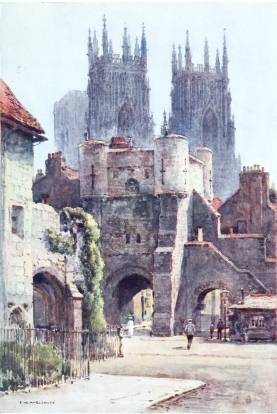
Bootham Bar protected the road from the north, and owing to continual
disputes between Scotland and England, it was always strongly guarded.
Whilst King Stephen was engaged in the south of England, the Scots
thought it a favourable opportunity to invade England, not taking into
account the generalship of the Archbishop. The prelate summoned the
barons to York. An army was mustered and after passing through Bootham
Bar, met and completely routed the Scots at the battle of the Standard,
near Northallerton. In a raid, however, about two centuries later, the

 BOOTHAM BAR
position was reversed: the Scots had penetrated into England as far as
York, and after gaining much booty retreated. The Archbishop and the
Mayor hastily gathered an undisciplined army, which passed through the
Bar and overtook the Scots at Myton. This time the city forces were
completely routed, the Mayor and many of the clergy who had joined were
slain.
In later times a Scot was obliged to announce his arrival at the Bar by
using the rapper, and if he entered the city without the permission of
the warder or Lord Mayor, he was liable to arrest and imprisonment. This
Bar retains its portcullis or drop-gate in its entirety, the pointed
ends of which and the wicket are seen within the archway. The upper part
of the portcullis is to be seen in the chamber above.
Monk Bar, the entrance to the city from Scarborough, was built in the
reign of Edward III. It is the most complete and imposing of the Bars,
and, although shorn of its barbican, it remains the finest example of an
English city gatehouse. Over the archway are crosslets to two stories
which are enclosed by a pointed arch springing from the base of the
turrets and supporting an embattled balcony, access to which is obtained
from either turret. The balcony is adorned with the shield of Edward
III, and on each spandril is a shield bearing the arms of the city of
York. The gateway is vaulted and above are two stories of vaulted
chambers, in the upper of which is the horizontal windlass for raising
or lowering the portcullis. This is the only bar that retains its
original city front, which has, however, been slightly modified by the
insertion of mullioned windows. The first floor over the gateway is
contained within an arched recess. A doorway leads to a narrow platform,
from which the constable could announce to the citizens important news
from the northern world outside or the herald could thence read
proclamations. Through this Bar passed King Charles I attended by his
knights and soldiers and a great concourse to a meeting on Heworth Moor.
The meeting was called by the King, whose disputes with his Parliament
had reached a crisis. The King, in his overconfidence, rejected the
petition presented to him by Parliament and the Civil War broke out.
Walmgate Bar is the entrance to the city from Hull. It retains its
barbican, portcullis, and its inner oak gates including the wicket.
Henry V with Queen Katherine passed through this Bar on their way to
visit the shrine of St. John of Beverley, and in honour of the event the
arms of the King are emblazoned on the Bar. Later, when Edward IV had
been temporarily deposed in favour of Henry VI, he, after a sojourn on
the Continent, returned to England and landed at Ravenspurn, a site now
submerged, and, gathering a force around him, marched to York, only to
find the gates of Walmgate Bar closed against him.
“What then remains, we being thus arrived
From Ravenspurn haven before the gates of York
But that we enter, as into our dukedom.”
He demanded to be admitted as Duke of York, and on acknowledging Henry
of Lancaster as king, he and his followers were permitted to enter. This
scene is described in the play of Henry VI, Part III, Act IV, Scene
VII. Henry VIII with Queen Catherine Howard on their visit to York
entered the city by this Bar.
The city front is in striking contrast to the exterior elevation and
consists of a timber and plaster dwelling built in front of the Bar on
columns, and apparently erected in the time of Queen Elizabeth. The Bar
suffered severely during the siege of York, owing to its proximity to
Garrow Hill, which was secured by the Parliamentarians during the great
Civil War for their batteries, which kept up a destructive fire on the
Bar. The barbican was repaired four years after the surrender of the
city, for over the arch is a shield with the city arms and the date
1648.
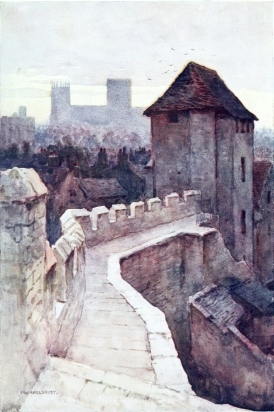
Fishergate Bar was the entrance to the city from Selby, and the walls
from this Bar to Fishergate Tower commanded the narrow approach to the
castle. The Bar consists of a round arch between two wide buttresses,
each with passage through. Adjoining the eastern buttress was a
rectangular guardroom. The arch is of two orders, continued to the
ground with rounded groove for a portcullis. Over the arch is a panel
containing the city arms and an inscription. An insurrection broke out
in 1489 amongst the peasantry in Yorkshire. At Topcliffe the rebels
murdered the Earl of Northumberland and then invested York, burning the
gates of Fishergate Bar. The rebels were eventually defeated and one of
the leaders beheaded at York. Fishergate Tower is provided with a
garderobe, and when built adjoined a wide water area. Adjoining, on the
land side, was a postern under a pointed archway, which has the jambs
grooved evidently to accommodate a portcullis.
York Castle was constructed originally by William the Conqueror, who
built between the two rivers a mound, and set on it a wooden
watch-tower, surrounded with a bailey-court. In order to keep the
castle and other ditches full of water, the Normans placed a dam across
the River Foss, which was thus considerably widened, and formed into an
efficient defence where it adjoined the city.
In the rising against the Jews at the coronation
 FISHERGATE POSTERN FROM THE WALLS
of Richard I, Benedict of York was fatally injured. The anti-Semitic
feeling spread to York, the house of Benedict was plundered and his
widow and family murdered. This atrocious act naturally alarmed the Jews
in York, who gathered their treasures and rushed to the castle for
safety. The governor had to leave them for a while, and when he wished
to reenter, the panic-stricken Jews refused him admission. An assault on
the fortress was ordered. The Jews, finding themselves unable to hold
the citadel, set fire to the wooden erections, and killed themselves.
The tower was rebuilt, and in the middle of the thirteenth century the
mound was enlarged and the wooden watch-tower gave place to the stone
keep. The castle area was walled in during the Edwardian period, the
principal entrance with its flanking towers—now removed—faced Castle
Mills Bridge. The keep has a quatrefoil plan. Corbelled-out turrets fill
three angles, whilst the fourth is occupied by a rectangular gateway
with the chapel above. The royal arms and those of Clifford were placed
above the entrance during the seventeenth century; and the keep became
known as Clifford’s Tower. The keep owes the ruined condition of its
interior to a fire which broke out while it was used as a powder
magazine.
The military architecture of York, whilst giving an idea of strength and
power to the city, adds greatly to its picturesqueness. The line of
embattled walls is agreeably broken by buttresses and mural towers,
whilst the stately gatehouses set along the line of fortification give a
sense of dignity, at the same time reflecting the sturdy independence of
the men of York.
The streets are generally termed “gates”, the gatehouses “bars”, and the
city walls “bar walls”. Such names as Blossom Street, Nunnery Lane, and
Bridge Street are only modern substitutes for Ploxamgate, Baggergate,
and Briggate. The “gates” of York often confuse visitors. A revising
barrister once excused himself for being late in court by saying that he
had lost his way and at last found himself in “Bootham-gate-street!” The
street referred to is simply named Bootham. The streets are narrow and
wind in all directions. “What narrow streets!” exclaimed Sidney Smith to
one of the city tradesmen. “There is scarcely room for two carriages to
pass.” “Not room!” was the indignant reply. “There’s plenty of room,
sir, and two inches to spare.”
The city is pleasantly situated on slightly elevated ground in the midst
of a plain. Through it flows the Ouse, which is crossed by three
bridges. The central one—Ouse Bridge—is of stone and consists of three
elliptical arches. The other two are of iron and have quatrefoil
parapets. A view of Lendal Bridge shows the old water towers. The
bridge is of a single span, and on the apex of the arch the
Queen-mother, Alexandra, is depicted as an angel, holding the shield of
St. George. Other shields, on the parapet, bear the arms of Plantagenet
England, the See of York, and the White Rose. On either side charming
views present themselves. On the left by the side of the river is the
Esplanade, backed by St. Mary’s Abbey Close, in which are the ruins of
the Abbey Church. Towards the right is a beautiful view of the city.
Rising from the riverside are the stone buildings of the Post Office,
Council Chamber, and the ancient Guildhall, while beyond are seen the
towers and spires of the city churches. Skeldergate Bridge consists of
central and side arches, and has its parapet adorned with the Lily of
France and the Sun of York.
In the streets old timber and plaster dwellings, with their overhanging
stories and high-peaked red-tiled gables, are here and there hemmed in
by modern buildings. Timber houses, however, are becoming scarcer, and
quite recently a number of such dwellings have been demolished. A few
carved brackets which carry overhanging stories remain in Stonegate and
Fossgate, and two from Davygate have been re-erected in Trinity Lane.
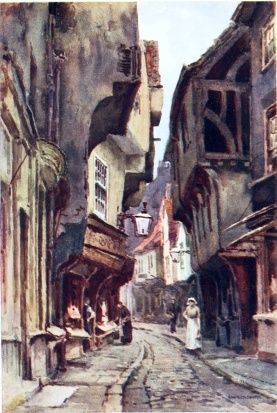
The Shambles, of which a view is given, is the only street that
preserves its narrow mediaeval character. From the uppermost of its
overhanging stories you might shake hands with your neighbour across the
street. This and Little Shambles are the delight of artists. The end of
one house has been shorn of the lath and plaster work and shows how such
timber houses were constructed. The antiquity of the houses in High
Petergate, and the mediaeval narrowness of the street, enable one
looking towards Bootham Bar to realize the former appearance of the
approach to a gatehouse from within the city. The approaches to the
other Bars have been widened and their aspect changed. A characteristic
of York is the frequent occurrence at street corners of an ancient
church surrounded by its burial-ground.
“Each in its little plot of holy ground,
How beautiful they stand,
These old grey churches of our native land.”
The business of the city was in the hands of its freemen. Their
privileges were great. Only a freeman could trade in the city, and his
sons might become free on attaining their majority. He had also the
right of voting for the city’s representatives in Parliament. The
freedom of the city was granted to outsiders who served an
apprenticeship of seven years to a freeman, or by purchase or gift. No
one was admitted to the freedom without taking an oath
 THE SHAMBLES
before the Lord Mayor, and the freeman was sworn to present to the Lord
Mayor any unfranchised man who attempted to trade within the city and to
take charge of his goods. Each trade had its own guild ruled by the
Master, Wardens, and Searchers. Two of these trading companies are still
in existence, the Merchant Adventurers and the Merchant Taylors. The
hall of the former guild is in Fossgate. Over the entrance is their arms
and motto Dieu nous donne bonne adventure. Steps lead from the
courtyard to the hall with its three gables, the barge boards of which
are carved with the leaves and fruit of the vine. The hall is a timber
and plaster building and consists of two rooms which have panelled dados
and open roofs. Each room is 60 feet long and 25 feet wide. The walls of
the courtroom are adorned with paintings of past governors as well as a
full-length portrait of George the First. The chapel stairs are
approached by a large trapdoor in the floor. Service is held there on
Charter Day (26 March). Of the old standards for weights and measures,
there is left a brass yard measure. The scales are of the date 1790. An
oval tobacco-or snuffbox belonged to the ancient company of “Linnen
Weavers”. On the anniversary of the execution of Charles I, the Merchant
Adventurers in compliance with the will of Jane Stainton attend service
in All Saints’ Church. Pavement, to be reminded of their latter end.
The Merchant Taylors’ Hall, a brick building, is in Aldwark. In the
smaller room is an inscription setting forth that:—“This Company has
beene dignified in the yeare 1679, by haveing on their Fraternity eight
kings, eleven dukes, thirty earles, and forty-four lords.” On St. John
the Baptist’s Day the Merchant Taylors attend service at All Saints’
Church, Pavement, in accordance with the will of John Straker, who died
in 1667.
St. Anthony’s Hall, on Peaseholme Green, accommodated those of the city
guilds which had no hall of their own. The hall, on the upper floor, 81
feet long and 58 feet wide, was divided into a nave (28 feet wide) and
aisles, and was 40 feet high. It possesses a fine timber roof with
embattled wall plate. The arched principals spring from corbels
depicting angels with shields. Two oak tables remain. One carved “This
table done at the cost of the sadlers”. The other “This done at the
charges of the joyners and carpenters and masons”. In 1705 St. Anthony’s
Hall was converted into the Blue Coat School.
On the opposite side of the street, a gabled house, now the Black Swan,
was occupied by the family of Bowes, a member of which, William, was
twice Lord Mayor of York. His descendant, Sir Martin Bowes, born in the
house, became Lord Mayor of London. Sir Martin presented a sword four
feet long with a hilt of silver gilt to his native city. The blade is
engraved “for a remembrance to the Mayor and Communaltie of this said
honorable Citie”. The sheath was originally covered with crimson velvet
garnished with stones and pearls.
The various craft guilds took part in the Mysteries and Miracles, which
were rudimentary dramas, founded on Bible history or on the stories of
the lives of the saints. Each of the fifty-four crafts produced a
separate pageant. The plays took place on Corpus Christi Day, which fell
the Thursday after Trinity Sunday, and were enacted on movable stages
which could be wheeled from place to place. The performances, which were
carried on simultaneously in a dozen different stations in the city,
enjoyed a great popularity, and this was one of the reasons for building
the Guildhall, that a commodious theatre was needed for these
productions.
During the sixteenth century plays were performed in the Guildhall by
itinerant companies of players, who attached themselves either to the
sovereign or to some prominent nobleman. The stately hall is divided
into nave and aisles by two rows of octagonal oak pillars which support
timber arches carrying a low-pitched roof. The windows are filled with
modern painted glass depicting events in the history of York. The room
behind, with its panelling concealing staircases, is that in which two
hundred thousand pounds were paid to the Scottish army for handing over
Charles I to the English Parliament.
The towers and spires of the churches add much to the charm of the city.
Though the churches are small, they are full of interesting objects. The
earliest work is the tower of St. Mary, Bishophill Junior, which
exhibits all the features of pre-Conquest architecture. St. Mary’s,
Castlegate, possesses an extremely interesting stone of the eleventh
century, recording that, “This Minster was set up by Eferaud and Grim
and Æse in the name of the Lord Jesus Christ and St. Mary and St. Martin
and St. Cuthbert and All Saints and was consecrated in the year——”
The old church of St. Lawrence, with the exception of the tower, has
been taken down and a new church erected on an adjoining site. Sir John
Vanbrugh, the dramatist and architect of Blenheim and Castle Howard, was
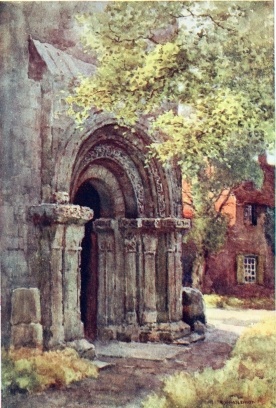
married in the old church. The doorway to the nave has been preserved
and rebuilt as the tower doorway. This beautiful example of Norman work
forms the subject of one of the pictures. The tower is now the only
relic of the eight churches which formerly stood within the area of the
present parish. During the siege of York in the seventeenth century,
this churchyard formed the base of the Parliamentarian attack on
Walmgate Bar, three thousand men being engaged. As a consequence, the
church was demolished, but subsequently rebuilt. The quaint parish
stocks are within the churchyard gates.
The three Norman doorways of York are all curiously enough in the
Walmgate district. The nave of St. Denis was taken down in 1798; the
aisled choir and a modern tower now form the church. The old Norman
doorway to the nave was rebuilt with square pilasters instead of shafts
and forms the new entrance. In the north aisle was buried Henry, Earl of
Northumberland, who fell at Towton. Percy’s Inn, an old palace of the
Earls of Northumberland, stood opposite the church. The finest Norman
doorway is that at St. Margaret’s Church. The arch is of four orders,
adorned with the signs of the Zodiac. The piers have a double chevron
and carved imposts, whilst the shafts have carved caps. The gable is
surmounted with a crucifix.
Most of the churches were rebuilt or extended during the fifteenth
century. Many are famous for mediaeval painted glass. All Saints, North
Street, has some early fourteenth-century glass. Amongst later work is a
window illustrating the poem The Prick of Conscience by Richard Rolle
of Hampole. It depicts the last fifteen days of the world, and under
each panel are two lines of the poem. Another window depicts the
“Corporal Acts of Mercy”. At St. John’s are portrayed events in the life
of the Baptist, while at St. Michael’s, Spurriergate, the “Nine Choirs
of Angels” are represented. In St. Martin’s, Coney Street, the west
window, painted in 1447, illustrates the life of St. Martin. The
clerestory contains fine figures of the four Doctors of the church, the
four Evangelists, and Saints Barbara, Catherine, Wilfrid, and Denis. The
east window at Holy Trinity, Goodramgate, is dated 1470. The five lights
contain figures of St. George, the Baptist, the Holy Trinity which is
represented as Our Father in Pity, St. John the Evangelist, and St.
Christopher, with subject panels below. In another window is depicted
St. Olaf.
Of the monastic churches, the nave of the alien Benedictine Priory of
the Holy Trinity in Micklegate is still in use, it having been converted
into a parish church. Adjoining the Rectory is a half-timbered house,
still bearing the inn sign “Jacob’s Well”; it is now the Parish Room. It
was in the year 1472 the residence of two of the chantry priests of the
Priory Church. After the Dissolution it was purchased by Isabel Ward,
the last prioress of the Benedictine Nunnery of Clementhorpe, who lived
in it until her death in 1569.
York from the beginning of the fourteenth century to the end of the
eighteenth was famous for its church-bell founding. The later founders
were Oldfield, Smith, Seller, and Dalton, and many of their bells hang
in the turrets and towers throughout the northern counties. St. Mary,
Bishophill Junior, possesses two fourteenth-century bells, one is
inscribed in Gothic capitals and bears a stamp with a figure of the
Baptist. The other inscription is in bold black letter and bears a
beautiful stamp of the Annunciation.
York was also renowned for the work of its gold-and silver-smiths. Much
of the church plate is York made, and is principally of the sixteenth
and seventeenth centuries. It bears the York mark—half fleur de lys and
half leopard head. Amongst the makers of church plate were George Mangy,
William Busfield, and Marmaduke Best who made the gold loving-cup which
belongs to the Corporation.
Scattered over the city are mansions of the Georgian period. These
houses are built of red brick in Flemish bond and have stone quoins and
doorways. The cellar areas were protected from the rough pavements by
beautiful wrought-iron railings, whilst hammered scroll-work brackets
supported torch extinguishers and the circle for the oil lamp. The
rain-water conductors were of lead of rectangular shape, with
spout-heads of elaborate workmanship, which bore heraldic devices,
monograms, or dates. The leaden cisterns were similarly treated. The
interiors of these houses have panelled walls with dentilled cornices
and carved plaster ceilings, pedimented doorways, and chimney-pieces
with oil paintings framed in the overmantel.
As the city was lighted by a few oil lamps, and watchmen were scarce, it
was necessary for ladies in their sedans to be attended by
torch-bearers. In Petergate, Gillygate, and Duncombe Street
extinguishers still hang by the side of doors.
A residence for the Lord Mayor was built from the design of the Earl of
Burlington, who was also the architect for the Assembly Rooms. The
assemblies were originally held in the King’s Manor, but larger premises
being required, Sir William Wentworth promoted a company and raised five
thousand pounds to build the Assembly Rooms. Lady Wentworth was so
proficient at shuttlecock that she broke one of the high windows. During
a race week in 1735 there was paid for candles used at the assemblies
the sum of thirty-six pounds five shillings.
The Theatre Royal was built by Joseph Baker on the remains of St.
Peter’s Hospital. It became famous under the management of Tate
Wilkinson, who was patentee of the theatres at York and Hull,
 NORMAN PORCH, ST. LAWRENCE’S TOWER
and manager of those at Leeds, Bradford, Doncaster, Wakefield, and
Pontefract. These theatres comprised the York circuit. He was a
painstaking manager, and was in the habit, when a new piece was being
introduced, of viewing it from the gallery. On one occasion, noticing
some slovenly acting, he began to hiss vigorously. The “gods”, not being
so hypercritical, and not recognizing him, cried, “Turn him out”, and
turned out he was from his own theatre. During the Assizes, Races, and
the winter, York was the favourite resort of the nobility and gentry of
the north; concerts, dances, and card parties at the Assembly Rooms, and
plays at the Theatre being the fashionable amusements. John Coleman, a
later lessee, is said to have prepared his own playbills, which were
couched in grandiose language. In this connection, a story is told to
the effect that one morning at rehearsal, he exclaimed to the property
man: “Have you all ready for to-night?” “Yes, all except the pedestal.”
“The what?” thundered Coleman. “The pedestal,” was repeated. “What is
that for?” roared the lessee. The property man took down the playbill
and pointed out the words: “On this occasion Mr. Coleman will descend
from his pedestal and enact the part of Bob Hawkins.”
The introduction of railways was welcomed by George Hudson, a draper in
College Street. He took the foremost position in promoting the
construction of a line to York. His name became one of the most
prominent in the railway world and he was spoken of as the Railway King.
He was thrice Lord Mayor of York and represented Sunderland in
Parliament for fourteen years. The railway crisis ended his public
career.
York is a garrison town with cavalry and infantry barracks on Fulford
Road, and there is a summer camp of 1600 acres at Strensall. Around the
city are considerable tracts of land known as strays and belonging to
the freemen of the city. The strays contain altogether 743 acres. The
Micklegate Strays of Knavesmire, Hob Moor, and Scarcroft have been
recently acquired by the Corporation.
York is the assize town for the North and East Ridings. The city itself
has been a county from early times, and has a sheriff and an assize of
its own. The judges’ lodging is a large brick house in Lendal. The
courts are within the castle yard, and the approach of His Majesty’s
judges is announced by a fanfare from the high sheriff’s trumpeters.
The city is in the midst of an agricultural district, and on market days
one hundred and fifty carriers’ wagons come heavily laden with
passengers and produce for the open-air market held in Parliament
Street.
For the accommodation of the public there are above two hundred inns and
taverns. In the “Black Swan”, Coney Street, is preserved a
coaching-bill, of which the following is a copy:—
“YORK FOUR DAYS STAGE COACH
Begins on Friday the 12th of April 1706.
All that are desirous to pass from London to York, or from York to
London, or any other Place on the Road, Let them Repair to the
Black Swan in Holbourn in London, and to the Black Swan in Coney
Street in York. At both which Places, they may be received in a
Stage Coach every Monday, Wednesday and Friday, which performs the
whole Journey in Four Days (if God Permits). And sets forth at Five
in the Morning. And returns from York to Stamford in two days, and
from Stamford by Huntington to London in two days more. And the
like stages on their return. Allowing each Passenger 14lb. weight,
and all above 3d. a pound.
| Performed By— | BENJAMIN KINGMAN. |
| HENRY HARRISON. |
| WALTER BAYNES. |
Also this gives Notice that Newcastle Stage Coach sets out from
York, every Monday and Friday and from Newcastle every Monday and
Friday.”