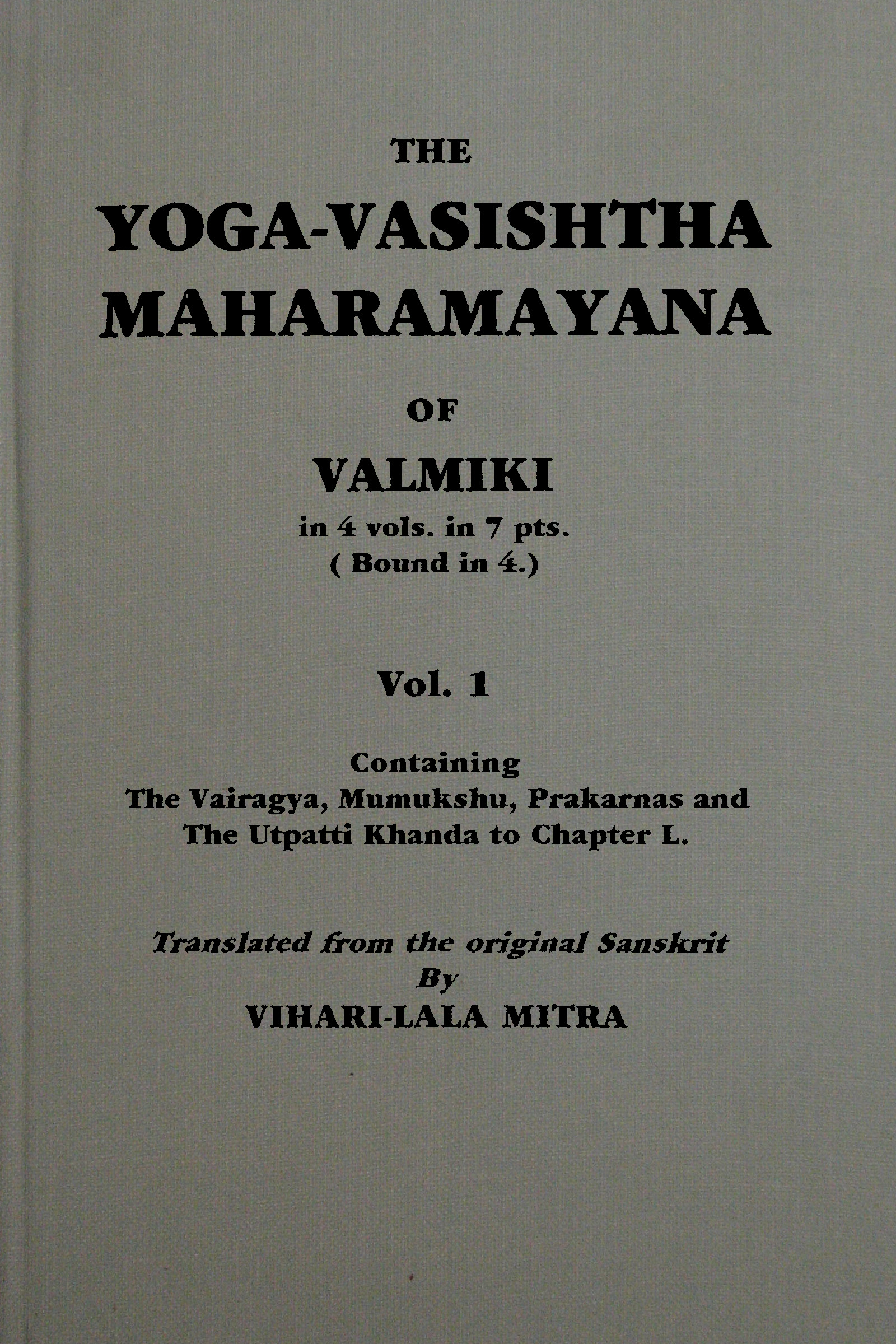
Yoga Vasishtha Maharamayana, by Valmiki, transl. by Vihari-Lala Mitra, Volume 1
by Valmiki
★★★★★No ratings yet
Language: English
Sign in to rate this book.
Sign in to shelve this book.
About this eBook
- Author
- Valmiki
- Title
- The Yoga-Vasishtha Maharamayana of Valmiki, Vol. 1 (of 4)
- Original Publication
- India: Low Price Publications, 1899, reprint 1999.
- Credits
- Mark C. Orton, Juliet Sutherland, Édith Nolot, Krista Zaleski, windproof, readbueno and the Online Distributed Proofreading Team at www.pgdp.net
- Language
- English
- LoC Class
- PK: Language and Literatures: Indo-Iranian literatures
- Subject
- Hinduism -- Doctrines -- Early works to 1800
- Category
- Text
- eBook-No.
- 71326
- Project Gutenberg
- https://www.gutenberg.org/ebooks/71326
- Release Date
- August 3, 2023
- Copyright
- Public domain in the USA.
Contents
- 1.Transcriber’s Notes
- 2.THE YOGA-VÁSISHTHA-MAHÁRÁMÁYANA. — PROSPECTUS.
- 3.THE YOGA-VÁSISHTHA MAHÁRÁMÁYANA OF VÁLMÍKI
- 4.PREFACE.
- 5.FOOTNOTES:
- 6.CONTENTS OF THE FIRST VOLUME.
- 7.THE YOGA PHILOSOPHY. — II. Sciences Connected With Yoga — III. The Yoga of English Writers. — IV. Yoga-characteristic of the Hindus. — V. Various Significations of Yoga. — VI. The Different Stages of Yoga. — VII. Nature of the Soul. — VIII. Final Emancipation Or Beatitude. — IX. Origin of Yoga in the Vedas. — X. Rise of the Heretical Yogas. — XII. Different Aspects of Yoga. — XIII. The Consummation of Yoga (Siddhi). — XIV. The Different Degrees of Perfection. — XV. The state of a Perfect yogi. — XVI. Criticism on yoga Practice.
- 8.THE OM TAT SAT. — II. Orthography of Om. — III. The Ortheopy Or Analysis of Om . — IV. The Different Denominations of Om. — V. Etymology of the Word Om . — VI. Lexical Meanings of Om . — VII. The Nominal Meanings of Om . — VIII. Application of Om in the Vedas and Vedanta . — IX. Theology of Om in the Monads of Monotheistic Creeds. — X. Duads Or Duples of the Bipartite Om in Dualistic Theories. — XI. Triads Or Triples Or Tripartite Om in Trinitarian Systems. — XII. The Tetrads Or Quadruples of Om. — XIII. The Pentads &c., of Om . — XIV. Philosophy of the Numerical Groups Contained Under the Mystic Syllable Om. — XV. The Unitarian Formula ॐ तत् सत् One That Is. — XVI. Ontology of the Self Existent Sat = Being. — XVII. The Conclusive Lesson on the Practice of Yoga. — XVIII. Symbolical Yoga Cult of Mudrá Or Chakra Diagrams. — XIX. Mathematical Investigation Into the Diagrams of Om. — THE FIGURES. — Note to Figure 7. — Note to Fig. 9.
- 9.YOGA VÁSISHTHA. — BOOK I. ON MORAL APATHY CHAPTER I. INTRODUCTION. — Section I. DIVINE ADORATION — SECTION II. Narrative of Sutíkshna. — SECTION III. Anecdote of Kárunya. — SECTION IV. Story of Suruchi. — SECTION V. Account of Arishtanemi. — SECTION VI. History of Ráma.
- 10.CHAPTER II. Reason of Writing the Rámáyana. — SECTION I. Persons Entitled to its Perusal. — SECTION II. Brahmá’s Behest. — SECTION III. Inquiry of Bharadwája.
- 11.CHAPTER III. Válmíki’s Admonition. — SECTION I. On True Knowledge. — SECTION II. Early History of Ráma. — SECTION III. Ráma’s Pilgrimage.
- 12.CHAPTER IV. Ráma’s Return from Pilgrimage.
- 13.CHAPTER V. Of Ráma’s self-dejection and its cause.
- 14.CHAPTER VI. Advent of Viswámitra to the Royal Court. — SECTION II. Address of King Dasaratha.
- 15.CHAPTER VII. Viswámitra’s Request for Ráma.
- 16.CHAPTER VIII. Dasaratha’s Reply to Viswámitra.
- 17.CHAPTER IX. Viswámitra’s Wrath. And His Enraged Speech.
- 18.CHAPTER X. Melancholy of Ráma.
- 19.CHAPTER XI. Consolation of Ráma.
- 20.CHAPTER XII. Ráma’s Reply.
- 21.CHAPTER XIII. Vituperation of Riches.
- 22.CHAPTER XIV. Depreciation of Human Life.
- 23.CHAPTER XV. Obloquy on Egoism.
- 24.CHAPTER XVI. The Ungovernableness of the Mind.
- 25.CHAPTER XVII. On Cupidity.
- 26.CHAPTER XVIII. Obloquy of the Body.
- 27.CHAPTER XIX. Blemishes of Boyhood.
- 28.CHAPTER XX. Vituperation of Youth.
- 29.CHAPTER XXI. Vituperation of women.
- 30.CHAPTER XXII. Obloquy of Old Age.
- 31.CHAPTER XXIII. Vicissitudes of Times.
- 32.CHAPTER XXIV. Ravages of Time.
- 33.CHAPTER XXV. Sports of Death.
- 34.CHAPTER XXVI. The Acts of Destiny.
- 35.CHAPTER XXVII. Vanity of the world.
- 36.CHAPTER XXVIII. Mutability of the world.
- 37.CHAPTER XXIX. Unreliableness of worldly things.
- 38.CHAPTER XXX. Self-disparagement.
- 39.CHAPTER XXXI. Queries of Ráma.
- 40.CHAPTER XXXII. Praises on Ráma’s Speech.
- 41.CHAPTER XXXIII. Association of Aerial and Earthly Beings.
- 42.YOGA VÁSISHTHA. — BOOK II. MUMUKSHU KHANDA OR THE MEANS OF FINAL LIBERATION. — CHAPTER I.
- 43.CHAPTER II. Speech of Viswámitra.
- 44.CHAPTER III. On the repeated creations of the world.
- 45.CHAPTER IV. Praise of Acts and Exertions.
- 46.CHAPTER V. Necessity of Activity.
- 47.CHAPTER VI. Refutation of Fatalism.
- 48.CHAPTER VII. On the Necessity of Activity.
- 49.CHAPTER VIII. Invalidation of Destiny.
- 50.CHAPTER IX. Investigation of Acts.
- 51.CHAPTER X. Descension of Knowledge.
- 52.CHAPTER XI. On the Qualifications of the Inquirer and Lecturer.
- 53.CHAPTER XII. Greatness of True Knowledge.
- 54.CHAPTER XIII. On Peace and Tranquility of Mind.
- 55.CHAPTER XIV. On the Ascertainment of an Argument.
- 56.CHAPTER XV. On Contentment.
- 57.CHAPTER XVI. On Good Conduct.
- 58.CHAPTER XVII. On the Contents of the Work.
- 59.CHAPTER XVIII. Ascertainment of the Example Or Major Proposition
- 60.CHAPTER XIX. Ascertainment of True Evidence.
- 61.CHAPTER XX. On Good Conduct.
- 62.YOGA VÁSISHTHA — BOOK III. UTPATTI-KHANDA. EVOLUTION OF THE WORLD. — CHAPTER I. CAUSES OF BONDAGE TO IT. — SECTION I. Exordium ( Bhúmiká .) — SECTION II. Worldly Bondage. — SECTION III. Phases of the Spirit. — SECTION IV. Nature of Bondage.
- 63.CHAPTER II. Description of the First Cause. — SECTION I. Narrative of the air-born and aeriform Bráhman. — SECTION II. State of the Soul.
- 64.CHAPTER III. Causes of Bondage in the Body.
- 65.CHAPTER IV. — SECTION I. Description of the Night-fall. — SECTION II. Nature of the Mind. — SECTION III. Kaivalya or Mental Abstraction.
- 66.CHAPTER V. On the Original Cause. (Múla-Kárana).
- 67.CHAPTER VI. Admonition for Attempt to Liberation.
- 68.CHAPTER VII. Recognition of the Nihility of the Phenomenal World.
- 69.CHAPTER VIII. Nature of Good Sástras.
- 70.CHAPTER IX. On the Supreme Cause of All. (Parama Kárana).
- 71.CHAPTER X. Description of the Chaotic State.
- 72.CHAPTER XI. Spiritual View of Creation.
- 73.CHAPTER XII. The Idealistic Theo-cosmogony of Vedánta.
- 74.CHAPTER XIII. On the Production of the Self-Born.
- 75.CHAPTER XIV. Establishment of Brahma.
- 76.CHAPTER XV. Story of the Temple and its Prince.
- 77.CHAPTER XVI. Joy and Grief of the Princess.
- 78.CHAPTER XVII. Story of the Doubtful Realm or Reverie of Lílá. — SECTION I. Description of the Court house and the Cortes.
- 79.CHAPTER XVIII. Exposure of the Errors of this World.
- 80.CHAPTER XIX. Story of a former Vasishtha and his wife.
- 81.CHAPTER XX. The Moral of the Tale of Lílá. — SECTION II. State of the Human soul after death.
- 82.CHAPTER XXI. Guide to Peace.
- 83.CHAPTER XXII. Practice of Wisdom or Wisdom in Practice. — SECTION I. Abandonment of Desires. — SECTION II. On the Practice of Yoga.
- 84.CHAPTER XXIII. The Aerial Journey of Spiritual Bodies.
- 85.CHAPTER XXIV. The Aerial Journey. — SECTION II. Description of the Heaven.
- 86.CHAPTER XXV. Description of the Earth.
- 87.CHAPTER XXVI. Meeting the Siddhas
- 88.CHAPTER XXVII. Past Lives of Lílá.
- 89.CHAPTER XXVIII. — SECTION I. Exposition of Lílá’s Vision. — SECTION II. Description of the Mountainous Habitation.
- 90.CHAPTER XXIX. Account of the Previous Life of Lílá
- 91.CHAPTER XXX. Description of the Mundane Egg—(Brahmánda).
- 92.CHAPTER XXXI. — SECTION I. Alighting of the Ladies on Earth. — SECTION II. Sight of a Battle Array in Earth and Air.
- 93.CHAPTER XXXII. Onset of the war.
- 94.CHAPTER XXXIII. [17] Comingled Fighting.
- 95.CHAPTER XXXIV. Description of the Battle.
- 96.CHAPTER XXXV. Description of the Battlefield. [20]
- 97.CHAPTER XXXVI. — SECTION I. Collision of Equal Arms and Armigerents. — SECTION II. Catalogue of the Forces.
- 98.CHAPTER XXXVII Catalogue of the Forces continued. [22]
- 99.CHAPTER XXXVIII. Cessation of the War.
- 100.CHAPTER XXXIX. Description of the Battle-field Infested by Nocturnal Fiends.
- 101.CHAPTER XL. Reflections on Human Life and Mind.
- 102.CHAPTER XLI. Discrimination of Error.
- 103.CHAPTER XLII. Philosophy of Dreaming. Swapnam or Somnum.
- 104.CHAPTER XLIII. Burning of the City.
- 105.CHAPTER XLIV. Spiritual Interpretation of the Vision.
- 106.CHAPTER XLV. Theism Consisting in True Knowledge.
- 107.CHAPTER XLVI. Onslaught of Vidúratha.
- 108.CHAPTER XLVII. Encounter of Sindhu and Vidúratha.
- 109.CHAPTER XLVIII. Description of Daivástras or Supernatural Weapons. [23]
- 110.CHAPTER XLIX. Description of Other Kinds of Weapons.
- 111.CHAPTER L. Death of Vidúratha.
- 112.CONCLUSION.
- 113.GENEALOGY
- 114.FOOTNOTES:
Community reviews
Sign in to write a review.
No reviews yet.