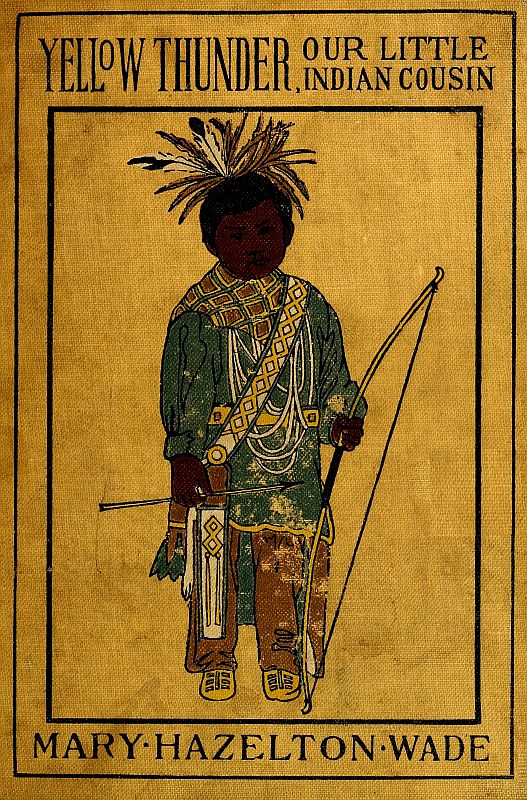
They call him Yellow Thunder. Do not
be afraid of your little cousin because he bears
such a terrible name. It is not his fault, I
assure you. His grandmother had a dream
the night he was born. She believed the
Great Spirit, as the Indians call our Heavenly
Father, sent this to her. In the dream she
saw the heavens in a great storm. Lightning
flashed and she constantly heard the roar of
thunder. When she awoke in the morning
she said, "My first grandson must be called
'Yellow Thunder.'" And Yellow Thunder
became his name.
But his loving mamma does not generally
call him this. When he is a good boy and
she is pleased with him, she says, "My bird."
If he is naughty, for once in a great while this
happens, she calls him "bad boy."
For some reason I don't understand myself,
she rarely speaks his real name. Perhaps
it is sacred to her, since she believes it
was directed by the Great Spirit.
Yellow Thunder lives in the forests of your
own land, North America. His skin is a dull,
smoky red, his eyes are black and very
bright, his hair is black and coarse. His body
is straight and well formed. He can run
through the woods as quickly and softly as a
deer. He lives in a bark house made by his
mother. His father is strong and well, yet he
did not help in building it. He thinks such
work is not for men. It is fit only for women.
When I tell you how it is made, you will
not think it is very hard work. Yellow
Thunder's patient mamma chose the place for
her home, and then gathered some long poles
in the forest. She set these poles in a circle
in the ground, bent them over at the top, and
tied them. She left a small hole at the top.
The framework of the house was now complete.
What should she have for a covering?
She went out once more into the woods and
got some long sheets of white birch bark. At
the end of each sheet she fastened a rim of
cedar wood. The sheets of bark were hung
on the framework, with the rim at the
bottom of each one, and the house was
finished. The rim would be useful in keeping
the bark from being lifted by the winds. But,
if there should be a severe storm, the Indian
woman would lay stones on the rims to keep
the bark down more firmly still.
This is Yellow Thunder's simple home,
summer and winter. You would probably
freeze there in the cold days of December,
but the Indian boy was brought up to endure
a great deal of cold.
Let us look inside. We must first lift the
deerskin which hangs in the doorway. Does
the family sit on the cold, bare ground, do
you think? Oh, no; Yellow Thunder has
helped his mamma make good thick rugs out
of the bullrushes and flags which they gather
every autumn. These rugs are very pretty,
for they are woven and dyed with the bright
colours the Indian women know how to make.
There are many of these mats, because they
are used for many purposes. Yellow Thunder
sleeps on one of them at night. In the day-time
he sits on a mat whenever he is in the
house. But he is such a strong lad, he is
out-of-doors nearly all the time, both in sunshine
and in storm.
In the middle of the house you will notice
there is a bare spot covered with clean sand.
This is the place where the fire is made. It is
carefully swept when there is no fire. If you
look directly over the fireplace, you can see
the sky. On rainy days, unless the mother is
cooking, she keeps the hole covered with a
piece of deerskin, that the inside of the house
may be dry.
But how does she prepare the food for
breakfast, for that is the principal meal of the
day to the Indian? A strong hook is fastened
in the framework of the house, above the fireplace.
The Indian mother hangs a pot on the
hook, puts in the meat or fish, and it boils
quickly over the burning twigs which her
little boy has gathered.
Let us look around the wigwam. Of course,
you have long ago heard that name for the
Indian's house. What beautiful baskets of
rushes those are! I wonder how the red men
discovered the way of making such beautiful
colours. Besides many other things, the jewelry
and clothing of the whole family are kept
in these baskets. Look up at the sides of the
hut and notice the bows and arrows. And,
yes! there is a real tomahawk, with its sharp
edge sticking in that corner. Ears of corn
braided together are hanging from the framework.
But the prettiest thing we see is the baby's
cradle, fastened to a peg. Two bright black
eyes are looking out of it, and that is all
we can see of Yellow Thunder's baby sister,
"Woman of the Mountain." It took the
loving mother a long time to make that cradle.
She was very happy while doing it, for she
loves her baby tenderly.
It is hardly right to call it a cradle. Baby-frame
is a better name. It was made in three
pieces, out of the wood of the maple-tree,—a
straight board about two feet long for the bottom,
a carved foot-board, and a bow which is
fastened to the sides and arches over the
baby's head. These are all bound together
with the sinews of a deer. It is lined with
moss, and then Woman of the Mountain is
fastened in her queer little bed with straps,
which her mamma has made beautiful with
bead work. Moss is placed between her feet,
her hands are bound at her side, her feet are
bound down also, and a beaded coverlet is
placed over her tiny body. She looks like a
little mummy.
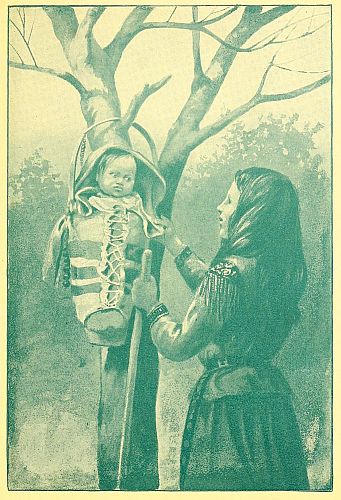 "SHE SWINGS ON THE BRANCH OF A TREE."
If it is stormy she is hung up on a peg
in the hut to swing, but if it is a pleasant
day, she swings on the branch of a tree and
watches the leaves flutter and the birds sing.
She is a happy little baby, although you
would hardly think it possible. She got used
to her imprisonment almost as soon as she
was born. She doubtless thinks it is all right.
When mamma goes out into the forest to
gather wood, or into the corn field to work,
Woman of the Mountain goes too. The
baby-frame is fastened on her mother's back
by a pretty beaded strap bound over the
woman's forehead.
When the Indian baby was only two days
old, she was fastened into her cradle and
carried all day on mamma's back while she
was weeding the garden. To be sure, the
woman stopped two or three times to feed
her baby, but the little thing was not once
taken out of her frame.
Perhaps you would like to hear a lullaby
the Indian mamma often sings to her little
one as she swings in her frame. I fear
you could not understand the Indian words,
so I will give them as Mrs. Elizabeth Oakes
Smith wrote them in English:
Swinging, swinging, lul la by,
Sleep, little daughter, sleep,
'Tis your mother watching by,
Swinging, swinging, she will keep,
Little daughter, lul la by.
'Tis your mother loves you, dearest,
Sleep, sleep, daughter, sleep,
Swinging, swinging, ever nearest,
Baby, baby, do not weep;
Little daughter, lul la by.
Swinging, swinging, lul la by,
Sleep, sleep, little one,
And thy mother will be nigh—
Swing, swing, not alone—
Little daughter, lul la by.
You can understand from this how dearly
the Indian mother loves her baby,—just as
dearly, I do not doubt, as your own mamma
has always loved and cared for you.
But what is Yellow Thunder's stern-looking
father doing all the time? He has
no store to keep, no mill to grind, no
factory to work in. There are only three
things which deserve his attention. At least
that is what he thinks. He hunts or fishes,
goes to war, and holds councils with the
men of his tribe. Everything else he believes
is woman's work, and from the Indian's
standpoint, woman is much beneath a man.
After all, the men's work is really the
hardest. Sometimes it is easy for them to
find plenty of food. Then Yellow Thunder's
father comes home rejoicing with the big
load he carries. Perhaps he has a red deer
hanging over his shoulder; perhaps it is a
bear which he has chased many miles before
he could get near enough to kill it; or it
may be some raccoons for a delicious stew.
But, again, it may be stormy weather.
The rivers are frozen over and snow covers
the ground. Then, perhaps, the hunter has
little success with his bow and arrow, and
searches long and far before he can find anything
to satisfy his children's hunger. He
feels sad, but not for a moment does he
think of complaining or giving up. It is his
duty to obtain food for his family. It does
not matter how cold he gets or how wet he
may be. He keeps travelling onward. He
will not give up. If he does not at last get
enough for all, he will insist on his wife and
children satisfying their hunger first. He
would scorn to show that he himself is tired,
or hungry, or suffering in any way.
We can understand now why the Indian
baby is pinned down in its cradle and not
allowed to move freely. It is its first lesson
in endurance. It must learn to be uncomfortable
and not to show that it is so. It
must learn to bear pain, and neither cry
nor pucker its mouth. It must learn to
appear calm, no matter how it feels.
The hunt is pleasant sometimes, you see,
but at others it is work of the hardest kind.
The second duty of the red boy's father is
war. He must protect his home from human
and wild beast enemies. But I'm really afraid
that it is a pleasure for him to fight. If
Indians had not been at war so much among
themselves, it would have been far harder for
the white people to conquer them. I suppose
you children have all heard the story of the
bundle of sticks, but I will repeat it.
A certain man was about to die. He gathered
his sons around him to give them good
advice. He showed them some sticks fastened
tightly together. Then he asked each one to
try to break the bundle. No one could do
it. When he saw that they failed, he separated
the sticks, and showed them how easy
it was to break each one by itself.
"Take a lesson from this," said the man.
"If you are united and work together, you
will succeed in anything you undertake, for
no one can break your strength. If, however,
you quarrel among yourselves and try to work
each for himself, you will be like the separate
twigs,—easily broken."
It has been like this with the Indians.
They have fought against each other, tribe
with tribe. They are very brave and have
great courage. But they have not understood
that they should work together. So the white
man came and was able to conquer them.
Besides hunting and going to war, Yellow
Thunder's papa is often busy in the council.
All matters of business are settled here. New
chiefs are chosen at the council; wrong-doers
are punished according to what it decides, and
treaties with other tribes or the white men are
talked over and agreed upon. Sometimes a
council will last many days. It is always
opened with a prayer to the Great Spirit,
thanking him for his good gifts to the people.
Each evening, after the business of the
council is over, games are played by old and
young. It is a time for feasting and pleasure.
No business with other people is really settled
by a council without gifts of wampum to bind
the bargain. Of course you have heard about
wampum. Perhaps you have been told it is
the Indian's money. There are two kinds
of wampum. One is purple and the other
white. The white wampum is shaped into
beads out of the inside of large conch shells,
while the purple is made from the inside of
the mussel shell. These beads are strung on
deer's sinews and woven into belts. A belt
of white wampum is a seal of friendship between
two tribes. It is the same as a sacred
promise which must not be broken. It is the
most precious of all things an Indian owns.
Yellow Thunder's papa is very fond of
tobacco. He always carries a beaded pouch
filled with it. He believes that the Great
Spirit gave tobacco to the Indian. When
he smokes it, it opens a way through which
he may draw near God, and be taught by
him. His pipe and tobacco will be buried
with him when he dies, as he thinks they will
be needed on his journey toward heaven. He
smokes at the council. He smokes around
the camp-fire when he is away hunting. He
smokes in the evening time as he sits with
his friends and tells stories of the chase or
listens to legends of his people.
I hardly know what this Indian father
would do without his pipe, as it seems to
give him so much comfort and pleasure.
See! here he comes now. Yellow Thunder
is at the door of the lodge, watching him as
he walks quickly down the forest path. He
is truly called a "brave." He looks as though
he would fear no danger. How straight is his
body, and how strong are his muscles!
He wears leggings of deerskin, finely worked
with beads. They are fastened just above his
knees. A short kilt is gathered around his
waist. It is also made of deerskin, but is
worked around the edge with porcupine quills
stained in several colours. It is bitterly cold
to-day, so he wears a blanket over his shoulders.
His head is shaved bare, excepting the
scalp-lock at the back. It must be this which
makes him look so fierce.
I want you to notice his feet. They step
softly and yet firmly. You could not walk
as he does. Perhaps you have pointed shoes
with high heels. The Indian would look with
scorn upon these. What! Cramp the toes
with such uncomfortable things! Impossible!
He covers his feet in the most sensible manner
with the soft moccasins made by his wife.
They fit his feet exactly. He can run like
a deer, or creep along the ground like a wildcat
in these coverings, and no one will hear
him coming. Each moccasin is made of a
single piece of deerskin, seamed at the heel
and in front. The bottom is smooth and
without a seam, while the upper part is
worked with beads.
Yellow Thunder's good mamma uses a curious
needle and thread. The needle is made
from the bone of a deer's ankle, and her
thread is of the sinews of the same animal.
What would the Indian have done without
the deer in the old days before the white man
came to this country? I can't imagine, can
you?
This animal furnished much of his food and
clothing; ornaments were made of his hoofs;
needles and many other things came from his
bones. Even the brains of the creature were
used in tanning skins of animals. They were
mixed with moss, made into cakes, and dried
in the sun. This mixture will keep a great
length of time. Whenever it is needed, a
piece of this brain-cake is boiled in water,
and the skin is soaked in it after the hair
is scraped off. Then it is wrung out and
stretched until it is dry. But even then the
skin is not ready for use. It will tear very
easily. It must be thoroughly smoked on
both sides. This work all belongs to Yellow
Thunder's mamma. His father has nothing
to do with it.
Suppose we follow the red man into his
home. Ugh! What a smoke there is inside!
We can hardly see across the wigwam. We
shall need to lie down on the mat as the
Indian does. Our eyes will be blinded unless
we do this. The wife has a good meal waiting
for her husband, but she will not eat till he
has finished. That is Indian good manners.
His wooden bowl and plate, together with
a boiled corn-cake, are placed on the mat in
front of the man. Venison stew is served him
out of the big pot, and a dish of sassafras tea
is also set before him. There is no milk to
put into this queer drink, but if he wishes
to sweeten it, he can add some delicious maple
syrup. This is certainly not a bad meal for
any one.
The red man eats and drinks, while scarcely
a word is said to his waiting family. When
he has finished his meal, he will light his pipe
for a quiet smoke, after which his wife and
child satisfy their hunger.
Yellow Thunder's mamma knows how to
prepare many a good dish. She can make
several different kinds of corn bread. She
prepares soups of deer and bear meat. She
boils the hominy, on which our little red
cousin pours the maple syrup. She makes
teas of wild spices and herbs which grow near
the hut. But these drinks are not likely to
keep Yellow Thunder awake at night. Neither
is there danger of his starving, so long as his
father can hunt and his mother can gather her
crops. His food is suited to make him strong
and healthy, and he does not miss the dainties
of which you are so fond.
The stern-looking father never thinks of
interfering in the management of the home.
That is his wife's right. She gives him his
sleeping-place and the corner in which he shall
put his belongings. She decides on what shall
be cooked, and what shall be stored away.
She is the ruler in the home.
But, on the other hand, he does not expect
her to scold. She should always be obliging
and happy in entertaining his friends. She
should be ready to furnish him a good meal
whenever he comes home.
As yet, he does not take much notice of
his only son. He does not correct the boy's
faults. He seldom takes him on his hunts.
He has left all care of the boy to his wife
up to this time.
But Yellow Thunder is now twelve years
old. He will soon be a man. In a year or
two, at most, his father will begin to make
a companion of his son in hunting and fishing.
He will teach him the ways of a brave
Indian warrior. Then there will be no more
woman's work for Yellow Thunder.
When the time comes for this great change
in his life, he will go out into the forest to
fast. No one will insist on his doing this.
He will himself desire it. It is the same as
a baptism to a young Indian. His father
will go with him to the lonely spot where
he decides to stay. He will give his son
wise words of counsel. He will urge him
to be brave and keep his fast as long as
possible. He will be able to show by this
how much courage and spirit he possesses,
and how great a man he desires to be. Then
he will leave his son alone and go back to
the village.
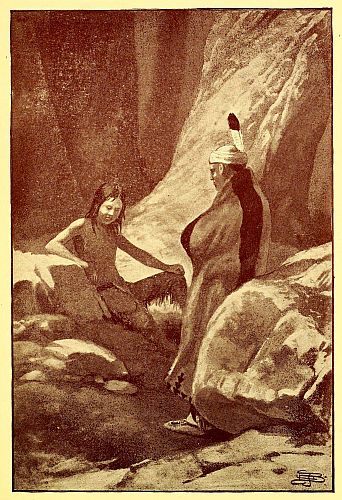 "HE WILL GIVE HIS SON WISE WORDS OF COUNSEL."
A day passes by, and Yellow Thunder
grows faint. Two days now are gone, and
the boy's thirst is intense. At the end of
three days his father comes back and finds
his son lying weak and dizzy beneath the
trees. He gives him a little water, but no
food, for Yellow Thunder says he can fast
still longer.
The father goes away again, leaving the
son to watch for the visions which will surely
come. It will be decided now what the red
boy's future will be. The longer he can fast,
the greater man he will become among his
people. No one can be a chief unless he
has fasted many days at the beginning of
his manhood.
We cannot tell what Yellow Thunder
will be, but we know that his visions will
always be remembered. He believes that his
guardian spirits will appear in some form or
another to him, and he will get instruction
about his future life. He will endure his
fast bravely as long as possible.
It sometimes happens that Indian boys
die at this time of fasting, but we feel sure
that Yellow Thunder will live and be a joy
to his parents to the end of their lives.
But how is the Indian mother preparing
him for this great test? She teaches him,
first of all, to obey. In no other way would
it be possible for him to become a great
man. He must heed everything that his
father and mother tell him. He must always
be ready to do their bidding. It is the
greatest token of rudeness to appear curious,
therefore he must ask no questions. He
must love the truth. A lie is almost unknown
among the Indians; they scorn it as the mark
of a cowardly and mean nature. He must be
brotherly to all creatures, and ready to give
to others always.
Yellow Thunder has never seen a pauper
or beggar in his life. Whenever any one
comes to his home, his mother hastens at
once to prepare food for the visitor. It is
almost a law to her to do so. If relatives
should come for a visit, they will be made
welcome and allowed to stay as long as they
desire. If they should remain for the rest
of their lives, they would never be asked
to leave. "Be hospitable to all," is a maxim
planted in the heart of every Indian child.
Yellow Thunder is taught that everything
should be shared in common. The Indian
does not say, "My land." It is always
"Ours." The people of a tribe are truly
brothers to each other.
The red boy's mamma does not need to
teach him that theft is wrong. It is almost
unknown among his people. The idea of
doing such an unbrotherly thing does not
enter their heads. No wonder there are
neither poorhouses nor prisons among these
people. We call them savages, but there
are many things we could copy with profit
from them. Don't you think so, children?
"Live and learn," is an old saying, and I
think we would do well to remember it
when we read the lives of our cousins in
many lands.
Yellow Thunder does not go to church or
Sunday school. I doubt if Sunday is any
different to him from any other day. But
his mamma has taught him that there is one
loving Heavenly Father for all. If Yellow
Thunder is good and brave, he will go to
the "happy hunting-grounds" when he dies.
At least, this is what he is taught to believe.
There will be enough food and an abundance
of animals to kill. Everything that the
Indian loves best to do in this life, he
thinks can be found in his heaven. But
there is no place there for the white man.
George Washington was the only white man
who ever lived whom they thought fit to
enter their paradise. The exception was
made in his case because he was brave and
good, and treated the Indians fairly and justly.
Yellow Thunder's mother often tells him
of a prophecy which was made long ago by
the wise men of her tribe. They said that
a great monster, with white eyes, would come
out of the East and consume the land. Did
the prophecy come true, you ask? Yes, my
dears, it was the white race.
When Yellow Thunder thinks of the great
forests which his people once owned, and of
the numbers of animals roaming there, when
he remembers the wars which have been
fought and lost with the "great monster,"
his heart grows bitter.
Don't blame him, children, but feel sorry
for your little Indian cousin. His people
have certainly had a hard time. They have
been very cruel in warfare with us, but they
felt they were treated unjustly, and we
were taking their homes away from them.
Yellow Thunder believes in the Great
Father, as I have told you. His mother
has also taught him that there are many
spirits, both good and bad. God made the
good spirits to help him in his care of this
great world. The Indian believes that the
wind is a spirit of great power. The thunder
is another spirit, whom he calls Heno. Heno
makes the clouds and the rain. It is he who
forms the thunderbolt and sends it to destroy
the wicked.
The Great Spirit is very kind to give men
such a helper, and when the harvest time
comes, Yellow Thunder gives him thanks
and prays to him that he will continue to send
Heno into the world.
There is an old legend among the Indians
that Heno once dwelt in a cave behind
Niagara Falls. The mighty rushing noise
of the water was pleasing to him.
Yellow Thunder pictures the Spirit of the
Winds to himself. This spirit has the face
of an old man who is always in the midst
of discord, for the four winds are never at
peace with each other.
Then there are the spirits of Corn, of Beans,
and of Squash. Each one of these is looked
upon as a friend of the red race, for these
vegetables are prized by them above all
others.
It is believed that these spirits have the
forms of beautiful women, and that they dwell
happily together and are very fond of each
other.
There are many other good spirits. The
red boy feels their presence in the forests and
out upon the waters. They are ever around
him to protect him when he is good. But, if
he should be bad? Ah! There are many evil
spirits, too, who are only too ready to work
mischief and harm among men, if they have
the chance.
Yellow Thunder believes that animals have
souls, only they are not as wise as men.
Sometimes, when they have done great wrongs,
men have been changed into animals. Our
cousin thinks the wolf was once a little boy
like himself, but the poor little fellow was
neglected by his parents, and was transformed
into an animal. The raccoon was once a shell
on the seashore. What curious ideas these
are! Where do you suppose they came from
before they lived in the minds of the red
race?
While we are speaking of these things, I will
stop and tell you of something that happened
at Yellow Thunder's house the other day.
His father, Black Cloud, came home from the
hunt bringing a big black bear. It was so
heavy that two other men had to help in
carrying it. They had discovered the creature
in a hollow tree and had easily killed it. But
now comes the amusing part of the story. As
soon as the bear was laid down in front of the
hut, Yellow Thunder and his mamma went up
to it and began to kiss and stroke the dead
animal's head. Black Cloud did the same, and
then they all begged the bear's pardon for having
killed it. Black Cloud said, "I would not
have done so, had we not needed food, so I
know you will forgive me."
Then the head of the bear was cut off and
laid on one of the best mats. It was decorated
with all the jewelry owned by the family.
There were silver armlets and bracelets, as
well as belts and necklaces of wampum.
Tobacco was placed in front of its head, while
each one in turn lighted a pipe and blew the
smoke into the bear's nostrils. This was to
turn away its anger from those who had killed
it. Black Cloud then made a speech to the
bear.
I suppose these people believed that the
spirit of some human being had come to live
in the animal's body, and they looked upon it
as a friend whom they were forced to kill.
After all this ceremony, the fat of the bear
was boiled down to oil, the meat was cut up
and dried for future use, while the head was
put into the pot to cook for dinner. I do not
doubt that when the bear stew was served,
Yellow Thunder did not give a single thought
to the idea of eating a friend. He had done
his duty in asking its forgiveness, and that was
enough.
What kind of a school does Yellow Thunder
attend? It is a very large one. It covers
the forests, the rivers, and the lakes. And
who is his teacher? The very same one who
gives so many lessons to Anahei in the hot
land of Borneo, so far away. Dame Nature is
her name. She is usually loving and kind,
but sometimes she shows her anger in the
storms and winds which rage about our little
cousins.
The lessons which Yellow Thunder learns
are very different from those given Anahei, for
they live in vastly different climates. Anahei,
you remember, is near the equator, while Yellow
Thunder lives in the temperate lands.
He learns from the ice and the snow, he sees
different animals, plants, and trees.
He is quicker, stronger, and brighter than
Anahei, for the cold winters make him so.
His eyes are very sharp, his ears will hear
sounds that yours would not notice, his feet
can travel many miles without his having a
thought of being tired.
He has no compass, and yet he can journey
in the forest in any direction he may choose
without losing his way. How does he do it?
He has learned to notice that the tops of the
pine-trees generally lean toward the rising sun.
He has discovered that moss grows toward
the roots of the trees on their north side, while
the largest branches of trees are usually found
on the south side of their trunks.
In fact, Yellow Thunder has learned so
many of Nature's secrets that, if he should
reveal them all, they would fill many books.
This cousin of yours knows nothing about
writing as you understand it. He puts all his
stories into pictures. He could send you a
letter with two or three pictures, telling a long,
long story, but I don't believe you could
understand one-quarter of it. His little
Indian friends would be able to read it all at a
glance.
Their eyes are well trained, although they
know nothing about your alphabet or vertical
penmanship.
Black Cloud often finds a bark picture
hanging to some tree while he is hunting. It
is better than any guide-post such as we
make, because it will tell him so much. He
will know from it that other red men have
journeyed this way, and what kind of experience
they had. Perhaps it will warn him of
danger, or explain to him the best direction to
go if he wishes to find more game.
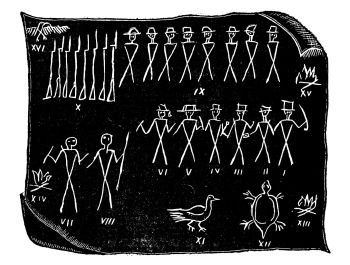
You may like to see such a picture. I will
copy one which Mr. Henry Rowe Schoolcraft
saw while he was living among the Indians.
He was exploring the country with a party of
white men and two Indian guides. They lost
their way during the day and camped out all
night in a deep forest. Before they went away
on the next morning, the Indian guides hung
this picture on a tree:
They thought it might be of use to others
passing there.
Figure I. is the officer who commanded the
party. You may know this because he carries
a sword. II. has a book in his hand. This
shows he is the secretary. III. carries a hammer,
because he is a geologist. IV. and V. are
attendants. VI. is the man who interprets to
the party the words of the Indian guides.
The group of eight figures marked IX. consists
of soldiers. Their muskets stand in the
corner, and are marked X., VII. and VIII. are
the two Indian guides. You will notice that
they are drawn with no hats, which shows at
once that they are not white men. XIII.,
XIV., and XV. represent fires, showing that
each separate group—officers, soldiers, and
Indian guides—had a separate one. Figures
XI. and XII. are the pictures of a prairie-hen
and a tortoise, which were the only game they
had been able to kill that day. The pole to
which the piece of bark was fastened leaned
in the direction which the party was going
to travel. There were three notches in the
pole to show the distance they had already
journeyed.
Yellow Thunder learns to read these bark
pictures, and also to make them himself. He
enjoys this work very much, and can tell a
long story quickly. If I were you, I would
write him a letter and ask him to answer
it in his own way.
This cousin of yours has many things to
keep him busy. I have already told you of
the mats and baskets which he helps his
mother in making. He goes with her to get
the bark which she will use in mending the
wigwam and making many useful things.
He makes barrels out of red elm bark
in which to store groundnuts, corn, and beans.
He cuts ladles out of wood, which the family
will use in eating their soup and hominy. On
the end of each ladle Yellow Thunder carves
the figure of some animal. Perhaps it is a
beaver or a squirrel. He does it very neatly.
Whatever the Indian boy does, he does well.
Yellow Thunder makes sieve-baskets out
of splint. His mother can sift the corn-meal
through one of these as nicely as your mamma
can do it with her wire sieve.
He makes salt-bottles out of corn-husks,
wooden bowls and pitchers, and many other
things for the simple housekeeping. All this
work is done during the cold winter months,
while his mother is making moccasins and kilts
for his father and himself.
When spring opens, she must till the ground
for her corn, and Yellow Thunder can now be
of great help. She will miss him greatly when
he begins to hunt with his father. She will
then have all this work to do alone.
I wish you could see the Indian woman's
garden. It is kept so carefully, I don't believe
you would be able to find a weed. Yellow
Thunder's mother did a queer thing the
first night after it was planted. She stole out
of the wigwam alone into the darkness. She
went behind a bush, and took off all her clothing.
Taking her skirt in her hand, she ran
swiftly around the field of corn, dragging the
garment after her. She believed this would
keep away all insects which might destroy
the crop, and that now it would be sure to
yield well. For what a sad thing it would
be if winter should come with no bread to
eat through the long months!
Yellow Thunder is very fond of his mother's
corn bread. The corn is first hulled by
boiling in ashes and water. The tough skin
will now slip off easily. After being washed
and dried, it is pounded in a mortar into flour.
Then it is sifted and made into cakes about
an inch thick. These cakes are dropped into
boiling water, and are quickly made ready for
our red cousin to eat. Since he was a baby,
he has lived almost entirely on corn bread,
together with the game and fish which his
father brings home.
Yellow Thunder eats something on his corn
cakes which you like as much as he does himself.
It is maple syrup. The sugar which his
mother makes from it is the only kind he has
ever tasted in his life. It is his work to tap
the trees in the spring, and bring home the
jars of sap, which his mother will boil down
to syrup and sugar.
When her husband goes out on a long hunt,
he must take food with him, as it may be a
long time before he gets any game. He cannot
carry the boiled corn cakes, as they would
soon crumble and grow sour. His good wife
roasts some corn until it is quite dry. She
pounds it into powder and mixes it with maple
sugar. It is packed away in Black Cloud's
bearskin pocket. He need not worry about
hunger now, even if he is away from home
many days. He has everything he needs to
keep hunger away.
Yellow Thunder is very proud of the beautiful
canoe he has just finished. He had to
search a long time before he was able to find
a tree which suited him. He wanted to make
his canoe of birch bark because it is much
lighter than the bark of the elm-tree, of which
his father's boat is made.
He needed a strip at least twelve feet long,
because the canoe must be made of one piece.
Two of his boy friends went with him and they
at last obtained a strip which was just right.
They helped him bend it into shape, until the
side pieces came together in two pointed ends.
How do you suppose they fastened the edges
together? They made thread out of the bark
itself, and with this Yellow Thunder sewed
the pieces together.
He next got strips of white ash for the rim
of his canoe, because the wood of that tree
is very elastic. The boat must be made
stronger still with ribs of the ash, and the
work is done.
The canoe is a little beauty. It is so light
that the red boy can lift it out of the water
and carry it with the greatest ease from place
to place. I wish you could see him as he
shoots down the river in his boat. He moves
so rapidly, he will be out of sight in a few
minutes.
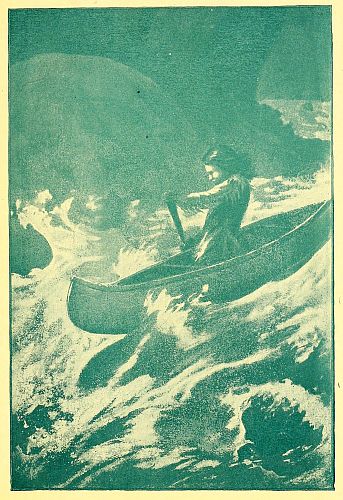 "HE SHOOTS DOWN THE RIVER."
The Indians of the northwestern part of
our country used to make their canoes of
cedar logs. The cedar trees there grow so
large that canoes eighty feet long, and large
enough to hold one hundred men, were made
of a single piece. One was exhibited at the
Columbian Exposition at Chicago. It was
twelve feet wide.
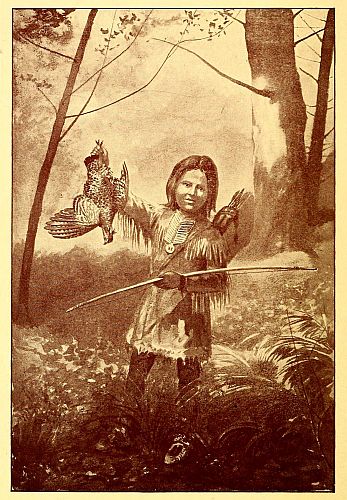
Yellow Thunder has taken his bow and
arrows with him to-day, as he may come upon
a flock of wild ducks. He would like to surprise
his mother with some birds for supper.
He can shoot well. He will not fail to
secure some game. He has practised archery
ever since he was a tiny little fellow. He
would feel himself disgraced for ever if he
should disappoint his father when they go
out to hunt.
I can't tell you how many bows and arrows
he has already made in his lifetime. He has
now grown so large and strong that he uses a
bow three and a half feet long. It has such
a difficult spring that I fear you could not bend
it far, but Yellow Thunder can set his arrow
to the head with ease. But it takes skill and
great strength to do it.
Perhaps you wonder why the arrow is
feathered at the end. This will make it go
straight ahead in the direction in which it is
sent. Sometimes Yellow Thunder uses arrow-heads
cut out of flint. They are dangerous
things, and will kill deer and even men.
Indians have often been known to place poison
on the arrow-heads they used in warfare.
The agonies of the men who were shot by
them were terrible indeed.
Black Cloud has not been to war since Yellow
Thunder was born. There are so few of
the red race now, and the numbers of the
white men are so great, that there is not much
chance of warfare.
However, many stories are told in Black
Cloud's lodge of the good old days when the
war-whoop was commonly heard and the tomahawk
and scalping-knife were in constant use.
Yellow Thunder often passes by the grave of
a great Indian chief, and thinks about that
hero's bravery in battle. This grave is reverently
marked and carefully fenced in. The
boy wishes he had a chance to leave such a
memory.
At the head of the grave there is a stick
with the figure of a wolf carved upon it. It is
the symbol, or "totem" of the chief's tribe.
Below the wolf there are many strokes of red
paint, which Yellow Thunder likes to count,
for each stroke tells of a scalp taken in warfare.
Not many miles up the river above Yellow
Thunder's home, beavers are hunted. Black
Cloud likes to catch them, because their flesh
is good to eat, and the skin is covered with
fine fur. Last winter he allowed his son to
go with himself and a party of men to hunt
for this clever little creature.
Yellow Thunder believes that the beavers
were once people and able to speak like himself.
But they were too wise, so the Great
Spirit took away this power and changed them
into these animals.
I wonder if you have ever seen a beaver's
house. He usually makes it of the young
wood of birch or pine trees, and builds it a
short way out in the river, so that it is
surrounded by water. He shows a great
deal of skill in making his home. It has
a roof shaped like a dome. It reaches
three or four feet above the surface of the
water.
There are generally only two young beavers
in the family. The first year they live with
their parents. The second year they have a
room built next to the main house for their
special use. By this time they are old enough
to help their father and mother get food.
They eat great quantities of roots and wood,
but they like the wood of the birch and
poplar trees best of all.
When the young beavers are two years old,
they leave their old home, and choose a new
place in which to build houses for themselves.
Once in a great while, hunters find beavers
that the Indians call "old bachelors." This
is because they live alone, build no houses,
but make their homes in holes they find,
or dig out for themselves.
The beaver always makes holes in the banks
of the river near his house. The entrance to
such a hole is below the surface of the water,
so that if the beaver is attacked in his house,
he can flee for safety to his hiding-place in the
bank.
Now let us return to Yellow Thunder and
his beaver hunt. It was a bitter cold day and
the river was frozen over in some places, but
that would be so much the better if the hunters
hoped to secure their game. They journeyed
by the riverside for several miles. There
was a heavy fall of snow, but they moved
along quickly with the help of their snowshoes,
till one of the men whispered: "I see
it. Stop!"
Sure enough! A few feet away from them
and from the bank rose the roof of a dam
above the ice. One of the men tried the ice
and found it was thick enough to bear them.
Yellow Thunder was told to remain where
he was on the bank, while the rest of the party
took heavy tools in their hands and went over
to the beavers' house. They quickly destroyed
it. But the beavers? What had become of
them? They did not stay in their house to
have it broken down over their heads. They
were too wise. When the first alarm was
given, they hurried through the water, under
the icy covering of the river, to a hiding-place
in the bank. They had made it long ago to
be ready in case of danger.
Would the Indians succeed in finding them?
Remember that nothing could be seen to show
where the beavers had gone. The hunters
crept along the ice on the edges of the river,
and kept striking it with their mallets. If
they should hear a hollow sound as they struck
the ice, they would know they had discovered
the beavers' hiding-place.
Ah! sure enough! It is Yellow Thunder
himself who says: "Quick, father, come here;
I have found it. I know this is a hole because
of the noise the water makes underneath.
Beavers are breathing there, or it would not
move so quickly."
Black Cloud hurries to the spot and the
ice is cracked in an instant. Yes, his son is
right. A family of beavers is inside the hole.
They must be taken quickly, or they will
escape. There is but one way to do it. The
hunter must reach his hands into the hole and
pull the animals out. Their teeth are very
sharp, and they will do their best to bite him,
but Black Cloud does not think of that. He
is quickly at work and pulls out one after
another.
There are four beavers in all,—two old
ones and their young about two years of age.
They are soon killed and ready to be skinned.
How beautiful and glossy the fur is! It is at
its very best in midwinter.
This has been a fine day's sport, and Black
Cloud has received only one bad bite in his
wrist. It must cause him a good deal of pain,
yet he does not show that he feels any. He
binds up his wrist, and nothing is said about it.
When they reach home Yellow Thunder's
mamma will take the tails of the beavers and
put them in the pot to boil. The Indians
think they are a great delicacy. They will
make a feast, to which Black Cloud has gone
to invite his friends.
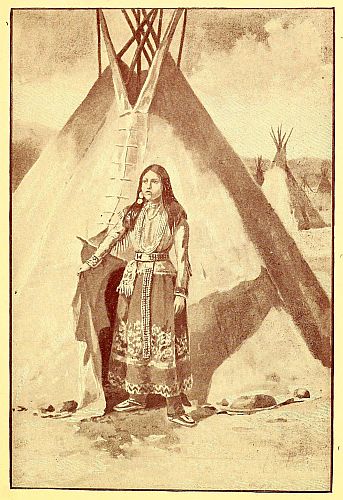 "HIS WIFE IS STANDING IN THE DOOR OF THE WIGWAM."
His wife is standing in the door of the
wigwam, waiting for the return of her husband
and son. She has dressed herself with great
care to-day, and has a really beautiful costume.
Just imagine your mamma in a dress like hers.
She wears long leggings of red cloth reaching
from above her knees down over her moccasins.
They are worked with beads around
the edges.
A long time ago the Indian women made
their clothing of deerskins and embroidered
them with porcupine quills, but nowadays they
buy cloth and beads of the white traders in
exchange for furs.
Over the woman's leggings a long blue skirt
reaches from her waist nearly to the ground.
This, also, is embroidered with beads in a
flower pattern. And last, but not least, she
wears a bright calico overdress which reaches
from her throat to a short distance below her
waist, is also beaded, and is gathered in
at the belt.
I must not forget to mention her glass
necklace, large silver earrings, and the shoulder
ornaments of woven grass and beadwork.
She is a graceful woman, and it is pleasant
to look at her with the sunset light upon her
black hair and eyes.
When her little boy was six years old he
was very sick. His cheeks burned with fever.
He could not lift his head from the mat on
which he lay. His dear mamma scarcely left
his side through the long hours of the day.
She tried to soothe him with low, sweet songs,
but it was in vain. The fever grew stronger
and fiercer. Black Cloud came home at night.
Looking at his little son, he said, "The medicine-man
must come. He will cure him."
The medicine-man was at once sent for.
He is a very important person among the
Indians. He is considered very wise. He is
thought to have wonderful dreams and to get
instruction from the Great Spirit. The red
people think he can cure sickness, unless it is
the will of the Great Spirit for the patient
to die.
The medicine-man always carries a bag of
charms to help him in making his cures. I
do not doubt you would laugh at the collection
in the bag, if you had a chance to
peep in, but no good Indian has a thought
of doing such a thing. It is believed to be
holy, and nothing inside should be looked
upon except as the medicine-man draws it
out to work his cures.
There are medicines, the carved figures
of different animals, the bones of others,
and I don't know how many other queer
things.
Poor little Yellow Thunder looked up with
delight as the great man entered the hut.
He believed that he would soon be well
and ready to work and play once more.
The medicine-man ordered first that a
dog be sacrificed. Next, that the family prepare
a great feast for themselves. These
things would help to satisfy the Great Spirit
and turn away his anger. But this was not
all. He took out a rattle from his bag.
It was made of the dried hoofs of deer
fastened to a stick. He began to sing, beating
time with his rattle, and striking himself
violent blows. The singing grew louder and
louder. The rattle made a fearful din.
How did our poor sick cousin stand it?
I'm sure I can't tell. The little fellow lay
with closed eyes and hardly moved. This
queer doctor at length stopped his song and
got ready to go away. He told Yellow
Thunder's papa that his son would be sure
to get well. And you know already from
my story that our red cousin did get over
his sickness, and grew to be a big, strong
boy. Whether the treatment he got was
any help, or whether Mother Nature did
all the work, I leave you to decide for
yourselves. I have my own opinion in the
matter.
Yellow Thunder is very fond of music.
I wonder what he would think of a church
organ or grand piano. His own instruments
are very simple. He made them himself.
He has a tambourine on which he often plays
in the evening while other children dance.
He cut a section of wood from a hollow tree
and stretched a skin over it, and his instrument
was made.
He also has a flute. It was a little more
work for the red boy to make this. He
carved two pieces of cedar in the shape of
half cylinders, and fastened them together
with fish glue. He next hunted about in the
woods for a snake. After he had found one
and killed it, he took off the skin and stretched
it over the wood. Eight holes were then made
in the instrument, as well as a mouthpiece like
that of a flageolet.
When Yellow Thunder blows upon this
flute, it makes soft and sweet music. It lay
by his side when he was sick with the fever,
and as soon as he was strong enough to sit up,
he amused himself by playing some simple
tunes his mamma had taught him.
Our little friend is very fond of dancing.
His people have so many dances that I shall
have to tell you about some of them.
They believe the Great Spirit gave them
the gift of dancing. They have a Dance
for the Dead, a Medicine Dance, the War-dance,
the Dance of Honour, and I don't
know how many others. In some of them
only men take part, and they have special costumes,
while in others there are none but
women. It seems as though there were
always something happening among the
Indians to give them a good reason to
dance.
The War-dance is only performed in the
evening and always on some important occasion.
Fifteen or twenty men are usually chosen,
one of whom must be the leader. All appear
in costume and wear knee rattles of deer's
hoofs. When the time draws near, the people
gather in the council-house and wait quietly
for the dancers to arrive. A keeper-of-the-faith
rises and makes a short speech
on the meaning of the dance. Hark! The
war-whoop sounds outside! It is heard
again, and still again. The band is drawing
near. Ah! here they come at last.
To our eyes they look hideous in their war-paint
and feathers, but to the crowd of eager
Indians who are waiting, they appear very fair,
indeed.
They march in and form a circle. The war-whoop
is sounded again by the leader, and
answered by the rest of the dancers. At a
given sign, the singers commence the war-song,
the drums beat, and the dancers begin
to move. They come down on their heels
again and again with the greatest force, keeping
time to the beating of the drums. The
knee rattles make noise enough of themselves.
The din is fearful.
The dancers change their positions continually.
At the same moment you will see some
of them with their arms raised as though to
attack, others in the act of drawing the bow,
others again appear to be throwing the tomahawk,
or striking with the war-club. Every
position possible in battle is taken.
Each one is full of the excitement of the
moment. The wild music and dancing last
for about two minutes. For the next two
minutes the dancers walk around in a circle to
the slow beating of the drums. Then there
is another war-whoop, which is followed by
another dance and song.
The dance is often stopped by a tap upon
the ground by one of the audience. He
wishes to make a short speech. It, maybe,
is a funny one to make everybody laugh. Or
perhaps the speaker wishes to inspire the people
to nobler lives or to greater love for their
race. He can say anything he chooses, on
condition that at the end of the speech he
makes a present to one of the dancers. This
speech gives the dancers a chance to rest, and
at the same time keeps the people interested.
The evening is full of entertainment, and
passes only too quickly. I'm afraid, however,
if you were present you would be more
frightened than amused by such wild music
and motions.
Another strange dance which is performed
among Yellow Thunder's people is called the
Dance for the Dead. Only women take part
in it. It is generally given every spring and
fall, in honour of those of the tribe who have
died. The Indians believe that at these times
their dead friends come back and join in the
dance.
The music is sad, and the movements of the
dancers are slow and mournful. This strange
dance is kept up from dusk till the early
morning. It is believed that the dead friends
who have been present must then go back to
the happy hunting-grounds.
I haven't said very much as yet about our
red cousin's playmates and sports. They have
many good times together. They have a great
number of games and many matches of strength
and quickness.
Yellow Thunder loves his ball game as much
as you boys love baseball. He and his friends
often prepare for a game by a special diet and
training for days beforehand. Crowds gather
from neighbouring tribes and villages to see
the sport. Those who take part wear no
clothing except a waist-cloth. The ball is
small and is made of deerskin.
A large open field is chosen, and two gates
are made on opposite sides of it. Each gate
is made by setting two poles three rods apart.
Six or eight boys play on a side and own one
of the gates. The game is won by the side
which first carries the ball through its own gate
a certain number of times. The white men
learned this game from the Indians, and it is
a great favourite with them in some parts of
the country, especially in Canada. It is now
called "lacrosse," but its name in the language
of the Iroquois Indians was O-ta-da-jish-qua-age.
Black Cloud has as much interest as Yellow
Thunder in the game, and often takes part in
it with his friends. You can hardly believe
how excited these red men get when they are
preparing for a set game of ball.
The javelin game is another of the boy's
favourites. It is quite simple, and yet one
needs to be very skilful. Rings about eight
inches across, and javelins five or six feet long
are needed in playing it. While a ring is set
rolling upon the ground by one person, a
player on the other side throws the javelin
and tries to hit it. If he succeed, the ring
is set up as a target, and each one on the
opposite side must throw a javelin and try to
hit it. If he fail, he loses his javelin. Victory
belongs to the side which wins the most
javelins.
The favourite game in winter is that of
snow snakes. The snakes are made of hickory.
They are from five to seven feet long.
The head of the snake is round and pointed
with lead. It is about an inch wide and
slightly turned up. The snake is made so
that it tapers toward the tail, which is only
about half an inch wide.
Yellow Thunder has practised so much that
he can throw his snake with great skill. It
skims along the snow crust like an arrow. He
has won many a game this winter and his
father is very proud of him, because it takes
a great deal of strength and training to be a
good player.
There are many other games played by the
Indian men and boys, but I shall have to tell
you about them some other time.
I hear one of my little friends say: "I
wonder if my red cousin has any holidays.
He certainly cannot understand the glorious
Fourth, and I don't believe he ever heard of
Christmas. How does he get along?"
Why, my dear children, I can't stop to tell
you of all the feasts and festivals to which the
boy is invited. On every possible occasion a
feast is given by some one in the village. For
instance, if the men are very successful in one
of their hunts, and come home laden down
with a good supply of deer, raccoon, or bear,
some one of them prepares a feast.
How you would laugh to see them gathering
at a party. Each one carries his own
wooden bowl and plate, for that is the custom.
I mean that each man does this, for the
women are not expected to sit down. They
only stand around and laugh at the bright
sayings they hear. They must not even join
in the conversation. They seem to think
that they are having a good time, however,
and when the feast is over go back to their
own wigwams, repeating to each other the
good things they have heard. The men remain
to smoke and tell more stories.
Sometimes a feast is prepared on purpose
for the young people. At such a time some
one who is much older than themselves makes
a speech. He encourages his young friends
to be nobler, braver, and better than ever
before. It seems as though Yellow Thunder
could never forget the good words he has
heard at these feasts. Whenever he feels like
showing pain or being ill-tempered, he recollects
them, and they help to keep him calm.
Each season of the year has its special festival.
The longest of all is the new year jubilee,
which lasts seven days. It takes place in
the middle of the winter, about the first of
February. Several days before the beginning
of the celebration, our little cousin gathers with
his people in the council-hall. They must
confess their sins to each other before the
new year opens. Yellow Thunder thinks over
everything which he has done, or not done
as he ought, during the past year. He does
not wish to forget anything.
When the great day arrives, two keepers-of-the-faith
come to his home early in the morning.
It is their duty to go to every other
wigwam, too. They are dressed up in such
a way that Yellow Thunder cannot tell who
they are. They wear bear or buffalo skins
wrapped around their bodies, and fastened
about their heads with wreaths of corn husks.
They also wear wreaths of corn husks around
their arms and ankles. Their faces are painted
in all sorts of queer ways. They carry corn
pounders in their hands.
As they enter the hut, they bow to the
family, and one of them strikes the ground
with his corn pounder. When every one is
silent, he makes a speech, urging them to
clean their house, put everything in order,
and prepare for the festivities of the next few
days. If any one in the family should be
taken sick and die, he urges them not to
mourn till the ceremonies which the Great
Spirit has commanded are over. You can see
from this that the Indian's religion is carried
into everything he does.
After a song of thanksgiving, the keepers-of-the-faith
leave Yellow Thunder's home and
pass on to the next one. In the afternoon
they come back again, and urge the family
to give thanks to the Great Spirit for the
return of the season.
The little boy is most excited on this first
day of the festival by the strangling of the
White Dog. It must be spotless, if possible.
White is the emblem of purity and faith. A
white deer or squirrel, or any other animal
that is pure white, is thought to be sacred to
the Great Spirit.
The dog, which has been carefully kept for
this purpose, is killed with the greatest care.
Otherwise it would not be a fitting sacrifice.
Not a drop of blood must be shed. Not a
bone must be broken. When it is quite dead,
it is trimmed with ribbons and feathers, and
spotted in different places with dabs of red
paint. Then it is hung up by its neck on
a pole. It must stay there till the fifth day.
At that time it will be taken down to be
burned.
On the second day, Yellow Thunder is
dressed up in his very best, and goes out
with his father and mother to make calls on
his neighbours. The keepers-of-the-faith come
to his house three times during the day. They
are now dressed up as warriors with all their
war-paint and feathers. One of them stirs up
the ashes in the fireplace and sprinkles them
about. As he does this, he makes a speech,
thanking the Great Spirit that the family, as
well as himself, have been allowed to live
another year to take part in the festival.
There is another song of thanksgiving and
they go away.
On the third and fourth days small dancing
parties go from home to home. One party
will perform the war-dance, another the feather-dance,
still another the fish-dance, and so on.
This year Yellow Thunder's father let him
join a party of boys to give the war-dance.
They had great fun dressing up as warriors
and decking themselves with paint and feathers.
They went from home to home till they
had danced in every hut in the village. They
were tired enough to sleep soundly when night
came.
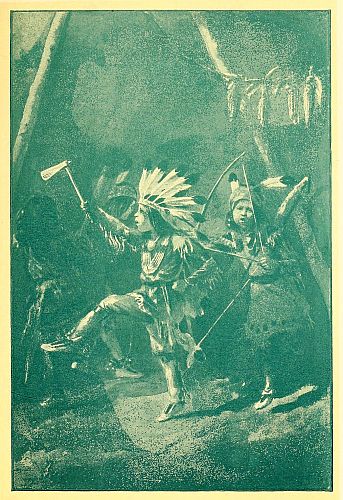 "THEY . . . DANCED IN EVERY HUT IN THE VILLAGE."
I must tell you of some more sport they
had during the festival. Some of the boys
dressed in rags and paint, put on false faces
and formed a "thieving party," as it was
called. They went about collecting things for
a feast. An old woman carrying a large
basket went with them. If the family they
visited made them presents, they handed them
to the old woman and gave a dance in return
for the kindness. But if no presents were
given, they took anything they could seize
without being seen. If they were discovered,
they gave them up, but if not, it was considered
fair for them to carry the things
away for their feast.
Yellow Thunder had great fun hiding the
stolen articles in his clothing. He was not
once caught.
Every night was given up to dancing and
other entertainments. Our Indian cousin got
time for a game of snow snakes nearly every
day.
On the morning of the fifth day the White
Dog was burned. A procession was formed,
the men marching in Indian file. Listen! A
great sound is heard. It is something like the
war-whoop. It is the signal to start. The
dead dog is carried to the altar on a bark litter
in front of the procession. The sacrifice is
laid upon the altar. The fire is kindled. As
the flames rise, a prayer is made to the Great
Spirit for all his good gifts to the Indians.
The trees and the bushes, the sun and the
winds, the moon and the stars,—none are
forgotten that have helped to make the world
better to live in.
As the sacrifice burns upon the altar, Yellow
Thunder listens to the long prayer with
reverence. He believes that the dog's soul is
now rising to the Great Spirit. It will be a
proof to Him of the faith of His people, for
the day itself is the day of faith and trust.
During the rest of the festival there is more
dancing and more feasting, while favourite
games are played by old and young.
"Oh, what a good time it is," thinks Yellow
Thunder; "how happy we all should be
that the new year has come." And what a
tired boy sleeps on Yellow Thunder's mat
when the seven days of this glorious time are
over. The Fourth of July celebration is
slight indeed compared with it.
Yellow Thunder begins already to look forward
to the first festival of the springtime. It
is called by the Indians "Thanks to the
Maple." I don't dare to give it to you in
their own language. You would only scowl
and say, "Oh, dear! what's the use? I can't
pronounce those long words, and I will not
try."
Just as soon as the first warm days arrive,
the red boy's eyes begin to watch the maple-trees.
He wishes to be the first one to discover
that the sap has started and is beginning
to flow. Then hurrah for a holiday for old
and young! Thanks must be given to the
tree that gives so much sweetness to boys
and girls. The Great Spirit must be thanked,
also, for he gave the maple to the poor
Indian.
There must be more feasting and story-telling,
more games and dancing. Tobacco
must be burned as an offering to the Great
Spirit, and prayers must be said. The great
feather dance will be the best thing of all. It
is very graceful and beautiful, and the band of
dancers will wear costumes which belong only
to this dance.
You certainly cannot wonder that Yellow
Thunder enjoys this festival. I don't doubt
you would like to be there, also, as well as at
the green corn feast, and many others.
At these times your red cousin's heart is
full of gladness and gratitude for the great
gifts the Great Spirit has given him.
It is evening time. Let us creep up softly
behind him as he listens to a legend one of
the story-tellers of the tribe is repeating. It
is the tale of the Lone Lightning.
Once upon a time there was a poor little
boy who had no father or mother. He lived
with an uncle who did not love him. This
cruel man made the child do many hard
things and did not give him enough to eat.
Of course the child did not grow properly.
He was very thin and pitiful to look upon.
After awhile the cruel uncle grew ashamed of
the appearance of the boy. Every one could
see that he was ill-treated.
He said to himself, "I will give the child so
much to eat that he will die. I hate him!"
Then he went to his wife and said, "Give the
boy bear's meat, and choose the fat of it
for him."
They kept cramming the child. When
they were stuffing the food down his throat
one day, he almost choked. Poor little fellow!
There was no one who cared for him or
wished him to live. He knew it only too
well.
The first chance he obtained, he ran away.
He did not know where to go, but wandered
around in the forest. Night came. Wild
beasts would now begin to roam about. They
would get him and eat him. The little boy
was afraid when he thought of all this. He
climbed up in a tree as far as he dared,
and went to sleep in a fork of the branches.
He had a wonderful dream. It was an omen
given to him by the spirits.
It seemed as though some one appeared
to him from out of the sky. He spoke to
the orphan, and said, "Poor child, I know all
about your hard life and your cruel uncle.
Come with me."
The boy awoke instantly. There was his
guide. He began to follow him. Higher
and higher he rose up in the air till they were
both in the upper sky. Then his guide placed
twelve arrows in his hands and told him that
there were many bad manitos (spirits) in the
northern sky. He must go forth and try to
shoot them.
He did as he was told. He travelled toward
the north and shot one arrow after another,
vainly trying to kill the manitos. He now
had only one arrow left. As each one had
sped forth from his bow, there had been a
long streak of lightning in the sky. Then all
had grown clear again.
The boy held the last arrow in his hand for
a long time and tried again to discover the
manitos. But these beings are very cunning
if they choose, and they can change their forms
at any moment. They were afraid of the
boy's arrows, for they had magic powers and
had been given him by a good spirit. If the
child aimed them straight, the bad manitos
would be killed.
At length the boy gained courage and shot
his last arrow. He thought it was aimed at
the very heart of the chief of the spirits. But
before it reached him, he had changed himself
into a rock. The head of the arrow pierced
this rock and fastened itself within it.
The manito was enraged. He cried out,
"Your arrows are gone now. You shall be
punished for daring to strike at me." As he
said these words, he changed the boy into the
Lone Lightning, which is still seen in the
northern sky to this day.
THE END.
L. C. Page and Company's
BOOKS FOR YOUNG PEOPLE
THE LITTLE COLONEL BOOKS
(Trade Mark)
By ANNIE FELLOWS JOHNSTON
Each 1 vol., large 12mo, cloth, illustrated, per vol. $1.50
THE LITTLE COLONEL STORIES
(Trade Mark)
Being three "Little Colonel" stories in the Cosy Corner
Series, "The Little Colonel," "Two Little Knights of
Kentucky," and "The Giant Scissors," put into a single
volume.
THE LITTLE COLONEL'S HOUSE PARTY
(Trade Mark)
THE LITTLE COLONEL'S HOLIDAYS
(Trade Mark)
THE LITTLE COLONEL'S HERO
(Trade Mark)
THE LITTLE COLONEL AT BOARDING SCHOOL
(Trade Mark)
THE LITTLE COLONEL IN ARIZONA
(Trade Mark)
THE LITTLE COLONEL'S CHRISTMAS VACATION
(Trade Mark)
THE LITTLE COLONEL, MAID OF HONOUR
(Trade Mark)
THE LITTLE COLONEL'S KNIGHT COMES RIDING
(Trade Mark)
MARY WARE: THE LITTLE COLONEL'S CHUM
(Trade Mark)
These ten volumes, boxed as a ten-volume set. $15.00
THE LITTLE COLONEL
(Trade Mark)
TWO LITTLE KNIGHTS OF KENTUCKY
THE GIANT SCISSORS
BIG BROTHER
Special Holiday Editions
Each one volume, cloth decorative, small quarto, $1.25
New plates, handsomely illustrated with eight full-page
drawings in color, and many marginal sketches.
IN THE DESERT OF WAITING: The Legend of
Camelback Mountain.
THE THREE WEAVERS: A Fairy Tale for
Fathers and Mothers as Well as for Their
Daughters.
KEEPING TRYST
THE LEGEND OF THE BLEEDING HEART
THE RESCUE OF PRINCESS WINSOME: A Fairy Play for Old and Young.
| Each one volume, tall 16mo, cloth decorative | $0.50 |
| Paper boards | .35 |
There has been a constant demand for publication in
separate form of these six stories, which were originally
included in six of the "Little Colonel" books.
JOEL: A BOY OF GALILEE: By Annie Fellows
Johnston. Illustrated by L. J. Bridgman.
New illustrated edition, uniform with the Little Colonel Books, 1 vol., large 12mo, cloth decorative $1.50
A story of the time of Christ, which is one of the author's
best-known books.
THE LITTLE COLONEL GOOD TIMES BOOK
| Uniform in size with the Little Colonel Series | $1.50 |
| Bound in white kid (morocco) and gold | 3.00 |
Cover design and decorations by Amy Carol Rand.
The publishers have had many inquiries from readers
of the Little Colonel books as to where they could obtain
a "Good Times Book" such as Betty kept. Mrs. Johnston,
who has for years kept such a book herself, has gone
enthusiastically into the matter of the material and format
for a similar book for her young readers. Every girl will
want to possess a "Good Times Book."
ASA HOLMES: Or, At the Cross-Roads. A sketch
of Country Life and Country Humor. By Annie
Fellows Johnston.
With a frontispiece by Ernest Fosbery.
Large 16mo, cloth, gilt top $1.00
"'Asa Holmes; or, At the Cross-Roads' is the most
delightful, most sympathetic and wholesome book that
has been published in a long while."—Boston Times.
THE RIVAL CAMPERS: Or, The Adventures of
Henry Burns. By Ruel Perley Smith.
Square 12mo, cloth decorative, illustrated $1.50
A story of a party of typical American lads, courageous,
alert, and athletic, who spend a summer camping on an
island off the Maine coast.
THE RIVAL CAMPERS AFLOAT: Or, The
Prize Yacht Viking. By Ruel Perley Smith.
Square 12mo, cloth decorative, illustrated $1.50
This book is a continuation of the adventures of "The
Rival Campers" on their prize yacht Viking.
By Ruel Perley Smith.
Square 12mo, cloth decorative, illustrated $1.50
"As interesting ashore as when afloat."—The Interior.
JACK HARVEY'S ADVENTURES: Or, The
Rival Campers Among the Oyster Pirates. By
Ruel Perley Smith. Illustrated $1.50
"Just the type of book which is most popular with lads
who are in their early teens."—The Philadelphia Item.
PRISONERS OF FORTUNE: A Tale of the Massachusetts
Bay Colony. By Ruel Perley Smith.
Cloth decorative, with a colored frontispiece $1.50
"There is an atmosphere of old New England in the
book, the humor of the born raconteur about the hero,
who tells his story with the gravity of a preacher, but with
a solemn humor that is irresistible."—Courier-Journal.
FAMOUS CAVALRY LEADERS. By Charles H.
L. Johnston.
Large 12mo. With 24 illustrations $1.50
Biographical sketches, with interesting anecdotes and
reminiscences of the heroes of history who were leaders
of cavalry.
"More of such books should be written, books that
acquaint young readers with historical personages in a
pleasant informal way."—N. Y. Sun.
FAMOUS INDIAN CHIEFS. By Charles H. L.
Johnston.
Large 12mo, illustrated $1.50
In this book Mr. Johnston gives interesting sketches of
the Indian braves who have figured with prominence in
the history of our own land, including Powhatan, the
Indian Cæsar; Massasoit, the friend of the Puritans;
Pontiac, the red Napoleon; Tecumseh, the famous war
chief of the Shawnees; Sitting Bull, the famous war chief
of the Sioux; Geronimo, the renowned Apache Chief, etc.,
etc.
BILLY'S PRINCESS. By Helen Eggleston Haskell.
Cloth decorative, illustrated by Helen McCormick Kennedy $1.25
Billy Lewis was a small boy of energy and ambition, so
when he was left alone and unprotected, he simply started
out to take care of himself.
TENANTS OF THE TREES. By Clarence
Hawkes.
Cloth decorative, illustrated in colors $1.50
"A book which will appeal to all who care for the
hearty, healthy, outdoor life of the country. The illustrations
are particularly attractive."—Boston Herald.
BEAUTIFUL JOE'S PARADISE: Or, The Island
of Brotherly Love. A sequel to "Beautiful Joe."
By Marshall Saunders, author of "Beautiful Joe."
One vol., library 12mo, cloth, illustrated $1.50
"This book revives the spirit of 'Beautiful Joe' capitally.
It is fairly riotous with fun, and is about as unusual
as anything in the animal book line that has seen the light."—Philadelphia
Item.
'TILDA JANE. By Marshall Saunders.
One vol., 12mo, fully illustrated, cloth decorative, $1.50
"I cannot think of any better book for children than
this. I commend it unreservedly."—Cyrus Townsend
Brady.
'TILDA JANE'S ORPHANS. A sequel to 'Tilda
Jane. By Marshall Saunders.
One vol., 12mo, fully illustrated, cloth decorative, $1.50
'Tilda Jane is the same original, delightful girl, and as
fond of her animal pets as ever.
THE STORY OF THE GRAVELEYS. By Marshall
Saunders, author of "Beautiful Joe's Paradise,"
"'Tilda Jane," etc.
Library 12mo, cloth decorative. Illustrated by E. B. Barry $1.50
Here we have the haps and mishaps, the trials and
triumphs, of a delightful New England family, of whose
devotion and sturdiness it will do the reader good to hear.
BORN TO THE BLUE. By Florence Kimball
Russel.
12mo, cloth decorative, illustrated $1.25
The atmosphere of army life on the plains breathes on
every page of this delightful tale. The boy is the son of a
captain of U. S. cavalry stationed at a frontier post in the
days when our regulars earned the gratitude of a nation.
IN WEST POINT GRAY
By Florence Kimball Russel.
12mo, cloth decorative, illustrated $1.50
"Singularly enough one of the best books of the year
for boys is written by a woman and deals with life at West
Point. The presentment of life in the famous military
academy whence so many heroes have graduated is realistic
and enjoyable."—New York Sun.
FROM CHEVRONS TO SHOULDER STRAPS
By Florence Kimball Russel.
12mo, cloth, illustrated, decorative $1.50
West Point again forms the background of a new volume
in this popular series, and relates the experience of Jack
Stirling during his junior and senior years.
THE SANDMAN: HIS FARM STORIES
By William J. Hopkins. With fifty illustrations by
Ada Clendenin Williamson.
Large 12mo, decorative cover $1.50
"An amusing, original book, written for the benefit of
very small children. It should be one of the most popular
of the year's books for reading to small children."—Buffalo
Express.
THE SANDMAN: MORE FARM STORIES
By William J. Hopkins.
Large 12mo, decorative cover, fully illustrated $1.50
Mr. Hopkins's first essay at bedtime stories met with
such approval that this second book of "Sandman" tales
was issued for scores of eager children. Life on the farm,
and out-of-doors, is portrayed in his inimitable manner.
THE SANDMAN: HIS SHIP STORIES
By William J. Hopkins, author of "The Sandman:
His Farm Stories," etc.
Large 12mo, decorative cover, fully illustrated $1.50
"Children call for these stories over and over again."—Chicago
Evening Post.
THE SANDMAN, HIS SEA STORIES
By William J. Hopkins.
Large 12mo, decorative cover, fully illustrated $1.50
Each year adds to the popularity of this unique series
of stories to be read to the little ones at bed time and at
other times.
THE DOCTOR'S LITTLE GIRL
By Marion Ames Taggart, author of "Pussy-Cat
Town," etc.
One vol., library, 12mo, illustrated $1.50
A thoroughly enjoyable tale of a little girl and her comrade
father, written in a delightful vein of sympathetic
comprehension of the child's point of view.
SWEET NANCY
The Further Adventures of the Doctor's Little
Girl. By Marion Ames Taggart.
One vol., library, 12mo, illustrated $1.50
In the new book, the author tells how Nancy becomes
in fact "the doctor's assistant," and continues to shed
happiness around her.
THE CHRISTMAS-MAKERS' CLUB
By Edith A. Sawyer.
12mo, cloth decorative, illustrated $1.50
A delightful story for girls, full of the real spirit of
Christmas. It abounds in merrymaking and the right
kind of fun.
CARLOTA
A Story of the San Gabriel Mission. By Frances
Margaret Fox.
Square 12mo, cloth decorative, illustrated and decorated in colors by Ethelind Ridgway $1.00
"It is a pleasure to recommend this little story as an
entertaining contribution to juvenile literature."—The
New York Sun.
THE SEVEN CHRISTMAS CANDLES
By Frances Margaret Fox.
Square 12mo, cloth decorative, illustrated and decorated in colors by Ethelind Ridgway $1.00
Miss Fox's new book deals with the fortunes of the delightful
Mulvaney children.
PUSSY-CAT TOWN
By Marion Ames Taggart.
Small quarto, cloth decorative, illustrated and decorated in colors $1.00
"Anything more interesting than the doings of the cats
in this story, their humor, their wisdom, their patriotism,
would be hard to imagine."—Chicago Post.
THE ROSES OF SAINT ELIZABETH
By Jane Scott Woodruff.
Small quarto, cloth decorative, illustrated and decorated in colors by Adelaide Everhart $1.00
This is a charming little story of a child whose father was
caretaker of the great castle of the Wartburg, where Saint
Elizabeth once had her home.
GABRIEL AND THE HOUR BOOK
By Evaleen Stein.
Small quarto, cloth decorative, illustrated and decorated in colors by Adelaide Everhart $1.00
Gabriel was a loving, patient, little French lad, who
assisted the monks in the long ago days, when all the books
were written and illuminated by hand, in the monasteries.
THE ENCHANTED AUTOMOBILE
Translated from the French by Mary J. Safford
Small quarto, cloth decorative, illustrated and decorated in colors by Edna M. Sawyer $1.00
"An up-to-date French fairy-tale which fairly radiates
the spirit of the hour,—unceasing diligence."—Chicago
Record-Herald.
O-HEART-SAN
The Story of a Japanese Girl. By Helen Eggleston
Haskell.
Small quarto, cloth decorative, illustrated and decorated in colors by Frank P. Fairbanks $1.00
"The story comes straight from the heart of Japan.
The shadow of Fujiyama lies across it and from every
page breathes the fragrance of tea leaves, cherry blossoms
and chrysanthemums."—The Chicago Inter-Ocean.
THE YOUNG SECTION-HAND: Or, The Adventures
of Allan West. By Burton E. Stevenson.
Square 12mo, cloth decorative, illustrated $1.50
Mr. Stevenson's hero is a manly lad of sixteen, who is
given a chance as a section-hand on a big Western railroad,
and whose experiences are as real as they are thrilling.
THE YOUNG TRAIN DISPATCHER. By Burton
E. Stevenson.
Square 12mo, cloth decorative, illustrated $1.50
"A better book for boys has never left an American
press."—Springfield Union.
THE YOUNG TRAIN MASTER. By Burton E.
Stevenson.
Square 12mo, cloth decorative, illustrated $1.50
"Nothing better in the way of a book of adventure for
boys in which the actualities of life are set forth in a practical
way could be devised or written."—Boston Herald.
CAPTAIN JACK LORIMER. By Winn Standish.
Square 12mo, cloth decorative, illustrated $1.50
Jack is a fine example of the all-around American high-school
boy.
JACK LORIMER'S CHAMPIONS: Or, Sports on
Land and Lake. By Winn Standish.
Square 12mo, cloth decorative, illustrated $1.50
"It is exactly the sort of book to give a boy interested
in athletics, for it shows him what it means to always
'play fair.'"—Chicago Tribune.
JACK LORIMER'S HOLIDAYS: Or, Millvale
High in Camp. By Winn Standish.
Illustrated $1.50
Full of just the kind of fun, sports and adventure to
excite the healthy minded youngster to emulation.
JACK LORIMER'S SUBSTITUTE: Or, The Acting
Captain of the Team. By Winn Standish.
Illustrated $1.50
On the sporting side, this book takes up football, wrestling,
tobogganing, but it is more of a school story perhaps
than any of its predecessors.
CAPTAIN JINKS: The Autobiography of a Shetland
Pony. By Frances Hodges White.
Cloth decorative, illustrated $1.50
The story of Captain Jinks and his faithful dog friend
Billy, their quaint conversations and their exciting
adventures, will be eagerly read by thousands of boys and
girls. The story is beautifully written and will take its
place alongside of "Black Beauty" and "Beautiful Joe."
THE RED FEATHERS. By Theodore Roberts.
Cloth decorative, illustrated $1.50
"The Red Feathers" tells of the remarkable adventures
of an Indian boy who lived in the Stone Age, many years
ago, when the world was young.
FLYING PLOVER. By Theodore Roberts.
Cloth decorative. Illustrated by Charles Livingston Bull $1.00
Squat-By-The-Fire is a very old and wise Indian who
lives alone with her grandson, "Flying Plover," to whom
she tells the stories each evening.
THE WRECK OF THE OCEAN QUEEN. By
James Otis, author of "Larry Hudson's Ambition," etc.
Cloth decorative, illustrated $1.50
"A stirring story of wreck and mutiny, which boys will
find especially absorbing. The many young admirers of
James Otis will not let this book escape them, for it fully
equals its many predecessors in excitement and sustained
interest."—Chicago Evening Post.
LITTLE WHITE INDIANS. By Fannie E. Ostrander.
Cloth decorative, illustrated $1.25
"A bright, interesting story which will appeal strongly
to the 'make-believe' instinct in children, and will
give them a healthy, active interest in 'the simple life.'"
MARCHING WITH MORGAN. How Donald
Lovell Became a Soldier of the Revolution.
By John L. Veasy.