IT is hard to know the child’s own earliest recollections from the
things it has been told of itself by those with whom its life began.
They remember for it the past which it afterward seems to remember for
itself; the wavering outline of its nature is shadowed against the
background of family, and from this it imagines an individual existence
which has not yet begun. The events then have the quality of things
dreamt, not lived, and they remain of that impalpable and elusive
quality in all the after years.
Of the facts which I must believe from the witness of others, is the
fact that I was born on the 1st of March, 1837, at Martin’s Ferry,
Belmont County, Ohio. My father’s name was William Cooper Howells, and
my mother’s was Mary Dean; they were married six years before my birth,
and I was the second child in their family of eight. On my father’s side
my people were wholly Welsh, except his English grandmother, and on my
mother’s side wholly German, except her Irish father, of whom it is
mainly known that he knew how to win my grandmother Elizabeth Dock away
from her very loving family, where they dwelt in great
Pennsylvania-German comfort and prosperity on their farm near
Harrisburg, to share with him the hardships of the wild country over the
westward mountains. She was the favorite of her brothers and sisters,
and the best-beloved of her mother, perhaps because she was the
youngest; there is a shadowy legend that she went one evening to milk
the cows, and did not return from following after her husband; but I
cannot associate this romantic story with the ageing grandmother whom I
tenderly loved when a child, and whom I still fondly remember. She spoke
with a strong German accent, and she had her Luther Bible, for she never
read English. Sometimes she came to visit my homesick mother after we
went to live in southern Ohio; once I went with my mother to visit her
in the little town where I was born, and of that visit I have the
remembrance of her stopping me on the stairs, one morning when I had
been out, and asking me in her German idiom and accent, “What fur a tay
is it, child?”
I can reasonably suppose that it is because of the mixture of Welsh,
German, and Irish in me that I feel myself so typically American, and
that I am of the imaginative temperament which has enabled me all the
conscious years of my life to see reality more iridescent and beautiful,
or more lurid and terrible than any make-believe about reality. Among my
father’s people the first who left Wales was his great-grandfather. He
established himself in London as a clock and watch maker, and I like to
believe that it is his name which my tall clock, paneled in the lovely
chinoiserie of Queen Anne’s time, bears graven on its dial. Two sons
followed him, and wrought at the same art, then almost a fine art, and
one of them married in London and took his English wife back with him to
Wales. His people were, so far as my actual knowledge goes, middle-class
Welsh, but the family is of such a remote antiquity as in its present
dotage not to know what part of Wales it came from. As to our lineage a
Welsh clergyman, a few years ago, noting the identity of name, invited
me to the fond conjecture of descent from Hywel Dda, or Howel the Good,
who became king of Wales about the time of Alfred the Great. He codified
the laws or rather the customs of his realm, and produced one of the
most interesting books I have read, and I have finally preferred him as
an ancestor because he was the first literary man of our name. There was
a time when I leaned toward the delightful James Howell, who wrote the
Familiar Letters and many books in verse and prose, and was of several
shades of politics in the difficult days of Charles and Oliver; but I
was forced to relinquish him because he was never married. My father,
for his part, when once questioned as to our origin, answered that so
far as he could make out we derived from a blacksmith, whom he
considered a good sort of ancestor, but he could not name him, and he
must have been, whatever his merit, a person of extreme obscurity.
There is no record of the time when my great-grandfather with his
brothers went to London and fixed there as watchmakers. My tall clock,
which bears our name on its dial, has no date, and I can only imagine
their London epoch to have begun about the middle of the eighteenth
century. Being Welsh, they were no doubt musical, and I like to cherish
the tradition of singing and playing women in our line, and a somehow
cousinship with the famous Parepa. But this is very uncertain; what is
certain is that when my great-grandfather went back to Wales he fixed
himself in the little town of Hay, where he began the manufacture of
Welsh flannels, a fabric still esteemed for its many virtues, and
greatly prospered. When I visited Hay in 1883 (my father always call it,
after the old fashion, The Hay, which was the right version of its
Norman name of La Haye), three of his mills were yet standing, and one
of them was working, very modestly, on the sloping bank of the lovely
river Wye. Another had sunk to be a stable, but the third, in the spirit
of our New World lives, had become a bookstore and printing-office, a
well-preserved stone edifice of four or five stories, such as there was
not the like of, probably, in the whole of Wales when Hywel Dda was
king. My great-grandfather was apparently an excellent business man, but
I am afraid I must own (reluctantly, with my Celtic prejudice) that
literature, or the love of it, came into our family with the English
girl whom he married in London. She was, at least, a reader of the
fiction of the day, if I may judge from the high-colored style of the
now pathetically faded letter which she wrote to reproach a daughter who
had made a runaway match and fled to America. So many people then used
to make runaway matches; but when very late in the lives of these
eloping lovers I once saw them, an old man and woman, at our house in
Columbus, they hardly looked their youthful adventure, even to the fancy
of a boy beginning to unrealize life. The reader may care to learn that
they were the ancestors of Vaughan Kester, the very gifted young
novelist, who came into popular recognition almost in the hour of his
most untimely death, and of his brother Paul Kester, the playwright.
My great-grandfather became “a Friend by Convincement,” as the Quakers
called the Friends not born in their Society; but I do not know whether
it was before or after his convincement that he sailed to Philadelphia
with a stock of his Welsh flannels, which he sold to such advantage
that a dramatic family tradition represents him wheeling the proceeds in
a barrel of silver down the street to the vessel which brought him and
which took him away. That was in the time of Washington’s second
Presidency, and Washington strongly advised his staying in the country
and setting up his manufacture here; but he was prospering in Wales, and
why should he come to America even at the suggestion of Washington? It
is another family tradition that he complied so far as to purchase a
vast acreage of land on the Potomac, including the site of our present
capital, as some of his descendants in each generation have believed,
without the means of expropriating the nation from its unlawful
holdings. This would have been the more difficult as he never took a
deed of his land, and he certainly never came back to America; yet he
seems always to have been haunted by the allurement of it which my
grandfather felt so potently that after twice visiting the country he
came over a third time and cast his lot here.
He was already married, when with his young wife and my father a year
old he sailed from London in 1808. Perhaps because they were chased by a
French privateer, they speedily arrived in Boston after a voyage of only
twenty-one days. In the memoir which my father wrote for his family, and
which was published after his death, he tells that my grandmother formed
the highest opinion of Boston, mainly, he surmises, from the very
intelligent behavior of the young ladies in making a pet of her baby at
the boarding-house where she stayed while her husband began going about
wherever people wished his skill in setting up woolen-mills. The young
ladies taught her little one to walk; and many years afterward, say
fifty, when I saw her for the last time in a village of northwestern
Ohio, she said “the Bostonians were very nice people,” so faithfully had
she cherished, through a thousand vicissitudes, the kind memory of that
first sojourn in America.
I do not think she quite realized the pitch of greatness at which I had
arrived in writing for the Atlantic Monthly, the renowned periodical
then recently founded in Boston, or the fame of the poets whom I had met
there the year before. I suspect that she was never of the literary
taste of my English great-grandmother; but her father had been a
school-teacher, and she had been carefully educated by the uncle and
aunt to whom she was left at her parents’ early death. They were
Friends, but she never formally joined the Society, though worshiping
with them; she was, like her husband, middle-class Welsh, and as long as
they lived they both misplaced their aspirates. If I add that her maiden
name was Thomas, and that her father’s name was John Thomas, I think I
have sufficiently attested her pure Cymric origin. So far as I know
there was no mixture of Saxon blood on her side; but her people, like
most of the border Welsh, spoke the languages of both races; and very
late in my father’s life, he mentioned casually, as old people will
mention interesting things, that he remembered his father and mother
speaking Welsh together. Of the two she remained the fonder of their
native country, and in that last visit I paid her she said, after half a
century of exile, “We do so and so at home, and you do so and so here.”
I can see her now, the gentlest of little Quaker ladies, with her white
fichu crossed on her breast; and I hesitate attributing to her my
immemorial knowledge that the Welsh were never conquered, but were
tricked into union with the English by having one of their princes born,
as it were surreptitiously, in Wales; it must have been my father who
told me this and amused himself with my childish race-pride in the fact.
She gave me an illustrated Tour of Wales, having among its steel
engravings the picture of a Norman castle where, by favor of a cousin
who was the housekeeper, she had slept one night when a girl; but in
America she had slept oftener in log cabins, which my grandfather
satisfied his devoted unworldliness in making his earthly tabernacles.
She herself was not, I think, a devout person; she had her spiritual
life in his, and followed his varying fortunes, from richer to poorer,
with a tacit adherence to what he believed, whether the mild doctrine of
Quakerism or the fervid Methodism for which he never quite relinquished
it.
He seems to have come to America with money enough to lose a good deal
in his removals from Boston to Poughkeepsie, from Poughkeepsie to New
York City, from New York to Virginia, and from Virginia to eastern Ohio,
where he ended in such adversity on his farm that he was glad to accept
the charge of a woolen-mill in Steubenville. He knew the business
thoroughly and he had set up mills for others in his various sojourns,
following the line of least resistance among the Quaker settlements
opened to him by the letters he had brought from Wales. He even went to
the new capital, Washington, in a hope of manufacturing in Virginia held
out to him by a nephew of President Madison, but it failed him to his
heavy cost; and in Ohio, his farming experiments, which he renewed in a
few years on giving up that mill at Steubenville, were alike disastrous.
After more than enough of them he rested for a while in Wheeling, West
Virginia, where my father met my mother, and they were married.
They then continued the family wanderings in his own search for the
chance of earning a living in what seems to have been a very grudging
country, even to industry so willing as his. He had now become a
printer, and not that only, but a publisher, for he had already begun
and ended the issue of a monthly magazine called The Gleaner, made up,
as its name implied, chiefly of selections; his sister helped him as
editor, and some old bound volumes of its few numbers show their joint
work to have been done with good taste in the preferences of their day.
He married upon the expectation of affluence from the publication of a
work on The Rise, Progress and Downfall of Aristocracy, which almost
immediately preceded the ruin of the enthusiastic author and of my
father with him, if he indeed could have experienced further loss in his
entire want of money. He did not lose heart, and he was presently living
contentedly on three hundred dollars a year as foreman of a newspaper
office in St. Clairville, Ohio. But his health gave way, and a little
later, for the sake of the outdoor employment, he took up the trade of
house-painter; and he was working at this in Wheeling when my
grandfather Dean suggested his buying a lot and building a house in
Martin’s Ferry, just across the Ohio River. The lot must have been
bought on credit, and he built mainly with his own capable hands a small
brick house of one story and two rooms with a lean-to. In this house I
was born, and my father and mother were very happy there; they never
owned another house until their children helped them work and pay for it
a quarter of a century afterward, though throughout this long time they
made us a home inexpressibly dear to me still.
My father now began to read medicine, but during the course of a
winter’s lectures at Cincinnati (where he worked as a printer
meanwhile), his health again gave way and he returned to Martin’s Ferry.
When I was three years old, my grandmother Dean’s eldest brother,
William Dock, came to visit her. He was the beloved patriarch of a
family which I am glad to claim my kindred and was a best type of his
Pennsylvania-German race. He had prospered on through a life of kindness
and good deeds; he was so rich that he had driven in his own

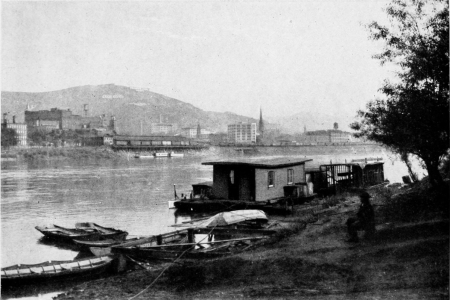 The Ohio River at Wheeling, West Virginia. Mr. Howells’s
father worked in Wheeling before he moved across the river to Martin’s
Ferry
The Ohio River at Wheeling, West Virginia. Mr. Howells’s
father worked in Wheeling before he moved across the river to Martin’s
Ferry
carriage from Harrisburg, over the mountains, and he now asked my father
to drive with him across the state of Ohio. When they arrived in Dayton,
my father went on by canal to Hamilton, where he found friends to help
him buy the Whig newspaper which he had only just paid for when he sold
it eight years later.
Of the first three years of my life which preceded this removal there is
very little that I can honestly claim to remember. The things that I
seem to remember are seeing from the window of our little house, when I
woke one morning, a peach-tree in bloom; and again seeing from the
steamboat which was carrying our family to Cincinnati, a man drowning in
the river. But these visions, both of them very distinct, might very
well have been the effect of hearing the things spoken of by my elders,
though I am surest of the peach-tree in bloom as an authentic memory.
This time, so happy for my father and mother, was scarcely less happy
because of its uncertainties. My young aunts lived with their now
widowed mother not far from us; as the latest comer, I was in much
request among them, of course; and my father was hardly less in favor
with the whole family from his acceptable habit of finding a joke in
everything. He supplied the place of son to my grandmother in the
absence of my young uncles, then away most of their time on the river
which they followed from the humblest beginnings on keel-boats to the
proudest endings as pilots and captains and owners of steamboats. In
those early days when they returned from the river they brought their
earnings to their mother in gold coins, which they called Yellow Boys,
and which she kept in a bowl in the cupboard, where I seem so vividly
to have seen them, that I cannot quite believe I did not. These good
sons were all Democrats except the youngest, but they finally became of
my father’s anti-slavery Whig faith in politics, and I believe they were
as glad to have their home in a free state as my father’s family, who
had now left Wheeling, and were settled in southwestern Ohio.
There were not many slaves in Wheeling, but it was a sort of entrepôt
where the negroes were collected and embarked for the plantations down
the river, in their doom to the death-in-life of the far South. My
grandfather Howells had, in the anti-slavery tradition of his
motherland, made himself so little desired among his Virginian
fellow-citizens that I have heard his removal from Wheeling was
distinctly favored by public sentiment; and afterward, on the farm he
bought in Ohio, his fences and corn-cribs suffered from the pro-slavery
convictions of his neighbors. But he was dwelling in safety and
prosperity among the drugs and books which were his merchandise in the
store where I began to remember him in my earliest days at Hamilton. He
seemed to me a very old man, and I noticed with the keen observance of a
child how the muscles sagged at the sides of his chin and how his under
lip, which I did not know I had inherited from him, projected. His
clothes, which had long ceased to be drab in color, were of a Quaker
formality in cut; his black hat followed this world’s fashion in color,
but was broad in the brim and very low-crowned, which added somehow in
my young sense to the reproving sadness of his presence. He had black
Welsh eyes and was of the low stature of his race; my grandmother was
blue-eyed; she was little, too; but my aunt, their only surviving
daughter, with his black eyes, was among their taller children. She was
born several years after their settlement in America, but she loyally
misused her aspirates as they did, and, never marrying, was of a
life-long devotion to them. They first lived over the drug-store, after
the fashion of shopkeepers in England; I am aware of my grandfather soon
afterward having a pretty house and a large garden quite away from the
store, but he always lived more simply than his means obliged. Amidst
the rude experiences of their backwoods years, the family had continued
gentle in their thoughts and tastes, though my grandfather shared with
poetry his passion for religion, and in my later boyhood when I had
begun to print my verses, he wrote me a letter solemnly praising them,
but adjuring me to devote my gifts to the service of my Maker, which I
had so little notion of doing in a selfish ideal of my own glory.
Most of his father’s fortune had somehow gone to other sons, but,
whether rich or poor, their generation seemed to be of a like
religiosity. One of them lived in worldly state at Bristol before coming
to America, and was probably of a piety not so insupportable as I found
him in the memoir which he wrote of his second wife, when I came to read
it the other day. Him I never saw, but from time to time there was one
or other of his many sons employed in my grandfather’s store, whom I
remember blithe spirits, disposed to seize whatever chance of a joke
life offered them, such as selling Young’s Night Thoughts to a
customer who had whispered his wish for an improper book. Some of my
father’s younger brothers were of a like cheerfulness with these lively
cousins, and of the same aptness for laughter. One was a physician,
another a dentist, another in a neighboring town a druggist, another yet
a speculative adventurer in the regions to the southward: he came back
from his commercial forays once with so many half-dollars that when
spread out they covered the whole surface of our dining-table; but I am
quite unable to report what negotiation they were the spoil of. There
was a far cousin who was a painter, and left (possibly as a pledge of
indebtedness) with my dentist uncle after a sojourn among us a picture
which I early prized as a masterpiece, and still remember as the
charming head of a girl shadowed by the fan she held over it. I never
saw the painter, but I recall, from my father’s singing them, the lines
of a “doleful ballad” which he left behind him as well as the picture:
A thief will steal from you all that you havye,
But an unfaithful lovyer will bring you to your grave.
The uncle who was a physician, when he left off the practice of medicine
about his eightieth year, took up the art of sculpture; he may have
always had a taste for it, and his knowledge of anatomy would have
helped qualify him for it. He modeled from photographs a head of my
father admirably like and full of character, the really extraordinary
witness of a gift latent till then through a long life devoted to other
things.
We children had our preference among these Howells uncles, but we did
not care for any of them so much as for our Dean uncles, who now and
then found their way up to Hamilton from Cincinnati when their
steamboats lay there in their trips from Pittsburg. They were all very
jovial; and one of the younger among them could play the violin, not
less acceptably because he played by ear and not by art. Of the youngest
and best-loved I am lastingly aware in his coming late one night and of
my creeping down-stairs from my sleep to sit in his lap and hear his
talk with my father and mother, while his bursts of laughter agreeably
shook my small person. I dare say these uncles used to bring us gifts
from that steamboating world of theirs which seemed to us of a splendor
not less than what I should now call oriental when we sometimes visited
them at Cincinnati, and came away bulging in every pocket with the more
portable of the dainties we had been feasting upon. In the most signal
of these visits, as I once sat between my father and my Uncle William,
for whom I was named, on the hurricane roof of his boat, he took a
silver half-dollar from his pocket and put it warm in my hand, with a
quizzical look into my eyes. The sight of such unexampled riches stopped
my breath for the moment, but I made out to ask, “Is it for me?” and he
nodded his head smilingly up and down; then, for my experience had
hitherto been of fippenny-bits yielded by my father after long
reasoning, I asked, “Is it good?” and remained puzzled to know why they
laughed so together; it must have been years before I understood.
These uncles had grown up in a slave state, and they thought, without
thinking, that slavery must be right; but once when an abolition
lecturer was denied public hearing at Martin’s Ferry, they said he
should speak in their mother’s house; and there, much unaware, I heard
my first and last abolition lecture, barely escaping with my life, for
one of the objections urged by the mob outside was a stone hurled
through the window, where my mother sat with me in her arms. At my Uncle
William’s house in the years after the Civil War, my father and he began
talking of old times, and he told how, when a boy on a keel-boat, tied
up to a Mississippi shore, he had seen an overseer steal upon a black
girl loitering at her work, and wind his blacksnake-whip round her body,
naked except for the one cotton garment she wore. “When I heard that
colored female screech,” he said, and the old-fashioned word female,
used for compassionate respectfulness, remains with me, “and saw her
jump, I knew that there must be something wrong in slavery.” Perhaps the
sense of this had been in his mind when he determined with his brothers
that the abolition lecturer should be heard in their mother’s house.
She sometimes came to visit us in Hamilton, to break the homesick
separations from her which my mother suffered through for so many years,
and her visits were times of high holiday for us children. I should be
interested now to know what she and my Welsh grandmother made of each
other, but I believe they were good friends, though probably not
mutually very intelligible. My mother’s young sisters, who also came on
welcome visits, were always joking with my father and helping my mother
at her work; but I cannot suppose that there was much common ground
between them and my grandfather’s family except in their common
Methodism. For me, I adored them; and if the truth must be told, though
I had every reason to love my Welsh grandmother, I had a peculiar
tenderness for my Pennsylvania-Dutch grandmother, with her German accent
and her caressing ways. My grandfather, indeed, could have recognized no
difference among heirs of equal complicity in Adam’s sin; and in the
situation such as it was, I lived blissfully unborn to all things of
life outside of my home. I can recur to the time only as a dream of love
and loving, and though I came out of it no longer a little child, but a
boy struggling tooth and nail for my place among other boys, I must
still recur to the ten or eleven years passed in Hamilton as the
gladdest of all my years. They may have been even gladder than they now
seem, because the incidents which embody happiness had then the novelty
which such incidents lose from their recurrence; while the facts of
unhappiness, no matter how often they repeat themselves, seem throughout
life an unprecedented experience and impress themselves as vividly the
last time as the first. I recall some occasions of grief and shame in
that far past with unfailing distinctness, but the long spaces
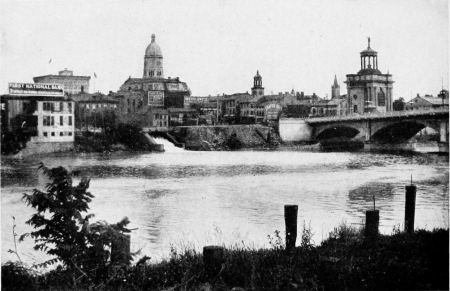 Hamilton, Ohio, the “Boy’s Town” of Mr. Howells’s
youth
Hamilton, Ohio, the “Boy’s Town” of Mr. Howells’s
youth
of blissful living which they interrupted hold few or no records which I
can allege in proof of my belief that I was then, above every other
when,
Joyful and free from blame.
Throughout those years at Hamilton I think of my father as absorbed in
the mechanical and intellectual work of his newspaper. My earliest sense
of him relates him as much to the types and the press as to the table
where he wrote his editorials amidst the talk of the printers, or of the
politicians who came to discuss public affairs with him. From a quaint
pride, he did not like his printer’s craft to be called a trade; he
contended that it was a profession; he was interested in it, as the
expression of his taste, and the exercise of his ingenuity and
invention, and he could supply many deficiencies in its means and
processes. He cut fonts of large type for job-work out of apple-wood in
default of box or olive; he even made the graver’s tools for carving the
letters. Nothing pleased him better than to contrive a thing out of
something it was not meant for, as making a penknife blade out of an old
razor, or the like. He could do almost anything with his ready hand and
his ingenious brain, while I have never been able to do anything with
mine but write a few score books. But as for the printer’s craft with
me, it was simply my joy and pride from the first things I knew of it. I
know when I could not read, for I recall supplying the text from my
imagination for the pictures I found in books, but I do not know when I
could not set type. My first attempt at literature was not written, but
put up in type, and printed off by me. My father praised it, and this
made me so proud that I showed it to one of those eminent Whig
politicians always haunting the office. He made no comment on it, but
asked me if I could spell baker. I spelled the word simple-heartedly,
and it was years before I realized that he meant a hurt to my poor
little childish vanity.
Very soon I could set type very well, and at ten years and onward till
journalism became my university, the printing-office was mainly my
school. Of course, like every sort of work with a boy, the work became
irksome to me, and I would gladly have escaped from it to every sort of
play, but it never ceased to have the charm it first had. Every part of
the trade became familiar to me, and if I had not been so little I could
at once have worked not only at case, but at press, as my brother did. I
had my favorites among the printers, who knew me as the Old Man, because
of the habitual gravity which was apt to be broken in me by bursts of
wild hilarity; but I am not sure whether I liked better the conscience
of the young journeyman who wished to hold me in the leash of his moral
convictions, or the nature of my companion in laughter which seemed to
have selected for him the fit name of Sim Haggett. This merrymaker was
married, but so very presently in our acquaintance was widowed, that I
can scarcely put any space between his mourning for his loss and his
rejoicing in the first joke that followed it. There were three or four
of the journeymen, with an apprentice, to do the work now reduced by
many facilities to the competence of one or two. Some of them slept in a
den opening from the printing-office, where I envied them the wild
freedom unhampered by the conventions of sweeping, dusting, or
bed-making; it was next to camping out.
The range of that young experience of mine transcends telling, but the
bizarre mixture was pure delight to the boy I was, already beginning to
take the impress of events and characters. Though I loved the art of
printing so much, though my pride even more than my love was taken with
it, as something beyond other boys, yet I loved my schools too. In their
succession there seem to have been a good many of them, with a variety
of teachers, whom I tried to make like me because I liked them. I was
gifted in spelling, geography, and reading, but arithmetic was not for
me. I could declaim long passages from the speeches of Corwin against
the Mexican War, and of Chatham against the American War, and poems from
our school readers, or from Campbell or Moore or Byron; but at the
blackboard I was dumb. I bore fairly well the mockeries of boys, boldly
bad, who played upon a certain simplicity of soul in me, and pretended,
for instance, when I came out one night saying I was six years old, that
I was a shameless boaster and liar. Swimming, hunting, fishing, foraging
at every season, with the skating which the waters of the rivers and
canals afforded, were my joy; I took my part in the races and the games,
in football and in baseball, then in its feline infancy of Three Corner
Cat, and though there was a family rule against fighting, I fought like
the rest of the boys and took my defeats as heroically as I knew how;
they were mostly defeats.
My world was full of boys, but it was also much haunted by ghosts or the
fear of them. Death came early into it, the visible image in a negro
babe, with the large red copper cents on its eyelids, which older boys
brought me to see, then in the funeral of the dearly loved mate whom we
school-fellows followed to his grave. I learned many things in my
irregular schooling, and at home I was always reading when I was not
playing. I will not pretend that I did not love playing best; life was
an experiment which had to be tried in every way that presented itself,
but outside of these practical requisitions there was a constant demand
upon me from literature. As to the playing I will not speak at large
here, for I have already said enough of it in A Boy’s Town; and as to
the reading, the curious must go for it to another book of mine called
My Literary Passions. Perhaps there was already in my early literary
preferences a bent toward the reality which my gift, if I may call it
so, has since taken. I did not willingly read poetry, except such pieces
as I memorized: little tragedies of the sad fate of orphan children, and
the cruelties of large birds to small ones, which brought the lump into
my throat, or the moralized song of didactic English writers of the
eighteenth century, such as “Pity the sorrows of a poor old man.” That
piece I still partly know by heart; but history was what I liked best,
and if I finally turned to fiction it seems to have been in the dearth
of histories that merited reading after Goldsmith’s Greece and Rome;
except Irving’s Conquest of Granada, I found none that I could read;
but I had then read Don Quixote and Gulliver’s Travels, and had
heard my father reading aloud to my mother the poems of Scott and Moore.
Since he seems not to have thought of any histories that would meet my
taste, I fancy that I must have been mainly left to my own choice in
that sort, though he told me of the other sorts of books which I read.
I should be interested to know now how the notion of authorship first
crept into my mind, but I do not in the least know. I made verses, I
even wrote plays in rhyme, but until I attempted an historical romance I
had no sense of literature as an art. As an art which one might live by,
as by a trade or a business, I had not the slightest conception of it.
When I began my first and last historical romance, I did not imagine it
as something to be read by others; and when the first chapters were
shown without my knowing, I was angry and ashamed. If my father thought
there was anything uncommon in my small performances, he did nothing to
let me guess it unless I must count the instance of declaiming Hallock’s
Marco Bozzaris before a Swedenborgian minister who was passing the
night at our house. Neither did my mother do anything to make me
conscious, if she was herself conscious of anything out of the common in
what I was trying. It was her sacred instinct to show no partiality
among her children; my father’s notion was of the use that could be
combined with the pleasure of life, and perhaps if there had been
anything different in my life, it would not have tended more to that
union of use and pleasure which was his ideal.
Much in the environment was abhorrent to him, and he fought the local
iniquities in his paper, the gambling, the drunkenness that marred the
mainly moral and religious complexion of the place. In A Boy’s Town I
have studied with a fidelity which I could not emulate here the whole
life of it as a boy sees life, and I must leave the reader who cares for
such detail to find it there. But I wish again to declare the almost
unrivaled fitness of the place to be the home of a boy, with its two
branches of the Great Miami River and their freshets in spring, and
their witchery at all seasons; with its Hydraulic Channels and
Reservoirs, its stretch of the Miami Canal and the Canal Basin so fit
for swimming in summer and skating in winter. The mills and factories
which harnessed the Hydraulic to their industries were of resistless
allure for the boys who frequented them when they could pass the guard
of “No Admittance” on their doors, or when they were not foraging among
the fields and woods in the endless vacations of the schools. Some boys
left school to work in the mills, and when they could show the loss of a
finger-joint from the machinery they were prized as heroes. The Fourths
of July, the Christmases and Easters and May-Days, which were
apparently of greater frequency there and then than they apparently are
anywhere now, seemed to alternate with each other through the year, and
the Saturdays spread over half the week.
The experience of such things was that of the generalized boy, and easy
to recall, but the experience of the specialized boy that I was cannot
be distinctly recovered and cannot be given in any order of time; the
events are like dreams in their achronic simultaneity. I ought to be
able to remember when fear first came into my life; but I cannot. I am
aware of offering as a belated substitute for far earlier acquaintance
with it the awe which I dimly shared with the whole community at a case
of hydrophobia occurring there, and which was not lessened by hearing my
father tell my mother of the victim’s saying: “I have made my peace with
God; you may call in the doctors.” I doubt if she relished the
involuntary satire as he did; his humor, which made life easy for him,
could not always have been a comfort to her. Safe in the philosophy of
Swedenborg, which taught him that even those who ended in hell chose it
their portion because they were happiest in it, he viewed with kindly
amusement the religious tumults of the frequent revivals about him. The
question of salvation was far below that of the annexation of Texas, or
the ensuing war against Mexico, in his regard; but these great events
have long ago faded into national history from my contemporary
consciousness, while a tragical effect from his playfulness remains
vivid in my childish memory. I have already used it in fiction, as my
wont has been with so many of my experiences, but I will tell again how
my mother and he were walking together in the twilight, with me, a very
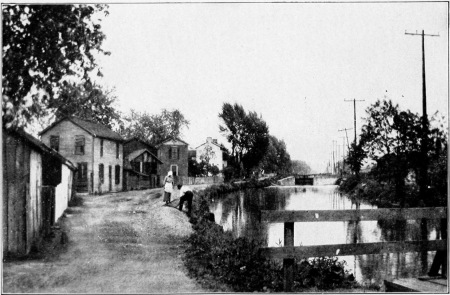 The Miami Canal at Hamilton
small boy, following, and my father held out to me behind his back a
rose which I understood I was to throw at my mother and startle her.
My aim was unfortunately for me all too sure; the rose struck her head,
and when she looked round and saw me offering to run away, she whirled
on me and made me suffer for her fright in thinking my flower was a bat,
while my father gravely entreated, “Mary, Mary!” She could not forgive
me at once, and my heart remained sore, for my love of her was as
passionate as the temper I had from her, but while it continued aching
after I went to bed, she stole up-stairs to me and consoled me and told
me how scared she had been, and hardly knew what she was doing; and all
was well again between us.
I wish I could say how dear she was to me and to all her children. My
eldest brother and she understood each other best, but each of us lived
in the intelligence of her which her love created. She was always
working for us, and yet, as I so tardily perceived, living for my father
anxiously, fearfully, bravely, with absolute trust in his goodness and
righteousness. While she listened to his reading at night, she sewed or
knitted for us, or darned or mended the day’s ravage in our clothes
till, as a great indulgence, we fell asleep on the floor. If it was
summer we fell asleep at her knees on the front door-step, where she had
sat watching us at our play till we dropped worn out with it; or if it
had been a day of wild excess she followed us to our beds early and
washed our feet with her dear hands, and soothed them from the bruises
of the summer-long shoelessness. She was not only the center of home to
me; she was home itself, and in the years before I made a home of my
own, absence from her was the homesickness, or the fear of it, which was
always haunting me. As for the quick temper (now so slow) I had from
her, it showed itself once in a burst of reckless fury which had to be
signalized in the family rule, so lenient otherwise, by a circumstantial
whipping from my father. Another, from her, for going in swimming (as we
always said for bathing) when directly forbidden, seems to complete the
list of my formal punishments at their hands in a time when fathers and
mothers were much more of Solomon’s mind in such matters than now.
I never was punished in any sort at school where the frequent scourging
of other boys, mostly boys whom I loved for something kind and sweet in
them, filled me with anguish; and I have come to believe that a blow
struck a child is far wickeder than any wickedness a child can do; that
it depraves whoever strikes the blow, mother, or father, or teacher, and
that it inexpressibly outrages the young life confided to the love of
the race. I know that excuses will be found for it, and that the
perpetrator of the outrage will try for consolation in thinking that the
child quickly forgets, because its pathetic smiles so soon follow its
pathetic tears; but the child does not forget; and no callousing from
custom can undo the effect in its soul.
From the stress put upon behaving rather than believing in that home of
mine we were made to feel that wicked words were of the quality of
wicked deeds, and that when they came out of our mouths they depraved
us, unless we took them back. I have not forgotten, with any detail of
the time and place, a transgression of this sort which I was made to
feel in its full significance. My mother had got supper, and my father
was, as he often was, late for it, and while we waited impatiently for
him, I came out with the shocking wish that he was dead. My mother
instantly called me to account for it, and when my father came she felt
bound to tell him what I had said. He could then have done no more than
gravely give me the just measure of my offense; and his explanation and
forgiveness were the sole event. I did not remain with an exaggerated
sense of my sin, though in a child’s helplessness I could not urge, if I
had imagined urging, that my outburst was merely an aspiration for
unbelated suppers, and was of the nature of prayers for rain, which good
people sometimes put up regardless of consequences. With his
Swedenborgian doctrine of degrees in sin, my father might have thought
my wild words prompted by evil spirits, but he would have regarded them
as qualitatively rather than quantitatively wicked, and would not have
committed the dreadful wrong which elders do a child by giving it a
sense of sinning far beyond its worst possible willing. As to conduct
his teaching was sometimes of an inherited austerity, but where his own
personality prevailed, there was no touch of Puritanism in it.
Our religious instruction at home was not very stated, though it was
abundant, and it must have been because we children ourselves felt it
unseemly not to go, like other children, to Sunday-school that we were
allowed to satisfy our longing for conformity by going for a while to
the Sunday-school of the Baptist church, apparently because it was the
nearest. We got certain blue tickets and certain red ones for memorizing
passages from the New Testament, but I remember much more distinctly the
muscular twitching in the close-shaven purplish cheek of the teacher as
he nervously listened with set teeth for the children’s answers, than
anything in our Scripture lessons. I had been received with three or
four brothers and sisters into the Swedenborgian communion by a passing
New Church minister, but there were no services of our recondite faith
in Hamilton, and we shared in no public worship after my mother followed
my father from the Methodist society. Out of curiosity and a solemn joy
in its ceremonial, I sometimes went to the Catholic church, where my
eyes clung fascinated to the life-large effigy of Christ bleeding on His
cross against the eastern wall; but I have more present now the sense of
walks in the woods on Sunday, with the whole family, and of the long,
sweet afternoons so spent in them.
If we had no Sabbaths in our house, and not very recognizable Sundays,
we were strictly forbidden to do anything that would seem to trifle with
the scruples of others. We might not treat serious things unseriously;
we were to swear not at all; and in the matter of bywords we were
allowed very little range, though for the hardness of our hearts we were
suffered to say such things as, “Oh, hang it!” or even, “Confound it
all!” in extreme cases, such as failing to make the family pony open his
mouth for bridling, or being bitten by the family rabbits, or butted
over by the family goat. In such points of secular behavior we might be
better or worse; but in matters of religious toleration the rule was
inflexible; the faith of others was sacred, and it was from this early
training, doubtless, that I was able in after life to regard the
occasional bigotry of agnostic friends with toleration.
During the years of my later childhood, a few public events touched my
consciousness. I was much concerned in the fortunes of the Whig party
from the candidacy of Henry Clay in 1844 to the fusion of the
anti-slavery Whigs with the Freesoil party after their bolt of the
Taylor nomination in 1848, when I followed my father as far as a boy of
eleven could go. He himself went so far as to sell his newspaper and
take every risk for the future rather than support a slave-holding
candidate who had been chosen for his vote-winning qualities as a
victorious general in the Mexican War. I did not abhor that aggression
so much as my father only because I could not understand how abhorrent
it was; but it began to be a trouble to me from the first mention of
the Annexation of Texas, a sufficiently dismaying mystery, and it
afflicted me in early fixing my lot with the righteous minorities which
I may have sometimes since been over-proud to be of. Besides such
questions of national interest I was aware of other things, such as the
French Revolution of 1848; but this must have been wholly through
sympathy with my father’s satisfaction in the flight of Louis Philippe
and the election of the poet Lamartine to be the head of the provisional
government. The notion of provisional I relegated to lasting baffle in
its more familiar association with the stock of corn-meal and bran in
the feed-stores, though I need but have asked in order to be told what
it meant. The truth is I was pre-occupied about that time with the
affairs of High Olympus, as I imagined them from the mythology which I
was reading, and with the politics of Rome and Athens, as I conceived
them from the ever-dear histories of Goldsmith. The exploits of the
Ingenious Gentleman of La Mancha had much to do in distracting me from
the movement of events in Mexico, and at the same time I was enlarging
my knowledge of human events through Gulliver’s Travels and Poe’s
Tales of the Grotesque and Arabesque.
My father had not only explained to me the satire which underlay
Gulliver’s Travels; he told me so much too indignantly of De Foe’s
appropriation of Selkirk’s narrative, that it long kept me from reading
Robinson Crusoe; but he was, as I have divined more and more, my guide
in that early reading which widened with the years, though it kept
itself preferably for a long time to history and real narratives. He was
of such a liberal mind that he scarcely restricted my own forays in
literature, and I think that sometimes he erred on that side; he may
have thought no harm could come to me from the literary filth which I
sometimes took into my mind, since it was in the nature of sewage to
purify itself. He gave me very little direct instruction, and he did not
insist on my going to school when I preferred the printing-office. All
the time, perhaps, I was getting such schooling as came from the love of
literature, which was the daily walk and conversation of our very simple
home, and somehow protected it from the sense of narrow means and the
little hope of larger. My father’s income from his paper was scarcely
over a thousand dollars a year, but this sufficed for his family, then
of seven children, and he was of such a sensitive pride as to money,
that he would hardly ask for debts due him, much less press for their
payment; so that when he parted with his paper he parted with the hope
of much money owing him for legal and even official advertising and for
uncounted delinquent subscriptions. Meanwhile he was earning this money
by the work of his head and hand; and though I must always love his
memory for his proud delicacy, I cannot forget that this is not a world
where people dun themselves for the debts they owe. What is to be said
of such a man is that his mind is not on the things that make for
prosperity; but if we were in adversity we never knew it by that name.
My mother did the whole work of her large household, and gave each of us
the same care in health and sickness, in sickness only making the
sufferer feel that he was her favorite; in any other case she would have
felt such a preference wicked. Sometimes she had a hired girl, as people
then and there called the sort of domestic that in New England would
have been called a help. But it must have been very seldom, for two
girls alone left record of themselves: a Dutch girl amusingly memorable
with us children because she called her shoes skoes, and claimed to
have come to America in a skip; and a native girl, who took charge of
us when our mother was on one of her homesick visits Up-the-River, and
became lastingly abhorrent for the sort of insipid milk-gravy she made
for the beefsteak, and for the nightmare she seemed to have every night,
when she filled the house and made our blood run cold with a sort of
wild involuntary yodeling.
Apparently my mother’s homesickness mounted from time to time in an
insupportable crisis; but perhaps she did not go Up-the-River so often
as it seemed. She always came back more contented with the home which
she herself was for us; once, as my perversely eclectic memory records,
it was chiefly because one could burn wood in Hamilton, but had to burn
coal at Martin’s Ferry, where everything was smutched by it. In my old
age, now, I praise Heaven for that home which I could not know apart
from her; and I wish I could recall her in the youth which must have
been hers when I began to be conscious of her as a personality; I know
that she had thick brown Irish hair and blue eyes, and high German
cheek-bones, and as a girl she would have had such beauty as often goes
with a certain irregularity of feature; but to me before my teens she
was, of course, a very mature, if not elderly person, with whom I could
not connect any notion of looks except such as shone from her care and
love. Though her intellectual and spiritual life was in and from my
father, she kept always a certain native quality of speech and a rich
sense in words like that which marked her taste in soft stuffs and
bright colors. In the hard life of her childhood in the backwoods she
was sent to an academy in the nearest town, but in the instant anguish
of homesickness she walked ten miles back to the log cabin where at
night, as she would tell us, you could hear the wolves howling. She had
an innate love of poetry; she could sing some of those songs of Burns
and Moore which people sang then. I associate them with her voice in the
late summer afternoons; for it was at night that she listened to my
father’s reading of poetry or fiction. When they were young, before and
after their marriage, he kept a book, as people sometimes did in those
days, where he wrote in the scrupulous handwriting destined to the
deformity of over-use in later years, such poems of Byron or Cowper or
Moore or Burns as seemed appropriate to their case, and such other verse
as pleased his fancy. It is inscribed (for it still exists) To Mary,
and with my inner sense I can hear him speaking to her by that sweet
name, with the careful English enunciation which separated its syllables
into Ma-ry.
My mother was an honored guest on one or other of my uncles’ boats
whenever she went on her homesick visits Up-the-River, and sometimes we
children must have gone with her. Later in my boyhood, when I was nine
or ten years old, my father took me to Pittsburg and back, on the boat
of the jolliest of those uncles, and it was then that I first fully
realized the splendor of the world where their lives were passed. No
doubt I have since seen nobler sights than the mile-long rank of the
steamboats as they lay at the foot of the landings in the cities at
either end of our voyage, but none of these excelling wonders remains
like that. All the passenger boats on the Ohio were then side-wheelers,
and their lofty chimneys towering on either side of their pilot-houses
were often crenelated at the top, with wire ropes between them
supporting the effigies of such Indians as they were named for. From
time to time one of the majestic craft pulled from the rank with the
clangor of its mighty bell, and the mellow roar of its whistle, and
stood out in the yellow stream, or arrived in like state to find a place
by the shore. The wide slope of the landing was heaped with the
merchandise putting off or taking on the boats, amidst the wild and
whirling curses of the mates and the insensate rushes of the deck-hands
staggering to and fro under their burdens. The swarming drays came and
went with freight, and there were huckster carts of every sort;
peddlers, especially of oranges, escaped with their lives among the
hoofs and wheels, and through the din and turmoil passengers hurried
aboard the boats, to repent at leisure their haste in trusting the
advertised hour of departure. It was never known that any boat left on
time, and I doubt if my uncle’s boat, the famous New England No. 2,
was an exception to the rule, as my father perfectly understood while he
delayed on the wharf, sampling a book-peddler’s wares, or talking with
this bystander or that, while I waited for him on board in an anguish of
fear lest he should be left behind.
There was a measure of this suffering for me throughout the voyage
wherever the boat stopped, for his insatiable interest in every aspect
of nature and human nature urged him ashore and kept him there till the
last moment before the gang-plank was drawn in. It was useless for him
to argue with me that my uncle would not allow him to be left, even if
he should forget himself so far as to be in any danger of that. I could
not believe that a disaster so dire should not befall us, and I suffered
a mounting misery till one day it mounted to frenzy. I do not know
whether there were other children on board, but except for the officers
of the boat, I was left mostly to myself, and I spent my time dreamily
watching the ever-changing shore, so lost in its wild loveliness that
once when I woke from my reverie the boat seemed to have changed her
course, and to be going down-stream instead of up. It was in this crisis
that I saw my father descending the gang-plank, and while I was urging
his return in mute agony, a boat came up outside of us to wait for her
chance of landing. I looked and read on her wheel-house the name New
England, and then I abandoned hope. By what fell necromancy I had been
spirited from my uncle’s boat to another I could not guess, but I had no
doubt that the thing had happened, and I was flying down from the
hurricane roof to leap aboard that boat from the lowermost deck when I
met my uncle coming as quietly up the gangway as if nothing had
happened. He asked what was the matter, and I gasped out the fact; he
did not laugh; he had pity on me and gravely explained, “That boat is
the New England: this is the New England No. 2” and at these words I
escaped with what was left of my reason.
I had been the prey of that obsession which every one has experienced
when the place where one is disorients itself and west is east and north
is south. Sometimes this happens by a sudden trick within the brain, but
I lived four years in Columbus and as many in Venice without once being
right as to the points of the compass in my nerves, though my wits were
perfectly convinced. Once I was months in a place where I suffered from
this obsession, when I found myself returning after a journey with the
north and south quite where they should be; and, “Now,” I exulted, “I
will hold them to their duty.” I kept my eyes firmly fixed upon the
station, as the train approached; then, without my lifting my gaze, the
north was back again in the place of the south, and the vain struggle
was over. Only the other day I got out of a car going north in Fourth
Avenue, and then saw it going on south; and it was only by noting which
way the house numbers increased that I could right myself.
I suppose my father promised a reform that should appease my unreason,
but whether he could deny himself those chances of general information I
am not so sure; we may have both expected too much of each other. As I
was already imaginably interested in things of the mind beyond my years,
he often joined me in my perusal of the drifting landscape and made me
look at this or that feature of it, but he afterward reported at home
that he never could get anything from me but a brief “Yes, indeed,” in
response. That amused him, yet I do not think I should have disappointed
him so much if I could have told him I was losing nothing, but that our
point of view was different. The soul of a child is a secret to itself,
and in its observance of life there is no foretelling what it shall
loose or what it shall hold. I do not believe that anything which was of
use to me was lost upon me, but what I chiefly remember now is my
pleasure in the log cabins in the woods on the shores, with the blue
smoke curling on the morning or the evening air from their chimneys. My
heart was taken with a yearning for the wilderness such as the
coast-born boy feels for the sea; in the older West the woods called to
us with a lure which it would have been rapture to obey; the
inappeasable passion for their solitude drove the pioneer into the
forest, and it was still in the air we breathed. But my lips were
sealed, for the generations cannot utter themselves to each other till
the strongest need of utterance is past.
I used to sit a good deal on the hurricane-deck or in the pilot-house,
where there was often good talk among the pilots or the boat’s officers,
and where once I heard with fascination the old Scotch pilot, Tom
Lindsay, telling of his own boyhood in the moors, and of the sheep lost
in the drifting snows; that also had the charm of the wilderness; but I
did not feel the sadness of his saying once, as we drifted past a row of
crimson-headed whisky barrels on a wharf-boat, “Many a one of those old
Red Eyes I’ve helped to empty,” or imagine the far and deep reach of the
words which remained with me. Somewhere in the officers’ quarters I
found a sea novel, which I read partly through, but I have not finished
The Cruise of the Midge, to this day, though I believe that as sea
novels go it merits reading. When I was not listening to the talk in the
pilot-house, or looking at the hills drifting by, I was watching the
white-jacketed black cabin-boys setting the tables for dinner in the
long saloon of the boat. It was built, after a fashion which still holds
in the Western boats, with a gradual lift of the stem and stern and a
dip midway which somehow enhanced the charm of the perspective even to
the eyes of a hungry boy. Dinner was at twelve, and the tables began to
be set between ten and eleven, with a rhythmical movement of the negroes
as they added each detail of plates and cups and knives and glasses, and
placed the set dishes of quivering jelly at discrete intervals under the
crystals of the chandeliers softly tinkling with the pulse of the
engines. At last some more exalted order of waiters appeared with
covered platters and spirit-lamps burning under them, and set them down
before the places of the captain and his officers. Then the bell was
sounded for the passengers; the waiters leaned forward between these
when they were seated; at a signal from their chief they lifted the
covers of the platters and vanished in a shining procession up the
saloon, while each passenger fell upon the dishes nearest himself.
About the time I had become completely reconciled to the conditions of
the voyage, which the unrivaled speed of the New England No. 2
shortened to a three-days’ run up the river, I woke one morning to find
her lying at the Pittsburg landing, and when I had called my father to
come and share my wonder at a stretch of boats as long as that at
Cincinnati, and been mimicked by a cabin-boy for my unsophisticated
amazement, nothing remained for me but to visit the houses of the aunts
and uncles abounding in cousins. Of the homeward voyage nothing
whatever is left in my memory; but I know we came back on the New
England No. 2, though we must have left the boat and taken it again on
a second trip at Wheeling, after a week spent with my mother’s people at
Martin’s Ferry. My father wished me to see the glass-foundries and
rolling-mills which interested him so much more than me; he could not
get enough of those lurid industries which I was chiefly concerned in
saving myself from. I feigned an interest in the processes out of regard
for him, but Heaven knows I cared nothing for the drawing of wire or the
making of nails, and only a very little for the blowing of the red,
vitreous bubbles from the mouths of long steel pipes. With weariness I
escaped from these wonders, but with no such misery as I eluded the
affection of the poor misshapen, half witted boy who took a fancy to me
at the house of some old friends of my father where we had supper after
the long day. With uncouth noises of welcome, and with arms and legs
flying controllessly about, he followed me through a day that seemed
endless. His family of kindly English folk, from the life-long habit of
him, seemed unaware of anything strange, and I could not for shame and
for fear of my father’s reproach betray my suffering. The evening began
unduly to fall, thick with the blackness of the coal smoke poured from
the chimneys of those abhorred foundries, and there was a fatal moment
when my father’s friends urged him to stay the night and I thought he
would consent. The dreams of childhood are oftenest evil, but mine holds
record of few such nightmares as this.
After my father sold his paper and was casting about for some other
means of livelihood, there were occasional shadows cast by his
anxieties in the bright air of my childhood. Again I doubt if any boy
ever lived a gladder time than I lived in Hamilton, Butler County, Ohio:
words that I write still when I try a new pen, because I learned to
write them first, and love them yet. When we went to live in Dayton,
where my father managed to make a sort of progressive purchase of a
newspaper which he never quite paid for, our skies changed. It was after
an interval of experiment in one sort and another, which amused his
hopeful ingenuity, but ended in nothing, that he entered upon this long
failure. The Dayton Transcript when he began with it was a tri-weekly,
but he made it a daily, and this mistake infected the whole enterprise.
It made harder work for us all than we had known before; and the
printing-office, which had been my delight, became my oppression after
the brief moment of public schooling which I somehow knew. But before
the change from tri-weekly to daily in our paper, I had the unstinted
advantage of a school of morals as it then appeared among us.
The self-sacrificing company of players who suffered for the drama
through this first summer of our life in Dayton paid my father for their
printing in promises which he willingly took at their face value, and in
tickets which were promptly honored at the door. As nearly as I can make
out, I was thus enabled to go every night to the theater, in a passion
for it which remains with me ardent still. I saw such plays of
Shakespeare as “Macbeth” and “Othello,” then the stage favorites, and
“Richard III.” and evermore “Richard III.” I saw such other now quite
forgotten favorites as Kotzebue’s “Stranger” and Sheridan Knowles’s
“Wife,” and such moving actions of unknown origin as “Barbarossa” and
“The Miser of Marseilles,” with many screaming farces such as helped
fill every evening full with at least three plays. There was also at
that time a native drama almost as acceptable to our public everywhere
as “Uncle Tom’s Cabin” afterward became. It seemed as if our public
would never tire of “A Glance at New York,” with its horribly vulgar
stage conceptions of local character, Mose the fireman and Lize his
girl, and Sikesy and their other companions, which drift up before me
now like wraiths from the Pit, and its events of street-fighting and I
dare say heroic rescues from burning buildings by the volunteer fire
companies of the day. When it appeared that the public might tire of the
play, the lively fancy of the theater supplied a fresh attraction in it,
and the character of Little Mose was added. How this must have been
played by what awful young women eager to shine at any cost in their
art, I shudder to think, and it is with “sick and scornful looks averse”
that I turn from the remembrance of my own ambition to shine in that
drama. My father instantly quenched the histrionic spark in me with
loathing; but I cannot say whether this was before or after the failure
of a dramatic attempt of his own which I witnessed, much mystified by
the sense of some occult relation to it. Certainly I did not know that
the melodrama which sacrificed his native to his adoptive patriotism in
the action, and brought off the Americans victors over the British in a
sea-fight, was his work; and probably it was the adaptation of some tale
then much read. Very likely he trusted, in writing it, to the chance
which he always expected to favor the amateur in taking up a musical
instrument strange to him. He may even have dreamed of fortune from it;
but after one performance of it the management seems to have gone back
to such old public favorites as Shakespeare and Sheridan Knowles.
Nothing was said of it in the family; I think some of the newspapers
were not so silent; but I am not sure of this.
My father could, of course, be wiser for others than for himself; the
public saved him from becoming a dramatist, but it was he who saved me
from any remotest chance of becoming an actor, and later from acquiring
the art of the prestidigitator. The only book which I can be sure of his
taking from me was a manual professing to teach this art, which I had
fallen in with. The days of those years in Dayton were in fact very
different from the days in Hamilton when I was reaching out near and far
to feed my fancy for fable and my famine for fact. I read no new books
which now occur to me by name, though I still kept my interest in Greek
mythology and gave something of my scanty leisure to a long poem in the
quatrains of Gray’s Elegy based upon some divine event of it. The course
of the poem was lastingly arrested by a slight attack of the cholera
which was then raging in the town and filling my soul with gloom. My
dear mother thought it timely to speak with me of the other world; but
so far from reconciling me to the thought of it, I suppose she could not
have found a boy in all Dayton more unwilling to go to heaven. She was
forced to drop her religious consolations and to assure me that she had
not the least fear of my dying.
It was certainly not the fault of the place that we were, first and
last, rather unhappy there. For one thing, we were used to the greater
ease and simplicity of a small town like Hamilton, and Dayton was a
small city with the manners and customs of cities in those days: that
is, there was more society and less neighborhood, and neither my father
nor my mother could have cared for society. They missed the wont of old
friends; there were no such teas as she used to give her neighbors, with
a quilting, still dimly visioned, at the vanishing-point of the
perspective; our social life was almost wholly in our Sunday-evening
visits to the house of my young aunt whose husband was my father’s
youngest brother. The pair were already in the shadow of their early
death, and in the sorrow of losing their children one after another till
one little cousin alone remained. I had not yet begun to make up
romances about people in my mind, but this uncle and aunt were my types
of worldly splendor in the setting of the lace curtains and hair-cloth
chairs of their parlor, with her piano and his flute for other æsthetic
grace. He was so much younger that he had a sort of filial relation to
my father, and they were both very sweet to my mother, always lonely
outside of her large family.
As usual, we lived in more than one house, but the first was very
acceptable because of its nearness to the canal; the yard stretched
behind it quite to the tow-path, with an unused stable between, which
served us boys for circus-rehearsals, and for dressing after a plunge.
As in a dream, I can still see my youngest brother rushing through this
stable one day and calling out that he was going to jump into the canal,
with me running after him and then dimly seeing him as he groped along
the bottom, with me diving and saving him from drowning. Already, with
the Hamilton facilities, I could hardly help being a good swimmer, and
at Dayton I spent much of my leisure in the canal. Within the city
limits we had to wear some sort of bathing-dress, and we preferred going
with a crowd of other boys beyond the line where no such formality was
expected of us. On the way to and fro we had to pass a soap-factory,
where the boys employed in it swarmed out at sight of us stealing along
under the canal bank, and in the strange outlawry of boyhood murderously
stoned us, but somehow did not kill us. I do not know what boys we
played with, but after we had paid the immemorial penalty of the
stranger, and fought for our standing among them, the boys of our
neighborhood were kind enough. One, whose father was a tobacconist,
abetted our efforts to learn smoking by making cigars flavored with
cinnamon drops; I suppose these would have been of more actual advantage
to me if I had learned to like smoking. When we went from his house to
another, in what may have been a better quarter, we made no friends that
I can remember, and we were never so gay. In fact, a sense of my
father’s adversity now began to penetrate to his older children, with
the knowledge of our mother’s unhappiness from it.
I am not following any chronological order here, and I should not be
able to date my æsthetic devotion to a certain gas-burner in the window
of a store under the printing-office. It was in the form of a
calla-lily, with the flame forking from the tongue in its white cup; and
I could never pass it, by day or night, without stopping to adore it. If
I could be perfectly candid, I should still own my preference of it to
the great painting of Adam and Eve by Dubuffe, then shown throughout our
simple-hearted commonwealth. This had the double attraction of a
religious interest and the awful novelty of the nude, for the first time
seen by untraveled American eyes; the large canvas was lighted up so as
to throw the life-size figures into strong relief, and the spectator
strickenly studied them through a sort of pasteboard binocle supplied
for the purpose. If that was the way our first parents looked before the
Fall, and the Bible said it was, there was nothing to be urged against
it; but many kind people must have suffered secret misgivings at a sight
from which a boy might well shrink ashamed, with a feeling that the
taste of Eden was improved by the Fall. I had no such joy in it as in
the dramas which I witnessed in the same hall; as yet there was nothing
in Dayton openly declared a theater.
The town had many airs of a city, and there were even some policemen who
wore a silver-plated star inside their
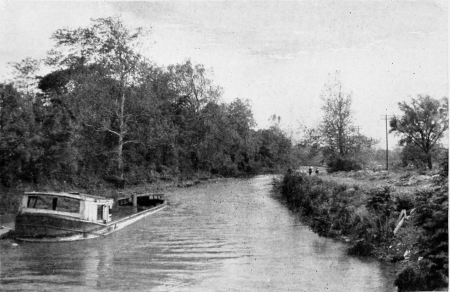 The now abandoned canal at Dayton as it appears on the
borders of the city.
The now abandoned canal at Dayton as it appears on the
borders of the city.
coats for proof of their profession. There were water-works, and there
was gas everywhere for such as would pay the charge for it. My father
found the expense of piping the printing-office too great for his means,
or else he preferred falling back upon his invention, and instead of the
usual iron tubes he had the place fitted with tin tubes, at much less
cost. Perhaps the cost was equalized in the end by the leaking of these
tubes, which was so constant that we breathed gas by day as well as
burned it by night. We burned it a good deal, for our tri-weekly was now
changed to a daily, and a morning paper at that. Until eleven o’clock I
helped put the telegraphic despatches (then a new and proud thing with
us) into type, and between four and five o’clock in the morning I was up
and carrying papers to our subscribers. The stress of my father’s
affairs must have been very sore for him to allow this, and I dare say
it did not last long, but while it lasted it was suffering which must
make me forever tender of those who overwork, especially the children
who overwork. The suffering was such that when my brother, who had not
gone to bed till much later, woke me after my five or six hours’ sleep,
I do not now know how I got myself together for going to the
printing-office for the papers and making my rounds in the keen morning
air. When Sunday came, and I could sleep as late as I liked, it was
bliss such as I cannot tell to lie and rest, and rest, and rest! We were
duteous children and willing; my brother knew of the heavy trouble
hanging over us and I was aware of the hopeless burden of debt which our
father was staggering under and my mother was carrying on her heart; and
when I think of it, and of the wide-spread, never-ending struggle for
life which it was and is the type of, I cannot but abhor the economic
conditions which we still suppose an essential of civilization.
Lest these facts should make too vivid a call upon the reader’s
compassion, I find it advisable to remember here an instance of
hard-heartedness in me which was worthier the adamantine conscience of
some full-grown moralist than a boy of my age. There was a poor girl,
whose misfortune was known to a number of families where she was
employed as a seamstress, and the more carefully treated because of her
misfortune. Among others my mother was glad to give her work; and she
lived with us like one of ourselves, of course sitting at table with us
and sharing in such family pleasures as we knew. She was the more to be
pitied because her betrayer was a prominent man who bore none of the
blame for their sin; but when her shame became known to me I began a
persecution of the poor creature in the cause of social purity. I would
not take a dish from her at table, or hand her one; I would not speak to
her, if I could help it, or look at her; I left the room when she came
into it; and I expressed by every cruelty short of words my righteous
condemnation. I was, in fact, society incarnate in the attitude society
takes toward such as she. Heaven knows how I came by such a devilish
ideal of propriety, and I cannot remember how the matter quite ended,
but I seem to remember a crisis, in which she begged my mother with
tears to tell her why I treated her so; and I was put to bitter shame
for it. It could not be explained to me how tragical her case was; I
must have been thought too young for the explanation; but I doubt if any
boy of twelve is too young for the right knowledge of such things; he
already has the wrong.
My wish at times to learn some other business was indulged by a family
council, and my uncle made a place for me in his drug-store, where, as
long as the novelty lasted, I was happy in the experiments with
chemicals permitted to me and a fellow-apprentice. Mainly we were busied
in putting up essence of peppermint and paregoric and certain favorite
medicinal herbs; and when the first Saturday evening came, my companion
received his weekly wage over the counter, and I expected mine, but the
bookkeeper smiled and said he would have to see my uncle about that; in
the end, it appeared that by the convention with my father I was somehow
not to draw any salary. Both my uncle and he treated the matter with
something of the bookkeeper’s smiling slight, and after an interval, now
no longer appreciable, I found myself in the printing-office again. I
was not sorry, and yet I had liked the drug business so far as I had
gone in it, and I liked that old bookkeeper, though he paid me no money.
How, after a life of varied experiences, he had lodged at last in the
comfortable place he held I no longer know, if I ever knew. He had been
at one time what would once have been called a merchant adventurer in
various seas; and he had been wrecked on the Galapagos Islands, where he
had feasted on the famous native turtle, now extinct, with a relish
which he still smacked his lips in remembering.
This episode, which I cannot date, much antedated the period of my
father’s business failure, though his struggles against it must have
already begun; they began, in fact, from the moment of his arrival in
Dayton, and the freest and happiest hours we knew there were when the
long strain ended in the inevitable break. Then there was an interval, I
do not know how great, but perhaps of months, when there was a casting
about for some means of living, and to this interval belongs somehow the
employment of my brother and myself in a German printing-office, such as
used to be found in every considerable Ohio town. I do not know what we
did there, but I remember the kindly German printer-folk, and the merry
times we had with them, in the smoke of their pipes and the warmth of
their stove heated red against the autumnal cold. I explore my memory
in vain for proof that my father had some job-printing interest in this
German office, but I remember my interest in the German type and its
difference from the English. I was yet far from any interest in the
German poetry which afterward became one of my passions, and there is no
one now left alive whom I can ask whether the whole incident was fact,
or not, rather, the sort of dream which all the past becomes when we try
to question it.
What I am distinctly aware of, through a sense of rather sullen autumnal
weather, is that a plan for our going into the country evolved itself in
full detail between my father and uncle. My uncle was to supply the
capital for the venture, and was finally, with two other uncles, to join
my father on a milling privilege which they had bought at a point on the
Little Miami River, where all the families were to be settled. In the
mean time my father was to have charge of a grist-mill and sawmill on
the property till they could be turned into a paper-mill and a sort of
communal settlement of suitable people could be gathered. He had never
run a sawmill or a grist-mill, much less evoked a paper-mill from them;
but neither had he ever gathered a community of choice spirits for the
enjoyment of a social form which enthusiasts like Robert Owen had
dreamed into being, and then non-being, in the Middle West in those or
somewhat earlier days. What was definite and palpable in the matter was
that he must do something, and that he had the heart and hope for the
experiment.
I have told the story of this venture in a little book called My Year
in a Log Cabin, printed twenty-odd years ago, and I cannot do better
now than let it rehearse
 The Little Miami River at Eureka Mills, twelve miles
east of Dayton. Here the ruin of the dam, which served the mills run by
Mr. Howells’s father, makes a rapid in the stream.
The Little Miami River at Eureka Mills, twelve miles
east of Dayton. Here the ruin of the dam, which served the mills run by
Mr. Howells’s father, makes a rapid in the stream.
itself here from those pages, with such slight change or none as
insists. For my father, whose boyhood had been passed in the new
country, where pioneer customs and traditions were still rife, it was
like renewing the wild romance of those days to take up once more the
life in a log cabin interrupted by many years sojourn in matter-of-fact
dwellings of frame and brick. It was the fond dream of his boys to
realize the trials and privations which he had painted for them in rosy
hues, and even if the only clapboarded dwelling at the mills had not
been occupied by the miller, we should have disdained it for the log
cabin which we made our home till we could build a new house.
Our cabin stood close upon the road, but behind it broadened a
corn-field of eighty acres. They still built log cabins for dwellings in
that region at the time, but ours must have been nearly half a century
old when we went into it. It had been recently vacated by an old
poor-white Virginian couple, who had long occupied it, and we decided
that it needed some repairs to make it habitable even for a family
inured to hardship by dauntless imaginations, and accustomed to
retrospective discomforts of every kind.
So before the family all came out to it a deputation of adventurers put
it in what rude order they could. They glazed the narrow windows, they
relaid the rotten floor, they touched (too sketchily, as it afterward
appeared) the broken roof, and they papered the walls of the
ground-floor rooms. Perhaps it was my father’s love of literature which
inspired him to choose newspapers for this purpose; at any rate, he did
so, and the effect, as I remember, had its decorative qualities. He had
used a barrel of papers from the nearest post-office, where they had
been refused by people to whom they had been experimentally sent by the
publishers, and the whole first page was taken up by a story, which
broke off in the middle of a sentence at the foot of the last column,
and tantalized us forever with fruitless conjecture as to the fate of
the hero and heroine.
The cabin, rude as it was, was not without its sophistications, its
concessions to the spirit of modern luxury. The logs it was built of had
not been left rounded, as they grew, but had been squared in a sawmill,
and the crevices between them had not been chinked with moss and daubed
with clay in true backwoods fashion, but plastered with mortar, and the
chimney, instead of being a structure of clay-covered sticks, was laid
in courses of stone. Within, however, it was all that could be desired
by the most romantic of pioneer families. It was six feet wide and a
yard deep, its cavernous maw would easily swallow a back-log eighteen
inches through, and we piled in front the sticks of hickory cord-wood as
high as we liked. We made a perfect trial of it when we came out to put
the cabin in readiness for the family, and when the hickory had dropped
into a mass of tinkling, snapping, bristling embers we laid our rashers
of bacon and our slices of steak upon them, and tasted the flavors of
the wildwood in the captured juices. At night we laid our mattresses on
the sweet new oak plank of the floor, and slept hard—in every sense.
In due time the whole family took up its abode in the cabin. The
household furniture had been brought out and bestowed in its scanty
space, the bookcase had been set up, and the unbound books left easily
accessible in barrels. There remained some of our possessions to follow,
chief of which was the cow; for in those simple days people kept cows in
town, and it fell to me to help my father drive ours out to her future
home. We got on famously, talking of the wayside things so beautiful in
the autumnal day, panoplied in the savage splendor of its painted
leaves, and of the books and authors so dear to the boy who limped
barefooted by his father’s side, with his eye on the cow and his mind
on Cervantes and Shakespeare. But the cow was very slow—far slower than
the boy’s thoughts—and it had fallen night and was already thick dark
when we had made the twelve miles and stood under the white-limbed
phantasmal sycamores beside the tail-race of the grist-mill, and
questioned how we should get across with our charge. We did not know how
deep the water was, but we knew it was very cold, and we would rather
not wade it. The only thing to do seemed to be for one of us to run up
to the sawmill, cross the head-race there, and come back to receive the
cow on the other side of the tail-race. But the boy could not bring
himself either to go or to stay.
The kind-hearted father urged, but he would not compel; you cannot well
use force with a boy when you have been talking literature and
philosophy for half a day with him. We could see the lights in the cabin
cheerfully twinkling, and we shouted to those within, but no one heard
us. We called and called in vain. Nothing but the cold rush of the
tail-race, the dry rustle of the sycamore-leaves, and the homesick
lowing of the cow replied. We determined to drive her across, and pursue
her with sticks and stones through the darkness beyond, and then run at
the top of our speed to the sawmill, and get back to take her in custody
again. We carried out our part of the plan perfectly, but the cow had
not entered into it with intelligence or sympathy. When we reached the
other side of the tail-race again she was nowhere to be found, and no
appeals of “Boss” or “Suky” or “Suboss” availed. She must have instantly
turned, and retraced, in the darkness which seemed to have swallowed her
up, the weary steps of the day, for she was found in her old home in
town the next morning. At any rate, she had abandoned the father to the
conversation of his son, for the time being, and the son had nothing to
say.
I do not remember now just how it was that we came by the different
“animals of the horse kind,” as my father called them, which we housed
in an old log stable not far from our cabin. They must have been a
temporary supply until a team worthy our new sky-blue wagon could be
found. One of them was a colossal sorrel, inexorably hide-bound, whose
barrel, as horsemen call the body, showed every hoop upon it. He had a
feeble, foolish whimper of a voice, and we nicknamed him “Baby.” His
companion was a dun mare, who had what my father at once called an
italic foot, in recognition of the emphatic slant at which she carried
it when upon her unwilling travels. Then there was a small,
self-opinionated gray pony, which was of no service conjecturable after
this lapse of time. We boys rode him barebacked, and he used to draw a
buggy, which he finally ran away with. I suppose we found him useful in
the representation of some of the Indian fights which we were always
dramatizing, and I dare say he may have served our turn as an Arab
charger, when the Moors of Granada made one of their sallies upon the
camp of the Spaniards, and discharged their javelins into it; their
javelins were the long, admirably straight and slender ironweeds that
grew by the river. This menagerie was constantly breaking bounds and
wandering off; and was chiefly employed in hunting itself up, its
different members taking turns in remaining in the pasture or stable, to
be ridden after those that had strayed into the woods.
The origin of a large and eloquent flock of geese is lost in an equal
obscurity. I recall their possession simply as an accomplished fact, and
I associate their desolate cries with the windy dark of rainy November
nights, so that they must at least have come into our hands after the
horses. They were fenced into a clayey area next the cabin for
safe-keeping, where, perpetually waddling about in a majestic
disoccupation, they patted the damp ground down to the hardness and
smoothness of a brick-yard. Throughout the day they conversed tranquilly
together, but by night they woke, goose after goose, to send forth a
long clarion alarum, blending in a general concert at last, to assure
one another of their safety. We must have intended to pluck them in the
spring, but they stole their nests early in March, and entered upon the
nurture of their young before we could prevent it; and it would then
have been barbarous to pluck these mothers of families.
We had got some pigs from our old Virginian predecessors, and these
kept, as far as they could, the domestic habits in which that
affectionate couple had indulged them. They would willingly have shared
our fireside with us, humble as it was, but, being repelled, they took
up their quarters on cold nights at the warm base of the chimney
without, where we could hear them, as long as we kept awake, disputing
the places next to the stones. All this was horrible to my mother, whose
housewifely instincts were perpetually offended by the rude conditions
of our life, and who justly regarded it as a return to a state which, if
poetic, was also not far from barbaric. But boys take every natural
thing as naturally as savages, and we never thought our pigs were other
than amusing. In that country pigs were called to their feed with long
cries of “Pig, pig, pooee, poe-e-e!” but ours were taught to come at a
whistle, and, on hearing it, would single themselves out from the
neighbors’ pigs, and come rushing from all quarters to the scattered
corn with an intelligence we were proud of.
As long as the fall weather lasted, and well through the mild winter of
that latitude, our chief recreation, where all our novel duties were
delightful, was hunting with the long, smooth-bore shot-gun which had
descended laterally from one of our uncles, and supplied the needs of
the whole family of boys in the chase. Never less than two of us went
out with it at once, and generally there were three. This enabled us to
beat up the game over a wide extent of country, and while the eldest did
the shooting, left the others to rush upon him as soon as he fired, with
tumultuous cries of, “Did you hit it? Did you hit it?” We fell upon the
wounded squirrels which we brought down on rare occasions, and put them
to death with what I must now call a sickening ferocity. If sometimes
the fool dog, the weak-minded Newfoundland pup we were rearing, rushed
upon the game first, and the squirrel avenged his death upon the dog’s
nose, that was pure gain, and the squirrel had the applause of his other
enemies. Yet we were none of us cruel; we never wantonly killed things
that could not be eaten; we should have thought it sacrilege to shoot a
robin or a turtledove, but we were willing to be amused, and these were
the chances of war.
The woods were full of squirrels, which especially abounded in the
woods-pastures, as we called the lovely dells where the greater part of
the timber was thinned out to let the cattle range and graze. They were
of all sorts—gray, and black, and even big red fox squirrels, a variety
I now suppose extinct. When the spring opened we hunted them in the
poplar woods, whither they resorted in countless numbers for the
sweetness in the cups of the tulip-tree blossoms. I recall with a thrill
one memorable morning in such woods—early, after an overnight rain,
when the vistas hung full of a delicate mist that the sun pierced to
kindle a million fires in the drops still pendulous from leaf and twig.
I can smell the tulip-blossoms and the odor of the tree-bark yet, and
the fresh, strong fragrance of the leafy mold under my bare feet; and I
can hear the rush of the squirrels on the bark of the trunks, or the
swish of their long, plunging leaps from bough to bough in the air-tops.
In a region where the corn-fields and wheat-fields were often fifty and
sixty acres in extent there was a plenty of quail, but I remember only
one victim to my gun. We set figure-four traps to catch them; but they
were shrewder arithmeticians than we, and solved these problems without
harm to themselves. When they began to mate, and the air was full of
their soft, amorous whistling, we searched for their nests, and had
better luck, though we were forbidden to rob the nests when we found
them; and in June, when a pretty little mother strutted across the lanes
at the head of her tiny brood, we had to content ourselves with the near
spectacle of her cunning counterfeit of disability at sight of us,
fluttering and tumbling in the dust till her chicks could hide
themselves. We had read of that trick, and were not deceived; but we
were charmed the same.
It is a trick that all birds know, and I had it played upon me by the
mother snipe and mother wild duck that haunted our dam, as well as by
the quail. With the snipe, once, I had a fancy to see how far the mother
would carry the ruse, and so ran after her; but in doing this I trod on
one of her young—a soft, gray mite, not distinguishable from the gray
pebbles where it ran. I took it tenderly up in my hand, and it is a pang
to me yet to think how it gasped once and died. A boy is a strange
mixture—as the man who comes after him is. I should not have minded
knocking over that whole brood of snipes with my gun, if I could; but
this poor little death was somehow very personal in its appeal.
I had no such regrets concerning the young wild ducks, which, indeed, I
had no such grievous accident with. I left their mother to flounder and
flutter away as she would, and took to the swamp where her young sought
refuge from me. There I spent half a day wading about in waters that
were often up to my waist and full of ugly possibilities of mud-turtles
and water-snakes, trying to put my hand on one of the ducklings. They
rose everywhere else, and dived again after a breath of air; but at last
one of them came up in my very grasp. It did not struggle, but how its
wild heart bounded against my hand! I carried it home to show it and
boast of my capture, and then I took it back to its native swamp. It
dived instantly, and I hope it found its bereaved family somewhere under
the water.
The center of our life in the cabin was, of course, the fireplace, whose
hugeness and whose mighty fires remained a wonder with us. There was a
crane in the chimney and dangling pothooks, and until the cooking stove
could be set up in an adjoining shed the cooking had to be done on the
hearth, and the bread baked in a Dutch oven in the hot ashes. We had
always heard of this operation, which was a necessity of early days; and
nothing else, perhaps, realized them so vividly for us as the loaf laid
in the iron-lidded skillet, which was then covered with ashes and heaped
with coals.
I am not certain that the bread tasted any better for the historical
romance of its experience, or that the corn-meal, mixed warm from the
mill and baked on an oak plank set up before the fire, had merits beyond
the hoecake of art; but I think there can be no doubt that new corn
grated from the cob while still in the milk, and then molded and put in
like manner to brown in the glow of such embers, would still have the
sweetness that was incomparable then. When the maple sap started in
February, we tried the scheme we had cherished all winter of making with
it tea which should be in a manner self-sugared. But the scheme was a
failure—we spoiled the sap without sweetening the tea.
We sat up late before the big fire at night, our faces burning in the
glow, and our backs and feet freezing in the draught that swept in from
the imperfectly closing door, and then we boys climbed to our bed in the
loft. We reached it by a ladder, which we should have been glad to pull
up after us as a protection against Indians in the pioneer fashion; but,
with the advancement of modern luxury, the ladder had been nailed to the
floor. When we were once aloft, however, we were in a domain sacred to
the past. The rude floor rattled and wavered loosely under our tread,
and the window in the gable stood open or shut at its own will. There
were cracks in the shingles, through which we could see the stars, when
there were stars, and which, when the first snow came, let the flakes
sift in upon the floor.
Our barrels of paper-covered books were stowed away in that loft, and,
overhauling them one day, I found a paper copy of the poems of a certain
Henry W. Longfellow, then wholly unknown to me; and while the old
grist-mill, whistling and wheezing to itself, made a vague music in my
ears, my soul was filled with this new, strange sweetness. I read the
“Spanish Student” there, and the “Coplas de Manrique,” and the solemn
and ever-beautiful “Voices of the Night.” There were other books in
those barrels, but these spirited me again to Spain, where I had already
been with Irving, and led me to attack fitfully the old Spanish grammar
which had been knocking about our house ever since my father bought it
from a soldier of the Mexican War.
But neither these nor any other books made me discontented with the
boy’s world about me. They made it a little more populous with visionary
shapes, but that was well, and there was room for them all. It was not
darkened with cares, and the duties of it were not many. By this time we
older boys had our axes, and believed ourselves to be clearing a piece
of woods which covered a hill belonging to the milling property. The
timber was black-walnut and oak and hickory, and I cannot think we made
much inroad in it; but we must have felled some of the trees, for I
remember helping to cut them into saw-logs with the cross-cut saw, and
the rapture we had in starting our logs from the brow of the hill and
watching their whirling rush to the bottom. We experimented, as boys
will, and we felled one large hickory with the saw instead of the axe,
and scarcely escaped with our lives when it suddenly split near the
bark, and the butt shot out between us. I preferred buckeye and sycamore
trees for my own axe; they were of no use when felled, but they chopped
so easily.
They grew abundantly on the island which formed another feature of our
oddly distributed property. This island was by far its most fascinating
feature, and for us boys it had the charm and mystery which have in
every land and age endeared islands to the heart of man. It was not
naturally an island, but had been made so by the mill-races bringing the
water from the dam, and emptying into the river again below the mills.
It was flat, and half under water in every spring freshet, but it had
precious areas grown up to tall ironweeds, which, withering and
hardening in the frost, supplied us with the darts for our Indian
fights. The island was always our battle-ground, and it resounded in the
long afternoons with the war-cries of the encountering tribes. We had a
book in those days called Western Adventure, which was made up of
tales of pioneer and frontier life, and we were constantly reading
ourselves back into that life. This book, and Howe’s Collections for
the History of Ohio, were full of stories of the backwoodsmen and
warriors who had made
 Overlooking the island which the Howells family
cultivated
Overlooking the island which the Howells family
cultivated
our state a battle-ground for nearly fifty years, and our life in the
log cabin gave new zest to the tales of “Simon Kenton, the Pioneer,” and
“Simon Girty, the Renegade”; of the captivity of Crawford, and his death
at the stake; of the massacre of the Moravian Indians at Gnadenhütten;
of the defeat of St. Clair and the victory of Wayne; of a hundred other
wild and bloody incidents of our annals. We read of them at night till
we were afraid to go up the ladder to the ambuscade of savages in our
loft, but we fought them over by day with undaunted spirit. With our
native romance I sometimes mingled from my own reading a strain of Old
World poetry, and “Hamet el Zegri” and the “Unknown Spanish Knight,”
encountered in the Vega before Granada on our island, while Adam Poe and
the Indian chief Bigfoot were taking breath from their deadly struggle
in the waters of the Ohio.
When the spring opened we broke up the sod on a more fertile part of the
island, and planted a garden there beside our field of corn. We planted
long rows of sweet-potatoes, and a splendid profusion of melons, which
duly came up with their empty seed-shells fitted like helmets over their
heads, and were mostly laid low the next day by the cutworms which
swarmed in the upturned sod. But the sweet-potatoes had better luck.
Better luck I did not think it then; their rows seemed interminable to a
boy set to clear them of purslane with his hoe; though I do not now
imagine they were necessarily a day’s journey in length. Neither could
the corn-field beside them have been very vast; but again reluctant
boyhood has a different scale for the measurement of such things, and
perhaps if I were now set to hill it up I might think differently about
its size.
I dare say it was not well cared for, but an inexhaustible wealth of
ears came into the milk just at the right moment for our enjoyment. We
had then begun to build our new house, and for this we were now
kiln-drying the green oak flooring-boards. We had built a long skeleton
hut, and had set the boards upright all around it and roofed it with
them, and in the middle of it we had set a huge old cast-iron stove, in
which we kept a roaring fire. The fire had to be watched night and day,
and it often took all the boys of the neighborhood to watch it, and to
turn the boards. It must have been cruelly hot in that kiln; but I
remember nothing of that; I remember only the luxury of the green corn,
spitted on the points of long sticks and roasted in the red-hot stove;
we must almost have roasted our own heads at the same time. But I
suppose that if the heat within the kiln or without ever became
intolerable, we escaped from it and from our light summer clothing,
reduced to a Greek simplicity, in a delicious plunge in the river. We
had our choice of the shallows, where the long ripple was warmed through
and through by the sun in which it sparkled, or the swimming-hole, whose
depths were almost as tepid, but were here and there interwoven with
mysterious cool under-currents.
We believed that there were snapping-turtles and water-snakes in our
swimming-holes, though we never saw any. There were some fish in the
river, chiefly suckers and catfish in the spring, when the water was
high and turbid, and in summer the bream that we call sunfish in the
West, and there was a superstition, never verified by us, of bass. We
did not care much for fishing, though of course that had its turn in the
pleasures of our rolling year. There were crawfish, both hard-shell and
soft, to be had at small risk, and mussels in plenty. Their shells
furnished us the material for many rings zealously begun and never
finished; we did not see why they did not produce pearls; but perhaps
they were all eaten up, before the pearl disease could attack them, by
the muskrats, before whose holes their shells were heaped.
Of skating on the river I think we had none. The winter often passed in
our latitude without making ice enough for that sport, and there could
not have been much sledding, either. We read, enviously enough, in Peter
Parley’s First Book of History, of the coasting on Boston Common, and
we made some weak-kneed sleds (whose imbecile runners flattened
helplessly under them) when the light snows began to come; but we never
had any real coasting, as our elders never had any real sleighing in the
jumpers they made by splitting a hickory sapling for runners, and
mounting any sort of rude box upon them. They might have used sleighs in
the mud, however; that was a foot deep on most of the roads, and lasted
all winter. For a little while some of us went two miles away through
the woods to school; but there was not much to be taught a reading
family like ours in that log hut, and I suppose it was not thought worth
while to keep us at it. No impression of it remains to me, except the
wild, lonesome cooing of the turtle-doves when they began to nest in the
neighboring oaks.
Our new house got on slowly. The log cabin had not become pleasanter
with the advance of the summer, and we looked forward to our occupation
of the new house with an eagerness which even in us boys must have had
some sense of present discomfort at the bottom of it. The frame was of
oak, and my father decided to have the house weather-boarded and
shingled with black-walnut, which was so much cheaper than pine, and
which, left in its natural state, he thought would be agreeable in
color. It appeared to me a palace. I spent all the leisure I had from
swimming and Indian-fighting and reading in watching the carpenter
work, and hearing him talk; his talk was not the wisest, but he thought
very well of it himself, and I had so far lapsed from civilization that
I stood in secret awe of him, because he came from town—from the little
village, namely, two miles away.
I try to give merely a child’s memories of our life, which were nearly
all delightful; but it must have been hard for my elders, and for my
mother especially, who could get no help, or only briefly and fitfully,
in the work that fell to her. Now and then a New Church minister, of
those who used to visit us in town, passed a Sunday with us in the
cabin, and that was a rare time of mental and spiritual refreshment for
her. Otherwise, my father read us a service out of the Book of
Worship, or a chapter from the Heavenly Arcana; and week-day nights,
while the long evenings lasted, he read poetry to us—Scott, or Moore,
or Thomson, or some of the more didactic poets.
In the summer evenings, after her long hard day’s work was done, my
mother sometimes strolled out upon the island with my father, and
loitered on the bank to look at her boys in the river; one such evening
I recall, and how sad our gay voices were in the dim, dewy air. My
father had built a flatboat, which we kept on the smooth waters of our
dam, and on Sunday afternoons the whole family went out in it. We rowed
far up, till we struck a current from the mill above us, and then let
the boat drift slowly down again. It does not now seem very exciting,
but then to a boy whose sense was open to every intimation of beauty,
the silence that sang in our ears, the stillness of the dam where the
low uplands and the fringing sycamores and every rush and grass-blade by
the brink perfectly glassed themselves with the vast blue sky overhead,
were full of mystery, of divine promise, and holy awe.
I recollect the complex effort of these Sunday afternoons as if they
were all one sharp event; I recall in like manner the starry summer
nights, and there is one of these nights that remains single and
peerless in my memory. My brother and I had been sent on an errand to
some neighbor’s—for a bag of potatoes or a joint of meat; it does not
matter—and we had been somehow belated, so that it was well after
twilight when we started home, and the round moon was high when we
stopped to rest in a piece of the lovely open woodland of that region,
where the trees stood in a parklike freedom from underbrush, and the
grass grew dense and rich among them. We took the pole, on which we had
slung the bag, from our shoulders, and sat down on an old long-fallen
log, and listened to the densely interwoven monotonies of the
innumerable katydids, in which the air seemed clothed as with a mesh of
sound. The shadows fell black from the trees upon the smooth sward, but
every other place was full of the tender light in which all forms were
rounded and softened; the moon hung tranced in the sky. We scarcely
spoke in the shining solitude, the solitude which for once had no
terrors for the childish fancy, but was only beautiful. This perfect
beauty seemed not only to liberate me from the fear which is the
prevailing mood of childhood, but to lift my soul nearer and nearer to
the soul of all things in an exquisite sympathy. Such moments never
pass; they are ineffaceable; their rapture immortalizes; from them we
know that, whatever perishes, there is something in us that cannot die,
that divinely regrets, divinely hopes.
Our log cabin stood only a stone’s-cast from the gray old weather-tinted
grist-mill, whose voice was music for us by night and by day, so that on
Sundays, when the water was shut off from the great tub-wheels in its
basement, it was as if the world had gone deaf and dumb. A soft
sibilance prevailed by day over the dull, hoarse murmur of the
machinery; but late at night, when the water gathered that mysterious
force which the darkness gives it, the voice of the mill had something
weird in it like a human moan.
It was in all ways a place which I did not care to explore alone. It was
very well, with a company of boys, to tumble and wrestle in the vast
bins full of tawny wheat, or to climb the slippery stairs to the
cooling-floor in the loft, whither the little pockets of the elevators
carried the meal warm from the burrs, and the blades of the wheel up
there, worn smooth by years of use, spread it out in an ever-widening
circle, and caressed it with a thousand repetitions of their revolution.
But the heavy rush of the water upon the wheels in the dim, humid
basement, the angry whirr of the millstones under the hoppers, the high
windows, powdered and darkened with the floating meal, the vague corners
festooned with flour-laden cobwebs, the jolting and shaking of the
bolting-cloths, had all a potentiality of terror in them that was not a
pleasure to the boy’s sensitive nerves. Ghosts, against all reason and
experience, were but too probably waiting their chance to waylay unwary
steps there whenever two feet ventured alone into the mill, and Indians,
of course, made it their ambush.
With the sawmill it was another matter. That was always an affair of the
broad day. It began work and quitted work like a Christian, and did not
keep the grist-mill’s unnatural hours. Yet it had its fine moments, when
the upright saw lunged through the heavy oak log and gave out the sweet
smell of the bruised woody fibers, or then when the circular saw wailed
through the length of the lath we were making for the new house, and
freed itself with a sharp cry, and purred softly till the wood
 The vicinity where Mr. Howells lived his “Year in a
Log Cabin.” The cabin stood near the two pines
The vicinity where Mr. Howells lived his “Year in a
Log Cabin.” The cabin stood near the two pines
touched it again, and it broke again into its shrill lament. The warm
sawdust in the pit below was almost as friendly to bare feet as the warm
meal; and it was splendid to rush down the ways on the cars that brought
up the logs or carried away the lumber.
It was in the early part of the second winter that it was justly thought
fit I should leave these delights and go to earn some money in a
printing-office in X——, when the foreman of the printing-office
appeared one day at our cabin and asked if I could come to take the
place of a delinquent hand. There was no question with any one but
myself but I must go. For me, a terrible homesickness fell instantly
upon me—a homesickness that already, in the mere prospect of absence,
pierced my heart and filled my throat.
The foreman wanted me to go back with him in his buggy, but a day’s
grace was granted me, and then my elder brother took me to X——, where
he was to meet my father at the railroad station on his return from
Cincinnati. It had been snowing, in the soft Southern Ohio fashion, but
the clouds had broken away, and the evening fell in a clear sky,
apple-green along the horizon as we drove on. This color of the sky must
always be associated for me with the despair which then filled my soul
and which I was constantly swallowing down with great gulps. We joked,
and got some miserable laughter out of the efforts of the horse to free
himself from the snow that balled in his hoofs, but I suffered all the
time an anguish of homesickness that now seems incredible. I had every
fact of the cabin life before me; what each of the children was doing,
especially the younger ones, and what, above all, my mother was doing,
and how she was looking; and I saw the wretched little phantasm of
myself moving about among them.
The editor to whom my brother delivered me over could not conceive of
me as tragedy; he received me as if I were the merest commonplace, and
delivered me in turn to the good man with whom I was to board. There
were half a dozen school-girls boarding there, too, and their gaiety,
when they came in, added to my desolation. The man said supper was about
ready, and he reckoned I would get something to eat if I looked out for
myself. Upon reflection I answered that I thought I did not want any
supper, and that I must go to find my brother, whom I had to tell
something. I found him at the station and told him I was going home with
him. He tried to reason with me, or rather with my frenzy of
homesickness; and I agreed to leave the question open till my father
came; but in my own mind it was closed.
My father suggested, however, something that had not occurred to either
of us: we should both stay. This seemed possible for me; but not at that
boarding-house, not within the sound of the laughter of those girls! We
went to the hotel, where we had beefsteak and ham and eggs and hot
biscuit every morning for breakfast, and where we paid two dollars
apiece for the week we stayed. At the end of this time the editor had
found another hand, and we went home, where I was welcomed as from a
year’s absence.
Again I was called to suffer a like trial, the chief trial of my
boyhood, but it came in a milder form, and was lightened to me not only
by the experience of survival from it, but by kindly circumstance. This
time I went to Dayton, where my young uncle somehow learned the misery I
was in, and bade me come and stay with him while I remained in the town.
I was very fond of him, and of the gentle creature, his wife, but for
all that, I was homesick still. I fell asleep with the radiant image of
our log cabin before my eyes, and I woke with my heart like lead in my
breast.
I did not see how I could get through the day, and I began it with
miserable tears. I had found that by drinking a great deal of water at
my meals I could keep down the sobs for the time being, and I practised
this device to the surprise and alarm of my relatives, who were troubled
at the spectacle of my unnatural thirst. But I could not wholly hide my
suffering, and I suppose that after a while the sight of it became
intolerable. At any rate, a blessed evening came when I returned from my
work and found my brother waiting for me at my uncle’s house; and the
next morning we set out for home in the keen, silent dark before the
November dawn.
We were both mounted on the italic-footed mare, I behind my brother,
with my arms round him to keep on better; and so we rode out of the
sleeping town, and into the lifting shadow of the woods. They might have
swarmed with ghosts or Indians; I should not have cared; I was going
home. By and by, as we rode on, the birds began to call one another from
their dreams, the quails whistled from the stubble fields, and the crows
clamored from the decaying tops of the girdled trees in the deadening;
the squirrels raced along the fence-rails, and, in the woods, they
stopped half-way up the boles to bark at us; the jays strutted down the
shelving branches to offer us a passing insult and defiance.
Sometimes, at a little clearing, we came to a log cabin; the blue smoke
curled from its chimney, and through the closed door came the low hum of
a spinning-wheel. The red and yellow leaves, heavy with the cold dew,
dripped round us; I was profoundly at peace, and the homesick will
understand how it was that I was as if saved from death. At last we
crossed the tail-race from the island, and turned up, not at the old log
cabin, but at the front door of the new house. The family had flitted
during my absence, and now they all burst out upon me in exultant
welcome, and my mother caught me to her heart. Doubtless she knew that
it would have been better for me to have conquered myself; but my defeat
was dearer to her than my triumph could have been. She made me her
honored guest; I had the best place at the table, the tenderest bit of
steak, the richest cup of her golden coffee; and all that day I was
“company.”
It was a great day, which I must have spent chiefly in admiring the new
house. It was so very new yet as not to be plastered; they had not been
able to wait for that; but it was beautifully lathed in all its
partitions, and the closely fitted floors were a marvel of carpentering.
I roamed through the rooms, and up and down the stairs, and freshly
admired the familiar outside of the house as if it were as novel as the
interior, where open wood fires blazed upon the hearths and threw a
pleasant light of home upon the latticed walls.
I must have gone through the old log cabin to see how it looked without
us, but I have no recollection of ever entering its door again, so soon
had it ceased to be part of my life. We remained in the new house, as we
continued to call it, for two or three months, and then the changes of
business which had been taking place without the knowledge of us
children called us away from that roof, too, and we left the mills and
the pleasant country that had grown so dear, to take up our abode in
city streets again. We went to live in the ordinary brick house of our
civilization, but we had grown so accustomed, with the quick and facile
adaptation of children, to living in a house which was merely lathed,
that we distinguished this last dwelling from the new house as a
“plastered house.”
Some of our playmates of the neighborhood walked part of the way to
X—— with us boys, the snowy morning when we turned our backs on the
new house to take the train in that town. A shadow of the gloom in
which our spirits were steeped passes over me again, but chiefly I
remember our difficulties in getting our young Newfoundland dog away
with us; and our subsequent embarrassments with him on the train, where
he sat up and barked out of the window at the passing objects and
finally became seasick, blot all other memories of that journey from my
mind.


