Y e OLDE MINT
The first United States mint buildings are indeed historical
in more ways than one, and while a number of suggestions
have been made for their preservation it is highly
probable they will eventually be located by the means of a
bronze tablet on the front of the steel and concrete structure in
contemplation for the use of the Frank H. Stewart Electric
Company, who now occupy the buildings adjoining them on the
south and east. The retention of the buildings on the present
site is prohibited on account of the great value of the land and
its location in the heart of the business section, and their removal
by private enterprise to another site unlikely because of
the great expense that such removal would entail.
If a few 1804 dollars, which now have a record price of
thirty-six hundred dollars each, should be found in the buildings,
their removal would be rendered easier, provided they
were found before the destruction of the buildings, but this
is highly improbable, although there will undoubtedly be a few
coins discovered, as there were when the building was erected
on the Filbert Street lot on the site of the old mint smelting
house, which is contiguous to the Seventh Street lot.
Washington in his first annual address to Congress referred
to the importance of uniformity in the currency.
His second annual address urged the importance of the
establishment of a mint.
In his third address he spoke of disorders in the existing
currency, the scarcity of change, and recommended carrying
into effect the resolution already entered into concerning the
establishment of a mint; also remarked that measures had been
taken for procuring some of the most necessary artists, together
with the necessary apparatus.
His fourth annual address referred to employment of artists,
both from abroad and at home, to aid in the establishment of
the mint. He also stated that provision had been made for the
requisite buildings, which were then being put in proper condition,
and spoke of a small beginning in the coinage of half
“dismes.”
His sixth annual address stated “the mint had entered upon
the coinage of the precious metals, and there was a pleasing
prospect that the institution would at no remote day realize the
expectation which was originally formed of its utility.”
His seventh annual address called attention to “the necessity
of further legislation for checking abuses in particular quarters,
and for carrying its business more completely into effect.”
It will be seen from Washington’s reference in six out of
eight of his messages to Congress to the currency and mint that
he was deeply interested in the matter and considered it of
more than ordinary importance.
It has been stated that he was a frequent visitor to the mint,
and that the first silver dismes and half dismes were made from
silver contributed by him. The will of John L. Kates, a former
owner of the buildings, says that the corner-stone was
laid by Washington, but this is unlikely, as he was not in
Philadelphia the day on which it is supposed to have been laid.
The contents of the corner-stone when found will undoubtedly
contain something of great interest to antiquarians.
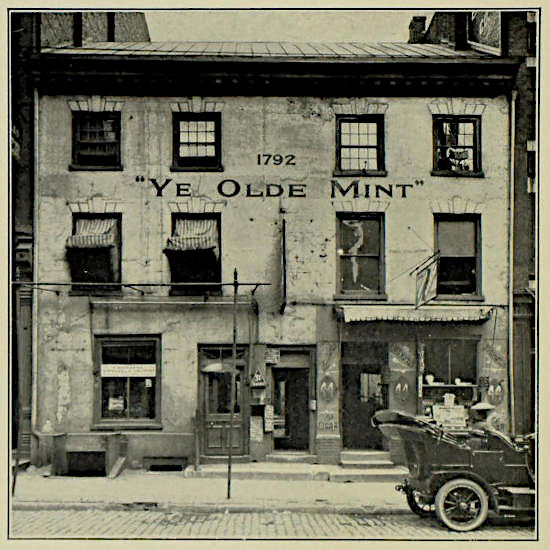
The original buildings, with the exception of the smelting
house, still stand at 37 and 39 North Seventh Street, and in
the rear of these numbers. There were three different brick
buildings, all separated by yards and alleys, those facing Seventh
Street were used for executive offices, etc. Immediately
back of them was the one used as the coinage department, and
back of that was the small two-story building facing Filbert
Street and about twenty feet back of the line of that street.
The old building used as the smelting house was torn down the
latter part of 1907, and a four-story concrete building erected
on the site.
The frontispiece shows the front buildings facing Seventh
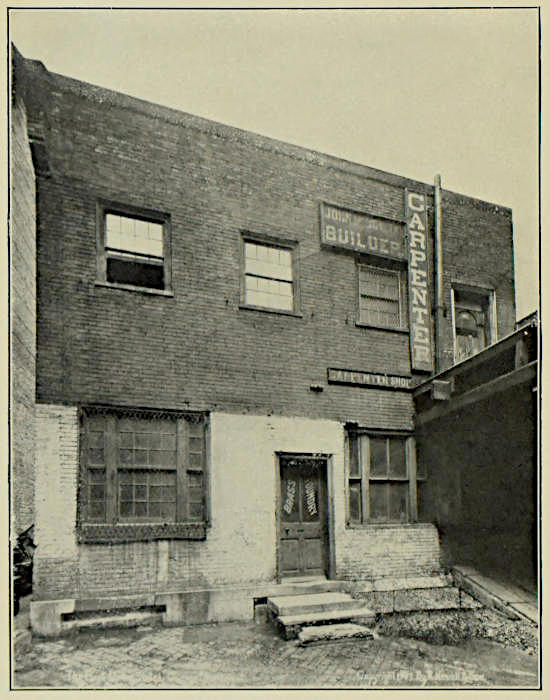
Street, and the illustration opposite page 5 the coinage building
back of them, which is separated from the front buildings by
a court yard 18 feet deep. Inasmuch as considerable attempt
at ornamentation was made on the front of the coinage building,
it is quite probable that this was the first building erected.
Tradition has it that this was originally three stories high and
that the top story was burned off. If such was the case the
third story was of wooden construction. The walled up windows
in the rear show the window sills to be badly charred.
Remains of old arched brick vaults still exist in the basement
of 39 North Seventh Street.
The building in the rear, used as the coinage department,
has two arched and paved brick vaults in its basement intact
except the doors. One of the vaults, illustrated opposite page
9, has a smaller vault in its rear end, which was undoubtedly
used as a storage place for the most valuable of the mint’s
possessions. Strong brick arches and exceedingly heavy joists,
averaging twelve inches square, were placed in the basement
to support the coinage presses above.
The building formerly facing Filbert Street had no basement,
and when excavations were made for the new building
two old brick-walled wells were uncovered, one of which was
four feet in diameter, with cesspool refuse in the bottom. The
other well was about seven feet in diameter and the bottom
was not reached, as the excavations only went down about
12 feet. These wells were between the old building and Filbert
Street. The larger one was three or four feet back of the
centre of the property at 35 North Seventh Street, and the
other was just off the southeast corner of the demolished building.
It is quite likely that the largest well furnished water for
the distillery of Michael Shubart.
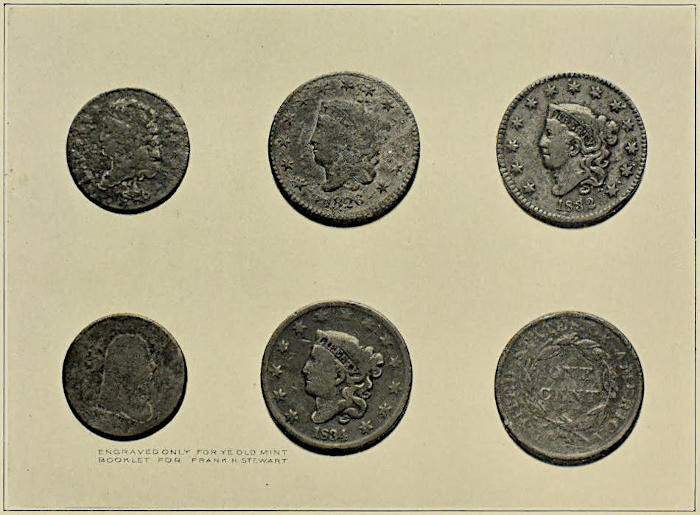
It is interesting to note that in the excavations on the site
of the old building, several copper coins and planchets were
found, most of which are illustrated opposite page 20. Two
worthy of mention are about the size of half-cents, but with
small holes in the centre, one of them having a milled edge,
the other a plain edge. They are supposed to be planchets for
the excessively rare 1792 silver centre cents, which must certainly
have been struck off at the mint, otherwise the planchets
would not have been found there. The author now has these
finds in his possession, as well as a collection of hand forged
hardware taken off the old building.
On May 8, 1792, the director of the mint was authorized,
with the approbation of the President, to purchase a quantity
of copper for the coinage of cents and half-cents, and Congress
also provided that when fifty thousand (50,000) dollars
of such cents and half-cents had been coined notice should be
given to the public in at least two newspapers, and that any
attempt to pass other copper coins would result in their forfeiture.
From a national viewpoint the old mint buildings are the
most historical in the United States, because they were the first
erected by the authority of the Federal Government for public
use. It was the sole United States Mint from 1792 to 1833.
The corner-stone was laid July 31, 1792, and presumably by
David Rittenhouse, the celebrated astronomer and philosopher
and first director of the mint. The achievements of Rittenhouse
very readily place him in the same distinguished class
as Benjamin Franklin.
The ground on which the first United States mint buildings
stand was sold by William Penn to the Pennsylvania Land
Company, and transferred to it by deed dated August 12, 1699,
“in the 11th year of our Sovereign Lord King William III, of
England, Scotland, France and Ireland.”
The Pennsylvania Land Company then consisted of Tobias
Collett, haberdasher; Michael Russell, weaver; Daniel Quare,
watchmaker, and Henry Goldney, linendraper, all of London,
England.
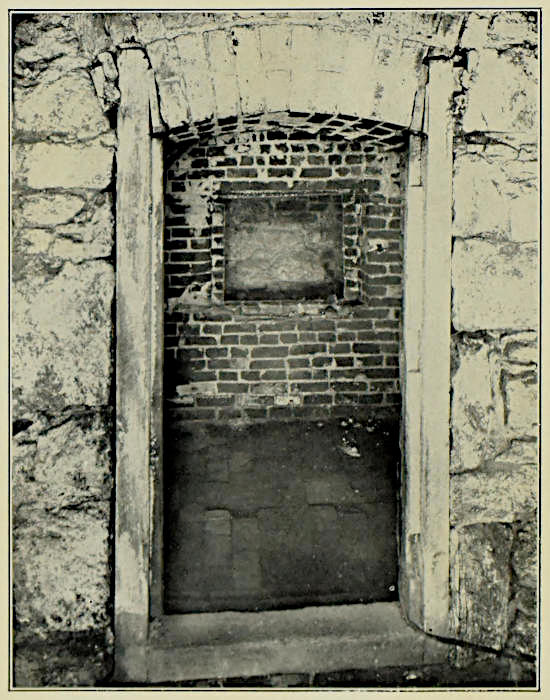
VAULT WITHIN A VAULT
BASEMENT OF COINAGE BUILDING
THE “BURGLAR PROOF” OF 1792
The deed was signed by Penn August 17, 1699, and was
stamped with two six-penny stamps. The consideration was
2,000 pounds. Herbert Springett, Wm. Martin and Wm.
Springett acted as witnesses.
The mint grounds are part of “six inland city lots, lying
between the two rivers, Delaware and Schuylkill.”
This deed, in addition to the six city lots which were evidently
thrown in as a bonus, conveyed two river front lots, one on
the Delaware and one on the Schuylkill, also 60,310 acres of
land, variously and indefinitely located for the greater part.
Two hundred and ten acres of this land was granted by warrant
to Richard Noble, “old renter,” by Penn the 14th day of the
5th month, 1683, and afterwards by a patent to Noble the 5th
day of the 6th month, 1685, by Thomas Lloyd, James Claypoole
and Robert Turner, commissioners for Penn.
Another parcel of 100 acres of this land was part of a tract
of 309 acres, “granted by an order from New York,” and
surveyed on or about the 12th day of May, 1679, unto Wm.
Clark, and afterwards disposed of to Richard Noble, and
which was on the 8th day of the 8th month, 1689, granted and
confirmed unto Noble by Wm. Markham and John Goodson,
commissioners for Penn.
The 310 acres were transferred to Penn by Noble February
22, 1695.
The Penn deed to the Pennsylvania Land Company gives
recital of grant to Penn by Charles II.
Richard Noble came over in the ship Griffith with John
Fenwick in 1675 and landed at Salem, N. J. The Griffith was
the first English ship to land in west New Jersey.
Noble surveyed and plotted the town of Burlington, N. J.,
in 1677, and on December 15, 1679, was appointed surveyor
by Governor Andross, of New York, as surveyor of Upland,
now Chester, Pa. He also surveyed a part of the present site
of Philadelphia for the Swedes, Swansons, in 1681.
Wm. Markham was a cousin of Wm. Penn and landed in
America in 1681. He at one time held a captaincy in the English
army. He was the first Deputy-Governor of Pennsylvania.
Thomas Lloyd was president of council, justice of the peace
of Philadelphia, and de facto Deputy-Governor in 1690. He
founded, under Penn’s instructions, the first public school in
Pennsylvania in 1689.
James Claypoole built the first brick house in Philadelphia,
and was a member of council in 1687 and one of the Free
Society of Traders.
Robert Turner was a close friend of Penn, and at one time
a merchant of Dublin, Ireland. Penn was in frequent correspondence
with him and, among other things, wrote him on
May 5, 1681, how and why the name of Pennsylvania was
selected. He was also a member of the Free Society of
Traders.
John Goodson was a prominent man in the early days of
the settlement of Pennsylvania, and like Markham, Lloyd,
Claypoole, Turner and others empowered to sell land for Penn.
The Pennsylvania Land Company held possession until December
26, 1758, when Francis Rawle, acting as its attorney,
transferred a parcel containing part of the mint lots to Daniel
Roberdeau, he being the highest bidder at a public sale.
This piece of land was described as a “certain piece of
ground situate on the east side of the Seventh Street from the
Delaware, City of Philadelphia, containing in breadth on the
said street 50 feet, and in length or depth 198 feet, or thereabouts,
be the same more or less, to the middle or half way
between Sixth Street and Seventh Street,” bounded on the
south by the back ends of High Street (now Market) and on
the north by land of Rebecca Cooper.
On December 26, 1758 (the same date as the Roberdeau
deed) Francis Rawle, attorney for Thomas Hyam, merchant;
Thomas Reynolds, clothworker, and Thomas How, goldsmith,
only surviving feoffees in trust of the Pennsylvania Land
Company, sold to Rebecca Cooper, spinster, as the highest
bidder at public sale, “a certain piece of ground situate on the
east side of the Seventh Street from Delaware in the said City
of Philadelphia, containing in breadth on the same street 50
feet.”
This lot was also 198 feet deep and bounded on the east by
land conveyed to Richard Farmer, as was the ground sold to
Daniel Roberdeau. Joshua Howell and William Govett were
witnesses on both the deeds and both were acknowledged
before Isaac Jones, Justice.
Daniel Roberdeau, by deed dated February 27, 1759, conveyed
to Richard Farmer, practitioner in physics, the same
piece of ground he purchased at auction of the Pennsylvania
Land Company. Deed witnessed by H. W. Dovey and John
Reily.
Rebecca Cooper, by deed dated April 3, 1759, also sold to
Richard Farmer the ground she purchased at auction of the
Pennsylvania Land Company. Her lot was bounded on the
south by ground late of Daniel Roberdeau.
These two pieces of ground of 50 feet each on Seventh
Street, each contained part of what afterwards became the
mint lot, which faced Seventh Street, and which was, and now
is, 36 feet 10 inches front, with another lot making an outlet
on Filbert Street, now covered by a four-story concrete and
steel-frame building occupied by the Frank H. Stewart Electric
Company, and connected by openings with the building on the
northeast corner of Seventh and Filbert Streets, also occupied
by the same concern.
Richard Farmer and wife, by deed dated September 1, 1760,
conveyed to Michael Shubart, distiller, “two certain pieces of
ground,” one of which was located on Seventh Street, with a
frontage of 36 feet and 10 inches and with a depth of 99 feet,
which was bounded on the south by a piece of ground sold
by Farmer to George Keller, 20 feet by 99 feet.
The other piece of ground was on the north side of a
certain 14-foot alley (now Filbert Street, mentioned for the
first time), containing in breadth 17 feet on the alley and 56
feet 10 inches deep, connecting with above lot in the rear and
for its entire width as well as the Keller lot.
The consideration was a yearly ground rental of 21 Spanish
silver pieces of 8 of 17 pennyweight and 6 grains each, with the
option within seven years of cancellation by payment of 133
pounds, lawful money of Pennsylvania.
Shubart agreed to erect within four (4) years on one of the
pieces of ground one good brick kitchen, or tenement, or other
brick building at least 15 feet square.
This deed was witnessed by Robert Wilson, Jr., and John
Clarkson; acknowledged by Wm. Peters, justice.
This transfer shows that the High Street lots, near Seventh
Street, extended at one time back to what is now Filbert
Street, and also that Richard Farmer’s land was taken in whole
or in part for the purpose of what then was termed an alley,
and later known as Sugar Alley, then Farmers Street, and now
Filbert Street.
James Ash, high sheriff, on May 27, 1790, conveyed to Frederick
Hailer the land purchased by Shubart from Farmer, together
with a tenement distill house and coppers, distills,
worms, cisterns, tubs and other utensils belonging to said distillery.
This conveyance was subject to the payment of the yearly
ground rent of 21 Spanish pieces of 8.
Jacob Barge was the creditor who caused the sale.
Frederick Wailer, surgeon barber, and wife, Christiana, July
18, 1792, sold to the United States Government the land and
distill house and frame tenement building formerly owned by
Shubart.
This deed recites the Act of Congress referred to elsewhere,
and states “the President in pursuance thereof caused to be
purchased from said Wailer, etc., etc.”
Wailer made a nice profit. He bought it for 515 pounds and
sold it for 4,266⅔ dollars, subject to the ground rent as before.
This deed was acknowledged by Wailer and wife before
James Biddle, president of the Court of Common Pleas, of
the County of Philadelphia, July 21, 1792.
During the entire time the government owned the property
it paid an annual ground rent, which seems rather strange now.
On July 1, 1792, Washington appointed David Rittenhouse
director of the mint, and on July 19th, the day following the
purchase, eight carpenters, besides other laborers, commenced
to tear down the distillery, and on August 25th the frame
work for the new building was raised.
Work on the bellows furnaces was commenced September
7th, and on September 11th six pounds of old copper for coinage
was purchased at the price of one shilling three pence per
pound.
Three coining presses, imported from Europe, arrived September
21st, and in October they were in operation.
On December 30, 1792, Jefferson, then Secretary of State,
wrote Pinckney, our minister to England, about the difficulty
of procuring copper, and suggested Sweden as a source of supply
and enclosed draft on the treasury of the United States for
$10,000.
The United States of America on January 12, 1836, by deed
reciting Act of Congress under date of May 1, 1830, transferred
the mint grounds and buildings to Michael Kates, bell
hanger, for $8,100, he having been the highest bidder at public
sale. In this deed the 14-foot alley was called Sugar Alley and
the ground rent again noted.
Andrew Jackson, President of the United States of America,
signed this deed and the great seal of the United States of
America was attached. John Forsyth, Secretary of State,
witnessed the President’s signature.
On February 18, 1836, Francis Hopkinson, Clerk of the
District and Circuit Courts of the United States of America
for the eastern district of Pennsylvania, appeared before John
Swift, Mayor of the City of Philadelphia, and on his oath said
he was acquainted with the signatures of both Jackson and
Forsyth and was satisfied they were their own and proper
signatures.
The neighborhood of the old mint is rich in traditions regarding
it, and it may happen that when the buildings are torn
down some of them will be substantiated.
During the War of 1812 Dr. R. M. Patterson, Adam Eckfelt
and Joseph Cloud, respectively director of the mint, chief
coiner, melter and refiner, were engaged at the Breast Works
at Grays Ferry, and, as these gentlemen were the chief employees
of the mint at the time, it is highly probable there was
considerable alarm over the safety of the mint. Among other
traditions is one that the bullion, planchets and coins were
walled up and buried during this scare. The actions of the
British at Washington showed their tendency towards destruction
of government property.
An old lady living in West Philadelphia has the original appointment
of her ancestor, Joseph Cloud, to his position in
the mint, signed by Washington. She would not even allow it
to be photographed for fear something might happen to it
while in the photographer’s hands.
Biddle’s Directory of 1791 gives the address of Michael
Shubart, distiller, as 29 North Seventh Street; Hardie’s 1793
directory gives the mint at 29 North Seventh Street, which
indicates that a change of numbers in the mint property has
been made since that time. Shubart was a prominent Philadelphian;
during the Revolution he was a city assessor, and on
one occasion took an unconditional oath while his colleagues
made a reservation. In the elaborate pageant of July 4, 1788,
he bore the Standard at the head of the distillery section,
followed by other notables engaged in that business.
Daniel Roberdeau, mentioned elsewhere as an owner of part
of the mint grounds, at one time was a brigadier-general of
militia, and his name appears frequently in the Revolutionary
Annals of Philadelphia as a man of pronounced ideas and
stern character.
The beginning of the mint establishment may be traced back
to the articles of Confederation, dated July 9, 1778, which
contained the following: “The United States in Congress
assembled shall also have the sole and exclusive right and
power of regulating the alloy and value of coin struck by
their own authority or by that of the respective States.”
The Constitution of the United States, September 17, 1787,
contains in Article I, Section 8: “The Congress shall have
power to coin money, regulate the value thereof and of foreign
coins”; and further, “No State shall coin money, emit bills of
credit, make anything but gold and silver coin a tender in payment
of debts.”
Analysis of the above will show the reason why the various
States discontinued their own coinage.
The Continental Congress, January 7, 1782, instructed Robert
Morris, the financier of the Revolution, to prepare and
report a table of rates at which the different species of foreign
coins most likely to circulate within the United States should be
received at the treasury. On January 15th, the week following,
he made a lengthy report regarding the different names
and values of coins then in use and the necessity of a legal
tender. He stated that the necessary machinery for a mint
could easily be made and that the advantage of possessing legal
money in preference to any other would induce people to carry
foreign money to the mint until a sufficiency were struck for
the circulating medium, and the remainder of foreign gold
and silver coins should be left entirely to the operations of
commerce as bullion.
On April 14, 1790, Thomas Jefferson reported to the House
of Representatives, advising the declination of the proposition
of John H. Mitchell regarding his offer to furnish coins from
Europe at a fixed price per pound for copper coins. His objections
were that the opportunity of recoinage of coins would
be lost, and that in transportation across the ocean it would be
subject to the dangers of the sea, acts of piracy, and, in times
of war, would offer the sinews of war to the enterprise of the
enemy, and further, that the resource of coining household
plate would be lost. The risk of counterfeiting was also noted.
Alexander Hamilton, Secretary of the Treasury, on January
28, 1791, as a result of instructions on the part of the House
of Representatives on April 15, 1790, sent a lengthy communication
to it on “The Establishment of a Mint.” This communication
was evidently the basis for the act of Congress, dated
April 2, 1792, establishing the mint and regulating the coins of
the United States.
The mint was to be situated at the seat of government, then
Philadelphia, and the President, in addition to the authority
given him under the Act of March 3, 1791, was authorized to
cause to be provided and put in proper condition such buildings
as appeared to him to be necessary for carrying on the
business of the mint.
The Act of March 3, 1791, approved by President Washington,
authorized the establishment of a mint under such
regulations as should be directed by law. This Act authorized
him to cause to be engaged artists and the procurement of the
necessary apparatus.
On December 30, 1793, Jefferson wrote the President regarding
artists. He mentioned that a certain Drotz had been
hired, but, after considerable delay, refused to come to America,
and that our minister at London had succeeded in getting
Mr. Albion Coxe, who was probably the person of that name
who had the right to make copper coins for the State of New
Jersey in 1786, to accept the position as assayer. Inasmuch
as it was impossible to secure abroad a chief coiner of greater
ability than at home, Mr. Henry Voight, who was temporarily
in the position, was favorably mentioned.
These two men were required to furnish security in the sum
of ten thousand dollars each, which neither was able to do,
and Jefferson stated that the coinage of precious metals was
prevented for some time past, but that in order that the mint
might not be entirely idle the coinage of copper had been
going on. Jefferson recommended that their securities be
lessened by reducing their responsibilities.
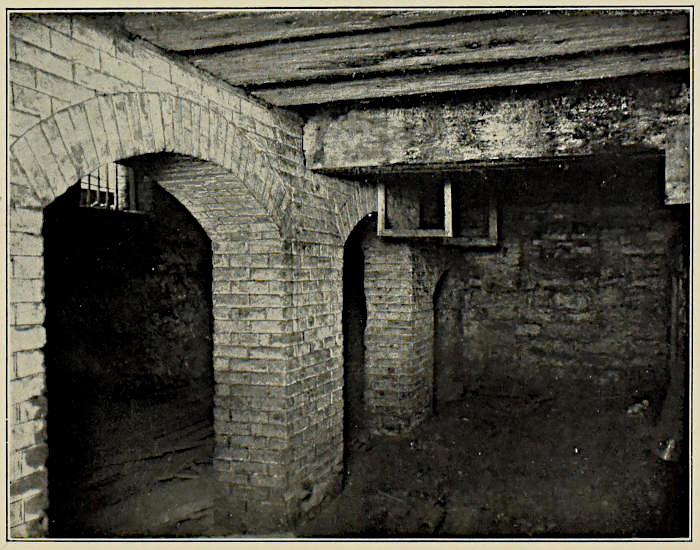
BASEMENT OF COINAGE BUILDING
SHOWING PRESS SUPPORTS AND HAMMERED ONE INCH SQUARE IRON WINDOW BARS. TIMBERS AVERAGE
12 INCHES SQUARE. CUT SHOWS NEARLY ONE HALF OF BASEMENT.
October 28, 1794, David Rittenhouse, director of the mint,
reported that it had been necessary to purchase an additional
lot of ground, that nearly one million of cents had been coined
and a beginning made in the coinage of precious metals, that
nearly 120,000 ounces of bullion had been deposited for coinage
and that a large parcel of blank dollars was ready for
coining as soon as a more powerful press could be finished.
February 9, 1795, Mr. Boudinot, one of the Congressional
Committee appointed to examine and report on the state of the
mint, made a long report on the duties and work of the various
employees.
At that time besides the buildings at 37 and 39 North Seventh
Street, now belonging to the Frank H. Stewart Electric
Company, a lease was held on one in the “Northern Liberties”
for five years at the rent of five shillings per annum, a very
trifling sum indeed.
There was more or less criticism about the conduct of the
mint which Mr. Boudinot explained was due to trouble in getting
competent workmen, proper materials and strong apparatus.
He reported the lots for the buildings were too small and that
this hindered the operations; and, further, that the frequent
breaking of dies, which were all made in the mint, caused
numerous delays. Up to September, 1794, the lands purchased
had cost $4,266.66; buildings, apparatus, machines, etc., $22,720.45;
copper, $15,815.51; salaries, $15,591.99, a grand total
of $58,394.61, which he considered a very great amount. He
remarked that a great saving could be made if the machinery
could be operated by water or steam instead of manual labor
or that of horses. He noted that in case the projected canal
between the Schuylkill and Delaware should be accomplished
the heavy expense of the mint would be greatly reduced.
His report, among other things, showed that when the bullion
was not in use it was kept under two locks, the keys of which
were kept by the assayer and chief coiner. This was for the
time it was in the custody of the chief coiner. That part not
in his custody was in the vaults of the mint, also secured under
two locks, keys of which were kept by the treasurer and
assayer. Mention is made elsewhere regarding these vaults.
He recommended a reduction in the size of the copper cent
and a change in the standard for silver coins to ten parts silver
and one part copper.
Henry William DeSaussure in a letter, dated the mint office,
October 27, 1795, to the President of the United States, George
Washington, apologized for the length of his communication
and said he was prepared to deliver the direction of the mint
to his successor.
He stated the coinage of gold had begun under his administration.
He deemed it proper to state there was no copper in
the mint fit for coining, and that the price of copper had advanced,
and suggested the desirability of reducing the weight
of the cent and thereby help in preventing its use by coppersmiths.
He mentioned the important fact that the standard of the
silver coin in use at the mint differed from the standard fixed
by law. He thought that either the law should be changed or
the standard used according to law.
He suggested the desirability of having laws made to close
up certain establishments making debased foreign coins and
thereby curtailing the supply of gold bullion and degrading
our national character.
He referred to an attempt on the mint dies and implements
with nefarious views.
Elias Boudinot, in a letter dated at the mint, December 3,
1795, referred to the sudden death of Assayer Mr. Albion
Coxe on the preceding Friday, and said “until this officer is
replaced the business of the mint would be confined to striking
cents only.” In the same letter he recommended, among
other things, “that some proper person be authorized to purchase
on public account all small quantities of silver and gold
brought to the mint, at the best market price, to be coined for
the public treasury.”
Elias Boudinot, in a very able letter to the President, dated
at the mint, November 29, 1796, told how impossible it was
to run the mint with business-like dispatch, hampered as it
was by unreasonable restrictions. He pointed out how in one
case a depositor of bullion below standard got 500 pounds
sterling more than he should and still was within his legal
rights. In other words, it cost the mint that much to refine
the bullion for which it received no compensation. He also
pointed out how expensive it was to coin bullion in rotation
so that each depositor got his money in turn. In this way it
was just as expensive to melt and refine 20 ounces as 1,000
ounces and he recommended a fund for the mint to be used in
paying off small depositors of bullion and thus be able to melt
and refine in larger quantities.
February 13, 1797, Mr. Havens, of the committee to examine
and report on Mr. Boudinot’s letter, made his report to Congress
and recommended the sum of $2,820.71 be appropriated
to make good the deficiency caused by wastage in coining gold
and silver since the commencement of the coinage of these
metals. The report was substantially a confirmation of the
statements made by Mr. Boudinot.
May 19, 1798, recommendation of allowance to John
Vaughan was made because silver bullion, to the extent of
230,888 ounces, deposited by him was of greater fineness than
that regularly used in coinage.
During the latter part of 1797 it became very apparent that
the out-put of the mint was not sufficient for the needs of the
country, and foreign coins were necessarily continued as legal
tender despite legislation to the contrary.
Elias Boudinot, in a letter from the mint to the President,
dated January 3, 1799, mentioned that during the previous
summer a scheme for robbing the mint was discovered. One
of the persons in the mint was in collusion with outside parties.
The offenders were detected, prosecuted and punished.
January 8, 1800, Boudinot reported to President Adams and
called his attention to the fact that fifty thousand one hundred
and eleven dollars and forty-two cents ($50,111.42) of cents,
had been coined and that it was necessary for the Secretary of
the Treasury of the United States to comply with provisions
of law of May 8, 1792, by giving the public notice therein
mentioned.
Also brought up the point that the mint was not at the seat
of government, which had been moved to Washington, and if
mint was to be removed steps should be taken immediately
regarding it.
Also called attention to workmen in gold and silver melting
down coins for commercial purposes to the loss of the United
States.
Mr. Hillhouse, of the committee to whom was referred the
report of the director of the mint to the President of the
United States, on January 8, 1800, recommended, on March
18, 1800, that a committee be appointed to bring in a bill for
repealing the first section of the Act entitled, “An Act establishing
a mint and regulating the coins of the United States....”
dated April 21, 1792, and such other sections and parts of sections
of said Act as relate to the establishment of the mint, and
to provide for taking care of the materials and property appertaining
to the mint and which belong to the United States; and,
further, that the Secretary of the Treasury be directed to report
a plan for furnishing the United States with cents and half-cents
as shall be deemed necessary or expedient.
February 13, 1801, Elias Boudinot advised the President that
the Secretary of State, Secretary of Treasury, Comptroller of
the Treasury, the Chief Justice and Attorney-General were not
present on the day specified by law to assay reserved pieces of
coins, and that the depositors complained of their being deprived
of their reserved money, and that the check on coinage
contemplated by law was frustrated. Also mentioned that the
act of July 16, 1790, provided for removal of all offices attached
to the seat of government to the District of Columbia
on the first Monday in December, 1800. Called attention to
Act of last session of Congress locating mint in Philadelphia
until March 4th next.
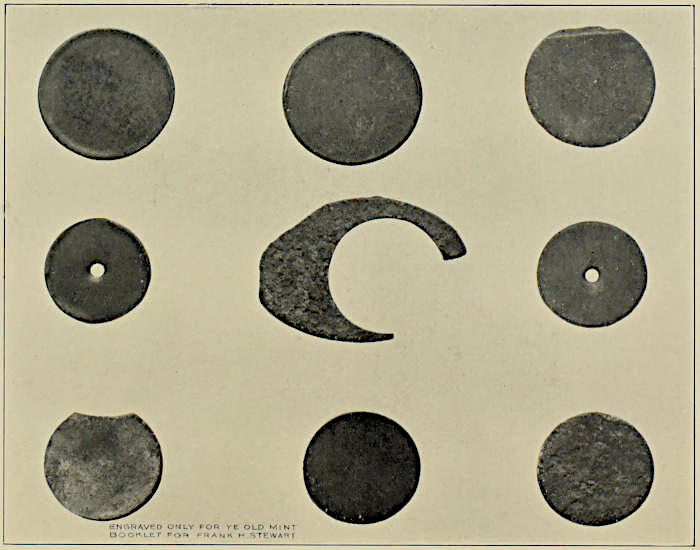
PLANCHETS FOR COPPER CENTS, HALF CENTS AND SILVER CENTRE
CENTS, ALSO PIECE OF SCRAP COPPER FROM WHICH A HALF CENT WAS STRUCK, ALL
FOUND WHILE EXCAVATIONS WERE BEING MADE FOR NEW BUILDING 631 FILBERT
STREET. SIZE 15/16 OF ORIGINALS.
He, on February 27, 1802, in a communication to the Secretary
of the Treasury, calls attention to outstanding contracts
for copper abroad which were obligatory, and the difficulty
attending the securing of copper in the past. Questioned the
scheme of importing coined copper cents because of a chance
of a flood of lightweight cents contrary to law, and suggested
that the government would have greater security by placing
contract in United States.
On March 4, 1802, Robert Scott, engraver at the mint, wrote
the Secretary of Treasury, Albert Gallatin, calling attention to
the probability of abolishment of the mint, explained the
sacrifices he had made and desired to be invested with the
exclusive privilege, according to law, of furnishing cents of
the regular weight and quality free of all expense to the
government at the face value.
In a letter dated March 22, 1802, Mint of the United States,
Philadelphia, Elias Boudinot wrote the Secretary of Treasury,
giving an inventory of the real and personal property of the
mint, as follows:
“Two lots on Seventh Street between Market and Arch, 20
feet each on Seventh Street and extending back 100 feet, with
a dwelling house on the north lot and a shell of a house on the
south lot, which last lot widens on the rear to about 60 feet on
which the stable stands. These lots pay a ground rent of
$27.50 per annum.
“A lot on Sugar Alley at the rear of the above, 20-feet
front on the alley and about 100-feet deep.
“A frame building improved for a large furnace in the commons
at the north end of Sixth Street, of little value, the
ground being merely loaned to us.
“Personal estate—copper planchets on hand, 22 tons.
“Three horses, good for little but for use of mint.
“Machinery of mint no value except for mint.
“Five striking presses.
“Three cutting presses.
“One milling machine.
“Five pairs rollers, great and small.
“One drawing machine.
“Three pairs smith’s bellows.
“Set blacksmith’s tools.
“Large number of hubs and dies.
“Carpenter’s tools.
“Seven stoves.
“One turning lathe.
“Six scale beams, scales and weights.
“Two sets assay scales and sundry adjusting scales.
“Furniture in clerks’ rooms.
“Various implements used in the several departments.
“About 2,000 bushels charcoal.
“Engravers’ tools, pots, bottles, etc.
“An old horse cart and gears.
“About 2,000 fire brick.
“Considerable quantity of old iron.”
Stated machinery was in poor repair and should be moved
by steam instead of horses. Said lots were too small and
was greatly cramped for room.
Said lots were then very valuable, being in the heart of
the city. In his opinion the necessary coins of the government
could not be protected at much less expense than the
mint cost.
In this inventory no mention was made of the building used
by the coinage department, and which, no doubt, was the best
and most important building then on the lots. The sizes of
the lots given are inaccurate, and the idea evidently intended
to be conveyed was that there was very little of value in buildings
or equipment.
In 1793 salaries of the mint employees were as follows:
| David Rittenhouse, director, |
$2,000 |
per annum |
| Tristram Dalton, treasurer, |
1,200 |
” ” |
| Henry Voight, coiner, |
1,500 |
” ” |
| Isaac Hugh, clerk, |
312 |
” ” |
The regular coinage of copper began in 1793; silver in 1794,
and gold in 1795.
The following curious extracts are taken from the mint rules
and regulations, dated January 1, 1825:
“The allowance under the name of drink money is hereafter
to be discontinued.”
“The operations of the mint throughout the year are to
commence at 5 o’clock in the morning.”
“Christmas Day and the Fourth of July—and no other days—are
established holidays at the mint.”
“He (watchman) will keep in a proper arm chest, securely
locked, a musket and bayonet, two pistols and a sword. The
arms are to be kept in perfect order and to be inspected by an
officer once a month, when the arms are to be discharged and
charged anew.
“The watchman of the mint must attend from 6 o’clock in
the evening to 5 o’clock in the morning—and until relieved
by the permission of an officer, or until the arrival of the
doorkeeper. He will ring the yard bell precisely every hour
by the mint clock from 10 o’clock until relieved by the doorkeeper,
or an officer, or the workmen on working days, and
will send the watch-dog through the yard immediately after
ringing the bell.”
The operations at the mint were suspended at different times
because of yellow fever epidemics, and this, in connection with
the scarcity of metal, and a fire at the mint and the use of coins
for purely commercial purposes by coppersmiths, silversmiths
and other tradesmen, accounts for the scarcity of certain coins
made at “Ye Olde Mint,” under great disadvantages, when men
and horses did the work now done by electricity.