Y E MAGICK MIRROUR OF OLD JAPAN.
IN old Japan the mirror occupies a
peculiarly important place. Travellers
in that land of strange
arts and quaint customs tell us of
mirror-worship as one of its forms
of primitive religion. In old Japan the mirror
is not, as in our Western civilization, a mere
article of furniture, an accessory of the toilet,
or a means for covering up the otherwise indecorate
breadth of wall above a mantel-piece.
One finds the mirror in Japan surrounded
with pomp and circumstance on every hand.
It is prominent amongst the symbolic objects
that constitute the imperial regalia of the
Shogun. One sees it depicted in Japanese
pictures of the infernal regions. In the temples
of the old Shinto religion, precious old mirrors
are enshrined in costly arks, only to be exhibited
on the occasion of some great ceremony. Innumerable
mirrors, some of them of old date,
but mostly of modern manufacture, are to be
found hung upon the walls of the Shinto
temples. There they have been deposited as
votive offerings by women who had perhaps
nought else so precious to offer. As the
Japanese warrior offers as a votive gift to the
temple his cherished sword, so the Japanese
lady bestows her treasured mirror. There they
hang in thousands, swords and mirrors, side by
side, thank-offerings to the gods. In the scant
furniture of the Japanese ménage, the mirror,
reposing in its place upon the lady’s toilet-table,
forms the one significant object; the central
feature to suit which all the rest is subordinated.
The mirror enters into the myths of the
Japanese race: it is the emblem of light, or
the sun, and of the divine right of the dynasty.
In the trousseau of the bride the mirror is the
most precious object—her one cherished possession.
The first-made mirror—or the one
held to be such in the estimation of the Japanese,
and venerated accordingly—is enshrined in the
great sacred twin-palace at Isé, the holy spot
to which pious pilgrims turn their steps with
devoted zeal. Its origin is related in the famous
myth of the sun-goddess, Amaterasu oho-mi-kami,
who, on one occasion, withdrew offended
to a rocky cavern, leaving the world in darkness.
From this retreat she was enticed by
the other gods, after many curious artifices had
been tried, by their successful making of a
mirror, in which seeing her face reflected, she
was impelled by jealousy and curiosity to
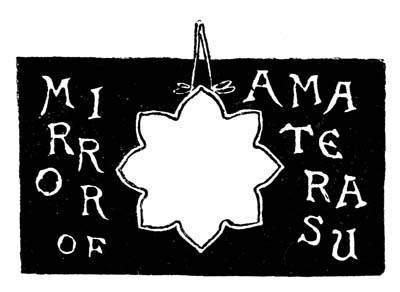
venture forth. This mirror was fashioned by
the Vulcan of the Shinto Olympus to imitate the
sun, being in shape a disk with eight rays. In
modern Japanese heraldry the sun, as blazoned
upon the national flag, is a red orb with sixteen
red rays, not pointed as in European heraldry,
but widening out to the margin of the flag.
Some hold that the Japanese imperial crest, the
kiku, which resembles a flower with sixteen
petals joined and rounded at the outer extremities,
and issuing from a small central disk, is
also a blazon of the sun; others hold it to
represent the chrysanthemum. In Japanese
pictures of the sun-goddess myth, the mirror
is always represented as of the eight-point form.
Tradition states that the flaw still to be seen
in its surface was caused by a blow it received
when the gods thrust it into the half-opened
doorway of the rocky cavern as the sun-goddess
peeped out. The standard version of the
entire myth is to be found in a memoir on the
Shinto Temples of Isé by Mr. Ernest Satow,
in the second volume of the “Transactions of
the Asiatic Society of Japan” (1873-74). In
the British Museum, in Dr. Anderson’s collection
of Japanese drawings, No. 1905, there
is a silk roll painted in colours, depicting the
scene outside the cavern. It is without signature
or seal, and the artist is unknown. A
further myth narrates the subsequent history
of the mirror. It was handed by the sun-goddess
to her grandson Nini-gi no mikoto
when he descended from heaven to subdue the
earth, along with the sacred sword and the
sacred seal-stone (the three sacred treasures
of the Japanese regalia), with these words:
“Look upon this mirror as my spirit: keep it
in the same house and on the same floor with
yourself, and worship it as if you were worshipping
my actual presence.” Nini-gi no
mikoto founded the empire of Japan, and is
worshipped as the first Shogun, all subsequent
sovereigns claiming divine right by descent from
him. All mirrors in Shinto temples, whether
exposed to view or concealed in shrines or
arks, are imitations of this one, though some
are regarded as being representative of other
secondary deities. At Isé, where the first
mirror is preserved, each mirror is enclosed in
a box standing on a stand, and covered with a
cloth of silk. The mirror is itself wrapped in
a brocade bag, which is never opened or renewed,
but which, when nearly worn out, is
enclosed in a new bag. Over the numerous
wrappings is a cage of wood with gold ornaments,
draped with a curtain of coarse silk.
At festivals, when they open the shrines, all
that can be seen is the boxes with the coverings
over them.
The mirror of old Japan is however a very
different article from that known in modern
Europe as a mirror. European mirrors are
made, as everyone knows, of glass silvered at
the back. Japanese mirrors are invariably
made of metal, the bronze employed being a
compound of copper and tin, with traces of
antimony or lead.[1] The mirrors preserved
in the temples are not all of the eight-pointed
form. Some are simply circular, with a thick
rim behind, and a central button perforated
to receive a suspending cord; the front being
quite plane. Others are oval, with feet, or
with perforated handles at the upper part for
suspension. In the houses square mirrors are
very rarely met with, and these are mostly
small. Those for the lady’s toilet table are
usually circular, from four to five inches across,
without handles, possessing a thick rim and a
raised pattern on the back. Commonest of
all are the hand-mirrors, which are usually
circular, from three to eleven inches in diameter,
with a metal handle covered with bamboo
or with brocade. They are usually slightly
convex on the front surface, which is brightly
polished; while the back, which is for the
most part unpolished, exhibits a fine raised
pattern. Often the raised ornament consists
of two distinct kinds. There is made in high
relief, and polished bright so as to stand out
from the background, a simple bold symbolic
device, sometimes a Chinese character signifying
“good-luck,” or “long-life,” sometimes a
family crest, such as the imperial kiri (or
Paullonia leaves and flowers), or a circlet, or
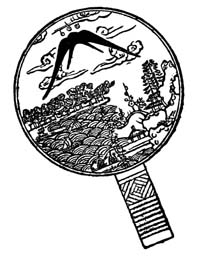
three feathers crossed, or the jagged peak of
Fuji-yama, or the outline of a bird. Ornament
of the second kind is in low relief, and, though
often symbolic, consists of naturalistic representations
of trees, flowers, storks, bamboos,
and the like. A group comprising pine-trees,
storks, and the hairy-tailed tortoise, all symbols
of longevity or immortality, is a favourite one.
Sometimes the ornament consists exclusively
of one or other of these kinds; but more frequently
both are present; the unpolished low-relief
work forming an artistic background for
the crest or the Chinese letters, which stand
out polished. In passing it may be remarked
that the Japanese make use of Chinese characters
in addition to their own form of writing,
just as we still use old English black-letters for
ornamental or distinctive purposes.
But the most interesting thing about Japanese
mirrors—the one thing that has made them
famous and brought them to the notice of
lovers of the curious and the occult—is their
reputed magical property. Oriental stories of
magic mirrors have been current from the
middle ages, most of them wholly childish and
absurd. But along with these there have
existed accounts, of a more reliable character,
of mirrors which are capable of reflecting, in
a beam of light that falls on their face, the
pattern which they carry on their back. This
singular property is no myth, though the true
explanation of the phenomenon was long unknown.
When first seen, the phenomenon is
so startling that it seems almost incredible.
You take the mirror into your hand and
examine it. Its face is slightly convex, perfectly
polished, unless scratched by use or tarnished;
and on looking into it you see only
your own image, or the objects about you—not
a hint or trace of the raised pattern at the
back. Now hold up the mirror in direct sunlight,
or in the path of a powerful beam of
light from some artificial source, such as an
electric lamp. It will reflect back the beam,
and cast an illuminated patch on the wall or
floor, just as any other mirror will do. But
on examining this luminous patch you will at
once observe—if your mirror is a good one—that
the salient features, and sometimes even
the fine details, of the pattern on the back
are reproduced in the light reflected from the
front. Some dozens of Japanese mirrors, most
of them quite modern, have passed through the
hands of the author for optical examination.
Some of these failed to show any magical properties
whatever. Others showed the property
very well. Others again, which showed nothing
at first, were found capable of being converted
into magic mirrors by a course of treatment
subsequently discovered.
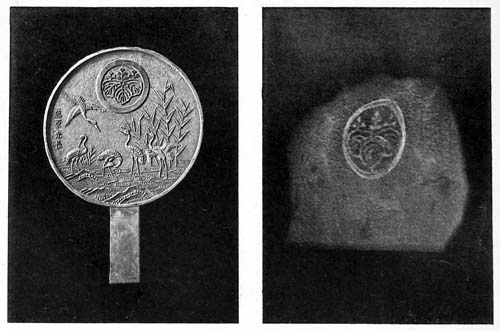
Plate II.
Down to about 1845 these mirrors were
excessively rare in Europe, though it is quite
possible that they may have occasionally formed
part of the stock-in-trade of mediæval conjurors
and magicians. Amidst the mass of
occult rubbish one may here and there discern
statements probably relating to the genuine
phenomena exhibited by mirrors of the class in
question, having little or nothing in common
with the visions to be seen in crystal spheres,
or beryls, or in pools of ink. Thus Gaspard
Schott, both in his “Physica Curiosa” and in
his book on Magic, refers to the Mirror of
Pythagoras, in or on which he is said to have
written in blood the things which he wished to
signify, and which, when turned to the moon,
displayed upon the disk of the moon, visibly to
one standing behind, the things so inscribed.
The “disk of the moon” here referred to may
have been simply the luminous patch cast by
the reflected moonbeam.
Again, it is stated that the Italian historian,
Muratori, makes two references to magic
mirrors, one in the possession of Bishop Bartolomeo
of Verona, who was murdered by
Mastino della Scala in 1338; the other found
in the house of Cola di Rienzo (or Rienzi),
which had upon its back the word “Fiorone.”
Not having been able to verify the statement
from literature available in the British Museum,
I am in doubt about the last case. It is much
more likely that the mirror bore on its back a
large flower, than that it bore the word meaning
a large flower.
Except for obscure references such as these,
there is no record of real magic mirrors prior
to 1832. Yet a few did undoubtedly exist.
There were some in the collection of the royal
family of Savoy at Turin, which were later examined
by Professor Govi. There was one
reputed to be magical in Berlin. The great
Von Humboldt thought it worth his while, in
1830, to bring this mirror to Paris to show it
to his confrères of the Académie des Sciences;
but having brought it, found himself unable to
show anything. In 1842 several mirrors were
brought from Nankin by Admiral Mouchez
(commander of “La Favorite”), M. Arosa,
and M. Piou. One was in the possession of
the Marquis La Grange in 1847.
With the opening of Japan to the commercial
world, in 1867, came the export of mirrors
amongst other articles of metal-work; amongst
them some that were of magic quality. One
was displayed in 1876 in the Loan Collection
of Scientific Apparatus in the western galleries
of the South Kensington Museum. The official
Catalogue (p. 927) thus describes it: “983 c.
Magic Mirror. [Exhibited by] Robert von
Tarnow. This mirror is a curiosity, and
consists of a brass concave disc with finely
polished surface. At the reverse rough side
there are several Arabic (sic) characters in
relief. By exposing the polished surface to
the rays of the sun in such a way that they
reflect them on the wall, the Arabic figures of
the reverse side of the disc become plainly visible
in the reflected light on the wall.” It was this
mirror which, in the following year, the
present writer had in mind when, writing in
“Nature,” he proposed that an investigation
should be made into the strange optical
property so exhibited. Happily at that time
his friend Professor W. E. Ayrton was
resident in Japan as Professor in the Imperial
College of Engineering at Tokio, and he and
his colleague, Professor Perry, at once engaged
in an exhaustive research on the subject, in the
course of which they not only examined some
hundreds of mirrors, but also acquainted themselves
on the actual spot with the methods of
manufacture, which until then were entirely
unknown, or misunderstood. A year or two
later, after the publication of the researches of
Ayrton and Perry, other researches of an
entirely confirmatory character were published
in France by M. Bertin. In fact, the scientific
investigations may be sharply divided into four
periods.
(i.) 1832. Elementary guesses by Brewster
and Prinsep, the former of whom ascribed the
phenomenon to some supposed molecular
changes in the metal at the surface, due to a
pattern having been stamped on the front to
imitate that on the back, and then ground off.
The latter ascribed it more correctly to differences
of curvature of surface, but also fell
into the error of supposing the ornament to
have been stamped.
(ii.) 1844-1853. French investigations by
Arago, Julien, Person, and Maillard. Of
these investigators Person gave the suggestion
of the true cause, namely, minute differences
of curvature in the polished surface, a circumstance
which he proved by covering the mirror
with a piece of paper having a circular hole,
about one centimetre in diameter, and which,
when moved about over the mirror (in sunlight),
caused as a reflected image a spot of light, the
size of which varied from point to point of the
mirror. He also soldered a narrow slip of
sheet metal behind a polished daguerreotype
plate, and found that when the latter was
slightly bent the image from the front showed
a luminous line at the corresponding place.
Maillard later adopted Person’s theory, and
confirmed it by employing an optician to
burnish on the lathe a piece of metal which
had raised markings on its back. He also
noted that a scratch on the mirror back gives
a bright line in the image.
(iii.) 1864-66. Investigations of Govi, in
Italy, and his controversy with Brewster
thereon. Govi frankly adopted the views of
Person, and confirmed them by an experiment
based on the mode adopted by the constructors
of reflecting telescopes for testing the accuracy
of the figure given by the grinding machinery
to specula. He caused a magic mirror to
reflect upon a screen the image of a fine grating
of lines, ruled upon glass with a diamond,
and placed close to a brilliant point of light.
By the distortions which the mirror produced
in these lines he found the whole reflecting
surface to be minutely undulated over with
slight variations of curvature in complete
correspondence with the raised arabesques on
the back. These undulations, he observed,
escape notice when one is looking into the
face of the mirror because they are so gentle,
and are such that, to perceive them, we require
organs that are more delicate than our own.
On the publication of this account, and of a
translation of it in the “Scientific Review”
for 1865, Sir David Brewster wrote to say
how, in 1832, he had explained the phenomenon
as being due to differences of density or
other quality of molecular structure, or to fine
scratches produced by trickery, and doubting
Govi’s explanation. He declared that similar
phenomena had been produced by stamping
patterns into the face of brass and grinding
them down to be invisible on inspection. He
considered the only way in which they could
be proved to be due to delicate differences of
curvature was either to show that they disappeared
on re-surfacing the mirror with a
soft speculum-tool, or by taking an exact cast
from the mirror, and seeing whether this also
had magic properties. Govi thus challenged,
at once disproved Brewster’s position, and
established his own by showing that the
character of the image, white lines on dull
ground, is changed to that of dull lines on
a brighter ground, by simply interposing in
front of the mirror a convex lens. This
effect can only be produced by difference of
curvature of surface. Further, Govi performed
the following striking experiment.
Taking a Japanese mirror which ordinarily
showed no magic effects, he heated it behind
with a spirit lamp, when at once it acquired
magic properties. He further improvised with
a piece of daguerreotype plate, and a metal ring
which he soldered to the back at as low a
temperature as possible, a mirror which showed
the same effects when, by heating, there arose
an unequal expansion between the thin and
the thick parts.
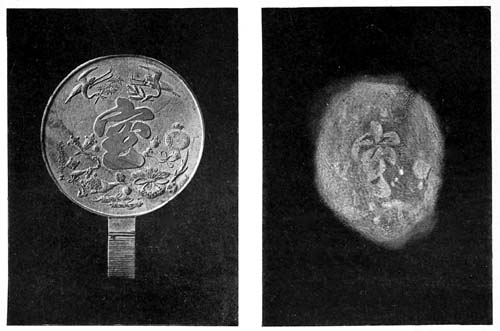
Plate III.
(iv.) 1878-80. Researches of Ayrton and
Perry, and those of Bertin, of Laurent, and of
Muraoka. First, Ayrton and Perry set about
procuring mirrors from the shops in Japan,
and found that the vendors were in many
cases wholly ignorant of the existence of the
magic property. Further, the mirror makers
could not say how the mirrors became magic,
nor which of their mirrors were such; or they
gave explanations subsequently found false, declaring
the effect to be produced by application
of an acid paste to etch the face prior to polishing.
The investigators then, having procured
some good mirrors, proceeded to test the various
possible suggestions as to the origin, such as
the supposed difference of density, or of
molecular constitution, or the supposed inlaying
of the face with inferior metal, or to
supposed concealed scratches on the surface, or,
finally, to differences of curvature. By simple
experiments in which bright light was caused
successively to fall upon the mirror in diverging,
parallel, or converging beams, it was
demonstrated beyond question that the last-named
cause was the true one. The whole
phenomenon is explained if once it could be
established that the surface over the thick
parts is flatter (less convex, or even actually
slightly concave) than the surface over the
thin parts. Using a large convex lens to converge
sunlight that had been reflected from a
mirror, they showed that by merely altering
the distance of the screen on which the image
was received they could make the image
either positive or negative at will; a result
impossible on any other hypothesis than that
of differences of curvature of surface. This
being established, they then investigated the
process of mirror manufacture, to ascertain
how these delicate inequalities of surface arise;
and they found it to be due to an accident, or
incident, of manufacture. All the finished
Japanese mirrors may be observed to be slightly
convex in the face. They are cast in moulds,
the surface of each half of which is quite flat
save for the ornament incised on the mould for
the back. The following is Ayrton and Perry’s
description of the process of casting.
“The material used for making the mould
is a mixture of a special kind of clay (found
near Tokio and Osaka), with water and straw-ash.
Two suitable slabs having been formed
from this plastic compound with the aid of
wooden frames, a thick layer of half-liquid
mixture of powdered old crucibles, or of a fine
powder called to-no-ko, made from a soft kind
of whetstone, is spread on them. The design
for the back of the mirror is then cut directly
on one half of the mould, or a sketch drawn
on paper is first stuck on and used as a guide
in cutting the design in the clay. Sometimes,
but rarely, the design is stamped in the clay
with a pattern wood-block cut in relief like
the proposed back of the mirror. After the
design is complete, a rim of the same material
as that used in the construction of the mould,
and having a thickness equal to that desired
for the mirror, is attached to one half of the
mould. The two halves are then dried in the
smoke of a pine-tree fire, pressed and tied
together, and laid in the casting-box at an angle
of 80° to the horizon, the half of the mould on
which the design has been cut being uppermost.
Finally the molten speculum metal is
run into a number of moulds at the same time,
which, when cold, are broken up, and the
castings removed. Mirrors cast in a mould, in
which the design has been cut by hand, are
called ichi mai buki, ‘mould used once,’ and
are regarded as artists’ proofs, as the design on
the back is well defined. To form subsequent
moulds the two halves are pressed, when the
clay is wet, on an ichi mai buki mirror, and
the pattern is in this way transferred, but the
designs on the backs of the mirrors cast in such
moulds are not as clear as on an ichi mai buki
mirror, which therefore sells for a much higher
price.” Flaws in the face of the casting are
filled by inserting little balls of copper—giving
rise, perhaps, to the idea that inlaying was used
to produce the illusions. The handle is not
cast along with the disk of the mirror, but is
attached afterwards. Mirror castings when
they are removed from the mould are roughly
flat on the face, and need to be subjected to
several processes to finish their reflecting surfaces:
during these processes they acquire their
characteristic convexity and their high polish.
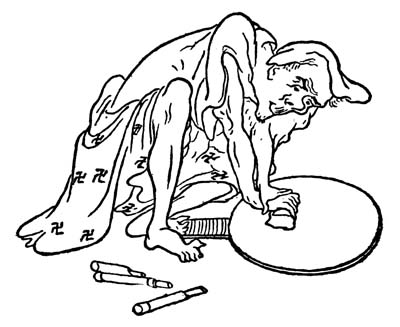
The mirror is laid down on its back on a wooden
board, and then scraped or scratched with a
rounded iron rod about a foot long, called a
megebo (“distorting rod”). The process of scoring
over with the blunt tool is called mege. After
being scored all over with scratches in every
direction, it is found to be convex. Next the
face is scraped with a hand-scraping tool, then
rubbed down with a whetstone, then polished
over with a piece of magnolia-charcoal; and
lastly, when quite smooth, the amalgam of tin
and mercury is rubbed in with a stiff straw
brush, and polished off with soft paper.
Thicker mirrors are sometimes pared down
with a knife to the convex shape: they seldom
or never show magic properties. The knife
is also used to pare down any portion which in
the operation mege may have become too convex.
The convexity is tested from time to time by
applying a concave wooden form. Professor
Ayrton was of opinion that the magic properties
were conferred during the operation of
scraping with the megebo, the thicker parts of
the mirror yielding less, and therefore being
polished down more than the thinner parts.
He also noted that if the face was scored by
the megebo with parallel lines in one direction
only, the convexity acquired was cylindrical.
His conclusion was: “It appears then that
the magic of the Eastern mirror results from
no subtle trick on the part of the maker, from
no inlaying of other metal, or hardening of
portions by stamping, but merely arises from
the natural property possessed by thin bronze
of buckling under a bending stress, so as to
remain strained in the opposite direction after
the stress is removed. And this stress is applied
partly by the ‘distorting rod,’ and partly by the
subsequent polishing, which, in an exactly
similar way, tends to make the thinner parts
more convex than the thicker.” The researches
of Ayrton and Perry may be said to have determined
once and for all the main cause of
the magic properties. No one has since disputed
the principal propositions of their memoir,
though it is certain that the differences of curvature
may be produced in several varieties of
operation.
Bertin, who wrote two years later, confirmed
the conclusions arrived at, and repeated on other
mirrors the experiments of Ayrton and Perry,
as well as those of Person and Govi. Finding
that the distortions produced by heating were
particularly efficacious in bringing out the
magic qualities, he sought to imitate them
mechanically, and, with the aid of the optician
Duboscq, constructed an apparatus for conferring
temporary convexity upon mirrors by
mounting them against an air-tight back, with
a cavity behind into which air could be driven
by a force-pump. With this apparatus he
examined the effects that are produced by drilling
cavities, cutting grooves, and etching depressions
in the backs of mirrors. Laurent,
taking up this line of suggestions, produced
magic mirrors of thin glass, etched into patterns
at the back, and silvered on the front face.
These, when mounted on an air-tight back,
could be made to show either positive or negative
figures by diminishing or increasing the
pressure of the air behind the mirror by means of
a simple india-rubber pear attached by a flexible
tube to an aperture in the back; the pressure
of the hand sufficing to bring out the optical
effects. Laurent further showed that by taking
an ordinary piece of mirror glass (patent plate
glass silvered at the back) magic effects could
be produced by lightly pressing against the
back hot pieces of metal on which a raised
pattern had been engraved. In this case the
portions of the mirror nearest in contact with
the hot metal became hotter than the other
parts, and expanding more, set up minute differences
of curvature sufficient to concentrate the
reflected rays of light from the heated parts.
About the same time Mendenhall, then in
Japan, made further observations, which were
communicated to the American Association
for the Advancement of Science at its meeting
at Cincinnati. Mendenhall was followed by
two Japanese observers,—both trained in physical
research in Europe,—Goto and Muraoka,
the latter of whom, while confirming the main
propositions that the effects are due to differences
of convexity, and that the convexity
is acquired during the process of mege or scoring
over with the megebo, gave some further details
learned from the mirror-makers of Tokio.
He showed that any plate, if thin enough,
whether of bronze, brass, copper, lead, zinc,
iron, or glass, acquires the property of convexity
on being scored over with scratches;
and he came to the conclusion that this surface-expansion
on the scored side of the metal arose
from some sort of release of molecular tension
across the lines so scored. Like Ayrton, he
held that this production of convexity on the
scored surface explained the phenomenon that
a scratch made by a file or pointed tool on the
back causes a corresponding bright line to be
reflected from the face. In a second article
Muraoka sought to prove that the differences
of curvature are not really due to differences
of pressure during the operations of scoring
and surfacing, but are due to the unequal
rising-up of the metal in the thick and thin
parts when the surface is caused to expand by
scoring it over with scratches.
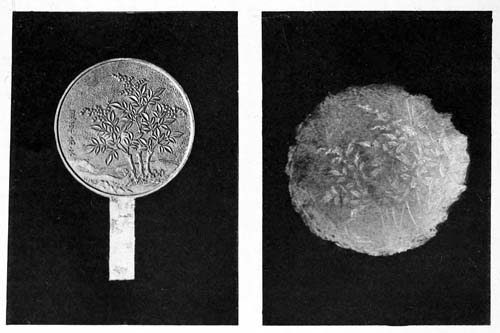
Plate IV.
In May, 1886, Professors Ayrton and Perry,
having discovered that the act of amalgamating
with mercury the surface of a thick brass bar
produces a powerful expansion of the amalgamated
surface and bends the bar convexly,
made the further suggestion that the employment
by the Japanese mirror-polishers of a
mercury-amalgam might assist the operation
of the megebo in producing the differences of
curvature between the thinner and thicker
parts.
The author having from time to time picked
up a number of Japanese mirrors from dealers
in oriental curiosities, and having repeated all
the researches enumerated above and added
some others, is able to demonstrate very completely
the phenomena in question.
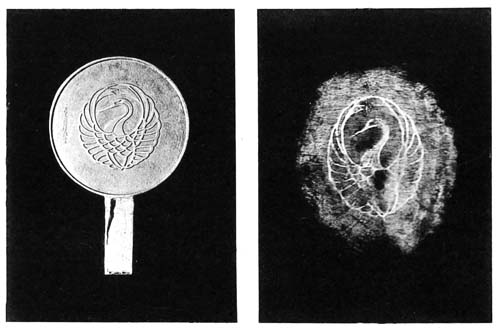
Plate I. depicts a mirror in the author’s
possession, about 7 inches in diameter, the
back of which bears in high relief a crest in
the form of a bird (hoho). The casting has
evidently been tooled up to give greater sharpness,
and the part in high relief has been ground
and polished. The pattern which this mirror
casts from its face is shown beside the mirror,
both being photographically reproduced. This
mirror shows the pattern with sunlight, or with
the light of the electric arc, or with lime-light.
It can also be shown to a few persons at a
time by means of the flame of a paraffin lamp
twenty feet away, or even by the light of an
ordinary candle a couple of feet away. In the
case of these weaker sources of light the mirror
must be held close to the white screen or card
upon which the image is to be received.
Plate II. is taken from a mirror upon
which there is, in high relief, polished, a crest
consisting of the imperial kiri within a circlet,
together with a landscape of storks and bamboos
in lower relief. In this case only the ornament
in high relief produces any effect: and
it is interesting to notice that, whereas the
circlet on the back is a simple flat band, the
circlet in the image (which is distorted in consequence
of a general distortion of the mirror
face as a whole) presents double lines. The
author is disposed to think that the ornament
on the back must in this instance have been
subjected to polishing subsequently to the front
face.
Plate III. represents a very thin mirror,
about 9¼ inches in diameter and not more than
0·04 inch thick in its thinnest parts. The
central character in high relief is surrounded
with the seven precious objects in lower relief.
Most of these may be seen more or less
distinctly in the luminous pattern cast from
the front.
Plate IV. is a rather smaller mirror, 6⅞
inches in diameter, having low-relief ornament
only; yet of this almost every detail is visible
in the image as cast by electric light or sunlight.
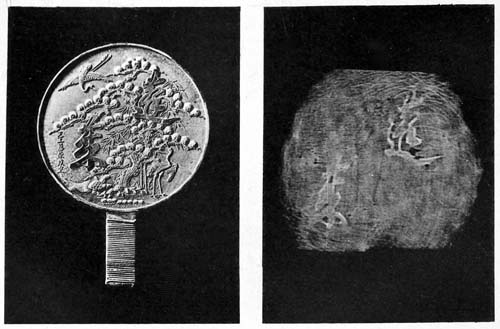
Plate V. shows a mirror which has two
Chinese characters in high relief, polished,
with a background made up of symbols of
longevity—pine-tree, two storks, and a hairy-tailed
tortoise. But though these are in
almost as high relief as the polished letters,
only the former are to be distinguished in the
image. Here again the author conceives that
the two letters have been polished down subsequently
to the face; the pattern of these
parts having been thus, to a minute degree,
forced into the reflecting surface.
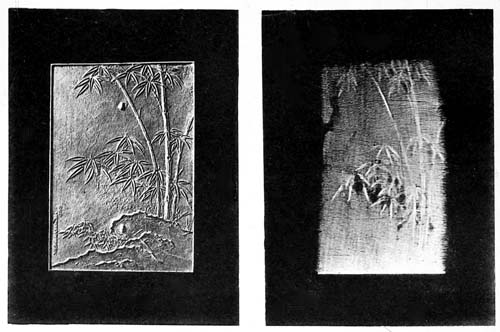
Plate VI. depicts a rectangular mirror, 15
inches high by 10½ inches wide, and weighing
5½ lbs. It is the only one of this form that he
has seen or heard of; though smaller square
mirrors of 3 to 4 inches in the side are not infrequent.
One of the latter, in his possession,
an old mirror covered at the back with Chinese
characters, has no magic qualities at all. The
large rectangular mirror is slightly convex, but
more so in its longer direction than in its
breadth. The bamboos in the pattern, though
not very highly raised, are in very sharp relief,
the mirror being, apparently, an ichi mai buki,
or artist’s proof. There are two raised lumps
on the back, apparently the remains of the parts
where the metal was poured into the mould;
and, curiously enough, neither these nor the
rims of the rocks in the foreground yield any
image, though they are more highly raised
than any part of the bamboos.
Plate V.
To complete the proofs that the effects are
due to differences of curvature the author has
made the following observations.
By holding a magic mirror very obliquely to
the light one can discern traces of the pattern in
the face, especially if one is accustomed to examine
optical surfaces for small inequalities of
curvature. For example, on examining (at
oblique reflection) in such a mirror the image of
a horizontal window-bar or of the roof-line of a
house, one sees the straight line slightly curved
downwards out of the level wherever the
image is made from a slightly concave (or less
convex) part of the surface. Acting on this
hint the author found that if one chooses as an
object to be viewed in a mirror a pattern of
narrow parallel straight lines, such as a finely-striped
blind, the pattern on the back of the
mirror can be dimly seen in the face, resembling
that species of line-engraving, sometimes
used for medallion portraits, in which the
whole picture is crossed by lines from side to
side, the lines being bent toward one another
or widened out to give effects of light and
shade. Another variety of the same experiment
is to place a ruled diffraction-grating of 100
lines to the inch (ruled in a silvered surface on
glass) close to a bright light, and with a short-focus
lens project the lines upon a screen.
Then interpose the magic mirror to throw
the luminous lines upon another screen, when
they will be seen with the usual magic image;
the bright lines concentrating into the bright
parts and avoiding the darker parts of the
luminous pattern.
By the use of the spherometer to measure the
surface curvatures of the mirror faces, it is easy
to show that the surface of the magic mirrors
is actually less convex, or even slightly concave,
over those parts where the substance of
the mirror is thick, as compared with those
parts where the mirror is thin. For example,
the curvature of the rectangular mirror, Plate
VI., as measured from left to right over
the convex surface, is, on the average, about
0·2 dioptries (or its radius of curvature is
about 5 metres), but when measured at
points over the vertical bamboo stems, its curvature
falls to less than 0·05 dioptrie, and in
some parts is absolutely flat, or even slightly
concave.
Makers of mirrors and lenses for large telescopes
are accustomed to test the perfection of
their figure by a process known as Foucault’s,
in which the observer, after allowing light to
fall from a single well-defined point upon the
(concave) mirror at nearly normal incidence,
places his eye at the point where the reflected
rays converge to a focus, and then sees the
whole surface of the mirror uniformly bright,
save only such spots as differ in curvature from
the rest. In the case of convex mirrors it is
needful to interpose a large auxiliary convex
lens to reconcentrate the otherwise divergent
beam. Applying this method of investigation,
the author finds that it is quite easy in many
cases to see in the front face the pattern that
the mirror bears on its back.
Lastly, the author has made one absolutely
direct proof of the inequalities of curvature of
the front surface. He took the mirror depicted
in Plate I., and having taken a mould of its
face in a composition of gutta-percha, he deposited
a firm layer of copper in the mould by
the electrotyping process. The type so made
was silvered and polished, when it was found
to reflect from its face the image of the bird
that was on the back of the original mirror;
the image was, however, less regular than that
from the mirror’s own face. Here, then, was
a magic mirror without any pattern on its back.
In repeating the experiments on heating, the
author found a very singular effect to be produced
by warming (with a flame) the back of
a thin piece of mirror glass while it reflected
from its face a grating of luminous lines thrown
upon it by a lamp as described above. As the
flame was passed rapidly across the back, the
whole pattern appeared to heave, as though a
wave had passed along it.
Plate VI.
He was able also to reproduce writing in
luminous lines on a screen or wall by the
following device. A piece of thin sheet lead
(tea-chest lead) was laid on a bed of blotting-paper;
and upon this was written with a common
lead pencil any word desired, which therefore
was slightly indented into the lead. The sheet
was then pressed lightly against an ordinary
piece of mirror glass and heated from behind
by pressing against it a disk of hot metal.
The written letters touching the back of the
mirror warmed it, and made it curve at these
parts. Hence, placed in an appropriate divergent
beam of light, it threw the handwriting
upon the wall.
Following the hint given by Bertin’s research
upon the effect of bending mirrors by
air-pressure at the back, the author finds that
a similar effect is even more powerfully produced
by simple mechanical pressure. He
took a mirror which, though it had an excellent
reflecting face and a well-raised pattern
on the back, showed no magic properties, and
having clamped it in a wooden frame, he
applied screw pressure behind to force against
the back a slightly convex piece of soft wood
covered with a pad of cloth. On turning the
screw the mirror at once became magic, and
was found, even after the screw had been
released, to retain some part of its magic property.
It was again distorted by screw pressure,
and while violently bent was heated to
anneal it somewhat. On removing the pressure
it was found to retain permanently all
the qualities of a good magic mirror, though
it is slightly more convex than mirrors ordinarily
are. Since then it has been found that
many mirrors which, when purchased, showed
no magic properties, can be converted into
magic mirrors, some by application of screw
pressure, some by mere bending by hand over
the knee, some by burnishing under pressure
the pattern at the back.
Engineers are so familiar with the circumstance
that when metal castings are rapidly
cooled the internal parts are in a state of
strain, that they are not astonished to find
that after a casting has been surfaced accurately
on one face the figure may alter slightly
by the mere release of internal strains in the
slow annealing of time. It is quite possible
that this too occurs with Japanese mirrors,
and that some of them may acquire with the
mere lapse of time magic qualities that they
do not show at first when newly polished.
There appears to be another species of magic
mirror, of which few examples are known,
having the property of showing in the face a
pattern entirely different from that on the back.
Three such are mentioned by Ayrton, though
it does not seem that he himself had inspected
any of them personally. One of these, which
he states to exist at Kamakura, the old capital
of the former Shoguns, is a religious mirror
about four inches and one-fifth high, by three
and a half wide, held in great reverence. In
the polished surface, when looked at very
obliquely, is seen the image of a Buddhist
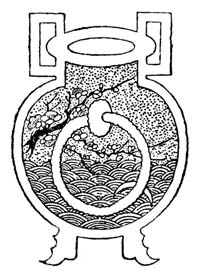
priest. The pattern on the back is a rosary
in high relief with a branch of plum-blossom,
and a crescent moon rising out of the sea as a
background. It is said that this optical effect
is produced by chemically etching the surface
with an acid paste, and then repolishing. Professor
Ayrton, who had two mirrors made thus
by a Japanese mirror-maker, found that if the
face of a mirror that had so been etched was
repolished until every trace of the marks disappeared
in direct or oblique vision, they then
entirely disappeared also from the image cast
by the mirror in reflecting a beam of light
upon a screen. He greatly doubted whether
chemical means could produce a mirror possessed
of true magic properties. The cause of
the phenomena of the Kamakura mirror and
its congeners—should the facts be established
as narrated—therefore remains still to be explained.
Though in the case of the ordinary Japanese
mirrors science completely explains what would
otherwise seem to be a most mysterious and
unaccountable phenomenon, the explanation
itself involves a very remarkable fact, namely,
that there can exist such very delicate and
minute differences of curvature in the polished
face as to be practically invisible for ordinary
purposes, and difficult even of scientific detection,
and yet that those minute differences in
curvature should be in such exact correspondence
to the patterns on the back as to reproduce
those patterns in the reflected beams
of light. The facts seem so utterly unlikely
à priori to be true, that one can only give full
credence to them after the most searching
scientific demonstration. But is not this, after
all, only another example of the truism that
when science explains away one mystery she
does so by establishing some truth that is itself
still more mysterious?
The Mirror of Kamakura.
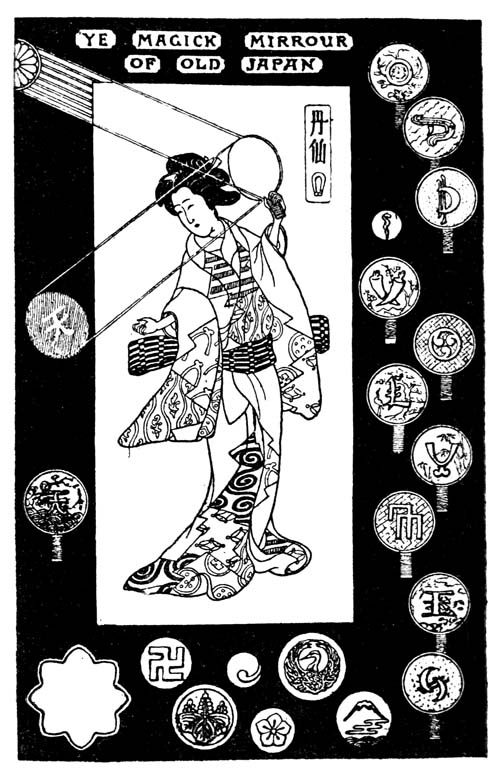
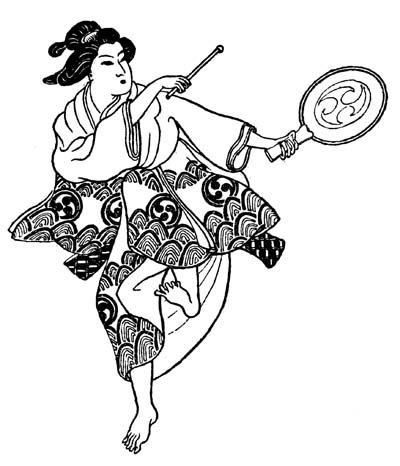
Japanese Woman Dancing, with Mirror.
From a bronze plate (modern).