Chapter I A Meeting in the Forest
Over two centuries ago a little Puritan
maiden might have been seen
passing along the Indian path which led
from out Salem Town to her home. It
was near the close of day. The solemn
twilight of the great primeval forest was
beginning to fall. But the little maid
tripped lightly on, unawed, untroubled.
From underneath her snowy linen cap,
with its stiffly starched ear-flaps, hung the
braid of her hair, several shades more
golden than the hue of her gown. Over
one arm she carried her woollen stockings
and buckled shoon.
A man, seated near the path on the
trunk of a fallen tree of such gigantic
girth that his feet swung off the ground,
although he was a person of no inconsiderable
size, hailed her as she neared
him. “Where do you wend your way
in such hasty fashion, little mistress?”
She paused and bobbed him a very fine
courtesy, such as she had been taught in
the Dame School, judging him to be an important
personage by reason of his sword
with its jewelled hilt and his plumed hat.
“I be sorely hungered, good sir,” she replied,
“and I ken that Goody Higgins
has a bowl o’ porridge piping hot for me
in the chimney corner.” Her dimpled
face grew grave; her eyelids fell. “When
one for a grievous sin,” she added humbly,
“has stood from early morn till set o’
sun on a block o’ wood beside the town-pump,
and has had naught to eat in all
that time, one hungers much.”
“And would they put a maid like you
up for public punishment?” cried the
Cavalier. “By my faith, these Puritans
permit no children. They would have
them saints, lisping brimstone and wrestling
with Satan!”
“Hush, hush!” cried the little maid,
affrighted. “Ye must not say that word
lest the Devil answer to his name.” She
pointed to where the sunset glimmered
red behind the trees. “Do ye not ken
that when the sun be set, the witches ride
on broomsticks? After dark all good
children stay in the house.”
“Ho, ho!” laughed the stranger; “and
have you a law that witches must not ride
on broomsticks? You Puritans had best
be wary lest they ride your nags to death
at night and you take away their broomsticks.”
“Ay,” assented the maid. “Old Goody
Jones is to be hanged for witchery this day
week. One morn, who should find his
nag steaming, flecked with foam, its mane
plaited to make the bridle, but our good
Neighbour Root. When I heard tell o’ it,
I cut across the clearing to his barn before
breakfast, and with my own eyes saw the
nag with its plaited mane and tail. Neighbour
Root suspicioned who the witch was
that had been riding it, but he, being an
o’er-cautious man, kept a close mouth.
Well, at dawn, two days later, he jumped
wide-awake all in a minute,—he had been
sleeping with an eye half-cocked, as it
were,—for he heard the barn door slam.
He rose and lit his lantern and went out.
There he saw Goody Jones hiding in a
corner of the stall, her eyes shining like a
cat’s. When she saw he kenned her, she
gave a wicked screech and flew by him in
the form o’ an owl. He was so afeared
lest she should bewitch him, that he trembled
till his red cotton nightcap fell off.
It was found in the stall by our goodly
magistrate in proof o’ Neighbour Root’s
words.”
The Cavalier’s face grew grim. “Ay,”
he muttered, “the Lord will yet make
these people repent the innocent blood
they shed. Hark ye, little mistress, I
have travelled in far countries, where
they have the Black Plague and terrible
diseases ye wot not of. Yet this plague
of witchery is worse than all,—ay, even
than the smallpox.” He shrugged his
shoulders and looking down at the ground,
frowned and shook his head. But as he
glanced up at the maid’s troubled countenance,
his gloom was dispelled by a sunny
smile. He reached out and took her hand,
and patted it between his big warm palms.
“Dear child,” he said, “be not afeared
of witches, but bethink yourself to keep so
fair and shining a conscience that Satan
and his hags who work by the powers of
darkness cannot approach you. We have
a play-actor in England, a Merry Andrew
of the town, a slender fellow withal, yet
possessed of a pretty wit, for wit, my little
maid, is no respecter of persons, and
springs here and there, like as one rose
grows in the Queen’s garden and another
twines ’round the doorway of the poor.
Well, this fellow has written that, ‘far as
a little candle throws its beams, so shines
a good deed in a naughty world.’ Many
a time have I catched myself smiling at
the jingle, for it minds me of how all good
children are just so many little candles
shining out into the black night of this
evil world. When you are older grown
you will perceive that I spake true words.
Still, regarding witches, I would not have
you o’er bold nor frequent churchyards
by night, for there, I, myself, have seen
with these very eyes, ghosts and wraiths
pale as blue vapour standing by the graves.
And at cockcrow they have flown away.”
He released her hand. “Come now,” he
said lightly, “you have not told me why
you were made to stand on a block of
wood all day.”
“Good sir,” she replied, “my punishment
was none too heavy, for my heart
had grown carnal and adrift from God, and
the follies and vanities o’ youth had taken
hold on me. It happed in this wise.
Goodwife Higgins, who keeps our home
since my dear mother went to God, be
forever sweethearting me because I mind
her o’ her own little girl who died o’ the
smallpox. So she made me this fair silken
gown out o’ her wedding-silk brought from
England. Ye can feel for yourself, good
sir, if ye like, that it be all silk without
a thread o’ cotton in it. Now, Abigail
Brewster, whose father be a godly man,
telled him that when I passed her going to
meeting last Sabbath morn, I switched my
fair silken gown so that it rustled in an
offensive manner in her ears. So the
constable came after me, and I was prosecuted
in court for wearing silk in an
odious manner. The Judge sentenced
me to stand all day on the block, near
the town-pump, exposed to public gaze in
my fine raiment. Also, he did look at me
o’er his spectacles in a most awesome,
stern, and righteous fashion, for he said I
‘drew iniquity with a cord o’ vanity and
sin with a cart-rope.’ Then he read a
stretch from the Bible, warning me to
repent, lest I grow like those who ‘walk
with outstretched necks, mincing as they
go.’” She sighed: “Ye ken not, sir, how
weary one grows, standing on a block,
blinking o’ the sun, first resting on your
heels, then tipping forward on your toes,
and finding no ease. About the tenth
hour, as I could see by the sun-dial, there
comes Abigail Brewster walking with her
father. When I catched sight o’ him I
put my hands over my face, and weeped
with exceeding loud groans to show him I
heartily repented my wickedness in the
sight o’ God. But he, being spiritually
minded at the time, had no thought for a
sinner like me and went on. Now, I was
peeking out betwixt my fingers, and I saw
Abigail Brewster had on her gown o’ sad-coloured
linsey-woolsey. Her and me gave
one another such a look! For we were
both acquainted like with the fact that
that sad-coloured linsey-woolsey petticoat
and sacque were her meeting-house clothes,
her father, as I telled ye, having no patience
for the follies o’ dress. Beshrew me, sir,”
added the little maid, timidly, “but I cannot
refrain from admiring your immoderate
great sleeves with the watchet-blue
tiffany peeping through the slashes.”
“Sit you down beside me, little mistress,”
said the Cavalier, “I would ask a
question of you. Ho, ho, you are afeared
of witches! Why, see the sunset still
glimmers red. Have you not a wee bit of
time for me, who am in sore perplexity
and distress?”
“Nay, nay, good sir,” she rejoined
sweetly, “I be no afeared o’ witches when
I can assist a soul in sore distress, for as
ye telled me, a witch cannot come near one
who be on a good errand.”
She climbed up on the trunk and seated
herself beside him, swinging her sturdy,
bare feet beside his great high boots.
“Can you keep a close mouth, mistress?”
asked the Cavalier.
She nodded. Irresistibly, as her companion
remained silent a moment in deep
thought, her fingers went out and stroked
his velvet sleeve. She sighed blissfully
and folded her hands in her lap.
“I was telled by a countryman up the
road that there is a house in your town
which has been recently taken by a stranger.
’Tis a house, I am informed, with
many gables and dormer windows.” The
speaker glanced sharply at his companion.
“Do you hap to know the place?”
“Yea, good sir,” she replied eagerly;
“the gossips say it be a marvel with its fine
furnishings, though none o’ the goodwives
have so much as put their noses inside the
door, the master being a stern, unsocial
body. But the Moorish wench who keeps
his home has blabbed o’ Turkey covers
and velvet stool cushions. Ye should
hear tell—”
“What sort of looks has this fine gentleman,”
interrupted the Cavalier; “is he of
lean, sour countenance—”
She nodded.
“Crafty-eyed, tall—”
“Nay, not so tall,” she broke in; “about
as ye be in height, but not so great girth
’round the middle. The children all run
from him when he strolls out at even-tide,
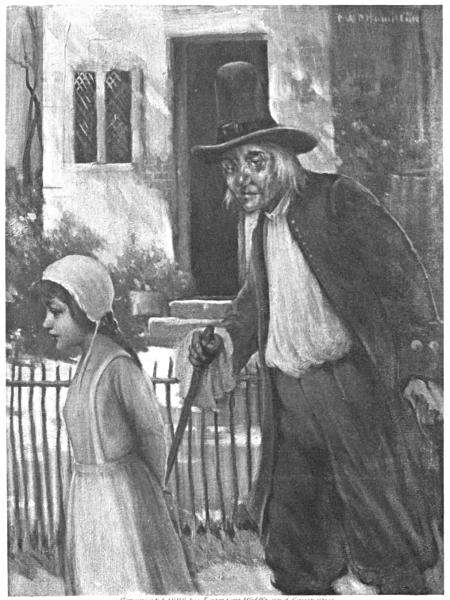
tapping with his stick, and frowning. Our
magistrate and minister hold him in great
respect as one o’ wit and learning, with
mickle gold from foreign parts. The
naughty boys call him Old Ruddy-Beard,
for aught ye can see o’ his face be the tip
o’ his long nose ’neath the brim o’ his
beaver-hat and his red beard lying on
his white ruff. Also he wears a cape o’
sable velvet, and he be honoured with a
title, being called Sir Jonathan Jamieson.”
During her description the Cavalier had
nodded several times, and when she finished,
his face was not good to look at.
His eyes, which had been so genial, were
now cold and shining as his sword.
“Have I found you at last, oh mine
enemy,” he exulted, “at last, at last?”
Thus he muttered and talked to himself,
and his smile was not pleasant to see.
Glancing at the little maid, he perceived
she was startled and shrank from him.
He patted her shoulder.
“Now, hark ye, mistress,” he whispered,
“when next you pass this man, say
softly these words to greet his ears alone:
‘The King sends for his black powder.’”
“Perchance he will think me a witch
and I say such strange words to him,”
she answered, drawing away; “some say
no one be more afeared o’ witches than
he.”
The Cavalier flung back his head. His
laughter rang out scornfully. “Ho, ho,”
he mocked, “afeared of witches, lest they
carry off his black heart! He be indeed a
lily-livered scoundrel! Ay, care not how
much you do fright him. At first he will
doubtless pretend not to hear you, still
I should not be surprised and he pause
and demand where you heard such words,
but you must say naught of all this, e’en
though he torment you with much questioning.
I am on my way now to Boston
Town. In a few days I shall return.”
He tapped her arm. “Ay, I shall return
in state, in state, next time, little mistress.
Meanwhile, you must keep faith with me.
Let him not suspicion this meeting in the
forest with me.” He bent his head and
whispered several sentences in her ear.
“Good sir,” said the little maid, solemnly,
when he had finished, “my King be next
to God and I will keep the faith. But
now and ye will be pleased to excuse me,
as it be past the supper hour, I will hasten
home.” Saying which, she slipped down
from the trunk of the tree and bobbed him
a courtesy.
“Nay, not so fast, not so fast away,”
he cried. “I would show you a picture of
my sweetest daughter, Elizabeth, of whom
you mind me, giving me a great heart-sickness
for her bonny face far across the
seas in Merry England.” From inside
his doublet he drew forth a locket, swung
on a slender gold chain, and opened it.
Within was a miniature on ivory of a
young girl in court dress, with dark curls
falling about a face which smiled back at
them in the soft twilight.
“She be good to look upon and has a
comely smile, I wot,” said the little Puritan
maid; “haps it she has seen as many summers
as I, who be turned fourteen and for a
year past a teacher in the Dame School.”
“Sixteen summers has she lived,” answered
the Cavalier. “Eftsoons, she will
count in gloomier fashion, for with years
come woes and we say so many winters
have we known. But how comes it you
are a teacher in the Dame School?”
“A fair and flowing hand I write,” she
replied, “though I be no great for spelling.
My father has instilled a deal o’ learning
into my pate, but I be not puffed up with
vanity on that account.”
“’Tis well,” said the Cavalier; “I like
not an unread maid. Neither do I fancy
one too much learned.” He glanced
again at the miniature. From smiling he
fell to sighing. “Into what great girls do
our daughters grow,” he murmured; “but
yesterday, methinks, I dandled her on
my knee and sang her nursery rhymes.”
He opened a leathern bag strapped around
his waist. Within it the little maid caught
a glimpse of a gleaming array of knives
both large and small. This quite startled
her.
“Where did I put them?” he frowned;
“but wait, but wait—” He felt in his
pockets, and at last drew forth a chain of
gold beads wrapped in silk. “My Elizabeth
would give you these were she here,”
he said, “but she is far across the seas.”
Rising, he bent and patted the little
maid’s cheek. “Take these beads, dear
child, and forget not what I telled you,
while I am gone to Boston Town. Yet,
wait, what is your name?”
“Deliverance Wentworth,” she answered.
With confidence inspired anew
by the kindly face, she added, “I have a
brother in Boston Town, who be a Fellow
o’ Harvard. Should ye hap to cross his
path, might ye be pleased to give him my
dutiful love? He be all for learning,
and carries a mighty head on young
shoulders.”
Then with another courtesy she turned
and fled fearfully along the path, for the
red of the sunset had vanished.
Far, far above her gleamed two or three
pale silver stars. The gloom of twilight
was rising thickly in the forest. Bushes
stretched out goblin arms to her as she
passed them. The rustling leaves were the
whisperings of wizards, beseeching her to
come to them. A distant stump was a witch
bending over to gather poisonous herbs.
At last she reached her home. A
flower-bordered walk led to the door.
The yard was shut in by a low stone
wall. The afterglow, still lingering on the
peaked gables of the house, was reflected
in the diamond-paned windows and on
the knocker on the front door. There
was no sign of life. Save for the spotless
neatness which marked all, the place had
a sombre and uninhabitable air, as if the
forest, pressing so closely upon the modest
farmstead, flung over it somewhat of its
own gloom and sadness.
Deliverance hesitated a moment at the
gate. Her fear of the witches was great,
but—she glanced at the gold beads.
“I will say a prayer all the way,” she
murmured, and ran swiftly along the path
a goodly distance, then crossed a belt of
woods, pausing neither in running nor in
prayerful words, until she reached a hollow
oak. In it Deliverance placed the beads
wrapped in their bit of silk.
“For,” she reasoned, “if father, though
I be no so afeared o’ father, but if Goodwife
Higgins set her sharp eyes on them,
I should have a most awesome, weary
time with her trying to find out where I
got them.”
She was not far from the sea and she
could see the tide coming in, a line of
silver light breaking into foam. Passing
along the path which led to Boston Town,
she saw the portly figure of the Cavalier,
the rich colours of his dress faintly to be
descried. An Indian guide had joined
him. Both men were on foot. Deliverance,
forgetful of the witches, the darkening
night, watched the travellers as long
as she could see them against the silver
sea. At a fordways the Cavalier paused,
and the Indian stooped and took him on
his back. This glimpse of her merry
acquaintance, being thus carried pickapack
across the stream, was the last glimpse
she had of him for many days to follow.
Once she thought he waved his hand to
her as he turned his head and glanced
behind him. In this she was mistaken.
He could not have seen the demure figure
of the little Puritan maiden, standing in
the deep dusk of the forest edge.
Chapter II Sir Jonathan’s Warning
Although it was an evening in
early June, the salt breeze blowing
damp and cold from off the sea made Master
Wentworth’s kitchen, with its cheerful
fire, an agreeable place for the goodwives
of the village to gather with their knitting
after supper.
Goodwife Higgins, seated at her spinning-wheel,
made but brief replies to the
comments of her guests upon the forward
behaviour of her foster-child Deliverance.
Yet her glance was ever cast anxiously
toward the door, swung half-open lest the
room should become too warm.
“I trow the naughty baggage deserved
correction to put to such ungodly use the
fair silk ye gave her,” remarked one portly
dame. “Goody Dennison says as it was
your standing-up gown ye brought from
England to be wed in.”
“Ay,” said Goodwife Higgins, grimly.
Her face lighted as she spoke, for the
door was flung wide and the little maid
of whom they spoke entered, breathless
with running.
“It be time ye were in,” frowned Goodwife
Higgins, a note of relief in her sharp
tone. “I gan to think a witch had catched
ye.”
“Come, come, child, stand out and let
us see those fine feathers which have filled
your foolish pate with vanity,” cried Goody
Dennison.
Deliverance sighed profoundly. “I do
repent deeply that iniquity and vanity
should have filled my carnal heart because
o’ this fair gown o’ silk. Ye can
feel for yourself and ye like, Goody
Dennison, there be no thread o’ cotton in
it.”
As she spoke she glanced out of the
corners of her downcast eyes at a little,
rosy, freckled girl, who sat at her mother’s
side, knitting, but who did not look up,
keeping her sleek brown head bent resolutely
over the half-finished stocking.
“Have ye had aught to eat, child?”
asked Goodwife Higgins.
Deliverance shook her head.
“And ye would go off with but a sup
o’ milk for breakfast,” scolded the goodwife,
as she rose and stirred the porridge
she had saved. “Sit ye down by Abigail,
and I will bring ye summat nourishing.”
Now, Deliverance had stood long in
the hot sun with naught to eat, and this
and her long walk so weighed upon her
that suddenly she grew pale and sank to
the floor.
“Dear Goody,” she murmured faintly,
“the Lord has struck my carnal heart
with the bolt o’ His righteous anger, for
I wax ill.”
That the welfare, if not the pleasure, of
their children lay very close to the hearts
of the Puritans, was shown by the manner
in which the goodwives, who had greeted
Deliverance with all due severity, dropped
their knitting and gathered hastily around
her.
“It be too long a sentence for a growing
child, and it behooves us who are
mothers to tell our godly magistrate so,”
grumbled one hard-featured dame.
“Dear child,” murmured a rosy-cheeked
young wife, who had put her baby down to
assist Deliverance, “here be a sugar-plum
I brought ye. We must have remembrance,
gossips,” she added, “that her
mother has long been dead, though
Goodwife Higgins cares for her and that
be well, Master Wentworth being a
dreamer. Ye ken, gossips, I say it with
no malice, the house might go to rack
and ruin, for aught he would care, with
his nose ever in the still-room.”
“Best put the child in the chimney-corner
where it be warm,” suggested
Goody Dennison; “beshrew me, gossips,
the damp o’ these raw spring nights chills
the marrow in your bones more than the
frosts o’ winter.”
So Deliverance was seated on a stool
next to Abigail Brewster, with Goodwife
Higgins’ apron tied around her neck, a
pewter bowl of steaming hasty-pudding in
her lap, a mug of milk conveniently near.
The goodwives, their attention taken
from the little maid, turned their conversation
upon witchcraft, and as they talked,
sturdy voices shook and florid faces
blanched at every gust of wind in the
chimney.
“Abigail,” whispered Deliverance, “did
ye e’er clap eyes on Goody Jones sith she
became a witch?”
“Never,” answered Abigail. “Father
telled me to run lest she give me the malignant
touch. Oh dear, I have counted
my stitches wrong.”
The humming of Goodwife Higgins’
spinning-wheel made a musical accompaniment
to all that was said. And the firelight
dancing over the spinner’s ruddy
face and buxom figure made of her a
pleasant picture as she guided the thread,
her busy foot on the treadle.
Ah, what tales were told around the
fireplace of the New England kitchen
where centred all homely cheer and comfort,
and the gossips’ tongues wagged fast
as the glancing knitting-needles flashed!
High in the yawning chimney, from ledge
to ledge, stretched the great lugpole, made
from green wood that it might not catch
fire. From it swung on hooks the pots
and kettles used in cooking. Bright
andirons reflected the dancing flames and
on either side were the settles. From the
heavy rafters were festooned strings of
dried fruit, small yellow and green squashes,
scarlet peppers. Sand was scattered over
the floor. Darkness, banished by the firelight,
lurked in the far corners of the
room.
Abigail and Deliverance, to all outward
appearance absorbed in each other’s society,
were none the less listening with ears
wide open to whatever was said. Near
them sat young wife Tucker that her baby
might share the warmth of the fire. It
lay on her lap, its little red hands curled
up, the lashes of its closed eyes sweeping
its cheeks. A typical Puritan baby was
this, duly baptized and given to God.
A wadded hood of gray silk was worn
closely on its head, its gown, short-sleeved
and low-necked, was of coarse linen
bleached in the sun and smelling sweetly
of lavender. The young wife tilted it
gently on her knees, crooning psalms if it
appeared to be waking, the while her ever
busy hands were knitting above it. Once
she paused to touch the round cheek
fondly with her finger.
“Ye were most fortunate, Dame
Tucker,” said one of the gossips, observing
the tender motion, “to get him back
again.”
“Ay,” answered the young wife, “the
Lord was merciful to the goodman and
myself. Ne’er shall I cease to have remembrance
o’ that wicked morn. I
waked early and saw a woman standing
by the cradle. ‘In God’s name, what come
you for?’ I cried, and thereat she vanished.
I rose; O woeful sight these eyes beheld!
The witches had taken away my babe and
put in its stead a changeling.” The young
wife shuddered, and dropped her knitting
to clasp her baby to her breast. “Long
had I been feared o’ such an evil and ne’er
oped my eyes at morn save with fear lest the
dread come true. Ye ken, gossips, a witch
likes best a first bairn. There the changeling
lay in my baby’s crib, a puny, fretful,
crying wean, purple o’ lips and white o’
cheeks. Quick the goodman went out
and got me five eggs from the black hen,
and we burnt the shells and fried the
yolks, and with a jar o’ honey (for a witch
has a sweet tooth) put the relishes where
she might find them and be pacified. She
took them not. All that day and the
next I wept sorely. Yet with rich milk I
fed the fretting wean, feeling pity for it in
my heart though it was against me to hush
it to sleep in my arms. The night o’ the
second day the goodman slept heavily, for
he was sore o’ heart an’ weary. But the
changeling would not hush its wailing, so I
rose and rocked it until worn out by much
grief I fell asleep, my head resting on the
hood o’ the crib. When I oped my eyes
in the darkness the crying was like that
o’ my own babe. I hushed my breath to
listen.
“Quick I got a tallow dip and lighted
it for to see what was in the crib. I fell
on my knees and prayed. The witches
had brought back my bairn, and taken
their fretting wean away.”
“How looked it?” asked Deliverance,
eagerly. She never wearied hearing of
the changeling, and her interest was as
fresh at the third telling of the story as
at the first. And, although under most
circumstances she would have been chidden
for speaking out before her elders, she
escaped this time, so interested were the
goodwives in the tale.
“Full peaked and wan it looked,” answered
the young wife, solemnly, “and
blue it was from hunger and cold, for
no witches’ food will nourish a baptized
child.”
“I should have liked to see where the
witches took it, shouldn’t ye?” whispered
Abigail to Deliverance.
“Abigail,” said Deliverance, in a cautious
whisper, although the humming of
the spinning-wheel almost drowned her
voice, “if ye will be pleasant-mouthed
and not run tittle-tattling upon me again,
perchance I will tell ye summat, only it
would make your eyes pop out o’ your
head. Ye be that simple-minded, Abigail!
And I might show ye summat too,
only I misdoubt ye have a carnal heart
which longs too much on things that glitter.
Here, ye can bite off the end o’ my
sugar-plum. Now, whisper no word o’
what I tell ye,” putting her mouth to the
other’s ear, “I be on a service for his
majesty, King George.”
A door leading from an inner room
into the kitchen opened and a man came
out. He was tall and hollow-chested and
stooped slightly. His flaxen wig, parted
in the centre, fell to his shoulders on either
side of his hatchet-shaped face. He had
mild blue eyes. His presence diffused
faint odours of herbs and dried flowers and
fragrance of scented oils. This sweet
atmosphere, surrounding him wherever
he went, heralded his presence often
before he appeared.
“Has Deliverance returned, Goodwife
Higgins?” he asked. “I need her to find
me the yarrow.”
“And do ye think I would not have
the child housed at this hour o’ night?”
queried the goodwife, sharply; “your
father needs ye, Deliverance. Ye ken,
gossips,” she added in a softened voice,
as Master Wentworth retired, “that the
poor man has no notion o’ what be practicable.
It be fair exasperating to a decent,
well-providing body to care for him.”
Deliverance hastily set the porridge
bowl on the hearth, and followed her
father into the still-room.
Next to the kitchen the still-room was
the most important one in the house.
Here were kept all preserves and liquors,
candied fruits and spices. From the rafters
swung bunches of dried herbs, the
gathering and arrangement of which was
Deliverance’s especial duty. From early
spring until Indian summer did she work
to make these precious stores. With the
melting of the snows, when the Indian
women boiled the sweet waters of the
maple, she went forth to hunt for winter-green.
Together she and her father gathered
slippery-elm and sassafras bark.
Then, green, fragrant, wholesome, appeared
the mints. Also there were mysterious
herbs which grew in graveyards
and must be culled only at midnight.
And there was the blessed thistle, which
no good child ever plucked before she
sang the verse:—
“Hail, to thee, holy herb,
Growing in the ground,
On the Mount of Calvarie,
First wert thou found.
Thou art good for many a grief
And healest many a wound,
In the name of Sweet Jesu,
I lift thee from the ground.”
And there were saffron, witch-hazel,
rue, shepherd’s-purse, and bloody-dock,
not to mention the yearly store of catnip
put away for her kitten.
Master Wentworth swung her up on
his shoulder so she could reach the rafters.
“The yarrow be tied fifth bunch on the
further beam, father,” she said; “there, ye
have stopped right under it.”
Her small fingers quickly untied the
string and the great bunch of yarrow was
in her arms as her father set her down.
He handed her a mortar bowl and pestle.
“Seat yourself, Deliverance,” he said,
“and pound this into a paste for me.”
Vigorously Deliverance pounded, anxious
to return to Abigail.
The room was damp and chilly. No
heat came in from the kitchen for the
door was closed, but the little Puritan
maiden was inured to the cold and
minded it not. The soft light that filled
the room was given by three dipped
candles made from the fragrant bayberry
wax. This wax was of a pale green,
almost transparent colour, and gave forth
a pleasant fragrance when snuffed. An
hour-glass was placed behind one of the
candles that the light might pass through
the running sands and enable one to
read the time at a glance. At his
table as he worked, her father’s shadow
was flung grotesquely on the wall, now
high, now low. Into the serene silence
the sound of Deliverance’s pounding
broke with muffled regularity.
“I am telled, Master Wentworth,” said
a harsh voice, “that your dear and only
daughter, Deliverance, be given o’er to
vanity. Methinks, the magistrate awarded
her too light a sentence for her idle flauntings.
As I did chance to meet him at
the tavern, at the nooning-hour, I took
it upon myself to tell him, humbly, however,
and in no spirit of criticism, that too
great a leniency accomplishes much evil.”
Deliverance fairly jumped, so startled
was she by the unexpected voice. Now
for the first time she perceived a gentleman,
in a sable cape, his booted legs
crossed, and his arms folded on his breast,
as he sat in the further corner of the room.
One side of his face was hidden from view
by the illuminated hour-glass, but the
light of the concealed candle cast so soft
and brilliant a glow over his figure that
she was amazed at not having seen him
before. His red beard rested on the white
ruff around his neck. She could see but
the tip of his long nose beneath his steeple-crowned
hat. Yet she felt the gaze of
those shadowed eyes fixed upon her piercingly.
None other than Sir Jonathan
Jamieson was he, of whom the stranger in
the forest had made inquiry.
As she remembered the words she was
commissioned to say to this man, her heart
throbbed fast with fear. She ceased pounding.
Silently she prayed for courage to
keep her promise and to serve her King.
At Sir Jonathan’s words, Master Wentworth
glanced up with a vague smile, having
barely caught the drift of them.
“Ah, yes,” he said, “women are prone
to care for fol-de-rols. Still, I have seen
fine dandies in our sex. I am minded of
my little girl’s dear mother, who never
could abide this bleak country and our
sad Puritan ways, sickening for longing
of green old England.” He sighed.
“Yet,” he added hastily, “I criticise not
our godly magistrate’s desire to crush
out folly.” He turned and peered into
the mortar bowl. “You are slow at getting
that smooth, daughter.”
Deliverance commenced pounding again
hurriedly. Although she looked straight
into the bowl she could see plainly that
stern figure in the further corner, the yellow
candle-light touching brilliantly the
red beard and white ruff. She trembled
and doubted her courage to give him the
message.
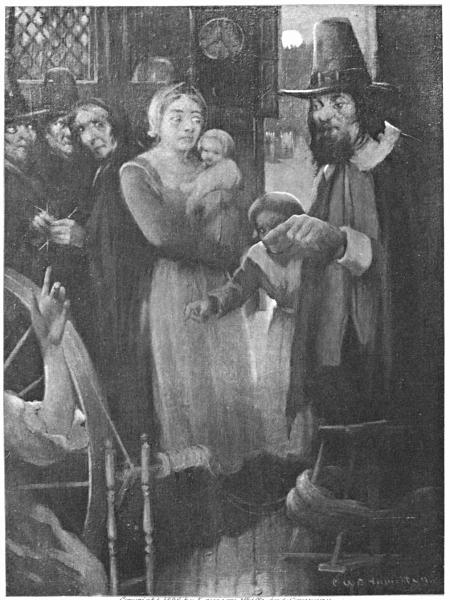
Copyright, 1898, by Lamson, Wolffe and Company
“Take care lest you harbour a witch in yonder girl.”
page 33
But there was staunch stuff in this little
Puritan maid, and as her father’s guest
rose to depart and was about to pass her
on his way to the door, she looked up.
“Good sir,” she whispered, “the King
sends for his black powder.”
Thereat Sir Jonathan jumped, and his
jaw fell as if he had been dealt an unexpected
blow. He looked down at her as
if he beheld a much more terrible sight
than a little maid, whose knees knocked
together with trembling so that the mortar
bowl danced in her lap, and whose
frightened blue eyes never left his face in
their fascinated stare of horror at her own
daring. A moment he stared back at her,
then muttering, he hurried out into the
kitchen and slammed the door behind
him.
“Gossips,” he cried harshly, “take care
lest you harbour a witch in yonder girl.”
With that, wrapping his cape of sable
velvet around him, and with a swing of his
black stick, he flung wide the kitchen door,
and passed out into the night.
“Father,” asked Deliverance, timidly,
“how haps it that Sir Jonathan comes this
way?”
Master Wentworth answered absent-mindedly,
“What, daughter, you are concerned
about Sir Jonathan. Yes, yes, run
and get him a mug of sweet sack and you
like. Never let it be said I sent from my
door rich or poor, without offering him
cheer.”
“Nay, father,” she protested, “I but
asked—”
“Let me see,” murmured Master Wentworth;
“to eight ounces of orris root, add
powdered cuttle-bone of like quantity, a
gill of orange-flower water. What said
you, child,” interrupting himself, “a mug
of sack for Sir Jonathan. Run quickly
and offer it to him lest he be gone.”
Reluctantly, Deliverance opened the
door and stepped out into the kitchen.
Sir Jonathan had been gone several moments.
She was astonished to see the
goodwives had risen and were huddled together
in a scared group with blanched
faces, all save Goodwife Higgins, who
stood alone at her spinning-wheel. The
eyes of all were directed toward the still-room.
The baby, clutched tightly to
its fearful young mother’s breast, wailed
piteously.
Deliverance, abashed although she knew
not why, paused when half-way across the
room.
“Look ye, gossips,” cried one, “look
at the glint o’ her een.”
To these Puritan dames the extreme
beauty which the solitary childish figure
acquired in the firelight was diabolical.
The reflection of the dancing flames made
a radiant nimbus of her fair, disordered
hair, and brought out the yellow sheen in
the silken gown. Her lips were scarlet,
her cheeks glowed, while her soft eyes,
wondrously blue and clear, glanced round
the circle of faces. Before that innocent
and astonished gaze, first one person and
then another of the group cowered and
shrank, muttering a prayer.
Through the door, swung open by the
wind, swept a terrible gust, and with it
passed in something soft, black, fluttering,
which circled three times around the room,
each time drawing nearer to Deliverance,
until at last it dropped and fastened itself
to her hair.
Shrieking, the women broke from each
other, and ran from the room, all save
Goodwife Higgins, who clapped her apron
over her head, and fell to uttering loud
groans.
Master Wentworth came out from the
still-room, a bunch of yarrow under one
arm, and holding the mortar bowl.
“What ungodly racket is this?” he
asked. “Is a man to find no peace in
his own house?”
Upon hearing his voice, Goodwife Higgins’
fright somewhat abated. She drew
down her apron, and pointed speechlessly
to Deliverance who was rigid with terror.
“Lord bless us!” cried the goodman.
“Have you no wits at all, woman?” He
laid the bowl on the table, unconsciously
letting the herbs slip to the floor, and
hastened to Deliverance’s assistance.
“You have catched a bird, daughter,
but no singing-bird, only a loathsome
bat. Why, Deliverance, weep not. My
little Deliverance, there is naught to be
frightened at. ’Tis a very pitiful thing,”
he continued, lapsing into his musing
tone, while his long fingers drew the fair
hair from the bat’s claws with much deftness,
“how some poor, pitiful creatures
be made with nothing for to win them
grace and kind looks, only a hideous
body, so that silly women scatter like as
a viper had come amongst them; and yet,
even the vipers and toads have jewelled
eyes, did one but look for them.”
He crossed the room, and put the bat
outside, then bolted the door for the
night.
“I am minded of your dear mother,
daughter,” he said, a tender smile on his
face; “she was just so silly about some
poor, pitiful creature which had no fine
looks for to win it smiles. But she was ay
bonny to the poor, Deliverance, and has
weeped o’er many a soul in distress.”
Chapter III The Yellow Bird
Goodwife Higgins, who kept
the home for the little maid and
her father, rose early the next day before
the sun was up. The soft light of dawn
filled the air; the eastern sky was breaking
rosily. A moment, she stood in the
doorway, inhaling with delight the fresh,
delicious air, noting how the dew lay white
as hoar-frost on the grass. She made the
fire and put the kettle on to boil, filling it
first with water from the spring. Then
she went to Deliverance’s room to awaken
her, loath to do so, for she felt the little
maid had become very weary the previous
day. To her surprise she found the small
hooded bed empty.
“The dear child,” smiled the goodwife,
“she has gone to gather strawberries for
her father’s breakfast. She repents, I
perceive, her unchastened heart, and seeks
to pleasure me by an o’er amount o’
promptness.”
She turned to fling back the covers of
the bed that they might air properly.
This, however, had already been done.
On the window-ledge a little yellow bird
sat preening its feathers. It looked at
her with its bright, black eyes and continued
its dainty toilet undisturbed. Now,
this was strange, for as every one knew, the
wild canary was a shy bird and flew away
at the least approach. The goodwife grew
pale, for she feared she was in the presence
of a witch, knowing that witches often
took upon themselves the forms of yellow
birds, that they might by such an innocent
and harmless seeming, accomplish much
evil among unsuspecting persons. She
tiptoed out of the room, and returned with
her Bible as a protection against any spell
the witch might cast upon her.
“Ye wicked one,” she cried, and her
voice shook, “ye who have given yourself
over from God to the Devil, get ye
gone from this godly house!”
At these words the bird flew away, proving
it beyond doubt to be possessed by an
evil spirit, for it is known that a witch cannot
bear to hear the name of the Lord.
The goodwife was yet more affrighted to
see the bird fly in the woods in the direction
in which the strawberry patch lay.
There Deliverance probably was. What
power could avail against the witch casting
a malignant spell upon her? She
leaned out of the window, calling,—
“Deliverance, Deliverance, come into
the house! There be a witch abroad.
Deliverance, oh, Deliverance!”
Several moments passed. At last to
her anxious gaze appeared Deliverance,
tripping out of the green woods from the
direction in which the bird had flown.
She was attired in her tiffany gown, and
there was that about the yellow sheen of
the fair silk and the long braid of her yellow
hair which made her seem like the
yellow bird in human form. The first
rays of the sun struck aslant her head.
She was singing, and as she sang she
smiled. She could not have gone to
gather berries, for she carried neither basket
nor dish. It was evident she had not
heard her name called, for she paused
startled and abashed, and the singing words
died on her lips, when she saw the dame
leaning out of the window.
“Deliverance, ye naughty baggage,”
cried the goodwife, sharply, “where have
ye been and what for have ye on your
gown o’ tiffany?”
The words were stern, but her heart was
beating like to break and throbbed in unison
with Sir Jonathan’s warning the previous
night. “Gossips, take care lest you
harbour a witch in yonder girl.” She
hurried to the kitchen door to meet
Deliverance. As the little maid shamefacedly
crossed the threshold she raised
her hand to strike her, but dropped it
to her side and shook her head, for in
her heart she said sadly, “And gin ye be
a witch, child, sore will be your punishment
and my hand shall add no blow.”
For she was minded of her own little girl
who had died of the smallpox so many
years ago. She prepared the breakfast
with more bustle and noise than usual, as
was her wont when disturbed.
Deliverance, greatly mortified at having
been detected and wondering why she was
not questioned, went to her room and put
on her linsey-woolsey petticoat and sacque.
When she came out to lay the table, to
her surprise, Goodwife Higgins spoke her
gently. “Go, child, and call your father,
for the Indian bread be right crusty and
brown and the bacon crisp.”
Deliverance opened the still-room door.
Master Wentworth, attired in his morning-gown,
was preparing his work for the
day. He was celebrated in Boston Town
for his beauty and honey waters as well as
for his diet-drinks. Recently, he had had
a large order from the Governor’s lady—who
had many vanities and was very
fine indeed—for balls of sweet gums and
oils, which, wrapped in geranium leaves,
were to be burned on coals to perfume
the room.
This morning no accustomed sweet
odour greeted Deliverance. Pungent, disagreeable
fumes rose from the bowl over
which her father bent. So absorbed was he
in this experiment that he did not answer
until she had called him several times.
Then he greeted her kindly and the
two walked out to breakfast. Goodwife
Higgins watched Deliverance narrowly
while grace was said and her heart grew
lighter to behold the little maid listen
devoutly, her head humbly bowed, as she
said “amen” with fervour. Nevertheless,
Sir Jonathan’s words rang in the dame’s
ears all day: “Gossips, take care lest you
harbour a witch in yonder girl.”
Even the cream was bewitched. The
butter would not come until she had
heated a horseshoe red-hot and hung it
over the churn. Also, three times a
mouse ran across the floor.
Deliverance hurried through her morning
chores, anxious to reach the town’s
highway before school called, that she
might see the judges go riding by to
court, then being held in Salem. A celebrated
trial of witches was going on. In
the front yard she found Goodwife
Higgins weeding the flower-bed.
“Be a good child, Deliverance,” said
the dame, looking up with troubled face,
for she was much perplexed over the
unseemly conduct of the little maid.
“Might ye be pleased to kiss me before
I go?” asked Deliverance, putting up her
cheek.
The goodwife barely touched her lips to
the soft cheek, having a secret fear lest the
little maid were in communion with evil
spirits. Her heart was so full of grief
that her eyes filled with tears, and she
could scarce see whether she were pulling
up weeds or flowers.
As soon as Deliverance had made the
turn of the road and was beyond the goodwife’s
vision, she began to run in her
anxiety to reach the town’s highway and
see the reverend judges go riding by.
The Dame School lay over half-way to
town, facing the road, but she planned to
make a cut through the forest back of the
building, that she might not be observed
by any scholars going early to school.
To her disappointment, these happy plans
were set at naught by hearing the conch-shell
blown to call the children in. In
her haste she had failed to consult the
hour-glass before leaving home. She was
so far away as to be late even as it was,
and she did not dare be any later. She
stamped her foot with vexation. The
school door was closed when she reached
it, out of breath, cross, and flurried. She
raised the knocker and rapped. A prim
little girl opened the door. Prayers had
already been said and Dame Grundle had
called the first class in knitting.
Deliverance courtesied low to the dame,
who kept the large room with the older
scholars. There were four rows of
benches filled with precise little girls.
The class in knitting was learning the fox-and-geese
pattern, a most fashionable and
difficult stitch, new from Boston Town.
In this class was Abigail Brewster.
Deliverance opened the door into the
smaller room. At her entrance soft whispers
and gurgles of laughter ceased. She
had twelve scholars, seven girls and five
boys, the boys seated on the bench back
of the girls.
The little girls were exact miniatures
of the larger scholars in Dame Grundle’s
room. Each of them held a posy for
her teacher, the frail wild flowers already
wilting. The boys, devoid of any such
sentiment, were twisting, wriggling, and
whispering. Typical Puritan boys were
they with cropped heads, attired in
homespun small-clothes, their bare feet
and legs tanned and scratched.
Deliverance made all an elaborate
courtesy.
They slipped down from the benches,
the girls bobbing and the boys ducking
their heads, in such haste that two of
them knocked together and commenced
quarrelling. Deliverance, with a vigorous
shake of each small culprit, put them at
opposite ends of the bench. The first
task was the study of the alphabet. A buzz
of whispering voices arose as the children
conned their letters from books made
of two sheets of horn: on one side the
alphabet was printed and on the other
the Lord’s Prayer. The humming of the
little voices over their A, B, C’s made a
pleasant accompaniment to their teacher’s
thought, who, with every stitch in the
sampler she was embroidering, wove in
a vision of herself in a crimson velvet
gown and stomacher worked with gold
thread, such as were worn by the little
court lady, the Cavalier’s sweetest daughter.
Growing conscious of a disturbance
in class she looked up.
“Stability Williams,” she said sternly,
“can ye no sit still without jerking around
like as your head was loosed?”
Stability’s tears flowed copiously at the
reproof.
“Please, ma’am,” spoke up Hannah
Sears, “he’s been pulling o’ her hair.”
Deliverance’s sharp eyes spied the
guilty offender.
“Ebenezer Gibbs,” said she, “stop your
wickedness, and as for ye, Stability Williams,
cease your idle soughing.”
For awhile all was quiet. Then, there
broke forth a muffled sob from Stability,
followed by an irrepressible giggle
from the boys. Deliverance stepped
down from the platform and rapped
Ebenezer Gibbs’ head smartly with her
thimble.
“Ye rude and ill-mannered boy,” she
cried; “have ye no shame to be pulling
Stability Williams’ hair and inticing others
to laugh at your evil doings? Ye can just
come along now and stand in the crying-corner.”
The crying-corner was the place where
the children stood to weep after they had
been punished. Pathetic record of childish
grief was this corner, the pine boards
black with the imprint of small grimy
fingers and spotted with tears from little
wet faces. Doubtless Deliverance rapped
the offender more severely than she intended,
for he wept steadily. Although
she knew he deserved the reproof, his
crying smote her heart sorely.
“Ebenezer Gibbs,” she said, after a
while, “when ye think ye have weeped
sufficient long, ye can take your seat.”
But he continued to weep and sniffle
the entire morning, not even ceasing when
his companions had their resting-minute.
The day was quite spoiled for Deliverance
by the sight of the tiny figure with the
cropped head pressed close in the corner,
as the culprit rested first on one foot and
then the other.
Altogether she was very glad when
Dame Grundle rang the bell for dismissal,
and she could put on the children’s things
and conduct them home. It was a
pleasant walk to town through the woods.
Deliverance, at the head of her little procession,
always entered the village at an
angle to pass the meeting-house where all
important news was given forth and public
gatherings held. The great front door
faced the highway and was the town bulletin
board. Sometimes a constable was
stationed near by to read the message aloud
to the unlettered. A chilling wind swept
down the road this morning as Deliverance
and her following drew near.
Inside the meeting-house the great
witch-trial was still in session. A large
crowd, which could not be accommodated
inside, thronged the steps and peered in
through the windows. The sun which
had risen so brightly, had disappeared.
The gray sky, the raw air, hung gloomily
over the scene, wherein the sad-coloured
garments of the gentlefolk made a background
for the bright bodices of the goodwives,
and the red, green, and blue doublets
of the yeomen. Soldiers mingled with
the throng. So much noise had disturbed
the court that the great door had been
ordered closed. On the upper panels
wolves’ heads (nailed by hunters in proof
of their success that they might receive
the bounty), with grinning fangs and blood
trickling to the steps, looked down upon
the people.
The children with Deliverance grew
frightened and clutched at her dress, trying
to drag her away, but she, eager to hear
whatever news there was, silenced them
peremptorily.
Suddenly she heard a strange sound.
Glancing down she beheld one of her
scholars, crawling on his hands and knees,
mewing like a cat. Another child imitated
this curious action, and yet another.
A fourth child screamed and fell in convulsions.
In a few moments the panic
had spread to them all. The children
were mad with terror. One little girl
began barking like a dog, still another
crowed like a cock, flapping her arms as
though they were wings.
The crowd, disturbed by the shrill
cries, turned its attention and pressed
around the scene of fresh excitement.
Faces of hearty women and stout men
blanched.
“Even the babes be not spared,” they
cried; “see, they be bewitched.”
Goodwife Gibbs broke from the rest,
and lifted up her little son who lay in convulsions
on the dusty road. “The curse
o’ God be on the witch who has done this,”
she cried wildly; “let her be revealed that
she may be punished.”
The child writhed, then grew quiet; a
faint colour came back into his face. His
eyelids quivered and unclosed. Deliverance
called him by name, bending over
him as he lay in his mother’s arms. As she
did so he struck her in the face, a world
of terror in his eyes, screaming that she was
the witch and had stuck pins in him.
“Dear Lord,” cried the little maid,
aghast, raising her eyes to heaven, “ye ken
I but rapped his pate for sniffling and
larfing in class.”
But strange rumours were afloat regarding
Deliverance Wentworth. Sir Jonathan’s
words were on every gossip’s
tongue: “Gossips, take care lest you harbour
a witch in yonder girl.”
Naturally, at the convulsed child’s
words, which seemed a confirmation of
that warning, the good people drew away,
shuddering, each man pressing against his
neighbour, until they formed a circle a
good distance back from the little assistant
teacher of the Dame School.
Thus Deliverance stood at noonday,
publicly disgraced, sobbing, with her
hands over her face in the middle of the
roadway; an object of hatred and abhorrence,
with the screaming children clutching
at her dress, or crawling at her feet.
But suddenly her father, who, returning
from his herb-gathering, had pushed
his way to the edge of the crowd and
perceived Deliverance, stepped out and
took his daughter by the hand. He
spoke sternly to those who blocked the
way, so that the people parted to let them
pass. Master Wentworth was a man of
dignity and high repute in those parts.
As the two walked home hand in hand,
Deliverance, with many tears, related the
morning’s events; how in some anger she
had rapped Ebenezer Gibbs’ head with
her thimble, and how he had cried thereat.
“I am ashamed of you, Deliverance,”
said her father. “Have you no heart of
grace that you must needs be filled with
evil and violence because of the naughtiness
of a little child? Moreover, if you
had been discreet all this mortification had
not befallen you. How many times have
you been telled, daughter, not to idle on
the way, ogling, gossiping, and craning
your neck about for curiosity? And now
we will say nothing more about it,” he
ended. “Only do you remember, Deliverance,
that when people are given over
to foolishness, and there is a witch panic,
it behooves the wise to be very prudent,
and to walk soberly, with shut mouth and
downcast eyes, so that no man may point
his finger and accuse them. Methinks
Goodwife Gibbs’ boy is coming down with
a fever sickness. Remind me that I brew
a strengthening draught for him to-night.”
Chapter IV In which Demons assault the Meeting-house
The Sabbath day dawned clear with
a breeze blowing soft, yet cool and
invigorating, from off the sea.
But the brightness of the day could not
lighten the hearts of the villagers, depressed
by the terrible witch-trials.
Master Wentworth, however, maintained
a certain peace in his home, which,
lying on the outskirts of the town, was
just beyond the circle of village gossip.
Moreover, he sternly checked any tendency
in Goodwife Higgins or Deliverance
to comment on the panic that was abroad.
So of all the homes in Salem his little
household knew the deepest peace on the
morn of that memorable Sabbath.
“Goodwife,” he said, passing his cup
for a third serving of tea, “your Sabbath
face is full as bonny a thing to look at
and warms the heart, as much as your tea
and muffins console an empty stomach.”
And the goodwife replied with some
asperity to conceal her pleasure at the
remark, for, being comely, she delighted
to be assured of the fact, “Ay, the cook’s
face be bonny, and the tea be well brewed.
Ye have a flattering tongue, Master
Wentworth.”
Then Master Wentworth, stirring his tea
which had a sweetening of molasses, related
how, having once had a chest of tea
sent him from old England, he had portioned
part of it among his neighbours.
The goodwives, being ignorant of its use,
had boiled it well and flung the water
away. But the leaves they kept and seasoned
as greens.
Now, this little story was as delicious to
Master Wentworth as the flavour of his
tea, and being an absent-minded body,
withal possessed of a most gentle sense of
humour, he told it every Sabbath breakfast.
He continued to converse in this gentle
mood with Goodwife Higgins and Deliverance,
as the three wended their way to
church.
Very cool and pleasant was the forest
road. Now and then through the green
they caught glimpses of the white turret
of the meeting-house, as yet without a
bell. The building was upon a hill, that
travellers and hunters might be guided by
a sight of it.
Often there passed them a countryman,
the goodwife mounted behind her husband
on a pillion. Later they would pass
the horse tied to a tree and see the couple
afoot far down the road. This was the
custom when there was but one horse in
the family. After awhile the children,
carrying their shoes and stockings, would
reach the horse and, as many as could, pile
on the back of the much enduring nag
and ride merrily the rest of the way.
Master Wentworth and his family arrived
early. The watchman paced the
platform above the great door, beating a
drum to call the people to service. Several
horses were tied to the hitching-post.
Some of the people were wandering in the
churchyard which stretched down the
hill-slope.
Others of the sad-eyed Puritans gathered
in little groups, discussing a new and
terrible doctrine which had obtained currency.
It was said that the gallows had
been set up, not only for the guilty but
for those who rebuked the superstition of
witchery. The unbelievers would be made
to suffer to the fullest extent of the law.
And another fearful rumour was being
circulated to the effect that a renowned
witch-finder of England had been sent
for. He was said to discover a witch by
some mark on the body, and then cause
the victim to be bound hand and foot and
cast into a pond. If the person floated
he was pronounced guilty and straightway
drawn out and hanged. But he who was
innocent sank at once.
Soldiers brought from Boston Town
to quell any riots that might arise, added
an unusual animation to the scene. Lieutenant-Governor
Stoughton and the six
other judges conducting the trials, were
the centre of a group of the gentry.
Deliverance and Abigail Brewster
strolled among the tombstones reading
their favourite epitaphs. The two little
maids, having the innocent and happy
hearts of childhood, had found only pleasurable
excitement in the witch-panic until
the morning Deliverance had been accused
by her pupils. But they believed this
affair had blown over and remained only
a thrilling subject for conversation. Both
felt the Devil had made an unsuccessful
assault upon Deliverance, and, as she
wrote in her diary, sought to destroy her
good name with the “Malice of Hell.”
During meeting Deliverance sat with
Goodwife Higgins on the women’s side
of the building. Her father, being of the
gentry, was seated in one of the front pews.
Through the unshuttered windows the
sunlight streamed in broadly, and as the
air grew warm one could smell the pine
and rosin in the boards of the house.
Pushed against the wall was the clerk’s
table with its plentiful ink-horn and quills.
The seven judges, each of whom had,
according to his best light, condemned the
guilty and let the innocent go free, during
the past week, now sat in a row below the
pulpit. Doubtless each felt himself in
the presence of the Great Judge of all
things and, bethinking himself humbly of
his own sins, prayed for mercy.
The soldiers stacked their firearms and
sat in a body on the men’s side of the
church. Their scarlet uniforms made an
unusual amount of colour in the sober
meeting-house.
The long hours dragged wearily.
Little children nodded, and their heads
fell against their mothers’ shoulders, or
dropped into their laps. Sometimes they
were given lemon drops or sprigs of sweet
herbs. One solemn little child, weary of
watching the great cobwebs swinging from
the rafters, began to count aloud his alphabet,
on ten moist little fingers. He was
sternly hushed.
The tithing-man ever tiptoed up and
down seeking to spy some offender. When
a woman or maid grew drowsy, he brushed
her chin with the end of his wand which
bore a fox’s tail. But did some goodman
nod, he pricked him smartly with the
thorned end.
Deliverance loved the singing, and her
young voice rang out sweetly as she stood
holding her psalm-book, her blue eyes
devoutly raised. And the armed watchman
pacing the platform above the great
door, his keen glance sweeping the surrounding
country for any trace of Indians
or Frenchmen, joined lustily in the singing.
Many voices faltered and broke this
morning. Few families but missed some
beloved face. Over one hundred persons
in the little village were in prison accused
of witchery.
The minister filled his prayers with the
subject of witchcraft and made the barn-like
building ring with the text: “Have
I not chosen you twelve, and one of you
is a devil?”
At this Goodwife Cloyse, who sat next
to Deliverance, rose and left the meeting-house
in displeasure. She believed the
text alluded to her sister, who was then in
prison charged with having a familiar spirit.
The next day she too was cried upon and
cast into prison as a witch, although a
woman of purest life.
Deliverance thrilled with terror at the
incident. She felt she had been seated
next to a witch, and this in God’s own
house. Moreover she imagined a sudden
pain in her right arm, and dreaded lest a
spell had been cast on her.
The day which opened with so fearful
an event was to end yet more ominously.
Following the sermon came the pleasant
nooning-hour. The people gathered in
family groups on the meeting-house steps,
or sought the shade of the nearby trees
and ate their lunches. The goodwives
provided bountifully for the soldiers, and
the judges ate with the minister and his
family.
Toward the end of the nooning-hour
Master Wentworth sent Deliverance to
carry to Goodwife Gibbs the tea he had
brewed.
“Father sends ye this, goodwife,” said
the little maid; “it be a strengthening
draught for Ebenezer. He bids me tell
ye a fever sickness has seized o’ the
child.”
The goodwife snatched the bottle and
flung it violently from her.
“Get ye gone with your brew, ye witch-maid!
No fever sickness ails my little
son, but a spell ye have put upon him.”
She began to weep sorely. Duty compelled
her to attend meeting, the while her
heart sickened that she must leave her
little son in the care of a servant wench.
The gossips crowded around her in
sympathy. Dark looks were cast upon
Deliverance, and muttered threats were
made. Their voices rose with their growing
anger, until the minister, walking arm-in-arm
with Master Wentworth, heard them
and was roused to righteous indignation.
“Hush, gossips,” he said sternly, “we
will have no high words on the Lord’s
holy day, but peace and comfort and meek
and contrite hearts, else we were hypocrites.
We will continue our discussion
next week, Master Wentworth,” he added,
turning to his companion, “for the nooning-hour
is done.”
Master Wentworth, who was given to
day-dreaming, had scarce heard the hubbub,
and had not even perceived his
daughter, who was standing near by. So,
a serene smile on his countenance, he followed
the minister into the meeting-house.
His little maid, very sorrowful at this
fresh trouble which had come upon her,
and not being able to attract his attention
before he entered the building, wandered
away into the churchyard.
That afternoon the tithing-man missed
her in the congregation. So he tiptoed
out of the meeting-house in search of her.
He called up softly to the watchman,—
“Take your spy-glass and search if ye
see aught o’ Mistress Deliverance Wentworth.”
The watchman started guiltily, and
leaned over the railing with such sudden
show of interest that the tithing-man grew
suspicious. His sharp eyes spied a faint
wavering line of smoke rising from the
corner of the platform. So he guessed
the smoke rose from the overturned bowl
of a pipe, and that the watchman had been
smoking, a comfortable practice which had
originated among the settlers of Virginia.
Being in a good humour, he was disposed
to ignore this indiscretion on the part of
the watchman.
The latter had now fixed his spy-glass
in the direction of the churchyard.
“I see a patch o’ orange tiger-lilies far
down the hillside,” he announced, “and
near by be a little grave grown o’er with
sweetbrier. And there, with her head
pillowed on the headstone, be Mistress
Deliverance Wentworth, sound in sleep.”
Thus the little maid was found by the
tithing-man, and wakened and marched
back to church.
As the two neared the entrance the
watchman called her softly, “Hey, there,
Mistress Deliverance Wentworth, what
made ye fall asleep?”
“The Devil set a snare for my feet,”
she answered mournfully, not inclined to
attach too much blame to herself.
“Satan kens his own,” said the watchman
severely, quickly hiding his pipe
behind him.
Now, at the moment of the disgraced
little maid’s entrance, a great rush of wind
swept in and a timber in the rafters was
blown down, reaching the floor, however,
without injury to any one.
Many there were who later testified to
having seen Deliverance raise her eyes
just before the timber fell. These believed
that she had summoned a demon,
who, invisibly entering the meeting-house
on the wings of the wind, had sought to
destroy it.
The sky, lately so blue, grew leaden
gray. So dark it became, that but few
could see to read the psalms. Thunder
as yet distant could be heard, and the roaring
of the wind in the tree-tops, and ever
in the pauses of the storm, the ominous
booming of the ocean.
The watchman came inside. The tithing-man
closed and bolted the great door.
The minister prayed fervently for mercy.
None present but believed that an assault
of the demons upon God’s house was
about to be made.
The rain began to fall heavily, beating
in at places through the rafters. Flashes
of lightning would illumine the church,
now bringing into vivid relief the row of
judges, now the scarlet-coated soldiers, or
the golden head of a child and its terror-stricken
mother, again playing on and
about the pulpit where the impassioned
minister, his face ghastly above his black
vestments, called unceasingly upon the
Lord for succour.
The building was shaken to its foundations.
Still to an heroic degree the people
maintained their self-control.
Suddenly there was a more brilliant
flash than usual, followed by a loud crash.
When this terrific shock had passed,
and each person was beginning to realize
dimly that he or she had survived it, the
minister’s voice was heard singing the
fifty-second psalm.
“Mine enemies daily enterprise
to swallow me outright;
To fight against me many rise,
O, Thou most high of might.”
And this first verse he sang unwaveringly
through alone.
With the commencement of the next
verse, some few brave, but quavering
voices joined him.
“What things I either did or spake
they wrest them at their wil,
And al the councel that they take
is how to work me il.”
But before the third verse ended, all
were singing, judges and soldiers, and the
sweet voices of the women and the shrill
notes of the little children.
“They al consent themselves to hide
close watch for me to lay:
They spie my paths and snares have layd
to take my life away.”
From this time on the storm abated its
violence.
When at last the benediction was pronounced,
the soldiers and men, in constant
dread of attacks by Indians, left the meeting-house
before the women and children,
thus making sure the safe exit of the
latter.
The people, crowding out, beheld the
setting sun shining brightly. The odour
of the rain and the fresh earth greeted
them. All the trees in the leafy greenness
of June quivered with fresh life.
The hail lay white upon the ground as
petals new-fallen from cherry trees in
bloom.
All nature was refreshed.
Only the mighty oak that had stood
near the entrance was split in twain.
And the people,—the goodmen with
heads uncovered,—in the mellow light of
the departing day, rendered thanks unto
God that they had been delivered.
Chapter V The Coming of the Town Beadle
The next morning, Goodwife Higgins
and Deliverance heard steps
coming around the side of the house.
“Who can it be at this hour o’ the
dawning?” asked the goodwife. “It be
but the half-hour past six o’ the minute-glass.”
“Ye don’t hear the tapping o’ a stick
like as it might be Sir Jonathan, goody,”
asked Deliverance, listening fearfully. “I
like not his ruddy beard and his sharp,
greeny-gray eyes.”
But as she spoke, the form of the
Town Beadle with his Bible and staff of
office darkened the doorway.
“Has our cow Clover gotten loose
again?” cried Deliverance, remembering
the meadow-bars were broken. One of
the chief duties connected with the office
of Beadle was to arrest stray cows and
impose a fine on their owners.
Goodwife Higgins said never a word,
only watched the Beadle, her face grown
white.
“As much as three weeks ago and
over,” continued Deliverance, deftly drying
a pewter platter, “as I was cutting
across the meadow to Abigail Brewster’s
back door, I saw those broken bars.
‘Hiram’, says I to the bound boy, ‘ye had
best mend those bars, or Clover and her
calf will get loose and ye get your ears
boxed for being a silly loon, and ye ken
ye be that, Hiram.’ ‘I ken,’ says he.
Hold your dish-cloth over the pan,
goody,” she added, “it be dripping on
the floor.”
While she spoke, the Beadle had been
turning over the leaves of his Bible. He
laid it open face downward on the table,
to keep the place, while he carefully adjusted
his horn-bowed spectacles on his
nose. He cleared his throat.
“Peace be on this household,” he
announced pompously, “and suffer the
evil-doer to be brought out from his
dark ways and hiding-place into the public
highway where all may be warned by
his example.” Having delivered himself
of these words he raised the Bible and
read a stretch therefrom. “Thou shalt
not suffer a witch to live, neither wizards
that peep and mutter.... Regard not
them that have familiar spirits, neither
seek after them to be defiled by them.”
He closed the book and removed his
spectacles. Then he lifted his staff and
tapped Deliverance on the shoulder. “I
arrest ye in the name of the law,” he cried
in a loud voice, “to await your trial for
witchery, ye having grievously afflicted
your victim, Ebenezer Gibbs.”
Deliverance stared horrified at him and,
although she opened her mouth to speak,
her voice was gone.
Goodwife Higgins dusted off the seat
of a stool with her apron and pushed it
over to the Beadle. “Sit ye down, goodman,
and I will bring ye a glass o’ buttermilk.
Also I will look for the maid’s
father who be herb-gathering. As for ye,
Deliverance, go to your room and wait
there until this matter be settled.” For
it had flashed into her mind that if she
could get out of the kitchen, while Deliverance
went to her room, she could slip
around the corner of the house and assist
the little maid out of the bedroom window,
bidding her conceal herself in the forest.
“Nay,” said the Beadle, “I have no
time to dilly-dally, as I have five stray
cows to return this morning. Yet I will
have a glass o’ buttermilk to wet my
throat. I will watch the witch-maid that
she escape not while ye be gone.”
The goodwife, the tears rolling down
her face, hurried to the spring where the
buttermilk was kept.
“I be no so wicked as ye make out,”
said Deliverance, finding her voice.
“Touch me not,” cried the Beadle,
jumping back in wondrous spry fashion
for so pompous a man, and in his fright
overturning the stool, “nay, come not so
near. Take your hands off my doublet.
Would ye cast a spell on me? Approach
no nearer than the length o’ this staff.”
He turned the stool right side up again
and seated himself to drink the buttermilk
the dame brought him.
“Come,” he said, rising and giving
back the mug when he had finished, “I
have no time to dally with five cows to be
gotten in.” He drew a stout rope from
his pocket. “Tie her hands behind her,
gossip,” he commanded, “I hanker not for
to touch a witch-maid. Nay, not so easy,
draw that knot tighter.”
Goodwife Higgins, weeping, did as he
bade, then rose and put the little maid’s
cap on her. She slipped some cookies
into Deliverance’s work-pocket.
“I be not above cookies myself,” remarked
the Beadle, quite jovially, and
he helped himself bountifully from the
cooky-jar.
“My father will come after me and
bring me back,” murmured Deliverance,
with quivering lips. “Weep not, dear
goody, for he will explain how it be a
fever sickness that aileth Ebenezer Gibbs,
and no spell o’ witchery.”
“Step out ahead o’ me,” commanded
the Beadle, as he put the end of his long
staff against her back. “There, keep ye
at that distance, and turn not your gaze
over your shoulder at me. I ken your
sly ways.”
Solemnly around the house and out of
the gate he marched her, and as the latter
swung to behind them, he turned and
waved his hand to Goodwife Higgins.
“Farewell, gossip,” he cried, “I have rid
ye o’ a witch.”
Down the forest road into the town’s
highway, he marched Deliverance. Many
turned to look at them and drew aside
with a muttered prayer. The little maid
was greatly relieved that they met no
naughty boys to hoot and call derisively
after her. They were already at their
books with the schoolmaster.
At last they reached the jail, in front of
which the old jailer sat smoking.
“Bless my soul,” he piped, “’tis a
pretty maid to be a witch, Beadle. Bide
ye at the stoop a bit until I get my bunch
o’ keys.” He hobbled down the corridor
inside and disappeared, returning in a few
moments jangling a bunch of keys. He
stopped half-way down the hall, and unlocking
a heavy oaken door, beckoned
them to follow.
“Step briskly, Mistress Deliverance,”
commanded the Beadle, poking her with
his staff.
The cell to which she was shown was
long and very narrow, and lighted by a
small barred window set high in the wall
opposite the door. An apple tree growing
in Prison Lane thrust its twigs and
leaves between the bars. A straw bed was
the only furniture. An iron chain, nearly
the length of the cell, was coiled in one
corner.
“Beshrew me if I like the looks o’ that
chain,” said Deliverance to herself; “I be
not at all minded to go in.” She wrinkled
her nose and sniffed vigorously. “The
place has an ill savour. Methinks the
straw must be musty,” she added out
loud.
“Ye shall have fresh to lay on to-night,”
piped the jailer, “but step in, step
in.”
“Ay,” echoed the Beadle, “step in;”
and he poked her again in the back with
his stick in a merry fashion quite his own.
Sorely against her will, Deliverance
complied. The jailer followed her in
and bent over the chain.
“Take care lest she cast a spell on ye to
make your bones ache,” advised the Beadle,
standing safely outside the threshold.
“I be no feared,” answered the jailer,
whom long experience and familiarity with
witches had rendered impervious, “but the
lock on this chain ha’ rusted an’ opens
hard.”
“Concern yourself not,” rejoined the
Beadle; “the maid be in no hurry, I wot,
and can wait.” He laughed hugely at his
little joke, and began munching one of the
seed-cookies he had brought in his doublet
pocket.
Nothing could have exasperated Deliverance
more than to see the fat Beadle
enjoying the cookies she herself had helped
to make, and so she cast such a resentful
look at him that he drew quickly back into
the corridor beyond her gaze.
“If e’er I set eyes on a witch,” he muttered
solemnly, “I have this time, for she
has a glint in her een that makes my blood
run cold.”
At the moment her attention was attracted
to the Beadle, Deliverance felt a
hand clasp her left foot, and in another
instant the jailer had snapped the iron
ring around her ankle. The other end
of the chain was fastened to the wall.
The Beadle’s fat face appeared a moment
at the side of the door. “A good day to
ye, Mistress Deliverance Wentworth,”
quoth he, “I must away to find my cows.
Mistress Deliverance Wentworth, I say,
ye had best confess when ye come to trial.”
“Ay,” retorted Deliverance, “and ye
had best be careful lest a witch get ye.
Methinks I dreamed one had catched hold
on ye by the hair o’ your head.”
“An’ I ha’ heerd tell o’ evil spirits taking
on the form o’ a cow,” put in the old
jailer. He cackled feebly in such malicious
fashion that Deliverance shuddered,
and felt more fear of this old man with
his bent back and toothless jaws than of
the pompous Beadle. To her relief he
did not address her, but left the cell, locking
the door after him.
All that day Deliverance waited eagerly,
but her father did not come for her, and
she feared he had been taken ill. She
was confident Goodwife Higgins would
come in his stead, and so sure was she
of this that she slept sweetly, even on
the musty straw the jailer had neglected
to change. But when the second day
passed, and then the third, and the fourth,
until at last the Sabbath came again, and
in all that time no one had come, nor sent
word to her, she grew despondent, fearing
the present and dreading the future under
the terrible strain of hope deferred. The
jailer would have naught to say to her.
At last she ceased to expect any change,
sitting listlessly on her straw bed, finding
one day like another, waiting only for her
trial to come.
Chapter VI The Woman of Ipswich
Those were terrible times in Salem.
Day after day the same scenes were
enacted. The judges with their cavalcade
came in pomp from Ipswich, and rode
solemnly down the street to the meeting-house.
The people were as frantic now lest
they or their friends be accused of witchcraft,
as they had formerly been fearful of
suffering from its spells.
That craving for excitement which had
actuated so many of the possessed, the
opportunity for notoriety long coveted
and at last put within reach of the coarsest
natures, now began to be regarded in
their true light. Moreover, there was a
great opening for the wreaking of private
hatreds, and many, to quiet their uneasy
consciences, persuaded themselves that
their enemies were in league with the
Devil. But this zeal in pushing the
prosecutions was becoming dangerous.
For the accused person, confessing, and
so granted his liberty, would straightway
bring charges against his accusers.
The signs of witchery multiplied in
number. Certain spots upon the body
were accounted marks of the Devil. Were
the victims from age or stupefaction unable
to shed tears, it was counted against
them. The most ordinary happenings
of life, viewed in the light of this superstition,
acquired an unnatural significance.
There were those who walked abroad,
free, but bearing the burden of a wounded
conscience. Many of these found intolerable
the loathing and fear which greeted
them, and desired that they might have
died before they had falsely confessed to
a crime of which they were not guilty.
There were rumours, that for any contumacious
refusal to answer, the barbarous
common English law—peine forte et dure—would
be brought in usage.
Two dogs, regarded accomplices in
the horrid crime, were hanged with their
owners.
A child not more than four or five years
old was also committed as a witch. Her
alleged victim showed the print of small
teeth in his arm where she had bitten him.
Unbelievers were overwhelmed with
evidence. Had not the laws of England
for over one hundred and fifty years been
in force against witches? Thirty thousand
had been executed, and Parliament
had lately appointed a witch-finder, who,
when he had discovered all the remaining
witches in England, so it was said, was to
be sent to the colonies. Had not King
James written a book against sorcerers
and those possessed by the Evil One?
Archbishop Jewell had begged Queen
Bess to burn all found guilty of the
offence. Above all, the Lord Chief Justice
of England had condemned them,
and written a book from the Bible upon
the subject.
Two weeks from the time she was put
in prison, Deliverance was brought to
trial.
So high a pitch had the excitement
reached, so wrought to a frenzied condition
were the villagers, that the authorities
had been obliged to take extreme measures,
and had forbidden every one except the
minister and officers of the law to visit the
prisoner.
Thus the little maid had not seen one
familiar, loving face during the two weeks
previous to her trial.
Aside from her deep trouble and anxiety
for fear her father were ill, she grew desperately
weary of the long monotonous
days. Sometimes she amused herself by
writing the alphabet or some Bible verse
on the hard earth floor with the point of
the pewter spoon that was given her with
her porridge. Again she quite forgot her
unhappiness, plaiting mats of straw.
Short as her confinement had been, she
had lost her pretty colour, and her hands
had acquired an unfamiliar whiteness.
She had never been released from the iron
chain, it being deemed that ordinary fastenings
would not hold a witch.
A woman, accused like herself, was
placed in the same cell. She was brought
from Ipswich, owing to the over-crowded
condition of the jail in that village. For
two days and nights, Deliverance had
wept in terror and abhorrence of her
companion. Yet some small comfort had
lain in the fact that the woman was fastened
by such a short chain in the further
corner that she could not approach the
little maid. Several times she had essayed
to talk to Deliverance, but in vain. The
little maid would put her hands over her
ears at the first word.
One night, Deliverance had awakened,
not with a start as from some terrible
dream, but as naturally as if the sunlight,
shining on her own little bed at home,
had caused her to open her eyes. So
quiet was this awakening that she did not
think of her surroundings, but lay looking
at the corner of the window visible to her.
She saw the moon like pure, bright gold
behind the apple-leaves. After awhile
she became conscious of some one near by
praying softly. Then she thought that
whoever it was must have been praying
a long time, and that she had not observed
it; just as one often pays no attention to
the murmur of a brook running, hidden
in the woods, until, little by little, the
sound forces itself upon his ear, and then
he hears nothing but the singing of the
water. So now she raised herself on her
elbow and listened.
In the darkness the cell seemed filled
with holy words; then she knew it was
the witch praying, and in her prayers she
remembered Deliverance. Thereat the
little maid’s heart was touched.
“Why do ye pray for me?” she asked.
“Because you are persecuted and sorely
afflicted,” came the answer.
“I ken your voice,” said Deliverance;
“ye be the witch-woman condemned to
die to-morrow. I heard the jailer say
so.”
“I am condemned by man,” answered
the woman, “but God shall yet maintain
my innocence.”
“But ye will be dead,” said Deliverance.
“I shall have gone to my Father in
heaven,” replied the woman, and the
darkness hid her worn and glorified face,
“but my innocence will be maintained
that others may be saved.”
“Do ye think that I will be saved?”
asked Deliverance.
“Of what do they accuse you?” asked
her companion.
“O’ witchery,” answered Deliverance;
and she began to weep.
But the woman, although she might
not move near her, comforted her there
in the darkness.
“Weep not that men persecute you,
dear child. There is another judgment.
Dear child, there is another judgment.”
For a long time there was silence.
Then the woman spoke again. “Dear
child,” she said, “I have a little son who
is a cripple. Should you live and go
free, will you see that he suffers not?”
“Where bides he?” asked Deliverance.
“In Ipswich,” came the reply. “He
was permitted to be with me there in the
jail, but when I was brought to Salem,
he was taken from me. Will they be
kind to him, think you, though he be a
witch’s child?”
“I ken not,” answered Deliverance.
“Think you they would harden their
hearts against one so small and weak, with
a crooked back?” asked the woman.
Deliverance knitted her brows, and
strove to think of something comforting
she could say, for the woman’s words
troubled her heart. Suddenly she sat up
eagerly, and there was a ring of hope in
her sweet, young voice.
“I remember summat which will comfort
ye,” she cried, “and I doubt not the
Lord in His mercy put it into my mind
to tell ye.” She paused a moment to
collect her thoughts.
“I am waiting,” said the woman, wistfully;
“dear child, keep me not waiting.”
“Listen,” said Deliverance, solemnly;
“there be a boy in the village and his
name be Submit Hodge. He has a great
hump on his back and bandy legs——”
“Thus has my little son,” interrupted
the woman.
“And he walks on crutches,” continued
Deliverance.
“My little son is o’er young yet for
crutches,” said the woman. “I have always
carried him in my arms.”
“And one day he was going down the
street,” said Deliverance, resuming her
narrative, “when some naughty boys
larfed at him and called him jeering
names——”
A smothered sob was heard in the other
end of the cell.
“Then what should hap,” continued
Deliverance, “but our reverend judge and
godly parson walking arm-in-arm along
the street in pious converse, I wot not. I
saw the judge who was about to pass his
snuff-box to the parson, forget and put it
back in his pocket, and his face go red all
at once, for he had spied the naughty boys.
He was up with his walking-stick, and I
thought it was like to crack the pate o’
Thomas Jenkins, who gave over larfing
and began to bellow. But the parson told
him to cease his noise; then he put his
arm around Submit Hodge. Ye ken I
happed to hear all this because I was
going to a tea-party with my patchwork,
and I just dawdled along very slow like,
a-smelling at a rose I picked, but with ears
wide open.
“And I heard our parson tell the naughty
boys that Submit was the Lord’s afflicted,
and that it was forbid in His Holy Word
e’er to treat rudely one who was blind or
lame or wanting in gumption or good
wits. ‘For,’ he said, ‘they are God’s
special care. And it be forbid any man to
treat them ill.’ With that the judge put
his hand in his pocket and drew forth a
handful of peppermint drops for Submit.
And being a high-tempered body, he
cracked another boy over his pate with
his walking-stick. ‘’Twill holpen ye to
remember your parson’s words,’ quoth he.
And then he and the parson walked on
arm-in-arm. When I passed Thomas
Jenkins who was bellowing yet, I larfed
and snickered audible-like, for I ne’er
liked naughty boys. It be a goodly sight
to clap eyes on Submit these days, so blithe
and gay. Nobody dare tease the lad.”
“You comfort me greatly,” said the
woman; “the Lord’s words were in my
heart, but in my misery I had nigh forgot
them. You have given me peace.
Should you be saved, you will not forget
my little son. Though you be but a
young maid, God may grant you grace
to holpen him as is motherless.”
“What be his name?” asked Deliverance.
“’Tis Hate-Evil Hobbs,” answered the
woman; “he lives in Ipswich.”
“I will get father to take me there, and
I be saved,” answered Deliverance, drowsily;
“now I will lie down and go to sleep
again, for I be more wore-out a-pining and
a-weeping o’er my sad condition than e’er
I be after a long day’s chores at home.”
She stretched herself out on the straw
and pillowed her head on her arm.
“Good-night, dear child,” said the
woman. “I will pray that God keep us
in the hollow of His hand.”
Deliverance, drifting into profound
slumber, scarce heard her words. She
awoke late. The morning sunshine filled
her cell. She was alone. In the corner
of the cell, where the woman had lain,
were the irons which had fastened her and
her straw pallet. Deliverance never saw
her again.
Chapter VII The Trial of Deliverance
At last one fair June day brought her
trial.
Her irons were removed, and she was
conducted by the constable with a guard
of four soldiers to the meeting-house. In
the crowd that parted at the great door to
make way for them were many familiar
faces, but all were stern and sad. In all
eyes she read her accusation. The grim
silence of this general condemnation made
it terrible; the whispered comments and
the looks cast upon her expressed stern
pity mingled with abhorrence.
On the outskirts of the throng she
observed a young man of ascetic face and
austere bearing, clothed in black velvet,
with neck-bands and tabs of fine linen.
He wore a flowing white periwig, and
was mounted on a magnificent white
horse. In one hand he held the reins, in
the other, a Bible.
Upon entering the meeting-house,
Deliverance was conducted by the Beadle
to a platform and seated upon a stool,
above the level of the audience and in
plain sight.
In front of the pulpit, the seven judges
seated in a row faced the people. Clothed
in all the dignity of their office of crimson
velvet gowns and curled white horse-hair
wigs, they were an imposing array.
One judge, however, wore a black skull-cap,
from beneath which his brown locks,
streaked with gray, fell to his shoulders,
around a countenance at once benevolent
and firm, but which now wore an expression
revealing much anguish of mind.
This was the great Judge Samuel Sewall,
who, in later years, was crushed by sorrow
and mortification that at these trials
he had been made guilty of shedding
innocent blood, so that he rose in his pew
in the Old South Church in Boston
Town, acknowledging and bewailing his
great offence, and asking the prayers of
the congregation “that God would not
visit the sin of him or of any other upon
himself, or any of his, nor upon the
land.”
In the centre of the group sat Lieutenant-Governor
Stoughton, chosen to be
chief justice, in that he was a renowned
scholar, rather than a great soldier. Hard
and narrow as he was said to be, he yet
possessed that stubbornness in carrying
out his convictions of what was right,
which exercised in a better cause might
have won him reputation for wisdom
rather than obstinacy.
To the end of his days he insisted that
the witch-trials had been meet and proper,
and that the only mistakes made had been
in checking the prosecutions. It was
currently reported that when the panic
subsided, and the reprieve for several convicted
prisoners came from Governor
Phipps to Salem, he left the bench in
anger and went no more into that court.
“For,” said he, “we were in a fair way
to clear the land of witches. Who it is
that obstructs the cause of justice, I know
not. The Lord be merciful unto the
country!”
On the left of the prisoner was the
jury.
After Deliverance had been duly sworn
to tell the truth, she sat quietly, her hands
folded in her lap. Now and then she
raised her eyes and glanced over the faces
upturned to hers. She observed her
father not far distant from her. But he
held one hand over his eyes and she could
not meet his gaze. Beside him sat Goodwife
Higgins, weeping.
There was one other who should have
been present, her brother Ronald, but he
was nowhere to be seen.
The authorities had not deemed it wise
to send for him, as it was known he had to
a certain extent fallen in with dissenters
and free-thinkers in Boston Town, and it
was feared that, in the hot blooded impetuosity
of youth, he might by some disturbance
hinder the trial.
The first witness called to the stand
was Goodwife Higgins.
Deliverance, too dazed with trouble to
feel any active grief, watched her with dull
eyes.
Weeping, the good dame related the
episode of finding the prisoner’s bed
empty one morning, and the yellow bird
on the window-ledge. Groans and hisses
greeted her testimony. There was no
reason to doubt her word. It was plainly
observed that she was suffering, and that
she walked over her own heart in telling
the truth. It was not simply terror and
superstition that actuated Goodwife Higgins,
but rather the stern determination
bred in the very bone and blood of all
Puritans to meet Satan face to face and
drive him from the land, even though
those dearest and best beloved were
sacrificed.
The next witness was the prisoner’s
father. The heart-broken man had
nothing to say which would lead to her
conviction. Save the childish naughtiness
with which all parents were obliged
to contend, the prisoner had been his
dear and dutiful daughter, and God would
force them to judge her righteously.
“She has bewitched him. She has not
even spared her father. See how blind he
is to her sinfulness,” the whisper passed
from mouth to mouth. And hearts hardened
still more toward the prisoner.
Master Wentworth was then dismissed.
While on the stand he had not glanced at
his daughter. Doubtless the sight of her
wan little face would have been more than
he could have endured.
Sir Jonathan Jamieson was then called
upon to give his testimony. As his name
was cried by the constable, Deliverance
showed the first signs of animation since
she had been taken from the jail. Surely,
she thought, he who understood better
than she the meaning of her words to
him, would explain them and save her
from hanging. Her eyes brightened, and
she watched him intently as he advanced
up the aisle. A general stir and greater
attention on the part of the people was
apparent at his appearance. A chair was
placed for him in the witness-box, for he
was allowed to sit, being of the gentry.
As usual he was clothed in sombre velvet.
He seated himself, took off his hat and
laid it on the floor beside his chair. Deliverance
then saw that the hair on his
head was quite as red as his beard, and
that he wore it cropped short, uncovered
by a wig. Deliberately, while the judges
and people waited, he drew off his leathern
gauntlets that he might lay his bare
hand upon the Bible when he took the
oath.
Deliverance for once forgot her fear of
him. She leant forward eagerly. So near
was he that she could almost have touched
him with her hand.
“Oh, sir,” she cried, using strong old
Puritan language, “tell the truth and
mortify Satan and his members, for he
has gotten me in sore straits.”
“Hush,” said one of the judges, sternly,
“let the prisoner keep silent.”
“Methinks that I be the only one not
allowed to speak,” said Deliverance to
herself, “which be not right, seeing I
be most concerned.” And she shook
her head, very greatly perplexed and
troubled.
Sir Jonathan was then asked to relate
what he knew about the prisoner. With
much confidence he addressed the court.
Deliverance was astonished at the mild
accents of his voice which had formerly
rung so harshly in her ears.
“I have had but short acquaintance
with her,” he said, “though I may have
passed her often on the street, not observing
her in preference to any other
maid; but some several weeks ago as I
did chance to stop at the town-pump for
a draught o’ cold water, the day being
warm and my throat dry, I paused as is
meet and right before drinking to give
thanks, when suddenly something moved
me to glance up, and I saw the prisoner
standing on a block near by, laughing irreverently,
which was exceeding ill-mannered.”
At this Deliverance’s cheeks flushed
scarlet, for she knew his complaint was
quite just. “I did not mean to laugh,”
she exclaimed humbly, “but some naughty
boys had pinned a placard o’ the edge o’
your cape, and ’twas a fair comical sight.”
At this interruption, the seven judges
all frowned upon her so severely that she
did not dare say another word.
“Now, while I did not suspicion her
at the time,” continued Sir Jonathan, “I
was moved to think there was a spell cast
upon the water, for after drinking I had
great pain and needs must strengthen myself
with a little rum. Later I met our
godly magistrate and chanced to mention
the incident. He telled me the prisoner’s
name, and how her vanities and backslidings
were a sore torment to her father,
and that he knew neither peace nor happiness
on her account.”
At these words Master Wentworth
started to his feet. “I protest against
the scandalous words uttered by our magistrate,”
he cried; “ne’er has my daughter
brought me aught save peace and comfort.
She has been my sole consolation, since
her mother went to God.”
He sat down again with his hand over
his eyes, while many pitying glances were
cast upon him.
“Mind him not,” said one of the judges
to Sir Jonathan; “he is sorely afflicted and
weighs not his utterances. Oh, ‘how
sharper than a serpent’s tooth it is to
have a thankless child,’” and he glanced
sternly at Deliverance.
At these words, she could no longer
contain herself, and covering her face with
her hands, she sobbed aloud, remembering
all her wilfulness in the past.
“What I have to say,” continued Sir
Jonathan, “is not much. But straws show
the drift of the current, and little acts the
soul’s bent. The night of the same day
on which I saw the prisoner standing on
the block near the town-pump, I went
with a recipe to Master Wentworth’s home
to have him brew me a concoction of herbs.
The recipe I brought from England.
Knowing he was very learned in the art of
simpling, I took it to him. I found him
in his still-room, working. Having transacted
my business, I seated myself and
we lapsed into pleasant converse. While
thus talking, he opened the door, called
his daughter from the kitchen, and gave
her a small task. At last, as it drew near
the ninth hour when the night-watchman
would make his rounds, I rose and said
farewell to Master Wentworth, he scarce
hearing me, absorbed in his simples. As
I was about to pass the prisoner, my heart
not being hardened toward her for all her
vanities, I paused, and put my hand in
my doublet pocket, thinking to pleasure
her by giving her a piece of silver, and also
to admonish her with a few, well-chosen
words. But as my fingers clasped the
silver piece, my attention was arrested by
the expression of the prisoner’s face. So
full of malice was it that I recoiled. And
at this she uttered a terrible imprecation,
the words of which I did not fully understand,
but at the instant of her uttering
them a most excruciating pain seized upon
me. It racked my bones so that I tossed
sleepless all that night.”
He paused and looked around solemnly
over the people. “And since then,” he
added, “I have not had one hour free
from pain and dread.”
As Sir Jonathan finished his testimony,
he glanced at Deliverance, whose head had
sunk on her breast and from whose heart
all hope had departed. If he would say
naught in explanation, what proof could
she give that she was no witch? Her
good and loyal word had been given not
to betray her meeting with the mysterious
stranger.
“Deliverance Wentworth,” said Chief
Justice Stoughton, “have you aught to
say to the charge brought against you by
this godly gentleman?”
As she glanced up to reply, she encountered
the malevolent glance of Sir
Jonathan defying her to speak, and she
shook with fear. With an effort she
looked away from him to the judges.
“I be innocent o’ any witchery,” she
said in her tremulous, sweet voice. The
words of the woman who had been in
jail with her returned to her memory:
“There is another judgment, dear child.”
So now the little maid’s spirits revived.
“I be innocent o’ any witchery, your
Lordships,” she repeated bravely, “and
there be another judgment than that
which ye shall put upon me.”
Strange to say, the sound of her own
voice calmed and assured her, much as if
the comforting words had been again
spoken to her by some one else. Surely,
she believed, being innocent, that God
would not let her be hanged.
The fourth witness, Bartholomew Stiles,
a yeoman, bald and bent nearly double by
age, was then cried by the Beadle.
Leaning on his stick he pattered up the
aisle, and stumblingly ascended the steps
of the platform.
“Ye do me great honour, worships,” he
cackled, “to call on my poor wit.”
“Give him a stool, for he is feeble,”
said the chief justice; “a stool for the old
man, good Beadle.”
So a stool was brought and old Bartholomew
seated upon it. He looked
over the audience and at the row of judges.
Then he spied Deliverance. “Ay, there
her be, worships, there be the witch.”
He pointed his trembling finger at her.
“Ay, witch, the old man kens ye.”
“When did you last see the prisoner?”
asked the chief justice.
“There her be, worships,” repeated the
witness, “there be the witch, wi’ a white
neck for stretching. Best be an old throat
wi’ free breath, than a lassie’s neck wi’ a
rope around it.”
Deliverance shuddered.
“Methinks no hag o’ the Evil One,”
said she to herself, “be more given o’er
to malice than this old fule, Lord forgive
me for the calling o’ him by that name.”
Now the judge in the black silk cap
was moved to pity by the prisoner’s
shudder, and spoke out sharply. “Let
the witness keep to his story and answer
the questions put to him in due order, or
else he shall be put in the stocks.”
“Up with your pate, goody,” admonished
the Beadle, “and speak out that
their worships may hear, or into the
stocks ye go to sweat in the sun while the
boys tickle the soles o’ your feet.”
The witness wriggled uneasily as having
had experience.
“A week ago, or it be twa or three or
four past, your worships, the day afore
this time, ’twixt noon an’ set o’ sun, there
had been thunder an’ crook’d lightning,
an’ hags rode by i’ the wind on branches.
All the milk clabbered, if that will holpen
ye to ’membrance o’ the day, worships.”
“Ay, reverend judges,” called out a
woman’s voice from the audience, “sour
milk the old silly brought me, four weeks
come next Thursday. Good pence took
he for his clabbered milk, and I was like
to cuff——”
“The ducking-stool awaits scolding
wives,” interrupted the chief justice, with
a menacing look, and the woman subsided.
“That day at set o’ sun I was going
into toone wi’ my buckets o’ milk when I
spied a bramble rose. ‘Blushets,’ says I
to them, ‘ye must be picked;’ for I thought
to carry them to the toone an’ let them
gae for summat gude to eat. So I set
doone my pails to pull a handful o’ the
pretty blushets. O’ raising my old een,
my heart was like to jump out my throat,
for there adoon the forest path, ’twixt the
green, I saw the naughty maid i’ amiable
converse wi’ Satan.”
“Dear Lord,” interrupted the little
maid, sharply, “he was a very pleasant
gentleman.”
“Silence!” cried the Beadle, tapping
her head with his staff, on the end of
which was a pewter-ball.
“As ye ken,” continued the old yeoman,
“the Devil be most often a black
man, but this time he was o’ fair colour,
attired in most ungodly fashion in a gay
velvet dooblet wi’ high boots. So ta’en
up wi’ watching o’ the wickedness o’
Deliverance Wentworth was I, that I
clean forgot myself——”
The speaker, shuddering, paused.
“Lose not precious time,” admonished
the chief justice, sternly.
“O’ a sudden I near died o’ fright,”
moaned the old yeoman.
A tremor as at something supernatural
passed over the people.
“Ay,” continued the witness, “wi’
mine very een, I beheld the prisoner turn
an’ run towards her hame, whilst the
Devil rose an’ come doone the path
towards me, Bartholomew Stiles!”
“And then?” queried the chief justice,
impatiently.
“It was too late to hide, an’ I be no
spry a’ running. Plump o’ my marrow-boones
I dropped, an’ closed my een an’
prayed wi’ a loud voice. I heard Satan
draw near. He stopped aside me. ‘Ye
old silly,’ says he, ‘be ye gane daffy?’
Ne’er word answered I, but prayed the
louder. I heard the vision take a lang
draught o’ milk from the bucket wi’ a
smackin’ o’ his lips. Then did Satan
deal me an ungentle kick an’ went on
doon the path.”
“Said he naught further?” asked one
of the judges.
“Nae word more, worships,” replied
the yeoman. “I ha’ the caution not to
open my een for a lang bit o’ time.
Then I saw that what milk remained i’
the bucket out o’ which Satan drank, had
turned black, an’ I ha’ some o’ it here to
testify to the sinfu’ company kept by
Deliverance Wentworth.”
From his pocket the old yeoman carefully
drew a small bottle filled with a
black liquid, and, in his shaking hand,
extended it to the judge nearest him.
Solemnly the judge took it and drew
out the cork.
“It has the smell of milk,” he said,
“but milk which has clabbered;” and he
passed it to his neighbour.
“It has the look of clabbered milk,”
assented the second judge.
“Beshrew me, but it is clabbered milk,”
asserted the third judge; “methinks
’twould be wisdom to keep the bottle
corked, lest the once good milk, now a
malignant fluid, be spilled on one of us
and a tiny drop do great evil.”
Thus the bottle was passed from one
judicial nose to the other, and then given
to the Beadle, who set it carefully on the
table.
There may be seen to this day in Salem
a bottle containing the pins which were
drawn from the bodies of those who were
victims of witches. But the bottle which
stood beside it for over a century was at
last thrown away, as it was empty save
for a few grains of some powder or dust.
Little did they who flung it away realize
that that pinch of grayish dust was the
remains of the milk, which Satan, according
to Bartholomew Stiles, had bewitched,
and which was a large factor in securing
the condemnation of Deliverance Wentworth.
The next witness was the minister who
had conducted the services on the afternoon
of that late memorable Sabbath,
when the Devil had sought to destroy the
meeting-house during a thunder-storm.
He testified to having seen the prisoner
raise her eyes, as she entered the church
in disgrace ahead of the tithing-man, and
instantly an invisible demon, obeying her
summons, tore down that part of the roof
whereon her glance rested.
This evidence, further testified to by
other witnesses, was in itself sufficient to
condemn her.
The little maid heard the minister
sadly. In the past he had been kind to
her, and was her father’s friend, and his
young daughter had attended the Dame
School with her.
Later, this very minister was driven
from the town by his indignant parishioners,
who blamed him not that he had
shared in the general delusion, but that
many of his persecutions had been actuated
by personal malice.
And by a formal and public act, the
repentant people cancelled their excommunication
of one blameless woman who
had been his especial victim.
“Deliverance Wentworth,” said the
chief justice, “the supreme test of witchery
will now be put to you. Pray God
discover you if you be guilty. Let Ebenezer
Gibbs appear.”
“Ebenezer Gibbs,” cried the Beadle,
loudly.
At this there was a great stir and confusion
in the rear of the meeting-house.
Deliverance saw the stern faces turn
from her, and necks craned to see the
next witness. There entered the young
man whom she had noticed, mounted on
a white horse, at the outskirts of the
crowd. A buzz of admiration greeted
him, as he advanced slowly up the aisle,
with a pomposity unusual in so young a
man. His expression was austere. His
right hand was spread upon a Bible, which
he held against his breast. His hand,
large, of a dimpled plumpness, with tapering
fingers, was oddly at variance with his
handsome face, which was thin, and marked
by lines of hard study; a fiery zeal smouldered
beneath the self-contained expression,
ready to flame forth at a word. He
ascended the platform reserved for the
judges, and seated himself. Then he laid
the Bible on his knees, and folded his
arms across his breast.
A pitiful wailing arose in the back of
the house, and the sound of a woman’s
voice hushing some one.
A man’s voice in the audience cried out,
“Let the witch be hanged. She be tormenting
her victim.”
“I be no witch,” cried Deliverance,
shrilly. “Dear Lord, give them a sign
I be no witch.”
The Beadle pounded his staff for silence.
“Let Ebenezer Gibbs come into court.”
Chapter VIII The Last Witness
In answer to these summons, a child
came slowly up the aisle, clinging to
his mother’s skirts. His thin little legs
tottered under him; his face was peaked
and wan, and he hid it in his mother’s
dress. When the Beadle sought to lift
him, he wept bitterly, and had to be
taken by force, and placed upon the platform
where the accused was seated. The
poor baby gasped for breath. His face
grew rigid, his lips purple. His tiny
hands, which were like bird’s claws, so
thin and emaciated were they, clinched,
and he fell in convulsions.
An angry murmur from the people was
instantly succeeded by the deepest silence.
The magistrates and people breathlessly
awaited the result of the coming experiment.
The supreme test in all cases of witchery
was to bring the victim into court, when
he would generally fall into convulsions,
or scream with agony on beholding the
accused.
The Beadle and his assistants would
then conduct or carry the sufferer to the
prisoner, who was bidden by the judge to
put forth his hand and touch the flesh of
the afflicted one. Instantly the convulsions
and supposed diabolical effects would
cease, the malignant fluid passing back,
like a magnetic current, into the body of
the witch.
Tenderly the Beadle lifted the small
convulsed form of Ebenezer Gibbs and
laid it at the prisoner’s feet.
“Deliverance Wentworth,” said the
chief justice, “you are bidden by the
court to touch the body of your victim,
that the malignant fluid, with which you
have so diabolically afflicted him, may
return into your own body. Again I pray
God in His justice discover you if you be
guilty.”
Despite the severity of her rule, the
little assistant teacher of the Dame School
had a most tender heart for her tiny
scholars. She bent now and lifted this
youngest of her pupils into her lap.
“Oh, Ebenezer,” she cried, stricken
with remorse, “I no meant to rap your
pate so hard as to make ye go daffy.”
Doubtless the familiar voice pierced to
the child’s benumbed faculties, for he was
seen to stir in her arms.
“Ebenezer,” murmured the little maid,
“do ye no love me, that ye will no open
your eyes and look at me? Why, I be no
witch, Ebenezer. Open your eyes and see.
I will give ye a big sugar-plum and ye will.”
The beloved voice touched the estranged
child-heart. Perhaps the poor, stricken
baby believed himself again at his knitting
and primer-lesson at the Dame School.
In the awed silence he was seen to raise
himself in the prisoner’s arms and smile.
With an inarticulate, cooing sound, he
stroked her cheek with his little hand.
The little maid spoke in playful chiding.
Suddenly a weak gurgle of laughter smote
the strained hearing of the people.
“Ye see, ye see I be no witch,” cried
Deliverance, raising her head, “ye see he
be no afeared o’ me.”
But as soon as the words left her lips,
she shrank and cowered, for she realized
that the test of witchery had succeeded,
that she was condemned. From her suddenly
limp and helpless arms the Beadle
took the child and returned it to its
mother. And from that hour it was
observed that little Ebenezer Gibbs regained
strength.
The prisoner’s arms were then bound
behind her that she might not touch any
one else.
After quiet had been restored, and the
excitement at this direct proof of the prisoner’s
guilt had been quelled, the young
minister, who had entered at a late hour
of the trial, rose and addressed the jury.
He was none other than the famous
Cotton Mather, of Boston Town, being
then about thirty years old and in the
height of his power. He had journeyed
thither, he said, especially to be present at
this trial, inasmuch as he had heard that
some doubters had protested that the
prisoner being young and a maiden, it was
a cruel deed to bring her to trial, as if it
had not been proven unto the people,
yea, unto these very doubters, that the
Devil, in his serpent cunning, often takes
possession of seemingly innocent persons.
“Atheism,” he said, tapping his Bible,
“is begun in Sadducism, and those that dare
not openly say, ‘There is no God,’ content
themselves for a fair step and introduction
thereto by denying there are witches.
You have seen how this poor child had
his grievous torment relieved as soon as
the prisoner touched him. Yet you are
wrought upon in your weak hearts by her
round cheek and tender years, whereas if
the prisoner had been an hag, you would
have cried out upon her. Have you
not been told this present assault of evil
spirits is a particular defiance unto you and
your ministers? Especially against New
England is Satan waging war, because of
its greater godliness. For the same reason
it has been observed that demons, having
much spitred against God’s house, do
seek to demolish churches during thunder-storms.
Of this you have had terrible
experience in the incident of this prisoner.
You know how hundreds of poor
people have been seized with supernatural
torture, many scalded with invisible brimstone,
some with pins stuck in them,
which have been withdrawn and placed in
a bottle, that you all may have witness
thereof. Yea, with mine own eyes have
I seen poor children made to fly like
geese, but just their toes touching now
and then upon the ground, sometimes not
once in twenty feet, their arms flapping
like wings!”
The court-house was very warm this
June morning. Cotton Mather paused
to wipe the perspiration from his brow.
As he returned his kerchief to his pocket
his glance rested momentarily on the
prisoner.
For the first time he realized her youth.
He noted her hair had a golden and innocent
shining like the hair of a little
child.
“Surely,” he spoke aloud, yet more to
himself than to the people, “the Devil
does indeed take on at times the appearance
of a very angel of light!”
He felt a sudden stirring of sympathy
for those weak natures wrought upon by
“a round cheek and tender years.” The
consciousness of this leaning in himself
inspired him to greater vehemence.
“The conviction is most earnestly
forced upon me that God has made of this
especial case a very trial of faith, lest we
embrace Satan when he appears to us in
goodly disguise, and persecute him only
when he puts on the semblance of an old
hag or a middle-aged person. Yet, while
God has thus far accorded the most exquisite
success to our endeavour to defeat
these horrid witchcrafts, there is need of
much caution lest the Devil outwit us, so
that we most miserably convict the innocent
and set the guilty free. Now, the
prisoner being young, meseemeth she was,
perchance, more foolish than wicked. And
when I reflect that men of much strength
and hearty women have confessed that the
Black man did tender a book unto them,
soliciting them to enter into a league with
his Master, and when they refused this
abominable spectre, did summon his demons
to torture these poor people, until
by reason of their weak flesh, but against
their real desires, they signed themselves
to be the servants of the Devil forever,—and,
I repeat, that when I reflect on
this, that they who were hearty and of
mature age could not withstand the torture
of being twisted and pricked and
pulled, and scalded with burning brimstone,
how much less could a weak, tender
maid resist their evil assaults? And I
trust that my poor prayers for her salvation
will not be refused, but that she will
confess and save her soul.”
He turned his earnest glance upon Deliverance
and, perceiving she was in great
fear, he spoke to her gently, bidding her
cast off all dread of the Devil, abiding
rather in the love of God, and thus strong
in the armour of light, make her confession.
But the little maid was too stupefied by
terror to gather much intelligent meaning
from his words, and she stared helplessly
at him as if stricken dumb.
At her continued, and to him, stubborn,
silence, his patience vanished.
“Then are you indeed obstinate and of
hard heart, and the Lord has cast you off,”
he cried. He turned to the judges with
an impassioned gesture. “What better
proof could you have that the Devil would
indeed beguile the court itself by a fair
outward show? Behold a very Sadducee!
See in what dire need we stand to permit
no false compassion to move us, lest by
not proceeding with unwavering justice
in this witchery business we work against
the very cause of Christ. Still, while I
would thus caution you not to let one
witch go free, meseemeth it is yet worth
while to consider other punishment than
by halter or burning. I have lately been
impressed by a Vision from the Invisible
World, that it would be pleasing to the
Lord to have the lesser criminals punished
in a mortifying public fashion until they
renounce the Devil. I am apt to think
there is some substantial merit in this
peculiar recommendation.”
A ray of hope was in these last words
for the prisoner.
Deliverance raised her head eagerly. A
lesser punishment! Then she would not
be hanged. Oh, what a blessed salvation
that she would be placed only in the
stocks, or made to stand in a public place
until she should confess! And it flashed
through her mind that she could delay
her confession from day to day until the
Cavalier should return.
Cotton Mather caught her sudden
changed expression.
The wan little face with its wide, uplifted
eyes and half parted lips acquired a
fearful significance. That transfiguring
illumination of hope upon her face was to
him the phosphorescent playing of diabolical
lights.
His compassion vanished. He now
saw her only as a subtle instrument of the
Devil’s to defeat the ministers and the
Church. He shuddered at the train of
miserable consequences to which his pity
might have opened the door, had not the
mercy of God showed him his error in
time.
“But when you have catched a witch of
more than ordinary devilment,” he cried,
striking the palm of one hand with his
clinched fist, “and who, by a fair and
most subtle showing, would betray the
cause of Christ to her Master, let no
weak pity unnerve you, but have at her
and hang her, lest but one such witch left
in the land acquire power to wreak untold
evil and undo all we have done.”
Still once again did his deeply concerned
gaze seek the prisoner’s face, hoping
to behold therein some sign of
softening.
Beholding it not he sighed heavily.
He would willingly have given his life to
save her soul to the good of God and to
the glory of his own self-immolation.
“I become more and more convinced
that my failure to bring this miserable
maid to confession, and indeed the whole
assault of the Evil Angels upon the country,”
he continued, using those words
which have been generally accepted as a
revelation of his marvellous credulity and
self-righteousness, “were intended by Hell
as a particular defiance unto my poor endeavours
to bring the souls of men unto
heaven. Yet will I wage personal war
with Satan to drive him from the land.”
He raised his eyes, a light of exaltation
sweeping over his face.
“And in God’s own appointed time,”
he cried in a voice that quivered with emotion,
“His Peace will again descend upon
this fair and gracious land, and we shall be
at rest from persecution.”
Whatever of overweening vanity his
words expressed, none present seeing his
enraptured face might have judged him
harshly.
No infatuated self-complacency alone
prompted his words, but rather his earnest
conviction that he was indeed the instrument
of God, and believed himself by
reason of his long fastings and prayer,
more than any person he knew, in direct
communion with the invisible world.
And if his vanity and self-sufficiency
held many from loving him, there were
few who did not involuntarily do him
honour.
Having finished he sat down, laid his
Bible on his knee, and folded his arms
across his breast as heretofore. None,
looking at him then as he sat facing the
people, his chest puffed out with incomparable
pride, young, with every sign of
piety, withal a famous scholar, and possessed
of exceptional personal comeliness,
saw how the shadow of the future already
touched him, when for his honest zeal
in persecuting witches he should be an
object of insult and ridicule in Boston
Town, people naming their negroes Cotton
Mather after him.
During his speech, Deliverance had at
first listened eagerly, but, as he continued,
her head sank on her breast and hope
vanished. Dimly, as in a dream, she
heard the judges’ voices, the whispering of
the people. At last, as a voice speaking
a great distance off, she heard her name
spoken.
“Deliverance Wentworth,” said Chief
Justice Stoughton, “you are acquaint with
the law. If any man or woman be a
witch and hath a familiar spirit, or hath
consulted with one, he or she shall be put
to death. You have by full and fair trial
been proven a witch and found guilty in
the extreme. Yet the court will shew
mercy unto you, if you will heartily, and
with a contrite heart, confess that you
sinned through weakness, and repent that
you did transfer allegiance from God to
the Devil.”
“I be no witch,” cried Deliverance,
huskily, “I be no witch. There be
another judgment.”
The tears dropped from her eyes into
her lap and the sweat rolled down her
face. But she could not wipe them away,
her arms being bound behind her.
The judge nearest her, he who wore
his natural hair and the black cap, was
moved to compassion. He leant forward,
and with his kerchief wiped the tears and
sweat from her face.
“You poor and pitiful child,” he said,
“estranged from God by reason of your
great sin, confess, confess, while there is
yet time, lest you be hanged in sin and
your soul condemned to eternal burning.”
Deliverance comprehended but the
merciful act and not the exhortation.
She looked at him with the terror and
entreaty of a last appeal in her eyes, but
was powerless to speak.
Chapter IX In which Abigail sees Deliverance
Thus because she would not confess
to the crime of which she had been
proven guilty in the eyes of the law, she
was sentenced to be hanged within five
days, on Saturday, not later than the tenth
nor earlier than the eighth hour. Also,
owing to the fact of the confusion and
almost ungovernable excitement among
the people, it was forbidden any one to
visit her, excepting of course the officers
of the law, or the ministers to exhort her
to confession.
At noon the court adjourned.
First, the judges in their velvet gowns
went out of the meeting-house. With the
chief justice walked Cotton Mather, conversing
learnedly.
Following their departure, two soldiers
entered and bade Deliverance rise and go
out with them. So, amidst a great silence,
she passed down the aisle.
Then the people were allowed to leave.
Some of them must needs follow the
judges, riding in stately grandeur down
the street to the tavern for dinner. But
the greater part of them followed the
prisoner’s cart to the very door of the jail.
As Deliverance stepped from the cart,
she saw a familiar figure near by. It was
that of Goodwife Higgins.
“Deliverance, oh, Deliverance,” cried
the poor woman, “speak to me, my
bairn!”
But Deliverance looked at her with woe-begone
eyes, answering never a word.
The goodwife, regardless of the angry
warnings of the guard to stand back, pushed
her way to her foster-child’s side. Deliverance
was as one stricken dumb. Only she
raised her face, and the goodwife bent and
kissed the little maid’s parched lips.
A soldier wrested them violently apart.
“Are ye gone daft, gossip,” he cried
harshly, “that ye would buss a witch?”
Of the many that had packed the meeting-house
to the full that morning, but
one person now remained in it. This was
Master Wentworth, the simpler, honoured
for his pure and blameless life as well as
for his great skill. All that summer
noontide he knelt and prayed, unmindful
of the heat, the buzzing flies, the garish
light streaming through the window. He,
knowing that the hearts of men were
hardened to his cause, had carried his
grief to a higher Tribunal.
When the jailer had turned the key in
the door and locked her in, a certain peace
came to Deliverance.
The abhorred prison-cell now seemed
sweet to her. No longer was it a prison,
but a refuge from the stern faces, the
judges, and the young minister. Never
had the lavender-scented sheets of her
little hooded bed at home seemed half so
sweet as did now the pile of straw in the
corner. Once more the chain was fastened
around her ankle. But the clanking of
this chain was music to her compared to
the voices that had condemned her.
The sunlight came in the window with
a green and golden glory through the
leaves of the gnarled old apple tree.
Drearily the long afternoon wore away.
Deliverance wondered why she did not
cry, but she seemed to have no tears left,
and she felt no pain. So she began to
believe her heart had indeed grown numb,
much as her fingers did in cold weather.
She longed to know if the stranger she
had met in the forest had yet arrived from
Boston Town. However, she felt that if
he had he would have found her before
this. Something entirely unforeseen must
have detained him. Had he not said he
would return in state in a few days?
Toward sunset she heard a rustling in
the leaves of the apple tree and the snapping
of twigs as if a strong wind had suddenly
risen. She looked up at the window.
Something was moving in the tree. After
a breathless moment, she caught a glimpse
of the sad-coloured petticoat of Abigail
Brewster. Her heart throbbed with joy.
The leaves at the window were parted by
two small, sunbrowned hands, and then
against the bars was pressed a sober face,
albeit as round and rosy as an apple, and
two reproachful brown eyes gazed down
upon her.
“Deliverance,” asked the newcomer,
“might ye be a witch and ne’er telled me
a word on it?”
Hope came back with a glad rush to
Deliverance and lit her eyes with joy, and
touched her cheeks with colour. For
several moments she could not speak.
Then the tears streamed from her eyes,
and she put forth her arms, crying, “Oh,
Abigail, I be fair glad to see ye! I be fair
glad to see ye.”
“I thought ye would have telled me on
it,” repeated Abigail.
“Ye be right,” answered the little maid,
solemnly, “I be no witch. I speak true
words, Abigail. I ken not how to be a
witch and I would.”
“I calculate ye were none,” answered
the other, “for ye were ne’er o’er quick to
be wicked save in an idle fashion. I calculate
ye would ne’er meddle with witches.
Ye were gone so daffy o’er the adorning
o’ your sinful person that ye had thought
for nothing else in your frowardness and
vanity.” Severe though the words were,
the speaker’s voice trembled and suddenly
broke into sobs. “Oh, Deliverance,
Deliverance, I ken not what I shall do
and ye be hanged! I tell ye a wicked
witch has done this, and hanged her evil
deeds on ye to escape her righteous punishment.”
“Ye silly one, hush your soughing,”
whispered Deliverance, sharply, “or the
jailer will hear ye and send ye away.”
She glanced toward the door to assure
herself that it was closed, then whispered,
“The Lord has put into my mind a plan
by which ye can free me, and ye be so
minded.”
“I ken not how to refrain from soughing
when I think o’ ye hanging from the
gallows, swinging back and forth, back
and forth,” wept Abigail.
Deliverance shuddered. “Ye were
ne’er too pleasant-mouthed,” she retorted
with spirit, despite the terrible picture
drawn for her; “but ye be grown fair evil
and full o’ malice to mind me o’ such an
awful thing.” She pointed frantically to
the door. “Hush your soughing, ye
silly one. Methinks I hear the jailer.”
“Ye look no reconciled to God,
Deliverance,” protested Abigail, meekly,
wiping her eyes on the edge of her
linsey-woolsey petticoat.
“Now hark ye, Abigail,” said Deliverance,
“and I will tell ye an o’er-strange
tale. But ye must swear to me that ye
will breathe no word o’ it. I be on a
service for his Majesty, the King, the
likes ye wot not of. And now no more
of this lest I betray a secret I be bound
in all loyalty to keep. But in proof o’
my words, that it be no idle tale, ye
can go to-morrow morning to the old
oak tree with the secret hollow, and run
your arm into the hole and feel around
until you touch summat hard and small,
wrapped in a bit o’ silk. Ye will see the
package contains a string o’ gold beads
which ye can look at and try on; for it is
great consolation to feel ye have on good
gold beads. Watch out, meantime, that
no witch spy ye. Then wrap them up, and
put them back, and run fast away so ye
be no tempted to fall into the sin o’ envy
by lingering, for ye be o’er much given to
hankering for worldly things, Abigail.”
“I ken, I ken,” cried Abigail, breaking
into sobs, “that I be no so spiritual
minded as I ought to be. But, oh,
Deliverance, my unchastened heart be all
so full o’ woe and care to think o’ ye in
prison, that I cannot sleep o’ nights for
weeping, and I continually read the Scriptures
comforting against death. But I can
find no comfort for thinking on the good
times we have had together, and so I fear
I be a great reproach unto God.”
“Hush, hush!” cried Deliverance, “I
hear some one coming.”
There was a moment of fearful listening.
Then the approaching footsteps passed
the door and went on down the corridor.
“Now, I have thought out a plan
which be summat like this,” continued
Deliverance. “Ye must take a letter to
Boston Town for me. If ye start early
and don’t dawdle by the way, ye will
reach there by set o’ sun. Still, if ye
should not arrive until dusk, ye could ask
the night watchman the way. And I
should advise ye to put on no airs as
being acquaint with the town, but to inquire
humbly o’ him the way to Harvard
College. I doubt not he will be pleased
to tell ye civilly it be up the street a little
ways, like as the boys’ school be here.
So ye must walk on, and when ye have
reached it, raise the knocker and rap, and
go in. There ye will see one young man,
much more learned and good to look at
than his fellows, and he will be my dear
and only brother, Ronald. After ye
have asked the goodly schoolmaster
permission, ye must go up and pluck
hold o’ Ronald by his doublet sleeve, and
draw him down to whisper in his ear o’
my sore plight. Now, I think ye will
find all this to be just as I say, though I
have ne’er been in Boston Town. Ronald
will go with ye to search for the fine
gentleman I met in the forest. Then,
when he has found him, they will both
come and take me out o’ jail. Bring me
some paper and an ink-horn and quill, so
I can write the letter to-morrow.”
“I will come as soon as I can,” said
Abigail. “I would have come before this
to-day, but some horrid boys were playing
ball in Prison Lane, and I was afeared lest
they should see me climb the tree, and
suspicion summat.”
For the next hour, the two little maids
planned a course of action which they
fondly hoped would free Deliverance.
“Happen like ye have seen my father,
lately?” asked Deliverance, very wistfully,
just before they said good-by.
“So sad he looks,” answered Abigail;
“shall I whisper to him that I have talked
with ye?”
“Nay,” said Deliverance, “wait until
ye have returned from Boston Town with
good news. Speaking o’ news, did ye
hear whether or no a woman by the name
o’ Hobbs was hanged last week?”
“That I did,” replied Abigail. “Father
taked me to the hanging. A most awful
old witch was she, for sure, with bones
like to come through her skin. A
judgment o’ God’s it was come upon
her.”
“Oh, Abigail,” wailed Deliverance,
“she was no witch. She said many holy
words for me and prayed God forgive her
judges. She was in this cell with me.”
“They shut a witch in with ye!” cried
Abigail, aghast; “she might have cast a
spell on ye.”
“She cast no spell on me,” answered
Deliverance, sadly. “Go now, lest ye be
missed, and forget not to bring me the
paper, quill, and ink-horn.”
Ere Abigail could reply there were
heavy footsteps in the corridor. They
paused at the door.
“Get ye gone quick, Abigail,” whispered
Deliverance, “some one be coming in.
Oh, make haste!” With wildly beating
heart she lay down on the straw and shut
her eyes.
She heard the jailer speaking to some
one as he unlocked the door. Unable to
control her curiosity as to the identity of
this second person, she opened her eyes,
but closed them again spasmodically.
Of the two persons standing on the
threshold, one was the bent old jailer:
the other—she quivered with dread.
Through her shut lids she seemed to see
the familiar figure in its cape of sable
velvet, the red beard, the long nose beneath
the steeple-crowned hat.
The jailer had begun to have doubts
regarding the justice of the law, and his
heart was in a strange ferment of dissatisfaction,
for he thought the Devil had
taken upon himself the names and forms
of people doubtless innocent.
Moreover, the witch looked so like his
own little granddaughter that he grumbled
at permitting Sir Jonathan to disturb her.
“Let the poor child sleep,” he said,
“child o’ the Devil though she be.
Witch or no, I say, let her sleep if she
can after such a day as this. Be no disturbing
her, Sir Jonathan. Ye can come
again i’ the morning, sith ye have gotten
permission o’ the magistrate.”
“Very well, goodman, very well,” answered
Sir Jonathan, “you are doubtless
right. I bethink myself that she would
be in no mood for amiable converse.
But I will come to-morrow, bright and
early.” He clapped the jailer on the
shoulder and laughed sardonically. “Ha,
ha, goodman, ’tis the early bird that
catches the worm. Best close a witch’s
mouth, I say, lest she fly away to bear
tales.”
Chapter X A Little Life sweetly Lived
Deliverance awakened happily
the next morning for she had been
dreaming of home, but as she glanced
around her, her smile vanished. Nevertheless,
her heart was lighter than it had
been for many days. Moreover, she was
refreshed by slumber and was surprised to
find she enjoyed her breakfast.
She no longer dreaded the anticipated
visit of Sir Jonathan. He seemed only
an evil dream which had passed with the
night. Yet when she heard the tap of his
awful stick in the corridor, and his voice at
the door, she had no doubt he was a terrible
reality. So great was her fear that
she could not raise her voice to greet him
when he entered, although, remembering
her manners, she rose and, despite the
clanking chain, courtesied.
He came in pompously, flinging the
flaps of his cape back, revealing his belted
doublet and the sword at his side.
“’Tis o’er close and warm in here,” he
said; “methinks you have forgotten a seat
for me, goodman.”
“Ha’ patience, ha’ patience,” muttered
the old jailer, “I be no so young and spry
as ye, your lordship.” Grumbling, he
left the cell.
While Sir Jonathan waited, he leant
against the door-casing, swinging his cane
in time to a song he hummed, paying no
attention to the little maid. The jailer
brought him a three-legged stool. He
seated himself opposite the little maid,
saying naught until the old man had closed
the door and turned the key.
Deliverance dared not raise her eyes.
Sir Jonathan observed her sharply from
underneath his steeple-hat, his hands
clasped on the top of his walking-stick.
This little witch appeared harmless
enough, with the fringe of yellow hair cut
straight across her round forehead. The
rosy mouth was tightly compressed; from
beneath the blue-veined lids, two tears
forced themselves and hung on her eye-lashes.
“There is no need to be afeared of me,”
said he. “I come only from a godly desire
to investigate how you became a witch,
for I am thinking of writing a learned
book on the evil art of witchery, which
shall serve as a warning to meddlers.
Also I seek to lead you to confess, ere
it be too late and you descend into the
brimstone pit.”
Deliverance had heard such words before
and known them to be for her soul’s
good. But her heart was hardened toward
her present visitor, and his words made no
more impression upon her than water
dropping on stone. She looked up
bravely.
“Good sir,” she said staunchly, “the
King sends for his black powder.”
Sir Jonathan’s face grew white and he
stared at her long. He opened his mouth
to reply, but his dry lips closed without a
sound. He jumped up, overturning the
stool, and paced up and down the cell.
“You witch!” he cried: “for I ’gin to
think you are a witch and a limb of
Satan.”
Deliverance prayed aloud, for she feared
he would strike her with his walking-stick.
Sir Jonathan paused and listened with
amazement. At last he laughed abruptly.
“Are you indeed a witch, or are you gone
daft and silly that you pray?”
“I be no witch,” replied the little maid
with dignity, “and it be no daffy nor silly
to pray. And if it seemeth so to ye, ye
be a most ungodly man and the burning
pit awaits ye.”
Sir Jonathan turned up the stool and
sat down again.
“Mistress Deliverance Wentworth,”
quoth he, wagging his red beard at her,
“children were not so illy brought up in
my young days. They were reared in
righteous fear of their elders and betters.
But I have important business with you
and no time to talk of froward children.
Now, you will please tell me who taught
you the lesson you repeat so well.”
Deliverance answered never a word.
Sir Jonathan regarded her anxiously.
“I could go to the magistrate and have
you forced to speak,” he said slowly, after
awhile, “but ’tis a very private matter.”
Suddenly a light broke over his countenance.
“Ha, ha, my fine bird,” he cried,
“I have caught you now! You saw the
parchment with the royal seal I left with
your father.”
“Good sir,” she answered wonderingly,
“I wot not what ye mean.”
“You have been well taught,” he said,
frowning.
“Ay, good sir,” she replied sincerely,
“I have been most excellently taught.”
He puzzled long, shaking his head
anon, gazing steadily at the ground.
“Mistress,” said he at last, looking up
eagerly, “I had no thought of it before,
but the man in the forest—who might
he be? Ay, that is the question. Who
was he? In velvet, with slashed sleeves,
the old yeoman said. Come, come,” tapping
the floor with his walking-stick, “who
was this fine gentleman?”
Deliverance perceived he was greatly
perturbed, as people are who stumble inadvertently
upon their suspicions of the
worst.
“I cannot get through my head,” said
he, “who this fine gentleman might be.
Come, tell me of what sort was this fine
Cavalier.”
Deliverance made no reply.
“I am sore perplexed,” muttered Sir
Jonathan; “this business savours ill. I
fear I wot not what. Alack! ill luck has
pursued me since I left England. Closer
than a shadow, it has crept at my heels,
ever ready to have at my throat.”
So real was his distress that Deliverance
was moved to pity. For the moment
she forgot his persecution. “I be right
sorry for ye,” said she.
Now as Sir Jonathan heard the sympathy
in the sweet voice, a crafty look
came into his eyes, and his lids dropped
for fear the little maid might perceive
thereby the thought that crossed his mind.
He rested his elbow on his knee, bowed
his head on his hand, and sighed heavily.
“Could you but know how persecuted
a man I am, mistress,” said he, “you
would feel grief for my poor cause.
Alackaday, alackaday! that I should have
such an enemy.”
“Who might your enemy be, good
sir?” asked the little maid.
“You would not know him,” he answered.
“In England he dwells,—a
man of portly presence, with a dash, a
swagger, a twirl of his sword. A man
given o’er to dress.”
Now, in thinking he could surprise Deliverance
into admitting that the fine gentleman
she had met that eventful day
in the forest was a man of such description,
he was mistaken, for the little
maid had been taught to keep a close
mouth.
“Perchance, I had best tell you my
sad tale,” continued Sir Jonathan. “I
was obliged to flee England, lest mine
enemy poison me. Spite of his open air
and swagger, he was a snake in the grass,
forever ready to strike at my heel, to
sting me covertly in darkness. An honest
man knows no defence against such a
villain. Why look you so at me? I
harbour no malice against you.”
“But why, good sir,” said she, “and
ye bore me no malice, did ye tell the
reverend judges that I had muttered an
imprecation, and cast a spell on ye?”
“How did you know the words you
spoke, words which filled me with bitterness
and pain, unless you have a familiar
spirit?” he asked.
“No familiar spirit have I,” answered
Deliverance, pitifully. “I be no witch to
mutter unco words.”
“I know not, I know not,” said Sir
Jonathan, shrugging his shoulders; “but
I shall believe you a witch and you be
unable to explain those words.”
“Oh, lack-a-mercy-me!” said Deliverance.
“Oh, lack-a-mercy-me, whatever
shall I do!” And she lifted her petticoat,
and wiped her eyes and sighed most drearily.
Sir Jonathan sighed also in a still more
dreary fashion.
“This be fair awful,” said Deliverance.
“I ken not which to believe, ye or the
gentleman in the forest.”
“What said he?” asked Sir Jonathan,
eagerly.
“Nay, good sir,” protested Deliverance,
“I must have time to think.” Even as
she spoke, she recalled the stranger’s
smile, the love-light in his eyes as he
showed her the miniature of his sweetest
daughter. All doubt that he had deceived
her was swallowed up in a wave of
keenest conviction that only an honest
gentleman could so sincerely love his
daughter,—even as her father loved her.
And all the former distrust and resentment
she had entertained toward Sir Jonathan
came back with renewed force.
“I will not tell ye,” she said. “Have
I not given my good and loyal word?
Nay, good sir, I will not tell ye.”
“There are ways to make stubborn
tongues speak,” he threatened.
Deliverance pursed up her mouth obstinately,
and looked away from him.
Sir Jonathan pondered long.
“There are ways,” he muttered. “Nay,
I would not be ungentle. We’ll strike a
goodly bargain. Come now, my pretty
mistress, tell me the secret the stranger
telled you. It has brought you naught
but grief. I promise, and you do, that
you shall not be hanged. How like you
that?”
At these words Deliverance paled.
“How could ye keep me from being
hanged, good sir?” she faltered, and hung
her head. She did not meet his glance
for very shame of the thought which
made parleying with him possible,—the
desire to save herself.
“Ay, trust me,” he replied. “I will be
true to my bargain and you tell me the
truth. I am a person of importance, learning,
and have mickle gold. This I tell
with no false assumption of modesty,” he
added pompously. “I will tell the magistrates
that I have discovered the witch who
hanged her evil deeds on you, that the law
has laid hold of the wrong person. Then
will I demand that you have a new trial.”
Deliverance began to sob, for at his
words all her terror of being hanged returned.
Suppose Abigail should fail,—she
grew faint at the thought.
Was it not better to tell the secret and
return to her poor father, to Ronald, and
to Goodwife Higgins? So she wept bitterly
for shame at the temptation which assailed
her, and for terror lest she should
be hanged.
“Good sir!” she cried piteously, “I
pray ye tempt me not to be false to my
word. I pray ye, leave me.”
Sir Jonathan rose. A fleeting smile of
triumph appeared on his face. “Think
well of my words, mistress,” said he; “to-morrow
at this time I will come for my
answer.” He knocked on the door with
his walking-stick for the jailer to come
and let him out. While he waited, he
hummed lightly an Old World air, and
brushed off some straws which clung to
his velvet clothes.
Deliverance, still weeping, hid her face
in her hands, deeply shamed. For she
feared what her answer would be on the
morrow.
The jailer returned from showing Sir
Jonathan out. He picked up the stool
to take it away, yet hesitated to go.
“I ha’ brought ye a few goodies,” he
said, and dropped the sweetmeats in her
lap.
“I thank ye,” said Deliverance, humbly,
“but I have no stomach for them.”
Still the old man lingered. “Mayhaps
ye confessed to his lordship?”
“I be no witch,” said Deliverance.
The old man nodded. “Ay, it be
what they all say. It be awful times. I
ha’ lived a long life, mistress, but I ne’er
thought to see such sights.” He tiptoed
to the threshold, and looked up and down
the corridor to assure himself none were
near to hear. “I ha’ my doubts,” he continued,
returning to the little maid, “I ha’
my doubts. I wot not there ha’ been
those that ha’ been hanged, innocent as
the new-born babe. Who kens who will
next be cried upon as a witch? As I sit
a-sunning in the doorway, smoking my
pipe, the whilst I nod i’ greeting to the
passers-by, I says to myself, ‘Be not
proud because ye be young, or rich, or a
scholar. Ye may yet be taked up for a
witch, an’ the old jailer put i’ authority
o’er ye.’” He lifted the stool again. “I
ha’ my doubts,” he muttered, going out
and locking the door.
Late in the afternoon Abigail came again.
“Deliverance,” she said, “be ye there?”
She could not see Deliverance, who lay on
her straw bed beneath the window.
A meek voice from the darkness below
replied, “I be here wrestling with Satan.”
Deliverance rose as she spoke. “Oh,
Abigail,” she said, meeting her friend’s
glance, “I be sore bruised, buffeting with
Satan. I fear God has not pardoned my
sins. I be sore tempted. Sir Jonathan
was here to-day.”
“Bah, the Old Ruddy-Beard,” sniffed
Abigail, “with his stick forever tapping
and his sharp nose poking into everybody’s
business! I suspicion he be a witch.
Where gets he his mickle gold?”
“He be a wicked man,” answered
Deliverance, “and now I do perceive he
be sent o’ the Lord to test my strength.
But have ye heard yet o’ the fine gentleman
I telled ye o’ yesterday?”
“Nay,” replied Abigail.
“Then summat unforeseen has held him
in Boston Town, for the more I think o’
his goodly countenance, the more convinced
I be o’ his goodly heart, though he
be high-stomached and given o’er to dress,
which ye ken be not the way to heaven,”
continued Deliverance. “Did ye bring
the paper?”
“I brought my diary,” answered Abigail,
“and ye can tear out as many
pages as ye need, but no more, and I also
brought ye your knitting that ye might
have summat to do.”
She lowered by a string the little diary,
the tiny ink-horn and quill, and a half-finished
stocking, the needles thrust
through the ball of yarn.
In cautious whispers, with eyes anxiously
fastened on the door lest it open, the two
little maids planned every detail of the
course of action they had decided to follow.
But after Abigail had said good-night,
Deliverance sat motionless a long time.
All knowledge of the village came to her
only in the sounds that floated through
the window. She heard the jingle of bells
and a mild lowing, and knew it was milking-time
and that the cows were being
driven home through Prison Lane. She
wondered if Hiram had yet mended the
meadow bars. Later she heard the boys
playing ball in the lane, and she seemed to
see the greensward tracked by cow-paths
and dotted by golden buttercups. At
last the joyous shoutings of the boys
ceased and gave way to the sound of drumming.
She could see the town-drummer
walking back and forth on the platform
above the meeting-house door, calling the
people to worship.
Suddenly she thought of her father.
She put forth her arms, reaching in vain
embrace. “Oh, my dear father,” she
cried, and her voice broke with longing,
“oh, my dear father, I be minded o’ ye
grieving for me all so lonesome in the still-room!
Alas, who will pluck ye June roses
for the beauty waters?”
Sad though her thoughts were that she
could not see him, yet these very thoughts
of him at last brought her peace.
She knew that Sir Jonathan’s proposal
to procure a new trial for her had found
favour in her heart, and she feared what
her answer would be on the morrow.
Underneath her tears and prayers, underneath
her gladness and relief to see
Abigail and the plans they had devised,
was the shamed determination to reveal
the secret rather than be hanged. She
would hold out to the last moment,
then—if Abigail were able to accomplish
nothing—the little maid’s cheeks burned
in the darkness, burned with such shame
at her guilty resolve that she put her hands
over them.
In the darkness she saw forming a
shadowy picture of the dearest face in the
world to her, her father’s long thin face,
with its kindly mouth and mild blue eyes.
All her life Deliverance believed that, in
some mysterious way, her father came to
her in prison that night. However it was,
she thought that he asked her no question,
but seemed to look down into her heart
and see all her shame and weakness.
She shrank from his gaze, putting her
hands over her breast to hide her heart
away from him. Was it not better, she
urged, she should commit just one small
sin, and return to him and Ronald, and live
a long life so good that it would atone for
the wrong-doing?
But he answered that a little life
sweetly lived was longer in God’s sight
than a life of many years stained by sin.
She asked him if it were not a great pain
to be hanged when one was innocent, and he
admonished her that it was a greater pain
to lose one’s loyal word and betray one’s
King who was next to God in authority.
All at once he faded away in a bright
light. Deliverance opened her eyes and
found that the long night had passed, that
the morning had come, and that she must
have been dreaming. She lay silent for a
long time before rising. All the shame of
yesterday had gone from her heart, which
was washed clean and filled with peace.
She whispered very softly the words of her
dream, A little life sweetly lived.
Her hour of temptation was passed.
Thus Deliverance knew God had pardoned
her sins.
Chapter XI Abigail goes to Boston Town
That same morning, while it was
still in the cool of the day and the
sun cast long shadows across the dew-wet
grass, Abigail was making her way along
the forest path which led to Deliverance’s
home. In a pail she carried ginger-cookies
her mother had sent in exchange for
some of Goodwife Higgins’ famous cheese-balls.
Since such woeful misfortune had befallen
its little mistress, the farmhouse
seemed to have acquired a sorrowful aspect.
The gate swung open dismally, and
weeds had sprung up boldly in the garden.
Abigail went round to the kitchen.
It was empty. The floor had been
freshly sprinkled with sand; the milk-pans
were scoured and shining in the
sun; a black pot, filled with water, swung
over the fire, and Deliverance’s kitten
slumbered on the hearthstone.
Abigail placed the pail of cookies on
the table and seated herself to await Goodwife
Higgins’ return. Soon the goodwife
entered, bearing a big golden pumpkin
from the storehouse.
“I be glad to see ye, Abigail, if a
sorrowful heart kens aught o’ gladness,”
she said, putting down the pumpkin.
“Ye look well and prosperous. I wonder
if my little Deliverance has sufficient
to eat and warm clothing o’ night. I
have reared her tenderly, only to strike
her a blow when most she needed me.
I carry a false and heavy heart.” She
sat down and, flinging her apron over her
head, sobbed aloud.
Abigail longed to tell the poor dame
she had seen Deliverance, but dared not.
After a little, the goodwife drew her
apron from her head and wiped her eyes
with a corner of it. “Hark ye, Abigail,
the Lord has punished me, that I took it
upon myself to be a judge o’ witches. Ye
recall how I telled the reverend judges I
had seen a yellow bird. I saw that bird
again at rise o’ sun this morn.”
Abigail shivered, although the fire was
warm, and glanced around apprehensively.
“It was the witch,” she cried, “what
hanged her evil deeds on Deliverance.”
“It was no witch,” cried the goodwife.
“I would it had been a witch.”
Abigail edged off her stool. “I must
be going,” she said; “methinks I hear a
witch scratching on the floor.”
But her companion pushed her back.
“Sit ye down. I have summat to tell
ye. The hand o’ the Lord be in it, and
laid in judgment on me. Betimes this
morn, led o’ the Lord, I went to Deliverance’s
room. There on the sill was the
yellow bird. My heart was so full o’
sadness, there was no room for fear. ‘Gin
ye be a witch, ye yellow bird,’ said I, ‘ye
will have hanged a maid that knew not
sin.’ At this the bird flew off and lighted
in the red oak tree o’ the edge o’ the
clearing. I put my Bible in my pocket
and hurried out after it. As I neared the
red oak, I shuddered, for I thought to
find the bird changed into an hag with
viper eyes. But naught was to be seen.
I looked up into the branches. I cried,
‘Ye shall not escape me, ye limb o’ Satan,’
and with that I clomb the tree. It was
a triumph o’ the flesh at my years, and
proof that the Lord was holpen me. As
I stood on the lower branches, I spied
a nest and four eggs. I heard a peep,
and saw the mother-bird had fluttered off
a little way. At her call came the yellow
bird, her mate, and flew in my face. Then
I was minded these very birds nested there
last spring. I suspicioned all. My little
Deliverance had scattered crumbs on the
window-ledge for the birds.”
“Did ye look for to see?” asked Abigail.
The goodwife nodded sadly. “Ay, I
found many in the cracks. I be going to
see the magistrate and confess my grievous
mistake. Bide ye here, Abigail, whilst I
be gone, as Master Wentworth has gone
herb-gathering. I will stop by and leave
the cream cheeses at your mother’s.”
Left alone, Abigail tied on an apron and
went briskly to work at the task the dame
had given her. She cut the best part of
the pumpkin into dice an inch square, in
order to make a side dish to accompany
meat. When well made it was almost as
good as apple sauce. Having cut the
pumpkin up, she put it into a pot, and
poured over it a cup of cider-vinegar.
Then she swung the pot on the lugpole
and stirred the fire. She sighed with relief
when the task was finished. At last
she was free to attend to Deliverance’s
errand. Was ever anything so fortunate
as the goodwife’s mission to the village?
She opened the still-room door and
stepped inside. The window-shutters
were closed. All was cool, dark, and
filled with sweet scents. At first she
could see nothing, being dazzled by the
light from which she had just come.
Something brushed against her ankles,
frightening her. But when she heard a
soft purring, she was greatly relieved that
it was Deliverance’s kitten. With great
curiosity she looked around the room,
which she had never before entered.
Under the window a long board served as
a work-table. It held a variety of bowls,
measuring spoons, and bottles. In the
centre was a very large bowl, covered by
a plate. She lifted the cover and peered
in, but instantly clapped the plate on again.
A nauseating odour had arisen from the
black liquid it contained. Hastily Abigail
closed the door that the terrible fumes
might not escape into the kitchen. She
now perceived close by the bowl a parchment,
which was written upon with black
ink and stamped with a scarlet seal. With
fingers that trembled at their daring, she
put the parchment in her pocket. As she
turned to go she screamed, unmindful in
her fright that she might be heard.
For, from a dark corner, there jumped
at her a witch in the form of a toad.
Now it is all very well for a little maid
to stand still and scream when assailed by
a witch, but when a second and a third, a
fourth, a fifth, and even a sixth witch appear,
hopping like toads, it behooves that
little maid to stop screaming and turn her
attention to the best plan of removing herself
from their vicinity. So Abigail frantically
stepped upon a stool and thence to
the table. Then she looked down. She
saw the six witches squatted in a row on
the floor, all looking up at her, blinking
their bright eyes. They had such a knowing
and mischievous air that she felt a yet
greater distance from them would be more
acceptable. With an ease born of long
experience in climbing trees, she swung
herself to the rafter above the table. Her
feet, hanging over, were half concealed by
the bunches of dried herbs tied to the
beams. She had no sooner seated herself
as comfortably as possible, when she heard
footsteps and the tap of a walking-stick in
the kitchen. Another moment and the
door opened, and Sir Jonathan Jamieson
put his head inside.
“Are you in, Master Wentworth?” he
asked. Receiving no reply he stepped
inside. He lifted the cover from the large
bowl and instantly recoiled. “Faugh,”
he muttered, “the stuff has a sickish
smell.” He searched the table, even
peered into the pockets of Master Wentworth’s
dressing-gown hanging on the wall.
Abigail, holding her small nose tightly,
silently prayed. The dust she had raised
from the herbs made her desire to sneeze.
Suddenly Sir Jonathan sneezed violently.
“Kerchew,” came a mild little echo.
“Kerchew!” sneezed Sir Jonathan again.
“Kerchew,” went Abigail in instant
imitation.
“Kerchew!” sneezed Sir Jonathan,
more violently than ever this third time.
“Kerchew,” followed Abigail.
Sir Jonathan glanced around suspiciously
at this last distinct echo. But he saw
nothing unusual. He poked the toad
witches with his stick. “Scat!” said he,
and they all jumped back into their dark
corners. After some further searching,
he went out muttering to himself.
Abigail could see him through the open
door pacing up and down the kitchen,
awaiting Master Wentworth. But at last
growing impatient he went away.
Abigail, not daring to get down, quivered
at every sound, fearing it was Master
Wentworth returning. An appetizing
odour of the pumpkin was wafted to her.
She was indeed in a quandary now. If
she descended, how should she escape the
witches? If she let the pumpkin burn,
she would have to explain how it happened
to the goodwife. She sniffed anxiously.
Surely the pumpkin was scorching. All
housewifely instinct aroused, she descended,
and with a shudder at encountering the
witches, bounded from the room, slamming
the door after her.
She was just in time to save the pumpkin.
She added some butter and sweetening
and a pretty pinch of ginger. While
thus engaged, Master Wentworth returned.
He greeted her kindly, not observing the
goodwife’s absence, and seated himself at
the table to sort his herbs.
But Abigail noticed he did not touch
them, only sat quietly, shading his eyes
with his hand.
The silence was broken by a scratching
at the still-room door.
Master Wentworth rose and opened it,
and the kitten walked out purring, its tail
proudly erect.
There are various ways of banishing
indiscreet witches who assume the form
of toads.
“It is strange how it came in there,”
remarked Master Wentworth, mildly;
“the goodwife seldom enters.”
Abigail, with guiltily red cheeks, stirred
the pumpkin briskly. But when she
glanced again at her host, she perceived
he was thinking neither of her nor of the
kitten. She could not know, however,
that his eyes, fixed in a far-away gaze,
seemed to see the green and sunken grave,
blue with innocents and violets, where
Deliverance’s mother slept.
“Master Wentworth,” Abigail summoned
up courage to ask, “would ye mind
biding here alone until the goodwife returns?”
“Nay,” he answered, “I mind it not.”
“And would ye be above giving the
pumpkin a stir once in awhile?” she ventured
timidly. And as he nodded assent,
she put the spoon in his hand and left him.
When Goodwife Higgins returned,
weary, disappointed that she could not obtain
the hearing of the magistrates,—who
were in court,—she found Master Wentworth
sitting as in a dream, the spoon in
his hand and the odour of burning pumpkin
filling the air.
“The naughty baggage!” muttered the
goodwife; “just wait till I clap eyes on
her.”
The following day the disappearance of
Abigail Brewster caused general consternation
in Salem Town. She had left home
early in the morning for school. Several
boys asserted having seen her in Prison
Lane. No further traces of her were
found. Many villagers had seen evil spirits
in the guise of Frenchmen and Indians
lurking in the surrounding forest; and
when by night the child was still missing,
it was popularly believed that one of these
evil spirits had borne the little maid away.
Meanwhile the object of this anxiety
was trudging serenely the path to Boston
Town, carrying her shoes and stockings,
her petticoat turned up to her knees,
there being many fordways to cross.
Chapter XII Mr. Cotton Mather visits Deliverance
Now, upon the very day of Abigail’s
disappearance, ye godly minister
of Boston Town, Mr. Cotton Mather,
was in Salem in attendance upon the trial
of an old woman, whose spectre had appeared
to several people and terrified
them with horrible threats. Furthermore,
the Beadle had testified to having seen
her “Dead Shape” lurking in the very
pulpit of the church. It was with unusual
relish Cotton Mather had heard
her condemnation to death, considering
her crime, in particular, deliberate treason
to the Lord.
As he stepped from the hot and dusty
court into the fresh air, salt with the sea
and bright with the sunshine, a great rush
of gladness filled his heart, and he mentally
framed a prayer that with God’s
assistance he might rid this fair, new land
of witches, and behold the church of his
fathers firmly established. Leaving his
horse for the present where it was tied to
the hitching-post, outside the meeting-house,
he walked slowly down the village
street to the inn, there to have luncheon
before setting out for Boston Town.
The fruit trees growing adown the
street were green, and cast little clumps
of shadow on the cobblestone pavement.
And he thought of their fruitage—being
minded to happy thoughts at remembrance
of duty done—in the golden autumn,
when the stern Puritans held a feast
day in thanksgiving to the Lord.
All the impassioned tenderness of the
poet awoke in him at the sight of these
symbolical little trees.
“And there are the fair fruit trees,” he
murmured, “and also the trees of emptiness.”
Now he bowed to a group of the gossips
knitting on a door-stoop in the sun,
and now he stooped to set upon its feet
a little child that had fallen. At the
stocks he dispelled sternly a group of
boys who were tickling the feet of the
writhing prisoners.
Thus, in one of the rarely serene moments
of his troubled life, he made his
leisurely way.
But only his exalted mood, wrapping
him as an invisible, impenetrable garment,
enabled him to pass thus serenely.
To every one else a weight of terror
hung like a pall. The awful superstition
seemed in the very air they breathed.
How unnatural the blue sky! What a
relief to their strained nerves would have
been another mighty storm! Then might
they have shrieked the terror which possessed
them, but now the villagers spoke
in whispers, so terrible the silence of the
bright noonday. And many, although
aware of the fact that the evil spirits were
mostly abroad at night, yet longed for the
darkness to come and cover them. No
man dared glance at his neighbour. From
one cottage came the cry of a babe yet in
swaddling clothes, deserted by its panic-stricken
mother, who believed it possessed
by an evil spirit.
Yet, mechanically the villagers pursued
their daily duties.
At the tavern, Cotton Mather found
Judge Samuel Sewall and the schoolmaster—who
acted as clerk in court—conversing
over their mugs of sack.
Pleased to fall in with such company, he
drew his stool up to their table.
“Alas, my dear friend,” said the good
judge, “this witchery business weighs
heavy on my soul! I cannot foresee an
end to it, and know not who will next be
cried out upon. ’Tis a sorry jest, I wot,
but meseemeth, in time, the hangman will
be the only man left in this afflicted township.
E’en my stomach turns ’gainst my
best loved dishes.”
On the younger man’s serene, almost
exalted face came a humanizing gleam of
gentle ridicule. “Then indeed has the
Lord used this witchery business to one
godly purpose, at least, if you do turn
from things of the flesh, Samuel.” A
rare sweetness, born of the serenity of his
mind and his friendship, was in his glance.
“Nay, nay,” spoke the good judge,
gruffly, “’tis an ill conscience and an
haughty stomach go together. No liking
have I for the man who turns from his
food. Alas, that such a man should be I
and I should be such a man!” he groaned.
“The face of that child we condemned
troubles me o’ nights.”
A menacing frown transformed Cotton
Mather’s face, and he was changed from
the genial friend into the Protestant priest,
imperious in his decisions. He struck
his hand heavily on the table. “Shall
we, then, be wrought upon by a round
cheek and tender years, and shrink from
doing the Lord’s bidding? Most evil is
the way of such a maid, and more to be
dreaded than all the old hags of Christendom.”
“Ay,” joined in the schoolmaster,
“most evil is the way of such a maid!
Strange rumours are afloat regarding her.
’Tis said, that for the peace of the community
she cannot be hanged too soon.
’Tis whispered that the glamour of her
way has e’en cast a spell on the old jailer.
Moreover, the woman of Ipswich, who
was hanged a fortnight ago, did pray that
the witch-maid be saved. Now ’tis an
unco uncanny thing, as all the world
knows, that one witch should desire good
to another witch.”
Cotton Mather turned a terrible glance
upon the great judge. “O fool!” he
cried, “do you not perceive the work of
the Devil in all this? The woman of
Ipswich would have had the witch-maid
saved that her own black spirit might pass
into this fair child’s form, and thus, with
double force, working in one body, the
two witches would wreak evil on the
world.”
“Nay, nay,” protested the judge, “my
flesh is weaker than my willing spirit, and,
I fear me, wrought upon by a fair seeming
and the vanity of outward show. But we
must back to court, my good friend,” he
added, addressing the schoolmaster.
So the two arose and donned their
steeple-hats and took their walking-sticks,
and arm-in-arm they went slowly down
the middle of the street.
Cotton Mather, as he lunched, became
absorbed in troubled thought. The conviction
grew that it was his duty to investigate
to the full and personally these
rumours of the witch-maid. Also, he
would seek to lead her to confession to
the salvation of her own soul, and, further,
that he might learn something regarding
the evil ways of witches, and by some
good wit turn their own methods against
them to the establishment of the Lord.
Full of eager resolve, he did not finish
his luncheon, but left the tavern and proceeded
to the jail.
There he had the old jailer open the
door of the cell very softly, that he might,
by some good chance, surprise the prisoner
in evil doing.
Quietly the old jailer swung open the
door.
Cotton Mather saw a little maiden
seated on a straw pallet, knitting. Some
wisps of the straw clung to her fair hair,
some to her linsey-woolsey petticoat.
Where the iron ring had slipped on her
white ankle was a red mark.
All the colour went from Deliverance’s
face as she looked up and perceived her
visitor. Before his stern gaze she
trembled, and her head drooped, and she
ceased her knitting. The ball of yarn
rolled out from her lap over to the young
minister’s feet.
She waited for him to speak. The
moments passed and still he did not
speak, and the torture of his silence grew
so great that at last she lifted her head
and met his glance, and out of her pain
she was enabled to speak. “What would
ye have with me, good sir?”
“I have come to pray with you, and
to exhort you to confession,” he answered.
“Nay, good sir,” protested Deliverance,
“I be no witch.”
The old jailer entered with a stool for
Mr. Mather, and having set it down,
went out and left the two together.
Ere either could speak, there was a
rapping at the door.
In answer to the young minister’s summons
to enter, Sir Jonathan Jamieson
came in.
Deliverance glanced dully at him, all
uncaring; for she felt he had harmed her
all he could, and now might nevermore
injure her.
The young minister, having much respect
for Sir Jonathan, rose and begged
that he be seated. But Sir Jonathan,
minded to be equally polite, refused to
deprive Mr. Mather of the stool. So
they might have argued and bowed for
long, had not the jailer appeared with
another stool.
“I did but see you enter now, as I
chanced to come out of the tavern near
by,” remarked Sir Jonathan, seating himself
comfortably, leaning back against the
wall, “and, being minded to write a book
upon the evil ways of witchery, I followed
you in, knowing you came to exhort the
prisoner to repentance. So I beg that you
will grant me the privilege to listen in case
she should confess, that I may thereby
obtain some valuable notes.” As he
spoke he shot a quick glance at Deliverance.
She could not divine that menacing
look. Was he fearful lest she should confess,
or did he indeed seek to have her
do so?
Cotton Mather turned, his face filled
with passionate and honest fervour, toward
the speaker.
“Most gladly,” he answered with hearty
sympathy; “it is a noble and useful calling.
I oft find more company with the
dead in their books than in the society of
the living, and it has ever been one of my
chief thanksgivings that the Lord blessed
me with a ready pen. But more of this
later. Let us now kneel in prayer.”
They both knelt.
But Deliverance remained seated.
“Wicked and obstinate o’ heart I be,”
she said, “but Sir Jonathan holds me
from prayer. I cannot kneel in company
with him.”
She no longer felt any fear to speak her
mind.
At her words Cotton Mather glanced at
Sir Jonathan and saw the man’s face go
red. His suspicions were aroused thereat,
and he forgot all his respect for Sir Jonathan’s
great position and mickle gold, and
spoke sternly, as became a minister, recognizing
in his profession neither high nor
low.
“Do you indeed exercise a mischievous
spell to hold this witch-maid from prayer
when she would seem softened toward
godliness?”
“Nay,” retorted Sir Jonathan, “’tis the
malice of her evil, invisible spectre whispering
at her ear to cast a reflection on
me.”
“I prithee go, however, and stand in
the corridor outside, and we will see if the
witch-maid, relieved of your presence, will
pray,” advised Cotton Mather.
Sir Jonathan was secretly angered at
this command, yet he rose with what fair
show of grace he could muster, and went
out into the corridor. But an indefinable
fear had sprung to life in his
heart. For, lo, but a look, a word, an
accusation, and one was put upon as a
witch.
Deliverance, although she feared the
young minister, yet knew him to be not
only a great but a good man, and
desirous for her soul’s good. Thus willingly
she knelt opposite him.
Long and fervently he prayed. Meanwhile,
Sir Jonathan sauntered up and
down the corridor, swinging his blackthorn
stick lightly, humming his Old
World tune.
Every time he passed the open door, he
cast a terrible glance at Deliverance over
the minister’s kneeling figure, so that she
shuddered, feeling she was indeed besieged
by the powers of darkness on one hand,
and an angel of light on the other.
Cotton Mather could not see those
terrible glances, but even as he prayed, he
was conscious of Sir Jonathan’s unconcerned
humming and light step. This
implied some disrespect, so that it was
with displeasure he called upon him to
return.
“I cannot understand, Sir Jonathan,”
he remarked, rising and resuming his seat,
“how it is that you who are so godly a
man, should exercise a spell to hold this
witch-maid from prayer.”
Sir Jonathan shrugged his shoulders.
“She has a spectre which would do me
evil. ’Tis a plot of the Devil’s to put
reproach on me, in that I have refused to
do his bidding.” An expression of low
cunning came into his glance. “Have
not you had similar experience, Mr.
Mather? Methinks I have heard that
the tormentors of an afflicted young
woman did cause your very image to
appear before her.”
“Yea,” rejoined Mr. Mather with some
heat, “the fiends did make themselves
masters of her tongue, so in her fits she
did complain I put upon her preternatural
torments. Yet her only outcries when
she recovered her senses were for my poor
prayers. At last my exhortations did
prevail, and she, as well as my good
name, was delivered from the malice of
Satan.”
Sir Jonathan stooped to flick some dust
off his buckled shoe with his kerchief.
“One knows not on whom the accusation
of witchery may fasten. Even the most
godly be not spared some slander.” Now
when he stooped, Deliverance thought she
had seen a smile flicker over his face, but
when he lifted his head, his expression was
deeply grave. He met the young minister’s
suspicious and uncomfortable glance
serenely. “What most convinces me,”
he continued easily, “of the prisoner’s
guilt, e’en more than the affliction she put
upon me, is the old yeoman’s testimony
that he saw her conversing in the woods
with Satan. Could we but get to the
root of that matter, perchance the whole
secret may be revealed. But I would
humbly suggest she tell it in my ear,
alone, lest the tale prove of too terrible
and scandalous a nature to reach thy
pious ear. Then I would repeat it to
you with becoming delicacy.”
“Nay,” answered Cotton Mather, “a
delicate stomach deters me not from investing
aught that may result to the
better establishment of the Lord in this
district.”
Deliverance began to feel that her secret
would be torn from her against her will.
Alas, what means of self-defence remained
to her! Her fingers closed convulsively
upon the unfinished stocking in her lap.
The feminine instinct to seek relief from
painful thought by some simple occupation
of sewing or knitting, awakened in
her. She resolved to continue her knitting,
counting each stitch to herself, never
permitting her attention to swerve from
the task, no matter what words were addressed
to her.
So in her great simplicity, and innocent
of all worldly conventionalities, she sought
security in her knitting.
This action was so unprecedented, it
suggested such quiet domesticity and the
means by which good women righteously
busied themselves, that both priest and
layman were disconcerted, and knew not
what to do.
Suddenly Sir Jonathan laughed harshly.
“The witch has a spice of her Master’s
obstinacy,” he cried. “Methinks ’twere
right good wisdom, since your prayers
and exhortations avail not with her, to
try less gentle means and use threats,”
his crafty mind catching at the fact that
whatever strange, but, he feared to him,
familiar tale, the little maid might tell,
it could be misconstrued as the malice
of one who had given herself over to
Satan.
“Perchance ’twould be as well,” assented
Cotton Mather, greatly perplexed.
Sir Jonathan shook his forefinger at
Deliverance. “Listen, mistress,” said he,
and sought to fix her with his menacing
eye.
Deliverance, counting her stitches,
heeded him not.
How pale her little face! How quick
the glancing needles flashed! And ever
back of her counting ran an undercurrent
of thought, the words of her dream,—A
little life sweetly lived.
“This would I threaten you,” spoke
Sir Jonathan. “You have heard how old
Giles Corey is to be put to death?”
The knitting-needles trembled in the
small hands. Now she dropped a stitch,
and now another stitch.
“And because he will say neither that
he is guilty, nor yet that he is not guilty,
it is rumoured that he is to be pressed to
death beneath stones,” continued Sir
Jonathan.
A sigh of horror followed his words.
The involuntary sound came from Cotton
Mather, whose imaginative, highly-strung
organism responded to the least touch.
His eyes were fixed upon the little maid.
He saw the small hands shaking so that
they could not guide the needles. How
small those hands, how stamped with the
innocent seeming of childhood! Oh, that
the Devil should take upon himself such
a disguise!
“And so, if you do not confess,” spoke
Sir Jonathan’s cold, menacing voice, “you
shall not be accorded even the mercy of
being hanged, but tied hands and feet,
and laid upon the ground. And the
villagers shall come and heap stones on
you, and I, whom you have afflicted, shall
count them as they fall. I shall watch
the first stone strike you—”
A loud cry from the tortured child interrupted
him. She sprang to her feet
with arms outstretched. “And when
that first stone strikes me,” she cried,
“God will take me to Himself! Ye can
count the stones the others throw upon
me, but I shall never ken how fast they
fall!”
Cotton Mather was moved to compassion.
“Let us use all zeal to do away
with these evil sorcerers and their fascinations,
good Sir Jonathan, but yet let us
deal in mercy as far as compatible with
justice, lest to do any living thing torture
be a reflection on our manhood.” With
gentleness he then addressed himself to
Deliverance, who had sunk upon her
pallet and covered her face with her hands.
“Explain to us why the woman of Ipswich,
that was hanged, did seek that you be
saved.”
Deliverance made no reply. Nor could
he prevail upon her in any way; so, after
a weary while spent in prayers and exhortations,
he and Sir Jonathan rose and
went away. At the threshold Cotton
Mather glanced back over his shoulder
at the weeping little maid.
“This affair savours ill,” he remarked,
laying his hand heavily on his companion’s
shoulder as the two went down the corridor;
“my heart turned within me, and
strange feelings waked at her cry.”
It was late in the afternoon. It would
not be possible for the young minister to
reach Boston Town until after midnight,
so he decided to postpone his journey
until the next day. Moreover, he rather
seized at an excuse to remain for the morrow’s
court, having great relish in these
witch-trials.
But that night Cotton Mather had a
strange vision.
Chapter XIII In the Green Forest
Seldom has a little girl undertaken
entirely alone a more perilous journey
than Abigail had started upon. Salem
was not more than fourteen miles from
Boston Town, but the trip invariably
occupied a day, owing to the many patches
of spongy ground, quicksands, and streams
which intersected the way. Travellers
were often aided by fallen trees and natural
fordways of stone. Abigail was confident
of her way, having made the trip
with her father. She soon discovered the
original Indian path which was acquiring
some semblance to a public highway.
Trees had been notched, and now and
then the government had nailed notices,
signifying the remaining distance to the
metropolis of New England. Far more
serious dangers than losing her way
threatened Abigail. In the wild woods
lurked savages and wolves, and the wily
Frenchman with unbounded influence
over the cruel Indian.
When the sun was high in the heavens,
Abigail ate her luncheon. To go with
what she had brought she found some
strawberries, the last of the season, as if
they had lingered to give this little guest
of the forest a rare treat, daily acquiring a
richer crimson, a finer flavour.
Abigail was obliged to follow a little
stream some distance before she found an
available spot to lie down and drink. It
was here she missed her way. Confident
that she could at will regain the main path,
she walked on along a ferny lane.
Nightfall found her in the heart of the
forest, unwitting which way to turn.
Darkness seemed to rise from the earth,
enveloping all, rising, rising, until only
the tops of the trees were still brightly
green. Such a sense of desolation and
loneliness came over her that a sob welled
up in her throat. The forest encircled
her, dark, impenetrable. She walked on
some distance, and at last caught a glimpse
of the white sea-sands. It looked lighter
on the water, the waves yet imprisoning
the sunlight. Her anxious gaze was
attracted by a faint column of blue smoke
rising beyond five tall pine trees. So
very thin was it that it was indeed surprising
she had observed it. She started
forward gladly, but even as she made her
first eager steps she drew back with a low
cry of fear. How did she know but that
the fire was kindled by Indians or Frenchmen?
Shivering with fear, she ran back
to the forest.
“God save my soul,” she murmured,
stopping to catch her breath, “here be a
pretty to-do. Yet perchance it might
prove to be woodmen or hunters cooking
their supper, or a party of travellers, belated
like myself. I doubt not ’twould
be wisdom for me to go tippy-toe and
peek at them.”
She stole back near the trees and
crouched behind a clump of hazel-bushes.
It was some time before she summoned
sufficient courage to part the leaves and
look through. And her teeth chattered
like little castanets. Softly her two
trembling hands parted the foliage, and
her brown eyes stared out.
There just beyond the five pines was
a little thatched cottage, very humble, but
all so neat and clean. The roof was
covered with moss which, even in the
twilight, gleamed like green velvet. Up
one side and over the corner, trailed the
dog-rose with its blush-tinted blossoms,
while on both sides of the pathway flourished
the wild lilies and forest ferns. In
the doorway stood a spinning-wheel, a
stool beside it.
Abigail wrinkled her nose and sniffed.
“Happen like I smell potatoes frying in
the fat o’ good bacon.”
She walked boldly to the threshold and
looked in.
An old woman, her back turned to the
door, held a smoking skillet over the red
coals on the hearth.
Abigail’s heart leapt in her throat.
Frenchmen and Indians—what were
they? This old woman might be a witch.
Quickly she doubled her thumbs in
her palms, and hastened to be first to address
the old woman with pleasant words,—these
being precautions advisable to
take in dealing with witches.
“The cream o’ the even to ye, goody,”
she said, “and I trust ye will have appetite
for your potatoes and fat bacon, for
my mother has taught me unless ye have
relish for your food from honest toil,
’twill not nourish ye.”
The old woman turned. “Ay,” she
answered in a cracked voice, “honest toil,
honest toil, but I be old for toil. Who
might ye be that comes so late o’ day?”
As she came forward, something seemed
to clutch at the little maid’s throat, and
she could scarcely breathe.
For a single yellow tooth projected on
the old woman’s lower lip, and she had a
tuft of hair like a beard on her chin,—unmistakable
signs of witchery.
Yet Abigail was troubled by misgiving,
for faded and sunken as the old woman’s
eyes were, they were still blue as if they
had once been beautiful, and they had
a kindly light on beholding the little
maid.
“Beshrew me, it be a maid,” she cried;
“ye have a fair face, sweeting. How
come ye here alone at the twilight hour?”
“I come from Salem, and I be bound
for Boston Town,” answered Abigail, timidly.
“It be good to see a bonny face,” replied
the old woman; “take the bucket
and fetch fresh water from the spring
back o’ the five pines. Ay, but it be
good to see a human face, to hear a young
voice, and the sound o’ young feet. Haste,
little one, whilst I cook another flapjack,
which ye shall have wi’ a pouring o’
molasses.”
Abigail proceeded to the spring, joyful
at the avenue of escape open to her. She
planned to fill the bucket, leave it by the
spring, and run away. But as she lifted
the bucket to the stone ledge, the effort
took all her strength. She could not
help but think how like a dead weight it
would seem to the old woman, with her
bent back, when, finding that her guest
did not return, she would hobble down
to the spring. Strangely enough, the old
woman seemed to her like a witch one
moment, and the next reminded her of
her own dear old Granny Brewster. So
with a prayer in her heart, she carried
the bucket up and set it down on the
stoop, just without the threshold. There,
as she had first seen her, stood the old
woman cooking a flapjack, with her back
turned to the door.
“It smells uncommon relishing for a
witch-cake,” murmured Abigail, remembering
with distaste the corn-bread in her
pocket. She pictured to herself the old
woman’s disappointment, when she should
find her guest stolen away. Although
possessed by fear, pity stirred within her
breast, and, moved by a generous impulse,
she put her hand in the front of her dress
and drew forth a precious, rose-red ribbon
with which she had intended to adorn herself
when she reached Boston Town, and
laid it on the threshold, near the bucket.
Then, with an uncontrollable sob at this
sacrifice, she ran swiftly away.
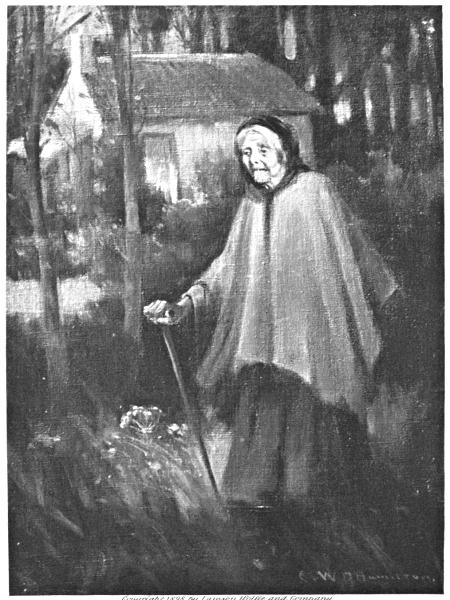
Copyright, 1898, by Lamson, Wolffe and Company
Strangely enough, the old woman seemed like a witch.
page 194
She heard the old woman calling after
her to stop. Not daring to turn around,
and ceasing to run, lest doing so should
betray her fear, she doubled her thumbs
in her palms and began to sing a psalm.
Loudly and clearly she sang, the while
she felt the hair rising on her head, fearing
that she heard the old woman coming
up behind her. Desperately she looked
back. Still, very faintly in the deepening
dusk, could she see the little old woman
standing in the doorway, while from her
hands fluttered the rose-red ribbon. And
as the voice of an angel singing in the
wilderness, Abigail’s singing floated back
to her dull ears.
“He gently-leads mee, quiet-waters bye
He dooth retain my soule for His name’s sake
inn paths of justice leads-mee-quietly.
Yea, though I walke inn dale of deadly-shade
He feare none yll, for with mee Thou wilt bee
Thy rod, thy staff, eke they shall comfort mee.”
Abigail walked rapidly, glad to leave
the little hut and its lonely inmate far
behind.
The night was upon her. Where could
she seek safety? Her anxiety increased
as the shadows deepened.
Alarmed, she looked around her for
the safest place in which to pass the
night. At first she thought of sleeping
near the sea, on the warm sands. But
she could not find her way out of the
woods. Suddenly, on the edge of a marsh,
she spied a deserted Indian wigwam.
Near by were the ashes of recent fires,
and a hole in the ground revealed that
the store of corn once buried there had
been dug up and used. Into this wigwam
she crept for protection. Terrified, she
watched the night descend on the marsh,
which, had she but known it, was a refuge
for all gentle and harmless animals and
birds. Fallen trees were covered with
moss, the lovely maiden-hair fern, lichens,
and gorgeous fungi. The purple flag,
and the wild crab, and plum trees grew
here, as well as the slender red osiers, out
of which the Indian women made baskets.
Ere twilight had entirely vanished, Abigail
saw brilliantly plumaged birds flying
back to the marsh for the night. A fox
darted into the dusk past the wigwam.
To her, nothing in all this was beautiful.
Crouched in the wigwam, she saw through
the opening white birches, like ghosts
beckoning her. A wild yellow canary, with
a circling motion, dropped into its nest.
Abigail shuddered and breathed a prayer
against witchery. Will-o’-the-wisps flashed
and vanished like breaths of flame, and
she thought they were the lanterns of
witches out searching for human souls.
As night now settled in good earnest,
a stouter heart than this little Puritan
maiden’s would have quailed. The terrible
howling of wolves arose, mingling
with the mournful tu-whit-tu-whoo of the
owls and the croaking of the bull-frogs.
She was in constant dread lest she might
be spied upon by Indians, who, according
to the Puritan teachings, were the last of
a lost race, brought to America by Satan,
that he might rule them in the wilderness,
undisturbed by any Christian endeavours
to convert them.
On the opposite edge of the marsh,
a tall hemlock pointed to a star suspended
like a jewel just above it.
When, in after years, Abigail became
a dear little old lady, she used to tell her
grandchildren of the strange fancy that
came into her mind as she watched that star.
For, as she said, it was so soft and yellow,
and yet withal so bright, that it seemed
to be saying as it looked down at her:—
“Here we are, you and I, all alone in
these wild woods; but take courage. Are
we not together?”
A sweet sense of companionship with
the star stole over her, and she was no
longer lonely. She found herself smiling
back at this comrade, so bright and merry
and courageous. Thus smiling, she passed
into the deep slumber, just recompense of a
good heart and honest fatigue.
When she awoke, the sun was shining.
Hastily she drew off her shoes and stockings,
which she had worn during the night
for warmth. Then as her eyes, still heavy
with sleep, comprehended the beauty of
the marsh, she was filled with delight.
The sun sent shafts of golden light into
the cool shade. All the willows and slender
fruit trees glistened with morning dew.
The pools of water and the green rushes
rippled in the morning breeze. The
transparent wings of the dragon-fly flashed
in the blue air. All the birds twittered
and sang. Beyond, the solemn pines
guarded the secret beauties of the marsh.
Thus that which had filled her with terror in
the darkness, now gave her joy in the light.
By the height of the sun she judged she
must have slept late and that she must
make all haste to reach Boston Town in
time. It was not long before she struck
the main path again.
Great was her astonishment and delight
to learn by a sign-board, nailed to a tall
butternut tree, that she was within little
over an hour’s walk from Boston Town.
This sign, printed in black letters on a
white board, read as follows:—
Ye path noo Leadeth
to ye flowing River &
beyonde wich ye Toone of Boston
Lyeth. bye ye distance of 2 mls
uppe ye Pleasant Hill.
And below was written in a flowing
hand:—
“Oh, stranger, ye wich are Aboute
Arriv’d safe at ye End of ye dayes journey
the wich is symbolical of ye Soule’s Pilgrimage
onn earth, Kneel ye doone onn
yur Marrow Bones & Pray for ye Vile
Sinner wich has miss’d ye Strait &
Narrow path & peetifully Chosen ye
Broad & Flowery Waye wich leadeth
to Destruction & ye Jaws of Death.”
Abigail read the sign over hastily and
passed on. “I will get down on my
marrow-bones when I come back,” she
murmured; “I be in mickle haste for
loitering.”
Soon she neared the river beyond
which stretched the pleasant hill. She
heard a voice singing a hymn a far
distance behind her. She turned and
waited until the singer should have
turned the curve of the road. The
singing grew louder and then died away.
A little later Mr. Cotton Mather, mounted
on his white horse, came in sight. It
seemed to her that far as he was from
her, their glances met and then he turned
and looked behind him.
That moment was her salvation.
Quickly she ran and hid behind the
trunk of a great tree. Cotton Mather
came slowly on. His horse was well
nigh spent with fatigue. She saw him
distinctly, his face white from exhaustion,
his eyes sombre from a sleepless night.
His black velvet small-clothes were
spattered with mud. He reined in his
horse so near her that she might almost
have touched him.
He removed his hat to greet the cool
river breeze. His countenance at this
time of his young manhood held an
irresistible ardour. Some heritage had
bestowed upon him a distinction and
grace, even a worldliness of mien, which,
where he was unknown, would have
permitted him to pass for a courtier
rather than a priest. At this moment
no least suggestion of anything gross
or material showed in his face, which
was so nearly unearthly in its exaltation
that the little maid watching him was
awed thereat and sank to her knees.
His very presence seemed to inspire
prayer.
A moment he looked searchingly
around him, then spurred his horse to
take the ford. She saw the bright water
break around his horse’s feet, the early
sunshine falling aslant his handsome figure.
She watched until he reached the
further bank and disappeared behind a
gentle hill. Then she came out from her
hiding.
When in after years she beheld him,—his
public life a tragedy by reason of his
part in the witchcraft trouble and his jealous
strivings to maintain the infallibility
of the Protestant priesthood,—saw him
mocked and ridiculed and slaves named
after him, a vision would rise before her.
She would see again that magnificent
young figure on the white horse, the radiant
air softly defining it amidst the greenness
of the forest, herself a part of the
picture, a little child kneeling hidden
behind a tree in the early morning.
The fordway was so swollen that Abigail
did not dare attempt to cross on foot.
And although further down where the
river narrowed and deepened there was
a ferryman, she had not the money with
which to pay toll. Thinking, however,
that it would not be long before some
farm people would be going into town
with their produce, she sat down on the
shore and dabbled her feet in the cold
water to help pass away the time. At
last when the first hour had passed, and
she was waxing impatient, there appeared,
ambling contentedly down the green shadowed
road, a countryman on his fat nag,
his saddle-bags filled with vegetables and
fruit for market.
Abigail rose. “Goodman,” said she,
“would ye be so kind as to take me
across the river? I be in an immoderate
haste.”
“To be sure,” said the countryman;
“set your foot on my boot; let me have
your shoes and stockings. Give me your
hands. Now, jump; up we go, that’s
right. Ye be an uncommon vigorous
lassie.”
The horse splashed into the water, which
rose so high that Abigail’s bare feet and
ankles and the farmer’s boots were wet.
The little maid put her arms as far as she
could reach around her companion’s broad
waist, and clung tightly to him, her little
teeth firmly set to keep from screaming
as the horse rolled and slipped on the
stones in the river bed.
When they reached the other side, Abigail,
desperately shy, insisted upon her
companion permitting her to dismount,
although he offered to carry her all the
way into town.
“Ye be sure ye can find your home,
child?” he asked, loath to leave her.
Abigail nodded and sat down on the
ground to pull on her shoes and stockings,
while the countryman after a moment’s
further hesitation made his way
leisurely up the grassy hill.
After a brisk walk, Abigail arrived at
Boston Common, a large field in which
cows were pastured during the daytime,
and where, in the evening, the Governor
and his Lady and the gallants and their
“Marmalet Madams” strolled until the
nine o’clock bell rang them home and
the constables began their nightly rounds.
The trees that once covered the Common
had been cut down for firewood, but there
were many thickets and grassy knolls.
On one side the ground sloped to the
sea where the cattle wandered through
the salt marsh grasses. And there was
to be heard always the sweet incessant
jangle of their bells. At this hour of the
morning there was generally to be seen
no person except the herdsman, but as
Abigail approached a stately elm which
stood alone in the field, she saw a student
lying on the grass, reading.
Chapter XIV A Fellow of Harvard
His book lay open between his elbows,
and his chin was propped on his
hands. His cap lay on the grass near by.
Abigail’s shyness tempted her to hurry
by him without attracting attention, but
when she remembered that he might know
something of the fine gentleman she was
seeking, she paused bravely.
“It will be a fair day, sir,” she said in
a quavering voice.
The young man rolled over on his
elbow. He wore no wig, and his lank
dark hair, parted in the centre, fell on
either side of his long, colourless face.
His eyes were sharp and bright.
“On what authority dare you make so
rash a statement?” inquired he, sternly.
“Take heed how you say such things,
lest it rain and thunder and the wind blow,
and a hurricane come upon us this afternoon,
and you be prosecuted for telling a
falsehood.”
Abigail failed to perceive he was but
jesting, and this, as well as timidity and
anxiety, so wrought upon her, that without
further ado she began to cry.
At this the student jumped up, deeply
repentant, and entreated her to rest in the
shade of the old elm tree by him. He
gave her his kerchief to dry her eyes, and
offered an apple from his pocket.
“There, there,” he said, “’twas but an
idle jest. I am a bit of a merry-andrew
in my way, but a harmless fellow, without
a grain of malice in me. Sure the sun
will shine all day when the morn is fair
like this. Look up, my pretty lass. See,
it still shines.”
Abigail obediently blinked her tear-wet
lashes at the dazzling sun, then turned
her attention to the apple. She ate it
with great relish, the while the student
leant back against the tree, his hands in
his pockets and his long legs crossed.
Thus leisurely reclining, he sang a song
for her pleasure, such as never before had
greeted her staid, religious little ears.
His voice was wondrous mellow, and its
cadences flung over her a charmed spell.
“It was a lover and his lass,
With a hey and a ho and a hey-nonino.
That o’er the green corn fields did pass
In the spring-time, the only pretty ring-time
When birds do sing, hey-ding-a-ding, ding,
Sweet lovers love the spring.”
“Beshrew me,” remarked Abigail, taking
a bite of her apple, “but ye sing
strange songs in Boston Town.”
“Did ye ne’er hear tell of Willie Shakespeare,
the play-actor,” cried the student.
“I am amazed, sore amazed, at your ignorance.
Many a rare rhyme has he written,
God rest his bones, and betwixt you and
me, I, as a Fellow of Harvard, privileged
to be learned, find that there are times
when his poesy rings with more relish in
my ears than the psalms. I have tried
my hand at verse-making with fair fortune,
though I say it as should not.” Then
he burst forth into another rollicking
song:—
“Full fathoms five thy father lies;
Of his bones are coral made;
Those are pearls that were his eyes:
Sea-nymphs hourly ring his knell—”
“Beshrew me, sir,” interrupted Abigail,
her disapproval too strong to be repressed,
“but these songs are not to my liking.”
She rose. “I will be pleased to have
you read this description, sir,” she said,
drawing a paper from her pocket tied by
a string around her waist, “and tell me
if ye ken aught o’ this fine gentleman.”
The student rose and made her a low
bow. “Since you be pleased to put on
such dignity, mistress,” said he, with a fine
and jesting air, “I must needs fall in with
your ways.”
He took the paper she extended to
him and unfolded it with many airs, the
while crooking his little fingers daintily.
This was what he read, written in a fair
and flowing hand as did befit a teacher of
the Dame School:—
“A descripshun of ye fine gentellman whom I met
in ye forest on ye afternoon of June 3 wich is herein
sett downe. He be aboute three score more or less
& be of make suffishunt large to be stared att & for
ye naughty boys of ye streete to call att, he having an
immoderate goodly girth arounde ye middle. shure
did yu know him yu would be of my minde that he
had grate rank across ye seas fore he wears full breeches
with knots of ryban of a Purple-Blue colour att his
knees. alsoe he do walke inn grate bootes. his
Sleeves be of fine Velvet withe watchet-Blue Tiffany
peeping through ye Slashes. alsoe he carried a blacke
case bestock with smal sharp knives exceeding bright.
he showed me a picture of his lyttle maide of faire
countenance. As regardes ye countenance of ye fine
gentellman itt was wrighte goode to looke att having
Witte Beauty & Goodness, as theay say. alsoe he
weares a light Brown Wigg, parted to ye Crown &
falling in Naturall Silke curles to his Shoulders. his
Moustache curls finely towards his Nose.
by ye wich descripshun Abigail finde him &
deliver ye pckge soe saye I & ye Lord be willing.
Deliverance Wentworth.
note. alsoe he weares a sword.”
“Well-a-day!” laughed the student as
he finished, “this is a pretty joke.”
“It be no joke at all, sir,” said Abigail,
“and ye will pardon my frowardness in
contradicting ye, for my dear friend
Deliverance will be hanged o’ Saturday
for witchery.” And putting the kerchief
to her eyes she wept afresh. As she
did so, she heard a strange sound like a
groan, and looked up quickly.
The student was leaning against the
elm, his eyes closed and his face whiter
than the paper which had fluttered from
his fingers to the ground.
“Haps it that ye ken her, sir?” she
asked in an awed whisper.
He looked at her and tried to regain
his composure. His lips moved dumbly.
He turned away and put his hand over his
eyes, leaning once more against the tree.
When he looked again at Abigail, she
saw that tears bedimmed his eyes. This
exhibition of feeling on the part of this gay
student seemed an even more serious thing
than the fact that Deliverance was in jail,
or that she herself had passed a night in
the forest, exposed to savages and wolves.
The student, looking at the little maid’s
troubled, tear-stained countenance, smiled
in a faint, pitiful fashion, bidding her have
hope and cheer. But his voice faltered
and broke.
Something in his smile arrested Abigail’s
attention. Suddenly, a light of recognition
breaking over her face, she put forth her
hands, crying joyfully: “Ye be Ronald.
Ye be Deliverance’s brother. She telled
me to look for ye, but I ne’er suspicioned
it to be ye. But when ye smiled I thought
o’ her, and now I have remembrance o’
having seen ye in Salem Town.”
Young Wentworth made no reply save
by a groan. “Long have I misdoubted
these trials for witchery,” he muttered.
“It tempts one to atheism. She, Deliverance,
a witch, to be cast into prison! a
light-hearted, careless child! God himself
will pour out His righteous wrath
upon her judges if they so much as let a
hair of her head be harmed. They have
convicted her falsely, falsely! Come,”
he cried, turning fiercely upon Abigail,
“come, we will rouse the town! We
shall see if such things can be done in the
name of the law. We shall see.”
Now such anger had been in his eyes
as to have burned away his tears, but all at
once his fierceness died and his voice broke.
“Did they treat her harshly,” he
asked,—“my little sister, who since her
mother died, has been a lone lassie despite
her father and brother. Tell me
again, again that it be not until to-morrow,—that
one day yet of grace remains.”
So Abigail told him all she knew. But
when he desired to see the letter she was
to give to the Cavalier, she protested:—
“I promised not to read it myself nor
to let any other body, except him, for
Deliverance said it must be kept secret,
she being engaged on a service for the
King. She said when I found ye, ye
would go with me to look for the fine
gentleman.”
“Very well, we will go,” he answered
briefly, and took her hand, seeing that it
would only trouble her then to insist
upon having the letter, but resolving to
obtain possession of it at the first opportunity.
“We will go to the Governor’s house,
first,” he added, “and see if he knows the
whereabouts of any such person. If not,
then I must read the letter and find the
clue to unravel this sad mystery.”
Master Ronald walked on rapidly,
holding her hand in so tight a grasp that
she was obliged to run to keep up with
him. They soon left the Common and
entered a street. There were no sidewalks
then in Boston Town. The roadways,
paved with pebbles, extended from house
to house. They took the middle of the
street where the walking was smoothest.
Once Master Ronald paused to consider
a sun-dial.
“It lacks o’er an hour of ten,” he said;
“we shall be obliged to wait. The new
Governor is full of mighty high-flown notions
fetched from England, and will see
no one before ten, though it be a matter
of life and death. It sorts not with his
dignity to be disturbed.” He glanced
down at Abigail as he finished speaking,
and for the first time took notice that she
was tired and pale.
“Have you broken fast this morn?” he
inquired; “I should have bethought me
of your lack. There is yet ample time,
and you must eat. Come,” he added,
taking her hand again and smiling, “it is
good for neither soul nor body that the
latter should go hungered. The Queen’s
coffee-house lies just around yon corner.”
A few moments later Abigail found
herself seated at a table in a long, dark
room, very quiet and cool, with vine-clad
windows. Only one other customer besides
themselves was in the room. He
was an old gentleman in cinnamon-brown
small-clothes, and he was so busy sipping
a cup of coffee and reading a manuscript,
that he did not glance up at their entrance.
The inn-keeper’s buxom wife
received Master Ronald’s order. Quite
on her own account she brought in also a
plate of cookies.
“Kiss me well, honey-sweet,” said she,
“and you shall have the cookies.”
So Abigail kissed the goodwife in return
for her gift.
“Heigh-ho!” remarked Master Ronald,
“in all this worry and grief I forgot that
every maid has a sweet tooth, if she be
the proper sort of maid.” In spite of his
little pleasantry, his troubled look remained.
Abigail ate steadily, not pausing to talk,
only now and then glancing at her companion.
After awhile Master Ronald
rose, and strode up and down with savage
impatience. “Alack!” he said, “I seem
to be losing my wits.”
Abigail, having finished, commenced
putting the remaining cookies in her
pocket.
“Why do you do that?” asked Master
Ronald.
“I want summat to eat on my way
home,” answered Abigail, resolutely,
crowding in the last cooky.
The young man laughed, but his laughter
ended abruptly in a sigh of pain.
Abigail could not but admire the grand
and easy way in which, with a wave of his
hand, he bade the inn-keeper charge the
breakfast to his account, as they left the
coffee-house.
He led the way back to the sun-dial.
They had been gone not more than
twenty minutes. Frowning, Master Ronald
turned his back toward the dial and
leant against it. “We may as well stop
here,” said he, “and wait for the minutes
to speed.”
Abigail pushed away the vines to read
the motto printed on the dial. “‘I marke
the Time; saye, gossip, dost thou soe,’”
she read unconsciously aloud.
“Time,” echoed Master Ronald, catching
the word, “time.” He shrugged
his shoulders. “What is more perverse
than time? It takes all my philosophy
to bear with it, and I oft wonder why
’twas e’er put in the world. ’Tis like a
wind that blows first hot then cold. It
must needs stand still when you most wish
it to speed, and when you would fain have
it stand still, it goes at a gallop.” He
sighed profoundly and kicked a pebble
with the toe of his shoe.
His expression was so miserable that
Abigail’s ready tears flowed again in sympathy,
so that she was obliged to pick up
the hem of her petticoat and wipe them
away. Her attention was suddenly attracted
by noisy singing and much merriment.
She dropped her petticoat.
“Happen like there be a dancing-bear in
town?” she asked eagerly.
“Nay,” answered Master Ronald, “’tis
some of my fellows at the tavern, who
have been suspended a day for riotous
conduct.”
“Come, come,” cried he, taking her
almost fiercely by the hand. There was
a new ring in his voice, a sudden strong
resolve shining in his face. He led her
along the road in the direction from which
the sounds proceeded, and paused at last
in front of a tavern which had as a sign a
head of lettuce painted in red. From this
place came the singing.
Master Ronald, still holding her hand,
swung the door open and stepped inside
with her. As her eyes became accustomed
to the dim light she perceived
some eight or ten young fellows with
lank locks falling about their faces, seated
around a large bowl of hasty pudding,
into which bowl they dipped their spoons.
Two or three who were perched on the
table, however, had ceased eating, and
were smoking long brier-wood pipes.
They did not perceive Master Ronald
and Abigail. Suddenly they all lifted
high their mugs of sack and broke into
song.
“Where the red lettuce doth shine,
’Tis an outward sign,
Good ale is a traffic within.
It will drown your woes
And thaw the old snow
That grows on a frosty chin,
That grows on a frosty chin.”
“Enough, enough, sirs!” Master Ronald
cried sharply; “down with your mugs!
Are ye to drink and be merry when murder—murder,
I say—is being done in
the name of the church and the law?”
The students turned in open-mouthed
amazement, several still holding their
mugs suspended in the air. At first
they were evidently disposed to be merry
as people accustomed to all manner of
jesting, but the pallor and rigid lines of
the young man’s face checked any such
demonstration, as well as the unusual appearance
of a little maid in their midst.
Then one tall and powerful fellow rose.
“Murder,” he said slowly, shaking back
his hair, “murder—under sanction of the
church and law. How comes that?”
Master Ronald made a gesture commanding
silence, for the others had risen,
and a confused hubbub of questions was
rising. Then he pointed to Abigail, who
was near to sinking to the floor with mortification,
as all eyes were turned upon
her.
“This little maid,” he continued, when
the room was again silent, “journeyed
alone from Salem to Boston Town, to find
and tell me that in Salem prison there is
confined another maid condemned for
witchery and under sentence of being
hanged on the morrow.”
His words were interrupted by groans
and hisses.
“A plague upon these witch-trials,”
cried one of his hearers; “a man dare not
glance askance at his neighbour, fearing
lest he be strung up for sorcery. And
now ’tis a maid. Lord love us! Are
they not content with torturing old beldames?”
There came a flash into the eyes of the
stalwart youth who had first spoken.
“’Tis not so long a journey to Salem
Town but we might make it in a night.”
An answering flash lit the eyes of his
fellows as they nodded and laughed at the
thought which, half-expressed, showed in
the faces of all. But they grew quiet as
Master Ronald began speaking once more.
“’Tis a matter of life and death. The imprisoned
maid is near the age of this little
maid, as innocent, as free from guile—.”
He broke down and dropped into a chair,
folded his arms on the table, and buried
his face in them while his shoulders shook
with repressed grief.
The rest, troubled and embarrassed by
his emotion, drew together in a little
group and talked in low tones.
“Perchance ’tis a relation, a sister,”
commented one young man, “a maid, he
said, like yonder little lass;” and the
speaker indicated Abigail, who had edged
over to the door and stood, with burning
face, nervously fingering her linsey-woolsey
petticoat.
“I have no patience with these, our
godly parsons,” cried another student,
who wore heavily bowed spectacles. “I
have here a composition, which with great
pains I have set down, showing how weak
are the proofs brought against those accused
of witchery.” He took off and
breathed on his spectacles and wiped them
on his kerchief. Then, having replaced
them on his nose, he drew a written paper
out of his pocket and unfolding it began
to read aloud.
But he was interrupted impatiently by
the rest. “’Tis no time for words but
action, Master Hutchinson,” they cried,
giving him the prefix to his name, for
these young Cambridge men called each
other “Master” and “Sir” with marked
punctiliousness.
“It behooves me ’twere well to inquire
into the merits of this case, but I am loath
to disturb him,” said one bright-eyed
young man, whom his fellows called Philander,
glancing at Master Ronald’s bowed
head. “Ah, I have it!” he cried, clapping
the man nearest him on the shoulder:
“we’ll not disturb his moping-fit but let
him have it out. Meanwhile we’ll make
inquiry of this little maid.”
As he drew near Abigail, she, startled,
flew to Master Ronald’s side and shook
him. “Oh, sir,” she cried, “wake up!
They are going to speer me.”
At this the gravity of the young men
relaxed into laughter so hearty that even
Master Ronald, looking up, comprehended
the situation and smiled faintly.
“They are less amusing and more dangerous
than dancing-bears, eh, Mistress
Abigail?” he asked, rising to his feet.
Abigail did not commit herself by replying.
“Let us haste away, sir,” she said;
“bethink yourself how Deliverance waits,
and you will pardon my rudeness, but,
sir, it be no time now for a moping-fit.”
“Bravo!” cried Master Philander,
“there is the woman of it. You prefer
to do your duty first and have your weep
afterwards.”
“I will take you to see the Governor
in a moment, Mistress Abigail,” said
Master Ronald; “we will be there prompt
on the moment. There is that whereof I
would speak to my friends who are bound
to any cause of mine, as I to theirs, in all
loyalty, when that cause be just.”
At this the students interrupted him by
shouts, but he raised his hand to silence
them. “Hear me to the end without
interruption, as the time waxes short. In
Salem, my fair young sister, scarce more
than a child in years, languishes in jail,
for having, it is asserted, practised the
evil art of witchery. On the morrow she
will be hanged, unless, by the grace of
God, the Governor may be prevailed
upon to interfere. If he refuses justice
and mercy, then have we the right to take
the law into our own hands, not as trespassers
of the law, but rather as defenders
of law and justice. As men sworn to
stand by each other, how many of you
will go with me to Salem Town this night
and save the life of one as innocent and
brave, as free from evil, as this maid who
stands before you now?”
There was no shouting this time, but
silently each young man moved over and
shook hands with the speaker in pledge
of his loyalty and consent.
“And now,” added Master Ronald, “I
will go to the Governor’s house, that you
may have your say with him, Mistress
Abigail.”
“We will escort you there,” said the
stalwart young fellow Abigail had first
noticed. Before she could protest, to her
indignation he had seized her and swung
her up on his broad shoulder, passed her
arm around his neck, and rested her feet
on his broad palm.
“Now I have placed you above learning,
little mistress,” he cried gayly; “duck
your head as we go through the door.”
Abigail clasped his neck tightly, and
lifted up her heart in prayer. Intense
was her mortification to observe how the
people turned and looked after them.
She grew faint at the thought of her
father’s awful, pious eye beholding her.
“They may be much for learning,”
she murmured, glancing over the heads of
the students, “but, beshrew me, they be
like a pack o’ noisy boys. Oh, Deliverance,
Deliverance, how little ye kenned
this torment!”
Chapter XV Lord Christopher Mallett
Down many a crooked street and
round many a corner, the crowd of
students bore her, until at last they
reached the Governor’s place, “a faire
brick house” on the corner of Salem and
Charter streets.
Above the doorway were the King’s
arms richly carved and gilded. Some
stone steps led down the sloping lawn
to the street, which was shut out by a
quaint wooden fence.
Here, at the lanterned gateway, the
student who carried Abigail set her down
upon the ground.
“Come, Mistress Abigail,” said Master
Ronald, holding the gate open for her to
pass in.
Once safely inside Abigail did not forget
her manners, but turned about, spread
out her petticoat, and courtesied to all the
merry young gentlemen, who, leaning over
the gate, smiled and doffed their caps.
Then retying the strings of her bonnet
primly under her chin, and giving her
skirts a flirt, she walked with Master Ronald
to the door.
Master Ronald raised the knocker and
rapped thrice vigorously.
The door was opened by an old Moor,—so
was the negro called by the good
folk of those days. When he beheld the
student he smiled and bowed; then with
deprecating gesture fell to shaking his
head solemnly.
“Don’t concern yourself this time,
Pompey,” said the student, grimly. “I
have other business than whining for
pardon. Lack-a-mercy-me! I feel as if I
should never have heart for any more
quips or pranks. Is his Excellency in?
Tell him that Ronald Wentworth, a Fellow
of Harvard, awaits his pleasure.”
The negro ushered them into the hall-room
and placed a stool for Abigail. The
little maid perched herself stiffly upon it
and gazed around her, greatly awed by
the magnificence, while Master Ronald,
with his hands behind him clasping his
cap, paced restlessly up and down the
room, his countenance so colourless and
lined with anxiety that it was like the
face of an old man. The hall into which
they had been shown served not only as a
passageway but as a living-room. From
one side the staircase, with its quaintly
carved balustrade, rose by a flight of
broad steps to the second story. In the
centre of this hall-room was a long table
laid with a rich cloth on which was placed
a decanter of wine. Stools with cushions
of embroidered green velvet were placed
for those who sat at the Governor’s board.
Abigail’s sharp eyes noted a spinning-wheel
in front of the fireplace, which was
set round with blue Dutch tiles. But
she was most delighted by a glimpse she
caught of the cupboard which contained
the Governor’s silver plate.
The rear door of the hall was swung
open and she could see a pretty gentlewoman
working in the garden. Her
cheeks vied in richness of colour with
the crimson coif she wore beneath her
straight-brimmed, steeple hat, as she
gathered a nosegay, the basket on her
arm being filled to overflowing.
At last, Master Ronald, pausing,
leant his elbow on the carved newel-post
of the staircase and sighed heavily.
“Did you say Deliverance was treated
with decency and kindness in jail?” he
asked. “Let them but harm a hair of her
pretty head and they shall have ample
proof of the love I bear my little sister.”
As he spoke, the door opposite opened
and a gentleman came out, closing it
behind him. He was a tall and solemn-visaged
man, richly attired in velvet, with
a sword at his side. There was that air
of distinction in his bearing which made
Abigail instantly surmise that she was in
the presence of Sir William Phipps, the
new Governor, who had arrived last
month from England. He addressed her
companion, taking no notice of her.
“Well, well, Master Wentworth, and
that be your name,” he said, “let me
warn you to expect no leniency from me
nor intercession on your behalf with your
masters at Cambridge. I have scarce
been in this miserable country two months,
yet have had naught dinged in my ears but
the mischievous pranks of you students
of Harvard. ’Tis first the magistrates
coming to complain of your roisterings
and rude and idle jestings, and I no sooner
have rid myself of them than you students
come next, following on their very heels
with more excuses than you could count,
and puling and whining for mercy. But
sit down, young sir, sit down,” he ended,
taking a seat as he spoke. He crossed
his legs, put the tips of his fingers together,
and leant back comfortably in his
massively carved oak chair. Chairs were
then found only in the houses of the very
well-to-do. So it was with some pride
that Sir William waved the student to the
one other chair in the hall.
But Master Ronald, too nervous to
remain quiet, refused impatiently. “I
have come with——”
“There is too much of this book-learning,
nowadays,” interrupted Sir William,
following his own train of thought. “The
more experience I have of yon Cambridge
students, the more convinced I be, that
three fourths should be taken out of college
and apprenticed to a worthy trade.
Let such extreme learning be left to
scholars, lest ordinary men, being too much
learned, should set themselves above their
ministers in wisdom. As for myself—”
“Ay,” interrupted Master Ronald,
desperately, “but the matter on which
I come to-day—”
“As for myself,” continued Sir William,
glancing severely at the student, “I
started out in life apprenticed to an honest
trade. From ship’s carpenter, I have
risen to fortune and position. But I
will confess I grow that troubled with the
management of this province, what with
the Indian and French wars on the one
hand, and this witchery business on the
other, that I do often wish I might go
back to my broad-axe again, where one
can be an honest man with less perplexity.”
“Sir,” spoke the student, sharply, “I
crave your pardon, but I have no time
for talk to-day. ’Tis a matter—”
“Very well,” retorted Sir William,
annoyed, “we will hear of this very important
matter, but let me warn you beforehand
to expect no indulgence. So
you can go on with your plaint, if you
count time so poorly as to waste it on
a cause already lost, for ’tis to-day I shall
begin to make an example of some of
you.”
“I come on no private business of my
own,” retorted Master Ronald with spirit,
“but in company with this little maid.”
He indicated Abigail by a wave of his
hand.
She slipped down from her stool thereat
and courtesied.
The Governor took no notice of her
politeness beyond a severe stare. “Well,”
he inquired, “and for what did you
come?”
“If you please, your Excellency,”
faltered Abigail, “Deliverance, my dear
friend—”
At this, Master Ronald, who stood on
the further side of the Governor’s chair,
coughed. She glanced up and saw he
had put his finger to his lips to enjoin
silence. Frightened, she stopped short.
During the pause, the Governor drew
out a gold snuff-box and took a pinch
of snuff. Then he flicked the powder,
which had drifted on his velvet coat, off
daintily with his kerchief. “Well,” said
he, “have you lost your tongue?”
“My dear friend, Deliverance,” repeated
Abigail.
“In other words,” broke in Master
Ronald, his tone sharp with anxiety, “she
desires to ask your Excellency if you
know the whereabouts of any person
answering this description.” And briefly
he described the stranger whom Deliverance
had met in the forest.
At these words the Governor’s expression
mellowed slightly and he smiled.
“Then you have no favour to ask of
me,” he said. “I think I know the person
of whom you speak.” He rose. “I will
find out if you may see him.”
As he crossed the hall, he glanced out
of the entrance-door which had been left
half-closed.
Abigail’s eyes, following the direction
of his, beheld the students perched in
a row on the front fence.
His Excellency turned, bestowing a
grim look on Master Ronald.
“What scarecrows are those on my
fence?” he asked. “I doubt not I could
make better use of them in my corn-fields.”
And with an audible sniff he
opened the door on his right and entered
the room beyond.
“The Lord in his infinite justice is
on our side,” spoke Master Ronald,
solemnly, as the door closed behind the
Governor. “Praise be unto Him from
whom cometh all mercy.” He took a
couple of long steps which brought him
to Abigail’s side. “Say no word of
witchery to his Excellency,” he whispered
sternly, “lest you spoil all by a false
move. Mind what I say, for he is
carried away by fanaticism, and in his
zeal to clear the land of witches makes
no provision to spare the innocent.
Hush!” He drew quickly away as
steps were heard in the next room.
He clasped his hands behind him and
commenced pacing the floor, humming
in apparent unconcern:—
“Full fathoms five thy father lies;
Of his bones are coral made;
Those are pearls that were his eyes:
Sea-nymphs hourly ring his knell”—
Abigail fairly quaked in her shoes.
Another moment, and the door through
which the Governor had passed was
opened by the old Moor. He beckoned
them to enter.
They found themselves in a spacious
apartment, the state bed-chamber of the
house.
Standing well out in the centre of the
room was a great four-poster bed, with
a crimson canopy. The curtains were
drawn back, revealing a man lying dressed
on the bed, propped up by pillows.
The Governor sat beside him. He
nodded to the two young people.
“Is not this the gentleman you seek?”
he asked, with a wave of his hand toward
the occupant of the bed.
They had recognized him, however, at
once. There was the flowing wig of chestnut
hue, the comely countenance, the
rich dress, the curled moustache Deliverance
had so admired. One of his legs,
bound in wool and linen, rested on a
pillow. On a table at the further side
of the bed were placed some quills, an
ink-horn, and paper; also a jug of wine
and silver mugs.
“By my troth,” cried this fine person,
jovially, “I expected none such pretty
visitor. Come here and kiss me, little
maiden, and I swear you shall have your
wish, whatsoe’er it be. And it be not the
round moon or the throne of England,”
he added chuckling.
Abigail courtesied at a safe distance
from the bed.
Meanwhile, Master Ronald had his eye
on Governor Phipps. He feared to mention
their errand in the presence of his
Excellency, knowing that they might expect
neither reason nor tolerance from
him. So he drew himself up to his full
height and said with confidence, not
unbecoming in so learned a Fellow of
Harvard:—
“Your Excellency, this is a very private
and personal business.” Having
said this he bowed so low that his dark
hair fell over his face. Thus he remained
with his head deferentially bent during
the moment of amazed silence which
elapsed before his Excellency replied.
“I have no desire to hear,” he retorted,
his small eyes snapping with wrath, “but
I would say unto you, young sir, that
’tis exceeding low-bred for you to be setting
a lesson in manners to your elders
and betters; exceeding unfortunate and
ill-bred, say I, though you be a Fellow of
Harvard, where, I warrant, more young
prigs flourish than in all England.”
With which fling his Excellency rose and
left the room, followed by his servant.
“I ’gin to be fair concerned as to what
this mighty business will prove to be,”
said the merry invalid; “my curiosity consumes
me as a flame. But sit you down,
little mistress, and you, young sir. You
must not deem me lacking in gallantry
that I rise not. Here have I lain two
weeks with the gout. Was e’er such
luck? But, why fret and fume, say I,
why fret and fume and broil with anxiety
like an eel in a frying-pan? Yet was e’er
such luck as to have your thumb on your
man and not be able to take him?”
“Sir,” spoke Master Ronald from the
stool on which he had seated himself, “we
come on a matter of life and death. My
sister, Deliverance Wentworth, the child
you met in the forest outside Salem Town,
some three weeks ago, is to be hanged on
the morrow for witchery, unless by the
grace of God you have power to interfere.”
At these words the invalid’s florid face
paled, and he sank back on his pillows
with a gasp of mingled horror and astonishment.
“The Lord have mercy on this evil
world!” he said, wagging his head portentously.
“Alack, alack! the times grow
worse. What manner of men are these
lean, sour Puritans that they would e’en
put their babes to death for witchery?
As pretty and simple a maid was she as
any I e’er set eyes on, not excepting my
sweetest daughter over the seas.”
“Ay,” said the student, raising his
white face from his hands, “as sweet a
maid as God e’er breathed life into. But
I say this,” he cried, raising his voice
shrilly, in his excitement, “that if they
harm her they shall suffer for it.”
“Not a hair shall they hurt, and God
grant me grace to live to get there,” cried
the invalid. “Is my word to be accounted
of naught,” and he tapped his
breast, “mine? Oh, ho! let any dare to
deny or disregard it, and he shall rue it.”
“Sir,” said Abigail, approaching him
timidly, “Deliverance Wentworth sends
ye this.”
He took the package and untied the
tow string which bound it. There were
two papers, one the sealed parchment Abigail
had found in the still-room and the
other the letter Deliverance had written.
When the Cavalier saw the parchment,
he gave an inarticulate sound and clutched
it to his breast, kissed it and waved it wildly.
“By my troth!” he cried, “the little
maid whom they would hang, hath saved
England.”
In his excitement he rose, but no
sooner had he put his foot on the floor,
than he groaned and fell back on the bed.
His face became so scarlet that Master
Ronald started up, thinking a leech
should be sent for to bleed him, but the
sufferer waved him back, and lay down
uttering praise and thanksgiving, save
when he paused for groans so terrible,
that Abigail jumped at every one. When
he had exhausted himself and grown quiet,
she, feeling it safe to approach him, summoned
up courage to hand him Deliverance’s
letter, which had fallen from the
bed to the floor.
“Ye forgot her letter,” she said reproachfully.
As the Cavalier read, he swore mighty
oaths under his breath, and before he
finished, the tears were falling on the
little letter.
“Hon’d Sir: yu will indede be surprised
to lern of my peetiful condishun fore I be
languishing away in prison & round my ankel
be an iron wring held by ye chain & itt be a
grate afflictshun to ye flesh. Alle this has come
uponn me since I met with yu in ye forest &
olde Bartholomew Stiles wich some say be a
Fule—but I would nott say of my own Accord—took
yu fore Satan wich was a sadd mistake
fore me. Alsoe Goodwife Higgins mistook
a yellow witch-bird & said ye same was me.
I blame her nott fore I had rised betimes &
gonne to ye brooke & tried onn ye golde
beads & this yu will perceive I could nott tell
her lest I should betray ye secret & I did give
ye message to Sir Jonathan Jamieson & he saide
I was a witch & alsoe Ebenezer Gibbs saide I
stuck pinnes in him when I but rapped his
pate fore larfing in school & intising others to
Evil acts such as Twisting ye Hair of Stability
Williams & fore alle this ye godly magistrates
have sentenced me to be hanged wich Hon’d
Sir yu will agree be a sadd afflictshun to ye
flesh.
As regards ye service fore ye King Abigail
wich be my deare friend will give yu a pckge.
but no more lest this fall into ye wrong handes
when yu read this I trust yu will in Gods
name come fast to Salem & take me out of
prison fore I am in sore Distress & can find
nothing comforting in ye Scripture, against
being hanged & I beginn to feare God has not
pardoned my sinnes.
Sir Jonathan Jamieson torments me most
grievous & I saye unto yu Privately he be a
Hypocrite & itt be Woe unto him Whited
sepulchre I ken nott what he will do when he
findes ye Parchment be gonne but no more
lest I betray ye secret & if I should be hanged
afore yu come I do heartily repent my sinnes
wich I cannot set down in wrighting fore I have
no more Ink. I beg with tears yu will come
in time. Hon’d Sir I bewayl my ylls & peetiful
condishun
Deliverance Wentworth.
note—I hereinn putt down my will that
Abigail shall have my golde beads amen
note—alsoe in Ipswich bides a hunchback
whose mother be hanged fore a witch & he be
named lyttel Hate-Evil Hobbs & should I be
hanged I trust Hon’d Sir yu will shew him
kindness fore me & now no more amen.”
“Please God!” spoke the Cavalier,
reverently, “Deliverance Wentworth hath
done a mighty service for her King, and
she shall not go unrewarded, for I am
one who speaks with authority.”
At these words the student looked up
with a flash of hope in his eyes, and Abigail
drew nearer the bed.
“Arrange the pillows under my head,
little mistress,” said the Cavalier, “and
you, young sir, draw up the table and fill
the mugs. ’Tis bad, I wot, for my leg,
still a little good red wine for the stomach’s
sake is not to be done away with.
“And now,” quoth he, solemnly, lifting
high his mug, “we will drink to the health
of Deliverance Wentworth, who hath done
a mighty service for her King. She shall
not go unrewarded, for I speak with
authority. For,” swelling his chest importantly,
“you behold in me Christopher
Mallett, Lord of Dunscomb County and
Physician to his Majesty, the King.”
Chapter XVI At the Governor’s House
While they were still drinking,
there came an imperious rap on
the door. In response to Lord Christopher’s
bidding, the Governor entered, followed
by a young minister.
Abigail was awed at the sight of the
latter, recalling how she had seen him in
the forest only a few short hours ago.
The student put down his wine-cup and
rose, deeply respectful.
“I have come to tell you, my dear
friend,” said the Governor, addressing
himself to the Cavalier, “that a very
strange miscarriage of justice calls me at
once to Salem.”
Ere the Cavalier could reply, his attention
was diverted by the strange action of
Cotton Mather, who, pausing half-way
across the room, was staring at the little
maid.
“I did see the spectre of that child rise
before me in the forest this very morn,”
he cried in a curious voice.
“Nay, good sir,” cried Abigail, finding
voice in her terror, “it was my very living
shape ye saw.”
“It rose in my path,” spoke Cotton
Mather, as if he heard her not. “I, believing
it a living child, did glance about to
see who accompanied it. When I looked
for it again the Shape had gone.”
“Nay,” cried Abigail, in mortal terror.
“Nay, good sir, nay, it was my living self.”
“Ay, reverend sir, it was the little
maid you beheld indeed, and no Dead
Shape that rose at the Devil’s bidding,”
cried Lord Christopher, and the effect of
his mellow, vigorous voice was magical.
So heartily it rang that the others’ thoughts
of spirits and visions grew faint as those
visions are disposed to be faint in flesh.
All felt it but Cotton Mather.
Wrapped in his own thoughts, he still
stared at the little maid.
“Do you not perceive the child is
frightened to be so regarded?” cried the
Cavalier, impatiently. “I can swear to
you, prove to you, her living self was in
the forest this morning. In Salem Town,
accused falsely of witchery, there languishes
a little maid——”
“A little maid,” cried Cotton Mather,
still in his strained voice. Suddenly, as
if grown faint, he sank upon a chair and
covered his eyes with his hands. Thus
he remained for several moments, while
his companions, awed by his emotion,
waited in a silence not unmingled with
curiosity. After awhile he took away his
hand from his eyes and raised his face.
Worn it was by the night’s long ride and
lack of food, sad it was, for he had but
just come from the death-bed of a beloved
parishioner, but above all it was glorified
by a transfiguring faith.
“A little maid,” he repeated, and now
his voice was tender; “she sits in prison
on her straw pallet, knitting, and the good
God watches over her.”
In that solemn silence which followed
his words, the room lost all semblance to
the Governor’s state bed-chamber. Its
spacious walls faded and narrowed to a
prison cell, wherein on her straw pallet,
sat a little maiden knitting.
The silence was broken by a smothered
sob. The faithful little friend, her face
buried on Lord Christopher’s broad breast,
was weeping.
When at last on that kind breast her
sobs were hushed, the minister spoke
again and she raised her head that she
might listen.
He told them how the night before,
after his supper at the inn-house, he had
retired to his room to study. But he was
restless and could not compose his thought,
and whatever he wrote was meaningless.
So, believing this non-success to be a reproof
from the Lord, inasmuch as he was
writing on a profane and worldly subject,
he laid down his quill and fastened his
papers with a weight, that the breeze coming
in the open window might not blow
them away. Then had he opened his
Bible. Now the breeze was grateful to
him, for his room was warm. A subtle
fragrance of the meadow and the peace of
the night seemed to be wafted about him.
He was reminded how one of the Patriarchs
of old had gone “forth into the
fields at even-tide to pray.” This thought
was gracious and so won upon him, that
he rose and snuffed his candles, and went
out into a wide field lying back of the
inn.
The moon was not risen, but the night
was so fair and holy by reason of the starlight,
that the white reflection of some
young meadow birches showed in the
stream, and, a distance off, he could see
the moving shapes of some cows. He
heard the tinkling of their bells. He felt
no longer restless but at deep peace.
It seemed not long before he heard the
night watchman making his rounds, crying
all good folk in for the night. He heard
him but faintly, however, as in a dream.
His heart was exceedingly melted and he
felt God in an inexpressible manner, so
that he thought he should have fallen into
a trance there in the meadow. The summons
of the night watchman began to
sound louder in his ears, so, reminding
himself that the greatest duty was ever
the nearest duty, he turned to go toward
the inn-house. Just then he saw near the
cluster of meadow birches, the little maid
he had visited in prison in the afternoon.
She was clothed in shining white and transparent
in the starlight as a wan ghost.
Still, by the glory in her face, he knew
it was not her Dead Shape, but her resurrected
self. As he would have spoken
she vanished, and only the white trunks
of the young birches remained.
By this, he knew it was a sign from
God that she was innocent, being showed
to him as if caught up to Heaven. At
this he remembered her words in prison,
when Sir Jonathan had sought to make
her confess by threatening that she should
be put to death by stones.
An enraged groan and a missile thrown
interrupted him. The pale student in his
passion had hurled his wine-mug across
the room.
“And you sat by and heard that vile
wretch so torture a child!” he cried. “Oh,
my God! of what stuff are these thy ministers
fashioned, that this godly servant of
thine did not take such a living fiend by
the scruff of his neck and fling him out of
the cell?”
“Come, come, young sir,” cried Sir
William, angrily, “Mr. Mather had not
then received the sign that your sister was
not bound to the Evil One. I will have not
the least discourtesy put upon him in my
house, and the wine-mug flung in your
wicked passion but just missed my head.”
Cotton Mather waited patiently until
the disturbance his words had wrought
subsided. His ministerial experience had
taught him sympathy with the humours of
people in trouble. With a compassionate
glance, directed toward the student, he
continued to relate how he had straightway
repaired to the inn, and ordering his
horse saddled, had journeyed all night, that
he might get a reprieve for the prisoner’s
life from Governor Phipps in time. He
was delayed in seeing the Governor
sooner, as upon entering Boston Town
he was summoned to the death-bed of a
parishioner.
“While all this but the more surely
convinces me of the evil reality of this
awful visitation of witches,” he ended,
“yet we must not put too much faith in
pure spectre evidence, for it is proven in
this case that the Devil did take upon
himself the shape of one very innocent
and virtuous maid.”
“’Tis a very solemn question, my dear
sir,” rejoined the Cavalier, wagging his
handsome head. “I remember once talking
it over with my very honoured contemporary,
Sir Thomas Browne. ‘I am
clearly of the opinion,’ said he to me, ‘that
the fits are natural, but heightened by the
Devil coöperating with the malices of
the witches, at whose instance he does the
villanies.’”
“Sir,” asked Master Ronald of the Governor,
“when will you give me the reprieve,
that I may start at once for Salem?”
“Nay,” cried Lord Christopher, “’twas
I who brought trouble on the little maid.
’Tis I shall carry the reprieve.”
“Methinks ’twere wisdom that I should
go in person, accompanied by soldiers,”
spoke the Governor, “lest there be an
uprising among the people at the reprieval
of one convicted for witchery.”
“Little mistress,” said the Cavalier to
Abigail, “be pretty-mannered and run
and get me the decanter of wine from the
living-room that we may again drink the
health of the little maid in prison.”
Abigail obediently went out into the
hall. There she saw the pretty gentlewoman
whom she had noticed in the
garden, standing by the table, drawing off
her gauntlet gloves. Behind her stood a
little black Moor dressed in the livery of
the Governor’s household, and holding
a basket filled with eggs and vegetables
fresh from the market.
Lady Phipps turned as she heard steps
behind her, and revealed a sprightly face
with a fresh red colour, and fine eyes, black
as sloes. “Lackaday, my pretty child!”
she cried, “and prithee who might you
be?”
Abigail dropped a courtesy. “I be
Abigail Brewster, of Salem Town,” answered
she.
“I hope I see you well,” said the gentlewoman.
Abigail dropped another courtesy.
“And it will pleasure you, madam,”
said she, “yon fine and portly gentleman,
whom I come for to see, wishes
more wine to drink therein the health
of Deliverance Wentworth.”
Lady Phipps shook her head. “I fear
in drinking others’ health he drinks away
his own. I will attend to you in a moment,
as soon as I have sent my little
Moor to the kitchen with the marketing.”
While Abigail waited there was a vigorous
pounding in the adjoining room. At
this, Lady Phipps smiled. “Our good
guest be as hot tempered as hasty pudding
be warm. Tell him, sweet child,
that he must bide in patience a moment
longer.”
Abigail opened the door just wide
enough to put her head inside. She
saw Lord Christopher, purple in the face,
frowning and tapping on the floor with
his walking-stick. He smiled when he
saw Abigail.
“Haste ye, little maid,” he said blandly,
“I wax impatient.”
“Bide ye in patience, honoured sir,”
said Abigail, quoting the Governor’s lady,
and then she withdrew her head and shut
the door.
Meanwhile Lady Phipps had dusted a
lacquered tray which had been brought
her from the East Indies, and laid upon
it a square of linen. She cut some slices
of pound cake, so rich that it crumbled,
and laid them on a silver platter. She
further placed some silver mugs and a
plate of biscuit on the tray.
“Now you may take this in,” she said,
“and I will follow with the wine.”
She crossed the hall and held the
chamber-door open for the little maid
to pass in. Perceiving the student inside,
she bowed graciously, her fine black eyes
twinkling.
Master Ronald put his hand to his
heart and bowed very low, his cheek reddening,
for he perceived by the twinkle in
her eyes the drift of the madam’s thought,—that
she surmised him to be in trouble
on account of some rude jesting.
Soon the door opened again and Lady
Phipps entered with the wine, which she
placed upon the table. She began to feel
that this unusual gathering in her home,
betokened more than some mere student
prank, and her manner bespoke such a
modest inquisitiveness, as they say in New
England, that Lord Christopher, understanding,
called her back as she was about
to leave the room, and begged that she
honour the poor tale he had to relate, by
her gracious presence.
Chapter XVII In a Sedan-chair
Never did Abigail forget that wonderful
day. The journey could
not be made until nightfall, as Lord
Christopher, who insisted upon accompanying
the expedition, would have to
be bled and must rest during the afternoon.
So Lady Phipps took the little
maid with her, and changed the sad-coloured
linsey-woolsey sacque and petticoat—having
perceived a rent in the latter
garment—for a white lute-string dress
she herself had worn when young. Her
own fair hands braided the little maid’s
soft brown hair and bound it with yellow
ribbon, and she tied a similar ribbon
around her waist. Abigail’s shy brown
eyes shone like stars and her cheeks were
the colour of blush-roses.
Mr. Mather remained to dinner. Although
solemn in some respects, it was
on the whole a happy company that sat
at the Governor’s board that day.
After dinner Lady Phipps and Abigail
went out into the garden, leaving the gentlemen
to their pipes and conversation.
Lady Phipps mended the little petticoat
with elaborate and careful darning.
She told Abigail many stories and also
had her little guest read aloud from the
psalms. Thus the pleasant afternoon
was whiled away. When at last the
shadows began to lengthen in the pretty
garden, and it was the hour of five by
the ivy-festooned sun-dial, supper was
served out of doors. The Governor and
Master Ronald joined them. Mr. Mather
had repaired to his home. Lord Christopher
rested in his room. Then Lady
Phipps hurried Abigail upstairs to don
again her linsey-woolsey attire.
While thus engaged they heard a great
trampling of horses.
“Oh, what may that be?” cried Abigail,
all agog.
“It is the soldiers who will accompany
my husband to Salem,” replied her ladyship.
Abigail could scarce dress quickly
enough, so anxious was she to get downstairs.
“And what may that other sound
o’ laughing be?”
“It is made by the college students
outside,” answered Lady Phipps, glancing
out of the window; “they are seated
on the fence. They huzza because the
Governor is going to Salem to save your
friend. Lack-a-mercy-me! one great
bumpkin hath fallen backwards into my
flower-bed and broken the lily-stalks.
Off that fence they go, every mother’s
son of them.” And she flew out of the
room and ran downstairs while Abigail
hurried to the window.
She looked out upon a busy scene. It
was near sunset. The mellow light of
the departing day flashed upon the spear-heads
and muskets and the burnished
armour of mounted soldiers drawn up into
a group on the further side of the street.
Near by a Moor held two saddle-horses,
one of the steeds having a pillion. She
saw the students all tumble pellmell off
the fence when Lady Phipps appeared,
breathless with running, her fine black
eyes flashing, as she lamented her lily-stalks.
But the student who had fallen
picked himself up and handed one of the
broken stalks to her, with so much grace
that she smiled and went back into the
house.
Two black men now bore out the Governor’s
state sedan-chair, upholstered in
crimson cloth and gold fringe, the outside
painted cream-colour. It had one
large glass door.
Lady Phipps hovered near, a feather
duster in her hand.
Lord Christopher next appeared, leaning
on two slaves, his face pale from his
recent bleeding. Groaning, he seated himself
in the chair. When he was comfortably
settled, one of the slaves at her
ladyship’s direction shut the door.
Abigail saw Lord Christopher’s face
change from pallor to crimson.
He strove to open the door, but it was
locked on the outside. He rapped sharply
on the glass and shouted to the slave to
let him out.
Lady Phipps, alarmed lest he have a
fit or break the door, opened it herself.
“Madam,” said the great physician, fixing
her with his stern eye, “was it at your
request that I was boxed up in this ungodly
conveyance to suffocate to death?”
“Sir,” replied she with spirit, “my
glass door shall not go swinging loose
to hit against the bearers’ heels and be
broken on the journey.”
“Madam,” thundered he, “am I to
suffocate to gratify your inordinate vanities?”
Her ladyship tilted her chin in the air.
“Sir,” she replied, “nothing could compensate
me for the breaking of that door.”
“Madam,” he retorted angrily, “in my
condition, I should perish of the heat.”
“Sir,” she replied serenely, “I will lend
you a fan.”
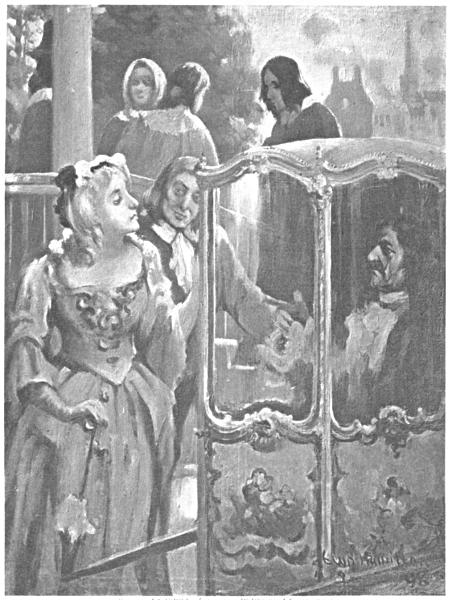
Copyright, 1898, by Lamson, Wolffe and Company
Her ladyship tilted her chin in the air.
page 260
His lordship gasped. The spectacle
she invoked of himself sitting in a closed
chair, energetically fanning himself through
the long night, incensed him beyond the
power of speech for several moments.
“Fy, fy, Lady Phipps,” he said at last,
wagging his head at her, “is this the way
you Puritan wives are taught to honour
your husbands’ guests?”
“Where should I find such another
glass door?” quoth she.
“Very well, madam,” retorted he, “not
one step do I go toward Salem, and that
little maid may go hang, and her death will
be due to your vanities and worldlinesses.”
At this her ladyship’s black eyes
sparkled with wrath, but those near by
saw her proud chin quiver,—a sign she
was weakening.
For several moments there was silence.
The students looked preternaturally
grave. The waiting soldiers smiled.
Lord Christopher folded his arms on his
breast, rolled his eyes up to the ceiling
of the chair, and sighed. The voices of
Master Ronald and the Governor, inside
the house, could be heard distinctly.
This painful calm was suddenly broken
by a shrill little voice above their heads.
“Why don’t ye take the door off’n its
hinges and put it in the house?”
All looked up. There, leaning out of
the second-story window, was a small
excited maiden, unable to contain longer
her anxiety at Lord Christopher’s threat
that her friend might go hang.
On beholding her, the students cheered,
the soldiers laughed openly, and the
slaves showed all their white teeth in
delight.
“These Puritan children are wondrous
blest with sense and wit,” quoth Lord
Christopher.
“Bring a wrench,” ordered Lady
Phipps. Thus the painful affair was
happily solved.
Abigail, overcome at her temerity in
calling out to the gentlefolk, drew away
from the window and waited in much
inquietude until she should be called.
Soon she heard Lady Phipps’ voice at
the foot of the stairs. “Hurry down,
dear child; all are ready to start.”
Outside, the Governor was mounted
and waiting. Lord Christopher was
drinking a glass of water, with a dash of
rum in it as a tonic, preparatory to starting.
Master Ronald had mounted the
pillioned horse.
“Make haste, Mistress Abigail,” he
cried, “so we may be fairly on our way
before nightfall.” Old Pompey swung
the little maid upon the pillion.
The Governor and the soldiers turned
their horses’ heads and rode off grandly.
Next the four Moors lifted the handles of
the sedan-chair, turned and followed.
Master Ronald spurred his horse and it
trotted off gayly.
Lady Phipps waved her lace-bordered
kerchief and the Fellows of Harvard their
caps. Abigail, sorry to say good-by,
gazed backwards until her ladyship’s
lilac-gowned figure, surrounded by the
students, with her kerchief fluttering,
was hidden from sight by a turn of the
road.
Little could Abigail foresee that within
the course of several weeks, the dreaded
accusation of witchcraft would be levelled
at Lady Phipps.
Many townspeople stood agape on the
road to see the imposing company go by
and cross the Common, which was cool
and green in the mellow light. The
salt breeze was blowing off the sea.
Early as it was, the gallants and their
“Marmalet Madams” were strolling arm
in arm. It was still light when the party
reached the river. Here the ferryman
took Lord Christopher across, the rest
of the party taking the fordways a short
distance above. As they entered the road
on the other shore, Abigail was glad of
companionship, so gloomily the forest rose
on all sides. The night descended sultry
and warm as if a storm were brewing.
The moon had not yet risen, but a few
pale stars shone mistily.
Now and then between the trees there
flashed on their sight the white line of
foam breaking along the beach of the
ocean. They made their way tediously,
those who rode suiting the gait of the
horses to the rate of speed maintained by
the chair-bearers. Often the poor fellows,
straining under their heavy burden,
stumbled on the rough road, jolting the
invalid so that he swore mightily at
them.
And there were many fordways to be
crossed, so that he was carried up stream
and down stream to find the most shallow
places. Twice the streams were so swollen
that the soldiers had to make rude bridges
before Lord Christopher could be taken
across.
Shortly before midnight, to the relief of
all, the moon arose, breaking through
light clouds.
Abigail first perceived it behind five
tall pine trees.
“Master Ronald,” she cried excitedly,
“there be a witch’s cottage back of those
five pines.”
“Nonsense,” answered the student,
glancing around him sharply.
“But I be sure o’ it,” averred Abigail.
“I saw an old goody with a gobber tooth,
cooking a witch-cake in a weamy-wimy
hut, near five pine trees. And just beyond
I drew her water in a bucket, at a
spring.”
Master Ronald, great as was his anxiety
to press forward to Salem, nevertheless
turned his horse’s head and went up beyond
the pines until he came to the spring.
“Here is your spring, Mistress Abigail,”
he said, drawing rein and laughing with
gay scorn; “come now, show me the old
hag and her hut.”
He looked back and saw the little
maid’s face white in the moonlight. “I
ken not where it can be now,” she said
in a fearful whisper, “but it was there.”
She pointed to an empty space of ground
where some flowers could be seen in the
silver moonshine, but there was neither
hut nor any sign of human habitation.
As the student observed these flowers
a strange uneasiness took possession of
him. A climbing rose stood upright in
the air with naught to cling to, while the
other flowers seemed to follow a pathway
to an invisible dwelling.
“I beseech ye, let us hurry from the
place,” whispered Abigail, “it be uncanny.
But there on that spot an hut stood when
I went to Boston Town.”
Master Ronald spurred his horse, but
suddenly drew up again. “What was
that?” he cried; “my horse stumbled.”
“Hurry!” shrieked Abigail, glancing
down and recognizing the outlines of the
dark object, “it be the witch’s pail.”
Now Master Ronald, for all his fine
scorn of witches, spurred his horse and
rode on in a lively fashion. His face had
grown so wet with perspiration that he
was obliged to borrow Abigail’s kerchief,
his own not being convenient to get at
under his belted doublet.
“It be the kerchief ye lent me this
morn,” said Abigail. She clasped her
arms tightly around his waist, casting terror-stricken
glances behind her. “Master
Ronald,” she inquired, recalling some of
her father’s tales, “ye don’t see a wolf
near by, do ye, with bloody jowls, a-sitting
down, a-grinning at us?”
“I fear I am going in the wrong direction,”
he answered abstractedly; “we have
gone some ways now. Your eyes are
sharp, Mistress Abigail. See if you can
distinguish our friends ahead.”
“Not one do I see,” she replied, after
a moment’s peering.
“We will turn back toward the sea,”
said the student, “and try to strike the
path again from there.”
Suddenly a lusty calling broke the
silence.
“What can that be?” cried Master
Ronald; “it sounds uncommon near.”
“It be Lord Christopher’s voice,” said
Abigail; “summat awful has happed.”
“I cannot get the direction of the
sound; can you?” asked the young man,
holding his hand to his ear.
“Just ahead o’ us,” cried Abigail.
“Hurry!”
After several moments of brisk riding
they came to a bar of sand where the sea
had once sent up an arm. All was silent
again, save for the hooting of an owl.
“I see naught,” said the student, reining
in his horse.
“There below us be summat dark,”
said Abigail, pointing.
As she spoke, the calling for help broke
forth again not a stone’s throw from them.
This time the voice was unmistakably
Lord Christopher’s.
“Halloo!” cried Master Ronald, riding
forward, “what’s the matter there?”
“Don’t come so near,” came the reply,
“there is quicksand. Lord have mercy
on my soul!”
Master Ronald dismounted and ran
toward Lord Christopher, relapsing into
a cautious walk as he neared him.
“May Satan take the knaves that left
me in this plight!” groaned his lordship.
And, although it was but a sorry time
for laughter, Master Ronald, perceiving
that his lordship was in no immediate
danger, must needs clap his hands to his
knees and double up with merriment.
For while most of the chair rested on the
solid earth, the back and one side tilted
toward a strip of quicksand in such fashion
that the invalid did not dare move,
lest in his struggles to free himself, he tip
the chair completely over and be swallowed
up.
He smiled at Master Ronald’s convulsed
figure. “’Tis a merry jest, I wot,
young sir,” he said dryly, “but it so haps
I be in no position to observe the marvellous
humour of the situation.”
“Sir,” said Master Ronald, “I beg
your pardon. Take a good grip of my
hand. Now out with your best foot—the
ground is solid here—wait till I
brace myself. Ah-h-h!” and he tumbled
over backwards, nearly pulling the invalid
with him.
The chair, thus lightened, rose slightly
from the quicksand. The young man
seized the shafts and with a vigorous
jerk had the chair on good, hard sand.
But he pulled it over yet some way.
“What became of the Moors, sir?”
he asked.
Poor Lord Christopher leant heavily
on the student’s slender frame. “My
lad,” he said, “I wot not what I should
have done had you not followed after.
Those cowardly knaves, startled by a wolf
crossing our path, dropped the shafts of
my chair, and with a howl, fitter to issue
from brutish throats than human, took to
their heels without a thought of me.”
“But what has become of the Governor?”
asked the student.
“He and his soldiers had been a fair
distance ahead of us, until my bearers,
trying to find the smoothest path at my
direction, lost their way,” he answered,
groaning.
“Bide you here,” said the student, tenderly
assisting him into his chair, “whilst
I go and halloo to those rascals. They
cannot be far off.” Turning, he called to
Abigail, “Be not afeared, Mistress Brewster,
I will be back in a minute.” And
he ran on and vanished in the forest
beyond.
The Cavalier and Abigail waited.
“My little maid,” he called, breaking
the silence between them, “come nearer.”
Abigail crept over into the saddle and
took the reins. “Get up,” she said,
shaking them. Her steed obediently
stepped out into the strip of moonlit sand
and she guided him over to the chair, the
rich colouring of which in crimson and
gold was to be faintly discerned.
“I have been thinking of my sweet
Elizabeth in Merry England,” quoth his
lordship.
“Ay,” assented Abigail, listening intensely
for any sound of the student; “ah,
Master Ronald hath catched the knaves.
I can hear their voices and the trampling
of horses’ feet.”
“’Tis well,” rejoined his lordship.
“Little maid, I have been thinking of the
words of my very learned contemporary,
Sir Thomas Browne.”
“And what might they be?” asked
Abigail, giving him but half an ear.
“Great experience hath he had of death
and hath seen many die,” replied his lordship,
solemnly, “for he too is a physician.
Thus was he led to say that when he reflected
upon the many doors which led to
death, he thanked his God that he could
die but once!”
Chapter XVIII The Coming of Thomas
Softly the daylight faded in Deliverance’s
prison-cell. But the purple
twilight which brought repose after the
day’s work, and long hours of sweet sleep
to the tired world, came sorrowfully to
her anxious heart. Slowly, as the golden
light which had filtered through the leaves
of the apple tree was withdrawn, so moment
by moment, hope vanished, and
despair, like a pall of darkness, settled
upon her.
The long day of patient waiting was
past. No longer might her straining ears
listen for Abigail’s voice, for the tramp
of horses’ feet coming to her rescue from
Boston Town, or, joy of joys, Ronald,
Ronald, to clasp her in his arms and defy
any to touch her harmfully.
All that day, at every step in the corridor,
she had started and quivered, waiting
with nerves strung to the highest
tension. Now she knew the sun had set
upon Abigail’s failure.
The little maid had departed the morning
of the previous day, and had she met
with success, would have reached Boston
Town in the evening, and have returned
the next day to Salem.
Perhaps she had not been able to find
the Cavalier, or had not found him soon
enough and would arrive too late, or—and
at this last thought, she shuddered—who
could tell but that Abigail had mistaken
her way and fallen a victim to the Indians
or wolves, or a witch had cast a malignant
spell upon her and she was wasting away
in the forest, with none to know of her dire
distress and to succour her. “Oh, Abigail,”
she whispered, “I wish ye had not
gone! I should have kenned better, for
I be older than ye. Oh, Abigail! I shall
be hanged and not ken whether good or
evil happed to ye. I was fair selfish to
send ye.”
With full and penitent heart, she
prayed that, although the Lord in His
wisdom suffered her to die, yet he would,
out of his great mercy, send her a sign
that her sins had been forgiven, and her
selfishness had not brought harm to
Abigail.
Having thus prayed, she rose from her
knees and sat down on the straw bed.
The minutes passed. She heard the
jailer open her door and put her supper
on the floor, but she paid no heed to him.
Time dragged by, and her cell was filled
with gloom. The leaves at the window,
however, were still brightly green in the
outside light.
Yet God had sent no sign to her. She
folded her hands patiently in her lap.
“It will come,” she murmured, with
trustful eyes uplifted, “it will come.”
In Prison Lane she heard a mad barking
of dogs and the shouting of boys,
directly under her window. The excited
clamour died away in a few moments.
Suddenly her attention was aroused by a
plaintive crying. She glanced up. Looking
at her through the bars on the outside
window-ledge, was a limp, bedraggled
and forlorn kitten with a torn ear. It
had climbed the apple tree to be rid of
its merciless pursuers.
Deliverance jumped to her feet and
stretched forth her arms with a cry of
joy.
“Oh, Thomas, Thomas, the Lord hath
sent ye as a sign to comfort me!”
The kitten mewed sympathetically. It
made its way in through the bars to the
inner ledge. Then it thrust a shrinking
paw downwards, but hastily drew it back.
Deliverance was puzzled to know how to
reach the little creature.
She held up her petticoat like a basket
and coaxed the kitten to jump, but without
effect. Then she made a shelf of her
hands, held high as possible, while she
stood on tip-toes. But the shaking hands
offered no safety to the shrinking kitten.
Yet the tender, beseeching tones of his
little mistress won at last upon the cowardly
soul of Thomas and fired him to
dare all. He made an unexpected flying
leap, landing on the golden head as the
securest foothold. There he slipped
and scrambled valiantly, until two eager
hands lifted him down and the beloved
little voice, broken with sobs, cried,
“Oh, Thomas, my own dear Thomas, the
Lord has sent ye as a sign to comfort
me!”
Thus Thomas, a starved, runaway kitten,
worn to a shadow, chased by dogs,
ready to die of exhaustion, came into his
own again.
Deliverance learned a lesson that evening
which all must learn, sooner or later,
that the crust thankfully shared with another,
makes even prison-fare sweeter and
more satisfying than plenty served in
luxury and loneliness.
The corn mush and milk, which at times
she had refused with a disdainful toss of
her little head, now became a delicious
dish with a rare savour, such as she had
never before perceived. For while she
ate from one side of the bowl with a
spoon, Thomas, on the opposite side,
drank the milk with incessant lapping
of his small pink tongue, until in his
eagerness to drain it, he thrust his two
front feet in the bowl.
“Thomas, ye unmannerly person,” cried
Deliverance, “what would ye think o’ me
to be putting my two feet in the bowl?”
And she lifted him up and went back to
her straw bed, while Thomas, loudly purring,
curled up in slumber in her lap.
The cell had now grown so dark that a
flash of orange-light showing in the crack
beneath the door, startled her, reminding
her that the jailer was making his nightly
rounds. Alarmed lest the kitten should
be discovered, she pushed it under the
straw. She was none too soon, for in another
moment the door was flung open and
revealed the jailer with his lantern, which
made a circle of yellow light around him and
showed the feet of another person following.
This personage was none other than Sir
Jonathan Jamieson. The light shone on
the tip of his long nose, his ruddy beard,
the white ruff above his sable cape. As
he was about to cross the threshold, he
started and drew back. The jailer also
started and his knees knocked together.
“Methought I heard a strange noise,”
said Sir Jonathan with dignity. “I will
investigate.”
The jailer clutched his cape. “My
lord, my lord, meddle with no witch,
lest ye tempt the Devil.”
Again they heard the strange sound.
The lantern’s circle of light fell half-way
across the floor of the cell. Beyond, and
concealed by the shadow, Deliverance,
terror-stricken, held the outraged Thomas
firmly under the straw.
“It sounds like a cat,” quaked the jailer,
and he straightway forgot all his previous
doubts as to the guilt of the prisoner.
“The witch be turning herself into an
imp o’ Satan.”
While Sir Jonathan still hesitated, there
came a long-drawn-out, blood-curdling
cry. Bravely, he raised his walking-stick
and tapped stoutly on the floor. “Scat!”
he cried in a voice that shook slightly,
“scat!”
“Miow,” answered the angry Thomas.
Shudderingly, the jailer reached in past
Sir Jonathan, pulled the door to and locked
it. Then, grown too weak to hold the lantern,
he set it on the floor, and leant against
the wall, his knees knocking together even
more violently than before. “Oh, miserable
doubter that I ha’ been!” he chattered,
“’t be a judgment come upon me.”
Sir Jonathan leant against the wall on
the opposite side of the corridor, with his
knees shaking also. “Since it troubles
you, goodman,” he said, “I shall not persist
in entering, although I cling to the
opinion that when one is sufficient exalted
in spiritual things, the Devil has no power
over him.”
“I ha’ been a miserable doubter,” chattered
the jailer; “the Lord ha’ mercy on
my soul!”
From the cell came again that terrible
cry, a wailing, mournful sound, so wild
and eerie as to strike terror to stouter
hearts.
“The witch be calling on her Master,
Satan,” chattered the jailer.
“Ay, pray,” muttered Sir Jonathan;
“you must have an ill conscience, goodman,
to be so afeared. But let me haste
away; the time waxes apace and the night
watchman will be making his rounds.”
Perhaps it was part of his punishment
that from that hour Sir Jonathan was
never free from dread. He, who originally
had no faith in witchcraft and secretly
laughed at it, although he falsely testified
to his belief in it, was doomed, henceforth,
to start at his own shadow, to cower in
bed, to ever after keep a night-light burning.
He hurried along in the silver
moonlight which fell whitely on the pebbled
street, a solitary black figure with
flapping cape and steeple-hat.
Suddenly, he drew back with a shrill
cry, startled by his own shadow flung
ahead of him as he turned a corner. So,
cowering and starting, he reached his room
and crept into his bed, there to fall into
an uneasy slumber, which the taper’s pale
flame was as ineffectual to calm as the
light of truth to reach his darkened heart.
Meanwhile, an indignant kitten stood
gasping and sneezing, nearly choked by
the straw under which it had lain.
Ah! how its little mistress held it to
her breast and soothed it and kissed it,
weeping for thanksgiving that she had
been spared a visit from Sir Jonathan.
There were hours, however, in the long
unhappy night, when not even the kitten
nestled in her arms could comfort Deliverance,—hours
when all the bright days
of her life came trooping through her
fancy, to be realized no more.
Never again would she be filled with
joy that the fruit trees blew sweet in blossom,
that the violets budded in the long
grass in the orchard, that she and Abigail
had found a bird’s nest holding four
blue eggs, or had happened upon a patch
of strawberries. There were other times
which would not return,—the moonlit
winter nights, fairer than the days, when
she and Goodwife Higgins went to husking-bees
and quilting parties. Not for
her would there be a red ear found amidst
the corn. Still sadder were her thoughts
of her father, missing her help with the
herbs, blundering in his helpless fashion
over the task that had once been hers.
Goodwife Higgins would have no one
left now to mind her of the little daughter
that had died so long ago of the smallpox.
And there was one other whom she had
not seen for many months.
“Oh, Ronald!” she whispered, “my
heart be full o’ grief that ye could not
come to me.”
After a weary while she fell into a deep
sleep from which she was wakened by
the jailer.
For the first time he spoke to her
harshly, roughly bidding her rise and prepare
for death. He pushed the bowl
containing her breakfast inside the threshold
with his foot, fearing to enter the
cell. So hurried was his glance that it
failed to take in Thomas, snuggled up
warmly in the depression in the straw,
made where Deliverance had slept.
Sadly the little maid dressed herself and
braided her hair.
She ate a little of the mush and milk,
but she fed most of it to Thomas.
“Thomas,” she said, tipping the bowl
conveniently for him, “my own dear
Thomas, I hope ye will not forget me.
Ye can go home again, Thomas, but I
shall never see my home again.”
After this she rose and put the cell in
order, making the straw bed over nicely.
Then she wrote a note on a leaf torn from
Abigail’s diary, and pinned this note by a
knitting-needle on the stocking she had
completed. Having finished, she sat down
and waited patiently. It was not long
before the jailer again appeared. She saw
behind him the portly Beadle.
“How now, witch,” cried the latter,
peering in over the old man’s shoulder,
“hath prison-fare fattened ye?” But as
he caught sight of the prisoner he started.
“I’ faith,” he cried, “how peaked ye be.
Go in, goody, and fetch her forth,” he
commanded the jailer.
“Na step will I take toward the witch,”
chattered the jailer.
“Step in, step in, goody,” advised the
Beadle; “how can I convey the witch
away unless ye free her?”
But the jailer was not to be persuaded
to go near the prisoner. He and the
Beadle fell into an angry controversy
over the matter and were near to serious
quarrelling, when a soldier appeared at the
doorway.
“What causeth the delay?” cried the
guard, crossly. “Hath the witch flown
out of the window?”
“They be feared lest I cast a spell on
them and so dare not unlock my chain,”
spoke Deliverance, “but I wot not how
to cast a spell and I would, good sir.”
“Give me the keys,” said the guard,
brusquely. He snatched them in no gentle
manner from the jailer. “Enough,
enough of this foolishness, ye chicken-hearted
knaves. Stand up, mistress,” he
added, entering the cell.
He knelt in front of the little maid,
fumbling to find the right key of the
bunch. Deliverance, suddenly grown
faint, rested one hand on his shoulder.
He started and his heart leapt for fear,
but the continued touch of the small,
trembling hand, so weak and helpless,
changed his fear to pity. So he said
naught, but was willing the witch-maid
should lean on his strong shoulder. He
unlocked the padlock and flung the chain
aside. Deliverance stood unbound once
more.
She turned and lifted the stocking with
the note pinned on it, from the floor.
“Oh! would ye mind,” said she, “to
bear this to my father for me?”
The soldier, with a gruff assent, put
the stocking and note in his pocket. He
turned away, no longer caring to look
into those blue, beseeching eyes, which
filled him with tormenting misgivings.
“Come, come,” he cried to the Beadle,
“it waxeth past time. Let an ill duty be
done quickly, say I.” He strode out of
the cell and down the corridor.
The Beadle reached in and touched
Deliverance’s shoulder with his staff of
office. “Step forth,” he commanded,
“and follow yon soldier, and I will come
up behind.”
Suddenly the little maid bent down and
lifted something from the straw pallet.
As she turned they saw she held a little
black kitten, curled in slumber, against
her breast.
The old jailer shuddered and muttered
a prayer, and the Beadle’s fat face grew
white. They believed that she, after the
manner of witches, had summoned an imp
from Hell to bear her company.
Close to the prison door was drawn a
rude cart, with a stool fastened to the floor in
the back. The driver, indifferent through
much similar experience, sat nodding on
the seat. The soldier who had preceded
Deliverance, waited to assist her in the
cart, which was too high a step for a little
maid. He lifted her in bodily, kitten and
all, keeping his eyes turned from her face.
The driver clucked to his horse, the
soldier mounted his and rode ahead, and
the Beadle walked pompously at the side
of the cart, moving slowly down the
street.
All Salem had gathered to behold this
hanging, which was of awful import to the
townspeople, brought to a frantic belief
that Satan had taken possession of the
heart of one of their children, known and
loved by them all her life. A strange, sad
thing it was that the Devil should have
taken on himself the guise of a motherless
young maiden.
So although the crowd through which
the cart passed was large, but little noisy
demonstration was made, and few curses
or mutterings heard. Several boys who
ventured to call jeeringly, were sternly
hushed. In the throng there was only
one near friend to the prisoner. This was
Goodwife Higgins, who plodded bare-headed
beside the cart, weeping. Neither
her father nor brother was to be seen.
All night following the trial, Master
Wentworth had wandered in the fields in a
drenching rain, and had returned home to
succumb to an illness, from which he daily
grew weaker, lying unconscious this very
morning.
Many of the women were affected to
tears by the sight of the little maid, seated
on the stool in the cart, the kitten clasped
to her breast.
Deliverance knew naught of this sympathy.
She had but a dull sense of many
people, and that the sun had never shone
so brightly before. She was dazed by
terror and grief, and a stupor crept over
her, so that her head hung heavily on her
breast and her limbs seemed cold and
of leaden weight.
The cart passed out of the street into a
rocky path, and ascended by imperceptible
degrees to the summit of a low, green hill.
The little maid lifted her head and
looked steadfastly at the scaffold there
erected. On the platform she saw the
figures of the minister and the hangman,
dark against the blue sky.
Chapter XIX On Gallows’ Hill
At the foot of this scaffold, the driver
stopped. Deliverance was bidden
to step out. Attended by the guard, she
ascended the ladder. Only one instinct
remained to the heart-broken child, and
that was to clasp still closer to her breast
the little kitten, the one faithful and loving
friend who clung to her in this dread hour.
“Deliverance Wentworth,” spoke the
minister in a loud, clear voice, “will you,
while there is yet time, confess your sin
of witchery, or will you be launched into
eternity to the loss of your immortal
soul?”
She looked at him vaguely. His words
had not pierced to her dulled comprehension.
He repeated them.
Again she was silent. Slowly her unresponsive
gaze turned from the minister
and swept the sea of upturned faces.
Never was there a sterner, sadder crowd
than the one upon which she looked down;
the men lean, sour-visaged, the women
already showing a delicacy, born of hardship
and the pitiless New England winters.
Children hoisted on the shoulders
of yeomen were to be seen. She saw the
wan, large-eyed face of little Ebenezer
Gibbs, as his father held him up to behold
the witch who had afflicted him with such
grievous illness. Drawn together in a
group were the gentry. And all thrilled
to a general terror for none knew on whom
the accusation might next fall. At the
tavern, the loiterers, made reckless by the
awful plague, gathered to be merry and
pledge a cup to the dying.
With these latter mingled foreign sailors,
their faces bronzed, wearing gold rings in
their ears and gay scarves around their
waists.
One of these tavern roisterers shouted:
“Behold the imp the witch carries in the
shape of a black cat!”
There came another cry: “Let the cat
be strung up also, lest the witch’s spirit
pass into it at her death!”
Others caught up and repeated the cry.
An ominous murmur rose from the crowd,
drowning the single voices.
The minister strove in vain to make
himself heard.
To Deliverance the clamour was meaningless
sound. But yet closer to her
breast she clasped the little kitten.
Slowly she turned her head and her
gaze travelled over the landscape. Vaguely
she felt that she would never see the morrow’s
sun, that now she looked her last
upon the kind earth.
Suddenly her gaze became fixed as she
caught the flash of spears and saw mounted
soldiers emerge from the forest and come
rapidly down the winding road from the
opposite hill. Some dim instinct of self-preservation
struggled through the stupor
which enveloped her. She raised her arm
and pointed to the forest. So strange, so
silent, seeming guided by a mysterious
power, was that gesture, that a tremor as at
something supernatural passed through
the people.
They saw the minister speak excitedly
to the hangman, whose jaw dropped in
amazement. Soon was distinctly heard
the trampling of horses. A moment later
four soldiers, riding two abreast, swept up
the hill with cries of:—
“Way, make way, good people, in the
King’s name!”
Following these came his Excellency
the new Governor, Sir William Phipps.
He sat severely erect on his richly caparisoned
horse, attended by two more soldiers.
Reaching the scaffold he reined in
his horse and waited. A yet more astonishing
thing than the unlooked-for arrival
of the Governor was about to
occur.
There next appeared, a goodly distance
behind, a sedan-chair carried by four
Moors. The occupant of the chair was
a man of great size, whose left leg was
bandaged and rested on a pillow. Despite
the cool morning the sweat was rolling
off his face, and he groaned. But dusty,
warm, and in pain as he seemed, he had a
most comely countenance. The silken
chestnut curls fell on his shoulders, whilst
his high and haughty nose bespoke power
in just proportion to the benevolence
of his broad brow. As the slaves bore
him along very slowly, for they were
much exhausted, Sir Jonathan Jamieson,
making his way through the crowd to
join a group of the gentry, crossed the
path directly in front of the sedan-chair.
Here he paused, lingering a moment,
to get a glimpse of the Governor, not
turning his head to perceive what was
behind him.
As he thus paused, the stranger was
observed to half rise and draw his sword.
But suddenly his face changed colour, his
sword arm fell, and he sank back on his
pillows, his hand clutching his side.
Those near by heard him murmur, “As
Thou hast forgiven me, even me.” But
the rest of the way to the scaffold not
once did he raise his head nor remove his
hand from his side.
Sir Jonathan passed serenely, swinging
his blackthorn stick, all unwitting how
nigh death he had been in that short
moment.
Next there came riding a-horseback,
Master Ronald Wentworth, the brother
of the condemned maid.
His student’s cap was set on the back
of his head, his dark locks falling on either
side of his white face, his small-clothes and
riding boots a-colour with the mud.
But doubtless the most astonishing
sight of all to the amazed people was a
small, mud-bespattered maiden, attired in
sad-coloured linsey-woolsey, seated on a
pillion behind the Fellow of Harvard, her
chin elevated in the air, her accustomed
meekness gone.
This important personage was the missing
Abigail Brewster.
When these last arrivals had reached
the scaffold, Governor Phipps dismounted,
and giving his horse into the care of a
soldier ascended the ladder to the platform.
His face was pale and his expression ill-favoured,
as if he relished not the discomfort
he had undergone. The murmurings
and whispers had died down. His words
were anxiously attended.
“My good people,” he commenced
solemnly, “it hath become my duty to
declare unto you that I came, not to
pardon Deliverance Wentworth, but to declare
her innocent of the charge brought
against her, for the which she has been
condemned to death. Circumstances have
been so cunningly interwoven by the Evil
One as to put upon this young maid, whom
I pronounce wholly free and innocent of
blame, the character of a witch. Lord
Christopher Mallett, Physician to his
Majesty the King, hath matter whereof
he would speak to you to warn you of the
evils attaching to an o’er hasty judgment.
“But there is yet another word, which I,
your Governor, would impress with all
solemnity upon you. Assisted by that
godly minister, Master Cotton Mather, I
have made careful study of the will of the
Lord regarding the sin and punishment of
witchery. Better, far better, I say unto
you, that twenty innocent people should
be made to suffer than that one witch
should go unhanged when you have
catched her. This I say because we are
now in a fair way to clear the land of
witches. I would have you abate not one
jot nor tittle of the zeal you have so far
manifested, lest the good work be half
done and thereby nothing be accomplished.
For but one witch left in the land is able
to accomplish untold evil. Therefore,
while the Lord hath been gracious to so
expediently correct the error of your
judgment in sentencing this maid to be
hanged, yet I do not condemn your error,
but see rather, within the shell of wrong,
the sweet kernel of virtuous intent, that
you spared not in your obedience to the
Lord’s behest, one who, by reason of her
tender years, appealed most artfully to
your protection.”
Thereat the Governor ceased speaking,
and seated himself on a stool which had
been carried up on the scaffold for him.
Eagerly the people speculated as to the
cause of this unlooked-for pardon. As
the Governor ceased speaking, the tavern
roisterers sent up shouts and tossed off
mugs of sack. One fellow, a merry-andrew
of the town, turned handsprings
down the road. This uncouth and ill-timed
merriment was speedily checked by
the authorities.
Meanwhile the Beadle was seen to go
up and place a stool on the scaffold.
Then he went half-way down the ladder
and took a pillow and another stool
handed up to him, and arranged these
in front of the first seat, after which he
descended, for the platform was not
strong, and already accommodated three
people besides Deliverance: the Governor,
the minister, and the hangman.
Now the ladder bent and creaked under
a tremendous weight, as Lord Christopher
Mallett, panting for breath,
pausing for groans at every step, ascended
by painful degrees and dropped
so heavily upon the stool placed in readiness
for him that the frail structure shook
dangerously. Assisted by the hangman,
he lifted his gouty leg on the pillowed
stool. Then he saw Deliverance standing
near by, and stretched forth his hands,
while a smile lighted with its old-time
geniality his worn countenance.
“Come hither, little mistress,” he
said, “and let me feast my eyes on you,
for I swear no more doughty and brave-hearted
lass abides in his Majesty’s kingdom.”
But Deliverance stood still, regarding
him with dull eyes. Something in the
delicate child-mind had been strained beyond
endurance.
The black kitten struggled from her
arms and leapt to the floor of the platform,
craning its head with shrinking
curiosity over the edge.
Slowly, something familiar in the kindly
face and the outstretched hands of the
great physician made itself apparent to Deliverance’s
benumbed faculties. Troubled,
she looked long at him. Over her face
broke a sweet light, the while she plucked
daintily at her linsey-woolsey petticoat.
“Ye can feel for yourself, good
sir, and ye like,” she said in her sweet,
high treble, “that it be all silk without’n
a thread o’ cotton in it.”
As she spoke she drew nearer him, but
before she reached him, put out her arms
with a little fluttering cry and sank at the
great physician’s feet.
When consciousness returned to her,
she found herself seated on some gentleman’s
lap. Her temples were wet with a
powerful liquid whose reviving odour she
inhaled. Not then did she realize that
she was indeed seated on the lap of that
austere dignitary, Governor Phipps. At
perfect peace she sat with her golden head
resting against his purple velvet coat, her
eyelids closed from weariness, her confusion
gone. Dimly as in a dream she
heard the voice of Lord Christopher
addressing the people.
“In this town of Salem, I had reason
to believe, resided one who had recently
come as a stranger among you. This
stranger to you, had been my cherished
friend, my confidant in all things, and he
betrayed me. Traitor though he was,
I could have forgiven him, perceiving
now with clearer eyes his weakness against
a great temptation, but he hath shamefully
persecuted a child, which, of all sins,
is the most grievous.”
The speaker paused and his piercing
glance singled out one of the group of
gentry, gathered on the edge of the
crowd. The man thus marked by that
gaze was Sir Jonathan Jamieson. A
moment he returned that challenging,
scornful look; then as the eyes of all
near by turned toward him, his face
whitened and, with a defiant raising of
his head, he turned abruptly and strove
to make his way out of the crowd.
“Let me pass, churls,” he cried
fiercely, glancing round, “or I will crack
your pates.”
So those who stood by, being yeomen,
and naturally awed by those of gentle
blood, drew aside at the threat, albeit they
muttered and cast dark looks upon Sir
Jonathan as he passed.
This scene was observed by very few,
as the great body of people hung intent
upon Lord Christopher’s words.
“This man,” he continued, “was, as I
telled you, my cherished friend, my confidant
in all things, although he possessed
no interest in my craft. Being of a bookish
turn of mind, he treated with friendly
derision and apparent unconcern my experiments
in leechcraft and chirurgery,
professing no faith in them. Now it
having been my practice to consult regularly
a soothsayer, I learned from him
that in two years’ time England would be
visited by the Black Plague. Thereby
I was greatly saddened and sorrowed o’
nights, having visions of good folk dying
in the streets and carted off to the potter’s
field. Most of all did I think of the poor
children who have not their elders’ philosophy
to bear pain and are most tender
to suffer so. The thought of these poor
little ones so worked upon me that I had
no peace. At last an idea of great magnitude
took possession of me. In the two
years’ time that was to elapse afore this
terrible visitation would take place, I resolved
to discover a simple which would
be both a preventive and a cure for this
plague with which the Lord sees fit to
visit us at sundry times. I took his Majesty
the King into my confidence. The
proposed adventure received his gracious
approval. For its furtherance he gave
me large monies, and I also used the
greater substance of my house. I
travelled to India to consult with Eastern
scholars, wondrously learned in mysterious
ways beyond our ken. Weeks, day and
night, I spent in experimenting. At last
one morn, just as the day broke, and
its light fell on my two trusty servitors
who had fallen asleep e’en as they stood
assisting me, I gave a great shout for
joy. My last experiment had stood the
test. I had triumphed. The recipe was
perfected. ‘Wake, wake,’ I cried, ‘and
give thanks unto God.’
“So powerful was the powder, of such
noble strength, that e’en its odour caused
my daughter to swoon lily-white when
I would have administered a dose to her
as a preventive against sickness in the
future. One man only besides the King
was in my confidence. This was my
friend and he was my undoing. Whilst I
was in attendance upon his Majesty who
had been wounded at a boar-hunt, this
false friend, having free access to my
house, entered and stole the parchment
having the recipe. With a wounded heart
I set to work, again to recall the intricate
formula of the recipe. I was unsuccessful.
Papers of value leading to the composing
of the cure were left me, but the
amount and proper compounding of the
ingredients had been set down only in
the stolen parchment. To add to my
trouble I perceived that the King’s faith
in me was shaken, that he regretted the
monies put at my disposal. Moreover,
he credited not my tale of my false friend’s
baseness, but professed to think I had
failed, and strove to hide my discomfiture
beneath a cloak of lies. I despaired. At
last I learned that my enemy had gone to
America and landed at ye Town of Boston,
whither I followed him. I arrived after a
favourable voyage and sought your Governor.
To him alone I gave my rightful
name and mission. And here with much
secrecy I was obliged to work, having no
proof by which to confirm my accusation.
My only hope lay in surprising my enemy
afore he had time to destroy the parchment
from fear and malice. My search led
me to your town. It was the close of day.
I sent my Indian guide to a farmhouse
for food, and seated myself on a fallen tree
for a resting-minute. I was o’er cautious
and determined not to enter the town
afore nightfall, desiring that my enemy
should not recognize me, if I by any inadvertence
happed to cross his path. As I
waited, there came tripping along this same
little maid whom you would have hanged.
“I learned from her of the stranger in
your town. Thereat I resolved to go
back to Boston Town and obtain assistance
to arrest this base traitor. Now,
prompted by an unfortunate desire to annoy
him and full of triumph, I did whisper
in the little maid’s ear tormenting words
to say when next she met him, chuckling to
myself as I thought of his astonishment
that a fair and innocent child should have
an inkling of his guilt. So high did my
spirits rise after the little maid left me that
I could not sit still, but must needs rise
and stroll down the path to meet my Indian
guide. There I met an old silly, praying.
I dropped a black pellet in one of his pails
of milk as an idle jest. But I have paid
dearly for my malicious chuckling. I have
paid well.” The speaker paused to groan
and wipe the sweat from his brow.
“I have travelled far in uncivilized
countries, amidst savage people,” he continued,
“but ne’er have I known such a
terrible journey as I endured last night.
The memory of it will last me throughout
this world, and who knows and the Lord
forgive not my sins, but that I shall remember
it in the next. I was carried up
stream and down stream, terrible insects
arose with a buzzing sound and fastened
themselves on my flesh, the howling of
wild beasts smote my ears. Yet am I
thankful to have made that journey, for
by it I have saved the life of a brave lass
who hath done a doughtier deed in her
King’s service than any of you who have
prosecuted her. It was her nimble wit,
working in prison, that obtained the stolen
parchment and sent it to me. Through
her messenger I learned of my enemy’s intent
to strike at my very vitals, my high
position and favour with the King. He
was having the recipe compounded, to
return with it to England and obtain the
honour of its discovery himself. But
thanks be to God, the evil of his ways
was his undoing. This little maid whom
you would have hanged hath saved England
from the plague, and I am made her
debtor for life.”
A shout broke from the stern, repressed
Puritans.
“Let us behold the little maid who hath
saved England. Let the child stand forth.”
Governor Phipps put Deliverance upon
her feet, and holding her hand walked to
the edge of the platform. When the
people saw her in her sad-coloured gown,
her hair a golden glory around her face,
they were silent from awe and self-reproach.
Only when the kitten leapt
upon her petticoat and climbed to her
shoulder, there seating itself with rightful
pride, the sober Puritans broke into wild
shoutings and laughter. Laughter mingled
with tears, that in all the town of
Salem, so brave a maid had found in her
extremity but two loyal friends, Mistress
Abigail Brewster and a little kitten.
Deliverance, frightened by the cries and
unwonted animation of the upturned faces,
began to weep and put out her arms pitifully
to Lord Christopher.
“Oh, might it pleasure ye to take me
home, good sir?”
Before he could reply, a young man
bounded up the ladder and caught the
little maid in his arms.
“I could keep from you no longer,
sweetheart,” he cried.
Deliverance’s arms tightened around his
neck. “I be o’er glad to see ye, dear
Ronald,” she said, laying her head on his
shoulder, “and, oh, let it pleasure ye not
to dilly-dally, but to take me to father, for
I be fair weary to see him?”
So the Fellow of Harvard, with a word
to his Excellency for permission, slowly
descended the ladder with his precious
burden in his arms.
Thus Deliverance returned to her father.
Chapter XX The Great Physician
When the excitement had subsided
somewhat, Lord Christopher was
seen to lean forward with renewed earnestness,
raising his hand impressively.
“My dear people,” he said, and the
great physician’s voice was tender as if
speaking to sick and fretful children,
“my dear people, God hath afflicted you
more sorely with this plague of witchery
than with the Black Plague itself. Yet
it lies with you to check this foul disease.
The Bible says, ‘Thou shalt not suffer a
witch to live.’ But it also commands,
‘Judge not, that ye be not judged.’
Abide by the latter injunction, that you
save your souls from sin and let not your
land run red with innocent blood. Let
each one of you be so exalted in goodness
that evil cannot enter into you. But,
and my words on witchery impress you
not, let me at least beseech you who are
of man’s estate and have catched a child
in sin, to remember that it but does as
those around it, and is therefore to be
dealt by tenderly.
“And yet another subject am I driven
to speak to you upon.
“Mightily does it distress me that you
do bring your children up in woeful ignorance
of the Christmas-tide as we celebrate
it in Merry England. ’Tis very dolorous
that you should be so blinded as to think
the proper observance of that Holy day
bewrayeth a Popish tendency. Methinks
it be a lack of good red blood that makes
you all so sour and mealy-mouthed. Your
Governor informs me that on that blessed
day, sadly you wend your way to church,
with downcast eyes as though you were
sinners catched in naughtiness. There is
great droning of psalms through your
noses, which is in itself a sorry thing, and
I doubt not, an unpleasant sound in the
Lord’s ear. Whereas, in green old England,
the little children carol all day long.
But here not even your babes have sugar-plums.
My stomach turns against you
and your ways. How different is it in
my castle across the seas! To the mantel
above the blazing yule-log, my sweetest
daughter pins her stocking. Outside,
the snow snaps with the cold and the
frost flowers whiten the window-pane.
Then come the village lads and lassies
singing, that we may open the window
and fling out siller pieces, sometimes a bit
of bright gold.
“Lastly, at the chiming of the midnight
bells, troop in my servant-men and
wenches. One and all we drink the hot-spiced
glee-wine my sweet Elizabeth
makes in the silver wassail bowl. And
to every man and maid I give a piece of
gold.
“I do beseech you, good people, to have
remembrance after this, that Christmas is
children’s day, and that to keep it with
sadness and dolour, is an offence unto the
Lord Christ, whose birth made that day,
and who was said by those versed in wisdom,
to have been when a child tender,
holy, and gay, as it becometh all children
to be. Therefore I would have you bestow
these delights upon your children,
for they are bowed by responsibilities
beyond their years, and joy is checked in
them, so that I oft catch myself sighing,
for I have great pain not to see all children
joyful and full of the vigour of life.
“Thus I would make an example of the
little maid whom you have persecuted,
that you may deal gently with children, remembering
how near you were to shedding
her innocent blood. I beseech you, by
the grievous sin that you and your learned
judges so nearly committed, to be tender
with the poor children, knowing they
speak the truth, unless you do so fright
them that in bewilderment they seek to
save themselves by a falsehood and know
not into what evil they fall thereby. When
you are tempted to severity, inquire well
into the merits of the case, lest you do an
injustice, keeping in mind the persecution
of the little maid who hath saved England.”
Thus Lord Christopher ceased speaking.
In the years to come it was related that
his speech was so affecting as to draw tears
to the eyes of all, and that many a parent
in Salem was known thereafter to refrain
from harsh reproof of a child, because of
the great physician’s words and the love
that all learned to bear him during the
weeks his illness forced him to remain in
Salem.
Regarding his earnest request that
Christmas be observed by them after
his irreverend fashion, they did not
condemn him for his Popish tendency,
but winked at it, as it were, knowing he
had other virtues to counterbalance this
weakness. Being altogether charmed by
him, they earnestly trusted that for his
own good he might come round to their
way of thinking.
During those few weeks his presence
shed the only brightness in the panic-stricken
town. While he was powerless
to avert the awful condition, there were
nevertheless many sad hearts which were
made lighter, merely to visit him in his
sick-room at the tavern. And the goodwives,
finding their dainties did not please
him as much as the sight of their little
children, ceased not to send the former,
but instead sent both.
When at last he was able to leave his
room, Lord Christopher went one afternoon
to Deliverance’s home.
Gladly he entered the forest road, thankful
to leave the town behind him. The
terrible trials still continued. Only that
morning he had seen two persons hanged,
and there was a rumour that a ship infected
with smallpox had entered the harbour.
He walked slowly, leaning on his stick,
for he was yet very lame. The greenness
and peace of the majestic forest were grateful
to him. Soon he came in sight of
Master Wentworth’s home. In the open
doorway he saw Deliverance seated at her
spinning-wheel, singing as she guided the
thread.
Already the roses bloomed again in
the little maid’s face, and never was heart
so free from sorrow as hers, save for that
touch of yearning which came to her
whenever her glance rested on her father,
who, since his illness, was gentler and
quieter than ever, seldom entering the
still-room, and devoting many hours to
sitting on the stoop, dreaming in the sunshine.
Master Ronald had not yet returned to
Boston Town, loath to leave his little sister,
still fearful for her safety, not knowing
in which direction the wind of public
opinion might veer.
Glancing up from his book this afternoon,
as he lay on the grass, under the
shade of a tree, he saw Lord Christopher
approaching. So he rose quickly, and
went down to the gate to greet the great
physician.
And the two, Lord Christopher leaning
heavily on the student’s arm, for he was
wearied by his walk, went up the path
to where little Deliverance sat spinning.
Lord Christopher had a long talk with
Master Wentworth this afternoon and at
the end of their conversation, the latter
called his children to him.
“Ronald,” he said, “and you, my little
Deliverance, Lord Christopher urges me
to return to England where he promises
me, my lad, that you shall have all advantage
in the way of scholarly pursuits,
and that you, Deliverance, shall be brought
up to be his daughter’s companion. What
say you both? The question is one
which you must decide. I,” he added
sadly, yet with a wondrous sweetness in
his face, “will not abide many years
longer with you; and my future is not in
England, but in a fairer land, and the sea
I must cross greater than the one you
know, so I would fain leave you with a
protector in this harsh world.”
A long silence followed his words.
Then Ronald spoke. “Sir, I have none
other wish than to continue in this country
in which I was born and which has ever
been my home. Surely I know the constant
toil, the perils from savages and wild
beasts, the stern laws we Puritans have
made for each little sin, alas! the hardships
too often known, and the gloom of
our serious thought which o’ershadows all.
Yet through this sombre sky, the sun will
shine at last as brightly as it shines in
England. In the University that has
nourished in me patriotism and liberty of
thought, I have grown to believe that
here in this wilderness is the basis for a
greater England than the England across
the seas.”
The student’s face glowed with ardour,
his eyes were brilliant as if he saw visions
the others comprehended not.
“And you, Deliverance,” asked her
father, tenderly.
Now the little maid’s fancy had woven
a picture of herself in a court dress of
crimson velvet, her hair worn high, a
lace collar falling on her shoulders, a rose
in her hand such as was carried by the
little court lady of the miniature. But
her imagination, which had soared so high,
sank at Ronald’s words.
“What say you, little mistress?” asked
Lord Christopher; “and your brother will
not go, being such a young prig as to
prefer this uncomfortable country in which
to air his grand notions. Will you not
go with me?”
Deliverance sighed and sighed again.
She glanced at her father’s delicate hands,
so transparent in the sunlight, and a
prophetic sadness reminded her of the
time when she and Ronald would be left
alone in the world. Her glance travelled
to her brother’s rapt, almost transfigured,
countenance. Although she felt no sympathy
with his over-strange university
views, yet the thought of leaving him
alone in this country while she abided in
luxury in England, smote her heart with a
sense of guilt, so that she moved over to
him and slipped her hand in his and
rested her head against his shoulder.
“Good sir,” she said, “I will remain
with Ronald and with father, but with all
my heart I thank you for your kindness
and desire that I might be the companion
of your sweetest daughter.”
And none of the three knew that
through a blinding mist of tears she saw
vanish forever the dream of a velvet gown
with immoderate slashed sleeves.
So Lord Christopher went far away, but
he did not go alone. He bore with him
a hunchback of Ipswich whose mother
had been hanged as a witch on Gallows’
Hill. Thus it sometimes happens that
they who have had least to do with a
brave deed do, by some happy chance,
reap the richest benefit of another’s
nobility. And thus it was with this little
Hate-Evil. He found himself no longer
alone in the world. There in London he
developed into a scholar, becoming a poet
of much fame, one who, honoured in the
court, was not less revered by the common
people, that so poor and deformed a body
carried so great a soul. And at last he
ceased to be known by his stern New
England appellation of Hate-Evil and was
called by the sweeter name of Content.
Yearly from England came a gift to
Deliverance from Lord Christopher’s fair
daughter Elizabeth, in memory of the
loyal service she had rendered England in
regaining the precious powder.
Within a few months, Abigail received
a small package containing a string of
gold beads and a rare and valuable book
entitled: “The Queen’s Closet Opened:
having Physical and Chirurgical Receipts:
the Art of Preserving Conserving and
Candying & also a Right Knowledge of
Perfuming & Distilling: the Compleat
Cook Expertly Prescribing the most ready
wayes whether French, Italian or Spanish,
for the dressing of Flesh and Fish & the ordering
of Sauces & making of PASTRY.”
On the fly-leaf was written a recipe for
pumpkin-pie, which the great physician
had himself compounded while in America,
and which to this day is handed down
by the descendants of Abigail Brewster.
Also, he wrote a letter to the little girl
who had so bravely journeyed to Boston
Town to save her friend.
“For,” he wrote, “fame is a fickle jade,
& as often passes over as she rewards those
who are brave & so while some of us serve
but as instruments to further others’ brave
actions yet, than loyal friendship, there
is no truer virtue & I speak with authority
on the subject, having had sad experience.”
Those who read the letter knew he
referred to Sir Jonathan Jamieson, who
on the day of Lord Christopher’s speech
disappeared from Salem. For many years
he was not heard of, until at last news
came that he lived in great opulence
among the Cavaliers of Virginia, and had
written a most convincing book upon
“Ye Black Art & Ye Ready Wayes of
Witches.”
THE END.