OUTING LIBRARY OF SPORT. Yachting Wrinkles A PRACTICAL AND HISTORICAL HANDBOOK OF VALUABLE INFORMATION FOR THE RACING AND CRUISING YACHTSMAN.
Transcriber’s Note:
New original cover art included with this eBook is granted to the public domain.
![[Logo]](https://openoldbooks.sgp1.digitaloceanspaces.com/books/yachting-wrinkles/images/i_004.jpg)
PREFACE.
The kind reception given by yachtsmen generally to “Boat Sailing, Fair Weather and Foul,” has induced me to embark in a new venture. The following “Wrinkles,” gleaned from practical experience, observation and study, are printed in the hope that they may prove of interest and value to lovers of sailing craft.
I want to warn off literary critics by the frank admission that I am not worthy of their steel, being an old sailor who went to sea when he was thirteen, and spent many years afloat where books were scarce. So far as yachting critics or nautical experts are concerned, I must let my work speak for itself. If it has no other merit, it has at least been conscientiously done.
CONTENTS.
| CHAPTER I. | |
| Yacht Racing as a Sport—Brief Review of the Fascinating Pastime From Its Inception to the Present Time | 13 |
| CHAPTER II. | |
| The Racing Yacht—Some Remarks on the Material, Construction and Selection of a Vessel | 47 |
| CHAPTER III. | |
| The Type of Yacht—What Shall She Be—Keel, Centreboard or Bulb-fin? | 78 |
| CHAPTER IV. | |
| Fitting Out and Tuning Up—Hints As to Going Into Commission and Making the Craft Fit For a Race | 130 |
| CHAPTER V. | |
| Duty and Discipline Afloat—The Ship’s Company in Detail From the Skipper Down to the Sea Cook | 166 |
| CHAPTER VI. | |
| A Down-to-Date Yacht Race—In Which May Be Found Some Noteworthy Examples of the Sea-Jockey’s Art | 192 |
| CHAPTER VII. | |
| Racing rules and the rule of the road—Some Important Points That Amateurs and Professionals Should Bear in Mind | 215 |
| CHAPTER VIII. | |
| Evolution of the Racer—How Tonnage and Measurement Rules Have Affected Form in America and Great Britain | 225 |
| CHAPTER IX. | |
| The Etiquette of Yachting—What is Considered to Be “Good Form” in Craft, Owner and Crew | 261 |
| CHAPTER X. | |
| Yachting Insurance—Also a Few Legal Wrinkles on the Status and Relation of Owner to Crew | 272 |
| CHAPTER XI. | |
| The Cost of Yachting—Cautionary and Economical Hints to Those About to Embark in the Sport | 282 |
| CHAPTER XII. | |
| The Last Word—Final hints to tars who want to sail their own craft | 292 |
ILLUSTRATIONS.
| PAGE. | |
|---|---|
| Frontispiece, “With Topmasts Housed,” | 12 |
| Jason’s Yacht Argo, | 15 |
| Viking Ship, | 20 |
| Flagship of Columbus, | 25 |
| Dutch Yacht of Seventeenth Century, | 28 |
| Commodore John C. Stevens, | 31 |
| Gimcrack and Maria, | 34 |
| America, 1851, | 38 |
| Maria, 1851, | 38 |
| America’s Lines, | 39 |
| The Cutter Oriva, | 48 |
| Vigilant in Dry-dock, | 51 |
| Uncas in Frame, | 55 |
| Interior of Uncas, | 60 |
| Form of Uncas, | 60 |
| Uncas on the Ways, | 66 |
| Ouananiche, | 71 |
| Dragon III., | 75 |
| Gloriana, | 79 |
| Madge, | 82 |
| Germ of the Centerboard, | 84 |
| Vesta, | 85 |
| Athlon, | 94 |
| Catboat Dorothy, | 101 |
| Kewaydin, | 103 |
| The Herreshoff Catboat Wanda, | 104 |
| Lines of Evolution, | 107 |
| Lines of Jullanar, | 108 |
| Lines of Niagara, | 110 |
| Lines of Jubilee, | 110 |
| Mid-section of Dilemma, | 110 |
| English Finkeel Freak Nameless, | 111 |
| Lines of Rocket, | 112 |
| Niagara’s Midship Section, | 113 |
| Niagara Under Sail, | 114 |
| Rorqual, | 116 |
| Dad, | 117 |
| Vesper, | 117 |
| Monstrosity Skate, | 118 |
| Dominion on Even Keel, | 121 |
| Dominion Heeled, | 121 |
| Dominion Under Sail, | 123 |
| Double-huller of the Pacific., | 126 |
| Sloop Gracie, | 133 |
| Schooner Sappho, | 134 |
| Cutter Genesta, | 135 |
| Schooner Colonia, | 137 |
| Rig of Cutter Showing Masthead Shroud, | 139 |
| Rig and Sail Plan of Uncas, | 145 |
| Mastheads of Uncas, | 147–8 |
| Cutter Minerva, | 150 |
| Sail Plan of Ethelwynn., | 152 |
| Half-rater Spruce IV., | 153 |
| Fifteen-footer Ethelwynn., | 153 |
| Forty-footer Gossoon, | 161 |
| America, 1899, | 165 |
| Phantom, | 193 |
| Ghost, | 199 |
| A Stern Chase, | 201 |
| Vigilant, | 224 |
| Defender in Dry-dock, | 227 |
| Thistle, now Comète, | 230 |
| Volunteer, | 231 |
| Valkyrie III. in Dry-dock, | 233 |
| Ellen, Twenty-rater, | 235 |
| Cutter’s Bow and Stern, 1892, | 237 |
| English Mid-sections, | 238 |
| Mid-sections of Cup Contestants, | 239 |
| Volunteer and Thistle, | 241 |
| Vigilant and Valkyrie II., | 241 |
| Valkyrie II., | 243 |
| Valkyrie III., Stern View, | 245 |
| Modern Type of Fin, | 246 |
| Defender and Valkyrie III., | 246 |
| Hoisting Defender’s Mainsail, | 247 |
| Defender Under Brooklyn Bridge, | 251 |
| Defender Under Sail, | 255 |
| Valkyrie III. Under Sail, | 259 |
| Defender’s Stern, | 271 |
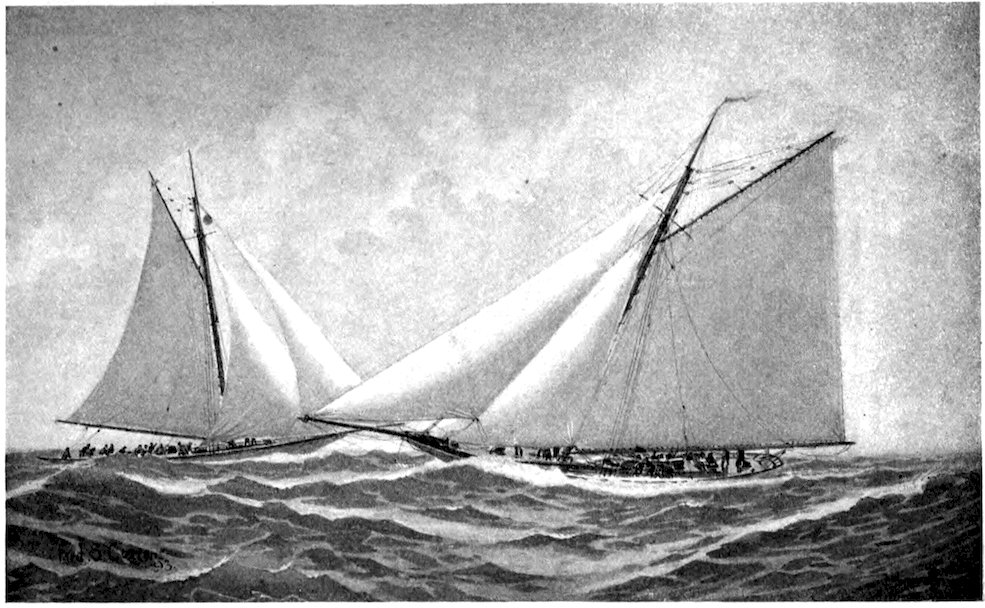
“WITH TOPMASTS HOUSED.”
I. YACHT RACING AS A SPORT. BRIEF REVIEW OF THE FASCINATING PASTIME FROM ITS INCEPTION TO THE PRESENT TIME.
About half a century ago, when I wasn’t so gray and grizzled as I am now, I was shipmate with John Gulliver, an ancient mariner who fully believed in the doctrine of the transmigration of souls. He used to spin the most wonderful yarns. He had in former incarnations animated the body of a whale, a green turtle and a sea-gull. He had also been cabin boy on the good ship Ark. He declared that, of all the skippers he had ever sailed under, Captain Noah was the strictest.
During the brief but memorable voyage of that historic craft, the crew, he declared, never once got an afternoon watch below. When they weren’t feeding the live stock they were kept busy on deck cleaning brasswork and hauling taut the lee crossjack brace. He said he felt very glad when the time came for the crew to be paid off. He had grown weary of the weevily biscuits 14and the tough salt junk. There were no “manavellings” aboard the tarnation hooker and the Old Man only served out rum once during the voyage, and that was when the Ark was hove-to under a goose-winged maintopsail and foretopmast staysail in the latitude and longitude of Mount Ararat, waiting for the dove to come aboard.
I remember I used to listen with my mouth wide open to the marvelous stories of this old salt. I once asked him to describe the interior fittings of Captain Noah’s ship, but from what I could gather from him there wasn’t much gilt gingerbread work in her main saloon. Everything was for use; nothing for ornament. There weren’t even brass hoops on the mess kids. Besides, she leaked like a sieve and wouldn’t steer well unless close-hauled on a bowline.
The ship Argo, in which Jason sailed in search of the Golden Fleece, had no artistic decorations below, but her hull, from all accounts, was a “dandy.” Built of lofty pines which flourished on Mount Pelion, she was pierced for fifty oars. She was daubed with coal-black pitch, and her bows were painted with vermilion. I don’t believe she ever made more than four knots an hour, even with fifty heroes pulling their hardest at the oars, all keeping time to the music of the harp of Orpheus, who had too much low cunning to do any work himself. The Argo was a yacht manned by Corinthians and the first one that ever sailed on the Euxine, vulgarly known as the Black Sea. So far as I know, there are no photographs extant of her interior, but judging from the log of her voyage she had a fine galley on deck, in which her crew of heroes used to cook the choice parts of swine and deer for their own use, offering up the offal as a sacrifice to the immortal gods—a circumstance showing that the ancient mariners were just as level-headed as the down-to-date seamen of to-day.
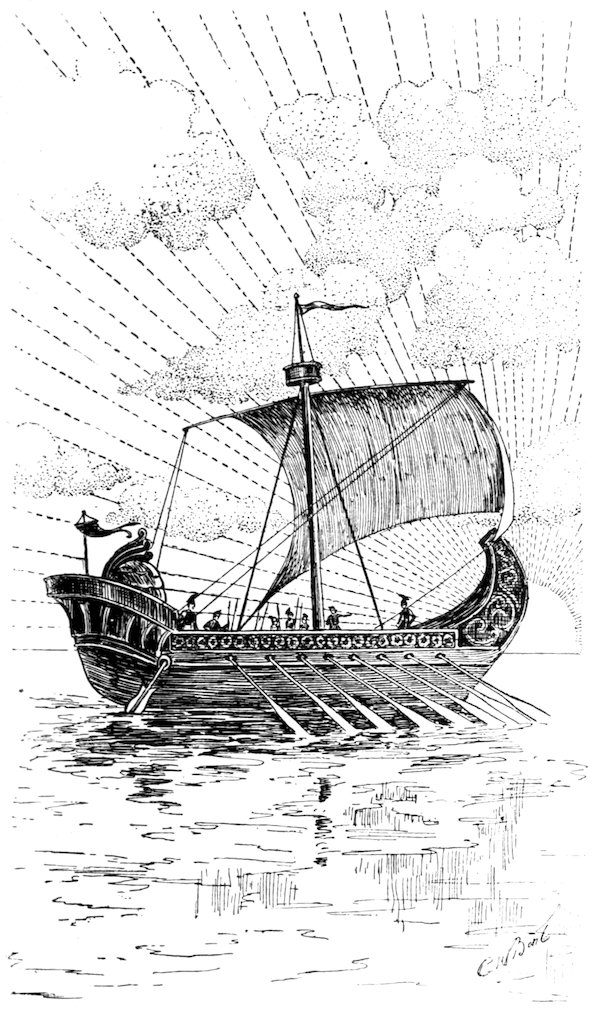
JASON’S YACHT “ARGO.”
16The handsome barges which belonged to the high civilization of ancient Egypt used to ply on the muddy waters of the Nile, and highly ornate vessels they were, manned by fifty rowers. They had sails of crimson silk, richly embroidered. Their cabins were sumptuous, spacious and luxurious, gold, silver and precious stones being used lavishly in their decoration. In such a stately craft Cleopatra and Mark Antony passed many halcyon hours of splendid ease and amorous dalliance. The Romans and Carthaginians had their pleasure craft, and so had the Greeks and Venetians.
It was the custom of the Romans to hold regattas of biremes and triremes, and according to the chronicles a good deal of money changed hands over the results. Every schoolboy remembers the exciting boat race between those gallant Trojan captains, Cloanthus and 17Sergestus, so ably reported by one Vergil. I know that I can never forget it. That regatta cost me many a cruel birching. In these competitions oars only were used. I fancy that sails were not set in those days except when the wind blew abaft the beam, the ancients not being well versed in the art of beating to windward. The swift ships in which Father Æneas, his faithful Achates and his devoted followers, fled from Troy, had, I suppose, but scanty cabin accommodations; and when bold Pilot Palinurus glanced at the compass to see if the helmsman was steering a correct course, no highly polished brass binnacle reflected that skillful old navigator’s bronzed and bearded face.
The flagship of Columbus may fairly be classed with the Argo, and so may the Norse galley which brought to the rugged New England coast those hardy salts who built the windmill at Newport and left their indelible marks on the primeval granite rocks of that region.
The Dutch, I think, were the inventors of the sailing yacht proper, and from Holland the finest diversion in the world spread to Great Britain, and became the sport of kings. Quaint old Pepys, in his diary, tells us of a sailing yacht named Mary, which was presented by the Dutch East India Company to King Charles II. in the year 1661. Charles was a tip-top yachtsman, the merry monarch being never sick at sea. 18His yacht Mary was beaten by another pleasure craft of English design, the match being the first between sailing yachts in the history of the pastime in England. According to Pepys, the Mary was snug and cozy below, quite comfortable, but not at all luxurious. The king cruised much in her up and down the English Channel in the palmy days of his reign.
Three hundred years before, when Marino Faliero was Doge of Venice, a merchant prince of that state originated pleasure sailing on the peaceful Adriatic. A Dutchman called Van Kompf transferred the craft to the German Ocean, and gave it the name of yacht. To the Dutch and Scandinavian strain in the English blood is owing that passion for the sea which has made yachting so favorite a recreation in Great Britain. Our own love for the sport is doubtless derived from the same source.
Turning to our own land the beginnings are naturally more definite. We know the exact facts, for the New York Yacht Club was organized aboard Mr. John C. Stevens’ schooner Gimcrack on July 30, 1844, the Gimcrack being at anchor off the Battery. In those days there were but few yachts, and most of them were small. The fittings of pleasure craft were then simple and inexpensive, when compared with the luxurious and costly appointments of the palatial vessels which are our pride to-day. The old Maria, which was the 19last yacht owned by Commodore Stevens, would not rank very high in the present fleet of magnificent steamers, schooners, sloops and cutters. She was the finest and fastest yacht of her day, having many of what are now termed “modern improvements,” such as outside lead, a heavily weighted main centerboard, also a forward centerboard, a hollow main boom ninety-five feet long and nine feet in circumference at its greatest girth, built of white oak staves, with doweled and keyed edges, iron bands and longitudinal iron trusses. Her main sheet was fitted with a rubber compressor.
Her former sailing-master is on record as saying: “She would work within seven points, and I have sailed her seventeen knots. On her trial trip with the America along the beach we beat her so badly that Mr. Stevens was in doubt whether it was good policy to send her to England; but as she defeated all the others by as much as we beat her, it was finally decided she ought to go.”
The Maria is said to have cost $100,000, a vast sum in those days even for Mr. Stevens, who owned nearly all Weehawken and Hoboken. It must be remembered, however, that she was continually being altered and improved, no expense being spared. The equipments and cabin fittings of all the pleasure craft of that period were plain and economical. The greater part of their cost was expended on hulls, spars and rigging, which were of the best material. The age was not so luxurious as it is to-day. Though bronze and aluminum hulls, steel booms, wire rigging, silken sails, and the one hundred and one “fads,” patented and otherwise, which are now considered indispensable for racing were unknown, the yachts cost a pretty round sum, but merely a trifle compared with the crack clippers of this year of grace.
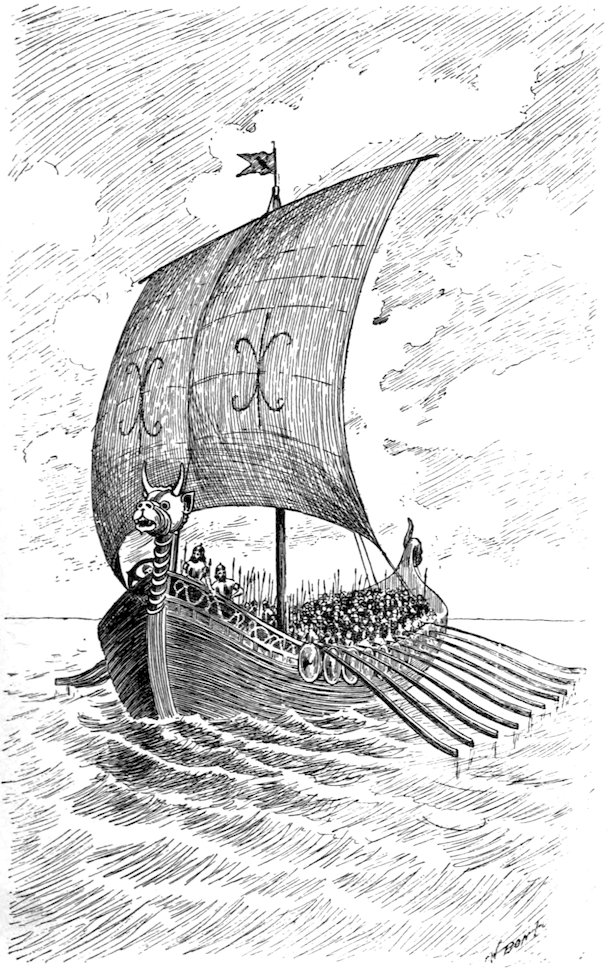
THE VIKING SHIP.
21The cabins of those yachts were not finished in costly hard woods carved by artists and highly polished. No upholstery of silken plush or hangings of rich tapestry were to be seen. Sperm oil in brass lamps of no particular design illuminated the space below. The fare, too, was plain and simple. Little or no wine of costly vintage was consumed. Honest claret, mellow Medford rum, and fine old whisky were the staple beverages with which those sturdy salts moistened their clay, while they solaced their souls with Virginia tobacco smoked in pipes of quaint Dutch shape. It is needless to say that the “400” of half a century ago didn’t carry their valets with them while cruising on the Sound or while sailing to Cape May.
The old course of the club was from the club-house in the Elysian Fields, Hoboken, out to the Southwest Spit and back. The yachts, as a rule, were sailed by amateurs. No uniform was worn in those primitive days, and there was no red tape whatever. But it is questionable 22if a finer class of amateurs ever existed than those men who sailed the yachts of the club during the first twenty years of its history.
If some of those sturdy salts who flourished in the good old days of our famous schooner America could rise from their snuggeries in the cemeteries and sail on the squadron cruise of the New York Yacht Club next August, I would promise them a spectacle which would astonish them. I would first point out to them in Glen Cove a fleet of more than one hundred yachts, comprising some of the finest steam and sailing craft in the world. I would next call attention to the fairy-like electric, steam, and naphtha launches darting between the ships and the shore, some of them laden with ladies of bewitching loveliness, dressed so saucily and coquettishly in nautical raiment as to make a bachelor’s mouth water.
I would next take my resurrected friends in a naphtha launch on board one of the big steam yachts, and while on their way thither they would marvel at the handiness and speed of the little boat which carried them. If it was the flagship Corsair they visited, her owner would be sure to have the side piped in true man-o’-war fashion in honor of the old-time salts. Climbing up the gangway ladder, walking aft on the snowy deck, they would be invited below, to the hospitality of the Corsair, which they would indeed be loath to leave.
23I might then possibly convoy them aboard the big racing schooner Colonia and the new cup defender, and, after gazing upon these two marine marvels, you might wager that the old chaps would make a vigorous kick against returning to their little grass-covered beds.
While rummaging over some musty documents in the library of an old seafaring friend the other day, I happened to come across some interesting memoranda concerning the good old schooner Gimcrack, the first flagship of the New York Yacht Club. From these items I gather that she was fitted with a fixed centerboard of heavy plate iron, four feet deep and fifteen feet long, resembling the fin of to-day, but minus the bulb of lead on the base. This is another exemplification of the truth of the old adage that there is nothing new under the sun.
The pastime which was so ably started by those old and gallant sportsmen has prospered beyond belief, and no wonder, for yacht racing, in my judgment, is the most fascinating and wholesome sport in the world. Its devotees are actuated by no mercenary or money-making motives, but follow the pastime for the many delights its pursuit affords. The praiseworthy ambition that has for its goal the winning of sea trophies is devoid of all craving after filthy lucre, because the prizes obtained, no matter whether in cash 24or plate, are trifling in comparison with the first cost of the yacht and the incidental expenses of running her. There are many other reasons that may be adduced to prove that the pastime excels all others; but, in my opinion, the most convincing argument that can be urged is that no scandal has ever sullied the fair name of the sport, and that its followers the wide world over are the best fellows that breathe—generous, hearty and manly—the salt of the earth, in fact.
It is a sport in which the element of gambling rarely enters, except in the case of international events, when patriotic pride impels men to back their country’s flag with a modest wager. I have been a close student of yachting lore for more years than I care to recall, but I know of no instance where yacht racing has made a financial wreck of one of its faithful adherents. Of what other gentlemanly sport can as much be truthfully alleged?
If a rich man has sons with a leaning toward yachting he should encourage its complete development. I know of no better school for the cultivation of all manly virtues. There is no question concerning its healthfulness, but my contention is that a man’s moral tone as well as his physical constitution improves by association with the sea. Self-reliance, quickness of decision, action and resource, bravery and personal endurance, are qualities necessary for success in life. Where can all these desirable characteristics be acquired with more ease and greater satisfaction than on a racing vessel, preferably one of moderate size manned exclusively by amateurs or with the aid of one paid hand?
![[The Flagship of Columbus]](https://openoldbooks.sgp1.digitaloceanspaces.com/books/yachting-wrinkles/images/i_024.jpg)
26It may properly be remarked that the love of boating is innate and can never be acquired. The mere sight of the sea has an attraction to the true son of Neptune as cogent as that of the magnet to the pole. He eagerly desires to be afloat on it, and can sympathize with Charles Lever, who once said he would rather have a plank for a boat and a handkerchief for a sail than resign himself to give up boating altogether. The man who has not the nautical instinct can never come to regard a boat with more affection than he does a horse-car. When you rave ecstatically of the virtues of your little ship he feels inclined to think that you must be half crazy. You can never make a yachtsman out of material such as this. We cannot all be sailors, so therefore let the cobbler stick to his last and the cook to the foresheet, where he belongs!
The deduction from the above is that you should be careful as to the choice of your seagoing chum. The most congenial companion ashore may prove an insufferable bore afloat. And to tell the truth, you ought not to blame him for the lack of the nautical instinct, but rather yourself for inviting a person 27lacking that saving qualification to go sailing with you. Nauticus nascitur, non fit is a true adage. There is a huge army of our fellow creatures who think with Dr. Johnson that the pleasure of going to sea is getting ashore again from a prison, where there is also the risk of getting drowned. But a far brighter literary light than he, Thomas Carlyle, to wit, the crabbed, the cynic, who was ever ready to use his mordant pen of wormwood in holding up to execration the foibles and the sins of humanity ashore, was always blind to the faults of his fellow-man afloat. The acrid gall of his being, induced by the horrors of chronic dyspepsia, was converted into milk and honey by the magic influence of the Ocean.
Who can forget the account of his trip to Ostend and back in the revenue cutter Vigilant in 1842? He described the craft as a smart little trim ship of some 250 tons, rigged, fitted, kept and navigated in the highest style of English seacraft, made every way for sailing fast that she may catch smugglers. Outside and inside, in furniture, equipment, action and look, she seemed a model, clean as a lady’s work-box.
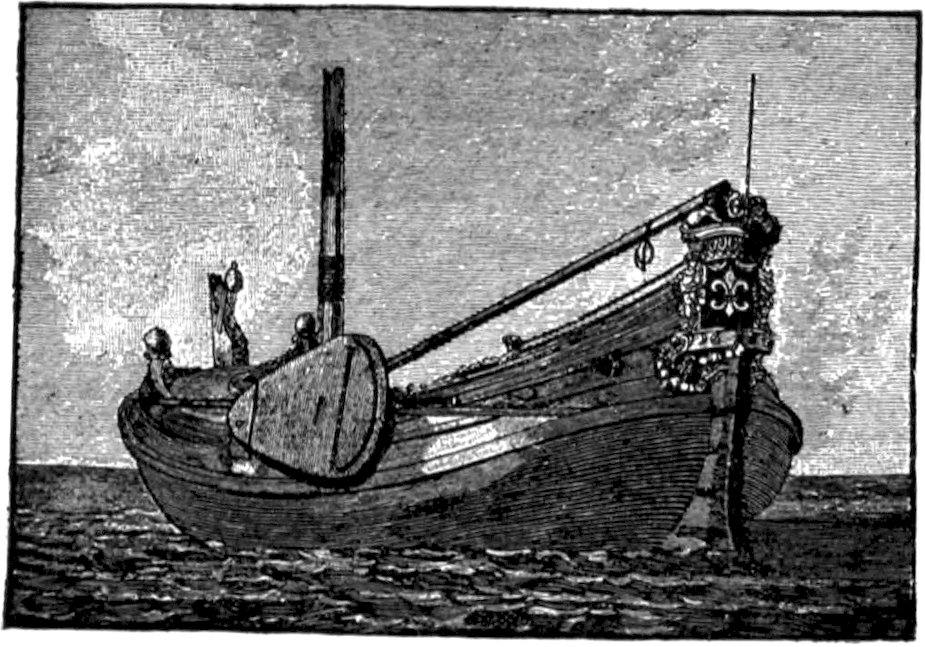
DUTCH YACHT OF 17TH CENTURY.
His biographer, Froude, has told, of their return trip, how at midnight they were in their berths aboard the Vigilant running out into the North Sea: “The wind fell in the morning and they were becalmed. They sighted the North Foreland before night, but the air was 29still light, and it was not till the next day that they were fairly in the river. Then a rattling breeze sprang up and the Vigilant, with her vast mainsail, her vast balloon jib, with all the canvas set which she could carry, flew through the water, passing sailing vessels, passing steamers, passing everything. They carried on as if they were entered for a racing cup. The jib, of too light material for such hard driving, split with a report like a cannon. Carlyle saw the ‘Captain’s eyes twinkle; no other change.’ In ten minutes the flying wreck was gathered in, another jib was set and standing in place of it, and the yacht sped on as before. ‘To see men so perfect in their craft, fit for their work, and fitly ordered to it,’ was a real consolation to him. There was something still left in the public service of England which had survived Parliamentary eloquence. They entered at Deptford and the gig was lowered to take the party up to London.
“Five rowers with a boatswain; men unsurpassable, I do not doubt, in boat navigation; strong, tall men, all clean shaved, clean washed, in clean blue trousers, in massive clean check shirts, their black neckcloths tied round their waists, their large, clean brown hands, cunning in the craft of the sea—it was a kind of joy to look at it all. In a few minutes they shot us into the Custom House stairs, and here, waving our mild farewells, our travel’s history concluded. 30Thus had kind destiny projected us rocket-wise for a little space into the clear blue of heaven and freedom. Thus again were we swiftly reabsorbed into the great, smoky, simmering crater, and London’s soot volcano had again re-covered us.”
I am sure my readers will pardon me for quoting at such length from Carlyle, if only for the reason that the matter I reproduce is far more interesting than any I can originate. Besides, I need the extract to emphasize my argument concerning the healthful moral tonic of my much-loved sea. Here is atrabilious, doleful, indignant, and scornful Carlyle cured temporarily of all his mental disorders by a rattling run across the North Sea and back. He lands in a delightful frame of mind, and has nothing but the most pleasant reminiscences of the Vigilant, her skipper and her crew. The readers of his stories of other journeys by land will appreciate the surprising contrast.
Very few men go into yachting for the advertisement that it may offer. It is always possible for some seller of quack medicines to achieve cheap notoriety by claiming that he is about to build a yacht to defend or capture the America’s Cup. If he uses diligently whatever art of claptrap he is endowed with he will find numbers of newspapers gullible enough to give him columns and columns of gratuitous puffs. The public may be beguiled for a time into 31the belief that his intentions are really honest; but the experienced yachtsman will not be deceived for a moment, as he knows that no yacht club of repute will father the challenge of such a person, even in the unlikely event of his building a yacht for the purpose of a real race. Yacht clubs on both sides of the Atlantic, to their credit, fight very shy of such queer customers.
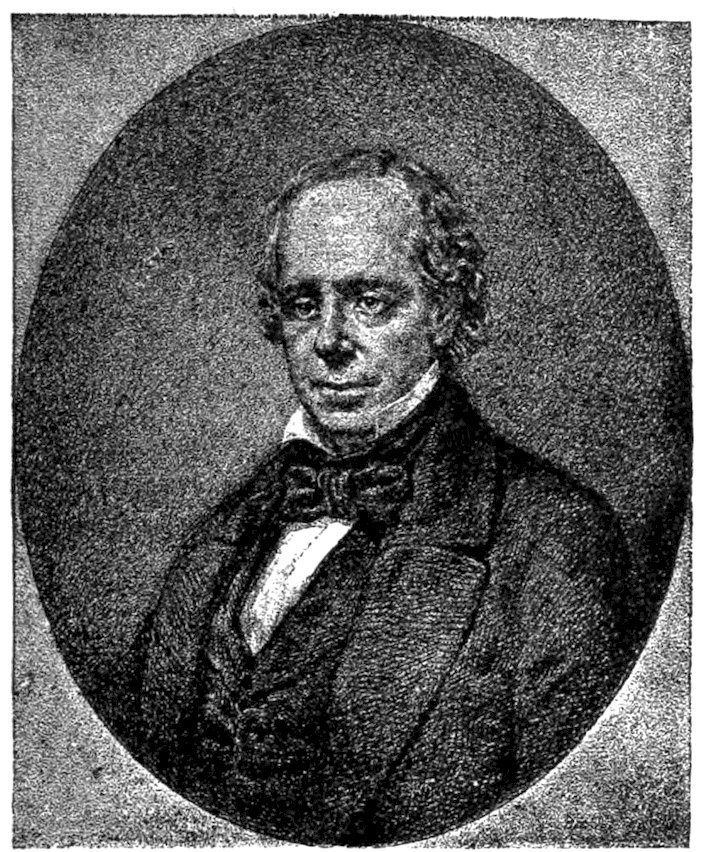
COMMODORE JOHN C. STEVENS, The Father of American Yachting.
32Thus it is that the sport is confined to gentlemen; nautical blacklegs, blackguards, and “welshers” being unknown. The membership committees of the clubs are very discriminating and cautious as to those whom they admit; and even if a “black sheep” succeeds in entering the flock his presence is soon discovered, and he quietly learns that his room is more desirable than his company. His resignation follows as a matter of course.
A yacht club composed principally of men who love the sport for the precious gifts it offers, and not for fashion’s sake, or because “It’s the proper caper, you know, to belong to a yacht club, don’t you see?” is an excellent school for a young man, both morally and physically. In the arena of professional sport, as we all know, objectionable characters, unhappily, fairly swarm. It would be invidious to particularize or to single out any one sport as being remarkable from the number of black sheep among its adherents. But of yachting it may truly be said that the pastime never has 33been disgraced or degraded by the professional hands necessarily employed in its service. Officers and men before the mast quickly realize that good conduct is the only secret of success, that braggarts and bullies have no place in its symmetry, and that dishonesty of any kind, whether selling a race or robbing a yacht owner, is quickly detected and punished. I have never known an instance of the first-named disgraceful offence, and the lack of it speaks volumes in behalf of the honor and integrity of yacht skippers the wide world over. Be it remembered that for a sailing-master to lose a race would be as easy as for a jockey to so ride a horse that in spite of his gameness or his speed he could not possibly win. Scandals such as in the past have made the turf a byword are happily unknown in yacht racing. In all my experience of yachtsmen I never heard one of them, in his most open and confidential moods, with his mind mellowed with grog, boast of winning a race by unfair or questionable methods.
Many stockbrokers race their yachts, and, although the Stock Exchange is supposed to have a peculiar effect on the moral tone of its members, yet when these gentlemen engage in a yacht race they display the nicest honor, the most chivalrous conduct toward their adversaries, that is indeed most admirable to contemplate. Lawyers, too, who in the exercise of their profession 34are full of wiles and stratagems, lose their chief characteristics when they enter their yacht club or get aboard their yachts. The transformation is magical. You fail to recognize in the bluff, open and honest sea-dog in his natty suit of serge the shrewd gentleman of the long robe who, with his quips and his quirks and his long list of precedents and his unfailing gift of the gab, has just succeeded in making the Supreme Court of the United States feel exquisitely unhappy. Talk of Aladdin’s lamp or any other famous storied talisman as you please but, upon my word, the sea has worked more wonders than them all!
There is much patriotism among our yachtsmen, the bulk of the Naval Militia of the various States, possessing such a volunteer organization, consisting of men who are devoted to the sport. That the United States Government is much indebted to yachtsmen is now generously conceded by our naval authorities, who, at the outset of the war with Spain, availed themselves of a large fleet of steam yachts, which were transformed with marvelous celerity into despatch boats, protected cruisers and torpedo boat destroyers. They proved of immense service to the navy, as that arm of our national defence was destitute of these almost indispensable vessels. It may be truthfully alleged that the navy would have been in an unpleasant predicament if it had not been possible to 35call upon the steam yachting fleet of the Atlantic coast. The splendid achievement of the converted yacht Gloucester, formerly the flagship of the New York Yacht Club, which drove ashore two Spanish torpedo boat destroyers near Santiago de Cuba on July 3, 1898, will always be remembered as one of the most brilliant episodes of that “most just and charitable war.” She was in command of Lieut.-Commander Wainwright, who was executive officer of the Maine when she was blown up in Havana harbor on February 15, 1898.
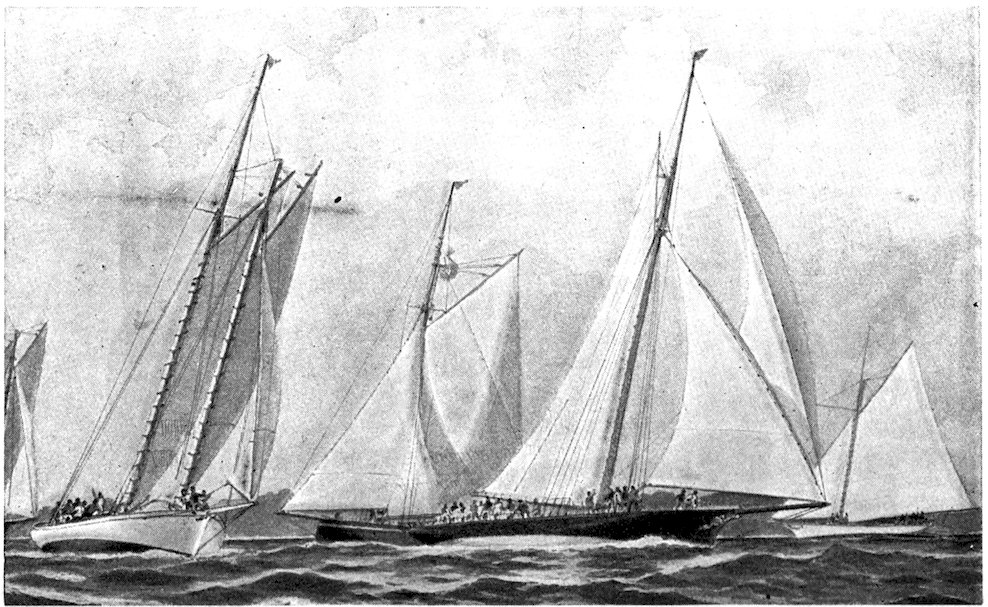
“GIMCRACK” AND “MARIA.”
37The generous response of the Naval Militia to the call of the President and the eagerness of yachtsmen generally to recruit its ranks have been highly appreciated. Yachtsmen will ever feel proud of the gallantry of the Naval Militia because it is so largely composed of their shipmates and messmates. It is needless to expatiate on the patriotic part of my theme. The advantages of yachting as a nursery for the navy in war-time are indisputable, and will occur to anybody who will give the matter due reflection.
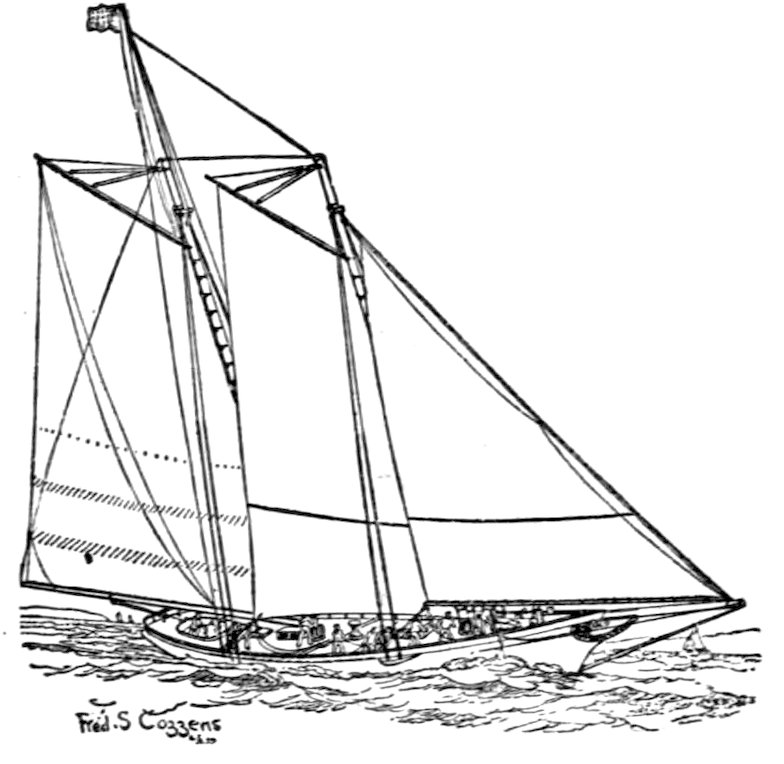
“AMERICA,” 1851.
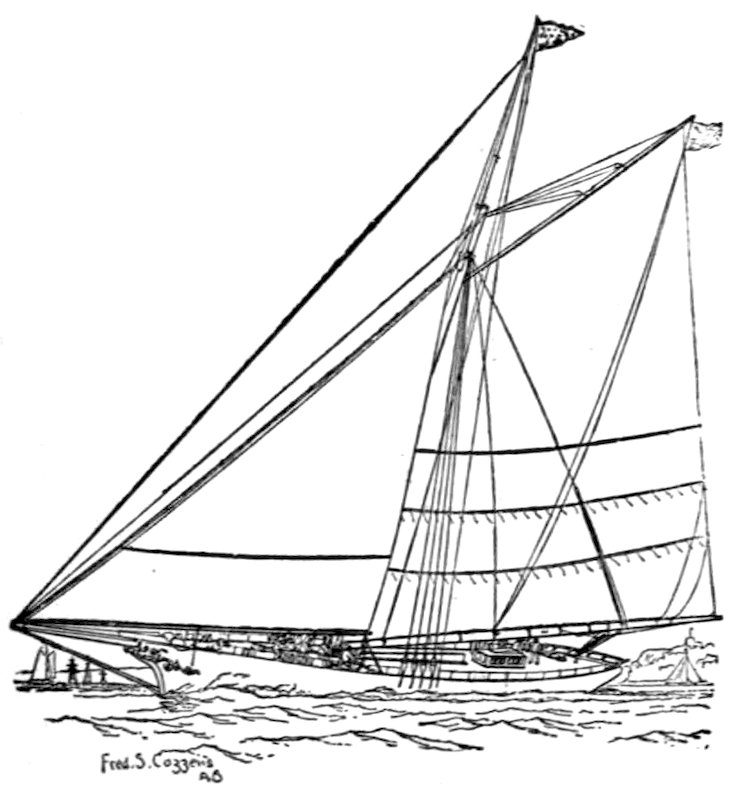
“MARIA,” 1851.
The Corinthian Yacht Club of New York, now unhappily extinct, did excellent work in its rather brief but not inglorious career. It achieved much in the way of the abolition of the pernicious broad and shallow type of boat which at the time of the Corinthian Club’s heyday was extremely popular. I should be disingenuous were I not to 39confess quite frankly that the extreme type of plank-on-edge cutters favored by the leading lights of this club was, in my judgment, nearly as objectionable as the class of craft it sought to supersede. But still it must be said that the boat of to-day, which is a compromise between the extremes mentioned, owes a share at least of its existence to the bold efforts of the Corinthians. To abolish the “skimming dish” was one of the chief aims of the club, and that it did yeoman’s service in that direction was one of its greatest glories.
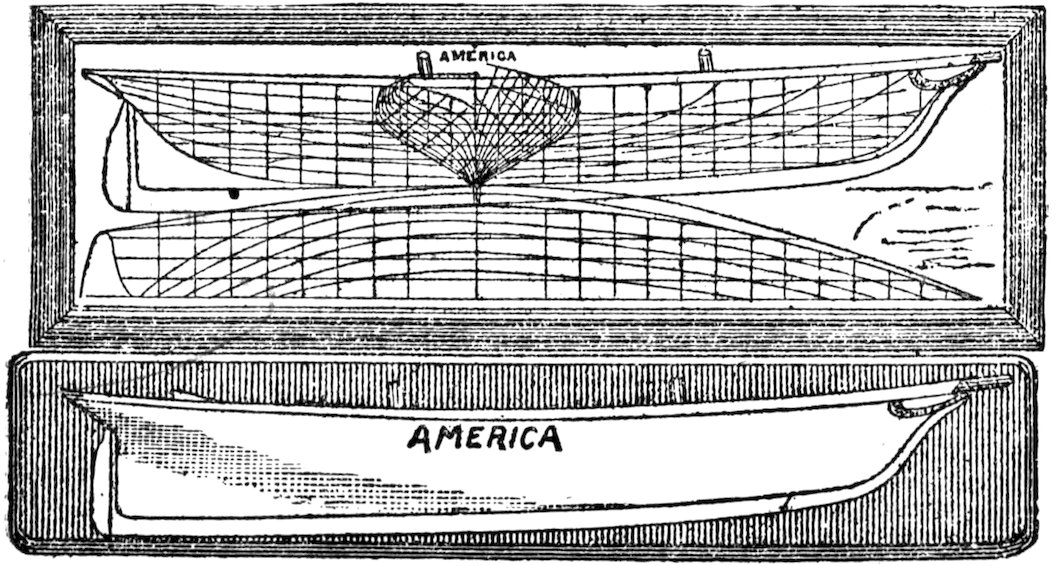
“AMERICA’S” LINES.
40An innovation made by this club was the establishment of cadets as members. These cadets were the sons or relatives of members who took an interest in the sport. They were entitled to many of the privileges of their elders, including the right to wear the club button. It always impressed me that the idea was a good one. I know of no other club that has followed its example. Now that the ban against women has been removed by half-a-dozen clubs of importance, Young America may also be granted an opportunity to rise and shine. There is no doubt that the average American boy is fond of a sailor’s life. It is also true that some of the genus would hardly be a joy in the life of a yacht club if admitted to cadetship. There is every likelihood, therefore, that it may be long before the boy becomes an active participant in yachting, so far as clubs are concerned. But 41I know several ambitious youths who can handle their fathers’ vessels as well as a veteran, and who can be depended on to enter into the vigorous practice of the sport as soon as they get old enough to run their own affairs.
It is my intention to discuss in detail the cost of running a racing yacht, in a subsequent chapter, but I may say in a general way that capital sport may be had each season at a moderate outlay. There never before were so many yacht clubs as there are to-day, and never has a more intelligent interest been taken in the economical pursuit of racing. Defenders, Vigilants, Colonias and Emeralds are vessels beyond the reach of all but millionaires. It is only the very richest of our fellow citizens who can enjoy the delights of racing these large and costly vessels. But the popular restricted classes of 1899 offer inducements that the ordinary man of affairs earning a moderate income may easily avail himself of. Suppose that two chums, who have sailed together long enough to find out that their idiosyncrasies of disposition and temperament will allow them to dwell together in amity afloat, form a marine partnership and buy jointly a knockabout or raceabout for cup-hunting and cruising purposes. The first cost of the boat, complete and delivered, might be $800. A second-hand boat might be picked up much cheaper. The expense of keeping her in commission would be modest. No 42paid hand would be necessary, and the boat might be so moored that one of the club hands would keep a general watch on her to see that no harm befell her in a summer storm, his recompense for this being a generous “tip” at the end of the season.
In nearly all of the yacht clubs in the vicinity of the metropolis special efforts are made to induce owners of small craft to join, and there are facilities for the safe anchorage and also the hauling out of the club’s mosquito squadron. In this the clubs act wisely, for the small classes are really the life of the organization, which, without their active interest, might stand a fair chance of perishing of inanition.
Most pleasures are evanescent when compared with the comfort that a sea-dog gets from fixing up his cabin for the season’s sport. The ingenuity displayed in making the most of the necessarily limited quarters at his disposal, the stowage of his “dunnage,” so as to be able to put his hand on anything at a moment’s notice in the dark, the capacity of creating a home-like interior out of chaotic surroundings, call out every faculty.
The first sail on a new boat which is your very own causes a thrill of joy. To see the noble craft respond to the slightest touch of the tiller, to watch her gradually eat her way to windward in the teeth of a merry breeze, with a shining furrow of foam in her wake and her 43sharp cutwater cleaving the blue billows, and when, with sheet eased off and wind abeam, her lee rail almost awash, she puts on an extra spurt—all these are ecstatic raptures which your poor land-lubber has never experienced.
Yachts are fickle jades, as all who have been victims of their whims and humors must fain concede. It is no wonder that they belong to the feminine gender. No coquette can be coyer or more difficult to please than the highly strung racing yacht. On occasions it is hard to realize that she is an inanimate fabric. I have known one to develop nerves and even hysteria. It takes a man of great judgment and infinite tact and good temper to get the best speed out of a modern racehorse. Qualifications similar and quite as highly developed are necessary to the successful yacht skipper, be he amateur or be he professional.
The ambition to excel in the art of yacht racing has been the means of inducing a great number of our fashionable youth, both golden and gilded, to cultivate the sport of yachting. The wholesome and invigorating influence of sea life and salt water have developed scores of dudes into men; and the one-design classes, now so popular, do much to keep young fellows out of mischief.
Racing in the smaller classes is encouraged by all the clubs except one—the New York Yacht Club—and open regattas are plentiful, to which the boats belonging to all recognized clubs are 44not only eligible but cordially welcome. The Yacht Racing Association of Long Island Sound has made a specialty of encouraging and promoting these open regattas, and the result is a programme of most attractive events, with no conflicting dates, that offer golden opportunities to ambitious amateurs to win trophies of their skill and daring. All existing classes are invited to take part in these competitions, as the most generous and sportsmanlike spirit of comradeship pervades the yacht clubs of the Sound; so, if a man prefers a catboat or a sloop or a yawl to a knockabout, he will have many opportunities of gratifying his yacht-racing instincts. The rules of this Yacht Racing Association are so fair and liberal that the most carping of critics can find nothing in them to cavil at. A hearty welcome is accorded the owners of all visiting boats by the club holding the regatta, and nothing can be more satisfactory than the system which so happily obtains in this present year of grace.
The benefits bestowed by this association on the yachtsmen of New York and Connecticut are rivaled by those offered to Eastern yachtsmen by the Yacht Racing Association of Massachusetts. Similar associations exist on the Lakes and the Pacific Coast, while the International Yacht Racing Union, established in 1897, promises to wield a powerful and benignant influence in the immediate future on the promotion of 45international matches, which, in the past, have proved so beneficial to the sport.
It may thus be deduced that the outlook for sound and thriving sport was never brighter or more promising than it is to-day. White sails of racing craft dot the waters of our coast line where the sport is practicable. In the inland lakes the pastime, too, is pursued with zeal and intelligence. The advance and progress made in the sport date, strange to say, from 1880, when what is known as the “cutter craze” first made itself manifest in this country. In the light of history it should be candidly conceded that the lessons learned from the Scotch cutters Madge, Clara and Minerva proved of incalculable benefit to the sport in America. Broad-minded Britishers will also admit that the victories of moderate and able compromise craft like Puritan and Mayflower, combining the American breadth of beam and the centerboard with the British outside lead, over such representative English cutters as Genesta and Galatea caused the alteration of the British rule which penalized beam and which resulted in the building of vessels like Britannia, Valkyrie and Meteor.
The adoption by the English of cotton duck for sails, and also of the Yankee laced mainsail, show how our transAtlantic cousins appreciate a good thing when its advantages are made manifest. The eager way in which they snapped up the Herreshoff fin-keel is further 46proof of the active interest the British designers take in the development of American yacht naval architecture and how keen they are to avail themselves of any new “wrinkles” in hull, sails or rigging that Yankee genius may invent.
And while the British eye is kept wide open in our direction, it must not be thought that we are blind to the doings of our rivals across the sea. The friendly feelings that have been enhanced between the two great English-speaking nations ever since the outbreak of the late war with Spain did much to make another race for the America’s Cup possible and popular, and neither nation can afford to nap when the yachting supremacy of the sea is at stake.
Queen Victoria’s policy has ever been to encourage yacht racing, as the many Queen’s Cups she has presented to yacht clubs during her long reign abundantly prove. The most popular act of her life, so far as professional yacht sailors are concerned, took place on April 8, 1897, when she visited the Prince of Wales’ cutter Britannia, at Nice, and presented Capt. John Carter, her skipper, with the medal of the Victoria Order, accompanying the gift with a graceful compliment. In America the yachting fraternity, both amateur and professional, has received no encouragement whatever from the Congress, and is still subject to harassing legislation. This is much to be regretted, as it is without question bad and unwise policy.
II. THE RACING YACHT. SOME REMARKS ON THE MATERIAL, CONSTRUCTION AND SELECTION OF A VESSEL.
It is a matter of some difficulty to advise a prospective yachtsman as to the acquisition of a racing craft. There are two courses open to him. He can either build or buy ready-made. If the question of money is purely a secondary consideration, the wealthy amateur will probably feel inclined to give an order to a fashionable naval architect for the down-to-date design of a tip-top craft in the class on which he has set his heart. He will find plenty of accommodating builders who will meet his views conscientiously and do their best to follow out the minutiæ of the draughtsman’s design. Swell sailmakers—and we have some of the best on earth—will supply his craft with a splendidly fitting and sitting suit of muslin, and he can hire a crack skipper who will teach him all the tricks of the most expert timoneer.
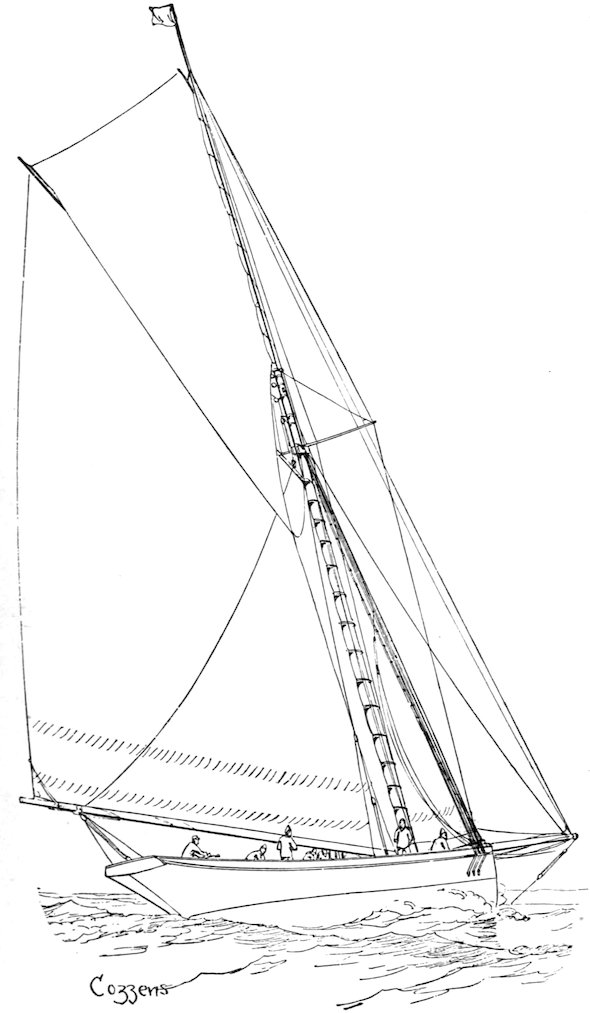
THE CUTTER “ORIVA.”
Mr. George L. Watson, the famous Scotch yacht designer, in a lecture on 49“Progress in Yachting and Yacht Building,” delivered early in 1881, said:
“As prophecy nowadays seems to be one of the branches of naval architecture, and we have been told by Sir E. J. Reed and others what kind of ships the next generation are to have, I am anxious to keep abreast of the age, and herewith present you with the outline specification of a 10-tonner for the season 2000. You see I keep myself pretty safe, as but few of us will be alive to see her sail. The dimensions I won’t venture on. Some yachting authorities assert that you have only to make the boat long enough and heavy enough, to beat all existing racing craft; and it seems strange that, with this knowledge in their possession, they should not only have had sufficient self-denial to resist the building of certain successes, but have even gone the length of turning out duffers of normal dimensions. I think there is just a little more in it than that, and can’t believe that a 10-tonner 80 feet long could ever be a success.
“We have not exhausted the possibilities of form yet, and really know very little more about it than Solomon did when he confessed his inability to understand ‘the way of a ship on the sea;’ and when we do arrive at perfection in shape, we can set to, then, to look out for better material.
“The frames and beams, then, of my ideal ship shall be of aluminum, the 50plating below water of manganese bronze and the topsides of aluminum, while I think it will be well to deck her, too, with that lightest of metals, as good yellow pine will soon be seen only in a museum. For ballast, of course we should have nothing but platinum, unless the owner grudged the expense, when we might put the top tier of gold.
“But by that date I hope we won’t care for sailing in such a sluggish element as the water. I firmly believe that some day the air will become as easily traversed as the earth or ocean.”
Now, in 1881, Mr. Watson’s fame as a naval architect was quite firmly established, but as a prophet he was without honor in his own and every other country. It is therefore remarkable that his prediction, made presumably in playful jest, was, in a great measure, fulfilled not very long after. A torpedo boat of manganese bronze was actually built in England for the French Government in 1891. Then followed the construction in France of the yacht Vendenesse, built almost altogether of aluminum, in 1892, and a series of French torpedo boats of aluminum in 1895–6. The Yankee Vigilant was constructed of Tobin bronze below the water-line and of steel above. She had a hollow bronze centerboard and a solid bronze rudder. The latest development of Mr. Watson’s fanciful idea was introduced in Defender in 1895. This celebrated yacht has topside plating, deck beams, deck-strapping 51and upper fittings of aluminum, 4 per cent. nickel alloy, while the bottom plating is of bronze. The stern, frames, floor-plates, stiffening-angles, bilge-stringers, inverted angle-bulbs, underdeck beams, the two deck beams inclosing mast, tie-plates round mast, stepping-socket, bed-plate fittings, and supports and chain-plates are of steel. All the rivets are of bronze, thus completing an intimate association of the three metals, which was followed in a short time by inevitable general corrosion.
Courtesy of Harper Bros.
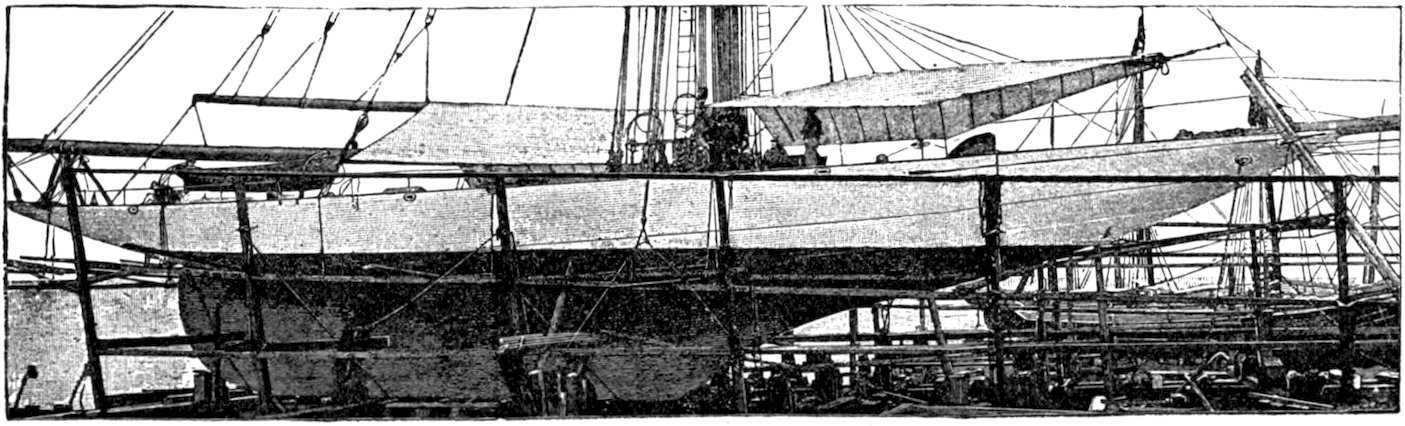
“VIGILANT,” CUP-DEFENDER OF 1893, IN DRY DOCK.
52Advocates of aluminum as a fit metal for use in shipbuilding point out that no effort at insulation of any kind whatsoever was made, not even the simple precautions which would have been insisted on in an ordinary case of steel and bronze construction. Defender was built with only one purpose in view—the winning of a series of races. Her subsequent proceedings were a matter of no interest to her owners and builder. Had she been built of steel throughout she would have cost about half as much as she actually did, and would have been good for fifteen years of hard sailing if built up to Lloyd’s rules. But she might, in that case, have failed to fulfill her only reason for existence—the beating of Lord Dunraven’s Valkyrie III.
The scientist who will invent some alloy to combine with aluminum which will make the metal free from corrosion when immersed in salt water will confer a great boon on the builders of racing 53yachts and, incidentally, will enrich himself. That this problem will be solved eventually there is little doubt. I hope that Mr. Watson will live to see his prophecy realized, even to the extent of aerial navigation.
At present, however, the heavy first cost of aluminum and its short life, when exposed to the erosive action of sea water, bar its use in the construction of racing yachts, except when the sentiment of defending or regaining an historic national trophy is indulged in by a syndicate of capitalists. Probably no single millionaire would have gone to the expense of the Defender, but when the price of her was divided up among several, the plethoric purses were not so very much depleted after all.
Aluminum as a material for yachts has been an interesting subject to me ever since it was first used in shipbuilding. The aluminum used in the Defender had an alloy of from 12 to 15 per cent. of nickel. The majority of the plates used were ⁵⁄₁₆ and ⅜ of an inch in thickness. The heaviest plate weighed about 200 pounds, was 38½ inches wide, 13 feet 10 inches long, and ⁵⁄₁₆ of an inch thick. This plate gave an ultimate tensile strength of 40,780 pounds per square inch, an elongation of 10 per cent. in 2 inches, and the reduction of area at the point of fracture was 14.75 per cent. Each and every plate used was tested.
The Defender was constructed of aluminum plating from the water-line 54up. Her deck beams, lateral and diagonal braces under the deck, a stringer plate connecting the deck beams with the sides of the vessel, continuous throughout her length, and the rail were of aluminum. The same metal was also used for dead-light frames and covers and small interior fittings. The sheaves of all her blocks were of aluminum.
I have read nearly everything that scientific men have written on the subject of aluminum as used in Defender, and from my reading I deduce that the metal failed to prove satisfactory because proper care was not taken to prevent oxidation by galvanic action. In the first place, bronze rivets were used instead of aluminum rivets, or iron rivets galvanized. Secondly, the insides of the rivet holes were not coated with white lead, nor were the rivets themselves dipped in white lead or paraffine before driving, as might easily have been done. In fact, no precaution whatever was taken to minimize galvanic action.
Mr. Herreshoff was advised to lay strips of heavy canton flannel well soaked in white lead between the lapping aluminum plates of the topsides and the bronze plates of the underbody, and then rivet up with the flannel between the edges of the two plates, forming a neutral joint. This precaution was not taken, however, the result being great corrosion where, through the 55junction of the two metals, galvanic action set in.
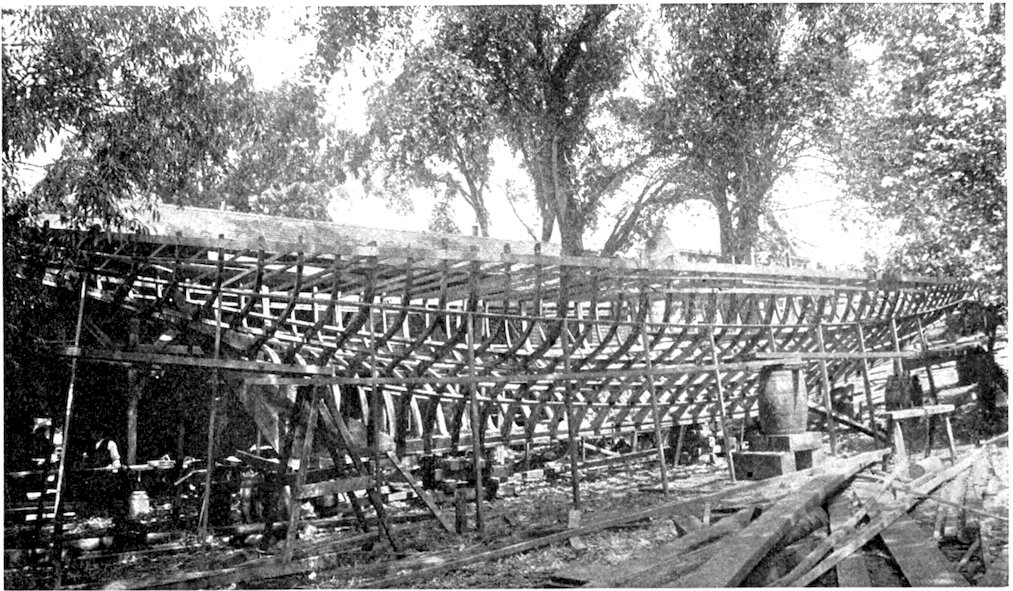
“UNCAS” IN FRAME.
57As a general axiom it may be averred that whenever brass or copper comes into direct contact with aluminum exposed to sea water, corrosion is very rapid. It may also be averred that aluminum rivets can be made fully as strong as those of any other metal. Thus there is no good reason for using bronze rivets in the construction of an aluminum vessel.
The conclusion I arrive at is that aluminum as a material for a racing yacht should not be condemned until further experiments have been made. In strength and lightness it surpasses every other metal.
It is the general opinion of shipbuilders that the best system of construction is to use one material alone in a vessel. Let her be all wood or all one metal, and then the strains will be equal and corrosion will be avoided. There is no question that wood should be used in all of the smaller craft up to the 51-footers, at any rate. Strength and lightness may be most effectually combined by the double-skin system of construction, which is by all odds the most efficient and lasting. In boats larger than these, steel may be the material of the hull. Metal in small craft is necessarily so thin that unsightly bulges often disfigure the topsides of vessels built of sheet-iron, ships’ lifeboats, for instance. It is true, however, that these metal 58boats are light and durable, and when hung to a ship’s davits do not warp or shrink or become leaky when exposed to the burning rays of a tropical sun. These qualities, though of great value in the craft indicated, do not apply to small pleasure vessels, especially when the great heat of metal vessels in our hot summers is taken into consideration. Steel corrodes quickly and soon gets foul. It should, therefore, be kept well protected with a preservative anti-fouling paint.
Old-fashioned yachtsmen, a class of people almost extinct, prefer wood to any other material in sailing yachts of even the largest size. But the most prejudiced of these ancient mariners are forced to admit, however reluctantly, that wood will not satisfactorily stand the jarring strains of powerful modern marine engines. It would, of course, be possible to build an oaken vessel strong enough to sustain the stress of the machinery, but the timbers would have to be bulky indeed, and the weight would be far greater than if steel were made use of exclusively.
A friend of mine who is a devoted yachtsman, as well as a pretty fair hand with the rod and gun, having lost the bulk of his money by an unfortunate investment, was able by the exercise of ingenuity to build for himself a smart and able cruising schooner at a very moderate cost, and also to spend a winter very enjoyably. This is how 59he went about it: In the first place he had a thorough knowledge of the type of boat he wanted, and had a smattering of the shipbuilders’ art, being moderately handy with tools. So when he went to a naval architect he was able to give an intelligent notion of his real requirements, and wasted no precious professional time.
In the course of a few days the designer furnished him with the requisite working plans and specifications, all admirably clear and concise, and easily comprehensible by an intelligent mechanic. Armed with these plans he packed up his traps, not forgetting his guns, and started for a certain seaport in Maine, where some of the best coasting vessels in the world are built and where suitable timber is to be had at a very low price. Labor is cheap and so is the cost of living. He fell in with a skillful shipwright who owned a shipyard in the harbor, and he made satisfactory terms for the building of the vessel, the construction of which he generally supervised. She was built under cover, and thus was not damaged in the least by the severe winter weather. My friend made the seaport his headquarters, his expenses averaging no more than $1 a day. He went on several enjoyable shooting expeditions, and was much benefited in health by the pure and bracing air.
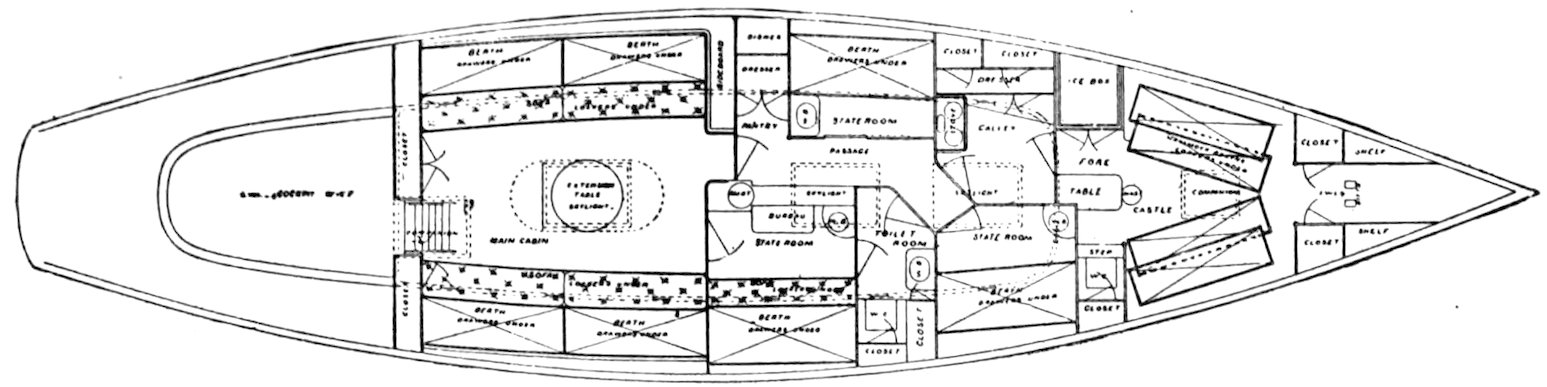
INTERIOR OF “UNCAS.”

FORM OF “UNCAS.”
The best of it was that by this means he became the owner of a very serviceable 61vessel. All her timbers were sound and seasoned. The estimate was so reasonable that, instead of galvanized fastenings, which the specifications called for, he found that he could afford yellow metal and copper bolts wherever prudence dictated their use.
Being a “crank,” as most good yachtsmen are, when the vessel was in frame he gave every inch of her a right-down good soaking with kerosene oil, applying as much as the dry wood was able to absorb. He says this process preserves the wood almost indefinitely. All the oak was fall-cut, and not a sappy timber found a place in the shapely hull.
In the late spring she was launched and rigged, and, when fitted out, her owner sailed her to New York, where the nautical critics carefully surveyed her and pronounced her good.
I would not, however, advise the average man to follow my friend’s example. The man of whom I write was exceptionally well qualified and equipped for the undertaking and carrying out of such a job. Outside of his general knowledge of shipbuilding and seamanship, he was a shrewd business man, with plenty of tact and knowledge of the world. It would be difficult for the most rascally of shipbuilders to get the better of him. He was also favored by good fortune, insomuch as the honesty and skill of the builder of his yacht were concerned. He tells me he saved 62twenty five per cent. in the actual cost of the vessel if built anywhere in the neighborhood of New York. Moreover, he got a boat capable of being classed in the highest standard at Lloyd’s and good for a quarter of a century’s hard cruising. Having seen the boat put together, he never felt anxious about straining her in a squall. There was no skimping of quantity in material to procure a flimsy kind of lightness. Hull, spars and rigging were all scientifically adapted to the heaviest strains they were likely to encounter, and a sufficient margin of extra strength was added in case of emergencies. The schooner has been in commission now for several years, her owner living aboard her practically all the year round. He has cruised south as far as the Caribbean Sea and north to Labrador. He is his own skipper, and a better seaman and navigator never broke a biscuit on his knee or drank grog out of a pannikin.
The only objection that can be made against iron or steel yachts in the larger classes is that their bottoms foul so rapidly. So far as their capacity to resist stress and strain is concerned, nothing can be said against them. The first English iron yacht was the Mosquito, designed by Tom Waterman and built on the Thames in 1848. The first American iron yacht was the cutter Vindex, designed by Mr. A. Cary Smith in 1870 for Mr. Robert Center.
63Nickel steel, as its name implies, is an alloy of steel with nickel. It possesses all the qualities of steel for shipbuilding purposes, but it has, in addition, a breaking strength of forty tons to the square inch, as against twenty-seven for ordinary steel. The twenty-rater Dragon III., built in 1893, had frames and beams of this metal, which I think is destined to be much used in the construction of racing yachts.
The composite system of construction, namely, steel or iron frames and wooden planking, is in my judgment open to objection. The frames of a racing yacht are of course as light as the naval architect dares to make them in his effort to reduce weight in every detail of hull, spars and rigging. When it comes to pass that the seams of a composite yacht require calking, the strain of driving the oakum home produces such a pressure on the bolts that fasten the planks to the frames that they snap off.
The composite system was introduced in 1860 on the Clyde, many China clippers being built after that plan. Among the first composite yachts were Nyanza and Oimara, built by Robert Steele & Co., of Greenock, about 1867. All the large racing yachts of the present time that are not constructed of metal have steel frames, as a sufficiently light wooden frame could not sustain the immense strains of the large sail plan and the heavy weight of the outside lead.
64If a man sets his heart on having a composite vessel he should take care that her skin is of double construction, one layer of plank overlapping the other, with a liberal luting of white lead between. Thus no calking whatever is necessary; the vessel is tight as a bottle and much stronger than if the old-fashioned plan is followed. The only objection is the expense.
John Harvey, the English yacht designer and builder, who was first to introduce the double-skin system in yachts, told me once that many composite yachts were hauled out in his yard at Wivenhoe to be repaired. He had been inside several of them when being calked, and seen the nuts break off and roll down in the bilges by the score as the oakum driven by the calking iron wedged the planks apart. This result is so obvious that it requires no further comment.
It may well be urged that it is scarcely worth while to incur so much more expenditure of hard cash on a boat that may be obsolete, so far as racing is concerned, after two or three seasons; and this argument will probably prevail with the average yacht owner. I consider it my duty, nevertheless, to call attention to the defects of the system generally in use, and to the advantages of the double skin; and I will give two striking illustrations which I think will prove my case.
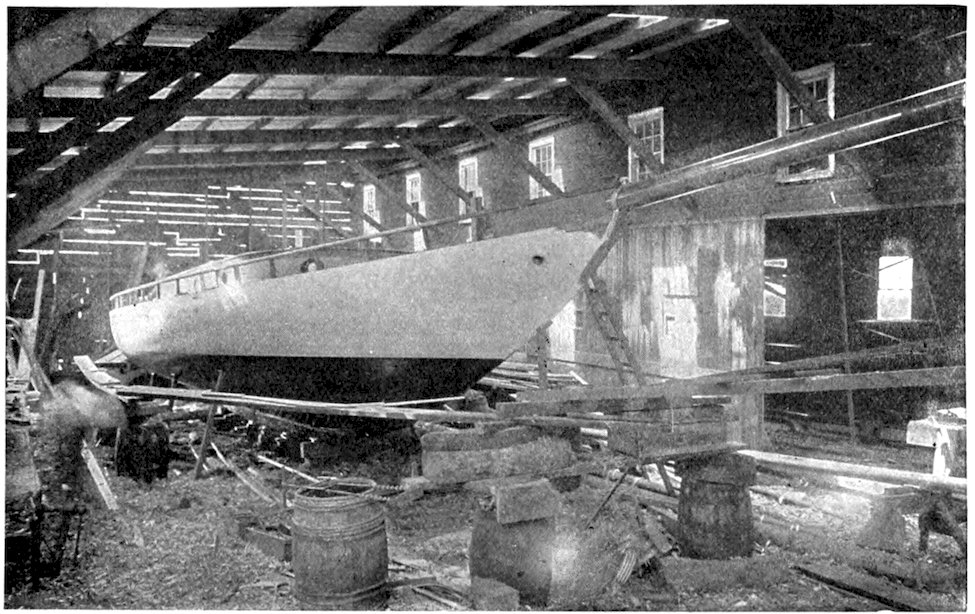
“UNCAS” ON THE WAYS.
Mr. Coate’s smart 10-ton cutter Madge, 67designed by Mr. G. L. Watson, was a single-skin craft. She was built in 1879 and created a great sensation when she came to this country and beat all our skimming dishes. In 1890 she was almost ready to fall to pieces, and her rickety frame had to be strengthened with iron knees and fitted with new topsides. In 1894 she was condemned as unseaworthy and fit only for the junkman.
On the other hand we have the cutter Oriva, designed by John Harvey and launched in 1881. She is of the double-skin construction, lighter in proportion to her size than Madge, and to-day she is as strong and stanch as she was when she was launched.
If the prospective builder decides to use wood as the material for his boat, he will find that American elm is the best material for the keel and the garboard strakes. When entirely submerged, elm will last for half a century or more, but is especially liable to decay between wind and water.
White oak should be used for the stem, sternpost, knightheads, apron, deadwoods and futtocks. The timbers should be of oak or hackmatack, and the planking of yellow pine. This material, if well seasoned and properly put together, should insure a sound boat. Yellow-metal fastenings should be used below the water-line, if the expense is not too much for the owner’s purse. If that should prove the case, galvanized 68iron may take their place. Personally, I believe in having the hull as perfect as possible. I would dispense with costly gingerbread work below deck, having everything cozy and attractive, and would expend the extra money, thus saved, on hull, spars and rigging, yellow-metal fastenings being my first object. Of course, if I were building a “freak” for a couple of seasons’ sport, I wouldn’t use a fragment of copper in her construction.
It is well to bear in mind that there is absolutely no market for an outclassed racer. For that reason I cannot recommend the expenditure of much money on the construction of a craft whose life in the usual course of events is limited to perhaps three seasons. Double skins and copper fastenings would be absurdly out of place in such craft. But when a man builds a cruiser, there is no reason why she should not be as sound and strong as a judicious expenditure of money can make her.
There is much to be said for and against copper sheathing for the bottom of a racing yacht. For some reason or other it has never been popular in this country. It was first used in 1761, when the British warship Alarm was coppered at Woolwich.
Mr. G. L. Watson is authority for the statement that, as early as 1834, a metal keel was fixed on the Wave, built for Mr. John Cross Buchanan by Messrs. Steele.
69The man desirous of obtaining distinction in the arena of yacht racing, supposing he decides to build a yacht of his own so that the luster appertaining to her achievements shall be inevitably associated with his name, should, in the first place, have a full and businesslike understanding with his designer, who will only be happy to meet him half way and will cheerfully name the honorarium for his draught. The designer supplies drawings, plans and specifications, and supervises the work of the builder.
The builder’s duty is to furnish an estimate of the cost of such yacht, which estimate, if accepted by the yachtsman, should be embodied in an agreement that takes the legal form of a contract, after being signed.
The agreement should specify:
1—That the yacht shall be constructed according to specifications and drawings furnished by the designer, complying with all requirements therein set forth regarding material and workmanship, and that all work shall be completed to the satisfaction of the designer and surveyor (if any).
2—That the yacht shall be delivered to the owner on a certain date afloat and complete, and in default of completion by such date, the builder shall pay a certain stipulated sum for each and every day afterward during which the yacht remains incomplete and undelivered, for liquidated damages, the owner being empowered to deduct 70such damages from the price of the vessel.
3—That the builder shall be paid by the owner a certain sum on the signing of the agreement, a further sum when the yacht shall be in frame, yet another sum when the yacht is timbered and planked, and the final payment when the yacht is completed to the satisfaction of the designer and surveyor, and delivered to the owner ready for sea.
4—All damage to the yacht, through fire or any other cause whatever, previous to her delivery to the owner, shall be made good by and at the expense of the builder, and to the satisfaction of the designer.
The specification should fully set forth the dimensions of the yacht and the material to be used in her construction. As an example I append the general specifications of the Uncas, one of the three one-design 46-foot schooners designed by Mr. A. Cary Smith in 1898:
General Dimensions.—Length over all, 64ft. 2in.; length on l.w.l., 46ft.; beam, extreme, 16ft.; draft without board, 6ft. 6in.; least freeboard, 3ft. Specifications: Keel, white oak, molded, 5½in.; stem, white oak, sided, 4½in.; sternpost, white oak, sided, 5in.; frames, hackmatack, double, sided 2in., molded at keel 3½in., at planksheer 2¼in.; floors, sided 2½ right and left; trunk log, sided 6in. and molded 10in., bolted with ⅝ galvanized iron; sides of trunk, yellow pine and white pine, 2x8in., bolted with ⅝ galvanized bolts; centerboard, oak and yellow pine, bolted with ⅝ galvanized iron; pin and hanging to be of brass; ballast to be of lead furnished by owner, 20,000 lbs. in all, 18,000 on keel bolted with ¾in. Muntz metal bolts, 25 in number; planking of yellow pine, spike fastened; clamps, yellow pine, 2 in number, 1½x6in.; shelf, same, 5x2in., worked to shape, 1 through bolt on each frame; bilge strakes, yellow pine, 3 on a side, 1½x6in.; ceiling, only where cabin work calls for it, ¾in. pine; deck beams, white 71oak, sided 3in., molded 2⅜in.; partner beams and house beams to be sided 6in.; partners, hackmatack, kneed with same; planksheer, white oak, 1¾x7in.; deck plank, white pine, 1¾in. thick by 2¼in. wide, spiked; bulwarks, pine; stanchions, white oak; trunk cabin, tongued and grooved sides, 1½x3in., with wrapper; trunk deck, tongued and grooved stuff, 1½in., covered with canvas; hatches and slides, mahogany; bitts, locust; windlass, pump brake; anchors, 120 lbs., 160 lbs.; chains, 70 fathoms, ⅜ tested.
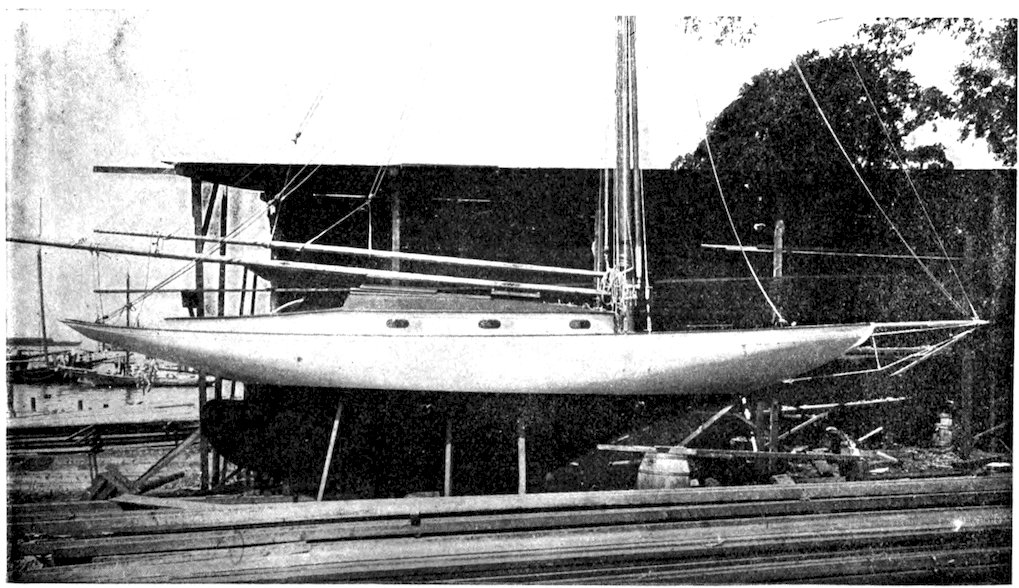
“OUANANICHE.”
72All chocks and kevels as required; steerer, Perley patent, mahogany wheel about 30in.; tanks, galvanized iron, to hold about 200 gals.; pump in galley basins to discharge in receivers (bilge pump); one small tank on C. B. trunk.
73Masts and spars of best spruce; rigging, best cast-steel wire rope and manila; sails to be as follows: mainsail, foresail, forestaysail, jib, small jib, small jibtopsail, second jibtopsail, spinnaker, two gaff-topsails, small maintopmast staysail; blocks of white ash; iron work of all kinds, of best iron galvanized; awning stanchions galvanized; joiner work to be of tongued and grooved stuff, where it will not be seen, and the rest to be paneled, of white pine, all to be of ¾ stuff; to be painted with three coats of paint.
The 21-footer Ouananiche, designed by Mr. T. E. Ferris and built at the same yard as Uncas, is an excellent example of the modern type of boat. Her accommodations are good and she is both fast and able.
The specifications may also include the cabin fittings and all furniture, upholstery for berths, and ship stores generally, not including edibles. It is more satisfactory to the owner to have an estimate of the total cost of the craft complete and ready for sea.
The owner too frequently suggests changes from the specifications, which, in all cases, entail considerable expense. These alterations are quite justly charged for by the builder as “extra work;” and if the owner is a good hand at “suggesting,” as the tyro generally is, the bill for “extra work” makes a big 74item when the final account is rendered. I have known it to amount to as much as $500 on a $2,000 craft. Sometimes vexatious litigation follows.
All this trouble may be avoided by having a clause inserted in the contract to the effect that no work done on the yacht without a written order, signed by the designer and countersigned by the owner, shall be deemed extra work. The careful builder will insist on such a clause if he is alive to his best interests.
A yacht, in the interesting process of construction, possesses a sort of hypnotic attraction to the man it is being built for. He haunts the shipyard from the hour the men turn to in the morning to the time they knock off at night. Naturally, he is anxious to know how she progresses. If he were a wise man he would keep religiously aloof from the scene of operations, and leave the work of inspection and supervision to his naval architect. These remarks apply only to the tyro, who is usually as proud of his first yacht as a young mother of her first-born. With old stagers it is different.
On the day of the launch it is customary for the owner to buy liquid refreshments for the workmen in the shipyard. The naval architect, too, feels hurt if he does not receive a personal invitation to the ceremony and a seat at the collation which follows the launch.
If a man has neither the means nor 75the inclination to build a boat of his own he need not despair. There are always in the market a number of serviceable boats. A shrewd buyer, if he keeps his weather eye open, may pick up a rare bargain. It is his own fault if he gets the worse of the transaction. Given a good designer and a good builder in the first place, he may safely conclude that the craft he has his eye on was not a “gingerbread” boat when she was launched.
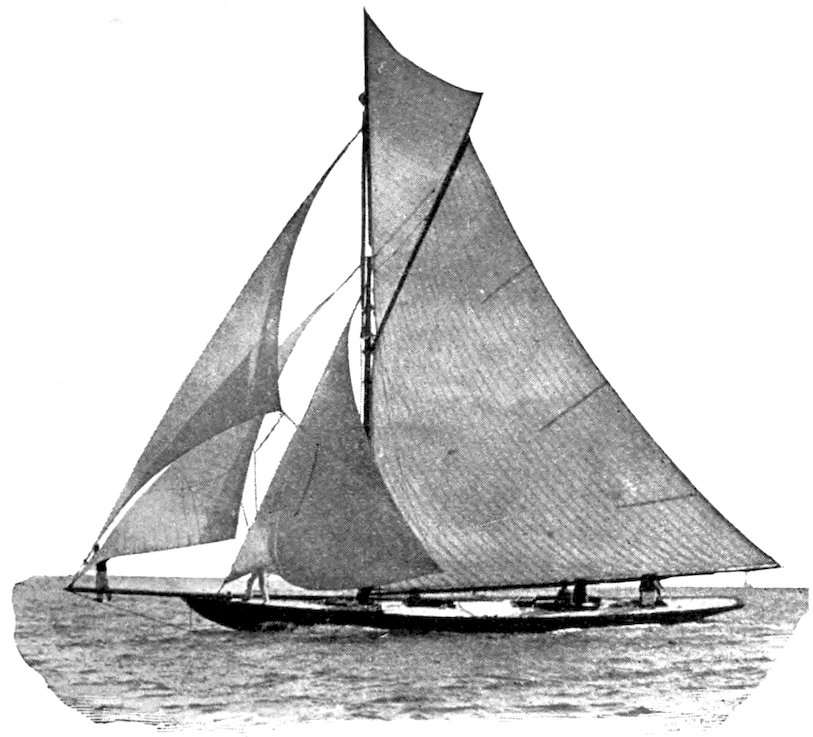
“DRAGON III.”
Unless the purchaser is well versed in boats I should by all means advise him 76to have the craft surveyed by a competent man, whose charge will be moderate. It is sure to be money saved. A boat with a bulb fin or a heavily weighted centerboard is peculiarly susceptible to strains and wrenches which a tyro would be likely to pass over, but which would be clearly apparent to the unerring eye of an expert professional.
Sometimes a man who thinks he is built on the lines of a yachting enthusiast joins a yacht club and builds a boat in a fashionable class. After a few weeks he discovers that all his enthusiasm has evaporated; that he takes no interest whatever in the sport. His next course is to offer his craft for sale. He is often so disgusted that he lets a purchaser have her for a song. This is a shrewd man’s opportunity, and he should not let it escape. It is not often, however, that such windfalls come in one’s way, in spite of the old adage that a simpleton is born every minute.
Let me in all seriousness conjure you never to buy or launch a yacht on a Friday! If you do, you will surely rue it. The superstitions of old sailors are not to be despised. It is quaint and curious that superstition of the sea about the lucklessness of Friday, but I for one most devoutly believe in it. I have reason, too, for on one fine Friday morning, ever so many years ago, I set sail from the port of Sunderland in the stout brig Goshawk, hailing from the port of Shoreham, with Captain Cuddington in 77command. On Sunday morning we were ashore on the Long Sand in a howling gale, and the brig went to pieces in six hours. I was saved with others of the crew by a smack from Harwich, in charge of brave John Tigh, but a poor boy, just fresh from a Sussex farm, perished. I shall always remember that day. There were two life-buoys aboard, and these the captain and the cook secured. The instinct of self-preservation was strong, no doubt, and it was not an era of heroes. I was a romantic child at that time, on my first sea voyage, and fresh from a course of “The Three Musketeers,” “Monte Cristo,” and other such entertaining literature. I thought then that we two little frightened boys would have been allowed the safeguard of the life-buoys. Now I know better.
![[Sunrise]](https://openoldbooks.sgp1.digitaloceanspaces.com/books/yachting-wrinkles/images/i_076.jpg)
III. THE TYPE OF YACHT. WHAT SHALL SHE BE—KEEL, CENTERBOARD, OR BULB-FIN?
When we come to consider the type of yacht most desirable to buy or to build, the problem is perplexing. We must in every case be guided by circumstances. For instance, a deep bulb-fin boat for racing or cruising on the shallow waters of the Great South Bay would be manifestly out of place. Nor would a sharpie be the most desirable class of craft for use on the deep water of the lower Hudson. Locality is what must guide us in our choice. Build or buy a boat suitable for the work she is intended to do.
Remember that nearly every type of craft, keel, bulb-fin, centerboard or double-huller, has some good qualities to recommend it. For cruising, a keel yacht of moderate draught, so as to be able to enter harbors where the water is comparatively shallow, may be recommended. A centerboard vessel for the same purpose, to those who prefer the type, holds further inducements. A wholesome knockabout for general purposes, 79fishing and class-racing affords lots of sport. A modern fin-keel for racing only cannot be surpassed. So out of these various types you have only to choose. It is not necessary in this connection to sing the praises of the keel type. It speaks for itself. For speed and safety it is equally adapted. In war and in commerce as well as in yacht racing it has made its mark.
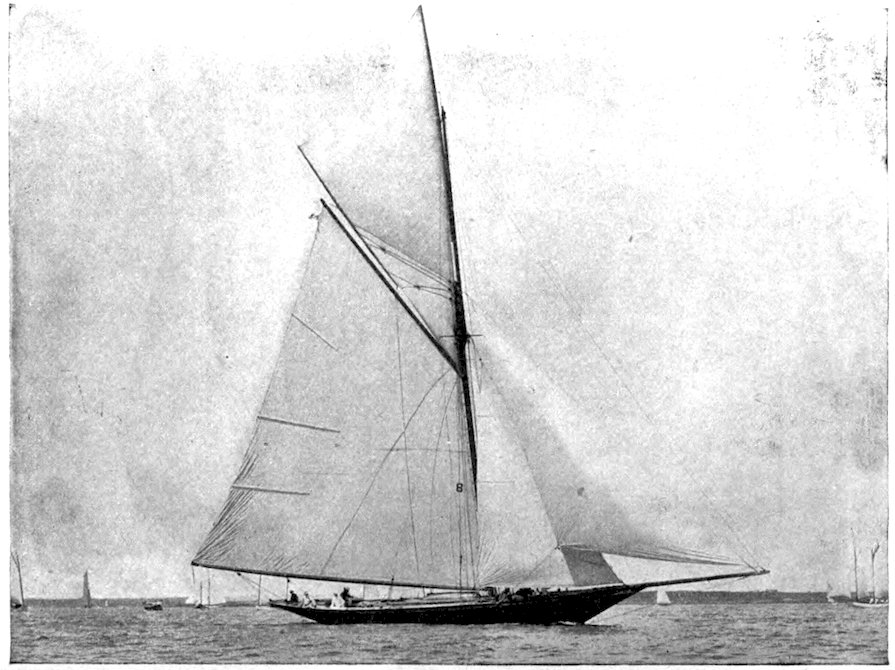
“GLORIANA.”
81There are a number of yachts which without exaggeration or affectation may well be characterized as epoch-making vessels. First comes the schooner America, which revolutionized yacht naval architecture in Great Britain. Then follows Evolution, the parent of the bulb-fin type of to-day. Next comes the Scotch cutter Madge, which was responsible for the decline and fall of our unwholesome “skimming-dish” type. Puritan is next—a compromise between the two extremes of deep cutter and shallow centerboard. It should be remembered in connection with this boat that she combined the factors of outside lead, moderate draught and ample beam, and was in every way a new departure, reflecting great credit on her talented designer, Mr. Edward Burgess. Gloriana was as pronounced a departure as Puritan, her famous spoon-bow and immense overhangs arousing all the British designers and causing them to steer a new course. Her influence was quite as great as that of America. She made Nat Herreshoff famous.
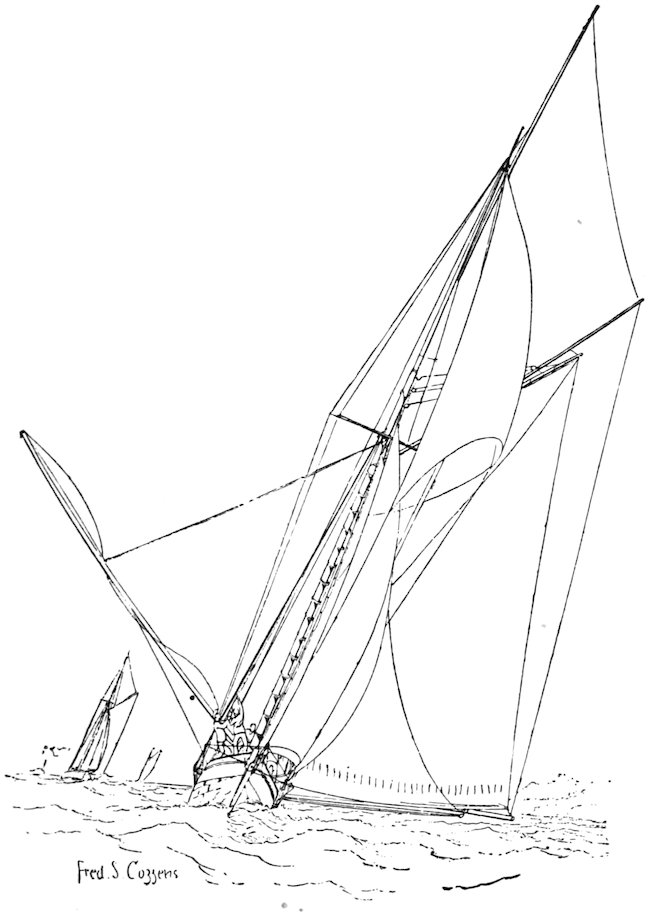
“MADGE.”
83The remarkable feature of Gloriana was that while her length on the load water-line was 45 feet 3 inches (she was built for the 46-foot class), her length over all was 70 feet. As the fullness of the bilge extended to bow and stern, the more she was inclined, the greater was her water-line length. I never saw a stiffer yacht. Her record for her first season (1890) was eight starts and eight first prizes. Dilemma, the Herreshoff fin-keel, may also be described as an epoch-maker, as her form and her fin were speedily adopted and adapted by British designers.
It will be noticed that all the yachts enumerated, except Puritan and Dilemma, are of the keel variety.
The long reign of what may be termed the demoralized centerboard type is happily over. It is really a matter of marvel that the shoal hulls of great beam, destitute of a safe range of stability, and carrying a dangerous spread of sail, did not oftener turn turtle and cause a greater loss of human life.
The Hudson River freight sloop was a safe and well-built craft, well adapted not only for the commerce of our coasts but also for long ocean voyages. So far back as 1785 the Albany, an 84-ton sloop, Stewart Dennis master, made a voyage to Canton, returning with a cargo of tea. Between 1790 and 1800 there were about a hundred sloops plying in the freight and passenger trade between New York and Albany, and proving 84fast and able. These packets flourished until steam drove them out of the business.
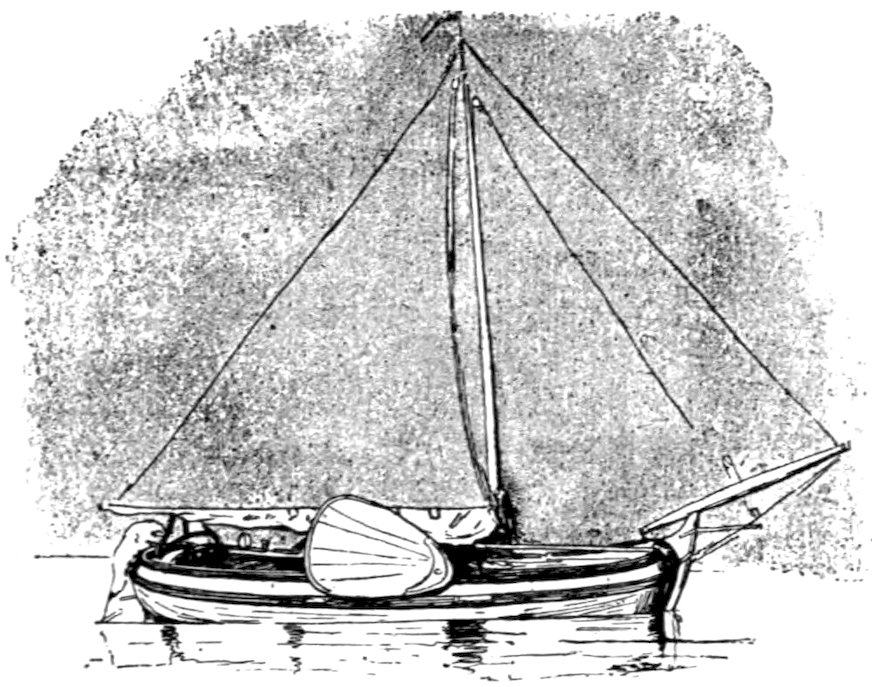
THE GERM OF THE CENTERBOARD.
The centerboard, an improvement on the Dutch leeboard, first used on the Hudson about 1830, has since been a necessity because of the shallowness of some of our harbors; and there is no reason why it should not continue to be popular, if the model is of sound design and the construction strong. Every objection against the centerboard system may be met by the argument that a large proportion of our coasting schooners on the Atlantic seaboard are fitted with centerboards, and ply their calling winter and summer, in storm and calm, and the unerring test of their seaworthiness is that the underwriters do not look upon 85them as greater risks than those of the keel variety. A marine underwriter is generally shrewd and businesslike, and keeps a close watch on the statistics of maritime losses. If it were proven by the wreck returns that centerboard vessels were more prone to succumb to the perils of the raging main than the craft not built with a movable fin, the inference is obvious, the premium of insurance would be graded to meet the risk.
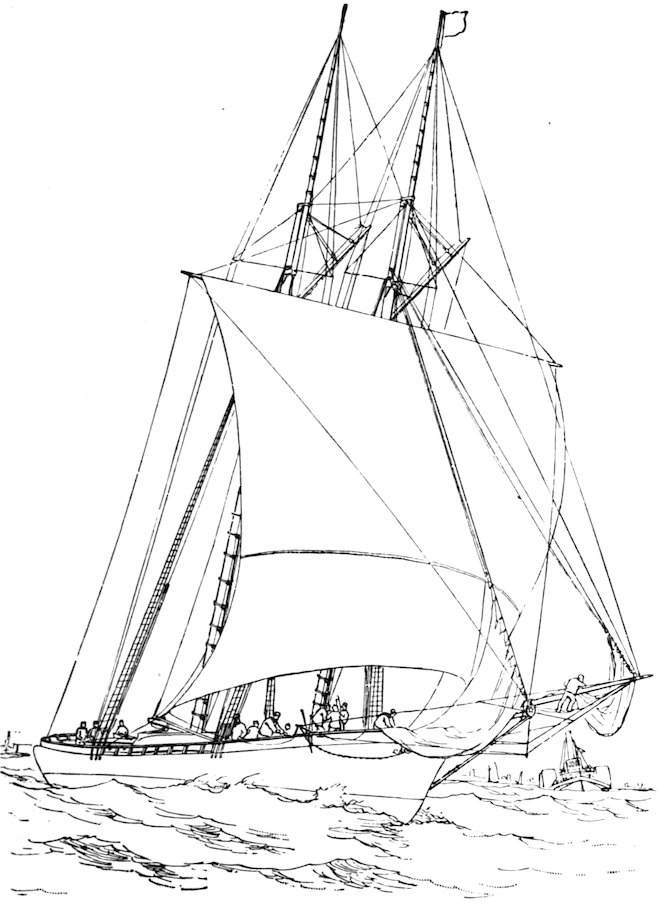
“VESTA.”
86I think that this argument will appeal to all people of common sense, and will settle the question of the relative safety and seaworthiness of the two types. But there is this to be said on the subject, that very much difference exists between a craft constructed for carrying coal and another built for the purpose of pleasure. I think it may be averred without error that the early centerboard yachts were, as a rule, modeled by shipwrights who had a due regard for the factor of initial stability as well as strong hulls scientifically put together. But, step by step, a school of naval architecture came into vogue, so far as centerboard yachts were concerned, in which most of the sound principles of yacht designing were totally ignored. Mr. W. P. Stephens, in an interesting and scholarly paper read before the Society of Naval Architects and Marine Engineers in 1895, well says:
“The centerboard lent itself as a willing accessory to the sacrifice of that depth which is essential to a safe range 87of stability, mere sail-carrying power being derived from an excess of beam, which was but an additional element of danger. In the search for speed under special local conditions, mainly those of summer racing, the true principles of naval architecture, so apparent in the work of George Steers and others of the earlier designers, were utterly ignored, and a most dangerous and vicious school of designing prevailed throughout American yachting.
“Taking the centerboard sloop and schooner as they were up to 1880—dangerously shoal and wide in model; often clumsily built of soft wood, with the poorest of fastenings; faultily ballasted with stone and iron inside; the hull inherently weak in form from the great beam and lack of proportionate depth; the entire middle portion of keel and floors cut away, with the familiar ‘hinge joint’ where the mast was stepped, just forward of the trunk; and with the deck construction made worse than useless as an element of strength through the absence of all beams in the middle portion of the vessel and the presence of a great superstructure, the cabin trunk—the accepted laws of naval design and construction fail to give any reason why such craft capsized no oftener and kept afloat as long as they did; and we can only fall back for an explanation on the doctrine of a special providence.”
Mr. Stephens is not only a naval 88architect, but also a practical shipwright, and therefore, his scathing arraignment of the centerboard type must be taken as emanating from his ripe judgment and long experience. It must be remembered, however, that he is a pronounced advocate of the keel type, and has long waged war against the centerboard. So far as his denunciation applies to the vicious and exaggerated variety I agree with him, heart and soul. But I am not prepared to condemn the whole class because of the glaring imperfections to be found in examples.
It must be borne in mind that without the aid of the centerboard the pastime of yachting would be impracticable on innumerable sheets of shallow water, both salt and fresh, to be found in North America. With that point in view, the abolition of the vicious element in the type, and its succession by a sound and seaworthy class of pleasure craft, should be the aim of all yachtsmen. And since the year 1880 great strides have been made in that direction. I have witnessed with joy the decadence and abolition of the “sandbagger,” a craft of immense beam, shallow draft, and big sail plan. The sandbagger was the ideal racing machine of twenty five years ago. Its place has been taken by the fin-keel. I wonder if the fin-keel is destined to be succeeded by the double-huller, such as Dominion, which made her début in Canada in 1898?
89In the course of the same paper Mr. Stephens also says: “To us familiar with it [the centerboard] from our earliest knowledge of the water, the striking characteristics of the type appeal with little force; but if, with our knowledge of the sea, of naval instruction, and of the strains and stresses to which every vessel is subjected, the idea were laid before us, for the first time, of a vessel with the entire backbone and floor construction cut away for the middle third of her length, devoid of deck frames almost from mast to rudder-post, with a great box amidships open to the sea, and with a thin, movable plane projecting deep below the bottom, it would be strange if the majority would not condemn on sight a combination so unmechanical, so lubberly, and so dangerous.”
But Mr. Stephens gives the other side of the question also. He says: “In the hands of competent and honest shipwrights the centerboard coasting schooner has disproved all theories as to the non-utility of the type for seagoing purposes: in a hull of moderate first cost and running expense it has carried swiftly, safely and profitably its cargoes of coal, lumber, sugar, firewood, barley, bricks, or general freight, both on the lakes and on the Atlantic, up and down the ‘Beach,’ across Nantucket Shoals, and around Hatteras in winter, light or loaded, taking in and landing its cargoes in localities inaccessible to 90the keel vessel. In the ocean coasting trade it has been and still is a powerful factor for good; and in the local trade it has been a Godsend to the small farmer or miller or lumberman, carrying his product cheaply and safely from his own small creek or bay to a profitable market. In the face of such practical results all theories as to the initial weakness of the centerboard type or its inferiority as a seagoing vessel must stand aside; numerous instances of bad design and construction may be found, it is true, but they prove nothing against the type itself in capable hands.”
This last extract gives a fair presentment of the whole question. It is by practical results that the centerboard yacht must be judged, as well as the centerboard coaster. I believe that the centerboard has been beneficial to the sport of yachting. I will go further, and will say that without the board yachting could not possibly have attained the great popularity it now enjoys in this country.
Viewing the subject broadly, I see no reason why the centerboard should not be good for centuries to come in honest cruising and racing, especially in classes of moderate size. The keel will probably bear off the palm in the larger classes of cutters and schooners, but for craft in the thirty-foot class and under, the centerboard has advantages which the bulb-fin in my judgment does not possess. Those who care for speed alone 91and whose ambition it is to acquire a stock of more or less inartistic silverware, will continue to pin their faith to the fin. Others who like to enjoy a modicum of comfort when afloat may safely swear by the centerboard.
When I was a young man I had an unconquerable prejudice against the centerboard. My opinion of the type was often expressed in language of great warmth and strength. Mind you, I was not so utterly devoid of common sense as to be blind to the advantages of the “board” in shallow water. I had, however, a fixed idea that the average centerboard sloop was no good in a blow. This view has been considerably modified in the school of experience. It once fell to my lot to be an eye-witness of the excellent seaworthy and speedy qualities of a centerboard sloop in an easterly gale on Long Island Sound. When we reached port I was perfectly willing to confess that a vessel of the type aboard which I had been, if well-found and well-manned, was equal to any keel boat of her size that I had ever sailed on.
Permit me to spin you the yarn:
The cruise of the Atlantic Yacht Club in 1889 will always be remembered because of the bad weather encountered on the Sound between Black Rock and New London. In that year Jefferson Hogan was Commodore and the schooner Cavalier was the flagship. I was the guest of Vice-Commodore E. B. Havens 92on his stout sloop Athlon, a remarkably fast and able craft in heavy weather, but by no means speedy in light airs. She was built by Mumm, at Bay Ridge, for Dr. Barron. Mr. Havens bought her and lengthened her six feet, adding a handsome “Burgess stern,” which improved her appearance wonderfully. I joined the Athlon at Black Rock, Conn., on Saturday, July 13th, and, after passing Sunday very pleasantly, turned in early, as the orders were to get under way next morning at five o’ clock, the early start being necessary, as our destination was New London, distant nearly fifty miles to the eastward.
I recall that, as we were enjoying our pipes on deck preparatory to going below for the night, the weather looked dirty and the barometer was falling.
The guests of Mr. Havens besides the writer were Mr. Levi Burgess and Mr. Havens, Jr. All of us were capable of lending a hand in an emergency, and when the time came we did our level best.
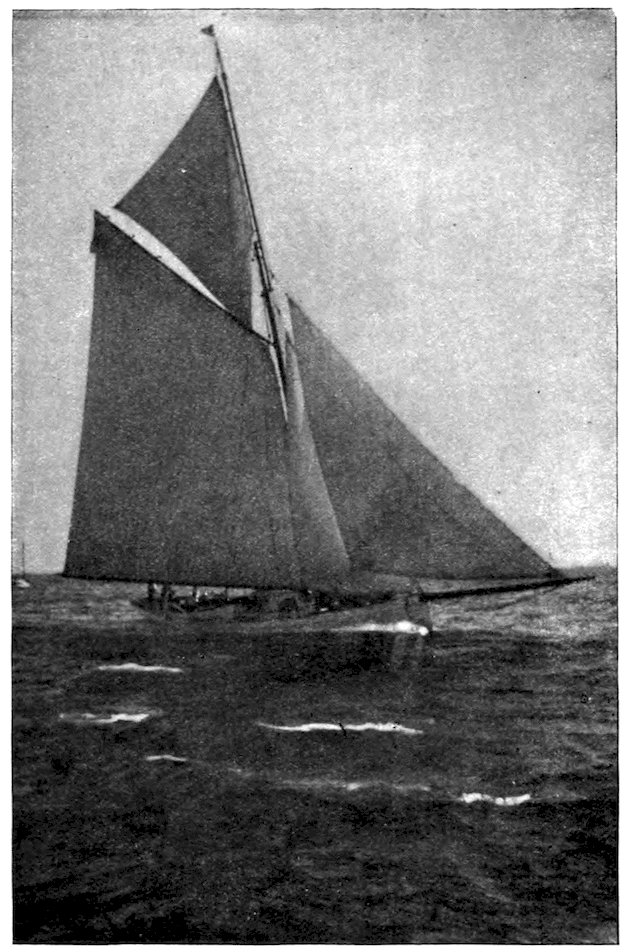
“ATHLON.”
The preparatory gun from the flagship aroused us next morning at an hour when the early birds were still roosting. Going on deck we found a light wind blowing from east-northeast and a drizzling rain falling. The sky looked threatening, and all round the horizon black and angry clouds were clustered. A glance at the aneroid in the companionway showed a fall of two-tenths of an inch during the night. 95While the men were sweating up the peak and throat halyards and heaving short on the anchor chain, Mr. Burgess and I sneaked below and interviewed the steward, with the result that we each got outside of a cup of fragrant coffee mellowed with some remarkable old cognac, carried on the Athlon for medicinal purposes only. Fortified with this we joined our shipmates on deck, giving an imitation of two men looking eagerly for work and praying to the gods not to be successful in the quest.
“Shall we get the jibtopsail out of the sail locker?” inquired young Mr. Havens of his father.
“I guess the weather looks more like a double-reefed mainsail than a jibtopsail,” was the reply. So the jibtopsail reposed in the locker.
Bang! went the gun from the Cavalier. It was the signal to start. Anchors were broken out smartly, jibs were hoisted, and the squadron sailed out of the harbor and began the long and dreary beat to New London in the chilly, pelting rain.
As I remarked above, the Athlon requires a strong breeze to start her, and, although our anchor was up in good time, the smart sloop Anaconda, with Mr. Prague at the helm, looming up like a gray ghost in the mist, glided past us and assumed the lead of the fleet. The Anaconda was the only boat in her class that ever beat the swift Fife cutter Clara—an achievement that speaks volumes in her behalf.
96“Our turn will come by and by,” tersely remarked Mr. Burgess. Events proved that he was a prophet.
Presently the Anaconda, far out to windward, was struck by a savage squall. Down came her flying kites by the run. I looked at her through the glass and saw her heel over until the water boiled and bubbled on her lee deck. All was now activity on the Athlon. The boats were swung in and everything was made snug for the approaching gale. Mr. Havens determined not to reef till the last moment, and just before the squall, with its long line of white water in marked contrast with the murky clouds above, smote us, we clewed up the gafftopsail. It wasn’t an instant too soon. Had that topsail been set when the blast hove us down nearly on our beam ends the topmast must have snapped off short, like the brittle end of a carrot. Mr. Havens was steering. He gave her a few spokes of lee helm and kept her shaking in the wind till the first fury of the squall was exhausted. It was almost as dark as pitch for ten minutes. When it cleared up a little we cast anxious eyes to windward and to leeward to see what had become of our companions. The Anaconda had snugged down to a couple of reefs. The 40-footer Chispa, a brand-new Burgess boat, was taking it easy under storm trysail and foresail. The sloop Concord was scudding back to Black Rock under a bare pole, with the Fanny chasing her under short sail. 97The schooner Azalea was having a lot of trouble, and the flagship Cavalier was making plucky efforts to collect her scattered and stormbeaten convoy about her.
Just about this time the Athlon began to go. She was carrying her whole mainsail, jib and foresail. Every now and then a shower of spray dashed over the weather bow and drenched the Commodore as he stood at the wheel. The yacht now and again careened to the puffs to such an extent as to take in green water over the lee coaming of the cockpit. We passed the Chispa as if she was at anchor, and soon began to forereach on the Anaconda. Under the pressure of the gale the masthead fairly buckled. It was a case of carrying on sail with a vengeance, but the Commodore had confidence in his craft, and Mr. Burgess and I had confidence in the Commodore, so we went below and drank to the health of the brave little ship. The steward forsook his kitchen and pantry. He was too nervous to stay anywhere except on deck. As Byron sings:
The wind and sea increased. Lumbering schooners bound to the eastward 98showed only a rag of canvas, while the west-bound coasters were under single or double reefs. Still the Athlon held on to everything, showing the ability of a representative centerboard sloop to do wonderful work in heavy weather. At last things came to such a pitch that we just had to shorten sail. We were knocked down by a squall of particular violence. Anybody to windward of us might have caught a glimpse of Athlon’s keel. We hauled down the jib and tied a single reef in the mainsail, which, being brand-new and soaked with rain and spray, was hard to handle. At last we got it reefed, and after swaying up the halyards taut as bars of steel we hammered at it once more.
The gale was dead in our teeth. The other yachts of the fleet had disappeared, most of them seeking harbors of refuge. The Athlon’s destination, however, was New London, and thither she threshed her way right gallantly, making a short leg and a long leg along the Connecticut shore. Never before had I seen so heavy a sea in the Sound, and I had had a long experience on which to draw.
The crew looked like drowned rats. Every time we tacked, the yacht shipped a good deal of water as she plunged her bows under in the steep head sea. It was hard work for all hands, but there was a lot of excitement in it. By and by we struck a streak of good luck. It was off Branford Beacon, and it was 99just one bell in the afternoon watch. The wind had a trifle more northing in it, so much so, in fact, that our saucy and stanch little ship was able to lay her course for Bartlett’s Reef lightship, thirty-five miles distant.
This prospect cheered us up considerably. The steward resumed duty and gave us a square meal of fine cold roast beef and pickles, which we washed down with bottled Bass. Thus strengthened, we went on deck and set the jib, gave her a foot or two of the mainsheet, and, keeping her a good full, went smoking through the perturbed sea at a great rate. The whole distance to Bartlett’s Reef, at the entrance of the River Thames, was accomplished with the Athlon’s lee rail under water. Strong gusts from the land smote her at frequent intervals. If all her gear hadn’t been of first-class material, something would have carried away. At half-past four o’clock we passed the lightship, having made the thirty-five miles in four hours—a highly creditable performance, considering the villainous weather we had had.
Our troubles, however, were not over by a long shot. The ebb tide was running out of New London harbor with the velocity of a mill-race. It was blowing a living gale dead in our teeth. The beat to the city against wind and tide was as hard a one as I remember on this side of the Atlantic; but we drove her at it. Glad enough we were to cast 100anchor off the old steamboat landing at six o’clock, thus ending twelve hours of tough fighting, in triumph. The Chispa arrived at a quarter to eight o’clock that evening. The rest of the fleet reached port in straggling order the next day. The Athlon thus had the credit of beating the whole squadron, including several vessels treble her size. The Cavalier, of course, could easily have made the passage, but Commodore Hogan felt it his duty to stick to the bulk of the fleet, and for this he was justly commended. So thus it came to pass that Athlon made the record heavy weather run in her history, covered herself with glory, and made a convert of me.
I have had some experience of yachtsmen, but I feel bound to say that I never saw a vessel handled better in a blow than Athlon was by Commodore Havens on that occasion.
This must be added. If the Athlon had not been well-built, well-rigged, and her sails good, in addition to being handled most capably, it is not likely that she would have made such a splendid record.
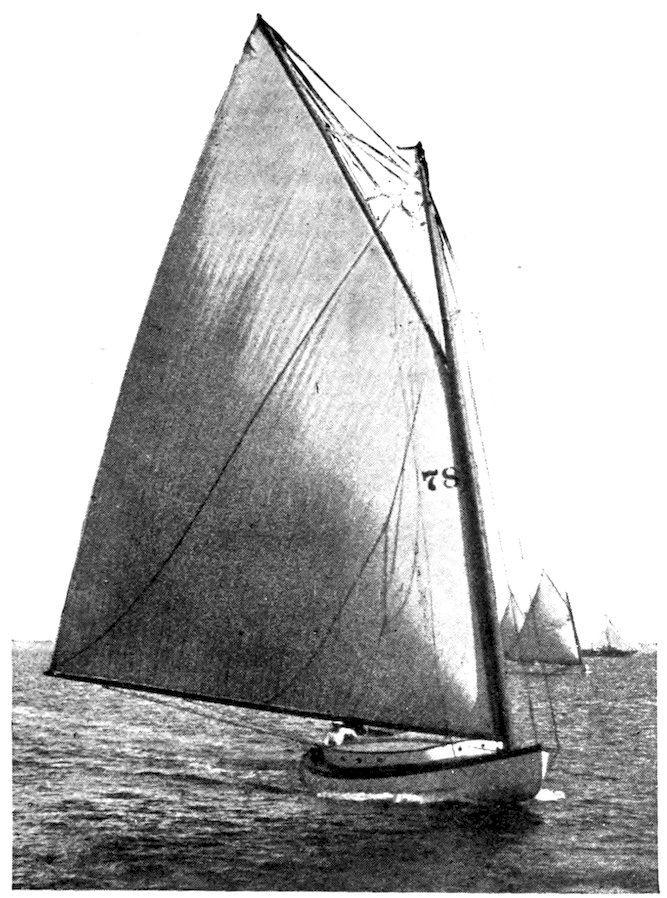
CATBOAT “DOROTHY.”
The popularity of the catboat as a racing craft will never die out in this country. The horseless carriage may supersede the hansom-cab in our city streets, and the electric launch may usurp the place of the Venetian gondolas, and drive the gay gondoliers to adopt some other means of livelihood. But the catboat is destined to survive all such revolutionary changes, and a century hence it will doubtless be more in vogue for pleasure, sport and business than it is to-day. In hull and sail plan it will probably be much improved, but its 102general type will remain unaltered. For cruising as well as racing it will never fail of an array of enthusiastic admirers.
Of catboats there are many varieties. They are plentiful at all waterside haunts, and as they glide gracefully to and fro they look so tempting and so easy to handle withal, that the visitor from the woods or the mountains longs to be afloat in one of them, grasping the tiller with his left hand, while his strong right arm encircles the slender waist of his trusting but slightly timid sweetheart. The average catboat is as safe as a church when sailed by a man who knows how, and the art of sailing her may soon be acquired. But when a lubber undertakes to handle her she may become as stubborn as a balky mare and as perilous as the bottomless pit.
Many who have no liking, inherent or acquired, for the modern racing freak, whether in the 15-foot, 20-foot or 30-foot class, need not give up their hopes of acquiring fame in mosquito craft racing. A good, fast catboat is never out of date, and there are various classes of these wholesome little vessels in which there is always room at the top. The best of the racing cabin-cat is that she has not yet degenerated into a mere machine, but has certain modest accommodations which permit her to be used for pleasant cruises.
The heavy sand bags, or shot bags, which a few years ago necessitated so much laborious toil and the carrying of 103such large crews, are now, happily, out of date, shifting ballast being barred in nearly all clubs. The modern cat carries outside ballast, which makes the sailing of her a pastime, not a perspiration-compelling task, while for handiness in rig the cat cannot be surpassed.
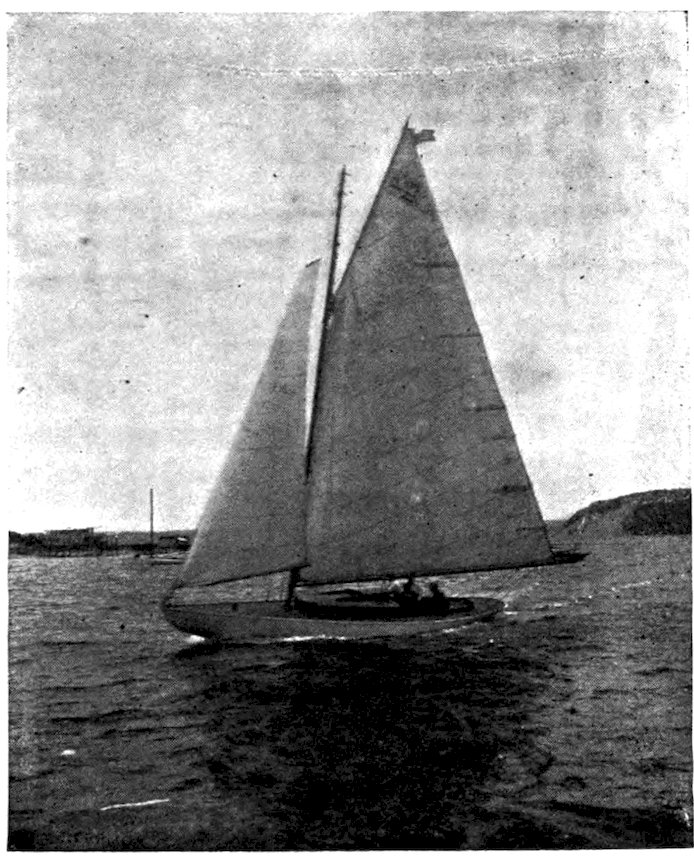
“KEWAYDIN.”
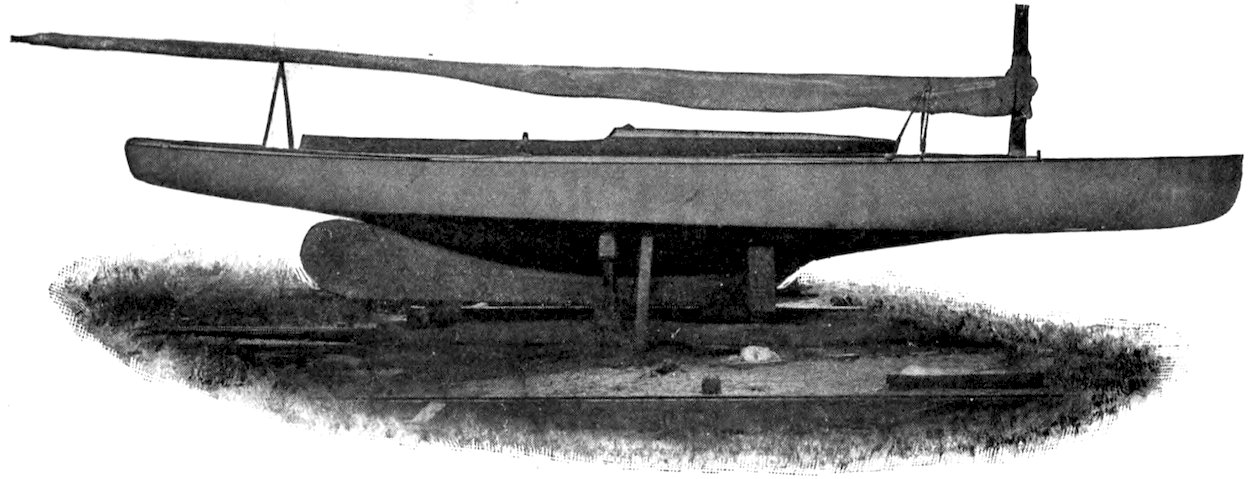
THE HERRESHOFF CATBOAT “WANDA.”
By many ingenious methods and contrivances the mast is so securely stepped and stayed that there is now no danger in carrying a press of sail in a piping 105blow or a steep head sea. The boat can be sailed along and permitted to feel the full strength of the breeze without any fear of springing the mast or straining the boat forward.
Catboats of many kinds there are, from the craft common in the Great South Bay, with its pleasant but rather flimsy summer cabin, to the robust boat of Cape Cod, which bravely dares the steep seas of a stormy coast, and is at her best in a vigorous blow. I don’t know of any craft of such light draught that can compare with the “Caper” for bad-weather qualities and general all-around usefulness. She is by no means pretty to look at, but her appearance can be materially improved without detriment to her sterling attributes. Mr. F. M. Randall has introduced to New York a modified “Caper.”
All his boats have been built by the Crosbys, of Osterville, Mass., who now have a branch shop in South Brooklyn. They have been highly successful, and with Ethel, Presto, Step Lively, and Scat, Mr. Randall won pretty nearly everything he tried for.
Not less successful was the catboat Kittie, designed and built for Mr. Hazen Morse, by Captain Thos. R. Webber, of New Rochelle. She has a lead shoe on her oaken keel, through which works her centerboard of Tobin bronze. Launched in 1894 and sailed by her owner, Kittie won fourteen first prizes that year, and in 1895 she carried off 106seventeen firsts. She is now owned in Galveston, Texas. She is 27 feet over all, 20 feet on the load water-line, 9 feet beam, draught 2 feet, mast 30 feet, hoist 19 feet, boom 33 feet, gaff 21 feet, and sail area 700 square feet.
The racing catboat is such a fascinating theme that a whole volume might be devoted to its advantages and possibilities. No finer craft in which to learn the rudiments of yacht racing can be chosen by an amateur; and there are several classes, large and small, in which eager rivals compete from the beginning to the end of the yachting season, offering many opportunities for the winning of prizes.
A successful racing cat is the 25-foot cabin craft Wanda, designed and built by the Herreshoffs, for Mr. F. T. Bedford, Jr., of Brooklyn. She is 30 feet over all, 21 feet 9 inches on the load water-line, with 12 feet beam. Her record for 1898 was thirteen starts and thirteen firsts.
May 16th.—Norwalk.
May 30th.—Norwalk.
June 25th.—Indian Harbor.
July 2d.—New Rochelle.
July 4th.—Larchmont.
July 9th.—Riverside.
July 14th.—Seawanhaka; won in 30-foot class by eight minutes actual time.
July 23d.—Norwalk.
July 30th.—Indian Harbor; won on resail.
August 13th.—Horseshoe; 30-foot class by twenty-six minutes.
August 20th.—Huguenot.
August 26th.—Huntington.
September 3d.—Atlantic.
25-foot cabin catboat Wanda: 21ft. 9in., l. w. l.; 30ft. o. a.; beam 12ft. Designed and built by the Herreshoff Manufacturing Co., Bristol, R. I. Owned by F. T. Bedford, Jr., Brooklyn, N. Y.
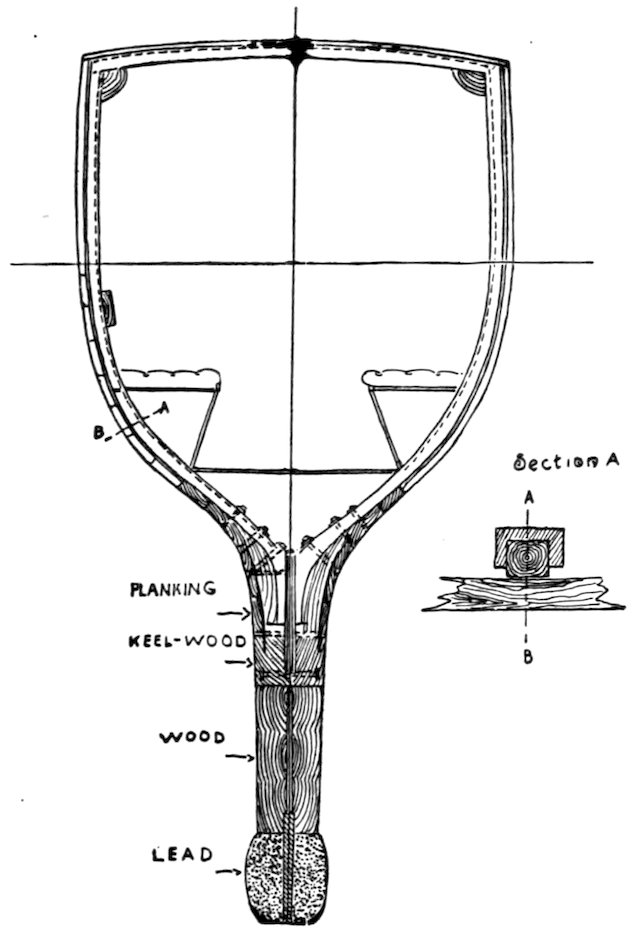
MID-SECTION OF “EVOLUTION.”
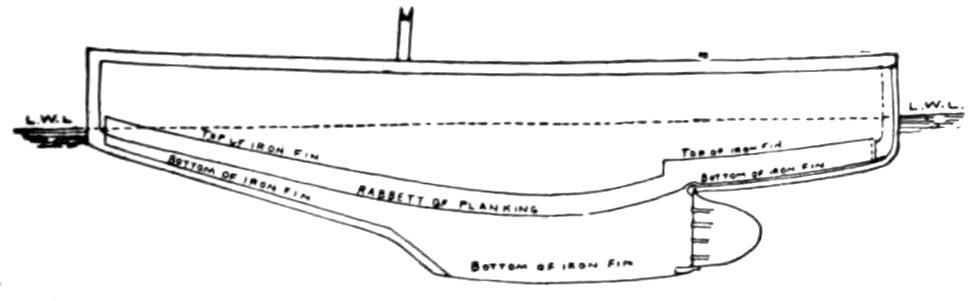
SHEER-PLAN OF “EVOLUTION.”
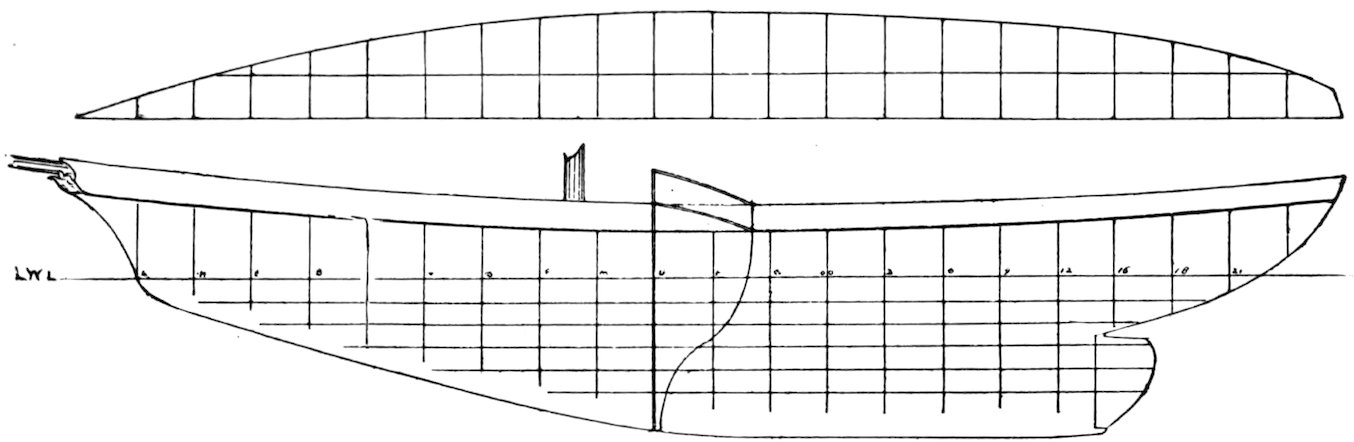
LINES OF “JULLANAR.”
109By a glance at the illustration of Wanda (p. 104) it will be seen that Mr. Nat Herreshoff, her designer, has introduced the modified form of fin-keel which he exploited so successfully in Vigilant. Wanda, in point of fact, was designed and built to elude the measurement rule in force at the time of her creation. Like Gloriana, when heeled, she gets the benefit of long overhangs forward and aft, while at the same time she escapes the penalty of excessive length on the load water-line. Taking into consideration all her features, it must be candidly acknowledged that she is the most “scientific” catboat that “tonnage-cheating” ingenuity ever devised. Both the principles of yacht designing that worked so admirably in Vigilant and Gloriana, namely the large lateral plane and the increased water-line length, when heeled, have been embodied in Wanda. The result has been a gratifying success. Catboats of the olden time used to measure about the same length over all and on the water-line. It remained for Mr. Herreshoff to produce a boat 21 feet on the water-line with an over-all length of 30 feet.
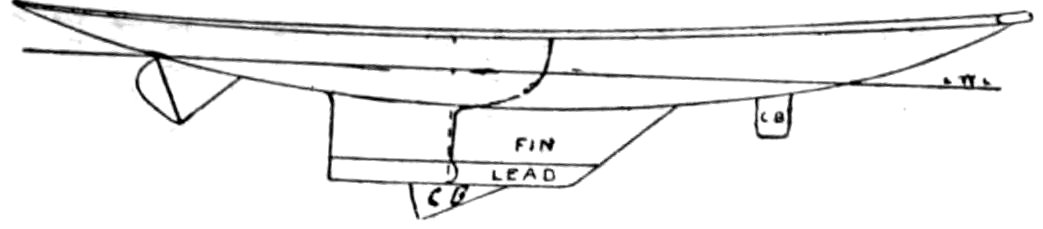
“JUBILEE.”
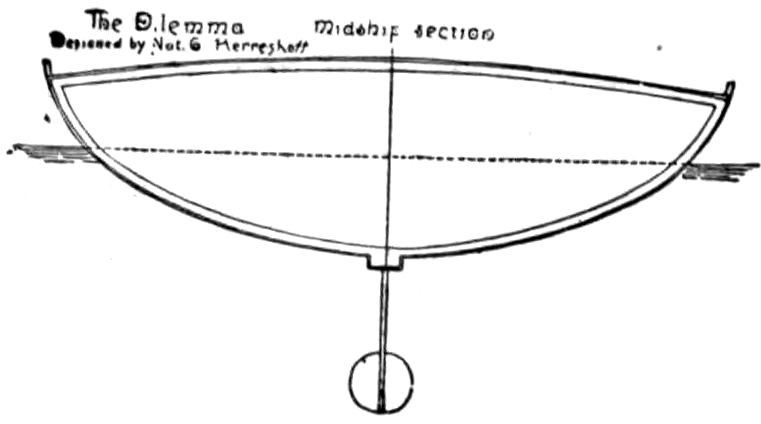
“DILEMMA.”
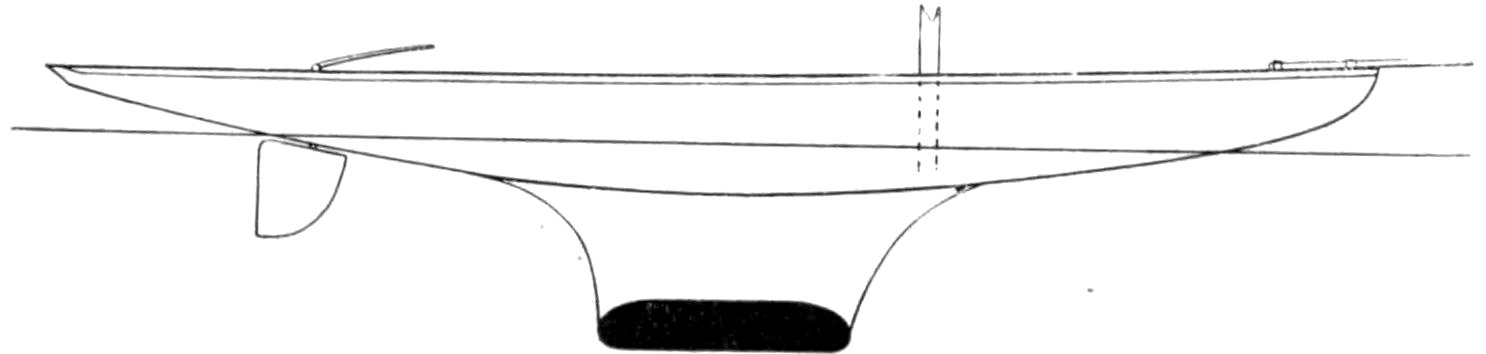
“NIAGARA’S” LINES.
In marked contrast to the Wanda is the catboat Dorothy, which is quite famous, both as a cruiser and a racer, on Long Island Sound. She is a sturdy boat that can give a good account of herself in a blow, and, in addition to this most excellent quality, she has a 111nice roomy cabin, in which every inch of space is utilized. Her mast is well secured by means of stays and spreaders, and, as may be seen from the illustration, her rig is scientific and down to date.
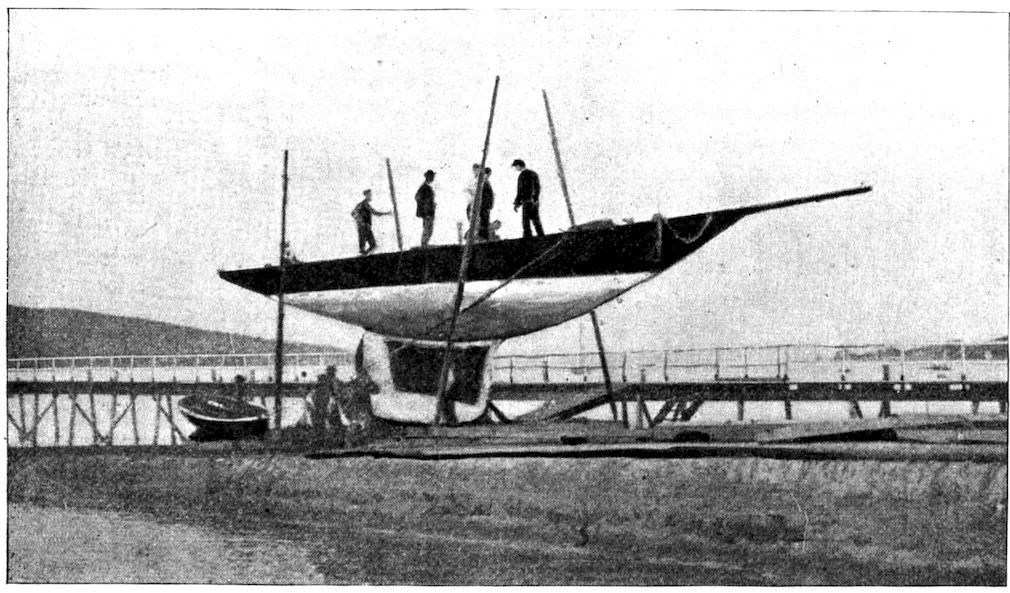
ENGLISH FIN-KEEL FREAK “NAMELESS.”
112The Dorothy is interesting as showing the transition stage between the old-fashioned catboat and the new Wanda, which is sure to become popular as a racing machine, but from her limited accommodations is not likely to be much sought after as a correct type for mere cruising.
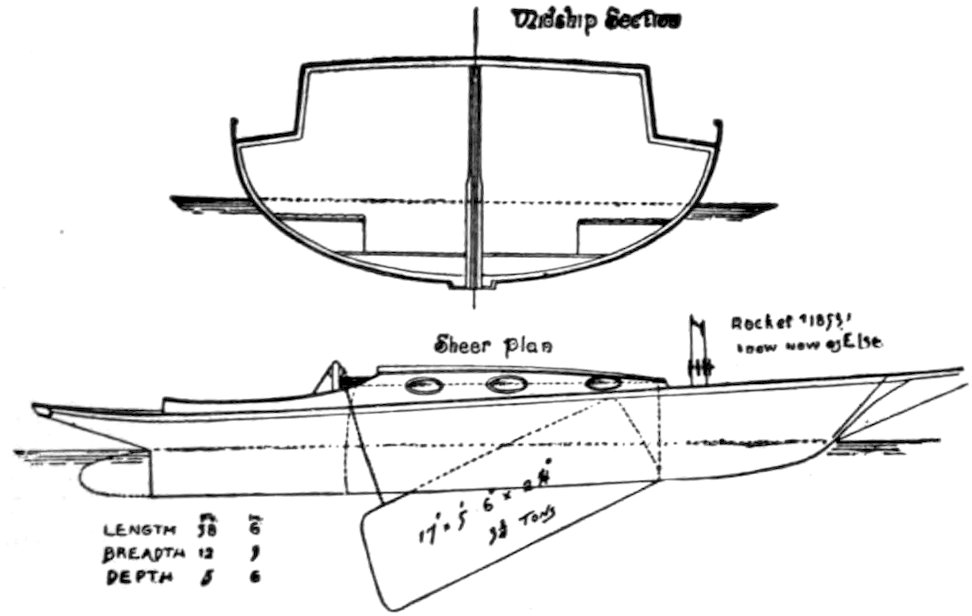
“ROCKET,” 1851.
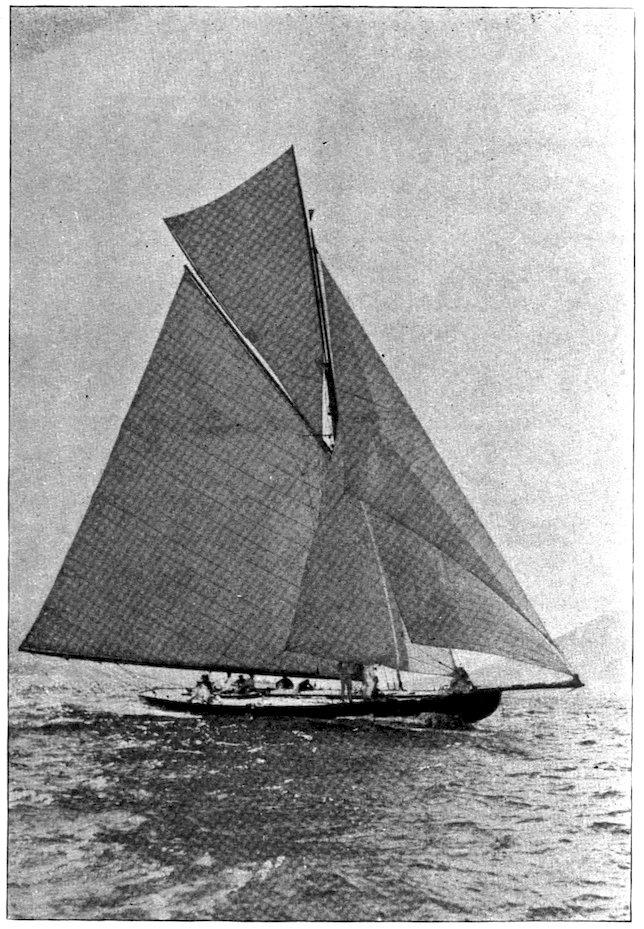
“NIAGARA.”
114I have said before that Evolution was the parent of the ballast fin, and in an article I wrote for Outing many years ago I think I made out a good case. She was designed by Mr. E. H. Bentall, an English manufacturer of ploughs and other agricultural implements, whose famous yawl, Jullanar, created a sensation when she came out in 1875, 115from the circumstance that the deadwood was cut away fore and aft in the most audacious manner. She was, perhaps, the most original tonnage cheater ever built, as a study of her plans will show. The cutting away of her forefoot was followed by Mr. G. L. Watson in his design of Thistle, but he overdid it, leaving the yacht without sufficient lateral plane for successful windward work. Jullanar’s dimensions follow: Length over all, 110 feet 6 inches; depth of hold, 12 feet; length on load water-line, 99 feet; extreme beam, 16 feet 10 inches; draught forward, 1 foot 6 inches; draught aft, 13 feet 6 inches.
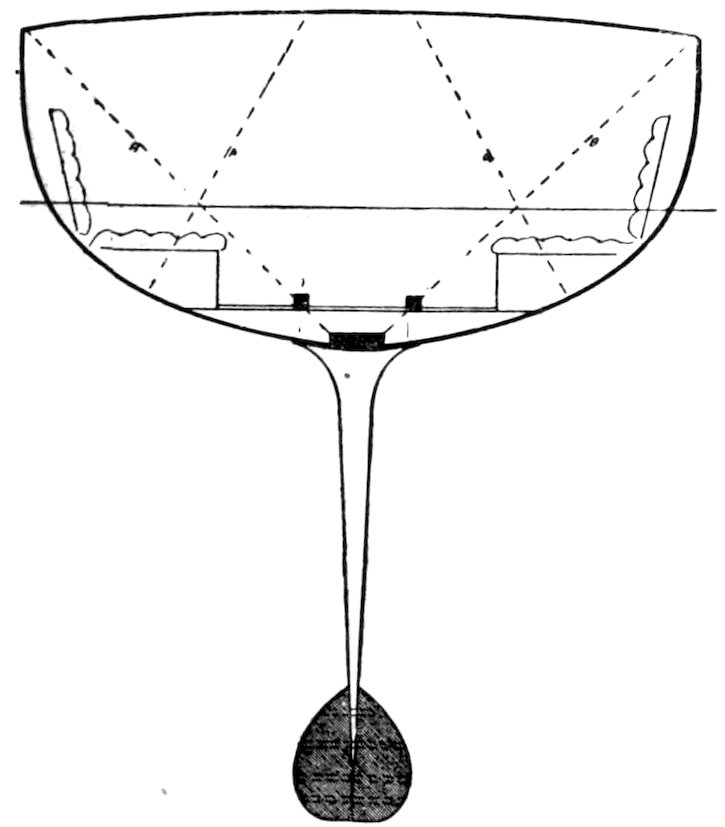
“NIAGARA’S” MIDSHIP SECTION.
116Evolution was launched in 1880. She was built to sail in the ten-ton class, and was the first yacht of which I can find any record to carry a bulb of lead on the keel. The transition to the Herreshoff fin-keel was natural and easy.
The first yacht to be fitted with a weighted centerboard was Rocket, whose sheer-plan and mid-section are on p. 112.
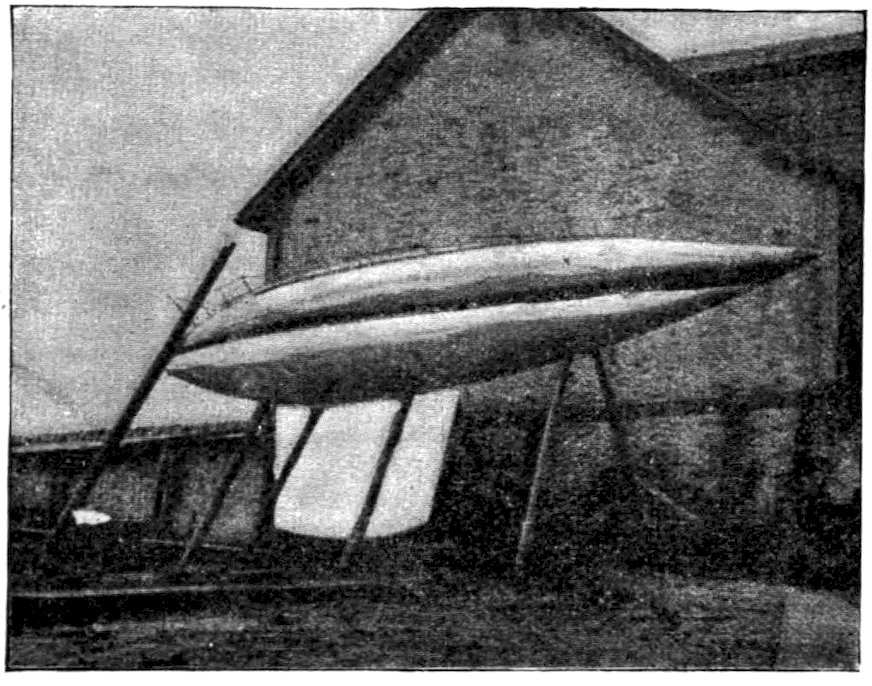
“RORQUAL,” TWO AND ONE-HALF RATER, 1894.
Niagara, a most successful yacht of the bulb-fin type, was designed by Mr. Nat Herreshoff for Mr. Howard Gould in 1895. She made a splendid record that year in British waters. She was sailed by Captain John Barr, who was skipper of Thistle when Volunteer beat her in 1887.
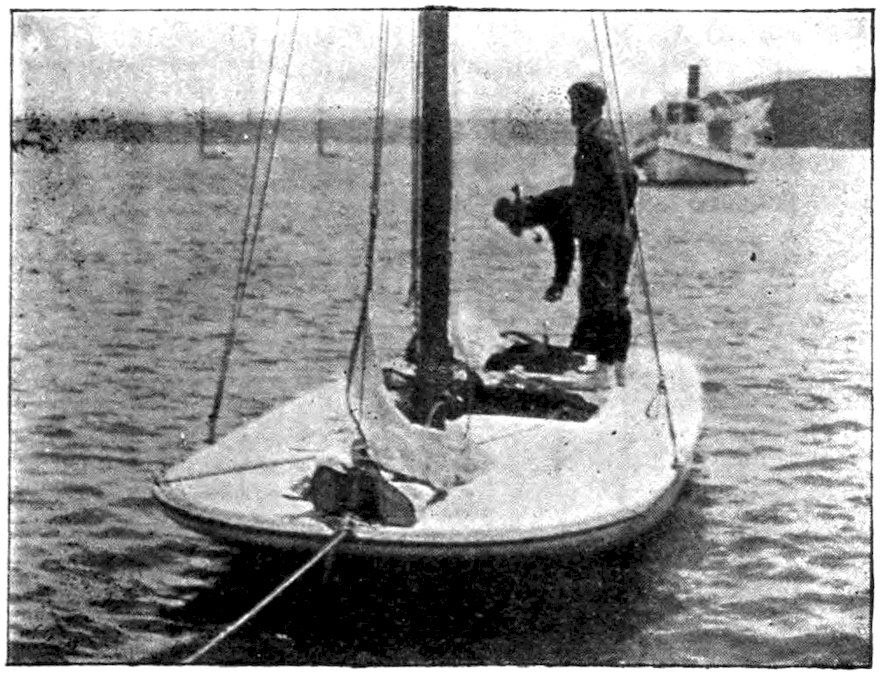
“DAD.”
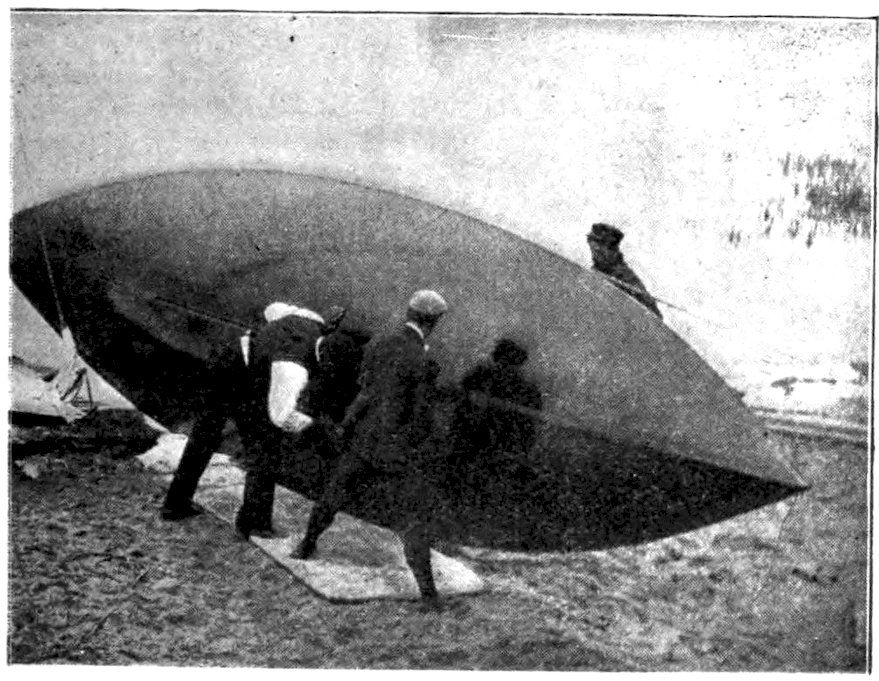
“VESPER.”
Jubilee, a fin-keel, with lead bulb and two centerboards, was designed by General Paine for a possible Cup defender in 1893. She was 122 feet over all, 84 feet 6 inches on the water-line, 11822 feet 6 inches extreme beam, and had a draught of 13 feet 9 inches. She competed in the trial races of 1893 against Vigilant, Colonia and Pilgrim, and was unsuccessful.
Fin-keels of the freak variety were produced in large quantities on both sides of the Atlantic, following each other in quick succession. Two of English design are shown in the illustrations. One is the Rorqual, the other the Nameless. Neither proved successful.
The last five years have been remarkable for the prolific production of “freaks” and monstrosities, three of which I show, the Skate, Vesper and Dad, all racing machines. In marked contrast to these abortions is the Seawanhaka knockabout Kewaydin, a wholesome type of boat with many good qualities to recommend it. I advise all my readers to fight shy of “freaks,” especially those of flimsy construction.
As a matter of history it may be mentioned that the centerboard schooner Vesta, in the midwinter ocean race of 1866, and the centerboard schooner Iroquois, in the blizzard of March, 1888, both acquitted themselves admirably, much to the surprise of the prejudiced devotees of the keel type.
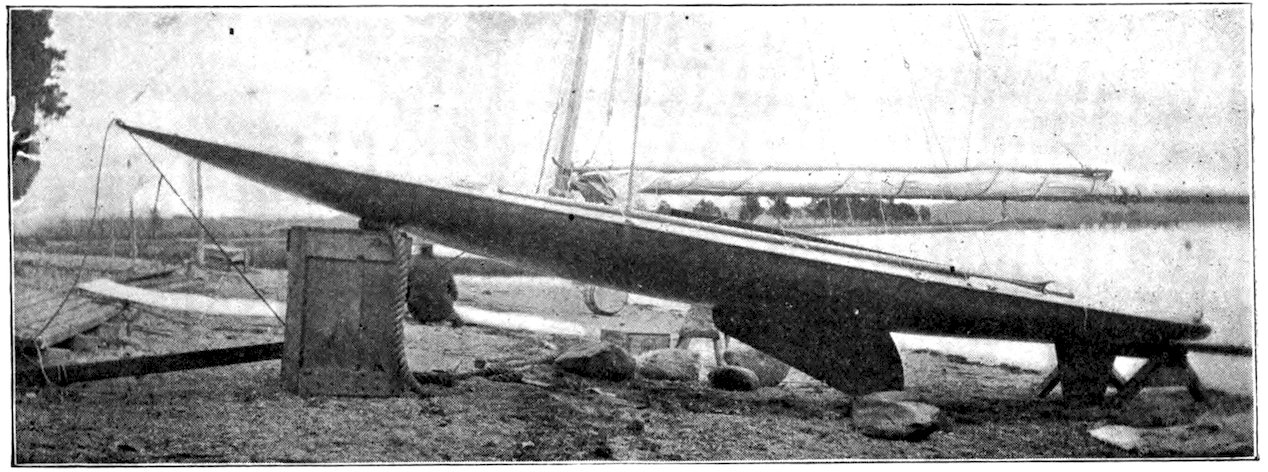
MONSTROSITY “SKATE.”
The double-hull type of craft came prominently before the yachting fraternity in 1898, and will doubtless be exploited in many ingenious ways hereafter. The development of a type of vessel whose origin is lost in the mist of 121antiquity into a racing machine like the twenty-footer Dominion attracted the attention of naval architects generally to Mr. Herrick Duggan, the Canadian yacht designer, who for three consecutive years has humbled the pride of the Seawanhaka Corinthian Yacht Club by keeping in Kanuck hands the cherished international challenge cup, won with singular ease off Oyster Bay in 1896.
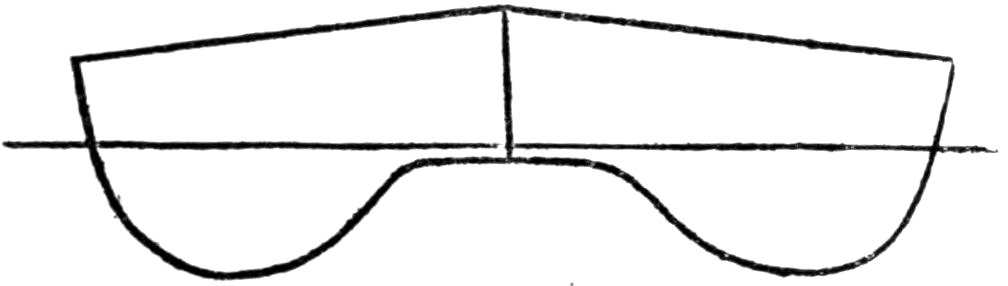
FIG. I. THE “DOMINION,” ON EVEN KEEL.
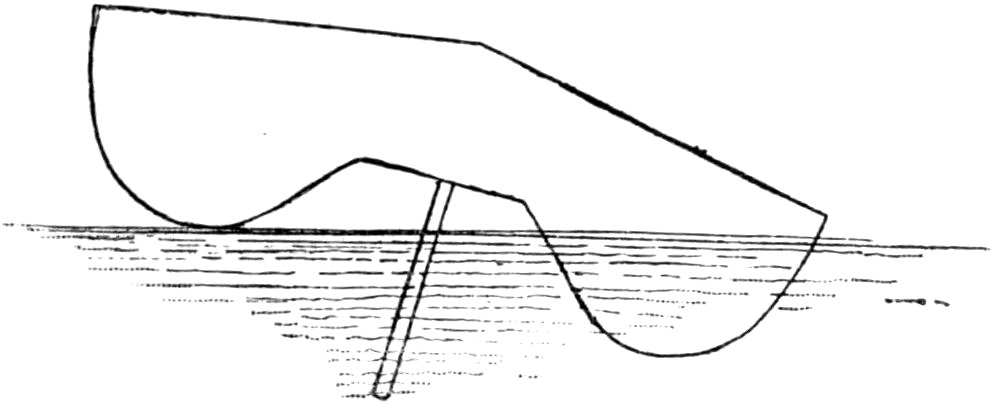
FIG. II. THE “DOMINION,” HEELED.
Mr. Duggan, of course, did not pretend to be the originator of a new type of sailing craft, but he may safely lay claim to whatever laurels are due to the faculty of astute adaptation. He succeeded in a field where others tried and failed. He skillfully modified the principle of the Malay proa, and introduced its salient characteristics into a vessel small indeed in the matter of dimensions, but 122huge when its inherent scientific possibilities are considered. Since Nat Herreshoff made practicable the crude fin-keel of former designers, no such interesting phase of marine architecture has been evolved.
As a matter of historical fact, it remained for Mr. Duggan to revive interest in the type, and this he did most effectually by the production of Dominion. The craft has given rise to much discussion among yachtsmen and in the press, both at home and abroad. The point of sailing in which Dominion excels is close-hauled on a wind or with the wind abeam. It is then that she sails on her lee hull only, the weather hull serving the same purpose as the ballast of a “sand bagger,” enabling her to carry a good press of sail. This is shown by Figure II., which portrays her when heeled. With the wind dead aft and both hulls immersed, Dominion in the races at Dorval was slightly slower than her rival, her paramount advantage being gained when sailing with one hull immersed.
Dominion’s dimensions are: Length over all, 35 feet 10 inches; on load water-line, 17 feet 6 inches; extreme beam, 7 feet 7½ inches; beam, load water-line one bilge, 2 feet 5½ inches; draught of hull, 10 inches; draught with board, 6 feet; freeboard, 1 foot; displacement, 1,750 lbs.; area midship section, total 2.88 square feet; sail area, 500 square feet.
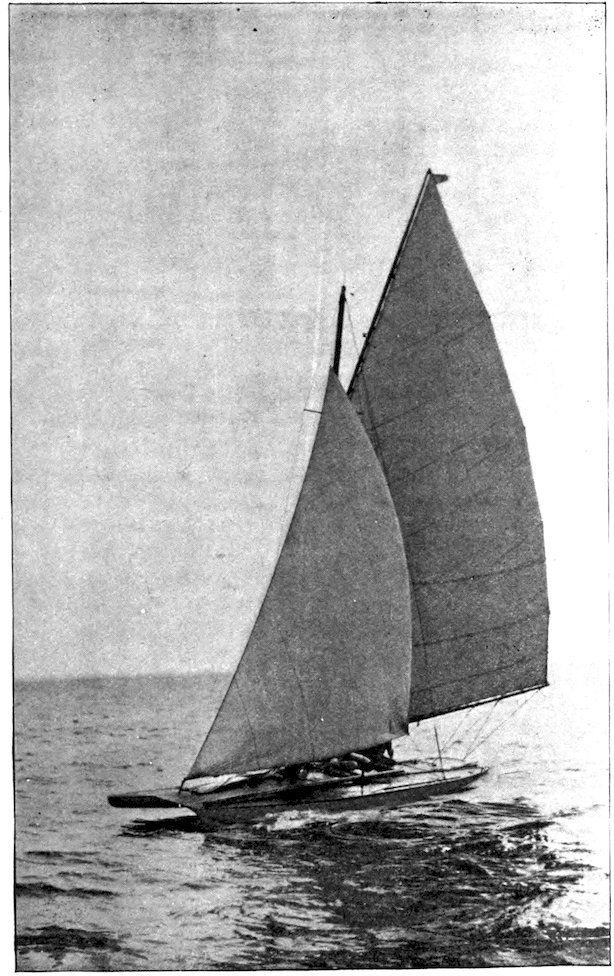
“DOMINION.”
125I remember how fascinated I was as a boy by the perusal of “Lord Anson’s Voyage Round the World,” telling how that famous English navigator, in his stout ship Centurion, doubled Cape Horn in 1740, visited the romantic isle of Juan Fernandez, and enriched himself and his accompanying bold sea-dogs by the capture of a Spanish galleon literally laden with treasure. Incidentally, the book describes the surprise experienced by the ship’s company at the first sight of the proa, as used by the natives of the Ladrones. In a copy of the first edition of the work, in my father’s library, was a quaint illustration of the proa under sail, with a plan drawn to scale, from which I made a crude model, and sailed her on an arm of the sea that washed the beach not fifty yards from our front door. I was not slow to recognize the advantage of the type in windward work. It was my good fortune in the year 1870, from the deck of the East Indiaman Hurkaru, bound to Madras, to obtain my first view of the Singhalese type of flying proa off the coast of Ceylon. The sight was novel and picturesque, and, being young and impressionable in those days, it was photographed indelibly on my mind.
The southwest monsoon was blowing briskly and the Hurkaru was bowling along with stunsails set at a nine-knot gait. It was my forenoon watch below, and I was suddenly awakened by a shipmate 126who invited me on deck to look at the “queerest craft I ever saw.” Turning out in a hurry I followed him, and from the topgallant forecastle saw the proa in the act of shooting across our bows. The breeze piped at a “three-man power,” for that number of lithe and swarthy lascars straddled the outrigger to windward, hanging on by their eyelids, after the manner of mariners the seas over. The sail that propelled this craft was of the sprit variety, but was made of cotton stuff and not of matting, as was the sail described in “Anson’s Voyage.” She darted past us, with rare velocity, throwing the spray over her crew in fine style. There were six or seven of them in the main hull of the proa, the helmsman steering with a rather long paddle. After she had cleared the ship’s bows she luffed up sharp and seemed to point almost in the wind’s eye, the sail sitting quite flat, unlike the sails of the ordinary “country wallah,” which are, as a rule, of the baggy kind. I judged her speed at about sixteen knots—certainly not less. The mast and sprit of her sail were of bamboo, the rigging of kyar. Subsequently I had several opportunities of inspecting these proas, and subjecting them to a close examination—notably at Pointe de Galle, where the Hurkaru touched to take in cargo on her homeward voyage.
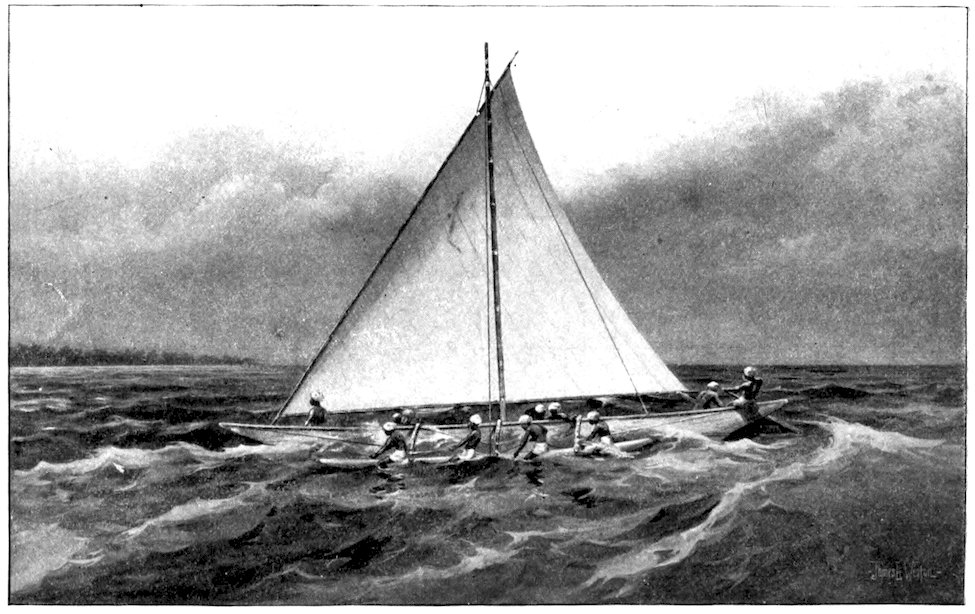
THE DOUBLE-HULLER OF THE PACIFIC.
128The main portion of the hull proper consists of a trunk of a tree hollowed 129out and hewn into symmetrical shape, bow and stern both being pointed. The bilge of the weather side is neatly rounded, while the lee side is as flat as the side of a half model of a vessel that is nailed to a board. Cut a double-end boat in two longitudinally, take one of the sections and nail on planks so as to form a wall-like side, and you have a fair imitation of the principle of the main hull of the Singhalese proa. To this trunk, when hewn into shape, are fastened the topsides, which consist of planks of suitable length and thickness bound with lashings of kyar rope, the seams being calked with cocoanut fibre, which swells when water-soaked. Not a nail is used in the construction of the craft, it resembling in this detail the famous Masoolah boats of the Madras coast. In all its essentials the characteristics of the proa of the Ladrones described by Anson are reproduced. The cigar-shaped log, which is connected to the main hull by bamboo outriggers (which give the necessary elasticity) and kyar lashings, is hewn out of a solid and rather heavy tree. This gives the required stability, and in a strong breeze pretty nearly all hands “hike out” to windward on it, leaving only the helmsmen (one at each end) aboard the main ship. It need not be said that the Singhalese are as nearly amphibious as it is possible for human bipeds to be.
IV. FITTING OUT AND TUNING UP. HINTS AS TO GOING INTO COMMISSION AND MAKING THE CRAFT FIT FOR A RACE.
We will now assume that, either by buying or building, the amateur yachtsman has come into possession of a craft which he intends to race this season. If he has had the vessel built to his order, the designer will have seen that she complies with the specifications, which, of course, include all gear necessary for her mug-hunting efforts. If he has purchased a second-hand vessel, after having her surveyed by a competent naval architect it might be well to learn from him what repairs, if any, are needed to her hull or rigging. The next thing to do is to obtain estimates for making the repairs; and unless the yachtsman is an old hand at the business, and knows approximately what should be the cost of such work, I should advise him to obtain figures from two or more concerns if extensive work is called for.
It is unbusinesslike and unsatisfactory to order a master shipwright to haul a yacht out and make such alterations 131and repairs as he may deem requisite, but examples of such fatuousness have been known and have afforded much profit to lawyers and much unhappiness to clients on both sides. A shipwright may have views of his own about a racing yacht, and it is inadvisable to give carte blanche to any builder of ships, or even of houses.
In these days of progress in yacht naval architecture, to the man of sentiment there will always be one source of regret. The owner of a successful yacht that has gallantly won scores of well-contested races and has proudly flaunted a superb string of racing flags at the close of her second season, cannot help having an affection for his vessel, especially if she was designed and built to his order. To think that after a few short seasons she has become outclassed—a regular back number—naturally awakens many sad reflections.
Old-timers remember that racing craft, when their cup-winning days were over, were converted into comfortable cruising craft, fishing-boats, or pilot cutters. Nowadays such a transition is impossible. In many cases an expensive fin-keel is outclassed in a single season, and I have yet to learn what use she can be put to when her career after cups comes to an inglorious finish. Her lead, metal bolts, spars, sails and rigging may fetch a fraction of their first cost in a junk-shop; but few yachtsmen 132would care to buy a vessel of the kind indicated for cruising or fishing purposes, not only because of the lack of accommodation, but also on account of the unhandiness of the fixed fin, whose vicious qualities can never be fully appreciated until one happens to get stuck in the mud or sand with the tide fast ebbing and no tug in sight or any other means of hauling off into deep water available.
In the good old days of yacht racing it was customary to lengthen, “hip out,” rebuild and otherwise alter a boat that showed signs of having outlived her usefulness, and in a rejuvenated condition bring her to the line again and with her achieve new conquests. Such a method is rarely resorted to nowadays. In fact, it is doubtful whether it would pay. Mr. J. Rogers Maxwell, who owned the schooner Emerald, is one of the few yachtsmen in this country who, of late years, have made extensive alterations in large racing vessels with any degree of success. He practically rebuilt the sloop Shamrock, and greatly improved her speed, and has twice made radical changes in the Emerald at great expense, both processes making her slightly faster.
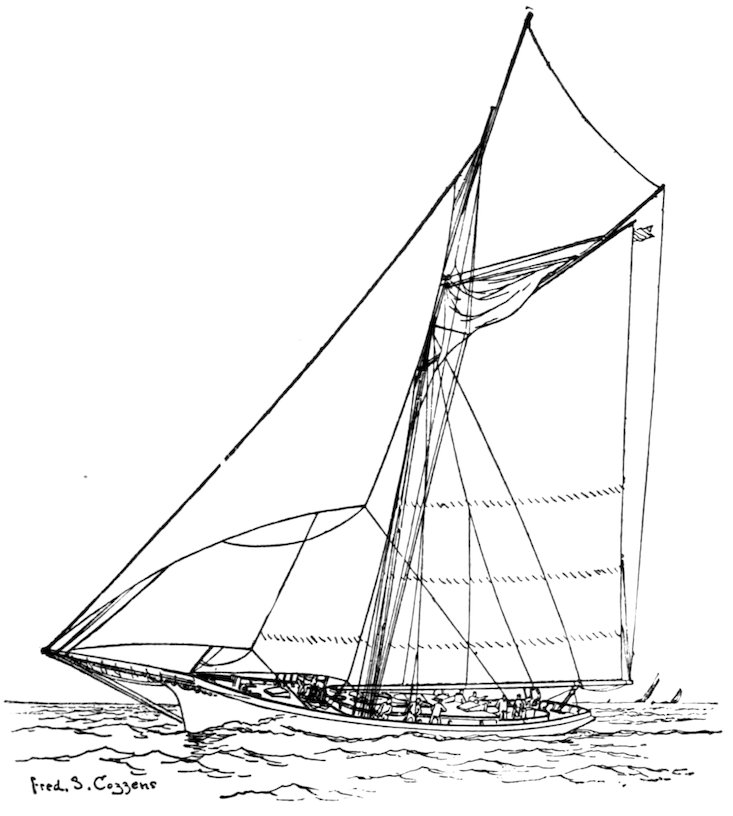
SLOOP “GRACIE.”
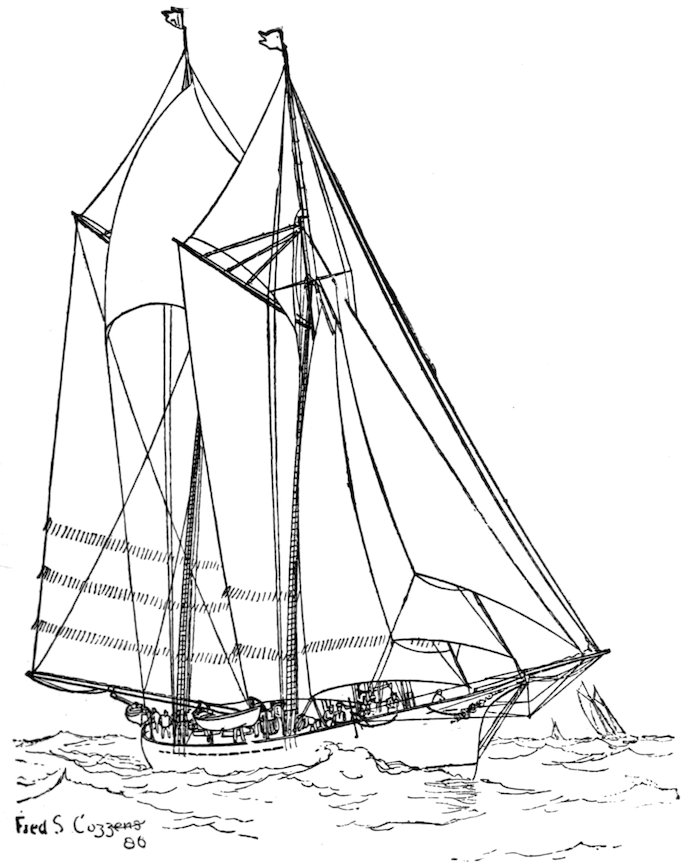
SCHOONER “SAPPHO.”
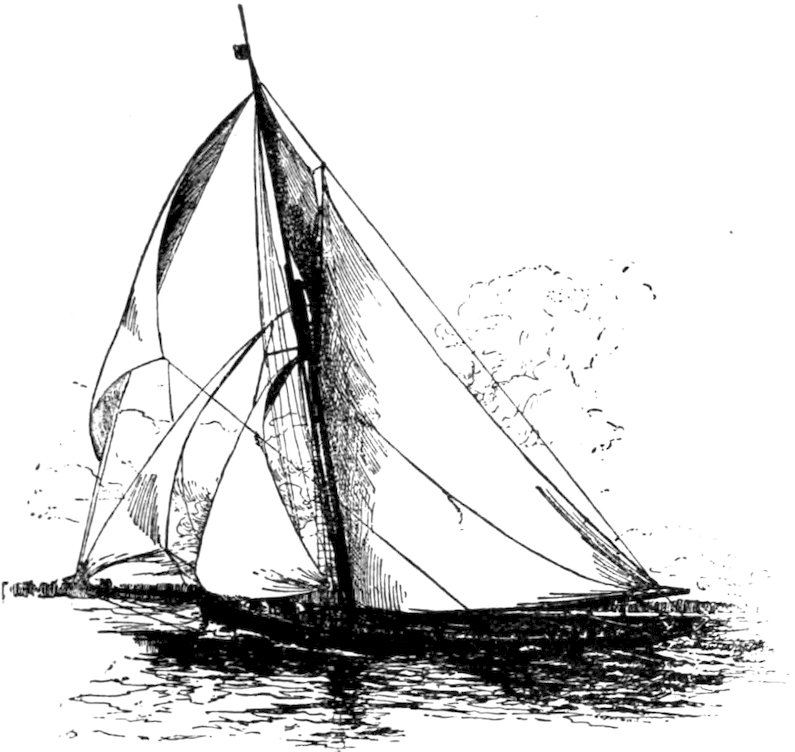
CUTTER “GENESTA.”
Among the many yachts which were altered often and extensively may be mentioned the famous sloop Gracie, designed and built at Nyack-on-the-Hudson, by A. Polhemus. She was launched in July, 1868, her dimensions being 60 feet 3 inches over all, 58 feet on the water-line, 18 feet 8 inches beam, 5 feet 6 inches depth of hold, and 5 feet draught. Her center board was lengthened 2 feet aft in 1869. She was altered in 1874, and when completed measured as follows: length over all, 72 feet 9 inches; on water-line 62 feet; beam, 20 feet 6 inches; depth of hold, 6 feet 6 inches; draught 5 feet 8 inches. In 1879 she was rebuilt by David Carll, at City Island, her length over all being 79 feet 10 inches, on water-line 72 feet 2 inches; beam, 21 feet 6 inches; depth of hold, 7 feet 2 inches, and draught, 6 feet 6 inches. In 1886 she was given 12 inches more freeboard. 136She sailed in the trial races against Bedouin, Puritan, and Priscilla, for the honor of defending the America’s cup against Genesta, but that task was given to Puritan.
The keel cutter Colonia, built by Herreshoff as a cup defender to sail against Valkyrie II., proved less fast than Vigilant. Her fault was a deficiency of lateral plane, which made her sag off bodily to leeward in a most discouraging manner. After serving as a drill ship for the crew of the Defender in 1895, she was purchased by Commodore Clarence A. Postley, fitted with a centerboard from a plan by Cary Smith, at Lewis Nixon’s shipyard, and rigged as a schooner. She is now (1899) the crack American “two-sticker.”
Old-timers will recollect how slow the schooner Sappho was until Capt. “Bob” Fish hit upon the bold expedient of “hipping her out,” which was done by swelling out her midship section about fourteen inches, and tapering it off to nothing about thirty feet each way. The result was that Sappho, theretofore so sluggish that she could scarcely get out of her own way, beat nearly every craft bold enough to encounter her, and won many cups and much kudos for her sportsmanlike owner, Mr. William P. Douglas. Mr. A. Cass Canfield altered the sloop Priscilla considerably, but it cannot be said that he was altogether successful. When Volunteer was transformed into a schooner her forebody 137was reconstructed, and she made an enviable record as a “two-sticker;” but when rerigged as a sloop she never showed an approach to her original splendid form, as I think most yachtsmen will frankly concede.
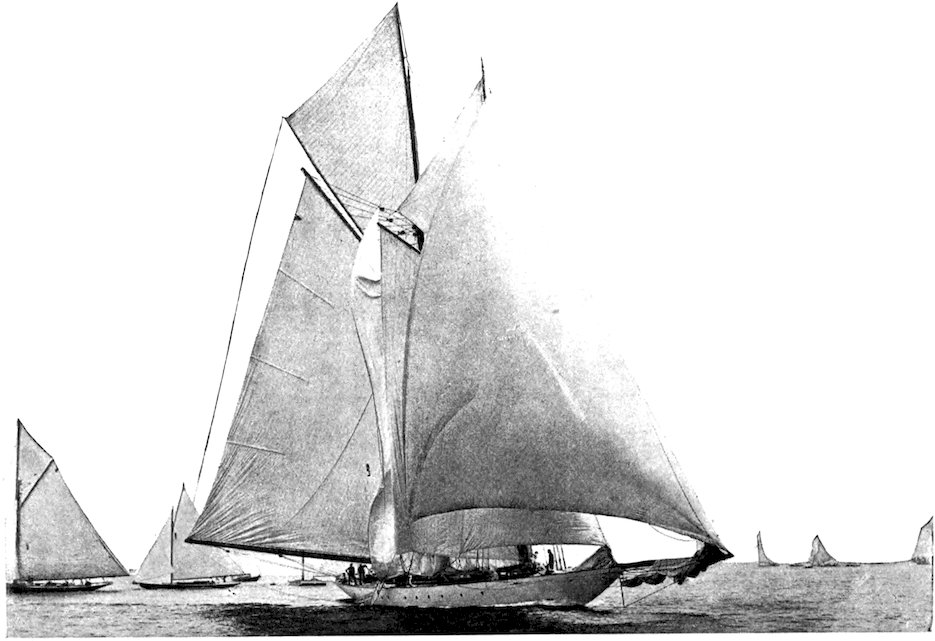
SCHOONER “COLONIA.”
138Our British cousins used to have a perfect craze for rebuilding famous yachts, the old crack cutters Alarm and Arrow—both celebrated prize-winners—being notable examples of this ruling passion. But both here and in England the custom of materially altering the form of a yacht’s hull in the hope of improving her speed may be said to have gone completely out of fashion. This is doubtless due to the radical and rapid changes in hulls, brought about by the frequently shifting rules of measurement for time allowance and the artfully ingenious methods of generations of yacht designers to get the better of those selfsame rules.
I only mention these just to give a practical illustration of the way the old-timers used to alter and rebuild their beloved boats. The custom is now obsolete. If a racing machine of the present day is not outclassed in her third season she is looked upon as quite a smart craft. It may thus be perceived that conditions have altered considerably during the last decade.
On general principles it is unwise to go in for very extensive alterations on a yacht of any kind, whether cruiser or racer. If, however, you are determined 139to go ahead, I advise you to be sure to have an iron-clad contract as to cost.

Rig of Cutter showing Masthead Shroud.
While your boat is being repaired or altered, ship your sailing-master, scrutinizing his references as to ability and character with care, and if possible supplement this examination by an interview with his last employer before engaging him.
Of course, much depends upon the size of your craft and the depth of your pocket. A Hank Haff or a Charley Barr would be too expensive a luxury for a craft of modest dimensions, and a boat-owner in matters of this kind must depend much upon his own judgment; it is impossible to give him advice except in the most general way.
The work of fitting out a racing yacht preparatory to tuning up for the season’s sport is exceptionally interesting to the real amateur, but the owner who has no true regard for yachting generally finds the process somewhat of a bore. In “Boat Sailing, Fair Weather and Foul,” a companion volume to this book, there 140is a chapter on “The Overhauling of a Yacht,” which contains a useful wrinkle or two, of which the reader may avail himself if he feels so disposed. The same is true of the chapter on “Laying up for the Winter,” which is indorsed by naval architects and practical seamen.
It is customary with some builders to have a sail-loft annex to the shipyard, and these men are, in most cases, anxious to contract for the sails as well as for the hull of a boat. I should not advise any yacht owner who contemplates racing his craft to employ anyone but the most skilful manipulator of duck to make his sails, which are of as much consequence as the hull itself so far as the winning of cups and prizes is concerned.
The man of fashion, ambitious of being well attired, so as to shine socially, doesn’t go to Baxter street for a dress suit. Neither does a yachtsman patronize a tentmaker for a racing mainsail or a well-cut jib. There is no objection to the shipbuilder contracting for the sails if he desires to make a little extra money, but the yacht owner should take care that the name of the sailmaker appears in the contract, and this will be a sufficient guarantee for first-class work. There are many firms in the United States justly famous as yacht sailmakers, and these are of such high standing that their names marked on the sails supplied insures the best in the way of cut and the quality of material. It is a 141great mistake to exercise any cheeseparing economy on a yacht’s means of propulsion, whether it be steam or duck. The best in the market, whether it be machinery or sails, is none too good.
A cruising craft with a slovenly or slatternly owner may, perhaps, be content with a suit of sails that fits like a purser’s shirt on a handspike, with a mainsail all abag and head-sails that would disgrace a coal barge; but even a cruising craft may be caught on a lee shore with a gale of wind, and perhaps the owner will curse his fatuous economy when he has tried in vain to claw off the beach with his baggy sails and finds that his craft is crunching to pieces in the surf and he himself is struggling for life in the treacherous undertow.
The cost of racing sails is high, and, ordinarily, a yacht that goes the cup-hunting circuit needs a new mainsail every season. Under careful management, however, a mainsail, with good luck, has been known to do good service for two summers. The quality of cotton duck has improved appreciably of late, owing to a better method of manufacture, and sails “sit” better and do not “bag” as they used to. Cotton is king, so far as racing sails go, in Europe as well as America, flax having been entirely superseded by it. The change from flax to cotton began in England about 1893.
The rig of a racing yacht should be no more neglected than her sails. The 142spars should be hollow on 20-footers and all in excess of that class. The standing rigging should be of silver-steel wire, set up by turnbuckles. The blocks should be strong and light, and the running rigging of the best quality. There should not be a superfluous ounce of weight in the craft alow or aloft if the winning of cups is what the owner has in view.
Rigging screws or turnbuckles, which have superseded deadeyes and lanyards for the setting up of standing rigging, were first used in 1877 on the English cutter Verve. They are used now on all racing yachts.
In the old days of reefing bowsprits it was quite a usual event to carry away several bobstays during the season. The long overhang forward of the modern yacht has reduced the length of the bowsprit, and consequently the strain on the spar when pitching into a heavy head sea. The overhang also gives better facilities for handling the head-sails.
Flexible silver-steel wire rope is now used for running rigging in many yachts, notably for runners and runner tackles, and also for peak and throat halyards.
The best spars for large yachts are made of Oregon fir. This splendid wood is the best in the world for the purpose. Some spars have been known to measure nearly 40 inches in diameter, and some 172 feet long; the average length of spars shipped to Atlantic ports 143from the Pacific coast is 90 feet, and the diameter 22 to 23 inches. Oregon fir is stronger than spruce or white pine, and hence less diameter is required for the same height. Spruce is in general use for the spars of smaller craft. Steel booms for racing yachts were first used on Defender and Valkyrie III.
The greatest improvements in the rigging of yachts of recent years have been the masthead shrouds, bridles on gaffs, and the comparatively new throat-halyard pennants. In a spanking breeze there is a great strain on the masthead, also much play, but by the adoption of the three devices mentioned the strains are both minimized and equalized. Large vessels carry double masthead shrouds, and smaller craft single ones. Vigilant was, I believe, the first American yacht to be fitted with them. Now they are carried by every craft of consequence. Gaff bridles and throat-halyard pennants are indispensable to the rigging of every racing yacht from the smallest cat to the largest schooner.
If your craft is large enough to spread two shrouds on each side, have them fitted in pairs. A bight and a good seizing are preferable to two single eyes.
The bowsprit-shroud outriggers or spreaders should be bolted fast to the ship without any hinged joint. This prevents any unnecessary play when the boat plunges bows under in a heavy head sea. There should be the same length of shroud between the spreader 144and the bowsprit end, and the spreader and the turnbuckle which sets them up. The strain is thus divided equally and advantageously. The bobstay spreader or dolphin-striker should always have a hinged joint.
The rigging of Uncas is fitted as follows: Bobstay, 2½-inch steel wire; forestay, 2-inch do.; jibstay, 1¼-inch do.; bowsprit shrouds, 1½-inch do.; standing rigging, 1¼-inch do.; masthead shroud, 1⅜-inch do.; topmast gear, all 1-inch do.; runner shrouds, 1¼-inch do.; spring stay, 1½-inch do.; main lifts, 1½-inch flexible 19-thread steel wire; gaff bridles, 1¼-inch do.; peak and throat halyards, 2¼-inch manila bolt-rope; main sheet, 2-inch do.; fore sheet, 1¾-inch do.; head-sheets and minor gear in proportion.
The Vigil, of similar design, is rigged precisely the same, with the exception that her main peak and throat halyards are of 1-inch flexible steel wire, the fore peak and throat halyards of ⅝-inch do.; club-topsail halyards, ⅝-inch do.
Lengths of manila are so spliced to these flexible wire halyards that when they are belayed the splice is about six feet above the deck. This flexible steel answers remarkably well. When once set up, it stays set up. There is no “give” to it, and thus frequent “swaying on it,” as is the case with hemp rope, is quite unnecessary.
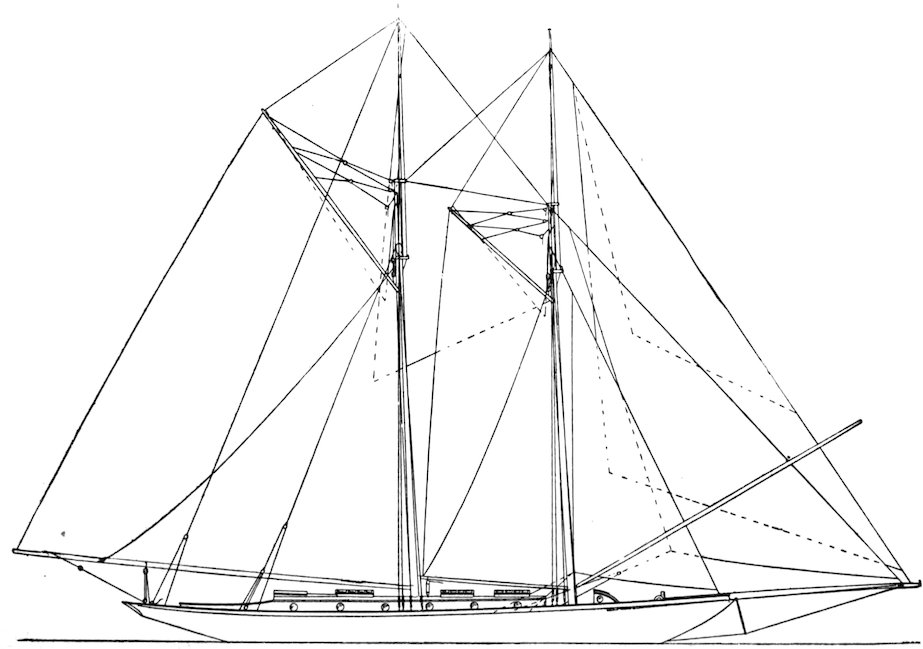
RIG AND SAIL PLAN OF “UNCAS.”
A modern 25-foot-water-line single-sticker with a pole mast, is rigged as 146follows: Bobstay, rod of steel ¾-inch in diameter, set up with a turnbuckle at end of bowsprit; shrouds, two on each side, 1⅛-inch steel wire; forestay set up to stem head, 1¼-inch do.; jib set flying, hoisted with ¾-inch 8-stranded flexible steel halyards, set up with a jig-purchase; runner shrouds of ⅝-inch steel wire canvased over; main lifts, ¾-inch flexible steel wire, painted, parceled, served over with white cod-line, and then covered with white canvas sewed on; the throat and peak halyards are of ¾-inch flexible steel wire. The blocks are all strapped with grommets of flexible steel wire, served and leathered.
From these examples a fair idea of the modern method of rigging a racing craft may be gathered. Strength, lightness, and neatness are the qualities sought and attained. Steel wire is now largely used for the leech ropes of sails, and it is strongly recommended by our “swellest” sailmakers.
The above I owe to my old seafaring friend, John F. Byno, who put the neatest splice ever seen in the Brooklyn Bridge cable, and is an expert with the marlinspike, as all the members of the Seawanhaka Corinthian Yacht Club can bear witness.
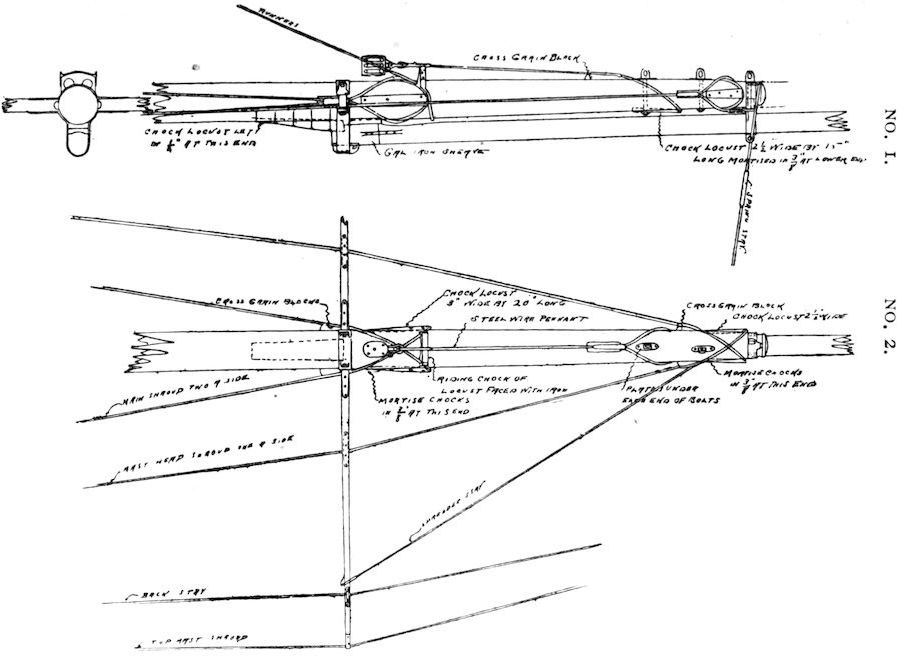
No. 1. Side view of main masthead.
No. 2. Back view of main masthead.
MASTHEADS OF “UNCAS.”
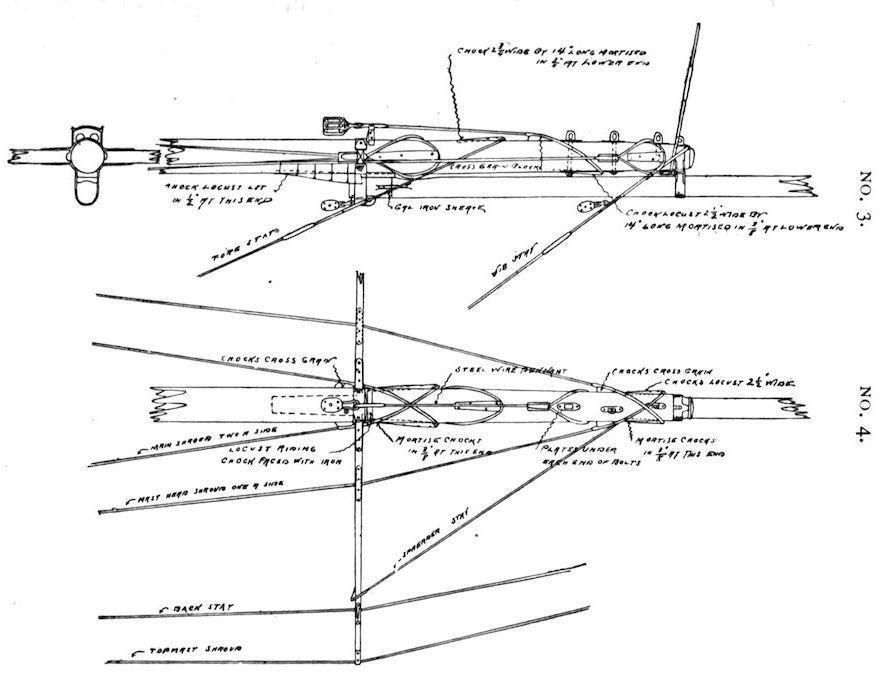
No. 3. Side view of fore masthead.
No. 4. Back view of fore masthead.
MASTHEADS OF “UNCAS.”
149Flexible steel wire rope is nearly if not quite as pliable as new hemp rope of the same strength. It is made with nineteen wires to the strand. The greater the diameter of the sheaves over which it passes, the longer it will last. The manufacturers recommend as a preservative a mixture of linseed oil and pine tar. It is impossible to belay wire rope to a cleat, as it will surely “render” or slip. Manila rope is therefore spliced to the hauling end of the wire, which makes it pleasanter to haul on, and insures its remaining fast after it is once belayed. I would not counsel a lubber to try to splice wire and rope together, unless in the privacy of a separate room. Why? Because the bystanders would be sure to laugh. It takes an artist to make this most difficult splice.
Grommet straps for blocks made of flexible steel wire cannot be surpassed. After making the grommet, paint well with raw linseed oil and white lead; parcel with canvas, serve with marline, apply another coat of paint, and then cover with leather or canvas sewn on. For neatness, strength, and durability this method is superior to any other. But it requires an expert to do the work.
With regard to turnbuckles for setting up all kinds of standing rigging, it must be conceded that they are indispensable for racing craft both large and small. One advantage of deadeye and lanyard for deep-water cruising is that if it should be necessary to cut away the mast to save the ship when hove on her beam ends, a cut with an axe will sever the weather lanyards and away goes the mast. The turnbuckle 150cannot be cut. A combination of turnbuckle, and deadeye and lanyard, might be fitted so as to combine the advantages of both.
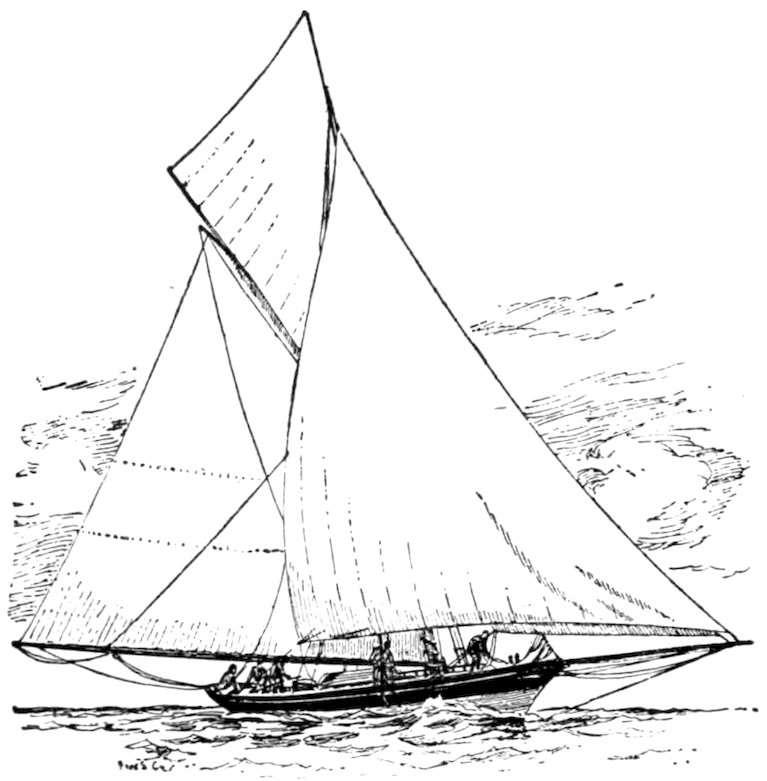
CUTTER “MINERVA.”
The bulwarks of racing yachts have been reduced in height to mere battens. All deck fittings have been lightened as much as the designers dared. All with the intention of reducing weight, ironwork on spars looks very frail when compared with that of a decade ago, and the weight of blocks has been diminished in some cases more than fifty per cent.
The abolition of all cabin fittings first took place in the Marquis of Ailsa’s Bloodhound, built in 1874. All she had in her cabin was a seat along each side.
151It is only comparatively recently that yacht designers have made serious efforts to reduce weight aloft. Sometimes they have gone too far. I remember a 40-foot cutter, built to sail against the Scotch cutter Minerva. She was dismasted in a puff on the occasion of her first race, which was also her maiden sail. The same mishap befell her later on in a fine sailing breeze off Newport. I was on the committee boat which towed her into port. If she hadn’t been well handled after being disabled some serious accident might have happened to her hull. The accident was ascribed to defective ironwork.
It is of no benefit to stay the masts of pleasure vessels with rigging heavy enough for a great brig. A sense of proportion should be observed. Scientific men have calculated and tabulated the stress and strain that wood, metal, wire and hempen rope will bear, and these tables may be consulted by anybody able to read.
It is a fact that piano wire plays a leading part in the rigging of some of the down-to-date little racing freaks one meets nowadays, especially in fresh water where it is less exposed to corrosion. It is highly spoken of by those who have used it. Better, however, not to go to extremes and always to beware of a spider-web rig. Like flimsy construction it causes a yacht to come to grief.
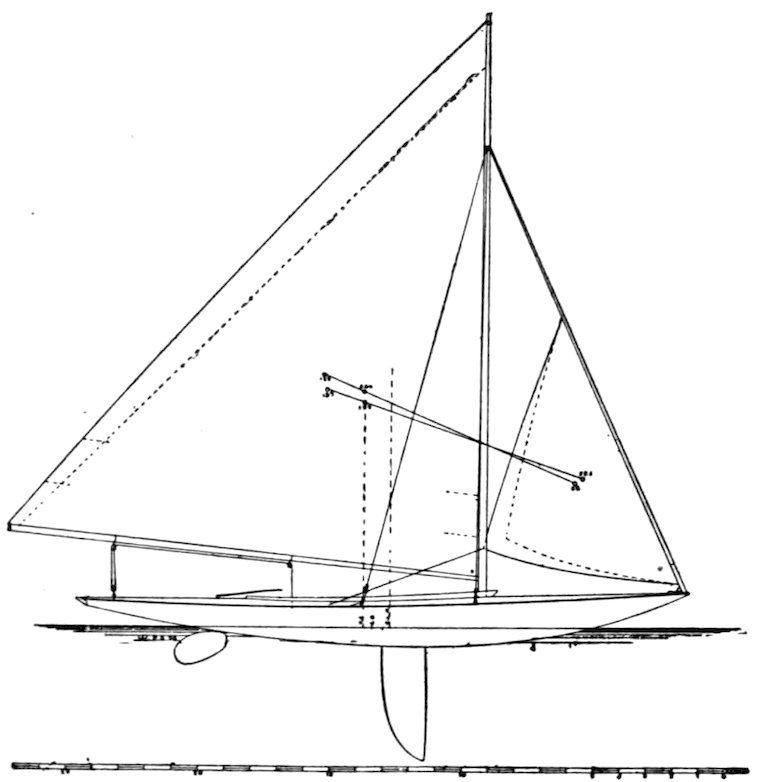
SAIL PLAN OF “ETHELWYNN.”
A good example of lightness of rig was the 15-footer Ethelwynn, designed by Mr. W. P. Stephens, to defend the International Challenge Cup of the Seawanhaka Corinthian Yacht Club. It will be remembered that she beat Mr. Brand’s Spruce IV., which boat was quite heavily rigged when compared with the American craft. The mast was a hollow spar of 4¼ inches, a far too heavy stick, as experience proved, for one of 3 inches and about half the weight would have been sufficiently strong. The hollow boom was 2¾ inches diameter in the slings. The rigging was of phosphor-bronze wire rope, the forestay being ³⁄₃₂-inch diameter, shrouds ³⁄₁₆-inch diameter, and runners ⅛-inch. Main and jib halyards were of the same material, ⅛-inch diameter. The main-halyard ran over a 2-inch sheave in the masthead, a single part with a whip-tackle at the deck. The jib-halyard was double with a jig. The running rigging was of imported English cord. She carried 198 square feet of duck.
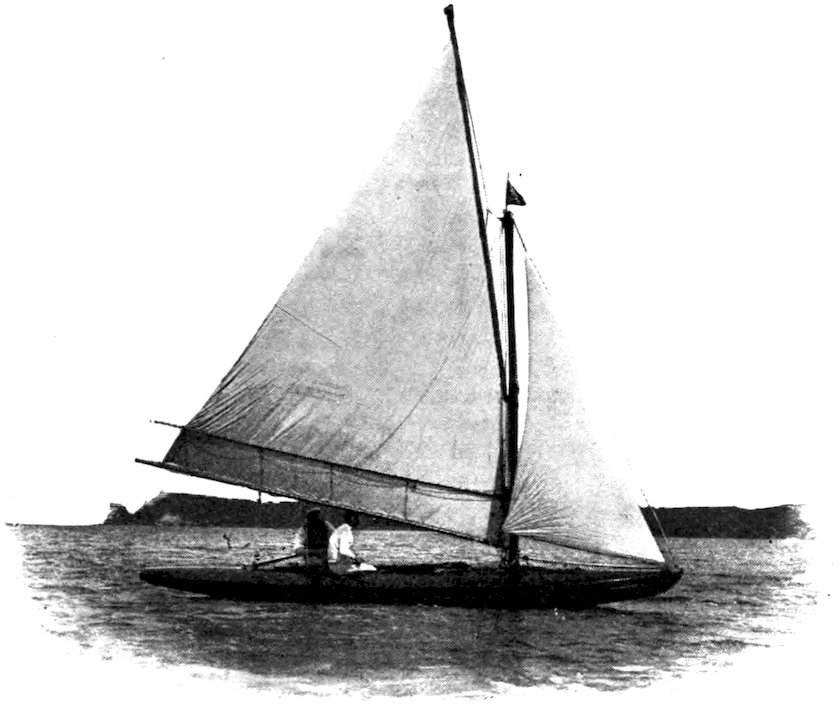
HALF RATER “SPRUCE IV.”
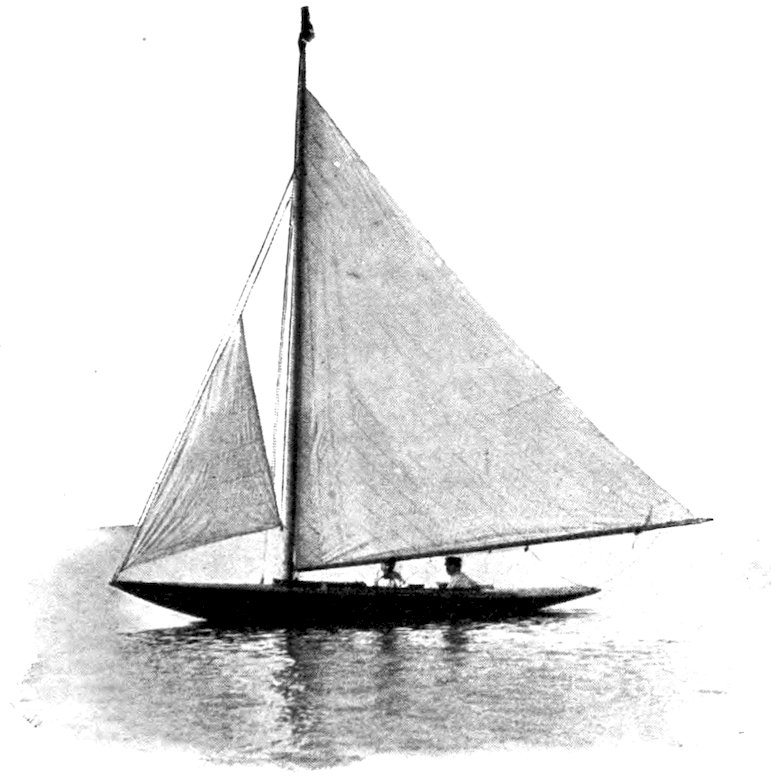
FIFTEEN-FOOTER “ETHELWYNN.”
154I am indebted to Mr. Stephens for the description and the accompanying sail plan.
155J. M. James, Vice-Commodore of the Imperial Model Yacht Club, of Tokio, Japan, is enthusiastic in praise of lacquer as a coating for the outside skin of yachts. He says that all the club’s models have their topsides and bottoms lacquered; and after numerous experiments for testing those thus treated against painted craft an increase of speed, amounting to ten per cent., was found in favor of the lacquered ones. A model yacht once well lacquered, with care and barring accidents, will last a lifetime and retain its luster. He says that all the Japanese naval ships have their bottoms lacquered. The lacquer gives increased speed and almost prevents fouling, and if properly put on lasts for three years. The only drawback is that the process is very expensive.
156Here is an opportunity for some enterprising individual to experiment with lacquer. If he proves successful he will gain the gratitude of yachtsmen. Incidentally, he will also win a large pecuniary reward.
In the matter of a compass the racing yachtsman should be careful. In thick weather, when steering for a mark, it is necessary that the deviation for every point should be known. In wooden yachts there is no difficulty, if ordinary precautions are taken, in keeping compasses exact. In iron and steel yachts they have to be licked into shape by a professional adjuster of reputation.
In spite of opinions to the contrary, held by old salts, the compass is not affected by fog, thunder, or attraction of land. It should be remembered, however, that magnetism exerts its magical influence through all bodies, no matter how dense, while light, heat and electricity do not possess this wonderful property.
Thus, casing an iron bulkhead with wood or covering an iron stanchion with copper or canvas will not prevent the metal from affecting the compass. It may be thought superfluous to assert such a well-known scientific fact in this year of the world, but experience teaches me that there is still much to be learned by those who go down to the sea in yachts.
It is not generally known that no iron vessel has been struck by lightning. 157The wooden spars have been shattered frequently by the electric fluid, but, owing to the circumstance that water is a better conductor than iron, the hull of an iron vessel has never suffered. If the spars of an iron ship are made of iron, the vessel may be looked upon as immune from disaster by lightning.
As soon as your craft is fitted out place her in commission, and proceed to become acquainted with her. Prizes are won only by hard work, and if you intend to make a record for yourself and your craft you can attain your end by honest industry only.
Part of the sea-jockey’s stock in trade is to discover how slow a yacht may be made to go with every stitch of sail set ostensibly to the best advantage, with sheets pulling like horses and trimmed to perfection. It is only the most subtle and knowing customer that can so master a yacht as to excel in this. The most accomplished proficient I ever knew was the skipper of the Scotch ten-ton cutter Madge, which came over in 1881, and created a great revolution in yachting. That man could make the boat almost speak. By manipulating the sheets, slacking one or flattening in another, and by other tricks unknown to this deponent, I have seen him allow an oyster-boat to beat the crack racing cutter. The name of that canny skipper was Duncan. The Yankee captains who sailed against him are not likely to forget it.
158I remember reading somewhere about a yacht skipper of experience who fooled a younger rival and caused him much unhappiness during a hotly contested race on the Solent. It was blowing a piping breeze, and Sally, the rival craft, had one reef in her mainsail and the topmast struck. Bantam, on the other hand, was the stiffer of the two, and held on to the whole mainsail, but also dowsed topmast. Sally had passed Bantam, and was leading her some fifty yards. Both yachts were at that time sheltered by the land, but a few hundred yards ahead a big sea was running in the West Channel.
It was at this moment that the sly old sea-dog played his low-down trick on the green young skipper, who was watching his every action.
“Up with the topmast, lads!” yelled Captain Sly of the Bantam.
His crew made a great pretense of swaying away on the heel rope, but somehow or other it got jammed and stayed jammed, in spite of the apparent efforts made to clear it.
Captain Green thought he would be smart. He sent up his topmast in seamanlike style. The topsail was set just as the Sally encountered the heavy sea in the channel. She made one dive and buried herself up to the skylight. The pressure was too much for her. In an instant Bantam’s topmast was housed, and all the gear fast again, and while Sally was pitching and ’scending in the 159choppy sea Bantam crawled through her lee and beat her. Captain Green was so demoralized by the trick of which he was the victim that he did not regain his self-possession until it was too late.
Captain Sly was convinced that Captain Green would imitate him in everything, and the result proved that he had formed a correct estimate of his opponent.
It is not wise or politic to undervalue the sailing qualities of an opposing yacht, especially when she is practically an unknown quantity. In other words, don’t prophesy unless you know. Here is a case in point:
When the Madge was about due to sail her first race in these waters, the skipper of her Yankee opponent is said to have paid a visit to Sawyer, the sailmaker, and asked for the loan of some flying kites.
“Any old stuff will do,” quoth the skipper. “I’ve only got to knock out that narrow-gutted coffin anchored yonder.”
The sails were lent by Mr. Sawyer, and it is needless to say that they did not fit “like paint on a post.” The “coffin” beat the “skimming dish” with singular ease.
I put this little yarn on record only just to show the contempt the average American yachtsman had at that time for the epoch-making Madge.
The proper balancing of sails is imperative 160when racing. To illustrate my meaning I need only refer to the decisive race between Vigilant and Valkyrie for the America’s Cup, which all but resulted in the winning of the race by the British yacht. In point of fact, Valkyrie, had not her two spinnakers blown away, would have romped in victoriously. In the beat to the outward mark Vigilant carried a reefed mainsail and a big jib, and, for the first time in her history, required lee helm. This blunder, in addition to her centerboard becoming jammed, made Valkyrie beat her 1m. 55s. on the windward leg. Valkyrie had a half-reef in her mainsail, but shifted her jib and set one whose center of effort was in exact accord with the reduced after-canvas. Vigilant won by forty seconds only, and had it not been for the Valkyrie’s hard luck would have been badly defeated.
On July 13, 1889, the Katrina, while racing against the Titania in a reefing breeze, carrying a big jib and a reefed mainsail, suffered a like deserved defeat. Under her ill-balanced sail-spread, for the first time in her history, she, too, carried lee helm, and sagged off to leeward like a haystack adrift. She made a pitiable exhibition of herself, and all hands rejoiced when her main boom snapped off and permitted her to withdraw without disgrace. Meanwhile Titania, splendidly handled by Captain Haff and Mr. C. Oliver Iselin, sailed over the course and won the race.
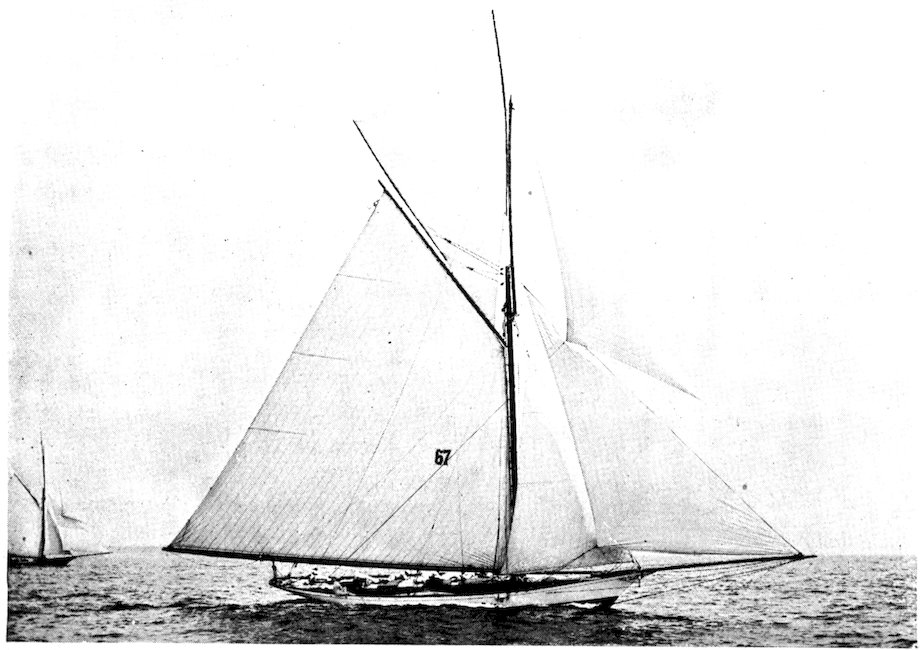
FORTY-FOOTER “GOSSOON.”
163It is interesting to note that the mishaps to both Katrina and Vigilant occurred on the 13th of the month.
The jibtopsail when a yacht is close-hauled is of very little use, especially in a bit of a breeze. Some skippers set what is known as a “baby-jibtopsail” when the wind is very light. It is questionable if the sail is of any benefit at all under such circumstances. In my opinion, the sail makes the boat’s head sag off to leeward, lee helm being the result. If no such sail were made, I think it would never be missed. Of course, with the wind free the jibtopsail, from its most diminutive size to its most extreme balloon development, is a very valuable sail.
In taking note of the speed of boats the length should be considered. I remember that the 40-footer Gossoon, the conqueror of the Scotch cutter Minerva in 1890, without any tide to help or retard her, made in a race I saw an average of nine knots an hour. This means that to accomplish this feat she had to run her length in 2¾ seconds. A little reflection will show that this is a remarkable achievement for so small a vessel.
It may be mentioned here that a nautical mile, a knot, and a geographical mile are one and the same thing. A knot equals 1.15 statute miles. Multiply the number of knots by 1.15, and you have the distance in statute miles. There are 6,080 feet in a knot; 5,280 feet in a statute mile.
164Chronometers should be kept free from damp, dust, and draughts. When winding turn the key steadily, avoiding any jerky action. Most of them require seven and a half turns of the key. Wind slowly and steadily as far as the mechanism will permit. Wind punctually at the same hour every day. A chronometer that has run down, on being wound up again, will probably not start until it has been quickly but not violently slued half round and back again. This is easily done by placing the instrument on the table, and turning it horizontally between the hands. Take care that the instrument has neither too much nor too little side-play in the gimbals. A standard compass stowed away, while in port, close to a chronometer has been known to ruin the going of the watch, the powerful compass needles having by induction magnetized the steel portion of the balance. Do not stow a chronometer close to an iron bulkhead, an iron vessel’s side, the upper or lower end of a vertical iron stanchion, or within eight feet of compass compensating magnets. The chronometer case should not be screwed down to a table containing drawers which might possibly be used to hold spare compass cards. Chronometers should be kept away from iron almost as religiously as compasses.
Jolting in a railway train or a conveyance of any description is liable to alter the steady going of a chronometer. 165The quick jerk of a boat propelled by oars is still more likely to prove injurious. If, therefore, a chronometer has to be taken from one place to another in a pulling boat, it should be held free in the hand by the leather straps, taking care to avoid a circular motion. When traveling by train place the instrument on a pile of overcoats or rugs, in such a position that it will not fall. Marine chronometers are intended always to be kept strictly horizontal with the face up. Never allow a chronometer to run longer than four years without having it overhauled by a first-class workman. If it is a new instrument, it should be looked at after a year or eighteen months.
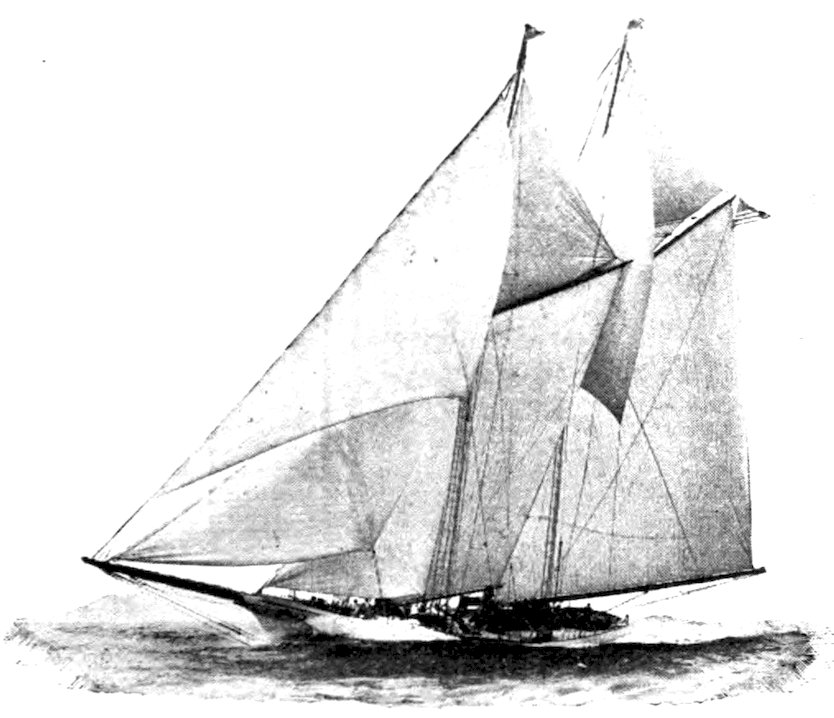
“AMERICA,” 1899.
V. DUTY AND DISCIPLINE AFLOAT. THE SHIP’S COMPANY IN DETAIL FROM THE SKIPPER TO THE SEA-COOK.
To cruise with pleasure from port to port and to win races—the yacht owner must remember that he can do neither unless his sailing-master thoroughly understands his business. Whether amateur or professional, the skipper must be a man of dash and daring tempered with a modest soupçon of discretion, active, vigilant, with his weather eye wide open at all times and seasons. He must have the knack of handling men so as to get every foot-pound of energy out of them that is in them. He should be a strict, but not necessarily a stern, disciplinarian; and he should have sufficient diplomatic instinct in his make-up to know when to wink at a slight lapse on the part of a generally capable and faithful blue-jacket.
The personnel of the racing yacht is of the greatest importance, and, if not of the best, the career of the vessel is not likely to be crowned with the laurels of success. The man in command must have the rare gift of personal magnetism, 167the art of inspiring enthusiasm, of compelling victory. A cool head is no less necessary than are nerves of steel. He must be a splendid helmsman, a good practical seaman and skillful navigator.
A man possessed of all these attributes commands high wages and deserves all he can get. The discipline of his yacht is perfect. Everything goes with the precision of clockwork, at sea or in port. He is prepared for every emergency that may arise when at anchor or under way, and is never caught napping. Keeping a watchful eye on the interests of his owner, he is also careful of his crew, being fully aware of the evil consequences of a discontented forecastle, and knowing that sulky or surly sailors never yet were conducive to the capturing of sea trophies. A good skipper must therefore be a good judge of human nature, alive to the idiosyncrasies and frailties of sailors, who have in good sooth as many whims and vagaries as silly schoolgirls in the transition stage of development. In fact he should be quite a past master in the cunning art of “jollying along.” It is astonishing what a number of men there are who possess all these qualifications. Modest, unassuming men, skillful navigators and seamen they will prove to be, and you can avail yourself of their services for a moderate compensation.
There is no fixed scale of wages for a yacht skipper. The sailing-master of a 168large steam yacht may be paid $3,000 a year, while the skipper of a racing 51-footer might think himself lucky if he gets $80 a month with the prospect of being paid off when the yacht goes out of commission. This practice of engaging a skipper for the season seems to me to be short-sighted policy. It cannot be expected that a captain hired for three months only will take more than a passing interest in the vessel. He would be more than human if he lay awake nights, scheming how to save his owner money. Whereas, an honest, conscientious skipper, assured of receiving living wages all the year round, will more than earn his salary by the extra care he takes of the yacht. He naturally looks upon the vessel as a prime source of revenue. He realizes that it is to his interest to run her as economically as possible, to keep her in thorough repair and order at the least possible cost, to make life aboard her as pleasant as possible to his owner and his guests, to win as many prizes as he can if the boat is a racer, or if simply a cruiser to get her talked about for a phenomenally fast passage from one port to another, for beating a rival of approximate size by a handsome margin, or for successfully reaching her destination in a heavy blow, when other boats were glad to scud under bare poles for a harbor. These little acts if performed with tact, make an owner prouder than ever of his yacht and more appreciative of the services of his skipper.
169Permit me to illustrate. A friend of mine several winters ago purposed to buy a schooner and fit her out for a West Indian cruise. He provided himself with a number of tickets of admission to several vessels laid up in a dock at South Brooklyn. He invited me to accompany him on a prospecting tour. It was a dirty day, sleet, snow and wind being the objectionable features that confronted us.
Our first port of call was the office of the dock, where we found a man in charge who examined our credentials and sent to a neighboring tavern for the “ship-keeper,” who he said had “gone to lunch.” In about half an hour this functionary made his appearance, and piloted us to the pier where several schooners which we desired to look at were moored. We boarded the first on our list, a cruising vessel of some celebrity, whose owner desired to sell her, as he was building a steamer. The decks were deep with water, the scuppers being obstructed. Everywhere were signs of disgraceful neglect. The binnacle was a mass of verdigris. Costly and artistic wood carving was without protection from the weather. The handsome companionway of mahogany was without a canvas cover. Going below we found everything mildewed and musty. The bedding in the berths was damp. Water trickled from the deck beams. What really had been a most attractive interior presented an appearance of 170dampness most dispiriting, as well as every evidence of decay. It was indeed pitiable to see such a fine vessel in so sad a plight. We passed on, and inspected two other craft whose condition was only slightly better, and which presented few attractions from a purchaser’s point of view.
The next yacht we visited was in marked contrast to the others. A handsome, sunburned man greeted us at the gangway, and after we had explained our mission, invited us below. He was the captain of the schooner, he told us, and was spending the winter aboard of her. Stepping down into the cabin we saw a snug and cozy saloon, a cheerful fire burning in the open grate, everything bright and spick and span, as though the yacht was in Newport at the height of the season. A pretty young woman was at work at a sewing machine, while a pampered Persian cat basked luxuriously on a handsome rug in front of the fire.
“This is my wife, gentlemen,” he said, and then he showed us all over the vessel from right forward to right aft. The staterooms were in perfect order, not a sign of damp or mildew anywhere. Everything was clean and spotless as a new pin. We found that the skipper had been in charge of the yacht from the day of her launch, that he and the steward and a boy lived on her every winter and kept her in thorough order outside and inside.
171We were shown the logs of several deep-water cruises she had made, together with track charts of the voyages. We were entertained with an intelligent and interesting description of the yacht’s behavior in a hurricane off Bermuda, given with a wealth of seamanlike detail, which we both hugely enjoyed. It was evident that the skipper was a firm believer in his boat, and that he had tended her with care and loving kindness from her christening to that day. He explained that his owner had married a woman who hated the sea, and that the vessel was in the market at a reasonable price.
That schooner now flies my friend’s private signal, and that same skipper is still her sailing-master, and, according to his employer, is worth his weight in gold. This practical illustration may demonstrate the advantage of employing a sailing-master by the year and not by the season.
Every word I have written about a skipper applies, in the case of a steam yacht, to the engineer. And if possible, still more strongly, for the deterioration of marine engines left without care or protection is both rapid and, I need hardly add, costly in the extreme.
I strongly advise a yacht owner who thinks he has the skill and knowledge requisite for the command of a yacht, to assume command himself and dispense with the services of a professional sailing-master. Let him ship a competent 172man as mate and give him to understand that his duty is to carry out the owner’s orders, and simply to act as executive officer. It is impossible that a yacht can have two captains and turn out a cup winner. Jacob found two wives in the same house quite incompatible; and the discipline of a racing craft with the owner and the sailing-master both issuing commands at the same time is not unlikely to be lax, and with lax discipline races cannot be won.
The treatment of the sailing-master by the yacht owner varies according to the temperament and disposition of the latter. A gentleman is incapable of rudeness to an employé—especially to a man holding so responsible a position, and in charge of such a valuable piece of personal property as a yacht. The judicious owner always treats his skipper with respect. If he desires to preserve proper discipline aboard, he will let the crew see that the captain has his entire confidence. The owner, therefore, should always give his orders to the skipper, who will then communicate them to the crew. For instance, if he wants a boat lowered he should not sing out to the crew to lay aft and lower the launch. That would be a grave breach of yachting etiquette. The correct course to pursue is to tell the captain that he wants the boat, and leave to him the issuance of the necessary commands for the carrying out of his wish. This may seem a small matter, but it is really 173of importance. If neglected, it is subversive of discipline. The owner should always address the master as Mr. ——, never as “Skipper” or “Cap,” as is too often the case aboard a certain class of craft conducted after slipshod methods. The men should always address the sailing-master, and also the mate, as “Sir,” and no departure from this rule should be tolerated. The sailing-master should be held responsible for any breach of discipline on the part of the crew, and his authority should always be sustained by the owner.
I have seen more than one sailing-master who, not content with tyrannizing over the crew, held the owner in complete subjection. It may be readily surmised what kind of worms these owners were. But take yacht skippers by and large, the average is worthy of confidence and respect. The percentage of black sheep among them is almost infinitesimal. The same remark applies to the mates and the men.
The following hints to sailing-masters were written by a dyspeptic martinet of a yacht owner, but there is much good sense in them. They are hung up in his sailing-master’s berth:
- 1.—
- Never curse the crew. The owner will do all the swearing.
- 2.—
- Should the owner or any of his guests not use tobacco, never smoke to windward of him or them. Have the goodness to step to leeward.
- 3.—
- Always be at the gangway when 174the owner comes alongside. No matter how warm it may be, do not receive him in your shirt-sleeves.
- 4.—
- Have a memorandum of all the stores in your department. Do not rashly answer, “There is none on board,” without consulting your list when asked for an article required.
- 5.—
- There are yachts afloat whose owners are run by the sailing-masters. This yacht is governed differently.
- 6.—
- If the sailing-master is at any time dissatisfied with the owner or the yacht he has an unfailing remedy, and the sooner he avails himself of it the better.
- 7.—
- The owner trusts that pleasant relations will always prevail between the sailing-master and himself.
Having secured your skipper let him ship the crew. If your yacht is a large vessel you will need a mate. In the interest of harmony it is advisable to let the skipper have some say in the matter of his selection. It will be advisable to look over his credentials, with a view to finding out if he is competent to take charge of the vessel in the event of any accident befalling the captain. If you contemplate a blue-water voyage, be careful that the mate is a navigator and has the requisite license. If deprived of the services of your skipper by any unforeseen cause, it would be awkward to find yourself, say, a thousand miles from land, with nobody aboard capable of finding the vessel’s position otherwise 175than by dead reckoning—a hit or miss method always unreliable.
The wages of mates vary. Some of them are paid $10 or $15 a month more than the men, whose pay ranges between $25 and $30 a month. This is much more than is paid to English yacht sailors, who have to feed themselves out of their pay.
The mate’s duty is to take charge of the yacht when the master is below. When the master is on deck the mate’s station is forward. He superintends the setting, taking in and trimming of sails, and in a general way carries out the skipper’s orders. He is a very important man in a race, for then the captain’s place is at the helm and the mate is responsible for the proper working of the vessel and the prompt setting of balloon sails. If any of the running gear gets foul or parts he is tolerably certain of a brisk dressing-down, especially if the mishap causes the loss of the race. The reason of this is because he has charge of all the gear and sails and spars, and is responsible for their being always in good condition.
The mate superintends the work of getting under way, sees the head-sails clear for hoisting, looks after the windlass, sees that the hose is played on the chain cable if the vessel has brought up on muddy bottom. Also when coming to anchor he sees that the mud-hook is clear for letting go, all halyards ready for lowering, booms in good shape for 176swinging out, and the boats in good condition for lowering. The captain is in command of the starboard watch, and the mate takes hold of the port watch. In long runs the watches are set as in ocean steamers, the men taking two-hour tricks at the helm and the same on the lookout.
The mate, as executive officer, superintends the washing down of the decks in the morning, and is held responsible for the yacht’s ship-shape appearance. If any “Irish pennants” are seen towing overboard or if there is a speck of dirt anywhere to be found, the mate is brought up with a round turn. A good mate is invaluable, and if he and the sailing-master work in harmony together, the yacht, so far as discipline is concerned, will be perfect, and the vessel will be a pleasant one for all hands. The mate in large steam yachts has generally the charge of the launch, bringing aboard guests and taking them ashore. It is imperative that he should have a thorough knowledge of the art of boat-handling and that he should be a smart, all-round man in every detail.
Only very large craft carry a boatswain. His duty is to care for the rigging and “pipe the side.” Personally, I like to hear the cheery sound of his whistle. It reminds me of old times. The boatswain nowadays finds no occupation for his “call” on a racing craft.
Great Britain and the United States are the leading yachting nations of the 177world. The yachting flags of both countries have been seen in nearly every harbor of the globe. France, Italy and Germany have during the last decade made some noticeable progress in the pastime, but neither in racing nor in cruising have they accomplished anything of real significance.
For instance, how galling must it have been to the patriotic pride of the German Emperor to be forced to sail his imperial racing cutter, Meteor, designed by a Scotchman and built on the Clyde, with a crew of Hampshire and Essex sailors. But stern necessity compelled him. The German seaman has many merits, but he doesn’t show up to advantage aboard a racing cutter. One would have thought that the Emperor would have trained a crew of Germans especially for the task, but the idea either did not occur to him or was judged not to be feasible.
He might have followed the example of our countryman, Mr. C. Oliver Iselin, the managing owner of the Defender, who in 1895 turned the tables on certain of his British critics, who had declared that no American crew could possibly beat the trained British yacht sailors who formed the crew of the Valkyrie. These seamen, all hailed from Wivenhoe or Brightlingsea in Essex, had sailed in cutter yachts in the summer and cutter-rigged fishing smacks in the winter from boyhood, and were indeed the flower of the racing sailors of England. Captain 178Cranfield, one of the smartest skippers afloat, had drilled them for several seasons. They were pronounced invincible by recognized authorities.
In previous contests for the America’s cup the crews of the Puritan, Mayflower, Volunteer and Vigilant were composed largely of Scandinavians, concerning whose ability as seamen I have nothing to say except in praise. It was the general idea that without the Scandinavian element the battle was lost. Mr. Iselin undertook to expose the fallacy of this notion. Without disparagement of the excellent yacht sailors hailing from Danish, Swedish or Norwegian ports, he determined to prove practically that the native-born American sailor, when properly licked into shape, makes as fine a yachtsman as ever trod a deck or broke a biscuit.
Accordingly Captain Haff was sent to Maine, and there the veteran skipper shipped an American crew worthy of the saucy Stripes and Stars—active young fellows who had never sailed on pleasure craft but had followed the sea on fishing schooners and coasting vessels. After being drilled by Captain Haff for a few weeks they became as smart and efficient a crew as ever tailed on to a mainsheet or manned club-topsail halyards.
I had many opportunities of comparing them with their British opponents, and I pledge you my word as a sailor and a gentleman that one crew was as 179smart as the other in setting or shortening sail and in all marine manœuvres. It was a surprise to many, but nobody was more astonished than Captain Cranfield, who admiringly admitted the ability and efficiency of the boys from Maine who manned the Defender.
This achievement opened the eyes of the British critics and showed them of what our raw material is capable. It was also a surprise to many of our racing skippers, who were laboring under the delusion that Scandinavian sailors alone are capable of manning our yachts. Never was a greater error. The native-born American, when properly trained, makes as smart a yacht sailor as ever walked a deck.
Most of these Maine sailors, judging from their names, belonged to the great Anglo Saxon race whose deeds afloat are written on the bright pages of sea history. America has reason to be proud of her seafaring ancestors. The infallible law of heredity and the no less assured principle of the survival of the fittest have been well exemplified among the dwellers on the British coasts. The bold sea-dogs of the West Country to-day are fitting successors to those sturdy semi-pirates who under the flag of Frobisher, of Drake, of Raleigh and of Hawkins shed so much glory on the nation they upheld and so much of the enemy’s life-blood. The smugglers and privateers of the southern and eastern coasts may justly be classed as the progenitors 180of our racing yachtsmen. For be it remembered that speed was the prime necessity of their means of livelihood. The contests between revenue cutters and luggers were continuous struggles for sea supremacy. If a lugger was captured by a cutter, the keel of what was hoped to be a still faster lugger was laid, and so the war went on. British privateers generally got the best of their Gallic opponents. Nelson crushed Great Britain’s foes at sea as effectually as Wellington defeated her enemies ashore.
In the war of 1812 America proved her naval superiority by many a heroic deed. Until the devastating cruise of the Alabama our mercantile marine was our national pride. It is true that our mercantile fleet of to-day is by no means what it ought to be, but it is also a fact that our fine coasters and fishing vessels, although manned by a large percentage of foreigners, are, as a rule, commanded by native-born Americans. Those of our countrymen who follow the sea for a livelihood soon rise in their profession. The somewhat scanty emoluments offered are sufficient reasons for deterring the average ambitious American youth from seeking his fortune afloat, but should more liberal inducement ever be offered, the sea-loving Yankee will be to the fore again.
That the raw material is at hand was proven by the adaptability of the Maine men to be transformed into efficient 181yachtsmen in so short a time. Had the Emperor of Germany tried to convert some of his seafaring subjects into a crew for the Meteor, he might have met with a far different result.
Sailors are a queer lot, and good ones are to be found in every maritime country. In their native climes a crew of lascars, hard as nails and agile as monkeys, cannot be surpassed. Ship them aboard a vessel bound to the English Channel and due there in midwinter, and you might just as well have a ship’s company of frozen earwigs. In the Bay of Bengal, blow high or blow low, you couldn’t wish for smarter sailors. I speak from personal knowledge, having had command of a smart schooner engaged in a certain lucrative trade on the Coromandel coast and in the China seas, the precise nature of which I decline to divulge, but which called for quick work. Never have I sailed with a more satisfactory crew than Abdool, the Serang, and his twenty alert followers. They made that schooner talk. In the Bay of Biscay they would have been as useless as a dead steam-engine. They were the most economical sailors I ever knew—five rupees a month and a modest ration consisting principally of curry and rice. I wonder in what seas my faithful Abdool and his lithe and dusky shipmates are cruising to-day, for I am writing of thirty years ago, when I was a little spryer on my pins than I am at present.
182The selection of a crew, especially for a deep-water cruise likely to be of long duration, is an important piece of business. The skilled skipper, from long experience, possesses the instinctive faculty of picking out the right men from a small army of applicants. This, too, without any unnecessary delay. A short talk, a glance at papers, and the trick is done. A sea lawyer has no chance of being shipped. The skipper detects him at once. He knows that breed. The inexperienced yacht owner cannot appreciate what troubles he is saved from by the wise selection of his ship’s company. One sea lawyer with the pestilent gift of the gab will infect a whole forecastle full of honest and well-meaning men, just as one sheep with the rot will taint a sound and healthy flock. The incessant wagging of his jaw, his perpetual growlings like a bear with a sore head, are as likely as not to breed a mutiny, or, at any rate, to make a floating hell of that part of the vessel that is forward of the foremast. Such a man will grumble even if he gets roast beef and plum duff three times a day and a “nobbler” of rum every hour of the twenty-four.
It is well, therefore, to exercise due care in shipping your crew if bound on a globe-circling expedition. Some owners insist that candidates for berths aboard their ships shall undergo a medical examination, in order to make sure that they are physically fit for a long 183voyage. This is, in my opinion, a wise course to pursue, for sickness at sea is like a wet blanket on the pleasure of a voyage, and no owner wants to ship a sailor unfit to fulfil the duties for which he signs articles.
A crew intended for the usual coastwise cruising and racing, taking part in all the events of the season for which the yacht is eligible, should, of course, be selected with care. You will often see the same crew stick to a yacht for years. They are paid off at the close of the season, get through the winter as best they can, some of them subsisting on their summer savings, others shipping on coasting vessels or fishing craft, or even finding odd jobs to do ashore. When the yacht goes into commission at the beginning of the following summer, there they are to be found aboard of her, and ready for anything that may turn up. Smart and steady men are always in demand, and when they leave the yacht in the fall they get the tip from the sailing-master to report for duty in the spring.
The prudent yacht owner, when preparing for a deep-water voyage, should ship a crew as small as possible for the proper working of the vessel. Every device for the economizing of labor should be adopted. In these days, when a crew of six, all told, sail a big fore-and-aft cargo schooner, a large ship’s company is not absolutely necessary aboard a yacht of moderate size. It is easier 184to keep a small crew in good health than a large one, especially when cruising in the tropics. The necessarily limited space at the disposal of the “jackies,” in spite of all the modern contrivances for their convenience and comfort, causes some forecastles to be unhealthy. Without taking into consideration the saving of money in the wages of men not absolutely necessary for the handling of the yacht, the owner is likely to get more solid comfort out of a small, contented crew of picked men than he would out of a large, injudiciously selected crowd of sailors. The fewer the mouths to feed the more stores and water for each can be carried. Personally, I would rather have twelve good men to work a large schooner, than a score of indifferent lubbers and skulkers masquerading under the names of able or ordinary seamen.
These may seem to be revolutionary notions in these days of kid-gloved skippers and large crews. But let us go back half a century or so, and see what the custom was in the brave old days of the Yankee schooner America. In her historical voyage to England in 1851 she was commanded by Captain “Dick” Brown, with Nelson Comstock as mate, and only six men before the mast. Messrs. George Steers, James Steers and young Henry Steers were the passengers, and these, of course, lent a hand when required. But there were no more cats aboard than could catch mice.
185The Sappho, a much larger schooner, sailed from New York to Falmouth in July, 1868, the time of her passage being fourteen days. She was in charge of Captain T. P. Baldwin, a retired merchant skipper, two mates, and six men before the mast, none of whom were yacht sailors. Judging from the logs of these two representative schooners, no difficulty was experienced in handling them, and both made excellent passages, the America reaching Havre in seventeen days and a half, in spite of the retarding circumstance that she carried only the small sails of the pilot boat Mary Taylor, a wonderfully fast schooner built by Mr. George Steers.
Mr. E. F. Knight, the English yachtsman, has some very sensible things to say on this subject, and, as he speaks from wide experience, my readers will be interested in his remarks. He says:
“It is my opinion that there should not be a single yacht sailor on board the foreign-cruising 50-tonner. It is difficult to get the right ones, and it will be bad for the owner if he fall in with the wrong ones—men who have been spoilt by foolish employers, for instance; a numerous class, I fear. We all know them. Smart-looking fellows enough, maybe, but shirkers of honest work. They prefer to ship on show yachts belonging to owners who like to exhibit themselves and their vessels in the fashionable yachting ports each season, 186but who are not sailors in any sense of the word, and have no real love of the sport, following it only for the swagger of the thing. Men who have served such owners would prove a great nuisance on an ocean cruise, and would not be likely to go far. I have heard such hands grumbling on a friend’s yacht because they had to pass one night at sea instead of in some port where they happened to have friends. They look to frequent tips from the ‘governor’s’ visitors, and to other less legitimate perquisites. These they cannot get in mid-Atlantic, so it is not the place for them.
“Hands from fishing-boats, sailing barges and small coasters, are the best men for the foreign cruiser of small tonnage. Among these, one is not likely to come across spoilt and pampered mariners, and they are accustomed to roughing it, and to the shifts of short-handed craft. But were I undertaking a lengthened tropical voyage I think I should ship my English crew simply for the run over to my first West Indian or South American port, and there engage a negro crew. These blacks are excellent fore-and-aft sailors, easy to manage, and always happy and ready for any amount of hard work, if kindly but firmly treated; while they are, of course, far better fitted than white men to withstand the debilitating influence of sultry climates, an influence, which, as everyone knows, has caused the ruin of 187many a good British sailor, driving hitherto sober men to injure their health by excess whenever they get shore leave.”
Sir Edward Sullivan, Bart., who saw the America win the cup that bears her name, over the Cowes course in 1851, and has been a devotee of the sport ever since, says: “Yacht sailors, as a rule, are sober, honest, obliging, goodtempered, original. During the many years I have yachted I have had crews from north, east, west, and south, and I have almost without exception found them the same. A man must be hard to please, indeed, if after a three or four months’ cruise, he does not part from his crew with regret, and with a genuine wish that they may meet again. Amongst yachting skippers I have come across some of the most honorable, trustworthy, honest men I have met in any class of life, men who knew their duty and were always willing and anxious to do it. The chief peculiarity of all the seafaring class that I have been brought into contact with, is their entire freedom from vulgarity. They are obliging to the utmost of their power, but never cringing or vulgar.
“The winter half of their lives is spent in fishing-boats or coasters, or sea voyages, where they have to face dangers and hardships that must be experienced to be realized. As a rule they are religious, and their preparations for the Sabbath, their washings and 188soapings and brushings, show with what pleasure they welcome its recurrence. Yacht minstrelsy, with its accordion, its songs of twenty verses, its never-ending choruses, its pathos, is a thing of itself. Some day, perhaps, some Albert Chevalier will make it fashionable. Such as they are, I know of no class of Englishmen superior, if any be equal, to the sailors who man our yachts. Of course, there are sharks, or at any rate dogfish, in all waters, but where the good so immensely outnumber the bad, that man must be a fool indeed who gets into wrong hands.”
With these sentiments I most cordially concur.
The yacht owner will engage his cook and his steward to suit himself. Some seagoing chefs of steam yachts get bigger pay than a commodore in the navy, while many stewards have grown wealthy out of their perquisites. With these men I have nothing to do. They belong to the owner exclusively, so let him deal with them as he may see fit. The ship’s cook, however, is a most important functionary, and every canny skipper tries to ship a thorough “tip-topper,” who will feed the boys “high,” while at the same time taking care of the owner’s interests by guarding against waste. A cook of genius will on a pinch “create” a savory dinner for all hands out of what may appear a most unpromising batch of materials, and I am glad to say that cooks of genius are by no 189means scarce. The Japs make excellent cooks, and so do the Portuguese. Hungry sailors go in for hearty fare. Beef and beans, pork and peas, clam chowder, roast joints, and plenty of fresh vegetables are their principal dishes, but they by no means despise the ice cream and the cabin delicacies which fall to their lot on cruises when there is a heavy sea, and landsmen feel more like throwing up their commissions than taking in ballast.
“The internal economy of a yacht,” says Sir Edward Sullivan, “constitutes one of its greatest charms. Your cook with only a little stove for which a shore cook would scarcely find any use will send you up an excellent dinner cooked to perfection for any number of guests. And the steward! who can describe the work of a yacht’s steward? I doubt whether Briareus with his hundred hands could do more than a steward does with two. At seven in the morning he is ashore for the milk, and the breakfast, and the letters, and the flowers; he valets half-a-dozen people, prepares half-a-dozen baths, brushes heaven knows how many clothes, gets the breakfast, makes the beds, cleans the plate, tidies the cabin, provides luncheon, five o’clock tea, dinner, is always cheerful, obliging, painstaking, and more than repaid if occasionally he gets a petit mot of compliment or congratulation. When he ever sleeps or eats I never can tell; and far from grumbling at his work he often resents 190the assistance of any shore-going servant.”
I have quoted the above at length because it is in my judgment the best description of a good cook and a good steward ever written. What yachtsman cannot testify to the truth of every word? I have sailed with a bad cook and an utterly worthless and incompetent steward, and my imperfect knowledge of the English language does not permit of my adequately describing the inevitable horrors and discomforts attending the martyrdom of my shipmates and myself. Therefore let us draw the curtain down on the unsavory subject. But nevertheless let us resolve in the interest of our brother yachtsmen never to give a misleading recommendation or certificate of character to either a bad cook or a worthless steward. If the first-named is a “grub-spoiler” masquerading under the guise of a chef, and the other is a sham and a fraud, hesitate not to brand them correctly and thus prevent them from imposing on others. Have backbone!
In England there is a regular schedule of racing wages—a system which has not been adopted as yet in this country. The skipper gets five per cent. or ten per cent. of the value of the prize won, while every member of the crew is given $5 if you win and $2.50 if you lose. In addition to this expense, bounteous supplies of beef, soft tack and beer are generously dispensed on race days, while 191on other occasions the crew supply their own rations.
The life of a yacht sailor is by no means hard. From twenty to thirty dollars a month and good grub should be attractive to the foreigners who, for the most part, man our pleasure fleet, and who would earn considerably less than half that sum in the vessels of their native mercantile navy. There are so many smart and deserving men in the market, that a yacht owner has no difficulty whatever in engaging a satisfactory ship’s company.
![[Yacht fender]](https://openoldbooks.sgp1.digitaloceanspaces.com/books/yachting-wrinkles/images/i_190.jpg)
VI. A DOWN-TO-DATE YACHT RACE, IN WHICH MAY BE FOUND SOME NOTEWORTHY EXAMPLES OF THE SEA-JOCKEY’S ART.
Sailing as a visitor on a racing yacht is delightfully exciting. Let me transcribe from my log-book the yarn of the contest between the Ghost and the Phantom, two modern 51-footers. Stowed away between the lines may be found a wrinkle or two of value to the novice. So here goes:
The bell on the Phantom was striking eight as the gig rounded her graceful stern and brought up at the starboard gangway. The cutter had been completely “skinned” for the fray, as she was to compete for a valuable prize offered by the club. Everything had been taken ashore that the racing rules permitted, including books, cabin fittings, the cooking stove, deck scrubbers, buckets and brooms, mops, and other impedimenta comprised in the equipment of a properly fitted yacht. The cabin was bare—“cleared for action,” as the owner observed.
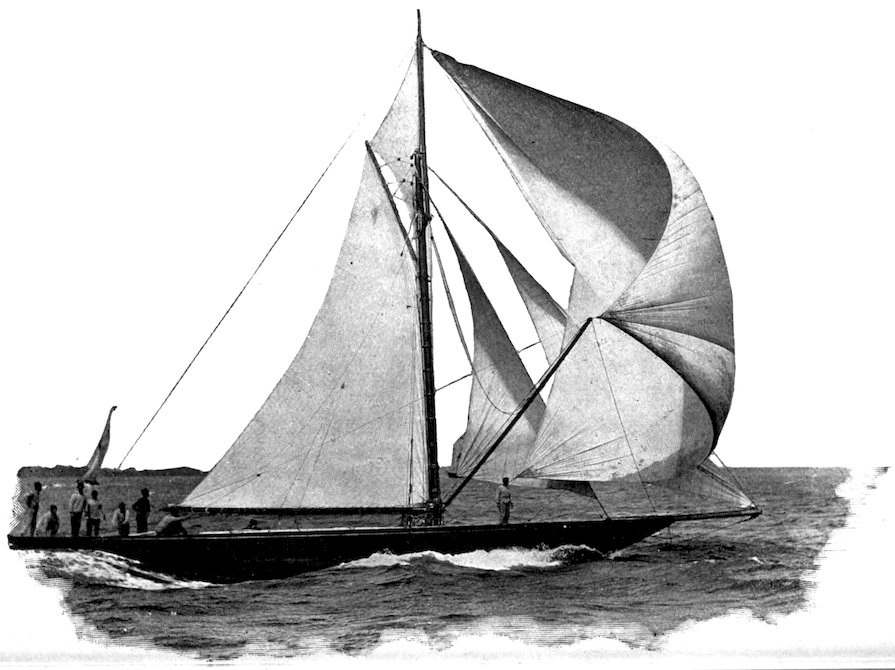
“Phantom.”
“All you will get to eat to-day won’t trouble your digestive organs,” he continued. 194“The steward has made a box of corned beef sandwiches, and that will be our plain and simple fare, with a toothful of grog to wash the grub down, and a pipe to settle everything. Today all hands fare alike, forward and aft, for we shall have no time to waste in devouring luxurious kickshaws. We must win that cup.”
From the critical view of an expert yachtsman, everything was in ship-shape fashion for the race. There wasn’t an ounce of superfluous weight aboard. The very crew seemed to be characteristic of the vital elements of the vessel, namely, strength and lightness. Their muscular agility was displayed to advantage a few moments later, when, manning the throat and peak halyards, they spread the superb mainsail to woo the wind, which, at this time, wasn’t particularly strong. I noticed that the skipper did not “sweat up” the halyards too taut, but prudently reserved that process for a few minutes before weighing anchor, allowing the soft, warm breeze to expend its influence on the sail and stretch it evenly and gently before the final pull was given.
The skipper sent the mate aloft to pass a preventer lashing round the gaff and masthead, so as to be prepared for the unfortunate contingency of the parting of the throat halyards. This is a precaution seldom taken, but Captain Marlin’s custom is to take no risks, and to be ready for every possible mishap. 195Judging from the appearance of the sky at that time, it did not seem probable that the halyards were to be subjected to any heavy strain; but the weather cannot be relied upon, and the carrying away of the throat halyards has lost many a race which a preventer might have saved.
The club-topsail was handled next, in seamanlike style. It is a difficult sail to set properly at any time, and, when spread or dowsed in a fine sailing breeze, has made many a lubber use strong language. This particular piece of duck was mast-headed cleverly and silently, as is always the case in a yacht commanded by an able skipper and manned by a competent crew.
Speculations are indulged in as to the outlook. Yachts about to compete in other classes are criticised, and many sage observations, made by the sailors concerning wind and weather, find their way aft to the quarter-deck, where the owner and his amateur tars are smoking their pipes and discussing and prognosticating the coming events of the day. The parting drag is given to the halyards, the head-sails are made ready, and the anchor is hove short.
It is half an hour before the time announced for the start, and we know that the Chairman of the Race Committee is no trifler and that the preparatory gun will be fired sharp at the hour appointed. The outlook is promising. A fine sou’wester blows, ruffling the blue 196waters of the bay and making the small craft dance to the merry music of wind and wave. There is a goodly fleet at anchor and a large throng of visitors is seen on the veranda of the club-house, on the green lawn that almost kisses the water’s edge, and on the float, which is nearly surrounded by steam and naphtha launches, gigs, dinghies and other tenders. From a look aloft at the fleecy clouds and straggling mares’ tails that sail along in the cerulean sky, the breeze shows every sign of freshening as the day grows older; and the inevitable weather prophets, one or two of whom can be found in every yacht’s crew, talk sagely of single reefs and coming squalls.
Our yacht is a down-to-date 51-footer, fitted with all modern appliances for the winning of cups, including a fin-keel that would scrape the bottom at a depth of more than ten feet, and frightens many a flounder from his feeding grounds. Witch-like she looks, as she tugs at her anchor eager to be off. Everything alow and aloft is taut and trim. Her standing rigging is set up as tight as bars of steel. Not a wrinkle shows in her well-cut mainsail, set just as it ought to be, with no abnormal strains visible in throat, peak or after leech, and not a symptom of bagginess in the whole symmetry of the sail. Above this the huge club-topsail is spread, stretching ambitiously skyward, and this, too, is a choice example of the 197sailmaker’s skill. The head-sails are ready for hoisting. The big jibtopsail is set in stops ready for breaking out as we cross the line, for the first leg of the triangular course is a reach with the wind abeam, and we shall have to carry on sail like a China clipper to get to the first mark before our antagonist, the Ghost, whose best sailing point is reaching or running.
Our boat, the Phantom, though built from the same design as the Ghost and carrying the same amount of sail, is the better at beating to windward. Once get her sheets trimmed in close-hauled to a breeze, and she will look up as high as any yacht afloat, and, what is more, you can rely on the saucy jade to fetch and weather any mark she points for.
The Ghost, though phenomenally fast with the wind free, is not quite so good at windward work as we are, judging from her behavior in four former races, when we have given her a good dusting with the breeze dead in her teeth. But once get the Ghost a-going with the wind anywhere from abeam to right aft, and the way she slides through the sea is exasperating to her opponents on the Phantom, who have often had to contemplate with annoyed admiration the shapely contour of the beauty’s counter.
Who can satisfactorily account for the difference in the speed of the two boats? They are like shoes made from the same last, of the same material and finish. Why is it that one boat beats to windward 198better than the other, and that the other reaches and runs faster than her rival? Nobody has yet offered a satisfactory explanation of this peculiar state of affairs, which yachtsmen know to exist in all classes of one design.
But here we are, aboard the Phantom thirty minutes before gunfire. Our sportsmanlike owner and our seamanlike skipper are well qualified for the coming strife. They know the course like their A, B, C. They are acquainted with every tide-rip and current likely to be encountered. The sailing directions are explicit. The crew, amateur and professional, are old hands at the business, and if the Phantom doesn’t win the cup and the side bet from the Ghost, why, all hands will be down in the dumps at the end of the race.
But there is no mention of that dastard word, defeat. Owner and captain and crew have an abiding confidence in the yacht and in each other, and all hands are imbued with enthusiasm and zeal. This is apparent in every animated glance, in each cheery “Aye, aye, sir,” in response to orders, and in every active movement of body and limb.
All hands have been through the mill before and are accustomed to pull together. The skipper knows the “hang” of the boat; he fully understands how to trim sail to the best advantage—just how much sheet to give to induce the highest rate of speed. The boat herself is balanced like a druggist’s scales, and 199is responsive as a sentient being to the slightest touch of the helm. The gear is of the best.
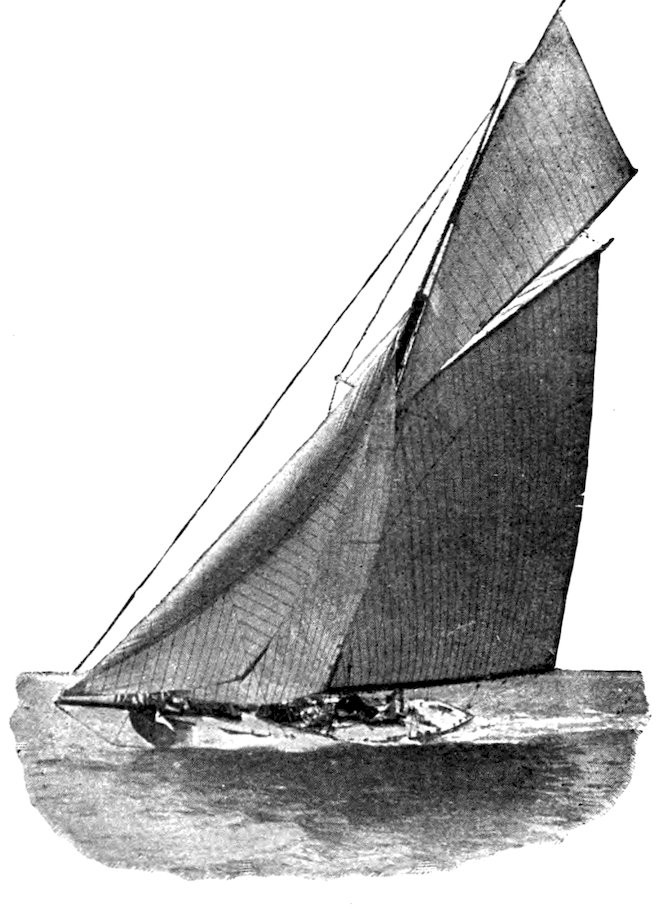
“GHOST.”
“Now, Captain Marlin,” says the owner, “we’ll get up the anchor and take a short trial spin across the bay, just to limber things before starting.”
200“Break the anchor out, boys,” says the skipper, “and stand by to hoist the head-sails.”
In a few minutes the anchor is on deck and the foresail and jib are hoisted to the fast-increasing breeze. Away we go on the starboard tack, heeling over till the water boils up in the lee scuppers and an occasional spray comes inboard on the weather bow.
As we pass through the fleet at anchor many admiring eyes examine us critically from quarter-deck and bridge; and many binoculars are leveled in our direction as we swiftly glide toward the open bay, where we shall feel the true force of the breeze and see whether the club-topsail will be too much for her with sheets flattened in.
Captain Marlin is at the helm, with the owner beside him. Both view the sails with expert glances, quick to discover imperfections in fit or trim. The mainsail retains its shape admirably, because it has been beautifully stretched by a sailor and not “monkeyed with” by a countryman from an inland village. The jib is pulling magnificently, and the foresail is attending strictly to business.
As soon as we reach the bay, away from the shelter of the protecting headland, we get the full strength of the wind, which, indeed, pipes high. A squall strikes us, and we careen under its influence till the lee rail—a mere batten—is almost awash. The skipper 201luffs a little until the fore leech of the mainsail quivers, but this seems to deaden the Phantom’s way very little. She is off, with a gleaming white bone in her teeth and showing a great burst of speed.
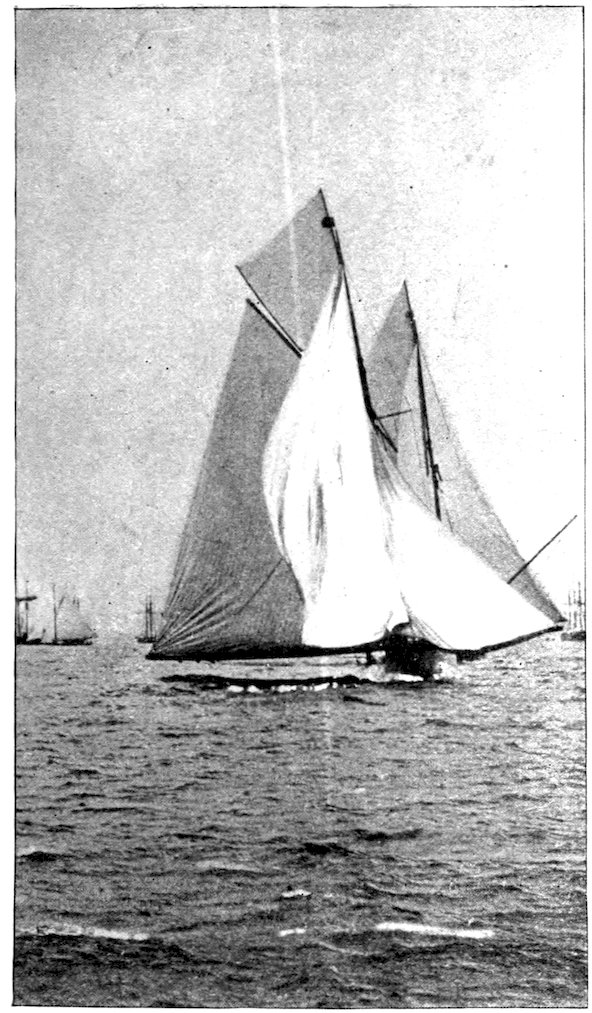
A STERN CHASE.
203“Ready about!”
“Helm’s a-lee.”
The boat swings into the wind like a top, and before you can say Jack Robinson she is filled and away on the other tack. But only a yachtsman can appreciate the smart handling of the craft. The setting up of the topmast-backstay while the vessel is in stays is work for men who are actually alive and haven’t a lazy bone in their bodies. The same remark applies to trimming the head-sheets. Of course there are “belaying marks” showing where they are to be made fast, but smartness must prevail first, last, and all the time in these days of rapid-spinning boats.
And so back we fly through the squadron, most of them now under way. We luff up in the wind’s eye for a minute or so and get another pull on the jib halyards, sweating them up quite hard. We see the jibtopsail clear for breaking out from the stops; and while we dodge about with head-sheets hauled to windward, waiting for the preparatory gun, we see the Ghost making for us and realize that if we are to secure the advantage of the windward berth and first away we must keep our weather eyes skinned.
204And mighty pretty our sleek-looking rival appears, with the sun shining on her creamy sails just new from the loft, but bearing the impress of artistic design and splendid fit. The only difference between Ghost and Phantom is that the first-named is painted black, while Phantom is resplendent in a snow-white garb. Captain Spike, the Ghost’s skipper, a bronzed, bearded man of massive build, is steering, and as he passes under our stern we wave our hands or doff our caps in courteous salute. For although both ships are manned by sturdy fighters, yet we heartily respect each other, as gallant and honorable foes are wont to do in the domain of yachtdom.
“Bang!” goes the preparatory gun, which conveys the information that our class will start in five minutes. Our owner had timed his watch by the chronometer on the club boat early that morning, and both timepieces agree to a fraction of a second. It is to be a flying start, and the two rival skippers, Spike and Marlin, are equally famous for getting away with the gun, and both are past masters in the art of sea-jockeying for a commanding position on the line. It is most interesting to watch the manœuvres of the two captains. The yachts circle round and round each other like two kittens at play, while the owners, with watches in hand, call out the time.
“One minute gone” says our owner. 205“One minute gone,” repeats the alert skipper; “hard-a-lee!” About she goes once more. “Two minutes gone,” is soon heard, followed by another tack. “Three gone!” Then an anxious pause. “Four gone!” says our owner. We are at this time some considerable distance from the line, but fast approaching it, although our foresail-sheet is hauled to windward. To leeward, and a dozen lengths astern, is the Ghost.
“Four minutes fifty seconds,” says our owner.
“Let draw the foresail; break out the jibtopsail,” are the skipper’s next commands, and for the ten seconds that follow we are all on tenterhooks. If we cross the imaginary line between the committee’s steamer and the mark-boat before the signal is given we shall have to go back and cross the line again. It is indeed an anxious moment.
“Fifty-five seconds, fifty-six, fifty-seven——”
“Will they never fire?” think I.
“Fifty-eight, fifty-nine——”
“The gun!”
“Hurrah, hurrah! you gauged her beautifully,” says the owner to the skipper, on whose mahoganized mug there grows a gratified grin.
“Ghost is ten seconds after the gun,” observed the owner, “but I guess she’ll pick that up and more too, on this leg, alone.”
The Phantom is now hissing along with the wind on the port beam, the 206main boom well eased off, the jibtopsail doing gigantic work, and the other sails contributing their share toward impelling the fairy-like fabric onward to the next goal, six nautical miles away. Not a quiver or a wrinkle in all the vast expanse of muslin extended to the breeze. The yacht’s sharp cutwater cleaves the blue sea, making little or no disturbance, but the fleecy foam travels aft with the speed of a mill-race and leaves a glittering wake astern. All the crew have come abaft the mast, and are up to windward as far as they can get. The yacht heels over in the puffs at times until the lee rail is under, and the water occasionally threatens to bubble up to the skylights, but never gets there. It is indeed glorious racing. Nobody has the slightest idea of shortening canvas. What she can’t carry she must drag.
The skipper keeps his eyes on the sails and on the compass. He never dreams of looking astern to see how his friend Captain Spike, of the Ghost, is coming along. No yacht-racing skipper ever does look astern while he is steering. It would be a breach of an old tradition unpardonable in a professional. Our owner, however, watches our opponent quite carefully, and confides to me in a whisper that he fears she will overhaul us and pass us to windward before we reach the mark at the end of the first leg. “It is in the beat back from the second mark that we shall have him at our mercy. We are considerably 207faster to windward in a blow like this, and if it pipes any harder he will have to take in his club-topsail, and then he is our meat, sure,” he added.
But there is no sign of shortening canvas on the Ghost. Captain Spike will hang on to the great sail until the topmast goes over the side rather than be beaten at “cracking on” by Captain Marlin. As a matter of fact, Ghost stands up to her work very well indeed, heeling over to the pressure of the puissant breeze only a mere trifle more than Phantom.
Other boats are competing in the regatta—a number of crack schooners and some of the new-fangled knockabouts—all of which carry single reefs in their mainsails and small jibs. It is evident, too, that even with this moderate sail they have as much as they can stagger under. We, however, have too much to do in the way of paying attention to our own craft and our immediate opponent to particularly regard the doings of the rest of the fleet.
One thing that strikes me exceedingly is the splendid way that Phantom steers. One of the old-time racing boats would have been yawing about in rampant style in a breeze as potent as is now blowing. The helmsman would have all he could do to keep her on her course, the prevailing tendency of the ancient type being to gripe to windward most damnably. Yacht architects have made great progress since then, and the modern 208craft are balanced so exquisitely that they show little or no proneness to gripe, even with the wind abeam or on the quarter. Phantom carries her rudder nearly amidships, only taking a spoke or two of weather helm. Captain Marlin steers her with one hand, and keeps as cool as a cucumber.
Meanwhile Ghost crawls up on us, inch by inch and foot by foot, her aim being to pass us to windward and to blanket us. This we will never permit without a hard fight.
We are now half way to the first mark, the wind continuing true and strong—an ideal breeze for racing. The sea is not steep enough as yet to do us any harm when we trim in our sheets for the final beat; but before this shall come to pass we have a leg to sail with the wind dead aft, and even now the men are making sure that the spinnaker gear is all in readiness for setting that enormous sail immediately after rounding the first mark. We are going to do our prettiest to get the better of Ghost at the turn, and the yacht that gets the spinnaker boom down first and the sail broken out most quickly has a big advantage.
I can’t help remembering how a mishap to her spinnaker caused Valkyrie II. to lose her last race with Vigilant, and I express a silent but fervent hope that nothing untoward may occur to stop the smart setting of our own good sail.
But now the sly and swift Ghost is crawling up, pointing her bowsprit for 209our weather quarter, with the intent, if possible, of establishing an overlap and a consequent blanket. This leads to a luffing match which is mighty interesting while it lasts. The more we luff the faster we fly, and at last we get so far ahead that we are able to bear away on our course again and still maintain the lead.
Now, what do you think is the next artful move of the skipper of the Ghost? That fellow is as cunning as a wagonload of monkeys. Seeing that he cannot pass us to windward, he eases his sheets a little, and, with a great spurt of speed which fairly took our breath away, walks through our lee like lubricated lightning and tries to luff up across our bows and so get the weather gauge.
But it isn’t Captain Merlin’s watch below exactly. That ancient and tarry one has his eyes wide open and his wits all about him. He also luffs in time to establish an overlap, and so he balks the blanketing dodge of Captain Spike, who is thus hoist with his own petard. This skirmish shows the advantage of getting the lead at the start. Had Ghost crossed the line first we could never have caught her, but as it is we are able to prevent her from passing us. And to the undying fame of our sterling skipper, by the exercise of all the devices known to the sea-jockey, we actually round the mark first!
As we whirl round the raft from whose flagstaff the club burgee is noisily flapping, 210the main boom is eased off handsomely by the owner and myself, while the rest of the boys busy themselves with the spinnaker. As the boom is lowered, the sail neatly done up in stops is smartly hoisted to the topmast head. The after guy is hauled aft, the outhaul is manned, and with three tugs on the sheet the big sail bellies to the blast and pulls nobly.
Now a more powerful puff than ever smites the Phantom. Its force makes the spinnaker boom up-end and the spinnaker itself puff out like a balloon. But both spar and duck are of the best and no misfortune befalls them. The balloon jibtopsail now takes the place of No. 2, so that if the wind shifts we shall be ready for it. When this is done all hands lie aft so as to lift her bow as much as possible, while not burying her counter, and, standing up so as to catch every breath of wind that is going to waste, are regaled on beer and sandwiches, which the steward passes round. He, like the willing and zealous fellow that he is, has been pulling and hauling with the rest of the crowd, and is puffing like a porpoise after the unusual exertion.
In planning the day’s campaign it has been settled that we shall steer a direct course from the first to the second mark. We know that we have no chance to run before the wind so fast as the Ghost, which is now only twenty seconds astern of us, and is bound to 211pass us in spite of everything. Thus, we waste no time in jockeying.
And glide past us she does, silently and slowly like the ghost that she is, her spinnaker and main booms forming the base of a lofty pyramid of canvas, arched out to the swelling breeze. The lapping waves break in milky foam under her counter, the spray sparkling like diamonds in the golden sunshine. Her crew look proud and exultant at their victory.
But the demon of despair affects us not. We know what our stanch and noble craft will do when we haul on a wind for the final homeward thresh. So we light our pipes, and grin and bear our temporary defeat like the stoics of old. Meanwhile, we recollect that we shall have to gybe round the next mark and realize that this will be quite a ticklish job in so stiff a breeze. To luff round a stakeboat is easy as eating, but to swing over a main boom as long as ours from one quarter to the other with the huge club-topsail aloft requires coolness, skill and judgment. Besides, we want to make as clever and close a turn as possible, so as not to be swept too far to leeward before flattening in sheets and starting on our long windward beat.
All has been provided for, however. We see all hands on the Ghost taking in the balloon jibtopsail and getting ready to dowse the spinnaker, for now the stakeboat looms mighty near and the great struggle of the day is at hand.
212“Take in the jibtopsail!” cries our skipper, and this is an easy task, for the enormous sail is almost becalmed. It is soon spilled, stopped up and bundled below. Foresail and jib are neatly set and their sheets trimmed down to the marks.
“See the spinnaker gear clear for taking in,” is the next command. And this being done, there is silence for the next minute or two. All hands gather round the mast. One hand stands by to let go the outhaul, another the halyards, while all get ready to grapple with and spill and smother the bellying duck and bring it into subjection to the deck.
We are almost on top of the mark when the skipper sings out: “In spinnaker!”
As the outhaul is slacked, the men, grabbing the foot of the sail, lug it in, and, spilling the wind out of the flapping canvas, wrestle with it and victoriously overcome it, until it lies an inert mass at their feet. The boom is then topped up and all hands lie aft to tend the mainsheet, which is stretched along the deck to rally in quickly. The jib and foresail are set already and trimmed down to the marks. A couple of men stand by ready to “come up” the topmast-backstay and get it set up on the other side before an undue strain comes on the spar.
“Now, boys, haul in the mainsheet,” says the skipper as he shifts the helm 213so as to bring the wind on the other quarter. Hand over hand the men drag in the boom, pulling as if for dear life. The wind pipes so breezily that the skipper has as much as he can do to gybe the boat so as to make a close turn round the mark and carry away nothing.
The boom comes over with a whirl and a rush, and is checked by a turn round the cleat. The yacht flies up in the wind, but is met with the helm and the head-sails, and there we are, close-hauled on the port tack, with three strakes of the lee deck under water and a devil of a strain on the topmast. The yacht, as she comes to the wind, takes a header into a big green sea and floods the deck. This is her first fault of the day, and we cheerfully forgive her, not minding the wetting, and making up our minds for a hard tussle home against wind and sea.
Now that we have fairly settled down to windward work, we have time to look after our opponent. We see that she, too, has rounded without parting a rope-yarn. She is ahead of us, and a wee bit to windward. We notice that she is being “nipped,” the luff of her mainsail shaking all the time. She isn’t quite so stiff as we are, and her immense club-topsail will bury her if her skipper will only give it a chance. He is afraid to take it in, for he knows that before he could get his “thimble-header” set we should work out half a mile on his weather, so he sails her close, and prays that the wind may lull.
214Captain Marlin, on the contrary, gives it to Phantom hammer and tongs, letting her go clean through the water with the sails ramping full. The decks to leeward are wet, but little does that concern us, for we know that when we go about on the other tack we shall be able to cross our rival’s bows, unless she also goes about. And so it comes to pass. The next “board” assures us that the race is ours, unless we get crippled. We plant ourselves on the weather of the Ghost and stick to her, tack and tack. We keep her jammed under our lee, in chancery, as it were; and there she remains until we cross the line, a winner by 2m. 42s.
We come to anchor, furl the sails, send in a certificate that we have complied with all the sailing rules of the match, and hoist another winning flag to join our already long string. Then the steward is sent ashore, and he quickly returns with a fine feed for the crew, which is vastly enjoyed by them, after drinking a “horn” apiece to the further success of the Phantom and her owner.
![[Ship’s wheel]](https://openoldbooks.sgp1.digitaloceanspaces.com/books/yachting-wrinkles/images/i_221.jpg)
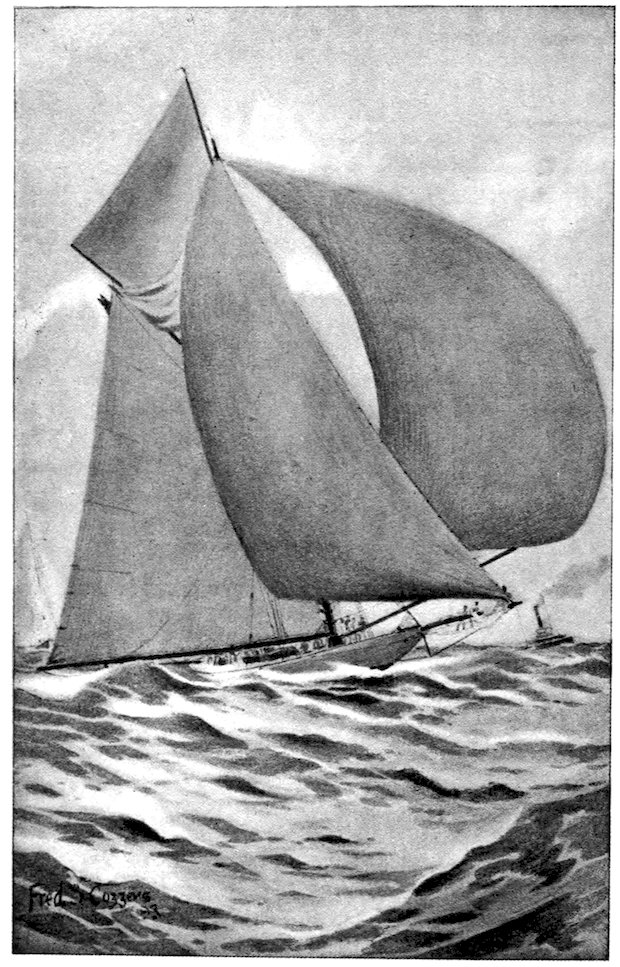
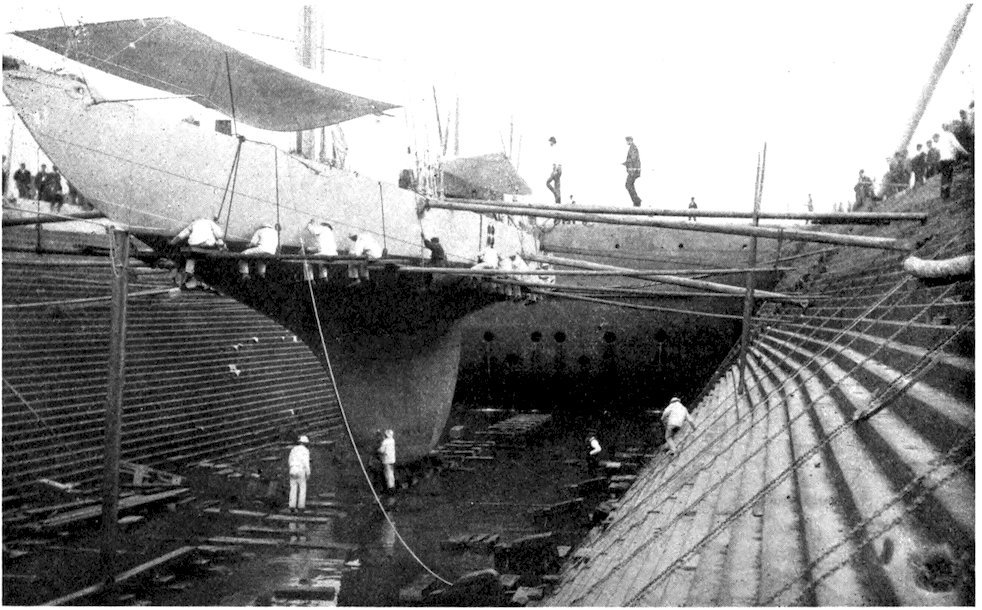
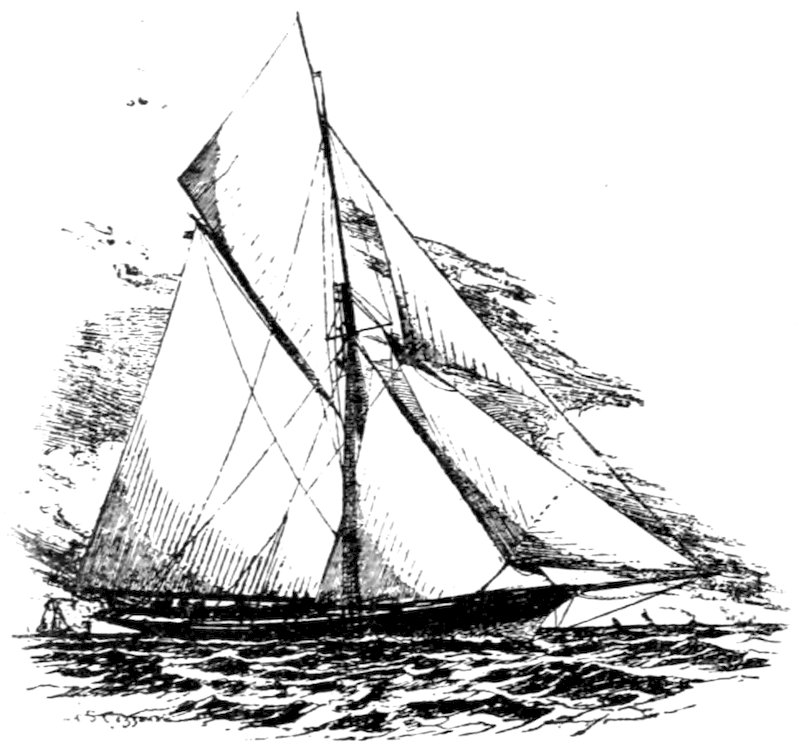
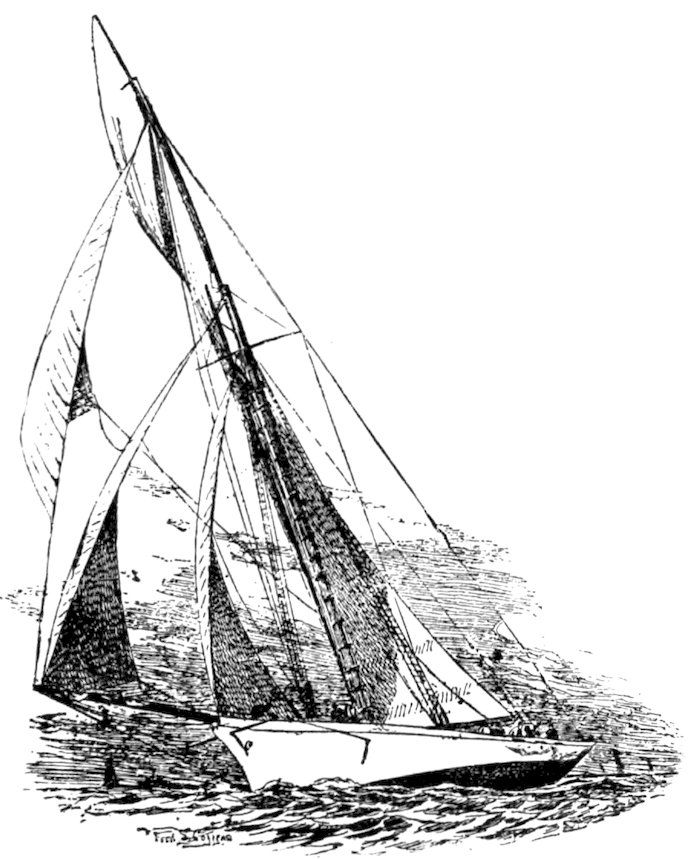
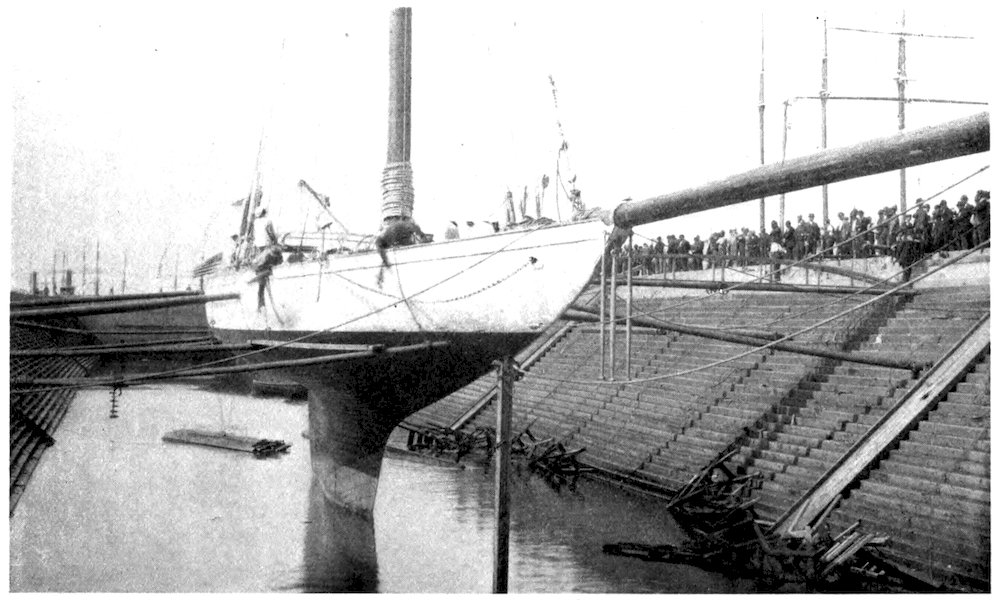
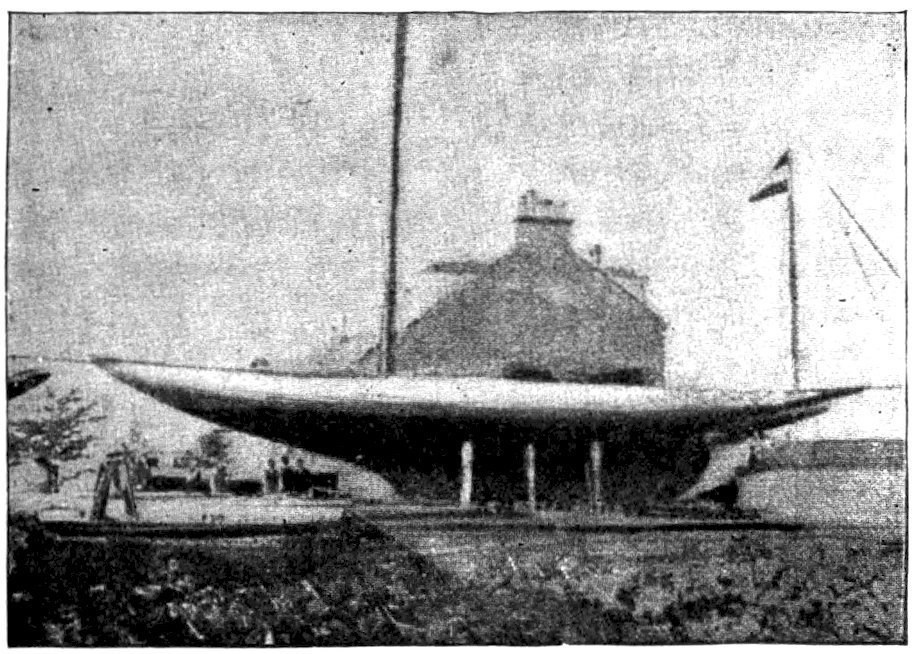
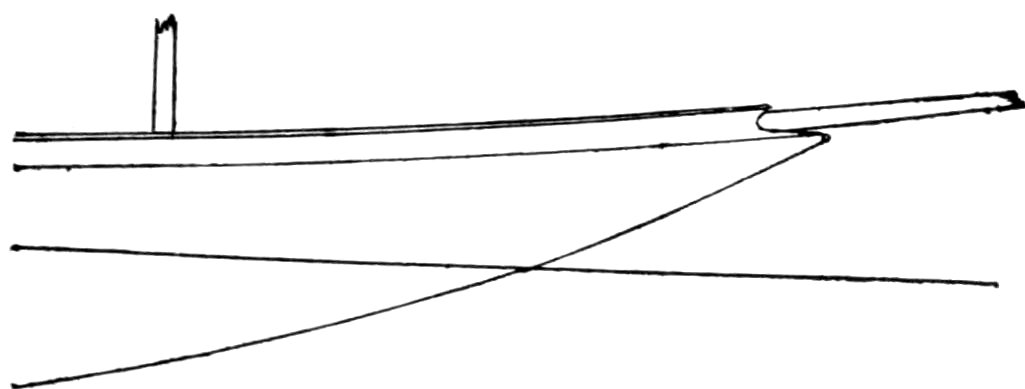
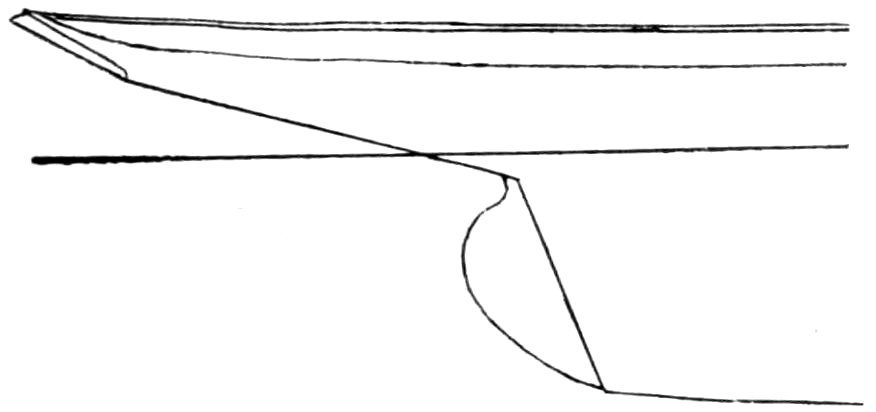
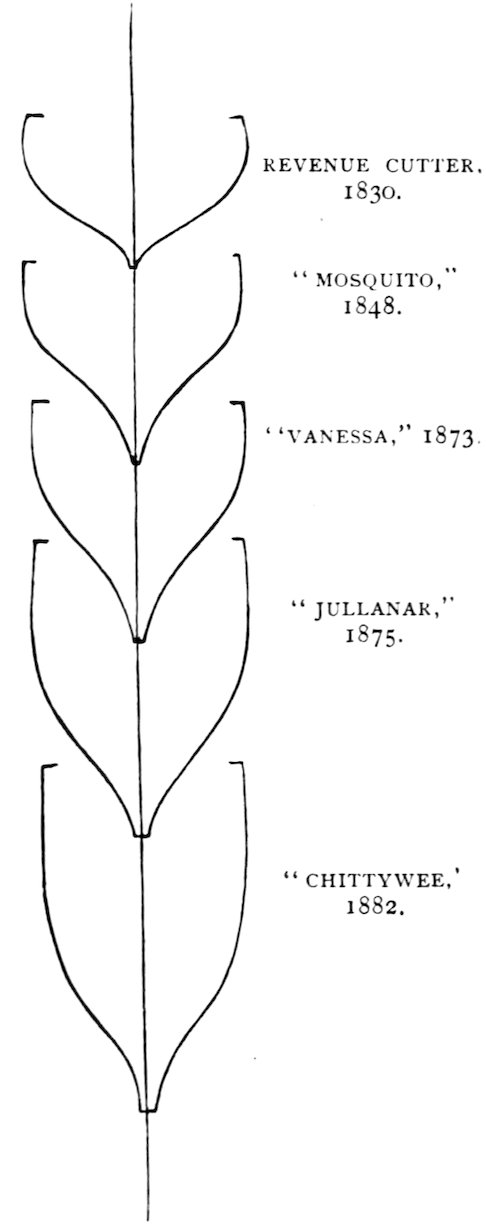
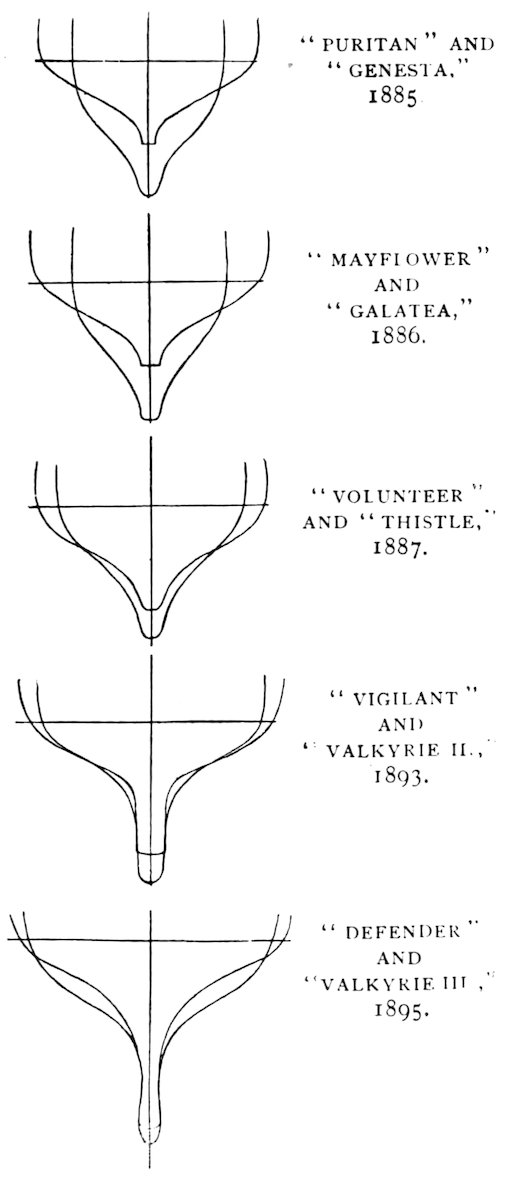
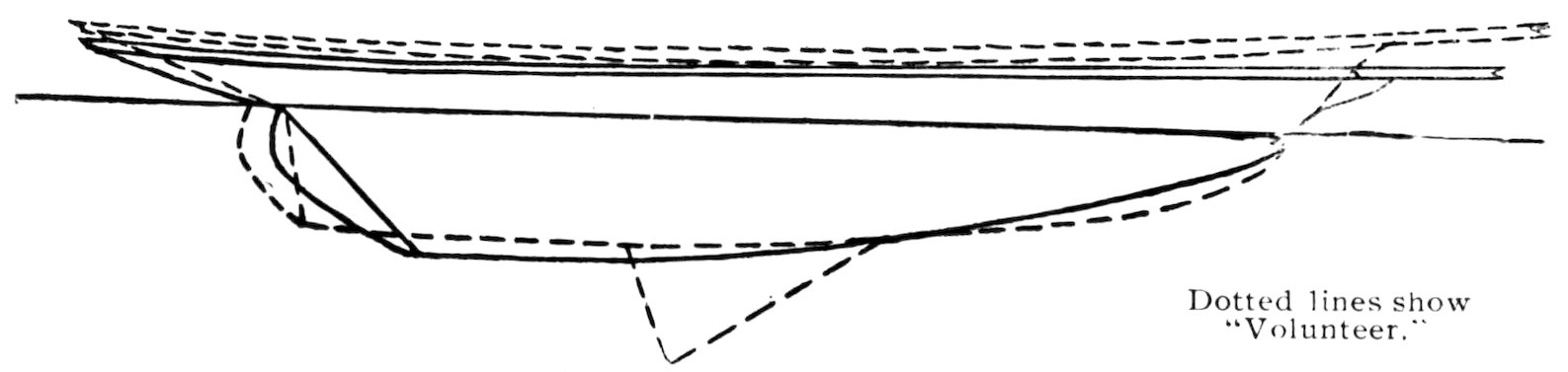
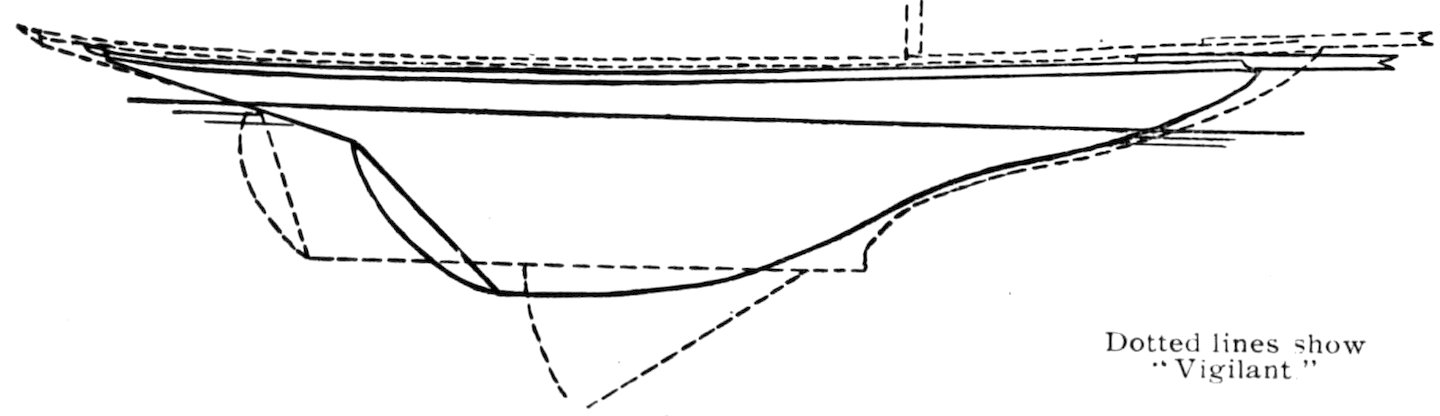
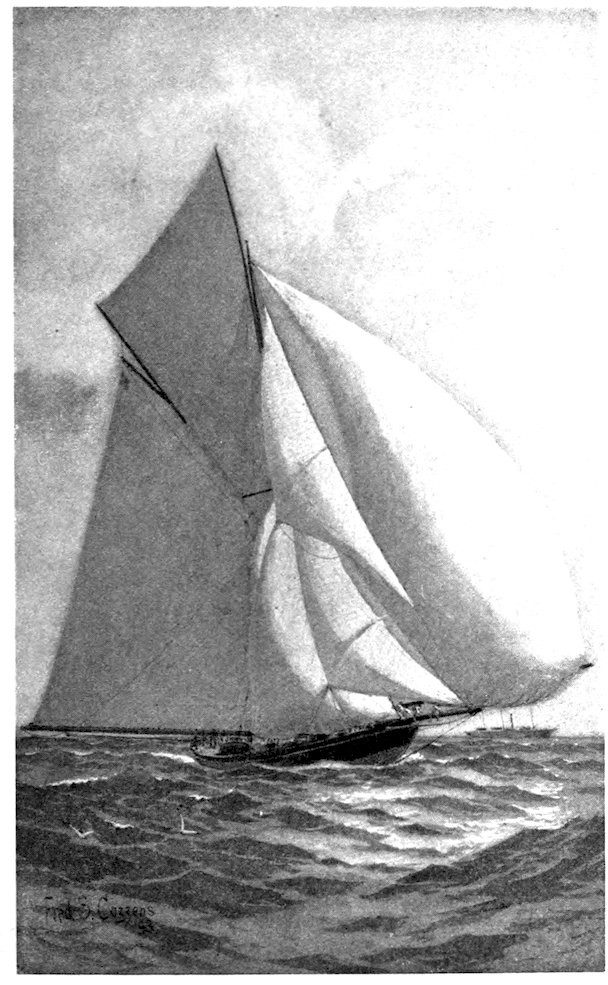
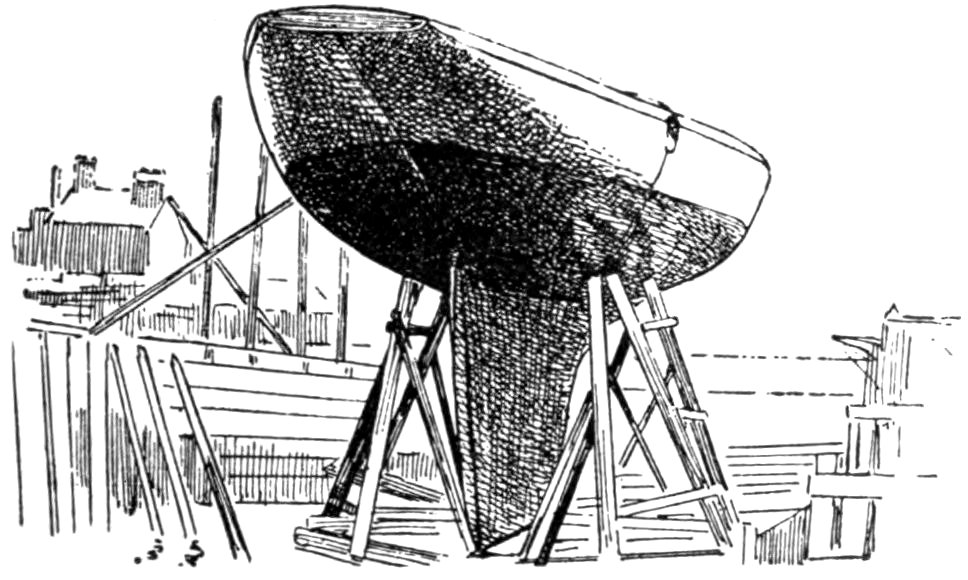
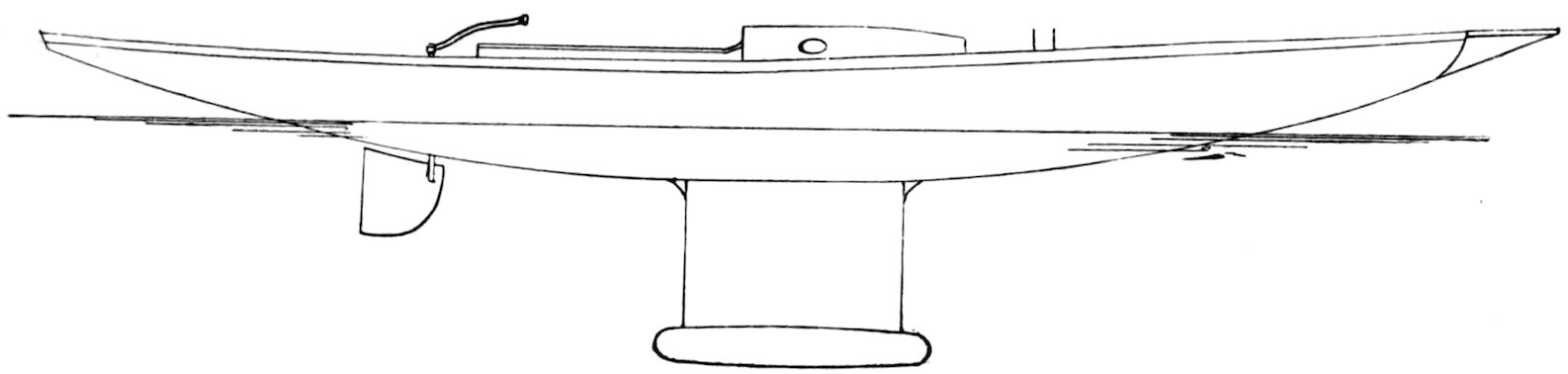

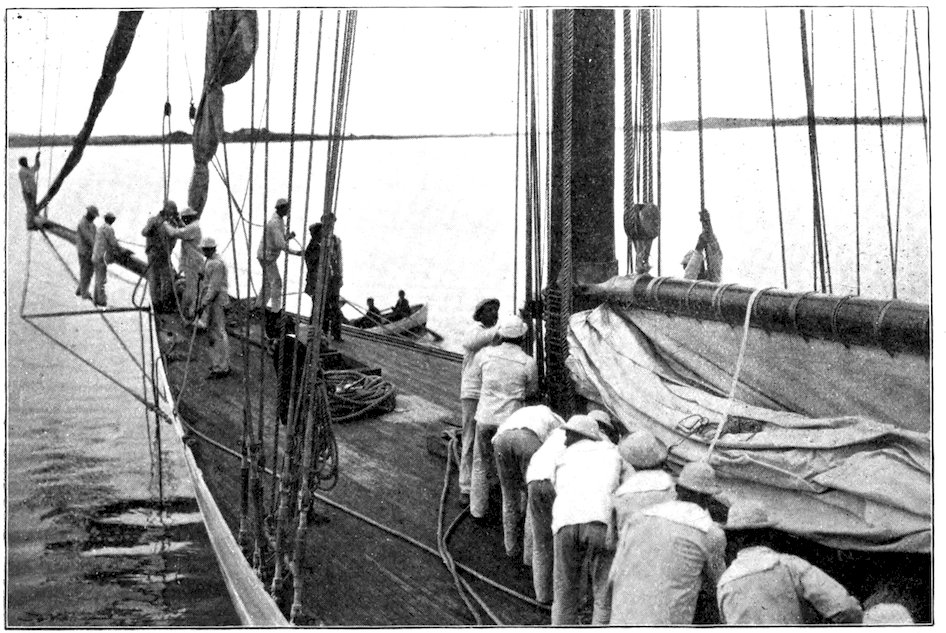
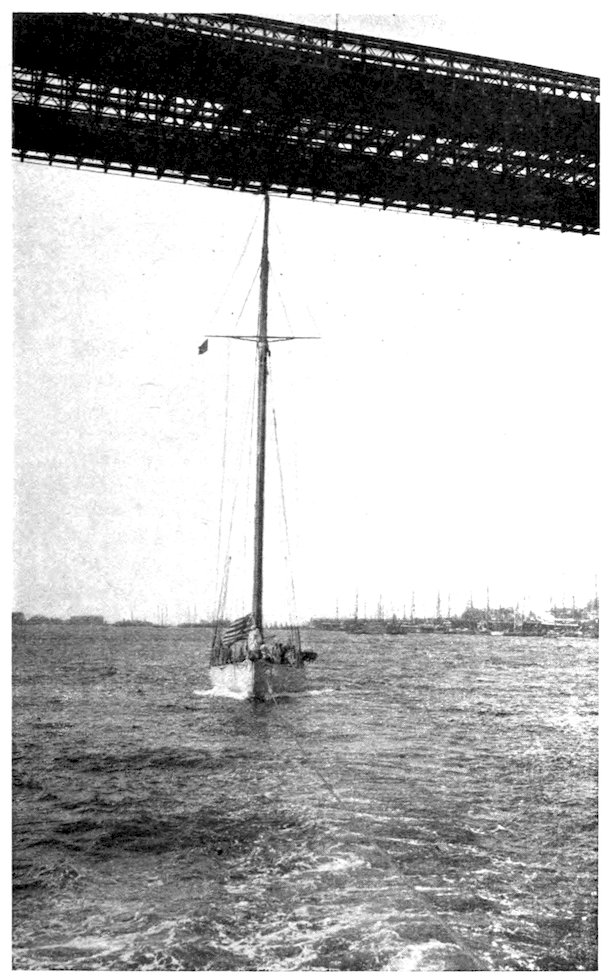
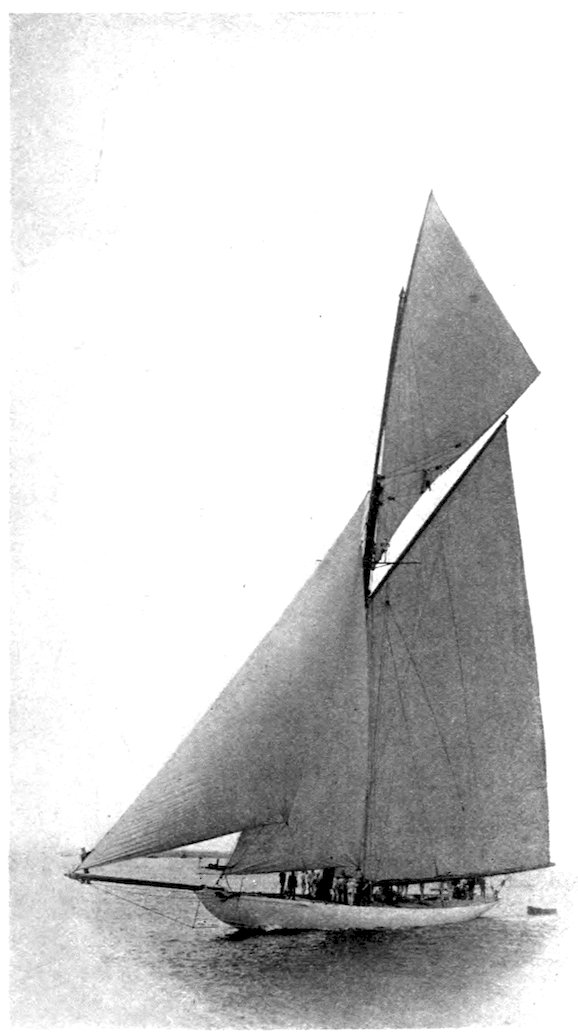
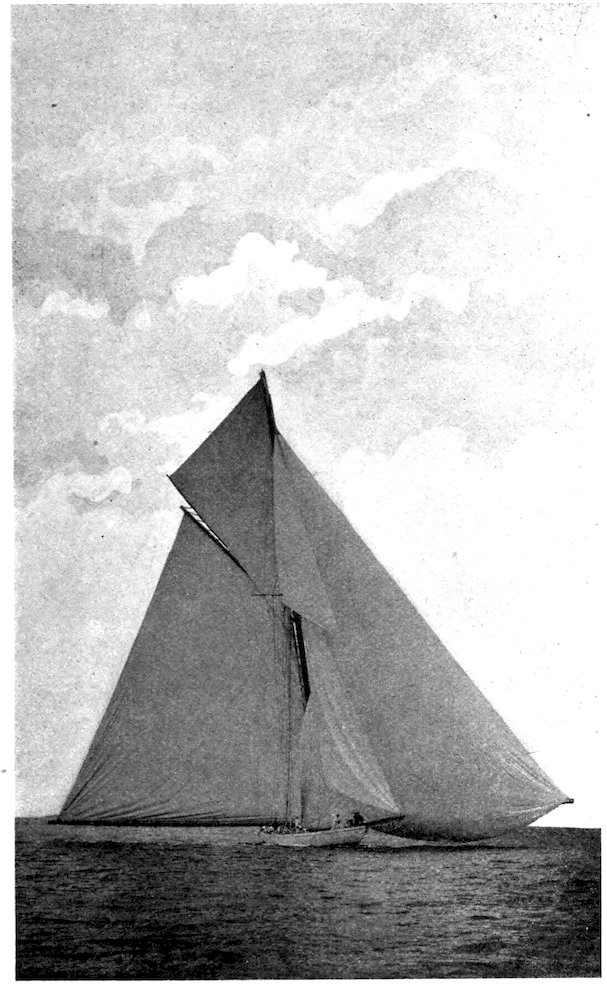
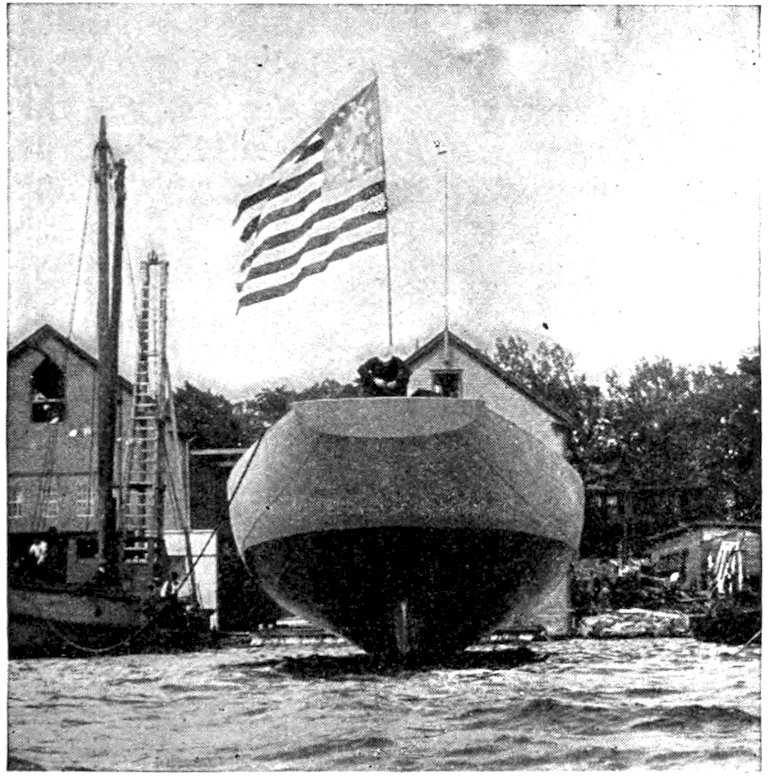
![[Rowboat]](https://openoldbooks.sgp1.digitaloceanspaces.com/books/yachting-wrinkles/images/i_280.jpg)
![[Yacht]](https://openoldbooks.sgp1.digitaloceanspaces.com/books/yachting-wrinkles/images/i_307.jpg)
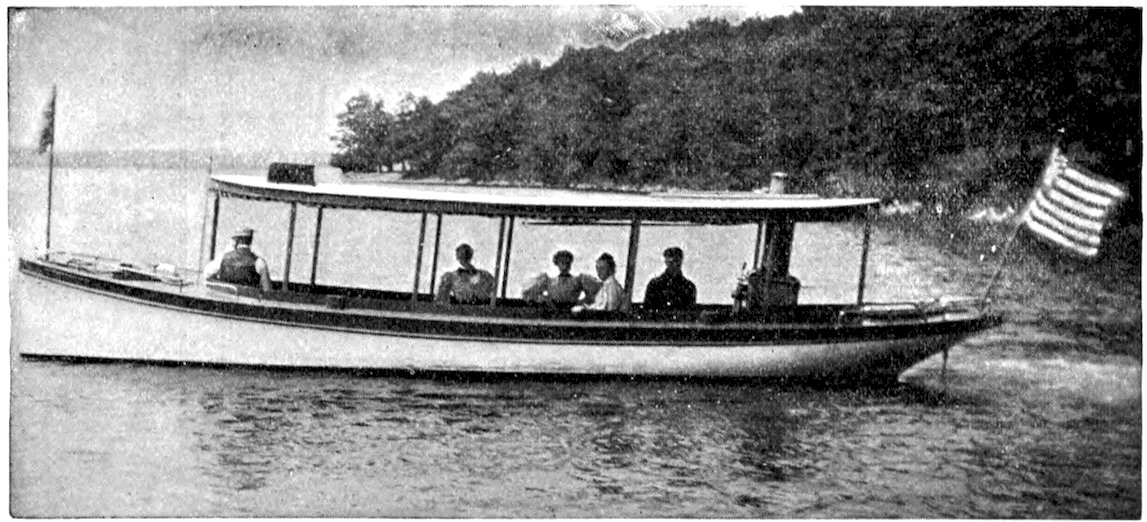
![[Yacht]](https://openoldbooks.sgp1.digitaloceanspaces.com/books/yachting-wrinkles/images/i_314.jpg)
![[Logo]](https://openoldbooks.sgp1.digitaloceanspaces.com/books/yachting-wrinkles/images/i_315.jpg)
![[Yacht]](https://openoldbooks.sgp1.digitaloceanspaces.com/books/yachting-wrinkles/images/i_316.jpg)
![[Pump water closet]](https://openoldbooks.sgp1.digitaloceanspaces.com/books/yachting-wrinkles/images/i_317a.jpg)
![[Folding lavatory]](https://openoldbooks.sgp1.digitaloceanspaces.com/books/yachting-wrinkles/images/i_317b.jpg)
![[Yacht]](https://openoldbooks.sgp1.digitaloceanspaces.com/books/yachting-wrinkles/images/i_318.jpg)