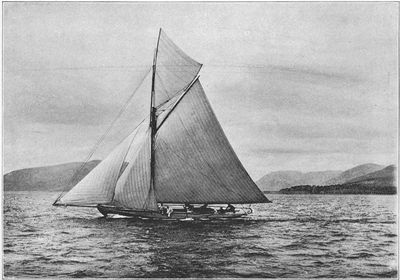
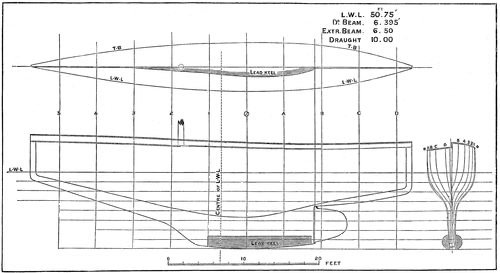
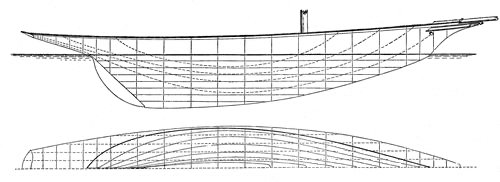
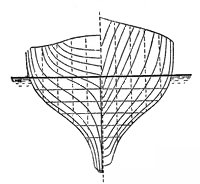
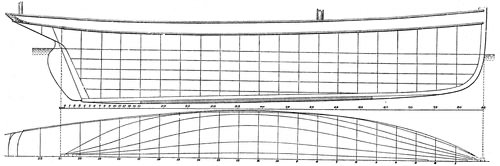
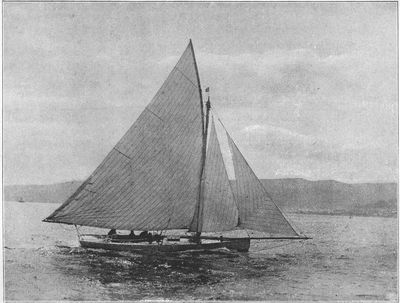
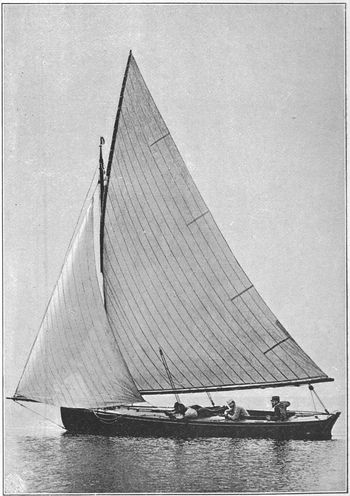
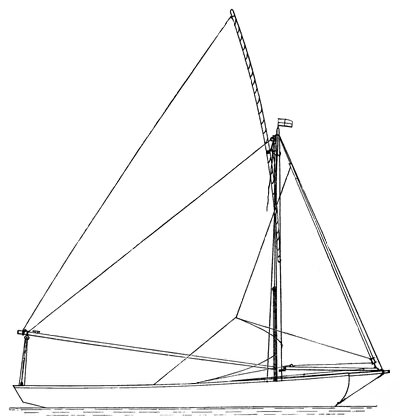
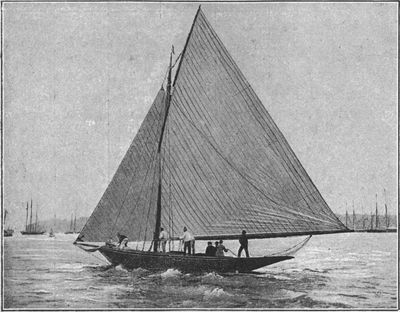
A few years ago a great sportsman, whose privilege it had been to take
an active part in nearly every form of sport known to the British
Isles, was asked which of them all he thought should be placed at the
head of the list as being most conducive to make its follower manly,
and at the same time least open to the criticism of those who are
always inclined to find fault with their neighbours' methods of
employing their spare time. There was some little hesitation before he
gave an answer, but at length he expressed an opinion that yachting
excelled all others. To enumerate a few of his reasons will not be out
of place here.
The first and foremost was the utter absence of any possibility of
cruelty, as calls could only be made on inanimate materials and the
yachtsmen themselves. Then it was quite out of the question for a man
to be a thorough yachtsman without courage and endurance being brought
into play. Quickness of action, or the ability to think and act at the
same time, was also a necessity in yachting, as it was in most other
sports; but it was an absolute one here, because the elements were an
unknown force, and sudden contingencies, not to be equalled in
intensity or severity by any possible emergency ashore, had frequently
to be faced. This quality—quickness of resource—was, of all others,
the characteristic of the sailor.
Two more points were added, which certainly tend to place
yachting, and yacht racing especially, in the fore rank of sports. The
first was that yacht racing and cruising are carried on by those who
enter upon them, not in any way as a business, but solely for the love
of the sea. The prizes, such as they are, when bestowed in money are
so small in comparison with the outlay and cost in building and
sailing a racing crack, that in most of the recognised classes they
only go a very little way towards lessening the general expenditure,
whilst as for betting on the races, such a thing was rare in the
extreme.
The last argument was that 'unfair sailing' was a thing almost, if not
quite, unknown, and if there was an argument in favour of extra money
for yachts' crews on racing days, it was that it helped to encourage
all hands to do their utmost to make their vessels, let the look-out
be ever so bad, come in and win.
To one desirous not only of enjoying the sport, but also of really
understanding every detail connected with it, from splicing, knotting,
sail-making, varnishing, painting, cleaning brasswork, setting, taking
in, reefing or shifting sail, to steering a clean full-and-bye against
a head-sea, or learning to make himself comfortable on the smallest
possible fit-out, an old yachtsman's advice is, the smaller the boat
chosen to begin with the better; and after a quarter of a century's
experience of small yachts in all weathers, seas, and climates, he
believes the vessel of about 30 feet in length, with a moderate beam
and draught of water, is the smallest capable of keeping the sea with
any degree of comfort and safety. There are no more suitable yachts of
the size referred to than those built under the old Thames Rule of
Measurement, or the late Rule of the Yacht Racing Association, to sail
in the class for yachts of 5 tons and under. A restriction might be
added to the exclusion of such yachts as were the extreme outcome of
the rule; but as only three were built—one designed by Mr. G. L.
Watson and the late Mr. Payton's two vessels, both of which were
lost—there is no need for the limitation; and on looking
back into the eighties it will be found that the 3-ton class in the
South and the 3½-ton class in the North altogether monopolised the
true plank-on-edge model entirely for themselves. Though the extreme
types under the old rule were long, narrow, and deep, they were fine
weatherly little sea-boats to the practised hand, but as a school for
the tiro, except in racing, too heavily sparred and too narrow.
The main point in favour of the 5-ton yacht built under the old
rule—for the 5-rater of to-day is almost as large as the former
10-tonner, and requires quite as many, if not more, hands to work her
on a racing day with her present lugsail rig—is that she is easily
worked with one good hand, can be raced with three, or easily with
four; and those whose early practical yachting experience was gained
as small yacht sailors and yacht-owners will agree in this, that their
happiest hours were spent in the boat that required fewest paid hands,
or when their ship was of such a size that they were able to put to
sea single-handed, or perhaps in company with a friend who could make
himself useful. There are many who will say that a 10-ton or even a
20-ton yacht is too small to stand out to sea in; but when a yacht is
of such a size that she requires more hands than one to work her there
will be little or nothing learned, whereas, if the yacht is just a
little too much for one man to handle, the owner is bound to do his
portion of work each day, and what he does not know will soon be
taught him by his man, so that he may enjoy his fair share of rest and
not have to be called up in the middle of his watch below. Besides, if
the cost is a consideration, a 5-ton yacht can be built for just half
the price of a 10-tonner, and the keeping it up is very much smaller
in proportion.
It is not quite twenty years since the racing yachts of 5 tons were
formed into a class, and prizes awarded them. The Clyde yachtsmen were
the first to appreciate the value and capabilities of the little ships
for affording good all-round sport, and the small expenditure
entailed at that date in building them was a consideration in
their favour. It has been a favourite class ever since.
In Dublin Bay small yacht racing is far from a novelty, but it is only
within the last few years that boats have been built to the class
adopted in the seventies, viz., for 'yachts of 6 tons and under,' time
allowance having previously been used to bring the small fry together.
At that time Liverpool had two pet classes, the 20-ton and 10-ton, and
such small yachts as were located on the Sloyne entered in the latter
class.
It was about the middle of the summer of 1873 that the writer's
attention was first drawn to small racing yachts under 7 tons, and the
way in which they could face almost all weathers. It had been, as it
is at the present day, the custom to decry and run down racing yachts
as unfit to be made into cruisers. 'The scantlings were light,' 'the
framework was weak,' 'the plank, especially at the garboards and
towards the run under the counter, may have been dubbed down to almost
the thickness of brown paper.' This latter process was often resorted
to some twenty-five years ago, so that ballast in the form of lead
sheeting might be padded on to the keel and garboards. More than one
large yacht at that period had been so treated that she was supposed
to have not much more than half-an-inch planking at her two lowest
strakes. 'I would not buy an old racing yacht if I were you.' Such
were the comments and never-ceasing advice dinned into the ear;
'besides, they are fearfully wet in a sea-way, and most
uncomfortable,' and, therefore, at that time the writer's vessel was a
strong, able, high free-boarded schooner of 11 tons. In that year
there could not have been a dozen yachts, taking our coasts round,
which were being raced as 5-tonners, but there were classes made up of
yachts of 7 tons and under, which took in some stray 3- and 4-tonners,
and here and there a casual 5- or 6-tonner. One of the best of these
6-ton yachts (and this is including all the Scotch and South-country
boats) was a little vessel built in 1871 for Mr. W. A. Tomlinson, by
Mr. Dickenson, of Birkenhead, the well-known builder and
designer of the principal pioneer Liverpool 10-tonners. Unfortunately
her dimensions cannot be correctly stated, but she was about 32 feet
between stem and sternpost on deck, some 6 ft. 6 in. in beam, and had
a draught of 5 feet or a little more—that is, she was as nearly as
possible the size of the 5-tonner of a five or six years' later date.
The occasion on which the 'Wyvern' came under the writer's special
notice was one long to be remembered on account of the anxiety created
among the little yacht's admirers at Kingstown, owing to the severity
of the gale that blew after she had left that port for Liverpool.
There had been a regatta in Dublin Bay, where, as is usual, all the
small boats of the St. George's Channel had collected to do battle.
The 'Wyvern' had come over from the Mersey, and having won, her owner
(at that time Mr. Colin Napier, of Liverpool) had left her in the
hands of his two men, that he might hurry back to his business by
steamer. The men were ordered to make the best of their way to
Birkenhead, as the yacht had been entered for a local regatta the same
week.
They started early on a Wednesday, but unfortunately ran aground on
the rocks at the end of the eastern breakwater on which the lighthouse
is built. For the greater part of the day the boat was standing high
and dry some feet above the low-water mark, but she sustained no
damage, was floated off at the return of the tide, and left at once
for her destination. The hour of her departure was about three or four
o'clock in the afternoon. Three yachts left the harbour in company
with her, bound for the same port, all three being at least
25-tonners.
As the barometer had been falling ever since the morning, and there
was every indication of bad weather, the skipper in charge of the
'Wyvern' was repeatedly advised to postpone his start till the
following day, or till a change in the weather should take place; but
it was to no purpose, since he was very anxious to reach the Mersey as
soon as possible.
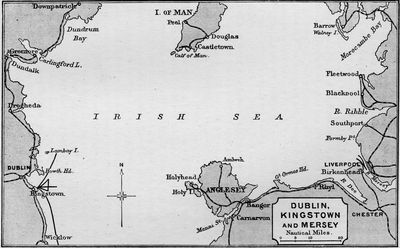
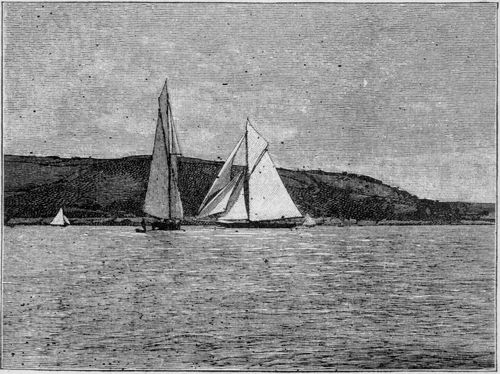
DUBLIN, KINGSTOWN AND MERSEY
F. S. Weller.
Towards 6 p.m. the north-westerly breeze, which had been
blowing since noon, increased considerably, so much so, that first one
and then the other of the larger yachts gave up and turned tail before
it might become too late, the last to say good-bye being the largest
of the three. This yacht, a well-known hard-weather vessel of over 40
tons measurement, after trying to signal a last advice to the little
'Wyvern' to return, put her helm down (though she was well past the
Kish Lightship), and made herself snug for the dusting she was in for
on the journey back to Kingstown.
On shore, at both club-houses, the greatest alarm was being felt not
only for the 'Wyvern's' safety, but also for the welfare of her three
larger sisters, and the anxiety on the 'Wyvern's' account increased
still more when her three companions put in their appearance again at
their moorings. During the evening and through the night the wind
increased to a whole gale, and the meteorological report next morning
proved anything but pleasant reading, whilst among the old salts and
those best acquainted with the capabilities of small yachts little
hope was felt of ever seeing the 'Wyvern' again.
On the evening of the next day the writer left Kingstown for Liverpool
in his yacht, and fell in with the Mersey 10-tonners making the best
of their way down river. The nearest yacht hailed informed him that
the 'Wyvern' had arrived all safe, and had made a very fast passage
across to the Sloyne. A few days after, meeting the skipper, a full
account of the trip was given, and there was no limit to the eulogies
he had to bestow on the yacht. During the night the sea had increased
the further they sailed from under the lee of the land, but for all
that the only time any seas were shipped was when off Holyhead. Twice
only had they to free the yacht of water, and on those occasions very
little had gone into the cabin.
The 'Wyvern' was not a yacht of large displacement; she inclined,
indeed, rather the other way. Those who have seen the 'Naiad' or
'Pastime' hauled up out of water (two of Dickenson's old crack
10-tonners which now frequent the South Coast ports) will have a
better idea than any words can give of the 'Wyvern's' style
of model and midship section. Built for length on deck, there was no
necessity for shortening up the water-line, and her sternpost had no
very great rake. Her buttock lines were as easy and fair as could be,
giving her a slightly hollowed entrance with a nice clean run aft. Her
extreme draught was not much over 5 feet, and her keel ran almost
straight from the heel of the sternpost to the foot of the stem—that
is, with very little if any rocker (or rounding) to it. Dickenson had
a very admirable method of finishing off the after end of his yachts,
and their counters were all light, and neatly put on. The 'Wyvern's'
counter was particularly so. She was flush-decked save a large
cockpit, which opened into the cabin, and which was surrounded by a
5-inch combing. This was the only weak or vulnerable part about her;
for if a really heavy lump of water had filled it, there was nothing
to prevent the cabin being swamped. Her fittings below were of the
simplest description, though very comfortable. The sofas on each side
of the saloon formed lockers and berths, and beyond these a pantry and
a fitting for a lavatory, which was forward on the starboard side,
with the usual two square lockers at the after ends of the sofas, were
all the furniture of any consequence she contained. She had wood
floors, iron not having come into fashion at that time, and carried
the greater part of her ballast inside to the tune of 3 tons of lead
and 10 cwt. of iron. Her outside ballast consisted of a 14-cwt. lead
keel, which was considered in those days a very heavy keel for so
small a yacht. She was one of the first small yachts of 6 tons or
under that was fitted with a flush deck and ordinary skylight, and in
every way she looked the picture of smartness. When she was first
built her principal antagonists about her own size were the 'Adèle,' a
small 5-ton yacht also by Dickenson, the 'Pet,' 5 tons, built at
Douglas, Isle of Man, in 1871, and a very fast 3-tonner, the
'Barracouta,' built by Bishop in 1860, for Mr. J. M. Hannay. She was
altered in 1874 into a yawl in order to race in the 5-ton class, which
was at that time just beginning to be popular.
Among the most celebrated of the early 5-tonners were three
yachts, the 'Pearl,' 'Torment,' and 'Arrow.' Of the three, the 'Pearl'
and 'Torment' were the best known, and are still held in loving memory
by many a yachting enthusiast. The 'Torment,' owned by that well-known
yachtsman the late Secretary to the Royal Irish Yacht Club, was raced
from the day of her birth, some time about the year 1850, and was
always a leader of the van. Her racing career lasted not much less
than twenty years, and it was only the lead keels and the deep bodies
given to the later yachts that brought it to a close. It is when
looking back on such good old warriors as the 'Torment' and the
'Mosquito,' among the larger racers, that lovers of the sport whose
incomes are limited must agree that the old days were good indeed. It
was not necessary then to be the fortunate possessor of a new vessel
each season to enable the lover of yacht racing to win prizes and keep
well in with the flyers of the year. When an old boat appeared to be
not quite up to the mark, or lacking in the requisite turn of speed,
little was done to make her beat some new comer beyond a few
alterations, which as a rule took the form of doctoring up one or
other of her ends, or, perhaps, lengthening her out amidships. The
most remarkable example of how a yacht's racing life could be made to
outlive many competitors and leave her a winner to the last, by
effecting alteration after alteration on her hull, was that of the old
'Arrow,' which belonged to Mr. Tankerville Chamberlayne. Alas! the
days when an alteration was quite sufficient to keep a yacht
successful have long since passed away, and from the present outlook
seem as if they will never again return.
The 'Pearl,' like the 'Torment,' was a hard nut to crack for all the
new aspirants to fame which were built to beat her, and she kept her
position as the fastest of the 'Mosquito' fleet for an untold number
of years. She hailed from Fairlie, that birthplace of hundreds of
fast, powerful winners, so dear to the hearts of all Scotch yachtsmen,
and so well known in almost, every corner of the globe. She was owned
and built by Mr. Fife early in the sixties, and after ending
her racing career in the Clyde has found her way over to France, where
she is as much appreciated as she was in the height of her day in
Scotch waters, and has kept up her reputation of being a difficult
boat to beat. Her dimensions were: length, 25 feet; beam, 7 feet; and
draught, 4 feet. There were many yachts built to beat her, among them
being the 5-tonners 'Hilda' and 'Viola,' designed, owned, and built by
Mr. Inglis. This well-known yachtsman also launched a very pretty
schooner of 8 tons called the 'Cordelia,' now, unhappily, lying at the
bottom of the sea. She, like his other two ventures, was designed to
race in the 5-ton class, and also to put the wee 'Pearl's' nose out of
joint. They were all three big boats, fully decked, and veritable
ships when compared with the 'Pearl.' They drew a foot or two more
water, had big midship sections, and were in every way larger and more
powerful yachts. Their success, however, was only partial, and it was
a question whether, after all, the old boat did not in the long run
hold her own.
The 'Arrow's' reputation was only of short duration in comparison with
the 'Torment' and 'Pearl,' but she was a remarkably small boat, and
very like them in the main features of her design. She was got out
originally to play a part very different from that in which she proved
herself so successful, having been built and launched for a
fishing-boat to trawl in the Thames; but her speed, like that of the
Liverpool 10-tonner 'Wonderful,' showed up so conspicuously when
sailing in company with other fast boats that she was forthwith
bought, turned into a yacht, and made to fly a racing burgee. As may
be supposed, both the 'Torment' and 'Arrow,' as well as the 'Pearl,'
were only half-decked boats with waterways round them.
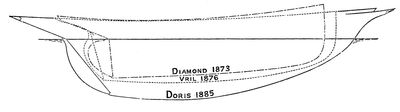
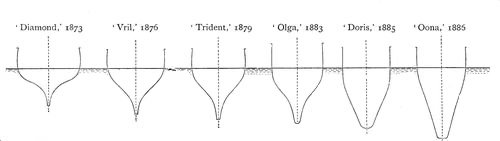
In the year 1873, Mr. Stowe, of Shoreham, built the 'Diamond' to the
design of her owner, Mr. W. Baden-Powell. She won some few races under
his flag, but the chief reason of her name appearing in these pages
is that she was, if the writer is not very much mistaken, the
first of all the yachts of 5 tons and under in the south of England to
go from port to port and race, her owner and his friends living on
board. The 'Diamond' was a decided advance on the boats of her tonnage
stationed between the Thames and Southampton; yet she looked small
indeed when moored alongside the yachts of a year or two later date.
Her length was 26 feet, with a beam of 7 feet, and an extreme draught
of 4 ft. 6 in. She ran her fore and aft lines right fair to her
taffrail, and had a long counter, part of which was submerged when she
was down to her load-water-line. With such a small draught of water
her height under the deck was necessarily low; she had however a high
fixed coach roof, which helped her out of that difficulty to a certain
extent. The cabin was roomy and made up four berths, but her weak
point, like that of the 'Wyvern,' was her immense cockpit, which was
almost as capacious as her cabin.
In 1874 the late Mr. Charles Weguelin illustrated in a prophetical
manner what were to be the dimensions and proportion of length to beam
of the yacht of the future. The 'Alouette' was a 5-tonner, 33 ft. 7
in. in length from stem to sternpost on deck, 5 ft. 9 in. in beam, and
with an extreme draught of 6 feet. She was built from Mr. Weguelin's
design by Robertson, of Ipswich, but was not a great beauty to look at
out of the water. Her body was long and full, and her displacement
naturally large, though nothing like that given to vessels constructed
on similar dimensions during the ensuing decade. Her chief antagonists
were yachts of quite an opposite design, beamy, and of no great
draught, besides being of a greater tonnage, such as the 'Virago,' 6
tons, 'Rayonette,' 8 tons, and 'Zephyr,' 9 tons. Against these the
'Alouette' was very successful, but her course was run as a successful
racer when the season of 1876 ushered in one of the late Mr. Dan
Hatcher's most triumphant achievements. Mr. Weguelin was so satisfied
with what his 5-tonner had done that he set to work, and in 1875
placed the design of a 40-tonner in the late Mr. Ratsey's hands, who
launched from his yard the 'Christine,' the counterpart of
the 'Alouette,' only twice her size; that is, by doubling all the
dimensions of the 5-tonner, the 'Christine,' a 40-tonner, was the
result. The 'Christine,' however, did not fulfil the expectations of
her designer, and though her length approached as nearly as possible
to that of the 60-tonners of her date, still she could do nothing with
them.
Before saying farewell to the 'Alouette,' it is as well to remember
that, notwithstanding her small amount of beam, she was a grand
sea-boat. On one occasion she sailed from Southampton to Algiers and
made a very good passage, considering that she had to face some very
heavy weather on her journey. It has become the custom to run down the
seaworthiness of the yachts built under the old rule, but the number
of examples that could be produced, if time and space permitted, of
what the old 5-tonner would go through, and that at her ease and
without any fuss, would more than astonish many who now, in the faith
they bestow on the boat with three beams to her length, forget the
comfort and safety in which they were carried about by the old boats
of five to six beams to their length. The 'Alouette' was wrecked at
Algiers in 1890. She broke adrift from her moorings during a gale of
wind, and was smashed up into matchwood. Nothing was saved from her.
The season of 1876 was one especially to be remembered among those
interested in the now established 5-ton class, as it witnessed the
advent of three grand additions to the greatly increased fleet sailing
in that class. Each yacht was from the well-thought-out drawing of a
master-hand, and each was the representative of the three several
schools of yacht-design, the 'Freda' being the work of the late Mr.
Dan Hatcher of Belvidere, Northam, near Southampton; the 'Camellia'
the offspring of Mr. William Fife, jun., of Fairlie, on the Clyde;
while the 'Vril' was built from the design of Mr. G. L. Watson, of
Glasgow.
The 'Vril' holds the right of precedence in that she was not
only designed, but built and sailed, by her three owners, Messrs. G.
L. Watson, John Lawrence and J. B. Hilliard, who, assisted by two
carpenters, put her together in the Messrs. Henderson's yard at
Partick, Glasgow. She was a fine, round-bodied little vessel, with a
large sectional area and great sail-carrying powers. She had less
waste surface for friction and skin resistance in proportion to her
size than many a yacht of a much smaller tonnage. In several ways she
might be said to have been a novelty, as she was the first yacht that
was fitted with a heavy lead keel consisting of the whole of her
ballast. Her counter was short and tucked up with a knuckle on the
quarter. She had no bulkheads, and her fittings were only such as were
absolutely necessary; still very little goes a long way towards making
a small yacht comfortable, and her head-room under her deck made her
'tween decks look like a palace. She was about the last yacht that was
supplied with the fore and aft studding-sail (or stu'n's'l, as it is
called) known as the 'ringtail'; but it was seldom, if ever, called
into use. For small yachts such wind scrapers are more trouble than
they are worth, to say nothing of the room the extra spars take up.
The 'Vril's' record was remarkably good, and though the three friends,
assisted by an amateur or two, were her only crew during her first
season—for her owners would not have a paid hand on board—she won a
full quantum of first prizes, and with the clever boats she had for
rivals praise must be meted out not only to the little yacht herself,
but to those who sailed her for the smart manner in which she was
handled.
The 'Camellia' and 'Vril' were, with the exception of their draught,
almost identical in their dimensions, the 'Vril' being 28 ft. 3 in.
long and the 'Camellia' 28 feet. Their respective beams were the same,
6 ft. 6 in., and they drew, the 'Vril' 6 feet and 'Camellia' about 5
feet of water. The 'Vril' at the end of her third season was sold and
turned into a fast cruiser. Her fittings, as they are now, are very
elaborate and are well illustrated and explained in the seventh
edition of that handy and serviceable book, 'A Manual of
Yacht- and Boat-Sailing.' She has been laid up for some time at Mr.
Robertson's yard at Sandbank in the Holy Loch, where her proximity to
many new yachts makes the signs of the sere and yellow-leaf stage of
her existence, which is creeping upon her, very apparent. But there is
life in the old boat yet, and her owner has in the 'Vril' a fine,
able, comfortable little cruiser.
It is now some six years since the writer had the pleasure of seeing
the 'Camellia.' She had just been sold to a gentleman to go to
Stranraer, where she is at the present time. She was hauled up on
Fairlie beach in charge of the late Mr. Boag, and was awaiting a
suitable tide for being launched. The 'Camellia,' though of like
dimensions to the 'Vril,' was altogether different in form, and to
those acquainted with the Fairlie type was as pretty an example of
what the Messrs. Fife were in the habit of turning out at that period
as it was possible to select. She and her sister ship the 'Clio' were
both built from the same drawing, and were the first boats in which
Mr. William Fife, jun., whose name is now a household word among men
interested in yachting matters, played the conspicuous part of
designer. The 'Camellia' was a smaller-bodied boat altogether, more
compact than either the 'Vril' or 'Freda,' with a powerful entrance
and fine run, and ribbands as fair as they could be. Messrs. Craig and
Lawson, for whom she was built, possessed in her a little sea-boat
capable of being driven in all weathers, and the harder it blew the
more she seemed to like it. With less bilge and somewhat higher floor
than 'Vril,' she was fitted, like her predecessor the 'Pearl,' with
simply a half-deck and waterways, and was strengthened by a strong
beam running across her to which the pump was attached. Of course in
smooth water it was a great advantage being able to work the yacht
from below, but in anything like very heavy weather she carried
hatches for covering in the open space. Both the 'Vril' and 'Freda'
were fitted with topmasts, but giving the 'Camellia' the same fitting
was only an afterthought, for when she was launched, like the 'Clio,'
she was supplied with a polemast. Three or four years after
her appearance she was decked in and provided with a very neat coach
roof, or booby hatch, but her head-room below in her cabin could not
have been more than 4 feet. She makes a very good cruiser now, and
from the grand work put into her, as into all yachts which hail from
the great Fairlie yard, her sides looked when last seen as fresh and
as smooth as on the day when she first saw the water.
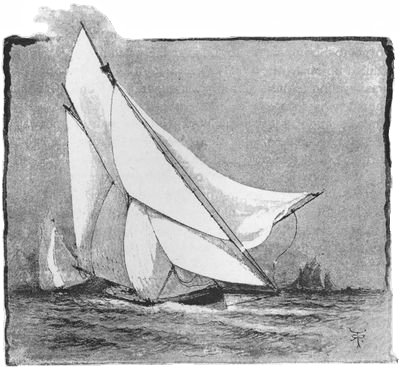
'Freda.'
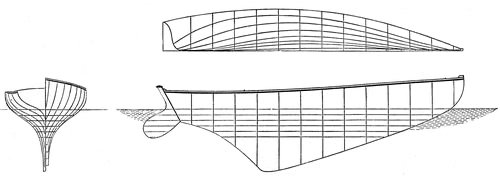
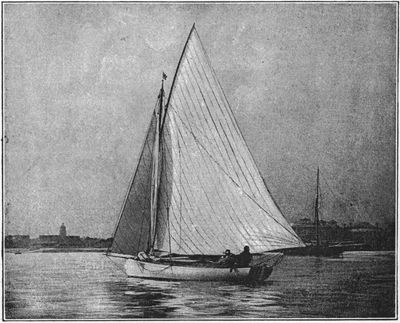
The 'Freda' is (for she is still hale, strong, and fit to show her
tail to many a vessel of her size on cruising terms) a fine able boat,
some 30 ft. 4 in. on the L.W.L., with a beam of 6 ft. 1-¼ in. and
draught of water 6 ft. 6 in. She is, like all the Belvidere yachts of
those days, a boat of large displacement with a grand midship section,
with Hatcher's well-known entrance, and a rather lighter quarter than
usual. Her sternpost has very little rake in it; in fact,
excessive rake of sternpost was a rarity during the seventies, and her
keel was only slightly rockered. Most of her ballast, about 2 tons 14
cwt., was carried inside, and the lead on her keel was under 2 tons.
She was built for Mr. Freake, her planking being altogether of
mahogany. All the wood, dead woods, ribs, and planking were got out in
Mr. Hatcher's yard and then taken to Mr. Freake's estate, where she
was put together and finished off. As a model yacht she is a perfect
picture both above and below water, as well as on deck and in the
cabin. With a flush deck and a small water-tight cockpit, after the
fashion of the 10-tonners, and a neat skylight, the 'Freda' looks all
over fit to go, and equal to all emergencies. She has proved herself
quite as much at home when cutting her way through a head sea as when
smooth water and dry decks have been the rule. She was the home of her
racing crew, and Mr. Beavor Webb, who sailed her during her racing
career, and afterwards bought her from Mr. Freake, could spin many a
yarn of the little boat's great weatherly capabilities.
No three yachts were more unlike each other, and after all the 'Freda'
had done down South, and the 'Vril' and 'Camellia's' successes in the
Clyde, so much attention was attracted to them that at last a series
of matches was arranged to take place between them off Holyhead the
following season of 1877. The place was well chosen, as in bringing
the several matches off on the coast of Holyhead Island there was no
chance of favouritism, since the locality was strange to all
concerned, and the yachts had to prove their worth in a sea quite
different from that to which any of them had been accustomed. It is
not too much to say that, owing to the distance that had to be covered
before the three yachts could reach Holyhead, and the fame of their
doings in the yacht-racing world, no more interesting racing has since
taken place, either in America or in our own home waters, than the
matches that were sailed off by these little opponents.
The arrangement was that 'Freda' should sail 'Camellia' and
'Vril' separately, and the yacht that pulled off two out of each three
races was to be declared the winner. The weather for some days prior
to and during the race week was anything but inviting, and the manner
in which the yachts worked their way to their port showed at once what
kind of stuff they were. The 'Vril' was unfortunate, for owing to some
gross carelessness the men who brought the yacht round from the Clyde
allowed her mainsail to get damaged to such an extent that during the
trials it could scarcely be made to stand. The stakes were for 100l.
a side. The first match between 'Freda' and 'Vril' took place on May
14, 1877. The courses on each occasion were arranged by Messrs. G. L.
Watson and Dixon Kemp. On the first day the course lay from the New
Harbour across a line between the 20-ton yacht 'Challenge' and a buoy,
round the end of the breakwater westward, rounding a flag-boat outside
the inner end of the breakwater, thence eastward three miles round the
Bolivar buoy; thence to a mark-boat off the old pier, twice round,
finishing between the 'Challenge' and the starting buoy, 14 miles.
There could not have been a finer trial than these three matches
afforded. The wind on the 14th was light from E.S.E., shifting to the
eastward, accompanied by rain, whilst on the second day it veered
round between S.W. and N.W., and brought up with it the usual sea that
most yachtsmen frequenting St. George's Channel know so well and hate
so cordially. Space will not permit a full account of the races to be
given here, but should details be required, they will be found most
faithfully recorded in an article in 'Hunt's Magazine' for the year
1877, which has greatly assisted the writer in refreshing his memory,
or in the 'Field' newspaper that was published on the Saturday
following the races.
The first match was the 'Vril's.' She was the first over the line, and
though the 'Freda' very soon after passed her to leeward, she soon
regained her original position, and gradually so increased her lead
that at the end of the first round she was 1 min. 30 secs. ahead of
her rival. The two little flyers had donned for the occasion all
plain lower sail with working topsails aloft. On the run out
for the breakwater the second time spinnakers were set, when the
'Vril' was unfortunate enough to carry away the goose-neck of her
spinnaker boom. This was followed by the boom slipping into the water
and at once snapping in two. Her crew smartly cleared the wreck, the
outer end of the boom was lashed to the weather rigging, and the
spinnaker set once more. Those familiar with such matters will readily
understand how well things must have been done on board the Scotch
yacht, when it is said that 50 seconds were all that the 'Freda' made
out of the mishap. Before reaching the Bolivar buoy, the 'Vril' had
more than made up her lost ground; and though on the journey home the
'Freda' gained a little, she was decidedly beaten, as she came in
nearly 6 minutes astern of the 'Vril,' the times being—'Vril,' 3 hrs.
40 mins. 40 secs., and 'Freda,' 3 hrs. 46 mins. 10 secs.
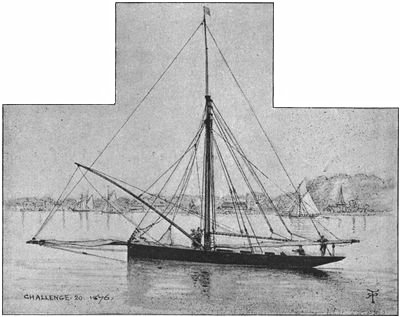
'Challenge,' 20 tons, 1876.
The second match on the following day was sailed in about as dirty
weather as it was possible for the concentrated energy of the
elements to provide, and the result was that 'Freda' turned
the tables on 'Vril' and beat her by about the same amount of time.
The start was made at 10.20 a.m., and this time the 'Freda' got away
first. Both yachts were reefed down, the 'Freda' showing a
single-reefed mainsail and foresail with the third jib, while the
'Vril' carried a whole foresail with a double-reefed mainsail and
second jib. The 'Vril' also started with her topmast housed. Outside
the breakwater the little boats had to face a bad wind-against-tide
sea, and quite a third part of the trip was made under water. For the
run to the Bolivar buoy the 'Freda' set her spinnaker with a Paddy's
reef in it, which gave her a tremendous lead, because, though her
extra length told, still the 'Vril' had no spinnaker boom on board,
having left it ashore, and could therefore only boom out her balloon
foresail. On the thrash to windward, however, the 'Vril' gained twelve
seconds on her antagonist, so that the first round finished 'Freda,' 1
hr. 49 mins. 2 secs.; 'Vril,' 1 hr. 54 mins. For the second round, the
'Vril' sent her topmast on end and set a topsail, but her mainsail had
been so badly treated before the races began that it was found
impossible to make it stand properly, and the remarkable thing is that
the little yacht worked as well as she did under the trying
circumstances. The 'Freda' kept to the sail she started with. The sea
smoothed down considerably during the second round, which made the
sailing somewhat easier. With the exception of a slight miscalculation
in distance on the part of the 'Vril,' and a consequent extra board on
the beat up for the harbour buoy, nothing of any importance took
place, and the two yachts came in, 'Freda' first at 2 hrs. 44 mins. 40
secs., followed by 'Vril,' 5 mins. 15 secs. after her.
The interest occasioned by the third day's sailing was extraordinary.
All over the country an eagerness was displayed for news of the match
almost equal to that seen on a Derby day. The wind was at about the
same force, and blowing from the same quarter as on the previous day,
with the addition of a harder feel in it. Both yachts, therefore, set
the same amount of sail and had their topmasts housed. At the time of
the start, which was made at 11 a.m., the sea was breaking
over the lighthouse, and made the journey look anything but inviting.
Both yachts, keeping a sharp look out on each other, were too keen on
crossing the line, and had to return and make a fresh start, which
they did side by side. There were not 10 seconds between them when
they jibbed round the first mark, the 'Vril' leading, and the
difference was further shortened by 5 seconds at the Bolivar buoy,
this run having been made under boomed-out balloon foresails. The time
between the yachts might have been lessened still more had not the
'Freda' been obliged to busy herself about her boom, which came
adrift. From the Bolivar buoy home the little vessels danced it
merrily to the tune of 'Blow, breezes blow.'
The 'Freda,' before she made a fresh start, had placed herself 30
seconds ahead of her rival, but going out again, the 'Vril,' owing to
the 'Freda's' not being able to make use of her balloon foresail,
passed her before they had rounded the first mark-boat, only to be
repassed on the running-reach to the Bolivar. The 'Freda's' best point
of sailing brought her to the Bolivar 1 min. 30 secs. ahead, and
though for the last time the 'Vril' showed her superior power in
beating to windward, the 'Freda' had made up her mind to walk off with
the dollars, and win she did by a few seconds over the minute.
Considering the sea that was running, and the amount of broken water
that was throwing itself about, this last race is one to be long
remembered and handed down in the annals of small-yacht racing; and
now and hereafter, when racing and cruising men feel a tendency
arising in them to croak and speak ill of the little yachts that were
built under the old rule of measurement, let them call to mind their
mighty deeds, their racing and their voyages under circumstances and
in weather that would frighten many a 50-tonner into harbour and to
her moorings.
The fourth day ushered in a new competitor, and the 'Freda' had to
cross the line with the 'Camellia,' which she did five minutes after
the second gun. The wind and weather had changed during the
night, an unfortunate circumstance for the 'Camellia,' a hard-weather
boat. The wind was unsettled, hung about between N. and N.E., and was
at times very shy. The 'Freda' at first, not being able to hold the
wind that the 'Camellia' did, lost ground considerably in the beat up
to the Bolivar buoy, and the latter had reached on her so cleverly
that the 'Freda' was fully a minute astern on rounding for the run
into the harbour. The 'Freda' here had the pull over the Fairlie
clipper, for she was provided with two spinnakers, while the
'Camellia' had but one, and as a shift had to be made (since they had
left the Bolivar with spinnakers set on the bowsprit end) before
setting off for the second round, the 'Camellia' was left in the
lurch, her one spinnaker having to be taken in and boomed out.
Standing out again, the 'Camellia' tried her best to pass the 'Freda'
to windward, but to no purpose, as the 'Freda' was always ready for
her each time the attempt was made, and at the Bolivar the 'Freda' was
first round by 30 seconds. Coming into the harbour, the 'Freda,' again
at her best, kept increasing her lead, and finally won by 1 min. 40
secs. Hunt's correspondent writes: 'This was a closely sailed race, in
which the English boat owed much of, if not all, her success to smart
handling.'
The fifth day's race was sailed under something like the 'Vril' and
'Freda' weather. The wind had hardened up and freshened during the
early morning, and kept increasing as the day went on. Both yachts
started with housed topmasts, single-reefed mainsails, and No. 2 jibs,
the 'Freda' running up and booming out her balloon foresail as she
crossed the line. During the first round the 'Freda' showed herself
the better boat when on a reach as well as in beating to windward in
the teeth of the heavy, solid sea which was running. She, however, was
only 1 min. 30 secs. ahead at the mark-boat. On the second round the
boats were literally more under water than above; they were simply
smothered in their efforts to windward, and had the 'Camellia' not
been so persistently squeezed in order to make her look up closer to
the wind than her rival, she might have gained more than she
did. As it was, what she gained on one point she lost on the other,
and allowed the 'Freda' to come in a winner by 1 min. 45 secs.
On the sixth and last day the umpires were obliged to alter the course
owing to the heavy sea running outside the breakwater. There had been
no lull during the night, and with the northerly gale blowing it was
thought too dangerous a matter to allow the small yachts to face the
hazards of a lee shore. The mark-boat outside was therefore brought
within the breakwater, the other was left in its place off the Old
Harbour, and the course made nine miles, or three times round the two
marks, which lay now in more or less smooth water. The start was made
at 11.50 a.m. under double-reefed mainsails and small jibs, 'Freda'
having sent her topmast on deck. The 'Camellia' got away 45 seconds
ahead of the 'Freda' owing to the latter not having heard the gun, and
increased her lead till she came to the mark-boat. Her lead, however,
did not last long, for in the beat to the next mark she missed stays
and allowed the 'Freda' so to gain upon her that by the time the mark
was rounded the 'Freda' had put herself 1 min. 5 secs. ahead. The
yachts had quite as much as they could do, the next time they had to
haul their wind, to stagger under their small canvas, as the wind blew
harder than ever and with more real venom in it. The 'Freda' finished
the nine miles in 1 hr. 30 mins.—quick work taking everything into
consideration—but the 'Camellia,' having again missed stays, up helm
and made for her anchorage. This last match exhibited the powers of
the two yachts in a different way, perhaps, and under conditions other
than any met with in the previous races. If the third and fifth
matches showed what fine sea-boats these small 5-tonners were, and how
capable, handy, and powerful, when driven in a big, broken, heavy sea,
the sixth day's racing proved that they could stand up to their canvas
and bear pressing when many a much larger yacht would have had to be
close-reefed. No apology need be offered for introducing these six
matches into this work, because not only do they form a good
precedent in the manner in which all the arrangements and the
choice of fighting ground were made, but it is impossible in any other
way to discover how one stay-at-home small yacht compares with another
at a distance, unless they are brought right away from their
respective localities and allowed to fight it out in open water
unfamiliar to both. Before bidding adieu to the above three little
beauties, it may not be amiss to add that the 'Freda' was sailed on
all six occasions by Mr. Beavor Webb with a professional crew, the
'Camellia' was in the hands of Tom Dudley, of Southampton fame, and
the 'Vril' piloted by one of her owners, Mr. Hilliard.
Each year now introduces new aspirants to the Blue Ribbon fame of the
well-established 5-ton class, and though few methods, if any, had been
resorted to up to this time for the purpose of cheating the tonnage
rule, which then took the length on deck between stem and sternpost as
its measure, instead of the length along the L.W.L., still the year
1878 saw a notable tonnage-cheater launched from the Cheshire side of
the Mersey in the formidable 5-tonner 'Lorelei,' designed by Mr. Wynne
Eyton, her owner, and built by Messrs. Buckley & Sherlock. The
'Lorelei' was a yacht worked out purely and simply on the wave-line
theory, as defined by Mr. Colin Archer, of Christiania, and her
counter was partly submerged, not only to enable the lines of her
after body to be carried out fair, but at the same time, without
adding to her tonnage, to give her a foot and a half more length on
the L.W.L., since she was 31 ft. 6 in., whether the measurement was
taken on deck or along the L.W.L. Her beam was 6 feet, and she drew 5
ft. 6 in. Like the 'Vril,' her ballast, 4 tons in all, was on her
keel, and her sail area 770 square feet, or 30 square feet less than
that of the 'Freda.' The displacement of both these yachts was almost
identically the same; yet the 'Freda' would have had a very hard
struggle to keep within sight of the 'Lorelei' on an ordinary 5-ton
yacht course. Frequently the 'Lorelei' very nearly beat her 10-tonner
competitors on even terms, and was always fit and ready to save her
time. In the smaller class, such as she would race in at
Kingstown or Liverpool, there was not one boat that she could not
beat. Mr. Richardson designed for the Messrs. Anderson, who used to
own Hatcher's old crack the 'Queen,' 15-tonner, a 5-tonner called the
'Urchin.' She was intended to beat the 'Lorelei,' but she never could
do anything when sailing against her. The 'Lorelei' carried rather a
deep bilge, and her keel was well rockered. After Mr. Wynne Eyton
parted with her, she went up to the Clyde, where she has done little
or no racing, but has proved herself a first-class little cruiser. Her
fittings below, when she was in the height of her racing career, were
very good and rather unique. She had no bulkhead, but was entirely
open fore and aft. She was flush-decked, and her main cabin was partly
divided off by a double set of rails made of 3-inch planks, which
formed an open, but double, partition to hold all her kites and other
sails. This open sail locker or pen stretched right across from side
to side, and was about 2 feet deep. It formed a good roomy receptacle
for the sails, kept the weight amidships, and sails well aired.
Something of the same kind of fitting has been applied to one or two
10-tonners, the open gratings in their case being carried right up to
the deck on the starboard side, leaving the door and pantry in its
usual place. The upper half of the grating facing the main cabin was
on hinges, and could be removed altogether to allow of sails being
taken out or replaced quickly, as, for instance, on a racing day.
As regards tonnage cheaters, the chief method employed for walking
through the 'length on deck' rule was that of bending up the
sternpost. The first yacht built with a knuckle in her sternpost came
from Messrs. Buckley & Sherlock's yard at Tranmere, on the Mersey, and
belonged to the Sloyne. She was a 10-tonner, and with the others,
which followed after her, very soon brought the authorities' attention
to the rule, which was promptly altered to the L.W.L. measurement.
Those who wish to know more about the 'Lorelei' will find a very good
description of her, with drawings, as they will also of the
'Freda,' in the third edition of Mr. Dixon Kemp's work on 'Yacht and
Boat Sailing.'
In 1879 and 1880 two yachts were turned out which perhaps did more
fighting as first-class 5-ton racers, and lasted throughout a greater
number of seasons at the top of the tree, than any others had done
since the days of the 'Torment' and 'Pearl.' The 'Cyprus' and 'Nora,'
the one designed and built by Mr. William Fife, jun., the other
parented on Mr. George Watson, were as distinct types in their way as
were the 'Vril' and the 'Camellia' three years before. They were,
besides, equally interesting, if not more so, since in them the
practised eye could see how wonderfully the Fife and Watson designs
had respectively developed and improved. The 'Nora,' built in 1880 for
those keen racing yachtsmen of the Clyde, the Messrs. Allan, with 32
ft. 4 in. length on deck, 6 ft. 2 in. beam, and a rather deeper
draught, was a veritable ship in comparison with her predecessor. More
cut away forward and with greater rake of sternpost, big body and
large sail-area, long counter and straight stem, nothing could touch
her in light winds. The only antagonist that gave her any trouble was
the 'Cyprus,' built the previous year.
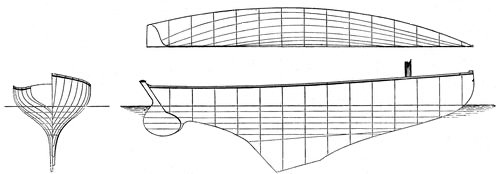
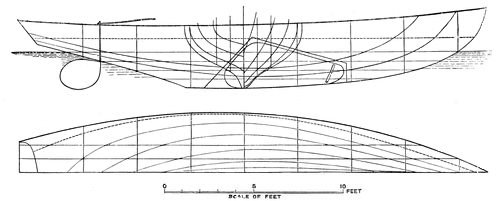
This yacht, designed to sail under either measurement, length on deck,
or L.W.L., was exactly 30 feet when measured along the one, and 29.5
when measured along the other. Her beam was 6 ft. 4 in., draught 5 ft
4 in., with a displacement barely equal to that of the 3-tonners,
which between the years 1880 and 1884 gave so much sport and became so
popular. She was one of the smartest of the small fry Fairlie had ever
turned out. Certainly few would gainsay the fact that the 'Cyprus' was
by far the prettiest of her class at that date afloat, and at the same
time looked a racer all over. Out of the water she was a perfect study
to the lover of gentle curves and fine lines, and as sweet a model as
any connoisseur would wish to feast his eye on. Without a straight
line up or down, diagonal or horizontal, to be found about her, to all
appearance, looking at her from a beam view, she presented a longer
and finer entrance than had up to that time been given to any
of the Fairlie small yachts. Such an increase had been meted out to
her that at first sight it was difficult to free the mind of the
impression that she must be a regular diver. An end-on view, however,
soon dispelled all misgivings on that score, for her vertical sections
showed a round floaty bow of extraordinary power. With a low freeboard
of 1 ft. 9 in. at the waist, and a grand midship section, there was no
wall-sidedness about the 'Cyprus,' whilst her run was fine and clean,
and her buttock lines beautifully easy. Perhaps the prettiest features
about the little yacht were her shear and the sit of her counter. This
latter was light and long, and had a spring upwards towards the
taffrail, rather after the fashion of a duck desirous of keeping her
tail dry, though the yacht was a little more moderate as regards the
height necessary for so carrying her appendage.
The 'Cyprus' was kept in the family during her career in the Clyde,
and was very successful during those seasons that her racing flag was
seen at her topmast head, being always piloted by that prince of
helmsmen, her designer and owner. In the winter of 1884 this yacht
became the property of the writer, when she began a most successful
career of a more all-round character than she had up to that time
undergone, and it is principally from the practical experience derived
from racing and cruising in her that he has been enabled to form his
ideas and recommend the 5-ton yacht of ordinary dimensions as the best
size and class of vessel for an inexperienced yachtsman to ship
himself aboard as owner, captain, and hand.
When the 'Cyprus' came into his possession her fittings below were
practically nil. Like the 'Vril' in her early days, she had only
such contrivances as were absolutely essential for one living on board
during a time bounded by hours rather than weeks or months. He was
therefore obliged to make a few alterations below, such as turning her
sofas into lockers, having iron bed-frames fitted in the cabin on
hooks so as to be easily removable, and a box made to stand in
between the after-provision sideboards and under the ladder
to hold a bucket, washing basin, and lavatory conveniences. On deck
the fittings were almost perfect. The jib, throat, and peak halliards
led below through brass fairleads let into the deck a few inches on
either side of the mast.
The forestay, instead of coming down through the stem-head along the
deck, and being purchased up to the bits, was led through the stem
close under the deck and set up by tackles to the mast. In place of
the regular tackles to the bowsprit shrouds, two sets of selvagee
strops were used, the one short and the other long. The long strops
were doubled round the forearm of the belaying rail on each side,
abreast of the rigging, and the standing part of the bowsprit shroud
shackled on and set up with galvanised rigging screws. The short strop
was employed whenever the bowsprit was reefed in. It was found strong
and neat, and much better altogether than the old plan of tackles,
which formed the original fitting. The 'Cyprus' was not entirely
flush-decked—that is, she had a low very neat-looking 'booby hatch,'
which fitted on a combing some three inches high. The combing ran from
about two feet abaft the mast to within a couple of feet of the
rudder-head. The after part enclosed a small water-tight lead-lined
cockpit, then a foot of deck, ahead of which came the hatch,
containing the after sliding hatch into the cabin and a low skylight.
The width between the combings was 2 ft. 4 in. A transparent compass
and binnacle fitted into the deck space ahead of the cockpit, and this
was lighted by a lamp below in the cabin. This arrangement was
excellent, as it prevented any of the troubles which so often arise in
small yachts from the lights being washed out. At sea the boat was
stowed below in the cabin, and as the hatch was very simple and easy
to adjust, it was always taken off for the boat to be lowered down
into its place. Another point in favour of this hatch was that on fine
sunny days it could be removed and the yacht kept well-aired and
sweet. A narrow strip of india-rubber, doubled, was nailed round,
close up to the combing, and this proved a thoroughly
effective method for keeping the hatch tight and preventing any water
from coming into the cabin.
The 'Cyprus' was a particularly handy boat. As the writer had to take
her round to Plymouth from Scotland, he invited an old friend, and
with the help of a boy of seventeen years of age out of one of the
Plymouth trawlers, left the Clyde for Kingstown, the port of call,
after enjoying a few days' cruising about by way of letting everything
shake into its place. It was a Tuesday morning when the start was made
from Lamlash, in Arran, and the 'Camellia,' which was on her way to
Stranraer, left about half an hour before. The wind was N.W. and came
down off the hills in strong squalls; but the water was smooth, and
under all plain sail the little vessel simply flew along.
After leaving Ailsa Craig astern, the sea began to show signs of
getting up, and about 5 p.m., before reaching Corsewall Point, it had
begun to take such liberties, and make such encroachments on deck
whenever a big curler chose to break over aft, sometimes to the depth
of three inches to four inches, that it was thought advisable to heave
her to and shorten sail. About 6 p.m. the helm was put down and the
foresail hauled to windward, whilst a reef was taken in the mainsail,
No. 3 jib set, and our ship made snug.
It was a treat to see how well the yacht lay to, and it is impossible
to describe the feeling of confidence it inspired, for not a drop of
water was shipped, and she rode like a duck the whole time, coming up
and falling off as each sea passed under her. From the time the
foresheet was let draw to the time she dropped anchor in Kingstown
Harbour all went well, the only incident being the writer's coming on
deck at 6 a.m. to find that the boy, who was on watch, had mistaken
the Morne Mountains to the north of Dundalk Bay for the south of
Ireland, on the strength of which he had given up steering by compass,
and was taking a course into Dundalk, which would have soon led to a
disastrous end. The compass, though a spirit one, was rather sluggish,
and his idea of safety was steering by the land. Wednesday night was
spent at Kingstown, and with the first of the ebb the
'Cyprus' was again on her way with gaff-topsail set over all. Light
flukey airs from the southward and westward helped the yacht along
during the greater part of the forenoon, but these were eaten up by
the sun as the day wore on, and gradually died out altogether, leaving
us to drift along till the tide began to make, when, being in easy
soundings on the edge of the Arklow Bank, the anchor was let go, and
the yacht brought up to await the beginning of the ebb or the wooing
of a breeze. The next morning—Friday—there was no wind of any kind;
but the tides run strong on the east coast of Ireland, and a whole ebb
meant many miles to the good. The time during this drifting was well
employed in having a thorough clean down, in opening up the cabin,
airing the bedding, and improving the stowage of the general cargo
shipped on board, consisting of sails, luggage, provisions, and
numerous other necessary items. In the afternoon the yacht was again
brought to an anchor, and remained so till Saturday, about 4 a.m.,
when a breeze springing up from the southward, her head was pointed
towards the Welsh coast. Travelling was very slow, for the wind was
very light, and not at all true. Two short boards were made on
reaching the other side, and about 8 a.m. on Sunday the yacht was
laying up on the port tack for the Smalls. The wind had now some
westing in it, but not sufficient to let a course be laid for the
Longships; and as long rollers were coming in from the south-west, it
was settled to go well away to windward in order to make Land's End in
one tack and obtain a clear offing.
The Smalls was left behind about 3 p.m., and at 5 p.m. the whole face
of the sky was beginning to look so threatening, and the clouds to
drive past at such a rate from the southward, while the quiet rollers
had already begun to break up and require such extra attention, that
at 6 p.m. the 'Cyprus' was hove to, and made ready for a dirty night.
The mainsail was taken off her and trysail set, the topmast housed and
bowsprit reefed in, the second jib shifted for a spitfire, and the
foresail double-reefed. Two hours later, the wind having sprung up
into something near akin to a gale, and the yacht dancing
with a light heart and by no means wet deck away out to sea, everyone
on board was glad that she was under snug canvas and that time had
been taken by the forelock. She could not have been more comfortable
or cozy had she been a sea-going rocking-chair. On going about, the
first land sighted was Cape Cornwall, but the wind, having had its
say, again went down, till the yacht was left with just sufficient to
keep her going, but not enough to make her steady, or prevent her
knocking about in the choppy sea that remained. About noon, however, a
breeze sprang up, and the Seven Stones Lightship was passed close to
about 3 o'clock on Tuesday morning. Towards 8 a.m. the wind had veered
round to the N.W., coming off the land in strong puffs; sail was made
once more, and with fairly smooth water all the way the yacht lay
herself down to her work, and finally brought to off the Hoe at 10
p.m. the same night. The lesson learnt during this cruise was a
useful one—viz. that if sail is attended to in time, a 5-ton yacht is
fit to face almost any weather, provided she has sea-room. During the
whole trip round the crew were never without hot water when they
required it, so easy was the yacht's motion to those below, even
during the most disagreeable part of the journey; and no water went
below even when it lay thick on deck, as, for instance, off Stranraer,
and once or twice before sail was taken off her when near the Smalls.
The 'Cyprus' was raced, whenever an opportunity presented itself, in
the then A, B, and C classes, and in every case the racing was against
yachts larger than herself. Any amount of Channel groping had to be
undertaken, both from one English port to another, as well as between
the French coast and England, ocean racing being quite as much in her
line as the 'Meteor's.' Her best performances took place in strong
breezes, and it was a sight worth seeing to watch the wonderful manner
in which she could drive through a head-sea. At Bembridge Regatta the
'Cyprus' sailed the course round the Nab on a day when the 30-ft.
class of yachts (15-tonners in reality) begged to have their
course, which was identically the same, altered. No matter on what
point of sailing she was engaged (and she is only given in these pages
as a very fair type of the 5-tonner built to sail under the old Y.R.A.
Rule), blow high or blow low, a lady might have handled her tiller
without experiencing any of that muscular arm exercise so common in
boats built under the length and sail-area rule, or even the slightest
inconvenience. The 'Cyprus' was sent out to Toronto on board an Allan
Liner from London, and became an ornament to Lake Ontario, where she
is at the present time.
Between the years 1880 and 1886 four 5-tonners were built from the
designs of one of the most rising young naval architects the Clyde has
ever produced—Mr. Payton. The first of this team was the 'Trident,'
which, though not by any means a successful racer, was a fine able
boat and moderately fast. She is mentioned here on account of her
having made a long ocean voyage to the South of France. She was
altogether bigger and a much heavier boat than the 'Nora' or 'Cyprus,'
but could be worked just as easily. Five Frenchmen, however, were
employed to take her South. Her behaviour under a very trying state of
the weather, while crossing the Bay of Biscay, was highly spoken of,
and the men who went in her declared their faith in her to such an
extent as to be quite willing to take her out to the Cape.
The 'Olga' was Mr. Payton's next attempt at a flyer. She was 32 feet
long, with a beam of 5.73 feet, and had a great draught of water. She
was a very large-bodied boat, was built on the most advanced
scientific principles, and, what is more to the point, was a complete
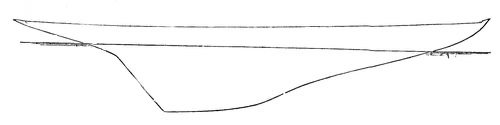
success; but she was a most unfortunate yacht. With a very wide keel
her midships section was anything but shapely, and ran down almost in
a straight line from her bilge, which was very low and square, to the
bottom of the lead. At the Royal Irish Yacht Club Regatta, Mr. Power's
steam yacht ran into her and sank her in Kingstown Harbour, but she
was brought up and floated again, Mr. Power having bought her
as she lay under water. The 'Olga' after this mishap won her full
share of races, and ended her first season flying 18 winning flags, of
which 15 were firsts. Mr. G. B. Thompson bought her during the winter,
and the following season won four first prizes with her; but before
the season was half over she was again unlucky, and on June 22 was
once more run into and sent to the bottom, whilst in the Mersey. She
was fished out, and put up for auction, but who bought her or what
became of her is not generally known.
The third yacht of 5 tons was the 'Luath.' She, however, was not such
a phenomenon as the 'Olga,' and after the 'Olga's' short but brilliant
existence, what was expected of her did not come off. She was, as may
be supposed, very much like the 'Olga' in looks and of about the same
dimensions, though of rather larger displacement. The last of the four
was the 'Oona.' Her melancholy end is still fresh in the memory of
many a small-yacht sailor. She was built in 1886 at Wivenhoe, in
Messrs. Harvey & Co.'s yard, for Mr. Plunket, of Belfast, and was an
extreme example of what could be designed under the old Y.R.A. Rule.
Her length was 33 ft. 10 in. on the L.W.L., her beam 5 ft. 6 in., and
draught 8 feet, but her chief characteristic was her marvellous body,
which displaced 12 tons, both displacement and sail-area of 2,000
square feet and more being greater than many racing 10-tonners, and
the latter over 1,300 square feet more than 'Freda' or 'Nora's'
sail-spread. What she might have done as a prize-winner it is
impossible to say, for she never reached her station. Coming from the
eastward, she put into Southampton to effect some small repairs, and
after remaining there a few days, on May 4, with her owner Mr. Payton,
her designer, and a crew of three men on board, left for Belfast. It
appeared that shortly after passing Dublin Bay—for she did not put
into Kingstown, as might have been expected—her owner must have
intended to make the best of his way up Channel, but, unhappily,
terrible weather set in about the night of the 12th, and the general
opinion was that, from some weakness in or lack of roping,
the trysail was burst up, and that becoming unmanageable, or through
her crew having been swept overboard, the yacht was driven on to the
sands off Malahide and so became a wreck. Her hull was washed up
without its lead keel and its fastenings or the iron floors; in fact,
the whole of her keel and lower garboards had gone.
Mr. Payton's name will always be associated more especially with the
3-tonner 'Currytush.' She was a more brilliant success than even the
'Olga'; but the old 3-tonners do not come within the scope of this
paper.
The last of the race of 5-tonners, if the 'Oona' be left out, is the
'Doris,' one of Mr. Watson's greatest successes in small-yacht design.
She was built in 1885 for the Messrs. Allan, who had owned and sailed
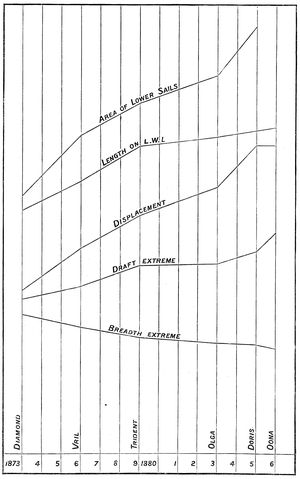
the little 'Nora' so pluckily and so well. Her length is 33.6 feet on
the load-water-line, beam 5.6 feet, and draught about 7 feet, or a
little more. The 'Doris,' like the 'Oona,' is an extreme
representative of the old rule. Her displacement is very large, but
there is far more shape and comeliness about her body plan than was to
be found in any of Mr. Payton's designs. She has proved herself a
clever boat in all weathers, and in light winds particularly so. Her
chief rival, had she not been lost, would have been the 'Oona,' for
there was no other 5-tonner afloat capable of tackling her, and her
principal racing was against boats of a larger tonnage. She could
always save her time on the crack 10-tonners of her day, such as the
'Uleerin,' 'Queen Mab,' and 'Malissa,' and the only matches of any
interest that she was mixed up in were three that came off between her
and Mr. Froude's 5-tonner 'Jenny Wren.' This yacht, designed by her
owner, and built at Messrs. Simpson & Dennison's yard at Dartmouth,
was made double-skinned for the sake of lightness. She, like the
'Doris,' was a large, big-bodied boat, but her form did not give that
idea of power with which a look at the 'Doris' at once inspired the
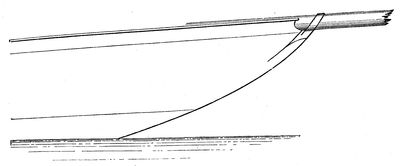
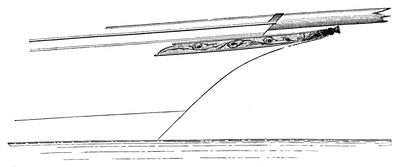
observer. Both the 'Doris' and 'Jenny Wren' are cut away forward, and
carry the curve of the keel up to the water-line, finishing at the
deck-line in a fiddle-head. The 'Jenny Wren' had shown
herself remarkably fast in light winds and smooth water, and on
certain days could leave the length classes to follow her up. Bad
weather, however, was her weak point, and even in strong breezes and
smooth water she did not always appear to be sailing at her best. At
Plymouth, then, when the 'Doris' and 'Jenny Wren' met, everything
depended on certain conditions what kind of a fight the latter would
make. As the 'Doris' beat her, there is every reason to believe that
it was either blowing hard or that the wind was shy and there was a
certain amount of roll outside the breakwater.
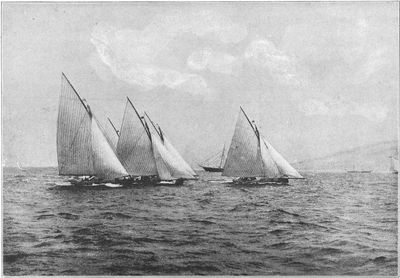
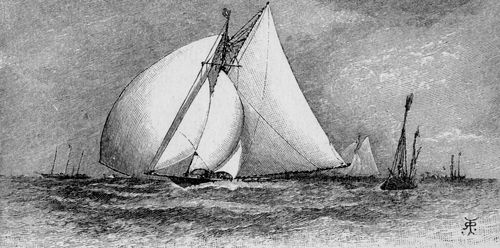
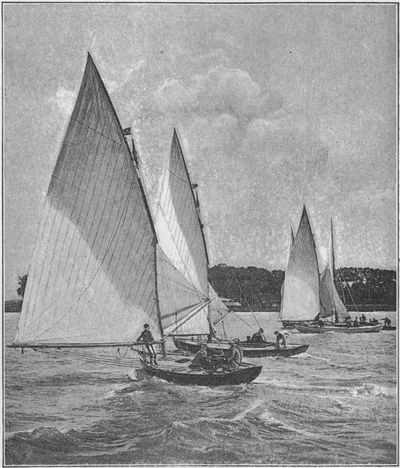
GOOD START OF SMALL RATERS IN THE CLYDE.
Since the measurement rule was altered, the 'Doris' has been improved
by being spread out and given more beam. She still races, but cannot
do much against the 10-raters, the class to which she now belongs, and
has lately been sold to spend the rest of her days as a cruiser.
Should she race in the future, it will be in the many Clyde handicap
cruising races. With such bodies and draught there was no lack of
head-room in the cabins of the latter day 'plank on edge' 'lead
mines,' but the want of beam made the accommodation not exactly as
grateful as it might have been had there been a little more
elbow-room. The alteration in the 'Doris' has given her the requisite
amount of beam, and she ought to make a very comfortable fast and able
boat for cruising purposes.
In the year 1886 the Yacht Racing Association brought in a new rule
for yacht measurement, or, more properly speaking, for rating yachts
to be used in racing. There is no other reason why a rule for rating
should be required at all, as under the old rule, or any true capacity
measurement, a naval architect or yacht designer would be sure to
produce a good, serviceable vessel for cruising purposes, and
according as the owner's requirements might be speed, accommodation,
or light draught, so the several dimensions and design would be
arranged to suit.
With regard to this rule of rating by 'length and sail-area,'
and the boats which are the result of it, there appear to be many and
diverse opinions; and prior to noticing any particular yacht built
under it, it will be as well to look at all its points before
declaring for or against it. Experience declares them to be good
sea-boats, in that they rarely ship solid water, and they are very
fast when sailing on a wind. Their spoon and fiddle-headed bows would
help to throw the water off, while their mast being stepped almost in
the eyes of the yacht, would make them eat up into the wind, because
it permits of most of the driving power being concentrated in one big
sail.
Their sailmaker's bill is a small item, on account of the tendency to
keep the sail-area down. For instance, the 'Archee,' Mr. Lepper's
5-rater, of Belfast, with a length of 30.4 feet, a beam of 9.2 feet,
and a draught of nearly 5 ft. 6 in., a length on deck of 39.5 feet,
the tonnage of which, by the last rule, would have been a little over
6½ tons, has a sail-area of 979 square feet against the 1,680
square feet of the 'Doris' 5-tonner.
They are bigger boats than the old 5-tonners, but then they have so
much more beam. The 'Cyprus' was the same length as two-thirds of the
5-raters that have been built, but she had only 6 ft. 4 in. beam
against the raters' 8 feet to 9 feet. They have very little gear with
the lugsail rig, and the decks are always clear.
They can lay to, but it is on the same principle as that of a Una
boat, and they would not remain on one tack all the time but for the
little jib they carry, while they forge ahead at a great speed, and
cannot be stopped unless a man is left at the helm to look after it.
If properly trimmed the rater can be steered by the lightest hand when
beating to windward and close hauled, and she is remarkably quick in
stays.
Experience, however, shows that, though the rater rarely ships a sea,
still, when she does put her nose in the water, it becomes a general
question on board her whether she will ever bring it out
again. This is not altogether enjoyable, and such sensations were
never experienced in boats built under the old rule. The one large
lugsail, too, and little jib form a most unhandy rig.
Experience has also proved that, with regard to the two factors,
sail-area and length, the tendency is to make the body of as small
displacement as possible, taking the length into account, so that with
the small area of canvas employed there may be very little weight to
propel. Thus, though the early raters were big-bodied and roomy boats,
with good head-room below, the boats built lately are inferior in
those qualities, and those which will be put on the stocks in the
future will be merely big canoes with bulb-keels.
Experience prefers for Channel seas a boat that can be driven through
the water when necessity compels without any sense of danger, and
that, if allowed to do so, will ride over the waves when no object is
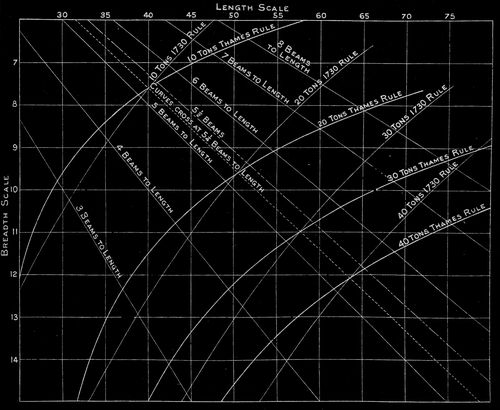
to be gained by making a short cut through. A yacht of four beams to
her length or more will do this far more comfortably and with less
commotion and fuss than one of three beams or less to her length.
Experience furthermore says that, though the lugsail requires very
little gear, and can be hoisted with a certain amount of ease, yet if
sail has to be shortened, or the lugsail to be taken in hurriedly, it
requires more than three men to do it smartly; at no time is the job
an easy one, but if any sea is running, or the weather squally, three
men have as much as they can do to handle it. This is never the case
with the gaff-mainsail. In a 5-tonner a man and a boy could have
shortened sail easily, and though the sail-area was great, one man and
the owner could always sail her from port to port.
Money may be saved through a small sailmaker's bill, but it must go
out in wages to the crew and extra hands.
It is a good point to have very little gear about, but the 'Wenonah'
and 'Wee Winn' both prove that a gaff-mainsail is quite as suitable as
the lug and a better all-round sail.
Experientia docet that the rater, though she can lay to,
cannot be hove to and have her way stopped. And the risk with her is,
that in a sudden rush, caused by her aftersail filling, she may bury
herself by jumping right into a head-sea—a most dangerous performance
when the weather is so bad and the seas so high that travelling can
only be carried on at peril.
Again, experience tells a tale that raters are not all so very tender
on the helm even when sailing on their best point, and are what would
be called in horsey phraseology very hard-mouthed; and that whilst off
the wind they are like star-gazers, all over the place, and ready to
rush anywhere and everywhere rather than straight ahead or where the
helmsmen want them to go. Some of the small yachts built latterly
under the old rule had a similar inclination, but it was generally at
a time when they were being very heavily pressed, carrying too much
sail, or when badly trimmed.
Of the two kinds of overhang forward, the spoon-shaped bow, which Mr.
G. L. Watson has given his new boats, is the best, because it adds
flotation as well as length on the L.W.L. when the yacht is sailing
down to her bearings, and fairs all her longitudinal curves. The
fiddle-headed bow may be thought by some to look prettier, but it is
not so effective, unless it helps by its flam, or flare out (which
some new yachts with this kind of bow do not have), to keep the decks
clear of water. The overhang bow means an extra top weight, which has
to be provided for and counteracted when the calculation is being made
for the ballasting; but, on the other hand, it gives enlarged
deck-room. It also saves having a long outboard spar in the shape of a
bowsprit, and so does away with any need of reefing. This is really
only a small matter after all, since even with a rough sea there is
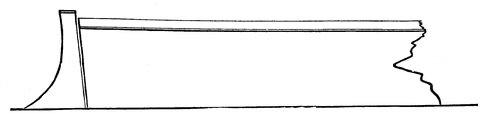
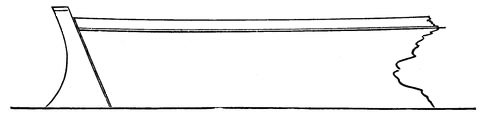
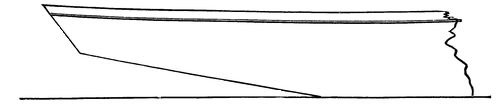
never very much difficulty in reefing in the bowsprit providing it is
properly fitted. Years ago in American waters there was scarcely a
sloop built that had not an Aberdeen stem or fiddle-headed bow, but
for some years they were discarded, and it is only lately they have
been brought into fashion again. No American would give up anything
that he had pinned his faith to unless he saw some real
advantage to be gained by so doing. It is quite easy to understand why
Americans should come back to the old stem now, for their waters like
it, and it helps to cheat the rating for length.
The main design so common in the rating classes is perfect when
regarded from two points of view only. The long, very gentle curve
that runs up from the heel of the sternpost to the stem-head, and the
excessive rake of the sternpost itself, allow of no more outside
deadwood than is absolutely necessary to keep the yacht together, hang
the rudder, and fix the lead keel on, so that whatever surface there
may be to cause friction is doing its duty—that is, is caused by the
skin or planking. The form thus given has its drawbacks; this
experience has shown us and they are far more prominent and,
therefore, serious when met with in the smaller raters than when seen
in a 40- or 100-rater.
The second point is the quickness with which yachts of this new design
'stay' and 'get away.' This is a more practical benefit to large
yachts than to small ones; for vessels like the 'Doris' or the old
'Solent,' 30-ft. and 25-ft. classes, could all stay and move off quite
quickly enough, although they might not have manifested a desire to
spin round twice when not stopped on their wild career, which is a
marked peculiarity with the modern mosquitos. In the large classes a
few years ago it was a common thing to make use of the time occupied
in going about to take in or shake out a reef when circumstances
demanded it; at the present day the skipper or sailing-master has to
keep his wits about him, otherwise he may find his beauty turning
round and looking him in the face; for the large rater can whip round
like a top.
Now, in regard to the courses round Great Britain, two-thirds are what
may be called reaching courses—that is, there is more running and
reaching to be done than there is beating to windward—and though the
distance to be sailed over in tacks may be only a third of the whole
course, still the tacks that have to be taken will make the
distance almost as long as two-thirds of the whole course itself;
hence comes the advantage of having a yacht that will travel the
distance quickly on a wind. Nevertheless it seems foolish to place the
eggs all in one basket, and as it is an absolutely useless
accomplishment for a yacht to be able to go round two or three times
to the once putting down of the helm, the question may be asked
whether she would not be equally quick and a better racing, to say
nothing of a cruising, yacht if she were not quite so much cut away
forward, or, better still, if her sternpost were not quite so much
raked; and could not this be done without materially affecting the
speed? If the idea is to give the yacht a great hold of the water by a
deep draught, then it is easy to understand that the present
fin-shaped keel is necessary; but Mr. Herreshoff has given practical
proof that such a shaped keel or such excessive draught is by no means
necessary to make a boat weatherly or a successful prize-winner. With
a straighter sternpost a certain length of horizontal keel might be
required to keep the centre of lateral resistance in the best place,
but that again would only be following Mr. Herreshoff at a near
distance, and would make the boats run and reach better and under a
steadier helm, whilst a very imperceptible difference would be found
in their rate of travelling to windward.
The two Herreshoff boats that have been sent over to England have
certainly shown their tails to our smartest raters in the two rating
classes, viz. the 2½ and ½. Both the 'Wenonah' and 'Wee Winn' are
fitted with bulb-keels, which run their length horizontally to their
L.W.L., and they are good on all points of sailing as well as
remarkably quick in stays. These two boats are rigged with regular
gaff-mainsails too, so that notwithstanding the craze for lugsails,
they are not essential to make a boat sail past the winning marks
first. To the cruising yachtsman who lives on board his little vessel,
with such an alteration or improvement as the one referred to above
there would be the comfort and satisfaction, when hauled alongside the
pier of a tidal harbour, of knowing, after the yacht had begun to
take the ground, that he had not to sit up all night
watching her, or waiting till her bow started to lift before he could
turn in to his bunk, because his yacht would take the ground on a more
even keel. It is no child's play looking after a fin-keeled yacht
taking the ground, and the very greatest of care and most subtle
precautions have to be used to avoid a fall over on the side.
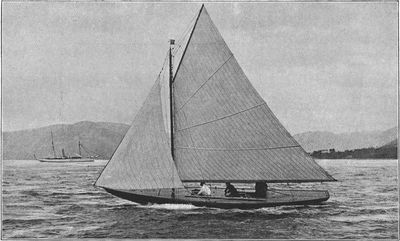
'WENONAH'
2½-rater (Mr. H. Allen). Designed by Nat. Herreshoff, 1893.
In designing a small yacht there are matters that have to be
considered which scarcely affect larger vessels except when comparing
them, again, with larger vessels still. One of these points almost
makes it worth while looking back at the reasons why certain types of
small yachts have become so prominent and so much sought after and
believed in. The great American designer, Mr. Herreshoff, and our own
clever yacht architects here, are taking the canoe of the savage as
their model; and as this is the case, it may be interesting to see
how, starting from the canoe, all yachts have taken their form (no
matter how deep or beamy they may have been), and perhaps, too, by so
doing, it will be easier to discern and arrive at the kind of form
best suited to meet special requirements, apart from the trammels of
the rules, measurements, or ratings such as are or have been laid down
for yachtsmen and yacht-owners by the Royal Thames, the Yacht Racing
Association, the American and French yacht clubs, or other societies
and authorities.
The canoe of the South Seas or the kyak of the Greenlander could not
have been better chosen, had they been worked out on the most
scientific principles, for the work they have to do. The shape is that
best adapted for speed, lightness (which means light displacement),
and, under certain conditions, for sea-going qualities. Those
conditions are, of course, smooth water or big ocean rollers, which
seldom if ever break, and a propulsion easy, strong, and yet not
exaggerated, longitudinal and not transverse in its tendency (as in
propulsion by sail). Now if this model be taken, which invariably
possesses a U-shaped section, there will be no great
difficulty in understanding the whys and wherefores of the several
transformations it has undergone.
If it is desired that a small boat should keep the sea, the
nearer she approaches to the canoe form, as far as is compatible with
the limited requirements, the better able will she be to cope with the
difficulties which she ought, under the circumstances, to be ready to
encounter. Hence it is that those men who make great ocean voyages,
as, for instance, across the Atlantic, in boats about 15 feet or
thereabouts, always have their boats built as round and floaty in form
as it is possible to design them, taking into account that they must
be decked, have sufficient depth of hold to allow of stowage for
provision and water, which act as the greater part of the ballast,
with the addition of just sufficient room for lying down at full
length under deck covering: 2 ft. 6 in. to 3 feet is the outside depth
under the deck of any of these diminutive ocean cruisers. The entrance
given to such boats is always full and buoyant, though not bluff.
Rarely do they have a vertical stem, but one rather rounded up, with a
slight overhang. The after-body is generally whale-shaped, with the
sternpost at a somewhat less angle than the stem. Both stem and
stern-posts have this inclination given them, not with the idea of
making them quick in stays, but rather for the purpose of meeting and
throwing off head or following seas, and adding buoyancy to both ends.
The main principle in these boats is to obtain buoyancy and speed,
while great sail-carrying power for driving at abnormal speeds does
not so much as receive a thought. This is why it so seldom occurs that
any of these little vessels fail in reaching their destination. They
go over the seas and not through them, owing to lack of weight and
want of power. Their worst experiences during their long,
uninteresting, and perilous voyages generally begin on nearing our
shores and the chops of the Channel, where the seas begin to assume a
broken, short, uneven, or at the best a deep ridge and furrow, shape.
These boats may be considered the first remove from the early canoe
form.
The general requirements, however, in a yacht are speed,
accommodation, sail-carrying power, and weight. This latter
property means, in other words, the ability to drive through a sea
which, from its wall-sidedness, makes it an impracticable barrier to
get over. When a vessel has not the weight or power to meet such a
sea, as a rule, it spells disaster, or, to say the least, very
disagreeable consequences; whereas if she can climb a part of the way
up and then send her nose through the top, all is sure to end well.
Accommodation is very near akin to weight, for it is impossible to
have a roomy boat without weight being concerned in it as a factor of
some consequence. Accommodation in a yacht of 30 feet length and 6
feet to 7 feet beam means that there should be a height between the
cabin floor and the deck beams of 4 ft. 6 in. to 5 ft. 6 in. at least,
and this will demand a big-bodied boat of rather large displacement,
otherwise the deepening in the water of the original U shape. Such
a boat will require a large sail-spread to propel her. Supposing,
however, that such height between decks is not required—that is to
say, the boat is to be only partially decked with a large open
cockpit—in that case the designer can, if he chooses, give the boat
very much less displacement, which, in its turn, will require less
driving power. The tendency, as it has been shown, of the Length and
Sail-Area Rule is to provide just such a small displacement yacht, and
accordingly a large yacht will some day be launched without any
accommodation whatever.
Sail-carrying power is almost entirely a matter of displacement, for
it is only a large-bodied boat that will have buoyancy sufficient to
carry a great weight of ballast, and the deeper that ballast is
placed, the more leverage will there be to counter-balance the sail,
and hence the greater may be the sail-spread. Under the new system of
deep plates, with the whole of the ballast bolted on at the bottom of
the plate in the shape of a cigar or Whitehead torpedo, it is
impossible to say how much area of sail could not be given to a boat
of a certain length, beam, and depth of hull, and the only
questionable difficulty that would come in the way would be the weight
of the mast and spars necessary to carry the sail. For instance, take
the three principal methods of stowing ballast, inboard,
outboard, as in the ordinary keel, and the plate with a bulb. The
dimensions of the boat to be supplied with sails are, length 30 feet,
beam 7 feet, draught to bottom of wooden keel 4 feet. If the ballast
is stowed inboard (lead ballast is presumed in all the cases), and the
displacement permits, the sail-area may be 800 square feet. If the
ballast is taken out and moulded in a keel, the sail-area may be
increased to close upon 900 square feet. Should the lead be taken out
and a plate some 2 feet or 3 feet deep be fitted, with the lead in the
form of a bulb fixed at the bottom, the weight of the spars and the
sails would be the only obstacle to the great increase of canvas that
might be spread. Suppose, again, another hull be employed for
experiments, having the length the same, but the beam increased to
make up for the smaller depth of body below L.W.L. of 3 feet, the new
hull may have the same displacement, and therefore the power to
support the same weight of ballast as the last example. If this hull
were supplied with a plate 4 feet or 5 feet deep, with the same bulb
of lead, she would carry a still greater amount of sail; but with such
a shallow boat there would be no accommodation.
Speed, that element in design which everybody cries after, whether
they be practical scientific yachting men (and there is one thing
Great Britain can boast of in her yacht designers, professional or
amateur, and that is, they are all, without exception, first-rate
helmsmen and seamen), or only graduating in the first principles of
yacht-racing, is dependent on many conditions. In the first place, it
forbids the presence of all superfluous deadwood, so that the outside
surface presented to the water may be all of a useful description
(that is, by being part of the planking or skin, or only as much
deadwood as is necessary for the strength of the vessel), and the
friction caused thereby may be reduced to a minimum. With a hull of
large displacement there must naturally be very much greater surface
friction than in one of smaller body, and therefore the question will
arise—Will not the smaller yacht be the faster of the two?
This involves still deeper sifting, because sometimes the smaller
yacht will beat the one built on the same length and beam, though she
may be very much larger. Before we can choose which of the two kinds
of boat will be the better to have for a successful racer, a second
great condition has to be looked into and satisfactorily settled. This
is nothing less than what kind of waters the yacht will have to race
or cruise in. The question of the element water is one very frequently
forgotten and lost sight of by those buying yachts, especially
second-hand ones; and the purchaser, who perhaps buys a most
successful small vessel in the South, is astonished to find that when
he has tried her against the local Scotch cracks, her performances
prove of a very poor description in comparison, and disappointment is
the consequence. Water may be in the eyes of some all the same,
wherever it may be, and so it is round our coasts in its smooth state;
but when it is set in motion there are scarcely two of our great
yachting stations alike, while the seas in our three Channels all vary
in form. At the mouth of the English Channel the seas, as soon as the
'chops' are left astern, become regular, are long and deep, and more
or less easy for a small yacht to negotiate; that is, she has room to
work in and out of them, and at the same time avoid receiving a comber
aboard as passenger. As she sails farther up and the channel narrows,
the seas become more of the deep ridge and furrow order, steep,
narrow, and difficult to sail over, whilst each sea will contain its
full weight of water. On nearing Calais the seas have less water in
them, but are very short and steep; the consequence is they are more
inclined to break. In the North Sea the sea disturbance takes another
and larger form, and sailing North becomes still larger, and, of
course, wider and deeper, till the Northern Ocean is opened out. St.
George's Channel is very much like the English Channel, except that
between Port Patrick in Scotland and the Irish coast the waves are
more regular than between Calais and Dover, where currents and banks
tend to make dangerous cross seas. So it is found that off Plymouth
and Falmouth and outside Dartmouth there is often an ocean
swell running, especially after there has been a south-westerly gale.
The Solent, again, is different from the Clyde in its sea disturbance,
and when acted upon by a south-easterly gale the seas off Spithead,
owing to the shallowness of its water, have not nearly so much weight
of water in them as those of the Scotch estuary when worked up by a
northerly or southerly breeze. The Liverpool and London rivers are
very much alike, though perhaps of the two the Liverpool has the
greater sea disturbance, owing to the strength of its tides, which at
some seasons are very rapid.
To large yachts of 40 tons and over the difference in character of the
seas just spoken of is not a matter of great importance. What a large
yacht may treat as a mere ripple to a 5-tonner may be a 'nasty sea';
and as these pages are dealing with the smaller craft of about 30 feet
length, the sea disturbance must be regarded as it affects them. On
rivers and inland waters the waves, as a rule, have not much weight in
them, and there is no reason why the small yacht should not be able to
go through the waves she is unable to rise over. Yachts of large
displacement are more likely to do that at better speed than a small
vessel of the same beam and length, because they have more weight.
Where ocean rollers are concerned, or a heavy swell, while there is
wind both types may be equal; but when the wind is shy and light, then
the yacht of large displacement will walk past her small rival. It
would be noticed that the heavy displacement vessel would forge ahead
apparently moved by no other force than the 'send' of her weight as
she lazily pitches to the movement of each succeeding wave. The
courses for small yachts where such conditions are met with are
Plymouth, Dartmouth, and Queenstown, and some parts of the Clyde and
St. George's Channel to a very much lessened degree. Then, if a
thought be cast across the Atlantic and a look be taken at the
characteristics of the waters of Long Island Sound, that favourite
haunt of all American racing and cruising yachtsmen, as on our own
inland waters, the seas that much disturb the small fry are, it will
be observed, scarcely noticeable to the large schooners and
cutters of which so much is heard. The principal form in America laid
down for all yachts used to be a long flat floor with very small
displacement, great beam with a centreboard—the immense beam giving
great initial stability. Large as well as small yachts were built to
this design, and much used to be heard about their remarkable speed. A
few years ago, however, two or three small yachts, amongst them the
little 'Delvin' 5-tonner, built by Mr. W. Fife, jun., were sent over,
all of fairly large displacement. These, without exception, put the
extinguisher on all the American small yachts, by beating them time
after time. The reason of it was that the English-built yachts could
drive through what broken water or sea disturbance they met with,
while the 'skim-dishes' could do little against it. Since those days
the Americans have very materially altered their model, and both large
and small yachts have been given more power; vide the examples
brought out to compete with our yachts for the 'America Cup,' and
those to which the 'Minerva' has so lately shown her tail.
Where, therefore, great speed is required, and there is no limitation
to sail-carrying power, a large displacement vessel is the best type
to choose. Some small-yacht racing men do not like to be always
remaining in their home waters, but prefer to go round to the regattas
at other ports, and try their luck against the small yachts that
gather at these meetings. They live on board, and sail their yachts
round the coast. To such the large bodied boat is a regular frigate.
The head-room is good, no lack of space is wanted for a comfortable
lie down, and the owner and two friends, with racing sails and all
other yacht paraphernalia, can stow away in the main cabin as cosily
as can be.
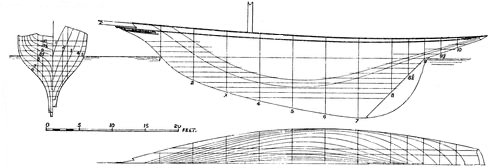
'Minerva,' 23 tons. Designed by W. Fife, 1888.
During the last six years yacht designers have been spending their
time in perfecting a vessel to be rated by length and sail-area alone.
Boats of large displacement and moderate length, with good
sail-spread, limited so that the boats might be rated under their
several classes, gradually, but surely, gave place to boats
of greater length, smaller bodies, and a smaller sail-spread. It does
not appear, from the opinions of many who have published their views,
that there is at the present time any particular desire to have good
accommodation in racing yachts. The owners of the greater number of
the 5-raters do not live in them, and the owners of the 40-raters have
been so accustomed to great head-room in their vessels, that now,
when, instead of having 7 feet to 8 feet, they still find they can
walk about in the cabins, no complaints are heard; but with the
lessons that Mr. Herreshoff has been teaching, there is every reason
to believe that we may live to see a 40-rater launched with about 3 to
4 feet depth of body under water, and then perhaps there may come a
reaction, and a return may be made to a moderately large displacement.
Up to the present time the 5-raters have been kept fairly
large, and owing to their beam, as far as internal accommodation is
concerned, have room enough and to spare; but the raters of 1893 were
not nearly of such large displacement as the boats of two years
before, and they are wonderful to look at outside.
The fin-keel requires great depth if it is to be of any real use, and
it is in this particular point that small yachts suffer. If a 5-rater
is to sail in all waters, and go the round of the coast regattas, then
her draught should be limited; of course, if the sole intention of the
owner is that his yacht is never to race in any other locality than
his own home waters, then, if the home waters be the Clyde, or
Windermere, or Kingstown, there is no reason why depth should not be
unlimited. On the other hand, should the yacht be intended for a
sea-going vessel, then a heavy draught of water is not altogether
desirable.
There are times when a 5-tonner or rater may be overtaken by bad
weather while making a passage, and when a comfortable harbour under
the lee would be a most acceptable refuge to make for. There are
scores of snug little places round the coast where a small craft could
lie peacefully enough, provided her draught of water allowed her to
make use of any one of them. The average depth of water at these bays
or harbours is about 6 feet at low-water spring tides. Hence no yacht
or rater of 30 feet or under should have a draught of more than 6
feet. The writer remembers only too well an occasion when, after
leaving Campbeltown, in Cantyre, for a northern port in Ireland, a
north-westerly gale sprang up, bringing with it rain and a sea fog.
The distance across from the Mull is not more than a few miles, but
when his yacht made the land it was blowing so hard he had to run for
the nearest shelter. Alas! when he sighted the little tidal harbour he
was steering for, it was low water, and his yacht, which drew 7 feet 6
in., could not enter. He had to lie at two anchors outside in the
Roads with some half-a-dozen coasters, expecting, with every shift of
the wind, that the anchorage might become one on a lee shore. The
'Humming Bird,' in 1891, left the Solent for Queenstown. She
is a 2½-rater. After leaving Land's End the weather, which had been
more or less fine, changed, and the sea getting up, it was decided to
take her into St. Ives Harbour. She unfortunately drew more than 6
feet; the consequence was, though only 25 feet on the water-line, she
was compelled to take her chance and drop anchor in the bay outside,
because there was only 6 feet of water in the harbour.
None know the value of a moderate draught of water better than those
who have cruised or raced afar from home, and groped their way into
all kinds of out-of-the-way bays and harbours in small craft. The
yachtsman who builds for racing only, possesses the means, and is
ready to launch a new yacht to his name every other year, should (if
he be a sensible man and proposes to himself to sell the yachts he has
no further use for) think of the requirements of the market and his
ability to sell. Soon the yacht mart will be flooded with a number of
cast-off 5-and 2½-raters, all with a draught of water which would
limit their sale to only a few places.
There are many living at the present moment who will remember the time
when even the large yachts of 100 to 200 tons were never given more
than 12 feet draught. This was done to enable them to enter tidal
harbours, the greater number of which only have a depth of 15 feet at
high-water neeps. But there is another argument in favour of not
having too great a draught of water, and that is, it is not an element
of speed, beyond helping the sail power; and the existence of yachts
like the old 'Fiery Cross,' which only drew 8 feet and was a most
successful winner, and of the Herreshoff boats, which do not draw so
much as the English-built raters and are the cracks of the day, points
the lesson that it is well to put a limit where a limit may be
altogether an advantage.
Great care is necessary in apportioning out beam, no matter whether
the yacht is to be of large or small displacement; great beam in the
case of a yacht of small displacement is only suitable for waters such
as Long Island Sound, or long rolling seas, and is useless in heavy
broken water like that met with in our channels; because it
is a difficult matter, without weight, to drive through the seas. When
great beam is given to a yacht of large displacement, she may be able
to fight her way through the water, but it will not be at the greatest
speed for the given length, since it was proved by the old Solent
30-ft. and 25-ft. classes that when beating through a head sea a yacht
of the same length, but of small beam, such as the 'Currytush' and the
late Lord Francis Cecil's little 3-tonner 'Chittywee,' were able to
travel faster through the water whenever it was a hard thrash to
windward. The general opinion of those competent to judge is, that
3½ to 4½ beams to the length on L.W.L. is about the most
advantageous proportion, some going even so far as to assert that
three beams may be given; but, in dealing with small yachts, 5-raters
and 5-tonners, as this chapter does, the writer believes that four
beams to length is a good proportion to meet all kinds of weather
with; and if 30 feet be the length 7 ft. 6 in. the beam, and 5 ft. 6
in. the draught, such proportions will be found to give quite
sufficient scope to any designer in order that a remarkably fast
weatherly little ship may be the result of his calculations. The
height between the decks with a large displacement would give 4 ft. 6
in. to 5 feet head-room. Nothing has been said about the sail-area,
which should not be taxed.
The element sail-area appears to be the stumbling-block in the present
rating rule. It is limited, and the consequence is the cart is put
before the horse, and the hull is built to the sail-spread. Thus the
hull is being minimised to carry the small area allotted to certain
lengths.
There have been so many raters built since the present rule came in
that it would take too much space to mention them all with their
several points, but there is this fact to notice, which backs up what
has been said before, that South-country designed boats seem to do
well in their own waters, while those brought out in the Clyde fare
best there. When Clyde 5-raters have gone South, they have performed
badly—though the 'Red Lancer' in 1893 proved the exception to the
rule—and the Solent raters that have found their way up
North have made but a poor show. Mr. Arthur Payne is the king of
draughtsmen on the Solent, and his yachts, with those designed by Mr.
Clayton, also a prince among naval architects, have all had their turn
at winning prizes when they have been properly sailed. Mr. Payne's
designs mostly favour a fair amount of displacement, and 'Alwida,'
built by him for Lord Dunraven in 1890, is a very fine example of the
kind of craft he can produce. The workmanship is fit to compare with
the very neatest cabinet work. The following year the beam was
increased by some inches, the length underwent a drawing out, and at
the same time the body was tucked up to decrease the displacement. The
next movement, if it is possible to judge by the 2½-raters, will be
to follow in the steps of Mr. Herreshoff—who speaks for himself in
other chapters. The 'Cyane,' another of Mr. Payne's 5-raters and an
improvement on the 'Alwida,' has few fittings below, but there is
great height between decks, and if she were changed into a cruiser,
she has enough room to make her everything that can be desired,
without greatly decreasing her speed. To describe all the 5-raters
sent out to do battle by those Northern champions, Messrs. Fife and G.
L. Watson, would be equally out of place here. Their boats are too
well known all over the world both for speed and beauty of design, and
if there is a point peculiar to either of them that marks their
vessels and makes their meetings interesting and exciting, it is that
while Mr. Watson's are extra smart in topsail breezes, Messrs. Fife's
yachts are specially good in strong winds.
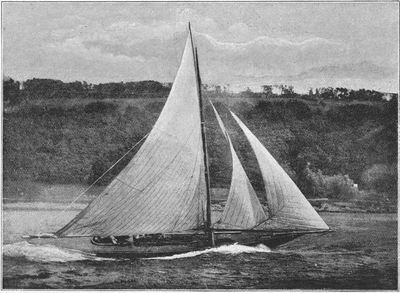
'RED LANCER'
11 tons T.M., 5-rater (Capt. Sharman-Crawford). Designed by Fife of
Fairlie, 1892.
In mentioning these well-known names, it would be impossible to forget
a name which will always be linked with the year 1892—viz. Mr. J. H.
Nicholson, jun., of the firm of Messrs. Nicholson & Sons, Gosport, the
successful designer of the 5-rater 'Dacia' and the 2½-rater
'Gareth.' His boats are unique, and though they partake of the canoe
form, still it is the shape adopted by Mr. Nicholson for his keel, and
the design itself, which brought his name so prominently forward
during the season of 1892 as one of the most successful
designers in England. The 5-rater 'Dacia,' which he designed and built
in 1892 for Mr. H. R. Langrishe, and which now belongs to Lord Dudley,
proved herself far superior in all weathers to the yachts of her
rating in the South. Most of the raters were designed with a square
stern above water, whatever their shape might have been below; but the
'Dacia' is counter-sterned, and carries her ribbands fair from stem to
taffrail, as far as can be judged from a long-distance view when she
was hauled up. Whatever her length may be on the L.W.L., it must with
a large crew aboard be so considerably increased as to almost make her
another boat. At all events, she is a fine specimen of the advanced
type of rater, and is good in all weathers.
The 'Natica' and 'Red Lancer,' 5-raters by Mr. Watson and Mr. Fife,
jun., must not be passed over unmentioned. Both these yachts belong to
Belfast, which is at present the home of 5-rater racing. In the Clyde,
where 5-tonners and 5-raters were once the fashionable classes, there
is now not a single representative. The 'Red Lancer' is a fin-keel
shaped vessel with great angle of sternpost, from the heel of which to
the stem-head the line is run in a very easy curve. She has a very
long counter, more than a third of which is submerged; but she is very
pretty as a design, and though not of large displacement, is very
roomy both on deck and below. She was originally fitted with a
centreboard, but as it was not considered of any material benefit to
her, this was taken out and the hole in the keel filled up with lead.
The 'Natica' has a spoon bow, and is one of Mr. Watson's prettiest
models as far as the modern racer can be termed pretty. She has been
very successful in the North, and as great curiosity was felt
regarding her capabilities when compared with the South-country boats,
she sailed round, and met the 'Dacia' at Torquay Regatta, where the
best of three matches were won by 'Dacia.' It would have been better,
perhaps, had the matches taken place off Holyhead—vide the case of
the 'Vril,' 'Camellia,' and 'Freda'; however, there is no
reason to disparage them as not giving a true indication of the
respective merits of both yachts. So many races come off, both on the
Solent and on the Clyde, in numerical comparison with what took place
a few years ago, that the owners of small yachts rarely care now to go
far away from home on the chance of obtaining sport when it lies
comfortably to hand; but it is a thing to be encouraged, and when
yachts have proved themselves champions in any particular waters, a
trysting place should be chosen for the little winners to meet and try
conclusions. This would also make yachtsmen anxious to possess not
merely a racing machine, but a boat capable of going from port to port
with a certain amount of comfort to her crew.
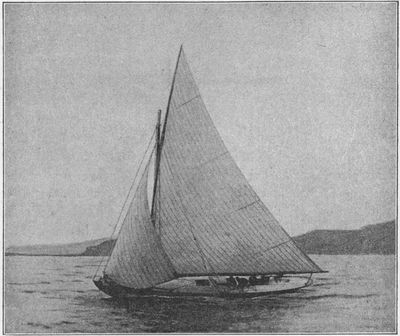
'Natica.' Designed by G. L. Watson, 1892.
In choosing a yacht there is, as with most other occupations, a right
and a wrong way of going about it. First of all, the size has to be
determined upon; but this can soon be done by referring to the length
of the purse out of which the funds for keeping the yacht in
commission are to be supplied. Yachts are very much like houses, and
it is quite possible to buy a yacht or a house for such an
insignificantly small outlay that to all unconcerned in the bargain it
will appear a ridiculously cheap purchase. But this might not really
be the case, because, though the original outlay may have been small,
if a large number of servants or hands are required to keep either the
one or the other up, it would be dear at any price should money not be
forthcoming to meet the annual expenditure. It is, therefore,
necessary, before making a purchase, to look ahead at the probable
annual cost. At a rough estimate it may be laid down that each extra
hand required (this does not refer to those necessary on racing days)
will cost at least 25l. per season. A skipper may for his wages,
clothes, &c., make a hole in any sum from 30l. to 100l. per annum.
In a 5-tonner, or a yacht of 30 feet and under, provided she has a
gaff-mainsail and not a lugsail, one hand will be quite crew
sufficient, with the owner, to take her about. The writer worked a
10-tonner with one hand for two seasons without finding her too heavy,
but the addition of a boy made all the difference in the comfort.
The cost of sails, gear, and the many small items of equipment which
have to be renewed from time to time, cannot or should not be treated
as if such casual expenses could only come about in some dim vista of
futurity; for where in the case of sails 60l. might see the
fortunate owner of a racing 5 in possession of a brand-new suit, the
man with a 20 would find that sum barely sufficient to supply his
yacht with a new mainsail and topsail.
In making a purchase, it is as well if it be possible to find
out what kind of a yachtsman the owner of the yacht for sale is—that
is, if he is a man who has made yachts and yachting his sole hobby,
and has therefore been in the habit of keeping his vessels in the best
condition. It makes all the difference whether you purchase from such
a man, or from one who, having extracted all the good out of his
yacht's gear and sails, has placed her in the market rather than go to
the expense of giving her a new fit-out. In the case of a 5-tonner the
difference in price between the purchase money of vessels owned by the
two men might be from 50l. to 80l. or 100l.; but then in the
case of the one there will only be one expense, viz.—that of the
purchase money, whereas with the other it might be difficult to say
how much might be required as outlay before the yacht could be made
ready for sea. The Clyde and Southampton are the best and most likely
places to find yachts for sale which have been well kept up and cared
for. Buying from a thorough yachtsman who is known to spare no expense
on his yacht will mean an absence of all bitterness and wrath, whereas
in making the purchase from the skinflint, until a small fortune has
been paid away the new owner will find that he has no satisfaction.
In buying a small yacht, in fact any yacht, unless the purchaser has
met with a vessel that combines all his requirements, it is always the
wisest plan for him to spend as little as possible the first season on
his new purchase—of course it is taken for granted that her sails and
gear are in thoroughly good order—in altering any of her fittings to
suit his own private fads; for if he changes his mind about his
yacht's points, or sees a vessel he may like better, he should
remember that he must not expect to get his money back again when
wanting to sell. By the end of the first season, he will most likely
have found out whether he will keep the yacht, and therefore whether
she really suits him, when he can do what he likes to her. It must be
borne in mind, too, that the inside fittings of a yacht's cabin form
the most expensive part of her hull; and alterations below
always mean a goodly expenditure.
Avoid all yachts which are either coated outside or filled in at the
garboards inside with cement, as water will leak in between the cement
and skin, and rot must ensue.
In fitting out, two very important points have to be thought of—viz.,
if the yacht is not coppered, what is the best paint to coat her with,
and what is the best method of treating the decks? With regard to the
first question, there are two paints which the writer has never yet
seen used in the yachting world, except on his own boat, and which can
be highly recommended. One is the black priming varnish used on iron
ships, and especially in the Navy. He gave this, some years ago on the
Clyde, four months' good trial. It was used on a boat kept out for
winter work which lay in a little harbour well-known for its fouling
propensities. At the end of the four months there was absolutely no
growth or sign of weed of any kind. Where it is to be obtained he is
unable to say, as the coat of paint that was put on his boat was given
him by a naval officer. The other paint is called after the inventor,
'Harvey's Patent.' The writer's experience of this is as follows:—A
friend sent him a tin to try, and to give his opinion upon.
Accordingly his boat, which had been lying up Portsmouth Harbour some
six months at her moorings, was brought down to Priddy's Hard and
hauled up. She had, though coated with a very well-known patent, from
7 to 10 feet of weed floating astern of her at the time, which had to
be removed. After being thoroughly cleaned, left to dry for a few
days, and having her paint burnt off, a coat of priming was given,
followed by two coats of the Harvey. The boat was then launched and
towed back to her moorings, where she was left for over 20 months. At
the end of that time she was hauled up, prior to being put into
commission; and there was no sign of grass or weed; slime,
with an almost imperceptible shell-fish growth, being all that was
visible on her bottom. The boat was seen by a good many naval and
other men during the time she was at her moorings, and they remarked
on the quality of the paint. One great point about the Harvey must be
mentioned, and that is, it dries very quickly when put on. It is a
good thing to warm it before using, as it is apt to get hard and soak
up the oil; but it soon softens, and after being properly mixed works
well.
Before touching the decks, the spars and blocks will always require to
have the old varnish of the past season scraped off them, and will
have then to be re-varnished. In scraping the spars care should be
taken that the knife, scraper, or glass be drawn with, and not
against, the grain of the wood. The scraping will always be achieved
with greater facility if the spar or block in hand is slightly damped,
and the scraper or knife-blade employed has its edge turned over a
little. This latter is done by drawing the side of the edge along the
back of a knife or steel tool. After scraping, the whole spar should
be rubbed down with sand-paper, prior to its receiving a coat of
varnish. The brushes employed should be either well-used ones, or, if
new, ought to be well soaked in water prior to use, as this will
prevent the bristles falling out during the process of varnishing.
Nothing is so provoking as to have to be continually picking out
bristles from the varnish; of course, what holds good about varnishing
holds good in the matter of painting. When using copal varnish, it is
as well to pour out only as much as may be wanted for the time being
into an old tin or jar, because it very soon hardens on exposure to
the air, and then becomes useless. For the same reason the varnish
bottle or can should never be left uncorked. Two coats of varnish
thinly laid on ought to suffice at the beginning of the season, and a
third coat may be given as the season progresses.
With regard to the decks. Everything depends on the state of the
decks themselves and how they are laid. If they are made of
wide planking, which is rarely, if ever, the case when the workmanship
is that of a yacht-builder, they should be painted; if, however, the
decks are laid with narrow planking fined off with the deck curves at
the bow and stern, then, notwithstanding the beauty of white decks, it
is better to varnish them. Varnishing keeps them hard, and saves many
a heart pang when the little yacht is visited by a friend with nails
in his boots or a lady in small heels. If the decks be worn at all, a
coat of varnish is a capital thing. After trying decks varnished and
unvarnished, experience confesses that the joys of beholding a white,
spotless deck in a small yacht are more than outweighed by the sorrow
and annoyance of seeing deep nail-marks imprinted on it.
As decks, when cared for, are always varnished when a yacht is laid up
for the winter, this varnish has necessarily to be removed prior to a
start on a season's yachting. The best method by which this can be
carried out is as follows:—Black ashes, Sooji Mooji, or one of the
many preparations of caustic potash, should be procured from a
ship-chandler, and mixed in an iron bucket with warm water in the
proportion of one-third black ashes to two-thirds water, according to
the strength required. As soon as the sun has set the mixture must be
poured over the deck, which must be left well covered with it till an
hour before sunrise. The mixture, which will have dried during the
night, must now be treated with hot water and well rubbed into the
varnish, and fresh buckets of water must be kept applied till every
particle of the mixture with the varnish has been cleared off and out
of the deck planking. If the mixture is applied or allowed to remain
on the deck while the sun is up, it will be certain to eat into and
burn it.
There are two or three ways of laying decks. One is to have the planks
nailed down to the beams, the nails countersunk, and the holes filled
up with wood plugs to hide the nail-heads. This is generally done by
men who have not had much to do with yacht-building. The common method
employed is to drive the nails diagonally through the edge of
the plank into the beam. Nails let in horizontally and driven
into the next plank, two or three cotton threads having been placed
between, keep the two planks in position. Each plank is similarly
treated, and when all the planks have been fitted and jammed together,
marine glue is poured into the seams. As soon as the glue has set and
hardened the decks are planed, and finished off. The third method is
not so pretty perhaps, but is believed from practical experience to be
the best. The planks are mortised together, varnished, and then
brought tight up. The whole deck is often built and made ready to fit
before it is put into position, so that when it is laid on the beams,
all that is required is to nail it down into its place. The writer has
had experience with the second kind of deck mentioned here in nearly
all of his yachts, and of the third method of laying decks in the
'Cyprus.' She was about five years old when he bought her, and that is
a good age for a racing 5-tonner's decks to last sound and without a
leaky spot to be found anywhere. Her decks were certainly kept
varnished, for the simple reason stated above, that visitors might be
always welcome, no matter what description of foot-gear had been
supplied to them by their bootmakers.
It is not an uncommon practice to have a yacht recoppered, though her
copper may be in good condition and even new. When such a proposition
is made, which is not infrequently done by skippers wishing to play
into the yacht-builder's hands, and thinking more of their own pockets
than their master's interests, the yachtsman must remember that every
time his yacht is coppered her skin is made more porous, and she
herself heavier in the water, since the planking will naturally sodden
with greater rapidity.
If the incipient yachtsman has bought the hull and spars of a yacht
that is only partially built or finished off, a few more hints must be
added, which will give him food for reflection, and may prove of
service.
When a yacht likely to suit has been heard of, nothing being
known of the owner, the next thing should be to try to discover
whether she is sound or possesses any weak places. The purchaser
should overhaul her outside just below the channels, and examine if
the yacht has been frequently caulked between the seams of the
planking, or if there are any signs of weeps of any kind about that
part or elsewhere. The weeps will be shown most likely by a rusty
discolouration. If the yacht is coppered, wrinkles must be looked for
under the channels, runners, and about the bilge. They will show if
the yacht has been strained at all. A knife should next be taken, and
the point driven into the planking about the water-line, where it
joins the sternpost and stem, and then along the two lower garboard
strakes, especially if cement has been used to fill in between the
keel and planking, to discover if there is any sign of dry rot, sap
rot, &c. Inside, under the cabin floor, the timbers, deadwoods, and
the garboard strakes if the yacht be coppered, should be tested in the
same way. If the yacht has iron floors, these should be carefully
examined for galvanic action or decay. The heads of the bolts which go
through the lead keel should be scraped to see whether they are made
of iron, metal composition, or copper. If they are iron or steel, most
likely they will require to be renewed, because galvanic action is
very soon set up between the lead and steel. Outside, copper shows
wear and tear more quickly near the stem and sternpost and along the
water-line. In the cabin itself the deck ceiling should be examined
for weeps and leaks, especially about the bits forward and near the
mast, also wherever a bolt-head is visible. On deck, a look round the
covering board will discover whether it has been often recaulked, by
the seam being extra wide. The heat of a stove below is frequently the
cause of the deck forward leaking. The deck seams should not be wider
there than at any other part. All the spars should be examined, and if
there are no transverse cracks, longitudinal ones may be held of no
consequence. The weak parts of the mast are generally to be found
between the yoke and cap, where the eyes of the rigging rest. Rot is
often found there, and strains are met with up the masthead.
The boom shows its weakness at the outer end by small cracks, and the
bowsprit by the gammon iron and stem-head. If the above rough survey
proves all correct, attention must be given next to the rigging,
sails, and gear. Wear in the wire rigging is shown by its being rusty,
the strands stretched, or by the broken threads of a strand appearing
here and there. If the jib, throat, peak halliards, and mainsheet are
new, or have seen the work of one season only, they will not require
much overhauling. With the other running rigging the strands should be
untwisted, just enough to see whether the heart of the rope is fresh
and not rotten. The blocks ought to be of a light colour without
cracks in them, and iron strapped inside. The sails will not show
either mildew marks or discolouration if they are in good condition.
The chain and anchors to be in good order should not be rusty, but
clean and well galvanised. They should be looked at to discover
whether they have ever been regalvanised. This will be noticed by the
links presenting a rough, uneven surface, where there was rust or
decay before the repetition of the process of galvanising.
Sometimes at fitting-out time an owner finds that he has to provide
his yacht with a new anchor. It may help him, therefore, in his choice
if the writer gives his experience in the matter of ground tackle or
mud-hooks. There are a number of patents in the market, the most
patronised of which are Trotman's, Martin's, Smith's, and Thomas &
Nicholson's. All these have many good points, with a weak one here and
there to keep the competition in anchor designing open to improvement.
Trotman's anchor has movable arms and stock, stows away well, and is a
fine holding anchor when once it bites; but it is often very slow at
catching hold, and this is dangerous when the anchorage happens to be
close and crowded, as, for instance, is frequently the case at
Kingstown, Cowes, &c., during regatta time. If the anchor does not
catch at once on such occasions the yacht may drift some distance
before she is brought up, and with little room this operation
is performed, more often than not, by collision with some vessel
astern.
The Martin anchor and the Smith both work on a different principle
from any of the others, in that their arms move together so as to
allow both flukes to act at the same time. Of the two the Smith, which
has no stock, is preferable for yacht work. The Martin has a stock
which is fixed on the same plane with the arms. Both anchors catch
quickly and hold well as long as the bottom is not rocky or very
uneven, when they are apt to get tilted over and lose any hold they
may have at first obtained. Their worst failing is that of coming home
under the following conditions. If the yacht yaws about, owing to
strong tides, winds, or boisterous weather, the flukes of the anchor
are prone, when working in their holes, to make them so large that
they gradually meet each other and finally become one big hole; the
anchor then invariably trips, comes home, and the yacht drags. On the
other hand, the Smith and Martin anchors stow away better than any
others, and when on deck lie flat and compact. The Smith anchor makes
a capital kedge. Its holding power is so great that it is not
necessary to carry one of anything like the weight that would be
required were any other patent anchor employed.
The great point in favour of Smith's over that of Martin's anchor is
that, should it foul a mooring or warp, it can be easily tripped. The
tripping is done by letting the bight of a bowline slip down the chain
and anchor till it reaches the arms, and then hauling on it.
The best of the patents, however, is an anchor that was brought out
some years ago by Messrs. Thomas & Nicholson, of Southampton and
Gosport. It can be stowed away in a very small space, since the arms
are removable. It is a quick catcher, and is, at the same time, very
powerful and trustworthy.
The arms stand out at the most effective angle for insuring strength
of grip, while the shank is long, and, though light and
neat-looking—it is flat-sided—has sufficient weight and substance in
it to stand any ordinary crucial test. The flukes from their shape
appear somewhat longer in proportion to their width than the usual
patterns; but this arises from the sides being slightly bent back,
with the object of making the fluke more penetrating, which it
certainly is.
The old fisherman's anchor with a movable stock is, after all, as good
an anchor as any yachtsman need want. It is not a patent, and is
accordingly very much less expensive. Should necessity ever compel the
making of a small anchor, then the two great points which it must
possess are, length of shank (because greater will be the leverage),
and the placing of the arms so that they do not make a less angle with
the stock than, say, 53°. After a long practical experience with
almost every kind of anchor, the writer believes that two good,
old-pattern fisherman's anchors, with movable stocks (the movable
stock was a Mr. Rogers' patent), are all that any yacht need require
or her mud-hooks; but if it is thought fit to have patent anchors,
then either a couple of Thomas & Nicholson's anchors, or one of these
and a Smith, ought to form the yacht's complement.
All being satisfactory, if the yacht is a 5-rater the first thing to
be done will be to have the lugsail altered into a gaff-mainsail for
handiness sake. This will be only a small expense, since the great
peak of the lugsail will allow of its head being squared. Very little
if anything need be taken off the head of a high-peaked lugsail when
the gaff employed is hinged on to the jaws, as such a gaff can be
peaked with far greater ease and to a much greater extent than when
fitted in the ordinary. The writer has employed the following method
for fitting up the interior accommodation of a 5-ton yacht, and he can
highly recommend it as most convenient, and at the same time handy to
clear out either on a racing day or when about to lay the yacht
up:—All woodwork, such as lockers or fore-and-aft boards (used for
turning the sofas into lockers), should be fixed in their places by
hooks, or at any rate by screws. Nothing should be a fixture
except the two sofa-seats in the main cabin, the one forward of the
mast, and the two sideboards fitted aft at each end of the sofas. If
the yacht has to race, these sideboards should be made self-contained,
and to shape, so that they may fit into their places and be kept there
by hooks or catches. There should be only a curtain forward between
the forecastle and main cabin, and instead of a regular solid bulkhead
aft, gratings should take its place, with one wide grating as a door.
This will keep the store room aft ventilated. If there is sufficient
length to permit of transverse gratings about 20 inches apart and 2
feet high by the mast, as before explained when describing the
'Lorelei,' by all means let these form one of the fittings to hold the
sail bags. In the locker astern of the after bulkhead gratings, the
skin should be protected by battens 2½ to 3 inches wide and from 1
to 2 inches apart. This will keep whatever is stowed there dry from
any little weep or leakage that may occur in the planking. There
should be no ceiling either in the main or fore cabin, and if battens
are thought necessary to prevent damp getting to the beds when left
folded up in the bed-frames, then three, or at the outside four, some
4 or 5 inches apart, should be screwed up just in the position where
the shoulders of a sitter would be likely to rest against them. Four
or five may be fitted up on each side of the forecastle. The upper
batten should be higher up than the top one in the main cabin, as it
may be useful for screwing hooks into. The writer, however, prefers in
the main cabin, instead of any battens, clean pieces of duck, or, what
is better still, Willesden cloth (waterproof), made to hang loosely
from hooks, reaching down to the sofas, and cut to the shape of the
after sideboards, holes being sewn in to allow the iron hooks which
carry the bed-frames to come through. This fitting always lightens up
the cabin, and is easily taken down and scrubbed.
For beds, the iron frames supplied to all yachts' forecastles for the
men, with canvas bottoms to them, are far the best and most
comfortable. They take up less room than a hammock, and stow
away nicely against the cabin's side when not in use. With these
frames the writer has used quilted mattresses, the heads of which have
ticking covers large enough to hold a pillow, and the whole is sewn on
to strong American or waterproof cloth, which forms a covering when
the bed and its blankets are rolled up and have to be stowed away.
In the forecastle, a movable pantry may be screwed up against the
battens on the port side (the bed will be on the starboard side). This
should be an open case with three shelves and two drawers underneath.
The upper shelf must be divided off to take the three sizes—dinner,
soup, and small plates. Between the plates, outside the divisions,
there can be uprights on which to thread double egg-cups. On the lower
shelf there should be holes cut to carry tumblers, and between the
tumblers slots for wineglasses. The bottom shelf is for cups and
saucers. One of the drawers ought to be lined with green baize to hold
silver plate and knives. If the sideboards aft are fixtures, a tin
case made to the shape of the yacht's side, to rest on the part of the
sideboard on which the lid hinges, and reaching up to the deck, is a
capital fitting to have. The inside should be arranged in partitions
to hold tea, coffee, sugar, biscuit, and other square canisters, also
Dutch square spirit bottles. The door may be double, or if single,
should open from the bottom and trice up to a hook overhead, so that
it may not in any way hinder the opening of the sideboard lid at the
same time. Two or three movable shelves placed right in the eyes of
the yacht forward make useful stowage room for a man to keep his
clothes, as there they stand less chance of getting wet. Between the
sideboards aft a removable box ought to be fixed with screws, of
sufficient depth to hold an iron bucket, washing basin, and all the
conveniences of a lavatory. This will be directly under the cabin
hatch, and from 8 to 10 inches abaft it. The lid should leave a few
inches space clear to receive it when opened back. Curtains made of
duck or Willesden cloth, to hang down loose over the
sideboards at each side to the depth of 6 inches, and hung from hooks
in the deck above, will be found useful for keeping all stray
splashes, that may fall inboard, from going on the sideboard lids, and
thence among the dry goods and provisions stowed away in them. At the
back of the lavatory box will be the after-grating and locker, and
standing out from the grating, about 10 inches to a foot square, and
15 to 18 inches deep from the deck, there should be a cupboard,
painted white inside, or, better still, lined with copper
silver-plated to reflect the light, and a transparent spirit compass
should then be fitted to hang through the deck above it. The brass rim
for carrying the gimbles and binnacle lid outside must be screwed down
to the deck on doubled india-rubber to prevent leakage. The cupboard
door must have ventilating holes in it at the top and bottom, and a
square hole to hold the lamp should be cut in the door between the
upper and lower ventilators. On the opposite side from that on which
the tin case is fixed, and coming out from the grating the same
distance as the compass box, two bookshelves can be fitted, which will
prove most useful. On deck, the fittings and leads that are mentioned
in the description of the 'Cyprus' cannot be improved upon, except
that rigging screws are neater, and give less trouble than dead-eyes
and lanyards, which have to be continually set up. Lanyards, however,
give more life to a mast, though it may appear almost imperceptible,
and by so doing ought to render it less liable to be carried away. The
sliding lid of the companion hatch should padlock on to a transverse
partition between the combings, and it is a good plan to have this
partition on hinges, so that at night, when the hatch-cover is drawn
over, the partition may lie on the deck and so leave an aperture for
ventilation. The windows of the skylight will be all the better for
being fixtures and should not open; if ventilation be required, the
whole skylight can be taken off; this will prevent the leakage so
common with hinged windows. A mainsheet horse and traveller with two
quarter leading blocks are better than a double block shackled on to
an eyebolt amidships, because a more direct up and down
strain can be obtained when the boom is well in.
In any yacht of 25 feet in length or under, the wisest plan to adopt
with regard to a forehatch is to do away with it and only have a large
screw deadlight; if a small deadlight be preferred, then it ought to
be placed about 12 to 18 inches ahead of the bits, and a copper cowl,
to screw into the deadlight frame, should form part of the fittings,
for use when the yacht is laid up, in order to let air into and so
ventilate the cabin. It is certainly a great advantage to have the
spinnaker ready in the forecastle for sending up through a hatch, but
as this is the only good reason why a hatch should be thought
requisite in a small yacht, and since it is a fruitful source of
leakage and danger, especially when, as is sometimes the case, the lid
has not been fastened down and a sea sweeps it off the deck, it is
better to abolish the fitting altogether. A small rail ahead of the
mast, bolted through the deck and stayed to the mast below (in order
to take off all weight from the deck and beams), and a rail abreast of
the lee and weather rigging, should form all that is required for
belaying halliards, purchases, tacks, &c. In most of the 5- and
2½-raters the halliard for the lugsail is led below the deck, and
the purchase is worked by taking turns round a small mast-winch in the
cabin. It is a great advantage to have a clear deck free from ropes,
and it would be a saving of labour to have all a cutter's purchases
led below to a winch.
For a small yacht it is as well to have the jib, throat, and peak
halliards of four-strand Manilla rope, but wire topsail halliards are
a very decided improvement on hemp or Manilla. Wire has little or no
stretch in it, and a topsail halliard is the last rope a seaman cares
to disturb after it has once been belayed, it may be to lower and take
in the sail. All purchases ought to be made of European hemp-rope,
with the exception of that attached to the copper rod bobstay. All
headsheets should lead aft and belay on cleats bolted on to the
combing of the cockpit. It is becoming the custom to have all
the bowsprit fittings fixtures. A steel or copper rod from the stem to
the cranze iron at the bowsprit end serves as a bobstay, which, with
the shrouds, are screwed up with rigging screws. No such thing as
reefing, or bringing the useless outside weight of the spar inboard,
is thought of by many racing men now-a-days. Fiddle-headed and spoon
bows have introduced this fashion, but 14 to 16 feet of a 5½-inch
spar is no trifle to have bobbing into seas, and making the boat
uneasy, when half the length, or less, would be quite sufficient to
carry all the jib that can be set. No bowsprit belonging to a
straight-stemmed cutter should be a fixture, and the best and neatest
fitting for the bobstay is a rod with a steel wire purchase at the
end. The shrouds should be in two lengths of wire shackled together,
as in topmast backstays, and, leading through the bulwark, should
screw up to bolts in the deck especially formed to take a horizontal
strain. Selvagee strops can be used for setting up the intermediate
lengths.
If the eyes of the rigging are covered with leather which has not been
painted, then the bight of each eye ought to be left standing in a
shallow dish of oil. The leather will thus soak itself, and the oiling
will preserve it from perishing.
In sending up rigging it must always be remembered that the lengths of
the port and starboard rigging are arranged so as to allow of the
starboard fore rigging being placed into position first, then that to
port, the starboard backstay rigging going up next, followed by that
to port, after which the eye of the forestay will go over the masthead
and will rest on the throat halliard eyebolt in the masthead.
All block-hooks should be moused. A mousing is made by taking two or
three turns of spunyarn round the neck and lip of the hook followed by
a cross turn or two to finish off. This prevents the hook from
becoming disengaged.
In some yachts double topmasts and double forestays are used. The
former are only fitted where the yacht carries two sizes of
jib-topsail, one for reaching and the other for beating to
windward. Whilst one is up, the other can be hooked on, so that no
time need be lost in setting. A medium-sized sail, however, capable of
being used for reaching or beating, is all that is really required.
The shifting of two jib-topsails entails the presence for some time of
one man at least forward on the bowsprit end, and the less the men are
forward of the mast the better, if it is desired to get the best work
out of a small yacht, and the yacht herself is in proper trim. There
is more to be said, however, in favour of double forestays, since they
allow of a foresail being sent up whilst another is already set and
drawing, and the work is done inboard, while the difference between a
working and a balloon foresail is far greater than in that of two
jib-topsails. The writer has never used double forestays, but he
believes so thoroughly in the foresail, as a sail, that he has always
carried three—a working, reaching, and a balloon. He has the luff of
each foresail fitted with loops at regular intervals, after the manner
of gaiter lacings, otherwise called 'lacing on the bight.' These are
made either of light wire or small roping. The upper loop reaches down
to the next below it, so that the loop below may be passed through,
and so on, till the tack is reached. When setting a foresail the upper
loop is passed over the forestay before the lower one is threaded
through it, and so on with all the loops in turn. The tack has a
single part, which, after it has been passed through the lowest loop,
is made fast to the tack-downhaul. When shifting foresails, the sail
is lowered, tack let go, and the lacing comes away by itself; then the
new sail can be hooked on to the halliards and laced to the forestay
as quickly as it can be hauled up. When the sea is smooth there may be
no necessity for unlacing the working foresail should the shift have
to be made from that sail, especially if it has soon to be called into
use again. The above method will be found far superior to that of
hanks, which are always getting out of order and not infrequently
refuse to do their duty altogether.
In mentioning the shifting of sails, there is one point to
which nothing like sufficient attention is paid, and that is to the
lead of sheets. Many a good jib has been destroyed and pulled out of
shape through a bad lead, and more than one race has been lost through
the bad lead of a reaching or balloon foresail sheet. When jibs or
foresails are changed, the greatest care should be taken to see that
the leads told off for their sheets are really fair—that is, that the
pull on the sheet does not favour the foot more than the leach of the
sail, or vice versâ. In the case of a balloon-foresail its sheet
leads outside the lee rigging and belays somewhere aft. The man
attending the sheet should take it as far aft as a direct strain will
permit, and not belay it to the first cleat that comes to hand;
otherwise the sail will simply prove a windbag taking the yacht to
leeward rather than ahead.
There is a fitting which must not be passed over that is now almost
universally adopted on large yachts, but is equally important on small
ones—that is, an iron horse at the main-boom end for the mainsail
outhaul to travel on. It was originally invented by that most skilful
helmsman Mr. W. Adams, of Greenock, to obviate a difficulty so common
in square stern boats with booms stretching to n length over the
transom. He fitted the boom of his little racing boat with a horse,
which came from the boom end to within easy reach for unhooking the
clew of the sail, and so saved the trouble of having to use a dinghy
for the purpose. The idea was soon taken up by Clyde yachtsmen, for it
was found so much easier to get the mainsail out on the boom than with
the traveller working on the boom itself.
Whilst on a subject connected with mainsails, the writer can recommend
for the gaff and head of the mainsail, instead of the ordinary long
rope lacing commonly in use, separate stops or seizings to each
eyelet-hole. The seizing can be done in half the time it takes to
properly lace the head of the sail to the spar; it looks quite as well
and does its work better. For fastening the luff of the mainsail to
the mast-hoops, instead of seizings he has used hanks, and has found
them very handy and neat. The hanks used are riveted on to
the mast-hoops. He has now had them in constant use for over twelve
years, and has never had occasion to find any fault whatever with
them. In one yacht he kept two mainsails in use for cruising and
racing, and thus preserved the racing mainsail in good condition for a
considerably longer period than would otherwise have been the case,
and with the fittings just named the shift of sails was a small
matter.
Topsails, perhaps, are the sails which require renewing more
frequently than any other, as they get out of shape so quickly if very
much is demanded from them. For a small yacht, if she carries a
topmast, three topsails are a sufficient outfit. They should be a
jibheader, a gaff, and a balloon or jackyarder. One yard ought to
serve for both the gaff and jackyard topsail, and these sails should
be made the same length on the head. This will save having to carry
about a deckload of timber.
It is frequently a question of great moment, what kind and what amount
of outfit it is necessary to take away on a summer's cruise, and the
writer finds it a great convenience to keep a list of everything that
goes to form not only his sea kit, but stores and necessaries as well.
Such a list prevents one from forgetting small necessaries.
A small air-tight 'uniform tin case' and a painted seaman's bag are
the best equipment for carrying clothes. The lists are as follows:—
FIRST LIST: THE KIT
The tin case holds—
- A dress suit and shoes
- A shore-going suit
- 3 linen shirts
- 6 collars
- White ties
- Gloves
- Ink, blotting paper, paper and envelopes
- Mr. Lloyd's Euxesis
As may be seen, the tin box only contains the shore-going
outfit. The Euxesis mentioned is for those who shave, as with it there
is no need of hot water to perform the operation.
In the bag should be—
- 4 flannel shirts
- 2 pairs of flannel pygamas
- ½ doz. pairs of socks, 2 pairs of which should be thick
- 2 pairs of thick warm stockings
- 1 pair of warm slippers
- 2 pairs of common blue india-rubber solid shoes
- 1 pair of brown leather shoes
- 2 blue guernseys, hand knit
- 4 bath towels and ½ doz. others Sponge bag
- Dressing case
- 1 suit of thick pilot cloth
- 1 old pair of thick blue trousers
- 1 large thick square comforter
- 1 common serge suit
- 1 pair of mittens
- 1 pair of tanned leather boots
For comfort in a small yacht it is impossible to do with less. Of
course it may be thought foolish taking the tin case stocked as it is,
but experience has taught that even in the wildest and most
out-of-the-way spots occasions arise when all pleasure is spoiled by
not having the evening change of kit at hand.
SECOND LIST: GROCERIES, ETC.
- Matches
- ½ doz. boxes of floats for oil lamp
- ½ doz. boxes of night-lights
- 6 lbs. of candles 8 to the lb. and
- 2 bedroom candlesticks
- 1 doz. tins of unsweetened tinned milk
- 1 lb. of tea
- ½ doz. coffee and milk in tins
- ½ doz. tins of chocolate and milk
- Plate powder
- Varnish for yellow leather shoes
- Corkscrew
- Sardine-box opener
- 3-lb. tin of marmalade
- Pepper
- Mustard
- Jar of salt
- 1 doz. tins of sardines
- 3 tins of herring à la sardines
- 2 lb. captain's biscuits
- 1 doz. packages of jelly powder
- 6 doz. tinned soups
- Soap, 1 bar of common brown
- Soap, 1 bar of scented
- Wicks for stoves
- Plate, clothes, and boot brushes
- 2 chamois leathers. Cheese, butter, bread, ½ loaf per diem per man
THIRD LIST: YACHT NECESSARIES
- Marlinespike
- Pricker
- Mop and twiddlers
- Hatchet
- Heavy hammer
- Small hammer
- Screw-driver
- Gimlet
- Bradawl
- Pincers
- Brass screws
- Copper nails
- Brass hooks
- 1 tin of black paint
- 1 tin of Harvey's Anti-fouling Paint
- 1 tin of Copal varnish
- Spare shackles, clip hooks, hooks and thimbles
- 1 4-lb. lead and line
- 1 can of methylated spirits
- 1 can of mineral oil
- 1 can of colza oil
- Lamp showing red, white, or green, as required
- Riding light
- Binnacle and light
- 1 small-sized patent log
- 20 fathoms of Kaia grass warp
- 1 tail 4-in. block
- 2 spare blocks with hooks or thimbles
- 1 canvas bucket, medium size
- 1 iron bucket
- 2 brass holders for oil glass lamp, and to hold tumbler if required for flowers
- 4 thick common cups and saucers
- ½ doz. tumblers
- ½ doz. wineglasses
- 3 sodawater tumblers
- ½ doz. enamel plates
- ½ doz. enamel soup plates
- 2 enamel slop basins
- 2 enamel flat dishes
- 1 enamel double vegetable dish
- 1 deep dish for stews, &c.
- 3 tablespoons
- 3 table forks
- 3 table knives
- ½ doz. small forks
- ½ doz. dessert spoons
- ½ doz. teaspoons
- ½ doz. small knives
- Fish knife and fork
- 2 kitchen knives and forks
- 2 kitchen table- and 2 teaspoons
- Binocular glasses
- Parallel rulers
- Compasses
- Isle of Man almanac
- Charts: Irish Sea, West Scotland, English Channel, &c.
- Books of sailing directions
- Channel pilot
- Flags: Club Burgee, Pilot Jack,
and Ensign. The Pilot Jack
is useful in case a pilot be
required, and the Ensign to
hoist upside down in case of
distress, or in the rigging as a
protest when racing
- Fishing tackle
Medicine:—
- Brandy
- Friar's balsam
- Lint
- Bottle of Condy's fluid
- Carlsbad salts
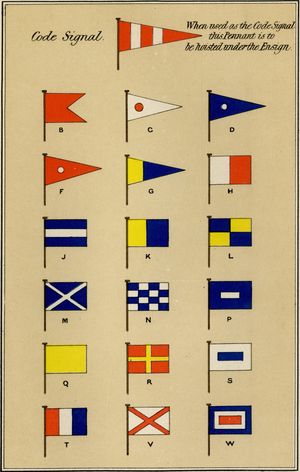
Commercial Code of Signals.
When used as the Code Signal this Pennant is to be hoisted under the
Ensign.
Such lists as are given above should be kept in a small book labelled
'Fitting-out Necessaries,' because they save much time at that season,
and all alterations in them that experience dictates should be noted
before or at the period of laying the yacht up.
The yacht, let it be supposed, is fitted out. She has a racing outfit,
and was the crack boat of the past season. There is a smart young
fellow engaged to look after her, and the only thing that remains to
be settled now is the question—Shall I give myself up to racing or
shall I cruise this year? If it is to be racing, here are two or three
words of advice well worth noting. The first is, never pinch the yacht
when sailing on a wind. Always keep a clean full and bye—i.e. the
yacht must be headed, as near as she will go, to the point whence the
wind is blowing, but the sails must be kept well full. Then the yacht
will travel. Do not, because some other yachts seem to be lying closer
to the wind, try to make the little vessel head in the same direction,
if she will not do so without her sails shaking. Many races are lost
through this form of bad sailing. The next point to be noted is, 'mind
your jibsheet.' No sheet requires such tender handling. The foresheet
can be left to a tiro. All he has to do when on a wind is to take and
harden in all he can, and belay. The mainsheet can also be hauled in
pretty close; but when that is all done, the sailing-master must not
think that he can go any closer to the wind by treating his jibsheet
after the same simple fashion; for if he does he will find himself
very much at fault, as it will take all the life out of the yacht, and
the jib will make her bury her head in the seas. He will only stop
his ship. The best plan to adopt is to get the sheet in
before the yacht's head is pointed as close as it will go to the wind,
and then check out inch by inch till the luff of the sail near the
tack has a slight inclination to lift. At first, it is somewhat
astonishing to see how much jibsheet a vessel will stand when close
hauled. Pinning in the sheet tends to stop the boat, whilst, on the
other hand, giving her as much as she can stand will make her fairly
jump ahead. The helmsman who knows his duties ought to keep an eye
open for this, and watch, in the excitement of going about or hauling
round a buoy, that the poor jibsheet is not pinned in or unfairly
treated.
Another piece of advice is about that other jib and yachtsman's
friend, called the spinnaker. Of the two jibs, this latter suffers
most at the hands of the racing sailing-master. When he sees his
antagonist carrying his spinnaker with the boom right forward on the
bow, only too frequently does he leave his up with the boom in the
same position, too fearful lest, should he take his in, or shift it to
the bowsprit end, the other yacht may steal an advantage over him. The
writer has seen more than one race lost through this hanging on to the
boomed-out spinnaker too long. It is a safe and wise plan to take the
sail in as soon as the wind obliges the boom to be pointed forward at
an angle very much under a right angle to the beam. Some years ago
this was brought before the writer's notice in a clear, unmistakable
way. He happened to be on the Breakwater at Plymouth on a Regatta day,
when the yachts were making the harbour. They were running with the
wind right aft and their booms squared off. As each yacht neared the
Breakwater, the wind came round gradually on the beam, and one by one
the spinnaker-booms were allowed to go right over the bow to an acute
angle with the bowsprit. The spinnakers were certainly all kept full,
but as each yacht's after-guy was checked, she gradually ceased to
travel and almost stopped dead. Her spinnaker bellied against the
topmast stay and forestay, and formed at once a backsail, if anything.
Those on board a yacht do not notice the faults of the moment so
quickly as those looking on, and only when the race is over
does the sailing-master regret that he has not acted differently.
Frequently since then has the writer, having taken note of what he
saw, managed to make up a considerable amount of time by having the
courage to take in his spinnaker as soon as it refused to stand
without the boom going well forward. If the balloon-foresail jib and
jib-topsails sheets are ready belayed, so that the sails may take the
weight of the wind as soon as the spinnaker is taken in, there will be
no fear whatever of the yacht losing ground, but rather she will
spring into life, and most likely leave her antagonists behind. The
method adopted by American yachtsmen for setting the spinnaker has
many points in its favour. Instead of bringing the tack close in to
the mast, the sail is taken outside the forestay and the tack downhaul
belayed on the opposite side to which the sail is set. By setting the
sail in this way the back draught from it goes into the jib-topsail
and balloon-jib, so keeping them full and drawing. The spinnaker boom
can also be allowed to range further forward on the bow than under our
system. In hoisting the spinnaker it will be found a great saving of
labour to send it up in stops ready for breaking out when the pull at
the outhaul is taken. It can be stopped up before the race begins.
When running before the wind, it is no uncommon sight to see all hands
sent aft, and as many as possible on the counter. Now there is a vast
amount of 'follow my leader' in this practice. Because one crack yacht
does well under this trim, therefore others are supposed to steer and
sail better with the weight aft too, so that when witnessing a number
of yachts sailing before the wind with spinnaker set, frequently yacht
after yacht may be seen struggling along with her taffrail about level
with the water, and the whole counter being sucked back by the wave
raised in the yacht's run. Some yachts are bad to steer when running;
this is, to say the least of it, a fault or gross peculiarity in their
design, for there is no use in the helm unless it is answered, and to
help to keep boats steady all available weight is fleeted aft. These
must, therefore, bear the penalty and lose ground on this
particular point of sailing; but there are others with fine runs,
which require no weight aft, and placing weight there causes the
counter to go into the water and lie flat on it. These would steer
equally well with the weight forward of the helmsman, and instead of
being kept back by the drag put upon them, would leave their
heavy-quartered rivals away in the rear. 'Keep the counter as much as
possible out of water' is a maxim to be laid to heart by all, on all
points of sailing. Of course, in yachts designed to have part of the
counter immersed, the maxim applies only to that part above water. A
fine run is a most valuable form for a vessel large or small,
especially when sailing on any point with the wind abaft the beam; and
the man who is wise will do his best to keep it fine, in order that
the water may be left clean and without so much as a ripple.
Before naming good cruising grounds and touching on cruising, just a
word must be said about dinghies. A dinghy is a big piece of furniture
for a small yacht, and at times becomes almost a white elephant,
especially if the yacht has to make passages or go foreign. The writer
has no hesitation in recommending the Berthon dinghy as the most
useful, compact, and stow-awayable of any at present in use. After
having had practical experience of nearly all sizes of Mr. Berthon's
boats, from the 40-ft. launch supplied to the Navy down to the small
7-ft. dinghy, the size found to be most useful is the boat of 8 feet
in length. A boat of 7 feet which he has, and which has been in use
for fifteen years in all parts of the world, is a most clever little
contrivance. She has carried on many occasions two big men with a
portmanteau and other baggage, and when sitting on the bottom boards
is hard to capsize—in fact, she has never turned turtle as yet. She
is very easy to pull and light to carry, but is a little too small to
ask a lady to take passage in. The odd foot, however, makes a great
difference. A 9-ft. boat was the lifeboat complement of the 'Cyprus,'
and this is the largest size of any real value to a small yacht, as
the larger boats take too long to open out, and when in the
water, unless well filled up and almost brought down to the gunwale,
are too light to pull against a head wind. The 9-ft. boat is sometimes
difficult to move when it is blowing very hard from the quarter to
which it is desired to go, but this occurs seldom, and she is opened
out so easily that there may be a question whether a 9-ft. boat might
not be, after all, the best to have. The boats will stand any amount
of sea, and they travel under sail or oar propulsion, when not too
much pressed, very dry and easily. Should the canvas happen to get
cut, the best stitch with which to sew up the wound is that known as
the 'Cobbler's.' An awl is required to make the holes for the stitches
and a couple of ends similar to those used by a cobbler. This stitch
is not so likely to tear the canvas, and brings it closer together
than the sailmaker's stitch called 'herring-boning,' which is no use
at all for making a water-tight mend. The outer skin may want a coat
of paint once a year, and if so, the paint should be mixed up with
boiled oil; then, when it is put on, the canvas will remain flexible
and will not harden up and crack. Mr. Berthon supplies a special paint
for his boats, but it is not always procurable, and any paint mixed
with boiled oil will serve the purpose.
Fitted out with an old 5-tonner, or a yacht about the size already
recommended, the whole world lies before the cruising yachtsman. She
can easily be shipped on board a steamer, and can, for the sum of
50l. to 70l. or less, be launched off New York, whence there is
nothing to hinder a most enjoyable cruise on the lakes (which can be
reached by canal) or in the vicinity of Long Island, and along the
coast. Racing can be done in the American waters should it so please
the voyageur, and a hearty welcome will be met with wherever he goes.
There is great scope for cruising and racing in Australia and New
Zealand (as set forth at length in another chapter); but the expenses
of shipping and taking out the yacht will not be much less
than 100l. Sydney Harbour and Port Phillip are both great yachting
centres, while the coast of New Zealand is a complete network of bays,
inland seas, and natural harbours. The Mediterranean is a much
puffed-up yachtsman's cruising ground, but during the best time of
year, which is winter, it is as nasty and treacherous an expanse of
water as it is possible to meet with in any part of the world. In the
summer the great drawback there is lack of wind during the daytime,
and calms prevail most days of the week. Among the islands of the
Grecian Archipelago, however, and off the coast of Asia Minor, a
breeze is always certain to spring up after sunset. There is no
difficulty in reaching the Mediterranean, as a yacht drawing 5 to 6
feet can go through France by canal without any trouble, or else she
can sail round. Five-tonners, it must be remembered, are serviceable
for an ocean cruise should it be necessary, as has already been shown
in two cases.
There are cruising grounds on the West Coast of Scotland which may
well make yachtsmen in England envious, and some lovely harbours and
rivers along the South Coast of England, which would delight the heart
of many a Clyde yachtsman, whilst Ireland, on her West and South
coasts, has very beautiful and well-sheltered bays. To a yachtsman who
lives in the South, and to whom time is an object, the best plan to
adopt, if a Scotch cruise be on the cards, is either to put the yacht
on a truck and send her up to Gourock, or ship a second hand for the
trip and let the men sail her round. Of the two ways, the latter is
much to be preferred, since it will cost less money, and the yacht
will not be so likely to get knocked about. If time permitted, the
owner might meet the yacht at Kingstown, near Dublin. This is always a
good starting point, as he can make for Campbeltown, in Cantyre, stay
a night there, and go on to Gourock Bay, near Greenock, which he
should make his base of operations, and where he should pick up a
mooring if possible rather than drop his own anchor.
If St. George's Channel is to be the cruising ground, then
Kingstown, Belfast (Bangor Bay), or the Sloyne (Liverpool) are the
best ports to start from. Between Belfast and Kingstown the yachtsman
will find Loch Strangford (although it has strong tides), Ardglass,
and Carlingford Lough, with little Howth, all places worth peeping
into; and a run over to the Isle of Man will well repay any time taken
up in a visit. The best ports in the island are Ramsey and Douglas,
and of the two Ramsey is to be preferred, because the yacht can always
lie at anchor, and it is well sheltered from all winds with any
westing in them; but Douglas ought not to be left out on that account,
and the yacht, when there, should be sailed up the harbour, where she
will have to take the ground. It is a first-rate place to clean a
yacht's copper, as there is something in the mud which is very
conducive to brightening up the metal. Peel can be seen by crossing
the island. Castletown, also, is a very quaint old town, and coaches
run regularly between it and Douglas. Anyone visiting the Isle of Man
ought to read Sir Walter Scott's novel 'Peveril of the Peak,' for the
main portion of the story lies at Peel and Castletown.
If interest is taken in iron and smelting works, from Douglas to
Barrow is about 70 miles; but as the roughest sea in the Channel is
met with on a line between Mougold Head (between Douglas and Ramsey)
and Liverpool, where the north and south currents meet, perhaps it
will be as well, unless the weather be favourable, to keep clear of
that part of the English coast.
Kingstown itself is the finest artificial harbour in the world, and to
anyone anchoring there for the first time there will be found plenty
to occupy at least a week. The clubs are most hospitably inclined, and
Dublin being so near makes it a very pleasant spot to frequent.
For the South of Ireland, Queenstown must be the centre from which to
work. There are good fishing and lovely bays all round the coast
westward, and nothing can equal Bantry Bay, with Glengariff, which are
practically land-locked.
The Shannon and West are in no way inferior to the South
coast, and there are many nooks and anchorages, too numerous to
mention here, where a yacht such as the one described can very
comfortably lie, fearless of ocean billows. Now and then seals are to
be met with on the West coast, and care should be taken to avoid
rowing into any of the numerous caves, which abound round that coast,
and are frequented by them, when the tide is on the rise and at
three-quarters flood; more than one shooting party has been caught in
a trap through the egress having been blocked up.
The North coast is a wild one; but there, again, Port Rush and
Londonderry are very safe, and Port Rush is an especially snug little
harbour. Care should be taken to work Rathlin Island Sound with the
tide, whichever way it is wished to sail, as the tide rush there is
very strong. Between Rathlin and Belfast are bays, each of which has
its small tidal harbour, and, if the weather is threatening, the
distances between them are so short that opportunities can be snatched
for going from one to the other. Larne itself is a fine harbour.
Coming from the North to the South of England, a yacht of 30 ft. and 5
ft. 6 in. draught can be taken by train and launched with the greatest
ease in Southampton Dock, and Southampton being so near London makes
it the rendezvous of many cruising yachts. A good cruise from there is
to run across to Havre (Rouen is easily reached by train from Havre,
and well worth a visit), thence to Cherbourg, thence through the
Alderney Race, between Cape La Hogue and the back of Sark, to
Guernsey.
At Guernsey the yacht's copper should be cleaned, if necessary. It is
the best harbour in the English Channel for scrubbing the bottom, as
there is good mud and a capital supply of running water close and
handy at low water. From Guernsey, weather permitting, with the aid of
a fisherman or pilot, the yacht can be taken across to Sark one day
and to Herm another. Sark is one of the loveliest and most picturesque
islands on our coasts. Any trip to Jersey ought to be made by steamer,
as it is an abominable harbour for a yacht, the rise and fall of the
tide being over 40 feet.
The next sea run may be to Falmouth, thence to Fowey,
Polperro (this port had better not be entered except by dinghy, but it
is a very quaint little fishing village and not much frequented except
by trawlers), Looe (this is an open anchorage), and Plymouth. All
these places have beautiful rivers, with the exception of Polperro,
and the Fal and Tamar are both navigable at high water some
considerable distance up.
Leaving Plymouth, the yacht might very well touch at the mouth of the
Yalme, and the dinghy be rowed up the river. Salcomb and Dartmouth
should not be left out, and both have rivers, the heads of which
should be seen. Dartmouth is a well-known yachting station, and its
club is very prettily situated, so that the members have a full view
of the anchorage. The tide there is strong, and two anchors will prove
better than one.
Torbay comes next in order, working back to Southampton, with Brixham
and Torquay; both so often described that it would be wasting space to
add anything to what has already been said.
The only gauntlets to be run are West Bay, which can be very
troublesome at times, and the Race off Portland Bill, which can
generally be avoided by hugging the shore of the Bill. Weymouth,
again, requires no words of encomium. It is as well to anchor off
Portland or go right up Weymouth Harbour, where the yacht will have to
take the ground.
From Weymouth to Swanage is an afternoon's sail, but it is scarcely
worth while going into the bay, unless the weather is boisterous from
the west or south-west, when the yacht will find a very good berth
free from the turmoil of the elements. There is a race off St. Alban's
Head, which can always be avoided by keeping well out a couple of
miles. When Swanage has been left behind, the course should be steered
for the Needles. Once inside the Solent, Yarmouth in the Isle of
Wight, and Lymington on the Hampshire coast, Cowes, Ryde, Bembridge,
and Portsmouth all open up ports and land, not only different in
scenery from any that is visible in the North, but spots and
localities interesting on account of the history attached to them.
The Dutch coast with its canals, Norway with its fiords, and Sweden
with its canal running from Christiania to Stockholm, all merit a
description did these pages permit, and are well worth the time taken
up in a summer cruise; but whichever way the yacht's head may be
turned, or whatever seas may be chosen to be cruised over, the
following few hints may prove serviceable.
In cruising along an unknown coast, it is always well to keep a good
look out for buoys or boats at anchor inshore. It may be a great help
in cheating tides. For instance if the yacht is struggling against a
strong tide, an inshore eddy may be discovered from the way the boats
are lying, and so, by making use of it, a long journey may be
shortened and time saved.
Barges and coasters, especially small ones, should be watched. They,
in ninety-nine cases out of a hundred, know the tides, currents, and
eddies thoroughly, and the best course to be steered from one point to
another. If a short cut can be taken, the coaster is sure to know it,
and he can be followed through narrow channels with the greatest
safety. A coaster rarely draws less than 6 feet when full up with
cargo, or a barge less than 4 to 5 feet.
When sailing along the bight of a bay, with the wind off the shore and
close-hauled, because in the bight itself the wind may come off a
point or so free, the yacht's sheets should not therefore be checked,
but she should be still kept a clean full and bye; for, as the further
point of the bay is reached, the wind will be sure to head and come
off the land, and instead of being able to round the head close in
shore, most likely the yacht will have to be kept away, and much
valuable time and distance lost.
When passing high land, with the wind off the shore, care should be
exercised should a gully, valley, or ravine open out, for fear a
sudden squall may take the yacht aback, and a topsail and
topmast be sent flying. The wind is very much influenced by the lay of
the land, not only in the matter of the direction in which it blows,
but also the power of its gusts.
Regard should always be paid, on entering land-locked waters from the
open sea, to the force of the wind. Many open-sea sailors, from being
accustomed to a fair amount of wave disturbance whenever the wind has
any strength in it, are misled when sailing in enclosed lochs by the
smoothness of the water, and so, misjudging the force of the wind, are
apt to carry on longer than is desirable, to the danger of spars.
When cruising in the vicinity of yachts racing, the yacht should be
kept well out of the way to leeward; and if by chance she happens to
find herself to windward of an approaching racing yacht, her head
should be turned in whatever direction will seem the best for not
taking the wind out of the racer's sails.
When coming to in unknown or any other roads or anchorage, the
prevailing wind should not be forgotten, and the spot chosen for
letting go the killick should be one from which a speedy retreat can
be made should necessity compel. An outside berth in a close-crowded
anchorage is therefore always the safest, though, perhaps, not always
the most agreeable. The writer hopes that these few wrinkles may prove
as serviceable to the readers of these pages as they have been from
time to time to himself.
It must be remembered that, when the yachtsman is caught out in a
breeze of wind and is obliged to take in a couple of reefs in the
mainsail, house his topmast, and shift his jibs, it does not
necessarily mean the presence of 'great guns.' It takes very little
wind to raise a sea in the channels round our coasts, and to make the
small yachtsman sniff a hurricane. In order, therefore, to become
accurate about the force of the wind or sea, the writer recommends the
'Meteorological Notes,' supplied (at 5s. per annum) by Mr. Scott
from the Meteorological Office, London, as being most useful for the
purpose, and most interesting for reference. His principle is to
have the papers sent to his home address, where they remain
till the yacht's return to lay up. Then the log or note-book is
brought out, notes of the dates on which he relieved his bark and had
been more severely knocked about than usual are referred back to, and
a very fair idea as to the true local weather is obtained. A knowledge
of wind and weather is soon acquired thus.
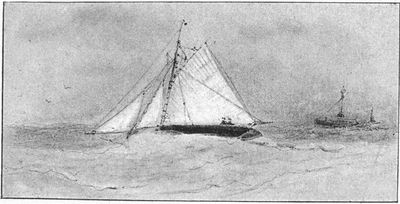
In the Channel.
CHAPTER XIII — YACHT INSURANCE BY G. L. Blake
A book on yachting would not be complete without a few words relating
to yacht insurance. There are hundreds of owners who never think of
taking out a Marine policy on their boats, simply because they do not
know how easy it is; twenty-five years ago indeed only a few insured
because it was not generally understood that Lloyd's Agents were
willing to underwrite their names against all yachting risks. All
yachts should be insured, and therefore the writer will endeavour to
explain some of the special clauses contained under a yachting policy.
The ordinary form for a Marine policy, printed and supplied by
Government prior to August 1887, is in the main only suitable for
merchant shipping; hence clauses have to be added to make that form of
service in the case of yachts. Thus the time and dates between which
the policy is to hold good must be stated, after which should come
what may be called the—
No. 1 Yachting Clause, taking in the following conditions under which
Lloyd's hold themselves liable. It runs thus:—
In port and at sea, in docks and graving docks, and on ways,
gridirons, and pontoons, and / or on the mud, and / or hard,
at all times, in all places, and on all occasions, services
and trades whatsoever and wheresoever, under steam or sail,
with leave to sail with or without pilots, to tow
and assist vessels or craft in all situations, and to be
towed, and to go trial trips. Including all risks and
accidents arising from navigation by steam or otherwise. To
include the risk of launching.
No. 2 Yachting Clause should allow the yacht to 'touch and stay at any
ports or places whatsoever and wheresoever, and for any and all
purposes.'
The No. 3 Yachting Clause makes the liability cover the hulls, spars,
sails, materials, fittings, boats (including launch, steam or
otherwise, if any), &c.
The No. 4 Yachting Clause is a promise to return a certain sum for
every fifteen consecutive days cancelled, and for every fifteen
consecutive days laid up dismantling, overhauling, repairing,
altering, or fitting out.
No. 5 the Collision Clause.
No. 6 the Twenty-pound Clause.
No. 7 the Prevention Clause, No. 1.
No. 8 the Prevention Clause, No. 2.
With regard to the main clauses of the original Government form, it
will be specially noticed that not one makes it necessary for the
owner or skipper, or whoever may be in charge of the yacht, to be the
holder of a Board of Trade Certificate. Then, after enumerating all
the perils from which a vessel may run the risk of total loss, the
form finishes up by stating that where only partial damage takes
place, the underwriters are ready to pay an average for the repair of
such damage at the rate of 3 per cent. That is to say, supposing a
10-tonner is insured at 900l. and she splits her mainsail and
carries away her mast, which in its fall smashes up the boat, the
policy will cover up to 27l. of the average value only, and the
difference between that and the true value will become a loss to the
insurer. This is known as the Average Clause.
To enable the insurer to claim on a partial loss to the full amount of
that loss the Twenty-pound Clause is added, and for this in all
policies over the value of 700l. a small extra premium has
to be paid. This clause is decidedly in favour of the man who insures
a large yacht, but is of little use to the owner of a small craft. In
the first place, it leaves the underwriters liable only for losses
above the value of 20l. and nothing under. It must be remembered
that the general casualties on board a cruising yacht, when cruising
only, are the carrying away of a bowsprit or topmast, the splitting
of a topsail or spinnaker jib, and the whole lot would have to come to
grief in a 10-tonner, for instance, before the owner would find his
bill for damages sufficiently large to present to the underwriters for
payment. With a 60-ton yacht it would be otherwise, as a topmast and
topsail would alone run into 20l.; so it follows that the larger the
yacht the more advantageous will be the addition of the Twenty-pound
Clause, since the less will be the difficulty to make out a claim for
a sum above that amount.
In a small 5-ton yacht for which the policy need not exceed 500l.,
the addition of this clause naturally lies in favour of the
underwriters, for it is next to impossible for the yacht to receive
such damage as will necessitate the outlay of 20l. to put her all to
rights again. That is, such a catastrophe as must happen to oblige
such an expenditure does not occur to one small yacht in a thousand,
unless it brings with it at the same time very nearly, if not
altogether, total loss. Some agents, however, are willing to lower the
twenty and make the clause ten pounds, but of course this risk will
mean again a slight extra payment. It is better for the small
yacht-owner to pay for a ten-pound clause than have an extra clause
which will be of no practical use to him.
The No. 1 Yachting Clause contains some very useful matter. A few
years ago, for example, a 20-tonner left by the tide high and dry on
the mud at one of our West of England ports, with a leg at each side
to support her (her copper required cleaning), fell over and was
considerably damaged. On the owner, who had insured his yacht at the
beginning of the season, claiming for the damage she had sustained,
the claim was disallowed, and after the powers that be had been
invoked, the case was given against the owner, the accident
not having taken place on the high seas. The form under which the
20-tonner was insured could not have contained the No. 1 Yachting
Clause, otherwise the claim would have been in favour of the owner.
All contingencies of that kind are met under this clause.
The No. 2 Yachting Clause allows the yacht to voyage to any part of
the world and over any seas.
The No. 3 and No. 4 Clauses explain themselves.
The Collision Clause is a very necessary addition to all Marine
policies. In case of a collision with another vessel, although the
yacht may be in fault, the underwriters are liable under the clause to
pay up to three-fourths of the value of the policy towards the repairs
of the damaged vessel or the general repairs. The writer has a policy
before him for 1,000l. with the Collision Clause inserted. Let it be
supposed that the yacht for which this policy was taken out has run
into another vessel, which has received damage to the amount of
800l., then the underwriters are responsible up to the amount of
750l.
Collisions with piers or the removal of obstructions do not come under
this clause, and if thought worth insuring against, have to be freed
by what has been termed in this notice No. 7, or the Prevention Clause
No. 1. This clause enables the insurer to claim for the fourth quarter
over and above the three quarters for which the underwriters are
liable under the Collision Clause. It will enable him to hand over the
business and cost of raising and removing from a fairway, for example,
any vessel that he may have sunk through collision with his yacht, or
repair any piers that may have been damaged through contact with the
boat. Few, however, have this clause inserted in their policies, as so
small a risk can safely be borne by an owner.
No. 8, or the Prevention Clause No. 2, only concerns yachtsmen who
race their vessels. Its correct title is 'The Racing Clause.' This
wipes out those few words from the policy that free the underwriters
from all liability in the Twenty-pound Clause, and makes them
responsible for total or other loss, should such take place, while the
yacht is in the act of racing; for no simple policy or ordinary form
provides against 'racing risks.'
The above remarks refer to policies of insurance on yachts of all
sizes; the following will be interesting to the owners of small craft,
as giving the average premiums that should be paid under the several
conditions named.
For a 250l. policy covering five months, two guineas per cent. This
policy should include the Twenty-pound and Collision Clauses.
The Protection Clause to cover five months should be added for the
payment of 5 per cent. extra.
The Racing Protection Clause covering a similar length of time should
be inserted at the rate of 10 per cent. extra.
A laying-up policy freeing the owner of all risks during the winter
months should cost 6s. 8d. or about that sum, for a policy worth
350l. This policy will cover risks from fire, falling over, and all
such accidents as may take place whilst a yacht is hauled up in a yard
or elsewhere.
A laying-up policy to cover the winter months ought to be obtained at
the rate of 2s. 6d. to 5s. for a like policy of 350l. This
policy will cover all risks that may be incurred by a yacht laid up,
dismantled, and left at her moorings, such as from fire, dragging
ashore, being run into, &c.
Of course insurances differ as to the amount of premium to be paid
according to the age of the yacht, her size, and the amount of the
policy. Thus for a 100l. policy on an old worn-out 5-tonner, to
cover summer sailing risks, as much as 5 per cent. has been paid,
while for a 150l. policy for an old but well-kept-up yacht of a
similar tonnage, 50s. has been the premium covering the five summer
months.
In conclusion, it may be as well to mention that on no account is it a
wise plan for the yacht-owner to insure his vessel for a less amount
than her full value, including gear, furniture, such valuables as he
keeps on board, stores, &c. There are times when, a yacht
having suffered partial disablement, the underwriters may propose a
composition, owing to there having been no fixed expense incurred in
carrying out the repairs. Should a certain sum be agreed upon, and the
owner happen to have only insured for a portion of the yacht's true
value, whatever ratio that portion bears to the actual value, as laid
down by him to the agents, will be deducted from the sum given as
compensation. For instance, a friend of the writer insured his small
yacht for 200l., her true value as given in by him at the time to
Lloyd's agent being 250l. During the season, owing to a heavy gale
of wind, she dragged her anchor, and, no one being on board, was
picked up out at sea by a fishing-boat and towed back a derelict. The
owner agreed to accept 25l. in compensation for the expenses
incurred; but he was astonished when the amount handed over to him
only proved to be 20l. On going into the matter, he was told that he
had undertaken a fifth part of the risk on the yacht himself, in that
he had insured for 200l., the yacht's real worth being 250l., and
therefore he would have to bear a fifth part of the expense; and since
he had agreed that 25l. was sufficient compensation, so the
underwriters could only be liable to the amount of 20l. The case was
brought into court and judgment given in favour of the underwriters.
The yachting clauses described above are inserted on the usual Marine
policy form, and the yacht insurer cannot do better than have the
clauses as given in this chapter inserted in any policy form he may
accept.
Attempts have been made from time to time to launch a Mutual Yacht
Insurance Company, by which yachtsmen would be able to undertake their
own risks by mutual co-operation and without reference to Lloyd's; but
there are points, where a system of mutual insurance may benefit
householders, who may be said to be localised, which would create
difficulties almost sufficient to prevent any general Mutual Yacht
Insurance from covering its expenses. The changes that occur in
yacht-ownership are very many and frequent, and it must be often the
case, that when a yacht-owner ceases to be such, any interest
he may have had in a Mutual Insurance Company would have to cease too.
Such changes rarely take place among the members of a Mutual House
Insurance Company, and it thrives accordingly; but the constant shift
of ownership, which may be seen annually by anyone who will take the
trouble to study the 'Yacht List,' would surely prove a serious
drawback to a Mutual Yacht Insurance Company.
In localities like the Clyde, however, where a yacht is almost as
great a necessity as the possession of a stone frigate (house ashore),
there seems no reason why Mutual Insurance among the local
yacht-owners should not do well and prove a most successful
undertaking; but then great judgment would have to be exercised as to
the kind of risks such a company should incur, and many would have to
be excluded, which Lloyd's agents up to the present time have been
very willing to accept, such as the insurance of all yachts whose
crews do not live on board while in commission, and the like. If the
above remarks prove of use as well as interesting to yacht-owners, it
must in justice be said that the writer is much indebted for the
kindly help given him by his friend Mr. York, the secretary of the
Royal Clyde Yacht Club, when compiling the information given.