Thursday, December 17 dawned, and was to go down in history as
a day when a great engineering feat was accomplished. It was a
cold day with winds of 22 to 27 miles an hour blowing from the
north. Puddles of water near the camp were covered with ice. The
Wrights waited indoors, hoping the winds would diminish. But
they continued brisk, and at 10 in the morning the brothers decided
to attempt a flight, fully realizing the difficulties and dangers of
flying a relatively untried machine in so high a wind.
In strong winds, hills were not needed to launch the machine,
since the force of the winds would enable the machine to take off
on the short starting track from level ground. Indeed, the winds
were almost too gusty to launch the machine at all that day, but
the brothers estimated that the added dangers while in flight would
be compensated in part by the slower speed in landing caused by
flying into stiff winds. As a safety precaution, they decided to fly
as close to the ground as possible. They were superb flyers, courageous,
but never foolhardy.
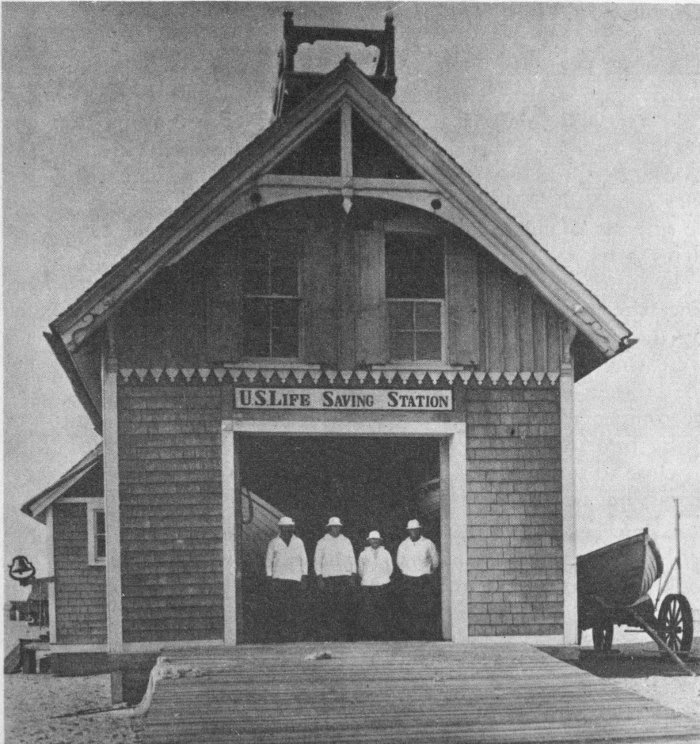
A signal was again displayed to notify the men at the Kill Devil
Hills Life Saving Station that further trials were intended. They
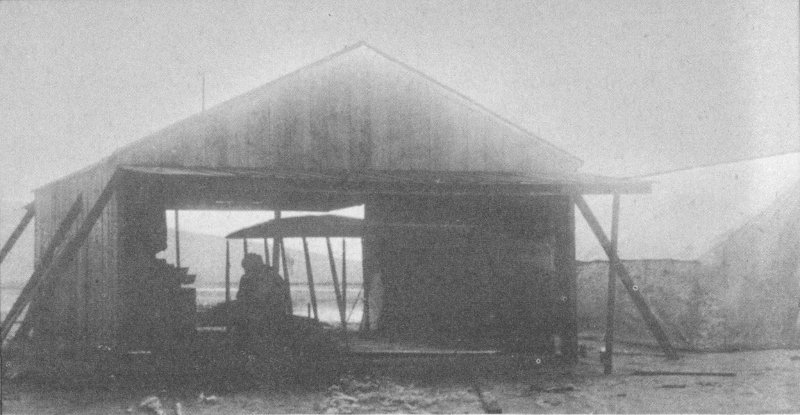
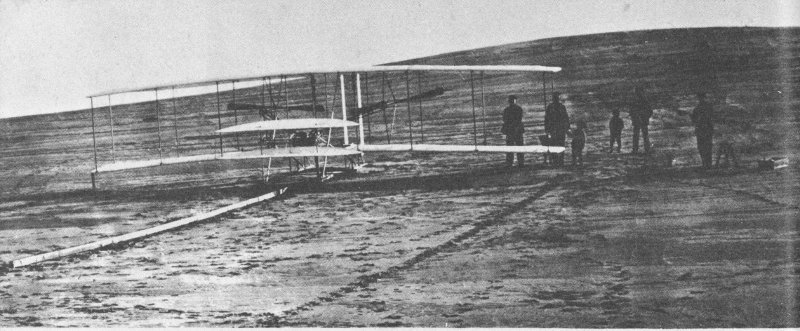
took the machine out of the hanger, and laid the 60-foot starting
45
track in a south-to-north direction on a smooth stretch of level
ground less than 100 feet west of the hanger and more than 1,000
feet north of Kill Devil Hill. They chose this location for the
trials because the ground had recently been covered with water, and
because it was so level that little preparation was necessary to lay
the track. Both the starting track and the machine resting on the
truck faced directly into the north wind. The restraining wire was
attached from the truck to the south end of the track.
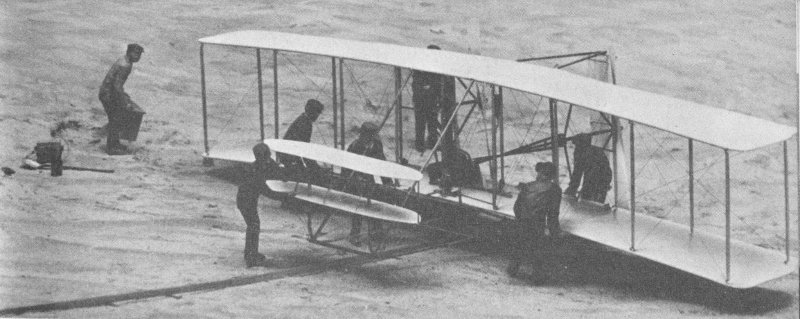
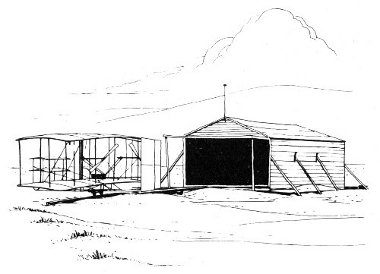
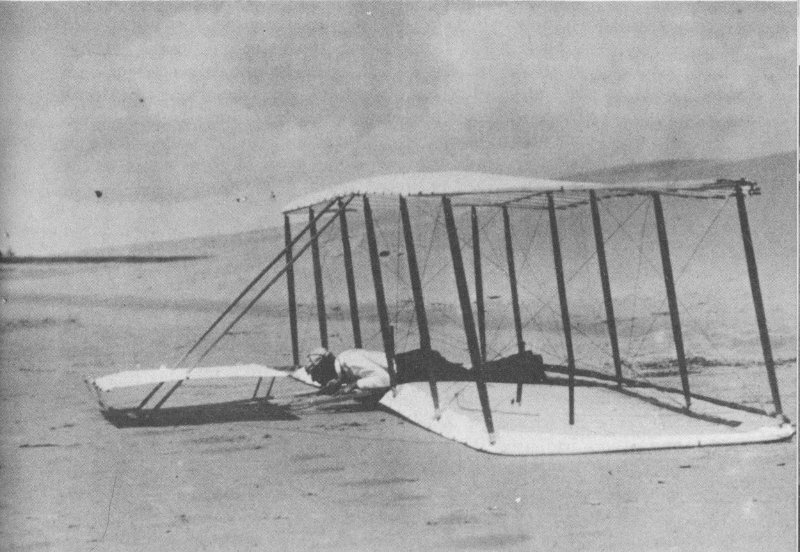
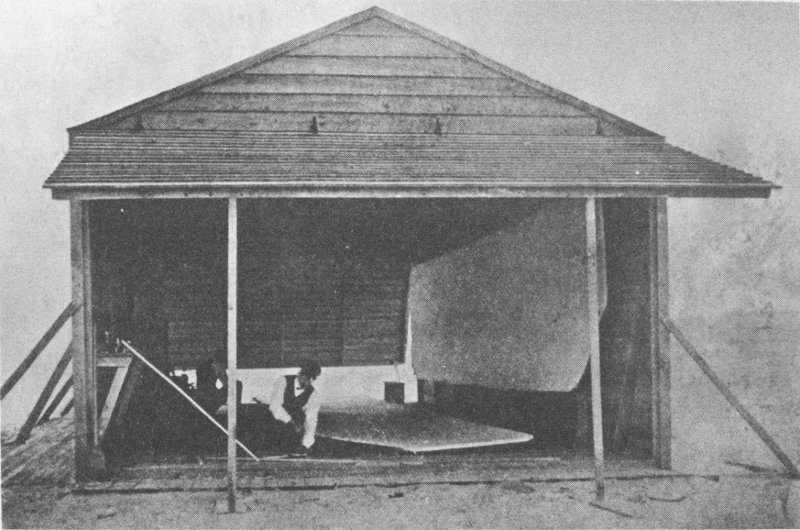
Getting ready for the first flight, Dec. 17, 1903. From a diorama in the Wright
Brothers National Memorial Visitor Center.
Before the brothers were quite ready to fly the machine, John T.
Daniels, Willie S. Dough, and Adam D. Etheridge, personnel from
the Kill Devil Hills Life Saving Station, arrived to see the trials;
with them came William C. Brinkley of Manteo, and John T. Moore,
a boy from Nags Head. The right to the first trial belonged to
Orville; Wilbur had used his turn in the unsuccessful attempt on
December 14. Orville put his camera on a tripod before climbing
aboard the machine, and told Daniels to press the button when the
machine had risen directly in front of the camera.
After running the engine and propellers a few minutes, the take-off
attempt was ready. At 10:35 a.m., Orville lay prone on the
lower wing with hips in the cradle that operated the control mechanisms.
He released the restraining wire and the machine started
down the 60-foot track, traveling slowly into the headwind at about
7 or 8 miles an hour—so slow that Wilbur was able to run alongside
holding the right wing to balance the machine on the track.
After a run of 40 feet on the track, the machine took off. When
the airplane had risen about 2 feet above ground, Daniels snapped
the famous photograph of the conquest of the air. The plane then
climbed 10 feet into the sky, while Orville struggled with the controlling
mechanisms to keep it from rising too high in such an
irregular, gusty wind.
46
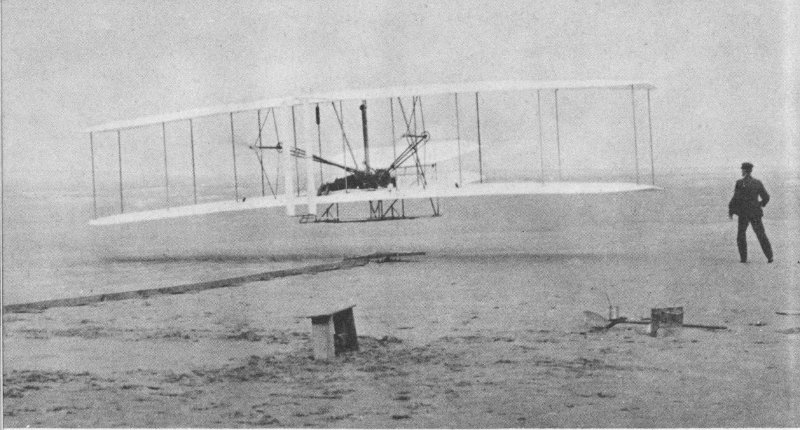
The first flight.
Orville sought to fly a level flight course, though buffeted by the
strong headwind. However, when turning the rudder up or down,
the plane turned too far either way and flew an erratic up-and-down
course, first quickly rising about 10 feet, then suddenly darting close
to the ground. The first successful flight ended with a sudden dart
to the ground after having flown 120 feet from the take-off point
in 12 seconds time at a groundspeed of 6.8 miles an hour and an
airspeed of 30 miles an hour. In the words of Orville Wright:
This flight lasted only 12 seconds, but it was nevertheless the first in
the history of the world in which a machine carrying a man had raised
itself by its own power into the air in full flight, had sailed forward
without reduction of speed, and had finally landed at a point as high
as that from which it started.
Orville found that the new, almost untried, controlling mechanisms
operated more powerfully than the previous controls he had
used in gliders. He also learned that the front rudder was balanced
too near the center. Because of its tendency to turn itself when
started, the unfamiliar powered machine’s front rudder turned more
than was necessary.
The airplane had been slightly damaged on landing. Quick repairs
were made. With the help of the onlookers, the machine was brought
back to the track and prepared for a second flight. Wilbur took
his turn at 11:20 a.m., and flew about 175 feet in about 12 seconds.
He also flew an up-and-down course, similar to the first flight, while
operating the unfamiliar controls. The speed over the ground during
the second flight was slightly faster than that of the first flight because
the winds were diminishing. The airplane was carried back to the
starting track and prepared for a third flight.
47
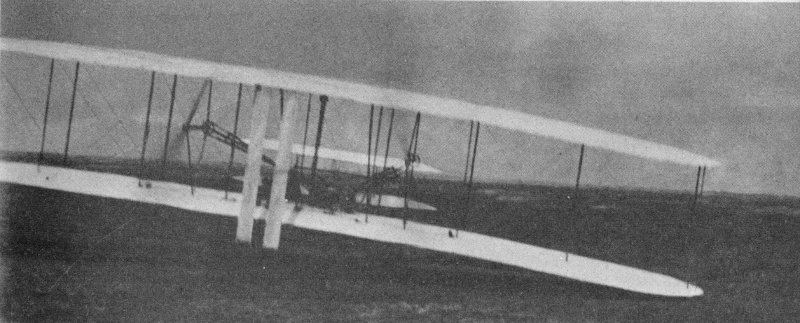
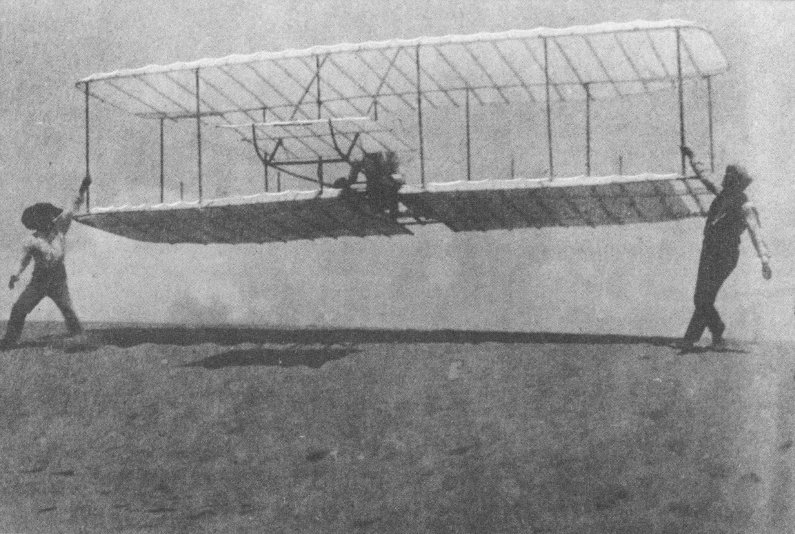
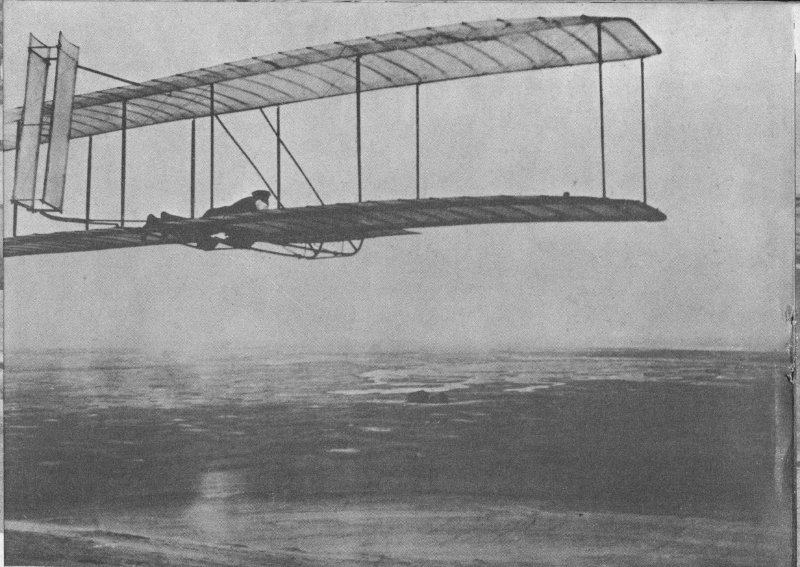
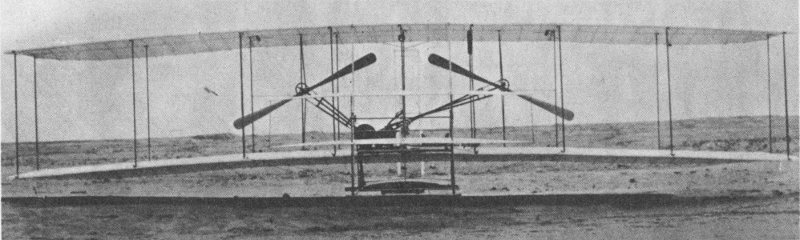
Third flight of Dec. 17, 1903, Orville Wright at the controls. No photograph
was taken of the day’s second flight, in which Wilbur Wright was operator.
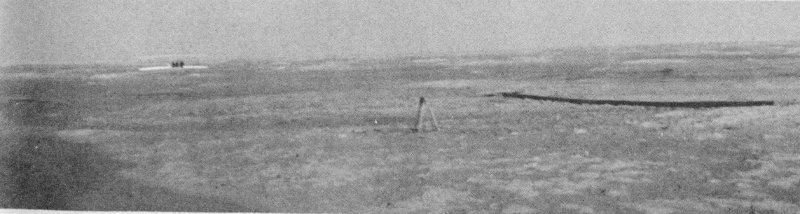
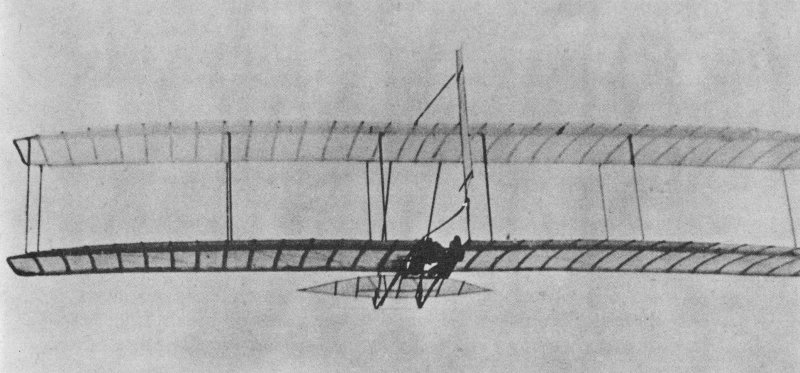
End of fourth and longest flight of Dec. 17, 1903. Distance: 852 feet; time: 59
seconds.
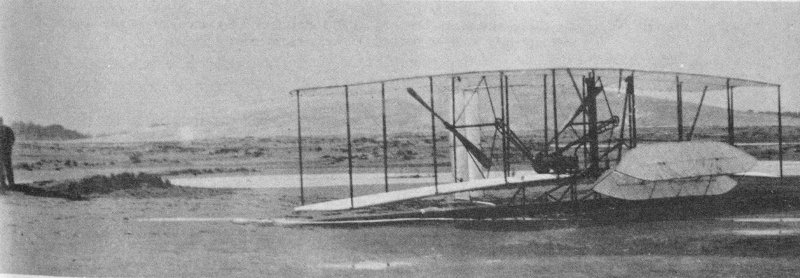
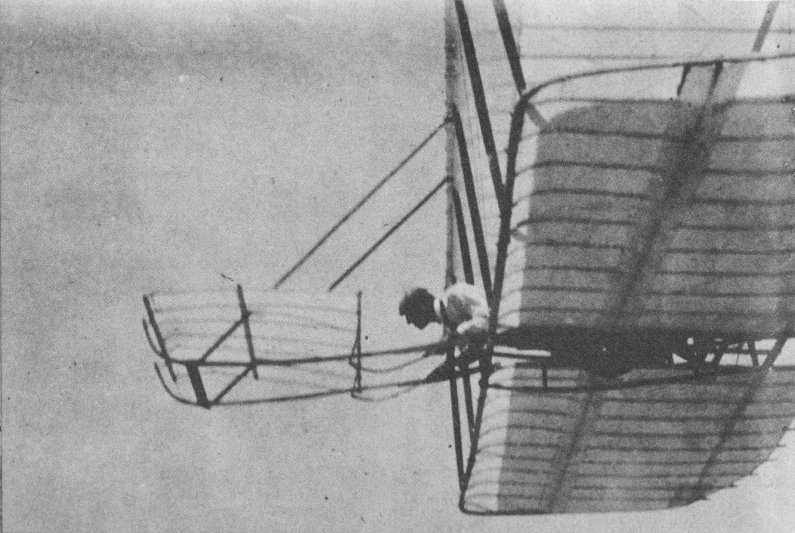
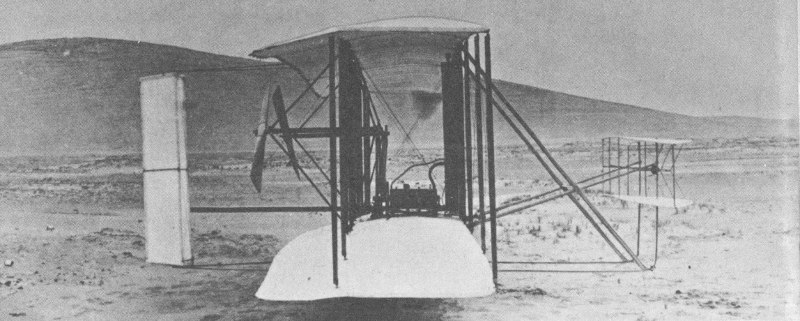
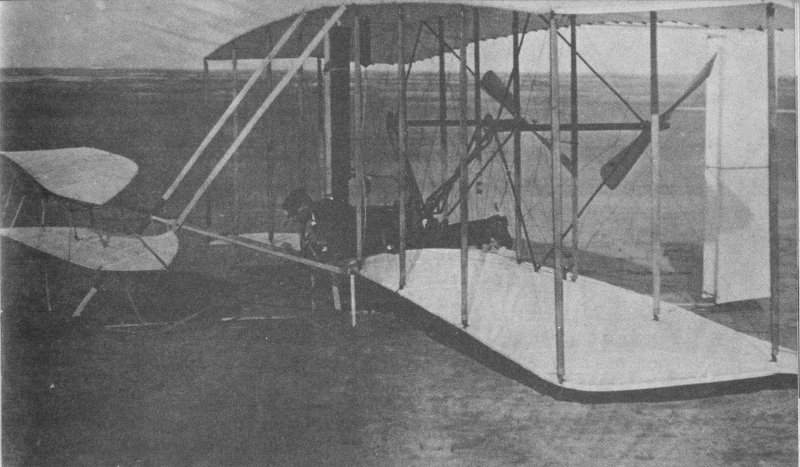
Close-up of 1903 machine at end of last flight, rudder frame broken in landing.
Courtesy, Smithsonian Institution.
48
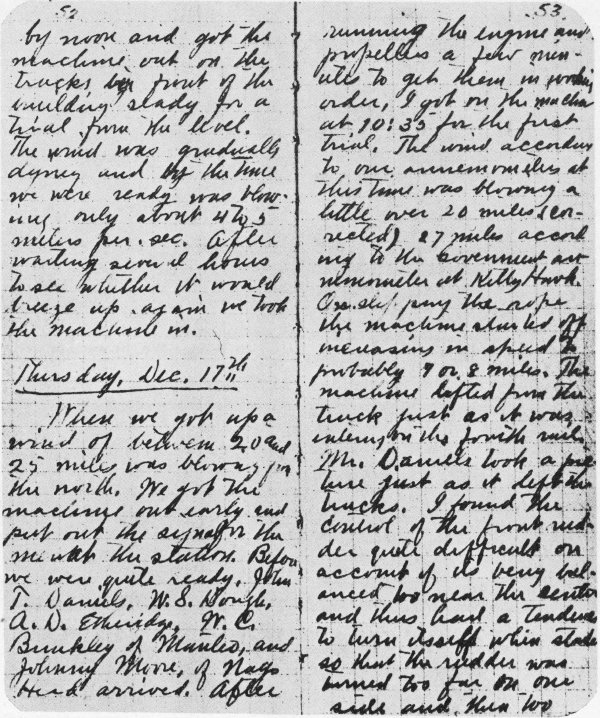
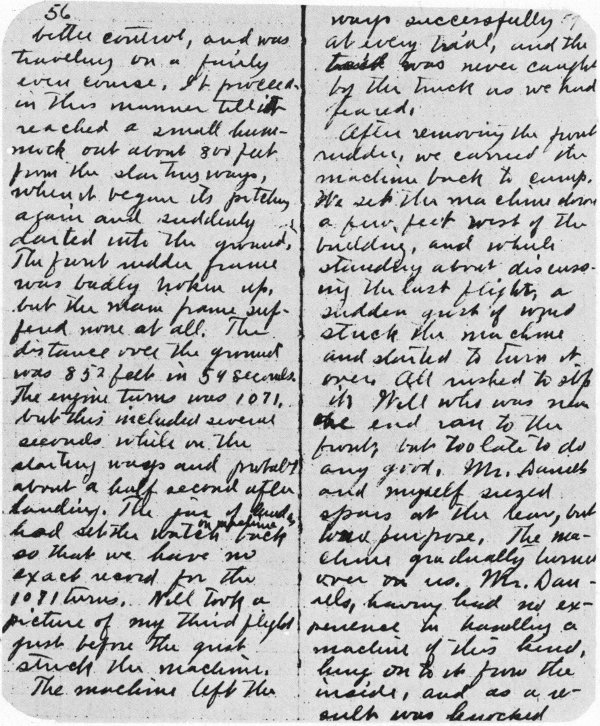
Orville Wright’s diary showing Dec. 17, 1903 entry. This account is the only
contemporary written record of these momentous flights.
At 11:40 a.m., Orville made the third flight, flying a steadier
course than that of the two previous flights. All was going nicely
when a sudden gust of wind from the side lifted the airplane higher
by 12 to 15 feet, turning it sidewise in an alarming manner. With
the plane flying sidewise, Orville warped the wingtips to recover
lateral balance, and pointed the plane down to land as quickly as
possible. The new lateral control was more effective than he had
49
expected. The plane not only leveled off, but the wing that had been
high dropped more than he had intended, and it struck the ground
shortly before the plane landed. The third flight was about 200
feet in about 15 seconds.
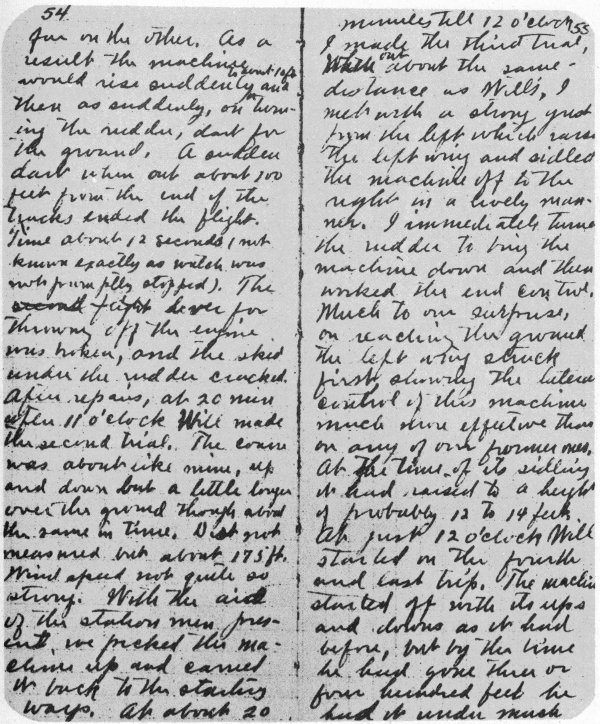
(Orville Wright’s diary—December 17 entry, continued)
Wilbur started on the fourth flight at noon. He flew the first
few hundred feet on an up-and-down course similar to the first two
flights. But after flying 300 feet from the take-off point, the airplane
was brought under control. The plane flew a fairly even
course for an additional 500 feet, with little undulation to disturb
its level flight. While in flight about 800 feet from the take-off
point, the airplane commenced pitching again, and, in one of its
50
darts downward, struck the ground. The fourth flight measured
852 feet over the ground; the time in the air was 59 seconds.
(Orville Wright’s diary—December 17 entry, continued)
The four successful flights made on December 17 were short because
the Wrights, not desiring to fly a new machine at much height in
strong winds, sometimes found it impossible to correct the up-and-down
motion of the airplane before it struck the ground. Wilbur
remarked:
Those who understand the real significance of the conditions under
which we worked will be surprised rather at the length than the shortness
of the flights made with an unfamiliar machine after less than one
51
minute’s practice. The machine possesses greater capacity of being
controlled than any of our former machines.
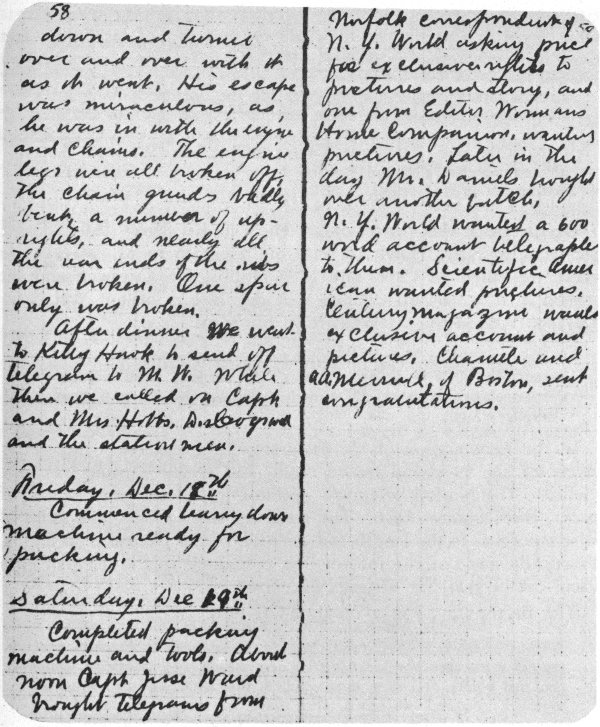
(Orville Wright’s diary—December 17 entry, continued)
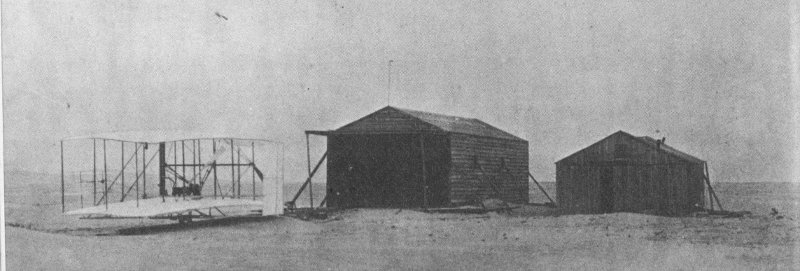
They carried the airplane back to camp and set it up a few feet
west of the hangar. While the Wrights and onlookers were discussing
the flights, a sudden gust of wind struck the plane and turned
it over a number of times, damaging it badly. The airplane could
not be repaired in time for any more flights that year; indeed, it
was never flown again. Daniels gained the dubious honor of becoming
the first airplane casualty when he was slightly scratched and
bruised while caught inside the machine between the wings in an
52
attempt to stop the plane as it rolled over. Subsequent events
were vivid in Daniels’ mind while reminiscing of his “first—and
God help me—my last flight.” He relates:
I found myself caught in them wires and the machine blowing across
the beach heading for the ocean, landing first on one end and then
on the other, rolling over and over, and me getting more tangled up
in it all the time. I tell you, I was plumb scared. When the thing
did stop for half a second I nearly broke up every wire and upright
getting out of it.
Orville made this matter-of-fact entry in his diary: “After dinner
we went to Kitty Hawk to send off telegram to M. W. While
there we called on Capt. and Mrs. Hobbs, Dr. Cogswell and the
station men.” Toward evening that day Bishop Milton Wright in
Dayton received the telegram from his sons:
Success four flights Thursday morning all against twenty-one mile wind
started from level with engine power alone average speed through air
thirty-one miles longest 57 seconds inform press home Christmas.
Orevelle Wright.
In the transmission of the telegram, 57 seconds was incorrectly
given for the 59-second record flight, and Orville’s name was misspelled.
The Norfolk telegraph operator leaked the news to a local
paper, the Virginian-Pilot. The resulting story produced a series of
false reports as to the length and duration of the December 17 flights.
Practically none of the information contained in the telegram was
used, except that the Wrights had flown.
The Bishop gave out a biographical note:
Wilbur is 36, Orville 32, and they are as inseparable as twins. For
several years they have read up on aeronautics as a physician would
read his books, and they have studied, discussed, and experimented
together. Natural workmen, they have invented, constructed, and
operated their gliders, and finally their ‘Wright Flyer,’ jointly, all at
their own personal expense. About equal credit is due each.
The world took little note of the Wrights’ tremendous achievement
and years passed before its full significance was realized.
After reading the Wrights’ telegram, the Associated Press representative
in Dayton remarked, “Fifty-seven seconds, hey? If it had
been fifty-seven minutes then it might have been a news item.”
Three years after the first flight an editorial appeared in the December
15, 1906, issue of the Scientific American, which included the following:
In all the history of invention, there is probably no parallel to the
unostentatious manner in which the Wright brothers of Dayton, Ohio,
ushered into the world their epoch-making invention of the first successful
aeroplane flying-machine.
53
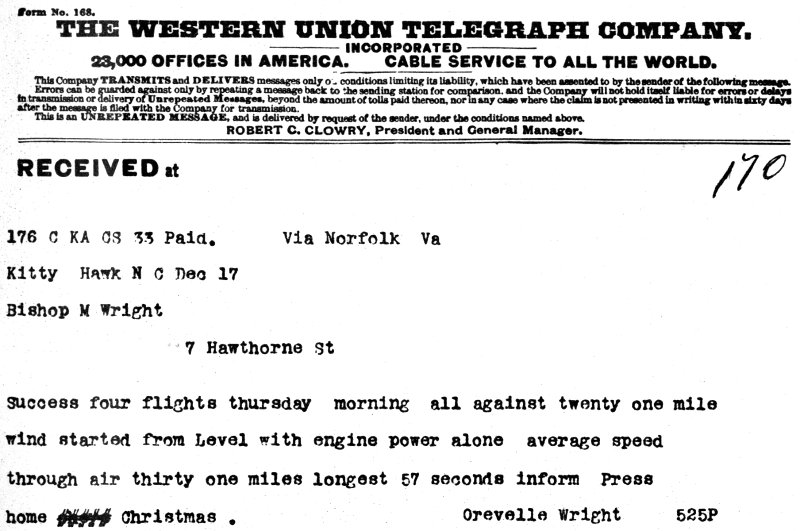
Orville Wright wired his father to announce the successful flights of Dec. 17, 1903.
Form No. 100.
THE WESTERN UNION TELEGRAPH COMPANY.
———INCORPORATED———
23,000 OFFICES IN AMERICA. CABLE SERVICE TO ALL THE WORLD.
This Company TRANSMITS and DELIVERS messages only on conditions limiting its liability, which have been assented to by the sender of the following message.
Errors can be guarded against only by repeating a message back to the sending station for comparison, and the Company will not hold itself liable for errors or delays
in transmission or delivery of Unrepeated Messages, beyond the amount of tolls paid thereon, nor in any case where the claim is not presented in writing within sixty days
after the message is filed with the Company for transmission.
This is an UNREPEATED MESSAGE, and is delivered by request of the sender under the conditions named above.
ROBERT C. CLOWRY, President and General Manager.
RECEIVED at
176 C KA CS 33 Paid. Via Norfolk Va
Kitty Hawk N C Dec 17
Bishop M Wright
7 Hawthorne St
Success four flights thursday morning all against twenty one mile
wind started from Level with engine power alone average speed
through air thirty one miles longest 57 seconds inform Press
home Christmas.
Orevelle Wright 525P
After the First Flight
After 1903, the Wrights carved brilliant careers in aeronautics and
helped found the aviation industry. The successful flights made at
Kill Devil Hills in December 1903 encouraged them to make improvements
on a new plane called Flyer No. 2. About 100 flights
were flown near Dayton in 1904. These totaled only 45 minutes in
the air, although they made two 5-minute flights. Experimenting
chiefly with control and maneuver, many complete circuits of the
small flying field were made.
A new and improved plane, Flyer No. 3, was built in 1905. On
October 5 they made a record flight of 24⅕ miles, while the plane
was in the air 38 minutes and 3 seconds. The era of the airplane
was well on the way. The lessons and successes at Kill Devil
Hills in December 1903 were fast making the crowded skies of the
Air Age possible.
Believing their invention was now perfected for practical use, the
Wrights wanted the United States Government to have a world
monopoly on their patents, and more important, on all the aerodynamic,
design, and pilotage secrets they knew relating to the airplane.
As early as 1905 they had received overtures from representatives
of foreign governments. The United States Army turned down their
first offers without making an effort to investigate whether the airplane
had been brought to a stage of practical operation. But disbelief
was on the wane. In February 1908 the United States War
Department made a contract with the brothers for an airplane.
Only 3 weeks later the Wrights closed a contract with a Frenchman
to form a syndicate for the rights to manufacture, sell, or license the
use of the Wright airplane in France.
54
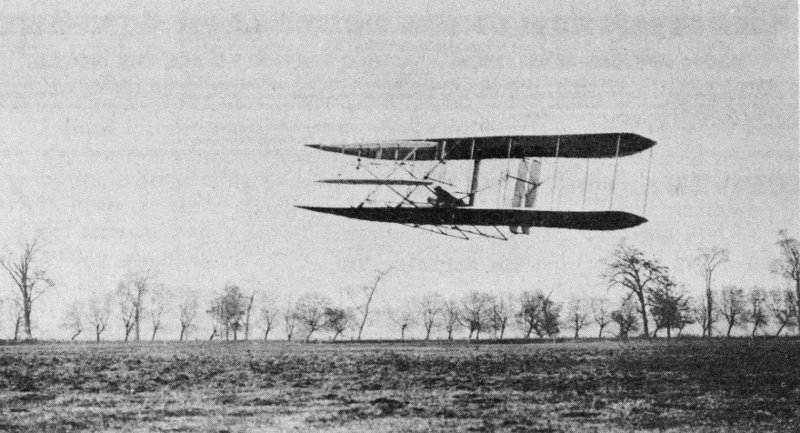
Orville Wright in 1904 flight 85 at Huffman Prairie near Dayton, November 16.
Distance: approximately 1,760 feet; time: 45 seconds.
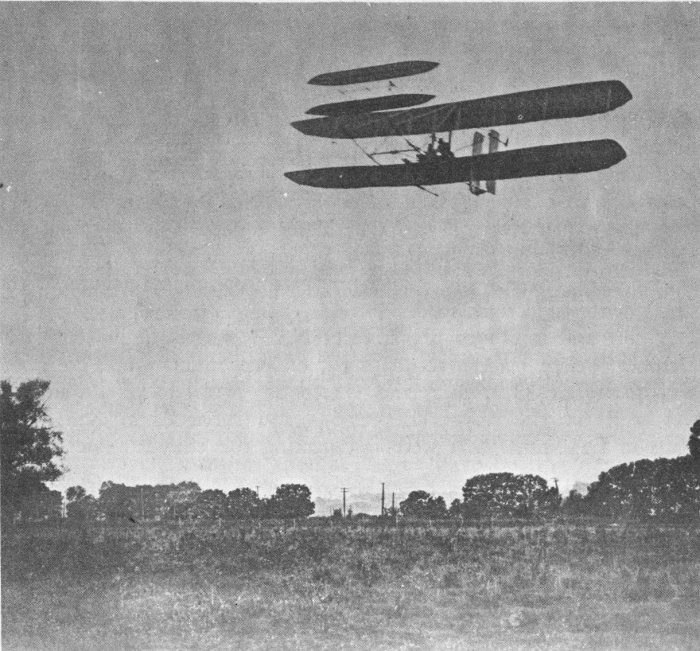
1905 flight 41—Orville’s 12-mile flight of September 29.
55
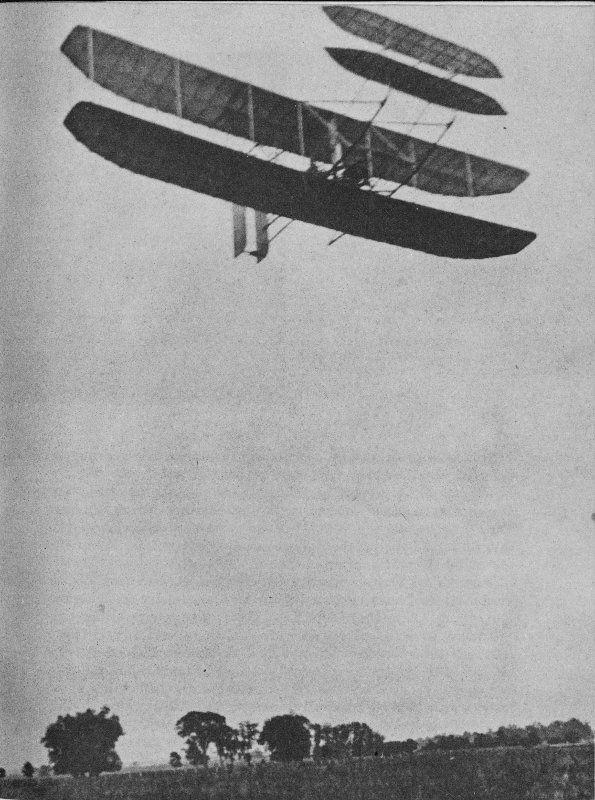
1905 flight 46, October 4—20.8 miles in 33.3 minutes, the second longest flight
of 1905. It was exceeded only by the 24-mile flight of October 5. The era
of the airplane was well on its way.
56
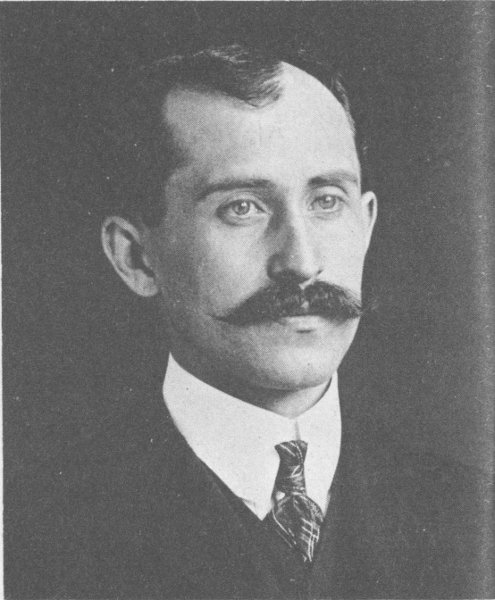
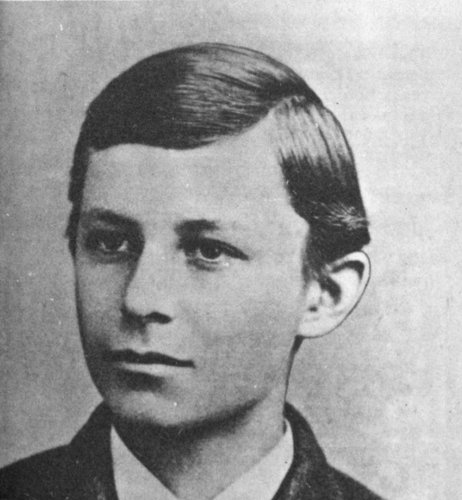
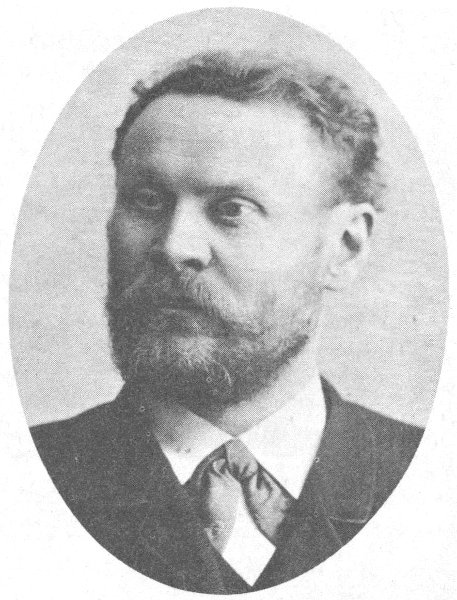
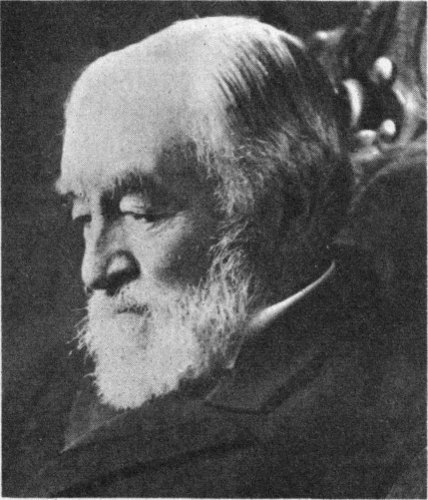
Orville Wright (1871-1948) taken
about 1908.
During their Dayton experiments, the Wrights had continued to
pilot their airplanes while lying prone with hips in the cradle on the
lower wing. Now they adopted a different arrangement of the control
levers to be used in a sitting position and added a seat for a
passenger. The brothers brought their airplane to Kill Devil Hills
in April 1908 to practice handling the new arrangement of the control
levers. They wanted to be prepared for the public trials to be
made for the United States Government, near Washington, and for
the company in France.
They erected a new building at Kill Devil Hills to house the airplane
and to live in, because storms the year before had nearly demolished
their 1903 camp buildings. Between May 6 and May 14,
1908, the Wrights made 22 flights at their old testing grounds.
On May 14 the first flight with two men aboard a plane was made
near West Hill; Wilbur Wright being the pilot, and Charles Furnas,
a mechanic, the passenger. Orville and Furnas then made a flight
57
together of over 2 miles, passing between Kill Devil Hill and West
Hill, and turning north near the sound to circle Little Hill before
returning over the starting point close to their camp to land near
West Hill on the second lap.
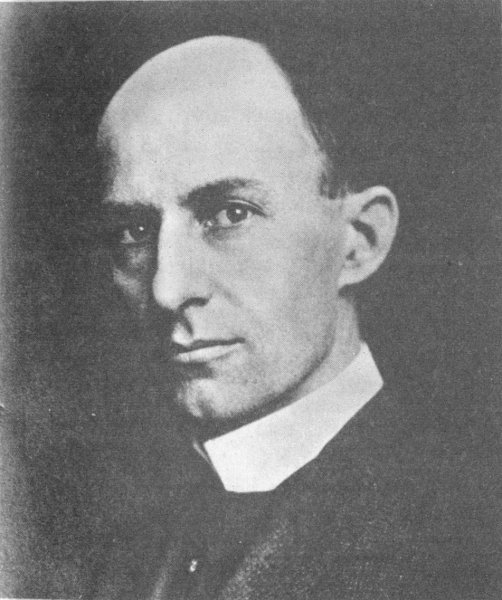
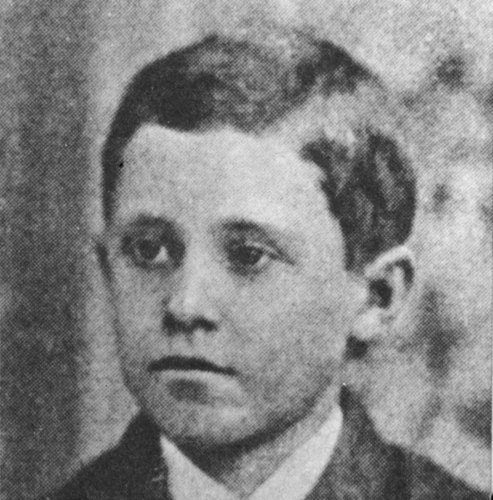
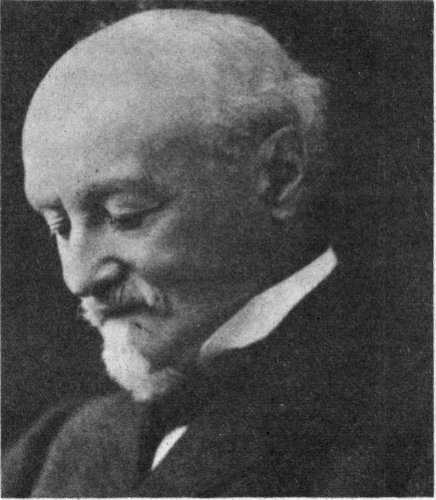
Wilbur Wright (1867-1912) taken
about 1908.
Byron R. Newton, a newspaper reporter, was concealed in the
woods with other newsmen near camp to watch the Wrights fly.
Newton predicted in his diary just after seeing his first flight: “Some
day Congress will erect a monument here to these Wrights.”
Nineteen years later the Congress established the area as a National
Memorial.
Wilbur journeyed to France after completing the tests at Kill
Devil Hills, while Orville returned home to complete the construction
of an airplane for the United States Government. As Wilbur
set about methodically to assemble his airplane at Le Mans, some
125 miles from Paris, skeptics greeted the delay by accusing him of
bluffing. But Wilbur refused to hurry. “Le bluff continue,” cried a
Paris newspaper. However, when Wilbur took off on August 8,
circling the field to come in for a perfect landing, the crowd could
scarcely believe its eyes. Skeptics were confounded, and enthusiasm
was uproarious.
58
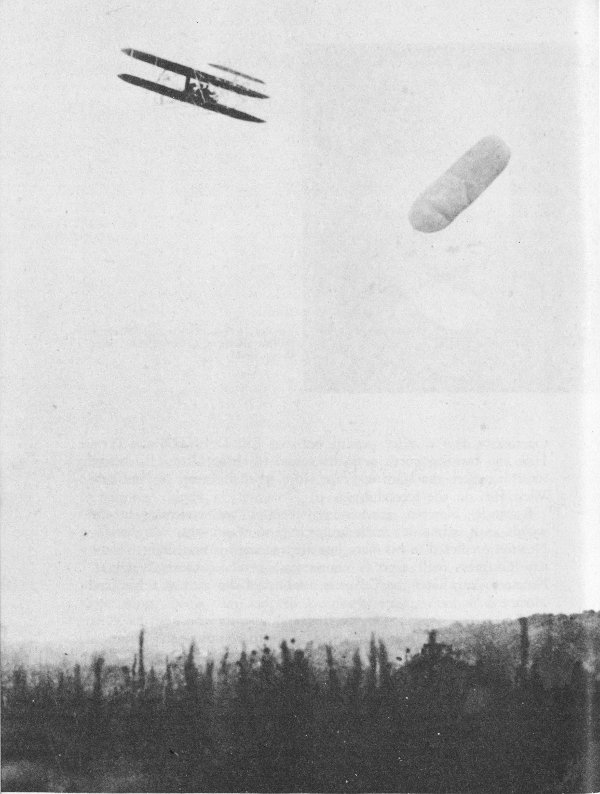
Orville and his passenger, Lt. Benjamin D. Foulois, round the captive balloon
which marked the turning point of the Army speed test flight from Fort Meyer,
July 30, 1909. The flight was just under 43 miles an hour. Courtesy, Smithsonian
Institution.
59
Wilbur’s complete lack of conceit, together with his decency and
intelligence, won from the French people a hero-worship attitude,
while the press was unsparing in its praise and lamented having
called him a bluffer. The Figaro commented, “It was not merely
a success but a triumph; a conclusive trial and a decisive victory for
aviation, the news of which will revolutionize scientific circles
throughout the world.” It was a statement to the press by a witness,
Maj. B. F. S. Baden-Powell, president of the Aeronautical Society
of Great Britain, that is most often quoted: “That Wilbur
Wright is in possession of a power which controls the fate of
nations is beyond dispute.” One of Wilbur’s sayings in France became
famous: “I know of only one bird, the parrot, that talks,” he
said, “and it can’t fly very high.”
Orville’s first public flight was on September 3, 1908 at Fort Myer.
He circled the field one and one-half times on the first test.
“When the plane first rose,” Theodore Roosevelt, Jr., recorded “the
crowd’s gasp of astonishment was not alone at the wonder of it, but
because it was so unexpected.” Orville’s final flight at Fort Myer
in 1908 ended in tragedy. The airplane crashed, killing Lt. Thomas
Selfridge, a passenger flying with Orville. Orville suffered broken
ribs, a fractured leg, and hip injuries.
In 1909, Orville completed the Government test flights by flying
10 miles in 14 minutes, or just under 43 miles an hour. The United
States Army formally accepted its first airplane from the Wrights on
August 2, 1909. During the same year both brothers made further
flying triumphs in Europe where they became famous flying in France
and Italy. While Orville was making sensational flights in Germany
(as required for the formation of a Wright company in that country),
Wilbur, in America, made spectacular flights at New York City
where more than a million New Yorkers got their first glimpse of
an airplane in the air.
Commercial companies were formed in France and Germany to manufacture
Wright planes before the Wright Company was organized
in the United States with Wilbur as president and Orville vice
president. In financial affairs the Wrights were remarkably shrewd—a
match for American and European businessmen. They grew
wealthy as well as famous, but they were not happy as businessmen
and looked forward to the time when they could retire to devote
themselves again to scientific research.
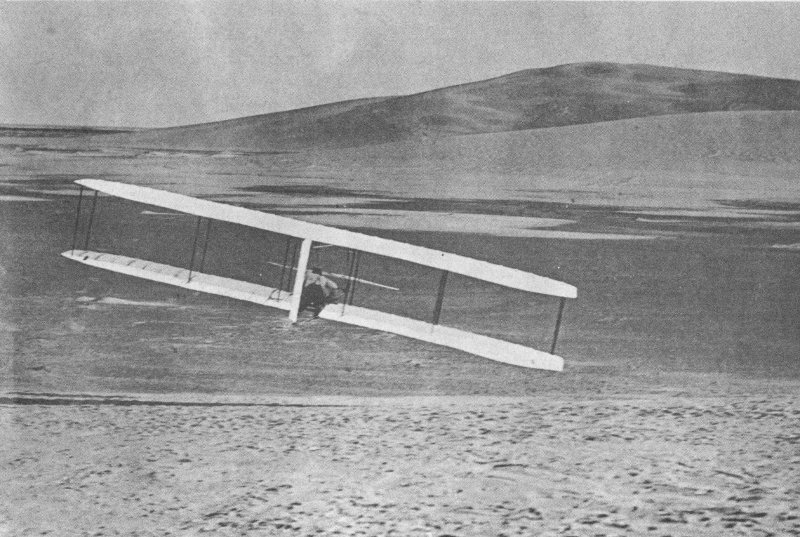
Orville returned to Kill Devil Hills in October 1911 to experiment
with an automatic control device and to make soaring flights
with a glider. The new device was not tested because of the presence
of newspapermen at the camp each day. Orville set a new
world’s soaring record of 9 minutes and 45 seconds on October 24.
This remained the world’s record until it was exceeded 10 years later
in Germany. On May 30, 1912, Wilbur Wright, aged 45, died of
typhoid fever. Orville survived him by 36 years.
60