Ned Rogers had but few acquaintances in the
city of Portland, Maine; but those few were positive
the boy had run away from home.
It was quite natural such should be the general
idea among those who saw him trying from day to
day to earn the small amount of money necessary
to provide him with food.
As a matter of course it was essential he should
also have clothes and a bed at night; but Ned had
found it such hard work to get sufficient to satisfy
his hunger that it would have seemed a willful
waste of money to expend it on anything save provisions.
He very often found shelter in the store-houses
on the wharves where he sought employment.
Sometimes the crew of a fishing vessel would allow
him to remain on board during the night, and more
than once did he walk around the streets because
of his inability to go elsewhere.
2As for clothing, the badly patched suit he wore,
which had originally been made for a full-sized
man, was quite as much as he aspired to until
“luck came his way,” and to have new garments
was a dream he never allowed himself to indulge
in, because of the apparent impossibility.
Now, while Ned presented every indication of a
boy who has run away from home in order to better
his fortunes, and wishes heartily that he could
run back, he had never been so foolish, for the
simple reason that so long as he could remember
there was no home for him in all this wide world.
His first remembrance of anything even approaching
an abiding-place was when he had
reached his fifth birthday, and then understood he
was supported by an uncle, who seldom lost an opportunity
of telling him what a useless article he
was, more especially on a farm.
After that he remembered a funeral, with his
uncle in the coffin, and from the moment the hard-hearted
farmer was carried to his last resting-place
Ned’s journeyings began.
First one neighbor and then another had some
work by which he could earn enough to pay for the
small amount he ate, and finally, as he grew older,
even these opportunities ceased.
He did not know that he had a single relative in
3the world to whom he could go, and while perfectly
willing and even anxious to work, the townspeople
called him a “lazy good-for-nothing, whose
only desire was to eat the bread of idleness.”
“It’s mighty little of any kind of bread I get,”
Ned once said to Deacon Grout, when the latter
had made use of this remark because the boy applied
to him for work. “I allers have done whatever
I could find that would give me a square meal
or a place to sleep; but it looks as if you folks
wasn’t willin’ to spare that much. I s’pose you
think a feller like me oughter pay for the privilege
of stayin’ in this blamed old town.”
There is no question but that Ned’s provocation
was great, yet it was an ill-advised remark, for
from that day he not only had the reputation of
being lazy, but impudent as well.
The deacon predicted he would “come to some
bad end,” and the deacon’s friends fully expected
each morning to hear that “the Rogers boy” had
been sent to jail, because of having committed some
terrible crime.
Despite this very unpleasant and unsatisfactory
method of gaining less than half a livelihood, Ned
remained in the town until he was fourteen years
old; not for love of the place, but owing to his inability
to leave.
4The city was so far away that he did not think it
possible to walk, and as for paying his fare on the
stage-coach, he might just as well have cried for
the moon.
The cost of riding from Jonesboro to Portland,
in both stage and cars, was $7, and Ned had never
been the possessor of a tenth part of that amount,
although he was really as industrious as the townspeople
would allow him to be.
From the day he was ten years old the unhappy
boy had said to himself that he would go to the city
at the first opportunity; but as the weeks went by
and he could see no possibility of carrying out such
a plan, he grew discouraged.
“I expect what the deacon said will come true,”
he thought, “an’ it won’t be my fault. The people
ain’t willin’ to give me a job, an’ if I do get a
chance now an’ then, nobody wants to pay cash.”
It was when the future looked darkest, and he
had begun to ask himself whether it would not be
possible for him to walk to Portland, even though
the distance was more than two hundred miles, that
the longed-for opportunity arrived.
A drover passed through the town, or was about
to do so, with a hundred head of cattle, when one
of his drivers was taken sick, and he inquired for
some one to fill the man’s place.
5The stock was to be driven to the nearest shipping
point on the railroad, and from there taken by
cars to Portland.
Ned heard of the drover’s necessities and applied
for the situation, agreeing to do the work, provided
he was taken as far as the city and supplied with
food during the journey.
On such terms there was but little difficulty in
making a trade, and the boy left his native town,
determined never to return until he could show
Deacon Grout and his friends that it was possible
for him to rise in the world when he was among
those who would allow him an opportunity.
The journey, slow and fatiguing though it was,
delighted Ned.
Everything around him was strange and wonderful,
and those with whom he came in contact treated
him like a human being, which was a pleasing
contrast to his experience in Jonesboro.
The other drivers told him of what could be seen
in the great world to which he was going, and related
more than one story of poor boys who had
started out to seek their fortunes under even more
distressing circumstances than those from which he
suffered, coming back some day rich and respected,
until he began to think it was only necessary to
gain the city in order to be wealthy.
6With such dreams as these was his time occupied,
and when the journey was finally finished he began
to look around for one of those very charitable men
whom he fancied were waiting in large cities to
welcome, with outstretched arms and plenty of
money, all poor boys.
As a matter of course he found nothing of the
kind, and before forty-eight hours had passed began
to realize that the people in one place were
very much like those in all others.
No one seemed to have any especial interest in
him, and it was quite as difficult to find an opportunity
to work in the city as in the country.
After the first day he understood that there
would be but little chance for him to get an engagement
in a store while his clothing was in such a condition,
and he relinquished that portion of his plans
to seek work around the docks.
Here he succeeded in earning about as much as
while in Jonesboro; but his life was more pleasant
because he was treated more like a human being
and less as a criminal.
During the summer season it made but little difference
where he slept; but winter was near at
hand, and it became absolutely necessary he should
make such arrangements as would provide himself
with a shelter.
7Until this time he had resolutely set his mind
against going to sea, for he was quite certain it
would not be an agreeable life, and there would be
but little chance for him, without influence, to rise
above the level of a sailor.
“It’s no use, I’ve got to try it,” he said to himself
one morning when, after sleeping under a pile of
lumber on a pier, he awakened to find everything
covered with hoar-frost. “I’m pretty nigh frozen
now, an’ what’ll be the position of affairs in another
month?”
Having once determined his course, Ned lost no
time in acting upon it.
He was very well acquainted with the waterfront
of the city and knew where to find vessels
bound for a foreign port.
Since it seemed necessary for him to go to sea he
did not intend to ship on board a fishing vessel or
one engaged in the coast-wise trade, for the very
good reason that in such craft he would not receive
sufficient advance to purchase the much-needed outfit.
The brig Evening Star was loading for Manila,
and this seemed to him the proper kind of a voyage
to take. When the trip was ended he would have
wages enough due him, provided he spent no money
except for clothing, to admit of making himself
presentable for a situation in a store.
8Captain Bragg was on the quarter-deck talking
with one of his officers when Ned clambered over
the side and stood by the port rail amidships waiting
until the master of the brig should be at leisure
to speak with him.
“What do you want?” the captain asked five
minutes later when, the interview having come to
an end, he condescended to notice the boy.
“I’d like to ship on this brig if you need a boy.”
“What can you do?”
“Almost anything in the cabin; but I don’t believe
I’d make much of a fist goin’ aloft.”
“So you’re no sailor, but want to go to sea?”
“I had rather stay on shore, sir; but I can’t get
a job, so made up my mind to try it aboard ship if
any one is willin’ to take a green hand.”
“What about wages?”
“I’ll leave that to you, sir, providin’ I can have
advance enough to give me a decent fittin’ out.
These clothes I’ve got on are all I own, an’ I reckon
more’n them will be needed before the brig gets
back.”
“Would you like to ship as cabin-boy?”
“At what wages, sir?”
“Ten dollars a month and an advance of two
months’ wages out of the slop-chest.”
Ned did not understand that by taking his outfit
9from the vessel’s stores he might be forced to pay a
great deal more than the same articles would cost
ashore, and readily engaged on those terms.
“Here, Mr. Stout, see that this boy gets what he
needs from the chest, and then set him to work
cleaning up the cabin,” the captain said to the first
officer, and the latter motioned for Ned to follow
him.
Leading the way below he brought out a pair of
woolen trousers, two shirts and a reefing jacket,
which he gave to Ned as he said:
“So you’re goin’ to sea, eh?”
“Yes, sir.”
“First voyage?”
“Yes, sir.”
“Run away from home, I reckon.”
“No, sir; I’ve never had any since I can remember,
an’ if I knew of one you wouldn’t see me here.
I’ve only shipped because I can’t help myself. This
livin’ on wind ain’t what it’s cracked up to be, an’ I
want to get under cover for the winter.”
Mr. Stout looked at the boy almost pityingly, and
said half to himself:
“It’s kinder tough to strike this pertic’lar craft on
the first cruise.”
“Isn’t she a sound vessel, sir?” Ned asked, fearful
lest there might be good reason for him to remain
ashore.
10“Oh, yes,” the mate replied quickly, looking like
one who fancies he has been so indiscreet as to say
too much. “There’s nothin’ wrong with the Evenin’
Star. I was thinkin’ of somethin’ else when I
spoke. Get inter them clothes so I can show you
where to go to work. I reckon the duds you’ve
taken off will be about fit to throw overboard;
they wouldn’t hang together many days longer.”
Ned would have insisted on knowing what the
mate meant by his words in reference to the vessel;
but that gentleman did not appear inclined to continue
the conversation, and the boy was forced to
follow him into the cabin without the desired information.
Ten minutes later Ned had forgotten that anything
odd or unusual had been said, so interested
was he in his work.
The cabin was in a shockingly dirty condition,
and he resolved to put it so thoroughly to rights
that the captain could not fail to be pleased at having
hired such an industrious boy.
He had had no breakfast; but the loss of a meal
was something to which he was accustomed, having
missed more than he got while on shore, therefore
this trifling matter did not disturb him.
When noon came he had not finished, and the
cook insisted that he stop until dinner should be
served.
11As a matter of course he obeyed, and was assisting
in laying the table when the captain entered.
“Is this what you call cleaning the cabin?” he
cried in a rage, pointing to a pile of dirt which Ned
had left in one corner until he finished sweeping.
“I only stopped to help set the table, sir,” Ned
replied promptly, little thinking there could be any
cause for complaint. “I shall be all through before
supper-time.”
“How many hours do you want on a job like
this?” the captain asked angrily.
“I’m getting along right well, sir; but it was so
dirty that a feller couldn’t make his work show till
he was almost through.”
“You’ve got too much chin to suit me,” the captain
cried, and at that instant Ned was forced to
pass very near the man, who appeared as if trying
to make himself angry when no reason for a display
of temper existed.
Conscious that he had not offended in any way,
Ned hardly expected to receive punishment, therefore
was wholly unprepared for what followed.
The captain struck him a vicious blow which sent
him headlong toward the companion-way at the
very instant the cook was descending with a basin
of hot soup.
As a matter of course Ned had no control over
12his own movements, neither had the cook, and the
result was that the two came together with a force
and suddenness which sent both to the floor, the
scalding liquid flowing over their faces and limbs.
“What do you mean by that?” the captain cried,
as running swiftly toward the injured boy, he
seized him by the coat collar, struck him on the face
several times with full force, and then hurled him
to the deck above. “I’ll teach you to spoil my
dinner!”
Ned did not hear this last remark. His head had
struck against one of the rail stanchions, and he lay
unconscious, while the captain turned the vials of
his wrath on the unoffending steward.
When the new cabin-boy recovered his senses he
was in the galley and the cook was applying oil
and flour to the blisters on his own face and
hands.
“What was you doin’ when the captain came in?”
the master of the galley asked.
“Nothin’ more’n you saw. I’d been to work all
the forenoon, an’ only stopped when you wanted
me to help set the table. I can’t tell what made
him fly at me so.”
“It’s a way he has when he gets two or three
drinks aboard,” the cook replied with a smothered
threat. “One of these days he’ll try that trick too
often.”
13“Did he do anything to you?”
“Not so very much,” and the man pulled up his
trousers to show two ugly bruises on his leg.
“That’s where he caught me before I could get on
to my feet.”
“Did you say anything?”
“It don’t pay to do very much chinnin’ when the
captain is around,” was the sage reply; “but he’s
got to carry sail different from this, or the Evening
Star won’t have a cook on board when she leaves
port.”
“He can hunt for another cabin-boy mighty
quick,” Ned said angrily. “I’m willin’ to do my
work or stand a flogging, but he shan’t knock me
down when I’m trying my best.”
“I don’t see how you can help yourself now.”
“What do you mean?”
“Nothin’ except that you’ve shipped, an’ it won’t
be so easy to get away, for the police would arrest
you on his complaint.”
“But I haven’t reg’larly shipped.”
“Oh, yes, you have. The minute you received
what they handed out from the slop-chest you was
one of the crew. It’s a case now of makin’ the
best of it, and if you take my advice you’ll show up
bright and smilin’ when he sends for you.”
It was only natural Ned should be very angry
14because of the cruel and undeserved treatment;
but before the cook finished giving him good advice
he realized that there was nothing left but to make
the best of a bad job, since without money or
friends it would be very difficult to avoid going to
sea in the Evening Star, in case the captain insisted
on his remaining aboard.
CHAPTER II. AT SEA.
15
Ned was not fit for duty during this day and the
next.
Both his eyes were blackened, his cheek cut and
swollen, and his face blistered in several places.
After ministering to his necessities as well as
possible, the cook carried him into the forecastle,
and there, alone, he had ample opportunity to reflect
upon what kind of a life he might be forced to
lead while it was necessary he should remain
aboard the brig.
On the evening of the first day, the chief mate,
Bob Stout, came below to inquire how the boy felt,
and before he had been in the ill-smelling place five
minutes Ned decided that he should like this officer,
no matter how brutal the others might be.
“Got knocked ’round pretty lively for a few
minutes, eh?” the mate said in a cheery tone as he
seated himself on a chest by the side of Ned’s
bunk.
“Indeed I did, an’ all for nothin’. I was doin’
16the best I knew when he begun, an’ then how could
I help tumblin’ the cook over when the captain
fired me at him?”
“You don’t want to bother your head about that,
my lad. The least said in such cases is the soonest
mended. A boy at sea must learn to hold his
tongue.”
“Even when he’s gettin’ a floggin’ he don’t
deserve?”
“Of course; that’s the very time when it’s most
dangerous to talk. You’ll soon get used to the
captain’s ways.”
“It’ll take a mighty long while for me to get
used to bein’ fired from one end of the cabin to the
other, an’ then on deck.”
“Wait three weeks, an’ see what you say about
it. I went to sea as boy with a master who was as
liberal with his blows as Captain Bragg; but I got
in the habit of dodgin’ ’em before we’d been outside
three days, an’ after that it was fairly smooth
sailin’, except when he caught me unawares.”
“But there’s no reason why I should stay on
board. I’d rather starve ashore than have the best
of everything that’s on this craft.”
“The cook says he told you what risks you’d be
takin’ by tryin’ to run away.”
“So he did; but I won’t believe that man can
keep me here if I don’t want to stay.”
17“He can, an’ all the cook said is true. The only
thing left for you is to make the best of it, an’ get
along as easy a possible. Now cheer up, an’ have
some heart in you.”
With these words the mate left the forecastle,
and Ned turned the advice over in his mind until
he came to the conclusion that it would be better to
act upon the friendly hints.
The result of this conversation was that on the
following afternoon the cabin-boy returned to duty
by taking up the task which had been left unfinished
when the unprovoked attack was made upon him.
The captain entered shortly after the work was
recommenced, but made no comment whatever.
He did not deign to so much as look at the little
fellow, and when the evening meal was served Ned
succeeded in waiting upon the table without a mishap.
After the third day came to an end the new
cabin-boy felt quite well at home. He had remembered
the mate’s advice in the matter of dodging
blows, and on several occasions avoided what might
otherwise have been as serious as the first flogging.
Finally the time came when the Evening Star
was ready for sea, and Ned congratulated himself
upon the fact, for, once under way, it was hardly
18probable the captain would have a great deal of
time to devote to him.
His first experience at sea was so much like what
other fellows, who have ventured upon the ocean
for sport rather than from necessity, have known,
that there is no reason why it should be given in
detail here.
The brig sailed out of the harbor in the early
morning, and before twelve o’clock poor Ned was
in the forecastle believing his last hour was very
near at hand. It seemed to him that the sailors
were a particularly hard-hearted set of men to laugh
and make sport of a dying boy, for he was fully
convinced he would not live until morning.
Death was not as near as he had fancied, however,
although he did not feel very much better at sunrise.
Then the mate came into the forecastle, and, after
asking how he felt, said:
“You had best come aft, lad. The room off the
pantry is the proper bunk for you, and once clear
of this foul place you’ll get well a great deal
faster.”
“Where is the captain?”
“In his room. He hasn’t turned out yet, and
you’ll have a chance to get settled in the new
quarters before he shows up.”
19Ned was more than willing to make the proposed
change. The odor, the jokes of the sailors, as well
as the fumes of tobacco smoke, were decidedly trying
to a weak stomach, and he managed to crawl
from the berth unaided, thanks to the promise of
an improvement in the surroundings.
Mr. Stout so far unbent from the dignity of a
first officer as to assist him across the deck and into
the tiny room which was half-filled with stores of
various kinds; but, regardless of the limited accommodations,
Ned felt he was very fortunate in getting
quarters where he could be alone.
“I shall see that you show up to-morrow morning,”
the mate said as he turned to go. “I don’t
reckon the captain will let you loaf any longer,
even though a sick waiter isn’t the most pleasant
person one can have around a table. The skipper
of this craft don’t believe in keeping cats that can’t
catch mice.”
“Do you s’pose he’ll let me stay here as long as
that?” Ned asked piteously.
“I reckon so, for I shall make it out you’re worse
off than really is the case; so fix yourself as comfortable
as possible, an’ I’ll see to it that the cook
brings you a bowl of soup before noon.”
“I couldn’t eat a mouthful.”
“Nonsense. You’ll be as ravenous as a bear by
20night, an’ I’ll answer for it you can get away with
quite a mess by the time it is ready.”
Ned felt certain he should never again want anything
in the way of food; but when, two hours later,
the captain of the galley brought a bowlful of
liquid, steaming hot, which gave forth a most
appetizing odor, he succeeded in swallowing more
than half of it, feeling very much better immediately
afterward.
By nightfall he had so far recovered that the
nausea did not trouble him, save when he attempted
to rise to his feet, and he had no difficulty in eating
a large piece of meat and two ship’s biscuit, which
the good-natured mate gave him.
“I reckon you’re all right now, an’ shall turn you
out bright an’ early in the morning,” Mr. Stout said
as Ned literally devoured the provisions.
“Did the captain say anything because I was sick
so long?”
“Yes, he got into a reg’lar mad fit; but I made
it out that you wasn’t able to come into the cabin
in any decent shape, an’ he didn’t say any more.
The old man has been like an angel all day, an’ I
can’t understand the meanin’ of it. Anybody would
say he was tryin’ to play me for some kind of a
favor; but of course that can’t be, now we’ve put
to sea.”
21It was destined Ned should know very soon what
the “favor” was which Captain Bragg wanted of
the mate, although he little dreamed then that it
would cause him so much alarm.
From the time Mr. Stout left him until late in
the night Ned slept soundly, and then he was
awakened by hearing the familiar voice of the
captain say in a loud tone just outside the door of
his state-room:
“There’s no need of your bein’ on deck for the
next half-hour, Mr. Stout, so let’s go into the pantry
for some grog. That lazy steward hasn’t left any
in the cabin.”
“I’ll bring it to you there, sir, if you’ll wait
a minute.”
“There’s no occasion for it. We can go in here
as well, and there’ll be less chance any one overhears
us while we’re talking.”
Ned heard the door of the pantry opened, and
then it was as if the captain had entered the boy’s
room, so far as the latter’s ability to hear all that
might be said was concerned.
The partition between the two apartments was
composed of only one thickness of thin boards, and
a whisper would have sounded distinct in the confined
space.
“It seems rather odd to see the captain of a craft
22like this huntin’ his own lunch,” Mr. Stout said
laughingly.
“I’d rather do it just now while the second officer
is in his room, for I’ve got something private to say
to you which wouldn’t be safe even in the cabin.”
There was a few moments of silence, and then the
mate said, as if about to partake of some liquor:
“Here’s to your health, sir.”
“Same to you,” was the reply; and then it was
possible for Ned to hear the sound as the glasses
were replaced on the shelves.
“Mr. Stout,” the captain began in a serious tone,
“I believe you are not a rich man.”
“There’s no question about that, sir, for I’m even
poorer than a churchmouse.”
“How would you like a chance to make a
thousand dollars or more of extra money this
trip?”
“There’s precious little need of my answerin’
such a question, sir. I never had a thousand dollars
at one time in my life.”
“What would you be willing to do in order to
get that much within the next two months?”
“Without stealin’ it, do you mean, sir?”
“It isn’t likely I’d ask you to turn thief; but if
this craft never reached Manila there might be more
than that in your pocket.”
23“Do you mean to wreck her?” Mr. Stout cried as
if in alarm.
“Hush! Don’t make such talk so loud that everybody
on board can hear you.”
“It strikes me there are worse things than stealing,”
the mate said slowly.
“But this isn’t one of them. The brig is insured
way up on what ain’t in the hold, and suppose she
founders off the Florida Keys, who is going to be
any the wiser? There’s no need that even the men
should know, providing you and I work together,
and we can take to the boats without a smell of
danger.”
“It is a clear case of cheating somebody, even
though we don’t risk the lives of the crew.”
“Nonsense! Every cent will come from the rich
insurance companies, and you can’t say that is
wronging any one in particular. What would be
the difference to a stock company which rolls up
thousands of dollars in profits every year, if they
had to pay an extra risk or two? It’s such a chance
for us as a man seldom gets in this world, and we’ll
take it if you say the word.”
There was quite a long interval of silence, and
then Ned heard Mr. Stout ask:
“Have you made your preparations for scuttling
her?”
24“No, there wasn’t need of that until you and I
had come to an understanding; and even then we
don’t want to do anything until we’re off the Keys
where there’ll be no very great tumbling around in
the boats.”
“How is it to be done?”
“We’ll scuttle her from the stern. I’ve seen to
it the cargo was stowed in such a manner that we
can get down to her skin without any trouble. It
might be a slight explosion in the forward hold—not
enough to do any damage, but sufficient to start
the men into a panic—would work to our advantage.”
“I don’t like it,” the chief mate said in the tone
of one who is willing to be convinced; “but there’s
a pleasant ring to a thousand dollars.”
“Of course there is, and your share will be even
more than that.”
“It isn’t so easy to scuttle a craft as one might
think, and when the job was done if some of the
crew should happen to be suspicious, we’d stand a
good chance of takin’ a trip to prison.”
“If anything like that should happen at the last
minute it would be unlucky for the man who saw
us, or thought we were up to mischief. He
shouldn’t leave this craft alive. I’d rather send the
whole crew to the bottom than run a risk of being
25caught at such a job. But take another drink
Stout, an’ think over this matter till morning.
There’s plenty of time to discuss it, for we’ve got at
least four days before us, if not a week.”
Then the conversation ceased as the captain left
the pantry, and Ned heard the mate, who had remained
behind an instant, mutter to himself:
“I knew the old man was up to something, or he
wouldn’t have been so sweet for the last twenty-four
hours. It’s a big scheme he’s got, an’ I don’t
see why it couldn’t be worked without trouble. A
thousand dollars is a pile of money to a man who
never had any more than I’ve got.”
This was sufficient to show Ned that the chief
officer would not hesitate to assist in wrecking the
brig, provided it could be done without taking too
big a risk, and the boy began to wonder what
would become of him if the crime was finally
committed.
The captain had said that if any one on board had
a suspicion the brig was deliberately scuttled, such
person should never leave the craft alive.
Now Ned was in the possession of the secret, and
in case the captain discovered that his words could
be heard so plainly from one apartment to the
other, it was only reasonable to suppose he would
carry his threat into execution, more especially
26when it was a person of so little importance as a
cabin-boy without a relative in the world.
“I don’t believe Mr. Stout would do such a thing
to me,” Ned said to himself; “but I’ll talk with
him about it the first chance I get.”
It was impossible for Ned to sleep any more
on this night, and next morning there was no
reason why the chief mate should awaken him, for
he was at work in the cabin as soon as the first gray
light of the coming dawn could be seen.
“Feelin’ better, eh?” Mr. Stout asked as he
came below while Ned was placing the dishes
on the table preparatory to serving breakfast.
“Yes, sir, an’ I’ll be able to do my work now if I
don’t get taken again.”
“There isn’t much chance of that. You’ve served
an apprenticeship, and won’t have any more trouble
this voyage.”
Then the mate went into the pantry for some of
the same liquid which had played an important
part in the conversation during the previous night,
for it is as strange as it is true that as soon as a
man contemplates villainy of almost any kind, he
invariably flies for courage and consolation to
liquor.
Ned made up his mind to speak with the mate
that very morning in reference to what he had
heard; but the opportunity was denied him.
27Before the first officer returned from the pantry
the captain came out of his room, and the two spent
considerable time at the forward end of the cabin
conversing in whispers.
Then breakfast was served, after which Mr.
Stout went to his apartment, and there was so much
work for the cabin-boy to do that he had not
finished when it was time to prepare for dinner.
The captain was in such a good humor during the
noon-day meal that Ned was not even reprimanded
when he tripped over a chair and spilled a portion
of a cup of coffee, and after dinner the master and
his mate went into the pantry once more.
The cabin-boy was tempted to enter his own
room in order to hear what was said, for most likely
the mate was giving an answer to the question
asked; but the risk of being detected was so great
that he did not venture on any such hazardous experiment.
No until his work in the cabin was finished did
the two emerge from their conference, and then it
was apparent that Mr. Stout had agreed to join the
captain in the commission of the crime. The master
of the Evening Star was evidently on the best of
terms with his mate, and the two showed very
plainly that they had a secret in common.
“If I don’t talk with Mr. Stout pretty soon he’ll
28be jest as bad as the captain,” Ned said to himself
as he noted the change which had come over the
mate during the past few hours. “I’ll watch my
chance to-night after the old man has turned in, for
if this thing is to be done inside of a week the best
way is to get ready for the worst right soon.”
The captain did not interfere with the new boy
on this day, and had it not been for the short but
sharp experience before putting to sea, Ned would
have believed he was sailing under one of the most
amiable men to be found in the world.
When night came the cabin-boy finished his tasks
as quickly as possible and then went on deck, where
he remained by the rail amidships until after the
first officer had had another interview with the
captain in the pantry.
“What are you doing out here?” Mr. Stout asked
as he came on deck, and since he knew the officer
was willing to commit a crime, Ned fancied his
voice had lost that cheery ring which pleased him
so much when he first heard it. “Ain’t gettin’
homesick, are you?”
“How can a feller feel like that when he hasn’t
got any home to go to?” Ned asked with a mirthless
laugh. “All the same, I wish I was on shore.”
“Why? You seem to be gettin’ along well
enough here.”
29“I am so far as the work goes; but there’s more
that’s worryin’ me.”
“What is it, lad? You’re too young to have
very big troubles.”
“If you’d promise me somethin’ I’d feel a good
deal better.”
“Then out with it, for a boy like you don’t want
to keep anything very serious on his mind too long
at a time.”
Ned looked around to make certain there was no
one in the immediate vicinity who could overhear
him, and whispered:
“Will you promise that I shan’t be left behind
when you sink the brig?”
Mr. Stout started as if having received a heavy
blow from a weapon, and an instant later grasped
Ned by the arm with sufficient force to cause considerable
pain, as he asked in a hoarse whisper:
“What do you mean by that, lad? Where did
you learn anything of the kind?”
“You was talkin’ in the pantry, an’ I could hear
every word while I was sick in my room.”
“Come here! Let’s find out jest how easy that
can be done,” and in his excitement the chief mate
dragged Ned roughly into the pantry. “Now you
speak here, while I go where you was.”
An instant later the boy heard him say from the
opposite side of the partition:
30“Now go ahead, an’ talk low.”
“You can hear me if I whisper,” Ned replied,
suiting the action to the words.
An exclamation of surprise and dismay told that
the mate was convinced of the truth of the story
related by Ned.
Coming into the pantry once more he said sternly:
“Now I want you to go over everything you
heard us say! Don’t skip a single word more’n
you can help, for this is gettin’ to be a serious
matter.”
Wondering why Mr. Stout should have allowed
himself to become so excited, the boy obeyed, saying
in conclusion:
“You won’t let the captain leave me behind, will
you, Mr. Stout? You know he threatened that was
what he’d do to any one who had a suspicion the
brig was sunk by him, an’ I’m afraid he may find
out I could hear all you said.”
The mate looked at the boy very oddly for a few
seconds, and then replied in a voice which trembled
despite all his efforts to make it sound firm:
“I’ll see you’re not left here in case she is scuttled;
but I reckon the best thing we can do now
will be to give up that job, since there’s another
besides ourselves who knows about it.”
31“Who do you mean?”
“You, of course,” and the mate spoke as if in a
rage.
“But you know I wouldn’t tell.”
“No, we must take good care of that,” and to
steady his shaken nerves the mate had recourse to
the liquor bottle, pouring out for himself a dram
which very nearly filled the glass.
“You see I thought it was best to speak to you
about it the first chance for if it is to be done so
soon I might wait too long,” Ned continued, little
fancying what thoughts were in the mate’s mind.
“That is right, lad. I’m glad you did, an’ now
we’d better go on deck. See to it that you don’t
stay up too late to-night, for you must be on hand
bright an’ early in the mornin’ to have things ready
for breakfast.”
“I’m goin’ to my room now. I only went on
deck to speak with you.”
“All right; but be sure you don’t get to talkin’
with anybody else about what you heard, or there
might come a row which wouldn’t be pleasant.”
“There’s no danger of that,” Ned replied cheerily,
perfectly contented in mind since having spoken
on the subject to the man whom he felt certain was
his friend.
Mr. Stout was so attentive as to go with the boy
32to the door of his room, and when Ned was inside,
the mate turned the key without the knowledge of
the young occupant.
Then Mr. Stout visited the pantry once more,
poured out another glass of liquor for the purpose
of steadying his nerves, and muttered to himself as
he went on deck:
“The skipper must hear of this before morning.
It won’t do to let that kid run around the craft with
such a secret as he has got; but the question is how
we can put him out of the way?”
CHAPTER III. THE PLOT.
33
Meanwhile Ned was positive that everything had
been arranged satisfactorily.
It never came into his mind that Mr. Stout might
think it in the highest degree unsafe for a boy to be
possessed of a secret which could send him and the
captain to prison for a long term. His only idea
was that in case the brig was scuttled he would be
in no danger, and this was sufficient for the time
being.
There was no occasion for him to leave his room,
therefore he had no intimation he had been made a
prisoner, and lay down to sleep with not a care on
his mind, save, possibly, whether he should succeed
in pleasing the captain as well on the following day
as during the one just passed.
Matters would have worn a very different complexion
to him had it been possible to have overheard
the conversation which Mr. Stout had with
the captain in the latter’s room about midnight,
when the second mate went on deck.
34The master of the Evening Star was wrapped in
a slumber superinduced by frequent draughts from
the liquor bottle, and his chief officer had some difficulty
in awakening him.
“What’s the matter?” he cried in alarm when
finally it was possible for the visitor to make his
presence known. “Anything wrong?”
“Not with the brig; but there’s some one aboard
who must be attended to mighty quick if you count
on carrying out the plan we spoke about the other
night.”
“What do you mean?”
“There was a listener while we were talkin’ in
the pantry.”
“Who?” and now fear caused the captain to be
very wide awake.
“The boy. He can hear even a whisper from the
pantry while lying in his berth. I tried the experiment
a little while ago, an’ know that not a
word could have escaped him.”
“And he heard what I said?”
“That’s the size of it. He came to ask me not to
leave him behind when the brig was scuttled, an’
you can fancy what a turn it gave me. He didn’t
seem to think it anything out of the way to tell the
whole story, an’ I’ve taken the precaution of lockin’
him in his room.”
35“That was right. He must fall overboard before
daylight, or we shall stand a good chance of going
to jail if we ever show up on shore again.”
“Now don’t talk foolishness,” Stout replied impatiently.
“In the first place, I won’t have murder
committed; it’s bad enough to scuttle a vessel.
Then, again, it couldn’t be done without some of the
crew knowing about it, and even if they simply had
suspicions the loss of the brig immediately after
the boy was silenced would show up the whole
matter.”
“But what shall we do?”
“That’s what I don’t know. All I can say is
as to what mustn’t be done an’ leave you to figger
out the rest.”
The captain was silent for fully a minute, and then
said abruptly:
“I wish you’d bring the bottle in here; I need
something to clear my head a bit.”
Mr. Stout obeyed at once, and when he returned
the master of the brig had seen a way out of what
promised to be a very serious difficulty.
“We’ll soon settle him, and I’ll answer for it that
the crew will be glad enough to help us.”
“What is the scheme?”
“Keep him a close prisoner from now out. Say
that we have discovered he has some contagious
disease——”
36“But anybody with half an eye can see he’s well
and hearty.”
“There are plenty of things which can be hatched
up. Say leprosy; that will startle every man jack,
I’ll go bail.”
“Then what? We can’t leave him on board when
the brig goes down.”
“How thick-headed you are to-night, Stout!
Take a drink to brighten you up. Suppose the men
believe he’s a leper? The result will be that they’ll
insist on our setting him ashore, as we should do
in case he was really afflicted with the disease. We
can land him on some small key, and the matter
will be settled.”
“But he’ll talk all the same when he gets back.”
“If he ever does.”
“Then it is really murder you are thinking of!”
“Not a bit of it! We’ll simply maroon him, with
plenty of grub, and trust to chance for the rest.
We’ll make Spider Key for the first land, and once
he is there I’ll guarantee he stays.”
“But I don’t fancy the idea of such a thing as
that,” Mr. Stout replied thoughtfully. “It is different,
this scuttlin’ a vessel for the purpose of
doin’ the insurance companies, while to maroon a
boy is very much the same as puttin’ a knife into
him, and perhaps more cruel.”
37“Look here, Stout, it is too late for you to be
squeamish. He has heard the plan and knows you
agreed to it. Once his story has been told on shore,
even if we back out now and put the brig into
port, the cargo can be examined, and it’s good-by
for you and I. Death wouldn’t be half so bad in
my eyes as ten or fifteen years in jail, and that’ll be
the size of it if he’s allowed to run around with our
secret.”
“I s’pose you’re right,” the mate replied with a
sigh; “but it’s mighty tough for the poor little
fellow, all the same.”
“Not so much so as it would be for us. I’ll see
to it that he has enough in the way of grub and
weapons to keep him going for a year, and at the
end of that time it won’t do much harm if he should
tell the yarn.”
One would have said from the expression on the
captain’s face that he felt certain Ned would not be
alive at the end of a year; but the mate was willing
to soothe his conscience with the thought that he
might find some means of escaping from the key,
and thus the matter was settled.
It only remained to decide upon the room which
should answer for Ned’s prison until he could be
sent ashore, and Mr. Stout said:
“I reckon we may as well leave him where he is,
eh?”
38“By no manner of means. Didn’t you say he
could hear all that was said in the pantry?”
“Yes; but what of that? We needn’t go there
to talk any more.”
“You’re still thick-headed, Stout. If he can hear
so plainly, what’s to prevent him from chinning
with some of the crew or the steward? It’s a
chance we mustn’t take, for if we give out that he’s
a leper and he manages to tell one of them that he
was never away from the State of Maine in his life,
there would likely be a very big question as to the
truth of our statement.”
“Then the only vacant room is the one next to
mine.”
“Exactly. We’ll put him there and leave the
crew to say what shall be done with him. I’m ’way
off my reckoning if they don’t insist on his going
ashore the first chance. When that has been done
we’ll make a big show of burning the bedding, and
the thing is over.”
“Very well, sir, I shall have to give in that you
can handle this matter better than I. Now, if you’ll
take care of the balance of the job it’ll be a big
weight off my mind. I couldn’t face that boy,
knowin’ what we’re goin’ to do, without standin’ a
chance of givin’ the whole snap away.”
“Leave it to me; I’ll attend to everything, and
39you shan’t see him again till the day we take him
on shore.”
Mr. Stout went to his own room after this
promise; but it is safe to say that his sleep was
neither sweet nor refreshing.
Two hours later Ned was awakened by a heavy
hand laid on his shoulder, and as he raised his head
the captain’s voice was heard.
“I want you to shift rooms, lad. The carpenter
is going to make some changes here, and you’ll lose
the best part of the night’s rest if you try to stay.”
The words were spoken in the most friendly of
tones, and Ned, wondering not a little why it was
the master of the Evening Star had suddenly grown
so kind, hastily dressed himself.
Captain Bragg stood in the doorway until he
was ready, and then led him to the room adjoining
the chief mate’s, saying as he opened the door:
“It ain’t a bad swap for you to make, my son.
We keep this for passengers because it is so big, and
don’t usually count on givin’ it up to one of the
crew; but it seems necessary in this case. You
needn’t try to turn out early in the mornin’; I
shan’t have a regular meal served till the repairs
are made, so lay in bed as long as you please.”
Then the captain closed the door, locking it so
gently that the turning of the key could not be
40heard, and Ned undressed himself again in a perfect
maze of bewilderment.
The captain’s excessive kindness caused wonderment
not unmixed with fear, for he remembered
what Mr. Stout had said the day previous when the
gentleman was so affable.
“There’s no need for me to fuss about it,” he said
after trying in vain to fancy some good reason for
this almost affectionate manner. “Of course he
don’t want me to do anything for him, else he’d
asked with his fist. Perhaps he’s been drinkin’ too
much, an’ I’d better turn out the same time as
usual.”
This last supposition seemed the most reasonable,
and, believing he had hit upon the true cause for
the change of demeanor, he devoted his entire
attention to sleep.
At what time Ned awakened next morning he
was unable to say; but it seemed quite late when
he opened his eyes, and jumping quickly from the
berth, began to dress hurriedly as he muttered to
himself:
“I reckon I shall have to walk mighty straight
this morning, for the captain will be crosser than a
bear.”
After making a hurried toilet he attempted to go
into the saloon, and, to his great surprise, found the
door was locked.
41It did not seem possible at first that such could
be the case; but after trying in vain for several
moments to open it, he was forced to admit he was
a prisoner.
“Some one has turned the key, not knowing I was
in here,” he thought, and then began to pound on
the door in order to attract attention.
It was not necessary to do this many seconds before
succeeding in his purpose, and he heard the
captain’s voice from the outside:
“If you don’t keep quiet I’ll break every bone in
your body!” came in low, but angry tones.
“But the door has got locked somehow.”
“I did that myself. You’ll stay where you are
till I make up my mind what shall be done with
you.”
“But why am I kept here?”
“You’ll find out soon enough. Behave yourself,
and there’ll be no harm done; but if I hear so much
as a single yip, you’ll know what the cat tastes
like.”
Then all was silent once more, and Ned literally
staggered back to the bunk, trying in vain to
understand the meaning of this very strange performance.
He could think of nothing he had done or
neglected to do which would warrant such treatment,
42and after studying over the perplexing
matter until his head swam, he lay down again.
An hour later the door of his room was opened,
and the captain entered, bringing a supply of food.
“Here’s enough to eat and drink till morning,”
he said gruffly as he placed the tray on a locker.
“Take hold and enjoy yourself as much as you can,
for this terrible thing isn’t any fault of yours.”
“What do you mean?” Ned cried. “What have
I done?”
“Nothing, lad; but the men are not willing to
have you around.”
“The men!” Ned repeated in bewilderment.
“What can they have against me?”
“They’re afraid of catching the disease, and I
can’t say I blame them.”
“But I ain’t sick.”
“Do you mean to tell me you didn’t know you
had the leprosy?” and the captain now appeared to
be thoroughly surprised.
“Have I?” and Ned in turn evinced astonishment.
“There’s no question about it. If I had noticed
you more carefully the day you came on board, I
should have known what the trouble was. Now it
will be necessary to stay here quietly until we can
set you ashore where there’s a hospital, for you
need immediate care.”
43Ned was so bewildered that he did not question
the man further; but threw himself on the bunk
once more, entirely at a loss to understand anything
in regard to the matter, save that the crew had suddenly
grown afraid of him.
“You must keep very quiet,” the captain continued.
“Don’t exert yourself by moving around,
and I will see you have everything that’s needed
until we put you on shore, which will be by to-morrow,
or the next day at the latest.”
Then the master of the Evening Star left the
room, locking the door behind him, and Ned tried in
vain to realize his position.
After a time he remembered that he had not
asked the captain what leprosy was, and examined
his face in the glass to see such evidences of sickness
as would warrant people in being afraid of him.
His skin seemed of a healthy color, and he asked
himself if he felt ill in any way; but without receiving
a satisfactory answer.
“I can’t make out that I’m different from what I
always was; but there must be something wrong,
or the captain wouldn’t act so awful good.”
Since he was not sensible of being an invalid, and
had a very clear idea he felt hungry, there appeared
to be no good reason why he should not partake of
the plentiful supply of food which had been
brought.
44He made a hearty meal, and then lay down again
as he muttered to himself:
“All I can say is that it ain’t very bad to be sick
with leprosy, for I feel first class, an’ oughter be
willin’ to stay here a long while if they feed me up
in this shape.”
During the day he slept considerable, but during
the night was more wakeful. Now and then it was
possible to hear the hum of voices from the cabin;
but he could not distinguish the words, and, from
the “heel” of the vessel, knew she was reeling off
the knots in fine shape.
When another day dawned and the rays of the
sun, coming through the port-hole, lighted up the
tiny apartment, he expected to see the captain with
a second supply of food; but the hours passed on,
and his door remained locked.
Then came the thought that perhaps they were
making preparations to scuttle the vessel, and he
would be left behind to drown.
The chance of this seemed so great that he had
made up his mind to pound on the door in order to
attract attention, despite the threats of the captain,
when that gentleman entered.
“Well, my lad,” he began in a cheery tone, “I
am glad for you that it won’t be necessary to stay
here many minutes longer.”
45“Have you found out that there is nothing the
matter with me?” Ned cried eagerly.
“I wish I had; but there’s no such good luck as
that. We are off Spider Key now; the brig will
soon be hove-to, and you are to go ashore. I’m
sorry we couldn’t fetch up on the other side of the
island where the village is, but, under the circumstances,
you won’t mind walking a couple of miles.
We shall give you enough so there’ll be no chance
of wanting anything, even though you should stay
here a year, and when it comes right down to facts,
you’ll be better off than if you remained on board.”
“Will I have any trouble in findin’ the village?”
“Not a bit. Walk straight across till you come
to it.”
Ned was satisfied. He had had so many hard rubs
in his life that this being set ashore did not surprise
him, and the fact that he would have enough to
keep him for a year seemed like a wonderful show
of generosity on the captain’s part.
Just then the tramp of feet overhead, mingled
with cries of command, told that the brig was coming
up into the wind.
Captain Bragg went to the companion-way a mo—and
then returned with Mr. Stout.
“Are you going ashore with me?” Ned asked in
glad surprise.
46“Yes: the men backed out from the job, an’ since
somebody must do it, I allowed you’d rather it
would be me.”
“Indeed I had,” Ned replied, and if he entertained
any suspicions previously, they were dispelled now
the one man on board whom he considered a friend
was to accompany him as far as the shore.
The captain enveloped the boy in a rubber coat
which partially hid his face, saying as he did so:
“You should be careful about taking cold. There’s
a damp wind comes off the water, and it’s best to
keep your face well covered until you are in the
hospital.”
Ned, now firmly convinced that the master of the
Evening Star was his very good friend, obeyed
orders to the letter, and Mr. Stout led him on deck.
The brig was hove-to off a low-lying, sandy island
about half a mile away, and a more desolate-looking
place could not well be imagined.
Far down on the opposite shore was something
dark which might be a clump of trees, otherwise
there was not so much as a blade of grass in the
way of vegetation.
The boat was alongside, and, standing well forward,
as if afraid of having the leper pass them,
were the crew, looking very much disturbed.
“You can see how frightened they are of you,”
47Mr. Stout said in a low tone. “It was all the
captain an’ I could do to prevent them from setting
you adrift in one of the boats.”
“How funny it is that they should have got
scared when I look the same’s I ever did.”
“But you don’t, my lad. There’s a big change
in your appearance since you come aboard.”
“I feel jest the same, anyway.”
“Yes, folks with that disease always do; but
come on, we must get to the island as quick as we
can, or the brig may go on without me.”
“I wish you was goin’ to stay ashore too.”
Ned was clambering over the rail as he said this,
consequently did not see an expression of what was
very like fear which passed over the mate’s face,
and it seemed impossible for him to make any reply.
On stepping into the boat Ned noticed a number
of packages in sail-cloth, and asked what they were.
“Provisions an’ sich like as you may need while
stoppin’ here. The captain tells me he has given
you a first-class outfit, large enough to keep you
like a prince for a year.”
While speaking Mr. Stout had begun to row toward
the shore, and when they were so far from the
brig that his words could not be overheard by
the captain, who was watching them from the quarter-deck,
48he said as he motioned with his foot toward
a small bundle which lay under the stern-sheets:
“I found a lot of fish-lines, a pocket knife, an’ a
quantity of matches in my room this mornin,’ so I
put ’em aboard thinkin’ they might come in handy
for you.”
“What would I want with such things if I’m
goin’ to the hospital?” Ned asked in surprise.
“Is that where you’re bound for?” the mate inquired,
and now it was his turn to show astonishment.
“Of course. Didn’t the captain tell you?”
“I ain’t certain as he did. I’ve been pretty busy
on deck since you was taken sick, an’ haven’t had
much chance to talk with him.”
“But I haven’t been taken sick. Captain Bragg
says I’ve got leprosy; but that’s all.”
Mr. Stout acted very much as if he did not care
to prolong the conversation.
He rowed as rapidly as possible with his head
half-turned, as if to avoid looking the boy in the
face, and pretended not to hear when Ned asked
relative to the location of the village.
When the bow of the boat grated on the sand he
leaped ashore and began pulling out the packages
with feverish haste, while Ned, throwing off the
rubber coat because of the heat, leisurely stepped
on the land.
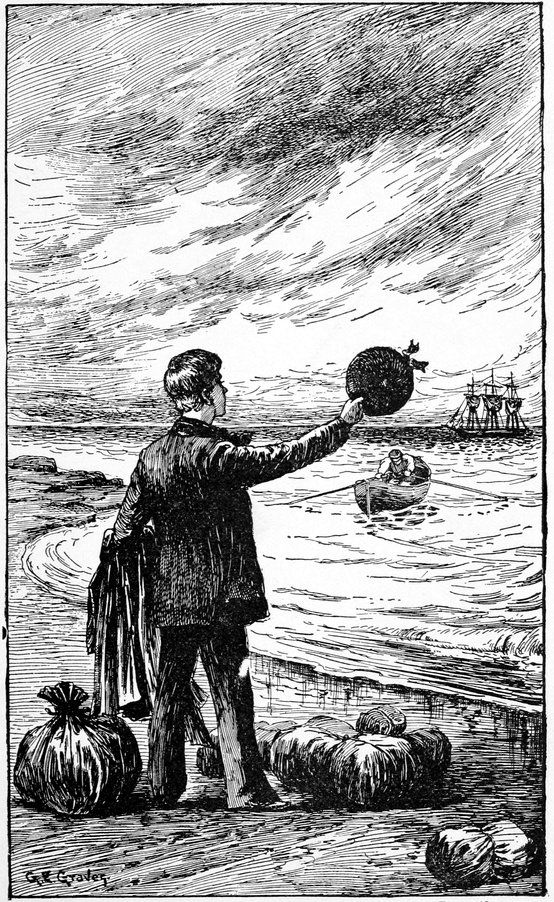
Ned Watches the Mate Row Back to the Ship.—Page 49.
49In a very few seconds Mr. Stout was ready to return
to the brig, and stopped as if to shake hands
with Ned; but evidently changed his mind, for instead
of so doing he leaped in the craft.
“Perhaps I’ll see you when we come back,” he
cried, and then pulled at the oars with all his
strength, keeping his eyes fixed on the bottom of
the boat to shut out from view the boy who stood
at the very edge of the water, gazing after the man
whom he believed to be his friend.
CHAPTER IV. MAROONED.
50
Ned remained exactly as Mr. Stout had left him
until the little craft was alongside the brig, hoisted
on board, and the Evening Star, swinging around
into the wind, was standing off on her course once
more.
During all this time the mate had not, so far as
he could tell, looked at him for a single instant, and
this apparent lack of sympathy puzzled Ned.
“I don’t see what makes him so queer,” he said
to himself as he watched the vessel rapidly drawing
away from the tiny island upon which he had been
landed. “The captain seemed kind enough while I
was locked in the state-room; but neither he nor
the mate acted as if they felt bad because I had to
go away.”
Then once more he wondered what leprosy was,
which necessitated his leaving the brig so suddenly,
and to neither of these mental questions could he
give a satisfactory reply.
The packages which had been brought ashore were
51too numerous to admit of his carrying them at one
load, and he decided to leave everything, except the
articles given him by the mate, on the beach until
he could locate the village.
The fishing-lines, knife, and matches he put in his
pockets, covered the other goods with the rubber
coat, and when the Evening Star had faded away
in the distance to a mere smudge on the horizon,
he set out in search of the inhabitants of the
island.
It was about noon when he came ashore, and
since then fully two hours had been spent watching
the brig.
The heat seemed intense, and the glare of the
sun on the white sands nearly blinded him.
“There’s no use standing here any longer,” he
said aloud after one more glance at the faint shadow
which marked the brig’s position. “If I don’t start
it’ll soon be dark, an’ then there would be trouble,
for a fellow can’t find his way around a strange
island very well when it’s impossible to see anything.
It seems kinder queer that I was so sick it
wasn’t safe for me to stay aboard the Evening Star,
an’ yet the captain thought it was all right for me
to walk a couple of miles when it’s hot enough to
melt the boots off a fellow’s feet!”
Then, with his eyes fixed on what appeared to
52be a clump of trees, in order that he might be certain
of traveling in a direct course, Ned set out,
trudging along resolutely, regardless of the heat,
which brought the perspiration from his face in tiny
streams.
The hard lessons of life which Ned had already
received stood him in good stead now. Without
them he might have weakened before this, the first
of many troubles yet to come; but he had known a
number of instances where a good deal more labor
than that of walking two miles had been required
of him, with no prospect of a reward when the task
was finished, and the question of fatigue hardly
entered his thoughts.
He believed he should soon arrive at a village
where he would be hospitably received as soon as
he informed the inhabitants that he had been set
ashore because of suffering from leprosy, therefore
the thought of what he would soon enjoy
served to pass the time more rapidly.
After half an hour’s steady walking he saw
that the point toward which he had been making
his way was indeed a clump of trees.
The grove was situated at the head of a small
bay which made in on the western side of the
island, and here the vegetation was almost luxuriant.
53Trees covered an extent of land fully half a
mile square, and sloping down from the higher portions
of the island to the water’s edge were bushes
and small plants in profusion.
To a fellow who wanted to “camp out” where
he would be free from intrusion, it was a beautiful
place; but to one in Ned’s situation, who hoped to
see houses as a sort of guarantee that he might find
something to eat, it was not cheering.
“I reckon the village is on the other side of the
grove,” he said to himself. “If I’d known where
to look for it in the first place I might have saved
quite a long walk.”
He was beginning to grow tired, and the heat
had caused such a thirst that water seemed an
absolute necessity.
Fortunately he was not forced to travel very
much further without a plentiful supply of this
most precious liquid.
After passing about half-way through the grove,
he came upon a small natural spring which apparently
gushed out of the coral rock, and here he
made a long halt, satisfying his thirst gradually because
of the intense pleasure of drinking when his
tongue was so parched.
The thing which struck him as most strange was
the fact that during all his travels he had not seen
a sign of human beings.
54From what he had noticed of the island while on
the brig, it did not appear to be very large, and he
failed to understand how it could be populated and
this portion so completely deserted.
“I mustn’t sit here thinkin’ about it,” he muttered,
rising to his feet. “It’ll be night before I
strike the hospital if I don’t keep moving.”
Straight through the grove he went, then on the
other side within sight of the water, but seeing no
signs of life, save when the birds swooped down
past him as if trying to find out what sort of
creature this was who had come among them so
suddenly.
He quickened his pace, and continued on with
grim determination until the sun sank behind the
waste of waters, and the shadows of night were
gathering more rapidly than he had ever seen them
before.
“I have surely walked three miles an hour,” he
said to himself, “and if it was two o’clock when I
started, I’ve got over not less than twelve miles.
Say it was three across from where I landed to the
grove, and that makes nine I’ve footed it around
the shore with——”
He ceased speaking very suddenly, and stood
silent and motionless staring in front of him on the
sand near the water’s edge.
55He had returned to the very place where Mr.
Stout put him ashore, for here were the packages
just as he had left them.
During at least five minutes he remained like a
statue gazing at the inanimate objects as if expecting
they would give him some solution to what was
a perplexing riddle, and then like a flash of light
the truth came into his mind.
“What a fool I have been not to understand the
whole thing before!” he exclaimed. “When I told
what I had heard from the pantry, the mate went
to the captain, and the two decided that it wouldn’t
be safe to let me go among the men, for fear I
might give away the secret. The idea of my bein’
sick was cooked up, I was kept in the state-room so
none of the crew could see me, an’ landed on the
first desolate island the brig came to. There’s no
show of people livin’ here, for I’ve followed the
water around, and nearly all the time could see
half-way across, so that part of the business is
settled. Now I’m to stay here till I die so’s I can’t
tell about their wreckin’ the brig.”
There was only one thing that prevented Ned
from giving way to the despair and grief which
came into his heart with the knowledge of the cruel
deed of which he was the victim, and that was the
certainty the Evening Star would soon be scuttled.
56“Perhaps I’m lucky in only bein’ set ashore here.
They might have kept me on board till the last
minute, an’ then left me to go down with the
vessel.”
Boy though he was, Ned understood that it was
in the highest degree necessary he should retain
control of himself, and instead of indulging in useless
grief, he set about making the best of what was
a very bad plight without a single redeeming
feature.
“There’s no use in goin’ hungry, an’ I may as
well see what we’ve got here in the way of grub,”
he said to himself as he unfastened the largest
package.
A cry of anger and disappointment burst from his
lips as the contents were disclosed to view.
The square of canvas contained nothing but
oakum and bits of rope.
Feverishly he opened the others, only to find
them filled with rubbish of all kinds.
The captain had doomed him to starvation, and
the different bundles were prepared to deceive the
crew, some of whom might have been suspicious
had the poor boy been set ashore with nothing to
eat.
Captain Bragg believed death would soon close
the lips of the one who had unwittingly learned his
secret.
57Ned no longer tried to act the manly part.
Anger was the first sensation after the terrible
discovery that he had been sentenced to a lingering
death, and he attacked the rubbish in a frenzy,
throwing it on every side and stamping upon the
fragments like a madman.
Then came grief and despair.
Seated on the sand by the side of what he had believed
was a generous supply of provisions, he gave
way to tears, and when this fit passed it was night.
He was too tired to retrace his steps to the
grove, the only place where could be found the
semblance of a shelter, even had he been disposed
to battle against the fate which seemed to beset him
on every side.
Stretching out at full length on the sand, he pulled
the rubber coat over him, and finally fell asleep
with a partially defined hope that death might overtake
him before he could awake to consciousness.
For a boy who had just been marooned and who
neither had provisions nor the means of procuring
any, Ned Rogers slept remarkably well.
Although the sand was by no means as soft as
the hard mattress in the state-room of the Evening
Star, he did not awaken until the rays of the sun
falling across his face banished the slumber from
his eyelids.
58For an instant he gazed around in wonderment,
not knowing how such a change could have been
made in his surroundings, and then the full knowledge
of all that had occurred came to him once
more.
His first impulse was to cry, and then he checked
himself resolutely as he said:
“Look here, Ned, it won’t do at all. I don’t remember
that you’ve ever been in quite as hard a
scrape as this; but I’m certain you know what it is
to be hungry, and this island ain’t half as tough as
runnin’ ’round Jonesboro hearin’ the folks say you
are bound to come to some wicked end. You’re
pretty near as bad off as Robinson Crusoe, an’ yet
he come around all right.”
Then Ned regretted not having read the book
more carefully when Frank Hubbard loaned it to
him, because if he had done so he might the better
have been able to decide upon his future course.
Rising to his feet and mechanically plunging his
hands in his pockets, he became aware of the fish-lines,
and with this very pleasant remembrance
came the thought that Mr. Stout had given him
these few articles with the kindly hope that he
might prolong his life.
“Perhaps he didn’t dare to do any more while
the captain was watching. Anyway, I oughter be
59able to catch some fish if I can find bait, and with
what matches I have got there won’t be much
trouble about building a fire.”
The mere fact that he knew what to do seemed to
give him no slight amount of mental relief, and he
started at a rapid pace for the tiny bay which ran
up into the grove.
“There will be fish in that place if anywhere, and
after breakfast I reckon it won’t be such a very
hard job to rig up some kind of a shanty,” he said
to himself as he walked along, keeping a sharp lookout
meanwhile over the surrounding waters in the
hope of seeing a sail.
There was not a craft of any kind in sight, and if
he had known exactly the position of Spider Key,
he would have understood that his chances of seeing
a vessel were very slight.
On arriving at the shore of the bay his first work
was to dig in the sand for worms, as he would have
done at Jonesboro; but on reaching the foundation
coral without finding other form of life than fleas,
he gave it up as a bad job.
Then he walked around the beach until he found
what looked like mussels, and breaking the shell of
one of these soon had his hook baited.
The shores of the bay were very bold, and it was
hardly necessary to use a pole in order to cast the
line into deep water.
60To the anxious fisherman it seemed as if the hook
had hardly reached the surface before the bait was
seized by a silvery fish, and a second later he had the
first portion of his breakfast on shore.
“With three fellers like that I’ll have all I can
eat this morning,” he said in a tone of satisfaction.
It surely seemed as if the fish of the bay were
eager to accept his invitation to breakfast, and before
one could have counted fifty he had a plentiful
supply.
The task of cooking them was more difficult than
the catching, because of his inexperience.
Instead of burying them among the ashes as
he should have done, Ned could think of no other
way than to toast the fish, by placing them on short
sticks stuck in the sand near the blaze.
This was a tedious and unsatisfactory way of
cooking, because while one portion was burning
the opposite side of the fish was growing cold; but
he succeeded after a certain fashion, and his hunger
was appeased.
There was no especial reason why he should work
very industriously, or, at least, he did not think
there was, and he seated himself within the shade of
the trees, remaining there until he fell asleep once
more.
When he awakened again it was afternoon and
time to think of getting supper.
61“This won’t do,” he said ruefully. “I mustn’t
go on simply eatin’ and sleepin’, otherwise when
it storms I shall be badly left. I wonder if the
queer clams I used for bait wouldn’t go well roasted?
It won’t take so long to cook them, and perhaps
I can yet make a good start on buildin’ a shanty.”
To kindle the fire and throw among the coals an
armful of mussels was not a long job, and then Ned
walked slowly through the grove to decide upon
the location of his proposed house.
He finally, after considerable discussion with
himself, concluded that it would be wisest to erect
the building within a short distance of the spring,
and near the head of the bay.
In order that he might have no difficulty in finding
the spot selected, he half broke, half cut down
a sapling, and then went back to the scene of his
culinary operations.
The mussels were well roasted; but, lacking salt,
they were not as palatable as the fish.
“These go a long way ahead of nothin’,” Ned
said grimly, “but fall mightily short of some grub
I’ve tasted in my day. After the shanty is built I
shan’t have anything to do but hunt ’round for
provisions, an’ it’ll be queer if I can’t manage to
catch one or two of these birds.”
He was rapidly getting rid of that terrible feeling
62of utter desolation which had at first come upon
him, and appeared as well able as any boy could
have been to provide against want.
The remainder of the day was spent in house-building,
and a slow task it proved to be. He had
no other tool than the pocket knife, and it was not
particularly well adapted to the hewing of trees.
He contrived to lop off some of the small limbs
and break down saplings enough to make the roof
of his shanty; but before anything more could be
done night had come.
Again he slept under the rubber coat, and despite
the fact of the noon-day nap his slumber was
long and profound.
He was awake by sunrise, however, and fully
determined to have something to show for this day’s
labor.
In order to economize time he made a breakfast
of roasted mussels, and then began to work with a
will on the building.
Before the sun set again he had put up a dwelling
which pleased him very much, save as to size.
It was not more than six feet square and about
five high, but it would serve to shelter him from
the rain, although a heavy wind might level it in
short order.
To four small trees which grew at nearly equal
63distance from each other he had lashed the main
timbers of the building, using creeping vines for
ropes, and placing them at as high a point as it
would be convenient to work.
Across these were tied other poles about four
inches apart, and over them were laid the broad
leaves of what appeared to be a species of banana
plant, the whole being bound down with vines.
The sides and one end of the shanty were inclosed
in leaves, and while the wind was not too boisterous
he had a very comfortable dwelling.
On this night Ned slept for the first time in his
life beneath his own roof, and there was such a sense
of satisfaction and proprietorship in the fact that
he almost forgot his desolate condition.
Next morning he was in no hurry to arise.
Having worked so hard on the previous day, it
seemed only fair he should indulge in a prolonged
resting spell.
Hunger forced him to venture forth before the
forenoon was very far advanced, however, and for
the second time he served up a meal of fish, which
were captured as readily as before.
After this two or three hours were spent trying
to snare some of the birds by making a slip noose
with one of the fishing-lines and placing within the
circle fragments of mussels.
64He had no difficulty in enticing the feathered
visitors to an examination of his bait, but they refused
in the most provoking manner to alight long
enough for him to fasten the string around their
legs, and he was forced to relinquish this method of
replenishing his larder.
“You’ve beaten me this time,” he said with a
laugh; “but just wait awhile till I rig up another
kind of a trap, and we’ll see who comes out best.”
The next most pleasing method of passing the
hours seemed to be by an examination of what he
had already begun to call “his farm,” and he set
out intending to make a full exploration in two
days, going half-way around on each excursion.
“If I only had a dog I believe this would be
a jolly sort of a place in which to live for a
month or so,” he said aloud, as if there was a
certain sense of companionship in the sound of
his own voice. “It’s goin’ to be mighty lonesome
after awhile.”
He had started on his exploring trip by following
the same course taken when he was searching
for the supposed village; but on this occasion he
walked nearer the water’s edge and kept a sharp
lookout for anything which might serve as food.
A few yards from the edge of the grove he found
a portion of the coral not covered by the sand, and
65on this was a fine white powder which he tasted of
eagerly.
“It’s real salt!” he exclaimed in surprise and
delight. “I reckon the sea-water has washed up
on it, an’ then the sun has dried the salt out. That’s
the way I’ve heard Deacon Grout say some folks
found it.”
As may be supposed, he was careful to gather up
the small amount which had been prepared by the
elements, and while doing so resolved to make
arrangements for getting as much as might be
needed in the future.
A leaf served as a salt-dish, and he carried it
carefully back to the hut, saying as he deposited
the precious powder where it could not be blown
away:
“To-morrow I’ll go after those pieces of canvas
the captain wrapped his bogus grub in and begin
this part of my housekeeping in ship-shape fashion.
The fish will taste mighty good to-night if I can
manage to cook them all over alike.”
When this had been done to his satisfaction he
started once more on the exploring tour, and after
having walked fifteen or twenty minutes was rewarded
by another “find” which seemed even more
valuable than the first.
This was neither more nor less than what appeared
66to be the hull of a small vessel almost entirely
buried in the sand, the ends of the framework
only showing above the surface.
“Now I can build me a house that won’t be in
danger of goin’ to sea when the first storm comes
on,” he said triumphantly. “The only thing is to
rig up something which will answer as a spade, and
the rest is just a question of hard work.”
CHAPTER V. A DISCOVERY.
67
Although Ned had never been shipwrecked, nor,
except in the case of the story about Robinson
Crusoe, had he ever read of such disasters, yet he
understood that before he gathered a supply of
food, in case such a thing should be possible, it was
necessary to have a substantial building in which to
keep it.
It was his intention to lay in a quantity of salt;
but in case he was forced to store it in the shanty
of leaves the stock would be destroyed by the first
storm of rain, and in fact it seemed as if all his
hopes of being able to hold out until some craft
should come within hail depended upon his having
a building sufficiently strong to resist the weather.
Therefore it was that he hailed the discovery of
the wreck as of the highest importance, and resolved
to work at her incessantly, save when it was necessary
to prepare food or sleep, until he had accomplished
his purpose.
In view of the fact that the only tool he possessed
68was a pocket knife, the task was gigantic; but it was
as if the difficulties in his path only served to increase
his courage.
He had said that all he needed was something
which would serve as a spade; but even with such
a modest want in his mind he was brought to a
standstill.
To hew down a tree sufficiently large to provide
him with material for a wooden shovel an ax would
be absolutely indispensable, and it was quite positive
there was no lumber to be found on the shores,
for he had already made nearly an entire circuit of
the key.
His joy at the discovery was lessened considerably
by the difficulty in the way of utilizing it,
and he studied over the problem a long while
without having arrived at a conclusion which was
satisfactory.
“It’s certain I can’t have a spade or anything
like one,” he said thoughtfully; “so the question is,
what else can I find to throw the sand away with?
I reckon those timbers are buried pretty deep, and
a fellow couldn’t do very much with only his
hands.”
In order to ascertain exactly what might be
accomplished with nothing in the way of implements
he began to kick and shove away the sand;
69but in a short time his fingers were made sore by
the sharp particles, and he realized that in less than
an hour of such work his hands would be blistered
and cut.
Then he walked slowly back to the grove and
looked around as if for an inspiration.
This was neither more nor less than a waste of
time, for the saplings were the only objects which
could be cut down with the knife, and these he attacked
at once.
“A fellow can’t make very much of a fist diggin’
sand with a stake,” he said as he worked; “but
so long as I couldn’t use my hands more than half
an hour, these poles will go, way, ahead of nothin’.”
After cutting down half a dozen small trees, the
trunks of which were no larger than his wrist, he
whittled the thickest ends flat and proceeded to the
work.
It was very much like trying to dig with a spoon;
but yet he made a certain amount of progress, and
when inclined to grow down-hearted because so
much labor was necessary in order to accomplish
very little, he repeated to himself again and again
that when a fellow has more time on his hands than
he knows what to do with, it can matter very little
how long it takes him to perform a certain piece of
work.
70When the night came he had uncovered a couple
of timbers down to where the planking of the vessel
still held comparatively sound, and found that he
was at the stern of the craft.
“She run head on to the key,” he said as he
stopped to rest before returning to his hut. “The
crew must have been asleep to strike here, for the
island shows plain enough.”
If Ned had been more experienced in such matters
he would have understood that the vessel unquestionably
came ashore many years before, when
the coral island was much smaller, and the work of
the minute creatures which have formed the fringe of
keys or reefs around the Florida coast had gradually
built under her, until now she was twenty or thirty
feet from the water’s edge.
Even to Ned’s inexperienced eyes the marks of
great age could be seen; therefore he had no hope
of finding anything amid the timbers which could
serve him in the slightest degree, except in the way
of materials for a hut.
“I don’t fancy there’ll be much of any trouble in
knockin’ the timbers apart,” he said as he went slowly
toward the place he was beginning to call “home.”
“By to-morrow night I ought to have a couple of
pieces loose, an’ I’ll set them up outside my shanty.
I can build around it, an’ when the wooden house
71is done it will only be necessary to pull the camp
of leaves out.”
A supper of fish seasoned with salt gave him a
most appetizing meal, and when he lay down to
sleep his eyes were soon closed in blissful unconsciousness
because of the weariness of body.
On the following morning but little time was
spent in the preparation for breakfast, and he began
once more the task of unearthing the wreck.
Having simply been pushing the sand up, quite a
high bank was formed, and it became necessary to
level this before the work could be continued.
By noon he found a prize in the shape of a short
piece of plank, perfectly dry despite the length of
time it had been covered by the sand, and an hour’s
labor with his knife served to convert it into a rude
shovel, with which he could do twice as much as
when the stakes were his only tools.
The outside of several timbers were laid bare,
and then, preparatory to wrenching them from
their fastenings, he shoveled from the inside near
the fragments of the stern-post.
About half an hour before sunset the wooden
scoop struck against a hard substance which he
knew could not be the “skin” of the vessel, since
it was much too high up from the keel.
Merely from curiosity, and not with any idea
72that he might be making a valuable discovery, Ned
labored only to ascertain what was concealed beneath
the sand, and before the night had fully
come, he was gazing in surprise at a small box covered
with rawhide and bound with iron.
It was about ten inches long and eight high, so
tiny that he anticipated no difficulty in raising it,
but, to his astonishment, found it required the exercise
of all his strength to pull it from the bed of
sand in which it had lain so long.
“I’d like to know what’s inside,” he said as he
stood looking at the small but exceedingly heavy
package. “There’s no hope of breaking it with
one of the poles, for the rawhide would hold it together,
even if I should splinter the wood. I reckon
it wouldn’t be a bad idea to burn one end off.”
This last thought seemed to be a happy one, and
the boy set about carrying the “find” to the hut.
It required all his strength, and more than once
was it necessary for him to rest, but he finally succeeded,
the last portion of the journey having been
made after nightfall, and once at the place where
the camp-fire was usually built, he forgot about
supper.
He was curious to see the contents of the odd
box, and this desire was greater than his hunger.
Building a glowing fire, he placed the case in such
73a manner that only one end would be affected by
the flames, and as the rawhide began to crackle and
shrivel it suddenly occurred to him that the package
might be filled with cartridges.
“If it is I reckon this is no place for me,” he said
in something like alarm, moving off a short distance,
and then recovered his composure as he added:
“The danger can’t be great, no matter how much
powder may be there, for the box must have
been under water a long time, an’ I don’t allow fire
could do it any harm.”
Now he approached sufficiently near to heap the
coals up as the wood began to smolder; but despite
the amount of fuel expended, it was fully an hour
before his purpose was accomplished.
One end of the case was now so charred that he
anticipated little difficulty in forcing it open with a
stake from the roof of his hut, and the package
was drawn back to a comfortable distance from the
flames.
A heavy blow with the largest piece of wood he
could find, a dull, metallic sound, and Ned stood
transfixed with surprise.
From out the half-burned box poured a veritable
stream of silver coins, more money than Ned had
ever seen before in all his life.
During several moments he remained silent and
74motionless, gazing at the wonderful find as if fearing
it might suddenly disappear should he take his
eyes from it, and then he needed no further proof
that it was real—not a phantom conjured up by a
weak or disordered brain.
There could be no question as to the fact that the
pieces were silver, and mostly of the denomination
of dollars from the Mexican mint. Although Ned
had never had the pleasure of handling many such
coins, he knew there was no deception about the
contents of the box, and during a certain length of
time he was literally beside himself with astonishment
and joy.
He had forgotten how he chanced to be on that
lonely key, and heeded not the fact that it might
be years before he would find an opportunity of
reaching the mainland, or the chances of being
unable to carry his treasure with him when, if ever,
he did go.
The only thing clear to his mind was that he, the
pauper of whom it had been predicted that “some
bad end surely awaited him,” was virtually rich.
Without making any attempt to count the coins,
he believed there was sufficient to satisfy his every
want no matter how long he might live, and this
crowded aside all other thoughts.
Two hours later he, like every other person who
75has unexpectedly come into possession of a fortune
without being forced to toil for it, suddenly bethought
himself that he had been content with a
single box.
If one had been hidden there so long, why might
there not be many more in the same place?
A few moments previous he had been perfectly
content with what he had and his own forlorn
position. Now his greatest desire was to find more;
but yet he could not leave unguarded the precious
metal.
It is true that there was no one on the island to
rob him; but yet it did not seem safe to go away
even for a single instant while it was thus exposed
to view, and at once he set about making a hiding-place,
first heaping high the fire with branches
which he tore from the trees with a fictitious
strength born of his excitement.
Then—and this time he regarded not the fact
that the sand would cut his fingers—he scooped
away the loose soil with his hands until the foundation
of coral was brought to view.
On this, placing the coins in even piles, he stacked
up the treasure until it covered a space of six or
seven square inches, after which it was carefully
covered with sand once more.
Then came the thought that the box might betray
76him in case any one should come suddenly,
and he flung it on the fire, watching jealously until
every portion had been consumed.
The hiding-place of his wealth was trampled upon
until even the most scrutinizing search would have
failed to reveal the fact that the surface had been
disturbed to any great depth, and then he started
once more toward the location of the wreck, hardly
giving heed to the fact that the key was shrouded
in darkness.
He was made sensible of this before trying to
walk very far, however, for after having taken
twenty steps he ran into a small tree, striking his
nose such a blow that the blood flowed freely.
This had the effect of restoring to him at least a
portion of his scattered senses, and he made his way
back to the fire, stanching the flow of blood with
the sleeve of his coat.
“It seems a good deal as if I’d been makin’ a big
fool of myself,” he said with a nervous laugh, “an’
I don’t know that it’s to be wondered at. When a
feller who never owned a whole dollar in his life
has ’em come tumblin’ in on him the way them did,
he’s likely to get rattled. I needn’t be in such a
hurry to get at the rest, in case there’s more to be
found, for, ’cordin’ to the looks of things, I shall
have plenty of chance to dig the old craft over two
77or three times before anybody happens this way to
help me off. Most likely Captain Bragg took good
care to land me where vessels never come, for it
would go hard with him if I should get back to tell
my story when he was anywhere around. The best
thing is to get some sleep now, an’ in the mornin’
I’ll have a hunt for more dollars. I wonder what
they’d say on board the brig if it was known I’d
fallen into such a snap?”
Ned looked once more at the place where he
buried his treasure to be certain he left no traces
which might show what had been done, and then
lay down beneath his shelter of leaves; but sleep
did not come at his bidding as quickly as on the
previous night.
Then he had not a penny or the means of getting
one, so far as he knew, and yet his rest was unbroken
and refreshing. Now that he was comparatively
wealthy slumber refused to visit his eyelids,
and the sensation of perfect repose was denied
him.
As he lay there thinking over the good fortune
which had come to him so unexpectedly, a pattering
on the leaves above caused him to start up in alarm.
Then he laughed heartily, for the noise was
occasioned by the falling of rain.
“Here I am playin’ the fool again,” he said
78grimly. “If it hadn’t been for that money I should
never have thought of bein’ frightened just because
of such a little noise. But say, if it storms very
hard I shall be likely to have a rough night of it in
spite of all my silver!”
The rain descended more rapidly, the wind
moaned among the trees, and the sullen roar of the
surf came from the beach.
“The sand I shoveled out this afternoon will all
be blown or washed back,” he muttered, “an’ I
shall have to do the work over again; but I reckon
it won’t be so hard now I know what it’s possible to
find.”
The storm came up rapidly.
In less than ten minutes from the time the first
drops of water fell, it seemed to Ned as if a perfect
hurricane was raging.
The fire was extinguished with many an angry
hiss and splutter, and shortly after the illy secured
roof of the shanty was blown away like a dry leaf,
while the sides and end soon went to keep the other
company.
It was useless attempting to avoid the down-pour.
In less than three minutes from the time his shelter
was borne off on the wings of the storm, Ned was
as wet as if he had been indulging in a bath without
undressing, and the only thing he could hope to
79do was to prevent his precious matches from getting
wet.
The salt had taken French leave with the first
puff of wind, and to save his only materials for
kindling a fire, Ned deprived himself of his coat,
wrapping the garment around the small supply of
“fire sticks.”
The bundle he carried under his arm, or, rather,
held it there while he clung to a tree to prevent
himself from being blown bodily into the sea.
In this manner he passed the remainder of the
night, and it seemed as if the morning would never
come.
He did not dare to leave the spot to which he had
first fled for safety, although many times it seemed
as if the tree would be uprooted, for the darkness
was so intense that he could not have seen his own
hands if held within a few inches of his eyes.
But in the midst of all this discomfort, and even
danger, he thought of the treasure continually,
wondering if he would have much trouble in finding
the place where the silver was buried after the rain
had obliterated his landmarks.
The morning broke gray and forbidding.
The huge waves rolled up on the beach as if intent
on submerging the tiny key, and breaking on
80the shore with a force that caused the island to
tremble under the blows.
There was no promise in the sky that the storm
would soon subside, and Ned gazed in dismay at the
ruin which had been wrought.
CHAPTER VI. THE ZOE.
81
Although Ned had not progressed very far in the
way of building a habitation, it seemed to him as if
the gale had swept away what little he could call
his own.
Not only was the hut demolished, but he had
great difficulty in deciding where it had been located.
The last vestige of the fire was effaced, and
with it was gone all accurate means of ascertaining
the exact place where the silver was buried; but
this did not trouble him particularly, because he
knew it would not require any very lengthy search
to find it again.
In the grove more than half the trees had been
leveled to the ground, and one glance was sufficient
to show that he would have quite a task before
him in order to make his way through the tangle
of boughs and foliage.
All this he took in at one hasty glance, not troubling
himself with regard to the details, for just at
that moment his chief concern was as to what he
should do for food and shelter during the day.
82“I reckon it’s a case of holdin’ on here a while
longer,” he said to himself, “for if I once let go my
hold it might be hard work to get back again, and,
besides, it’s easier to keep the matches dry as I’m
standin’ now. There don’t seem to be much of a
show for gettin’ anything to eat yet awhile. Even
if it was possible to build a fire I wouldn’t be able
to catch any fish or find the clams. If I hadn’t
made such a fool of myself over the silver I’d got
supper last night, an’ shouldn’t be so hungry now.”
Regrets were useless, however, as he soon realized,
and all he could do was to cling to his tree
and hope the strength of the wind might abate as
the day grew older.
In this last respect his wish was granted.
By ten o’clock the force of the gale had sensibly
abated, although even then the wind was blowing
harder than Ned ever experienced it before.
It was now possible to leave the shelter of his
tree without incurring imminent danger, and he
worked his way further among the fallen timber in
the hope of finding some place where the matches
could be left, for even the strain of holding them so
tightly was beginning to tell upon him.
There were plenty of opportunities to deposit his
precious package, but not with any certainty that
it would be kept dry, for there was water everywhere,
83until it seemed certain the key must be submerged.
He finally decided to leave the bundle under the
trunks of two small trees which had been uprooted,
and then crept out to where a full view of the sea
might be had.
An exclamation of fear and dismay burst from his
lips as he stood where he could gaze out over the
angry waters, for in full view, and not more than a
mile away, was a small craft, tossed to and fro like
an egg-shell, but being driven rapidly toward the
key.
It was some time before Ned could discern her
rig, and then he discovered that she was a steamer,
but a tiny one. Probably some pleasure yacht
which had been driven to sea by the fury of the
gale and was now unmanageable.
She was almost on her beam-ends, and each time
the gigantic waves lifted her on high Ned fancied
he could see two forms lashed to the port rail, which
was to windward.
Every few seconds she would be carried down,
down into the trough of the sea until it seemed as
if the storm king was bent on sending her to the
bottom, and when she rose again it was with that
uncertain, sluggish movement which tells of the
weight of water within the hold.
84“If she strikes here those poor men are doomed,”
Ned cried, much as if fancying some one could hear
his words, “and there’s nothing I can do to help
them! A fellow would be swept off his feet the
instant he so much as touched the surf line!”
That the yacht would strike the shore there could
be no question.
If it was possible to guide her into the little bay
there might be some chance for those on board to
save their lives, for there the surf was not quite so
violent; but the apparently doomed ones could not
alter the course by so much as a hair’s-breadth.
The beautiful craft was but a plaything for the
waves, and as helpless as a wounded bird.
Ned gazed at the terrible scene as if fascinated.
For the first time since the discovery of the
treasure did he forget that such a metal as silver
had an existence. All his thoughts were centered
on this evidence of the storm’s fury, which must
apparently soon be blotted from view, and with it
would go the lives of two human beings.
Almost unconscious of what he did, Ned walked
down toward the water line, until he was as far as
it was safe to venture, and once there, fancied he
saw one of the figures wave its hands as if imploring
him to render some assistance.
85“I wish I could do it!” he shouted, as if thinking
the sufferers could hear him. “I haven’t got a
boat, an’ even if I had, she couldn’t be launched in
this surf!”
He took no heed of time.
He only knew that the yacht was coming broadside
on very rapidly; but whether five minutes or
five hours had elapsed from the moment he first
saw her, it would have been impossible to say.
When she was not more than a hundred yards
from the shore the waves swung her around until
he could see in gilt letters on her stern the name
Zoe.
Then she went down once more into the chasm
of waters, and on rising again, it was apparent that
the end had come.
Up, up, up until it seemed she was directly above
his head did the wounded craft rise, and then, as if
impelled by some terrible force from seaward, she
shot landward, coming so near where Ned stood
that he involuntarily leaped aside, fearing the hull
might crush him.
There was no very heavy crash as she struck, or
if there was Ned failed to hear it.
It seemed to him as if the waves had left her
gently on the sand and then ran back to gather
fresh impetus before pounding her to pieces.
During such a time as one might have counted
86ten she was literally high and dry, and in that short
interval Ned had sufficient presence of mind to
shout:
“Jump! Jump now while you’ve got the chance,
an’ I’ll catch you!”
One of the two obeyed, throwing himself, rather
than leaping, from the deck, which was almost perpendicular,
and Ned rushed forward, seizing him by
the coat just as the waves returned with an angry
howl and roar.
Instantly on touching the sand the sufferer staggered
forward and fell on his face, where he lay like
one dead; but Ned managed to drag him beyond
the reach of the surf and turned his attention
to the other.
“When the water goes back you must jump!” he
shrieked, and this command was emphasized by the
violent rolling of the little craft as the sea nearly
turned her over. “One more wave like that an’
it will be too late!”
The words were understood, and two minutes
afterward Ned was dragging the second body high
up on the beach; but whether or no he had succeeded
in saving life it was impossible to say.
Both the rescued ones lay on the sand as if dead,
and Ned gazed at them helplessly, not knowing
what should be done.
87To his surprise, for until this moment he had not
had any time to note details, he saw that both were
boys about his own age, and even at this dreadful
moment, when it was a question whether they were
yet alive, he wondered how it was that two young
fellows should be alone on a yacht like the one
which promised speedily to become food for the
waves.
While he stood looking at them helplessly, the
one who had first reached the shore opened his eyes,
stared around in alarm, and then attempted to rise
to his feet.
He was too nearly exhausted to permit of such an
exertion, and would have fallen backward had Ned
not seized him by the coat collar again.
“Better lay still awhile,” he said soothingly, “an’
you’ll soon get your strength. There isn’t such a
thing on the island as a house, or I’d try to get you
under cover. As it is you’ll have to stay out of
doors till something can be rigged up for a shelter.”
“I’m all right; but where is Roy? Didn’t he get
ashore?”
“If you mean the fellow who was with you,
you’ve only got to turn around in order to see him.
He don’t show up very lively yet awhile, but I
guess he’ll come ’round all right after a time.”
As a means of bringing the yet unconscious boy
88to his senses, Ned shook him violently and persistently
until the sufferer opened his eyes in a
languid sort of way.
“Are we safe, Vance?” he asked feebly.
“Indeed we are, even if it did look so blue a few
minutes ago. The yacht was thrown directly up on
the bank, almost above high-water mark, and all we
had to do was to drop off.”
The knowledge that he was safe when death had
seemed positive served to revive the boy wonderfully,
and before five minutes had passed both the
shipwrecked ones were staring at Ned as if asking
how it was he happened to be there.
“I s’pose you want to know if I live here?” he
said cheerily, for the fact that he had companions
was a wonderful relief in his loneliness; but even as
he spoke there came the thought that the arrival of
these two might put an end to his treasure-seeking
unless he should be willing to share with them.
“How did you get here?” the boy who had been
called Vance asked.
“I was set ashore from the brig Evening Star
so’s Captain Bragg could wreck her; but it’s too
long a story to tell now. Wait till things are a
little more comfortable, an’ then I’ll give you the
whole yarn. Where did you come from?”
“Key West.”
89“Were you running the steamer alone?”
“We had three men with us,” Vance replied with
a shudder, “but all of them were washed overboard
during the night. I’d rather not talk about it just
now. How do you feel, Roy?”
“As if somebody had been beating me until every
bone in my body is broken. What’s your name?”
he added, turning to Ned.
“Edward Rogers.”
“My name is Roy Harland, and this is my cousin,
Vance Stewart. Have you been here long?”
“Since the day before yesterday.”
“Isn’t there any place where we can get in out
of the storm? It seems as if I should feel better if
I could get dry once more.”
“I built a shanty of leaves and poles, but the
wind moved it for me last night in fine style. It
took about ten seconds to get rid of the whole
establishment.”
By this time the boys thought of the yacht, to
which no attention had been paid since Vance first
recovered consciousness.
She was laying on her beam-ends with the waves
pounding against the timbers with a force that
threatened to convert the hull into kindlings, but
Ned fancied the waters had receded somewhat since
he first ventured down to the shore.
90“I suppose she is bound to go to pieces,” Roy
said mournfully as he gazed at the little craft.
“I’m not so certain about that,” Ned replied.
“It strikes me the sea isn’t runnin’ quite as high
as it was an hour ago, and if you’ll notice, the
water doesn’t come up as far as it did.”
As he spoke he pointed to the line of foam and
drift which had been left on the sand some time
previous, and all three watched it several moments.
“It’s certain the waves are not reaching that
mark,” Vance said with a sigh. “Perhaps the little
craft won’t go to pieces after all.”
“It ain’t likely you’ll ever see her afloat again.”
“That may be; but if she holds together we
shall have a good supply of provisions, and I don’t
fancy you’ve got more than you need.”
“My stock is yet to be caught. All I’ve had so
far is fish, with a few clams that weren’t very good,
an’ I couldn’t get breakfast this mornin’ because
of the storm.”
“The Zoe is well fitted out, and in addition to
plenty of provisions, we shall be able to get from
her canvas enough with which to make a tent.”
“If that’s the case we’d better keep a mighty
sharp lookout, so if she does go to pieces we can save
some of the stuff,” Ned replied eagerly, for the idea
of having a shelter which would be water-tight was
91particularly pleasing to the boy who had had a
short but rather unpleasant experience in a less
substantial dwelling.
Vance suggested that they go into the grove,
where the party would be partially sheltered from
the wind, but Ned refused to leave the beach. He
insisted that it was in the highest degree important
to be on hand in case the yacht went to pieces, and
the others would not venture alone.
Inch by inch the water receded until the wreck
was in such a position that it would be possible to
board her by wading a short distance, and Ned
proposed that the work of salvage be begun at
once.
“I can send down a lot of stuff by going aboard
an’ riggin’ a block on the flag-staff,” he said, but
the others thought it best to wait until the storm
had cleared away.
By noon the rain ceased falling, and Ned built a
fire after some difficulty, owing to the dampness of
everything, including the matches, and then, as Roy
and Vance began to feel the pangs of hunger, they
agreed that it was time to get some of the stores
ashore.
Ned clambered aboard, the boys directing his
movements, and if Vance had not interfered, he
would have landed each article as it came to hand.
92“There is no sense in doing that until we have
something in the way of a tent to keep the stuff
dry. There’s little danger of another storm right
away, and we may as well do the thing properly.”
“Well, what do you want first?”
“Get enough out of the pantry for dinner, and
after we’ve had something to eat we’ll set at work
on the tent. There are a lot of old sails in the forepeak,
and we shall have canvas in plenty.”
Ned selected about three times as much provisions
as the little party could eat at a single meal,
for the yacht had everything on board to tempt
one’s appetite, and the castaways made a hearty
dinner of the choicest canned goods.
Ned sent ashore cooking utensils in abundance,
and Roy, who proved to be no mean cook, served
up the different dishes in a manner far excelling
anything in the culinary line Ned had ever seen.
“Now, this is what I call comfort,” the marooned
boy said when he had rather more than satisfied his
hunger, and the sun came out from behind the
clouds, thus giving them an opportunity of drying
their clothing. “It wouldn’t be a bad idea to get a
little sleep; I didn’t close my eyes once last night,
except when the sand was flying so thick that it
was necessary.”
“Neither did we,” Roy replied, “and I’d like a
93nap this minute, but I don’t think we can afford
the time just now. We ought to get at least one
tent up before dark.”
Ned was by no means a lazy fellow, and thinking
it incumbent to do the largest share of the work
since his new acquaintances were supplying all the
provisions and comforts of life, he leaped to his
feet at once.
Vance went aboard the wreck with him, and in
less than an hour they had on shore the sails, tools
with which to do the necessary labor, and an additional
supply of food.
Bedding sufficient for the party was the last on
the list, and after this had been procured the boys
began the work of hut-building.
His previous experience had taught Ned how essential
it was to secure everything in such a manner
that it could not be blown away, and the tent
which was to be used as a sleeping apartment was
erected in a workmanlike fashion.
Two trees growing at the desired distance apart,
near the spot where the silver was buried, served as
the uprights for the ends of the camp, and to these
a ridge-pole was lashed firmly.
Across it was spread the largest sail, and the
edges pegged down until one would have said a
hurricane could hardly make any impression upon
it.
94The ends might be closed with blankets, or sail-cloth if necessary, but owing to the warm climate
it was not thought advisable to shut themselves out
from a plentiful supply of fresh air until a storm
should render it imperative.
It was nearly nightfall when this work had been
completed to the satisfaction of all hands, and then
Vance went on the wreck once more for lanterns.
“We may as well make things look as cheerful
as possible,” he said, “and it’s a good deal more
pleasant to have a light after the fire goes out than
be in the darkness.”
“If you say the word I’ll get the stove from the
cook’s quarters,” Ned suggested. “It isn’t very
large, an’ I could almost handle it alone.”
“I think we’d better leave that until morning.
It will take quite a while before we got it going, because
coal must be brought ashore, and Roy can
get us up one more meal on your fire.”
Ned was satisfied with any arrangement they
might wish to make, but he insisted on having a
couple of pails for fresh water to prevent the necessity
of running to and fro from the spring so
often, and these Vance brought with the lanterns.
The amateur cook prepared as tempting a supper
as he had the dinner, and when all had done it full
justice the dishes were placed outside the tent to be
95washed in the morning, for night had now fully
come.
Ned piled the fire high with wood, for since he
had an ax the labor of preparing fuel did not seem
very great to a boy like him, who had always been
forced to perform such laborious tasks, and then he
lay down on one of the yacht’s mattresses, feeling
that he had every reason to be thankful for the
change in his surroundings.
“Now tell us how you happen to be here,” Roy
said. “We’ve got plenty of time, for we don’t want to
go to sleep immediately after supper, and when you
have finished Vance and I will explain how it is
the yacht came ashore with only us two as a crew.”
CHAPTER VII. THE DISASTER.
96
Ned not only told the story of his being marooned,
but gave a detailed account of his life from
his first recollections to the present day, and when
this rather long narrative was ended, Roy began according
to agreement.
“Vance’s father and mine live at Tampa, in
Florida, during the winter, but they haven’t come
down yet. We were allowed to start ahead of the
two families because just at this time it is a question
to be decided whether we attend school any
longer or call our education finished and go into
some kind of business.
“The Zoe hails from Key West, but she has
been chartered by Vance’s father for the season,
and we had permission to cruise in her as far as
Savannah, with her regular crew, of course, at
which port we were to meet our parents and carry
them around to Tampa.
“We had on board day before yesterday a sailing
master, an engineer and his assistant. Vance and
97I acted as stewards. I don’t know where we were
when the storm came up, but had heard the master
say he should run close up the chain of keys. Of
course you know the hurricane began in the night,
and since Vance and I were both below, we had no
idea of the nearest land.
“I was awakened by the pitching and tossing of
the yacht, and as it made me feel rather sick I
thought it would be wisest to remain where I was
instead of venturing on deck, where there was little
chance of seeing anything.
“It was nearly daylight when Vance realized
that something unusual was going on, and then he
felt so nearly the same as I that it was a case of
both remaining where we were until I thought I
heard a scream from the deck. Twice it appeared
as if some one was calling me by name from a distance,
although Vance declared I must be mistaken,
and then I managed to get on deck to investigate.
“Even then it seemed as if the little craft was under
water more than half the time, and while I stood
in the companion-way wondering whether it was safe
to attempt to go forward, a wave broke over the
stern and literally drowned Vance out of his berth.
He yelled for me not to make a fool of myself by
keeping the door open at risk of swamping the
steamer, but to come back, and just at that instant
98I saw the engineer in the pilot-house waving his
hand for me to join him.
“From the expression of his face, and the fact
that he was at the wheel instead of where he belonged,
I knew there was something wrong; but
since it would have been worse than useless to have
gone across the deck just then, and I’m inclined to
believe the best sailor in the world couldn’t have
done it, I ran below, through the passage into the
engine-room, and from there to the pilot-house.
“You can fancy how startled I was at seeing no
one attending to the machinery. Both Vance and
I had been taking lessons in running the craft, and
the engineer continually impressed on our mind the
necessity of always keeping a strict watch on the
engine. After learning that this portion of the
yacht was ‘going it alone,’ I got to the wheel as
soon as possible, and there found no one but the
engineer.
“Without waiting for me to ask any questions he
said that the master and his own assistant had been
washed overboard and drowned half an hour ago.
It seems the engineer had sent the young fellow to
the wheel-house to carry some coffee which had
been prepared on the boiler during the night, and
the poor man slipped just as he opened the door
leading from the deck to the wheel. A big wave
99carried him over the side, but he clung to the rail,
and the sailing master ran out to help him.
“Just at that moment another wave swept the
yacht fore and aft, carrying both the unfortunate
men with it, and the engineer saw the whole
thing without being able to aid them in the slightest.
The steamer, with no one at the helm, began
to yaw, and would have been swamped then and
there if he hadn’t run to the helm. From that
moment until I appeared at the companion-way he
had been shouting for us. The engine and the fires
needed attention, but he couldn’t go below until
some one relieved him from the steering.
“I knew a little about such things, and since we
were running on a course which it had been the
sailing master’s intention to hold until noon, there
was nothing to do but keep her by the compass.
The engineer went below, and after what seemed
like a very long time, Vance, worried because I had
not come back, went into the engine-room. Ten
minutes later he was with me, looking about as pale
as any fellow you ever saw.”
“I couldn’t have been much whiter than you
was,” Vance retorted.
“I’m willing to admit that,” Roy replied, “for I
was as frightened as I well could be, and the
thought that two out of our crew of three were
100dead didn’t tend to make the situation seem any
more cheerful.”
“Could you have run the yacht to Savannah if
she hadn’t got wrecked?” Ned asked.
“We might, but only by pure chance, and then it
would have been necessary to heave to at night.
The engineer confessed that he couldn’t do it, so
you can see that even then matters appeared to be
about as bad as possible, though we soon had good
proof they were not. For two hours more we
staggered along as best we could, and it seemed to
me that the yacht was completely under water
half the time. Then the engineer came to tell us
that Vance must come into the engine-room with
him. Something had gone wrong and he needed
assistance.
“Vance went, and when they arrived there the
engineer discovered that several of his tools were
in the forepeak. He started after them. I saw
him come on deck and tried to make him go back.
At that moment the engine stopped suddenly; the
yacht seemed to be filled with steam, and when it
was possible to see anything more the engineer had
disappeared, probably washed overboard as the
others had been.
“Of course it was useless to stand at the wheel
while there was no steerage-way on, and Vance and
101I had begun to discuss whether it would be possible
for us to hoist one of the sails in order to keep her
before the wind, when the final disaster came.
“I can’t describe how it happened, but in an
instant she was on her beam-ends, and every movable
thing, including both the boats, was washed
away. I didn’t feel so very bad when the tenders
went, because they would have been of no service to
us in that sea, even if we could have gotten them
free from the davits, which I doubt.
“From that hour until you saw us we could do
no more than cling to the rail waiting for the last
moment to come, and many times did it seem certain
the wreck was going to the bottom. I gave up
all hope when the engineer was washed overboard,
and never saw a ray of promise again, even when
you shouted for us to jump.”
“Well,” Ned said reflectively after a brief pause,
“now we’re here, what’s the chance of ever gettin’
away? The yacht might be floated, but the question
is whether you could run her.”
“I don’t know but that the machinery is injured
so badly we couldn’t even turn the screw. Don’t
you suppose some kind of a craft will come along
this way pretty soon?”
“I’m afraid not,” Ned replied. “You see, Captain
Bragg most likely set me ashore in a place
102where there wasn’t much chance anything like that
would happen, otherwise I might have told my
story before he had an opportunity to collect the
insurance.”
“That’s true,” Vance replied sleepily. “I’ll
venture to say, though, that we shall come out all
right in a few days, even if it is necessary to take
to a raft. So let’s go to sleep now. I feel as if I
hadn’t closed my eyes for a week.”
Roy was quite willing to act upon this suggestion,
and in a very short time the two were sleeping
soundly; but Ned could not compose himself for
slumber so readily.
The question of the treasure troubled him considerably.
If he should reveal the secret the boys would
most likely claim their share, and although he now
had very much more than he had ever expected to
own, it was hard to part with a single piece.
In case he did not tell them, how could he take it
away?
If any craft came along and they had an opportunity
of leaving the key, he could not carry the
treasure with him unknown to his companions, and
would also be debarred from searching for more.
“I shall have to let them into the snap,” he said,
with a sigh. “It’s too bad, but I don’t see how it
103can be helped. In the morning I’ll show what I
found, an’ we’ll begin work on the wreck.”
With this resolve his mind was freed from the
greater portion of the trouble which had weighed
heavily upon it, and he fell asleep.
When the boys awakened on the following morning
the scene which met their gaze was really a
cheerful one, save for the disabled steamer lying
half-submerged on the shore.
She alone told of disaster.
The waves were shimmering like gold in the rays
of the sun; the foliage was of the densest green,
with the white tent at the edge of the grove like
a jewel on a piece of rare enameling, and as a
background the yellow sands, which sparkled like
silver.
Ned stood at the door of the tent drinking it all
in until Vance, awakening, cried:
“What is the matter? Do you see a craft?”
“There’s nothin’ in sight. I was lookin’ around
and thinkin’ that, accordin’ to the way things appear
this mornin’, it isn’t such a terrible thing to
be either marooned or shipwrecked.”
“Not after a fellow has gotten safely ashore;
but as for going through the experience, I’ve had
enough in mine. I don’t believe I shall ever again
feel perfectly safe on the water, no matter how big
a craft I’m in.”
104The hum of conversation awakened Roy, and he
heard the last remark.
“Nonsense!” he cried with a hearty laugh. “If
we get off this island safely, it won’t be a week before
you’ll be trying your luck in the first boat that
comes at hand.”
“Wait and see.”
“That’s what I shall have to do. I reckon I’m
booked for the most of the cooking, as I did on the
Zoe, and I happen to fancy some fried fish. If you
two fellows will get the stove on shore, I’ll try my
luck with one of Ned’s lines.”
Ned was eager to see what Roy could do in the
culinary department when he had every convenience.
He had proved himself such a success as a cook on
the evening previous with nearly everything lacking
that the breakfast should be a marvel, and he
started on without waiting to hear what Vance had
to say on the subject.
Lying on her beam-ends as the little steamer was,
the task of getting the stove ashore was not a difficult
one.
The kitchen was on the port side, and she had
been flung upon the starboard rail, consequently
they would not be impeded by the water. It was
only necessary to pull the small range up, and then
let it slide down the almost perpendicular deck.
105Roy had not brought his labors as a fisherman to
a close when the stove was in position near one end
of the tent, and Ned began making a swinging-cap
to the pipe in order that it might not be necessary
to move the entire apparatus whenever the wind
shifted.
Vance brought another supply of provisions on
shore, and marked out a site for the cook-tent, saying
as he did so:
“The sooner we get a second camp up, the sooner
we can begin to bring the stuff ashore from the
steamer. I figure that we’ve got enough canvas to
make another tent as big as the first, and it will
give us ample room for all our supplies.”
“And we can’t get them on shore any too soon,
according to my way of thinking,” Roy added as he
finished cleaning the fish. “No one knows when
another storm may spring up, and I don’t believe
the poor old Zoe would stand a second such beating
as she got yesterday. It may be we haven’t many
days left in which to strip her.”
“We’ll begin as soon as breakfast is over. It
won’t take more than two hours to put up the other
tent, and by nightfall there should be enough here
to last us a good many months, if we don’t get too
extravagant and serve bacon with our fish,” he
added laughingly as he saw what Roy was preparing
to do.
106“If you knew very much about cooking you
wouldn’t grumble at anything like this. All first-class
cooks, including myself, serve bacon with fish.”
“Not when they are cast away with no chance of
replenishing their stores.”
“I can’t say as to that until after making inquiries,
but I’ll let you know at the first convenient
opportunity. Breakfast is ready, if the boarders
will please arrange themselves on the ground in
proper attitudes.”
“I’ll start the thing,” Ned said as he seated himself
near the stove, “an’ after we’ve eaten our full
I’ll show you fellows something that’ll make your
eyes stick out more’n they ever did before.”
“Something connected with the island?” Vance
asked.
“Yes.”
“Then tell us now, or I shall spoil my breakfast
trying to guess what it is.”
“It would spoil your breakfast for a certainty if
I should even hint at it, and this grub is too good
to be wasted.”
Neither Roy nor Vance fancied for a moment
that their companion could have any very important
secret, but they bantered him to reveal it until the
last fish and slice of bacon had disappeared, when
he said with an air of seriousness which surprised
them:
107“Put the dishes away while I go aboard the
steamer for a shovel, an’ when I come back you’ll
get the biggest kind of a surprise.”
The boys understood from the tone in which Ned
had spoken that he was not trying to make sport of
them, and both watched him earnestly as he returned
with the necessary tools for unearthing his
treasure.
“Now keep your eyes peeled,” he said as he
began the work, “an’ tell me what you see.”
Exclamations of surprise burst from the lips of
the boys when the piles of silver were exposed to
view, and Ned turned the pieces over much like a
miser counting his hoard.
“Is this all yours?” Vance cried as soon as he
had recovered from his surprise sufficiently to be
able to speak.
“I reckon it is, seein’s how I’m the first one to
find it.”
“Find it?” the boys cried in concert.
“That’s what I said. It was in a box, but I
didn’t have anything to open the cover with, so had
to burn it off, an’ after that there was nothin’ left
in which to put the money.”
“How many dollars’ worth are there?”
“I haven’t had time to count them. I didn’t find
the beauties until the night of the storm.”
108“And was it on this island you discovered
them?”
“Of course. You don’t fancy Captain Bragg
would send that much ashore with me, do you?”
“Where did it come from?” Roy cried, pale with
excitement.
“I’ll show you, an’ it seems as if we ought to be
able to get more, for I didn’t hunt very much.”
Ned led the way through the grove, his companions
urging him to greater speed, so eager were they
to see the exact spot from which the treasure had
been taken.
“There it is,” he finally said as he pointed to the
blackened timbers which could be seen above the
sand.
“A pirate vessel!” Vance exclaimed.
“I don’t think so,” Ned replied decidedly, although
his ideas as to what a piratical craft might
be like were very hazy. “It don’t seem as if they’d
keep money boxed up the same as that was which
I found. I was after the timbers to build a hut of,
an’ dug the sand away with sticks, so you can
fancy I didn’t have a chance to search over very
much space.”
The storm had obliterated all signs of his labor,
but he remembered exactly which of the ancient
timbers he had counted on first taking away, and
109was thus able to point out the exact spot where the
treasure had reposed so long.
“Let’s overhaul the whole place, and see what
we can find,” Vance cried excitedly, and would have
started at full speed after a shovel but for Roy,
who caught him by the arm as he said impressively:
“Wait a minute. There is plenty of time, and
we’d better talk this matter over. No one can say
how long we may be obliged to stay here, and perhaps
the hour will come when food seems more
valuable than gold. If there is other treasure in
this place it will stay, and that is what can’t be said
for the yacht.”
“You think we’d better get the grub ashore before
foolin’ ’round here?” Ned asked.
“Yes, most decidedly. When we have taken
from the yacht all which may be useful, we shall
still have plenty of time to dig over this sand. Or,
even if it happens that we are rescued very soon,
our fathers will be willing to come here after hearing
Ned’s story.”
“Very well, let’s get to work at once, for I’m
eager to see how many more of those dollars can
be found,” Vance said with a laugh. “I don’t suppose
they’ll do us any good while we’re prisoned
here, but it must be mighty pleasant work digging
them out.”
CHAPTER VIII. WRECKING.
110
As nearly as could be ascertained after the boys
were on board the wreck once more, she had not
sustained any very serious damage so far as the hull
was concerned.
Ned lowered himself down over the port side by
means of a rope, and reported that the timbers appeared
to be intact.
“I can’t see that a single plank has been started,
an’ it wouldn’t be such a terrible job to get her
afloat once more.”
“I guess we won’t try anything of that kind yet
awhile,” Roy replied with a laugh. “It’s positive
that some accident happened to the machinery, and
neither Vance nor I could repair it.”
“I thought you said you had been learnin’ how
to run her.”
“So we did; but we weren’t so far advanced in
the study as to be able to repair a broken engine.”
“Perhaps there isn’t so very much the trouble.
I’ve seen boilers in Treat’s sawmill blow out a tube
111or two, an’ it didn’t require any skill to repair that
kind of damage.”
“There must have been something more serious
than that happen, otherwise she wouldn’t have
stopped so suddenly,” Vance replied. “At all
events, we needn’t talk yet awhile of trying to float
her. We’ll get the movable property ashore, and
tackle your old hulk before doing anything more
in the way of wrecking.”
The boys had not anticipated having such a task
as was really before them, until after working at it
an hour.
Very many of the fittings they were most eager
to save belonged, or had fallen, on the starboard
side, and in order to reach these it was necessary to
dive, for the hull was filled with water to about
half its breadth.
When noon came they were glad of a breathing-spell.
The tent had not yet been put up, and that labor
was to be performed immediately after dinner.
They had on the shore a large collection of goods,
however, and Ned said as he surveyed the pile:
“It won’t take us much more than a week to finish
the job in great shape.”
“Have we got to wait all that time before finding
the dollars?” Vance grumbled.
112“It isn’t certain we shall ever see any more, so
there’s no use in worryin’ about what may not
exist.”
“That’s where you’re right, Ned,” Roy cried.
“It may be Vance will have a chance of learning
that there are other things in this world more valuable
than money, although I hope he won’t get the
lesson in quite so rough a manner as is possible.”
“It isn’t so much the money as it is the pleasure
of finding it that I’m after,” Vance replied laughingly.
“To hear you fellows talk any one would
think I had suddenly turned miser.”
“Then don’t be so impatient to dig,” Roy replied,
and just then it was necessary for him to cease his
part in the conversation because the soup he was
making needed his immediate attention.
Despite the fact that he appeared so eager to hunt
for treasure, Vance was not willing to cut the
“nooning” short by so much as a single minute, for
the unusual exertion had tired him thoroughly, and
he insisted that the party should rest not less than
two hours.
“If, as you say, we are likely to be here a long
while, there isn’t any very great need of hurrying,
and I feel as if I’d been shoveling coal for a week.”
The others were quite as willing as he to delay
the labor during the heat of the day, and the result
113was that the task of wrecking was not resumed
until nearly three o’clock, when the greater portion
of the remaining time was spent in putting up the
tent.
It was necessary this work be done in a thorough
manner, lest the next gale should level it to the
ground, and each fastening was looked to carefully.
When the task was finished the young wreckers
had good reason to feel proud of their arrangements
for “housekeeping.”
The cook-tent was placed at right angles with the
other, so that one end of the sleeping apartment
would be partially screened from the wind, and both
were lashed together in such a manner as to add to
the solidity of each.
“It will be a case of losing both or holding all,”
Roy said in a tone of satisfaction as he surveyed the
result of their labors. “Now when such provisions
as have not been spoiled by the salt water are under
cover, I shall feel as if we were in fair condition for
a long stay here.”
“Don’t you suppose your fathers will search for
you when the yacht fails to show up at Savannah?”
Ned asked.
“Of course; but the chances they will ever find
this little island seem to me mighty slim,” Roy replied.
“It won’t pay to discuss the matter just
114now, though, for all that stuff on the shore should
be under cover by sunset. Come on; we shall have
to work mighty hard to finish before dark.”
And the young wreckers soon learned that Roy
was correct.
The sun had been behind the sea fully an hour
before the last package was sheltered from the
weather and the labor of getting supper could be
begun.
It had been unnecessary to light the lanterns in
order to finish the job. There was not a cloud in
the sky, and the stars gave sufficient light to enable
them to see their way to and fro from the beach to
the tent.
Both Ned and Vance assisted the cook in preparing
the evening meal, and what a delicious sense
of comfort was theirs when, supper having been
eaten, all three lay on the soft beds where they
could look out over the ocean!
“For shipwrecked mariners I think we’re fixed
mighty well,” Vance said dreamily. “We’ve got as
good a shelter as could be asked for in this climate,
plenty of water, provisions enough to last several
months with economy, a supply of fish whenever
we feel disposed for such food, and a bank on which
to draw for what gold and silver we need to pay
with.”
115“Don’t count too much on that, for your checks
might not be honored,” Roy replied with a laugh.
“Say, are we going to leave Ned’s treasure out of
doors all the time?”
“Certainly not. It must be hidden in the store-tent
to-morrow.
“Why do you call it mine?” Ned asked. “I’m
livin’ on the stuff brought by you fellows, an’ it’s
only right we should divide the dollars as well.”
“I don’t think that would be fair,” Roy replied.
“If we find any more it’ll be the square thing to
whack up even, but the pile near the fire belongs
to you entirely.”
“That’s so,” Vance added, and although Ned insisted
he should divide it, his companions stated positively
that they would not take a single dollar.
This decision afforded Ned no slight amount of
satisfaction, for, even though he would not have envied
them the possession of a full two-thirds, he
felt very much relieved in mind when they refused
to allow him to share the treasure with them.
But little time was spent over the matter, however.
All hands were so sleepy that even in the
midst of quite a heated argument one after another
fell asleep until the camp was in a state of complete
repose.
The sea, which had been so cruel to two of them
116a few hours previous, now sang the softest lullaby,
and the stars twinkled above them as if their faces
had never been hidden by the angry storm clouds
which sent the wind and rain to overwhelm travelers
upon the ocean.
CHAPTER IX. GHASTLY VISITORS.
117
On the next morning work was resumed upon
the wreck, and, following Ned’s suggestion, the
party made a proper division of time, during which
certain tasks were to be performed.
Seven o’clock was the hour set for Vance and
Ned to begin whatever task might be the most important;
but Roy would not join them for an hour
later, in consideration of the fact that he, as cook,
had been at work fully sixty minutes before the
others.
In order that dinner might be ready at a regular
time, Roy was to cease all outside labor an hour before
noon, and remain in camp an hour later than
his friends in order to set the “house” to rights generally.
At night he would return from wherever the
others might be toiling an hour sooner than either
of his companions, and both were to assist in washing
the dishes used at supper.
By this division of labor it was certain there
118could be no complaint that one was doing more
than another, and regularity of movements would
be insured.
The work of wrecking was continued in a more
workmanlike fashion, thanks also to Ned.
He rigged a tackle to one of the short masts, and
by such means the goods could be hoisted out of the
hold with a great deal less exertion than was necessary
in pushing and pulling by hand.
This contrivance was particularly useful when
they wished to send ashore a portion of the coal to
be used in the range, and, thanks to it, very much
more could be accomplished in a given time with
less labor than by the former haphazard fashion of
working.
Roy’s proposition was to dismantle the yacht entirely,
saving everything possible, even to the machinery,
and Ned raised no objections, for all this
would be necessary in order to carry into execution
a plan he had already formed.
It was his intention to float the little craft if possible.
While engaged in wrecking he examined thoroughly
every portion of the hull, and became convinced
that she was as sound as ever, unless, by
chance, some of the starboard timbers, which it was
impossible to see because of her being heeled over
on that side, had been stove.
119Without saying anything regarding this matter
to his companions, he was mentally calculating how
the task might best be performed with the limited
appliances at their disposal, and this problem occupied
his mind even to the exclusion of the supposed
treasure.
It must not be fancied, however, that because
Ned put from him all thought of the wealth which
might yet be gained from the hulk, the subject was
dropped entirely.
Vance talked of little save what they would do
when the work of treasure-hunting was begun, and
Roy was quite willing to join in such conversation.
When the second day of wrecking had come to
an end and while the cook was yet busy over the
range with a certain mysterious compound which
Vance declared would be either a stew or a roast as
it chanced to turn in the process of cooking, Ned
proposed that his store of silver be taken better
care of than by allowing it to remain under the
sand, where there might be some trouble in finding
it quickly should such a necessity happen to arise.
Vance was all the more willing to assist in the
work because he had a most intense desire to learn
how many dollars there were in the pile, and the
two set about the task, having first converted three
pillow-cases into bags.
120Counting the money proved to be a long job.
When Roy insisted that his companions postpone
the work until after supper lest the “compound”
should be spoiled by getting cold, they had set out
only seventeen piles, in each of which was $100,
and the main portion of the coins seemed nearly
as large as ever.
“There is more than twice that amount in the
lot,” Vance said as with a sigh of regret he ceased
his very pleasing occupation of handling the money
long enough to eat, “and it was a lucky day for
you when the captain of the Evening Star decided
to scuttle her.”
“It seems so,” Ned said just a trifle doubtfully;
“but both the money and I are here on a key which
doesn’t appear to be in the track of sailing vessels,
and it is a very serious question whether the silver
will do us much good.”
“We’re bound to get away some time,” Vance
replied in a positive tone. “We must be somewhere
off the coast of Florida, and I don’t believe
we can stay such a very long while without being
discovered.”
“What do you call a long while?” Ned asked.
“Two or three months.”
“Suppose a year should roll around, and we were
still in this place?”
121“Before then I should advocate trusting ourselves
to a raft.”
“Built out of what?”
“There is plenty of stuff. We could cut down
trees enough to make a famous craft, with what
might be taken from the yacht.”
“But you forget that she is likely to go to pieces
in the next gale.”
“Stop discussing the future possibilities,” Roy
cried impatiently. “There will be time for that
after all the work has been done, and just now I
want you to find out whether I’ve got a roast or a
stew. It isn’t such a great while ago since Vance
was worrying terribly about it, and now the stuff is
getting cold.”
Ned was perfectly willing to sample Roy’s cookery,
but he did not intend that the subject which
he had brought up should be dropped without a
thorough discussion.
He was most eager to interest his companions in
the task of saving the little steamer, and mentally
resolved to broach the matter again at the first
convenient opportunity.
There was no mistaking the savory dish Roy set
before them for anything but stew, even though it
had been made of canned meat, and the tired boys
ate until even the counting of silver seemed very
much like a hardship.
122A short siesta seemed absolutely necessary after
such a hearty meal, and not until an hour had
passed was the work of stowing away the treasure
resumed.
Then all three assisted in the counting, and when
the task had been completed they knew Ned’s find
amounted to exactly twenty eight hundred Mexican
dollars.
“The pile looked as if it was much larger,”
Vance said in a tone of disappointment as the last
piece was placed in one of the pillow-case bags.
“Considering the fact that it was got without
very much labor, I don’t think there is any reason
to kick,” Roy replied with a laugh. “To hear you
one would fancy you thought you were an injured
individual because the money wasn’t counted, placed
in bags bearing your monogram, and tagged in
proper shape.”
“No, that’s where you’re wrong,” Vance said
gravely. “I’m willing to do the counting and
stowing away, but I don’t like to make such a mistake.
I figured that there couldn’t be less than
$6,000 in the lot.”
“Well, now that you have been undeceived,
what do you propose to do about it?”
“Turn in as soon as we hide this stuff somewhere.”
123The question of where the money should be concealed
was not easily settled.
Ned proposed that it be stored with the goods in
the cook-tent, but neither Vance nor Roy would
agree to anything of the kind.
Although there was not a living being on the
island except themselves, it did not seem safe to
leave so much wealth lying around loose, and Vance
actually appeared afraid some portion of it might
be spirited away.
He suggested that the bags be placed under the
mattresses, and this plan was tried, but only to be
rejected, for although it is pleasant to have a great
many dollars, it is not comfortable to lie on them,
and the possession of the treasure promised to
deprive the boys of no little amount of sleep.
It was nearly ten o’clock when the matter was
finally settled by depositing the silver in a tool
chest which had been brought ashore from the
yacht, and then the castaways were able to gain the
necessary rest.
Two more days were spent in wrecking, and by
the end of that time everything worth saving, except
the machinery, had been brought ashore.
The store-tent was well filled, and it was so difficult
to find any particular article which might be
needed that Roy insisted one day should be devoted
124to repacking the goods in such a manner that they
could find what might chance to be needed without
being forced to overhaul the entire stock.
Thus another day went by without their searching
for more treasure or making any progress
toward regaining the mainland.
During all this time a strict watch had been kept,
as a matter of course, in the hope of sighting a sail,
but nothing larger than a sea-gull’s wing had come
within their range of vision.
They were beginning to realize that it might be
weeks, perhaps months, before they would succeed
in leaving the key.
It was on the morning after the store-tent had
been put in proper shape that Roy, who in his
capacity of cook was forced to rise earlier than the
others, electrified his companions by shouting as he
went outside the camp to build the fire:
“Here’s a boat heading this way, fellows!”
It can readily be fancied how quickly the boys
leaped to their feet at the summons, and running
with all speed to where Roy was standing, they saw
the object to which he referred.
There certainly was something on the sea a long
distance from the key, but whether it was actually
a boat or not neither was able to say with any degree
of certainty.
125“I believe I can see her bow as she rises on the
swell!” Roy cried after they had stood gazing in
silence several moments upon the floating object.
“That can’t be, unless she is empty, for if so
much could be distinguished, we should see the oars
as they were raised or lowered.”
“Perhaps those on board are asleep.”
“That isn’t very possible, if they are shipwrecked
sailors, as seems likely.”
“Why couldn’t they be pleasure seekers?” Vance
asked.
“Because it isn’t probable they’d fool around
here in such a craft as that appears to be. There
isn’t so much as a mast to be seen, and if anybody
was coming here for fun they wouldn’t depend on
oars all the time, when the wind would send them
along very much faster.”
There could be no question but that Ned’s argument
was a good one, and the boys watched eagerly
for some signs of life.
An hour passed, and neither had thought it might
be well to economize the time by getting breakfast.
Now the floating object could be seen quite distinctly,
for both the current and the light breeze
was setting it directly toward the key.
There was no longer any question as to what it
was.
126They could distinguish the bow and stern as the
little craft was raised on the gentle swell, and Ned
finally said:
“She’s a boat about the size of the three I saw on
board the Evening Star, and most likely has gone
adrift from some vessel. If there was anybody on
her we should have seen them before this.”
“It’ll be a mighty lucky thing for us if she comes
ashore here, for we shall be able to leave this place
as soon as we have dug up the rest of your silver,”
Vance suggested.
Singularly enough, the others had not thought of
this, and it seemed as if fortune was favoring them
wonderfully.
“It won’t be much of a job to rig up a spar and
make a sail out of our canvas,” Roy said, and Ned
began to regret her coming, for with such a means
of departing from the island he feared his companions
would not be willing to assist in saving the
Zoe.
“We might as well have breakfast,” Vance suggested.
“It will be at least two hours more before
she comes ashore, and there’s no reason why we
should stand here like statues.”
This remark reminded Roy of his duties, and he
went at once to the range, where he was soon engaged
in preparing the morning meal, stopping
127every few moments to look at the on-coming
boat.
When breakfast had been cooked and eaten the
craft was within half a mile of the shore, and no
one believed she had an occupant, because as yet
not a sign of life had been seen.
Ned was the first to note the fact that she was
hardly in as perfect a condition as had been fancied.
“Look at her port rail when she comes up on
the waves once more!” he cried. “I believe it has
been stove.”
“It certainly appears like that,” Roy replied after
a careful scrutiny, and as she drifted nearer it was
soon ascertained that she was hardly more than a
wreck.
Such a sea as might have been kicked up by an
ordinary breeze would have swamped her at once,
and Roy fancied he had solved the question as
to how she chanced to be drifting around in that
vicinity.
“There has been a collision at sea not far away,
and this craft was torn out of the davits. According
to my way of thinking, there must have been
a couple of vessels near here last night.”
“It’s precious little good that would have done us
if they kept out of sight or passed the key while we
were asleep,” Vance grumbled. “Perhaps we ought
to stand watch during the night.”
128“That wouldn’t effect very much, for we shouldn’t
be able to see any great distance, and I don’t suppose
an ordinary craft’s lights make much of a show
half a mile away.”
“It isn’t likely we’d— Look there!” Ned cried
excitedly, interrupting himself as the boat was
swung around by the swell just as she was sliding
down from the crest of a wave and the interior was
momentarily exposed to view.
Both Vance and Roy had seen the same thing
which had attracted Ned’s attention so suddenly,
and they were very pale.
“What did you make out?” the former asked, as
if distrusting his own eyes.
“A dead man,” Ned replied solemnly.
“That is what I thought I saw,” Roy added.
During several moments neither of the party
spoke.
It seemed like an ill omen to have this craft with
its freight of death borne by an unseen force
directly to the place where they had been cast
by the wickedness of man and the fury of the
elements.
The boat with her ghastly crew was coming
straight for them as if steered by the lifeless man,
and no course could have been more true had she
been fully manned.
129“It’s either some sailor who has lost his vessel
at sea and been drifting around until he starved to
death, or one who was in this boat when the collision——”
“There are two of them!” Vance cried as the
little craft rolled shoreward once more.
“Perhaps they ain’t dead!” Ned exclaimed, and
the possibility that these apparent corpses might be
sufferers to whom life could be restored took from
the scene much which had appeared uncanny.
The boys advanced to the very edge of the surf,
ready to pull the craft ashore as soon as she should
strike the sand, and ten minutes later she was so
near that everything on board could be distinctly
seen.
There was no longer any hope the occupants were
alive.
Neither was it any question as to how they had
died.
The interior of the little craft was covered
with blood, and several ghastly slashes across the
face of one told that it had been a duel to the
death.
It was left for Ned to add the crowning horror
to this terrible tragedy.
“It’s Captain Bragg and his mate, Mr. Stout!” he
cried, and then covered his face with his hands as if
unable longer to look upon the horrible scene.
130The boys could readily picture all that had taken
place on the boat.
The Evening Star had probably been scuttled as
agreed upon between the two officers, who had
most likely left the sinking brig in a boat by themselves.
Then a quarrel had arisen, perhaps in regard to
the division of the spoils, and, armed with knives if
nothing more, the duel had been fought.
To the affrighted three on the beach it seemed
as if they could see the hideous tragedy as the
men, frantic with passion, faced each other in that
frail craft.
How she must have tossed to and fro beneath
their heavy tread! How many waves had been
shipped while they were locked in the last wild
clutch, and what must have been the thoughts of the
dying survivor as he sat in front of his lifeless
adversary, knowing he would soon join him on the
last voyage, which would end only when they were
brought before the all-seeing Judge to answer not
only for this, but all the crimes they had ever committed!
“I would be willing to stay on this key a mighty
long while rather than leave in that craft,” Vance
said with a shudder, and neither he nor his companions
thought any longer that a way of escape
131had been opened to them by the coming of the
boat.
It was destined, however, that there should be
no possibility of their ever putting to sea in the
craft which had brought such a cargo of crime’s
evidences.
Within twenty yards of where they were standing
a fringe of coral rose nearly to the surface of
the water, and when the boat was almost over this
a short wave lifted her on high. Then, receding,
it allowed the half wrecked craft to drop directly
upon the knife-like coral.
The timbers were divided as if with a saw, and
the dead bodies of the murderers flung out inside
the small reef, where the action of the water caused
them to advance and retreat as if swimming in
sport.
The boys would have thought it possible the men
were yet alive, owing to these grotesque movements,
but for the fact that they had been watching them
so long, and after one quick, frightened glance at
the hideous corpses, the castaways, with a common
impulse, ran to the tent to shut out from view the
horrible scene.
CHAPTER X. TREASURE-SEEKING.
132
Not until they were in the tent cowering among
the bedclothes as if fearing they might have been
pursued by specters did either of the party realize
how foolishly he was acting.
Ned was the first to rise to his feet and step outside
the camp.
“See here, fellows,” he said after gazing toward
the place where such a terrible sight had been seen,
and noted the fact that the fragments of the boat
were drifting past the island, “we mustn’t allow
ourselves to be such fools. It was the swirl of the
water that made those bodies swim around in that
fashion.”
“Of course it was; but how horrible they looked!”
Roy replied.
“That’s a fact; but we’ve got to brace up and
get them out of the way. Most likely they’ll stay
inside the reef until a storm throws them ashore,
unless we do something.”
“What do you mean?”
133“We are bound to bury them.”
“I wouldn’t go within fifty yards of where they
are,” Vance said tremblingly. “It seemed as if
they were trying to catch us.”
“Now you are talking nonsense. We have got
to stay here, that’s certain, and it won’t do to have
a place that we’re afraid of. It would be mighty
disagreeable to see those corpses every time we
were forced to pass there, and our only course is to
get them under the sand as soon as possible. It
won’t be so bad if we do the work now as if we
waited and imagined all sorts of horrible things.”
“Ned is right,” Roy said as he stepped to the
door of the tent, trying unsuccessfully to appear
brave. “It will be a disagreeable job, and therefore
should be finished at once.”
“And we’ve got to have their graves where we
must look at them every day? It is horrible!” and
again Vance covered his face to shut out the pictures
conjured up by imagination.
“We’ll drag them to the other side of the island
where I was landed, if that will make the matter
any better,” Ned replied. “It’ll be a long, hard
job, but ’way ahead of feeling that we could never
go near the spot again, for now they are in plain
sight from where the yacht lies.”
“How will you haul them across?” Roy asked.
134“Pull them on to a piece of canvas; roll it up
and tie it securely, leaving an end to which a drag-rope
can be fastened. It will take the greater
portion of the day, and we’d better get about it at
once.”
Roy forced himself to put from his mind all that
was hideous in the matter and treat it as a necessary,
though disagreeable, task which must be accomplished.
He and Ned selected from their stores one of the
steamer’s jibs, cut it into such sized pieces as was
thought sufficiently large for the purpose, and
marched resolutely out to the spot where the boat
had been shattered.
Vance was ashamed to remain idle while they
were working and after a brief delay joined them.
It devolved upon Ned to secure the bodies, which
he did by wading into the surf and passing a noose
under and around them.
Then he also was forced to roll them in the
canvas shrouds; but after this had been done, and
the ghastly freight presented the appearance of
merchandise rather than human forms, Vance was
ready to assist in the task of dragging them across
the island.
“We shall need a couple of shovels,” Ned said
when everything was in readiness for the journey.
135“Vance shall carry them, and he can spell one of
us when we’re tired.”
This was a division of labor at which no one
could complain, and the fatiguing journey was
begun, the heavy weight causing the most severe
labor necessary in order to pull them through the
sand.
It was a great undertaking to convey the bodies
so far, but all three of the boys believed they were
fully warranted in such an expenditure of strength
and energy, because of the relief of mind which
would be theirs when the corpses were so far from
the camp that even the burial-place could not be
seen.
It was considerably past noon when they arrived
at the opposite shore, and then it was necessary to
dig the grave.
Owing to the fact that the deposit of sand on the
coral foundation of the island was shallow, this was
not a long nor a difficult task, and the boys felt a
decided sense of relief when the canvas shrouds
were hidden from view.
Both murderers, and both murdered, they shared
a common grave where their bones might at any
time be disturbed by the action of the waves, and
there was little doubt but that during the next
severe storm the bodies would be disinterred.
136There was nothing the boys could do to prevent
this unless they had been willing to bury them in
the center of the island overlooking their camp,
which would be in the highest degree disagreeable.
The spot selected was where Ned had been
landed, and there was a certain poetic justice in
thus leaving the two where they had left the boy
who had been so unfortunate as to have heard their
guilty secret.
“It’s lucky for me they concluded that I must be
marooned,” Ned said as they retraced their steps
over the hot, shimmering sand. “If they hadn’t
done that most likely I’d been taken in the boat
with them to prevent my telling the men what I’d
heard, an’ in that case where would I be now?”
“Overboard, I reckon,” Roy replied in a tone of
awe. “It must have been a terrible fight before
the first man died, and you would have been forced
over the side while they were leaping around trying
to kill each other. Spider Key has used you mighty
well, according to my way of thinking.”
“That’s a fact, and I’m expecting to have yet
better luck here. When we get back to camp I’m
goin’ to open up a scheme to you fellows, an’ I hope
you’ll see things in the same light I do.”
“What’s in the wind now?”
“I’ll tell you when we get back. The day is so
137nearly spent that it won’t pay to begin work until
morning, an’ we shall have plenty of time to talk.”
The others were obliged to curb their curiosity as
best they could, for Ned absolutely refused to
gratify it until they were where a conversation
could be carried on in a comfortable manner.
After the disagreeable work and the general excitement
and horrors of the morning, none of the
party felt particularly hungry, therefore Roy served
a cold lunch for dinner, promising a more hearty
meal at night.
“It’s so late now that if I tried to do very much
cooking it would be sunset before the job was finished,”
he explained.
“This is good enough for me,” Ned replied as he
helped himself to some sea biscuit and a generous
slice of cheese.
“Then while you are eating suppose you give us
a glimpse of that famous scheme. It is better to
talk about almost anything rather than sit here
thinking of what we have just seen,” and Vance
moved nearer, as if the closest possible companionship
was necessary in order to drive away the
memories of the morning.
“It isn’t so very much that I’ve got to say, but
it counts for a good deal in my mind. To begin
with, we want to get away from here as soon as we
can.”
138“That goes without saying, and especially now,”
Roy replied with a nervous laugh.
“And it may be a year before any craft comes
this way.”
“I’m not prepared to admit quite as much as
that, for a vessel of some kind must happen around
before so much time elapses.”
“Well, we would get tired in considerably less
than six months. While there is plenty to be done
a fellow don’t have a chance to get lonesome; but
how about when there’s nothin’ to do but walk
around thinkin’ of where we’d like to be?”
“Of course we shall be lonesome then,” Vance
replied impatiently. “I wish we were certain of
getting away as soon as we’d overhauled the hulk,
for in the course of a week our folks will understand
that something has happened to us, and it’ll
be terrible to know they are feeling bad when we
are all right.”
“Then instead of waitin’ for a craft to come,
which may never happen, why not do all we can toward
rescuing ourselves?”
“How can we accomplish more than we are now
doing?”
“By launching the yacht.”
“You’re crazy,” Vance replied impatiently.
“We never could do it, no matter how hard we
139might try,” Roy added, as if the idea was so preposterous
that it was worse than useless to discuss
it.
“You are both wrong,” Ned said quietly. “The
job can be done if we set about it in a proper manner,
and if you’ll agree to work with me three days,
I’ll show you it isn’t so much of an undertaking as
you seem to think.”
“Why, we couldn’t put her on an even keel, let
alone get her off the bank.”
“I’ll have her swung around in forty-eight hours
and ready for launching two days after that,” Ned
said doggedly.
“How would you go to work?”
“In the first place I’d carry both anchors as far
as the cables would run, make them fast to the
capstan, and, aided by the tide, haul in until she
was pulled up on her keel.”
“Should you swim out with the anchors?” Vance
asked with just a tinge of sarcasm perceptible in his
tones.
“How long would it take to build a raft?”
“If you were going to do that it would be best
to make one large enough to carry us to the mainland.”
“We haven’t the materials for that. A small
one would answer our purpose in floating her, and
140I can rig up such a craft alone. Say, suppose you
two dig for the treasure and leave me to get ready?
I won’t ask you to help me more than an hour the
first day, and then when I call on you for regular
work you may decide whether my plan can be carried
out.”
Ned was so deeply in earnest his companions
could not but be impressed, and Vance, realizing
that by agreeing to this proposition he would be
able to get at the treasure-seeking just so much the
sooner, replied:
“I’m willing if Roy is.”
“And I shouldn’t be surprised if Ned was correct
in what he says,” the cook added thoughtfully. “A
few men have moved a large ship before now, and
I don’t see why, with so much in the way of
material for working, the Zoe could not be gotten
into deep water.”
“She can!” Ned exclaimed, rendered even more
excited than before by his partial success in convincing
his companions. “What will be the difference
between floating her and finding silver
dollars? She is worth three such lots of coin as I
dug up, and even if there is more treasure in the
hulk, the chances are that there isn’t as much as
would pay for her.”
“She cost $8,000,” Roy replied.
141“Think of it! We know how to earn that much
money, or save it, which amounts to the same
thing, and yet are not willing to make one trial.
She isn’t hurt any to speak of, and even if half a
dozen timbers have been shattered, it wouldn’t cost
a great deal to replace them.”
“But we shall probably be unable to work the
engine in case you get her off the bank.”
“Well, what of that? If a vessel comes along,
we can have her towed into port. She will lay in
the little bay as snug as a bug in a rug if we moor
her properly, but is bound to go to pieces in case
the next heavy gale finds her where the surf can
beat directly upon her bottom.”
It was impossible not to be convinced by the
arguments which Ned brought forward, and the
boys began to consider seriously the idea of escaping
from the key by means of the yacht. He
seemed to be so positive it could be accomplished
that they fancied it was a very much more simple
matter than had at first been supposed.
Vance insisted, however, that the proposition
should stand as first made.
“You get things in order for floating the yacht,
and Roy and I will see what there is under the sand
which covers the old hulk. We can come up to help
you at any time, and when you are ready for the
142more serious part of the business we shall have
finished our job.”
As a matter of fact Ned would have preferred
that they work together, since the task could be accomplished
in so much less time when there were
hands enough to carry everything forward at the
same moment; but he could not well object after
having been the one to propose it, and thought he
had succeeded very well in effecting this much.
There was no intention of beginning any new
labor now that the night was so near at hand.
All were both tired and depressed because of the
scenes through which they had passed, and they remained
in the tent discussing Ned’s plan until it was
time to prepare another meal.
After this had been eaten Ned and Vance were
eager to retire, the former that he might be ready
to begin work on the yacht at an early hour, and
the latter in order to commence the search for
treasure at the earliest possible moment.
Both were awake before the sun showed his face
above the waters, and Roy was surprised by the
offers of assistance he received.
When breakfast had been finished Ned went on
board the wreck to map out his work, but Vance
was forced to wait until the cook had finished his
regular morning tasks, for the two were to overhaul
the old hulk in company.
143Ned had no fears as to the result of his labors,
providing nothing occurred to prevent him from
doing as he wished, and as the anchor-laying was
the most important, he began that at once by building
a raft.
Had the others been with him this task would
have been comparatively a light one, but forced to
work at a disadvantage because alone, he had hardly
got the first layer of timbers secured in place, when
a series of wildest yells from the vicinity of the hulk
attracted his attention.
“If I thought they’d found another box I
wouldn’t stir a step from this place,” he said to
himself; “but it may be they are in trouble of some
kind, and I s’pose I must find out.”
Making fast his timbers that they might not float
away and thus necessitate the additional labor of
preparing more, Ned started at full speed through
the grove, and on arriving at the opposite side saw
Vance and Roy dancing wildly around an excavation
in the sand, alternately calling him by name
and yelling after the fashion of a Comanche Indian.
“They’ve dug out more money!” Ned cried, and
for the time being the raft and the yacht were forgotten,
for he could be as enthusiastic over treasure-finding
as either of the others.
“What have you got?” he cried, dashing forward
at a swift pace.
144“Come and see!” Vance shouted. “Hurrah for
Spider Key! Hurrah for ourselves! Hurrah for
the pirates’ treasure!”
There was certainly sufficient to cause excitement.
When he arrived at the scene of their labors it
was only necessary for Ned to peer over the huge
wall of sand which had been thrown up, in order to
see four boxes lying side by side, exactly like the
one he had previously found.
It was evident they had been stored in the very
stern of the craft, probably under the cabin floor,
as was customary when sailing vessels carried much
treasure, and who could say how many years the
wealth had been lying on the shore of Spider Key,
awaiting the chance which should lead to its discovery?
“That’s the same sort I found!” Ned cried,
equally as much excited now as the others. “Let’s
have them out of there. We’ll get back to camp
an’ open the boxes!”
Two of the packages were much heavier than the
rest, and Vance said:
“These fellows are full of gold! Talk about
mining in California! Why, it isn’t a marker alongside
of this way of finding money all coined and
ready to spend!”
145The boys had a difficult task to raise the boxes
from their long resting-place, and the united
strength of all three was necessary in order to place
them above the wall of sand.
“You’ve got the whole of it this time,” Ned said
as he wiped the perspiration from his face and
turned to look at the spot from which the treasure
had been removed. “How long did it take you to
shovel all that sand away?”
“Not such a very great while. We wanted to
make certain of getting at the entire collection, so
Roy began on one side and I the other. We had
cleared almost the whole space before striking the
boxes.”
It was fully half an hour before the treasure-seekers
recovered from their excitement sufficiently
to take any steps toward conveying their treasure
to the tent, and then it was decided to make a sort
of litter with poles, for the weight of two of the
packages was too great to admit of their being
carried by one boy.
As a matter of course this required considerable
time, and it was an hour past noon when Vance began
to chop at the top of the first box for the purpose
of opening it.
The wood was not so rotten but that a good deal
of labor was necessary in order to effect his purpose,
146and then exclamations of delight burst from the lips
of all.
This was one of the heaviest boxes, and, as Vance
had predicted, was filled with gold coins, the majority
of them having come from a Spanish mint.
Owing to the fact that they were unable to determine
the value of many of the pieces, it was impossible
to figure up the amount of the “find;” but,
judging from the weight, in comparison with that
of the silver, the total sum was very large.
Vance was not satisfied until he had opened all
four of the boxes, finding gold in two and silver in
both the others.
“It isn’t a pirate’s hoard, that’s certain,” he said
after looking at the wealth until his eyes fairly
ached. “But never mind who it may have belonged
to once, there can be no question but that it’s ours
now by right of discovery.”
CHAPTER XI. THE YACHT.
147
That they were the possessors of a large sum
of money there could be no question, and after he
fully realized this very pleasing fact, Vance was as
eager as any of his companions to escape from the
key.
To Ned’s delight he had come to believe that it
was in the highest degree important they should
leave the island in the Zoe, and was now as ready
to push forward the work on her as he previously
had been to search for the hidden treasure.
“If a vessel should come along this minute and
offer to take us off, I don’t see how we could leave,”
he said as he stood gazing at the money.
“Why not?” Roy asked in surprise.
“Because we couldn’t carry all this wealth away
without the fact being known, and I shouldn’t like
to trust everybody with the secret that these boxes
were filled with gold and silver.”
“Then you are ready to aid in launching the Zoe?”
Ned said interrogatively.
148“Of course I am. We mustn’t waste a single
moment. Help me stack these boxes up under the
tool chest, and we’ll get to work as soon as Roy
cooks dinner.”
“If I’d known how it was goin’ to affect you I’d
voted to go ahead with the treasure-finding two or
three days ago; but I thought it would take very
much longer to clear that hulk of sand.”
“There hasn’t been any time lost. Do you think
it will be many days before we can have the yacht
afloat?”
“I hope not. It seems as if three of us should be
able to do a great deal in a short while. Suppose
you and I tackle the raft while Roy is doing the
cooking? That will put us ahead just so much.”
The treasure had been stowed away near the
beds, and Vance was more than willing to act upon
Ned’s suggestion.
He followed him to the scene of his morning’s
labors, and when Roy finally called them to dinner
Vance grumbled not a little because it was necessary
to cease the work in order to eat.
“We must have the anchors out before sunset,”
he said emphatically, much as if expecting his companion
would object.
“Of course, for then we’ll be takin’ advantage of
the night tide.”
149“And we shall get along much faster, because
Roy will be here to help us.”
Vance hardly allowed his companions time to eat
their dinner properly.
He urged first one and then the other to make
more haste, until Roy said quite sharply:
“This morning you thought it was the same as
wasting time to work on the yacht, and now you’re
not willing to do the thing in a reasonable way. I
shall eat all I want, and even then there’ll be
plenty of daylight in which to accomplish as much
as Ned has laid out for this day’s work.”
Vance was forced to restrain his ardor, since the
others were not willing to keep at the job with such
a rush, and the result was that very much more labor
was performed than if he had been allowed the
direction of affairs.
The raft was finally built as strongly as Ned
thought necessary, and the largest anchor with
plenty of cable loaded on it.
It was no slight task to paddle the unwieldy craft
out to sea with the heavy hawser trailing astern,
and dragging back until oftentimes more advantage
would be lost than gained.
Vance assisted Ned, both using the oars as paddles,
and Roy remained on the wreck to pay out
the cable.
150It was necessary to strain every muscle to accomplish
the purpose, but it was finally done, and the
boys pulled swiftly back to the yacht to ascertain,
by bringing the rope to the capstan, what kind of
holding ground they had.
“Now rouse her in!” Ned cried as he took a double
turn and prepared to hold the slack. “Walk
her around, an’ we’ll soon know whether that
blessed anchor has got to be picked up again.”
It was not necessary to make any change.
When the hawser was hauled as taut as was possible
with such a heavy rope, the anchor held firm,
and Ned said in a tone of satisfaction:
“There’s the biggest half of our work done!
Now we must make this cable fast somewhere else
until the other anchor is in place. By working
lively we can finish it before dark.”
This seemed like rather a rash statement, since the
sun was already very near the horizon, but so rapidly
did the little crew work that the task was accomplished
before night had fully come, and the boys
had the satisfaction of seeing the two ropes stretched
far out into the water like strands of iron.
“I reckon we can call this a full day’s work,” Ned
said as he brought the raft around on the shore
side of the stranded yacht. “If we find those ropes
a little slack to-morrow morning, we shall know she
has slipped off just that much.”
151“But suppose it doesn’t happen?” Roy asked.
“Then it’ll be a question of using our muscle at
the next high tide, and bringing out a portion of the
machinery to lighten her.”
“If we take the engine apart we shall never be
able to get it together again,” Vance said in alarm.
“That doesn’t make any difference. We shall
have to do it if this plan don’t work, and then try
to get her along under sail. We’ve got canvas
enough to fit her out in pretty good shape.”
“There won’t be any show of going very fast
with the screw dragging behind.”
“I’ll be satisfied if we make two knots an hour,
for that’s more than we’re doing now.”
The boys were thoroughly tired when they returned
to the tent, but so much had been accomplished
since sunrise that they were hardly aware
of their weariness.
The treasure was only spoken of now and then,
but Vance and Roy talked almost incessantly of
floating the yacht, and Ned felt well satisfied that
before very long they would be sailing in search of
the mainland.
The possibility of getting free from the island
suggested to his mind something which he had paid
very little attention to before.
“How shall we know what way to steer when
we are ready to leave?”
152“Jimminey! I never thought of that,” Vance exclaimed.
“I haven’t the slightest idea where the
coast of Florida is, except that it seems as if, it
should be in that direction,” and he pointed toward
the west.
Roy felt quite positive they ought to steer a
northerly course, while Ned, having been locked in
the state-room so long before coming ashore, was
unable to form any idea whatever.
“We shall be an interestin’ kind of a crew when
we do get started,” he said with a laugh. “How
are we to decide the matter?”
“I know I’m right,” Vance replied decidedly.
“And I’m convinced the mainland lies to the
north of us,” Roy added in quite as positive a tone.
“I don’t know anything about it, so it will be necessary
for you fellows to fight it out among yourselves.”
“Of course you’ll agree that we want to get back
to Key West rather than attempt to go to Savannah?”
Vance said to Roy.
“Certainly.”
“Well, suppose this key is on the very edge of
the line of shoals, and we steer due north: there’s a
possibility of our striking straight across to where
we were originally bound, which wouldn’t be pleasant.”
153“Well, what if we went to the west?”
“We are positive this key isn’t south of Key
West, and if we run a westerly course we’re bound
to strike some land between here and the Gulf of
Mexico.”
“It’s my opinion that Vance has got the best of
this argument,” Ned said with a laugh, and Roy
replied:
“I reckon he has, and I’ll get supper if you fellows
will turn to and help. After dragging on
those heavy ropes it doesn’t seem as if I had
strength enough to feed myself.”
All were hungry, but felt at the same time so
tired that the exertion of cooking seemed too great
to be thought of, and Ned proposed that they content
themselves with a cold supper.
“I can soon build a fire on the ground large
enough to cook the coffee, and that will be all we
shall need.”
The others were perfectly willing to agree to this
proposition, and the last work of the day was
quickly dispatched.
Then the boys lay down to rest, and neither of
them felt like prolonging a conversation when their
eyes were so heavy.
Before nine o’clock the three were sleeping
soundly, and it seemed to Vance that he had but
154just lost himself in slumber, when he was aroused
by what sounded very much like a groan, as if a
human being was in agony.
There were cold, bead-like drops of perspiration
on his face as he raised himself to a sitting posture
and listened.
The unearthly sound was repeated, and he trembled
with fear, while before his eyes came a picture
of the horrible sight he had witnessed during the
forenoon.
Now Vance was not a boy who believed in ghosts
or anything of that kind, but he knew perfectly
well there were no other persons on the island, and
yet here was a noise apparently close at hand, which
must have been made by a human being.
“Of course those men whom we buried were
dead,” he said to himself, “and if I waken the fellows
they’ll insist I’m afraid of my own shadow.”
He was about to lie down again when the unearthly
sound floated on the night air once more,
and this time he fancied it came from some point
nearer the tent than before.
There was no longer any fear in his mind that
Ned and Roy would think him cowardly.
Anything was better than listening to such noises
while his companions were unconscious in slumber,
and he shook Ned, who chanced to be nearest him,
violently.
155“What’s the matter?” the sleepy boy asked as he
rubbed his eyes.
“Hush! Don’t speak so loud! I’ve been hearing
the queerest kind of a noise. It sounds as if
some one was on the island.”
Ned’s eyes had closed again while Vance was
talking, and the latter shook him yet more violently
than before.
“Wake up and listen. It may be that men have
landed, and we must look out for the treasure!”
This was sufficient to render Ned very wide
awake, and he raised himself on his elbow as he
said:
“I don’t hear anything.”
“Wait awhile and you will.”
It was not necessary for Ned to listen many seconds;
Vance had hardly ceased speaking when the
noise was heard again, and one would have failed to
decide which boy was the most frightened.
CHAPTER XII. THE MYSTERY.
156
Ned was unable to form any idea as to the cause
of such a doleful sound.
He knew, or thought he did, that there was no
one on the key when they lay down, and yet there
could be no mistaking the fact that something unusual
was going on.
The most natural course appeared to be the
awakening of Roy, but this was not accomplished
without considerable difficulty, for the cook was a
very sound sleeper, and on this particular night it
seemed as if his eyelids were glued together.
It might have been really impossible to arouse
him if, just at the moment when he was more nearly
awake than at any time since Ned began operations,
the groan had not been heard.
This time it was of a most doleful kind, and so
loud that one might have heard it half a mile away.
Roy was wide awake in an instant, asking wildly
as he scrambled to his feet:
“What was that?”
157“We’ve been trying to find out,” Ned replied.
“I can’t think of anything around here that could
make such a noise. It’s horrible!”
“Light one of the lanterns.”
“What good will that do?”
“If any one attempts to get in here we shall be
able to see what is going on,” Roy whispered.
“And if the thing which made the noise is bent
on mischief, the light of the lantern showing through
the canvas might make matters worse.”
“But we must try to learn what’s the matter.”
“I’ll creep softly out if you fellows will follow.
I’m willin’ to admit that it frightens me an’ don’t
care to take the chances of going alone.”
“I’ll stay close at your heels.”
Ned started, but did not attempt to rise to his
feet.
Convinced that an enemy was near at hand, such
a course hardly seemed prudent, and he wriggled
along over the sand until it was possible to gain a
view of that portion of the island directly in front
of the tent.
The stars were shining brightly and he could see
surrounding objects distinctly, but nothing unusual
met his gaze.
As a matter of course it was impossible to peer
through the grove in the gloom, and while he was
158wondering if some animal was not among the trees,
the fearsome noise was heard again.
It appeared to come from the rear of the tent, and
Ned turned back to whisper to his companions:
“I can’t see a thing, but whatever has come must
be in our rear. Shall we go out?”
“We’ve got to learn what it is.”
“I think some animal has swum up from the sea.
At all events, we’ll soon know. Don’t make the
slightest noise as you follow me.”
Then very cautiously Ned crept out until he had
a full view of the shores and as far back in the interior
as the center of the island.
There was not so much as a bird to be seen, and
what seemed very strange, the groan was not
repeated, although they listened intently fully five
minutes.
Then he rose to his feet and his companions did
the same.
The most perfect silence reigned save for the
soft lip, lip, lipping of the water on the sandy
shore.
“Well, that beats me!” Ned said aloud after ten
minutes had passed and nothing was heard. “It
can’t be that all three of us have been dreaming.”
“There was more than a dream in that terrible
noise,” Vance replied with a shudder.
159Ned led the way completely around the tents and
then to the edge of the grove without having discovered
anything.
“It’s certain we haven’t visitors, and the best
thing we can do is to go to bed again.”
“I shan’t be able to get another wink of sleep to-night,”
Vance said in a voice that trembled woefully.
“Then you’ll be on hand to let us know if it comes
again. But I won’t make fun of you,” he added as
he saw the look of horror on his companion’s face,
“for it was enough to frighten a wooden man, and
I was as badly scared as any one. There’s no use
in staying out here any longer now we’re certain
nothing’s in sight.”
Ned led the way back to the tent, and once there
Roy took good care to light two lanterns.
“It won’t do any harm to leave them burning,”
he said half-apologetically. “If we hear the noise
again we can at least see each others’ faces, and
there’ll be some little comfort in that.”
Neither of the party felt very much like indulging
in slumber for a long while, and they sat cross-legged
on their beds talking in whispers of what
was to them, as indeed it might have been to any
one, the most profound mystery.
No reasonable theory could be formed regarding
160it, and after an hour had passed with nothing to
cause additional fear, one after another of the little
party began to grow sleepy, until all were slumbering
soundly once more.
If there were any more groans on the island during
the night the castaways were in blissful ignorance
regarding them, and not until the sun had been
up from his bath in the sea fully an hour did either
of the party awaken.
Ned was the first to open his eyes, and after
rousing his companions he ran out of the tent to
look for strange footprints in the sand.
If their unwelcome visitor had come from the
sea there must have been some signs left behind,
yet Ned failed to find any.
He returned to the tent with joyful tidings, however.
“The yacht must have worked herself off some
during the night!” he cried. “The hawsers are
considerably slacker than when we saw them last,
and I fancy she isn’t heeled over quite so much.”
Vance and Roy ran out of doors to assure themselves
by a personal inspection that such was the
case, and the former said, after looking scrutinizingly
at the little steamer:
“I think you are right, Ned, and I sincerely hope
so. If that craft was afloat I wouldn’t sleep
161another night on this island. I can stand a good
deal, but when it comes to living where dead men
are prowling around, then I get more than I need.”
“You surely are not foolish enough to believe
that what we heard last night was caused by those
wretches whom we buried,” Roy said in surprise.
“Tell me what else could have made the noise,
and I’ll own up to being foolish.”
“Of course I can’t do that; but this much I’ve
got sense enough left to understand, that there’s no
such things as ghosts.”
“Then what made the noise?”
Roy turned away unwilling to continue such a
profitless conversation, and Ned said decidedly:
“If it is heard again I’ll get at the bottom of the
mystery, or know the reason why. We should
have gone directly outside when the noise was first
heard.”
“You were prowling around soon enough to distinguish
anything, if it could be seen,” Vance persisted,
“and I have an idea you failed to find the
tracks you counted on.”
“How did you know that?”
“I watched while you were searching, and, of
course, understood what you expected to see.”
Ned joined Roy at the tent without making any
further reply.
162He did not believe in ghosts, but at the same
time it made him just a trifle nervous to have Vance
attribute the disturbance to an unearthly source.
There was too much work to be done before sunset
to permit of spending many moments discussing
what was so profitless as the subject of ghosts.
The hawsers were to be hauled in until they should
be as taut as on the night previous, and Ned was
revolving in his mind the use of blocks and wedges
to bring the yacht on an even keel more quickly.
In order to perform this labor, however, it was
necessary all hands should assist, therefore Ned was
forced to remain idle until after breakfast had been
prepared and eaten.
This did not prove to be such a very long task,
owing to the fact that all hands assisted in the
work, and at a reasonably early hour the wreckers
were ready for business.
The hawsers were drawn as taut as possible once
more, and Ned said in a tone of satisfaction when
this had been done:
“There; now it’s for the tide to do the rest. If it
helps us as much as it did last night, we shan’t have
to work a very long while in order to get her into
the bay. Now we’ll rig something to shore her up
on this side, and that will come pretty near finishing
the day.”
163He set about this portion of the work with such
zeal and determination that the others, urged on by
their fear caused by the noises heard on the previous
night, were soon laboring with feverish eagerness,
and before the tide had turned all had been done
that was possible until the hawsers should need
tautening once more.
“Now we can afford to rest,” Ned said as he
walked slowly toward the tent, wiping the perspiration
from his face.
“And it’s high time,” Roy replied with a laugh.
“It plays a fellow out mighty fast to keep at a job
when the weather is so very warm. I don’t believe
I should ever make a very good citizen for this part
of the country.”
“Why not?”
“Because the heat pulls me down so severely.”
“You would soon get accustomed to working in
the early morning and late at night,” Vance replied.
“That is the way people do in the tropics.”
“I notice you don’t take kindly to turning out
so very early,” Roy replied as, they having arrived
at the tent, he flung himself upon one of the mattresses.
“But it is most likely I should if I got in the
habit of indulging in a siesta every noon, the same
as we saw those fellows at Key West.”
164Ned took no part in this conversation. He had
followed Roy’s example, so far as lying down was
concerned, but his mind was fully occupied trying
to devise some means for floating the Zoe more
quickly than it could be done by waiting for the
tide to pull her off the shore.
It was not many moments before all the party
were in a proper mood for the siesta, which seems
so necessary in warm climates, and before either
was aware of the fact, all three were sleeping
soundly.
How long this state of happy unconsciousness
lasted no one could say; but all were awakened at
the same instant by a repetition of the horrible
groaning which had so disturbed and frightened
them on the previous night.
As if electrified by one common current, the little
party sprang to their feet, and it is no stretch of
the imagination to say that Vance’s teeth were actually
chattering from fear.
“We shall be able to learn what it is this time,”
Ned said in a whisper as he stepped cautiously toward
the flap of the tent.
“That is, if it’s anything which can be seen,” Roy
replied gravely, for he was beginning to share his
cousin’s views as to the supernatural causes of the
blood-curdling sounds.
165“Now don’t get as foolish as Vance,” Ned said
sharply, and it is just possible the reproof aided
him in controlling his own fears, for even the boldest
could not but have been affected in some degree
by the groans which appeared to come from the
immediate vicinity of the tent.
Cautiously the boy who had been marooned
stepped from the camp and looked around.
The sun was beating down upon the glistening
sands with quite as much fervor as he had shown at
noon-day, and yet not an animate object was within
sight.
It would have been impossible for the smallest
animal to have moved within the boy’s range of
vision and escaped his observation.
But even as he gazed around him the terrible
noise was repeated.
“It beats me,” he said as Roy stepped close
by his side. “I was looking in the same direction
from which the sound seemed to come, and failed
to see anything.”
“Then perhaps you won’t make so much fun of
me after this,” Vance suggested in a trembling
voice as he timidly ventured outside with his companions.
“You can laugh about ghosts as much as
you please, but how else can you account for the
noise now, when it is light enough to see every inch
of the island?”
166“I’ve always heard it said that ghosts walk, if it
is possible for them to do such a thing, only in the
night, and yet this one seems to be prowling around
while the sun is shining. There must be something
in the grove, an’ I’m goin’ to have a thorough look
at the place before I’m willin’ to admit the men we
buried can come back to make trouble for us.”
Ned advanced boldly as he spoke, but his companions
did not follow.
It seemed to them as if the tent, frail though it
was, might afford some protection against the unearthly
visitant, and they preferred to remain
where it would be possible to beat a retreat if
necessary.
Ned did not pause because of being thus abandoned,
as it were, but continued straight on through
the underbrush, overturning every fallen branch,
or poking amid the creeping vines in the hope of
disturbing the author of the terrifying noises.
Twice while engaged in this work did he hear
the groans, and on each occasion they sounded as if
coming from the rear, much nearer the tent.
“It’s no use to hunt here any longer, for whoever
is kicking up the row must be behind me.”
Now he also was becoming disturbed in mind.
There could be no question but that the unearthly
sounds came from that portion of the key where
167was not the slightest shelter for man or beast, and
he began slowly to retrace his steps.
While doing so he involuntarily glanced toward
the ocean once more, and noted the fact that it was
nearly high water.
“We shall have to haul in on the hawsers pretty
soon, an’ I hope that groanin’ will stop before then,
or else it will be impossible to persuade Vance into
lending us a hand.”
With this thought in his mind he walked toward
the yacht, and was standing within thirty feet of her
when the noise was repeated, and this time he distinctly
saw the little craft move seaward several
inches.
The mystery was explained.
“Hurrah!” he cried with a shout of triumph, and
immediately afterward burst into a loud fit of
laughter.
“What is the matter?” Roy asked as he ventured
out of the tent once more, his face several shades
whiter than it had been, for this last groan fully
convinced him they were to be haunted by the
ghosts of those who had scuttled the Evening Star.
“I’ve found your spirits, an’ only hope they’ll
keep on groanin’, for then we shall have the yacht
afloat just so much the sooner!”
“What do you mean?” and Roy gathered sufficient
168courage to admit of his taking a few steps
toward where Ned was standing.
“Watch the yacht, an’ you’ll soon find out what
the trouble is. It’s high tide, or will be in half an
hour. The hawsers are strainin’ hard, an’ as she
has to slip off the shore there comes a sound as if
something was pulled out of the mud.”
“But there’s no mud here.”
“I know it, yet at the same time that is what
causes the noise. She fell heavy when she struck,
and has made a hole in the sand, where, most
likely, the air is confined. Watch five minutes, and
then if you’re not convinced I’ll give my head for a
football. Don’t spend any more time than necessary,
however, for we must help the little craft a
bit.”
After some difficulty Vance was persuaded to
join the committee on investigation, and while they
kept their eyes fixed upon the yacht, Ned clambered
on board by aid of the raft.
CHAPTER XIII. AFLOAT.
169
It was not necessary for the boys to wait very
long before the mystery was as plain to them as to
Ned.
In a few moments a prolonged and particularly
unearthly groan was heard, which began as the
Zoe commenced to move seaward and ceased when
she stopped.
There could no longer be any question in regard
to the matter, and Roy said in a tone of the most
intense relief:
“Well, that settles it. I had began to make a
fool of myself, and am mighty glad it’s settled at
last. If we had left the key without having discovered
the cause of the noises, I’m afraid I should
have been convinced so long as I lived that this
island was haunted by the captain and mate of the
Evening Star. What do you think now, Vance?”
“That we’ve been mighty silly. Almost anybody,
except Ned, would have been frightened by
such sounds when they knew there wasn’t a living
thing on the key.”
170“I might as well own up that I was in a pretty
bad funk toward the last of it,” Ned replied with a
hearty laugh. “That last screech came mighty
near settlin’ me, an’ if I hadn’t happened to be
standin’ close to the yacht when the next one came,
I reckon I’d joined you in the tent. But now that
the thing is settled, one of you come aboard with
me an’ help haul in on the longest cable. The
other must stay on the raft an’ do his best at drivin’
the wedges in when we take up the slack.”
Vance was on the Zoe’s deck almost before Ned
ceased speaking, and the two tugged at the capstan
until Roy shouted from the raft:
“You’ve raised her three or four inches already.
I’ve put in new wedges, and if you’ll take a whack
at the other cable she’ll be in fair condition for the
next tide.”
The boys worked with a will until nearly dark,
and then the yacht was in a better position than
even Ned had dared to hope for.
She was very nearly on a level keel, a slight heel
shoreward only showing that she was aground, and
her stern had been hauled around a couple of feet,
so much so, in fact, that the lead-line showed deep
water directly beneath the screw.
“We must keep awake this night, or leave one
fellow on watch,” Ned said after the tide had fallen
171so much that it would have been a useless expenditure
of strength to work longer, “and when it’s
high water once more I expect to see her afloat.”
“It can’t be done so soon,” Vance said decidedly
as they walked toward the tent. “We may possibly
succeed by the day after to-morrow; but not before.”
“That remains to be seen,” Ned replied with a
laugh. “We’ll get something in the way of dinner,
and then decide whether all three or only one shall
stand watch.”
Now that the “ghost” had been laid, the experiment
of floating the yacht evidently a future success,
and matters in what Roy called “comfortable
shape” once more, the little party was in the best
of spirits.
Roy fairly outdid himself in the way of preparing
dinner, and the tired wreckers ate until it seemed
as if food would never again be necessary.
Since it would not be high water until about midnight,
it was thought useless for all hands to remain
awake, therefore hourly watches were begun from
nine o’clock, the time set for retiring, until twelve,
when the work would be commenced once more.
The question of who should “do the first trick”
was settled by drawing lots, and it so chanced that
Ned was the one selected for the last hour.
172He made sleeping a matter of business from the
time the first watch was begun until summoned to
do his share of the work, and then, in order to
drive the remnants of slumber from his eyelids,
went out on to the beach for a stroll.
After walking a couple of miles as a means of
preparing for the more arduous labor, he returned
to the yacht and clambered on board.
The hawsers were stretched taut as bars of iron,
and there was every reason to believe the strain
upon the anchors was beginning to tell.
Contrary to his expectation the groaning was not
heard, probably because the craft had been raised
partially out of the sandy bed; but as he stood
there watching the water creep up inch by inch
upon the white sand, he fancied there was a certain
motion to the craft.
“The anchors are pullin’ her once more,” he said
to himself. “I wish it might be possible to get her
off before the boys awaken. I don’t believe she’s
now on so very firm, and with the hawsers dragging
dead astern a little additional weight would
take her off.”
The cable connected with the largest anchor was
yet made fast to the capstan, and as the yacht
quivered again, Ned exerted all his strength to take
another turn of the drum.
173At first this was impossible, but as the hawsers
were slackened he succeeded, and was rewarded by
feeling that she continued to move slightly.
“It’s now or not until to-morrow!” he said after
making certain the water was nearly at its proper
height, and shutting his teeth tightly, he gave way
on the capstan-bar with every ounce of weight and
strength it was possible for him to exert.
Just for an instant he fancied he had made some
mistake as to the holding power of the craft, and
then the capstan began to revolve as if the cable
had suddenly been unloosened.
There was no necessity to look over the side, for
Ned could see by the objects ashore that the little
steamer was moving rapidly through the water, and
a second later there was a slight dip as the bow
slipped from the bank.
The Zoe was afloat once more.
Ned came very near giving vent to a cry of triumph,
which might have awakened his friends, and
that was exactly what he did not want to do.
He wished them to sleep on until morning and,
coming out to look for him, see the little craft rising
and falling on the swell as if she had never
known what it was to come in contact with the
bank; therefore he remained silent, hauling in on
the cables until she was riding within a short distance
of the anchors.
174It would have pleased him immensely had it been
possible to have pulled the steamer around into the
bay, and he would have made the attempt if he had
had a boat; but there was too much risk in trying
to tow her alone, with the raft as a craft, therefore
it only remained to pass the hours of darkness in
the most comfortable manner possible.
The port lockers were comparatively dry, and on
one of these in the after cabin he prepared to continue
his nap; but the feeling of triumph was so
strong in his mind that quite a while elapsed before
slumber visited his eyelids.
Fortunately, so far as the plans for enjoying his
triumph were concerned, he awakened at an early
hour, and was on deck busying himself with examining
the rigging when Roy appeared at the flap of
the tent.
The boy was evidently surprised at not having
been called when the tide was at its height, and was
looking around for Ned when he saw the change
which had been made in the position of the yacht.
For an instant he remained motionless, as if
speechless with astonishment, and then gave vent to
a series of cheers which brought Vance from the
tent in short order.
“How did you get the yacht afloat?” the latter
asked in astonishment as he ran to the shore.
175“Pulled her off, of course. You fellows believed
she couldn’t be launched for two or three days, so I
thought it would be a good chance to prove you
were mistaken.”
“You’re a brick!” Vance exclaimed enthusiastically.
“Bring the raft ashore so we can go on
board.”
“That is exactly what I propose to do,” Ned replied
as he clambered over the rail. “There isn’t
a breath of air stirrin’, an’ if we pull her around
into the bay now, it’ll give us an appetite for breakfast.”
“Do you think we can do it with that raft?”
“Hold on!” and Ned clambered back to the deck
again. “We’ll run a line ashore, and with one
haulin’ on that, while the other two row the raft, I
reckon it won’t be so very much of a job.”
“Go ahead and fix things in any way you see
fit,” Roy cried encouragingly. “You’ve shown
yourself the captain of this crowd, and from now
out Vance and I will obey orders without a word.
Eh, Vance?”
“Well, I should say so! If it hadn’t been for
him we should have left the poor little Zoe on the
bank until a storm came and knocked her to
pieces.”
Ned was decidedly well pleased by these words
of praise, but he took good care not to show it.
176It delighted him that his companions should thus
voluntarily give him credit for having engineered
the work successfully, and he was resolved she
should be taken into port in good condition, if such
a thing was possible.
A line, made fast to the capstan, was soon carried
ashore and given in charge of Roy, while Ned took
Vance back with him to the yacht.
Then it was simply a matter of hard work to pull
the steamer around, and before nine o’clock that
morning she was moored in the little bay ready to
receive once more the goods which had been taken
ashore.
“Now, captain, what’s the next thing on your
programme?” Vance asked when they were back at
the tent and Roy was preparing breakfast.
“I think it would be a good idea for you two to
overhaul the machinery, and see if it can be put in
running order. I’ll take a portion of the stores on
board, by way of gettin’ ready for our departure.”
“But suppose we find that it is impossible to do
anything with the engine? You know we don’t
profess to have very much knowledge of such matters.”
“Then it’ll be a case of bendin’ the sails an’ gettin’
along the best we can in that way. With main,
fore, an’ a jib we should be able to strike some port
177where you can hire an engineer and sailin’ master.
You know we’ve got money enough to indulge in
all those luxuries.”
The cook did not spend any very great amount
of time over the range on this morning.
Now that it appeared possible they might be able
to leave the key as soon as the yacht was in sailing
trim, each member of the party was eager to be
under way, and at the earliest possible moment the
amateur engineers went on board.
Ned did not accompany them.
He realized fully how much labor there was yet
to be performed before they could begin the voyage,
and found plenty with which to occupy himself
until Roy hailed him from the deck of the yacht.
“We can’t make head nor tail of the machinery,
and even if we could I don’t think it would be safe
for us to attempt to run her any distance under
steam.”
“All right,” Ned replied cheerily. “Suppose you
come ashore, and we’ll tackle the canvas.”
“Are you counting on bending that at once?”
“Of course; it’s the hardest part of the job, and
should be attended to first.”
“But by doing that we shall destroy our tent.”
“What’s to prevent our livin’ on board the rest of
the time we’re forced to stay here?”
178“Crickey! I never thought of that!” Roy exclaimed
with a hearty laugh, and five minutes later
he and Vance were pulling the raft ashore.
By Ned’s instructions the rope which had been
used in guiding the yacht around the point into the
bay was not cast off when that task was completed,
but had been made fast ashore, so that in order to
work the raft back and forth it was only necessary
to pull either way on the line.
A painter with a sliding loop moored the collection
of timbers which was to serve as a boat, and
the communication with the shore could be kept up
easily and readily.
Ned already had one of the tents down, and this
canvas (the foresail) was taken on board without
delay.
The boys were by no means experienced sailors,
therefore fully twice the time necessary was spent
in bending the sail.
When it had finally been completed to the satisfaction
of the young captain, Roy insisted that the
range be put back in its old place at once.
“There’s no use keeping it ashore when a fellow
can work so much more easily on board,” he said.
“From now on we shall be here the greater portion
of the time, and the sooner we begin ship duties the
better it will be for the cook.”
179“And he’s such an important personage that his
comfort must be attended to very carefully,” Vance
replied laughingly. “It won’t take us more than
an hour to bring such things here as you’ll need.”
That noon the little party ate dinner aboard, and
a very jolly meal it was.
Roy had taken great pains with his portion of the
work, and the consequence was that they had a
regular Thanksgiving dinner, as appeared right and
proper to all, since they had a great deal for which
to give thanks.
It surely seemed as if Ned would never get tired
working, so eager was he to be under way once
more.
When the others pleaded for a rest he kept
steadily on, saying he had rather “be at somethin’
than layin’ still,” and even after nightfall he persisted
in bending the jib in order to “save time.”
CHAPTER XIV. UNDER WAY.
180
During the first day the Zoe was afloat nothing
of any consequence had been taken from the store-tent,
and, singular as it may seem, Vance had forgotten
about the treasure until supper was eaten.
Ned had just begun labor on the jib, when his companion
remembered that the gold and silver was yet
ashore, and he said in reply to Vance’s proposition
that it be brought on board at once:
“It’s as safe there as here. What’s the good of
botherin’ about it now? If you fellows are so anxious
to work, you’ll find plenty of chance at the
pumps, for there’s a good bit of water in the hold.”
“But it isn’t work I’m after,” Vance replied. “I
shall feel better if the money is in the cabin.”
“It will take you an hour to bring it aboard.”
“That is nothing compared to the chance of losing
the treasure.”
“I don’t see how it can be lost, but if you are
so worried, there’s nothin’ to prevent your tacklin’
the job.”
181“Don’t you think you’d better bear a hand? If
one of those boxes should fall overboard we’d feel
mighty blue.”
“I’ll risk your allowin’ anything like that to happen;
besides, I can’t leave this job half done, unless
I sit up to finish it after we get back.”
Vance realized that that would be asking too
much of the ever-willing laborer, and he insisted
that Roy should help him.
The cook had no fear the treasure would be disturbed,
even though it did remain on the key without
them to guard it, but Vance was so anxious the
work should be done that he finally consented, and
the last lot was deposited in the cabin about the
time Ned finished his task.
From this moment Vance considered himself
chosen as the treasurer of the party, and took the
wealth under his own charge.
The coins were stored in a small locker aft, which
had been used as a wine closet by the previous masters
of the yacht, and here it was as safe as could
be possible on board ship.
“Now, if the Zoe goes to the bottom we’ve lost
everything,” Ned said, not because he feared such a
catastrophe, but as a means of causing Vance additional
worriment of mind.
“That’s a fact!” the treasurer exclaimed, as if
182such a possibility had not occurred to him before.
“But there’s no way out of it, for we would be little
less than fools to leave it behind.”
“How would it do to furnish each coin with a
life-preserver?” Roy asked laughingly.
“That might answer,” Ned replied, “and Vance
can stand guard over the locker with a gun to prevent
their walking away.”
“It’s all very well for you boys to make sport of
what I’ve done,” the treasurer replied grimly; “but
it wouldn’t have been at all funny if we’d gone on
shore to-morrow morning and found it missing.
“Not funny, but strange, considering that there
isn’t a soul anywhere around,” Ned replied.
“That may be true at this minute, but no one
knows how soon somebody will land here.”
“I don’t s’pose there’s any good reason why Roy
and I should try to be merry at your expense,
Vance, for as a matter of course it would have
been necessary to bring it aboard some time, and
since it has already been done there is just so much
less work to be attended to. Now where are we
goin’ to sleep? This cabin feels as if it had been
under water a month.”
“Suppose we bunk in the engine-room? By using
the blankets to lie on we shall be all right, and to-morrow
I reckon this portion of the yacht will be
dried out in proper shape.”
183This suggestion of Roy’s was acted upon without
discussion, and half an hour later the three boys
were sleeping soundly as the little craft rose and
fell on the gentle swell.
Next morning the work of making ready for sea
was continued without intermission, save during the
heat of the day, when Ned allowed his crew a siesta
of two hours.
By nightfall very much had been accomplished.
A greater portion of the goods had been lightered
from the shore, the sails were bent, and the
hold nearly freed from water.
As the custodian of the treasure Vance, thought
it necessary to keep a strict watch seaward lest some
craft should heave in sight without his knowing it,
although what possible injury this might have been
to the money, neither Roy nor Ned could understand.
The second day of refitting resulted in the accomplishment
of a satisfactory amount of work,
according to Ned’s ideas, and the third saw the
task nearly completed.
With the exception of filling the water-casks the
Zoe was ready for sea, and on this evening a very
interesting and important discussion took place in
the cabin, which was now used as a sleeping apartment,
the hangings and upholstering having dried
very quickly in the hot climate.
184“It is time we settled upon the course we are to
steer,” Ned said when the three were enjoying the
few moments of rest before going to bed. “I count
on leavin’ this port by nine o’clock to-morrow, and
the matter had better be settled now.”
“Is everything done?” Vance asked.
“We have yet to fill the water-casks, but that
can’t take more than a couple of hours.”
“It seems that you are counting on having a
wind?”
“I’m hoping for one, but if it’s calm we shall be
forced to lay here a spell longer. In case of a
breeze what course shall we steer?”
“What is your opinion?”
“I think we’d better run pretty near west until
land is sighted, and then, if that proves to be an
uninhabited key like this one, we can steer a little
southerly. I saw a chart of the coast which the
mate of the Evening Star had, and from that it
seemed as if we should be able to get into Key West
without losin’ sight of land after we get among the
keys.”
“It seems to me as if it would be better to steer very
nearly due north in the hope of striking the reefs.
If after sailing a couple of days we shouldn’t find
what we wanted, it would be an easy matter to put
back,” Roy said, knowing full well that Vance
would object to such a course.
185The latter replied very quickly:
“It seems to me that would be a waste of time.
Why not do as Ned suggests and turn back from
that course if we don’t get a squint of the land? It
is as broad as it is long, but I believe we shall be
nearer right in following his plan.”
Roy was not willing to give in so easily, and
during the next half-hour quite a heated discussion
ensued, but at the end of that time he withdrew
very gracefully by saying:
“There’s no reason why we should talk so much
about what is virtually settled already. You fellows
are in the majority, consequently there is
nothing to do but let you have your own way. It
may be I am in the wrong, for the whole thing is a
matter of guesswork, and I can only say I hope
you are right, for then we shall arrive at Key West
so much the sooner. It seems as if we should get
there before our parents have had time to worry
about us.”
“Do you think we had better telegraph to Savannah?”
“Yes, if they haven’t arrived; and it would also
be a good idea to send word home, for if the news
that the Zoe was missing should get into the papers
it would be believed we were dead.”
Vance and Roy allowed themselves to discuss the
186matter as if they were certain of gaining a port in a
few days, and Ned stopped them by saying:
“I wouldn’t count too much on gettin’ anywhere
very soon. With the screw draggin’ we shan’t
make great headway, and it wouldn’t be strange if
we had it calm a good deal of the time, so you’d
better figger on bein’ aboard this craft a good many
days, even if it should turn out that my idea of the
course to be sailed is the right one.”
This was rather a wet blanket on the boys’
plans, and they ceased speaking of the future very
suddenly.
On the following morning Ned, like the prudent
skipper, was on deck a long while before the sun
showed his face above the water.
A light breeze was blowing from the southeast,
and if it held would be fair for them.
Anxiously Ned watched the ripples on the waves,
and, to his great delight, the wind freshened instead
of decreasing after the sun rose.
“Turn out here and bear a hand with the water-casks”
he shouted from the head of the companion-way.
“It’ll be time enough to do the cookin’ after
we’ve started. The wind is freshenin’ an’ we must
get of here as soon as possible.”
Vance and Roy obeyed his call without delay,
and the last work which they hoped it would ever
187be necessary for them to do on Spider Key was
begun.
An hour sufficed, and the shore line was cast
off when the last cask had been rolled on to the
raft.
The rude craft was hauled alongside and unloaded,
the rope thrown inboard, and the collection of
timbers which had served them such a good turn
was set adrift.
“Now up with the anchors, my hearties!” Ned
cried cheerily, “and then stand by to make sail!”
All hands tried to be as much like sailors as possible,
and to the music of a very odd-sounding sea-song
the cables were hove in until the Zoe was freed
from all her moorings.
Then the captain, who knew even less about
nautical matters than did his crew, took his station
at the halyards, and one by one the little sails were
hoisted.
Almost any kind of a fresh-water sailor can run a
craft with the wind dead astern, therefore there
was no danger of any mistake being made until it
should be necessary to change the course; but as
he took his station at the wheel, Ned could not fail
to ask himself what might be the result before the
voyage came to an end.
“I never run a boat before with more than one
188sail,” he said to himself, “an’ am afraid I’ll make a
mess of it before we got very far; but things can’t
be much worse than they were when we was on the
island waitin’ for a craft that never hove in sight.”
His unpleasant thoughts were interrupted by a
shout from his companions, who were standing
directly in front of the pilot-house watching as the
yacht glided slowly away from the land.
“We’re not only afloat, but moving!” Roy cried,
“so let’s give three cheers for good luck!”
Vance aided him in thus starting the yacht with
proper ceremony, while Ned remained silent, his
face wearing an expression of deepest anxiety.
“Why don’t you cheer?” Vance asked. “Any
one would think you didn’t feel glad at getting
away from the key.”
“I am all the same; but now I can’t help feelin’
nervous about the trip. Neither of us know how
to handle a craft properly, and, to make the matter
worse, we can only guess at the direction we want
to go. It begins to look more serious than when
we were only talkin’ the matter over.”
“Don’t borrow trouble before we’ve fairly got
clear of the land,” Roy cried cheerily. “It’s enough
for me that we’re under way, and I’ll let the future
take care of itself.”
CHAPTER XV. AT SEA.
189
Sailoring under such circumstances as the boys
experienced immediately after leaving the key was
decidedly pleasant work, and it appeared to be a
very easy matter to navigate a vessel.
The wind was hardly more than what might
have been called a gentle breeze, and the Zoe glided
through the water at the rate of three or four knots
an hour.
Ned was at the helm, and his companions, in
order to discuss the question of a course in case land
should be sighted suddenly, were also in the pilot-house.
“If it wasn’t for the drag of the screw we’d be
slippin’ along right lively now,” Ned said as he
looked back at the island they had been so eager to
leave.
“According to this we shall need a good stiff
wind to make any kind of time,” Roy replied
thoughtfully, “and how she’ll act when we have to
tack is more than I can fancy.”
190“There’s no use in borrowing trouble about that,”
Vance said quickly. “Who knows but we shall hold
the wind this way all the voyage?”
“It isn’t very likely. Don’t you remember that
it has nearly always died out about noon, from the
first day we struck the key?”
“That is no sign it will do so now.”
“No, but there’s good reason for believing it may
act in the same manner. Which of us is on watch?
I suppose one must consider himself doing duty,
even though he may be loafing.”
“Vance is the lookout, for you can’t be spared
from the galley; but how are we to work it at
night?” Ned asked. “I never thought of that before
we started, an’ it’s goin’ to be kinder tough if
a feller has to stay at the wheel two or three days
without any sleep.”
“We must contrive to run into a harbor every
day before sunset, and then all hands can turn in,”
Vance suggested.
“There don’t seem to be much chance of that to-night.
With no land in sight now, the Zoe couldn’t
get very near a port between this and nightfall.”
“If it is necessary to run after dark we must contrive
so that each has the proper amount of rest.
By standing half-hour watches there wouldn’t be
much chance of a fellow getting asleep at the
wheel.”
191“Have we anything aboard in the shape of a
clock?” Ned asked. “I don’t reckon you’ve been
able to make your watches go since they got such
a soakin’?”
“They will need a watchmaker’s care before they
can do very much toward keeping time,” Vance
said ruefully as he looked at his, the hands of which
had not moved since he landed in such a helpless
fashion.
“I shouldn’t be surprised if the little clock in the
pantry was all right,” Roy said after a moment’s
thought. “It couldn’t have got very wet, and perhaps
it needs only to be wound.”
He left the wheel-house on a tour of investigation
as he ceased speaking, and returned a short time
later with the article referred to.
“It’s all right,” he said as he hung it on a hook
directly in front of the helmsman. “I don’t reckon
it will be valuable as a time-keeper, inasmuch as we
haven’t any very good idea of what hour it is now;
but she will serve to show when the watches should
be begun or ended.”
During another hour the boys discussed the
probability of being able to reach Key West within
a certain length of time, and then Roy went below
to make preparations for dinner.
Vance found the moments hanging rather heavily
192on his hands, and presently he lay down for a nap,
leaving Ned to work the craft alone.
Fortunately she did not need much guiding. The
wind had been gradually decreasing until it died
away entirely, and before the noon-day meal was
ready the yacht lost steerage-way.
It was useless to remain longer at the wheel, and
Ned went below to overhaul the cabin on the
chance of finding a pair of marine glasses in one of
the lockers which had not been overhauled.
In this he was successful, much to his delight, and
he went on deck once more in the hope of being
able to see land.
He searched the horizon carefully in every direction,
but failed to see that for which he sought.
This fact worried him not a little.
“It is almost certain there will be a breeze after
the sun sets, and unless the stars shine very brightly
we shall be obliged to keep on without knowing
whether we’re goin’ to strike a reef or run out into
the ocean.”
Now for the first time since he decided in his own
mind that it would be possible to carry the Zoe into
port did he begin to question the wisdom of such
an attempt.
Limited though his experience as a sailor had
been, he understood how many chances there were
193against success and also the dangers which were in
their way.
“It would come pretty tough if I’d insisted on
the boys tryin’ to get to Key West in this craft, an’
it turned out that they were to meet their death by
following my advice,” he said to himself, and
straightway the most dismal forebodings took possession
of him.
It was while he was in this mood that he went
below, as if needing companionship, and the cook,
busily engaged as he was, could not fail to note the
lugubrious look on his face.
“Is Vance at the wheel?”
“He’s asleep on the locker. It is a dead calm,
an’ there’s no need of anybody standin’ there.”
“What makes you look so glum?”
“Perhaps it’s because I’m just beginnin’ to get
some common sense into my head.”
“What do you mean by that?”
“I’m thinkin’ that perhaps we did a foolish thing
in tryin’ to take this craft into port. I coaxed you
an’ Vance until you had to give in, an’ it would be
terrible if anything should happen.”
“I reckon you are suffering from an attack of
foolishness instead of common sense. We wanted
to come, and probably should have insisted on trying
to float the yacht or howled after she had been
194beaten to pieces because we didn’t do such a thing.
What has struck you so suddenly?”
“The fact that we shall be out to-night not knowin’
where we’re steerin’, but obliged to run because I
can’t heave a craft to.”
“I don’t reckon there’ll be much danger in that.
If there’s no land to be seen when the sun sets it’s
precious little chance she’ll run any down before
morning. Is the island out of sight yet?”
“No, but we’ve sailed a great deal further than I
thought would be possible in so short a time. Of
course it is in full view, but you can’t distinguish
anything on the shore.”
“And we couldn’t get back if it should become
necessary?”
“Not without wind.”
“Then the only thing is to make the best of it.
All hands of us had rather be here, taking our
chances of ever getting into port, than back on the
island to make the start over again. So what’s the
use of being down in the mouth about having been
able to do exactly as you wanted?”
It was such talk as this which made Ned feel decidedly
comfortable in mind, and by the time dinner
had been cooked and eaten he was as jolly as
ever.
Until about four o’clock in the afternoon there
195was nothing to be done except loaf around wishing
for a breeze, and then the wind sprang up again in
the same direction as before.
Ned was at the helm when the sails began to flap,
and once more the Zoe was gliding through the
water with her short bowsprit pointed due west.
Both Roy and Vance were on the lookout, each
hoping to see some signs of land, but the hours
wore away until the key was only a faint smudge
on the horizon, and around them nothing save
water.
“We’re in for a night-run,” Roy said cheerily
as the sun began to sink behind the sea, “and most
likely by morning we shall have something to guide
us.”
“It may happen that we shall be forced to trust
to the wind for anything of that sort,” Ned replied
as he pointed to the sky, which was being rapidly
covered with fleecy clouds. “I don’t know much
about weather signs on the ocean, but if I was
back in Maine I should say we were goin’ to have
a storm.”
Neither Vance nor Roy thought the swiftly moving
masses of vapor portended anything in particular,
and the latter went into the kitchen once more,
for he was determined that his portion of the work
should be attended to in proper shape.
196Before he reappeared again there was a very decided
change in the aspect of the sky.
The wind had begun to veer around, and continued
to increase in violence until it was blowing
directly from the north, causing the sea to rise until
the little craft wallowed into the trough, throwing
the spray high over the deck.
For fully twenty minutes after this change Roy
gave no signs of life, and then he came into the
wheel-house looking decidedly alarmed.
“It’s beginning to blow,” he said, as if it was a
piece of news which would please his companions.
“We understood that quite a while ago,” Vance
replied quickly. “Is this the first you knew of it?”
“I could tell by the motion of the yacht that a
sea was getting up, but I didn’t suppose it was so
bad as this. Do you intend running on the same
course, Ned?”
“We had to change that when the wind shifted.
Now she is headin’ due south.”
“Why, that means we are running out to sea,
surely, no matter which side the chain of keys we
were!”
“You’re right; but I don’t see any other way for
it. To take the chances of pilin’ up on the land by
headin’ west would be worse than foolish, and besides,
with such poor sailors aboard, we might as
197well be on a raft, for the only safe thing to do is to
go with the wind. I wonder if you fellows can’t
reef the sails?”
“Of course we can, and I think it would be a
good idea to get out the lanterns, unless we want
to be run down.”
“I declare I never thought of that!” Ned exclaimed.
“Attend to it, will you, and then see
what can be done toward shortening the canvas.
I’ll bear a hand if one of you will take the wheel.”
“Stay where you are. I reckon Vance and I can
do that much.”
“Be careful of yourselves!” Ned cried as the two
left the pilot-house. “You know it wouldn’t take
much of a flap of the sails to knock you overboard.”
“We’ll look out!” Vance cried, and then the two
disappeared down the companion-way to the engine-room
in the search for the signal lights.
It was fifteen or twenty minutes before the lanterns
were in their places, and then the foresail was
lowered as the boys began to reef it.
Meanwhile Ned stood at the wheel trying in vain
to peer through the dense blackness of the night,
and the little yacht plunged on her way to possible
perils—perhaps a second shipwreck.
CHAPTER XVI. AN ANXIOUS CREW.
198
Nervous as Ned was for the safety of his friends,
it seemed as if they would never finish reefing the
sails.
At each unfamiliar sound, and it appeared now
as if the laboring yacht was filled with odd noises,
he started in fear, fancying it betokened an accident.
He could only hold her steadily to the south,
without the faintest idea of where such a course
would lead them, and listen to the howling of the
wind as it lashed the waves into fury.
Now and then a heavy roller would strike the
Zoe on the quarter, causing her to quiver as if a
hidden reef had been met, but as a rule she rode
very steadily, and well she might, for a stancher
little craft had never been launched.
The only fear was that she might have received
some injury to her timbers by the contact with the
key, and weakened them to such an extent that
199these downward plunges and sudden uprisings would
open a seam.
During the short time he was on board the Evening
Star, Ned had heard the sailors say that the
danger to be apprehended in running before the
wind was that of being swamped by the following
waves; but, so far as he could make out, there was
no occasion to fear anything of that kind yet awhile.
Had the boys been on board a craft manned by
experienced sailors they would not have thought
the wind so strong as to be terrifying.
As a matter of fact it did not even approach the
fury of a gale, and there is no question but that the
Zoe might safely have been kept on her westerly
course but for the fear of striking a reef.
It was fully an hour after Roy and Vance began
their work before they returned to the wheel-house,
and then the former said:
“The fore and main sail are reefed down; but
we didn’t dare tackle the jib.”
“I don’t think it will do any harm to let it stay
as it is. The canvas isn’t large and can’t do very
much toward putting her along,” Vance added.
“How fast do you think we are going?”
“I wish I knew,” Ned said fervently.
“What good would that do?”
“When the wind shifts or morning comes we
200could have some idea of how far we are at sea in
that case.”
“I’ll guarantee we shall be outside, where there
won’t be any danger of striking the land, for she
must be going at the rate of eight or ten miles an
hour.”
“Not more than six or seven at the most,” Roy
replied in a positive tone. “The sea is kicking up
such a bobbery that it seems as if we were moving
through the water much faster than really is the
case; with the screw dragging we are doing well
to make six miles.”
“We’ll call it six; that will give us somethin’ to
guess by, at all events,” Ned replied. “There’s no
question but that this is goin’ to be an all-night job
for the whole crew, and I think you fellers had
better get your supper.”
“What about you?”
“I’ll come down when you have finished.”
“I don’t think it is safe to leave only one man on
deck,” Roy said decidedly. “Vance, you go and
fill up and I’ll stay with Ned till you get back.”
This was by all odds the wisest course to pursue,
and one by one the three ate their supper.
When it was Ned’s turn to sample the cookery
he realized more fully than while in the pilot-house
how severely the little craft was laboring.
201Below deck he could hear the straining of the
timbers, the pounding of the waves, and the creaking
of doors and lockers until a nervous person
might have imagined the yacht had a full crew of
ghosts on board.
It was so dismal and almost uncanny that Ned
partook of the food very hurriedly, and was glad to
be at the wheel once more.
There had been no change in the position of
affairs, save, perhaps, that the weight of the wind
had increased a trifle.
The yacht was running reasonably easy, and
shipped even less water over the bow than one
would have supposed while listening to the noises
below.
Roy was at the wheel when Ned entered, and he
said as the latter offered to relieve him:
“I had just as soon stand here as to be doing
nothing. Suppose you try to get some sleep?”
“That is impossible. I never felt wider awake in
my life than I do this minute.”
“That is the way with me, and I’ll stay here
awhile longer.”
Ned took advantage of this opportunity to crawl
aft and see how matters were going there.
So far as his peace of mind was concerned, perhaps
it would have been better if he had remained
202with his companions, although there appeared to be
no question but that the yacht still had sufficient
sail on to enable her to keep ahead of the pursuing
waves.
It was the general appearance of the water which
would have terrified any landsman, and Ned was
not proof against such a sight.
There were moments when the huge liquid wall
towered high above the stern of the little craft, apparently
certain to break upon her, and at each of
these watery rushes Ned literally held his breath,
expecting each instant to hear the crashing of the
timbers as the wave dashed upon the craft.
The foam upon the waves shone with a certain
dull, white light, thus revealing the seething mass
beneath it, and it was what the beholder imagined
that made up the horror of the sight.
When Ned finally groped his way back into the
wheel-house he was trembling as if in an ague fit,
and, hearing his voice as he spoke to Vance, Roy
asked quickly:
“What’s the matter? Anything wrong?”
“No; we are getting along even better than
might be supposed.”
“What makes your voice tremble so?”
“I reckon I must have got chilled. I was standing
aft, and this wind is mighty cold, especially to
203a fellow who has been livin’ in such a hot place as
the key.”
Roy was not satisfied with this explanation, and
fancying there was some new peril of which Ned
would not speak, said:
“Take the wheel a few minutes while I go below,
will you?”
Ned did as he was requested, and Roy left the
pilot-house, returning ten minutes later, and saying
to Ned in a low tone which could not be overheard
by Vance, who was curled up on one of the lockers:
“I know now why you felt so chilly a few minutes
ago.”
“Have you been aft?”
“Yes, and it’s terrible to watch the waves.”
“I suppose they look a good deal worse in the
darkness than they really are; but it would give a
fellow the horrors to stay there very long.”
“It doesn’t seem as if the little craft could live
through the night.”
“Nonsense,” Ned replied, speaking very much
more confidently than he felt. “This isn’t really a
gale, and she must be a good sea-boat, otherwise
your father wouldn’t have thought of coming from
Savannah in her.”
“It would be very much different if she was under
steam.”
204“I’m not so certain of that. So long as we keep
steerage-way on, I can’t see why she shouldn’t do
just as well under sail.”
“Perhaps she will,” Roy replied with a sigh, and
from his tone it was easy to understand that he had
his doubts regarding the possibility of outliving the
gale, if such it could be called.
An hour later Roy, weary of doing nothing, went
into the kitchen to clear away the dishes which had
been left as each of the crew finished his supper,
and before he returned there was quite a change in
the weather.
The wind was veering around from north to east,
and again Ned was forced to change the course or
call upon his companions to “tend sheets,” something
which he was not willing to do because of the
danger that they might be washed overboard.
When Roy came to the pilot-house again the
helmsman said with a laugh which had very little
mirth in it:
“It looks as if we were doomed to box the compass
this trip,” and he motioned toward the binnacle.
“I would rather see that than know we were
forced to run directly out to sea all night,” Roy
replied after a short pause.
“But the question is, where is this new course
likely to bring us?”
205“That’s what I don’t know; but it doesn’t seem
possible there could be any land in our way, certainly
not before to-morrow morning.”
Ned made no reply.
The voyage was rapidly becoming so erratic that
it was no longer possible to so much as guess where
it would end, and he tried to resign himself to
whatever the fates might have in store for him.
Time passed until the little clock marked the
hour of midnight, but no one could say how far
that might be out of the way until when the sun
rose next morning.
Vance no longer had any anxiety of mind; the
motion of the craft had caused slumber to visit his
eyelids, and the rolling and plunging was to him
like the rocking of a cradle.
Ned and Roy were both standing at the wheel
with their eyes fixed upon the inky blackness outside,
when, as if she had come from the depth of
the ocean, the huge hulk of a ship or steamer
loomed directly in front of them, the lights on deck
showing indistinctly the forms of several men near
the rail.
Had their lives depended upon it, neither could
have so much as moved a finger during that awful
time when it seemed sure they were to be run down.
Both clutched the spokes of the wheel, but without
206turning it, and stood like statues, staring
through the window until the huge mass disappeared
as suddenly as it had come, and the darkness seemed
all the more intense because of having been partially
dispelled for an instant.
While one might have counted twenty the boys
remained silent and motionless after the stranger
passed, and then Ned said in the tone of a person
who speaks in his sleep:
“If she had been twenty feet nearer we should
have been crushed like an egg-shell!”
“And perhaps those on board would hardly have
known what had been done. I can’t understand
why she didn’t see our lights.”
“I don’t suppose they make much of a show on a
small craft like this. It was a danger I had never
thought about, and now I shall be expecting an accident
of that kind until daylight comes once more.”
“I don’t think we are likely to have more than
one such adventure in a night, but if it should come
we would be powerless. I’ve put some coffee on
to boil, and think you and I had better have a cup.”
“Go and get it; never mind milk or sugar. If
we drink it plain it will help to keep our eyes open.”
“Not much chance of their closing very soon
after that sight,” Roy replied mournfully as he carefully
made his way below once more.
CHAPTER XVII. IN PORT.
207
Vance continued to sleep as soundly as if he had
been at home, and Ned said enviously when Roy
brought the coffee:
“I wish you an’ I were as well off as he. Until
he wakes up it won’t make any difference to him
whether the wind blows a gale or fines down into
a calm.”
“Would you waken him for the coffee?”
“Not a bit of it; let the poor fellow sleep while
he can. I only wish we could join him.”
Wishing never did mend matters however, and
Ned soon ceased such a very unprofitable occupation.
The hot coffee was really refreshing, and after
drinking two cups each, the boys felt almost as if
they had been taking a rest.
“It seems to me as if the wind was decreasing,”
Ned said after a time, and Roy replied:
“I am almost certain of it. I’ve noticed that the
yacht rode easier since we came so near being run
down by the steamer.”
208“And it seems to be hauling around again. If
we have many more changes the Zoe will have
sailed in a circle before morning.”
“I reckon we shall have to take it as it comes,”
Roy said grimly. “I am more afraid of a calm
than of an increase in the wind. It would be terrible
to be becalmed where we didn’t have the slightest
idea of our position.”
Ned made no reply.
According to his ideas there were plenty of disagreeable
things close at hand, without going into
the future to find them.
Not until the clock had marked the hour of three,
although it may have been two or four, did Vance
awaken, and then, whether the time-piece was correct
or not, he knew he had had more than his share
of sleep.
“Say, why didn’t one of you fellows turn me
out?” he asked as he came toward the wheel.
“Here I’ve been taking my ease as if I was a swell
passenger, while you two were on duty.”
“There was no reason why you shouldn’t have
slept while it was possible,” Roy replied. “There
was nothing to be done, even if you had remained
awake, and now when one of us feels like taking a
nap, you can do your share of the steering.”
“How are we getting along?”
209“Doing a heap of sailing, but it’s an open question
whether we are progressing very fast.”
“The storm seems to have cleared away.”
“Yes, we’ve got nothing but a fair sailing breeze
now, and with the drag of the screw I don’t fancy
we are more than tossing about on the waves,” Ned
replied, and then he added to Roy; “Suppose you turn
to and get breakfast, old fellow? It’s pretty early,
I know, but we shall feel the better for something
hot in the way of grub. Now that Vance is awake
there is nothing to prevent your staying below as
long as may be necessary.”
The amateur cook acted upon the suggestion at
once, and half an hour after he went into the kitchen
the sun began to show himself above the horizon.
“Now hunt around the cabin where the sailing
master slept for an almanac,” Ned said to Vance.
“There must be one somewhere aboard.”
“What are you going to do with it? See what
the weather prophets say about the weather?”
“I want to find out what time the sun rises, so
we can set this clock.”
Vance hurried away to obey this order, and in a
few minutes returned with the desired book, but it
looked rather the worse for wear, owing to its having
been soaked well in salt water.
210After some difficulty Ned succeeded in gaining
the information required, and to his surprise it was
found that they had guessed within twenty minutes
of the true time, or as nearly as could be judged
from the coming of the day.
The hands of the clock were moved forward to
where Ned thought they belonged, and then he looked
round the horizon, now that it was sufficiently light
to see surrounding objects, if indeed there were any.
At first glance it appeared as if they were alone
upon the ocean.
Not a sail could be seen in either direction, and
Vance announced that there was no land in sight,
when Ned exclaimed as he pointed about four
points to the southward of the course they were
then heading:
“Look over there! What do you make that to
be?”
Vance gazed earnestly in the direction indicated,
and after a long scrutiny replied in a careless
tone:
“Nothing but a cloud.”
“It’s land! There’s no question about it. Call
Roy, will you?”
“What’s that for?”
“We’ll see what he thinks about trying to make
it. It is not in the direction where we expected to
211see anything of the kind, but it strikes me we
should do our best to reach it, if for no other purpose
than to find out where we are.”
Roy was soon in the pilot-house, and after looking
at what to an inexperienced eye appeared nothing
more than a cloud, as Vance had suggested, he
decided Ned was correct.
“What do you think of trying to make it?”
“Can you do so with this wind?”
“Yes, by trimmin’ the sails properly, an’ it seems
as if we ought to be able to do that.”
“Go ahead, then, so far as I’m concerned. If it
is an island of any kind we shan’t be worse off than
we are now, and in case of its being inhabited our
troubles will be at an end, for most likely we can
get some one to take us to Key West.”
“You may keep on with your cooking. I reckon
Vance and I can attend to this matter,” Ned replied
as he whirled the wheel around until the
steamer was headed for the apparent cloud.
Then, stationing Vance at the helm and directing
him to keep her on that course as near as possible,
the amateur captain went on deck to trim the sails.
This was not a difficult matter, and after some few
experiments Ned learned that there was very little
difference between sailing a steamer on the ocean
and a small boat on the pond in Maine.
212“She’s got a free wind now, and so long as that
holds we won’t have any trouble in keeping her
headed as we want to go,” he said cheerily, for the
fact that the little craft behaved much as any other
vessel raised his spirits wonderfully.
“It will take us a month to get there, though,”
Vance said ruefully.
“Nonsense! If the wind don’t die away entirely
I reckon we shall be able to see what that land looks
like before the sun sets again. The screw won’t
drag so much now that she heels over considerably,
an’ we’ll make good headway.”
The weight of the breeze had forced the yacht
over to an angle of perhaps thirty degrees, and although
it was rather more difficult to keep her true
to the course, she behaved very well.
Roy was preparing for a more sociable meal than
had yet been served, as was learned a few moments
later when he came to the pilot-house to call Vance.
“I’m going to bring the grub up here so we can
eat together,” he said, “therefore you must help
me. After breakfast I’ll try and clean up below,
for if we reach port there’s no reason why we
should look so slovenly.”
“Something should be done with the treasure before
any strangers come aboard,” Vance added,
thinking of the wealth in the cabin for almost the
213first time since the previous night shut down upon
them so forbiddingly. “Where can we put it?”
“In the hold, well aft, an’ throw a lot of rope and
canvas over it,” Ned replied promptly. “No one
will fancy we’ve got treasure aboard.”
This satisfied Vance, more particularly since his
companions proposed that he take full charge of the
gold and silver, and ten minutes later a most
appetizing breakfast was spread on the wheel-house
locker.
With the assistance of his companions in the way
of passing him the food, Ned was able to eat at the
same time he performed his duties as helmsman,
and the spirits of the little crew revived wonderfully
when the meal had been concluded.
Ned was left alone while the other two went below,
Roy to put things to rights generally, and
Vance to hide the treasure in anticipation of
visitors.
It seemed very much as if this particular breeze
had come to stay until the yacht should reach
port.
It no longer shifted so often, but held steadily
from the same point, and with sufficient force to
send the Zoe along at quite a respectable rate of
speed.
214As might have been expected, the waves still ran
very high, but the little craft was showing herself
to be a good sea-boat, even though disabled, and
each instant the apparent cloud took on more the
semblance of land.
Vance was the first to complete his work below,
and he entered the wheel-house shortly before noon,
saying as he did so:
“I reckon the money is safe. I’ve hidden it
where no one would ever think of looking, unless
they were certain we had something of the kind on
board. Say! but that land shows up now, don’t
it?”
“There’s no longer any question about soon
having all the assistance we need,” Ned replied
cheerily. “Anything as large as that, even if it is
only an island, must be inhabited.”
“I hope we shall be able to telegraph to father,
for he must be worrying about us by this time.”
“You won’t have any trouble on that score.
Take the wheel awhile, and I’ll see if I can’t trim
the sails a little better. It looks to me as if we
might get more speed out of the yacht.”
Ned was correct in this belief, for after the canvas
had been drawn in a trifle more, it could
readily be seen that she moved through the water
215considerably faster, and the “bone in her teeth”
was as large as one could have desired.
The sea was rapidly subsiding. The little craft
no longer flung the water over her decks, but sent
it swirling aft on either side in proper fashion.
In the cabin, pantry, and kitchen Roy was doing
wonders in the cleaning line, and the Zoe was
rapidly being gotten into shape for inspection.
“I’ll get dinner as soon as this is finished,” the
amateur cook said after Ned had praised him for
the altered appearance of the craft. “If you can
spare Vance awhile it will help things along just so
much.”
Once more Ned stood at the wheel alone; but
the chances of reaching port very soon seemed so
good that he was perfectly willing to remain there
until it should be possible to come to an anchor.
The sun was yet above the horizon when, after a
voyage which had been made at the caprice of the
wind and tides, the Zoe entered a roadstead wherein
were craft of every description.
“What city do you suppose this can be?” Roy
asked in perplexity as the three stood in the wheel-house,
where they had been every moment since the
land could be distinctly seen.
It was a question which each member of the
216party had already asked half a dozen times, and no
one paid any particular attention to it.
It was sufficient for all that they had arrived at
some place where an engineer and sailing master
could probably be hired.
CHAPTER XVIII. HAVANA.
217
The yacht was run in as far toward the piers as
the wind would permit and then the anchor was
let go.
It seemed as if this had but just been done when
a boat rowed by four sailors, with a man in uniform
at the helm, pulled out to the Zoe.
“It begins to look as if we’d soon find out what
port this is,” Ned said as he noticed this craft.
“Those fellows are comin’ out most likely to
learn who we are, and I reckon they know where
they live.”
Just at that moment almost any visitor would
have been welcome because of the information he
could impart, and the amateur crew were ready to
receive the officer when he came alongside.
He hailed them in a foreign tongue, and Ned,
acting as the captain, replied in English:
“I’m blessed if I know what you are sayin’. This
is the steam yacht Zoe, disabled, and in here for
repairs.”
218The visitor could speak English, as was soon
learned when he came over the rail, saying as he
did so:
“Where is the captain?”
“I suppose I’m in charge,” Ned replied. “This
craft was chartered by the fathers of my companions
to be used at their winter home in Florida.
The crew were washed overboard during a gale
and the steamer nearly wrecked. We managed to
get her off and have come in here under sail. Will
you kindly tell me where we are?”
“This is the port of Havana.”
“And we are in Cuba!” Vance cried as if in
alarm.
“That is not so very far from home,” the officer
replied with a smile. “A sail of less than a hundred
miles will bring you to Key West.”
Then he questioned them further regarding the
craft, and on taking his departure promised to send
the boys an interpreter.
“Do not pay him more than $2 a day, and if,
while making your repairs, there should be any dispute
arise, come directly to me. I shall be pleased
to render you all the assistance in my power.”
“If the man whom you send can bring us a boat
at a reasonable price it will be a favor,” Ned said.
“All our tenders have been carried away.”
219“I will see that it is done,” the man replied, and
then, with many expressions of friendliness, the
official took his departure.
“Ain’t you goin’ it a little strong when you talk
of buying a boat?” Vance asked.
“We’ve got to have one, otherwise how will it be
possible to go ashore?”
“But what about money to pay for it?”
“I reckon what we took out of the hulk will see
us through.”
“Are you counting on using that?” Vance asked
in surprise.
“What else can we do? The machinery must be
put in working order, we are bound to hire a crew,
and we’ve got to have the interpreter which the
officer is goin’ to send. All that can’t be accomplished
without funds, and I see no reason why
we shouldn’t dip into the hoard which some very
jolly fellow must have stowed away for our especial
benefit.”
“Of course we shall use it,” Roy added. “It
would be ridiculous to suffer for anything when we
have sufficient means in the hold to buy even a new
craft if it should become necessary.”
Roy understood that he must do as his companions
wished, but at the same time it seemed almost
a sacrilege to use the treasure. As a matter of fact
220he had become almost a miser since the discovery
of the wealth, and it pained him to think of spending
so much as a single coin.
It was necessary to draw on the hoard for funds,
and since this should be done while they were alone,
Vance went below to attend to that very important
task.
He returned with about a hundred Mexican dollars
and half that number of gold-pieces, the value
of which none of the party knew.
“I think your first work should be to go on shore
with the interpreter to have this money changed,”
Ned said when Vance had found a bag in which to
deposit the coin. “There must be plenty of places
here where you can sell it, and we ought to know
the value of it.”
“I’ll do that, and afterward send machinists on
board to see in what condition the engine is. We
can engage a crew the day before we are ready to
leave.”
Vance was eager to make one of the shore party,
and Ned insisted that there was no reason why he
should not go.
“There is nothing to be done here,” he said, “an’ I
reckon one is enough to attend to the loafin’; but if
that fellow don’t come pretty soon there’ll be no
goin’ ashore for any of us. It will be dark in an
221hour, an’ you want daylight for it if you’re thinkin’
of buyin’ anything.”
Ned had hardly ceased speaking when the interpreter
came alongside in an apparently new boat,
this last fact being sufficient to explain to the boys
who he was.
Judging from his face one would have said he
was a Cuban; but he spoke English so well that it
seemed certain he must have been born in the United
States.
He presented himself very politely, almost too
much so, Ned thought, and although not one of the
party could have told the reason why, all felt a
certain distrust of the man.
He explained that the officer of the port, probably
meaning a sort of harbor master, sent him,
and that the official had said that his wages were to
be two American dollars per day.
The boat, he said, was cheap at $30, but he had
only brought it out on approval, consequently
they were at liberty to return it if not satisfactory.
“We will talk about that when we come back,”
Roy said curtly. “Just now it is necessary to go
on shore at once. We have some Mexican money
which we want to turn into such coins as pass current
here.”
As he spoke Roy took one of the gold-pieces from
the bag and showed it to the man.
222“It is very old,” the latter said as he examined
the coin intently. “Have you just come from
Mexico?”
“No, indeed, we were wrecked on one of the keys,
we don’t know where, and this was the first port
we made.”
Ned believed the man was giving more attention
to the gold-piece than would have been natural had
his curiosity been excited simply because it was
very old.
He turned it over and over, glanced furtively
around the yacht as if expecting to see something
which might be connected with the money, and then
said:
“This looks as if it had been under water some
time.”
“I don’t see why,” Roy said quickly. “If exposed
for any length of time to the action of salt
water gold will turn very dark, whereas this is as
bright as could be expected if it had been in circulation
many years.”
“And yet it has not been used for a very long
while—perhaps a hundred years.”
“How do you make that out?” Vance asked
quickly.
“Because of its age. I should think a collector
223of old coins would like to purchase such pieces of
money.”
“We haven’t the time to hunt for that class of
people. Just now we need money to pay for what
it is necessary to purchase, and unless we go ashore
pretty soon it will be too late to do anything until
to-morrow.”
“It is believed there is a great deal of piratical
gold hidden on the keys near here,” the interpreter
said as he gave back the coin.
“But that can’t be any of it,” Vance replied
quickly, “for——”
Roy prevented anything more being said by stepping
on his friend’s foot at that instant, and this
time Ned fancied he saw an odd expression come
over the man’s face.
He said nothing, however, but went toward the
rail as if ready to embark, and in a few moments
the three were pulling rapidly toward the nearest
pier.
“We shan’t be gone more than an hour,” Roy
cried as they left the yacht, “and when we come
back the boat shall be half-loaded with fruit. This
is a good place in which to buy such things.”
“Take your time. I’m all right here, an’ will see
to it that nobody comes on board while you are
away.”
224Ned watched until the little boat touched the
dock, and then muttered to himself as he examined
the hawsers to make certain they were holding:
“I’ll own up to bein’ a Dutchman if that fellow
don’t try to find out more about the gold before we
lose sight of him. I didn’t like his face for a cent.
He is one of that kind of fellows who wouldn’t
hesitate about putting a knife into a man’s back, an’
I think will bear watching.”
After ascertaining that everything on deck was
in proper order, Ned went into the wheel-house to
watch for the return of his friends, and when they
had been absent about an hour his attention was
drawn to a small boat, containing two men, which
was being rowed around and around the yacht as if
to make a general inspection.
“I hope they’ll know the Zoe when they see her
again,” he said to himself as he watched the movements
of the craft, and then it seemed to him as if
these inquisitive strangers must have some connection
with the interpreter.
“I’m makin’ a fool of myself,” he said with a
laugh as the boat was finally headed for the shore.
“Just because I don’t like the man’s face I’m givin’
him the credit of bein’ a tough case, when most
likely he’s a poor duffer who has never a thought of
225more than earning $2 a day by acting as interpreter
for sea captains who can’t speak Spanish.
It won’t do any harm to make preparations for
trouble, though, even if there is precious little
chance we shall ever have any.”
Half an hour later the party returned, evidently
in the best of spirits.
Roy had kept his word in regard to buying fruit,
and had brought off enough of all kinds to be found
in the market, to provide for their wants during the
next week.
“Did you have any trouble in exchanging the
money,” Ned asked in a low tone as Roy came over
the rail.
“None whatever. The broker seemed surprised
to see the pieces, however, and he and the interpreter
talked for a long while in Spanish. The machinists
will come aboard bright and early to-morrow,
and Manuel thinks he can find a competent engineer
for us at a moment’s notice.”
“Who’s Manuel?”
“The interpreter, of course.”
“Say, Roy, give me about $30, will you?”
“It’s more yours than mine, so take as much as
you want,” and Roy pulled from his pocket a handful
of money. “What are you going to do with
it?”
226“I’ll show you when I come back. I’m thinking
of getting Manuel to go ashore with me.”
“All right. Don’t stay too long, for we’re bound
to have a swell supper to-night.”
“I shan’t be away more than half an hour,” Ned
replied, and then he asked the interpreter if he
would take him for a short trip.
Manuel professed to be not only willing, but
pleased to grant the favor, and as soon as the purchases
of fruit and provisions could be taken from
the boat, the two rowed toward the pier from which
she had just come.
CHAPTER XIX. SUSPICIONS.
227
Not until they were ashore did Ned tell Manuel
the nature of his errand, and then he said with an
assumption of carelessness:
“Take me where I can buy a revolver.”
“A revolver?” the man repeated as if in surprise.
“Certainly. Is there anything to prevent?”
“Nothing, of course, only it seemed strange in the
first place that there should not be an ample supply
of weapons on the steamer, and then again that
you might think a revolver necessary so soon after
arriving at one of the most peaceable ports in the
world.”
“The yacht is only chartered, and her armory
belongs to her owners,” Ned replied, not intending
to let the interpreter know there was nothing of
the kind on board. “Besides, there are likely to be
bad people in any city, and while I don’t look for
any trouble, it is better to be prepared.”
Again he fancied the man had a peculiar expression
on his face; but he made no delay in leading
228Ned to a gunsmith’s, where two Colt’s revolvers,
with a small amount of ammunition, were purchased.
Then he proposed that they return to the yacht
at once, and as the boat was rowed alongside, said
when he had laid his bundle on the rail:
“Wait there a minute, and I’ll see what remains
to be done this evening.”
With the weapons under his arm, for he did not
intend to give any one a chance to tamper with
them, he went directly to the kitchen, where he
knew Roy would be engaged in making preparations
for supper.
“Got back, have you?” the latter asked carelessly.
“Yes. Do you need the interpreter any more to-night?”
“Why, I thought it would be a good idea to have
him sleep on board, and then in case any one came
out from the shore we should be able to talk with
them.”
“Did you say anything to him about it?”
“No, for I only thought of the plan since you
went ashore.”
“Then let me send him away. I think we shall
be safer alone.”
“Why, do you think——”
229“I’ll explain the reason for taking so many precautions
after Manuel leaves,” Ned replied as he
hurried on deck, and then said as he leaned over
the rail where he could speak with the man; “There
is nothing more to be done. Will you please get
here in the morning as soon as the workmen come?
for we can’t tell them what is wanted unless you are
on hand.”
“Am I not to remain on board the yacht? It is
customary.”
“In this case it will be best not to do anything of
the kind. We have no cook, and each fellow waits
upon himself.”
“I should be willing to do the same.”
“We would rather you stayed on shore,” Ned replied,
and this time he spoke so decidedly that the
interpreter could do no less than take his departure.
Ned repeated the conversation to his friends, both
of whom were in the kitchen, when he went below,
and Roy asked curiously:
“Why is it you were opposed to his staying on
board? I think it might be rather nice, for he could
tell us all about the city and would be on hand
when the machinists arrive.”
“I don’t think it is safe,” was the emphatic reply,
which caused his companions to stare at him in
surprise.
230“Where can be the harm?”
“I don’t know as there would be any; but it
surely can’t be wrong to take precautions, even
though some of them may be foolish. I noticed a
queer look on that fellow’s face when you showed
him the gold, and you must remember that he
talked about piratical treasure as if he expected you
to tell him where we got what you sold. Now look
at the matter squarely: You carry on shore, after
saying we were wrecked on a key, a lot of old coins
such as have been found around here. It isn’t
likely you would have taken such money from
home, consequently every person who sees it must
at once come to the correct conclusion. That being
the case, don’t you think there would be people
enough in this city who would risk an encounter
with three boys for the sake of learning whether
there were any more of those ancient gold-pieces on
board?”
“You’re right!” Roy exclaimed, a startled look
coming into his eyes, and Vance added:
“How do we know but that the interpreter or his
friends wouldn’t attempt the job?”
“That was exactly why I didn’t want him on
board at night, and the reason of my buying these,”
Ned replied as he opened the package, exposing the
weapons to view. “I propose that we keep our
231eyes open pretty wide, not only while we remain in
port, but until we can put the treasure in a safer
place. This yacht and her cargo would be such a
prize as might tempt very many men to turn pirates
for the time being.”
“You’ve got a mighty level head,” Vance added
approvingly, “and I say as I did when we were on
the key, that we will recognize you as the skipper of
this craft.”
Roy also believed there were good grounds for
Ned’s suspicions, and for the first time since reaching
port, both he and Vance were seriously disturbed
in mind.
“There is no reason why you should fuss about
the matter,” Ned hastened to say as he saw what
sort of an effect his words had upon his companions.
“It’s only a case of standing watch all the
time, and that won’t be such very hard work between
three.”
When a satisfactory supper had been eaten the
boys sat on the deck aft, where the lights of the city
could best be seen, and there all three remained
until nine o’clock, when Ned proposed that the
night watch be set.
“We’ll take it an hour apiece, and draw lots to
see who begins. At the first thing which looks suspicious,
or can’t be explained readily, the others are
232to be awakened. It will be better to turn all hands
out on a false alarm than run any risk.”
Vance held three splinters of wood in his hands,
and it was understood that he who got the longest
should begin the work of watching.
By this arrangement Roy was to stand the first
trick, to be followed by Ned and Vance in the
order named, and, with one of the revolvers loaded
ready for use, the former began to pace to and fro
on the deck.
The clock had been brought from the wheel-house
and hung in the after cabin, where a lamp was to be
burning, in order that the sentinel might see when
his time of duty expired.
Roy and Vance retired, and, worn out by their
previous exertions, were soon asleep.
Although the watch was maintained regularly
and each boy attended strictly to “business,” nothing
of a suspicious nature was seen, and Roy began
to think that perhaps Ned was a trifle too cautious.
At seven o’clock two machinists, accompanied by
the interpreter, came on board, and Roy explained
what was to be done.
He was not certain whether the engine had received
any damage by its submersion, but asked
that it be thoroughly overhauled and put into running
order in the shortest possible space of time.
233Manuel repeated these instructions, and the men
went to work while Roy and Vance prepared breakfast,
in which the interpreter was invited to join
after it had been spread in the tiny forward cabin.
During the meal Manuel inquired particularly
concerning the plans of the boys, regarding the
port which they intended to make, who would be
there to meet them, and, in fact, so many things
that did not concern him as to cause Ned’s suspicions
to grow stronger.
“Suppose you try to telegraph to your parents?”
the latter suggested when the meal was concluded,
and while speaking he kept his eyes fastened on the
interpreter’s face.
It may have been only imagination on his part,
but he really believed Manuel looked disappointed
because such a thing was thought necessary.
“Can we do it from here?” Vance asked eagerly,
and the interpreter shook his head.
“I do not think so,” he replied promptly. “There
is a cable, but it has not been working. I can take
a letter to the purser of the next steamer which
sails for New York. He is a friend of mine and
will see that it is forwarded without delay.”
“When does she sail?”
“To-morrow.”
“Then we will get one ready to-day, and perhaps
234our fathers will receive the news almost as quickly
as if it was possible to send a telegram,” Roy replied
in a tone of satisfaction as he arose from the
table.
Manuel went on deck to smoke his cigar, and
when he was gone Ned called his friends into the
kitchen.
“I am goin’ ashore to find out if that yarn about
the cable is true. Write out such a message as you
want sent, an’ we’ll soon know whether Manuel is
to be trusted or not.”
“You are too suspicious,” Roy said just a trifle
impatiently, and Vance added quickly:
“I don’t think so. It won’t do any harm if we
take too many precautions, and it may mean a good
deal to miss an opportunity of knowing just what
is going on.”
“But what benefit would it be to the man, even
if he has an idea the yacht can be captured, to
prevent us from sending a telegram?”
“Because,” Ned replied quickly, “there would be
less chance thieves could be tracked if your parents
had received no word from you since the Zoe left
Key West.”
“But he promises to send a letter.”
“And you will have no means of knowing whether
he does so or not. At all events, don’t write a line
or even a word about the treasure.”
235“I think you had better try your luck on shore,”
Vance said decidedly. “I’ll write a telegram if
Roy don’t care to, and there won’t be any damage
done if you can’t send it,”
“You do that and I’ll attend to the letter,” Roy
replied. “But how can Ned learn anything about
the cable while he doesn’t understand the language?”
“I’ll guarantee to find some one who’ll help me
along,” the boy replied confidently, and just then
the return of Manuel interrupted the conversation.
“The machinists wish to speak with one of you,”
he said.
“You go, Roy, while I look out for some business
which must be attended to,” Vance replied as he
began to write the telegram.
The two left the cabin, and as soon as the message
was finished Ned put it in his pocket.
Then, while the interpreter was in the engine-room,
he got into the boat and pulled ashore.
The machinists wanted to report progress, and
Roy was surprised at seeing that they had already
raised steam.
“They say it is all right now, except that it needs
cleaning,” Manuel said after listening to one of the
men a moment. “They have repaired the damage,
and there is nothing to prevent your leaving by
noon.”
236“That is just what we will do!” Roy exclaimed,
without thinking it necessary to consult his companions.
“Can you get us a sailing master, engineer,
and steward by that time?”
“I am certain of it,” the interpreter replied. “I
had already seen two of the men, and it will not be
difficult to find the third.”
“Then set about it as soon as possible. There is
no reason why we should lay here a moment longer
than necessary, and by starting now we can be at
Key West before morning.”
“Do you need any stores?” Manuel asked.
“We have enough of everything to last us into
that port. Don’t delay in getting the crew.”
As a matter of course when Manuel came on deck
he failed to find the tender; but a passing craft
responded to his hail, and he was set ashore within
five minutes after Ned landed.
An hour later he returned with two Cubans and
a negro, the latter being, according to his own account,
a first-class cook.
The man who was presented as the sailing master
was received by Roy and put in command at once,
with instructions to be ready to get under way as
soon as Ned returned.
He was not a particularly prepossessing looking
man, but had the air of a sailor and was so highly
237recommended by Manuel that Roy thought he was
very fortunate indeed in being able to hire such a
master.
The engineer set about helping the machinists as
if thoroughly well acquainted with his duties, and
the negro began to wash the dishes, an action which
endeared him at once to Roy’s heart, for of all the
work connected with the kitchen this last was the
most disagreeable.
“Do you think it was just fair to engage these
people and set them to work before Ned came
back?” Vance asked as soon as it was possible to
speak with his friend where they would not be overheard.
“Why not?”
“Because we both agreed he should be the boss
of the steamer.”
“What nonsense! We shall gain so much time,
and the instant he steps aboard we will start out of
the harbor. Come with me while we pay the interpreter,
and then he can hail another boat to take
him ashore.”
“The one he brought the men in is still alongside.”
“So much the better, for he can go at once,” and
Roy went on deck, intent only on being under way
at the earliest possible moment.
238Manuel was talking very earnestly with the
sailing master, but he stopped instantly he saw the
boys and asked if there was anything more he
could do.
“I think not,” Roy replied, “and there is no
reason why you shouldn’t go ashore as soon as you
please.”
“But since you can’t speak the language how
will it be possible to tell the crew what you want
done?”
“I never thought of that,” Roy replied in perplexity.
“It might come unhandy.”
“You are right. Now, I have a proposition which
you will do well to accept. This gentleman agrees
to put the yacht into Key West for $15; the engineer
wants $10 and the cook $8, they getting back
here as best they can. Why not give me a ten-dollar
bill for the services already performed and
what I may be called upon for until the steamer is
in the home port?”
“What do you think of it?” Roy asked, turning
to Vance.
“I’ve got nothing to say,” the latter replied. “I
don’t think it is the square thing to make these
trades without at least consulting Ned.”
This remark piqued Roy, and he replied to the
interpreter:
239“All right, you shall go. Find out how much the
machinists charge for their services and we will send
them ashore at once. I suppose the engineer can
finish the job of cleaning up?”
“Certainly,” Manuel said as he went into the
engine-room, and a few moments later he came on
deck with the workmen.
Their bill was $2, and this seemed so very reasonable
as compared with some bills he had seen his
father pay that Roy added a dollar to the amount.
“Tell them to go ashore,” he said to the interpreter.
“I suppose they can use the boat you came
out in?”
“Of course. It is my only chance to send her
back.”
“Now ask the engineer to get steam on,” Roy
said when the men had disappeared over the side.
“Will your friend be back soon?” Manuel inquired.
“I am expecting him every moment, and as soon
as he steps aboard you may tell the captain to get
under way.”
Manuel repeated this order at once, and the
sailing master, after speaking a few words to the
engineer, did not disdain to work the capstan himself,
hauling the little craft directly over the
anchor.
240The black smoke which came from the stack, together
with the soft murmur of escaping steam,
told that the Zoe could be on her way out of the
harbor in less than three minutes from the time the
word to start was given.
Vance was thoroughly displeased that Roy should
have thus taken the management of matters so
wholly into his own hands.
He fancied that both the sailing master and the
interpreter looked very well satisfied after it was
decided the latter should accompany the yacht, and
felt quite confident they exchanged triumphant
glances when the word was given to be ready to
leave the instant Ned came aboard.
Unfortunately, however, he did not remonstrate
with Roy, as he should have done, but went aft and
remained there alone, watching for Ned.
The most suspicious person could have found nothing
in the actions of the crew to warrant any fears
on the score of foul play.
The steward and the engineer appeared to be
intent only upon their duties, and the captain had
already shown that he was willing to turn his hand
to anything which could forward the wishes of his
employers.
Not until nearly an hour after the machinists had
gone ashore did Ned put out from the dock, and
241when he came alongside Manuel stood ready to
catch the painter.
Ned gazed with surprise at the captain and
steward, both of whom chanced to be on deck, and
then, beckoning to Roy, who was in the wheel-house,
went below.
“Well?” the latter asked as he followed the newcomer.
“I found the telegraph office, and there hasn’t
been any trouble with the cable for the past year.
The interpreter has lied to us, and he must have
some reason for so doing.”
CHAPTER XX. AN ILL-ADVISED START.
242
Vance hastened to the forward cabin as soon as
he saw Ned go down the companion-way, and
arrived there just in time to hear the last portion of
his remark.
Roy seemed thoroughly bewildered on thus
learning that the interpreter had deceived them,
and stood silent and motionless as Vance said bitterly:
“With such a man to manage the job, it isn’t
hard to fancy that they’ll make a pretty thorough
search of this craft before leaving her.”
“The best thing we can do is to send him ashore
at once,” Ned added. “We don’t want such fellows
around, for it isn’t safe.”
“But Boy has already hired a sailing master and
a steward. In addition to that, he has engaged
Manuel to go with us to Key West.”
Ned looked at Roy as if asking if the statement
was correct.
243“I didn’t think there would be any harm in
making ready to leave as soon as possible, for the
machinists reported that the engine had been repaired,
and by leaving now we can be in Key West
before morning.”
“But you surely are not willing to take a crew
selected by Manuel after what I have told you?”
Ned said in surprise.
“When I engaged them I didn’t know there was
anything wrong.”
“But now that—What is going on? It sounds
as if we were under way!”
Ned ran hastily up the companion stairs, looked
around for an instant, and then leaped below in the
greatest excitement as he said hurriedly:
“It is a fact! We are steaming out of the harbor!
What is the meaning of it?”
“I told them to start the minute you came on
board,” Roy said in a low tone, wishing from the
very bottom of his heart that he had never given
such an order.
“And we are going to run across with four
men on board who are perfect strangers, except
that we know one told an absolute lie for the purpose
of preventing you from sending any word to
your parents!” Ned exclaimed as he literally threw
himself into a chair and stared moodily at the
floor.
244“I wasn’t consulted in the matter at all,” Vance
said angrily. “I told Roy I thought he should
wait till you came aboard.”
“I surely asked your opinion about taking Manuel
as interpreter,” Roy said sharply.
“Yes; but that was after you had made the
trade with the others, and they virtually had possession
of the yacht.”
“Well, it can’t be helped now, and we must decide
what may be done to prevent them from taking us
by surprise,” Ned said with a long-drawn sigh.
He fancied he knew exactly how Roy felt when
he made the bargain, and that it had only been done
from a desire to be with his parents as soon as
possible, therefore it did not seem to him right that
the boy should be blamed.
“Why can’t it be helped?” Vance cried sharply.
“What is to prevent us from ordering them to put
back?”
“If they have come on board with any idea of
taking possession of the steamer, they wouldn’t
obey the command and we should only succeed in
starting a row before being prepared.”
“I’ll soon know what they mean!” Roy said
angrily as he went toward the companion-way.
“Wait a minute!” Ned cried as he caught him
by the arm. “Don’t act as hastily as you did before,
245but think the matter over first. Suppose
they refuse to obey orders, what can we do before
mapping out a plan?”
“I’ll take one of the revolvers with me and make
them do as I say.”
“And probably be knocked down before you had
spoken half a dozen words, even though the men
were perfectly honest. Who do you suppose would
allow a boy to come at him with a drawn weapon
without making some kind of a row?”
It did not take many moments for Roy to realize
the truth of this, and he seated himself on one of
the lockers in moody silence.
“Well, see here, this won’t do,” Vance suddenly
cried. “The yacht is getting further out of the
harbor every moment, and if there is such an idea
as turning back, it should be carried into effect at
once.”
“I don’t know what to say,” Roy replied in dismay.
“And I think it would be foolish to attempt to
change any of the orders which have been given,”
Ned added. “If the men are bent on mischief they
wouldn’t obey, and if they are honest we shall get
to Key West without trouble.”
“Well, are you going to sit here and let matters
take their own course?” Vance asked impatiently.
246“This is what I think might be done,” Ned replied,
speaking slowly, as if weighing well his words.
“One of us could sit in the pilot-house and the other
in the engine-room all the time, each armed with a
revolver. The third would spell either when it became
necessary, and thus a watch might be kept
over the two most important sections of the craft.”
“But suppose they should raise a row because we
remained on guard?” Vance asked.
“If they are perfectly honest nothing of the kind
could happen, and if not, the question will surely
arise, when we can speak right out and say exactly
why we don’t like the looks of things. Men who
have come aboard simply to earn their wages by
performing the necessary work surely wouldn’t object
to those who stand in the place of the owners
caring for the property.”
“What do you think of that plan, Roy?” Vance
asked.
“I’ll go in for anything you two believe best.
After being so smart I ought to be willing to tie
my head in a bag until we reach port.”
“But you haven’t made any provision for keeping
an eye on the hold,” Vance suggested in a
whisper.
“Why can’t you do that? I’ll go into the pilot-house,
Roy into the engine-room, and you would be
247at liberty to prowl around anywhere. It won’t be
a very long watch if they intend to play square.”
“Then let’s begin at once.”
All hands arose to their feet and ascended the
companion-way, since it was necessary first to go on
deck in order to reach either of the places referred
to.
Manuel was standing just beneath the wheel-house
when the boys reached the open air, and it
looked very much as if he had been hovering around
the hatch-way in the hope of overhearing what
might be said in the forward cabin, where the consultation
was held.
“We are under way,” he said to Roy, treating
him as the leader of the party, as was but natural,
since by him he and his friends had been put in
possession of the little craft.
“So I see. We should arrive some time during
the night, for this craft can make twelve knots
under ordinary circumstances.”
“If the weather holds good you will awaken in
port,” was the reply. “The captain has been to
Key West many times, and will get the little steamer
there as soon as any other person could.”
“How about the engineer?” Vance asked.
“Oh, he is a master of his trade; you need have
no fears but that she will be kept at full speed.”
248“I think I’ll have a look at him,” Roy said, and
as he started aft followed by Manuel, Ned suddenly
remembered that after deciding upon their course
of action they had been so careless as to forget the
weapons, which were in one of the after-cabin
lockers.
“Hold on a minute!” he said quickly. “I wish
you would show me where those papers were put.”
“What papers?” Roy asked innocently, and the
most careless observer would have understood that
there was nothing of the kind aboard.
“The ones I gave you just before I went on
shore,” and by dint of much winking, which may
or may not have been seen by the interpreter, Roy
finally understood that he should accompany his
friends.
“Well, of all thick-headed mortals you are the
worst!” Vance whispered when they were in the
after cabin. “It was necessary for Ned to give the
whole snap away before you could understand that
he wanted to speak with you.”
“I’ll admit that I’m about as stupid as fellows are
usually made,” Roy replied seriously, “and the
knowledge of what I have possibly done only makes
me worse. What is it you wanted, Ned?”
“We forgot the revolvers, like a set of chumps,
and they are here,” Ned replied as he opened the
locker.
249The words had hardly been spoken, and before
the weapons could be raised, when the companion-way
doors were suddenly pulled to, the hatch drawn
over, while the click of metal told that the bolts
had been drawn.
Vance was at the top of the stairs instantly
pounding on the wood-work, but no attention was
paid to him for several moments.
“Unlock this door!” he shouted. “What do you
mean by shutting us in here?”
The party on the outside appeared to be making
the fastenings secure, and not until this had been
done to his satisfaction did he condescend to reply;
then the prisoners heard the voice of Manuel as he
said loudly:
“We have taken a notion to learn where those
old coins come from and think you may have a good
supply on board, consequently found it necessary to
take possession. It won’t do any good to shout and
rave, for we are well out of the harbor. So try to
make the best of a bad matter.”
Ned took careful aim in the direction of the
voice and discharged one barrel of his revolver, the
bullet plowing its way through the thin barrier;
but, so far as could be ascertained, doing no further
damage.
“I’ll soon show you how to do that sort of thing,
250my bantam,” Manuel replied angrily, and then the
sound of his footsteps on the roof of the cabin told
that he had gone forward.
“It is just as I feared,” Ned said with a sigh.
“That fellow had all the opportunity he needed
and has taken advantage of it. The sight of the
money told him almost as plainly as words could
have done that we had found a treasure on the key
where the yacht went ashore.”
“And I was such a fool as to arrange everything
for them in the best possible shape!” Roy moaned.
“It doesn’t seem as if a fellow could make such a
fool of himself as I have succeeded in doing.”
“It’s no use crying over what can’t be helped,”
Ned said cheerily as he mentally braced himself
to appear cheerful lest his companions should lose
all courage. “We must try to get the best of those
fellows.”
“And we stand a mighty good chance, don’t we?
Four of them against three who are locked into a
place where they not only can’t help themselves,
but are shut out from every other portion of the
steamer!” Vance said bitterly. “Now they are
convinced there is treasure on board, it won’t take
more than ten minutes to discover it, and most
likely the yacht is being headed this very minute
where they can trust to finding friends.”
Ned Shoots at Manuel Through the Cabin Skylight.—Page 251.
251“I don’t fancy she is bound for Key West,” Ned
replied, “but I can’t see why it is necessary to
look for friends, since they have got things all their
own way, while we’re shut up here like rats in a
trap.”
Then came a long interval of silence as each
fellow was trying in vain to devise some scheme by
which the recapture of the yacht would be possible,
and all were startled as if by an electric shock
when a loud report rang out, followed by the
splintering of wood and glass, as a bullet lodged in
the panels of the state-room door within a few
inches of Ned’s head.
For an instant the three stood as if panic-stricken,
and then Vance ran toward the bulkhead which
divided the cabin from a portion of the engine-room
as he cried:
“Get up here, quick! He’s trying for another
shot!”
As he spoke he pointed to the skylight, from
which direction the bullet had come, and there
could be seen the interpreter’s legs as he was gliding
noiselessly around in the hope of seeing his intended
victims more clearly.
This was just the opportunity Ned wanted, and,
resting his revolver on his arm in order to take
more steady aim, fired twice in rapid succession.
252A scream of pain told that at least one of the
missiles had struck the target, and the oaths and
imprecations which followed gave very good evidence
as to who had been wounded.
“You shall pay for this, you scoundrels!” Manuel
cried in a fury. “Don’t think that because you are
hidden from view it is impossible to get at you.
There is no need of our hunting you out; a few
days with neither food nor water will soon do the
business!”
“But what is to prevent our winging all hands of
your party before we’re starved?” Ned cried. “We
are justified in shooting to kill, for you have shown
yourselves to be pirates, and we shan’t give in without
a struggle. Watch your chance!” he added in
a whisper to Roy. “We’ve got to shoot them down
or else go under ourselves.”
“You won’t crow so loud to-morrow,” Manuel
shouted, and then the sound of halting footsteps
told that he had gone forward once more.
“You are shivering like a fellow with a chill,”
Vance said to Roy.
“So would you if you had gotten us into the
scrape that I have. It seems as if I had doomed all
three to death.”
“You mustn’t give way like that,” Ned said
sharply, “or there will be very little hope for us.
253Vance, you take the revolver until Roy pulls himself
together, for just now I don’t believe he could
hit the side of a barn.”
“Is this all we are to do—stand here for them to
sneak up and shoot us whenever they feel like it?”
Vance asked as he obeyed the order.
“Not by any manner of means, an’ it won’t pay
to remain in this spot very long, for they can fire
at us from the engine-room. I’ll go into one of the
state-rooms, and you take the other. By leaving
the doors open it will be possible to keep watch on
the skylights, and that is the most dangerous point
just now.”
Vance made his way quickly into the room on
the starboard side, fastening the door open with a
chair lest the motion of the craft should close it,
and Ned went into the apartment opposite, Roy
following him.
Not until this had been done was it learned that
the stock of cartridges was yet in the locker, and it
was necessary they be divided before Manuel should
have attended to his wound and returned to watch
for a chance to shoot one of the prisoners.
Ned darted out very swiftly, knowing he stood a
poor show of returning if one of the pirates caught
a glimpse of him, and in a very short time both the
watchers were well supplied with ammunition.
254There was no encouragement to be gained from
the fact that they were well armed and sheltered
from view, as all three realized after they had had
time to think the matter over.
The men could easily find the gold and silver, run
the yacht into some harbor, and there abandon her,
or, making preparations to leave in the small boat
at the proper moment, scuttle her.
It was more than probable they would pursue
this last course, as Ned admitted to himself after
studying the matter several moments, and he could
not repress a shudder as he thought that even now
they might be arranging such a plan.
The yacht need not be taken more than a dozen
miles from the island of Cuba before the deed could
be done with but slight chance of detection, and the
treasure in the hold was sufficient to tempt such
men as they undoubtedly were to commit even a
greater crime in order to gain possession of it.
The watchers were sitting on the floor with their
backs against the bunks, where they could have a
full view of the skylight, and each held his revolver
in his hand ready for immediate use.
“There’s precious little hope that either of you
will get a chance to shoot,” Roy said after a long
time of silence, during which he had remained with
his face buried in his hands. “They are not obliged
255to come aft for everything, and even if it should be
necessary, it could be done after dark when we can’t
see them.”
“I’m a Dutchman if there isn’t one thing in our
favor!” Ned cried as a sudden thought occurred to
him.
“What is that?” Roy and Vance asked in concert.
“The boat is being towed behind. They have
got to come around here before they can abandon
the yacht.”
“There’s no chance of that being done unless——”
Vance ceased speaking very suddenly as he understood
what Ned had been thinking about, and to
him the future, not very bright before, suddenly
grew yet more dark.
Then came another time of silence, during which
the motion of the screw suddenly ceased, and the
prisoners looked at each other in surprise and
alarm.
Was this stoppage due to the engine itself, or had
the pirates arrived at that point where they were
ready to adopt yet bolder tactics than before?
As a matter of course this question could not be
answered among themselves, and they waited in
painful suspense for some noise by which they
might gain an inkling of the true state of affairs.
CHAPTER XXI. PRISONERS.
256
To the great relief of the prisoners the throbbing
of the engine was heard a few moments later, and
there was no longer any question but that the
momentary stoppage had been caused by some
trifling defect in the machinery, which could only
be remedied by slowing down.
The alarm which the boys felt at the yacht’s suddenly
becoming motionless on the waters served a
far different purpose than the pirates could have
suspected.
It suggested to Ned’s mind a way of overcoming
those who had taken possession of the steamer, and
that without taking too many risks of being killed.
Instantly the engine was started again he leaped
to his feet, thrust a revolver into Roy’s hands, and
whispered:
“Keep the sharpest lookout you know how on
the skylight. If you see so much as a shadow, fire
at once!”
“What are you going to do?”
257“I hardly know yet awhile; but I’ve got a sort
of an idea which may turn out to be a big thing.”
Then, to the great surprise of both his companions,
Ned began examining the partition which
separated the cabin from the upper portion of the
engine-room.
The inspection appeared to afford him considerable
satisfaction, and he began cutting the highly
polished moldings on either side of the center panel
with his pocket knife.
This apparently useless destruction was more
than Vance could witness in silence, and he asked
quite sharply:
“What’s come over you now?”
Ned placed his finger on his lips as a token
that no noise should be made, and continued to
work with feverish haste, stopping every now and
then to make certain he was not heard by any one
who might chance to be on the opposite side of the
wood-work.
During an hour he labored industriously, and
then there was an expression of the most intense
satisfaction on his face as he went softly to
Vance’s post of duty, beckoning for Roy to join
them.
“That bulkhead is only made of thin boards,”
he said in a whisper, “and I have cut away the
258moldings until the center panel can be pulled out
in a few seconds.”
“Well, what does that amount to?” Vance asked
impatiently.
“It will be possible to get into the engine-room,
and if that can be done without raising an alarm, I
count on regaining possession of the steamer with
but precious little trouble.”
“How?” both boys asked in the same breath.
“Here is the scheme, and mind that you understand
it perfectly, for there will be no opportunity
to explain matters after we begin operations. There
is a speaking-tube from this room to the pilot-house,
isn’t there?”
Yes,” Vance replied wonderingly. “Father had
it put in so he could talk to the man at the wheel
without being obliged to go on deck.”
“Very well: when I give the word, you must
whistle through and claim to want to talk with
Manuel. That will bring him up to the pilot-house.
Then you are to ask him on what terms he will
agree to set us adrift at some point where we can
reach Key West without difficulty——”
“But we mustn’t think of leaving the yacht until
it becomes absolute necessary,” Roy exclaimed.
“Wait till I finish. You are to keep on trying
to make a trade with Manuel until you hear me
259whistle, and then you can stop. While he is there
the sailing master will beat the wheel as a matter
of course, which leaves no one but the steward and
the engineer below. I shall pull out the panel the
moment you nod to show me Manuel has come to
the tube. Then each of us carrying a revolver,
Vance and I will slip through. I count on surprising
the engineer so much that I shall have the weapon
leveled at his head before he knows we are anywhere
near. Vance mustn’t stop, but keep right
on to the kitchen and make the darkey a prisoner
in the same manner. Then I shall whistle; you
must rush down as quickly as possible and secure
all the hatches leading to the upper deck, and with
one of the revolvers run back here to shoot the first
person who attempts to get in this way.”
“But we shall be shut up below the same as we
are here,” Roy said thoughtfully.
“Yes, but it’ll be for us to say whether the yacht
shall go ahead or astern, and those fellows will be
forced to come to our terms, for if a craft of any
kind should heave in sight she’d be certain to bear
down on us for the purpose of learning what was
the matter, and then if the truth didn’t get out it
would be our own fault.”
“It’s a big scheme,” said Vance approvingly,
“only we had better understand beforehand what
260is to be done if the engineer and steward don’t give
up when we cover them with the revolvers.”
“In such a case there must be no hesitation about
shooting them at once. By that time we shall have
gone so far that it will be the only way of saving
our own lives.”
“Let’s begin immediately,” Vance said eagerly.
“Wait till I fasten the cabin doors on the inside
so they can’t get in that way without considerable
trouble,” Ned replied as he stole softly and
noiselessly toward the companion-way.
Three minutes later everything was in readiness
for the bold scheme, and as Vance and Ned stationed
themselves in front of the partially loosened
panel, Roy whistled through the tube.
It was nearly a minute before he received any
reply, and then he nodded his head to show that the
interpreter had spoken.
Ned looked at his companion to make certain the
latter had his weapon ready, and dexterously inserting
the blade of his knife in the crevices of the
wood-work, succeeded in wrenching out the panel
with but little noise.
It can safely be said that their hearts were beating
furiously as the two boys darted through the
opening thus made and ran swiftly down the iron
ladder which led to that portion of the yacht where
261it was necessary the engineer should remain in order
to attend to the machinery.
The man looked up in surprise at the sound of the
hurried footsteps, and before he had an opportunity
to speak a word Ned was aiming the revolver
directly at him as he said in a low, stern tone:
“Up with your hands, quick, or I shall fire! I
shan’t have the slightest hesitation about shooting
you as I would a dog!”
The fellow had obeyed at the first glimpse of the
weapon, and Ned stepped aside slightly in order to
let Vance pass him, saying as he did so:
“Bring the darkey back here as quick as you
can!”
Then turning to his prisoner, for the man had
shown the white feather instantly he was at the
boy’s mercy, he added, “Catch that bar above your
head and hold on there. Remember that at the
least movement I shall shoot. I ought to do that
at once, for pirates like you are not worth the
trouble necessary to keep them prisoners.”
It could be seen that the man understood English
from the alacrity with which he obeyed, and when
he was grasping one of the spare steering-rods in
such a manner as to raise himself slightly from the
deck, Ned held the revolver at his head with one
hand, while with the other he searched the fellow’s
pockets.
262A pair of wicked-looking brass-knuckles was
the result of this search, and then Ned took from
the engineer’s belt a keen-edged knife, both of
which articles he threw into the furnace-room.
This work had but just been completed when
Vance entered the apartment, driving the darkey in
front of him, and never did a black face show more
evidences of fear than at this moment.
“Back that fellow against this one!” Ned said
sharply as Vance appeared, “and see how quick you
can lash them together. I’ll stand ready to kill the
first one who makes any kick.”
Vance went to work as expeditiously as if he had
always been accustomed to such tasks.
First he hastily unbuckled the belts of both, and
with them made a strap of sufficient length to go
around the prisoners while their arms were lowered.
Then, running back to the forward cabin, he
brought out a quantity of ratline stuff, with which
he proceeded to do them up in a perfect network.
Ned did not wait until the task was wholly accomplished.
When Vance had so far secured them that it was
impossible either could do anything toward effecting
his release, Ned ran to first one companion-way
and then the other until in less than a couple of
minutes he had them well secured.
263The upper door leading from the engine-room was
the only point at which those on deck could gain an
entrance without considerable labor, and the greater
portion of this being glass, he thought it possible
that in the first frenzy of rage Manuel might
attempt something of the kind.
Hastily dragging a couple of mattresses from the
state-rooms, he placed these against the door in such
a manner that they would serve as a screen to whoever
might be standing there as sentinel.
“She’s ours, or, at least, the lower portion of her
is, and I reckon those villains will have mighty hard
work to search for treasure now!” he cried, and
Vance, who had finished his task, came from the
engine-room.
“Is it safe to leave things alone there?”
“Yes, there’s plenty of water in the glass, the
fires are all right, and the prisoners lashed up so
tight that it’ll be hard work for them to so much as
wink.”
“Then we’ll notify our particular friends in the
wheel-house that we don’t care about running on
this course any longer,” and Ned led the way to the
state-room where Roy, looking thoroughly frightened,
was yet parleying with Manuel.
“Is it all right?” he asked in a whisper.
“Snug and neat a trick as you ever saw,” Ned replied,
and then taking his station at the tube, he
264cried, “Say, my piratical friend Manuel, we’ve concluded
that we don’t care to give this craft up to
you without a struggle, and while Roy was talking
with you to make certain you didn’t get into
danger, Vance and I had an interview with your
two chums below. Now we have concluded that
we will shut off steam awhile, because of a very
grave suspicion that the yacht is not headed for Key
West.”
An exclamation of rage and astonishment could
be heard by all, and then the sharp click of the
cover told that the interpreter had left very suddenly
to ascertain if the story was true.
“We may get a chance to shoot at him again,”
Ned cried as he sprang to the barricade of mattresses.
“Vance, you attend to the after companion-way,
and let Roy shut off the steam. Look lively,
all hands, for now is the best chance we shall have.”
The boy was willing to take many risks for the
purpose of ending the struggle speedily, and stood
peering out from the edges of the mattresses where
he could see any one who came to starboard of the
deck-houses.
His companions obeyed the commands so hurriedly
given, and in a few seconds the throbbing of the
screw ceased as Roy shut off the supply of steam.
CHAPTER XXII. SUCCESS.
265
The machinery had hardly ceased moving before
Ned saw a target at which to aim.
The worthy Manuel was creeping as stealthily as
a cat to the engine-room door, and before he could
stretch out his hand to grasp the knob a bullet
struck his arm, calling forth a wild shriek of pain.
There was no opportunity for a second shot, for
the fellow disappeared from view with remarkable
celerity, and Ned muttered to himself:
“It’s better to disable them than have the thought
always before a fellow that he has killed a human
being.”
“I reckon by the sound that you hit the mark,”
Vance cried from his station in the cabin.
“It was Manuel again, and this time I reckon
he’ll find it mighty hard work to use a revolver,
unless he’s left-handed.”
“Now what are we to do?”
“Hold on as we are. We can lose nothing by
266lying here, and they may find themselves in trouble
if a revenue cruiser should happen along; even a
merchantman might think it worth while to make
it hot for them.”
Roy, having done as he was bidden, joined Ned.
“You know something about an engine, don’t
you?”
“Either Vance or I can start or stop her now
that she is in running order, and I reckon it won’t
be a hard job to keep the steam up.”
“There’s no danger of her exploding?”
“Not a bit. The steam will blow off itself if the
pressure gets too heavy.”
“Then I reckon we can stick it out as long as
they can. Suppose you take a look at all the
hatches and make certain I fastened them securely?”
Roy went below at once, and until he returned
not a sound could be heard from the wheel-house,
where the two pirates were, unless they had seen
fit to sneak along the port side in the hope of getting
a shot at one of the boys.
Then the whistle was heard, and Ned motioned
for Roy to attend to it.
“Sing out what they say, so all hands will have
a chance of deciding any question which may come
up.”
267Roy went into the room and an instant later
cried:
“He says the yacht is drifting on to a reef, and
will be ashore in ten minutes if we don’t go ahead.”
“Tell him nothing will suit us better than to have
her there!” Vance cried angrily, and Ned shouted
cheerily:
“It’s all a lie, for even if they have been running
up the island we have nothing to fear while the
wind holds as it did when we started.”
Roy repeated Vance’s words, and added on his
own account:
“There is no use for you to shout through this
tube, for we don’t care to make any trade with you,
unless it should be on the basis of your leaving the
yacht at once.”
“Will you put us ashore if we agree to give up
our weapons?”
Roy repeated the question to his companions,
and Ned said:
“We can’t afford to run the risk of their treachery.
If they want to take to the small boat, we’ll
allow them the chance of getting into her; but it
must be done mighty quick.”
There was no reply to this decision for a long
while, and Roy had gone into the engine-room to
assure himself things were all right there, when the
whistle was heard again.
268Neither Vance nor Ned dared to answer it lest it
should be a trick similar to the one they played a
short time previous with such good success, and it
was necessary to wait until Roy returned.
Then the following conversation ensued, Manuel,
as a matter of course, being the spokesman at the
wheel-house end of the tube:
“We are willing to admit that we are beaten,
and will take to the small boat at once if you send
our friends up.”
Ned dictated the reply:
“It can’t be done. Go alone if you choose, but
they stay where they are until we reach port or
are overhauled by some craft, when you will have
a chance to explain how you happen to be on deck
with everybody else holding the fort below.”
“Then we shall stay here, and it may be you’ll
have a chance to fight fire after we get ready to
take to the small boat.”
This threat had the effect of frightening Roy
somewhat, but Vance cried positively:
“They won’t dare to do anything of the kind
while their chums are in the hold. Besides, I’d
rather take my chances of fighting fire than of letting
them loose. What would prevent them from
doing the same thing after their friends were
freed?”
269“That’s so!” Ned cried. “Here’s a good trade
for them! If they’ll get into the small boat and
push off where we can see them, we’ll let the others
go one at a time. They can swim to the small boat,
and thus save themselves from spending quite a
while in jail.”
Roy repeated the words, and a few moments
later, to the surprise of all, Manuel cried:
“We’re in a tight place, and are willing to accept
the offer. When shall we start?”
“He’s up to some mischief now or I’m a Dutchman!”
Ned exclaimed in a low tone, and added:
“Tell them to leave at once, and to push off thirty
or forty yards on the port side.”
“Do you think it’s safe?” Vance asked nervously.
“We’d better take the chances than hang ’round
here two or three days. I believe I can outwit
them by working lively.”
Roy repeated the proposition, and Manuel replied:
“Then we’ll start at once, for it will take us
nearly all night to pull back to the island.”
“Now, Vance, keep your eyes open and be ready
to run to the wheel-house on the starboard side,”
Ned said quickly, and he waited at his post until
the sound of footsteps on the deck told that the two
men had gone aft.
270Then he hurriedly joined Vance, and the latter
whispered nervously:
“They have got at least one revolver, and probably
two between them. We should have insisted
on taking the weapons, otherwise they may fire on
us while we are getting under way.”
“That’s exactly what I count on their trying to
do, but I reckon they won’t make very much by it,”
Ned said as he went into the port state-room aft.
“Keep a sharp watch there until the boat pushes
off, and then get into the wheel-house as lively as
you know how.”
It was evidently a portion of Manuel’s scheme to
play fair until his companions should be with him,
when he probably intended to try something else.
Ned had opened the bull’s-eye a few inches to enable
him to see what was going on, and when the
men in the boat came within his range of vision he
said to Vance:
“Now is your time to get into the wheel-house.
Be careful to keep out of sight, and don’t stand
erect until we are beyond range.”
“Now send over our friends!” Manuel shouted.
“You shall have them as soon as we can make
the necessary arrangements,” Ned replied as he
pushed the muzzle of his weapon through the
aperture. “For fear you might take a notion to
271board us again, or send a few bullets at the man at
the wheel, I shall stand right here ready to kill you
whenever either of your party makes a threatening
gesture. Bring up the prisoners, Roy.”
It was some moments before this order could be
obeyed, owing to the network of ropes, but they
were finally released and driven through the cabin,
Roy marching behind with the heavy starting-bar
ready to strike down the first one who attempted to
show fight.
“See that they jump together,” Ned said, still
keeping his eyes fixed on the boat, where Manuel
was busily engaged heaping maledictions on the
heads of the boys because his plans were not working
exactly to suit him. “Comeback here instantly
they are in the water.”
Roy gave the word for the march to be resumed,
and the prisoners rushed on deck after the companion-way
door had been forced by the aid of the
bar.
A moment later a loud splash told that they had
leaped together, and as Roy came at full speed below,
Ned cried:
“Start her as quick as possible. A few seconds
means everything to us just now!”
The men in the water swam directly toward the
boat, and as if to pick them up at the earliest possible
272moment, the sailing master pulled toward
them.
“That’s their game, to board us again, thinking
we can’t start the engine,” Ned muttered to himself.
“Manuel fancies he has released his chums,
and that we are still in his power.”
Nervous as Ned was, it seemed as if the screw
would never revolve.
The men had been pulled on board the boat and
the sailing master was rowing toward the bow of
the yacht with all speed, probably intending to
board from there.
“Hold on or I shall shoot!” Ned cried, and the
words had hardly been spoken before the little craft
was so far ahead that he could no longer see her.
“Hurry up there unless you are willing we shall
take those fellows aboard again!” Ned cried as he
ran to the engine-room door, and then, tearing away
the barricade he had erected, rushed on to the deck.
A bullet whistled past his head as he emerged,
and on shrinking back he understood that the machinery
was in motion.
“Give it to her for all she’s worth!” he shouted
excitedly, running through the cabin to the main
companion-way, and just as he was where he could
look out, the boat swept past within half a dozen
feet of the stern.
273In the bow of the little craft was the darkey,
who had been trying to gain a hold of the yacht as
she moved swiftly ahead.
“We’ve done it by the skin of our teeth!” he
cried sufficiently loud for Roy to hear as he ran forward
once more, and shouted from the engine-room
door, “take care of yourself, Vance! They are
most likely ready to shoot.”
Three minutes later he ventured on deck, and
looking far astern, saw the pirates sitting motionless
in the boat as if dazed at the very successful manner
in which their villainous scheme had been frustrated.
It seemed incredible that the little craft could
have traversed such a distance in so short a time,
but there was no disputing the fact, and Ned set up
a shout of triumph, in which he was joined both
from the wheel-house and engine-room.
Then he ran to where Vance, having just risen to
his feet, was swinging the yacht around as if to intercept
a small craft which was running to the westward.
“That explains why those fellows were so anxious
to gain possession of the craft at once that they
were willing to accede to our terms in the slight
hope of getting the best of us. Unless I’m very
much mistaken that is a Key West pilot-boat, which
274has been up the coast somewhere, and we had better
speak her.”
Vance was not mistaken.
Half an hour later they had overhauled the craft
and taken on board a reliable pilot, who promised
they should be at anchor at Key West before midnight,
and, what was better still, he kept his word
to the letter.
Between them Vance and Roy ran the engine,
and it is safe to say both felt a sense of the most
intense relief when they heard the signal to slow
down, followed by a command to Ned to “clear
away the anchor.”
It yet lacked a quarter of twelve when the mighty
splash told that the Zoe was in the home port once
more, and her capture nothing more dangerous
than some hideous nightmare which is quickly forgotten.
Vance and Roy were on shore very soon after
sunrise next morning, and almost the first person
they met was the former’s father.
The party had heard at New York of the fears
which were entertained concerning the safety of the
Zoe, and passage was taken on the Key West
steamer at once.
They had arrived the evening previous, and Mr.
Stewart had left the hotel thus early in order to
275hire a craft of some kind to make a tour of the keys
in search of some tidings of the missing ones.
Now that there is no possibility there can be any
trouble regarding the Zoe or her cargo, it is time
to end the story.
There is really nothing more to say, except that
Ned spent that winter with Vance and Roy, and
very many short cruises did they take in the Zoe;
but, putting them all together, there was not as
much adventure in them as had been crowded into
the first voyage.
As a matter of course the treasure was taken
charge of by Mr. Stewart and Mr. Harland, and to-day,
in a certain New York City bank, there is
$8,000 as Ned’s share of the treasure found on
Spider Key.
Up to the present time the boy who the good
people of Jonesboro had decided was certain to
come to some bad end has never returned to that
place, nor is he likely to do so until after he has
passed an examination for Columbia College, which
he, with Vance and Ned, intends to enter next term
if possible.
Where is the Zoe?
That question cannot be answered, although it is
very probable she is in the vicinity of Key West;
but if any of the readers should keep a sharp lookout
276during the coming summer, it is more than
likely they will see a jaunty little steam craft, bearing
the same name, which is owned by Ned, Vance,
and Roy, having been purchased with a portion of
the money found in the old hulk on Spider Key.
THE END.
TRANSCRIBER’S NOTES
P. 257, changed “either side the center panel” to “either side of the center
panel”.