Larger versions of most illustrations may be seen by right-clicking them
and selecting an option to view them separately, or by double-tapping and/or
stretching them.
The opening of the year
1866 will long be memorable
for that dismal series
of disasters at sea, which
it ushered in with a frequency
and fatality that
were truly appalling.
The New Year was
scarcely fourteen days
old when, from every
part of the
coast, from
north to
south, from
east to west,
the telegraph
flashed the
melancholy
tidings of
ruin and havoc
among
the shipping.
We heard of ships being dismantled by the storm, and
obliged to put back to port; of others being beaten to pieces,
while their crews, escaping by the lifeboats, performed such
acts of heroism that the seaman’s name was covered with fresh
renown. Since the year 1859 never had such tempests
raged, and such deeds of gallantry been performed.
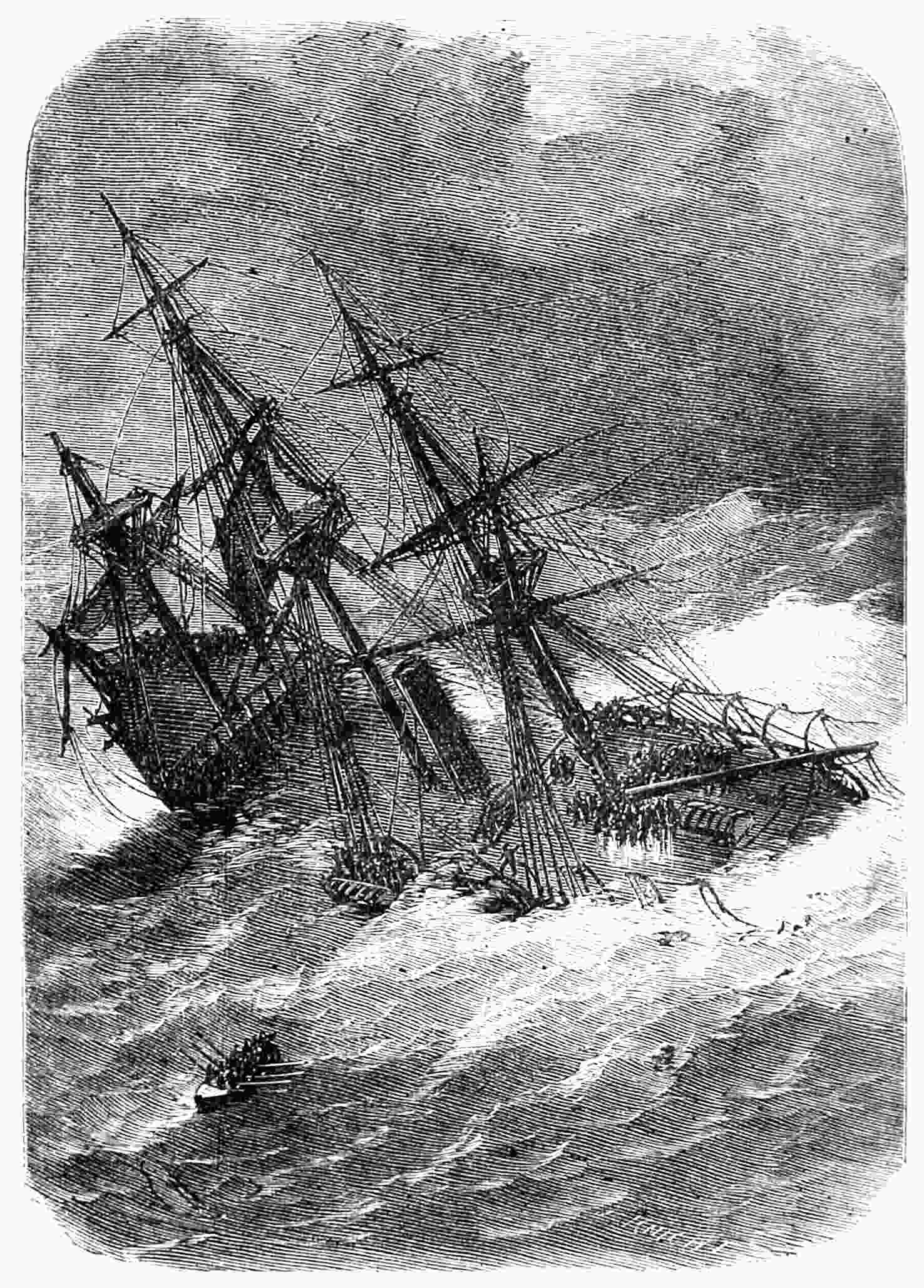
But disaster seemed indeed to crown disaster, when it was
rumoured that the London—one of Messrs. Wigram’s finest
vessels, laden with a valuable cargo, and having, it was first
said, more than 300 souls on board—had foundered in the
Bay of Biscay, and that not a soul had escaped. At first,
many positively refused to credit the intelligence that the
noble vessel, which had only a few days left our shores, had
succumbed to the fury of the gale, and gone down a wreck.
It seemed impossible. Relatives and friends were loth to
receive the terrible truth that they had taken a last farewell
of many, the grasp of whose hand they still felt warm
within their own, and whose last words of love and friendship
were still ringing in their ears. All were slow to admit
that there was no hope, and there was a general clinging to
the expectation that there had been some mistake. The London
might, perhaps, have been injured by the tempest, and compelled
to put back to port; but that she could have foundered,
or even if this calamity had occurred, that her crew and
passengers had been unable to effect their escape—this indeed
seemed almost beyond belief!
Too soon, however, the newspapers brought the sad and
affecting story before the eyes of all, and never did story of
shipwreck, however thrilling, excite a grief more sincere and
wide-spread. It needed no artistic craft to make the story
tell, and to take it straight home to the hearts of unnumbered
thousands. “This awful wreck,” said Mr. O’Dowd in commencing
the inquiry directed by the Board of Trade, “has
been the theme of many a pen, and the topic of many a conversation
since its occurrence has been made known.
Though the sympathies of our hearts ought to recognise no
grades of social position, nor any distinction of education and
intellect, we yet must feel the pang embittered by the loss of
some of the passengers, with whose names, accomplishments,
and virtues the public are now painfully familiar.”
As, day by day, the harrowing details became more accurate
and complete, the regret became more and more poignant,
and almost assumed a national character. Men soon thought
little of the ship, magnificent though she was, or of the cargo,
valuable as that was; both ship and cargo became insignificant
in the presence of the vast sacrifice of human life by
which the wreck of the London had been accompanied. And
then came tales of heroism and self-denial, of a lofty courage and
sweet resignation on the part of her passengers, officers, and
crew, that made it harder still to realize that the men and
women who had been capable of such noble behaviour had been
buried beneath the foaming waves, and that the world now
was all the poorer and more desolate, for their absence from
it. Both the pulpit and the press gave touching and eloquent
expression to the grief which prevailed on every side; and
while the mourning relatives of our own land received every
mark of sympathy and consideration, those belonging to the
colonies, and on whom the news will burst like a terrible
thunderbolt, were not forgotten, either in the earnest prayers
that were offered on behalf of the bereaved ones, or in the
words of genuine kindness and commiseration which the
knowledge of their heavy loss elicited.
It has been thought that there is much belonging to the
Wreck of the London which entitles it to a more convenient
place of record than the newspaper, and that many, both in
England and Australia, will be glad to possess a simple, connected
narrative of the ship’s doings, and especially of her
passengers’ behaviour from the day they left our shores until
the day of their foundering in the Bay of Biscay.
There can be no question that the heroism and piety displayed
on the occasion, demand a most distinguished place in
the annals of the brave and good. Unhappily, shipwrecks of
the most disastrous character are of only too frequent occurrence;
but it is seldom that a Message from the Sea has borne
the character of that mysterious and sublime one which the
sinking London wrote ere she went down. Many, too, will
perhaps be glad to possess portraits of those whose names will
now be historical for their behaviour amid the distressing
circumstances in which they were placed.
It is also in the sincere hope of administering some balm of
consolation, however slight, to the hearts of thousands mourning
in our own country and elsewhere, that we would now,
avoiding, as far as possible, technical terms and details, invite
the reader’s attention to the narrative of the Wreck of the
London, first of all, however, looking at the ship herself, her
Captain, and her list of passengers.
CHAPTER II. THE IRON BEAUTY.
TheLondon was the property of Messrs. Money Wigram & Co.,
the eminent shipbrokers at Blackwall, to the extent of fifty-six
shares, Messrs. Franklin and Charles Morgan being owners
of two shares each, and Captain Martin, her Master, of four.
She was a screw steam-ship, and was built at Blackwall in
1864; she was therefore a new vessel. She had two decks,
three masts, was ship-rigged, and clincher-built. She was
1752 tons register, and her engines, by Messrs. Humphreys
and Tennant of Deptford, were constructed on the most
improved modern principles: they were 200 horse power.
Her length, from the fore part of the stem, under the bowsprit,
to the aft side of the head of the stern post, was about 276 ft.,
and her main breadth to outside of plank was about 35 ft.;
her depth in hold, from tonnage deck to ceiling at midships,
was 24 feet.
The materials used in the construction of the vessel were
all of the best quality, and the best workmanship was used.
The materials were an angle iron frame, iron beams, stringer
plates and kelsons. She was double rivetted from keel to
gunwale, and all her fastenings were sound and good. Her
masts were iron, with the exception of her topmasts, which
were of wood. Those who superintended the progress of her
building from the laying of her keel until the day of launching,
have spoken in terms of the most unqualified approbation of
her entire construction; and those who officially examined
her before she put to sea, reported her in the best trim, and
having all the equipments necessary for the voyage. Sails,
compasses, boats, anchors, rockets, signal guns, life buoys, in
short, all that she was required to carry to be officially
pronounced seaworthy, the London did carry; and, previous
to her last voyage, after undergoing a series of examinations,
she was said to be as fine a vessel as ever left the Port of
London, and she presented to the eyes of her admirers a
perfect picture of combined elegance and strength. She was
built according to Lloyd’s rules and regulations, and was indeed
of greater strength than Lloyd’s rules required.
On account of the melancholy disaster connected with
them, the reader’s attention must briefly be directed to the
engine-room of the vessel, and the hatchway over it. The
engine-room was 36 ft. in length, and on either side of it, fore
and aft, were bulkheads, to one of which there was a communication
from the engine-room. Over the engine-room
went the hatchway, the dimensions of which were about 12 ft.
by 9 ft. The hatchway was a saddle skylight in a wooden
frame, having plate glass half an inch thick, and covered
with gratings of galvanized iron. According to the judgment
of those who surveyed the ship, the engine hatch was deemed
of sufficient strength to meet any weather.
Such, then, was the vessel, which was no sooner advertised
for her third voyage, than all her berths were taken, and a
valuable cargo got on board. The accommodation for fore-cabin
passengers was on the main deck before the main
hatchway. In this part of the ship there was space for 130 in
hammocks and 128 in berths, thus providing accommodation
for 258 persons. The accommodation for after-cabin passengers
amounted to 132 berths and space for 10 hammocks;
thus taking 142 passengers. Altogether the ship would carry
400 persons. From the shipping bills of the London we find
that her cargo consisted of about 347 tons of dead weight, viz.
iron plates and bars, sheet iron, lead and shot, stone, blocks,
iron nails, and screws, &c.; there were also 14 tons of hardware
and agricultural implements, all of which would not be
probably considered dead weight. The remaining portion of
the ship’s cargo, amounting to about 1000 tons, consisted of
light goods, packages of haberdashery, blankets, woollens,
china, glass ware, drugs—in short, just such a cargo as was
generally exported to Australia: this was stowed over the
dead weight, and in the after part of the ship. The cargo of
bar and sheet iron was stowed from the after part of the main
hatchway to the after part of the fore hatchway. The value
of the cargo was estimated at 124,785l. 17s. 4d.
The weight of the cargo was, of course, increased by the
coals which the London carried. The quantity of coals
supplied to the vessel was as follows:—remaining on board
from the previous voyage, 45 tons; shipped in London, 460
tons; making in all 505 tons. Of this there was expended on
the voyage to Plymouth 47 tons, leaving 458 tons. There
was shipped at Plymouth 50 tons; so that the weight of engine
coals in the ship when she left Plymouth was 508 tons.
Several tons, however, were on deck, stowed in sacks round
the steam-chest and engine-room hatch, and, during the storm
that broke over the vessel, the coals were thrown out of their
sacks, and at every lurch of the ship they were either washed
overboard, or sent rolling in knubs near the scuppers.
The master and officers of the ship were as follows:—John
Bohun Martin, Master; Robert Harris, first mate; Arthur
William Ticehurst, second mate; Arthur C. Angell, third
mate; John Jones, first engineer; John Greenhill, second engineer.
The Master, officers, and crew were in number 83,
and there were 15 foreigners among the seamen. The
foreigners were all rated as able seamen, and amongst them
were 3 Germans, 5 Swedes, 2 Russians, 2 Danes, 1 Hollander,
and 1 Bavarian. It does not appear that any of the foreigners
had sailed in the London before, but eleven out of the number
had previously sailed on board of British ships.
The number of passengers that went on board in London was
125, and these were increased to 180 by the embarkation of 55
at Plymouth. That the London stood very high in the estimation
of all sea-goers, and that her seaworthiness was above the
faintest suspicion, is evident from the number of those who
tried to secure a passage out in her, but without success, and
from the reports and declarations which all those who were
officially responsible for her good trim made respecting her.
After a certain time there was not a berth in her to be obtained
on any terms, though many were disappointed at not
being allowed to obtain them: there was not a word of dissatisfaction,
however slight, expressed by any official after
the strictest examination had been made. Captain McLean,
the Emigration Officer, who acts under the authority of the
Emigration Commissioners, had, after careful survey and inspection,
certified the London to be in safe trim, and in all
respects fit for her intended voyage to Melbourne. His words
were, “I consider her perfect in every way.”
It would have been unnecessary to have appeared even to
insist upon the good trim and seaworthiness of the London, had
not the suspicion gained ground that much more might have
been done for the passengers’ safety than actually was done.
Some have thought that more boats ought to have been on
board; but it should be borne in mind that she carried one
more than was actually required by law, and that no ship
carries a sufficient number of boats to contain all on board,
unless the number of passengers happens to be very slight.
With reference to the length, breadth, and depth of the ship,
a suggestion has been thrown out as to her narrowness of
beam for a vessel of such length; but this alleged disproportion
was not peculiar to the London: it exists in a much
greater degree in some of the finest ships afloat. The length,
for example, of Her Majesty’s transport ship Himalaya is
340 ft., while her breadth is only 44 ft. 7 in. The same
might be noticed in the case of other steam-ships.
We have no doubt that eventually, out of the terrible calamity
that all must truly deplore, greater safety will accrue
to the thousands who sail the seas, through greater care being
taken of every means that concerns such safety, and that immediately
some plan will be devised for securing the engine-room
of steam-ships against inundation.
Meanwhile the matter will not be mended by any unfair
criticism of the ship’s sea-going qualities. It will only increase
unavailing regrets, to array what might have been
against what actually is. It is a fact, patent to all, that the
London enjoyed a first-rate reputation as a fast ship, as a most
comfortable one, and as having in her commander, Captain
John Bohun Martin, a gentleman of the highest repute, both
for his seamanship and many other admirable qualities.
All being in readiness, the London left the East-India Docks
on the 29th of December 1865, laden as we have described,
and bound for Melbourne. Many were those who caught a
view of her from various points as she steamed majestically
down the river, and fervently wished her a prosperous voyage
as they remembered that she contained on board something far
more precious than all her cargo, rich though it was.
At Gravesend she embarked several passengers, and lunch
was prepared on board, that those who were about to separate,
they knew not for how long, might enjoy as much of
each other’s society as possible. It was a pleasant party,
notwithstanding the tears that started involuntarily from
many eyes as the hour of separation drew near. One affecting
incident deserves to be recorded. A gentleman was obliged
to send his little boy out, and remain behind himself. The
child was to have gone by a former ship, but he had prevailed
upon his father to allow him to wait for him; and now,
after all, that dear father could not go until the next ship, and
the little one was going out under the care of a friend. The
father of the child was present, and watched the vessel until
she seemed to die away in the glory of the setting sun.
Innumerable, doubtless, now are the kind words and looks
which are recalled by mourning friends as so many fond
souvenirs of that last parting at Gravesend or at Plymouth.
The sun was going down, and tinging with lustre the Kentish
hills, wintry though the weather was, when the London left
Gravesend behind, and went on her way to Plymouth. This
very night, however, she encountered weather that compelled
her to bring up at the Nore, where she anchored and remained
during the whole of Sunday.
On Monday morning, the 1st of January, at daybreak,
the anchor was weighed, and the ship steamed down the
channel, still against a head wind, but making fair way.
While passing outside the Isle of Wight the wind increased to
half a gale, and Captain Martin deemed it prudent to put back
and lay-to for the night in St. Helen’s Road. On Tuesday
morning, the 2nd, the London proceeded through the Needles
into the open channel, the wind being still ahead, but light.
On the Wednesday the weather became so boisterous, and
the indications of the barometer so threatening, that, at
about 2 o’clock P.M., the Trinity House pilot, under whose
care she was, decided on taking her to Spithead for
shelter. She anchored on the Motherbank at 4 P.M., and
lay there until daylight of the 4th, when she steamed out
through the Needles passage, the wind being then southwesterly.
She arrived off Plymouth at daylight of the 5th. A sad
accident occurred here. A pilot cutter put off a small boat,
having on board the pilot and his assistant, to bring the London
inside the breakwater. When the boat was no more than a
hundred yards from the London a sea capsized her, and both
the pilot and his assistant were thrown into the water. Captain
Martin instantly ordered one of his lifeboats to be
lowered, and with great difficulty the assistant pilot was rescued,
but the pilot was drowned. About two hours after daylight
of the 5th the London was anchored inside the breakwater,
and prepared at once to embark her passengers. Some of
those passengers must now engage our attention for a little
while.
CHAPTER III. CAPTAIN MARTIN.
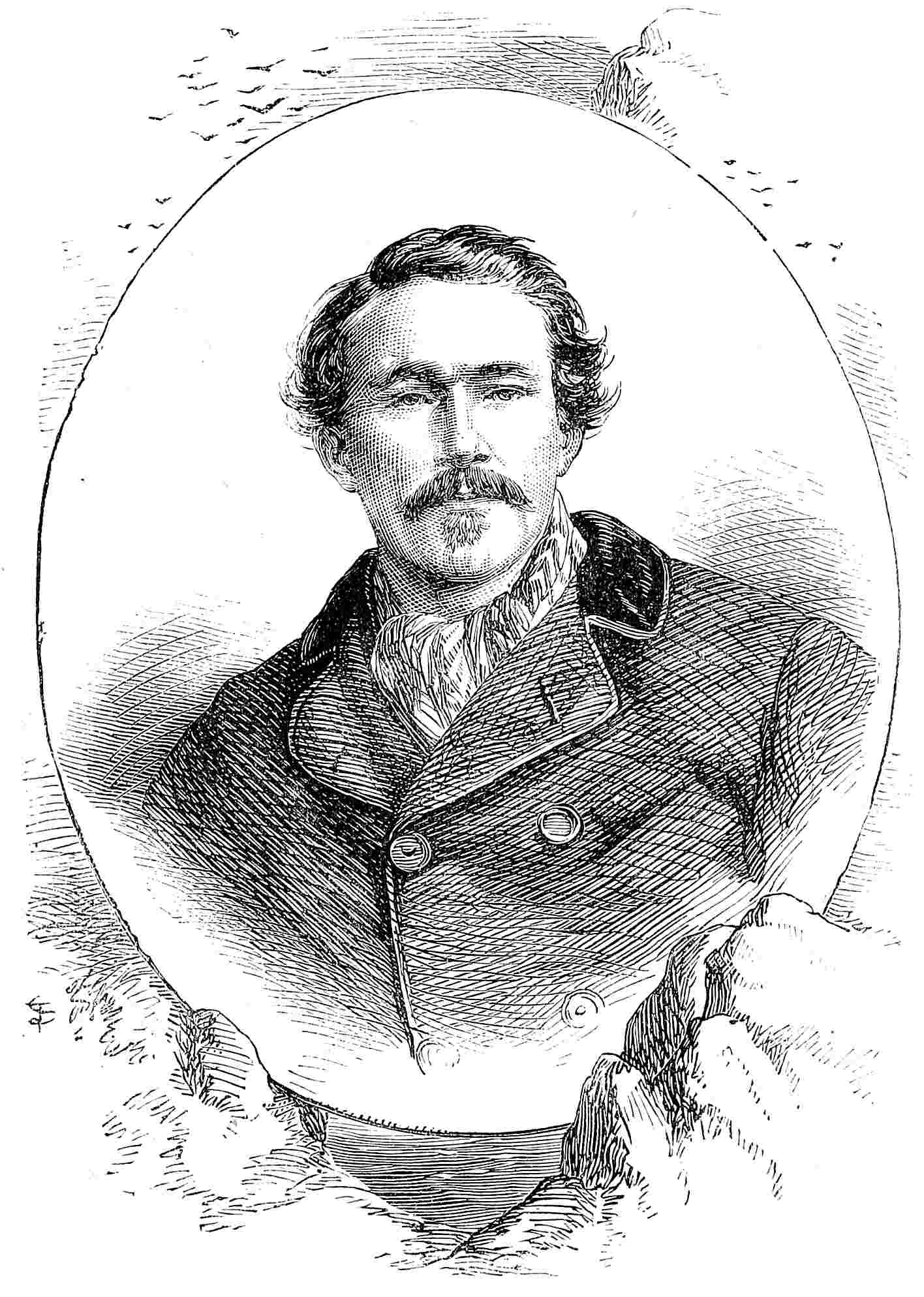
It will be long before Britons will hear the name of John
Bohun Martin without tears, as they think of his noble
heroism amid circumstances sufficiently appalling to rob the
bravest of his self-possession; of his disregard for his own
personal safety while duty commanded him to remain at
a post of imminent danger; of his resolute perseverance in
doing all that the most skilful seaman could, to ride out the
furious gale. He was not new to the sea, for from his boyhood
he had been accustomed to cope with its storms and
dangers, and had not risen to the post of Master without passing
through years of the most careful training and discipline.
He was born at Brompton, April 27th, 1819. When yet
young, having a love for the sea, he was entered as midshipman
in the East India ship True Briton, and made several
voyages to Madras, Bombay, and Calcutta. He remained in
this ship four years, and during this time he diligently studied
navigation, particularly in its scientific branches. In 1840,
he was appointed third officer of the Southampton, a vessel
trading to the East Indies, and having in those days some
celebrity as a fast-sailing ship. He passed through twelve
additional years of service before he was entrusted with
the command of a vessel, but all who knew him spoke
very highly of his diligence and general character. He
enjoyed the esteem and friendship of the Captains under
whom he served: among them were the well-known names
of Beach, and Wimble, and Nash.
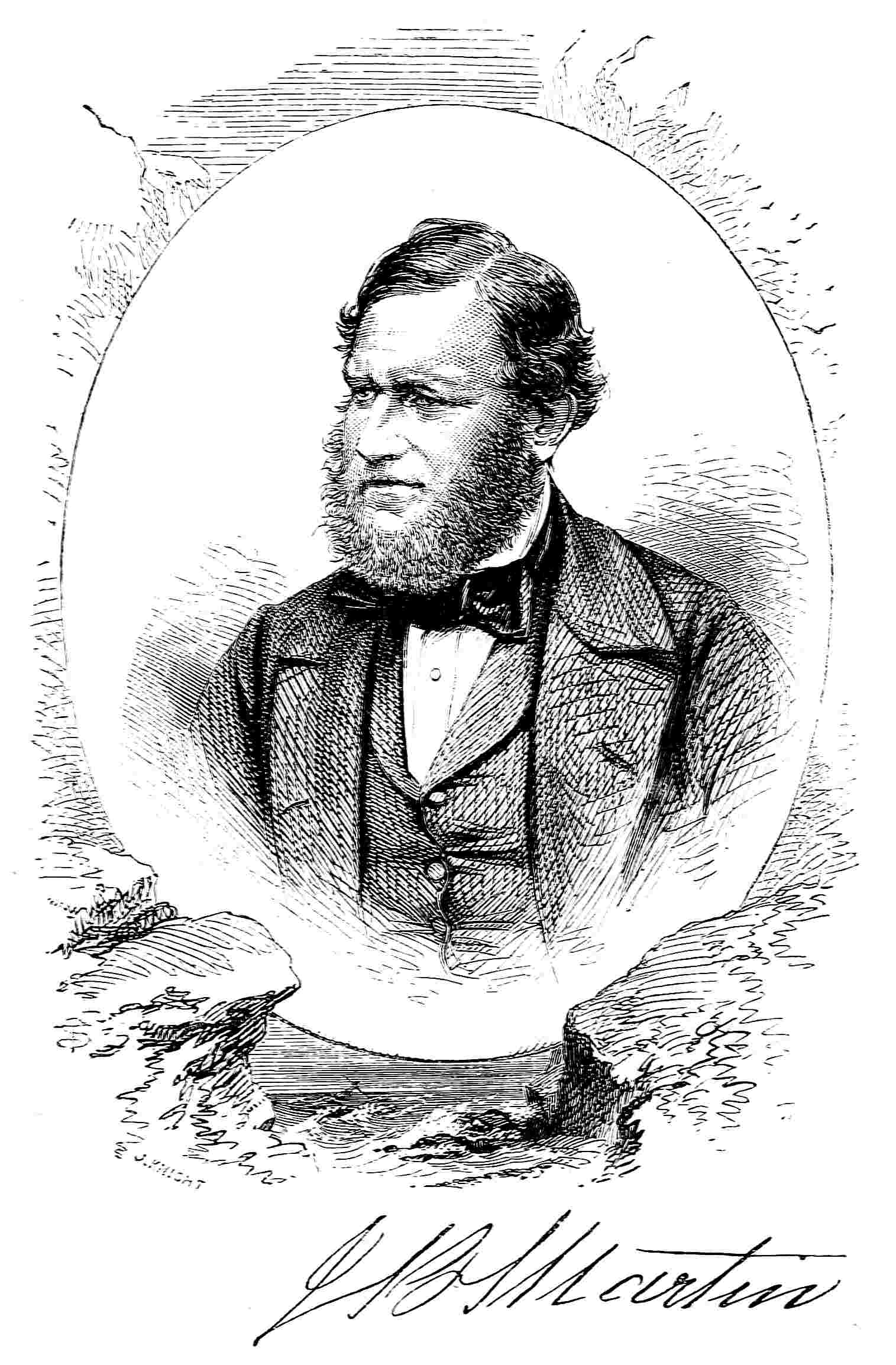
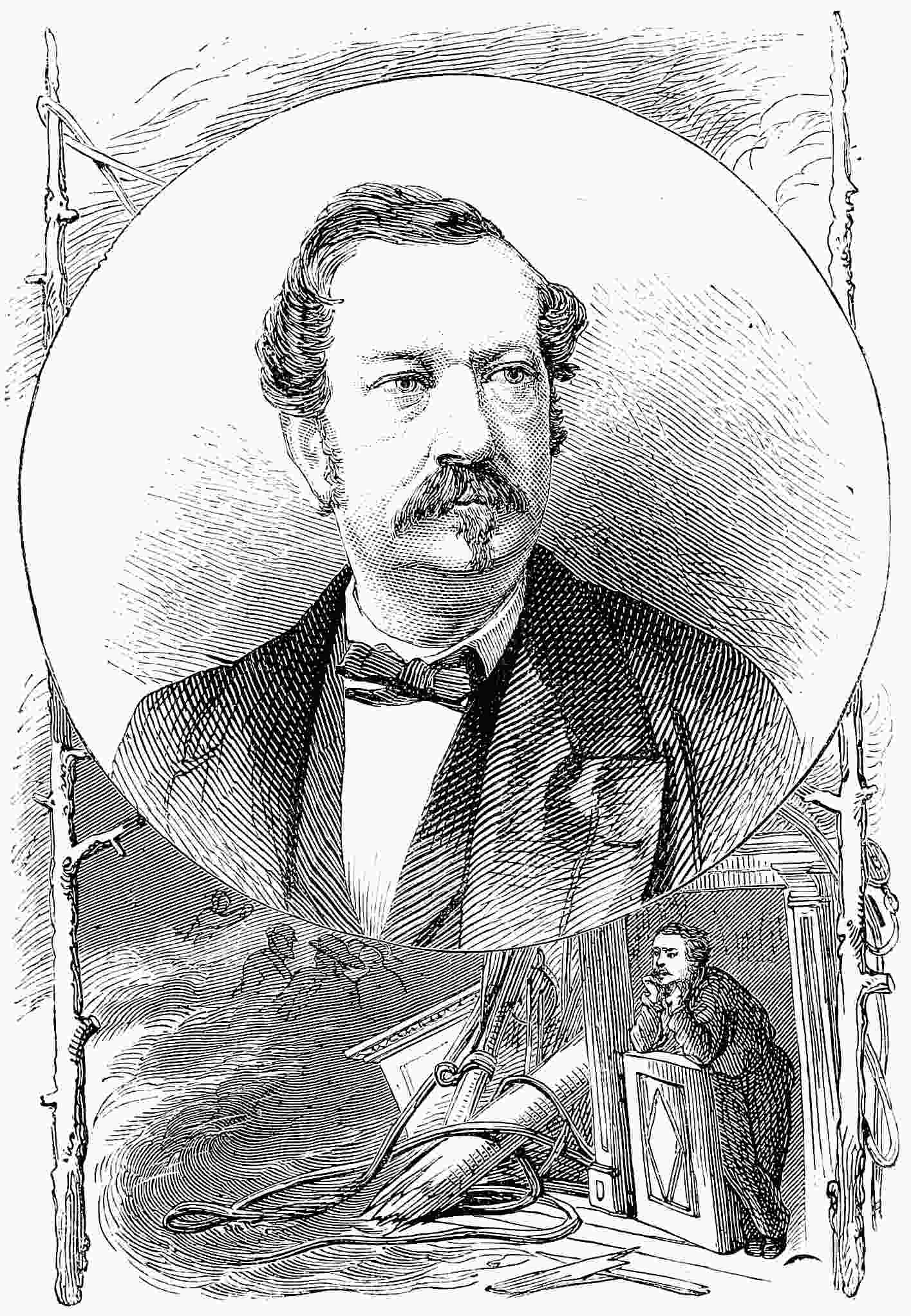
J. B. Martin
In the year 1852 he was appointed to the command of the
Essex, and continued her Master four years; at the end of
which period he took the command of the Suffolk. There is no
doubt that he owed this appointment entirely to his own
merits as a navigator, and to the confidence which his general
character inspired. The post which the Captain of the Suffolk
was expected creditably to fill, was in every way an honourable,
but, at the same time, a most responsible one. The ship
was one of Messrs. Wigram’s best and fastest-sailing clippers,
and was expressly designed for the Australian trade. In 1856
the gold-digging mania in Australia was attracting great
numbers of people from our shores, and there was a sharp
competition amongst ship-owners, both for passengers and
cargo. Fast vessels were much in demand, for, to the travellers
athirst for gold, a single day was deemed of the greatest
importance; and safe ships were of course sought after,
because of the precious cargo entrusted to their keeping.
Accordingly, during that period a number of fine vessels
were built and launched, and their owners were accustomed to
start them at the same time and for the same destination. The
Suffolk, however, could successfully compare with any
vessel of her class, as she had been expressly built for the
Australian trade, and, regardless of cost, had been fitted by
her wealthy owners with all the equipments necessary to
render her one of the fastest and, at the same time, safest
ships afloat.
From a host of able and experienced navigators, who
would have counted it an honour to have assumed the command,
Messrs. Wigram selected John Bohun Martin to
be Captain of the Suffolk, and never did owners make a
better choice. Many are still living who crossed the seas
with him during those days of well-nigh angry competition,
and who will recall with pleasure his practised skill,
his genial, open disposition, his gentlemanly bearing, and
his studious care for the comfort of his passengers in all
the little details which have so much to do with the making or
marring of the pleasure of a long voyage. He was one of
the kindliest and most simple-hearted of men, pleased with
very simple things, delighting in riddles in which a very child
would have seen no mystery, and with all a sailor’s superstition
about him; fond of cats, and a great partiality for
absolutely doing nothing at all when he was not on board.
With his attached relatives in Highbury Park he would always
spend his time when ashore, and go about with them here
and there; but he was perhaps never happier than when he
could throw himself back in the large easy chair, and read the
advertisements of the Times and the advertisement especially of
his own ship. Not tall, and not short, and every inch the gentleman;
with a fresh-coloured face, light hair and blue eyes, and
ambling motion, as if in any place he wanted sea-room and
must have it; with a fine cheery voice, and a laugh of sterling
quality; with a woman’s heart of tenderness within the strength
that seemed equal to any danger—as such, John Bohun Martin
will long be remembered.
One who knew him well, and who could not speak of his loss
without deep emotion, told the writer of many little acts of
attention, which, although too trivial to appear in print, are
not without importance when measured by the comfort they
imparted, and by the void which their absence would have
created. His heart was truly in his profession, and he had
all the genuine sailor’s enthusiasm, and, we might almost say,
affection, for his ship, of whose equipments, beauty, and good
qualities he spoke with glowing pride. As he was never
married, some used laughingly to say that the Captain had
no bride but his ship; and certainly he had reason to be
proud of the Suffolk during the eight years she was under his
command.
Her first trip to Australia was performed with unusual
rapidity. It is true that, on this passage, she encountered
very heavy weather: a violent hurricane carried away her
topmasts, and for a short time crippled her; but the
damage was quickly repaired at sea, and notwithstanding
this mishap, the Suffolk arrived in Australia in an unusually
short time, and could bear to be favourably compared
with some of the finest vessels afloat, which had started
at the same time. Captain Martin had displayed such
skill, and had shewn such energy in circumstances that were
fraught with much danger both to passengers and cargo, that,
upon his return to England, the mercantile portion of the city
of London presented him with a handsome testimonial as a
mark of their esteem. A sum of more than £500 was presented
to him.
An interesting story stands connected with the first
voyage of the Suffolk. While she was in a dismantled
condition, and her crew were repairing damages, an
American vessel, also bound from London for Melbourne,
spoke the Suffolk, and offered assistance. Captain Martin
courteously declined, whereupon the American Captain
said he would report the Suffolk on his arrival at Melbourne.
Captain Martin replied, that he had better take care
the Suffolk did not report him. The vessel proved that Captain
Martin’s confidence in his ship, and in his own seamanship,
was not ill-founded. The American Captain reached
Melbourne after what he considered a rapid passage, and
the day after his arrival called on the agents of the Suffolk
and reported having fell in with her. They thanked him, and
asked would he like to see Captain Martin, who was in the
next room. The American Captain was much surprised to find
that the Suffolk had arrived five days before and reported
him.
The Suffolk now commenced a career of success which
enabled her, under the direction of her able commander,
to take rank before all other ships in the same trade.
She made, during eight years he commanded her, ten voyages
to Australia and back; nor did she meet with any
mishap or casualty of any kind, save that to which we have
referred on her first trip. During these years Captain Martin
not only enjoyed the high esteem and friendship of her owners,
but also of men high in position both in England and
Australia. It will be hard to say, perhaps, in which country
his loss will be the more deeply felt; for, both at home
and abroad, he numbered a multitude of attached and admiring
friends. He was a man pre-eminently fitted, it seems,
to infuse what was loving and kindly in others: not only
among passengers, but among those who were under his command,
he is described as being one of the most trueminded
and unselfish of men. Mr. Greenhill, the second engineer
of the London, and one of the survivors, a man who, without
a tear, had faced all the horrors of the wreck, and all the
dangers of the raging sea for twenty-four hours, in an open
boat, fairly broke down, and sobbed like a child, as the
thought of his last interview with the gallant Captain presented
itself to his mind.
Many of the passengers with him on former voyages can
recall, not only his gentlemanly tastes, but the extreme
simplicity of his habits. While he kept one of the best and
most hospitable of tables for those on board his ship, his own
wants were of the most moderate description. On last
Christmas-day his moderation at the table of his relatives
called even for remark: he touched neither wine nor spirits
throughout the feast; indeed, generally speaking he was a man
of the most abstemious habits, and never touched spirits.
The writer has heard from one most likely best to know,
that only once in his life did he taste a small quantity of
spirits, but the alcohol had such an effect upon him, that he
never repeated the experiment.
Who can tell what influence the fact of their captain’s abstemiousness,
and his taking nothing stronger than coffee during
those dreadful days and nights of suspense—who can tell the influence
that such an example may have exerted upon the minds
of the crew? There have been many painful instances of sailors,
when it has been made known to them that there is no hope,
rushing to the spirit and wine stores, and meeting death at
last in a state of intoxication; but on board the London there
was nothing approaching to this. On the contrary, there was
the strictest sobriety among the crew and passengers, and
we cannot help believing that Captain Martin’s example had
much to do with it.
Such is a brief sketch of the man whose name will, for many
years, henceforth be a household word for all that was enduring
and brave amid the most distracting perils, and for all that
was gentle and endearing among his relatives and friends.
He had served a tolerably long apprenticeship to the sea—his
last voyage was his thirteenth to Melbourne as commander—and
his reputation as Master of the Suffolk had been so brilliant, that
in the forty-seventh year of his age, and at the end of 1864,
he was appointed Captain of the London, a vessel on which
still greater care and cost had been expended than on the
Suffolk, which he had so successfully navigated for upwards
of eight years. The London was built in pursuance of the plan
for steaming to Australia round the Southern Cape. She
made two very rapid voyages to Australia and back, and
fully justified all the cost and care expended upon her construction.
Her value, exclusive of cargo, was estimated at
about 80,000l. Captain Martin’s share in her may have been
about 5000l.
The London was therefore on her third voyage, and,
commanded by a Captain whose good fortune had become
almost proverbial, and belonging to a firm who, in their time,
had never lost a ship, she set sail upon the voyage which was
so soon terribly interrupted. But while she is yet in sight of
Plymouth, we must call the reader’s attention to one passenger
who has gone on board, whose name will live as long as there
are hearts to feel what is life-giving in the gospel, what is
majestic in faith, and what is sustaining in death. We need
scarcely say that we allude to the Rev. D. J. Draper.
CHAPTER IV. REV. DANIEL JAMES DRAPER.
Daniel James Draper, a name that will henceforth be as
honourably and widely known in England as it was previously
in Australia, was born at Wickham, near Fareham in Hampshire,
on August 28th, 1810. He was of respectable parentage,
his father being the chief carpenter and builder in the
village. Although unacquainted with the saving knowledge
of the gospel, his parents were strictly moral in their lives,
and regular attendants upon the services of the parish church;
consequently the influences which surrounded the child’s
opening years were favourable to the formation and growth
of virtuous habits.
He was brought, however, to religious decision by coming
in contact with some devoted Wesleyans in the neighbouring
village of Fareham. They had a chapel in the village, and
in it the gospel was fervently and faithfully preached; and
we doubt not the building—for it still exists—will henceforth
be memorable on account of its being the place in
which Daniel James Draper first saw the necessity of repentance
towards God and faith towards the Lord Jesus
Christ.
By the door of this chapel young Daniel was occasionally
found listening, and taking in stray words of warning and
of wisdom, as John Bunyan did before him from the lips of
the pious women of Elstow, who talked of holy things as they
spun and knitted in the sunlight before their cottage doors.
Daniel would not enter, but again and again the lad was seen
listening at the chapel-doors, and marvelling perhaps, like the
tinker of Bedford, at what he heard. On one occasion he
received a sharp rebuke for neither coming in nor going
away, but only standing without, and the reproof so wounded
him that he resolved never to go near the place again.
But to this resolution he did not keep; and ere long, in this
chapel, the truth of God was applied to his youthful heart, and
he felt very deeply the need of salvation. Outwardly in
his life, hitherto, there had been nothing worthy of blame; his
conduct had been strictly upright and moral; but now his
conscience revealed to him depths of depravity and guilt, of
whose very existence he had been unconscious, and he saw the
urgent necessity of receiving pardon, and of becoming a partaker
of the new birth. By repentance and faith he immediately
sought reconciliation with God, and it was not long
before he became a rejoicing believer in the Divine love and
favour.
Very naturally, he now openly connected himself with those
from whom he had received so much spiritual benefit, and
he became an enrolled member of the Wesleyan Society.
He had not reached twenty years of age, when, although
still beneath the roof of his kind, church-going father, he
took this decisive step. His resolution to connect himself with
the Methodists was not favourably received by his father,
or by the members of his family generally, but young Daniel
held on his way; yet, as he did this with all the good nature
that was so marked a characteristic of his maturer years, there
is reason to believe that his youthful profession did not expose
him to any opposition that pressed heavily upon the buoyancy
of his spirits. He even in these early days became well
known for the zeal and interest he displayed in the salvation
of the lost and perishing.
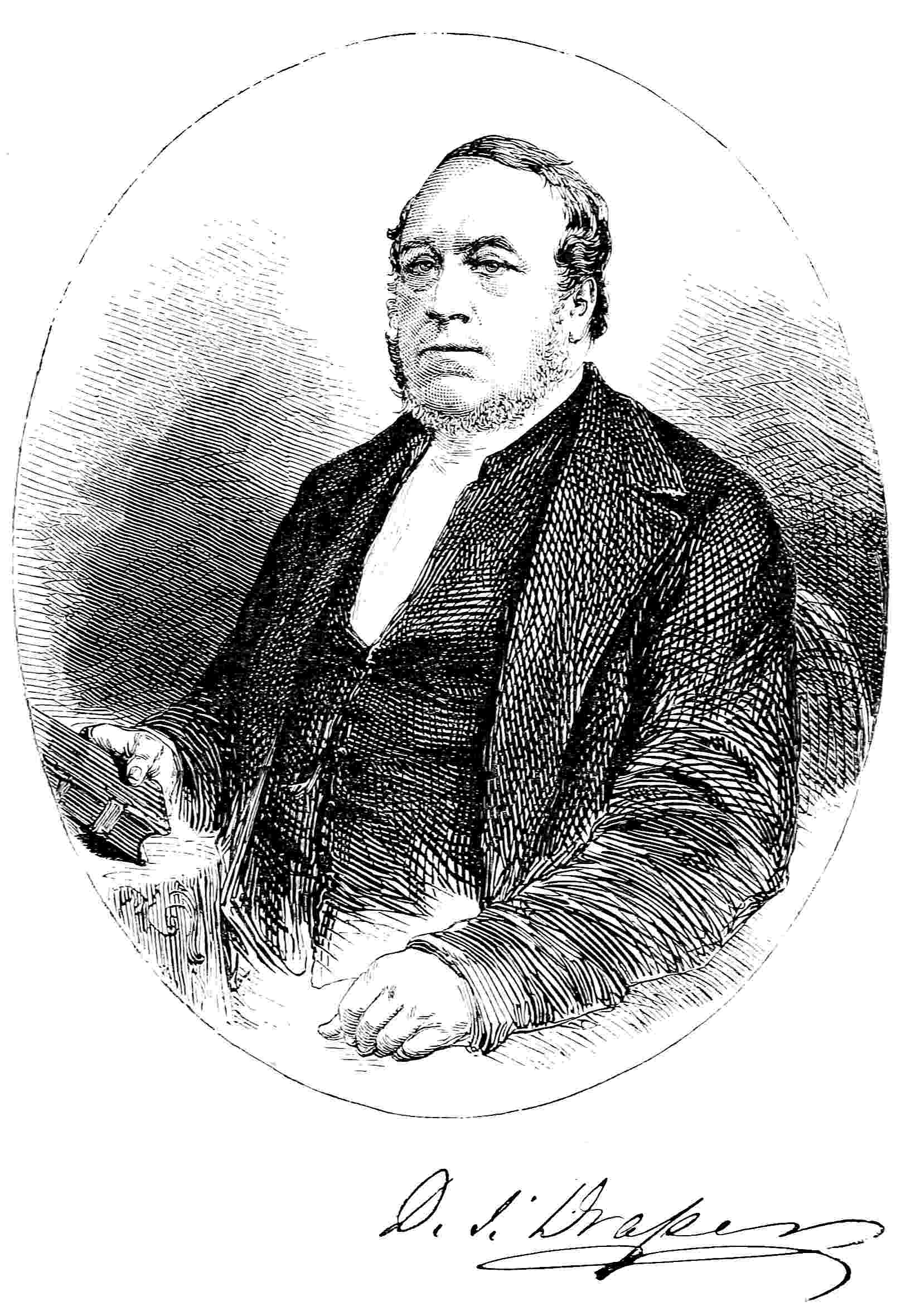
D. J. Draper
Ere long the Methodists determined to erect a chapel in the
village of Wickham, where he lived, and it is interesting to remember
now, that it was built by Daniel and his father, and
that, in the course of a short time, the son had the opportunity,
in that very chapel, of proclaiming to his father the unsearchable
riches of Christ’s gospel. He was about twenty years of
age when he enjoyed this privilege, his gifts and character
having placed him amongst the Wesleyan local preachers.
Although it was still distasteful to some members of his
family, he eventually decided upon devoting himself to the
work of the ministry, and never was a decision, we believe,
more in harmony with the Divine will and more signally
honoured by blessed results.
When about twenty-two years of age the young preacher
removed to Brecon, with its towering beacons, pleasant
streams, and still pleasanter societies of Christian people. Mr.
Draper is still remembered there with affection, and many can
call to mind his devotedness to Christ’s service, his love for
the house of God, his familiarity with the Scriptures, and his
attachment to the prayer-meeting. A favourite hymn with
him in those days was the one in which this verse occurs:
“Happy, if with my latest breath
I may but gasp his name,
Preach Him to all, and cry in death,
Behold, behold the Lamb!”
At Brecon he worked hard, both in the culture of his own
mind as well as in the service of his Divine Master. He read
good and solid books, and through his life long the substantial
was always more attractive to him than the glittering and
merely artistic; he had no relish for a literature that did not
help him in his work, and all he acquired in study he gave out in
effort for the good of those amongst whom he lived.
One can readily imagine his happy earnest life during those
Brecon days, of dangerous mountain journeys to the stations
where he preached; of open-air preaching by the river-side;
of the welcome which the warm-hearted Welsh people gave
everywhere to the young preacher, we can have no doubt. It
was during this time that his sister, still living at Brecon, received
the truth in Christ, through her brother’s instrumentality.
He was destined, however, for a larger sphere of
usefulness than any which his own land could furnish, wide
and urgent as its claims were and are.
While he was at Brecon, his character and gifts had so
generally impressed several ministers and friends of his fitness
for the regular ministry, that he was recommended to the
Wesleyan Conference as a minister; and in 1834 he was
appointed to the Chatteris Circuit, in Cambridgeshire, and here
the same energy and zeal characterized his efforts.
At this time, the attention of various Missionary Societies was
being directed to the spiritual wants of those who were settling
in the colonies. Emigration was becoming more and more
popular, and every week multitudes were leaving our shores
in search of the fabulous fortunes which the colonies held
up temptingly to their view. Gold, it was hinted, would one
day be found in any quantities by men who would only have
to dig for it; riches incalculable might be obtained in
an incredibly short space of time. The directors of
Missionary Societies were keenly alive to the danger that
would accrue to the thousands who were going away from
the religious altars of their own land to find themselves
in a strange country, where the means of religious instruction
were of the most meagre description, and where
there would be the most terrible scope for the unbridled
exercise of unholy lusts and passions. They were therefore
diligently on the look-out for men of strong nerve and
character, who could speak the right word to their fellows,
amid the fierce excitement which burned within them;—men
who could remind them of the hallowed association of their
old homes, consecrated as they had been by Sabbath and
Bible, and, by the remembrance of these, woo them to an
interest in those things which would be found important and
lasting when all the gold of Australia should have lost its
value. The directors found many such men;—men brave
enough to remain poor, while thousands around them were
becoming rich; men who, in their strong might of godliness,
stood like so many breakwaters against the surging flood of
sensuality, avarice, and full-blown pride, which, in the course
of time, threatened to submerge the land.
Among the men to whom the attention of the Wesleyan Missionary
Committee was directed was Daniel James Draper,
whom they were told was well adapted for Missionary service.
Physically, he was a strong man; a man about the middle
height in stature, vigorous build, honest open face illumined
by softly shining eyes, and voice of full trumpet tone; a man
capable of fatigue, one who could endure hardness; decided,
resolute, cheerful, and withal gentle in every thing he did;
liberal and catholic in his tendencies, ready to learn and apt to
teach; and above all, a man of strong faith and devotion.
When it was proposed to him to go abroad, he gave the matter
a brief but very earnest consideration, and at length he intimated
his willingness to obey the wish of the Committee, and
at the same time to be obedient to what he believed to be
the call of duty and the will of God. By this time he was a
married man, his wife being the daughter of Mr. Webb, of
Fareham; and the young couple prepared to set out for
Australia. The young Missionary looked forward to his
future field of labour with the calmest confidence, as he
thought of the Divine presence accompanying him, and that
he was neither going away from his Saviour nor his work,
because going to a distant land. He took an affectionate
farewell of his family and many friends, some of whom
accompanied him to the ship.
There are many yet living who can remember well the
period of his leaving England, and all the circumstances
attending it. He went away on the 13th October 1835, with
the farewells of many devoted and noble men ringing in his
ears, whom, in the providence of God, he was never destined to
meet again. Jabez Bunting, among others, had given him
every encouragement, and had said to him, “Years of labour
may be before you, but success is certain: it must come, it
must come!”—He left his native shores with those words
animating his heart:—“Success is certain; it must come,
it must come!” Never were words more prophetic of
the success which awaited the young Missionary’s efforts
in the far-off land to which he was going. The voyage
out was a dangerous one; the ship was overtaken by a
violent storm, and at one time the Captain had said, that in
six hours they would all be at the bottom; and thus shipwreck
marked the beginning and close of his Missionary life.
Mr. Draper arrived at Sydney early in the year 1836, and
applied himself to his work with all the enthusiasm and energy
which were among his main characteristics. He could indeed
speak conscientiously of “doing a week’s work,” for labour with
him meant something, and was far remote from pretence. On
Sunday morning he preached in the city, in the afternoon at a
place fourteen miles off, and in the evening again at Sydney.
Every day and every evening of the week had their engagements,
which he perseveringly discharged; and while thus
earnest in his own sphere, he was on the most brotherly terms
of communion with the various branches of the church of
Christ at Sydney and surrounding towns. He could truly
say,
“Be they many or few, my days are His due,
And they all are devoted to Him.”
A large amount of success attended labours thus constant
and conscientious; many, very many, will have reason to bless
God for his ministry at Sydney. It was not without drinking
of sorrow’s bitter cup, however, that he had to commence his
work amid new scenes and circumstances. He was early
called upon to resign his young wife and child into the arms
of death, and to feel the grief of a widower among strange
people.
Subsequently his life for many years became subject to the
changes incident to Missionary life amongst members of the
Wesleyan community, and he was removed from station to
station. It is gratifying to note, however, that he left no
station without also leaving behind him the impress of a man
whose one object it was to bring souls to God. In 1837 we
see him pursuing his work at Paramatta; and from 1838
until 1841 at Bathurst. He is at Sydney again from the last
date until 1845. He goes to Melbourne in 1846, and he was
there for twelve months, during all the excitement produced by
the discovery of gold.
The following year, he removed to Adelaide, and continued
there until the year 1854. In 1855 he once more
returned to Melbourne, and travelled successively in the
East circuit, the North and the South. He was not without
honour from his brethren in the ministry, who, in 1857,
chose him to be Secretary of the Australian Conference,
and, in the year 1859, elected him to fulfil the post of President.
In addition to his pastoral and other duties, we may also
remark that he had deeply interested himself, being a man of
some means himself, in getting a provision made for poor
ministers and for the widows of such, and his benevolent
wishes were partly accomplished.
Such, then, is a brief outline of Daniel James Draper’s life,
during a period of about thirty years in Australia. The details
of those years of honourable service in the church of
Christ will, if published, reveal a life of no ordinary labour
and no common success. But, if never published to be read
by the eye of man, we rejoice in thinking that they are
already known to Him who called him home, bade him rest
from his labours, and left them to follow him.
In the year 1865 Mr. Draper determined upon once more
visiting his native land, and the scenes of his childhood. It
is said that the love of Home was very strong in him, and
that like a magnet it would every now and then draw his
heart towards his country and towards old Fareham scenes
and associations. His parents were now dead, and many of
the friends of his youth were gone, but still it would be good
to see the old place once more. He had married again, his
wife being the daughter of Mr. Shelley, one of the first
Missionaries to Tahiti, who sailed by the ship Duff at the end
of the last century. She was an amiable and accomplished
lady, worthy of her parentage and worthy of her husband: we
cannot accord her higher praise, or it should be freely given.
Having resolved to revisit the land of his birth, he was not
long in making all necessary arrangements, and accompanied
by the best wishes of friends at Melbourne, Mr. and Mrs.
Draper sailed in the Great Britain, and, after a voyage
of sixty-four days, landed at Liverpool May 20th of last
year. He had come to this country not only that his heart
might be charmed by old and familiar scenes, and by intercourse
with friends, some of whose faces he had never
seen, but also in an official capacity. The Methodist Conference
of Australia had desired him to be their representative
at the British Conference, and his brethren in
Australia had expressed themselves thus concerning him:—“The
Rev. Daniel J. Draper has our ready consent to visit
the land of our fathers. By our unanimous wish he is commended
to you as our representative in your next Conference.
You need not be informed of his valuable services to us; his
intimate knowledge of our Connexion; or the high esteem
and confidence in which he is held. We believe that from
you he will receive a most affectionate welcome. He will be
followed by our prayers, that he may return to us in health,
and in the fulness of the blessing of Christ.”
The welcome which his brethren thus bespoke for him he
everywhere most cordially received. He preached in London,
in Great Queen Street Chapel; he was at the laying of the stone
of the Wesleyan chapel now being erected in the Caledonian
Road; he preached in St. James’s Hall, taking one afternoon
the place of a minister who was unable to conduct the special
service there; and he preached, last of all, it is believed, at
Dalston, and afterwards administered the Lord’s Supper with
much solemnity.
As the representative of the Australian Conference, he
attended the British Conference at Birmingham, and, with the
same object in view, he visited Scotland and Ireland. At the
sitting of the Conference in Birmingham, his modesty, his
manly sense, his quiet earnestness, and his unaffected devotion
called forth the general respect and admiration of the
ministerial fathers and brethren present. He also visited
some of the principal towns in England, and showed himself
everywhere the courteous, kindly, and cheerful man, with a
sound judgment and well-informed mind. As might have been
expected, Fareham, the scene of his childhood and of his first
efforts to preach Christ, was among the places he visited.
He preached there, and had the grave of his parents attended
to and beautified.
We have met with those whose happiness it was to
come in contact with him during his stay in this country,
and on all hands the testimony is, that he was a man as
much beloved for the rich human qualities of his heart, as
he was respected for his extensive practical knowledge of life
and the world. One remembers his hearty cheerful laugh,
another his telling anecdotes of Australian life, and another
the simplicity and fervour of his prayers. One tells of the
trouble he took to find out a young man in London, for
whom he had been entrusted with a message of kindness; all
can tell of the deep tender devotion of the man, untarnished
by so much as a touch of fanaticism. One who was brought
into close communion with him for several hours, about two
or three weeks before he sailed in the London, has said:—
“I was much impressed by Mr. Draper’s conversation and
bearing. He had seen the world, and he talked like a man to
whom men and things were familiar. The experiences of life
had evidently accomplished their purpose in him. He was
in command of himself; his judgment was strong and well-balanced;
his tone and manner altogether showed the completeness,
the symmetry, and the tender and genial perfection
of one who had laboured and suffered, and, in all, had grown
wiser and better, and more serviceable for his generation and
mankind. His centre could not be doubted. Christ and
Christ’s work, these were conspicuously the objects about
which his whole thought and being revolved. Cheerful, pleasant,
courteous, alive to all that was going on around him,
utterly free from all sourness and affectation, he exhibited,
with wonderful attractiveness, the simplicity, purity, dignity,
and high and holy aims of the minister of Christ. His prayer
at family worship I shall never forget. As he offered it, I
could not but remark how the little child and ripe saint met
in those natural, lowly, reverent, and calmly mighty supplications.
It was the prayer of a man, between whose spirit
and God there was no haze, and who was as sure of answer
as if voices from heaven told him he was heard.”
In November last he engaged a berth in the London. There
were many who would have prolonged his stay in this
country if possible, but Mr. Draper’s wish was, now that he
had accomplished the end for which he had come to England,
to return to the land of his adoption. He was advised to
go through Egypt, and indulge himself with a few weeks
journey through the Sinaitic peninsula and Palestine, but he
seemed even anxious now to return to his work at Melbourne.
In one of his last conversations with the Hon. W. A. McArthur,
who had expressed some regret at the shortness of his stay in
England, Mr. Draper said, “Well, I could spend another year
in England very pleasantly, and should like to do so if my
conscience would allow me, but I feel I must get back to my
work.”
“Little,” says Mr. McArthur, “did he then imagine that
his work on earth was so nearly finished, and that he was so
soon to enter into the joy of his Lord; but if ‘that life be
long which answers life’s great end,’ then Mr. Draper has
lived a long life; and having had the pleasure of his
acquaintance upwards of twenty years, I can testify that his
was a joyous, happy life, and that much of his happiness consisted
in seeing others happy, and endeavouring to make
them so.”
And now we are in the track of the devoted Missionary, as
he prepares to go on board the vessel which was soon to meet
with a disaster terrible beyond many of the most grievous in
the annals of shipwreck. Now that the agony is over, and
the faithful one at rest, we are disposed to see a meaning in
that dream—the story comes to us on good authority—which,
thrice repeated, bade him resist all the importunities of friends,
and go by the London, and no other way, and we would not
have had him disobedient to the voice.
To a friend in Dublin he wrote, a few days before he
sailed—“The steamer (the London) is a fine new vessel,
having gone out but twice. Last time she did the voyage in
sixty days. We join her (D. V.) at Plymouth on the 2nd
January, and she will leave that port at six P.M. on that day.
We trust in God our Heavenly Father for protection on our
way, and delight in the thought that we shall be remembered
by kind friends when they bow at the throne of grace.”
And so the good, genial, loving man went away from the
land he loved, notwithstanding the associations of thirty years
life in another country; from his Hampshire home which was
as dear to him now, though approaching sixty years of age, as
when he played there as a little child; and from the newly done-up
grave, where the dust of his parents was sleeping. At the
bidding of his Master, into whose hands he had committed his
entire life, he had moved from station to station in Australia.
He had never doubted the will of God in the successive
changes which had marked his colonial life. He believed
that there was a work for him to do in every place to which
he was called, though he went to station after station, not
knowing the things which were to befall him there. Shall we
doubt now that a voice in richest mercy towards others,
summoned him to a station in which he was to do his last here
for the Master who loved him, and who had need of him
indeed for an awful service, but on which hung a reward and a
blessing more glorious than heart can ever dream of?
We believe that he had only been a few days out when
he felt this, and summoned all his energies rightly to discharge
the duty his Master had called him to, to make his
last, his best. Serenely committing himself to the keeping of
a merciful and faithful Creator, Daniel Draper perhaps never
thought of his own wants, until he awoke up in glory, and
found with sweet surprise that he had none, that he was in
the likeness of his God, that he had exchanged corruption for
incorruption, that mortality had been swallowed up in the deep,
deep sea, and that around him were not shipwrecked mariners
in their dripping garments and looks of agony, but faces bright
with joy, and forms radiant with the glory of immortality.
CHAPTER V. THE LIST OF PASSENGERS.
We must pause yet once more before accompanying the
voyagers, that we may know as many of them as we possibly
can. Many we perhaps shall never know: their very names
are already forgotten; or if we turn to look at them they tell of
no history, and suggest no personal remembrance. On such a
day they were in the London, on such a day they sank with
her in the Bay of Biscay. This is all perhaps we shall ever
know concerning them.
A gentleman, who knew most of the passengers on board—and
we give an authorized list of the names in the
Appendix—when he heard of the catastrophe, remarked,
that it would throw half Melbourne into mourning.
Doubtless it will, and into how many other places besides
will not the news of the catastrophe carry mourning? That
one poor Bavarian, those two hapless Danes, had they no
friends in the world to shed a tear over their watery grave?
We dare not forget that each one, as he embarked, carried
within him, as it were, a very world of varied interest, and
that the hopes and sympathies of the unknown and poor were
as precious and beautiful to those who knew and loved them,
as were the plans and fortunes of the well-known and wealthy
to the circle of which they formed part. Every death we see
recorded should bring before us, in imagination, a bier, around
which we see gathering a collection of mourners, refusing to be
comforted, because their loved one is not. When we hear of a
multitude of persons perishing in some dread calamity like
the present, we must remember that, while all died together,
each died alone, and will be mourned as if he alone had
died. More than two hundred individual worlds of thought
and feeling, of sympathy and design, went down beneath the
ocean wave on that wild stormy afternoon. Each of these
worlds was perhaps the very sun of other worlds, that will now
receive a sudden and awful shock. Many men, many poor
men even, so live that they are centres of operations which,
although not brilliant in the world’s estimation, are of the
deepest possible interest to all concerned in them, and when
they die, it is as if the sun had been removed out of its place.
Nor do we forget, as we take up the list of passengers who
went out in the London, that every one had a separate and
solemn history. We do not forget that the issues of life
were unspeakably important, not only to all, but, in a very
solemn manner, to each—to the poor Danish sailor as well as
to the Oxford scholar: we do not forget that to each one
on board, this question was proposed amid circumstances
most appalling, “What shall it profit a man if he gain the
whole world and lose his own soul, or what shall a man give
in exchange for his soul?” We dare not forget the infinite
value of every soul on board.
As, during the week which followed the mournful announcement
that the London had foundered, we looked each day
into the first column of the Times, or as country newspapers
reached us, we tried more and more vividly to realize how
much that list of the drowned meant, and how names that we
had read confusedly amidst a mass of others, became eloquent
with interest as we caught snatches here and there of the life-history
belonging to them. But we have no doubt that there
was not one on board whose history was completely destitute
of interest and charm, to some few at least, and that tears
have been shed for many who were nothing more than plain,
humble people, getting an honourable living by the sweat of
their brow, and who will find no biographer to tell the unassuming
story of their lives. In the scores of shipwrecks that
occur every year, the worthy unknown should not be without
the sympathy, if they are shut out from the recognition
which well-known names immediately demand. Of late
years, perhaps, if we may judge from the newspapers,
from letters which have reached us, and from interviews
with friends of the deceased, there has not often
been a wreck in which such a variety of characters had
each to act a most solemn part. On board the London there
was life beginning and life ending in the aged and the young
who were going out to the new land. There was the competence
which had come after arduous and successful toil, and
there was the poverty whose only capital lay hidden in its
hopeful industry: there was the lawyer and the divine, the
merchant and the engineer, the man of letters and the rude
brawny artisan; the actor and the banker; the experienced
traveller and the humble villager from Cornwall. Something
of the varied life of the world at large lay mirrored in that
vessel that was preparing to steam away from Plymouth.
The brief notices of deaths which appeared day after
day revealed dark depths of sorrow, into which one was
almost afraid to look,—tragedies enacted full of horror unspeakable.
Let us glance for a moment at those of whom we know
nothing beyond their names, before proceeding to notice those
whose position in society and whose well-known histories
speedily found biographers.
On the 11th inst., lost at sea, on board the steamship
London, James Thomas, Esq., late of London, formerly of
Huddersfield, Yorkshire, together with his beloved wife and
two children; also Elizabeth Hartley, for many years a most
faithful servant of the above.
On the 11th inst., lost at sea, in the steamship London, aged
23, John Ruskin Richardson, youngest son of the late John
George Richardson, Esq., many years a resident of Sydney,
New South Wales.
On the 11th instant, in the steamship London, in his twenty-first
year, Archibald, seventh son of Hellen Sandilands, of 56,
Belsize-park, and of the late John Sandilands of Conduit-street.
On the 11th instant, lost at sea, in the steamship London,
on her voyage to Melbourne, Gilbert Andrew Amos, Esq.,
Police Magistrate and Warden, Heidelburg, Victoria, and
third son of the late Andrew Amos, Esq., of St. Ibbs, Hitchin,
Herts; also, at the same time and place, Isabella Dick Amos,
wife of the above; also, at the same time and place, Miss
Catherine McLachlan, aged 22, sister of the said Isabella
Dick Amos.
On the 11th inst., in the steamship London, on her voyage
to Melbourne, Edward Youngman, Esq., aged 44, greatly
beloved and regretted by a numerous circle of friends.
On the 11th inst., lost at sea, in the steamship London,
George F. P. Urquhart, Esq., of Evandale, Auckland, New
Zealand, and Mary Chauncy, his wife, late of 11, Kensington-park
Villas, W., daughter of the late Major James
Burke, of the 77th and 99th Regiments, of Arlaman, county
Limerick, Ireland.
These are only a few instances out of many that might be
given; but now to look at names, well known, take first the
story of the Cumberland emigrants.
It appears that no less than ten persons who went out in
the London were connected with Cumberland; one family,
consisting of William Graham, his wife, and three children,
having gone from Carlisle. It is a sad story—one which
cannot be read even by strangers without the most sorrowful
feelings. William Graham, tailor, aged 51 years; Ellen, his
wife, 49 years; George, his son, 10 years; a daughter, 3
years; a baby, aged 4 months; Thomas Graham, aged 40 years;
Mary, his wife, aged 27 years; David Graham, aged 37 years;
David McVittie, aged 30 years, blacksmith, Newtown; and
John Little, aged 30 years, fireman on the North British Railway.
The three Grahams were brothers. Thomas had been
out in Victoria twelve years, and David followed him four
years afterwards, and had since been engaged in business with
him. Success followed their farming operations, until they
were enabled to purchase an estate. In their prosperity the
brothers were not unmindful of their old home, and during
the prevalence of distress at Longtown, in consequence of the
cotton famine, they generously sent over a sum of 60l. for the
relief of the sufferers. They also sent a large amount of relief
to Manchester. In August last they came to England, with
the view of seeing their friends, and of purchasing implements.
Upwards of 1000l. they laid out in this way, and sent
out before them a variety of implements for the farm.
Thomas had another purpose to effect, also, in visiting the old
country, and that was to marry, and take home with him a
wife. He married Sarah Bruce, a native of Banff, and they
were married only a week before they left Carlisle to take up
their berths on board the London. Their brother, William
Graham, agreed to go out with them, they paying his passage,
and he took with him his family, as stated above. Little and
McVittie, friends of the Grahams, were also going out with
them. Both men were in the employ of the North British
Railway Company, Little as fireman, and McVittie as a blacksmith.
Little was a remarkably steady and amiable young
man. He was the eldest of a family of eleven children, and
is survived both by his father and mother. The whole party of
emigrants left for London on the 27th of December last, and a
large number of friends assembled to bid them farewell, and
three hearty cheers were given as the train started. Such
were ten at least who had each a history inestimably precious
to a wide circle of friends at home and abroad, and, simple
though these people were by the side of more brilliant names,
there is a quiet naturalness about their story that will appeal to
many hearts.
On board the London also was Mr. Henry John Dennis, a
gentleman of some note in Australia and America. A few
years ago Mr. Dennis narrowly escaped shipwreck in the
Marco Polo, a vessel that in speed and celebrity used to compete
with the Suffolk when Captain Martin commanded her.
In the middle of the night, in the Southern Ocean, the Marco
Polo struck an iceberg; but on that terrible occasion Mr.
Dennis had been of some service. He had since been a very
active colonial explorer, and had for many months been engaged
in a hazardous hunting expedition in the wild regions
and among the savage tribes which lie at the back of Port
Natal. He is understood also to be the first, if not the only
Englishman who has grown cotton in the Southern States of
the American Union by free negro labour. Starting for
America while the civil war was at its height, he took a
plantation on the Mississippi, and though he had to cope with
plundering bands of guerillas and with many other dangers
and inconveniences, he nevertheless succeeded in raising a
crop, and only retired when he found that in the then existing
state of things it was utterly impossible to grow cotton without
great pecuniary loss as well as personal risk.
There was a clergyman on board, distinguished for his
many and varied gifts, and who was beloved by a very wide
circle of friends, both in England and Australia—the Rev. Dr.
Woolley, to whose worth and talents Dean Stanley and Sir
Charles Nicholson, formerly Speaker of the Legislative Assembly
of New-South Wales, have paid the very warmest tribute,
as, indeed, have a host of the scholarly and worthy of the land.
Dr. Woolley was in the 49th year of his age, and his course in
life had been one of usefulness and honour in the branches of
learning to which he had specially devoted himself. His life
had been that of the Professor rather than of the working clergyman.
He matriculated at University College, London, but
subsequently removed to Oxford, where in 1836 he took a
first-class degree in classics. On leaving Oxford, he became
successively Head Master of Rossal School, in Lancashire, and
of King Edward’s Grammar School at Norwich. This last
office he relinquished on obtaining the appointment of Professor
in 1852, in the University of Sydney, which had just
been incorporated under an Act of the local Legislature.
His duties in this new position were most important, as upon
him devolved the organization and successful working, under
circumstances of great difficulty, of a great national institution.
But he threw himself into the work cast upon him with
enthusiasm, and laboured with untiring zeal and energy. He
succeeded in a very marked degree in winning to himself and
moulding the taste and character of the young men placed
under his control. The gentleness—almost feminine—of his
nature, the warmth and generosity of his heart, his distinguished
attainments as a scholar, and the eloquence and
earnestness with which he was wont to impart instruction, not
only to the Undergraduates of the University, but to the members
of various popular institutions with which he was connected,
have been tenderly spoken of, and will be long remembered
by hundreds of persons. He came to this country a
few months ago for rest, and very pleasant to himself, and to
those who knew him, was his brief sojourn here. From many,
as we at least read the matter, there came tempting inducements
to settle down in England among associations more
consonant with a refined taste than those of colonial life; but
with him, too, the mainspring of life was obedience to duty, and
he must return to the work waiting to be done by him. He
had been exceedingly happy here. A writer in Macmillan
says that one who saw him during his latest days in England
writes of him thus:—
“His tastes were those of a refined and cultivated man.
He told me that his stay here, mixing in the society of men of
letters, had been a delight to him beyond what I, who was
always in it, could conceive. Had he met Tennyson and Browning,
nothing could be more to his taste than the companionship
of such men, with whom his own qualities made him a
most welcome guest. He had in perfection the bright, gentle,
cheery manner that characterizes the best Oxford man. In
stature he was small, but his face most pleasant to look at.
He was very active in all sorts of societies and institutions
for the benefit of working-men and men engaged in business.
His age must have been about fifty, but he looked younger.
He had a wife and six children waiting his return to Sydney,
whither, as I perceived, he was determined to go, for he felt
his work lay there, and his duty. He went back to fulfil his
duty, and has fulfilled it. He is remembered by many whom
he left in England as the good man—John Woolley.”
There was another passenger of celebrity on board—Mr.
G. V. Brooke. He was of respectable family, and some
members of it were highly distinguished in literature. In
early boyhood he had been a pupil of Lovel Edgeworth, the
brother of Maria Edgeworth. His father, who was an architect,
had other views concerning him than those which the
son lived to fulfil. He was educated with a view to the bar;
but while quite young he was thrown amongst those who
were devoted to private theatricals, and he was so captivated
that he relinquished his law studies and applied himself to
theatrical pursuits. He met with some successes, and many
reverses, particularly in Australia. Of all places in the
world, after his many ups and downs in life, on the morning
of the 6th January he was on board the London, and his
sister was with him.
G. V. BROOKE.
We had written thus far when there came a note from a
surgeon, saying that if we would call in a street near the
General Post Office, information of an interesting character
awaited us. It concerned the loss of those of whose death there
had been no advertisement—Mr. and Mrs. Clarke, with their
son, a young man of twenty-one years. The mourning
garments, the pale, sunken look of woe, the open photographic
album, near to which were black-bordered notes, told at once
of some one lost, and of tears shed, of which few had taken
notice. Mr. Clarke had gone to Melbourne more than thirty
years before, accompanied by his wife and two or three
children. He had prospered there as a saddler, and as the
years went by, he was enabled to bring up a large family in
every comfort and respectability. There was born to him a
son, however, who unhappily, through a diseased bone, had a
useless arm. The sight of the youth’s sufferings was always
painful to his parents, and so it came to pass that last year
the aged people, as they were now, determined to come to
England to obtain the best advice. Money was no object,
and they reckoned that for about £1500 the three
might come and go, and perhaps the son be cured. They
came, enjoyed themselves immensely, heard preachers of
whom they had often heard but never seen; went about here
and there; and, best of all, under an operation performed by
Sir W. Ferguson, the son’s arm was cured, and made whole
as the other. Mr. Clarke would have taken back with him
a brave little boy, around whose neck we saw the arm of a
mother fondly thrown, as if she would thus keep the child
safe. He would have made the boy’s fortune his care out in
Melbourne; but the mother kept her child; and Mr. and Mrs.
Clarke, and their son, rejoicing in his recovered strength,
went on board the London, to be met on the other side of the
sea, as they hoped, by their children and grandchildren.
Before sailing, the father wrote a letter, the last words of
which were a prayer, and it was with inexpressible comfort,
in the midst of grief, that the relatives of the family reflected
that the three were not unprepared to die.
Week by week will reveal more and more of the preciousness
of those on board to those who now mourn their loss.
But the story will never be completely told. Numbers will
be mourned in secret, of whom we shall know nothing until
the sea gives up its dead.
CHAPTER VI. THREE DAYS AND NIGHTS OF DANGER ON THE DEEP.
With her precious freight of human life on board, the London
left Plymouth in the very early morning of Saturday, January
the 6th. A sailor’s superstition had been respected, some
would say, and the anchor had not been hove up until a short
time after midnight of Friday; so that it was really on a
Saturday that the vessel set sail. The weather was then
moderate, the wind blowing lightly from the northward, and
little or no sea running. The breakwater was cleared, and the
ship proceeded on her voyage at the speed of about eight
knots an hour: she was going under steam with head to
wind.
They sighted the Lizard lights about four hours after they
set sail, and the weather then was calm and fine. But an
hour later, at six o’clock on Saturday morning, the weather
changed: the wind veered to the westward, and the sea began
to rise. It is important to bear this in mind, because of the
criticism which has been applied to Captain Martin leaving
Plymouth when the barometer was indicating stormy weather.
One after another of competent witnesses examined affirmed
most positively that the barometer was so shifty that it could
not be relied upon, and that the weather was as favourable
as any one could desire for going to sea. And even if the
weather had been threatening, to have asked Captain Martin
to put back on this account, would have been asking him to
throw away the reputation which it had taken years to acquire,
and to have acted in opposition to the practice of the most
experienced seamen of the day.
On Sunday, January 7th, the wind, which was still
westerly, increased in violence, and there were strong squalls
and a heavy sea, in which the ship rolled considerably.
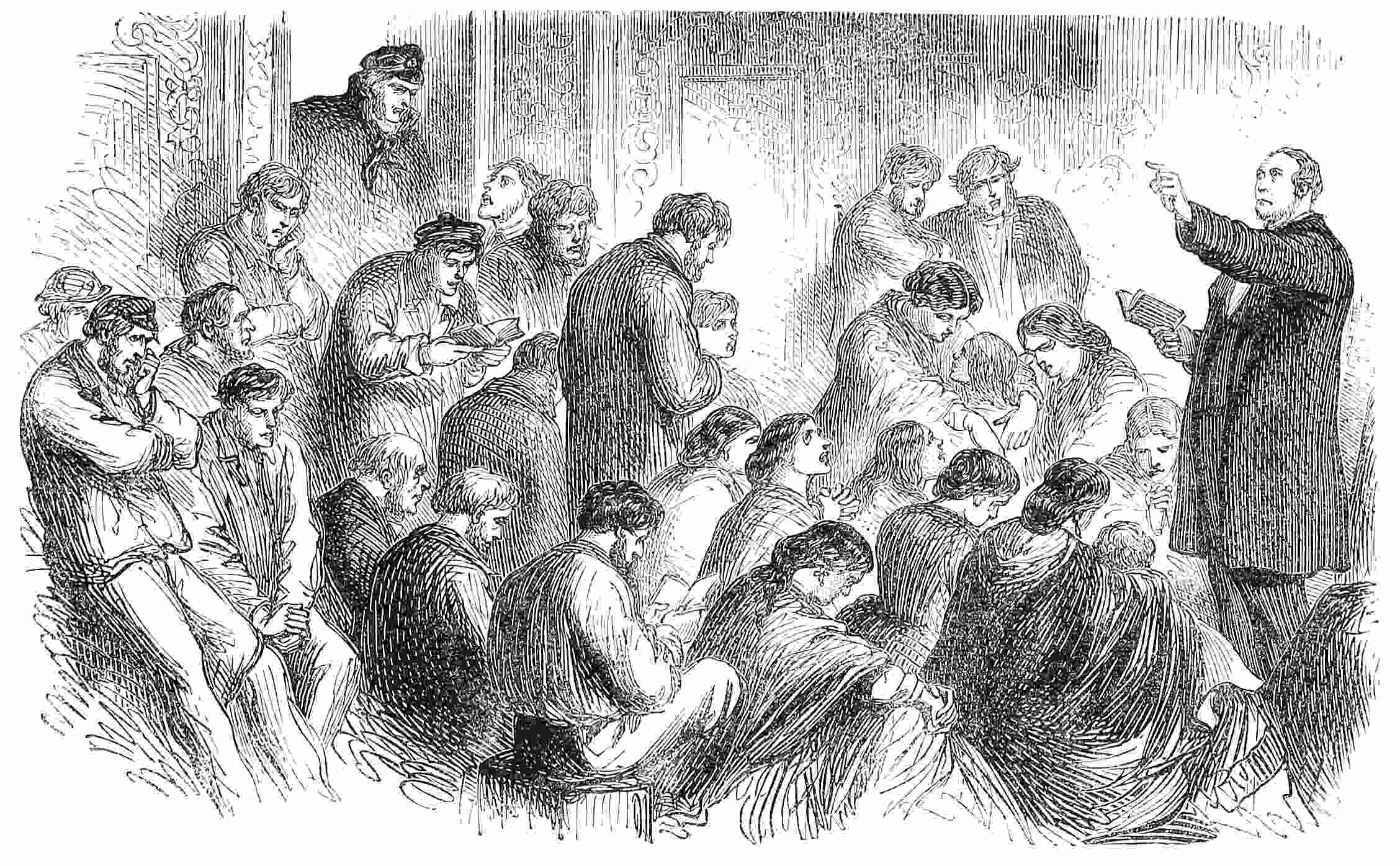
Religious service was of course held on board, and it was
conducted by Dr. Woolley and Mr. Draper.
It was not until Monday, the 8th, that the passengers
began to feel anxious concerning their safety, and to regard
their position as becoming every hour more and more
perilous. During Sunday night it was evident that a gale
might be expected, and on Monday morning it was blowing
with great violence. The Captain ordered the engines to
be stopped and sail to be made on the ship. Towards noon
the wind appeared to lull somewhat, and in the evening the
weather had so improved that all sails were taken in, and the
engines again set in motion. The weather, however, soon
changed again, and the gale seemed only to have lulled to
gain new strength; for between eight and twelve of Monday
night the spanker of the ship was blown away by its violence.
Captain Martin and some of the crew, amongst whom was
the gallant John King, one of the survivors, endeavoured to
get the spanker in, and at last succeeded. It was a night of
raving wind and rolling sea, and we hear of sleepless passengers
below in their cabins reading the Bible to each other,
and offering solemn prayer to Him who rode upon the wings
of the wind. All that night Captain Martin was here and
there throughout the ship—indeed he was to sleep no more
until the dreadful afternoon of Thursday—and all the orders
which he gave were speedily executed by the crew. The
wind was blowing a full gale, and mizenstaysail and forestaysail
and maintopmaststaysail and reefspanker had been set.
On Tuesday morning, January 9th, commenced that dismal
series of disasters under which eventually the noble vessel
succumbed. The wind was blowing a hard gale from the
S.W. and there was a very heavy sea. The ship was now
making little more than two knots an hour, as her speed had
been reduced, and she was going through the water under
steam only. She pitched tremendously, and every now and
then whole seas dashed over her bows. Such was the state
of things early on Tuesday morning; but the passengers
below as yet only heard the fury of the storm without; they
were safe and dry in their cabins: the fires burnt brightly in
the engine-room, and the two engineers, Messrs. Jones and
Greenhill, surveyed with satisfaction the strong hatchway
which protected their engines from the seas which broke
over the vessel. Bearing in mind what we have said concerning
the size of the engine-room, the reader will be prepared
to learn, that if that engine-room were flooded with
water, the ship would undoubtedly sink. There needed no
other accident than this to secure the shipwreck of the vessel.
The officers on deck could comfort themselves with the
assurance, that though exposed themselves to the storm and
heavy seas which broke over the ship, their passengers were
safe, and they would, by the help of their good engines below,
slowly plough their way through waves that looked as if
they would roll mountains high.
At seven o’clock on Tuesday morning an unusually heavy
sea broke into the lifeboat stowed on the port-quarter, filling
the boat and carrying her away, with all her gear. This
was deemed a most melancholy occurrence, and a series
of minor disasters followed. At nine o’clock the ship gave a
tremendous pitch forward, as if she were about to bury herself,
prow foremost, and in a moment afterwards the sea, with
a force that made the hardiest seaman quail, tore away the jib
and flying jibboom, which carried away with them the foretopmast,
the foretopgallantmast, foreroyalmast, and mainroyalmast,
with all their spars and sails, and other gear. Portions
of the wreck fell clattering on the deck, or hung suspended
by the rigging: the topmast was swinging in the rigging and
the foreroyalmast was hanging down and swinging with the
motion of the ship. The jibboom was lying on the starboard
bow, right over in the water!
Thus, at one fell stroke, the beautiful vessel had been
dismantled, and received damage which, in the storm that then
raged, it was next to impossible to repair. Captain Martin
was cool and self-possessed in the midst of the untoward
occurrence, and efforts were at once put forth to remedy the
disaster, but to little purpose. The masts which had fallen
on board, and which hung suspended by their rigging, and
the jibboom, which was fastened to the ship by stays of wire,
could not be got clear; and thus it was, with the ship in this
dismantled condition, with the gale still increasing in fury,
and with a sea that kept constantly washing all forward, that
the passengers and crew of the London steamed slowly ahead
through the awful night.
There was little sleep on board that night, we may be sure.
The devoted Mr. Draper had already begun the work of
directing the minds of the passengers to Him who had promised
to be a Refuge from the storm, a very present help in
every time of need, and already we hear of earnest prayers
offered for all needful grace to support the bitterness of the
calamity. We know now, and it is a great light shining in
the midst of the darkness, that there were many Christians on
board, who, in the hour of peril, would be enabled to point the
distressed to the sinner’s Friend. We can scarcely go in any
direction throughout the metropolis without hearing the glad
tidings of one, and another, and another, being on board, who
would not be afraid to die, and who would be sure to be of
use to shrinking and, perhaps, unprepared fellow-sufferers.
And in the cabins below it is very beautiful to hear the voice
of supplication mingled with the din and war of the tempest.
We hear at least of a few, who, in the second cabin, were
engaged throughout the night in reading the Bible by turns.
Mrs. Price, Mrs. Wood, who had with her her husband and
five children, Miss Brooker, and Miss Marks, are among those
thus engaged. Throughout the vessel the feeling has gone
forth that the passengers may never reach land, and may at
any moment be called upon to exchange time for eternity.
Thus the long dreary night of Tuesday wore away, and
Wednesday came, bringing with it disasters that quickly rivalled
each other in horror.
Early on Wednesday morning, about three o’clock, Captain
Martin ordered the engineers to get up full speed, as he
intended to put the ship about and run for Plymouth. The
gale continued blowing without the least abatement, but in the
course of a little while the dismantled vessel was once more
homeward bound. Mizenstaysails were set, and she steamed
N.N.E. at the rate of five or six knots an hour.
The chief engineer, Mr. Jones, is obliged to give up through
sickness, and now it is Mr. Greenhill, the second engineer, who
has to carry out the Captain’s orders in regard to the engines
throughout the day. The engines are in perfect working
order, and although the vessel has shipped a little water
through the number of seas that have broken over her, there
is none in the engine-room, and the brass-bound and grated
skylight above is perfectly safe. There is not a crack in it
that he can see, and, with the engines revolving more quickly
now, away the vessel is steaming, head to the wind.
In the course of the morning the damage of the preceding day
was repaired, so far as securing the masts, which, up to this time,
had been swinging about aloft, and the wreck of the jibbooms
cleared away from the ship. At noon an observation was
taken, and indicated their position to be lat. 46·48 N., and long.
8·7 W., viz. in the Bay of Biscay, and about 200 miles
S.W. of Land’s End. As they hoped to make Plymouth
soon, and to refit there before proceeding on their voyage, no
repairs were attempted, save making the wreck as trim as
they could.
Meanwhile, we have to say again, the fury of the storm
increased, and the waves were running mountains high. It
was six o’clock on Wednesday evening, and their course was
N.N.E., when the wind increased into a perfect hurricane
from N.W., the squalls blowing with a degree of fury seldom
paralleled. The vessel rolled and pitched fearfully, shipping
every now and then large quantities of water. Suddenly the
fore and mainstaysails were violently torn away by the
squall, and went flying away into the darkness. Shortly
afterwards, the lifeboat and cutter, which were stowed away
on the starboard side, were stove in and carried away by the
violence of the sea. As the night deepened, and nine o’clock
approached, the ship was in a hurricane, the like of which the
oldest seaman on board had never seen!
The engines had been stopped, and the Captain was relying
now upon his sails to bear him through, but they were blown
to shreds and ribbons, and the once stately vessel, so strongly
built and so perfectly equipped, was now the mere sport of
winds and waves. In a few hours those on board had, if the
storm continued, received an irreparable loss, for three out of
seven of their boats had been carried away by the sea. Their
two lifeboats, that would have held so many, and would have
perhaps taken them in safety to land, were gone. Nevertheless,
Captain Martin was not the man to indulge in feelings of
despondency, or to waste time in useless regrets. A solemn
responsibility rested upon him, and we believe he was true to
it if man ever was.
“Set the engines going, and keep her head N.N.E.”
“Ay! ay! Sir.”
And on through the wild dark night and surging sea
the poor London drove; when disaster upon disaster fell
upon her with crushing weight. At half-past ten a terrific
sea broke over the port-gangway, and what the sailors
graphically called a mountain of water descended almost
perpendicularly over the hatch of the engine-room. That
hatch, as we have already said, was deemed strong enough
to keep out any sea that might ever dash over a ship.
Altogether it weighed about a ton and a half, and it measured
12 ft. by 9 ft. It was glazed with plate glass half an
inch thick, and there were gratings of galvanized iron over
the glass, and the bars were three-quarters of an inch thick.
Yet, although thus strongly built and brass fastened, that
mass of water, which descended almost perpendicularly, dashed
through the hatchway, down which it threw violently two
men, and, literally smashing every thing in its way, immediately
flooded the engine-room with water.
Mr. Jones, the first engineer, ill though he was, immediately
ran from his berth, and descended to the engine-room, where he
found Mr. Greenhill standing by the engines. The engine-room
was flooding, and a body of water was passing down the
hatchway. The hatchway had been swept clean away, and
there was now nothing to prevent the rushing in of the sea.
Of all calamities, this was the one most to be deplored: the
ship’s carpenter could do nothing in the way of repairing, and
yet down they must all go, and that speedily, unless something
was done, for at every sea the vessel shipped, the water in the
engine-room was rising higher and higher.
To remedy the evil as far as possible, tarpaulins and canvas
were brought, which the men tried to nail down over the aperture.
The men also tried to put the flying jibboom over the
aperture, but such a hurricane was blowing, that both the canvas
and the men who were trying to batten it down were washed
away. The pumps were set to work, and passengers and crew
worked incessantly, some at the pumps, and some in baling out
the water, which, alas! came pouring in, and which, notwithstanding
all their efforts, rose higher and higher in the engine-room.
Nor could they by any means cover over the opening
which the sea had made by sweeping away the hatchway:
tarpaulins, blankets, sails, mattresses, whatever they could
find, they heaped upon ladders, pieces of wood, and spars,
which they had thrown across as supports; but the storm and
sea mocked their best endeavours; and, alas! about a quarter
past eleven o’clock that night the waters had risen to such
a height that the fires were out, and consequently the engines
ceased working. There was already about five feet of water
in the engine-room, and the ship was labouring heavily in the
trough of the sea. Her condition, therefore, was altogether
hopeless. In consequence of the engines stopping she could
no longer hope to steam through the gale; the engineers
could work no longer, and, for the same reason, the large
bilge-pumps were rendered useless.
Mr. Greenhill had the painful task of making known to
Captain Martin the saddening intelligence that his fires were
out; and that no more help was to be looked for from the
engines. The Captain received the news with perfect calmness.
He said he was not surprised at it; that he had
expected it; and immediately ordered the maintopsail to be
set, in the hope of keeping his ship before the wind. Vain
attempt. The gale tore it to ribbons, and in the trough of the
sea the vessel laboured through the night, rolling gunwale
under. Well, indeed, might the Captain say that night, “You
may say your prayers, boys.” It was a seaman’s way of
saying, “You must prepare for the worst: at any moment we
may go down.” It was indeed a time for prayer, and we
believe that, during that night, of which we shall have a little
more to say in another chapter, such prayers were offered as
were perhaps never offered in sinking ship before.
CHAPTER VII. LAST STRUGGLES.
The morning of Thursday, January 11th, at length came to
the passengers and crew of the foundering London. There
had been, we may be sure, no attempts at seeking rest among
the passengers below. On the deck all night the pumps had
been going, and every one was doing his utmost to second
the good Captain’s efforts to save the ship, if possible. The
bravest had little hope of this, but still every man worked as
if all depended upon his efforts. The universal testimony is,
that passengers and crew did what they could. Some of the
crew, it is true, had to seek their berths through sickness or
terror; but there was no lack of hands to work the ship.
There was no abatement in the fury of the storm; the
wind raved as violently and the waves thundered as fiercely
as ever against the ship, and there was no change in her
monotonous roll in the trough of the sea. It was the morning
of that fearful night, it may be remembered, when more than
thirty vessels were driven on shore in Torbay. The names of
some of the passengers of the London who strenuously exerted
themselves have been made known, although they have not
come back to hear of the enthusiasm which their gallantry
has inspired in the hearts of thousands. Dr. Woolley worked
with the rest at the pumps, and encouraged the passengers to
do their best: he, though so delicate, and all unused to manual
labour, did his work with the bravest and best of them.
The exertions of Mr. Brooke, if possible, surpassed those
of any on board. At times he went into the saloon, where his
sister was among the ladies, and where, in frightened groups,
the passengers were engaged in prayer, in reading their Bible,
or in listening to the instructions and consolations of Mr.
Draper. The tragedian would help for a little while in baling
out the water, and then he would away again to the deck to
work at the pumps, and he continued so doing until even he
had to relinquish all hope. Barefooted and bareheaded,
attired only in a Crimean shirt and trousers, now in the
cabin—now on deck—he forms a picture of dauntless heroism
that will long live tenderly in the memory of his friends.
It was about four o’clock on Thursday morning when a
new disaster occurred, which, added to the sweeping away of
the hatchway on the preceding day, may be said to have sealed
the fate of the vessel. A tremendous sea struck the stern of
the ship, and stove in four of the windows of the upper or poop
cabin. Through the breaches thus made the water rushed in,
and the ’tween decks were soon flooded. The carpenter was
immediately set to work to remedy the disaster, and he found
that the force of the sea had driven back the strong shutters
of the dead lights, and broken the glass of the sashes inside,
and the sea was pouring in in great quantities. He endeavoured
to secure the ports by shoring them with a spar placed
against a post on the main deck, so as to make the shutters
once more firm, although the sashes had been driven in. The
stratagem succeeded for a little while, but as the ship got
deeper in the water the sea drove the ports entirely in, and
soon rushed about unchecked through the upper and into
the lower saloon.
Meanwhile, on deck the efforts of both passengers and
crew were directed more earnestly than ever towards keeping
the gaping aperture over the engine-room covered. The
ship was fast settling down, and was more than half full of
water. Captain Martin went down with Mr. Greenhill into
the room, and, upon the engineer taking soundings it was
found that there were fourteen feet of water, the whole of
which had come through the hatchway, notwithstanding all the
efforts made to keep it out. There was also a considerable
increase of water between the decks. Every time the ship
lurched in the trough of the sea she was taking in tons of
water over the gunwale. Captain Martin did not lose heart,
but at the same time told Mr. Greenhill that he had now little
hope of saving the ship. Nevertheless, upon going on deck, after
this examination of the engine-room, he cried to those who
were baling out water, “Men! put down the buckets and come
and try to secure the engine-room hatch, for that is the only
chance to save the ship. Secure that, and we may keep her up!”
Instantly the Captain’s order was obeyed, and once more the
men tried to nail down sails and tarpauling, which the sea,
however, washed ruthlessly away, or flapped down into the
engine-room. Among those who laboured hard at this work,
useless though it too soon proved, was John King, who had
been hurt the preceding evening by his fall overboard. The
violence of the sea and storm was such, that men were driven
hither and thither by it on deck, knocked against casks and
pieces of the wreck, and were in imminent danger of being
washed overboard, as King had been. But there was no relaxation
of effort. Mr. Angell was at the donkey-engine,
Dr. Woolley, Mr. Brooke, and other passengers at the pumps,
and many were engaged in vigorously baling out the water
from the lower saloon, through the upper saloon, and over
the upper deck.
All efforts, however, were unavailing. Mr. Wilson, one of the
survivors, said, that as it was getting light, he asked Captain
Martin if he should go on baling out the water, to which the
Captain replied, “You may, but I think it is of no use.”
About eight o’clock the carpenter received orders to see to
the boats! On board now there were the port cutter, the two
pinnaces, and the jolly boat, for two lifeboats and the starboard
cutter had been washed away previously. All the boats were
immediately plugged and made ready for sea, and bread and
water put in them. A little before ten o’clock the starboard
pinnace, which was of iron, and which would hold fifty persons,
was got ready for lowering, and John King with five others got
into her. Being lowered too fast, however, she swamped, and
sunk headforemost: the men were of course thrown with great
violence into the sea. After having been twelve seconds
under water, King was washed up to the rail of the ship, and
got on board, and the rest also were saved.
Shortly after the foundering of the starboard pinnace,
the Captain entered the saloon, and said, by way of answer
to the mute appeal made to him on every face, “Ladies,
there is no hope for us, I am afraid. Nothing short of a
miracle can save us.” These were his exact words, and
Mr. Draper calmly replied to them by saying, “Then let us
pray!”
At two o’clock on that wild, stormy afternoon the vessel
was sinking rapidly, and the channels were nearly level with
the water. Captain Martin now told Mr. Greenhill, that as
the port cutter was ready for lowering, he had better take the
command of her, and of as many as it would hold. As for
himself, he had no thought of leaving his ship; he would sink
with the London and her doomed passengers. The crew, as
they remembered the fate of the starboard pinnace a few
hours previously, were at first not over-anxious to set about
lowering the port cutter, and, for reasons that will appear in
the next chapter, the passengers generally made no attempts to
escape.
John King, with a few other seamen, had already provisioned
the cutter with a bag of bread, a beaker with
about a quart of fresh water, and a few bottles of brandy,
which a bright and intelligent young midshipman, Walter
Edwards, greatly to his credit, as Mr. Traill the magistrate
observed at the Board of Trade Inquiry, managed to conceal
from the men after he had got on board. A few here and
there could not see an attempt being made to escape, notwithstanding
its seemingly hopeless character, without being
desirous of joining in it. This lad, who was on his first voyage
out, said, that after the starboard pinnace had been swamped, he
heard Captain Martin earnestly dissuading a lady, Mrs. Owen,
from going in the port-cutter boat. He himself was talking
with Mrs. Owen when the Captain came up to where they were.
She told him she intended going, and had asked one of the
men to take care of her and her little child, and the man had
promised to do so. Captain Martin, as if he knew of the
spirits that had been put on board the port cutter, told her
earnestly that there might be drunken seamen in the cutter,
and that she would only be exposing herself, perhaps, to a
painful and lingering death.
“Captain Martin,” said the lad gently, “was quite calm and
composed. The only time I saw him give way was when he
told Mrs. Owen that there was no use in her going into the
boat: his feelings then quite overcame him, and he cried. All
the officers of the ship worked well. The sailing-master, Mr.
Harris, was working all day on Monday and Tuesday with his
coat off, and Mr. Grant also behaved exceedingly well. They
were all attentive to duty, and had not lost their mind up to
the time when the ship went down. All the passengers, you
could see, had death in their faces.”
“And what were your own thoughts, you brave young
Walter?”
“I felt for leaving my mother, but I did not feel any fear
about going down. I felt some fear on the Monday.”
“But you got accustomed to it, I suppose?”
“Yes.”
“What else do you remember?”
“About twenty persons stood watching King and Daniell
getting the port cutter ready; but King and Daniell induced
them to go and try to launch the port pinnace. Both went
to help them to do so, but as soon as they got them engaged
at the pinnace, King and Daniell slipped away, and were
busy about their own boat again.”
“And how did you get into the boat?”
“I was in the mizen-shrouds. I asked King and Daniell
would they allow me in, and they said ‘Yes,’ and bid me
jump. I did so. The fall was about ten feet. Another midshipman
was in the next shrouds, but he was afraid to jump,
and he went down with the ship.”
CHAPTER VIII. THE ANCHOR WITHIN THE VEIL.
Why was it, it is time to ask, that there was not a greater
clamouring after escape, both among passengers and crew?
Why was it, that when all on board knew that the ship was
doomed, and that at any moment the deep might open to
swallow them up, there was not that wild delirium and agony of
despair which we have been accustomed to see associated with
such considerations? To understand this in some measure, we
must take a glance at what had transpired in the saloon of the
vessel from the commencement of the voyage.
The saloon of the London had been constructed with the
strictest regard to the comfort of her first-class passengers;
nor had their tastes been disregarded if they had any admiration
of what was elegant and chaste in workmanship. Here
there would be throughout the voyage a common meeting
ground for members of the same class amongst ladies and
gentlemen; and here religious services would be conducted on
the Sabbath, at which all on board might be present.
On the first Sunday out there was a religious service, and
Dr. Woolley associated with Mr. Draper in conducting it.
Both these gentlemen were known to each other, and, although
belonging to different sections of the church, had many friends
in common, by some of whom, experienced in similar voyages,
the steamer in which they were to return to Australia, and the
cabins they had taken, were inspected and approved. From
Mr. Draper’s known characteristics it may be affirmed as a
certainty, although as yet no record of it has reached us, that
as, on their very first Sunday out, they encountered heavy
weather,—a strong wind having sprung up and a heavy sea,—he
would find matter for religious instruction applicable to
their circumstances. And we cannot tell how largely the
divine blessing may have accompanied the religious services
of the day. If it be true that before the barren fig-tree is
cut down, the influences and means used to quicken it into
life and fruitfulness are more than doubled, may we not say
that He to whom all things were known, and who saw the end
from the beginning, vouchsafed a more than ordinary blessing
to the gospel declared to more than two hundred who were
spending their last Sabbath on earth?
On Monday, there being no abatement in the violence of the
weather, but, on the contrary, the storm rather heightening in
force, the ladies and passengers generally would keep their
cabins, or meet for conversation in the saloon. On Monday
we know that many on board felt more fear than they did on
subsequent days when the first shock of the tempest had worn
away, and they had become accustomed to a hurricane that
never changed but for the worse. There were, we know,
several on board who had been professed Christians for years.
There was one who had, we believe, two brothers in
the ministry, and who was a spiritually-minded man himself.
There was another who was the son of a very distinguished
Minister of Christ, and who was himself a devoted
Christian. There was a young woman who had just left
service in Suffolk, and who had written a letter while on board
to a Christian friend, which went to shew the reality of her
religious life. There were many who were in the habit of
reading their Bibles daily.
We mention these as types of the different classes composing
the passengers, and as illustrative of the fact, that
over the vessel there was spread a goodly number of persons
who were not ashamed to own their Lord, and who,
when they saw the clouds of distress gathering around
their fellow-passengers, would be able, and, as we have heard,
would be certain to be all the more earnest and useful
and kind in proportion to the distress they saw exhibited.
That during the fearful gale which sprung up on Monday
night there would be distress and fear of the direst kind we
make no doubt, but we gather comfort from the fact, that the
example and exhortations of the godly would not be without
their salutary and soothing influence.
Directly, we hear nothing of Mr. Draper’s exertions until
Wednesday, from which time until the vessel went down he
was incessant in his ministrations; but, as we hear of groups
of children looking up with wonderment into the frightened
faces of their mothers, of ladies reading the Bible to each
other, and of individual passengers turning over its leaves as
if in search of passages that would be suitable to their condition,
of husbands sustaining wives by their constant presence,—we
may be sure that the man who was as loving to his
fellows as he was faithful to his Master had already lost all
thought of self in the work of imparting consolation and
instruction in the awful circumstances in which those especially
were placed who had now for the first time to begin
to think seriously of the claims of religion.
“From all I have heard respecting him,” writes the Hon.
Mr. McArthur, “self seems to have been altogether lost sight
of. Nor does it appear that he paid any special attention to
his beloved wife, to whom he was most ardently and devotedly
attached, but his whole heart and mind seem to have been
engaged in the great work of endeavouring to lead those by
whom he was surrounded to flee for refuge to the only hope set
before them.” Nor though we do not hear so much of Dr.
Woolley as we do of Mr. Draper throughout the appalling
calamity, are we therefore to suppose that he was untrue to
his sacred calling, and to the loving instincts of a very kindly
heart. Had the facts of his life been before us, we should
doubtless have been able to speak of him with as much length
as we have of the Wesleyan preacher. One who evidently
knew and loved him has said, “Not much is said about him;
but we know in what manner he would die and help others
to die. His public career may be told in other ways, but
this one word is in remembrance of the man himself—the
good man—John Woolley.”
On Wednesday, as we have said, the testimony concerning
Mr. Draper’s efforts, and the results attending them, is clear and
decisive. Prayer and religious instruction had become general,
and the saloon was transformed into a sanctuary, from whence
ascended the voice of supplication and weeping to Him who
was alone able to save. There were earnest wrestlings of soul
amongst those who felt themselves face to face either with heaven
or hell. It was hard to feel all at once that they must die,
that there could be no escape. It was hard for the newly-married
of a week only to feel that all the joys and hopes of
life must be ruthlessly terminated. It was hard for all who
had formed their plans for the future, or who had just left in
England those whom they held so dear, or who had brought
their little children out with them intending to settle in a new
home,—very hard for all to be told with a decisiveness which
there was no gainsaying, that they must die. And no wonder
that in the first burst of agony which this conviction brought
with it, many gathered round the Minister, crying, “Pray with
me, Mr. Draper. Pray for me, Mr. Draper.”
And he did pray. Those who knew him have much to tell
of his power in prayer, of it being the effectual and fervent
supplication of a man, “who was as sure of answer as if voices
from heaven told him he was heard.” Happy indeed the man,
who seeing death written in every face, and surrounded by the
weeping and conscience-stricken, had no time and no disposition
to care for himself, in the Christ-like work of caring for
others. As he drew nearer to Heaven, he had yet deeper
fellowship with the sufferings of that blessed Master he served,
who, while hanging upon the cross, had leisure to think of all
wants but His own. The Master saved others; Himself he
could not save.
All Wednesday, as we have seen, the storm raged with
incessant fury. The passengers below heard and felt with
bated breath that tremendous sea break over the vessel by
which the cutter was stove in and the starboard lifeboat
carried away. The passengers in the saloon must have felt
the shock in all its terrible might, for it broke against their
quarter of the ship; and perhaps it was then, when all
expected that they were going down, that Mr. Draper was
heard praying, “O God, may those that are not converted
be converted now—hundreds of them.” This prayer went up
again and again during that stormy day.
Again there was a crash overhead, and those below heard
to their dismay that the main hatchway had been swept away.
There was the rushing of water heard pouring down into the
engine room; there was the Captain’s voice heard shouting
through the storm, and the responsive cry of the crew. “Prepare
to meet your God. Prepare to meet your God!” This
was the solemn admonition of the minister throughout the
day and night.
At twelve o’clock that night there was a prayer-meeting in
the saloon, which was attended by all who could be spared
from their duties on deck. A marvellous meeting indeed it
must have been, in which strong cries and tears went up to
Him whose word was pledged that He would not turn away
his ear from the voice of prayer; that He would listen to the
cry of the afflicted.
And did He not listen? Did He not answer? We would
humbly hope that the prayers presented were not the offspring of
mere natural terror, but the utterances of broken and contrite
spirits. On Thursday morning a wondrous calmness had
taken possession of all hearts. There were no agonizing
shrieks and screams, no delirious efforts to escape from their
doom. The prayer-meeting, and the prayers of the last three
days had done their work. Something stronger and holier
than love of mere natural life had taken possession of many
hearts. Their’s was the victory which had overcome death,
even their faith. Not even when the Captain entered the
saloon, and sadly announced that there was no hope, did
their calmness and resignation forsake them. “Let us
pray,” Mr. Draper said, and then they quietly prayed by
themselves. Shortly afterwards the minister said with great
kindliness, “Well, my friends, our Captain tells us there is no
hope, but the Great Captain above tells us there is hope, and
that we may all get safe to heaven.” Blessed truth! we have no
doubt that it went home to the hearts of many. Friends
began to take leave of friends, as if preparing for a long
journey. Husbands, wives, and children clung to each other
as if death itself should never divide them. And, clinging to
each other, and, we trust, to Christ, they calmly waited for
the sea to swallow them up, amid all the excitement of
launching the port cutter.
“CONSOLATION IN THE HOUR OF PERIL.”
CHAPTER IX. LAST WORDS.
At last, but with greater precaution than before, the port
cutter was launched, and got safely down. Six men were
in her, but as she rose and fell with the fury of the waves,
and every moment appeared likely to swamp, all felt the
propriety of the Captain’s words, that in such a sea there was
but little chance for the boat. The command of the boat
belonged to Mr. Greenhill, as second engineer, and without
loss of time he was anxious that all who had determined to
make one more desperate struggle for life should hasten from
the poor doomed ship. She was fast settling down to the
water’s edge; there was a fearful swirl of water around her
stern, and the cutter was in danger of being sucked down
into the whirlpool of the wreck. It was a leap for life in the
case of each one who jumped from the vessel, for the cutter
seemed no more than a piece of cork upon the tumultuous
billows, and no wonder that many paused and drew back in
horror from a leap to what seemed nothing short of instant
death.
It was while the ship was fast filling with water, and death
every moment drew nearer, that some last words were spoken
that will never be forgotten by the survivors, or by those to
whom, in some instances, they were sent. What were Mr.
Draper’s last words? He had been exhorting and praying,
without intermission, for more than twelve hours before the
ship went down. Two of the survivors have a distinct remembrance
of him as they last saw him, about an hour before the
boat left. He was then in the saloon, and men and women
were still gathering around him, and saying, “O! Mr. Draper,
pray for me!” The last words these two survivors heard him
utter were these: “Well, my friends, our Captain tells us
there is no hope, but the Great Captain above tells us there is
hope that we may all get safe to heaven.”
Another saw him a few minutes before the boat pushed off,
and his testimony is that Mr. Draper was then heard exclaiming,
“Prepare to meet your God.” The devoted minister
was calm and self-possessed, although the corpses of
women and children were floating over the deck. His wife
was with him: hand in hand they would go down together
into the deep, and together enter into the Father’s rest, in a
very few moments now. Patience a little longer. Mrs. Draper
was a sharer in her husband’s faith, calmness, and heroism; a
noble co-operator with him in all sweet deeds of self-sacrifice.
It moves one to tears to hear of her thoughtful care for others
in that last dread moment. A short time before the boat had
left the vessel she handed her rug to some of the sailors to
help to keep them warm. “But what will you do without it?”
“It will only be for a few minutes longer,” is said to have been
her reply. There was, in this last act of hers, the simple,
quiet expression of what her life had been for many years—a
life of inobtrusive effort for the good of others. In the
hour of awful peril, when it would have only been womanly
and natural for her to have claimed her husband’s care and
solicitude, we do not hear of her, for a single moment,
interrupting him in his sacred task. She herself, doubtless,
did what she could to help him in the work of imparting
spiritual instruction to those who were every moment expecting
death.
When Mr. Draper was last seen, and that was a few
minutes before the boat was cut away from the sinking ship,
he was heard speaking with deep emotion, but with the clear
strong voice which naturally belonged to the cheerful-hearted
man—and that he was right through life—saying these words;
“Those of you who are not converted, now is the time; not a
moment to be lost, for in a few minutes we shall all be in the
presence of our Judge.” And again the word sounded,
“Prepare to meet your God.” These were the last words
that he was heard to speak by any who escaped, but doubtless,
during the few minutes of life that yet remained, he continued
to comfort and exhort; and not, perhaps, until the cold waters
closed around him, did he give himself leisure to pray for himself,
perhaps saying, “Father, into thy hands I commend my
spirit.”
Peace be to his sweet and precious memory! Although
no monument marks the spot in the vast cemetery of the
deep where his ashes repose, the place of his sepulture is
well known to Him by whose mysterious hand he was buried,
and in the appointed hour the sea shall give up its dead, and
he shall be found in his place at the end of the days. Death
to him had not come untimely. Thousands will bewail his
loss, because it is theirs, not his. For him to die was exceeding
gain. He had less of earth only to have more of
heaven. Through the tempest and the flood he found an
earlier passage to immortality than his love of labour in the
Master’s vineyard allowed him to anticipate; but it is all well,
because ordained by Him whose way is in the sea, whose path
is in the great waters, and whose footsteps are not known.
There were other last words spoken while the little boat
was being held to the ship’s side with all the energy of
despair. Mr. Munro, a passenger, had made up his mind
to try the faint chance of escape which entering the cutter
afforded. All felt that escape was next to impossible,
and Mr. Munro among the rest. Before leaving the vessel,
however, he went down to the cabin where were some friends
of his from Ballarat, Mr. and Mrs. Hickman and their
young family. It was a terrible task even to make the
proposition that he had come to make known: it was
that there was room in the boat for one! It was impossible
that the poor children could escape; not one of
them could be expected to take the fearful leap required;
nor could Mrs. Hickman; but her husband,—he could
escape, perhaps, if he would, and if the boat did live out
the fearful sea, he might be saved. Mr. Munro urged his
friend to avail himself of the chance.
But no! Mr. Hickman had no need to look at his wife
and four little ones, around whom the water was rapidly
rising higher and higher, ere he gave the answer. The
water was then a considerable depth in the saloon on
the lee side, as the fond husband and tender father replied
to his friend’s entreaty thus:—“No! I promised my wife
and children to stay by them, and I will do so!” Brave
determination, one never to be regretted by him who made it,
never to be forgotten while tales of heroism have any power
left in them to move human hearts to enthusiasm and tears.
His choice, though a melancholy, was the right one, and his
friend acted kindly in not further attempting to divert him
from it.
“Help me,” said Mr. Hickman, “to move the children to
the other side, out of the water.”
Mr. Munro performed this last act of kindness for his friends:
they then shook hands. The last words of that fond father
were, “Good bye, Jack!”
His friend then left him for ever. But will he ever
lose,—alas! alas! will any one who reads the story ever
lose sight of the vision of that loving father and mother, with
their four children, standing in a row to the windward side of
the saloon, and thus momentarily expecting death!
Peace, poor weeping mother and devoted father! Peace,
ye dear helpless children! There is One on high whose
voice of love is mightier than the voice of many waters, and
we humbly hope that those parents, with many others in a
similar position of peril, passed through the sharpness of death
into His presence, who would smile upon them a welcome,
the first glance of which would for ever banish the remembrance
of pain, as they cried, “Behold us, and the children
thou hast given us!”
But there were more last words yet. Upon seeing Mr.
Munro return alone, the men in the boat shouted to him,
“There is still room: fetch a lady!” Hearing this, he sprang
across a portion of the deck in quest of a lady whom he knew;
but not seeing her, and knowing that the moments were flying
fast, he said to a young girl, “Will you go?” She appeared
willing to do so, and Mr. Munro immediately caught her in
his arms, and hurried with her to the bulwarks; but when she
looked over and saw the distance she had to leap, she said, in
an agony of despair, “Oh, I cannot do that!”
The boat seemed every moment as if it would go down amid
the terrific roll of the sea, and she drew back in affright from
the awful gulf that appeared yawning to receive her. Mr.
Munro was obliged to drop his hapless burden, and to leave
the young creature on the deck, while he himself leaped from
the bulwarks into the rolling boat below.
There was one young man on board, in whose spiritual welfare
a clergyman in the suburbs of London had taken deep
interest before he embarked on his fatal voyage. The young
man had remained undecided for Christ, notwithstanding all
entreaties and appeals; but ere he went on board the London
his friend the clergyman had implored him to offer up daily a
prayer which he had given him. Neither, perhaps, could have
possibly dreamed of the circumstances of peril under which
that prayer would come to be used. There came now some
last words from that young man. Amid the raging of the
storm, he shouted out to one who was in the boat—“If ever
you get safe to land, tell Mr. —— (mentioning the clergyman’s
name) that the prayer he gave me I have used every day
since; and that now I can say of Christ, ‘My Beloved is mine,
and I am His.’” These were his last words; but how much
happier—brief though they were—have they made many a
Christian heart, telling, as we humbly hope they do, that the
speaker had escaped the second death, and that the haven of
eternal rest was in sight.
There was a young girl on board whose last words were not
spoken, but written. Was she the one of whom we read as
standing bareheaded in the wild storm, with holy resignation
depicted in every feature? She hurriedly wrote a few words on
a slip of paper, and said to one who was about to leap into the
boat, “Give this to my mother.” Her last wish was sacredly
obeyed, and there came to a mourning mother this serene message
from one who had gone down in a stormy sea—“Dear
mother, you must not grieve for me: I am going to Jesus.”
Miss Brooker, of Pimlico, spoke her last words, and they
were those of quiet resignation to the will of God. We hear
of her, during those days and nights of fearful suspense, doing
what she could to soothe a fellow-passenger whose mind at
times seemed on the very verge of delirium, the absence of
which among the passengers generally, while it is matter of
devoutest gratitude, is also matter of greatest wonder,—unless
explained by the presence of Him who walketh upon the
wings of the wind, and who, in answer to prayer, was shedding
abroad in many hearts a tranquillity so deep and hallowed
as to be beyond the reach of the wildest tempest. As the end
drew rapidly near, Miss Brooker clasped her hands, and was
heard to say, as if to herself,—but, oh! there was One
by that heard all that was said during that awful last hour,—“Well,
I have done all that I could; I can do no more!”
Nothing now, except trust, and hope for the life beyond
this troubled one. Nothing now, but to make the most of
those exhortations which, with trumpet-clearness, rise every
now and then above the howling of the gale—“There is hope
that we may ALL get safe to heaven. Those of you who are
not converted, now is the time: not a moment to be lost, for
in a few minutes we shall all be in the presence of our Judge.”
There were more last words still, and they were those of
Mr. G. V. Brooke. Only a few days before,—on the 23rd of
December,—he had sustained the character of Richard the
Third. The walls were not placarded with the announcement,
“The last appearance of Mr. G. V. Brooke upon any stage,”
but they might have been so; and how would the hundreds
who listened to his farewell address that night have felt,
could they have caught the double meaning which the
opening sentences of that address contained, at least as we
read it now?
The actor was in painful ill-health, and his subsequent
heroism on board the foundering London derives additional
interest from the fact. His last words at Belfast were these:—“Ladies
and Gentlemen, with this night finishes my professional
career in Belfast for a long, very long time to come. I fervently
trust, by the favour of the One Providence, that I may
at some distant time be enabled to return to a town which I,
in a measure, look on as my home, where I may professionally
or unprofessionally, mingle with my friends in Belfast again.
I now take an affectionate farewell of you all, wishing from my
heart continued prosperity to this magnificent city.”
These were his last words on any stage. A few days later,
and he was bearing his part in no mimic tragedy,—in a conflict
which, in its way, was far more appalling than the battle
of Bosworth Field in which Richard fell. As we watch the
closing scene of the poor actor’s life, one cannot have a heart
and remain unmoved or silent in the presence of the man
who, in weak health and with painful hoarseness, did the
work of many men combined during those despairing days.
Did the hundreds who listened to him in Belfast catch any
prophetic hint in the mimic agony with which he delivered the
death speech of Richard?
“I have set my life upon a cast,
And I will stand the hazard of the die!”
The time had come, when, in reality, there was no earthly
means of escape, and, seeing that all his exertions were useless,
he rested upon one of the half-doors of the companion,
and, bareheaded to the storm, gave himself up to reflection.
His last words to man were to the steward, “If you succeed
in saving yourself, give my farewell to the people of Melbourne;”
but who shall say what words were addressed to Him
who was alone able to deliver, during those four hours in which
he was observed to continue in a musing attitude.
Strangely enough, there were last words spoken, which,
upon being repeated by the survivor to whom they were
addressed, will doubtless carry a value which, had the speaker
known, would much have soothed him during his closing
hours of life. A son was on board the London, who, with
death staring him in the face, thought tenderly of the old
man his father, whose declining years would have been rendered
all the happier for possessing money that must now, as
the speaker thought, sink with him, and be lost. Among the
second cabin passengers were two, Mr. Munro and Mr. Eastwood,
who had been acquainted previous to the voyage. As
the little boat was being filled with all it could hold, Eastwood,
addressing his fellow-passenger, said, “Well, Jack, I
think we are going to go.” “I think we are, Eastwood.”
“Well, we cannot help it,” the other went on. “There’s only
one thing I regret about it: of a draft for 500l. on the Bank
of Victoria, Ballarat, I only received 20l., which I gave to the
Captain, in the office of Money Wigram and Co. I should
have liked my poor father to have got the balance.” These
were the last words of a son, who soon after perished in the
waves, but his friend escaped, remembering exactly the words
which filial tenderness had inspired.
There were some last words spoken which we cannot record,
words of the sufferers to each other, and words addressed
to Him whose ear is never heavy to the cry of distress. Husbands
and wives, parents and children, friends and acquaintances,—what
words of farewell passed amongst these! What
last words of prayer mingled even with the sighs of death!
With what tender compassion and sympathy have those been
thought of whose heroic actions on board the doomed ship
were the last words that will be sacredly cherished in the loving
memory of those who knew them. The picture of that brave
young officer, Mr. Angell, standing to his post to the last at
the donkey-engine, which was used in working the pumps,
calmly keeping there while the billows thundered their spray
around him, and going down into the dark whirling water
with his hands still on the engine;—this is a picture which no
artist, however gifted, can paint strong and beautiful enough
for us. It was his last sermon—and how eloquent was it—to
all the young officers of our Navy upon a sense of duty,
making him who possesses it superior to all thoughts of
danger.
There was something, too, inexpressibly touching in the incident
of that aged couple who had three children with them,
who had been wrecked already twice in their attempting to get
to Melbourne, now being on board the sinking ship, and being
swept overboard before the final hour came. Among the passengers,
also, we read of two stout old people who had become
favourites on board, and who had been sent for by an only
son. The son will expect them at Melbourne: alas! how many
will be expected there who will never arrive thither. One’s
heart quivers in anticipation of the sorrow into which multitudes
will be plunged. When the poor aged couple knew that
there was no chance of escape, they simply took each other by
the hand, and went down into the cabin to die together.
But come there no last words from the gallant Captain,
who, since Sunday, has had no sleep, and who has not even
changed his clothes? Where is he while farewells are being
exchanged, while the little boat is being filled with all it can
hold, and while his beautiful vessel, which once seemed to
walk the waters like a thing of life, is so fast filling, that her
bulwarks nearly touch the water?
We catch glimpses of him several times while the boat is
being lowered, and while it is being filled with sixteen of the
crew and three passengers, and at all times we see him at the
post of duty, and doing his best. About an hour, perhaps,
before the getting away of the boat from the ship, Mr. Jones,
the chief engineer, was between decks near the engine-room.
The ship was then labouring in the trough of the sea, and was
in a most disabled condition. He ran up between decks, and
met Captain Martin for the last time, who was going in the
direction of the saloon.
“Well, Mr. Jones, how do you feel?” was his question.
“Not well, Sir,” was the reply: “I took it that he referred
to my condition of mind and not to the accident I had met
with. I saw no more of him after that. I saw nothing but
the ship going down after that. When I left the ship the
passengers had given up all hope, but there was a remarkable
composure amongst them, and no loud sounds to be heard. I
heard voices engaged in preaching and praying.”
Mr. Jones was the last man who leaped into the boat: he
leaped and got into her as she rose with the sea, and the sea rose
so high that he had scarcely any distance to jump from the gunwale.
Before, however, the first engineer leaped into the boat
it had already been gradually and carefully filled, as we have
seen, with members of the crew and with three passengers. Mr.
Greenhill, the second engineer, was supposed, from his position,
to be officer of the cutter, and he took command of her. “Get
into the boat,” the Captain had said among his last words; “there
is not much chance for the boat; there is none for the ship.
Your duty is done; mine is to remain here. Get in and take
command of the few it will hold.” His command had been
obeyed, and now the only chance for the nineteen in the boat
was to get as quickly away from the ship as possible, for the
ship was being washed over to the boat, and she was in great
danger of being sucked down, as we have said, with the
sinking vessel. Before pushing off, the men in the boat
shouted to the Captain to join them.
“No,” he replied: “I will go down with the passengers. Your
course is E.N.E. to Brest, and”—throwing them a compass—“I
wish you God speed, and safe to land.”
These were the last words the survivors heard fall from the
lips of John Bohun Martin; but at that moment there came a
fearful last word from the deck of the sinking vessel. A
lady, with horror on every feature, shrieked out most piteously,
“A thousand guineas if you will take me in.”
But if she had offered the whole world there could have
been no response to her cry. The boat, which had been hastily
cut away, was already some yards distant, and to return would
have been certain death to all, who, as it was, had not in their
own minds the slightest hope of escaping. About five minutes
afterwards, and when they had got eighty or ninety
yards, they looked towards the ship, and saw that she was
going down stern foremost. The wind at this time was
raging so violently that the men in the boat could not hear
each other when eagerly shouting. It was with a kind
of dumb wonderment that they saw what transpired. As
the ship sunk it was seen that all on deck were driven forward,
not by water, but by a tremendous and overpowering rush
of air from below, which, as it escaped through the deck as
well as the hatches, impelled all on deck forward with violence,
and their dreadful struggle must have been, therefore,
soon over!
In a single moment the men in the boat seemed to take
in at a glance all that transpired on board. They saw
the stem of the vessel rise so high, that her keel was
completely out of water as far as the foremast. The
boatswain, the butcher, the baker, and the purser’s mate, it is
said, had resolved to attempt their escape in the remaining
boat over the cuddy, which was already provisioned and
launched; but no sooner were these men ready to put off, than
the sinking vessel sank beneath them, making, in her descent,
a very whirlpool of angry and confounding waters, and the
escaping ones in the cutter saw their comrades swallowed up
quickly and disappear with the lost ship. They saw young
Angell going down while standing at his old post of duty:
for a moment they saw two men with life-belts struggling
amid mountains of water: they rose with the waves, and then
descended into the deep, deep grave which the sea formed for
them, and then not a trace of men or of ship was to be seen!
The gale thundered so furiously, that if there was a cry from the
sinking ship, it was not heard. Once more to the bottom of the
Bay of Biscay had gone a noble ship and valuable cargo; but
O! saddest of all, more than two hundred forms, that a
few days before had been seen sitting in mirth and friendliness
around many an English fireside, had gone down too. And
once more the billows rolled on, curling their monstrous heads,
as if in contempt of the beings who would seek to master
them when once they rose in their terrible might and
majesty.
CHAPTER X. THE LIGHT BEHIND THE CLOUD.
Was there such a light? It was one of the saddest of calamities,
desolating at a stroke many a bright home, and
nipping in the bud some of the fondest hopes and purposes.
Was there such a light? The disaster swept away two
hundred and twenty lives, around which many other lives
twined like the gentle tendrils of a vine, and who will,
perhaps, wither now that the props to which they sweetly
clung have been torn ruthlessly away.
Was there such a light? The aged and the young went
down together into the same grave. The infant child of four
months old was dashed far away from the sinking mother’s
breast, and heroism of the loftiest type received no higher reward
than the dullest, basest cowardice.
Was there such a light? The refined scholar, for whom his
pupils wait—the tender father, for whom a widow and six
children, with only slender means for their support, anxiously
look out—the gently strong John Woolley has gone down into
the deep, and the sea has taken no more account of his worth
and power than it has of the fool.
Was there such a light? Captain Martin has gone; the man
who fearlessly traversed the ocean for years, who had often
smiled at danger, and had gone between Melbourne and London
until the path was as clear to him as the turnpike-road to
the waggoner. The gentle, courageous good man will never
more be greeted by his relatives, and the wide circle of friends
who loved him will see him no more.
Was there such a light? Daniel Draper is lost to the
church and to his only son; his brethren in the ministry will
no longer be able to depend upon his wise suggestions; and
souls unnumbered are still white unto harvest, while the
successful reaper suddenly drops his sickle, and will gather
in no more sheaves.
Was there such a light? and in what quarter of the heavens
did it glow behind the great darkness in which the good ship
went down into the whirlpool of destruction with 220 lives on
board?
There was such a light, and we have no doubt of its beaming
over this dark catastrophe still,—the light which shines
through the words,
God is love.
That those who now most need the light of this truth to
guide them will see even the faintest glimmering of it, we
cannot say; but when the blindness occasioned by the smart
of tears has cleared away, we are sure, that if they will look up
there will be the truth mildly shining behind the calamity,
dark though it be. The mystery, appalling though it be, can,
in this world, receive no truer solution, but a lifetime may
pass away without our even having learnt the letters by which
the truth is to be slowly spelt out.
But while the mystery remains, the calamity loses much of
its horror, if we lay to heart the truth of the over-ruling
providence of God. “It is appointed unto man once to die,”
and the Omnipotent one has ordained the place, the time, the
circumstances. Good and faithful servants were in the ship,
and the summons that told them their way unto the Lord’s
presence was through the deep, brooked no delay; but the road
was not half so strange to them as it seems to us. Before
their eyes a light was shining which is hidden from our view,
and by it they were conducted to their Father’s house as
serenely as if they had breathed their last on downy pillows.
Down into the great deep they plunged, and then?
In a moment, in the twinkling of an eye, they had left their
sea-soaked raiment behind them, and they were at rest amid
the blessed calm on which no tempest shall ever, ever, ever
break. A rich feast was awaiting their arrival; bright and
happy faces were around the board to welcome the guests who
had come through the flood and tempest; and God Himself
wiped away all tears from off all faces, and the voice of eternal
love thrilled their hearts as it whispered, “There shall be no
more death, neither sorrow nor crying, neither shall there be
any more pain, for the former things are passed away.”
Oh! could we think a little more of this scene beyond the
flood, and less of the terrible shipwreck, we should assuredly
catch glimpses of the light behind the cloud. From the eternal
shore the voices of the faithful reach our world, saying,
“Men of England, men of Melbourne, weep not for us, for
we have all got safe to land; and the land is good, and, behold
we were not told the half concerning it. See to it, that ye prepare
to follow us in the way our Father sees best.”
But through the sea? Yes, for the sea is his, and He made
it; and God may use it as He did in the case before us,
not as a minister of wrath, but of mercy, to conduct his
chosen ones to Himself.
But through all the agony which preceded the struggle, and
through such a struggle?
Yes; if that too be the Divine will, for who was it that for
our sakes chose the saddest and most lingering of deaths?
and who, in the anguish of a fast breaking heart, cried,“My
God, my God, why hast Thou forsaken me!”
But let us say that friends and relations are in danger of
making by far too much of the agony, and not enough of the
heavenly help that came to the shipwrecked ones, to enable
them “to suffer and be strong.”
We believe in the superiority of Divine grace to the mere
natural feeling of pain and anguish, and that when Divine
strength nerves the soul, the keenest physical tortures are all
outside things. The martyrs of old could without pretence
woo the flames that consumed them, clothe themselves
cheerfully as with a garment of fire; and while the chain
around him grew red hot, one could talk of his dying thus,
as if he were on a bed of roses! And He who for some
inscrutable but all-wise and loving purpose permitted the
calamity of the shipwreck, may have thus supported his
servants, and deprived them of agony as He had previously
deprived them of fear—the greater agony of the two.
Is there not also a light behind the cloud, when the fact is
called to mind how faithfully the gospel was preached, and
how fervently most of those on board engaged in acts of
devotion? There have been scenes of horror on board shipwrecked
vessels which baffle all description, when it has
been made known that the ship must go down. Then, shouts
of cursing, despair, and drunken revelry have been heard
above the fury of the gale, and mocked the very groans of the
dying.
“Then rose from sea to sea the wild farewell,
Then shrieked the timid, and stood still the brave.”
But on board the sinking London, amidst the storm, the
gospel was preached, earnest prayers presented, the Bible
read, and anxiety for the soul experienced. All as yet at
least were in the place of hope on which the gospel ladder was
planted, the top whereof touched heaven. They had not
passed away to the region where faith would be impossible,
and from whence there could be no escape. The way of
salvation was singly pointed out to them again and again.
They were not, we may be sure, burdened with details and
theories, but the simple yet glorious truth was proclaimed,
“Here is a Saviour waiting to save you, believe in Him and be
saved. You are a sinner, but He died for sinners; you are
the very one He came to seek; trust yourself entirely to Him;
turn with a holy hatred and grief from your sins, and rely
upon his promise to save you, if you only this moment, with
all your heart, ask Him to do so.”
And we may believe, and we ought to believe, that the
gospel does not only offer immediate salvation, but that Christ
does grant it to every man who penitently asks His help. The
gospel preached during the storm was not, “Repent and believe
the gospel, and you shall be saved at some future day;” the
promise was, “You shall be saved now, and this day, though
thy body may go to the bottom of the sea, thou shalt be
with Christ in Paradise.” Poor sinking one, only believe, and
thou shalt see the glory of God.
There is light behind the cloud indeed, in the remembrance
that such a gospel was proclaimed hour by hour; and in the
conviction we also cherish that many believed it, gave themselves
up to the influence of its promises and encouragements,
and were so filled with faith in Him who had died to put away
their sins and open the kingdom of heaven to them, that they
were not afraid to die, seeing not death but heaven before
them.
“Where all the ship’s company meet,
Who sailed with the Saviour beneath;
With shouting each other they greet,
And triumph o’er trouble and death.
The voyage of life’s at an end,
The mortal affliction is past,
The age that in heaven they spend,
For ever and ever shall last.”
“And so,” doubtless it will be said, “you want to make
them all religious, before the ship went down?” We would,
indeed, kind reader, that we could cherish this hope concerning
all, for then the light behind the cloud would increase in
brightness every day. As sinful men opposed to God we
would have had all on board believers in the Great Reconciler,
who can make both one, and fill the souls of those who trust
Him with the most blessed assurance that there is no longer
any gulf of separation between them. Where there is this
faith there is no fear, neither of dying, nor of what lies beyond
death.
And, reader, in the hour that is before thee, as surely as it
was before those that went down in the Bay of Biscay, it is
only this faith in Christ that can impart courageous strength
to thine own spirit, and solid consolation to the mourners who
will presently bewail thee gone. If thou hast it, thou wilt go
thy journey undismayed, while the heaven, to which thou art
gone will shine brightly behind the cloud, and tell those who
grieve thine absence most, that they need not sorrow as those
who have no hope.
CHAPTER XI. THE ESCAPE.
Nineteen persons had entered the port cutter. These consisted
of the second and third engineers, one fireman, the
boatswain’s mate, the quartermaster, the carpenter’s mate, the
steward, the boatswain’s boy, five able seamen, and three
passengers. They had received their course from the now
drowned Captain—N.N.E. to Brest, which was 190 miles
distant, and they had compasses on board. Under the direction
of King, the men agreed, that whatever might happen
they would sit immoveable, except when pulling at the oars.
Two worked at each oar, and they ran before the sea. Both
Daniell and King deserve the highest praise for their skill in
steering the feeble craft over the raging waters, but it was
pleasant to find them both modest and seamanlike in all they
said about it.
“I believe you took charge of the boat, didn’t you, Daniell?”
“Well, I pulled an oar sometimes, and sometimes steered.
I took no particular charge of the boat, but I gave my opinion
and advice now and then.”
“But you took a little of the lead?”
“Well, I did. Others also gave their opinion.”
Among the “others” who gave counsel was John King.
“How did you manage to steer?”
“Chiefly by the ‘pointers’ to the N.E.”
JOHN KING.
It was a fearful struggle for life that the brave seamen now
engaged in, as, with parched lips and every nerve strained to
its highest pitch of tension, they rose and fell with the green
waves still running mountains high. It seemed almost
hopeless to attempt to withstand any longer the fury of the
sea, which broke over them in angry surges. As we have
said, they had but a quart of water on board, and the
bottles of spirits. It was a fortunate thing that young
Edwards succeeded in getting hold of these and concealing
them, for the probability is, that had the seamen given way
to drink in their then excited state, raving delirium would
have set in, and cutter and crew would soon have been at the
bottom. The lad shall tell his own story, and he is worthy of
lasting honour and remembrance for his part in it.
“Daniell agreed to be our hammock man. He sat by me
and was pulling the bow-oar. There was a bag of biscuits
weighing two cwt., two bottles of brandy, and two of champagne,
some turnips and carrots, in the boat. There was
some water also on board, but it was thrown out. I picked up
three of the bottles and put them under my coat. Mr. Greenhill
and Daniell knew I had them, but the others did not.”
“Your conduct was very commendable,” said Mr. Traill,
“and you did quite right in trying to keep the bottles of spirit
away from the men. You have begun your career unfortunately,
but I hope you may hereafter succeed as you deserve
to do.”
Thursday night came on, and the boat still drifted before
the wind, and about three o’clock the next morning a regular
green sea broke over them and nearly half filled the boat.
One of the passengers baled out the water constantly, and
after the green sea came in the water was baled out with a
bucket and cans. Before daylight, and as the moon rose, the
men saw a vessel close alongside. They hailed her with all
their might, and were heard by those on board; but as they
could present no light they could not be seen, although they
could see the ship tacking about for an hour trying to find
them. The search was fruitless, and to their utter disappointment
the ship was lost sight of. The men adhered to their
course, and about nine o’clock sighted two vessels, but could
not get near them on account of the cross seas. They rowed
for one of them, however, for nearly five hours, and upon
getting within hail she proved to be an Italian barque, the
Marianople. The boat was very near filling when they were
within twenty yards of her. They were struck by a heavy
squall, so that all in the boat gave themselves up for lost.
In consequence of the excitement on board—who can wonder
at it?—they did not succeed in clearing one of the seas; but
by only one of the men moving in the boat to bale her out,
they were enabled to bale her clear, and a log line being
thrown them from the barque, one by one they were drawn
up on deck! The young midshipman Edwards was drawn on
board by men who caught him by the collar of his coat.
The shipwrecked were in a most benumbed and perishing
state, but the master of the barque, Captain Cavasa, treated
them with the greatest kindness. The generous Italian could
speak but little English, but his deeds have spoken so forcibly
that Englishmen will be long before they forget his kind-heartedness.
By his orders the men were stripped and
rubbed, and clad in fresh warm garments. The good captain
killed a turkey for them, besides providing tea and soup, and
setting apart for them warm beds. After treating them with
every kindness, he landed them at Falmouth, from which
port the story of their marvellous escape, and the loss of so
many precious lives in the London, flashed with the speed of
the telegraph throughout the length and breadth of the land,
producing everywhere grief and consternation unspeakable.
The following is the list of those saved:—
John Greenhill, engineer; John Jones, second engineer;
John Armour, third engineer; Thomas Brown, fireman; W.
M. Edwards, midshipman; D. T. Smith, boatswain’s mate;
Wm. Daniell, quartermaster; John King, Benjamin Shield,
Richard Lewis, James Gough, Edwin Quin, William
Grimes, seamen; A. G. White, boatswain’s boy; William
Hart, Carpenter’s mate; Edward Gardner, second-class
steward; D. G. Main, passenger; John Munro, passenger;
J. E. Wilson, passenger.
It is a remarkable fact, moreover, that the London is the
first ship belonging to the famous house of Money Wigram
and Sons to which any serious casualty has occurred. In a
century’s experience, Messrs. Wigram have enjoyed a perfect
immunity from loss, with the single exception of the True
Briton, which belonged to a former generation of the firm,
and foundered early in the present century in the same
fatal bay.
But in a chapter treating of those who escaped from the
wreck of the London, those must not be forgotten who
narrowly escaped the doom which fell upon so many in the
Bay of Biscay.
Some hair-breadth escapes in connection with this disaster
are well known. A lady who was desirous of proceeding from
Plymouth with her family to Melbourne by the London, had
made repeated pressing applications to the owner’s agents at
Plymouth, and the Captain had been consulted, but, fortunately
for the applicant, had declared that his cabins were so full
that he could not possibly accommodate her, a result that, at
that time, caused her much disappointment. A second-class
male passenger was so alarmed at the rough weather which
the London encountered on her way down to Plymouth, that
immediately on her arrival at that port he came ashore,
resigned his passage, and went back to his home, thus unwittingly
saving his life. A young man, as the result of some
family quarrel, left his home, and took a passage by the
London. He was advertised for, and importuned to return,
his friends being unaware of his whereabouts. Messengers
were sent down to Plymouth, and an influential ship’s broker
in the town was employed to intercept him should he attempt
to sail thence. Fortunately he was detected amongst the
passengers of the London, and his family communicated with
by the broker, the result of which was that a brother of the
young man came down to Plymouth, and persuaded the would-be
emigrant to forego his voyage.
May those who escaped the voyage by the doomed vessel,
as well as those who got safe to land from the wreck, feel the
solemnity of that life which has thus been so marvellously
rescued from a watery grave.
CHAPTER XII. THINGS REMEMBERED IN THE STORM.
A few things were remembered in the storm, to which, when
we have called the reader’s attention, our task is ended.
The Bible was read in the storm. Doubtless the passengers
had with them many books to relieve the tedium of
a long voyage, but good as these books might have been, it
was not from these that they sought to derive instruction and
comfort in the hour of peril. They opened their Bibles,
many of them were seen in groups reading it together, or
sitting by themselves turning over its pages, as if in search after
some passage which had been forgotten, and the meaning of
which was specially important then. They read the Bible
during the most solemn hour of their existence, and when
they knew that their moments were numbered, and whilst in
the midst of a scene which its own pages have so magnificently
described.
“They that go down to the sea in ships, that do business
in the great waters; these see the works of the Lord, and His
wonders in the deep. For he commandeth and raiseth the
stormy wind, which lifteth up the waves thereof. They
mount up to heaven, they go down again to the depths;
their soul is melted because of trouble. They reel to and
fro, and stagger like a drunken man, and are at their wits’
end. Then they cry unto the Lord in their trouble, and
He bringeth them out of their distresses. He maketh the
storm a calm, so that the waves thereof are still. Then are
they glad because they be quiet; so He bringeth them unto
their desired haven.”
That storm-tossed vessel, with her sinking passengers, has
furnished no insignificant testimony to the preciousness of
the Book which too many criticise as if it were the foe and
not the friend of humanity. The picture of those passengers
going down with their Bibles in their hands will be a sweeter
one for the memory to treasure, than all the results of
anatomical critics. And Oh surely! it will teach its lessons to
those who are content to live in the neglect of, or in direct
opposition to, the Book which in such an hour was appealed to,
and not in vain.
Nor must it be forgotten that, on board the sinking London,
the passengers attached the greatest possible importance to
prayer. They prayed for themselves, and they besought an
interest in the intercessions of others. During those wasting
days and nights of lingering suspense they continued in
prayer: it was their only comfort, and they went down into
the deep with the voice of supplication upon their lips. Does
not this teach its own solemn lesson to the prayerless who
may read these pages? Does it not tell of a value in prayer
beyond all the arguments that may be used against it, or even
in favour of it? Those brave men and women, praying bareheaded
to the storm, and going down into the wild waves
calmly trusting in God’s goodness still;—shall not this last
touching act of theirs convey an appeal to the prayerless
which there can be no resisting? Shall it not say in tones
of entreaty that cannot be withstood, “Seek ye the Lord
while He may be found, call ye upon Him while he is near?”
Close to your heart with its deepest needs there stands a
throne of mercy from which every imaginable good can be
obtained: turn to that throne, be you in lane, highway, or open
street, when this commandment reaches you, and seek salvation
in the name of Christ, and you shall not seek in vain.
Finally, on board the sinking London, the greatest attention
was paid to a preached gospel. A preacher is not unfrequently
heard enforcing his appeals to the undecided by the
solemn words, “I speak as a dying man to dying men.” In
Mr. Draper’s case the words were literally true, and they had
all the pathos and hold of last words that might at any
moment be stopped by the overwhelming flood: and how the
passengers listened! How important seemed every word then
with either heaven or hell coming nearer and nearer with
every inch of water rising in the engine-room!
Ah! could those on land, and out of the reach, as they
think, of such a calamity as shipwreck, but feel, that slowly yet
surely up to them is advancing the hour in which all earthly
interests will be as nothing, and the concerns of the soul all
important, how would they now value the privilege of a
preached gospel, and every instrumentality by which they can
learn more of themselves and of spiritual things! A little
while, and the last hour of every one who reads these lines
will have come, and will be felt to be the last. How wilt
thou meet it, reader?
It has been said, that in that last hour, no matter how aged
the dying one, the memory awakes to its keenest power, and
there passes before the mind a vivid diorama of all life’s doings.
Events and circumstances seemingly long buried, suddenly
leap into life, and it well nigh startles one to listen to the
remembrances that come and go through the fast-darkening
chambers of the brain. Slowly dying on the pillow before
us, lies one whose head is silent with age, and the grey dawn
of an eternal morning is stealing over his features; but
glancing brightly through the haze of death, there come to
him visions of his long, long past; of the home of his childhood,
of the bride of his youth, of the events of his riper age
and manhood, until in a single hour he seems to live all his
life over again.
Oh! it will be sad to remember, in such an hour, a neglected
Bible, a throne of grace despised, and a gospel of mercy refused.
It will be sad to remember, that even such a calamity
as the wreck of the London produced no serious impression,
and no turning of the head towards heaven. If the things
which the sinking passengers remembered during the storm
are remembered by you now,—if their deep importance is laid
to heart by all whose feelings have been touched by the disaster,—then,
terrible though it has been, it will not have occurred
in vain. It will have come in mercy to those who, in circumstances
of fancied security, are not prepared to die. To such
the voice of the sinking minister crying, even from the drowning
wave, “Prepare to meet your God,” will not have come in
vain.
THE END.
APPENDIX. — SEA MESSAGES FROM THE PASSENGERS. — Transcriber’s Notes
The narrative which we have here given of the Wreck of
the London was written pending the inquiry instituted by
the Board of Trade to arrive, if possible, at the cause of the
melancholy catastrophe. It is to be regretted that the inquiry,
though it lasted many days, has not added much to the information
that was given to the public by the survivors upon
their landing at Plymouth. No discovery has been made as
to the real cause which brought about the melancholy event,
although it is hardly possible to conceive any question of more
serious importance to the public mind. The evidence given
at the inquiry was by no means satisfactory. On the one
hand, those directly connected with the owners gave their
evidence, and on the other hand, there was the testimony of
the Emigration Inspectors who had passed the ship, and who
could not be expected to stultify themselves by a new judgment
of her seaworthiness. But against this testimony of ship-builders
and inspectors has been placed the evidence of those
who declare that the ship was in disgracefully bad trim, and,
as will be seen among the slips that were picked up in bottles
that were cast away on the morning of the wreck, there was
one which says that the vessel was too heavily laden. Great
dissatisfaction has been expressed, and it has even been made a
subject of discussion in the House of Commons, that Mr. Traill,
the magistrate before whom the Board-of-Trade inquiry was
conducted, did not permit Counsel to cross-examine witnesses
on behalf of those who have lost relatives: but it seems that
there really was no power under the Act of Parliament to
admit of such cross-examination. The tonnage, measurement,
and steam-power of the ship, together with the names of her
owners, the nature and quantity of her cargo, were stated
before the Court. We heard again the story of her voyage
from the Docks to Gravesend, and from Gravesend to Plymouth,
and from Plymouth to the Bay of Biscay. There
was no charge made against Captain Martin, and no one
dreamed of imputing negligence or incapacity to so experienced
a seaman. The evidence of the official surveyors
and other experts examined by the Court of Inquiry as to
the construction and fittings of the London was, on the
whole, decidedly in favour of her perfect seaworthiness. In
the opinion of the Court, the immediate cause of her loss
was the sea getting into the engine-room and extinguishing
the fires; but the Court did not venture upon any positive
conclusions as to whether the action of the sea carried away
the skylight over the engine hatchway, or whether the skylight
was properly secured. It did not appear in evidence
that the fastenings of the skylight were not properly secured,
and it was distinctly stated that the hatchway was perfectly
battened down. There were several points in the evidence
as regards the occurrences at sea—such as the carrying
away the masts and booms, the delay in clearing away the
wreck, the loss of the boats, and other matters relating to
the management of the ship—which might have been more
satisfactorily explained had the lamented Captain, or any of
the officers of the ship, survived to explain them. In the
absence of such explanation, it is but reasonable to give
Captain Martin the credit for the character he always possessed,
of being an able and careful seaman, who would not be
guilty of any great default of management.
For ourselves, we can hardly believe that the ship was in the
disgraceful condition that some represent her to have been, unless
we are ready to assume that there was a gigantic conspiracy
among all concerned in pronouncing the ship to be in safe trim.
The Surveyor of the Board of Trade passed the ship; Lloyd’s
Surveyor, acting in the interests of the Underwriters, passed
the ship; and lastly, the ship was passed by the Emigration
Surveyor, who had not only to look to the ship generally, but
to take into consideration her cargo, for the purpose of seeing
whether she was overloaded. We join in the universal regret
that the real cause of the ship’s foundering, beyond what is
given in the preceding pages, is still a mystery; and it only
remains for us again to express the hope that still more scrutinizing
care will be exercised by Government Inspectors and
others, in regard to every ship concerning whose safe trim they
are called upon fairly and honestly to testify.
* * * * *
Messrs. Wigram have kindly forwarded the following List of
Passengers per steam-ship London, Captain J. Bohun Martin, for
Melbourne:—
CHIEF CABIN.
Rev. Mr. and Mrs. Draper
Mr. Owen and child
Mr. and Mrs. G. F. P. Urquhart
Mr. J. Patrick
Mr. and Miss Vaughan (Brooke)
Mr. J. Alderson
Mr. P. Benson
Mr. and Mrs. J. Fenton, and two children
Mr. G. M. Smith
Mr. and Mrs. Chapman, and two children
Mr. and Mrs. Clark, and son
Mr. F. Lewis
Mr. and Mrs. J. Bevan
Dr. J. Woolley
Mr. and Mrs. Debenham
Miss L. Maunder
Mr. J. Robertson
Mr. T. M. Tennant
Mrs. Traill and child
Mr. G. Palmer
Mr. T. Brown
Mr. and Mrs. Amos
Mr. E. Brooks
Mr. J. R. Richardson
Rev. Mr. and Mrs. Kerr
Mrs. and Miss King
Mr. and Mrs. Thomas and two children
Mr. A. Sandilands
Mr. E. Youngman
Mr. H. J. Dennis
Mr. E. A. Marks
Mr. D. F. De Pass
Master W. D. Burrell
Dr. J. Hunter
Miss D’Ovoy
Miss C. McLachlan
Miss Cutting
Mr. McMillan
SECOND CABIN.
Mr. F. Stone
Mr. and Mrs. White
Miss H. Price
Mr. J. L. Williams
Mr. and Mrs. Graham
Mr. B. G. Rowe
Mr. J. E. Wilson (saved)
Mrs. Morland
Miss G. Graham
Mr. J. Dothie
Mr. C. Gough
Mr. A. Bruce
Mr. J. Woodhouse
Mr. G. Cross
Mr. W. Day
Mr. D. W. Lemon
Mr. and Mrs. Giffett
Mr. G. Chennells
Mr. and Mrs. Wood
Master and Miss Clayson
Mr. Thomas Wood
Mr. Godfrey Wood
Miss E. Wood
Mr. B. Bevan
Miss S. Brooker
Mr. Davies
Mr. T. O’Hagen
Mr. H. W. Harding
Mr. F. Fryer
Mr. J. Munro (saved)
Mr. D. C. Main (saved)
Mr. C. Johnstone
Mr. P. Fenwick
Mrs. and Miss Meggs
Mr. G. H. Campbell
Miss E. Marks
Mr. E. G. Trevenen
Mr. and Mrs. Hickman, two sons and two daughters
Mr. A. McLean
Mr. Davies
THIRD CABIN.
Mr. W. Passmore
Mr. H. Miller
Mr. C. P. Chandler
Mr. B. Hay
Miss E. Jones
Mrs. and Miss Simpson
Mr. and Mrs. Hanson
Mr. and Mrs. Graham and three children
Mr. David Graham
Mr. McVittie
Mr. G. Rolwegan
Mr. and Mrs. Sercombe and three children
Mr. and Mrs. G. Flick and four children
Mr. R. Trevenen
Mr. D. Block
Mr. J. Gerkem
Messrs. Zulec Morris and Zulec Barnett
Mr. S. Bolton
Mr. T. Skeggs
Mr. and Mrs. D. Smith
Mr. A. Umphray
Master Spring
Mr. A. Hoyeim
Mr. J. Walls
Mr. W. Barron
Mrs. Lampes and two children
Mr. Algernon L. Otter
Mr. John Little
Mr. H. McCovey
Mrs. Bachelor
Mr. J. Kirkwood
Mr. W. Clifton
Mr. R. Reynolds
Admiral Halsted, the Secretary of Lloyd’s, has received the following
letter from Sir Anthony Perrier, C.B., Her Majesty’s Consul,
and Lloyd’s Agent at Brest, dated 24th February 1866:—
Sir,—I annex a translation of an extract from a letter just received
from the Commissary-General of Marine at Lorient, which may be of
interest to those concerned in the fate of the unfortunate London,
should the original papers sent to Paris not have been transmitted to
Her Majesty’s Government by the Minister of Marine.
I am, Sir, your obedient servant, Anthony Perrier.
To the Secretary at Lloyd’s.
Extract of a letter from Commissary-General of Marine at
Lorient:—
(Translation.)—On the 12th of February last three bottles were
found on the coast of Guiberon and Locruariaquer, containing six
papers written in English, as follows:—
The first paper—D. W. Lemon, London, Thursday, 10th January
1866. The ship is sinking; no hope of being saved. Dear parents,
may God bless you, as also me, with the hope of eternal salvation.
Second paper.—Steam-ship London.—They are putting out the
boats.
Third paper.—F. G. Huckstepp. On board steam-ship London,
lat. 46 deg. 20 min., long., 7 deg. 30 min.; lost boats, masts, and
sails; ship leaking.
Fourth paper.—We commenced our voyage on Saturday, the 30th
December 1865. Sunday in the channel, Monday in open sea; Tuesday
in ditto; Wednesday at Cowes; Thursday at Plymouth; Friday
and Saturday at sea; Sunday bad weather; Monday water from the
stern comes in cabins; the 9th, heavy damages, a boat lost. May we
get home. Storm.—H. G.
Fifth paper.—F. C. McMillan, of Launceston, Tasmania, 12th January,
to his dear wife and dear children: May God bless you all.
Farewell for this world. Lost in the steam-ship London, bound for
Melbourne.
Sixth paper.—H. J. D. Denis to Th. Denis Knight, at Great Shelford:
Adieu father, brothers, and my ... Edi ... steamer, London,
Bay of Biscay, Thursday, ten o’clock. Ship too heavily laden
for its size, and too crank; windows stove in; water coming in everywhere.
God bless my poor orphans. Request to send this, if found,
to Great Shelford. Storm not too violent for a ship in good condition.
On the same day were found, on the shoals of Guiberon, a binnacle
watch, stopped at half-past ten o’clock, a woman’s shift, two
cotton sheets, two splinters of wood, having on them in white
letters, and six centimetres (2½ inches long), the word London.
A great quantity of staves have been picked up along the coast.
In compliance with instructions from the Minister of Marine,
the above-mentioned papers have been sent to the Minister of
Marine and Colonies.
Punctuation, hyphenation, and spelling were made
consistent when a predominant preference was found
in the original book; otherwise they were not changed.
Simple typographical errors were corrected; unbalanced
quotation marks were remedied when the change was
obvious, and otherwise left unbalanced.
Illustrations in this eBook have been positioned
between paragraphs and outside quotations.
Original text used “steam-ship” and “steamship”;
both retained here.
Original text used “Mc” and “M‘” (the curving left
single quote was used because it looks similar
to a superscript “c”). In this ebook, “Mc” is used
for all of them.