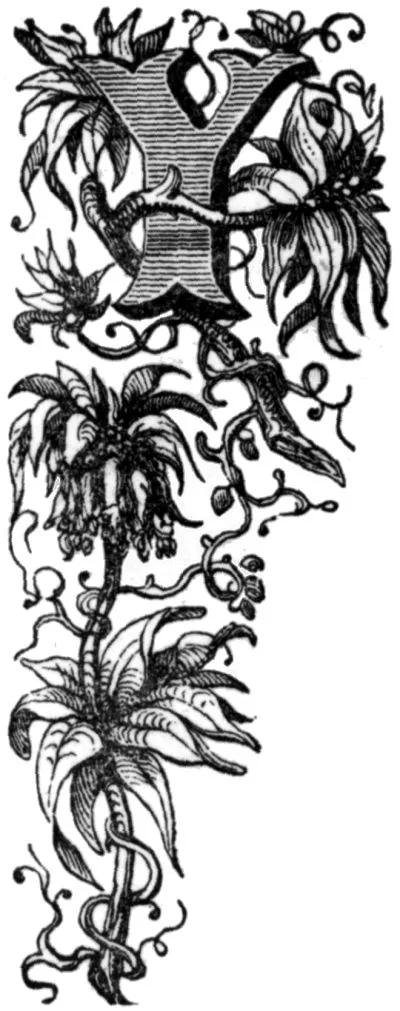
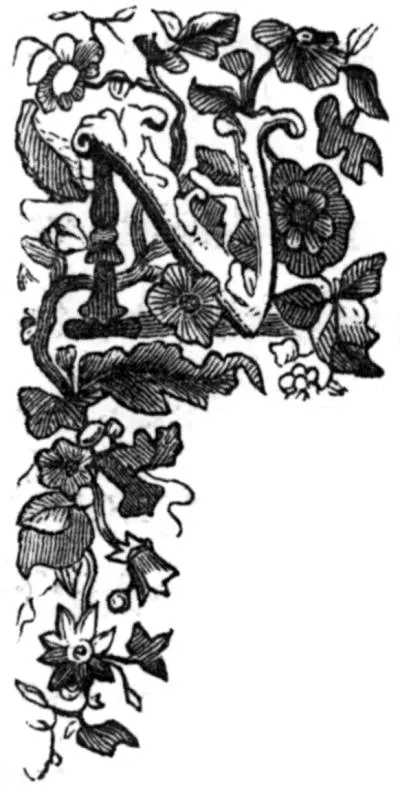
ncle Roderick was an old bachelor—as
thorough going an old bachelor as any one need wish to see. Some
folks said he had a great many droll whims in his head. I don't
know how that was; but this I know, that he loved every body, and
almost every body loved him. He had evidently seen better days,
when, in my boyhood, I first made his acquaintance; or rather, he
had been "better off in the world," as the phrase goes. Whether he
had been happier, may admit of a question; for the wealthiest man
is not always the happiest. There were marks about him which seemed
to show that he had been higher on the wheel of fortune, and that
the change in his condition had had a chastening effect—just as
some fruits become mellower and better after being bruised a little
and frost-bitten. He was a great lover of children, and withal an
inveterate story-teller.
His memory must have been pretty good, I think;
for he would often tell stories to his little friends by the hour,
about what happened to him when he was a boy. Some of these stories
were funny enough; but the old gentleman usually managed to tack on
some good moral to the end of them. By your leave, boys and girls,
I will serve up two or three of these stories for an evening's
entertainment. They will bear telling the second time, I guess, and
I will repeat them, as nearly as my recollection will allow, in the
good old bachelor's own words.
A person is, on the whole, a great deal better
off to be honest. Dishonesty is a losing game. A wise man was once
asked what one gained by not telling the truth. The reply was, "Not
to be believed when he speaks the truth." He was right. There are a
great many other respects, too, in which a dishonest person suffers
by his dishonesty. I must tell you what a lie once cost me. I was
about nine years old, perhaps. In justice to myself, I ought to say
that I was not much addicted to this vice; but told a fib once in a
great while, as I am afraid too many other little boys, pretty good
on the whole, sometimes allow themselves to do. One very cool day
in the spring of the year, my father, who was a farmer, was
ploughing, and I was riding horse. I didn't relish the task very
well, as I was rather cold, and old Silvertail was full of his
mischief. It was a little more than I could do to manage him.
Moreover, there was some rare sport going on at home.
"Father," said I, after bearing the penance for
the greater part of the forenoon, "how much longer must I stay in
the field?"
"About an hour," was the reply.
An hour seemed a great while in the
circumstances, and I ventured to say, "I wish I could go home
now—my head aches."
"I am very sorry," said my father; "but can't
you stay till it is time to go home to dinner?"
I thought not—my headache was getting to be
pretty severe.
"Well," said he, taking me off the horse, and no
doubt suspecting that my disease was rather in my heart than
my head—a suspicion far too well-founded, I am sorry to
say—"well, you may go home. I don't want you to work if you are
sick. Go straight home, and tell your mother that I say you must
take a good large dose of rhubarb. Tell her that I think it will do
you a great deal of good!"
There was no alternative. I went home, of
course, and delivered the message to my mother. I told her,
however, that I thought my head was better, hoping to avoid taking
the nauseous medicine. But it was of no use. It was too late. She
understood my case as well as my father did. She knew well enough
my disease was laziness. So she prepared the rhubarb—an unusually
generous dose, I always thought—and I had to swallow every morsel
of it. Dear me! how bitter it was! It makes me sick to think of a
dose of rhubarb, let me be ever so well. I am sure I would have
rode horse all day—and all night, too, for that matter—rather
than to have been doctored after that sort. But it cured my
laziness pretty effectually, and it was a long time before I told
another lie, too.
"Honesty is the best policy," children, depend
upon it, though there is another and a better reason, as you very
well know, why you should always speak the truth.
When I was a little boy, as near as I can
recollect, about nine years of age, I went with my brother one
bright Saturday afternoon, when there was no school, to visit at
the house of Captain Perry. The captain was esteemed one of the
kindest and best-natured neighbors in Willow Lane, where my father
lived; and Julian, the captain's eldest son, very near my own age,
was, among all the boys at school, my favorite play-fellow. Captain
Perry had two bee-hives in his garden, where we were all three at
play; and as I watched the busy little fellows at work bringing in
honey from the fields, all at once I thought it would be a very
fine thing to thrust a stick into a hole which I saw in one of the
hives, and bring out some of the honey. My brother and Julian did
not quite agree with me in this matter. They thought, as nearly as
I can recollect, that there were three good reasons against this
mode of obtaining honey: first, I should be likely to get pretty
badly stung; secondly, the act would be a very mean and cowardly
piece of mischief; and, thirdly, I should be found out.
Still, I was bent on the chivalrous undertaking.
I procured a stick of the right size, and marched up to the hive to
make the attack. While I was deliberating, with the stick already a
little way in the hole, whether I had better thrust it in suddenly,
and then scamper away as fast as my legs could carry me, or proceed
so deliberately that the bees would not suspect what was the
matter, Captain Perry happened to come into the garden; and I was
so busy with my mischief, that I did not notice him until he
advanced within a rod or two of the bee-hives. He mistrusted what I
was about. "Roderick," said he. I looked around. I am sure I would
have given all I was worth in the world, not excepting my little
pony, which I regarded as a fortune, if, by some magic or other, I
could have got out of this scrape. But it was too late. I hung my
head down, as may be imagined, while the captain went on with his
speech: "Roderick, if I were in your place (I heartily wished he
was in my place, but I did not say so; I said nothing, in fact), if
I were in your place, I would not disturb those poor, harmless
bees, in that way. If you should put that stick into the hive, as
you were thinking of doing, it would take the bees a whole week to
mend up their cells. That is not the way we get honey. I don't
wonder you are fond of honey, though. Children generally are fond
of it; and if you will go into the house, Mrs Perry will give you
as much as you wish, I am sure."
This was twenty years ago—perhaps more. I have
met Captain Perry a hundred times since; yet even now I cannot look
upon his frank, honest countenance, but I distinctly call to mind
the Quixotic adventure with the bees, and I feel almost as much
ashamed as I did when I was detected.
THE WEEKLY NEWSPAPER.
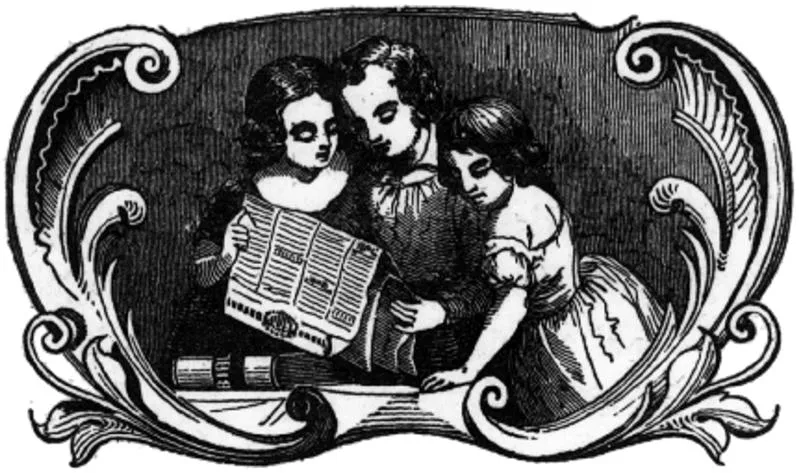
I never shall forget what a sensation it used to
produce in our family, years ago, when the newspaper came. We
children—there were three of us, one brother and two sisters—used
to watch for the post, on the all-important day, as anxiously as a
cat ever watched for a mouse. Peter Packer, the bearer of these
weekly dispatches, deserves a little notice. He was a queer man, at
least he had that reputation in our neighborhood. As long as I can
remember, he went his rounds; and, for aught I know, he is going to
this day.
Peter's old mare—she must be mentioned, for the
two are almost inseparable—was as odd as he was. I should think
she belonged to the same general class and order with Don Quixote's
renowned Rosinante; but she had one peculiarity which is not put
down in the description of Rosinante, to wit, the faculty of
diagonal or oblique locomotion. This mare of Peter's went forward
something after the manner of a crab, and a little like a ship with
the wind abeam, as the sailors say. It was a standing topic of
dispute among us boys, whether the animal went head foremost or
not. But that did not matter much, so that she made her
circuit—and she always did, punctually; that is, she always came
some time or another. Sometimes she was a day or two later than
usual; but this never occurred except in the summer season, and it
was in this wise: she had a most passionate love for the practical
study of botany; and not being allowed, when at home, to pursue her
favorite science as often as she wished, owing partly to a want of
specimens, and partly to her master's desire to educate her in the
more solid branches, she frequently took the liberty to divest
herself of her bridle, when standing at the door of her master's
customers, and to gallop away in search of flowers. She was a great
lover of botany, so much so, that, as I said before, her desire to
obtain specimens sometimes interfered a little with her other
literary engagements; and I am sure I can forgive her—
"For e'en her failings leaned to virtue's
side."
Just so it was with Peter himself. No storm, or tempest, or
snow-bank, could detain him—that is, not longer than a day or
two—in his weekly round. But he loved the theory of making money
as much as his mare loved botany; and he was a practical student,
too, and the road which he traveled afforded a good many
opportunities both for extending his knowledge of that science and
of practically applying his principles. So, between the two, our
newspaper sometimes got thoroughly aired before it came to the
house. But Peter was punctual—I insist upon it—for he always came
some time or another.
When the paper did come, we literally devoured
its contents. With us it was an oracle. If the "Courier" affirmed
or denied a thing, that was enough for us. It was an end to all
debate. How confiding children are! He who has read "Robinson
Crusoe" when a boy, finds it almost impossible to regard it a fable
when he is a man. The newspaper, that makes its weekly visit to the
family circle in the country, leaves the marks of its influence
upon the mind and the morals of the child. It forms his tastes and
controls his character. How careful, then, should parents be, in
the selection of periodicals to be the companions of their
children.
When I was an apprentice, some years ago, I
lived—no matter where, and served—no matter whom. There were
three apprentices besides myself; and it seems necessary to say,
that, at the time when the incident happened which I am about to
relate, we had neither of us completed that branch of husbandry
called the sowing of wild oats; and as the soil was very favorable
for the development of that species of grain, we were perhaps a
little too industriously engaged in its cultivation. We were in
great haste to have the oats all sowed in good season.
One day our employer bought a cast of
cider—Newark cider, I believe they called it—and the greater
portion of it was nicely bottled, and placed in a dark corner of
the cellar, to be used, not for making vinegar, or mince pies, but
for a very different purpose—which may be surmised by such as
remember that in those days the juice of the apple had a much
better reputation than it has now. We were allowed our share of the
beverage. But we were not satisfied. We resolved ourselves into a
sort of committee of the whole, one afternoon; and after a long and
somewhat spirited debate, came to the unanimous conclusion that, in
the course of human events, it became necessary to employ the most
effective measures to procure additional supplies from the cellar.
Now it so happened, that these measures were not of the most
peaceable and honorable kind. Such was their nature, in fact, that
if we had been discovered in the act of resorting to them, it would
no doubt have been deemed necessary, in the general course of human
events, that we should be soundly whipped.
The plan was to seize a bottle once in a while,
something after the manner of privateers; though I believe the
trade of privateering is regarded as piracy, now-a-days. How times
are changed! We were to go on this expedition in rotation, from the
oldest downward. We commenced, and two of us had performed the
feat. It came George Reese's turn next. You didn't know George, I
suppose. But I wish you had known him. I think you could appreciate
the story better, if you knew him as well as I did. Well, George
went down cellar, with his pitcher in his hand, thirsting for cider
and glory. You must know that there was a flight of stairs that led
directly to the cellar from the room we occupied. You should know,
too, that we went down without a light, and felt our way in the
dark. George had not been below two minutes, when we heard a report
from the cellar very like the discharge of a pistol. It was loud
enough to alarm the whole house. We were frightened. We had reason
to be. Who knows, thought we, but they have set a spring-gun for
us, and poor George is badly wounded? We waited in silence, and
with not a little anxiety, for our hero to come up.
He came at last, and a sorry looking fellow he
was. He was covered from head to foot with yeast! The cook had
placed her bottle of emptyings, tightly corked, in the village of
cider bottles; and the truth flashed upon us at once, that George
had made a mistake, and captured the wrong bottle; and the most of
its contents, being a little angry at the time, were discharged
into his face. But this was not all. George thought he had
encountered a cider bottle, after all, for he could see nothing in
the cellar, and he had poured what little remained of his yeast
into the pitcher, and brought it up with him. When he made his
appearance, there was such a noisy trio of laughter as that old
kitchen had seldom heard before. This brought in the cook, and she
laughed as loudly as the rest of us. Then, to crown all, the lady
of the house, hearing the noise, came to see what we were all
about; and she laughed the loudest of any body. I shall never
forget the image of George Reese, as he entered that room. It gives
me a pain in the side now, only to think of it.
MORAL 1.—Before undertaking any enterprise
similar to this cider-plot, it is desirable to count the cost.
MORAL 2.—In your pursuit after glory, take care
that you do not come in contact with something else that is not so
pleasant.
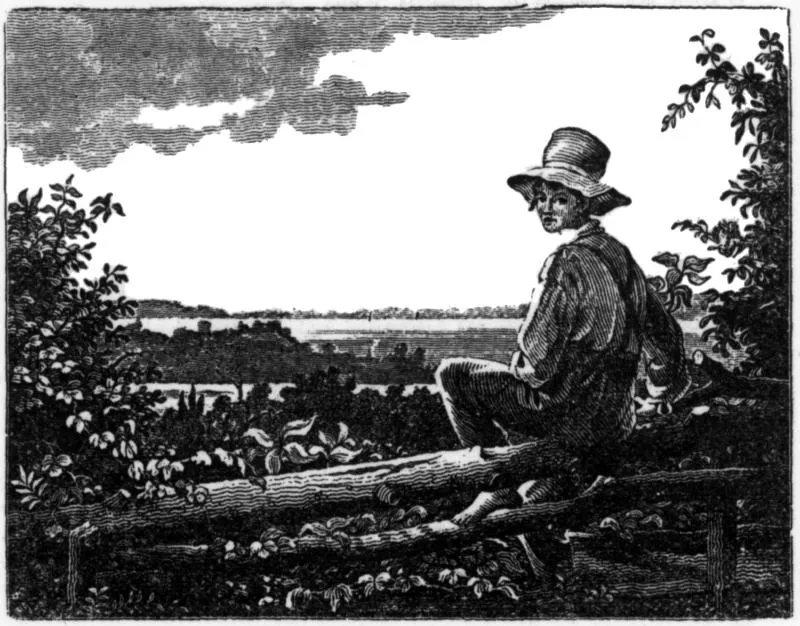
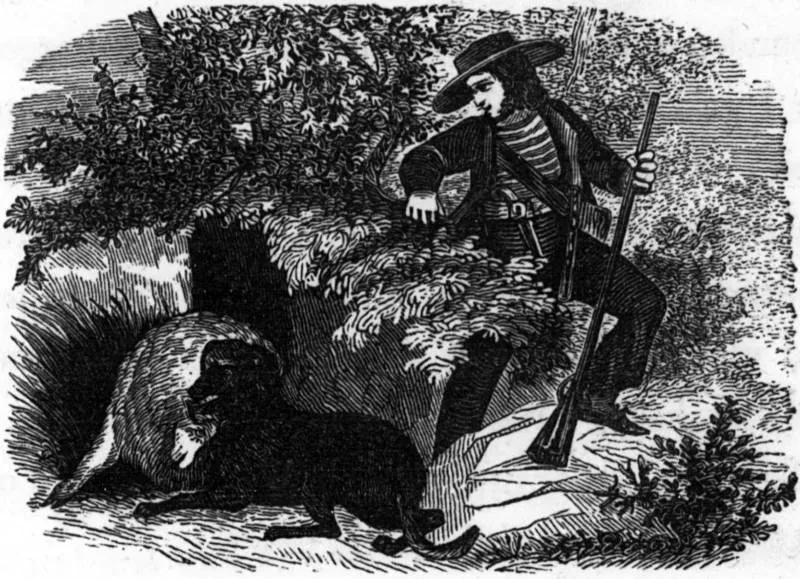
I shall never forget the first time I sallied
out into the woods to try my hand at hunting. Carlo, the old family
dog, went with me, and he was about as green in the matter of
securing game as myself. We were pretty well matched, I think. I
played the part of Hudibras, as nearly as I can recollect, and
Carlo was a second Ralph. I had a most excellent fowling-piece—so
they said. It began its career in the French war, and was a very
veteran in service. Besides this ancient and honorable weapon, I
was provided with all the means and appliances necessary for
successful hunting. I was "armed and equipped as the law directs,"
to employ the words of those semi-annual documents that used to
summon me to training.
Well, it was sometime before we—Carlo and
I—started any game. Wind-mills were scarce. For one, I began to
fear we should have to return without any adventure to call forth
our skill and courage. But the brightest time is often just before
day, and so it was in this instance. Carlo began presently to bark,
and I heard a slight rustling among the leaves in the woods. Sure
enough, there was visible a large animal of some kind, though I
could not determine precisely what it was, on account of the
underbrush. However, I satisfied myself that it was rare game, at
any rate; and that point being settled, I took aim and fired.
Carlo immediately ran to the poor victim. He was
a courageous fellow, that Carlo, especially after the danger was
over. Many a time I have known him make demonstrations as fierce as
a tiger when people rode by our house, though he generally took
care not to insult them until they were at a convenient distance.
Carlo had no notion of being killed, knowing very well that if he
were dead, he could be of no service whatever to the world.
Hudibras said well when he said,
"That he who fights and runs away,
May live to fight another day."
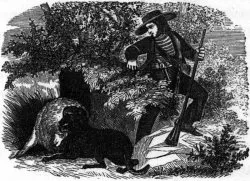
RODERICK'S FIRST SHOT.
That was good logic. But Carlo went farther than
this, even. He was for running away before he fought at all; and so
he always did, except when the enemy ran away first, in which case
he ran after him, as every chivalrous dog should. In the case of
the animal which I shot at, Carlo bounded to his side when the gun
was discharged, as I said before. For myself, I did not venture
quite so soon, remembering that caution is the parent of safety. By
and by, however, I mustered courage, and advanced to the spot.
There lay the victim of my first shot! It was one of my father's
sheep! Poor creature! She was sick, I believe, and went into a
thicket, near a stream of water, where she could die in peace.
I don't know whether I hit her or not. I didn't
look to see, but ran home as fast as my legs would carry me. Thus
ended the first hunting excursion in which I ever engaged, and,
though I was a mere boy then, and am somewhat advanced now, it
proved to be my last.
ROVER AND HIS LITTLE MASTER.
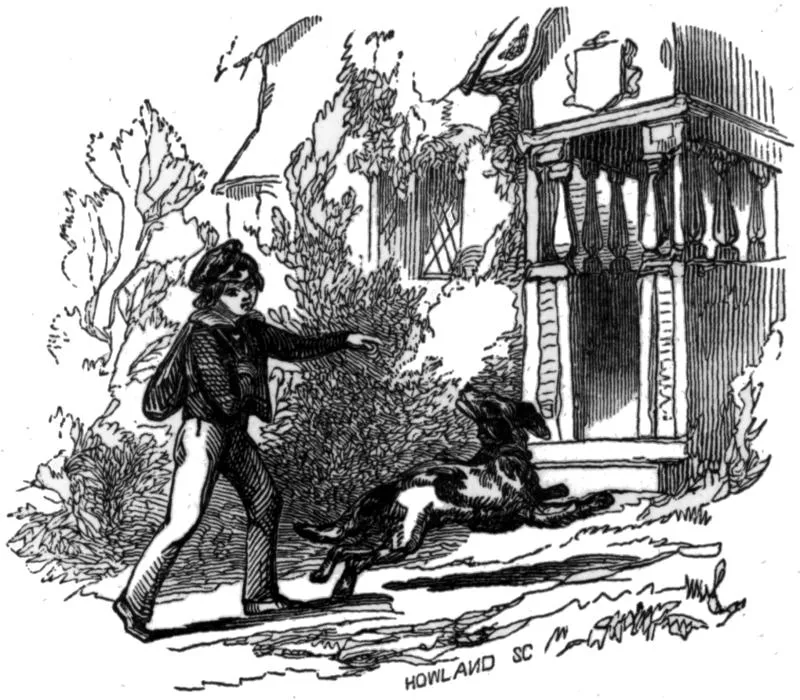
"Come, Rover!" said Harry, as he passed a fine
old Newfoundland dog that lay on a mat at the door; "come, Rover! I
am going down to the river to sail my boat, and I want you to go
with me."
Rover opened his large eyes, and looked lazily
at his little master.
"Come! Rover! Rover!"
But the dog didn't care to move, and so Harry
went off to the river side alone. He had not been gone a great
while, before a thought of her boy came suddenly into the mother's
mind. Remembering that he had a little vessel, and that the river
was near, it occurred to her that he might have gone there.
Instantly her heart began to throb with
alarm.
"Is Harry with you?" she called up to Harry's
father, who was in his study. But Harry's father said he was not
there.
"I'm afraid he's gone to the river with his
boat," said the mother.
"To the river!" And Mr Lee dropped his pen, and
came quickly down. Taking up his hat, he went hurriedly from the
house. Rover was still lying upon the mat, with his head upon his
paws and his eyes shut.
"Rover!" said his master, in a quick, excited
voice, "where is Harry? Has he gone to the river? Away and see!
quick!"
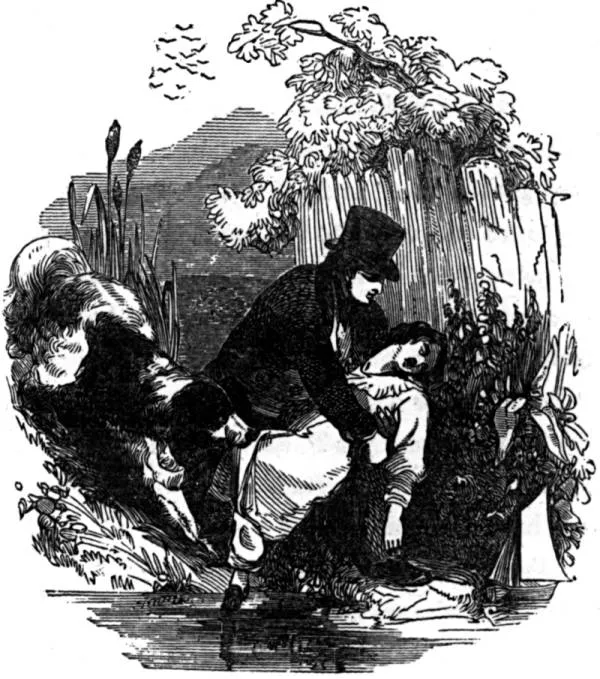
The dog must have understood every word, for he
sprang eagerly to his feet, and rushed toward the river. Mr Lee
followed as fast as he could run. When he reached the river bank,
he saw his little boy in the water, with Rover dragging him toward
the shore. He was just in time to receive the half-drowned child in
his arms, and carry him home to his mother.
Harry, who remained insensible, was placed in a
warm bed. He soon, however, revived, and in an hour or two was
running about again. But after this, Rover would never leave the
side of his little master, when he wandered beyond the garden gate.
Wherever you found Harry, there Rover was sure to be—sometimes
walking by his side, and sometimes lying on the grass, with his big
eyes watching every movement.
Once Harry found his little vessel, which had
been hidden away since he went with it to the river, and, without
his mother's seeing him, he started again for the water. Rover, as
usual, was with him. On his way to the river, he saw some flowers,
and, in order to gather them, put his boat down upon the grass.
Instantly Rover picked it up in his mouth, and walked back toward
the house with it. After going a little way, he stopped, looked
around, and waited until Harry had got his hand full of flowers.
The child then saw that Rover had his boat, and tried to get it
from him; but Rover played around him, always keeping out of his
reach, and retreating toward the house, until he got back within
the gate. Then he bounded into the house, and laid the boat at the
feet of Harry's mother.
Harry was a little angry with the good old dog,
at first, but when his mother explained to him what Rover meant, he
hugged him around the neck, and said he would never go down to the
river again any more.
Harry is a man now, and Rover has long since
been dead; but he often thinks of the dear old dog that saved him
from drowning when he was a child; and it gives him great pleasure
to remember that he never beat Rover, as some boys beat their dogs,
when they are angry, and was never unkind to him. Had it been
otherwise, the thought would have given him great pain.
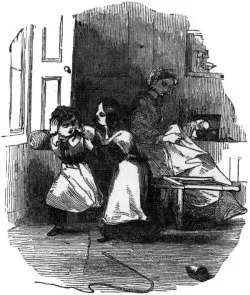
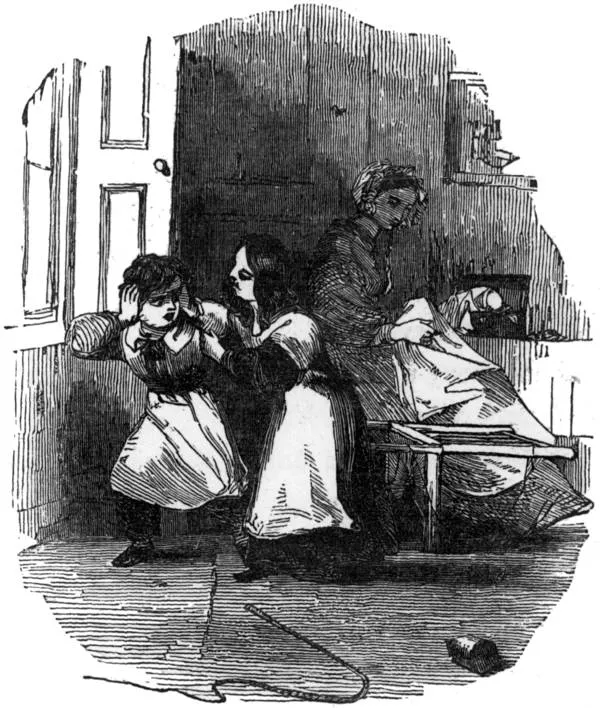
SOMETHING WRONG.
THE FAVORITE CHILD.
In a very pretty little village not many miles
from N——, in Connecticut, lived Susan Meredith. She was the
youngest of three sisters, the eldest of whom could not be more
than twelve or thirteen years of age. A year or two before the
period when our history of this little group commences, the mother
had gone to her rest.
Weighed down with a sorrow too heavy to be
borne, and of a nature too delicate to be confided to others, she
sank under it while in the noon of life, and died commending her
children to God. Susan—little Sue, as she was frequently
called—young as she was, remembered a thousand incidents connected
with the departed one, and seemed, so late as the time at which our
story begins, to be never happier than when her mother was the
theme of conversation.
There was something remarkable in this. One
reason for it might have been, that the surviving parent of these
sisters, though once a kind and affectionate father, was now so
altered by habits of intemperance, that they found very little
enjoyment in his society. But there was another reason. Little Sue
was an unusually thoughtful, serious child, for one of her years.
Was there not another reason, still? I do not know. I cannot tell
what words God may whisper to the child that loves him; but this I
know, that little Sue talked much of heaven, and seemed to have
learned more of the language of heaven than men can teach.
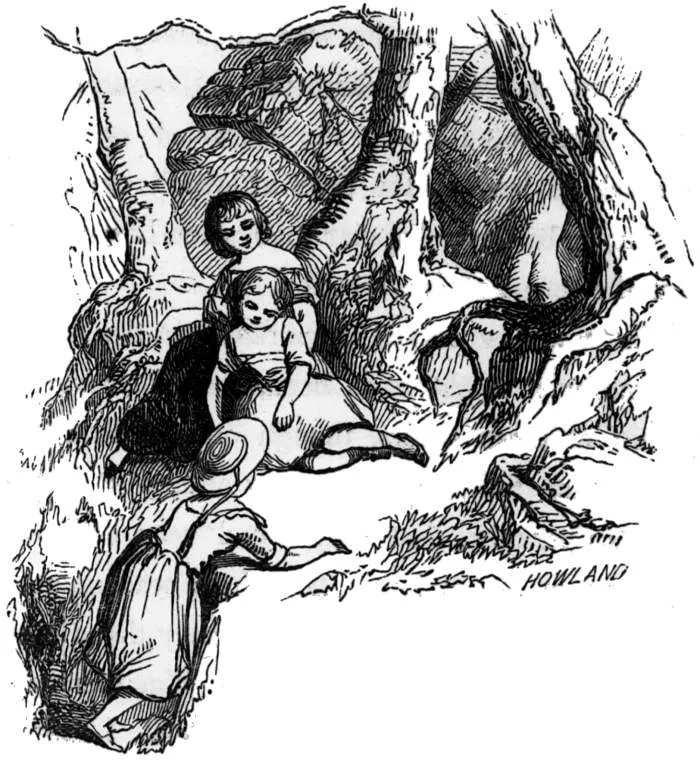
One bright Saturday, in the early spring time,
when there was no school, these sisters might have been seen
winding their way through the woods, not far from the house where
they lived, searching for the first wild flowers. Little Sue, the
youngest, was very happy, but, as usual, more grave than the other
sisters. By and by, wearied with their walk, they sat down under
the shadow, of a tree, and talked a great while. At first, the
conversation was about birds and flowers; but Sue soon gave a
serious turn to it.
"I wonder," said she, "if dear mother has pretty
flowers in heaven. I hope so—she loved them so well. Do you
remember the little monthly rose she wanted we should bring into
her room, just before she died? How happy she was, when one of us
went and brought it to her bed. And she went to heaven so soon
after that! Oh, I think there must be flowers up there in the sky,
or she would not have thought of them and loved them so, when she
was dying. Don't you think so?"
And she was silent. So were her sisters, awhile.
Thoughts of heaven made them serious. They were sad, too. When the
youngest—their darling Sue—conversed in this strain, a cloud
always came over their sunny faces. They could scarcely tell why it
was so; for they, too, loved to think of heaven. But the language
of their sister seemed to them to belong to another world; and
often, in the midst of their brightest hopes, would come the fear,
like a thunderbolt, that God would crush that cherished flower, and
remove her from their embrace while she was young.
"Sue," at length said Eliza, the eldest sister,
"why do you always talk so much about heaven?"
"I don't know," was the reply; "perhaps, because
I think a good deal about it. I dreamed last night"——
"Oh, I thought so," said Maria, playfully
interrupting her sister; "I should think the little fairies were
playing hide and seek all around your pillow every night. I wish
they would whisper in my ears as they do in yours. Why, the naughty
things hardly ever speak to me, and when they do, they tell a very
different story from those they tell you. It is generally about
falling down from a church steeple, or something of that kind.
Well, what did they say to you this time, dear?"
"I never had such a dream before," said the
favorite, her face glowing with a new, almost an unearthly
radiance; "I mean I never had one just like it. When dear mother
died, you remember I told you a dream about the angels. Last night
I thought they came to me again, and I saw mother, too, so
clearly!"
She stopped, and her eyes fell. She seemed
almost sorry that she had said as much; for she had not forgotten
that the former dream to which she alluded had caused her sisters
pain, and she thought, that perhaps she should make them unhappy
again, if she related her dream of the night before. But her
sisters begged her to go on, and she did so.
"When I went to sleep," said she, "I was
thinking of—of—what father had said to me"—and she burst into a
flood of tears. Her sisters wept, too; for they well remembered
that their father had come home intoxicated that night, and that he
had spoken very harshly to them all, and especially to the
youngest. They could not say much to console her. What could they
say? Silently they wept, and by their tears and embraces they told
her how deeply they sympathized with her, and how much they would
do for her, if they could. When the little dreamer was able to go
on, she said,
"I was thinking about this when I went to sleep.
I thought I was crying, and wondering why God should let dear
mother die, and leave us all alone, when I heard some one say,
'Look up,' I looked up in the sky, and all the stars were windows,
and I saw through them. I saw heaven—so beautiful—so beautiful! I
saw mother looking out of one of these windows, and she smiled, as
she did when we brought the rose to her bed-side. I heard her call
my name, and she reached her arms toward me, and said, 'You may
come,' Oh, this was not like other dreams"——
"Don't think of it, dear sister; don't think of
it any more," said Eliza. "You was not well last night, and I have
often heard, that when people are ill, their dreams are more apt to
be disturbed. But we will not say any more about it now, dear."
"No," said Maria; "we shall all feel too sad, if
we do." And she made an effort to be cheerful; though tears stood
in her eyes as she spoke.
"I don't know why it makes others feel sad to
think of heaven," said the favorite. "I should love dearly to go
there."
"But then it is so dreadful to die!"
"I know it; but mother was so happy when she
died!"
"Would you be willing to leave your sisters,
dear Sue?"
"No; not unless I could see my mother and
Christ. Oh, I do love Christ more than all the rest of my friends!
Do you think that is wrong?"
The three sisters slowly and thoughtfully bent
their steps homeward, and just as the sun was setting, and the
western clouds were spread with the beauty and glory of twilight,
they entered that cottage which, though the abode of sorrow, was
yet dear and sacred to them, because it was once the home of their
mother.
From that time, the gentle, loving, thoughtful
little Sue, faded—faded as a flower in the autumn wind. She had
not been well for weeks; and soon it was evident that she was
rapidly declining. Was her dream a cause or an effect—a cause of
her decline, or an effect of an illness already preying upon her
frail system? Perhaps we cannot tell. There is something very
remarkable about many dreams. It is not easy to account for them
all, by what is known of the laws of the mind. But we must not stop
now to inquire into this matter.
Step by step, that cherished sister went
downward to the grave; and before the summer had come, while the
early violet and the pure anemone were still in bloom, God called
her home. Peacefully and beautifully her sun went down. "They have
come," she said. So died the youngest—the favorite child.
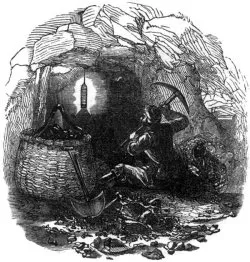
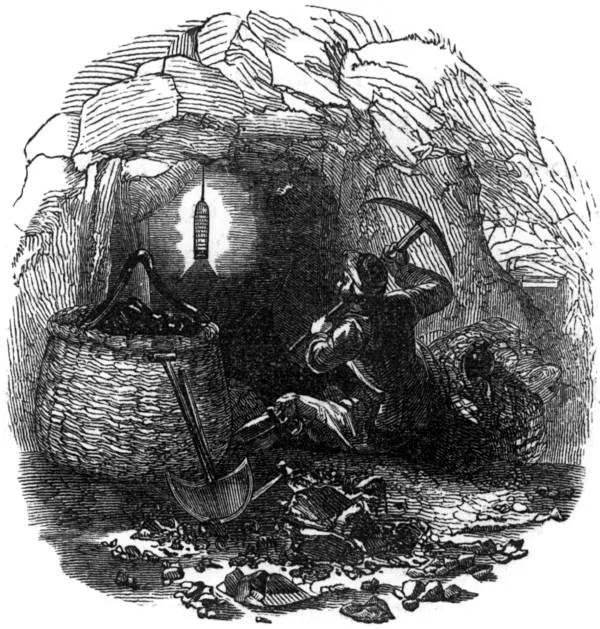
THE MINE.
THE MINE. — THE MINER.
There are three kingdoms in nature—the Mineral
kingdom, the Vegetable kingdom, and the Animal kingdom—the former
for the sake of the latter, and all for the sake of man. Without
the Vegetable kingdom animals could not exist, and without the
Mineral kingdom vegetables could not exist.
It is also worthy of remark, that in all the
inferior kingdoms of nature, there is an image of what is superior.
The lowest of all the kingdoms is the Mineral kingdom, where every
thing takes a fixed form, and where all changes are the work of
centuries, instead of days and months, as in the Vegetable and
Animal kingdoms. Yet, in this dull, inert kingdom, we find a
certain image of the one next above, in the upright or orderly
forms into which many of its substances arrange themselves. Under
circumstances of more than usual freedom, particles of matter in
this kingdom will assume shapes so nearly resembling those of the
Vegetable kingdom, that many were at first disposed to conclude
that they were mere petrifactions; as in the case of formations at
the bottom of the ocean, and those that take place in caverns. But
we will not wonder at this, when we remember, that the use of the
Mineral kingdom is to sustain the Vegetable kingdom, in order that
the latter may sustain the Animal kingdom. Use, it must be
remembered, is the great law that pervades, sustains, and holds in
harmonious order, the whole universe.
In the Vegetable kingdom we see a still nearer
approach to man. There is motion and life—not conscious life, but
a kind of insensible existence. Nearly all the members of this
kingdom elevate themselves toward heaven, and stand upright, like
men.
In the Animal kingdom there is still greater
perfection of life and freedom. Beasts move over the earth, birds
fly through the air, and fishes change their places, at will, in
the sea. This is the highest and most perfect kingdom, and it is
for the sake of this that the others exist. And, as was just said,
all three are for the sake of man. They go to sustain his natural
life, while he remains in this world.
The variety and beauty in the two higher
kingdoms are displayed to the eyes of all. But the wonders of the
Mineral kingdom are hidden beneath the surface. Mines have to be
opened, in order to obtain the metals and precious stones that the
earth hides in her bosom; and man can only obtain them through hard
and patient labor. Hundreds of feet below the surface of the
ground, the miner, with no light to direct his labor but that given
him by his dimly burning safety-lamp, toils on, unconscious of the
day's opening or decline. The sun does not rise nor set for him. He
is not warned by the home-returning bee, the dimly falling shadows
of evening, nor the sudden cry of the night-bird, that the hour of
rest has come. But the body cannot endure labor beyond a certain
number of hours. Tired nature calls for repose, and the call must
be obeyed. Even the miner must have his hours of rest; and then he
comes forth, it may be, from his gloomy place of labor, once more
into the sunlight; or sinks to sleep in the dark chambers where he
toils for bread.
When you look at a piece of metal, whether it be
gold, silver, copper, or iron, remember that it has been won from
its hidden place, deep in the solid earth, by the hard labor of
man.
Down where the daylight never comes
Toileth the miner on;
He sees not the golden morning break—
He sees not the setting sun.
Dimly his lamp in the dark vault burns,
And he sits on the miner's hard floor,
Toiling, toiling, toiling on;
Toiling for precious ore!
The air is wet; for the dew and rain,
Drank by the thirsty ground,
Have won their way to his dark retreat,
And are trickling all around—-
And sickly vapors are near his lips,
And close to his wire-net lamp,
Unseen, as an evil spirit comes,
Up stealeth the dread fire-damp!
But the miner works on, though death is by,
And fears not the monster grim;
For the wiry gauze, round his steady light,
Makes a safety-lamp for him.
Rough and rude, and of little worth,
Seems the ore that the miner brings
From the hidden places where lie concealed
Earth's rare and precious things;
But, tried awhile in the glowing fire,
It is rough and rude no more;
Art moulds the iron, and forms the gold,
And fashions the silver ore.
And useful, rare, and beautiful things,
'Neath the hand of skill arise:
Oh! a thousand thousand human wants
The miner's toil supplies!
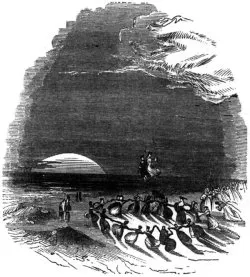
VISIT TO FAIRY LAND.
VISIT TO FAIRY LAND.
So, then, you want to hear some stories about
the fairies, do you, little girl? Well, I must humor you a little,
I suppose; though I should not wonder if my fairy stories were
somewhat different from those you have heard before. But have you
the least idea that there were ever such beings as the fairies in
the world? If you have, let me tell you, you are quite mistaken.
The stories that have been told about these fairy people are none
of them worthy of belief, though it must be admitted that millions
have believed them. Many of the men and women who pretended to have
seen the fairies, and who related the stories in the first place,
believed all they said, I have no doubt. But they were generally
ignorant persons, very superstitious, and easily imposed upon.
There are, it is true, invisible inhabitants in this world. Those
who believe the Bible, can hardly doubt the presence of angels
among us. But angels, as they are represented in the Scriptures,
are a very different class of spirits from those called fairies, if
we may credit what has been said of this singular race of beings,
by those who pretend to have seen them in fairy land.
Not a great while ago, the people of England and
Scotland were very superstitious. It is not two centuries since our
good forefathers on that island were burning witches by scores. At
that time, a great many believed in the existence of fairies, or
elves. I have been at some pains to find out at what time this
fairy superstition first appeared among the Britons. But it seems
not very easy to determine. One thing is certain, that the belief
in some kind of spirits—either the same with the fairies, under a
different name, or very nearly related to them—dates back to a
very early period in British history—earlier, probably, than the
Christian era.
The fairies are always represented as very small
and very beautiful—generally, as perfect miniatures of the human
form. The color of their dress is uniformly pure green. It would
seem, according to the accounts of these people, some five or six
hundred years ago, that they were kind, amiable, excellent
neighbors. Indeed, one of the names they went by was, "the Good
Neighbors," and another was, "the Men of Peace." Still, they used
to do some mischief in those days, if we may believe their
historians, who tell us that the fairies, once in a while, visited
the abodes of men, and carried away captives into their invisible
haunts, under ground. The reason for this kidnapping of human
beings was said to be, that the fairies were obliged occasionally
to pay a tribute of this kind to their king or queen.
The fairies were not always cunning enough to
keep their victims, after they had caught them. Sometimes people
would come back from fairy land, and tell all about what they had
seen there. You might suppose that a great deal would be learned of
these strange, invisible creatures, from the men and women who had
been with them and escaped. Well, so there was. But the worst of it
was, the stories did not hang together very well; and there were
about as many different and contradictory accounts of fairydom as
there were different individuals who pretended to have made a visit
to that country. However, all seemed to agree that fairy land was a
very merry country. The people there were great lovers of fun,
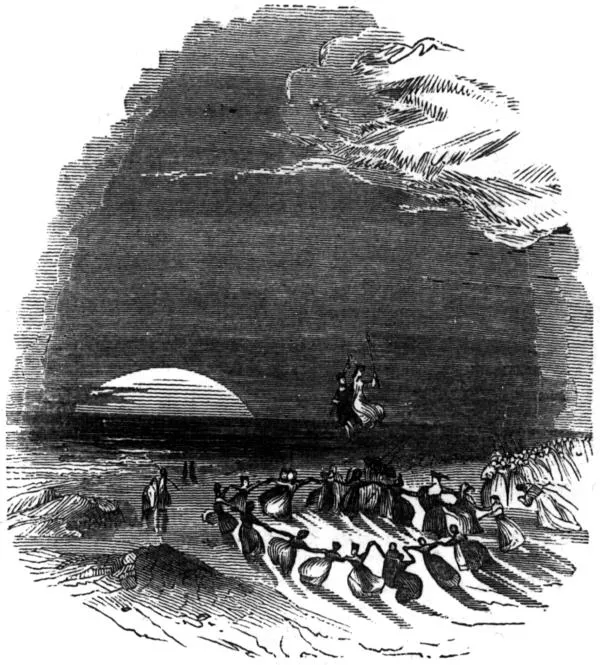
according to the general testimony, and used to dance a great deal
by moonlight, in the open air. They are engaged in one of their
dances, you see, in the engraving. Every evening, as soon as the
moon rose, they assembled at some convenient place, took hold of
each other's hands, usually in a ring, I think, and then they had a
right merry time of it, you may depend. It did not seem to make any
difference, whether the spot selected for the dance was on the land
or on the sea. Indeed, they could dance pretty well in the air,
without any thing to stand upon. The assemblies held in the palaces
of the king and queen of the fairies, were, at times, splendid in
the extreme. No poet, in his most lofty flights of fancy, ever
dreamed of such beauty and splendor as were exhibited at the fairy
court. They rode on milk-white steeds. Their dresses were of
brilliant green, and were rich beyond conception. When they mingled
in the dance, or moved in procession among the shady groves, or
over the delightful meadows, covered with the fairest of flowers,
music, such as mortal lips cannot utter, floated on the breeze.
However, these splendors, astonishing as they
were, all vanished in a moment, whenever the eye of any one gifted
with the power of spiritual communion was turned upon them. Then
their treasures of gold and silver became slate-stones, and their
stately halls were turned into damp caverns. They themselves,
instead of being the beautiful creatures they were before, became
ugly as a hedge-fence.
The king of fairy land was called
Oberon—the queen, Titania. The king used to wear a
crown of jewels on his head, and he always carried a horn in his
hand, which set every body around him to dancing, whenever he blew
it. Ben Jonson, a poet who flourished a great many years ago,
speaks very respectfully of fairies and elves, in his poems. In
describing the haunts of his "Sad Shepherd," he says—
"There, in the stocks of trees, white fays do
dwell,
And span-long elves that dance about a pool."
Shakspeare, too, in several of his plays, makes
us quite familiar with the fairy people. Shakspeare, you are aware,
wrote in the time of Elizabeth, and as late as that period, there
were thousands in England and Scotland in whose creed the existence
of such a race of spirits was a very important article. It was not
long, however, after this, before the superstition about the
fairies—which, at the worst, was a very foolish affair—began to
decline. But that decline brought a dark night to thousands of
poor, innocent men and women; for then came the era of witchcraft,
and persons of every rank, convicted of this imaginary crime, were
hurried to the scaffold or the stake.
In the beginning of the seventeenth century, Dr.
Corbett, Bishop of Oxford and Norwich, wrote a very humorous satire
on the fairy superstition, called "The Fairies' Farewell, a proper
new ballad to be sung or whistled to the tune of Meadow Brow."
Perhaps I cannot better take leave of these very curious imaginary
people, than to employ a couple of stanzas from the bishop's
playful ballad:
"Witness those rings and roundelays
Of theirs, which yet remain,
Were footed in Queen Mary's days,
On many a grassy plain;
But since of late Elizabeth,
And later James came in,
They never danced on any heath,
As when the time hath been.
"By which we note the fairies
Were of the old profession;
Their songs were Ave Marias,
Their dances were processions;
But now, alas! they all are dead,
Or gone beyond the seas,
Or further for religion fled,
Or else they take their ease."
THE HERMIT.
 Traveler was once passing through a great
wilderness, in which he supposed no human being dwelt. But, while
riding along in its gloomiest part, he was surprised to see a
hermit, his face covered with a long beard, that hung down upon his
breast, sitting on a stone at the entrance of what seemed a
cave.
The hermit arose as the traveler drew up his
horse, and speaking kindly to him, invited him to accept such
refreshment as it was in his power to offer. The traveler did not
refuse, but, dismounting, tied his horse to a tree, and, following
the pious man, entered the narrow door of a little cave which
nature had formed in the side of a mountain. All the hermit had to
set before the traveler, was water from a pure stream that came
merrily leaping down the hill side, and some wild fruit and
nuts.
"Tell me," said the traveler, after he had
eaten, "why a man with a sound body, such as you possess, and a
sound mind, should hide away from his fellow-men, in a dreary wild
like this?"
"For pious meditation and repentance," replied
the hermit. "All is vanity in the world. Its beauties charm but to
allure from heaven. And worse than this, it is full of evil. Turn
where you will, pain, sorrow, and crime meet your eyes. But here,
in the silence of nature, there is nothing to draw the mind from
holy thoughts; there is no danger of falling into temptation. By
pious meditation and prayer, we are purified and made fit for
heaven."
"Not so," answered the traveler; "pious
meditation and prayer are of no avail without good be done to our
fellow-men. Piety is nothing without charity; and charity consists
in willing well and doing well to our neighbors. 'And now abideth
faith, hope, and charity,' says the Apostle, 'but the greatest of
these is charity,' Hermit, you are not wise thus to retire from the
midst of the busy world. Your service cannot be acceptable to God.
Go back again among your fellow-men, and faithfully perform your
real duties in life. Heal the sick, comfort the mourner, bind up
the broken heart, and in the various walks of life do good to
friend and enemy. Without this, how can you hope in the judgment to
hear the Lord say, 'As much as ye have done it unto the least of
these, ye have done it unto me?'"
The hermit, at such unexpected words, bowed his
head, and was silent. The traveler went on, and said—
"You have committed a common error, in supposing
that in holy meditation, as it is called, there was any thing
particularly pleasing to God. But reason will tell you why the
widow's mite is more acceptable in heaven than the most pious
thoughts of idle self-righteousness. Hermit! go back again into the
world, and there act your part as a man in the great social body.
Only by this means will you be prepared to live and act in the
great body of angels in heaven."
The hermit could not reply, but still sat with
his head bowed to his bosom, and his eyes upon the ground. The
words of the stranger fell with strokes of reproof upon his
heart.
When the traveler returned that way, he sought
for the hermit, but found him not at the door of his cave. He
entered, but the place had been a long time deserted. The erring
man had gone back into the world, and taken his place among his
fellows. And he had done right. No man is wise who retires from
society, and shuts himself up in the hope of becoming better
through prayer and pious thoughts. Only by doing our duty to our
fellow-men, in some particular pursuit in life, can we hope to grow
better and wiser?
A PICTURE.