"Turbatus est a furore oculus meus; inveteravi inter omnes
inimicos meus."—Psalm vi. 8.
On our arrival at Würzburg, before leaving the
railway carriage, all the soldiers except myself
were handed a slip of coloured paper marked
"Hütte Barracken No. 14." A most unpleasant-looking
person, who spoke a little English, and
wore a very superior air, was in command of the
stretcher-party that carried me across the station.
I kept asking for my luggage, a hand-bag and a
fragment of the German sausage which had been
left in the carriage, and was told it would follow
later, and meantime was, like myself, safe in good
German hands. However, my valuable belongings
were eventually put on the stretcher beside me.
While waiting on the platform my English-speaking
attendant volunteered the information that there
were already over 200 British officers in the place.
This was lying for lying's sake, or perhaps it was
a lie told to the wrong person, and should have
been reserved for the citizens of Würzburg. The
morning was a bitterly cold one, and the arrangements
made for our transport from the station gave
us the full benefit of the freezing north-easterly
wind. The vehicle into which the stretchers were
lifted does not deserve the name of ambulance, nor
had it any pretension to the title, for it was not
even honoured with a Red Cross. It was just a
common lorry, such as is used in the district for
carting wood, covered with a tarpaulin supported
by a longitudinal bar on transverse stays. The
tarpaulin, which had been rolled up on one side
while the stretchers were being placed in position,
was rolled down again. A German ambulance
man jumped up behind and off we went. Each
stretcher was provided with a blanket, which
afforded some small protection from the cold blast
which blew through the open end of the cart.
None of the soldiers with whom I had travelled
from France were in this cart, and at first I thought
that all the occupants were Frenchmen. But the
man next me was an Englishman, dressed in French
uniform, who had been with me in hospital at Cambrai.
His face was so drawn and haggard that I
had some difficulty in recognising him. This poor
fellow would not answer me at first, and then
whispered that he did not want the German Red
Cross attendant to know that he was an Englishman,
and hoped to pass for a Frenchman as long
as possible, so as to get better treatment. The
other Frenchmen lay silent and motionless, worn
out with exhaustion and want of food. By slightly
rising on my side, I could see following far
behind us a long string of carts similar to our
own. The wind, which was now chasing here and
there some few fine drifting snow-flakes, had doubtless
kept the streets clear of pedestrians, and there
were few spectators of the dolorous procession.
Some small boys fell in behind, and played at
soldiers escorting a convoy, marching in step and
singing in tune, only to be chased away presently
by a watchful policeman. We crossed a stone
bridge over the Main and almost immediately
turned in, on our left, through the high wooden
palisade which surrounded the hospital huts—our
temporary destination.
The tarpaulin was quickly rolled up, and my four
companions lifted down on their stretchers and
taken away. My stretcher was lifted on to the
ground, and remained there for five or ten minutes,
close to a group of officers, one of whom appeared
very annoyed at my having been brought to the
wrong place; he presently came up and politely
asked me my name and rank in very good English.
This, I afterwards discovered, was Dr Zinck.
He told me that I was to be sent up to the fortress.
I was helped off the stretcher, and, owing to the
cold, had great difficulty in hobbling along, and
was very relieved to find that I was to drive up to
the castle in a comfortable motor coupé, probably
the one used by the doctor himself. A hospital
orderly got up beside the driver, and a very tall
sentry, who had great difficulty in getting in his
rifle with the bayonet fixed, squeezed in beside me.
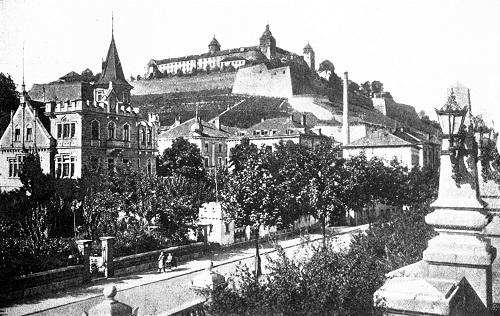
The Festung Marienberg, about a mile outside
the city of Würzburg, is a place of great architectural
and historic interest. Previous to the days
of heavy artillery, the hill on which the fortress is
built provided a naturally impregnable site, which
had been used for defensive purposes from the
earliest times of which any historic trace has been
recorded. When St Kilian in the seventh century
brought Christianity to Franconia from far Iona,
he was at first very successful at the "Castellum
Virtebuch," and converted the Frankish commander.
A few years later a chapel was built
within the walls, dedicated to the Blessed Virgin
Mary, and the fortress became known as Festung
Marienberg.
In the middle ages the castle was famous as a
stronghold of the warrior bishops of Würzburg,
and stood firm during the revolutionary periods
which followed on the teachings of Huss and
Luther, even when the surrounding country had
been laid waste, and the town of Würzburg captured
by a rebel army. Once after the peasant
army had been betrayed, surrounded, and almost
annihilated, the unfortunate survivors were taken
away to the Festung Marienberg. "Thirty-six of
them," says a contemporary writer, "had their
heads cut off, and the council and aldermen have
been taken prisoners; God only knows what will
be done with them." It was a common punishment
in those days for a prisoner to have his eyes
gouged out, or his fingers chopped off. At the
present time these somewhat barbaric customs
have been considerably modified, and although the
Rittmeister who was in command of the fortress
during my residence there did not resort to such
extreme measures in dealing with his prisoners as
had been found necessary in the sixteenth century
by the Margrave of Brandenburg, he did his best,
as I was soon to find out, to make us feel the burden
of captivity.
As the motor began to climb a rather steep
gradient, the silent sentry, with a wave of his hand,
introduced me to the outer battlements of the
Festung Marienberg. Between this outer wall and
the castle moat, the long steep slope on the west
side has been laid out as a garden with shrubs and
well-grown trees. "There," said my sentry, "is
where the officers can make their daily promenade."
This I need hardly say was not to be our privilege.
The second wall is of great thickness, so that the
entrance is like a tunnel, the gradient of the road
being so steep as to bring the car down to the
first speed. We cross a courtyard with stables on
the three sides, and then pass through a third
doorway, and drive over the moat into the main
court of the castle.
This inner court, of oblong shape, is some 60 to
70 yards long and about 30 broad.
On two sides were the soldiers' quarters, built in
the middle of the eighteenth century. The ground
floor on the left was used as a stable, and above
the stables were the prisoners' rooms. A fifteenth-century
chapel stands in the far corner on the site
chosen by St Kilian. An aggressive watch-tower,
dating from the eleventh century if not earlier, tall
and massive, is the most interesting feature in the
curious medley of architecture, which presents a
graphic picture of the castle's history.
The motor drew up at the far end of the court.
I was then helped out of the car and formally
handed over to a German N.C.O. named Poerringer,
who had charge of the prisoners, collected
their letters, &c., &c.,—in fact he was our jailor.
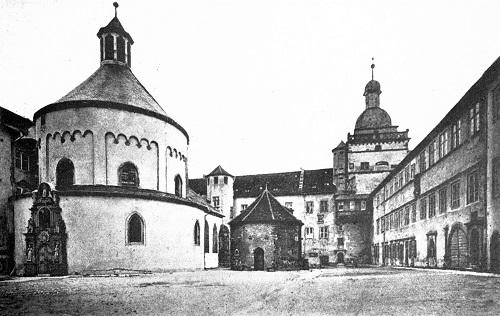
The Courtyard and Chapel, Festung Marienberg.
We entered the fortress buildings through a small
doorway in one of the old towers, and the broad
spiral stairway proved almost too much for my
powers of locomotion. However, with a helping
arm under each shoulder, they got me along.
Half-way up the stair we turned through a door on
our right, which led into a large and very medieval-looking
guard-room, a long, low room faintly lit up
by narrow windows deeply set in immensely thick
walls. In one of these window recesses was a
desk and chair barred off from the rest of the
room with temporary wooden cross-bars. I was
led into this cage, and told to sit down and
wait to be interviewed by Mr Poerringer. My
luggage was brought up and put down beside
me, and a sentry took his position near at
hand.
After a few minutes' rest I began to look around,
and as my eyes got used to the dim light I saw
my friend the French doctor sitting on a chair
farther up the room within speaking distance.
A thoughtless Bonjour, Docteur, raised the wrath
of the sentry, who turned in my direction
and grunted out a sentence which ended in
verboten.
The guard-room then began to fill with soldiers;
the loud tramping, the guttural words of command,
the curious antique unmilitary-looking
uniform, the crowd of squat, slouching, and for
the most part bearded, round-bellied creatures,
formed in the dim light a picture that might
have belonged to a land of gnomes, wicked
princes, and enchanted castles.
Such at least was my first impression. Our
middle-aged sentries in broad daylight were anything
but romantic. Their uniform consisted of
Hessian boots, civilian trousers, and dirty green
jacket, and always a big black leather belt to
keep in the rebellious stomach. They appeared
most of them to be wood-cutters, charcoal-burners,
workers in the beautiful forests of
Franconia, who did not take kindly to the monotonous
duty of guarding prisoners, and to a
discipline little less strict than that of the
prisoners themselves.
After the ceremony of changing the guard had
been completed, and all arms had been examined
to make sure they were loaded, Mr Poerringer,
who was in undress uniform, and did not go
about with a ridiculous bayonet, came back with
some papers which had to be filled in, and by
virtue of which my official status as a prisoner
would be completed. My luggage was examined
courteously and as a matter of form. I was
asked if I had any fountain-pens, maps, or firearms!
concealed in my belongings.
So far, conversation had been carried on in
English, of which my jailor could speak but
little.
Before leaving Cambrai I had forgotten to look
up the most commonly used German word for
"paralysed," and the friendly Highland sentry in
the train, whose German was no doubt not of
the best, had told me that the correct word was
"Gicht." I tried this word when explaining the
cause of my lameness to Mr Poerringer, and was
much astonished at the result. "Is that all that
is the matter?" said he; "you will soon get
cured here." Weary of trying to make myself
understood, I protested somewhat impatiently in
French that there was not much point in bringing
a half-paralysed man into such a carefully-guarded
prison. With a most Parisian accent
he replied: "Oh, vous êtes paralysé, moi qui
croyai que vous aviez la goutte!"
We now, of course, got on very much quicker
with the filling-in of papers. One entry, headed
"Request to Prison Governors," I wished to fill
up with a request to be sent back to England,
according to rules laid down in the Hague Convention.
Mr Poerringer shook his head, and said
there would be no exchanges until the war was
over. My request for a room to myself, so that
I could hope for sleep, was not passed, no such
room being available, and the column was left a
blank. In this first interview Mr Poerringer was
trying hard, probably under orders, to put on a
fierceness of manner which was obviously quite
foreign to his nature. I subsequently found that
in dealing with the prisoners, both French and
English, he always displayed a kindly courteousness
which was strikingly in contrast with the
behaviour of his superior officers.
Still escorted by a watchful sentry armed to the
teeth, I was assisted up the broad spiral staircase
to the door leading into the prisoners' quarters.
Mr Poerringer pressed an electric bell, and yet
another heavily-burdened warrior appeared who
led us into a broad, stone-flagged, whitewashed
corridor, well lit with large windows overlooking
the courtyard, a cold inhospitable-looking place.
A more welcome sight than any I had for a
long time been accustomed to was that of two
British officers hurrying forward to meet me, one
of whom was Irvine, who had been with me in
the Civil Hospital at Cambrai, and was much
surprised to see me on my feet again. We all
marched along to the room which had been
allotted to me—the smallest of the five rooms
which opened into the corridor, occupied by nine
French officers, who were then seated at a long
table enjoying their midday meal. My new-found
British comrades introduced me to the
senior officer, Colonel Lepeltier, who welcomed
me with the greatest kindness, and offered me
the best that could be supplied from their private
store of food and drink, including a bottle of
very excellent Bavarian beer, for which, after the
exhaustion of the past few days, I felt most
thankful. The room, which served as living and
sleeping room for ten officers, was none too
large. The furniture consisted of the large wooden
dining-table, a small wooden table and chair for
each officer, two washhand-stands, and two chests
of drawers shared among the lot. We had, of
course, no carpets, wall-paper, or curtains, and no
facilities for getting hot water. Two windows
looked out over the Main, between them a large
and very efficient stove. I looked with apprehension
at my "bed"—a wooden plank scarcely three
feet broad, on iron trestles; at the "mattress"—a
coarse linen sack open on one side, and stuffed
with straw, renewed, I was told, once a month.
The two English officers, Irvine and Reddy, with
an English civilian, Parke, lived in a large room
adjoining ours, along with ten French officers.
Two other large barrack-rooms were also occupied
by French officers, the total number in the fortress
at the time being between forty and fifty.
It was arranged that I should take my meals in
the adjoining room, where the Englishmen had
their three beds together in a corner known as
"the English Club." On the day of my arrival
the "Club" held a long sitting, which was attended
by many of the French officers, eager to hear what
news there might be from Cambrai. Time passed
quickly that afternoon. Irvine had much to tell
me, and many questions to ask about friends at
Cambrai, and Captain Reddy and Parke gave me
an outline of their misfortunes. Reddy had been
more unfortunate than any of us. He was
travelling in Austria before the war broke out,
and was arrested on his way home before war
had actually been declared. Along with Parke
and a number of British civilians, men and women,
who were travelling in the same train, he was
stopped at Aschaffenburg and taken first to the
police station and then to prison. The whole
party were locked up in separate cells to be
searched; even children of eight or ten years were
dragged screaming with terror from their mothers,
and locked away by themselves. I do not remember
many details of the story, but Reddy and
Parke told me that it was a very near thing for
them both; they were suspected and vehemently
accused of being spies, of which baseless charge
there was, of course, not the faintest shred of
evidence.
I was glad to learn that the austerity of our
prison life was mitigated to some extent by permission
to buy extras in the town. A list of
commissions was made up weekly, and might
include jam, honey, cream-cheese, dried fruits,
articles of toilet, and beer. Every prisoner was
entitled at this time to write one letter a day. A
hot bath was to be had once a month, prisoners
being taken down in batches under strong escort
to public baths at Würzburg. The doctor came
once a week to see all who needed attention; an
occasional inspection, and a weekly visit from
the hairdresser, completed the list of important
events in the deadly dull routine.
The food supplied by the authorities was, on
the whole, of bad quality, badly cooked, and
insufficient.
The English Club usually spent the interval
between dinner and bed in a game of cards, but
on this my first night I was too tired to make a
fourth at bridge, and hobbled off to my own
quarters under the severe gaze of three unfortunate
sentries who had to spend most of the night marching
up and down the cold clammy corridor.
On arriving at "Room 52" the noisiest game of
cards in the world, known as "La Manille," was in
full swing, the air was thick with tobacco smoke,
and empty bottles of beer stood in serried ranks
on the table. Monsieur l'Abbé was playing with
the Doctor against Colonel Lepeltier and another
officer whom I privately nicknamed "Granny."
Granny's main ambition in life seemed to be to
escape from fresh air, and even in the close
atmosphere of tobacco smoke and fumes from the
red-hot stove he was wearing all the underclothing
he could put on, and round his neck a huge
muffler.
The presence of M. l'Abbé in the uniform of a
private soldier was the result of an appeal by the
Pope to the German Emperor to allow priests
serving in the French army the same privilege
when taken prisoners as are accorded to officers.
I cannot describe Colonel Lepeltier better than
by saying that he represented the typical soldier
of Napoleonic days. His career in Saharan and
Moroccan campaigns had already proved him to
be a leader of no ordinary merit. He possessed
a great number of medals, which, as a prisoner,
he did not wear, and had been wounded almost
as many times as he had been decorated. It was
impossible to get from him any account of his
adventures in the present campaign, but I gathered
from what his brother officers told me that he had
behaved with extraordinary gallantry at Charleroi,
and fell riddled with bullets when leading the last
remnant of his regiment in a counter-attack to save
the rest of the Brigade. He had been hit in the
leg, his right arm, pierced by a bullet, was withered
and useless, and three other bullet-holes in different
parts of his body brought to fifteen the total
number of wounds received during his military
career. His wonderful cheerfulness was an example
and a consolation to us all. I remember
when we were all discussing how long the war
would last—this problem was always a subject
of speculation and conversation—Colonel Lepeltier
declared that no one should give any thought to
themselves, or worry about the probable length of
their imprisonment. "I don't care," said he, "if
we are here for seven years. J'ai confiance dans
la France. La France triomphera et tout le reste
m'est egal." The doctor was quite remarkably
like the white rabbit in 'Alice in Wonderland,'
plump, short, blonde, closely-cropped hair, a tiny
moustache, an apologetic air, and an aggravating
habit of continually saying, "Ah, pardon." At
10 o'clock M. l'Abbé, who was the last up, put
out the lamps on the table. Candles were blown
out one by one until the only light left was that of
a single candle by the bedside of a young cavalry
officer who spent most of his time reading in spite
of the continual noise. To keep a candle alight
after "lights out" was an offence which, in our
room, met with instant punishment. "Rosteau,
Rosteau!" some one shouted, and I never knew if
this was a slang word of warning, but it was always
followed, as in this instance, by a whizzing boot
hurled at the offender's head. This was the signal
for the despatch of projectiles of all kinds,—tin
boxes with a bit of coal inside hurtled across the
room and fell on or by the enemy with a deafening
crash, hair-brushes, slippers, stale rolls of bread,
were flying in the dark from one side of the room
to the other. The performance was generally closed
by Colonel Lepeltier, whose orders for silence were
always instantly obeyed. To break the silence of
the night was against the unwritten law, except
for one purpose—to stop snoring. Here it was
Granny that was the chief offender. In spite of
the hardness of my bed, and the impossibility of
turning round without falling out, I think that
I might have got some sleep if it had not been
for Granny—a most kindly, lovable man by day,
but an aggressive, vulgar fellow at night, for whose
blood I have often thirsted in the early hours of
the morning. The usual method for stopping
snoring was to whistle loudly. If this did not
produce the desired effect, a clever shot with a boot
was sure to be successful in rousing not only the
snorer but the whole room.
Shortly after six o'clock the day began with the
entry of our French orderly—we had one to each
room—with the morning ration of bread on a large
tray: two small rolls to each man. After the rolls
had been distributed round the five rooms, the cups
of coffee, tea, or milk were brought along in the
same way. This was breakfast. I tried the coffee
one morning, found the tea just as bad, and finally
settled down to hot milk. Getting up was of
necessity regulated by the fact that we only possessed
two washhand-stands among ten people.
With washing, dressing, and shaving, I generally
managed to spin the time out to about 10 o'clock,
at which hour I used to take up quarters in
the English Club for the rest of the day. The
room which my English comrades occupied possessed
many advantages over my own: it was far
larger, and owing to the presence of a strong
fresh-air party, the windows were kept open continually.
In my room, where the stove was always
at a white heat, fresh air was looked upon
with disfavour; the windows were opened a few
inches while the room was being dusted, or when
tobacco smoke was too thick, and I, as a lover of
fresh air, was in a minority of one. In "53" room
the partisans of fresh air included not only the
three Englishmen but the senior and more assertive
of the French officers. In spite of the unanimity
which reigned in room "53" on this debatable
subject of windows open or windows shut, party
strife was nevertheless very much in evidence, and
centred chiefly round the question of noise. The room
was divided into as many sections of opinion as the
French Chamber of Deputies. Five officers hailing
from or about Marseilles, who lived in a row at the
far end of the room, represented the ultra Radicals.
They declared for the unlimited freedom of man,
and elected to make as much noise as suited them
at all times of the day or night. O—— belonged
to a party by himself. He was to sing and whistle
whenever the spirit moved, but when he engaged in
writing and reading, as fortunately was often the
case, the rest of the world was not expected to
interrupt. The English party, openly setting its
face against noise of any kind at all times, was
supported somewhat weakly by two or three adherents
who were not strong-minded enough to
accept the whole of our Party Policy, and were inclined
to advise moderation in all things. Our political
opponents—the Meridional ultra Radicals—were
known as the Gollywog, the Calendar, the Owl,
the Pup, and Consul. The Owl and the Calendar
(so called because he only shaved on Sundays, and
the day of the week could therefore be known from
the colour of his chin) were comparatively silent
partners to the conspiracy of noise, but the Gollywog,
Consul, and Pup made up amply for their
deficiencies. Their favourite occupation consisted
of inane discussion shouted across the room. "Et
autremain je dis que dans le service il faut tutoyer
les hommes. J'ai trente-cinq ans et je sais ce que
dis." "Eh! mon bon." This to the protesting Pup.
"Vous n'avez pas le droit de parler, vous êtes jeune,
vous sortez de l'œuf, vous sortez de l'œuf." This
expression of contempt for the youth of the Pup was
always the last word of the Gollywog, who would
strut up and down the room shouting, "Maintenant
vous n'avez rien à dire, vous sortez de l'œuf,
vous sortez de l'œuf." Consul, so called chiefly on
account of his agility and quickness of movement,
famous also for an entirely original method of
consuming bread and cheese, took part in noise
along with the others of his party more often in
chorus than in solo, but none of them except the
Gollywog had any idea what a nuisance they were
to the whole room.
At 10.30, in answer to a great shouting of
"Promenade, Promenade" from room to room,
those who wished to go for a walk in the
"garden" assembled together at the end of the
corridor. The garden entrance was at the far
end of the courtyard, and in spite of the moat
and the triple lines of battlement, the promenading
party always crossed the court under escort.
It took me about five minutes to cross the yard.
Irvine and Reddy always stayed behind to help
me along. We were never allowed to start without
an extra guard, sometimes two or three, but
generally one soldier, rifle loaded and bayonet
fixed. Our sentry must have felt, and certainly
looked, extremely ridiculous escorting a cripple
at the rate of seventy yards in five minutes.
What we used to call the garden, Baedeker
briefly refers to as follows: "Visitors are admitted
to the terrace (view of town) on application to the
sentry (fee)." The terrace extended about a
hundred yards in length between the barrack
buildings and the moat. The total breadth is
not more than about fifteen feet. Most of the
space is taken up with flowerless flower-beds,
extending the whole length of the terrace, with
a double row of vines. A narrow pathway about
four feet broad was all the space available for
exercise. Doubtless the view from the terrace is
very fine, and perhaps worth a "fee to sentry,"
but we were very tired of it. On the right,
across the valley at the highest point of the
wooded hill, stands the Frankenwarte—a hideously
ugly watch-tower; lower down, about half-way
to the river, the "Kapelle," a pilgrimage chapel,
looked after by religious, whom we could sometimes
see walking about their garden, black dots
on the far hillside. The Ludwigsbrücke crosses
the Main far away below, and twice a week at
the same hour we used to watch a regiment of
infantry cross the bridge, and the strains of the
"Wacht am Rhein" could faintly reach our ears
when the wind was favourable. A group of
factories form an ugly background to the whole
picture, but we found in them a cause for rejoicing,
the tall smokeless chimneys bearing witness
to the stoppage of work and to the power of
Britain's fleet. Three sentries were always on
guard during our daily walk, one at each end of
the garden and one in the middle, although the
only means of exit was to drop down a precipice.
The wall on the moat-side bore an interesting
inscription to the memory of four French soldiers
who had fallen at the spot when the castle was
stormed in 1796.[2] A number of cannon-balls,
half embedded high up in the masonry of the
barrack buildings, testify to the inefficiency of
artillery in the days when our great-grandfathers
were at war. There was one feature
about our terrace promenade which attracted
more attention from the promenaders than the
view over the town or the fresh air from the
hills. I cannot give a fair picture of the Festung
without referring to it and to some unpleasant
details which the fastidious reader may like to
skip. In the very centre of the terrace, hard
up against the path, is a large cesspool covered
over with two very badly fitting iron lids. The
sanitary arrangements for the whole fortress—that
is to say, prisoners and guard—are contained
in a wooden shed, which stands in the
centre of the courtyard just opposite the windows
of our corridor. Alongside this shed is another
cesspool, fortunately properly closed in. This
cesspool is emptied once a week or once a fortnight
into an open cart, which then proceeds to
our garden to be emptied. This process goes on
the whole morning. On this day it is impossible
to keep the windows open in the corridor, and
a visit to the terrace is, of course, out of the
question. Even on the next day the air is most
unpleasant, and if there is any rain the cesspool
in the garden overflows, and the narrow path
is turned into a stream of sewage.
As the castle clock strikes eleven, the terrace
party are marched back across the courtyard by
a strong guard, and I follow slowly in rear, with
a sentry all to myself, dodging manure-heaps and
tacking to avoid pools of dirty water and tracts
of nameless mud, so that my snail-like progress
causes no little worry to the attentive sentry. I
spoke to the doctor one day of the absurdity of
not allowing me to crawl across the yard without a
soldier with bayonet fixed, but the doctor rather had
the better of me, for, said he, "The sentry is not
provided as an escort, but as a guard of honour!"
Opposite the old doorway entrance leading up
to our cold corridor there is another door with
a stair leading up to some rooms which are occupied
by the permanent staff of the fortress,
perhaps by the men who, in times of peace,
collected fees from visitors to the castle. In the
morning, on our way out, the window above the
doorway was always filled with three smiling
baby faces, and on a fine day two of the children
always took their stand outside the door. Francie
was the name of the eldest little girl. She was
not more than eight years old; she wore a neat
little blue frock; her hair was of beautiful fairness.
She was a great friend of Reddy, and
always answered his "Guten Morgen, Francie,"
with smiling shyness. The fat baby, not very
clean, with tousled, flaxen curls, could only just
walk, and held nervously on to his sister's little
finger. Francie at first was very frightened at
my appearance, hobbling along on crutches, and
the poor little baby fell right over and began to
howl right lustily. But Francie soon got to know
me nearly as well as Reddy, and her pretty smile
was the brightest thing in the whole of Festung
Marienberg.
The midday meal was at 12.30. Brown bread,
ground-nut butter, and Gruyère cheese were extras
that could be ordered at every meal; and the
French orderly, when he came in to lay the table,
was greeted with cries from all in the room, each
officer shouting out for what he required. "20 pf.
de beurre" brought a small pat of quite edible
butter, 25 pf. was the price of a fairly large-sized
helping of brown bread, and 10 pf. for a thin
slice of cheese. Cheese and butter were expensive
items, as by the time all the thumb-marks had
been scraped off, the ration was much reduced in
size. The soup was doled out in the kitchen,
which, I have forgotten to mention, was at the
end of the corridor and the door guarded by a
sentry. The loaded soup plates were brought in
on a large tray carried by two orderlies. The
plates were generally full to the brim, and the
orderly would seize one plate in each hand, planting
a large and very black thumb right into the
swirling soup. Waves of soup then splashed on
to the floor or disappeared up a dirty sleeve. I
never ate soup while at Würzburg, and even now
seldom do so without thinking of the black thumb.
The next and final course came in on the trays
as before, and was served on oblong plates divided
up into four square compartments—meat in one
corner, potatoes in the second, and sauerkraut in
the third, the fourth being left to eat out of. A
knife and fork was provided for each officer, who
had, however, to buy his own glass; and in our
room, by very special favour, we had been allowed
to buy a coloured cotton table-cloth. It was very
seldom that any satisfaction could be got out of
the meat course, which was almost always pork
in some shape or form, and the mainstay of every
repast was provided from our private stores of
cream, cheese, honey, and brown bread. Supper
was, as I have said, merely a slice of cold ham
or a sausage and potatoes. The "Gehaltsabrechnung"
for this not very luxurious fare was 31 m.
70 pf. per month. Officers of the rank of lieutenant
were paid 60 m. a month, from which a
deduction was made for board.
We were allowed to see two German papers—the
'Kölnische Zeitung' and the 'Lokal Würzburger
Anzeiger.' These papers arrived after lunch,
and anything of interest was translated aloud for
the benefit of the club by Reddy, who knew German
thoroughly. The former showed a disposition
to break forth into sensational headlines, and was
rabidly and sometimes comically anti-English. On
the occasion of the Heligoland fight, one paper
announced in large print that the British battle-cruiser
Lion had been sunk. In next day's paper
we discovered, hidden away in a corner, the statement
that the Lion, crippled beyond repair, had
been towed into port, and that the Blücher, owing
to an accident in the engine-room, had unfortunately
sunk on her way back to harbour. News
from the British front was not often given much
space, and it was easy to guess that at the time
there was nothing much doing in that direction.
The news from Soissons was naturally made the
most of, and was very disheartening reading.
I remember how amused we were at the account
of a coal strike in Yorkshire. This, we were all
convinced, was an ingenious German lie. Much
as we used to long to see English newspapers, I am
now thankful that we were not allowed to see them,
and that my fellow-prisoners are still confined to
sceptical reading of the 'Kölnische Zeitung' and
can enjoy undisturbed their own imaginary picture
of Britain at war, which a knowledge of the truth
would quickly dispel. The long dull days of life
at the Festung Marienberg recall a memory of
much yearning for news of England, of speculation
as to the date of our liberation, and above
all, of an intense desire to witness some day the
defeat and humiliation of our insolent enemy. But
the misery of inactivity when so much is needed
to be done, the monotony, the aimless futility of
existence that is no longer useful, this is the real
trial which makes imprisonment intolerable. There
are few prisoners in the Festung Marienberg who
would not joyfully exchange their lot for that of
a Welsh miner, and work till they dropped for
enough bread to keep body and soul together.
The mental sufferings of those who are imprisoned
in Germany is intensified by the fear that others
who have not learnt the truth from bitter experience
will not believe. We, in the fortress, knew the
power of Germany—could feel it in every incident
of our lives. We lived in the very midst of an
organisation which moves as one for one purpose—the
destruction of European civilisation and the
substitution of Teutonic conceptions. The truth
which years before had sounded incredible, when
voiced by the authority of Lord Roberts, and had
been dismissed by the majority of the nation as
the senile vapourings of a decrepit Jingo, this
truth was now as familiar to us in the Festung
as the air we breathed.
What if the nation still fails to understand? If
a message could come from our imprisoned countrymen
in Germany, from our long-suffering allies in
Belgium, whose integrity we guaranteed by a solemn
promise which we made no arrangements to keep,
from all who know by hard experience how Germany
treats those whom she has conquered, such
a message would declare that no sacrifice can be
too great provided the military domination of
Prussia is finally destroyed. Those who have
felt the power of the enemy know also that if we
are to be successful nothing less than the maximum
effort is demanded. What this means Britain as
yet does not begin to understand.
"Sunday, Jan. 10th.—Mass, 8.30. Snowed a
little."
M. l'Abbé officiated. Very nearly all the French
officers attended Mass. From my room two were
either too ill or too lazy, and Granny, who, in the
early hours of the morning, was frightened of catching
cold, did not appear outside the bedclothes.
The officer who used to read at night, at whom
boots were thrown every evening on the stroke of
ten, declared himself to be a Pagan, and so he also
remained in bed. The choir loft of the chapel had
been set aside for the use of the prisoners, and
thither we were escorted down a dark stair and
long corridor by the usual armed sentries, one of
whom remained with us in the church. The body
of the church was filled with German soldiers.
During Mass the organ was played and hymns were
sung by the German part of the congregation.
After Mass was Benediction, when it was our
privilege to sing. Colonel Lepeltier, with a very
powerful voice, acted as leader of the choir, the
Frenchmen singing with great entrain, as if to let
the enemy know they were not downhearted. On
this Sunday M. l'Abbé preached a short sermon
on the gospel of the day, but this privilege, no
doubt displeasing to the lower part of the congregation,
was afterwards withdrawn, and on the
following Sundays we had to endure a discourse
from a German priest.
"Monday, Jan. 11th.—Snow. A sentry committed
suicide last night in the corridor. Great excitement
among the Germans."
It was very early on Monday morning, long
before daylight, that a noise of running feet outside
the door of our room showed that something
abnormal had happened.
Colonel Lepeltier ordered every one to stay in
their beds, and we speculated vainly as to the
cause of the uproar until the orderly came in with
"Breakfast." A sentry had shot himself through
the head, and was lying where he had fallen at
the far end of the corridor, guarded himself now,
poor fellow, by a brother sentry. No one was
allowed out of his room until the corpse had
been removed, which was not done until several
officials had inspected the remains. When the
inquest was over and the corridor cleaned up, a
stain on the stone floor and a bullet-hole in the
wall remained to tell the tragic story. Snow
was falling that afternoon, and there was no
chance of getting out to the terrace, so that the
rest of the day had to be devoted to Poker and
Bridge, games of which all were heartily sick.
Reading was difficult on account of the ceaseless
noise kept up by Gollywog and his merry men.
Our game of Bridge was played at the end of the
dining-table, the other end being occupied by chess,
of which the Gollywog and Consul were the chief
exponents. In the hands of these experts chess
became the noisiest of all parlour games. They
played on the co-operative system, two players
sitting at the board, the others standing up at each
side of the table. No piece was moved without
great discussion, conducted in a loud voice, with
much gesture. As soon as a piece had been moved
the chess-board became a sort of storm centre into
which even non-players seated at the far end of the
room would recklessly plunge.
As a result of one of these discussions two of our
southern friends quarrelled in real earnest, and
most dramatically vowed to fight a duel at the
close of the war. Reddy suggested it was a pity
to put off the encounter indefinitely, and meantime
proposed the use of coal buckets at fifteen
paces. Strangely enough this real quarrel brought
peace to the room for a few minutes, but the parties
soon made friends again and the noise went on
with renewed vigour. At seven o'clock the table
was cleared and laid for dinner.
Dinner as usual, cabbage and cold sausage, the
latter somewhat more palatable when fried on the
stove to black crusty cinders.
"Tuesday, Jan. 12th.—Doctor's visit. I asked to
be exchanged. There seems to be some hope."
This first meeting with the doctor was to me a
cause of much apprehension. In the event of an
exchange of prisoners, it was in this man's hands
that the final decision would lie as to what prisoners
were unfit for military service.
Shortly after 11 A.M. a French officer told me
that the doctor was visiting my room. The corridor
was very cold that morning, and, partly from the
cold, partly from nervousness, my entry into the
room where the doctor was waiting was most impressive.
For the moment I lost control of my
limbs, and nearly collapsed into the doctor's arms.
Dr Zinck is a small fair-haired man, about thirty
years of age. He speaks English with fluency,
having lived for some years in New York. He had
visited Scotland, and stayed, he said, at Skibo with
Andrew Carnegie. When no other German officer
was present his speech and manner with me was
always polite, sometimes verging on kindness.
Whilst I was resting on a chair he made an examination
of my head, and read the certificate which
Dr Debu had given me at Cambrai. This document,
I was glad to see, seemed to create a
favourable impression. He then asked me to try
and walk with one stick only. In attempting to
do this, which at times I was well able to do, my
right leg, fortunately, refused to move forward.
The doctor took down some notes in his book and
seemed to have quite made up his mind as to the
hopelessness of my condition. In answer to my
inquiry, "There will be no exchange of officers,"
he said, "and you will never get any better." The
latter part of this not very cheering remark was
fairly satisfactory, as it meant that if ever there
was to be an exchange, my name would be on
the list. The hardships at the Festung which I
felt most keenly were the hard straw bed and the
impossibility of getting the hot baths which at
Cambrai had afforded me so much relief. The
doctor offered to give me some morphia pills; but
these I refused to take, and asked to be given a
proper mattress, or to be allowed to buy one. On
a subsequent visit he informed me that this could
not be permitted, adding that he "dared not do
too much for the English." Such, to the best of
my remembrance, were the very words he used,
seeming genuinely ashamed at having to refuse
such a request.
When Dr Zinck paid me his next visit, he was
accompanied by the Rittmeister Niebuhr, the officer
in command of the fortress. It would be an unwarrantable
insult to the German army to say that
the Rittmeister was a typical German officer.
Medium height, sparely built, sallow complexion,
dark hair and moustache, with his burlesque
swagger and affectation of dignity and authority,
he was such a caricature of a German officer as
may be seen in a comic illustrated paper. Hatred
of the English and a bullying manner appeared
to be his chief qualifications as Fortress Commander.
A safe occupation this to worry defenceless
prisoners, and one more suited, perhaps, to
his capabilities and inclination than a soldier's
work at the Front. My first introduction to this
unpleasant individual was when the doctor brought
him to see me in answer to my request for hot
baths. I was lying in the English room on
the corner bed, known as the Club Sofa. I
struggled up into a sitting position, and saluted
the visitors to the best of my ability. The Rittmeister
did not deign to take the slightest notice.
Dr Zinck explained that I had asked for hot baths
three times a week, and requested permission to
hire a carriage down to the public baths. The
Rittmeister, with an insolence of manner worthy
of Hudson Lowe, told the doctor to say to "Dem
Mann" that the monthly bath, graciously allowed
to officers, according to the wise German regulations
posted up in every room, for the purpose
of personal cleanliness, quite sufficient was. During
the whole conversation I was continually
referred to as "Der Mann," which, according to
German etiquette, is, from one officer to another,
the height of insolence.
Once a month eight officers at a time were
allowed down to the public baths in the town.
Those who could walk were escorted down by half
a dozen guards, and the walk must have been a
welcome relief from the monotony of the fortress.
Later on, after I left, Reddy got leave to be taken
down to the dentist, and wrote to say how delightful
it was to be seated for a short time in an arm-chair.
It is not often that a dentist's chair is looked
upon with such favour. Those who could not walk
down to the town were driven in a sort of prison
van; most of the invalids were from my room—Colonel
Lepeltier, Granny, and three officers, who
were still very lame, one of whom has since been
exchanged. Irvine, who was not quite up to walking,
and myself, very nearly filled up the van.
After we had got in there was not much room
for the two sentries, who, like most of their kind,
needed a lot of accommodation. It was, however,
quite impossible to get the rifles in with the
bayonets fixed. After one or two attempts, and
after sticking the point of their bayonets nearly
through the roof of the van, they finally gave it
up, unfixed bayonets, and sat holding them in
their hands. The windows of our carriage were
of frosted glass, barred right along inside and out,
so that we could see nothing of the town as we
went along. A quarter of an hour's drive brought
us to our destination. The van turned into a large
covered yard, in one corner of which was a large
motor waggon and a pile of worn-out knapsacks,
boots, and military kit of various nature. From
this yard a flight of stone steps led down into a
basement where some men were making packing-cases.
A long corridor led to the bathing
establishment, which was very clean and tidy.
The accommodation was, however, limited—four
baths and four shower-baths. Irvine very kindly
helped me in and out of my bath and assisted
me to dress, the sentries meantime keeping a sharp
look-out outside my door. When we had finished,
the old woman in charge of the establishment came
round with Mr Poerringer, who had driven down
on the box-seat, and collected a mark from each
of us. As I was ready dressed before the rest of
the party had quite finished, I made a start down
the corridor, so as not to keep everybody waiting.
This was at once noticed by one of the sentries,
who zealously followed behind me; whereupon I
reduced my speed to the slowest possible crawl.
On our return journey one of the party produced
a flask of what is known in the fortress, and perhaps
elsewhere, as "Quetsch," a very fiery, sweet-tasting,
white liqueur. We all took a nip, and I
ventured to offer some to our melancholy guardians.
To attempt such familiarity was, of course, a serious
breach of regulations, and they shook their heads
regretfully. They were a most amusing-looking
pair, sitting very squeezed up, opposite each other,
in the corners nearest the door, each gripping
firmly to his bayonet, both of them short and
round and solemn, like Tweedledum and
Tweedledee.
"Jan. 15th.—Inspection."—A general inspection
of the fortress was carried out every two or three
months. The inspection on this day—the only
one which took place while I was a prisoner—resulted
in my getting into trouble with the inspecting
officer, who, as I had been warned by
my fellow-prisoners, would be on the look-out for
any pretext to punish the English. I was sitting
at the dining-table in the English room, with
my back to the door, when the inspecting party
came suddenly in. I could not turn round to see,
and did not know who the noisy visitors were
until I saw that every one in the room was standing
to attention. I slowly rose from my chair and,
leaning both hands on the table, managed to keep
a fairly good balance, which I nearly lost in taking
my pipe out of my mouth. When the group,
which consisted of the Inspecting Colonel, the
Rittmeister, and Mr Poerringer, came opposite to
where I was standing, they stopped and looked at
me. "Who is that fellow?" said the Colonel.
"What is he doing here? He is surely not an
officer. He is not standing at attention, and has
only just deigned to remove a pipe from his mouth.
Has he been wounded?" "No," promptly responded
the Rittmeister, but Mr Poerringer stepped
forward and corrected him. They then passed
round the room and went out without further
observation. Five minutes later Mr Poerringer
came in and said that the Colonel wished to speak
to me in the corridor.
Outside the door was the inspecting officer—large,
not very tall, somewhat red in the face, no
doubt a pleasant enough man after his second
bottle of wine. I leant against the wall and
saluted by lowering my head on one side and endeavouring
in vain to raise the right arm to meet
it. Mr Poerringer and the Rittmeister stood
frozen to attention, whilst the Colonel delivered a
long statement to the former in order that he
might translate it for my benefit. I was being
severely reprimanded. Apparently the meanest
soldier in the German army was a better-mannered
man than I was. Of course, bad manners was
only what might be expected of a British officer.
If I did not know how to behave, they would soon
teach me, &c., &c., &c. Every word of this tirade,
most of which I understood, was then repeated
in French by Mr Poerringer, and his translation
was certainly milder than the original. The
Rittmeister stood by with an evil grin. When
they had all finished, I told Mr Poerringer that I
was physically incapable of showing such outward
signs of respect as were due the inspecting officer,
and that my failure to show him honour was not
due to any desire to be discourteous. My explanation
really seemed to me—unable as I was
even to stand without crutches—almost an insult
to such common-sense as a German officer might
be supposed to possess. My court-martial of three
then withdrew further up the corridor, consulted
together, and sent Mr Poerringer to me to say
that "in view of what I had said, the Colonel had
very kindly agreed to overlook my offence, and
therefore I would be let off the punishment of cells."
"Jan. 16th.—Hairdresser. The Rittmeister calls
again." Once a week came a gold-spectacled,
middle-aged hairdresser, accompanied always by
a sentry with the ever-loaded rifle and the everlastingly
fixed bayonet, who stood behind the chair
in which the officers took turns for a shave and
hair-cut.
In the afternoon we had another call from the
Rittmeister, whose visit this time was the most
exciting incident which took place during my stay
at the Fortress, and was for a long time the subject
of animated discussion in all the rooms. The
whole affair really began and ended with Gollywog.
Mr Poerringer came in about four o'clock and said
that the Rittmeister wished to speak to Lt. C——.
Gollywog went out into the corridor, remained
absent for fully five minutes, and came back with
the Rittmeister, who advanced into the middle of
the room and ordered "All English officers to
leave the room." This was most interesting, and
the four of us went out into the corridor greatly
wondering what new game was being played.
After about a quarter of an hour the Rittmeister
came out and went off down the corridor, whereupon
we hastened back to hear what had happened.
The Rittmeister had made a most genial and polite
speech. He had heard that the English officers
had not been behaving properly, that they were
quarrelsome, disagreeable men, and so on, for a
good few minutes, ending up with a request that
the French officers would kindly come to him if
they had any complaint to make, however small,
concerning the conduct of the English, who would
then promptly be put in cells. "Bobjohn," a
Lieutenant de Reserve, who knew German very
well, replied briefly on behalf of the French
officers—that they were all, English and French,
brothers-in-arms and firm friends. The Rittmeister
then went off in a very bad temper,
disappointed that his clumsy plot to get the
English into trouble had been a total failure.
We were all indeed more amused at, than angry
with, the Rittmeister's impertinence, but many
of the French officers thought that Gollywog's
part in the affair was open to suspicion; in fact,
he was suspected of having complained to Mr
Poerringer. I think it, however, more likely that
the sentries, who were always spying and trying
to see what was going on in the room, had something
to do with it. Next morning I happened
to meet O—— in the corridor and immediately
started swearing at him in a loud voice. He
grasped the idea at once, and I could see the
nearest sentry watching us narrowly. Sham fights
between the French and English were started at
intervals during the day, with the door left wide
open so that the sentry could get a full view. In
my room great annoyance was expressed at the
whole affair, and Colonel Lepeltier declared that
the Gollywog's conduct was open to very grave
suspicion. As a matter of fact, hardly any of the
French officers were on speaking terms with the
Gollywog, and so this rather unpleasant incident
did not make any difference to his relations with
his fellow-prisoners.
"Send me a post-card when you have time,"
writes a friend from Germany; "letters and post-cards
are the only things we live for." And so it
was at the Festung Marienberg. Two or three
times a week Mr Poerringer would come in with
a bundle of letters and call out the names of the
lucky ones, the officers all crowding round with
eager faces, listening, waiting, hoping. Two
officers only sat apart and watched, not without
envy. One, a Frenchman from Lille, could never
hope to hear from his wife or family, as communication
with invaded territory is not permitted.
The day after my arrival at Würzburg I wrote
three letters—one letter home, one to X.Y.Z., one to
the American Ambassador in Berlin. At that time
there was no restriction as to number, although
later not more than one letter a week was allowed.
I could not hope for news from home till the end
of February, as six weeks was generally the time
which elapsed before an answer came from England.
Irvine told me that on arriving at Würzburg
he had written informing the American Embassy
at Berlin of his position, and that in reply the
Ambassador expressed a wish for information concerning
the whereabouts of British officers. I
therefore wrote to the Embassy stating the fact
of my arrival at Würzburg, explaining the nature
of my wounds, enclosing a copy of the certificate
from Dr Debu also—and this was the part I
feared might not pass the Censor—asking the
Ambassador to put my case before the German
authorities at Berlin.
By the same post I wrote to X.Y.Z., whose
letter to Captain S—— had so providentially fallen
into my hands at Cambrai. In this letter I gave
a list—in answer to her inquiry—of all officers and
men of whom any information had reached me at
Cambrai. I also drew a pathetic picture of my
own situation, enclosing a copy of the much-copied
medical certificate, and begging X.Y.Z. to use
influence on my behalf.
While at Cambrai and Würzburg two questions
were constantly in my mind—first, Would there
be an exchange of officers? second, If there was
to be an exchange, how was I to make sure that
my case would not be forgotten?
Pope Benedict XV., although I knew it not, was
working hard to obtain a satisfactory reply to the
first question. The happy solution of the second
must depend on my two letters to Berlin and on
the wide circulation of my medical certificate.
This certificate was a most alarming piece of
evidence as to my condition, and I am glad to say
that the event has so far proved the medical
diagnosis to be a pessimistic one.
Medical men have told me that in nine cases
out of ten such injury as is mentioned in this
certificate results in the inconvenient habit of a
spasmodic falling on to the floor, attended with
foaming at the mouth and other unpleasant
symptoms, all of which are included under the
mysterious title "Jacksonian epilepsis." On account
of this medical certificate, which more than
hinted at the probability of my acquiring such
unpleasant accomplishments, I was known to my
friends in the fortress as "Jackson."
My two letters had been sent off on the 10th of
January. Mr Poerringer very kindly gave me this
information, he himself being the Censor. On the
26th January my first letter arrived, the first letter
since my leaving England six months ago. It was
from the American Embassy. Reading my name
and address on the envelope, I began to feel a
"person" again. The world outside the fortress
was more real to me from that moment than it
had been for many months. The letter dated
21st January acknowledged receipt of my communication
of 9th January, and regretted to inform
me "that the question of exchange had not yet
become an actual fact, and that the exact provisions
whereby exchanges, when actually effected, will be
governed have not yet been determined.... As
regards the approximate date in the future at
which the exchange of wounded prisoners will take
place, the Embassy regrets to be unable to give
you information. Negotiations are on the way,
but no definite agreement has yet been reached."
During that afternoon my letter was a subject of
much argument. Never did I dare allow myself to
read into these sentences any hope of freedom.
It is better for a prisoner to live with no prospect
of release than to hope vainly and be disappointed.
So the letter was put away and kept out of mind
as far as was possible.
A few days afterwards I happened to meet Mr
Poerringer in the corridor. He bade me good
morning with even more than his usual kindness,
and produced a letter. This was from X.Y.Z.,
and reading this letter over now, it seems hard
to believe that when I read it in the fortress I
dared not find in it any hope or any reasonable
ground for hope. "I will certainly do my very
best," says the letter, "to get you included among
those for exchange. I gave your medical report
to the American Consul, ... and he has promised
to go into the whole matter thoroughly with the
authorities. The matter of exchange will take
some time to arrange, I believe, so don't be too
disappointed if you don't hear something at
once." Here, at any rate, was the definite statement
that there was to be an exchange, yet it
was still a struggle in my own mind between
hope, and fear that dared not hope, and fear was
still the conqueror. Mr Poerringer came into our
room with some papers very shortly afterwards,
and I asked him if it would be any use asking
for an interview with the officer commanding
at Würzburg. Mr Poerringer's reply roused the
whole room to attention: "Vous allez probablement
aller en Angleterre." Nothing more would
he say, except that a letter had arrived about me
from the War Minister. All my friends crowded
round to discuss whether any credence might be
placed in Mr Poerringer's information, and the
verdict was that it would not be safe to take
him at his word. Little belief existed among my
fellow-prisoners, even after Mr Poerringer's statement,
of the possibility of any exchange taking
place. The odds laid during my first week at the
Fortress against my being exchanged were 20 to 1.
That evening, in spite of all the favourable signs,
odds of 10 to 1 against were offered and taken.
Life in the Festung was becoming very hard.
Snow had fallen heavily. For several days, owing
to alternate frost and snow, the courtyard,
whether a mass of slippery ice or of penetrating
melting snow, was now a barrier to the garden,
across which I dared not venture. The corridor
was so intensely cold that it was no place for me
to take exercise in. My only relief at this time
from lying on a bed was to take a few turns up
and down the room during the hour of the
promenade, when all windows were wide open.
Every inch of the picture as seen from those
windows is familiar to me. Far away, beyond
the low vine-covered hills, now deep in snow,
the spruce woods stand out pitch-black on the
all-white horizon. More distinct than usual in
the snow were the quaintly-shaped roofs of ancient
houses and the numerous steeples and church
towers for which Würzburg is celebrated in guide-books.
Traffic on the river had ceased, for the
big, broad barges were ice-bound, and only in
the centre of the stream the yellow water ran
freely, hustling along great lumps of ice and
melting snow. Over the bridge ran the electric
tram lines that connect the town with the large
suburbs on our side of the river, and the cold
air—it was now freezing very hard—carried with
distinctness the clanging, whining sound of the
passing trams.
Wooden huts, surrounded with a high paling,
lay right below, but the distance was just too
great to enable us to see if they were inhabited
by French or English prisoners. Away beyond
the huts were large stone and brick barracks,
from where on Sundays a band was wont to
come forth and march close up to the fortress,—a
real German band this, they played extremely
badly.
During the time of the hard frost a field close
by the barracks had been flooded and turned into
a skating-rink, where all day long the skaters,
black dots in the distance, circled round on the
white board.
The steep avenue leading down from the fortress
through the wooded slope was at this time an
object of interest. A number of small boys were
enjoying themselves tobogganing down the rough
uneven surface, running races, upsetting and rolling
down the slope head over heels in the snow,
with cries of joy and laughter. Some forty feet
below the window, along the parapet of the inner
battlement, two sentries stamping out a path on
the snow looked up from time to time with
suspicion at the figure leaning out of the prison
window. Night was falling. The two sentries
were impatiently waiting to be relieved. At last
the relieving party appeared, escorted by a corporal;
with due ceremony the guard was changed
and the new sentries began their dreary tramp
with rifle slung over their shoulders, beating
hands and stamping feet against the ever-increasing
cold.
Large electric arc-lamps had recently been fixed
outside the windows, so that a strong light was
thrown on the parapet and wall below, and the
sentry could see to shoot any one, utterly foolish,
who should attempt to climb down from our
window to the parapet—a place, even when
safely reached, from which there was no possibility
of further escape. Electric light is used
most lavishly by the town of Würzburg, and the
effect of the twinkling lights of the city, seen
from the fortress, is very beautiful, but one must
be in the right mood to appreciate such things.
"Shut the window, Jackson, and let's have a
game of poker." This was the voice of "Bobjohn"—the
best of friends. I have said too
little of these friends of mine—both French and
English—too little of their kindness, patience, and
unselfishness with one who was often irritable and
unreasonable.
"28th. Zeppelin. A great rush for the windows."—I
did not realise before how tremendously big
these Zeppelins are. It was a grand sight to see
the grey-white ship, big as an Atlantic liner, sailing
over the river, and to see it turn and come
straight towards the castle on a level with our
windows. When only some few hundred yards
away, so near that we could see the features of the
men in the passenger car, the ship turned again
and circled round the fortress, and from the windows
of the corridor we watched it disappearing
into the sunlight over the distant hills.
This evening was marked by the arrival of a
parcel of books, Tauchnitz edition, which we had
been allowed to order. No doubt the publishers
are glad of the chance to unload their stock of
British authors, as, after the war is over, there
will not be much demand for the Tauchnitz
volumes.
Early in February another guest arrived at the
fortress—another member for the English club.
This was Foljambe, from L'Hôpital Notre Dame,
Cambrai, who had made a very good recovery from
severe wounds. Our new comrade, still very weak,
only able to walk a short distance, arrived late in
the afternoon, and was allotted a bed in my room.
His experiences on the journey from Cambrai were
very similar to mine. Although I have little direct
evidence of how the Germans treat our soldiers, the
information which Foljambe gave me on the subject
is conclusive.
Foljambe, before coming up to the fortress, was
put by mistake and left for nearly an hour in a
soldier's Lager on the outskirts of Würzburg, and
his story confirmed what the French orderlies had
told us about the ill-treatment of the English
soldiers.
"The English soldiers," said Foljambe, "go
about like whipped dogs." Most of them were
ill from want of food and warm clothing. Any
excuse was seized upon to inflict hard punishments,
and the constant bullying which was permitted,
if not actually ordered by the officer in
charge, made the men's life a perpetual torment.
Foljambe had no time to get many details from
the men, as the Germans hastily removed him
from their company as soon as they found out
that he was an officer.
On the field of battle no danger could silence the
cheerful jest of these brave men; in hospital no
suffering had been able to damp their cheery
courage. The picture of these same soldiers cringing,
looking from left to right when spoken to, as if
to avoid a blow, is one upon which I cannot allow
my thoughts to dwell.
"Feb. 11th.—Nothing to record." This is the
last entry in my diary. The doctor came again
with the Rittmeister, and spent a long time by the
bedside of Lieut. C——, who had been shot through
the sciatic nerve, and was apparently permanently
lame. They left the room without taking any
notice of me. This was depressing.
It was understood that C——'s case for exchange
was being considered. Dr Zinck had taken no
notice of me on this occasion, probably because my
case had already been decided; but this view did
not occur to me at the time. A rumour had been
going round the rooms that an exchange of French
officers, but not of English, would shortly take
place.
The afternoon, my last in the fortress, passed
slowly and sadly, like so many others. Poker had
long ago been abandoned. Bridge was played with
small enthusiasm.
A visit to the big room near the end of the
corridor helped to pass away the evening. Here
Captain D——, owner of some big mills in the
north of France, showed me a working model loom
which he had made out of firewood with no other
tools than a penknife. With the loom he was
weaving a "carpet" the size of a small pocket-handkerchief.
Feb. 12th—Der Tag.—At 9 A.M. I was shaving at
the toilet-table in the window recess when Dr Zinck
came into the room alone, which was unusual. He
walked over to where I was sitting, and the following
was our brief but exciting conversation—
"You are happy now."
"Why should I be happy this morning," said I,
"more than any other morning?"
"But don't you know? You are going back to
England."
Then for one brief moment I believed, but yet
tried to keep from showing my joy, lest perhaps
the news were false.
The doctor walked up and down the room in
silence, then turned to me with a worried look.
"Don't say anything about what I have told you.
You and C—— are going away, but I should not
have told you. I did not know you had not been
told." And then he left the room.
Some one announced that the van in which we
used to go down to the baths had arrived in the
yard, presumably to take me away. On going into
the corridor to see this welcome sight I met Reddy
and Irvine hurrying to hear the news, which, of
course, had at once been spread throughout the
Fortress. We were standing in the corridor talking,
when Dr Zinck ran up. "Nix, nix," he said,
with his Bavarian accent, "there will be no
exchange with England, on account of the submarine
blockade. A telegram has come from
Berlin. You are not going away."
Hope and despair now fought confusedly; where
was the truth? Colonel Lepeltier comforted me
with his assurance that the doctor's last statement
was a lie; that Dr Zinck had become frightened
lest the Rittmeister would be angry at my having
been told the good news too soon.
Certainly the van was still in the yard, the horses
had been unyoked. There might be hope after all.
I went as usual to room "53," lay down on the
corner bed—the Club sofa—for the last time took
up the book I had been reading the day before,
found my place—the last chapter of 'David
Copperfield.'
I had reached and nearly finished the last page,
when the door was flung open and the Rittmeister
entered in the well-known manner, suddenly, and
with a quick look round the room, as if hoping to
catch somebody up to mischief.
As soon as he came into the room I knew instinctively
what he had come for: while trying to get off
the bed to salute I heard the much-longed-for word
"Austausch." "You must leave at once," he said—"at
once."
Reddy helped me off the bed and down the
corridor, to say good-bye to my friends and get
my luggage.
Mr Poerringer and the Rittmeister followed
behind, the latter, as Reddy remarked, eyeing me
narrowly. I took longer than usual in this last
walk down the corridor.
The Rittmeister followed into the room, went
over to C——, and told him he was to leave next
morning, then walked round the table past the
bed where I was sitting, and left the room without
further sign or word. I said good-bye to Colonel
Lepeltier and my new friends, and as it was midday
Mr Poerringer suggested that I should stop for
a few minutes in room "53" to get some lunch.
The meat course on that day was a dish of tripe
which few of us could face, and while I was eating
my bread and cheese Reddy made up a parcel of
bread and Leberwurst for me to take along.
Mr Poerringer stood by the window watching,
orders having been given that I was not to be
left alone.
When Mr Poerringer remarked casually that
the train left in half an hour, and that if I missed
it there would be no other, I did not wait to finish
the bread and cheese.
Reddy put the parcel of food into one pocket of
my greatcoat, a small bottle of beer in the other,
and I bade adieu to my friends, feeling quite ashamed
of and yet unable to hide the joy of my going.
Reddy for the last time helped me down the stairs
and into the van. Mr Poerringer got in beside me.
I said good-bye to Reddy, and for a moment
felt miserable at leaving so kind a friend to endless
days of a misery from which I was now free.
As the van moved off he waved his hand with
a cheery smile, and then turned away up the
spiral staircase.
Mr Poerringer sat silent in a corner of the
carriage (the same vehicle in which we had gone
down to the baths). We crossed the courtyard,
passed the entrance to the terrace, the sentries
guarding the bridge over the moat. We entered
the tunnelled archway, went slowly down the steep
hill, and drove through the last barrier. These
things I could see, for the window was open.
My thought was still struggling with the realisation
of what these things meant, and of what lay
beyond these prison walls, when, as we drove into
the main road, Mr Poerringer broke the silence,
and there was a tinge of envy in his voice, "La
guerre est fini pour vous," he said, "La guerre est
fini pour vous."
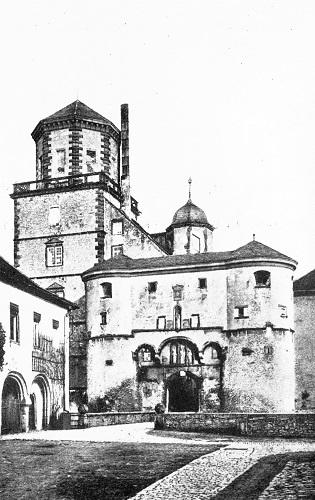
Festung Marienberg—Entrance to Inner Courtyard.
CHAPTER VIII. WÜRZBURG TO ENGLAND.
"La guerre est fini pour vous."
The van drove slowly down the road which runs
along the outer fortification of the Castle. Mr
Poerringer did not speak again, and I was silently
trying to grasp the reality of the situation.
We stopped at the hut hospital barracks where
I had been taken on my arrival at Würzburg five
weeks before. Mr Poerringer got out and saluted
Doctor Zinck, who was waiting outside the gates.
The Doctor caught my eye and grinned from ear
to ear, behind the back of some other officers;
probably he would have spoken to me had it not
been for their presence. I smiled at him rather
feebly. At this time my mind contained but one
idea—the fear that something would occur to prevent
my departure from Würzburg. I was frightened
to speak lest some word of mine might be
made an excuse for detention. The four British
soldiers who now got into the van were evidently
in a similar state of mind. Two of them had
travelled with me from Cambrai. We none of
us spoke. The door of the van shut out the face
of the still smiling doctor (bless the man! he was
perhaps really pleased to see me safely off), and
we jogged slowly on.
Our conveyance stopped in the goods station
yard. Three of the soldiers managed to hobble
along without help, but the fourth, the same young
fellow in the K.O.S.B. who had travelled in my
carriage from Cambrai, had to be carried on a
stretcher. I followed very slowly across the railway
tracks, and then along the platform to where
our train was waiting. Two first-class carriages
were reserved for us, one for the "Offizier" I heard
them say, and another for the men. The train was
full, and passengers at every window stretched out
their heads in curiosity, but none made any remark.
We did not stay many minutes in the station. As
the train moved off, Mr Poerringer was talking to
some of the station officials and did not look up.
He had not spoken to me since leaving the gates
of Marienberg, and perhaps had mistaken my state
of stupor for sulks.
It is not often that events in life will so be
shaped that the highest state of happiness can
be obtained merely from the fact of finding one's
self alone in a railway carriage. The absence of
a sentry made itself pleasingly felt. The sitting
on a soft cushion was a long-forgotten source of
contentment. In my selfish joy I nearly forgot
the friends I had left at the Festung.
On the left side of the line as you leave Würzburg,
the Fortress stands out on the hillside at
a distance of something over a mile as the crow
flies. The windows of my former quarters, where
we used to stand and watch the trains, could just
be recognised, and as I looked a white sheet
was waved up and down from the English room.
I answered back with my handkerchief, waving
it until the Festung Marienberg had passed out
of view.
The soldiers in the adjoining carriage, having
discovered that a communicating door between
our two carriages was open, came in to keep me
company. M——, in the K.O.S.B.'s, remarked
that this was a pleasanter journey than the last
we had performed together. I asked him about
the other men who had been in our party, but
he had lost sight of them. M—— looked thin and
pale, and in far worse condition than when he left
Cambrai. He told me that he had been kindly
treated in hospital, but had been given very little
nourishing food. Another man who was wounded
in the spine and had been in another ward in the
same hospital, said the treatment was fair but food
short. All the other men complained of the want
of food. They said that the able-bodied prisoners
were most willing to work to escape the monotony
of prison life, but that they were given so little
food in the work camps that many of them were
unable to stand the long hours, and had to return
to hospital.
My recollection of this part of our journey is
most vague. I took a childish pleasure in recognising
the country through which we were passing,
and in comparing my feelings on the two journeys.
Near the first little country station after you leave
Würzburg there is a large nursery, and a large
notice put up by Herr Somebody with the words
"Baumschule." Farther on the train passes close
to a large quaintly roofed building bearing the
inscription "Jägerhaus." On the journey from
Cambrai I had noticed these things, and my
thought, anxious to get away from reality, had
speculated about the Jägerhaus and its past history,
and had wondered if the owners of the
Baumschule sold plants at a price cheaper than
obtained at home.
But now, during the first few hours of the
journey, my mind was incapable of taking in
impressions. We stopped at Aschaffenburg, probably
outside the station. I have no recollection.
We stopped many times in the afternoon, but we
took little or no interest. The men had a very
small piece of black bread each, and I gave them
my Leberwurst and the brown bread. Darkness
came down soon. We stopped at stations now
and again, and rejoiced each time the train
moved on.
Night had long fallen when we made our first
change. I do not remember the name of the
station, but the place appeared to be of considerable
size. We were helped out of the carriage
by Red Cross attendants, and saw no soldiers with
fixed bayonets. I was offered the choice of a
stretcher or a bath-chair, and chose the latter.
The night was dark and wet, the station badly
lit up.
We were taken along the platform and put into
the Red Cross dressing-station, which contained
a sofa, two arm-chairs, an operating-table which
looked as if it had never been used, and a glass
cupboard with medicine bottles, rolls of lint, &c.
An oil-lamp hanging from the ceiling threw a
dim light.
After five minutes' wait an official looked in at
the door, and was about to pop out again, when
I asked a question: "Can we have something to
eat?" The official said "Wait," disappeared,
and promptly returned with three of his fellows.
They were surprised at hearing we had not dined
(it was, I think, now about 9 o'clock), and seemed
doubtful if anything could be done in the absence
of special orders. The situation was made easier
by my offering to pay. "Für alle?" they said.
"Yes, für alle."
I was wheeled off at once in the bath-chair still
farther along the platform to the station restaurant,
a small tidy room with half a dozen small
tables covered with clean white table-cloths. A
waiter came forward, helped me into a chair, and
presented the menu. I ordered a beefsteak, with
potatoes and peas. It was pleasant to sit down
to a clean white table-cloth, with a plate (instead
of the trough used in the Festung) and knives
and forks and spoons.
Presently the beefsteak arrived, beautifully
cooked and daintily served. I asked for some
beer, but this was "verboten." "Well, then,
bring me a tumbler and a corkscrew," said I,
withdrawing from my greatcoat pocket the bottle
of stout which Reddy had given me on my departure
from the Fortress.
The price of this excellent dinner was 1 m. 75,
including a cup of coffee. This was at a time
when Germany was reported in our papers to be
suffering from shortage of food supplies. The
menu offered a great variety of dishes, and the
only evidence of scarcity to be noticed was the
small-sized ration of bread with which I was
served.
After the coffee, and cigars! the Red Cross
official came in to say that it was time to take
places in the train. This time we had no longer
the luxury of a first-class carriage, but still there
was plenty of room, as we had a whole coach
consisting of four or five third-class compartments.
The men said they had been given a very good
dinner, for which no payment was demanded.
Just before the train started our party was
increased by the addition of a sentry. The men
had all settled down to sleep in the different compartments,
and the new arrival shared a carriage
with me.
He was of a very different type from the soldiers
who had guarded us on the other journey—a
young man, probably of good position, and certainly
of good education, very fat, unhealthily so,
quite bald, and wearing gold-rimmed spectacles;
he spoke with a North German accent, very difficult
for us to understand. He desired nothing
better than conversation, and told me all about his
own adventure with the army that marched on
Antwerp, where he had contracted typhoid fever
which had left him bald and short-sighted. He
was now condemned to transport work for the
duration of the war, and did not hesitate to say
to me that the prospect was distinctly disagreeable.
We both agreed that war was unpleasant
for every one concerned.
Our ultimate destination was Flushing, but my
friendly fellow-traveller only expected to go with us
as far as Osnabrück, at which town we could not
hope to arrive before midday of the day after
next. The train we were now in contained a
number of wounded Germans. They came along
the corridor during the night and made friends
with our party. Some of them could speak a
little English. Like all the other German soldiers
I have heard discussing the war, these men expressed
great reluctance to return to the front,
and were hopeful that the war would speedily be
terminated. This is probably the normal attitude
of every soldier on both sides.
The German soldier is oppressed by the unexpected
duration of the war. He is apparently
victorious on all fronts, and still the war drags on.
When he goes home on leave there is not much to
cheer him up. Every one seems to be in mourning,
and all his friends of military age are away. There
is one thing only that enables him to face the hardships
of war with unquestionable courage. From
childhood he has been taught that the highest
virtue in a man is loyalty to his Kaiser and the
Fatherland.
German patriotism finds its expressions in personal
loyalty to the Kaiser, and devotion to the
Fatherland which is almost fanatical. Some people
would say that conscription has played a large
part in the development of this national religion of
patriotism, but the history of the German people
can hardly be brought to support such a proposition.
Nor does the mere fact that patriotism
is taught in the schools provide a sufficient explanation.
The source of a flourishing, vigorous patriotism
may often be discovered from a study of economic
conditions. That patriotism is affected by economic
conditions must at once be admitted. In a
State, for example, where the majority of the population
are slaves, patriotism will be confined to the
slave-owners, who will fight vigorously to prevent
their slaves being captured by foreign slave-owners.
An agricultural country, where the majority of its
inhabitants are owners of the soil they till, affords
the most favourable environment for the growth of
patriotic sentiment. The Serbians are without
doubt the most patriotic people that history has
ever known, and Serbia is a country almost entirely
devoted to agriculture, where the great majority of
the inhabitants are owners of the soil, so that, in
the mouth of a Serbian peasant the words "my
country" refer to something more than an abstraction.
But German patriotism stands likewise on a
sound economic basis, for Germany possesses an
enormous agricultural population, the greater proportion
of whom are owners of the soil—the figures,
according to last available statistics, being 86 per
cent of the total population of the country. Starting
with these favourable conditions, the German
Government worked hard during peace-time to
strengthen by education and discipline the instinctive
patriotism of the citizens. Loyalty to
the Kaiser and Fatherland, respect for the army,
the duties of a citizen to the State, are lessons that
the German child is taught at school.
In addition to the economic and educational,
there is a third factor—and most essential of all—in
which Germany is by no means wanting. This
third factor is the influence of history and tradition.
"C'est la cendre des morts qui créa la patrie."
A consideration of these three influences,
economic conditions, educational appeal to the
intellect, historical appeal to tradition, will help
us to understand the power of German patriotism.
In one of the thoughtful editorials to which
readers of the 'Irish Homestead' are accustomed,
I find condensed into a single phrase the idea
which I have been struggling to express. "Duty
to one's race," says "A. E.," "is not inevitable. It
is the result of education, of intellectual atmosphere,
or of the social order."
It is very necessary, but very difficult in war, to
keep in view the best side of the enemy's national
character. Now among the doctors, hospital attendants,
officers and men of the German army
with whom I came in contact during my stay in
Germany, I occasionally met with straight-dealing
and kindness. Three there are among them to
whom I would gladly give my hand. But though
in the main the Germans are a treacherous race,
coarse in pleasure, bestial in drunkenness, viciously
brutal in war; they are also brave, disciplined, and
patriotic. When the Fatherland is seen to be in
danger they will fight to the last loaf, to the last
cartridge, to the last man. There will be no sudden
collapse. There will be no surrender by attrition.
Ours is no easy road to victory.
The night was well on before our visitors retired
to their own compartment. The gold-spectacled,
bald-headed escort fell into a heavy sleep, uninterrupted
by the frequent stopping at cold, dark,
and lonely stations, where the train would sometimes
remain quiet and peaceful for perhaps a
quarter of an hour, but always started with a
sudden rattle and jerk just as I was thankfully
dozing off.
Of the following day I have little recollection.
Early in the morning we changed trains at a
small junction. It was bitterly cold, and the
platform, which was covered with snow, was
deserted. No stretchers or stretcher-bearers were
provided, and those of us who could not walk
were wheeled across the station in a truck by
two aged porters. Before starting afresh we had
a cup of hot coffee and a very small roll of bread
each.
The railway now ran through a hilly and thickly
wooded country, and our speed, which had never
been very rapid, was much reduced by long curved
gradients. Snow lay thick on the branches in the
dark spruce forests. Rosy-faced children, well
wrapped up, on their way to school, stopped on
the hard frozen road which ran beside the railway
line to watch the train go by and to wave their
hands and cheer. A pale wintry sun crept round
the horizon.
The railway carriage was almost as cold as the
corridor in the Festung Marienberg. Yesterday's
feeling of joy merely at the fact of being outside
the Fortress was now giving way to impatience at
the length of our journey and the slowness of the
train.
The picture changed in the afternoon. The train
was crossing the broad corn-lands of Westphalia,
which, as one huge field, stretch away to the
horizon. Here and there were patches of snow,
but no hedges, walls, or fence of any kind, and
scarcely a tree, can be seen to break the monotony
of the landscape. The farmhouses, few and far
apart, present a lonely and desolate appearance.
Yet another month and the newly-sown grain
would be sprouting, and six months would see
the rich harvest, and perhaps the end of bread
tickets in Berlin, for Westphalia is the granary
of the German Empire.
Shortly after dark we again had to change
trains. The platform was crowded with soldiers
and civilians. The snow had given way to a
drizzling rain, and as our train was not yet in,
we sat waiting on high-backed wooden seats, surrounded
by a curious and not too well-mannered
crowd. I remember one ugly old man with a
pointed grey beard, who shook his fist at us and
was full of hate, until the loud voice of a N.C.O.
ordered him to move on. The moment the order
rang out the crowd lost interest in our presence,
and the irascible old man was one of the quickest
to move.
It was a great relief to hear that another night
was not to be spent in the train, as the effects of
cold and the fatigues of the journey were beginning
to tell on the weaker members of the party.
However, we still had three hours to travel before
reaching the place where we were to stay the
night, and where, the escort said, rooms in a
hotel were awaiting us.
It was about ten o'clock before we reached our
destination. I am not sure of the place, but think
it was Cassel. The station was a large one, and
lit up with powerful electric lights. Our train
carried a big load of civilian passengers, chiefly
women, a great number of whom—in fact, nearly
all—wore deep mourning. We had to wait till
the platform was clear before the stretcher-bearers
came to carry us off.
I do not like being carried on a stretcher without
straps. That evening at Cassel we had the best
kind of stretcher, with a pillow and blankets which
were tucked in all round; and then with a big
strap across the chest and another about the
ankles, one felt quite secure.
We were first taken to the buffet, which is at
the far end of the station from our arrival platform.
On reaching the buffet we were unstrapped,
so we could sit up and take a cup of
warm milk, which was served out by uniformed
women attendants. We remained in the buffet
about half an hour. My stretcher was close beside
a table at which four big bony women dressed
in black were drinking hot coffee. A typically German
notice printed in large characters hung in a
conspicuous position on the wall:—
Speak German! Do not use enemy language!
"Adieu" is French; say instead—
Gott beschütze Dich.
Gott segne Dich.
Auf wiedersehen.
Auf baldigeswiedersehen.
Auf sehrbaldigeswiedersehen.
Auf ein Rechtherzigesfrohesbaldigeswiedersehen.
We had not seen any official frightfulness for a
long time. Some person in authority now came
in to the restaurant and lost his temper—not
with us, but with the fact of our being in the
restaurant. There was no one in charge of our
party, so the cursing fell upon the restaurant in
general; and shortly after the irate person had
departed we were carried away by stretcher-bearers
to the waiting-room, which was a few
yards farther down the platform.
Here we had to spend the rest of the night,
and nothing was said about the hotel and comfortable
beds for which our escort in the train
had led us to hope. The waiting-room was furnished
in a style common to most big Continental
stations. The arm-chairs, upholstered in dark-green
plush, were ugly and uncomfortable. The
two sofas were designed to repel the weariest of
travellers. Although large and lofty, the room
was efficiently heated by four large radiators,
and four enormous crystal candelabra hung in
the centre.
At the far end of the room, which was in semi-darkness,
as only one of the candelabra had been
turned on, a lady in mourning was sitting alone
at a small round marble-topped table. When the
stretcher-bearers had gone, the lady spoke to us
in perfect English. "Are you the poor soldiers
who are going back to England?" she said. "How
glad you must be! I read about the exchange of
prisoners in the paper." This lady was of German
birth, and had lived most of her life in Australia.
She said the nations of Europe had gone mad,
and that "this exchange of prisoners was the
first sign of sanity that she had seen since leaving
Australia." She asked if we had had any dinner,
and said it was too late now to get anything to
eat, but that if we rang the waiter would serve
hot coffee.
In answer to the bell the waiter came at once,
and I asked him if we could have some beer. He
seemed to hesitate a minute until I produced a
20-mark note. The beer was brought in tumblers
of frosted glass about a foot high. It was the
best Pilsener. Britain can brew nothing to touch
it. There was nothing in the waiting-room just then
really altogether German except the beer (and the
ugly, uncomfortable chairs). There was very little
German about the waiter, who while waiting for
our glasses to be emptied, entered into fluent
conversation with one of the soldiers.
And the astonishing subject of his conversation
was league football. The wounded soldiers, who
were inclined to be sleepy when the Australian
lady was bewailing the European situation, were
now thoroughly enjoying themselves. The waiter
told us that he had toured the North of England
with a German football team during the winter
of 1912-13; he knew all the professional clubs,
and was personally acquainted with many of the
favourite players in the north country.
One of the wounded men—Private Henry, Lancs.
Fusiliers, who was an expert follower of league
football—started a friendly but determined argument
with Fritz (as they called the waiter) as to
the merits of the different teams.
Fritz was a real football enthusiast. "I shall
never play again," he said; "I am to be called
up in a few weeks, and even if I get through I
can never play in England again."
"Cheer up, Fritz!" I said; "you have got the
best beer in all the world, and as we are not likely
ever again to get a chance of drinking it, you had
better bring in another round."
Some of the Red Cross attendants who were on
duty in the station that night, young fellows of
fifteen or sixteen, paid us a visit but did not stay
long; they could not join in our conversation, and
they refused my offer of beer with a regretful
"verboten."
A soldier friend of Fritz's came in to see us.
He had been slightly wounded in Russia some
six weeks ago, and was now on his way to the
Western Front, much depressed.
Fritz promised to bring in coffee and rolls at
six o'clock (our train was to leave at seven). Two
of the soldiers slept on the floor, and two dozed in
the arm-chairs. Even the fatigue of the journey
and the soporific influence of beer did not suffice
to induce sleep on the sofa.
Our escort of the previous day joined us at the
train next morning. Only a single third-class
carriage was provided for this part of our journey,
and as it was a very narrow one we were all most
uncomfortable. We would reach Osnabrück at
11 A.M., and there, we were told, "the exchange
would take place." I speculated wildly as to
what form or ceremony would be followed. The
local morning paper threw some light on the
subject with a statement "that the wounded English
officers and men about to be exchanged were
to be assembled at Osnabrück from all parts of
Germany previous to being sent over the frontier."
The train seemed to go slower than ever. We
came to a part of the line which had been flooded,
and a squad of men were repairing the track and
rebuilding a bridge. The men were of military
age, and our escort said they were Russian
prisoners. I noticed in many places along the
line that a lot of rough ground had been broken
up and brought into cultivation.
Now this work requires able-bodied, healthy
young labourers, especially when trees have to be
felled and roots removed, and there is no doubt
that the prisoners of war are being used for this
purpose. Indeed, most of the agricultural work
is carried on by prisoners, so that the full strength
of Germany's enormous agrarian population is
released for the fighting line.
We had to change trains once more (the seventh
or eighth change since Würzburg). Our escort,
who like ourselves was impatient at the continued
delay, expostulated with the station-master, who
explained that we had followed a circuitous route
in order to leave the main lines free for the passage
of troop trains. Large bodies of troops were at
that time being shifted from East to West or from
West to East.
The day dragged on, eleven o'clock passed, the
hour we were due to arrive at our destination, and
still the train monotonously bumped along the
single track of the badly-laid country railroad.
Our third-class carriage was very cramped and
uncomfortable. Such carriages are really not
"third-class" according to English notions. But
we did not worry about mere physical discomfort.
I do not know what my wounded comrades had
in their minds. They hardly spoke. But the expression
in the face of each man had been changing
from the moment they had left the hospital hut
Baracken at Würzburg.
In my own mind a change had also been working
since leaving the Festung Marienberg, with its
omnipresent sentries, noisy barrack-rooms, and
insolent, ill-mannered commander.
Now that I was no longer treated like a dangerous
criminal, I began to think and act in a more rational
way. But the change was very slow. For long
after I had reached my own home I retained a
silent and suspicious manner, which was surprising
perhaps to those of my friends who did not know
the full story of the Festung Marienberg. I have
drawn no exaggerated picture of that prison. I am
afraid there are places even worse than Würzburg,
although in other prisoner camps, such as Crefeld,
Neu Brandenburg, Stralsund, the conditions are
very different, and from trustworthy accounts I
believe that at Stralsund in particular the officers
could not wish for better treatment. They are
allowed to play cricket, football, tennis, &c., whenever
they wish. They can even visit the town
under escort, and have a three-hole golf-course,
which one of my friends there tells me is "bogey
nine." I am thankful that, owing, I believe, to
the action of the American Embassy in Berlin, the
four British prisoners whom I left behind at Würzburg
have been sent to another Fortress in Bavaria,
where they are allowed a considerable amount of
liberty, and where life is much more endurable than
it was at the Festung Marienberg.
On arrival at Osnabrück at 1.30 P.M. on Saturday
the 14th February, my experience as a prisoner of
war in Germany came to an end. From that day
to the crossing of the Dutch frontier on the night of
Monday 16th, I was treated with all possible kindness,
and every material comfort that could be
wished for was offered or provided. I was no
longer treated as a prisoner.
Two private motor-cars were waiting at the
station to take us to the hospital. Three of our
party went off in the first car, and I with the
remaining soldier was lifted into the other, and
carefully covered up with warm rugs by the officer
who had come to meet the train. Both cars were
driven off to the hospital, where my companions
were to be lodged. The sun was shining frostily
as we drove through the bright clean town, which
is more Dutch than German in appearance.
The car stopped in a narrow street opposite a
verandah, with a flight of steps leading up from the
pavement. On this terrace or verandah stood an
old man, short, and heavy about the stomach,
dressed in black old-fashioned clothes. He approached
me with a bow, washing his hands
with invisible soap, "Goot Morgen, sir," "Goot
Morgen,"—more washing—"Is there anything I
can do for you? You ask me. Komm this way,
please." He crossed a large entrance-hall. The
floor was tiled and slippery, so that I could scarcely
walk on it. Sofas were set all round and down the
centre, and one or two wounded German soldiers
sat reading. They paid very little attention to our
arrival. I was shown into an enormously big hall
containing about 200 beds. This (from the stage
at the far end) had doubtless been a music
hall.
The room, which was lofty, but not well lit up,
except at the stage end, where there was but a
single large window, had been freshly painted
white. The beds were ranged all round, and a
double row down the centre.
Everything in the room was new. Beds, sheets,
blankets, none had ever been used before. By each
bedside was a small iron table, and behind each bed
hung the patient's hospital outfit, the ugly striped
pyjamas and red felt slippers. Everything new
and spotless.
The bald, gold-spectacled escort carried in my
luggage, and bade me an almost affectionate farewell.
I was becoming quite inured to surprises of
this kind.
In spite of a notice on the wall which said that
lying down on the beds in the day-time is strictly
forbidden, I lay down on the bed nearest the door
and tried to forget my excitement in sleep, but
before very long I was aroused by voices from the
other side of the screen at the door, and R. D. R.
walked round in his kilt, looking just the same as
when I had last seen him at Joigny la Chaussée.
"Well, I am glad to see you," he said; "we
heard you were killed, and then we heard you were
in England."
"How have you got into this party?" I replied;
"there is nothing much wrong with you."
Four other British officers followed in behind R.D.
I had expected to see a far more crippled band.
Major D—— was the worst of the four. One arm
was badly paralysed. He spoke with difficulty, a
bullet having grazed his windpipe leaving a nasty
scar, and he had one or two other bullet wounds in
the leg.
M—— and W—— were very lame; each had a
broken leg, badly set and short. Captain M——
had nothing wrong with his arms or legs, but a
shrapnel bullet had hit him in the face, gone down
through the roof of his mouth, and stuck somewhere
in his neck, which was bandaged up.
The worst case of all was H——, who presently
came in, supported and half carried by two orderlies.
No man in this war has had a nearer shave than
H——. He was shot through the base of the neck,
and the bullet chipped the spine, causing partial
paralysis on one side and complete paralysis on the
other. I think it was his cheery spirit and sense of
humour that helped to keep him alive.
All of us had long stories to tell. W—— had
the most to say, having been shut up for three
months with some Russian officers who knew
neither French nor English. The remainder of
the party all came from Crefeld, which is not many
hours by train from Osnabrück.
For some reason the new arrivals were not
allowed to have a bath. We were told that anything
we fancied either to eat or drink could be
ordered for dinner, but that if we did not wish
to pay for our food, the ordinary hospital fare
would be at our disposal free of charge. We
ordered, and were served, a first-rate dinner.
During the afternoon a party of French officers
walked into the ward. One of them was rather
lame, but the others seemed in very good health.
Surprise at the meeting was mutual. They spoke
but little English. When we said that we were
the prisoners about to be exchanged, these poor
fellows had just for a moment a gleam of hope that
they also by some mistake were to come with us.
We had been together only a few minutes when
a soldier came in and took them away. In the
short time I had, however, found out that these
French officers had no complaint to make of the
treatment they had received, and they informed
me that a special difference was made in their
favour as compared with the British.
Soon after a most excellent dinner, we were glad
to turn in. German beds are made in some strange
manner. The bedclothes are not tucked in at all,
but are folded across the bed in a puzzling sort of
way. However, the bed was extremely comfortable,
and I slept soundly, the first time since
leaving Cambrai.
The next day, Sunday 15th, was a very long
one. We were not allowed to leave the ward,
which, on account of its huge size, the lack of
windows, and the uniform whiteness, was a most
depressing place. In the afternoon some kind of
religious service took place in the adjoining ward—at
least we heard singing of hymns to the
accompaniment of a powerful organ—and the
proceedings, whatever they were, terminated with
"Deutschland, Deutschland über Alles."
The event of the evening was the announcement
that next morning we were to appear before a
Medical Board, and immediately after would leave
for Holland. This piece of information was received
with calm. For my part I still had some
of the old reluctance to believe in good news, and
Major D—— spoke the thought of all when he
said, "We are not yet out of the wood." H——,
the most crippled of the party, was the only
optimist.
Next morning, shortly after ten o'clock, I was
crossing the outer hall—that is to say, I was
creeping round by the wall, not daring to venture
across the well-polished floor—when the Board
emerged from a doorway behind me. They stood
and watched me make a laborious circuit back to
our room.
We stood to attention, those of us who were
able to stand, while the seven or eight German
officers filed into the room and took their seats
at the table which runs across the whole breadth
of the ward, opposite the entrance door. These
were men of high rank, and all of a large size
except one stout, short fellow, who acted as interpreter.
Our names were called, and the examination
proceeded in order of seniority. There
was no hesitation about any one until Captain
M—— was called. His case was the subject of
a certain amount of guttural discussion. R. D. R.
was the last and longest to be examined, and his
fate hung in the balance. The Board seemed to
be of opinion that he was not to be exchanged.
The discussion lasted but a few minutes, during
which R. D. stood pale and with anxious eyes.
They again began to question him. "How many
years' service did you say?" "Three." "Can
you drill troops?" "Very little." "Are you
qualified to teach musketry?" "No."
Again the withered hand was examined to see if
any sign of life could be found in the blue twisted
fingers.
I think the casting vote in R. D.'s favour was
given by the senior doctor, the only one of
the party who was in mufti, and one of the
few really human beings I have met while in
Germany.
Before going out the senior officer present (a
General) made us a speech in German, which was
translated to us by the interpreter somewhat as
follows:—
"It is all right! You have all passed, and it
only remains for you each to come and sign the
necessary papers in the doctor's room. The
General wishes to know if you have any complaint
to make about your treatment, and if there is
anything you are not satisfied about the way you
have been treated while in Germany you must tell
us about it. We wish you to make now any complaints.
We want you to be satisfied. You must
go back to England contented." "We want you
to go back to England contented." He repeated
these words several times, walking up and down
the room as he spoke, looking round with a quick
glance at our faces, while the Board in the background
nodded approval.
There were no complaints. I thought in silence
of my journey from Cambrai to Würzburg, and of
the Rittmeister at the Festung Marienberg.
Here was the explanation of the sudden change
which began the day of departure from the Festung,
the explanation of the first-class carriage at
Würzburg station, the indifferent attitude of the
crowd on our journey, the good-fellowship of sentries,
the free and friendly intercourse with wounded
German soldiers, the attention and luxuries provided
at Osnabrück. "They" wanted us to go
back to England contented.
After the Board had gone the interpreter came
back again to make sure—"Please, gentlemen,
mention anything. You are all satisfied. Is good,
that is gut," and out he went at last rubbing his
hands.
"They" had evidently given orders that the
about-to-be-exchanged prisoners were to be treated
with kindness, just as "They" on a former occasion
had given orders that British wounded
prisoners, officers and men, were to be treated
with a special insolence and brutality.
This affectation of kindness now at the very last
moment, the hypocritical pretence, was more repellent
than even the insolence of the Rittmeister
Niebuhr.
There was, however, one member of the Board
whose kindness was really genuine. This was the
senior doctor in civilian clothes.
When I went along to the room where the papers
had to be signed, he made me sit in his arm-chair
and examined my head. I cannot explain the
difference between his manner and that of the
others. Kindness, in the others so evidently sham,
official, and by order, with him was second nature.
"You will get well, quite well in time," he said,
"but it will be very long."
"Let me take your arm, you must not fall on
the slippery floor. You might hurt yourself badly
and not be able to leave us to-night."
Even if I had not understood the German words,
there was no misunderstanding the sympathy in
the tone of his voice.
The word of deliverance came that evening while
we were at dinner. We were told that two motor-cars
and an ambulance waited at the door, and
in a very few minutes we started off for the station.
As the night was dark and wet, there was some
delay before the cars could find the platform our
train was due to start from. We drove into the
station by a goods entrance, and the cars halted
quite near the train. In addition to ourselves, a
large party of wounded soldiers, about 120 of them,
were bound for the frontier.
As I made my way slowly along the platform I
saw several of these poor fellows standing about on
crutches, one or two of whom I had met before
at Cambrai. They were very cheery, and it was
cheering to see them and hear the familiar query,
"Are we downhearted?" with its answering roar
from the train-load of cripples. But the thin pale
faces and ragged clothes bore witness to the misery
from which they, the lucky ones, were now to be
released.
After waiting for nearly two hours, a German
officer of high rank came along to make a final
inspection. He asked us if we had any complaints
to make, and again repeated the hypocritical
phrase, "We want you to go back to England
contented." And at last the train moved off.
Osnabrück is only forty miles from the frontier.
The suspense and worry of the day had told on
all of us, and when the much-longed-for moment
arrived, and the train actually crossed the frontier,
we had all fallen asleep.
Würzburg and all that nightmare in German
hands were already slipping far away into the
past. The reaction found expression not in hilarious
excitement or placid contentment, but in an
exceeding weariness of mind and body. Quite
early in the morning the train stopped at a small
station well over the German frontier. Two ladies
came along the corridor with baskets full of cakes,
oranges, tobacco, and other gifts. "Oh, you poor
men," said a voice in English, "is there anything
we can do for you?" It was the first Englishwoman's
voice we had heard for a long time (it
did seem such a very long time since we left
Southampton Water).
The voice and the kind words acted as a stimulant,
almost as a shock. Although the incident
may seem to be a trivial one, it is stamped in
my memory, for it awoke the memory of all that
England is, of kind human sympathy, of those
qualities so little understood by Germans.
We reached Flushing about 11 A.M. The
British Consul and a number of very kind people
came to meet the train and escorted us to the
hotel which is just opposite the station. Owing
to a very bad headache I had to spend the day
in bed.
Those of our party who were able went for a
walk as free men in the streets of Flushing.
They saw the arrival of German prisoners from
England, and compared their well-fed appearance
in smart clean uniforms with the ragged miserable
state of the unfortunate British soldiers. About
seven o'clock we were allowed to go on board the
steamer. In the dining-room of the hotel I met
Major Chichester, who had arrived with all the
one-armed and one-legged men from Madame
Brunot's Hospital at Cambrai. Many stretcher
cases were carried down the gangway, some with
bandaged heads and smiling faces; but one or two
stretchers were completely covered over, and one
dared not think of the burden they carried. Yet
others there were who, going back to England,
would never see England again. "Are we downhearted?"—the
cry was raised at intervals, and
from every quarter of the ship came the answer
in a convincing chorus.
During the long and very rough sea passage
my mind was taken up with the misery of the sea,
which in a bad sailor is able to dominate all else.
However, the discomforts of the sea journey
only intensified the relief of landing on English
soil at last.
It was about 8 P.M. before the hospital train was
ready to start for Charing Cross. At the end of
the saloon in which we were travelling a large
gramophone was playing a lively and rather catching
air. I asked an orderly the name of the tune,
and he, looking at me with an air of suspicion and
hesitation, not knowing the tune was unfamiliar to
us, replied at last, "It's a long long way to
Tipperary."
Indeed the way had seemed long.
PRINTED BY WILLIAM BLACKWOOD AND SONS.
Transcriber's Note
The following modifications have been made,
Page 125:
"Famechon" changed to "Faméchon"
(After lunch, M. le Médecin Chef Faméchon and Capt. Viguié)
Page 152:
"smypathy" changed to "sympathy"
(he showed a real sympathy for my state of health)
Page 165:
"," changed to "."
(than tactlessness or mismanagement. The gossips)
Page 173:
quotation marks inserted
("The Germans did not come back into the camp)
Page 254:
"corrider" changed to "corridor"
(was at the end of the corridor and the door)
Page 255:
"tablecloth" changed to "table-cloth"
(been allowed to buy a coloured cotton table-cloth)
Page 304:
"exggerated" changed to "exaggerated"
(I have drawn no exaggerated picture of that prison)
Not modified but retained as printed:
Page 70:
The date mentioned "23.8.11" might actually be "23.8.14".
(Since Sunday morning, 23.8.11, we have been fighting nearly)
Page 167: "kepi" / Page 211: "képi"
Page 24: "new-comers" / Page 165: "newcomers"