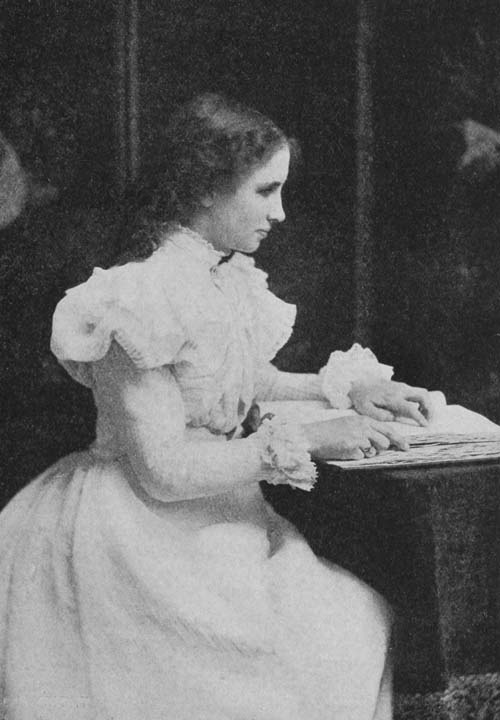
(Adapted for Young People, Nine to Eighteen Years.)
The poet, Longfellow, once wrote in his diary, “We
have but one life to live on earth; we must make that
beautiful.” The story of this beautiful life began at his
birth in Portland, Me., February 27, 1807. He was
the second of eight children. His father was an honored
lawyer and his mother was a woman of refinement, a
descendant of John Alden of the Mayflower. Henry
was a noble, tender-hearted boy. One day when he
went shooting, he killed a robin. The piteous look of
the little fearless thing so pained him that he never went
shooting again. The first book he loved was Irving’s
“Sketch-Book.” Its strange stories of “Sleepy Hollow”
and “Rip Van Winkle,” pleased his fancy. During
each summer he used to visit his Grandfather Wadsworth’s
estate of seven thousand acres, just outside Portland,
where they told him tales of ’76. The story of
the fight with the Indians impressed him so deeply that
at the age of thirteen he wrote his first poem, “The
Battle of Lovell’s Pond,” which he slipped into an envelope
and mailed to a newspaper, telling no one but his
sister. He walked up and down in front of the printing-office,
shivering in the cold, and wondering if his poem
was being put in print. Next morning there was the
poem, signed “Henry.” He read it again and again,
and thought it a fine poem. In the evening he and his
father were visiting at a neighbor’s house, when the
neighbor said to Mr. Longfellow, “Did you see the little
poem in to-day’s paper?” “No,” said Mr. Longfellow,
“is it good for anything?” “No,” said the neighbor,
“it’s stiff, and it’s all borrowed, every word; why, your
boy there could write much better than that!” Poor
Henry’s heart sank. He hurried home and sobbed himself
to sleep that night. Yet criticism did not discourage
this brave boy. He kept trying, saying, “I will succeed,”
and he became the best-loved poet of the world. At
fourteen he graduated from Portland Academy, and at
eighteen from Bowdoin College. After three years’ travel
in Europe, he became professor of modern languages in
his alma mater for five years, and then for eighteen years
professor of literature in Harvard, being succeeded by
James Russell Lowell. The school children of Cambridge
celebrated his seventy-second birthday by presenting
him with a chair carved from the wood of the
chestnut tree under which stood the village smithy that
he made famous in his poem, “The Village Blacksmith.”
The poet greatly appreciated this gift, and wrote one of
his best poems about it. Each boy and girl who came
was allowed to sit in the chair and each received a copy
of a poem that Longfellow wrote. The same year fifteen
hundred children of Cincinnati celebrated his birthday
with recitations from his poems and singing his songs.
His marble statue stands in the “Poet’s Corner,” in
Westminster Abbey in London, England. His grave is in
Mount Auburn Cemetery, in Cambridge. On his tombstone
is the simple inscription: “Longfellow.” That is
enough. There are few schoolboys in America or England
who do not know the story of his beautiful life, or
who have not recited his words in “A Psalm of Life”:
Lives of great men all remind us
We can make our lives sublime,
And, departing, leave behind us
Footprints on the sands of time—
Footprints, that perhaps another,
Sailing o’er life’s solemn main,
A forlorn and shipwrecked brother,
Seeing, may take heart again.
Let us then be up and doing,
With a heart for any fate;
Still achieving, still pursuing,
Learn to labor and to wait.
Wolfgang Amadeus Mozart, one of the greatest musicians
and composers that ever lived, was born in Salzburg,
Germany, January 27, 1756. His father was a
famous violinist. At the age of three little Wolfgang
loved to hear the playing of his sister Maria, who was
just five years older. At four he was able to play minuets
and compose little pieces. At five he played in public, and
at six composed a difficult concerto for a full orchestra.
One day before he was seven, his father was walking in
the country with him when they came to a great church
which contained the largest organ Wolfgang had ever
seen. “Father, let me play it,” he said. Well pleased,
his father began to blow the bellows. Wolfgang pushed
aside the high stool, stood upon the pedals, and began
playing. Softly at first the deep tones rose, awakening
the stillness of the old church, and then the strains
swelled louder and louder until all who heard marveled
that a young child could play such wonderful music. No
wonder the father was proud of his two children. No
wonder the palaces of Europe were opened to them and
that they were petted, admired, and loaded with caresses
and presents. The little boy’s charming appearance and
cheerful disposition endeared him to all. So innocent
and natural was his manner that at Vienna he sprang up
into the Empress’s lap and kissed her heartily. In another
place when he slipped upon the polished floor, Marie
Antoinette lifted him up, and he said, “You are very
kind. When I grow up I will marry you.” He always
loved his father, and was always gentle and obedient,
saying, “Next after God is my father.” Though so
modest, he played without fear before kings.
Many musicians were jealous of his genius and said,
“A trick is being played on the people.” So one day he
was invited to the house of a famous musician to play
before a number of great performers. The old musician
gave him the most difficult piece he had ever written,
knowing Mozart had never seen it, and to the wonder of
all, he played it so splendidly they were convinced of his
great genius. But as the envy of his enemies did not decrease,
he was obliged to seek Italy to earn his living.
At Rome he went to the Sistine Chapel to hear the celebrated
“Miserere,” which, on returning home, he wrote
down note by note—a feat which created a great sensation,
for the singers were forbidden to transcribe the
music on penalty of dismissal. So delighted was the pope
with him that he presented Mozart with the Order of the
Golden Spur. He played the harp, the organ, the violin,
and every instrument in the orchestra. He composed
many operas as well as church music and concert music.
Perhaps the happiest part of his life was when he
traveled with his sister and his beloved father, revealing
the wonders of his musical genius to the great of the
earth, not for money or fame, but for the great pleasure
he gave and received from his art.
One day a stranger called on him, requesting him to
compose a requiem, and offering to pay him for this in
advance. Mozart worked hard at it, but when the stranger
returned it was not ready, and he paid the musician some
more money in advance for it. When the stranger called
the third time, Mozart was dead; and the requiem still
unfinished. When he died he was very poor, and the few
friends he had, because it rained on the day of his funeral,
left him unattended, to be carried to his grave in a
potter’s field. Thus he, who had in his lifetime produced
so much wonderful music, was buried unhonored
and unsung, without funeral ceremony or acclaim. But
to-day, not only in Germany but over all the earth, the
music of his immortal name is heard, and his praise is
sung.
In the quaint little town of Bergen, in Norway, February
5, 1810, was born a boy, the eldest of ten children.
His father was a chemist, and his mother a noble, intelligent
woman, and they both loved music. Little Ole
Bull would often crawl under the settee or sofa to listen
to the music when his relatives came to his home to sing
and practise, and he was often whipped, when discovered,
for being so naughty. He loved music, and when he was
in the field, where he often played alone, he thought he
heard the music of the little bluebells swinging in the
wind, as he lay among the flowers. When he was four
years old his uncle gave him a yellow violin. He kissed
it in his delight, and began to learn the notes at the
same time that he did his letters, and although forbidden
to play until after study hours, he often forgot and was
punished both at home and in school. When he was
eight years old a music-teacher was provided, and his
father bought him a new, red violin. That night Ole
could not sleep. In his night-dress he stole to the room
where the violin lay, and because it was so red and so
pretty, and the pearl screws smiled at him, he just
pinched the strings, and when it smiled more and more,
he had to try the bow, and then he forgot that it was
night and everybody asleep, so he played, very softly at
first, and then he kept on forgetting until suddenly—crack
went his father’s whip across Ole’s back, and the
little red violin fell to the floor and was broken. He
said, “I wept much for it, but it did no good, for the
doctor never could make it well.” But he kept on with
his study, and in two years he began to compose his own
music, making his violin sing with the birds and brook,
the roar of the waterfall, the dripping of the rain, and
the whispering of the wind. When Ole was eighteen he
went to the University at Christiania, where he attracted
the attention of one of the professors, who encouraged
him to give concerts and later aided him with money to
go to Paris. In that great city no one cared for this
unknown violinist, and he could not get a chance to play.
One day when he had but little money left, an old man
who lived in the same house with him advised the violinist
to draw all his money out of the bank, pretending
that it was not safe there. Ole drew his money out, and
that night the old man stole all Ole’s money and clothes,
leaving him penniless in the strange city. In his distress
he sought a new home in a house with a card in the window,
“Furnished Rooms to Let.” He went up the steps
and when the woman saw how ill and poor he looked,
she said there was no room. But her little granddaughter
said, “Look at him, grandmamma.” The old lady put on
her glasses and saw he looked like her son who had died,
and so she took Ole in and nursed him tenderly through
brain fever. Later little Felice, the granddaughter, became
Ole’s wife. A nobleman asked him to play at a grand
concert, where he earned three hundred dollars. Then
he took lessons of some great teachers and made a tour
of the world on which he received great sums for his
playing. In America his audiences went wild with delight.
He used to visit the asylums and hospitals and
play for the inmates. All through his life he tried to help
others, not only with his music, but with his money. His
sweet wife and his beautiful children died, and he was
left alone, but he was never too sorrowful or too busy
to help the most humble who came to him. He died at
his beautiful home near Bergen, Norway. At his funeral
the rich and great gathered to honor him, and after his
body was lowered into its flower-hung grave, the poor
peasants came by hundreds with their green boughs or
sprigs of fern or wildflowers and filled his grave with
them—because they loved him!
Louisa May Alcott was born in Germantown, Pa.,
November 29, 1832. Her father was a cultured school-teacher
and her mother of an old aristocratic family.
Louisa was the eldest of four daughters, whose happy
life she pictures in “Little Women,” herself being “Jo.”
She was a wild, happy-hearted, enthusiastic girl, preferring
whistling and romping and boys’ games rather than
girls’. Their home was frequently visited by such literary
people as Emerson, Thoreau, and Hawthorne, who
were her father’s friends. At eight years of age she
wrote this poem of eight lines:
Welcome, welcome, little stranger,
Fear no harm and fear no danger;
We are glad to see you here,
For you sing, “Sweet spring is near.”
Now the white snow melts away;
Now the flowers blossom gay.
Come, dear bird, and build your nest
For we love our robin best.
Her mother preserved this poem, and told her if she
kept on she might one day be a second Shakespeare.
She was fond of telling fairy stories to amuse her sisters
and friends, and often turned the old tales into little
plays which the children acted in a barn. One of these
plays was “Jack and the Bean Stalk.” A squash vine,
placed in the barn, was the bean-stalk, and when it was
cut down the boy who played Giant, would come tumbling
down from the hay-loft. At thirteen she wrote the
beautiful poem, “My Kingdom.” After she became a
school-teacher she was always helping somebody, taking
care of an invalid or the poor, or sewing to help her
mother. She continued to write stories. Some of the
stories were rejected and the publisher advised her to
stick to her school-teaching. Returning from the Civil
War, where she had been a valued nurse to the wounded
soldiers, she presented, through her father, several short
stories to a publisher, who rejected them, with the advice
that she write a story for girls. She thought she could
not do that, and wrote “Little Women” to prove that
she could not, but it is perhaps the best-loved girls’ story
ever written. Then she wrote “Little Men,” of which
fifty thousand copies were ordered before it was printed.
She received one hundred thousand dollars for her books.
Her life-desire was now realized in having money enough
to make her family comfortable. Her father died in 1888,
and she followed him only three days after. Miss Louisa
May Alcott, besides being a writer, was also an earnest
advocate of woman suffrage and temperance.
Rosa was born in poverty. Her father, an artist too,
was compelled to give drawing lessons, and her mother
had to go from house to house teaching music to assist in
supporting their four children. Her mother dying when
Rosa was twelve years old, and her father marrying
again, the gifted girl was sent away to school where she
spent most of her time in drawing funny pictures of her
teachers. Later her father taught her to copy the old
masters in the Louvre. When she was seventeen she determined
her life-work—animal painting; but being too
poor to buy models, she would take long walks into the
country to study and draw living animals, and later on
kept a sheep on her roof-garden for a model. At nineteen
she sent two pictures to the Fine Arts Exposition, “Goat
and Sheep” and “Two Rabbits,” and others soon followed.
When her father died she took his place as
Director of the School of Design for Girls, and her sister,
Juliette, became a teacher in the same school. She
studied eighteen months before painting “The Horse
Fair,” which famous picture was purchased in England
for eight thousand dollars, and later by A. T. Stewart,
of New York, and is now in his collection in the Metropolitan
Museum of Art. Landseer, the great English
artist, said of her “Horse Fair,” “It surpasses me, although
it’s a little hard to be beaten by a woman.”
When at her work Rosa Bonheur often dressed in male
attire with a large, white collar. She was always busy,
cheerful, and generous. Her pictures brought her large
sums, which she spent not only in providing for her
family and old servants, but in generously assisting poor
students. She had one of the most beautiful studios in
Paris. When Prussia conquered France the Prussian
soldiers were ordered not to disturb Rosa Bonheur or
her servants. The poor idolized this wonderful woman,
for she always loved them. She died at her home May
25, 1899. But through her wonderful works she still
helps us to see the beauty of common things and to feel
the poetry in what might seem the drudgery of life.
Jenny Lind, the “Swedish nightingale,” fills a place all
her own among the world’s great artists of song. Gifted
in voice, beautiful in face, lovely in character, a princess
among givers, the guardian angel of the poor and unfortunate,
she was for many years the idol of all classes
of people, adored not simply for her talent, but also as
one of the most perfect of women. She was born in
Stockholm, Sweden, October 6, 1820. Her father was a
good-natured man, who enjoyed song, but he was unable
to provide for his family. Her mother was a woman
of determination, who helped care for the family by teaching
school. When very small Jenny showed a love for
the singing of birds, and often when she sang to her
pet cat, as it sat with a blue ribbon around its neck in the
window, people in the street used to listen and wonder.
One day a lady heard the child’s voice, and said, “She
is a genius; she must be trained.” At nine she sang before
the music-master of the Royal Theater, and he was
moved to tears and at once accepted her, and for ten
years she was educated in singing and elocution at the
expense of the government of Sweden. Jenny began to
act and sing in the Royal Theater at ten, and sang and
played continuously until she was twenty. From twelve
to fifteen she sang in concerts, and the Swedish people
became very proud of her. At twenty she was made a
member of the Royal Swedish Academy of Music, and
was appointed court singer. The progress in her art
led her to devote four hours or more daily for almost
a year in practising the scales and exercises under a great
teacher in Paris. Then she began to travel through
Europe, singing before kings, nobles, and distinguished
people, and to crowded audiences who hailed her as “the
first singer of the world,” and paid enormous prices to
hear her. At last she consented to sing in the United
States. When she arrived at New York thousands were
on the dock eager to catch a glimpse of her. Triumphal
arches surmounted by eagles bore the inscription, “Welcome,
Jenny Lind. Welcome to America!” At the first
concert, where thousands listened enchanted to her in
Castle Garden in New York, some persons paid as high
as six hundred and fifty dollars for a single ticket.
Jenny Lind’s share for this one concert was nearly ten
thousand dollars. She immediately sent for the mayor of
the city and distributed the whole amount among charitable
institutions. Throughout her life she felt that the
money she earned was only hers in trust, as well as her
voice. She said: “It is a great joy and a gift from God
to be allowed to earn so much money and afterward to
help one’s fellow men with it. This is the highest joy I
wish for in life.” Everywhere she gave benefit concerts
for charitable institutions or for individuals in need. In
New York alone she gave away forty thousand dollars in
charities. When warned against so much liberality, as
some unworthy persons would seek aid, she always replied,
“Never mind, if I assist ten and one is worthy,
I am satisfied.” At thirty-one she married Mr. Otto
Goldschmidt, of Hamburg, an accomplished musician,
and they secured a beautiful residence in England, where
they lived most happily for many years, until her death,
November 2, 1887, at the age of sixty-seven. Queen
Victoria, who had often heard her sing and who greatly
honored her, sent a wreath of beautiful white flowers.
Mendelssohn said of her, “I never met so noble, so
true, and real an art nature as Jenny Lind.” N. P. Willis
said: “To give away more money in charity than any
other mortal; to be humble, simple, genial, unassuming,
and still be the first of prima donnas; to have begun as
a beggar girl and risen to receive more honor than a
queen, this is the combination that makes the wonder
of a dozen heroines in one single girl.”
When the Hall of Fame was opened in New York
City, George Washington was found to have the votes of
one hundred per cent of the electors, and Abraham
Lincoln came next with ninety-nine per cent. Lincoln,
the great emancipator of four million slaves, and the
preserver of the nation’s unity, came next to Washington,
the Father and first President of his country. In Harden,
now Larue County, Ky., February 12, 1809, he
was born and grew up in such poverty as few boys have
ever known. His mother died when the little fellow was
very young, so that not until little Abe was seven years
old, and his stepmother, a woman of energy and intelligence,
took charge of the desolate household, did the
shaggy-headed, ragged, barefoot, forlorn lad begin “to
feel like a human being.” From the time he could hold
an axe in his little hand he was expected to work. His
father was a lazy, shiftless, “poor Southern white,”
which is the last word in unthrift. He hired out Abe to
the neighbors to plow, dig ditches, chop wood, drive
oxen, and “tend the baby” when a farmer’s wife was
busy, keeping all the scanty wages Abe earned and growling
because the lad loved to read when he had finished his
work. Often he came home at night all aching with cold
and wet, not to lounge at leisure as other boys, but while
his parents slept, he rolled another log on the fire to give
him light, or by the aid of a pine-knot stuck in the wall
to light the dingy cabin, he read such books as he could
borrow. When sixteen years old, besides being a rail-splitter
and teamster, he was earning six dollars a month
by managing a ferryboat across the Ohio River. Perhaps
the turning-point in his life came when he found
two old law-books that had been thrown away with
some rubbish he was hauling. He read these books and
stored up the information they gave. His wide reading
enabled him later to speak eloquently, especially against
the slave-trade which he hated. One day, passing
through the great slave-market of New Orleans, and
seeing a girl being auctioned from the slave-block, his
soul was so kindled that he decided then and there, “I’ll
knock that thing hard, if I ever get a chance.” And he
did. He was tender-hearted, and nothing aroused him
more than to see a helpless animal or person mistreated.
He was six feet four inches tall, awkward and homely
in countenance, very powerful, a famous wrestler, but he
was never known to use his strength for his own benefit,
and while he whipped the bullies that made him fight, he
never picked a quarrel in his life. He served as captain
in the Black Hawk war, and at the age of twenty-two
ran for the legislature and was defeated. He ran a country
store in Springfield, Ill., and failed, but he paid up
the last dollar, although this took him fourteen years to
do. He studied law and became a leading lawyer, admired
for his honesty as well as industry. He stood
always for peace if possible, and often persuaded his
clients to make up their quarrel in his office instead of
going to law. While he was an attorney, feeling that his
lack of education put him at a disadvantage with Eastern
men who, educated and trained in great colleges, were
coming West, he determined “to be ready for them,”
and so undertook a home course of study in mathematics,
logic, and literature. It was hard work, but he won. He
was elected to the Legislature of Illinois, sent to Congress
at Washington, became the leader of the Republican
party, and in 1860 was elected President of the nation.
During the terrible years of the Civil War his hand
guided the torn and distracted country out of the cyclone
of hatred and bloodshed into peace and prosperity. Few
souls in history have had fiercer trials than those through
which he passed. His friends grew impatient and found
fault, his enemies jeered, his closest followers doubted,
but he could neither be hurried, delayed, nor swerved
from the cause of right he had laid out for himself. His
patience, self-possession, resources, tact, large-heartedness,
and faith in God never failed him.
On January 1, 1863, President Lincoln signed the
Proclamation of Emancipation, and by his stroke of the
pen set four million human beings free. No wonder that
in many churches in the United States, as well as in England,
Christian people sang “The year of jubilee is
come!”
In spite of his lack of early education, his speeches and
documents are among the finest in our history. His
Gettysburg address every boy should know. In his second
inaugural address this sentence occurs: “With malice
toward none, with charity for all, with firmness in the
right as God gives us to see the right, let us finish the
work we are in, to bind up the nation’s wounds, to care
for him who shall have borne the battle, and for his
widow and his orphans, to do all which may achieve and
cherish a just and a lasting peace among ourselves and
with all nations.”
Just as he was about to enjoy the hard-won victory
of peace, an insane assassin laid low the great emancipator,
“a sacrifice upon the altar of Freedom.” He died
April 15, 1865, sincerely mourned by “the boys in blue”
and “the boys in gray” and the States of the nation
that he had saved in union.
Abraham Lincoln will always rank as one of the greatest
presidents, and, as the years roll on, his place in the
affection and reverence of his countrymen becomes more
secure. James Russell Lowell wrote this fitting tribute
to him:
Our children shall behold his fame,
The kindly, earnest, brave, far-seeing man,
Sagacious, patient, dreading praise, not blame,
New birth of our new soil, the first American.
Horace Greeley was born February 11, 1811, on a
small stony farm in New Hampshire, in a lonely, unpainted
house. His parents were very poor, being unable
to feed and clothe and educate their family of seven children,
of whom Horace was the third. His mother, a
bright, cheerful, laughing woman, loved to tell her children
stories. When Horace was two years old he would
lie on the floor and look at the words in the Bible and
ask about the letters. At three he went to school, and very
soon learned to read and to spell wonderfully. Before
he was six he had read the Bible, “Pilgrim’s Progress,”
and every book he could borrow. He would lie before
the fireplace after a hard day’s work on the farm and
read by the light of a pine-knot. When he went to bed,
he would tell his brother what he had been reading or
studying, but his brother would fall asleep while Horace
was talking.
When he was thirteen the school-teacher said to
Horace’s father, “Mr. Greeley, your boy knows more
than I do. It is no use to send him to school any more.”
He had always wanted to be a printer. One day he
walked twelve miles and was given a trial in a printer’s
office. He learned more in a day than most boys do in a
month. The other boys joked him. They threw ink and
type at him. Because Horace’s hair was light, they got
the ink-ball and stained it black. Everybody looked for
a fight, but he good-naturedly washed the ink from his
hair, and became the favorite of all. During the four years
he spent learning his trade he visited his home twice,
walking most of the six hundred miles each way. Later he
trudged all the way on foot to New York, walking along
the canal-path, and arrived there with all his clothes
in a bundle carried over his back with a stick, and with
but ten dollars in his pocket. Soon he started the printing
of several cheap newspapers, but he lost money on
each of these until, on borrowed money, he started the
New York Tribune, which has been increasingly successful
to the present time. His income from the Tribune
was long above fifteen thousand dollars a year, frequently
as much as thirty-five thousand dollars or more. Subscriptions
for his paper were found in all the North
from Maine to Oregon, large packages going to remote
rural districts, and everywhere a personal affection for
the editor was felt. In his editorials he advocated from
time to time such doctrines as protective tariff, national
cooperation for the elevation of labor, total abstinence
from intoxicating liquors, and above all, antislavery. He
was elected to Congress, and while there introduced the
first bill for giving small tracts of government land free
to actual settlers. He wrote books, visited Europe, and
traveled through America to California. On his return
he wrote, “Go West, young man!” He helped to nominate
Lincoln for president, and later was himself nominated
for president, being defeated by Grant by more
than one-half million majority. One month after this
great defeat his wife died, and soon after he was attacked
with brain fever and died November 29, 1872, aged sixty-one
years. Through life his personal peculiarities, careless
dress, and independent manners, had brought upon
him endless ridicule, but his death revealed his high
position as a leader of opinion and, as Whittier called
him, “our later Franklin.”
Every boy who loves out-of-door life should know the
story of John James Audubon. He was born on a farm
in Louisiana, May 4, 1780. His parents were French
and when very young he was taken to France where he
attended school. His favorite study was of animals and
birds. He often roamed the woods, bringing home birds’
nests and eggs, curious rocks, and bits of moss. His
father bought him a picture-book of birds. The delighted
boy painted these copies, but saw they were not like real
birds. Later he took lessons of the great French painter,
David, who taught him to draw and paint things as they
are. Returning to America, his father gave him a large
farm in Pennsylvania where his studies of birds led him
to decide to write a book on bird life, and illustrate it by
his own drawings. This was a great task, but when this
young man decided to do anything he never allowed
difficulties to stand in his way. So he began his work and
studied and painted year after year. He had to live
much of the time in the woods, studying how the birds
lived and built their nests. Sometimes he went by boat
down the river; sometimes he went on horseback. Often
he tramped alone through the trackless woods. Many
nights he slept out-of-doors. He lost all his money and
was obliged to stop his work and paint portraits and sell
his choice drawings for a living. His heroic wife took
up school-teaching to help him out with his work. One
day while traveling he left his paintings of nearly a
thousand birds in a wooden box in the home of a friend.
Two months later, when he returned and opened the box,
he found two large rats had got into the box and cut
up all the paintings with their sharp teeth, making a nest
for their young among the gnawed pieces. He said,
“I will make better paintings!” It took him four long
years to complete his pictures, but at last the great book
was completed and published and praised throughout
France, England, and the United States.
The Society for the Protection of Our Feathered
Friends was organized by this great naturalist, who spent
the rest of his life for this great object. At present there
are few places where boys and girls have not heard of
Audubon. He died at his beautiful home on the Hudson
River, greatly honored and beloved in France, England,
and the United States.
Thomas Alva Edison, the “Wizard of Electricity,”
was born in Milan, Ohio, February 11, 1847. His birthplace
was located on the canal. As there were no railways,
it was a very busy little place. Edison used to
spend all his playtime at the shops where the canal-boats
were built, learning all about the tools being used. Thus
before he was seven he began to show his love of machinery.
When he was seven years old his parents removed
to Michigan. Edison was already well advanced
in education for a boy of his age, for his mother had
been his careful teacher and companion. They had read
and discussed many books together, especially history,
of which he was very fond. Two or three books on electricity
had come into his hands and these he read with
great interest. As his father was poor, it became necessary,
when Thomas was eleven years of age, for him to
earn his own living. He applied for a position as newsboy
on the Grand Trunk Railroad, and he was soon making
from four to five dollars a day. When the Civil
War broke out his earnings so greatly increased that he
hired another boy, and had a place fixed up in an express
car, in which he placed a small printing-press and began
to publish a paper of his own. He gathered his news
on the train and from agents on the route, often securing
the latest news being telegraphed to the great papers.
His papers had a good sale. Stevenson, the great English
engineer, was so pleased with a copy he bought on
the train, and with its editor, that he took one thousand
copies, and thus the Weekly and its editor became known
and quoted in England. He was reading, studying, and
experimenting every moment he could get from his work.
But he experimented once too often when a bottle of
phosphorus was jerked out of his hand by the jolting of
the train and instantly the car was in flames. The conductor
helped put out the fire and then deposited the
youthful inventor, with his printing-press, on the platform
of the next station. This ended his laboratory on
the train, but he still continued his work, and coaxed his
father to let him fit up a workshop at home, where he
experimented with telegraph instruments, stringing wires
on trees, insulating them with old bottles, and teaching
his boy friends the mystery of their use. He was anxious
to learn telegraphy, which he succeeded in doing, being
taught by a telegraph-operator whose little child Thomas
had saved from being killed by a freight-train at
the risk of his own life. He soon secured a night
operator’s position, but instead of sleeping in the daytime,
young Edison spent his days experimenting, and
so was too sleepy at night to do his work well. He lost
several night positions, but soon got day-work and continued
his experiments. He went from city to city, but
he cared more for the wonders of electricity than the
routine of office work, though his work was always accurate.
In Boston he chanced to buy Faraday’s book on
electricity, and at once decided that life was short, and
he had so much to do that he must hustle—and he has
been hustling ever since.
His first invention was an automatic repeater by which
messages could be transmitted without the presence of
the operator. Since then his inventions have been many
and important, among them the quadruplex telegraph,
the printing telegraph, the megaphone, the aerophone,
the phonograph, the moving-picture machine, the storage
battery, the incandescent lamp and light system, and the
kinetoscope. He has received patents for more than
seven hundred inventions by which daily life has been
made more attractive. Thomas Alva Edison is the foremost
genius of his day, and the modern magician who
has made “the fairy tales of science” as fascinating as
“Aladdin’s Wonderful Lamp,” or “Boots and His
Brothers.”
This is the story of a boy with a magic wand who
has made everything he touched more beautiful and more
useful. Even when a little baby, he would hold flowers
in his hands for hours, never harming them. He loved
flowers best of all—better than pets or animals or playthings;
better than anything else in the world except his
dear mother with her loving, smiling eyes. He and his
mother were chums. His father loved books, but his
mother loved flowers. While Luther Burbank loved
beautiful thoughts from books, like his father, the flowers,
trees, and plants that his mother loved, attracted
him to the fields and orchards. All the time he
longed to help nature. He wondered if he could make
weeds useful and make more and better potatoes grow
in each hill. He planted the potato-seed ball, watched it,
picked it up when the dog knocked it down and, after a
great deal of work he had the delicious Burbank potato.
Then, taking the little field-daisy that he found growing
by the roadside, he sent to Japan for daisies from
that land, and planted the two together. The bees carried
the pollen from one flower to another, and after a long
time there was the beautiful Shasta Daisy, which is
named for Mount Shasta that is within sight of Mr.
Burbank’s home.
He is the fairy godfather of the orchards, for he
waves his magic wand, and year after year his trees bear
finer fruit—sweeter oranges, better plums, larger apricots;
and the world is richer for his work.
He teaches the men who help him his magic. They
grow tender-eyed, and their fingers are quick and gentle
as they plant the tiny seeds, set the tender grafts, and
nurse the little frail flower-stalks. He is now a rich man,
but he was not always so. When he first left his home in
Massachusetts to go to California, he could get no work,
and he was often hungry. At last he got a place in a
hothouse doing the work he loved—tending flowers and
plants. But the poor boy had no money for a room, and
had to sleep in the plant-house. But this place was so
damp he grew ill, and a poor woman, seeing that he was
ill because he did not have the right kind of food, made
him drink a pint of milk from her one cow every day.
Luther was afraid he might never be able to pay her back,
but when he got better and was able to work he paid the
good woman for the milk.
When people saw what a wonderful boy Luther Burbank
really was, he had more than he could do. He
saved his money, bought a little farm, and began to invent
wonderful ways of doing things. Later he bought a
great nursery, where he loved to experiment with plants
and berries and vegetables. He took the prickly, ugly
cactus growing in the desert, scratching the hands and
tearing the clothes, and caused it to shed its thorns and
to put forth flowers and fruit that is good for man and
beast. No wonder he is called the “Fairy Godfather of
the Orchards,” this man with the smiling blue eyes, loving
boys and girls next after the flowers, and loving his
mother best of all. What is the magic wand of the
“Flower Magician”? It is “Patient Toil”!
Girls who appreciate the possibility of the higher education
of women in America will hold the name of Mary
Lyon in high esteem. She was born on a stony Massachusetts
farm, February 28, 1797. She was not pretty,
but her face was bright and intelligent, and her spirit
was proud, energetic, and helpful. She loved to devise
ways by which she could do the largest amount of work
in the shortest time. One day she said, “Mother, I have
found a way to make time.” At school she showed a
wonderfully retentive memory. When Mary was still
young, her father died, leaving the family quite poor.
But Mary’s mother with energy, prudence, and cheerfulness,
managed the little farm so as to keep her children
together. Her flowers were the sweetest anywhere. She
always found time to do many kind deeds for her neighbors.
Struggling against poverty, Mary taught school
for almost nothing; spun and wove her own clothes;
and studied hard. Her friends thought her foolish to
try and learn so much, saying she could never use it.
But deep down in her heart she felt she was to lift the
world toward the higher education of woman. So she
toiled on for years amid hardship, disappointment, and
opposition, for neither the men nor the women of that
day approved of women being educated or speaking in
public. When she solicited funds for her college her
friends thought she was unwomanly and a disgrace to her
sex. But her earnest, unselfish, persistent spirit won
friends for her cause, and on October 3, 1836, Mount
Holyoke Seminary, the first school in America for the
higher education of women, was founded. She was at
the head of it until her death. Her influence over the
young ladies was wonderful. She was firm but kind,
always expecting them to do right without rules. She
was greatly beloved. When she died she was buried in
the seminary grounds and a beautiful marble tablet stands
over her honored grave, on one side of which are the
words:
Mary Lyon, the Founder of Mount Holyoke Female
Seminary, and for twelve years its Principal; a Teacher
for more than thirty-five years and of more than three
thousand pupils. Born Feb. 28, 1797; Died March 5, 1849.
After her death a paper was found containing seven
ways of wasting time, against which she guarded, as
follows:
1. Indefinite musings.
2. Anticipating needlessly.
3. Needless speculations.
4. Reluctance to begin a duty.
5. Not deciding at once in doubtful cases.
6. Musing needlessly on what has been said or done, or what may be.
7. Spending time in reveries which should be spent in prayer.
Florence Nightingale was born in Florence, Italy, in
1820. She was the daughter of an English landowner,
who lived on a picturesque estate in Derbyshire, and who
gave her the best education she could secure from books,
school, and travel. As a little girl she showed great
interest in the poor and sick, and was kind to animals.
Even the squirrels on the lawn made friends with her.
Often as she sat at her father’s table with all the good
things to eat and the beautiful silver, glass, and china
before her, she would think of the poor and sick who
were without even an orange to quench the thirst of
fever. Frequently she drove with her father’s physician
into the country, taking baskets filled with dainties, often
denying herself something that she might share with
others. Everybody loved to have her enter the sickroom,
for her unselfish and helpful nature made her a
tender nurse. Until then, nurses were taken from the
same class of women as ordinary domestic servants. Few
realized that nursing was an art to be learned, requiring
intelligence, knowledge, and skill, as well as sympathy and
love. But the devotion of Florence Nightingale changed
all this. She was an accomplished young lady, possessing
abundant wealth. She was happy at home, a general
favorite, and the center of an admiring circle. She was
favored with everything that might have made her social
and domestic life full of attractiveness to most young
women. But she turned her back on the gay world that
opened to her to tread a path that led to suffering and
sorrow. She went to Germany to take training as a
nurse, beginning at the very start. She learned the use
of the washing-cloth, the scrubbing-brush, and the duster.
For three months she was in daily and nightly attendance
on the sick in the German hospital. Returning to England
she gave her time, strength, and means to nursing
her sisters in the Hospital for Sick Governesses in London.
Here her health began to fail, and she returned
home to seek the needed rest in her father’s home of
wealth. But a new cry arose for help. The Crimean war
was raging. There was a great want of skilled nurses to
relieve the dreadful sufferings of the wounded soldiers
who were lying in the hospitals. She at once offered
her services to her country, and was sent, with thirty-four
other women nurses, reaching Russia on the day of
the fearful battle of Inkerman, November 5, 1854. The
hospitals were filled with sick and wounded soldiers—four
thousand suffering from cholera and other horrors
that war brings. Miss Nightingale met the wounded
and dying with smiles and words of cheer. Many of the
sick wept for joy at the first touch of a woman’s hand
they had felt for years. She seemed to be everywhere,
superintending the washing of their clothing, and beds,
cooking their food, assisting the chaplain with his school,
furnishing books for the soldiers to read, writing their
letters, saving their money, or sending it to their relatives
at home. How the soldiers loved her! Many of them
whom she could not personally tend kissed her very
shadow as it fell on their pillows, as she passed at night.
They called her the “Lady of the Lamp.”
He sleeps! Who o’er his placid slumber bends?
His foes are gone; and here he hath no friends.
Is it some seraph sent to grant him grace?
No! ’Tis an earthly form with human face!
Returning to England at the close of the war she was
invited to Balmoral Castle by Queen Victoria, who gave
her a beautiful jewel, an emblem of her work, with the
inscription, “Blessed are the Merciful,” engraved on one
side, surmounted by a crown of diamonds. The English
Government gave her two hundred and fifty thousand
dollars, which she used in founding “The Nightingale
School of Nurses” in London. The English soldiers
wanted to erect a statue of her in London, and each
promised to give one penny for it, thinking she could not
object to a gift so small from each grateful giver; but she
refused to let them do it, telling them that it would please
her more if they would give the money to the hospitals.
She left a record of unselfish devotion to duty which
has enriched the world. She died in 1910, full of years
and honors.
On England’s annals, through the long
Hereafter of her speech and song,
That light its rays shall cast
From portals of the past.
A Lady with a Lamp shall stand
In the great history of the land,
A noble type of good,
Heroic womanhood.
—Longfellow, “Santa Filomena”
Frances E. Willard was born in Churchville, near
Rochester, N. Y. When she was two years old her
family moved to Oberlin, Ohio, and when she was five,
to the beautiful farm in Wisconsin, “Forest Home.”
Here she spent her girlhood, working and playing in the
fields with her only brother and sister Mary. Her
father promised each of the children a library if they
would not use coffee or tea until they were twenty-one.
They gladly complied with this condition, because each of
them had a great thirst for knowledge. Frances wrote
stories, plays, poems, and essays at an early age, and at
sixteen she won a prize for an essay on “Country
Houses.” At eighteen she entered Milwaukee College,
but with the removal of the family to Evanston, Ill., she
entered Northwestern University, graduating with honors.
She first taught a country school, then became teacher
in her alma mater, then a teacher in Pittsburg Female
Seminary, and later preceptress in the Genesee
Wesleyan Seminary, at Lima, N. Y. After a short time
of travel in Europe studying widely and writing for
American magazines, she made so deep an impression in
an address delivered at a woman’s missionary meeting,
that she was urged to become a lecturer, which she did
with great success. In 1871 she was elected president of
the woman’s college of her alma mater, and two years
later she became dean of the college and professor of
esthetics in the Northwestern University. In 1873 she
gave up her college work to organize the Woman’s
Christian Temperance Union of America, and to begin
her twelve years’ campaign with lectures before four
thousand audiences. She was largely instrumental in
securing the enactment of laws in many States of the
Union to introduce physiological temperance and the scientific
study of stimulants and narcotics into the curriculum
of the public schools. For years she was misunderstood;
often bitterly criticized, despised, and
scorned. But at last she triumphed! Distinguished
philanthropists, reformers, and citizens of England assembled
in the City Temple of London to give her a reception,
and heaped upon her the highest honors, which
she modestly received in the name of the women of
America. Beginning with nothing, in twenty years,
single-handed, this noble woman organized the women
of her country into a vast army that extends to village
and city, and State and nation, and to foreign lands, with
vast equipment of more than sixty departments and
methods of activity for public agitation, a system of
temperance journals for children and youth for securing
instruction in the public schools upon the nature of
stimulants. It is said Frances Willard was a woman
without a fault. Not only in temperance, but in every
good work, did she work for the redemption of humanity.
In an article to girls, she wrote: “Keep to your specialty,
whether it is raising turnips, or painting screens or battle
scenes, studying political economy or domestic receipts.
Have a resolute aim. If I were asked the mission of the
ideal woman, I would reply, ‘It is to make the whole
world homelike!’”
David Livingstone was born in Blantyre, Scotland,
March 19, 1813. His father was a traveling tea-merchant
who often acted as a colporter, distributing tracts, and
showing a true missionary spirit. His mother was an
active, sunny, loving woman. His home, enriched by
little beyond the bare necessities of life, was happy and
brightened by industry, cheerfulness, love for one
another, and faith in God. He was a good boy to his
mother, often helping her sweep and even scrub, “if
she would bolt the door so none of the boys would see
him,” because in Scotland it was thought beneath a man’s
dignity to “help the women-folk.” It was the proud
boast of his mother that in his sweeping, “he even swept
under the door-mat.” He loved to climb the hills of
beautiful Scotland, gathering wildflowers, curious stones,
and mineral specimens. One day he climbed the highest
tower in the ruins of Bothwell Castle and carved his
name above those of the other boys. When he was ten
he was sent to work as a piecer in a cotton-factory. With
a part of his first week’s wages he purchased a Latin
grammar. Although working from six in the morning
until eight at night, he attended night-school from eight
to ten, learning Latin and the sciences. At the age of
sixteen he was familiar with Virgil and Horace and other
classical authors. In his thirst for knowledge he placed
his book on the spinning-jenny where he could read it as
he walked back and forth at his work. When he was
nineteen he gave up his work in the winter months to
attend Glasgow University, where he studied Greek,
medicine, and theology. He became deeply interested in
missionary work and desired to go to China, but Dr.
Robert Moffat persuaded him to go to Africa by telling
him that “on a clear morning could be seen the smoke
of a thousand villages where no missionary had ever
been.” So, in December, 1840, he began the long, five-months’
trip to the far-off African coast, studying the
stars and taking observations by them, which experience
was of great value to him later when in Africa he was
deserted by his guides and had to blaze his own trail.
He traveled inland, first learning the language and then
preaching, healing, and teaching. In the forest one day
he shot at a lion which sprang upon him, caught him by
the shoulder, shook him as a terrier dog does a rat,
crushed his arm, and would have ended his life at once
if one of the natives had not appeared and quickly shot
the lion dead. In 1844 David Livingstone married the
daughter of Doctor Moffat. He went back to Scotland
several times, where he wrote many books, one of which
made him rich; but he used his wealth in further work of
discovery and the suppression of the slave-trade. In
1863 he set out on his long search for the source of the
Nile, and for seven long years amid sufferings, massacres,
atrocities, disappointments, he traveled through the
jungles of the black continent, until one day, in 1871,
Henry M. Stanley, sent out by the New York Herald,
appeared, “almost as an angel from heaven.” Stanley,
who lived with him in the same house, boat, and tent for
four months, said, “I never found a fault in him.”
Stanley urged him to return, but Livingstone felt his task
was unfinished, and so plunged again into the work,
writing to the New York Herald: “All I can add in my
loneliness is, may heaven’s rich blessing come down on
every one, American, English, or Turk, who will help to
heal the open sore of the world”—meaning the awful
slave-traffic. Not long after, an attack of pneumonia made
him so weak that he had to be carried to a hut, where
his servants left him for the night. About four o’clock
in the morning the boy who lay at the door keeping
watch called in alarm. By the light of the candle still
burning they saw him upon his knees by his bedside, as
if in prayer. Then they knew that he had gone on his
last journey, and without a single attendant. Lovingly
his devoted servants embalmed his body and sent it to
England to be buried in Westminster Abbey with the
great of the earth. But his heart they buried by Lake
Banguilo, in the land for whose people he had toiled so
long, and for whom he gave up his life. On April 18,
1874, the great missionary-explorer was laid in his grave
in Westminster Abbey, with sorrow and yet with rejoicing,
for they knew well that his life had not been
lived in vain.
Open the abbey doors and bear him in
To sleep with king and statesman, chief and sage—
The missionary, come of weaver kin,
But great by work that brooks no lower wage.
He needs no epitaph to guard a name
Which men shall prize while worthy work is known;
He lived and died for good—be that his fame;
Let marble crumble—this is Living-stone!
The life-story of Charles Haddon Spurgeon is an epic
of accomplishment. The eldest of a family of seventeen
children—a true Rooseveltian family—he was born June
19, 1834, to Rev. John Spurgeon, minister of the Congregational
Church at Kilvedon, Essex County, England,
and his wife, formerly Miss Jarvis. Both parents were
earnest, devout, intellectual people who gave their children
all that was possible to provide on a very small
salary. At an early age he went to live in the home of
his grandfather, also a Congregational minister. One day
a visiting minister, struck with the boy’s ability and
character, said, “This lad will preach the gospel to
thousands.” Having received a good education at a
private academy at Colchester, at fifteen he became an
assistant school-teacher. One Sunday, when he was sixteen,
he visited a little Methodist church and heard a
sermon on the text, “Look unto me and be ye saved.”
This sermon led to his conversion. He said, “I had been
waiting to do fifty things, but when I heard the word
‘Look!’ what a charming word it seemed to me.” At
seventeen he became a teacher in a classical school in
Cambridge, and was often in demand for addresses to
Sunday-school children. At eighteen he was known as
the “boy preacher,” and became minister of the Baptist
Church at Waterbeach, five miles from Cambridge, on an
annual salary of two hundred dollars. This young school-teacher
also preached at thirteen village stations maintained
by his little church. An address at a Sunday-school
anniversary was heard by a stranger, who was so
much impressed by it that he recommended this young
man as the pastor of a famous Baptist church in London,
to which he was called at the age of nineteen. He was
so eloquent, persuasive, straightforward, that he won
the hearts of his hearers, and soon all London and England
was talking of the youthful Whitefield. Within a
year the church building had to be enlarged and overflowing
congregations came to hear him in the great
Exeter Hall. Then the enlarged church proved much too
small to accommodate the crowds who flocked to hear
him. The Music Hall of Surrey Gardens, an immense
building, was rented, and it was a common thing for him
to preach to ten thousand people at one service. He was
ridiculed and caricatured in merciless ways by newspapers,
ministers, and others, but his motto was, “Drive
On! Drive On!” And in his simple and earnest preaching
he drove on. In 1861 the great, classic Metropolitan
Tabernacle was opened for services. It cost one hundred
and fifty thousand dollars, and seats five thousand five
hundred persons, with standing room for almost one
thousand more. For thirty years, or until his death, he
preached in the great building with every seat and all
the available standing-room occupied. His congregation
included all classes—professional men, tradesmen, dock-hands,
soldiers in their bright-red uniforms, men and
women of title, the poor outcast with the shawl over her
head, the blear-eyed drunkard, Chinamen and bronzed
Indiamen, and visitors from America and other lands—all
hanging on the words of this most popular preacher
of the world. In appearance he was not a prepossessing
man. He was below the medium height, stout, his short
hair brushed back from a low forehead, small eyes, heavy
lips, fat cheeks hanging over a heavy jaw fringed with a
short beard. He looked like a plain, every-day business
man. Instead of a white cravat he wore a little black tie.
His voice was remarkable for its sweetness and purity,
as well as its penetrating power. His language was
simple, but a massive grandeur accompanied his simplicity
of speech, which captivated every listener. There was also
a peculiar directness of address that made every hearer
feel that he was the person spoken to as a member of a
family entering into confidence with the father of the
household. Besides being “England’s greatest preacher,”
as an archdeacon of Saint Paul’s Cathedral called him,
he was a great philanthropist, commentator, administrator,
lecturer, and writer. An orphanage for boys was
begun in 1867, and one for girls in 1880, at Stockwell,
London. In these orphanages five or six hundred father-less
children, from six to ten years, find a comfortable
home and training until they are fourteen. People of
wealth entrusted to him large gifts of money for this
philanthropic work, because they had perfect confidence
in whatever he undertook. He built a Pastor’s College,
where poor young men could receive proper training for
their work as ministers or missionaries. He also edited
a monthly magazine, “The Sword and Trowel”; wrote
commentaries; organized a colportage association; and
encouraged his wife’s “Book Fund” to provide free
gifts of books for poor pastors. He wrote and published
thirty-seven volumes of sermons and numberless tracts.
He loved to give away Bibles. He was beloved by all
denominations, and his sermons and other works, read
and admired by all classes, have been translated into many
foreign tongues. He was very happy in his home life
with his charming wife and twin sons, who became
preachers. “That word ‘home,’” he used to say, “rings
like a peal of wedding bells, only more sweet and low,
and it chimes deeper into the ear of the heart.” After
a short illness, this great preacher and philanthropist died,
at the age of only fifty-eight. That wonderful voice,
which for more than forty years had swayed great multitudes
with its fervid eloquence, was heard by a few
listeners to say, faint and low, and almost inarticulate,
“I have finished my course. I have kept the faith.”
These words were inscribed on his coffin of olive-wood,
the wood itself symbolic of peace.
Where the bitter winds of the north Atlantic sweep
over the coast of Labrador, and the giant icebergs slowly
sail in their opalescent majesty through the waters of the
ocean, like phantom ships or dream palaces, lies a country
inhabited by very poor fisherfolk, who depend upon
the scanty harvests gathered from the waters for their
living. When the “catch” is poor there is much suffering,
and the children are clothed and fed more poorly
than usual. The warm, bright days are few, and there
are no swimming holes or long, delightful summer vacations
and picnics for boys and girls.
Far away in merry England under its soft and sunny
skies, a boy was born in 1865—Wilfred T. Grenfell.
When he became a young medical student he heard
Dwight L. Moody, the great American evangelist, so
interpret the old, old story of Jesus in terms of loving
service for others, that he resolved to devote his life to
the poor and desolate. With such a vision of love the
young physician left his home and friends, and sailed
away up into the North Sea among the poor fishermen,
where there were no doctors to cure them when they
were ill or set their broken bones when the cruel sea
dashed them upon the rocks. Later, when others came to
help, Doctor Grenfell decided to go where no one else
cared to go. He again sailed away, this time to Labrador
and the coast of Newfoundland. How cheerless and
desolate that country appears, how far away from England
and America! Think of the coldest day and bitterest
storm you ever knew, and that is what Doctor Grenfell
found when he arrived, all alone, and where he has
worked so long and hard to make life happier and to
help the poor Eskimos understand something of the unselfish
love of the Christ-life, which is his ideal. He
found them ignorant, poor, and miserable. When they
were ill there was no one to help. When they fell over
the mountain spurs and broke their bones, they must die
or be crippled for life, for no one knew how to put the
bones in place. Along three thousand miles of coast
this good man goes in summer in his little steamboat,
fighting the cruel waves, dodging the icebergs, always in
peril, but never caring as long as he can reach the sick
and ease their pain and suffering. In winter the water is
frozen, and he must take his long, perilous journey by
sledge. With his teams of dogs hitched to his stout
sledge “Lend-a-hand,” he drives over those snow-covered
fields where there are only tall poles set up to mark a
trail, often being lost in the storms or breaking through
the ice into the waters of half-frozen streams, or being
dashed over the side of the steep path, or being buried
under an avalanche of snow from which he must dig
himself and his dogs out. But he is never discouraged.
With a keen sense of humor he sees the funny side of
things and in those cheerless, miserable homes he laughs
and tells his experiences, plays with the little ones, and
makes every one around him happy. He is Santa Claus
to the children, and “Good Samaritan” to the man by the
wayside. Often “Lend-a-hand” is his only bed, for
although the dogs are trained to watch for the poles set
to mark the path, they sometimes miss them in the storm,
and stray from the trail, and then Doctor Grenfell turns
his sledge up on the side, digs a hole in the snow, lights
a fire, and crawls into his sleeping-bag and spends the
night out-of-doors, while the dogs dig a place in the
snow for themselves, to wait for the morning light to
help them to find the lost trail. Through Doctor Grenfell
a hospital has been erected on the coast, where trained
physicians and nurses care for the poor people who are
shipwrecked or who can be taken away from their
wretched homes to be cared for. Do you wonder that
the people love this bright, cheerful Englishman, with the
endurance of a man and the tenderness of a woman, who
is translating his life into love, and trying to follow
John Wesley’s golden advice in the simple familiar
lines?
Do all the good you can,
By all the means you can,
In all the ways you can,
In all the places you can,
At all the times you can,
To all the people you can,
As long as ever you can.
Rarely in the history of the world have two great
brothers been linked as closely together as Wilbur and
Orville Wright, the pioneers in aviation. Four years
different in age, they grew up together, studied, experimented,
invented, and dared together. Each has an equal
claim to be called the creator of the aeroplane, the Edison
of the air, the dean of birdmen, and even “the first man
to fly.” Wilbur may have been the first actually to rise
from the earth in an engine-driven, “heavier-than-air”
aeroplane, but neither of the brothers would ever make a
positive statement about it. They always spoke of themselves
as “Wright Brothers,” or “We.” Wilbur was
born near Millville, Ind., April 16, 1867; Orville, in Dayton,
Ohio, August 19, 1871. Their father was a cultured
bishop of the United Brethren Church, and their mother
was a college graduate. Both boys graduated from the
Dayton public school and high school, after which they
became printers and bicycle dealers in a dingy, common-place
little brick shop. Here fame found them. They
had no idea of flying until 1896, when they read the newspaper
report of the death of Otto Lillienthal, who, after
he had made over two thousand gliding flights in the air,
met his death by a fall. In 1900 they became intensely
interested in the experiments with air-gliders then carried
on by Professor Langley, Octave Chanute, and others.
On a country road outside of Dayton they began to fly
kites and gliders equipped with an ingenious motive-power
method of control. After this they went to Kitty
Hawk, N. C., where a number of sand-dunes made a
suitable place to glide from against the strong, steady
winds that they found necessary for their gliding tests.
They studied birds in flight and found that, in reality, a
bird is an aeroplane. The part of the wings nearest to the
body support it in the air, leaving the more flexible
portion at the extremities to flap up and down and act as
propellers. By gliding experiments they also found that
the air along the surface of the earth is continually undergoing
a churning movement, every building, hill, and
tree sending up its air wave. In 1903 they made their
first real flight of twelve seconds with their twelve horsepower
aeroplane; in 1904 they increased their flight from
one to five minutes; and in 1905 they made a hundred
and fifty flights, making twenty-four miles through the
air in thirty-eight minutes. Desiring some government
to purchase their invention, they offered it to France, only
to be refused. But two years later Wilbur sailed for
France, where he was so successful in flights that the
French Government paid him one hundred thousand dollars;
and in Italy and Germany many private sales were
made. Meanwhile Orville was flying his aeroplane at Fort
Meyer in the United States, where he succeeded in selling
a machine to the United States Government for thirty
thousand dollars. In one of his flights Orville received
a fall, which broke his thigh and caused the death of
Lieutenant Selfridge, the first victim of power-driven
aeroplanes. How both brothers ever lived through their
early flights is a matter of wonder. A part of the explanation
is to be found in their character. They proved
their scientific theories to the last point. They were
always courageous, never reckless. Unstinted praise
should be given them because they have been a conservative
influence in the field of aviation. By precept,
example, and command, when they could command, they
fought against the recklessness of performers who have
dared death in unnecessary feats to thrill spectators at a
show. Neither in America nor in Europe did either of
them make one curve or flight for sensational effect. It
seems strange that Wilbur should have died in his bed of
typhoid fever, and not have met his death from a fall.
He died in the height of his inventive genius and glory,
leaving his brother Orville to continue the work alone.
He left a large estate as the result of their joint invention.
But best of all, he left an unsullied name. Simple,
honest, unaffected, devoted to his art, he lived, worked,
and died as becomes a true man. He was always gentle
and modest, as is his brother. The things he had done
never seemed much to him on account of the things he
intended to do. In the record of American inventions
there is no more brilliant chapter than the story of their
marvelous conquest of the air, and no matter what the
future may hold in store, the name and fame of the
Wright Brothers will live with those of Watts, Stephenson,
Howe, Arkwright, Fulton, and Edison.
There is no chance, no destiny, no fate,
Can circumvent, or hinder, or control
The firm resolve of a determined soul,
Gifts count for nothing; will alone is great;
All things give way before it soon or late.
What obstacle can stay the mighty force
Of the sea-seeking river in its course,
Or cause the ascending orb of day to wait?
Each well-born soul must win what it deserves.
Let the fool prate of luck. The fortunate
Is he whose earnest purpose never swerves,
Whose slightest action or inaction serves
The one great aim.
Why, even death stands still
And waits an hour, sometimes, for such a will.
Among the “girls who became useful,” none can take
a higher rank than Jane Addams, the founder of “Hull
House,” a center which radiates love and good will into
the great city of Chicago. This “Palace of a Thousand
Joys” is a little city of refuge for the homeless and hopeless,
for the man without work, for the overworked
mother whose fretful children can be left to the gentle
care of the sweet-voiced helpers of Miss Addams, for
the discouraged mill-girl and factory-hand, for the old
and young of that bustling city.
Miss Addams was born in a home of plenty in Cedarville,
Ill., where her happy childhood was passed without
knowing poverty, as she played with her brother in
the free out-of-doors that should be the heritage of every
boy and girl in America. She was not strong, as her
spine was weak, and she had to carry her head on one
side. This was a great sorrow to her, for she was afraid
her father, a large, handsome man, would be ashamed of
his plain, crooked girl. But she found her father was
all the more tender to his frail child. He talked lovingly
to her of the equality of all, of the rich and poor, and
taught her that the duty of the rich was to help make life
happier for the poor. In this teaching of her wise, loving
father, was laid the foundation of the life-work of
this “Little Sister of the Poor.” She was so sensitive
that once when she had told an untruth she could not
sleep until she had confessed her fault to her father, who
said: “I am glad if I have a little daughter who must tell
lies, that she cannot sleep afterward.”
She attended the village school until she went to Rockford
to a seminary, from which she graduated. Afterward
she went to Europe several times, visiting all the
great art-galleries. While in London she went to the
East Side, where the poorest of England’s poor live.
She was greatly grieved by the sight of tiny children,
half-starved, with old, wizened faces, toiling from morning
until night in the mills and factories, with never a
day to play in the green fields, chasing the butterflies and
gathering wildflowers. In America she saw things that
made her sad—poverty, vice, and sorrow; little children
and weak women with tasks too heavy for them, and with
no time for pleasure or improvement. So when she
was traveling in Spain for pleasure, she suddenly resolved
to devote the rest of her life to helping the poor of her
own land. Returning to Chicago, she and her friend,
Miss Starr, took an old house that had once been a handsome
home, but was now in the midst of the poorest part
of the city. They fitted it up with comfortable furniture,
hung beautiful pictures brought from Europe on the
walls, and began the work among Chicago’s poor that
has resulted in the celebrated settlement of Hull House.
They provided a day-nursery where little children could
be cared for while their mothers were at work; reading
clubs for boys and girls; sewing clubs; a gymnasium;
an art school and kindergarten; entertainments for the
children and their fathers and mothers. Every one is
welcome to this bright, cheerful home, full of love and
good will for each and all. The Polish, Italian, and Jewish
children mingle freely together. No creed is thought of
save the creed of Jesus, “A new commandment I give
unto you, Love one another.” The children are told
stories, given care when ill, and help at all times, so that,
in the eyes of the world, “Hull House” and “Jane
Addams” now stand together for all that is best and
most helpful in philanthropy and settlement work.
Miss Addams’ service does not cease at the door of
Hull House. She goes about the country talking to
thousands of people in the interests of better laws for
children and better wages for women and girls. Do you
wonder that this useful woman is known by the gentle
title of “Kind Heart”?
No fairy tale can be more marvelous than the story
of Helen Keller, the wonderful heroine who overcame
insurmountable obstacles before she could find her way
to mingle with her fellow men and attain her place in
the world’s work.
HELEN KELLER
Until she was almost a year old Helen was like other
babies—only brighter. She talked when she was six
months old, walked as early as one year, and seemed interested
in everything her baby eyes saw, and her ears
heard. But a serious illness fell upon this bright little
baby girl, and she was not expected to live. When at
last she was out of danger the light had gone from her
beautiful eyes, her tiny ears could not hear the tender
crooning of her mother’s voice, and her little tongue was
still. In darkness and silence she must pass her days, as
if some wicked fairy, had suddenly stolen the greatest
treasures of her life. At first she would lie in her
mother’s lap, as she had done while she was ill, but as she
grew older she learned to play with her little colored girl,
Martha Washington, who went everywhere with her.
She was also fond of her little dog Belle. She hunted
eggs with Martha and Belle, through the tall grass, where
the nests of the guinea-hens were, and she always wanted
to carry the eggs herself for fear Martha might fall and
break them. When she wished to go on an egg-hunt
she would double up her hands and stoop down, as if she
were feeling for something. She nodded her head for
“yes,” shook it for “no,” and shivered for cold, but she
would often become angry because she could not make
herself understood by any one, and had to live in her
dungeon of darkness with all the beautiful things of life
shut out. She grew so unhappy in her loneliness that her
parents took her to a great specialist to learn if anything
could be done to restore her sight, speech, or hearing,
but all was hopeless. Dr. Graham Bell, of Washington,
told them what was being done for the blind, deaf, and
dumb children in Boston, in the school for the blind under
Doctor Anagnos. He secured a special teacher, Miss Anne
Sullivan, who went to live with the little “shut-in” girl
in her home in Tuscumbia, Ala. With infinite patience
the teacher taught Helen the sign-language, first spelling
the words for things in the little hand. Helen thought
this was a new kind of game, but one day when at the
pump the teacher held Helen’s hand under the spout
and spelled w-a-t-e-r as the water poured over her hand,
then Helen knew she was being taught the meaning of
words. From that moment she learned very fast. Then
she learned to touch the lips of the speaker, with her
sensitive finger-tips, and she understood what was said.
So Helen Keller came out of her house of bondage into
the wonderful world of knowledge and delight. She
could “feel” things. She could express herself. Others
could understand her. She could tell the color of a flower
she held. She learned the blind alphabet, she went to
Perkins Institute for the Blind where she learned to
read many books in the blind language. At last she
learned to speak. Then she resolved to go to college.
At length she entered Radcliffe College in Cambridge,
Mass., where she studied and listened to the lectures by
having some one who could hear spell the lecture out
into her hand. She learned, to use the typewriter and
make out her lessons. At nineteen, when she entered college,
she had accomplished what many girls of that age,
in possession of all their senses, have not accomplished.
She wrote a book of her life which was published and
brought her a great deal of money. She was a general
favorite among her schoolmates. She enjoyed her life,
and was bright, happy, and gay; having no consciousness
of being in any way handicapped. She was fond of fun,
and laughed heartily at the funny side of things. She
went to the seashore, having pleasant times in bathing.
Although still shut away in blindness and in deafness,
she lives a courageous life of usefulness in a wonderful
degree, and often entertains audiences by the story of
her life. Miss Sullivan is married, but still lives with her
and loves her as when she was a little girl who depended
on her for everything worth having in life.
Helen Keller, this ambitious, brilliant girl who can
neither see nor hear, has been likened to Napoleon Bonaparte
in her ability to overcome insurmountable obstacles
and attain the pinnacle of success through the
exercise of an indomitable will-power and the cooperation
of those who loved and admired the spirit and ambition
of her, whom Mark Twain called the “Marvel of the
Twentieth Century,” and of whom Edmund Clarence
Stedman sang:
Mute, sightless visitant,
From what uncharted world
Hast voyaged into life’s wide sea
With guidance scant?
As if some bark mysteriously
Should hither glide with spars aslant
And sails all furled.