THE MATSUYAMA WORKING GIRLS' HOME
THE origin and history of the Matsuyama
Working Girls' Home cannot be
told apart from the story of the man who
has been its heart and life, Mr. Shinjiro
Omoto. Born in 1872 and graduating from
the common school at fourteen, he at once
went into business, first as an apprentice
and later with his father. At nineteen he
opened a sugar store, which flourished and
before long overshadowed the father's business.
Money came in so easily that he soon
entered on a life of licentiousness, and for
several years he was as famous for his
drunken carousals as he had been for his
phenomenal business success. His parents cut
him off, refused him admittance to the house,
and for years he did not even speak to his
father.
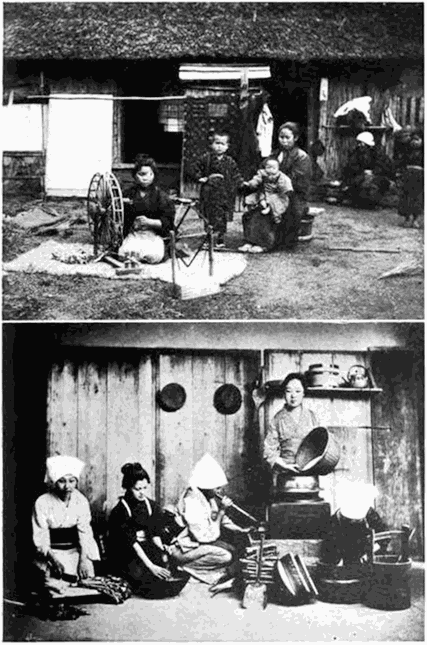
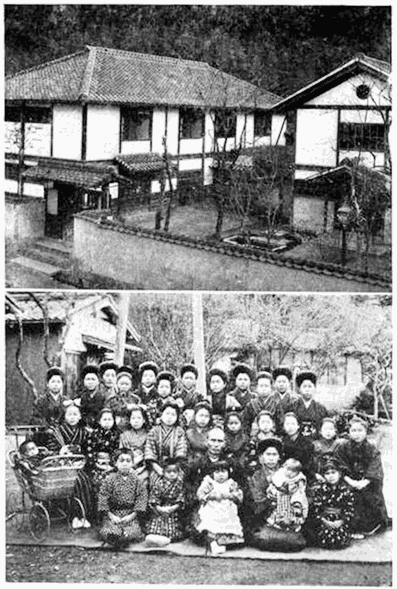 MATSUYAMA WORKING GIRLS' HOME
GIRLS IN THE MATSUYAMA HOME
In 1899, we held a preaching service in
a theater. Mr. Omoto happened to be drinking
in the saloon opposite. Hearing of our
gathering, with some rowdy comrades, he
thought he would break it up, with the
result that we experienced persistent opposition
throughout the meeting. But the
sermons on Pessimism and the New Life, and
my statement of the reasons that had brought
me to Japan attracted his attention, and the
next day I received an anonymous letter asking
for tracts. These seem to have produced
a profound impression, particularly the tract
entitled "Two Young Men." It told of two
hardened prisoners who had been transformed
by the gospel and became highly useful
and well-known members of society. Mr.
Omoto thereupon set himself definitely to
learn about Christianity, but privately, unwilling
to make public his new hope. He
bought and read through, quite by himself,
the entire New Testament. Though he
gained some idea of the gospel, he soon found
he had lost none of his passion for drink.
After a while he went to Kobe and joined
a temperance society; but soon finding that
the society had members who broke their
pledges, he began to break his. In despair
he went to Okayama and tried to join himself
to Mr. Ishii, head of the well-known
Christian orphanage, asking to be made a
Christian, but he was told to return to Matsuyama
and join the church there in his old
home; only so could he be saved. Greatly
disappointed, he returned and called on me
early in June, 1901, but without telling fully
about himself. He also called on Mr. Nishimura,
an earnest Christian worker, who
prayed with him, telling him that to be
saved he must receive the Holy Spirit.
That summer, quite exceptionally, I returned
in the middle of the vacation. Mr.
Omoto appeared at the prayer-meeting for
the first time and was evidently in a state
of great excitement, so much so that only
with difficulty could we understand his remarks
and his prayer. The gist was that
he had that day received the Holy Spirit,
that he was now saved, and that his joy was
too great for utterance. Tears rolled down
his cheeks as he talked and prayed. After
the meeting I had a few words with him,
and urged him to ally himself with our experienced
workers. He was so excited that
I feared for him, and wondered whether this
might not be a tornado of emotion due to
drink and to the nervous condition incident
to his riotous life, an emotion which he mistook
for the gift of the Holy Spirit. I urged
him to begin at once to live the Christian
life, cutting loose from all bad companions
and bad habits.
To gain an honest living he entered the
Matsuyama Cotton Thread Spinning Factory.
This required twelve hours of work
daily, sometimes by day and sometimes by
night, a hard pull for one who had done no
steady work for years. He attended Christian
services faithfully, so far as his hours of
work allowed, and became quite intimate
with two or three of our best Christians. Before
long he began to talk about the wretched
conditions and immoral life of the factory
girls, telling us of the situation already described
in Chapter IX.[9] His first thought was
to give these tired children wholesome recreation.
He secured the use of our preaching
place in the vicinity of the factory and invited
the girls to attend what he called the
Dojokwai (Sympathy Society). He soon
persuaded the girls to add a little reading
and writing to their play, and later also,
sewing. These meetings had of course to
be held after the twelve or more hours of
work in the factory had been completed.
Care had also to be taken that the studies and
the fun should not absorb time needed for
sleep. Membership in the Sympathy Society
rose rapidly and soon numbered seventy
girls.
At first meetings were held only in the
evening three times a week, and lasted but
an hour. But as the educational element of
the society developed, others were induced
to help and every evening save Sunday was
occupied. In order that girls on the night
shift might continue their studies similar
classes were also held from seven to nine
o'clock in the morning. Before six months
had passed the play aspect of the society was
largely superseded by the educational.
But opposition of Buddhists now began
to show itself. A few parents refused to
let their girls attend. The most determined
opposition however came from the manager
in the factory who had charge of one of the
shifts. Members of that shift were so treated
that gradually they dropped out of the Dojokwai,
and new members from that shift
could not be secured. The hostile manager
was however himself dropped some months
later, and all opposition to the work from
within the factory ceased.
In a previous chapter we have noted the
facts discovered by Mr. Omoto as he went
the rounds of the boarding-houses in which
the girls were required to live.[10] As these
conditions became clearer and more appallingly
impressive, he began to say with increasing
frequency and insistence that the
Sympathy Society, however successful, could
not do what was needed. Only a Christian
home would answer. Not only do the girls
need to learn to read and write and sew, but
even more than these do they need a home
free from temptation, clean and pure and
helpful, and elevating morally and religiously.
The difficulties however in the way
of such an enterprise seemed insuperable.
To say nothing of the financial problem, a
still greater obstacle, it was felt, was the
securing of "recognition" from the factory,
for Buddhist influence in the factory was at
that time still dominant. During these
months the Sympathy Society was winning
its way among the girls and their parents,
and Mr. Omoto himself was learning valuable
lessons.
One was that the girls were not all eager
to be in a Christian home. We of course
forbade all drinking, irregular hours, and
more irregular "friendships." Attendance
on prayers, night and morning, and at the
school, was required. It looked for a time
as if we should fail, for lack of girls to
meet the expenses.
But in spite of discouragements we kept
on. The earnings of the girls who lived in
the home, for the first year, were 1,361 yen.
Of this sum they paid for board 905 yen,
and sent to their parents 456, whereas girls
in the other boarding-houses were able to
save nothing, although the amount paid for
board was the same in all the houses, being
fixed by the factory at 3.60 yen per month,
or twelve sen (six cents) per day.
In February, 1903, a representative of the
government who came from Tokyo to inspect
the conditions of labor in western Japan,
heard of the Dojokwai (Sympathy Home),
and was so much interested in the story of
its work that he took time to visit it with
several local officials. He was greatly
pleased, for he knew of nothing just like
this, in any other part of Japan, particularly
in its hygienic, educational, and moral advantages,
and he expressed the wish that there
might be many such. This was our first
notice from government officials.
As time went on, Mr. Omoto was found
by the factory officials to be exceptionally
faithful to its interests; he was rapidly promoted
from one position to another, and in
December of the same year was made "visitor"
and "employing agent." This required
him to visit neighboring towns and villages
and collect new girls when needed. He
tried to decline this work, saying that he
could make no false promises to the girls
or to their parents, nor in any way delude
them as to the nature of their work, the
amount of their wages, the conditions of the
boarding-houses; being strictly a temperance
man, also, he could not treat with sake
(sah'-ke) and so get into friendly relations,
all of which things employing agents constantly
do; he had no expectations of gaining
any recruits; the factory would better
send some one else. They told him at least
to try. To the surprise of all, and of himself
the most, from his first trip he brought
back with him fifteen girls. For three years
he continued in this work and was always
successful in securing girls for the factory.
Because of his refusal to touch liquor in any
form, his traveling expenses were much less
than those of other employing agents, much
to the satisfaction of the management; and
the girls he secured on the whole remained
longer and more contentedly at work, because
he had always told them the truth.
This made his position in the factory more
secure and influential. After about two
years' employment by the day he was promoted
to the rank of a regular employee and
paid by the month. His hours of official
service were also largely reduced in order
that he might have time for his educational
and Christian work in the Home—a striking
testimony of appreciation on the part of the
factory officials.
As the months passed by it gradually became
clear that the effectiveness as well as
the permanence of the work demanded suitable
quarters. The heavy rental paid for
the house made self-support impossible. Results
already attained seemed to warrant appeal
to friends for gifts, for the purpose of
buying land and the erection of a building.
Responses to our appeals provided the needed
funds, land was purchased and a contract
made with a carpenter on exceptionally favorable
terms, just two days before the opening
of the Russo-Japanese war (February,
1904). Immediately prices went up by leaps
and bounds; but our contract was so well
made and the carpenter had already made
such full subcontracts for the lumber, etc.,
that we were not troubled because of war
prices.
As we entered our new quarters in June,
1904, however, the factory shut down the
main part of its work and discharged the
majority of its workers. This was a severe
blow to the Home. The occupants were
reduced to seven girls. Although the factory
opened again after a few months, the conditions
during and after the war made it
difficult for the factory to secure girls, and
the Home, together with the other boarding-houses,
suffered from lack of boarders. Beginning
with March, 1907, however, special
circumstances combined to fill the Home to
its utmost capacity; during the three months
of April, May, and June thirty applicants
were refused admittance and as many more
who desired to enter the school were
declined.
Increasing acquaintance with the disastrous
effects of factory labor,—the lint-filled
air so often producing consumption, and
the excessive heat of summer sometimes resulting
even in sunstroke,—made Mr. Omoto
unwilling to persuade girls to enter upon
such a life. The needs of the Home also
pressed upon his time. These considerations
led him, in 1906, to give up his work
in the factory altogether, in order to devote
his entire time and strength to the Home and
to the upbuilding of the moral and religious
life of the girls.
In July, 1906, Mr. Omoto attended in
Osaka the first convention of factory officials
convened to study the problem of the proper
care of operatives. Representatives were
present from sixteen factories having night
schools, and specimens of the work of the
girls were compared.
Mr. Omoto was fairly
lionized because of the superior quality of
the work sent in from our Home and many
newspapers made special mention of him and
his work.
In September, 1908, there was held in
Tokyo under the auspices of the Home Department
of the Imperial government an
eight weeks' school of applied sociology.
Mr. Omoto was among the 376 persons who
attended. Again he received exceptional attention
and was asked to tell his story. At
this school no less than thirty-six learned
specialists gave lectures on every conceivable
topic suitable for such a school. Among
the speakers so many were professed Christians,
and of the rest so many advocated
such markedly Christian ideals, that some
Buddhists are said to have taken offense, regarding
the whole affair as a part of the
Christian propaganda.
In the spring of 1909 there occurred an
event of considerable significance. Without
a preliminary hint of what was happening,
Mr. Omoto saw in the paper one day the
amazing statement that the Matsuyama
Working Girls' Home, along with seventy-nine
other selected institutions throughout
the country, was the recipient of a specified
sum (200 yen) as a mark of government
approval! A total of 40,000 yen were thus
distributed in varying amounts, Christian
institutions being recognized to an unexpected
degree. Later, word came from the
Prefectural Office summoning him to receive
the gift. In the entire prefecture six institutions
had been thus honored, and of these,
two were Christian. This gift from the Department
of the Interior has been repeated
each year since.
Again in May, 1910, a Conference of Social
Service Workers (Chu-o Jizen Kyokwai)
was held at Nagoya at the time of the
Exposition, and Mr. Omoto was among those
invited to attend. His address and statistical
report received much attention. Mr. Tomeoka,
representative of the government and
chairman of the conference, spoke in unstinted
praise of the work of the Home,
which he characterized as "Kokka Jigyo"
(a national enterprise), and recommended
the adoption by others of several of its special
features.
In the spring of 1911, the Home Department
of the central government published a
small volume describing one hundred and
thirteen model philanthropic institutions of
the country, in which we were of course
pleased to see that the Home was included,
being the only one from the prefecture.
As opportunity offered and means were
available, following the advice of friends,
four small adjacent lots were purchased, one
of which we were almost forced to secure
for self-protection, because of the evil character
of the buildings upon it. We now
own altogether about two acres of land on
the north side of the beautiful Castle Hill,
around which Matsuyama is built. Here
have been erected at different times six buildings
(three of them two-storied), for residential,
dormitory, chapel, night school,
weaving, hospital, bath, and other purposes.
We have space for a playground, of which
the girls joyously avail themselves, after returning
from twelve hours of confinement in
the dust and clatter of machinery. The garden,
too, provides fresh vegetables of an
assured character at a minimum of expense,
adding much to the variety and the wholesomeness
of the diet. The present value of
the property is more than its original cost,
for land and buildings are constantly rising
in price, as is the case in other parts of the
country.
The city educational authorities in 1906
asked Mr. Omoto to open his night school
to the poor of the district. For this he had
to have a regular school license from the
National Bureau of Education at Tokyo.
This was to be a Christian school—the only
license of exactly that kind in the empire,
he was told.
Industrial newspapers have been noticing
the Home and its work for some time.[11] During
the past five years the favorable attitude
of local and national government officials
has been particularly pronounced. Government
inspectors have repeatedly been sent
from the Prefectural Office and occasionally
even from Tokyo to visit the Home. One
such expressed himself as amazed at the
excellent mental work done by the girls, in
view of the fact that all their study takes
place after twelve hours of toil. Nothing
but good food, sufficient sleep, and a wholesome
and happy home life could account for
their splendid health and superior school
work. One man remarked that the girls in
the Home do better work than pupils in the
same grade in public schools.
Even so early as the autumn of 1906 the
Home Department of the central government
sent down special instructions to the prefectural
office in Matsuyama to investigate
our work, with the result that of nine benevolent
institutions throughout Japan selected
for commendation, ours was the one most
carefully described and unqualifiedly praised.
A recent government pamphlet concerning
industrial problems makes special reference,
covering two pages, to the work of the Home.
Thus has a small institution begun to serve
as a model for the country.
The good health of the girls in our Home
has been in strong contrast with the health
of those in other boarding-houses, even in the
best dormitories of the best factories in other
cities.
Statistics recently compiled by the government
show that the average death-rate
among factory operatives throughout the
country is extraordinarily high. The highest,
fifty per cent. on account of an epidemic, was
reported from a certain factory owned and
managed boarding-house in Niigata prefecture.
Not one girl has ever died in our
Home. Of the 301 girls who had lived in
our Home by 1911, only eight, all told,
died.
In 1912 the Home passed through a crisis
that threatened to destroy it. Late in 1911
the one factory in Matsuyama, where all the
girls worked, was sold out to parties living
in Osaka. A new manager was sent down
who introduced many drastic changes. The
change most affecting us was the stopping
of the night work and the lengthening of day
work to fourteen hours: namely, from 6 a.m.
till 8 p.m.
The girls in the Home soon became dissatisfied,
and not many months passed before
all had left the factory. Mr. Omoto was
urged by the manager to find and bring in
new girls. He refused however on the
ground that he could not ask anybody to
work such brutally long hours.
Had it not been for a little weaving department
with which we had already been
experimenting, the Home would have been
compelled to close. More looms were secured
and those girls who wished to remain
with us were given opportunity for work.
Mr. Omoto's attention was at that time directed
to the condition of the weaving girls
in the scores and even hundreds of little establishments
in the city and its suburbs. He
soon found that an educational, economic,
moral, and religious condition existed among
them not unlike that which he had found
among the factory girls of Matsuyama a
dozen years before. The weaving establishments
are, as a rule, small private affairs,
usually having less than ten girls each,
and are therefore wholly outside of the supervision
of the government. The treatment
of workers and the hours of labor are entirely
settled by the individual owners.
As a rule the girls are apprenticed for
from two to three years immediately on
leaving the primary school, at an age therefore
of twelve or thirteen. They barely
earn their living, although they work from
daybreak to ten or eleven at night, and in
some establishments even till midnight—from
fifteen to eighteen hours a day! There are
no night shifts and rare holidays on occasional
festivals. The hygienic and moral
conditions are about as bad as can be. It
is estimated that one half of the girls are
ruined before the close of their apprenticeship.
Our Home is now deliberately attacking
the new problem, which in many respects
is more difficult than was the old one. We
have put up two small buildings on our own
grounds, enabling us to have thirty looms to
give opportunity for work to thirty girls.
The uniform quality of the cloth produced
by our girls, the central portions of each
piece equaling the ends in quality, shows unflagging
moral attention, without effort to
rush the work and stint the material; this
has already won such approval from merchants
that the "Sympathy Home" brand
can be sold for a little more than other
brands, and Mr. Omoto is assured that there
is no limit to the amount which could be
marketed.
An owner of several weaving establishments
has become so impressed with the quality
of the work and the character developed
in our girls that he asked Mr. Omoto if he
would not take charge of a hundred of his
weaving girls. This new departure is especially
promising, for we have complete supervision
of the girls throughout the entire
twenty-four hours. The girls, moreover, are
already remaining in our Home as a rule
much longer than they used to when getting
work in the spinning factory.
As successive chapters of this book have
shown, no more urgent problem faces New
Japan than that of the moral development
of her workers. This is particularly true
of the hundreds of thousands of girls in the
larger and smaller factories and industrial
establishments. The wretched physical, economic,
social, and moral conditions under
which the majority of these girls lived and
worked at the time when our Home was
started are not easily described.
Many of the factory authorities[12] are
neither ignorant nor unmindful of the situation,
and are striving to remedy it. The government
also has enacted laws not a few.
But laws and official actions alone provide
no adequate solution of the serious problems
raised by the extraordinary industrial and
social transformations sweeping over Japan.
A new spirit must be evoked, both on the part
of capital and labor, and new moral ideals
and relations established. This cannot be
done by laws alone. Only love and contagious
personal example are sufficient for
the needs.
Our Home was designed to meet just such
a situation and has to a remarkable degree,
we think, succeeded. It has provided not
only sufficient fresh air, nourishing food,
adequate bedding, clean rooms, and wholesome
recreation, but also moral and religious
instruction, and some education. The
girls in our Home have enjoyed conspicuously
better health and have done better
work and earned and sent to their parents
more money than those of the other boarding-houses
of Matsuyama. But better than
these have been the educational, moral, and
religious results. Their womanhood has been
raised. They have been better fitted for life's
duties and for motherhood than they would
have been without the training which has
been given them.
Moreover, the results of the Home have
been such as to break down opposition. The
good-will and cooperation of the factory
officials were won. Factories in other parts
of the country also have recognized our
Home as presenting a splendid ideal which,
in a measure, many of them are already following.
The local and the central governments,
as already shown, have repeatedly sent
officials to inspect us, and in their reports
have not only praised us, but have described
our Home in detail, saying that we have
solved the difficult problem of how to care
for factory hands.
Through the Home we are reaching the
lowest strata of the working classes of Japan,
and are providing them with ideals, motives,
and education, and in a way, too, which does
not tend to pauperize them, for each girl
pays as board a sum sufficient to cover actual
living expenses. It is also exerting an influence
on the townsfolk. The attitude of
the people toward Christianity has undergone
a marked change. Villages in the interior
likewise have altered their attitude
on seeing how their daughters, graduates of
our Home, have improved both in intelligence
and character, in marked contrast to
those who have been in other boarding-houses.
All in all, Mr. Omoto has attained
remarkable success. He is absorbed, heart
and soul, in his work of bettering the moral
and religious conditions of the working girls
of Japan, and is a man continuously growing
in spiritual life, Christian character, and
knowledge of men. I have never known a
man more thoroughly converted or more enthusiastic
in his chosen field of work. The
Omoto of to-day is a different person from
the reformed debauchee of thirteen years
ago, who began this service for factory girls
as the outcome of his sincere question, "Lord,
what wilt thou have me to do?" His family
have become possessed with the idea of
social service, and his five children are being
brought up in this atmosphere and in the
fear of the Lord.
Thus has the Matsuyama Working Girls'
Home survived many threatening vicissitudes,
attained conspicuous successes, and is
now embarked on a new line of endeavor.
May it exceed in the future its successes of
the past and make still more substantial contributions
to the uplift of the working women
of Japan!
Transcriber's Note:
The illustrations have been moved so that they do not break up
paragraphs and so that they are next the text they illustrate. Thus the
page number of the illustration might not match the page number in the
List of Illustrations.
Errors in punctuations and inconsistent hyphenation were not corrected
except for the following:
On page 111, the book mentions "among the forty-eight prefectures
of the Japanese empire", but there were forty-seven prefectures since 1888.