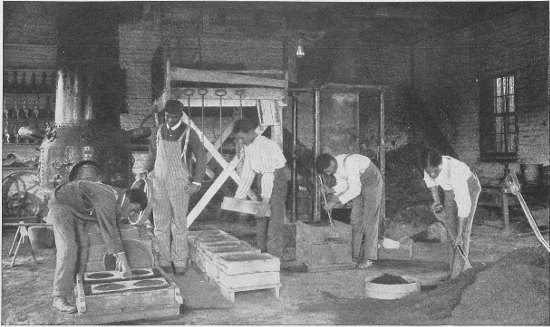
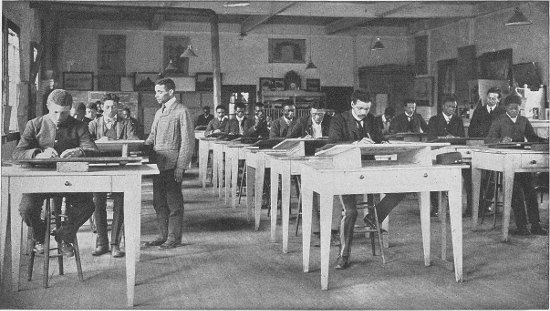
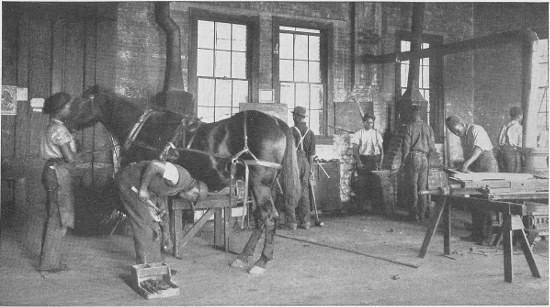
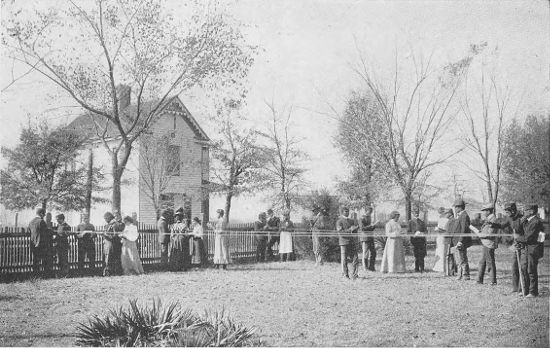
Since the founding of the Tuskegee Normal and Industrial Institute, in
1881, the total enrollment of young men and women who have remained
long enough to be helped, in any degree, is about six thousand. From
the beginning, the school has sought to find out the chief occupations
by which our people earn their living, and to train men and women to be
of service in these callings. Those who go out follow the industries
they have learned, or teach in public or private schools, teaching part
of the year and farming or labouring the remainder of their time. Some
follow house-keeping or other domestic service, while others enter
professions, the Government service, or become merchants. Many of the
teachers give instruction in agriculture, or in the industries. The
professional men are largely physicians and the professional women are
mostly trained nurses.
After diligent investigation I have been unable to find a dozen former
students in idleness. They are busy in schoolroom, field, shop, home or
church. They are busy because they have placed themselves in demand by
learning to do that which the world wants done, and because they have
learned the disgrace of idleness, and the sweetness of labour. One of
the greatest embarrassments which confronts our school at the present
time is our inability to supply any large proportion of the demands
for our students that are coming to us constantly from the people of
both races, North and South. But, apart from their skill and training,
that which has made Tuskegee men and women succeed is their spirit of
unselfishness and their willingness to sacrifice themselves for others.
In many cases while building up a struggling school in a community,
they have worked for months without any fixed salary or promise of
salary, because they have learned that helping some one else is the
secret of happiness. Because of the demand for men and women trained at
Tuskegee, it is difficult to keep a large proportion of the students in
the school until they graduate. It is, therefore, not so easy to show
the results of the work in concrete form as it would be if a larger
number of the students finished. But the facts obtainable prove that
the school is achieving its purpose in preparing its students to do
what the world wants done.
Some years ago a young man named Williams came to Tuskegee from Mobile,
Alabama. Before coming, he had nearly completed the public-school
course of study at Mobile, and had been earning about fifty cents a day
at various kinds of unskilled labour. He wished to study further in
the academic branches, with the object of combining this knowledge with
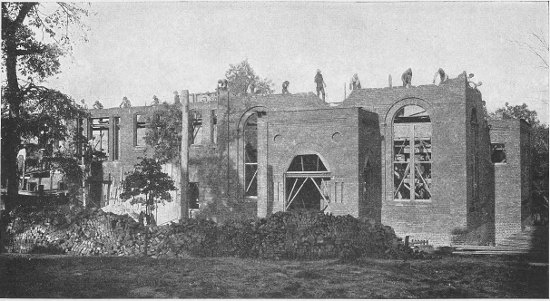
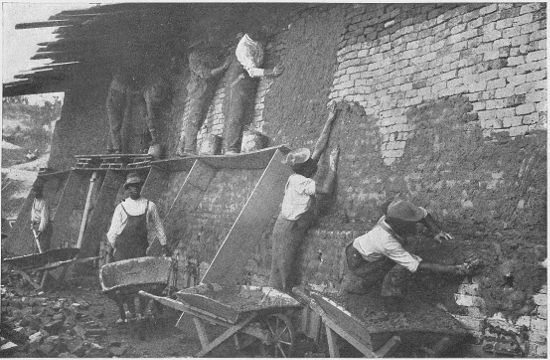
the trade of brick-masonry. To take the full course in brick-masonry,
including mechanical drawing, he should have remained three years.
He remained for six months only. During this time, he got some rough
knowledge of brick-masonry and advanced somewhat in his academic
studies. When he returned to Mobile, it soon became known that he had
been working at brick-masonry. At once he was dubbed a full-fledged
mason. As there was unusual building activity in Mobile at that time,
he found himself in great demand, and, instead of having to seek odd
jobs, he soon saw that, in spite of his rather crude knowledge of the
trade, he could earn one dollar and fifty cents per day, and have more
work offered him than he could do. When the three months' vacation
expired, Williams debated whether he ought to return to Tuskegee to
finish his course or remain at home and try to purchase a home for his
widowed mother. Hence, seeing an opportunity to make two dollars a
day at his trade, he decided not to return. As in hundreds of other
cases, the Mobile man had unusual natural ability, and was able to
get out of his six months at Tuskegee a mental, spiritual, and bodily
awakening which fixed his purpose in life. Not only this, but he had
made such a start in his trade that by close study and observation he
was able to improve from month to month in the quantity and quality of
his work, and within a few months he ceased to work for other people
by the day and began to make small contracts. At the present time, Mr.
Williams is one of the most substantial coloured citizens of Mobile.
He owns his home and is a reliable and successful contractor, doing
important work for both races. In addition to being a successful
brick-mason and contractor, he owns and operates a dairy business, and
his class of patronage is not limited by any means to members of the
Negro race.
The value, then, of the work of schools, where the trade or economic
element enters in so largely as it does at Tuskegee, cannot be
judged in any large degree by the number of students who finish the
full course and receive diplomas. What is true of the course in
brick-masonry is true in larger or smaller measure of all the other
thirty-seven industrial divisions of the school.
Another example: Crawford D. Menafee came to Tuskegee about 1890, and
began taking the agricultural and academic courses. He was older than
the average student, and entered one of the lower classes. Because he
had no money to pay any part of his expenses, he was given permission
to enter the night school, which meant that he was to work on the farm
ten hours a day, receiving, meanwhile, lessons in the principles of
farming and devoting two hours at night to the academic branches. He
was never classed as a very bright student, and in the purely literary
studies made such slow progress, after repeating several classes, that
he left two years before completing either the agricultural or the
academic course. It was noted, however, that, notwithstanding inability
to grasp theoretical work, he manifested unusual enthusiasm and showed
special ability in practical farm work. His ability was so marked that
he was asked to take a place of responsibility as assistant to one of
the school's farm managers. It soon became evident that he possessed
extraordinary executive ability. He read constantly everything of value
which he could secure upon agriculture, and soon began to show signs
of considerable intellectual growth and the possession of a rarely
systematic mind. Mr. Menafee was soon promoted to a higher position at
Tuskegee.
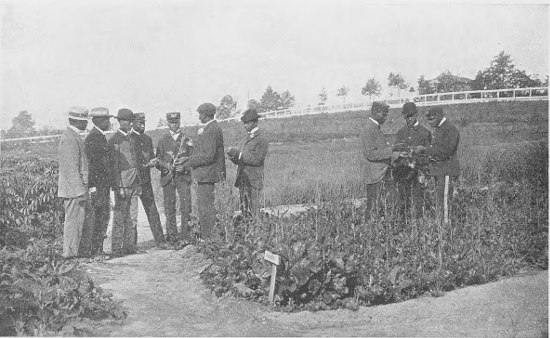
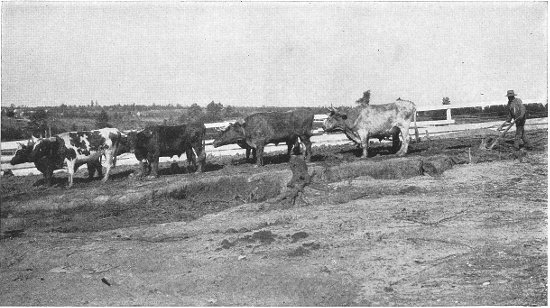
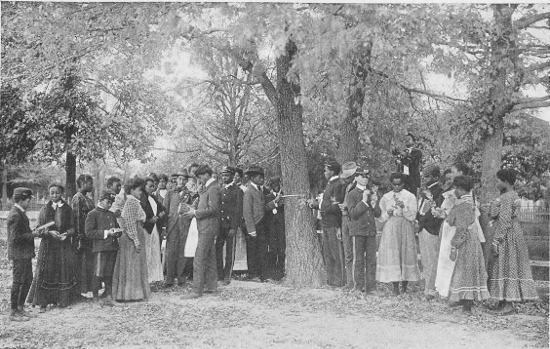
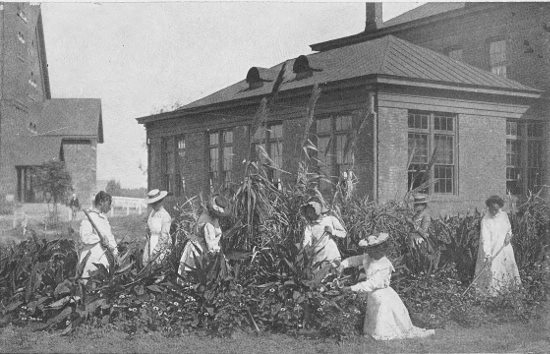
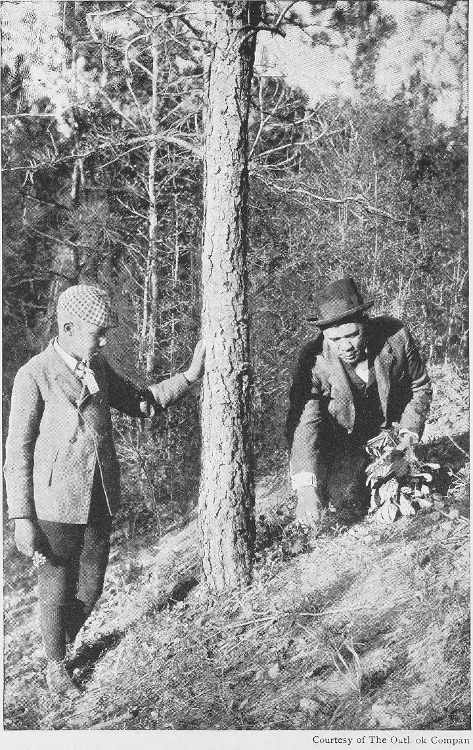
TAKING AN AGRICULTURAL CLASS INTO THE FIELD
A few years later, there came a call for some one to introduce
theoretical and practical agriculture into the State Normal College for
coloured people at Tallahassee, Florida. Mr. Menafee was recommended.
The students had no wish to learn agriculture. They were opposed to
it in any form. By tact and patience, Mr. Menafee gradually won the
students and made them see the importance of intelligent cultivation
of the soil. Mr. Menafee has now been in charge of the agricultural
department of the Florida school for three years, and has made the
study of theoretical and practical farming so effective that it is now
one of the most popular branches in the school. Not only do the young
men cultivate a large acreage each year, but a number of girls also
receive instruction in gardening, dairying, and poultry raising. In
a word, the whole attitude of the school toward agriculture has been
revolutionised, and the department has been placed upon an effective
and practical foundation.
There are hundreds of cases similar to those of Mr. Menafee and the
Mobile brick-mason. These represent a class of students who have
absorbed the spirit of the school as well as its methods, and who are
doing far-reaching service, although they are not enrolled on our list
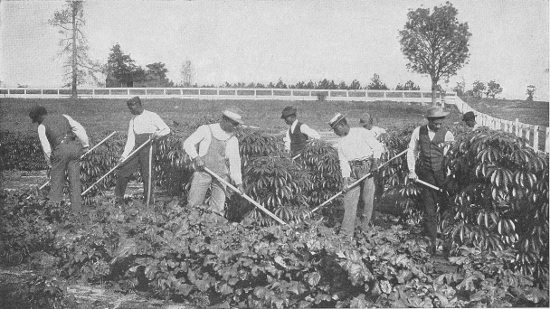
of graduates. We have tried to give special attention to all forms of
agricultural training at Tuskegee, because we believe that the Negro,
like any other race in a similar stage of development, is better off
when owning and cultivating the soil.
As I have explained elsewhere, the results of our agricultural work
in the past have not been as manifest as they will be in the future,
for the Institute has been compelled to give foremost place to the
building trades in order to get under shelter. The task of erecting
nearly seventy buildings, in which to house about seventeen hundred
people, has not been easy. And yet what are some of the results of our
lessons in farming? Not long ago I drove through a section of Macon
County, Alabama. My drive extended a distance of perhaps eight miles,
and during this time I passed through or near the farms of A. H. Adams,
Thomas Courrier, Frank McCay, Nathaniel Harris, Thomas Anderson, John
Smith, and Dennis Upshaw. These seven men had attended the Tuskegee
Institute for longer or shorter periods, and each had already paid
for his farm or was buying it. All of these men had studied in the
Phelps Hall Bible Training School in the morning, and had taken the
agricultural course in the afternoon. When I visited their farms, I saw
them actually at work, and it was most encouraging and interesting to
note the air of cleanliness and system about their farms and homes. In
every case they were not confining themselves to the raising of cotton,
but had learned to diversify their crops. All were active in church and
Sunday-school work, and were using their influence to get others to buy
homes. The most prosperous farmer among them was Mr. Upshaw. He began
farming with practically nothing. At present he owns one hundred and
fifteen acres of land, which is cultivated by himself and family. On
this land is a neat, attractive house, a barn and outbuildings, and a
small sugar house for boiling syrup from the cane which he raises for
his own use. His home and farm are models for other farmers. He raises
not only cotton, but corn and oats, vegetables, fruit, live stock, and
fowls. He has an unusually fine peach orchard. Mr. and Mrs. Upshaw are
leaders in the County Farmers' Institute. Mrs. Upshaw is also a member
of the Mothers' Meeting, which assembles regularly in the town of
Tuskegee. While Mr. Upshaw's present house is better than the average
farmhouse in that section, when I last visited this farm, I found
lumber on the ground to be used in erecting a new and larger house.
Hundreds of such examples could be cited.
I have given these seven examples because people who know absolutely
nothing about the subject often make the statement that when a Negro
gets any degree of education he will not work—especially as a farmer.
As a rule, people who make these sweeping assertions against the Negro
are blinded by prejudice. The judgment of any man, black or white,
who is controlled by race prejudice is not to be trusted. With one
exception, I did not know of the farming operations of these men before
the drive referred to; but I was not at all surprised at what I saw,
because my years of experience have brought me into unbroken contact
with Tuskegee men and women all over the South, and wherever I have met
them I have found that they had in some degree raised the level of life
about them.
Another branch of Agriculture, to which we have for a number of years
given special attention, is dairying. The demand from Southern white
people for trained dairymen is much greater than we have been able to
supply.
In 1898, L. A. Smith finished the course of training in dairying and in
the academic branches. He had been able to complete his course only by
working during the day and attending school at night during the greater
part of his time here. Soon after Smith graduated, we had a call for a
well-trained dairyman from the Forest City Creamery Company, Rockford,
Illinois. Smith was recommended. He has been holding an important
position in the creamery for five years, and has several times been
promoted with an increase of salary. Smith has paid for a neat and
comfortable home, and he has the confidence and respect of the entire
community. He looked so young and inexperienced in taking up his work
that his ability was doubted, but it did not take him long to prove
that he was fully equal to the occasion. The proprietor unhesitatingly
said that he was one of the most proficient and valuable men in his
employ, and that he had placed him in a very important and trying
position—that of making butter cultures. This is a secret department
in which no one except the employees operating it and the proprietor
is permitted to enter. Mr. Smith also did some important chemical work
in connection with a lawsuit supposed to involve the manufacture of
spurious butter.
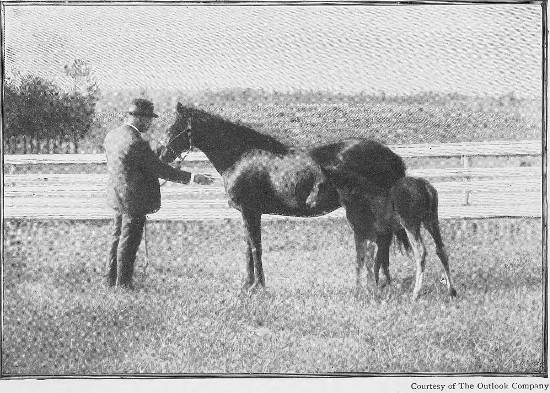
In Montgomery County, Alabama, Mr. N. N. Scott, a Southern white man,
has operated for a number of years the largest and most successful
dairy farm in his section. Mr. Scott has in his employ three Tuskegee
men, with Scott Thomas in charge. Mr. Scott tells us that those men
trained at our school are the most efficient helpers he can secure. He
keeps a standing order with Mr. George W. Carver, our instructor in
dairying, to the effect that he will employ any one that Mr. Carver
recommends. Not far from Mr. Scott's dairy is a smaller one owned by
Mr. E. J. Hughes, another white man. Some time ago Mr. Hughes secured
Luther M. Jones, who had taken only a partial course in dairying at
Tuskegee, to make butter and cheese for him. Such examples can be found
in nearly every one of the Southern States.
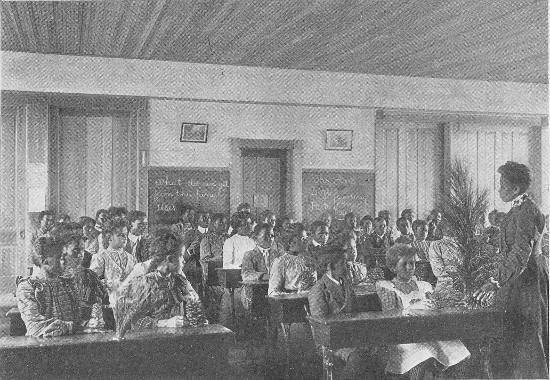
From the beginning, the work of this institution has been closely
related to the public school system of the South, for it must be clear
to all that in the last analysis we must depend upon public schools
for the general education of the masses, and it is important that the
larger institutions for the education of the Negro keep in close and
sympathetic touch with the school officials of the Southern States.
One way in which we assist the public school system of the South is
by sending out men and women who become the teachers of teachers. One
of the best examples of this is the case of Isaac Fisher, a young man
who came to Tuskegee a number of years ago, and earned his board by
working during the day and going to school at night. Two years ago Mr.
Fisher, upon my recommendation, was elected by the State officials of
the State of Arkansas to the important position of Principal of the
Branch Normal College of Pine Bluff, Arkansas, the main institution for
training coloured teachers for the public schools of that commonwealth.
Mr. Fisher has associated with him a large force of teachers, two of
whom also are Tuskegee graduates. In the school are students many of
whom will become not only public-school teachers in the usual sense,
but having been trained by Mr. Fisher in the industries, they will be
able to introduce them gradually into their teaching. There is hardly a
single Southern State where our men and women are not found in some of
the larger schools for training teachers.
Our students at Tuskegee are instructed constantly in methods of
building schoolhouses and prolonging the school term. It is safe to
say that outside the larger Southern cities and towns in the rural
district, one will find nine-tenths of the school buildings wholly
unfit for use, and rarely is the public school session longer than
five months—in most cases not more than four. These conditions exist
largely because of the poverty of the States. One of the problems of
our teachers is to show the people how through private effort they can
build schoolhouses and extend the school term.
Milton Calloway left Tuskegee three years ago. In addition to taking
the normal course, he learned the trade of tinsmithing. When he
returned to his home at Union Spring, Bullock County, Alabama, he
secured a school some distance in the country. The term was so short
that Calloway found he could not live all the year by teaching during
the three or four months of the session. Calloway's trade came to his
rescue. Soon after he began teaching, he made an arrangement with a
white man in the town by which he was to work in his shop on Saturdays
and during his vacation months. By following this plan, the school is
gradually being built up, the people are being taught to save their
money, improve the schoolhouse, prolong the school term, and buy homes.
Moses P. Simmons, another one of our graduates in an adjoining county,
has lengthened the term of the public school by teaching the children
how to grow vegetables, which have been disposed of for school purposes.
During the latest session of our Negro Conference in February, one
delegate from Conecuh County, Alabama, told how his people had nearly
doubled the length of the school term by each family's agreeing
to plant an extra half-acre which was designated as the "school
half-acre." A number of Tuskegee men and women have put on foot some
such scheme as this.
I asked one of the officials of the Tuskegee Institute to canvass
our nearest large city, Montgomery, Alabama, in order to obtain the
name of every student there who had received a diploma or certificate
from Tuskegee, or who had remained long enough to be in any degree
influenced by its teaching, and to report to me exactly what he found
after making a personal inspection. Here are a few of his reports:
"Perry, J. W., class of 1889, lives near the city. Is farming. He
controls 150 acres, owns five head of cattle, and teaches school six
months in the year.
"Davis, Joseph, who has been away from Tuskegee three years, I found
at work on a four-story building in process of erection on Commerce
Street. He was getting $2.50 a day. At work on the same job were
William Fuller at $3.60 a day, and H. T. Wheat at $2.50. Last summer
Fuller received $4 a day for four months, at Troy, Alabama.
"Moten, Pierce, is at work as drug clerk in the drug store of D. A. C.
Dungee, at the corner of Court and Washington Streets. He graduated
from Tuskegee in 1902. While at the school he worked in the hospital,
and much of that time had charge of the drug room. He is studying
medicine, and has already spent a session at Meharry Medical College,
Nashville, Tennessee.
"Campbell, Mrs. Berry N. (Miss Bowen), graduated in the class of 1887,
and her home has been in Montgomery most of the time since then,
although her work at times takes her away from the city. She is a
trained nurse of excellent reputation and wide experience, and has
frequently been employed at Hale's Infirmary. When I inquired for her
she was taking care of a private case. She owns two good houses on
Union Street and on High Street, both of which I saw. She also owns a
vacant lot."
There were only three whose records were found to be uncertain or
unsatisfactory. The same kind of investigation will reveal almost
similar conditions existing in a greater or less degree in other
Southern cities.
Now let me show their life in smaller towns: one containing between
four and five thousand inhabitants. Some time ago Mr. Bedford, one of
our trustees, made a personal investigation in Eufaula, Alabama. I
quote directly from Mr. Bedford as to what he found:
"Sydney Murphy graduated in 1887. He went at once to Eufaula. For three
years he taught and farmed in the country. He was then made principal
of the coloured public schools of the city. He still holds this
position, and is now serving his thirteenth year. He has a nice home in
the city, three houses that he rents, and some vacant lots.
"John Jordan, 1901, a graduate in harness-making, opened a shop in
Eufaula, September, 1901. He reached Eufaula with $16 and a very few
tools. He paid $7 license, $3.50 in advance for a month's rent, and had
$5.50 for board and other expenses. He curtained off a little space
in his shop for a bedroom, and with an oilstove cooked his own meals.
In this way he saved up $50, but lost it in the failure of the bank of
Eufaula. He has gone right on with his business, and now has one of the
best shops in the city. He has established the People's Library, which
has more than 600 volumes in it. He has a reading-room and literary
society over which he presides, and is superintendent of the A. M. E.
Sunday-school."
After several years at the school, during which they worked upon the
school farm, Frank and Dow L. Reid left Tuskegee at the completion of
the B Middle Class. Frank, the older brother, left in the year 1888,
and Dow in the year 1891. Before coming to Tuskegee, these young men
had lived upon a rented farm with their father, but on returning home
they decided to buy a farm of their own. They entered into an agreement
to purchase a farm of 320 acres, four miles from the old homestead,
and with little or no money, but with a determination to succeed,
they began to cultivate the land. They agreed to pay $5.50 per acre
for the place, and, regardless of the fact that they had little money
at the time, they bought the farm, paying in a few years the whole
amount, $1,760. In addition to this farm, the Reid brothers, as they
are styled for miles around, have bought another farm of 225 acres at
$10 per acre. This farm is about two miles away from the place first
mentioned. When the final payment upon this last purchase is made in
the fall, after crops have been gathered and marketed, a total of
$4,010 will have been made and expended for land by these young men
since the younger one left Tuskegee some twelve years ago.
The stock and farming implements on these farms are far superior to
those seen upon most of the plantations. On the farm of 320 acres are
seventeen fine horses and mules, all large and in good condition;
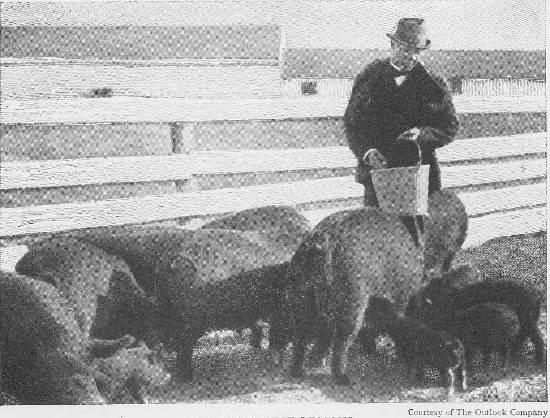
there are thirty well-bred cows and fifty fine, healthy looking hogs,
besides a large number of chickens and guineas, which furnish plenty of
eggs for the families' use. The farming implements, including plows,
mowers, rakes, harrows, etc., are of the latest patterns. The four
double wagons, the single top-buggy, the road wagon and go-cart are all
in good order, and are kept under cover when not in use. We often find
farmers in the South who, when the crop is made, leave the plows, the
mower, the rake, in fact, all the farming implements, standing out in
the field, exposed to wind and weather all through the winter months.
A visitor to the Reid brothers' plantation will find that each piece
of machinery on this plantation has a place under a shed built for the
purpose, and is kept there when not in use.
There are eight dwelling-houses—a four-room frame building in which
the young men and their families live, and seven log cabins in which
the farmhands live with their families. The first is rather old and
uncomely in appearance from the outside, but the interior is more
pleasing. The bedrooms are large and clean, with sufficient windows and
doors to permit of necessary ventilation during the sleeping hours. The
dining-room is well kept, and the whole interior of the house presents
a neat, clean and attractive appearance. This house is to be replaced
by a larger one, to be built during the winter.
A large cotton-gin, with an eighty-tooth saw, is owned and operated by
these young men. Last year, besides ginning the 125 bales of cotton
raised upon their own plantation, they ginned the cotton raised by
nearly all the other farmers in the neighbourhood.
The post-office at Dawkins was formerly about four miles from its
present location, but since the Reid brothers settled there and the
community grew so rapidly the post-office was removed to their place,
and the plantation was named Dawkins. The post-office is located
in the general merchandise store of the Reids, and Mr. Frank Reid
is postmaster. There was neither a church nor a schoolhouse in the
community when these young men went to Dawkins. They purchased four
acres of land nearby, and not only gave this land, but assisted in
building a comfortable church, which has been used both as a church and
a schoolhouse. Preaching services are held regularly in the church, and
a flourishing school is taught from seven to nine months each year.
Last year more than one hundred boys and girls were registered.
Mr. J. N. Calloway, who graduated from the Tuskegee Institute in
1892, is principal of the school, and has one assistant teacher. A
new two-room schoolhouse is now being built through the efforts of
Mr. Calloway, and will be completed at the time of the opening of the
school the latter part of next October.
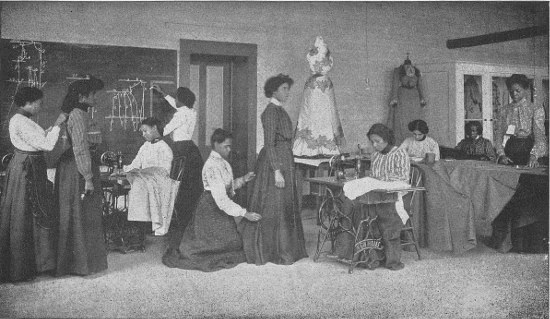
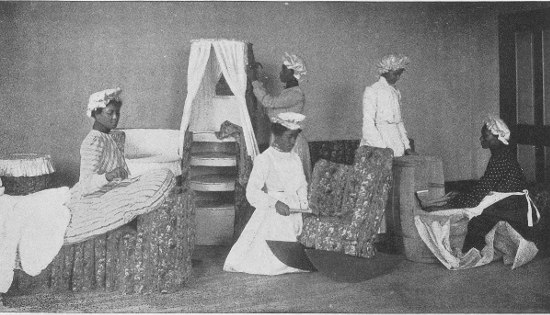
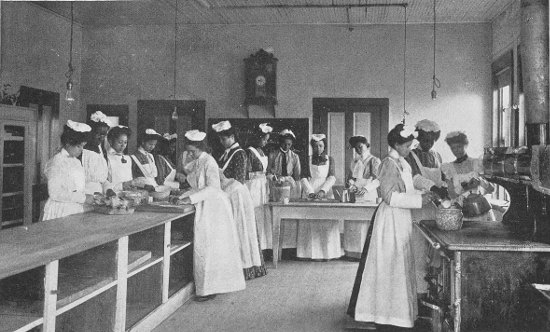
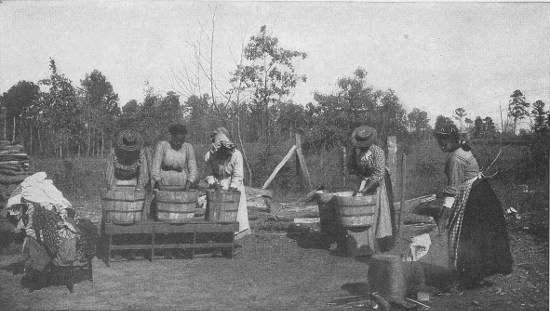
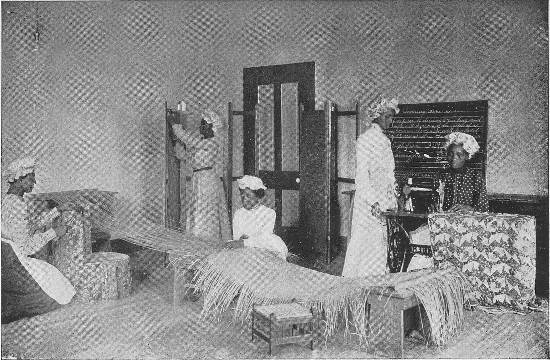
I am often asked to what extent we are able to supply domestic servants
directly from this institution. I always answer, "Not to any large
extent, notwithstanding the fact that women are trained here in
everything relating to work in the home." When a woman finishes one
of our courses, she is in demand at once at a salary three or four
times as large as that paid in the average home. Aside from this,
we are doing a larger service by sending out over a large extent of
territory strong leaders who will go into local communities and teach
the lessons of home-making than we could by trying to send a cook
directly into each family who applies to us. The latter would be a
never-ending process. Miss Annie Canty, for example, teaches cooking
and other industries in the public schools of Columbus, Georgia. There
is a little leaven that we hope will gradually help leaven the whole
lump. Largely through the influence of our graduates, cooking and other
industries are being taught in many of the public schools of the South.
Another young woman, Miss Mary L. McCrary, is doing the same thing in
the Industrial College for coloured people in Oklahoma.
Not a few of our men have become merchants, and they are generally
patronised by both races and have high commercial rating. Two of the
best examples of this class are Mr. A. J. Wilborn, who is a successful
merchant in the town of Tuskegee, and Mr. A. J. Wood, of Benton,
Alabama.
Last January, when in Los Angeles, California, I met by chance a young
man who had taken a partial course in our nurse-training department.
I asked him if he were reflecting credit upon the Tuskegee Institute?
Without a word, he pulled out a bank-book and asked me to inspect it.
I found a substantial sum recorded to his credit. Before I was through
with the inspection of the first bank-book, he handed me a second which
showed an amount to his credit at another bank. I found that Mrs.
Barre, another of our graduates, is one of the leading trained nurses
of the same city.