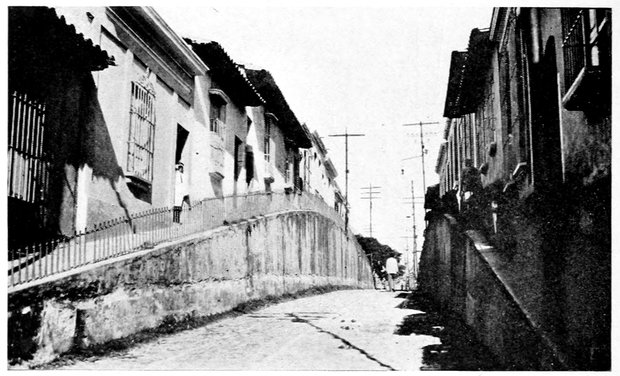
CHAPTER I THE SOUTH AMERICAN METROPOLIS
3
In Buenos Aires I became what a local newspaper called “office
boy” to the American consul general. The latter had turned out
to be a vicarious friend of long standing; his overworked staff was
sadly in need of an American assistant familiar with Spanish, the one
sent down from Washington months before having been lost in transit.
Moreover, being a discerning as well as a kind-hearted man, the consul
knew that even a rolling stone requires an occasional handful of moss.
The salary was sufficient to sustain life just inside what another consular
protégé called the “pale of respectability,” and my duties as “outside
man” brought me into daily contact with all classes of Porteños,
as natives of what was reputed the most expensive city in the world
are known in their own habitat.
Two years of wandering in the Andes and jungles of South America
is, in a way, the best possible preparation for a visit to the largest city
south of the United States. The man who approaches it from this corridor
will experience to the full the astonishment it is almost certain to
produce upon an unprepared visitor; he will be in ideal condition to
recognize the urban artificialities which make it so great an antithesis
of the rural simplicity of nearly all the southern continent. Like the
majority of Americans, I suppose, though I had now and then heard
rumors of its increase and improvement, my mental picture of the
Argentine capital was as out of date as the spelling “Buenos Ayres”
that still persists among even the best of English and American authorities.
It was the picture hastily sketched by our school books of not
so long ago, and, except in the matter of a few decades of time, it
was essentially a true one.
A bare half century back the City of Good Airs had the appearance
of a Spanish town of the Middle Ages, and worse. Though it faced
the River Plata at a point where it is more than thirty miles wide, it
4had no real harbor. Travelers landed from ships by first transferring
to rowboats far out on the yellow-brown horizon, then to ox-carts
driven hub-deep into the shallow, muddy stream. The streets were
so innocent of paving that business men often remained at home lest
they find it impossible to extricate themselves from the quagmires
that masqueraded under the name of calles. Temporary wooden
bridgelets were laid across corners from one scanty raised sidewalk to
another; at the height of the rainy season even horsemen were sometimes
mired in the very heart of town. Men still living tell of a pool
in the present bustling Calle Rivadavia about which sentinels had to
be posted to keep careless people and their horses from drowning in it.
Municipal lighting was unknown. A few public-spirited citizens hung
up tallow candles before their houses; wealthy residents, obliged to
make their way through the bottomless night, were attended by menials
carrying lanterns. There were neither water pipes nor sewers; each
citizen dug his own well beside his garbage heap. In winter the one-story
houses, stretching in solemn yet disordered array down the narrow,
reeking streets and built for the most part of sun-baked mud
bricks, became slimy, clammy dens in which disease bred and multiplied.
The hundred and some thousand inhabitants, mixtures of Spanish
adventurers and Indians from the great pampas beyond, had but
little contact with the outside world and were correspondingly provincial,
conservative and fanatical.
Such was Buenos Aires within the memory of men who do not yet
consider themselves old; such it is still in the average imagination of
the outside world. It is with something stronger than surprise, therefore,
that the newcomer finds the Argentine capital to-day the largest
Spanish-speaking city on the globe, second only to Paris among the
Latin cities of the world, equal to Philadelphia in population, resembling
Chicago in extent as well as in situation, rivaling New York in
many of its metropolitan features, and outdoing every city of our land
in some of its civic improvements. Personally, I confess to having
wandered its endless streets and gazed upon its unexpected cosmopolitan
uproar in a semi-dazed condition for some time after my arrival.
It was hard to believe that those miles upon miles of modern wharves,
surrounding artificial basins capable of accommodating the largest ships
in existence, backed by warehouses that measure their capacity in millions
of tons, were situated on the same continent as medieval Quito,
that the teeming city behind them was inhabited by the same race that
rules languid La Paz and sleepy Asunción.
5The greatness of Buenos Aires has been mainly thrust upon it. Of
all the cities of the earth only Chicago grew up with more vertiginous
rapidity. The city of to-day has so completely outreached the plans of
its unsuspecting founders that it is constantly faced with the problem
of modifying existing conditions to meet metropolitan requirements.
It was a comparatively simple matter to fill in and pave the old quagmires
that posed as streets; it was quite another thing to widen them
to accommodate modern traffic. Laid out by Moorish-influenced Spaniards
in a century when the passing of two horsemen constituted the
maximum demand for space, the streets of old Buenos Aires are narrower
and more congested than the tightest of those at the lower end
of Manhattan Island. In most cases the problem has been frankly
abandoned, for nothing short of destroying all the buildings on one side
or the other of these medieval passageways could improve them. The
result is that a walk through what was the entire city fifty years ago,
and which is now mainly the business section, is an ordeal or an amusing
experience, according to the mood or the haste of the victim.
The Porteño has made various bold attacks upon this problem of
congestion. Nearly thirty years ago he hewed his way for a mile and
a half through the heart of the old town, destroying hundreds of buildings
in his insistence on more space. The result is the Avenida de
Mayo, somewhat resembling the boulevards of Paris in the neighborhood
of the Opéra and stretching from the already old and inadequate
Casa Rosada, or presidential palace, to the new congressional building,
which resembles and in some ways outdoes in majestic beauty our own
national capitol. But this chief artery of downtown travel is, after all,
of insignificant length compared with the mammoth Buenos Aires of
to-day, and the older flanking street of Rivadavia, once the principal
highway to the pampa beyond, cutting the entire city in two from the
waterfront to the open plains, is quite incapable of handling the through
traffic which refuses to risk itself in the constricted calles of the downtown
labyrinth.
Similar heroic treatment has been applied in other parts of the old
town. Wherever the stroller wanders he is certain to come out often
upon an open space, a little park or a plaza, which has been grubbed out
by the bold demolition of a block of houses. I cannot recall another
city where parks are anything like as epidemic as they are in Buenos
Aires. There is not a point in town out of easy strolling distance of
one or more of them, some so tiny that they can be crossed in a hop,
6skip, and a jump, the largest, aristocratic Palermo, so large that one
may wander for hours without crossing the same ground twice.
Buenos Aires is not a city of skyscrapers. Built on a loose soil that
is quite the antithesis of the granite hills of Manhattan Island, with
unlimited opportunity to spread across the floor-flat plains beyond, it
has neither the incentive nor the foundation needed to push its way
far aloft. Custom in this respect has crystallized into requirement, and
a city ordinance forbids the height of a building to exceed one and
one-third the width of the street it faces. The result is that while it
has fewer architectural failures, fewer monstrosities in brick and stone,
the city on the Plata has nothing that can rival the epic poems among
buildings to be found at the mouth of the Hudson. From a distance it
looks curiously like one of our own large cities decapitated to an
average height of three or four stories, with only here and there an
ambitious structure peering timidly above the monotonous general level.
Flat and drab are perhaps the two words which most fully describe its
general aspect.
On every hand the traveled visitor is reminded of this or that other
great city; it is as if one were visiting a newly laid out botanical garden
in which the origin of most of the plants, taken from old established
gardens elsewhere, is plainly evident, with only here and there a native
shrub or a curious hybrid to emphasize the changed conditions of soil
and climate. When one has noted the origin of nearly all its human
plants, it is no longer surprising that Buenos Aires seems more a
European than an American city. Architecturally it most resembles
Paris, with hints of Madrid, London and Rome thrown in, not to
mention certain features peculiarly its own. This similarity is the pride
of the Porteño and every recognition of it is a compliment, for like
nearly all Latin-Americans, he is most enamored of French culture.
Not only is he accustomed to refer to his city as the “Paris of South
America”—all South American capitals are that to their own people—but
he copies more or less directly from the earthly paradise of all good
argentinos. The artistic sense of the Latin comes to his aid in this
sometimes almost subconscious endeavor; or, if the individual lacks
this, there is the guiding hand of the community ever ready to sustain
his faltering steps. City ordinances not only forbid the erection of
structures which do not fit into the general scheme of a modified Paris,
but Buenos Aires rewards those who most successfully carry out its
conception of civic improvement. Every year the building adjudged
7the greatest addition to the city’s beauty is awarded a bronze façade-plate
and is relieved for a decade from the burden of taxes.
It would be unreasonable to expect a community with such pride in
its personal appearance to permit itself to be disfigured by an elevated
railway system. Besides, as it is spread evenly over an immense space
of flat country, “B. A.’s” transportation problem is scarcely serious
enough to require this concession to civic comfort. Of street-cars in
the ordinary sense it has unlimited numbers, plying in every direction;
all they lack is freedom to go their way unhampered in the oldest and
busiest section of town. Their one peculiarity, to the American, is
that they refuse to be overcrowded. No one may enter a tramcar
while its seats are filled; nine persons, and nine only, may ride on the
back platform. If you chance to be the tenth, there is no use insisting
that you must ride or miss an important engagement. The car will
refuse to move as long as you remain on board, and if there happens
to be within call one of the spick-and-span, Britishly imperturbable,
New-Yorkly impersonal policemen of Buenos Aires, you will probably
regret your insistence. It will be far better to accept your misfortune
with Latin courtesy and hail one of the taxis that are forever scurrying
past. Or, if even the modest demands of these well-disciplined public
carriers are beyond your means, there is the ancient and honorable
method of footing it. The chances are that if your destination is anywhere
within the congested business section you can walk to it and
finish your errand by the time the inexorable street-car would have set
you down there.
I lost no time in exploring the luxuries of Buenos Aires’ new subway.
Only the year before the proud Avenida de Mayo had been
disrupted by the upheavals throughout its entire length, and already
the “Subterraneo” operated from the Plaza de Mayo behind the Pink
House to the Plaza Once, two miles inland and nearly a fifth of the
way across the city. Like the surface lines it belongs to the Tranvías
Anglo-Argentina, a British corporation, the concession requiring the
company to pay the city six per cent. of its gross receipts for fifty years,
at the end of which time the subway becomes automatically the property
of the municipality. The argentino is fully awake to the advantage
and possibility of driving good bargains in the exploitation of
public utilities and resources.
The descent to any of the subway stations along the Avenue carries
the mind instantly back to Manhattan. The underground scent is the
same, news-stands and advertising placards are as inevitable; along the
8white-tile-walled platforms are ranged even penny-in-the-slot scales and
automatic vendors, though with the familiar plea, “Drop one cent,”
changed to “Echad 10 centavos,” which is significant of the difference
in cost of most small things in the chief cities of North and South
America. Yet the subway fare is a trifle cheaper on the Plata, being
the tenth of a peso normally worth barely forty-three cents. One’s impression
of being back in “Bagdad-on-the-Subway,” however, is certain
to evaporate by the time he steps out of his first tren subterraneo. The
Porteño believes in moving rapidly, but his interpretation of the word
hurry is still far different from our own. There are certain forms of
courtesy which he will not cast off for the mere matter of stretching
his twenty-four hours a few minutes farther; there are certain racial
traits of deliberate formality of which he is incapable of ridding himself.
Moreover, the “Subterraneo” is British, and it retains the dignified
leisureliness of its nationality. One buys a ticket of a man who is
intensely aware of the fact that he is engaged in a financial transaction;
at the gate another man solemnly punches the ticket and returns it to
the owner, who is warned both by placards and italicized remarks on
the ticket itself that he must be constantly prepared instantly to display
it to the inspectors who are forever stalking through the cars; where
he disembarks, it is solemnly gathered by still another intense employee,
who will infallibly make the passenger who has carelessly mislaid
the valuable document in question produce another ten-centavo
piece and witness the preparation and cancelation of a billete suplementario
before he is granted his freedom. There are no express trains;
the locals are rather far apart; they cease their labors soon after midnight,
and do not begin again until dawn. On the other hand, the cars
are roomy, spotless and as comfortable as a club easy-chair; the noisy
ringing of bells and slamming of doors by disgruntled guards is lacking;
signs to “Prepare yourself to leave the coach before arriving at
the station of destination” take the place of any attempt to hustle the
crowd. The company loses no courteous opportunity of “recommending
to the passenger the greatest rapidity in getting on or off the cars,
in order to accelerate the public service,” but mere placards mean
nothing to the Spanish-American dowager of the old school, who is
still inclined to take her osculatory and deliberate farewell of friends
and relatives even though the place of parting be the open door of this
new-fangled mode of transportation, surrounded by inwardly impatient,
but outwardly courtier-like, subway guards and station employees.
9Three important railway companies operate five lines to the suburbs,
and every evening great commuters’ trains, more palatial than the average
of those out of our own large cities, rush away into the cool
summer night with the majority of “B. A.’s” business men. It is
perhaps a misnomer to call the score or more of residence sections
suburbs, for they are compactly united into the one great city, of which
they constitute fully three fourths the capacity. But each district bears
its own name, which often suggests its character and history. Even a
total stranger might guess that Belgrano and Flores are rather exclusive
dwelling-places; Coghlan, Villa Malcolm, Villa Mazzini, and
Nueva Pompeya recall some of the races that have amalgamated to
form the modern Porteño; one would naturally expect to find the
municipal slaughter-house and less pleasant living conditions in Nuevo
Chicago. In these larger and newer parts of Buenos Aires the broad
streets are in striking contrast to the crowded and narrow ones down
town. Though the Porteño has inherited the Spaniard’s preference
for taking his front yard inside the house, neither the sumptuous
dwellings of the aristocratic north suburbs nor the more plebeian residences
of the west and south have that shut-in air of most Latin-American
cities, where the streets slink like outcast curs between long
rows of scowling, impersonal house-walls.
The far-flung limits of Buenos Aires inclose many market gardens,
and the land side of the city belongs to the backwoods it faces. But
the thousands of makeshift shacks which fringe it are not the abode of
hopeless mortals, such as inhabit the hovels of less progressive South
American towns. The outskirt dwellers of Buenos Aires have the appearance
of people who are moving forward, who insist that another
year shall find them enjoying something more of the advantages of
civilization. Indeed, this atmosphere pervades the entire city, bringing
out in pitiless contrast the social inertia of the great Andean region.
There are fewer slums in Buenos Aires than in New York; the children
of the poorer classes are less oppressive in appearance; beggars are
scarcer. Though there is squalor enough, the conventillos, or single-story
tenement-houses of the larger west-coast cities are almost unknown.
Economic opportunity has here given birth to new hope and
brought with it the energy and productiveness which constitute a great
people, and by the time the visitor has wandered with due leisure
through the vast length and breadth of Buenos Aires he is likely to
conclude that there the Latin is coming into his own again.
Though it is not quite so difficult to find a native argentino in Buenos
10Aires as to run to earth a genuine American in New York, there are
many evidences that its growth has come mainly from across the sea.
The city is not merely European in its material aspects, but in its
human element. The newcomer will look in vain for any costume he
cannot find on the streets of Paris or Rome; the wild gauchos from
the pampa, the beggars on horseback, the picturesque Carmelite monks
and nuns that troop through the pages of “Amalia” and kindred stories
of the past century are as scarce as feather-decked Indians along
Broadway. No city of our own land is more completely “citified” than
the Argentine capital. Though there has as yet been far less European
immigration to the Argentine Republic than to the United States—a
mere five million who came to stay up to the beginning of the Great
War—a disproportionate number of these have remained in Buenos
Aires. Fully half the population of the city is foreign born, with
Italians in the majority. The long-drawn vowels and doubled consonants
of Italian speech are certain to be heard in every block, though
more often as a foreign accent in the local tongue than in the native
dialect of the speaker. For the Italian fits more snugly into his environment
in the Argentine than in the United States. He finds a
language nearly enough like his own to be learned in a few weeks;
there is a Latin atmosphere about the southern republic, particularly
its capital, which makes him feel so fully at home that he is much
less inclined to segregate than in the colder Anglo-Saxon North. Add
to this that the climate is more nearly that of his homeland, that the
Argentine welcomes him not merely with five days’ free hospitality and
transportation to any part of the country, but with the communal abrazo
as a fellow-Latin and a near relative, and it is easier to understand why
ships from Genoa and Naples are turning more and more southward on
their journey across the Atlantic. Were it not for the reversal of the
seasons on the two sides of the equator, the Argentine would have a
still larger permanent Italian population. But as it is summer and
grape-picking time in the boot-leg peninsula when it is winter on the
pampas, large numbers of Italians flit back and forth like migratory
birds from one harvest to the other, or go to spend the money earned
where it is plentiful in the place where it will buy more.
The Castilian lisp also stands out frequently in the sibilant native
speech of “B. A.” and the boína of the Basques is so common a headdress
in the city as to be inconspicuous. After the Spaniard there are
French, English, and German residents, decreasing in proportion in
the order named, and Americans enough to form a champion baseball
11team. Jews are less ubiquitous than in our own metropolis, but they are
numerous enough to support several synagogues and a company of
Yiddish players for a season of several weeks, after which the Thespians
find new clientèle in the larger cities of the interior.
It is surprising to most Americans to find that Buenos Aires is
strictly a “white man’s town.” The one negro I ever saw there was
posted before the door of a theater, as an advance attraction. In the
country as a whole African blood is scarcer than in Canada; while the
United States has twelve non-Caucasians to the hundred, the Argentine
has but five. Nor do there remain any visible remnants of the aborigines,
at least in the capital. The caste of color, so intricate and
unescapable in the Andes, is completely lacking. Nor are the places of
importance in its social structure confined to those of Spanish origin.
Along with the Castilian and Basque names that figure in its society
and big-business columns are no small number not only Italian and
French, but English, Baltic, and Slavic, some of them more or less
Spanicized by long Argentine residence. As in Chile there is a little
aristocracy of third or fourth generation Irish, retaining the original
spelling of their family names, but pronouncing them “O-co-nór,”
“Kel-yée,” “O-bree-én” and the like. It was an ordinary experience in
running consular errands in Buenos Aires to come across business men
with English or Irish names who spoke only Spanish, or men who
spoke English with both an Irish brogue and a Spanish accent and
accompanied their remarks with a wealth of Latin gesticulation.
To say that these transplanted Irish are active in local and national
politics is to utter a tautology. Strictly speaking, Buenos Aires is
not self-governing; as a Federal District—the most populous one in the
world, by the way—it is ruled by an intendente appointed by the national
executive. But its influence on the national life is more potent
than that of Washington and New York combined; as it has more
“influential citizens” and large property owners than all the rest of the
republic, it has roundabout ways of imposing its own will upon itself.
Not that those ways are devious in the cynical sense. It is something
of a traditional hobby among the heads of aristocratic old families,
most of them with ample wealth, to accept municipal office and to seek
public approval in it out of family pride, and their privilege to be free
from the handicap of listening to every whim of an ignorant electorate.
Thus Buenos Aires enjoys the distinction among large cities of the
western hemisphere of being for the most part rather well governed.
On the whole, perhaps a larger percentage of public funds are actually
12and advantageously spent in municipal improvement than in the case of
most “self-governing” cities. Besides, it is one of the distinctions between
North and South America that while the cry of “graft” is more
frequent in our municipal than in our national affairs, our neighbors
to the south seem more capable of handling a city than a nation.
It is as easy to become a citizen in the Argentine as in the United
States, but it is not quite so easy to remain one. The duties of citizenship
are more nearly those of continental Europe than of the free and
easy Anglo-Saxon type. There is compulsory military service, for
instance. In theory every male citizen must enter the army or navy
for two years when he reaches maturity; practically there is by no
means room for all in the armed force which the Argentine considers
it necessary to maintain. Hence the requirement reduces itself to the
necessity of drawing lots, and of serving if designated by the finger of
fate. This is no new and temporary whim in the Argentine, but was
already in force long before the European war. The argentino, however,
goes his models of the Old World one or two better. The man
who does not serve, either for physical or lucky reasons, pays a yearly
tax toward the support of the force from which he has been spared.
As in continental Europe, every citizen must have a booklet of identity,
issued by the police and duplicated in the public archives. This document
is so essential that, though I spent less than three months in the
country, I found it advantageous to apply for one, that is, the simpler
cédula de identidad for non-citizens. The temporary resident, and
even the citizen, may “get by” for a time without this little volume, but
the day is almost sure to come when he will regret its absence. Of two
men whose public altercation chances to attract the attention of the
police, the one who can produce his libreto is far less likely to be jailed
than the one who cannot. The chauffeur who has an accident, the man
who is overtaken by any of the mishaps which call one’s existence to
the notice of the public authorities, is much better off if he has been
legally registered. Moreover, the citizen can neither vote nor exercise
any of his formal rights of citizenship without displaying his booklet.
It contains the photograph, a brief verified biography, the signature,
and the thumb-print of the holder. The argentinos have carried the use
of finger-prints further than perhaps any other nation. Even school
children taking formal examinations must often decorate their papers
with a thumb-print. Both photograph and cédula are produced by a
well-trained public staff in well-arranged public offices, in which prints
of all the applicant’s fingers are filed away under the number inscribed
13on his libreto, and where courteous attendants bring him into contact
with the lavatory facilities which he requires before again displaying
his hands to a pulchritudinous public. In addition to the essentials
contained in all booklets, that of the citizen has several extra pages on
which may be inscribed from time to time his military and civic record.
But to come to the polls, now that we are armed with the document
indispensable to any participation in an election. A new election law
had recently been passed, one so well designed to express the real will
of the people that pessimists were already prophesying its attempted
repeal by the oligarchy of wealthy property owners, from whom it
would wrest the control of government. As in most Latin-American
countries, Sunday was the day chosen for the casting of ballots. About
each polling-place, most of which were in sumptuous public buildings,
rather than in barbershops and second-hand shoe stores, were a few
of Buenos Aires’ immaculate, imperturbable policemen and the three
or four officials in charge. Otherwise there was little animation in the
vicinity. The new election law forbids voters to approach the polls “in
groups,” and makes electioneering or loitering within a certain considerable
distance of the booths penal offenses. Glancing cautiously
about him, therefore, to make sure that he was not a group, the Porteño
stealthily yet briskly stepped forward to do his civic duty. The officials
rose to greet him with dignified courtesy, and requested permission to
peruse his booklet. This being found in order, his military service
honorably completed, or his military tax paid, they permitted him to
cast his ballot, at the same time recording that act on the proper line
of his libreto. This latter formality is of such importance that the
voter himself would protest against its inadvertent omission. For the
new law in the Argentine requires each citizen to vote. Unless he can
show unquestionable proof that he was seriously ill or unavoidably
absent from his home district on election day, the citizen whose libreto
does not show, at the next revision by authority, the mark of the election
board is subject to a fine.
The most cynical of observers could scarcely have suspected any
“crookedness” in the election as it was carried out that day in Buenos
Aires. Outside the capital things were perhaps a trifle less ideal; at
least tales of strife drifted in for some time afterward from the remote
provinces, where the familiar old South American experience of
seeing the cacique, the hereditary “boss,” impose his will with a heavy
and sometimes a bloody hand was still repeated. But there was considerable
evidence that the entire country is improving in this respect.
14Those who lie awake nights worrying about the future development of
foreign lands need not lose much sleep over the Argentine, for here at
least is one South American country unquestionably able to work out
its own destiny.
The argentino is in no such breathless haste as the American to know
the result of his elections. The newspapers of the following morning
carried many columns of comment on the aspect of the capital and the
principal towns of the provinces under the new law, but not a hint of
the future make-up of the legislative body. Weeks later the retiring
congress met in their new palace, and laboriously fell to counting the
ballots from all the republic, announcing the results piecemeal from
day to day, and causing the votes to be publicly burned in a corner of
the still unfinished grounds when the count had been verified.
It goes without saying, since military service is one of the duties of
citizenship, that Argentine women do not vote. In fact, there is almost
no evidence of a desire on their part to do so. A very small group of
sufragistas did make a demonstration in the capital on election day,
sending through the streets an automobile decorated with banners,
flowers, and femininity. But as the four young ladies in the tonneau
were both comely and exquisitely dressed, the apathetic by-standers
took the attitude of considering them rather as exhibits in national
beauty and charm than for what they purported to be—all, that is,
except the police, who ungallantly took the group into custody for
violating the new law against electioneering on the day of balloting.
Perhaps the greatest personal surprise which befell me during the
election was to be asked by a policeman at one of the polls before which
I illegally loitered for a moment whether I desired to vote. One is so
palpably, so noticeably a “gringo” in other Latin-American countries
that it had never occurred to me that I might be taken for a citizen in
the Argentine. In nearly all the rest of South America the foreign
resident remains an estranjero all his days; even his native-born children
are apt to be called “hijo de inglés, de italiano, de alemán”; in the
Argentine he is soon accepted as one of the cosmopolitan race of the
Silvery Republic. The Argentine, and perhaps Uruguay, seems to be
the only country south of our Rio Grande capable of giving the immigrant
an entirely new deal in the game of life and of completely absorbing
him into the body politic, at least by the second generation.
The sons of Englishmen, Frenchmen, and Italians who took up their
residence below the Plata are no more English, French, and Italian
than they would be if their fathers had come to the United States. If
15any reference to their origin comes up in conversation, it is as something
casual, unimportant, like the color of their hair and eyes. During
my stay in the southern republic the son of an American dentist who
had established himself in Buenos Aires a generation ago lost his life
in a foolhardy airplane flight undertaken for the delectation of a group
of admiring young ladies, on the eve of an official attempt to fly over
the Andes. The temperament which caused him to accept such a challenge
under the circumstances was as typically Latin-American as were
the flowers, poems, and street names which were heaped upon “our
national hero” by his bereaved Argentine fellow-countrymen. In Peru
or Colombia his exploit might have been noted, but he would still have
been an americano.
The people of the Argentine, and particularly of Buenos Aires, have
much the same feeling toward the madre patria as the average American
has toward England—forgiving, though perhaps still a bit resentful
of the past, aware of the common heritage, on the whole a trifle
disdainful. The popular term for a Spaniard in Buenos Aires is
“Gallego” (or, in the slurring Argentine pronunciation, “Gajego”),
and the Galician has stood for centuries as all that is stupid, servile, and
clumsy, the unfailing butt of Spanish drama. The Porteño never says
he speaks Spanish, though his tongue is as nearly that of Spain as ours
is that of England; even in his school books he calls it the idioma
nacional.
But the argentino is still largely Spanish, whether he admits it or not;
he is distinctly of the Latin race, for all the influx of other blood. The
types one sees in his streets are those same temperamental Latin-Americans
to be found from Mexico to Paraguay, a more glorified
type, perhaps, more in tune with the great modern moving world,
almost wholly free from non-Caucasian mixture, larger and better
nourished, and with the ruddiness and vigor of the temperate zone.
But they have much the same overdeveloped pride, the same dread of
demeaning themselves by anything suggestive of manual labor. No
Porteño of standing would dream of carrying his own valise from
station to tramway; even the Americans sent down to set up harvesting
machinery on the great estancias cannot throw off their coats and pitch
in, lest they instantly sink to the caste of the peon in the eyes of the
latter as well as in those of the ruling class. Caste lines are sharper in
the Argentine than anywhere in western Europe; as in all South
America there is little or no “middle class,” few people of moderate
wealth, tastes, and station to fill in the great gulf between the day-to-day
16workman and the powerful landed proprietors who dwell sumptuously
in the capital on the income from their vast estates out on the
pampas, which they see far less often than the medieval lord did his
feudal domain.
The prevailing attitude toward life, including as it does an exaggerated
pride in personal appearance, gives Buenos Aires a plethora of
labor-fearing fops whose main purpose in life seems to be to establish
the false impression that they are the scions of aristocratic old families
of uncomputed wealth. Behold one of these frauds in his daily peregrination,
for he is too typical of the Buenos Aires point of view to be
passed over as a mere individual. At an aristocratic hour of the afternoon
he may be seen descending the steps of the far-famed, more than
ornate Jockey Club (pronounced “Shocky Cloop” in the Argentine) in
the patrician Calle Florida. His faultless black felt hat, carefully
creased at the front and back of the crown but full in the middle, the
bow of the band at the back of his head, is set at the twenty degree
angle, tilting to the rear, of the “last cry” of fashion. A silk scarf of
much yet subdued color, a tan suit cut low in front and retreating
suddenly below, the two coat buttons close together, displaying much
silver-and-gray waistcoat, the cuffed trousers razor-edged, surmounting
patent-leather shoes topped by silver-gray spats, one lavendar glove,
with what may be a diamond ring bulging through one of the fingers, its
wrist folded back over the hand it covers and in which its mate is
carried, completes his attire, though not his make-up. A brilliant
carnation in the lapel, a green-black overcoat of camel-hair, blanket-like
texture, drawn together behind by a half-belt fastened to buttons
on the sides, the skirts of the wide-spreading variety, thrown with
ostensible carelessness over the left arm, and a silver-headed cane
grasped by the middle at the latest approved angle, in the bare hand,
complete the sartorial picture. On the chronically disappointed face
cultivated by the gilded youth of Latin-America there is an aristocratic
pose, beneath which lurks a faint hint of the Bowery, particularly when
its possessor turns to ogle those of the passing ladies who are ogle-worthy.
Arrived in the street, he opens with grand manner a silver
cigarette-case and lights in the latest fashion a monogrammed cigarette,
summons a taxi with a languid, world-weary air by slightly raising his
cane, steps in and rides out of sight of the Jockey Club, alights, pays
the sixty centavos fare of the first fifteen hundred meters—and walks
to the ten-dollar-a-month room he shares with a companion. At the
Jockey Club races hundreds of these real or counterfeit favorites of
fortune may be seen on the hottest days in those same lavendar gloves—or
rather, their spotless replica—pulling out little pocket mirrors
every few minutes to reassure themselves on their personal charms,
or attempting to add to them by giving a new curl to their mustaches.
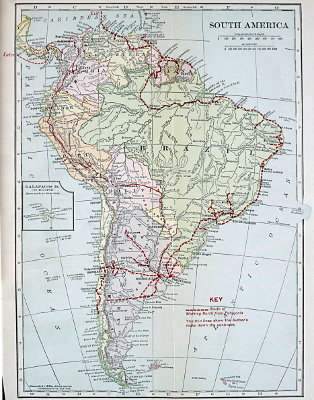
17Physical exertion, even for exercise sake, has little place in the
scheme of life of these dandies, or of the majority of youths even of
the genuinely wealthy and patrician class. Of late certain influences
have been working for improvement in this matter, but they are still
hampered by the awkwardness of inexperience as well as laggard
costumbre. Out at Tigre, a cluster of islands and channels some miles
up the bank of the Plata, young men of the class that in the United
States would pride themselves on a certain expertness in sports may be
seen rowing about with the clumsiness and self-consciousness of old
maids, their shirts bunched up under their suspenders, their bodies
plainly uncomfortable in trousers inclined by the dictates of fashion,
as well as by the unwonted exertion, to climb to their chests, the occasional
young woman in the back seat sitting as stiffly as the model in a
corset-shop window.
The feminine sex of the same class does not, of course, yield to the
males in the matter of personal adornment. At the races, along the
shaded drives of Palermo of an afternoon, above all in the narrow Calle
Florida a bit later in the day, fashion may be seen preening itself in
frank self-admiration. In the material sense the Calle Florida is
merely another of those inadequate streets of the old town, four or
five blocks back from the waterfront, and given over to the most
luxurious shops,—jewelers, modistes, tailleurs de luxe. But Florida
is more than a street; it is an institution. For at least a generation it
has been the unofficial gathering-place of the élite, in so far as there can
be any such in so large a city, taking the place in a way of the Sunday
night promenade in the central plaza of smaller Latin-American towns.
Up to a few years ago the carriages drove directly from the daily
promenade in Palermo to join the procession that crawled back and
forth along the few blocks of Florida between the Avenida de Mayo
and the Plaza San Martín, the ladies in them affecting that air of lassitude
which seems to be most attractive to the frankly admiring cavalier
south of the Rio Grande. But the day came when the narrow callejón
could no longer contain all those who demanded admission to the daily
parade and mutual admiration party, and the intendente solved the
problem by closing the street to vehicles during certain hours of the
late afternoon. There is still a procession on wheels from eleven in the
18morning until noon, given over particularly to débutantes ostensibly
on shopping tours, though invariably surrounded by long lines of gallants
and would-be novios; but the principal daily corso is now made
on foot, and admiring males may without offense or conspicuousness
pass near enough in the throng that fills the street from wall to wall
to their particular ideal to catch the scent of her favorite perfume.
Nor does that require undue proximity, for the most circumspect ladies
of Buenos Aires see nothing amiss in making an appeal to the olfactory
senses which in other lands would lead to unflattering conclusions.
The gowns to be seen in such gatherings are said by authorities on
the subject to be no farther behind Paris than the time of fast steamers
between French ports and the Plata. To the bachelor more familiar
with the backwoods they seem to be as thoroughly up to the minute as
their wearers are expert in exhausting every possibility of human
adornment. Unfortunately, many of the demure, semi-animate ladies
prove on close inspection to be not so beautiful as they are painted.
Not a few of them could readily pass as physically good looking,
despite the bulky noses so frequent in “B. A.” as to be almost typical,
were they satisfied to let nature’s job alone. But the most entrancing
lady in the world would risk defeat by entering a beauty contest disguised
as a porter in a flour-mill. There are, to be sure, ravishing
visions now and then in these Buenos Aires processions, but unpolished
candor forces the admission that what to us at least is the refined and
dainty type is conspicuous by its rarity. It is a standing observation
of critical foreign visitors that the décolleté gowns seen at the Colón
during the opera season often disclose cable-like shoulder muscles
bequeathed by recent ancestors who carried loads on their heads. That
to me is one of the promising signs in Buenos Aires, a proof that the
new “aristocracy” is near enough the laboring generations which built
it up not to have lost its muscle and its energy; it helps to explain the
youthful enthusiasm of the Argentine, similar to our own and so
unlike the blasé hopelessness of much of South America. For the
southern republic is as truly the land of opportunity as is our own,
inferior perhaps only in extent and resources. Along with the fops
lounging in the Jockey Club it has many such types as Mihanovitsch,
arriving half a century ago with no other possessions than the porter’s
rope over his shoulder and retiring recently from the active ownership
of the largest steamship company south of the United States, with
palatial steamers plying wherever Argentine waters are navigable.
The gaudy ostentation of this nouveau riche city of Latin-Iberian
19origin is nowhere seen to better advantage than at the Recoleta, the
principal cemetery. This is a crowded cement city within a stone wall,
as much a promenade and show-ground as a last resting-place. Men
sit smoking and gossiping on the tombs; women take in one another’s
gowns with critical eye as they turkey-walk along the narrow cement
streets between the innumerable family vaults. The tombs are built
with the all too evident purpose of showing that one’s dead are, or at
least were in life, of more importance in the world than those of one’s
neighbors. They have four or more stories below ground, with shelves
or pigeon-holes for several coffins on each “floor,” and marble steps
leading down to them. On the upper or ground floor, usually surrounded
by elaborate statues sculptured in white stone, are ostentatious
chapels with plate-glass doors, locked with the latest American safety
locks. Everywhere reigns a gaudy luxury wholly out of place in a city
of the dead. The self-respecting corpse must feel as if he had been set
up in a museum instead of being disposed of in a sanitary and inconspicuous
manner. Here and there a tomb bears the sign “For Sale,”
with the name of the authorized real estate dealer under it. The seller,
who in some cases seems to have tossed out the bones of his forgotten
ancestors in the convenient old Spanish way, is certain to benefit financially
from the transaction, for the Recoleta is the cemetery of Buenos
Aires, absolutely limited in space now by the city that has grown up
about it, and accommodations in it are as eagerly sought as boxes at the
opera or seats on the stock exchange.
“Le cheval est la plus noble conquête que l’homme ait jamais fait,”
runs an inscription, from Buffon, over the portals of the far-famed
race-track in Palermo, which, from the intellectual heights of the
Jockey Club, is no doubt true. It suggests, however, an attempt on the
part of the argentinos to deceive themselves into believing that they
attend the races in such hordes every Thursday and Sunday because
of their love of horses, rather than to indulge their genuinely Spanish
infatuation for gambling. This same hint of hypocrisy, of kow-towing
to Mrs. Grundy, which is ordinarily little in evidence in the Latin-American
character, also smirks from the tickets of the lottery maintained
by the Federal Government, which calls itself the “Loteria de
Beneficencia Nacional.” How widespread is this Iberian desire to get
something for nothing is shown by the fact that the Argentine not only
maintains the national lottery, with regular drawings every ten days
and frequent special drawings with enormous prizes, but two other
20official games of chance, run by the Provinces of Buenos Aires and of
Tucumán.
The gambling at Palermo is on the pari mutuel, or pooled bets system.
That is, those who wish to place a wager on a race—and virtually
everyone on the grounds seems to have that desire as often as a race is
announced—crowd their way to one of the many windows, and purchase
as many bet-tickets as inclination or the state of their pocketbooks
suggests. These tickets are of two kinds,—Ganador (Winner) and
Placé. All money wagered on that race is pooled, the Jockey Club, to
which the whole establishment belongs, skimming off ten per cent. for
itself and distributing the rest among those holding winning tickets.
Thus when a favorite wins there are so many players to share the
returns that one often gets little more than his money back. There are
none of those hundred-to-one chances to make the excitement of large
hopes worth the risk of a small loss. Now and again an “outsider”
wins at Palermo, but it is a far more common experience to wager two
pesos, to see one’s choice come in a neck or a length ahead of the
entire field—and to be paid two pesos and ten centavos at the booking
windows.
The Porteños seem to get much entertainment out of their race-track,
for all the slimness of the average winnings. The sumptuous
pavilion, confined to the use, free of charge, of members of the Jockey
Club and their guests, is always well patronized; the adjoining concrete
stand, called the “Paddock,” has its throng of seven-peso spectators
even on days when weather and grounds are not inviting to the sport;
the swarms of garden variety men and women who surrender two pesos
for the privilege of jostling one another in the other stands and about
the betting booths show an even less blasé interest. On fine days
many canopied tea-tables are set out on the smooth gravel space before
the Jockey Club pavilion, and there may be seen Porteño fashion at its
gaudiest. The entire place is honeycombed with passageways for the
use of an army of officials, contestants, bet sellers and bet payers, the
latter superhuman in their facility in mental arithmetic. From the
upper seats one may look off across three complete racetracks, one
within the other and enclosing a lake and a small park, to the red-brown
Plata, stretching dull and featureless to the horizon. One might
moralize and point out the burden imposed on the mass of the population
to support the Jockey Club, perhaps the most ornate place of its
kind in the world, and surround the few thousand club members with
luxury, could one overlook the fact that if the average argentino were
21denied the privilege of risking his money on the races or in the lottery,
he would find other ways to hazard it, if only by betting on the number
of rains a year or the number of traffic blocks per hour in the downtown
streets.
Of other forms of public entertainment Buenos Aires has its fair
share. The theater list for a given day numbers twenty-five performances,
ranging from the opera to a circus and a frontón given
over to the Basque game of pelota—this, too, without counting the
ubiquitous “movie.” Serious drama has comparatively little standing,
the popular taste running to flippant one-act Spanish zarzuelas or to
the maudlin and undress, with the audiences overwhelmingly male.
Vaudeville bills are apt to be cosmopolitan, each “artist” speaking his
mother tongue, for there is slight native “talent,” and an American
negro doing a clog dance that would not win him a single “hand” at
home is much applauded, since, coming from abroad, he must be good.
A “national company” giving native plays of real literary and histrionic
merit was conspicuous by its rarity.
Night life in Buenos Aires is brilliant at least in the material sense.
Though there are fewer blazing advertisements in all the town than
along Broadway, municipal lighting is more generous than in pre-war
Paris. Entertainments rarely begin before nine, and midnight usually
finds the streets crowded. By night, perhaps even more than by day,
the visitor is struck by the lack of rowdyism. As the city is less noisy
than our own metropolis, thanks to the absence of an “L,” among other
things, so it is less “tough.” Even the saloons—it seems more fitting
to call them by their local name of café—have little objectionable atmosphere;
in them one may order “soft” as well as “hard” drinks without
arousing an insinuating look from the waiter. The Porteño, like
the southern European from whom he is mainly descended, is temperate
in his use of liquor, and he expects his drinking-places to be as
gentlemanly as any other public rendezvous. Fully as numerous as
the “cocktailerías,” often presided over by expert mixers exiled from
the United States, are the lecherías at which one may sit down at any
hour of the day or evening to a glass of the best of milk at a reasonable
price.
The Latin-American privilege of ogling all attractive women has
not, of course, been eradicated even in Buenos Aires. But a recent
ordinance makes it a penal offense to speak to a woman on the street
unless first addressed by her, and the few respectable women who go
out after dark without escort are rarely subjected to anything worse
22than staring, and perhaps an ostensibly unconscious little whispered
monologue or popular air. The same restriction has not, however, been
placed on the fair sex, and cases of blackmail turning on the point of
who spoke first have not been unknown in the municipal courts.
“B. A.” is particularly gay during the winter season, from June to
September. Then “Society” has returned from Mar del Plata, the
Argentine Atlantic City, or from the Córdoba hills; the few wealthy
estancieros who have residences on their estates come in from the
pampa; gilded loafers, opera singers, adventuresses turn up from the
four points of the compass, and the capital becomes doubly pretentious,
expensive, and crowded. Several times I came to it from journeys
into the “camp,” as the large English-speaking colony, anglicizing
the Spanish word campo, calls the country outside the capital, and each
time I found it more breathlessly in pursuit of pleasure. With the
same latitude as Los Angeles, the South American metropolis does not,
of course, have what we would call a real winter. Only once within
the memory of the present generation has snow fallen in sufficient
quantity to cover the ground. A temperature around the freezing point
is the usual limit, and even in the coldest days of July or August the
sky is apt to be brilliant and the atmosphere radiant. The cold, when
it comes, seems extraordinarily penetrating, just as the pampero, the
suffocating norther of the summer-time, seems hotter than anything
the tropics have to offer. His winter season is so short that the average
argentino makes little or no preparation for it, with the result that he
probably suffers more from cold than those who live in really cold
countries. Both law and custom now require steam heat in hotels and
the more important public buildings, but the rank and file rarely come
into contact with artificial warmth.
A few years ago Buenos Aires caught a virulent case of puritanism
from some unknown source and made a concerted attack on notorious
immorality. The more vulgar features of night life were driven across
the Riachuelo, a filthy little stream that bounds the city and the federal
district on the south. There, beyond the jurisdiction of the city police—since
the section is subject only to the laws of the Province of
Buenos Aires, with its capital far away at La Plata—though still
virtually within the city limits, are gathered sailors’ recreation houses
and the most squalid vice. In Porteño speech “beyond the Riachuelo”
is the equivalent of “outside the bounds of decency,” and in the moral
shambles of this region public entertainments reach a degradation
which is beyond American imagination.
23In the capital itself things are not yet morally immaculate. The
argentino looks upon the “social evil” rather in the French than the
American manner,—as something unavoidable, not particularly reprehensible,
and to be regulated rather than driven under cover. Vice may
be more widely spread than in our own large cities, but it is less openly
crude and vulgar, with more of the frankness and at the same time of
the chic naughtiness of the French. This is perhaps natural, for not
only is Paris the Porteño’s beloved model, but probably at least half
the women of this class come from France. Many other nationalities
are represented, but the rarest of all are native women. Whether Argentine
girls are “virtuous by constraint,” as some cynics have it, or
the national wealth is so great that few are forced to resort to the last
means of winning a livelihood, the fact remains that the predatory
female of Buenos Aires is almost certain to be a foreigner. Yet there
are few opportunities for women outside the home. Typists, clerks,
and the like are almost all men; in the biggest, and almost the only,
department store in Buenos Aires 2360 men and 640 girls were employed
on the day that official duties caused me to investigate the question.
Women, however, are steadily forging ahead as teachers in the
numerous and increasingly excellent public schools. Buenos Aires, by
the way, shows an illiteracy of barely ten per cent. for all its continuous
immigration. It has given insufficient attention to the development of
school playgrounds; its boys do not grow up with that love for athletics
which brings with it the worship of good health and physical perfection
of the body that is so potent an enemy of bad habits. Moreover, their
elders treat certain matters with a levity both of speech and example
which is not inclined to reform the rising male generation. In the
moral attitude of the Argentine capital there is much that could advantageously
be corrected, but there are civic beauties that would be
the pride of almost any city of our own land. For all the deadly flatness
of its site and its lack of landscape, it has a certain charm; like all
great cities it is cruel and heartless, with wrath-provoking contrasts;
and on the whole it is not particularly lovable.
CHAPTER II ON THE STREETS OF BUENOS AIRES
24
In my daily rounds as “errand boy” I soon discovered that the
Porteño is not a particularly pleasant man with whom to do business.
To begin with, he is overwhelmed with a sense of his own
importance, of that of his city as the greatest, or at least soon to be
greatest, city on the footstool, and seems constantly burdened with the
dread of not succeeding in impressing those importances upon all visitors.
There is as great an air of concentrated self-sufficiency in
Buenos Aires as in New York, a similar self-complacency, the same
disdainfulness of anything from the insignificant bit of backwoods
outside the city limits, a frank attitude of disbelief in the possibility of
ever learning anything from those uncouth persons who have the misfortune
not to be Porteños, and with it all a provincialism scarcely to
be equaled off the Island of Manhattan. But the Porteño has less
reason to boast of efficiency in his business methods than has his prototype
of the North. From the American point of view he is decidedly
slow. The telephone, for instance, has never been developed into a
real aid to business in Buenos Aires. The service is incredibly deficient,
not simply sometimes imperfect, but deficient in the sense which that
word has to those who have lived and attempted to telephone in Paris.
At the time of my erranding there were seven thousand telephone subscribers
in Buenos Aires—with a population rapidly approaching two
million; and it was so impossible to be added to the list that persons
surrendering their instrument had only to mention that fact in the
“Want” columns of a newspaper to sell at a price equal to the bonus
paid for an opera box the privilege of being the next to rent it. Yet
once the telephone is in, one’s troubles have only begun. Most Porteño
business men prefer to do without one and go in person to see their
professional adversaries. In fact the atrociousness of the telephone
service was the chief raison d’être of my position in the consulate.
Having squirmed and shouldered one’s way through the narrow
human streams of the business district to the door of the building
sought, there begins the serious problem of reaching the desired individual.
25The elevator service, in the few cases where there is one,
is on a par with the telephone. Nor is it reassuring to the timid, for on
the ground-floor cage there is almost certain to be a conspicuous sign
to the effect that, “As there exists a stairway, persons riding in the
elevator do so at their own peril.” Buenos Aires has not quite shaken
off the suspicion of a diabolical nature in all such new-fangled contraptions.
A man was killed by an elevator in an office building during
my days in the capital; when I chanced to pass the place nearly two
weeks later, the entire elevator-shaft had been gutted by municipal
order and three policemen were still stationed at the foot of it, apparently
to prevent anyone from climbing the shaft instead of using
the stairway.
Arrived at the proper floor, you find yourself face to face with the
greatest difficulty of all. From that moment you must wage pitched
battle, for the inevitable door-keepers are insolent beyond measure,
though sometimes with a veneer of Latin-American-style courtesy, and
so numerous that to pass them is like running a gantlet. To get as
far as the subsecretary’s subsecretary is often a strenuous day’s work.
It makes no difference how important your errand may be. These
stupid Cerebuses see no distinction whatever between the official
spokesman of the august Consul General de los Estados Unidos de
Norte América and a book agent. Nor will foresight help you. For
the great man inside is invariably behind his schedule, scores of other
applicants are sure to be lined up in the anteroom, and though you
have an appointment with him for two, you are more likely than not
to be still waiting at four. This waiting in the anteroom is so customary
in the Argentine that antesalar has become an accepted verb of
the idioma nacional. Public officials, from ministers to the lowest class
of secretary, have mobs before their doors during all their office hours,
but instead of increasing the latter until they cover the work to be done,
or hurrying things up in order to receive all applicants, they come late,
fritter away much of their time in non-essentials, and leave early, so
that most of the crowd has the pleasure of coming again the next day,
and the next. Doctors and dentists are particularly remiss in this form
of inefficiency. They, by the way, charge an admission fee, that must
be paid to the door-keeper before the patient can get in, and which has
no bearing on the regular charges “for professional services.”
The reason for this stagnation in the anteroom becomes apparent
when you at last step across the magic threshold. The American business
man presses a button as soon as he has heard you, and the thing
26is done at once; the argentino hems and haws, spends considerable time
on drawing-room courtesies and formalities, murmurs, “Ah-er-why-sí,
señor-er, come around to-morrow at three,” though it would be quite
as easy to make his decision at once. Most Porteño business men with
whom I came in contact seemed to keep their minds on ice, or in a
safety vault somewhere, and to require time to go and consult them—for
no one who knows the Latin-American can even suspect that they
wished to talk the matter over with their wives. The saddest part of
the whole story is that when you come around mañana at three, the
man either will not be there or will be conferring with those who have
appointments from twelve to one, and will not have given your question
an instant’s thought since his door closed behind you.
There is a certain English and German influence in “B. A.” business
houses, and a corresponding native influence on the rather numerous
English and German business men in the city which makes them
almost as prone to procrastination as the Porteño. Five o’clock tea
is served in all offices, including congress and newspaper rooms. Of
late years this is often really tea, rather than mate, though black coffee
and liqueurs are still found on most portable sideboards. A British air
of deliberation pervades the commercial caste, though the pressure
of competition and high cost of living is gradually having its effect,
both in the increased pace of business and the lengthening of office
hours, which, if they begin late and are broken by tea-time, often last
until seven or even eight in the evening. “B. A.” still retains, however,
a few of those features which visiting Americans below the Rio
Grande are wont in their exasperation to dub “Spig.” There is the
post-office, for instance. It is as unsafe to assume common sense on
the part of Buenos Aires postal officials as of those in the most backward
parts of South America. Red tape, indifference, languor, and
stupidity flourish almost as vigorously in the correo principal in the
Casa Rosada as at the crest of the Andes. You will probably find
your letters filed under the name “Esquire,” if your correspondents
affect that medieval title; if you wish to buy a stamp, the customary
way is to go to one of the tobacco-shops obliged to keep them, and buy
it at a premium. Those who insist on getting their stamps at the legal
price must travel long distances to the post office and shove and jostle
their way through a throng of Italians bent on sending home a part
of their wages, to reach at last a wholly inadequate hole in the wall
behind which the female clerks are deeply engrossed in gossip.
There is a reminder of some of our own overambitious towns in
27the argentino’s eagerness to boost population, as if there were some
virtue in mere figures, even though those be false. The national
census was taken during my sojourn in the republic—all in a single
day by the way, which was declared a holiday—and the method of
computing the population was not one to cause it to shrink. Long
beforehand walls and windows were covered with so many placards
resembling those of a vaudeville performance that the cynical observer
might easily have been justified in supposing that the printers had a
special influence with the government. On the day set not only was
every foreigner included, even though he happened only to be spending
a few hours in crossing the country, but orders were issued to count,
through the consuls, all argentinos living abroad and all persons of
whatever nationality at the moment under the Argentine flag, whether
on the high seas or on steamers far up the Paraná and Uruguay rivers
quite outside the national jurisdiction. I was counted at my hotel,
filling in a blank under the eye of the Italian proprietor, though I had
only the day before returned from a foreign country and was on the
point of leaving for another. The enumerators received ten centavos
for each person enumerated, which naturally did not tend toward a
decrease of population, that sum being paid by the government—though
it turned out later that in many backwoods districts it had
also been collected from the enumerated. Placards were then posted
ordering any person within the republic who had not been counted on
the date set to come to town and present himself before the Census
Commission. These intensive methods resulted eventually in the announcement
that 1,490,675 persons were living in Buenos Aires on
the day in question.
If there chanced to be no “outside work” for the moment to keep
me scurrying through the avalanche of taxicabs, or no “office boy”
duties about the consulate, there was always plenty of recreation to be
found in watching the assorted humanity that filed in and out of the
outer office. Now a penniless sailor would drift in, to address the
work-swamped vice consul in such words as, “General, I ayn’t goin’ t’
tell you no stories, ’cause you’re a bright man an’ you’d ketch me up at
it an’ make a fool out o’ me. Only, I took just that one drink, general,
just that one drink, an’ they shanghaied me an’ ’ere I am an’ I ’as a
family in the States, general, s’welp me Gawd, general, an’ what am I
goin’ t’ do ...” and so on, until to my multitudinous duties was added
that of bouncer. Or perhaps a clean, neatly dressed young American,
perpetual outdoors in his face, would step up with, “I come from
28Texas, that’s where my paw an’ maw lives, an’ I come down here to
raise hawgs an’ I thought I’d come in an’ tell you I was in the country
an’ now where can I get the best land to raise hawgs on an’ ...”
another task for the overworked “office boy.” If it was one of those
rare days when this continual procession of human quandaries was
broken, I had only to reach at random into the files to pull out a
written one:
Buenos Aires, April 25,
To the Consol of the U. S. A.
I am reading now the news of the war (it was the time of our sending
marines to Vera Cruz) and the call at the arms to volunteers. If you remember,
about 7 or 8 month ago, I have writen to you from Rosario, offering my blood
for your Republica. Not answer have I received about. Now if you like to
take in consideration this letter, I wish to start for the war and to be incorporated
in the volunteer’s corps. This is not a strange offering. I am Italiaman
and I cannot to forget the time passed in the U. S. A. and the generous heart
of the Americaman when my country was troubled by the sismic movements.
I live in New York six year, left the North America three year before,
and am desiring now to see and live in that blessed country. Here has the
hungry, and indeed to die starved in the streets. I wish better to die for the
North American states. I love your land more than my country and severals
of the Italiamen living in the States, believe me, Sir, will be incorporated for
the war. I would to be at present in New York, not here: I well know that
the international respects forbidden to answer me about, but I have not money
in this poor country, and for that I can’t to start at my expenses. If you like
to give me a passage, I am ready to start rightaway, and not body shall know
my resolution.
Hoping in your favorable answer, I am glad to be,
Yours respectfully,
Mike Albanese.
Nor does Buenos Aires take a back seat to New York in the amusement
the stroller may find in its streets. There was the incident of
Easter Sunday, for instance. I went to church, but there was no
special music, only a cluster of priests in barbarically resplendent robes
going through some sort of silent service, so I drifted out again.
There was not even the parade of new spring hats to which to look
forward, for spring was still far off in Buenos Aires. In fact, the
oppressive heat of early March in which I had arrived had only begun
to give way to a refreshing coolness. The early autumn skies were
brilliant, leaves had scarcely begun to turn color. I bought a copy of
La Prensa, tucked it under an arm, and went strolling lazily up
Rivadavia beyond Calle Callao, the Forty-Second street of “B. A.,”
flanking the gleaming new congress building. Mounted policemen in
rich uniforms, with horsetail helmets and the white gloves of holidays,
here and there decorated the landscape. For some time I sauntered
29dreamily on at random, a trifle bored by the monotony of life, for I had
already been more than a month in Buenos Aires and had tasted most
of the excitement it has to offer.
I was half aware of crossing the broad Plaza Once de Setembro,
still covered with earth from the digging of the new subway. Finally,
up in the 2700 block, a man standing on a corner asked me if I could
tell him where Dr. Martinez lived. I replied that I was a stranger in
those parts. So was he. That was fairly evident to the naked eye,
for he was decidedly countrified in appearance and actions, though he
was clean and well dressed. He had just come up from Bahía Blanca,
he said, and when he got off the train in the station, he had met one
of those men with a huascar, a rope, over one shoulder and a number
on his cap—a changador, or porter, I explained—who asked him if he
wanted his baggage carried. He did, and gave the man his maleta
and also the slip of paper with the address of Dr. Martinez on it.
Then the changador said it was customary to pay in advance, and as
he had no change he gave him a ten-peso bill and told him to bring
back the small money.
The poor fellow was so evidently a simple, good-hearted countryman
who had never been in a large city before that I could not but admire,
as well as pity, his unsuspecting nature. Of course the changador had
disappeared with the valise, the ten pesos, and the address; and as the
campesino did not even know the doctor’s first name, things looked
rather dark for him, for Martinez rivals Smith in directories and telephone
books. Still, it was no concern of mine, so after giving him my
sympathy and advising him to report the matter to the police, just for
form’s sake, I turned to go on.
Just then another man passed us at a brisk pace and the poor countryman
appealed to him for advice. The newcomer was quite evidently
a Porteño, a man under thirty, good-looking, with the frank and open
countenance one recognizes at once as belonging to an honest man.
His appearance was that of a clerk or small merchant. Knowing the
countryman was in good hands, I turned away again.
But he called me back, apparently feeling more secure with me
nearby. Then he told the newcomer of his hard luck. Naturally the
latter was as sorry as I was. He expressed his sympathy and started
on, but the countryman begged not to be abandoned in his trouble.
The newcomer yielded good-naturedly to the whim of the yokel and we
fell into conversation.
“You are English?” remarked the townsman, casually, but before I
30could answer, the countryman said with an air of finality, “No, he is
German,” and as it was easier to let it go at that than to bother to
correct him, I nodded. We strolled along for a block, puzzling over the
sad predicament of the countryman. At length the Porteño asked
pardon for butting into any man’s private affairs, but, “Did this changador
get away with any of your money in the grip, too?”
“Ah, no; there I am lucky!” cried the estanciero. “Just before the
train got into the station I opened the maleta and took out this roll of
billetes; it is seven thousand pesos”—in the utmost innocence the fellow
drew out the roll, large as a man’s forearm, a hundred-peso bill in
plain sight on top. I was about to protest when the other man did so,
crying:
“But, my dear sir! Do you know me? Or do you know this gentleman?
Then don’t you know better than to flash seven thousand pesos
around in the public streets? Why, if we were not respectable men
we might tell you we knew where this Dr. Martinez lives and then
lead you into any old corner and give you a puñalado and....”
“Oh, I can tell you are honest men,” replied the countryman, with
a childlike smile, at which the other turned to me with:
“You see these country people live so simply and honestly at home
they never dream of the dangers of the cities.”
“Yes,” I replied. Then to the countryman, “But one mustn’t always
judge people by their faces,” for it was evidently up to me to say something
of a harsh nature to the simple rustic.
“Exactly,” said the Porteño; “we can see a man’s face but not his
heart.”
Still the countryman seemed to prefer to trust to his own judgment
of physiognomy and implored us to help him find this Dr. Martinez,
saying that if it was a matter of giving us ten or twenty pesos each
for our trouble he would be glad to do so. The Porteño forestalled
my protest by saying we were not that sort of men but that we would
be glad to give him any assistance possible, out of charity. So we set
out along a side street, telling the countryman to walk ahead.
“What do you think of that poor fellow?” said the Porteño; “and
what if he had fallen in with some dishonest shyster instead of us?
Say, you know I think the man is ill and....”
“Oh, señor,” he called to him, “you won’t think I am prying into your
private affairs, but is it some medical matter you want to see this Dr.
Martinez about? Because if it is, you know there are so many fakes
posing as doctors here in the city....”
31“No, no; it is not for a medical matter at all,” returned the countryman;
“it is merely a family affair,” and he went on again. But before
long he turned back and to my astonishment there were tears visible on
his cheeks.
“Gentlemen,” he said, “it is true I do not know you, but I have seen
and talked with you and I am sure you are honest men, not the kind
who would outwit a poor countryman who knows nothing of the city
and its ways. So I am going to tell you just how things stand so you
can advise me what to do.
“My father and I own a big estancia down near Bahía Blanca. We
are very well-to-do—you will excuse my mentioning that—though we
do not know much of cities and their ways. Some time ago a man
living on our estancia died. He was thought to be a beggar, but when
we came to disinfect his hut what was our surprise to find inside his
old mattress seven thousand pesos in these little round gringo gold
pieces....”
“Ah, he means English sovereigns,” put in the Porteño.
“Father was going to turn this over to the authorities,” the countryman
went on, “but our lawyer laughed at the idea, as the fellow had no
heirs and the authorities would only stick it into their own pockets.
And as the man had lived and died on our estancia, surely no one was
more entitled to the money than father. So he put it away in his
strong boxes—though, to be sure, it was a small amount to us and we
never needed it. Well, a few weeks ago my poor papá”—here he wiped
away a tear—“was riding along when his horse ran into a cerco de
alambre de púas. But perhaps you city gentlemen do not know what
a cerco de alambre de púas is?”
“Oh, yes,” we both cried, and the Porteño added, “it is that wire
with sharp points on it that you use out in the country to keep the
cattle or horses in a field.”
“Well, my poor father rode into one of those fences and his face
was so cut and torn that it has all turned black on that side, and the
doctor came and told us it was scurvy or cancer or some of those
awful diseases with a long name, and that poor papá would never
get well.”
When he had blown his nose the campesino went on, and one could
not help pitying the poor chap, trying to hide his grief, for the people
of South America certainly have much family affection, especially
those from the country:
“The doctor told us to call the priest, so I went and got Father
32Acosta, our old family padre, who baptized me, and when he confessed
father, he found out about the seven thousand pesos. Well, he said
at once that father could not go to heaven with that on his conscience.
So he told me to take the money and come to Buenos Aires at once—for
of course there is no hope now of finding any of the beggar’s heirs—to
see this Dr. Martinez and, giving him two thousand pesos for his
poor patients, as a sort of commission, to have him take the other five
thousand and send half of it to some church to say masses for the
repose of that poor aviator who was killed the other day, and the other
half to some good hospital, to be used for the poor and those with bad
hands and feet....”
“Ah, he means cripples,” put in the Porteño; “that’s what we call
that kind of poor people here in the city,” smiling upon our simple
companion. Naturally we two had looked at each other frequently
during this tale, for it scarcely seemed possible that even a campesino
from the utmost pampa could be so unsophisticated. Now, was it a
question of the priest and this Dr. Martinez being confederates, or was
the priest as simple as the other yokels?
“If you don’t mind another personal question,” said the Porteño,
“do you know this Dr. Martinez?”
“Ah, no, but he has his name in the paper, in La Prensa.”
“My dear señor!” gasped the townsman. “Why, don’t you know that
either I, who am no doctor, or this gentleman, whom I think I am
right in saying is none either, can pay a newspaper sixty or eighty
centavos to put in an announcement that we are doctors, or anything
else? Why, my poor compatriot, a newspaper is merely a beast of
burden that carries anything you put upon it.”
“But,” gasped the countryman, “don’t the editors know people before
they put in their notices?”
“Poor simpleton,” murmured the Porteño. “Now, I must be getting
on, for I have friends coming to see me, but I’ll tell you what I should
do in your case. I should go to some of the largest and most respectable
commercial houses here in the city and turn this matter over to
them, taking their receipt and....”
“Ah, señores,” cried the countryman, almost in tears, “this is purely
a matter between my father and his conscience. I would not have it
become public under any circumstances; and besides, my poor father
is so sick that I must take the evening train back to Bahía Blanca at all
odds. And—excuse me, gentlemen, for mentioning it, but I have an
infirmity—and where can I go and sit down for a few minutes? Here
on the sidewalk?”
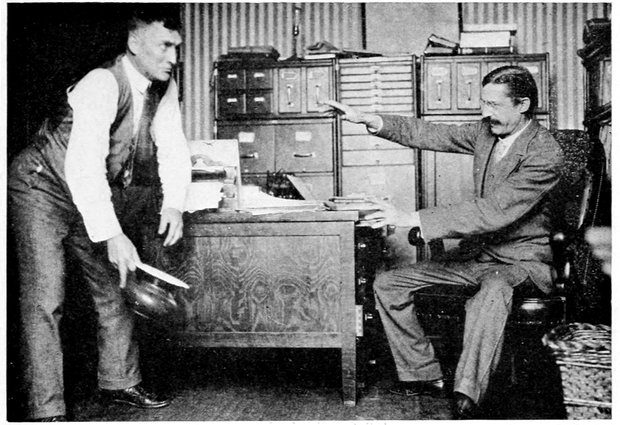
In Buenos Aires I became “office-boy” to the American consul general
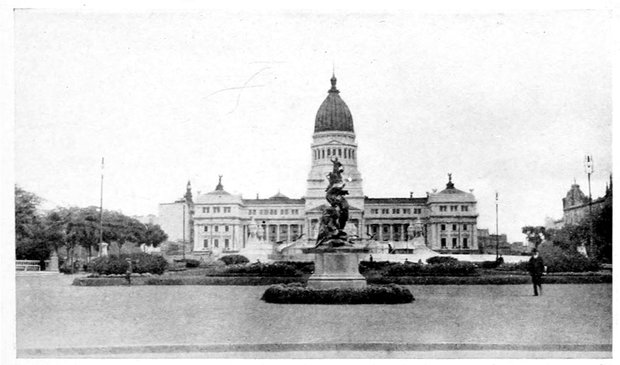
The new Argentine capitol building in Buenos Aires
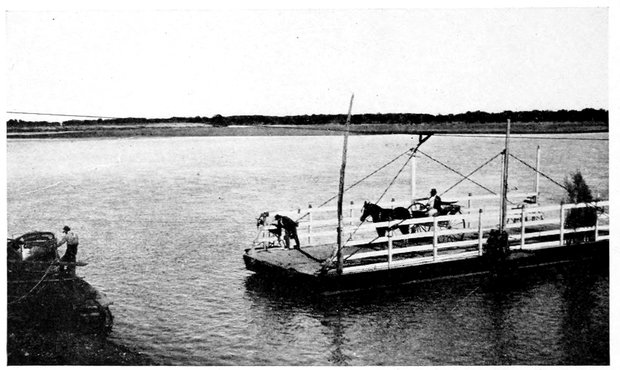
The government ferry to Choele Choel Island, in the Rio Negro of southern Argentine
33“Válgame Diós, no!” cried the Porteño, catching him by a sleeve,
“not in the street, or you will have a crowd gathered around you. I’ll
tell you what you can do. Go down that way a block and you’ll
find a saloon. Go in and buy a drink of something and ask them where
you can sit down to drink it.”
The countryman left us, and the Porteño took advantage of the
opportunity to talk things over with me.
“It is evident that the simple fellow is in great danger of being done
by this Dr. Martinez, or somebody else, for how do we know he will
not take and keep the whole seven thousand? Now I am an honest
man, and I believe you are, too; are you not? Then it is our duty to
take care that this money gets where it belongs. You surely must
know some German church here in town where they can say masses for
that poor aviator. We can go and give the priest twenty-five hundred;
and then there are plenty of good hospitals, the German, the English,
and so forth, where they will accept and use for the poor the other
twenty-five hundred. And then we will not only have seen that the
money goes where it was intended, but there will be a linda, a pretty
little commission of two thousand pesos to divide between us. Can I
depend on you to help me save this poor fellow and his money?”
I was, of course, considerably surprised at such a proposition from a
man apparently so straightforward, and for the first time felt it my
duty to stay in the case until I had seen the money properly disposed
of; the equivalent of three thousand dollars was no sum to see scattered
among sharpers. So I nodded, and when the countryman came
back, the Porteño explained to him:
“Now, my friend, you do not know this Dr. Martinez. How do we
know he will not take the money and spend it on himself, on dissipation,
in short, to talk plainly between men, on francesas?”
“Francesas?” cried the countryman, with a puzzled air.
“Yes, on bad women, on those who sell their love,” explained the
Porteño; “we call them francesas here in the city because so many of
them come from France.”
“Ah, yes, I have heard there are such women in the cities, poor
things,” said the farmer. “Also, it is only too true that this doctor may
not be honest. But tell me, gentlemen, what am I to do? My poor
papá dying down there in Bahía Blanca and——” again the poor fellow
34was weeping and it was lucky we were on a small side street behind the
Once station or we should soon have had a crowd about us.
“Now, you do know us,” went on the Porteño, “even if only for a
short time, and I propose that you turn this money over to us, let us
place the five thousand in churches and hospitals we know of, and
then divide the two thousand between us as our commission for our
trouble, which we would surely be as much entitled to as Dr. Martinez,
whom no one knows.”
To my astonishment the simple countryman jumped at the idea,
either because he was too unsophisticated to suspect anyone, or too
anxious to get back to his sick father to give any thought to the possibilities
of fraud.
“Only, it is a commission of two thousand between you,” he specified,
“not for each.”
“Surely, surely, we know that,” answered the Porteño.
We continued our stroll down the back street. The countryman,
quite evidently relieved to have the matter off his mind, reached for
the seven thousand pesos. Then an idea seemed to strike him, as if all
our talk about the dangers of the city had at last awakened a bit of
suspicion in his breast. He left the roll in his pocket and said smilingly
ingenuously:
“But, señores—you will excuse my suggesting such a thing—but before
I turn this seven thousand over to you—and I shall place it in the
hands of this gentleman” (indicating me) “since I met him first, and
you will give me a paper with your names saying you will use the
money as my poor father desires—but just so I can say to him when I
get back that I turned the commission over to two honest gentlemen,
who will carry it out, I—you will excuse me, gentlemen, I am sure, if
I speak frankly—I just want you to show me in some way that you
are not indigent persons. In short—you will pardon me, señores—but
just so my poor father can die in peace”—here he wiped another large
tear from his wind-and-sun-burned cheek—“I wish to be able to tell
him that you are persons of enough wealth so that you will not need
to spend this money on yourselves, just some little proof, gentlemen.”
“Surely, most just and wise,” cried the Porteño, “and I am certainly
not the man to be unwilling to show you that I am a respectable person.
Of course I am not carrying about with me any such large sum as you
have, but if it is a matter of a thousand or so pesos, I never go about
without that amount on my person.”
Here he pulled back his coat a bit and displayed a smaller roll of
35bills, though with the extreme circumspection of the city-bred man.
The countryman seemed entirely satisfied with this proof of honesty
and, shaking hands with the other most heartily, assured him that he
had every confidence in him. Then he turned his simple face questioningly
upon me.
I could not, of course, being a mere vagabonding “errand boy,” make
any display of wealth. But it seemed so eminently my duty to keep an
eye on the Porteño until the countryman’s money had come into indisputably
honest hands that I determined to invent myself a small fortune
with which to keep my standing in the case. I drew out the nine
pesos and some change in my pocket with an apologetic countenance
and addressed my companions:
“I’m sorry not to be able to show at once that I am a person of
means, but I am so well aware of the dangers of large cities that I
never carry with me more than enough for the day’s expenses, and of
course you are not interested in seeing this tiny amount,” which I
then put back into my pocket.
“But you must have money somewhere,” asked the Porteño,
anxiously, “just enough to show this gentleman we can be trusted to
carry out his commission? Come over here a moment. You will excuse
us for a minute, won’t you?” he added, addressing the campesino.
“Yes, but señores,” cried the latter, almost in tears, “you are not
going to talk about anything to my hurt?”
“On the contrary, it is entirely for your good,” answered the townsman.
“Just excuse us a moment until we arrange this matter to
your satisfaction.”
The two of us crossed the street, where the Porteño asked me again
if I could not show I had money.
“Why, yes,” I lied, determined now at all costs not to let him take
unfair advantage of the incredibly simple estanciero, “I have money
in the—er—the German bank and in the German consulate. But how
can I get it out, to-day being Sunday? Of course, if the bank-book
would be sufficient proof for our friend, I could hurry home and get
that.”
“Where do you live?”
“Tucumán 1671.”
“Well, now, how could we arrange?” puzzled the townsman. “You
could go and get the bank-book. Or shall I go with you? No, it will
be better for me to stay here with our friend, for with seven thousand
36pesos in his pocket, which anyone might take away from him—but you
could run home and get the bank-book, and that perhaps would keep
him interested until to-morrow, when the banks open—for of course,
being a man from the pampa, he won’t know that a bank-book is proof
of having money—and to-morrow you could get the money out and....
How much money have you in the bank?”
“I can’t say exactly,” I answered, ostensibly cudgeling my brains to
remember, “perhaps a little over six thousand pesos.”
“Ah, that’s fine,” said the Porteño, his eyes shining, “because that,
with what I have, will just about equal the seven thousand our friend
has, and give him full confidence.” We turned back toward the
countryman.
“Of course,” went on my companion, bringing his lips close to my
ear, “when we get that seven thousand—and I know you are not the
sort of man who will beat me out of my share just because it is going
to be put into your hands. Are you?” When I shook my head he
grasped my hand and shook it fervently. “When we get that seven
thousand it won’t much matter whether the priest and the hospital—you
understand me, as man to man, don’t you?”
I gave him a wise look as we rejoined the countryman, who was
nursing his feet as if city pavements were already blistering them.
When we told him that if he wished to see my six thousand—for, as
we expected, he had little knowledge of, or faith in, bank-books—he
would have to stay over until the next day, he protested, naturally,
that he must take the evening train, his poor father being likely to die
at any moment. But he was apparently as tractable as he was simple,
for when it was all explained to him, that I would go home at once
and be back within half an hour, or forty minutes at the most, with
my bank-book, that then we would all three spend the afternoon and
night together somewhere until the banks opened in the morning, he
admitted that that was probably the best way out of it, that “papá” always
had had a strong constitution after all, that the money must be
properly placed before he returned home, and after drawing out and
looking at the roll of seven thousand again and asking if we wanted him
to count it to show that it was really that amount, to which the Porteño
hastily protested and begged him to get it back into his pocket as soon
as possible, he agreed to our plan. I was to catch a car home at once,
get my bank-book, and return to them on that same corner.
There being no car in sight, I set off at a swift pace along the tram
line. As I looked around to see if the car was coming, the two waved
37to me to come back. I rejoined them, and the countryman again begged
me not to say a word to anyone about the matter, since it was entirely
a problem between his father and his conscience. I quieted his almost
tearful fears by assuring him that I lived all alone, that I had
scarcely a friend in Buenos Aires, and that I was naturally of a most
taciturn disposition. As I turned away again, the townsman took a
few steps after me and murmured in my ear, “If you will bring along
your rings and jewels, too, that will help to win his confidence.” I
assured him I would bring every piece of jewelry I possessed, and
hurried off once more down the street car line.
A couple of blocks beyond, where the street curved and hid my
friends from view, I turned a corner. A man who seemed to have
been peering out from behind it asked me if I knew “those two
persons.”
“No,” I answered, “we were merely passing the time of day.”
“But don’t you know esos son ladrones—those are thieves!” he
cried.
“Señor,” I replied, “my very best thanks for your kind warning,
but I discovered that about half an hour ago.”
Whereupon I continued for where I had started—to keep an engagement
with a fellow-countryman at the afternoon races in Palermo,
a rendezvous I had for a time feared I should have to miss unless I
cut short my very entertaining Easter morning with the bunco steerers.
CHAPTER III FAR AND WIDE ON THE ARGENTINE PAMPAS
38
The traveler who visits only Buenos Aires will almost certainly
carry away a mistaken notion of the Argentine. There is perhaps
no national capital in the world so far in advance of, so
out of proportion to its nation as is the great city on what the English
called the “Plate.” We of the northern hemisphere are not accustomed
to cities which are their countries to the extent that Buenos
Aires is the Argentine. American editors and publicists expressed
astonishment, and in some cases misgiving, when our latest census
showed that one tenth the population of the United States dwells in
its three largest cities. Of all the people inhabiting the Argentine
Republic virtually one fourth live in the capital.
The contrast between this and the great background of pampas is
incredible; Buenos Aires is far more closely allied to Paris or Rome
than to the broad country over which it rules. There are several reasons
for this disparity, besides the general South American tendency
to dress up the capital like an only son and trust that the rest of the
country will pass unnoticed, like a flock of poor relatives or servants.
The two principal crops of the Argentine, cattle and wheat, do not
require a compact rural population. Being the chief port as well as
the metropolis and capital, Buenos Aires has first choice of those who
cross the sea seeking new occupations and homes. It sucks the life
blood from the constant stream of immigration, leaving the “camp”
a sparsely settled expanse of boundless plain and the other cities mere
provincial towns, sometimes pleasant places to live in, but wholly devoid
of metropolitan features. Buenos Aires is as large as Philadelphia;
the second city of the Argentine is smaller than Akron, Ohio.
Numerous efforts have been made to bring about a better balance.
The government offers the immigrant free transportation to any part
of the country. Down on the Paseos of Colon and Julio, beneath the
arcades of which Spanish and Armenian petty merchants, cheap
Italian restaurants, and den-like second-hand shops make first appeal
to the thin purse of the newly arrived fortune seeker, the broad brick
39pillars are covered with the enticements of employment agencies,—a
cuadrilla of such a size wanted for railroad work three hundred miles
west; so many laborers needed on an estancia in a distant province,
free fare, nominal fee—just such signs as may be seen on the corner of
Madison and Canal Streets in Chicago and in a score of our western
cities. The wages offered are from twenty to thirty per cent. lower
than for the same grade of labor in the United States at the same
period, and the cost of meals somewhat higher. But it is something
more than this that causes the majority of immigrants to pause and
read and wander on in quest of some occupation financially less attractive
in or near the capital. Possibly it is a subconscious dread of
the horizonless pampas which stretch away into the unknown beyond
the city; some attribute it to the now happily decreasing autocracy
of grafting rural officials and the lack of government protection in
districts out of touch with the capital. Or it may be nothing more
than the world-wide tendency to congregate in cities. The fact remains
that Buenos Aires is congested with the very laborers who are
sadly needed on the great undeveloped plains of the interior.
A railroad map of the Argentine is a striking illustration of this
concentration of population. As all roads once led to Rome, so do all
railway lines of the Argentine converge upon Buenos Aires. Tracks
radiate from the capital in every direction in which there is Argentine
territory, a dense network which suggests on a larger scale the
railroad yards of our great centers of transportation. No other city
of the land is more than a way station compared with the all-absorbing
capital. There is probably no country in the world in which it is
easier to lay rails, though it is sometimes difficult to keep them above
the surface. With the beginning of its real exploitation, therefore,
new lines sprang up almost overnight. As in the United States
beyond the Alleghenies, railroads came in most cases before highways;
for though Spaniards settled in the Argentine four centuries ago, the
scattered estancieros and their peons were content to ride their horses
across the open plains, and the modern movement is as yet scarcely
a generation old. There are many regions where the railroad is to
this day the only real route; those who do not use it drive or ride at
will across the trackless pampas, with thistles or waving brown grass
threshing their wheels or their horses’ knees. To-day there are railways
not only from Buenos Aires to every town of the adjoining
provinces, but to Bolivia and Paraguay on the north, to Chile on the
west, and Patagonia in the South. Long palatial trains roll out of the
40capital in every direction, entire trains bound for cities of which the
average American has never heard the name, the destination announced
by placards on the sides of the cars as in Europe—and as it
should be in the United States.
With the exception of a minor French line or two, and some rather
unimportant government roads of narrow gauge, all the railways of
the Argentine are English, very English, in fact, with British managers
and chiefs of departments, engines without bells, and with the
nerve-racking screech of European locomotives, to say nothing of the
British “staff” system which forces even “limited” trains to slow down
at every station enough for the engineer to snatch the sort of iron scepter
which is his authority for entering another section. The rolling
stock, however, is more nearly American in appearance. The freight
cars are large, the passenger coaches—of two classes—are built on a
modified American plan, without compartments. Both in comfort and
speed the main Argentine lines rival our own, though there are fewer
through expresses which maintain what we would call a high rate
throughout their runs. For one thing the government assesses a
fine against those trains which are more than a little late without
palpable excuse, and it is natural that the companies so arrange their
schedules as to make such punishment unlikely, with the result that
many trains have a tendency to wait at stations for the time-table to
catch up with them. Nor, with the exception of the through lines
to the neighboring republics, do most of the tracks forming that
great network out of Buenos Aires fetch up anywhere in particular.
Nearly all of them have the air of pausing in doubt on the edge of the
great expanses they set out to explore, with the result that while the
provinces bordering Buenos Aires are so thickly strewn with tracks
that the map suggests there is not room to set down a foot between
them, there are enormous tracts of territory in the central and western
portions of the country wholly untouched by modern transportation.
Life slows down on these many arteries of travel, too, in exact
proportion to the distance from the heart from which all the
Argentine is nourished. But there are indications in most cases
that the pause at nowhere is only temporary, that presently the lines
will summon up breath and courage to push on across the still trackless
pampas.
The great drawback to travel in the Argentine is the cost, both in
time and money. Distances are so great, places of any importance so
far apart, that while fares are not much higher than in the United
41States, it takes many hours and many pesos to get anywhere worth
going. Towns which look but a cannon-shot apart on the map may
be reached only by several hours of travel, saddened by the despairing
flatness and monotony of the desolate pampas, where there is
rarely a tree to give a pleasing touch of shade, no spot of green to attract
and rest the eyes, a landscape as uninviting as an unfurnished
apartment.
In my double capacity of consular protégé and prospective “booster,”
however, I was furnished with general passes by all the important
railways, and time is no object to a mere wanderer. But for this
official recognition of my unstable temperament I should probably
have seen little of the Argentine, for even the man who has tramped
the length of the Andes would scarcely have the patience to face on
foot the endless horizon of the pampas; and “hoboing” has never been
properly developed on Argentine railways. Rarely had I been given
temporary carte blanche on almost every train in the country when,
as a second stroke of fortune, consular business turned up which took
me into various sections of the “camp” without cutting me off from
my modest official income. I hastened to lay in a supply of heavy
garments, for the first trip was to be south, and the end of April had
brought an autumn chill even in Buenos Aires, over which birds
were flying northward in great V-shaped flocks.
A general pass is more than a saving of money; it gives train officials
an exalted notion of the holder’s importance, and it permits him
to jump off anywhere on the spur of the moment. Yet for many
miles south I saw nothing worthy of a stop. When one has already
visited La Plata, capital of the Province of Buenos Aires, a short hour
below the metropolis and noted for its university and its rows of
venerable eucalyptus trees, there remains little to attract the eye in the
flat expanse of that province as it unrolls hour after hour on any of
the lines of the “Great Southern.” Several dairies, which maintain
their own lecherías throughout the federal capital, punctuate the first
miles; otherwise the landscape is a mere reminder of our own western
prairies. Here is the same scanty grass and clumps of bushes resembling
sagebrush, the same flat plain with its horizon barely rising
and falling perceptibly with the motion of the train. The only unfamiliar
note is the ostrich, scattered groups of which go scuttling
away like huge ungainly chickens as the express disturbs them at
their feeding. At least we should call this Argentine curiosity an
ostrich, though science distinguishes it from a similar species in the
42Old World under the name of rhea darwini, and to the natives it is a
ñandú. Time was when tawny horsemen pursued these great birds
across the pampas, entangling their legs in the bolas, two or three
ropes ending in as many heavy balls, which they swung over their
heads as they rode; but that is seen no more. Even the waving plains
of grass, across which the nomadic Indian roamed and the gaucho
careered lassooing wild cattle, are gone. Wheat fields, bare with the
finished harvest in this autumn season, alternate with short brown
grass, cropped by the cattle which everywhere dot the landscape for
hour after monotonous hour.
The gaucho, with his long, sharp facón stuck through his belt, who
lighted his fogón out on the open pampa to prepare his asado con
cuero, his beef roasted in the hide, who killed a steer for his morning
beefsteak or slaughtered a lamb for a pair of chops, who rolled up in
his saddle-blanket wherever night overtook him, with his daytime
leather seat as pillow, has degenerated into the “hired man,” the mere
peon, usually from Spain or Italy, who would be dismayed at the
thought of a night without shelter or a day without prepared food.
Only a scattered remnant of the real cowboys of the pampas are left,
just enough to show the present domesticated generation the stuff of
which their forerunners were forged; and even these are usually far
away in the remotest corners of the country.
Yet the newcomers take on gradually something of the gaucho’s
look, a hardiness, an air of abstraction, as if through gazing long at
monotonous nothingness they come to concentrate their attention inwardly
and become meditative of soul, with that solemn, self-reliant
manner of men who never turn the leaves of any book but nature’s.
The countrymen of Nevada or Arizona have the same weathered
appearance as the groups gathered about the rare stations at which
the through train momentarily halts; the saddled horses tied to wooden
rails before the more pretentious buildings among the little clusters
of houses set out on the unsheltered open prairie might easily be mistaken
for Texas mustangs. In these groups one begins to see suggestions
of Indian blood, mestizos with the yellowish-brown skin and
thick black hair of the aborigines, yet with a stronger hint of European
origin.
Ordinarily this region is swirling with dust, but this year the rains
had been early and excessive, and the monotonous brown prairie was
often flooded, the dismal houses dripping; the wide public roads were
knee-deep sloughs along which tramping would indeed have been
43an experience. Clusters of farm buildings, generally new, stood here
and there in groves of trees, planted trees, which in the Argentine are
a sign of opulence, a sort of seigneurial luxury, like diamonds or
liveried footmen. The trees native to the pampas being rare and
scrubby, it is chiefly the imported eucalyptus standing in little clumps,
English sparrows noisily gossiping among them, or rising in broken
lines from the frequent lakes of mirage or shallow reality. Boisterous
hackmen, sprinkled to the ears with mud, attacked in force the
descending passengers at every station serving a town of size and bore
them away in clumsy bespattered coaches. Huge two-wheeled carts
reminiscent of England here and there labored along the bottomless
road from station to town under incoming freight or outgoing country
produce. Town after town was monotonously alike, the houses built
of crude bricks, with an unfinished air suggesting that they were at
most mere temporary stopping-places of men ready to pursue fortune
elsewhere on a moment’s notice.
The chief characteristic of Argentine towns is their roominess.
The space they cover is several times that of Andean cities of equal
population. Though the houses often toe the street in the Arab-Spanish
fashion, they are frequently far apart and the streets are wider
than even Buenos Aires would care to have in her most congested section.
No doubt each hamlet has a secret hint that it is soon to become
a great city, and lays its plans accordingly. Next to their spaciousness
and the dreary plainness of their architecture, these towns of the
pampas strike the experienced South American traveler by the scarcity
of their churches. The largest of them seldom shows more than a
single steeple; many seem to have no places of worship whatever.
Nowhere is there that suggestion common to the atmosphere of the
languid cities of the Andes of a present world so unpromising that
life can most advantageously be spent in preparation for the next.
The “Great Southern” carried me so far into the south that only by
straining my neck could I see the Southern Cross, a tilted, less striking
constellation now than when I had first made it out in far-off
Central America by standing on tiptoe and peering over the horizon.
The journey might almost better be made by night than by day, for
Argentine sleeping-cars are comfortable and the dreary, unfurnished
landscape is almost oppressive. The only natural features to arouse
a flicker of interest are some rock hills near Tandil, duplicated farther
on in another little rocky range known as the Sierra de la Ventana.
In the first of these Buenos Aires quarries some of the stone
44for its building and paving, the rest being brought across the Plata
from Uruguay. Few large countries have been more neglected than
the Argentine in the matter of natural resources, other than agricultural.
Its rare deposits of stone are far distant from where the
material is needed, it has no precious minerals, almost no forests,
even the coal used on its railroads must be brought from abroad.
Yet it would gladly be rid of some of its stone. Through much of
the south it is hampered by a tosca, a shelf of limestone a few feet
below the surface, which neither water nor the long roots of the alfalfa
can penetrate. In the more tropical north, particularly along
the Paraná, the alfalfales produce luxuriantly for twenty years and
more without renewal. In the south the calerous soil makes vigorous
pastures on which fatten succulent beef and mutton, highly prized by
the frigorí ficos; but the frequent droughts are disastrous in the thin
soil regions, and at such times endless trains carry the sheep and
“horned cattle,” as the local distinction has it, a thousand miles north
to feed in the Córdoba hills.
The plain which seems never to have an end converges at last,
like all the railroads to the south, in Bahía Blanca. This bustling
port and considerable city, with its immense grain elevators and its
facilities for transferring half the produce of the Argentine from
trains to ships, is the work of a generation. It is nearly a century
now since the federal government sent soldiers to establish in the
vicinity of this great bay a line of defense against the Indians of
Patagonia, but the town itself took on importance only toward the
end of the last century. From a cluster of huts among the sand-dunes
it sprang to the size of Duluth, to which it bears a resemblance
in occupation, point of view, and paucity of historical background.
The Argentine is third or fourth among the wheat producing countries
of the world, and of later years Bahía Blanca, natural focal
point of all the great southern pampas, has outstripped even Buenos
Aires as a grain port, to say nothing of the frozen meat from its immense
frigorí ficos. Of all the cities of the Argentine it is the most
nearly autonomous, for though La Plata remains the provincial capital,
the overwhelming commercial importance of Bahía Blanca has
given it a self-assertiveness that threatens some day to make it the
capital of a newly formed province.
A long vestibuled train carried us on into northern Patagonia, better
known now in the Argentine as the territories of Rio Negro, Chubut,
and Santa Cruz. I say “us” because I had been joined by a former
45assistant secretary of agriculture of our own land, recently attached
as an adviser to the similar Argentine bureau. He was as profoundly
ignorant of Spanish as I of agricultural matters, and our companionship
proved of mutual advantage. All that night we rumbled south
and west, halting now and then at little pampa stations, if we were
to believe the time-table. For we were both snugly ensconced in our
berths, the ex-secretary doubly so, since nature had provided him
with a more than imposing bulk—until the breaking of a rail over
a wash-out bounced us out of them. Sleeping-cars are as customary
in the Argentine as in our own land of long distances, and more
comfortable. At the height of the season at Mar del Plata as many
as a hundred sleepers a night make the journey between that watering-place
and Buenos Aires. The normal Argentine railroad gauge
is nearly ten inches wider than our own, which is one of the reasons
why the dormitorios seem so much more roomy than a Pullman. As
in the international expresses of Europe, these have a corridor along
one side of the car, from which open two-berth staterooms, with
doors that lock and individual toilet facilities. The cross-car berths,
one soon discovers, are easier to sleep in than our lengthwise couches,
and the dormitorios do away with what Latin-Americans consider,
not entirely without reason, our “shockingly indecent” system of
forcing strangers, of either sex, to sleep in the same compartment,
shielded only by a curtain.
The unconvertible cabins, preferable by night, become mere cells
by day, however, and drive most of the passengers to sit in the dining
cars. Here the waiters, like the dormitorio porters, are white, with
king’s-bed-chamber manners; and the six course meals are moderate
in price and usually excellent—except the dessert, the ubiquitous, unfailing,
never-varying dulce de membrillo, a stone-hard quince jelly
which brings to a sad end virtually every public repast in the Argentine.
The trains are not heated; instead there are thick doormats under
each seat, and it is a rare traveler in the south between April
and October who does not carry with him a blanket bound with a
shawl-strap.
The mud-bespattered countrymen at the stations that appeared with
the dull autumn daylight seemed to be largely Spanish in origin,
some still wearing boínas and other reminders of Europe that looked
out of keeping with the soil-caked saddle horses awaiting them behind
the railroad buildings. Most of them appeared to have ridden
in to buy lottery tickets, or to find which tickets had won in the latest
46drawing; the raucous-voiced train-boys sold more to these modern
gauchos than on the train, especially the list of winning numbers at
ten centavos. The thought came to us that even if there are no other
reprehensible features to a national lottery, the habit it breeds among
workmen of spending their time hoping for a prize a week, instead of
pitching in and earning a weekly prize, is at least sufficient to condemn
it.
My companion was making the trip for the purpose of studying the
soil. A splendid chance he had to do so with most of it under water!
The distribution of rain seems to be poorly managed in the Argentine.
If the country is not suffering from drought, it is apt to be
complaining of floods, or, in the warmer and more fertile north, of
the locusts, which sometimes sweep in from the wilderness of the
Chaco in such clouds that the project has seriously been considered
of erecting an enormous net, supported perhaps by balloons, to stop
them.
We brought up late that afternoon in the frontier town of Neuquén,
in the national territory of the same name. A garçon corseted into
a tuxedo served us dinner, for so they dared call it, in a rambling one-story
wooden hotel scattered over the block nearest the station, the only
thing worth considering on the bill of fare being “bife” (beefee) or,
as the waiter more exactly put it, “asado de vaca,” requiring the teeth
of a stone-crusher and the digestion of a ñandú. There is something
of the atmosphere of our own frontier towns in those of the Argentine,
but not the same studied roughness of character, no display
of shooting-irons. The tamest of our western cowboys would probably
have shot on sight those prancing, tuxedoed waiters and sent
the proprietor to join them for the atrociousness of his meals. Just
what would have been his reaction to the beds to which we were
afterward assigned—sky blue and pink landscapes so gorgeously
painted on foot and headboards that we thought it was dawn every
time we woke up—is more than I can guess.
The line which the “Great Southern” hopes soon to push over the
Andes to join the railways of Chile in the vicinity of Temuco ran no
trains beyond Neuquén on the Sunday which finally dawned in earnest
over our picturesque beds, but as pass-holders we had no great
difficulty in foisting ourselves upon a young English superintendent
westward bound on an inspection tour. In his track automobile we
screamed away across the bleak pampas of Patagonia, a hundred
and twenty miles and back to Zapala, the vast monotonous plain
47steadily rising to an elevation of seven thousand feet and bringing
us almost to the foot of the great snow-bound range of the Andes
forming the Chilean border. The air was cool, dry, and bracing even
down at Neuquén; at Zapala the winter-and-mountain cold was so
penetrating as to cause us not only to wonder at but to protest volubly
against the strange strain of puritanism which had invaded even this
distant corner of the Argentine and made it a felony for the frontier
shopkeeper to sell anything stronger than beer on Sundays. Forty
years ago all this region was an unproductive waste across which
roamed half-naked Indians, boleando the ñandúes for their sustenance
and living in toldos, easily transportable skin tents like those of certain
tribes of Arab Bedouins. To-day we were not even armed.
Nowhere was there a remnant of those “Patagones,” people of footprints
so large that the southern end of South America was named
for them. The young Argentine general who was once assigned the
task of clearing northern Patagonia of the nomadic, bandit-like
aborigines had done his work with such Spanish thoroughness that
the entire tribe was annihilated, their chiefs dying as prisoners on the
island of Martín García. The government paid the expenses of this
expedition by dividing among the officers (not, be it noted, the soldiers)
the hundred million acres of land it added to the national
domain, and by selling the rest of it in enormous tracts at such
magnificent prices as three cents an acre. To-day intelligent argentinos
are figuratively kicking themselves that they did not issue government
bonds instead and save this immense territory for the homesteaders
who would now gladly settle upon it.
To tell the truth the region did not look like one for which men
would die of home-sickness,—dry and bushy, like parts of Texas
or northern Mexico, with chaparral and bristling clumps of stunted
growth bunched out here and there across a plain that struck one
as essentially arid for all the pools of water left by the unprecedented
rain. My authoritative companion assured us, however, that it had
every sign of great fertility, though requiring irrigation on a large
scale, a beginning of which has already been made in the vicinity of
the Rio Negro. Yet only a rude and solitary nature surrounded us
on all the journey, the same flat monotony, dotted here and there with
flocks of sheep guarded by lonely half-Indian or Gallego shepherds,
which stretches all the way to the Straits of Magellan.
Flocks of pheasants flew up every little while as we screamed past
them; the hoarse cry of the chajás, a species of wild turkey, alternated
48with the piercing call of the little teru-teru. Only at rare intervals
did a scattered flock of sheep or an isolated makeshift
rancho with a saddled horse behind it give a human touch to the
monotonous desolation. Where the foothills of the Andes began
to send us undulating over great smooth ridges, like a bark rocked by
a distant storm at sea, there appeared wagon caravans bound for
Chile, still days away over the lofty pass ahead. Gradually the great
snow-thatched wall of the Andes, endless to the north and south, rose
to shut off all the horizon before us, wind-rent clouds dashing themselves
to shreds against it. Yet here in the temperate south the snow
and ice-fields seemed less striking, much less beautiful than when
towering above the sun-flooded tropics.
On our return to Buenos Aires we stopped at an agricultural station
near the town of Rio Negro, where irrigation was already showing
results. Baled alfalfa lay in quantities at the stations; large vineyards,
much as they looked out of place in this landscape-less region,
were producing well. There being no passenger train to rescue us,
we got telegraphic permission to take the first east-bound freight. Before
the delay became unduly monotonous a train rose over the flat
horizon and rolled in upon us. We made our way along the thirty-odd
cars loaded with sheep to what in our own land would have been
a comfortable caboose—and climbed into an ordinary box-car that
had all too evidently been recently and often used for the transportation
of coal. There was not even an improvised seat in it; trainmen
and the sheep care-takers sat on the bare floor with their backs
against the sooty wall and bumped along like penniless and unresourceful
hoboes. I would have given several pesos to have heard the remarks
of an American brakeman who could have looked in upon his
Argentine fellows as we jolted across the apparently level plains with
the bitter chill of the pampas settling down upon us.
We gladly dropped off at Darwin, where we hired next morning
what the argentino calls a “soolkee” and drove to the island of Choele-Choel,
with the assistance of a cumbersome government ferry. This
thirteen square leagues of fertile loam soil between two branches of
the Rio Negro is one of the most prosperous communities in southern
Argentine, with half a dozen villages, roads sometimes passable
even in the wet season, and noted for the variety of immigration with
which it has been peopled. My companion, weary perhaps of talking
through an interpreter, was particularly eager to see what remnants
remained of a Welsh colony once established here. We drove zigzagging
along the wide checkerboard earth roads between endless wire
fences behind which many men were plowing with oxen and a few
with up-to-date riding gang-plows. Once we paused to talk with one
Villanova, political boss of the island, but when my companion brought
up the subject nearest his heart, the man instantly showed opposition
to the establishment of agricultural schools.
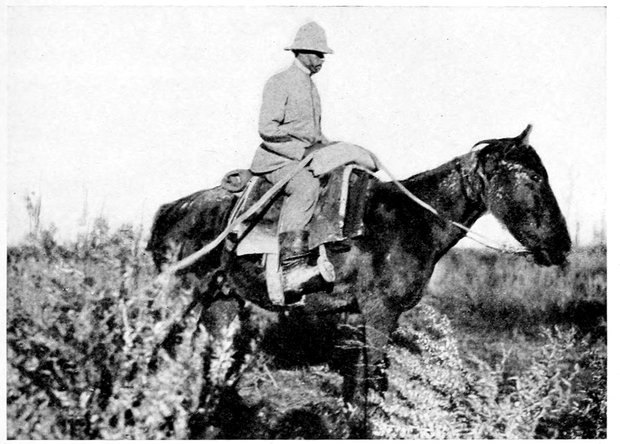
A rural policeman of the Argentine
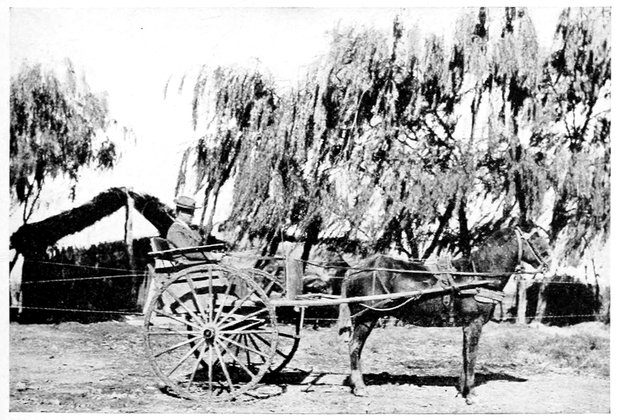
My travels in Patagonia were by rail and in what the Argentino calls a “soolky”.
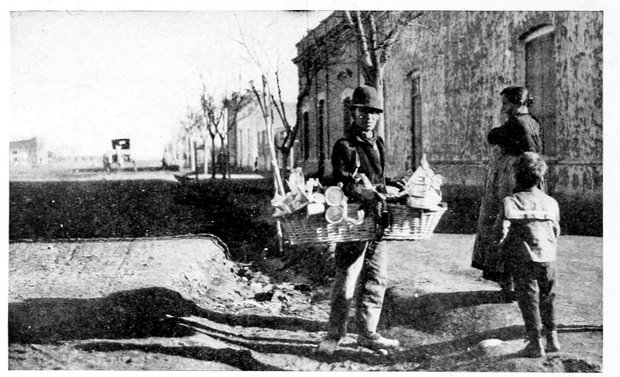
A typical “boliche” town of the Argentine pampa, and some of its inhabitants
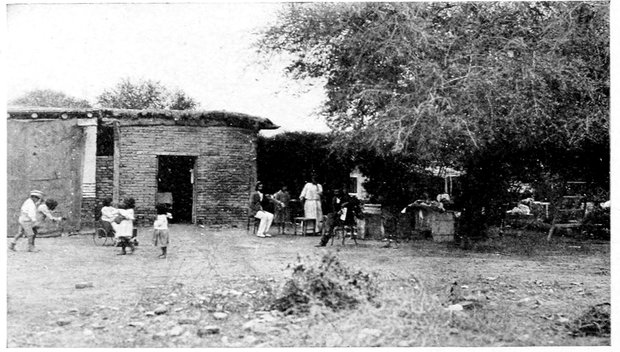
A family of Santiago del Estero
49“We have no middle class in the Argentine,” he explained, “and
we do not want one. We want only absentee landlords—or at least
we have no way of getting rid of them—and laborers, men who actually
work and produce. Agricultural schools would give us a class
too proud of their schooling to work, and at the same time without
property. The distinction between the man who toils and the man
who owns is wide in the Argentine, but it would be no improvement
to fill in the gulf with a lot of haughty, penniless drones.”
My companion had all but given up hope of using his native tongue
directly when there was pointed out to us a farm said to be owned by
a Welshman. But only his lanky daughter of sixteen was at home.
The ex-secretary addressed her eagerly; here at last he would get
first-hand information. The girl shifted from one undeveloped shank
to the other, backed away toward the unpainted frame farmhouse
from which she had emerged, struggling to answer a question in
English, then turning to me, she burst forth, all suggestion of embarrassment
gone, in rapid-fire Spanish:
“You see I was born in the Chubut, and English is only my third
tongue, for Spanish is my native language and father and mother always
speak Welsh at home and I almost never hear English and ...”
My companion bowed his head in resignation and turned our weary
horse back across the island toward the ferry.
The chill of autumn gradually disappeared from the air as the fastest
train in South America dashed in less than five hours, with only one
three-minute stop to change engines, from Buenos Aires to Rosario,
two hundred miles northwest of the federal capital. The rich-green
immensity of the well cultivated fields bordering the River Paraná
were a contrast to the bleak, bare, brown prairies of the south, and
the gang-plow, up-to-date methods of our great West were everywhere
in evidence. In the seat behind me two men were assuring each
other that “the lands of this region are worth ten times those of the interior,”
and it was easy to believe them. The rich black loam soil
that came to light behind the plows is said to produce two crops of
splendid potatoes annually without the use of fertilizer and with no
50change in crops for twenty years. Though the day was warm and
sunny, the cars remained hermetically sealed throughout the journey,
for the argentino is true to type in his dread of a breath of fresh air.
Scarcely a glimpse of the River Paraná did we catch, though we skirted
it all the way to Rosario.
This second city of the republic has been called the Chicago of the
Argentine. It is more nearly the Omaha or Atlanta, not merely in
size but in the material prosperity, and the appearance and point of
view that go with it, which its position as a river port open to large
ocean steamers and as the natural outlet of all the fertile provinces of
northern Argentine has given it. Like Buenos Aires it has almost
no factory chimneys to emphasize its air of activity, which concentrates
in the vicinity of the wharves. A stroll through its busy, citified
streets is worth the exertion, or, better still, a round of its electric
car lines; but one would no more expect to find the picturesque and
the legendary past in Rosario than in Newark. Large and prosperous
as it has grown, it is not the capital of its province, much to the disgust
of its energetic citizens, but is ruled from Santa Fé, a languid
little town of several times the age but scarcely one eighth the population
of the bustling provincial metropolis. There are advantages
in being a capital in the Argentine which we of the north would
hardly suspect.
I slipped on up the Paraná to have a look at this capital which
the Rosarians so universally tongue-lash. A splendidly fertile, softly
rolling, velvety-green country, with dark-red cattle standing in groups
here and there to give contrast, was the chief impression left by a
journey of several hundred kilometers through the province of Santa
Fé. Yet for some reason the city of the same name, though barely
a hundred miles north of Rosario, was humidly hot and swarming
with flies, its atmosphere that of an ambitionless town of the tropics
content to dawdle through life on what the frequent influxes of politicians
bring it. Far across the river, which here spreads out into
an immense lagoon, lay hazy white on a distant knoll the city of
Paraná, capital of the province of Entre Rios, between the rivers
Paraná and Uruguay, which unite at length to form the Plata.
Another floor-flat, fertile plain, with many ranchos and villages,
with “soolkees” jogging along the broad earth roads between wheat
and alfalfa fields and pastures dotted with fat cattle and plump sheep
until the eyes tired of seeing them, marked the trip westward from
Santa Fé. Here, to all appearances, was the best farming land
51imaginable, though one could easily imagine better farming. Crowds
of shaggy yet prosperous-looking countrymen gathered at every station.
The alfalfales were still deep-green, though it was already becoming
late autumn; golden ears of corn of a size that even Kansas
would envy were being husked from the standing stalks and heaped to
overflowing into huge trojes, stack-shaped bins made of split palm-trunks
or other open-work material.
I came at length to one of the oldest and most famous of Argentine
towns, a yellow-white city in a shallow valley, with an almost Oriental
aspect, and backed by hills—and hills alone are noteworthy enough to
bring a city fame in the Argentine. In fact, Córdoba sits in the only
rugged section of the country, except where the Andes begin to climb
out of it to the west. Among these ranges, sometimes called, with
the exaggeration natural to young nations, the “Argentine Switzerland,”
are many summer hotels and colonies, strange as it may seem
to go north for the summer in the south temperate zone.
Córdoba, the geographical center of the Argentine Republic, is centuries
old, with more traditions, more respect for age, than Buenos
Aires, with many reminders of old Spain and of the conservative,
time-marked towns of the Andes. In Córdoba it is easy to imagine
the atmosphere of the federal capital of a century ago. There is still
a considerable “colonial” atmosphere; respect for old customs still
survives; age counts, which is rare in the Argentine, a country like
our own full of youth and confidence in the future, and the corresponding
impatience with the past, with precedent. Peru had already been
conquered and settled when Córdoba was made a halfway station between
the unimportant river-landing called Buenos Aires and the
gold mines of the former Inca Empire, and it was founded by Spanish
nobles of a better class than the adventurers who followed Pizarro
on his bloody expedition. Many of the families of Córdoba boast
themselves descendants of those hidalgos, though to most argentinos
ancestry seems as unimportant, compared with the present, as it does
to the average American. The Córdobans, like the ancient families
of the Andes, look down upon newly won wealth as something infinitely
inferior to shabby gentility, though the latter has been refurbished
of late years by increasing incomes from the neighboring estates.
The Porteño has little sympathy for the Córdoban attitude toward
life. He pokes fun at the conservative old city, calling it the “Mecca”
of the Argentine because of the pilgrims who come at certain seasons
of the year to worship its bejeweled saints; he asserts that its
52ostensibly “high-brow” people “buy books but do not read them.” The
Córdoban retaliates by rating Córdoba, and perhaps Salta, the only
“aristocratic” towns in the Argentine, and has kept the old Spanish
disdain of commerce, which is naturally a disdain of Buenos Aires.
The conservative old families do not, of course, accept newcomers
easily. There is a strong race, as well as class, prejudice. Up to
half a century ago no student was admitted to the university unless
he could show irrefutable proof of “pure” blood, that is, of unbroken
European ancestry. That rule might be in force to this day but
for the strong hand of the federal government. The famous university,
founded in 1605 by the Jesuits, and ranking with that of
Lima as the oldest in America, is outwardly an inconspicuous two-story
building, though there are artistic old paintings and cedar-of-Tucumán
carvings inside that are worth seeing. The students who
attend it are, however, by no means unobtrusive, though they do
not seem to give quite such exclusive attention to the color of their
gloves and the brand of their perfumes as do their prototypes in the
federal capital. It is natural, too, that such a community should retain
an air of piety. Its ancient moss-grown cathedral, likewise of
Jesuit construction, with a far-famed tower, is but one of some
thirty churches in a town of a scant thirty thousand inhabitants.
Priests and monks give it by their number and conspicuousness an
atmosphere quite unlike Buenos Aires, with its scarcely noticeable
low Grecian cathedral, its lack of church towers, and its rare priests.
In Córdoba there are even beggar monks who make regular tours of
the province, reminiscent of medieval Spain. The church and its functionaries
own many fine estancias, for pilgrims have always come in
numbers, and society is pious to the point of fanaticism. If one may
believe the Porteño, the conservatism and fanaticism of Córdoba
would be worse than it is had not the central government sent to the
university a number of German Protestant professors, who have had
some influence on the community, not so much in Germanizing as in
breaking down ancient prejudices.
Among the amusing old customs that remain are some that lend a
touch of the picturesque to offset a certain tendency toward the modern.
Cows are still driven through the streets, attended by their calves,
and are milked before each client’s door; the conservative Córdoban
will have none of this new-fangled notion of having his milk brought
in bottles, in which there may be a percentage of water. Here there
is still the weekly band concert and plaza promenade, with the two
53sexes marching in opposite directions; here the duenna is in her glory
and prospective husbands whisper their assertions through iron-grilled
windows. The gente del pueblo, or rank-and-file citizens, nearly all
with a considerable proportion of that Indian blood almost unknown
in Buenos Aires, live in adobe thatched houses in the outskirts and
have the appearance, as well as repute, of little industry, with the Andean
tendency to work only a few days a week since foreign industry
has raised their wages to a point where frequent vacations are possible.
Cactus and donkeys add a suggestion of Andean aridity in the outskirt
section, over which floats now and then a subtle breath of the
tropics.
Córdoba in its shallow valley, veiled by thick banks of white mist,
was more beautiful on the morning I left than when more plainly
seen. As our train rose above it to the vast level pampa the city disappeared,
but all along the western horizon lay its famous mountains,
a long ridge, saw-like in places, turning indigo blue when the sun went
down on a brilliant day. On the other side of the train still lay the
monotonous, flat, low Argentine pampa, without hedges, ditches, almost
without trees, the roads mere wide spaces reserved for travel.
The law requires that federal roads be fifty meters broad, but in this
land of unlimited space and little stone no law can keep them from
being impassable sloughs in the rainy season and rivers of dust in the
dry. Even here were many enormous estancias, single estates of half
a million acres, which the train took hours to cross, though they are
small compared with some in the frontier country of the south. Here
are estancieros who have the impression that the sun rises and sets
on their property—which is not without its influence on their characters
and especially on those of their children. In the “good old days,”
which were not so long ago in the Argentine, persons with money,
political influence, or a military record could acquire vast tracts of
territory at trifling cost, and up to the present generation these landed
proprietors, among them most of the old families of Córdoba, were
virtually monarchs of all they surveyed. Now the government, once
so prodigal with its land, is beginning to see the error of its ways, and
is forming the habit of talking in terms of square kilometers instead
of square leagues, as well as favoring bona fide settlers, though it
still does not require those who buy public lands at a song to settle
upon and improve them.
Perhaps once each half hour did a more pretentious estancia house,
surrounded by its thin grove of precious eucalyptus, break the monotony
54of flat plain and makeshift ranchos. It is the scarcity of trees
no doubt that makes birds so rare in the Argentine. The two-compartment,
oven-shaped mud nests of the hornero on the crosspieces of
the telegraph poles were almost the only signs of them, except of
course the occasional ñandúes loping away across the pampa. The
more and more open-work reed shacks began to suggest almost perpetual
summer. Then all at once I ceased feeling the increasing heat,
suddenly put down my window, and a moment later was hurrying
into a sweater. For a pampero had blown up from the south, and
seemed bent on penetrating to the marrow of my bones.
When I peered out of my sleeping-car cabin next morning, a considerable
change of landscape met the eye. The “rápido” was crawling
into Santiago del Estero, and I seemed to have been transported overnight
from the rich green fields of the Paraná back to the dreary Andes,
or, more exactly, to the coastlands of Peru or Bolivia. Founded in
the middle of the sixteenth century, on the bank of a river that becomes
salty a little farther on, and forms in the rainy season large
esteros, or brackish backwaters and lagoons, “St. James of the
Swamp” still suffers intensely for lack of water. It is unfortunate
that nature does not divide her rains more evenly in the Argentine.
Farther south only the tops of the fence posts were protruding from
the flood in some places; here the country seemed to be habitually
dying of thirst.
The main line of the “Central Argentine” does not run into Santiago,
but operates a little branch from La Banda (“Across the
River”), because of the treachery of the wide, shifty, sandy stream on
which it lies. To-day the railroad has a great iron bridge some two
miles long, successor to the several less hardy ones, the ruins of
which may be seen just protruding from the sandy bed along the way.
The company asserts that it spends more to keep up its road into
Santiago than it gets back from that city in traffic, but its concession
requires it to maintain contact with what is reputed the most “native”
capital of province still left in the Argentine. Center of what is said
to be the least fertile section of the country, it remains, for a time
at least, to the part-Indian race which the South American calls native,
the ambitionless cholo or mestizo, with his Mohammedan indifference
to the future, his inertia before modern progress. In other words,
Santiago is an example of how immigration is driving the native town
as it is the native individual into the most distant and poorest corners
of the Argentine.
55The town is built of crude bricks or baked mud, the only material
available, and except in the center it is a disintegrated collection of
huts with ugly high fronts and the air of never having reached maturity
in growth, though they have long since in age. It has few
paved streets and no street-cars, though it is overrun by a veritable
plague of those noisy, impudent hackmen who swarm in rural and
provincial Argentine and over whom the police seem to have neither
influence nor authority. A dead-dry, yellow prairie grass spreads
wherever the ground is not frankly sterile; chaparral and other
desert brush grows even within the town. Its thatched ranchos of
reeds, to be found anywhere a few blocks back of the central plaza,
are overrun with goats, pigs, cur dogs, and naked children, like the
most backward towns of the Andes. Here are to be found the choclo,
locro, chicha, and other corn products common to the Andean cuisine,
the same thin sheets of sun-dried beef, the swarming gente del pueblo
so common to Peru and Ecuador, so unknown in Buenos Aires. The
popular speech is again the Quichua of the Incas, Santiago being the
only Argentine town of any size where it has survived, though it is a
Quichua as different from that of Cuzco as the Italian of Florence
is from that of Naples. Most of the children and many of the adults
go barefooted, a rare custom in the Argentine; virtually all citizens
have the incorrigible Latin-American habit of stopping all talk to gaze
open-mouthed at a passing stranger, entire groups of men on the street
corners turning their heads to stare after him until one feels genuine
misgiving lest they permanently dislocate their ostrich necks.
There are reminders, too, of the gypsy section of Granada or Seville,
hints of Luxor or Assuan in Upper Egypt, as well as of the
somnolent towns in the half-tropical valleys of the Andes. The
thatched mud huts are surrounded with cactus hedges on which the
family wash hangs drying; everything is coated with the fine white
dust of the unpaved streets, through which the half-Indian women
wade almost ankle deep, their slattern skirts sweeping it into clouds
behind them. Now and then there passes one of these chola females
leading through the dust-river a donkey bestridden by a girl of the
same race and drawing by two ropes tied to knobs in its ends a rolling
barrel of water, the chocolate-colored river water on which the town
seems chiefly to subsist. A dry, cracked soil under an ardent sun, thin
animals eating greedily at poor tufts of scanty vegetation, cactus used
as field fences as well as inclosing the miserable ranchos, cactus with
twisted trunks that look like enormous snakes about to strike, immense
56cactus candelabras of ten or fifteen branches, a few poor chickens picking
at the sterile soil about the ranchos by day and roosting by night
in the rare scraggly trees, scores of hungry-looking goats browsing on
nothing, yet somehow keeping energy enough to gambol about a scene
usually devoid of any form of unnecessary activity, a few almost
leafless scrub trees on which hang rags of raw meat sun-drying into
charqui, or, as they call it in southeastern South America, tasajo—these
make up the background of almost any picture of Santiago.
Against this stand out in slight relief bronzed cholos loafing in the
shade of the huts, pigs and children disputing the same dreary playgrounds,
men shirtless or in shirt sleeves, with rather lifeless, inexpressive
brown features, women dressed in shapeless thin cotton
gowns of brilliant colors—apple-green, pink, shrieking red—their
rarely washed faces surmounted by masses of coarse, thick, straight
black hair knotted carelessly together at the neck, little girls carrying
naked babies almost as large as themselves, nearly all holding in
one hand the dried-gourd bowl of mate heated over a fagot fire in
the open air, sucking it eagerly yet languidly through the straw-shaped
metal bombilla. A completely naked gamin of five gallops
about astride a stick, his slightly older and no more expensively attired
brother doing the like on a scrubby horse without saddle or
bridle, both scattering the pigs, dogs, and chickens at every turn.
From the hut doors or the midst of such families seated al fresco and
taking their mate from a single bowl that circulates round and round
the group come languid calls of “Ché Maria!” “Ché compadre!”
“Ché Gringa!” “Ché” is the popular nickname of affection or familiarity
in southern South America, corresponding roughly to our
once widespread pseudonym “kid.”
I had the customary santiagueño pleasure of rising at an unearthly
hour to catch the morning train to La Banda, only to find there that
the “mixed” daily from Buenos Aires into the sugar-fields of the far
north was seven hours late. Over the way stood a hotel poetically
named “El Dia de Nosotros,” but that day was evidently past, for the
place was irrevocably closed, and it was only by a streak of luck that
long after my customary breakfast hour I got from an uninviting
street stand a cup of what purported to be black coffee. During the
delay I fell into conversation with two young Austrians who had been
all the way up to Salta in quest of fortune. The best chance for
work they had found was at cutting sugar-cane at terms under which
no one but the most expert could earn more than two pesos a day.
57Much as it resembles our own land in some ways, the Argentine does
not give one the impression of being any such Eldorado for the newcomer
whose stock in trade consists solely of two brawny arms.
The mixto crawled in at last, covered with a thick blanket of fine
dust. At the station of Araoz, on the boundary line between the
provinces of Santiago and Tucumán, the sterile, bushy country suddenly
gave way to sugar-cane, vast fields, veritable prairies of cane,
not the little patches of light-green that dot and decorate many an
Andean landscape, but prosaic, heavily productive stretches as unromantic
as Iowa cornfields, spreading as far as the eye could see in any
direction. Cutting had begun, for it was late April, and all the way
to Tucumán the dull, sullen rumble of the massive rollers was as
incessant as the pungent smell of molasses in the air, while everywhere
great brick stacks rose from the flat green landscape, belching forth
their heavy clouds of smoke on the hazy, humid atmosphere.
Tucumán, my farthest north in the Argentine, in a latitude similar
to that of southern Florida, was once under the Inca, though the
casual observer would scarcely suspect of any such past this bustling
modern Argentine town and capital of the smallest yet most prosperous
province of the republic. It is a town that lives, breathes, and dreams
sugar, accepting proudly the national nickname of the “City of
Sugar.” A checkerboard place, some of its wide streets paved with
wooden blocks, its houses of the old Spanish one-story style, yet often
seventy or eighty meters deep, with two flowery patios hidden away
behind the bare, though gaily smeared, façades, it has mildly the
“feel” of the tropics intermingled with its considerable modern activity.
Electric tramways and lights are very much in evidence, yet
horsemen resembling those of the Andean wilds may be seen riding
along under the trolley wires. In the central Plaza de la Independencia
are orange-trees laden with ripe fruit, pepper-trees, palms,
and cactus, not to mention a highly unsuccessful marble statue of
Liberty, holding in her hands the links of her broken chains as if
they were considerably too hot for comfort. About this never-failing
civic focus are the government buildings, the cathedral, the bishop’s
palace, and several pretentious clubs, though the entire circuit brings
to view no architecture of interest. In one of several other squares there
is a statue of Belgrano, who defeated the Spaniards in this vicinity
in 1812 with the aid of “Our Lady of Mercies,” whom the general
rewarded by appointing her a generalísimo of his armies. Near the
central plaza, surrounded with an almost religious atmosphere, is Independence
58Hall, in which was signed what amounts to Argentine’s
Declaration of Independence. It is a little adobe structure, long and
low, like many of the poor men’s ranchos scattered about the pampas,
carefully whitewashed, with a restored wooden roof and other improvements
to make it look new and unnatural, after the approved
Latin-American style of disguising what it is feared may be taken for
the commonplace. All this is covered by a large modern concrete
building in charge of a chinita, who is theoretically always on hand
to admit visitors who desire to see the two good bronze reliefs, the
medals, the portraits of the signers of the declaration, to sit down in
the century-old presidential chair long enough for a snapshot, and to
add their autographs to the register locked away in the former presidential
desk, in approved tourist fashion. From Tucumán one can
make out the dim blue outline of the lower Andes to the west, and in
clear sunny weather the snow peaks of Bolivia stand out distinctly
to the north. Indeed, it is within the district embracing Tucumán
and Santiago del Estero that Argentine life begins to shade imperceptibly
into the Bolivian or Andean.
Virtually the entire province of Tucumán is covered with sugar-cane
and orange groves. The rivalry between these two products has
been acute for decades, now one, now the other usurping the center
of the stage. Toward the end of the last century the northern part of
the republic “went sugar crazy” and burned whole forests of orange-trees
in order to plant cane. The result was a year of overproduction,
the only period in which the Argentine exported sugar, though she
should easily be able to supply half South America. On the contrary
she habitually imports sugar, her own in many cases, for the crude
sugar shipped to Europe is often the very sugar which was served in
tissue-wrapped lumps in nearly every restaurant and lechería of
Buenos Aires long before that sanitary provision was thought of in
the United States. But then, so does the Argentine import garlic, and
onions, peppers, garbanzos (the Spanish chickpeas of which she is
still so fond), cheese, and millions of “fresh” eggs, not only from
Uruguay across the river but from Spain and Portugal across the sea,
though all these commodities might easily be produced at home.
Sugar pays what we would consider a heavy internal duty, which is
reputed to be one of the causes why there are so few national refineries.
In her one year of overproduction Tucumán province gave
the country nearly twice the sugar it could consume. The terrified
planters banded together to build up the export trade, got a bounty
59from the federal government, which was later forbidden by the Brussels
convention, and forced the provincial government to pass a law
limiting sugar plantations. In carrying this out the tucumanos, who
had burned forests of orange-trees a few years before to plant cane,
now burned square leagues of cane-fields that were producing too
generously. The government indemnified the men who fired their
fields and furnished them free seeds of corn, wheat, and barley with
which to replant them. But in time the pendulum swung back again
and to-day the province has little interest in anything but sugar.
Tucumán retains none of the primitive methods by which cane is
turned into brown lumps of panela or chancaca on the little plantations
scattered through the Andes. Some sixty immense engenios grind incessantly
during the rather short but exceedingly busy season. The
capacity of many of these mills is large, though they work less than
those of Cuba. These, and the often enormous estates about them,
are in most cases owned by English or other foreign firms, the American
being most conspicuous by his absence. Not only are we unrepresented
in ownership but in the machinery used, which is with
rare exceptions British, French, Belgian, and German, for the argentino
seems to have an instinct which draws him toward Europe
and causes him to avoid all unnecessary contact with what he calls
the “North American.” It is not that he fears the “Collosus of
the North,” like so many of the smaller, bad-boy republics nearer the
Gulf of Mexico, rather is he firmly convinced that his country is as
powerful and self-sufficient as our own, but he is inclined by temperament
and custom to turn his eyes eastward rather than northward.
In this busy season of the Argentine autumn and winter Tucumán
province is a hive of activity. Thousands of workmen of many races
are scattered among the horseman-high plants which stretch to the
horizon in every direction, slashing off the canes at the ground, clearing
them of leaves and useless top with a few quick swings of the
machete, and tossing them with graceful easy gesture upon piles often
several meters away. Along the wide and soft dirt roads which cut
into squares the dense jungles of cane, there is a constant stream of
cumbersome two-wheeled carts, usually drawn by five mules, the
meztizo driver in his ragged garments and soiled, broad-brimmed hat
astride the off hind animal, as they strain toward the points of concentration.
There the load is weighed and lifted in a single bundle
by huge cranes which are the only American contribution to the average
60estate, and dropped into the cars of the private railroads that crisscross
all the province, or directly into the carriers that feed the three
sets of mammoth inexorable rollers. The bagasa left over from the
crushing is burned at once in the mill engines, along with the wood
brought in from constantly increasing distances; the mosta, or saccharine
residue so poor and dirty that it will not produce even the
lowest of the three grades of unrefined sugar, is turned into alcohol.
Every important factory has a village clustered about it, a community
complete from bakers to priest. Field workers have an unalienable
right to the two finest canes they cut or load during the day, and at
dusk long broken lines of them may be seen returning from the fields
carrying their poles over one shoulder, like homeward bound fishermen,
or seated on the ground, machete in hand, peeling the cane and
cutting it into sections, to thrust these in their mouths, crush and
suck them, and spit them out upon the earth about them.
No traveler with a bit of time to spare should leave the Argentine
without visiting her chief “holy place,” presided over by La Virgen
de Luján. If we are to believe all we are told, it is this patron saint
who has made the Argentine the prosperous, happy land it is to-day.
To her groups of pious women, headed by the archbishop, made pilgrimage
from Buenos Aires when the bill of the new socialist deputies
threatened to become a divorce law; to her the country turns when
it gets too much, or too little, rain; here the Irish-Argentinos gather
en masse on St. Patrick’s day.
Genuine pilgrims are expected to fast on the day they visit Luján.
We—for a friend made the journey with me—came nearly carrying
out this requirement in spite of ourselves, having missed the train we
planned to take and unwisely set out on foot without waiting for the
next. For once outside the city limits, it is a long way from Buenos
Aires to the next shop or restaurant. Luján is something more than
forty miles west of the capital, the usual “boliche” town of the pampas
and a slough of mud in this autumn season, the unfinished dull-red
brick “basilica” bulking high above it and visible many miles away.
The legend, which still finds a surprisingly large number of believers
in the Argentine, runs that in the time of the Spanish dominion a community
of Spanish monks set out with great ceremony to transport
a statue of the Virgin from Buenos Aires to Peru. Arrived at the hamlet
of Luján, the cart in which it was being carried stopped. Nothing
could induce it to move on. No doubt it was the rainy season and
there was excellent reason for its immovability, but the good monks
61concluded that the Virgin was expressing a desire to remain where
she was, and her wishes were respected. A small chapel was erected
and her cult perpetuated. When immigration increased and swarms
of devout Italians, not to mention the Spanish and Irish, began to
settle in the vicinity and make frequent pilgrimages to the shrine, the
bishop in charge took it as an indication that the powers of a better
world wished the Virgin to be housed in a building befitting her increasing
popularity. He undertook the erection, from popular subscriptions,
of a “Gothic cathedral” which should be the most imposing
in the Argentine, though this, to be sure, is not saying much. It was
planned to spend six million pesos, half of which are already gone,
and as soon as the walls had been raised the bishop insisted on opening
the building, which perhaps is why there is so little suggestion of
Gothic about the bare brick, towerless, façade-less, on the whole dismal
structure.
Though we might be willing to fast, when there was no choice in
the matter, not all the patron saints on the globe could have forced us
to wallow through the mile or more of black mud between the station
and the “basilica.” For that matter, we noted that even the pious pilgrims
who had arrived with us in their gleaming patent-leather shoes
climbed unhesitatingly into the comfortable, if tiny, horsecar, and that
not one of them gave a suggestion of dropping off to finish the journey
on his knees, or even on foot. We were no less astounded, if secretly
more pleased, to find that one of the rascals keeping the restaurants
tucked away among the many santerías, shops in which are sold tin
“saints” which los fieles may carry home to perform their cures by
hand, was willing to jeopardize our future salvation by providing us,
before we had consummated the object of every visit to Luján, with
as much of a repast as one learns to hope for in an Argentine “boliche”
town.
Inside the unfinished but already richly decorated “basilica” the
curved-stone back of the altar and the stairway rising above it was
already carved with the names of those who credited the Virgin with
curing them of incurable ailments. There were other less conspicuous
places for similar testimonials from those with less mesmerism over
the root of evil. About the altar were gathered groups of pilgrims
engaged in the preliminary formalities of the faithful who come seeking
aid. Peasants still wearing the garb of Lombardy or Piedmont,
and no doubt come to ask the Virgin for a little less rain and a better
price for their corn, that they might buy the coveted piece of land
62next their own or send more money to the old people they had left behind
in Italy, mingled with richly garbed Porteñas who were praying
perhaps for motherhood or the welfare of a lover.
“But where is the statue?” asked my impious companion of a young
priest who was marching back and forth committing to memory some
password to heaven.
“Why—er,” gasped the startled ecclesiastic, “do you mean the
Blessed Virgin?”
“Yes,” returned my companion, carelessly.
“Follow those broad curving stairs and you will find our Blessed
Lady of Luján in that little room above the altar,” replied the horrified
youth, crossing himself fervently.
Above we found a single worshipper, a working woman dressed in
the most nearly whole and spotless gown she possessed, kneeling on
the marble floor, to which she bowed her forehead now and then, her
eyes fixed on a doll some two feet high overdressed in heavy gilded
robes and covered with bracelets, necklaces and girdles of false pearls
and diamonds—for the real ones, worth a king’s ransom, are deposited
in a safety vault in Buenos Aires and are used only on the anniversary
of the Virgin’s halt in Luján. Back of the woman her son of five was
climbing high up the iron grill surrounding the chapel, in his own particular
effort to reach heaven. I lifted him down before he broke
his neck, whereupon he sidled over to the lunch-basket the pair had
brought with them and, keeping a weather eye on his devout parent,
stealthily drew out a quart bottle of wine wrapped in a newspaper.
Setting his teeth in the protruding cork, he tugged at it for some
time, like a puppy at a root, drew it at last, and with an eye still on his
mother, deep in her communing with the Virgin, gulped down nearly
half a liter, re-corked the bottle, and slipped it back into its place.
On the way down we halted to speak with a well-dressed warden,
who assured us that he had personally known of “thousands of supernatural
cures” performed by the Virgin of Luján.
“Why,” he cried, growing more specific, “I have known many rich
ladies to come out here from Buenos Aires on crutches, make a
promise to our Blessed Virgin and go back home and—and by and by
they would send out the crutches as proof of being cured, and perhaps
a diamond necklace to show their gratitude to Our Lady. There is
no ailment that Our Lady cannot cure.”
“Curious,” I mused, “but as I came in I noticed just outside the
63gates four beggars,—a blind woman, a one-legged man, a man without
legs, and a paralytic.”
“Ah, esa gente! That class of people!” cried the warden, with
a world of disgust in his voice and a deprecatory shrug of the
shoulders.
CHAPTER IV OVER THE ANDES TO CHILE
64
It was with keen regret that I cut myself off from Uncle Sam’s
modest bounty when the time came to set out on a journey that
was to carry me outside the Argentine and beyond the jurisdiction
of our overworked consulate. But with a handful of gold sovereigns
to show for my exertions in running errands and eluding Porteño
prices, the day seemed at hand for continuing my intensive tour of
South America. The “International,” of the “Buenos Aires al Pacífico”
leaves the capital three times a week on what purports to be a trip
clear across the continent. In spirit its assertion is truthful, for though
the “International” itself halts where the Argentine begins to tilt up
into the Andes, other trains connect with it and one can, with good
luck and ample wealth, reach Santiago de Chile, or Valparaiso on the
Pacific, thirty-six hours after bidding the Porteños farewell.
On a crisp May morning I set out westward from “B.A.,” lying
featureless and yellow-white in the brilliant early-winter sunshine, not
a church spire, scarcely a factory chimney, though many unsightly
American windmills, rising above its monotonous level. The heavy
“limited” train made scarcely half a dozen stops all day, though no
extraordinary speed. At the rare stations a few passengers hastened
to enter or leave the cars; between them trees and windmills rose or
receded hull-down over the horizon of the dreary pampas. Outside
each uninspiring town was an ostentatious city of the dead; in the
sodden fields were flocks of sheep, cattle, and horses, fat as barrels,
some snorting away at sight of the train, others gazing disdainfully
after it. In many places the pampa was flooded, sometimes for miles,
the shallow temporary lakes dotted with wild ducks, the roads mere
rivers of mud, with only the tops of the fence-posts out of water, in
which dismal looking animals were huddled up to their bellies, or
crowded together on little muddy islands. Many mud houses were
half under water, their thatched roofs and adobe walls turned into
velvety green lawns; hay-stacks had grown verdant with sprouting
grass; several pairs of horses dragging along the churned roads a load
of baled alfalfa was one of the rare signs of activity. Even the
ñandúes seemed to have fled to some modern Ararat.
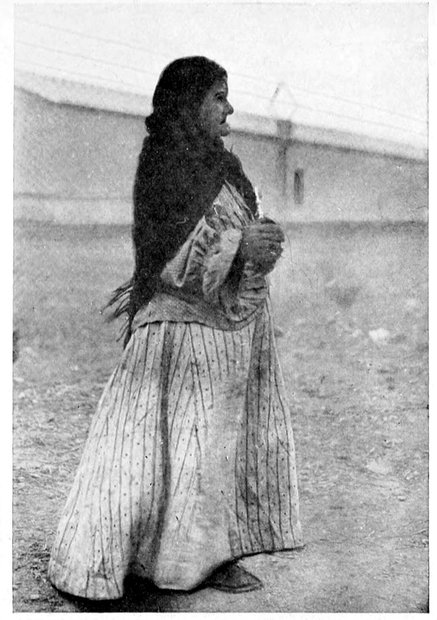
A woman of Córdoba, mate bowl in hand
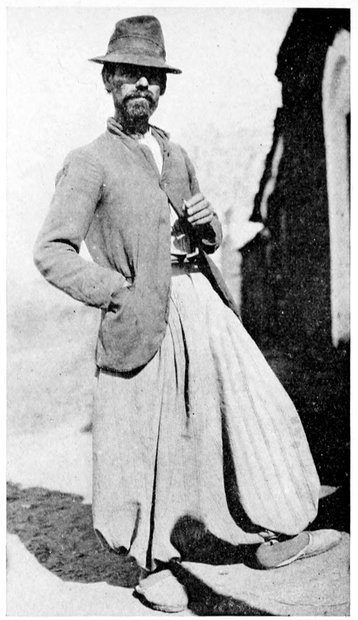
Even a lady would not look unladylike in the bombachas of southeastern South America
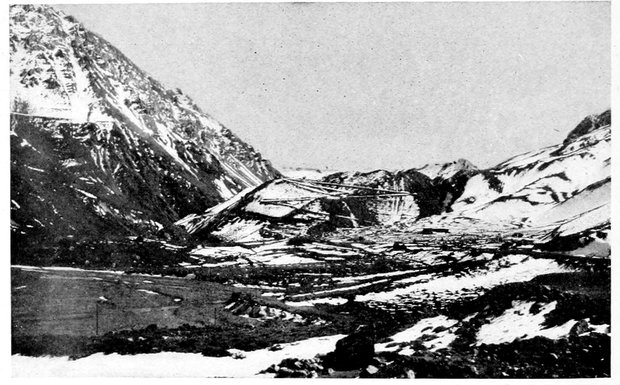
The highway over the Andes into Chile was filled with snow
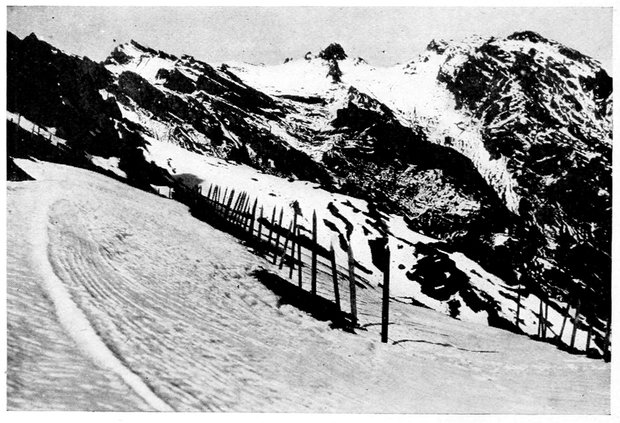
A bit of the transandean highway in the wintry month of May
65Farther west the country was somewhat drier, or at least more
often above water. Here the vast pampa was divided by wire fences,
producing the illusion of an immense cobweb, broken only rarely
by a dense blue grove of eucalyptus trees planted about the central
house of an enormous estancia, estates in most cases too large for
the economic health of the country. Up to recent years the great mistake
of the Argentine government was to grant mammoth tracts of
land to men who quickly became so wealthy that they moved to private
palaces in the capital, leaving little or nothing for the homesteads
of what might be a host of productive freehold farmers. The railway
company is striving to get these huge estates broken up, encouraging
colonization by offering prizes for the best crops along its lines,
as well as special inducements of transportation. For much of the
region through which the “Buenos Aires al Pacífico” runs is so thinly
populated that, as in some of our western states, the common carrier
is forced to help produce something to carry. But the big landed proprietors
have a Spanish pride in the size of their holdings, and with
it an abhorrence not only of manual labor but even of living on
their estates, from which the income is large enough for their comfort
under the poorest systems of farming, or mere grazing, and it is
not easy to induce them to sell even those portions lying wholly idle.
The company has various ways of combatting this attitude. The
most common is to build stations only where wealthy estancieros donate
not merely the land needed for immediate use, but room for
future railroad development and sometimes for the building of a village
and the beginning of more intensive agriculture about it.
A few of these have developed into true frontier towns, with enormously
wide mud streets and electric lights, stretching far out into
the country, as if the inhabitants expected to wake up any morning
and find the place trebled in population. They were like a country
without a history,—prosperous, contented—and uninteresting. There
being almost no stone or wood all the way from the Córdoba hills to
Tierra del Fuego, it was not strange that the majority even of town
houses were made of the only material at hand, mud, as the Esquimaux
build of snow and ice; yet the most dismal of these structures were
by no means the comfortless dens of the Indians and cholos of the
Andes. It was Sunday, and especially on that day is it the custom
in the smaller provincial towns to hacer el corso, to parade back and
66forth, at the station at train-time. Groups of comely girls, well dressed
for such districts, powdered and perfumed, with flowers in their
hair, their arms interlocked, were not content to display their charms
to their rustic fellow-townsmen outside the station barriers, but invaded
the platforms and strolled from end to end of the train as long
as it remained. As attractive members of the fair sex are never without
their attendant groups of admirers in South America, the latter
increased the platform throng to a point where it was a lucky traveler
who could find room to descend and make his way across it.
For long distances there were almost no signs of animate life except
occasional flocks of ñandúes cantering away like awkward schoolgirls.
About every boliche, country store and liquor shop, were groups
of shaggy pampa ponies and their no less shaggy riders, the animals
prevented from deserting their owners by rawhide thongs binding
their front feet together. Bombachas, the bloomer-like nether garments
of the pampas, were much in evidence among these modern
gauchos. A few of these, no doubt, were independent farmers; the
majority were plainly hired men whose greatest likeness to the hardy
part-Indian cowboys of a generation ago is the ability to absorb some
five pounds of meat a day, washing it down with copious draughts of
boiling mate. Vegetables are as little grown in the Argentine as in
most of South America, and the employees, only the mayordomos
and the pen-driving class missing, who gather daily about the asado
provided by the estanciero, still live almost entirely on meat, with occasionally
a few hardtack galletas from these pampa stores. Boys of
seven or eight, with true gaucho blood in their veins, who sat their
horses as if they were part of them, galloped about some of these
smaller towns, boleando cats and dogs with astonishing skill. At the
more important crossings an old man or woman, sometimes a little
girl, stood waving as solemnly as if the whole future of the railroad
depended upon them the black-and-yellow flag that means “all safe”
to Argentine trainmen. Country policemen were almost numerous,
riding along the miserable roads or dismounted at the stations, covered
with dust or mud and mingling with the hardy, independent countrymen.
The rural Argentine police still have a far from enviable reputation,
though they no longer tyrannize over the new style of argentino
as they once did over the bold but unsophisticated gaucho of the “Martín
Fierro” type. Yet on the whole they were not a body of men to
inspire confidence. One felt at a glance that, far from trusting to
their protection, it would be better to have someone else along in the
67more lonely sections of the country to protect one from the police.
Mendoza, metropolis of western Argentine and capital of the province
of the same name, lies at the very base of the Andes, six hundred
miles inland from Buenos Aires and barely one fourth as far from
the Pacific, though with the mighty Andean wall intervening. Built
on plentiful flat ground in what is sometimes called the “Argentine
California,” the city is laid out in wide checkerboard streets, some
of them shaded by rows of magnificent trees of abundant foliage.
Each street is bordered with ditches made of mosaics of small cobbles,
for the torrents that pour down from the Andes at certain seasons
are worthy of man’s attention, and though the town is not tropical,
banana, acacia, and mulberry trees bathe their feet in these intermittent
streams and take on an extraordinary vigor. The central section has
a number of modern business buildings, but the dwellings are nearly
all still in the old Spanish style, often large houses, but capacious
chiefly in depth, so that one only half suspects the several flowery
patios they inclose. Few buildings are of more than one story, and
even the stylish habitations, with columned façades and corredores
paved with colored marble dalles, are made of mud baked with straw
and lime. For Mendoza still remembers the days, sixty years ago,
when an earthquake destroyed the entire town, burying nearly the
whole population of ten thousand in the ruins. Nothing remains now
of the old town except the ruins of a church or two that are preserved
as historical souvenirs and warnings against high buildings, mere
masses of bricks standing like monoliths on the summits of walls that
seem ever ready to fall down and on which a bush or a plant has
here and there taken root; yet the mendocinos are only beginning to
put their faith in reinforced concrete. Many of the houses are smeared
pink, saffron, blue, or other bright color, and when it rains the mud
roofs run down over the façades, streaking the colors or washing
them out to a leprous gray.
Being almost entirely a one-story town, and retaining the Moorish
style of architecture, even the hotels of Mendoza have no windows
on the streets, the only openings to the rooms being the door on the
patio, so that the guest who needs a bit of light must disclose to servants
and fellow-clients all his domestic activities; and to reach the
bathroom, if there is one, means parading the entire length of the
courtyard. Sidewalk cafés are thronged even on “winter” evenings;
as elsewhere in the Argentine, every workingman’s restaurant has its
cancha de bochas, a kind of earth-floored bowling-alley native to rural
68Italy. There are electric street-cars, and the electric lights, outdoors
and in, outdo our own in size and brilliancy. While the English own
the important Argentine railroads, Germans hold most of the concessions
for electric light and power in the provincial towns, and Mendoza
is no exception to this rule.
The modern argentino is not only a transplanted European, but in
most cases has come over within the past century. Only Caucasian immigration
is welcome, no negroes and none of the yellow races being
admitted. As in Buenos Aires, there is in the capital of each province
an immigration bureau, with attendants speaking the principal tongues
of Europe, which strives to place the newcomer to his and the country’s
advantage. Thus there is a decidedly European atmosphere even
in towns as far back in the depths of America as Mendoza, one that
all but obliterates the purely American aspect. The city retains a
suggestion of Spanish colonial days, but the native bombachas are no
more familiar sights than the Basque cap of the Pyrenees and the
hemp-sole sandals, the short blouse with wide sash of contrasting
color, and the clean-shaven features of the hardy Spanish peasant and
arriero.
Like several of the more important cities far distant from the federal
capital, Mendoza enjoys a certain local autonomy, though the
prevailing political party in the Argentine advocates a strongly centralized
government more nearly like that of France than that in the
United States. The province prints its own small money, legal tender
only within its limits, for the national currency not only becomes
scarcer but more and more ragged and illegible in ratio to the distance
from Buenos Aires. A not entirely unjustified fear of revolution,
too, causes the province to maintain a large police force, for the Argentine
has nothing like our National Guard. It is easy for the federal
government, often looking for just such a chance, to intervene
at the first suggestion of trouble in a province, and as such intervention
means a suspended governor, a legislature forced out of office, and
the loss of nearly all political patronage, the provincial authorities find
it to their advantage to have a dependable police force. Persistent
rumor has it that the police of Mendoza, however, are far from perfect,
that they lose few opportunities to force bribes from, and otherwise
tyrannize over, the population. Many fines may legally be imposed
and collected directly by the police, and the story runs that it is
particularly unfortunate to attract their attention toward the end of
the month. They are then apt to be penniless, and are given to wandering
69the streets after dark, seeking whom they may run in and threaten
to lock up if he does not at once pay the “fine” then and there levied
by the police. If the victim asks for a receipt, rumor adds, he is instantly
clapped into jail, or rather, is sent to stand all night or sit down
in mud in the prison yard. Even important citizens of Mendoza
hesitate to go out alone after dark at the end of the month.
I spent May twenty-fifth, the Argentine Independence Day, in Mendoza.
An official salute woke the town at sunrise, to find itself already
fluttering with flags, the blue-and-white Argentine banner predominating,
but with many others, the yellow-and-red of Spain in particular—and
one lone Stars and Stripes, in front of a sewing-machine
agency. The uninformed stranger might have suspected that there is
more patriotism to the square yard in the Argentine than in any other
land. Had he inquired a bit, however, he would have learned that the
law requires all inhabitants—not merely citizens, be it noted—to fly the
national flag on May 25 and July 9, as it requires all men to uncover
when the national anthem is played, and all school children to learn
by rote certain chauvinistic platitudes. Nor should the fact be overlooked
that the “Veinticinco de Mayo”—for which Argentine towns,
streets, shops, cafés, and even dogs are named—is perilously near
the end of the month.
In the morning everyone went to church, from white-haired generals
lop-shouldered with the weight of the gleaming hardware across
their chests to newly-rich Spaniards who still wore shoes with less
ease than they would have cloth alpargatas. Scores of police, dozens
of firemen, still wearing their hats or helmets, as is the custom throughout
South America, lined the aisles from entrance to altar. When
all the élite and high government officials had gathered, the archbishop
himself preached a sermon founded on the not wholly unique assertion
that politicians seek government places for their own good rather
than for that of the governed, ending with the warning that the
Argentine was sliding pellmell to perdition because the teaching of the
Catholic religion is not permitted in the public schools. The governor
of the province lent an attentive ear throughout this harangue, and
watched the service with attentive Latin-American politeness; but it
was noticeable that he did not show enthusiasm, and that no ceremony
was included that required kneeling or crossing oneself on the
part of the congregation, for Argentine government officials are often
noted for their anticlerical attitude. There was an entirely different
70atmosphere here than at the Te Deum I had attended on Colombia’s
Independence Day two years before in cloistered Bogotá.
The municipal band met us outside the cathedral and led the parade
of police and firemen—marching like men long accustomed to drilling—of
citizens and ecclesiastics, the archbishop, still in his purple, surrounded
by a guard of honor with drawn bayonets. The procession
broke up at the entrance to the Parque del Oeste, said to be the largest
city park in South America. Miniature trains, astride which human
beings look gigantic, carried those who did not care to walk, or hire
other transportation, out to this extensive civic improvement, spreading
over all the landscape at the base of the Andes to the west of the
city. The crowning feature of this enormous new park, with an artificial
lake nearly a mile long, concrete grandstands, and broad shaded
avenues, is a solid rock rising from the plain on which the city is
built, the first outpost of the Andes that bulk into the heavens close
behind it. The entire top of this hill, reached by a roadway cut in a
complete circuit of it, has been blasted off, and on this great platform
has been reared a gigantic creation of granite and bronze called “The
Armies of the Andes.” It commemorates the passage of the Andes
by San Martín’s troops early in the last century to free Chile from
Spanish rule, one of the most heroic expeditions in American history,—a
badly equipped, half starved force struggling through snow-blocked
passes on what seemed then an almost quixotic mission. Yet the conception
and execution of the monument, magnificent in proportions,
rarely surpassed in dignity, is worthy of its subject. Behind and above
the splendid equestrian statue of San Martín are his officers and the
army of liberation, ranging all the way from low relief to detached
figures, the whole surmounted by an enormous winged victory, while
around the monument hover huge bronze condors. All this, be it noted,
was planned and carried out by a provincial town of fifty thousand
inhabitants. Of the view to be had from it, on one side the plains of
the Argentine, flat as a motionless sea, on the other this same plain,
bursting suddenly into mountains, which climb in more and more
jagged formation to the snow-clad summits of the Andes almost sheer
overhead, mere words are but weak symbols to describe.
Meanwhile the excellent municipal band had been playing all the
afternoon in a kiosk nearer the park entrance. Soon after noonday
we low-caste promenaders on foot had begun to gather about it; then
a few poor public vehicles took to ambling around it; better and better
carriages appeared, with coachmen in high hats and livery; finally
71private automobiles, large and gleamingly new, joined the now crowded
cortège. Pedestrians had become too many for free movement; the
carriages and automobiles circled in unbroken procession farther and
farther out on the horseshoe-shaped drive, until each heard only occasional
snatches of the music as they passed near it. A few silk-clad
ladies and their perfumed escorts deigned to descend and stroll a bit.
Policemen on magnificent horses, white plumes waving from their
helmets, directed the traffic with princely gestures. By dusk all Mendoza
was there, every class of society from the proud hidalgo descendent
of the conquistadores to the millionaire Spaniard who came
out forty years ago with his worldly possessions in a cardboard suitcase,
and who now took care to avoid the old Spanish match-seller who
was his boon companion on that memorable voyage. Vendors, hawkers
and fakers, announcing their wares as loudly as they dared without
arousing the wrath of the haughty army officer, master of ceremonies,
who would presently vent his spleen upon those who failed to snatch
off their hats at the first note of the national anthem, mingled with
honest European workmen in boínas and alpargatas and sun-faded
shirts, enjoying a rare day of recreation in the life-time of toil which
they naïvely consider their natural lot. Though wine flows as freely
in Mendoza as in Italy, not a suggestion of drunkenness did I see
during the day.
As evening advanced, the crowd became more and more silk-hatted in
looks and temperament, a better bred, less provincial, more cosmopolitan,
yet also more blasé throng than similar gatherings over the Andes.
The bony, ungraceful women numerous in northern countries were
rare, the plump type not only of Mendoza but of all the Argentine
most in evidence being physically attractive in spite of overdress and
enameled faces. Soon after full darkness had fallen some of the most
regal equipages fell out of the procession by failing to turn the outside
corner of the drive, and wended their way homeward. The better
class of hired vehicles gradually followed their example; the public
hacks, whose occupants were having perhaps their one spree of the
year, at last got tardy, regretful orders to turn townward, until the
place was left again to the foot-going classes, many of the hawkers,
fakers and vendors still wandering among them, emitting rather helpless
yelps in a last effort to be rid of what remained of their wares.
There came a hurried last number by the band, cut unseemly short
as the players dropped out and fell to stuffing their instruments into
their covers, and behind the hurrying musicians the last stragglers
72took up the march to town. Not a firecracker had exploded all day;
no fireworks enlivened the evening, though the grounds of the chief
plaza and several smaller parks were gaudy with colored electric lights
set out in the form of flower-plots, and similar lights outlined the
municipal theater into which all those who had attended services in
the morning, with the exception of the ecclesiastics, crowded to hear
“Rigoletto” sung by fresh young Italian voices with more power than
polish.
The “Buenos Aires al Pacífico” has several lines in and about Mendoza
province, with frequent trains out through the vineyard districts.
One train travels an S-shaped route and comes back to the station from
which it starts without covering any of the ground twice, then makes
the same trip in the opposite direction. When I rose at dawn, the
Andes stood out against the sky as if they had been cut out of cardboard;
by the time I had reached the station long banks of steel-gray
clouds were rising like a steam curtain under the rays of the red sun,
until the range was all but hidden from view. My journey through
the vineyards uncovered great peaks capped with snow and glaciers
that seemed to touch the sky, and everywhere were grapevines, stretching
away in endless rows, between some of which oxen were plowing
and men hoeing, vineyards limited only by the horizon or the Cordilleras
in the background. As there is little natural campo on which to
fatten herds in Mendoza province and insufficient rainfall to make
wheatfields productive, grapes were introduced here half a century ago
by Spaniards who brought them over from Chile. The torrents pouring
down from mighty Aconcagua were caught and put to work, and
wherever there is irrigation grapes grow abundantly in what was a
bushy Arizona when the first settlers came, until to-day the province
does indeed resemble California. For a long time Mendoza furnished
the Argentine all its wine. Then Europe began sending it over at
prices that competed, the vineyards spread into neighboring provinces
along the base of the Andes, and Mendoza lost its monopoly. When
the railroad came, it brought French, Spanish, and Italian peasants
who knew grapes as they knew their own families, and the Argentine
became the greatest wine-producing country in all the world outside
western Europe. Now there is a little corn, alfalfa, and grain, though
all these are insignificant compared to the principal product. Spaniards
I met along the way asserted that corn or wheat paid better now than
grapes, so low in price as to be scarcely worth picking, and that
73olives would do best of all, if only the growers would bring in experienced
workmen and give the trees proper care.
I left Mendoza on a crisp May morning, and the autumn leaves I
had not seen for years were falling so abundantly that a line from
“Cyrano de Bergerac” kept running through my head, “Regardez les
feuilles, comme elles tombent.” Here they lay drifted under the rows
of slender yellowed poplars which stretched away through the vineyards,
endless brown vineyards everywhere covered with the dead
leaves of autumn standing in straight rows as erect as the files of an
army and backed far off by the dawn-blue Andes, their white heads
gradually peering forth far above as the day grew. Between the
rows glided Oriental looking people, lightly touching them on either
side, bent on unknown errands, for the fruit was nowhere being
gathered. Unpicked grapes, shriveled to the appearance of raisins,
covered even the roofs and bowers and patios of the flat adobe houses.
Here and there a weeping willow or an alfalfal showing the advantages
of irrigation gave a contrasting splotch of deep green to the velvety-brown
immensity. Before his majestic entrance the god of the
Incas gilded to flaming gold a fantastic white cloud high up above his
eastern portal, then lighted up the files of yellowing poplars, then
brought out the golden-brown of the vast vineyards, gave a delicate
pink shade to the range of snow-clads away to the west, and at last
burst forth from the realms of night in a fiery glory that quickly flooded
all the landscape.
I am not sure that I have ever seen nature so nearly outdo herself
as in this dawn and sunrise across the vineyards of Mendoza, while
we crept upward from the Argentine toward the Cordilleras. No
other hour of the day, certainly, could have equaled this, and it made
up amply for the discomfort of being routed out of our comfortable
cabins on the “International” before daybreak, to wash in icy water
and stumble about in the starlight until we were thoroughly chilled,
before we had been permitted to board the little narrow-gauge transandino
train, so tiny in contrast to the roomy express that had carried
us across the pampas that one seemed crowded into unseemly
intimacy with one’s fellow-travelers. Across the aisle sat a priest
with an open church-book, mumbling his devotions and crossing himself
at frequent intervals, but never once raising his head to glance
out the window. No doubt when he gets to Heaven he will falsely
report that the earth has no landscapes to vie with those of the celestial
realms. Over me swept a desire to get off and walk, to stride up over
74the steep trails and feel the exhilarating mountain air cut deep down
into my lungs, sweeping through every limb like a narcotic, and to take
in all the magnificent scene bit by bit, instead of being snatched along,
however slowly, without respect either for nature or my own inclinations.
The day turned out brilliant and cloudless; in full sunshine the scene
lost some of its delicate beauty of coloring, though still retaining its
grandiose majesty. The vast pampa sank gradually below us as we
turned away toward the mountains, the irrigated green patches grew
almost imperceptible. Slowly the plain itself was succeeded by fields
of loose rocks on which vegetated a few gaunt, deformed trees, spiny
bushes, gnarled and crabbed clumps of brush scattered in unneighborly
isolation. The sun flooded the barren, fantastic, million-ridged
and valleyed foothills of many colors, rolling up to the base of abrupt
mountains that climbed, rugged and unkempt and independent of all
law and order, like some stupendous stairway to heaven, to the
clouds in which their tops disappeared. Cliffs washed into every
imaginable shape by centuries of hail, snow, and mountain winds—for
there is no rain in this region—cast dense black shadows, which
in the narrow valleys and tiny scoops and hollows contrasted with
the thousand sun-flaming salient knobs and points and spires and hillocks—a
lifeless stony barrenness only enhanced by the scattered tufts
of a hardy yellow-brown bush barely a foot high.
Hour after hour we wound back and forth across the river Mendoza,
fed by the glaciers above, taking advantage of its two flat banks
to rise ever higher, while the river itself grew from a phlegmatic
stream of the plain to a nervous mountain brook racing excitedly past
through deep, narrow, rock gorges. The rare stations were “beautified”
with masses of colored flowers that would have been pretty
enough in their place, but which here looked tawdry and seemed to
mock man’s feeble efforts to vie with nature in her most splendid
moods. Above Cachueta, noted for its hot baths exploited by the city
of Mendoza, in so dismal a landscape that visitors come only from
dire necessity, all vegetation had disappeared and all the visible world
had grown dry and rocky and barren as only the Andes can be in
their most repellant regions. Not even the cactus remained to give a
reminder of life; not even a condor broke the deadness of the peaks
which seemed cut out with a knife from the hard heavens. After
several bridges and tunnels there came an agreeable surprise,—the
valley of Uspallata, with a little pasture for cattle. But this oasis
75did not last long, and soon the dull, reddish-brown cliffs shut us in
again. Broken and irregular peaks eroded into thousands of valleys
of all shapes and sizes gave lurking-places in which shadows still hid
from the searching sun, like smugglers on a frontier. Though a certain
grandiose beauty grew out of these crude, planless forms of nature,
they ended by giving the beholder a disquieting sadness. One
seemed imprisoned for life within these enormous walls; the utter
absence of life, the uniformity of the dry desolation, especially the oppressive,
monotonous solitude, enhanced by a dead silence broken only
by the panting of the sturdy little locomotive crawling upward on its
narrow cogwheel track and the creaking of the inadequate little cars
behind it, seemed to hypnotize the travelers and plunge them into a sort
of stupor from which nothing short of imminent disaster would arouse
them.
Between ever higher stations the only signs of man were rare
casuchas, huts of refuge built of the same dreary material as the hills,
tucked away here and there against the mountainsides. Before the
building of the railroad these served travelers as shelters for the night
or against the dreaded temporales, hurricanes of the winter-bound Cordillera.
At the Puente del Inca, a natural rock bridge under which
the Mendoza River has worn its way in a chasm, we caught the first
clear glimpse of Aconcagua, its summit covered with eternal snow and
ice. Yet it seemed small compared with the tropical giants of Chimborazo
and Huascarán, with their immense slopes of perpetual blue glaciers,
perhaps because there was no contrast of equatorial flora below,
and it was hard to believe the scientists who rank it the highest in the
western hemisphere. By this time snow lay in patches about us and
stretched in streaks up every crevice and sheltered slope, yet the mammoth
glacier peaks and striking Alpine beauty one expected was little
in evidence.
As we drew near Las Cuevas, the increasing desire for a mountain
tramp, coupled with that of seeing the famous “Christ of the Andes”
which the traveler by train comes nowhere near, caused me to sound
several of my cosmopolitan fellow-travelers on the suggestion of leaving
the train and walking over the summit. But the few of them who
did not rate me hopelessly mad felt they could not spare the three
days between this and the next train, even if they were not seriously
infected with the tales of Chilean bandits. Yet I could not sit supinely
in a railway coach and be dragged through a dingy, three-mile tunnel,
to come out on the other side without having seen a suggestion of the
76real summit. Besides, there was another excellent reason to drop off
the train at Las Cuevas. There, at the mouth of the international
tunnel, my Argentine pass ended, and the fare through and over the
summit, a mere fifty miles by rail, was almost twenty dollars. Even
second-class, with the privilege of sitting on a wooden bench in a sort
of disguised box-car, was but little less than that, and it was noticeable
that all but the well-dressed had disappeared from this also, the
most expensive bit of railroading in the world being too much of a
luxury for the rank and file. These high rates make the Andes a
doubly strong barrier against immigration from the more crowded and
less capacious Pacific slope, which is to the argentino’s liking, for on
the eastern side the Chilean is hated and feared, all the talk of international
affection notwithstanding, as something between a cruel and
piratical Indian and a Prussianized tradesman.
As we drew into Las Cuevas I gathered together the essentials of
kodak and note-book and turned the rest of my baggage over to a
young Norwegian on his way to Valparaiso, with a request to leave
it at Los Andes, where the transandino joins the government railways
of Chile.
The train went on. The detachment of Argentine police that had
given it their protection up from Mendoza clambered upon the released
engine and went back down the mountain, and I found myself
stranded and almost alone in something far less than a hamlet at more
than ten thousand feet above sea-level. A quick movement instantly
reminded one of the height, an altitude doubly impressive at this latitude
and at this season. Even near midday it was not particularly
warm in the sunshine and it was decidedly cold in the shadows. Yet
I must climb more than three thousand feet higher to get over into
Chile. The section-gangs of half-Indians, in their heavy knit caps
without visors and thick woolen socks reaching to the knees, were a
sullen, cruel looking crew, with marks of frequent dissipation on their
bronzed faces, men suggesting the Andean Indian stripped of his humility
and law-abiding nature and gifted with the trickery that comes
to primitive races from contact with the outside world.
With sunset it grew bitter cold, an icy wind howling and moaning
incessantly even through the chinks of the dismal, guestless frontier
hotel in which a coarse and soggy supper cost me three pesos. When
it was finished, the landlord led the way out into the frigid, blustery
mountain night and, wading through a snow-drift, let me into the first
room of what is in summer-time a crowded wooden hotel, telling me
77to lock the outer door, as the whole building was mine. What he
would have done had a lone lady also stopped here for the night I do
not know—wired to Mendoza, perhaps, for a chaperon. I burrowed
under a veritable wagon-load of quilts. Two or three times during
the night I awoke and peered out the curtainless window upon the
bleak, jagged snow-clads piled into the starlight above, each time wondering
whether day was near, but there was no way of knowing, for
not a sound was to be heard above the howling of the wind and the
shivering of the doors and windows of the unsheltered wood structure.
At last there seemed to be something faintly brighter about the white
crest of the range, and I coaxed myself out of bed. The darkness was
really fading. I drank the cup of cold tea I had prevailed upon the
landlord to leave with me the night before, strapped on my revolver
for the first time since leaving Bolivia, and set out as soon as I could
see the next step before me. The automobile road that zigzags up the
face of the range, accomplishing the journey to the “Cristo” in seven
kilometers of comparatively easy gradients in the bright summer days
of December and January, was heaped high with snow in this May-day
winter season and was plainly impassable. Beyond the last dreary
stone refuge hut I took what had been pointed out to me the day before
as a short cut and, picking up a faint trail, set out to scramble straight
up the barren, rocky slope toward the grim, jagged peaks above.
For hours I clawed my way upward through loose shale and broken
rock, all but pulling the mountain down about my ears, slipping back
with every step, filling my low shoes of the city with sand, snow, and
the molten mixture of both, panting as only he can understand who has
struggled up an almost perpendicular slope in the rare atmosphere of
high altitudes, my head dizzy and my legs trembling from the exertion.
Every now and then I had to cross a patch of hard snow or ice so steep
I must clutch with toes, heels, knees, and fingernails to keep from doing
a toboggan to perdition hundreds of feet below. Sometimes there was
nothing for it but to spring like a chamois from one jagged rock to
another, at the imminent peril of losing my balance once for all. In
many places the mountain itself was made of such poor material that
it came apart at the slightest strain, so that many a time I laid hands
upon a rock only to have it come sliding down toward me, threatening
to carry my mangled remains with it to the bottom of the valley. I
would gladly have gone down again and, after kicking the “short cut”
informant, made a new start, but that was next to impossible. It was
difficult enough to climb these great toboggan fields of loose shale and
78ice; it would have been a rare man who could have descended them
whole without at least the aid of an Alpine stock. There remained no
choice than to keep on picking my way back and forth across the face
of the cliff, gradually clawing upward, reviving my spirits now and
then by eating a handful of snow, always subconsciously expecting to
receive a well-aimed shower of stones or knives from a group of
bandits ensconced in one of the many splendid hiding-places about me.
I had lost myself completely and, convinced that I was in for an all-day
struggle, could have met with resignation the lesser suffering
meted out by bandits, when I suddenly struck what proved to be a
gravelly ridge between two peaks and on it an iron caisson marking
the international boundary. Far from coming out at the “Christ of
the Andes,” I found the famous statue standing in utter solitude in a
sandy pocket of the mountains free from snow so far below me that it
looked almost miniature. By the time I had climbed down to it, however,
the figure itself, erected by the two nations to signalize what they
fondly hope will be perpetual peace between them, grew to several
times life size and took on an impressiveness much enhanced by its
solitary setting.
Not a sign of humanity had I seen or heard when I emptied my
shoes and set off down the opposite slope. On the Chilean side the
highway was drifted still deeper with snow, in places stone hard, in
others so soft that at every step I sank knee-deep into it. The brilliant
sun that had cheered me on all the breathless climb here grew so ardent
that I was forced to shed my outer clothing. I was present at the
birth, nay, the very conception, of the River Juncal, which later joins
the Aconcagua and flows into the Pacific, for I had stood even higher
than the point where the snow and glaciers begin to melt and trickle
down the mountain. It is this foaming blue river which carves out the
route down into Chile, leaving highway and railroad the precarious
task of following it down the swift and insecure slope.
Near the mouth of the international tunnel the Lago del Inca, beautiful
in its setting of haggard mountain faces, reflected the blue of the
glaciers and the white of the snow peaks above. From there on all
was comparatively easy going, for though the sharp ballasting of the
little narrow cogwheel railroad mercilessly gashed and tore my shoes,
I had already saved enough in fare to buy several pairs. Now and
then I met a work-train straining upward out of the mouth of a sheet-iron
snow-shed or one of the many long dark tunnels through which I
passed with hand on revolver butt. By the time I had met several
79section-gangs, however, dismal, piratical looking fellows, with a suggestion
of Japanese features, in ragged patched ponchos and wide felt
hats, I decided that they were more savage in appearance than in character,
and when at last a whole gang of these reputed cut-throats left
off work to show me a short cut, I laid away the stories I had heard of
them along with the fanciful tales of danger I had gathered in many
other parts of the world. They were rotos indeed, “broken” not only
in the sartorial Spanish sense in which the word is used in Chile, but in
the meaning it has in American slang. Not a suggestion did they have
in manner or features of that hopefulness of the Argentine masses, but
rather the air of men perpetually ill or saddened by a recent death in
the family, who lost no opportunity to drown their sorrows in strong
drink.
There were grades as steep as ten per cent. in the rackrail line down
which I strode at forty cents a mile. In places the western face of the
range was so steep that the mountain fell almost sheer for hundreds of
feet to the railroad, the loose shale seeming ready to drop in mighty
avalanches and bury everything at the slightest disturbance, and suggesting
some of the problems faced by the American engineers who
built the more difficult Chilean half of the transandino. The station of
Juncal, perched on a rock, posed as a railway restaurant, but at sight
of its price-list I fled in speechless awe, and at the next stream below
fell upon the lunch I had been brilliant enough to pilfer from my Argentine
supper the evening before. The tiny brook that had trickled
from under the snow below the “Cristo” had swollen to a scarcely
fordable river when, toward evening, with twenty-eight miles, or more
than eleven dollars’ worth, of ups and downs behind me, the huts that
had begun to appear, carelessly tucked in among the broken rocks and
mammoth boulders of the Rio Juncal, collected at last into a little
village called Rio Blanco, in which I found an amateur lodging. I had
heard that Chile was different from the other west-coast countries, but
this first glimpse of it scarcely bore out the assertion. Here were the
same squalor, cur dogs, chicha—even though it was made from grapes—Indian
fatalism and indifference to progress with which I had grown
so familiar in the other lands of the Andes.
Descending still farther into Chile next morning, I met a fellow
tramp limping toward the summit, a mere bundle of whiskers and rags,
evidently a German, though he was either too surly or too sad to speak,
carrying all his possessions in a grain-sack, his feet wrapped in many
folds of burlap. The twenty-two miles left were an easy day’s stroll,
80much of it through the rocky canyon of the river that had roared all
night in my ears. In mid-morning I passed the famous “Salto del
Soldado,” where the railroad leaps across an abysmal chasm with the
Rio Juncal brawling and foaming at its bottom, from one tunnel
directly into another, and over which hovers the legend of some soldier
jumping to fame and death in the revolt against Spanish rule. I had
dinner in an outdoor dining-room under a red-flowered arbor beside
the track, where a large steak—of rhinoceros, I fancy—corn cakes
fried in grease, excellent coffee, and endless chatter from the pudding-like
Chilean woman serving it, cost only a peso—and the peso of Chile
is but little money indeed. The woman had never in her life been a
mile farther up the valley, so that I was an object of the deepest interest
to her as a denizen of the unknown world above and beyond the jagged
snow-clad range that bounded her horizon.
By afternoon the weather had become like May at home. There
was nothing autumnal about it except the pencil-like Lombardy poplars
touched with yellow along the beautiful valley of the Juncal, back up
which one looked almost wonderingly at the glacier-capped range
walling off the rest of the world. The country was very dry, the hills
inclosing it rocky and half-sterile, yet enlivened by the green of the
organ cactus which grew plentifully, the more distant ranges showing
a faint red tinge through their general blackness. Some of the parched
fields were being plowed with oxen. Gradually the mountains flattened
themselves out, a genuinely Andean traffic of mules, straw-laden
donkeys, and half-Indian arrieros on foot grew up along the broad
highway following the valley, now well inhabited, chiefly in huts
thrown together of a few reeds or willows, as if there was nothing
to look forward to but perpetual summer. The once narrow gorge had
expanded to a broad, well-settled valley that suggested California
when, in the later afternoon, footsore, but many dollars ahead, I
wandered into the town of Santa Rosa de los Andes, junction point of
the most expensive and one of the cheapest railroads in the world, and
found my half-forgotten baggage awaiting me.
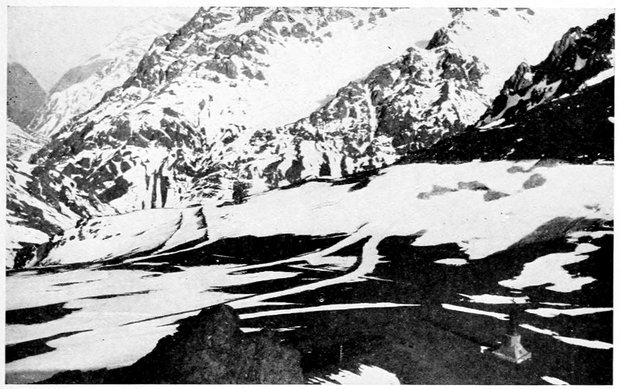
At last I came out high above the famous “Christ of the Andes” in a bleak and arid setting
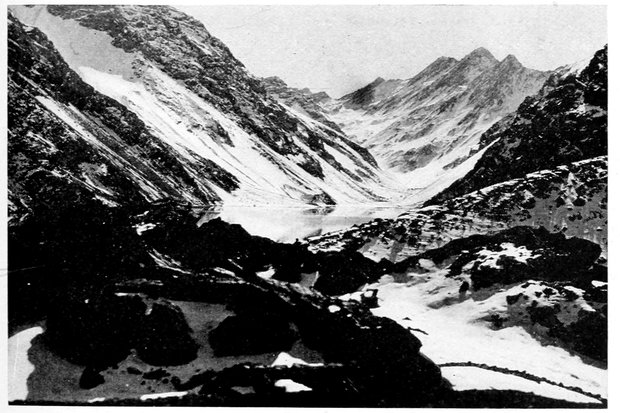
The “Lake of the Inca” just over the crest in Chile
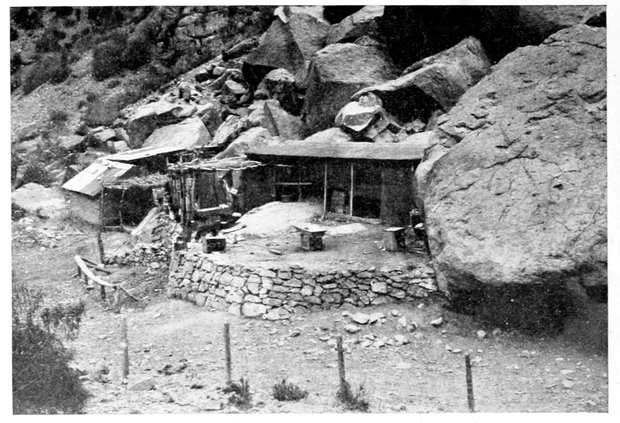
On the way down I passed many little dwellings tucked in among the boulders
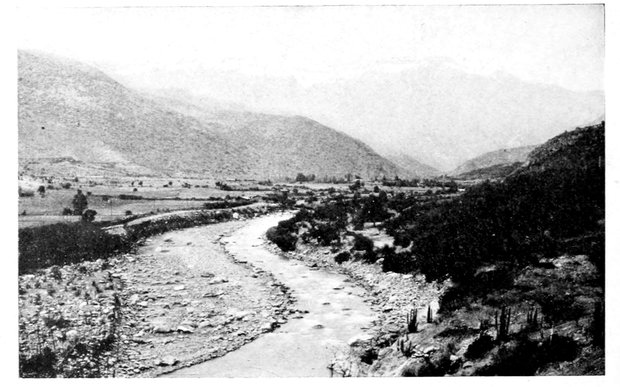
The stream that had trickled from under the snows at the summit had grown to a considerable river, watering a fertile valley
The bewhiskered conductor of the express which snatched me on
into the night looked like the Bowery at five in the morning. Indeed,
one noticed at once a wide difference between the prosperous spick-and-spanness
of the Argentine and squalid, uncheerful, roto Chile,
whether in the crowds of poor people quarreling over the few crumbs
of coal to be found in the cinder heaps at the edge of town or in the
general appearance of the government railway and its rather unkempt
81employees. I fell asleep soon after the train started at seven, woke
once when we seemed to be rushing through high hills and over deep
valleys, and again at a station where the one employee and the two
policemen were wrapped to the eyes in ponchos heavy enough for the
Arctic circle. Then myriads of lights flashed up out of the night
ahead, the brakes ground us to a halt, and we were set down at a
station named “Mapocho,” which turned out to be one of three serving
Santiago, capital of Chile.
CHAPTER V CHILEAN LANDSCAPES
82
Santiago rises late. I had wandered a long hour before I found
a café open, and when I dropped in for coffee the man who spent
half an hour preparing it grumbled, “Eight-thirty is very early
in Santiago.” My second discovery was that the Chilean capital was
squalid. Landing at the most northern of her three railroad stations—which
turned out to be no worse than the other two—had been like
dropping into Whitechapel; and the electric sign toward which I
headed had brought me to the lowest type of slum hotel. Had I come
down the West Coast and been familiar with nothing better than Lima,
Santiago would perhaps have seemed less oppressive, for it is a trifle
more modern and only a few degrees more shabby in appearance than
the City of the Kings. The change from the Argentine, however, or,
more specifically, from Buenos Aires, was like that from the best
section of New York to the lower East Side.
This contrast, I was soon to discover, is to a large extent true of all
Chile. The roto who makes up the bulk of the population, in or out
of the capital, always looks like a very low-paid brakeman on a coal-train,
who has just come in from an all-night run through a waterless
country. With this class as a basis, Santiago was dirty, unkempt,
down at heel. The cobbled streets were in many cases only half paved,
full of dusty holes with loose cobblestones kicking about in them; the
very house fronts were covered with dust; nothing seemed to have been
cleaned or repainted since the last century; the city looked as if the
civic feather-duster had been lost—though there was no lack of ragged
vendors of this implement making the day hideous with their cries.
The great difficulty seemed to be that few could afford them, for it
was another shock to find that prices were almost as lofty in Santiago
as in Buenos Aires.
The region was, to be sure, suffering for lack of the rain that eastern
Argentine had received in such superabundance, but this did not wholly
account for the general appearance of disrepair, suggesting a place
once of great importance that had lost all ambition to keep its social
83standing in the world. The huge checkerboard town, with immense
blocks of those straight, though narrow, streets required of his colonial
builders by Charles V of Spain—perhaps because he had grown weary
of losing himself in the Bostonese labyrinths of Spanish cities—contained
an extraordinary percentage of slums. Miles upon miles of
cités or conventillos, ground-floor tenements of single rooms opening
off blind alleys, stretched away in every direction from the central
plaza, giving off the odor which emanates from cheap lodging-houses
and overcrowded, unwashed families. It was the squalor of cities, too,
as distinguished from the comparatively agreeable uncleanliness of
the country.
The main business section of Santiago is relatively small, with the
more important stores, banks, and offices within a few squares of the
Plaza de Armas. Even this was considerably down at heel. The
building material being chiefly mud plastered upon wooden slabs,
there are many half-ruined buildings near the center of town, while
“way out there where the devil lost his poncho,” as the Chilean calls
the far outskirts, some of the conditions were incredible. Unlike the
capitals of Argentine and Brazil, Santiago has never been made over
and modernized by the federal government, for all its abundance of
“saltpeter money,” and, as elsewhere on the West Coast, there is no
distinctly residential section. Some parts are a trifle more fashionable
than others, but the uniformity of the town is on the whole monotonous,
doubly so because there are few buildings of interest either architecturally
or otherwise. A square surrounded by the chief public
structures; the capitol, covering an entire block behind the cathedral;
the more distant Museum and Art Gallery, make up almost the entire
list of imposing buildings. Long galerías, roofed passages that are
virtually public streets, are almost the only unusual feature. Though
its architecture is what might be called modernized Spanish, with sometimes
more decorative street-toeing façades and more roomy patios
than in Spain, it lacks some of the attractiveness of Spanish buildings,
and at the same time makes little provision for plumbing, and none
whatever for artificial heat. In Chile, to all appearances, the social
standing of soap and water has not yet been recognized. The River
Mapocho runs through town in a cobble-paved channel, but like those
of all the west-coast capitals, it is insignificant either as a stream or a
laundry and bath. Even boarding-schools and colleges take no account
of that strange modern habit of “washing the body all over”; it
is a rare house of even the “proud old families” that has a bathroom.
84Of late years many of these old families have found that they can
materially augment their ever less adequate incomes by renting the
lower stories of their “palaces” as shops, with the result that the always
slight line of demarcation between business and residence has now been
almost wholly obliterated. Under the portales of a palatial, red-brick
building covering one whole side of the main plaza, its upper stories
once the “Hotel de France,” but now a dingy vacancy, are dozens of
petty little shops, fly-swarming fruit and peanut and sweetmeat stands,
uncleanly male and female vendors of newspapers. As elsewhere in
the Andes, there are many little cloth-shops run by “Turks,” as South
America calls the Syrians. Street after street is crowded with dingy
little hole-in-the-wall merchants; street stands abound in which are
sold the favorite dishes of the gente de medio pelo, the ragged masses,—mote
molido (boiled and mashed ripe corn); mote con huesillos (the
same with scraps of bones and meat thrown in), and the thick, greasy
soup known as cazuela. The half-trained tailors, to whom no doubt
is due the fact that few men of Santiago are in any sense well-dressed,
squat in little one-room dens, gazing out upon the passing throng like
the craftsmen of Damascus. To make matters worse, the women commonly
seen on the street are almost exclusively mujeres de manto,
dressed in crow-black from heels to the fold of cloth wrapped about
their heads, leaving only the front of the face visible, the lack of color
adding to the general gloom of the town.
In contrast there is much sartorial display by the small well-to-do
class, and at the other end of the social scale there are many hints of
the picturesque. Each morning heavily laden ox-carts of country
produce, drawn by four, and even six, oxen, led rather than driven by
men walking ahead and prodding them over their shoulders with long,
sharp, often gaily painted goads squawk into town and almost to the
central plaza. The wielders of the goads wear the short, ragged
ponchos, sometimes of velvety vicuña cloth, the invariably soiled felt
hats, and the alpargatas, or, more likely, the simple leather sandals
called hojotas common to the roto class. Some of these countrymen
come riding in on horseback, their half-bare feet thrust into large
wooden closed stirrups, and adorned with immensely rowelled spurs,
frequently with a woman sitting sidewise on the crupper behind them.
Milkmen—who are often mere boys—use what we call a police whistle,
and make the morning hideous with their deliveries.
It is only from Santa Lucía that the Chilean capital gives a suspicion
of its great extent. This crowning glory of Santiago, a tree-clad rocky
85hill rising abruptly in the center of the flat city, a sort of perpendicular
park of several stories, is the only place in which it may be seen in
anything like its entirety. There, four hundred feet above the housetops,
one realizes for the first time that it may, after all, have four
hundred thousand inhabitants. To climb any of the zigzag rock-cut
stairs leading upward from the imposing main entrance is to behold
an ever spreading vista of the city, stretching far away in every direction,
monotonously flat and low except for several bulking old churches
of the colonial Spanish style. The chief charm of the town, if that
word can be used of a city that has little of it, is its proximity to the
Andes. It lies well up in the lap of a plain more than two thousand
feet high, at the northern end of the great central valley of Chile in
which most of its population is gathered, with large hills in the far distance
cutting it off from the Pacific, and, so close at hand as to seem
almost above it, the everywhere dominating background of the main
Cordillera of the Andes. But for this great white overhanging horizon,
Santiago would be commonplace indeed; with it, its most dismal scenes
have the advantage of a splendid setting. It is never uncomfortably
hot; its brilliant winter days are magnificent, chilly rather than cold,
even in the mornings and evenings. Except for a few kerosene heaters
in the more luxurious homes, where foreign travel has broken the ice
of costumbre, artificial heat is unknown. The wealthier classes keep
warm from June to August by wearing overcoats and wraps indoors
or out, at the theater or at their own dinner tables; the great ragged
masses accomplish the same end by crowding together in their single-room
dwellings, tightly closing all windows—and succumbing early
and often to tuberculosis.
Santiago is the only city in South America in which there is any
noticeable “smoke nuisance”; the belching of this from many factory
chimneys, from the trains of the government railroad, with its smudgy,
soft Australian coal, adds greatly to what seems to be a natural haziness
of the atmosphere. But one may forget this in a score of quiet
shaded nooks of Santa Lucía. Among its several curiosities are a drinking
fountain—the only public acknowledgment that water is required
by the human system that I recall having run across in South America—and,
along with the statue of Valdivia, who here fortified himself
against the Indians, and of an odd bishop or two, the tiny Protestant
cemetery over which Vicuña-Mackenna, Chile’s chief literary light and
a member of one of her oldest and proudest families, caused to be
erected the inscription, “To the memory of those exiled from both
86Heaven and Earth.” Chile has never taken its Catholicism in homeopathic
doses. It is only recently that even Protestant missionaries
could be married by anyone but a Catholic priest; up to a bare decade
ago the wicked heretics might not be buried in cemeteries, but were
stuck away in any hole in the darkest hours of the night, to be dug up
next day by prowling dogs. Largely through the efforts of American
missionaries there is now a civil cemetery and a civil marriage law.
Only a few months before my arrival a case had come up under the
law against having a saloon next door to a church, and the Supreme
Court rendered the, to the clericals “sacrilegious and unprecedented,”
decision that a Protestant church is a church, even in Chile.
Not far from Santa Lucía, nearer the edge of the town, is a much
larger hill made of the loose shale common to the southern Andes and
of much the same appearance as the one of the same name overlooking
Lima. San Cristóbal belongs entirely to a group of priests. On top
of it is a gigantic statue of the particular saint of their order, with an
immense sheet-iron halo on which is squandered much electricity; but
this is offset by the income from an enormous sign just below it advertising
“Dulcinea Tea.” The Lick Observatory has a station on San
Cristóbal, and as the priests have begun selling the mountain as a
stone quarry, they wrung money for a long time out of the American
scientists by threatening to dig the hill away from under them. Now
the observatory is protected by an injunction, and there are other indications
that Chile is gradually recovering from her medieval fanaticism.
Santiago has an imposing public library, one which was not only
actually open but, strange indeed in Latin-America, one from which
books could be taken—if one had several sponsors and could deposit
the full price of the volume. One’s attention is usually first drawn
to it by a statue of two famous Chileans, not so much because of the
artistic merit of the monument as for the terror inspired by the situation
of the two immortals. For they stand some thirty feet above the
pavement on a pillar-like pedestal so slender that a single step backward
or forward, the slightest jostling of each other, would infallibly
plunge one or both of them to certain death, and the tender-hearted
beholder, glancing at their constant peril, can only hurry by with
averted face. Under the glass dome of the reading-room, beyond
which most books never pass, readers wore their hats and smoked
when they chose. There were, of course, no female readers. It is
still considered unseemly in Chile for a lady to be seen reading anything
87but her prayer-book. Here I heard a lecture one evening under
the auspices of the Geographical and Historical Society of Chile, graced
by some two hundred of the intellectuales of Santiago. The lecturer,
in solemn frock coat, lighting his cigarette after every other sentence
and letting it go out after each puff, with an appalling consumption of
matches, read a long and laborious dissertation on the burning question
as to whether the great Chilean national hero had been entitled to
change his name from Higgins to O’Higgins. The speaker contended
that this was proper; any other conclusion would have made him an
outcast among his fellow-intellectuales, for it would have been attacking
one of their most cherished illusions. But the long hour and a half
during which he argued that the hero in question came of noble stock
in Ireland and was not the descendent of Irish peasants, as commonly
claimed, left the unprejudiced hearer unconvinced and secretly giving
the oblivious object of their solicitude the far greater credit of having
climbed to eminence from the more humble origin.
There is a saying in Chile that the population is made up of futres,
bomberos, and rotos. The first are well-dressed street-corner loafers;
the bomberos are volunteer firemen, and the rotos form the ragged
working class that makes up the bulk of the population. The latter,
said never to be without the corvo, an ugly curved knife, with which
they are quick to tripear, to bring to light the “tripe,” of an adversary
by an upward slash at his abdomen, are not merely conspicuous, but
omnipresent. Everywhere this class is struggling for its livelihood.
Great streams of men and boys, kaleidoscopes of rags, come racing out
of the Mercurio office with pink copies of “Ultimas Noticias” and
scatter to the four corners of the flat city—but there seem to be more
sellers than buyers. Poor, hopeless old tramps wander up and down
the over-named Alameda de las Delicias with baskets of grapes covered
with dust and almost turned to raisins, vainly trying to sell them.
Slatterns and slouches are the rule among the female division of the
roto class, and Indian blood is almost always present in greater or
less degree. In the Argentine some eighty per cent. of the population
is said to be foreign born; in Chile, certainly in Santiago, not one person
in ten suggests such an origin. Very strict immigration laws
forbid negroes, Chinamen, and most Orientals to enter Chile, but
though the country usually welcomes white foreigners with open arms,
they are not greatly in evidence. The inhabitants of all classes have the
west-coast characteristics, indefinable but unmistakable, which distinguishes
them decidedly from the people of eastern South America.
88Santiago has been called the “City of a Hundred Families.” These,
still noted for their Spanish exclusiveness and aristocratic pride, powerful
owners of most of the country, form an oligarchy of government
in which the ostensibly free-voting roto has little real hand. The “best
families” oligarchy virtually tells the working class how to vote, and
in the main it does as it is bidden, out of apathy, to be obliging, or from
pure ignorance. Balloting is not really secret and there is frequent
corruption, such as the recent notorious case of half the ballot-boxes in
Santiago being carried down into the cellar of a public building and
stuffed with a new set of votes. According to law, the voter must be
able to read and write, and any roto whom the landlords do not wish
to vote is denied the suffrage on this elastic ground. On the whole,
however, the oligarchy seems to work better than the more common
Latin-American rule of a dictator or a group of irresponsible politicians.
Its great fault is the stone wall it builds against rising from the
ranks, that and the opportunity it gives the powerful to cast upon
weaker shoulders the burden of taxation. The unfair advantages given
descendants of the favored “best families” is shown in the frequent
recurrence of the same name in Chilean biographies and histories.
The expression, “an education according to his rank,” is often heard,
and sounds strangely out of place in an ostensibly democratic country.
The dawn of industrialism is suggested, however, in the strikes which
are more and more breaking in upon the aristocratic patriarchal life.
One cannot imagine any other Indian of the Andes striking, but his
Araucanian blood has made the roto not only free of speech, sometimes
insolent, ever ready with his corvo, but ready to fight for himself in
more modern ways.
“Some day,” said a Chilean man of letters, “our great land owners
will be taxed as they should be; but that will probably require a revolution.
The big absentee landlords exploit our natural resources and
spend their incomes in Paris, leaving nothing for the advancement of
the country. You have something of that problem in the United
States, but the proportion of your idle rich who spend their money
abroad is negligible compared with ours, and here there is no middle
class as a depository of the real culture and sense and moral brawn
of the nation.”
Some of the old families of Santiago have lost their wealth, yet
still retain their pride and outward aristocracy. It is the custom of all
the upper class to go away for the summer, not so much because
Santiago grows a bit warm and rather dusty, as because it is the thing
89to do. One of the standing stories of the capital is of poor but aristocratic
families who, unable to afford such an outing, shut themselves
tight up in the back of their houses for two months or more, living
on what their trusted servants can sneak in to them. Men who had
every appearance of being trustworthy assured me that this tale was
far from being a fable. One of them asserted that he had been invited
the preceding February to the “home-coming party” of a family whom
he knew had not been outside Santiago in a decade.
History is continually proving that unearned wealth takes away the
energy and initiative of a nation as of an individual, and Chile is no
exception to the rule. In the far north of the country, where it has
not rained in thousands of years, are deposits which give Chile almost
a world monopoly of nitrate, or salitre, as the Chilean calls it, the only
large source of public wealth in the country. The high export duty
on this gives the government four-fifths of its revenue, most of which
is spent in Santiago or falls into the pockets of politicians. If some
town in the far south needs a new school, or a pavement, or a tin hero
to set up in its central plaza, it appeals to Santiago for some of the
“saltpeter money”; and if its influence is strong enough, or the treasury
is not for the moment empty and praying for a new war, the request
is granted in much the same spirit with which our congressmen deliver
“pork” to their constituents. Naturally this destroys civic pride of
achievement and municipal team-work. Instead of spending the
greater part of her revenue from nitrates to develop some industry to
take their place when they are exhausted, “we are like a silly wanton,
who squanders her easy winnings for gewgaws without recognizing
that the time is close at hand when her only source of income will
disappear,” insisted one far-sighted Chilean. “Once our saltpeter gives
out and Europe stops lending us money, we’ll go to the devil.”
The fertile southern half of the ribbon-shaped country is excellent
for agriculture; her population, smaller but far more dense than that
of the Argentine, is already utilizing nearly all her resources above or
under ground; in the past century Chile has had only one revolution
serious enough to have echoed in the outside world, but that gives
a misleading impression of her law-abiding qualities. Indeed, all such
blanket statements give rather a false impression, for the country is
assured no such prosperous future as they seem to suggest. Though
he is superior to the Ecuadorian, and perhaps to the Peruvian, it
would be easy to get an exaggerated notion of the Chilean. He is
interested only in to-day; he, and especially his wife and children, are
90much given to show and artificial makeshifts: if he is not exactly lazy
he is at least far less active and has less initiative than the more European
argentino.
Chile is the home of fires and the dread of insurance companies.
The latter are said to demand higher rates than anywhere else on
earth, and the agent of an important foreign one assured me that all
his clan live in fear and trembling toward the end of each month and
particularly at the end of the year, when their clients are balancing
their books, because of the epidemic of arson which results from
attempts to recoup fortunes. This short-cut to solvency is constantly
referred to in newspapers, plays, and conversation; nor, if we are to
believe the older native novels, is it anything new. Chilean law requires
the immediate arrest of the owner and the occupant of a burning
building, it being the contention that either the one or the other is
almost sure to be the instigator of the fire. Nor is it up to the government
to prove that the suspect started the conflagration, but the task of
the latter to show that he did not, which is a horse of quite a different
color. The country is lined with blackened ruins, from mere ranchos
to modern several-story buildings in which lives have frequently been
lost. I saw more burned buildings in Chile than in all the rest of
South America, and far too many to be accounted for merely by the
somewhat greater prevalence of wooden structures.
The fires themselves would be serious enough, were there not the
bomberos to make them doubly so. There are no professional fire
departments in Chile. The glorious honor of fighting the flames is
appropriated by the élite, much as certain regiments and squadrons
are open only to a certain caste in our largest cities. The youthful
males of Santiago’s “best families” become bomberos because it is considered
one of their aristocratic privileges to parade before their enamored
ladies in fancy uniforms and glistening brass helmets. As often
as a fire bell rings, all upper-class functions are temporarily suspended
and all the young bloods run—to the fire? Certainly not! They hasten
home to don their splendid bombero uniforms, without which, naturally,
it would be highly improper to attack the flames. The newspapers
always include in their report of a fire the assertion that “the
bomberos arrived with their customary promptitude,” which has the
advantage of being both true and courteous.
There being no National Guard in Chile, gilded youth has no other
convenient way of showing off in uniform than to join the bomberos.
The regular army would be too serious an undertaking for them, even
91if it were not below their dignity. Moreover, this is founded on conscription,
with a year’s service for those who “draw unlucky,” and as
the influence of caste is powerful in manipulating the drawings, the
ranks are filled almost entirely with rotos or the poorer classes. The
Chilean army is German in tone and uniform, even to the big gray
Prussian capes of the officers, many of whom, as well as the commander-in-chief,
were of that nationality up to the outbreak of the
World War. The army is much in evidence and its splendor is in
great contrast to the shoddy, ragged dress of the bulk of the civilian
population. Its immediate neighbors credit Chile with a strong Prussian
temperament, and it, in turn, sends officers to train the troops of its
more distant neighbors. Those who should know maintain that it is
only the army that saves the oligarchy in power from the revolutions
that are frequently on the point of breaking out, but of which the
outside world seldom hears. Chile has no conscription for her navy,
and for the first time outside my own land I found placards picturing
the ideal life recruiting officers would have us believe is led on warships.
As the Chilean on his narrow strip of beach is almost English
in his feeling for the sea, there seems to be no great difficulty in manning
the best, or at least the second best, navy in South America.
Chileans themselves frequently refer to the prevalence of thieving
among their national characteristics, and explain it by saying that the
Araucanian Indians, who make up the basis of the population, had
communal ownership and still have little conception of the line between
mine and thine. Half the nation is by its own official admission
of illegitimate birth. In various parts of Santiago there are doors
fitted with a turno, known among the English-speaking residents as a
“bastard barrel,” softly upholstered, into which a baby may be dropped,
the turno given a half turn and a bell beside it rung, when nuns or
their agents on the inside take charge of the mite without asking questions.
Thousands of “orphans,” whose parents are still running about
town, are housed by charity, and long troops of them may be seen any
fine day taking an airing in the streets. This condition is by no means
entirely the fault of the roto class. None but the civil marriage is now
legal in Chile, whether by priest, minister, missionary, or rabbi; but
the poor man must take a day or more off and disentangle much red
tape to get married, only to be informed by his priest that in the eyes
of the church he is not married at all, until he produces a handful of
pesos to have the union religiously sanctioned. As throughout Latin-America,
92he is apt to conclude that the ceremony is a mere waste of
time and money.
Small as is the foreign population of Chile, the church is largely
in the hands of foreigners, so that “a Chilean cannot be born or married
or die without the permission of a Spanish, Italian, or French
priest.” German monks and nuns are also numerous, yet Chileans are
not admitted to most of the monasteries and convents. The foreign
priest not only makes the native pay high for his confessions and other
formalities, but frequently refuses him a pass through purgatory
unless he leaves the church a large legacy to cover his unquestionably
numerous sins. Though this property is ostensibly used to aid Chile
with schools and the like, even devout Chileans assert that their foreign
priests send most of the proceeds to the “Capital of the Christian
World.” Complaints against these conditions are legion, but the Chilean,
like most Latin-Americans, is more noted for criticism than for
effective action.
Though Santiago rises late, and usually takes a siesta from twelve
until two, it retires early. Being the social and fashionable, as well as
the political, center of the republic, it has, of course, its elaborate
“functions,” and it is still near enough to the colonial days to retain
the weekly plaza promenade. On gala occasions this is worth seeing.
Santiago is one of the countless cities which claim to have the most
beautiful women in the world, and some of the claimants to this distinction
are comely even under their deluges of rice powder. Chilean
women of the better class, with their pale, oval faces and their velvety
black eyes, have a vague sort of melancholy in their manner, as if they
were thinking of the great world on the other side of the tropics, or at
least over the wall of the Andes. But evening entertainments are scarce
and poor in Santiago, and by ten at night the streets are commonly
deserted, except by the stolid pacos wrapped in their heavy black uniforms,
and all doors are closed save those of a few cafés that drag on
until midnight. Half a dozen cinemas unroll their nightly rubbish,
usually fantastic and volcanic dramas from Italian film houses, woven
around the eternal triangle; now and then a zarzuela company succeeds
in making a passable season of it. The favorite zarzuelas are
such gems as “La Señora no Quiere Comer Sola” (Madam does not
wish to eat alone), or “No Hagas Llorar á Mamá” (Do not make
Mama weep), the surest way to avoid which would seem to be to keep
her away from the histrionic efforts of the Chilean capital. Yet the
élite of Santiago attend these mishaps in considerable force and fancy
93garb, including overcoats or wraps in the unheated buildings, all laboring
under the delusion that they are being entertained. There is opera
for a month or two in the winter; on rare occasions a really good
dramatic company, rather Italian than Spanish, makes a brief stay—and
generally loses money, since, as a Chilean novelist puts it, “the
artistic taste of our public is better suited to the slap-stick of short
plays or the immaturity of some circus of wild animals.” But the
audiences which these entertainments turn out toward midnight quickly
fade away and leave the streets to solitude.
Among the poorer classes the zamacueca, the native dance of Chile,
popularly called a “’cueca,” is a principal diversion. A man and
woman, each waving a large gay handkerchief, move back and forth,
as if alternately repelling and inciting each other, to the tune of a
harp and a guitar and the clapping of many hands, while a big pitcher
of chicha de manzana or de uva, which roughly correspond to our
cider and grape-juice respectively, passes from mouth to mouth. The
better-dressed class has certain simple pastimes in which both sexes
join, though not often and never without an awe-inspiring display of
chaperons on the side lines. There is, for instance, the “whistling
game.” A man in competition with several of his spatted fellows runs
four hundred meters, stops in front of a lady and whistles a tune, the
name of which she hands him on a slip of paper, the first one to finish
the tune without error and to return to the starting-point, being adjudged
the winner. On the whole, the Spanish spoken by this class
of Chileans is better than that heard in the Argentine, though there
are many “chilenismos,” expressions peculiar to the country. Chile
usually gives the “ll” its full sound, rather than reducing it to a poor “j,”
but the “s” is largely suppressed. In spelling the country has certain
rules of its own, the most noticeable being the use of “j” in many places
where Spaniards use “g,” a legacy left by the Venezuelan, Andrés Bello,
first president of the University of Chile.
I had looked forward with some interest to that far-famed feature
of Santiago, her female street-car conductors. Familiar as they have
since become, Chilean women led the world in this particular, the
custom dating back to the war with Peru, a long generation ago. The
street-cars of Chile are of two stories. Most of them are operated
by a woman and a boy, about half the force being female and few of
the rest grown to man’s estate. The boy is the conductor, which in
Spanish means the motorman, and the woman cobrador, or collector.
Far from inspiring the protection of wealthy rakes or causing enamored
94youths to squander their income riding back and forth in the car
presided over by some unrelenting Dulcinea, however, most of the
latter excite such repugnance that the more squeamish prefer to suffer
a slight financial loss to accepting change from their unsoaped hands.
On the back platform of the dingy electric double-deckers usually
stands as un-entrancing a member of the fair sex as could be found
by long search, her dismal appearance enhanced by the mournful,
raven-black costume she wears. She is sure to be part Indian, her
coarse hair tied in an ugly knob at the back of her head, high on top
of which sits a hat of polished black, with a long pin stuck through it
to add to the perils of life. In short, Chile’s female conductors are not
giddy young girls, but stolid women of the working-class, very intent
on their duties and only rarely whiling away an odd moment in harmless
gossip with the youthful motorman of the car behind. Some
romancer has written that the beautiful members of the clan are
quickly recruited to more romantic service. Perhaps they are, for
they certainly are not on the cars.
Street-car fares are absurdly cheap in Chile, so cheap, in fact, that
the service cannot but be poor and dirty. Inside the cars riders pay
ten centavos; up on the impériale they pay five, which at the commonly
prevailing rate of exchange is less than two and one cents respectively.
Not the least amusing thing about Santiago is the street-car caste, or the
line of demarcation between the upstairs and downstairs riders. The
white-collar, non-laboring class will stand packed like cordwood in
the closed car rather than go up on the impériale, which is not only
preferable in every way but cheaper. It is this latter detail that makes
the upper story forbidden ground for the gente decente. As a Chilean-born
business man of English parents, educated in London and widely
traveled, put it in criticizing my “bad habit” of riding on top:
“I would much rather ride up there, too; it is airy, cleaner than
inside, you can see the sights, and the weather is generally fine in
Santiago. But if I did, my friends would look up from the sidewalk,
nudge one another, and say, ‘Hullo, by Jove! There’s Johnny Edwards
up there with the rotos. What’s the matter; can’t he afford a
penny to ride inside? I’d better collect that little debt he owes me
before he goes bankrupt,’—and within a day or two my creditors would
be down upon me in droves.”
The Chilean peso is a mere rag of paper, originally engraved in New
York and more nearly resembling our own bills than those of most
South American countries. Theoretically worth a French franc, it is
95as doubtful of value as legibility, being unredeemable either in gold or
silver and waking up each morning to find itself different from the
day before. On the face of the few bills that still have visible words
runs the statement, “The government of Chile recognizes this as a
peso fuerte,” which is by no means the same thing as promising to pay
a “strong peso” to the holder upon demand. The congress of Chile
has decreed that the peso shall be worth ten English pence; but there
is nothing quite so incorrigible in disobeying the laws of a country as
its national currency, particularly one in which it is the custom, when
in need of money, to go to a printing office instead of to a bank. No
wonder there is no national lottery in Chile; playing the exchange is
gambling enough to suit anyone.
With the exception of a few private, narrow-gauge lines in the
nitrate and coal fields, the railroads of Chile are government owned.
A state line now runs the length of the country, connecting its southernmost
port on the mainland with its most northern province, and even
with the capital of Bolivia. In the fertile, well-inhabited southern half
of the country the railroads, like the more important ones of the Argentine,
have the broad Spanish gauge, and down to where the population
begins to thin out the trains are long and frequent. The “Longitudinal,”
running for hundreds of miles northward from the latitude
of the transandino through dreary deserts a bare meter wide, carries
neither through passengers nor freight. The former would
probably die of monotony or thirst on the way; the latter would be
valuable indeed after paying the breath-taking freight rates. It is far
quicker, more pleasant, and cheaper to take, or to send by, the steamers
along the coast, and the real raison d’être of the “Longitudinal” is
Chile’s determination to keep the two provinces she took from Peru.
On the whole, the railroads of Chile are a sad commentary on government
ownership. There are probably more employees to the mile
on Chilean railroads than on any other system in the world, not because
the Chilean is a particularly poor workman, but because politicians
foist upon the helpless public carriers so many needy but influential
constituents. Yet both roadbeds and rolling stock of this
overmanned system are astonishingly descuidado,—uncared for, dust-covered,
unwashed, loose, broken, out of order, inadequate, with whole
train-loads of perishable goods rotting in transit, and frequent wrecks.
It is common rumor that the government pays twice the market price
for all railway supplies, thanks to the carelessness and the grafting
tendencies of the personnel, while every year finds the railroads with a
96million or more deficit. How carelessly the trains are operated is
suggested, too, by the extraordinary prevalence of missing legs in
Chile. It seemed as if one could scarcely look out a train window
without seeing someone crutching along beside the track, to say nothing
of those entirely legless, as if the railroad habitually ran amuck
among the population.
Started by Meiggs, the fleeing Californian who carried the locomotive
to the highlands of Peru, and continued by a deserter from an
American sailing ship, the Chilean railroads were built chiefly by
American capital, as well as by American engineers. They still bear
many reminders of that origin. The passenger-trains have comfortable
American day coaches, made in St. Louis; the sleeping-cars are real
Pullmans; even the freight-cars closely resemble our own. The
engines, though supplied with bells, are more often of British or
German origin, or from the government shops near Valparaiso. There
are three classes, or, more exactly, five, for the prices and service on
the express trains are different from the corresponding ones on the
mixtos. Except that in the former one is more certain of having an
entire seat to oneself, there is little difference between first and second
class. Fares are comparatively low even in these; on the lengthwise
wooden benches of third class they are cheaper than hoboing. Trunks,
however, pay almost as high as their weight in passenger, there being
no free-baggage allowance. The assertion is frequently heard in Chile
that third class is a disadvantage to the country, because the low price
makes it too easy for the roto masses to move about. A rule that might
not be amiss in our own land is that the engineer who jerks a train
either in coming into or leaving a station is subject to a fine, if not
to dismissal—but of course the Brotherhood would never permit any
such interference with their long-established privileges. The trainboy
nuisance, here known as a cantinero, with the accent on the beer, is in
full evidence. Though the night trains carry Pullmans, there are no
diners, because concessions have been given at various stations to men
of political influence to run dining-rooms and the trains must stop
there long enough to contribute the customary rake-off. The monopolists
are less given to brigandage than they might be, however, and of
late there has been inaugurated a system of sealed lunches at three
pesos, including a half-bottle of wine. Moreover, it is a rare station
that does not have a crowd of female food-vendors, especially well-stocked
with fruit in the autumn season.
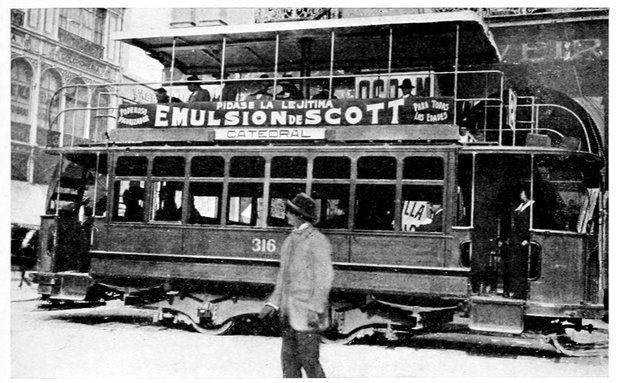
The street cars of Chile are of two stories and have women conductors
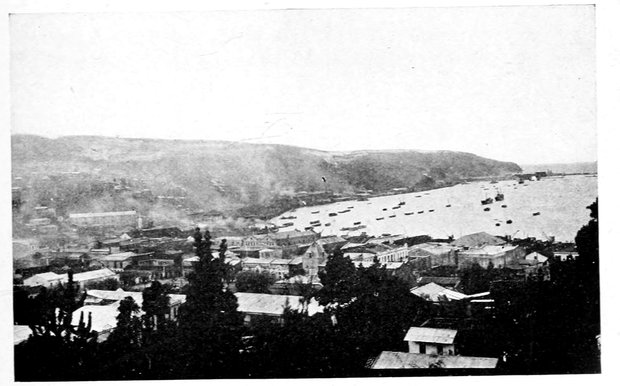
Talcahuano, the second harbor of Chile, is only a bit less picturesque than Valparaiso
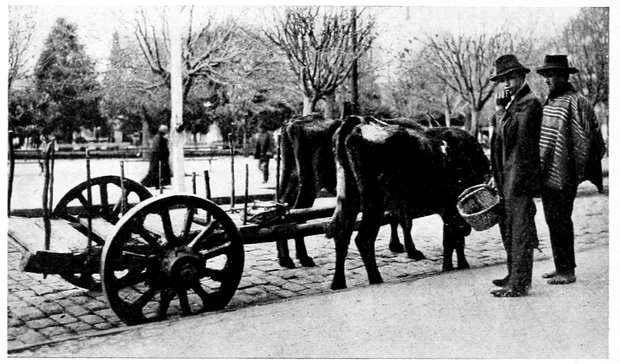
The central plaza of Concepción, third city of Chile
Valdivia, in far southern Chile, is one of the few South American cities built of wood, even the streets being paved with planks
The eight o’clock express from Santiago sets one down in Valparaiso,
97one hundred and twenty miles away, at noon. From the Mapocho
station the train climbs out of the central valley of Chile, squirming
its way through many tunnels and over mountain torrents, with frequent
magnificent views of the rich, flat plain which gradually spreads
out hundreds of feet below. Then the valley narrowed and we came to
Llaillai, the junction of the line up to Los Andes and over into the
Argentine. Curving around the higher mountains, the other branch
coasts leisurely downward, passing here a long vineyard, there pastures
bordered by rows of Lombardy poplars and dotted with cattle, now a
great estate belonging to a man living in Paris, the stone mansion of his
administrator near at hand, the mountains forming the background of
every vista. At Calera the “Longitudinal” sets out into the arid north,
the fertile part of Chile quickly coming to an end in this direction and
turning into the dreary desert which is at present the country’s chief
source of wealth and fame. Then all at once the Pacific I had seen
but once since entering South America two years before burst out in
full ocean-blue expanse, without even an island to break up the unprotected
bay in which the winds often raise havoc. Below Viña del Mar,
Chile’s most fashionable watering-place, the precipitous hills come
down so close to the sea that there is barely room for the highway,
railroad, and tram line to squeeze their way past into the commercial
metropolis and second city of the country.
Valparaiso, the greatest port not only of Chile but of the West Coast
of South America, is the “Vale of Paradise” only comparatively.
Built in layers or strata up the steep sides of the barren, shale coast-hills,
it stretches for miles along the amphitheater of low mountains
that surround a large semicircular bay, behind which one can see
jumbled masses of houses sprawling away over the many ridges until
these have climbed out of sight. There is so little shore at Valparaiso
that there is room in most places only for two or three narrow streets
following the curve of the bay, and for only one the entire length of
the town, under the edge of the cliffs, much of it occupied by the
dingy, two-story, female-“conducted” street-cars. In the central part
of town a small space of flat ground has been filled in across one of the
scallops of the bay, and on this made land are cramped the principal
business houses and the central Plaza Arturo Prat. It is here that the
earthquakes do their most appalling damage. The rest of the city
climbs steeply up the shale hills overhanging the business section, in a
jumble of buildings which give the town its only picturesque and
unique feature. To get “top side,” where the majority of the Vale of
98Paradise dwellers live, there are escalators, or, more properly, “lifts,”
since the majority of the largest foreign colony on the West Coast are
English. That is, every little way along the cliff are two cars at
opposite ends of a cable, which climb the slopes at precarious angles,
though they are level inside, in about two minutes at a cost of ten
centavos. For those who lack the requisite two cents, and for cautious
persons who will not risk their lives on the escalators, several stairway
streets rise in zigzag above row after row of sheet-iron roofs to the
upper stories of the town. During this ascent the whole city spreads
out below, all the panorama of Valparaiso and its semicircular bay,
the latter speckled with hundreds of steamers, “wind-jammers,” and
small craft, each far enough from the others to be ready to dash unhampered
into the safety of the open sea when the wild southwest
gales sweep in upon them. The Chileans formed some time ago the
courageous project of having an English company protect this great
open roadstead with a huge breakwater; but thousands of mammoth
concrete blocks have so far been dropped into the seemingly bottomless
harbor, leaving no visible trace, and now there are floated out hollow
concrete structures of 150-foot dimensions. Once on top there are other
street-cars, and more climbing to do, if one wishes to go anywhere in
particular, though nothing as steep as the face of the cliff itself. Here
may be seen Viña del Mar, a broad expanse of the Pacific, the aërial
best residences of Valparaiso, and a picturesque tangle of poorer
houses stringing away up the backs of the many verdureless ridges
into the arid, uninhabited country.
The earth, like the sea, casts up on its beaches much human driftwood.
Valparaiso is no exception to this rule, and here may be found
wanderers, beachcombers, and roustabouts of all nationalities. Primitive
landing facilities give its rascally boatmen the whip-hand over
arriving or departing travelers. Many languages are spoken, English
not the least important among them. Along the docks the roto stevedore
works barefoot and bare-legged even in the winter season; over
all the town rests a pall of aggressive, rather conscienceless commerce
which offsets its scenic beauties. The Chilean is not a particularly
pleasant fellow at best; down at his principal seaport he is even below
the average in this respect. Impudent and grasping, unpleasantly
blasé from his contact with the lower strata of the outside world—but
all this one forgets in watching the red sun sink into the Pacific from
the impériale of a street-car winding close along the edge of the sea, or
99when the lights of the town, piled into the lower sky, fade away as the
traveler turns inland and climbs back up into the Andes.
From the squalid Alameda Station of Santiago another express sped
southward through rows of those slender Lombardy poplars that are
a feature of any landscape of lower Chile. The broad central valley,
distinct from the arid northern section and growing more and more
fertile from the capital southward, with ever more frequent streams
pouring down from the range on the east to add to its productiveness,
stretches almost floor-flat for more than five hundred miles to where
the narrow country breaks up into islands. In this autumn season
vineyards and cornfields stood sear and shriveled. The slightly rolling
country had an indistinct brown tint under a gray, yet illuminated sky,
the valley reaching from the all but invisible Pacific hills to the jagged,
snow-capped Andean wall, like an irregular dull-white line painted
along the canvas of the sky some little distance above the horizon.
San Bernardo, a summer colony, was now a large cluster of closed
houses surrounded by brown vineyards touched here and there with a
deep red, as of poison ivy. A few bushy trees, some still green, the
rest yellow, were half-visible on the left; now and then an evergreen
grove broke the prevailing color with the verdant emerald of firs, shading
away through all the tints of green to late-autumn saffron, a hazy
world spreading away on either hand and rising beyond to the Cordillera
lying dim-white under a new fall of snow.
Paralleling the railroad were good highways, sometimes with high
banks, more often lined with hedges, which added a suggestion of
England to the general atmosphere of California in November. Along
these roads were many ox-carts, the drivers walking ahead and punching
back over their shoulders at the animals with sharp goads. There
was color in the ponchos, often in the other clothing of the lower
classes here, especially among the huasos, as the gaucho is known in
Chile, and this color seemed to be in exact ratio to the Indian blood,
not of the individual, but of a given locality. Dust was everywhere.
We passed numerous large corrals bearing the sign “Ferias Rejionales,”
some with cattle in them, all surrounded by an elevated promenade
from which prospective buyers could examine the stock. Horses and
cattle shipped north in freight trains all had pasted on their rumps a
paper bearing their destination. Towns were frequent and sometimes
large, and there was much freight as well as passenger traffic, no doubt
because Chile is like Egypt in that there is but one route up and down
100the country, here following the elevated central valley between the
Andes and the sea.
At every station of any size groups of women and girls offered for
sale fruit, bread, sweetmeats, and the like. They were particularly
well stocked with grapes; native apples were plentiful, Chile being the
only land in South America which grows them; not a few sold the
pretty red copihüe, the national flower of Chile, a long bell-shaped blossom
growing on a climbing plant of deep roots. The movements of
these women were lively and vivacious compared with those of the
higher Andes of more northern west-coast countries. Each wore a
white dressing-gown over many layers of dark clothes, and most of
them were decorated with earrings or necklaces of the red-and-black
beans called guayruros with which I had grown familiar in tropical
Bolivia. These berries are supposed to bring luck, or at least a man,
and the Chilean woman of the ignorant class will sell her only possession
for a few of them. Apple and cherry orchards flanked the track
here and there, many of them bordered by blackberry hedges stripped
now of their fruit. Rather drab farmhouses, hung with withered rose
vines, alternated with curiously un-American wheat or straw stacks.
Gradually cultivation and villages decreased, and an Arizona-like country
wormed its way into the plain in arid patches. Here grapes were
still offered for sale, but one might easily have mistaken them for
raisins.
We passed several branch lines leading off toward the Pacific, and
a few shorter ones climbing a little way up the flanks of the Andes. I
dropped off at the fourth of these junctions, in Talca, a large town
with far too many churches and the concomitant squalor, poverty, and
ignorance. The plaster was beginning to peel off in places from the
adobe façade of the big, ostensibly cut-stone building facing the central
plaza. Here, as in all Chile, one was struck again by society’s waste
of its resources,—robust men in the prime of life scurrying about with
baskets of fruit or newspapers for sale, much potential energy frittering
away its time for want of occupation. “Los Boi Escouts” of Talca
were announcing a benefit performance that evening, but as this did not
promise sufficient interest to make up for spending a night in so dismal
a place, I went on to the considerable town of Chillan. Here it had
been raining and the unpaved streets were full of miniature ponds
through which I picked my way to a hotel where I paid three dollars
for a bed—and not much of a bed at that.
In stories I had heard Chile was noted for its low prices. If ever
101it had that particular charm it has now disappeared, at least for the
traveler. The hard little apples sold at the stations cost as much as
good ones in New York; diminutive loaves of bread were nearly as
high as a whole loaf at home. Establishments masquerading under the
name of “hotels” are plentiful: if there were one-fourth as many clean,
honest, and well conducted it would be a decided improvement. To
pay an average of twenty pesos a day in the squalor of most Chilean
hotels would be mishap enough; the doctoring to which one’s bill is
invariably subjected makes the experience all the more painful.
Though the daily rate purports to cover all service, morning coffee and
rolls are always charged for as an extra. So also is fruit, at twenty
times what it sells for in the market around the corner. Baths, which
are so slow in being prepared as to wear out the patience of most
foreign guests, cost several pesos each time they are ordered, whether
they are taken or not. The crowning trick is to make out the bill by
separate items, if one has had the audacity to ask for the daily rate in
advance, thus doubling it; or, if one protests against this system, the
next one is to contend that the day begins at a certain fixed hour,
which is always on the opposite side of the clock from that at which
the traveler arrives, and that the first and last meal each constitute a
full day, with the result that the man who is continually traveling pays
for sixty days a month in hotels even though he spends some half of
his time on trains.
It was wet and sloppy and all the world was drowned in a dense
fog when I set off again at dawn. Everyone who owned them wore
heavy overcoats and neck-scarfs, keeping even their noses covered.
One would have fancied a demand that trains be heated would be in
order in such a climate, but if the lack of artificial heat is at times
unpleasant it is healthful, and the traveler in South America is likely
to return with a prejudice against it. At San Rosendo I caught a
branch line along the shining Bio-Bio, the largest river of Chile, and
followed it northwestward to the coast, the sun at last breaking through
and suddenly flooding all the scene as the train took to rounding many
rolling hills covered with scrub growth. The huaso was everywhere
busy with his fall plowing, his ox-drawn wooden implement as primitive
as those of Peru, except for its iron point. Here there was considerable
eucalyptus, the foster child of the Andean tree world, though
the poplar was more in evidence and the weeping willow frequent.
I spent a day in Concepción, third city of Chile, a brisk and mildly
pretty town scattered over a hillside, center of a large grain district
102with coal fields near, hence the site of many factories, flour-mills, even
sugar refineries, which import their crude product from Peru. Though
it is the scene of considerable modern industry, and has the usual two-story,
be-skirted tramcars, brilliant ponchos and gaunt oxen dragging
clumsy, creaking carts are to be seen in its main streets. A splendid
view of the town may be had from the Cerro Caracol, crowning point
of a long ridge of rolling hills of reddish soil, yet covered with grass,
so rare in South America, and much of it with a thick fir forest. A
“snail” roadway winds upward, and immediately at the climber’s feet
spreads out the entire city, flat and low for the most part, with the
plethora of bulking churches common to all Chilean towns. There are
many Germans in Concepción, south of which they grow ever more
numerous. Along the Avenue Pedro de Valdivia, squeezed between
the river and the hills in the outskirts, live scores of men of this
nationality who came out less than half a century ago as simple clerks
and who now have sumptuous mansions and large estates—quintas they
are called in Chile—a single row of them eighteen blocks long on this
one avenue boasting such names as “Thuringia” and “Die Lorelei”
and the top-heavy architecture which goes with them. In Arauco
province, a bit to the south, with a private railroad running into Concepción,
are some of the few coal mines in South America, Chile being
virtually the only country on that continent not entirely dependent on
Newcastle or Australia for this sinew of industry. It seems to be a
soft surface coal, mainly productive of smoke, great clouds of which
frequently wipe out the beauties of the landscape in this vicinity.
Talcahuano, six miles farther northwest, is on Concepción Bay,
national naval rendezvous and the best harbor in Chile, being seven
miles across and bottled up by the island Quiriquina. The town,
thrown around the inner bay like a wrap about a throat, with pretty
residential hills climbing up close behind the modest central plaza, the
outskirts scattered far and wide over a rolling, verdant country, has
considerable shipping, but the Pacific is seen from it only through the
rifts of islands and promontories. Forty years ago American whalers
often entered this harbor, and some of the wealthy families of the
vicinity to-day are descended from the deserting sailors they left behind.
In Talcahuano I found an American consul who had been there for
decades, evidently long since forgotten by the authorities at home. Of
the many tales he had to tell the most picturesque were those of his
early days as a guano digger on the west coast, but he was more filled
with the alleged rascality of the Germans in Chile. There were in
103Concepción, he asserted, forty German business houses as against four
English and no American—or perhaps I should say “North American,”
for the Chilean grows more enraged than any of his neighbors at our
assumption of a term to which he considers himself equally entitled.
The consul was greatly grieved to see the Germans steadily taking
away the little trade Americans once had, driving out even our stoves
and agricultural machinery from what had formerly been a United
States stronghold. But the Germans were more apt to make things to
fit local tastes, or the customer seldom had any fixed notion of what he
wanted and fell easy prey to the clever and unscrupulous German
salesman. The consul had recently discovered a German house secretly
sending to the Fatherland a binder and a reaper which it had imported
from New York, evidently because direct importation would have
called official attention to the plan of copying the machines for the
South American trade. He had recently bought what purported to
be a reputable implement made in the United States and known by
the trademark “Eureka.” It worked badly, however, and the parts
broke so easily, that he finally examined it more closely and found that
it was really a “Hureka,” made in Germany. Though Americans and
English are hard to assimilate, clannish, little inclined to take Chilean
wives, the Germans marry freely with the natives and gain much commercial
and political advantage from such alliances. The Chilean-born
children of Germans are legally Chileans, but at heart, according to
the consul, they are still Germans. The Teutons have driven the natives
out of all important business, except in the case of wealthy landowners,
and these usually live in Paris and intrust their holdings to a
German or other foreign manager. Our forsaken representative was
also highly incensed at “the nonsense of American business men running
down to South America in droves, making themselves laughing-stocks
among the natives by their geographical ignorance, their manners
and public drinking, and only stirring up the Germans to greater
underground efforts.”
Though all Chile below Santiago is noted for its agriculture, its
fertility increases with every degree southward. South Chile, which
may be reckoned as beginning at the Bio-Bio River, where the vineyards
end, is an almost virgin land, only a fraction of which is as yet
under the plow. The Bio-Bio marks the point below which the Spaniards
were never able to make a permanent conquest, for the region
below it was the home of the most valiant Indians of South America,
a race much more like our own untamable red-skins than the slinking
104tribes farther to the north. The river was finally agreed upon as the
southern limits of Spain’s authority, and such it remained until that
had wholly disappeared from the American continent. After the independence
of Chile the republican government confirmed the valiant
Mapuches, as the Araucanians call themselves, in their claim to regard
the Bio-Bio as a frontier. It was not until forty years ago, when at
last the white man’s fire-water had done what the Spaniards were never
able to do, that the Araucanians were at last pushed back into limited
reservations and Araucania formally taken under the rule of Santiago.
The land was divided up among white settlers, and when the Indians
objected the central government “sent out soldiers to shoot down the
rebels, following just the same policy as you did in the United States,”
as a Chilean told me in a naïve, matter-of-fact way.
The “first-class” coach in which I crossed the Bio-Bio, not so long
before a proud product of St. Louis, was a rattling old wreck, the floor
so sloppy and wet one needed rubbers, its window panes either broken
or missing entirely, some of them pasted over with paper, the seats
more worn and dirty than those on a backwoods branch line in the
United States. As the weather had grown steadily colder from Talca
southward, everyone on board was wrapped and overcoated beyond
recognition. We moved slowly through a woodless, brown, rolling
country almost invisible for the rain. In the early afternoon the train
crept cautiously across a bridge far up above a small but powerful
stream, amid green hills of plump, indistinct outline. The reason for
the caution soon appeared. Just north of the city of Victoria we were
suddenly routed out into a cold rain flung against us by a roaring wind
like the spray from an angry sea, and found ourselves at the edge of a
mighty chasm. At the bottom, in and about the stream which raged
through it far below, lay the wreckage of a freight train that had
dropped with the bridge a month before, killing the crew. Across this
chasm swung a narrow, wire-suspended foot-bridge a furlong in length,
which swayed drunkenly back and forth as the stream of wet and
shivering passengers, a few women and aged, infirm men among them,
crept fearfully across it, followed by all the boys and ragamuffins of
the vicinity carrying the hand baggage—no white-collar Chilean of
course, would carry his own even in case of wreck. We were bedraggled
indeed when we climbed out of the mud and rain into another
train, and another good hour was lost in transferring the mails and
the heavier, fare-paying baggage before we were off again.
I found Temuco, up to the present generation the capital of the land
105from which the sturdy Araucanians were at length dispossessed, the
most interesting town in Chile. It was more nearly like the cities of
the Andean highlands, with something Mexican about it also, thanks
to its mixture of dirt, poverty, and the “picturesqueness” of which the
tourist rants. The Mapuche Indians are thick-set, the women especially
so, broad-faced, with a reddish tinge showing through a light
copper skin, due perhaps to the colder climate of their temperate homeland.
Some of the women were comfortably fat; they wore their
coarse hair in two braids, a band of colored cloth or silver coins about
their round heads, this sometimes securing a gay head-kerchief flying
in the wind. The mantos about their shoulders were usually a dull
red, their skirts a true “hobble,” being a simple strip of cloth wrapped
tightly around the waist and tucked in, with the raw edge down one
leg. Their feet were bare, chubby, and by no means clean, though
more nearly so than those of the typical Andean Indian. The children
ran about bare-legged for all the wintry air. The older Indians of
both sexes had rather dissipated features, as if the white man’s fire-water
were still doing its work among them. The men wore a mildly
gay short poncho, some still home-woven, most of them made in Germany,
flannel drawers, a black or near-black skirt brought together
between the legs, shapeless felt hats, and black leather boots of light
material. The more poverty-stricken wore a rude moccasin and any
head-gear available, even the cast off stiff straw hats of the summer-time
futres of Temuco; and May is not the month for straw hats in
southern Chile. The nearest Indian settlement is but half an hour’s
ride from Temuco, and some of the Indian women rode into town on
horses decorated with as many trappings and large silver ornaments
as themselves; others carried baskets on their backs, with the leather
band supporting it drawn tightly across chest or forehead. Babies
were not carried on the mothers’ backs, that custom having disappeared
where I turned eastward from the Andes across tropical Bolivia.
The modern Araucanian’s land is secured to him, and an official
of the Chilean Government, known as “Protector of the Indians,” sees
to it that the acreage he owns to-day is not alienated. But the tribe is
dying, like all Indians in contact with European civilization, and the
time is not many generations distant when the rest of his land will go
to the white man. To all appearances the Araucanian has lost most
of the warlike courage for which his ancestors were famous, though
he has by no means degenerated to the cringing creature one finds in
Quito or Cuzco. As in those cities, shopkeepers are obliged to learn
106the tongue of their most numerous customers, and Araucanian was
heard on every hand, among whites as well as Indians. Some of the
latter could speak nothing else, though now and then a familiar Spanish
word broke out of the jumble of sound. The Mapuches had some of
the superstition of the Quichuas and Aymarás toward the “little magic
box with one eye,” and for the first time in months I was forced to
resort to simple trickery to catch my chosen pictures.
Rain was almost incessant in Temuco, and the mud so deep that the
better-to-do used suecos, wooden clogs on which were nailed imitation
patent-leather uppers in any of the little shops devoted to that
industry. The next most familiar sight was that of oxen pulling solid
wooden wheeled wagons, straining laboriously through the sloughs
called streets until one fancied the animals, with the yoke across their
brows all day, must end each night with a raging headache.
Below Temuco the train crossed several considerable rivers. Long
stretches of stumps and scattered wooden shacks suggested the days
of Lincoln and Daniel Boone. Much rough lumber was piled at the
flooded stations, which served ugly frontier hamlets tucked away
among rolling hills once thick wooded and still so in places. Curiously
enough this more southern section of Chile is an older country, in the
settler’s sense, than that about Temuco. Seventy years ago, long before
it was able to force the stronghold of the central valley of Araucania,
the Chilean Government made an entry far to the south, catching
the Indians in the rear and settling with foreign immigrants wide areas
of what are now the provinces of Valdivia and Llanquihüe. The
town of Valdivia and several other strategic points, chiefly on the coast,
where the Spaniards had erected forts and established small precarious
settlements, were moribund when Santiago turned its attention to the
region in the middle of the last century. The coming of European
colonists has given the district new life and considerable prosperity.
The methods of Chile in settling this wilderness of the south were
simple. An agent in Germany sought colonists; an agent in Chile was
sent to Valdivia to receive them when they landed. The first-comers
were placed on the Isla de la Teja, where they would be secure against
possible attack by the Indians on the mainland. There are still a
number of German factories on that island, the inevitable brewery
among them. When the colonial agent was forced to look farther
to the unknown south for more land, he found nothing but matted forest.
A trusted renegade Indian named Pichi-Juan was given thirty
pesos fuertes (in those days nearly fifteen dollars) to burn this primeval
107woodland. Smoke clouds, visible from Valdivia, rose for three
months, and at the end of that time a strip forty-five miles long and
fifteen wide, from Chan-Chan to the Andes, was ready for the colonists.
All the way to Valdivia the product of the saw was in evidence,—rivers
of planks, seas of squared logs. New little towns, built entirely
of wood, and visibly growing, dotted the line of the railroad; in small
clearings, about shacks as rough as those of our Tennessee mountains,
the soil that had been turned up was rich black loam; the scattered
inhabitants had the hardy, self-sufficient, hopeful air of all
frontiersmen. Then great damp forests, strangely like those of the
far north, grew almost continuous on either hand. I stood for half the
afternoon on the back platform of our wreck of a first-class car,
watching the cold, wet world race away into the north, and the
temperate zone night, so different from that of the tropics, settle slowly
down.
In the darkness we came to a little station called Valdivia, but it was
merely the landing-place for the small steamer to the town of that
name, which lay twelve miles up the river. It is named for Pedro de
Valdivia, a companion of Pizarro in Peru and afterward conqueror of
Chile—with reservations; for he had no such luck against the Araucanians
as against the docile Quichuas farther north and finally lost
his life in his efforts to subdue them. But Valdivia is Spanish only in
name; in nearly all else it is extremely Germanic, so different from the
typical South American town that one seems suddenly transported to
another continent. Well built, two stories high, new and clean, without
a suggestion of luxury, yet comfortable as a town of the north temperate
zone, it might easily have been mistaken for one in the newer
sections of Washington or Oregon. Most remarkable of all, at least to
a man who had been traveling for years in lands of adobe, brick, or
stone, it was made entirely of wood.
Saw-mill whistles awoke me at dawn. The sun, after a long struggle
with the dense clouds rising from the unseen sea not far to the west,
won the day, and every living thing was visibly grateful for its benign
countenance, for continual rain is the customary lot of this part of
Chile at this season. For once the weather was fine—except underfoot.
The streets and roads of Valdivia were literally impassable,
with the exception of those that were laid with plank floors, planks
which would have been worth almost their weight in silver in most
of the continent. Heavy rains bring thick forests, however, and here
wood served every possible purpose. Wooden fences were everywhere,
108wooden sidewalks drummed under my heels with an almost
forgotten sound; houses were covered with a rough species of clapboarding;
even the few buildings that seemed at a distance to be of
stone turned out to be made of wood tinned over, the roofs covered
with lumber rather than shingles, either because Valdivia does not
know how to make the latter or because boards are cheaper than labor.
The unfloored streets were incredible sloughs of mud. One was
named the Calle Intrépido, and the man would have been intrepid indeed
who ventured out into it. A few aged hacks, smeared with mud
to their wooden roofs, plied along the few principal streets between
the Germanized plaza and the rather wide river which the town faces.
To enter almost any shop was to be suddenly transported to the little
towns of the Harz or the Black Forest, though the shopkeeper was
likely to address a stranger in Spanish, usually with more or less foreign
accent.
Isolated for a considerable period after their first arrival in southern
Chile, the Germans began to move northward as the Chileans moved
south, and the hostile Indians were squeezed between them. With the
advent of the railroad, which reached Temuco a short generation ago
and Valdivia some time later, the Chileanizing of the immigrants and
the territory advanced rapidly, and even before the World War direct
relations between these settlers of Teutonic blood and the Fatherland
seem to have been rare. Yet the harsh German speech echoes everywhere
through the trains and hotels of South Chile to-day, though the
German-Chilean speaks Spanish as well as he does the tongue of his
grandfather colonist, exercises all the rights of Chilean citizenship,
and frequently marries into Chilean families. His ways are somewhat
enigmatical, sometimes ludicrous, to the Latin-sired native, however,
and for all his industry, he is to a certain degree the butt of the
older society. What we know as an “Irish bull” is called in Chile a
cuento alemán—a “German yarn.”
Below Valdivia lies a great potato-growing country, occupying the
site of the burned forest, now a rich, rolling agricultural section.
Blackberries were thick along the railroad. The centers of this uncouth,
wood-built, prosperous region are the large German towns of
La Unión and Osorno, towns in which German was the language of
the schools and almost all the local officials bore Teutonic names.
From Temuco southward the railroad had been running out like a
dying stream, with ever decreasing traffic. I left Osorno by the daily
freight, which dragged behind it one passenger car with two long upholstered
109seats along its sides serving also as a caboose and densely
packed with well-dressed men entirely European in origin. Several
young men were plainly of German parentage, yet they spoke Castilian
together, and one such pair was wondering how they could escape the
year of compulsory military service in Chile, “since our fathers came
out here largely to avoid such slavery.” Rail fences, rude cabins in
rough little clearings, rolling hills scratched over with wooden plows,
countrymen in ever thicker ponchos and with but rare traces of Indian
blood, burned woods covered with charred stumps and grazing cattle,
lined the way on this journey. The railroad, here only a few months
old, faded to a little grass-grown track. Then the land opened out,
flattening away to the edge of Lake Llanquihüe, and I came to the end
of railroading and mainland in Chile.
Puerto Montt, more than a thousand kilometers south of Santiago,
and capital of the province of Llanquihüe, below which Chile breaks
up into islands terminating in Tierra del Fuego and Cape Horn, was
founded by Germans in the middle of the last century. It is a quiet
hamlet of three or four thousand inhabitants, built of planks or wooden
bricks, in a style reminiscent of Switzerland or Westphalia, on the edge
of an immense harbor which hopes some day to serve as a station of a
partly overland route between Australia and Europe. The commerce
of the region is almost wholly in German hands, there being but two
Chilean merchants, while the native population is miserable and poverty-stricken.
Barefooted women, ragged gamins, not a few beggars,
are to be seen in the streets, and there are far too many shopkeepers
in proportion to producers. Here, too, may be seen women on horseback,
wearing heavy ponchos and wide brimmed felt hats which give
them a suggestion of misplaced “cow girls.” A short steamer trip
from the town lies the large island of Chiloé, said to be the original
home of the potato and still producing it in great quantities. Many of
the neat, well-managed farms of Chiloé are owned by Boers who refused
to endure British rule after the South African War, though a
majority of the Chilotes are of old Spanish stock with a considerable
strain of Indian blood.
I had come more and more to regret that I had not reached this wet
and shivering corner of the world in the brilliant summer-time of
Christmas and New Year’s. The regret was all the keener because it
was coupled with the necessity of altering long-laid plans and retracing
my steps, always an abhorrence. From Puerto Montt I might in
summer have crossed the two Chilean lakes of Llanquihüe and Esmeraldas,
110Laguna Fría in the Argentine, and finally famous Nahuel-Haupi,
and, with ten days’ tramping across the pampas, have come back to
Buenos Aires by Neuquen and the “Great Southern.” But at this
season such a journey was impossible and, having no taste for polar
explorations, I let Puerto Montt, in a latitude similar to that of Boston,
stand as my “farthest south,” and turned tail and fled back into the
warmer north.
At Temuco I wired ahead for a berth on the night train to Santiago.
The precaution was hardly necessary. At the end of the train waiting
in San Rosendo were two brand new cars stencilled “Pullman Company,
Chicago,” which had not yet had time to go to rack and ruin.
There were but few passengers in the first of them; in the second I
found myself entirely alone. The conductor bowed low over my pass
with, “Will you have a berth or a stateroom?” The porter was a
ragged roto such as might have been picked up at any station, but he
lost no time in making up my private parlor. Just how much the huge
yearly deficit of the government railways of Chile is due to the hauling
back and forth of empty first-class cars, and the ease with which general
passes are granted, is of course a question for financiers rather
than a random wanderer. Before I turned in, I impressed upon the
melancholy porter the necessity of calling me in time to get off at
Rancagua, station for a famous American copper mine up the mountainside
to the eastward. He was vociferous in his advice to me to
“lose care.”
Unfortunately I did so. By and by I was disturbed by a thumping
on my door that finally brought me back to consciousness. I sprang
up and—and heard the irresponsible half-Indian masquerading as
porter say in a mellifluous voice:
“You wished to get off at Rancagua, señor? Well, you must hurry,
for I overslept and we are just pulling out of there.” No doubt, being
a Chilean roto, it had never occurred to him that his “gringo” charge
had taken off his clothes to sleep. By the time I might have had them
on again we were miles beyond, and I had gone back to bed. From
Santiago I hurried back to the Argentine so fast that I paid in cash
the breath-taking fare between my two railroad passes. I was just
in time; for the very next train was forced to back down to Los
Andes again, and the transandean pass remained snowed in until the
following September.
CHAPTER VI HEALTHY LITTLE URUGUAY
111
One cold June evening, with more than a hundred days and eight
hundred miles of travel in Chile and the Argentine behind me, I
took final leave of Buenos Aires—not without regret, for all its
ostentatious artificialities. Or it may be that my sorrow was at parting
from the good friends with whom I had been wont to gather toward
sunset in the café across from the consulate for a “cocktail San Martin,”
one of whom now volunteered to see me as far as Montevideo
just across the river—a hundred and twenty miles away. Out the
Paseo de Colón the Dársena Sud was ablaze with the lights of the
several competing steamers, equal to the best on our Great Lakes,
which nightly cross the mouth of the Plata. For the two cities are
closely related. In summer Porteños flee to Montevideo’s beaches; in
winter the white lights of Buenos Aires attract many Uruguayans; the
year round business men hurry back and forth. Aboard the Viena
of the Mihanovich Line I watched the South American metropolis
shrink to a thin row of lights strewn unbrokenly for many miles along
the edge of the horizon, like illuminated needle-points where sea and
sky had been sewed together. Wide and shallow, exposed here to all
the raging winds from the south, the Paraná Guazú (“River like a
Sea”) often shows itself worthy of its aboriginal name in this winter
season. I did not wake, however, until the red sun was rising over
Montevideo and her Cerro and we were gliding up to a capacious
wharf.
It was fitting that my sight-seeing should begin with the little rocky
hill surmounted by an old Spanish fortress which is the first and last
landmark of the traveling Uruguayan. To the Cerro, barely five hundred
feet high, yet standing conspicuously above all the rest of the
surrounding world, Montevideo owes both its name and its situation.
When the Portuguese navigator Magalhães, whom we call Magellan,
sailed up what he hoped might prove a passageway from the Atlantic to
the Pacific, a sailor on lookout, catching sight of this little eminence,
cried out, “Monte vid’ eu! I see a hill!” On it was built the first fort
112against the Charrúa Indians, and its value both as a place of refuge and
as a stone quarry made it natural that the chief town of the region
should have grown up about it. The part the Cerro has since played in
Uruguayan history is out of all keeping with its insignificant size; the
poems that have been written about it are as legion as the legends
which hover over it. It holds chief place in the national coat-of-arms
and in the hearts of homesick sons of Uruguay. Never in all the
rebellions and revolutions since its discovery has the Cerro been taken
by force of arms; never will the people of Montevideo tire of telling
haughty Porteños that Buenos Aires has nothing like it.
From its summit all Montevideo may be seen in picturesque detail
and far-spread entirety, the point where the Plata, deep brown to the
last, for all its sea-like width, meets the Atlantic and flows away with it
over the horizon, then, swinging round the circle, the faintly undulating
plains, broken here and there by low purplish hillocks, of the “Purple
Land.” It is a pity that the Cerro, certainly not impregnable as a fortress,
has not been made a place of residence, or, better still, transformed into
such a park as Santa Lucía of Santiago. The fashionable section of
Montevideo, however, has moved in the other direction, leaving the
famous hill, with its garrison-sheltering old Spanish fort and its lighthouse,
to squatters’ shanties, rubbish heaps, and capering goats, not to
mention the insistent odors of a neighboring saladero where cattle are
reduced to salt beef.
In many ways the Uruguayan capital is the most attractive city of
South America; as a place to live in, contrasted with a place in which
to make a living, it is superior to many American cities. There is a
peculiar quality of restfulness about it unknown to its large and excited
rival across the Plata, something distinctive which easily makes
up for the handicap of being so near a world metropolis as to be overshadowed
by it. For another thing, it is nearer the mouth of the river,
making it a true ocean port and the most nearly a seaside resort of any
national capital in Spanish-America. Built on a series of rocky knolls,
roughly suggesting the fingers of a rude hand, the charm of its location
is enhanced by undulations that recall by contrast the deadly flatness
of Buenos Aires. The old town, all that existed two generations ago,
is crowded compactly together in true Spanish fashion on what might
be called the forefinger, though it had unlimited space to spread landward.
On this rocky peninsula the cross streets are narrow and fall
into the sea at either end, for here it is but eight or ten short blocks
from the Plata to the Atlantic. On one side is an improved harbor
with steamers of many nationalities, on the other is a bay lined with
splendid beaches. Like that of its great neighbor, the harbor of Montevideo
requires frequent dredging, and its problem is quite the contrary
of that in Valparaiso and other bottomless west-coast ports.
Countrymen of southern Chile in May to September garb
A woman of the Araucanians, the aborigines of southern Chile
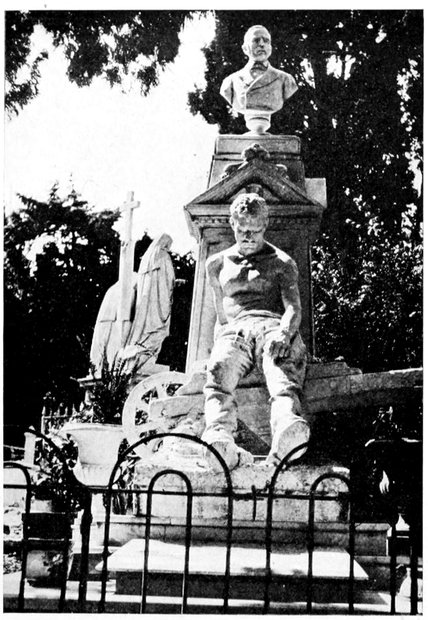
A monument in the cemetery of Montevideo
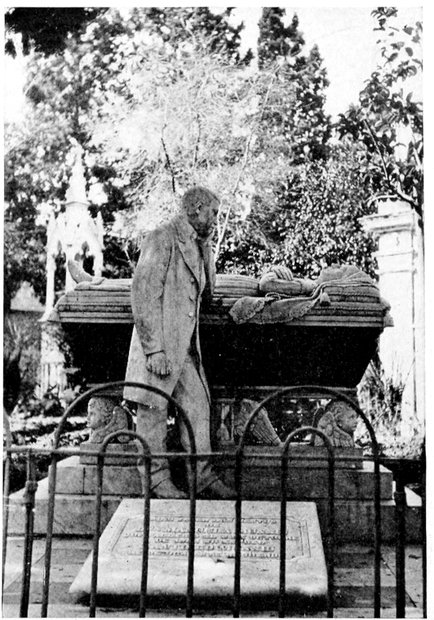
A gentleman of Montevideo depicts in stone his grief at the loss of his life’s companion
113Along with its seascape, this situation gives the city a very exhilarating
air, especially in the winter season. Then it is often penetratingly
cold, and frequently so windy that not only the most securely
fastened hat but the hair beneath it threatens to abandon the
wearer. On the day of my landing a windstorm caused several deaths
and much property damage. Among other things it took the sheet-iron
roof off a building in which four fishermen had taken refuge
and as these ran away the roof followed and fell upon them. In the
third story of the frame hotel that housed me I often woke from a
dream of being rocked in a ship at sea, and Punta Brava in a far
corner of Montevideo’s suburbs was rightly named indeed on windy
days. Fierce thunderstorms also marked my stay in the capital, some
of them accompanied by the mightiest of flashes and crashes, during
which water fell in such torrents that one could scarcely see across
a narrow street—tropical storms they might have been called, had
it not kept right on raining long after it had done raging.
Uruguay claims 1,400,000 inhabitants, of whom all but the million
are said to live in the capital, though the lack of a definite census makes
guessing a popular pastime. But the city is much larger in extent than
this number would imply. One can ride for hours on the lines of its
two excellent tramway companies without once leaving town. Even
in the older sections Montevideo is substantially and handsomely built,
with many good modern monuments. Only a few old landmarks are
left, such as the purely Spanish cathedral on the Plaza de la Constitución,
for Uruguay seems to consider her first demand for independence
in 1808 the beginning of her history and makes no effort to preserve the
memories of her colonial or pre-colombian days. For all that, the
capital has retained a considerable atmosphere of old Spain, a distinctly
seventeenth-century echo, along with her South American style of
up-to-datedness. The best houses along the fine avenues are generally
in colonial style, an almost Moorish one-story building, with lofty
ceilings and space-devouring patios. Especially in the roomy suburbs
do the dwellings stop abruptly at one story, so abruptly sometimes as
to suggest that ruin, or at least a laborer’s strike, has suddenly befallen
the owner. The real reason is probably because it would be hard to
114marry off one’s daughters if their “dragons” had to begin their wooing
by shouting up to the second or third floor windows.
Iron-work grilles are universal, and many house-doors have brass-lined
peepholes through which the resident can see whether the man
knocking is worth admitting. Gardens with subtropical plants are
numerous and promenades under palm-trees by no means unusual.
Especially along the edge of the sea there are over-ornate quintas, alternating
with washerwoman shanties; but there is little oppressive
poverty in Montevideo, and at the same time little of the conspicuous
plutocracy so familiar across the river, a lack of contrast which adds,
perhaps, to the monotony of many a street vista. Poor ranchos are
by no means rare in the farther outskirts, but these are open-air and
almost clean slums compared with the congested sections of our own
large cities. Out beyond the older town are park improvements on an
extensive scale. The Prado, with its great Rose Gardens, said to include
hundreds of varieties, though but few were in bloom among the
dead leaves of June, is worth coming far to see. Here real hills break
the monotony of the landward vista and make artificial, over-polished
Palermo with its deadly flatness seem disagreeable by contrast. The
tale goes that a group of wealthy Porteños once set on foot a movement
to buy one of Uruguay’s hills, carry it across the river, and set
it up in one of their own plazas. No doubt they could have reimbursed
themselves by charging admission and rights of ascension, but
like many ambitious Latin-American plans this one died prematurely.
In general Uruguayans are well-dressed, and comfortably well-to-do,
if one may judge from appearances; compared with roto Chile
the capital is immaculate. “Beachcombers” are rare in this only important
port of the country and beggars are seldom seen, though
there is a plague of petty vendors. It had been like landing on a hostile
shore to make our way through the amazingly impudent mob of
hoarse-voiced cabmen, newsboys, hotel touts, lottery-ticket vendors,
vagrants, pickpockets, useless policemen, and idle citizens into the tranquil
waters of a Sunday morning in the Uruguayan capital; but this
common waterfront experience did not last long. There is something
extremely pleasant about most of the modest, unpretentious Fluvenses,
as the people of Montevideo call themselves, a term we might translate
as “rivereens.” They have, as a rule, a natural politeness, a frank
and open simplicity all but unknown across the river, a leisurely,
contemplative philosophy that will not be broken down even by the
material prosperity of a country that is making perhaps the most intelligent
115use of its situation and resources of all the republics of Latin-America.
It is said that the Uruguayan came mainly from the Basque
provinces and the Canary Islands, while the argentino is chiefly of
southern Spanish origin; that the former brought with him and still retains
a sturdier, less facile, but more dependable, more thoroughgoing
character. Those of wide commercial experience in the continent
say that the Uruguayan is the most honest man south of Panama; every
foreign resident I questioned rated Uruguay as the most lovable
country in South America—and as a rule foreign residents do not
see the best side first. Personally, I found the Uruguayan more sincere,
less selfish, somewhat more solid and at the same time more of an
impulsive idealist than his materialistic neighbors across the Plata.
His country is far enough south to escape the indolence of the tropics,
far enough north to make life itself seem of equal importance with
making a living. With every natural advantage of the Argentine, except
the doubtful one of size, and a more frugal and industrious population
not greatly modified by recent immigration, Uruguay is still
peopled by a kind of colonial Spaniard, somewhat improved by the
breezy, generous quality of his New World domain.
To those who approach it from the south, where they are almost
unknown, negroes are noticeable in Montevideo and become more so
as one proceeds northward through the country. No doubt they drift
down from Brazil and, finding the wide Plata an obstacle, seldom
reach its southern shores. Yet they are so few, and slavery is so
slightly connected with them in the Uruguayan mind, that there is
scarcely a “color-line.” The daughter of a former Uruguayan minister
to Washington told me she had always informed inquiring Americans
that there were no negroes in Uruguay, and had only discovered
her error upon her return with a sharpened color sense. In Uruguay
people are often called by nicknames of color, ample proof that there
is no sensitiveness about the hue of the skin. These popular terms,
usually preceded by the affectionate “Ché” of southeastern South
America, run all the gamut of tints,—“Hola, Ché morocha.” “Diga,
Ché trigueña!” “Cómo va, Ché negrito?” It is a common experience
of visiting Anglo-Saxons to hear themselves addressed by familiar
persons as “Ché rubio,” literally “red-head,” as a complimentary distinction
from the universally black-haired natives. The latter, particularly
the women, are almost always of plump form and comely
face, whatever their color, with few of the cadaverous types so numerous
in the north temperate zone. Uruguayan women, by the
116way, are perhaps a trifle more Moorish in their family life than those
of Buenos Aires, but they are not wholly unaware of the “advanced”
atmosphere of their environment.
Buenos Aires has long had the reputation of being the most expensive
city on earth, probably because it is large enough to be famous,
for certainly its neighbor Montevideo is still less of a poor
man’s paradise. For one thing, the difference in basic coins favors
the Uruguayan profiteer. Many things which cost an Argentine peso
in Buenos Aires cost an Uruguayan peso, or two and a half times as
much, in Montevideo. It is highly to the credit of Uruguay, and a
constant source of pride to her citizens, that her dollar is the only
one in the world normally worth more than our own; but it is painful
for the visitor to be forced to purchase at so high a price pesos that
will seldom buy what a quarter should. In hotel charges, public conveyances,
laundries, lottery-tickets, and other necessities of life the
Uruguayan dollar seems to go little farther than that of the Argentine,
and certainly it has nothing like the purchasing power of our own.
Not only are there substantial coins in circulation, instead of more or
less ragged scraps of paper redeemable only in the imagination, or coins
so debased that only a careless speaker would refer to them as silver,
but any gold coin is legal tender in Uruguay. Throw down an English
sovereign in the smallest shop in the most isolated corner of the
republic and it is instantly accepted at a fixed value. An American
$10 gold piece passed without argument as $9.66 Uruguayan, though
our dollar bill was rated at only ninety centésimos before the war. I
chanced to be in a pulpería far out in the interior of Uruguay when
the shopkeeper asked the large estate owner of the vicinity to take a
hundred pesos to the capital for him. By and by the pulpero returned
from a back room with a small handful of gold and a bit of
paper on which he had figured out the sum he wished to send. He
handed the estanciero several English sovereigns, some German 20-mark
pieces, a Brazilian gold coin, an American half-eagle, two French
napoleons, and the rest of the sum in Uruguayan paper, silver, and
nickel. There was no argument whatever as to the “exchange” on
the foreign coins; each had its fixed value anywhere in Uruguay. It
was something like what a universal coinage will be when the world
grows honest and intelligent enough to establish one—though of course
our bankers would not allow any such system to become universal,
even did the perversity of human nature make it possible. This ready
exchange, and the possibility of turning Uruguayan paper into gold
117upon demand, are among the reasons which make the Uruguayan dollar
normally the most valuable in the world.
Down on one of its beaches the city of Montevideo runs a sumptuous
hotel and an official Monte Carlo. Here it brings ambassadors
and “distinguished visitors” for afternoon tea or formal banquets,
gives balls, keeps an immense staff of liveried menials at public expense
the year round, and during the season takes money away from
the wealthy “sports” from across the river with an efficiency not exceeded
anywhere along the Riviera. More than one passing observer
has found this an excellent means of taxing the rich for the benefit of
the poor, since the profits of the Casino go into the municipal treasury.
As much can scarcely be said for the lottery run by the federal
government, with its incessant appeal to the gambling instincts of all
classes of the population. The tickets assert that “the lottery is run
for the Hospital de Caridad and its profits are destined for exclusively
beneficent ends,” but the statement rings as hollow as many similar
attempts on the part of Latin-America to coax itself to believe that
there is something good in an essentially vicious institution.
Music and drama flourish during the winter in Montevideo; uncounted
cinemas perpetrate their piffle in and out of season. An excellent
Italian dramatic company, headed by the emotional actress
Lyda Borelli, sometimes, and probably not unjustly, called the successor
of Duse, was playing at the “Solis” during my visit—and bringing
out in pitiless contrast the insufferable barnstormers usually seen
on the South American stage. The opera season is in August, when
that half of stars and troupe who do not cross to Santiago de Chile
are on their way back from Buenos Aires to New York or Europe. Orchestra
seats are then at least $12 each and boxes from $80 up, but as
one must have a box for the season or be rated a social nonentity, there
are sad rumors of Fluvense families scrimping all the rest of the year
in order to buy their opera tickets. Naturally this makes them somewhat
exacting and capable of giving an unpleasant reception to singers
tired out at the end of a long season. Caruso himself has been
roundly hissed in Montevideo. Plays and the opera begin at twenty-one
o’clock. As in Italy and Brazil, and more recently in the Argentine,
the law requires the use of the excellent twenty-four-hour system
in all public buildings, and many a private timepiece has followed
suit. The decree was new and throughout the city were many pasted-over
signs such as:
Museum open from 12 to 16 o’clock.
118Somewhere in South America I met a Dane who contended that a
small country, like a man of modest wealth, is better off than a great
nation. Uruguay bears out the statement. We have been accustomed
to speak of the “A.B.C.” countries of South America as having the
only stable and progressive governments in that continent. Only its
slight size, as compared with its gigantic neighbors, has caused Uruguay
to be overlooked in the formation of that list. As its near neighbor
and relative, Paraguay, is perhaps at the bottom of the scale governmentally,
so Uruguay, by its national spirit, its energetic character,
and its advanced legislation is probably at the top, more nearly
fulfilling the requirements of an independent state than any other nation
south of the United States. Certainly it is superior to both Chile
and Brazil in everything but size, and it is doubtful whether even
the Argentine is governed with more intelligence and general honesty.
Once as troublesome a state as any in Latin-America, Uruguay has
settled down and developed her natural resources until she is noted
for her financial stability, and revolutions are memories of earlier
generations. Were she a large country, instead of being merely a
choice morsel of land smaller than some counties of Texas, there is
little doubt that she would stand at least as high as any of her neighbors—or
would size, always an obstacle to good government in Latin-America,
bring her down from her high level?
Uruguay has not always been a small country, nor for that matter
a country at all. In the olden days the Banda Oriental, or “Eastern
Bank,” of the River Uruguay was a province of the viceroyalty of
Buenos Aires. To this day the official name of the country is “La
República Oriental del Uruguay,” and the people still call themselves
“Orientals.” In 1800 the whole “Eastern Bank” had but 40,000 inhabitants,
of whom 15,000 lived in Montevideo. When Napoleon
overran Spain and the viceroyalty of Buenos Aires revolted, the Banda
Oriental remained loyal, thus opening the first breach between the two
sections of the colony. Not long afterward the “grito de libertad”
sounded in the interior of the province, and the man who was destined
to become the national hero of Uruguay, the “First Oriental,” the
“Protector of the Oriental Provinces,” soon took the head of the
revolt.
José Gervasio Artigas was a mere estanciero of the “Eastern Bank”
until he took up soldiering, some time before the “cry of liberty.” In
1811 he left the Spanish army and fled to Buenos Aires, but soon
became an advocate of complete Uruguayan independence, a patriot
119or a traitor, according to the side of the Plata on which the speaker
lives. Having won their freedom from Spain, the argentinos were
finally defeated by the “Oriental” general, Rivera, and Artigas became
ruler not only of the present Uruguay but of the now Argentine
provinces of Entre Rios, Corrientes, Santa Fé, and Córdoba, these
having formed the “Federal League” in opposition to the Buenos Aires
Directory. To read Uruguayan school-books, “the Tucumán congress
was secretly working to establish a monarchy on the Plata, and our
five provinces sent no delegates.” One by one, however, the other provinces
returned to the new mother country, only the “Eastern Bank”
persisting in its isolation and demand for complete autonomy. Meanwhile
Artigas was in exile—and at one time was offered a pension by
the United States—but finally, in 1825, a band of “Orientals” besieged
Montevideo and Uruguay declared her full independence.
The Uruguayan flag remains the same as that of the Argentine, with
a golden sun superimposed. The revolutions of 1863 and 1870, each
two years long, are the only serious disturbances that have occurred
in the “República Oriental” since its independence, and with those exceptions
the country has steadily advanced in health and prosperity.
Its government is more centralized than our own, more like that of
the Argentine, the congress being elected by popular vote in the departments,
but the executives of the latter being appointed by the
federal government. Argentinos speak of Uruguay with a kind of
forced condescension, as of a member of the family temporarily
estranged from the rest, or as a land of no great importance yet one
worthy of again being a province of what they consider the greatest
country on the globe, and they pretend at least to think that the great
development of the Argentine will in time inevitably bring back to
the fold this one lost lamb. But the “Orientals” consider their government
superior and show no tendency to make the change.
Uruguay’s reputation as perhaps the most progressive republic in
South America is largely based on her advanced legislation, most of
it fathered by a recent president. Under his guidance stern minimum
wage and maximum hour laws have been enacted, and many doctrines
of the milder radicals have been put into modified practice. The legislators
forbade bull-fights, cock-fights, and prize-fights in one breath.
Uruguay is the only country in South America with a divorce law, and
the church has been shorn of the militant power it still has in most
of Spanish-America. Montevideo bids fair to become the Reno of the
continent, as well as its only summer-resort capital. Dissatisfied husbands
120or wives move over from Buenos Aires; Spanish and Italian
actors look forward to their Uruguayan engagement as an opportunity
to air their conjugal grievances—though they are not “aired”
in the American yellow-journal sense, for here divorce is strictly an
affair between the parties concerned and the judge and lawyers, rarely
being so much as mentioned even in the back pages of a provincial
newspaper. Priests are comparatively rare sights in the Banda Oriental;
religious festivals and public processions have been abolished, and
the influence of the church on the government reduced to a minimum.
Montevideo is the seat of an archbishop, but he exists only on paper,
for the party in power is not friendly to the clergy and the papal appointment
must be confirmed by congress. There are, to be sure,
many crude superstitions left, especially among the poorer classes and
in the rural districts, but they give Rome no such income as it derives
from similar sources in the rest of the continent. Several Protestant
churches have been built in Montevideo, and all faiths enjoy
a freedom that would seem astounding on the West Coast. Indeed, comparative
indifference to sect lines makes it an ordinary experience for
Protestant ministers traveling in rural districts to be asked by persons
professing themselves devout Catholics to baptize their children. “For
one thing,” as one such rustic put it, “it is cheaper than when the
priest does it.” It may seem a matter of slight importance to those
who have never known the suffering inflicted by the infernal din of
hand-beaten clappers against disguised kettles in the church towers of
the Andes that on the evening of my first day in Uruguay real church
bells, of a musical tone I had almost forgotten, were ringing in a way
that must have been genuine music to the ocean-battered old windjammer
just creeping into the harbor. Far off in the autumn twilight the
sound was still carried softly to my ears by the wind before which gray
clouds were scurrying like a battalion in broken ranks of defeat, toward
the western sky, stained blood-red by the already dead sun.
Politically the Uruguayans are blancos or colorados, “whites” or
“reds.” It is a splendid distinction. For one thing, the parties can
print their arguments and their lists of candidates in posters of their
own color and even the stranger has no difficulty in deciding which
side is speaking. Townsmen can announce their political affiliation by
wearing a red or a white cravat, or a bit of ribbon in their lapels;
countrymen, by the color of their neckerchiefs. There is contrast
enough between the two colors to obscure the lack of any other real
difference between the two parties. In theory the “reds” are “advanced”
121and the “whites” more conservative. Evidently there are no
neutrals in Uruguayan politics; everyone is either “red” or “white”
from the cradle, not because Uruguayans take a greater interest in
political matters than average republican societies, but because it is
bad form, and lonesome, to be outside the ranks; and men who do not
vote are fined. How an Uruguayan becomes attached to this or that
party is a mystery; almost none of them can give any real reason for
their affiliation. Evidently, like “Topsy,” they are “jes’ born” in their
natural colors.
It is now fifteen years since the “reds” came to power on the heels
of Uruguay’s last revolution. Possession is nine points, even in so
progressive a corner of Latin-America, and the “whites” have been
the “outs” from that day to this. Yet one often hears blancos speak
of “when we start our new revolution,” for it seems to be taken for
granted that the “whites” will come back some day with bullets, and
virtually every man in the country is prepared to fight on short notice
for one side or the other. Roughly speaking, “big business,”
large estate owners, and the church, in other words the predatory
classes, are “whites,” though neckcloths of that color are by no means
rare on the peons and gauchos of the more backward country districts.
The leader of the “reds,” now a private citizen merely because
the constitution does not permit the same man to be president twice
in succession, has often been described as “a mixture of idealist and
predatory politician,” but he knows the secret of imposing his will
upon the government and is generally credited with most of Uruguay’s
progressive legislation. For all his efforts and many real results,
however, there is still much that is rotten in the Republic of Uruguay.
The most advanced laws are of doubtful use when they are administered
by the bandits in office who still flourish throughout the rural
districts. In contrast with the brave modern theories of government
is the practice in such things as permitting scores of the lowest forms
of brothels to flourish in the very heart of the capital. I cannot recall
a more disgusting public sight in the western hemisphere than the
long rows of female wrecks in scant attire who solicit at the doors
of several streets radiating from the Anglican church, while veritable
mobs of men and youths march back and forth to “look ’em over,”
amid laughter, ribald witticisms, and worse.
Contrary to the usual custom in South America, there is no military
conscription in Uruguay; recruits are enticed by posters covered
with glowing promises. Yet for all the “advanced” principles of
122equality reputed to reign in the little republic, its army is largely made
up of the poorer and more ignorant element of the population. It
is not a dangerous military force, but it is very useful to the party
in power not only in preserving law and order but for discouraging
“white” revolutions. Whether or not only “reds” are recruited, or
whether those placed on the government payroll automatically become
“reds,” whether indeed youths in the political-ridden interior
do not have redness thrust upon them, is a question not to be determined
during a brief visit. As to the “national navy” of Uruguay, it
consists, if my semi-official informant is trustworthy, of one gunboat,
two cruisers, four steamers, and a transport, all of which, when they
are not absent on one of the frequent “official missions” that make
life in the Uruguayan navy just one festival after another, may be
seen anchored in the harbor of Montevideo, their eyes turned rather
toward the “whites” on shore than toward foreign foes.
I traveled fifteen hundred miles on the network of the Ferrocarril
Central of Uruguay. This and the equally British “Midland” reach
all towns of importance in the republic, though they still by no means
cover it thoroughly. Railway travel in South America is seldom as
luxurious as in the United States, but in the dwarf republic both
cars and service are, on the whole, excellent; the trains are so much
more comfortable than many of the towns through which they run
that it is not strange that scores of the inhabitants come down to sit
in them as long as they remain. There are few accidents, the trains
are seldom late, though not particularly swift, and while fares are high
there are frequent low-priced excursions, announced on handbills as
in our own land. The English-made cars are on a modified American
plan, some of the first-class coaches having leather-upholstered divans
as large as beds, even second-class boasting little tables between the
seats for those who care to lunch or play cards. Between the two
classes at opposite ends of the train there is usually a compartment
with kitchen stove and pantry that serves as a combination café and
dining-car, a generous dinner costing a peso, wine, or “cork rights”
from those who bring their liquor with them, extra. Sleeping-cars,
journeying on both lines in order to find distance enough for an all-night
trip, run from Montevideo to Paysandú and Salto, on the shores
of the River Uruguay bounding on the west the republic of the “Eastern
Bank.” Compared with Chile, railroading in Uruguay is palatial
and immaculate, though even here the only heating arrangements for
bitter June days are doormats between the seats, and the only really
123serious criticism to be made is against the bad habit, common throughout
South America, of starting the trains at some unearthly hour in
the morning.
I took the shortest line first and, rambling at moderate speed across
a somewhat rolling country more fertile in appearance than the Argentine,
brought up at Minas. A broad stone highway, here and
there disintegrated by the heavy rains, led the mile or more from
the station to the town, an overgrown village in a lap of low rocky
hills monotonously like any other Uruguayan or Argentine town of
its size, with a two-towered church and a few rows of one-story
buildings toeing wide, bottomless streets. As in the Argentine, there
are no cities in Uruguay that compare with the capital; the present
department capitals were originally forts against the Indians and the
Portuguese around which people gathered for protection, and few
of them have cause to grow to importance.
The second journey carried me into the northwestern corner of
the country. As far as Las Piedras, a suburban town twenty miles
from the capital, there are a score of daily trains in either direction.
Street-cars come here also, the place being noted for a granite monument
topped by a golden winged Victory commemorating a battle for
independence in 1811, from the terrace of which Montevideo’s fortress-crowned
Cerro still stands conspicuously above all the rest of the visible
world. Then this chief “Oriental” landmark disappears and to
the comparative cosmopolitanism of the federal district succeeds the
bucolic calm of the campaña, as the pampa is called in Uruguay. The
absence of trees alone gives this a mournful aspect. The “Oriental”
has tried half-heartedly to make up for the natural lack of woods by
planting imported eucalyptus and poplar, at least about his country
dwellings, but nowhere do these reach the dignity of a forest. Uruguay
has less excuse for poor roads than the Argentine, for if it has as
much rain and even heavier soil, it has an abundance of stone, rare
in the land across the Plata. Yet though several stone highways
leave the capital with the best of intentions, they soon degenerate into
sloughs seldom navigable in the wet winter season. Most Uruguayan
roads are merely strips of open campaña, the legal twenty-two meters
wide, flanked by wire fences, or occasionally by cactus hedges. Estates
a few miles off the railroads have no chance of getting produce
to market during a large portion of the year; yet the prosperity of
the country depends almost entirely on the exporting of foodstuffs.
Fertile rolling lomas, with now and then a solitary ombú spreading
124its arms to the wind on the summit, made up most of the landscape,
a scene not greatly different from, yet infinitely more pleasing than,
the dead flatness of Argentine pampas. The ombú is the national tree
of Uruguay, of majestic size and always standing in striking isolation
on the crest of a loma, because, according to the poet, it loves to overlook
and laugh at the silly world, though the botanist explains that it is
planted by birds dropping single seeds in their flight and reaches maturity
only on hillocks out of reach of stagnant water. Beyond Mal
Abrigo, rightly named “Bad Shelter,” granite rocks thrust themselves
here and there through the soil; for long stretches coarse brown
espartillo grass covered the country like a blanket. This and the
abundant thistles often ruin the black loam underneath, but the average
“Oriental” estanciero abhors agriculture, preferring to give his
rather indolent attention to cattle and sheep, for he considers planting
fit only for Indians, peons, and immigrant chacreros. Nor is the
lot of these Basque, Spanish, or Italian small farmers always happy,
even though they hold their plots of earth on fairly generous terms,
for locusts have been known to destroy a year’s labor in a few hours.
There were a few riding gang-plows, however, drawn by eight or
ten oxen, and many primitive wooden plows behind a pair or two of
them. Sleek cattle, and horses of better stock than the average in
South America, grazed along the hollows and hillsides; now and then
an ostrich of the pampas, occasionally a whole flock of them, legged
it away across the rolling campaña. Though most of the country
people lived in thatched huts made of the rich loam soil, sometimes
laid together with a clapboard effect and oozing streaks of mud at this
season, both sexes were well and cleanly dressed.
The railroad wound around every loma, refusing to take more than
the slightest grades. Now and then we climbed ever so little up the
flanks of such a knoll and discovered to vast depths of haze-blue
horizon a plump, rolling country of purplish hue, dotted with dark
little clumps of eucalyptus, from each of which peered a low farmhouse
and occasionally a Cervantes windmill for the grinding of grain.
There were many such estancia houses, yet they were all far apart
in the immensity of the little Republic of the Eastern Bank. Why
most stations were so far from the towns they served, in this level
country, was a mystery. The towns themselves varied but slightly in
appearance,—a scattered collection of one-story buildings, in most
cases covered with a stucco that had at some time been painted or
whitewashed, a pulpería, or general store, sacred chiefly to the dispensing
125of strong drink, and, radiating from it, wide roads plowed into
knee-deep sloughs of black earth. A few sulkies and huge two-wheeled
carts, an occasional country wagon with four immense wheels, from
which produce was leisurely being loaded into freight-cars set aside
by the local switch engine—to wit, a yoke of oxen—some real estate
and auction signs offering the chance of a life-time, completed the
background of the picture. In the foreground the inevitable gang
of shouting, mud-bespattered hackmen was almost lost in the throng
of wind-and-sun-browned men in bloomer-like trousers. Peons smoked
their eternal cigarettes; gauchos shod in low alpargatas or high, soft,
wrinkled leather boots, a white or a red kerchief floating about their
necks, the short, stocky riding whip known as a rebenque hanging
from a wrist, lounged about the door of the pulpería, to posts before
which were tied trail-spattered horses saddled with several layers of
sheepskins. An incredibly motley collection of dogs; a majestic policeman
in full uniform and helmet above his voluminous bombachas,
looking essentially peaceful for all the sword dangling at his side;
a few men and youths, bare-legged to the knee, wading about with
cheerful faces, as if the rainy season were at worst a temporary inconvenience
more than offset by the long months of fine weather, added
their picturesque bit to the gathering. Every movement and gesture
showed these people to be of quicker intelligence than the dwellers in
the high Andes. Few women were seen either on trains or at stations,
except at the smaller towns, where there were sometimes groups of
them, wholly white with few exceptions, but wearing earrings worthy
the daughters of African chieftains. At each halt the station-master in
his best clothes, looking busier and more important than a prime minister
on coronation day, stood watch in hand, the bell-rope in the other,
waiting for the time-table to catch up with us; the town notables looked
on, half-anxiously, half-benignly, as if they considered themselves very
indulgent in allowing the train to run through their bailiwick and
felt deeply the responsibility involved; boys of assorted sizes, barefoot
and shod, wormed their way in and out of the throng staring at
everything with wondering eyes; a few comely girls sauntered about
to see and be seen, and friends and relatives took the hundredth
last embrace amid much chatter and mutual thumping of backs.
Then all at once the station-master gives the bell three sharp taps, as
much as to say, “I mean it, and I am not a man to be trifled with,”
and as the train gets slowly under way some town hero grasps the
opportunity to show his fearlessness by catching it on the fly, and
126dropping off again half a car-length beyond with a triumphant, sheepish
grin on his sun-browned countenance.
Two days later the sun, rising huge and red over my left shoulder,
painted a brilliant pink the rounded lomas flanking the Y-shaped line
to Treinta y Tres (also written “33”) and to Melo, far to the northeast
of Montevideo, then spread a pale crimson tint over all the
gently rolling world. Fluffy lambs turned tail and fled as we approached,
the watchdog, true to his calling even unto death, charging
the train against all odds and putting it to ignominious flight. Here
and there lay a whitening skeleton, the animal’s skull sometimes stuck
up conspicuously on the top of a fence-post. There is no unsettled
despoblado in Uruguay, no deserts or haunts of wild Indians, but there
is still much land put to little or no use and not a few remains of
the destruction wrought during the civil war that ended in 1852.
Rare, indeed, is the standing structure in the rural districts that was
not built since that time.
At a small station we were joined by a youth of twenty, pure Caucasian
of race, of the class corresponding to our “hired man.” His
long, wavy, jet-black, carefully oiled hair contrasted strangely with
his complexion, very white under the tan; his eyes were light-brown,
as was also the labial eyebrow he now and then affectionately stroked.
He wore a raven black suit, the coat short and tight-fitting, the trousers,
or bombachas, huge as grainsacks, disappearing in great folds
into calfskin half-boots. A black felt hat of the squared shape once
popular at our colleges was held in place by a narrow black ribbon
tied coquettishly under his chin. The bit of his speckless shirt that
could be seen was light green; above it was a rubber collar and a
cream-colored cravat adorned with a “gold” scarfpin; on the third
finger of his left hand he wore a plain gold band; about his neck floated
a huge, snow-white, near-silk kerchief, and a foreign gold coin hung
from the long gilded watch-chain looped ostentatiously all the way
across his chest. About his waist he wore a leather belt six inches
wide, with several buttoned pockets or compartments in which he
kept money, tickets, tobacco, and other small possessions, and from
the back of which, barely out of sight, hung his revolver. A poncho of
faint pink-white, as specklessly clean as all the rest of his garments,
and thrown with studied abandon over one shoulder, completed his
outfit.
He rode first-class, and having produced his ticket with a millionaire
gesture meant to overawe the modest guarda whose duty it was to
127gather it, he strode into the dining-car with great ostentation and
called for a drink. With the same air of unbounded wealth he paid
his reckoning, flung a generous tip to the waiter, who probably got
more in a week than this at best low-salaried farm-hand in a month,
and strutted back to his seat. It was evident that he was not traveling
far, or he would have sneaked into the second-class coach in his
old clothes. At each station he got off to parade haughtily up and
down the platform, casting peacock glances at the dark-tinted criolla
girls who embroidered it. I approached him at one such stop and
asked permission to take his picture. He refused in very decided and
startled terms. I felt that his “no” was not final, however, and
scarcely a mile more lay behind us before he came wandering up with
a companion and sat down beside me. Why did I want his picture?
Would it cost anything? How many copies of it would I give him?
Well, if it was true, as I claimed, that they could not be finished on the
spot—and why not?—I could of course send them to him? Gradually
he reached the opposite extreme of begging me to take his picture.
His companion having suggested that it might be published “allá en
Europa,” he kept his delight down to becoming gaucho dignity with
difficulty, and before we descended to take the picture at the station
where he left the train, after a short and evidently his only railway
journey in months, he was assuring me that I might publish it “over
there in Europe, in ‘Fray Mocho’ of Buenos Aires” (which the
raucous-voiced trainboy incessantly offered for sale) “or anywhere
else.” Only when the train had gone on without him did I discover
that he was a blanco fleeing from arrest in his own department for the
killing of a rural official in some political squabble, a fact that seemed
to be common knowledge among my fellow-passengers and which
must have made a bit startling my sudden request to photograph him.
The Cerro lighthouse was still flashing through the dense black
night when, late in June, on the shortest day of the year, I took the
tri-weekly train for Brazil. By the time the edge of darkness was
tinted pink by a cloudless day which gradually spread upward from
the horizon, we were already halting at country stations where thickly
wrapped rustics who had driven miles in their bulky two-wheeled
carts, a lantern set on either side of them in a sort of wooden niche
raised aloft on a stick, were unloading battered cans of milk. Durazno,
a good-sized department capital strewn over a low knoll and
terminating in a church, was so flooded by the River Yi at its feet
that its parks, alameda, and “futbol” field were completely under water
128and many poor ranchos stood immersed to their ears. The names
of the stations were often suggestive,—Carda, Sarandí, Molles, all
named for indigenous trees, so striking is one of them in this almost
treeless landscape. From Rio Negro, another of the department capitals
which pass in close succession on this line, the “Midland” railway
paralleled our own for a dozen miles before striking off over the
brown lomas toward Paysandú. Well on in the afternoon the smoothly
rolling country broke up into the little rocky gorge of a small stream
lined with bushy trees. It was probably not five hundred feet anywhere
from the bottom of the brook to the top of the rock-faced
hill, but this was such unusual scenery to “Orientals” that I had been
hearing since hours before of the extraordinary beauty of this natural
phenomenon, and all prepared to drink their fill of it from the windows
of the train. It was named Valle Eden, but times seem to have changed
in that ideal spot, for a policeman in mammoth bombachas stood on
the station platform, and of Eve there was not so much as a fig-leaf
to be seen.
I had ridden the sun clear around his short winter half-circle when
I descended at Tacuarembó. The town had a hint of tropical ways,—women
going languidly down to the little sandy river with bundles of
clothing on their heads, the streets running out into grassy lanes
scattered with carelessly built ranchos. Features, which had grown
more and more Indian all day along the way and in the second-class
coaches, here sometimes suggested more aboriginal than Caucasian
blood. Here, too, there had been much rain, and the very bricks had
sprouted green on the humid, unsunned south ends of the houses. The
shortness of the days was emphasized by the discovery that I was
back in candle-land again, where there was nothing to do in the evening
but stroll the streets or go to bed.
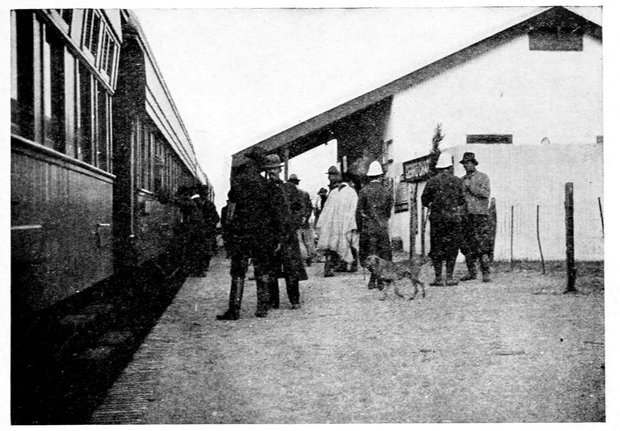
A rural railway station in Uruguay
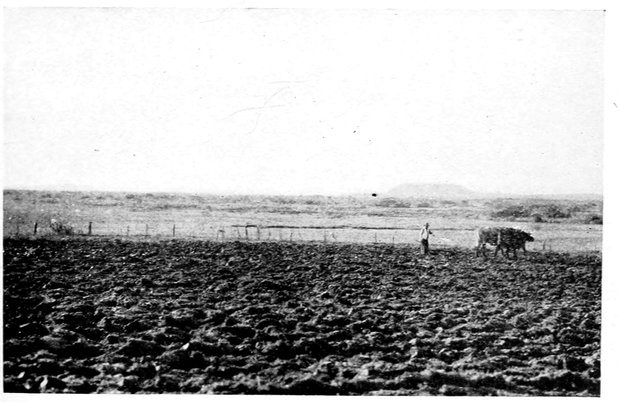
The fertile Uruguayan plains in the Cerro Chato (Flat Hills) district
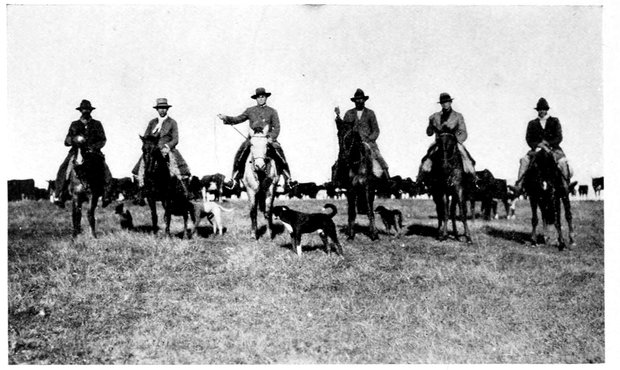
“Pirirín” and his cowboys at an estancia round-up in northern Uruguay
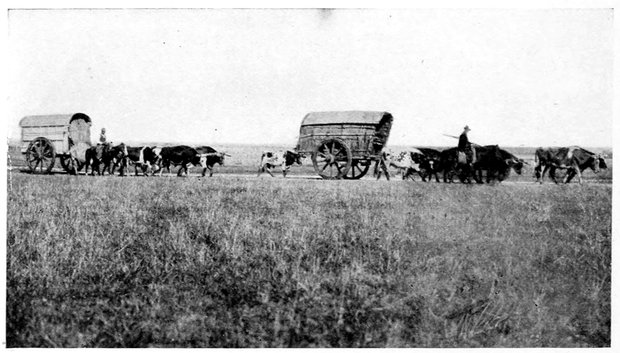
Freighting across the gently rolling plains of the “Purple Land”
I had been reading the Uruguayan epic “Tabaré” for hours next
morning, and possessing my soul in such patience as one acquires in
Latin-America, when I learned by chance that a mucamo, as they call
a mozo in Uruguay, had been waiting in the hotel patio below and asking
for me every few minutes since the night before, the servants
having been too indolent to bring me word. With the better part of
a day lost I rode away on a stout, gray-white horse of rocking-chair
canter. The muddy or flooded road curved and turned and rose and
fell, always seeking the moderate height of the succeeding ridges and
here and there crossing gently rounded cuchillas. The mucamo on his
piebald was outwardly a most unprepossessing creature, but he was
129a helpful, cheery fellow, in great contrast to the usual surly workman
of southern South America, and though only sixteen and scarcely
able to read, he was by no means dull-witted. Apparently there was
not a bird, a flower, or an animal which he did not know intimately,
and he was supernaturally quick in catching sight or sound of them.
The hornero, a little brown bird that makes its ovenlike nest on fence-posts,
the branches of trees, and the crosspieces of telegraph-poles, was
there in force; the cotorra, a species of noisy paroqueet, was almost as
numerous. The chingolo, resembling a sparrow, sits on the backs of
grazing cattle and lives on the garrapatas, or ticks, that burrow into the
animal’s hide. The bien-te-veo (“I spy you”), a yellow bird with
a whistling call suggesting that of a happy child playing hide-and-seek,
frequently glided past; the startled cry of the teru-teru rose as
we advanced, disturbing it. The latter is called the “sentinel bird”
and is so certain to give warning of anything approaching that even
soldiers have found it a useful ally. Dark-gray with white wings
and a slight crest, it resembles a lapwing with a cry not unlike that
of our “killdeer.” The bien-te-veo and the teru-teru live in perfect
immunity because of a local superstition similar to the one sailors have
for the albatross. The woodpecker of Uruguay is called carpintero,
because he works in wood; the viuda (widow), a little white bird
with a black head, is so called, my companion explained to me in all
innocence, because she produces her brood regularly each year without
ever being seen with a male. A little dark-brown bird called the
barranquero builds nests like the homes of our ancient cliff-dwellers, in
the sides of barrancas, or sand-banks. Among the many small birds,
songsters, screamers, and disciples of silence, which eddied about us,
one of the most conspicuous was the cardenal, gray with white under
the wings, its whole head covered with a bright-red liberty cap. A
large bird resembling the stork my companion called “Juan Grande”;
others call it the chajá, because of the jeering half-laugh it is always
uttering. It lives on the edges of swamps, though it cannot swim.
A big brown carancho, a hawk-like bird living on carrion, circled above
us with the ordinary South American scavenger buzzard, here called
simply cuervo, or crow. There is good shooting of a local partridge
in Uruguay, the open season being from April to September. At
plowing time the gulls come in great numbers to feast on the fat grubs.
The dainty crested Uruguayan sparrow has all but been driven out
by the English variety, introduced, if the local legend can be believed,
130by an immigrant who let a cageful of them fly rather than pay duty
on them.
Thus we rode hour after hour over the rolling lomas and cuchillas.
The ground was here and there speckled with macachines, daisy-like
little flowers of a wild plant that produces a species of tiny sweet potato.
The mucamo had never heard of the Castilian tongue; what he
spoke was the “lingua oriental.” It was, to be sure, by no means
pure Spanish, but a Spaniard would have had no difficulty in understanding
him.
At the door of an estancia house with all the comforts reasonably
to be expected in so isolated a location I was met by “Pirirín,” son
of a former minister to London and Washington, and brother of a
well-known Uruguayan writer. His English was as fluent as my own,
with just a trace of something to show that it was not his native tongue.
An old woman at once brought us mate, and we sucked alternately at
the protruding tube each time she refilled the gourd with hot water.
The sun soon set across the rich loam country, which was here and
there being turned up by plodding oxen, and threw into relief the
three cerros chatos, flat-topped hills that give the region its nickname
and which suggest that the level of the country was once much higher
before it was washed away into the sea by heavy rains that even now
gave earth and sky such striking colors.
The wealth and prosperity of the native estanciero of Uruguay is
rarely indicated by the size or dignity of his estancia house. As in
the Argentine and Chile, many estates are owned by men living in
the capital, if not in Europe, each in charge of a gerente, or overseer-manager.
Small as Uruguay is—by South American standards it
seems tiny, even though it is almost as large as New England—many
of its estancias are immense, especially in these northern departments.
There has been much chatter by politicians about limiting the size
of estates and setting up immigrants in the place of absentee owners,
but so far it has chiefly ended in political chatter. The average Uruguayan
estancia house is not particularly well adapted to the climate,
at least during the winter months. A little clump of poplars or eucalyptus,
occasionally a solitary ombú, invariably marks the site of the
main dwelling. Not a few men of comparative wealth pig it out on
their own immense estates, scorning modern improvements, cut off
by impassable roads from markets and all the outside world several
months a year, refusing to subscribe to the rural telephone, depending
for their news on private postmen hired by groups of their fellows.
131A few estate owners, especially those who have lived abroad, demand
moderate comfort, whether for themselves or their managers, though
even “Pirirín” was content with more primitive conditions than many
a small American farmer would endure.
It is quickly evident and freely admitted that the average estancia
in Uruguay is loose of morals. Estancieros frankly state that it is better
if the cook is old and unattractive. It seems to be the rule rather
than the exception, for estancia washerwomen and others of their
class to present the estate with a score of children by members of the
owning family and perhaps by several of the peons as well. Among
this class marriage is unpopular and generally considered superfluous.
There is much noise about Uruguay’s “advanced” theories of social
improvement, yet the law forces, and costumbre expects, no help
from the father in the support of his illegitimate children. If he
chooses to acknowledge them and aid in their up-bringing, he is credited
with an unusually charitable disposition. The woman, on her
side, takes her condition as a matter of course. She will admit with
perfect equanimity that she is not certain just who is father of this
child or that and pointing out one of a half dozen playing about the
estancia backyard she will say laughingly, yet with a hint of seriousness
and pride, “Ah, sí, el tiene papá;” that is, he is one of her children
whose father has recognized him. Yet these women are as punctilious
in general courtesy and the outward forms of behavior as their proud
patrón or the hidalgo-mannered peons.
Next day “Pirirín” and I rode away in the Sunday morning sunshine
across the immense estate, the teru-terus screaming a warning
ahead of us wherever we went. In and about a bañado, a swamp full
of razor-edged wild grass that cut the fingers at the slightest touch,
we saw specimens of the three principal indigenous animals of Uruguay,—the
carpincho, nutria, and mulita. The first, large as an Irish
terrier, is grayish-brown in color, with an unattractive face sloping
back from nose to ears, squirrel-like teeth, and legs suggestive of the
kangaroo. Amphibious and sometimes called the river hog, he looks
like a cross between a pig and a rabbit, or as if he had wished to be
a deer but had found the undertaking so difficult that he had given it
up and taken to the water and to rooting instead. On the edges of
Uruguayan streams there are many happy little families of the beaver-like
nutria, an aquatic animal large as a cat, with long thick fur and
a rat-like tail. Playful as a young rabbit, the nutria is quick of hearing
and swift of action, taking to the water at once when disturbed
132and leaving only its nostrils above the surface; yet when cornered it is
savage, as many a dog has learned to his sorrow. When the pulperos,
or country shopkeepers, of Uruguay found that nutria skins brought
a high price from the furriers of Europe and the United States they
set the countrymen to killing them off regardless of age, sex, or season,
ruining many of the skins by their clumsy handling and all but
exterminating the species. The mulita, also called tatu, is a timid,
helpless little animal of the iguana family, half-lizard, half-turtle, with
a scaly, shield-like covering that suggests medieval armor, and which,
dug out of its hole and roasted over a fagot-fire, furnishes a repast fit
for kings.
The flora was also striking, for all the absence of forests and large
growths. The sina-sina is a small tree with dozens of trunks growing
from the same root, willow-like leaves, and large thorns that
clutch and tear at anything that ventures within reach of it. A waterside
bush called the curupí contains a poison that the Charrúa Indians
formerly used for tipping their arrows. The sarandí, a bush
growing on the banks of streams with its feet always in the water;
the madreselva, or honeysuckle; the chilca, a thinly scattered bush
scarcely two feet high, and the guayacán, a bushy plant with beautiful
white flowers in season, were the most common landscape decorations.
Thousands of macachines covered the ground, white flowers with now
and then a touch of yellow or velvety dark-red.
The gauchos of the estate had been ordered to rodear, to round up
a large herd of cattle, and soon we came upon them riding round and
round several hundred on the crest of a hillock. On the backs of some
of the animals chingolos still sat serenely picking away at the garrapatas
or the flesh left bare by them. The latter are the chief pest of an
otherwise almost perfect ranching country, for thousands of these
aggressive ticks burrow into the hide of the animals and suck their
blood so incessantly that great numbers of cattle die of anemia or fever.
All but the more backward estates now have a big trough-like bath
through which the cattle are driven several times a year as a protection
against garrapatas, but even so it is one peon’s sole duty to ride over
the estate each day to curear, or skin the animals that have died, carry
the skin home, and stake it out in the sun to dry.
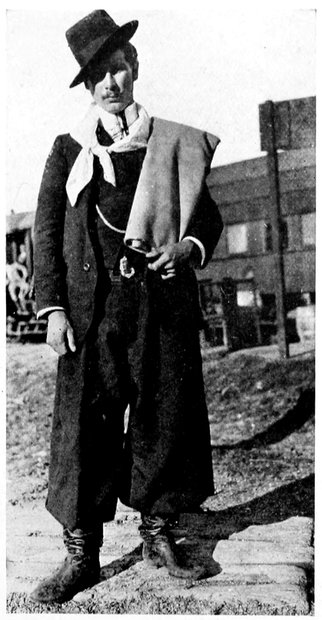
A rural Uruguayan in full Sunday regalia
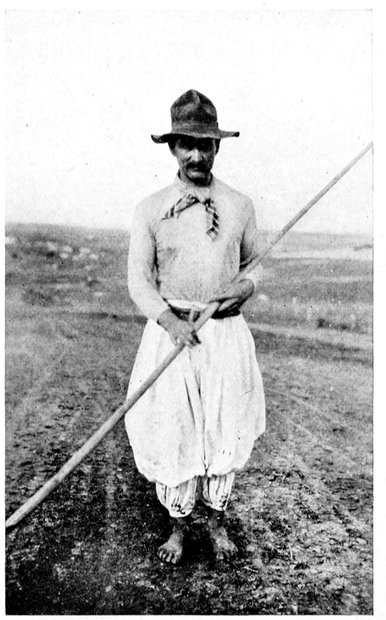
An ox-driver of southern Brazil, smeared with the blood-red mud of his native heath
More than two hours of riding brought us to the almacén or pulpería,
the general store that is to be found on or near every large estancia
in Uruguay. As the day was Sunday scores of gauchos with that half-bashful,
laconic, yet self-reliant air common to their class, ranging all
133the way from half-Indian to pure white in race, with here and there
the African features bequeathed by some Brazilian who had wandered
over the nearby border, silently rode up on their shaggy ponies one
after another out of the treeless immensity and, throwing the reins of
the animal over a fence-post beside many others drowsing in the sun,
stalked noiselessly into the dense shade of the acacia and eucalyptus
trees about the pulpería, then into the store itself. Most of them were
in full regalia of recado, pellones, shapeless felt hat, shaggy whiskers
and poncho. With few exceptions the “Oriental” gaucho still clings to
bombachas or chiripá, the ballooning folds of which disappear in moccasin-like
alpargatas, or into the wrinkled calfskin boots still called
botas de potro, though the custom that gave them their name has long
since become too expensive to be continued. These “colt boots” were
formerly obtained by killing a colt, unless one could be found already
dead, removing the skin from two legs without cutting it open, thrusting
the gaucho foot into it, and letting it shape itself to its new wearer.
A short leather whip hanging from his leather-brown wrist, a poncho
with a long fringe, immense spurs so cruel that the ready wit of the
pampa has dubbed them “nazarinas,” a gay waistcoat, and last of all
a flowing neckcloth, the last word of dandyism in “camp” life, complete
his personal wardrobe. It is against the law to carry arms in Uruguay,
yet every gaucho or peon has his cuchillo in his belt, or carries a
revolver if he considers himself above the knife stage. Every horseman,
too, must have his recado, that complication of gear so astonishing
to the foreigner, so efficient in use, with which the rural South
American loads down his mount. An ox-hide covers the horse from
withers to crupper, to keep his sweat from the rider’s gear; a saddle
similar to that used on pack animals, high-peaked fore and aft, is set
astride this, and both hide and saddle are cinched to the horse by a
strong girth fastened by thongs passed through a ringbolt. On the
bridle, saddle, and whip is brightly shining silver, over the saddle-quilts
and blankets are piled one above the other, the top cover being
a saddlecloth of decorated black sheepskin or a hairy pellón of soft,
cool, tough leather, and outside all this is passed a very broad girth of
fine tough webbing to hold it in place. With his recado and poncho
the experienced gaucho has bedding, coverings, sun-awning, shelter
from the heaviest rain, and all the protection needed to keep him safe
and sound on his pampa wanderings.
As they entered the pulpería the newcomers greeted every fellow-gaucho,
though some two score were already gathered, with that limp
134handshake peculiar to the rural districts of South America, rarely
speaking more than two or three words, and these so low as to be
barely audible, apparently because of the presence of “Pirirín” and
myself. The rules of caste were amazing in a country supposed to be
far advanced in democracy. Though the gaucho, in common with most
of the human family, considers himself the equal, if not the superior,
of any man on earth, he retains many of the manners of colonial days.
“Pirirín” and I, as lords of the visible universe and representatives of
the wealth and knowledge of the great outside world, had entered the
pulpería by the family door and were given the choicest seats—on the
best American oil-boxes available—behind the counter. The sophisticated-rustic
pulpero greeted us each with a handshake, somewhat weak,
to be sure, because that is the only way his class ever shakes hands,
but raising his hat each time, while we did not so much as touch ours.
To have done so would have been to lower both the pulpero’s and the
by-standing gauchos’ opinion of us. Then he turned and greeted his
gaucho customers with an air nicely balanced between the friendly and
the superior, offering each of them a finger end, they raising their hats
and he not so much as touching his.
Yet these slender, wiry countrymen, carrying themselves like self-reliant
freemen, with a natural ease of bearing and a courtesy in which
simplicity and punctilio are nicely blended, take the stranger entirely
on his merits and give and expect the same courtesy as the wealthy
estanciero. If the newcomer shows a friendly spirit, his title soon
advances from “Señor”—or “Mister,” in honor of his foreign origin,
be he French, Spanish, Italian, English, or American—to the use of
his first name, and he will be known as “Don Carlos,” “Don Enrique,”
or whatever it may be, to the end of his stay. Later, if he is well liked,
he may even be addressed as “Ché,” that curious term of familiarity
and affection universally used among friends in Uruguay. It is not a
Spanish word, but seems to have been borrowed from the Guaraní
tongue, in which it means “mine,” and probably by extension “my
friend.” To be called “Ché” by the Uruguayan gaucho is proof of
being accepted as a full and friendly equal.
In theory the pulpero establishes himself out on the campaña only to
sell tobacco, mate, strong drink, and tinned goods from abroad; in
practice these country storekeepers have other and far more important
sources of income. They are usurers, speculators in land and stock,
above all exploiters of the gaucho’s gambling instinct. Thanks perhaps
to the greater or less amount of Spanish blood in his veins he will
135accept a wager on anything, be it only on the weather, on a child’s toys,
on which way a cow will run, on how far away a bird will alight, or
on whether sol ó número (“sun or number,” corresponding to our
“heads or tails”) will fall uppermost at the flipping of a coin. This
makes him easy prey to the pulpero, who is usually a Spaniard, Basque,
Italian, or “Turk,” and an unconscionable rogue without any other
ideal than the amassing of a fortune, yet who somehow grows rich at
the expense of the peons and gauchos, instead of meeting the violent
death from the quick-tempered hijo del país who despises yet fears
him.
The gauchos were originally called “gauderios,” that is, lazy, good-for-nothing
rascals. To-day that word is an exaggeration, for they
have a certain merit of industry and simple honesty. There is considerable
vendetta among them, gambling rows and love affairs especially,
much of which goes unpunished, particularly if the perpetrator
is a “red” and his victim a “white.” Punishment for fence-cutting or
sheep-stealing is surer: as in our own West in earlier days the loss of a
man is largely his own affair, while the loss of a flock of sheep or a
drove of cattle is serious. To make matters worse, the country
comisarios, or policemen, are often subsidized by certain estancieros
to the disadvantage of others, and the juez de paz is quite likely to be
a rogue, in either of which cases the friends of “justice” usually get off
and their enemies get punished.
According to “Pirirín,” the average gaucho is an incorrigible wanderer.
Paid but ten or fifteen pesos a month “and found,” and satisfied
with quarters which most workmen in civilized lands would refuse
with scorn, he is given to capricious changes of abode and is likely
to throw a leg over his faithful horse at the least provocation. Among
these incurable pampa wanderers there are not a few “poor whites,”
often with considerable Anglo-Saxon blood in their veins, its origin
lost in their Spanicized names. Hospitality is the first of the virtues
of the estanciero, and any genial horseback tramp who turns up may
remain on the estancia unmolested for a day, a week, or a month, as
the spirit moves him. There was a suggestion of our own cowboys
among the group that finally overflowed the pulpería, though the
gauchos were less given to noisy horseplay and had far more dignity
and courtesy. Some of them could read without having to spell out the
words, and while “Orientals” in the mass are not a nation of readers
and there is considerable illiteracy, these countrymen were much more
136in touch with the world’s affairs than the same class in the countries of
the West Coast.
The gaucho may still occasionally be heard thrumming a guitar and
wailing his sad, Moorish, genuinely Oriental songs, invariably sentimental
and deeply melancholy, with never a comic touch, like a lineal
descendant of the wandering troubadour of the Middle Ages or the
street-singers of the Mohammedan East. When he is not making
music or love, he is sucking mate and talking horses. He has more
than a score of words for his equine companion, running through
every gamut of color, behavior, and pace. His obsession for this
topic of conversation is natural, for he has an instinctive horror of
going on foot and the horse is to the resident of the pampas what the
ship is to the sailor; without it he is hopelessly stranded. Yet his
interest is entirely of a utilitarian nature. He is racially incapable of
any such affection for his mount as causes other races to spare it
unnecessary suffering; if he coddles it at all it is merely for the selfish
motive of his own safety or convenience. Among the picturesque
types of the campaña and the pampa is the domador, the professional
horse-breaker. His customary fee is five pesos a head, “with living,”
and his methods are true to his Spanish blood. Instead of being
broken early, the colts are allowed to run wild until they are four or
five years old; then a drove of them is rounded up in a corral and the
victims suddenly lassooed one by one and thrown to the ground. With
half a dozen peons pulling on the rope about his neck until he is all
but strangled, his legs are tied and a halter is put on and attached to a
tree, where the animal is left to strain until he is exhausted, often hurting
himself more or less permanently. Then his tongue and lower jaw
are fastened in a painful noose that forces him to follow the peon, who
rides away, jerking at the rope. Finally, when the weary and frightened
animal is trembling in every limb, the brave domador mounts
him and, with a horseman on either side to protect him, and pulling
savagely at the colt’s sore mouth, the potro is galloped until he is completely
worn out. It used to be beneath gaucho dignity to ride a mare,
and to this day no self-respecting domador of the old school will consent
to tame one. Sometimes the female of the species draws carts,
with her colt running alongside, but on the larger estancias she is
allowed to roam at large all her days.
In the evening, with the gauchos departed and the pulpería officially
closed to the public, we added our bonfire to the sixteen others in honor
of St. Peter and St. Paul, which we could count around the horizon,
137and gathered about the table with the pulpero’s family to play “lottery,”
a two-cent gambling card game. It was long after midnight
when “Pirirín” shook off the combined fascination of this and the
pulpero’s amenable daughter. From my cot behind the pulpería counter
I saw the day dawn rosy red, but clouds and a south wind promised
rain before my companion roused himself. We got into an araña
(spider), a two-wheeled cart which did somewhat resemble that web-weaving
insect, and rocked and bumped away across the untracked
campaña behind two half-wild young horses. Never was there a let-up
from howling at and lashing the reeking animals all the rest of the
morning, an English education not having cured “Pirirín” of the
thoughtless cruelty bequeathed by his Spanish blood. Through gullies
in which we were showered with mud, up and down hill at top speed
we raced, until the trembling horses were so weary that we were forced
to hitch on in front of them the one the mucamo was riding. In
Tacuarembó this owner, or at least prospective owner, of thousands of
acres and cattle went to the cheapest hotel and slept on an ancient and
broken cot in the same room with two rough and dirty plowmen, while
I caught the evening train for the Brazilian border.
CHAPTER VII BUMPING UP TO RIO
138
Upon the thirty-first parallel of south latitude, three hundred and
sixty miles north of Montevideo, there is a town of divided
allegiance, situated in both the smallest and the largest countries
of South America. When the traveler descends from the “Uruguay
Central” he finds it is named for Colonel Rivera, the Custer of
Uruguay, who made the last stand against the Charrúa Indians and
was killed by them in 1832. But as he goes strolling along the main
street, gazing idly into the shop windows, he notes all at once that the
signs in them have changed in words and prices, that even the street
has an entirely different name, for instead of the Calle Principal it
has become the Rua Sete de Setembro, and suddenly he awakens to
the fact that instead of taking a stroll in the town of Rivera, in the
República Oriental del Uruguay, as he fancied, he has wandered into
Santa Anna do Livramento in the state of Rio Grande do Sul in the
United States of Brazil.
There is no getting away from the saints even when the tongue and
nationality and even the color of the population changes, for the Portuguese
adventurers who settled the mighty paunch of South America
were quite as eager for celestial blessings on their more or less nefarious
enterprises as were their fellow scamps and contemporaries, the
Spanish conquistadores. But the stray traveler in question is sure to
find that another atmosphere has suddenly grown up about him. Barracks
swarming with muscular black soldiers, wearing long cloaks, in
spite of the semi-tropical weather, as nearly wrong side out as possible,
in order to display the brilliant red with which they are lined, give a
belligerent aspect to this warmer and mightier land. Negroes and
piccaninnies and the unpainted makeshift shacks that commonly go with
them are scattered over all the landscape; oxen with the yokes on
their necks rather than in front of their horns testify to the change
from Spanish custom; instead of the pretty little plaza with its well-kept
promenades, its comfortable benches, and its well-tended flower
plots that forms the center of Rivera or any other Spanish-American
139town that has the slightest personal pride, there is a praça, muddy,
untended, seatless, and unadorned. The sun, too, has begun to bite
again in a way unfamiliar in the countries in southern and temperate
South America.
Rivera and Santa Anna do Livramento are physically a single town.
The international boundary runs through the center of a football
field in which boys in Brazil pursue a ball set in motion in Uruguay,
and climbs up over a knoll on the top of which sits a stone boundary
post, the two countries rolling away together over plump hills densely
green in color, except where the enamel of nature has been chipped off
to disclose a reddish sandy soil. Surely Brazil, stretching for thirty-seven
degrees of latitude from Uruguay to the Guianas, a distance as
far as from Key West to the top of Labrador, with a width of nearly as
many degrees of longitude from Pernambuco to the Andes and covering
more space than the continental United States, is large enough so
that its inhabitants need not have crowded their huts to the very edge
of the boundary line in this fashion, as if they were fleeing from oppressive
rulers, or were determined that little Uruguay shall not thrust
her authority an inch farther north.
I went over into Brazil early in the day, it being barely three blocks
from my “Gran Hotel Nuevo,” which was neither grand, new, nor,
strictly speaking, a hotel. But when the sockless manager-owner of
the main hostelry of Sant’ Anna asked me two thousand something or
other for the privilege of lying on a hilly cot not unlike a dog’s nest in a
musty hole already occupied by several other guests, I concluded to
remain in Uruguay as long as possible. In Montevideo a cablegram
had advised me to make myself known to the Brazilian railway officials
at the frontier and learn something to my advantage. I could not
shake off a vague uneasiness at entering with slight funds a country of
which I had heard many a disagreeable tale and where I expected to
undergo the unpleasant experience of not understanding the language.
Yet when at length I found the station-master of the “Compagnie
Auxiliaire,” in a red cap but, I was relieved to note, a white skin, we
talked for some time of the general pass with sleeping-car accommodations
which the discerning general manager of the railways of
southern Brazil seemed bent on thrusting upon me, before I realized
that he was speaking Portuguese and I Spanish, and understanding
each other perfectly.
It is 2058 miles by rail from Montevideo to Rio de Janeiro, and the
cost of this overland trip to the average traveler with a trunk or two
140and a moderate appetite would be about $150. One may leave the
Uruguayan capital on Monday, for instance, by one of the three weekly
trains, and arrive in the Brazilian capital on the following Saturday,
spending only one night motionless on the way—if one is contented to
be a mere tourist rather than a traveler and is not overburdened with
baggage. For this must be carried the mile or more over the frontier,
at which it is examined by a band of stupid and discourteous negroes,
who seem to delight in putting as many obstacles as possible in the way
of the well-to-do traveler. Not being included in that category, my
own day’s halt in Rivera was entirely by choice; but for those more in
haste than curious for a glimpse of Brazilian life it is cheaper, faster,
and more comfortable to make the journey by sea.
The daily train northward leaves Santa Anna at 7:35, which is seven
by Uruguayan time, and I was dragged out of bed at an unearthly hour
for midwinter June to find the world weighed down under a dense,
bone-soaking blanket of fog. The street lamps of both countries, judging
daylight by the calendar rather than by the facts, kept going out
just half a block ahead of me as I stumbled through the impenetrable
gloom, the streets by no means improving at the frontier. I might
have crossed this without formality had I not chosen to wake the
negro guard from a sound sleep in his kiosk and insist upon his doing
his duty. One would fancy that an official stationed five feet from a
Spanish-speaking country would pick up a few words of that language,
yet these customhouse negroes professed not to understand a word
of Spanish, no matter how much it sounded like their native Portuguese.
At length, with a growl for having been disturbed, the swarthy
guardian waved a hand at me in a bored, tropical way, drew his resplendent
cloak about him again, and stretched out once more on his wooden
bench.
It was a long mile of slippery mud and warm humidity to the station,
where black night still reigned and where yet another African official
came to revisar my baggage, for much contraband passes this frontier
in both directions. Finally something resembling daybreak forced its
reluctant way through the gray mass that hung over and crept into
everything, and our narrow-gauge half-freight took to bumping uncertainly
northward. What a change from the clean, comfortable, equal-to-anywhere
trains of Uruguay! Even our “primeiro,” with its two
seats on one side of the aisle and one on the other, was as untidy,
unmended, slovenly as the government railways of Chile, and every
mile forward seemed to bring one that much nearer the heart of happy-go-lucky
Latin-America.
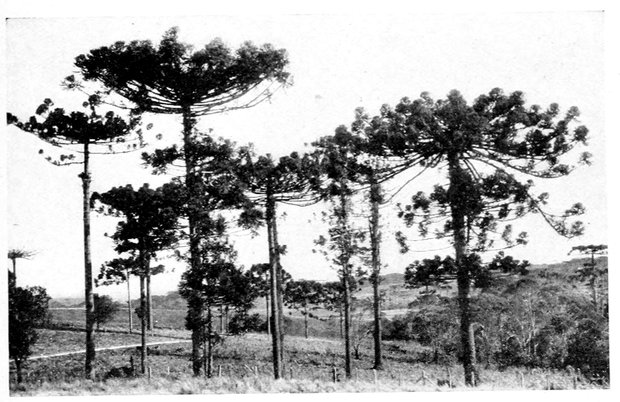
The parasol pine trees of southern Brazil
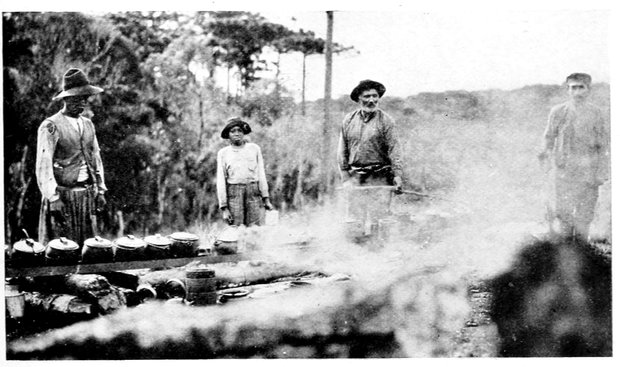
Dinner time at a railway construction camp in Rio Grande do Sul
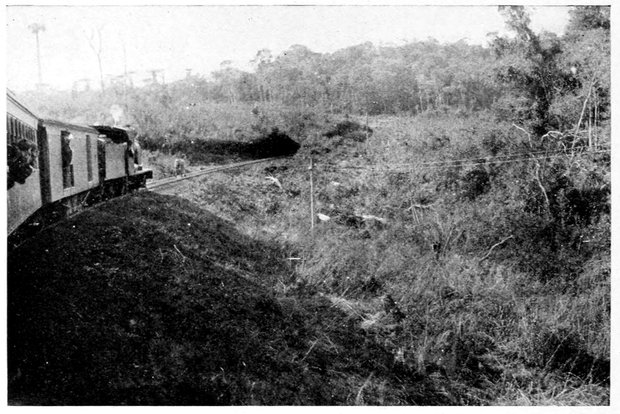
A horse ran for seven miles along the track in front of us and made our train half an hour late
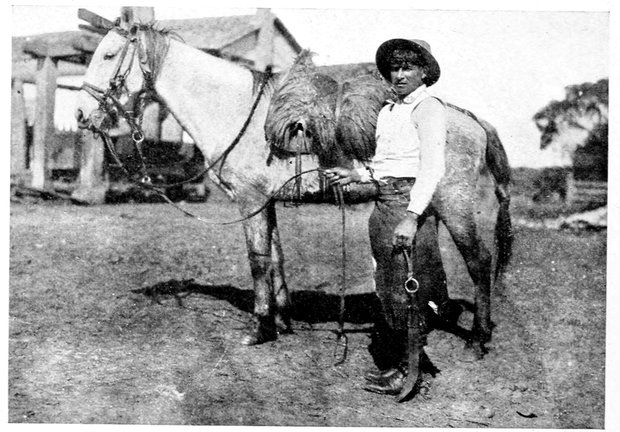
A cowboy of southern Brazil
141I wrapped myself in all the garments I possessed, regretting that I
owned no overcoat, as we shivered jerkily onward across a wild,
shaggy, mist-heavy country inhabited only by cattle and with no stopping-place
all the morning, except Rosario, entitled to consider itself
a town. I fell to reading a Porto Alegre newspaper of a day or two
before, for as I could usually guess the meaning of the spoken tongue,
so I could read Portuguese, like a man skating over thin ice—as long as
I kept swiftly going all was well, but if I stopped to examine a word
closely, I was lost. Brazilians would have you believe that Portuguese
is a purer form of the tongue from which Spanish is descended; Spanish-speaking
South Americans assert that Portuguese is a degenerate
dialect of their own noble language and even go so far as to refer to it
privately as “lingua de macacos,” of which phrase the last word is the
Portuguese term for monkey. Thanks to my long familiarity with their
tongue I found myself siding with the Castilian branch of the family.
On the printed page it was hard to treat this new tongue with due
seriousness. I found myself unable to shake off the impression that
the writer had never learned to spell, or at least had not been able to
force his learning upon the printer. The stuff looked as if the latter
had “pied” the form, and then had not had time to find all the letters
again or have the proof corrected. Thus cattle, instead of being
ganado, as it should be, was merely gado; general had shrunk to geral,
and to make matters worse still more letters were dropped in forming
the plural, so that such monstrosities as geraes and automobeis shrieked
at the reader in every line. Fancy calling tea chá; think of writing
esmola when you mean limosna! It suggested dialect invented by a
small Spanish boy so angry he “wouldn’t play any more,” and who had
taken to horribly mispronouncing and absurdly misspelling the tongue
of himself and his playmates, yet who had not originality enough to
form a really new language. And what a treacherous language! The
short, simple, everyday words were the very ones most apt to be entirely
different; thus dos was no longer “two” but “of the”; “two” was
now dois in the masculine and duas in the feminine, and there was still
a dous—the plural form, I suppose. A trapiche was no longer a primitive
sugarmill, but a warehouse; a cigar had become a mere charuto.
The Portuguese seemed to avoid the letter “l” as zealously as do the
Japanese, replacing it by “r”—la plaza had been deformed into a praça,
el plato had become o prato. Where they were not doubling the “n,”
142contrary to all rules of Castilian spelling, they were leaving it out
entirely, and one was asked to admire the silvery rays of a lua! A man
had been brought before a judge because he had seen fit to espancar his
wife, yet the context showed that it was no case of the application of
the corrective slipper. I was reading along as smoothly and calmly as
in English when all at once the headline “Esposição International de
Borrachas em Londres” struck my eye. Válgame Diós! An International
Exposition of Drunken Women! Seven thousand miles away,
too! And why in London, rather than in Glasgow? That particular
headline would have cost me much mental anguish had I not had the
foresight in Montevideo to buy a “Portuguez-Hespanhol” pocket vocabulary.
And what, of all things, should borracha be, in this absurd,
mispronounced dialect, but rubber, and no drunken woman at all, thus
depriving the article at once of all interest!
The chief trouble with written Portuguese is that it has never been
operated on for appendicitis. Parts that have long since ceased to
function have not been cut off, as in the close-cropped Spanish, and
such words as simples, fructa, and the like retain their useless unpronounced
letters until the written word is almost as absurdly unlike
the spoken one as in English. Yet the tongue of Brazil has at least the
advantage that it is in some ways easier to pronounce than Spanish.
The guttural Castilian j, for example, over which the foreign tongue
almost invariably stumbles, is missing, and while few Americans can
say jefe in the Spanish fashion they can all give it the Portuguese
sound “shefe”; and if mejor taxes the Anglo-Saxon palate, melhor is
perfectly easy. Moreover, life is a constant holiday in Portuguese.
Domingo and sabbado are days of rest under any name; but it seems
unwise to mislead a naturally indolent people into thinking that every
day is a “feast day” by calling Monday “second festival,” Tuesday “third
festival” and so on, forcing the stranger to do some finger and toe
counting to find that quarta-feira, or “fourth festival,” was none other
than this very Wednesday so foggily hanging about us. To hear the
kinky-haired trainman tell me in a long series of mispronunciations that
if I chose to let this one go on without me I could get another train at
“twenty:thirty-two on fifth feast-day” required some nimble mental
exertion to figure out that the lunatic was trying to say 8:32 P. M. on
Thursday.
The line out of Santa Anna is really a branch of the long and important
one from Uruguayana on the Uruguay River, dividing Brazil
from the Argentine, to the large “lagoon towns” of Pelotas and Rio
143Grande on the Atlantic. About noon we tumbled out of our rattling
conveyance at Cacequy and took another train, on the line to Porto
Alegre, capital of the enormous “estado gaucho,” or “cowboy state,”
southernmost of Brazil and larger than all Uruguay. It rambled in
and about low hills, with an excellent grazing country spread out to
the horizon on every hand, and at four—beg pardon, sixteen o’clock—set
us down at the considerable town of Santa Maria on a knoll among
wooded hills, the junction where those bound for the capital of the
state must take leave of those on their way to the capital of the republic.
I was privileged to occupy room No. 1 in the chief hotel of the
town, which was no doubt a high honor. But as it chanced to be between
the front door of the building and the cobbled entrance corridor,
with either window or door opening directly on crowds of impudent
newsboys, lottery vendors, and servants, it was not unlike being between
the devil—or at least a swarm of his progeny—and the deep sea.
Indeed, it quickly became evident that Brazilian hotels of the interior
would prove no better than those in the three southern countries of
South America, where the traveler is expected to pay a fortune for the
privilege of tossing out the night on a hilly cot and where the meals never
vary an iota,—beginning unfailingly with fiambre, or thin slices of cold
meat, and hurrying through several dishes of hot meat, down to the
inevitable dulce de membrillo, a hard quince jelly which is the sad
ending of all meals at the lower end of South America. Nowhere does
the Latin-American’s lack of initiative show more clearly than in the
kitchen. To increase my gloom, the French proprietress, whose every
glance caused my thin pocketbook to writhe with fear, manipulated the
items so cleverly that, though placards on the walls announced the rate
as seven milreis a day, and I was there only from sunset until a little
after sunrise, she handed me a bill for 13,500 reis!
Luckily I had already weathered the first shock of the traveler who
comes rudely in contact with the Brazilian money system, but I paid
miser-faced old madame in a daze, and retired to a quiet corner to
figure up the exact extent of the disaster that had befallen me. On due
reflection it proved to be not quite so overwhelming as it had sounded.
Even when they are reduced to real money Brazilian prices are not
mild, but they are by no means so utterly insane as they sound. The
monetary unit is the real, in theory only, for no such coin exists, and
in practice only the plural reis is used, the real unit being the milreis,
one thousand reis. For years the milreis had remained at the fixed
value of fifteen to the English pound. In larger transactions—and
144most transactions are large in Brazil—the unit is the conto, one million
reis, about $325. Gold is never seen in circulation. Between the milreis
and the conto there are paper notes, usually printed in New York;
silver coins from five hundred to two thousand reis, and nickel pieces
of four, two, and one hundred complete the list in common circulation.
Lastly, lest the unwarned stranger be led astray by appearances, the
Brazilian places his dollar sign after the milreis and before the reis,
so that 3$250 means the normal equivalent of an American dollar, and
the man who pays $500 for a newspaper or a small glass of iced cane-juice
does not feel that he has been unusually extravagant—at least
if he has lived long enough in Brazil to get the local point of view.
A pair of German peasants sat in a corner of the second-class coach
when we pulled out of Santa Maria. Theirs were the same honest,
wrinkled, hard-working, unimaginative faces one sees in rural Germany.
The woman, with a kerchief over her head and her bare feet
thrust into low slippers, was as devoid of feminine coquettishness as
of desire for adornment, a picture of the plodding, toilsome helpmate
of the thoroughly Teuton farmer at her side. Yet I found that they
had never been outside the southernmost state of Brazil, though they
spoke German with far more ease than they did Portuguese, and their
appearance would not have attracted the slightest attention in the very
heart of Germany.
The three fertile southern states of Brazil are on an elevated plateau
that makes them excellent cereal and fruit regions well suited as a
permanent habitation of the white race. All that portion of Brazil
below Rio de Janeiro is of comparatively recent settlement. During
the colonial period Portuguese energy was directed almost exclusively
to the semi-tropical and tropical regions of the north, to Bahia and
Pernambuco, where rich tobacco and sugar plantations could be worked
with slave labor, or to the gold and diamond lands of the interior, with
their special attractions to impatient fortune hunters. The splendid
pasture lands of the temperate zone were scorned by these eager adventurers;
maps printed as late as 1865 bear across all these southern
provinces the words “unknown and inhabited by wild Indians.”
The Germans, to be sure, had begun to appear before that. Barely
had the exiled emperor of Portugal settled down in 1808, to rule his
immense overseas domain when he set about filling in its waste spaces
by an immigration policy that is to this day continued by the states
themselves. Not only Dom João but his successors, the two Dom
Pedros, turned to Switzerland and Germany for the hardy settlers
145needed to tame this south-temperate wilderness. The first official
German colony in Brazil was founded in the state of Rio Grande do
Sul, and for twenty-five years Teutonic settlers were established at
many different points, chiefly in the three southernmost states, in some
cases as far north as Minas Geraes. But in 1859 the German government
forbade emigration to Brazil. The original settlers are therefore
long since dead and the present inhabitants are of the third or fourth
generation, born in Brazil, and with little more than a traditional feeling
for the Fatherland. Yet it is a peculiarity of South American
civilization that it does not impose itself upon European immigration to
any such degree as does that of the United States. Ask the man whose
father, or even grandfather, emigrated from Germany to Brazil what
his nationality is and he is almost certain to reply, without any consciousness
of the strangeness of his answer, “Ich bin Deutsch.” If
the German has remained a German in Brazil, it is perhaps as much
the fault of the Brazilian environment as by his own choice. There
are cities in the southern states of Brazil so German that men and
women born in them speak not a word of Portuguese. This is particularly
frequent in the district about Porto Alegre and in the “lagoon
country” between there and the Uruguayan boundary. Joinville, in
Santa Catharina, named for a German prince who married the daughter
of an emperor of Brazil, is so German that the Portuguese tongue
attracts attention in the streets, as it does in several other of the thirteen
colonies founded before the ban was placed on German emigration.
Even the inhabitants who speak Portuguese do so with difficulty
and with a strong Teutonic accent. The school teachers of these
former colonies are subsidized German pastors; the German element is
so strong as often to elect a German state president—the states of
Brazil have presidents rather than governors. For several years all office
holders in Santa Catharina, with the exception of the Federal Court,
appointed in Rio, were Germans, and the anomaly of Brazilian government
reports written by men who scarcely knew the language of the
country in which they ruled was by no means unusual.
It is estimated that there are now about a million descendants of
Germans in the three or four southern states of Brazil, a territory
approximately as large as our “solid south” east of the Mississippi.
Their adopted country was liberal to the early settlers, allotting 175
acres of land to each immigrant, though this has been much reduced in
individual cases by speculative abuses. Not until 1896 was the German
edict against migration to Brazil removed, and by that time the
146southern states had attracted new settlers, particularly from Italy.
The state of São Paulo, for instance, has built up her great coffee industry
and factory production chiefly on Italian immigration. The
Germans are said always to seek the lower lands and the river bottoms,
raising especially pigs and vegetables, while the Italians plant the high
ridges farther back from the sea with corn and grapes, with the result
that such towns as Garabaldi and Novo Hamburgo, Blumenau and
Angelina, are but a cannon-shot apart.
Where the great Lagoa dos Patos opens to the sea at the town of
Rio Grande, on sandy, onion-growing flats that follow two hundred
miles of shifting sand dunes from Imbituba southward, is a hot, often
sand-beaten point once ruled by powerful British firms. It is nearly
a hundred miles up this “inland sea” to the capital of the state, with
200,000 inhabitants, which with the large town of Pelotas is the great
port of embarkation of the xarque, as the tasajo, or thick dried beef,
of the Argentine is called in Brazil. One by one the German traders
crowded out their competitors in this region; with the docile population
of the “lagoon cities” racially friendly to them they established a
virtual German monopoly of German commercial and financial houses
in coöperation with German shipping. Where the German ruled there
was no room for any other European or American, not even for Brazilian
industry, and in each of these coastal cities of southern Brazil
a great German firm was supreme dictator before the World War,
which was not the least of the many causes of that war. What advantages
these uncrowned rulers of their million unsophisticated and often
unconscious subjects might have taken in establishing themselves and
their Fatherland more firmly in Brazil if the world conflict had ended
differently is of course now a purely academic question.
The lines of southern Brazil could scarcely be made a real railroad
in the American sense without complete rebuilding, for they constantly
squirm and twist and wind their way over the lightly rolling country,
seeking always the higher levels and never by any chance running for
a yard straight forward. One of the trainmen asserted that if a cow
got in the way of the surveyors who laid out the line, they moved the
transit rather than exert themselves to go and drive her away. Less
facetious officials explained that the engines are so weak that anything
steeper than a one per cent. grade was avoided in the building, and that
this was done on contract by Brazilians and by the mile. From the
car-windows we had frequent views of the engineer and the fireman in
their cab; we darted from side to side so often that, it would have been
147easy to imagine the little engine in terror of the many wide-horned
cattle scattered over the rolling landscape. The brakes were frequently
called upon to keep us from running over the time-table; stations or
crossings were so rare that the whistle was uncomfortably startling;
at the rare places where we did officially stop an extended argument
usually arose between the station master in his red cap and the trainmen
in their blue ones as to when it would be fitting and advisable to
jolt onward.
Beyond the large town of Passo Fundo appeared, first singly, then
in roomy clusters, the splendid pinheiro araucarai, the slender yet
sturdy Brazilian pine-tree, erect and entirely free from branches to the
very top, from which these suddenly spread thickly out at right angles
to the trunk. The parasol-pine makes excellent lumber, being lighter
yet stronger than our northern pine, but above all it beautifies the
landscape. The rare small clumps of it in the hollows became more and
more numerous until, at Erechim, we found ourselves in an entire
forest of parasol-pines, with an atmosphere strikingly like our northern
lumber woods. The weather had grown so warm that in the middle of
the day it was uncomfortable to sit in the unshaded car window, and
creepers and lianas were beginning to appear in the semi-tropical forests,
silent but for the song of the tree-toad.
I descended at the station of Erebango to spend the “Fourth” with a
fellow-countryman in charge of the construction of a branch railway
through the Jewish “Colonia Quatro Irmãos.” At the station was
gathered a group of Semitic immigrants just arrived from Europe, still
in the same heavy garb and wool caps in which they had left their
wintry home. We boarded the constructor’s “motor gallego,” a hand-car
pumped by four lusty Galicians, and struck out in company with
the Jewish manager of the colony. Each Jew was given upon arrival
a piece of land and some stock, the latter to be paid for after he got his
start. For an hour we pumped our way through semi-tropical forest,
here and there broken by clearings scattered with light-colored wooden
houses, to come out upon a more open rolling country suggestive of
Uruguay but with clumps of the beautiful parasol-pine in the hollows.
Then I was furnished a horse and rode away over the ridges, visiting
a score of Jewish families. It being Saturday, they were dressed in
their Sabbath best, some of them, who had lived in the United States,
as overdressed as Irish “hired girls” going to mass. Men, women, and
children were gathered in large groups drinking schnaps, and several
of the men, in low-crowned derbies, grew confidential and told me they
148wished they were back in “Heshter Schtreet.” I spoke German to
their Yiddish, as I did Spanish to my peon’s Portuguese, and not only
carried on conversation easily but several times acted as interpreter.
The little unpainted houses were tolerably clean, with cheap lace curtains;
and schoolhouses were being built. But though some of them
had been here for months, there was little evidence of any work being
done by the colonists themselves. One got the impression that they
preferred to live on the charity of the association and its wealthy
European sponsors rather than indulge in physical exertion under the
semi-tropical sun, and one wondered if it was possible to make a farmer
out of the Jew, whether the colonists were not merely waiting for a
town to grow up, that they might go and sell things to one another.
The railway company of southern Brazil, which is British-American,
as well as the Brazilian Government, is favoring such immigration, but
a casual glimpse of the colony did not suggest that this was the best
means of bringing the fertile waste places of the republic into productive
activity.
The tri-weekly train picked me up two days later, the privacy of my
narrow-gauge dormitorio being again unbroken. Hour after hour we
rambled on in leisurely tropical fashion. The water tanks were not at
the stations but wherever streams gave a supply, thereby increasing
the number of stops. Once a horse got on the track and ran for seven
miles ahead of the tooting little engine, refusing to leave the rails even
when the fireman got off and threw imported coal at it while the train
crept on after him. To have run into the animal would probably have
spilled our toy locomotive down the embankment of red earth. Finally
a group of Polish men and women gathered on the track ahead and
forced the weary beast to take to the matta, the jungled wilderness
that shut us in. At another stop the station-master, a pale blond who
spoke German but who sold tickets like a Latin-American, would not
give the engineer the signal to start until he had sent a boy to drive his
ducks out from under the engine where they were lolling in the shade.
The number of curs prowling about the stations made it easy to believe
a joker’s assertion that the dogs know the train schedule and line up
along the track in proper time and place for their tri-weekly banquet
from the dining-car. Here was the most costly part of the line, built
by American engineers, many bridges and viaducts lifting it across
deep wooded gullies with wonderful vistas of tree-tops, the dark green
of the pinheiro still predominating in the sky-line.
At Marcellino Ramos a big bridge carried us across the River
149Uruguay, which not only rises in Brazil but forms the boundary between
its two southernmost states. Through trains had been operated
on this line for less than a year. Before that the overland traveler
from Montevideo to Rio had to stop six times overnight on the way
and had often to be poled across dangerous rivers. Then one crossed
the Uruguay at Marcellino Ramos in the darkness on a crazy launch
operated by a crazier Brazilian who let go the steering-wheel to roll
cigarettes and who generally succeeded in drowning some of the baggage,
if not the passengers. The launch landed its cargo at the foot of a
steep muddy slope more than a hundred feet high, at the top of which
travelers fought for the privilege of paying a fortune for a plank to lie
on and for such stuff as the predatory keeper of what he miscalled a
hotel saw fit to provide for stifling their appetites.
Here we left the enormous “gaucho state” behind and struck off
across the narrow state of Santa Catharina, through which we followed
the placid Rio do Peixe, or Fish River, for a hundred and sixty-five
miles, passing several waterfalls. The wooded serra of Santa Catharina
rose slightly into the sky, and on all sides the world was thickly clothed
with jungle, though there were occasional small clearings with clusters of
crude new shanties. In places the palm grew close beside the parasol-pine.
Groups of ponies under clumsy native saddles were tied to posts
or wooden rails before the armazem inside which their owners were
drinking away their Sunday. Blonds predominated at the rare stations,
tow-heads covered by kerchiefs peered from every doorway of
the houses, with their concave shingled roofs. Most of them seemed to
be Poles, and as all the way from Santa Maria northward the soil had
been a rich dark-red, domestic animals, children, and the garments of
the peasants themselves were dyed in that hue. Some of the dwellings
were like the plans of old Nuremburg brought to the tropics and set
down in the midst of the wilderness. There is a great difference between
living conditions in this region, where land is rarely more than
five dollars an acre, and Illinois, for example, with its schools, roads,
and community interests, yet settlers found much the same pioneer
conditions as this in Illinois when land was five dollars an acre there,
and in addition winters of snow and ice.
In my sleeper, which had not had another passenger since it began
its journey at the Uruguayan boundary, the porter seemed to be hurt
that anyone should intrude upon his privacy. But if there was room
to spare in my car, the second-class coaches were sufficiently packed
to make up for it. Brazilian railway rules require that persons without
150shoes or coats shall not ride first-class, hence it may have been something
more than price that made the wooden-benched cars so popular.
Even the first-class passenger-list had grown more and more shady
and there was something absorbing in the sight of pure white waiters
serving and kow-towing to mulattoes and part-Indians in the swaying
dining-car. To strangers, or at least to “gringos,” the waiters always
brought the change in 200-reis nickel pieces and in silver milreis,
which look almost exactly alike, carefully laid face down on the plate
in the hope that a natural error would increase their tips.
I was aware of our being frequently stalled on some slight grade
during the night, yet when I finally awoke, to a cold clear sunrise, we
had crossed the River Iguassú into the state of Paraná, with an intertropical
vegetation and many serrarías, or sawmills. Nearly all the
morning we passed what I at first took to be small wild orange trees,
some ten feet high and set in rows and trimmed, with very dark green
leaves not unlike those of the elm in shape. Toward noon I learned
that this was the herva matte, known to us as “Paraguayan tea,” and
the most important product of the states of Santa Catharina and
Paraná, as cattle are of Rio Grande do Sul and coffee of São Paulo.
The gathering season was now at hand, but had not begun because the
woods were full of revolutionists, an argument between the two matte-growing
states having given a good excuse to several hundred bandits
whom the pusillanimous central government showed no ability to cope
with during all my stay in Brazil.
The herva matte is an evergreen shrub of the holly family, averaging
twelve feet in height, which has its habitat exclusively in the temperate
regions of eastern South America at an elevation of from fifteen hundred
to three thousand feet. In Paraná alone it is distributed over
150,000 square kilometers, and it is found in six other states, as well
as in Paraguay and northeastern Argentine. It grows wild, and the
only cultivation it needs is the cutting away of the jungle about it.
Each bush produces annually some two hundred pounds of leaves and
branch-ends, which are reduced to about half that amount in the
“factory.” Here the sacks of dried leaves and sticks that come in
from the sertão go through a stamping-mill that beats them almost to a
powder, after which the product is wrapped in hundred-pound lots in
wet, hairy cowhides that shrink as they dry until the bundle is stone-hard.
Great numbers of these deceptive looking bales may be seen at
the warehouses and stations in the matte states.
The descendants of the conquistadores acquired the matte habit
151from the Guaraní Indians, and it has become not merely an antidote
for an excessive meat diet but a social custom all the way from the
coffee-fields of Brazil to Patagonia. In former years herva matte was
called “Jesuits’ tea,” for the same reason that quinine was introduced to
Europe as “Jesuits’ bark,” because the disciples of Loyola first taught
the Indian to gather it for trade purposes. About it has grown up a
complete system of etiquette and throughout all rural southeastern South
America the matte bowl is the cup of greeting and of farewell; not to
offer it to a visitor, even a total stranger, upon his arrival, is as serious
an offense as for the visitor to refuse it. The bowl is a dry, hollow
gourd about the size and shape of a large pear, into the open top of
which is thrust a reed or a metal bombilla. Through this each person
sucks the somewhat bitter brew as the gourd passes from hand to hand
around the circle, amid aimless gossip in keeping with the mañana
temperament of the drinkers, every third or fourth person handing it
back to the servant—who is not infrequently the taciturn woman of the
house herself—silently waiting with a patience possible only among
Latin-Americans or real Orientals to proceed to the kitchen and refill
the gourd with boiling water. Matte is cheaper than tea, for though
more leaves are needed for an infusion, they can be several times re-steeped
without loss in flavor and strength. Narcotic in its influence,
it has none of the after-effects of tea or coffee, but has on the contrary
many medicinal properties, being a blood purifier, tonic, laxative, febrifuge,
and stimulant to the digestive organs. The per capita consumption
of matte in the state of Paraná is ten pounds a year, vast quantities being
exported; but, strangely enough, it has never made its way outside South
America, though foreigners who have lived there come to demand it as
loudly as the natives.
The stations were usually mere stops at the foot of knolls on which
were larger or smaller clearings and a few paintless new shanties
among the scanty trees and charred logs that marked the beginning of
man’s hand-to-hand struggle with the rampant wilderness. Line after
line of the dark green parasol-pine-trees lay one behind the other to
where they grew blue-black on the far horizon. The increasing density
of the jungle was but one of many signs that we were gradually approaching
the real tropics. Each night the sun sank blood-red into the
boundless sertão, the symmetrical pine-trees standing out against the
still faintly blushing sky after all else had turned black, the moon a
silver blotch through the rising mist, out of which the sunrise broke
each morning and spread swiftly across the still trackless wilderness.
152One afternoon there appeared along a densely green tree-topped
ridge in the midst of rolling half-prairie the reddish-white town of
Ponta Grossa. Here the railway broke its rule and carried the train
up to the place, instead of leaving the climbing to the passengers themselves.
Vast brown vistas opened up as we rose to the level of the
town, picturesque with those brick-and-mud buildings and tile roofs
which appear so quickly wherever forest and lumber die out. Somewhere
I had acquired a letter of introduction to a merchant in Ponta
Grossa. I found him a lady-like little old man with evidences of some
Indian ancestry, who had traveled in Europe and was in close touch
with the affairs of the outside world, courteous and cultured, yet who
still clung to the Moorish-Iberian custom of considering his home a
harem. For though I should much rather have had a glimpse of Brazilian
family life, he permitted me to dine at the hotel and then insisted
on spending thousands of reis for a carriage in which to drive me
about town. No Turkish seraglio is more jealous of its privacy than
the average Brazilian household; the brief explanation that “there are
women there” is considered ample excuse for any apparent lack of
hospitality to men. When we had visited the sawmills, the matte “factory,”
and the waterworks-to-be of Ponta Grossa, my outdoor host
insisted on driving me down to the train, asserting that the scant half-mile
was too far to walk, and saw me off even to the extent of buying
a platform ticket and dismissing me with an embrace and a basket of
tangerines from his own garden.
This time I had taken the branch line that runs a hundred and
twenty miles eastward to Curityba, capital of the state of Paraná, with
an elevation of nearly three thousand feet. It had all the earmarks of
an up-to-date city,—electric-lights and clanging street-cars, automobiles
and uniformed policemen, a large brewery to emphasize the German
element, though other Europeans were more conspicuous. Shops
and offices opened late, the dusting being barely commenced by nine,
while schools, as everywhere in Brazil, began at ten-thirty, a splendid
training in indolence for after life. It is often asserted that the predominance
of the white race is some day assured in southern Brazil,
that all the country below São Paulo bids fair to become a land of
blonds. It will scarcely be a pure white race, however, though the
mixture that is constantly going on makes it difficult to guess what the
final amalgam will be. Curityba certainly had no color-line prejudices.
Here a coal-black negro girl and a rosy-cheeked young Swedish
woman lolled in a doorway gossiping and laughing together like bosom
153companions; a Pole with a negro wife showed off his mulatto children
as if he were proud of their quaint mahogany complexions; tow-headed
Polish brides on the arm of jet-black grooms stared proudly out upon
the passer-by from the windows of photograph galleries. Attractive
blond girls of twenty strolled the streets in bare legs and slippers as
nonchalantly as the slovenly race among whom they had been thrown;
women from eastern Europe, their heads covered with kerchiefs and
driving little wagonettes filled with country produce, halted to pass
the time of day with African street loafers; once I passed a girls’ school
in which a teacher who was almost an albino had an arm thrown affectionately
about another who would have been invisible against a blackboard.
Nearly half of Brazil consists of an immense plateau between two
and three thousand feet above sea-level, falling abruptly into the Atlantic
and gradually flattening away northwestward into the great
Amazon basin. Though it is somewhat larger than the United States
without its dependencies, Brazil has almost no mountains except an
insignificant range along the coast, and almost no lakes. Many of its
rivers rise very near the Atlantic, but instead of breaking through the
low coast range they flow inland, those in the southern part of the
country finally emptying into the Plata and those beyond the divide into
the Amazon.
The branch line to Curityba descends from this plateau to Paranaguá
on the coast, the first-class coach bringing up the rear of a daily afternoon
train as mixed as the passengers it carried. We creaked laboriously
through heavy forests toward a fantastic mountain sky-line far
to the east, some of the vistas as striking as if we had been approaching
the Andes. Headlong streams and panoramas of tangled hills awakened
the vagabond spirit within and tempted me to cast aside ease
and respectability and plunge into the wilderness out of sight and
sound of jangling civilization. For a time we followed a rivulet, our
little wood-burning Baldwin spitting showers of sparks and cinders
back upon us; then all at once there opened out down a great gorge
the first vista since I had crossed the Andes from Chile of what might
unhesitatingly be called scenery. Far below lay a vast, rolling, heavily
wooded, almost mountainous world, little white towns here and
there contrasting with the distance-blue of the greenness, while farther
off faintly seen lagoons were backed by other densely blue-black hills.
Suddenly the stream we had been following dropped headlong down
a great face of rock at a speed we dared not follow, breaking itself into
154white cascades that repeated themselves a score of times before it disappeared
in the chartless wilderness. The train crawled cautiously along
the edge of precipices, circling slowly in vast curves in and out of the
wooded mountain that grew ever higher above us. Through tunnels
and rock-cuttings, across viaducts and lofty iron bridges, around constricted
loops where the train seemed to be pursuing its own tail, like a
frolicsome puppy, along stone-faced bottomless precipices we pursued
our descent, with the infinite caution of extremely old people. A softness
crept into the breeze; the feminine breath of the tropics caressed
our cheeks; the intense respiration of the jungle took to droning in our
ears. The vast, blue, wooded world far below, with its white towns,
its mirroring lagoons, its mysterious hazy recesses, gradually yet imperceptibly
climbed to meet us, while the breakneck cliffs grew up
beside us into sheer walls that seemed utterly unscalable. It surely
needed a man of vision to stare up at that precipitous mountainside
and decide that he could climb it with a railroad.
The short but decided descent of three thousand feet ended at length
in the somber, velvety valleys of Paranaguá, and the train calmed down
from its nervous tension into a mood more in keeping with the indolent,
tropical-wooded, sea-level world. It had suddenly become
stickily warm. Clothing that had often felt too thin on the plateau above
grew incredibly heavy, and as final proof that we had entered the real
tropics there fell upon us a sudden languid indifference to progress,
and we loitered about each station doing nothing for an unconscionable
length of time. Old women and boys, dressed in a few odd scraps of
garments wandered about with baskets of oranges, tangerines, and
bananas, but acted as if it were not of the slightest importance to them
whether the stuff was sold or not, as the baby did not need a new pair
of shoes anyway and it would be much less of a bore if school did not
keep at all. What a different philosophy of life the tropics bring even
to the man from temperate climes, and how quickly! Up on the
plateau I had become almost gloomy over a hole that had begun to
appear in the sole of a shoe; down here it seemed of so slight importance
that all memory of it quickly drifted out of my mind. There
came a sunset like a dozen pots of assorted paints kicked over by a
mule, and dense, humid, tropical night settled swiftly down upon us like
an impenetrable pall.
Paranaguá, a typical tropical seaport, is not on the sea at all but
on the narrow neck of one of those many lagoons stretching along the
coast of southern Brazil. For some time I wandered about town,
155barely able to see the next footstep before me in the clinging, crape-like
darkness. I had a letter to a once well-known New York newspaper
correspondent who had reformed and gone to raising bananas, but he
was not in town, and though I talked with him by telephone I did not
deliver the missive. For it would have required twenty-four hours
of travel by launch, canoe, and ox-cart to reach the plantation where he
was holding open house for the vice president of the state and other
solemnities, my evening clothes had long since been misplaced and ...
and anyway what’s the use of doing anything in the tropics? It is so
much easier to let things drift along until it is too late. Finally, in the
back room of a café, I ran across several American residents engaged
in the universal tropical pastime of mixing whiskey with soda water.
One of them headed the electric light and bathtub syndicate of
Paranaguá, neither of which improvements on primitive society seemed
to require his exclusive attention, for he had time to cultivate genuine
hospitality. Much talk, whiskey, soda, and local beer had been consumed,
however, before I managed to get in a hint containing the word
food. The Americans led me to the thoroughly tropical establishment
of a “Turk” who had once graced the United States with his presence
and who had there learned to concoct real ham and eggs—with the
slight exception of not soaking the salt out of the ham and of frying
the eggs to a frazzle. Here the consumption of words continued until
it was discovered that all the hotels, which were unspeakable places
anyway, had closed, and that I would do much better to put up with
the hospitable bathtub man. We waded through the dense humid
night, not to mention many acres of loose sand and veritable streams of
dew, to the outskirts of the sand-and-woods scattered town, where I
was soon introduced to an enormous double bed in the plantation house
of slave days which my fellow-countryman was guarding for the
absentee owner.
Seen by daylight, Paranaguá has a very ancient stone customhouse,
now a barracks and once a Jesuit monastery, with the customary tradition
of an underground passage from it to an island a few miles out
in the shallow lagoon. There was one statue in town, a bronze bust
among magnificent royal palm-trees of “our dear Professor Sulano,
who taught us all we know and died in 1904, erected by his grateful
pupils.” My own memory is treacherous, but will some bright pupil
kindly name the American cities which have busts of the high school
principal in front of the municipal group? Dugout canoes full of
oranges were drawn up on the beach, and fish of every imaginable size,
156shape, and variety were offered for sale. The population was of that
mongrel sort that I was due to find throughout Brazil wherever European
colonists have not appeared in any great number. It was not until
ten that the sun had drunk up the vast banks of cheese-thick mists
that hang often over this corner of the world, and then the humidity
remained to help the despotic red sun that burst upon us emphasize
the advantage of a bathing-suit over customary garb. Yet even the
American residents insisted on wearing full Broadway dress of heavy
black suits with vests, topped with derbies! To appear in less, they
explained, would be to disgrace their native land and to lose all dignity
in the eyes of the natives, though such garb was probably one of the
reasons why they seemed so lifeless and could under no provocation
be enticed into the crushing sunshine.
By mid-afternoon the train began to wind itself back up to the
Brazilian plateau, the air taking on a refreshing coolness the moment
we began to climb. Next morning, when I was pulled out of bed in
Curityba in time to catch the 5:30 train back to the main line, on which
a broken nap in an uncomfortable seat was chiefly dreams about icebergs,
I would have given anything within reason for one of those
scorned hours in Paranaguá. At every station where we stopped for
more than an instant all passengers tumbled off to partake of coffee.
For a woman or man of the vicinity was sure to have a table in the
shade of the station, with many little white cups that were filled with
thick black coffee as the travelers deluged upon them. The Brazilian
who is not permitted to drop off at least once an hour and drink from
one to four such cups at a tostão (a hundred reis) each, and rush back
to the train again as the warning bell rings, would feel that he was
being cheated of his birthright.
My next stop was at a houseless siding just south of the boundary
line of São Paulo state. Here is the “Fazenda Morongava,” where the
railway and its attendant corporation runs a model ranch in charge of
a Texas Scotchman, a central point of the ten million acres it owns in
Brazil and Bolivia. An official telegram had ordered the conductor to
set me down there, when I discovered that the private car hitched on
behind us was filled with guests of the company, and was due to be
sidetracked at the same spot. It was after midnight that I awoke to
hear the porter carrying out his instructions to tell the switchman to
show me up to the fazenda buildings, more than a mile away over
rocky hills—and to note with dismay that my newly appointed guide
had a wooden leg! But a huge form loomed up out of the brightly
157moonlighted night and I was soon rolling away over the hills with a
Colorado cattleman in a two-wheeled gig toward a huge farmhouse
built half a century ago in slave times and now surrounded by several
other and more modern buildings.
The private-car party was already scattered over the landscape from
breakfast-room to champion-pig sty when I awoke, to be at once invited
to wage battle with a genuine American breakfast ranging all the
way from honest-to-goodness bacon, made on the fazenda, but unknown
in Brazil at large, down to hot cakes. Unfortunately I had so
long before lost both the habit and the opportunity of battling with
American breakfasts that I was quickly floored, in spite of being
cheered on by the genuine American housewife in charge. But my
lack of endurance was fully made up for by the last of the private-car
party to leave the table, a man who had been sent down by a Chicago
packing-house to start a similar establishment in São Paulo. In all
my travels I have never met his equal at mixing the flesh of “hawgs”
with eggs and hot biscuits and butter and coffee and hot cakes, whether
the feat be considered from the point of view of quantity or speed.
During his championship exhibition he bemoaned the fact that, though
he was barely forty, he had suffered greatly in walking up the hill
from the car that morning, and for the life of him he could not understand
how he had become so fat, since as a farm boy twenty years
before he had been “lean as a rail.”
In addition to this exhibit our “house party” included a French
chairman of the board of directors of the railways of southern Brazil,
who had run over for nine days to learn all about them before going to
Persia on a similar mission. Besides his staff, several uncatalogued
hangers-on, and the family of the manager, there was the American
ranch personnel, ranging from the fat and jolly fazenda doctor who
drove constantly about the estate in a sulky behind racing mules, to a
score of boss cowboys who shocked the Europeans and Brazilians by
addressing everyone, be he manager, packing-house expert, or chairman
of the board of directors, in exactly the same manner,—“What,
ain’t you fellers been down to the barn yet? Y’ ought ’a shake a leg an’
see them there new heifers we jes’ got in.” Now and then we caught
a fleeting glimpse of the real servant body, the native laborers, cattle
herders, and gauchos, who “knew their place” in the European-Brazilian
sense and whom the manager had cured of the time-honored
custom of alternating three working days a week with four days of
drunken festivity by “firing” on a moment’s notice and establishing the
158fixed rule that “if there’s to be any dhrinkin’ on this ranch, I’ll do it
myself.” The peons and native cowboys were paid from fifty to a
hundred thousand reis a month, and “found,” and with local prohibition
in force and gambling scowled upon—to their mind inexplicable
“gringo” idiosyncrasies—they were often hard put to it to get rid of
their money.
Not being overwhelmingly interested in “hawgs,” I accepted the invitation
of a boss cowboy and rode nearly all day among the hillside
pastures. The degenerate tropical animal under it was not exactly my
idea of the noun equus, but the Texas saddle was all a saddle should be,
and a great improvement on others I had bestridden in South America.
The cattle included crosses between native cows and zebu bulls, which
had turned out lanky and of poor butcher’s quality, though they withstood
the heat and ticks better than pedigree stock. We saw several
fleet deer, visited a great canyon with a waterfall, the striking of which
on a ledge of rock hundreds of feet below gave an intermittent sound
like that of a compound engine puffing up a stiff grade, and had a
native dinner, at an isolated American cowboy’s shack, of rice, black
beans, and farinha (a coarse meal made of ground mandioca, used to
stiffen soups or eaten dry all over Brazil), topped off by coffee and
hot biscuits. Magnificent panoramas rolling away into blue distances
opened out as we jogged up and down over the great folds of earth.
Though it was midwinter, it was so only in name, and the climate
could scarcely have been improved upon. The hottest that had ever
been recorded here was 84 degrees, and 70 was the lowest of a winter
day, while the fresh cool nights required a blanket the year round.
The Americans, from the manager down, were agreed that all the
land of southern Brazil was of excellent fertility. It was better where
there was timber, but the campo, which the natives will not try to
cultivate because it does not yield immediate results, will also produce
in abundance almost any temperate or semi-tropical crop, if it is worked
a year or two to let the air into it and is sufficiently manured to offset
the two per cent. of iron which makes the soil so red. Not the least
of the advantages over the floor-flat pampas, from the grazier’s point
of view, was the rolling character of the ground. With hollows and
ravines there were no floods, yet always water, so that the cattle did
not wear themselves out in the dry season by wandering in search of it.
Thousands of head of stock were born, raised, and driven to slaughter
in the same hollow, the country being often not even wire-fenced. All
were enthusiastic over southern Brazil as a land of promise for white
159colonists with youth, health, a little patience, who were willing to earn
their living from the soil instead of “sponging” on others, after the
fashion of the natives; and all considered the Argentine overestimated,
just now in the limelight, but with no such great future before it as
southern Brazil.
I continued my journey in the private-car of my fellow-guests, which
was picked up by the tri-weekly train some time during the second
night. When the sun again rose above the horizon, we found ourselves
in the richest and most famous state of Brazil, the coffee-growing
land of São Paulo. Our coach had been hooked on directly behind the
engine, ahead of the baggage-car, so that we had to get off to reach the
dining-car—whereby hangs a tale. The “hawg” man and I reached
there together, without his interpreter, whose place I had to take and
explain at great length why any man, least of all one whose façade
quaked as he walked, could not be satisfied with small cakes and coffee,
like reasonable human beings, instead of demanding eggs and toucinho—which
means bacon in a Portuguese dictionary but salt pork in a
Brazilian mind—and getting into a rage because there was none of the
latter on board and commanding a large steak in its place. Then, as
if that were not trouble enough, my famished ward proved himself a
poor traveler in Brazil by complaining vociferously just because one
poor little fly got cooked with his eggs. It may have been my fault,
too; for I had not yet grown accustomed to the Spanish letter “l” becoming
an “r” in Portuguese, and no doubt, speaking with a Castilian
accent, I inadvertently ordered flied eggs.
Sorocaba was the largest town of the day’s journey, and with it the
cruder rural section, the rude wooden houses of new colonists, and
the parasol pine-trees largely disappeared, while palms increased. Nowhere
from Montevideo northward had I seen an acre of sterile land,
though certainly not one-tenth of what I had seen was under cultivation.
On a pole before each house now was a white banner with the
likeness of a saint, which had hung there since St. Peter’s Day a fortnight
before. The railroad made a complete circle around São Roque
in its deep lap of hills, and gradually, in mid-afternoon, there grew up
a constant succession of villages. We passed groups of unquestionably
city people, and presently São Paulo itself burst upon us, far away and
strewn up along, over, and about a dry and treeless ridge. Then it
disappeared again for quite a time, while the villages changed to urban
scenes, streets began to take on names, electric-cars to spin along beside
us, endless lines of light-colored houses of concrete with red-tile roofs
160appeared, and at last we came to a halt in a great glass-vaulted modern
station in the second city of Brazil—second, that is, in population, for it
is first in energy and industry, capital of the most progressive state of
the union and the first real city on the main line north of Montevideo.
Swinging my trunk under one arm, I set out to find a lodging in
keeping with my sadly depleted pocketbook. The first part of that
task was in no way difficult. Of all the cities of the earth, as far as I
know it, perhaps only Paris has more hotels, pensões, and lodging-houses
per capita than São Paulo. There seemed to be at least one
for every half-dozen possible guests. In all but the best of them there
were two or more beds in each room, as if they some day expected to
have a veritable flood of clients; but this prospective congestion mattered
little, for they rarely had anyone to share the room, though they
doubled the bill if one asked to have a room alone. When it came to
considering these accommodations on the score of cost, however, the
task of a man with a flattened pocketbook was serious, for the prices
in the poorest “doss-house” were appalling. Democracy and popular
education, even their pale reflections, seem to bring with them the cult
of the white collar, which grows more fervent as one approaches the
equator; hence scores of muscular Spanish and Portuguese immigrants
had opened hotels in São Paulo who should have been out planting
corn or hoeing coffee. Competition is not always a benefit. The
hotels of São Paulo were atrocious in price and poor in quality precisely
because there was so much competition, scores of hotel-keepers,
each with runners, touts, and a host of hangers-on, trying to make a
fortune in six months out of the three or four guests a week which
fate sent them, that they might return to end their days at ease in the
land of their birth. For it was not the native Paulistas who ran the
countless hostelries of all classes, but easy-fortune seekers from overseas.
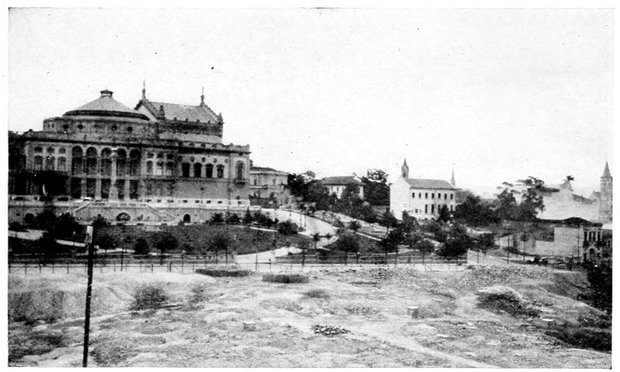
The admirable Municipal Theater of São Paulo
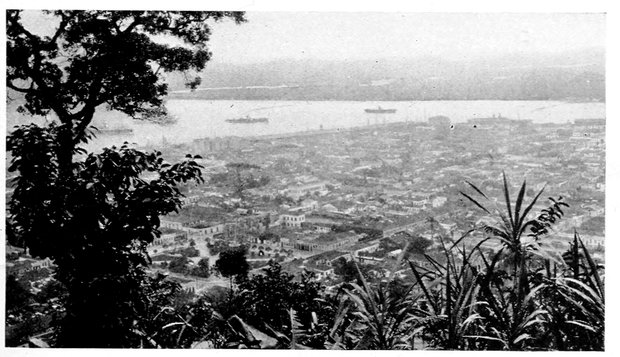
Santos, the Brazilian coffee port
A glimpse of the Rio sky-line from across the bay in Nictheroy
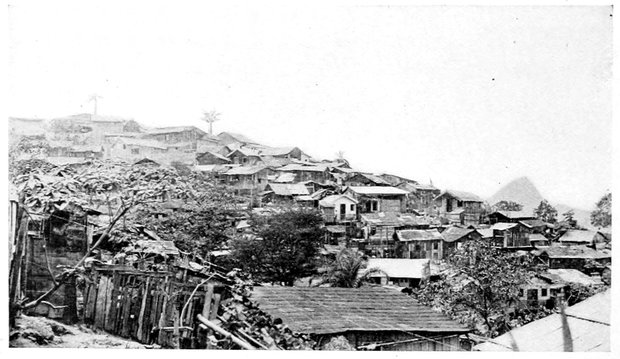
The slums of Rio de Janeiro are on the tops of her rock hills
The English writer Southey, who wrote a six-volume history of
Brazil, complained of the “tremendous ascents” and the thinness of the
air on the plateau of São Paulo—with its elevation of nearly 2,500
feet! Certainly the man who has rambled about the Andes feels only
gratitude for that altitude, which lifts him above the sweltering heat
of the coastlands. Even to the casual observer, however, there seems
no other fitting reason for founding a city at this particular spot, and
one is quickly driven to printed authority to account for such taste.
In 1554 the Jesuit, José de Anchietta, had gone to the town of Piratinanga
to establish a school, but being dissatisfied with that village, he
161ordered its inhabitants, in the dogmatic Jesuit manner of those good
old days, to remove to a site on the Tieté. Now the Tieté is scarcely a
brook, rising on the Brazilian plateau near the Atlantic and flowing
away across country to the Paraná, finally to join the Plata and pour
its scanty waters into the South Atlantic. There are a dozen real rivers
to the north and south of this insignificant stream and a hundred sites
that would have seemed better suited to the good padre’s purpose, but
the Jesuit insisted and at length the people of Piratinanga obeyed his
command; and because the town that was destined to grow to be the
industrial capital and the railway center of Brazil was founded on
June 25, it was named St. Paul in honor of that day’s saint.
One must get some little way out of São Paulo to appreciate its
situation clearly. Built on plump low hills in a rolling, treeless country,
rather dry and reddish of soil, the nature of the ground gives
splendid views of the town from many points of vantage, and in
tramping about its environs one finds every now and then the reddish,
light-colored city spread out in almost its entirety below or above him.
In a general sense the city and the region about it would be called flat,
yet in detail it is by no means so. The character of its site gives São
Paulo an intricate network of streets, with viaducts over great gullies
and street-cars passing above and under one another. The great Viaducto
do Chá stands so high above the great ravine through the center
of town that it is a favorite place of threatened suicide among lovesick
youths.
Its unexpected position as capital and metropolis of the world’s
greatest coffee-producing state has given this once bucolic country
town so extraordinary a growth that the Cidade of the nineteenth century
is now merely the central tangle of streets in the heart of town.
From this nucleus run splendid avenues lined with a bushy species of
shade-trees, and residence sections with dwellings of coffee kings,
ranging all the way from sumptuous comfort to magnificent and palatial
eyesores, spread away across town in various directions. São Paulo
has more than half a million inhabitants, a municipal theater for opera,
drama, and concerts scarcely second to any in the western hemisphere,
and an up-and-coming manner which quickly establishes its claim to
equality with modern cities of the temperate zone. The “Light and
Power Company” runs an excellent service of open street-cars and
gives the city a nightly brilliancy that is not often reached in cities of
its size. Its immaculate policemen carry speckless white clubs, thrust
into leather scabbards except when directing traffic. No one has ever
162known them to strike a man with a club, but they are at least awe-inspiring
representatives of law and order.
The extraordinary activity of São Paulo is plainly due to its European
immigrants,—Portuguese, Spanish, especially Italian. Whether
it is because they come from the northern part of the peninsula, where
sterner characters grow, or that they feel peculiarly at home in the
Brazilian environment, the Italians of São Paulo stand noticeably high
in the community. Many of the important business houses, some of
the professions, and much of the wealth is in their hands; among the
rather insignificant-looking hybrid Brazilians they are conspicuous for
their better physique and greater energy. Modern and energetic
though it is, however, São Paulo swarms with non-producers. At the
stations crowds of able-bodied carregadores, paying a high municipal
license and waiting most of the day in vain for an errand, try to
recoup themselves by demanding a thousand reis or more for carrying
the traveler’s bag across the street. The city has so many shops and
hawkers and peddlers that one might easily fancy it in a densely populated
country, rather than in one where land is everywhere suffering
for cultivation. Countless little liquor shops are run by grasping individuals
without initiative, anyone with cash or credit enough to buy a
dozen bottles of liquor seeming to choose this high road to opulence.
Vendors of tickets for both the national and state lotteries make day
and night hideous with their uproar and crowd the principal streets
with their booths; hordes of silk-clad, bejeweled French and Jewish
adventuresses roll luxuriantly to and fro every afternoon in their
automobiles.
The principal place of meeting for the rank and file is the Jardim da
Luz, a “popular” park retreat of the German beer-garden style, well
crowded of an evening, especially when a municipal or military band
plays. Here, too, vendors of strong and weak drink are ubiquitous,
their tables in the open air, their prices posted on the trees, yet demanding
500 reis for a glass of sweetened water, with the waiter still to be
satisfied. Everyone moves with an almost tropical leisure, though there
are evenings in this July midwinter when autumn garments are not out
of place and not a few young fops affect overcoats. Yet São Paulo is,
on the whole, a less showy town than one expects. Foreigners are so
usual in any gathering that one attracts little notice. Though perhaps a
majority of such a “popular” crowd is of the physically insignificant,
negroid mixture common to much of Brazil, in the strolling throng
may be seen every nationality from tow-headed Norwegian girls—about
163whom there are suggestions of the effects of a tropical climate
and environment in slackening social morals among any race—to a
Japanese out on the edge of the night, with a far-away-across-the-Pacific
look in his cynical-inscrutable eyes out of all keeping with his
commonplace “European” garb.
Every stroll beyond the city limits well repaid the dusty exertion.
Evidently the year’s shipment of rain, like so many carelessly billed
supplies from the North, had been carried past its destination, for the
region about São Paulo was deadly dry at a season when it should have
been verdant, and the newspapers reported the churches of Buenos
Aires filled day and night with people praying that the celestial waterworks
might be shut off. The cloud effects on the Brazilian plateau
are so striking that São Paulo was perhaps more beautiful on a gray
day than on a bright one when the glare brought out something of
squalor. Out at Ypiranga on the bank of a tiny stream, where Emperor
Pedro I gave the “cry of independence” that eventually shook
Brazil free from Portugal, there is a remarkably good museum full of
a wealth of historical material,—mementoes of the aboriginal inhabitants,
splendid collections of the fauna of Brazil, hundreds of borboletas,
or butterflies, of which the country has an incredible variety in
size and color, innumerable species of beija-flores (“kiss-flowers,” or
humming-birds), many pica-paos (“pick-sticks,” which are none other
than woodpeckers); strange specimens of the vulture family known
as João Velho (“Old John”).
Or the five-mile tramp out to Penha is no waste of time. The road
passes through many market gardens of black soil in the bottomlands.
Along the way are Italian husbandmen with wide heavy mattocks,
Sicilian stocking-caps like the chorus of “Cavalleria Rusticana” on
their heads, Egyptian water-dips on poles with American oil-cans as
buckets, Gallego ox-carts with solid wooden wheels and axles that
shriek along the highway, much cabbage and lettuce, a few potatoes,
grapes, baskets of strawberries almost the year round. Pack-mules
and the raucous cry of muleteers plodding soft-footed in the dust
behind them, one person to each milk-can of a gallon or two, carrying
it on his head to town, there to sell it by the cupful—no wonder milk
costs its weight in silver—and much more may be seen spread out
across the reddish landscape bounded by the low rolling hills, light-wooded
in places and distance-blue in color, of the coast range. The
town of Penha is pitched on the summit of a knoll with a striking view
of São Paulo, five miles away, and a shrine to which the pious flock
164in great numbers. Inside the otherwise uninteresting church is an
ornate Virgin who is credited with miraculous cures, and her chamber
overflows with evidences of gratitude from her devotees,—hundreds
of pictures by native “artists,” atrocious photographs of accidents
posed for after they had taken place, that the miraculously rescued
victim might carry out the promise made in the heat of fear to the
Virgin, the latter always represented somewhere in the upper right-hand
corner of the picture in the act of saving the devotee from
appalling sudden death in the very nick of time. Here a fat man is
being snatched from beneath the wheels of a heavy truck, there a baby
is shown safely deposited on the fender of a street-car, or a countryman
falling from his horse is landing upright with divine assistance.
Far more numerous than these pictorial atrocities, however, are the
wax imitations of all parts of the body. A sign on the wall announced
that “only things that are decent may be shown in the miracle room,”
but words have not the same meanings in different climes and races, and
little was left to the imagination, though no doubt the rule cuts down
appreciably the material evidences of cures. How widespread is
superstition and the fostering of it even in the progressive state of São
Paulo is shown by the fact that a month fills the room to overflowing.
During the few minutes I was there a man brought a wax foot, a
buxom young woman a breast, and a mulatto crone a hand which no
doubt was meant to represent one of her own, though it was snow-white
except where she had painted a red streak across the back to
indicate the portion she wished, or had already had, cured. But the
Virgin of Penha draws no color-line, for her own complexion is by no
means strictly Caucasian, and her quadroon swarthiness no doubt gives
the average of her devotees a comfortable feeling of racial propinquity.
Most famous, perhaps, of all the sights in and about São Paulo is the
“Instituto Butantan,” known among the English-speaking residents as
the “snake farm.” A mile walk out beyond the Pinheiros car-line
brings one to this important and well-conducted establishment, first
started by private initiative but now receiving government aid. On
the crest of a knoll are several concrete buildings and about them
scores of snake-houses, half-spherical cement structures some four
feet high inclosed in sections by low walls and moats, where thousands
of snakes lie basking in the sun. By Brazilian law any public carrier
must transport free of charge from its place of capture to the “snake
farm” of São Paulo any new species of snake discovered. There are
one hundred and eighty known species of reptile in Brazil—the Portuguese
165word for snake, by the way, is cobra—of which ten are known
to be venomous; in other words when a snake appears even in Brazil
there is only one chance in eighteen that his bite is harmful, and the
odds are eighteen to one that he is just a harmless fellow who wants
to cuddle up in your lap for company. But the venomous ones are
venomous indeed. There is the deadly cascavel, or rattlesnake, the
jararaca, worst of all the jararaca de rabo branco, the jararaca with a
white tail. Aside from its mere museum or “zoo” function, the “Instituto
Butantan” has two very practical purposes. Three serums are
made here for snakebites and sent to all parts of the republic, remedies
that have saved the life of many a sertanejo dwelling in wilderness
isolation back in the sertões of Brazil, where an ignorant pill-peddler,
who calls himself “doutor,” but whose training as a physician is largely
imaginary, sometimes appears not more than once or twice a year.
The venomous snakes are required to furnish their own antidote. A
uniformed negro attendant springs over the low wall and moat into an
inclosure of dangerous snakes, pins one to the ground with a sort of
iron cane, picks it up by the throat with his bare hands, and forces it to
spit its yellowish venom into a piece of cheesecloth drawn tight over
the opening of a glass receptacle. Healthy young mules are inoculated
with this, and the serum produced in much the same way as smallpox
vaccine.
The second purpose of the institute is to breed and distribute the
mussurama. This is a native black snake sometimes reaching eight
feet in length, entirely harmless to man but which feeds exclusively on
other snakes, venomous ones by preference. Within the moats that
inclose this species are many others which only repeated assurance
would convince the novice are not dangerous. The non-venomous
snakes are in general larger than the others, and may also be distinguished
by the lack of any special tail, being, as it were, all of one
piece. If the employees of the institute, from the scientists in charge
of serum-making to the negro snake-herders, are to be believed, there
are other differences: the harmless snakes lay eggs, while the others
produce their young alive; the former must be fed, and the latter have
never been caught taking nourishment since the institute was started.
Some of the harmless cobras attain considerable size, though by no
means any such as they do in popular jungle tales. The largest in
captivity at São Paulo was a species of constrictor about sixteen feet
long and as large around as a rain-pipe. They vary widely, too, in
habits. The sucurý is huge, clumsy, and sluggish; a large brown snake
166in the same inclosure was almost lightning-like in its movements, snapping
at the flap of the attendant’s trousers and returning to the attack
with incredible swiftness as often as the latter threw him away
with his crooked iron stick. Like so many really harmless creatures he
is evidently given his vicious temper to make up for the lack of any real
defense. This reptile is said to follow for miles any creature that
angers it, and though its bite is harmless, only a man with long experience
or iron nerve could resist taking to his heels when this personification
of speed and anger dashes upon him with its great jaws
wide open. All such species, however, are mere souvenirs of the
sertão, of no other use than to keep company for the mussurama,
great numbers of which are sent to the snake-infested areas of Brazil
as rapidly as they attain mature size.
On my second or third visit, after I had won his gratitude with my
kodak, the chief snake-herder arranged a special snake-eating contest.
Into a moated compound of mussuramas he threw a jararaca de rabo
branco, the most deadly snake of Brazil. Far from pouncing upon the
newcomer, the black cannibals gave it no attention whatever. The
attendant stepped over the wall and introduced the visitor to his hosts
one by one. The first turned up his nose at it, which drew forth the
information that this one had eaten only a week before and was not
yet hungry. The second had not dined for at least a fortnight. No
sooner had the jararaca been tossed near him than he sprang forward
and wound himself about the other so rapidly that the eye could not
follow the individual movements, kinking and knotting him in an intricate
entanglement in which only their difference in color distinguished
one slimy body from the other. The two snakes were almost of a size,
about three feet long. The jararaca writhed in agony, opened his huge
mouth with its two ugly looking fangs on the upper jaw, and struck
hard into the black body of his opponent, the yellow venom running
down over his scales. The only response of the oppressor was to increase
the entanglement until the head of the jararaca was confined in
a coil, as his own was protected within the folds of his own body.
For more than twenty minutes after his first sudden movements
the mussurama scarcely moved a scale. I began to think he had gone
to sleep again. Then gradually, imperceptibly, almost as slowly as
the minute-hand of a clock moves, he withdrew his own head from the
coil that had protected it, looked cautiously about to see whether danger
threatened, then moving one muscle at a time, with the patience
of a professional wrestler, he worked his frog-mouth sidewise slowly
167along the body of the jararaca until he reached the neck. Pulling the
head carefully out of its confining coil, he crushed it flat by slow
pressure of his powerful mouth. Only then did he appear satisfied and
at ease. Disentangling himself, he began to swallow the jararaca head
first, working his way along it in successive bites at about the speed
with which a lady might put on the finger of a new glove, now and
then wriggling his body to increase its capacity. Once he stopped,
rolled a bit, and took a long breath, then went steadily on until the
white tail of the jararaca, looking for a moment like a long tongue of his
own, disappeared entirely, perhaps four minutes from the time the
swallowing had begun, and the snake that was left where two had
been before crawled lazily away to his cement house for a fortnight’s
sleep.
I remained for some time in São Paulo not only because it proved
to be a city worth exploring, but because I had come to the end of my
railroad passes, and unless I could discover a new source of supply
I faced the painful and unusual experience of having to pay my fare.
To tell the truth, so weary had I become of train riding and respectability
that I found myself planning to slip into my oldest clothes,
pick up a fellow-beachcomber, and take to the road for the three hundred
and twenty miles left to Rio. But short samples convinced me
that such a walk would not prove entirely a pleasure jaunt and railway
passes evidently do not grow on São Paulo bushes. I was forced,
therefore, to fall back on my own slender funds. There is frequent
and comfortable service from São Paulo to Rio four times a day in
twelve hours by day or night on the government railway, but a more
pleasant as well as cheaper route appeared to be that by way of Santos
and an ocean steamer; moreover, it seemed more fitting to enter the
far-famed harbor of the Brazilian capital by the harbor’s mouth than
to sneak in at the back door by the government railway.
An excellent express of the British “São Paulo Railway Company”
left the industrial capital at eight in the morning and raced thirty of
the fifty miles to Santos across level country in less than an hour.
Then we halted at Alto da Serra for the inevitable coffee and a new
engine. This was small and inclosed within a sort of car with glass-protected
observation platform, for almost the only work required of
it was to hook us, two cars at a time, to a cable running on large upright
wheels between the rails, two small trains counterbalancing each
other at opposite ends of the cable making little motive power necessary.
Just beyond was the abertura, the “opening” or jumping-off place,
168where the world suddenly spread out far below, some of it visible,
some hidden by vast banks of mist slowly melting under the torrid
sun. The cable let us down more than two thousand feet in a very
few miles, the descending and ascending trains passing each other
automatically on a switch halfway down. The road was so swift that
the buildings along the way seemed sharply tilted uphill, but though
the valley was densely wooded with scrub growth, it was only a narrow
one, so that while the engineering feat may be as remarkable, the
scenery was by no means equal to the descent to Paranaguá. It took
as long to lower us to Piassagüera in its banana-fields, only eight miles
without stops, as it had to cover the thirty miles with several halts
from São Paulo to the opening of the range. This road, over which
virtually all the coffee grown in Brazil starts to the outside world, is
reputed to be one of the richest concessions on earth, though its charter
restricts its net profits to a certain percentage of the invested capital,
the rest going to the government. The company has always had great
difficulty in devising ways and means to spend its surplus earnings
and keep them from falling into the public coffers. It is rumored
that all the switch-lamps are silver-plated. The latest plan of the
harassed directors is to electrify the road, but to the casual observer
this would seem exceedingly unwise, for heavy coffee trains coasting
down the hill might store up electricity enough to run the entire road,
and with no more coal to buy at the breath-taking price of that commodity
in Brazil the problem of spending their surplus would become
hopeless.
Santos is even older than São Paulo, having been founded by Thomé
de Souza two years earlier. Not so long ago it was a pesthole, noted
especially for its yellow fever. Those unpleasant days are forever
gone, though it is still not a health resort and many of its people prefer
to live in São Paulo and come down daily on business. If it was
not always raining in torrents during my stay there, at least it was
overhung by a soggy, humid heat that had nothing in common with
the cool, clear atmosphere of São Paulo. Such air as arises in Santos
drags its way sluggishly through the streets, and there was a heavy,
blue-mood temperament about the place quite unlike the larger city
up the hill.
This languid, gloomy mood pervaded even the club in which a group
of Americans sit all day long, day after day, “mopping up booze,” exchanging
the chips that pass in the night, and buying coffee. The last
is their appointed task, but it is a light one. Every now and then a
169dealer or a native messenger comes in with a name, a price, and one or
two other hieroglyphics scratched on a slip of paper; one of the buyers
lays aside his cards long enough to “o.k.” it, and the deed is done.
Santos exports a million dollars’ worth of produce to the United States
each year, “about one hundred per cent. of which is coffee.” When
one compares the retail price of this commodity in the American market
with what the planters of São Paulo state get for it, the wonder
arises as to where the difference goes. Some of it, of course, goes to
the world-weary men who spend their days exchanging chips at the
club in Santos; transportation takes its full share; a high ad valorem
export tax goes to the federal government; a similar impost of five
francs a sack goes to the State of São Paulo; the municipalities through
which it passes do not allow themselves to be forgotten; the European
builders of the port improvements exact their generous pound of
flesh; and “official charges” thrust out a curved palm at every step,
so that whoever drinks coffee helps generously to support the plethora
of mulatto politicians of Brazil. Yet even then the State of São Paulo
is not satisfied with the price paid for its principal product and in order
that this may fall no lower prohibitive taxes now make it impossible
to lay out new coffee plantations within the state.
In all the business section of Santos there are pungently scented
warehouses in which coffee is picked over by hand by women and children
whose knowledge of sanitary principles is embryonic; while down
at the wharves the coffee-porters give the town a picturesque touch.
Long lines of European laborers, dressed in undershirt, cotton trousers,
a cloth belt, and a tight skull-cap, all more or less ragged, discolored
and soaked with sweat, trot from train to warehouse or from
warehouse to ship, each with a sack of coffee set up on his neck, moving
with a jerk of the hips and keeping the rest of the body quite
rigid. Their manners are gayer than one might expect of men constantly
bearing such burdens. The law requires that each sack weigh exactly
sixty kilograms, about 132 pounds, that the state may levy its tax
without difficulty; and the men are paid sixty reis for every sack they
carry. In the slave days of thirty years and more ago this coffee-carrying
was done by African chattels, trotting in unison to the time
of their melancholy-boisterous native melodies. Now there is not a
drop of African blood among the carriers, though there were not a
few haughty negroes in uniform sitting in the shade superintending the
job and down on a tiny cruiser nearby all the sailors were of that race.
The Portuguese have driven out the negro carriers by their greater
170strength and diligence, but they in turn are being superseded by
modern improvements.
“Brazil is no good any more,” grumbled a sweat-soaked son of Lisbon
with whom I spoke. “It is forbidden now to carry two sacks at
a time, and these great carrier-belts they are putting in, as well as
the auto-trucks, are robbing us of our livelihood.”
Santos has now grown almost wholly around a steep, rocky hill that
was once on its outskirts, spreading in wide, right-angled streets lined
by pretentious light-colored dwellings to the seashore, with several
large bathing-season hotels and many fine beaches along the scalloped
coast. Up at the top of this hill in the center of the flat modern town
is an ancient place of pilgrimage known as the “Santuario de Nossa
Senhora de Monte Serrat,” overflowing, like that of Penha, with
wax imitations of cures. Prices were distressingly high in Santos.
Bananas, which overload the landscape about the town, cost 600 reis
each in any restaurant; and all else was in proportion. No doubt milk
must be sold at 32 cents a quart in a town where the milkmen drive
about in luxurious go-carts, dressed as if on their way to a wedding.
But such things are painful to the wanderer who has already begun to
doubt his ability to pay his way home from the next port, particularly
when he finds that for once there is no steamer bound thither for several
days, and that the fare for the overnight sea-trip is half as much
as that to Europe.
It was too late to change my plans and make the journey to Rio by
rail, however, and I made the best of the delay by joining a Sunday
excursion to Guarajá, a beach with a Ritz-Carlton hotel that was being
“boomed” a few miles out through the wilderness. A little steamer
carried us from the Santos docks to a station across the harbor, from
which a tiny steam railroad runs off through the jungle. The benches
were hard, the toy engine incessantly spat smoke, cinders, and fire
back upon us, and a woman of the laboring class was jammed into
close, popular-excursion contact with me throughout the journey. But
the beach of Guarajá was fine and hard, and the day brilliant and
clear. Chalets, bandstands, and all the Palm Beach paraphernalia recalled
the season of six to eight weeks during which coffee kings and
their mistresses hold high revel and yield the promoters a good year’s
profit on their investment. Natives, both men and women, had here
and there rolled up their trousers or the feminine counterpart and
gone wading, but evidently it was not considered the proper season to
swim, for all the heat of midwinter July, or else the community had
171the customary South American fear of “wetting the body all over.”
Gringos may always take their own risks, however, and by dint of
long inquiry I found I could get an ill-fitting bathing-suit and the key
to a bathhouse, all for a mere 2000 reis, and I went in alone.
It was the first time I had been in or upon the sea since entering
South America way up on the gulf of Panama more than two years
before. I plunged in and was soon diving under the combers and
enjoying myself hugely, when I suddenly found that I could not touch
bottom, and that the more I tried the less I touched. This would not
have mattered had I not realized by some indefinable sense that I
was not only in an ebbing tide but that I was caught in an undertow
which was dragging me swiftly seaward. The buildings and the
excursionists on the shore were growing slowly but steadily smaller.
I waved an arm above the water and attracted the attention of a group
of men, but it was evident by their indecisive actions that they were
“Spigs” and that no help would come from that quarter, though they
might be of use in testifying before the coroner’s jury. Among the
Sunday crowd on the shore and the hotel veranda arose more stir
than I had yet caused anywhere in Brazil, and the bathhouse attendant
who had taken the 2000 reis away from me rushed down to the spray’s
edge frantically waving his arms. For the next twenty minutes or so
I had visions of navigating the high seas without a ship, but as I
did not confine myself during that time to smiling at the vision, but
took to performing superhuman feats of swimming, I was suddenly
surprised, not to say relieved, to feel my feet strike sand, and what
might have been a coroner’s inquest turned out to be nothing but a lesson
for the foolhardy. When I returned to dress, the attendant said
that he had forgotten to tell me that certain parts of this beach had a
very dangerous undertow. Posthumous information was to be expected
of a Brazilian; but when the American of Santos who had suggested
my spending the Sunday at Guarajá replied to my mention of the
entirely personal incident, while we were lunching at the Sportsman
Café next day—at his expense—with “Oh, yes, I forgot to tell you
that is the most dangerous beach in South America, hardly a Sunday
passes without someone drowning there,” I could not but thank him
fervently for his kind warning.
The steamer of the Spanish line owned by the Jesuits spent most
of Tuesday in “leaving within five minutes,” during which the passengers
all but succumbed to uproar, congestion, and perspiration. I found
myself packed into a tiny two-berth cabin with two other travelers
172whom I should not naturally have chosen as companions; nowhere was
there a spot clean and large enough on which to sit down. Once
a refresco, a glass of sickly sweetened water, was served to us as a
special favor just before we choked to death, and finally about five
in the afternoon we let go the wharf, made a nearly complete circle
with the “river” on which Santos is located, and dipping our flag to
its last fort, were soon out on the high seas, the roll of which I had
almost forgotten.
CHAPTER VIII AT LARGE IN RIO DE JANEIRO
173
I awoke at dawn just as we were entering the harbor of Rio de
Janeiro. On the extreme points of land on either side crouched
two old-fashioned fortresses; back of one of them, scarcely a
stone’s throw away, rose the sheer rock of the “Sugar Loaf,” like a
gigantic upright thumb, and a moment later I saw the sun rise red
over a great tumble of peaks along the shore, among which I recognized
the “Hunchback” stooping broodingly over the almost invisible
city. A haze hid all of this, except for a long line of little houses,
like children’s blocks, along the foot of great cliffs. Then bit by bit,
as the sun sponged up the mists, the scene spread and took on detail,
until it became perhaps the sublimest spectacle of nature my eyes had
yet fallen upon in all the circuit of the earth, a sight not only incomparable
but one that obliterated the disappointment inherent in all
long-imagined and often-heralded scenes.
The vast bay, of irregular shape and everywhere dotted with islands,
was walled on every side by a tumultuous labyrinth of mountains, some
sheer rounded masses of bare rock and precipitous cliffs on which nature
had not been able to get the slightest foothold, the majority a
chaotic maze of ridges, peaks, and fantastic headlands covered with
the densest vegetation, terminating in lofty Tijuca and with a dim,
dark-blue background of the range called “the Organs.” The city itself,
of many striking colors reflected in the blue-green sea along
which it stretched in endless public gardens and esplanades skirting
the water front, was strewn in and among these hills as if it had
been poured out in a fluid form and left to run into the crevices and
crannies, the scum, in the form of makeshift shanties, rising to the
tops of the morros which everywhere bulked above the general level,
the more important of them crowned by picturesque old castles that
stood out sharp-cut against the green background.
But if nature is peerless in Rio, one quickly discovers that man is
still the same troublesome little shrimp he is everywhere. We crawled
at a snail’s pace past a rocky islet covered with royal palms and a turreted
174castle, past seven large Brazilian battleships, among them the
Minas Geraes that had recently mutinied and bombarded the capital,
and finally came to anchor well out in the bay. When our baggage
had been rummaged by a flock of negroid officials quite as if we had
arrived from a foreign country, we were privileged to pay foul-tongued
and clamoring boatmen several thousand reis each to row us the few
hundred yards to the shore. Rio has ample wharves, but passing
vessels avoid the use of them whenever possible, lest the European exploiters
pocket whatever profit the ships pick up on the high seas.
I wandered the crowded and blazing streets for some time before I
decided to try my luck at the “Pensão Americana” in the Rua Larga,
or Wide Street. Here, for six thousand reis a day, I was permitted
to occupy a breathless little inside den and to eat whatever I found
edible among the native dishes set before us on a free-for-all table
at noon and evening. I was back in rice-land again, that inexcusable
substitute for food, the only thing on the menu of which there was
anything like abundance, being served at every meal and on every
possible pretext. This and the feijão, the small black bean of Rio
Grande do Sul, with now and then a bit of xarque, dried or salted
beef, added to give it distinction, makes up the bulk of any native
Brazilian repast in such rendezvous of starvation as the “Pensão Americana.”
The only drink furnished was water, and one soon learns to
avoid that in tropical Brazil. One dining-room wall was decorated
with large glaring advertisements of beer and shoes, on the other was
an enormous and gaily colored chromo of the Last Supper, at which the
fare was as scanty as our own. The general parlor in the front of the
second story and opening upon the wide street might have been passable
as a lounging-place had not noisy, undisciplined brats been constantly
running about it and the snarly, quarrelsome air of cheap boarding-houses
the world over everywhere pervaded it. The entire establishment
was an unceasing bedlam. Women shrieking as only Latin-American
women can gave no respite from dawn to midnight; most of
them kept pet parrots—or toucans, which are several times worse—and
occasionally an entire flock of parrakeets. My bed proved to be
of solid boards with an imitation mattress two inches thick. The gas
is turned off in Rio at ten in the evening, and we had no electricity.
I could not read for lack of light, I could not sleep because of the
sweltering heat inside my cubbyhole, stagnant as only an interior dungeon
in the tropics can be, and the uproar beyond the half-inch partitions,
which in no way deadened the nightly domestic activities of
175the families about me. When I did at length doze off toward dawn it
was only to dream madly.
The evening’s determination to move, even if I must sleep in the
streets, was strengthened by the rumpus that awoke me at daylight
and by the thimbleful of black coffee that constituted the only breakfast
served until eleven. I struck out none too hopefully to re-canvass
the town. A white cardboard swinging at the end of a string
from a balcony window, I soon discovered, meant that a room was
for rent, but though these were numerous they were all unfurnished.
Those who rented furnished quarters were expected to eat in the
same house, and 6000 was evidently the rock-bottom price for board
and room anywhere in Rio. For that sum I could get real food and
a tolerable room in a hotel kept by a German in the Rua do Acre in
the heart of the downtown section, and it mattered little that the
pungent smell of raw coffee struck one full in the face in passing the
open doors of the warehouses in the Rua São Bento and the adjoining
streets leading to it.
The Rua do Acre opens out upon the wharves at the beginning of
the broad Avenida Central, gashed from sea to sea straight through
the heart of the business section of Rio. Both in history and appearance
this new main downtown artery of the Brazilian capital is
similar to the Avenida de Mayo in Buenos Aires, which, though it does
not rival it in length, it outdoes in some respects, particularly in the
picturesqueness of the types that pass along it. Old Rio was crowded
together in medieval congestion on the principal point of land jutting
into the harbor, and in time this portion became so densely populated
with business and so inadequate under modern traffic conditions that
nothing but surgery could save it. The major operation of cutting
this broad avenue through the compact old town was intrusted to
the Baron of Rio Branco, and it still officially bears his name. Early
in the present century his plans were carried out at the expense of
much cost and destruction, and in place of a labyrinth of narrow
unsavory streets and aged unsanitary buildings there appeared in an
incredibly short space of time a passageway a hundred meters wide
and more than two thousand meters long running with geometrical
precision from the inner harbor to the Monroe Palace on the edge of
the Beira Mar, with the “Sugar Loaf” set exactly at the end of the
vista.
There are many things of interest in downtown Rio, but of them all
perhaps the Avenida Rio Branco is the most enticing. Stroll where
176one will on either side of it, to the Arsenal, the Ministries, the palace
where the last emperor of the western hemisphere had his official residence
up to little more than thirty years ago, to the heavy and not
particularly striking cathedral, one is sure to drift unconsciously back
and take again to wandering aimlessly along in the human stream that
surges as incessantly through the Avenida as if the populace were still
enjoying the novelty of moving freely where their ancestors could
not pass. The only other street in old Rio that has anything like the
same fascination is the narrow Rua Ouvidor, as it is still known in
popular speech, though the city fathers long since decreed that it shall
be called the Rua Moreira Cesar. This is to Rio what the Calle Florida
is to Buenos Aires, not merely a populous street but a popular institution.
Along it are the most brilliant shops, in it may be seen the
most exclusive residents of Rio greeting one another with the elaborate
and leisurely formality of their class. Level paved from wall to
wall, it is in reality a broad sidewalk, for here wheeled vehicles may
not enter at any hour whatever. Yet even the enticing windows and the
now and then attractive shoppers of the Rua Ouvidor do not often
keep the stroller long from wandering once more out into the Avenida.
For all its width it is not easy to walk along the Avenida. What
might be called “sidewalk manners” are atrocious throughout South
America; in Rio they are at their worst. This is not because the
Fluminenses—for these, too, call themselves “rivereens,” though they
are far from any real river—are especially inconsiderate, but because
they are tropical idlers with no fixed habit of mind, and instead of picking
a straightforward course down the broad avenue they wander
back and forth across one’s path in all sorts of erratic diagonals. The
pace of life slows down noticeably in twelve degrees of latitude, and
street crowds are not only slower but much more stagnant in Rio than
in Buenos Aires. In time the direct and hurrying northerner comes
to realize that the Avenida is not designed to be merely a passageway
from somewhere to somewhere else. It is somewhere itself, a lounging-place,
a locality in which to show off at one’s best, a splendid site
for café chairs and tables. By late afternoon it is often so blocked
that passage along it is a constant struggle; in the evening clumps of
seated coffee sippers and groups of gossiping men fill the broad sidewalks
almost to impassability.
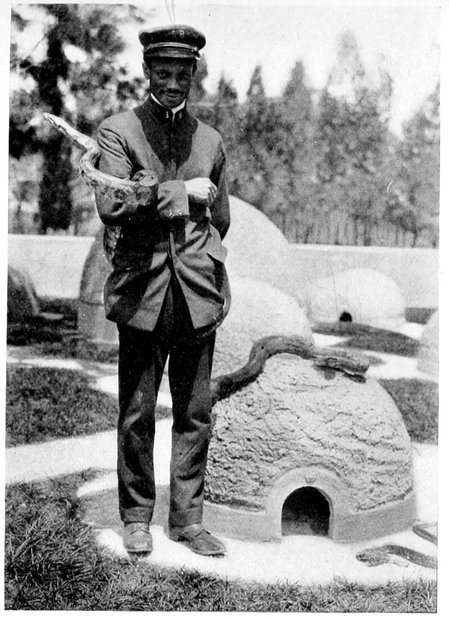
An employee of the “Snake Farm” of São Paulo
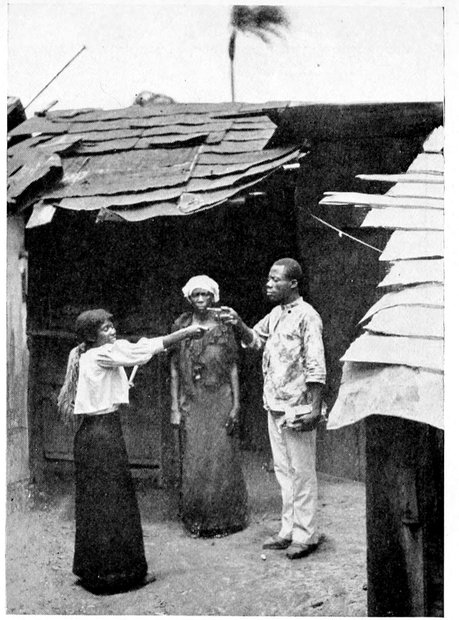
Residents of Rio’s hilltop slums, in a chosen pose
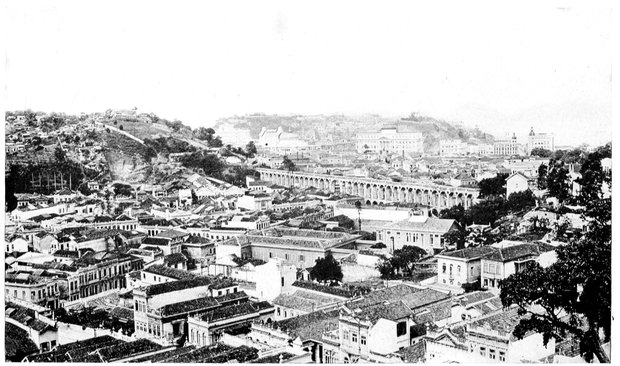
The heart of Rio, with its Municipal Theater, the National Library, the old Portuguese aqueduct, and, on the left, a shack-built hilltop
These sidewalks of the Avenida were evidently laid with the
connivance of shoemakers. Most of them are mosaics of black and
white broken stone in striking designs and fantastic patterns, here
177geometrical, there in the form of flowers, with horsey figures before
the Jockey Club, nautical things before the Naval Club, all of striking
effect when seen, for instance, from the upper windows of the Jornal
do Commercio building, but particularly deadly on shoe leather. An
architect might have much to say of the score of splendid structures
that flank the avenue. Some are merely business houses; farther
seaward, beyond two great hotels, are clustered the sumptuous Municipal
Theater, the School of Fine Arts, and the National Library;
set a little back from the street are the Supreme Tribunal and the
Municipal Council until the Avenida breaks out at length into the
Beira Mar beside the Palacio Monröe in its little park. This last marble
and granite edifice was carried back from our St. Louis Exposition
and set up chiefly as a show-place and an ultra-formal gathering-hall,
but the Chamber of Deputies has been meeting there since their
old firetrap on the Praça da República took to falling about their ears.
Beyond it lie the blue waters of the oval bay, across which, always in
full view from anywhere on the avenue, stands the Pão d’Assucar,
like a rearing monolith, the thread-like cable that now and then carries
a car to or from its summit plainly visible in the clear tropical sunshine.
However, it is not these more formal things but rather the continual
interweaving of curious and motley types, the air of unworried tropical
indolence that pervades the throng, the brilliance of the night lights
that draw the idler again and again to the chief artery of downtown
Rio. Particularly after the hour of siesta does the capital exchange
the extreme négligée of the household for its most resplendent garb
and sally forth to stroll the Avenida, the women with curiously expressionless
faces, as if they would prove themselves deaf to the audibly
flattering male groups that grow larger and larger until by sunset
the sidewalks become a great salon rather than places of locomotion.
Foreigners and those who have lost the spirit of Rio and must hurry
may take a taxi. These pour so continually past, day and night, that
to cross the Avenida is a perilous undertaking at any hour, for the
personal politeness of the Fluminense does not extend to his automobiles,
and the chances of being run down, particularly by empty machines
cruising for fares, are excellent. Nor is it worth while for
the lone pedestrian to protest, for the odds are against him. Both
private automobiles and those for hire carry two chauffeurs, usually
in white uniforms, less often unquestionably of that complexion, their
faces studies in haughtiness as they gaze down upon the plebeian foot-going
178multitude. The extra man is known colloquially as the “secretary,”
and the custom is said to have arisen from the fact that before
the law required meters taxis charged all the traffic would bear and
it often took two men to collect from recalcitrant customers. But its
persistence suggests that there are other reasons, among them the
Brazilian love of sinecures, the terror which solitary labor causes to
the tropical temperament, the pleasure of having a congenial friend
always hanging about, the excess of population over jobs, the real
chauffeur’s need of someone to crank his car, light his cigarette, and
keep an eye on the police, most of all, perhaps, the Brazilian love of
fazendo fita. Literally fazendo fita means “making a film,” but by
extension it has come to signify posing for the moving-picture camera,
hence, in the slang of Rio, “showing off.” It is a rare Brazilian who
is not given to acting for the movies in this sense. Watch a traffic
policeman, in his resplendent uniform and white gloves, and you will
find that he is much more seriously bent on displaying his manly
form and graceful deportment to a supposedly admiring audience than
on keeping his street corner clear. Go up to any man with a gold
cable swung across his chest and ask gently, “O s’nhor tem a hora?”
and he is almost as apt as not to reply with a mumbled, “Ah-er-I
cannot tell you the time,” meanwhile grasping first one end of the
chain, then the other, as if he were striving to convince even himself
that he has a watch somewhere attached to it.
It was midwinter in Rio, yet plump, sun-browned youths rolled in
the surf each morning below the wall of her chief driveway and lolled
in the shade of the open-air cafés along it. Even in July the lower
levels of the city can be unpleasantly hot, which makes it all the more
remarkable that it gives such an impression of energy during its business
hours. From the wharves to the edges of the mainly residential
sections the place pulsates with perspiring activity, though on closer
inspection one suspects that the Fluminense is more energetic at play
than in productive labor. Whatever his exertions, however, he divides
them into short sections separated by the partaking of coffee.
All along the Avenida, in every downtown street of importance, there
is not a block without its coffee-house, a cool room filled with marble-topped
tables on a damp, sawdusted floor, into which one steps from
the heated street, silently turns upright one of the score of tiny cups
on the table before one, fills it half full of sugar, raps on the table
with the head of one’s “stick” until a silent waiter comes and fills what
is left of the cup with black coffee, which one slowly sips and, dropping
179a tostão, a nickel 100-reis piece, beside the empty tasa, wanders on
down the street—to repeat the process within the next few blocks.
But with sunset, at least during what Rio likes to refer to as winter,
the temperature grows delightful, and it is from then on until a new
day warms again that one gets the full tropical fragrance, the un-northern
dolce far niente that makes the Brazilian capital so enticing
to the wandering stranger. The newcomer soon learns to stay up most
of the night and enjoy the best part of the day. Not even Paris was
ever more brilliantly lighted than downtown Rio—cynics whisper
that the city fathers have a close personal interest in public lighting—not
even Parisian boulevards are more scented than the Avenida and its
adjacent streets with the pungent odor of mercenary love. Far into
the night the Avenida pulsates; long after the theaters and countless
cinemas, and the opera in its season, have ended, the surge of humanity
continues, punctuated at all too frequent intervals by that
most distinctive sound of the night life of Rio,—bass-voiced newsboys
singsonging their papers—“A Rua!” “A Noite!”—in the distressingly
German guttural peculiar to the native tongue as spoken in the Brazilian
capital.
Larger in extent than Paris, broken everywhere by savage, rocky,
wooded morros—virgin-jungled hills rising in the very heart of town
and which, peeled of their thick scalp of vegetation, prove to be of
solid granite—stretching away in great green mounds and ranges standing
high into the peerless tropical sky, Rio was as entrancing as Buenos
Aires is commonplace. The level parts of the city were flat indeed,
flat as if the sea had washed in its débris until it had filled all the
spaces between the rocky island hills, and then completely flooded
those valleys with houses. Nor did the building stop there. Seeping
everywhere into the interstices of its hills, the town was here and
there chopped back into them, or, if the morros set sheer rock faces
against the intrusion, it climbed upon and over them, until its many-colored
houses lay heaped into the sky or spilled down great gorges
and valleys beyond. Then always, from whatever point of vantage
one saw it, the scene was backed by its peerless sky-line,—the Pico
de Gavea with its square head, like a topsail or the conventional symbol
for a workingman’s cap; the “Sleeping Giant,” showing nature’s
most fantastic carving; hollow-chested Corcovado, the “Hunchback,”
peering amusedly down upon puny man playing ant in and out among
the tumbled rocks below; the admirable “Sugar Loaf,” keeping eternal
watch over the entrance to the bay, the ridges and wooded summits
180of Tijuca backed far off by the “Organ” range, protruding like
broken columns above the distant horizon. “Vedete Napoli e poi
mori” might with many times more justice be said of Rio.
It was always a wonder to me how the citizens of the Brazilian
capital succeeded in keeping within doors long enough to do their daily
tasks. Day or night its peerless scenery and glorious climate were inviting
one to come out and play, to forget the commonplace things
of life. A local editor complained that the people of Rio do not read
in the street-cars, “as our neighbors do in the United States, but spend
their time gazing about them and thus lose much opportunity for culture.”
Probably he had never been in New York or Chicago, or he
would have realized that sometimes people read during their urban
travels to keep their minds off the “scenery.” In Rio nature and all
outdoors are so much more splendid than any printed page that reading
seems a sacrilege. Though I rode along the Beira Mar a dozen
times a day, I never succeeded in withholding my eyes from the scene
about me; never was I able to miss a chance to gaze across the bay to
Nictheroy, or up at the silhouettes of Corcovado and Tijuca; like a
great painting it grew upon one with every view.
I passed frequently along this most marvelous boulevard in the
western hemisphere, Beira Mar, the “Edge of the Sea,” stretching for
miles along the harbor’s edge so close that the ocean spills over upon
it on days when it is brava. Between the shady Passeio Publico behind
the Monroe Palace and the heroic statue of Cabral on the green
Largo da Gloria, the foothills crowd in so closely that there is room
for only one street to pass, and right of way is naturally given to the
chief pride of the city. Here converge the pleasure seeking traffic
and the business bent, to split again presently on the rocky Morro da
Gloria, crowned by its quaint little medieval church, the one stream
to hurry away through the Rua do Cattete, the other to follow with
more leisure the serpentine Beira Mar. This, lined by splendid
trees and pretentious residences on the land side, outflanks another
rocky hill that would cut it off by passing between walls of man-scarred
granite behind it, skirts another arm of the turquoise-green
harbor, with a closer view of the gigantic “Sugar Loaf,” and then
bursts out through a long tunnel upon the ocean front where marvelous
beaches and a succession of boulevards continue for miles through
what is rapidly developing into the finest residential section of the
Brazilian capital.
The Beira Mar is the show-place of Rio and of Brazil. It is sometimes
181as if one were asked to admire a costume without seeing more
than the lace along the bottom, the eagerness of its people to impress
the visitor with the undoubted splendor of this glorious seaside driveway.
Yet there are many other strips and corners of the city that are
well-nigh as sumptuous or as picturesque; the difficulty is to hunt
them out among the morros and foothills that everywhere divide the
capital into almost isolated districts. Walking is all very well, but
perspiration flows quickly and copiously in Rio, and a perpetually
drenched shirt is not entirely conducive to pleasure; and the city is
so incredibly extensive that even tramway exploration becomes serious
to the man with a weak financial constitution. There are two
street-car systems and they operate what is perhaps the best surface
system in the world; but it is also the most expensive. Take a street-car
ride from one end of Rio to another and back and you have spent,
thanks to the “zone system” imported from Europe, the equivalent
of half a dollar; and as there are lines out through all the score or
more of gaps between the hills and morros, I quickly made the discovery
that if I attempted to explore all the city, even by street-car,
I should probably have the privilege of swimming home.
What was my joy, therefore, to learn that the superintendent of
the “Botanical Garden Line,” which covers all the more beautiful
half of Rio, came from the town in which I had spent much of my
boyhood. I had long wanted the experience of being a street-car conductor
or motorman, and made application at once. My fellow-townsman
hesitated to give me any such place of responsibility unless I
would agree to stay for some time, but he was quite ready to appoint
me a fiscal segreto of the system under his charge, at the most munificent
salary I had ever drawn in my life—six thousand a day! That
was exactly enough to pay for my room and board in the German
hotel of the Rua do Acre; still it was decidedly better to be paid for
riding about town than to have to pay for that privilege, and with my
living and transportation assured until I sailed my chief problems
were solved.
The “Botanical Garden Line” begins at the principal hotel on the
Avenida Central, about which every car loops before setting forth
again on its journey to some part of that section of Rio most worth
seeing. I was furnished a book of free tickets and had only to take
a back seat on any of these cars and, while reading a newspaper or
seeing the scenery as inconspicuously as possible, casually notice
whether the conductor showed an inclination to forget to ring up fares
182or to break any other of the strict rules of the company. My tickets
were good only for the oceanside half of town, for though they were
under the same North American ownership the two car systems did not
connect, and anyone traveling all the way through town must walk
a block from the hotel loop to the cars of the business section. This,
however, was more compact and less interesting to the casual visitor
than the region in which I had been given free transportation.
I was frequently seen thereafter boarding a “bonde da Light” at the
Avenida hotel, or alighting from one after a long journey seaward.
The company was officially known as the “Light and Power,” whence
the abbreviation of ownership; and as the first electric street-cars
introduced into Brazil were financed by bonds that were offered for
sale to the Brazilians with much advertising, and there was no other
term for them in the national vocabulary, the street-cars that finally
came were dubbed “bonds,” and so they remain to this day, except
that, as the Brazilian, like all Latins, cannot pronounce a word sharply
cut off in a consonant, he usually calls them “bondes,” in two syllables.
The “bondes” of Rio are as excellent as those to be found anywhere
on the globe, particularly on the more aristocratic “Botanical Garden
Line.” Naturally, when a street-car company can get a quarter for
a ride across town it can afford to maintain the best of service. The
cars are all open, there are five persons, and five only, to a seat, smoking
is allowed on all but the first three benches, and the law forbids
those not properly dressed to ride in the first-class cars, there being
second-class trailers for workmen and the collarless at certain hours
of the day, on which those carrying bundles larger than a portfolio
are also obliged to travel. Street-cars, like every other enterprise in
Brazil, carry a heavy incubus of official “deadheads” and politicians.
Soldiers, sailors, gasmen, mailmen, customhouse employees, street
lighters, policemen, and a dozen other types in uniform ride free by
crowding upon the back platform. They are not allowed seats, as are
the swarms of politicians with elaborately engraved yearly passes—which
they consider it beneath their dignity to be asked to show; but
with those exceptions there are no “standees.” Law, custom, natural
politeness and the lack of haste of the Brazilian are all against permitting
a person to crowd into a filled car, no matter what the provocation.
Laws are not always obeyed to the letter in the liberty-license
atmosphere of South America’s most recent convert to republicanism,
but during all my stay in Brazil I never saw a passenger attempt to
board a full street-car.
183I am compelled to admit that the street-car conductors of Rio are
superior to our own in courtesy and their equal in attending strictly
to business, and that the “Light” probably gets as large a percentage
of its fares as does the average line in the United States. In spite of my
duty as secret inspector I was utterly unable to find any serious fault
with them, thanks perhaps to long and strict American discipline,
for there was a great difference between their staid, careful manner
and the annoying tomfoolery of the more youthful collectors on the
native-owned motor-busses along the Avenida and out the Beira Mar.
Part of this result, perhaps, was accomplished by a regular system
of increase in wages and a gold star on the sleeve for each five years
as inducements to longevity in the service. The Brazilian is noted for
his inability to protest against exploitation, but he is very touchy as to
the manner in which he is asked to pay, which is perhaps the reason
the conductors of Rio never say “fares, please,” but only rattle suggestively
the coins in their pockets as they swing from pillar to post
along the car. Nor have we ever reached the level of masculine daintiness
of the Brazilian capital, where young dandies carry little mesh
purses worthy of a chorus-girl, from which they affectedly pick out
their street-car fare, dropping the coins from well above the recipient
palm in order to avoid personal contact with the vulgarly calloused
hand of labor.
Most of the lines of the “Botanical Garden” system are so long
that three or four round trips a day was all I could, or was expected
to, make; moreover, I was instructed not to return by the same
car that carried me out between Rio’s hills to the end of the line, lest
I betray my calling. Thus I was forced to visit every nook and corner
of half the capital in the natural discharge of my duties. The Botanical
Gardens for which the system was named, lay far out on the
edge of the salty Lagoa Rodrigo de Freitas, a marvelous collection
of tropical and semi-tropical flora. Yet this was made almost inconspicuous
by its setting, for all Rio is a marvelous botanical garden.
Greater wealth of vegetation has been granted no other city of the
world, so far as I know it. Date palms, cocoanut-palms, a multitude
of other varieties, each more beautiful than the other, grew in
profusion down to the very edge of the sea, all to be in turn outdone
by the peerless royal palm. They call it the “imperial palm” in Brazil,
because João VI of Portugal, first European emperor to cross the sea
to reign in his American domain, to which he fled before the conquering
Napoleon, caused this monarch of trees to be brought from
184the West Indies, and decreed that all seeds that could not be used by
the royal family should be burned, lest they fall into the hands of
the common people. Slaves stole the surplus turned over to them for
destruction, however, and sold them to any who cared to buy, so that
to-day the imperial palm is the crowning glory of nature along all
the coast of Brazil. In Rio it is never absent from the picture. It
grows in the courtyards of cortiços, those one-story tenement blocks
of the Brazilian capital, and in the patios of decaying mansions of former
Portuguese grandees; it stretches in long double rows up many
a street and private driveway; it shades the humblest hovels and
the most pompous villas of the newly rich with that perfection of impartiality
which only nature attains; it thrusts itself forth from between
the rocks along the seashore wherever waves or wind have
carried a bit of sustaining soil; it clusters in deeply shaded valleys and
climbs to the summits of the encircling mountains, there to stand out
in regal isolation above the tangle of tropical creepers and impenetrable
jungle that is constantly threatening to invade the tiny kingdom of
puny man below. This great city-dwelling forest is one of the chief
charms of the Brazilian capital. It seems to grasp the city in its powerful
embrace, now affectionately, as if its only purpose were to beautify
it, sometimes, as if bent on thrusting man back into the sea from
whence he came, insinuating itself into every open space, spreading
along every street like the files of a conquering army, invading the
parks and the interior courts of houses, where marble pavements in
mosaics of bright colors gleam amid great masses of jungle flowers,
gigantic cool ferns, and fragrant orange-trees, overtopped by the
majestically rustling imperial palm. It is illegal to cut down a tree
within the limits of Rio, and the forest makes the most of its immunity
by crowding the heels of the human creatures who soft-heartedly spare
it; trees, shrubs, bushes, lianas, creepers, a veritable tidal wave of
forest and jungle sweeps from the edge of the sea to the summits
of the encircling hills, like multitudes gone to demand of the sun the
renewal of their strength and energy.
My job took me out through older avenues lined with portentous
dwellings dating back to colonial days; it dropped me with time to
spare beside little praças, slumbering in the sunshine beneath rustling
fronds, that carried the mind back to old Portugal, or at the foot
of streets which ran up narrowing valleys until they encountered sheer
impassable wooded hillsides; it left me at the beginning of rows of
houses of every conceivable color, shape, and situation, which twisted
185their way up gullies or draped themselves over the lower flanks of
the hills, some seeming ready to fall at the first gust of wind, some
tucked immovably into evergreen tropical settings, the loftiest overtopped
only by the imperial palms or by the mountains in the far
background. So swift are many of these byways of Rio that a street-lamp
in the next block is sometimes well above the moon; so closely
are nature and man crowded together that there is absolute primeval
wilderness within half an hour’s walk of the Avenida central, and
one may come upon clusters of jungle cabins lost in the bucolic calm
of the virgin matta almost in the heart of the city limits.
Some of our lines passed through long dark tunnels bored in the
granite hills, to reach one or another of those pretty, seaside towns
that make up the outskirts of Rio. One ran the full length of Copacabana
with its mile upon mile of peerless beach directly facing the Atlantic
a short square back of the main street; still others hurried on
and on through suburbs that scarcely realized they were part of the
city. There was Ipanema, for instance, where the track was lined
more often than not with uninhabited cactus desert, the car breaking
out every little while from behind a hill upon the welcome perpetual
sea breeze, or passing scattered shanties bearing such pathetically
amusing names as “Casa Paz e Amor,” or “A Felicidade da Viuvinha,”
with a goat and a few hens scratching in the beach sand before them.
The Ipanema line was particularly attractive, for it ran so far out that
I could take a dip in the sea between inspecting trips without going
to the expense of acquiring a bathing-suit.
Many a visitor to Brazil has returned home convinced that her capital
has no slums. It is an error natural to those who do not stay long
or climb high enough. The traveler who subsidizes the exertions of a
pair of chauffeurs or who scuffs his soles along the mosaics of the
Avenida Rio Branco, justly admiring the Theatro Municipal for all
its imitation of the Paris Opéra, admitting that the Escola de Bellas
Artes and the Bibliotheca Nacional are worthy of their setting, and
that the Beira Mar and the seascape beyond are unrivaled, often leaves
without so much as suspecting that there is a seamy side to this entrancing
picture, that he who has seen Rio only on the level knows
but half of it. Indeed, even the leisurely wanderer who covers the
entire network of tram-lines within the city has by no means completed
his sight-seeing; to do so he must frequently strike out afoot
and climb.
For the slums of Rio are on the tops of her morros, those rock
186hills which, each bearing its own musically cadenced name, rise everywhere
above the general level. The Carioca—the inhabitant of Rio
is more apt to call himself by this name than by the more formal term
Fluminense—hates physical exertion such as the climbing of hills, and
the flat places of the city are in high demand for residential as well as
business sites. A few sumptuous villas clamber a little way up them
within automobile reach, but the upper flanks and summits of the
morros are left to the discards of fortune. Here the poorer classes
congregate, to build their shacks and huts of anything available,—fragments
of dry goods boxes, flattened out oil cans, the leaf base of
the royal palm—every shape and description of thrown-together hovels,
inhabited by washerwomen, street hawkers, petty merchants, dock laborers,
minor criminals, victims of misfortune, and habitual loafers.
Barely two blocks back of the justly admired Municipal Theater there
rises such a hill, so densely crowded with makeshift dwellings that
only men of moderate girth can pass comfortably along the dirt paths
between them; it would take a persistent walker weeks to investigate
all the other congested hilltop towns within the city. There the stroller
from below finds himself in quite another world than the Avenida at
his feet, a world whose inhabitants stare half-surprised, half-resentfully
at the man with even a near-white collar, yet many of whom
have such a view from the doors of their decrepit shanties and such a
sea breeze through the cracks in their patchwork walls as the most
fortune-favored of other lands may well envy.
These scores of morros rising above Rio’s well-to-do level are of
many shapes, some only a little less abrupt and striking than the “Sugar
Loaf” at the harbor’s entrance, others great rounded knolls over which
the town has spread like fantastic unbroken jungle, those in the older
part of town terminating in feudal looking castles or former monasteries
turned to modern republican use, some of them so high that
the sounds of the traffic and the trafficking below are drowned out by
the hilarity of negro boys rolling about the dusty shade in old frock
coats and what were once spotless afternoon trousers, gleaned from
the discard of the city beneath. There are white people living on the
summits of the morros,—recent immigrants, ne’er-do-wells of the
type known as “white trash” in our South—but easily four out of every
five of the hilltop inhabitants are of the African race, and he who
thinks the negro is the equal of the white man under equality of opportunity
should climb these slum-ridden hills and see how persistently
the blacks have risen to the top in Rio, though there is so slight a
187prejudice against the negro in Brazil that his failure to gain an eminence
in society similar to his physical elevation must be just his own
fault. It is chiefly from her hilltops, too, that come what Rio calls
her gente de tamanco, wearers of the wooden-clog soles with canvas
slipper tops which are the habitual footwear of the poorer sockless
Cariocas. The falsetto scrape of tamancos on the cement pavements
is the most characteristic sound of the Brazilian capital, as native to
it as its perpetual sea breeze and its sky-piercing palmeiras imperiaes.
It was dusty on the morros at the time of my “slumming,” for Rio
was suffering from what the authoritative “oldest inhabitant” called
the worst drought in forty years, and long lines of the hilltop inhabitants
were constantly laboring upward with former oil cans full
of water on their heads. The shortage of water had grown so serious
that even down on the level the supply was shut off from dark until
daylight; the ponds in the Praça da República and similar parks were
so low that the wild animals living there in a natural state of freedom
were in danger of choking to death. But hardships are familiar to
the people of the hilltops, and there was an air of cheerfulness, almost
of hilarity, about the long row of public spigots on the Largo
da Carioca behind the Avenida Hotel at the end of the old Portuguese
aqueduct, to which the morro dwellers descended for their water,
as slaves once carried from the same spot the supply for all the city.
The unavoidable excursion for all visitors to Rio is, of course, the
ascent of the “Sugar Loaf.” For centuries after the discovery of
Brazil and the founding by Mem da Sá of the village of São Sebastião
at the mouth of the putative “River of January” this enormous granite
thumb, its sides so sheer that they give no foothold even to aggressive
tropical vegetation, was considered unscalable. But in time this, like
so many of mankind’s impressions, was proved false and by the middle
of the last century it had evidently become a favorite feat to
salute the city from the summit of the Pão d’Assucar. At any rate,
in running through an old file of the Jornal do Commercio at the
National Library I found in a number dated “Corte e Nitherohy,
December 8, 1877,” among many appeals to “His Gracious Majesty in
the shadow of whose throne we all take refuge,” the following item:
This morning the American Senhores—here followed four American names—set
out at 5 A.M. and climbed to the top of our Pão d’Assucar, arriving at 7:11. This
climbing of the Sugar Loaf is getting so frequent that before long no doubt someone
will be asking for a concession for a line of bonds to that locality.
188The writer, of course, considered this the height of sarcasm, and
a clever thought improved by its connection with the burning question
of the hour, for in the same issue there was a notice that more street-car
bonds were about to be offered for sale, and the sheet was strewn
with complaints against the “Botanical Garden Rail Road, which is
not living up to the concession which His Gracious Majesty was
pleased to grant it in 1856, but is oppressing the people of this Court
for the benefit of a heartless corporation.” Yet if that particular
scribe were permitted to peer out for a moment from the after world
of newspaper writers he would find that his bon mot has entirely lost
its sting, for that is exactly what someone has done, and to-day there
is a line of “bonds” to the top of the “Sugar Loaf.”
Traveling out to the end of the Beira Mar, continuing on around
the harbor instead of dashing through one of the tunnels leading out
upon the open Atlantic, one comes to a station beyond the Ministry
of Agriculture—set on this rocky neck of land, no doubt, so that the
ministers may have a constant sea breeze and catch no scent of the
tilling of soil. On the way the massive Pão d’Assucar, here suggestive
rather of a loaf of French bread stood on end, grows more
and more gigantic, the long span of cable to the summit swinging
across the sky like a cobweb, and the timid have often been known to
turn back at this point rather than risk their lives in the aërial journey
before them. There are many of these striking forms of granite
monoliths along the coast of Brazil, though of them all Rio’s “Sugar
Loaf” is probably the most dramatic. The cable tram had been in
operation about a year, the company being Brazilian and the machinery
German. At the station visitors are sold tickets at once—after which
they are incessantly pestered by hangers-on of the company to buy
beer and the like at the station café until a car is ready for the journey.
The conveyance is similar to a small closed tramcar, with wire-grated
windows, the end ones open, a locked door, and benches on two sides,
except that instead of having wheels beneath there are rollers above,
which run on two cables of about two inches in diameter. Sliding
smoothly upward at nearly a 45-degree angle, the first car carried us
to the top of a rock hill called the Penedo da Urca, 220 meters high,
where we were let out to walk a few hundred yards—and given ample
opportunity to quiet our nerves with beer and sandwiches. From this
another car swung us across the bottomless wooded chasm between
the two peaks on a cable that sagged considerably of its own weight
189and set us down on the bald rock top of the Pão d’Assucar, 1250
feet above the sea.
At this late afternoon hour the “Sugar Loaf” casts its own shadow
far out across the entrance to the harbor. The city is apt to be a
bit hazy, the sun, or the moon, often just red blotches in the dusty air
in time of drought, but its hills and the countless islands of the bay
seem solid rocks with woolly wigs of forest and jungle. The ferry
crawling across the bay to Nictheroy, ocean-going steamers creeping in
and out of the harbor, leave their paths sharp cut and clear behind
them as the trail of a comet shooting across the sky. Almost directly
below, the Morro Cara de Cão (“Dog’s Face”) stretches upward in
a futile effort to rival the giant above. On its projecting nose the
Fortaleza São João faces that of Santa Cruz, inaccessible on the
Nictheroy side opposite, midway between them is a little island bearing
the Fortaleza da Lage, and still farther in, completing the quartet of
watchdogs that guard the entrance to Brazil’s chief harbor, lies the fortified
island of Villegaignon, named for the Frenchman who once installed
his forces here and disputed possession of the bay with Mem
da Sá. One can look as directly down into every activity of São
João Fortress as from an airplane, the roll of drums rising half-muffled
to the ears as tiny ants of soldiers, drilling in squads, take minutes to
march across the two-inch parade ground. As the sun goes down behind
the bandage of clouds along the lower horizon, the scene clears
somewhat of its bluish dust-and-heat haze and discloses the myriad
details of the vast spreading city, strewn in and out among its morros
until it resembles some fantastic and gigantic spider. Evening descends
with indescribable softness, the world fading away out of
sight through a gamut of all known shades of color, the wash of the
sea on a score of sandy beaches and on the bases of rocky islands and
hills coming up like hushed celestial music. Then a light springs out
of the void, another and another, quickly yet so gradually as to seem
part of nature’s processes, until at length all the city and its suburban
beach towns, the very warships in the harbor, are outlined in twinkling
lights—for each and all of them do distinctly twinkle—like sparkling
gems of some fantastically shaped garment of dark-blue stuff, of
which nothing else is seen but the dim jagged silhouette of the mountain
background, whence blows the caressing air of evening.... But
only the foolhardy would attempt to paint such scenes in words; like
all the regal beauties of Rio they reveal themselves only to those who
come to look upon them in person.
190Yet there are many who regard the view from the Corcovado as
still more striking. The “Hunchback,” rising a thousand feet higher
than the “Sugar Loaf,” leaning over the city as if it were half-amused,
half-disgusted by the activities of the tiny beings below, is more easily
accessible. A little independent tram-line runs out along the top of the
old Portuguese aqueduct bringing water to the Largo da Carioca, crossing
high above a great gully filled with town and metropolitan bustle,
winding away among wooded hills strewn with costly residences, to
Aguas Ferreas; or one may walk there by any of several routes lined
by old mansions and scattered shops and, if courage is equal to physical
exertion in the tropics, climb in a leisurely three hours to the summit.
But a rackrail train leaves Aguas Ferreas at two each afternoon,
and he who can more easily endure the cackling of tourists may
spare himself the ascent afoot. A powerful electric engine thrusts
the car up the mountainside before it, by a route so steep that the city
below seems tilted sharply away from the sea. Much of the way
is through dense, jungled forest, that militant tropical Brazilian forest
which comes down to the very gates of Rio and pursues the flabby-muscled
urban population into the very downtown streets of the capital.
Sometimes the road is cut through solid rock, at others it glides
through long tunnels of vegetation, to emerge all at once in the clear
blue sky a few steps from a sight that is not likely to be forgotten
in one brief life-time.
From the cement platform that has been built out to the edge of
the summit one might look down from daylight until dark without
seeing all the details of the city at his feet, the tumult of jungled
hills about him, the bay with its countless islands of every possible
shape, all spread out as upon some huge relief map made with infinite
care upon a flat, turquoise-blue surface from which everything
protrudes in sharp-cut outline. Nictheroy, several miles away across
the bay, seems close at hand, the “Sugar Loaf” is just one of many
insignificant rocks bulking forth from the mirroring blue surface below,
and the roar of the beaches comes faintly up from all sides....
But the funiculaire company is apparently jealous of their view, or of
its competition with other things demanding attention, for the visitors
are soon hurried down again—as far as a hotel and café built in the
woods by the thoughtful corporation, where one may follow the old
Portuguese aqueduct for miles through thick damp forest, if one has
the energy and strategy necessary to escape the ubiquitous purveyors
of beer and sandwiches.
191Perhaps the finest experience of all—for there are so many vantage
points about Rio that the visitor is constantly advancing his superlatives—is
the ascent of Tijuca, highest of all the summits within the
city limits, more than a thousand feet above the Corcovado and 3300
above the sea, its top not infrequently lost in the clouds. This may be
reached from front or rear, as a single hurried trip of three or four
hours or as the climax of one of those many all-day walks that may
be taken within the bounds of Rio without once treading city pavements;
and its charm is enhanced by its freedom from exploiting companies
or too easy accessibility.
A prolongation of a principal boulevard lifts one quickly into the
hills, or one may strike out from the end of the Gavea car-line upon
an automobile road that winds and climbs for nearly fifteen miles
along the cliffs above the sea, always within the city limits yet amid
scenes as unlike the familiar Rio as the Amazon jungle. Here and
there are tiny thatched cabins all but hidden beneath the giant leaves
of the banana, pitched away up 45-degree hillsides, climbing as high as
their energy endures, the huts inhabited by shade-lolling negroes as
free from care for the morrow as the gently waving royal palm trees
far above them. Now and then one passes a rambling old house of
colonial days, perhaps a mere tapera now, one of those abandoned
mansions fallen completely into ruin after the abolition of slavery, of
which there are many in the fifty-mile periphery of Rio. Then for
long spaces there is nothing but the tumultuous hills heavily clothed
with dense, humid green forest piled up on every side, the square,
laborer’s-cap summit of Gavea, the Roman nose of its lofty neighbor,
and other fantastic headlands in ever bluer distance, with the ultra-blue
sea breaking in white lines of foam far below and stretching to
the limitless horizon. The ascent is often abrupt, sometimes passing
a tropical lagoon with waving bamboo along its edges, perpendicular
walls here and there rising to summits as smooth as an upturned kettle,
sheer slopes of rock, so clear of vegetation as to be almost glassy
in appearance, standing forth into the sky as far as the eye can follow,
while everywhere the imperial palms wave their plumage, now high
above, now on a level with the eye, their cement-like trunks stretching
down to be lost in the jungle of some sharply V-shaped valley.
But the more ordinary way to Tijuca is to take the Alta Boa-Vista
car out one of the many fingers of Rio, past the formerly independent
town in which once lived José d’Alencar, Brazil’s most prolific novelist,
to a sleepy suburban hamlet well up the mountainside and of the
192same name as the peak above. Most travelers call that the ascent of
Tijuca, or at least are content with a climb, by automobile preferably,
a few hundred feet higher to a charming little waterfall almost hidden
in tropical verdure. But the real excursion begins where the automobile
road and the average tourist leave off. For two hours one
marches steadily upward through cool dense tropical forest, its trees
ranging from tiny to immense giant ferns, bamboos, and palms lining
all the way. The trail grows steeper and more zigzag, winding round
and round the peak until it breaks forth at last frankly in steps cut
in the living rock and climbs, between two immense chains that serve
as handrails, straight up to the summit, a bare spot like a tonsure or
an incipient baldness in the otherwise unbroken vegetation.
Here is a view in some ways superior even to that from the Corcovado,
for one sees not only all Rio, no portion of it hidden by the
range beneath, but the whole seven hundred square miles of the most
extensive federal district on earth, and mile upon mile away up country,
over chaotic masses of hills, through the villages along the “Central”
and “Leopoldina” railways, to the haze-blue mountains of Petropolis
and the “Organ” range. Every island in Guanabara Bay, from
huge Gobernador in the center of the picture to the tiniest rock sustaining
a palm-tree, all Nictheroy and its woolly and rumpled district
beyond, stand out in plain sight; and on the other side of hills that
seem high when seen from the city but which from here are mere
lumps on the surface of the earth, are beaches without number, the
soft, tropical Atlantic spreading away to where sea and sky melt imperceptibly
together.
CHAPTER IX BRAZIL, PAST AND PRESENT
193
The Spaniard Pinzón had already sighted what is to-day Brazil
when, in 1500, Pedro Alves Cabral, whom Portugal had sent
out to get her share of this new world, accidentally discovered
land at some point on the present Brazilian coast. He named it
“Vera Cruz,” which not long afterward was changed to “Santa Cruz.”
But neither name endured, for the only importance of the country
during the first century and more after its discovery was its exportation
of the fire-colored wood of a bright red tree which found favor in
the old world for decorative purposes. This the Arabs called “bakkam,”
or “burning wood,” a term which became in Latin bresilium, in
French braise, and in Spanish and Portuguese brazil, and gradually
the “land of the brazil tree” came to be known simply as Brazil.
The first white settler in Brazil of whom there is any authentic
record was Diogo Alvarez Correa, a Portuguese sailor whose ship
was wrecked near the present site of Bahia. His companions are said
to have been killed by the aborigines, but Diogo won their interest
or fear by means of a long implement he carried which belched fire
at a magic word from its owner and brought death upon anyone at
whom he pointed it. The Indians named this extraordinary being
“Caramurú,” which in their language meant something like “producer
of lightning” or “sudden death,” and welcomed him into their tribe.
Diogo made the most of his opportunities and had already established
a considerable colony of half-breed children when he passed on to new
explorations in another world. His good work was continued by
fitting successors, since, to put it in the simple words of a Brazilian
historian, “the first arrivals found no difficulty in procuring companions
among the Indian women, as the latter had a peculiar ambition to
possess children by a race of men whom they at first deemed demigods.”
Thus the landing-place of “Caramurú” came in time to be the capital of
all Brazil.
Meanwhile João Ramalho had established the village of Piratinanga,
194destined afterward to move its site and become São Paulo, and de
Souza began the present Santos by building the fort of São Vicente,
while in the north Olinda and Recife were showing the rivalry which
has culminated in the city now called Pernambuco. In 1516 Solis
drifted into a harbor which he named “River of January,” evidently
so incensed at its lack of length or at the heat of Brazil’s most torrid
month as to refuse to give it one of the customary saints’ names.
His mistake was not discovered until de Souza explored the bay
sixteen years later and found it no river at all. The French soon
began to make settlements along the coast and Durand de Villegaignon
of the French navy, sent out by Coligny, took possession of the island
in Rio harbor which still bears his name; but the Portuguese Mem da
Sá at length drove him out and clinched the expulsion by founding a
fortress and thatched village on the mainland, which he named, in
honor of the day’s saint, “São Sebastião.” Soon this became a worthy
rival of Bahia and Olinda and by the end of the sixteenth century it
was recognized as the capital of the southern part of Portugal’s
possessions in the new world.
For a time these promised to remain less extensive than they finally
became. The French founded a settlement called St. Louis on the
island of Maranhão off the north coast of Brazil and gave evidence
of a desire to conquer more territory. In 1624 the Dutch formed
a “West India Company” and took the capital, Bahia, which was
recovered by the Spaniards two years later, both Portugal and Brazil
being under Spanish dominion for sixty years at that period. In 1630
the Dutch took Pernambuco and all Brazil north of the River São
Francisco, and had high hopes of annexing the entire country. By
1661 luck had turned, however, and a treaty gave the enormous tract
now known as Brazil to Portugal for the payment of eight million
florins to the Dutch and allowing them free commerce in everything
except the principal export, the fiery brazil wood. At the end of the
seventeenth century this valuable product was cast in the shade by
the discovery of gold in the interior of the country.
When the Conde da Cunha was sent out by Pombal as viceroy in
1763 he was instructed to move his capital from Bahia to São Sebastião
on the “River of January,” the latter having become more important
because of its proximity to the mines of Minas Geraes and to the
River Plata, where fighting with the Spaniards was frequent. About
the same time the coffee berry was introduced into the hitherto unimportant
state of São Paulo, noted until then chiefly for the energy
195and ferocity of the cattle-raising Paulistas in the stealing and
enslaving of Indians from the adjacent Spanish colonies. Great
numbers of negro slaves had been introduced into the country, particularly
in that paunch-like portion of it jutting farthest out into the
Atlantic toward Africa and where the planting of sugar-cane made a
large supply of labor necessary. Soon after the coming of da Cunha
the further introduction of negroes into Portuguese territory was forbidden,
but the decree was never seriously enforced, and the natural
increase of the bondsmen, abetted by such customs as freeing any
female slave who produced six children, caused in time the preponderance
of African blood.
When Rio de Janeiro was made the national capital of Brazil in
1763 it had some thirty thousand inhabitants. Nor did it increase
greatly during the half century that followed. Its chief growth and
development dates from the arrival of the court in 1808. João VI
of Portugal, driven out of his own land by Napoleon, fled on a British
ship “with all the valuables he could lay hands on,” after the way of
kings, and landed in Bahia, soon afterward moving on to Rio and
setting up his court under the title of “King of Portugal, Brazil, and
Algarve.” He opened the country to foreign commerce, imported the
royal palm, and carried out certain reforms in the formerly colonial
government. The way having been cleared for him, he returned to
Portugal in 1821, leaving his son behind as regent. On September 7th
of the following year this son declared Brazil independent and proclaimed
himself emperor under the title of Pedro I. He was soon
succeeded, however, by his infant son, Pedro II, whose reign of half a
century was punctuated by a three years’ war against Rosas, the tyrant
of the Argentine, and by the war of 1864 in which Brazil joined the
Argentine and Uruguay against the despot Lopez of Paraguay. This
second conflict cost the country thousands of men and £63,000,000 in
money—which, by the way, has not yet been paid—but it established
the free navigation of the Paraguay River and put Rio de Janeiro
into communication with the great wilderness province of Matto
Grosso.
During the reign of Pedro II there had been much criticism of the
country’s anachronistic custom of negro slavery. This culminated in
1888 in a decree of emancipation signed by the Princess Isabel, who
was acting as regent during her father’s illness. By this time the
Frenchman Comte had won many Brazilian disciples for his “positivist”
philosophy, and certain other factions were showing a growing
196enmity to the monarchy. These elements and the leading planters,
disgruntled at the loss of their slaves even though they were reimbursed
for them from the public funds, formed a republican party.
Finally the church, according to a native writer, “seeing which side
was going to win, withdrew her weight from the crown and threw it
into the other side of the balance,” and on November 15th, 1889,
Brazil was declared a republic.
Like the abolition of slavery the year before, the change was entirely
without bloodshed. The ostensible leader of the revolt was “Deodoro
the tarimbeiro” (tarimba being the cot of a private soldier), a bluff
old military commander who had the army behind him; but the real
head of the movement was Benjamin Constant Botelho de Magalhães,
who owed his given name to his father’s admiration for a certain
French writer. Constant was a Positivist, as were several others of
the leading republicans, and many hints of Comte’s religion, if it may
be so called, crept into the new government. To a Positivist was
given the task of designing a new national flag, so that the banner of
republican Brazil is not merely green, Comte’s chosen color, but bears
the words, from the Positivist motto, “Ordem e Progresso”—to which
the northern visitor feels frequently impelled to add, “e Paciencia.”
Unnecessary violence, however, is contrary to the Positivist creed, and
the former opponents of the new régime did not suffer the fate so
frequent in South American revolutions. Harmless old Dom Pedro
II was put aboard a ship in the harbor with his family, his retainers,
and his personal possessions, and “the bird of the sea opened its white
wings and flew away to the continent whence kings and emperors
came.”
The Brazilian constitution of 1891 is an almost exact copy of that
of the United States, and under it and the half dozen presidents who
have succeeded Deodoro, Brazil has prospered as well as could perhaps
be expected of a tropical and temperamental, young and gigantic
country. Barely a year after the adoption of the constitution a
revolution broke out in the southernmost state and the Republic of
Brazil came near dying in its infancy. But with the ending of civil
war and the beginning of reconstruction under Moraes, this setback
was regained, and the frequent threats of secession of both the north
and the south have thus far come to naught. During this same term
a boundary dispute between the Argentine and Brazil was arbitrated
by the United States, and in 1898 the present frontier between French
Guiana and the state of Pará was established, leaving Brazil as nearly
197at peace with her neighbors as is reasonable in South America. Her
credit abroad was helped by the burning of her old paper money;
under an energetic Paulista president railroad construction was greatly
increased at the beginning of the present century; Rio was largely
torn down and rebuilt, and the vast country was knitted more closely
together. To-day an “unofficial compilation” credits Brazil with
30,553,509 inhabitants, and though the skeptical may be inclined to
question that final 9, there is no doubt that it is second only to the
United States in population in the western hemisphere, with Mexico a
lagging third and the Argentine a badly outdistanced fourth. The
population of the Federal District, which includes little more than
the capital, is estimated at 1,130,080, “based on a count of houses and
crediting each residence with ten inhabitants”; which is perhaps a
fair enough guess, for Brazilian families are seldom small—and it
would of course be hot and uncomfortable work, as well as an intrusion
upon “personal liberty,” really to take a census in Brazil or
its capital.
As late as 1850, according to an old chronicle, “the habits of the
rich of Rio de Janeiro were distressing and those of the lower orders
abominably filthy. Monks swarmed in every street and were at
once sluggards and libertines. The ladies of that time usually lolled
about the house barefoot and bare-legged, listening to the gossip and
scandal gathered by their favorite body-women.” Even at the beginning
of the present century Rio was far from being what it is to-day.
The narrow cobbled streets were worse than unclean, dawdling
mule-cars constituted the only urban transportation, and yellow fever
victims were often so numerous that there were not coffins enough to
go round. Those obliged to come to Rio made their wills and got
absolution for their sins before undertaking the journey. In 1889,
when the monarchy was overthrown, it was seriously contemplated
moving the capital away from Rio because of the constant scourge of
“Yellow Jack.” In fact, the constitution fixes the capital of the republic
in its geographical center at a selected spot in the wilderness of the
state of Goyaz, and a syndicate offered to build everything from a new
presidential palace to the necessary railroads, if given a ninety-year
concession and monopoly; but like so many well-reasoned schemes this
one ran foul of many unreasonable but immovable facts and has never
advanced beyond the theory stage.
Once a hotbed of the most deadly tropical diseases, Rio was sanitated
by a native doctor at the cost of years of incessant labor that
198would have disheartened any ordinary man, until to-day it is as free
from yellow fever and its kindred forms of sudden death as New
York and has as low a death rate as any large city in the tropics.
The doctor began his struggle in 1903, by act of congress, organizing
a sanitary police charged with clearing away all stagnant water within
the city limits, whether in streets, parks, gardens, rain-pipes, gutters,
sewers, or—most astonishing of all in a Latin-American country—even
inside private houses. This policy, together with the building
of new docks and avenues in the congested lower city, and the tearing
down of many infected old houses, virtually did away with the breeding-places
of the deadly stegomyia mosquito. Deaths from yellow
fever dropped from thousands to hundreds in one year, to tens in the
next, and to none long before the end of the decade. To this day
the sanitary police strictly enforce their regulations, though the man
who framed them has gone to repeat his work in the states bordering
on the Amazon, and no dwelling can be rented or reoccupied, be it a
negro hovel or a palace, until the owner has an official certificate of
disinfection.
Among the thirty million people imputed to the country, even in
the fraction thereof credited to Rio, there is every possible combination
of African and Caucasian blood, with but slight trace of the aboriginal
Indian and only a sprinkling of other races. Brazil is indeed a true
melting-pot, far more so than the United States, for it mixes not
merely all the European nationalities entrusted to it, but crosses with
perfect nonchalance the most diametrically opposite races. In theory
at least, in most outward manifestations, the Brazilians are one
great family, with virtual equality of opportunity, quite irrespective
of color or previous condition of servitude. The haziness of the
color-line in Brazil is little short of astounding to an American;
one cannot but wonder at the lack of color prejudice. Negroes were
held as slaves throughout the republic up to little more than thirty
years ago; thousands if not millions of former slaves are still alive,
and the tendency of humanity to look down upon those forced to do
manual labor is certainly as strong in Brazil as anywhere on earth.
In England, France, or Germany there is little color prejudice because
the stigma of forced manual labor was never attached to any particular
color of skin, and because the population has not come frequently
enough in contact with the African race to feel the disrespect for it
which is the basis of our own color-line. But neither of these motives
are lacking in Brazil. Is color prejudice so slight there because the
199Spaniard and the Portuguese, mixed with the Moors, often by force,
during their conquest of the Iberian peninsula, have lost the color
feeling, at least for centuries? One has only to see a young Portuguese
immigrant to Brazil openly fondling a black girl amid the ribald
laughter of his companions quite as our own young rowdies dally
with girls of their own class at summer picnics or ward-healers’ dances
to understand the widespread mixture of races in South America.
Though the actual importation of African slaves into Brazil ceased
some eighty years ago, and immigration since then has been almost
entirely from Europe, it has been chiefly from the more ignorant and
backward countries of southern Europe, where the color-line is at
most embryonic. The Portuguese man and the negro woman get
along very well domestically in Brazil; even the Portuguese woman
joins forces with a black man without feeling that she has in any way
lowered herself or her race. The number of young half-breeds
sprawling about the poorer houses of the immigrant sections or standing
in the doorways of Portuguese shops in the serene nudity of bronze
figures shows how general is this point of view.
There are other causes for this lack of racial friction in Brazil.
Slavery seems to have been less harsh and cruel than in the United
States. With but slight color prejudice or feeling even among the
Portuguese who formed the great majority of the owning class, the
relation of the Brazilian slave to his master was more in the nature
of a hired servant. The slaves belonged to the same church, they
observed the same feast days, there were cases where they even married
into the master’s family. There was a species of local autonomy in
the matter of slavery, slaves being held in any province where it was
locally legal and profitable; nor must we lose sight of the fact that
there was no statehood problem to agitate and increase the differences
of opinion on the subject, no fear that each new territory admitted to
the union would disturb the political balance of power in the federal
capital. Thus when the question of abolition arose it did not divide the
country into two sharply defined camps, with the resultant generations
of enmity that it bred in our own land.
Not long after our Civil War the agitation for the freeing of the
slaves began in Brazil. There, strangely enough, it came from the
north, the more tropical section of the country, partly no doubt because
the Amazonian regions, settled long after the sugar-growing lands of
Pernambuco and Bahia where intensive labor was needed, found white
immigration and their part-Indian population sufficient for their immediate
200needs. At length a bill was passed by congress and signed
by the Princess Isabel making free any child thenceforth born of a
slave, and paving the way to the law of 1888 abolishing slavery entirely.
The latter was “premature” according to some Brazilians even
of to-day, who point to the many ruined plantations within fifty miles
of Rio as proof of their contention; it was undoubtedly one of the
motives of the revolution which drove monarchy from the western
hemisphere in the following year. But the fact that what cost us
four years of savage warfare was accomplished in Brazil almost by
common consent, without the shedding of a drop of blood, left the
“color question” far less acute than in the United States. There is a
saying in Brazil that slavery was buried under flowers, and as a result
there is no hatred either between sections of the country or between
the races that inhabit it; with no deep national or sectional wounds to
heal a fraternal relationship quickly grew up, so that to-day blacks
and whites celebrate Emancipation Day together in much the same
spirit which we do our Fourth of July.
In popular intercourse the color of a man’s skin is of little more
importance in Brazil than the color of his hair. Indeed, it is commonplace
to hear people referring to their varying tints in much the same
amused and friendly spirit in which our débutantes might speak of a
sunburn, and there is no offense whatever in nicknames of color. The
Brazilian, in fact, does not recognize a negro when he sees one. Ask
him how many of the thirty millions are of that race and he will
probably reply, “Oh, eight hundred thousand to a million.” From his
point of view that is true. There is no all-inclusive word “negro” or
“nigger” in the Brazilian language. To use the term negro or preto
is merely to say “black,” and it may be that there are not more than
a million full blacks in Brazil. But there are many millions with
more or less African blood in their veins, for whom the native language
has a score of designations all nicely graded according to the tint of
the complexion. There is a difference between the full negro and
the mulatto in Brazil which does not exist in the United States; like the
Eurasian of India the latter considers himself more closely allied
to the whites, and acts accordingly. Thus it is impossible to put the
question to a Brazilian as it can be put to an American. After traveling
in every state of Brazil, however, I have no hesitancy in asserting
that two-thirds of the population would have to ride in “Jim Crow”
cars in our southern states.
The question of the mixture of races is unusually interesting in
201Brazil, especially as many Brazilians seriously believe that their freedom
of interbreeding is producing a new type of humanity, under
the combined influences of climate, immigration, and the fusion of
many stocks by no means all Caucasian, that can endure the heat of
the tropics and at the same time retain some of the energy and initiative
of the temperate zones. All sentiment or repugnance aside, it is
possible that the catholic cross-breeding sanctioned by the Iberian creed
may prove economically more profitable to tropical America than the
Anglo-Saxon’s instinctive aversion to fusion with the colored races.
Yet humanly, it seems to the outsider, the results are not so promising;
it looks less as if Brazil were solving the color question than as if color
were dissolving Brazil. The citizen produced by the intermixture of
Portuguese with negroes is not visibly an improvement on the parent
stocks. The mulattoes or quadroons are often brighter, quicker of
intelligence, than either the ox-like Portuguese or the full-blooded
Africans; but it is widely agreed, even in Brazil, that they have neither
the moral nor physical stamina, that they take on most of the faults,
and retain few of the virtues of their ancestors.
In Rio de Janeiro evidence of this general interbreeding confronts
the visitor at every step, in all classes of society, far more so than in
São Paulo and the other southern states, where the flowing tide of
Italian and other European immigration has given Caucasian blood the
ascendency. Even at his best the average Brazilian is not prepossessing
in appearance; in Rio’s most élite gatherings a fine face is a rarity;
in her street crowds even a passable one is sufficient motive for an
exclamation. Every shade of color, of negroid type and features are
indiscriminately mixed together, while poor and insignificant physique,
bad teeth, and kindred signs of degeneracy are almost universal.
There is something disagreeable about mingling with the throng in
Brazil; surrounded on all sides by miscegenation, the visitor develops
a subconscious fear that his own blood will inadvertently get a negro
strain in it. But by the time he has been a month or two in the
country, especially if this has been preceded by a year or more in the
rest of South America, he scarcely notices the under-sizedness, the lack
of robustness, the patent weakness of character in a Brazilian crowd.
He needs an occasional shock of contrast to bring his sense of comparison
back to normal. The insignificance of the prevailing type is
quickly thrown into clear relief when a pair of burly clear-skinned
Scandinavian seamen from one of the ships down at the docks come
202shouldering their way through a native crowd averaging a head shorter
than they.
Yet the equality of mankind irrespective of color is probably in a
way as good for the white man in Brazil as it is advantageous to the
negro. It saves him from presuming on his own importance simply
because he happens to be white, as not infrequently occurs in our own
land. Perhaps it is because the Brazilian negro does not himself
consciously draw the color-line, because he is instinctively courteous,
gives one half the sidewalk like a cavalheiro, yet does not obsequiously
shrink before a white man, that he arouses less dislike—or whatever
it is—than the American negro; or it may simply be that one’s feelings
change with one’s environment.
Yet at bottom there is a real color-line in Brazil, though the casual
visitor may never discover it. Evidence of it must be pieced together
out of hints that turn up from time to time. Azevedo’s novel “O
Mulato,” the reader finds, hinges on the secret color prejudices of north
Brazil. One runs across a paragraph tucked away in a back corner
of a newspaper:
It is reported that the intelligent and
cultured son of a state senator of Bahia
was refused admission to our national
military academy for the mere motive
that he is black.
I have more than once had a Brazilian of that pale darkness of complexion
common to those who have lived for generations in the tropics
draw back a sleeve to convince me that the color of his hands and
face is climatic rather than racial, at the same time asserting almost
in a whisper that the “aristocratic old families” of Brazil are just as
proud of their Caucasian blood, and fully as determined that it shall
not be sullied with African, as are “os Americanos do Norte.” But
positive proof that there is no illegitimate strain in their veins is so
rare, and pure-blooded families are so greatly in the majority, that
they usually keep their color prejudices to themselves. It does not pay
to express such sentiments openly in a land largely in the hands of
negroes, or at least of those of negro blood, where the government
averages the mulatto tint, where the army which accomplished the
change from monarchy to republic is still powerful and overwhelmingly
African in its enlisted personnel.
The constitution and the law-making and executive bodies of Brazil
203are similar to those of the United States, more so, in fact, than in any
other country of South America. Here, too, there are states rather
than provinces; those states are largely autonomous, even less closely
federated than our own and vastly less so than the provinces of
Spanish-America, which are governed mainly from the national capitals.
In so far as any real one exists, the division between the two main
political parties in Brazil is the line separating those who wish a more
centralized government from those who wish the present semi-freedom
of the states to continue, if not to be increased. It is the contention
of the latter that state autonomy permits a fuller development of
independent activity, which in the end is of advantage to the entire
federation. The other side points to the frequent threats of secession—now
of Rio Grande do Sul because it feels it is neglected and exploited
by the central government, now of industrial São Paulo, prosperous
Pernambuco, or self-sufficient Amazonia as a protest against
supporting and being hampered by the throng of official loafers in the
federal capital, now of the north from the south for mere incompatability
of temperament—as proof that the existing loose bonds are
perilous to the future of the republic. As in all Latin-America, however,
political parties are much more a matter of personalities, of
rallying about some particular leader rather than about a given set of
principles, and except in minor details there is no visible difference
between the two principal divisions. To put it more concisely, in the
words of a frank politician: “Party lines? Well, you see Brazil is
like a great banquet table, heaped with all manner of food and delicacies.
There is not room for everyone at it, so those of us who
are seated are on one side, and those who are constantly trying to
crowd into our places form the other party.”
An American long resident in Brazil asserted that the future of the
country is in the hands of the fazendeiros of the interior, industrious,
tenacious, totally different from the city dwellers, a law unto themselves,
original because they have no precedents. However true this
may be, one soon realizes that Rio is mainly a port and a point of distribution,
living on the “rake-off” from the business passing through
its hands, and that such productive activity as exists is chiefly due
to foreign residents. The “upper class” Brazilian at least has inherited
his Portuguese forefather’s distaste for work and his preference for
a government sinecure; thanks perhaps to the climate, he is even more
strongly of that inclination than his ancestors. Almost every native
of social pretensions one meets in Rio is on the government payroll,
204and the city swarms with clerks and bureaucrats. The centuries during
which the mineral wealth of Brazil poured into the public coffers
of Portugal, and from them into the pockets of politicians and court
favorites, bred the notion, still widely prevalent in all Latin-America,
that “the government” is a great reservoir of supply for those who
know how to tap it, rather than a servant of the general population.
To the latter, on the contrary, it is something in the nature of a powerful
foreign enemy, with which the average citizen has nothing to do if
he can possibly avoid it, except to trick or rob it when he gets a chance,
yet which he expects to do miracles unaided, as if it were some kind of
god—mixed with devil.
It has often been said that the Argentine, Uruguay, and to a certain
extent Chile are more progressive than the rest of South America
because they are ruled by whites. In her highest offices Brazil, too,
usually has men of Caucasian race; but the great mass of citizens being
more or less African—though two years’ residence suffices for voting
rights—the country is really under a mulatto government. Even immigration
is at present unable to better this matter, because white
newcomers are numerically and linguistically so weak that they have
little say in the government and their efforts merely make the country
richer and give the worthless native more chance to engage in politics.
Swarms of part-negro parasites, what might be called the sterile class,
are incessantly on the trail of the producer, constantly preying on
productive industry, and supernaturally clever in devising schemes to
appropriate the lion’s share of their earnings. It seems to be a fixed
policy of Brazilian government to lie low until a head raises itself
industriously above the horizon—then “swat” it! Its motto evidently
is, “The moment you find a golden egg, hunt up the goose and choke it
to death.” Brazilian taxes make those of other lands seem mere financial
pin-pricks. To begin with, there is a “protective” tariff so intricate
that it requires an expert despachante to deal with it, and so high that
those are rare imports that do not at least double their prices at the
customhouse. Then there is the omnipresent “consumption impost.”
Scarcely a thing can be offered for sale until it has a federal revenue
stamp affixed to it. If you buy a hat you find a document pasted
inside showing that the government has already levied 2$000 upon the
sale; a 4$000 umbrella has a $500 stamp wound round the top of the
rod; every pair of shoes has a stamp stuck on the inside of one of the
heels—for some reason they have not yet thought of selling each shoe
separately. Almost nothing is without its revenue stamp; and, be it
205noted, the stamp must be affixed before the goods are offered for sale,
so that a merchant may have hundreds of dollars tied up in revenue
stamps on his shelves for years, even if he does not lose their value
entirely by the articles proving unsalable. There is a “consumption”
tax on every box of matches, over the cork of every bottled beverage,
be it imported wine or local mineral or soda-water. Tooth-paste is
considered a luxury, as by most legislators, and pays a high impost
accordingly; there is a stamp on every receipt or bank check, on every
lottery, railway, steamer, or theater ticket, on every birth, marriage,
or burial certificate; there are taxes until your head aches and your
pocketbook writhes with agony, impostos until only the foolish would
think of trying to save money, since it is sure to be taken away as
soon as the government hears of it. A cynical editor complained that
there is no tax on revolutions and that “French women” are allowed to
go unstamped.
But this is only the beginning—and these things, by the way, are
no aftermath of the World War, but were in force long before the
war-impoverished world at large had thought of them. State and
municipal taxes are as ubiquitous, and iniquitous, as those of the federal
government. Among the few ways in which the Brazilians who
overthrew the monarchy did not copy the American constitution was
in not decreeing free trade between the states, with the result that
politicians who cannot fatten on federal imposts may feed on state
import and export duties. Many a state taxes everything taken in or
out of it; at least one even taxes the citizens who go outside the state
to work. The beans of Rio Grande do Sul, where they are sometimes
a drug on the market, cannot be sent to hungry states because the
growers cannot pay the high export and import taxes between them
and their market. Many a Brazilian city imports its potatoes from
Portugal, at luxury prices, while pigs are feeding on those grown just
beyond a nearby state boundary. If you buy a bottle of beer or
mineral water, you will probably find a federal, a state, and a municipal
tax-stamp on it. Every merchant down to the last street-hawker,
every newsboy or lottery-vendor, wears or otherwise displays a license
to do business.
The politicians are constantly on the lookout for some new form of
taxation, but as they have the same scarcity of original ideas in this
matter as in others, the ancestry of most of their schemes can be
traced back to Europe or North America. Thus they copied the “protective”
tariff of the United States, though there are few native industries
206to “protect,” not only because it was an easy way to raise
revenue but because it gave many openings for political henchmen.
They were just beginning to hear of the income tax at the time of my
visit and to plan legislation accordingly. The more sources of easy
money of this kind the government discovers, the worse it seems to
be for the country, not only in cramping existing industry but by
drawing more of the population away from production into the sterile
ranks of the seekers after government sinecures. Thanks partly to
Iberian custom, partly to the power of the second greatest class of
non-producers—absentee owners of big estates—there is little or no
land or real estate tax, except in the cities, and in consequence many
squatters and few clear titles. But this is about the only form of
financial oppression the swarthy rulers have overlooked, and now and
then they show outcroppings of originality that resemble genius.
When the outbreak of war in Europe sharpened their wits they had
the happy thought, among others of like nature, of charging duty on
foreign newspapers arriving by mail and of recharging full foreign
postage on prepaid letters from abroad that were forwarded from one
town to another within the republic, or even within the same state.
Postal Union rules to the contrary notwithstanding. Brazil once ran
a post office savings bank, but after taking in millions from the poorer
class of the community this suspended payment, and to-day a government
bank-book with 5,000$000 credited in it cannot be sold for two-fifths
that amount. During the war one could buy a postal order in
any city of Brazil, but if the addressee attempted to cash it he was
informed that there was no money on hand for such purposes. More
than that, if your correspondent returned the unpayable order to you,
your own post office would laugh at the idea of giving you back the
money. Furthermore, if you received a postal order payable, say, in
São Paulo, and presented it at the same time that you bought another
order on the issuing office, the tar-brushed clerk would calmly rake in
your money with one hand and thrust your order back with the other
with the information that the post office had no funds on hand to pay it.
If all or even a large proportion of the income from this hydra-headed
revenue system reached the public coffers and passed out from
them in proper channels of public improvement, there would be less
cause for complaint on the part of the taxpayers. But not only is
a great amount of it diverted to the pockets of politicians and their
sycophants, even before it becomes a part of the public funds, by
such simple expedients as bribery of those whose duty it is to collect
207them, but the outlets from the public coffers are many and devious,
not a few ending in unexplored swamps and morasses. Nor does this
well-known and widely commented-upon state of affairs arouse to
action the despoiled majority. Bursts of popular indignation take
other forms in Brazil. Everyone seems to endure robbery unprotestingly
and await his chance to recoup in similar manner. Were all
Brazilians honest, it would work out to about the same division of
property in the end—and save them much mental exertion. We have
no lack of political corruption in the United States, but here at least
it is sometimes unearthed and punished. In Brazil the political grafter
is immune, both because Portuguese training has made his machinations
seem a matter of course and because the “outs” do not propose
to establish a troublesome precedent by auditing the actions of those
temporarily in power.
The Brazilians are inclined to be spendthrifts individually and
nationally. Both the public and the private attitude is suggestive of
the prodigal son of an indulgent father of unlimited wealth. Fortunes
made quickly and easily in slave times have in most instances long since
been squandered; the families who more recently grew rich from
cattle, sugar, or coffee have in many cases already gambled and rioted
their wealth away. Neither the individual nor the nation is content
to live within its income. The politicians periodically coax a loan from
foreign capitalists, spend it in riotous living, and when the interest
comes due seek to place a “refunding loan,” to borrow money to pay
the interest on the money they have borrowed. Financially Brazil
had reached a critical stage before the beginning of the World War,
not only the federal government owing a colossal foreign debt, but
nearly every state and municipality staggering into bankruptcy. The
government had issued enormous quantities of paper money bearing
the statement “The National Treasury promises to pay the bearer 10$”—or
some other sum; yet take a ragged, illegible bill to the treasury
and you would probably be told, “Well, you have the 10$ there,
haven’t you?” and thus the paper continued in circulation until it
wore out and disappeared and the government issued more at the
total cost of the cheap material and the printing. Soon after the outbreak
of the war all foreign banks in Brazil refused to lend the
government any more money, whereupon the politicians authorized
the issue of 150,000,000$000 in gold; that is, as it was explained later
on in tiny type on them, notes payable in gold, though everyone in
Brazil knew that even those already outstanding could not be
208redeemed. A saving clause at the end of the decree read, “If when
these notes come due the government has not the gold on hand to pay
them, then it may redeem them in paper.” Such was the mulatto
government’s idea of “meeting the present world’s crisis.”
Of a piece with their other schemes are the federal and at least two
state lotteries supported by the population mainly for the advantage
of the politicians. There are persons who contend that a lottery
supplies a harmless outlet for a natural craving for excitement, at a
moderate cost to the individual and with a benefit to the state that
operates it. With the Latin-American the intoxication of the lottery
is said to take the place of alcoholic intoxication in the Anglo-Saxon.
All this may be more or less true, but at least the state loses much
activity of its day-dreaming citizens, while the bureaucracy and the
politicians are fattening on the profits. Lottery drawings succeed one
another with feverish frequency in Brazil—the powers that be see
to that, whatever other duties they may be forced to neglect. The
streets of every large city swarm with ragged urchins and brazen-voiced
touts who press tickets upon the passer-by at every turn, each
guaranteeing that his is the winning number. Every block in the
business section has its cambistas lying in wait in their ticket-decorated
shops; besides the veritable pest of street vendors pursuing their
victims into the most secret corners, there are cambios all over the
country and perambulating ticket-hawkers canvassing even the rural
districts. Everyone “plays the lottery.” The young lady on her way
home from church stops to buy a ticket, or at least a “piece” of ticket,
as innocently as she would a ribbon; school children enter their classrooms
loudly discussing the merits of the various numbers they have
chosen; the number of persons losing sleep, or going to sleep on the
job, figuring up what they will do with the hundred thousand reis they
are always sure of winning is beyond computation. The lottery
cannot but add to the natural tendency of the Latin-American to put
it off until to-morrow, for if it is not done to-day perhaps he will
win the grand prize this evening and never have to do it at all.
Brazil had long been struggling to get a loan from Europe, but when
the war gave capitalists a chance to lend their money nearer home
at higher rates and with better security the Brazilians were naturally
left out in the cold. Editors complained that when France offered
government bonds her citizens rushed forward and subscribed the
amount several times over in one day, while Brazil could not get any
response whatever from her own people. Yet not a scrivener among
209them noted that if the Brazilian government could get at a fair rate
of interest on a legitimate investment a fraction of the enormous sums
her people pay into the state and national lotteries every week there
would have been no need to go abroad seeking a “refunding loan.”
Brazil won her political independence a century ago, but economically
she is more dependent on the outside world to-day than in 1822.
In colonial times wheat was grown in all the half dozen southernmost
states; now the big flour-mills of Rio are fed entirely from the
Argentine. Brazil is so dependent on her imports, so self-insufficient,
importing even the food products she could so easily grow or the most
insignificant manufactured articles which she could readily produce,
even though she almost wholly lacks coal deposits, that any disturbance
of shipping throws her into a panic. Natives refuse to develop the
resources of the country, out of indolence, lack of confidence or
initiative, or because they prefer to squander their capital in fast
living; yet when the “gringo” comes in and starts an industry the native
either steps up with a title to the property showing that he inherited it
direct from Adam, or, if he cannot take it away from the newcomer
in that way, he taxes all the profits into his own pockets. The war
forced Brazil to develop some of her own resources, to produce for
herself many of the things she had always bought from abroad on
credit; it compelled a considerable agricultural development and
reduced the number of shopkeepers. Yet the country has already
slumped back again into the old rut, and to-day, as before the war,
her imports are nearly three times her exports and she is keeping
her nose above water only by such stop-gaps as “refunding loans.”
By no means all Brazilians are pleased with the change from a
monarchy to a republic. There is still a large and influential monarchical
party, composed partly of the wealthier class and those who
have always remained monarchists, partly of citizens who have become
disgusted with the squabbling and graft of mulatto democracy, or
who, on economic and political grounds, have grown dissatisfied with
the republican régime and are convinced that the salvation of Brazil
lies in the restoration of the old form of government. It is rare and
usually a mistake, however, to back water in life, and the imitative
faculty of the Brazilian makes it all the more unlikely that the former
régime will return, unless a failure of democracy the world over makes
it à la mode to bring about such a change.
There was, of course, corruption under the monarchy, but one need
not inquire long in Rio to find a man ready to admit that the pall of
210mulatto politicians and bureaucrats which hangs over republican Brazil
is more burdensome than ever were the grasping Portuguese courtiers
of a century ago. At least the latter were limited in number and had
occasionally a cavalheiro pride that sometimes resembled decency, and
old Pedro II in particular, whose habit it was to keep a little personal
note-book in which to jot down any lapse from honesty by a public
official and to startle the man and his sponsors by bringing up the
matter when it came time to reappoint him, is generally admitted to
have ruled honestly and generously. But though the revolution of
1889 was in reality only another detail of the world-wide movement
of the last century or two for bringing the ruling power down from
a select and wealthy class to the uncultured masses, the triumphant
proletariat does not appear to have greatly gained by the change.
It is natural that the masses, like the foreign firms struggling to keep
their heads above water in the form of innumerable taxes and the
constant hampering of meddlesome officials, should begin to wonder
whether Brazil is not mainly suffering from too much government,
whether after all there is not something, perhaps, in the contention
of anarchists that the best thing to do with over-corpulent governments
is to take them out into the woods and shoot them through the head,
as something more burdensome than useful.
One brilliant November day, perorates a Brazilian editor, a few hundred
soldiers, enthused by a lucid patriot, destroyed the last American throne amid
rousing cries of “Long live the Republic!” And from city to city, from hamlet
to hamlet, these words rang through all Brazil. But now, barely a generation
later, our armed force is mainly used to suppress personal liberties, the tendency
being constantly toward dictatorships; education of the people is given much
less attention than is demanded in a democracy, and we are overrun with a
devouring swarm of politicians who have lost all idealism and who scarcely
occupy themselves with anything but their personal interests, unscrupulously
exploiting the public coffers.
The tendency toward dictatorships and the use of autocratic power
to cover corruption and aid partizanship was visible even to the
naked eye of the casual visitor. At the time I reached Brazil it was
ruled over, ostensibly at least, by a nephew of Deodoro, the first
president. Never, perhaps, had an administration been so cordially
hated. “Dudú,” as the populace called the president, that being his
eighteen-year-old wife’s pet name for him, was hated not only for
himself but as a tool of the “odious gaucho” senator from Rio Grande
do Sul, chief of the “P. R. C.” or Republican Conservative Party, and
for some years the national boss of Brazil. When “Dudú” became
president, the popular idol and fiery orator, Ruy Barbosa, only survivor
211of those who overthrew the monarchy, senator also and leader
of the “P. R. L.” or Republican Liberal Party, had been the opposing
candidate and, according at least to the Liberal newspapers, had been
elected by an overwhelming popular vote. To be elected, however,
does not always mean to take office in Latin-America, and the combined
machinations of the “odious gaucho” and the army, in which
“Dudú” was a field marshal, had reversed the verdict.
To hold his own against the popular clamor the Marshal had used
methods taken from his own military profession, terminating finally
in the declaration of a “state of siege” in the federal capital and that
of the state of Rio de Janeiro, Nictheroy across the bay, and in the
state of Ceará in the far north. On the surface this did not mean
any noted suppression in the freedom of life. But if one happened
to be a political opponent of the party in power, or a newspaper
publisher, the sense of oppression was distinct. Under the sheltering
wings of martial law no articles could be published until they had
been submitted to a government censor, whose strictness made impossible
the slightest adverse criticism of the powers that were. The
suspension of the right of habeas corpus made it possible for “Dudú”
to have scores of men thrown into dungeons out on the islands in
Guanabara Bay merely because he or some of his followers did not
like their political complexions. If the friends or families of the
victims happened to find out what had become of them and got a
writ of habeas corpus from the Supreme Court—according to the
constitution a mandatory order of release—the government answered,
“We are in a state of siege and the constitution is not working.”
It would be hard to compute the full advantage of this little ruse to
the ruling politicians, and the grafting that went on under cover of
such protection may easily be imagined. When the decree was finally
revoked, on the eve of a new administration, the suppressed news
that flooded the papers was little less astounding than the swarms
of political prisoners whom government launches brought back to the
capital after months of imprisonment without any charge ever having
been preferred against them.
Outwardly, of course, the forms of republican government were
regularly carried out during all this period. Several times I dropped
into the Monroe Palace to watch the House of Deputies meet, report
no quorum, and adjourn. Once I went to the Senate, looking down
upon that august body from a miserable little stuffy gallery resembling
that of a cheap theater, where “any person decently dressed and not
212armed” had the constitutional right of admittance—unless the state
of siege was invoked against him. Brazil’s most famous orator, late
unsuccessful candidate for the presidency and the idol of the povo,
or collarless masses, was whining through some childish jokes and puns
on the alleged bad grammar of a bill destined to establish a new
public holiday—as if Brazil did not already have enough of them,
with her sixty-five days a year on which “commercial obligations do
not mature.” It was evident, too, that the speaker had by no means
gotten over his peevishness at not becoming president, for his speech
was turgid with personalities and full of innuendos against “Dudú”
and his fellow scoundrels. To see the leisurely air with which the
senate enjoyed this pastime one might have supposed that no more
serious duties faced the wearers of the toga.
Brazil is the only republic in South America that has trial by jury,
hence her courts much more nearly resemble our own than they do
those of Spanish-America. I attended a trial for murder one afternoon.
Whatever other faults they may have, the courts of Brazil
cannot be charged with unduly drawing out a trial, once it is begun.
The judge called names from a panel of jurors, and as each man
stepped forward the promotor, or prosecuting attorney, and the lawyer
for the defense looked him up and down much as a tailor might a client
and said “Recuso” (I refuse) or “Aceito” (I accept) without so much
as speaking to the man or giving any reasons for their action.
Evidently they were expected to guess his acceptability as a juror
from his outward appearance. Those accepted took their seats, and
in less than ten minutes the jury of seven was chosen and the trial
had begun. There are juries of three sizes in Brazil, always with
an odd number of members, and these do not need to reach a
unanimous decision. A simple majority is decisive, though the larger
the majority for conviction the heavier the penalty for the crime.
Brazilian jurors get no pay, but they are fined if they fail to answer
to their names when called.
A paper was passed among the seven jurors, each of whom wrote
his name on it; but they took no oath, except that a clerk handed
rapidly around among them a glass frame inside which was the
sentence in large letters, “I promise to do my duty well and faithfully,”
and on this each laid his right hand in silence. There are so many
Positivists, free thinkers, fetish worshippers, Mohammedans, and
other non-Christian sects in Brazil that the Bible and “so-help-me-God”
oath would be even more out of place than in our own metropolis.
213Then the clerk of the court, who had neither eyes, voice, nor physique,
but was a mere living skeleton humped over a pair of trebly-thick
glasses, moaned for nearly an hour through the entire proceedings
in a lower court the year before. The prisoner was a youthful Carioca,
of white race and of the small shopkeeper or hawker type. Throughout
the trial everyone addressed him in a gentle, kindly manner. He
stated that he was twenty-one, but had only been twenty when
arrested, which the promotor whispered to me was merely a ruse to
get the benefit of being a minor. More than a year before he had
shot a man of his own age in a downtown street, with premeditation,
he naïvely admitted. According to the degree of murder proved he
might be sentenced to twelve, twenty, or thirty years. There is no
death penalty in Brazil, nor will the Brazilian government extradite
a refugee who may be punished with more than thirty years’ imprisonment
in the land from which he fled, unless that country agrees not
to execute him or exceed that limit of punishment.
At length the promotor, who might easily have passed for an
American lawyer in any of our courtrooms—until he opened his
mouth—began an address in the thinnest, weakest, most worn-out voice
imaginable—a common weakness among Brazilians and especially
Cariocas, thanks perhaps to the climate—mumbling something about
a “villainous premeditated crime” several times before he took his seat.
During the next few hours he and the attorney for the defense, the
latter in a wire cage across the room, quarreled back and forth, rather
good-naturedly as far as outward appearances went, the judge very
rarely interfering. It was hotter in the courtroom than in any
possible place of punishment to which the accused might be sent,
in this life or the next, and the entire throng, from the judge to
the last negro loafer in the far corner, was constantly mopping its face.
Not a woman was included in the gathering. After the first formalities
were over the trial moved forward in almost uncanny American
fashion, but with what in our own land would have seemed dizzy speed,
for it was finished, with the verdict given and a sentence of six years
imposed, by one o’clock the next morning.
Brazilian judges are reputed not often to be open to actual bribery,
but to be overrun with sentimentalism, nepotism, that do-anything-for-a-friend
or for a friend’s friend, that lack of moral courage necessary
to act with full justice when a personal element is involved, which
is a crying weakness in all Latin-American countries. Striking evidences
of this were frequently coming to the attention, more often
214in the interior than in Rio itself. A politician in a city farther north,
for instance, killed a man of little standing, and went at once to report
the matter to his bosom friend, the circuit judge. “All right,” the
judge was reported to have replied. “Your sentence is one day’s
imprisonment—in my house,” and when a warrant for the assassin’s
arrest finally reached him, the judge marked it “Judgment given and
sentence served,” and sent it to be filed in the archives. Aside from
this weakness, the courts of Brazil seem to be fair; if anything they
are too lenient. Not a few Brazilians contend that the jury system
is not suited to the temperament of the nation, because it requires
a sterner attitude toward human frailty than they can attain. In fact,
the extreme leniency of juries is but another manifestation of the
liberty-license point of view of Brazil, the same weakness that spares
the rod and spoils the child. There were almost daily examples of
this attitude of irresponsibility, emotionalism, undue compassion, as if
the jurors considered a thief or an assassin at worst a poor unfortunate
and were thinking that the day may quite likely come when they
will find themselves in the same boat. A baker of a certain large
city asked a member of the Chamber of Deputies, to whom he had
been supplying bread for months without any suggestion of payment,
to settle his bill. Being of foreign birth, the baker may not have
known that openly to dun a Brazilian is so great an insult as to be
dangerous. The deputy shot him through the heart, and the jury
found it “justifiable homicide.” A Carioca boy of fifteen, who had
been in jail for a year charged with murder, was tried during my
stay in the capital. The whole trial took place between one and twelve
P. M., and the accused was found guilty of “imprudence” and sentenced
to fifteen days in prison. A well-known citizen of Rio was
assassinated on January 5 under revolting circumstances. The case
finally came to trial on the afternoon of December 29; the court took
a recess from seven to eight for dinner; at 11:20 the jury retired,
and at 12:20 there was brought in a verdict sentencing the accused
to ten years’ imprisonment. Innumerable examples might be cited,
all showing extraordinary sloth in bringing criminals to trial, lightning
speed in dealing with them when at last they are arraigned, and a
mistaken soft-heartedness in punishing them. On the other hand,
the state may, and sometimes does, appeal a case and convict a man
acquitted by an earlier verdict.
CHAPTER X MANNERS AND CUSTOMS OF THE CARIOCAS
215
The mixture of races gives Rio a society very different from that
of Buenos Aires; its elements are more distinct, more complex,
more primitive, much less European. Probably it is the African
blood in his veins even more than his Latin ancestry which gives the
Carioca the emotionalism and the unexpected violences that often carry
the individual or the population to excesses. The Brazilian character
may be said to consist of Latin sensibility tinged with the African
traits of superstition, fatalism, slovenliness, indiscipline, a certain
happy-go-lucky cheerfulness, and an almost total lack of initiative;
and to these the country owes most of its social and economic afflictions.
It would be unreasonable to expect high things of it. The Portuguese
were the cheapest race in western Europe, who won their place in history
simply because they happen to live on the sea, and in the New World
they mixed indiscriminately and in a purely animal way with the
lowest form of humanity. The negro gave the Portuguese more
imagination and a better adaptability to the tropics, perhaps an increase
of cheerfulness; but with these came other qualities that do not make
for improvement. Though he is often quick of intelligence, the
Brazileiro seldom shows continuity of effort or any other sturdiness
of character; he is exceedingly susceptible to flattery and highly incensed
at any mention of the faults which he himself sometimes
recognizes. Weather appears to make a difference in man’s disposition,
and the climate of Rio does not seem to breed what we call “crankiness.”
Outwardly the Carioca is usually good-humored and obliging, with less
gruffness than the Porteño. Yet it is evidently not best for a man
to be too greatly favored by nature; not only does it make him more
indolent, but he seems on the whole to be less happy than in countries
where the struggle for livelihood demands continuous and gruelling
labor. Though individually and superficially they may be cheerful,
the general air of a group of Brazilians is melancholy; as a character
in a native novel of standing puts it, “they always seem to be
discussing a funeral”—“or pornographic secrets,” adds another. There
216are more suicides per capita in Rio than in almost any other city in
the world, and the finer the weather the more there seem to be
reported each morning.
That the Brazilian is superficially courteous and in his way kindly
there is no doubt; yet few traces of these qualities are to be found
far beneath the surface. Even if he protests, he does so in soft
language; palavras grossieras under any provocation are considered
exceedingly bad form in any but the lowest classes. Yet there is a
distinct suggestion of decadence in this very softness of speech, and
one comes to long occasionally for the vigor and manliness of the
doubled fist. As fathers the Brazilians have few equals, in all truth,
for almost no other race on earth shows more indiscriminate diligence
in peopling it. But it is an excellency of quantity rather than of
quality. They are good husbands in the Brazilian sense, so long as
the woman is content to remain at home and raise children while her
lord and master is cultivating similar gardens elsewhere. Divorces
are practically unknown because the general sentiment of the country
is still Catholic, for all the prevalence of other theologies and philosophies,
because the Brazilians have something of the French point
of view that the family is primarily a business partnership not to be
broken up for such light reasons as lack of love or illicit intercourse,
and because the country has no divorce law. Married sons often live
with their parents because they are too proud or too lazy to go out
and work—though there is a strong family affection among all Latin-Americans,
in the long run the principal result of this particular
custom is bad for the race. That the rod is spared, often to the
detriment of the child, especially of the boys, there is no doubt; one
finds proofs of it every hour of the day in Brazil. The average
Brazilian is an excellent illustration of the fact that mankind must
be disciplined, that even children cannot always be ruled by love any
more than they can be fed only on sweets, and the sparing of the rod
has had a very large and by no means always beneficial effect on the
male adults.
Indeed, there is far too much liberty, too much laissez faire—or
deixa fazer, to use the native tongue—in Brazil, as in Spanish and
Portuguese life everywhere. No one in the country seems to recognize
that liberty may easily slop over into license, that the liberty of
one may go so far as to interfere with and even wholly annul that
of many others. No doubt democratic liberty should allow street-hawkers
to howl the night as well as the day hideous, or let a merry
217soul pound a tuneless piano until three in the morning. To the newly
republicanized Brazilians a law forbidding the interspersing of brothels
through every residential district would no doubt be “a despotic interference
with our sacred constitutional rights as citizens and equals,”
as it would be to compel the hundreds of boys selling newspapers in
the streets of Rio to learn some trade or calling, that later they may
find some better way to earn a living than by hawking or thieving.
But it is the Brazilian, as it is generally the South American, way
never to correct anyone or anything unless it is absolutely unavoidable,
until a confirmed democrat comes to wonder whether the human race
must always have kings or dictators to rule over it rather than ever
learning to rule itself. Then one recalls that Brazil has been a
democracy, even nominally, only since 1889, and it is not so strange
that she has not yet come to see that there may be a seamy side even
to liberty.
Though they are constantly asking for credit abroad, either collectively
or as individuals, Brazilians trust one another even more rarely
than do the average of Latin-Americans. Everywhere are little hints
of lack of confidence. The cash system is widely prevalent, which
does not merely mean paying the moment the work is done, but often
before it will be undertaken, lest the client change his mind or prove
insolvent. Thus one pays a dentist before he fills a tooth, the doctor
before he will remove an appendix, and a photographer before he will
undertake to print one’s films. The mail boxes of Rio are automatic,
for instance; the mailman must shove a locked bag under them before
they will disgorge their contents, and both box and bag lock themselves
as he pulls the latter out again, so that he never sees a letter, much
less gets his sticky fingers on it. A judge of Rio stated publicly,
when a jury let off a palpable offender, that ninety-five per cent. of
the fires in Brazil were set by the owners or their hired agents in
order to get the insurance, but that “there are so many artists at this
crime who exercise their profession with such admirable perfection
that few are ever convicted, however convinced the judge and the
public may be of their guilt.” His Honor was, of course, incensed
at a specific failure to convict, and perhaps exaggerated somewhat,
but there are evidences that he had not greatly overstepped the truth.
There is no more futile occupation on earth than trying to save
money in Rio de Janeiro. It melts away like ice under an equatorial
sun; in fact, money is of such slight value in Brazil that it seems
foolish to try to keep it. Do so and you are more likely than not to
218find that it has grown even more worthless next morning in exchange
for those things of real value which man needs; that you have saved
the cash only to lose the credit. Prices were decidedly higher in Rio
than in Buenos Aires, or even in Montevideo. A small glass of not
very good beer cost 800 reis; a green cocoanut, that finest of tropical
thirst-quenchers, growing in superabundance along all the 5000-mile
coast-line of Brazil, was considered a bargain at the equivalent of a
quarter—and a tip to the man who opened it. The smallest bottle of
native mineral water of unquestionable antecedents cost at least a
milreis, and thirst lurks on every corner in sun-blazing Rio. Ordinary
water? Certainly; if one cares to flirt with the undertaker. Everything
else was in proportion to this most necessary source of expense.
In the Seccos e Molhados, “Drys and Wets,” as Brazil calls her
grocery or provision shops, potatoes sold at six hundred and more reis
a kilogram; butter imported from Denmark into this enormous country
of splendid grazing lands was a luxury far beyond the reach of any
but the affluent. With the smallest coin in circulation worth more
than three cents, it was not to be expected that prices would be cut fine.
Moreover, there is the tendency of fazendo fita. A Brazilian is
ashamed to admit that his money is limited. He has the reputation,
and prides himself on it, of being a “good spender,” but this is not
so much due to his scorn for money as compared with the better
things that money will buy as it is to the fear of being thought less
well-off than his fellows. Commerce is largely carried on in public,
and the purchaser is thereby forced to pay more for dread of being
seen making a fuss. He is afraid to ask the price of a thing before
buying, or to protest against exorbitance, lest the by-standers think
money matters to him—the ally of the tip-seeker the world over.
À la carte restaurants in Rio almost invariably leave the price-space
on their menus blank and bring a check bearing only the sum total,
knowing that the average client will not have the hardihood to ask for
a bill of particulars. Even a Brazilian workman never protests against
commercial exploitation, never refuses to take a thing after he has
asked for it, but pays whatever is demanded as if it were a pleasure
to do so.
Even in the matter of prices a community gets about what it demands,
and this national lack of protest has lifted the cost of living in Brazilian
cities into the realm of the absurd. Prices of almost anything are out
of all reason; the people seem to have formed the habit of paying high
to cover the heavy import and other duties and the grafting of their
219officials, and to expect everything to be marked up in the same
proportion. It seems to be more or less a matter of pride with them
that they pay more than other people. Third-class fare from Portugal
to Rio was 55$000; the return trip on the same ships cost 105$000.
The attitude of the entire population seems to be graft and let graft
pay through the nose because you can make someone else do likewise.
The average Brazilian does not look as hard at a 32-cent milreis as
most Americans do at a dime, or Europeans at a copper. Rio is one
place where Americans can realize how the European, earning his
money with more difficulty than we do, feels when he first comes
into contact with our prices.
Numerous proofs may be found that the Brazilian is rather an
imitator than an initiator. He seldom has a worthwhile idea of his
own, but he is supernaturally quick to grasp those of anyone else.
A year or more before my arrival a Portuguese opened a caldo de
canna shop in aristocratic Rua Ouvidor. He set up a small cane-press,
stood a bundle of choice sugarcanes at the door, laid in a supply
of ice, and waited for customers. They soon came, for nowhere does
a novelty take more quickly than in Rio. Picking out their own cane
as they entered, the clients caused it to be run through the press, the
juice straining down through chopped ice, with the result that for a
tostão they had a pleasant and refreshing drink. Within a fortnight
of the establishment of this entirely new industry fifteen other persons,
all Brazilians, had opened caldo de canna shops in the three short
blocks of that narrow, vehicle-less shopping street, buying out the
former occupants at any price—with the inevitable result that within
a month the entire clan, including the originator, were bankrupt.
To-day, when the stroller is thirsty yet has no desire to consume
alcohol, he can get a glass of iced cane-juice only in a few shops which
make this a side-line of their regular business. This is one of hundreds
of similar incidents in the commercial life of Rio, and suggestive in
general of Brazilian business ethics.
A Brazilian proverb has it that “A cauda do demonio e de rendas”
(the devil’s tail is made of lace). Whatever the scientific exactness
of that assertion, there is no doubt that the Brazileiro is early, often,
and usually successfully tempted by what are sometimes vulgarly called
“skirts.” The same may be said of all Latin-America, but in Brazil
the undisguised prevalence of irregular polygamy probably reaches its
zenith. Rigid, yet provocative, seclusion of the women, thanks to
Moorish influence, the former teaching of the Jesuits, to the instinct
220for self-preservation of the women themselves, is perhaps as much
the cause of this condition as the natural polygamous tendency of
the males. Being an accepted convention of society that freedom of
social intercourse between men and women is certain to lead to more
intimate relations at the first opportunity, the women of the better
class are inclosed within an impregnable wall of Oriental seclusion,
and their contact with men is almost wholly confined to those of their
own family circle. Even the French find Brazilian family life unreasonably
circumspect. Under such conditions there can, of course,
be little social or intellectual activity, little real human intercourse,
and it is not surprising that the eager and romantic young men who
find it impossible to meet girls of their own class without a cynical
chaperon hanging constantly at their heels should fall easy prey to the
darker skinned and more accessible members of the sex, or to the
imported demimondaines who flourish in all the larger cities.
Naturally fecund, and of strong maternal instincts, the Brazilian
woman unquestioningly accepts the tenet that her place is strictly in
the home. Marriage does not bring her any appreciable increase in
freedom over her closely chaperoned days of virginity. But while
she is expected to conduct herself so circumspectly that not a breath
of scandal shall ever sully the honor of her fidalgo lord and master,
the husband loses none of his bachelor liberty. The average Carioca
can, and, above the laboring class at least, usually does, keep a mistress,
and not only loses nothing of public esteem, but little of that of his
own women. In fact, the politician, the man of big business, of
wealth, or of social pretensions, is somewhat looked down upon if he
does not maintain an extra household or two; failure to do so is a fit
subject for jesting among his friends and acquaintances. The subsidized
companions of this class are almost always European, usually
French, and preferably blond; rarely are they native born, for the
white and better class Brazilians guard their daughters too closely to
make possible any irregular approach, and to take a “woman of color”
would seem to the wealthy Brazilian like buying poor native perfume
when he can get, and all his friends use, the best French product.
But it is not so much the existence of this state of affairs as the
perfect frankness with which it is admitted and carried on that
astounds the Anglo-Saxon stranger in Brazil. Even the French have
never attained the openness and lack of hypocrisy in the sex relationship
which has been reached by the Brazilian. Not merely does
unattached youth sow its wild oats with perfect indifference to public
221knowledge; heads of old and respected families cultivate the same
crop with intensive, experienced care, quite as openly. The Brazilian
who would be ready to challenge to a duel the stranger who spoke
to one of the women of his family often brings them to social events,
to the races, to a patriotic celebration, and, after installing them in
a place of vantage, goes to sit with his overdressed French mistress,
as like as not within plain sight of his family, apparently without
incurring any censure or even protest from his wife and children
and certainly none from society.
The means of acquiring a mistress of proper antecedents are varied.
The wealthy and traveled Brazilian brings her home with him from
Paris, or entrusts the commission to his friends. There is no difficulty
whatever about it, no inquisitive federal authorities, no inquiring protective
societies, “not even duty to pay, though that is our chief
import,” as a cynical editor put it. If neither of these means are
available, and the postal service is incapable of bringing him a prize,
the seeker after companionship may advertise in the public prints.
Even the staid old Jornal do Commercio, modeled on and in many ways
resembling the London Times, does not hesitate to run dozens of such
“want ads” every day of the year:
A WELL-CONDUCTED GENTLEMAN
Educated and serious, but with few
social relations in the city, wishes to
meet a pretty and like-minded girl, in
order to protect her secretly. Letters to
this newspaper under the name “Xip.”
A serious youth, married, independent,
in the flower of his years, without children,
wishes to make an arrangement
with a girl or widow of good appearance
who will accept a monthly pe
A distinguished youth who is not ugly,
who dresses well and has a permanent
income, wishes to meet a pretty girl of
poor family who is in need of protection,
demanding merely that she be not
more than twenty years old, that she be
white, or at least light-gray (parda), in
color, elegant, of good education, and
sympathica. He guarantees a good
standard of living, and it might be that
in the future he would even marry her,
a thing which he cannot do now because
222the laws of the country forbid it. It
will be better to send photographs.
Letters to João da Silveira at Poste
Restante.
Nearly all advertisers emphasize their seriousness and demand it in
return, and the word “protection” appears in almost every notice.
Nor is the weaker sex backward in appealing for protectors:
A girl of fine manners and bringing-up,
aged 18, elegant, serious, and well
educated, will accept the protection of
a cavalheiro of the same qualities, with
wealth.
GIRL OF DISTINGUISHED APPEARANCE
needs the urgent assistance of a gentleman
of position, distinction, and
good resources, who will furnish a
house for her and give her a monthly
pension of 500$000. Letters to “Velda”
in care of this newspaper.
Naturally those of less individual lack of morals do not overlook
the opportunity of bringing themselves to notice in these columns,
often expressing themselves in French rather than Portuguese, not for
the sake of secrecy but because those who read French are more apt
to belong to the wealthier and better-conducted class to which the
imported aristocrats of the easy life appeal:
arrivant d’Europe, chez Madame Margot,
Rua D. José de Barros, n. 31.
advise their friends and comrades that
they have removed from 97 Ypiranga
street to 42 Maio, where they have established
themselves. Telephone 4,406.
18 years, fresh and gay, arriving from
Reims, wishes to make the acquaintance
of several gentlemen curious to talk over
news of the war and Prussian behaviour.
Letters to Mlle. H—— B—— in care
of this newspaper.
In addition to all these more or less individual appeals, there is,
of course, a plethora of “mulheres da vida”—“women of the life,”
as they are called in Brazil, “who,” complains a lone pulchritudinous
editorial voice, “are gradually invading all the arteries of the city.”
223This class has almost completely usurped the first half mile or more
of dwellings along the Beira Mar, facing the bay and one of the
most gorgeous views in the western hemisphere; yet the citizens of
Rio think no more of protesting against this invasion than of striving
to hinder the usurpers from drumming up trade from dusk until daylight
by repeated trips along the first section of the “Botanical Garden
Line.” I am not of those who believe implicitly in our American
custom of playing ostrich and concealing our heads in the sand of
Mrs. Grundy’s garden, but there is such a thing as overdoing frankness,
of making temptation too accessible, of chloroforming public opinion
out of its legitimate consciousness; and the ways of Rio and the
average Brazilian city do not indicate that perfect candor is any
improvement over our own secretive and hypocritical treatment of
the same subject.
There are other and more amusing things to be found among the
“want ads” of Rio newspapers. Beggars frequently run appeals for
assistance:
Francisca de Barros of Ceará, blind
in both eyes, crippled in one hand, ill,
and without resources, begs an alms of
all good charitable souls, whom the good
God will recompense. It may be sent
in care of this paper.
A lady who is ill and unable to work,
with a medical certificate to prove it,
a tubercular daughter, and without resources
to sustain herself, suffering
from the greatest necessities, comes to
beg of charitable persons, by the Sacred
Passion and Death of Our Lord Jesus
Christ, an alms for her sustenance,
which God will recompense to all. Rua
Senhor de Mattosinhos 43.
If all such beggars were actually ailing or incapacitated, it would be
less surprising to find respectable newspapers running their advertisements.
But it has often been amply demonstrated that many of them
are the most brazen frauds. The editors of the same sheets which
run these alms-seeking petitions admit editorially that “Mendicants
of the aristocratic variety, who live well, eat well, and except at work
dress well, may be found in any street of the city going from door
to door, imperiously clapping their hands to call the attention of the
residents.” At a fixed stop of all “Botanical Garden” cars a young
224woman of slight African taint and rumpled garments, with several
children quite evidently borrowed for the occasion and frequently
changed, canvassed every car, always with profitable results; yet at
her home in the outskirts of Ipanema she dressed and lived like an
heiress. There are deserving cases, or at least unfortunate ones,
among Rio’s indigent army, but the church and Iberian custom have
trained the Cariocas to accept begging as natural, inevitable, and in
no way reprehensible, and the medieval conception of charity, that
the bestowing of largess on able-bodied loafers is to lay up favor in
heaven, causes the giver to lose little thought on the worthiness of the
case so long as the heavenly bookkeepers duly record his action.
The announcements of “Spiritualist Somnambulists,” who can
“diagnose the future in time to permit applicants to change theirs
before it is too late,” are legion. One man ran permanently this long-winded
assertion:
The undersigned offers to cure anyone
of any ailment, cases that are
despaired of preferred, by the laying on
of hands, from eight in the morning to
eight at night, by a special power given
him by the Almighty, and by prayer to
the invisible divine beings, the only requirement
being that those who present
themselves shall not be under the care
of nor taking any medicine prescribed
by, a physician, and that they have faith
in the brilliant future of the divinely
gifted undersigned.
Apparently he had no connection with the disciples of a similar
panacea in our own country.
The more customary “want ads” of our own land, of persons seeking
or sought for work, are given a curious twist in Brazil for lack of
the succinct word “wanted,” which is replaced by aluga, really meaning
“rents.” Thus: “Aluga-se uma menina—there rents itself a girl to
do housework.”
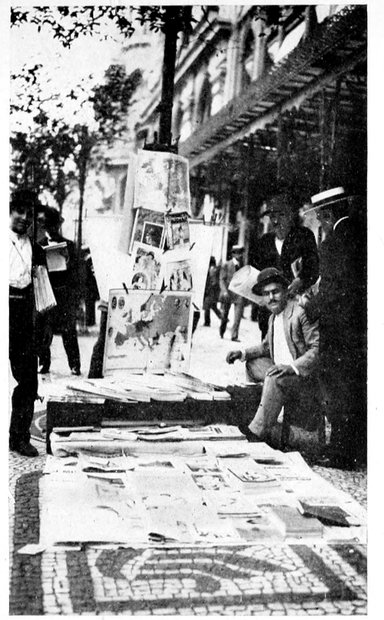
A news-stand on the mosaic sidewalk of the Avenida Rio Branco
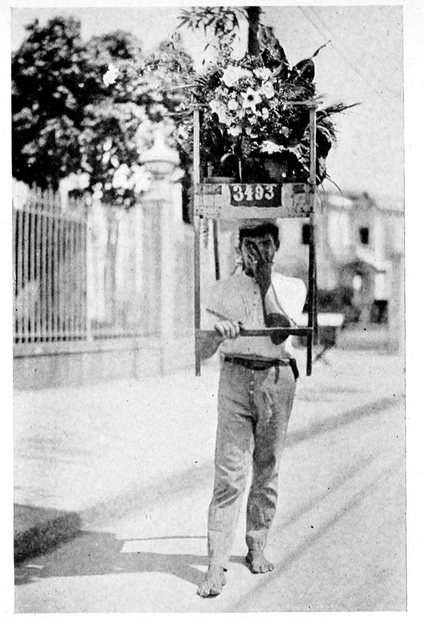
A hawker of Rio, with his license and his distinctive noise-producer
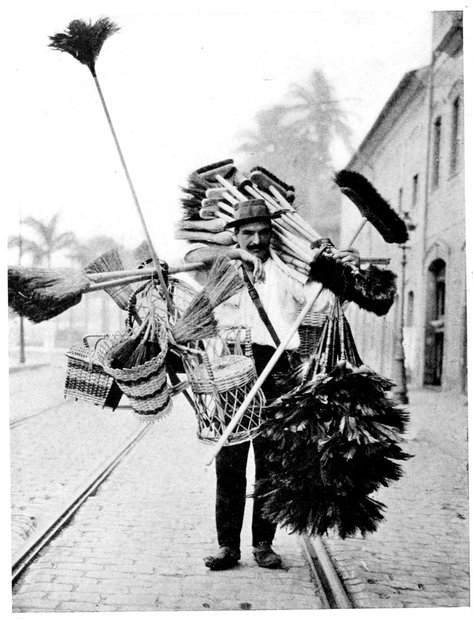
The brush-and-broom man on his daily round through the Brazilian capital
Not the least curious of the contents of Rio newspapers are the
illicit gambling advertisements. The state and federal lotteries are
legal and may advertise as freely as the cambistas who sell the tickets
on the streets may howl day and night hideous with spurious promises
of easy fortune, but these official games reduce competition as much
as possible by legal enactments. Some twenty years ago the director
of the Rio Zoo began putting up daily on the gate a picture of one
225of the animals inside, in order to attract visitors to the establishment.
A bright individual recognized this as a brilliant opportunity to start
a new gambling scheme. He took the director into his confidence,
gradually drew crowds to the gate, and the illicit lottery that resulted
flourishes to this day. It is called “O Bicho,” a word meaning literally
“worm,” but which in Brazilian slang applies to all animals, reptiles,
birds, and even vermin. Twenty-five different “bichos” are used in
the underground lottery of Rio, and every day the newspapers carry
the notice: “O Bicho—For to-morrow ...,” followed merely by tiny
pictures of, perhaps, a snake, a rabbit, and a bear. The game is
against the law, yet even the chief of police plays it, and newspapers
cannot be enjoined from publishing the announcements, because no
jury has ever been officially convinced that they are not merely
enigmas for amusing children.
Two points of superiority Brazilian newspapers have over our own—they
are not besmeared with the alleged “funny pages” of paint-pot
cartoonists, nor do they “feature” divorce cases or any other form
of marital misdemeanor, possibly because domestic infidelity is too
commonplace to be “news.” On the other hand, they pander to that
ultra-morbid streak in the Brazilian temperament which African blood
seems to give it. Large front-page photographs of the victims of
suicide or revolting crimes are the joy of Carioca editors and readers,
the “action of the crime” being posed for in all its gruesome details
by models if pictures of the real characters are not available.
Speaking of crimes, there is a good police system in Rio, with
several excellent departments and a detective bureau that makes use
of the latest European science in the detection and capture of criminals.
The prevalence of warnings against “batadores de carteiras,” or pickpockets,
is a thermometer of the criminal element. This class is so
numerous as to have a thieves’ slang of its own, called “caló” by those
who use it, or, in the pamphlet vocabulary published by the police
department, “Giria dos Gatunos Cariocas.” Many of the expressions
in this criminal dialect of Rio would be Greek even to the man whose
native tongue is Portuguese, though a few of them are localisms in
more general use. Not a few of the words in the pamphlet grew
familiar to my ear before I left Brazil. I learned that “Noah’s Ark”
is a pawnshop; to “perform an autopsy” is to go through the pockets
of a person fallen in the street; “to strike thirty-one” is to die; a
“bond” (in the legitimate language a street-car) is a group of persons;
to travel “by Italian bond” is to go on foot; a policeman is a “button”
226or a “cloud”; a mounted policeman is “a four-footed cardinal,” and
“convent” means the Penitentiary. To “give charity” is to kill a
person while robbing him; to “disinfect the zone” is to disappear
from a given haunt; a patrol-wagon is either a “merry widow” or a
“chicken coop”; a “nose” is a person (“He came with three noses”),
the real nose being a “smoke-box.” A “soft” is a mattress; a lawyer,
a “talking-machine”; “synagogue” stands for head, and “Big Papa”
means the President of Brazil. Naturally money has many pseudonyms
among the class that is always seeking to lay illegal hands upon it,
among them “wind,” “light,” and “arame” (literally, brass or wire).
The expression “falta arame” (brass is lacking) is widespread. A
ragged youth frequently sidles up to the passer-by, rubbing his stomach
and asserting, “Falta arame pa’ matar o bicho” (literally, “money is
lacking to kill the worm”); what he really means to say is that he needs
money to stop the gnawings of hunger.
It is a common human trait for those somewhat loose in their morals
to be doubly stern in outward manners. The Brazilian, even of the
more haughty class, is inclined to be lax at home, though in public
outward appearance is everything to him. One showy suit of clothes
for street and social wear seems to leave the average Carioca willing
to spend the rest of his life in his underclothes. It is no unusual
experience when calling upon a man to be asked on some pretext
to wait until he has put on his outer garments; while among the
women the wrapper habit extends from the highest to the lowest ranks
of society. The tropical heat partly accounts for this sartorial laxity,
but in many ways it typifies the national habit of mind. At home
the Brazilian, particularly of the fair sex, can sit for hours in that
utterly blank-minded idleness of the Oriental; only when they come
out to stroll the Avenida or the Ouvidor late in the afternoon do
most of the women put on real clothes and dress their hair. Among
the humbler class, the negroes and poor whites of the morros and
the narrow valleys between them, or of the one-story tenement
houses known as cortiços, there is but slight sense of privacy and
much of the family dishabillé and domestic activities are freely
exhibited to the public gaze.
Outside his home circle, however, the Brazilian is more than exacting
in such matters. In public a man must not only be fully dressed, but
is somewhat looked down upon if he indulges in any of those lighter
garbs of the “Palm Beach” variety that seem so in keeping with the
Brazilian climate. Especially if he is a politician, a business man,
227a member of high society, or has a desire to attain to any of these
categories, must he wear a heavy dark suit and under no circumstances
leave off his waistcoat. To be without a coat is a criminal offense in
many cities; in the smallest village that has any personal pride, even
among many people living in the wilderness of the sertão, it is atrociously
bad form. The man riding with a negro functionary in the
far interior of the country must cling to his coat if he would not
make his companion an enemy for life. One of our recent presidents
still has a low rating in certain parts of interior Brazil because he
entered a mud village of unwashed, illiterate, largely illegitimate
mulattoes in his shirt-sleeves. When several of his party landed in
Bahia they were met by a courteous policeman and told either to
go back to the ship and get their coats or buy new ones in the shops.
Yet in that very city hundreds of men habitually wear no shirt or
other garment under an often wide-open coat. More remarkable still,
while a man in his shirt-sleeves is denied admittance to some of the
most sorry establishments, it is entirely comme il faut for him to
come down to the early morning meal in the best hotels in his pajamas.
The negro captain of a little steamer far up in Matto Grosso sent
word to an American prospector of my acquaintance, who appeared
on deck in the latest model of soft shirt, with belt and cravat, that
he must not leave his cabin without his coat, yet the majority of the
native passengers were lounging about in carelessly buttoned pajamas
and kimonos, sockless slippers, the women with their hair down their
backs. During my first days in the country a Brazilian aviator made
the first non-stop flight from São Paulo to Rio, breaking all South
American records for speed and distance. The newspapers shouted
with glee at this splendid feat by a “son of the country,” yet one and
all commented in caustic editorials on his shocking bad taste in leaving
his coat behind and landing at Rio in his shirt sleeves. The street-cars
of Rio and every other city of size have at least two classes.
The fares are not greatly different, but unless a man is wearing coat,
collar, necktie, real shoes—not tamancos, or any other form of sandal—and
socks, he must ride second-class. Nor may he carry with him
in the higher form of public conveyance anything larger than a portfolio.
Rio gives the impression of being overcrowded. With emancipation
the ex-slaves flocked into town in quest of an easier livelihood than
that on the plantations, and immigration streams clog here. The
swarms of beggars, criminals, prostitutes, hawkers, adult newsboys,
228two drivers for each automobile, the crowds frequently seen struggling
for jobs, to say nothing of the plethora of government functionaries,
suggest an oversupply of human beings. More than once in strolling
along the wharves I came upon a hundred men fighting for work
where twenty were needed to coal or stevedore a ship, often standing
up to their knees in sea-water along the Caes Pharoux battling for
a seat in the tender waiting to carry the score to their labors. Nor
were they “bums” either, but muscular, honest workmen, nearly all
of the Caucasian race; while just across the way indolent mulatto
government employees lolled in the shade of the customhouse as if
they had settled down for life and need never again exert themselves.
A “pull” with the foreman who chooses the workmen for a given job
is usually essential to being taken on, and he naturally expects his
“rake-off.” One day a riot broke out among these wharf laborers;
two “fiscals” of the stevedores’ union were killed by members who
claimed they had been discriminated against; and the newspapers
treated the matter as if it were a frequent occurrence.
Not the least picturesque of the many strange types of Rio are her
street vendors, who pass all day long in almost constant procession.
The Brazilian woman is not fond of shopping, or at least of going
to market. She has the Moorish custom of keeping to the house;
she feels most comfortable in négligé, and public appearance requires
elaborate full dress; nor does the blazing sunshine invite to unnecessary
exertion. This tendency to stay home, and the excess of men over
jobs, has given rise to innumerable street-hawkers, who go from door
to door, selling both the necessities and the luxuries of life. In the
early morning, often before sunrise in the winter months of July or
August, one is often awakened by a cry of “Verdura! Verdureiro!”
and looks out to see the “vegetable-man” jogging along under a load
of green-stuff that would break an ordinary man’s back. Then barely
has one dropped off again before there comes a bellow of “Vassoura!
Vassoureiro! ’asooooreeeeiro!” from the brush-and-broom man, who
marches by all but lost under an arsenal of potential cleanliness, with
a side-line of baskets and woven baby-chairs to complete his concealment.
Meanwhile from down the street comes the increasing wail
of “’llinha! Gallinha Gorda! (Chicken! Fat Chicken!),” and past the
iron grilled window shuffles a barefoot man with two large baskets at
the ends of a pole over his shoulder, or on the back of a horse or mule,
offering housewives their day’s roast or broiler. In Rio people always
buy their chickens on the hoof and avoid the risks of cold storage.
229Then comes the “Peixe! Camarão!” man, whom we might call the fish-and-shrimp
seller, pausing here and there to cut up a fish on one
of the round board covers of his two flat baskets. He disappears
earlier in the day than the others, however, for seafood exposed after
nine or ten in the morning to the unshaded heat of Rio is likely to make
a greater appeal to the purchaser’s olfactory than to his optic nerves.
Not all hawkers cry their wares. Some have, instead, their own
special noise-makers. The cake-and-sweetmeat man, with his large
glass-sided showcase on top of his head, strides along, blowing a whistle
that looks like half a dozen cartridge shells of varying size stuck
together, or like the conventional Pan’s Pipes, and the shrilly musical
sound these emit causes every child within hearing to canvass its
pockets, parents, or friends for a tostão. When a customer appears
the cake-man squats from under his load, depositing it on the pair
of crossed sicks in the shape of a saw-horse that he carries under
one arm, and the bargaining begins. The tin-man goes by, carrying
a great stack of pots and pans and calling attention to his existence
by shaking a frying-pan fitted with a clapper. The scissors-grinder
stops every few yards to bring every nerve to the top of the teeth
by running an iron hoop over his emery-wheel, in the hope of
attracting trade. The man who sells plants and flowers comes along,
incessantly and regularly beating with a light stick the side of the
blooming box on his head. The seller of azucarillas, the ephemeral
sweets of Spain, is as familiar a figure as in the Iberian peninsula;
the “ice cream” merchant marches about with what looks like an
oxygen or gas cylinder on his back, playing a steel triangle to call
attention to his little gambling wheel, guaranteed to teach children to
gamble early in life by taking a chance on his effervescent delicacies.
A few vendors have a limited district, with grouped customers, especially
the bread-man who, with his great basket on his head and the
stool to hold it under one arm, has only to station himself in the pateo,
or courtyard, of a cortiço to be surrounded by a clamoring throng,
children snatching the long loaves faster than their parents can buy
them and rushing excitedly into their one- or two-room homes with
the bread hugged tightly against their soiled chests. But the majority
tramp all day long, some treading the hot cobbles in bare feet, some
wearing the noiseless alpargatas of Spain and Portugal, many scraping
along the cement pavements in wooden tamancos, invading every nook
and corner of the city and punctuating the whole day long with their
cries and signals. With rare exceptions they are Portuguese or
230Spanish—it would be beneath the dignity of a native Brazilian to
carry things about in the hot sunshine; but the clothing trade is almost
entirely in the hands of “Turks,” as South America calls the Syrian,
who peddles his wares in every corner of the great republic in which
the human race sprouts. In Rio this perambulating clothing-shop
announces himself by slapping together two lath-like sticks, making
a noise similar to, yet entirely distinct from, that of the plant-and-flowers
man. From daylight until dark he plods, to wander back to
his noisome little den when night settles down without a slap left in
his arm. During his first year or two he carries his goods on his back,
and looks at a distance like a walking department store. But by the
second year he has usually scrimped enough to buy an elaborately
decorated chest of drawers and to hire a youthful or newly-arrived
fellow-countryman to carry it, while he wanders along with nothing
to do but slap his sticks together and engage in the long-winded
bargaining which is unavoidable in any financial dealing with the
Brazilian housewives peeping out through their window gratings.
But the “Turk” is a more clever bargainer than the best of them,
and within three or four years he is almost certain to have advanced
to the ownership of a little pushcart and by the end of five years it is a
strange mishap if he has not set up a shop, become a local nabob,
and driven native competitors entirely out of his district.
This does not by any means exhaust the list of vendors who add
their noises to the general hubbub of Rio. No one who has spent a
week there could forget the cambistas, the lottery-ticket sellers of all
ages and both sexes who invade the inmost privacy with their raucous
howls, or the never-ending cries of newsboys, some of whom spread
their wares on the mosaic sidewalks of the Avenida Central, while
others race in and out of the narrow streets on either side of it.
Nor should one overlook, even if it were possible, the creaking of
enormous carts, their two wheels twelve feet or more in diameter,
with which an immense log or a granite boulder is transported through
the streets to the accompaniment of hoarse-voiced cursing of the mule-driver
in charge.
If one grows weary of wandering Rio’s sun-bathed and colorful
avenues and ruas, there are indoor places worth seeing. The National
Library, for instance, is a magnificent building, at least in its material
and inanimate aspects. The human element is somewhat less perfect.
The president himself could not take a book out of the library; everyone
knows he would be sure to keep it or hock it. Being scribbled
231by hand, the card catalogue is by no means easily legible; it is set so
near the floor that the reader of American height all but breaks his
back in reaching it, and there are so many authors of the same name
that to hunt up a given one is a serious task. Then there is a splendid
Brazilian system, evidently imported from Portugal or some still less
respectable region, under which directories, biographies, and the like
are always arranged in alphabetical order according to the first name.
Let us suppose that the only Brazilian opera of any importance,
“O Guaraní,” is soon to be given in the Municipal Theater, and that
you wish to know something about the man who wrote it. The announcement
mentions that his name is Gomes. You enter the sumptuous
hall of the library, hat in hand, wait for the negro attendant
and his white bosom companion to stop gossiping and give you a hat
check, then you climb to the next floor and, doubled up like a jackknife,
claw through the catalogue until you get the serial number of
a biographical dictionary in many volumes, containing the life story
of the “Most Illustrious Brazilians”—of whom there seem to be
millions. Having filled out a “bulletin” explaining which book you
wish to consult, giving author, title, the date, the “number of the
set,” the “indication of the catalogue,” your own name, address, and
other detailed personal information back to the fourth generation,
you enter the sumptuous reading-room. Or, more exactly, you wait
patiently at the door thereof until you are handed a senha, a slip of
paper which gives you the right to enter and—if you can still produce
it—to exit. That in hand, you choose a seat and write the number of
it on the “bulletin,” hand this to the gossiping tar-brushed attendant,
and go and sit down. The attendant finishes his gossip, looks at the
slip, and carefully puts it under a book on his desk. By and by he
ends another gossip, picks up the book, is astonished to find a slip
under it, reads it carefully, and puts it under another book on another
part of the desk. Meanwhile you cannot go to look up the books you
might want to read at some future date, because you cannot leave
the reading-room without giving up your senha with the attendant’s
“o.k.” on it. You cannot bring along a book of your own to read
meantime, because any Brazilian knows that you would bring some
worthless pamphlet and manage to exchange it for a valuable library
volume. There is nothing to do but sleep, or study the scattering
of fellow-sufferers in the reading-room, where you are sure to be
struck by the absence of women. An old maid did enter the library
232one day while I was there, but she was stared at so steadily that
neither she nor the men in the room did any reading.
Finally, if this happens to be your lucky day, it may occur to the
attendant to put your book-slip into the automatic tube at his elbow
and send it off to the stacks. When the employees at that end of
the tube get through discussing politics or the lottery and send the
book back by automatic carrier, along with the “bulletin” signed by
the man who “executed the request,” a negro attendant wanders
over to your seat with it. Then you quickly discover that though the
huge volume is devoted to everything from “Gl” to “Gy” there
is not a single Gomes in it. This rather surprises you, since Gomes
is as widespread in Brazil as Smith in the United States or Cohen in
New York, and at least one of that name must have been illustrious
at least in the Brazilian sense. But by this time it is four-thirty, and
the library takes a recess at five—that is, everyone is ejected and the
doors locked by that hour—so you give it up.
Next day you discover quite by accident, your eyes having fallen
upon a frieze at the “Theatro Phenix,” that the musician’s name
was Carlos Gomes. As soon as the library opens—at ten in theory and
about ten-forty in fact—you hasten back and go through the same
tape-wound misery again to get the fourth volume of illustrious
Brazilians, and wallow for hours through pages upon pages of
“Carlos” without finding a single one of them answering to the name
of Gomes. Days afterward, when the opera has come and gone, a
Carioca acquaintance casually remarks that the man who wrote it was
Antonio Carlos Gomes, but that he never used the first name! Back
to the library to flounder once more in the ubiquitous red tape, and
late that evening you grasp the “A” volume of illustrious Brazilians
and finally at nine-thirty—Eureka! “Antonio Carlos Gomes, Paulista,
musician, born in Campinas, and ...” and just then you are “put
into the eye of the street,” for the library closes at ten and no Brazilian
official is so absurd as to let the closing hour catch him still
in the act of closing. Wandering homeward or out along the
Avenida you muse on how convenient it would be if strangers in our
Congressional Library had to look up the 28th president of the
United States under the name “Thomas.”
Though at least two-thirds of the people of Brazil do not read or
write—more than half because they cannot and the rest because they
have no occasion or no desire to do so—Brazilians of the small
“upper” class are more cultured in the narrow, bookish sense of the
233word than the average American of similar rating. “Everyone”
knows everyone else in this restricted little circle in Rio, and they
retain many of the old-fashioned opinions and manners of the days
when the capital was called “the court” and was overrun by the
locust swarm of courtiers from the old world. Embracing is still the
knightly form of greeting between males in this higher Fluminense
society, where it is the custom for a man to kiss a lady’s hand—or
glove—upon being presented, and in which young men often give
their fathers similar marks of recognition in returning from or
departing on a journey of any length. Many of this caste are still
monarchists, at least at heart, though they usually find it to their
advantage outwardly to acquiesce in, or even to show enthusiasm
for, the new form of government.
I attended several “social functions” in Rio—always from a discreet
distance, “a mocidade,” which is the same foppish muster of
youthful “intellectuals” that is known as “la juventud” in Spanish-America
or “la jeunesse dorée” in France, was trying to establish
a “Little Theater” for the exclusive use of the élite, “with a view to
rehabilitating our histrionic art, so debilitated to-day.” Now and then
they perpetrated amateur plays which fortunately were not exposed
to the scorn of the general public. One afternoon they arranged a
“literary program” for the purpose of raising a monument to Arthur
Azevedo, Brazilian dramatist and writer of clever but salacious short
stories. It began at four in the handsome new “Theatro Phenix,”
usually sacred to the “movies,” and actually got started shortly
before five. Being primarily a social event, there were only four
of us up in the gallery. On the stage below, two young men in ultra-correct
afternoon dress, creased to the minute, displayed themselves
to a select female audience in recitations from Arthur’s stories
(edited) and plays, with extravagant and unnatural gestures. A self-confident
lady who was just recovering from being young, moaned
through half a mile of something in French—what this had to do
with the glory of Arthur I did not catch, high up under the eaves,
unless it was meant to show how well the élite of Rio have copied
Parisian manners—and finally there was given a one-act play by the
same monumental author, which might have been very funny had
the acoustics of the house permitted us gallery slaves to catch more
than the reflected mirth of the audience. Through it all a dozen of
“our greatest literary geniuses” pranced about the stage before the
admiring audience on one excuse or another, while two photographers
234toiled assiduously taking flashlights from all possible angles of the
correctly creased afternoon trousers.
Still another day found me at a soirée musicale in the old “Theatro
Lyrico,” back of its newer and more aristocratic municipal successor.
This rather breathless old barn was the principal theater of Brazil
under the monarchy, and still retains unchanged the imperial loge,
a whole furnished apartment in Louis Philippe style. There was only
a slight negro strain in the audience, but the orchestra of fifty pieces
ran the whole gamut of human complexions. The recital by a pianist
still in her teens easily made up for all the tedium I had undergone
in attending other “social functions” in the Brazilian capital. As
Senhorita Guiomar Novaes has since won high praise in our own
land and in Europe, I am pleased to find in my notes on that day’s
performance the prophecy, “Here at least is one Brazilian who will
prove of world caliber.”
One of the points that distinguish Brazil from Spanish-America
is its divergencies of religion. Here, too, the church got in on the
ground floor. As early as 1590 the Benedictine monks founded a
monastery on the summit of the Morro São Bento; soon afterward
the Capucines established themselves on top of the Morro do Castello,
and in general the churchmen showed great predilection for the high
places of Rio, perhaps to get that much farther away from the wicked
world. For centuries Rome ruled Brazil with her customary profitable
sternness. Scarcely two centuries ago Protestants attempting
to spread their propaganda in the country were roughly treated, and
priests publicly burned in the praças of Bahia and other cities the
Bibles and tracts offered by American and other colporteurs. To
this day and in the cathedral of Rio itself one may find evidences of
medieval fanaticism—women of the poorer class making the circuit
of the church on their knees, or kissing everything in sight, including
floor, walls, and all the wounds of a life-size plaster-of-Paris crucifix
under a thin shroud. A few of the hilltops, too, are still sacred to
the cloistered life, but the church has lost much of its monopoly
and is much less militant and omnipresent than on the West Coast.
It is the custom of Brazilian men, even in street-cars or trains going
full speed, to raise their hats, often in unison, when they pass a funeral
or a cemetery; but the same reverence in passing a church door is
by no means so general, and is usually confined to the part-negro
portion of the population. Indeed, it is almost unusual to meet a
235priest, monk, or nun in the streets of Rio, and politically the church
is almost an outcast.
Yet the capital pulsates with many religions. The transplanted
faiths of the many races that make up the modern Carioca are so
numerous that, if we may believe a native writer, “every street has a
different temple and every man a different belief.” There are several
sects of African fetish worshippers, Methodists, Maronites, Baptists,
Physiolatras, Presbyterians, Satanists or worshippers of the devil,
Congregationalists, “Drinkers of Blood,” “Brothers,” Adventists, Jews,
followers of the “black mass,” Swedenborg disciples of the New Jerusalem,
exorcists, literary pagans, sacerdotistas of the future, descendants
of the Queen of Sheba, worshipers of the sea, and defenders
of many other exotic dogmas, not to mention a large building back
of the Avenida Central occupied by the “A.C.M.” (Associação Christão
de Moços), in other words, the Y.M.C.A. As far away as the Uruguayan
border I had heard an unfrocked priest lecture on one of the
newer faiths of Brazil and was astonished to hear the loud and general
applause whenever he made a thrust at the fanaticism or immorality
of South American priesthood. Up in the Andes he would have
proceeded along that tack in public for about two minutes before
having a pressing engagement with the undertaker. In Santa Maria
my astonishment was as great when I passed an imposing Protestant
stone church on one of the principal streets and heard the minister—speaking
his Portuguese with a thick German accent—openly preaching
his particular doctrine to a large Brazilian congregation. Freedom
of worship reigned indeed; in that morning’s newspaper there
was a complaint from a town not far away that it could get no mail
from Friday until Monday, because its postmaster was an “Adventista
do 7º Dia!”
The cult of the sea is found chiefly among the colonies of fishermen
scattered about Guanabara Bay. Some of these will under no circumstances
leave the sea or its beaches. Their children swim at two
and go fishing with the adults at ten. The moon enters considerably
into their fanaticism, and their veneration for and fear of the
“Mother of Water” is inferior only to their dread of the police, before
whom, or in the presence of non-conformists, they pretend to be
strict Catholics. One-fifth of all the spiritualist propaganda in the
world is published in Brazil, according to a native who made an
investigation of the question. This superstition is so widespread that
men high in government and business circles have been known to
236refuse to take a street car which the rabble has left empty because
“it is full of bad spirits.” Synagogues are numerous in Rio, for there
is a large Jewish colony, running through all the gamut of society
as well as of commerce, and widely varying in orthodoxy and religious
rites. There are rich Jews in business along the Avenida who spend
their winters “playing the markets” and their summers up in Petropolis.
In the less showy streets live swarms of poor Armenian, Moroccan,
Russian, Austrian, Turkish, French, English, German, Arabian,
and even African Jews, all engaged in their customary occupation of
buying and selling something or other. About the Praça Tiradentes
and in its radiating ruas seethe Jewish women of the streets and
their male companions and exploiters, the caftenes, from all the
ghettoes of Europe.
There are said to be more than eighty thousand Syrians in Brazil,
of whom by no means all wander through the streets slapping together
a pair of sticks. Down about the Rua da Alfandega and the lower
point of the city “Turks” own important business houses; in the
colony are clever craftsmen and even a few doctors, politicians, and
journalists. More than half the Brazilian Syrians are Maronite
Christians from the Lebanon; the rest are orthodox Mohammedans of
somewhat lower social strata, who earn their primitive livelihood as
carregadores, carriers of mankind’s material burdens, as shop-servants,
and as petty peddlers. Though many of these “Turks” find the
difference in language a great barrier to their native loquacity as
bargainers, their qualities are near enough those of the Brazilians
to cause them to fit quickly into their environment.
Mohammedanism is not confined to the Syrians in the religious
medley that characterizes the capital of Brazil. Thousands of former
slaves are more or less followers of the Prophet of Medina, though
barely aware of it themselves. The negroes shipped out to Brazil
in the olden days were from many little nations scattered through
the far interior of Africa; hence their religions were as varied as
their tongues. But just as the general language of that continent,
the cubá, suffices for simple conversation throughout Africa or among
the blacks of Rio, so the negro religions practiced in the Brazilian
capital may be roughly divided into two general classes. The alufás
are more or less Mohammedan, with a background of African superstitions;
the orixás are a still more primitive sect upon which the
influence of the prophet was never brought. Outwardly, of course,
nearly all the blacks are good Catholics, but their saints and gods
237have been crossed with those of the church until it is a wise negro
who knows an African from a Catholic deity. Then, too, the unadulterated
fetish worship imported with the slaves still persists, and
Obeah and voodoo practices sometimes give evidence of their existence.
According to a reputable native writer there are in the everyday
crowd that surges through the Avenida, medicine men, magicians,
voodoo chiefs, feiticeiros who will agree to mix a love philter or to
bring misfortune upon an enemy by mumbling an incantation over
a concoction of rat tails, cat’s head, finger and toe nails, and the innocent
passer-by would never dream what absurd African rites are
taking place behind more than one commonplace façade. There are
“holy men” living in the very heart of Rio surrounded by a swarm of
servant-women with whom they live in polygamy as in the wilds of the
black continent, yet many of whom dress for public appearance quite like
their Christian fellow-countrymen, play “bicho,” and die leaving to
their heirs many contos of reis. Negro Brazilians who know French
and even English, who have been educated abroad and have in some
cases become senators, or presidents of states, “men to whom I lift
my hat and with whom I shake hands,” in the words of the native
investigator, still cling secretly to the old African superstitions. There
are rich Brazilians who send their sons to Africa to study the religions
of their forefathers, and traffic between Rio, Bahia and Pernambuco
and several West African ports is heavy.
Most conspicuous of the non-Catholic sects of Brazil, thanks less
to their numbers than to their political power and high intelligence,
are the Positivists. Auguste Comte, a Parisian mathematician who
spent part of his life in an insane asylum and the rest in penning
voluminous explanations of a “positive philosophy” which even the
mathematical mind seems to find difficulty in comprehending, suffered
the customary fate of the prophet in his own country. “Paris,”
according to his Brazilian disciples, “was not prepared for so advanced
a doctrine.” In most other countries he won only scattered
followers—George Eliot and her lover were among them—but in
Brazil his doctrine not only survives but seems likely to increase
its standing before it goes the way of other ’isms. Positivist propaganda
began in Brazil during our Civil War, but was some time in
getting a footing. Finally the “Littréists” Miguel Lemos and Teixeira
Mendes became converts, the former becoming the head of the sect
in Brazil and the latter—now his successor—his chief lieutenant. But
238it was Benjamin Constant Botelho de Magalhães who raised Positivism
to a political force, first teaching it more or less secretly in the Military
School and combining with it the demand for a republican form of
government until, in 1889, the sect joined with the army in overthrowing
the monarchy. The Brazilian Positivists credit themselves with establishing
the republic, separating the church from the state, reforming
the teaching and criminal codes, and many lesser accomplishments.
Strictly speaking Positivism does not pretend to be a religion but
merely a “philosophy of life.” Yet it bears many reminders of the
Puritanical and reforming sects so numerous in our own land. Positivists
advocated the abolition of slaves; they are opposed to the
lottery; they demanded an easier form of civil marriage in the hope
of cutting down illegitimate unions—in other words, they combine
religion and morals, which are so completely divorced in the ruling
church of South America. They are popularly reputed to be opposed
to the use of coffee or tobacco and to take that “blue law” view of
life into which our Puritan virus shows frequent tendencies to degenerate,
but this they claim to be mere ridicule or counter-propaganda
of their enemies.
I arranged by a “want ad” to exchange English for Portuguese
lessons with a well-educated native of Rio, who turned out to be
a government functionary and a Positivist. Possibly the most striking
thing about him was his almost Protestant moral code, contrasted
with his genuinely Brazilian tolerance in practice. He saw nothing
reprehensible in cheating the public out of more than half the time and
effort which they paid him to deliver; he asserted that he and Brazilians
in general believed their wives certain to betray them if given the
opportunity, and refused to credit my statement that the average
American husband does not consider eternal vigilance the price of
his domestic honor. Yet often in the same breath he pronounced
some Positivist precept that would fit snugly into the code of our
sternest sects.
I accompanied my student-tutor one Sunday morning to the principal
weekly service at the Positivist Apostulado, or “Temple of
Humanity” in the Rua Benjamin Constant. It is an imposing building
in the style of a Greek temple, said to be copied from the Panthéon
of Paris. On the façade is the Positivist motto in large bronze letters:
O Amor por Principio
E a Ordem por Baze
O Progresso por Fim.
239Inside, the almost luxurious edifice, “sea-green in color, as if one
were bathed in hope, and with the high ceiling essential to lofty
thoughts,” still somewhat resembles a Catholic church. Around the
walls of the nave are fourteen “chapels” containing as many busts,
each representing one of the “saints” of Positivism and an abstract
idea. They are Moses—Initial Theocracy; Homer—Ancient Poetry;
Aristotle—Ancient Philosophy; Archimedes—Science; Cæsar—Military
Civilization; St. Paul—Catholicism; Charlemagne—Feudal Civilization;
Guttenberg—Modern Invention; Dante—Modern Epic; Shakespeare—Drama;
Descartes—Modern Philosophy; Frederick the Great—Modern
Politics; Bichat—Modern Science, and lastly, Eloïse, or Feminine
Sanctification. It would be easy, of course, to quarrel with the
Positivists on several of their choices as world leaders, were they of
a quarrelsome disposition. These personages also give their names
to the fourteen months of the Positivist calendar, which begins with
the French Revolution. Among the decorations are the “flags of the
five nations”—Brazil, China, Turkey, Chile and Haiti! Only two South
American countries are represented because “these are unfortunately
the only ones in which the Positivist faith as yet counts fervid adepts.”
China wins place as the “most vast nation of the Orient;” Turkey as
the “most cultured people of the East” (!), and Haiti is admitted “in
honor of the greatest of negroes, Toussaint L’Ouverture,” whose portrait
is the only non-Caucasian face among the many about the walls.
There are of men of all ages and nations, whom the Positivists consider
of world importance,—Camões, Lavoisier, Cervantes, St. Gall,
Cromwell, and many others, the only American among them being
an atrocious chromo print of Washington. Higher still, in decorative
letters and the simplified spelling of Positivist Portuguese, are scattered
the words,—Space, Industry, Architecture, Painting, Earth, Music,
Poetry, Politics, Proletariat, Priesthood, Monotheism, Astrology, Family,
Humanity, Patriotism, Fetishism, Polytheism, Woman, Morality,
Sociology, Biology, Soil, Chemistry, Physics, Astronomy, Logic. Above
what, for want of a better name, might be called the altar or the main
chapel, runs the inscription:
“Vergine Madre Amen te plus quam me nec me nisi propter te.”
No Catholic church was ever more crowded with images than the
“Temple of Humanity.” In fact, the more closely one looked the more
did certain forms and beliefs of Catholicism peer through the outward
modern mantle of Positivism, as if either the founder or his disciples
240had not been able to divest themselves entirely of their inherited faith.
The most Catholic beata in South America could scarcely have shown
greater reverence for the sacred pictures, graven images, and “relics of
the faith” with which the temple was crowded. Above the “pulpit”
was a bust of Comte on a column, its upper portion covered with green
cloth embroidered with white silk “by one of our young female proselytes.”
Portraits of Comte and his mistress, Clothilde de Vaux—both
painted in China and depicting them with almond eyes—hung in the
main chapel, where there were also paintings of each of them on the
death bed. Pictures of the Bastille, of Dante and Beatrice, of the
Sistine Madonna surmounted by a cross, “because she was an ardent
Catholic,” were among the many which a roving eye gradually discovered.
Most astonishing of all was the likeness of “Humanity,” a
virgin figure with the features of Clothilde de Vaux, dressed as a
bride, with a green band at her waist and holding in her arms a
pretty boy who grasped a handful of daisies and pansies, the Positivist
flowers, and gazed up into the woman’s face, the whole patently
inspired by the Catholic madonnas which it closely resembled. In the
background were the Panthéon and Père Lachaise cemetery, where
Comte is buried.
Like all religions, the new creed already tended to harden into set
forms, the failure to carry out which was evidently a more grievous
sin than the disobeying of the general principles of the order. Their
veneration of pictures of the dead was almost medieval; the railing
of the tomb of Clothilde had been brought from Paris and as much
fuss was made over it as ever devout peasants did over the shin-bone
of a saint; “first sacraments” were administered in the temple; “the
faithful” were urged to visit the “sacred places of Positivism;” they
had a substitute for crossing oneself, “a sacred formula of our faith
in which it is customary for all believers to stand up out of respect for
Our Master.” There was even a hint of Mohammedanism, a mark
in the cement floor of the porch under the pillars indicating the direction
of Paris—the thought of Paris as a sacred city was a trifle startling—“toward
which all Positivistic Temples should have their principal
axes.”
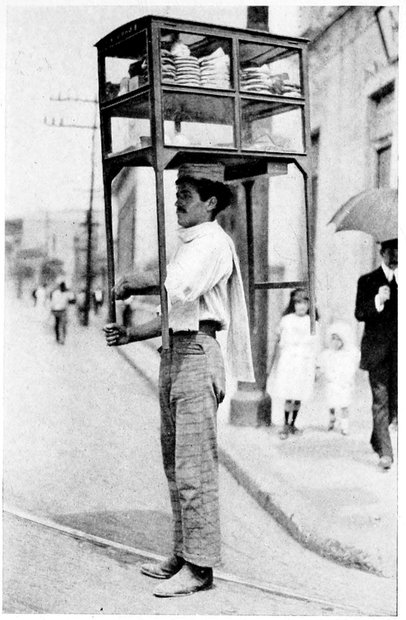
The sweetmeat seller announces himself with a distinctive whistle
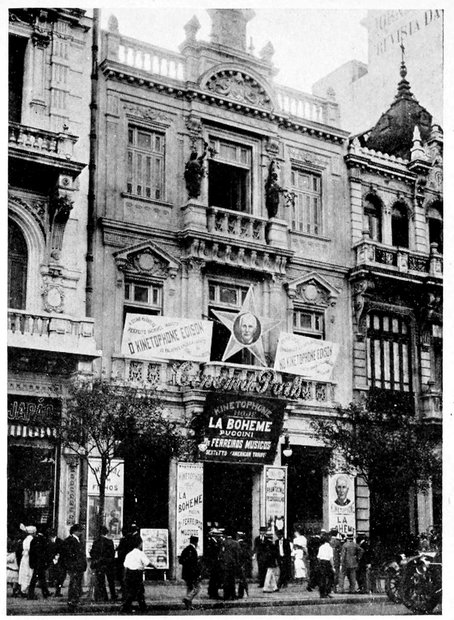
The opening of the “Kinetophone” in Brazil
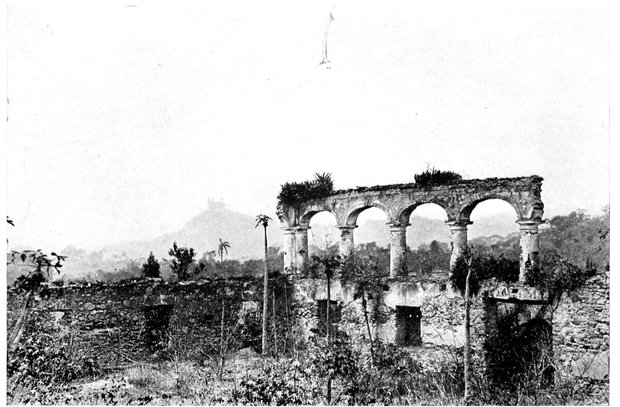
The ruins of an old plantation house on the way to Petropolis, backed by the pilgrimage church of Penha
In the basement of the temple was a printing plant from which issues
a constant stream of Positivist pamphlets, books, biographies of Benjamin
Constant, and similar forms of propaganda. Here, too, is the
original flag of republican Brazil, painted in crude colors on pasteboard
by order of Teixeira Mendes. The story of its designing is not without
241interest. Having been assigned the task by the leaders of the revolution,
the present head of the Positivists of Brazil determined to keep the
general form of the existing national banner. João VI had given the
kingdom a coat-of-arms set in a golden sphere on a blue background.
Mendes changed the blue to green, basic color of the Positivist banner
and meant also to symbolize the tropical vegetation of the land, as the
yellow sphere does the gold in its soil. Then he called in an astronomer,
and taking the twenty principal stars of the southern firmament at
noon of November 15, 1889, to represent the twenty states of Brazil,
he placed nineteen below the equator-like band across the golden sphere,
and one above it to indicate that part of the country north of the
equator, or of the Amazon. The sphere was inclined on the horizon
according to the latitude of Rio, the tobacco and coffee on the old royal
coat-of-arms were removed, as “mere commercial things not fit for a
place on the national banner,” and along the equatorial band was
run a line from the Positivist motto.
The women of the congregation sat on a platform in front of the
“altar” rail, the men down in the body of the “church.” Women
should love Positivism, according to its disciples, for it dignifies, venerates,
and raises them to their due elevation. The “3rd of Guttenberg”
on which the temple was dedicated is also the “Feast of Woman”
day, on which Positivists celebrate the “transformation of the cult of
the Catholic Virgin into the cult of Humanity.” Teixeira Mendes,
long the head of the sect in Brazil, sat in the “pulpit” beneath the
bust of Comte and “preached,” if his un-sermon-like remarks uttered
in a weak, thin voice barely heard through an immense white mustache
may be so called. His diminutive form was covered by a dark
robe, with a green cord about the neck and embroidered with the Positivist
flowers. The “sermon” emphasized the Positivist conception
of the “virgin mother” as combining the two great qualities of the
feminine type,—purity and tenderness. Like many other religions,
this modern creed clings to the legend of a virgin mother. As the
gathering marched out to the tune of the “Marseillaise,” I asked my
cicerone to explain the frequent recurrence of the “virgin mother”
motif in temple and sermon. He replied that it was the Positivist
belief that humanity would gradually be educated up to the point
where “woman will be able to reproduce alone, without the necessity
of ‘sin’ with man!”
CHAPTER XI STRANDED IN RIO
242
I had long expected far-famed Rio to be the climax and end of
my South American wanderings. Portuguese civilization had never
aroused any great interest within me; a glimpse of Brazil, with
possibly a glance at Venezuela on my way home, to complete my acquaintance
with the former Spanish colonies, seemed a fitting conclusion
of a journey that had already stretched out into almost three
years. When I had “fiscalized” the “Botanical Garden” street-car
line for nearly a fortnight, therefore, and seen the chief sights of the
Brazilian capital, I began to think of looking into the question of getting
back to the United States.
Contrary to my earlier expectations, it would not be necessary to
sign on as a sailor or stoke my way across the equator. With my
unanticipated salary of six thousand a day and by dint of long experience
in sidestepping high prices, I had succeeded in clinging to
the equivalent of a hundred dollars from my consular earnings, as a reserve
fund for this last emergency. With that munificent sum on hand,
I might even scorn the long-familiar steerage and treat myself to a
second-class passage on any of the steamers sailing frequently from
Rio to New York.
Unfortunately I had not been keeping my ear to the ground. Years
of care-free wandering in those sections of the earth where life is
simple and in which man learns to depend chiefly on himself had
caused me to overlook certain characteristics of the more complicated
world I was rejoining. There even a vagabond is only to a limited
degree a free agent. The reserve fund I had unexpectedly saved
from the maw of Brazilian profiteers was in paper milreis and as one
had been able for more than a decade to turn 300$000 into twenty
English gold sovereigns at will, I had neglected to do so at once. On
the bright “winter” morning of Saturday, the first of August, I strolled
out of my modest hotel and along the Avenida Central with my habitual
air of a care-free man of unlimited leisure—almost instantly to recognize
that there was something strange in the wind. Before the offices
of the Jornal do Commercio and the Jornal do Brazil were gathered
243seething crowds, eagerly spelling out the voluminous bulletins in their
windows. I paused to read with them. Some one, it seemed, had
kicked over the balance of power in Europe and France and Russia had
decided to try to give Germany the trouncing for which she had so
long been spoiling.
The news came to me out of a tropically clear sky. I did recall
having glanced at a brief newspaper paragraph somewhere during my
journey northward from Uruguay, to the effect that some prince of
Austria and his consort had been killed at a Serbian town of which I
had never heard; but I had known other assassinations of Europeans
of high degree to blow over without a war resulting. Squabbling was
always going on in the Balkans anyway. Pessimists had it that there
was going to be a long and a real war; in common with all other wise
men of the period I smiled condescendingly at the silly notion.
Yet here were very decided rumors of war. Maps were already
appearing in the windows of newspaper offices, with scores of black and
red-headed pins on them to show the advance of the various armies.
The flurry might not amount to much, but it was high time I turned my
paper milreis into real money, bought my ticket, and got out of this
temperamental country before something serious really did happen.
I strolled on and dropped into one of the countless “exchange” booths
that flourish in and about the Avenida Central. Handing out my three
hundred thousand reis I requested the man inside to hand me back
twenty gold sovereigns. He looked at me scornfully, pointed to a
small paragraph in the newspaper under my elbow, and went on painting
a sign on a piece of cardboard. Perusing these I learned the astounding
news that the milreis, which had been rated fifteen to the
English sovereign as far back as men with average memories could
recall, had dropped overnight to twenty-three to the pound! In
other words of the same profane nature, my hundred dollars had
dwindled in a few hours, merely on the strength of a bit of news from
squabbling Europe, to about seventy. I refused to be “done” in that
fashion. It was merely the old familiar trick of bankers who were
taking advantage of a temporary scare to rob the garden variety of
mankind of our hard-won earnings. In a day or so honesty, or at
least competition, would prevail, and my three hundred milreis would
be worth more nearly their honest value again. I re-pocketed them and
decided to wait until the exchange moderated—and two days later my
seventy dollars was worth less than sixty!
It may seem ridiculous that a man with three hundred thousand in
244his pocket should worry—at least to those who do not know Brazil,
her currency, her prices, and her profiteers. But I began to feel uneasy.
Not merely was the money I had by superhuman efforts saved to carry
me home calmly melting away in my pocket without even being touched,
but before long touching became unavoidable. In less time than would
have seemed possible a third of my miserable bills had disappeared.
Even if I got away at once, I should have to go straight home without
stopping at Venezuela, and if I did not hurry I should not get home
at all. I raced to the steamship offices—only to get a new shock. Not
only had the value of my money been cut in two, and a third of it used
up, but the price of steamship tickets had suddenly and mysteriously
doubled, and only English gold was accepted. If I could have jumped
upon a steamer that day, I could still have paid for a third-class passage.
But there was no boat due for three days, and there were good chances
that this would be several days late!
The air was full of war-bred excitement. Before it was announced
that England had declared war, the British cruiser that had been lying
in the harbor for nearly a week with her fires up was out stopping and
searching all traffic along the coast. Several ships flying the German
flag were anxiously awaiting orders in the bay, little realizing that their
last voyage under that banner was over. Another German vessel forcibly
put ashore fifty Russian steerage passengers who had embarked
in Buenos Aires with all their savings, generously giving them back
one-third the money they had paid for passage to Europe. Detachments
of rifle-bearing Brazilian policemen patrolled the wharves to preserve
order between the various nationalities. The German consul general
had ordered all Germans on the reserve list in Brazil to report to the
nearest consulate prepared to sail for home. German reservists poured
into the capital from the southern states until it was only by climbing
over a score or so of them that I could reach my room, into which two
of them had been thrust. A standing client of the hotel, a business
man of some standing and education, presumed upon our slight acquaintance
to insist one evening that I walk out with him. As we
stood before the bulletin-blinded window of the Jornal do Brazil with
its pin-spotted map of Europe, my companion gloated loudly over
each piece of news:
“In two veeks ve are in Parees! I go mineself to-morrow morning
to offer me to der gonsul. Oh, py Gott, ven only Eng-lant stop
noytral, ven only Eng-lant stop noytral!”
Unfortunately, from the German point of view, England did not
245“stop noytral,” and a few days later the German reservists began drifting
back to the fazendas and chacaras from which they had been called.
A twelve-day holiday was declared by the government, so that even
those who had money in the banks were as badly off as I, and
as the value of the milreis went steadily downward, prices went skyrocketing.
Day after day I invaded every steamship office in Rio, without
distinction as to race, color, or customary rascality. I took captive every
ship’s captain who ventured ashore, offering to do anything for my
passage from shoveling coal to parading the poop with his wife’s pet
poodle. Nothing doing! Even if a ship did now and then lift anchor
and sneak away in the general direction of the United States, there
were crowds of would-be passengers with vastly more influence, and
far more mesmerism over the root of evil, than I, who were quite
as willing to do anything within the pale of respectability to reach
“God’s country.” I might, of course, have cabled home for passage
money. There were one or two persons in my native land who probably
had both the wealth and the confidence required to answer properly
to such an appeal. But I had long since made it a point of honor
that when I got myself in a hole I should get out again without screaming
for a rope.
Psychologists as well as mere world roustabouts will probably admit
that the more nearly penniless a man is the more ready is he to “take
a chance.” His condition cannot be worse, and it may suddenly become
much better. A vagabond evidently is subject to the same laws as more
respectable members of society. At any rate, with only a few milreis
left, I grew bold and instead of squeezing the last loaf of bread out of
them, I squandered them for lottery tickets. On the following Saturday
there was to be a “drawing extraordinary,” with the first prize nothing
less than a hundred million reis! With that amount I might even
buy a steamer for the trip home; besides, I had long wished to know
how it feels to be a multimillionaire. Even in real money and at normal
exchange a hundred million reis reached the respectable sum of
$325,000, and though Brazilian shin-plasters had dropped to half their
pre-war value, though every “piece” of ticket must pay a commission
to the vendor and must bear the ubiquitous “consumption” tax in the
form of a stamp, though the government takes five per cent. of all
winnings and loads down the lucky ticket-holder with so many other
stamps, taxes, and grafts that it requires a lawyer to dig him from
under them, there would still remain the price of the bridal suite on any
steamer plying the east coast of South America.
246A crowd of mainly collarless and rather vacant-faced men and women,
who for many years had been chasing that will o’ the wisp
called the winning number by buying a “piece” of ticket whenever possible,
were already gathered in and about the frontless shop down
behind the main post-office of Rio when I reached it. No small number
of them were plainly so carried away by visions of what they were
going to do with their winnings that they had played hooky and
jeopardized their real source of income. Even I felt the subtle breath
of hope, fed mainly on ardent desire, that swept through the sour-scented
throng as the formalities began. Five little girls in spotless
white, but of several shades of color—as if the officials in charge had
sought to have every complexion of their clients represented—stood
behind as many whirligigs fitted with the figures from 0 to 9. Every
twenty seconds the girls gave these a simultaneous whirl, and when
they stopped the number indicated by the five figures visible to the
audience was called out by an official in the front row. Then another
girl thrust a hand into a globe-shaped urn and, with averted face, drew
out a wooden marble on which was engraved the conventional signs
for a sum of money. That represented the amount of the prize for
the number just whirled, and, like it, was called out and then written
down three times on as many printed slips by dozens of men and
boys seated around the walls of the room, some of them government
officials, some representatives of the various lottery agencies.
There are at least fifty prizes at each drawing, ranging all the way
from about the price of a ticket, the occasional winning of which
keeps the disgruntled clients from abandoning the game, up to the
capital prize. The deadly sameness of the process made the formality
a soporific which, combined with the tropical heat and the fetid breath
of the multitude, soon left me drowsily leaning against my compact
neighbors. Time and again some insignificant prize was announced
and set down by the scribes around the walls, until I began sleepily
to wonder if the hundred million ball had inadvertently been left out
of the urn. When the “cem contos de reis” was at last droned out by
the wooden-voiced announcer in the same bored, monotonous tone with
which he had so often mentioned the equivalent of a dollar, my thoughts
were wool-gathering and it was not until a flutter went through the
crowd that I recognized the significance of the announcement. I
glanced at the ticket in my hand, then at the number on the whirligigs.
Protector of the Penniless! They were the same—at least the first
three numbers on them were! An African-pated blockhead of unusual
247height blotted the last two of those on the platform out of my field
of vision. I shouldered him aside, treading under foot a few immediate
by-standers. The surge of pleasure that was mounting my spine
turned to angry disgust. The last two figures were not even near
enough my own to give me the “approximation” prize. With my
usual carelessness and stupidity I had bought the wrong ticket, and
the glamor of being a multimillionaire faded to the real but familiar
experience of being “dead broke” in a foreign land. My disappointment
was evidently widespread, for the tightly packed throng began
instantly to melt away like molasses from a broken jug, so that by the
time I reached the street there were hundreds of other glum-faced individuals
shuffling off in both directions. Only then did I realize that the
cambio in which I had spent my last milreis was quite fittingly named
“Sonho do Ouro”—the “Golden Dream.”
But at least, if one must be stranded, there were few finer spots than
Rio to be stranded in. I returned to my sight-seeing duties on the
street-cars, and, by dint of outwitting the German proprietor of my
hotel that evening, managed to save enough of that day’s six thousand
to run an appeal next morning in the two principal newspapers of the
capital. In all frankness it should have been lachrymose, but I had long
since learned that a bold and boastful manner, with a facetious tinge,
is more likely to bring real results:
American Writer and Explorer, university
graduate, widely traveled but
still young, knowing fluently Spanish,
French, and German, and understanding
Portuguese and Italian, being marooned
here by the present situation,
will accept temporarily any reasonable
employment, in Rio or the interior, of
sufficient interest to pass the time.
With no available means of moving on, I had time for anything—except
to be bored.
That very evening I came within an ace of getting employment without
even waiting for replies to my printed appeal—or at least I came
as near it as did the suitor who would have been accepted but for the
slight matter of the answer being “no” instead of “yes.” The first
Brazilian singer ever heard in grand opera in Brazil was announced to
appear at the Municipal Theater, and with that splendid sense of
propriety for which the Latin-American is noted he had chosen, or been
chosen, to make his début before his admiring fellow-countrymen as
the hero of Puccini’s “Girl of the Golden West.” The ticket speculators
248were out in full force when I scuffed my way down the mosaic-paved
Avenida, but their machinations were naturally of little interest to a
man who could not rub two coppers together. What had won my
attention was rather a rumor that a group of stage cowboys was needed,
and as my worst enemy could not have failed to admit that I came more
nearly looking that part than anyone else wandering the streets of Rio,
here was my opportunity to behold at close range the Brazilian misconception
of the American wild west and its bloodthirsty denizens;
besides, the two milreis paid to “supers” looked good to me. A veritable
mob of loafers, rowdies, and gatunos surged back and forth in
the narrow street behind the theater, sweeping down upon the fist-less
old “master of supers” as often as he ventured outside the stage door.
Several times he fled in dismay, but at length, when the opera was
about to begin and the marshaling of cowboys was imperative, he
ventured forth with the air of a man who is taking his life in his
hands and began letting his selections be thrust upon him. I footballed
my way through the crowd that was swinging to and fro with
his every footstep and offered my services. My wide-brimmed felt
hat alone should have won me a place. The harried functionary
glanced at me, mumbled something to the effect that I did not in the
least fit the part, and finally retreated within the stage door, followed
by a motley collection of spindle-shanked Carioca street loafers who
would have made an ideal background to a melodrama set in a tar-brushed
Whitechapel.
Hardly was my last milreis gone when exchange improved and
Brazilian money came halfway back to normal. The inevitable profiteer
had already grasped his opportunity, scattered groups of populares
took to mobbing the shops that had most flagrantly boosted food prices,
and though even the courts did not function, because of the twelve-day
holiday, the government was finally compelled to take advantage
of the state of siege to punish a few of the most heartless offenders
and publish a list of prices which could not be exceeded without loss
of license and possible imprisonment. But the ways of the Brazilian
are devious, and no great improvement was accomplished. The semi-military
police, their rifles loaded with ball cartridges, patrolled not
only those parts of town in which the various European nationalities
might meet, but wherever disgruntled bands of the povo were likely
to gather. It would probably not have been difficult to start a revolution
in Brazil during those eventful days.
Meanwhile, not an answer did I get to my stirring call for employment,
249except an offer to become a combination door-keeper and office-boy,
which I did not consider interesting enough even to pass the time.
It was after three of a blazing afternoon that I rode out in my official
capacity to Ipanema, where I had found behind a mass of rocks
a little cove in which no bathing-suit was needed. There was a
marvelous private beach, and a rock-walled dressing-room where only
a stray negro wench might see me if she chose to look, but from which
I could see the tips of the Corcovado and the “Sugar Loaf,” and,
across the turquoise bay, silhouetted at this hour against the sun side
of the sky, box-shaped Gavea, hazy blue with distance.
I had ridden halfway back to town when I looked up from reading
one of Brazil’s epics and caught sight of the back of a head that looked
familiar. The hat above it and the coat below I had certainly never
seen before, and I could make out little of the face, but that little
merely increased my conviction. By the time we had passed the tunnel
I decided to make sure and, moving up close behind the man, I pronounced
a name in a mild voice that would probably not have attracted
attention if it were not the right one. The man turned around quickly,
then thrust out a hand. As I had suspected, he was Raymond Linton,
not only a fellow-countryman but a fellow-statesman, whom I had last
seen in Buenos Aires.
A year before, Linton had acquired the Spanish-American concession
for Edison’s recently invented “Kinetophone,” or “talking moving-pictures,”
and, having played before all the uncrowned heads of Peru,
Chile, Uruguay, and the Argentine, was still operating two separate
outfits of this theatrical novelty in the last two of those countries.
The entertainment had taken so well in Spanish-America that he had
purchased the rights for Brazil also, and, having left Buenos Aires
on the last day of July, little suspecting what the world had in store
for itself, he was planning to start a third outfit in Rio de Janeiro.
“But I’m in tough luck,” said Linton, after our preliminary greetings
and immediate personal history had ended.
“How come?” I asked, rather idly, to tell the truth, for my thoughts
were still chiefly on my own predicament.
“You remember my B. A. manager?” he replied. “Splendid fellow
and just the man I needed to handle the proposition up here in Brazil
as soon as I get it started. But he is a Frenchman, and the day after
I sailed he was called home to join the army. So now I’ve got to rush
back to B. A. to keep that end going, and I have a brand new outfit,
with special films in Portuguese and a man fresh from the Edison plant,
250landing to-day from the States. This man knows all the mechanical
and electrical part of the job to perfection, but he probably never
heard of the Portuguese language and couldn’t tell a Brazilian from
an honest man. So I am mighty hard up for someone to take charge
up here, and I don’t know where on earth I’ll find another fellow like
the Frenchman.
“By Jove!” he went on a moment later, as the street-car swung out
upon the Beira Mar, “I wish you felt like staying down here six months
or so longer. I’d make you a proposition.”
“For instance?” I asked, merely out of idle curiosity. “I will not
spend another month in South America under any circumstances, but
I may have to in spite of myself.”
“If I could get a man who knows the South American from spats
to hair-oil as well as you should after three years down here,” went
on Linton with great earnestness, “I’d offer him a salary and a percentage,
guaranteeing that he would not get less than——” naming a
considerably larger sum than I had ever been paid as a respectable
member of society—“a month, with all his actual traveling expenses,
first class, all arrangements to be in U. S. currency, to take charge
of the Brazilian end of this business and play in every city of over
fifteen thousand population in the country—there are about fifty of
them—and cover the whole republic, coast and interior, from the
Uruguayan border clear up to where the Amazon begins to run down
off the Andes. It would mean about six months’ playing the principal
towns, and after that the man could take the thing around for another
half year to the smaller places, and by the time he got through he’d
know Brazil better than Edison knows electricity.”
“Mighty interesting proposition,” I remarked, as the street-car drew
up at its destination beside the Largo da Carioca, “and I hope you
find the man you need. I have a serious problem on my hands, too,
and that is how to get back to the U. S. A. early enough this fall
to join in an important coon hunt.”
For I did not for a moment seriously consider the offer as made
to me, or at least as acceptable. I had already been three times as
long in South America as I had expected to be when I first set out
to explore the traces of the old Inca highway between Quito and Cuzco.
I was decidedly “fed up” with “Spigs” and all their ways; too long
a time outside the United States atmosphere is not good for the mind
one wishes to keep American, just as too long a time in the tropics
is injurious to the body one would keep robust. Moreover, never
251having seriously tested it, I was not at all certain I had the charlatanism
indispensable to any success in the realms of “practical business”—and
there was still a possibility that I might get aboard something or
other northward bound.
Next day I took to pursuing ships and skippers with renewed
energy. But the town was swarming with stranded Americans willing
and able to pay any sum that could be mentioned in one breath for
the privilege of sleeping in a stokehole of anything bound for the
United States. That afternoon I dropped in on Linton at his hotel
and entertained him with a hypothetical question.
“Suppose,” I said in my most casual tone, “suppose such a man
as you are looking for would sign a contract for only six months,
that he wanted his salary to start at once, instead of the first of
September, and that on the day he signed he would need an advance
of about five hundred thousand—er—reis to get a proper movie-magnate
silk hat and diamond solitaire, what would be your private
remarks when you reached the bathroom?”
“If he had your experience with South Americans, for instance,”
came the prompt reply, “I’d have the contract ready within half an
hour.”
“Thanks for the compliment,” I replied. “I just wanted to know,
from a sociological point of view.”
Whereupon I set out once more and went over all the steamship
offices and captains’ favorite bar-rooms with a fine-toothed comb,
only to be more than ever convinced that my native land had lost all
desire ever to see me again. So, late that evening, having paused at
the edge of the impassable sea to shake a fist at the northern horizon,
I stopped at Linton’s hotel to sign the contract he had just drawn up.
By its terms I was to take full charge of the tour of the Kinetophone
in Brazil, playing the entire country, except the states south of São
Paulo that I had already seen, ending up on the Amazon six months
later, and receiving my first month’s salary at once—as soon as the
banks opened. Early next morning a messenger from the steamship-office
I had most often pestered brought me word that if I would
report at once I could sign on a ship sailing that evening for Pensacola,
Florida; and later in the day I was offered a chance to go to New
Orleans as a deck-hand. But then, it would have been a long walk
from either of those ports to the place I called home.
During the remaining half of August I did little but spend my
first month’s salary, chiefly among the tailors of Rio, at prices which
252made the advertisements in the New York papers look enticing. Linton
had arranged his Buenos Aires business to run on without him
until we could give the customary special performance before the
president of the republic. This he hoped would be within a week,
but he had reckoned without Brazilian red tape. The “outfit” arrived
the day after I signed the contract,—eight large pieces of what looked
like the baggage of a barn-storming company, and Wayne Tuthill of
Long Island and the Edison factory. “Tut,” as it was natural he
should be quickly dubbed, was a tall, handsome, ingenuous lad of
twenty-four, of that clean-cut, clean-minded type of American youth
which makes the libertine juventud of South America stand out in such
striking contrast. He had never before been outside the United States—which
I rated an asset—but had been the unhesitating choice of the
company when Linton wired for their best practical electrician and
operator who would accept a year’s contract.
On the following day I bade farewell to my little inside room in
the German hotel down in the raw-coffee scented heart of Rio, and
moved into a new home with what their “want ad” in the Jornal do
Brasil described as a “family of all respectability.” There were
hundreds of private families only too glad to patch out their income
by taking in a “serious cavalheiro” as a paying guest. My new
quarters were on the Praia de Botafogo, in the district out beyond
the tiny praça and statue of José de Alencar. From my easy-chair
I could look out across the bay at one end of the harbor and, though
a headland cut off the “Sugar Loaf,” I had a splendid view of all
the long, fantastic sky-line of Rio, now silhouetted against the sun-lighted
clouds, now standing out in the brilliant sunshine as if barely
a stone’s throw away. The room had a southern exposure, too, which
is important in Rio, especially toward the end of August with summer
coming on. True, there were a few drawbacks. I had to take board
as well as lodging, though I was by no means sure that a glimpse into
Brazilian family life would offset the heaviness of Brazilian family
food. There were good electric lights, but no carpets or rugs, virtually
unknown in Brazil, and not a suggestion either of bookshelf or wastebasket,
while the table was a tiny thing implying that at most the occupant
might have now and then to write a perfumed lover’s note.
Though it was some time before we got our show started, or even
got the outfit ashore, we were a busy trio. First and foremost there
was the Herculean problem of getting the thing through the customs.
This was no such simple matter as going down to the ugly little green
253Alfandega building on the water front, opening the boxes, paying our
duty, and taking them away. Things are not done in that breathless
manner in Brazil. Knowing that it costs more to get a moving-picture
film into Brazil than to buy it in Europe or the United States,
we were prepared to be held up by the mulatto footpads masquerading
as a government, if only they would have it over with at once and
let us go our way with whatever we might have left. What we needed
first of all, it seemed, was a despachante, a native customs broker,
familiar with all the ins and outs of the laws on import duties—and
an expert in circumventing them. But could we not attend to this
matter ourselves, seeing there were three of us in the prime of
life, two speaking Spanish and one more or less Portuguese, and with
nothing else whatever to do? We could not. We must have the
services of a regular despachante—just why, we learned all in due
season. The broker, however, did not rob us of occupation; in fact,
we were still permitted to do almost all the work. We spent several
hours one day hunting out our boxes amid an orderless jumble of
many ship-loads of warehoused merchandise and wrestling them out
into plain sight. The rest of the afternoon we wasted in coaxing
the swarm of supercilious officials who lolled about the place to examine
them. They paid us not the slightest attention, until our despachante
came to vouch for our existence. Then one of them “examined” the
eight boxes by gingerly lifting half of the wooden cover of one of
them, glancing at the unopened inner tin casing, and ordering the
covers nailed down again. This, however, was only a preliminary
formality, and while our broker prepared for the next moves in their
regular, deliberate order, we contained ourselves in such patience as
we possessed.
Meanwhile we learned many interesting details about Brazilian
customs laws and those who enforce them. Portland cement, we
found, pays duty on gross weight. More than half the barrels of
such a shipment had been broken in transit, or by the wharf stevedores
who landed it, and all vestige of cement had been lost. The customs
men carefully gathered the scattered barrel-staves together, weighed
them, and charged the assignee duty on them as cement! Regular
merchants in Rio have a despachante, we learned, who does all the
customs business of his client at a fixed rate of twelve milreis a box,
large or small. If he succeeds in avoiding any part of the duty due,
the merchant pays him half that amount as a reward. Thus there
arrives a box of twenty pairs of shoes, on which the duty would be
254sixty dollars. The despachante arranges with some of his friends in
the customhouse to let the box in for twenty dollars, and the assignee
pays that amount in duty and gives the broker, in addition to his
customary twelve milreis, one half of the forty dollars saved. The
Brazilians have no word for bribery; they use the expression comer
(to eat). A merchant who has been forced to pay full legal duty
on a bill of goods asks his despachante anxiously, referring to the
strict new customs official who passed on it, “Elle já come?” To
which, perhaps, comes the sad answer, “Não, ainda não come” (He
doesn’t eat—yet). A few weeks later the merchant sends the honest
man a few bottles of perfumery or some equally welcome present.
If he sends them back, he is not yet “ripe.” But at length word goes
round, “Já come” (Now he eats), and the merchants whose goods
pass through his hands heave a sigh of relief.
“When your shipment arrives,” a foreigner long engaged in business
in Rio explained, “and the duty is large, say twenty or thirty contos,
you go to the customhouse yourself and say to the conferente, ‘I shall
be in my office from three to four to-morrow.’ Then you go away.
The conferente is the official examiner; his assistant, who opens and
closes the boxes and does the other manual labor, is called his “fiel”
(faithful one). You cannot be a successful merchant in Rio without
being on friendly terms with your conferente and his “fiel.” When
his work ends, at three, he drops in to see you before he goes home,
and the matter is fixed up to the satisfaction of both parties. If you
try to fight the system you are up against it. Only half the articles
that come into Brazil are on the tariff schedule, and if a conferente
has it in for you he will decide that your declaration is made out
wrong, no matter how you make it out, and will fine you for trying
to flimflam the government—and a certain percentage of all fines go
to the man who discovers the ‘irregularity.’ Then before goods leave
the customhouse they must have the government consumption-tax
stamps on them, and there is another fine chance to ‘eat.’ The man
who was at the head of the stamp-selling down there for thirty-two
years was recently retired on a pension and written up in the papers
as ‘a life-long and faithful servant of the Republic’; yet ever since
I have lived here he could be ‘fixed’ at from one fourth to one half the
legal price of the stamps. The young fellow who now has his job
doesn’t ‘eat’ yet, so all the merchants are cursing him, and his fellow-officials
accuse him of fazendo fita—of showing off. But word is
going round now that he is beginning to ‘eat’.”
255Beautiful scenery evidently does not beautify character. The dishonest
officials cannot plead the excuse of necessity, for their legal
income is high. Inspectors get three contos, conferentes eight hundred
to a thousand milreis a month, which surely is generous to men who
work only from eleven to three, with much “tolerance” as to absences
during that time and at least sixty-five legal holidays a year. “Tariff
legislation,” says an outspoken Brazilian publicist, “more than any
other one thing, has been the source of the corruption that has rotted
public service, and in the growth of the sinister privileges fostered
by the ‘protective’ system there is almost sole responsibility for the
widespread perversion of ideals.”
It took a full week to get our outfit through the customs, and
it would have taken longer had nature not gifted me with an impatience
capable of developing into profanity. Both our despachante
and the endless gantlet of scornful officials which our case was forced
to run were firm believers in the efficacy of “amanhã”—which is our
old friend “mañana” of Spanish-America. How many sheets there
were of laboriously hand-written documents, signed every which way
by scores of insufferable loafers in the crowded Alfandega, in the
intervals between smoking cigarettes, gossiping with friends, scowling
with a haughty air upon whoever dared insist on attracting their
attention, I have no means of computing. Typewriting is illegal in
government business in Brazil, as in most of Latin-America; too many
old fogies who know only how to scratch with a pen would have to
be dispensed with to make way for such an innovation, and they are
the backbone of political parties. In the end Linton had to deposit
$700, which it was solemnly promised would be returned to him when
the outfit was taken out of the country. Officially, the American
dollar is worth 3$120 in Brazil. I immediately reduced the $700 to
milreis at that rate, and Linton prepared to pay it. But, we were
informed, the government accepts its own money only at 4$120 to the
dollar! More figuring resulted in the discovery that we must entrust
the Brazilian government with nearly three contos. Thirty-five per
cent. of this deposit must be in gold. I began to compute this percentage
by dividing by 4$120. The broker smiled at me as at an
amusing child. When the milreis is figured back into gold, he
explained, the dollar must be taken at 2$120. In other words, a
Brazilian government official can demonstrate before your very eyes
that thirty-five per cent. of seven hundred dollars is $480!
On the day after our outfit had at last been admitted to practice in
256Brazil, and the despachante’s seemingly exorbitant demands had been
satisfied, one of us happened to be in his office when in dropped the
bewhiskered old fossil who had “examined” our stuff. He was cheery
and gay now, all dressed up, his sour and haughty official manner
wholly gone, and he greeted everyone in the office like old and esteemed
friends. After the first embrace or two he and the despachante sat
down on opposite sides of the latter’s work table, their hands met
once under it, then the fossil rose and went away with a satisfied
smile scattered among his untrimmed whiskers and a hand lingering
affectionately about one pocket.
Our next task was to hire a lawyer to get the trademark “Kinetophone”
registered in Brazil in the name of the Edison Company. This matter
is of prime importance to anyone introducing a new invention into
the land of “amanhã.” It is not that the Brazilians are so inventive
that they can readily imitate new contrivances; on the contrary, their
mechanical genius is close to zero. But if he seldom invents or initiates,
the “Brazie” is not lazy in the sense of complete indolence. He has
the gambling instinct as well as the tropical desire to get through life
as easily as possible, and laborious trickery seems to him a lesser
effort than work. Being quick to appropriate the ideas of others, he
is much given to stealing trademarks.
To tell the truth, the Argentine is worse than Brazil in this respect.
There is a regular band of rascals in Buenos Aires who do nothing
but steal and register foreign trademarks, while in Rio the traffic is
at least unorganized. The laws of both countries give the first person
to deposit a trademark in the national archives the sole right to use it.
The mark may have belonged for half a century to an American or
a European company; it suffices for some argentino or Brazilian to
get it registered in his own name to prevent the legitimate owner from
using it in that country without paying the thief blackmail. One of
this gentry reads in a newspaper or a catalogue of some new foreign
invention with a catchy name, rushes to register it as his own, and then
lies in wait for the real owner. Even a trademark of the French
government tobacco monopoly was stolen by an argentino and France
was forced to pay him a handsome sum to get it back. Upon his
arrival in Buenos Aires, Linton had found the Kinetophone already
registered. But as the native whose eye had been attracted by the
word had not understood what it represented, he had registered it
as the name of a lechería, or milk-shop! Nevertheless Linton was
compelled to pay him several hundred pesos for the privilege of using
257the word in his advertising or even in the theater, for the moment
he put up a poster or ran a film and record in which the word “kinetophone”
appeared, he could have been arrested and his outfit confiscated.
It costs only 120$000, including lawyer’s fees, to have a trademark
registered in Brazil, yet Americans have been blackmailed out of as
much as 30,000$000 for neglecting to do so in time.
It turned out that the Kinetophone had been overlooked by Brazilian
tricksters, but we had to wait three days to make sure of this before
we dared publicly use the name. Meanwhile we had visited incognito
the fifty cinemas then running in Rio, with a view to classifying them
for future purposes; we had offered the “A. C. M.” a benefit performance
later for the privilege of trying out our apparatus in their
hall, and had set out in trio to make our first contract.
The chief moving-picture man of Brazil, with a string of cinemas
in Rio and São Paulo and connections elsewhere, was a Spanish ex-bootblack.
Like his colleagues and rivals, he informed us that it was
not customary in Brazil to pay a fixed sum for such a novelty as we
had to offer, that he “never risked a cent,” but that he would be
willing to talk to us on a percentage basis. Then we found that the
ex-bootblack had Missouri blood in his veins—perhaps because he
had once driven mules—and that he would not believe in the drawing
powers of Edison’s new invention until he had been shown. We had
no misgivings as to our ability to show him, so we went out along
the Mangue Canal, with its mirrored double row of royal palms on
either bank, and rented for a day the old open-work wooden “Theatro
Polytheama,” where we gave the doubting Thomases of the “movie”
world, and a throng of newspaper men and “influential citizens,” a
convincing private exhibition.
Next day we signed a “fifty-fifty” contract with the ex-bootblack
to play for sixty days in his establishments in Rio, São Paulo and
vicinity. By that time it was already September 7th, the first of
Brazil’s two Independence Days, and “Tut” and I had taken up our
abode on the Praia do Flamengo in the district called Larangeiras,
or “Orange-trees.” It was nearer town than my former room; moreover,
while I am duly exhilarated by the beauties of nature, no amount
of scenery will make up for a constant diet of black beans and dry
rice, surrounded on four sides by a constantly caterwauling Brazilian
family dressed in soiled underwear or grease-spotted kimonos. As a
matter of fact I lost nothing even of scenery by the change. We had
a marvelous view of the “Sugar Loaf,” of all the great bay and its
258islands, of Nictheroy and the hazy outline of farther Brazil beyond.
With our feet on our own railing we could see the steamers that might
be bringing us news from home come slipping in at the harbor’s
mouth, or watch a blood-red sunset on the cloud billows across the
bay. We were four doors from the President’s palace of Cattete,
and in the morning we could stroll across the Beira Mar in our bathing-suits
to dive off the president’s private wharf and swim out to the little
warship he always kept ready for the day when motives of health
should force him to leave Brazil in a hurry. Men, women and children,
with a towel over their shoulders, were familiar morning sights all
along the Beira Mar—the women, of course, chiefly of foreign origin,
for no real Brazilian lady would ever dream of bathing—at least in
semi-public. Swimming was allowed along Rio’s magnificent driveway
until nine in the morning, and some bathers were to be seen now
and then at other hours, for, as the resplendent black policeman on
our corner told us, while he watched several of them pass. “Oh, yes, they
do bathe after nine, but it is against the law.”
Finally, at one o’clock on the afternoon of Monday, the fourteenth
of September, we gave the first public exhibition in Brazil of the
Kinetophone—and before midnight we had given eleven of them. We
had opened in the “Cinema Pathé” on the Avenida Central, in many
ways the proudest and most fashionable motion-picture house not only
of that sumptuous thoroughfare but of all Brazil; but our début was
not attended with the customary formality. For a week Linton had
been cooling his heels in the anteroom of the Cattete Palace, hoping
to have the honor—and incidentally the prestige and publicity—of
giving the president of the republic a private exhibition before disclosing
the virtues of the new invention to the general public. But
those were busy times in government circles, for, in addition to his
manifold political troubles, the president had recently acquired an
eighteen-year-old wife, so that at length we were forced to start
without his blessing and the customary send-off of important novelties
in Latin-American countries. By this time the World War was on
in earnest and Brazil was loudly complaining of “A Crise,” or hard
times; yet when our first day at the “Cinema Pathé” was ended, we
found that the box-office had taken in considerably more than three
million—reis! Even in real money that was better than a thousand
dollars.
That very night Linton fled to Buenos Aires, leaving behind a
document making me the “Brazilian concessionary” of the Kinetophone,
259and the weight of the whole enterprise fell abruptly on my
shoulders. My first duty was to get our share of the opening day’s
receipts. High noon having been agreed upon as the time to divide
the previous day’s earnings, I called at that hour upon the general
manager for Rio of the “Companhia Brazileira,” to get our half of
the three million in cash—Brazilian cash, unfortunately—and carried
it to the British bank. That was a daily formality thereafter, for while
we had all due respect for the Brazilian and his business methods, we
adopted the same viewpoint in dealing with him as the Scotchman who,
asked for a recommendation by a retiring clerk, wrote:
“This is to certify that Sandy McCabe has worked for me the past
twelve years. Regarding his honesty I can say nothing, as I never
trusted him.”
The Kinetophone consists of a series of films projected from a
booth like an ordinary motion-picture film, and of a large electrically
operated phonograph, with six-minute records, set on the stage or
behind the screen and synchronized with the film by means of tiny
stout black cords running over pulleys attached to the walls or the
ceiling of the intervening room. As ours could not be thrown from the
same projecting machine as the voiceless films, the usual process was
to set up our special apparatus in the same booth with the other, if
there was room, cutting a second opening in the front of this to
“shoot through;” otherwise we required a special booth to be built
for us alongside the regular one. Our outfit consisted of fifteen films
and their corresponding phonograph records. First of all, on every
program was an explanation of the new invention and a demonstration
of its power to reproduce all kinds of sounds, a film specially
made to order in Portuguese, with the flag of Brazil, the president’s
picture, and other patriotism-stirring decorations in the background.
The only other film in the native tongue was a dialogue called the
“Transformation of Faust,” in which two Portuguese youths, who had
somehow been enticed out to the Edison factory, ranted for six minutes
through a portion of Goethe’s masterpiece. But there were extracts
from five popular Italian operas and three Spanish numbers, all of
which took well with Brazilians, and though the remainder were in
English, they were musical and comical enough to win interest irrespective
of language.
The Kinetophone requires two operators, one in the booth and the
other at the phonograph. Thus I was not only manager, auditor and
“concessionary,” but obliged to run the stage end of the performance.
260Fortunately we did not furnish the entire program, our part of the
bill consisting of the “Portuguese Lecture” and two other numbers,
filling one-third of the hour constituting a “section” and leaving the
rest of it to ordinary films or whatever form of entertainment the
local manager chose to supply. Every hour, therefore, from one in
the afternoon to eleven at night, seven days a week, I had to be on
hand to put on the first of our records, jump out to the edge of the
audience and signal to “Tut” in his special booth, spring back again
and touch off the phonograph at exactly the right instant, repeat this
with the other two records, thrust these back into their special trunk,
lock it—and spend the next forty minutes, other duties willing, as I
saw fit. Never during those eleven hours a day did I dare go far enough
away from the theater to get a real let-up from responsibility. The
most I could do was to snatch a lunch or stroll down to one end or
the other of the Avenida, to see the ships depart or, on windy days,
to watch the sea pitching over the sea-wall of the Beira Mar, wetting
even the autobusses—and then hurry back again for our part of the
next “section.”
Besides running the films, “Tut” had to rewind them after each
performance, so that his leisure time was ten minutes less to the
“section” than mine. I soon found that he was not only a highly
efficient operator, but that he had just those qualities needed to make
a long companionship agreeable. Honest and genuine as gold coin
in war time, easy-going, optimistic, unexcitable, wholly ignorant of foreign
languages, temperaments, or customs, yet pleasant with all races
and conditions of men, he was an ideal team-mate, having large quantities
of that patience so much needed in tropical and Latin lands, and
of which I have so scanty a supply. Thanks to “Tut,” the Brazilians
got better Kinetophone performances than most Americans have heard.
The novelty did not take particularly well in the United States, though
for no fault of its inventor. The essential and all important thing
with the Kinetophone is perfect synchronization. If the character on
the screen speaks or sings exactly as he opens his mouth, the illusion
is remarkable; let there be the slightest interval between the sound and
the lip movements and the thing becomes ludicrous. When the invention
was first shown in the United States there was perfect synchronization,
and a consequent rush of orders for machines and operators.
There being no supply of the latter on hand, they had to be trained in a
hurry. Many were ill prepared for their duties, with the result that
when they were hurriedly sent out on the road they frequently gave
261distressing performances. Gradually, therefore, the invention was
withdrawn, with the promise to perfect it further and make it “fool
proof,” so that by the time Linton had taken the concession for
Brazil, “Tut,” the expert who had trained others, was available and
the new form of entertainment made a much bigger “hit” in Brazil
than in the land of its origin.
I had only one serious fault to find with “Tut,” one that added
materially to those of my managerial duties which had to do with
keeping on pleasant terms with the somewhat sour manager of the
“Cinema Pathé.” Less fond than I of strolling the downtown streets
during our breathing spells, “Tut” usually spent them with an American
novel or magazine in the unoccupied second-story anteroom of the
theater. There the “Pathé” had stored its extra chairs, and from them
“Tut” was wont to choose a seat, place it at the edge of the stone
balustrade of the balcony, where he could look down upon the crowd
surging up and down the Avenida, and pass his time in reading. But
the chairs, as is usual in South America, were of the frail variety,
and “Tut,” a generous six feet in height and by no means diaphanous
in weight, had the customary American habit of propping his feet
on a level with his head—with the result that at more or less regular
intervals “crash!” would go a chair. On the day when the manager,
his eyes bloodshot with rage, requested me to visit the second-story
anteroom with him, during “Tut’s” absence, the wrecks of eleven
chairs were piled in one corner of it. After that I never had the audacity
to go up and investigate, but crashing sounds were still heard during
the half hour devoted to the silent films.
The “Companhia Brazileira” advertized extensively, and the Kinetophone
was well patronized from the start. Brazilians take readily to
novelties, especially if they can be made the fashion, and our audiences
of the second day included both priests and “women of the life,”
which is a sure sign of popular success in Brazil. As our doubled
entrance fee of two milreis was high for those times of depression,
also perhaps because the “Cinema Pathé” was considered a gathering
place of the élite, we entertained only the well dressed, or, perhaps
I should say, the overdressed. They were blasé, artificial audiences,
never under any circumstances applauding or giving any sign of
approval; they always gave me the impression of saying, “Oh, rather
interesting, you know, as a novelty, but I could do much better myself
if I cared to take the time from my love-making and risk soiling my
spats and my long, slender, do-nothing fingers.” But as they continued
262to bring us as our share of the receipts more than a conto of reis a
day, it was evident that they found the performance pleasing.
The moving picture might be a real educating influence on the imaginative
and emotional Brazilians, were it not that those who manipulate
this business see fit to put their faith in an intellectual bilge-water
which gives chiefly false notions of life in the world beyond their
horizon. The same “Penny Dreadfuls” in film, concocted of saccharine
sentimentality, custard-pie “comedy,” and a goodly seasoning of the
criminal and the pornographic, that add to the weariness of life elsewhere,
are the rule in the Brazilian capital. Here even the élite,
or at least the well-dressed, flock to see them. This is partly due to
the lowly state of the legitimate stage in Brazil and the atrocious performances
given by nearly all the “actors” who seek their fortunes
in South America. Though some Latin-American playwrights, and a
few of the players, have done things worth while, the stage depends
almost entirely upon “talent” imported from Europe, entertainers of
Spanish (or, for Brazil, of Portuguese) origin, with the crudest notions
of histrionic art, or superannuated discards from the French or
Italian stage, mixed with youthful hopefuls who have crossed the
Atlantic to try it on the dog. These misplaced porters and chambermaids,
mere lay figures dressed to represent certain characters, romp
about the stage in their natural rôles, their eyes wandering in quest of
friends in the audience, whom they give semi-surreptitious greetings
and seek to charm by “grandstand plays,” making the while the mechanical
motions they have been taught and automatically repeating
what they are told to say by the prompter. It is strange that the often
artistic Latin races will endure the prompter, instead of insisting that
actors learn their parts. It is a rare experience to find a place in the
house where one can hear the play and not hear the prompter snarling
the lines five words ahead, so that any semi-intelligent person in the
audience could repeat them after him more effectually than do most
of the louts behind the footlights. As is the case with literature, the
theater in South America is mainly designed to appeal to the male.
Respectable women are rarely seen at the average playhouse, not
merely avoiding the “casino” with its “specially imported blond artistes”
of not too adamantine morals, but even what corresponds to our vaudeville,
where the audience sits smoking with its hat on and the boxes
are graced by demimondaines. In fact, the stage and respectability
have no connecting link in the Latin-American mind. All over South
America, and especially in Brazil, “actress” is synonymous with less
263complimentary terms; nor is it possible to convince a Brazilian that such
is not universally the case elsewhere. Rarely anything better than
stupid and salacious appeals to men, it is small wonder that the living
drama has been nearly ousted from South America by the cinema, with
its easily transportable, international form of entertainment.
The motion-picture having come after all the business part of Rio
was built, there was no room to erect “movie palaces” which have elsewhere
followed in the train of Edison’s most prostituted invention.
All the cinemas along the Avenida Central are former shops, without
much space except in depth, and as the temperature quickly rises when
such a place is crowded, the screen often consists of a curtain across
what used to be the wide-open shop door, so that one on the sidewalk
may peep in and see the audience and even the orchestra, though he
can see nothing of the projected pictures within an inch of his nose.
Alongside the “movie” house proper another ex-shop of similar
size is generally used as a waiting-room. Here are luxurious upholstered
seats, much better than those facing the screen, and some such
extraordinary attraction as a “feminine orchestra specially contracted in
Europe.” For the waiting-room is of great importance in Rio. It
takes the place in a way of a central plaza and promenade where
the two sexes can come and admire one another, and it is often
thronged immediately after the closing of the door to the theater
proper, by people who know quite well they must sit there a full
hour before the “section” ends. In fact, young fops sometimes come
in and remain an hour or two ogling the feminine charms in the
waiting-room and then go out again without so much as having glanced
at the show inside. In contrast, many cinemas have “second-class”
entrances, without waiting-room and with seats uncomfortably near the
screen, where the sockless and collarless are admitted at reduced
prices.
It does not require long contact with them to discover that Latin
films are best for Latins, for both audience and actors have a mutual
language of gestures and facial expressions. The lack of this makes
American films seem slow, labored, and stupid, not only to Latins,
but to the American who has been living for some time among them.
It is a strange paradox that the most doing people on the earth are
the slowest in telling a story in pantomime or on the screen. What a
French or an Italian actress will convey in full, sharply and clearly, by a
shrug of her shoulders or a flip of her hand, the most advertised
American “movie star” will get across much more crudely and indistinctly
264only by spending two or three minutes of pantomimic labor,
assisted by two or three long “titles.” The war quickly forced the
“Companhia Brazileira,” as it did most of its rivals, to use American
films; but neither impresarios nor their clients had anything but
harsh words for the “awkward stupidity” and the pretended Puritanic
point of view of those makeshift programs—with one exception, Brazilian
audiences would sit up all night watching our “wild west” films
in which there was rough riding. Curious little differences in customs
and point of view come to light in watching an American film through
South American eyes. For instance, there is probably not a motion-picture
director in the United States who knows that to permit a supposedly
refined character in a film to lick a postage stamp is to destroy
all illusion in a Latin-American audience. Down there not even the
lowest of the educated class ever dreams of sealing or stamping a
letter in that fashion. An American film depicting the misadventures of
a “dude” or “sissy” was entirely lost upon the Brazilian audiences,
because to them the hero was exactly their idea of what a man should
be, and they plainly rated him the most “cultured” American they had
ever met. Bit by bit one discovers scores of such slight and insignificant
differences, which sum up to great differences and become another
stone in that stout barrier between the Latin and the Anglo-Saxon
divisions of the western hemisphere.
On Thursday came the customary mid-weekly change of bill, and
we were thankful for a new program after hearing the old one more
than thirty times. Also the “music,” which the cinema orchestra ground
out incessantly during every moment when we were not giving our
part of the show, changed, though hardly for the better. We were a
godsend to the musicians of that orchestra, especially to the player of
the bass-viol. Hitherto they had been required to play unbrokenly
from one in the afternoon until nearly midnight; our advent gave them
ten or eleven twenty-minute respites during that time. This they
usually spent lolling around the room behind the screen, about the
phonograph and our trunks, where they frequently fell asleep. Particularly
the anemic quadroon who manipulated the largest stringed instrument
seemed never to catch up on his sleep. Barely did our part of
the program begin than he stretched out in such comfort as he could
find in the improvised green-room and went soundly to sleep, so
soundly that no noise under heaven could wake him—save one. When
it came time for them to return, his companions would shout at him,
jostle him, sometimes even yank him erect; nothing had the slightest
265effect on his somnolence. But the instant the first strains of their
never-varying “music” were heard in the orchestra pit outside, the
sleeper would awake with a flash, make one spring through the door,
and be automatically scraping off his part with the others by the time
they had reached the second or third note.
Sunday is the big theater or “movie” day in Brazil, for then the
families of the “four hundred” turn out in full force. On our seventh
day they were standing knee-deep in the waiting-room most of the
afternoon and early evening. The congestion increased that part of
my duties which had to do with auditing, for the head of a family
often paused to shake hands effusively with the door-keeper, after
which the entire family poured boldly in, and it became my business to
find out whether there had been anything concealed in the effusive
hand, and if not, why the box-office had been so cavalierly slighted.
One afternoon the Senhor Presidente da Republica came to honor
the fourth performance of the day with his patronage, and to give us
the official blessing without which we had been forced to open. A
corps of policemen was sent first to hang about the door for nearly
two hours—giving passers-by the impression that the place had been
“pinched.” There followed a throng of generals, admirals, and un-admirables
in full uniform, who waited in line for “His Excellency.”
The president came at length in an open carriage, his girl wife beside
him, two haughty personalities in gold lace opposite them, and a company
of lancers on horseback trotting along the Avenida beside them.
The waiting line fawned upon the leathery-skinned chief of state,
bowed over the hand of his wife, then the whole throng surrounded the
loving pair and, pushing the humble door-keeper scornfully aside,
swarmed into the cinema without a suggestion of offering to pay the
entrance fee. Luckily the doors were not high enough to admit the
lancers, who trotted away with the red of their uniforms gleaming in
the afternoon sunshine. It was my first experience with the official
“deadheads” of Brazil, but by no means my last.
We quickly found, too, that the official gathering was bad for business.
Surely any American theater holding 510 persons would fill
up when the President of the Republic and his suite were gracing it
with their presence! Yet here there was only a scattering of paying
audience as long as the “deadheads” remained, which, thanks perhaps
to a film showing them in the recent Independence Day parade, was until
they had heard the entire program once and the Kinetophone twice.
The president, it seemed, was hated not only for his political iniquities,
266but the élite looked down upon him for marrying a girl little more
than one-fourth his own age and letting her make the national presidency
the background for her social climbing; and to enter the theater
while the president and his retainers were there was to risk losing
both one’s political and social standing as a high class Brazilian.
It soon got on our nerves to know that we were the only persons,
alive or dead, in the whole expanse of Brazil who could operate the
Kinetophone, that if anything happened to either of us it meant a ruined
performance, our income cut off, and an unamused Rio élite. Let
one of us fail to be on the dot ten times a day and the thing would
have been ruined, for the Carioca is nothing if not critical and of so
little patience that, had we missed a single performance, word would
have gone out at once that the “novelty” at the “Cinema Pathé” had
failed. I decided, therefore, during our second week to get and break
in a native assistant, and next morning the two principal dailies contained
this appealing announcement:
Preciza-se de um operador de cinema,
jovem, sem familia, com ao menos dois
annos de experiencia, sabendo bem a
electricidade e algo de inglez.
I intended to be particularly insistent on those points of youth,
“without family,” and “something of English,” but I soon found that
we would be lucky even to get the other and indispensable requirements
of cinema experience and a knowledge of electricity. In Buenos
Aires mobs had besieged Linton’s hotel in answer to a similar announcement;
in New York it would probably have brought out the
police reserves. Yet hardly half a dozen applicants turned up at the
Praia do Flamengo after our morning swim, languidly to inquire our
desires. The first was a stupid looking negro who did not seem to fulfill
any of the requirements; the second was a shifty-eyed mulatto with
no physique—badly needed for the one-night stands ahead; the third
was quite visibly impossible. I engaged the fourth man to appear.
Carlos Oliva was about “Tut’s” age, which did not hinder him from
already having a wife and four children. But then, so do all Brazilians,
legitimately or otherwise. He was a Paulista, that is, born in São Paulo,
though of Italian parents, a practiced mechanic and experienced operator
of ordinary “movie” films, and he looked intelligent. To be sure he
spoke no English, but that vain hope had died early and it became
evident that “Tut” would have to learn enough Portuguese to get along
when it came time for me to go ahead of the show to make bookings.
267I had gradually been acquiring a better command of that tongue
myself, and now made use of it to draw up a formidable contract tying
Carlos hand and foot. Though I was forced to pay him the equivalent
of a hundred dollars a month and traveling expenses, I required him
to stay with the Kinetophone until the tour of Brazil was completed,
not to exceed one year. On every “second feast day” after the first
month he was to get four-fifths of his pay, the rest to remain in the
hands of the “Linton South American Company” until the tour was
finished, when the balance was to be paid him in a lump sum, together
with his fare back to Rio. If he left before that time, both the balance
and the transportation were forfeited, for we did not propose to spend
weeks training a man only to have him leave us at the first whim or
better offer—though the latter contingency was not likely. Lastly, he
was not to engage in any other occupation while with us, he could be
discharged upon a week’s notice if he proved unsatisfactory, with balance
and fare paid, and he was required never to show or explain to
others the workings of the Kinetophone, nor disclose knowledge of
anything connected with our company which he might learn directly
or indirectly. With all these clauses duly included and the document
signed in duplicate, I fancied even a Brazilian could find no means
of leaving us in the lurch. Little had I suspected, when I was tramping
the streets of Rio six weeks before, carrying all my worldly possessions
wrapped in a square yard of cloth, that I should soon be strutting
down the Avenida Central as one of her captains of industry, laying
down the law to mere mortals, and shouldering my way daily through
her narrow downtown streets to deposit a large sum of money.
About the time Carlos joined us I found myself in new and wholly
unexpected trouble—silver trouble. It scarcely seems possible that
anyone could protest at getting too much silver, but many strange things
happen in Brazil. There is no Brazilian gold, except in theory; and
its paper does not suffice for small transactions. One day the Rio
manager of the “Companhia Brazileira” met me at our usual noonday
conference with the announcement that he would have to pay me a
part of our percentage in silver. I saw no reason why he should not,
other than the trouble of carrying it a few blocks to the bank, and
accepted 200$000 in paper-wrapped rolls. But when I dropped these
down before the receiver’s window, he declined to accept them. I
fancied the tropical heat had suddenly affected his sanity, and went
in to see one of the English “clarks.” From him I learned that it was
only too true; the banks of Rio do not accept silver! I had heard of
268South American bankers doing all kinds of tricks, but I had never
before known one to refuse money. I tried several other banks of
various nationalities with the same result; they all accepted only
silver enough to make up odd multiples of ten milreis. The English
manager of the British bank, who had lived so long in Brazil that he
had lost some of the incommunicativeness of his race, took the trouble
to explain the enigma to me. The year before, the agent of a German
firm had arranged with certain Brazilian officials to issue a new
coinage and the firm had flooded the country, about the capital, with
shining new silver 500, 1000, and 2000 reis pieces. But silver is legal
tender in Brazil only up to two milreis; therefore, when it suddenly
became plentiful, the banks could not accept any great amount of it
because they had no outlet and would have had to build new vaults
to hold the stuff. At the cinema door we naturally took in much
prata, so that even after making change a donkey-load of it remained
to be divided each noonday. I could not buy drafts with it on New
York; the government would not receive it—nor its own paper money
in most transactions, for that matter; being “made in Germany” it
was hardly worth melting up. The one rift in the silver clouds was
that merchants were so anxious for trade during this period of depression
that they would accept any kind of money in any amount if only
people would buy. We paid Carlos in silver and we spent silver
ourselves whenever we had to spend. What we could not get rid of in
that way I could only sell at a four per cent. loss, and as I was already
paying 5$000 a dollar for drafts, I finally took to dropping pounds of
silver into our trunks.
But the worst was still to come. Commerce was suddenly swamped
under a flood of nickel! Its “refunding loan” having failed, Brazil
was hard put to it to find money for current expenses, and disgorged
anything that could be found lying about the federal treasury. If the
government refused to take its own silver and nickel, it did not by
any means refuse to pay it out. The lower and less influential officials
were paid, when at all, in rolls of silver, those without any political
pull whatever in nickel, and there were cases of being paid in vintems,
the obsolete copper coins of twenty reis each which may be seen in
use only among beggars and negro street hawkers. On government
pay-days, ever more rare now as time went on, one might see a government
bookkeeper or a school teacher come in to buy a long-needed bar
of soap and a flashy new shirt, lugging in both hands, like dumbbells,
great lumps of paper-wrapped silver, nickel, and even copper.
269It was not until September 25 that I could risk letting Carlos run the
stage end of the show, even under my immediate supervision, but he
learned with reasonable speed and three days later I spent the afternoon
climbing Tijuca and turned up at the cinema after eight, much
relieved to find that nothing had gone awry. “Tut,” however, was
forced to stick close to his booth during all performances as long as we
remained in Rio.
Then came the end of the month, the figuring up of accounts, and
the startling discovery that I was a millionaire! In a single week I
had earned more than I had spent since entering Brazil three months
before, and my salary and commission for the month, little more than
half of which we had been playing, summed up to 1,250,000 reis! What
it would have been under normal conditions, when Brazilians were able
to maintain to the full their reputation as “good spenders,” only
the mathematically minded can compute. Now that I had my first
million, by all the rules of Wall Street I should have had no difficulty
in rapidly joining the multimillionaire class. However, when I found
that at the prevailing rate of exchange my earnings amounted to barely
three hundred dollars, and when I added the knowledge that a five-cent
handkerchief sold for 1$500, that it cost 600 reis to have a collar badly
laundered, and that rather a thin letter mailed to the United States required
the equivalent of twenty-five cents in stamps, I realized that I was
in no immediate danger of descending into the pitiable class of the idle
rich.
CHAPTER XII A SHOWMAN IN BRAZIL
270
Summer was beginning to seethe in earnest when, early on the
first morning of October, I sped from the Praia do Flamengo
to the miserable old station of the Central Railway of Brazil.
Having a suitcase now and lacking time to wait for the second-class
trailer in which persons so plebeian as to carry baggage may ride, the
trip by taxi cost me—I mean Linton—9$600 instead of 400 reis! Nor
was that the only shock I got at the station. On my journey northward
from Uruguay, with my worldly possessions in a bundle under one arm,
the fact that the railroads of Brazil have no free baggage allowance had
scarcely caught my attention. But now I was responsible for an outfit
consisting of half a dozen large trunks and an enormous phonograph
horn in its special case, totaling about a thousand pounds. Hence the
seriousness of the discovery that for the single day’s trip from Rio to
São Paulo personal baggage paid 256 reis a kilogram and all other
kinds 400! No wonder Brazilians drag into the trains with them all
manner of strange and awkward bundles, for though any portable
amount of hand-luggage is transported free of charge in the passenger-cars,
everything else must pay almost its weight in human flesh. In
fact, a fat man can travel more cheaply on Brazilian railways than
can his equally heavy trunk.
There are private, state, and federal railways in Brazil, and the
“Estrada de Ferro Central” belongs to the last category, being operated
by the national government. I had already seen public ownership of
railroads working—or failing to work—in Chile, however, and was
therefore not so surprised at some of the manifestations of the system as
a complete stranger might have been. One quickly learned that government
railways are operated primarily for the convenience of trainmen
and government officials, and that the public is privileged to fight for
any space that may be left after these have been accommodated. Our
cars were as sadly down at heel as any I had seen since leaving Chile,
yet in the station from which we departed stood an official train of the
“Administração e Inspecção” that was the last word in transportable
271sumptuousness, its sides almost wholly of plate-glass and its interior
fitted with every luxury. In this, and others like it, government railway
managers and higher officials not only flit about at will but carry a
host of political friends and their relatives down to the fourteenth
cousinship. The “Central” shows a firm belief, too, in the modern
trade-union principle of never letting one man do what four men
might pretend to be doing, so that not only do useless higher officials
swarm but the actual railroad men are little less numerous than the
passengers.
Notwithstanding my rule never to go over the same ground twice
when it can possibly be avoided, I was returning to São Paulo because
our contract with the “Companhia Brazileira” specified that we present
the Kinetophone there during the month of October. The night train
would have been more comfortable and a bit swifter, but I had never
been overland between Brazil’s two largest cities; besides, I wished to
have things prepared for our estrea when “Tut” and Carlos arrived
next morning. The day train covers the 310 miles in twelve hours—at
least on the time-table. For the first of them it was but one of a
constant procession of trains in both directions, not only the “Central”
but the private-owned and contrastingly efficient “Leopoldina” railway
maintaining incessant service to the suburbs. Then we took to climbing
from the coast to the great interior plateau, more or less following a
small river sprawling over rocks and boulders, passing many tunnels
that brought out the incompetence of the train gas-lamps, a low-wooded
valley sinking below us as we rose ever higher. Once out of
this and above the coastlands, we turned southwest across an almost
flat plain. By no means covered with the jungle of the imagination, it
was dry and bushy, sometimes wholly bare, occasionally somewhat
grass-grown. Reddish trails along which wandered mules and donkeys,
and now and then one of the humped sacred bulls of India between the
thills of a heavy cart, climbed away across scrub-covered, mist-touched
foothills or low ridges here and there punctuated with decapitated
palm trees. The soft coal that Brazil imports for her railroads abetted
the dustiness of the season in making the trip uncomfortable. Beyond
Cruzeiro, already in the state of São Paulo, huge dome-shaped ant-hills
of hard, reddish earth began to litter the brownish landscape. The
low hills had been ruthlessly despoiled of their natural adornment by
the systematic incendiarism of man, who for long stretches had made
his destruction of the primeval forest absolute. It struck a note of
sadness, this devastation of the beauties of nature for utilitarian purposes,
272without even the excuse of necessity, since the forest had been
destroyed merely to save the trouble of cultivating more intensively and
by more modern methods lands that had become weary from overwork
and lack of fertilizing nourishment—and because of the native superstition
that soil which does not produce forest will not grow anything
else. Long lack of rain had left the whole country powder-dry and
water-longing; even the palm-trees drooped as if tired and thirsty. In
folds of the earth clumps of bedraggled banana plants, sometimes with
a few choked coffee bushes beneath them, called attention to primitive
huts before which a black colonist, squatting aimlessly on the ground,
and his numerous brood offered to the sun’s caresses skins which it
cannot tan. It is a nonchalant life at best where the earth gives a
maximum of return for a minimum of exertion. Here and there a bit
of late spring plowing was going on, giving the ground a suggestion of
the same nudity as the happy-go-lucky inhabitants. Now and then,
from the summit of a ridge, we caught sight of an old plantation house
with a long series of walls behind which only a generation ago were
herded troops of negro slaves, and about it vast coffee-fields abandoned
for want of labor. Everywhere was an air of do-nothing poverty and
ruination, coupled with a fatalistic surrender to circumstances. The
unimportant towns along the way, little less thirsty and weary of life,
seemed to be inhabited only by non-producers, ranging from priests to
shopkeepers. At length the thick dust-and-heat haze of day turned
purple with evening, a heavy sun went down somewhere to the west,
leaving a great red blotch irregularly radiating on the horizon, the
night grew almost cold and, two hours behind time, we rumbled into
the glass-domed Luz station.
São Paulo was not what I had left it ten weeks before. Not only
had the drought made it dry and dusty and even more hazy than Rio,
but the war had brought its industry almost to a standstill. Swarms
of workmen without work competed with hungry boys for the chance
to sell a few newspapers. In the poorer section a serious epidemic of
typhoid had broken out; the hotels that had seemed numerous before,
now, with only a guest or two each, appeared trebly so; “actresses” who
had always had a native “friend” to help out, had taken to suicide
because even the amigo could no longer pay their rent. The very
cafés concertos in which rich fazendeiros from the coffee-growing
interior had been wont to squander fortunes on blond charmers from
across the sea were succumbing one by one to the “brutal crisis.”
Everywhere the city had a sad air and many of those one met were too
273sad to speak; even the weather was gloomy, in the face of approaching
summer. The sun was rarely seen; palm-trees shivered in a cold
wind; disheveled banana plants huddled together as if for mutual
warmth. Professionally the “industrial capital” looked unpromising
indeed. The Paulista had not yet come to realize that the war was
really the opportunity for a land with such vast resources, so far barely
touched by commercial enterprise, to shake off borrowing and indolence
and become one of the wealthy and powerful nations of the earth.
Approached from the federal capital, São Paulo showed at a glance
the effect on the human race of even a slight difference in climate.
Though not appreciably farther from the equator than Rio, and barely
half a mile above sea-level, its atmosphere was wholly different. The
negro element is conspicuously less and seems to be decreasing, so
that a century hence, São Paulo will have perhaps no more of the
African strain than the Portuguese have now. The average citizen one
saw in the business streets, or in the palatial homes of coffee kings
and captains of industry—not to mention successful politicians—out
along the Avenida Paulista and in other flowery and fashionable suburbs
had much less in common with the motley Carioca than with the
people of southwestern Europe.
“Tut” and Carlos arrived at dawn with the outfit. I had been disgruntled,
though not greatly surprised, to find that our coming had
not been advertised, except with a small portrait of Edison in some of
the newspapers, the ex-bootblack being a true Latin-American in never
believing a promise until it has been fulfilled. This was contrary to
our contract and it would have caused us to lose not one, but several
days had I not obliged the distrustful Spaniard to let us open at one
of his theaters the following night and to plunge at once into advertising,
which I aided by a special performance to the press and “influential
citizens” at six that afternoon. As we were booked for a month
in the city, “Tut” and I took quarters—the scarcity of transients having
brought them within our means—in a palace overlooking the stately
and dignified Municipal Theater, from which we could look down
upon the band-concerts in the gardens below as from a balcony—unless
they coincided with our own performances. Carlos, being
in his home town, joined his increasing family in one of the sections
chiefly devoted to workmen of Italian antecedents.
The “Companhia Brazileira” operated eight cinemas throughout the
city, and these were in the habit of changing their programs nightly,
instead of twice a week. As we were to play in all of them, I set to
274work to shift our numbers in such a way as to give us more than
twenty-five combinations of program with our fifteen films, both in
the hope that those who might already have heard one number would
be attracted by the other two and because Brazilians will not stand
for sopa requentada (reheated soup), as they call a repetition of
program. Our work in São Paulo was quite different from that in
Rio. Here the cinemas ran only two, or at most three, sessions,
totalling less than four hours a night, with matinées only on Sundays.
One man could easily have done all that the three of us were called
upon to do in those days, had he been able to split himself into triplets
at the critical moments. Nor was our income cut down as much
as the difference between two or three and ten performances a day
would suggest, for the theaters were large, with boxes, balconies and
galleries, and the public was accustomed to take its entertainment in
common at reasonable hours. Theatrically, however, the Paulistas
were quite like the Cariocas. Their favorite in the “movies” was a
Parisian comedian whose specialty is the fall-into-a-coal-bin-in-evening-dress
brand of humor, and it was difficult to unseat this king. To
be sure, São Paulo audiences did show a few more signs of life
than those in the national capital, an occasional snigger at least; but on
the other hand, unlike Rio, with its pose for the exotic, they somewhat
resented that our records were not all in the native tongue. “Tut”
suggested that we take them out and have them translated.
Though the “Companhia Brazileira” was required by the terms of
our contract to do all advertising, I decided to try my own hand at
flim-flamming the public. The usual posters, newspaper notices, and
banners were all very well, but I wanted something special, something
unusual, that could not fail to impress upon everyone that “the Kinetophone,
the wonderful talking-moving pictures, the marvel of the age,”
and so on, was in São Paulo for a very limited time indeed, “só trez
dias (only three days)”—after which it would move to another theater
a few blocks away. Our enterprising partners were not so conservative
in advertising as they were lacking in new ideas. But though they
were always harping on the American genius for publicity and insisting
on their eagerness to be shown, they invariably backed water when
any unfamiliar scheme was physically laid before them, and this dread
of the unusual was so often in evidence during our tour of Brazil
that it is evidently a typical Brazilian characteristic. In São Paulo
I hired an Italian dwarf, who had been hanging about appealing for a
job, to parade the streets as a sandwich-man. That particular form
275of advertising apparently had never been seen in Brazil. The company
highly approved of the scheme in outline, but refused to sponsor an
unprecedented innovation when the time came actually to carry it out.
I determined, therefore, to risk a few dollars of Linton’s money.
Taking two of our large cloth-mounted portraits of Edison as a background,
I had special sandwich-boards made on a design of my own—except
that the painter, frightened at any suggestion of novelty, reduced
my idea to the commonplace, and then told another man to complete
the job. This he did eventually, under my stern supervision, and I
turned the innovation loose on São Paulo. An hour later, I met my
dwarf carrying the two boards above his head in the form of a banner
that had been the “last cry” in Brazilian advertising for at least a
decade! He had some maudlin excuse to offer for not carrying out
my orders and next day he left even the banner loafing on a corner
while he worked at a better job during the best hours of Saturday,
leaving me no choice but to turn him back into the ranks of the disgruntled
unemployed. Thanks to rain, the war, and other drawbacks,
we did so poor a business on several nights that the ex-bootblack talked
of breaking the contract, for though they expect “um inglez” to live
strictly up to his side of an agreement, on their side a contract means
nothing whatever to these people. To make things worse the milreis
dropped again to five to the dollar, yet money was so scarce that we
dared not raise our admission price. By moving every three days to
a new theater, however, we got fair-sized audiences and did moderately
well, though nothing like what we should have done before the war.
All my other troubles as a theatrical potentate, however, were nothing
compared to my struggle against “deadheads.” Though our contract
called for “complete suppression of the free list during this engagement,”
the carrying out of that clause was quite another matter. Excuses
for entering a theater in Brazil without paying an admission fee
are without number. One might suppose that a Justice of the Supreme
Court would be ashamed to use his office to force his way into a
“movie” house, admittance to which cost barely the equivalent of a
quarter. But many men of that class not only usurped free admission,
but usually took their entire families with them—and the average
Brazilian family can fill many seats. It is the custom in Brazil for
theaters to send annual passes to all higher politicians. Thus the
judge is given a richly engraved yearly pass, which claims to be non-transferable
and for his personal use only. But he cannot, of course,
be expected actually to show it, like a popular, or a common fellow,
276or to have his right questioned to bring with him such guests as he may
choose. It is the business of everyone connected with the theater to
know the judge and not put him to the annoyance and degradation
of showing that pass, which would be an insult comparable almost to
dunning him for a debt. So he thrusts the obsequious gateman haughtily
aside and marches in with his whole progeny—and a little later a
barefoot negro boy appears with an elaborately engraved annual pass
which states that he is a Justice of the Supreme Court, and he must
be let in without question, lest one have to answer next day to contempt
of court!
We were incessantly pestered by official mendicants and well-to-do
beggars, by friends of the management or of the cinema employees,
by “influential people” in droves. Favor to a friend, a relative, an
acquaintance, the friend of a friend’s friend, to anyone with an authoritative
manner, and the lack of moral courage that goes with it, is the
curse of all Brazilian door-keepers. If a man had ever met a person
in any way connected with the institution, he expected to get the glad
hand and a smiling invitation to “go right in.” It was not so much
that they were trying to save money; the milreis admission fee was
not serious to the official and influential class; it was fazendo fita,
showing off by stalking past the cringing ticket-collector with an air of
daring him to challenge them. To march in with his whole decorated,
upholstered, and perfumed family gave a man the sense of being a
person of superior clay, for whom there are no barriers. This attitude
ran the full gamut of government officials. One of the standing privileges
of a newly appointed Minister of War is to go to the theater and
ignore the ticket collector; it is his visible and final proof of office.
Negro youths employed in the customhouse forced their way in without
protest because some form of trouble would be sure to follow any
interference with that class. My ears were constantly being importuned
with, “Please, senhor, may I go in? I am an ‘artist’ or a poet,
or fourteenth cousin of the delegado, or great-grandmother of the
town dog-catcher, or a bag of wind, or....” When mail arrived
for me at our consulate the native clerk was careful to keep
that fact to himself if I called during the day, so that he could bring
it to me at night and use it as a ticket for himself and his female
hanger-on. In addition to all this, the short-sighted managers think it
necessary to give permanent passes to many of the “influential families”
in their neighborhood so that others will see that the place is fashionable
and will patronize it. As a result, those who have money do not
277need to spend it, because they have season tickets, and those whom
they are expected to imbue with the desire to go cannot do so because
they do not have the money.
A woman of the comfortable class comes to the cinema with two, or
even three nearly full-grown children, and though she knows perfectly
well that they are expected to pay at least half-fare, she presents a
single ticket for herself and starts to drag the children in after her.
If the door-keeper has the courage to halt her, the woman, feigning
great indignation, says:
“Why do they pay admission, little bits of children like that?”
“Yes, senhora,” replies the bowing manager, with far more courtesy
than firmness.
“Oh dear,” sighs the woman, “I have just ten tostões with me for
my own ticket and I’ll have to go way back home and get the rest”—whereupon
the manager hastens to say, “that’s perfectly all right,
senhora, go right in,” for he knows that if she turns homeward it
will be in wrath and he will lose even the “dez tostões” she has paid
for her own ticket. As often as she comes to the cinema the woman,
and many like her, works the same trick with a most serious and innocent
face.
We had to admit free the chauffeurs of private automobiles in
order to keep the friendship and family influence of the patrons who
came in them. Sometimes it was evident that the cinema was making
use of us during our short engagement to win friends for themselves
during the rest of the season. One manager went so far as to try
not to include us in the program at all one Sunday afternoon, knowing
he would fill the house anyway with Edison’s portrait outside and not
have to share the receipts with us. Then anyone in any way connected
with a newspaper, from the office-boy down to the editor’s third mistress,
must be let in without question or the entertainment is forever blasted
in that community. A decent and unusually good show for Brazil
opened near us one evening. Being newly arrived from Europe, the
manager gave two seats each to the principal newspapers, instead of
allowing anyone attached to them to get in merely by mumbling that
fact as they passed the door-keeper. Next day, after highly praising a
salacious and worthless thing at another theater, the papers one and
all announced that no decent Brazilian families should be seen at this
one, and the following night the police closed the performance.
At the “Cinema High Life”—the mulatto boy operators had chalked
the name on the back brick wall of the stage so that they could remember
278how to pronounce it, “Ai Laife,” in three syllables—which prided
itself on attracting “le monde chic” of São Paulo, I counted 215
“deadheads” one night out of an audience of barely six hundred, and
I missed a number when duties took me away from the door. Moreover
I did not count the score or more in uniform, nor the friends of
the stagehands who saw the pictures from the rear.
I soon cut off some of this dead-heading, but it was at the expense of
much diligence and audacity, not to say diplomacy, for one cannot
manhandle the Brazilians as one can a more straightforward people,
without running the risk of being boycotted by the entire community.
It meant constant vigilance, too, for the crooked are notoriously
more energetic and cunning than the honest. In the beginning I lost
considerable sleep over this petty form of grafting, but one soon learns
in Brazil to take a new view of life, to smile and be “sympathico” and
fit in as well as possible with the society about him. It is the only
society he will find in any appreciable quantity as long as he remains
in the country, and he may as well make the best of it.
Once in a while, though by no means often enough to make up for
the “deadhead” losses, men went to the other extreme in fazendo
fita. A fop now and then came in alone and bought an entire box
for himself; or men well known in the community might come the
first night with their families, thrusting the door-keeper aside, and take
seats in the parquet, while the next night, when he came with his bejewelled
mistress, the same man would take the best box available, and
pay for it, less out of a sense of fairness than in order advantageously
to display his prize to his envious fellow-citizens.
However, in compensation for my troubles new honors were heaped
upon me. The Brazilian dearly loves an honorary title, and being
unable to think of any other that would fit a man of my undoubtedly
important position as “concessionary” for all Brazil of a great invention,
they took to calling me “doctor.” In time I grew accustomed to
being introduced with deep bows and the words, “Permita-me presental-lhe
o Doutor Frawnck.” In “movie” circles I let the error pass as
unimportant, but when one day even the American president of the
college of São Paulo publicly addressed me by that title, I protested.
“But you have a bachelor’s degree, haven’t you?” he asked, in some
surprise.
“Yes, I believe so, if I haven’t lost it somewhere along the road,
but——”
279“Then you are a doctor in Brazil,” he replied, “for the bachelor’s
degree carries with it that title in this country.”
“Dr.” Franck I remained, therefore, as long as I continued to manage
the Kinetophone.
With matinées only on Sundays, I found plenty of time for my
favorite sport of tramping the countryside. One afternoon I strolled
at random out beyond the low, dry, reddish cliffs at the edge of town
and struck off in the direction of São Caetano. Great banks of white
clouds lay piled into the sky on all sides, and the dead-dry, almost
burning stretch of rolling country was half-hidden under a haze of
red dust. I passed several suburban beer-halls, each with its “Giocce
di Bocce,” or Italian nine-pin earth court behind it, and wandered on
along more red roads, the light-colored houses scattered over the
rolling country showing up in front and disappearing behind me in
the thick, dust-laden atmosphere as in a fog. Gradually I came to
realize that almost a procession of men, women and children was
bound in the same direction, some tramping the dusty road on weary,
blistered feet, others lolling at their ease in carriages and automobiles.
Not a few of the latter were expensive private cars with chauffeurs
in livery.
For nearly an hour I followed the same direction. Then all at once,
topping a slight ridge, I came upon all the concourse that had gone
before—automobiles, carriages, and pedestrians—gathered in a broad
bare space on the brow of a treeless, thirsty hill. Down below the
throng was a small tile-roofed hut with two bar fences so arranged
before it that only one person at a time of the crowd that was jammed
up against it could enter and bend over a sort of counter across the
open door to talk with a man inside. Each ended the interview by
handing the man a ten, or more, milreis note and passed out through a
gap between fence and hut. Though the entire assortment of Brazilian
complexions was to be found in the throng, many were full whites,
blond European immigrants as well as women in silks and diamonds,
dandies in gloves, spats and canes—and every mother’s son and daughter
of them talked with bated breath while they waited their turn to
approach the counter. When this came, the men reverently raised
their hats, the women gave a species of curtsey and in many cases
kissed the man’s hand, then conversed with him for two or three minutes
in an undertone, which could not but have been heard by those
crowded nearest to the speaker. Then they paid the fee and passed
on, with as contrite and sanctified a look on their faces as if they had
280just ended a private conference with St. Peter. Each carried away a
mammoth visiting card bearing the name Vicente Rodriguez Viera,
and at the exit a shaggy countryman halted each by thrusting forth
photographs of the man behind the counter, which each hastened to
buy with a meek and grateful countenance, as if by divine command.
Inside the hut was an electric push-button which, like the back door,
connected with a rambling lot of fazenda buildings, and near at hand
was a large liquor emporium and two restaurants of a crude, frontier-like
variety. I was preparing to sample the attractions of the latter
when the man behind the counter suddenly rose and strolled toward
the farmhouse in the rear, leaving the perspiring crowd—automobiles,
diamonds and all—to await his sweet will about returning. He was a
big bulk of a countryman, plainly a caboclo, or copper-colored native
Brazilian of considerable Indian and probably some negro blood, with
a great bushy black beard. Dressed in an uncreased, broad-brimmed
felt hat, a heavy, dark suit, and black riding-boots, he wore also a
colored handkerchief knotted loosely about his neck, a conspicuous
watch-chain and charm across his slightly prominent abdomen, and
huge brass rings on seven of his fingers considerably enhancing his
general air of cheap vulgarity. His face was puffy under the eyes
and had a “foxy” expression that no one of a modicum of experience
with the human race could have mistaken for anything than what it
was,—proof of cunning rascality.
As the fellow was returning to the hut I approached the vendor of
photographs and asked who the man was. His ally gave me a look
of mingled astonishment and disgust for my ignorance and explained
that the noble being was a curandeiro, or a “curer.”
“You mean a physician?” I suggested.
“No, senhor, not a doctor; a curandeiro.”
“Does he give medicine?”
“None whatever.”
“Does he cure by laying on hands?”
“Not at all. He merely gives them his card and they buy his picture.
After nine days they come back again, and three times in the next
month, and then once or twice a month, if they are still ailing, until
they are cured. He is a caboclo legitimo” (a dyed-in-the-wool Brazilian)
“and has been here eight years.”
The “curer” was taking in money at a rate that should have allowed
him to retire in much less time than that, but no doubt pride in his
work kept him at it. Formerly he had operated in São Paulo itself,
281but had been banished outside the city limits. An elaborate enameled
sign announced that on Sundays and holidays he gave no cures, “no
matter what the provocation.” As he reëntered the hut, the whole
throng uncovered or curtseyed. A peculiar fact was that a large
number of his clients seemed to be in the most robust of health; no
doubt in these cases his cures were most effective. Several well-dressed
little girls were forced in to consult him, plainly against their
wills and better judgment, for they laughed at the silly fraud, and one
of them shocked the sanctimonious crowd by calling him “velho
barbudo” (old bewhiskered). There is a Brazilian saying that “E
mais facil enganar a humanidade que desenganal-a,” which might be
freely translated, “It is easier to squeeze the human head into an
uncouth shape than to squeeze it back again to normal.”
We found that the Kinetophone appealed less and less as we descended
the scale of wealth and education. In the workingman’s district
of Barra Funda, to which we went after a week down in Santos,
we were escorted by mobs of urchins until we felt like a country
circus, but there was little gain in playing to such audiences. In the
slang of Brazil, “brass was lacking,” and we gave matinées to scatterings
of “deadheads” and half-price children and evening performances
to thin, apathetic houses. The young toughs we would not
let in free took revenge by mutilating our cloth-mounted posters, the
managers lost our newspaper cuts, and nearly half our slight share of
the receipts was paid in nickel! We were held up, too, by one of the
ubiquitous national holidays. The second of November was the
Dia dos Finados, a sort of Brazilian Memorial Day sacred to weeping
and the laying on of flowers—not to mention flirting—in all the cemeteries,
and not to be enlivened by mere theatrical performances. Those
of the undress variety “got away with it” by announcing a “solemn
program,” but when I protested against this forced holiday, contrary to
contract, the irreverent ex-bootblack grew wrathy and insisted that
on such a day our show was “too frivolous!”
But if the human audiences did not respond, we now and then got
proof, sometimes in disastrous form, that our entertainment was
realistic. In several of the barn-like theaters in the outskirts of São
Paulo we were obliged to “shoot from the back,” that is, the projecting
machine was set up at the rear of the stage and the pictures were
thrown upon the back of the curtain. One evening some friend of
the stage hands brought a terrier with him. Among the demonstrations
of the “Portuguese Lecture” with which we opened our part of the
282program was a collie that rushed out barking upon the screen stage.
Barely had he dashed into view this time when the terrier sprang
madly upon him and all but wrecked the curtain and the performance.
It was not until the fourth of November that my real job began.
Our engagement with the “Companhia Brazileira” was drawing to a
close at an old theater out by the gas-works, and the hour had come
for me to find out whether I was a real “movie” magnate or merely a
ticket-taker; for the carrying out of a contract made by someone
else is quite a different thing from faring forth into the world and
making contracts. I set out for the interior of the State of São Paulo,
therefore, with misgivings, not only as to my own abilities but because
only “Tut” and Carlos, who did not yet speak the same language, were
left to run the show.
I was bound for Campinas, third city of the state, but the town of
Jundiahy looked promising and I dropped off there. It was a straggling
coffee center of some sixteen thousand inhabitants, rather picturesquely
strewn over a rolling hillside, at the summit of which
bulked a big yellow building bearing the familiar name “Polytheama.”
In the electric-light plant next door I learned the name of the manager,
but I visited a dozen other buildings before I ran him down, only
to find that the real owner and contract-maker was the prefect and
chief mogul of the town. We found him surrounded by much ceremony
and a score of cringing fellow-citizens in his inner sanctum of
the prefeitura. I introduced myself with as brief formality as possible
and told him that the Kinetophone was to end its engagement in São
Paulo a week later and that it might be to his advantage, as well as to
that of Jundiahy, to have it stop there for the night of Friday, the
thirteenth, on our way to Campinas. He replied that he had made a
special trip down to São Paulo to see this new “marvel of the American
wizard,” but that he had never dreamed we might be induced to come
to Jundiahy. He was highly flattered, but could he and his modest little
town really afford so remarkable an entertainment? I offered to book
the attraction for a hundred and fifty dollars. He looked up the rate
of exchange in the São Paulo morning paper, smiled sadly over the
figures he penciled on the margin of it, and regretted that it was impossible
to pay a fixed sum, especially in such hard times.
I took leave of him and turned back toward the station. But I felt
almost superstitious at the thought of failing in my first attempt to
make a contract and yielded to the entreaties of the manager beside
me to return and seek some other basis of arrangement. The prefect
283showed more pleasure than surprise at my return and offered to rent
me the “Polytheama” for one night at 80$, we to pay for orchestra,
light, license, employees, and all the rest. I declined. “Tut” could
scarcely be expected to handle so complicated a proposition to our
advantage. It then being my move, I dug down into my portfolio
and brought forth a contract which Linton by some stroke of luck or
genius had made in a small town of Chile, giving him seventy per cent.
of the gross receipts. I would gladly have accepted the “fifty-fifty”
basis on which we were then playing, rather than begin with a failure,
but by judicious use of the Chilean contract and my ever improving
Portuguese I got the prefect to offer us sixty per cent., and having
asked and been refused the privilege of charging to his account the
cost of our transportation from São Paulo, just in order not to seem
too eager, I agreed. I drew up duplicate contracts on the spot, left
a reasonable amount of advertising matter, and still had time to snatch
a lunch before catching the next train north.
It was mid-afternoon when I reached Campinas in its lap of rolling
coffee-clad hills, and the siesta hour was not yet over. I took a tigre,
a two-wheeled hack, to the center of town, and having installed myself
in a big bare front room of the principal hotel, began my professional
inquiries at once. The important theaters were the “Casino Carlos
Gomes” and the “Theatro Rink.” The former looked rather small
and dainty for our purposes; besides, it ranked as a municipal playhouse,
and I did not yet feel like going into politics on so lavish a
scale. The “Rink” was a great barn of a place of less aristocratic
appearance, and in the course of an hour I coaxed the negro boys attached
to it to rout out the manager. He was a plain, business-like
young fellow with almost American ideas of advertising and management,
and we were soon engaged in the preliminary matching of wits.
I drew out clippings, old programs, articles on the Kinetophone from
American, Brazilian, and Spanish-American papers as they were needed
to clinch my arguments, and as he grew interested we sat down at a
table on the gloomy unlighted stage where a Portuguese company was
stuttering and ranting through the comedy they were to perpetrate
that night. The first two days we might devote to Campinas were
much more important than the one I had booked in Jundiahy. For
one thing they were Saturday and Sunday, and in addition the latter
was November 15th, Brazil’s Second Independence day. I proposed
that we play five nights at two hundred and fifty dollars a night. The
manager smoked half a cigarette pensively, then said that if I had
284only come before the war he would readily have consented, but that
now it was impossible. I sprang the incredible Chilean contract on
him. No, he would only split even, and there we stuck for some time.
He was adaptable, however, and we finally came to an agreement.
He was to double the price of admission, advertise “three days only”
with much gusto, including a special street-car covered with banners and
filled with musicians to parade the streets, and give us half the total receipts.
On the less important days of Monday, Tuesday and Wednesday
he was to give his customary subscription section without our
assistance, we to appear about nine, which is the fashionable hour in
larger Brazilian towns, with the price reduced to the normal one
milreis—this concession to be kept dark, of course, until the double-priced
holidays were over—and we to get sixty per cent. of the gross
receipts during our sections.
My misgivings had largely taken flight, for before sunset of my
first day “on the road,” in this new sense, I had contracted the principal
theaters in two important towns at better terms than Linton
himself had been able to get in Brazil, and had the show booked for
two weeks ahead. It took me all that evening to draw up the contracts
with the “Rink,” write the contents of them in English for “Tut”
and in Portuguese for Carlos, and explain to the manager our several
advertising schemes, but I went to bed at last as highly satisfied with
myself as it is well for frail humanity to be.
After so good a day’s work I decided to allow myself time to look
Campinas over, instead of departing at dawn. It is a place of considerable
importance, both as a coffee center and as the largest and
most prominent city in the interior of the State of São Paulo. Only
a few years before it had been a focus of yellow fever; now that
scourge had disappeared and sanitation seemed to have come to stay.
Any city on earth would point with pride to the rectangle of royal
palms, here growing unusually far inland, which surround the Largo
Carlos Gomes. That name is widespread throughout the city, for
it was here that the mulatto, Gomes, composer of the opera “O
Guaraní” and generally rated Brazil’s chief musician, was born. There
is a statue of him, baton in hand, bronze music-desk behind him, in a
prominent little square in the center of town—a fragile fellow of
typical Brazilian lack of physique, overweighed by the mass of unbarbered
locks which seem to be the sign of musicians irrespective of
nationality. Campinas appears to have a special trend toward music,
for it is also the birthplace of the pianist, Guiomar Novaes.
285The train sped away through endless rows of coffee, stretching out
of sight over rolling horizons. The region seemed more fertile than
that about São Paulo city, with a redder soil, though this may only
have been because here it had recently rained. Unlike those elsewhere,
the Brazilian coffee bushes stood out on the bare hillsides entirely
unshaded, the fields often looking as if they had been combed with
a gigantic comb. Within an hour I stopped at Villa Americana, a
small country town with a plow factory, a cotton-and-ribbon-mill,
and a fertile landscape in every direction. It is the railway station for
large numbers of Americans, or ex-Americans, chiefly farmers, who are
scattered for many miles roundabout. I found the first of them opposite
the station, a doctor who had been practicing here for a quarter
of a century, and who stepped to the telephone to call upon one of the
colony to act as my cicerone. The youth of twenty who responded
was, in dress, looks, manners, and speech, a typical young American
of our southern states, but he was a native of Villa Americana, one of
many children of a white-haired but still agile man of aristocratic
slenderness who lived in the chief mansion of the town, beside a
spireless brick Protestant church which he had been mainly instrumental
in building.
In 1867 bands of disgruntled Americans from our southern states
emigrated to Brazil and settled in the five provinces nearest the
federal capital, where they were later joined by others who had first
tried their luck in the Amazon regions. The father of my guide and
several brothers had come from Georgia with their father, who though
he had been a merchant at home and was seventy years old, had started
anew as a farmer. The present head of the family had served two years
in the Confederate army, and was still bitter over the sufferings of his
family during Sherman’s march to the sea. Virtually every American
of the older generation in this region had fought through the war as
“Johnny Rebs,” as they still jokingly called themselves, and had fled
to Brazil soon after the beginning of reconstruction days “to escape
carpet-baggers, free and insolent niggers, and because we fancied the
Yanks were going to eat us up; also so we could keep slaves again.”
They still called Americans of the North, particularly New Englanders,
“them down East Yanks,” and seemed hardly to recognize that the
Civil War is over. Any of them could quickly be wrought up
into a heated discussion of slavery, the character of Lincoln, and the
other questions that sent the founders of Villa Americana off in a
huff to the hills of Brazil. The Americans were the first to bring
286modern plows into the country, with the resultant advantages in production
when high prices prevailed. But the majority spent their
fortunes as they earned them, thinking these conditions would last
forever, and to-day they are little more prosperous than their Brazilian
neighbors. Though many owned slaves up to 1888, there seems to
be no bitterness against the men who brought about emancipation in
Brazil. They had, however, by no means lost their color-line.
Most of these transplanted Americans now admit that they would
probably have done better, at least economically, to have remained in
the United States, but none of them seemed to be thinking of returning.
They retain the good-heartedness and the unassuming hospitality
of the southern plantation in slave days, and with it all the
old class distinctions of the south. Such a family among them they
spoke of as “belonging to the overseer class,” others as “right low
down trash.” On the whole, the colony seems to have clung rather
tenaciously to the American standards of morality, though I heard
mention of exceptions to this rule. It was surprising how American
the better class families, such as that of my guide, had kept. Thanks
to their own private schools, their vocabularies were fully equal to
those of the average educated American, though their pronunciation
had peculiar little idiosyncrasies, such as giving a Portuguese value
to the letters of words that have come into our language since the
Civil War. Even the men who were born in the United States
mixed many Brazilian words, particularly of the farm, with their
English. Their farm-hands they called “comrades,” though these
were in almost every case black and little more than peons, earning
an average of 2$500 a day, with a hut to live in and room to plant a
garden about it, if they chose, which few of them did. The older
men spoke Portuguese with the same ease with which they rolled
and smoked cigarettes Brazilian fashion, while the younger generation,
of course, preferred that tongue, except in a few houses where the
parents had insisted on English. Among the “low down trash,” most
of the second generation was said to know no English whatever. On
the whole, the colony was another demonstration of the fact that
South America does not assimilate her immigrants to any such extent
as does the United States.
When we had eaten a genuine Southern dinner of fried chicken and
all that goes with it, the son “hitched up” and drove me out through
eucalyptus trees and whole hills of black-green coffee bushes to visit
another American family. There was a suggestion of our southern
287mountaineers about this household, the women diffident, silent, and
keeping in the background, though the men had excellent English
vocabularies and the mountaineer’s self-reliance. Yet they were not
always quite sure of themselves and were leisurely of wit, with a
manner which proved that the intangible something known as American
humor is the result of environment rather than bred in the bone.
The colony introduced watermelons into Brazil, but the fruit is nearly
all in Italian hands now, great wagon-loads of them having passed us
on their way into town. When the Americans first arrived, they had
planted much cotton and sugar, but these crops have been almost wholly
abandoned, and they rarely raise more than enough coffee for their own
use, giving their attention chiefly to corn and beans.
It is a great misfortune to Brazil that nearly all her rivers run inland
to the Plata or the Amazon, for lack of this natural transportation has
undoubtedly retarded the development of the country, though it has
probably also abetted the development of railroads. Particularly in
the State of São Paulo there is perhaps as great a network of them
as anywhere in the western hemisphere outside the United States. No
fewer than five systems, better laid and equipped than the Brazilian
average, and with many branches, connect São Paulo city with the rest
of the state and with those to the north and south, while a few months
after I passed that way one of these opened direct rail communication
to Corumbá, far across the wilderness of Matto Grosso on the Paraguay
river. One of the results is that the coffee state is surprisingly well
developed, with many important towns, vastly more agriculture, and
much less forest than the imagination pictures.
As far as Rio Claro, a few hours north of Villa Americana, the
railroad service was excellent. Beyond that large, one-story, checkerboard,
monotonous town ran a wood-burning narrow-gauge, the
tenders piled high with cordwood. Though ours was a “limited” train,
passing many stations without officially stopping, the British “staff”
system required the engineer to exchange orders with every station
master, and made it necessary to slow down to a walk at every settlement.
The farther we got into the interior the more often were we
entrusted to wood-burners, the smaller became the trains, the closer
the engines with their deluge of smoke, sparks, and cinders, and the
more we pitched and rolled along the narrow tracks, which wound
incessantly among low hills. The landscape grew more and more
wild, almost a wilderness in places, though no such tropical jungle as
I had imagined, with sometimes no real stop for an hour or more.
288São Carlos was a lively town of some 15,000 people in a hollow
among rolling hills, its houses separated by masses of green trees.
There were plenty of Fords at the station and swarms of carregadores,
baggage-carriers with license numbers on their caps—you couldn’t sell
your old shoes in Brazil unless you wore a license showing that the
politicians had given you permission to do so. Here one was struck
again by the fact that great competition does not necessarily mean
low prices. Considering themselves lucky to get a job or two a day,
these carriers growled at anything less than a milreis for the slightest
exertion, and expected enough for carrying a suitcase across the street
to keep their families for a week.
In the best room available at the best hotel I could scarcely turn
around without barking my shins, and the window opened so directly
on the sidewalk that the shoulder of every passer-by seemed to
jostle me. The weather was volatile as a Brazilian, with heavy
downpours for ten minutes alternating with ten minutes of sunshine.
I waded down into the valley through wide streets reeking in blood-red
mud and up to the “Theatro São Carlos,” the manager-owner of
which I at length unearthed, in spite of the prevarications of his negro
servants. As usual he was one of the pillars of the town, of that
aristocratic flimsiness of the man who has never done any real
work for generations back, and his air said plainly that he knew he
could outwit any simpleton of a foreigner. I set my first demands
high, therefore, in order to give him the satisfaction of feeling that
he had driven a close bargain when he at length agreed to as much
as I had expected and ten per cent. more than I would have accepted
under compulsion. I got his name signed to duplicate contracts while
he was still under the influence of my hypnotic eye and was giving
him instructions, in the guise of information, on advertising and the
arrangement of programs, when he remarked casually:
“Of course Edison himself comes with the show? Our people
will be as anxious to see him as to get acquainted with his new invention,
of which I have heard such splendid reports.”
“Why—er—it may be that he will not be able to get here,” I
stammered. “You see, he has several little things on hand; besides,
he is a married man and—and——”
How excellent my Portuguese and my winning salesman manner
had become was proved by the fact that in the end I did not have to
abrogate the contract for two days at the “Theatro São Carlos.”
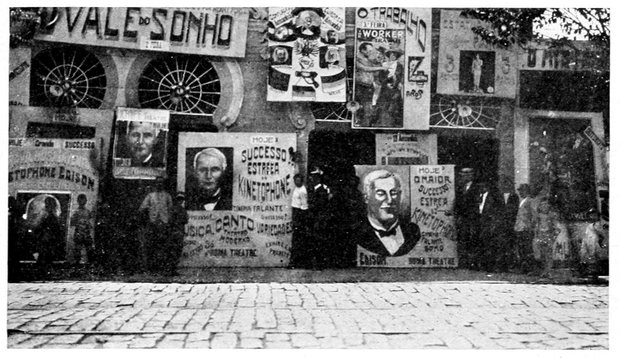
At a suburban cinema of São Paulo the colored youth charged with the advertising painted his own portrait of Edison. He may be made out leaning affectionately on the right shoulder of his masterpiece
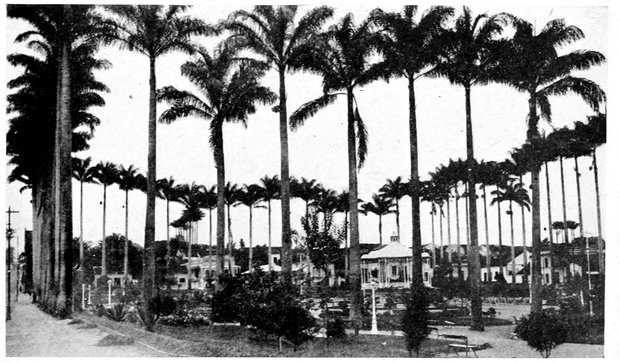
The central praça of Campinas
Catalão and the plains of Goyaz, from the ruined church above the town
Amparo, like many another town of São Paulo, is surrounded on all sides by coffee plantations
The town of Araraquara proved to be of about the same size and
289activity as São Carlos, and especially well off in public buildings
somewhat out of proportion with its general appearance. Clustered
in the center, about the large, red-earth praça, was the church, an
old sheet-iron playhouse, an ambitious Municipal Theater, closed as
usual, a large and well-arranged cinema bearing the unescapable name
“Polytheama,” and, across the street in a red lot of its own, an
ambitious new two-story building labeled in English the “Araraquara
College.” I took a turn through several of the wide, irregular, red-smeared
streets to make sure that the place was worth playing, then
found that the man I sought was also manager of the largest store in
town, next door to his playhouse. He proved to be a short, unshaven
young Italian who had not been long in Brazil, which accounted
for his being so good-hearted and easy-going that I had no difficulty
in taking sixty-five per cent. away from him for Saturday and
Sunday night performances. I might have had as large a share
of the special Sunday children’s matinée, but as what had become a
custom required him to distribute candy and toys to the children,
I took pity on him and split that part even.
One of my fellow-countrymen was head of the college. His most
noticeable characteristics were as a smoker of corn-husk wrapped
cigarettes and as an authority on the history of Brazil. He had
long been a teacher and would have preferred to spend his summer
vacations in the land of his forefathers; but these came in December
and January, when it is cold in the United States, and it would take
nearly the two months to reach and return from there, while he
could cross to Lisbon in twelve days and spend most of his vacation
comfortably tramping about southern Europe. His Brazilian wife
and two bilingual daughters were almost American in point of view,
though by no means in appearance. The boys of Brazil, the head
master asserted, are more tractable than American boys, also more
superficial, learning more easily but forgetting much more quickly—a
statement frequently heard from American educators throughout
South America. That they were tractable was quickly evident, for
when a native teacher sent to show me over the establishment called
a boy away from a football game—rugby is popular even with workmen
on coffee estates in São Paulo State—he trotted meekly off to do
an errand without a hint of resentment. There were half a dozen
American boys in the school, all Brazilian born of men from our
South, and not merely had they taken on many of the characteristics
of their companions, but they had washed-out complexions and no
290suggestion of that “scrappiness” familiar on our own playgrounds.
This pastiness of skin is general among the sons of northerners born
in Brazil and quite different from the color of the blonde descendants
of Portuguese in whom the Goth crops out.
Morally the head master had been thoroughly Brazilianized. He
had grown tolerant of the many little things which are not quite as
they should be, having lost the familiar American longing to reform
the world and fallen into many of the lesser vices and easy-going
customs of Brazil. He had, however, introduced coëducation into
his school, against the advice of the natives, because he believed it
necessary to proper sex development, and now the families that had
been most strongly against it sent their children to the college. In the
afternoon we drove by automobile to the professor’s fruit-farm,
which a former slave was paid 75$ a month to keep in order. Two
of his piccaninnies followed us around like pet raccoons, constantly
holding plates of fruit within our reach, and the atmosphere of the
place was much what it must have been in our South before the war
when the “mastah” visited one of his plantations. On our return
we met an American farmer from far out in the country. He had
come to Brazil twenty years before, when already an adult, but he
spoke English with considerable difficulty and a distinct accent,
though his Portuguese was by no means perfect.
Beyond the River Mogy Guassú, the first I had crossed since leaving
São Paulo, I changed from the “Paulista” railway system to the
winding and narrow-gauge “Mogyana.” We passed many fields of
charred stumps, suggesting how matta was cleared for the planting
of coffee. The rare towns were monotonously alike, dull-white
walls and red-tile roofs of the same shade as the soil, which turned
all light-colored animals, including the children who played in it
and the men who worked in it, a pinkish hue. This red soil is the
terror of housewives in São Paulo State, especially in the dry season,
when it sifts thickly over everything and clings tenaciously to every
exposed surface. Soon we were completely surrounded by coffee
fields, sertões of coffee, a world absolutely shut in by coffee bushes,
which actually brushed the sides of the train and stretched away,
endless and straight and unerring as the files of a well-trained army,
up and down over hill and dale, with never the slightest break in
alignment, into the dense-blue horizon for mile after swift mile.
One plantation through which we traveled for more than an hour
has 2,500,000 bushes; an English corporation owns an unbroken
291sixteen kilometers of coffee trees, crisscrossed by a private railway.
Down in the hollow of each fazenda, or section of plantation, were
long rows of whitewashed, tile-roofed huts, all run together into
one or two buildings, sometimes with a church attached. These were
the homes of the colonos, or coffee workmen, once negro slaves, now
chiefly Italians, though I caught glimpses of a number of Japanese,
the women still in their native dress and carrying their babies on their
backs by bands across the breast. Some years ago a few ship-loads
of Japanese were sent to Brazil, landing in Santos, and most of them
came so directly into the back country, and are so nearly segregated
there, that even their racial tendency for imitation has not caused them
to throw off home customs. Here and there, too, were groups of
European immigrants still in the costumes of their homelands in
the year, in some cases distant, when they left them. Italian colonization
succeeded negro slavery closely in São Paulo State, which owes
its prosperity and its leadership in the world’s coffee production
mainly to these newcomers. In addition to their living quarters and
modest wages, the colonos are usually given a piece of ground on
which to plant corn, black beans, and mandioca for their own use,
and sometimes permission to graze a few head of stock. One of
the chief troubles of the coffee fazendeiro, however, is the tendency
of Italian colonos to abandon the sun-drenched fields as soon as
they get a bit of money together and go to town to engage in some
minor form of business.
Coffee blossoms and berries are often found on the same bush
at the same time, and there are seven grades of the product, according
to the time in which it is picked. The regular harvest is from May
to July or August. Then the ground under the bushes is carefully
swept, if it is smooth, or is spread with cloth, and the berries are
scraped from the branches with one motion of the hand, sparing
as many leaves as possible, after which all is swept together and
sent to great drying platforms that look not unlike concrete tennis
courts. The colonos labor on the piece-work system, each family
being responsible for a given number of plants and the picking
being paid by the liter. The berries are planted some eight feet
apart in both directions, making straight rows from four angles.
It is better to set out young plants from a nursery, but this is too
slow a process for large plantations. Some of the land was formerly
treeless campo, but a large part, and the most fertile, has been
cleared of dense matta in the crude and wasteful way of pioneer
292communities, leaving only here and there a majestic tropical tree
topping a ridge. The plant begins to produce in about four years,
and has been known to continue to the age of a hundred and thirty,
growing up from the stump as often as it is cut down. An ordinarily
good tree will produce twenty-five quarts of berries, which in their
maturity considerably resemble small cherries, the two coffee beans
inside requiring continual attention before they are finally dried and
sorted and disappear in sixty-kilogram sacks in the direction of Santos
and the outside world.
The plants were brought to Brazil from French Guiana long ago,
and coffee-growing was a paying business in the State of São Paulo
“until the government heard of it.” The number of non-producers
who get a finger into the coffee cup before it reaches the actual
consumer is beyond belief. Taxes begin with so much per thousand
“feet” of plants, and continue incessantly until the product reaches
the retail market. Transportation from the field to Santos is ordinarily
two or three times as much as from Santos to New York,
and a sack for which the grower received ten dollars the grocer
in the United States has been known to sell for forty-five, even
in the days before the World War produced so many experts in
profiteering. It is often asserted that the coffee fazendeiro makes
more profit out of renting the bottom lands, where the danger of
frost makes the planting of coffee inadvisable, as chacaras, or small
market gardens, or from the catch crops that can be planted between
the rows after picking-time, than from his many times more acres of
coffee-trees. Throttling taxes are his greatest trial, and the prophecy
is frequently heard that this growing habit of Brazilian government
will eventually ruin the great coffee industry of São Paulo.
At sunset we coasted down into Riberão Preto, fourth city of
the state, in the bottom of a great shallow bowl of earth lined
uninterruptedly with coffee bushes as far as the eye could reach.
In the pink glow of evening a carregador put me and my baggage
into a carriage before I had time to express any personal desires on
the subject, and I was driven through the Saturday night activities
of a lively, rather frontier-like town to the chief hotel. What the
other half dozen in town must have been I dread to imagine, for
this resembled nothing so much as a dingy, careless, unadorned, lack-comfort
style of barn, suggesting that I was getting back again into
the real South America, away from the fringe of near-civilization
on the coast. It was seething with travelers, salesmen, an Italian
293theatrical company, servants, dogs, and innumerable caged parrots,
and I was assigned another of those intolerable ground-floor rooms
opening directly on the street that are unescapable in the one-story
towns of interior Brazil. Nor had I had time to test the one
comfort of such establishments, the shower bath, when a jangling
bell demanded that all guests come to supper at once, on penalty
of going without it entirely.
It would be difficult to speak kindly of Brazilian hotels. As in
Spanish-America, nothing but black coffee is to be had until almoço,
or “breakfast,” between ten and eleven, which is followed about
sunset by jantar. Both these meals are heavy, lacking in everything
but quantity, and made up almost entirely of meat. This carne verde
(“green” meat), having just been killed and so called to distinguish
it from xarque or carne secca, the salted or sun-dried variety familiar
in the rural districts, is cooked in several different ways, all of which
leave it hopelessly tough. Whether in hotels or railway-station
restaurants, the menu is unvarying, and eight or ten huge plates of
meat are slapped down in the middle of a long, noisy, public table,
where each guest grasps what he can before his neighbors make
way with it. To save time or trouble all dishes are served at once,
and are habitually cold before they reach the ultimate consumer. There
is a great paucity of vegetables, even potatoes being considered a
luxury and rarely reaching the interior of the country. Instead,
there stands on every table a glass jar of what looks like coarse yellow
salt, but which proves to be farinha, flour made of the mandioca or
yuca that is served boiled in the Andean countries, and which is
used throughout Brazil to thicken soups, or eaten dry.
The hotel proprietor usually gives his attention exclusively to
the bar, which he claims to be the only paying part of his establishment.
By night a servant sleeps just inside the front door, leaving
room between it and his cot for the belated guest to squeeze through;
in the daytime the pateo is an uproar of unguided servants and ill-bred
children. If you ask to have your bread brushed off after the
waiter has dropped it on the floor you are henceforth known as
“that curious gringo”; if you prefer your coffee or soup made without
having an unwashed cook frequently dip in her spoon to taste the
progress and toss the residue back into the pot, there is just one
way to get it—by bringing your own cook with you. In your room
the mirror is certain to be placed at about the height of the average
American’s belt buckle, so that to shave requires either kneeling on
294the floor or sitting on something, usually not to be found, about the
size of a soapbox. Hot water being unknown, shaving becomes an
ordeal equal to trying to shut out the sight of a mulatto across the table
inhaling a mammoth all-meat meal with such boa constrictor ease that he
needs only to give the tail of an occasional extra large mouthful an
affectionate pat with his knife as it goes down.
Whatever he lacks in other ways the typical Brazilian hotel-keeper
makes up for in prices. He is rarely a native, and you can scarcely
expect a European to come over and set up hotels in the wilderness
of South America out of mere love for his fellow-man. Usually
his only interest is to make as much as possible as soon as possible
and hurry back to his native land. Not merely are the rates high,
but it is the almost invariable custom to manipulate the items in such
a way that a stay of twenty-four hours becomes at least two days.
Personally, I early adopted the habit of handing the proprietor the
amount called for by his posted daily rate and assuring him that
I would look on with great interest while he collected more than that;
but the native Brazilian has the notion that he loses caste if he
protests at any price charged him, so that the foreigner’s refusal to
be fleeced is sure to make him conspicuous, even if it does not cause
his fellow-guests to rate him a freak and a nuisance.
Nearly every street of Riberão Preto runs out into red earth,
a tenacious soil that is tracked along the sidewalks and into every
shop and dwelling, until the whole town takes on a reddish tinge.
Near the center of town, at the lowest spot of the hollow in which
it is built, there is a perpetual frog chorus, and from the outskirts
coffee-fields stretch up out of the great shallow bowl and away over
endless horizons. The Italian company announced its début on the
evening after my arrival by shooting off fireworks, one advertising
scheme that had not occurred to me. There were so many cinemas
in town that I had to spend real money to visit several of them before
I was competent to decide which one would best answer our purposes.
All those of importance, it turned out, from the municipal “Theatro
Carlos Gomes,” covering a whole block in the center of town, down
through the inevitable “Polytheama” to the loose-mannered “Casino,”
flowing with liquor and aging French adventuresses, were in the
hands of a hard-headed Spaniard of long Brazilian experience, so
that I considered myself fortunate to get his name at the bottom of
a contract giving us fifty-five per cent. of the gross receipts during
a six-day engagement.
CHAPTER XIII ADVENTURES OF AN ADVANCE AGENT
295
We steamed for hours out of the vast coffee-lined basin
of Riberão Preto on the train which left at dawn and took
all day to get to the next town of any size. Coffee-fields
at length gave way to brush-covered campo and grazing cattle, the
train winding in great curves around slight hills, like water seeking
an outlet or a lost person wholly undecided which way to go. Early
in the afternoon we crossed the Rio Grande into the State of Minas
Geraes, which at once showed itself less developed, more dry and
sandy, with an increasing number of wooded valleys and ridges.
There was some coffee here, too, but cared for in a half-hearted
way compared with the great plantations of São Paulo. We passed
a large gang of Japanese workmen, and many zebus or humped cattle,
both in the fields and working as oxen. The ride was not only too
dirty and dusty to be pleasant, but sparks from our wood-fired engine
poured in at the open windows until, for all my dodging and brushing,
a dozen holes were burned in my still comparatively new movie-magnate
garb. One station stood 3400 feet above sea-level, and we
all but shook ourselves and the cars to pieces as we rattled down
again into Uberaba, at an elevation of 2500, just as day was escaping
over beyond the mountains.
The place was smaller and less progressive than I had imagined,
with certainly not more than ten thousand inhabitants, instead of
the 25,000 credited to it by the “Handbook of Brazil.” I was not
over-anxious to make a contract with the one pathetic little cinema
in town, at least until I had seen what lay beyond and decided whether
it would be worth while to come this far inland. The manager, a
clerk in the local drugstore, was more than eager to present so
extraordinary an attraction to his fellow-townsmen, but fares and
baggage rates would have cut deeply into our profits and I refused
to sign without a guarantee of a conto for two days’ performances.
He offered 800$ and would undoubtedly have given almost any
percentage, but I held out for the million reis until we finally parted
good friends but not business associates.
296Somehow I had always thought of Minas Geraes as rocky, arid,
dry, and cold, something like upper Peru; the mere name “General
Mines” had a hard and chilly sound to it. But long before noon
in Uberaba, high as it was, I was reminded that it is well north
of Rio and almost tropical. There was an old air about the town,
partly because the humidity causes grass, bushes, and even trees to
grow on and about the churches and other loose-jointed buildings of
stone and porous bricks, but also because Minas is a much older
state than São Paulo, overrun by miners long before the agricultural
riches of its neighbor were scratched.
We were off again at one behind the same old narrow-gauge wood
burner, through a rolling, bushy country, and scattered with huge
ant-hills, mildly similar to the Bolivian Chaco. The only real town
along the way was Uberabinha, squatting in the bottom of a sandy
and shallow valley, inhabited by barefoot and red-earth smeared
people whose only place of entertainment seemed to be the double-towered
church bulking above the general hut level. Night was
falling when we pulled into Araguary at the end of the “Mogyana”
railway. The tidal wave of baggage-carriers and hotel touts was
only less in size than those farther south, but for once I escaped them
entirely by putting my valise on the head of a negro boy and wading
through the mud with him to a pensão run by an old woman. The
room was really a mud cave, the mattress filled with corn-husks, and
I was reduced to candle-light for the first time in Brazil. But the
special chicken supper was a great relief from the avalanche of meat,
surrounded by wolfing natives, that would have been my lot at a hotel,
and, best of all, the pensão was just across the way from the first
station of the “Goyaz Railway,” on which I was to depart at dawn.
It was pitch dark, with frequent heavy showers, when I set out to
wander incognito through the town. The weak electric-lights along
its mud-and-grass streets and praças suggested fireflies or will-o’-the-wisps
flitting about through the thick, black night. There was, to be
sure, a dentist, who was also owner, editor and printer of the local
paper, and the town undertaker—and the tombstones behind the
lips of many of the inhabitants hinted that he mixed the three
professions.
I came more or less near requiring his services in his least popular
capacity. As we were drawing into the station the mob of porters
and hackmen had given me their special attention, one negro in particular
thrusting his uninviting face through the car-window and
297pawing me with his long unwashed hands in that half-affectionate, half-wheedling
way of his class and profession throughout Brazil, at the
same time offering his undesired services some seventy-five times
at the top of his voice. When I could endure him no longer, I
rapped him over the knuckles with the handle of my umbrella.
Now a blow, however light and for whatever provocation, is a
shocking indignity in Brazil, only to be properly wiped out in blood.
I was not long, therefore, in recognizing the fellow again when,
during my stroll about town, he suddenly bobbed up noiselessly out
of the night and, after bawling a mouthful of vile language after me,
slipped away again with the information that he would fix me yet.
I gave him no more attention than one usually does a half-drunken
negro in tropical lands, and had entirely forgotten the incident when
I boarded another tottering little train next morning. All at once
a sound caused me to look up from my reading in the first-class
car I was sharing with one other passenger, to see the same negro
advancing swiftly down the aisle toward me, grasping a long and
sinister-looking knife. It was my luck to be unarmed for the first
time in Brazil that I had needed a weapon, having left my revolver with
“Tut” as a protection for the money he might take in. Even my
umbrella, which would not have been wholly useless in a hand-to-hand
encounter, was in the rack above me, and to rise and grasp it might
suggest fear. I sat where I was, therefore, with my feet drawn
up on the opposite seat, where they could shoot out quickly if
danger became really imminent, and stared at the fellow with the
unwinking eye of the professional lion-tamer. Whether it was this
or his lack of any other intention than to retrieve his reputation
among his fellows and salve his injured feelings by a threatening
gesture, he confined himself to flourishing the knife, advancing several
times with rolling eyes almost to within reach of my feet, and then
backing away again. Finally he retreated toward the door with
an expression ludicrously like that of a whipped animal, while I
rose and walked leisurely down upon him with the same fixed stare
until he stepped to the ground. During it all neither train nor local
authorities made any attempt to come to my assistance, and I carried
away the impression that I should not have gotten out of Araguary
in a hurry had circumstances forced me to shoot a man of the same
color as the majority of the population.
We tossed and creaked along all the morning to cover the seventy
miles of the little bankrupt line that penetrates the south-westernmost
298corner of the great interior State of Goyaz. The bustling modern
civilization of São Paulo and the coast had gradually petered out
to nothing more than two telegraph wires jumping from pole to
crooked pole across a more or less rolling wilderness of bushy forest,
pura matta, as the Brazilians call uncleared country, in a voice almost
of terror. Here and there were vast, heavily wooded basins around
the edge of which we slowly circled, fighting wood-burner sparks
with one eye while taking in the slight scenery with the other. There
was a bit of coffee-growing and a bit of lumber was being cut, but
as a whole the region was completely undeveloped and unexploited.
A flaming purple tree here and there broke the rolling, bushy, brown
monotony. The scant population was a sort of semi-wild outcast
of civilization, wedded to dirt and inconvenience, living in open-work
pole houses covered with aged thatched roofs that resembled
dilapidated and sun-faded straw hats. The men wore wide belts,
with many silver, or imitation silver, ornaments and with half a
dozen leather compartments in them for their money and other
small possessions. In a pocket of their thin cotton coats even our
local fellow-passengers carried the dried covering of an ear of corn,
and when they wished to smoke, which was almost incessantly, they
pulled off a corn-husk, shaped it with a knife, rolled it up and put
it behind an ear, cut off a bit of tobacco from a twist plug, crushed
it between their palms, and rolled a corn-husk cigarette.
At eight we rumbled across the River Paranahyba into the State
of Goyaz. At the same time we crossed the nineteenth parallel of
latitude, and the climate should have been warm and humid; but
as all this vast tableland averages 2500 feet above sea-level, it had
distinctly the atmosphere of the temperate zones. There were a
few cattle, less well-bred than those of Minas. At Goyandira, a
few scattered huts beside a small stream, we were given time to
gorge the customary Brazilian meal on a table already crowded with
dishes when we arrived, and at eleven we drew up at Catalão, last
outpost of civilization in this direction, and a personified End of the
Railroad.
It was evident at a glance that I need not consider Catalão from a
business standpoint. Though from a distance it had looked like
quite a town, it was merely a village of a scanty thousand inhabitants
scattered along a small creek, with mangos trodden underfoot, its
houses built of mud plastered on sticks and then whitewashed.
Compared even with the Mineiros over the nearby state border, the
299Goyanos were backwoodsmen; beside the energetic, up-to-date
Paulistas they had the vacant expression of ruminating cattle. About
the town an almost treeless world, rather dry for lack of rain,
stretched endlessly away in every direction. When the midday heat
had somewhat abated—for there was nothing cold about Catalão, for
all its altitude—I climbed to a barren hillock topped by an old ruined
church in which scores of black rooks had built their nests and from
which bushy and rolling Goyaz spread away like a lightly broken sea.
The view was so vast that one could see the curve of the earth, the
blue haze ever thickening until it grew almost opaque on a horizon
so distant that it seemed raised well above the general level. The
line of this was quite distinct for its entire sweep, yet it joined almost
imperceptibly a sky heaped and piled with irregular masses of white
clouds that cast their broken, fantastic shadows everywhere across
the spreading plains, yet did not conceal overhead the sky of mother-of-pearl
tint. Below, the village, like a capricious waif that has come
here far from nowhere out of mere spite or unsociability, made itself
as comfortable as possible in its shallow hollow among dark-green
masses of mango-trees. Roads, just born rather than made, straggled
out of it in all directions, soon to be lost in the green and haze-blue
immensity, as if man had dared venture only a little way out into
the unpeopled universe, vast and trackless as the sea. A few venturesome
fazenda houses peered forth from their mango groves a mile
or two from the town, but these did not noticeably break the uninhabited
and virgin world, the sertão or matta, which mere mention
of “the plains of Goyaz” calls up in the imagination. It was a
distinct pleasure to be again entirely beyond the hubbub of cities,
beyond the reach even of the ubiquitous trolley, with the world below
deadly silent but for the occasional far distant, yet piercing scream
of an ox-cart creeping imperceptibly along one of the languid, haphazard,
straggling trails that appeared from somewhere out in the
wilderness. They sounded like factory whistles, these distant carros
de boi, with their solid wooden wheels and total innocence of grease
on their turning axles, the scream of which—chiar, the Brazilians
call it, aping the sound—ceased at length abruptly before the principal
shop, run by a “Turk,” where the eight or ten oxen, steered by a
driver who prodded them in the neck with a goad lying over his
shoulder without so much as glancing back, and whom they followed
unerringly, fell into the spirit of the scene, the silence broken now
only by the occasional sharp, vexed note of a worried rook and the
300somnolent humming of flies. The End of the Railroad means far
away and quiet, indeed, in these seething modern days. Before long
we may not be able to find it at all; yet one feels at times impelled
to come to such ends of the road and climb to a high place overlooking
the world, there to sit and unravel the tangled threads of life into
some semblance of order again before descending to plunge once more
headlong into the fray.
The worst of coming 710 miles up-country from Santos—and the
time it had taken made it seem ten times that—was that I must spend
as long, without even the reward of new sights and experiences,
to come down again. The same glorified way-freight carried us
southward in the morning, and for once it was crowded. Not only
were there all my fellow-guests at the run-down hovel owned by
a “Turk” who had lived so long in Brazil that he seemed to prefer
Portuguese to his native Arabic, all of whom had spent the night
playing some noisy form of poker, but a new fork of the railroad
was being opened that day to Roncador (“Snorer,” it would be in
English), and everyone in Catalão who owned shoes had been
invited to ride out and help inaugurate. In consequence our tiny
two-car train was so densely packed with well-meaning but unpleasing
mortals of all ages, sexes, sizes and colors that we mere ticket-holders
were crowded out of seats and forced to stand on the swaying platforms
as far as the junction of Goyandyra. There we had to go
without “breakfast,” because the inaugurators assaulted the limited
table supplies in such force that passengers could not get within
grabbing distance. It was perhaps as well, for hunger is slight
suffering compared with watching at close range the contortions of
such a throng stoking away whole knife-lengths of those viands which
they did not spill on the earth floor.
Below Uberaba the “Mogyana” branches, giving me new territory
all the way back to Campinas. Most of it looked unpromising for
our purposes, until nightfall brought me to Franca, only three hours
north of Riberão Preto and the terminus of a daily express. Here
were two cinemas, side by side on the central praça. I drifted into
one of them and handed my card to the owner-manager. When
the crowd at last gave us a chance to talk it over, I set my remarks
to the tune of “Oh, this is an unimportant, far-away little place and
I don’t believe we will bother with it.” The result was that I soon
had the man all but on his knees to have us come. He offered to
rent the theater for ten per cent. of the total receipts, and when I
301declined the trouble of staging the affair ourselves, he begged me
to let him do everything and take as our share seventy per cent. of
the proceeds. At last I had equalled that fabulous Chilean contract!
Indeed, had I been born with a mean disposition I fancy I could
have made that pillar of Franca do anything, short of presenting me
with his playhouse, to keep me outside the doors of his hated rival.
I was gone again at sunrise and know naught of Franca, except
what may be seen at night and one added bit of information. It
has a match factory in which a huge stock of an article that the
region still imports from the outside world is locked up by government
order because the owners cannot raise the seven contos in twenty-reis
stamps needed to decorate the boxes before they can be placed on
the market. Only once during that day’s journey did I halt. At
Cascavel, fittingly named Rattlesnake, I took a branch line into the
cool, grassy uplands of the “Brazilian Switzerland” and spent the
night in Poços de Caldas. This is far-famed throughout the country
as a watering-place at a goodly elevation for Brazil, with sulphurous
hot springs much frequented by well-to-do natives during the season.
But that was over; the barracks-like hotel with its monasterial cells
of rooms had only a scattering of guests, and there was no visible
reason why the Kinetophone should journey to a spot that had fallen
upon such lean days. Half a day south I might have taken a direct
line from Mogy Mirim to Rio, but it was eleven days since I had
heard our artists sing or learned how things were faring with my
two companions without a tongue between them. I hurried on,
therefore, to Campinas in time to be refused admittance to our
first performance at the “Rink”—until the youthful manager, catching
sight of me, thrust the door-keeper aside with extended hand.
I found “Tut” and Carlos conversing freely together in a language
that was not Portuguese and certainly was not English. In Jundiahy
they had carried out my first contract so well in the face of rainy
weather, toboggan streets of uncobbled red mud, and a reputation
as a “poor show town,” as to win high praise, while even here in
such a metropolis as Campinas they showed every evidence of being
able to give their performance, watch the doors and at least count
the “deadheads,” and collect our share of the money without my
assistance. The manager of the “Rink” had lived up to his promise
in the matter of advertising, and had sent a street-car carrying a band
and entirely covered with posters and the likeness of Edison over
every trolley-line in town. Yet our audiences were not all they
302should have been on Brazil’s second Independence Day, whether by
reason of the possibility of a political upheaval at the change of
the national administration, that musical Campinas was too “high-brow”
for what Edison had to offer, or, as we suspected, because
city, state and nation were beginning to feel seriously the pinch of
the “brutal hard times.”
On the morning after our Campinas engagement the show and I
again parted company. While the former sped away up the broad-gauge
“Paulista” to São Carlos and points beyond, I took the slow
and narrow “Mogyana” back the way I had come, intending to catch
the noon train westward from Mogy Mirim toward Rio. But the
pleading of a compatriot slightly altered my plans. In Campinas we
had made the acquaintance of a man from New York and Jerusalem
who was misusing his racial talents in strenuous efforts to refute,
in the interests of an American insurance company, the Brazilian
argument of “But why should I have my life insured and leave my
wife a lot of money to spend on some other man when I die?” Ideas,
specially those with a $ attached, sprouted overnight in the fertile
brain of my misplaced fellow-countryman, and bright and early that
Thursday morning he came running down to the station with a new
one. He had suddenly seen a chance to retrieve recent bad fortune
by hiring the Kinetophone outright at the conto for two nights which
I had set as the fixed price for small towns and taking it out to his
old stamping-ground of Amparo, where he proposed to enlist the
services of his bosom companions, the priests, nuns, and other Biblical
influences of the town, into selling tickets beforehand on the church-festival
plan. I am always ready to let a man make money, especially
if he makes some for me at the same time, so we dropped off at Jaguary
and took the branch to Amparo.
It was an unusually pleasing little town for Brazil, with all its streets
paved in stone blocks, several pretty little parks, and spread along so
narrow a valley that one could fancy the beans from its coffee-clad
hills rolling right down into the central praça ready for roasting. But,
like all the State of São Paulo, Amparo had unwisely put all its eggs
in one basket—the coffee basket—and whereas ten milreis an arroba
is considered by coffee-growers only a fair price, Brazil’s chief export
was then selling for 3$500! Hence the town was “muito ruim,” cold,
stony dead from the theatrical point of view, and, though there was
a nice little theater with cozy seats and plenty of boxes for the
“excellentissimas familias,” the impresario had lost his nerve completely.
303When my friend and guide gently mentioned 600$ a night as
the bargain of a life-time, the manager all but swallowed his neck, then
recovered sufficiently to say that a Portuguese company of the type
most beloved in Brazil had given a first-night the week before, after
an uproar of advertising, and had taken in just 25$! I immediately lost
all desire to bring the Kinetophone to Amparo, though my friend from
Manhattan and the Holy Land, with the admirable buoyancy of his race,
went up to the convent school to talk it over with the mother superior,
and saw his efforts crowned with success—to the extent of an invitation
to dinner.
From Mogy Mirim a shaky little train carried me westward through
more wilderness than coffee, past the lively little town of Itapira roofing
a slight hill, to a helter-skelter village called Sapucahy, where it unloaded
us on a platform, bag, baggage, and bathrobes, and backed away. As
frail a train backed in from the other direction and loaded us up again,
all the Brazilian travelers paying carregadores to set their bags down
from the windows and up again, and after more than an hour of fuss
and frustration we creaked on. The yellow creek of Sapucahy, it
transpired, was the boundary between São Paulo, where the “Mogyana’s”
concession ended, and the State of Minas Geraes, where we
had been taken in charge by the “Rede Sul Mineira,” a branch of the
“Brazilian Federal Railways.”
The land was somewhat swampy now, more wild and unsettled, with
parasol pine-trees beside slender, undeveloped palms with thin tufts
of disheveled foliage. The town of Ouro Fino (“Fine Gold”) was
a small, off-the-main-line sort of place, but here the daily train got
in at five at night and did not leave until five in the morning, so
whatever we might make would be money in pocket. After supper
I set out on the steep hillside up which the town is built and down
which run red mud streets, and at length found at his club—the club,
in fact—the manager of the local theater, a tar-brushed youth of
aristocratic manners, or at least gestures, who naturally accepted and
signed without argument the contract I handed him. Upon my return
to the hotel I found the dingy-looking room I had left an hour before
gay with speckless white bedclothes and fancy mosquito canopy,
evidently in honor of the large theatrical troupe which rumor already
had it would soon be following in my wake. Our train stood all
night just outside my window, giving me, perhaps, too great a feeling
of security, for I was all but left behind. It was already pulling out
toward a faint crack in the darkness when I scrambled on board,
304breakfastless and not fully dressed, and with the privilege of paying
a fifty per cent. fine on my ticket for not having bought it at the
station.
Long piles of wood for the locomotives stood along the way through
a wilderness inhabited by “poor white trash” in rags smeared with
red earth, who crowded to the doors of their thatched huts as we
passed. For some time we followed the Sapucahy, swollen red with
floods that gave a picturesque appearance to the hilly village of Itajubá
on its banks. This was a friendly little town where everyone spoke
to strangers, after the pleasant manner of back-country districts, but
though it has an important engineering school, it is little more than
a grass-grown hamlet, with a populous cemetery conveniently situated
on a hill close above it, so that all the inhabitants can drink to their
ancestors. Itajubá was just then the object of a general interest out
of all keeping with its size. Just next door to the “Cinema Edison”
in which I arranged for our appearance was the modest home of the
new president of Brazil. There he had lived most of his life—even
since his election on March first, though he was “Dudú’s” vice-president
and required by the constitution to preside over the senate—and
he had left less than a week before for his inauguration.
The train next set me down at Caxambú, another of the watering-places
on the irregular line across southwestern Minas, where the
rolling country from the Plata northward begins to break up almost
into mountains and produces a stratum of hot and cold mineral springs.
Huge hotels accommodate those who come to “take the waters” in
Caxambú, as in Poços de Caidas not far distant, and a mineral water
that sells all over Brazil at a milreis or more a small bottle is here
as free as the air. The largely negro and barefoot local population
comes in a constant stream, carrying every species of receptacle, to
a low spot in the center of town in which the water bubbles up incessantly,
and where all manner of paupers and loafers sit under the
feathery plumes of waving bamboos, drinking in turn out of a broken
bottle.
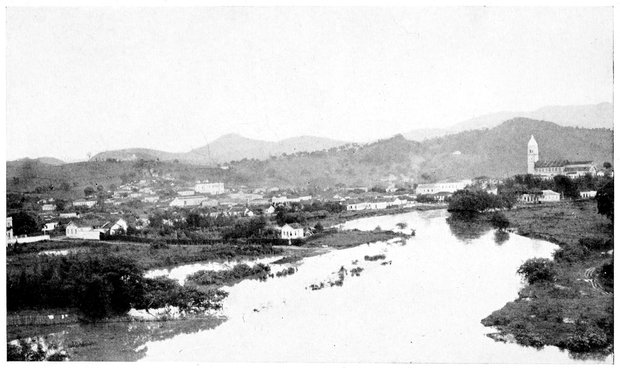
Itajubá, state of Minas Geraes, the home of a former Brazilian president
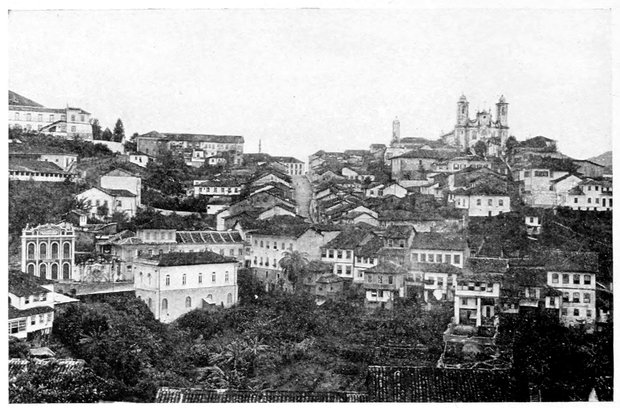
Ouro Preto, former capital of Minas Geraes
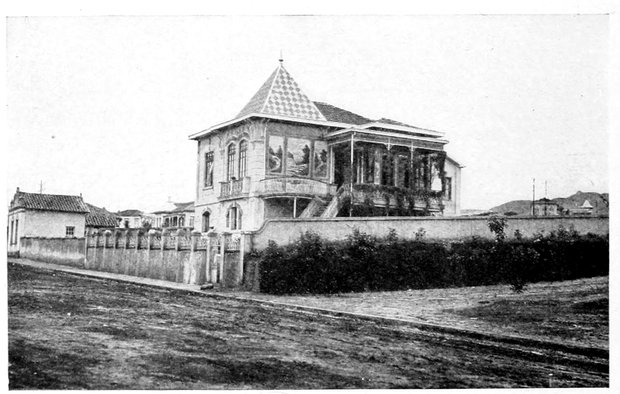
The walls of many a residence in the new capital, Bello Horizonte, are decorated with paintings
The same ancient, dirty, German-made cars that had bounced me
into Caxambú bounced me out again in the afternoon, and all the rest
of the day I bumped along at the tail end of a way-freight that seemed
constantly on the point of falling to pieces as it thundered in and out
of the hills on a warped and unrepaired old track. To the north
the earth lay piled high into the heavens, for Minas has some real
mountains. Swift tropical darkness fell, and we went banging on
305into the night, our old wood-burner leaving a trail of fireworks behind
us that gave it the suggestion of some fire-spitting dragon of medieval
legend, and yanking us at last into Cruceiro. Next morning I took
the direct line from São Paulo to Rio, and it was pleasant indeed
to ride once more on a broad-gauge, roomy, coal-burning train. Rain
had given the country an aspect quite different from that of two
months before, but nothing could disguise the lesser industry and
progress toward civilization in the State of Rio de Janeiro than in
that of São Paulo. Rezende, the first town over the boundary, proved
to be a village posing as a city, a ragged, barefoot place, overrun with
dust and squalor, with ambitionless loafers and negro good-for-nothings.
Professionally, too, it was a shock; far from finding it
worthy of a Kinetophone performance, we could not have given a
dog-fight there to advantage.
The slightly fertile country began at length to tip downward and
we descended through long tunnels between vast opening vistas cut
off at some distance by a great blanket of fog coming up from the
sea. At Belem there was already an atmosphere of Rio, still some
thirty miles away, with frequent towns and suburban service from
there on, though we halted only at Cascadura and drew up at length
in the familiar scent and hubbub of the capital. Carregadores snatched
my belongings without so much as “by your leave” and bundled me
into a taxi—which reminds me that inside my unlocked valise, that
had been tossed about and left lying in all manner of places since
leaving Campinas, there were a million and a half reis of our earnings
in Brazilian bills. One’s possessions are so much safer under such
circumstances in South America than in the United States that what
would seem criminal carelessness in the north becomes a common
habit.
It was like getting home again to hear the newsboys bawling “A
Rua!” “A Noite!” “Ultimas Noticias!” in the guttural throat-growl
peculiar to Rio, to be accosted by the same old lottery-ticket vendors,
the same street-car conductors, to see the same “women of the life”
strolling the Avenida and riding invitingly back and forth on the
first section of the “Botanical Garden Line.” There was almost a
monotony of familiar faces, so accustomed had I been for years to
always seeing new and strange ones. The “Sugar Loaf,” hump-shouldered
Corcovado, topsail Gavea, lofty Tijuca, and all the rest
still looked serenely down upon the human ants’ nests at their feet
with the immutability of nature’s masterpieces.
306Yet Rio was different than I had first known it. Had I left it for
good and all when I had expected, I should have had a better impression,
but a false one; I should have known only the winter Rio, which is
magnificent and has little in common with Rio of the summer-time.
Statisticians assure us that, thanks to the trade winds and its greater
proximity to the ocean, Brazil’s metropolis falls several degrees short
of Buenos Aires in the most infernal months of the year, but it is
doubtful whether anyone except the thermometer recognizes the advantage.
In late November it lay sweltering under a lead-heavy
blanket of heat that drenched one at the slightest exertion, mental,
moral, or physical. No sooner did one put on a collar than it melted
about the neck—and not only is a fresh white collar indispensable in Rio,
but they cost sixty cents each and twelve cents a washing, and rarely
outlive more than four journeys to the beat-’em-on-a-rock style of
Brazilian laundries.
There was less evidence, however, than I expected of the rioting
that had marked the change of administration a few days before,—a
few broken windows between the office of O Paiz, chief journalistic
supporter of “Dudú,” and our first Brazilian playhouse, a bullet-mark
in a stone or brick wall here and there to recall the battling hordes
that had surged up and down the Avenida. The trouble had started
on the eve of the inauguration of the man from Itajubá. Among
“Dudú’s” Machiavellian bag of tricks was a company of government
bouncers and strong-arm men under command of a ruffian known as
Lieutenant Pulcherio. On Saturday night, in the last hours of the
detested régime, the lieutenant and his fellow-officers were discussing
their glorious past over a quiet whiskey-and-soda in the Hotel Avenida
bar when a group of the populares they had so long oppressed stopped
to mention what they thought of them. The political protegees replied
to this vile affront to their noble caste by firing on and attacking with
swords the mainly weaponless populares, and among other gallant deeds
worthy of their past killed a negro newsboy of twelve. The povo,
however, for once vulgarly resisted their noble superiors by laying
hands on bricks and cobblestones and weltering back and forth across
the Largo da Carioca and the Avenida, managing in the process to
prepare the beloved Lieutenant Pulcherio for funeral.
Early the next morning the opposition newspapers were already
pouring out their pent-up spleen on the head of the outgoing president,
resurrecting censored articles and deluging the disappearing administration
with vituperation. The names they called the “odious gaucho”
307were scarcely fit to print; those applied to “Dudú” sometimes had the
genius of intense exasperation. There were columns of such gentle
remarks as:
The four years now terminating mark the blackest, the most nefast
page in our history, the most painful calamity with which Providence has
flagellated us since Brazil was Brazil. During the administration of the
analphabetic sergeant who got possession of the chief power by knavery
and the imposition of the barracks, justice was disrespected and reviled,
immorality created rights of citizenship, robbery and corruption ruled
unrestrained. There has not been a day since the inauguration of this
unpleasant mediocrity, degenerate nephew of our great Deodoro, that the
President of the Republic and his auxiliaries did not go back on their
plighted word, in which there was not registered a new political infamy, in
which we did not hear of a new crime or a new immorality. Praise God,
this terrible four years of darkness is ended!
The inauguration took place in the early afternoon of Sunday, the
fifteenth of November, anniversary of the day on which the republic
was declared. In Brazil this ceremony is as simple as the swearing
in of a juror. The incoming president takes the oath privately, signs
his name, bids farewell to his predecessor, and the thing is done. On
this occasion things moved even more swiftly. The instant the other
had taken his place, “Dudú” sprang into an automobile, even forgetting
in his haste to embrace the new president, according to time-honored
Brazilian custom—of thirty years’ standing—and fled to the protection
of Petropolis and his youthful consort. He had good precedent for
his eagerness; other retiring presidents of Brazil have done likewise.
When Campos Salles left the presidency in 1902 he was stoned by
the populace, yet all Brazilians agree that he was by no means as
corrupt or poor a president as the “unpleasant mediocrity” who was
just then fleeing.
It quickly began to be apparent, however, that perhaps “these
terrible four years of darkness” were not entirely ended. The new
president was considered an honest and, within Brazilian limits, a
democratic man, but he was evidently not quite strong enough to throw
off the domination of the national boss, the “odious gaucho” senator
from Rio Grande do Sul. It was partly due to this feeling of disappointment,
partly to the increased wrath caused by publication of
censored articles left over from “Dudú’s” reign, reciting unbelievable
official thievery and corruption, and to the release of great bands of
political prisoners from dungeons in the islands of the bay, where
they had been sent without trial or even accusation, that serious riots
again broke out soon after my return to the capital. This time the
fuss was started by students from the schools of medicine, law, and
308the like, who decided to “bury” the ex-president. Something like
burning in effigy, this was considered a great insult not only to the
former executive in person but to the army which he, as a field
marshal, represented. The army general in command of the police
brigade of the federal district went out to stop the outrage. The
students were already parading the streets with a gaudily gilded “coffin”
and using the offensive nicknames of “Dudú” and “Rainha Mãe,” when
the brigade was set in motion. Before it could accomplish its purpose,
orders came from the newly appointed minister of justice to let the
students go on with their brincadeira (child’s play), whereupon the
general in command rode back to the ministry and resigned—knowing
he was to be dismissed next day anyway. Meanwhile the students
had been joined by an immense mob of populares, mainly barefooted
out-of-works and men of the porter, street-sweeper and hawker type,
who marched back and forth through the business section and at
length broke out in attacks on “Dudú” sympathizers or beneficiaries,
which resulted in several deaths. When night fell a regiment of
cavalry, another of infantry, and all the police of the federal district
were protecting the palace of Cattete and that of Gaunabara, in which
the new president had chosen to make his home. Nictheroy, across
the bay, also was seething; even São Paulo threatened to join the
revolt, to avenge the insult of having been offered the most unimportant
post in the cabinet, with oily words about being the “agricultural
state par excellence.” But the new government, like the old, had too
firm an ally in the army for a revolution, with no other support than
the weaponless populares, to be successful. Gradually the rioting died
away, though by no means the criticism of the new administration,
and Brazil settled down to another four years not unlike those that
had just been so fittingly brought to a close, but which were to be
marked a few months later by the assassination of the “odious gaucho.”
Though they were empty, I did not feel like again taking our old
rooms out on the Praia do Flamengo. They seemed hot and stuffy;
the very waters of the bay felt tepid; even the president’s palace of
Cattete next door had been abandoned in favor of the newer and more
sumptuous one of Guanabara. I hunted Leme and Copacabana over
in vain for quarters overlooking one of those peerless beaches where
the air from the open ocean might make life endurable, but the houses
along the shore belong to the well-to-do, who do not have to take
roomers even in “brutal hard times.” During my search I accidentally
dropped into the Cinema Copacabana, a pleasant little place in one
309of the most prosperous sections of town. The slow-witted Portuguese
who announced himself the owner and manager soon proved to be
merely the hen-pecked consort of the real director. But the place
promised well, if properly managed, and I finally signed it for five days—and
fled to Petropolis for Thanksgiving.
Out at the Praia Formosa—which is no more a beach than it is
beautiful—I found a mob of drenched and wilted people fighting about
a tiny, discolored hole in the station wall, of the height of the
average man’s knees, for the privilege of buying tickets to the “summer
capital.” For though there were many daily trains, even when train
schedules were being reduced all over Brazil because of the war-created
difficulty of importing coal, there were thousands of regular
commuters and few places left for the poorer Cariocas who scraped
together enough for a round-trip ticket or two during the season.
Most of the commuters had their permanent seats, with their names
and their business or rank posted on the backs of them, and the mere
traveler had to wander through several cars before he could find a
place, like a stranger seeking a pew in a fashionable church.
The Leopoldina Railway between Rio and Petropolis is the oldest
in Brazil, having been opened to the foot of the range in 1854 so
that Emperor Pedro II could flee from hot weather and yellow fever
in the summer months. We raced without interruption across a low,
jungled plain until the mountains grew up impassable above us.
Formerly this region was well cultivated, but man was unequal to
the grim struggle with nature, especially after the emancipation of the
only race that could cope with the swampy, matted jungle, and to-day
the ruins of many a plantation house lie buried beneath the invading
bush, while the few hovels with their little fenced gardens look like
islands in the tangled wilderness. Yet we sped through many suburban
villages shaded with palm-trees and adorned with immense tumbled
rocks. On top of one of these, high above the surrounding landscape,
sat the two-spired church of Penha, a famous place of pilgrimage.
A few peasants were plowing and loading cut grass upon carts drawn
by zebu-sired oxen. Puffs of white clouds, like exploded shells, hung
here and there above the brilliant horizon. The three-cows advertisement
of a well-known malted milk company suddenly loomed up against
the background of jungle, its Portuguese words making it doubly
fantastic in this exotic setting. Here and there we passed section
gangs poling themselves homeward in their unpumpable hand-cars with
long bamboo staffs, like Dutch canal boats.
310The first-class seats, cane-covered in respect for the climate, were
divided by an extra arm in the middle, obviating personal contact, which
is the way train seats should be, no matter what fat men or honeymooning
couples may prefer. Many of my fellow-travelers were as
much worth watching as the scenes along the way. Here a man as
black as a beachcomber’s hopes of signing on in Singapore leaned back
in pompous full-dress in his placarded seat, acting like the millionaire
president of some great corporation as he pored over the contents of
his elaborate leather portfolio. I would have given the price of a
Brazilian meal to have seen the couple across the aisle from me
suddenly transported to one of our “Jim Crow” states. He was a
self-important mountain of a man, as white as you or I; she, just
as self-important, dressed in rich plumes and Paris fashions, hideous
with diamonds and other glittering pebbles, was about one-third negro.
One poor woman farther on had only ten fingers, two ears, and as
many wrists—her skirts covered her ankles, strangely enough—on
which to wear her jewelry, though she had made the most of her
meager opportunities by putting three or four rings on each finger.
Still farther along an old woman in mourning had bits of black cloth
sewed over her earrings. A nice jet nose ring about two inches in
diameter would have been so much more original, and as becoming,
and would have made conspicuous one’s poignant grief even to those
who might miss so commonplace an adornment as earrings.
There came a stretch of swamp and uninhabited lowland, thick with
bulrushes, then heavily wooded hills grew up before us and we
came to a halt at the edge of the plain. A little engine, built like a
kangaroo, took charge of two of our cars and shoved them up the
steep mountainside on a rackrail track. Now we were buried in
narrow cuttings, now gazing upon magnificent panoramas that opened
out through dense woods. There overhung the line many tremendous
boulders, on one of which, large as a house, some wag had written
in red paint, “Va com esta” (Take this along with you). The vegetation
presently became sodden wet; the incessant singing of the
jungle, scarcely noticed until it stopped, died away and vast views
opened out on what we had left behind. Flooded with the rays of a
full moon, the far-off range of mountains cut a jagged line across the
sky. It grew cooler every minute; the air became clearer, and as the
oppression of wilting heat wore away a drowsiness came upon us.
At Alto da Serra, some 2500 feet above but barely a mile farther on
311than the station at the foot of the range, civilization began again, with
all its pleasant and unpleasant concomitants.
Petropolis, fashionable resort of the wealthy Cariocas, national
legislators and foreign diplomats, lies snugly ensconced among the cool
hills, a charming assemblage of villas peering forth from tropical
gardens. The former emperor for which it is named made the town
to order by importing three thousand German and Swiss settlers in
1845, as examples of cleanliness and industry to his own people.
Formerly the entire government came here during the summer months,
but when the mosquito and his playmate, yellow fever, were routed,
most of the native officials went back to the city, though the diplomats
remain, pleasantly cut off from the rough world of practical politics,
which seems far away indeed, instead of merely an hour and a half
distant by Brazil’s best train service. There is a suggestion of a
German watering-place about Petropolis, with its bizarre little residences,
its trim streets lined by bamboo hedges, its roses, hydrangeas
and honeysuckle, its “kiss-flowers” gathering honey from the fuchsia-trees.
The Teutonic type has persisted in spite of interbreeding and
comparative isolation from the fatherland in a strong Brazilian environment,
and up to the beginning of the war there were still German
schools in Petropolis. A spotless room in one of its quiet summer
hostelries is a relief after months of Brazilian hotel squalor and uproar;
or, if one’s income is limited, there are cheap and pleasant rooms to
be had with the German inn-keepers.
But Petropolis is tropical enough to be unpleasantly warm on a
summer noonday, and among her honeysuckle are horrid hairy spiders
as large as belt-buckles, with perhaps a deadly bite. Like Rio, the town
spreads up many narrowing valleys, fresh green Cascatinha with its
weaving-mill beside a rivulet sliding down a sloping rock and breaking
in little cascades at the bottom, or the restful tree-lined banks of canals
meandering away through the wooded hills. Through the gap by
which the railway creeps up to the plateau may be dimly made out all
the Carioca range and, faintly, the well-known form of the Pão
d’Assucar. There is a vast panorama of Guanabara Bay and all its
islands, but Rio is only hazily suggested, and nearer views of it are
much more striking. Another world on quite another plane spreads
out below, careless, happy-go-lucky negro huts straggling up the wooded
valleys as high as they can easily climb, the soothing sound of mountain
brooks, playfully taking little rocky tumbles here and there without
much hurt, joining the birds in making a kind of sylvan music.
312Pedro II still sits out here in a little palm-topped square under the
filtered sunlight or the summer moon, his book closed over a finger,
the tails of his Prince Albert falling on either side of his armchair,
his congress gaiters fitting the ease of his posture, gazing benignly forth
from his great black shovel beard with the studious, half-dreamy look
of the man who hated action. He is by no means our preconceived
notion of an emperor, but a dreamy, easy-going, democratic aristocrat
who seems eminently in his place here in this quiet village far from
the rumble of the world and the heat and labors of the day below.
Small wonder he was the last emperor of this turbulent, pushing
western hemisphere. “A great Brazilian,” they had called him in
celebrating his birthday a few days before, “who gave happiness to his
people during almost half a century.”
“Dudú,” looking most comfortable and contented with life, was
driving about the quiet streets of Petropolis with his girl wife behind
a pair of prancing iron-gray horses and a liveried driver frozen in
stone. As in all towns where kings and presidents are regular residents,
no one paid him the slightest attention, though the same pair
would no doubt at that moment have brought the business, and perhaps
the peace, of Rio to a standstill.
There was a nice little up-to-date cinema just outside my window
that would have been an ideal place for us to have made several hundred
dollars—if only we had come to Brazil when the world was still
going round. For the moment it was inhabited by a Portuguese barn-storming
company, and the manager had not only lost heart over
the “brutal crisis,” but had so extraordinarily good an opinion of himself
and his establishment that nothing would induce him to offer us
more than forty per cent. I would not have made a contract at that
rate with St. Peter for a series of performances on the Golden Stairs,
and as the only other cinema in town was small and unimportant, and
run by an Italian too artless to do business with to advantage, there
was nothing left but to fold up my arguments and say good-day.
I came down to Rio to see the show come in, but got a scare instead,
for it did not appear, and we were due to open in Copacabana the
following night. They turned up that evening, however, with a tale
to tell. When they reached Ouro Fino for the Saturday engagement,
they found that bandits had torn up the railway between there and
Itajubá, evidently out of spite against the new president. “Tut” had
been equal to the occasion, however, for though they could not fulfill
the Itajubá contract—the only one we ever failed to carry out—they
313did not lose the date, but played a second time in Ouro Fino to a good
Sunday house. Then they had returned to São Paulo, catching the
night train and paying a fortune of 400$ to get themselves and the
outfit back to Rio in time, though nothing like what they would have
had to pay had not the baggage-man mistaken them for “artists” and
the trunks for their wardrobe and stage costumes. Otherwise all had
gone smoothly with them, except for one flattering error on the part
of a charming young society lady of Franca. That town had been
placarded, as usual, with our large three-sheet posters of Edison, and
it was natural that “Tut’s” six feet and more of height should have
drawn the attention of the susceptible sex as he sauntered about the
streets. That evening the young lady in question was heard remarking
to her escort, “Isn’t it strange that Senhor Edison looks so old in his
pictures when he is really so young and handsome?”
During our stay in it, the American flag was somewhat overworked
in Copacabana, there being one over our cinema door and another in
a sand lot a block away in which a battered and paintless one-ring
American circus had recently opened. Not often, I wager, have
American showmen directly competed so far from home. We soon
made friends with the animal trainer, whose ten years of knocking
about Brazil had brought out into sharper relief his native Iowa dialect
and point of view. Among his collection of moth-eaten animals in
rusty old cages were two of savage disposition. The hyena had
several times bitten him, but “Frank,” the tiger, which sprang at
anyone who came within ten feet of the cage, was the only one really
to be feared.
“Once,” said the exiled Iowan, holding up the ring finger of his
left hand, which was curled up in a half-circle, “I was doing my act
at a burg up in Minas when ‘Frank’ made a swipe at me with one paw.
Lucky she didn’t get all her claws in, or it would have been good-by
hand, but she happened to get just one claw into the inside of this finger
at the base. She pulled, and I was so scared I guess I pulled too, and
she peeled the whole inside of the finger off the bone—tendons, nerves,
veins and all. I hid that hand behind me so the audience couldn’t
see the blood, or ‘Frank’ smell it, whelted her a few, and finished
the act. I couldn’t go out, for the animals would have followed me
into the audience; I had to finish the act and let them go out the
regular way, like they’ve been trained. Then I wrapped up my hand
in a towel and hiked over to a drug store and he threw a whole bottle
of iodine into it, and then they called in one of these here native
314doctors and he chopped around in it and did it up in pasteboard,
which of course bent, so that he had to chop into it every day or so
and near killed me, and finally it twisted into this shape and stayed
there. And that guy had the nerve to charge me a hundred and fifty
mil! After the first dressing I went over to a bar and had a whole
glass of rye whiskey and then about a quart of this nigger rum they
call cachaza on top of it—but hell, I didn’t feel it any more’n milk, and
for four nights I never got a wink of sleep. I was afraid to drink
anything for fear of making it worse, but finally I says, ‘Oh, to hell
with it! I’m going to have a sleep,’ and I went out and got drunk—God,
I never got so drunk before in my life! And then I went home
and slept a whole night and a day. But it sure does make a man sick
at his stomach to get caught by an animal.”
“Tut” and I had taken a room—my seventh residence in Rio—out
at the end of the tunnel in Leme—so called because a rock shaped
like a leme, or rudder, juts out into the ocean at the end of the beach.
By this time Christmas was drawing near and shops were everywhere
offering “brinquedos á granel” (playthings by the bushel), and the rains
had come on in earnest. Rio was suffering so severely from the
“brutal crisis” that people in the cinema business had lost their nerve
completely, and it began to look as if the show would catch up with
me before I could make a new contract. For several days I dashed
about in pouring rain before I finally succeeded in running to earth in
the bosom of his own family—which is very bad business form in
Brazil—a man with a string of theaters in Rio, Nictheroy, and the
two largest towns of Minas Geraes. I quickly got his name signed
to a sixteen-day contract and, relieved of the fear of having the show
run over me, settled down to take life easy again.
CHAPTER XIV WANDERING IN MINAS GERAES
315
On December 13th our alarm-clock having gone astray and
being evidently unreplaceable in Brazil, where time means so
little, I sat up all night in order to rout “Tut” out at four and
send him off to the station, following him next day up on the cool
and comfortable plateau to the second town of Minas Geraes. Juiz de
Fora lies in a deep lap of wooded hills, with a conspicuous monument
and statue of “Christo Redemptor” on a little parked hilltop high above
yet close to the city, and revealing its site from afar off. Fir trees,
masses of roses of all colors, and other flora of the temperate zone add
to stretches of densely green grass, so unlike the gravel or paved
squares almost universal in South America, in making the town a
pleasant place of sojourn. The country round about is very rolling
and without a suggestion of the tropics, but its coffee is unfortunately
small, poor, and ill-tended, grown completely over in places with
weeds and creepers; and as the town depends almost entirely on this
product, it had a squeeze-penny mood that was not natural to Brazil.
Like many another Brazilian town, its name is of simple origin. A
juiz de fora, or “outside judge,” went about the country on a regular
circuit in colonial days, holding court in various places, of which the
present town was the most distant, not from Rio, which had no
official standing in the olden times, but from the ancient capital of
Minas Geraes, Ouro Preto.
It was toward Ouro Preto that I continued a day or two later,
pausing in one town to make a contract with the local saloon-keeper,
in another to find a cinema about the size of a box-car tight closed
and the owner off traveling; in a third that turned out to be a mud
village without electricity, even had I been willing to risk dragging
our outfit through the atrocious streets to its toy theater. It was
in the last that I boarded the northbound train an hour before it arrived,
which is not what the Chileans call a “German tale,” but an everyday
fact. For there the government railway, which comes that far with
a gauge even wider than our own, suddenly changes to a meter in
316width, and I had already grown weary of sitting in the train I was
waiting for when it rolled in and, transferring its contents to its
narrower self, rambled on across the cool plateau.
Besides our cloth-mounted three-sheets, I had had printed several
thousand posters and window-cards, and the towns of Brazil blossomed
with Edison behind me. Then there were great bundles of
avulsos, or handbills, of many colors, to be strewn among the eager
populace when the show actually arrived. Except for the printer’s
errors, which were legion, these new masterly appeals were all my
own handiwork, as were the articles on the life of Edison which
sprang up in the newspapers along my route, for I had at last almost
tamed the mis-jointed Portuguese language. By the time our tour was
finished Brazil would certainly have known the story of Edison far
better than he knows it himself, had he not already been the best-known
American in South America—with the possible exception of
Franklin, whom thousands took to be his contemporary, often asking
if the two great inventors sometimes worked together and were on
good terms socially, or whether they raged with jealousy over each
other’s achievements.
There were many tunnels on the way to Ouro Preto, and much
winding among deep-green hills, the soil still reddish, but showing
little cultivation. All this region is at least 3000 feet above sea-level,
where corn feels more at home than bananas or even coffee. Herds
of cream-colored cattle of part zebu ancestry roamed the broken,
grassy countryside. It was a dull, showery day, and the wet green
trees clung to the hillsides like the plumage of birds, while everywhere
the palms stood with disheveled hair. We made several stops on the
branch line eastward from Burnier, just why I do not know, and at
length halted at an isolated building with the information that we
had reached Ouro Preto.
On the train I had chanced to mention my business to one of
several local celebrities in heavy overcoats, who quickly shouted the
information to all within hearing, so that when I disembarked the
negro hotel runners were already calling me “Doctor Franck.” One
of them piled my baggage on his head and we set out on foot into
the night, for Ouro Preto, I quickly discovered, is so steep that
vehicles have never become acclimated there. As we panted upward
past great sheer-cut bluffs, scattered lights gradually disclosed the
town, piled and tumbled far above and below us, the round cobblestones
of its precipitous streets worn so icy smooth by many generations
317of bare and shod feet that my own showed a continuous desire
to lag behind me. In a hotel as old as Vasco da Gama, and about
as dilapidated, I was shown with ceremonial courtesy into an enormous
front room with a “matrimonial” bed wider than the street
outside, the springs of which I quickly discovered to be solid planks.
Recalling my courteous colored companion, I gave him five minutes
in which to find me a real bed. We wandered much longer than that
through a labyrinth of rooms and anterooms—the latter all with
narrow bedsteads, suggesting the old slave days when each traveler
brought with him a servant to sleep outside his door—before we
found a cama de arame, or “bed of wire,” in another vast chamber,
with a window looking out across what seemed to be a bottomless
gorge to patches of small, window-shaped lights climbing high into
the sky.
I went out for a stroll, climbing cobbled streets so sheer that a
foot-slip would have landed me in quite another part of town,
passing buildings so old and quaint and medieval that in spite of
the modern lights Edison has bequeathed the place I expected some
old Portuguese viceroy in his cloak and sword and plumed hat to
step out of any dark passageway followed by his slaves and retainers
and preceded by his link-boys. I had all but forgotten the
“feel” of old South American mountain towns, with their something
peculiarly their own, and could easily have fancied myself back in the
Andes again. Indeed, I was only beginning to realize the charm of
those old Andean pueblos, barely guessed when one is physically lost
in their squalor, yet fascinating from a distance of time and space,
every twist and turn and descent and rise of their streets a lurking
mystery, like a winding mountain road, cool and silent—especially
silent, in the absence of all wheeled traffic.
Ouro Preto means “black gold.” The hills and young mountains
lying in tumbled heaps about the town are honeycombed with abandoned
mines, as the town itself is said to be with secret subterranean
passageways. Not even Ayacucho in the Andes is so overrun with
churches. Only an accurate man could throw a stone without hitting
one, most of them of light colored rock, beautified with age, bulking
far above the few little old houses apportioned to each, both by their
size and by their places of vantage on some eminence or mountain
nose. Evidently whenever they killed a slave or committed some
particularly dastardly crime the old Portuguese adventurers salved
their consciences or quieted their superstitions by building a church.
318Between them the little old houses straggle in double rows far up
every steep valley that has room for them, here connected by very
old stone bridges over narrow, yet deep, gorge streams, with time-crumbled
stone benches along them, there refusing to follow when
the cobbled street suddenly lets go and falls headlong with many a
racking twist into another abyss.
In general, the old capital of the mining province is built along
both sides of a small swift stream, which spills down through town
with a musical sound, picking up some of its garbage on the way.
Old colonial ruins, built in the leisurely, plentiful, massive fashion
of long ago, still bear coats-of-arms and cut-stone Portuguese emblems,
some half-hidden behind masses of white roses or climbing
flowers. Old fountains of variegated colors, very broken, much
weather- and time-faded, still have tiny streams trickling forth
from the stone mouths of human heads or strange creatures unknown
to natural history; scores of quaint old balconies, mysterious corners,
and queer porticos jut out over streets or abysses. There was
evidently no building plan except that imposed by nature. Each
householder built on his few feet of space at any height and slope
he chose, so that although the buildings nearly all cling close together
for mutual support, they present most fantastic combinations, each
with its red-tile roof faded from bright to drab according to its age
and situation.
In the main praça up at the top of the town, which is rectangular
and square-cobbled and singularly quiet, is a statue of “Tiradentes”
high up on a slim granite pedestal, his hair wild, his shirt open, his
wrists weighted down with chains. This nickname of “Pull Teeth”
was given a sergeant who, way back in 1792, started the first revolution
for Brazilian independence, but who was captured, executed,
and his head hung up in an iron cage in this same praça. There is
a School of Mines, the principal if not the only one in Brazil, in an
old viceregal palace that was later the seat of the state government
until that honor was taken away from Ouro Preto. The Indians of
Minas could not or would not be enslaved, and the workmen required
in the mines were brought from Africa early and often. I do not
recall a mountain town anywhere with so large a percentage of
African blood, though it is not now, of course, pure African, for the
old Portuguese settlers were not slow to dilute it with their own,
and with the exception of a very few of the proud old families of
Minas, who have overridden their environment and kept their veins
319free from the taint of slaves, there are not many of full white race.
In the morning the inhabitants straggle home from the outdoor
butcher-shop, carrying strips of raw meat by a grass string run
through them; in the later afternoon the frequent clash of jogging
horse-shoes on the irregular cobblestones calls attention to some
young blood come prancing by the window of his desire, peering out
from her window-ledge over the otherwise silent and almost deserted
street.
As to my own job, I did not even have to go out to look for
contracts, for as I sat reading the newspapers and recovering from a
Brazilian lunch, there came slinking in upon me the local pharmacist
and owner of the “Cinema Brazil.” He had heard that I had come,
and why, and as he was eager to outdo his one rival in town, he—ah—er—he,
too, had come. If we played in Ouro Preto it meant four
important days—Christmas, followed by a Saturday and Sunday, and
a Monday also, for the trains did not run on that day. The only
entertainment in town, my visitor rambled on, in his eagerness to
attract us, was that provided by two old Italian “women of the life,”
who offered a song and dance nightly at the other cinema. At a
town eight kilometers away there were many “Englishmen” employed
in the gold mines, who would be delighted to come in and see their
fellow-countryman Edison—what, he was not coming himself?—well
then, his invention. No doubt Senhor Edisón did not think poor
old Ouro Preto worth visiting, now that it was no longer the capital,
but it had many wonders even for a great inventor, if one really
knew where to look for them. By this time I had handed him our
printed contract, through which he carefully spelled his way, while
I read several columns of newspaper. Then he brought me back
to Brazil with, “Ah yes, very good, only—er—sixty per cent. is a
very large percentage and——” At which point I broke in with
“Why, I ought to charge you eighty per cent. for being way off here
on a branch line, in a town without even wheeled vehicles!” Whereupon
he shuddered and begged me to figure to myself that he had
not said a word and, reaching for the contract, he signed it on the
dotted line.
Rain was pouring and the night was still black when I followed
my baggage down the steep cobbled road to the station. There I
discovered, in a sudden flash of genius, why all Brazilian trains start
at daylight and stop at dark; it is not because they are afraid to go
home in the dark, but so that the languid employees will not have to
320light the car-lamps. Even the government night expresses rarely
have more than a firefly of a gas-lamp or a couple of flickering oil-wicks
in the end of each coach. Brazilians are not a nation of
readers, and do not demand decent lights, though there is nothing
to prove they would get them if they did. The print-loving stranger
is often warned that it is dangerous to the health to read during,
or just before, or until long after meals, which may be true, but
the Brazilians themselves are living proof that it is still worse
never to read at all. In most stations there are waiting-rooms only
for women, and not a spot for the mere male to sit on unless he
boards the train itself, which is also the favorite lounging-place of
scores of the local population who have no intention of traveling
on it. Here an affectionate crowd was embracing and fondling one
another after the Brazilian fashion and gradually filling a tightly
closed car in which it was not easy to breathe. It is really foolish,
too, to ride first-class on the trains of the interior, for it means little
more than paying double price, when the single is bad enough, for
the privilege of sitting in a cane seat at one end of a car, instead
of in a wooden one at the other. However, a few kind words may
unhesitatingly be said for the railways of Brazil. One may leave
all he possesses in a train seat and not only will no one touch it, but
his fellow-travelers will stand for hours rather than disturb the
smallest parcel left to hold a place. Nor is the baggage-smasher indigenous
to Brazil. Several pieces of our outfit were delicate, yet
during a year’s travel by every known means of conveyance except
aëroplane through nearly every state of Brazil, it was never seriously
injured—though on its return to my beloved native land it was
badly damaged between New York and the Edison factory, an hour
away.
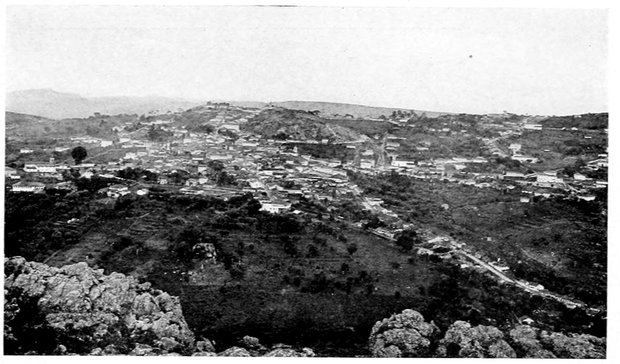
Diamantina spills down into the stream in which are found some of its gold and diamonds
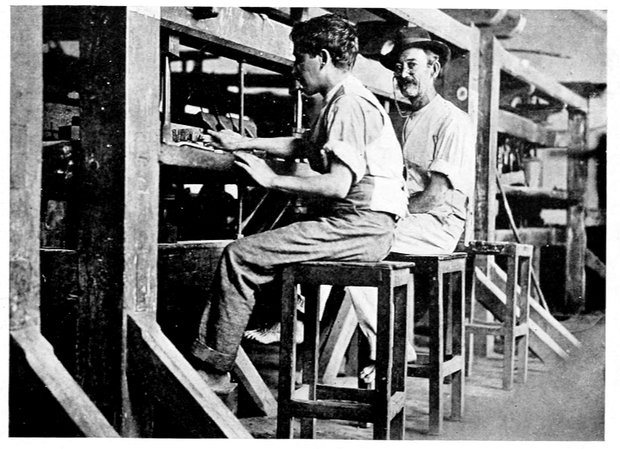
A hydraulic diamond-cutting establishment of Diamantina
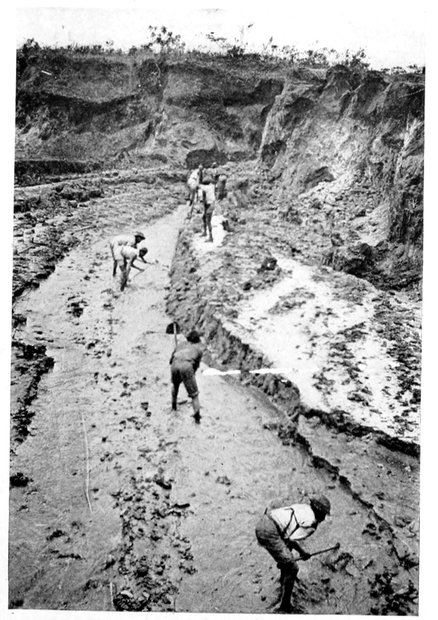
In the diamond field of Brazil
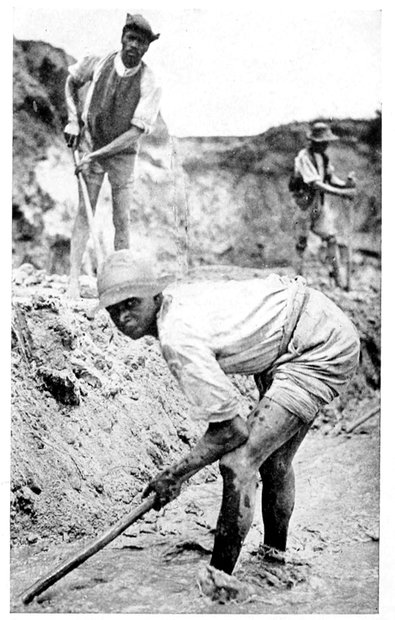
Diamond diggers do not resemble those who wear them
Beyond the old town of Sabará, where the first of the gold that
was to make Minas Geraes famous and Portugal wealthy was discovered
in 1698, we turned westward and a few moments later sighted
through bedraggled palm-trees the glaring new town of Bello Horizonte.
No doubt it was to escape the labor of propelling themselves
about the precipitous streets of Ouro Preto that led the calfless legislators
of Minas Geraes to dethrone the time-honored old capital at
the beginning of the present century and move the government to a
hitherto uninhabited spot, justly called “Beautiful Horizon.” The site
chosen on which to build to order this new capital is a broad shallow
lap of rolling country, a bare, treeless landscape which abets the light-colored
321new buildings in producing a constant uncomfortable glare.
It is strange that they did not choose a place with water, a lake or at
least a river, which may be found even in the lofty State of Minas.
As it is, there is only an insignificant creek creeping through town
and an artificial pond in the center of an unfinished park in which
the water is so red that even the swans paddling disconsolately about
in it have a reddish hue. The designers have all the details of a
complete city in mind; the difficulty is to carry out their well laid
plans and produce one. For Bello Horizonte is visible proof that it
takes more than houses, streets, and inhabitants to make a city. Its
public buildings are large and plentiful. Whitewashed houses with
bright new red-tile roofs lie scattered far and wide over the rolling
landscape. Wide park streets with electric tramways stretch out in
every direction in a wheel-shaped system evidently copied from
Washington. But the broad avenues are still unpaved, unpacked
stretches of red mud, resembling newly plowed potato patches, and
one soon recognizes that they run nowhere, that they are an exotic,
forced growth which men are still chopping farther back into the
red flesh of the virgin, scrub-grown hills. A few have stretches of
broad cement sidewalks lined with trees, but they are trees still in
their swaddling clothes of protecting frames, or at best are half-grown
and unfamiliar with their duty of giving shade and beauty and restfulness.
Such grass as exists grows in scattered tufts over bare earth,
in no way resembling sod. Though the houses are new, many of them
are set in the beginnings of walled bush and flower gardens, with
steep outside stairways leading to the real residence in the second
story and having fanciful paintings of such scenes as Rio’s Beira
Mar on the walls under the porches. They have an alien, unsatisfying
appearance which suggests that it is better to let even towns
grow up of themselves than to force them by hothouse methods.
There are, of course, some advantages in a city, especially in a capital,
built to order, but though modernity’s gain over medievalism is in
some ways shown, Bello Horizonte lacks not only the charm of old
Ouro Preto but even the air and spirit of a city. The whole place
feels like a house one has moved into while it is still building over
his head.
While they were about it, one wonders they did not build in
stone, instead of adobe bricks and plaster. The impression that
everything is built only for a temporary halt, by people who, like
Arabian nomads, expect to move on again to-morrow, pervades all
322modern America, in sharp contrast to Europe and the ancient American
Indian civilizations. But at least there are as yet no slums,
unless one counts as such the large clusters of small new houses that
were almost huts scattered through the several shallow valleys spreading
out from the town. It is curious how a city draws houses
about it like a magnet even when there seems to be nothing for the
inhabitants to do but take in one another’s washing—or do one another’s
governing. Though it offers free sites to any industry that
will establish itself there, only the scream of a single small weaving
mill is heard in Bello Horizonte. The city produces nothing except
government for the state, and the man who comes into personal contact
with that soon realizes that it “costs expensive” and is none too
good governing at that. More fuss is made over the state president
than over our own national executive. Negro soldiers in khaki and
bright red caps guard his “palace” and great high-walled garden,
parading back and forth day and night before all government buildings
with fixed bayonets, not because there is any real danger—except
to the unwary pedestrian who might run into the pointed blade of
some sleepy guard—but because all Latin-America loves to make a
show of deadly weapons even in time of peace. The population had
the bland, sophisticated air of people already trained to city life elsewhere,
like transplanted flora from other gardens of varied kind
and situation. Strangers attract far less attention than in even larger
interior towns, because here all are more or less strangers and the
inhabitants have not lived long enough together to form that sort of
closed corporation of old established towns, which not only makes a
new and unfamiliar face an object of curiosity, but arouses a kind
of distrust and annoyance among the native inhabitants.
The show reached Bello Horizonte before me and had done a
good Saturday and Sunday business, but “Tut” reported that all
records for “deadheads” were being broken. The manager was a
bullet-headed mulatto—whose name, by the way, was Americo Vespuccio—and
who did not have the moral courage needed to cope with
the swarms of official beggars which infest a state capital. When
the doors opened on Monday night I was lolling incognito nearby.
The ticket-taker was a mulatto girl of about fourteen who thrust out
her hand whenever anyone walked in, taking the ticket if there happened
to be one to take, but paying no attention to the fact that as
often as not there was none. Not only were there many people with
monthly passes and permanent free tickets, but the negro management,
323being afraid of anyone with authority, real or pretended, had
given everyone capable of manufacturing a shadow of excuse the
conviction that he had the right to enter without payment. In the
first few minutes I saw seventy persons enter without tickets, exclusive
of the house employees and men in uniform. Then I burst into the
manager’s office and informed him that he was going to pay us our
percentage for every person who had not, and did not thereafter, pay
an admission fee. He turned an ashy gray and begged me to take
full charge at the door. I discharged the mulatto girl on the spot,
made a ticket-box of my hand-grip by cutting a slot in it—hitherto
ticket-takers had stuffed the tickets into their pockets or any other
convenient receptacle—and proceeded to shock the good people of
“Beautiful Horizon.”
An elaborately dressed man in a frock coat, accompanied by two
women glittering with diamonds, pushed haughtily past.
“Your ticket, senhor?” I smiled, in my most ceremonial Portuguese.
“I never pay admission,” the man replied haughtily.
“And why don’t you?” I retorted, which wholly unprecedented
question so dazed him that without a word he went back to the wicket
and bought three tickets. The same incident was repeated dozens
of times that evening.
Another favorite trick was for a man to enter with one or two women
and purchase tickets only for them.
“Where is yours, senhor?”
“Eu volto” (I am coming back) was the unvarying reply, by which
the speaker meant to imply that he was merely going to escort the
ladies to their seats and come right out again, but in almost every case
he remained an hour or more until the “Kinetophone” number had
been run and came slinking out with the air of having kept eyes and
ears tight closed during the performance.
No doubt many of the well-dressed, haughty individuals I sent to
the box-office were state senators and the like, but what of it? We
were paying heavily to support them, paying every time we moved
from one town to another, every time we gave a performance, every
time we left or entered a state, in addition to what we had paid to
enter the country, every time we drew a check, or put up a poster, or
inserted an advertisement, and even in my most charitable mood I could
not see why we should give free entertainment to any government
official who was not there in line of duty.
324During the second section a chinless, pomaded popinjay in full
evening dress, with an own-the-earth air, pushed scornfully past when
I asked for his ticket. I stepped in his way, repeated my question,
and finally laid a hand lightly on his arm, whereupon the manager,
frightened to a kind of grayish pink, came running forward to assure me
“It’s all right.”
“But who is he?” I insisted.
“I’ll tell you later,” whispered the trembling mulatto.
The chinless individual, who turned out to be the delegado, corresponding
to our chief of police, remained only a few minutes, all
the while plainly boiling with rage. As he came out he stopped before
me—the rush having ceased I was seated—and in a voice and manner
that no doubt scared ordinary people to death, he growled:
“Before you ever grasp anyone by the arm again you want to
know who he IS!”
“Senhor,” I replied, without rising, which is a shocking insult
even to the most petty Brazilian official, “I want to know who everyone
is, and any man who is a cavalheiro will tell who he is under such
circumstances in any civilized country, and until I know who he is
I’ll catch him by the arm or by any other part of the anatomy that
is handy.”
He went out, fuming at the nostrils, leaving me wondering if he
would send a subordinate to place me under arrest, but abuse of
authority had become so rampant that I would have been willing to
explore the interior of a Brazilian prison to bring the matter to a
head. When the performance was ended I cornered the manager in
his office and forced him to pay us our share for every “deadhead”
I had counted, and though he and his equally dusky assistant hastened
to assure me that my demands were wholly justified and that they
did not stop officials and ladies “because they did not have the
courage of Americans,” there was something in their manner that
told me they would have taken supreme delight in knifing me in the
back. That evening I turned my papers, valuables, and revolver over to
“Tut,” in order to be prepared for the probable next move of the
delegado. But he must have suffered a change of heart, for thereafter
even soldiers and policemen in uniform had orders to pay admission
unless they were on duty and wearing their sidearms to prove it.
Thenceforward every resident of Bello Horizonte who entered the
“Cinema Commercio” either handed in a ticket or gave proof of his
right to free admission, whether he was president, senator or state
325dog-catcher. When we had broken all records for the time and
place, I ran the second section of the show myself, just to keep in
practice against the day when I must become a motion picture operator,
and went to bed leaving orders to be called at dawn. By this time
“Tut” spoke considerable Portuguese—though, having learned it
mainly from Carlos, he had many of the errors of grammar and
pronunciation of Brazil’s laboring class—so that I left on my next
advance trip with less misgiving.
Nowadays you can go to famous old Diamantina by rail. The
world is building so many railways that there will soon be no place left
for those who prefer travel to train-riding. I had little hope that the
diamond town would prove worth the time and expense necessary
to bring the Kinetophone to it, but I had a personal desire to see
it, and also, though I could not get exact information on the subject,
the map suggested that I might be able to cross on muleback from
Diamantina to Victoria and thereby save myself a long and roundabout
trip.
The rain had let up at last, though sullenly, like a despot forced
out of power. All that day there came the frequent cry of “chiero
de panno queimado!” (smell of burned cloth), whereupon everyone
jumped up and shook himself—everyone, that is, except the advance-agent
of the Kinetophone, who had ridden behind Brazilian wood-burners
often enough to know how to dress for the occasion. Our
“express” not only stopped but was sidetracked at every station, and
every time it gave a sign of coming to a halt the passengers sprang
up as one man, crying “A tomar café!” and poured out upon the
platform, to return growling if even a dog-kennel of a station miles
from nowhere was not prepared to serve them their incessant beverage.
“Tut” used to say that the Brazilians drank so much coffee that their
minds went to dregs. It is a curious paradox, too, that the Brazilian,
often an unprincipled rogue in business, never dreams of cheating
the coffee-man out of his tostão, even if he has to exert himself to
hunt him up and pay it before scrambling aboard again as the warning-bell
rings.
Beyond Sete Lagoas the country began to flatten out, with patches
of corn in new clearings, then more and more heavy brush and only
the red-earth railway cutting and a wire fence on either side. Curvello,
the largest town of the day, was almost a city, but so largely made
up of negro huts that it probably would not have paid us to make it
a professional visit. The traveler never ceases to wonder how all
326Brazil came to swarm so with negroes; all the ships of Christendom
could not have brought so many from Africa, and the original slaves
must have multiplied like guinea-pigs. In the afternoon I got reckless
and bought an apple, which only cost me a milreis—but then, it was
a very small apple. Far up here in the interior prices seemed to be
easing off a bit, but this was largely offset by the lack of small change.
In contrast to Rio, there was almost no silver or nickel, which
made an excellent excuse for plundering the traveler of a few tostões
every time he approached a ticket-window, and forcing him to accept
dirty old bills often patched together out of six or seven pieces that
were completely illegible.
It would have been sunset, had there been one, by the time we
pulled into Curralinho, whence a branch line carries a two-car train
three times a week to Diamantina. I believe I was the only first-class
traveler with a ticket next day, one having a kilometer-book and
the rest government passes or uniforms. There was not a woman
on board, though one man with a government pass had with him a
boy of seven who, the conductor weakly declared, should pay half
fare; but he did not insist and let the matter slide in the customary
Brazilian way. No wonder the Belgian syndicate which built this
line and another starting toward Diamantina from Victoria hovers
on the verge of bankruptcy, though my own ticket cost 14$800, plus
1$600 for the federal government and 1$600 for the State of Minas,
or $5.80 for ninety-five miles of uncomfortable travel.
Except in spots the country was almost sertão, a bushy wilderness
with here and there long piles of wood for the engines. We crossed
the Rio das Velhas, flowing northward and inland, carrying red earth
in solution and pieces it had torn away from the forests through which
it had commandeered passage. There were some cattle and here and
there a patch of bananas in a hollow with a hut or two, but the rest
was a desolation of black rock, which proved to be white inside where
the railroad builders had broken into it. Rare patches of corn were
the only visible cultivation; between scattered collections of miserable
adobe huts there appeared to be no travel; the listless part-negroes
lolling their lives contentedly away in their kennels seemed to raise
nothing but children and, not being cannibals, it was a mystery what
they lived on. Slowly and painfully we climbed to the top of a great
ridge, a wild country of barren rocks heaped up into hills that were
almost mountains, drear and treeless as the landscape of Cerro de
Pasco. No wonder the men who wandered up here seeking their
327fortunes thought the bright pebbles they picked up worth keeping,
if only to break the melancholy monotony.
Beyond a miserable collection of huts where those of robust nerves
ate “breakfast,” we passed the highest railway point in Brazil, 4,600
feet above sea-level, whence vast reaches of dreary country, broken as
a frozen sea, spread to the horizon in all directions. The last station
before Diamantina looked like a town in Judea, so ugly was the desolation
that surrounded it, and across this one gazed as vainly for the
city which the map proclaimed near at hand as one may stare for
a glimpse of La Paz from the plains of Bolivia high above it.
Ten years before, one traveled on muleback all the way from Sabará
to reach the heart of Brazil’s diamond-bearing territory, and only
this same year had the inaugural train reached Diamantina, amid
hilarious rejoicing of its population. In the few months that had
passed since, the inhabitants had not lost the sense of wonder which
the tri-weekly arrival of the puffing monster on wheels gave them, and
though it was Christmas Day, nearly the whole town had climbed to
the station to greet us. For climb they must. A youth of decided
African lineage took my bag and we stepped over the edge of the uninhabited
plateau, to find a town heaped up directly below us, all
visible roads and trails pitching swiftly down into it. The medieval
streets were rough-paved in misshapen cobbles, with a kind of sidewalk
of naturally flat stones running down the center. The town
was labyrinthian, its narrow blocks of every possible form between
the narrower streets, built to fit the lay of the land, spilling down
on the farther side into a deep valley and backed on all sides by a
rough and savage landscape of blackish hue as far as the eye could
see. It was as picturesque as Ouro Preto, which it seemed to equal
in age, though it had been somewhat less elaborately built than the
old state capital, and its churches were fewer, smaller, and more insignificant.
The fact that here also there were no vehicles may be
one of the reasons why the population seemed so healthy and active—climbing
to the station alone proved that—in spite of their decidedly
preponderating negro blood.
The railroad had not yet brought them long enough into contact
with the outside world to spoil the simple people of Diamantina.
They seemed to live together like a great affectionate family, soft-mannered
and little given to quarreling, even the street boys treating
one another like French diplomats. No doubt it was their negro
blood, perhaps also the adventurous happy-go-lucky, take-a-chance
328character natural to a mining community, that gave them their considerable
gaiety. There was no evidence of anything but kindliness
and good-feeling among the barefoot women who stopped to gossip
with water-jars set jauntily on their heads—real jars, too, for Diamantina
is so far away from the world that American oil tins have
not yet come to usurp the place of picturesque native pottery. As
final high praise, my hotel host asserted that the town is so different
from the rest of Brazil that a man can occasionally visit a family
with unmarried daughters without bringing them into disrepute
among public gossips. It is, indeed, a Brazilian Utopia!
I was Diamantina’s star guest during my stay, having the main
room in the main hotel looking out on the main praça. The latter
was small and three-cornered, paved with cobbles back in the days
of Shakespeare, and had in its center a bust of a native of Diamantina
who was Minister of Viaçao when President Peçanha was coaxed into
signing the decree giving the Belgians the concession for their railroad.
But then, Brazil is the land of busts, and the man who does not succeed
in getting at least one of himself tucked away in some praça is not
much of a buster. My huge front room, next to the homelike hotel
parlor with many chairs and a cane divan all dressed up in lace
coats, was fully twenty feet square, its immense French windows
reaching to a floor made of great hand-cut planks fastened by handmade
spikes with heads an inch square—or in diameter, according as
the blacksmith happened to shape them—and so glass-smooth and
warped and twisted that in places one had to brace one’s legs to keep
from sliding downhill along it. The house seemed older than the
surrounding hills, but there is so much of the new and crude in Brazil
that the old cannot but be greatly relished. As a matter of fact Diamantina
does not deserve a public hostelry, for nearly all its visitors
have the South American habit of stopping with friends or relatives,
and for all its electric lights and spring beds, and moderate charges,
the hotel had only a couple of paying guests.
The adventurous bandeirantes of São Paulo first penetrated this
region looking for gold. A considerable amount of it was found in
the muddy stream at the foot of the present town, and early in the
seventeenth century the adventurers founded the village of Tijuca,
which took its name from a nearby swamp. In olden times gold
dust and tiny nuggets were used as money throughout the region, and
there were scales in every shop. Gold seems to be found almost
anywhere in the region, and placer-mining is the natural occupation
329of all its inhabitants. When electric-light poles were put up by a
syndicate at Boa Vista, in order to give Diamantina as light by night
what the company uses as power during the day, the children carried
off the earth dug up from the holes to wash out the gold. After a
heavy rain tiny particles of gold are picked up in the gutters of
Diamantina and along the edge of the little stream below it. So
here at last is a place where you can really pick up gold in the
streets, yet the people are poorer and more ragged than those who
live by planting beans.
It was while searching for gold that the miners of Tijuca came
across many bright, half-transparent pebbles that were plainly of no
use to them, but the largest of which they gave to their children or
used as counters in their own card games. There were a bushel or
more of them in such use in the village and its vicinity when a new
priest arrived from Portugal. In his first game of cards the pious
padre noticed the peculiar poker chips that everyone produced by
the handful. He let the information leak out that he thought them
very pretty, and would be pleased to have them as keepsakes. They
were quite worthless, of course, to his new parishioners, and if his
innocent sacerdotal eye was caught by their transparent brightness,
they saw no reason why they should not humor his whim, and at the
same time gain in favor with the Church, by giving him such of the
worthless little baubles as he did not win at cards. Thus he gathered
together half a bushel or more of the pebbles, and suddenly disappeared
in the general direction of Amsterdam, dropping a hint in
Rio on the way.
Word soon reached the Portuguese crown of this new form of
riches in its overseas possessions. It turned out that the range of
hills from well south of the present town of Diamantina to far up
in Bahia, a tract of more than four hundred square leagues, was
diamond-bearing land. Indeed, if one may believe local conviction,
the finest diamonds in existence come from Minas Geraes, and the
world’s most famous black diamonds from Bahia State a bit farther
north.
Diamonds were first discovered in India and for centuries came
only from there. When they were found in Brazil, thousands of the
stones were sold as Indian diamonds not only because buyers were
prejudiced, but because the Portuguese government had forbidden
private mining on penalty of death, and the contrabandists were
forced to reach their market by way of India. The village of Tijuca
330became a flourishing center, far as it was from the outside world,
and for all the stern government régime set over the region. In
1734 Portugal sent out an “Intendente Geral dos Diamantes,” with
absolute power to enforce the government monopoly. His palace
still exists in a garden near the top of the town, with the remains of
an artificial lake on which he kept a sailboat to show the people of
what came gradually to be known as Diamantina how he had crossed
the sea. The crown forbade individual mining and gave the job to
contractors, who worked six hundred slaves and paid 220–240$ yearly
per slave for the privilege, yet who made fortunes even though all
large diamonds and twenty per cent. of all finds went to the crown.
Population multiplied and Diamantina became a center of riches
and luxury. Contrary to the case in the rest of Brazil, many broken
noblemen and men of education came here to mend their fortunes, and
the colony, and eventually all the province of Minas Geraes, became
a focus of “civilization,” as that word was understood in those days,—much
powdered hair, knee-breeches, beauty patches, minuets—and
swarms of miserable slaves. It may be that the courtesy of the poor
Africanized inhabitants of to-day is but a hold-over from those times
of elaborate etiquette.
Amazing tales are still told in Diamantina of its golden days. It
was evidently the custom of the government viceroys to imprison the
contractors as soon as they got rich and “roll” them penniless. One
official is reputed to have made every guest a present of a cluster of
diamonds. The Grupo Escolar, or school building, across the street
from my hotel was once the residence of a great diamond buyer, and
when the building was made into a school some years ago a score or
more of skeletons were found tumbled together in the bottom of a
secret shaft. This revived the legend that the buyer had a chair set
on a trapdoor, and when a man came in with a large “parcel” of contraband
diamonds he was asked to sit down and make himself at
home while the buyer looked over the stones—and brought up at the
bottom of the shaft.
In 1771 the famous Pombal sent out the “green book,” with fifty-four
despotic articles that nearly depopulated the district, but in
1800 the régime softened, and finally, in 1832, the government monopoly
was abolished. Since then mining has been more or less intermittent.
Diamonds reached their highest price during the war with
Paraguay, at the end of which, in 1867, the stones were found in
South Africa, a blow from which the industry in Brazil has never
331recovered. For while it is claimed in Diamantina that Brazilian
diamonds average much higher than those from the Cape, the African
mines now produce at least eighty per cent. of the world’s supply and
with more modern methods and widespread propaganda completely
control the market. Abolition was the final straw, and in five years
exportations of diamonds from Diamantina dropped from 2,500 to
300 annually.
Unlike those of South Africa, the diamonds of Brazil are found on
or near the surface. In a few places quartz is broken open in the
search, but in general they are taken loose in the gravel of the alluvial
deposits by the simpler process of placer mining. The fact that
enormous tracts of territory were worked over by the Portuguese does
not mean that they took out fabulous amounts, according to modern
local authorities, because they had to feed their slaves anyway and
it was to their advantage to keep them working, even if the finds were
few. To-day, though there are some syndicates and large companies,
most of them are completely paralyzed and such work as is done is
mainly by individual natives. The company troubles seem to be due
to lack of a good mining law—natives may wash for diamonds anywhere,
even on company claims—the insecurity of titles, the prohibitive
cost of transportation for machinery, high tariffs, low rate of
exchange, the constant war of South Africans against South American
diamonds, and finally the “salting” of mines by fake promoters,
coupled with carelessness of foreign stockholders in sending out
experts to examine the ground before accepting even an honest
promoter’s word for it. Thus fortunes have been lost in the Brazilian
diamond fields, notwithstanding the fact that diamonds continue to be
steadily picked up in them.
The largest diamond ever found in Brazil was the “Star of the
South,” found at Agua Suja (Dirty Water), on the line to Catalão.
This weighed about the same as the famous Kohinoor diamond,—300
carats. The stones are usually found in the beds of rivers, larger
near the source, and smaller farther down, for they wear off in
traveling, and in sand, earth, and common gravel, usually with gold.
Rough diamonds generally have no brilliancy, looking merely like
white, half-transparent pebbles, though any child of Diamantina is said
to be able to recognize one at a glance. There is really nothing more
prosaic than diamond gathering, and the resemblance is slight between
those who hunt for and those who wear them. None of the improved
methods of South Africa have been introduced into Brazil, not even
332the hand screen or the “grease board,” and the negroes still use the
batea, or wooden bowl in the shape of a hand basin, in washing for
both diamonds and gold. When he has chosen his spot beside some
stream the negro sets up a baca, a kind of topless soapbox with one
end knocked out, about six inches above the surface of the water and
fills it with gravel. Then with the batea he scoops up water and
throws it with a peculiar flip on the gravel, washing it from side to
side until the loose stuff runs off and leaves only the pebbles. These
are then spread out and gone over carefully by hand, the diamonds
being readily detected by the experienced eye, particularly since, unlike
the other stones, they cannot be wet and for that reason stand out
brilliantly from the rest. In fact, in Spanish and Portuguese they
are as often called brillantes as diamantes. With the war and the
sudden drop in the diamond market that came with it the people of
Diamantina largely left off hunting for diamonds and began the
more paying occupations of planting corn and gathering firewood.
On the Sunday afternoon following Christmas, the rain having
at last ceased, I went out for a walk. An hour’s climb, in which I
did not suffer from heat, brought me to a cross on the culminating
point of the great mass of gray-black rock of ragged formation
across the valley and small stream in which many a diamond has
been picked up and much gold washed. Here is a full view of the
town, stacked up on the green and fertile side of the long valley and
spilling like coagulated grease down into it, scattered groups of eucalyptus
trees and its general greenness in great contrast to the rockiness
of all the rest of the vast and jagged encircling landscape. The gothic
church of Coração de Jesus and the tree-girdled seminary stand
somewhat above the rest of the orderless heap, and one realizes that
the railroad does indeed come in at the top of the town, for its
station is so high that here it cannot be seen above the edge of the
plateau on which it sits. Diamantina is a great trading post of the
interior, and down in the center of town there is a species of Arab
khan, a roof on posts where shaggy sun-, rain-, and road-marked
muleteers with long, ugly facas in their belts pile their saddle-blankets
and goods and cook over campfires. The old, old highway unravels
down across the broken rocky hills, descends into the valley, stops
a while at the khan, and having gathered its forces together once more
into a compact trail, marches across and out of the valley again and away
over the bleak horizon.
It was in the middle of this public trail that I came upon two negroes
333in quest of gold washed down by the recent rains. While one dug
up wooden bowls of earth and gravel, the other stood knee-deep in
a muddy, dammed-up pool and, filling his batea with the earth brought
by the other and letting water into it, whirled it about until the heavy
matter went to the bottom. Then he scraped off by hand the top
layer, continuing the process until within ten minutes he had left
about a quart of heavy black earth. This he dumped with more of
the same in a white sand-nest he had made on the bank of the little
stream crossing the trail. Like most of his fellow-townsmen he was
talkative and ready to explain his affairs to a stranger. He had
washed for gold after a rain ever since he was a boy, getting from
two to four milreis worth every time, and where there is gold there
are sure to be diamonds, especially the “chapeu de palha” (“straw
hat”), which he explained to be a very flat diamond making much
show with little weight. Though both he and his companion were
shoeless and had been from infancy, ragged, illiterate and half toothless,
they were far from ignorant on some points, especially of
words used in the diamond industry, which they spoke with a curious
negro mispronunciation mixed with slang.
In riding about the vicinity on other days I came upon several gangs
of a score of negroes each, bare-legged and ragged, hoeing at an
average wage of eighty cents a day in banks of red earth through
which a rainy season stream had been turned. This they keep up
as long as the rains last, rarely seeing a diamond, which wash along
through the artificial gorge with the other gravel and come to rest
on a sandy flat place beyond. Then the men are set to “batting the
baca,” until the sand is washed away and the diamonds recovered by
the same crude methods used in the first days of the colony. One
question almost sure to be asked by the layman is how workmen are
kept from stealing the diamonds. Theft, it is explained, is by no
means so easy to accomplish as would appear at first glance. In the
first place, it takes on the average a cartload of sand and gravel
to yield a one-quarter carat diamond. By the time the negro has
washed a load down to about two bushels an overseer has an eye on
him and watches him until the process is finished. It is rare for a
diamond to appear suddenly on the surface during the preliminary
washing, when the negro might snatch it, and even if he did he would
have a hard time selling it. If ever a native of Diamantina has stolen
a diamond, even as a boy, he is blackballed in the community for the
rest of his life. It is a long way to anywhere else, even since the
334advent of the railroad, so that thieving of the town’s chief product is
extremely unusual. Men from far off up country come in with
thousands of dollars’ worth of diamonds or black carbons on a pack
mule, which lags far behind with its negro driver. Everyone along
the way knows what it carries, yet for decades no driver has run
away nor anyone “framed” a holdup.
In town, gold and precious stones are handled with a casual carelessness
only equalled by the Bank of England. A local jewelry
shop, famous in the trade the world over, looks like a miserable
little tinker’s den, where a dozen men and boys, all with more or
less African blood, work at dirty old worn and smoked benches.
About them is a wilderness of junk where cigarette butts, gold nuggets,
old iron tools, gold wire, and worthless odds and ends lie scattered
and tumbled together with diamonds of all sizes, cut and uncut, old
tin tobacco-boxes containing fortunes in diamonds and precious stones
of several species wrapped in dirty bits of paper. Gold coins of the
former Empire as well as new British sovereigns waiting to be melted
up for local use can scarcely be distinguished from the dusty rubbish
on the tables; drawers filled with the ragged money of to-day stand half-open;
a tiny show-window—recently put in as a concession to modern
ideas—has a six-carat diamond stuck against the glass with several
smaller ones about it, day and night; a can that originally held soap but
now full of emeralds, amethysts, topazes, and half a dozen other
precious stones found in the region was kicking about the floor. Yet
there was no sign of lock or key, except that used to fasten the outer
door at night. The owner only came now and then during the day,
and amid this disordered jumble of wealth his dozen workmen and
boys toiled from seven in the morning until sometimes nine at night
at ludicrous wages without a loss ever having been reported.
Down in the valley near the town there is a native diamond-cutting
establishment, a capacious old barn of a building with the immense
rough-hewn beams of olden times and two long double rows of
“wheels” run by water-power on which the stones are “cut.” Strictly
speaking, a diamond is not “cut” at all; it is ground—lapidar or “stoning”
they call it in Brazil. Disks of the best grade steel, about a
foot in diameter, move round and round at a moderate rate of speed.
Rough diamonds are first chipped off by hand to the general shape
desired; then they are set into a bed of lead and solder so that one
facet may be ground down, after which they are removed at a forge,
resoldered, and ground on another facet. The “wheels” must be
335polished down and filed in slight ridges every two or three weeks, a
task that takes about one day, and they are rented at 12$ a month to the
individual lapidarios, both men and women, largely of negro blood,
who work for themselves, either “cutting” diamonds for others or
speculating with such as they can buy themselves. A day is the average
time consumed here in “cutting” a one-carat diamond, at a cost
of about 7$, the chips and diamond dust left over bringing the ordinary
income up to 65$ a week.
Diamond buyers of all nationalities journey to Diamantina, and the
town expressed surprise and often incredulity to hear that I had not
come to purchase a few “parcels” for speculation. “Everyone” buys diamonds,
yet no one pays the state export tax on them, if one may
believe local opinion. This would have to be paid if the stones were
sent out legally by express, but when a buyer has collected a “parcel”—in
Portuguese it is partida—he finds some man bound for Rio and
says to him, “If it isn’t too much trouble just hand this little package
to —— and Co.,” thereby defrauding both the railroad and the politicians.
The men who deal in diamonds in the place of their origin
no more wear them than do the men who dig them. Old buyers who
have handled the precious stones all their lives are not only plainly
dressed but have none of the tendency toward personal adornment
so widespread among Brazilians. Two American diamond-men I
met had huge blacksmith hands on which a ring would have looked
absurd, and the only diamonds one sees in Diamantina are those
offered for sale in “parcels” or show-windows, or those worn by an
occasional tenderfoot.
Newcomers have sometimes been deceived by this state of affairs.
A few years ago there arrived in Diamantina a German with a conviction
of his own wisdom and superiority over common mortals,
who, with an air implying that the thought had never occurred to
anyone else, let it leak out that he was buying diamonds. An old
negro wandered up to the hotel in an aged shirt and trousers, a ragged
hat, and bare feet, and shuffling in a halting, diffident way into the
German’s room, told him that he did not know what the two diamonds
he carried wrapped in a scrap of paper were worth, but that he would
sell them cheap. The German paid him about half the market price
for them and asked him if he had any more, adding with a wink
that any transactions they might make would be kept a secret. The
poor old negro said he thought he could find a few more about his hut
or in the river or among his friends, and for a month or six weeks
336he continued to slouch into the hotel, until he had sold the wise
German about a pint of diamonds for a mere song of fourteen or
fifteen contos, say $5,000. Then the Teuton, highly pleased with
himself, packed up and took the down train from Curvello, smuggling
his untold riches out of the state without paying the export duty—and
discovered when he reached Rio that every one of the fine diamonds
the poor ignorant old negro had sold him so cheaply were what are
known in the trade as “fourths,” or worse, full of knots and gnarls
as a century-old olive tree and worth at most some 50c a carat for
cutting glass. A bit later, the poor innocent old negro having occasion
to go down to the capital and talk with the senator whose political
boss he was in Diamantina, blew into Rio in the frock-coat and patent
leathers he wears when not doing business with gullible strangers,
with a real six-carat diamond dazzling from his little finger and
two or three more shouting from his shirt front and, meeting the
worldly-wise German on the Avenida, raised his fifty-dollar imported
Panama hat with true Brazilian courtesy, and invited him to come in and
have a drink for old times’ sake.
One evening my hospitable host of the hotel dragged me over to
the cinema he owned, where I found a crowded house come to see
what to Diamantina was a brand new romance of their own color,
called “A Cabana do Pae Thomaz,” in other words, “The Cabin of
Uncle Tom.” It was all too evident, however, that there was nothing
to be gained by bringing our show so far inland, for the negroes had
little to spend and the railway charges are naturally high to those who
can find no excuse for not paying them. Meanwhile I had opened
negotiations for a journey on horseback, or even on foot, across to
the railhead of the line out of Victoria, which would have brought
me out well up the coast on my journey north. A native camarada
familiar with the trail offered to rent me a horse or a mule for the
journey, with saddle and spurs, for 3$ a day. This seemed reasonable.
It would make the trip across come to about 20$? Yes, but it takes
two animals. Why’s that? You must have a guide, or at least a man
to bring back the horses. Ah, then that makes 6$ a day instead of
3$? Yes—ah—and then of course you must pay the man. How
much? Oh, 3$ a day, the same as the other animals. Ah, then that
makes 9$ a day, and seven days would be.... No, say ten days.
But why ten days? Because in this season that is the least you can
depend on. In other words the trip would cost me 90$, nine times
ten? No, it would be nine times twenty, or 180$. Eh, what twenty
337days? Why, the man and the horses would have to come back,
wouldn’t they? Sacramento, I suppose so, unless I could chloroform
them when I got there. So then 180$ would cover all the expenses?
All, completely all—er—that is, of course, you would have to feed
the animals and the man on the trip, and it might be much more than
ten days, and—er.... And no doubt there would be a tip to the
man and the animals, and perhaps a third horse needed when he
caught sight of my valise, and of course the government officials here
and along the way would come in for their customary graft, and
there would be the stamp-tax on each horseshoe, unless they were
mule-shoes, in which case no doubt it would be doubled, and a tax
on each bray the “burros” might emit en route, and—whereupon I
gave him a warm handshake and bade him good night, saying I would
think it over and wire him from Bagdad in 1946, and thus eventually
got him out of the room. In short, I had come to understand at
last why people travel by rail in Brazil, even though their bones are
racked on the warped and twisted roadbeds, their movie-magnate garments
turned into sieves by burning cinders from the straining locomotives,
and there is a tax on every corner of a railway ticket.
All Diamantina was down—I mean up—to see us off, just as they
are at the same early hour three times a week. The distance-blue
piles of earth lay heaped up into considerable hills where a clearer
atmosphere disclosed wider horizons, hung on all sides with fantastic
heaps of clouds, that increased the sense of being on the top of the
world. On the several days’ trip southward I met a strange man, a
juiz de dereito, or district judge, from Serro back in the hills, who
refused to ride on a government pass or to accept one for his son,
whom he was taking to the medical school in Rio, declaring that
there was “much abuse” in such matters by government officials!
At Burnier, where we changed to the broad gauge, I got a berth to the
capital. Though the car was the familiar American Pullman, the
slovenly government employees had discarded most of the small
conveniences. The aisle was as carpetless as the floors of Brazil, the
berth net had long since been turned into a hammock for the brakeman’s
baby, the mattress was thin and hard as a Brazilian wooden bed, and
the sleep I did not get as we creaked and jounced through the endless
low hills explained why sleeping cars and night trains are not more
popular in the mammoth republic of South America.
When I returned from the washroom next morning, “Tut” stood
dressing beside the opposite berth. They had played in Palmyra the
338evening before and managed to pack up in time to catch the night
train. Carlos had had his hat stolen in the preceding town and
“Tut” had been bitten by a dog while walking out to pay his respects
to the English-speaking miners near Ouro Preto; otherwise things
had gone well—except for one other personal mishap to “Tut.” While
buying his ticket for the sleeper he noted that the berths were divided
into “leitos inferiores” and “leitos superiores.” Now why should he
take an inferior berth when he had been working hard, and Linton
paid the bill anyway? He took a leito superior. Unfortunately, in
the matter of berths, the Portuguese word superior means “upper”!
By seven the day was already brilliant and hot, for we were down off
the great plateau I was never to climb again, and the familiar suburbs
of Rio were rumbling past. I dropped off as we drew into the yards,
knowing from experience how long a process it is to get into the station,
and diving out through a hole in the railway wall, I hurried away
up the Rua Mattoso to the home of our theater contractor. He
surprised me by saying that times had grown so “brutally hard” in
Rio, to say nothing of the brutal heat of midsummer, that it would
not be worth while to play there at all, but that we could finish our
sixteen days with him at his theater in Nictheroy.
The ferry that carried us across the bay was crowded with newspaper
men and photographers, and the gunboat Sergipe lay close off
the state capital with its guns trained on the public buildings. Inquiry
disclosed the fact that there was not a new mutiny, but that a revolution
was expected in Nictheroy during the day.
Nilo Peçanha, son of a former president of Brazil, had been elected
president of the State of Rio de Janeiro for the term to begin with
the new year; but, as so often happens in South America, the opposition
party still in power was determined to give the office to their
own defeated candidate. This was one Lieutenant Sodré, an army
man of similar caliber to the celebrated “Dudu” and having the
same backing. With the aid of the outgoing state president he had
“acquired” arms and ammunition from the federal stores in Nictheroy
and was preparing to take office by force, having picked up large
numbers of Carioca crooks and gunmen and scattered them among
the various cities of the state to stifle opposition. Peçanha, on the
other hand, had applied to the Supreme Court for a habeas corpus,
giving him the office that was being stolen from him, and after considerable
dodging and hesitation the national president had decided to
339lend federal armed force to uphold the Supreme Court decision in
favor of Peçanha.
Mere orders from the federal government mean little in the life of a
Brazilian state, however, and Nictheroy was seething on the brink of
anarchy when we landed. Sodré, it seemed, had had himself sworn in
as president by the state assembly early that morning and had sent word
to that effect to the president of Brazil. He could not gain admission
to the state presidential palace, but with the support of the state police
and the outgoing authorities he did take over the presidential offices.
Then suddenly, some three hours later, a cry of “Viva Peçanha!” had
resounded through the police barracks, the policemen had taken it up
and, headed by two sergeants, threatened to kill the officers unless they
joined in also, and the entire state police force on which the rebel had
depended swung over to the other side, looted the stolen ammunition,
and took to rushing about town shouting and firing in the air.
This was the condition in which we found the state capital. The
firemen had joined the police, and auto-trucks crammed full of excited
shouting negroes and half-negroes in uniform were rushing about town
at top speed, all but overturning at every corner. The lower classes,
having likewise filled themselves with cheap cachaza, had joined the
general uproar of noise, irresponsibility, and probable violence, and the
streets were swarming with populares shouting “Viva Peçanha!”
“Viva o Salvador do Povo!” and similar nonsense in maudlin drunken
voices, while Sodré sent hurriedly to the national president demanding
“guarantees” for his personal safety.
Residence in South America, however, teaches one that revolutions
are by no means so dangerous on the spot as they are in the armchairs
of those who are reading about them afar off, and we serenely continued
our preparations for the evening performance. Desultory
shooting, street brawls, and the surging of masses of drunken populares
continued throughout the day and for several days thereafter, while the
shouting, shooting truckloads of police and firemen continued dizzily to
round corners, each time more nearly resembling the drunken brute
into which the tropical languor of negro militarism is apt to degenerate
in times of crisis or popular excitement. But it was, on the whole, a
good-natured rather than a blood-thirsting brute, and though what
Brazil calls “persons of most responsibility” kept out of sight, we common
mortals, including not a few women, walked about town attending
to our business as usual. Once a ragged, drunken mulatto popular
came into the leitería in which I was quenching my thirst with a glass
340of ice-cold milk, walked bellowing and reeling past me and two men at
another table up to a little messenger-boy of fourteen, and ordered him
to shout “Viva Peçanha!” The proprietor dared not protest, for the
police were all drunk and the povo more than likely to take the ragamuffin’s
part; but when the latter finally staggered out again the shopkeeper
raised his hands to heaven and demanded to know why the fellow
had picked on the boy and not, for instance, pointing at me, on “o senhor
over there.”
The “Cinema Eden” was right on the waterfront, though the only
paradise in sight was the view of Rio piled up into massive banks of
white clouds across the emerald bay and the marvelous sunset and steel-blue
dusk which spread over its unique, nature-made sky-line as we
opened our doors. The near-revolution was still surging through the
streets, though a few sober soldiers of the regiment of federal troops
that had been landed were riding about town in street-cars, with ball-loaded
muskets ready for action. Peçanha had been sworn in that
afternoon, surrounded by a swarm of other perspiring politicians in
wintry frock-coats and silk hats, but the national president had concluded
to avoid any responsibility in the matter by calling a special session
of congress to decide between the rival candidates, instead of carrying
out the decision of the Supreme Court—“which,” perorated Ruy
Barboso, “is what our constitution orders and what is practiced in the
United States,” two equally convincing final arguments. Though we
were the only theater open the house was not crowded. “Persons of
most responsibility” preferred to remain at home, and the populares
were plainly in most cases without the price of admission, even had
the revolution not promised a more exciting show outside. I took
charge of the door in person, not at all certain but that the povo might
try to force itself in en masse. Once, during our part of the program,
a mighty explosion shook the town like an earthquake and shooting
sounded under our very windows; but as the stampede for the door
started I barricaded the immense exit and “Tut” went on calmly running
an amusing film known as “College Days,” and before it was ended
the volatile audience had quieted down again. The explosion, it turned
out, was of a great deposit of powder on one of the many islands in the
bay, nearly twenty miles away.
Our receipts for the first section were so poor that we cut out the
second and went home for a moonlight dip in the sea just outside our
waterfront rooms in the charming residential district of Nictheroy.
But it was the last day of the year, with a crushing heat after the
341splendid air of the plateau, and the soft wind that was now sweeping
across the bay drew me back for a last glimpse of Rio in the throes
of New Year’s Eve. The city lay a vast irregular heap of lights, here
in dense clusters, there strung out along the invisible lower hills, all
cut sharp off at the bottom by the endless row of them along the Beira
Mar. The Avenida was densely crowded, and getting more so. Newspapers
had erected booths covered with artificial flowers and colored
lights, several police, fire department, and military bands were scattered
along the great white avenue, and a constant, unbroken procession of
automobiles crept up one side and down the other, pretty girls perched
on the backs of the seats and on the furled covers, all filled with the
“respectable families” whose plump and physically attractive ladies are
rarely seen in the streets after dark on any other day in the year.
I was caught where the confetti fell thickest, but there was little rowdyism
and no unpleasant din, though paper ribbons spun across the lighted
sea of faces and perfumed water was squirted into them in that good-natured
and outwardly courteous way with which the Latin-American
softens the perpetration of his most hilarious, carnival-time tricks.
CHAPTER XV NORTHWARD TO BAHIA
342
More than five months had passed since my first arrival in Rio
when, in the first days of the new year, I actually started on
my homeward way again. The train from Nictheroy northward
left at dawn, after the unfailing Brazilian habit, and I caught a
last glimpse of sunrise over Rio and its bay before they passed finally
from my sight. The mountains of the cool plateau lay blue-gray along
the horizon all that day’s ride through the singing jungle. The flat
littoral was considerably inhabited, but chiefly with thatched mud-and-reed
huts, contrasted only now and then by a massive, dignified old
fazenda-house standing, like some poor but still proud aristocrat, on a
commanding knoll above broad reaches of flat corn, cane, or pasture
lands, broken by frequent marshes grown full of the omnipresent
vegetation. At the stations negro boys highly contented with life sold
melons, bananas, mangos, red figs, the acidulous, parrot-beaked cajú,
and little native birds in tiny home-made cages. The scream and groan
of crude cane-carts in the fields or along the dust-thick roads could
sometimes be heard above the roar of the train. Rain had been frequent
here during the past weeks, but it had ceased abruptly at Christmas
and the implacable sun had already wiped out all evidence of
moisture. At Macahé we came down to the edge of the sea again,
stretching away emerald-blue and mirror-smooth to the end of space,
then turning inland once more across a sand-blown region, we descended
at Campos, 176 miles north of Nictheroy.
This second city of the State of Rio de Janeiro is an old and somewhat
dilapidated town well spread out on the campo, or sea-flat open
country, for which it is named, with a few aged church-towers peering
on tiptoe over the broad cane-fields that surround it. Scattered imperial
palms slightly shade it, and the widest river I had so far seen in
Brazil gives it a light-craft connection with the sea. Neither its mule
cars nor its medieval “Hotel Amazonas,” with a single banho de chuva,
or “rain bath,” are fit subjects for unbounded praise, but at least its
chief cinema manager cut short my professional labors by signing on the
343dotted line as soon as it was pointed out to him. I left the contract and
instructions to “Tut” with the hotel runner, to be handed to the tallest
man who arrived by train the next Wednesday, and fled on into the
north by the same conveyance by which I had arrived the day before.
The difference between this British-owned line and the government-operated
“Central” was as wide as that between discipline and license,
yet even on this the ticket-offices were miserable little holes in the wall,
barely thigh-high; the sellers always opened as late, and worked as
slowly and stupidly as possible, and it was only by crouching like an ape
and fighting those struggling about the ticket-hole with trickery, stealth,
and bad manners that the traveler could get a chance to buy the exorbitant-priced
tickets and escape paying fifty per cent. excess on the
train. Kilometer-books are sold in Brazil, but they must be taken to
the ticket-window to be stamped and audited and registered and signed
each time the holder wishes to board a train, hence nothing is to be
gained by using them. The shadowy, saw-shaped range on our left
followed us all the blazing, sand-blown day, tantalizing us with suggestions
of cool upland valleys and meadows watered by clear, cold streams.
As the sun crawled round and peered in at my side of the car the heat
grew unendurable, in spite of the electric fans which recalled the government
lines by contrast, and the dust-filled air all but refused to enter
the nostrils. The insignificant stations were crowded with the curious
enjoying their chief daily diversion, but they were silent and listless
beneath the appalling heat.
In his “Voyage of the Beagle” Darwin speaks of seeing South
American ant-hills twelve feet high. I had set this down to the exuberance
of youth, but suddenly, not far north of Campos, we came upon
great fields of them, like eruptions on the face of nature, mounds eight,
ten, perhaps even twelve feet high, but here grass-grown, instead of
presenting the solid clay, cement-like surface familiar elsewhere. The
sandy condition of the soil evidently made it possible only to pile them
up in this oval form, so sharply contrasting with the usual sugar-loaf
shape of those made of clay. In mid-afternoon the flat, baking, sea-level
littoral gave way to rolling, then hilly country, and we had climbed
to a height of several hundred meters when we passed from the little
State of Rio de Janeiro into the equally tiny one of Espirito Santo, for
here the great plateau of central Brazil forces its way clear down to
the edge of the sea. Time was when the State of Rio was enormous,
but bit by bit, during the eighteenth century, there was lopped off from
it the much larger states of São Paulo, Minas Geraes, Goyaz, and
344finally Matto Grosso, until to-day the population within its limits—which
do not include the federal district and national capital—is estimated
at little more than one fifth that of the old mining province,
vastly less than that of São Paulo and Bahia, and with Rio Grande do
Sul and Pernambuco also outdistancing it.
Coffee-clad hills and a reddish soil gave Espirito Santo a slight resemblance
to São Paulo, though most of it was dense-green with heavy
timber, through which a howling wind-and-rain storm came raging
toward sunset. We halted for the night in Cachoeira do Itapemirim,
so called for the cachoeira, or rapids over a series of rocks in the Itapemirim,
the sound of which deadened our footfalls all the way from
the station to the “Hotel Toledo” on the tiny main square. It was little
more than a barefoot village in the bush, but the show would be forced
to spend a night there—nay, two nights, for it would arrive on Saturday—and
I soon added to my collection the signature of the “Turk”
who, in addition to a little cloth-shop and billiard-and-liquor-room,
owned a miniature cinema jutting far out over the rocky river.
Relieved of the feeling that the show was treading on my heels, I let
the morning train go on without me and settled down to make up the
sleep I was in arrears. Four or five hours slumber out of each twenty-four
may be all very well for an Edison, but commonplace mortals
require more. Not only was the hotel as quiet and bucolic as the town
itself, but it had “beds of wire”; both heat and mosquitoes were conspicuous
by their absence; the never-ceasing music of the cachoeira was
calming to the nerves, and if I ever did wake up there were horses to
hire for a jaunt through the surrounding country. Moreover, the town
and vicinity were the scene of one of Brazil’s most famous novels,
“Chanaan” by Graça Aranha of the Brazilian Academy, and just
then Minister to The Hague—though the town itself was supremely
ignorant of its celebrity the world round in the dozen languages into
which the tale has been translated. Even the local editor had never
heard of it, though he did know the author, “because I am obliged to
know all Brazilian diplomats.”
The animal that was intrusted to me for a modest consideration next
afternoon could scarcely have been called a horse, though it resembled
even less any other known quadruped, as the wooden frame thinly
covered with leather and hung with two iron rings into which I could
barely insert the ends of my toes must perhaps be called a saddle for
want of a more exact term. By dint of reducing my right arm to
paralysis I succeeded in forcing the torpid brute up and down the few
345streets of the village and out one of the roads that wander off as trails
through the plump, dense-wooded hills about it. But it would have been
as speedy and far more comfortable to have walked, or better still, perhaps,
not to have gone at all, for we were overtaken and imprisoned by
one of those raging storms for which this region seems famous. Immense
banks of snow-white clouds far off on the horizon completely encircled
us when we set out, yet so benign was their appearance that I
scarcely noticed them, except as a detail of the charming landscape,
until suddenly they swept in from all sides at express speed, getting
blacker and ever blacker, until the entire sky was wiped out and the
sullen growls of thunder grew to violent outbursts of anger that deafened
the ears like an artillery barrage, while the wind tore at the trees
and bamboo groves as if it would uproot not only them but the sheer
stone “sugar-loaf” near which the storm had found us. With the help
of two negro boys on muleback and the butt of my heavy native whip I
urged the equine caricature into a lame and ludicrous gallop and
reached the edge of town before I was wholly drenched, taking refuge
in a half-finished building. A negro boy sleeping on a narrow plank
high above the still unboarded floor said he was not ill; evidently he was
just lying there to let the day get by so that he could sleep through the
night and then take a good rest to-morrow. I could only get the head
of the alleged horse under shelter, but it was evident that he had stood
out in many worse storms than mere wind and rain; and there I squatted
for three mortal hours, chiding myself for not having put a bit of reading
matter in my pocket. I might have read the negro boy, I suppose,
but he looked like a primer, just such a crude and simple volume as
makes up the whole human library of Cachoeira do Itapemirim.
Another all-day train-ride of little more than a hundred miles
brought me to Victoria, capital of the State of Holy Ghost, or, more
exactly, to a little backwoods station on the opposite side of the long
narrow arm of the sea on which the capital is situated. So placid was
this, and so cool the weather after a heavy rain, that I had to taste it
as we were being rowed across before I could believe that we were down
at sea-level again. It was an easy-going, less aggressive capital than
those farther south, and its prices were so nearly reasonable that I
grew bold and marched into the new and showy four-story “Palace
Hotel” on the waterfront. The “brutal crisis” had dealt Victoria an
almost deadly blow. There was not a show in town, except a free
cinema in the liquor emporium of the little French electric tramway
company that sends its cars wandering along the waterfront for miles
346in both directions. On one of these I gradually worked my way out
to the home of the “colonel” who owned the imposing theater—and
found that he had passed me on the way in. I hurried back to town—if
that verb may be used in the same sentence with Victoria’s street-car
service—and found that the “colonel” had gone out home again. But
by sternly overcoming adverse fate and the fatalistic indifference of
those accustomed to hang around the theater I finally had him hunted
up, a heavy, middle-aged, over-courteous mulatto, as was also his manager
and, for that matter, almost every conspicuous citizen in town.
Having impressed upon them the extraordinary good fortune that was
soon to descend upon Victoria, I went home to dinner, telling them to
think it over. Their theater, like two former cinemas in town, had
been closed since the first month of the war; they had so completely lost
heart that they were not even having films shipped to them any more,
and felt that it would be impossible to get up a show. I assured them
that wherever the Kinetophone landed there must be a show, and within
half an hour had them worked up to such enthusiasm that instead of
accepting my suggestion that we play Monday and Tuesday and sail for
Bahia on Wednesday, they were imploring me to book for a solid week.
This having been done, the manager and I made polite and diplomatic
calls on the editors of Victoria’s two pitiful little dailies of four foolscap
pages each, more than half taken up with advertising and the rest
with large-type “news” consisting mainly of birthday greetings to “our
most influential citizens.” Neither of the apathetic pseudo-journalists
caught even a hint of the news value of Edison’s part in the affair, but
they did waste many words in giving a full account of the “delightful
courtesy” which “Dr. Franck,” and the distinguished and much-titled
fellow-citizen who brought him, had shown in visiting them.
Victoria was one of the old settlements of the Portuguese crown
when what afterward came to be known as Brazil was given out in
capitanias, having been founded nearly four centuries ago on the island
of São Antonio. It may have 15,000 inhabitants in all the coves and
corners of rocks among which it is scattered, but it is essentially an
unimportant, if picturesque, village. The nucleus of the town is well
inland along the narrow, river-like little roadstead, with a yellow presidential
palace and some other buildings of size, but it is made up chiefly
of one-story buildings quickly running down to huts. There are a few
coffee houses that export, and a few stores that supply the interior, but
for the most part Victoria lives on government salaries—when conditions
are such that these can be paid. How backward it is may be
347guessed from the fact that negro coffee-porters have not yet been
driven out by whites, and that it is the outpost of the reign of hammocks
which covers all northern Brazil, at least half the population seeming to
spend their days swinging back and forth inside the baked mud kennels
they call home. An ancient fort in ruins and the clustered sanctuary of
Nossa Senhora da Penha in a striking site on the summit of a stone hill,
with the usual collection of wax and pictured proofs of miracles that
have been wrought here since 1769, are the main sights of interest.
For the ocean is not visible until one has walked—or, if time is no
object, taken the tramway—for miles out through little groves of
plump, rosy-cheeked mangos and along the single street from which
most of Victoria sprawls and scrambles up the rocky, half-wooded hills
along her waterway to her huts perched among huge, blackish granite
rocks. Then, when the calm, boatless sea and the labyrinthian harbor
entrance bursts forth at last from the long, narrow, yellow beach out to
which the cars eventually stagger, there is not a glimpse left of the
town itself, hidden away among its wet-green hills.
“Tut,” Carlos, and the show arrived on time and were eventually
coaxed through the red tape that entangles any state capital and loaded
into the canoa, or mammoth log turned into a boat, of the German who
reigned in Victoria as the American Consul. This was gradually rowed,
not directly to the theater, but to the “American’s” wharf, where we
were forced to hire a wagon and lose an hour to cover the hundred
yards remaining. We were installed, however, in time to give the two
sections as advertised—though the managers were so skeptical of my
solemn promise that they would certainly have postponed the opening
date had I not been on the ground to forbid it—and were deluged by
such a mob of pleasure-seekers that we had to close the doors and hold
hundreds of them back until the second section.
Next day the agent of a local steamship line came to the theater and
measured all our trunks, arranging to send the whole outfit to Bahia
the following Monday for about one-tenth what train-travel had led us
to expect. For I had come at last to a break in the railroads up the
east coast of South America and was forced to take to the sea for the
first time since Hays and I had entered the continent at Cartagena,
Colombia, two and a half years before. On Wednesday “Tut” and I
took our last Victorian stroll—the negro boys along the way halting
open-mouthed and gazing up and down him to see where he was spliced—and
in the afternoon I boarded the Maranhão of the Lloyd-Brazileiro
and settled down in my cabin. I had dropped into a Brazilian
348novel of colonial days and completely forgotten the life of the harbor
and the little capital that was still crawling slowly on about us, when I
was suddenly astonished to see standing before me the owner and
manager of the theater. Those two stodgy, bashful, rather artless
mulattoes had hired a boat and taken the time and trouble to come out
on board to bid me the good-by, which I, in my American incivility, had
completely forgotten. One after the other they gave me the fraternal
South American embrace of a handshake and an affectionate patting
on the back with the left hand, assuring me that the show would
be run with as great care and our percentage as honestly computed as
if I were there in person, that they would see to it that my entire
“company” boarded the Monday steamer, and bade me be sure to stop
and see them if ever I came that way again. The most steel-rimmed
color-line could not but be joggled by such Brazilian amiability.
On the second morning thereafter, with no other incident than being
halted and examined by British cruisers hidden among the Abrolhos
Islands in Brazilian waters, the Maranhão slipped smoothly into the immense
Bay of All Saints, specks of white sails dotting its blue immensity,
distant land with low hills gradually spreading along all the
port horizon, and when I chanced to look up again the City of São
Salvador da Bahia was gazing down upon us from the ridge along which
it stretches for mile after hazy mile.
“Colonel” Ruben Pinheiro Guimarães was manager of the principal
playhouse in Bahia. The ancient “São João,” imperial theater when
Portuguese viceroys ruled Brazil, still kept much of its stateliness in
spite of being rather unkempt and disreputable after more than a century
of constant use. In situation it takes second place to no other in
the world, sitting out on the nose of the upper city, where to step off
its esplanade would be to fall hundreds of feet down to the business
section below, and gazing away across the bay to the utmost limits of
the ocean horizon. Ruben, a Paulista of unbroken Portuguese ancestry,
had the reputation of being somewhat related in business matters to the
eel family; but there is a certain pleasure in flirting with possible fraud,
as with any other kind of danger. It was not until eight at night, however,
that I got his name signed to a “split-even” contract for twenty-five
days, fifteen of them in the theaters of Bahia and ten in towns
about the bay.
Unfortunately São Salvador da Bahia was not an ideal place to settle
down. For one thing, it had a new style in hotels. Elsewhere in
Brazil they had been questionable, here they were not in the least so,
349for not one of them pretended to be anything but what it was,—full of
frousy females who had not even the virtue of being young or good-looking,
hags on the last rung of the ladder that leads from concubinage
in Europe through street-walking in Rio down to the gutter of pandering
to the chiefly African rouées of Bahia. Even as hotels they were the
worst imaginable, yet high-priced at that, and with adventurous women
from foreign parts assigned to every other room and constantly hanging
out the windows one had the edifying sensation of living in a brothel.
The hotel I was finally compelled to endure looked out across the
marvelous bay, upon the “São João,” and down the wide stone-paved
street leading from the upper to the lower town. Up this snorted huge
motor-trucks loaded with meat from the abattoirs, straining automobiles,
and an unending procession of those citizens of Bahia who found it
cheaper to walk than to squander the tostão it costs to be lifted from
the lower to the upper level. Great quantities of freight also ascended
or descended on foot. A trunk or two, with perhaps a valise on top,
often came noiselessly marching up the steep street on negro heads;
bedsteads, bird-cages, bureaus and all other forms of furniture, fruit
in baskets or without, bunches of bananas laid flat on a frizzled pate,
chickens with their legs tied and panting in the roasting sun, every
known and nameable article that cannot cave in an African skull moved
by what is still the cheapest form of transportation in Bahia, even in
this century of steam and electricity.
The former capital and oldest city of Brazil takes its popular name—the
official and correct one is São Salvador—from the immense bay on
which it is situated—the bay which from anywhere in the upper town
stretches away in deepest indigo-blue, everywhere dotted with specks
of white sails, to the low ridges of hills, faint with distance, that all but
surround it. In some ways it has a finer setting than that of Rio,
though it is not so strikingly, so dramatically, beautiful, and the old
capital has the advantage over the new that almost constant trade winds
sweep across it. Bahia is built in two stories, that at sea-level being at
most a few blocks deep and often thinning down to a single row of
buildings. “O Commercio” the Bahianos call this lower part, and it is
almost exclusively a business section, perhaps the only spot in South
America that resembles lower New York in being silent and uninhabited
at night, with only a few watchmen and belated pedestrians treading
the dimly gas-lighted streets.
The upper town is reached either by a hard climb up the stone-paved
roadway, by an American elevator of sixteen-person capacity, or by a
350steeply inclined cable railway with single cars. Hotels, stores, theaters,
almost everything except the wharves, wholesale business, and the main
market-place, are on the upper level. Nearly every building dates back
to colonial days and many of the old houses are in splendid situations,
perched on the edge of the ridge at the very base of which lies the immense
bay. But they are taken up almost entirely by the descendants
of slaves, with the accumulated uncleanliness of generations, and the
white minority of Bahia has been driven to the often less attractive
suburbs. The upper and main part of the town is built chiefly on two
ridges, facing the sea and the bay respectively and in many places
falling sheer into them. On their tops the ridges are thickly inhabited,
and the streets crisscross in an effort to conform to the irregular lay of
the land, but every now and then they disappear through wooded lanes
into hilly virgin forests with innumerable huge trees,—the mammoth
aguacate, thickly hung with alligator-pears, the intense green dome-shaped
mango, most perfect shade-tree of the tropics, and here and there
palm-trees standing haughtily above all else—for the rolling ridges are
often broken with deep valleys in which negro huts congregate.
It would be beneath the dignity, as well as contrary to the languid
temperament, of Bahia to take a census, but at the popular Brazilian
pastime of guessing statistics the city professes to have about one third
of a million inhabitants; there is no question that it is the third city in
size in Brazil. Of that number certainly eight out of ten are negroes,
a majority of them full-blooded, with all the traits their ancestors
brought with them from the African bush, plus the faults of their
Portuguese-Brazilian neighbors. Except for the two or three élite
sections, such as that along the summit of the second ridge, there is
scarcely a corner of Bahia in which one cannot stroll an hour or more
and never see any but a black face—with the single exception that even
in the most African quarters the shops are almost invariably kept by
Portuguese, pasty-white of complexion, whether because of the sedentary
indoor lives they lead or because of the contrast to the sea of
blacks about them. One soon comes to know every white face in
Bahia, even those with Caucasian ancestry enough to be individually
distinguishable, so frequently does one notice them in the business
streets, theaters, street-cars, and more pretentious cafés.
More slaves were brought to the province of Bahia than to any other
of Brazil, not only because the planting of sugar and tobacco required
much labor but because this part of Portuguese America was earliest
settled. The original settlers from overseas were too proud to work;
351the negroes they brought over to work for them were emancipated and
also refused to work, crowding into town to live on what they could
pick up between their incessant native dances and church festivals, so
that we have the edifying spectacle of an immense state, possessing unlimited
natural resources, virtually bankrupt. It is said that the old
colonial life, the old-time somnolence, Brazil as she was in the olden
days, is still best seen in Bahia. If so, I am glad that my Brazilian
journey came at a later date. Compared with the old capital, Rio seems
little more than a quadroon city, and few negroes among many whites
is plainly better for the negro than to be surrounded on all sides by bad
examples of his own race.
The negroes are so numerous and so sluggish in their movements
that unless one would be jostled at every turn one can travel the streets
only by stepping out of their way. They lie on every corner and in
every gutter; they loll, blocking the streets, in every shaded spot, on
every threshold—wearing a few rags, yet often with a crude native
cigar protruding from their thick lips, irrespective of sex, for Bahia is
Brazil’s tobacco center and “fumo” is cheap—negroes, negroes everywhere,
until they swim in black specks before the eyes when one closes
them. It is another amusing example of the pseudo-civilization of
South America that in the upper town the police will stop any man in
full comfortable dress of summer who wears no coat, while negroes
and even a few poor whites parade anywhere in a ragged, unbuttoned
jacket without the suggestion of shirt or undershirt beneath it and
barely enough suggestion of trousers to save them from complete
nudity.
The negroes of Bahia speak Portuguese much as those of our southern
states do English. In their mouths noite becomes “noitche,” muito
is “muitcho,” senhor is “’nhor,” and “’nha” may mean either senhora
or senhoras. How much of his Latin garrulousness the negro has
caught from living with that race and how much his ancestors brought
him from the Dark Continent is an interesting question. I do not believe
the native African chatters with such a flow of words and gestures
as are to be seen in any black gathering in Bahia. The cheerfulness
and hilarious gaiety for which the race is noted stands out clearly in the
general temperament of the old capital; while the Carioca is the gloomiest
and most suicidal of Brazilians, the Bahiano rarely shows either
tendency.
Down in the swarming market-place in the lower town powerful
negroes of both sexes—the most splendid physical specimens in Brazil
352are the blacks—lie languidly about, hoping to sell a few cents’ worth of
something,—pineapples, melons, mangos, sapotes, lemons, huge alligator-pears
at a cent each, the blushing cajú, the jaca, or jack-fruit, which
grows to watermelon size on the trunks of trees and has a white meat
so coarse that it is eaten only by negroes; bread-nuts and bread-fruit,
bananas, rosaries of what seem to be shelled but unroasted peanuts,
small oranges, green in color—for though there are fine big seedless
ones in Bahia this was not the season for them—and every other known
fruit of tropical America, except a few native only to the Amazon
region. Here one may have a coco molle gelado, in other words, iced
milk of green cocoanut, than which there is no better way of quenching
tropical thirst; here one may even find a man who, as a last resort
against starvation, will almost be willing to work, at least to the extent
of carrying away on his head anything less than a grand piano or the
heavier makes of automobiles. Many copper coins, virtually unknown
in the rest of Brazil, are used in the markets of Bahia,—vintems and
double vintems, or twenty and forty-reis pieces—and the negroes still
make their computations in the old colonial terms. In Bahiano market
dialect a meia-pataca is 180 reis and a pataca twice that, though there
are no actual coins of those denominations. Nickel, in one hundred
reis pieces and higher, is too valuable for most negro transactions. As
they say in Bahia, with a black it is “vintem pa’ cachaza, vintem pa’
farinha, e prompto!” (a copper for rum, a copper for mandioca meal,
and enough!) He will not work again until he must have more cachaza
and farinha. Whenever any real work is required, such as the digging
of sewers, paving of streets, or laying of street car tracks, gangs of
white Europeans have to be shipped in to do it.
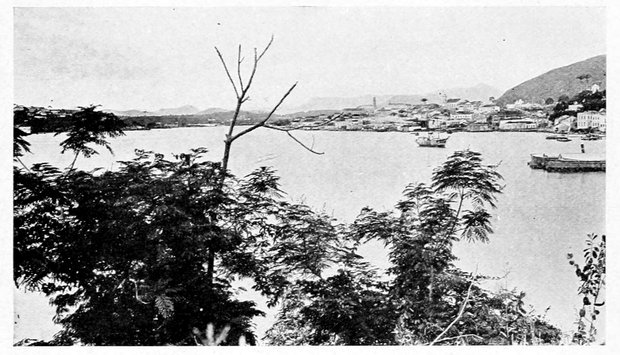
Victoria, capital of the state of Espiritu Sancto, is a tiny edition of picturesque Rio
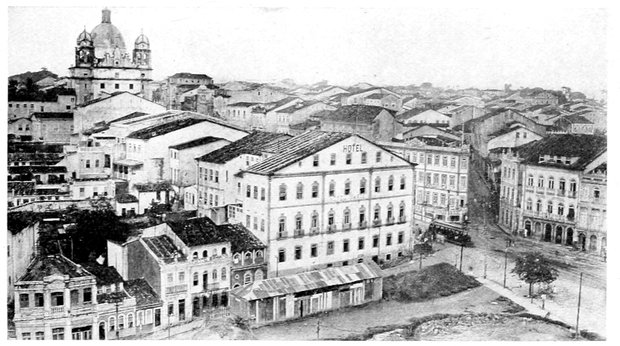
Bahia from the top of the old “Theatro São João”
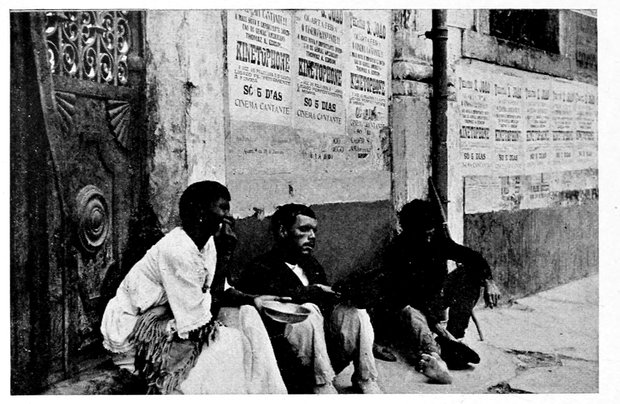
Beggars of Bahia, backed by some of our advertisements
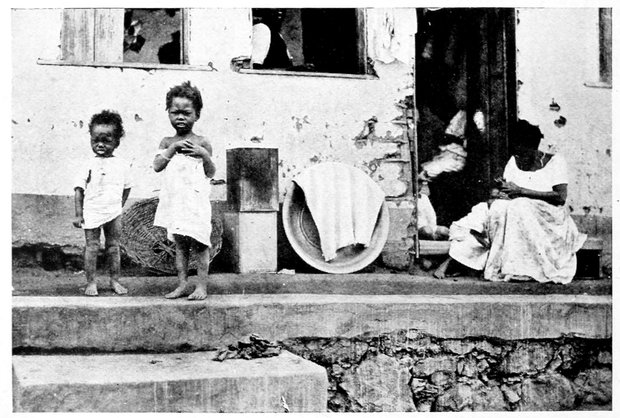
A family of Bahia, and a familiar domestic chore
Yet sometimes it is hard to blame the negro if he just lies in the
shade and a soft breeze and gazes away at the beautiful bay, indigo-blue
by day, shimmering with moonlight by night, ever fresh with the
breezes that lightly ruffle its ocean-like bosom, as if he were making up
for the loafing denied his enslaved fathers. After all, if Nature wished
man to exert himself, why does it produce such perfect weather and
cause bananas and jack-fruit to grow of themselves? The languid
picturesqueness of Bahia is best personified in the typical Bahiana,
black or near-black in color, wearing many bracelets and similar ornaments
of tin and wire, sometimes gilded, her immense hips heavy with
bulky skirts only a trifle less gay in color than her waist, shawl, and
turban, placidly smoking a big native cigar and carrying on her head a
small stool or a tiny table, legs-up like a helpless turtle, with perhaps
353a closed umbrella lying flat on top of that, on her way to squat on the
one and lean on or raise the other in church or market. If she has only
a single banana with her, the Bahiana will carry it on her head rather
than by hand. I have seen the ancient anecdote of the negro-girl servant
given a letter to post, who put it on her head and laid a stone on
top to keep it from blowing away, duplicated in the streets of Bahia.
Racial languor, however, gives way to passionate activity when some
black troubadour takes to thrumming his guitar and singing modinhas
and chorados. These popular ballads of Brazil, especially of Bahia and
Pernambuco, mixtures of the moda and fado of Portugal and of the
tribal rites of savage Africa, are childish in thought and monotonous
of rhythm, weird, languishing, half-wild songs, often improvised by the
unlettered troubadours and accompanied by sensual dances and strange
African movements of the body into which the whole negro throng
gradually merges, discarding all remnants of their second-hand civilization.
With such an electorate it is scarcely to be expected that Bahia
should swarm with honest politicians. Indeed, it is frankly admitted
that elections there are so corrupt that few bother to go to the polls and
take part in what the native papers refer to as “our electoral farce,”
knowing that the votes cast have nothing whatever to do with the result,
which the government in power fixes beforehand. Graft and misgovernment
are acknowledged to be worse than in Rio. Yet on the
surface there is the usual Latin-American polish. The scavengers of
Bahia had not been paid a cent in months, yet the municipality was
building a “palace” in which a single staircase cost 400,000$000! A
year before my arrival a delegation from the Boston Chamber of Commerce
had landed at Bahia on a water-edge tour of South America,
were brought ashore in a magnificent launch “at the city’s expense,”
and treated with such tropical generosity that their letters to home newspapers
bubbled over with praises of the wonderful hospitality of
Bahia. Agostinho Manoel de Jesus, owner of the launch in which they
had landed, was still going daily to the city treasury asking in vain for
his money.
Bahia was said to be the only place left in Brazil where bubonic
plague and yellow fever still persisted. It could hardly be otherwise
with rats running up and down every pipe, with every opening, corner,
or slightly out of the way place covered with accumulated filth, and
with sanitary arrangements almost everywhere in the old town quite
beyond the descriptive powers of Boccaccio. In contrast, great placards
354and posters everywhere, bearing the heading “Directoria Geral de Saude
Pública” (General Directory of Public Health) strive to carry out the
bluff that the town boasts a system of sanitation. Even the highest
priced hotel would be instantly condemned in any civilized city; the conditions
in which the vast majority of the population live are beyond
any imagination. During the preceding April thirty-five members of
the foreign colony, almost one third of it and including the English
pastor, had died of yellow fever, which was expected to begin again
with the rains. Yet my hotel furnished no mosquito net and I awoke
each morning bitten in a dozen places—and any Brazilian will tell you
that only white foreigners take yellow fever. In compensation only
natives, and chiefly negroes, die of the equally prevalent bubonic plague.
The federal government offered to send to Bahia the man who disinfected
Rio, but the state government haughtily replied that they were
quite capable of cleaning up the place themselves, and meanwhile sudden
death continues to flourish.
On my first Sunday in Bahia one of her innumerable festas was at
its height, that of “Nosso Senhor do Bomfim,” a miracle-producing
shrine of great popularity among the negroes. On Saturday night the
street cars in that direction were so crowded that I could not even
hang on. Bands of negroes carrying Japanese lanterns, singing, beating
drums, tamborines, and tin cans, marched in almost constant procession
past my window down to the lower city and on out to Bomfim,
a section of town three miles away around the harbor, the electric-lighted
façade of its miracle church standing forth from the night like
a monument to the ignorance, squalor, and hunger of Bahia. From
midnight on the throngs were even thicker, frequently waking me with
their maudlin din, for the festival of Bomfim is especially an all-night
affair, with much drinking and worse. On Sunday afternoon I went
out to the scene of the festivities. There were thirty persons in the
street-car, of whom two were white. On the climb up the hill to the
church the way was flanked by two unbroken rows of beggars, lame,
halt, blind, twisted, deformed, degenerate monstrosities, idiots of all
degrees and every percentage of African blood, every imaginable horror
in human form, and just plain nigger loafers, all holding out their hands,
or whatever they had left in place of them, in constant appeal.
The church itself was so packed that I could only enter by climbing
the stairs to a small side-gallery and look down upon an unbroken sea
of black faces, wrapt up in what sounded like a medieval Catholic
service translated into African voodooism. Among the schemes
355concocted by the swarming priests of Bahia is one that shows the suggestion
of originality. At the huge church and monastery of São
Antonio the faithful can buy, at a milreis each, special stamps designed
by the priests, with which to write to St. Anthony in Heaven, and be
assured of a direct answer from him—through his priestly agents on
earth, of course—on any subject.
“Lots of churches in Bahia,” I remarked conversationally to the white
Bahiano beside whom I stood watching the riot of gambling, drinking,
and indecency about the home of “miracles.”
“Oh, not out here,” he apologized. “Here there is only Nosso Senhor
do Bomfim, and São Antonio,” and Sao This and Sao That, naming
a dozen or more as he pointed them out roundabout. “This is only a
little corner suburb of our great city, but in Bahia itself there are
churches.”
It is a popular saying in Bahia that there is one church for every day
in the year, an exaggeration probably, but there are scores of massive
old colonial ones, not to mention monasteries full of fat, loafing monks,
on all the best commanding heights and taking up perhaps half the
city’s space. While some are fallen in ruins and are melting away from
the physical impossibility of keeping up so many, even now this ignorant,
poverty-stricken city was building several more, the latest to cost
three thousand contos—though not thirty per cent of the contributors
can read. In contrast, the schools of Bahia are horrible little dens
over butcher-shops and saloons and brothels, with forty or fifty children
packed into rooms that would not be comfortable for ten, without any
arrangements whatever for their bodily requirements. Even at that,
if every school in the city were packed to suffocation from dawn until
dark, not one third the children of school age could attend them. The
public library in this capital of an enormous and potentially rich state,
in a town of one third of a million inhabitants, reported that “632 books
or works of reference were consulted during the year.” Yet fear or
superstition caused every newspaper in town to print long editorials
praising the “beautiful festa of Bomfim” and the honor it did to “Him
whom it honored,” while the drunken debauchery was still going on.
By the Wednesday after my arrival “Colonel” Ruben, who, whatever
his faults, knew the art of advertising, had the fronts of all street-cars
and every blank wall in town plastered with Kinetophone posters
mostly of his own concoction, announcing to his fellow-citizens that on
Quarta Feria—Fourth Festival, to wit: Thursday—would open the
Greatest Cinematographic Occurrence of the Ages; The Eighth
356Marvel! Surprising! Stupendous!! Phenomenal!!! The Discovery
of the Year. Man no longer dies! Edison has immortalized him!
And at Popular Prices!! Everyone to the SAO JOAO!!! When
a brilliant sun woke me before seven on that epochal morning, there
was no sign of a steamer in all the blue expanse of All Saints’ Bay. I
shaved and was just starting for the “rain bath,” however, when I
caught sight of one nearing harbor. I still had time to dress, drink the
thimbleful of black coffee they call a breakfast in Brazil, and descend to
the wharves before the craft tied up there, with “Tut” and Carlos
hanging over the rail. I brought them up to my hotel, for as all those
in Bahia were equally disreputable it was as well to be together for
mutual protection, but it took us until noon to unravel the red tape
necessary to get our trunks ashore, quite as if we had been landing from
a foreign country.
For all his reputation, “Colonel” Ruben was an engaging fellow, and
though I made it plain to him that I would not trust him out of my
sight, he took it good-naturedly and assured me he welcomed all the
“fiscalization” I could give him.
“I notice you don’t trust people to any great extent yourself,” I
smiled, thinking to let him down easy.
“Trust!” cried Ruben, with a serio-comic gesture, “I trust my own
teeth—and they bite my tongue!”
I took him at his word and, having designed a rubber stamp, made
him produce packets of the four kinds of tickets used, ran them through
a consecutive enumerator, and stamped them all. He who has never
tried to stamp 1500 tickets an hour by hand will not realize what a daily
task I had laid out for myself merely for the satisfaction of giving
Ruben and his satellites proper “fiscalization.” These stamped tickets
I handed each night to the ticket-seller and at least one and sometimes
all three of us stood at the door ready to protest if anyone entered without
a stamped ticket, as well as to see that all went into the locked box
beside the door-keeper. After the show all unsold tickets were turned
over to me, the treasurer gave me a copy of the official borderaux, or
statement of tickets sold and the amount of money taken in, I unlocked
the door-boxes and carried home their contents to check him up, and
one half the day’s receipts in ragged Brazilian cash went into my
pocket before I could be budged out of the “São João” office.
I unmasked one trickster at the very first performance. Being still
stranger enough to most of the “São João” force to pass incognito, I
wandered up the dingy back stairs to the gallinheiro (chicken roost), as
357“nigger heaven” is called in Brazil, and found that the negro at the door
was accepting money in lieu of tickets. It was not that the money was
not quite as good, if anything it was a trifle less flimsy, but somehow it
could not be forced into the ticket-box at the taker’s elbow. He resigned
from Ruben’s staff less than a minute later.
Long before the first session ended we had closed the inner doors and
the lobby was threatening to overflow. For the first time in Brazil I
had permitted other “special attractions” to be offered with our own;
that is, in addition to the ordinary films Ruben had engaged two stray
Italian females who howled through several spasms of what they and
most of the audience seemed to think was music. As they had been
hired before our contract was made, and their wages were nothing out
of our pockets, I could only reasonably demand that the Kinetophone
remain the head-liner. The blacks of Bahia, we soon discovered, have
not yet reached even the moving-picture stage of development, rum,
dances, and church festivals being their high-water mark in recreation,
and not ten per cent. of our paid audiences were negroes, in a town
where fully three fourths of the population is of that race. But our
audiences were large for all that, because the lighter minority came
again and again to see the chief novelty that had reached Bahia in
several seasons. Even this near-white class, however, was not conspicuous
for its prepossessing appearance, and the calm, steadfast,
efficient face of Edison, gazing out from our posters through these
throngs of indolent, ambitionless mortals, insignificant of physique and
racially entangled, gave a striking contrast, typical of the two continents
of the New World.
Our first Sunday, in particular, was a busy day. It is the custom
all over Brazil for the “excellentissimas familias” to go to the “movies”
on Sunday afternoon or evening, and the habit is so fixed that they
prefer to pack in to the point of drowning in their own perspiration,
even at double prices, rather than see a better show on a week day. For
managers naturally take advantage of this fad and offer their poorest
attractions—just as Ruben withdrew his “imported artists” on this day—knowing
they will fill their houses anyway. If only we could have
taken Sunday with us, movable, transportable, and played on that day
in every town, we would have made as great a fortune as if the World
War had never cast the pall of a “brutal crisis” over Brazil.
By one in the afternoon I was at the theater door in impresario full-dress
and managerial smile, greeting the considerable crowd that came
to the matinée, and disrupting the plans of those who had hoped to drag
358five or six children by in the shadow of their skirts or trousers. Then,
with scarcely time for a meat-laden Brazilian supper in our disreputable
hotel across the street, I came back to the most crowded theater I had
seen in months. By 7:30 we had already closed the inner doors and the
élite of Bahia continued to stack up in the lobby until that, too, had
overflowed long before the first session ended. We were compelled to
send policemen in to eject the first audience, and when the house had
been emptied and the gates opened again, it flooded full from floor to
“paradise” five stories up as quickly as a lock at Panama does with
water. Even then all could not crowd in, and we herded them up once
more in preparation for a third session, which, though not beginning
until after ten, was also packed. Nothing so warms the cockles of a
manager’s heart as to watch an unbroken sea of flushed and eager
faces following his entertainment. By this time I had met most of the
high society of Bahia, all her white and near-white “best families,”
with now and then some physically very attractive girls among them,
having marched at least once past my eagle eye. That night I carried
off more money than had fallen to our lot since our first days in Rio
and São Paulo.
Though silver was conspicuous by its scarcity in Bahia, there were
other troubles attached to the handling of money. Those familiar
only with the quick and convenient methods of American banks can
have little conception of the difficulties of banking in South America.
No two banks in any city in Brazil, for instance, would accept one
another’s checks; worse still, two branches of the same bank in neighboring
cities would not transfer funds of their depositors without all
the formalities and expense involved in such transactions between
foreign countries. Where there is no mutual confidence there can be
no credit system, and instead of giving or receiving a check, one must
carry a roll of cash, like a professional gambler or a manipulator of
politicians. By the time I had four contos laid away in a British
bank, exchange had bounded skyward again, and it would only have
been to waste what little Linton was making to buy drafts as that rate;
yet the bank refused to transfer our account to their own institution in
Rio or Pernambuco, except at a high commission. When the day came
for us to move northward again I was forced to draw out our earnings
in ragged bills of tiny denominations and carry them with me.
Of “deadheads” and official mendicants the “São João” had its full
share. Ruben sent ten tickets a day to police headquarters, but those
who came on duty gave these tickets to friends and bootblacks and negro
359relatives, and thrust their way in on the strength of their uniform or
badge. We were overrun with grafters filling seats and using up
programs for which honest people would have been willing to pay
money, while a dozen of the best boxes were permanently allocated
to state and municipal officials and powerful politicians. When I protested
to “Colonel” Ruben, I learned another interesting little fact,—he
was forced to be kind to politicians because, thanks to his political pull,
he got this great four-tier theater, built by the government in viceroy
days and now belonging to the State of Bahia, rent free! As to the
police, he confided to me that he had to be lenient with them in order
that they might not be too harsh with him when he offered shows of the
“sem roupa” or undress variety.
For all the resentment of frustrated “deadheads” and the attitude
of Bahia’s newspapers, which at first gave five lines to Edison’s invention
and full pages to the religious debauch of Bomfim, the success
of the Kinetophone forced the five or six dailies to give our engagement
increasing attention. They were all rather pitiful sheets, and in a town
where at least three-fourths of the population never reads it would have
seemed highly advisable to have combined them into one good newspaper.
That of course would have been impossible, because of Latin-America’s
lack of team-work and mutual confidence, as well as the demand
of each political faction for its own organ of propaganda. One
day there appeared in the best of these sorry journals a long and learned
article by a Brazilian purist who, though flattering to the invention and
the inventor, asserted that it should be called “Cinephonio” rather than
“Kinetophone.” I was feeling in good Portuguese form by this time,
and having leisure enough to dig back through the layers of philology
to ancient Greece, I sent in an equally long and learned answer that
decidedly surprised editor, contributor, and reading public, accustomed
only to the type of American business man who is utterly ignorant of,
and wholly uninterested in, the native tongue. Comments on this controversy
and its astonishing dénouement drifted to my ears from our
throngs for more than a week afterward.
Such experiences as this emphasized the unwisdom of the habit of
many American firms of sending the same “drummer” to cover both
Brazil and Spanish-America. Brazilians have a rivalry toward Argentinos
which amounts to hatred; they consider the Castilian tongue
particularly the language of the Argentine and at least pretend to regard
it as a corruption of their own, of which they are unreasonably
proud. Hence the traveling-man who addresses them in Spanish is
360more apt to arouse resentment than commercial interest. If he cannot
speak Portuguese, he will do better to stick to English, using an interpreter
when necessary, or take a chance on his French, which most
educated Brazilians understand more or less, rather than deliberately
to incense them by using the tongue of their rivals and implying its
importance over their own.
We had now reached a latitude where it is doubly wise for the white
man to exercise regularly, and the daily walk that had always been a
custom I now made a stern requirement. Complaints against sluggish
livers were almost universal in the small foreign colony, but I noted
that they invariably went with large liquor bills and a scorn of pedestrianism,
even in its mildest forms. Personally, though it was unquestionably
hot and perspiration flowed at the least physical exertion,
I found the climate of Bahia agreeing splendidly with me, and a few
miles of brisk walking, followed by a refreshing “rain bath,” became a
pleasure to which to look forward. “Tut” could frequently be coaxed
to go with me, but his Brazilian training made Carlos prefer to loaf
about the theater and watch the rehearsing of dancing girls, in the face
of my warning that he was now in a different land than his cool and
temperate São Paulo. There were fine points to Carlos; one often
caught a suggestion that in some such stern environment as the United
States he would have turned out a man of parts, but the error of his
parents in turning south instead of north across the Atlantic made his
struggle with environment a pitched battle, with the odds against him.
There are endless wooded hills and valleys in Bahia, with old forts
on every projecting angle of the city, on both the bay and the ocean
side, which recall the days when São Salvador was the proud capital of
Brazil, unworried by the suspicion of a future rival. Out beyond the
élite section along the Rua Victoria, past the old church said to stand
on the very site in which the city was founded, a nose of land jutting
out into the sea and swept by unfailing breezes was shaded by an aged
fort and lighthouse that made its sloping greensward or quaint stone
benches the most ideal place in South America to spend an afternoon
lolling over a book. If one felt more energetic, there were amusing
characters among the curious wicker fish-traps down on the beach
below. Often I walked all morning long entirely within the city limits
through dense uninhabited jungle, following soft earth roads down
through great valleys with clusters of negro cabins, and shops of the
equally superstitious Portuguese with whom they trade, bearing such
names as “Fé em Deus,” “Esperanç aem Deus,” “Todo com Deus,” the
361householders lolling in the shade beneath them and letting Deus do the
rest. Here the motto seemed to be “God helps those who wave a flag
with His name on it.” It was almost a relief to run across such
frankly cynical shop-names as “A Protectora da Probeza” (The Protector
of Poverty).
Bahia is built on a peninsula connected with the rest of the continent
by a narrow neck of land, and out this runs its railway line, soon to
split into three branches which wander away into the interior of the
state. My random wandering brought me out across this one morning
and on along the shore of an inner arm of the bay, here endlessly lined
with negro huts. I was quenching my tropical thirst with a juicy
watermelon when a negro stopped to ask if I did not know that I would
die if I ate watermelon in the middle of the day, and soon brought a
crowd of excited blacks chattering and gesticulating about me. South
America is full of such amusing superstitions, concerning the danger
of eating certain foods at certain times, or of eating simultaneously two
that do not “fit together.” An old dugout sailed me across the breezy
neck of the inner bay from Brandão to Itapagipe, sparing me a return
tramp of five miles, for at this point the electric cars pass frequently.
There is a long beach in this middle-class suburb of Itapagipe, and a
little wharf at which crude sailing boats from about the bay unload
watermelons and mangos, bananas and big luscious pineapples, the latter
selling on the spot for a mere tostão, or those with empty pockets may
fish slightly damaged ones out of the water for nothing. On such excursions
one must take care not to dress too carelessly, for there are,
of course, two classes in the Philadelphia-made street-cars of Bahia and
little visible sign to distinguish them, so that on almost every tour
through the first-class car the conductor is forced to order men without
coats, or collars, or socks, or real shoes, or a proper haircut to go back
into the other. On the other hand he, too, has his rebuffs, for almost
anyone wearing a frock-coat says haughtily, “I have a pass,” though
never offering to show it, and the conductor sneaks obsequiously on.
A favorite recreation of foreign residents and wealthy white natives
of Bahia is to visit the principal ships that anchor in the harbor. To
many this is the one touch of civilization superior to that at home, as the
trains in which the people come to sit for a few minutes are to the inhabitants
of interior villages. But most of them come for more
material purposes,—the foreign residents to imbibe “real booze” once
more, the élite among the natives to defraud the country’s revenues by
replenishing their wardrobes at the ship’s barber shop, buying boxes
362of chocolate, scented soap, perfumes, lingerie, all the smaller luxuries
which can only be had at much higher price or not at all on shore,
“women of the life” on professional errands or merely to catch a
breath of their beloved Europe. There was a steam-laundry on the
ships I visited and had I thought of it in time I might have brought
my soiled “linen” on board, as did not a few residents, and had it back
when the boat returned from Buenos Aires. To entrust anything to
the native washerwomen of Brazil, particularly of Bahia, is to risk
having it worn for a week or more by the laundress’s husband or lover,
and to insure that it shall be beaten to a pulp in some mud-hole, dried
among goat-dung, and returned a fortnight or so later more torn and
soiled than when it departed.
About a week after we opened in Bahia, Ruben drifted around to my
usual station in the course of the evening and said that he would like
to lengthen our contract from twenty-five to ninety days. I declined
at once, at least on a fifty per cent. basis. He next offered to pay the
baggage haul in addition; then he promised to defray all our traveling
expenses, and to cover all the territory from Bahia to Pernambuco. I
promised to think this over.
Though I had not found Ruben “crooked as a bed-spring,” as some of
his former business associates described him, I knew that he had not
been designed with a T-square—and Ruben knew that I knew it. But
he was a good “mixer” and an excellent manipulator of politicians,
which is a great advantage in Brazil, and is acquired with great difficulty
by a foreigner, no matter how well he may learn the language. Besides,
Ruben had the most American ideas on advertising of any Brazilian
I had ever met and though, of course, he expected to make something
out of us, it was a question whether we would not get more ourselves
while he was making his profit than we could make alone. Sometimes
a crook, well watched, is a better business partner than an honest
man, for he is likely to take a chance and is rarely as slow to see an opportunity
as are more sincere individuals.
I did not, however, care to spend three months in that corner of the
world. I hoped, in fact, to be well up the Amazon by that time, and
after sleeping on it I agreed with the “colonel” on a sixty-day contract
at the terms he had offered. By this time my practice in Portuguese
made it easy to draw up an elaborate document of twelve articles
that even a corporation lawyer would have had difficulty in evading. In
effect, it made Ruben our advance agent, with the privilege of paying
himself, and left me merely my managerial duties. Indeed, this document
363and what had led up to it so took the “colonel’s” eye that next
day he informed me he needed a man of my “pulse,” or American
energy, and that as soon as I got the Kinetophone back to the United
States I must return and become manager of the big new theater he was
soon going to build on the triangular vacant lot near the “São João”!
“Muito obrigado,” I replied, that being Brazilian for “much obliged.”
We were to play in Bahia and about the bay until carnival time,
come back to the “São João” for those festive days, and then turn northward.
On the morning of January 26 we tore down the show and
loaded it into the special baggage-tramcar Ruben had furnished, moving
under guidance of his part-Indian mulatto sub-manager out to the
suburb of Rio Vermelho. This was a sea-beach village of mainly well-to-do
white residents—though no one seemed to bathe, at least in the
sea, in Bahia—three miles from the center of town through densely
wooded valleys of mango and alligator-pear, jack-fruit and bread-fruit
trees, all heavily loaded with their products. We played to packed
houses, with few “deadheads,” for here Ruben had little fear either of
politicians or police. The cinema of A Barra, another seaside suburb
to which we moved three days later, was an outdoor place of sandy
bottom, a sheet-iron wall, and only a suggestion of roof, always comfortable
with the trade wind sweeping through it. There I could go to
the show and look at the brilliant moon at the same time, and our film-men
could be heard talking and singing blocks away.
Having performed the extraordinary feat of sleeping seventeen
consecutive nights in the same bed, I decided that I needed a change of
scene. Up at the head of the bay was a town called Santo Amaro da
Purificação, where Ruben had planned to take us; but a religious
festival having broken out there, he changed his mind, saying that
negroes celebrating church festas do not spend money on cinemas. I
went over to see whether he was right, and incidentally to revel in the
“purification” attached to the town’s name.
One of the little steamers of the “Navegação Bahiana” that sail the
bay, leaving three times a week for most of the towns around it, departed
at high tide with a considerable crowd bound for the festa. It
was hot under the lee of the land, but once out on the blue water
nothing could have been more pleasant, at least in so far as weather was
concerned. We stopped at three towns on as many islands and passed
many smaller ones along the base of the bay shore, almost everywhere
piled up in hundred-foot cliffs. The soil, even on the smallest islands,
was of that deep-red color common to much of Brazil, and royal palms
364lifted their proud heads over a reed-and-mud negro hut on many a little
island. We picked up festa-dressed passengers at several villages.
Perhaps one out of twenty of my fellow-travelers showed no traces of
negro ancestry. Bad teeth were universal among them, more unsightly
still in the case of those with a smile like a flash of a brass-shop
window, who could afford the ministrations of the wandering “dentists”
that inflict interior Brazil.
By and by the water turned from the dense clear-blue of the bay
to a grayish color. Several large time-blackened churches appeared on
commanding, breezy noses of land, with a few poor houses and miserable
huts tucked away in the hollows beneath them. We entered a
small river that wound in S-shape through a sort of marsh, passing a
three-story agricultural school that loomed up through the palm-tree
jungle in apparently utter isolation, and at sunset tied up at the end
of a long causeway across a swamp, where a dozen quaint little mule-cars
were waiting for us. The fare on these for a two-mile ride was a
milreis, which was bad enough, but the driver, singling me out as the
only foreigner and person of wealth among the festa-bound horde, and
no doubt short of cash for his own celebration, demanded that I pay
double fare, and was invited to go to the devil for his pains.
He was going there anyway, it turned out, for if the manager of the
more populous afterworld does not own Santo Amaro da Purificação it
would be hard to get anyone else to claim it. A long, thin, one-story
town, stretching out for a mile or more through low, soggy land, it is
inhabited almost entirely by animal-like blacks festooned in dirty rags.
Groups of loafing negroes filled every doorway, covered every shady
spot, occupied the narrow remnants of dilapidated sidewalks, doing
nothing for a living, not even taking in one another’s washing, and
living happily ever after for all that. A cross between a ditch and a
river flows—or rather, lies—through the length of the town, and in this
stagnant sewage the inhabitants not only attempt to swim when the
whim comes upon them, but dip up water for cooking purposes. To
drink it would evidently kill even a Brazilian negro, so in various parts
of the town there are public spigots shut in by iron fences, with an
elaborate “office” and a turnstile that can be passed only by paying a
vintem for a can of water. Along the noisome canal are a few distilleries,
dirty as the rest of the town, and a bit of sugar-cane is grown
in the vicinity, but on its edges Saint Amaro of the Purification breaks
at once into green rolling campo, which the swarming inhabitants are
too indolent to cultivate. Two automobiles had come to show off at the
365festa, and were so rare a sight that whenever they appeared, jouncing
and bumping down one of the so-called streets, with a dozen of the
town notables clinging wide-eyed to the seats, all the children and most
of the adults took to pursuing them with shouts of “Oo ah-oo-tah-mave!”
The festival really did not begin until next day, but as often happens
in Latin-America, the people could not wait and were already celebrating
the véspera. About the matrix, or main church, surged immense
throngs of leprous, unwashed negroes, hilarious with the drunken-religious
orgy. Native rum flowed everywhere. There were forty-two
gambling tables running full blast, with crowds of children from six
to sixty—if anyone ever lives to that age in Santo Amaro—throwing
their money upon them, many so poor that they had only coppers to
hazard. Any negro boy who could get a table, mark a square of cloth
or cardboard with numbers or colors, and produce a tin can and
three dice or any kind of home-made roulette wheel, became forthwith
the proprietor of a gambling establishment. The town was lighted by
gas—except that most of this was now used to illuminate an “AVE
MARIA” in letters ten feet high on the façade of the church. Under
this a band blew itself almost brown in the face in honor of the tin
Virgin inside the musty old church, before which throngs of gaudily
but raggedly dressed negroes were bowing down, crossing themselves
on the face, mouth, navel, and finally the body, and displaying curious
intermixtures of Catholicism and African fetish worship.
All night long the hubbub lasted. My unknown Brazilian roommate
in the “Pensão Universal,” a human sty which had recently opened
as a public hostelry and would no doubt close again after the festival,
had usurped the bed by piling his junk upon it, and left me a crippled
canvas cot. I was awakened frequently by the cold coming up through
this, though by no means so often as by the amorous negro swains and
wenches retiring from the exciting festivities to adjoining rooms.
High noon found me struggling to get a railway-ticket back to
Bahia. It was no easy feat. Eventually we had to break into the
inner office and corner the befuddled agent, who replied to our excited
demands with a tropically phlegmatic, “But there is no hurry; the train
will not really leave at twelve.” Subsequent events proved that he was a
better prophet than the printed time-table. We finally dragged away
about two, on a railroad built in 1881 and still retaining the same roadbed,
rolling-stock, swell-headed old engines and point of view, and
rambled along most of the afternoon, until we came to a derailed train
366and were told to get out and walk. Luckily we were only a few miles
from Agoa Cumprida (Long Water), where this branch line is joined
by one from up the coast—and on the whole it might be a good thing
to make travelers by rail get off every little while and walk a few miles.
As the first long cove of the beautiful bay came into view I dropped
off and was sailed across the neck of water in one of the ferry dugouts
to Itapagipe, where one engagement at the “Theatro Popular” was
proving popular indeed.
Three days later all of us, including Ruben in person, took a side-wheel
steamer across the bay to São Felix, planning to spend a week
away from the city. Across the deck from me sat a white woman
with three chain bracelets, one wrist watch, seven very large rings on
four fingers of the left hand, six more on the four fingers of the right
hand, a gold watch-chain some two yards long about her neck, enormous
showy earrings, a gold locket and pendant, and various other gaudy
odds and ends. This paragon of taste, it turned out, was one of our
party. She was from Montevideo and Ruben had brought her along
to do a Spanish dance sem roupa—no wonder she needed to be covered
with jewelry—for the benefit of the matutos, or “country gawks,” of
the interior.
A couple of hours carried us across the main bay and we entered a
narrow inlet which soon swelled into another and smaller bay that
gradually narrowed down until we found ourselves in an immense
river, the Paraguassú, with low bushy sides and water well up to the
branches of the few trees at high tide. Villages, towns, and single old
fazenda-houses under their majestic royal palms appeared here and
there, at some of which we tied up. Others sent on board or took
ashore two or three of the plantation family in flimsy dugout logs
paddled by more or less naked negroes. Most of the towns had names
ending in “gipe” and lived on their exports of fumo and charutos
(tobacco and cigars), that weed, as well as fruit and cacao, growing
abundantly back in what looked like rather a barren and bushy land.
The river narrowed, winding through low hills, and at sunset we
sighted the twin towns of São Felix and Cachoeira, on opposite sides
of the stream and connected by a long railway-and-foot-bridge, at the
foot of a series of rapids over black jagged rocks that halt navigation
and give the latter town its name.
As usual bedlam broke loose between the chaotic-minded passengers
and the aggressive boatmen, carregadores, and touts fighting for business.
Though there was an abundance of men in ragged, baggy uniforms,
367no one seemed to have any authority. One evil-eyed, half-baked
looking fellow who drew a razor in the midst of the turmoil turned out
to be the hotel-keeper who had been told to prepare rooms for “the
entire Kinetophone company,” and who did not propose to be outwitted
by a rival. We let them fight it out, put our light baggage
into a ferry “canoe” with Carlos and the undress “artist,” and sent
them across the river—our theater being in São Felix and the boat-landing
in Cachoeira. Then we walked a mile or more along the
rough-and-tumble stone streets of what appeared by the weak gas-lamps
to be a town transported bodily from the heart of the Andes,
paid sixty reis at the bridge turnstile, and brought up at the tiny
“Cinema São Felix.” There Ruben and the Italian owner broke into
such garrulous greetings that it was after eight before we finally
dragged our guide and mentor away to the “hotel” of the belligerent
seeker-after-guests, who was now grieving over the unexpected scantiness
of our “company.”
Of the pseudo-meal foisted upon us after two hours of shouting,
swearing, and insisting, I will say nothing, and even less of the boiler-factory
din that seethed through the tiny pens divided by thin wooden
partitions reaching only halfway to the un-ceiled roof, except to remark
that, as soon as the show was installed next morning, “Tut” and I
might have been seen moving across the river to the “Hotel das Naçoes”
in Cachoeira. This second city of the State of Bahia—equal in size
to Texas—was only a languid backward village, without electric-lights,
without even a wheeled vehicle, unless one counts the tri-weekly side-wheel
steamer or the little railway that rattles up to Feira do Sant’ Anna
and straggles 165 miles west into the interior of the state. There are
several moderately large tobacco and cigar warehouses, but almost the
only sign of industry in either of the twin towns was our advertising,—a
deluge of posters and handbills, and a parade of taboletas, or large
movable street-signs, accompanied by negro boys beating cymbals,
drums, and tin pans. We charged double prices, because the theater
was too small to make anything less worthwhile—and we played to
128 paying clients and a score of “deadheads”!
Next day the Italian cinema-man begged us with tears in his voice to
cut the entrance fee in two, and as some such drastic action seemed
necessary to save us from bankruptcy, I agreed—and that night we
had 89 paid admissions! These interior towns are so sunk in sloth that
they seem to resent any attempt to shake them out of the somnolence of
their ancestors, out of that apathetic indifference to the advances of
368civilization which makes them scorn even the few opportunities of a
life-time to see something new and important, to get some hint of the
world’s progress. Only the barbaric recreation of drunken church
festivals appeals to them.
I took advantage of the Sunday train to visit Feira do Sant’ Anna,
thirty miles up-country. This line was built back in the seventies, yet
the names of Hugh Wilson and other Americans still appear on various
bridges and viaducts. The train climbed for half an hour, and still
we could look down upon the twin towns close below, but once up on
top of the flat, rather dry and sandy, plateau it raced along at decent
Brazilian speed. The slender branches of the mandioca were numerous,
and here I saw my first tobacco-fields in Brazil. At one station a mile
from the town it served saddle-horses were waiting for the men and
enormous, bungling, two-wheeled mule-carts with wicker armchairs in
them for the women. It would have been dreadful if one of the white-collar
class had been forced to walk that mile along the smooth, dry,
cool summer road. For it was pleasant and breezy up here, though
the elevation was not great; even at summer midday one could walk
comfortably in the sun bareheaded—provided one could walk anywhere
comfortably. My preconceived notions of this region proved entirely
false. I had expected dense jungle and forest, and humid, leaden
heat; on the contrary, it was not only dry and cool, but almost bare
of vegetation.
Feira do Sant’ Anna, so named for the great cattle-fairs that were
held here on St. Ann’s day, is less than a century old, a one-story town
sitting out unsheltered on a dry, sandy, plain. Two streets wider
than Broadway cross at right angles in the center of town, and are
fully paved with cobblestones and lined with small bushy shade trees.
On Monday market-days these are thronged with countrymen and
women from a hundred miles around. To-day a cockfight under a big
tree on the outskirts seemed to be the only activity. Two roosters
without artificial spurs, but with bloody heads and necks, entirely
featherless in spots, pecked at each other eternally, while bullet-headed
negroes and mulattoes stood around them betting—if they still had
any coppers—one owner or the other occasionally picking up his bird,
spraying a mouthful of rum-and-water on its head and neck, and
setting them at it again, until one fell from utter exhaustion and the
other, wabbling drunkenly on his bloody feet, uttered a feeble crow
of victory. Wells with good American force-pumps marked the town a
rare one for interior South America, where the inhabitants generally
drink from some nearby creek or mud-hole; but drought had left little at
the bottoms even of the wells, and this scant supply negro boys were
delivering to various parts of town in casks on mule or donkey-back,
a blue enameled government license on the forehead of each four-footed
animal.
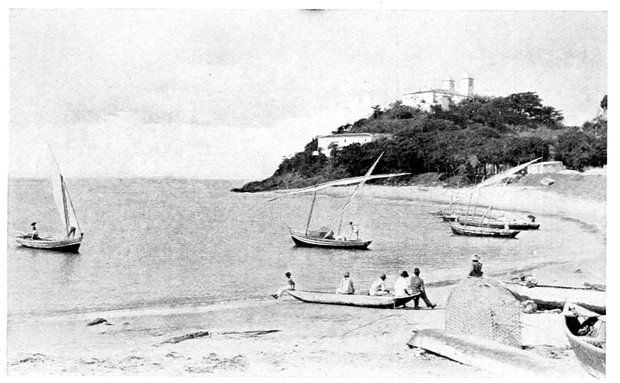
The site on which Bahia was founded
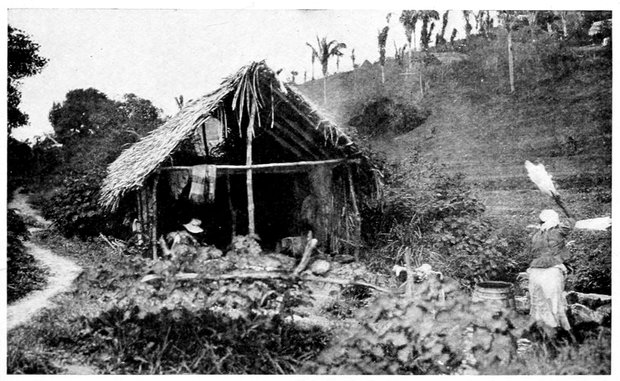
Not much is left of the clothes that have gone through a steam-laundry of Bahia
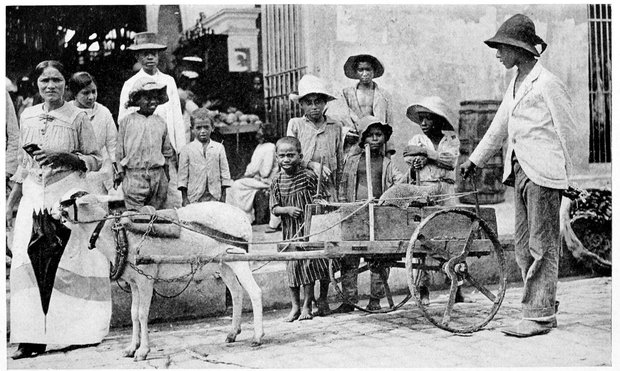
Taking a jack-fruit to market
369When we got back to Bahia on February 10 a brand new hotel had
been opened on the space left between Ruben’s present theater and
the invisible one I had the opportunity of some day managing. It was a
five-story, flat-iron placete on the height of the city, the highest building
in Bahia, or, indeed, in the state, and was the wonder of the region.
The only elevator in the paunch of South America, except the outdoor
one between the lower and higher city, ran all the way up it, but when
“Tut” and I entered, it refused at first to work, whereupon I stepped
out again to get something I had forgotten.
“Oh, don’t be afraid!” cried the servant, himself ashy with fear, who
was attempting to manipulate it, “it won’t fall.”
On the fifth floor, spoken of with a catch of the breath in Bahia, we
had a pleasant little room with a vast outlook over city and ocean—and
as it was starting in to acquire a reputation, the place was strictly
a hotel and not a brothel. Materially it was a great relief from what
we had been enduring for weeks past, and the unwonted sensation of
living in well-nigh civilized surroundings again was welcome, but a
hotel, after all, takes its tone from its guests and servants, and these
being Bahianos, it was doubtful whether so expensive an establishment
would be able to keep its head above water. Speaking of water, the
shower-baths were extra, as usual in Brazil, but when I confided to the
manager that I would move out again next day, he hastened to assure
me that no one would notice when I bathed.
Street-cars and walls were again flaunting Kinetophone advertisements
inviting everyone to come and see the “marvel of the age.”
But it was “reheated soup” in Bahia now, and out at Itapagipe, where
we had played three nights to crowded houses only a week before, the
Latin enthusiasm had effervesced and we had only a straggling audience.
If only we had had some new numbers, say a couple of Caruso! The
second night was worse, with our share only 36$, and the owner
refused to give a show at all on the next and last night, saying the few
days before carnival were the worst in the year in the theatrical business,
as everyone with a tostão was keeping it to buy masks, confetti,
and scented water.
Carnival costumes and the silly soprano speech that goes with them
370were already beginning to appear in the streets, and by noon on Sunday
negroes and half-negroes in fantastic make-up were everywhere. Most
of the “São João” employees were drunk or excited or parading the
streets by the time we opened for the matinée, and as I could watch
the door as well from there, I sat down behind the wicket and became
ticket-seller. Few ticket-offices in the world can compare with that of
the old “São João” in situation, under the deep colonial porch, open to
all the trade winds of the blue Atlantic, golden-bathed by day and
silver-lighted by night, lying a few hundred feet below and stretching
away unbrokenly to the coast of Africa.
Masked figures came, asking for tickets in the falsetto they hoped
would disguise their voices, as well as the usual haughty, tar-brushed
class in the full dress of public appearance. I quickly acquired the
professional ticket-seller’s “snappy” language and could toss out a
handful of change or a concise bit of information quite as scornfully as
the most experienced station-agent in my native land. Not a great
many spectators entered that afternoon, however, for which I did not
blame them. Why pay to go inside a musty old theater when the
brilliant summer day outside is full of free entertainments? Only
two weeks before there had been a similar celebration, but there is a
constant string of this expensive tomfoolery the year round in Bahia.
The amount spent on trolley-car and automobile floats alone would have
built a good school-house, to say nothing of the bands of music, costumes,
and playthings. Scores of automobiles filled with fantastically
garbed men and girls crawled through the streets, while thousands afoot
were arrayed in wild and generally ugly and orderless fantasy, with
masks or head-pieces equal to Bottom the Weaver. It was evident that
the paraders were mainly from the lower classes and had little originality
of ideas in designing costumes. Nearly everyone’s slight sense of
humor prompted him to pose as the opposite of what he was in real
life; every negro who could afford it wore a rosy-cheeked mask and
white gloves; many of the few whites had blacked up or donned negro
masks, and perhaps half the men were made up as women, while
there was a perfect rage, particularly among the part-negro girls, to
appear in male attire, their hips bursting through their otherwise loosely
flapping nether garments. “Ladies of the life” took advantage of
the spirit of the day and sat bare-legged in their balconies over the
main streets, the police, of course, never interfering, since correction
or suppression are unusual and unpopular in South America. We
371cancelled the third “section” that night and joined the throng parading
the streets amid cloud-bursts of confetti, rivers of scented water, and
maudlin uproar, and after looking in at a popular ball that had many
suggestions of a witch dance in the heart of Africa I went home for
my last night’s sleep in São Salvador da Bahia.
CHAPTER XVI EASTERNMOST AMERICA
372
The new contract with “Colonel” Ruben permitted me to absent
myself from the show and travel when and where I saw fit,
he to pay my transportation only by the most direct routes
between the towns in which the Kinetophone appeared. My faith in
Ruben was always limited and my preference for land over sea travel
notorious, hence I decided to strike off up-country a few days before
the date set for us to sail for Maceió, not only to indulge my incurable
wanderlust but to prepare for any sudden collapse of our sixty-day
contract.
“Chemins de Fer Fédéraux de l’Est Bréslienne” seemed as top-heavy
a name for the narrow grass-grown track up the coast as the
mammoth stacks made the little old locomotives. Its tiny cars were
designed for the use of women rather than men, for the seats, instead
of facing the open windows and the world outside, stared into mirrors
set in the car walls. We ground away along the water, past Bomfim,
topped by its white “miracle” church, past Itapagipe beyond the widening
water with its little sailing dugout ferries, crept timidly across the
long and aged wooden trestle over this innermost arm of the bay, and
at length lost Bahia to view just a month from the moment I had first
set eyes upon it.
There were a dozen stops at languid little cocoanut villages along
the fringe of the inner bay before the water gave way to dry and bushy
pasture-land at Agoa Cumprida. Most of the passengers changed there
for Santo Amaro, and for the rest of the journey we had more room
than company, which is usually an advantage in Brazil. Heaps of charcoal,
burned from the scrub trees that abound in this fairly fertile but
dry and little cultivated region, lay at most of the stations, at all of
which throngs of men, women, and boys strove to sell dusty fruit and
home-made cakes to the apathetic passengers. The dust lay thick upon
us also when we drew up at noon in Alagoinhas, eighty miles north.
That day’s train was bound up-country to Joazeiro on the São Francisco
river, and it would be twenty-four hours before I could continue
along the coast.
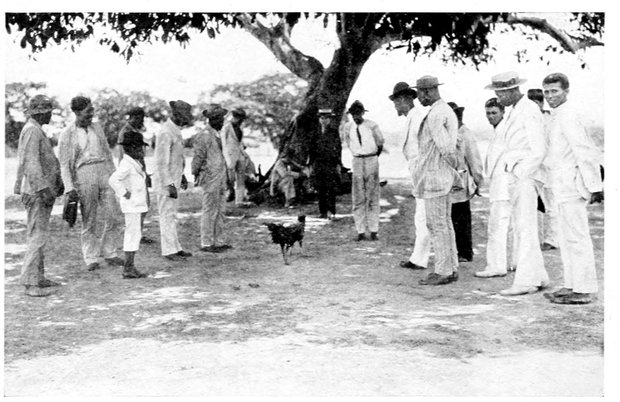
The favorite Sunday diversion of rural northern Brazil
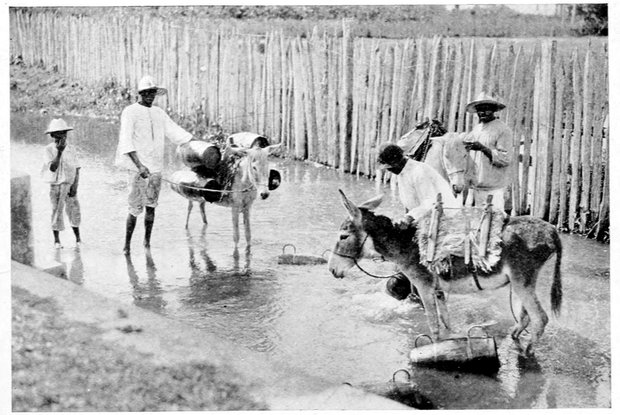
The waterworks in a Brazilian city of some 15,000 inhabitants
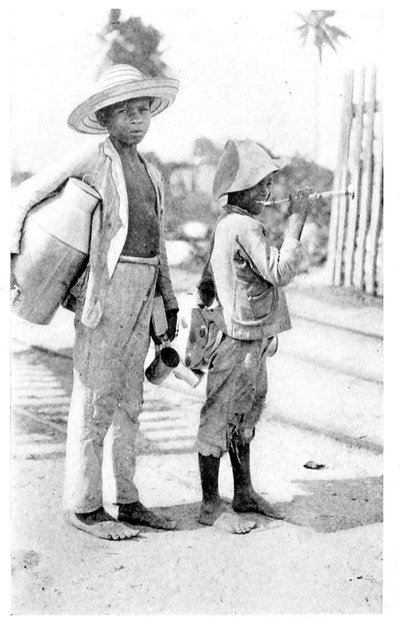
Brazilian milkmen announcing their arrival
373Some chap with a tendency for exaggeration has said that the night
has a thousand eyes; but that is nothing compared to almost any
interior village of South America when a white stranger comes strolling
through it. To walk the length of a street of Alagoinhas was like
trying to stare down some mammoth, bovine, fixedly gaping face,
until a sensitive man could scarcely have refrained from screaming,
“For Heaven’s sake go and do something, or at least draw in your
stupid faces!” Spattered over a lap of broken country and half-hidden
in cocoanut and palm groves, it would be difficult to decide how
many of the 15,000 inhabitants it claims actually dwell in it, were it not
their unfailing custom to line up to be counted. There was not a
street in town, which is well inland and at a slight elevation, but merely
wide sloughs of sand between the monotonous rows of houses; yet I
was astonished to find two large and well-kept cinemas. This, it turned
out, was due to a local feud. Two brothers who owned the “Cinema
Popular” had been bosom friends of the richest man in town, until they,
too, bought an automobile. This so enraged the rich man that he
attempted to get even by building another “movie” house in the hope of
putting the brothers out of business. So far he had not succeeded, and
was all the less likely to do so after I had signed a contract with the
brothers for five nights at the “Popular.” Ruben might take the show
to Maceió and Pernambuco as he had promised, but I did not propose
to be caught napping, and if he did, the Alagoinhas contract would be
good in June or July when the Kinetophone returned without me.
Another car so loose-jointed that the walls constantly creaked and
swayed toiled all the afternoon and into the night to carry a scattering
of passengers to Barracão, another name for Nowhere. It consisted
merely of several huts and a tile-roofed building in which all passengers
by rail from Bahia to Aracajú, or vice versa, must spend the night.
The engine, whistling up about a cord of wood, awakened us long
before daylight and at least an hour earlier than was necessary, for I
was already sitting in our six o’clock train when the other pulled
out Bahia-ward at five. The same seat, the same conductor, and the
same swaying walls as the day before made one feel like a trans-Siberian
traveler, though the 278 miles the train worries through in
two days is scarcely a Siberian distance. The salt-tainted breath of the
Atlantic slashed us now and then in the faces as we rumbled along, for
we were not far inland now. It was gently rolling country, of gray
374rather than red soil, producing next to nothing, with here and there
some bananas and mandioca, and long unbroken stretches of scrub
jungle. The tucú, a grape-like fruit growing on a palm tree and so
thick of skin and large of stone that there is only a bit of sweetish
dampness between them, was sold at the rare stations.
Soon we crossed an iron bridge and what might have been a river
had it tried harder, into the State of Sergipe, the smallest of Brazil.
This and the little larger State of Alagoas are sliced out of the respective
states of Bahia and Pernambuco down near the mouth of the São
Francisco, which divides them. It is not apparent why they need
be separate states—but then, a foreigner ignorant of local conditions
no doubt wonders in looking at a map of our own country why a
little nubbin of land down at the end of Connecticut must have its
own name, capital, and government, or why both those bits of territory
should not join Massachusetts. The state lines of Brazil follow
largely the old colonial divisions, some natural but more of them
artificial, set by the Pope or the King of Portugal. Of the twenty
Brazilian states, nine or ten have aboriginal Indian names. It is
another evidence of the higher value of time to the American that we
have an abbreviation for each of our states, while the Brazilian has
none. North and South American incompatability of temperament
is perhaps nowhere more definitely demonstrated than in the attitude
of the two races toward time. Brevity, conciseness, and promptitude
rank almost as bad manners among Latin-Americans, whose editorial
writers often break forth in dissertations on “punctuality, that virtue
of kings and bad custom of Anglo-Saxons. Enthusiasts for liberty,
we cannot admit that a man shall be the slave of his watch. Life
proves that punctuality is an excellent virtue for a machine, but a
grave defect for a man.”
In the blazing afternoon we came down off the interior plateau,
ever lower to the northward, here reminiscent of southern Texas or
northern Mexico in its aridity, its scattered, thorny, scrub plant life,
its occasional adobe huts, to a flat sea-level littoral that was almost
entirely a dreary waste of snow-white sand, rarely punctuated with
cactus and a few other waterless bushes. Aracajú, capital of the State
of Sergipe, is set in this nearly desert landscape. The large room with a
mosquito-net canopied bed in which I was soon installed in the “Hotel
International” was the best the town had to offer befriended strangers.
Like all the rest of Aracajú, it was on the ground floor, looking out
on a quiet garden of deep sand, and was as airy as the exhaust from a
375hot-air furnace. I had already taken it when my eye fell upon a
notice to the effect that for lack of water guests would not be allowed to
bathe for three days. By shouting until the whole hotel force was
gathered about me, and offering to make them all candidates for hospital
treatment, I was conducted, as a special favor to another of those half-mad
“gringos,” into a special “rain bath” for ladies, and freed myself at
last from the soil of Bahia. Then, having induced the landlord to
change the wooden-floored bed for one “of wire,” though he could not
understand why anyone should consider this an improvement, I relaxed
and sallied forth to see what Aracajú had to offer.
Sergipe, it seems, was a part of Bahia until nearly the end of the
colonial period, when it proclaimed itself a sovereign state with the
capital at São Cristovam, a straggling town some twenty miles back
along the railway by which I had come. But that was a league from a
harbor, and the government at length moved to an Indian village on
the edge of this cucumber-shaped bay. Ara is a Tupi Indian word for
plenty, and cajú is the Brazilian name for a fruit that thrives in such
semi-desert regions as the littoral of Sergipe. This is shaped like a
small plump pear, with a smooth silky skin of saffron or brilliant red
color, which grows upside down on a tree not unlike the apple in
appearance, and is particularly conspicuous for the fact that the seed,
shaped like a parrot’s beak, gray in color, and containing a nut that is
delicious when roasted, grows entirely outside the fruit itself, protruding
from its larger end. The meat is white, exceedingly acid, and
sure death alike to thirst and the dye-stuff of garments. There were
barely a dozen Indian fishermen’s huts at Aracajú when it became the
capital in 1855; hence it has an appearance of newness rather than age,
and only two churches—quite sufficient, to be sure, but a great contrast
to Bahia. There is nothing particularly individual about the place,
its “palaces,” houses, or people, who are sufficient for all the Lord
meant them to be in this world and very few of whom are going to
the next, if I may judge by the size of the congregation and the priestly
remarks thereon at early mass the morning after my arrival.
The predominating type of aracajuano is the gray or brown mestiço,
and a mixed race is rarely prepossessing in appearance. There are few
full negroes, even fewer pure whites, but every known mixture of the
two, no small number of mamelucos, or crosses between Indians and
Europeans, and too many bodes (literally male goats) as the offspring
of Indian and negro are clandestinely called. The cucumber-shaped
bay is really the River Sery-gipe, a name said to mean the abode of a
376kind of shrimp which abounds here, and has a troublesome moving
sandbar at its mouth, with less than four meters depth at low tide,
making Aracajú the only Brazilian coast capital which transatlantic
steamers cannot enter. One may see the waves breaking on this bar
from almost any point in town, but the open sea is in view only from
the top of the cathedral or the crest of the highest sand-dunes. Half
the coast of Sergipe is made up of this snow-white sand, in dunes that
move with the wind, immense heaps of the purest white sand covering
whole blocks and rising a hundred feet or more high within two minutes’
stroll of the main hotel. All but a very few of the streets are ankle-deep
in sand, as are the palm-trees. These few are paved with large
flat rocks fitted together in all manner of irregular patterns. The
“bonds” were still operated by mule-power. There is a pleasing central
praça, facing the waterfront and backed by a little garden with a vista
of the cathedral through royal palms, pleasing perhaps because its bit
of green lawn is in such welcome contrast to the glaring sandy brightness
elsewhere, but marred by the statue of some local hero who, according
to this monument, stepped out of somewhere wearing a frock-coat
and waving a most properly creased soft felt hat, crying, “I am going
to die for my country!” If he could see it now he might regret his
heroism.
In full sunlight at midday I could have used my umbrella to advantage
as a parasol, if some miserable son of a Brazilian had not stolen it in
Victoria. But he who never walks in tropical sunshine will never
enjoy to the full sitting in the shade, and at least the nights were cool
and breezy. The only thing to grow profane over was that the steamer
which was to carry me to Maceió had not even left Bahia, “because
everybody there is busy with the carnival.” This meant at least three
days squatting among the sand heaps, and perhaps not reaching Maceió
until after the show did, since that was to travel by direct steamer.
Worse still, I had read all the Brazilian novels in my bag, and Aracajú
was not the kind of place to support a bookstore. There was nothing
left but walking, and that soon palls in a sun-glazed town closely surrounded
on all sides by shoe-filling sand-dunes.
This dreary and unproductive soil stretches from five to ten miles
inland for the whole length of the state, with a broad strip of stony,
rolling, clay soil back of that, on which sugar and cotton, tobacco and
farinha are produced in moderate quantity, while the western half of
the state is sertão, in which graze scattered herds of cattle. There is a
large weaving-mill in the capital, said to be the best in Brazil, but still
377capable of improvement. During my strolls I came upon the slaughter-house
one afternoon and found scores of children showing great
glee at the struggles of the cattle as the blood poured from their throats
until they dropped in their own gore. Such was evidently the chief
education to be had by youthful Aracajú. Here, as in the other tobacco
producing state, Bahia, most of the negro women smoked pipes. The
lazy scrape of tamancos was suggestive not only of the indolence but
of the moral looseness of the place. Though one might have had the
companionship of comely mulatto and quadroon girls for less than the
asking, I sought in vain for a person of even the rudiments of intelligence
with whom to pass the time, and was forced to take refuge
in the state public library instead. Even this was no monument of
learning, though several sergipanos have won Brazilian fame as men
of letters. The building itself lacked nothing in elaborateness, but the
books were those least needed and only half a dozen youths drifted in
daily to read the newspapers and the silly “comic” weeklies from Rio.
Here, however, I learned that “there are two kinds of climate in the
State of Sergipe—hot and humid on the coast and hot and dry in
the interior,” and that the bronze gentleman in the frock-coat and
Parisian hat in the main praça was a “politician, a poet, and a great
orator” who tried to start a revolution here in 1906 and was quite
naturally shot full of holes by federal soldiers. No one can blame
him, however, for wanting to start something in Aracajú; his foolishness
lay in the fact that he seemed to think it was possible.
A two-line cable or two a week, usually on trivial matters and more
likely than not denied a few days later, constituted Sergipe’s connection
with the outside world. No doubt I needed the experience to realize
how dreary life is in these miserable little capitals when one cannot
hurry on as soon as the first interest and novelty has worn off.
The total lack of inspiration, of good example, of anything approaching
an ideal, could not but have killed any originality or ambition, even
had one of these half-breed youths been born with one or the other.
There was no goal in life. Even I felt that in my few days there;
how must it have been with a person born there and suspecting no
other life on the globe? A man may advance under his own gasoline,
but unless he has someone to crank him up he is very apt to die about
where he began. Few of us are equipped with self-starters.
Such reflections as these made me wonder sometimes whether the
moving picture, for all its imperfections and dangers and false view
of life, for all the peculiar inanity and childishness inherent in its dramas,
378is not doing as much as anything to give the masses of South America,
particularly of the interior, at least a knowledge of better personal
habits, even if not higher aspirations. Much as this remarkable invention
has been prostituted by cheap mortals, it is an incredible boon to
communities so far from civilization that they never get more of the
great outside world than the films bring them. If you lived in some
sleepy little village in a remote corner of South America, far from
theaters or any other living form of life and thought, you would find
the daily round exceedingly dull, you would passionately crave some
variety, some entertainment, even mildly intellectual, or not at all so,
something to take you for an hour out of the dreary village routine of
a life-time and bring you in touch, if ever so slightly and momentarily,
with the great moving outside world. Thus you would welcome with
considerable enthusiasm even a bad “movie”—unless generations of this
life had so sunk you in sloth that you resented any attempt to drag you
out of it.
But though the “Cinema Rio Branco,” otherwise the state-owned
“Theatro Carlos Gomes,” in the next block was free to me, I found that
at best a stupid way for a man from the outside world to spend his
time. Some of that on my hands I had whiled away by booking the
Kinetophone for three to seven days on its return trip to Rio, we—or
rather, they, for by that time I should be far distant—to wire the
manager at least five days before their arrival. Thus I proposed to make
a string of contracts for “Tut’s” return trip, and leave my duty doubly
done when I doffed my movie-magnate hat up on the Amazon.
One morning I was rowed across the river, or harbor, in a dugout and
tramped for hours in the sand-carpeted forest of cocoanut-palms on
the Ilha dos Coqueiros. It was market-day in the town, and boatloads
of the nuts were coming across to compete with other native products
from farther up the river. The wind was sighing through the cocoanut
fronds, and I discovered that there are windfalls among cocoanuts also,
for there were so many large green ones under the trees that I had only
to stop and drink as often as I got thirsty. Numbers of them rot
around the edge of the stem and fall, and if they are not soon picked
up, the decay penetrates the shell and the nut spills its milk in the sand,
leaving only the husk to be used as fuel or roofing. Even here one was
reminded of the human race. The high trees of aristocratic arrogance
ordinarily had only half a dozen nuts, while the sturdy, ugly, short and
squatty ones bore from fifty to a hundred in tight clusters at the hub
from which the leaves radiate in all directions. A group of inhabitants
379scattered along the near side of the island lived in cocoanut husk-and-leaf
huts and produced, besides their staple, which grows itself, mandioca,
melons, and children, all equally weedy and ill-tended. Everyone
above the age of ten or twelve seemed to have his dugout log, a paddle,
a square sail, and a trailing-board, all guarded in his hut when not in
use, and a bright-eyed bronze boy of part Indian ancestry sailed me
back across the harbor in a snapping sea breeze.
The dugouts and fishermen’s sailboats that always stretch along the
waterfront of Aracajú had been augmented by a steamer, the long-awaited
Ilheos of the “Companhia Bahiana de Navegação,” which had
at last drifted over the sandbar at the harbor’s mouth. I hastened to
the company’s office, only to be struck in the eye by a sign headed “23
á 6 horas,” in other words, it being then Saturday, the Ilheos would not
sail until Tuesday morning! By that time the Kinetophone would long
since have left Maceió, even if good “Colonel” Ruben did not run away
with the whole concern during my prolonged absence. If only the sea
had frozen over I could have walked it in far less time than there was
still to wait, for it was only 105 miles to Maceió. But it would have
been many times that in this sand, and there was no other way of covering
the only break in railway travel—except the one between Victoria
and Bahia—along the whole eastern coast of South America.
The trouble was, it turned out, that Aracajú had next day to inaugurate
a new bishop, the first “son of Sergipe” ever to rise to that honor,
and of course Monday would be needed to recover from the celebration.
The archbishop of Bahia, the bishop of Maceió, and a swarm of lesser
wearers of the black robe had come to add dignity to the occasion, and,
when I came to think of it, of course it was they who were holding up
the steamer. Eight on Sunday morning found me at the egreja matrix,
or mother church, mingling with many pious negroes ready to give the
new bishop a proper send-off. But the edifice was already filled to about
seven times its capacity with people chiefly of color, and I withdrew
hastily to windward and a park bench. By Monday afternoon recovery
from the inauguration set in, and I ventured to buy my steamer-ticket,
took my last wade in the sands of Aracajú, and went on board
for the night. The bishop of Alagoas had the next cabin to my own
and we slept with our heads against opposite sides of the same half-inch
partition. But I suppose it was because I had no little purple
dunce-cap to wear over my bald spot that the dusky ladies of Aracajú
did not come, glistening with jewels embedded in their well-fed forms,
to kiss me good-night—on the hand.
380We began to move at four in the morning, and I went out to watch by
the light of half a moon and the Southern Cross our exit from one of
the most difficult ports in South America. Barely had we crossed the
bar when our sea-going tug began to rock like a canoe, and not only
the bishop but even as old a seadog as I took no interest in the ten
o’clock “breakfast.” The Ilheos claimed to have twin screws, but they
must have been turning in opposite directions, for we made far less speed
than the coast swells that rolled us about like an empty bottle. The
shore was made up almost entirely of dreary wastes of white sand,
sometimes in broad flat stretches, sometimes drifted up into dunes.
At times a suggestion of forest appeared far back of this, but there were
few if any signs of habitation.
About noon the water about us turned from deep blue to a muddy
red, a great streak of which thrust itself out into the ocean from the
outlet of the River São Francisco. We turned into this across a broad
sandbar and found it a mile or more wide, though frequently split up
by islands, long, flat, and green. This river, largest between the Plata
and the Amazon, rises far to the south, near the old capital of Minas
Geraes, and has about the same volume of water as the Hudson.
Thatched villages and small cities line its banks for hundreds of miles
and side-wheel river steamers mount it in two sections, to Pirapora, in
Minas Geraes, terminus of the “Central Railway of Brazil.” We stopped
at several villages near the mouth, then pushed on inland. The rolling
had ceased and the bishop was out now parading the deck behind a big
black cigar. The shores were sandy and nearly flat, with palm-trees,
some sugar-cane, and a considerable population of more or less negroes.
At length the town of Villa Nova, two centuries old for all its name,
appeared on the nose of a bluff, and beyond, on the right-hand or
Alagoas bank, the city of Penedo, not unlike a smaller Bahia in situation,
with several bulking old churches and here and there a majestic
imperial palm-tree rising above all else.
We dropped anchor before Villa Nova, with its several textile mills,
and were soon completely hemmed in by cargo barges, though not
before I had slipped across to Penedo, from which we were to sail at
four in the morning. Considering the time it had taken to get there, it
was hard to believe that this was only forty-five miles north of Aracajú!
Before the town lay one of the side-wheel river steamers, and many
“chatties,” barges, and sailboats, not to mention countless dugout canoes,
which ply the lower São Francisco to the falls of Paulo Affonso, two
hundred miles up and “greater than Niagara,” according to my fellow-passengers.
Here and there groups of women were dipping up water
and washing garments, in the same spots. All the dwellers along its
shore drink the muddy São Francisco, nature, or at best filtered through
a porous stone. No one is ever seen swimming in these parts, either in
river or sea.
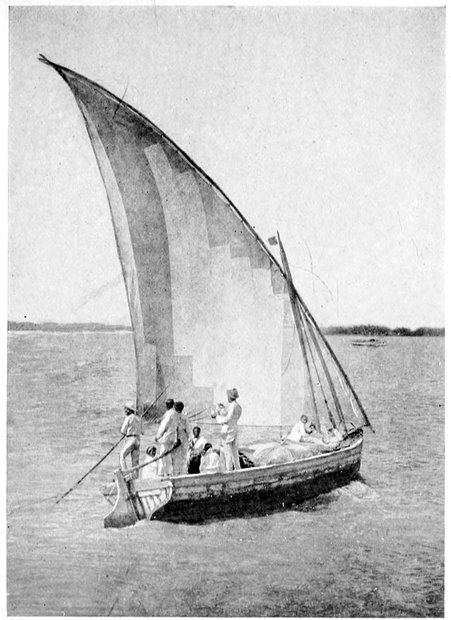
The mailboat leaves Aracajú for the towns across the bay
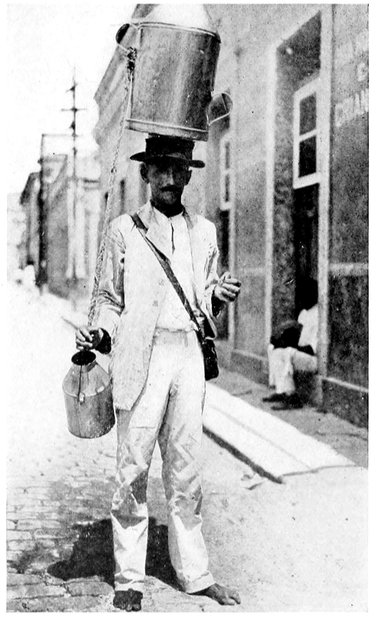
Another Brazilian milkman
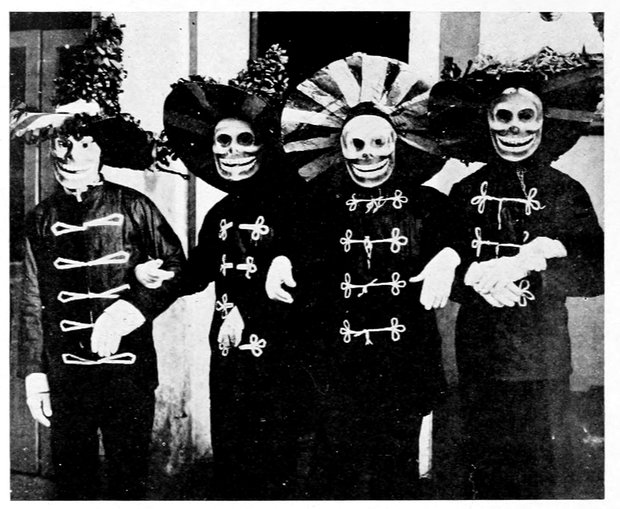
Carnival costumes representing “A Crise,” or hard times
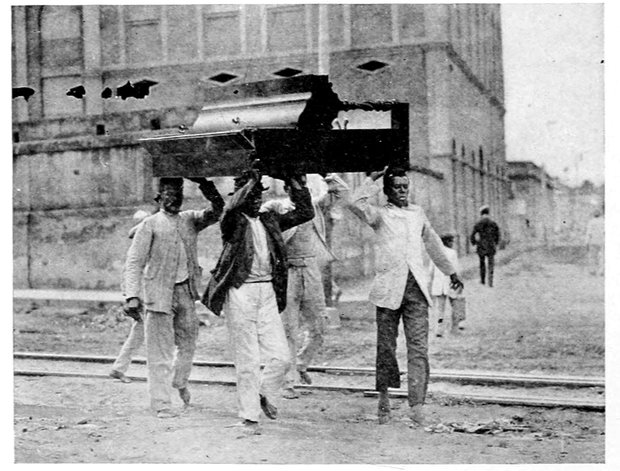
A Brazilian piano van needs neither axle-grease nor gasoline
381I was surprised to find a large number of white people in Penedo,
though mulattoes were in the majority. There was some Indian blood,
shown chiefly in high cheek-bones and wide faces, and as usual there
was a big jail full of happy singing negroes. Full-white brats rolling
stark naked in the mud suggested one of the unfortunate effects of
living in a mainly negro country. Some streets climbed laboriously
past overgrown old churches with Portuguese crowns cut in stone on
them, past projecting balconies that carried the mind back to viceregal
days, to the grass-grown central praça high up on the ridge, overlooking
a long stretch of the red-brown river. It was the affair of a
moment to convince the owner of the “Theatro Sete de Setembro,”
alias “Cinema Ideal,” that the Kinetophone should halt here for three
days on its return trip. He was the big man of the town, with a dozen
separate enterprises, and when a score of persons crowded around us
in his drugstore to listen to our conversation and read over his shoulder
whatever I showed him, we agreed to leave the signing of the contract
for the next day on board the Ilheos, on which he, too, was to take
passage.
Anarchy reigned about the decks all night, sailors, stokers, and visiting
parties from shore keeping up a constant hubbub until we got under
way about dawn. A couple of hours sleep as we descended the river
were cut short as we struck the open sea, for though this looked calm
and smooth as a frog pond, the Ilheos rolled like a log and soon took on
the aspect of a phantom ship, with everyone lying like dead wherever
misfortune overtook them. The dreary sandy coast was sometimes broken
by spurs of the low, flat, wooded plateau that stretches all along this
region farther inland. At two in the afternoon we sighted Maceió
and its port of Jaraguá, a smaller city far out on a point of land, with
a reef protecting a scallop in the coast but no real harbor. In one of
the score of sailboats that rushed out to meet us I was astonished to see
Carlos and later “Tut,” whom I supposed already in Pernambuco.
They had lost Wednesday and Thursday of the week before in getting
here, had played four days to tolerable business, and had lost the night
just past in waiting for the boat they now expected to take at any
moment.
382I took “Tut’s” room at the “Hotel Petropolis,” a massive, one-story
building on a sort of terrace that caught a hit of breeze and on the sides
of which were painted letters several feet high announcing it the “Only
Place in Maceió without Mosquitoes.” It had little of anything else,
for that matter, except good mosquito-nets over the beds to keep out the
mosquitoes it did not have. By dark the “Lloyd-Brazileiro” steamer
Bahia arrived, and “Tut” and Carlos and Ruben’s mulatto sub-manager
sailed away, while I went over to the theater in which they had played
and contracted not only for three days on their return trip, but for five
days in Parahyba, capital of the state north of Pernambuco. How hard
Maceió had been hit by the prevailing hard times was suggested on
every hand, not only in out-of-works and light cinema receipts, but by
such posted information as:
On this date our telephone was disconnected from the respective Company
until our further orders, in view of the brutal crisis which at the present time
atrophies everything and everyone.
| Maceió, January 1, 1915. |
João Ramos e Cia. |
The capital of Alagoas, however, proved to be more of a city than
it looks from a distance. Most of it lies in a pocket between the sea
and a ridge, a large, almost land-locked bay running far in behind it.
Mainly three-story buildings lined the well-paved streets in the business
section, and new American street-cars of the electric “Companhia Alagoana
de Trilhos Urbanos” covered several pleasant suburbs. No
sooner, however, does one return to a region of railways and street
cars than missing arms and legs begin to appear. The people of Maceió
were visibly of higher class than those of the State of Bahia, though by
no means beyond possible improvement. Even the outskirt huts were
whitewashed and often noticeably clean, and women and children, and
even men, in many cases wore spotless white garments. Heaps of
cotton bales at the railway station and on the wharves reminded one
of our own South, but though there was ample evidence of African
ancestry, there were almost no full-blooded negroes among the population.
The percentage of white and near-white inhabitants was striking
after Bahia; but here, too, were the familiar north-Brazil concomitants
of huge churches and tiny one-room schools. Mangos and bread-fruit
dropped in the central praça, amid the myriad remains of tropical bugs
lured to death by its blazing electric-lights.
My only personal acquaintance with the élite of Maceió was due to
professional duties. When the show arrived, “Tut” had discovered
383that the local electricity was of a freak type,—100 volts and 100 cycles,
whatever that means—a sort of non-union electricity evidently, for all
our phonograph motors refused to work with it. The English engineer
at the power-house figured out on paper that all would be well, but as the
“juice” is not turned on in Maceió until 6 P. M., his error was discovered
only when the audience was storming the doors on the opening
night. While the manager strove to keep the house amused with ordinary
films, “Tut” and Carlos raced about town and at last found in a
café a little electric fan. They borrowed the motor that operated it,
but this had to be cleaned and oiled before it would take up its new task,
so that it was nine o’clock before our part of the show was given; and
as Maceió usually goes to bed by eight, Ruben had to give back much
of the money, and the bungled estrea injured business during the rest of
our stay. It turned out that the café and the fan belonged, sub rosa, to
one Dr. Armando Vedigal, a well-to-do lawyer and member of one of
Maceió’s “best families.” True to his race, as well as to his calling,
this gentleman, finding he had someone in a tight place, proceeded to
squeeze him. He demanded 100$ for the use of the motor for four
nights, of at most thirty minutes each. The whole fan costs six to
eight dollars new in the United States, and perhaps 35$ in Brazil;
and as its perfection was mainly due to Edison, it amounted almost to
renting an apparatus for two hours’ use to the inventor thereof at three
times its original cost.
“Tut” had left the payment to me. Unfortunately I could not
ignore it, as I should have preferred, because the lawyer was a political
power and would have made it unpleasant for the owner of the theater
unless his “rake-off” was forthcoming, so the only American thing to
do was to pay what he demanded. I determined, however, to have at
least the satisfaction of expressing our gratitude to the fellow in person,
and after considerable insisting I was shown the way to his house. It
was an ostentatious one enclosed in a large private garden in the best
part of town and filled with those things into which persons of wealth
and “social standing” the world round turn the proceeds of such clever
“strokes of business.” The great man received me with a dignity befitting
his lofty station, and invited me into his chair-forested parlor.
He had the dainty aristocratic fingers, hands, and form of those who,
for generations back, have taken good care not to let their muscles
develop, lest someone suspect them of having once earned a dollar by
vulgar work, and he was dressed in the very proper heavy, black, full
frock-coat dress of his class, even on the equator.
384I began by expressing our thanks for the use of the motor, to which
he instantly replied, “Ah, to be sure, I was so delighted to be able to
serve you, and—and——”
He was plainly waiting for me to encourage him with, “Yes, that
was so kind of you” and a gentle pat on the shoulder, instead of the
swift kick farther down which he so richly deserved. I bowed, and
took to expressing in the most polished Portuguese I could summon
my admiration for a man who had the nerve to demand several times
the price of a machine for such a brief use of it. I had intended to
work him up slowly to the point where my remarks would feel like the
threshing of nettles on a bare skin, but the men of northern Brazil are
dynamic with pride and quick to flare up at any suggested slight, so that
I had barely reached the word roubar (rob), first of a long and culminative
list with a sting, when he bounded into the air and asked if I
really knew the meaning of that word in Portuguese. I assured him
that I did, and the action, too, in any land or clime, whereupon he demanded
in a neighbor-waking voice whether I had come to call him a
thief in his own house. When I informed him that I had come for
that express purpose, he bellowed, “Rua! Off with you! Out of my
sight,” at the same time hastening to pick my hat off the rack and hand
it to me. I was going anyway, now that he had caught my hint, but I
did not propose to let his wrath hasten matters. As I stepped leisurely
out upon the veranda he slammed the door and informed me in the
bellow of a mad bull that he would “pay me back”—not the 100$
unfortunately—“the first time he met me on the street—to-morrow!”
“Why not to-day?” I queried, for it was barely dusk and there were
street-cars, if it was beneath his dignity to walk.
This redoubled his fury. “Era uma fita”—it was a regular movie,
as the Brazilians say, to see him giving an impersonation of a fire-eater
for the benefit of his wife and children, and shouting. “Let me at him!
Let me eat him!” while his wife and three small sons clung to his arms,
legs, and other appendages, screaming the Brazilian form of, “Don’t
kill him, Pa! Oh, don’t shoot him, for my sake!” He allowed the
pistol he had caught up to be wrested from his hand, but the howls and
screams of the whole family could still be heard when I turned the next
corner—and I was not running at that.
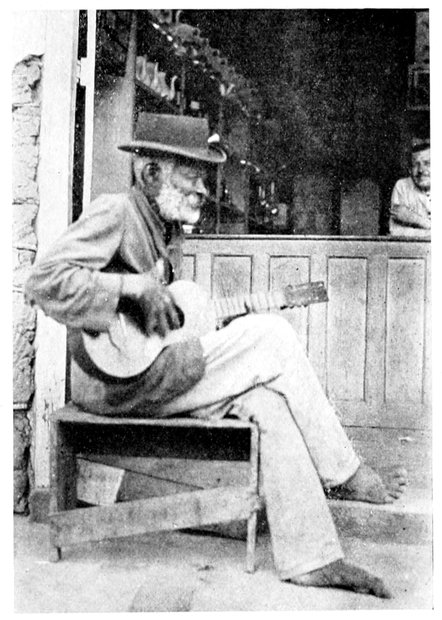
A minstrel of Pernambuco—and a Portuguese shopkeeper
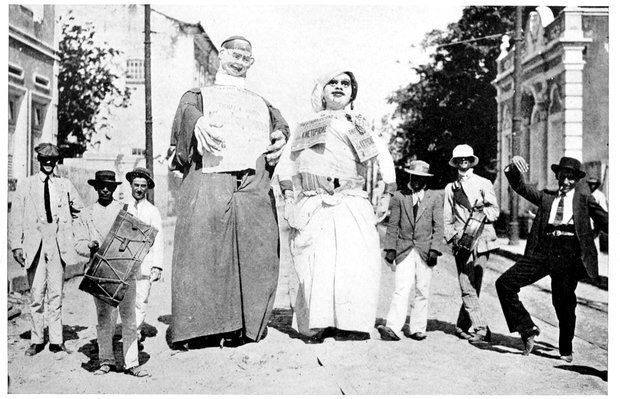
Advertising the Kinetophone in Pernambuco, with a monk and a dancing-girl. “Tut” on the extreme left, Carlos behind the drummer
It was playing with fire, of course, not because these hot-headed
northerners are particularly brave, but because of the disadvantage
which a stranger and a foreigner would have in any contest with a powerful
local politician. Had he shot me, it would probably not have been
385difficult for him to “fix it” to escape punishment, whereas the reverse
would almost certainly have meant many years in an unpleasant climate.
I was too exasperated to consider these things at the time, however,
and having returned to the mosquito-less hotel and strapped on my
revolver, I spent the evening hanging about the cinema, the town
billiard-room, and the other nightly gathering-places where a “gentleman”
with such a debt might come to pay it; but the lawyer’s strength
must have been unequal to that of his frenzied wife and children, for I
saw no more of him during my stay in Maceió.
The “G.W.B.R.,” or Great Western of Brazil Railway, is English,
which accounts for its being so called, though it runs from Maceió to
Natal through the easternmost part of the four easternmost states in
the western hemisphere. On the first day of the month in which I
arrived daily service had been inaugurated between Maceió and Pernambuco,
but lack of coal was making it impossible to keep this
up and the line was soon to go back to the old schedule of three trains
a week. In other words, I had accidentally chosen just the time to
spare myself another day in the capital of Alagoas. The train that
left at dawn on the 225-mile run was long and heavy, with all reasonable
comforts and many minor evidences of English management,
among them the habit of being on time. This line is a part of the
786 miles leased for sixty years to the British corporation by the
government, and the contract reads that no rental shall be paid for
it until the gross income for all of them exceeds 6,200$ per kilometer,
after which ten per cent. of the receipts shall be paid into the public
treasury. The result is a problem similar to that on the line from
São Paulo to Santos. One million pounds sterling was spent to
improve the leased lines, but even that would not have been enough
had the company not been so fortunate, as the chairman of the stockholders
in London told them, as to have had a partial failure of
crops along their lines that year and to have been thereby saved
from contributing £36,000 to the government! The largest expense
of the company is for coal and its largest income from the hauling
of sugar, with second-class passengers next, according to an item
in the official report headed “Passenger and Live Stock Transportation.”
No doubt it would be hard to separate the two in Brazil.
The line to Pernambuco ran well inland through a dry and dusty
but fertile land, varying from rolling to big rounded hills, among which
the train wandered back and forth seeking an outlet. In places it
was somewhat forested, or seemed recently to have been cleared;
386but most of it was thickly inhabited, compared with almost any other
part of Brazil. Big engenhos, or sugar mills, often punctuated the
landscape with tall, smoke-belching stacks; immense fields of sugar
cane were everywhere being harvested, and though it was February,
workmen were hoeing with big clumsy enxadas cane-sprouts in the
same plots in which mature cane was being cut. Most of the canes
came from the fields tied in two bundles on the backs of horses, to
be dumped in heaps at the stations and then carefully corded on
the railway cars. At least half the stations had a long train of red
and yellow cane loaded or loading on the sidetrack, and our way
was frequently blocked by similar trains bound for Recife. These
and the many large engenhos, the little private railways on the fazendas,
with their screeching English or Belgian dwarf locomotives, and the
evidence of movement and industry everywhere, gave one the feeling
of having once more reached a land of ambition. Pernambuco is
Brazil’s greatest sugar-producing state. Thanks to this fact and to
an unusually honest government, it enjoys a prosperity second only
to that of São Paulo, and possibly of Rio Grande do Sul, in the entire
republic. Cotton and mandioca also are important crops, often
growing together, and bales of the former lay piled up at many stations.
Everything, the cane-fields, the sugar-mills, the large old plantation-houses
in choice locations and guarded by half a dozen majestic
royal palms, even the swarms of beggars at the stations—gave the
impression of an old and long-established community.
It was a constant surprise to find it cooler up on this slight plateau
than in the sugar-fields of Tucumán, twenty-five degrees nearer the
South Pole, and I never could reconcile myself to the total absence
of jungle. Both these conditions were evidently due to the same
cause,—the constant strong trade winds that sweep across all this
paunch of South America and blow the rains, without which jungle
cannot grow even on the equator, farther inland. Water was so
scarce that there were only shallow mud-holes for the rare cattle,
and all the region appeared sorely in need of irrigation. As in Egypt,
the dry soil or the glaring sun seemed to produce blindness, and there
were many sightless wretches among the beggars that swarmed every
station. Indeed, the sugar-cane, the cotton, the lack of moisture in
air and soil, the very engenhos, carried the mind back to the land of
the Nile. Mendicants in the last stages of every loathsome disease
thrust their ailments, their frightful faces, their leprous finger-stumps
upon one wherever the train halted. All the people of this region,—beggars,
387bootblacks, or politicians—have the habit of touching, patting,
pawing one over to attract attention, and it was only by constant
vigilance that I could keep myself free from often noisome personal
contacts. Then, in that liberty-is-license South American way, swarms
of ragged urchins and shiftless men poured into the cars at every
station, fingering the spout of the empty water-can, squatting in the
vacant seats, thrusting their attentions upon the passengers, stark naked
children, with navels protruding several inches from their rounded
stomachs, scampered in and out of every opening, no attempt whatever
being made by trainmen or station police to reduce this annoying
anarchy. Many beggars and tramps used a sugar-cane as a staff—perhaps
as a sort of last straw against starvation.
I do not believe in charity, or at least in promiscuous giving, but
the Brazilian does, and every one of the beggars who flock about the
stations throughout northern Brazil seems to get something for his
trouble. Some of them were frankly Africans, but there were others
whose negro blood showed only in their love of sucking a sugar-cane,
the most work for the least gain of any labor on earth. Even
the prosperous cities are not free from this eleemosynary multitude.
When the archbishop of Pernambuco returned to his palace after the
inauguration of the “son of Sergipe,” he found 235 beggars waiting
at his door. The Brazilian no doubt feels that to give alms through
an institution would be to pay most of it into the capacious pockets
of its managers or sponsors, whereas if he gives himself, he knows
that the gift actually reaches the needy person—if, indeed, he is needy.
Also, he is more apt than not to be superstitious and to fancy that
if he does not give, his own affairs will not prosper; most of all, he
is constantly at his old pastime of “fazendo fita”—showing off. Hence
impudent, able-bodied beggars are a pest to society and to the travelers’
peace throughout the country, particularly in the blazing north.
A brilliant moon waiting at the edge of the stage to do its turn even
before that of the unclouded sun was finished, gave us a continuous
performance, with the lighting never dimmed. As we neared Recife
there was less cultivation, and beyond Cabo White flat sand and
miserable huts took the place of the rolling, fertile, well-housed
country—though even here there was not the squalor of Bahia.
A desert of sand, an almost unpeopled wilderness had surrounded us
for some time before the low lights of Recife began to spring up
across the level moon-bathed landscape, and the sandy and swampy
388land of the Brazilian littoral continued until our train rumbled out
upon the very beach of the moon-silvered Atlantic.
It was already 7:40, and there was no time to be lost if I was to
take up my professional duties that evening. About noon we had met
the up-train with the day’s newspapers and I had caught up with the
world and its doings again. Pernambuco has the best journals north
of Rio, one of which claims to be the oldest in Latin-America, and I
had been delighted to find in several of the most important dailies
half-page Kinetophone advertisements, and in all of them articles to
the effect that “Edison’s new marvel” had opened the night before with
all three sessions crowded to capacity by delighted audiences. But
newspaper stories and facts often have little in common. I sprang
into the first automobile to offer its services and, after a jouncing over
cobblestones that felt like being tossed in a blanket, was set down
at the “Hotel Recife.” This was said to be the best in town—which
was certainly slanderous language toward the others. Razor and
shower-bath having transformed me from a dust-bin discard to the
personification of Beau Brummel on a tropical excursion, I raced
away to the “Theatro Moderno.” There I was agreeably surprised.
Ruben met me with the fraternal embrace at the door of a large new
theater, perhaps the most sumptuous in which we had played in
Brazil; the receipts the night before had been the best in weeks, and
crowds were even then clamoring for admission. The sugar-prosperity
of Pernambuco, abetted rather than injured by the World War, combined
with plentiful advertising in newspaper displays and articles,
in posters and handbills, and by the gyrations through the streets of
two bonecos, or dolls, ten feet high, had done the trick. The fact that
the bonecos represented a friar and a dancing-girl respectively, and
that their public promenading was accompanied by antics which a more
circumspect people would have considered highly indecent, seemed
to have been an advantage rather than otherwise in Pernambuco.
“Tut” had found the hotels so uninviting that he was sleeping in
his hammock on the stage of the theater. Our first move, therefore,
was to investigate what all foreign residents assured us was the
best stopping-place in Recife,—a pensão kept by a European woman
known as the “Baroness.” It was out in the suburb of Magdalena,
twenty minutes by electric tramway from the center of town—except
that passengers lost more time than that in walking across a condemned
bridge which would not carry the cars. The pension consisted of several
buildings, one large and pretentious, the rest simple and of one
389story, scattered about a big enclosed yard shaded by many magnificent
tropical trees and looking out behind on one of the many arms
of the sea which divide Recife into separate sections. We took a
large room together, opening directly on the garden, with a mammoth
tree over our very door. There were some drawbacks—no electric
lights, for instance, that improvement not yet having reached Pernambuco
in public form, though a few places had a private plant. Also
the “garden” was deep in sand, for lawns are unknown in this part of
the world. But a high fence, as well as dogs and servants, made it
possible to leave our doors wide open night and day to the ever-cooling
trade wind, and there was a quiet homelikeness as well as cleanliness
about the place that made us feel as if we had suddenly left dirty,
noisy, quarrelsome Brazil behind.
The “Baroness” had the advantage of good servants from German
steamers interned in Pernambuco, the nearest port of refuge for
many of those in the South Atlantic when the war broke out. In
fact, all Pernambuco was fortunate in having about five hundred
men of similar antecedents to serve it that winter. The excellent
band of the Cap Vilano, for instance, made not only the most energetic
but the best music in North Brazil at the “Café Chic,” just around
the corner from our theater—at the equivalent of a dollar a night to
each of the musicians. The war had brought Recife other things. Its
sugar and cotton having kept it from succumbing to the “brutal
crisis” that flagellated the rest of Brazil, it had the reputation of
being the best-to-do city in the country. Consequently, adventuresses
of all nationalities had come up in droves from dead Rio and impoverished
São Paulo, and Recife had more high class members of the
profession that needs no training than most cities of five times its
population.
Though we often hear of it, there is really no city of Pernambuco.
What we call by that name is properly designated by one almost unknown
to foreigners. Pernambuco is an old Indian word that is
only correctly applied to the entire state, but it has long been the
custom not only of seafaring men and all foreigners, but of the Brazilians
themselves not resident within the state, to call its capital
Pernambuco. Its real name is Recife, and the story of its founding
is not without interest. In 1531 Pedro Lopez Pereira established on
the only hill in this vicinity a town which was called Olinda, and
which in time became a very aristocratic center. But though it had
a beautiful site on the open ocean, Olinda had no port, and boats
390could only land behind the recife, or reef, some miles farther south.
On Christmas day of 1598 Jeronymo de Albuquerque formally gave the
name Recife to the cluster of trading posts that had grown up there, and
built the fortress by which the city is still, at least in theory, defended.
The settlers at the “Reef” were almost entirely Portuguese merchants,
whom the aristocrats of the proud residential town of Olinda
called “mascates”—peddlers or hawkers. The rivalry and ill-feeling between
the two towns grew apace. The colonial nobility of Olinda,
resenting any interference from their lowborn neighbors, wished to
form an independent republic on the style of Venice, and the quarrel
finally developed into what is known in Brazilian history as the
“War of the Mascates.” Naturally the “peddlers,” having nearly all
the material advantages, had the best of it; new authorities arriving
from Portugal ended the struggle, and Recife became the city, port,
and capital of the region, leaving Olinda, small and isolated on its
hill, still proud of its aristocratic origin, but a mere suburb of the
modern city.
Unlike Bahia, Recife had no ridge to build on; hence it is deadly
flat, with only Olinda five miles to the northwest rising above the
featureless landscape, though far behind the city one may make out
the wooded hills that merge gradually into the flat-topped chapadas
of the sertão of the interior. It stands on the sandy beach of a lagoon
delta where two rivers, neither of them of much importance, meet, and
the compact old town, with the wharves, banks, and most of the business
houses, is really on an island, protected now not only by the
natural reef, but by a long breakwater behind which ships anchor.
There is no bay; hence steamers which do not enter the inner port
must in rough weather land their passengers in a “chair” running on
a cable from the breakwater. Many a traveler to South America
remembers nothing of Pernambuco except that hair-raising landing.
As Bahia is a city of hills and wooded ridges, so Pernambuco is
one of waterways and bridges. The so-called River Capibaribe runs,
or at least ebbs and flows, through town, and there are a score of
natural canals, estuaries, and mud sloughs filling and emptying with
each tide, while hundreds of dwellers in thatched huts of the suburbs
have the advantages of Venice in so far as a chance to pole themselves
about on their rude rafts goes. Marshy salt water comes in and around
the city at every tide, and the rivers, coves, or quagmires to be
crossed in a journey through it are numerous—doubly so since several
of its many bridges have been condemned for vehicular traffic. Palm
391trees, chiefly of the cocoanut family, grow everywhere, and between
its waterways the city of bridges is noted for its dry and sandy soil;
hence one can scarcely stray from the paved streets without wading
either in water, mud, or sand.
Properly speaking, Recife is the older section of the town, out
near the reef, and given over mainly to business. The modern city
covers several times more territory than that, including country-like
outskirts of such suggestive names as Capunga, Afflictos, and Sertãozinho
among its suburbs. There is Afogados (Drowned Man)
out past the Five Points station on the beach, a big suburb of mud and
thatched huts among swamp bushes and a network of tidewater, with
lanes of mud that snap like the cracking of a Sicilian whip when
the tide is out and the tropical sun blazing down upon them. In
other directions, still within the city limits, are miles of old estates
and aged plantation-houses living out their dotage under magnificent
royal palms. To get about this broken up city there were big new
English and American street-cars, so new that passengers were not yet
permitted to put their feet on the seats. It was less than a year
since the old mule-cars for which Pernambuco was long famous,
had been superseded—in the outskirt of Torre they might still be
seen—and ragamuffins who had never heard the word “bond” in
its ordinary significance made frequent use of it in its Brazilian sense.
The new company was pushing its lines in every direction and already
the tramway was advertising itself as ready to furnish electric-light
to business houses along its lines. Thus, though one had the sense of
treading on the heels of modernity in Pernambuco, in all northern
Brazil, the pre-invention age always succeeded in eluding one and
escaping just over the edge of the horizon.
Besides its brand new electric street-car system and the three
lines of the “Great Western” leaving it in as many directions, Recife
has five amusing little railroads, “toy locomotives hitched to a string
of baby-carriages,” as “Tut” called them, which do a volume of noisy,
dirty, dusty business to the north and northeast of the city. For
many years these ancient contrivances of an English company were
the only urban traffic in and about Recife. One crowds into a tenement-house
of a station, wages pitched battle about a knee-high hole
in the wall to buy a ticket, enters an ancient closed wooden box on
wheels suggestive of what trains must have been in the days of
Charlemagne, amalgamates with variegated Brazilians on a hard, misshapen
wooden seat, and waits. When one has waited long enough to
392run down to “B.A.” and back, there come ten or twelve ear-splitting
screeches and back-breaking jolts, and the train is off for some other
“station” fifty yards away, with a deluge of smoke, soot, and cinders
which penetrate to the utmost recesses of one’s person. For a long
hour the contrivance screams its sooty way through endless dusty
streets in which the irreconcilable tropical sunlight of February strikes
one full in the face like the fist of an enemy, and at the end of that
time the weary traveler may descend five or even six, miles away, at
Olinda, or at some of the plantation-town suburbs shaded by many
trees, yet dreary with their sand in place of grass. There are two
such lines to Olinda, out past Santo Amaro with its British cemetery
and across a broad swamp by a causeway; but the company claims that
the concession is no longer worth the holding since the coming of
electric competition. No doubt Pernambucanos considered these medieval
trains a wonderful innovation and convenience when they first
appeared, but it is more pleasant now to depend on electricity—or
to walk.
I waded for miles barefoot along the beach to Olinda one day.
Palm-trees edged the curve of the shore with their inimitable plumage,
streaking the staring white sunlight with slender shadows. Thatched
huts along the beach, with all the Atlantic and its breezes spread out
before them, suggested where many a well-to-do family of Recife
spends its summers. An old wreck here and there protruded from the
surface of the sea, relics of some collision with the easternmost
point of the New World. Olinda piled high on its hill amid palm-trees
and many huge old churches, takes on the air of both, of age and
reverence and the regal dignity of the royal palm. Its many old
buildings are clustered rather closely together; it seems still to scorn
business as thoroughly as in the olden days, and to spend most of its
time gazing across the swampy flatlands at its materialistic rival, or
out upon the blue sea which is so rarely seen from Recife.
The city we call Pernambuco claims 200,000 inhabitants, and of
these perhaps one in three could pass as white. Even in the huts
lining the water or mud labyrinths of the outskirts whites are numerous,
though often as trashy as the negroes. It is surprising that as
one nears the equator in Brazil the proportion of Caucasian blood
increases, but it is easily explained. All that part of South America
which thrusts itself halfway across the sea to Africa had many
slaves, but Bahia not only grew a crop which required more labor,
but, its port being then the national capital, it had the advantage of
393fame, as well as its great bay as a safe landing-place. The result
is that while Bahia is a negro town, Pernambuco is a city of mulattoes,
with a mixture of types that can only be differentiated by the rich
color-terminology of Brazil. On the whole, the Recifense is a more
pleasant individual than the blacker, more slovenly, more impudent
Bahiano. Like most of the people of North Brazil, he talks in a kind
of singsong, ending almost every sentence with não (no) or ouvioú?
(did you hear?). There are few really masculine voices in Brazil,
and the persistent cackle of poor, cracked trebles, chattering constantly
at high speed about nothing, eventually gets on the nerves, unless
one has been spared that troublesome equipment. The chief business
of the city is still that of the “mascates,” in a larger sense,—the exporting
of sugar and cotton and the importing of things needed
by the growers of sugar and cotton, with the usual large proportion
of the benefits sticking to the fingers of the fortunately placed middlemen.
Carregadores de assucar, or sugar porters, wearing a sort of
football head-mask over their hats, are among the most familiar
sights of the old city, and the pungent odor of crude sugar strikes one
in the face everywhere in the wharf and warehouse section. The
sugar comes from the engenhos in crude, dark-brown form; the tropical
heat causes it to ooze out until not only the bags but the half-naked
negroes who handle them are dripping and smeared with molasses
from top to bottom. When the rotting bag bursts entirely the contents
is spread out in the sun and barefoot negroes are sent to wade
ankle-deep back and forth in it, until it is dry enough to be shoveled
up again.
There are not so many churches per capita in Recife as in Bahia,
but they are by no means scarce, while the schools are if anything
worse,—miserable little one-den huts hanging on the edges of mud-holes
or salt-water marshes, according to the state of the tide. The
president of Pernambuco asserted in his annual message that the state
schools could not afford to import from the United States the school
furniture needed, because of the high tax imposed upon it by the
federal government! Of higher institutions, of course, there is
no such scarcity as in the elemental grades. The Gymnasio Pernambucano,
or High School of Pernambuco, where are promulgated the
bachelor degrees that make men “doctors,” and not much else, is a
large conspicuous building next that of the state congress—and it
had 69 pupils. Of the Faculdade de Dereito, or Law School, similar
remarks may be made. In the old business section of Recife especially
394the condition of streets and buildings left much to be desired, but under
the energetic and honest new president promising progress was already
beginning to be made.
On Saturday night our share of the receipts had been more than
a conto and toward midnight on Sunday I carried home a roll of
ragged Brazilian bills large enough to choke a rain-pipe. I was somewhat
surprised, therefore, that the “bust-up” came as early as the
following Wednesday. I knew it would come sooner or later, but I
had expected to be able to stave it off a week or more longer. When
“Colonel” Ruben turned up that night, we had already been reduced
to “reheated soup.” This, coupled with the fact that he had loudly and
widely advertised “Six Days Only!” and had now decided to stay
five more, had greatly reduced our audiences. Ruben took one look
at the house during the first section, suddenly decided that he had
received a cable from his wife requiring his immediate return to
Bahia, and disappeared in that direction so swiftly that I have never
seen him since. Up to the last he had insisted daily, if not hourly, that
I must return when my contract with Linton expired and become
manager of his theater-to-be. He departed owing me a paltry 83$ as
our share of that evening’s receipts, but he left on my hands not only the
“Theatro Moderno” until the following Sunday at a rental of 300$
daily, two dusky young gentlemen whom he had brought with him
from Bahia as his assistants, and the unpaid bills for several half-page
advertisements in the local papers, but so many other creditors that he
saw fit to embark at daylight from an unusual place.
Still, this was little compared with what he might have done, and
probably we had made more money with his experienced assistance
than we should have made alone. I, too, might have run away, had
I cared to leave Americans in general and Edison in particular in
such repute as Ruben enjoys to this day in Pernambuco. Instead,
I spent a breathless Thursday preparing to meet the new conditions
that had been forced upon us. We were certain to lose money that
night and the next, but by special advertising and improved programs
I hoped to make it up on Saturday and Sunday. We still had the
two calungos, or ten-foot monk and dancing-girl figures on men’s
legs, for though one of Ruben’s creditors had attached these, he
allowed us to use them until our departure. I sent them out with
drums and handbills, not only through the town, but to all its
suburbs and outskirts, including even aristocratic Olinda. In short,
for the first time I was a full-fledged theatrical manager, renting, advertising,
395managing, auditing, running the whole show—even mechanically,
too, for that night “Tut” got a touch of some tropical ill
and had to be sent home—and, unfortunately, paying the bills. For
in spite of all our efforts Saturday night left us with the balance
slightly on the side of expenditures. I had already begun, however,
to prepare the territory ahead. J. A. Vinhães, Junior, a Carioca
engaged in the film-furnishing business in North Brazil, had offered
to take over Ruben’s contract and extend it to the Amazon. He was
an unusually honest-looking, energetic young man, good company and
experienced, as well as widely known in “movie” circles, and before
the week was ended he had sailed away toward Pará, and possibly
Manaos, as our self-paid advance agent.
My troubles apparently ended, “Tut” and I were sitting at “breakfast”
Sunday morning in proper best-boarding-house-in-town style
when the waiter suddenly handed me several letters from Linton,
bearing neither stamps nor signs of post-office handling. They had
been written on board ship on the way north from Buenos Aires,
and announced that, the Kinetophone having ended its labors in the
Argentine, Linton was on his way home, as soon as he could find a
wife he had left in Rio, with the two Spanish-speaking outfits. With
the letters he forwarded some new posters and Turco Morandi, formerly
manager of one of the largest theaters in “B.A.,” lately advance agent
for the Argentine Kinetophone, and noted for his double-width, steel-riveted
honesty. It was he who had brought the letters to Pernambuco,
and about noon he appeared in person, dressed in the latest Jockey Club
style, and announced himself as the new manager of the Kinetophone
in Brazil.
There was nothing niggardly about Linton. My six months being
up, he offered to let me turn over the job at once, take the first boat
either to Manaos or to the United States at his expense, draw my
salary up to the time the show started south again, collect traveling
expenses from Manaos back to the mouth of the Amazon, and promised
to pay me later whatever might be due on my commission basis. “Tut”
was to get a percentage of the receipts for taking charge of the show,
and to make such use of Morandi, to whom Linton had already advanced
a considerable sum, as he saw fit. When they ran out of
audiences in the North, the three were to take the show back down
the coast, playing in the smaller towns until Linton himself returned
to pick them up.
Had there been any evidence that my labors had been unsatisfactory,
396I should have vanished forthwith. But the letters expressed satisfaction,
and Linton was not a man to indulge in flattery. Moreover, I
wished to see the rest of Brazil, and I did not want to see it as a
foot-loose tourist. I much preferred to go on to Manaos as manager
of the Kinetophone, with all the prestige thereunto appertaining, to
be forced to mix with all kinds of people, to be mistaken now and
then for Edison himself. Besides, I could not take advantage of
Linton’s extraordinary generosity. Instead of needing another man
we could easily have gotten along with one less, for “Tut,”
who was some little inventor himself, had improved upon Edison
by wiring the phonograph in such a way that it could be touched
off from the booth, and any fool could be taught in a few minutes
to put on and take off the records. Then there was Vinhães, already
on his way. If Morandi had arrived a few days earlier, I might have
sent him on ahead instead, or left him with the show and played advance
agent myself. Worst of all, however, Linton, as almost any
American would have done under the circumstances, had chosen the
worst possible man to send to Brazil. Morandi not only spoke Spanish,
but was an argentino, and if there is one thing Brazilians resent
more than being spoken to in Castilian it is to hear it spoken with
the accent of their greatest national rivals. In the end I coaxed the
fashionable newcomer to go away somewhere and lose himself, while I
spent what I had looked forward to as a pleasant Sunday afternoon
wondering who I could get to drown him.
For the first time in Brazil I had to cut out the Sunday matinée and
announced an evening performance given over entirely to the Kinetophone—six
numbers in each section, with a ten-minute interval in
which to change audiences. This meant double labor for “Tut” and
Carlos, but it would save us 50$ for the rent of ordinary films, 10$
for a native operator, and should prove a great drawing card. It did.
Unfortunately I had set the opening at the early hour of six, and
the coming of Morandi caused both “Tut” and me to forget the
change. Accustomed to arrive at the theater at 6:30 and have half an
hour of ordinary films before our turn came, we sauntered down town
as usual, and, as we stepped off the street-car, what should greet our
astonished ears but the notes of one of our numbers known as the
“Musical Blacksmiths.” It was like hearing one’s own voice issuing
from the lips of a stranger. Never in all Brazil had a Kinetophone
number been given without either “Tut” or myself in attendance. We
dashed into the theater—and found Carlos calmly running the show!
397The audience had taken to stamping and giving other evidences of
impatience, and the plucky Paulista, having taught a native how to
put on the records, had started the performance. I raised his salary
forthwith.
In our three sections that night we took in considerably more than
a million, recouping all our losses, and it was a double pleasure not
to have to split the receipts with Ruben. But there was that dashed
argentino to spoil the effect of our efforts. Luckily, he was already
complaining of the “insupportable” heat and complete loss of appetite,
while kind, if unknown, friends had filled him full of tales of yellow
fever and the plague, so that he had come to me almost with tears
in his eyes and called my attention to the wife and five children he
had left in Buenos Aires. It took us the better part of Monday and
Tuesday, and cost nearly half a million reis to pay his debts, release
him from the slimy tentacles of the customhouse, and set him on his
way with a ticket to Rio, but the relief was worth the exertion.
By this time we had moved over to the “Polytheama,” an open-air
theater in which I had arranged to play three nights at popular prices.
I took advantage of this breathing-spell to run out into the interior of
the state, not to the end of the line, for that would have meant two
days absence and missing a performance, but as far as Bezerros,
where the daily train meets itself coming back. The branch runs due
west from Recife, and by starting at seven and getting back at five,
with constant traveling, I covered 72 miles and return!
Jaboatão on its knoll was buzzing with energy where the shops of
the combined railways had concentrated. Hills shrouded in blue
veils began to appear as soon as we had crossed the sandy coast strip.
Farther inland it grew rolling, everywhere dreary, dry, and bushy,
with many tunnels and long iron viaducts. Cotton was growing here
and there in the arid soil, but it was scant and small, with one bush
where in our southern states there would have been eight or ten.
This region of rare reed-and-mud huts bore slight resemblance to
that along the line from Maceió northward, with its endless trains of
cane, its crowded population, and mammoth old fazenda houses. Negro
blood was noticeably less as we left the coast, for slaves were imported
chiefly by sugar-planters and were not needed, nor, indeed, useful,
in the grazing regions. There were said to be many cattle in the state,
but they must have been farther inland, where there was still something
to drink. Passengers had to carry water with them, for neither
trains nor stations furnished it. Yet only two years before this region
398had complained of heavy rains! Even the dining-car service of the
lines to the north and south of Recife was lacking, because some
petty politician of the interior had a contract with the government to
furnish passengers an alleged meal at one of the stations, and the
English who have taken the line over are compelled, during the sixty
years of their lease, to stop every train there for twenty minutes.
At the “Polytheama” that night we had a remarkably good audience,
many evidently having put off coming, Brazilian fashion, until the last
performance. When we had torn down the show and packed up,
“Tut” went home and Carlos to wherever he slept, and after a
shower-bath under a spigot, I swung “Tut’s” hammock between two
pillars of the open-air theater. This was to be almost my first actual
traveling with the show, and it was time I tried out what my companions
had been enduring for months. It is many years since I have
waked with that curious sensation of wondering where I am, so that
I had no difficulty in orienting myself when there came a beating on
the cinema door at daybreak. One of the carters I had hired to take
our stuff to the station had arrived with one of those tiny, ancient,
two-wheeled carts of North Brazil in which the misplacing of a bag
of flour suspends the horse in the air. His companion did not turn
up until an hour later, after the other had dragged all the trunks
to the door, and it was perilously near train-time when I at last sent
them hurrying across the cobblestones to the Brum station way
over in old Recife. By the time the usual hubbub and quarreling,
grafting and exorbitant charges, coaxing and assisting the insufficient
and lazy railway employees to get our outfit on board was ended, I
was congratulating myself on my foresight in having arranged for
another man to pay our traveling expenses. There was 12$500 duty
to pay for taking our trunks out of the state, a similar amount for
importing them into the next state north, express charges about
equal to first-class tickets for each trunk, and while the fares were
not high—five dollars for nearly three hundred miles—the twenty
per cent. surcharges of the federal and state governments respectively
on the tickets made the final total a considerable sum.
CHAPTER XVII THIRSTY NORTH BRAZIL
399
It was four in the afternoon when we sighted Parahyba, capital
of the state of the same name, on its ridge beside a river of similar
designation which we had been following for several hours. We
were met by a considerable delegation, including the Danish manager
of the “Cinema Rio Branco,” a young chap whom Vinhães had left
behind to look after his interests, and the German owner of the
“Pensão Allemã,” whom some unauthorized friend from Recife had
told to prepare rooms for us. As the only other hotel-keeper in town
admitted, evidently under the impression that it was a recommendation,
that half his rooms were given over to unprotected women, I
allowed our personal baggage to be carried away by the solicitous
German, while three little carts dragged the rest uphill to the cinema.
By the time our apparatus was set up and the tickets stamped, perspiration
was oozing from our shoes. I raced back to the pensão to
get rid of two days’ dust and whiskers, and by the time I appeared
again the house was packed to the roof. But as it held only four
hundred, and the president of the state had thrust himself in with
half a dozen generously painted females, and a score of other “influential
citizens” had followed his example, it was evident that we were
not going to win an independent fortune in Parahyba. To make
things worse, “Tut” had failed to try out the apparatus before the
doors were opened, and our first number flashed on the screen without
a sound to accompany it! The phonograph had suffered some
slight injury during the rough journey and refused to speak. To my
astonishment a great howl of satisfaction went up from the audience,
followed by a constant series of cat-calls until the loose screw had
been found and the trouble remedied.
It was not merely, as I first suspected, that sense of being greater
than the inventor whose invention fails to work which had delighted
these lineal descendants of African tree-climbers, but the pleasure
of what might be called the anti-Kinetophonists at being able to say,
even momentarily, “I told you so!” Formation of petty cliques is
400one of the chief pastimes in these dawdling old towns off the track
of world travel, and Parahyba had divided, without our knowledge,
for and against us almost at the moment we descended from the train.
Those who sided with the disgruntled hotel-keeper joined the friends
of the rival cinema in an effort to boycott us, with the result that,
though we did not know it until next day, by the time the show had
been set up all Parahyba had been assured that both the Kinetophone
and this “gringo” Edison were humbugs of the first water, and that
those who came to see it would be wasting their money. The instant
destruction of this theory as soon as the phonograph had been readjusted
confounded the opposition, but the atmosphere of ill-will, and
of doubt, always engendered among the volatile Brazilians by the
slightest mishap on an opening night, could be felt as long as we
remained in the town.
Parahyba was founded in 1585 by Martín Leitão—his name, by the
way, means suckling pig—eighteen miles from the mouth of the
river of the same name. This region was once abundant in the pau
brazil for which the country was named, but to-day its principal
product is cotton, bales of which were exchanging places with barrels
of Minneapolis flour in the freight-cars behind the station. Most
of the town’s estimated 30,000 inhabitants appeared to be loafing government
employees. They were a melancholy lot, on the whole, to
whom life was evidently as joyless as to the Puritan, crushed under
the weight of existence and always struggling to repress the desire
to live gladly. “These tropical people,” said a Dane who had lived
long among them, “have none of the joy of living, none of the chest-expansion
of pleasure at confronting life which is common to northern
peoples. Such enjoyment as they have is made up almost exclusively
of the constant stimulating of the sexual instinct. They have no feeling
for what we people of the North call a “home,” and never really
found one. They have a wildly romantic idea of marriage, which
means to them nothing but physical gratification, and, their sensual
instincts satisfied, they continue to live together merely out of custom,
following the line of least resistance. There is not a man in town,
from president to porter, who does not keep at least one other woman
besides his wife, if he can by hook or crook afford it.”
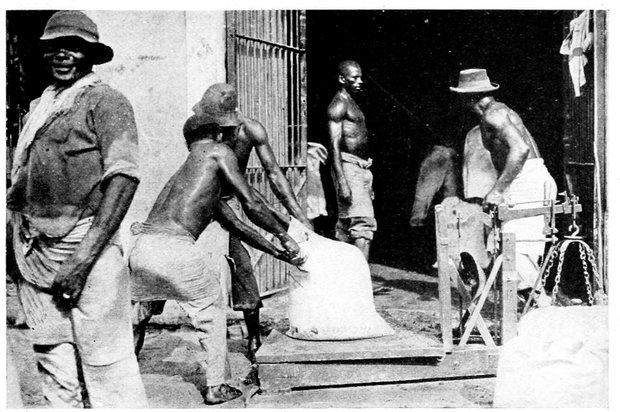
The pungent odor of crude sugar is characteristic of downtown Recife
In the dry states north of Pernambuco cotton is the most important crop
Walking up a cocoanut palm to get a cool drink
Wherever a Brazilian train halts long enough the passengers rush out to have a cup of coffee
“Whatever the economic condition of the colony,” boasts the History
of Parahyba, “it never failed to bequeath plenty of churches to
posterity.” The town terminates in a bulking old religious edifice,
and is generously supplied with others throughout its length. Of
401breadth it has little, for it falls quickly away on either side of its ridge
into cacao groves or vast reaches of bluish swamp-like bushes, half
covered at high tide. The dead hot streets of noonday were like those
of an abandoned city; stepping from the sunshine into the shade was
like dropping an enormous weight off one’s head and shoulders. Most
of the thirty thousand live in mud huts with palm-leaf roofs and doors,
the earth for floor, and the omnipresent hammock for chair, bed, and
favorite occupation. The central praça has a hint of grass, by great
effort and much carrying of water, and glorious royal palms stand
high above it. But beautiful as it is, the royal palm does not take high
rank as a shade tree. Elsewhere the streets, like Kipling’s railroad,
soon run out to sand-heaps. An hour’s swift walk from the new
power-house at the end of the made-in-Germany tram line brings one,
through hot sandy jungle, heavily wooded in places, to the open sea,
where the well-to-do Parahybanos go in “summer” by a little railroad
that did not operate in this wintry season. Small steamers can reach
Parahyba at high tide, though few ever do so. Its port is Cabedello
at the mouth of the river, the fortress of which, like most of Brazil
north of Rio, fell several times into the hands of Holland, the name
of the town being once changed by Maurice of Nassau to “Margarida”
in honor of his mother.
It is only 130 miles by rail from Parahyba to Natal, capital of the
next state north, but it takes more than twenty-four hours to cover
them. For some distance the route is the same as that back to Recife;
then at Entroncamento, which is Portuguese for Junction, another
branch starts north, striking well inland, like the other lines of the
“G.W.B.R.” The yellow-green cajueiro, rugged as an olive-tree, was
often the only vegetation that broke the dreary sand landscape. Evidently
the constant trade winds that were so welcome to the sun-scorched
skin are deadly to the soil, blowing far to the south and
west the rains it needs so badly. White men living in northeastern
Brazil complain that eyes grow weak early in life from the constant
glare. Even bread dries up in this moistureless, heated air almost
between the cutting and the raising to the lips. Here and there were
patches of cotton, in saffron-colored blossom, planted in small quantity
and only by the poorer classes, for those who keep account of profit
and loss do not find it worth the trouble. Yet one carried away the
impression that, properly irrigated and inhabited by an energetic
people, this thirsty paunch of South America should be able to feed
all the armies of Europe. Grazing, however, is the main industry on
402the larger estates. In North Brazil the word fazenda loses the significance
of “plantation” that it has to the south and means cattle ranch,
of which there are great numbers farther inland. Such plantations
as are cultivated are usually in the hands of a morador, literally a
“dweller,” who runs the place to suit himself and sells the crop to
the owner at a fixed price agreed upon between them. There are few
absentee owners in this settled eastern part of the region, however,
even the “best families” spending much of the year on their estates
and only a few months in their town house in the capital. The more-or-less
negro laborers are paid from 500 to 1000 reis a day, with
ground on which to build their mud and palm-leaf huts; but it is
probably as much as they earn, and there is no approach to slavery
or peonage, for the obsequiousness of the working class, so striking
to the American traveler in most of South America, has no exponents
in Brazil.
A moderate range of hills gradually grew up on our left, and we
rose high enough above the general dead-level to look across immense
reaches of Brazil, bushy and faintly rolling, flooded with sun to the
ghost of the far-off range. As usual, there was not a drop of water
on the train, which would not have been so bad if anything to drink
had been sold along the line. But there were not even oranges, and
dining-cars do not run above Parahyba. Well on in the afternoon
we halted at a station with a large earthenware crock of water, lukewarm
and of swampy odor, on the platform. The first man to drink
from the single tin can hanging beside it dropped it into the vessel,
whereupon the next travel-stained mulatto rolled up a sleeve and
plunged in a yellow arm to the elbow. The natives saw nothing amiss
in this, and the rest of us were forced to drink anyway, for we were
on the verge of choking to death.
Toward sunset we drew up, in a bushy half-desert, at the town of
Guarabira, recently renamed Independencia, but a change which the
populace had refused to adopt, perhaps because they found the new
name sarcastic. Here all trains, from north or south, stop overnight,
so that the so-called hotels, lacking more of the indispensable requirements
of public hostelries than the stay-at-home could imagine possible,
were crowded beyond their capacity, though on four nights a
week they are empty. There was a good cinema in Independencia,
which plays only on the three train-nights and on Sundays. The owner
had gone down to Parahyba to see the Kinetophone and had come
back with me, coaxing me all the way to give him a two-day contract.
403Instead, I signed for one day on the return trip, for this time the
show was to sail directly from Cabedello to Ceará, picking me up at
Natal.
By six next morning the same crowd of us, all men, were riding
on into the north by the same train. Toward eight we crossed the
arbitrary boundary into Rio Grande do Norte, grinding on through
unbroken miles of the same bushy wilderness. Every town of half a
dozen huts sent its quota of beggars down to meet the train, so that
the begging line that had begun at Maceió was never broken. The
“Great Western of Brazil” could add materially to its revenue by a
tax on station mendicants. Before ten we stopped at a partly whitewashed
collection of desert huts for jantar, first of Brazil’s two daily
meals. The first-class passengers charged madly across the sand to
one of the huts, where a long table was set for some thirty guests.
Each “washed” his hands in the single pan of yellow water, wiped
them on the one towel, and fell to with a mighty noise upon the immense
plates of fish, roast pork, beef in all its forms, rice, farofa,
and chicken which, already cold, garnished the table. To wash down
this stalwart provender there was nauseating lukewarm water, or
equally tepid and unpalatable beer, at prices only within the reach
of the wealthy. As we ate, the whistle of our train kept blowing,
as if the contrivance were about to dash away again, and having gulped
down the dinner ostrich fashion, we rushed back on board and gradually
crawled on into the north.
Beyond, we rose slightly, and there opened out a vista of flat valley
with some fertility. Bananas and green cocoanuts were offered for
sale at some of the stations, from nearly all of which great baskets
of mangos were shipped. Here the chief features of a landscape
uninspiring as a decapitated palm-tree were fields of mandioca, their
willow-like bushes from one to ten feet high. The tuberous root of
this plant is peeled and the poison washed or squeezed out, after which
it is turned into one of the several flours or meals that stand in jars
on every Brazilian table. If it is simply cooked, fermented, and dried,
the result is farinha secca, white, bran-like mandioca flour; a more
elaborate process, including grating under water, gives the yellow
farinha d’agoa, which seems to be the favorite. A coarser form of
the same product is called farofa, and during the cooking there are
precipitated the gum-like grains we call tapioca. Taquira, a species
of alcohol, is also produced from mandioca. Farinha or farofa are to
the Brazilians what potatoes are to the Irish. Whole boatfuls of it
404in leaf-and-creeper baskets may be seen loading or unloading at every
coast town, and the native who could not reach out and get a spoonful—or
a handful—of this, his favorite fodder, with which to thicken
his soup or stew or to eat dry, would consider his dinner a total
failure.
The wearisome desert country broke up frankly into sand-dunes as
we neared the coast again, and through these and a bit of arid vegetation
we rumbled into Natal, not only the end of the “Great Western
of Brazil Railway,” but the jumping-off place of those traveling north,
for here South America turns sharply to the westward. A little line,
staggering under the name of “Estrada de Ferro Central do Rio
Grande do Norte,” does start from across the harbor and wander a few
hours and about as many miles out into the country, but it soon
returns, as if terrified at the thought of losing itself in the choking
wilderness. There would be no choice henceforth but to take to the
sea. The Brazilian Government has long contemplated extending its
principal line from Pirapora on the São Francisco to Pará, which
would make it the “Central Railway of Brazil” indeed; but even had
this nebulous project already been carried out, I should not have
chosen that route, for while scenery is all very well in its way, the
great bulk of Brazil’s estimated thirty millions of people live along
her seaboard.
Raul de Freitas Walker, a more than ordinarily endurable young
Brazilian, agent for the “Companhia Cinematographica Brazileira”
with which we had signed our first contract, agreed to share with me
the only room available in the “International Annex,” another of the
alleged “hotels” of North Brazil. It was a garret room, in which
Freitas occupied the hammock and I the bed, and the best that can be
said of it is that it had first choice right off the ocean of the constant
trade winds bound inland on their drought provoking errands. Its
scant half-inch partitions made the pastimes of my fellow-guests
and the mulatto girls, who accosted one everywhere with an inviting
air, quite free from privacy, but there was no choice between enduring
them and going out to sleep in the sand on the beach. The maternal
grandfather of Freitas was English; hence his silent last name, which
he pronounced, when forced to do so, “Vahl-kar.” His British blood
had not saved him from being a true Brazilian, and on the second day
he left me with vociferous regrets and moved over to a cheaper
one-story hotel, not to save money but “so I won’t have to climb stairs.”
Natal is rather a pleasing town, for all its aridity. Considering the
405difficulties it has to struggle against in the form of heat, sand, and the
usual tropical drawbacks, it is almost worthy of praise. Though
they are knee-deep in sand wherever they are not paved, its streets
are wide, and there are several large public gardens marked by the
indolent swaying of flexible palm-trees. Government buildings, and
a few private ones, are far from being eyesores. If the electric-lights
are weak, they are at least widespread, and electric tramcars carry
one in any direction, notably to the top of a great sand ridge called
Petropolis, from which there is a far-reaching view of curving beach
edged with leaning cocoanut-palms, of the reef that gave Natal its site,
and the old fort at the narrow entrance to the bottle-like little harbor.
Perhaps there are 12,000 inhabitants, if one counts all the mud huts
scattered about the sand-blown outskirts—for in places the sand is
drifted completely over the rails of the tram-line that stretches on over
the rolling sandhills to nowhere.
At one of the two cinemas our poster portrait of Edison was already
displayed, though it would be at least two months before the show
could play there. Pará beer, reminding me that the end of Brazil was
approaching, was sold in the cafés and hotels, but it seemed to enjoy
less popularity than a mineral water from Wisconsin, widely consumed
by Brazilians. Local drugstores advertised an “Específico
contra Cançaço” (Specific against Tiredness) which should have won
its inventor a fortune in Brazil alone. Many otherwise pretty girls—if
one could overlook a cocoa tint—lost their rating for lack of good
teeth. Politicians in heavy black frock-suits, waiting in the broiling
sun for others of their clan, made it a pleasure to know that there are
some places where politicians must do penance for their sins. Social
formality refused to take climate into account, and at the gate of
the sandy cemetery, hot as the most approved purgatory, male visitors
were requested to remove their hats! Sharp-cut masses of black shade
alternating with patches of blinding glare, a parrot trying to pick the
red spots off a ten of diamonds as the only sign of life in a long noonday
street-vista, contrasted with the shrieking far into the night of
sidewalk groups—for Brazilians of the north cannot discuss the simplest
subjects without howling, dancing, and waving their hands in
their excitement—complete the picture of Natal.
St. Patrick’s Day in the morning dawned hotter than I had ever
known it before. As I looked out across sandhills and ocean toward
the soft summer sunrise, I made out the steamer Pará of the “Lloyd-Brazileiro”
already at anchor a stone’s-throw from the shore. It was
406just too far off to make out whether “Tut” and the show were on
board, and after waiting in vain for them to come ashore I slipped
into my oldest garments and set out on a last tramp through Natal’s
ankle-deep sand in an effort to reduce the surplus energy that is so
troublesome on shipboard. There was no danger of being left behind,
for the Pará was bottled up in the harbor until high tide at two in the
afternoon. Groups of passengers came ashore, but I began to fear
that my “company” had been left behind. Soon after noon he of the
unpronounceable grandfather and I, not to mention a new steamer-chair,
now that I must take to the sea, were rowed out to the Pará,
on which I found to my amazement that not only Carlos and the agent
of Vinhães but even “Tut” had squatted all day without once going
ashore!
The exit from Natal harbor is as difficult as the oldest seadog
would care to attempt in a large steamer. The long jagged reef has
only one break in it, and just inside that there is a series of sharp and
mainly submerged rocks. A ship of any size, therefore, must make
a right-angle turn in almost her own length, through an opening
barely her own width by which at low tide there is scarcely exit for
a rowboat. The rusted boiler and ribs of a steamer piled up close
beside the entrance showed that the passage has not always been as
successful as ours, and there was a general sigh of relief and a settling
down to deck-chair ease as the Pará took to pulsating steadily across
a smooth blue sea toward the setting sun.
The coast of Brazil resembles Broadway,—a main thoroughfare
along which, if one travel it long enough, many faces become familiar.
There were half a dozen men on the Pará whom even I, accustomed
to crawl along the land wherever possible, instead of following the
broad sea route of Brazilian travel, had seen before somewhere—along
the Avenida of Rio, at some theater in São Paulo, on the streets
of Bahia or Pernambuco. If I had ever wondered during my dust-laden,
cinder-bitten, oft-broken journey from the Rio Grande of the
South to the far different one of the North how Brazilian ladies or
the more finnicky of their male contemporaries travel from one city
to another, here was the answer. They take to the sea, either in one
of the foreign ships that ply up and down the coast or in the sometimes
no less luxurious steamers of their own national line.
The “Lloyd-Brazileiro,” like the “Central Railway,” is operated by
the Brazilian Government, and is thereby subject to many of the
same misfortunes. If one can believe a fourth of the tales that float
407up and down the coast, the national temperament is as much at home
on the rolling main as on Brazilian soil. Rumor has it—and verification
is often thrust upon the traveler who is in the habit of leaving
his berth—that the line has three times as many employees as are
required,—needy friends of politicians ranging all the way from
pantry-boys without potatoes to peel to captains and managers with
nothing to command or direct. “Deadheads” are notoriously so
numerous that any Brazilian who pays his fare runs the risk of losing
caste among his clever friends. Congressmen and the like not only
travel on government boats free of charge as a legal right, but carry
with them whole Brazilian families, from upholstered mama and her
dusky maid down through the whole stairway of children and their
servants to the pet poodles and shrieking parrots. Even the mere
citizen who plans to take to the sea is said to have no difficulty in
obtaining his ticket without the troublesome formalities of the pocketbook
route—provided, of course, that his political affiliations are suitable.
Those are only foolish travelers, native or foreign, scandal has
it, who pay, even to New York, more than the fare in the class next
below the one in which they wish to make the journey, for it is a simple
matter to “fix it up” after they get on board. The “Lloyd-Brazileiro”
steamers carry livestock and fowls as food on their journeys. When
a ship arrives in Pará or Manaos, the story runs, the steward sells
those that are left—and an hour later he goes ashore and buys back
the same animals for the return trip, naturally not at the same price at
which they were sold. The line has always been noted for its generous
yearly deficit. In 1914 the government tried to sell it, but there was
not a single bid. Private owners knew the insuperable obstacles to
discharging or refusing to carry free the swarms of political favorites
and putting the boats on a paying basis.
On board, however, few evidences of these things meet the naked
eye. Outward propriety, from scandal-less grafting to frock-coat and
spats, is a fixed Brazilian characteristic. The Pará was one of the
large new ships of the line, British made, and even government ownership
had not yet succeeded in ruining it. In the sumptuous music-room
reigned the air of a salon gathering in high society, the nearest approach
to luxury which many a Brazilian ever gets. I sat late into the
moonlighted evening, broken by music and attempts thereat, idly comparing
and checking off the pretty girls who flitted in and out among
the rather pompous gathering. There were a few who, could one have
extracted what they had in place of them and inserted brains, would
408have made quite passable domestic ornaments—for the few years
until they were overtaken by that fatal faded fatness that comes so early
upon South American women.
At ten next morning the boundless sea was broken on the port bow
by a long white strip of sand, behind which gradually grew up a
shadowy range of almost mountains. By noon, but long after the
midday meal, we dropped anchor before Ceará, capital of the state of
the same name, a flat and sandy town, with the usual churches and
palm-trees rising above it, as did two dimly seen clusters of hills
against the fathomless horizon.
Ceará is the worst landing-place on the coast of Brazil, being no port
at all but merely a sandy shore, marked by a lighthouse far out on the
end of a tongue of sand and open to all the winds from off the North
Atlantic. What it might be in bad weather was not hard to guess, for
even with the slight swell of a calm and cloudless day the scores of
heavy rowboats and freight barges that came out a mile or more to
meet us rolled and pitched like capering schoolboys. That we would
be ducked in getting ashore was taken for granted, that being a common
disaster in the port of Ceará; my fears were rather for our outfit,
which seemed several times on the point of being hopelessly smashed
or dropped overboard before we got it lowered into one of the toy
barges. Even passengers have been lost here, and the rusted carcass
of an old steamer lay piled up on the beach. At the shore end the
landing facilities were even worse. A high and flimsy wooden wharf
thrust itself far out to barge depth where, with the boat rising and
falling twenty feet or more with every swell, half a dozen languid
negroes, tugging at the extreme end of an often too-short rope and
liable, in their Brazilian apathy, to let go at any moment, slowly hoisted
our travel-battered old maroon trunks upon it. To have dropped
almost any one of them would have meant the immediate canceling of
the Kinetophone tour of Brazil.
As things were landed on the wharf, negroes put the lighter articles
on their heads and straggled ashore—not, of course, without mishaps.
One haughty lady, returning from Rio or Paris, had among her belongings
six huge pasteboard boxes, which she or her maid had carelessly
tied shut, and which an equally careless negro tried to carry off
all at once without securing them. He had taken three steps when the
roaring sea wind picked two boxes off his head, opened them, and
tossed the latest creation in head-gear and feathers into the sea, a fate
from which another dream in pink and froth was saved only by being
409stepped on by a barefoot but unusually quick-witted negro. They
would not have been cheap hats anywhere, and in Brazil they certainly
would have cost four times as much. The owner having already
gone ashore before the mishap occurred, the negro waded out into the
surf and rescued the feathered contraption, which he put back into the
box and delivered as if nothing had happened, getting his pay and
fading from the landscape before milady opened the box to prepare
for the gala first performance of a new invention at the municipal-state
theater that evening.
It took us four hours to get all our outfit from the ship to the theater.
Vinhães, however, had everything prepared for an immediate estrea
under conditions that promised excellent results. By manipulating
certain political filaments he had obtained the “Theatro José d’Alencar,”
named for Brazil’s greatest novelist and the most famous “son” of
Ceará. It is government owned and the most important one in northeastern
Brazil, generally closed except when some second-rate Caruso
or a European dramatic company comes to give Fortaleza the sensation
of being the center of the universe. The nominal sum of 130$ covered
the salaries of the countless government employees attached to the
place, though there was no knowing how many permanent passes
Vinhães had issued for the five days he had advertised. His posters,
articles, and newspaper displays had penetrated to the last hut in town;
and he had even had special tickets printed, the stamping of which, in
addition to the thousand and one other things essential to a proper
début, left us little time to loiter between the landing and a hurried
supper.
Our time, taken from the ship and Rio, was twenty minutes later
than that of the town, so that when I returned to the theater at sunset
Vinhães greeted me halfway across the square with the tightly pursed
lips and the closely compressed fingers of the upraised right hand
which, in Brazil’s complete language of gestures, meant a densely
packed house. It was, and more than that the crowded audience was
getting vociferous in its demands for the show to begin, that they
might judge for themselves this new wonder. Despite all these
favoring circumstances our opening came near resulting in disaster.
The state theater was not equipped as a moving-picture house. Vinhães
had hired the only available lantern in town and arranged with a
local operator to run the ordinary films he had himself brought along.
But the operator had not recovered from the celebration made possible
by the advance he had demanded on his wages, and the lantern was
410so aged and the lens so worthless that barely the outline of the pictures
reached the screen. Protest was rapidly developing into uproar
when I saved the day by ordering the ordinary films run through our
special machine. This was contrary to my contract with Vinhães and
something we had never done before; but I waived that clause for
once and agreed to have “Tut” and Carlos run the whole show, provided
Vinhães paid them 10$ a night each for their extra labor. Thus
their salaries were in a twinkling raised high above my own, while to
me was left the brunt of fighting the crowd at the door.
It may be that his sudden and unexpected good luck turned Carlos’
head. It was now trebly important for the Kinetophone to do its
best,—the ordinary films had been a disappointment, the house was
crowded with an audience which would carry good or bad word of
our performance to every corner of the city, nay, of all Ceará, and
the state president himself sat in the center of the regal central box,
surrounded by all the most influential members of the political and
social world. I had chosen our program with care, the introductory
film to be followed by a portion of “Il Trovatore,” a well-sung number
which always delighted the higher class of Brazilian audiences. As
the title flashed on the screen a murmur of satisfaction rippled across
the house. The president readjusted the broad red ribbon across his
paunch and settled down for what he plainly expected to be a treat.
On the screen a romantic figure, dressed in the elaborate garb of the
days of knights and troubadours, advanced with the supreme grace
of medieval heroes, at least as it has been brought down to us by
Italian tenors, and with a princely gesture opened his mouth and—and
in the nasal twang of an untraveled native of rural Indiana said,
“Gentlemen, be seated!” Carlos had put on the record that went
with our minstrel show!
All disasters, however, save death, may be more or less redeemed by
hard work, good luck, and so splendid an apparatus as a well-operated
Kinetophone, and before our performance was over the audience had
advanced from resentment to enthusiasm, had even burst forth in
loud applause, a social faux pas almost unknown at a cinema in
Brazil. Chuckles of delight and flattering words could still be heard
under the murmuring, silver-flecked palm-trees when “Tut” piloted me
to a gay café on the main praça and showed his gratitude by squandering
a considerable amount of his extra ten milreis for two small
portions of what North Brazil thinks is ice-cream. Cearenses went
out of their way to assure us that we had brought the finest music
411that had ever been heard in the state and the best theatrical performance
that had ever been given at such modest prices. Had we
come two or three years before, more than one of them asserted, we
might have charged seven times as much and packed the house at
every one of the ten performances we would be obliged to give.
Vinhães had arranged for us in the “Pensão Bitú,” the “only
hotel” in Ceará, as there is only one within even the Brazilian pale of
respectability in all these northern capitals. Considering what it might
have been, it was almost good, with a constant sea breeze sweeping
through our long and narrow room, which almost made us forget
that we were within four degrees of the equator. Rumor had it that
deaths from yellow fever were frequent in Fortaleza, and though we
saw no mosquitoes, “Tut” and I were careful to tuck in the canopied
mosquito-nets over our beds. Carlos, across the hall, scorned such
refinements, or else it was natural Brazilian carelessness that made him
sleep, stark naked, as comes to be the custom of both native and
foreigner, and without any protection from possible flying death.
As in the case of Pernambuco, the capital of Ceará is best known
to the outside world by the name of the state, only in the interior
of which it takes universally its correct title of Fortaleza. The old
fort which gives it this name still forms a part of the public promenade
near the “only” hotel, and to this day old cannon point bravely
out to sea from its several dry, grassy levels. The City of the Fort
is one of the most important towns of North Brazil, a comparatively
new city, for all its antiquity, rebuilt since the destructive drought of
1845. Situated directly on the sea, without so much as a creek to
give its rowboats refuge, it has all the maritime advantages, except a
port. Its soil is sandy, almost Sahara-like in its aridity, and though
it has some ten praças shaded by castanheiros, mangos, palms, and
other magnificent tropical trees, its vegetation is dependent on the
almost constant care of man. The city water is abominable, even after
being filtered, and wise foreign travelers—there seem to be no foreign
residents—and Brazilians from the south quench a thirst which cannot
but be frequent in this climate with mineral water or native beer,
or by melting the plentiful product of the local ice factory.
More American windmills than in any town of similar size in
the United States rise above the monotonous level of Ceará. It is
almost entirely of one story, for its people know the terrors of earthquakes
and have little faith in their loose, sandy soil. The private
buildings of two stories could probably be counted on the fingers,
412though several churches in the old Portuguese style of architecture
and some rather pretentious government edifices bulk above the general
mass. Where its right-angled and often wide streets are not
paved in rough, unshaped cobblestones it is impossible to walk with
any degree of pleasure because of the sand. The landscape reminds
one of the driest regions of Arizona, an Arizona of perpetual July,
and it is hard to understand how the human race lives here—or why.
Yet there is a picturesqueness, a pleasing something about Fortaleza
that makes it more interesting than all but the half a dozen most
striking Brazilian cities. Its windows are covered with wooden blinds
hinged at the top, and from these and the doors peer upon the passer-by
a constant double row of people, except during the midday siesta. It
is a curious custom of Fortaleza to have water-spouts of tin or zinc
projecting from the low flat eaves well out into the street, just far
enough to deluge the pedestrian whenever it does rain; and these
are always in the form of a conventional alligator, serpent, or dragon,
the spout of even the poorest house ending in an open-mouthed
monster, the teeth, tin tongue, toothed fin on top, and the smooth one
on the bottom never lacking. Vistas of these may be seen for a
kilometer or more down almost any street. The variegated bright
colors of the house façades are all that break the monotonous symmetry
of the fixed architecture, for originality does not seem to be
a North Brazilian characteristic. Many doors open so directly upon
the scanty or entirely missing sidewalks that they thrust pedestrians
off them—which serves them right for not realizing that sidewalks
are meant here to be family verandas rather than public passageways.
Ceará is famous for its hammocks—redes, or nets, they call them
in Portuguese, for lack of an exact word. They are woven of cotton
grown in the state—by hand still in the sertão, though by machinery in
town factories—and great heaps of them lie for sale in the most
nearly picturesque market-place in Brazil. This is a large square
in the center of town, partly roofed over, and here, too, sit women
selling home-made lace, which constitutes perhaps the second most
important industry of the state. The hammock is the favorite bed
of the Cearense, and his lounge, cradle, and easy-chair; wherever
the visitor enters, a hammock offers him its lap. In and about
among vendors and buyers, and down the white-hot streets, wander
blind beggars led by a sheep, often wearing several bells to announce
its coming. Many women and children, and some men, wear about
their necks a little black hand made of ebony, as a protection against
413the evil eye. The leisurely traveler from the south is struck by the
scarcity of African blood; a full negro is almost never seen and the
prevailing mixture is Indian with white. The flat head of the
Cearense is legendary, and the average complexion is a half-burnished
copper. Their own citizens admit that four fifths of the people of
Ceará are mestiços with a greater or less percentage of aboriginal
blood, and this gives them an individuality among their largely African
fellow-countrymen, with many of the characteristics of the South
Americans of the Andean regions. In place of the hilarious indifference
of blacker Brazil, they face life with the rather melancholy
fatalism of the New World aborigines.
In their native dances, such as the samba, the Cearenses display
tumultuous passions and an ardent temperament in great contrast to
their quiet everyday manner, and the scent of a merry-making throng
of sweating, rarely washed people of the mestiço rank and file has
a suggestion of that of a den of wild animals, mixed with the odor
of home-made perfume. Politics is always a seething pot, and the
bickerings of parties ever on the verge of bursting forth in violence.
The Cearense is easily recognizable elsewhere in Brazil by his speech,
the peculiar accent of the region, especially in the country districts,
consisting of raising the tone of the last unaccented syllable in each
phrase, giving a sort of singsong rhythm and an upturned ending to
each sentence, like the flip of the tail of a playful fish. Fortaleza,
however, prides itself on its modernity and worldly-wiseness, and
feels little but scorn for the uncouth, singsongy mattuto or sertanejo
of the interior, startled out of his wits by his first encounter with
such extraordinary manifestations of civilization as an automobile
or one of the ancient but recently electrified street-cars of the state
capital.
On Sunday evening people poured in upon us so rapidly that I
had to stand like a buttress in the middle of the stream, just inside
the door, and split it into two channels so that our ticket-takers could
do their duty. There was one unexpected step just above me, and
not too much light, so that some fifty or sixty of the ladies of Ceará
fell into my arms during the course of the evening. It would be
exaggeration to say that the majority of them were worth embracing,
though now and then a real gem appeared among the gravel—just
the ones whose footing was surest. As our theater belonged to the
state, of course every third cousin of a grandniece of a government
employee expected to march in at will. Vinhães had arranged with
414the chief authorities that we were to donate four loges, as many upper
boxes, and thirty-five seats, and also let in those wearing uniforms.
But there is no such thing as satisfying the “deadhead” appetite of
Brazilians. Officials, from state president down to government bootblack,
would not be hampered by presenting passes; if I dared to halt
a flashily dressed courtesan, the head door-keeper came rushing up
to draw me aside and warn me that it was fatal to open strife with
that class, as their political influence was all-powerful. I left it mainly
to Vinhães to curb the voracity of his own countrymen, but even
he found the task impossible. As “deadheads” multiplied, he donned
his most resplendent black garb and called upon the delegado of police,
offering to send as many free passes as he needed, if only he would
not allow plain-clothes men to come in without them. The delegado
assured him that three would be sufficient. He sent six for good
measure—and that night almost the first man to arrive was one
who showed a document proving that he was a plain-clothes man
and insisted on bringing three friends in with him. Vinhães opposed
him with un-Brazilian firmness. The man went away, and soon afterward
the delegado and his be-diamonded wife entered, whereupon
Vinhães caused him to state within hearing of all the door-keepers
that only those with passes were to be admitted. Barely had the
illustrious couple disappeared within when a boy policeman, wearing
the white uniform which takes the place on Sundays of the week-day
khaki, marched up to Vinhães and told him that he was under arrest
and must report at once to the delegacia, on order of the delegado!
He refused to go. The policeman returned to the station and came
back with still more urgent orders. Again Vinhães declined to obey,
and as the police were about to use force he stepped inside and entered
the box of the Chief Justice of the Supreme Court—to learn that
the delegado knew nothing whatever of the order purported to have
been given out by him, which had been signed in his name by his
escribano on complaint of the latter’s friend, the disgruntled plain-clothes
man. Thereupon the boy policeman took to marching to and
fro, assuring everyone that he was wholly innocent in the matter,
and all the policemen on duty gathered in a compact group and spent
the rest of the evening chattering and waving their arms excitedly
over their heads. Sad fate it must be to live permanently the life
of the helpless native in this land of political pull.
The State of Ceará has long been notorious for its seccas, or deadly
droughts. Of the four or five states in the so-called “dry zone” of
415Northern Brazil it is the most harshly treated by the moisture-sponging
trade winds. An all-wise native editor has it that “in Ceará there has
always been less lack of water than of instruction and practical knowledge
of the most rudimentary notions of agronomy.” A simple hot-air
pump would do wonders, he contends, for wood is plentiful; and
even crude windmills with cloth sails have been known to make
garden spots of the driest parts of the state. All this may be true
enough, but the traveler in primitive South America never ceases to
marvel at the improvidence of wilderness people, which often costs
them so dearly. High as he stands in some respects among his fellow-Brazilians,
the Cearense has not the energy and initiative needed to
overcome his one great natural disadvantage—at least as a people,
and even the editor admits that individuals could do nothing, since
to supply themselves with a special source of water would merely
be to have all their neighbors camp upon them in dry weather.
Hence the state continues to endure periodical drought and famine
with Indian fatalism, dying off, emigrating to the Amazonian region,
or awaiting a change in the weather, “como Deus quere—whatever
God wishes.”
They call 1877 “O Anno da Fome”—“The Year of Famine”—in
Ceará, but there have been others nearly as deadly. When the never-ceasing
winds from the Atlantic refuse to bring rain with them, or
carry it too far into the interior, the trees grow bare, covering the
ground with their leaves, as in lands where winter reigns; the naked
beds of rivers tantalize thirsting man and beast—the maps of Ceará
divide its streams between “perennial” and “non-perennial”—even
the hardy roots of the mandioca dry up, and there is nothing left but
flight or death. In the worst years human skeletons have been strewn
along the trails from the interior to Fortaleza; and even in the capital
sufficient aid has often been unobtainable, so that plagues have added
to the misery of the hordes of refugees, and people have died so
continuously that there has been neither time nor energy to bury
them. Those wealthy enough to die in their hammocks are carried
off in them; the corpses of others are tied hands and feet to a pole
and borne to some sandy hollow beyond the town, over which hover
clouds of gorged and somnolent vultures. Many of the starving
become earth-eaters, which may postpone but not alleviate their fate.
The more enterprising abandon what to them is their native land and
take up life anew along the Amazon, enduring as best they can the
416gloomy heavens and months of constant rains which make that region
so different from their own cloudless land.
The opening up of the Amazon basin, and the consequent enormous
increase in the production of rubber, was largely due to the droughts
in Ceará. Nomad by atavism through his Indian ancestors, the
irregularities of the season and the impossibility of counting on a
certain to-morrow has made the Cearense more so, and it is a rare
spot that has been inhabited by the same family for generations.
First they went to the rubber-fields singly, then in bands, and finally
in whole ship-loads, contracted and shipped by regular recruiting
agents. In the Amazonian wilderness they may die of fevers or other
dread ailments, but at home they are sure to die of drought, so in
years of extreme dryness the risk is worth taking. If they live
through all the dangers of the wilderness along the “Sea-River” and
escape the onslaughts of the swarms of touts and harlots of all colors
and nationalities who prey upon descending rubber-gatherers at
Manaos and Pará, their return to Ceará is much like that of an Italian
immigrant from America to his native village. So rare and so
important, in fact, is the native of Ceará who returns from the rubber-fields
to his dry but beloved home that a special term has been coined
for him; they call him a paroara—one who has been beyond Pará.
This year the drought threatened to be as bad as the fearful one
of 1877; worse, in fact, for then at least there was good old Emperor
Peter, whose statue in the praça just outside our window testified
to Ceará’s gratitude for his timely assistance; then money was plentiful
instead of all Brazil being wrung dry by a financial crisis, and
there was the final resort of the rubber-fields, which now returning
paroaras were reporting useless because of the low price of that
commodity. Already tales of wholesale starvation were coming from
the vicinity of Cratheus, and cattle were dying by hundreds throughout
the interior, leaving nothing but their hides to recoup the owners for
their labor and investment. True, there was an imposing government
department in Fortaleza known as the “Inspectory of Works against
the Droughts,” but the country people knew only too well that this
was mainly a means for political rascals to make hay out of their
sufferings.
The houses of northeastern Brazil are often made entirely of palm leaves
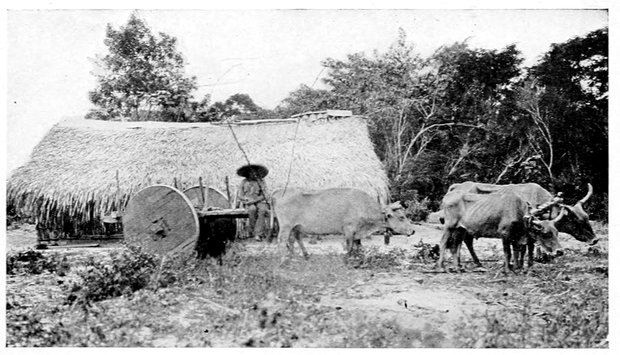
Transportation in the interior of Brazil is primitive—and noisy
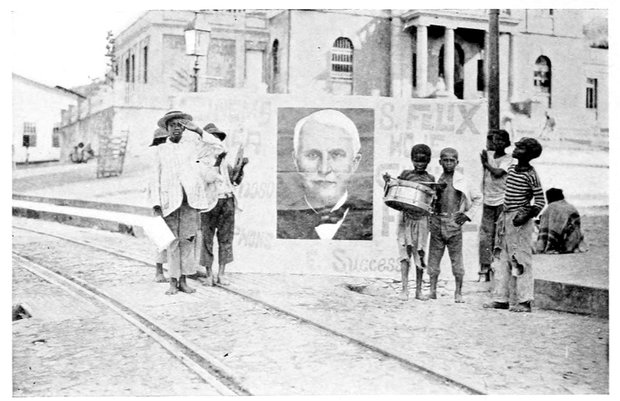
Our advertising matter parading the streets of a Brazilian town off the main trail of world travel
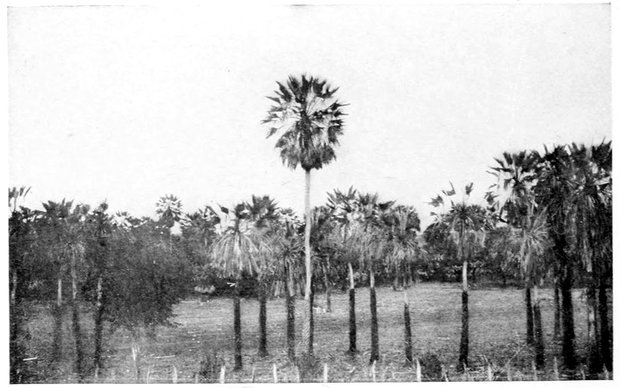
The carnauba palm of Ceará, celebrated for its utility as well as its beauty
From Fortaleza what was originally called the “Estrada de Ferro de
Baturité,” but which had recently changed its nationality and become
the “Brazil North Eastern Railways, Ltd.,” runs far into the interior
of the state. A journey to the end of the line and return, however,
417takes from Thursday morning to Sunday night, and I did not dream
I could absent myself so long until I discovered the unimportance
of Maranguape. This nearest important town of the interior was
a mere eighteen miles away, and as ten days must be passed between
steamers, it seemed the best place to spend our evenings after Fortaleza
had had its fill of the Kinetophone. There was more green along
the way than the constant cry of “secca medonha” (horrible drought)
had led us to expect, but it was largely in trees and bushes, with
grass almost wholly lacking. Beside the track lay scattered expensive
iron pipes from abroad that were some day to bring sufficient water
to the capital, if they did not rust away first. These, we learned,
represented another of Brazil’s government scandals. State officials
had been given a hundred and fifty thousand contos ($50,000,000)
by recent legislation with which to bring Fortaleza a suitable water
supply. They found it necessary to spend a year or more in Europe
before finally ordering pipe specially cast, with the name “Ceará”
embossed on each length of it. When thousands of these had been
tossed upon the beach at the capital and scattered for fifty miles or
more along the railroad, the politicians reported that the money had
given out, and Fortaleza continues to drink such water as it can
dig out of its own sand-holes by hand or by windmill.
An hour out we began to draw near the clusters of hills we had
seen from the sea. A little branch line circled the base of them
and at length brought us to Maranguape, spread a bit up the lower
skirts of the range. It proved to be a sleepy village, fairly large,
for it lay scattered for long distances in both directions, but of that
grass-grown temperament which promised little reward for our efforts.
The promise was only too exactly fulfilled. The sound of shod footsteps
was so rare in Maranguape that everyone hurried to the doors
whenever we passed, leaving behind us a long trail of motionless,
open-mouthed faces, and we were surrounded and hemmed in by
curious ragamuffins and innumerable children—the one unfailing crop
of Ceará, wet or dry—until we were forced to use violence to get
room to move; yet few families had energy enough to come across
the street to see what was unquestionably the greatest novelty, if not
the best show, that had ever come to Maranguape. Even while our
performance was at its height, however, the town remained squatted
in family groups before its doors, cracking the same aged jokes,
exchanging the same petty, malicious gossip, indulging in the same
banal pseudo-courtesies as their great-grandfathers did and as their
418great-grandchildren probably will. One fellow to whom, curious to
get the local point of view, I put a question, replied, “Eu quero
primeiro ouvir o bicho roncar—I want to hear the beast snore first;
then if it is good I’ll come to-morrow.” It was hard to believe that
Maranguape was the birthplace even of Rodolpho Theophilo, a
pharmacist who has written several readable, if amateurish, novels on
life in drought-stricken Ceará. Our total receipts that evening
amounted, at the current exchange, to seventeen dollars!
There was reported to be a hotel by a waterfall half an hour’s
walk up the hillside. “Tut,” Carlos and Vinhães trudged there after
our miniature audience had been hustled out, but I preferred to stay
near the railway station. There was not even a restaurant in the
town proper, and I could only get a lump of stale bread in one shop,
an ancient can of American sardines in another, and wash them down
with “cajú wine,” a concoction which the seller assured me was
“magnificent,” but which outdid the strongest medicine I had ever
taken. I swung my hammock in the cinema, the manager having
induced the owner to permit me to open one barred window to save
me from drowning in my own perspiration, and brought a moringa
of water to save me from death by thirst.
Dawn found me on my way back to the main line to catch the
weekly train to the end of it. A narrow-shouldered locomotive
dragged the four freight and six passenger cars made in Delaware
away from the little heap of hills into what might best be called a
jungle, though there were few large trees and no really dense vegetation.
The leaves were everywhere shriveled or curled together,
as if striving to protect from the malignant sun their last suggestion
of moisture. The dry air was so clear that the arch of heaven seemed
higher and the horizon more vast than I had ever known them before,
and the light falling from this greater height of cloudless sky struck
the ground with doubly blinding clarity and seemed to spray out in
all directions, like falling water. A few stagnant puddles in the
depressions of the land were all that remained of the long-forgotten
rains. Of vegetation the most striking, and at the same time the
most numerous, were the carnauba palms for which Ceará is famous.
The carnauba is much smaller than the royal palm, of girlish slenderness,
its leaves, shaped like those of our palm-leaf fans, arranged in
symmetrical sphere shape as carefully as the netted hair of a modest
young lady. There is nothing of the careless, lop-shouldered cocoanut
nor of the haughty majesty of the palma imperial about the carnauba;
419rather is it chic and dainty. The royal palm is a regal lady always
proudly garbed in rich plumes, but of no great worth, except ornamentally.
The cocoanut palm is a slouchy, disheveled wench given
to hanging about negro huts and tropical beaches, producing only
water and a bit of copra, sufficient to save herself from destruction.
The carnauba, on the other hand, is not only a modest and pretty, but
a very useful, young lady, who stays at home and attends to business,
no matter what the provocation to go down to the beach and play
with the sea breezes. She is as typical of the Cearense landscape
as the parasol pine-tree is of the southernmost states of Brazil.
The carnauba is useful from crown to toe; like a certain animal
familiar to our stockyards, nothing but its murmur is devoid of utility.
Among other things, it was of fibers and wax from the carnauba that
were made the first phonograph records and some of the first electric
light filaments. This wax is one of the important exports of the state
and of its railroad. The leaves are taken inside a closed hut and
threshed until the wax falls in white powder, which is then swept up
and reaches us in many forms, from seals to shoe-polish. From it
the natives make their candles, almost the only form of light used in the
interior. Exported in more ambitious quantity, the wax alone would
enrich and occupy half the people of Ceará. From the roots of the
carnauba is made a purgative, and a kind of farinha of inestimable
value in times of famine. The leaves are woven into hats, mats,
baskets, brooms, and the roofs of houses; from them comes the palm-leaf
fan with which we are familiar. Fibers useful for many purposes
are taken from the inside of the trunk, the iron-hard wood of which
serves many purposes, ranging from musical instruments to water-pipes.
The pulp of the fruit has an agreeable taste, as does the seed,
after being roasted. From the latter comes a saccharine substance
similar to sago. When small it serves as food, and it may be turned
into wine or vinegar. Lastly, the seeds are used as birros, knobs
to which native lace-makers tie the ends of their threads, and the
clickity-click of these may be heard all over northern Brazil.
Unfortunately the drought was beginning to choke even this paragon
of usefulness, and some of the lower leaves had turned sear and brown,
breaking the perfect symmetry of the sphere. Sometimes the only
representative of plant life that survives the seccas is the joazeiro, a
dense-green, haystack-shaped tree, the leaves and branches of which
are cut and fed to cattle as a last resort. The leaves of this tree fall,
still green, in September, and new ones immediately take their place.
420There is another tree of Ceará that furnishes a natural soap, but its
oily stench is so offensive that until some means is found of neutralizing
this, only the poorest people will use it.
The manager of the Ceará railway was an English F.R.G.S.
who had not lost his energy during long tropical residence, and we
made good Brazilian time in spite of a heavy train and the war-time
necessity of making steam of wood rather than coal. A few isolated
houses were scattered up the low, thick-wooded ridges, and towns
were almost frequent. Torrid as it was under the unclouded sun,
the more pretentious natives wore clothing as dark and heavy as we
of the North in April or October. Coffee was available at every
station, but little else could be had, sometimes mangos and oranges,
or hot milk served at scandalous prices by old women little less
distressing in appearance than the beggars. There was a constant
procession at every station of lame, halt, blind, and especially the
unwashed, rubbing their unsoaped hands along the window-sills and
imploring “a charity, for the love of God and our Lady Mary and
by the saints in Heaven!” Others of these unfortunates marched
through the aisles of the cars, so that one was beset on all sides by
offensive caressing hands. Those who, for some reason, could not
reach us, were almost as annoying with their “Psio!” as Brazilians
spell their ubiquitous hiss to attract attention. How weary one grows
of this short, shrill, nerve-startling “Psio!” here and “Psio!” there,
everywhere, all day long and far into the night, up and down the
whole country!
Baturité, once terminus of the line to which it gave its name, is a
town of some size, sitting placidly among low foothills. Some of
these small isolated ranges are high enough to snatch a little moisture
from the passing trade winds and turban themselves in clouds that
gave them a mantle of green, but such slight patches were of little
use to the thirsty state as a whole. All the region, both rolling plains
and hills, had a soft velvety-brown color, everywhere besprinkled with
stocky joazeiro trees. Many of these were already being cropped
to feed the starving cattle. Here and there smaller trees of deep-striking
roots had retained their color, but most of the vegetation was
bare and leafless as our own in midwinter, the landscape growing
more and more oppressive as we proceeded inland. Early in the
afternoon rugged granite hills began to break the horizon until, at
Quixadá, there were great rows of them. Solid masses of granite
heaped up into big hills stood in soldierly formation for miles along
421the track, like a guard of honor, magnificent heaps sufficient to build
all the edifices the world could need for a century.
Quixadá means in the aboriginal Tupi “lean cow,” and there were
a few such animals there to bear out the appellation. A mule-car
staggered away to somewhere up in the rock hills. Granite, piled in
fantastic ridges and forming most striking sky-lines, followed us for
a long distance. Everywhere was dead-bare ground, without even
a sprig of grass, and the air was so devoid of moisture that it dried
up the nostrils, so clear that one could see plainly the slightest markings
on the granite heaps far away on the otherwise flat horizon and
marvel that the train took so incredibly long to reach them. We
rumbled frequently over bone-dry creeks and rivulets; once we crossed
a huge four-span iron bridge over a river not only without water but
even without moisture. Yet if the Cearenses lack rivers in times of
drought, it is probably because they let them all flow madly away to
the sea after the rains, instead of damming them up and using the
water for irrigation. All day there was scarcely a sign of cultivation,
and very few cattle or even skeletons of them. No doubt they were
farther back among the hills, where mud-holes still existed. A
cotton tree of moderate size seemed to grow wild, but it, too, had
succumbed to the general fate and we ground monotonously on
through a sun-flooded landscape of bare bushes not unlike the chaparral
of Texas.
Quixeramobim bore slight resemblance to its aboriginal meaning of
“fat cow,” and the land beyond was still more dreary. Exclamations
of “secca medonha!” rose within the car whenever we passed a
family—men, women and children, gaunt, ragged, sun-bleached and
jungle-travel-worn—tramping north with all their miserable possessions,
consisting mostly of blackened pots and pans on their heads.
They were off after water, of course, since their own mud-hole had
dried up, and might be forced to tramp all the way to the coast, or
even go on to the Amazon, before they could again find means of
grubbing out a livelihood. Long stretches of country as deadly as
an elderly rattlesnake exhausted our weary eyes, and the train, as if
it, too, were worn out by twelve hours of this dreary monotony, at
length halted for the night in Senador Pompeu.
We were at once mobbed by a throng of self-styled hotel-keepers
and baggage-carrying ragamuffins, and I was soon imprisoned in an
interior room without ceiling in which there was not even a bed,
but only three hammocks hanging listlessly from hooks in the mud
422walls. I threw these outside and put up my own, then set out for
a stroll. The Southern Cross and Great Dipper were exactly at the
same height. The surrounding landscape consisted chiefly of dried-up
cotton bushes, and the trade wind howled across it as if we were
still on the seacoast, instead of nearly two hundred miles inland. A
night-school of ragged urchins was in full swing in one of the mud
huts, but it was run much like a crap game. Here everyone, from
hotel proprietor to street gamins, called me “doctor,” possibly because
I still wore the resemblance to a white collar. What a mongrel race
they were! If one were picking a team of men, they would be
harder to match in color than horses. Nor was there any connection
between color and social position. A ragged blond farmer might
be seen cringing and baring his head before a pompous black politician—though
for the most part negroes were scarce and lowly. Around
a long, loose-jointed, wooden table my fellow-passengers wolfed the
never-varying Brazilian meal as only Brazilians can, shoveling it up
in great knifefuls and racing away to begin an all-night uproar of
gambling and prattle.
It would not feel natural to go on a railway journey in Brazil without
getting up in the middle of the night to catch a five o’clock train.
When we rumbled away it was still pitch dark, and as the old kerosene
lamp in the car blew out I fell asleep again. From daylight on there
were many piles of wood for the engines along the way, and the white
bones of cattle lay scattered through the brown brush. Here and
there a few rib-racked animals were eating leaves. Men in brown
leather hats, each twisted and warped by sun, rain, wind, and individual
use into a distinctive shape, appeared at the rare stations.
The flat land grew almost swampy, with now and then a hint of green,
and at 10:30, with only a scattering of passengers left, we drew up
at Iguatú, 265 miles from the coast, and the end of the line. Iguatú
is completely beyond the land of beds. The room I got in a sort of
miniature caravansary was furnished with two hooks, and nothing
more. To these I managed to add a table and chair, with a moringa
of what passed for drinking-water; and there was a shower-bath
available whenever one could coax a man to lug a can of water up
a ladder and fill another, perforated and suspended from the roof.
Midday was no time to stroll in such a climate. I swung my hammock
and fell to reading by the light of a glassless window that
looked out upon a white-hot world in which the sheer sunshine fell
like molten iron on every unsheltered thing.
423I was back again below the sixth parallel of longitude, for to go
inland from the capital of Ceará means journeying south rather than
west. The town was flat, with the usual sandy praça, a windmill
in its center, and tile-roofed mud huts scattered in every direction.
One really could not feel much sympathy for a people who depend
for water, for life itself, on a few mud-holes that may dry up at any
time. Clothing is considered merely an adornment in Iguatú, and
children in sun-proof hides were playing everywhere in the sand.
The people prided themselves on being caboclos, or native Brazilians
for generations back, and though there were a few blonds scattered
among them, the great majority were of part Indian blood, with
negro mixtures, but no full-blooded Africans. The treacherous, surly
cabra, as the Brazilian calls the cross between Indian and negro, when
none of that class is listening, was in considerable evidence. There
was a childlike simplicity about the inhabitants which recalled those
of Diamantina, though here the preponderance of Indian blood made
the general indifference a matter of fatalism rather than racial cheerfulness.
Many of the inhabitants had an indistinct notion that
England, London, Europe, and New York were all different names
for the same place—a place in which was being waged the great war of
which they had heard rumors. One man asked me in great earnestness
whether it was true, as some visitor had once asserted without winning
credence, that “there are places in the world where it is so cold you have
to wear garments on your hands,” In this region patriotism is a matter
of separate mud-holes. A makeshift waiter to whom I was attempting
to make some kindly remark about Iguatú interrupted me with,
“Eu não son filho d’aqui, não, s’nho’—I am not a son of here but
of ——,” naming some other mud town identical with this one but
which to him was as Rome is to Oshkosh.
There were many picturesque countrymen about the market-place.
Goat-skins and cowhides are the most important commerce here,
especially with the drought killing great numbers of cattle, and
caboclos, burned a velvety brown by the blazing sunshine, rode in
with a few sun-dried cowhides and sold them for what the merchants
chose to give, which seemed to be three vintems a kilogram, or less
than a cent a pound. Every possible thing is made of leather in this
land where starving cattle make it so plentiful—ropes, boxes, curtains,
hats, even clothing. Nearly all the men wore hats some two feet
in diameter, most of them made of leather, the cheaper ones merely
of cowhide, which twists into uncouth shapes with long exposure
424to the elements, the better ones of sheep- or deer-skin. The others
were woven from the carnauba leaf, looking much like the coarsest
of our farmers’ straw hats.
I had concluded to buy the largest hat to be found in the shops
when I caught sight of an unusually fine one on the head of a
powerful and handsome young native in the crowd that was watching
me from the street. When I had overcome the mixture of pride and
bashfulness in which nearly all caboclos wrap themselves, I learned
that his name was João Barboso de Lera, and that the hat had been
made to his special order by an old woman expert living some ten
miles away. It was most elaborately decorated, and it was evident
that its possession raised the wearer high above the rank and file of
his fellow-townsmen. His hat is to the youthful Cearense of the
interior what spats and silk cravats are to the urban Latin-American.
João, however, may have been in financial straits, for when I hinted
in a mild and easily repudiated voice my willingness to buy his head-gear,
he astonished me by accepting at once. It had cost him twelve
milreis and was almost new; he thought ten would now be a fair
price for it. I concealed my delight as we walked together to my
lodging, where João deposited the hat on my table, crumpled up in
his hand the bill I handed him, and wishing me, with a friendly but
diffident smile, a joyful future, strode away bareheaded through the
gruelling sunshine.
Later I learned that he was a valoroso, almost a bandit, who had
“shot up” a neighboring town only a few days before and had several
assassinations to his discredit. The hat is of cowhide, covered with
fancifully patterned sheepskin, weighs almost two pounds and
measures two feet from tip to tip, though the crown is little larger
than a skull-cap. How the natives endure these under a cloudless
tropical sun is beyond northern conception, but the Cearense countryman
considers them the only adequate protection. Whole suits of
leather are also worn in this region, tight trousers for riding, a short
coat, and a sort of apron from neck to crotch in lieu of waistcoat,
the whole ordinarily costing less than ten dollars. Whether or not
the wearer overtaken by rain, followed by another space of the blazing
sun, is removed from this garb by a taxidermist is another of the
unsolved mysteries of the picturesque state of Ceará.
At Iguatú tobacco was sold in black rolls as large as a ship’s
hawser, being wound round a stick in ropes thirty or forty yards long
and sewed up in leather for muleback transportation. A kind of
425sedan chair on a mule, with canvas or leather curtains and fitted
inside with cushions and all the comforts of home, is still used by
the few wealthier women obliged to travel. The railway goes on
quite a distance into the interior, but though there was a big two-span
iron bridge near town across a mud gully that might be a river, traffic
has been abandoned beyond Iguatú. The track southward was
wrinkled and twisted out of all possible use as a railroad, and great
heaps of rails which the company had hoped some day to lay all
the way to the frontier of the state, and perhaps beyond, were rapidly
rusting away in the ruthless climate.
The chief cause of this railway stagnation was Padre Cicero and
his cangaceiros. Father Cicero is one of the chief celebrities of
Brazil, his name being known from the Uruguayan to the Venezuelan
boundaries. Thirty-two leagues beyond Iguatú is the town of Crato,
of some importance industrially, and three leagues east of this lies
Joazeiro, said to have more inhabitants than Fortaleza, though they
are nearly all fanatical followers of their local saint, living in mud
huts and all more or less of African blood. Here Padre Cicero, a
saint in the purely Catholic sense of the word, reigns supreme.
He is an old man, past his three score and ten, a native of Crato,
who took orders in the seminary of Bahia and became parish priest
of Joazeiro. The conviction of some woman that he had cured her
of an ailment by miracle gave him the by no means original idea of
establishing a shrine with a “miraculous Virgin.” Credulous fools
were not lacking, and Joazeiro soon became the most famous place
of pilgrimage in North Brazil, at least among the lower classes. Three
large churches were built, and so persistently did people flock thither
and settle down within immediate reach of miraculous assistance that
Padre Cicero soon became too powerful to be handled by the state
government. His picture occupies the saint’s place in all the country
houses of the region, and he was said to have more than ten thousand
followers, variously called cangaceiros and jagunços, whom he could
use either as workmen or as a sort of outlaw force to impress his
will upon the region. The trade winds which dry up the northern
part of the state begin to drop their moisture in the vicinity of Crato
and Joazeiro, making them green and fertile and giving the outlaw
priest an added advantage. Several expeditions have been sent
against him and he has been a prisoner in Fortaleza, Rio, and Rome,
but always returns to power. Suspended by the Church, he is said
to live up to the papal order by merely confessing and baptizing,
426without saying mass or otherwise conducting himself as a full-fledged
priest. Those of a friendly turn of mind toward him assert that
Father Cicero is a “good and pious man, a strict Catholic, who is
doing his duty as he sees it and who has no other fault than too
great a liking for money.”
There is always talk of this or that part of Brazil seceding; Ceará
has already partly done so, thanks to the power of Padre Cicero.
He is really the ruler of an autonomous state, from whom even the
delegado and other government officials take their orders. For years
the roads of southern Ceará have been unsafe, for his followers
have robbed and killed with impunity, torturing and mutilating natives
who oppose or give evidence against them, levying on political opponents,
the rich, and merchants, though they have seldom ventured
to trouble foreigners. They call themselves “romeiros” (pilgrims or
crusaders), and the federal government has no more been able to
conquer them than to put down the quarrel between the States of
Paraná and Santa Catharina. Padre Cicero deposed the president
of Ceará, and when a regiment of federal troops was sent to put
down his “jagunços” they were treated as brothers by the fanatics
and threw their weight against the state authorities. Like Rio and
Nictheroy, the state was declared in a state of siege by “Dudú,” but
those who know their way about the political labyrinth of Brazil claim
that the soldiers ostensibly sent to put down the bandits—and who
did more robbing and killing than the outlaws they came to suppress—had
secret orders from the national boss, the “odious gaucho,” to aid
the cause of the priestly despot. However that may be, Padre Cicero
continues in full command of the region, all commerce of which is
in his hands. He has surrounded Joazeiro with a high granite wall
and smuggled in overland from Santos quantities of arms and ammunition,
among them several cannon. He is notorious among
Brazilian priests for his reputation of living up to his vows of chastity,
though the rumor persists that this is due to physical drawbacks
which have finally developed into his present mania for power and
wealth. Old and feeble now, he had an Italian secretary and a
complete staff, including a treasurer, and was said to do nothing
but play saint and strengthen the belief of his followers that upon
his death he will immediately appear among them again in another
form. This last would seem to be a golden opportunity for an
experienced actor with the proper qualifications and ample courage.
The entire ragged, leather-hatted town of Iguatú was down to see
427us off the next noon, wriggling the fingers of a crooked hand in
friendly farewell, as is the Brazilian fashion. They are a simple,
good-hearted, superstitious people, looking outwardly like fierce
bandits, yet really childlike in their harmlessness, unless they are led
astray by fanaticism or designing superiors. We had to struggle for
seats because the thirty-four country people whom the government
was assisting to go to the rubber-fields of the Amazon, rather than
have them die at home of the drought, overflowed from the second-class
car into the first. Many of these were pure white under their
tan, but a more animal-like lot of human beings could scarcely be
found in an ostensibly civilized country. Ragged, dirty, sun-scorched,
prematurely aged by the rough life-struggle with their ungenerous
soil and climate, their personal habits were as frankly natural and
un-selfconscious as those of the four-footed animals. Children,
ranging from the just-born to the already demoralized, rolled about
the car floor, while men and women alike constantly passed from
mouth to mouth bottles of miserable native cachaza and crude pipes,
both sexes generously decorating the floor with their expectoration—a
rare thing in South America. All this would have been more nearly
endurable had they had any notion of their own drawbacks, but
they were as convinced of their own equality, if not superiority, as
are most untutored people—a semi-wild tribe lacking the virtues of
real savages.
Everywhere the talk was of rain, to the Cearense the most important
phenomenon of nature. Even the women knew cloud possibilities and
studied the horizon constantly for signs of storm. They ended their
more forceful sentences not with “if God wishes,” but “se chover—if
it rains.” A man bound for the Amazon was holding one of the many
babies when it played upon him that practical joke for which babies of
all races and social standings are noted. “Menina!” he cried, “Parece
que a secca não ‘sta’ tão grande aqui, não!—Girl! It looks as if the
drought were not so great here, eh!”
In fact, the drought was broken that very night. We had halted
again at Senador Pompeu—where the sertanejos refused to pay more
than a milreis each for hotel accommodations and slept out in consequence—and
I had at last fallen asleep in spite of the incessant rumpus
of my fellow-guests when I was awakened by a heavy downpour. With
daylight the domes and sugar-loaves and heaps of granite hills among
which the train picked its way stood forth ghost-like through a blue
rainy-season air with an appearance quite different from that under a
428blazing sun. Heavy showers continued throughout the day, and as the
last rain had fallen ten months before, joy was freely manifesting itself.
Everywhere people were congratulating one another, showing perfect
contentment whether they were forced to keep under shelter or to
wade about in the downpour, talking of nothing but the rain, the sound
of which on his roof is to the Cearense the sweetest of music. It was
remarkable how nature, too, responded to the change. I could not have
chosen a better four days in which to make the trip to Iguatú, for these
had given me both the drought and the resurrection. The whole region,
dry, brown, and shriveled three days before, was already a sea of
bright green. Leaves opened up overnight as they do only in a month
or six weeks in the temperate zone, giving the effect of seeing midwinter
followed by late spring in a single day, a jungle magic reminding one
of the Hindu tricksters who seem to make plants grow in an hour from
seed to bloom before the eyes. Rivers bone-dry on Thursday were
considerable streams on Sunday, with natives wading like happy children
in water where they had shuffled the day before in dry sand. No
wonder these poor, misguided people of the jungle lose heart when their
world dries up, and become suddenly like another race when the clouds
again come to their rescue.
All day long joyful cries of “Eil-a chuva!” (There’s the rain!)
sounded whenever a new shower burst upon us. Life at best is rigorous
in this climate, under the life-giving but sometimes death-dealing
sun, and only the hardy or the helpless would have remained here to
endure it. No wonder the Cearense who can by hook or crook do so
becomes a lawyer without idealism or a shopkeeper without human
pity. The aspect of nature changed so magically that it was hard to
judge what this light, half-sandy soil might be able to do under proper
rainfall or irrigation, so that my first conclusion that northeastern
Brazil was doomed to remain a thinly populated semi-desert may have
been too hasty. Between showers the breeze gently moved the fans of
the palm-trees, the graúnas, or singing blackbirds of North Brazil,
flitting in and out among the carnaubas. At Baturité all the Amazon-bound
travelers old enough to own a few coppers bought mangos and
quickly made the car look like a bathroom by their furious attacks on
a fruit that has been fitly described by a disappointed tourist as tasting
“like a paint-brush soaked in turpentine.” As the negro blood and light
sand marking the coast strip announced our approach to Fortaleza, I
turned to the brakeman on the back platform with a fervent, “Well,
we are getting back where we can sleep in beds again.” He gazed at
429me with a puzzled-astonished air that caused me to put a question. I
had forgotten the native Cearense’s devotion to the hammock; the
brakeman had slept in a bed once in his life—when he had a broken
leg.
I had installed myself again in the “Pensão Bitú” and was just
starting for the theater when I was held up by another downpour.
When I finally entered the “Cinema Rio Branco” I found it almost
empty; but it would scarcely have been fair to curse the first rain that
had troubled us since early January in Victoria, especially one which
meant almost the difference between life and death to thousands of
our fellow-men. We had done poor business during my absence, due
mainly to the fact that the ten-day engagement forced upon us by the
steamer schedule was too long for Ceará. At Maranguape my three
companions had lived in an old hammock-hotel up in the hills where a
natural spring furnished splendid swimming, and where there was no
charge for rooms, but merely for meals. On Friday the performance
was a “Benefit for the Santa Casa de Misericordia,” or nun’s hospital,
for which I had sold our part of the show at 300$ to Vinhães, who in
his turn had contracted with the nuns to furnish everything for 500$.
But when it was all over the religious ladies had refused to pay, so that
in the end Vinhães was the loser. I relieved “Tut” by running the
second session myself to a handful of people, while the rain drumming
on our sheet-iron roof all but drowned out the phonograph, and
pocketed one eleventh as much as I had the Sunday before in this
gamble known as the show business.
My last duties in Ceará were mainly of a personal nature, for to
Vinhães fell the task of buying the tickets and getting the outfit on
board. The Brasil arrived about noon and we were down at the wharf
by two, only to have our leisurely boatmen nearly cause us to miss
the steamer and squat in the sand another ten days. The whistle had
long since blown and the sailing-hour was well past before we even
started out from the wharf. Then we lost our rudder, which was
rescued by a negro rower who sprang overboard and was washed up
on the beach with it, while the heavy boat with all our possessions, not
to mention the four of us, threatened at any moment to capsize. There
followed a long struggle between time and white-capped swells, with
the lazy negro oarsmen as referees, and we were off at the very moment
that the last of our trunks went into the hold.
CHAPTER XVIII TAKING EDISON TO THE AMAZON
430
When he was quite a young man Edison failed to get to Brazil
for the same reason that I had failed to get home from Rio—his
ship did not sail. He had journeyed as far as New Orleans
in quest of adventure, and before another chance came he met an old
Spanish wanderer who advised him by all means to remain in the
United States. It would probably be difficult to write on one page
what humanity owes that unknown Spaniard. Later, when his inventions
had begun to make him world famous, the former trainboy sent
a man to search all the Amazon region for materials to be used in his
experiments—and it was our privilege to take the finished product
back to the land which the inventor himself had never reached in
person.
The Brasil is one of the three smaller and older boats of the government
line—which is the reason we had much more space in our two
staterooms and considerably better attendance, for these boats are not
popular with “deadhead” politicians and their families. The cabin
passenger list was made up of the usual conglomeration of every
human color, nationality, social and moral standing, from priests to
several of the most repulsive old adventuresses—treated outwardly
with complete equality even by mothers of corruptible daughters—from
clean-cut young Englishmen to licentious, shifty-eyed Brazilian mulattoes.
But the real sight was the steerage quarters on the three decks
in the nose of the ship. Here men, women, and children—the thirty-four
latest refugees from the interior among them—bound for the
rubber-fields were so packed together that individual movement was
impossible. Such a network of hammocks—above, across, under, over
one another, the bottom of one sleeper resting on the belly of his neighbor
below, scantily clad women crisscrossing men who had discarded
all but a single short garment—as one could not have believed possible
filled all the space, disputing it with the animals and fowls the ship
carried as food. Sheep and pigs wandered among the no less frankly
natural passengers; six zebu bulls on their way to improve the native
431stock at the mouth of the Amazon occupied stalls in the midst of the
turmoil. One venturesome fellow had as a last resort hung his hammock
from the roof above these animals, so that whenever one of them
moved he was lifted hammock and all. There was a very exact description
of the scene in the Cearense novel “O Paroara” with which
I was whiling away my time, and as that was published sixteen years
before, conditions have evidently long been the same.
Early in the afternoon of the second day we picked up a pilot along
the sandy coast and went over a sandbar into the wide bay of Tutoya,
port of the State of Piauhy, only a little point of which touches the
sea. I had at one time planned to go up the Parnahyba River to
Therezina, the capital, but inquiry proved that this would not be financially
advantageous, so that I contented myself with this brief glimpse
of the state. Many Piauhyenses came on board from the montarias,
or ludicrous native rowboats in which they were transferred from the
giaolas (literally “bird-cage,” but “river steamer” in Amazonian parlance)
that were waiting to carry passengers back up the river, and we
had at least a vicarious acquaintance with them.
When I awoke at dawn we were already close to the winking lighthouse
known among British mariners as “Maranham,” and soon afterward
there appeared a town rather prettily situated on a low ridge.
We anchored far out, and it was more than an hour before sailboats
brought the authorities to examine us, but that was a small matter to a
man with a deck-chair and a passable novel. In fact, there was no
hurry about going ashore, for five days would probably suffice to
exploit the interest of São Luiz in the Kinetophone, and the rest of the
State of Maranhão was virtually inaccessible. More than that, when
the local manager came on board through the dingy gray water to pay
us his respects he reminded me that this was Wednesday of Holy Week
and that it would be foolish to spoil the effect of our estrea by attempting
to compete with the priests before Saturday.
In 1612 a Frenchman named La Ravadière founded on an island
near the mouth of the Amazon a city which he called Saint Louis in
honor of King Louis XIII. Two years later the Portuguese drove out
the French and the city became the capital of the province of Maranhão—aboriginal
name of the Amazon—which then included all northern
Brazil from Ceará to the Andes. The island, which is small, is known
as Ilha de São Luiz, and the city is officially São Luiz do Maranhão,
though, like most capitals along this coast, it is better known to the
outside world by the name of the state. Its harbor is shallow, with
432much tide, so that when one lands, by launch, rowboat, and finally a
negro’s shoulders, the whole raging sea seems beneath one, and six
hours later the place is a sand-field, with steamers sitting high and dry
and barefoot crab-hunters wandering about on it, as if someone had
pulled the cork out of the bottom of the ocean.
A huge old fort and stone wall face the harbor, and from the landing-place
a stone-paved street lined by carefully trimmed, haycock-shaped
trees slants swiftly up to the venerable cathedral and the main square,
perhaps a hundred and fifty feet above. Situated on a low, but narrow
and broken, ridge, its streets stumble rather steeply up and down in
places, and the town is so compact that, once ended, these passageways
break off instantly into dense-green and almost trackless jungle, except
the single Rua Grande, which goes on across the island. Perhaps it is
due to its situation that São Luiz is cooler than its two degrees from
the equator would suggest, though here the constant trade winds die
down, thereby saving the region from the glaring aridity which characterizes
all that part of the continent to the eastward. In fact, somewhere
between Ceará and Maranhão is the dividing line between that
scantily wooded semi-desert and the humid, dense jungle of the Amazon
basin. In many ways São Luiz is the most pleasant little capital
along the coast of North Brazil, and not the least of its charms is the
pleasure of again seeing grass and trees in all the green profusion of
tropical lands. Here one begins to feel that equatorial humidity which
leaves even the clothing damp and sticky; by night strange creatures
singing in the prolific vegetation mark São Luiz as the beginning of the
great Amazonia.
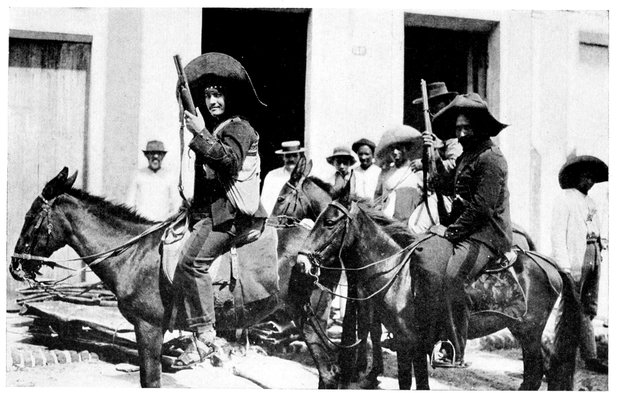
Rural policeman of Ceará, in the heavy leather hats of the region
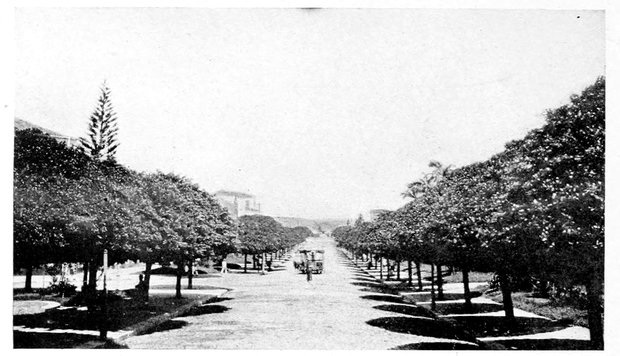
From town to port in São Luis de Maranhão—and a street car
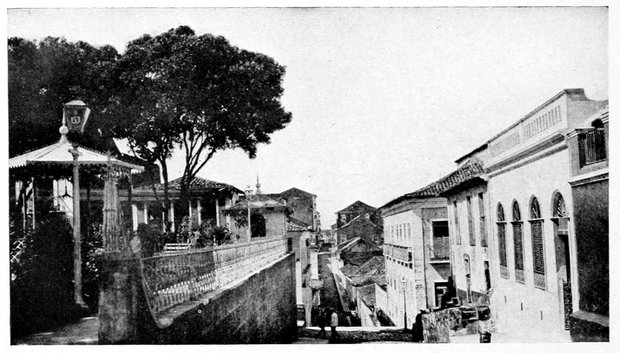
A street of São Luis de Maranhão
In Brazil it is the custom to interview newspapers rather than to wait
to be interviewed, and immediately upon landing the local manager
hired an automobile in which all of us engaged in the “necessary
courtesy” of calling upon all the editors. Some of them were men of
real culture and widely informed, their full Caucasian complexions
burned that coppery red of those who have lived for generations near
the equator. Even the local cinema manager, who had never been off
the little island of São Luiz, spoke faultless French and would not have
been out of place in the best society of old Europe. A few, on the
other hand, had traveled rather widely, and these were even more
inclined than the others to be dogmatic in their editorial wisdom. One
vivacious young editor of rather forceful and unusually attractive face
for Brazil, who looked like a white man browned up for a minstrel
show, who might have been a strong character and a pleasant, handsome
433fellow had not some wanton ancestor casually added a bit of negro
blood to his veins and given him the egotistical volubility, the instability,
and the surliness of the mestiço, had no sooner been presented to
us than he began talking like a whirlwind about the United States,
neither desiring nor expecting to have his opinions in any way questioned,
his attitude that of a judge who means to be kindly but who
regards his judgments as final. In answer to one question which I
managed to thrust between his closely cemented words he casually
remarked that, though he knew most of Brazil and had been several
times to Europe, he had never visited the United States, adding in
his turbulent flow of speech that he had fear rather than a desire to
do so “because there life is so intense.” In the next sentence he was
assuring, and convincing, his native hearers that the “Collosus of the
North” was purely scientific and commercial, without the slightest
conception of or interest in anything artistic—and then suddenly he
broke forth upon the negro question.
Next to Bahia. Maranhão has the greatest percentage of African
blood of all the states of Brazil; hence this was a natural topic. It
usually is between educated Brazilians and traveling Americans. The
editor’s opinions on the subject were those of many of his class, long
since familiar to us. There were 900,000 negroes in Brazil, he dogmatized,
in other words about three per cent. of the population(!), who
were rapidly being absorbed and would soon disappear, whereas in the
United States twelve per cent. of the population were negroes, who,
being forced to resist the attitude of the whites, would remain a race
apart and a constant and growing menace. In two or three centuries,
he prophesied, there would be only negroes left in the United States,
because they “reproduce like flies and lie in the shade and live to be a
hundred, while the white men are wearing themselves out by their
absurdly intense living.” Ergo, Brazil had been far more fortunate
and wise in her handling of the negro problem than her great neighbor
of the North.
It was the same old argument, the rock on which the bulk of Brazilian
and American opinion on this subject always splits. In Brazil
the negro is physically stronger and better fitted to the climate than the
whites; in the United States, as a whole, the reverse is the case. This,
and certain other differences overlooked by most Brazilians, keep the
argument from becoming clean-cut. Yet is the negro, or at least the
part-negro, the best type that can permanently prosper under Brazilian
conditions? No one of tropical experience and an open mind believes
434that the white race, pure and unadulterated, can maintain its high
standing for generations in equatorial regions without frequent reinforcements
either by training in, or immigration from, the temperate
zones. Can some such standard be maintained by mixing it with those
to whom the tropics are a natural habitat? Is it better to “wash out
the black” through many generations of lowering the whites, to breed
a new type, a kind of human mule, to fit the climate and conditions, or
to keep the two races strictly, even forcibly, separated? The first is
the Brazilian, the second the American point of view, and the gulf
between them is not easily bridged.
That night we gave a special performance for the press, which was
attended by about forty representatives of São Luiz’ four daily journals.
This and the ceremonial visits were probably worth the trouble, for
the papers next day were equally enthusiastic about the Kinetophone
and its “highly cultured” sponsors, whose names, titles, and previous
condition of servitude they gave in full down to the latest count of
Carlos’ children. Indeed, we became the subject of the chief editorials,
even in the face of religious competition. The most famous living
wielder of a quill in Maranhão took us amiably to task for using the
full name of the inventor on our advertising matter, contending—in his
paper’s two most prominent columns—that it was an indignity to style
“Thomaz A. Edison, like any commonplace mortal, a man whose Godlike
gifts to the world had made him to all mankind for all time the one
and only EDISON.” Naturally such publicity hurt our feelings.
But the result of all this could not be known for three days, Thursday
and Friday being so holy that even churches could not ring their
bells—for which we gave fervent thanks, well knowing that the respite
would be soundly broken on Easter Sunday. The “only one” in town
was the “Hotel Central,” a big colonial two-story building directly
across from the cathedral, and the French proprietor set a table and
attended to business like a Frenchman, instead of being off down the
street gossiping. “Tut” and I had a suite of two rooms shut off from
most of the uproar of the rest of the house, our living-room immense,
with three balconied double windows larger than doors looking down
upon the tree-lined promenade and a part of the sea—when the tide
was in. Our huge four-poster bed, as well as the smaller one we took
turns in occupying, was carefully mosquito-netted, for only white
foreigners are said to be subject to yellow fever. There were hammock-hooks,
never lacking in North Brazil, in all the walls. Of the
mahogany tables, marble-topped bureaus, full-length pier glass in which
435to admire ourselves, the big cane settee, the comfortable roomy cane
rocking-chairs, and the score of minor convenient articles of furniture
I will say no more, lest there be a sudden exodus to São Luiz do
Maranhão. To be sure, the shower-bath now and then ran dry, but
there were really only two drawbacks to the “Hotel Central,”—its
kerosene lamps and its “artistas.” Evidently there was no escaping
these self-styled “actresses” who distribute themselves throughout the
hotels of North Brazil, though the old Frenchman assured us that he
had always refused to take them in until the war-bred crisis made
their admission “necessary.”
Being so old a city, São Luiz has a finished aspect quite different
from many others of more recent origin. It is completely paved in
square cobblestones, with very much arched roadways, and all its narrow
sidewalks of flat stones, polished by many generations of feet, are
so slanting that one must take care if he would not, as I all but did more
than once, spill himself wrong end up in the middle of the street. We
had at last outstripped civilization, in its more modern manifestations.
All the way up the coast each state capital had put in electric street-cars
and similar contrivances within a year or so—that is, long since I had
entered South America. Here we had beaten invention to it, and there
was genuine pleasure in seeing drowsy old easy-going mule-cars again—though
we never bothered to wait for them. São Luiz, too, still
lights itself with matches, though that does not mean, as it would
almost certainly in the Andes, that reading is considered bad form.
In fact, it is called the Athens of Brazil, and quite justly, for all the
rest of the country has scarcely produced as excellent a list of literary
men. Graça Aranha, Coelho Netto, the three Azevedo brothers, João
Lisboa, the historian, Manuel Mendes, who turned Virgil and Homer
into widely famed Portuguese verse, Teixeira Mendes, head of Brazilian
Positivists, and Gonsalves Dias, the national poet, are but a few
of the famous sons of Maranhão. Of them all, the most beloved, not
merely in São Luiz but in all Brazil, is Dias, born of a Portuguese
shopkeeper of the interior and his negro slave, and done to death by
sharks when the frail craft on which he was returning from Europe
with an incurable ailment came to grief within sight of the lighthouse
on his native shores. Those who are familiar enough with both tongues
to be able to form a judgment, and who have no national prejudices to
overcome, assert that as a poet the impulsive, licentious Brazilian mulatto
was several rungs higher up the ladder than our own Longfellow.
There is a Praça Gonsalves Dias in São Luiz, and in the center of it,
436at the top of a tall column high up among his beloved palm-trees and
the singing sabiás he immortalized in his best known poem, is the poet’s
statue, non-committal as to complexion in its white stone (or plaster)
and giving him the appearance of a wavy-haired Shakespeare. Not far
from this statue, overtopping everything else and giving an aëroplane
view of all the city, is an old shot-tower, of the kind used in former
days for the making of bullets with the aid of gravitation. Dogs are
distressingly numerous, and the charcoal over which the Maranhenses
cook in little braziers is carried about town and sold in small baskets
hanging six or eight high at either end of bamboo poles. It is a busy
town every five days, when a steamer comes from Pará or the south;
otherwise it drifts along at a contented, mule-tram pace.
On Thursday evening we stepped across to the cathedral and saw
the ceremony of the “Washing of the Feet.” The bishop, in full purple
and attended by a throng of assistants and acolytes, without music and
with very little light as a sign of mourning, marched along a raised
bench where twelve beggars had taken seats hours before. Several of
them were blind and all of them diseased, and they had been dressed in
white cotton gowns which partly concealed their natural rags. The
bishop placed a silver basin under a foot of each in turn, spilled three
drops of water on it, dabbed them with a napkin, then stooped and
kissed the unsterilized extremity almost fervently, though with something
in his intelligent, clean-cut face which suggested that he did not
particularly enjoy this part of his ecclesiastical duties. Each beggar
was given a loaf of French bread, a copper coin worth nearly a cent,
and what looked like a folded nightshirt, to all of which he clung with
both hands as if expecting the densely packed throng of the faithful,
virtually all of whom could point back to African ancestry, to snatch
the gifts away from him. That night the same class engaged in the
annual “hanging of Judas,” and when morning dawned effigies of the
traitor of Gethsemane, in most fanciful and multicolored garments,
swung by the neck from a score of improvised gibbets.
One of the best known residents of Maranhão is a hardy American
who came down twenty years before to set up in Caixas the first cotton-mill
in North Brazil—though cotton had been grown there for more
than a century. There he married, became a power in the cattle and
mining industries, and established a line of river-steamers to that
principal town of the interior. Brazil, as he put it, is an easy country
in which to make a living, but a hard one in which to make a fortune.
Once real wealth begins to show its face, the native politicians see to it
437that it does not become too swollen. Cattle are the principal product
of the state, but a sack of salt costing two or three milreis in São Luiz
to begin with, reached the incredible price of 24$ in the interior. All
Brazil, in his opinion, would prove fitted for the white man, once the
more temperate south was filled up; but as yet only the two hundredth
part of the republic was under cultivation.
We opened on Saturday night after the longest period of idleness
since the Kinetophone had made its bow to Brazil. It was perhaps the
combination of good advertising, after-Lent reaction, and the fact that
São Luiz gets few good entertainments that brought greater crowds
than we could accommodate. Our performance, too, pleased more
than usual there, thanks among other things to excellent acoustic properties
and to a few lines in our introductory number from “O Canto
do Sabiá,” best known poem of Gonsalves Dias. The result was that
as often as we chose to open it we filled the house so tightly that I could
barely squeeze in myself. Unfortunately the remodeled shop held only
four hundred, but on the other hand it was the best managed theater
we had seen in Brazil, with “deadheads” almost unknown and the
smallest child paying admission. On Sunday we gave a matinée and
three evening performances, packing the place so full that we had to
call upon the police to restrain those who could not legally be admitted.
We took up the tickets inside, as in a street-car, and needed no door-keepers
during the performance, for no man, with or without a ticket,
could have forced his way into that sardine-box. The street outside
was blocked with those waiting to get into the next sessão, the sidewalks
lined with chairs filled with fancily dressed women of the “best
families.” That day’s income was larger than we had had since our
first Sunday in Pernambuco, and a cablegram carried the news of our
popularity to the newspapers of Pará.
There is only one place to take a walk of any length in São Luiz.
The Rua Grande turns into a passable road and goes on across the
island, but all other streets soon end in swamp or jungle. I tramped out
of town one morning and returned that afternoon, having covered
fifteen of the twenty miles of island road and return. It was a joy to
walk on real earth again after months of wading in sand, and to be
surrounded on either hand by a great green wall, instead of a glaring
half-desert. On the other hand, the dull skies of the Amazon region
were already getting on my nerves, as they do on those who abandon
the almost unbroken blue sky and sunshine of the eastern coast. Yet on
the whole Brazil has a remarkably even climate for so enormous a
438stretch of territory, and it was not much warmer here than in Santa
Anna on the Uruguayan border. Life out of doors in the tropics is a
serious thing, however, and here was the real, humid, densely jungled
tropics of the imagination at last. Bamboos waved their titanic plumes
above me; a tree ablaze with scarlet blossoms flashed forth from the
dense verdure; the fructa-pão, which furnishes its vegetable bread to
the poorer classes all the way from Bahia northward, here produced
far more abundantly than man required. Palms ranged from those of
fern-like delicacy to the coco-babassú, shaped like a gigantic feather-duster
stood on end and producing a bunch six feet long of red nuts as
large as our walnuts. These contain a kernel of cocoanut meat rich in
oil, which was just beginning to be exported to Europe, and unlimited
quantities of which could be had for the picking and cracking. Butterflies
celebrating their nuptials enlivened the landscape with the flutter
of their iridescent multicolored wings; here and there the sabiá, first
cousin to our northern robin, sang his familiar song; once or twice I
fancied I heard the mãe da lua (mother of the moon), the nightingale
of Brazil.
Anil was the largest of several small towns along the way, with a
mule-car running the length of it on what used to be a little railroad.
A railway also runs across the island, or at least the rusty rails do,
hoping some day to reach the mainland by a bridge and continue to
Caixas, whence a line already operates to Therezina, capital of the
next state east. Several genuine tropical downpours forced me to seek
such shelter as was available, and the day was done before I returned
to São Luiz. There are many delightful things in the tropics, but none
of them equal the soft dusk of evening. Like most fine things, it is
short and fleeting, no two minutes alike, and barely a few moments
seemed to pass between the last livid rays of the sun, as it veiled itself
behind the light band of clouds along the horizon, and the falling of
moonlight in flecks of silver through the limply drooping fronds of the
palm-trees, stencilled in silhouette against the iridescent sky of a
tropical night. It was almost a full year since my last real walk, but
no one in São Luiz felt more contented with life than I that evening.
Yet my tramp was the only topic of conversation at the cinema, and a
newspaper referred editorially next day to the “incredible energy and
endurance of our distinguished North American visitor,” who could
cover thirty miles of Amazonian ground on his own feet in a single
day!
It might have been better for Carlos, too, if he had combatted the
439climate of the torrid North with pedestrianism. For some time he had
been losing his Paulista energy, and with it his interest in life. On the
morning after my walk I met him strolling languidly along the main
street, looking more disconsolate and colorless than I had ever seen him
before; but those are common symptoms in the tropics and I thought
little more about it until he failed to join us at dinner that evening. We
found him in bed in his room across the hall, with a raging fever. The
best recommended physician of São Luiz having arrived, I hurried away
to the theater, where both Carlos’ work and my own awaited me.
That night he was neither able to talk nor, apparently, to recognize
me. The native leech had diagnosed his ailment all the way from malaria
to bubonic plague, and had finally settled upon intestinal grippe. Whatever
it was, Carlos was a sick man, and when morning came without
any sign of improvement, I set about arranging to get him into a hospital.
There were two in São Luiz,—the “Beneficencia Portugueza”
and the “Santa Casa da Misericordia.” For several reasons I chose the
second. By this time the invalid could scarcely raise his head, or express
himself, except by monosyllabic gurgles and the rolling of his bloodshot
eyes; yet it was a labor of hours to coax any of his fellow-countrymen
to help untangle the red tape that blocked his immediate
entrance to the hospital. A colonel connected with the cinema at length
agreed to go with me to the doctor whose duty it was to issue tickets
of admission, but he insisted on having an automobile at 10$ an hour
with which to cover the four short blocks of stone-paved street. When
the doctor and the colonel had run through all the gamut of Latin-American
salutations, down to the fourth generation and the family
cat, a great many questions were asked me before Carlos was finally
accepted as a patient, as if it were an extraordinary favor, though the
“Santa Casa” was in theory open to all. Then, a bit of rain coming
up, the colonel began talking politics and remained for more than an
hour, through three more showers. When we finally entered our waiting
automobile it was out of gasoline! I raced back to the hotel, impressed
two carriers and a hammock into service, and got our ailing companion
at last into the hands of the nuns just at nightfall.
As the time was drawing near when we must move on, I appointed
the most responsible man in town unofficial guardian for Carlos and
turned over to him, against ample receipts, his back pay, his salary to the
end of the month, and his fare back to Rio. This should have sufficed
amply to pay his hospital bills and carry him home with something to
spare, and I had no authority to give him more. Next morning we discovered
440that Carlos had taken with him our duplicate set of keys, and
“Tut” went up to the hospital to get them. The nun-nurse had them in
safe-keeping and would not turn them over without Carlos’ permission.
He could not talk, but after staring at “Tut” for a long time he faintly
nodded. After still longer effort they succeeded in getting, in faintly
whispered monosyllables, the address of his family in São Paulo. As
“Tut” was leaving, a doctor bustled cheerily into the ward and casually
informed him that Carlos had yellow fever.
The indifferent way in which São Luiz took such things gave one a
creepy feeling that life was held cheaply in those parts. When Carlos’
condition was mentioned to patrons of the cinema that evening they
said, between yawns, “Ja estã liquidado—Oh, he is finished all right,”
and went in to weep at some silly film drama and to giggle at Kinetophone
humor. I insisted on remaining optimistic. Had we not heard a
hundred times that native Brazilians never die of yellow fever, that its
fatalities are confined to white foreigners? In other words, while “Tut”
and I were constant prospective candidates for an Amazonian cemetery,
a man born in São Paulo, accustomed all his life to Brazilian conditions,
should be in no great danger. I was still telling myself these things when
word reached us that Carlos was dead.
By this time we were already on our way to Pará, for ten-day steamers
and theatrical engagements wait for no man. When three men have
lived more closely together than brothers for more than half a year the
loss of one of them is an astonishingly heavy subtraction, one which we
felt all the way from the longer time it took the two of us to tear down
the show and send it on board the Ceará, to all those little daily reminders
of the loss of a familiar companion. Of course, when we came to
think it over, natives do die of yellow fever; but as those living in the
regions where it flourishes have either died of it, or recovered from
it, in childhood, the survivors are immune and the effect is as if the
disease were fatal only to Caucasian visitors. Besides, Carlos, born of
Italian parents on the cool Brazilian plateau more than twenty degrees
to the south, was virtually a foreigner up here on the steaming equator.
The period of incubation being longer than the time we had spent in
São Luiz, it was probably the mosquitoes of Ceará that had been his undoing.
We refitted the phonograph with “Tut’s” automatic starting device,
which had fallen into disrepair, so that North Brazil might continue to
be amused as long as one of us survived. For our troupe, at least,
would perform while anyone remained to turn the crank. There were
441frail young ladies in it, and very few who were acclimated to tropical
travel; yet they appeared night after night without changing a hair, doing
exactly as good work as when they left New York, playing fully
as well to a scattering audience on a sweltering afternoon as to a packed
house on a cool evening, never disturbing us with a display of mood or
temperament, never showing the slightest impairment from the climate,
the soggy Brazilian food, the thousand little tropical and Latin-American
annoyances, and never dying of yellow fever. More than once I
woke up dreaming that they were subject to all the ills of living men
and women, or sweated through a nightmare of trying to transport them
all in a small boat, or house them all in a ten-room hotel already half
occupied by persons with whom respectable Americans should not
come in contact.
A broad light streak on the ocean ahead announced our approach
to the mouth of the Amazon, the “river-sea,” as the Brazilians often call
it, discoloring the deep-blue Atlantic as far as the eye could reach.
Later the water turned a muddy brown and we began to see the smoke
from the Pará power-house across the flat featureless landscape. Monotonous
dense greenery soon surrounded us, flat, impenetrable forests
spreading from the very edge of the river to infinity on either hand.
Everywhere the vast stream was dotted with sailboats, their lateen sails
all dyed some single bright color,—blue, saffron, red, faded pink. Then
flat wooded islands scattered all about appeared, and finally an opening in
the flat landscape disclosed the low City of Pará, still so far away as to
be almost indistinguishable, and before we could steam up to it swift
tropical darkness had fallen.
We dropped anchor for the night before its long row of lights, the
passengers whiling away the evening with music and dancing, no one
apparently sorry to save a hotel-bill out in the cool breezes of the quiet
river. We were so close to the town that we could hear the night
life under the trees in the central praça and see the electric street-cars
go frequently slipping past. It may have been the sight of the
cathedral, bulking forth out of the night above the rest of the city, that
turned the group of Brazilian men gathered on the after saloon deck
to a discussion of religion—though it was not a particularly religious
discussion. In fact, the crux of every one of a score of anecdotes was
the grafting of priests, and the men one and all agreed that the ecclesiastics
were even more diligent and clever at it than politicians; but they
all took care that the women on board should hear none of their stories.
A steward called us at daybreak, escaping before I could get hold of
442the revolver in the bottom of my valise. A fog half concealed the
city, gradually disclosing, as the equatorial sun burned it away, long rows
of docks and warehouses, the “new” town floor-flat, with a water-tower
standing above the rest, and a fish-market swarming with sailboats and
clamoring people, the old city rising slightly on a knoll topped by the
cathedral. It was more than two hours later that the port doctor came
on board to examine us. As I replied “All right” to the steward who
came to tell me to report, and continued reading in my steamer-chair
without hearing from him again, I fancy it must have been a thorough
examination. The sunshine was falling in streams of molten lead when
we finally hoisted our mud-hook and pulled up to a dock—for the first
time since we had landed in Bahia. A large crowd, astonishingly
European in origin, was gathered along the quay, giving little or no
attention to the heavy showers that every now and then broke forth
from a half cloudless sky.
Vinhães was on hand, with a dozen newspapers containing large
Kinetophone displays, and together we went down into the hubbub of
the hold, through the chaotic network of third-class hammocks, to fight
to have our baggage landed in time for an evening performance. A few
ports back our phonograph had nearly been put out of business by a
careless drayman, and since then I had been taking no chances, though
I had to dog the steps of two negroes, ordered to carry it by the
handles, to keep them from putting it on their heads. In up-to-date
Pará, however, we had only to have it placed in a large and luxurious
taxicab and drive away with it to the “Bar Paraense.” This half-open
theater out in the Nazareth section of town was somewhat more distant
from the center than we should have preferred; but it was the best
Vinhães had been able to get. The labor of setting up emphasized the
loss of Carlos, especially as this was one of those big ramshackle buildings
we now and then came across where it took a score of pulleys to
carry our synchronizing cord from the booth to the phonograph. But
at least we returned to comfortable quarters when our labors were over.
The “Café da Paz” was as well run under its Swiss maître d’hôtel as a
high-class European hostelry with several tropical improvements, and
as it was owned by the same cultured and upright copper-tinted gentleman
who had a half interest in the “Bar Paraense,” the cost of our
excellent accommodation was less than we had paid in some unspeakable
hovels. To be sure, hard times had given several rapid young ladies
admission even here, but they were not on our airy third story, with its
huge blind-shaded windows and its view of all Pará. In the halcyon
443days of rubber, ended barely two years before, the “Café da Paz” was
the best hotel in North Brazil, where a small room alone cost more than
we were paying now for full accommodation and where one paid 2$
for a place at table and at least as much for each dish ordered.
“Tut” and I had come on the same ticket from Maranhão. In
the list of passengers published in that evening’s papers we appeared as
“Wayne Tuthill and 1 child.” At dinner we were handed an order from
the sanitary department of the State of Pará, commanding “Wayne
Tuthill e Harrey” to appear at the yellow fever section for examination.
It was evident from the document that only one person was meant
by this Latin-American style of double-barreled name; but out of
some mixture of curiosity and honesty I took it upon myself next
morning to point out the error. For my pains I, too, was commanded
to appear at three every afternoon for the next thirteen days, under
penalty of fine and imprisonment. I protested that I could not regulate
my life in any such bourgeois fashion, and being taken before the head
doctor, I informed him that it was my habit and intention to wander
about the state during my stay in Pará. So effective was my command
of Brazilian super-courtesy by this time that he replied in the same
vein, saying all foreigners coming from either Ceará or Manaos, where
yellow fever had broken out, were put under observation, but that in
my case it would be sufficient if I would report at any time between
seven and five on those days when I happened to be in town.
Strictly speaking, there is no city of Pará, nor is it on the Amazon.
In 1615 Castello Branco left Maranhão and founded on the spot where
the old castle of Pará now stands a village at the junction of the
Guajará and Guamá rivers. Both of these are a part of the Amazon
system, but they are separated from the mouth of the river proper by
the enormous island of Marajó, considerably larger than the Republic
of Portugal. The Tupinamba Indians who inhabited the spot were
friendly to the newcomers, and as he had left Maranhão on Christmas
Day, Branco named the town Nossa Senhora de Belém (Our Lady of
Bethlehem); and Belém the capital of the state of Pará is officially
and locally to this day. Just two centuries later “Grão Pará” definitely
separated from the capitania of Maranhão and became a province, a
province of slight importance then, in spite of its enormous size and
unlimited tropical forests. In 1852 a Paraense sent the first steamer up
the Amazon, but it was not until 1867 that the world’s greatest river
was opened to foreign navigation. Ten years later the most famous
drought in the history of Ceará sent thousands of Cearenses to open up
444the great rubber-fields of Grão-Pará and Amazonas, from which the
great riches of Belém and Manaos resulted.
Pará is distinctly a maritime city, though it is ninety miles from the
ocean. With the exception of a short government line to Bragança on
the coast to the west, constructed in 1877, one cannot go anywhere
from it except by boat. It is almost less a Brazilian than a European
city, with little brotherhood for the rest of the republic. In the newspapers
of Pará “America” means New York, which can be reached
from there in two or three days less time than are required for a
journey to Rio. It was not until we had met some fellow-countrymen
who had been treading Broadway ten days before, long after the returning
senator of Pará who landed with us had sailed from the
national capital, that we realized why the eyes of Pará are fixed on the
north and east rather than upon the great country to the south to which
it governmentally belongs.
Pará is an exotic growth, a bit of Parisian civilization isolated in an
enormous wilderness, which encroaches so constantly upon it that the
European air of the center of town quickly disappears in grass-grown
alleyways of swamp and jungle. The heavy rains cause this grass to
grow with tropical luxuriance and rapidity, so that there are many wide
streets laid out between unbroken rows of buildings that are nothing
but deep green lawns with a cow-path or two straggling along them.
Densest jungle may be found a short stroll from the central praça, and
wild Indians, living as they did centuries ago, are only a few hours
distant. It is an unfinished city of pompous, got-rich-quick fronts and
ragged rears, with only the old town on its knoll, and the few principal
streets of the new town paved in stone blocks. The rest is much as
nature left it, and while one may find almost anything in this little
culture-importing heart of the city which can be had in the centers of
civilization, a short walk brings one to isolated houses on stilts and
uninhabited clearings through the jungle in which men, driving carts
drawn by one bull, wade to their thighs cutting and loading grass.
Scarcely a rifle-shot from shops offering the latest Parisian creations
one must depend, even for life, on the strength and agility of primitive
man.
Pará has been called the “City of Trees.” Corinthian columns of
royal palms wave their elegant heads in every direction, mammoth
tropical growths of which we of the North do not even know the name
shade the squares and praças; the important streets and avenues are lined
with shade trees, in nearly every case the mango, with whitened trunks
445as a protection against tropical plagues and trimmed to a few main
branches, instead of being left to its natural appearance of a deep-green
haystack. There is a wealth of tropical vegetation in parks and
gardens, terminating with the Bosque Rodrigues Alves in the outskirts,
a sample of the real Amazonia, dense wild forest where humidity and
semi-darkness reign and great trees stand on tiptoe straining their necks
in the struggle for air and light above the solid roof of vegetation.
Yet the considerable market gardens on the edges of town, tended by
Portuguese and other white laborers, show what European immigration
can and might do against this prolific militancy of unbridled nature.
In contrast to the surrounding primeval wilderness, there is a suggestion
of the vieux port of Marseilles in the Ver-o-peso (See-the-weight),
the old rectangular landing-place, so named because in the time of the
monarchy fish brought to town were weighed there and assessed a government
tax. It is still the chief port for small vessels, and may be
found almost any morning packed with sailing ships, their many colored
sails giving the scene an effectiveness usually lacking in the monotonously
green aspect of equatorial Brazil. These gather from all directions,
bringing the products of the adjacent mainland, the Island of Marajó
opposite, and of the waters between, and carrying back to the towns and
hamlets scattered along either side of this false mouth of the Amazon
the products of civilization, ranging from French perfume to manufactured
ice. Along the quay of the Ver-o-peso and for some distance
back is the public market, filled with many Amazonian products unknown
in northern climes. First and foremost is the pirarucú, a fat,
reddish-brown fish sometimes called the “cod of the Amazon,” so
huge that each scale is nearly two inches across, less often eaten fresh
than salted and boxed in great slabs and shipped to every community
along the river. Pirarucú is the beef of the Amazonian regions, as
farinha is its bread. Turtle flesh is also in great favor, and butter made
from the turtle eggs is the most common in the Pará market. Oil of
capivara, or river-hog, of tapir, and even of alligator furnish the
Paraenses their emulsions. The state taxes every fisherman, and the
federal government takes its toll of every turtle, pirarucú, or bottle of
oil he brings in. Castanhas, or chestnuts, as what we call the “Brazil
nut” is known at home, are to be found in great heaps; these and cacao
constitute the principal products of Grão Pará, with one world-famous
exception. There are scores of such local commodities as cheiro de
mulata, which might be translated as “scent of mulatto-girl,” ground up
bark sold in little packages and sprinkled in the frizzled tresses of the
446purchasers, both as a perfume and to bring good luck. Of native
fruits wholly unknown in the temperate zones there are no end,—the
mamão, better known by the Spanish-American name of papaya; the
graviola, with big green scales and a cream-like interior similar to the
chirimoya of Andean valleys; the cupuassú, with an apple taste; the
barcury, maracajú, mangaba, muruxy, taxperebá, and many others, less
often used as table fruits than as flavoring to sorbets or ice cream, or
what a local café-keeper stronger on mixing than on spelling advertises
as “cookstails.” The maxixe, by the way, which has reached the North
in the form of a Brazilian rag-time dance elaborated from Portuguese
and African originals by the negroes of Pernambuco and Bahia, is in its
legitimate sense an Amazonian pepper. Above all, there is the assahy,
the small fruit of a palm-tree not unlike the date in appearance, from
which a non-alcoholic refresco is made, reddish in color and drunk
with farinha. This is so great a favorite among Paraenses that they
have a saying:
| Quem vai para Pará para; |
Whoever goes to Pará stops; |
| Quem toma assahy fica. |
Whoever drinks assahy remains. |
Rubber, the second national industry of Brazil, is of course the life
of Pará, which is the reason the city had lost most of its old-time
energy. Not only was the rubber market in a chaotic state on account
of the World War, but the Amazon was just beginning to feel seriously
the competition of the planted rubber-fields of Ceylon, where, in contrast
to the high prices of Amazonia, the cost of living is perhaps the lowest
in the world. Warehouses that two years before could not hold the
rubber that poured in upon them now had a few dozen of the big
balls scattered about their huge floors. There they were being cut up—giving
them a striking resemblance to dried meat—to make sure the
rubber-gatherer had not included a few stones or a low-grade near-rubber
called caucho and packed in heavy boxes of native wood for export.
All Amazonia, from the laborers who tap the trees to the speculators
and explorers and their long train of hangers-on, was feeling the
change acutely.
Vinhães never recovered from his astonishment at the difference between
this Pará and the one he had known on previous trips. In the
good old days of only a few months back Pará was sure it would soon
outstrip Paris, so that it had many public and private buildings out of
all keeping with its present condition, sumptuous three-story structures
marked “Municipal School” on the outside that were mere dusty ruins
within, pretentious mansions sitting out wet and lonely, knee-deep in
447grass, on an imaginary avenue. Then throngs of humanity, all leaving
money behind them, poured in and out of the gateway to the Amazon.
To-day, with her chief commerce languishing in the throes of death,
Pará was provincial again—a stranger attracted attention and everyone
knew everyone else. Even now there were few beggars, thanks, perhaps,
both to habit and to the scarcity of negro blood, but in the days
of prosperity, we were assured, almost any barefoot Portuguese carregador
had a conto or two in his pocket. The “Theatro da Paz,” built
in the time of the monarchy more than thirty years before, and the most
sumptuous in Brazil until the municipal theaters of Rio and São Paulo
were constructed, had not been opened in months. On its façade still
hung the remnants of advertising of one of the favorite entertainments
of the old money-flowing days:
Theatro Da Paz
Setembro, 1912
A Grande Revista Paraense
BORRACHO FALSA
(false rubber)
It had indeed played them false.
A negro is almost conspicuous in Pará, and it is a question whether
there are not more caboclos, that is, Indian mixtures, than mulattoes.
Not merely did the exploiting of the Amazonian region begin late in
the life of the monarchy, but the northern part of Brazil freed its slaves
before the national decree of emancipation was promulgated. The city
itself rivals the southernmost states as a European Brazil. White men,
from English merchants to barefoot Portuguese laborers, their olive
skins seeming strangely pale in the blazing sunshine, make up almost a
majority of the population. It is a dressy, formal community for all
that, and notwithstanding the heat of a sea-level city on the equator.
Politicians in wintry garb, their high silk hats tilted against the sun ever
so slightly, an umbrella grasped in their sweat-dripping hands, may be
seen making their way to the palace, on the roof-tree of which vultures
are languidly preening themselves. Now and then these overdressed
gentlemen cast a wise but circumspect eye upon the mameluco and mulatto
women passing with bundles on their heads, moving their hips
slightly yet conspicuously, filling the air with their personal odor mingled
with that of the cheiro de mulata sprinkled in their hair, their thin low
waists showing coppery or brown skins that are more suggestive than
nudity. On Sunday afternoons an automobile parade speeds up and
down the Estrada de Nazareth, the men stiffly correct in attire down to
448wintry woolen spats, the women—but these are most apt to be European
adventuresses who have seen better and younger days, who spend their
evenings on the stage of the “Moulin Rouge,” but who now sit in pompous
bourgeois correctness in their open taxis, ever buoyed up by the
hope of attracting the husband of some bejeweled resident along this
finest of Pará’s avenues, a hope in which they are frequently not disappointed.
It is characteristic of the Brazilian point of view that not only
do the legitimate ladies of these sumptuous residences lean on their
powdered elbows at the windows studying in detail their possible rivals,
but that they see nothing amiss in joining the procession, so long as they
have a close male relative along to protect them from scandalous
tongues.
There is an old bullring in Pará, but it has long been used only as a
school. The two churches in Brazil at all worth seeing are the Candalaria
of Rio and the Sé, or cathedral, of Belém. The latter is imposing
in structure and situation and has several artistic pictures. Catholicism,
however, by no means has everything its own way in the metropolis of
the Amazon. For one thing, there are said to be eight Masonic lodges,
with a membership of nearly eighty per cent. of the male population.
Electricity and gasoline have almost entirely taken the place of the
screaming ox-carts so familiar there not many years ago. The “Pará
Electric Railways and Lighting Company” had already given the city
good British service for six years. The cars, unlike those in the rest of
Brazil, have a center aisle, probably because the incessant rains would
make the crawling under side-curtains an unendurable nuisance. If anything,
the division into classes is more marked than in Rio itself. The
man with a missing sock or collar pays almost the same fare as his
fully dressed fellow and rides in exactly the same kind of car, except
that on the outside it is branded with the word “Segunda.” A famous
American ornithologist, who knows more of the interior of Brazil and
its bird life than all Brazil’s thirty millions, had been standing on a corner
signaling in vain to car after car to carry him and a suitcase full of
feathered trophies out to the Museo Goeldi when it became my pleasure
to explain to him the Brazilian system of “baggage” street-cars.
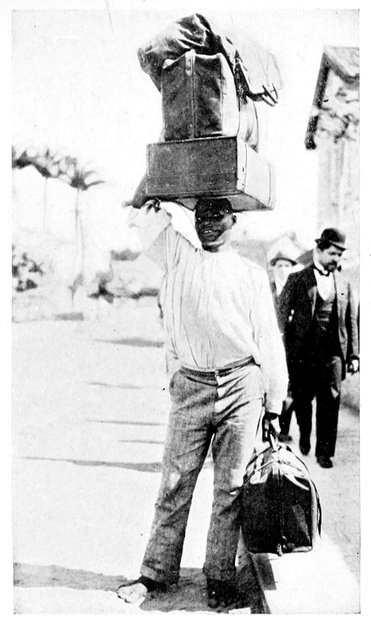
My baggage on its way to the hotel in Natal. At every station of northern Brazil may be seen happy-go-lucky negroes with nothing on their mind but a couple of trunks
Dolce fare niente between shows in Pará
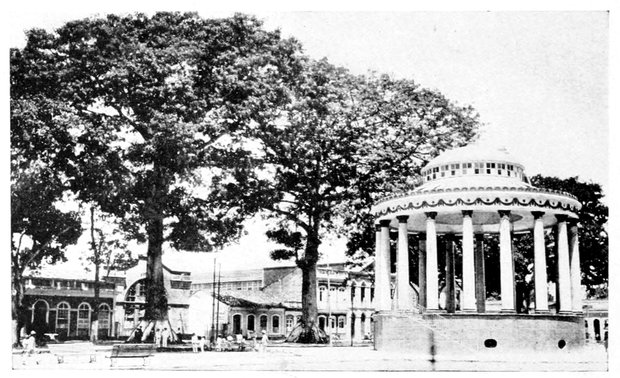
Pará has been called the “City of Beautiful Trees”
Among many forms of “fazendo fita,” it is the custom among the
élite of Brazil for the man whom the conductor reaches first to pay the
fares of all his friends ahead or behind him in a street-car. It is what
the French call a beau geste, but there are times when it has its drawbacks,
especially in times of “brutal crises” and a slump in the rubber
market. I rode out one day on the longest street-car line in Pará, past
449the dense Bosque screaming with parrakeet's and flickering with beija-flores,
not to mention the large insane asylum and poorhouse, to visit
the Liceo of Souza. With me were the professors of botany, horticulture,
and agriculture from that institution. On the way I pointed out
a magnificent tree which is certain to attract the attention of any foreigner
making that journey, and asked to what species it belonged.
The three professors looked at one another with puzzled faces, introduced
a new topic of conversation in the hope that I might forget my
curiosity, and finding me not to be put off so easily, one of them replied,
with the air of a sage handing out a gem of wisdom, “E-e uma arvore
silvestre—it is a wild tree!” No doubt they thought I took it for a hothouse
plant. But it was an episode of my return trip, alone with the
professor of botany, which made the journey worth while. As we
rumbled along, halting frequently to pick up passengers, I noted that
he grew more and more gloomy and taciturn. Not until the conductor
arrived from the rear, however, and my companion handed him the
equivalent of more than half a dollar in fares, did I suspect the cause of
his sadness. The fare-collector, it seemed, though the matter was not
mentioned by word of mouth, had put off collection so long that
more than a dozen of the professor’s friends and acquaintances
had boarded the car, and then the stupid fellow had begun his
duties with the back seats, where the professor had fancied
himself safe. The result was that common courtesy required
him to pay the fares of nearly everyone in the car—and Brazilian
professors are little less generously supplied with this world’s
goods than their fellows elsewhere. One by one, as the conductor
reached them and refused their proffered coin with a word of explanation,
the men ahead turned around and thanked their benefactor with
as elaborate a bow as the backs of street-car seats permit, to each of
which my companion replied with a sweeping gesture of the right hand
suggesting intense pleasure and unlimited largess. But the street-cars
of Pará, as in most of Brazil, run on the European zone system, and
there were four or five separate sections to be paid before we reached
the center of the city. We were just starting from the second junction-point
when the professor suddenly clutched at me and dived off the
car. I might have been puzzled, had I not noted the extreme yet
casual care with which he examined the next car for possible acquaintances
before we boarded it—well up toward the front.
“You should never divide an ox-hide until you kill the ox,” say the
caboclos of Brazil. Vinhães and I had fully expected to make a small
450fortune in Pará, but we had reckoned without two serious drawbacks,—the
“rubber crisis” and the climate. Rain, rivers, and trade winds
unite to make the city cooler than its situation warrants. Death by sunstroke
is unknown—in all Brazil, for that matter—and by night it was
at times almost uncomfortably cold. But the rain which had treated us
so kindly for months broke all known records during our engagement
in Belém. It was during a raging downpour that the copper-tinted half-owner
of the “Bar Paraense” and I drove about in a luxurious taxicab
paying our “duty calls” on the editors of the six or eight local newspapers,
and it was in a continuation of the same deluge that we opened
that evening, taking in more than a conto merely because ours was a
novelty for which we could charge double admission. We remained
cheerful, however, because everyone assured us that every three days
of rain were sure to be followed by three dry days. For that matter,
it was asserted that the daily shower came always at a fixed hour in
the afternoon, so exactly that people made their appointments “before
or after the rain,” without troubling to refer to the clock. All this may
be true, but if so, ours was an off year. If there was any one thing
we could not be certain of, it was whether or not we could venture
out at any hour of the day or night without risking a drenching; and
of the twelve nights we played in Pará it rained continuously and in
veritable cataracts exactly a dozen.
Luckily, all Paraenses are not afraid of water or we should have
been forced to close our doors. The people themselves at length admitted
that they had never seen it rain so incessantly. No wonder
paroaras find the contrast between the low, heavy skies of Amazonia
and the lofty, brilliant ones of Ceará so saddening; even we, from the
often wintry North, found the constant downpour, broken only by momentary
splotches of steaming sunshine, getting on our nerves. The
trees of the praças and avenues seemed to scrape with their upper
branches the swollen black clouds which marched slowly over us in
closed squadrons day after day.
Nowhere in Brazil did the iniquitous “deadhead” flourish so abundantly
as in Pará. Two boxes and a row of orchestra seats of the “Bar
Paraense” belonged to the brewery which furnished the liquid refreshments;
similar accommodations were reserved permanently for the
families of the empreza, or management: as many belonged to the chief
of police—though he always assigned his rights to friends, and forced
his way in with as many as he chose to bring with him; every “authority,”
municipal, state, and federal, from the president to the most lowly
451clerk, was accustomed to walk in without being challenged; the six
moth-eaten little newspapers were given a dozen seats a night, and
these having been sold or given away, any loafer or boy who chose to
state that he was a newspaper-man must be let in, under penalty of
possible scurrilous attacks in the next edition; scores of unkempt part-negroes
appeared nightly with a card stating they were detectives;
insolent half-African policemen in uniform not only forced their way
in, but habitually dragged a turmoil of friends or progeny with them;
it had long been the custom to count the average Brazilian family of
parents and six children as three adults, though each child expected
to occupy a full seat; the “artists,” “advertisers on the curtain,” “electrical
inspectors,” “volunteer firemen,” and what not who expected to
get in on one excuse or another were without number. Every Paraense
of any African ancestry seemed to be on the police force, even the chief
being distinctly tar-brushed, and to have no other duty than to attend
Kinetophone performances. More than once I counted forty policemen
in uniform in an audience of less than ten times that number, not to
mention more “authorities” and other forms of grafters than I could
estimate. Truly, a government is often a useless as well as an expensive
luxury. Though policemen and higher officials always swarmed,
we never got a suggestion of assistance from them. One night a crowd
of ridiculously garbed students who were celebrating the reopening of
the academy after the six months’ annual vacation forced their way
in some forty strong, yet not one of the hundred official “deadheads”
in the house raised a whisper. On another occasion I had the doors
closed during our part of the entertainment in order that the audience
should not be disturbed by late-comers. In the middle of a number the
chief of police arrived and demanded that he and a group of friends be
admitted at once, on penalty of everyone of us being placed under
arrest. There was the same staid attitude on the part of the grafting
politicians from the palace and the urubús that lazily preen their
feathers on the roof of it after a rain—scenting from afar any chance
of gorging themselves and circling around it in their black carrion-crowlike
garb, pretending whenever they are observed that they do
not wish to feed and strolling nonchalantly off, only to hurry back as
soon as they are free from observation.
A long article appeared in the chief Pará newspaper one morning
“proving” that a Brazilian youth invented the Kinetophone in 1908!
I should have wired Edison; he would have been astonished. I was
not, however, for I had read even more amazing things in Brazil. According
452to the “Dictionary of Famous Brazilians,” a Paraense invented
both the balloon and the flying-machine—that is, he got as far as Paris
on a government subvention to “perfect his great invention” and had
a bully time among the grisettes, though he never rose bodily above the
ground. The same work of many volumes, as well as the “History of
Parahyba” taught in the schools of that state, is authority for the statement
that the typewriter was invented by a Parahybano priest named
Francisco João de Azevedo. As he was already editing the first newspaper
of North Brazil in 1826, the typewriter must be an older machine
than we suspect. “Blessed be he who bloweth his own horn, lest it be
not blown,” said Mark Twain. Nearly every state of Brazil gets out an
elaborate volume, resembling our high school or college annuals, praising
itself to the skies and including pictures not only of its many more
or less imaginary industries, but portraits of all its “influential citizens”—who
can afford it.
The “Estrada de Ferro de Bragança” operates a 16-mile commuters’
branch out along the shore of the river-mouth to Pinheiro, as well as a
main line of more than a hundred miles to the town for which it is
named. Though it is state property, the federal government imposes a
federal tax of twenty per cent. on its tickets, and, being Brazilian, its
daily train starts at the crack of dawn. This was the old overland
route from São Luiz to its offspring, Pará, yet the train made rare and
short stops, for there was little but endless bush and genuine tropical
jungle during the whole nine hours’ run. Here and there were patches
of corn, but the scattered inhabitants along the way were mainly engaged
in the production of children. The latter were habitually stark
naked; the women dressed in two thin cotton garments covering them
from neck to bare heels; men naked to the waist lounged in huts that
were mere stick skeletons smeared with mud, sometimes slipping on a
jacket, without buttoning it, when they came outside. Personally, I
prefer the frank loin-cloth of the East Indian.
In Bragança itself, as along the way, the scarcity of African, and
the prevalence of Caucasian, blood was surprising, with Indian mixtures
in considerable evidence. The vigario, or parish priest, with
whom I had some conversation on this and kindred subjects, asserted
that the caboclo, or part-Indian native, was in general lazier and more
worthless than the negro mixtures; but this I had found by no means
the usual Brazilian opinion. Everything is relative, and this native of
sleepy Parahyba considered the people of Amazonia “incredibly indolent.”
Bragança boasts as well as shows its age, having won the title
453of villa a century ago. There are electric-lights, but most of the streets
are grass-grown and the jungle jostles the town on every side. It was
once called Souza de Caeté, from the river in which it washes its clothes
and along which fishermen and crabmen, carrying baskets full of
squirming carangreijos, plod in barefoot contentment.
A hovel, masquerading as the “Pensão da Mulata,” had all its rooms
occupied—several times each, in fact—but was sure it could accommodate
me, for what was the hanging of one more hammock? The place
was too mulatto-ish even for my adventurous taste, however, and by
appealing to the station agent I was taken to a shop kept by a Gallego
and his Andalucian wife, who furnished food and hammock-hooks to
“persons of a certain class,” into which I evidently fell, for I got a room
in which only a bed was lacking and was served a tolerable supper. My
hosts did not run a hotel, they explained, because to do so they would
have to hang out a sign and pay a heavy government license and tax.
With only the sides of my heavy Ceará hammock to cover me, I slept
little from midnight on because of the cold, abetted by frequent deluges.
The Gallego had given many solemn promises to wake me, but had
shown no signs of carrying them out up to the time I was dressed and
ready to push off. A fine pickle I should have been in had I missed
the only train for four days. My bill having been paid the night before,
I stepped noiselessly out the window and let them sleep on, hurrying
through the fading light and the swampy streets to the station. At
least there was the satisfaction of knowing that I would never have
to catch another Brazilian train. That night, after a mere thirty-five
hours’ absence, I found my shoes, valise, even the band of my hat
covered with green mold in my airy room at the “Café da Paz.”
The end of my engagement with the Kinetophone was nearer than
I had expected. After several communications to the man who held
the theatrical monopoly of Manaos, Vinhães had at last received a cable
in code which we deciphered as “Nous réfusons toute proposition.”
Very Parisian, of course, and definite in any language. The fact was,
according to every test we could give by absent treatment, that Manaos
was deader than Pará. The latter has at least its shipping and its supplying
of the interior, but the exotic city of the Amazonian wilderness
depends for its existence almost solely on rubber.
The rivalry between the two cities of the Amazon has always been
acute, and Pará was chuckling with tales of its rival’s come-down in the
world. Manaos, the Paraenses asserted, always copied their improvements,
and would ruin itself rather than admit it was not Pará’s equal.
454When Pará formed a zoo, Manaos immediately followed suit. Then
rubber fell and the zoo-keeper came to the state minister in charge and
said, “S’nho’, falta comida pa’ os bichos.” “No food for the animals, eh?
Well, I tell you what you do. Listen”—but the story is worth the
telling only in the language of the scornful, sarcastic Paraenses—“Olhe,
vocé mata tal bicho e da á comer aos outros, ouvioú.” “Sim, s’nho’,”
replied the zoo-keeper, and he went away and killed such and such an
animal and fed it to the others, even as he had been ordered. A day
or two later he came back with the same story, and went home to apply
the same solution. This was repeated for weeks, until only the jaguar
was left. The minister stared at the zoo-keeper for a long time when
he came to report this state of affairs, and scratched his head in perplexity.
Then, a brilliant idea suddenly striking him, he cried: “Olhe,
então vocé solta o tal onça!” Whereupon the keeper bowed his head
and went back to turn the jaguar loose, even as the minister had commanded,
and thus ended the Manaos zoo. That of Pará was bidding
fair to suffer a like, if more humane fate, for all the facetiousness of
the Paraenses at the expense of their poverty-stricken brethren up the
river. Two years now the ragged, barefoot employees of the Pará zoo
had been mainly dependent upon the charity of the Austrian women in
charge of it, and there was even then a man sitting across the table
from us who had come down to carry the most valuable of its birds and
mammals back to the Bronx.
April 21st, national holiday of Brazil in honor of the drawing and
quartering of Tiradentes, is now doubly famous as the exact date on
which I last ran a Kinetophone show. I have said that it rained every
night during our Pará engagement, but that afternoon the sun beat
down with equatorial fury. In the sheet-iron booth under the sheet-iron
roof the sweat streamed down into my eyes until I could not make
out the projection on the canvas, and the crank rubbed the skin off the
inside of several fingers. That night, in honor of the occasion, I put
on a “GREAT DOUBLE PROGRAM” so that nearly all my old film-friends
came out upon the screen to do their turns and give me a chance
to bid them farewell. The next afternoon “Tut” and I went out and
pulled down the show, and the travel-worn trunks disappeared forever
from my sight as they were rowed out to the Ceará, now on her return
voyage. Because she was taking with her also the state senator and the
archbishop of Pará, the military band and great mobs of populares
came down to the wharf, giving us the sensation of making a holiday
of our parting when “Tut” stepped into a rowboat and slipped away
455into the humid night toward the port-holes reflected on the placid
bosom of the river.
With him went Vinhães, one Brazilian whom I had found strictly
honorable in all his dealings. Naturally, as our engagement in Pará
was over, the rains had abruptly ceased. Turned out upon the world
alone again for the first time since I had joined Linton in Rio more
than eight months before, I wandered idly along the streets, wondering
what on earth I could do to pass the evening. Almost unconsciously
my steps carried me back to the “Bar Paraense,” but there was only a
pitiful audience of twenty or so, and most of those sat in the second-class
seats watching an inexcusable mess of screen rubbish. I took
refuge in my room and whiled away the time making a final report on
our tour. Out of 221 days, we had played 196, losing the rest in
traveling or holidays, giving 40 matinées, or 236 performances of an
average of nearly three sessions each. We had appeared in 49 theaters
in 29 towns of 11 states, and had failed on only one contract,—that at
Itajubá, where a disrupted railroad had forced us to remain an extra
day in Ouro Fino. Our total income had been 54,665,000 reis, of which
my own share had been 6,882,000. Though it was months later before
I again had news of my adventurous ward, the Kinetophone maintained
its high American reputation to the end. Beginning in Natal, “Tut”
not only fulfilled all the contracts I had arranged for his return trip,
but carried the “eighth marvel” clear down to Rio Grande do Sul—a
remarkable feat in view of the fact that he made the rest of the tour
entirely alone, training local talent in each town to put on and take off
the phonograph records. That tour de force made me wonder if, after
all, my own services had been mainly ornamental.
CHAPTER XIX UP THE AMAZON TO BRITISH GUIANA
456
It would have been foolish to have sailed directly home from
Pará, now that there remained only one unexplored corner of
South America. Besides, it was fourteen months since I had done
any real wandering, and to have returned at once to civilization from
the easy experience of my Kinetophone days might have left me with
as great a longing for the untrodden wilds and the open road as when
I had set out three and a half years before. I am not merely one of
those whose chief desire in life is to go somewhere else, but I have a
horror of going by the ordinary route. There was one way home
which no one seemed to have followed, one which even Brazilians considered
impossible; and the first leg of that journey was to push on up
the Amazon to Manaos.
On the morning of May first, therefore, having added six hundred
grains of quinine and a roll of cotton bandages to my equipment, I
boarded a gaiola, or “bird-cage,” as river steamers are known in Amazonia,
and struck south. The journey could have been made direct by
ocean liner in less than half the time, and these flimsy native craft not
only charge the same fare, but sell tickets as if they were conferring a
special and individual favor; but they wander in and out of the river
byways and give glimpses of Amazonian life which passengers on the
big steamers never suspect. The Andirá was perhaps a hundred feet
long, its two decks heaped and littered with boxes, bales, casks, trunks,
and huge glass demijohns incased in rattan, until one could barely
squeeze and scramble one’s way along them. On the open deck aft
stood a long dining-table flanked by wooden benches, while ten small,
stuffy four-berth cabins stretched along either side of the boat close to
the boilers. These, of course, were merely dressing-rooms and places
to stow one’s baggage, for everyone slept on deck. After a very Brazilian
dinner, with the big jolly captain, of pure Portuguese ancestry,
at the head of the table in the family manner, there was a scramble
for places to tie hammocks, and the space ordinarily allotted being all
457too small, the entire after deck, except the table itself, was soon festooned
with a network of redes in all colors.
“Todo é à vontade, senhores,” said the captain, “Aqui nada está prohibido.
A casa é nossa: nem uma saia á bordo;” and with nothing prohibited
and not a “skirt” on board we fell quickly into pajamas and
slippers, from which most of the passengers did not change again during
the trip. Behind us, without background, Pará lay flat across her
yellow water, only her reservoir and the twin towers of the cathedral
standing a bit above the general level, ugly with ships and warehouses,
in the foreground, scores of the vessels rusting away because rubber
had lost its spring. Slowly it receded to a line on the horizon dividing
a light-blue from a light-yellow infinity, then faded away into nothingness.
Even this smaller mouth of the river was very wide. The mainland
on the left was already growing indistinct, yet on the right the
Island of Marajó was only a distant faint line. As we drew nearer,
this, too, seemed covered with dense forests as far as the eye could
see, with many slender palms which I took to be the carnauba, though
they turned out to be the burity. Toward three o’clock we put in at
a port on the island, a bucolic, peaceful cove with a cool-looking two-story
farmhouse, a group of cleanly white women and children gazing
down from the deep shade of the upper veranda. Men in pajamas
and wooden tamancos wandered down to the boat, from which we,
similarly clad, strolled ashore. The lower story of the house was a
well-stocked shop, an iron gate shutting off the wide stairway to the
balcony above, where the women and children lived in almost Oriental
seclusion. Beside it stood a large cachaza-mill grinding up sugar-cane
and turning it into rum in 25-liter demijohns, more than a hundred
of which were already on the wharf, waiting to be carried aboard
the Andirá. A group of reddish-gray cattle with the suggestion of
a hump were grazing in the grassy yard beyond the distillery.
The Island of Marajó, several times larger than the British Isles,
with great plains stretching from horizon to horizon, has long been
famous for its cattle. Once they were so numerous that they were
killed only for their hides; then came an epidemic which nearly
wiped them out. Emperor Dom Pedro took a hand, made the island
a breeding-place, improved the stunted and decreasing native stock
by the importation of zebu bulls, and now the island was estimated
to have forty thousand head, furnishing meat to most of the Amazon
Valley. The zebu in his heavy hide, with its black, sun-proof lining,
458not only endures the climate easily, but is indifferent to the carrapatos,
or ticks, and all the other insect plagues to which animals from
the temperate zone are subject; he eats any food, crosses with any
species of cattle, bequeathing all his good qualities with even a fraction
of his blood, furnishes both meat and milk of a fairly high grade,
and as a draft-animal is noted for his strength and endurance. The
only great plaga left were the alligators, which every year kill much
stock. When the waters are low the cowboys of Marajó have “bees”
of driving alligators into shallow places, where they are dragged out
by the tail, unless they succeed in clinging to one another until the
hunters’ strength is exhausted, and killed with axes. Water-buffaloes
were also once introduced, but they proved inferior and did not breed
well with cows. The pet of this particular estate was a magnificent
zebu bull that had come from India by way of England and Rio, at
a cost of more than $6,000, and which strolled about with the same
dignified regal tread of the sacred bulls of Puri and Benares to whom
he was closely related. He ate anything, according to the fazendeiro—sugar-cane,
melgaço, or crushed pulp, bread, farinha, soap, hats,
clothing, shoes—but, continued his fond owner, he had a lordly way
of choosing only the best, which again carried my mind back to long
rows of East Indian shopkeepers shivering with apprehension lest
one of the holy animals wandering past discover their most cherished
wares.
The estate-owner was in close touch with the world and its doings
and had traveled widely in Europe, though not in Brazil. I could
scarcely maintain a seemly countenance when he told me in great
detail, with much eloquence and wealth of gestures, the story of
Edison, almost word for word as I had written it a few days before
for the chief daily of Pará. But gradually the conversation turned
to politics, as it usually does when men meet in Brazil, unless religion
happens to get the right of way. His heartfelt remarks about “this
calamity of a government” showed that he and his like were as fully
aware of the knavery of their politicians as any foreign observer;
the trouble was, being talkers rather than doers, they had no notion
where to begin in an effort to improve things.
At the first symptoms of night we pushed on up the reddish-yellow
river. I had already made it a practice to give myself an occasional
hour of exercise on the slightly curving roof of the steamer, and as
there was but slight room for walking, I indulged in a modified
form of calisthenics, to the unbounded astonishment of my fellow-passengers.
459The Brazilians not only did not exercise, except with
their tongues; they did not even read, though there were excellent
electric-lights over the hammocks. Even the most nearly educated
among them start out on a trip of a month or more on one of these
gaiolas without a page of reading matter. While they were wondering
amusedly at my exercising I could not but ask myself what on
earth they did with their minds during those weeks of forced inaction.
They seemed to endure the voyage in a sort of coma, sleeping audibly
by day in their hammocks, though often making the whole night
hideous with their card games.
We stopped during the dark hours at a couple of fazendas to pick
up sealed demijohns, and in the morning, a brilliant Sunday, entered
the Strait of Breves. This is a narrow and deep section of the river
between Marajó and the mainland, with endless dense forests, sometimes
not more than five hundred yards away, on either side, so
winding that often the exit was apparently closed ahead and one
was at a loss to know how the boat could proceed. The stream was
so placid that the metallic reflections were almost painful to the eyes,
and so clear that the virgin forest, from its slender little palm-trees
to its liana-wound giants, seemed to stand upright, in reversed positions,
above and below the surface, with not a suggestion of land
visible. Tucked away here and there in the edge of the water-rooted
wilderness was a single house or hut built of jungle materials and
standing on stilts, with no apparent soil, but only board-walks above
the water. The dwellings were generally new and fairly clean, as
were the inhabitants in their newly-washed Sunday clothes, at least
from a distance. Now and then a compact little island dense with
forest jungle, lordly palms, and majestic trees with great buttresses,
slipped past. Natives in their ubás, long, slender, dugout canoes
sitting low in the water, glided along the roots of the forest, often
all but swamped in our wake, but always saving themselves by skilful
canoe-manship. Women and children were equally water-birds and
drove the steed of the Amazon as fearlessly and unerringly as the
men. They sat tailor-fashion on the very nose of the canoe, now and
then crossing the stream, plying their round or heart-shaped paddles—on
some of which were painted fantastic faces—in a languid yet energetic
manner, appearing always on the point of falling off, though to
go overboard anywhere in the Amazon is to risk being devoured by
alligators, parainhas, and a dozen other bichos. Woods, trees, ubás,
houses, even the women combing their hair inside them—for they
460generally had no walls—showed exactly as plainly below the water as
above, colors and all, so absolutely mirror-smooth was the constantly
curving strait. No doubt after twenty-five years in an Amazonian
pilot-house, as was the case of our captain, all this would become deadly
monotonous—the endless, dark-green, impenetrable forest unrolling
like a stage setting on either side day after day and year after year,
to doomsday and the end of time—but at least the first trip on a brilliant
day is a memory not easily lost.
It is natural to see only a dreary sameness in the endless film unrolling
at a steady ten-mile pace on either hand, but in reality the
differences are infinite, the countless tree-forms alone the study of a
life-time. The uninitiated may journey for hours in these Amazonian
wildernesses without detecting a sign of animal life where every
square yard has its sharp-eyed denizens. Though food abounds everywhere,
the unschooled may starve in the midst of plenty, as the moss-covered
bonds and rotting bones of more than one escaped prisoner
from the rubber-fields have borne witness. Most astonishing of all,
perhaps, to the newcomer is the apparent absence of bird life—unless
there still lingers in his mind’s eye that terrifying picture of our
school-day geographies—a rope of monkeys swinging from a lofty
branch, the lowermost playfully tickling an alligator under the chin.
Early in the afternoon we slid up to an empty sheet-iron barracão,
and then wandered on again, the only reason for the stop evidently
being that the captain wished to buy a native straw hat, especially
well made in this region. The only ones on hand were too small for
him, so he ordered one for the down-trip some two months later. As
long as the boat was moving we were perfectly comfortable. In my
steamer-chair under the prow-awning I watched life slip lazily past,
forgetting even that I was suffering for lack of exercise. In the
tropics a man seems to have as much energy as elsewhere; but he is
prone to form plans and when the time comes to execute them to say
to himself, “Oh, I think I’ll loaf here in the shade another half
hour,” and before he is aware of it another wasted day is charged
up opposite his meager credit column with Father Time. Whenever
we halted in a windless corner of the river to take on demijohns or
leave a few of the things which civilization exchanges for them, the
heat was intense. One was often reminded of the fact that Pará
is nearer New York than it is to Rio, for most of the supplies of this
Amazonian region seemed to come from “America,” as its inhabitants
call the United States. The people of the Amazon Valley, for instance,
461where cows are few and generally tuberculous and children the one
unfailing crop, consume great quantities of American condensed
milk. We signed a “vale” for a milreis whenever we wanted milk
with our morning coffee, and were handed a small can of a very
familiar brand. Too lazy even to filter water through a cloth, we
drank the native yellow-brown Amazon, containing everything from
mere silt to tiny “jacarés” (alligators), as the Brazilians called them.
Passengers, crew and riverside inhabitants were equally easy-going
and contented with life. Neither the captain nor his immediato, a
pleasing, well-mannered man of Portuguese father and Indian mother,
thought it necessary to assume that fierce outward demeanor with
which Anglo-Saxon commanders so often seek to maintain authority.
Ours was a family, a sort of patriarchal rule which, in the end, seemed
to bring as effectual results as when nothing is left to individual
judgment.
Pinsón went twenty leagues up the Amazon before he discovered
that he had left the ocean, if we are to believe old chroniclers. It is
indeed the “sea-river” or the “fresh sea,” as the Brazilians call it, for
in most places it broadens out until the endless tree-line takes on the
wavering blue of great distance. Day after day the pageant of magnificent
trees of many species, their trunks often totally hidden by the
dense smaller growth and the lianas that draped them as with winding
sheets, crawled ceaselessly northward, though at times it receded to the
dim horizon. Rain and dull skies seemed to have remained behind in
Pará, yet there was a vapid breath to this prolific creation, a superabundant
luxuriance about us, which made the daily consumption of
quinine seem a wise and foresighted precaution. Even in the hushing
heat of noonday one seemed to feel fever ramping up and down
the land, throttling man even as the vines and fungi sapped and
choked the mammoth trees; by night, when the vampires winged their
velvety flight in and out of the shaded depths from which came the
incessant night sounds of the tropics, mingled now and then with the
gentle murmur of the great river, it was as if Death himself were
striding to and fro questing for victims.
On the third or fourth day we caught glimpses of low, wooded
hills, or ridges, and as these always give footing for castanhas along
the Amazon, we were not surprised soon after to come upon sheet-iron
warehouses and huge heaps of “Brazil nuts.” The “Pará chestnut”
grows on a tree averaging more than a hundred feet in height—so
high that it is never climbed for its fruit—and clustering fairly well
462together on slight tablelands on both sides of the Amazon. The nuts
ripen during the rainy season, from January to March, and fall to
the ground by hundreds. In its native state the “nigger-toe” is about
the size and shape of a husked cocoanut, but with a shell so hard that
a loaded cart passing over it will not crack it. Strangely enough,
monkeys have a way of breaking them open, as they have of picking
them from the branches; but puny and un-inventive man, at least of
the Amazonian variety, not only waits until the nut falls of itself,
but requires the aid of tools to open it. Broken with an ax or a
hammer, each shell yields from twenty to thirty nuts set tightly together
like the segments of an orange. A man of experience and
average industry can harvest about three bushels of “Brazil nuts” in
a day. Many Amazonian families make a journey to the castanhaes,
or “chestnut-groves,” their annual pándego, or “blow-out,” and
though many die every year of an intermittent fever called sezões,
and immorality is rampant, whole villages, men, women, and children,
take to the hills to camp out during the “chestnut” season, on the proceeds
of which the survivors frequently live the rest of the year.
Caboclos in palm-leaf hat, cotton trousers, and a piece of shirt, were
even then arriving at the warehouses with canoes level full of the
nuts, an empty basket set down into them to give room for the paddler’s
bare feet. Paddle and shovel are the same word in Portuguese (pá),
and to these dwellers on the Amazon the same implement serves both
purposes, for with the flat round paddle they shovel the nuts into
the basket when they have reached their destination. The basketful
is then dipped into the river and sloshed about until the worthless
nuts, being lighter, float away, and the rest, well washed, are piled
in heaps in the warehouse. Here they were worth about 20$ a hundred
kilograms, at war-time rate of exchange less than five cents a quart.
Wholesalers buy them from the warehouse-keepers, and at least
four fifths of them go to the United States. At home they are not
dry and sweet, as in the North, but taste not unlike a damp, sweetish
acorn, and native consumption is not so great as might be expected.
One afternoon the captain came back on board with a sapucaia,
a larger and better kind of “Brazil nut” than the one we know. These
are rarer than the castanha and grow on a more bushy and shady
tree than the tall, graceful, arm-waving castanheiro. Unlike the familiar
species, this one must be planted, the nut being merely thrown
on top of the ground near water; and the fruit should be picked, for if
the nuts fall out while the shell is still on the tree, that limb will not
463produce again for years. All this extra work, added to its scarcity,
makes the sapucaia unknown in foreign lands, though at home it
sells for several times as much as the common variety. The shell is
about the size of a squash, rather uneven and angular in shape, with a
tampa, or tight-fitting sort of trapdoor in the bottom, which opens
when the nuts are ripe and lets them fall to the ground. In each shell
there are thirty to fifty nuts, larger than the ordinary “Brazil nut” and
shaped like fresh dates. Inexperienced visitors to Amazonia often
mistake the castanha de macaco, or “monkey chestnut,” for the real
article, though it grows on the trunk rather than the branches and
has no edible qualities.
Once, soon after midnight, we took on board at Parainha a white
woman with a long stairway of children, yellow and sun-bleached
country gawks, the eyes of all of them running with open sores of
what was probably trachoma. They were going up the Juruá to the
end of the Andirá’s run, near the Bolivian border, to begin life anew.
The woman’s husband, a Portuguese, had for years been manager of
a large seringal, or rubber-field, which he had made a very paying
concern for the owner, who lived in Pará, Rio, and Paris. Foolishly,
the Portuguese, either ignorant of or unattentive to Amazonian conditions,
had let his wages drift without drawing them, until he had more
than twelve contos to his credit. Then one day some workers on the
seringal came to the house and said, in the matter-of-fact tone of the
Amazon wilderness, “We are going to kill you.” The manager asked
permission to send away his wife and children first, but the assassins
did not think it worth the trouble, so they shot him where he stood,
with his family clustered about him. Not one of my fellow-passengers
seemed to have the least doubt that the owner had instigated the murder,
in order to get out of paying the back salary. “Perhaps he had gambled
himself into debt, or had nothing more to spend on his French mistress,”
they languidly explained. The papers of Pará had reported
the case and it was perfectly well established, yet justice is so unknown
up the Amazon that no one had been arrested and the widow
and orphans had finally been driven off the seringal by the owner himself,
who had paid part of their fare up the river to be rid of them.
He continued to live as usual, with a new manager, for such things
are so common along the Amazon that no one appeared to think twice
about it, any more than of a man dying of fever or snake-bite. To
each new group of passengers, or to anyone who showed interest in
hearing it, the woman repeated the story over and over in exactly the
464same words and gestures, after the manner of people of sluggish
intelligence, like a piece she had learned for public recital, all in the
same monotonous tone in which she might have spoken of the failure of
the mandioca crop. She was of too primitive a type to have been able
to decorate the story. Some one had advanced the equivalent of nearly
a thousand dollars to get the family up the river, where, no doubt,
they are still working it out as virtual slaves to some other tyrant in
Brazil’s national territory of Acre.
A contrasting type was our seringueiro, or owner of a rubber-field
far up in the interior. He wore a goatee and mustache, cotton trousers
and undershirt, the latter always open and disclosing his caveman
chest; and he was almost childlike in his gaiety, with constant jokes and
puns, whether winning or losing at cards. Yet beneath it all one
could see that he was full of tropical superstitions and above all of the
lust for money,—or, more exactly, the lusts which money will satisfy,
for the Brazilian is rarely a miser—and that he would rob, or hold
in slavery, or assassinate by his own hand or another’s, far up there
in the unruled wilderness where he was going, not only without compunction,
but almost without realizing that he was doing anything
amiss.
At times the river opened out like a vast sea, and one wondered
not how we were to get through, but how we were to find our way.
All the jungle trees had wet feet, and every now and then pieces of
forest or patches of bushy wilderness came floating down the river,
though I could make out none of the giboyas (boas), deadly serpents,
or jaguars of popular fiction riding upon them. Sometimes, in the
refulgent western sun, the procession of trees took on a sort of early-autumn
tinge, as if winter were leaving its accustomed track and was
about to spread its blighting trail across this ocean of vegetation. A
fine day, like a great man, dies a glorious death; a rainy one slumps
off from dullness to darkness, you know not when nor care, like
the invalid grouch or the malefactor, and on the whole you are glad
that he is gone and that night has come. Yet there was a certain lack
of color in Amazonian sunsets. It was as if nature had so many materials
at her disposal that she was careless in the use of them. One
evening a big ocean liner, gleaming with lights, slowly overhauled us
and pushed on into the darkness beyond. Gnats similar to those that had
made life miserable during my tramp across tropical Bolivia, and here
called puims, gave us occasional annoyance, though by no means as
much as two “Turks” deeply marked with long Amazon residence
who persistently kept the most horrible of American phonographs
squawking far into the night. My chair and hammock were forward,
however, where it sometimes grew so cold in the wind that I had to
wrap the sides of my heavy Ceará hammock about me.
Ice on the equator. It is sent out from the factory in Pará to the neighboring towns in schooners of varicolored sails, a veritable fog rising from it under the equatorial sun
Two Indians of the Island of Marajó, the one a native, the other imported from India to improve the native stock
A family dispute on the Amazon
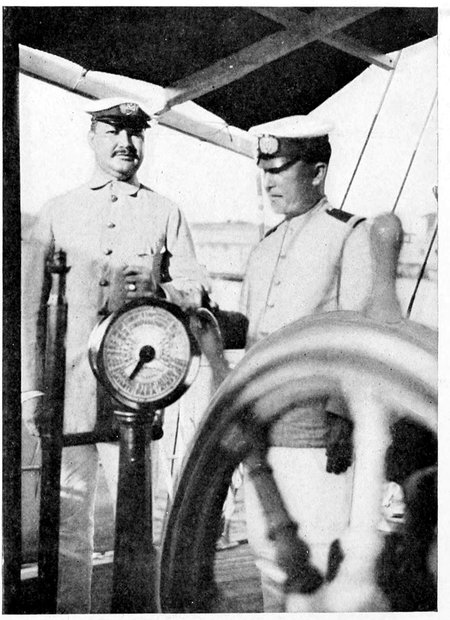
The captain and mate of our gaiola were both Brazilians of the north
465On such a cool, black night we halted at the old city of Santarem
at the mouth of the Tapajoz after midnight, so that no one went
ashore. In the morning we crossed the river and entered first the
paraná and then the igarapé of Alenquer. A paraná, in Amazonian
parlance, is a narrow arm or branch of a river which comes back into
it again; an igarapé is a blind tributary, pond, pool, or lake. Here the
narrow stream ran between unbroken avenues of trees, among which
one with an almost snow-white leaf was conspicuous. Rarely was
there a bluff or high bank, but for the most part a deadly flatness,
often with a reedy swamp in front and densest jungle-forest behind.
Ocean liners go direct from Santarem to Obidos and never see this
igarapé. We slid almost into the dooryards of brown, half-naked families
in the scarce mud huts along the flooded way, startling them
as we might have Adam and Eve about the time of the apple episode,
and at ten in the morning went ashore in Alenquer, a typical small
town of Amazonia.
There were perhaps a hundred buildings clustered together on a
bank of the narrow branch, everything as deadly still as only barefoot,
grass-grown towns can be, though the place was cleaner and more
comfortable than one would have expected up a little side-arm of
the Amazon in the sweltering wilderness. It carried the mind back
to Santa Cruz de la Sierra in the lowlands of Bolivia; there was the
same forest of cane chairs and settees in the wide-open houses, the
same hammocks tied in knots on the walls and soon to be spread again
for the siesta, the same atrocious pictures in hideous frames, the
same garden-like patios behind. Here, perhaps, there were more
signs of comparative wealth, though far more leaning on the elbows
than work. The country roundabout was partly flooded and the
greenest of green, with some low, wooded ridges in the near background.
Cacao grows wild in the forest about Alenquer.
I came upon an unusually good school building for a town of
this size and situation, with more signs of energy than in the cooler
but more negro parts of the country. Almost all the children had
more or less color, but it was more apt to be of Indian than of
African origin. School “kept” from 8 to 11:30, with none in the
afternoon, “and even from ten on we get little done in this climate,”
466according to the principal. His assistants were all women, rather
weak and unintelligent looking for the most part, all with some Indian
blood. This was a state school with no municipal income, and “teachers
are required to be graduates of the normal in Pará, but we are
rarely able to get any, so we have to substitute.” The principal himself
was the only one who fulfilled the legal requirements. The fact
that salaries had kept dropping, until now they were less than half
the 350$ a month they had been two years before when rubber was
high, with lower exchange and higher prices, and that no one connected
with the school had been paid anything in twenty-eight months,
may have had something to do with the lack of candidates. The
teachers made arrangements with the fathers of families to keep body
and soul together. Women and men received the same pay—when
there was any—“naturally,” said the principal, “seeing they have to
do the same work.” As in all Latin-America, the teaching was mere
tutoring, crude and primitive compared with the imported American
furniture. Boys and girls sat in separate rooms, and the entire roomful
rose in unison and gave the military salute when a visitor entered.
Otherwise there was the usual Latin-American lack of order and
attention and nothing could induce the teachers to resume their task
as long as the visitor remained. The summer vacation was from
November 1 to January 15, but the principal complained that a large
proportion of the pupils were even then away, for many whole families
migrate to the castanhaes from February to April or May to pick
up “Brazil nuts,” and the school fills up again only in June or July.
There is a state law requiring the attendance of boys from six to
fifteen and girls from six to twelve; but law in Brazil, sighed the
principal, is “largely made to laugh,” except those parts of it that
bring income to politicians, which are sternly enforced. Compulsory
attendance of female pupils was set low because girls on the Amazon
marry early. Mothers of twelve or thirteen are so common as scarcely
to attract attention. Among our passengers was a bright young dentist
from Ceará who had been born on his mother’s twelfth birthday.
He had fifteen brothers and sisters, all living, and his mother, according
to his statements and the photograph he carried, was a comely woman
of thirty-two in the prime of life, without a sign of wrinkles or
graying hair. In the interior of the Island of Marajó girls often remain
naked until puberty, the time of marriage, and there are many
jokes on the awkwardness of brides in their first clothes.
The captain had spent his boyhood in Alenquer, so we tarried some
467two hours while he visited and had dinner with relatives and old
friends. The “Amazon River Steam Navigation Company,” to which
the Andirá belonged, was a British concern, with a federal and state
subsidy and a generally tangled ownership and management; but the
captain had none of the Anglo-Saxon vice of punctuality. Toward
sunset that evening we stopped at a huge pile of cordwood partly
under water, in front of a fazenda house on stilts to be reached only
in boats, where we could have paddled right into the thatched servants’
quarters. But the smallest boy or girl along the Amazon can handle
a canoe with an ease and grace suggesting that the montaría has a
mind and a will of its own; and no one ever thinks of walking, even
to the next-door neighbor’s. In “summer” and non-flood time life is
said to be pleasant on the broad, open campos which were now
reedy swamps. We remained several hours, while the negro-caboclo
crew of half a dozen carried the wood-pile aboard on their shoulders.
Before the war these gaiolas usually burned coal, but that had risen
in price to the height of a luxury. Some of the time it rained in
torrents; the sky was heavy and dark, and it grew distinctly chilly even
in this sheltered corner. The last sticks of wood were left in a hurry
and with a whoop when a fine jararaca of the deadly white-tailed
variety was found sleeping under them.
About dawn we emerged from the paraná upon the “sea-river”
again, with a horizon so broad that we could not make out its dirty-yellow
end in some directions. That afternoon, or the next, we
halted before the house, its yard flooded and backed by dense humid
cacao-woods, of two energetic young Portuguese. They were courteous
fellows, though knowing well how to drive a bargain, and had
considerable education, as do many settlers along the Amazon, where
“doutores” in eyeglasses are often found. The ambitious often
come here to risk death and work for a quick fortune, while the more
languid drift through life in their safer birthplaces. I tramped for
an hour in the damp, singing silence and heavy shade of the cacaoaes,
everywhere damp underfoot and fetid with decay. The cacao-pod,
about six inches long and half as many across, grows on the trunks
and lower branches of its bushy dwarf tree, with a very short stem.
Slashed open, the pod yields about sixty seeds, which are put into a
long tube of woven palm-leaf, like that used by the Indians to squeeze
the poison out of the mandioca, which is suspended and compressed
by a weight attached to the end until all the pulp turns into vinho de
cacao, a white liquid not unpleasant to the taste and so harmless
468that it might be sold even in our own model land. Then the seeds are
laid out to dry a week or two in the sun before being shipped to
Pará, and on to New York, where they are toasted and ground for
our cocoa and chocolate. The Portuguese brothers sold us two huge
turtles for our ship’s larder, as well as five pigs and ten chickens to be
resold higher up the river; but luckily, negotiations to buy some cattle
for the Manaos market fell through for that trip. There were said to
be unlimited “Brazil nuts” in this region, but it was so nearly sure
death from fever to spend a week in the castanhaes that they were
never gathered. Death is a most commonplace and unexciting visitor
all along the Amazon. A friend comes on board, and in the course of
a conversation with the captain or some other old acquaintance says
casually, “Oh, by the way, my brother João died last Thursday. Do
you think the cacao harvest will be as large this year?” It is the same
with the loss of time. Speaking with a yawn of some place far up the
river, the Amazon traveler says idly, as he shuffles his cards, “Num
mez ’stou lá—ou dois—In a month I’ll be there—or two.”
It was eleven that night when we anchored before Obidos, where the
Amazon crowds itself four hundred meters deep between banks only
a mile apart, one of the few places in which one shore can be seen
from the other. The captain promised to give me a warning whistle,
so I went ashore. It was a checkerboard town of considerable size,
built up the slope of a ridge, and now, at midnight, a splendid example
of what a city of the dead would be,—the wide streets deep in grass,
the houses tight-closed, for the Brazilians are deathly afraid of air, even
in this climate, and not a sight or sound of a human being in all my
walk about the town. Horses, cows, and donkeys were grazing in the
streets and on the big grassy praça, however, thereby outwitting the
blazing daytime sun; but they were so silent that I ran squarely into
them in the jet-black, comfortably cool night, its dead silence broken
only by the creaking of a few tropical crickets.
I was awakened toward dawn as we drew up before a ranch-house
and a cattle-pen in a narrow creek. Here we wasted some time until
daylight, and then began loading fat young cattle by the crude and cruel
Amazonian method of lassooing and dragging them into the water, then
hoisting them up the side of the iron hull by the winch and the rope
about their horns, with many bumps and scratches and much bellowing
and eye-straining on the part of the helpless brutes. All this meant
nothing to the natives, however, being all in the day’s job, as was the
packing away tightly together of the cattle on the deadly slippery, iron
469lower deck, where the sun poured in mercilessly a large part of the day
and where the animals would stand as best they could, probably without
food or water, for the four or five days left to Manaos. They cost an
average of 100$ a head here, and would sell for nearly three times that
at their destination. Slowly and leisurely all this went on, as if we had
all the rest of our lives to spend on the Amazon, and it was sun-blazing
ten o’clock before we pulled our mud-hook. There were countless floating
islands now, and big patches of coarse, light-green grass on their
way to the distant Atlantic. All day we slipped along, usually with a
dugout canoe or some other species of montaria creeping along the extreme
lower edge of the forest; now a family gliding easily down to
their stilt-legged home, again boatmen bound for the rubber-fields paddling
desperately against the powerful current, as they had for weeks
past and would for a month or more to come, beneath these same heavy
gray skies. These Amazon watermen have a means of keeping dry that
is simplicity itself and which might be recommended, with reservations,
in the North,—they all carry a small bag made of native rubber, and
when it comes on to rain they pull off their clothes and put them in the
bag!
The greatest product of the Amazon itself is the pirarucú, a mammoth
species of cod that dies in salt water, which sometimes attains ten feet
in length, and has no teeth, but a bony, rasp-like tongue. It is harpooned
in much the same way, on a smaller scale, as the whale, and is a game
fighter, more than one expert Amazon fisherman having been known to
make a pirarucú tow him and his canoe home. It is the chief food of the
Amazon Valley and immense quantities are dried, salted, and shipped
from Pará, looking like boxed sticks of brown cordwood and not unlike
that in taste. Pirarucú and farinha d’agoa make up most Amazonian
meals, as they did on board the Andirá. We landed boxes of this staff
of life even at towns where the pirarucú abounds, the lazy inhabitants
preferring to get it from Pará to catching and salting it themselves.
The largest fish of the Amazon, but much less common, is the peixe-boi,
or cow-fish. This is said to grow as large as a yearling calf, is caught
with harpoons and killed by driving stakes into its nostrils, yielding a
white meat not unlike pork in taste.
We sailed out upon the vast river again and took four hours to cross
it, stopping at the village of Jurity to leave a mailbag and dragging easily
on. Now and then a cloth was waved from some ranch along the river,
the boat whistled, and faintly to our ears was borne the shout of a man,
“Ha um passageiro para Manaos!” The captain, who seemed to know
470everyone on the river by his first name, made a trumpet of his hands
and shouted back, “O, Manoel! Na volta de Faro, ouvistes?” And
that night we did pick him up on our return from Faro up the Yamundá.
One day the talk on board ran to garzas, the bird that furnishes what
we know as aigrets. A native passenger, once engaged in gathering them,
said that it took about seven hundred birds to give a kilogram of feathers,
even of the larger and cheaper size. They grow only along the back
and tail, and a kilogram of the largest feathers would number about a
thousand, the smaller and more valuable ones, of course, in proportion,
and would sell for 1$500 a gram in Manaos. In other words, a pound
of ordinary aigrets would bring the gatherer about a hundred dollars at
the normal exchange, and small ones as much as twice that sum. Time
was when a kilogram of small feathers sold for five contos, say $1,600,
“but for some reason we do not understand the demand in the United
States has ceased,” said the former hunter of garzas, “giving the market
a great slump.” I explained the reason for this, and after musing for
some time he admitted that it was rather a good law, not because he
recognized any cruelty to the birds, but because in time the species
would become extinct and another means of livelihood be cut off. He
claimed, however, and was supported by others on board, that it is not
necessary to kill the birds. He knew a man who had a big garzal with
thousands of them, and guards to see that no one killed any, and every
morning he went out and picked up the drooped feathers, getting some
eight kilograms a year, and from year to year, too, instead of only once.
He made it a rule to shoot anyone he found on his property with an
aigret in his possession. Then there was a Spaniard who had devised
a system of putting the birds into a heater at night, where several
feathers loosened enough to be pulled out in the morning. Dealers,
however, I recalled, thought little of “dead” aigrets and, as in the case
of diamonds, the whims of pretty woman force man to the roughest of
exertions to supply her demands, for real garza-hunting is no child’s
play. This man had known an American living in Obidos who used
to have himself rowed far up to the source of this or that tributary
of the Amazon, and then paddled down alone, arriving sometimes half
a year later with eight or ten kilograms of feathers, but half dead from
his struggle with the jungle. We frequently saw some of the birds in
question from the decks of the Andirá, tall, slender, graceful, and
generally snow-white, though there are species in other colors. A house
dealing in aigrets has to pay the State of Pará a license fee of 5,500$ a
year, and ten per cent. ad valorem, while the municipio collects 6$ an
471ounce for all feathers taken within its confines—which are generally
elastic. “So,” concluded the ex-aigret-hunter, “as usual the politicians
skim off most of the cream.”
On the morning of May 7 we drew up near a grass hut, flying the
ugly green and yellow flag of Brazil and standing above the water on
stilts. This, according to the captain, corroborated by several passengers,
had cost the taxpayers twenty-five contos—with free material close at
hand, and labor low in price, the actual cost of the building was probably
not one fortieth that amount. From it a fiscal of the State of Pará came
on board to see what we were carrying out of the state, all of which
must pay export duty, for we had reached the boundary line between the
two immense states of Grão-Pará and Amazonas, including nearly half
the territory of mammoth Brazil. It was near here, at the mouth of the
Yamundá, that Francisco Orellano claimed he was attacked by amazons,
thereby giving its present name to the river of which his trickery and
bad fellowship made him the discoverer. “Provavelmente estaba com o
miolo molle” (He probably was with the brain soft), said one of the
passengers; but seeing how the Indian women of the Amazon basin work
on a basis of complete equality with the men suggests that perhaps there
was something besides an equatorial sun and a troubled conscience to
make the treacherous Spaniard fancy he had been pursued by female
warriors. When he came back from Spain to conquer his great river he
could not find it, but lost himself up a branch of the Tocantins.
That afternoon we went ashore in Parantins, first city in Amazonas,
so that at last I had seen everyone of the twenty states of Brazil, and
only the national territory of Acre, once a part of Bolivia, remained.
The city, just a little patch of red-tiled roofs in the endless stretch of
forest, stands on a bit of knoll jutting out into the Amazon, here spreading
away five miles or more to a flat, wooded, faintly discerned shore and
to the east and west running off over vast horizons on which ships disappear
“hull-down,” as at sea. Its slight elevation makes Parantins
breezy, though out of the breeze it is melting hot. I dropped in upon
several caboclo families and found them instantly friendly, though shy
and modest, frank without knowing the meaning of that word, most of
all content to drift through life swinging languidly in a hammock and
gazing with dreamy eyes out across the broad, sun-bathed Amazon.
The houses had no particular furniture, except the hammocks, swung
or tied in a bundle on the mud walls, according to the hour, though
almost all contained a little hand-run American sewing-machine. One
house without a chair had two of these, and all had the crude lace-pillow
472on which the women of North Brazil while away their time making
lace with a great rattling of birros.
Bounded on four sides by the ways of bygone generations, the people
of these contented Amazonian villages have little more than an idle
curiosity in the ways of the great outside world. Seeing nature about
them produce so abundantly and without apparent effort, it is small
wonder they are hopelessly lazy from our northern point of view.
Sometimes the thought comes even to the indefatigable American that
perhaps the secret of life after all is this contented waiting to be overtaken
by mañana, rather than a constant striving to outstrip the future.
Yet how the whole world, even these most distant little backwaters, has
changed in the first two decades of the present century, with its persistent
flooding of commerce and invention! All this makes life more
convenient, perhaps, but it gives the world a deadly monotony, as if one
sat down everywhere to the same trite moving-pictures, killing anything
national and characteristic by imported imitations from the world’s
centers, vastly increasing the price, while greatly lowering the value,
of living, destroying the excellence of local native production, taking
away its incentive, and making the vocation of traveler a drab, uninspiring
calling, enormously descended since the glorious days of Marco
Polo, or even of Richard Burton.
We passed, with much whistling and individual greetings, another
gaiola of our line, the Indio do Brazil, so named, strangely enough, not
for the aborigines in general, but for a former senator from the State of
Pará, of whom this was the family name. I had just rolled into my
hammock when we stopped going forward and took to hunting about in
the dark, silent night for another wood-pile. The river was still and
smooth as glass; the light of a house on the shore-edge showed the faces
of a numerous white family peering out upon us, but it was so dark
that we slipped back and forth and frittered away much time before we
located the wood-pile and tied up before it. The owner came on board
to gossip as long as the ship remained, a chance not to be lost in these
isolated regions, and the constant chatter, added to the customary uproar
on board, made sleep out of the question until we were off again.
There were always new excuses for wasting our—or at least my—time.
Early in the afternoon we put out of the sea-broad river into a paraná
as straight and narrow as the Suez Canal and suddenly anchored in the
weeds, a thousand miles from nowhere, to cut grass for the cattle!
In the sunset of May 8 dwellings grew more numerous in the dense
vegetation along shore, and at dusk the prettiest fazenda we had yet
473seen loomed up on a fine grassy plateau dotted with magnificent trees,
the haystack mango and the imperial palm most conspicuous among
them. The buildings were comfortable and roomy; there was a big
barn for the cattle, which the natives aboard did not know were ever
housed, and an unusual air of comfort and intelligent cultivation. I
was not surprised, therefore, to find it had all been built by an American,
one of the many Southerners who came down after the Civil War and
settled along the Amazon. At the age of sixty he had shot himself,
rumor having it that he had grown despondent because his children by a
Brazilian wife were growing up as worthless as the natives. His
estate was on the edge of Itacoatiara, last of the four principal ports
on the way from Pará to Manaos, where we went ashore while the
captain visited more relatives and where most of the unusually white
population stood on the bank above to greet all who landed. Here we
received many more passengers, among them a group of prisoners down
on the lower deck with the cattle. The captives had been sent here from
Manaos to be tried, but were now being sent back because the judge,
a life appointee, but of what was now “the opposition,” had not had his
pay for a year and claimed in the current number of the local sheet,
which was almost entirely taken up with his case, that he “had neither
clothes nor shoes necessary to uphold the dignity of appearing in public
in such a high position.” As a matter of fact, he was well known to be
a man of independent wealth, but this was an approved Brazilian way
of “getting back at” his political enemies. The prisoners were so mixed
up with the other deck passengers, in hammocks and on the bare deck,
smoking and sleeping among the freight, pigs, cows, turtles, sheep, and
the soldiers sent to guard them, similarly dressed in undergarments and
the remnants of trousers, that they were indistinguishable. I went down
with the officer in charge, who could not tell which were prisoners and
which were soldiers or deck passengers. He found one of his soldiers
among the rubbish and told him to go and point out the prisoners for
my benefit; but even the soldier could not tell them all, and after a long
search one was still missing. The officer put his toe against one fellow
lying prone on the deck and asked, “Are you one of the presos?”
“Não s’nho’,” the man replied, crawling to his feet, “I am one of the
soldier guards.” We had about given up finding the missing men when
a fellow lolling most comfortably in a hammock, smoking a cigarette,
spoke up with obliging and cheery friendliness, “I’m one of them,
capitão,” at the same time tapping himself proudly on the hairy chest
showing through his open undershirt.
474The night was so dense black—nights on the Amazon always seem to
be jet black, even when the sky is clear and the stars are out in myriads—that
the pilot could not find the river and finally ran crashing squarely
into the forest-jungle, where it was decided to anchor until daybreak.
It turned so chilly on the prow, even though I was considerably dressed
and covered with the thick sides of my hammock, that I took to shivering
as if my old Andean fever had overtaken me again. Heavy rain
poured all the morning, turning the world an ugly gray and so cold it
was hard to believe we were almost on the equator. These bitter cold
spells are common along the Amazon. In mid-morning we thrust our
nose into a farmyard again and changed from a ship to a grass-cutting
machine. The rain continued in an unbroken deluge, and early in the
afternoon we came out of a paraná upon the Amazon proper, so broad
we could not see across it and differing from the ocean only in color.
The rain decreased, but the chill continued, and at three o’clock we
reached the mouth of the Rio Negro and left the Amazon behind.
For there onward the main stream of what the aborigines called the
Maranhão, and which I had seen rise high up on the Peruvian plateau, is
known as the Solimões from where it enters Brazil at Tabatinga. The
two rivers, both of immense width at this point, joined but for some
time did not mingle together, the yellow of the Amazon remaining perfectly
distinct from the “black” of the Negro, as black as any deep,
clear water without a blue sky to reflect can be. Here and there patches
of the two waters mixed and for a long time flowed northward perfectly
distinct in color, then, like the population, united to form the
nondescript hue of the main stream.
More and more huts and houses appeared along the shore, a bluff of
dark-reddish soil, as the few scratches showed, the rest being virgin
forest flooded up to the lower branches of the trees. The hut of many
a poor caboclo was inundated, and some were standing disconsolately
ankle-deep in the water, holding the baby in their arms. Others had let
go the solid earth altogether and, thrusting a few logs in raft form
under their huts, floated off comfortably as you please, swinging as
domestically and calmly in their hammocks as if they were lodged in the
“Café da Paz,” their few possessions on crude shelves above them and
only the black, fathomless river and a few logs laid far apart for floor.
Huts, generally on stilts, became almost continuous, all, for some reason,
built out over the water instead of up on the top of the bluff out of the
wet—if it were possible to get out of the wet in such a climate. But
the caboclos of the Amazon pay little attention to rain, water being their
475native element, and many now appeared, male and female, paddling
homeward at the same calm, even pace in the downpour as in the finest
of weather. Farther on a few huts had broad dirt steps cut up the face
of the bluff from the water’s edge. Then dimly across the black sea
there began to paint itself a faint line of ships at anchor, with gaps in
it, like an army just after a machine-gun attack. As we drew nearer,
the chacaras and “summer-houses” of rich Manaoenses appeared,
nicely arranged along the top of the bluff where they could escape from
the dreadful urban rush of Manaos. Then gradually, out of the unbroken
wilderness ahead, a modern city began to appear around a
densely wooded point, finally disclosing itself in its entirety through the
wet atmosphere. Piled up on a low knoll and part of another, looking,
already as complete as many an old European city, the yellow-blue dome
of the imposing state theater bulking above all else except the brick
tower of the cathedral, Manaos was utterly exotic in this Amazonian
wilderness; it was like coming upon a great medieval castle in mid-ocean.
Our rubber-estate owner from the Acre, who had lived in an open
undershirt all the way from Pará, suddenly appeared on deck resplendent
in a white suit with broad silk lapels, a gay silk waistcoat with
six American $2.50 gold-pieces as buttons, a diamond scarfpin resembling
a lighthouse, and four diamond rings on his fingers. We
swung in toward the big Manaos brewery—looking not unlike the Woolworth
building through this hazy humidity—in its hollow between the
two knolls, and at length tied up to one of the many buoys, each
marked with the cost of its rental per day, floating half a mile or more
out from the city. For though we might have anchored in an ocean
port, the Rio Negro averages forty-five fathoms in depth directly off
the wharves. From these several boatloads of officials soon put out,
followed by boatmen, baggage-carriers, and hotel runners with the first
news of the outside world we had heard in ten days. There were as
many formalities as if we had arrived direct from Europe, both the port
doctor and the customs officers having to be satisfied before any of the
rowboats, of which there were at least three for every passenger landing
and which without exception were manned by European white men,
could approach the gangway. I embraced the captain, the immediato,
and a few fellow-passengers—male only—and bade them contentment, if
not speed, on the much longer journey still ahead of them.
Manaos, a thousand miles up the Amazon and nine above the mouth
of the Rio Negro, though only twenty meters above sea-level, is a real
476city more than half a century old. By reason of some peculiar lay of
the land it is less troubled with rain, and in consequence is less sloppy,
than Pará. The chief objection to the place during my first two days
there was that it was so cold; after that it was nearly always brilliant
with a slashing sun and humid heat that seemed to multiply through the
hot thicknesses of the night, until for the first time I was conscious of
feeling my energy in any way curtailed by the climate. Great heat and
constant humidity producing a vegetation so prolific that man cannot
hold his own against nature, Manaos was not only jostled on all sides by
the impudent jungle, but right in town there were many patches of
rampant wilderness and immense beautiful trees that seemed to be
forces of occupation from the surrounding forests. Much split up
by hollows, it had igarapés, or tropical creeks, so covered with fresh-green
water-plants, often in blossom, that one could not tell them from
solid ground, while many a swamp musical with bullfrogs, and innumerable
mosquito incubators, were within a short stroll of the
European center of town. Manaos has fewer unpaved streets than
its rival at the mouth of the river, and being on rolling ground, while
Pará is flat, it boasts a few more scenic beauties; but the visitor constantly
has the sensation of watching an unequal fight between the
exotic city and the mighty wilderness that surrounds it.
Time was when Manaos was much more of a city. The high price
of rubber had perhaps forever gone, and the “Rubber City” gave signs
of disappearing again into the jungle from which it had risen. As the
Italian proprietor of the “Rotisserie Sportsman” I sometimes patronized
said weepingly, “I would have done much better to have gone to
hell than to have come to Manaos.” Every down boat for months had
been crowded to utmost capacity with passengers of all classes and
origins fleeing the poverty that had settled upon Amazonia. So swift
had been the depopulation that I could much more easily have rented
a large house than a single furnished room; so scarce were
“distinguished foreigners” that the arrival of a stranger attracted as
much attention as in a village, and I might myself have called on the
governor of the largest state of Brazil, had I brought with me the
heavy black costume of formality which a local editor was so astonished
to find me traveling without. Yet news of this ebbing tide did not seem
to have spread far. The booming of a certain section of the world is
like setting a heavy body in motion—once it has gained momentum it
is hard to stop—and a considerable number of immigrants were still
coming to Manaos expecting to make a quick fortune because a description
477of it in “boom days” years before had at last reached their
local papers. Even when these hopeful fortune seekers met returning
victims, they often refused to believe them, taking their pessimism to
be canny competition, and persisted in pushing on to be disillusioned in
person.
Yet it still had all the outward concomitants of a real city. For almost
the first time in Brazil I had my clothes washed properly, and in
hot water. John Chinaman, virtually unknown in the rest of the republic,
did it. Even the chief places of amusement for money-oozing
rubber-gatherers were still open, though the more aristocratic of the inmates
had gone back to France or sought more promising pastures,
leaving the field to stolid, vulgar, Polish and Russian Jewesses. As in
all Brazil, there was no attempt to bolster up waning commerce by selling
better things more cheaply; on the contrary, the rare victim was expected
to make up for the absence of his fellows. Restaurants and
hotels habitually made one thousand to fifteen hundred per cent. profit
on their food. A kilogram of beef cost a milreis in the market, or
even less after the day warmed; and this was cut into from ten to
fifteen so-called beefsteaks that sold as high as two milreis each in the
restaurants, even of workingmen. In the market three oranges cost
100 reis; on the restaurant table across the street one cost five times that;
a mamão selling for 300 reis was cut into five or six pieces at 500 each.
But the Brazilians, too indolent or too proud to go into the restaurant
business themselves, continued as usual “fazenda fita” and paid whatever
was demanded by their exploiters; or, if they could not pay, they
remained away hungry in the darker corners of their homes.
Manaos is a white man’s city, if there is one in Brazil. Not only
are the shops mainly in the hands of Europeans or “Turks,” but
virtually all manual labor is done by barefooted white men,—Portuguese,
Spanish, or Italian for the most part. The boínas of the Pyrenees
are frequently seen on the heads of carters and carriers; the
laboring class, both male and female, is largely from the Iberian peninsula,—Portuguese
women of olive-white complexions darkened by the
grime of a life-time, with huge earrings dangling against their necks,
and men who would look perfectly at home in any Spanish pueblo or
Galician mountain village. Many of the customs of Rio have been
imported, too,—the bread-man’s whistle, the vegetable peddler with his
two baskets, the stick-clapping, walking clothing-stores from Asia
Minor. Yet, according to the American of most standing in Manaos,
eight months a year is as much as any white foreigner should live in
478the place. He knew many a bright, well-educated young Englishman,
who had been sent out hale and hearty, to remain so physically, but to
become so childish in mind that he had sometimes wondered whether
there was not something in the German claim that the British are degenerating.
Is civilization, after all, determined by climate? “After
a white man has lived steadily for twenty years in the tropics, the less
said about him the better, as a general rule,” asserted this exiled fellow-countryman.
Energy depends, in his opinion, on variable climate; the
monotony of perpetual summer saps ambition; bracing Europe and
North America must forever remain breeding-, or at least feeding-grounds
for the rulers of tropical lands.
Strangely enough, there are no classes in Manaos street-cars, and one
may ride even without socks. The tramway and electric-light system
is English owned and is so British that the cars run on the left-hand
track; yet its intellectual motive power was furnished by a man from
far-off Maine. I had not spoken a word of English since leaving Pará,
and naturally lost no time in finding an excuse to make his acquaintance.
He had brought with him his native adaptability. It has always
been a great problem in Brazil to get street-car fares into the coffers
of the foreign companies operating them. Cash registers are of little
use, for they respond only to actual ringing. It is more common to
require the conductor to carry a booklet of receipts and hand one out
whenever a fare is paid. But the difficulty is to make people demand
the receipts, for the usual Brazilian way is to wave a hand backward
at the conductor, as much as to say, “Oh, keep the money! The company
is rich, and they are foreigners anyway.” Years ago some street-car
manager thought up the plan of making each receipt worth two reis
to charity, the company once a month paying to the nuns’ hospital that
amount for each one turned in to them. This system, widespread in
Brazil, was in vogue in Manaos when the man from Maine arrived, but
it was not working perfectly. The new manager knew that charity to
others is a far less potent motive with Brazilians than possible personal
fortune and the universal love of gambling. He withdrew the charity
clause, therefore, gave each of the receipts a number, and on the second
day of every month the Manaos tramway company holds a lottery
drawing, with the first prize 100$ and the rest in proportion. It is a
rare Manaoense who does not demand his receipt for fare paid nowadays.
The only other American resident of Manaos was Briggs. It was
doubly worth while to call on Briggs, for in addition to the good
479fellowship which quickly arises between compatriots exiled in far-off
lands, free beer was unlimited to those to whom Briggs took a liking—and
for those who have to pay for it, beer is a rare luxury in Manaos.
Briggs was the man who made Manaos endurable, who kept it cool and
quenched its thirst, a man who always made one think of ice and iced
drinks, though there was nothing icy about him. He was dictator and
commander-in-chief of the ice-plant at the tall Manaos brewery, native
owned but, strangely enough, run by a German. I hesitate to admit,
failed, in fact, to compute, the number of times I might have been seen
emerging from Briggs’ sanctum wiping from my mustache the circumstantial
evidence of a glass of beer.
Of other amusements and pastimes there were still a few automobiles
for hire and a rare surviving café chantant, or—well, when the semimonthly
steamer from Rio came in with the list of prizes in the national
lottery a government band sat before the lottery agency and played all
the morning, while firecrackers were exploded and the lottery winnings
were paid. That was the Manaos idea of industry and “combatting the
present grave crisis.” The zoo was gone, of course, and the imposing
state theater, the azulejo dome of which rose high above all else except
the cathedral tower, had not been opened for more than two years and
was a dried-mud ruin within. It was not as in the “good old days”
when a carregador got a fortune for carrying a seringueiro’s trunk
across the praça, and spent it to hear imported opera sung in the proud
theater at the top of the knoll. There were still dramatic companies
direct from Europe, changing every night as they made the rounds of
the three theaters under one ownership—but they came on reels that fit
into a lantern. The plot of the story they told was never a mystery;
it consisted succinctly of the adventures of two men and a woman or, in
contrast, of two women and a man. These original and refreshing
themes, presented nightly under a new title and disguised in a new near-Parisian
costumes, continued to attract such stray coins as still remained
in Manaos, not to mention those to whom there are no earthly
barriers. I had often told myself that what Brazilian theaters needed
was a turnstile at the entrance, and was surprised to find that the
cinemas of Manaos had exactly that thing. But system and strictness
lead haunted lives in Brazil. I stood at the door of the principal cinema
one evening and counted just as large a percentage of “deadheads” as
even the Kinetophone had ever attracted. For instead of having a
register on the turnstile and requiring the door-keeper to turn in a
ticket for every click of the stile or pay the price of one, he was allowed
480to use his own judgment as to who should go in free—and the judgment
of a Brazilian door-tender! In short, Manaos was entirely an
exotic city, which even the few caboclos and Indians paddling down to
market in their canoes do not tinge with the local color and things native
to Amazonia.
I had come up the Amazon with the faint hope of being able to make
my way overland from Manaos to the capital of British Guiana. Such
a trip should be wild enough to allay any craving for the wilderness for
some time to come, and even if one could scarcely call plunging along
jungle trails taking to the open road, the effect would be about the same.
Even in Manaos, however, no one knew whether or not it was possible
to reach Georgetown by land. Launches and batelões, a species of
Amazonian barge, sometimes went up the Rio Branco to the frontiers
of Brazil to bring down cattle, but they could go only at the height of
the rainy season, when the Rio Branco was flooded, and the last one
had made the trip in August, nearly nine months before.
“He who has no dog goes hunting with the cat,” the Brazilians say,
so I turned my attention to the possibility of making the journey through
my own exertions. That, too, it seemed, was out of the question.
Even had I bought a canoe and hired a crew, it would have required
at least two months of constant, laborious paddling to bring me
to the Guianese frontier; and as to walking, that would have been as
impossible in this Amazonian wilderness as on the open sea. My hopes
had reached their lowest ebb when word reached my ears that heavy
rains in the interior were rapidly raising the Rio Branco, and that if
they continued, the first batelão of the season would set out for what
is known as the Brazilian Guyana on May 25. I settled down to endure
with as much patience as I could muster a wait of half a month,
and in all likelihood more, in such a climate and surroundings.
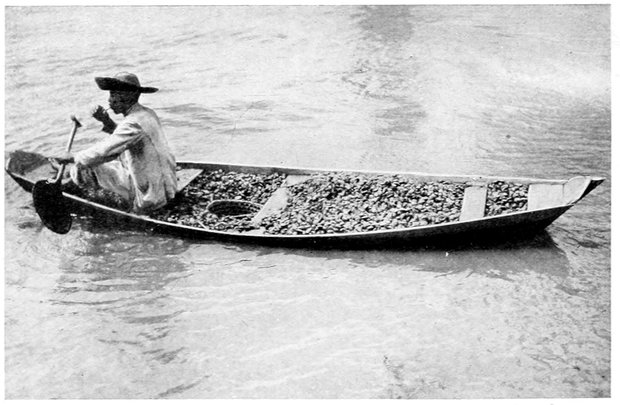
A boatload of “Brazil nuts.” The Amazonian paddle is round
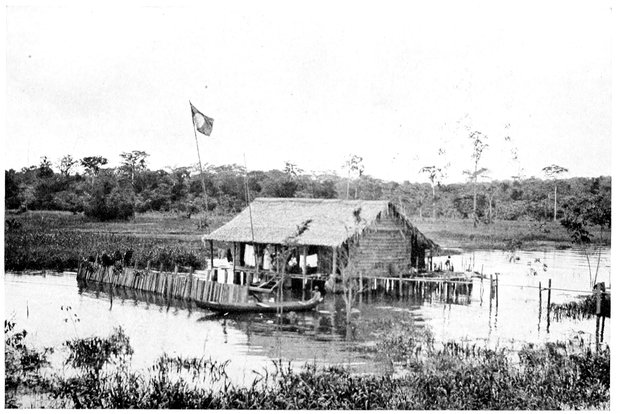
An inter-state customhouse at the boundary of Pará and Manaos, and the Brazilian flag
On the morning of May 20, however, I was still sleeping soundly
when the barefoot Portuguese carregador I had subsidized—at nothing
a day—to look after my traveling interests put his head in at the door
and said that the boat I awaited was leaving not on May 25, but at
once—and would I please kindly, senhor, give him or his brother, and
not some common fellow, the pleasure of carrying my baggage down
to it. I knew, of course, that the tropical sun had addled the poor
fellow’s wits, for though it is a common thing in Brazil for boats
scheduled to sail on May 25 to leave on May 30, or next month, or next
year, no one had ever heard of such a one going out on May 20.
However, I could not throw anything at a man whom I had not even
481paid a retaining fee, so I went over to the Armazen Rosas to inquire.
It was as I had suspected; the sun had been too much for the poor
fellow. On the board before the warehouse, and in all the morning
papers of Manaos, the Macuxy was still advertised to leave on May 25.
I was about to return to my bed in disgust when I recalled that I was in
Brazil, and entered the armazen to verify the chalked figures. Não,
senhor, the launch would leave that very evening. The owner had just
arrived in town and had decided to sail at once. The fact that several
people who had been waiting for weeks might be slightly discommoded
if the craft sneaked away without them, with no other for a
month or two, did not trouble him in the least. If they happened to
find out about the change in plans by looking at the stars and refusing
to believe the chalked board and the newspapers, well and good; but
the launch was going primarily to bring down beefsteaks on the hoof
for Manaos, and passengers were merely endured as a necessary evil.
It was seven o’clock of a dark tropical night when I ate my last
Brazilian “ice-cream,” and two hours later that we began to crawl away
from the wharf—good-by for no one knew how long not only to ice-cream
and ice-cold beer, but to electric lights and street cars, to paved
streets and to reading by night. The announcement had read that the
“Launch Macuxy leaves for the Rio Branco,” which was true enough,
but I quickly discovered that passengers left rather on the batelão
hitched beside it, a huge, unwieldy, three-story cattle-barge or scow,
with no motive-power of its own. In the hold and on the lower deck
were piled wood for the launch’s boiler, freight, baggage, cattle, pigs,
chickens, rancho, or an unspeakable native kitchen, the third-class
passengers, who paid half-fare, and whatever else chanced to be on
board. The wide-open, roofed, upper deck was reserved, first of all,
for the captain and the owner in a commodious cabin, then for the first-class
passengers with their two “staterooms” back of this. These had
nothing in them but chains, cans, iron-castings, and all the other odds
and ends of ship’s junk, on top of which we put our baggage and
changed our clothes. Everything else took place on the open deck,
three fourths of which consisted of a long row of hammock-hooks on
either side of a beam down the center, under which were a long, narrow
dining-table, a cupboard, a crude water-filter and one glass, neither of
which was usually available for use, and one dirty tin wash-bowl.
Much baggage was piled along the open sides of the craft, far aft were
two tiny partitioned-off places, one a kitchen and the other divided into
two places of convenience, of which one had been turned into a shower-bath
482by letting a pipe in through the ceiling above and boring a hole
in the lowest corner of the floor as an exit for the river-water. The
shower was “not working yet, because this was the first trip of the
year, but it would amanhã.” Meanwhile I dipped up pailfuls of the Rio
Negro and threw them over me, then tossed most of the night in my
hammock, as is generally the case when one takes to such a bed after a
long respite.
We were by no means crowded,—one non-Brazilian besides myself,
a dozen men, and some women and children—but I left the complete
inventory to the long unoccupied days ahead. All swung their hammocks
diagonally across the batelão from the central beam to the outer
roof-rail, and spent their nights and most of their days in them. Close
against our side of the boat—so close that it was constantly spitting
sparks and cinders into our hammocks—was the little launch-tug Macuxy,
constantly puffing and snorting like a Decauville engine up a stiff
grade and furnishing our only motive power. The two craft were so
balanced that the launch seemed to steer easily with the heavy batelão
alongside, as is the custom everywhere on the upper Amazon, where a
barge is often put on either side of the launch, but where no boat is
ever towed. May is the usual time for a flock of these craft to set out
from Manaos through all the river network of upper Amazonia, taking
freight to the settlements that cannot be reached in the dry season and
bringing down rubber, “chestnuts,” and, in our case only, cattle.
All the first day we plowed the black waters of the Rio Negro
without seeing a human being or any sign of human existence. There
was a constantly unbroken line of dense-green forest, with trees of all
sizes from small to gigantic, half-hidden by lianas and orchids, and all
so deep in the water that they seemed to be drinking it with the ends of
their branches. The trees were often completely covered with plants
from which bloomed myriads of pinkish flowers like the morning-glory,
retreating toward noon from the ardent tropical sun. There was no
visible sign of bird or animal life, though there must have been much
of both farther inland. In general the country was low and level, but
with an occasional hill or low bluff masked in dense forest. Now and
then there were small islands, also thickly wooded down into the very
water, though we saw none of the floating bits of jungle that were so
numerous in the Amazon proper.
There are places in Amazonia where steamers have to stop and cut
their own wood. Luckily we were not reduced to that extremity, for
there were rare inhabitants along this route to gather and pile it at the
483water’s edge. At that, it took four or five hours to load enough for a
day’s run, the Indian and caboclo crew tossing it stick by stick from
one to another along the gangplank, the last man, being more nearly
white and therefore the most intelligent, counting them in a loud voice,
the captain setting down each fifty in a book. For wood is sold as well
as loaded by the stick along the Amazon, sticks a meter long, but ranging
in size from cordwood to that of a baseball bat, and costing here
from 35$ to 60$ a thousand.
Our meals were tolerable, for the region, built up about the ubiquitous
pirarucú and farinha d’agoa, with wine and condensed milk for those
who cared to pay for them. The greatest drawback was the service.
Three or four of the most disreputable urchins that could be picked
up in Manaos put everything on the table at once, then wandered about
for some time looking for the bell. Even when that had been rung,
courtesy required us to wait for the captain and the owner, by which
time everything was stone-cold. As in all Brazil, the diet was suited to
hearty men in the prime of life engaged in constant manual labor,
rather than to a sedentary life of forced inactivity that made us envy
the crew their wood-tossing at which caste did not permit us to help.
I know no country whose national cuisine seems less to fit the character
of the people and the climate than Brazil.
Toward dark we sighted the first bare spot of the trip, a tiny clearing
of four or five acres called Conceição, with a big tree here and there
and—what was more surprising—big granite rocks, the first native stone
I had seen since my journey into the interior of Ceará. There was a
thatched house, but no one showed up, so we set out the freight we had
for the place,—a huge piece of machinery something like a locomotive
piston, hoisting it with a derrick and standing it upright on a rock protruding
from the water, and sailed away. Next day, or the next, or
some time later the people who lived there could find the thing and know
what it was for, though it was hard to guess how they would transport
it to wherever it was needed. Later, in the dimly moonlighted night
and the densest wilderness of endless forest and water, we slowed down
to a snail’s pace and began whistling ear-splittingly, evidently calling for
someone in the untracked forest sea. For a long time there was no
answer. Then, far off through the ankle-deep trees, appeared a light.
By and by we could make out that it was moving toward us, and at
length a canoe paddled by an Indian, with a near-white man sitting in
caste-rule inactivity in the stern, slipped noiselessly out of the weird
night, the man boarded us, and we were off again.
484Finally, on the afternoon of May 22, two hundred and ten miles above
Manaos, we turned from the Rio Negro, which goes on northwestward
to Ecuador and Colombia, into the Rio Branco, stretching almost due
north. This seemed a more sluggish river, gray in color with a slight
brownish tinge, much like the lower Amazon, though quite enough unlike
the Negro to warrant its name of “White River.” Born near the
junction of Brazil, Venezuela, and British Guiana, it is some 420 miles
long from the mouth to where two forks split it apart. In this land of
water it was astonishing that there was not always water enough to float
even these slight-draft river-boats. The name Guyana is said to mean
flooded-country, and includes all that region between the Amazon and
the Orinoco, so that there are not simply three Guianas, belonging to
European powers, but five, including those of Brazil and Venezuela.
It is estimated that the immense State of Amazonas, largest in
America, has only 150,000 inhabitants, of whom half are wild Indians.
It was not until late that afternoon that we came upon a hut on stilts,
made entirely of woven grass, yet with the exotic touch of a sheet-iron
door in one end, reached only by a crude ladder of two rungs. The inhabitants
had grubbed an acre out of the dense jungle on a little nose of
land where another small river flowed in, the ground being then about
six feet above water. They were almost entirely of Indian blood, but
the men wore trousers, jacket, and straw hat, and the women a loose
single gown. As in most of Amazonia, they were a curious mixture
of shy, naïve backwoodsmen and crafty traders. We left two letters
and sent the crew ashore to dig six enormous turtles out of a captive
mud-hole, each man carrying one upside-down on his back across the
narrow sagging plank, eyes, ears, nose and his entire body smeared with
the soft yellow mud that oozed from every crevice of the cumbersome
animals. They were to furnish us food on the way up the river; meanwhile
the crew laid them helpless on their backs on the lower deck.
These mammoth Amazon turtles will live thus for days without food
or drink; or even for weeks if left upright and wet now and then with
fresh water.
About the hut was a small forest of mandioca stalks and banana
plants, and under it some “freeman” rubber, the usual large brown
balls with a hole through the center, resembling a bowling-ball, but
which had been gathered and smoked as the spirit moved them by
semi-wild Indians, in distinction to the “slaves” of the regular rubber
plantations. The cabra, or Indian-negro, owner sent this, too, on board,
sold us bananas and chickens, and took coffee, sugar, and soap in payment.
485There are two trees that furnish rubber. The better kind,
called borracha, is procured by tapping the glossy-smooth rubber-tree,
and the other, a much coarser and cheaper stuff called caucho, as full
of holes as Gruyère cheese, is obtained by cutting down another kind of
tree. All dry lands of moderate altitude along the Amazon produce the
caucho tree, of which a full sized one yields fifty liters of milk or
twenty kilograms of caucho, inferior, but commanding a good market.
When your rubber quickly loses its stretch, the chances are that in some
of the many links from producer to consumer the borracha has been
replaced by caucho.
There were said to be rubber trees of both varieties in considerable
abundance in the forests on either side of the Rio Branco, but in most
of the region the bugres, or wild Indians, made regular exploitation
difficult. On the night of May 23 I slept north of the equator for the
first time since walking across it in Ecuador, thirty-two months before.
The sun laid off most of that day, and it grew so cold that I had to put
on double clothing and wrap myself in my hammock. The trees no
longer stood ankle-deep in the water, sipping it with their branches, for
the bluff banks were from six to ten feet high, with a reddish soil.
Since leaving Manaos we had passed two other craft, smaller launch-barges,
and perhaps half a dozen canoes creeping along the lower face
of the forest. Otherwise there was no evidence of human life along
the way, except two or three huts in tiny clearings every twenty-four
hours. The first white men to enter the Rio Branco were the Carmelite
missionaries who, in 1728, founded towns and began catechising the Indians.
Seventy years later an insurrection destroyed most of their
settlements, and though half a century ago some villages along the Rio
Branco were reported to have as many as “320 souls and 40 fires,” to-day
a hut or two at most represents most places marked on the map.
But if there was little human interest along the shores, there was no
lack of it on board. First and foremost among my fellow-passengers
was Dr. R—— of Sweden, a professional bug-chaser past middle life,
whose mild blue eyes blinked harmless innocence, and whose graying
hair stood up in pompadour mainly because it was never combed. He
had spent so many months pursuing bugs along the Amazon that he had
become acclimated to the pajamas and sockless slippers of all male
travelers in the region, and was just such a patient, plodding fellow as
men of his profession must be, carrying their own enthusiasm with
them, and was ferocious only in the pursuit of insects and an ostrich-like
appetite. He spoke English with difficulty and Portuguese
486scarcely at all, so that we soon took to conversing in German, and I became
unwittingly his unofficial interpreter. Never have I known a man
more splendidly fitted for his calling. Bugs of every species and description
had such an affinity for him that he did not need to seek them;
they sought him, and if there was a single insect in the region, from a
lone mosquito to the rarest species known to entomology, it was certain
to apply to the doctor for a passage to Sweden, even though it was
forced to crawl inside his pajamas to make sure of the trip. With rare
exceptions the touching request was always granted, for the doctor was
never without a large pill-bottle filled with some sort of poisonous gas,
and never a meal did we eat that he did not jump up from table a dozen
times to snatch out the cork of his inseparable companion and slap the
open mouth over some intruder on some part of the ship’s, or his own,
anatomy.
Rough living in Amazonia is at least mitigated by the outwardly
gentle, pleasant, and obliging manners of the inhabitants. It is the
religion of the region never to complain of hardships or lack of comfort,
for growling at all these things would make them and those suffering
them unendurable. Hence there was never any outward evidence
of anything but contentment and satisfaction, even in the face of the
most primitive selfishness on the part of the two masters of the ship.
Captain Santos was a spare but rather good-hearted Portuguese long
resident in Amazonia, who frankly considered his passengers an unavoidable
nuisance. Colonel Bento Brazil, the owner, was a “legitimate
son of the Rio Branco,” that is, born in the region, though pure
white and much traveled. Dressed in the thinnest of white pajamas
night and day, he looked the picture of hardiness even at fifty, which
commonly means old age in North Brazil. At times he was curiously
swollen with his own importance, seeming to feel the deepest scorn for
such simple persons as the Swede and myself; at others he displayed
boyish curiosity about the simplest things. He was careful in the exact
degree of greeting he gave those we met along the river, running all
the gamut from an affectionate embrace of a fellow estate-owner to a
motionless word in answer to the hat-off greeting of some caboclo far
below his own caste. All the best things on board he considered his
own; he hung his hammock in the choicest place and kept the good
shower-bath locked, leaving the one with a spout in the roof to the
passengers—though the captain always loaned me the key to the better
one—at every meal he had six eggs, special fruit, and many extras,
while the passengers beside him could get nothing but the regular
487rough-and-tumble fare. His constant selfishness was probably unconscious,
for it is every dog for himself on the Amazon; nature is too
primitive and cruel to allow much else, and like the backwoods estate-owners
of Peru and Bolivia, these kings of the jungle grow unwittingly
autocratic and self-centered by living constantly among dependents.
There were two typical Amazonian women of the well-to-do class on
board, one about fifty and the other nearing thirty. They corresponded
in rank to the half dozen Brazilian men on our upper deck, fairly well-educated
fazendeiros of some means and of that peculiar mixture of
world-wisdom and rusticity common to the region; but, of course, being
of the less important sex, they were treated as a lower type of creation,
as is the Amazonian custom, and had the modest, almost apologetic, reserve
of the aboriginal women. One of the two bare little cabins that
might have been staterooms had been cleared out for them, and here they
preferred to eat seated on the bare floor, rather than come to table with
strange men. They never spoke to any male on board, except an occasional
unavoidable monosyllable, and their every look suggested
densest ignorance, superstition, and slavery to custom, a composite of
the woman-beast-of-burden of the American Indian and the Arabian
seclusion brought to Portugal by the Moors. One might pity them, but
any advance, even to make the trip a bit more pleasant for them, would
certainly have been misunderstood as something reprehensible. At
night, like everyone else, they swung their hammocks on deck, taking the
off-side, and separated from the men only by distance, but at daylight
they quickly crawled again into their little room and rolled about the
bare floor the rest of the day, never making the slightest physical exertion
they could avoid. In the morning they crowded together into
the miserable little “bathroom” aft and held the place two, and even
three, hours, after which, their greasy tresses dripping, they raced back
to their room. Evidently they squatted on the floor and poured water
over each other from the tin can the younger one carried. The most
noticeable part of the whole performance was that, in common with all
the women of Amazonia, as far as my experience carries, the longer
they bathed the less washed they looked. Whether it is due to the mixture
of Indian and Portuguese-peasant blood, with long generations
without soap behind them, or to the greasy Brazilian food oozing
through their pores, every native woman I met along the Amazon gave
me an instinctive desire to avoid the slightest personal contact with her.
Yet men of the same class, and largely the same customs, did not
awaken this feeling.
488The near-Indian servant girl of the pair aroused the same sensation,
though she, too, spent hours in the “bathroom”; even the little
daughter of the younger woman had this general repulsiveness of her
sex. She was a cunning little thing of four, with wavy locks and
penetrating black eyes; yet somehow one would have hesitated far
longer to touch her than her twin brother. Both were bathed together
by the Indian girl every morning, and for the next hour or two they
scampered about the deck in the costume of Eve before she came across
the fig-tree, after which they were each dressed in a short, thin chemise.
Yet though they were companions in many things, the boy by comparison
was “spoiled,” mean, selfish, quarrelsome, screaming whenever
he was crossed, bawling for everything he wanted until he got it, pounding,
biting, and scratching the Indian girl with total impunity, while if
the little girl committed the slightest fault, she was pounced upon by all
three of her guardians. This Brazilian custom of petting and spoiling
the boys, while bringing the girls up sternly as somewhat inferior beings,
accounts for many of the chief faults of the male character. In perhaps
no other country on earth does one more often meet men who
need nothing so much as a good man-sized trouncing, or where a plain
frank word is so certain to arouse childish, irresponsible resentment, if
not actual attack.
That was all there were on our upper deck, except a white Brazilian
steward who seemed to be chronically suffering from the recent death
of his grandmother and the obsequiousness of his low caste, and the
three Indian boy waiters, with minds as ingrown as their generations
of grime, who did not even own hammocks, but curled up through the
cold nights on a wooden bench or the bare deck in the same two ancient
blue-jean garments they wore by day. On the lower deck were a
few third-class passengers, indistinguishable from the deck-hands, who
ranged from burly negroes to muscular Portuguese with almost as
simian features, living as best they might on the bare spots and barer
food left over from the upper world.
The river was often mirror-clear, incessantly reflecting flat, wooded
tongues of land jutting out into it as far as we could see, ever more blue
with distance. At rare intervals there was the splash of a big fish
springing out of the water; otherwise the almost unbroken silence of
primeval nature. Early in the afternoon of the fourth day we stopped
at a typical hut and clearing on the bank to unload bags of rice from
Maranhão, sacks of sugar, salt, and coffee from farther off, an American
sewing-machine and varied merchandise from New York, by way
489of which had come also a box of Swiss milk. Among the things imported
from abroad into this land of unlimited timber were complete
doors of matched American lumber, threshold, lintel, lock and all. Unwashed
and uncombed half-Indians of jungle dress and manner watched
us at close range, a weather-beaten female keeping modestly in the
background. The Dipper, which for several years I had lost below the
northern horizon, was now well above it. The cool, moonlighted trees
and river still slipped slowly but incessantly by us into the south, but
the river was getting so low that it began to look as if we would soon
run out of water.
At dawn of May 25 we found ourselves anchored at Caracarahy, four
hundred and sixty miles above Manaos, with the first open camp I had
seen in Amazonia, its tufts of bunch-grass quite green, and the joyful
sight of a serra, or range of hills, dimly visible to the north. Yet the
campo broke easily into dense woods in any direction. There were a
few scattered barracões, or thatched warehouses, and three or four huts
of natives. The place exists merely because there are falls above, this
being the beginning of rising and rocky country, around which all
goods must be transshipped. Here were twenty-four kilometers of
cachoeiras, or rock rapids, which may be passed in three ways,—in high
water by the Furo de Cojubím, a paraná or natural canal flanking the
falls, but which in the dry season is a mere succession of mud-holes;
secondly, in certain seasons by dragging freight in small boats up over
the rock falls; lastly, by a picada, or trail cut through the dense forest.
I went ashore with the bug-catcher while the captain investigated. On
the boat we had rarely felt a mosquito or any other form of insect pest,
but the moment we landed we were in swarms of them, especially
annoying tiny flies. Later we were to find that the grassy campo was
alive with mucuims, an all but invisible red bug especially active in dew-wet
grass, which conceals itself in the pores of the legs and sets them
to itching fiercely a few hours afterward, keeping it up for days.
We returned on board, to hear the bad news that the early rains
had slackened and that it would be impossible now for the smaller boat
that was following us to pass through the canal and carry us on up the
river. The water must be six feet higher, and as Colonel Bento Brazil
put it laconically, “We may have to wait a month or two, or it may fill up
from one day to another.” There were big cattle pens here, and cowboys
who tended the cattle in shipment as they grazed on the campo
before being jerked aboard the batelões and carried off to Manaos,
which is reached in high water on the down-trip in forty-eight hours.
490Late that evening the captain began filling our barge with the maltreated
brutes, which, after a hard drive across the country, were swung
by a winch cable about their horns from the shore corral to the boat,
often breaking a rib as they struck it and now and then a leg as they
were lowered into the hold. No wonder Amazon beefsteaks are tough!
Cattle for the Manaos slaughter-house are almost the only down traffic
from this Rio Branco region, which produces little else, being high
open campo and almost the only place in the entire State of Amazonas
that can do so to advantage. Here they sold for from 60$ to 100$ a
head, and in the rainy season can be transported to Manaos for about
60$. In the middle of the seventeenth century the Portuguese established
cattle-breeding stations here, so that even to-day the great
territory drained by the Rio Branco is known as the “Fazenda National”
and is federal property.
Even here there was no definite information as to whether one could
cut across through British Guiana. All I learned was that, if I could
reach Boa Vista, there were two or three ways of making toward the
estate of an Englishman over the boundary, but even he seemed to be
more closely in touch with Brazil and Manaos than with Georgetown.
In the morning there appeared on board a lively little man native to
the region, whom everyone called “Antonino.” He was dressed in slippers
and the modified pajamas all males find most convenient in
Amazonia, had not shaved for two or three weeks, and had the general
appearance of a backwoodsman with a little plot and a few cattle of his
own, who might be able to write his name with difficulty. In reality,
he was the owner of a large fazenda far up the river on the edge of
British Guiana, the boundary being a stream at his front door. Beneath
his lack of shave he knew Europe well, though little of Brazil,
and had an astonishing knowledge on a wide variety of subjects. What
was still more important, he was going to walk or wade the twenty-four
kilometers around the cachoeira next morning to his own barge-launch
waiting above the falls to take him back to his ranch. I bequeathed
my steamer-chair to Captain Santos, packed my valise to the
screaming point, with even my private papers and twenty pounds in
gold, and handed it over to a pair of Antonino’s Indian employees in a
canoe half-roofed with thatch, who rowed away into the evening toward
the falls.
Next morning I was disappointed to find that Antonino had hired
“horses,” as they called the wabbly, starved, and degenerate descendants
of those noble beasts that awaited us, eaten by vampire bats and beaten
491stupid by their unconsciously cruel Indian-Portuguese owners. I
should much rather have walked, the cruelty of getting astride such
miserable animals aside, for my greatest immediate desire was physical
exercise. A broad-faced, independent Indian “guide” set off with us
across open, bunch-grass country, everywhere lively with birds, the
long scissors-tailed tesoura most conspicuous among them. Mammoth
ant-hills stood higher than horsemen above the thin, tufty grass. Soon
we entered a wide road cut through a dense forest by the state government,
at a cost to taxpayers of 2000 contos! Yet it had never been more
than a poor clearing with a barbed wire fence on either side, and now
it was half grown up to jungle again. In the mass, an Amazon forest
is deadly monotonous; in detail there was an incredible mixture of
species, with the same plant rarely half a dozen times in the same spot,
and all showing a striking adaptability to environment. The great
trees stood always erect, as if striving, like good soldiers, to touch with
the crown of the head an imaginary object above them, spreading out at
the top like a parasol to catch as many of the sun’s rays as possible,
wasting no branches farther down, where the sunshine never penetrates.
There were many rivulets and mud-holes, with a jungle not
unlike that of tropical Bolivia, except that the growth was thicker and
greener, with more beautiful palms. Antonino, who had chosen the best
animal, got out of sight ahead, the Indian urging me to hurry; but as I
saw no need for that, I spared my wreck of a horse. Suddenly, toward
noon, we heard a distant boat-whistle, followed by half a dozen shots
from a revolver. The Indian redoubled his urging and I strove in vain
to give my miserable steed new life. Then more whistles sounded, and
the Indian said dejectedly, “There, the launch is gone.”
“Impossible,” I answered. “As it belongs to Antonino it must wait
for him.”
But we soon came upon the horse Antonino had ridden, tied to the
rail-fence of a cattle-corral in the woods, and I concluded that my new
companion had proved a true Amazonian in thinking of himself alone.
After taking down several fences and putting them up again, we came
out on a little nose of land above the river—and found Antonino looking
hopelessly away up it.
It turned out that Antonino, loving to boast, like most Latin-Americans,
really had not the slightest ownership in the boat we had hoped to
catch, and here we were apparently stranded at the Bocca da Estrada,
with one small, ragged, thatched roof on poles under which to wait for
days, if not weeks. Anyway, the baggage we had sent by canoe had not
492arrived. Antonino professed to think that the launch had stopped just a
few miles up the river to overhaul its engines, but this sounded like
another bluff to save his face. I quenched my thirst with a dozen
gourd-cups of yellow river water, squeezing into it the juice of wild
lemons, swung my hammock, and prepared for whatever might be
forthcoming. It is fatal to lose one’s temper in Amazonia. A chunk of
cow that had been torn off the still palpitating animal that morning
had swung unwrapped from the Indian’s saddle during all the sixteen
miles. This we washed, spitted, and thrust into a fire. From it we
slashed slabs still oozing blood with the Indian’s terçado, as Brazilians
call a machete, and these being too tough to bite, we cut off each mouthful
below the lips with the huge knife in approved South American cowboy
fashion, after dipping them in coarse rock-salt, tossed handfuls of
dry farinha d’agoa into our mouths with it, and washed it all down with
river-water tempered with the fruit of the wild lemon tree that shaded
our ragged roof. Our total resources were not enough for three meals,
and how long we might have to wait no man knew. To add to the
pleasure of the situation, we had struck a veritable colony of puims,
as the Bolivian jejene, or tiny gnat of bulldog bite, is called in
Amazonia, which quickly brought back memories of the tattooed skin
with which had I emerged upon the Paraguay sixteen months before.
But, strange to say, Antonino had partly told the truth. About three
o’clock the canoe arrived with our baggage and two sweat-dripping
Indians, and we piled in the rest of our belongings and started on up
the stream as if we really believed the tale that the launch was waiting
not far above. I wished to add to our speed by paddling, but there
were only three pás, and the Indians laughed at the thought of a
civilized man doing so. In all Amazonia, with labor so badly needed,
the man above the laboring class suffers most of all for physical exercise,
and the development of the region is under the tremendous handicap
of the ancient Iberian caste system. The Indians surely shoveled
water behind them, however, though even so we made little headway
against the swift current. If one of us spoke to them, they instantly
stopped paddling to listen; hence motionless silence was our only salvation.
Then all at once we rounded a point, and there, sure enough, was the
craft we were pursuing, barely a mile ahead. We quickly lost it to
view again, and I waited anxiously until another bend disclosed it
barely a stone’s throw away and tied to the bank! I should have been
493less worried had I known that it would not move an inch forward for
another twenty-four hours.
We found her a battered old German launch attached to the most
ancient wreck of a barge that I had ever seen afloat. They were
anchored to a tree before the only dwelling in the vicinity, the home of
a part-Indian family of countless children and innumerable hangers-on,
who lived in a clearing with several primitive thatched huts. Among
them was a youth who had been blind from birth, yet who went anywhere
in the vicinity, through the dense forest or across the river in a
dugout log, and did the same work as the rest of the men, even to
splitting wood in his bare feet. Even here in the far wilderness the
women were Moorish in their attitude. When a little gasoline launch,
with two thatched barges on either side all but concealing it, arrived
after a twenty-four hour trip around the falls with a crowd of men and
women packed like sardines, these all came ashore for a full breath
and to straighten out their kinks. Barely once did they speak to us
men, yet when they were ready to leave, every woman and girl of the
party went entirely around the circle, limply shaking hands with each
of us, though we were nearly all total strangers. This courtesy is
always expected in the far reaches of Amazonia, and if the traveler
chances upon a party of thirty or forty, it takes an hour or more to get
away.
Near the house was a fine specimen of the japuim tree, hundreds
of oriole-like nests of the japuim-oro-pendula hanging from its
branches. They are a noisy bird with a surprising vocabulary, black
with white wings having yellow spots, and yellow from the hips down,
so to speak, with a black end to the tail, and a long, whitish beak. Their
nests are cleverly woven, with the entrance near the top, and every
morning the birds clean them out as carefully as any New England
housewife. The japuim has a saucy, noisy half-cry, half-whistle with
which it keeps up a constant hubbub from daylight until dark. But the
most striking of its habits is its love of company. It does not live in
single nests, like our northern oriole, but hangs scores and even
hundreds of them from the same tree, though there may be countless
others without a nest for miles roundabout. They choose trees near
houses, perhaps because the human inhabitants and their dogs scare off
monkeys, snakes, bats, and other creatures that might do them harm, and
like apartment dwellers in our large cities, they live so close together
that the arrival or departure of one bird shakes up a dozen or more of
his neighbors.
494We were to have left early next morning, but this was Brazil and we
finally crawled away at four in the afternoon. The batelão was a
floating sty. The hold, directly under the rotten-board deck on which
we lived and where every step was precarious, sloshed with bilge-water
having a strong scent of livestock, and everything made a transatlantic
cattle-boat seem incredibly luxurious by comparison. I dipped my water
direct from the river, but the crew bailed bilge-water out of the bottom of
the barge, and then filled the drinking-water jar with the same bucket
without even rinsing it. I had grown faint with hunger before a tiny
cup of black coffee came to poison and deceive the stomach, and not a
mouthful of food did we get until three in the afternoon. Passengers
are not taken on these boats, though the man who presents himself will
not be put off; but he has no rights and can make no demands. We ate,
standing up at a dirty little workbench on the launch, some beef and
farinha cooked and served by an Indian boy with a rotting forefinger
that suggested leprosy or something worse, and who had never heard
the word “wash.” There were three tin plates on board, which we
took turns in using. Bread is considered an extravagance along the
Amazon, and I had seen none since the first day out of Manaos. Potatoes
are as unknown as cleanliness. I would have given considerable
to see a moving-picture of a germ-theorist dropping dead at sight of us.
In such predicaments moderation is the only hope; eat and drink no
more than is absolutely necessary, and do not worry. My legs itched
and tingled from the mucuims of two days before; indeed, our whole
skins were tattooed with all manner of abrasions, but there was nothing
to do but play Indian and smile at anything. With perfect weather one
enjoyed life, for all its drawbacks, and there was a certain satisfaction in
knowing that everyone else on board was as badly off, which is more
conducive to contentment than living on cattle-boat fare with the scent
of first-cabin mushroom steaks in the air. Still, active rather than passive
hardships would have been preferable.
The captain was a full-blooded Indian with filed teeth. Many
aborigines and part-breeds along the Amazon, some of them “civilized”
and living in the larger towns, file their front teeth to points. A native
dentist told me that this was not due to superstition, but because it
keeps them from decaying and saves people from one of the curses of
wild places—toothache. While I do not recommend the custom, I
was frequently assured, both by Amazonian dentists and the natives
themselves, that a filed tooth never spoils. An Indian who spoke
Portuguese, and who was so familiar with modern progress that he
495made no objection to my photographing him and his wife with their
pointed fangs displayed, said that the work had been done when he was
twelve, with a three-cornered file—though the wilder tribes chip them
off—that the only hurt was a few days’ dull ache, and that the only
purpose of the custom was to save the teeth and at the same time be
able to cope with the tough “green” beefsteaks of Amazonia.
The owner of the barge, who sat chupando canna—“sucking” sugar-cane
it was, indeed—by the light of a brilliant full moon, tried to force
his cabin upon me; but I declined extra favors and swung my hammock
with the others on the lower deck over the sloshing cattle-water. In the
moonlight the mirror-clear river reflected every hump and turn of the
banks far ahead. When I finally fell into a doze in spite of the constant
hubbub on launch or barge, someone woke me and told me to take
my hammock away while the crew loaded wood, which they did for
some hours. Like a magnet, we seemed to pick up everything along the
river and drag it with us. When daylight came we were towing the
launch of a rival, which appeared to have broken down, our own clumsy
old barge with some three feet of odorous water in its hold, two very
large boats, roofed, and with tons of cargo, a dead gasoline launch, two
large and heavily laden rowboats, two empty rowboats, four canoes, and
perhaps seventy-five persons all told, some of whom had waited half a
year to get this trip up the river. To say that we made speed against
the swift current would be exaggerating.
We stopped for wood again during the day and I had my first swim
in Amazonia, for here the danger of pirainhas was said not to be great.
This savage small fish, having double rows of teeth of razor edge with
which it tears the flesh even of man, is the horror of the swimmer in
nearly all the waters of the Amazon basin. Let the skin show the suggestion
of a wound, and whole schools of these bloodthirsty creatures
dart forward to the attack with lightning-like rapidity. The river remained
wide, but was now very shallow, and much of the year it is
almost completely dry. On the morning of May 28 we sighted the first
town since leaving Manaos. This was Boa Vista, founded forty years
ago on the left-hand bank of the river, where the dense forests begin
to die out into open campo. Its red-tiled roofs and other colors gave
a striking and welcome contrast after an unbroken week of watching
the monotonous unrolling of jungle-forested banks. There were perhaps
forty houses and huts, including a church in ruins, three shops, two
dentists, one of whom was also the pharmacist, and the self-complacent
air of a backwoods metropolis. Boa Vista is the “capital” of the cattle
496plains of northernmost Brazil, and as such has an importance out of all
keeping with its size, like many another insignificant town in a boundless
wilderness. Yet it had the profound melancholy, the mournful tranquillity
that is the ordinary existence of sertanejo populations, where
nearly every individual is true to his relaxed and indolent environment.
There was, however, really a “boa vista” for this region, a far-reaching
view across the river and the grassy plains to ranges of hills purple-blue
with distance.
For some days Antonino had been suffering from some violent throat
infection, and he was now speechless. Everyone advised him to stay in
Boa Vista, where at least there was a pharmacy and a dentist, if no
doctor—and the next boat, I recalled, would probably be at least a
month behind. I kept silence, however, rather than let my own convenience
tempt me to advise him; but after everyone else had tried their
turn at wheedling him to remain, he refused, and having had his throat
sprayed, we were off once more. In the brilliant moonlight that night
we passed, high up on a low hill, the snow-white chapel of the monks
of São Bento, and below it on the river stood Fort São Joaquim. The
old fortress was built by the Portuguese in 1775 to keep the Spaniards
to the north and west from stealing Portuguese territory. It is now in
ruins, but there was still a “garrison” of a dozen men living in thatched
huts about it.
This was the junction of the Parima and the Takutú Rivers, which
form the Rio Branco. We turned into the latter and struggled on.
The last of our tows had dropped off at Boa Vista, and of passengers,
there remained only Antonino, his servant, and myself. In the morning
we were skirting the broad acres of the Fazenda Nacional. Across it,
near the Venezuelan boundary, was the legendary Lago Dourado and
Manoa del Dorado, said to have been built by Peruvians before the
Conquest, where everything was reputed to be made of pure gold. Even
Walter Raleigh took the existence of fabulous Manoa seriously, and
planned an expedition to find and conquer it. To this day, however, it
has not been discovered. The Manoas were the most numerous and
valiant tribe in the Rio Branco region, but they grew weak under missionary
civilization and retreated to British territory, though they left
descendants in all the Amazon basin. It is the boast of many of the
“best families” of the Rio Branco Valley that they are of the true aristocracy
because some of their ancestors were Manoas.
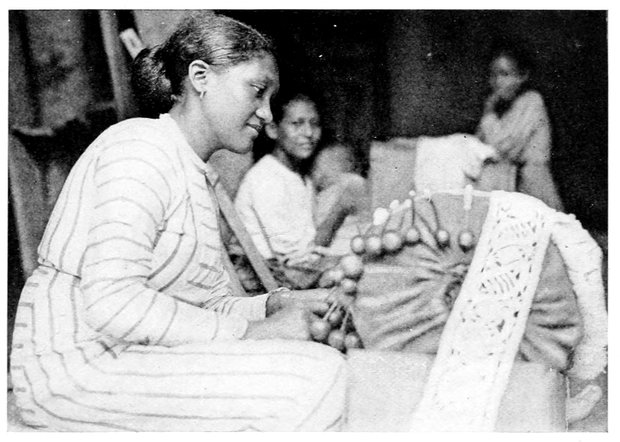
A lace maker on the Amazon
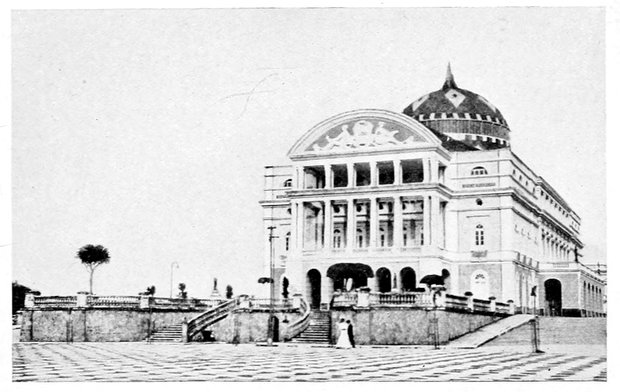
The Municipal Theater of Manaos
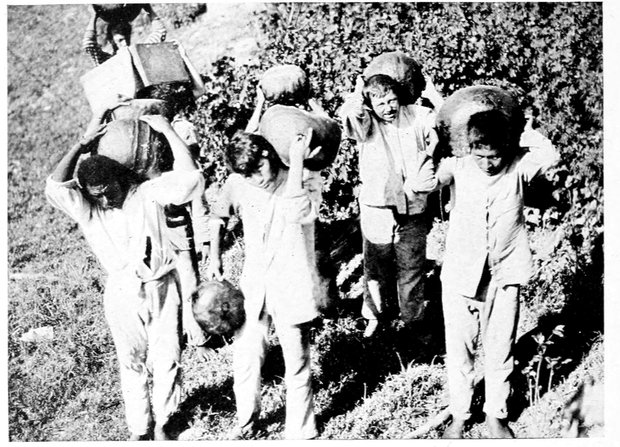
Here and there our batelão stopped to pick up a few balls of rubber
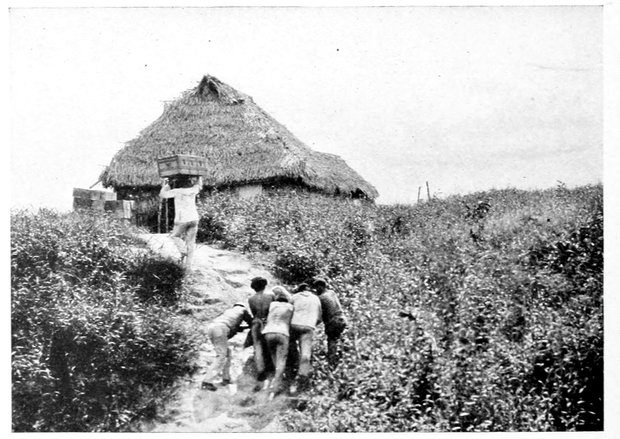
Now and then we halted to land something at one of the isolated huts along the Rio Branco
If there had been water enough, the launch would have taken us on
up the Takutú to Antonino’s door, but we were lucky to be able to push
497on to the home of the captain before the water ran out. From the
shallow Takutú we turned into the narrow Surumú, with barely sufficient
water to float us. This the English once claimed as the frontier,
but the King of Italy, as arbitrator, set it farther east. The thinly
wooded banks grew ever closer together, and in mid-morning we
grounded the launch—the old wreck of a batelão, had been left before
the estate of its owner near the mouth of the branch—at the captain’s
fazenda, “Carnauba.” In the baked-mud house we were welcomed by
his good-hearted, if diffident and laconic, part-Indian wife and family.
I asked the captain how much I owed him for my passage, at which he
showed great surprise and after long reflection remarked that he
thought twenty milreis would be generous. This was distinctly reasonable
for Brazil, and especially in Amazonia, where the higher you go
and the poorer accommodations become, the more exorbitant are apt to
be the charges. Money is not the common medium of exchange thus
far up-country, where favors are usually returned by some species of
barter. Thus Antonino was welcome to ride free because he often
shipped cattle by this launch and batelão, and the man who offers money
is looked upon somewhat as a “tenderfoot” is on our western plains.
Eager to stretch my legs, I would have pushed on without delay. But
Brazil is Brazil, even on its edges, and haste was difficult. First coffee
must be served; then came talk enough to settle the terms of a treaty of
peace, after which we finally packed all but the most indispensable of
our baggage and sent it away by canoe with Antonino’s servant, who
must descend again to the Takutú and paddle his way up it. By this
time “breakfast” was ready, and we sat down to a heavy Brazilian
meal of several kinds of meat, chicken included, and farinha wet in
broth, ending with the unescapable black coffee. Then the nearest
neighbor, from several miles away, dropped in, and the chatter went on
while we lolled in capechanas sipping more black coffee. This was my
first acquaintance with the typical seat of the region, a short hammock
made of dried cowhides and used not as a bed by night, for which it
would lack comfort and size, but as a lounging-place by day. There
were six of these capechanas swinging under the veranda. Cowhide
is so plentiful in these parts that stiffened ones are often set upright as
walls or partitions. There was not a chair in the house, though there
were two American sewing-machines and a rusty American phonograph
with a hundred records, both so long maltreated that every song sounded
like the squawking of the same hen in a slightly different key. The most
prized product of the outside world seemed to be kerosene, used in
498everything from launch-engines to lamps, and always eagerly sought.
A ten-gallon box of two cans cost 25$, say seven dollars, and for several
months a year it is not obtainable at any price.
First we were to start at ten, then at noon; now we must wait until
the sun was lower. A dozen horses were rounded up in the corral, where
two were lassooed, and for once it looked as if I were to have a real
mount. But the captain insisted on having him tried out first, and
after fiercely bucking and rearing for some time, he took the Indian
peon on his back for a gallop which he ended suddenly by throwing the
rider over his head into a shallow pool, breaking the ancient weather-rotted
leather of both saddle and bridle—which was lucky, for otherwise
we might never have recovered them. I was quite willing to try
my luck, if they would catch him again, but the captain insisted on
choosing a substitute, which turned out to be another of those equine
rats it seemed always my fate to ride in South America. Notwithstanding
his unpromising appearance, however, I was no sooner astride
him than he gave a splendid plea for admission to a Wild West show,
bucking, jumping up into the air and coming down stiff-legged on all
fours, kicking, rearing, and finally taking the cowhide “bit” in his teeth
and galloping wildly away across the bushy campo. For a time I was
undecided whether to stay on his back or catapult over his head, but
decided that the ground was hard and that the honor of my race
depended on my performance before those Amazonian gauchos. Somehow,
therefore, even with the kodak over my shoulder thumping me
in the back at every jump, I kept aboard and returned to the house,
which astounded the natives so profoundly as to imply that every other
“gringo” of their acquaintance had toppled limply off at the first jump.
Even when I got him quieted down, the animal was so ticklish that if
a foot or a bush touched him, he instantly went through the impersonation
of a bronco all over again, so that a dozen times that afternoon
I had the same sport. Antonino in time caught up with me and
we rode on together across a great plain, with scrub trees here and there,
many clusters of the burity palm from the fan-like fronds of which all
roofs of the region are made, and countless tepecuim, conical ant-hills
from six to ten feet high. The range of hills, which I now knew to be
the Kanuku Mountains in British Guiana, stood out blue, yet clear,
against the far eastern horizon when, about five o’clock, we stopped at
the “Fazenda Maravilha” on a bank of the Takutú River. It was a
“marvel” only in its own estimation, though the part-Indian owners
showed all the hospitality of the region by not only serving the
499ceremonious black coffee, but by insisting that we remain for the evening
meal. Here, also, there were leather hammocks, and a sadly abused
phonograph which did its best to entertain us. We were off again at
dusk, meaning to take advantage of the full moon; but the clouds were
thick, and even after it appeared we saw little of it. Before it rose we
stumbled upon what Antonino called a “maloca,” a cluster of huts built
and intermittently inhabited by more or less wild Indians. In the
darkness between two of the shanties we found a pair of Indian youths,
dressed in the remnants of cotton shirts and trousers and lying in their
only other possession,—old hammocks swung from posts under the projecting
eaves. They belonged to the Macuxy (pronounced “ma-coo-shée”)
tribe scattered through the hills of the three countries about the
source of the Rio Branco. My companion wanted them to go back to
“Maravilha” and help row his canoe and baggage home next day, and
the argument he was forced to put up resembled that of a spellbinder
seeking votes. In words of one syllable—for they understood little
Portuguese—and with such reasoning as one might offer a child of six,
he told them at least a dozen times that he would pay them two days’
wages, either in food or money, and that they might be on their way
again the following evening. Though they admitted that they had not
eaten that day, that they had no water, and asked for tobacco, their
unvarying reply was an indifferent monosyllable, and it was only after
half an hour of pleading that they gave a grunted promise to roll up
their hammocks as soon as the moon was high and be in “Maravilha” in
time to start up the river at dawn.
Soon we came to a muddy igarapé that our animals refused for a
long time to cross, and finally, toward what was perhaps midnight, the
barking of a pack of curs drew our attention to a hut and corral and
announced us to their unwashed owner. He invited us to swing our
hammocks inside, gave us each a nibble of miserable native cheese, and
eventually, a discussion of the news of the day having been exhausted,
let us fall asleep. The chief item of interest which Antonino had
brought with him was that a youth known to himself and our host had
resorted to the plan, still usual in those parts, of stealing a woman, but
who this time happened to be a widow. The hut-owner refused to believe
it, saying in a surly grunt that “of course Pedro is old enough
now to hunt him a woman, but whoever heard of stealing a widow!”
The scorn in his tone is inexpressible in words. Long before daylight
we saddled again, drank a glass of foaming milk still warm from the
corral, and struck out across bushy campo, rather sandy and very dry.
500An unusual danger on these great savannahs is that wild horses, especially
stallions, roaming the plains attack mounted animals, sometimes
biting mouthfuls out of them, if not out of the rider. Several pursued
us, and one big black brute would not give up his nefarious project
until I had fired my revolver over his head. About seven we came
upon another hut, where the usual limp handshakes and mutual inquiries
as to the health of families—for, of course, Antonino knew
everyone in the region—was followed by the exchange of local gossip
until coffee had been made and served. An hour later there was a
similar halt at a similar hut. Life in Brazil is just one black coffee
after another. Here there was a branch of the Takutú, to be crossed
in a canoe, swimming our horses and re-saddling them, after which a
long and fairly swift trot brought us at last to the home of Antonino.
It was by no means as sumptuous a place as his choice of language
had led me to picture, but at least it was more comfortable than the
mud hut in which we had spent part of the night. There was a large
thatched and once whitewashed adobe house standing forth on a big
bare spot at the top of a slight bluff above the Takutú, and three or
four smaller huts and a corral, all of which, with several hundred dry
and sandy acres about them, Antonino had inherited six years before
from his mother-in-law. The site was on the extreme edge of Brazil,
where the Takutú makes an almost complete turn and the Mahú flows
into it, and it would have been easy to throw a stone from Antonino’s
door over onto British territory. I had looked upon my companion as
almost a youth, yet his wife, younger than he, was already old and gray,
and his daughter of thirteen was in the physical prime of life and visibly
longing for a husband. These, a son, and Antonino’s brother, dying of
tuberculosis, made up the household, though there was the usual swarm
of Indian or half-Indian servants.
Our batelão loaded cattle at sunrise from the corrals on the banks
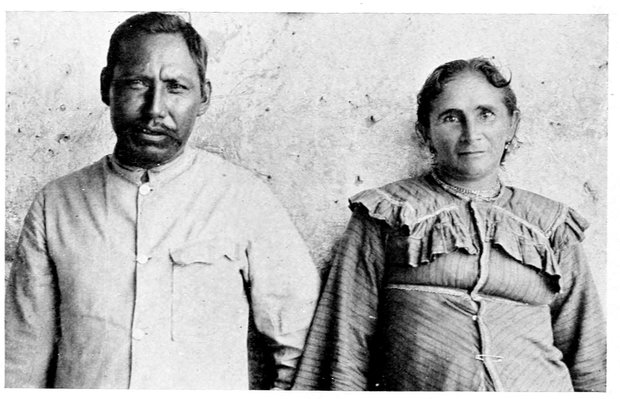
The captain of my last Brazilian batelão, and his wife
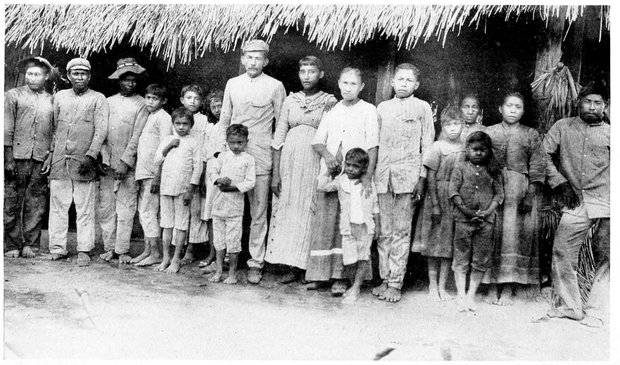
Though families are rare, there is no race suicide along the Rio Branco
After a swim in the boundary and a mammoth, though rough,
dinner, I was led to the “chaletsinha,” a small mud-and-thatched hut reserved
for visitors, for even here it would have been scandalous to
lodge a male friend in the same house with one’s women folk. The
floor was of unleveled earth and there were a dozen hammock-hooks, between
two of which I napped for a couple of hours. Meanwhile the
fifteen-year old son had been sent over into British Guiana to summon
the “Americano.” Ever since I first met him Antonino had insisted
that a compatriota of mine lived just across the boundary from his
fazenda, but I had so often found in South America that men reputed
to be my compatriots turned out to be Italians, Syrians, negroes, or
501something else as un-American, that I had given little attention, and no
faith, to his assertion. My surprise, as well as my delight, was all the
greater, therefore, when there suddenly walked in upon me a magnificently
built, handsome type of outdoor American in the early prime of
life and the visible pink of condition, his ruddy health in striking contrast
to the chalky faces of the indoor Brazilians. He was Ben Hart
from South Dakota, who had gone first to Panama, then to the Madeira-Mamoré,
later had prospected for gold around Sorata, and finally had
come to British Guiana eight months before with an American partner
to start a cattle ranch. The partner had an English wife, however, and
when the war broke out he had gone to London to enlist and left Hart
alone. I was the first “white man” he had seen in half a year, and
though he could not assure me that I could reach Georgetown, never
having been there himself, he did “hope I would come over and stay a
few weeks with him.”
On the last day of May we walked a couple of kilometers over bushy
campo and dried bogs to a fringe of woods on the edge of the
Mahú, across which Hart hallooed to his Indian boys about a newly
thatched hut visible on the opposite bank. They soon appeared in an
aged dugout, the gunwales of which were under water, but with boards
nailed above them, a precarious craft that would have filled in ten
minutes; but luckily the trip lasted only three. Thus I was removed
bag and baggage from Brazil eleven months to a day from the time I
had entered it from Uruguay. That day I was firmly convinced that
nothing short of penal servitude would ever again get me back into the
mammoth land of the imperial palm and political corruption; but time
cures most lacerations of the skin and nothing is so disagreeable at a
distance as it is close at hand. The Brazilian bubbles over with faults.
As my old friend, Professor Ross, puts it, “he much prefers the lollipops
of compliment to the pungent olive of truth”; yet there is something
fascinating about both him and his gigantic, wasted national domain.
Long after his grafting politicians and his un-trounced men and boys
have become the dimmest of memories, his magnificent palms, swaying
beneath peerless skies, his incomparable capital and the songs of his
sabiás remain vividly etched in a crowded recollection; and when, on a
dark and dreary winter day in the Puritan-weighted North, I read again
some of the swinging, color-flashing lyrics of Casimiro d’Abreu, nothing
but the Portuguese word saudade expresses the longing that comes over
me to behold again those marvelous days and luminous nights of which
he sings.
CHAPTER XX STRUGGLING DOWN TO GEORGETOWN
502
Ben Hart lived about forty yards back in British Guiana.
Having passed the frontier without sinking, we scrambled up
the steep, sandy bank of a river that had changed its name from
the Mahú to the Ireng while we were crossing it, strolled through a bit
of bone-dry, bunch-grass prairie, and turned in at the first house. We
could scarcely have missed it, for there was not another for many
miles within the colony. Hart had built it himself, with the help
of his “siwashes,” as he called the Indian boys who made up his
indefinite retinue,—a temporary structure in the approved style and
only available material of the region, the walls of brush and mud, an
earth floor, and a thick, top-heavy roof of palm-leaves. Later on he
planned to build a real house a few miles up the river. Cow-hides,
worth nothing whatever in this region, but which his employees were
obliged to turn in to prove that an animal was dead, were used for
every imaginable purpose,—as doormats, wind-shields, rugs, even
to stand on down at the “old swimming-hole” where we took a dip
every night, though pirainhas abounded and an alligator had recently
eaten Hart’s best dog.
He lived as everyone does and must in those parts, with certain
improvements of American ingenuity. A fire built on the ground was
his cook-stove, though he made a kind of bread-cake in an iron pot
turned into an oven, the only bread in all that region. We, too, ate
farinha, however, either dry or wet down with beef broth. This
Brazilian staff of life tastes exactly like sawdust, but swells to several
times it original size and is very filling and evidently nourishing. Then
his Indian boys cut up dried beef and boiled it; now and then Hart
let go a gun at a chicken, and occasionally a steer was killed, when
everyone—neighbors, servants, Indians, dogs, chickens, and buzzards—gorged
themselves for a day on fresh meat, after which the rest was
cut into strips, salted, and sun-dried. The dessert common to all that
region was “coalhado,” milk turned sour and thick as pudding and
eaten with sugar. Then there were plenty of eggs, and milk without
503limit was to be had for the milking, since Hart already had hundreds
of cattle, as well as many horses, few of which he saw once a month.
Hammocks hung under the long protruding roof, as well as inside the
house, and a cool breeze was always blowing across the savannahs, as
the British call what the rest of South America knows as campo or
pampa, in this region between three and four hundred feet above
sea-level.
Hart’s closest companions were a pair of hounds, now with a
litter of pups. As the cur dogs of the Indians make a great hullabaloo
at sight of a white man, so breed dogs are at once friendly with an
Englishman or an American, but will not let an unknown Indian
approach the house while the master is away and never make friends
with the aborigines. About the hut hovered three dog-like Macuxy
Indian boys, who did all the odds and ends of work and lived on
the odds and ends of beef and farinha, neither getting nor expecting
any wages, except a place they might call home. They hung their
hammocks under a thatched roof on legs some distance away and now
and then received a few yards of cotton cloth which they turned into
clothing, for it is surprising how these children of the wilds can make
even a tolerably fitting jacket. These Indian boys were never hired,
but were unconsciously acquired. One of them would turn up and
go to work without a word, cooking, washing, milking, and doing the
other tasks, all of which took perhaps four hours a day, and it would
not be until they had remained longer than is customary for visitors
that Hart realized they were permanent employees. Brazilians in
this region may during the course of a year give a cowboy or an
Indian servant a cast-off cotton suit; hence word of the greater generosity
of the American had quickly spread and the difficulty was not
how to get help, but how to keep rid of too much of it. There were
also fourteen vaqueiros, who lived with the cattle and were rarely
seen at the house, and to these Hart furnished farinha and paid two
milreis a day, not in money but in cloth and other goods, for though
the milreis serves as a basis of computation, there is no fixed medium
of exchange and barter is still almost universal. The little actual
money with which he had arrived Hart had laid away months before
and never seen since, and he had no fear of its being stolen, though
he kept well-locked the back room in which he stored his piles of cloth.
Indeed, when he set out with me on a trip that might have lasted
two or three weeks, it never occurred to him to take money with him.
The vaqueiros, of course, killed a steer whenever they wanted meat,
504turning in the hide to show that they had not sold the animal over
the border. Neither Hart nor his “siwashes” spoke any Portuguese
worth mentioning, so that their conversation consisted chiefly of
grunts and brief gestures, with now and then an American or Portuguese
word which happened to be familiar to both sides. The
Indian boys had found that certain sounds represented certain actions,
so that when they were told to “build fire” they knew what was
wanted, though the separate words meant nothing to them. They
had learned a few expressions so well that they even ventured to
pronounce them, and each evening after the dishes had been washed
and the fire put out, they filed solemnly past us, each emitting a
dubious “Goot neety” on the way to their barracão. Their general
attitude was about like that of a cat. They drifted in from nowhere
and stayed unasked, quiet and unaggressive, yet in a way independent
and in no way affectionate. They knew that some day Hart would
give them a hat or a few yards of cloth, and even without that reward
they were quite pleased to have the prestige of living with so “rich” a
man.
More than 12,000 square miles of this back end of British Guiana
is high, open savannah, splendid for cattle; but the government refuses
to sell it and merely issues “permissions to graze” on little patches of
fifty square miles, or 36,000 acres each, at the exorbitant rental of three
pounds a year! Hart was the sixth man to be issued such a permit,
one of the others being a German and the rest Englishmen, while in
all the immense savannahs of British Guiana only four Brazilian
fazendeiros had chosen to remain after the boundary award. Hence,
in addition to his legal holding, there were some 200,000 acres more
over which his cattle might freely roam. The cattle, too, were obtained
by barter. Soon after his arrival, by way of Brazil, Hart had an
entire boatload of goods brought up from Georgetown,—dozens of
cheap felt hats, belts, soap, particularly many bolts of coarse, strong
cotton cloth in gaudy patterns. No one else for many miles roundabout
had any such stock on hand; hitherto the Brazilians over the
border had been obliged to go to Boa Vista, or even to Manaos, to
get such things. Moreover, Hart did not take unfair advantage of
them, but charged the same prices as prevailed in Manaos; that is,
he asked 3$ or 3$500 for a yard of cloth that cost perhaps six pence
in Georgetown, so that they were delighted to do their shopping so
near home, and as they rarely had anything but animals to pay with,
he had already bought twelve hundred head of cattle and eighty
505horses without making serious inroads on his boatload of cloth. A
Brazilian rancher anxious to give his wife or his own legs a surprise
would ride fifty miles or more across country, driving before him
a cow and a calf, and sell them to Hart for 60$—that is for twenty
yards of cloth which had cost Hart $2.50. The visitor would depart
highly satisfied with the exchange, while Hart branded the animals and
added them to his stock on “Good Luck Ranch,” known across the
river as “Fazenda Americana.” A horse and colt came to about 350$,
say a hundred yards of the best cloth, at an original cost of $14; a
plump steer might be worth two felt hats and a belt; yet Hart’s prices
were considered so reasonable that people flocked in upon him from
all directions. Now it might be an Indian of some property, who dined
while his wife and child waited out in the rain until he was done and
called them in to eat what he had left; or it might be a fellow-rancher
who had neglected to keep up his own supplies. Occasionally payment
was long delayed, but was almost always sure. Sometimes he
was paid beforehand, as when a fazendeiro with whom he might spend
the night would tell him to drive such and such animals home with
him, promising to come over later and get some cloth. There was
nothing of the skinflint about Hart. He followed the time-honored
custom of the region, with an American generosity added; and of
course there was the high expense and risk of boating the stuff up the
rivers, keeping it under lock and key in his back mud room, and the
shopkeeping bother of selling it. Once he lost an entire cargo worth
$2000, when the Indians who were bringing it to him let the boat
go over some falls. But he hoped to have four or five thousand head
of cattle in as many years, and to come to the rescue of the world’s
scarcity of beef and leather as soon as some means was provided for
reaching the markets. Just now the greatest drawback was lack
of transportation. The governor of the colony had recently made a
trip to the savannahs, and a railroad was planned, but the war had
postponed it. American capital would build the line, but only on
condition of certain land grants, and the governor was set on having
it a government railway.
Meanwhile, I soon discovered, it was much easier to come in at
the back door of British Guiana than to get from there down to the
front portal. Small as it looks on a map of the whole continent,
England’s South American colony is more than twice the size of
Great Britain. It was 340 miles down to the coast as the crow flies,
and vastly more than that to any but winged creatures. With 78,500
506square miles of unbroken forest and matted jungle, only the four-hundred-and-sixtieth
part of which was even under woodcutter’s
license, there is no means of travel back of the fringe of coast except
by the rivers, and these are much broken by falls and dependent on
the season. Hart’s latest letter from the United States had been five
months on the way.
The first leg of a journey to Georgetown was to cross the divide
between the Brazilian and Guianese river systems, some fifty miles
in its narrowest part, but much more than that to the home of Commissioner
Melville on the upper Rupununi, which for several reasons
was the logical starting-point of a journey down to the coast. Hart
had been planning to go over to Melville’s within the next few weeks,
and we compromised on his getting ready as soon as possible, which
was to be within ten days. The delay I spent to advantage, for Hart
was a pleasant companion and the region full of interest. Now we
trotted over several hundred of his acres looking for a troop of mares
in charge of a tyrannical stallion; twice we roamed the lightly wooded
savannahs checking up on his cowboys and their charges. One day
we went back to Brazil to visit Antonino and his family, the only near
neighbors and the most nearly educated and civilized people in the
vicinity. We brought back with us twenty cows and as many calves,
driving them to the river, lassooing and dragging them down the
bank, rolling in mud and drenched with perspiration and tropical
downpours, and taking each calf across in the leaky dugout, the
mother swimming behind. There are no frontier formalities, the
ranchers of both sides being their own sovereigns in all matters, and
Hart was as free to import cattle as he was to drive them over to the
Takutú at the beginning of high water and sell them to the barges
from Manaos.
We set out for Melville’s on June 5. Hart said it was a four-hour
ride to the St. Ignatius Mission, but I knew how deceiving distances
can be in South America, as well as the many unexpected obstacles that
often turn up in wilderness travel, and was not too pleased when we
put off the start until some time after noon. Hart rode a gray
stallion with Texas trappings and led a pack-horse carrying our baggage,
as awkward as packs always are and requiring frequent halts for
adjustment. My bay horse had plenty of life, but with only the precarious
monkey-seat the English call a saddle I was kept busy thwarting
his frequent attempts to leave me behind. The first hour across Hart’s
broad grazing-lands was fairly dry, though our delay had brought on
507the rainy season again. Endless stretches of fine prairie-grass, alternating
with thin scrub forest, lay beyond. The first house was a ruin
in thatch once occupied by a Scotchman and his squaw; the next had
belonged to an exiled Brazilian. Every ruined hovel had its story.
There was, for instance, the one in which Hart had met and tamed
the “Ocean Shark.” A giant negro from the thickly settled coast,
charged with two murders and many lesser crimes, had so named
himself when he fled to the interior. However good a government
may be, it is far away and hard to reach in so sparsely populated a
country, where every man must be his own law and protection. When
Hart first came, this black outlaw was roaming these upper plains
with a band of servile and frightened Indians, bullying even white men,
if they would stand for it. An Australian had picked up the Indian
woman abandoned by the Scotchman, with her daughter and son,
and settled down with her in the hut in question. One day he came
home and found the “Ocean Shark” already occupying his hammock.
“You see dat tree over dere?” said the negro. “Well, jes’ yō swing
yō hammock out dere. I’se here now.”
The Australian, being a man who valued his skin more than his
honor, complied, and the negro acted as his domestic substitute for
a week before whim or rumor caused him to move on. He was constantly
bullying the smaller ranchers and killing their cattle, and at
length he let word drift out that he was going to do the same for Hart.
The American, however, well over six feet and weighing 190 pounds
without an ounce of fat, was built on “shark”-taming lines. Moreover,
his partner had just left for the war and he was feeling very blue and
spoiling for a fight when, on his way home to his new ranch, it was
his good luck to find that the “Ocean Shark” had camped in the chief
hut of a nearby Indian village. With him was his “secretary,” a
small yellow negro named Cecil, for the “Sha’k” could not read or
write.
“What are you doing here?” demanded Hart, riding up to the hut.
“Ah don’ know what dat got t’do wid yō,” answered the “Sha’k.”
“You black ——!” said Hart. “I asked you what are you
doing here.”
“Don’ yō curse me!” screamed the negro, in the bold terms of the
British “object” the world over, though already a bit tremulous from
the seriousness of his situation.
Hart was by nature anything but a belligerent man, but his future
in the colony depended on the evidence he gave at the start of being
508able to take care of himself. He sprang from his horse, drew his
heavy revolver, and rapped the “Ocean Shark” over the head with
the butt of it. Then he thrust the weapon back into its holster and
waded into the negro in approved mining-camp style, rapidly changing
his color from black to red, and ended by giving him ten minutes to
pack his traps and remove his battered face forever from that corner
of British Guiana. During that time the Indians who formed the
negro’s band ran back and forth “just like ants” collecting his belongings,
and every time his “secretary” had to pass the American he took
off his hat, ducked as if to dodge a blow, and said, “Yessir! Yessir!”
Soon the whole caravan was on the move and the “Ocean Shark” had
never been seen in this region since, though fanciful tales continue to
drift in of the “free city” he and his obsequious followers have
founded in another corner of the colony.
At two in the afternoon we reached the Manarí Creek and found
it too deep to cross on horseback, though when Hart had passed that
way a week before it had not been knee-deep. That is the greatest difficulty
of the overland trip from Manaos to Georgetown; one can
only get up the Rio Branco in the rainy season, which is the very
time when the savannahs are flooded and virtually impassable. Luckily
I am fairly tall, and Hart was taller. We unloaded, stripped, and
carried everything, including the saddles, across on our heads, the
water just reaching my nostrils. Then we gave the horses a bath,
for which they seemed grateful, went through all the loading process
again, and rode on, the crossing having cost us more than an hour.
There were more bogs and creeks, but all were passable, and we had
only to stop occasionally to adjust the pack. All the time we kept
drawing nearer the Kanuku Mountains, now a long blue range across
the southern horizon. We had to pass around the end of this to get
to Melville’s, which was almost due south, though I was supposed to
be traveling north.
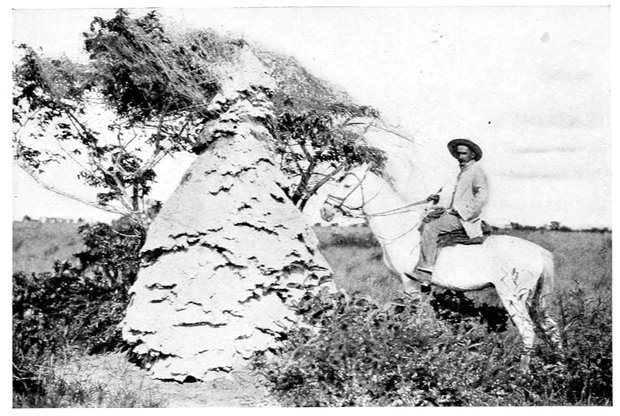
Dom Antonito and one of the ant-hills that dot the open campo of the upper Rio Branco
I crossed the boundary between Brazil and British Guiana in a leaky craft belonging to Ben Hart, who lived on the further bank of the Mahú
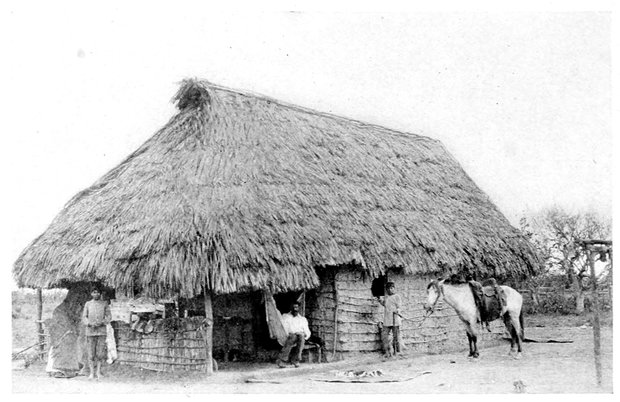
Hart had built himself a native house on the extreme edge of British Guiana
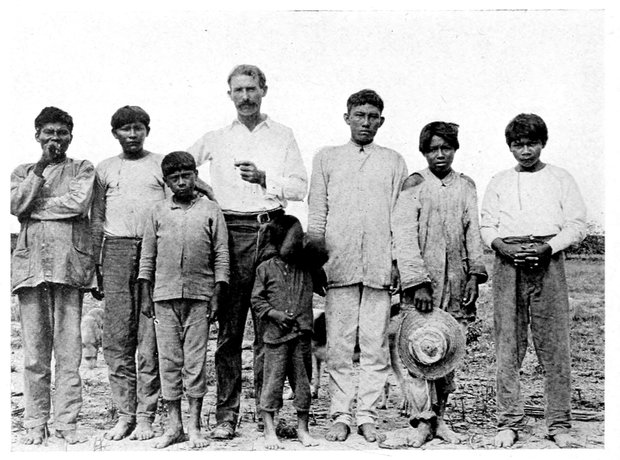
Hart and his Macuxy Indian helpers
It was five o’clock when we reached the first inhabited house, that
of a Brazilian family on a bank of the Takutú. The usual formalities
included insistence that we wait for coffee, and as Hart did not care
to risk making an enemy, we complied. These people assured us that
all the igarapés were so swollen from the recent rains that it would
be impossible to get to Melville’s at this season. Not far beyond we
came to a stream which Hart had easily forded the week before. I
drove my horse in, expecting the water to come at most to his belly,
when the animal suddenly dropped and took to swimming, with the
509water about my waist. There was no way of getting our pack-animal
across without ruining everything. We returned to the Brazilian hut,
and while I took such measures as my soaking and that of the saddle-gear
demanded, Hart stripped, tied his clothes around his head with
a strap under his chin to hold them, and swam the igarapé to an Indian
hovel where he arranged for a canoe and two paddlers. These dropped
down the stream to us, and having hobbled the horses and put the
saddles astride a pole always provided for such purposes under the
eaves of rural Brazilian huts, we and the Indians lugged our baggage
to the canoe and finally set out in pitch darkness to paddle up the river
to what Hart called the “padre’s house.”
Like the one in which I had entered the colony, the canoe was a
leaky old dugout with rotting boards nailed along the sunken gunwale,
through which water gushed almost in streams. I had to hug the two
bags on the seat beside me and at the same time bail water incessantly,
while the Indian boys shoveled water at the bow and Hart made a
poor job of steering in the stern, because it was impossible to tell the
shadows from the tops of the trees under water near the bank, which
we were compelled to follow closely in order to make any progress
against the swift current. Even there and with the utmost effort we
made barely a mile an hour, and every loss of a stroke for any reason
left us so much farther down stream. The Takutú was about four
times as deep as when I had last left it, and was now a real river.
Several times I was nearly knocked off, bags and all, by unexpected
branches of trees; then suddenly I discovered that the boat was filling
faster than I could bail it out, the water quickly reaching my ankles
and then my calves. It wouldn’t matter so much to Hart, who had
brought only a few tramping necessities, but it was only a question
of a very short time before all my South American possessions, including
even my money in the valise, would be at the bottom of the Takutú,
while I struggled ashore in my heavy brogans with only my hat and
my reputation. I shouted to the Indians, who looked around and
saw the water which they, being high in the bow, had not felt, and
by sheer luck they managed in the darkness to tear a way through
tree-tops and bushes to a spot on the bank with bare land enough
to hold our baggage. Here we found that a snag had kicked a large
hole in the stern of the rotten old craft and that water was pouring
in as from a faucet. This repaired as best we could, we bailed out
the boat and pushed on. For what seemed hours we fought against
the current and bailed incessantly before a faint light far away in
510the night announced that we were approaching the mission. We could
not seem to bring the light nearer, but finally managed to land in the
mouth of a tributary, and, tearing through the jungle and stumbling
over stony ground in the black night, lugging our baggage, we at last
ended at nine o’clock the “easy four hours’ ride” from Hart’s ranch
by entering the mission of an English Jesuit, Father Ignatius Cary-Elwess.
It was a big, two-story, thatched building on the bank of the upper
Takutú, just across from Brazil. Indian men and boys, chiefly in loin-cloths,
though some wore a shirt and some the remnants of trousers,
swarmed about the place with perfect freedom, as the “padre” seemed
to have an easy-going way that had weakened his control over them.
He was a small, wiry man of middle age, dressed in an old soutane,
quite English, yet also quite Jesuit, which made a curious combination.
Eleven years before he had come out entirely alone and lived in their
huts with the Indians, under exactly the same conditions as they, until he
had learned the Macuxy tongue—at least as well as the average
Englishman ever learns a foreign language. He knew no Portuguese,
and the naked Indian youths spoke an amusing mixture of English
and Macuxy, the former chiefly represented by “Fader, yes,” with
which all statements began, usually continuing in the native tongue.
The priest was “one of the boys” in the stories he told, but he often
drifted away into dreams. After nearly four years in Latin-America
it seemed strange to hear the English names of things I had only
known in Spanish, Portuguese, or Quichua,—“bush” for sertão,
“Savannah” for pampa or campo, “’gator” for jacaré. It was sixty-three
days since the padre had last heard a word of the world’s news,
and the long time which elapsed before our generous supper was ready
we spent in bringing him up to date, getting out of our soaked garments,
oiling our revolvers, and swinging our hammocks.
When I rose in the early morning a cold wind was blowing across
the open country. About the mission building was a cluster of huts
for the converts, and many cattle were grazing nearby—for the good
padre did not neglect the practical things of life. He was already
saying mass before an outdoor altar set in the side of a mud house,
assisted in his formalities by otherwise naked Indian acolytes in red
robes. A creek near the mission, which one could generally step across,
was so swollen that we had to borrow a canoe, and the top branches
of high trees just peered out of the water. We soon came to another—whereupon
Hart decided that we were sure to lose the horses if
511we tried to continue the trip with them. The only animal which can
endure travel under such conditions is man, and we concluded to resort
to the only means of locomotion left us. When we returned to the
mission, the padre, who had been a famous athlete in his younger days,
left off a cricket game he was playing in his flowing soutane with the
Indian boys, and went with me to find us Indian carriers. His rule
was too lenient, however, and the day drifted on without anyone
offering to go. He would not order anyone to do so, as most of the
Indians had come for some Catholic celebration and the padre felt
that they could not be spared. “Anyway,” he mused, “by far the
best carriers are the women—women”—his eyes fell suddenly on
Hart, conspicuously masculine in his splendid frame and perfect condition—“we—er—well,
I’ll send for the chief and see if he can’t get
you two men”—the accent on the last word was probably unconscious.
It was afternoon before a father and his son were finally prevailed
upon to make the one-day journey to the next village, and at two we
were off across country. The man, about thirty-five in years, but already
old for his race, was as ill-fitted for his task as the average white man
of sixty, and was constantly being favored by his son of eighteen,
in the prime of life. We were soon stripping to wade a stream neck-deep,
clothes, revolver, kodak, and other odds and ends on our
heads, and had barely dressed again when we came to a swamp of
such extent that we swung our shoes over our shoulders for the rest
of the day. It was stony here and there, but more often swampy,
with bogs in which we sank to the knees and several streams waist
or chest deep; but the water was lukewarm and the going almost
pleasant, though we envied the Indians their natural leather soles.
That evening we reached an Indian hut made entirely of palm-leaves,
and swung our hammocks from poles with the family. Our carriers
chattered long in the native tongue with our otherwise taciturn hosts,
using the word “fader” in nearly every sentence. We made our own
tea and ate our own farinha and rather green bananas, to which the
Indians added a square foot or more of mandioca bread, here called
“cassava.” Gnats made life miserable for me, but Hart and the
Indians took turns snoring all night, while the wife of our host stood
or squatted in a far corner of the hut, stirring the fagot fire every
half hour or so, darkness evidently being a cause for fear, and gently
punching her fat husband every time his snoring grew uproarious.
Not only the men and children, but cur dogs and fowls slept in the
comfortable hammocks; but either it is immoral, by their tribal laws,
512for a woman to lie down while there is a stranger in the house, or it
is the admirable custom for the woman to sit up all night and keep
her lord’s fire burning. Yet there is a vast difference in the comfort
of life between these tropical Indians and those of the Andes, a difference
due mainly to one thing,—the hammock. Their floors may be as
hard and as filthy, even as cold at times, but swinging above it in a
soft, native-woven hammock is like living in another sphere. The
hammock is the most important thing in the life of the Indian of this
region, as, indeed, of all residents. He is conceived in a hammock,
born in a hammock; a hammock is his chair, sofa, and place of siesta,
it is his bridal bed and his death bed, and usually it is his shroud, for
it is the custom to bury him in the hammock in which he dies. If
he travels in light marching order, the Indian may leave everything
else behind, except his loin-cloth, but he carries his hammock.
Rain fell heavily most of the night, and we did not once put on
our shoes during the next day. Our feet were under water certainly
half the time. Barely had we started when we had to wade a deep,
muddy creek, followed by a long swamp; and similar experiences
continued in swift succession. The vast savannah was dotted with
scrub trees, but there was no sign of life except occasional birds. The
Kanuku Mountains, everywhere heavily wooded and blue with the
mist and rain that always hangs about them, drew slowly nearer on
our left. This region might be dubbed the “Land of Uncertainty,”
for one never knew what might be waiting a mile ahead, whether we
would have to come all the way back, after struggling through most
of the trip, because of some impassable obstacle. Particularly the
Suwara-auru, a branch of the Takutú which foams down from the
Kanuku range, was likely to prove such a barrier.
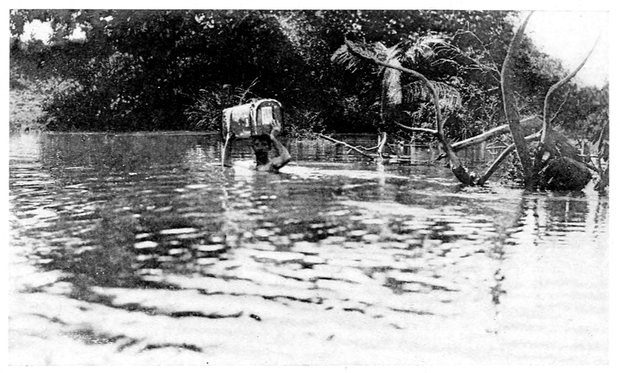
Fortunately Hart was a generous six feet or my baggage might not have got across what had been trickling streams a few days before
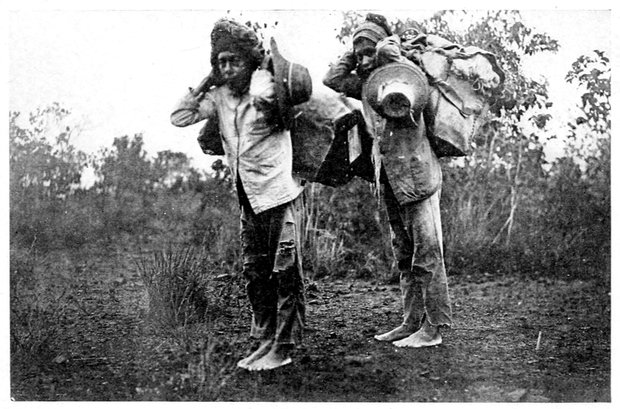
We impressed an Indian father and son into service as carriers
Macuxy Indians with teeth filed or chipped to points
An Indian village along the Rupununi
We were already soaking wet, so that we paid little attention to the
roaring rain that soon began to fall, though I still strove to keep my
kodak from being ruined. Even the shoes on our backs were as wet
as if we had worn them. Our baggage, on the Indians’ backs, was
covered with old pieces of canvas, but the rain poured down in cataracts
upon it and promised to soak everything it contained. To make
things worse, the Indians could not keep up with us. The aged
thirty-five-year-old man was in sad straits, and we were in constant
dread of his falling down in some mud-hole. At down-pouring noon
we reached the base of the range of hills and began to skirt it, the
storm making a tumultuous yet musical sound on the dense forest.
In dry weather, no doubt, it would be screaming with parrakeets,
513though it is said always to be raining in the Kanukus. Deep in the
woods we stopped among mammoth trees at the bank of a creek to
assuage our gnawing hunger. It was pouring incessantly, yet the older
Indian got a fire started, roofed by green banana-like leaves, and into
this we thrust slabs of sun-dried beef spitted on sticks. We made tea,
also, and each ate his rationed half-pint of farinha, which would soon
swell to a quart. All this time we had not a suggestion of shelter and
the water ran down us in streams throughout the meal, washing our
fingers as rapidly as we soiled them. Yet somehow we felt in unexpectedly
good spirits. Hart rolled three cigarettes, handed two of
them to the Indians, and we were off again. The forest grew ever
denser, and the rain became an absolute torrent. Only in crossing the
Malay Peninsula years before had I bowed my back to such volumes
of water, water which, as the ground grew a bit hilly, rushed down
the narrow ruts worn by former travelers so swiftly as almost to
sweep us off our feet.
With every step forward I grew more uneasy. We were drawing
near the notorious Suwara-auru, situated where the forest that spills
down a spur of the mountains is thickest and the rainfall is said to
be the heaviest in all British Guiana, and which, according to Hart,
“the devil himself often could not pass.” It may be knee-deep in
the dry season, and a week later fill up the whole gorge or valley
with a rushing current half a mile wide—a gorge still densely forested,
too, for there are trees everywhere, except in the bit of space occupied
by the creek in the dry season, and horses have been killed by the
force with which the current hurls them against the trunks. Of
course man himself can pass under almost any conditions; but it might
well be impossible to get even such baggage as I carried across, and
I might have to go clear back to Manaos, or wait for months until
the rains subsided.
The gorge promised to be at its worst that day, for most of the streams
we had passed were near their high-water mark. Yet the Suwara-auru
was not. When we finally came to it I shouted above the storm to ask
Hart if this almost placid stream, which barely reached the lower
branches of the trees, was the mighty obstacle about which I had
been hearing for days. But such is the tenacity of a bad reputation that
my companion, never attempting to cross it as we had many others,
tore his way upstream with great difficulty, gashing his feet and
tearing his clothing in his fight with the jungle, to a half-submerged
tree-trunk that offered a possible but precarious crossing. Meanwhile
514I, skeptic from birth, had thrown off revolver and kodak, waded in—and
crossed with the water barely to my armpits! Before Hart could
fight his way back I had taken the Indian youth over twice, with all
my belongings on his head, though he was so much shorter that the
water came to his nostrils and I had to walk close to him on the downstream
side to keep him and, what was more important, my possessions
from being washed away. Then, with my help, he carried his
father’s load across, and the old man managed to cross “empty.”
Through it all it kept raining as I had never seen it rain before,
except once in the jungles of the Far East. Perhaps the most surprising
part of the whole episode was the much greater fear of the elements
shown by these children of the wilderness than was our own. The
superiority of savages in struggles with nature, as compared with
civilized man, is all very well in popular novels, but my own experience
has been that in real life the balance tips the other way.
Evidently the sources of the Suwara-auru were so far up in the
mountains that it did not respond to the rains as quickly as the other
streams; and a day or two later it might have been quite as impassable
as it is by reputation.
On the opposite bank was an immense rock with a sheer side up
which we could never have pulled the horses, even had we succeeded
in getting that far with them. Yet their loss on the trail would not
have made Hart any poorer, for when he returned one had died of
snake-bite and the other had injured itself so badly that it had to be
killed. We coaxed the worn and frightened Indians under their
packs again and pushed on in the drenching roar. For an hour or
more we plunged on through dense forest; then, as the nose of the
mountain we were flanking receded, the rain decreased and at length
subsided almost to a drizzle, though the rest of the day was bathed
in successive showers. Having flanked the range, our trail now turned
more to the east and came out on swampy scrub savannah again.
All day it had been barely a foot wide, and so seldom was it traveled,
even by animals, perhaps not in months by a human being, as to be
almost invisible, except where it was deep enough to be filled with
water. But that was not the worst of it. Lack of travel had let
the long, sharp prairie-grass grow out over the path from both sides
so as almost to cover it, and the saw- and razor-edges of this cut and
gashed my bare feet until the tops of them were a mosquito-net of
bleeding scratches.
We expected to get a welcome and a plentiful meal that evening
515in “George’s Village,” a small settlement since the oldest foreign
resident could remember, of which “George” was the Indian chief.
Life itself depended on the food and supplies we were to get there.
Our feelings may easily be imagined, therefore, when we came in
sight of the village and found it only half a dozen patches of charred
timbers and broken pots, even the heavy red-wood uprights that would
not burn having been cut down. It turned out that “George” had
recently died, though news is so sluggish in this region that few
knew it. In much of tropical South America it is the custom, upon
the death of a chief, to burn down his house, or even the whole
village, after burying him in and under the hammock in which he has
died, and then to abandon the locality to escape the “evil spirit” that
has killed him. For no Indian of these regions ever dies a natural
death. He is always killed by some supernatural spirit. “Did the
spirit hurt him much?” the civilized man will ask the Indian informant.
“Why, he broke every bone in his body,” the Indian will answer—no
doubt because of the limpness of the corpse.
Miles farther on, across another thigh-wearying swamp, we sighted
a cluster of huts, and our spirits rose, only to fall again, for these,
too, had been abandoned, though not burned. There were half a
dozen of them, including two large ones of oval shape made entirely
of thatch palm, except the rounded ends, which had been plastered
with mud. I arrived with a tooth-rattling chill, but our Indians had
faded away behind us and we had no dry clothing. I stripped naked
and rubbed down with my wet garments, that being at least preferable
to standing in them in the penetrating chill of evening. We forced
the door of the largest hut, which was no great task, and found it a
single room large enough for fifty men, but chiefly full of emptiness.
The only things left were some cracked water-gourds and a few
woven palm-leaf fire-fans, scattered over a broad expanse of hard,
uneven earth floor. When the carriers at last arrived, we built a fagot
fire inside, swung our hammocks, and made tea of swamp- and rain-water
with which to wash down our dry farinha, wondering the while
what we would live on ahead. The old man was shivering with fever,
and we feared he would not last much longer, even if both did not
refuse to go any farther. They swung their hammocks side by side
at some distance from ours and built another fire between them, which
the youth kept going all night. Whenever they had occasion to go outside
they went only in close company, like children afraid of the dark.
The hut had no windows, and both doors were closed against insects,
516night air, and evil spirits. Yet the mosquitoes and gnats were so
numerous that I used my mosquitero for the first time since buying it
in Manaos. Also the tiny mucuim, or “red bug,” crawled up from
the floor and bit our legs fiercely.
The moment I saw the darkness begin to gray through the many
lapses in the grass wall I tumbled out and aroused the others. Hart
and I had tea and dry farinha, but the carriers only the latter, for
they did not “know” tea and preferred to breakfast on mandioca meal
alone. Our great difficulty now was to get them not to abandon us.
They had agreed to carry our stuff only to “George’s Village,” and
now insisted on returning. They were at the outskirts of the Macuxy
tribe, and to go farther was to run the risk that their enemies, the
Wapushanas, would “blow on them”—not in the Bowery sense, but
in correct English—and thereby cast a spell over or an evil spirit into
them which would cause them to die soon after they reached home.
It is likely that the superstition comes from the former custom of
using blow-guns with poisoned arrows. The Wapushanas take up
all the southern end of British Guiana and once fiercely warred against
the neighboring tribes; and though they rarely resort to violence now,
the younger generation, being meek and unwarlike, thanks largely
to the man we were trying to reach, the ancient enmities remain and
members of one tribe rarely enter the territory of the other for fear
of being “blown on.” We had the one weapon of refusing to pay
them anything if they left us in the lurch, which was not a particularly
powerful one. Luckily, the youth had made one trip to Manaos and
had not only learned enough Portuguese so that I could talk to him,
but had dulled the edge of his superstitions, which eventually brought
him on our side against his father. But all this would have been inadequate
without the most powerful aid of all, the white man’s will-power,
which, when brought into conflict with that of the aborigines, will
almost always win out, if one has patience. For will-power, whether
over fear or in argument, is rarely strong among savages.
Having lost two hours in discussion, therefore, our caravan got
under way again, Hart and I, knowing a long and hungry day was before
us, setting a sharp pace. Swamps began again at once, and
more than half the day’s walk was under water, from ankle- to chest-deep.
In time this weighed so heavily on the thighs and the small of
the back that they ached severely. The razor-like prairie-grass was
almost incessant, even under water, and a tiny twig, thorny and sharp
as a keyhole saw, hung everywhere across the faint path. In consequence,
517the tops of my feet were virtually flayed and every step
was more painful than the last. Yet we could not have worn our
shoes, for that would have been to lift some twenty pounds of water
with every step. Rain began again almost as soon as we started,
and kept up all the morning. The worry about my baggage was constant,
for in it was nearly all I possessed, including twenty pounds
in gold, and the will-power by which we had forced the Indians to
continue might lose its strength, once they were out of our sight. Yet
they could or would not keep up with us. If we waited for them, they
grew slower and slower; if we took our own pace, we were soon out
of sight of them, and I at least expected them to drop the stuff in the
trail and flee from the “blowing” Wapushanas. Yet as between having
to sleep out here on the flooded savannahs without food and losing a
few paltry possessions, there was only one choice. So after several
delays on a day when delay might be serious, until we caught another
glimpse of two specks crawling along across the vast, scrub-wooded
plains behind, as hard to see as an animal of protective coloring, we
strode unhesitatingly on. By and by we came to some of the undulations
of the Kanukus, hard and stony ridges that were torture to
our feet, yet these were now so swollen that it would have been
worse torture to put on our shoes. Down in a rocky hollow called
the “Point of the Mountains” we managed to build a fire of wet
wood, but waited in vain for our Indians. When we felt sure for
the tenth time that they had abandoned us, they came snailing over the
rise behind us and dropped down as if utterly exhausted. We divided
with them the handful of farinha left, and took a long time to coax
them to their feet again. Swamps disagreeably alternated with stony
patches. A hill in the blue distance was still three miles short of our
goal. The sun came out for the first time in three days and quickly
added sunburn and stiffness to our other troubles. The country was
faintly rolling in places, and on the tops of slight ridges between lake-like
swamps we glanced back, but though our carriers had disappeared
from the landscape, we dared not halt. Hart assured me they would
not abandon the stuff, and that if they did, it would sit safely on the
trail, even in the unlikely event of anyone else traveling this route
at this season, until other Indians were sent for it; but I had not so
high a faith in human virtue.
In mid-afternoon we sighted the Rupununi, a branch of the Essequibo
River that is the chief outlet to the coast; but Melville lived
ten miles upstream, and the trail was almost completely lost on these
518deeply flooded savannahs. This greatly increased the chances of
losing our baggage, for the carriers, being in enemy territory where
they had never ventured before, could only guess at the road, while
their fear of being “blown on” would be greatly increased by our
absence. We struggled on through swamps and rocky spurs of
hills, straining our thighs and backs against water made doubly burdensome
in many places by bogs and mud. I seemed to be lifting a ton
with every step, yet we were forced to make wide detours. Several
times I reached what I thought was the point of exhaustion, yet kept
on by force of will, that determination which Indians and other primitive
peoples lack in comparison with the white man, because it is
allied to reason. Toward sunset we came upon the first footprints we
had seen in two days, during which the only signs of life had been the
birds and a scattered herd of half-wild cattle. A line of trees ahead
showed the edge of the Rupununi, which we could not pass, even in
a boat, if we arrived there after dark. Just at dusk we reached an
Indian hut on the bank, and even before we asked for it a woman
brought us a bowl of farinha wet with cold water, which we gulped
down like starved savages. This quickly put new kick into our legs.
But there was no boat on this side of the river, now miles wide and
covering a large forest. An Indian youth climbed to the top of a
tree and hallooed a peculiar musical call and the most pleasant sound
I had heard in a long time was a faint answering hail. I fired my
revolver to suggest the presence of white men, and by and by, after
we had several times given up hope, there grew out of the night the
peculiar thump-thump of paddles against a boat, common to all
Amazonia, and then the voices of the paddlers fighting against the
forest. At last there crept out of the flooded tree-tops a large canoe
manned by four Indians, with a negro boy of West Indian speech in
the stern. His was the first native English I had heard in the
colony. We had crossed the divide between the Brazilian and the
Guianese river systems.
The paddlers were a long hour fighting the trees and recrossing the
swift river, born barely thirty miles above in the high forest and
rising and falling many feet in a single day; but we were finally welcomed
by Commissioner Melville in the best house I had seen since
leaving Manaos, and I dropped into my first “Berbice chair,” joyfully
stretching my weary legs out on the long folding arms of it.
Two-story houses are rare sights in these parts, but here was one with
good hardwood floors and all reasonable conveniences, of open bungalow
519build and covered with “shacks”—that is, un-tapered singles split
with a “cutlass,” or machete—the servant quarters, kitchen, dining-
and store-rooms below, and a real white-man’s home above. We
were loaned dry clothing and given a mammoth supper, which left me
highly contented with life, even though all I had left in South America
was a soaked revolver and kodak and thirty pounds in five-pound
bank-notes in an oilcloth pouch about my neck. I painted my feet
with iodine, but could not wash them, though they were grimy and
black as those of any Indian who had never known shoes. Then we
swung our hammocks in the “guest-house,” a bungalow on stilts a few
yards from the main building, and were heard no more until late the
next morning.
All that day I hobbled about barefoot, as was every person in the
region. To my astonishment and delight our Indians walked in toward
noon with our baggage, though most of it was dripping, and even
my indispensable kodak-tank, made of flimsy materials evidently stuck
together with flour paste, after the hasty American manner, had fallen
apart and warped out of shape. The bank-notes about my neck had
been soaked, too, and had run with color until they were all but illegible.
I spread them out in the sun to dry with the rest of my
belongings, much more pleased to have water-soaked possessions than
none at all. To the Indians I gave a gold sovereign, an exceedingly
high reward for the region, where the white settlers pay native carriers
three or four shillings for such a trip; but my generosity did them
little good, for Melville’s half-Indian son took the coin, to which the
Indians seemed to attach little value, and gave them each five yards
of cotton cloth for it. The unadvised traveler cannot know until he
gets there that what he should have brought to interior British Guiana
is not money but goods.
Melville was an Englishman born in Jamaica, of good family and
well educated. Some thirty years before, in his early manhood, he
had come to British Guiana, soon striking out for the then unknown
savannah. Here he had lived for fifteen years without a single civilized
neighbor, often unable for a year at a time to hold communication
with the coast. He spoke the native tongue so well that he was
now an authority on it, even among the Indians, with whom he ranked
as the “Big Chief.” No white woman had ever yet been in this region,
nor, until recently, anyone with authority to perform marriages, so
that the exiled Englishman could only seek companionship among the
Indians. Of the several mothers of his children, none had ever
520spoken English, but the children themselves had been sent to school
not only in Georgetown, but in England. John, the oldest, was a
well-built man in the early twenties, as much Indian as Briton in
manners and features, speaking his fluent English with a West Indian
or Eurasian twist. All except this young man and a little girl of
three were away at school. John gave the impression of being an
improvement on the native stock, but his father, who was in a position
to know, said it was his experience that there is no essential
difference between an Indian and a half-Indian. Melville unconsciously
had come to treat his women much as the Indians treat
theirs, with a sort of servant-like indifference. The latest one he
always referred to as “my cook,” and even then not unnecessarily,
leaving her in her place below stairs, never unkind to her, yet never
treating her as an equal.
Melville was a remarkable and rare example of a white man who
has spent most of his life alone in the tropics without letting himself
go to seed. Not only that, but he had made his isolation an opportunity
to improve himself, until his mind was as keen, his will as firm,
and his interests as wide as the best of his race living in civilization—with
an added something of New World initiative which the average
Englishman does not develop at home. With a large library on all
subjects, considerably traveled in Europe and the United States, and
apparently gifted with a remarkable memory, he had a veritable
fund of sound, thorough, and ever-ready information about all parts
of the earth and all the activities of mankind, and was practiced in
everything from photography to astronomy, from medicine to British
law. His isolation seemed to have rid him of the common trait of
superficiality, and as soon as he found interest in, or reason to know,
anything, he went at once to the bottom of it and did not stop until
he had every detail at his tongue’s end. He spoke Portuguese as
well as Wapushana, and was plainly a man equally at home barefooted
among Indians or silk-hatted in London. Naturally, having
lived nearly all his life among inferiors, Indians, negroes, and his
own half-breed children, he had grown assertive, but his information
was so wide, exact, and fluent that his dogmatism was rarely oppressive.
A generation before, he had found the Indians of the interior all
“blow-gun men,” every man and boy carrying a long reed tube, a
quiver of arrows, and the lower jaw of the fish known as pirainha.
The arrows were made of the midrib of the large leaf of the carúa
521palm, were pointed by drawing them between the razor-like teeth of
the fish-jaw, made poisonous with urali, and notched in such a way
that the point broke off in the victim and the arrow itself could be
repointed and used again. Urali, obtained from a tree up in the
Kanuku hills, acts on the nerves governing respiration and kills simply
by halting the lung action, without poisoning the flesh of the victim.
If respiration can be kept up artificially until the poison has run its
course, death does not result. It is rarely fatal to salt-eating white
men, and can be cured by rubbing salt on the wound at once. Melville
had tried some of the arrow-points as phonograph needles and
found them excellent, eliminating all harshness and giving the illusion
of distance. Gradually he had broken the Indians of the blow-gun
custom, so that now only a few old Indians know how to prepare the
poison. He had long been accepted as the chief of all the tribes of
the region, who have become so meek under this single-handed British
rule that they now obey even a negro. Either Melville or his Scotch
assistant and deputy had only to drop in at a village, call some Indian
aside, and talk to him a few moments in a confidential tone to
have him accepted as chief by all the rest, who thereafter took through
him all orders from the government by way of Melville.
The Macuxys and Wapushanas (or “Wapusianas”) are, according
to this authority, roughly of the Carib and the Arawak families respectively,
with different linguistic roots, the former being cannibals
up to a generation or two ago. The two tribes have always been
enemies, with little in common, and habitually regard each other with
aversion. The Wapushanas, in particular, are fatalists of passive
demeanor. As an example our host mentioned the case of an Indian
who had recently walked in upon another, lolling in his hammock, and
announced in a conversational tone, “I have come to kill you.” “Very
well,” said the other, throwing the two sides of the hammock over
his face and allowing himself to be killed without making the slightest
resistance. The religion of the Indians Melville had found entirely
negative. They believe the Good Spirit will never do anything but
good, hence give all their attention to placating the evil spirits, swarming
everywhere, even in various pools of the rivers, which boats must
therefore avoid. They call the rainy season the “Boia-assú,” or “Big
Snake,” because the constellation we know as the Scorpion and they
as the “large serpent” is then in the ascendancy.
When he planned to leave the region to return to civilization some
years before, the government had induced Melville to remain, by
522certain concessions, including his appointment as commissioner for all
the Rupununi district, so that now he was virtually the whole British
Empire in the very sparsely inhabited southern half of the colony,
being deputy chief of police, deputy customs inspector, deputy judge
trying all cases in the back end of the country, and deputy almost
anything one could name. A most earnest and efficient government
officer he was, too, one of the few who rule well in the wilds without
constant supervision and overseeing. He was the only man, also, who
owned land in the far interior, another concession wrung from the
unwilling government. The latter prefers that the territory remain
crown land, so that the College of Keisers or Court of Policy, mainly
made up of dark-complexioned natives, cannot interfere with it. His
homelike dwellings overlooked what would be broad acres again as
soon as the immense lake covering all the surrounding region subsided,
with a golf links and half the sweep of the horizon beautified by blue
range behind range of hills, the nearest peak four miles away, the
others isolated mounds and hillocks scattered across the bushy but
splendid grazing plains to far-off Mt. Roraima, highest in the colony.
When we arrived the houses were on an island in a vast lake extending
in all directions, with here and there the tops of trees appearing above
it and the huts of most of the Indians inundated. Next morning more
than half the lake had disappeared, and the river, which had
been completely lost in the inundation, so that thirty hours before a
boat could travel miles beyond it on either side, now showed ten feet
of sheer bank. Nowhere have I ever seen water rise and subside with
such rapidity.
We were still in the Land of Uncertainty. Melville expected any
day a cargo-boat he had sent down to Georgetown months before,
bringing him orders to go down a few days later; but though it might
arrive to-morrow, it might also not be here in a month. It would have
been a great advantage to continue my journey in a covered, well
stocked government boat, with the greatest authority in southern
British Guiana. When several days had passed without any news of
the expected craft, however, I decided to push on alone, and Melville
loaned me the only boat available—a fairly large but very ancient,
worm-eaten dugout, with the usual submerged gunwales protected
by boards nailed along the sides, through which water seeped constantly.
With this he let me have a tarpaulin to cover the baggage
by day and serve as a tent by night, a lantern, and necessary eating
utensils, all of which, with the boat, I was to leave at the mouth of
523the Rupununi for his men to bring back with them. In his combined
capacity as the government of the southern end of the colony, the commissioner
required me to fulfill all legal formalities, writing out a
detailed account of my arrival in the colony and an explanation of
why I carried a revolver and how many cartridges I had. The onus
for this I put on the Brazilians, rather than imply that they might be
needed in so modelly governed a country as British Guiana, and
formally asked permission to “carry them through the colony.” In
reply, the one-man government examined my belongings, gave me an
official letter saying I had reported to the constituted authorities, had
been found harmless and in proper form, and need not be waylaid and
examined by officials along the way, issued me a license to carry a
revolver, gave me an unofficial sealed letter to the governor, which no
doubt contained private opinions as to the reasons for my existence,
and finally, inasmuch as I was “going down to town” anyway, intrusted
to me several letters on official business, so that I was raised
to the dignity of being “On His Majesty’s Service.”
All this took time, and even then I could not go without supplies,
but must wait until they rounded up and killed a steer, sixty pounds
of which was cut into large slices and packed in a drygoods box,
with salt between, while every living carnivorous creature in the
vicinity gorged himself on the rest of the carcass. A half-bushel
basket of farinha, a can of matches, and two novels completed my
outfit. All this was piled on saplings laid across the bottom in the center
of the boat and covered with the tarpaulin. Our two Indians had
not the slightest desire in the world to be transformed from carriers
into paddlers, but preferred to go directly home as fast as their now
restored legs could carry them. But a judicious mixture of moral
suasion and enlarging upon the danger of being “blown on” if they
traveled alone finally caused them to agree to go as far as the Protestant
mission on the Yupucari, which was really nearer their own
and from which Hart would return with them.
Several days after our arrival, therefore, we were off down a much
swollen and hence swift river that carried us, without seeing them,
over what most of the year were rapids with laborious portages and
waterfalls, that were now only ripples and small whirlpools through
which we raced at express speed. Hart and I, and a negro boy
loaned us as guide through the first nine miles of rapids, sat in the
stern, and our metamorphosed carriers steadily plied their paddles in
the bow. There was a strip of forest along the bank, but sometimes
524only the tips of the trees were visible above the flooded savannah.
At ten o’clock we stopped to cook beef and to exchange the negro
boy, who was to walk home, for “Solomon,” an Indian chief and
henchman of Melville’s, and the first aboriginal South American I
ever met who spoke any considerable amount of English. We dropped
him a few miles farther down, past what in the dry season would
have been half a day of portaging. Travel and commerce in this
region, I reflected, are about what they were in all the world before
the age of money; it was not only like going back to nature, but back
to the Stone Age. There was a good breeze, though not enough to
drive off the clouds of puims or jejenes, here simply called “gnats,”
which seemed a weak term for those almost invisible pests with a
bite that leaves a torturing red itch for a week afterward. Some name
with a wide blue border would have been more appropriate.
We skirted close to the densely wooded Kanuku Mountains, now
and then glimpsing a small monkey and a few birds, but otherwise
finding nothing except insects and primeval solitude. About four
o’clock we began to look for a place to land, cook supper, and camp,
but this was by no means so easy as it sounds. The banks consisted
of unbroken forest with little more than the tops of the trees above
water and with no signs of land, the swift current making a halt doubly
difficult. We did, however, finally drag ourselves up to a bit of elevated
ground, where the jungle was so thick there was barely room
for all of us to stand, to say nothing of lying down. Moreover, it
seemed a pity to lose the swift, rapid-defying current that might be
gone by morning, so after building a fire of green wood with great
difficulty and roasting a few slabs of beef, we decided to travel until
an hour or two after dark. We probably never will again. The plan
would have been all right had there been landing-places; but surrounded
on both sides by an absolutely unbroken forest-jungle without
a foot of land above water, except far back among the flooded tree-tops
where we could not penetrate, we soon found ourselves in a precarious
situation. The stars were out, but there was no moon and a suggestion
of mist, so that the darkness seemed a solid wall on either side of us.
Only with the greatest difficulty could we see the river ahead or tell
the shadows from the trees, and we were constantly on the point of
smashing full-tilt into some snag or submerged tree-trunk that might
easily have sunk the boat and all it contained, leaving us floundering
in the trackless forest-sea.
Toward midnight we decided we must get a bit of rest somehow,
525and in the black darkness, increased by gathering storm clouds, we
shot for the bank and grasped wildly at the endless, impenetrable
forest-jungle as the river tore us past it at boat-smashing speed. The
stupidity and fear of our Indians made the task doubly difficult. Several
times we clutched at the slashing branches and tried to drag
ourselves far enough into the flooded forest to get out of the current,
for there was no hope of getting land under our feet; but each time
we had to give up and tear on down the river, to risk all our possessions,
if not life itself, by trying again. It was like attempting to
catch an express train on the fly. In one such effort we smashed into
a great tangle of immense branches through which the water tore
and dragged us until we were certain the boat would be knocked to
pieces, or at least that some refugee snake would drop upon us. Somehow
we got through this, only to strike instantly a whirlpool that
sent us spinning into the tops of several more trees out in what
seemed to be the middle of the stream.
Then, unexpectedly, we struck a sluggish corner and were half an
hour dragging ourselves in among the bushes. Once fire-ants drove
us out, swiftly. Finally we tied up to a branch, from others of which
I managed to hang our hammocks while Hart steered the craft in and
out among the tops of the submerged trees. His own hung over the
boat, but mine was far out from it, with no one knew how many
fathoms of water beneath me and splendid chances of falling out
among pirainhas, if not alligators. Should the water recede during
the night, we might be left a hundred feet or more aloft.
The old Indian threw himself down on the cargo; the young one
squatted out the night in the boat, bailing it occasionally. All night
long an awful roaring came from off in the forest, a sound with which
there is none to compare, though an enormous engine blowing off
steam in short blasts, or an immense multitude of insane people screaming
at some little distance might faintly suggest it. It came from
howling monkeys, black apes about half the size of a man, according
to Hart, who insisted that there was only one of them, though it
sounded like at least a hundred in angry chorus. Everything portended
an all-night downpour to add to our pleasures, but this did not come
until the first peep of gray, just as we had gotten our hammocks down
and stowed away under the tarpaulin. Then a roaring deluge, cold
as ice-water, drenched us in an instant; but we could only sit and
paddle and take it hour after hour. There was room for one of us
under the tarpaulin, but that would have been selfish to the other.
526The rain beat so hard on the surface of the water that thousands of
little fountains sprang upward under the impact. As it showed no
signs of let-up, we decided we must build a fire and get something hot
down our throats before we froze or shook ourselves to death. We
grasped a piece of overhanging bank, which luckily did not pull
loose and drop us into the racing stream, and dragged ourselves
ashore. There was barely standing-room for the four of us, huddled
and streaming in the pouring rain, the teeth of all chattering audibly.
It was then that Hart and I broached the bottle of Dutch rum from
Curaçao. It would have given us exquisite pleasure to have let a
prohibitionist stand there without his share until he was convinced
that “demon rum” sometimes has its uses. The fiery stuff may not
have saved our lives, but it came very near it. He who has never
tried in a raging downpour to light a fire of wood soaked through
and through on ground an inch deep with water, himself running like
a sieve and shaking until he can scarcely hold a match, has no notion of
the high value of profanity. We fought tooth and nail for almost
two hours before we finally got some hot tea, and more or less roasted
four slabs of beef. The Indians had very little strength, and though
it took most of my time to bail out the river- and rain-water, the rest
of it I paddled hard in an effort to restore my warmth.
All things have an end, however, and at last the sun came out and,
broken by a couple of showers that drenched us again, stayed with
us the rest of the day. In mid-afternoon we sighted the first human
beings, a group of Indians with file-pointed teeth and wearing more
or less clothes, who stood in the edge of the jungle beside two small
deer they had shot with ancient muskets, and which they were now
skinning and preparing to roast or smoke over a fire on the ground.
We tried to buy one of the chunks of venison, of some ten pounds
each, that lay about them, but we had no money except gold and
paper. Any coin would do; in fact, the chief Indian asked “one
coin”; but he was a wise old trader of some experience with civilization,
and refused even my pocket-mirror. As a last resort we offered
him two boxes of matches, a very high price; but he had evidently
once been in Brazil and had set his heart on a milreis. We had none,
nor any coin that resembled one, so we tossed the meat back at them
and went on. Though we wore socks against the insects, shoes would
have been a burden in the ever possible necessity of swimming for
our lives, and our feet were constantly in water. We were now past
the Kanuku Range, and one side of the river broke into savannah,
527though it was bushy along shore, while on the other side stretched the
unbroken forest wall. Along this little monkeys dropped from high
trees to the branches of others much lower with a crash that set them
swiftly to vibrating. Big noisy toucans now and then flew past in
gorgeous couples, their tails streaming. We heard the howling monkeys
again, but by day their uproar was nothing like so weird and
terrifying as it had sounded high up in the flooded tree-tops of the
boundless forest the night before.
The best time anyone had ever made from Melville’s to the Church
of England Mission at Yupukari, even in high water, was four days.
It was a most agreeable surprise, therefore, when long before sunset
on this second day Hart suddenly recognized some landmark and
swung us into a little back-water in which we soon tied up at a landing
in the silent woods. Here, taking a Sunday afternoon stroll along
a trail cut through the jungle, we met Parson White and his wife,
the first Caucasian woman I had seen since leaving Manaos, followed
by their baby and a Hindu nurse. The parson, being the upholder
of civilization in wild regions, had not succumbed to bare feet, but
wore stout shoes and golf stockings, with “shorts,” or knickerbockers,
above them. His knees were bare in defiance of the swarms of gnats,
perhaps as a sort of penance, but in spite of this and our unexpected
appearance, he greeted us like an Englishman and a parson. He was
a very effective man, his methods being quite the opposite of those of
his Jesuit fellow-missionary. He believed in keeping a curb-bit on
the Indians, never allowing them to come into his house and ruling
them with military sternness. When I told him that I needed three
Indians to go on with me as soon as possible, he did not go out and
ask if there were any who wished to go, but answered, “Of course;
you shall have them to-morrow morning.”
We swung our hammocks under a new thatched roof over a split-palm
floor on stilts. The Church of England Mission to the Macuxy
Indians, into whose territory we had come again, was built on high
ground some little distance from the Rupununi, though mosquitoes
and gnats were still so troublesome as to force us to put up our nets.
Well built and clean Indian huts stood at a respectful distance from
the parson’s bungalow, where there was an air of business efficiency.
The mission had many cattle, and numbers of Indians worked for it,
though they were also given a certain amount of instruction. In British
Guiana the predominating church has some of the faults of unrestrained
Catholicism in the other lands of South America, the bishop,
528for instance, owning personally large numbers of cattle; but having
no confessional or oath of celibacy to spring leaks in weak vessels,
the result is mild commercialism rather than widespread social corruption.
The parson did not believe in teaching the Indians English,
but in learning their mother tongue, perfecting it as much as possible,
reducing it to writing, and using it as the medium of instruction. He
had found its grammar excellent, with many things shorter and sharper
than in English; but it was impossible to teach them arithmetic because
of their awkward counting system. For “six” they said “a hand
and one over on the other hand,” and larger numbers were whole
sentences. A few Indian children he had found remarkably bright.
He said that the tribe scarcely knew what it is to steal, but that those
members who had come in contact with negroes in the “balata” camps
quickly became expert thieves. Their greatest fault was irresponsibility.
Show a man or woman how to do a thing every day for a
month, then impress it upon them that it must be done that way daily,
and at the end of three days it would be found that they had ceased to
do it, had succumbed to atavism and sunk quickly back into the ways
of their ancestors.
Two youths in the Indian prime of life and a boy of sixteen who
looked about twelve, but who spoke English and was to act as my
interpreter as well as steersman, were ready at dawn. The parson’s
orders to them were concise. “You will take this gentleman down
to the “balata” camps as rapidly as possible, and bring the boat back
here,” he commanded, and the Indians showed no tendency to argue
the matter. Out of their hearing he told me to pay them for six
days,—two down and four back—and that five shillings each for
the trip, either in money or goods, would be a fair wage. Hart was
to walk back home—much nearer from here than from Melville’s—with
our other Indians, carrying various things that had come up the
river for him. Intrusted with the parson’s big tin letter-box, well
padlocked, for the bishop in Georgetown—so seldom does anyone
“go down to town” at this season—I became doubly His Majesty’s
Royal Mail Train.
The father and son turned boatmen, against their wills, and paddled us down to Rupununi
Two of my second crew of paddlers
One of my Indians shooting fish from our dugout
“Harris,” my “certified steersman” on the Essequibo
It began to rain the instant we set off, but this time I could crawl
under the edge of the tarpaulin, though huddled and cramped as I
had not been since I hoboed under the hinged platform over Pullman
steps. The Indians, of course, got wet, but having stripped to their
red breech-clouts as soon as they were out of sight of the mission,
this seemed to trouble them little. Notwithstanding their rounded
529stomachs, full to capacity of that miserable hunger antidote made of
the mandioca, they showed some energy. It is a fallacy, however, that
wilderness people are necessarily robust because they lead simple lives.
They are patient and enduring, but exposure and alternate stuffing and
fasting are not conducive to robust health. Sunshine and showers
alternated throughout the day. Here and there were patches of
savannah, but most of the time we were surrounded by endless forest
walls and utter solitude. When I felt it must be near noon, I gave
orders to land at the next opportunity and start a fire. We were doing
so when I heard curious mutterings and stealthy movements among
the Indians and to my question “Vincent” replied in a low voice,
“Black men.” The story of the “Ocean Shark” still fresh in memory, I
at once buckled on my revolver and took the direction indicated, only
to find a group of negroes of the West Indian type, who rose to their
feet as I approached and addressed me as “sir.” They were part of
the crew of Melville’s long expected boat, which had left Georgetown
three weeks before, and they were waiting for the black policeman in
charge, who had gone up an estuary with twelve paddlers to arrest a
native. We boiled some beef, which my boys ate with dry farinha,
refusing beef-broth, and pushed on.
During the day we thoroughly boxed the compass, running to every
point of it with the winding river. It was broader and more placid
down here, though still swift and reaching to the tops of many good-sized
trees. Hour after hour the steady, rhythmic thump of the paddles
against the boat continued with the glinting lift of the gleaming
blades as the two boys in the bow shoveled water behind them. Their
idea of good paddling appeared to be to throw as much water into
the air with each stroke as possible, and this sort of “grandstand play”
and the constant monotonous scrape of the paddles on the edge of the
boat seemed much wasted effort. Yet we bowled along much faster
than the swift current. I paddled considerably myself, but though
I was visibly much stronger than the Indian youths, and gave much
more powerful strokes, I could not hold their pace. They were remarkably
constant in keeping it up, going faster and faster until the
bowman gave a signal by throwing water higher than usual, whereupon
they started anew with a deeper and more measured stroke,
which in a few minutes became fast and forceless again. They did
very little talking, though they were natural and unembarrassed enough.
“Soldiering,” such as letting go the paddle to feel of a toe or caress
a scratch, never brought protest from the others, as it would under
530like circumstances from civilized workmen. Clothing was still largely
ornamental and a fad with them, and their wrecks of shirts and trousers
were more often discarded than worn, except in the case of
“Vincent,” with whom they seemed to be a sign of his higher social
standing. But under the useless garments forced upon them by the
missionaries each wore a bright-red loin-cloth always kept carefully in
place by a stout white cord about the waist. Like most savages,
though they were indifferent to the lack of other clothes, they were
far more careful not to show complete nakedness than are most
civilized men.
I had planned to camp at dark, but to my surprise the Indians
preferred to go on, saying that the mosquitoes and gnats were too thick
to make sleep possible. Near sunset, therefore, we stopped to cook,
and were off again at dark. The deadly stillness of night at times was
not broken even by the faintest sound from the floating boat, but only
by the occasional howling of some animal, evidently a “tiger,” off
somewhere in the jungle. It was too cold to sleep; besides, my back
ached with much sitting and there was not room to stretch out. Hour
after hour the boys went on, sometimes paddling, sometimes floating
and talking. Then the clear sky grew overcast, distant lightning
flashed, and the rain began again. I crawled under cover, though too
cramped to sleep. It must have been at least midnight when I heard
the Indians snatching at bushes while it still rained, and peered out
to find them on land looking for a place to sling my tarpaulin. They
got it up after a fashion in the dense darkness and constant drizzle,
though with barely room under it for my hammock and net. Then
they swung their own hammocks outside and dug good clothes and
blankets from their bags; but though they had made their own hammocks,
insect pests did not seem to trouble them enough to induce
them to make themselves nets.
I was aroused by the bashful, girl-of-twelve voice of “Vincent,”
whose English was probably similar to the soft language the Indians
use to one another in their own tongue, in which there never seems
to be a harsh word, telling me that it would soon be daylight. We
bailed out the boat and reloaded it, all in wet weeds, sore feet, and
constant drizzle, and were off in the phantom of false morning. The
soft, velvety tropical dawn came quickly, as if fleeing before the mammoth
red ball that pursued it up over the horizon. Pairs and trios of
parrots flew by in the fresh morning, chattering cheerily to one another.
Chirruping black birds with long queenly tails were the most conspicuous
531of many little singing birds; a big white or gray, ponderously
moving bird, like a heron, was the largest of many species. Trees and
bushes of innumerable kinds were interwoven into solid walls along
either bank, “monkey ropes” galore swinging down the face of it,
but they were peopled with none of the playful creatures of our school
geographies. I gave the boys a big dinner, which was unwise, for
feast or famine is their natural way of life and, like hunting dogs,
they were of little use when gorged. The river was lower and had
turned far more sluggish for lack of fall, and our speed depended
mainly on paddling. I ached from head to foot from sitting cramped
for four days, particularly from the “jiggers” that had burrowed into
my bare feet on the tramp to Melville’s, a tiny insect which lays its
eggs under the skin and especially under the edges of the nails, where
they begin to swell and produce acute pain until they are cut open and
squeezed out. No one had any notion where we were or whether we
would get anywhere that day; but it was evident that we could not
make the mouth of the Rupununi, and at dusk we pitched camp in a
site cleared by other travelers in the edge of the sloping woods, where
the mosquitoes and gnats were so numerous that I took refuge under
my net while supper was cooking.
Monotonously the wide river, now placid and mirror-like, with very
little current, slipped slowly along into the vista of endless forest
walls. The sun poured down like molten iron. In mid-morning we
passed the only boat we had thus far met on the trip, carrying an
Indian family, the woman steering, two full-grown girls with no visible
clothes, and several men paddling, a cur dog gazing over the gunwale.
They, too, tossed water high in the air with every stroke. I alternated
between paddling, bailing the boat, soaking salt meat for the
meal ahead, reading, writing, and sitting stooped forward or leaning
back to ease the cramp of my position. At least one did not need to
go hungry on such a trip, as does frequently the traveler on foot
through the wild places of the earth. Not half an hour below where
we stopped to cook dinner beneath a majestic tree in the cathedral
woods we passed the first human habitation I had sighted from the
river since leaving Melville’s, though I had expected to see scores.
It was an Indian hut, or rather shelter, for it had no walls; and close
beyond were two or three more, one of two stories, though consisting
merely of thatched roofs on poles. The women were naked as the
men, except for bead bracelets and anklets, and sometimes an old
skirt, though more often they had only a beaded apron a foot or more
532square in lieu of the fig-leaf. Little girls wore the same ornaments,
including a smaller apron, as they began to approach puberty. Formerly
all the native women confined themselves to this costume, but
the advent of missionaries and ranchers, with their “civilizing” influence
and the payment of everything in cloth, has begun to breed an
unnatural prudery.
It was perhaps two o’clock in the afternoon when the Chinese wall
of forest was broken, or rather spotted, by a large, rough wooden
building with a sheet-iron roof, a cluster of smaller ones about it.
This was “The Stores,” headquarters of three rival “balata” companies,
and the only place, except Boa Vista, on the journey from
Manaos where goods are professionally for sale or buildings are
made of imported material. We halted at the third and last among
many canoes and “perlite” negroes, just before the Rupununi flows
into the Essequibo.
We set off down the Essequibo in the same worm-eaten old dugout
“Harris” and his wife at one of their evening camp fires
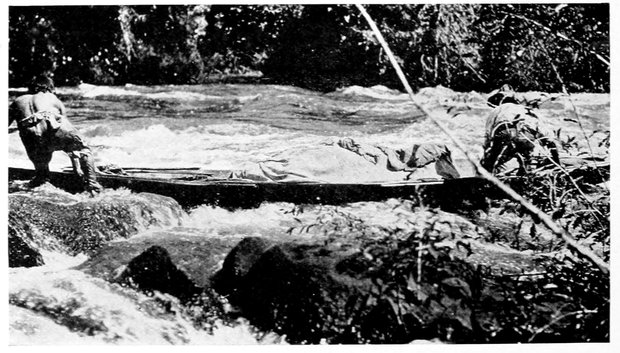
Battling with the Essequibo
The manager of “Bugles Store,” to whom Melville had given me a
letter, was a burly, bearded man nearing forty, born in the colony
of Scotch and Irish parents and speaking with a peculiar accent gathered
from all three sources. He had a large comfortable house and a
long hut for the stores and his negro henchmen, all surrounded by a
pineapple plantation. I had my belongings brought up to the house
at once and, lest my Indians should disappear before I knew how the
land lay, the paddles also. The place was shut in at a crook of the
river, behind a forest wall that utterly smothered the breeze for which
the region is noted and made it hotter than I had ever known it in
British Guiana. We sat down to a supper of rice, canned meat, boiled
pawpaw, and insects, the last in such numbers that lights were taboo.
Then the Scotch-Irish Guianese closed every window with a fussy
manner and some remark about the dangerous night air and we began
to undress in the darkness. When breathing became difficult, I noticed
that an air-proof tarpaulin had been drawn over the place where the
ceiling had wisely been left out by the builders, and that another had
been spread over the floor to shut out any air that might have seeped
through its narrow cracks! A house in British Guiana should consist
of roof only, as the Indians know; this one, having tight walls, still
held the heat of the day, as an oven retains its warmth after the baking
is over. Thus does atavism cause even a civilized white man to cling
to old customs when they should be thrown away. Outdoors, in the
breeziest spot, would have been none too comfortable sleeping-quarters;
yet here was I in a hermetically sealed room and down in the
533depths of a thick Ceará hammock with a tight gnat-proof net over me!
Within ten minutes I could almost swim in it, the perspiration making
my many insect bites and skin abrasions itch beyond endurance.
Though he had lighted a lamp as soon as we were ready for bed, the
prudish colonial was still fussing with his garments, as if fearing I
might catch sight of his ankles, when I looked out again to suggest
mildly that perhaps it would be less inconvenient for him if I moved
my hammock out into the hall. He agreed; but to my increasing
astonishment I found the veranda, too, which had been pleasantly wide
open by day, likewise hermetically sealed with tarpaulin curtains!
After I had hung my hammock, my incomprehensible host spent half
an hour looking for another lamp, which he evidently expected me
to keep blazing all night, and finally retired to his sealed quarters,
leaving me to listen to the ticking and striking of the dozen or more
trumpet-voiced clocks scattered about the house. He plainly had a
hobby for clocks, perhaps to keep time from running away from him
here in the wilderness. I noiselessly opened a couple of curtains and
blew out the light, and actually slept a bit before a heathenish hullabaloo
broke out long before daylight. I found my host tramping
moodily back and forth across the hollow wooden floor in his heavy
boots, waking everyone and everything within gunshot, though there
was no earthly necessity for anyone being up for hours yet. This,
I learned, was one of his invariable customs and innumerable idiosyncrasies.
He could not get or keep Indian employees, not only because
he was too harsh with them, but because he insisted on everyone going
to bed about seven and aroused them all with his infernal alarm-clocks
at four, keeping even the neighboring camps awake from then on by
stamping back and forth on the resounding floor. Truly, a man living
alone in the jungle develops his own individuality.
Strictly speaking, “The Stores” were not public, but furnished supplies
to the “bleeders” of the three companies in the “balata” forests,
who gather a cheap rubber similar to the caucho of Brazil. “Balata”
boats had been in the habit of leaving for the coast every few days,
and no one had so much as suggested the possibility of my having any
difficulty in getting down to Georgetown, once I had reached the mouth
of the Rupununi. But I quickly discovered that instead of the worst
being over, as I was congratulating myself, the crisis of the trip was
still ahead of me. The Essequibo from the Rupununi to Potaro mouth,
whence there is a daily launch, is, under favorable conditions, only a
short week’s trip; but there are many dangerous falls, to be passed
534only in certain seasons, obstacles which have often held up travelers
for months. My host implied that such was to be my fate. Because
of the drop in the price of rubber, not a “balata” boat had gone down
the river in weeks; and though a messenger was dispatched even to the
rival camps, word came back that none would have a boat leaving
before September or October! It was then the middle of June. My
remark that I would much prefer going over the falls and be done
with it seemed lost upon my egregious host.
Not only common sense, however, but the law forbade my attempting
the trip without reasonable preparations. Entire boatloads of
passengers as well as goods had more than once been completely lost;
once a group of American missionaries who had insisted on going
down alone had been drowned, according to the exiled Scotch-Irishman,
and while he did not seem to feel that a personal loss, it required him,
in his capacity as the only British official in the region, to compel me
to comply with the law. First of all, I must have a certified pilot and
bowman, of whom there were not a dozen on the river. Moreover, my
host was a justice of the peace, as well as a man of harsh and eccentric
ways, so that the Indians who had not been hired on long contract
and forced to stick to it gave the place a wide berth, particularly as
this was their “off” year, when they wished to stay at home to burn
off and plant their gardens, or because they properly prefer loafing in
the wilderness to working for a song for cantankerous white men.
To comply fully with legal requirements, I should evidently have to
build, buy, or hire a larger new boat and assemble a whole expedition,
at a cost of several hundred dollars. My only other hope was to find
a certified captain who would be willing to risk his life with me in the
rotten old dugout in which I had arrived; and the only possible candidate
for that romantic position lived way back at the Indian huts we
had passed the day before.
We set out for them at seven in the morning, my three unwilling
boys augmented by a half-sick negro named Langrey, who wished to
get down to Georgetown. It was quite a different task from traveling
downstream. All five of us paddled the whole morning without a
let-up, yet the great forest wall along the edge of which we struggled
seemed barely to move, and I had a vivid sample of the hardships
of weeks and even months of rowing up-river in Amazonia, where
the loss of a single stroke to catch the breath leaves that much of the
toilsome task to be done over again. We finally landed at the slight
clearing and found a strong, good-looking young Indian, his forehead
535and cheeks painted some tribal color, lying in loin-cloth contentment
in his hammock under a roof on legs. This was “Harris”—the missions
have overdone themselves in giving the Indians clothing, wedding-rings,
and English names which they cannot pronounce—or, as he
called himself, “Hăllish,” certified captain of the interned gasoline
launch of one of the stores, but who was “not working this year.”
He spoke a considerable amount of a kind of pidgin-English, which
added to his enigmatical air and somewhat almond eyes to suggest
remote Chinese ancestry. Langrey opened fire at once, and there
followed a long argument, or almost a pleading on our part, with little
but silence from the other. The first inclination of primitive people
is wary attention, one of questioning suspicion, with a tendency
toward antipathy. Finally “Harris” deigned to remark, raising himself
on an elbow in the hammock and glancing toward it, that our
canoe was too old and small for such a trip. Perhaps we could borrow
the new one of his next-door neighbor a few miles down the river,
he added some time later, lending him “mine” until his own was
returned. For some reason “Harris” wished to “go down to town”
himself, or no argument I could have put forward would have shaken
his aboriginal indifference. I told him to name his own price. He
asked ten pounds! Stranded as I was, I balked at that, but Langrey
butted in, and it turned out that “Harris” did not know the difference
between pounds and dollars, so that ten dollars would be just as agreeable.
Then he must wait for his wife, to see if she wished to go!
Yet there are men who assert that Indian women are downtrodden.
She appeared by and by from the woods, where she had been digging
mandioca-roots, carrying a big load of those poisonous tubers on her
back in a peculiar open-work basket held by a thong across her forehead
and wearing nothing but a scanty skirt from waist to thighs.
Though she had already been seen by all, so that any modesty she
might have possessed should have recovered, she went to a nearby roof
on poles and put on a long skirt and a crumpled waist, though the latter
scarcely concealed her charms and the former she unconsciously pulled
up far above her knees when she sat down on a log to peel the mandioca.
The missionaries who had given her and her husband their
wedding-rings and their names had taught them what to wear in the
presence of white men, but she knew only an academic reason for
doing so.
Our errand was not allowed to interfere with household duties, so
while “Harris” lolled in his hammock and the rest of us squatted on
536stumps and stones in the shade of his roof, the woman peeled the
mandioca-roots, washed them, grated them on a native implement,
and ran the mash into the open end of a snake-like matapi, or press
made of woven flat fibers. This she hung by the upper loop from a
beam-end and attached a weight to the lower end, thus squeezing out
a yellowish juice that is deadly poison. This is carefully guarded
from children and dogs, but, being volatile, is easily eliminated by
boiling. The residue is then dried, sifted through basket sieves, and
finally baked into cassava bread, the most horrible imitation of food
extant, great pancake-like sheets of which were even then spread about
the thatch roofs. Though similar in origin, cassava is far more trying
to the civilized stomach than the bran-like farinha of Brazil.
Negotiations were opened again in due season. I agreed to the
princely price of ten dollars, food down and back for the whole party,
even including the wife, and promised of my own free will a premium
of a dollar for each day gained over the usual time for the trip. But
here we struck another snag. The only paddlers available were the
three I had brought with me; and they absolutely refused to go. They
insisted that the Reverend White had told them to come straight back
from “The Stores,” and that he was a man to be obeyed. I knew it;
yet I was not going to be held a prisoner in the jungle for months to
suit the convenience of three Indians, even with a parson thrown in.
I put it to them strongly. If they would go down to Potaro mouth
with me, I would pay them good wages and give them good food for
both the down and the up trip and write a letter of explanation for
them to carry back to the missionary. If they did not go, they could
sit here twirling their thumbs without food, for I would not let them
have the dugout until I was done with it. They had a gun and bows
and arrows with them, and no doubt other Indians would not let them
starve and might even lend them a boat; yet I felt that if I made my
bluff strong enough, the pressure of the white man’s will would win
in the end, barring some untoward incident. So I assured “Harris”
that I could get plenty of paddlers, if these wished to starve, assuming
great indifference, though fearing all the time that I might not be able
to coerce them, and told him that it would save me paying what I owed
them, though of course I should have given them what I had agreed
upon with the parson. Leaving that bug in their ears, we finally ended
our long and leisurely diplomatic conference, “Harris” agreeing to
come down to “The Stores” next morning with his neighbor’s new
boat, his own wife, and one man, while I was to furnish four paddlers,
537including Langrey, to provide all supplies, and to advance him five
dollars upon his arrival.
All the way back I let the paddlers stew in their own thoughts, purposely
saying nothing and reading a novel, as if my mind were at
peace. Like all children, whether of the wilderness or merely in age,
coaxing, I felt sure, would be far less effective with them than moral
pressure. Time, patience, and, above all, propinquity would eventually
cause their primitive wills to yield to mine. As we passed one of the
huts along the bank, they shouted a conversation in Macuxy at those
about it, perhaps getting some promise that a boat would be sent for
them. Ignoring this and their former vociferous refusal, however,
I called “Vincent” aside when we landed and said, in the tone one
might use to a pouting child, “You talk it over with the other boys,
and when you have made up your minds, come and tell me and I will
get you food to cook.” As they had not eaten at all that day and were,
if my own appetite was any gauge, half-starved, I depended on hunger
as my most important ally.
The Scotch-Irish native, who addressed his negroes as “Mister,”
and was chary of running foul of the official “Protector of the Indians,”
as well as having the Englishman’s fear, several times multiplied, of
the unprecedented, could not for a long time be talked over. Finally
he agreed mildly to lend his aid, and sitting down on his doorstep,
like a justice holding court, he called the three boys before him and
addressed them in laborious pidgin-English. “Now can’t leave gentleman
here, you see. Me going supply provisions. You paddle he
down ...” and so on; after all of which they mumbled and went back
to the bank of the river. But my most powerful ally eventually got
in its work, and about sunset, having meanwhile visibly wept, they
came to me and said they had decided to go—whereupon I gave them
a meal that left “Vincent’s” little paunch protruding like a chicken’s
crop. Then they came again, in a far more cheerful mood, and wanted
a pair of trousers, a shirt, and a belt respectively, whether to gloat
over them or merely to see the color of my coin I do not know. These
things I gave them on account from the storehouse, and they were soon
beaming and gay as happy children.
But I was not yet done. The law required a certified bowman and
more paddlers. “Had you not been recommended to me by Melville,
I could not let you go on without a permit from the Protector of the
Indians,”—who never stirs out of Georgetown—added my charming
host, much impressed with himself as an officer of the law, like all
538wooden-headed authorities. We debated another hour or more before
he agreed, with the air of doing my whole nation an extraordinary
favor, to consider me one of the paddlers and my best boy an experienced
bowman. Then, out of the kindness of his heart, he permitted
me to buy from his store—at prices I found later to be between five
and six times those of Georgetown—the rations required by law,—seven
days’ supplies for seven people, or forty-nine rations, each of
which must include a pound of flour, half a pound of rice, two ounces
of pork, ditto of beef, twice that of fish, two ounces of sugar, and so
on through about twenty items, not to mention milk and cocoa and
many other extras for “the captain, Harris” and myself. The fact
that the manager himself gets twenty per cent. on all sales from the
store may or may not have made him so insistent on full compliance
with the law. When the list was completed he handed me a bill for
$22.71, and then growled because I paid him with a five-pound note,
instead of in gold.
When I fancied everything settled at last, Langrey came to me with
tears struggling over his eyelids and said, “So sorry, sir. I was so
interested in this trip. But I can’t go.”
“Why not?” I asked.
“Because, sir, I have not the passage money from Potaro mouth
down to Georgetown.”
“How much will that be?”
“$2.08, second-class, sir.”
“But surely, after working nearly four months for this company
you have earned that much?”
“No, sir. I took an advance, and the food costs so much.”
“Well, as you were injured working for them, surely they will help
you to that extent to get back home?”
“No, sir, them don’t help we none,” replied Langrey, slipping back
into his more habitual speech.
This statement having been confirmed by my host, I gave him a
hint of what I thought of the company he represented and promised
the invalid negro his fare to Georgetown. By this time the visible cost
of the perhaps four days’ trip to Potaro mouth exceeded fifty dollars.
These “balata” companies exploit not only the natural resources, but
the natives, with a system almost as near slavery as that in the rubber-fields
of Amazonia, against which England had recently made a loud
uproar. Langrey’s case was typical of many. He had worked seven
years for this company. Each spring he applied at headquarters in
539Georgetown and got $10 advance and a $10 order on the company
store. Leaving the latter with his family (and no doubt gambling
away the former), he joined many other negroes who had signed
similar contracts and helped row a company freight-boat up the river.
On this wages were 48 cents a day and an allowance of $2.08 a week
for food; but as they must buy all provisions at the company stores,
at breath-taking prices, because they are forbidden to bring anything
with them from Georgetown and there is nothing for sale elsewhere
up the river, it is easy to see that the “bleeders” cannot but make a
decided inroad on their future wages before they set off into the woods
to hunt the “bullet-tree.” This is a very large member of the sapote
family, the bark of which the “bleeder” gashes in zigzag form from
the ground to a height of perhaps thirty-five feet, using a ladder and
a rope—spurs are illegal—and cutting with a machete. It requires
long practice to cut deep enough, yet not too deep; wherefore the
average “bleeder” makes little or nothing during the first year or two.
Incisions in the bark must run into and not cross one another, and
must not be more than one and a half inches long. No “bullet-tree”
can be cut down, except when necessary in making a trail; the law
forbids a tree being bled in more than half its circumference at a
time, the tapping of any tree of less than thirty-six inches diameter,
the “bleeding” of the branches, or cutting clear through the bark.
Once it has been tapped, the tree must stand five years before the
other side can be bled. Companies with “balata” concessions are allowed
to take nothing else from the crown lands that are leased to them
for that purpose, and if the workmen were half as well protected as the
trees, the “balata”-fields would border on Utopia.
Every “bleeder” must be registered with the department of forests
and mines, and pay a government license fee of one shilling. The
negroes build rude huts in the forest, but are not allowed to bring their
women with them. Each tree yields about a gallon of “milk,” which
the sap resembles both in looks and taste, and which is gathered every
afternoon and poured into an immense wooden tray protected from
the direct rays of the sun. Here it coagulates, forming a kind of
cream on top. This hardens into an immense sheet of celluloid color
that is peeled off and folded like an ox-hide for shipment. Day after
day “milk” is added and the “cream” peeled off, each gallon of “milk”
giving about five pounds of “balata.” In December the “bleeder” carries
his traps back to the river and down to camp, usually averaging a bit
under a thousand pounds of “balata” for the season, for which he was
540then getting $170. Advances, food, and high priced provisions subtracted,
he is lucky if he has anything left to gamble away when he gets
back to town. If a man is sick or cannot work for any other reason,
such as heavy rain, he gets no wages, but he must pay 40 cents a day
for his rations, as well as for his medicines. Of course the company
has to guard against malingering by lazy negroes; yet if Langrey was
a fair example, they are moderately earnest, responsible workers. He
had not lost a day in his seven years, he asserted, until he had injured
his back falling from a tree a short time before; yet the company would
give him no assistance to return to town. If a negro runs away from
his contract, he gets from four months to a year in prison and is made
to pay back his advance; if he lives out his contract, he goes down the
river again by rowing a company boat at two shillings a day. But down
on the coast a negro gets only 32 cents a day—the minimum wage in
British Guiana—or perhaps two shillings for loading ships, at which
“he not easy to find job,” so that the more enterprising of the race come
up-river annually to “bleed” the “bullet-tree.”
In the morning “Harris” turned up, accompanied by his wife, a parrot,
many sheets of newly baked cassava bread, and his “canister,” a
small tin box for personal possessions such as most workmen in this
region carry. He bore no tribal marks now, and his wife was fully
dressed from neck to ankles. But he came in a miserable little old
dugout of his own, saying he could neither get the extra man nor borrow
his neighbor’s new boat. My plans seemed again about to topple
over. But, to my astonishment, “Harris” agreed to try to make the
trip in Melville’s decrepit craft, evidently being very anxious to get
down to town. This might have served as a last resort, in spite of the
much greater fury of the Essequibo than the Rupununi, had we been
allowed to go on short rations, or even with the amount we would
probably need. Legally, the wife would serve as the extra paddler, but
we were compelled by law to load the poor old derelict to the gunwales—nay,
far above them. I protested that such a load would almost certainly
swamp the boat. My delightful host said that did not matter in
the least; the law required that those who hired Indians must have one
pound of flour, and so on, each day to feed them, but it did not specify
that they should not be drowned before the end of the trip. So I was
compelled to pile the fifty-pound sealed can of flour on top of all the
rest of our load, though even the exiled Scotch-Irishman admitted, in
his non-official capacity, that Indians do not eat flour, except under
compulsion, and that we had more than they could eat without it; and
thereby our already excellent chances of bringing up at the bottom of
the Essequibo were considerably increased.
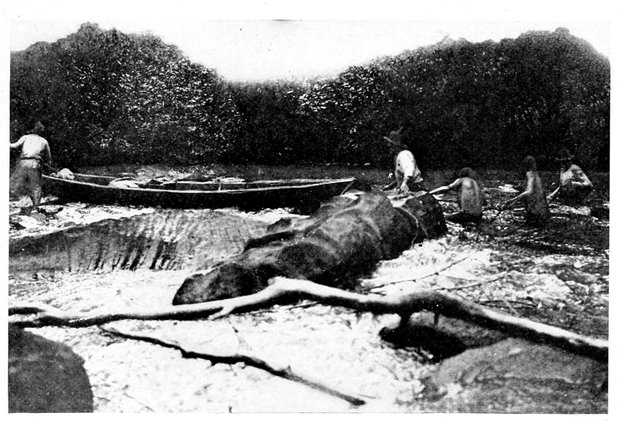
More trouble on the Essequibo
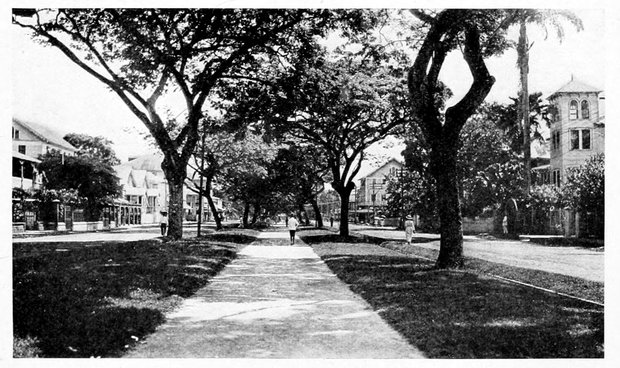
High Street, Georgetown, capital of British Guiana
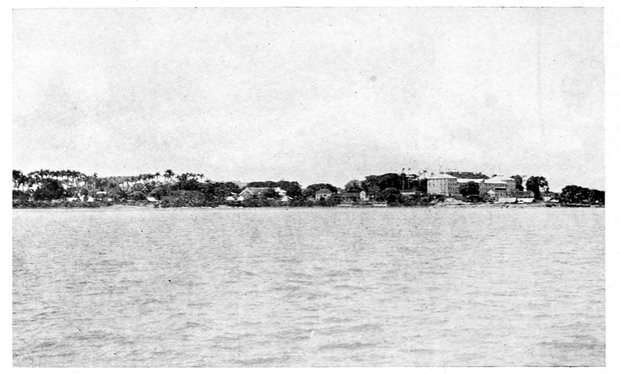
Cayenne, capital of French Guiana, from the sea
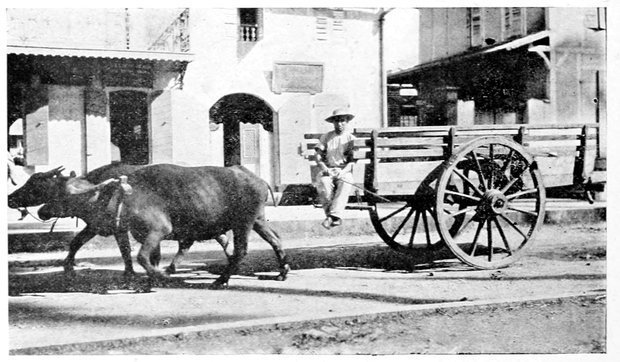
The “trusties” among the French prisoners of Cayenne have soft jobs and often wear shoes
541My host maintained his reputation to the very moment of our departure.
The company having abandoned Langrey half-sick from injuries
sustained in their employ, and I having agreed to take him all the
way home, one would have supposed that a slight parting kindness
would not have bankrupted the corporation. As we were on the point
of leaving, I said, “By the way, that man of yours we are taking down
with us has no paddle, unless you can lend him one.”
“He’s no mon of ours!” hastily and half-angrily answered the provincial
Scotch-Irishman. “If I lind a paddle, it will be to you personally,
and I will hold you responsible for getting it back to me!”
Thereupon he got a miserable old cracked and mended paddle about
the size of a lath and tossed it out to us. I promised to send it back
by special messenger.
So at last, on June 18, we were off at eleven in the morning. My
three now tanned and tamed paddlers were in front, the rather useless
Langrey and “Harris’” paddle-less wife and her parrot on the seat
back of the tarpaulin-covered baggage and supplies, while I was
cramped in between them and the certified “captain-and-pilot” squatting
on the stern. It seemed foolish to take pictures or keep notes
of the trip, so slight were the chances of ever getting them back to
civilization. I took the laces out of my heavy shoes, however, so
that I could kick them off and at least have a fighting chance to save
my own hide.
In a few minutes we slid out of the Rupununi into the Essequibo,
wide as the lower Hudson and six hundred miles long, the principal
river of British Guiana, and struck across a veritable lake at the
junction, with the waves running so high that we shipped much water
to add to that constantly seeping into the old and now badly strained
dugout. For a time it looked as if we might sink immediately, instead
of doing so after several days of arduous toil. I bailed incessantly,
and at last we came under the lee of the wooded shore and plodded
along more or less safely, shut in by the long familiar wall of unbroken
forest-jungle.
We had no champion paddlers on board. The three boys messed
along steadily but not very earnestly; Langrey, the invalid, slapped
his lath-like paddle in and out of the water with just exertion enough
to pass as a boatman rather than a passenger; and though I got in some
long and more powerful strokes, I never succeeded in keeping the
542bowman’s pace for any length of time and shoveled water mainly to
relieve the monotonous drudgery of bailing the boat. This eminently
feminine job was the only work expected of the captain’s wife, but
most of it fell to my lot because the water gathered deepest about my
feet. The lady wore a skirt and some sort of bodice or waist, but
these were thin and mainly ornamental, and rather than wet her skirt
she would pull it above her knees, disclosing plump brownish legs
decorated with a cross-bar and three painted stripes running from
ankle to—well, as high as the skirt ever went in our presence. Her
face, also, was symbolically painted, and she wore a towel about her
plentiful horse-mane hair. Her rôle was strictly passive. She made
no advances, never speaking to anyone but her husband, and then
in barely audible undertones, not merely because she knew no English,
for she was quite as taciturn toward the paddlers of her own race
as with Langrey or me. Yet her husband granted her their better
umbrella when roaring showers fell, and in general, considering their
scale of life, treated her as well as does the average civilized husband
of the laboring class. To be sure, he had lain in a hammock while
she dug mandioca and made cassava bread, but somewhere I have
seen a civilized man lie in a Morris chair while his wife washed dishes
and baked pies. They seemed to have as much mutual understanding
and to “communicate by a sigh or a gesture” as easily as more fully
clothed couples.
We were gradually turning to English; four out of seven of us
now spoke it. In the pidgin-English of the Indians, which passed
between “Harris” and the now deposed and disrobed “Vincent,” comparatives
and superlatives were always formed with “more” and
“most,” and the positive rather than the negative adjective served both
purposes. The river was “more deep,” “not deep,” “not more deep,”
but never shallow; it was “most wide,” “not wide,” or “not most wide,”
but never narrow—though both knew the meaning of the other words
readily enough. Nothing could induce the Indians to express an
opinion of their own, or rather, they never showed any sign of personal
volition to a white man if they could possibly avoid it. Ask them,
“Is it better to stop at the clearing, or to camp across the river?” and
the reply would be, “Yes, sir; all right, sir,” or something similar. One
might strive for an hour to find out what they would do if they were
alone, and even then succeed only by carefully refraining from suggesting
any preference. Like the Indians of the Andes, they preferred
543to wait for a leading question, so that they could answer what they
thought the questioner would be most pleased to hear.
Langrey had his own opinions, but it was long since he had heard any
news from the outside world. He did not know that there was a
war in Europe, though he did leave off paddling suddenly one day
to say, “Ah sure sorry to heard, sir, dat Jack Johnson los’ de champeenship.
When he winned, all we black man in Georgetown parade, sir.”
He was convinced that the “black man”—under no circumstances did
he use the word “negro”—was superior to the white, mentally as well
as physically, and spent many a sun-blistering hour citing examples to
prove it. One such assertion was that the white authorities had to
change and give more examinations in the schools and colleges of the
colony, because the blacks were winning everything. Yet he was always
obsequious to white men, addressed me unfailingly as “sir,” and was
much pained to see me do the slightest manual labor. Yet it may be
that he would have treated in the same manner one of his own race
having what to him were money and position, as I saw him later act
toward wealthy Chinese.
A bit after mid-afternoon we came to several arms of the river
where it split between densely wooded banks, with immense reddish-brown
rocks protruding here and there from the water and the sound
of rapids beginning to worry us. But the river at this point was so
high, broad, and swift that we had no difficulty in running what
Langrey called a “scataract,” though in other seasons it had often
proved a time-consuming obstacle. The sun had sunk behind one of
the walls of trees when we swung in to clutch the swiftly passing
bank just above another rapids, where the men soon cut saplings and
pitched camp. First they set up a frame and stretched my tarpaulin
tent-wise over it, putting my netted hammock and baggage under it
and forming what Langrey called the “chief’s place.” He was so much
higher in the Guianese social scale that, though “Harris” was supreme
in the matter of steering and boatmanship, the negro assumed the
place of first lieutenant under me the instant we set foot on shore.
He swung his own hammock at a respectful distance from my own
luxurious quarters, yet far enough from the Indians to emphasize the
difference in rank; while the Indians themselves split carefully into
two parties, even building separate fires, “Harris” and his wife close
together under the same net and the three boys in a group a little
removed from all the others. Thus the caste system was religiously
and Britishly preserved even in the wilderness a thousand miles from
544nowhere. Langrey pestered me to death with his servitude. If I
tried to cook anything myself, he dropped whatever he was doing and
ran to insist on doing it for me. When it was cooked and I told him
to have some himself, he stood stiffly at attention and refused—by
actions, rather than by words—to touch a mouthful or even to assume
the position of “at ease” until I had finished. If I dared to wash my
plate or cup, he bounded forward with the air of an English butler,
exclaiming, “Now, now, sir; you must always call me when you want
anything done.” Sometimes I could have kicked him; but I always
recalled in time that it was not his fault, that this was part of that
British civilization I had come overland from Manaos to study, and
that, being a mere visitor in this foreign realm, I must not, even inadvertently,
Americanize British subjects. Theirs was a manner quite
different from the Brazilian or the Iberian, even of men of Langrey’s
color, with which I had grown so familiar that the Anglo-Saxon style
struck me as stranger and more foreign. The same race which incessantly
shook hands and kowtowed to one another on every provocation
over in Brazil, here had adopted that staid, caste-bound demeanor of the
Briton, keeping up the acknowledged rules of society in the wilderness
just as the lone Englishman will put on evening clothes to dine with
himself in a log cabin. Yet for all the superficial super-politeness of the
Brazilian mulatto or cabra and the Englishness of these Guianese
negroes, they were the same man underneath; in both cases their manners
were only borrowed garments put on to make them look like other
people and help them get along in the world with the least possible
friction.
Indians working for white men must eat expensive supplies from
town, though they much prefer their native food; but negroes can be
fed anything, though here they have been accustomed for generations
to the fare of civilization. Complete as were our legal rations, the
Indians did not like them, so that they fell chiefly to Langrey and me.
The fifty-pound can of flour for which I had paid $8.75 proved to be
so moldy that no one would touch it; the sugar was the coarsest grade
of brown, and the rest was poor in proportion. The ration law, like
many another isolated British ordinance, had plainly been made by a
man who had never set foot in the wilds. Our farinha had run out,
more’s the pity, for though it tasted like sawdust, it was swelling and
filling; and now in its place we had far less palatable cassava bread
made of the same poisonous tuber. We all ate cassava, and the flour
might to great advantage have been thrown overboard, but law is law.
545Swift places in the river were numerous the next day, and finally,
at a “scataract” among countless massive brown-red boulders, we had to
get out and let the boat down by ropes. Dense jungle crowded close
to the shore wherever there were no boulders and often made it
impossible to do likewise in worse spots, where we had to run the risk
of shooting the rapids, shipping water perilously. Twice a day we
stopped to cook, the second time to camp as well. Sometimes, during
the noonday halt, I strolled a little way into the majestic forest, the
leafy roof upheld by mighty trees averaging a hundred feet in height,
with buttressed roots, as if they had been designed as pillars to support
the sky, and with room for a whole Brazilian family to sit down in the
space between any two buttresses. Other trees were incredibly slender
for their height, some barely six inches through, yet climbing straight
up to the sunlight far above. On the river long-tailed parrots flew
by in couples at frequent intervals, screaming like a quarreling Irish
pair; but here in the woods not a bird sang, rarely, indeed, was one
seen. From the hour when the night voices of the jungle-forest ceased
in the great silence of dawn, as if nature stood mute at her own
magnificence, there was a cathedral stillness in these woods. Yet at
times the ears were filled with an indefinable, almost intangible sound, a
curious humming, mysterious as the sensual smell of the forest. Parasites
seemed trying to suffocate the trees with their passionate embrace,
yet I got little sensation of that “death everywhere exuding” reported
by so many Amazonian travelers; rather did one feel an agreeable
impression of isolation and of well-being under that impenetrable
roof of vegetation, in a world such as Adam might have seen on
the first day of his life.
Insects were less troublesome along the Essequibo, and for some
reason we suffered little from heat, though the sun struck straight
down upon the broad river, which threw it back in our faces in scintillations
of polished copper that blinded, visibly tanning us all—except
Langrey. A cool breeze was rarely lacking, and every little while there
came the growing noise of rain, castigating the woods ever more
furiously as it drew near, the wind swaying the great tree-tops and
now and then turning aside from their course a pair of voyaging parrots.
Occasionally we passed the skeleton of a camping-place, a tangle of
poles over which tarpaulins had been hung by other and larger
parties. The howling of monkeys, like the roar of a far-off riot, like
some great but distant crowd furious with anger, often sounded from
back in the forest. The river frequently broke up into many diverging
546branches, almost as large in appearance as the main stream, which disappeared
off through the wilderness. In the dry season the Essequibo
is a meandering stream that one can almost wade, its broad bed filled
with dry sand and stretches of huge rocks which now were racing
rapids, showing themselves chiefly as immense whirlpools on the surface
of the deep river.
We ran some very heavy rapids, the waves often tossing over our
low gunwales; but “Harris” was skilful, and the mere fact that he had
his wife along seemed pretty good proof that he hoped to escape
shipwreck—or was it? Then one afternoon a mighty booming began
ahead and soon filled all the forest with its echoes. I pulled out my
map, but Langrey disputed its assertions with an excited, “On de
chaht dat’s a scataract, sir; but dat ain’ no scataract; dat’s a falls!” The
emphasis on the last word was not misplaced, even though what is a
sheer fall of several feet in the dry season was now a long series of
rapids which we ran, constantly expecting to be swamped the next
moment, and finally coming to a real drop over immense boulders. We
eased her down for a long way hand-over-hand, clutching bushes along
the shore, struggling to maintain a waist-deep footing on slippery rock,
needing the combined exertions of all of us, except the woman, to
keep even the lightened boat from submerging and leaving us stranded in
the wilderness. But though they did not look as dangerous, the next
series of rapids was far more so, for there was nothing to do but run
them, and suddenly in the very middle of them two waves all but filled
the boat, and I prepared to say good-by to my earthly possessions and
take up my abode under a tree in the impenetrable forest—though at
the same time I bailed as savagely as the men paddled, so that we
saved ourselves by a hair. For more than an hour there was a constant
succession of these near-disasters. The river split up into many channels,
and the one we entered might look smooth and harmless, only to
prove a young Niagara when it was too late to turn back. Dry clothing
was unknown among us during those days. It was, of course, mainly
fear for my baggage that sent the twinges up my spine; for I could
probably have saved myself. But to be left boatless, foodless, and
kodak-less here in the heart of the trackless wilderness, with the chances
remote of meeting another human being during a life-time, would have
been more heroic than interesting. When we came at last into more
placid water, Langrey cheered me with the information that there were
“more worse scataracts” and falls a couple of days farther on. The
rocky streak where the high lands of the savannahs get down to sea-level
547runs clear across the colony here near its geographic center, yet
the dense forest never broke in the descent.
“We’ll meet camp jes’ now,” said Langrey about five o’clock; and
sure enough we did “meet” it, coming up river along with the endless
procession of forest, a half-open place, with some of the most magnificent
trees I had yet seen. It was near here that a boat in which
“Harris” had been steersman and Langrey one of the paddlers had
buried the last white man who had attempted the overland trip from
Manaos to Georgetown. He called himself Frederick Weiland, claiming
to be an American born in Texas, but later confessed himself a
Hungarian, and therefore subject, as an enemy alien, to internment for
the duration of the war. He had left Manaos nine months before and
tried to walk across from Boa Vista to Melville’s, but lost himself looking
for water, and, having set down his baggage, could not find it again.
For three days he wandered at random without food and almost without
drink, until half-wild Indians found him and took him on to
Melville’s, who was then in Europe. He gave himself out to be a house-painter,
and carried many collapsible tubes of paints and pencil-brushes;
he claimed to know nothing of soldiering, yet he had a military manner
and his talk often unconsciously showed knowledge not common among
workingmen. Most of the belongings he had left he gave the Indians
to row him down to the mouth of the Rupununi, where the Scotch-Irishman,
losing no chance to improve his official importance, sent
negroes out to his camp to arrest him as a German spy. His captor
kept him for a while, letting him paint or do other work where he
could, and finally started down to town with him. The prisoner
seemed to worry much as to what might happen to him there, though
assured that at worst he would be interned; but he was gay most of the
way down, until an up-boat gave them a newspaper that reported serious
German losses. From that moment he seemed to lose heart. Some
thought he swallowed some of his paints; at any rate, he suddenly
“t’row a fit” in the boat one afternoon, and an hour later he was dead.
“We jes’ take tea,” concluded Langrey; “den we dig a hole an’
put he in, an’ get in de boat an’ gone.”
The twentieth of June was badly named Sunday, for not a glimpse
of the sun did we get all day; rather was it a most miserable Rainday,
during which a deluge fell incessantly, leaving us cold to the marrow
and cramped beyond endurance most of the time, sneaking along streams
raging down through the impenetrable wilderness, now stripped and
letting the boat down over rocks, now grabbing from branch to trunk
548along the shore, always in more or less immediate danger of going to
destruction. Luckily I had “three fingers” of brandy left to ward off
the chill, which I shared with Langrey. The law forbids, under serious
penalty, giving “fire-water” to Indians, and though our companions
shivered until their teeth rattled, I complied with it, for the “Protector
of the Indians” has many ways of detecting violations. At the beginning
of what we guessed to be afternoon, we cooked a dismal “breakfast”
in the downpour, and were barely off again when to our ears was
borne the loudest roar of water we had yet heard. This time it was
the Itanamy Falls, about which there is a negro ballad among the
popular songs of Georgetown, part of which Langrey chanted as we
approached them:
It’s go’n’ drownded me,
An’ ah ain’ come back no mo’,
EE-tah-nah-meeee!
For hours we fought this greatest rapids of them all, struggling
through the woods by roaring branches, over rocks, fallen trees, sudden
falls, and a hundred dangers, the men in the water clinging to the
boat, when we were not “dropping her down” backward from tree to
bush, with the woman and our baggage in it. All of us were soaked
and weary when we finally camped at five o’clock, but “Harris” said
we not only had passed the worst part of the river, but had made the
longest journey over it in one day that he had ever known. In the
morning I found that an army of wood-eating ants had attacked my
wooden-framed Brazilian valise, and I had to take out and brush every
article I possessed, to the expressionless delight of the Indians, who,
of course, had been dying to know what I had in it. As these ants
eat even clothing, extreme vigilance was the only possible way of
saving what I had spent much trouble, time, and money to bring from
Manaos, so that several times thereafter I had to spread out and
repack everything. Truly, the Indian who travels with a loin-cloth, a
hammock, and a bow and arrows is best accoutered for these wilds.
The itching of old insect bites was augmented now by what I at
first took to be boils, but which turned out to be tropical ulcers, to
which most white men fighting the Amazonian jungle are subject.
Then the jiggers I had gathered on the walk to Melville’s ripened daily,
especially with the feet constantly wet, and though I frequently cut new
nests of them open and squeezed out the eggs, my feet ached—“like
549dey was poundin’ you wid hammers on de haid, yes, sir,” as Langrey
concisely put it—especially at night, robbing me of sleep.
Though I had thought they were over, we had troubles again next
day from the start, and this time came almost to disaster. The men
were letting the boat down over a rapids, “Harris” and Langrey
holding it and my three worthless Indians clinging to the chain painter.
At the crisis of the falls the boys were told to let go the chain and
leave the rest to the pilot and the negro, as quick work was necessary.
Instead, finding the water deep, they clung to the chain in fear and
let the rushing water pour into the boat in such volume that only by
using my stentorian voice to its capacity did I save it from sinking in
another five seconds. As it was, the baggage was filled with water,
but my own was luckily in a water-proof bag. Do not talk to me of
“brave untamed savages.” Those Indian boys, though big, strong
fellows, were the most unmitigated cowards, like horses in their senseless
fear, compared with any three average American boys of the same
age, who would have considered such a trip a lark.
To my astonishment, there came signs of the end sooner than I
expected. During the still early afternoon of the fourth day, at the
last bad rock-and-boulder falls, below two convenient portages through
the woods, we met a big new “tent-boat,” belonging to one of the
“balata” companies, on its way upstream. There was an Indian crew
of twelve, under an Indian captain, all commanded by several pompous
negroes sitting comfortably under canvas awnings, dressed in ostentatious
town clothes which looked unduly ludicrous here in the untamed
wilderness. The Indians and several blacks, all but naked, were in
the water and on the rocks, struggling to drag the boat upstream, the
most burly negro under the awning shouting, as we sped past, to a
young black evidently new at this game, “Keep yō nose above de
watah, mahn; den yō ain’ go’n’ drownded!” I congratulated myself that
I was traveling down rather than upstream. Scarcely an hour later, a
brilliant sun giving the broad, placid river the appearance of a vast
mirror, we sighted the “balata” camps at the mouth of the Potaro, and
my troubles dropped suddenly from me like cast-off garments. Two
days more, by launch, train, and steamer, would carry me to Georgetown,
with a record, rarely equalled, of thirty-four days from Manaos,
which I could perhaps have cut considerably shorter by not having
halted with Hart or Melville.
Though they had been rather sluggish the last few days, the sight
of the end caused my three boys to paddle so hard that they splashed
550water into the boat and had to be rebuked for their enthusiasm. As
we drew near the sheet-iron buildings at the mouth of the black branch
river, stretching away between the familiar bluish, unbroken forest
walls, I lived over again the pleasure it had been to get back to nature,
and beneath my joy at returning to civilization and entering new
scenes was an undercurrent of regret at leaving the primitive world of
gentle, guileless savages behind me—tempered, to be sure, by curiosity
to know what the other world had been doing during the long month in
which I had not heard a hint of news from it.
Of the forty-nine rations, we had eaten twelve, the Indians generally
preferring their own food. When I settled up with them, I found that
even in their own tongue they used not only the words “dollar” and
“cent,” but our numbers, no doubt to save themselves from their own
complicated “one-hand-and-one-over-on-the-other-hand” system. “Vincent,”
interpreting my remarks to the other boys, used such expressions
as “t’ree dollar fifty-seven centes,” which, sounding forth suddenly amid
a deluge of Indian discourse, were almost startling. The words seemed
to have little more than an academic meaning to them, however; such
sums as two shirts and a pair of trousers would have been much more
comprehensible. The Indians do not want money, but the government
thinks it knows what is best for them, and the law forbids their being
paid in anything else—though there are easy ways to circumvent it.
The trip from Manaos had cost me about eighty dollars; it might have
come to vastly more both in time and money.
Several days’ travel up the Potaro are the Kaieteur Falls, four hundred
feet wide and eight hundred and twenty feet high, loftiest for
their width in the world—unless a neighboring cataract recently discovered
by Father Cary-Elwess proves greater. The sight of these,
thundering along in the heart of the unknown wilderness, is said by
the few who have viewed them to be impressive in a way that civilized
and harnessed Niagara can never be again. But it would almost have
doubled my time in British Guiana to go and see the Potaro take its
famous plunge; and the ever-increasing call of home was urging me
to hurry on. The launch that came down the branch next morning
from some gold mines owned by Chinamen was a filthy old craft under
a negro captain; yet anything that runs daily seemed beautiful in this
region. I took Langrey with me; but “Harris,” with the instability
of his race, had decided after all not to “go down to town,” dreading
the great metropolis, perhaps, as some of our own countrymen do the
rush and roar of Broadway. Langrey was useful to cook and bring me
551lunch from the private stores I had left, for nothing was served on
the launch and without my own valet and servant I should have been
considered a common person indeed. We plowed the placid, tree-walled
Essequibo without a pause until two in the afternoon, coming to
Rockstone, a bungalow rest-house on stilts surrounded by tall grass and
the forest, where I not only had a real meal again, but slept in a bed for
the first time in thirty-three days—and found it hard and uncomfortably
high in the middle. I was the star guest at the Rockstone hotel, not
merely being the only white man, but because—if so incredible a
statement could be believed—I had arrived without ever having been
in Georgetown, making me as awesome a curiosity as if I had suddenly
crawled out of a hole from China. Rare, indeed, are the travelers who
enter the Guianas by the back door.
A little train with a screeching English engine and half a passenger-car
rambled away next morning through forest and white-sand jungle,
the charred trunks of trees standing above it and several branch lines
pushing their way out in quest of the valuable green-heart timber.
Within an hour we were at Wismar on the Demerara River, a small
stream compared with the great Essequibo, about the width of the
Thames and barely two hundred and fifty miles long. I had passed,
too, from the mammoth County of Essequibo, forming more than two
thirds of British Guiana, to the comparatively tiny one of Demerara,
containing the capital and often giving its name to the whole colony,
which is completed by the several times larger County of Berbice on
the east. The colony was first settled along the three large rivers
which drain it, and the counties took their names from them. The
Lady Longden, a river-steamer that seemed luxurious against the background
of wilderness travel behind me, descended a stream yellowish-black
in color, like most of the inhabitants. Indian features had almost
completely disappeared, though the mixture of races was perhaps
greater than in Brazil. Besides the ubiquitous West Indian negroes,
with their tin bracelets and their childish prattle, there were many
Chinamen and Hindus. Celestials so Anglicized that they could not
speak a word of Chinese—though one surely could not praise the
English of most of them—mingled on the wharves (here called “stellings”)
with East Indians dressed in everything from their original home
costumes to the complete European garb of those born in the colony.
Chinese women in blue cotton blouse and trousers, exactly as in China,
came down to see off sons and daughters dressed like summer strollers
along Piccadilly, and who carried under an arm the latest cheap English
552magazine. It startled me constantly to hear English spoken around me,
not only by those I subconsciously expected to speak Portuguese or
some other foreign tongue, but by ragged negroes who carried the mind
back to Brazil, by East Indians, and by broken-down Chinamen lying
about the “stellings.”
For the first time the country was really inhabited, with frequent
towns breaking the forest wall and sometimes a constant succession of
bungalows, shacks, and churches, all built of wood and having an
unmistakable Anglo-Saxon ancestry. As in Brazil, the seacoast of the
Guianas holds the overwhelming majority of the population. Every
few miles we whistled and slowed up before a village, often half
hidden back in the bush, with only a few canoe “garages” on the waterfront,
to pick up from, or toss into, a “curial” paddled by blacks,
Chinese, or Hindu coolies a passenger or two, a trunk, or a letter. We
saw a great many of these Guianese dugouts during the day, the negroes
using any old rag as sails to save themselves the labor of paddling upstream,
so that some were wafted along by former flour-sacks and others
by what had undoubtedly once been trousers. Several times we overtook
rafts of green-heart logs lashed to some lighter wood, as green-heart
will not float, with whole families living in the improvised boathouses
in the center of them. Even before we sighted Georgetown I
had undoubtedly seen more human beings in one day than during all the
rest of my time in British Guiana.
The river grew ever broader, its immediate shores more swampy
and less inhabited, with an intertangle of mangrove roots that showed
the mark of the tides. Cocoanut-palms appeared again, for the first
time since leaving Pará; then an occasional royal palm and the belching
smokestack of a sugar plantation, of which many on this coast have
been cultivated continuously for a hundred years, yet which rarely
stretch more than ten miles up country. An ocean breeze began to fan
us; down the now wide and yellow river appeared a blue patch of
open sea. Makeshift tin and wooden shacks commenced to peer forth
from the bush, which itself gradually turned to banana patches, and
suddenly, about four o’clock, Georgetown burst forth on a low nose of
ground at the river’s mouth. Though it seemed to jut out into the sea
on a point of jungle shaped like a plowshare, there certainly was little
inspiring about the approach to it—a low, flat city, as unlike the towns
I had so often come upon in the past three years as the smooth, kempt
hills of England are like the picturesque helter-skelter of a half-cleared
South American wilderness.
553As to a hotel, I had been recommended to the “Ice-House,” which
seemed so strikingly appropriate to the climate that it was with genuine
grief that I gave it up. But it turned out that it housed negroes also,
and one’s caste must be kept up in British Guiana, even though one pay
several times as much for the privilege. In the most exclusive hotel a
negro servant came to look me over when I applied, and to report on
the color of my skin and my general appearance before the white
manager came to repeat the inspection while I stood gloating over an
armful of mail. Then with an awed whisper of “All right, sir,” the
servant led me to a chamber—which, after all the fuss, was not inordinately
luxurious—turned on the electric-light and backed away, asking
whether “de gentleman” desired hot water.
“Hot water?” I exclaimed, my thoughts on my correspondence.
“Fo’ yo’ shavin’, sah,” replied the model servant.
Verily, I had wholly forgotten many of the common luxuries of
Anglo-Saxon civilization.
CHAPTER XXI ROAMING THE THREE GUIANAS
554
The white steamers of the “Compagnie Générale Transatlantique”
take two leisurely days from Georgetown to Cayenne, which I
spent in furbishing up my long unused French. I had not
intended to leave British Guiana so soon, but it would still be there
when I came back and transportation between the three European
colonies of South America is not frequent enough to scorn any passing
chance with impunity. Four typical Frenchmen of the tropics, in
pointed beards not recently trimmed and the white toadstool helmets
without which they would no more expect to survive than if they left
off their flannel waist-bands, put themselves, unasked, at my disposal.
It was still dark on the second morning when there loomed out of the
tropical night three isolated granite rocks, with what was evidently a
thin covering of grass and bush and dotted with scattered lights.
Their official name is “Isles du Salut,” but the more popular and
exact term for the whole group is that properly belonging to one of
them—“Devil’s Island.” The water about them is very deep, and our
ship went close inshore. Soon two boatloads of people, rowed by
deeply sunburned white prisoners in the tam-o’-shanter caps of Latin
Quarter studios, appeared through the growing dawn, tumbled a few
passengers and the baggage of a family from Paris aboard us, then
the commander of the isles and his kin and cronies were rowed back
again from their monthly excursion to the outside world.
Just two hours later we stopped far out near a lighthouse on a rock
called the Enfant Perdu, a low coast with some wooded hills and a
rather insignificant looking town several miles off. The water was
already yellowish-brown, and there was not enough of it to allow the
steamer to draw nearer. Launches and barges finally tied up alongside
us and, with the usual chaotic volubility of Latins, the considerably
tar-brushed crowd of arrivals fought their way into them. With us
were eight prisoners, four of them pasty-white, but tough-faced apaches
from Paris, still in their heavy civilian garments, each with a bag over
his shoulder; the rest were evil-eyed negroes from other French
555colonies, already in prison garb. We chug-chugged for nearly an hour
toward what seemed to be a scattered village on a slight knoll, largely
hidden by trees, a big, box-like yellow building which my mentors said
was the Colonial Infantry barracks conspicuous in the foreground
among royal palms. Cayenne is the best port in French Guiana, yet
even the launch could not reach the shore, but tumbled us into rowboats
manipulated by impudent, patois-chattering blacks, to whom we
paid a franc each to be set across the fifteen feet of mud remaining.
Once there was a landing jetty here, but the sea carried it away and
the tropical Frenchmen had not yet been moved to carry it back. Our
baggage was inspected as if we, too, were incoming convicts, but as I
had luckily left most of my own, including my revolver, in Georgetown,
the haughty black officials could not trump up any just cause to refuse
me admission to the colony.
I had expected to find Cayenne a less model place than Georgetown,
but the glaring reality was beyond my worst dreams. One would have
to go back to the West Coast, to such places as Popayán and Quito, to
find anything approaching this. It showed at a glance why the French
failed at Panama, what Colón and Panama City would still have been
had not Uncle Sam taken them in hand. Indeed, the wide streets of
crushed stone and earth lined by rows of noisome two-or three-story
wooden houses gave the place considerable resemblance to those cities
before the Americans came, the general appearance of a negro slum
in the dirtiest of our cities, with all the sanitary laws ignored. Built on
a shallow mud shore among jungle brush into which all but a few of
its streets quickly disappear, with swamps and mosquito breeding-places
overgrown with unkempt vegetation in the town itself, it is everywhere
a rubbish heap. Little advantage has been taken of the riches of
nature; even the strip of land between town and sea, which a progressive
people would have turned into a blessing, is a constant litter of filth.
Cesspools abound; there is dirt in every hole, corner, or place enough
out of the way so that daily movements do not inadvertently keep it
clean; carrion crows are the only members of the street-cleaning department,
except two decrepit old women armed with brush brooms.
The conglomeration of odors is beyond description; nothing seems to
be regularly kept in repair, so that even the most recent buildings have
already a dilapidated aspect. Some of the larger houses have mud-plastered
façades to imply wealth or importance within, yet every
residence I entered was visibly unclean, and men whom in other climes
one would expect to find in spick and span surroundings here lived in
556noisome holes that one shuddered to enter. Out of doors every imaginable
iniquity against sanitation is committed with impunity, and one
is not surprised to learn that epidemics are frequent and that the death
rate exceeds that of births, though the native population is notoriously
industrious, irrespective of age or marriage vows, in the reproduction
of its uncommendable species.
Here the traveler, though he be rolling in wealth, will see what the
man with only ten cents for lodging is forced to endure. I told the
negro boy carrying my bundle to lead me to the best hotel, whereupon
he gave me a leer of mingled stupidity and insolence and turned in at
a miserable tavern of the kind to be found in French slums, kept by
negroes into the bargain. The wench behind the dirty counter admitted
that she had one room and that she “could cook for me”—any susceptible
person would have fainted to see where and how. The room turned out
to be an incredibly filthy hole up under the baking roof, with a nest
of ancient mattresses, visibly containing all the iniquities of half a
century, on a wooden platform-bedstead. When I protested, my guide
assured me with a gesture of indifference that it was the best in town,
whereupon I dismissed him, determined to sleep under the royal palms
in the high grass of the pleasant, though astonishingly unkempt, central
Place des Palmistes unless I could find better than this. There were
“Chambres à louer” signs all over town; but though everyone seemed
anxious to rent rooms, none would clean them. I found at last a negro
woman who offered to let me have her own room, reached by a noisome
stairway, but on a corner, with four windows making it as airy as one
could expect in Cayenne, with its ridiculous clinging to the European
style of architecture so unfitted to the tropics. The room was cluttered
with rocking-chairs, tables, kerosene lamps, and all the gaudy, worthless
rubbish beloved of negroes,—photographs, porcelain dolls, bric-à-brac—until
it was impossible to make a sudden movement without knocking
down something or other. A corner was partitioned off with paper to
form a washroom with entirely inadequate washing facilities, and
everything had an air about it which made one hesitate to sit down or
even to touch anything. Everything in plain sight in the room looked
clean enough, for the usual occupant prided herself on being of the
Cayenne aristocracy; it was only when one began to peer into or under
things, to move anything, that the negro’s lazy indifference to real
cleanliness came out. The enormous bedstead of what appeared to be
mahogany had five huge mattresses, one on top of the other; all of them,
it turned out, were ragged nests of filth, except the uppermost, and the
557bed was so humped in the middle that it was impossible to lie on it.
Evidently it had been made so purposely, for I found great bunches
of rags and worn-out clothing stuffed into the middle of the various
mattresses, which the owner had evidently found it too much trouble to
throw out when a new one was indispensable.
The yard below, always rolling and howling with piccaninnies of all
sizes, had a hole in the “kitchen” where one might throw water over
oneself with a cocoanut-shell, if one insisted—unless it happened to
be between three in the afternoon and seven the next morning, when
the request for a bath brought a scornful sneer at one’s ignorance of
the hours of the Cayenne waterworks. In a ground-floor room, looking
like an old curiosity shop kept by a negro under penalty not to use
a broom or a dust-cloth for a century, was a rickety table on which I
ate amid the incessant hubbub and rumpus of Galicized negro women.
Their “French” was a most distressing caricature of that language, and
they could never talk of the simplest things without giving a stranger
the impression that they were engaged in a violent quarrel that would
soon lead to bloodshed. Virtually every negro woman—and one rarely
sees any others of the sex in Cayenne—wears a loose cotton gown of
striking figures and colors, and a turban headdress of general similarity,
yet always distinctly individual, a little point of cloth, like a rabbit’s
ear, rising above its complicated folds. In theory the turban is wound
every day, but in practice that would mean too much exertion, and it is
set on a sort of mould. For the market-women and those habitually
out in the gruelling sunshine there are sunshades of woven palm-leaves,
large as umbrellas, but worn as hats.
The town claims 13,000 inhabitants, which possibly may have been
true before the World War drained it of much of its manhood; yet
with the exception of high government officials, soldiers, convicts, and
libérés, there are very few whites. In fact, French Guiana is so eminently
a negro country that unless one is a high government official one
is out of place in it as a white man; others of that color seem to the
thick-skulled natives to be outcasts who have come there more or
less against their will. The few white women are seen only after
sunset and along the few shaded avenues, and white children do not
seem to thrive. The social morals of the colony are admittedly low,
and influences are so bad that even whites of the most protected class
assert that they must send their girls away as children or all will be
lost. The Cayenne negro is not only dirty, impudent, and sulky, but
forward and presumptuous, constantly striving by such manners to
558impose upon the whites the superiority he feels, or pretends to feel,
over them. French residents treat the negroes with deplorable familiarity
and equality, many a white man obsequiously taking off his hat to
haughty colored officials, who accept the homage with a scornfully
indifferent air. I called one day on the mulatto editor of the local daily
newspaper—of the size of a handbill, taken up entirely with advertisements
on one side, and on the other chiefly with the names of negroes
ordered to the front. Together we went to call upon the colored aide
of the governor, both editor and aide treating me with a patronizing
air and a haughty manner which said plainly that, while I might be
officially a “distinguished foreigner,” I was, at best, considerably
lower in the social scale than men of their color. Suddenly there was
a swish of silk skirts at the door behind me. All of us sprang to attention—when
into the room, with a manner that might have been borrowed
from Marie Antoinette herself, swept the Parisian-gowned negro wife
of the aide, whose bejewelled hand every other man in the room, including
two white Frenchmen, proceeded to kiss.
The usual indifference and inefficiency of Latin public officials is to
be expected in Cayenne. Public employees have a certain superficial
French courtesy, but with it even more than the Frenchman’s gift for
red tape and procrastination. One ordinarily stands half an hour before
a post-office window to buy a stamp, and the distribution of the mails
rarely begins within twenty-four hours of their arrival. There is no
bookstore in the colony, except that a Jewish ex-convict rents lurid
tales of bloodshed; and though there is a public library, it is open only
from 6 to 7:30 four evenings a week and is never crowded then.
Though it lacks many such things, the town has several elaborate
fountains—most of which fail to fount—and more than a fair share of
statues—another proof, I suppose, that Latins are artistic. The place
makes one wonder whether the English are good colonizers because
their calm self-control has a sobering effect on primitive races, whose
passions are always near the surface, while the French, the Latins in
general, are poor colonizers because they are emotional and lack full
control of their own passions, thereby making the wild race worse by
influence and example.
Out under a grove of trees in the outskirts white French officers
were putting negro youths through the manual of arms. “They don’t
want to go and defend their country (patrie), the poltroons,” sneered
the officer who had come out with me; but conscription is as stern as
in France, so that hundreds were being trained for a month or more
559and shipped to Europe by each French Mail. The laws of France
apply only to three of her colonies,—Martinique, Guadeloupe, and
Réunion; Cayenne, though it has a representative in the Chamber of
Deputies, is ruled by decrees and a governor sent out from Paris.
Perhaps it is this spirit of centralization which causes the clocks of
the colony to be so set that at six in the evening it is dark and at six in
the morning the sun is high and hot. The local bank issues notes on
poor paper of from five francs up; otherwise the money of France is
used, except the “smacky” (which is what has become of the words
“sou marqué” in the mouth of the illiterate negro), a local ten-centime
piece made—one could hardly say coined—in 1818 and resembling worn-out
tobacco tags, used interchangeably with the big two-sou pieces of
France.
I went one evening to a “Benefit Concert” at the Casino, a barn-like
board structure recalling the “Polytheamas” of Brazil, where local
talent gave a performance in aid of those left behind by the men who
had gone to war. The entertainment began at 8:30—in French style,
so it was nine even by Cayenne clocks and really near midnight when
the curtain finally rose. The governor, a Frenchman with a white
goatee, sat with the elected town mayor and other authorities, all of
more or less negro ancestry and wearing the same Gallic facial decoration,
as well as haughty official expressions. There was no heavy
formal evening dress, as in Brazil, but mostly white duck, which is
taboo for men of standing in the big land to the south. Every shade of
black to white humanity was hobnobbing like intimate friends. It gave
one a creepy feeling to see dainty French démoiselles entertaining
not only elaborately dressed men of color but jet black men—though
personally I prefer the full black. The entertainment, chiefly musical,
was produced by the local talent left in the colony, particularly by a
trump of a white girl of scarcely eighteen, who not only made up more
than half the show but carried herself unerringly through several trying
situations. For example, she played the heroine in a silly little local
drama, and as the departure of most of the white men for the war had
left them hard up for heroes, it became her duty in a particularly
emotional and tragic love scene, with a speech about “your beloved
wavy locks,” to lay her dainty hand lovingly on the bald pate of a
dumpy lump of a man beyond fifty, the ridiculousness whereof caused
even the Latinized audience to burst forth in laughter. It seemed to
be the Cayenne system for all white French residents who had been
called to the front to leave their women behind at the mercy of the
560negroes, economically and otherwise. Some had been given minor
government positions, such as in the post-office, never before filled here
by members of their sex; but as the sternness of Penelope is not
characteristic of hard-pressed Gallic womanhood, and the French color-line
faint, certain conditions had already grown up that would not
have been tolerated in an American community.
The former inhabitants of Cayenne called it Moccumbro. An expedition
financed by merchants of Rouen landed on the coast in 1604, and
more or less successful attempts were made during the next half century
to establish colonies there. Holland held the territory for a time, as
she did most of the northeastern coast of South America, and gradually
the claims of the French on that continent shrank to their present
insignificance, as in the rest of the New World. About 1660, colonists
stole fourteen negroes from a traveler along the coast and established
African slavery. Twelve thousand French immigrants came out in
1763, but no preparations had been made to help them endure tropical
life, and only two thousand survivors returned in a sad state to France.
The slaves were freed by the French Revolution; and the Convention,
and later the Directorate, sent out déportés to take their place; but with
Napoleon slavery was revived. Portugal held the colony from 1809
to 1817, “luckily,” a local school-book puts it, “for if it had been taken
by Portugal’s ally, England, it would never have been given back.”
Finally, in 1848, complete emancipation of all slaves in “French
America” followed the introduction of a resolution in the French congress
by Schoelcher—a statue of whom decorates Cayenne—and the
colony, by admission even of its own people, has vegetated ever since.
Naturally the liberated slaves took at once to the bush, built themselves
rude shelters, and settled down to eat bananas and mandioca and prolifically
to multiply. The discovery of gold and the promise of quick
fortune in the placer mines of the interior for the few who cared to
exert themselves was the final straw that broke the back of agriculture
in French Guiana.
A former Paris lawyer digging sewers in Cayenne, under a negro boss
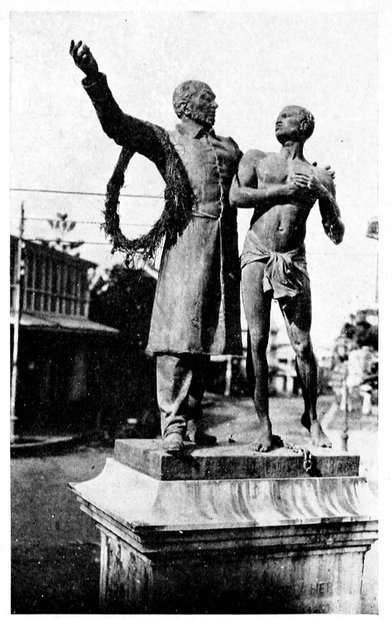
Schoelcher, author of the act of emancipation of the negroes of the French possessions in America
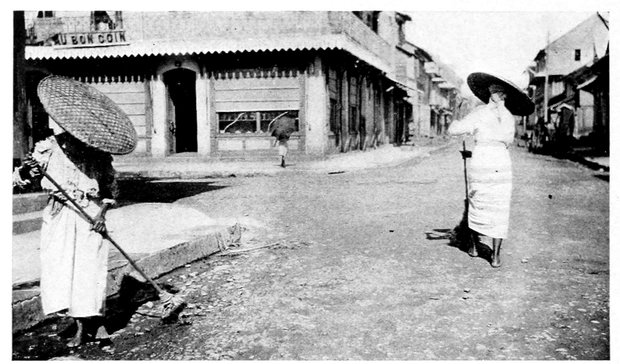
The human scavengers of Cayenne are ably assisted by the vultures
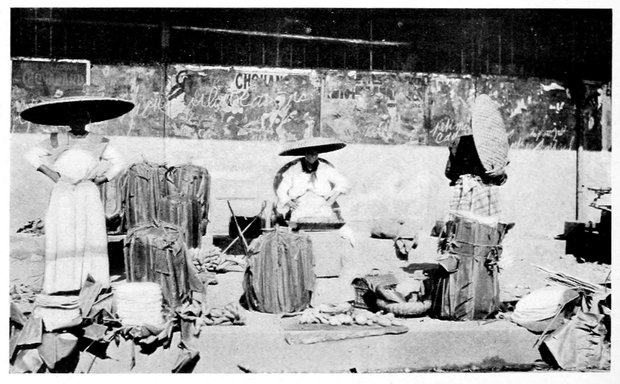
In the market-place of Cayenne. The chief stock is cassava bread wrapped in banana leaves
In 1891 the Czar of Russia established the boundary between French
and Dutch Guiana at the Maroni and Awa Rivers, and in 1900 the
Swiss president named the Ayapoc as the frontier of Brazil, leaving
the French about one fourth the territory they had claimed. At that,
they have no definite conception of its extent, most of it being virgin
forest unexplored by civilized man. Though in theory it runs far back
to the plateau and watershed of Tumac-Humac, France has no real hold
over more than a comparatively narrow strip of coast. The colony
561claims 30,000 inhabitants, virtually all of whom live within cannon-shot
of the sea. Alcohol has done for the aborigines, except a degenerate
tribe called the Galibis back in the interior, estimated by the latest
census as 534 in number, and there are some three thousand “boschs”
or “bonis,” wild negroes descended from runaway slaves. The few
towns besides Cayenne are insignificant, and in most cases have scarcely
half as many inhabitants as a century ago. In those days of plentiful
slave labor there were sugar plantations, spice trees, and prosperous
estates along all the coast from the Ayapoc to the Maroni, and many
ships carried to France sugar, rum, cacao, coffee, indigo, and cotton.
Then there were more than 20,000 field laborers alone; to-day there
are barely two thousand loafing tillers of the soil scattered about the
colony, and agriculture in French Guiana is a blank. Once many cattle
were introduced; now there are none left and even milk for babies
comes from the North in tin cans. As a native editor puts it, “A
country placed on a burning soil, swampy and unhealthful, where
paludic fevers, plague, and elephantiasis abound, needs the patience of
the Hollander to become such a prosperous colony as our neighbor
on the west.” Ambitious projects for opening up the country have
been formed, but there has been much promise and little accomplishment.
Sixty kilometers of French highways stretch out in all directions
from Cayenne, passing simple dwellings and careless gardens peering
forth from the bush; but these are the only roads passable the year
round and soon die out in the untamed wilderness. Even what were
good roads a century ago have in many cases become mere paths, or
have completely grown up to jungle again. The native inhabitants are
content to live on cassava—which now suffers severely from a big red
ant called the fourmi-manioc—and foreign capital shuns a Latin government
and a penal colony; indeed, the negro inhabitants complain
that the coming of the convicts ruined their “invaluable” country,
though it would still be prosperous “if there were any arms to do the
work,” they add, at the same time completely overlooking the idle arms
hanging on either side of each of them.
Cayenne is known in France as the “dry guillotine.” In the middle
of the last century, soon after the abolition of slavery, some French
idealist, or practical joker, thought of a plan to kill two birds with
one stone. Cayenne needed laborers; France was overrun with
criminals. Jean Jacques Rousseau had asserted that “Every man was
born good; it is society which inculcates in him the germ of all his vices
and defects, and as he is also essentially corrigible, he must be offered
562means to redeem himself.” The betterment and regeneration of
criminals by work was the panacea of the day, and this idea, “more or
less modified,” inspired the establishment, in 1854, of the present penitentiary
system. It is not likely that the hard-headed, materialistic
statesmen of France took the prattle of theorists seriously; but it opened
up to them a possible way out of certain troublesome perplexities. In
1851, therefore, the French president issued a decree prescribing the
“use of convicts in the progress of French colonization,” and appointed
a committee to decide to which colony six thousand forçats in the
crowded bagnes of Toulon, Brest, and Rochefort should be sent. Guyane
was chosen, with “Devil’s Island” as a landing-place, and the following
year volunteers were called for among the inmates of those institutions.
More than three thousand offered to go to Cayenne—and
soon deeply regretted it. Way down under its superficial buncombe the
chief purpose of the plan, of course, was to give the government a
means of getting rid of its radical enemies and all those whose presence
at home greatly worried the ruling powers, and to-day old J. J. Rousseau
would be delighted to see how man, essentially good, is regenerated
and recovers his manly dignity at Cayenne.
During the second year of the plan, volunteers became insufficient,
and new decrees ordered all individuals sentenced to hard labor or
reclusion, or criminals of African or Asiatic origin, to be sent to Guiana
and used in “les traxaux les plus pénibles” of the colony and its public
works. This last clause, at least, has been manfully carried out. At
the same time a penal colony was established in Algeria, but the latter
proved too strong to have its protests unheeded and the onus was
transferred to New Caledonia. The first law of deportation was for
not less than five and not more than ten years. Causes for such a fate
included conviction of belonging to a secret society. Then New Caledonia
was limited to those prisoners of European race sentenced to
less than eight years. All others, of longer terms or of the negro or Arab
race, as well as all rélégués and recidivists, were to be sent to Cayenne.
Of late years New Caledonia has become less and less popular with
French judges, so that to-day the cream of the criminality of France,
as well as of her other colonies, comes to end its days in French Guiana.
For years different convict camps were established within the colony,
and changed because the prisoners died of fever in droves—which
would not have mattered had not some of their guardians suffered the
same fate. In 1867 there were 18,000 convicts, with an average of
1200 arriving every year. They are divided at present among four
563penal stations, of which that at the mouth of the Maroni River and the
big stone penitentiary on a slight plateau at the edge of the sea in
Cayenne are, the most important, the latter housing about 330 regular
prisoners and 400 “transients” at the time of my visit. Though they
come from all the other French colonies,—Algeria, the West Indies,
Madagascar, and the rest—by far the majority of the convicts one sees
in Cayenne are white men from France, probably a large percentage of
them from Paris, many of them truly rough looking customers, for all
their whipped-dog attitude. A few are educated men of good families
who have gone seriously astray and been caught at it. The man who
stole millions of French church money after these churches were declared
state property; another once high up in the government who
made undue use of that position to feather his own nest; several
lawyers who were unusually rapacious in robbing their clients; half a
dozen traitors are there—or were, for one must not assume the present
tense long in such surroundings—all dressed in exactly the same buff-colored
blouse and trousers of coarsest canvas-like stuff, the former
generally open to the navel, and a crude straw hat woven of the awara
palm-leaf, working at the same digging of sewers, the cutting of grass,
or the breaking of stone in the public streets as the thieving degenerates
from Les Halles and the perverted apaches from Montmartre. Irrespective
of their origin and former habits, newcomers begin at the
hardest manual labor under the blazing tropical sun, which soon kills
off the weak and establishes a new sort of survival of the fittest. “The
climate itself is a great factor in bringing repentance,” as a jailer puts
it. This, the arduous toil, and the diet—or lack of it—give those who
survive a greatly changed appearance, and it is only by looking twice
that one can see the Parisian apache or trickster under the sallow,
yellow faces, gaunt with fever, of the wretches whose clothing hangs
about them as from a clothes-pole.
The déportés are divided into three classes,—transportés, merely
sentenced to a certain number of years at forced labor; rélégués, serving
life sentences; and libérés, former convicts free to live where they choose
within the colony. Highwaymen, burglars, and murderers make up a
large percentage of the list; yet if he is asked, almost any one of them
will answer “affaire de femme,” though he may be the most miserable
sneak thief or a man who “only killed his mother.” There are no
women in the Cayenne penitentiary, for they are sent to a prison in
charge of the Sisters of St. Laurent over on the boundary of Dutch
Guiana. Professional criminals and recidivists are particularly assigned
564to the Cayenne establishment; though there are men with sentences of
from five years up for almost every conceivable crime. In practice,
any man sentenced to seven years or more is virtually a life prisoner.
Even if his sentence is less than that, he can only get back to France after
serving a like term as libéré and earning his own passage money honestly—and
honest money does not float about French Guiana. When
one considers how stern is the struggle for existence in crowded French
cities, the hardship of the accused being obliged to prove his innocence
under French law, and the carelessness or indifference of French judges
in handing out sentences of seven years or more for almost minor
crimes, it is not strange that, though the world has never heard of them,
there are many more examples of the devilish injustice of man to man
than the notorious case of Dreyfus.
Not only can he wear only the two coarse garments and a hat, without
shoes, but the prisoner is denuded even of the Frenchman’s pride, his
mustache, being clean shaven and shorn to accentuate the difference
between him as an outcast and the free members of society. Luckily,
I was wearing a labial decoration, and thus was looked on with less
scorn and suspicion by the negro population than might otherwise have
been the case; for the standards and symbols of Cayenne are to their
primitive minds also those of the outside world. Educated prisoners
are sometimes made use of, after they have served the first part of
their time at hard labor, as bookkeepers or skilled mechanics—a bright-looking
rélégué was installing new telephone lines with convict workmen
during my visit—but these things are mainly for the convenience of
the administration and to save the officers in charge from work, never
with the idea of helping the man himself. In fact, “the regeneration of
the man sentenced to travaux forcés, imagined by the law of 1854, has
become a legend at which the first to laugh are the unregenerated
themselves.” Somehow I had pictured to myself a penal colony as a
place where the unfortunate, removed from their former troubles and
temptations, were turned loose in a new and virgin land and, with an
occasional helping hand from above, given the opportunity to begin life
anew. Nothing could be farther from the fact in French Guiana. The
officers themselves consider it a punishment to be sent there, and their
treatment of the wretches under them is that of noxious animals which
it is an advantage to be rid of as soon as possible. In view of the
many splendid qualities of the French, it is incredible how few “bowels
for their kindred” these officers in charge have for their prisoners,
unbelievable that the French soldier, who has known some of the
565hardships of life as a conscript, can treat his own flesh and blood in a
way that does not seem human, giving the onlooker full credence in the
story of “Jean Valjean,” making their helpless victims feel that what
society seeks is not reform, but revenge—revenge for forcing the particular
members of it with whom they come in contact to spend months
or years as prison-guards or administrators in a hot and fever-stricken
land far from their beloved France.
I am not a particularly firm believer in the efficacy of repentance,
but even if he felt the desire to do better stirring within him, the convict
of Cayenne would find every conceivable difficulty on the road to reform.
He is marked and stamped with, and hounded for, his past sins, without
a friend on earth, except in the rare cases when he has money, without
which he is made to understand that his early elimination is the thing
most desirable. The great majority, of course, are scoundrels who
deserve their fate—or at least a somewhat more humane one. But
imagine yourself an educated, well-bred man who, succumbing to overwhelming
temptation or cruel force of circumstances, has appropriated
public funds, for example, and been suddenly removed from Paris
boulevards to dig sewer-trenches in stony soil in the public streets of
a negro city beneath a tropical sun, working in bare feet on the scantiest
of prison rations under a bullying negro boss! The most iniquitous
part of the whole French system is that not only are white prisoners
set at the most degrading tasks among the black population, but that
they are often under command of negroes—and naturally, the effect
of this on the primitive African mind is to double their native insolence
and convince them that all white men are of a low and criminal type.
The other two Guianas would never dream of letting the negro population
see white men doing manual labor, even though they were sentenced
to it—much less put them under negro command; but the intangibility
of the color-line among the French is notorious.
Forty years after the establishment of the penal colony, the prisoners
were allowed to be rented out to private individuals. Those who hire
them must pay the prison authorities about two and a half francs a day
each, defray certain hospital insurance, and comply with several irksome
and rather stupid rules. The red tape and poor dovetailing between
departments is especially troublesome. The man who hires a prisoner
pays the government a total of 78 francs a month, or considerably more
than the wages of free labor—when this can be had. A foreigner long
resident in the colony had found that only by giving the convicts wine
with their meals, tobacco at night, if they had worked well during the
566day, and other gratuities, could he get any real work out of them, so
that in the end the prisoner cost twice as much as free labor and was
a much poorer workman; while if the convict falls ill, a mishap at
which he is an expert, the cost becomes “fantastic.” Most of the
prisoners, therefore, still toil directly for the government on public
works, and, the negro freeman scorning labor, private persons who
require workmen usually hire libérés, whom it is not necessary either to
treat or pay well.
Though he cannot leave the colony, the libéré can go where he chooses
within it, and dress like a civilian—if he can afford it. When his sentence
is up he is given a suit of blue jeans, a slouch felt hat, clumsy
shoes, and is left to shift for himself, though often obliged to report
to the authorities at frequent intervals. Almost always he has an avoid-your-eyes
manner which discloses his past, even if his five years or
more as prisoner has not made his face familiar to all the colony. Here
and there in a stroll through the town one is startled—at least after
three years of disconnection between manual labor and the European
race—to find white men working as shoemakers, butchers, small mechanics,
or anything else at which they can rake and scrape a livelihood.
These are invariably libérés, some of whom have formed alliances with
such females as the colony affords and bred more of their kind with
negro trimmings. As there are no white women available for this
class, and the libéré has been a familiar sight in French Guiana for the
past sixty years, unquestionably many of the mulattoes and quadroons
one sees strutting about town, holding political places of importance
and looking with deepest scorn upon the white convicts, are the sons
and daughters of released criminals. Having in most cases lost all
sense of shame or decency during their bestial imprisonment, libérés
not only work at odd jobs about the market and the town, but throughout
the colony, the sight of their groveling and lowly estate naturally
not decreasing the negro’s conviction of his own superiority over the
white race. Coming from prison life after a background of artificial
civilization, most of them cannot cope with existence in such surroundings
and often commit new crimes for no other purpose than to get
back into prison and at least have something to eat again.
Though there has been an average of 1200 convict arrivals a year
since 1854, and almost none have returned home, the number in the
colony remains almost stationary, at the remarkably low figure of from
six to eight thousand. Of the surplus, perhaps four per cent. have
escaped; many have been shot by guards or been killed in prison feuds,
567while great numbers have died of tropical diseases, rough treatment, and
virtual starvation. Many have run away into the bush or the dense
jungles on the Brazilian or the Dutch side of the colony; but being
mainly city men and generally of slight education or intelligence, they
have absolutely no adaptability in the bush, not even knowing enough
to take directions by the sun; and while a man used to wilderness travel
might get away, most of the refugees have found the jungle impossible
and have returned to serve life sentences. The bones of others are not
infrequently found up in the interior. The few who reach civilization
in Brazil are the most fortunate. Those who get into Dutch Guiana
are, in theory, subject to extradition, but are commonly overlooked,
unless they make themselves conspicuous by becoming penniless or
returning to their old ways. A few have become men of importance
in the neighboring colony, particularly a well-dressed rascal who has
lived some twenty years now as a merchant in Paramaribo. Rafts of
moco-moco stems, and a canoe made from a sheet, are among the
curiosities left by escaped prisoners to the Cayenne museum. On the
Dutch side of the Maroni River they are free from French pursuit, but
have still greater trials with the Indians, and particularly with the wild
negroes, who shoot them freely, or more often, make them slaves and
work them until they are all but dead, then bring them back to the
French and claim the standing reward.
It is against the law, or at least almost impossible, to visit the “camp,”
as the big prison in the town of Cayenne is called, particularly since
some American got the former commander “in wrong” with the French
Government by publishing an account of such a visit. But neither laws
nor strict rules survive personal friendship in Latin countries, and I
had made good use of my short acquaintance with the four Frenchmen
who had landed with me. At that, they politely hedged when I hinted
a desire to get inside the prison, until one morning, catching alone one
of them who had just been transferred from New Caledonia as a guard,
I mellowed him with strong iced drinks under the earth-floored veranda
of Cayenne’s least disreputable café. So wheedlingly did he introduce
me to the stern “principal” of the prison, a French captain, that the
cut and dried refusal shriveled on his lips and, taking down a large
bunch of big keys, he led us into the prison in person.
It is under strict military régime, the building that forms a part of
the wall of the immense yard being the barracks of soldier guards.
Here they had good spring beds and paid the nominal sum of one franc
twenty-five centimes a day, with an additional two francs for their
568wives, in the rare cases in which they had brought them out from
France. There were separate rooms for one or two families, and a
good kitchen well served by convicts, with wine and champagne for
those who could afford it. Across the bare yard were many massive
gates with prisoner turnkeys, for discipline is maintained largely by
making trusties and “stool-pigeons” and setting them as spies over the
rest. There was an infirmérie where the merely sick are shut up in
pens, a sad looking place with much fever and crude, careless surgery
without anesthetics, from which those who can convince the hardhearted
officials that they are really ill are sent to the hospital. The
“principal” was full of courtesies for me, but he took it out on the
prisoners, always addressing them as one might a particularly low class
of animal. Indeed, officials high and low were incredibly prejudiced
against the convicts; not one of them seemed to be large enough to
recognize them as partly the victims of society or of circumstances.
The officers have a secret identification system, and the prisoners a
secret argot, or slang, which keep guards and guarded still farther
apart. There are special and incredible punishments for the slightest offenses,
such as failing to grovel before the meanest underling among the
soldier guards, which increases the number of invalids. Even in the infirmary
there was not a book to be had, nothing whatever to take the
minds of inmates off their present deplorable surroundings, not even a
sign of a priest. I have never seen a human institution over the door of
which Dante’s famous phrase would be more entirely appropriate. The
bitter cynicism of the monument of Schoelcher freeing a black slave in
the main square of Cayenne is sure to strike one after a visit to the
prison.
The bulk of the prison is made up of big dungeons with a few small
barred windows high above the unleveled earth floor, in which are
confined the regular prisoners divided by “classes,”—Arabs here, men
from Madagascar there, white Frenchmen in others. This division is
no concession to the color-line, but is merely for the purpose of simplifying
the administration. Three feet above the ground were four parallel
poles, and fastened to these were strips of stiff canvas two feet wide
and a little more than five long, all so close together that even a thin
man could barely squeeze between them, forming two rows of sleeping
quarters the length of each dungeon. Evidently nothing else was
allowed, for one fellow with a fever being covered with a dirty old rag
the “principal” demanded of the trembling trusty in charge, in a voice
such as one might use to a street cur, at the same time snatching the
569cover off the invalid, “Where did he get that?” The trusty shakingly
replied that it was an old flour sack, which he was forthwith ordered to
turn over to the guard outside. “Do you dare not rise and take off
your hat when you see me pass?” bellowed the commander to another
emaciated wretch who with the greatest difficulty could crawl to his
feet and force his legs to hold him, though he hastened to do both.
Even this was not enough for my wine-cheered friend from the boat,
who proceeded to shout more insults at the fellow for his “insubordination.”
In another room were a few trinkets, odds and ends, and covers of
various origins for some of the canvas-strip beds. The “principal” explained
that this was the room of trusties and turnkeys, several of whom
were then standing at attention before him. Then, still pretending to
give me information, but raising his voice to a bellow, he screamed, “Yes,
these we allow a few extra privileges, and they are even greater pigs
than the others—Oui, ils sont les plus cochons de tous!” There was
not much visible sign of an opportunity to be anything else. I not only
saw no bath anywhere within the “camp,” but no place where a prisoner
could so much as wash his hands. Nothing but absolute brute necessities
were recognized, and even then everything was of the crudest and
coarsest.
“And do you treat educated men and those who have formerly lived
in clean surroundings the same as you do the recidivists and the
apaches?” I asked.
“Bah!” cried the captain, with his nastiest sneer, though maintaining
his attitude of overdrawn courtesy toward me. “After a few days they
become just like the others and you never see the slightest difference.”
Come to think it over, I suppose they would.
The prisoners get up at five o’clock, have coffee, and go to work at
6:30. A “breakfast” of thin soup, one vegetable, half a kilo of bread
de deuxieme qualité, and what is supposed to be 250 grams of meat
before it is cooked, but which boils down to about half that, is served
at 10:30. Three hours later the famished convicts are marched out
into the blazing sunshine again to complete their eight hours of daily
toil. At night they get a slab of bread and a kind of vegetable hash,
duly weighed on dirty scales. It is impossible that any grown man
doing manual labor should not be habitually ravenous on such a diet.
Not only was the stuff of the coarsest grade imaginable, and unsavory
as food carelessly cooked in great bulk always is, but it was handled by
guards, visitors, and any other chance passer-by exactly as one might
570handle the food of a dog, perhaps dropped underfoot and then tossed
back into the pan, from which it may be doled out to a man who a
year or two before ate in the best restaurants of Paris.
An old chapel, now full of cells, was a place of punishment for minor
infractions of the rules, the inmates of which slept on boards and were
given bread and water two days out of three. In another building were
the cachots, or dungeons proper, stone rooms about four by six feet in
size, with very low ceilings, solid doors, and only a hole some ten inches
in diameter for ventilation. Here recaptured men awaiting trial were
kept in solitary confinement, with a plank for bed, worn concave during
many years of occupation, a block of wood as pillow, and bread and
water one day out of three. For those who aroused still greater wrath
among their guards there were cells in which a man could neither stand
up nor lie down, and other underground horrors worthy of the Inquisition.
I am not one of those who believe in making prison life a
perpetual ball-game; but there are limits to the brutality which man
should permit himself toward his fellow-man. After all, it did not
look as if Hugo’s famous novel had done much to mitigate the lot of
French prisoners. Things may have been alleviated in France itself,
but in this tropical Hades there has certainly been no improvement over
the bagnes of Toulon of a century ago.
“Look at that dog!” cried the commander, as the occupant of one
of these ovens rose to his feet when we entered. Then, with all the
sarcasm he could throw into his voice, “Vous êtes content, hein?”
The officials all seemed to try to impress me with the fact that they
had a particularly dangerous and incorrigible lot of wild animals in
their charge, and looked for applause at their ability to keep them under
control by such methods as savage brutality and by taking every
advantage of the helpless wretches to taunt them. Yet no owner
of wild animals would have dreamed of keeping them in such airless,
crowded and starved conditions. There was a den of rélégués, for
instance, ex-convicts who had violated their parole as libérés and were
awaiting trial—nearly all white Frenchmen and as fine a collection
of hopeless, helpless, careless, don’t-give-a-damn toughs as it has
ever been my privilege to see. The atmosphere was exactly that of
a den of savage beasts who considered all the outside world their
implacable enemies and were ready to rend and tear anyone who was
so careless as to come within reach without a weapon with which
to cow them. There were between thirty and forty in each of the
12 by 16-foot rooms, and by no means space on the two wooden platforms,
571resembling those in the aisles de nuit of French cities, for all to
lie down at once.
To add to the joy of their lot, the prisoners are constantly robbed
of their legal rations to fill the pockets of the officials and guards.
There is a saying that officers arrive in Cayenne with half a trunk
and leave with six. In theory, the men are entitled to wine, tobacco,
and reading matter; practically, they never see any of those things
unless they manage to get them from outside. At Albina, across
from the chief penal station on the Dutch boundary, wine is always
for sale at a song. The Indians or “boschs” who bring in an escaped
prisoner get two of the five dollars paid by the French Government,
the prison officials pocketing the rest. There is always an advantage
in killing off prisoners, for their names are still kept on the books
and the officials still draw their ration money, as they do that of
un-captured fugitives. It has often been proved quite possible for a
guard at least passively to bring about a prisoner’s death, merely for
the few cents a day he can pocket for his rations. Naturally there
is much underground favoritism, and the prisoner with money or
powerful friends outside can usually get away. The guard is not
only amenable to a bribe, but glad to have another dead man on his
ration books. Such escapes are generally engineered from over the
Dutch border. An expert American cracksman, well known to our
police, “did a job” in Paris a few years ago and was sent to Cayenne;
few who have been there will blame the perfectly respectable Americans
of Paramaribo for helping him to escape. The German who
attempted to get Morocco to revolt against French rule escaped while
I was in the Guianas, and there were very persistent rumors to the
effect that the German Moravian missionaries in Dutch Guiana knew
quite well how it happened.
The prisoners themselves sometimes help their oppressors in the
matter of ration money, for they have secret societies of bloodthirsty
tendencies and private enmities are often settled while the prison
camp lies in restless slumber. Sometimes it is merely a quick stab
upward in the darkness through a stretched-canvas bed; sometimes
a ring is formed by the other prisoners, and the two opponents, each
armed with a knife and attended by a second who has no other right
than to give his man another knife if his own is knocked from his
hand, go at it, with no quarter asked or given. The guards will not
risk their lives—and their probable “rake-off”—by entering and
attempting to stop the fight in the dark, and when one combatant is
572killed he is left to lie where he has fallen until morning, when everyone
in the room assures the investigating official that he slept soundly all
night long. Death naturally has few terrors for these convicts, and it is
impossible to punish them more than they are already being punished;
hence there is no motive to restrain themselves. In short, Cayenne
definitely proves the existence of a hell, though its geographical
location does not exactly tally with the notions of old-fashioned
theologians.
It took all day to get back on board the Antilles, silhouetted far
out on the horizon beside the lighthouse of “Lost Child” Rock. For,
with typical Latin disorder, the sailing was postponed as often as it
was announced. At the customhouse outgoing baggage was examined
by slovenly but pompous negroes as thoroughly as if it were
being landed, mainly because it is illegal to take gold out of the
colony. A rowboat carried us out to a small steamer which could
not touch shore. Another brought out that month’s contingent of
conscripts, in blue-jean uniforms and the familiar French army cap,
their shining new cups, canteens, and the like hanging about them.
With few exceptions they were negro youths, pale under their jet-black
skins; and it was difficult to decide which looked the sadder—the
white prisoner boatmen from France who had to stay behind,
or the black “freemen” soldiers of Cayenne who had to go. Among
them was a French priest already gray and heavily bearded, still in
full priestly garb, but with a soldier’s kit and cap hanging over one
shoulder. All the afternoon the Gallic chaos reigned, until at last
we neared the Antilles and were transferred to her again in rowboats,
the soldiers descending into the third class and the canvas-clad convicts,
who had come on board carrying the bags and bundles of negro
passengers and the officers, meekly descending the gangway again,
their manhood evidently so completely shattered that they dared not
even attempt to stow themselves away. We were off about six; and
as I looked back upon the dim, flat land dying away in the sunset,
there came to mind an old slab of wood that had been removed from
a prisoner’s grave to the museum of Cayenne, on which one can still
make out the epitaph, crudely carved by some fellow-convict:
Qu’ avons nous besoin de savoir ton nom?
N’étais-tu pas comme nous un compagnon d’exil?
Dors en paix, maintenant que tes cendres réposent,
Nouveaux exilés, nous vous souvenons
Et t’offrons nos regrets.
A bientôt.
573Next afternoon the ocean gradually turned yellowish again, and we
slowed down near a lightship marked Suriname Rivier to take on
a pilot who looked like a tar-brushed German. To my surprise, we
steamed for two hours up a broad river before we sighted a mainly
three-story wooden-clapboarded town of Rotterdamish aspect along
a slightly curved shore, a town far prettier at first view than either
Georgetown or Cayenne. The Antilles manœuvered her way up to
a wharf, and we were free to land in Paramaribo, capital of Surinam,
better known to the outside world as Dutch Guiana. The black
French conscripts were not allowed ashore, even their own officers
admitting that they would run away at the first opportunity. The
streets were wide and, in contrast to the paved ones of the other two
Guianas, covered with hard-packed, almost white sand. Everything
was of wood, except a few old mansions and government buildings
of imported brick, said to have been sent out as ballast in the old
slave days when the colony shipped much produce to Holland. It
was a noiseless and almost spotless town—at least, until one began
to look more closely—with steep gables, pot-grown flowers peering
over clapboarded verandas, and negrodom improved and held in check
by the staid and plodding Hollander. Particularly did it present a
beguiling sight in the quiet of evening, under its soft gas-lights.
Coming from Cayenne, one was struck especially by the outward
cleanliness of everything. Garments might not always be whole, but
even those of the poorest people looked stiff and prim, as if they had
that moment come from the laundry. The negro and part-negro
women, though less noisy in their tastes than those under French
influence, still wore gaily figured kerchiefs about their heads, tied
boat-shaped, with the two ends at the sides of the head. Like them
the calico gown, which was evidently a six- or seven-foot skirt
fastened about the neck and hitched up in great folds and bunches
at the waist, were newly laundered, giving the wearers the appearance
of gaily decorated and freshly starched grainsacks. The mixture of
the negro and the staid Dutch burgher has produced quite a different
result from that with the temperamental Frenchman. Here the
populace was calm, grave, noticeably more orderly both in its movements
and its mental processes than in the other two Guianas, with
much of the natural African animality apparently suppressed. Some
of the Dutch-negro young women were magnificent physical specimens,
and, if one could overlook their color, distinctly attractive in their immaculate,
well-ironed gay gowns and turbans. In the streets of
574Paramaribo was the greatest conglomeration of races I had seen in
all South America. Soldiers, from the blackest to the blondest of
Hollanders, all youthful and neatly dressed in dark-blue uniforms
with yellow stripes, hobnobbed together; there were hordes of
Javanese from Holland’s overpopulated East Indies, still in their
native dress and looking like a cross between Hindus and Japanese;
bejeweled women and lithe, half-naked men from the British East
Indies; and so many Chinese of both sexes that there was a “Tong”
or Chinese temple in one of the ordinary white clapboarded buildings,
made gay by red perpendicular Chinese tablets at the door. These
and many more were there, and crosses between all of them, except
between the Hindus and the Javanese. Of them all, only the Hindus,
male and female, wore unclean garments. Children were noticeably
numerous, and looked as neat and orderly as did the large, airy schoolhouses
they attended. Men wore starched white suits with a uniform-like
collar buttoning close under the chin, requiring nothing beneath
them but a thin undershirt, a cheap and convenient custom in vogue
in all Dutch tropical colonies. Among the throng one frequently saw
pallid, yet comely, Jewish women, for the Jews are so numerous in
Paramaribo that they hold synagogue services both in the old Portuguese
and in the modern Dutch fashion. They intermarry chiefly
among themselves, and are among the most wealthy members of
the colony. In Surinam society the Jews are rated next below the
white Dutch, followed by the Chinese, and so on down the scale to
the Javanese and Hindu coolies. Of the many mixtures, the “lip-lap,”
or Dutch-Javanese, is the least promising, while the Chinese-negro,
especially with a slight dash of white or Hindu, is rated the most lively,
quick-witted, and, especially in the case of the women, the most
ardently sensual.
The first traders with the Indians in this region were Dutch
mariners, chiefly seeking tobacco, to which the Hollanders had taken
a great liking and which they could not otherwise obtain after their
revolt from Spain. During a history as chaotic and checkered as
that of all the Guianas, Surinam was once held by the British, under
the name of Willoughby Land, and in the ensuing negotiations it was
virtually exchanged for a worthless little rocky island up on the
coast of North America, called Manhattan. It is said that the
British regret the trade—since for some reason the island and its
village of New Amsterdam slipped through their fingers. Surinam’s
greatest problem has always been to get manual laborers. Her
575African slaves revolted, her Chinese coolies committed suicide or
went into trade, the Hindus proved on the whole more troublesome
than useful, and some twenty years ago she began importing ship-loads
of workers from the crowded Dutch Island of Java—but still the
problem is not satisfactorily solved. Commercially, the colony is
largely in German hands, particularly of the Moravians, whose first
missionary found it necessary to enter business in order to keep up
his mission. Now, a century later, the firm which bears his name
is the most powerful in Dutch Guiana. The Moravians confine their
work to negroes, of whom they educate thousands in free schools
and orphan asylums. There are several other missions; in fact, the
colony is a friendly battle-ground between several religious sects, with
Lutheran schools for the higher class, Catholic schools for little
Hindus and Javanese, and, saddest of all, a great leper hospital on
the edge of town with scores of little houses, a church, a priest who
comes to hold service daily, and European nun nurses who now and
then succumb to the dread disease toward which the natives are, on
the whole, happy fatalists.
On the evening of my arrival I wandered into the Dutch Reformed
Church in the sanded central square. It was crowded, though large,
and the worshippers had an earnest appearance which for the moment
gave me the impression that here, at last, was a South American
country where the church is a real force in the community. Later I
found that the crowd had come to greet a popular minister, just
returned from several months in Holland, and who, it was hoped,
would be moved to include in his sermon the latest news from the
front. As to the earnest manner, it was merely the habitual one of
the staid population, and those who should know claim that the
church is really a slight force in the life of Dutch Guiana. The
audience was divided not by color, but by sex, the women separated
from the men by the main aisle, the congregation facing the minister
from three directions. Directly before him across the church were
a regal few, headed by the governor of the colony and other important
and perspiring Hollanders in heavy black and formal dress. The
majority of the men of the colony, however, were dressed in white,
or at least very light, garments, and not one dark dress was to be
seen in all the sea of white spreading forth from the seat I had found
in the gallery. There seemed to be no poor people in the congregation—a
noticeable fact against the background of Latin-American
churches habitually oozing paupers and loathsome beggars. Perhaps
576this was due to the fact that the blacker and more ignorant part
of the population went to the big wooden, Gothic cathedral nearby,
or to the Moravian churches. All the women wore hats, the part-negro
girls in their starched bandanas evidently not being admitted.
Though there were many of some negro blood and apparently no
hint of a color-line, there was not a single really black woman and
very few half-black ones, though the men, on the other hand, were
often ebony Africans such as might have emerged that day from
the heart of the Dark Continent, rubbing elbows with equally haughty
blond Hollanders. The cause of this disparity of color in the two
sexes seemed to be that the negro men of means pick out as light
wives as possible, leaving the black girls to their poorer brethren.
The form of service was familiarly Protestant, even to the pre-reading
of the hymns, which were played by a jet-black organist and sung
by the standing audience. During prayers, on the other hand, only
the men rose—whether because the women did not need them or
were beyond hope was not apparent. The Predikant, with a blond
pompadour and the Judgment Day air and voice of some Protestant
ministers, preached not one, but four sermons—four, count them!—broken
by hymns, during which tar-brushed ushers in black Prince
Alberts took up as many collections. An old white-haired mulatto,
similarly garbed, had as his task to reprimand boys who made the
slightest disturbance. Indeed, there were many hints of old-time
Puritanism, even to evidences of smug hypocrisy.
The Reformed and the Lutheran churches of Paramaribo alternate
in their Sunday night services, in order that competition shall not cut
down still lower their congregations. From the church the crowd
went, almost intact, to the “Kino,” as the “movies” are called in
Surinam. The paternal government burdens these—there are three,
all owned by Jews—with many stern rules. The films must be run
by hand, not by motor; since the hard times incident to the World
War only two performances a week were allowed; the show must
be over by 10:30; and so on, until one became amply convinced that
it was no happy-go-lucky Latin government that ruled over these
sedate African Dutchmen. But there are limits to suppression. To
me, fresh from Brazil and the blasé, drawing-room silence which
prevails in its cinemas, the most striking part of this performance
was the almost constant howling and screaming of the largely negro
audience, now cheering on the doll-faced hero, now shrieking threats
at the top-hatted villain.
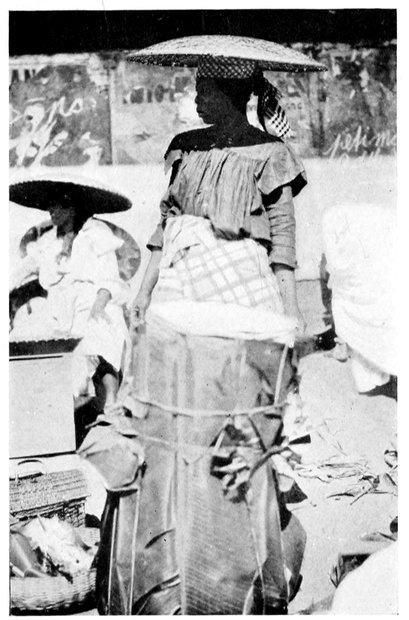
A market woman of Cayenne, and a stack of cassava bread
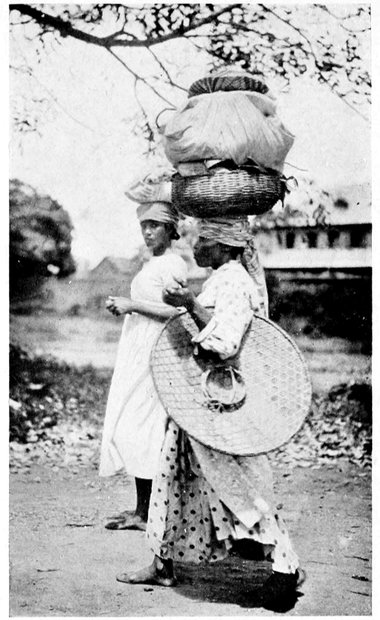
Homeward bound from market
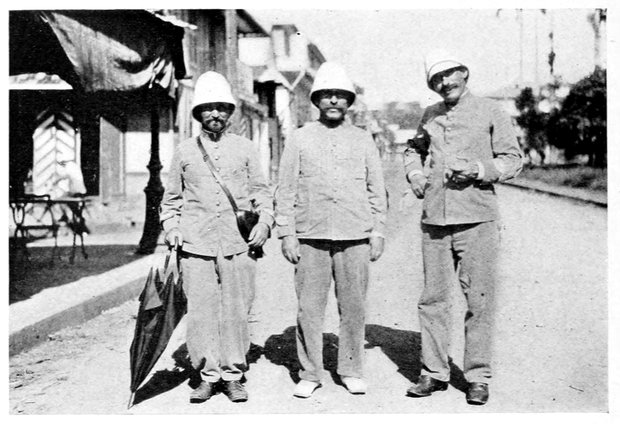
French officers in charge of the prisoners of Cayenne
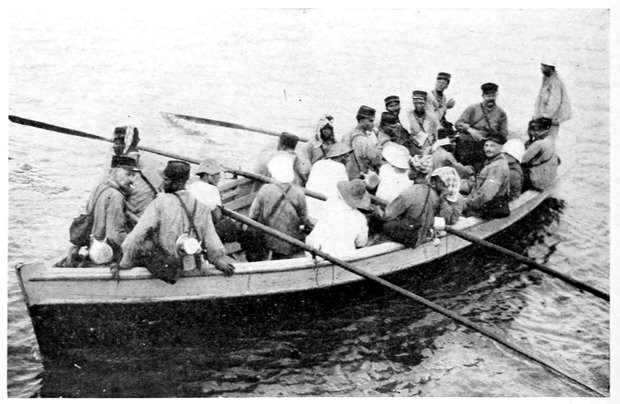
White French convicts who would like to go to France, rowing out to our ship black French conscripts who would rather stay at home
577Down at the market-place along the water front there was an
incredible mixture of races, tongues, and customs each morning.
Dirty, almost-naked Hindu beggars slunk in and out among buyers
and sellers; Javanese paused to squander the single copper left from
their gambling, and plodded noiselessly on in their bare feet, munching
the mouthful it yielded; Chinese women, still in the cotton
trousers of their homeland, but already wearing the gay starched
bandana of their adopted country, bargained with a squatting
Madrasee or a pig-tailed Mohammedan from northwestern India over
a handful of green plantains. But most numerous of all were guffawing
negro women, almost invariably carrying something on their
heads, be it only a bottle of Dutch rum sitting bolt upright. The
negroes, especially of the younger generation, to whom labor bears
the stigma of the lowly Javanese or Hindu, consider themselves a
kind of aristocracy in this conglomerate society. The negro girl
working in a shop and dressing in modern finery is too nice to carry
her own bundle; she is followed by her mother in the old native
dress, bearing her daughter’s burden. A negro youth whom an
American resident hired as a fireman on his launch appeared in a
red tie and patent leather shoes, followed by his mother and his
grandmother, carrying his baggage on their heads.
It is a sturdy man who can live day after day at a Surinam
dinner-table. Not only is the food as heavy as only Dutch or
German food can be, but it is the custom to eat five meals a day.
Over at “Sally’s Hotel,” where nearly all visitors come sooner or later
to accept the ministrations of a proprietress whose Dutch training is
tempered by African cheerfulness, we were served coffee upon rising,
a heavy breakfast as soon as we descended to the dining-room, dinner
from twelve to two, an afternoon “tea” that was a meal in itself,
and Koud Avondeten—“cold evening eats”—of generous quantity and
staying quality from seven to nine. Once upon a time ice-cream was
imported from New York in special cold-storage compartments, but
those glorious days are gone.
Had Surinam confined itself to its legal language, I should have
been tongue-tied, except for its slight similarity to German. But
every educated person, from boys or girls to even the negro policeman
on the street-corners, spoke more or less English; and those so low
as not to know any of that did not speak Dutch, either, but a “pidgin”
mixture of all the tongues that have mingled in the history of Dutch
Guiana, called “taki-taki,” that is, “talkee-talkee.” Signs in Paramaribo
578are sometimes in both tongues, as when a watering-trough
bears the warning: Niet Drinkbaar
No boen vo dringi All higher government
officials speak English fluently, though legally their duties can only
be carried on in Dutch. An American resident one day had business
with the minister of finance. They both belonged to the club, and
drank, smoked, and played cards together almost nightly; yet the
American was obliged to hire one of the two official interpreters in
the colony—as well as to borrow a frock-coat and a silk hat—before
he could be admitted to the official presence, where everything he said
was turned into Dutch and the replies of the minister translated into
English.
One morning I drifted into the Supreme Court. Five barefoot
negroes were on trial, two of them being English and three French.
They were part of a gang of marauders who had attacked a gold
mine once claimed by France, but which the boundary award had
given to the Dutch. Several others had been shot by soldiers sent
against them—and rumor had it that most of the stolen gold found
its way into the troopers’ pockets. Five Dutchmen in black robes
with white starched stocks at the neck, their pallid faces in striking
contrast to the consensus of complexion, flabby with good living and
no exercise, entered and sat down at a semicircular table. In the
center was the wrinkled, worldly-wise old chief justice—his son-in-law
was said to be by far the best lawyer to win a case before the
court—flanked by two assistants, and they in turn by the similarly
garbed prosecuting attorney and the clerk of the court. All five
of them were plainly indoor characters and had the “square” heads
of their race. Over the center chair, the back of it carved with the
coat-of-arms of the Netherlands, was a large portrait of Queen
Wilhelmina. A Frenchman being called upon to testify, an interpreter
was summoned, though the witness spoke tolerable English
and all the court spoke both French and English perfectly. The
entire trial was conducted by the chief justice, who asked all questions—in
Dutch, as required by law—which were turned into French
or English, and the answers rendered back into the legal tongue
again, though the impatient jurist soon tired of waiting for the unnecessary
translation and sped swiftly on. Indeed, he so far forgot
himself at times, particularly when the hands of the clock began
to approach the hour of dinner and the afternoon siesta, as to ask
the question in the language of the witness, or to correct the interpreter,
579whose knowledge of the tongue which he professed to know
was so shaky that the justice often turned the whole answer into
Dutch before the interpreter had begun. For patois-speaking French
negroes another interpreter was called, though he spoke exactly the
same French as the other—while the “English” of the man legally
intrusted with that tongue was eminently West Indian.
The colony is governed directly from Holland, officials, from the
governor down to the last pasty-faced clerk, being sent out by the
mother country. It has never been self-supporting—at least, to the
people of Holland it is a constant expense, though the queen personally
gets tidy sums every year from her extensive Surinam estates; hence
Holland feels itself justified in making it a dumping-ground for
political pets. These are sent out for five years, after which they
serve a like term in the Dutch East Indies and retire to Holland on
a pension for a life of Dutch contentment. Naturally, under such
circumstances they do not spend a cent more than is necessary, never
acquire property in the colony—except in the rare case of a man
marrying a native whom he is ashamed to take home with him—and
have no interest in developing it. There is much grumbling
against this state of affairs, though to one inclined to compare it
with its Latin-American neighbors the government seems worthy of
praise. Some claim that the natives themselves could govern better,
which is doubtful. The greatest complaint appears to be that the
appointed officials have no knowledge of, or interest in, the colony,
wishing only to serve their time as easily, and go back to Holland
as rich, as possible. There are few charges of corruption on the
Brazilian scale, but the natives, especially of the class that might
aspire to political office, never tire of pointing to the backwardness
of the colony as proof of their contentions. Just when the rest of
the world was putting in electricity a Dutch gas company operating
in all the colonies of the Netherlands got an exclusive concession to
light Paramaribo for twenty-five years; therefore, though one may
have electric-light in one’s own house, no wire can be run across
or under a public street, nor may any public building be so lighted
before 1932. A tramway might be legally operated, but neither the
cars nor the power-house could be lighted with electricity. It is
possible, as certain outspoken natives contend, that there is some
connection between this arrangement and the fact that the former
governor was handed a large bundle of gas shares, “merely as a
580friendly present and a free-will offering,” on the day he sailed back
to Holland.
Jim Lawton was manager of several plantations owned by an
American corporation. We chugged in a motor-boat down the
Suriname into the Commewijne, and later up to the Cottica, to visit
one of them. The country was deadly flat, and all our way was
lined with mangrove roots uncovered by the tide, resembling ugly
yellow teeth from which the gums had receded. Not far from the
capital we passed a big sugar plantation of which the Queen of
Holland is chief stockholder, as she is of many others in the colony,
but the manager of which was a Scotchman. Under him were six
overseers, six “drivers,” generally Hindu coolies or Javanese who
have worked out their time, and two thousand workmen, one for
each acre. Many of the largest estates along the rivers and coast
belong to men who have never been outside Holland, so that when
the cacao is attacked by a tropical disease, or a similar disaster sweeps
the colony, there is neither money nor intelligent ownership on hand
to combat it.
The manager of “Nieuw Clarenbeck,” a white Surinamer who met
us at the landing-stage, seemed to speak all languages,—Dutch, French,
English, Chinese, Javanese, Bengalee, Hindustani, “taki-taki”—though
merely enough of each to “get it across,” so that they all sounded as
many kinds of food boiled together in the same kettle taste. Here
were six hundred acres, with fifty Javanese laborers, thirty-five
Hindus, and some odds and ends, among them a convict of Madagascar
who had escaped from Cayenne. As we wandered about the
muddy plantation, slapping incessantly at mosquitoes and mopping
our faces in the thick, humid heat, we were greeted in many tongues,—“Dag,
Mynheer!” “Salaam, sahib!” “Tabay!” “Ody, masará!” or
“O-fa-yoo-day!” “Bon jour!” and even “Good mahnin’, sah!” There
was also a Chinese greeting from the plantation shopkeeper. The
estate was cut up by little irrigation ditches, with small poles as
bridges, and we had many splendid chances to fall to the waist or
neck in their slime. Cacao was the most important crop; after which
came coffee, with the trees shaded and the Liberian berries large as
plums. There were a few rubber-trees, tapped in the Oriental style,
quite different from the Brazilian, and instead of being smoked into
balls, the sap was set out in pans and treated with citric acid, after
which the “cream” is skimmed off in a pancake of the finest rubber,
called “plantation biscuit.” Quassia wood, of bitter taste, was once
an important export to Germany, where the importers claimed it was
used to clear the hop-fields of bugs; but since the combined disasters
of war and a cable from Milwaukee reading, “We are not allowed
to use quassia in making beer in the United States, as is done in
Germany,” the stuff had been piled up for cordwood.
Along the road in Dutch Guiana
A Mohammedan Hindu of Dutch Guiana
A Chinese woman of Surinam who has adopted the native headdress
581The problems of a Surinam estate are legion, with that of labor
heading the list. Javanese are somewhat cleaner than the Hindus,
and they will do whatever they are ordered; but they are by no
means model workmen. The method of recruiting them in the
crowded Island of Java (with a population of 32,000,000!) is to secure
a few pretty girls of the town and, exhibiting them in the larger
cities, entice men away on a five-year contract, their fare paid and
a certain sum of money advanced to them for their last spree in
their native land. Obviously, this brings the scum of Java, both
male and female. The plantation owner who wishes to hire these
imported laborers pays the government 183 gulden for each one,
which gives him the right to his indentured labor for five years.
But that is only the beginning. He must pay the government doctor
five gulden a year per coolie for periodic examinations, and buy any
medicine he orders. There is a five gulden yearly head-tax on each
laborer; they must be furnished dwellings after a design fixed by
the government, with new improvements every year. If there are
fifteen or more children on an estate, the owner must build a nursery
and provide a nurse for each fifteen, or fraction thereof, who shall
wash each child twice a day and see that it gets the specified government
diet; if the children are old enough, he must also provide a
school and a teacher—generally a black Dutchman. The employer
must have hospital beds for ten per cent. of his laborers, and must
furnish them a specified diet when they are ill and lose their time
as workmen. If a laborer goes to jail, the duties of and loss to his
employer are similar; there have been cases of men sentenced to
long terms a few weeks after being hired from the government, making
their cost to the plantation owner a total loss. If an indentured
laborer runs away before his five years is up, he can be brought back
by force, though the government is ordinarily remiss in pursuing him.
The women are contracted in the same way as the men, though
children may not be indentured. Men and women work seven hours
a day in the fields, or ten under roofs, at “task work” which must
pay them at least sixty Dutch cents—a quarter or a shilling—a day.
Though their original cost is somewhat less, East Indian coolies,
582whom the government started to replace with its own subjects some
twenty years ago, are more troublesome, particularly because they
are British subjects under direct care of the British consul, to whom
they complain at every imaginable opportunity. They do not mix
with the Javanese, but live in specified houses some distance from
them, in even greater filth, as is natural in a race forced to give its
attentions to ceremonials and superstitions rather than to personal
cleanliness. A Hindu woman cannot be used as a house-servant, not
merely because of her personal habits, but because she will not touch
beef or cow-grease and has many other troublesome heathenish
notions. The East Indians lose some of their caste nonsense in the
colony, permitting their brass drinking-vessels, or even their food to
be touched by alien hands without throwing it away; yet they still
prepare their own meals in accordance with their peculiar religious
scruples. The Hindus “cast spells” upon their enemies; but the
Javanese, and in some cases the negroes, take the more effective
revenge of mixing deadly concoctions, and even the educated people
of Dutch Guiana are more or less afraid of being poisoned by disgruntled
employees. There are twenty-three coolie holidays a year
which the plantation manager is obliged to observe, besides Sundays
and a number of Dutch and Javanese holidays, so that he must keep
a complicated calendar and lay plans far ahead in order not to have
his crops rotting in the fields when they should be picked.
I attended the weekly pay-day on Saturday afternoon. The Javanese
laborers had from forty to seventy Dutch cents left of their
week’s wages, the rest having already been taken out in advances.
When the amount was very low, the manager kept it and bought
food for the man to whom it was due, so that he could not gamble
it away. But he is almost as likely to gamble away the food or
his garments, or—as frequently happens—his wife. In marked contrast
to their Hindu sisters, the Javanese women never wear jewelry,
because their men lose it all in games of chance, and their apparel
habitually consists of a loose jacket, barely covering the breast, and
a square of gay cloth wrapped about the waist and tucked in, showing
a few inches of the abdomen and reaching a bit below the knees.
The Hindu workmen and women, on the other hand, received as
much as four gulden ($1.60) each, and grasped it like misers, raising
their voices to heaven if it seemed to be a cent short. With one
people the most inveterate of spendthrifts and the other penurious
beyond words, it is not strange that the two races do not find each
583other congenial. But there are other important differences. The
Hindus fight among themselves and frequently indulge in veritable
riots. They are exceedingly jealous of their women and quick to
revenge any slight to their domestic honor, though the women are
not particularly chaste. The white manager of a neighboring estate
only a short time before had been cut up into nearly a hundred pieces
for dallying with the wife of one of his East Indians. One day a
coolie came running to the manager of “Nieuw Clarenbeck” and said
that he had caught his wife in company with another man and had
locked them both in his house. The manager gave the male intruder
a sound thrashing and hoped the matter would be dropped; but the
moment he got a chance the outraged husband attacked his wife
with a cutlass, gashing her breasts, both wrists and both ankles,
slashing her several times across the forehead, and all but severing
a foot and a hand. She was in the plantation hospital, never able
to work again, and the man was in jail—while the plantation was out
the money it had paid for their five years’ services. The Javanese,
however, instead of being stern in their marital relations, are virtually
devoid of conjugal morality. It is a common thing among them to
trade wives for a day or a week, to gamble away their wives, or to
borrow the wife of a friend if their own happens to be out of reach.
The man who becomes enamored of a Javanese woman does not
sneak about in the night seeking a rendezvous; he goes to the woman’s
husband and gives him a small coin, or carries her off without personal
danger, so long as he sends her home again with fifteen or twenty
cents for her husband to hazard in his games. This point of view
of the betel-nut chewers is more or less that of the whole colony,
except among the Hindus and the whites; families have considerable
difficulty in getting domestic help, but an unmarried man may have
his choice of a hundred youthful housekeepers.
When their five-year term is up, the indentured laborers may
become independent planters, or they may hire out again for from
one to five years. Many of the coolies acquire land, which is so easily
done here that many come from both British Guiana and the Island
of Trinidad to settle down, and plantation owners complain that they
are constantly being forced to send for new laborers. If the coolie
hires out again, he does so at his old wage and a bonus at the end
of the year. Not so the Javanese; he demands an advance equal to
several months’ wages, and gambles it away in a single night. The
manager pointed out to me one of his laborers, the gay cloth worn
584by all men of his race about his brow, his teeth jet black from betel-nut,
who had been paid a month’s salary and a bonus on the night that
his five-year contract ended. He lost that in less than two hours,
came back and signed for five years more, receiving an advance of
a hundred gulden; returned at ten in the evening to borrow fifty cents
with which to buy food—and gambled that away!
Yet the Javanese are the most docile of all the conglomeration of
races in Dutch Guiana, with the coolies next, though the protection
of the British consul is likely to make the latter somewhat uppish. The
negroes are haughty, as well as lazy; the Chinese are proud, but try
to be “hail fellows” and even learn “taki-taki” for the sake of trade—for,
with rare exceptions, they are shopkeepers. The government
regulates even the stores on the plantations, and not only does an
immigration commissioner speed about the country in a swift launch,
inquiring whether laborers have any complaint to make against their
employers, but a paternal government inspector tells each plantation
just how much it can charge the Chinaman for the privilege of
running the estate store and exactly what prices he can demand of
the laborers. No one knows what moment the inspector may drop in,
perhaps to carry off samples of stock for examination by the government
chemist, perhaps to condemn a barrel of flour or a keg of meat
and order them thrown into the river. At “Nieuw Clarenbeck” the
Chinaman paid sixty gulden a month for rent and store rights—and
was rapidly getting rich, sending his money back to China. The
Celestial is so much brighter than the Hindu or the Javanese that
even when he mingles his blood with the negro his descendants are
more reliable and business-like, having the commercial instincts of
the father and at the same time being more sociable fellows. The
cross between the negro and the coolie, on the other hand, is surly
and seldom worthy of the least confidence.
There is a little railroad from Paramaribo to Dam—a place one
is sure to mention twice: once in asking for a ticket, and again after
hearing the price of it—called the “Coloniale Spoorwegen.” It is
a government road of meter gauge, a hundred and eight miles long, and
one pays a fare of fifteen gulden, or six cents a mile, for the privilege
of sitting on hard wooden benches in box-like little cars of European
appearance and lack of convenience, on a single train that goes up-country
every Tuesday and comes down again on Wednesday. We screeched
through one of the main streets of the capital and only city in the
colony, containing more than half its population, into fertile flatlands
585which soon turned to wooded country with occasional board
and thatch hamlets or isolated huts, then to almost snow-white sand
that did not promise any fertility, even with irrigation. Black policemen
in blue uniforms and carrying short swords came through the
cars and took a complete biography of everyone on board, even to
one’s religion. The train stopped at every bush station of three or
more huts, usually to unload men, or their junk, who struck off
through jungle paths toward placer mines. Some of these are important
establishments, with thatched villages housing fifty or sixty
black workmen and stamp-mills through which a whole hill is passed,
to come out a marble of gold and amalgam that can be held in the
hollow of the hand; some are the private and individual diggings of
“pork-knockers.” Lone prospectors, mainly West Indian negroes,
who by law may wash for gold even on the concessions of others,
are so called because, often setting out with insufficient supplies, they
soon come knocking at doors and asking for something to eat—“a
little pork or anything.” Even the verb, to “go pork-knocking,” has
become an accepted one in the popular language of Dutch and British
Guiana. English was more often heard on the train than Dutch;
everyone seemed to speak it, or at least to find it near enough the
native “taki-taki” to catch or express an idea. The white roadbed
became painful to the eyes, and white men long resident in the colony
asserted that this glare from much of its soil in time proved permanently
injurious.
In the afternoon we came to the Suriname River again, here far
narrower, but swift and deep. The buttresses of a bridge had been
built, but the few remaining passengers crossed in a cable-car, like that
to the top of the “Sugar Loaf” in Rio, a hundred feet or more above
the water. Naturally, a weekly schedule that requires two trains and
a cable station to make its run must charge fabulous passenger and
freight rates. We spent more than an hour getting our cargo—largely
oil products and flour from the United States—into the little
three-car train on the other side; then the conductor put on a new
kind of cap, and we were off again. Here the soil was reddish and
looked more fertile, and we seemed to have risen to a slight savannah
with a cooler wind, though for the most part we were surrounded by
the same monotonous jungle that had hemmed me in almost incessantly
for weeks past. But here it was enlivened by what to me was
the most interesting of the many races that inhabit the Guianas,—the
Boschneger, or “Bush Negroes.”
586In the early history of the colony her African slaves, said to have
come from more warlike tribes than most of those brought to the
New World, revolted and, but for the help of the Caribs and a
patched-up truce, would undoubtedly have driven the white planters
into the sea. In British Guiana they were eventually conquered and
driven out. The Dutch, on the other hand, made peace with them,
not only acknowledging their independence, but promising to pay them
tribute, which they do to this day. The descendants of these black
insurgents, unlike the “maroons” of Jamaica, have gone completely back
to savagery and live like wild Indians, or like their ancestors in the
African bush, wearing only a loin-cloth, dwelling in grass huts, eating
cassava and other jungle products, and talking a corruption of Dutch
and several other languages with which they have come in contact,
which the Dutch themselves cannot understand. It is estimated that
there are eight thousand of these wild negroes in Dutch Guiana, divided
into three principal tribes, Saramacca, Becoe, and Djoeka, each ruled
over by its “gran man” (“a” always as in “far”), and its tribal elders,
while several thousand more, known as “bonis,” inhabit French Guiana.
A few of these black children of nature had appeared before we
crossed the Suriname; now they burst forth frequently from the surrounding
bush. The only evidence of humanity, except the railroad,
was an occasional sheet-iron station building; yet we halted now and
then where the dark mouth of a path broke the dense wall of forest-jungle
on either side to unload rice, flour, and oil for the placer miners
and “balata bleeders” back in the bush. In some places wild negroes had
come down to act as carriers. They were splendid physical specimens,
tall and more magnificently built than any race I had yet seen in South
America, fit to arouse the envy of any white Sandow—except that,
being paddlers of dugouts rather than walkers, their shoulders and
arms were overdeveloped in proportion to their legs. Erect and haughty
as Indians, without a hint of the servility we commonly associate with
negroes, they were proof that the African who has returned to his
natural state in the wilderness is preferable to the negro who has reverted
to his natural state in the cesspools of cities and the rags of
civilization. Though noticeably smaller, the women and girls—naked
except from waist to thighs—who came down to peer out of the forest
and see the train pass were equally fine specimens of the human animal,
the young ones with plump, protruding breasts, shapely waists, and
more often than not a naked baby astride one hip. The men had earrings,
bracelets, rings even on their forefingers, charms of shells and the like
587about the ankles, and so many adornments, in contrast to the females, as
to suggest that they forcibly took them away from their weaker sisters.
Such cloth as they wore was of gayest color and crazy-quilt pattern;
their short hair was done up in “Topsy” braids sticking out in all directions
and tied with many-colored ribbons; about arms and legs, just below
the knees and above the elbows, they wore tight rings or cords,
evidently believing, like the Indians of Amazonia, that these protect them
from the ravenous piranha; and the abdomens of both men and women
were tattooed, or, more exactly, pricked into relief figures resembling
countless black warts. More superstitious than the wild Indians,
and just wise enough to know a kodak by sight, they were not to be
caught unawares for a “por-trait´,” as the word remains even in “taki-taki.”
Dam is most succinctly described by adding an “n” and an exclamation
point. It consists of the end of the railroad line, which some
day in the distant future hopes to go on to the Brazilian border. The
only white men left since crossing the river were the little Dutch
engineer and myself. I went with him and the rest of the train crew
to a clean, well-screened little bungalow, where we pooled our lunches,
but the assertion of the dusky conductor, whose English was “picked
up,” that he was “snorking too much” proved only too true, and I soon
carried my hammock out into the night. After some search I swung
it from the switch-post to the back end of our first-class car, diagonally
across the track, and turned in again. There was, of course, the
danger that another train might dash around the curve into me, but
as the company would have had to order it made in Holland, carry
it piecemeal across the river by cable, set it up, and run the thirty
miles from the cable station, the risk was not great.
At least there was a fine collection of “Bush Negroes” in Dam. A
hundred or more of them, including whole families among whom there
was not cloth enough for a single garment, had come down the
river, which here forms a rocky falls, to carry back into the bush in
their canoes the supplies brought by the weekly train, and they had
hung their hammocks under a long sheet-iron roof on poles provided
by the government. All of them had the air of being as ready to fight
as Indians on the war-path; yet they were childish in many ways,
too, jumping upon the train every time it moved a foot in switching
and acting in general like boys of ten. They were the exact antithesis
of Indians in showing, rather than hiding, their feelings, and had all
the African’s gaiety and boisterous laughter. In their encampment
588now feebly lighted by weird torches, they were indulging in music,
chatter, and apparently in dancing, until one might have fancied
oneself in the heart of Africa. They seemed to be more contented
with their lot than the Indians, as if they still had memories of the
slave days of their ancestors and realized that much more fully
what freedom means.
On the return trip we picked up much gold. At every station,
and at some mere stops, negroes, clothed and usually English-speaking,
handed the conductor small packages wrapped in scraps of paper,
but sealed with a red seal, the name of the owner crudely written
on each. I soon learned that these contained gold-dust, and for
every one of them the conductor had to make out a report, which the
negro certified with a seal he carried, after which the conductor put
the package in his tin box. Some of them weighed several pounds.
Before we were halfway in the conductor had more than $12,000 worth
of gold, for all of which he was responsible, though he received not
a cent extra for the trouble above his scanty wage of thirty dollars
a month and a gulden as expense money on each trip. No wonder
he said something about “one hand washing the other” and gave me
no receipt for the fare I paid from Dam back to the cable-station.
When we came to Kwakoegron every person on the train had to
get off to be searched for gold. All passengers and employees, carrying
their hand-baggage, were herded into a big chicken-wire cage,
where they were examined one by one by black policemen. Personally,
whether out of respect for my nationality or because I looked too
simple to think of smuggling, the officer who stepped with me into one
of the alcove closets opening off the enclosure was satisfied with patting
my pockets and making me open my kodak; but many travelers
are compelled to strip naked while black policemen examine even the
seams of their garments. There is a negress on hand for similar examinations
of her own sex, and several times I heard of an English
woman resident who, having once been caught smuggling gold, was
forced to strip every time she passed through Kwakoegron on her
way to town. Even minor surgical operations are sometimes performed
on suspects, not always without results. Not merely the
passengers and their bags, but the entire train from end to end was
examined with meticulous care. Gold has been discovered hidden
away in every imaginable place on the cars, even stuck on the trucks
or inside the wheels. The packages in charge of the conductor are
also examined, and if a seal is found broken he is held in jail until
it is proved that none of the gold is missing. The negro policemen
get a percentage and promotion for finding stolen gold, or for detecting
attempts to smuggle it, and are said to be so proud of their
jobs that they seldom succumb to temptation.
Javanese women tapping rubber trees after the fashion of the Far East
Javanese and East Indian women clearing up a cacao plantation in Dutch Guiana
Javanese celebrating the week-end holiday with their native musical instruments
589The gold fields of Dutch Guiana are above Kwakoegron, and the
purpose of the barrier is to prevent gold from getting out without paying
the seven per cent. ad valorem tax to the government. Miners are
said to favor the method, because it does away with stealing by
workmen. Yet it is scarcely worth while to try to smuggle gold into
town, for it must be sold secretly to “fences” who seldom pay as
much as honest gold brings after going through the government
process. Arrived in Paramaribo, the packages held by the conductor
are turned over to the police, examined, and the next day the
owner comes and pays his tax and then sells his gold to a registered
dealer. It is even unlawful for the man who dug it to bring his own
gold to town with him. Government officials who handle the yellow
metal are reputed to be honest, but not so much can be said for the
government itself, which accepts gold stolen in French Guiana, merely
charging a higher tax and keeping an official record of it. Naturally,
the government of Cayenne retaliates.
I saw and heard much more of the “Bush Negroes” before I left
Surinam. Scattered all over the colony between the well-settled
coast and the Indians at the southern end, they constitute the chief
interest of Dutch Guiana, as the white convicts do in the adjoining
French colony. The government makes no attempt to rule them, no
pretense of trying to bring them out of their savagery; indeed, it protects
them in their wild state and gives them privileges not enjoyed by
white residents,—as, for example, the right to carry firearms without
a license. They have no schools or other civilizing influence, except
a few missions of the Moravians. It may be that they are better off
under this plan; certainly they are finer specimens of manhood than
the average domesticated negro. All those I saw were jet black,
but there are said to be rare cases of their mixing with the whites,
the offspring of such mixture almost invariably losing his “bush”
instinct and drifting to town. Descended from some of the hardiest
tribes of Africa, many of them still have traditions of belonging to
the wealthy class in that continent, their ancestors owning many
cattle and having been captured by trickery. The men make good
carriers and bush guides, but are incredibly heavy eaters. Their
principal commerce with the outside world is bringing wood to
590town, paddling their hollowed-out tree-trunks, often forty or fifty
feet long, in and out of the network of rivers. The men clear a
different patch of jungle every year, and the women plant cassava,
rice, bananas, and plantains, and do all the manual labor about the
camp. Polygamy prevails, and the relations of the men are rather
free, though the women are held strictly to account. If a domestic
misdemeanor is discovered, a conclave is held and both the man
and the woman are beaten, but the latter usually carries her marks
the longer. When a “Bush Negro” dies, his body is placed on an
elevated platform for eight days, and every day the men come and
rub their bodies with the juice, if it may be so called, of the corpse,
for the double purpose of adding to their own strength and insuring
the entrance of the dead man into their heaven. They have many of
the superstitions, strange primitive rites, and Mumbo-Jumbos of
their African ancestors. Any mark called a charm or curse before
a door will keep them from entering it. Though very suspicious of
strangers, those who have won their confidence find them staunch
friends, gay and good-hearted, but ready to do anything for rum or
tobacco, which there is no law against giving them. Never having
been subdued, they fear no one, and live under their own tribal laws,
punishing even with death those who disobey them, without government
interference. A few years ago four West Indian blacks stole a
“Bush Negro’s” canoe along the Maroni River and left him to struggle
back to his village through the jungle. Nearly a year afterward
the West Indians returned from their gold prospecting in the interior,
passing down the river in the same canoe. The owner recognized it,
raced back to his village and, collecting a group of his fellows, overtook
the thieves farther down, killed them, recovered the canoe, and
stood the heads of the four up on a rock jutting out into the river. The
British Government was still demanding punishment for the deed,
but the Dutch were showing no intention of doing anything about it.
The “Bush Negroes” have no color-line, but treat clothed blacks
just as they do white men or Indians, and do not hesitate to make
slaves of French convicts who fall into their hands. Not only do
they pay no taxes or dues of any kind to the government, but the
latter, ever afraid of an outbreak among them, pays them annual
tribute. Once or twice a year the “gran man” of each tribe comes
to town in frock-coat and silk hat, but bare feet, wearing a great
bronze coat-of-arms of Holland across his chest and followed by an
obsequious valet, to call upon the governor and receive greetings
591from Queen Wilhelmina, a letter renewing the treaty between his
tribe and the Dutch, and a small sum of money or some trinkets to
distribute among his tribesmen. Of late years the “Bush Negroes”
have been required to wear clothing when they enter the capital, but
they interpret this demand not into shirts and trousers, but into a
multicolored, silky strip of cloth which they drape about their naked
bodies in an ornamental rather than concealing manner. A bit of
contact with urban civilization makes them crafty. One day in Paramaribo
I drifted down to the river where, among lumber piles, a whole
colony of “Bush Negroes” was stopping while they exchanged the
wood they had brought for useless finery. I offered a Dutch quarter
to one of them in fancy drapery to pose before my kodak. He only
agreed on condition that he could be taken with one hand on a camp
chair, evidently for the same reason that some of our countrymen
prefer backgrounds of skyscrapers, since he had certainly never
owned, and probably never sat in a chair in his life. No sooner was
I done with him than another man, better built and more joyfully
dressed, stepped out, offering to pose for a similar sum. Then a still
more gorgeous one put in an appearance, and the procession evidently
would have continued indefinitely, as nicely graded as the
characters in a Broadway musical comedy up to the climax of spotlighted
heroine, had I not professed myself out of Dutch quarters.
“Bush Negroes” form new words onomatopoetically. Thus, when
the first motor-boat approached their retreat, one of them, putting a
hand behind his acute ear, said, “Hah! Packapacka walkee disee way,”
and “packapackas” they have been ever since. Their language is the
“taki-taki” of all the uneducated natives of Dutch Guiana, though
they use many words, chiefly African in origin, not familiar to their
clothes-wearing brethren. The basis of “taki-taki” as its name suggests,
is English with considerable Dutch and traces of all the languages
that have seeped over the borders of the colony during its long and
checkered history, all mixed together in the same concoction, in keeping
with a childish intelligence, and spoken with negro slovenliness.
It was my privilege one Sunday to hear a sermon in “taki-taki”
in one of the wooden churches of the Moravians up a coastal river.
While the congregation did not consist exactly of “Bush Negroes,”
it was of a similar grade of intelligence; and the same missionary
preached on alternate weeks in a village of wild blacks, using the
same language, though not quite so many Dutch words. Canoe-loads
of negroes appeared from up and down the placid river soon after the
592bell had rung out from the steeple of the home-made church, standing
out incongruously against the great green forest. Those who lived
near were already in their Sunday best; the rest stopped in the bush
above or below the church to change their clothes. Three rooms in
the minister’s house had been set aside for that purpose, but they
prefer the outdoor dressing-rooms. My host and I were the only
white men in the congregation, and we were led to special benches
beside the pulpit and facing the rest. There were a hundred or
more negroes in the church, almost all of them jet black; the sexes
were separated, with the children on the front benches. What we
call Moravians, but who call themselves “Brüdergemeinte,” must be
married, and in this case the burly, bearded, German missionary stalked
in followed by his cadaverous, Quaker-looking wife wearing the approved
sour expression of many Protestants engaged in the business
of saving heathen souls. She was wearing drab black and a little
monkey-like cap, and took her place on a platform in front of the
female half of the church, where she remained absolutely motionless
throughout the long service. A black Dutchman, who taught a class
of negro children in the mission school during the week, tortured a little
melodeon from time to time. Greater solemnity could not be imagined;
the place was full of sanctimonious, breathless negroes with
pillar-of-the-church expressions—who, according to my companion,
were past masters at stealing anything they could lay their hands on outside
it. The dialect used in the sermon has been reduced to writing by
the Moravians, which is the reason a printed page of the “taki-taki”
Testament or the “Singi-boekoe,” does not look more familiar to those
of us whose native tongue is its basis. For, being Germans, the translators
have given German or Dutch values to the letters, so that while
the word “switi” might not be quickly intelligible to us, we would
have no difficulty in understanding it as “sweety.” “Joe,” “wi,”
“bekasi,” and “Loekoe!” are simply Dutch-German ways of spelling
“you,” “we,” “becausee,” and “Looky” or “Look ye!” “Hij wan bigi
man,” as it appears in the “taki-taki” Bible, would be readily recognizable
if written “He one bigee man.” “Mama” has the same meaning
as in all languages, but “father” is “tata,” as among the Indians of
the Andes. “Pikien” for “child” may have come from the African
“piccaninny,” from the Spanish pequeño or the Portuguese pequeno.
“Masra Gado” was “Lord God,” the “a” always retaining the broad
open-mouthed West Indian form. Both in vocabulary and grammar
“taki-taki” shows the most primitive, childlike minds at work and the
spoken language suggests nothing so much as a group of negro children
on a Southern plantation trying to express themselves in the
language of their elders. Thus the word “switi” means “good” in
any of its forms,—in taste, quality, condition, or character; “Hij
maki wi” may mean anything from “He makes us” to “He would
have made us.” The text that day was St. Luke, Chapter XVI,
Verse 25:
An East Indian woman of Surinam
A Javanese woman of the Surinam plantations
A gold mining camp in the interior of Dutch Guiana
Pouring out the sap of the bullet-tree into the pans in which it hardens into “balata,” an inferior kind of rubber
593Ma Granman Abraham taki gi hem taki: Membre, mi pikien, taki,
joe ben habi joe boen liebi datem, di joe ben de na grontapo, ma Lazarus
ben habi wan ogri liebi: We, now hem kisi troostoe, ma joe de pina.
Much of the sermon I did not understand at all, or at most caught
crudely the gist of it, as the resonant Teutonic voice boomed it forth
in the lingua franca of the colony. But every now and then there
rang forth a perfectly plain sentence in child-English, as when frequently
the burly German took a step forward and, shaking his
finger in the faces of his breathless congregation, cried out above
the general jumble of sounds, “Yō no mussy do datty!”—which is
good advice in any language.
A Dutch coastal steamer carried me in a night from Paramaribo
to the second town of the colony, Nickerie, a hamlet of a thousand or
more inhabitants just across the Corentyne River from British Guiana.
It was a straggling line of coy white houses and a church spire, all
of wood, stretching roomily along the river bank amid cocoanut and
royal palms and a wealth of tropical greenery, not to mention humidity.
Its sanded streets and roads were all raised, like dikes, for the
coastal lands of both Dutch and British Guiana are below high-tide
level, and must be empoldered, as in Holland, with a “back dam”
also in most cases to keep out the rain-water from the interior. I
strolled several miles up the river, past great swamps that make
the region the paradise of mosquitoes and malaria, to say nothing of
elephantiasis, to “Waterloo,”—not a battlefield, but a great sugar
estate run by Englishmen. The first cutting—that of July—had
begun, the principal one coming in September. The great cane-fields
were being burned over, whether for snakes or merely to clear out
the massed leaves was not apparent, clouds of leaden heavy smoke
rising here and there across the immense light-green stretches flooded
with sunshine and surmounted by a few lofty royal palms. Next
negroes and Hindus attack the crop with “cutlasses,” tossing the canes
in heaped-up rows along the edges of the canals, where they were
594loaded into barges drawn by mules and borne away toward the red
stacks of sugar-mills looming somewhat hazily out of the blue and
humid air. The transportation of both cane and the finished sugar
is by these iron barges along the irrigation canals—of water as noisome
as that before Benares. A little old English windjammer had
come up the river to load sugar and to contrast with the Oriental aspect
of the scene. A few English overseers rode big mules along the diked
tow-paths, one of whom complained that they got less pay and fewer
advantages here than over the border under their own flag. By
noon I had returned to Nickerie, where I indulged in a shower-bath
and a goodly dose of quinine, and retired from active life until the
sun had lost some of its homicidal tendency; then strolled down the
river to a cacao and cocoanut estate. Here a white déporté who had
escaped from French Guiana was lugging a burden along the road
with other outcasts. The Dutch, I recalled, rather than lower the
standing of their race among their colored colonists, send home to
Holland any white man sentenced to prison by the courts of Surinam.
Under the cocoanut-trees sounded singsong Hindustani; old Hindu
fakirs squatted beside reed-and-grass huts. A canal, with a gate to
shut out the sea-water at high tide, stretched inland as far as the
eye could see, a path on either side and frequent humped foot-bridges
across it. I passed an open-air school in which a mulatto was teaching
Dutch to the children of the plantation—with little effect, evidently,
for they reverted to their native tongues or to “taki-taki” the instant
they were dismissed. The distant sound of the half-mournful gamalong
floating by on the languid evening breeze showed that a group of
Javanese had already begun their night’s entertainment. People were
fishing in the slime of the canals, and Hindus were bathing in them,
no doubt finding them an excellent substitute for their holy Ganges.
All in all, Surinam had proved the quaintest and most hospitable of all
the Guianas, capable of producing a hundred fold what it does now.
The launch Ella finally left for Springlands, across the boundary,
with nineteen persons, among whom I was the only white one, all packed
in the forward cubbyhole with the steersman. For hours we plowed
the yellow waters of the great mouth of the Corentyne, the dead-flat
wooded shore frequently disappearing in island-like patches in the
mirage of distance. Then some stacks and a cluster of buildings
among trees grew toward us, and we anchored off a wooden wharf
on which we were eventually landed in a clumsy rowboat. There
we found ourselves inclosed in a kind of wooden cage, where a black
595policeman, with a pompous British air, and a pimply Chinese youth went
through some formality about our names and previous condition of
servitude, after which an Englishman eventually appeared, merely
glancing at my modest bag, but carefully studying my passport—the
only time I was ever asked to show a document I had spent much
time and some money to get and have viséd in Pará for the three
Guianas. Had any of the dozen delays been avoided, I should still
have had plenty of time to catch the daily autobus westward along
the coast; as it was, it still seemed possible. I coaxed a coolie boy
under my bag and sped away, only to find that the bus no longer
came to Springlands, but stopped four miles off, because the sea had
washed out a strip of highway. A yellow negro with an imitation
automobile called the “Star” offered to carry me to it for a small
fortune, and in this we rattled out along a red country road, dodging
innumerable negroes and Hindus, and producing an uproar like
a locomotive off the track but still running at top speed—to come at
last to the break in the road just in time to see the bus on the other
side of it start twenty minutes ahead of its schedule.
To increase my geniality, I then discovered that the day was Saturday
and that, being on British soil, there would be no bus on Sunday.
Profanity being inadequate to the occasion, there was nothing to do but
to get back into the automatic noise and return to town. This consisted
mainly of an immense sugar estate called “Skeldon”; but the
very British manager looked at me as at some curious and hitherto
unknown species of fauna when I suggested that I spend the forty-eight
hours on my hands in getting in touch with the sugar industry.
Saturday afternoon market was in full swing, stretching for miles
along the public highway in the blazing sunshine, for buying and
selling is the chief sport of the laboring classes of the sugar estates
on their weekly pay-day and half holiday. In the throng were noisy,
impudent negroes of all tints in hectic garments, but they were overwhelmed
by a flood of as many queer Hindu types, turbans, and
female jewelry as could be found in the streets of Calcutta, with darker,
tawnier Madrassee coolies as a sort of link between the two races.
The latter were half-wild looking creatures, speaking Tamil, and
were said to work better than the other Hindus, but to be spenders
and gamblers, instead of penny-squeezers. Many of the goods displayed,
almost entirely of foodstuffs, were the same as those in the
markets of India, from coiled sweetmeats to curries. The coolies
lived in clusters of one-story barracks, the negroes generally in makeshift
596wooden shacks, all joined by a foot-bridge over the flanking irrigation
ditches to the highway and the huge mills, the stacks of which
already seemed eagerly waiting to resume their labors on Monday
morning.
An Anglicized Portuguese shopkeeper near “Skeldon” had a hotel
at “64,” to which his servant drove me in a buggy, and then by automobile,
along a reddish road of hard earth raised above the general
level of the country. But I was the only guest in a long time, and the
mammy-like old negress came up to inquire “what de gen’leman accustomed
to eat” before she went away to catch and boil it. Moreover,
I am not a good waiter, and with two days on my hands I decided to
walk on next morning, perhaps to New Amsterdam, forty miles
away. There was an excellent country road all day long through lowlands
densely populated by East Indians and negroes in huts and houses
always on stilts. Generally these had shingled walls and sheet-iron
roofs, though now and then one saw a thatched mud hut that seemed
to have been transported bodily from Iberian South America, and sometimes
a shingle-sided house with a thatched roof, looking like a well-dressed
man still wearing his old and shaggy winter cap. In places the
villages were almost continuous, with bright red wooden police-stations
every few miles occupied by lounging but fleckless negro policemen.
Stone or cement mile-posts recorded my progress, and two telegraph
wires constantly dogged my footsteps. Goats and donkeys were nearly
as numerous as negroes and coolies. The highway itself was often
crowded with traffic,—donkey-carts, many bicycles, countless people
on foot, some automobiles. In all my tramping in South America
I had almost never before had to dodge these curses of the pedestrian.
One might have fancied oneself in the most populous parts of Europe.
The latest census credited British Guiana with 304,089 inhabitants;
it was plain to see why there were few left for the ninety per cent.
of the colony back of this crowded coastal fringe. For all its British
nationality, the vast majority of the country is not developed even as
much as are such shiftless republics as Honduras, where at least one
can telegraph anywhere.
A ferry across the Surinam River, joining two sections of the railroad to the interior
A Bush Negro family on its travels. Less than half the dugout is shown
A Bush Negro watching me photograph our engine
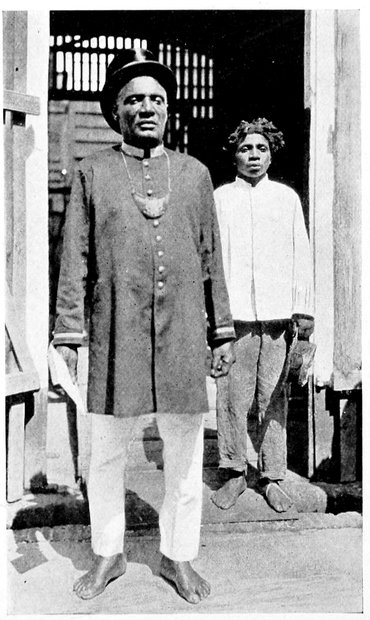
A “gran man,” or chieftain of the Bush Negroes, returning from his yearly visit to the Dutch governor of Surinam, with his “commission” from Queen Wilhelmina, and followed by his obsequious and footsore valet
Plainly, too, white men are not accustomed to tramp the roads of
British Guiana. There was constant staring, with now and then an
impudent remark from some negro, but for the most part there were
unfailingly polite greetings. Yet I was handicapped by my color, which,
as in all South America—with a few exceptions, such as Buenos
Aires—marked me at a glance as of a race apart. Not only was I
597obliged to pay higher to keep from lodging in negro quarters or among
Hindus, but silence fell on almost every group I approached, as if
they feared I might hear their real thoughts. If I asked a question, I
was instantly looked upon with such suspicion as might meet a detective
in a dive of criminals. Not that I would change my color; but
it would certainly have been an advantage to be able to disguise myself
as a Hindu fakir or an African chief as easily as it is done in popular
novels or the legends of famous travelers.
Worst of all, it was Sunday! I was “much humbugged” by the
deep-blue tint of that day of the week in the stern Anglo-Saxon
civilization I had almost forgotten, for the laws of British Guiana
require shops of every description to remain hermetically sealed from
eleven o’clock on Saturday evening to Monday morning. They were innumerable,
the larger ones kept by Portuguese and Chinamen, as the unfailing
name of the proprietor above the doors admitted, the smaller
and more slatternly ones by negroes, and a few by Hindus. Plenty
of “Licensed Retail Spirit Shops” announced themselves, yet I became
ever more cotton-mouthed with thirst, for though the great
mud flats on either side of the dike-like road were often lakes, it
would probably have meant quick death to drink from them. The
natives all drink rain-water, every house or hut of whatever size
or material catching it off the roof in barrels or tanks; but these had
a scent as of veritable Hindu uncleanliness. Finally I stirred up a
negro lolling in a hut to break the Sabbath to the extent of climbing a
cocoanut-tree, and drank three of the green nuts dry at a draught.
The sun blazed maliciously, but there was a constant breeze from off
the sea, which most of the day was so close at hand that I could hear
the roar of the breakers and now and then catch a glimpse of it.
Hunger, too, soon discovered that it was Sunday. When I could
endure it no longer I attacked the door of a closed shop and aroused
the offspring of a Portuguese father and a negro mother, only to get
an obdurate, “’Gainst de law, sah, to sell anything on de Sabbath.”
“Not against the law to starve to death though, eh?” I retorted,
which extraordinary burst of wit so took his fancy that he exploded
into a cackling laugh with, “Ah, no, indeed, sah, dat’s de fac’,” and
finally became so mollified as to take me to dinner as an invited guest.
It seems it is still permitted to have guests to dinner on Sunday. The
meal we sat down to in his stilt-legged house across the way consisted
of nothing but a large plate of boiled rice with a bit of fat pork in
it, topped by a cup of hot goat’s milk, but King George’s dinner that
598day did not compare with it. My host would not eat with me, evidently
for the same polite reason that had kept Langrey standing,
though he asserted he could not eat hot food “because my tooth humbug
me too much.” Paucity of vocabulary among not only the negroes
but many of the whites born in the colony is astonishing and easily
leads to errors. “Jes’ now,” for instance, may mean at once, an hour
ago, or a day hence. “Humbug” serves for anything whatever of a
detrimental character. “Don’ you let ’nybody make you a fool”
is the usual form of that verb as we use it. The first question of a
British Guiana negro to any stranger to whom he dares put one
is almost certain to be “Your title, please, sah?” meaning, “What is
your name?” and closely corresponding to the “Su gracia de usted?”
of rural Spanish-America. The negro is the most imitative of human
beings. In Brazil he has all the gestures and excitability of the Latin;
here he talks with the motionless, solemn demeanor of the Anglo-Saxon.
Before I left, my host told me that many detectives were
sent out to catch shopkeepers breaking the closing law, and that, never
having seen a white man walking the road before, he was still not
sure I was not one of them. “An’ de fine ain’t a gill nor a half-bit
either,” he added, in the peculiarly squeaky voice of his mongrel race.
The country grew a trifle wilder, with only negroes in the scattered
huts, and swamps often stretching away on either side, full of tough
sedge-grass whispering hoarsely together in the sea breeze. From
mid-afternoon on the land was largely flooded. Rice-fields began on
the landward side of the road, with a few grazing cattle on the
seaside, and there were long rectangular plots of paddy in all stages
from sprouting to nearly ripe. Coolies, who lived by the hundreds
in huts bunched together on estates or on their own small farms, were
pottering about in them. Some were freemen and others estate
workmen who had been given a patch of ground on which to grow their
own rice during their spare time. This practice is said to leave many
plantations without sufficient laborers on Monday and even Tuesday,
for the coolies, feigning sickness, stay home to rest up from their more
earnest Sunday labor for themselves. Not being Christians, they
are granted a certain immunity in Sabbath-breaking. Coolies, carrying
along the road bundles of long, green rice pulled up by the roots
for transplanting, greeted me with, “Salaam, sahib!” though “Mahnin’,
sah!” was more likely to be that of the Hindu youths born in the
colony, their glossy hair and complexions as startlingly out of place
in European garb as fluent English of West Indian accent and vocabulary
599was on their lips. Residents of judgment seem to agree that
the imported coolie is inferior to the creole.
I had walked twenty-five miles when I reached the immense sugar
estate of “Port Mourant.” Besides its great mill with three stacks,
there were the bungalow mansion of the manager, the somewhat less
imposing bungalows of the assistant manager and the engineer, a big
hospital on legs, the overseers’ barracks, several houses for lesser
married employees, and a plethora of offices and smaller buildings
scattered away through lawn and trees. Here, I suddenly recalled,
I had a letter of introduction to the chief chemist, said to be a fellow-countryman,
and I turned into the inclosure. His name was Bird,
and he was rightly named. When I had sent the letter up to his residence
on stilts and been allowed to stand waiting on the cement floor below
stairs about half an hour, like any negro, a cadaverous individual
came hobbling down. Handing me back my letter, a look of terror
burst forth on his sour face when I hinted a desire to see a bit of the
life on a sugar plantation, as if the terrible bourgeois fate of losing
his job were already grasping him by the throat.
“I can’t do a thing for you!” he cried hastily, ignoring the fact
that I had not asked him to do anything, and he quickly retreated. I
was delighted to learn later that he was only a surcharged American
after all.
Evidently there was some horrible mystery connected with the
sugar plantations of British Guiana; perhaps it was some species of
peonage. It was plainly my duty to find the cause of this overwhelming
fear of strangers. I stalked across to the big two-story mansion on
stilts in which the manager lived. After a second inspection the negro
maid actually let me in, permitting me to take the stool nearest the
door, and for the next half hour—the manager being in his “bawth”—contriving
to pass frequently up or down the stairway at the back
of the immense and well-furnished drawing-room to see that I did
not get away with the piano or any of the popular novels. Some
pretty little tow-headed children passed from the black nurse to the
very English governess without being permitted to become acquainted,
and at last the manager himself appeared. I had long known that
the most painful experience in life is to introduce oneself to an Englishman,
but I hold such occasional self-flagellation to be good for
the soul. He was typical of the important, “well-bred” Britisher—though
evidently Irish—and he descended upon me with the eat-’em-alive
air of an attacking bulldog. But as I am least likely to run when
600most expected to, I sat tight. Unlike many of our own countrymen in
positions of importance, or what they and the world consider such, the
Britisher never seems to dare to risk loss of authority by even momentarily
descending to human ways until he is sure he is not dealing with an
“inferior.” The manager was not clear on that point in this case, but
gradually it dawned upon him that he could neither shoot me on the
spot nor have me dragged out, and once he had recovered from the
dreadful feeling of having no precedent to go by, he began to act
more like the human being and the tolerably good fellow he undoubtedly
was way down underneath his job and his generations of steeping
in caste rules. His voice diminished from that of an army officer
ordering the immediate execution of a traitor to a tone befitting a
drawing-room, and he finally sat down, though explaining that “under
no circumstances” could he permit anyone to see the estate without
an order from the owners—one of the principal business houses in
the colony. Later, when I applied to them in town, they assured me
that they never gave such orders, but left the matter entirely to the
discretion of the managers on the estates—which was evidently the
British form of “passing the buck” and pretending to be cordial while
concealing that dreadful secret of Guianese sugar estates.
I rose to say that I would walk on to Berbice—and sleep in a ditch
along the way, I might have added, for it was fifteen miles off and the
sun was near setting—when a really human idea came to him. Summoning
the head overseer, he told him to have the spare bed in the
overseers’ barracks arranged for me, adding a more than plain hint
that I be allowed to see nothing on the estate and that I be sped on my
way as soon as possible in the morning. I was on the point of suggesting
that I would not object to being blindfolded, when the manager’s
wife appeared in gorgeous costume, followed by the “tea things,”
and, there being no way out of it, I was asked to tea. This was a
great advance, but I took far higher rank later, reaching almost the
heights of a respectable person, when the manager remarked to the
head overseer in the voice of a judge asking a lawyer who has specialized
in that particular subject, “By Jove, I wonder if it isn’t late
enough for the first swizzle?” The head overseer took the weighty
question under consideration and at length decided that there was a
precedent somewhere in British colonial history for starting the customary
evening entertainment at that hour, whereupon a Hindu butler
in gleaming white appeared with a yellowish mixture of whiskey
base, which he whirled into a foam with a “swizzle-stick” made apparently
601of the root and stem of a small bush, the latter rolled rapidly
between the hands, and served us in order of rank. This universal
appetizer and eye-opener of British Guiana being over, the head
overseer led the way to a long rambling building on legs, where a
score of white Britishers, young or at most in early middle age, were
already between merry and maudlin from the same cause.
Here we “swizzled” several times more, and then went in a body to
a dining-room on the ground floor under the manager’s house, where
fourteen of us sat down to dinner about a large table. The deputy
manager was at the head and the head overseer at the foot; the rules
of caste, of course, did not make it possible for them to eat with the
manager. It was not a luxurious meal, though plentiful and most
formal. During the course of it a ledger in which the manager, or
his secretary, had written out each man’s orders for the next day
passed from hand to hand. To an American, the rather faint and
easily satisfied ambitions of these not particularly prepossessing young
men was striking. They gave an impression of intellects of modest
horse-power rarely speeded up into high gear, with slight interests
or knowledge outside their routine work of bossing coolies in the
fields, in which each had his particular task or section, without opportunity,
or apparently desire, for personal initiative. Some of
them might, indeed, almost have been suspected of light-mindedness,
except on the one point of keeping up the good old English forms,
prejudices, and social superstitions. Nearly all of them had come
out on three-year contracts. If they remained five years, they got a
six months’ trip home—at the company’s expense if and when they returned;
after ten years as overseers the more clean-cut ones might become
head overseers, and years later, deputy manager. Then, if the
latter made no slips on the glabrous British social ladder, he might
finally, in twenty or twenty-five years, work himself up into managerial
timber, a rank at which there are few openings compared with the
number who come out as overseers. The fixed rules of behavior
were surprisingly paradoxical. The overseer might, and it was tacitly
implied that he commonly did, “keep” a native woman—Hindus seemed
to be preferred—without jeopardizing his ascent, so long as he made
no public display of the fact; but he must not, of course, be without
a dinner jacket and evening dress, or ride second-class, or do any of
those other things which a Britisher of his class “simply doesn’t do,
don’t you know.” Yet this distant and uncertain goal seemed quite
sufficient incentive for these half-hearted chaps, many of them younger
602members of “best families” and “public school” men, to whom the
vision of perhaps some day becoming manager of an estate, dwelling
in the big bungalow amid servants and secretaries and with stern
authority over everything in his immediate vicinity, seemed the nearest
to paradise on earth to which men of their class could aspire. In
keeping with their general point of view was the calm assurance,
almost worthy of a Latin-American, with which they waited for
“the government” to win the war, without ever dreaming of personally
losing a meal or missing a “swizzle.” Contrasted with the strenuous
exertions of the young Germans I had seen trying to get home from
Brazil, the manner of these rather inane young gentlemen toward a
conflict that was just then going heavily against them, yet of which
they seemed almost as supremely indifferent and ignorant as of
geography, was astonishing.
The overseers get up at five o’clock, meet for “coffee” and instructions
from the manager, and at seven ride off on mules to their tasks,
generally an hour or two from the plantation center. Here they spend
a couple of hours superintending coolies, who for the most part
work by the “task,” and ride back for tiffin, or breakfast, at eleven.
They are out again at one o’clock, five days a week, and home soon
after four, to have tea and play tennis, or to prepare for the coming
gymkhana, the estate horse-races. There was a commodious billiard-room
in the barracks, though apparently no shower-bath. No doubt
each man kept his own private tub in captivity. All evening the head
overseer was most formally obliging, but seemed in constant fear of
my contravening the manager’s orders in some “cute Yankee” manner.
I was awakened at dawn by the Hindu “boy”—who was past forty—bringing
me “coffee”—which was tea ruined by the addition of milk
and sugar—and two diaphanous slices of bread. The autobus was
not due for some hours, so I abandoned the contested territory as
soon as possible and rambled away along the diked highway. There
was somewhat less travel than the day before, but the shops were
open. So cool and constant was the sea breeze that I did not have
occasion to take off my coat during the whole fifteen miles, everywhere
flanked by canebrake. Men in flowing robes or mere loin-cloths,
with caste marks on their foreheads, coolie women with arms
laden with silver bracelets, their thin and silky, though not always
newly laundered, draperies wrapped gracefully about them, little
Oriental temples standing out against the flat horizon, all carried the
mind back to another land halfway around the globe. There was an
603amazing contrast between the lithe, slender Hindus in their loose
garb, some of the younger girls almost beautiful, if one could overlook
their nose-rings and a certain hereditary dread of soap, and the
gross, rowdyish, tinsel-minded negresses. Yet though the East Indian
was once civilized and the negro never has been, the result is in some
ways astonishingly the same.
Coolies were “plowing” old cane-fields with pitchforks, their women,
up to their waists in slime and water, were cleaning out trenches and
irrigation ditches or turning up brush laid over newly sprouted
shoots of cane. This lasted until ten in the morning, when a procession
starting from the fields merged together and wended its way toward
the center of the estate, the Hindus disappearing in long communal,
barracks-like structures, the negroes squatting down to breakfast in
the shade of their makeshift hovels. The latter were greatly in the
minority, for they are prone to work a week and loaf two, or go to
town to squander their earnings in gay garments and automobile
rides at the height of the cutting season, and planters prefer the more
dependable race. The first laborers brought over after the freeing of
the slaves were Portuguese from the Madeira Islands. Then came
the Chinese, generally without a repatriation clause in their contracts,
so that they gradually drifted into shopkeeping, and to-day a few of
them are among the big business men of the colony. Finally the great
reservoir of British India was tapped, the coolies, male and female,
coming out at government and plantation expense, indentured for five
years and entitled to free passage home again. Many preferred to
take a premium and remain, some to rehire, some to plant their own
plots, a few to become men of importance, especially money-lenders
with all the popular traits of the Jew. There is no question that the
Hindu coolie is better off in British Guiana than he is at home, and
that those born here are in a much more favorable condition; yet the
call of the fatherland is strong in all races, and many return, taking
with them enough to live in what to them is comfort. Considerably
more than half the population of the colony are East Indians, but
very recently all existing indentures were cancelled, the Indian Government
having forbidden the signing of new ones some time before,
and a scheme is now being worked out for Hindu immigration and
colonization.
During all my walk I did not see a white man, except the sheltered
ones at the estate. Many of the signs along the way were worth
reading. “Dr. Moses Fraser, Dentist and Veterinary Surgeon” made
604it unnecessary to ask the “doctor’s” color. Ah Sing, Kandra Babu,
and Percival Stuart Brathwaite kept shop side by side, the importance
of their establishments decreasing in the order named. The autobus,
resembling those along New York’s Riverside Drive, passed me on
its outward trip; but if this packing above and below was typical,
I preferred to walk. Here were the same silly caste rules as in the
street-cars of Chile, and though it was infinitely finer on top, Englishmen
had to swelter inside, because the imperiale was second-class
and therefore given over to negroes and occasional Hindus. There
were marsh birds by hundreds along the flooded flatlands, flocks of
pinkish flamingoes now and then rising in flight. Before noon I
had drifted into New Amsterdam, also known by the name of the
county of which it is the seat, Berbice, second city of British Guiana
and not much of a city at that. A chiefly negro population, though
with many Hindus, completely swamped the rare whites, living in
entirely shingled wooden bungalows amid luxuriant yards of palms
and mango-trees.
From New Amsterdam there is a daily ferry and train to Georgetown,
sixty miles away. To take the one across the River Berbice,
distinctly wider than the Hudson at its mouth, in time to catch the
other, meant early rising. For a time there was much bush along
the track, the stations generally being mere stopping-places. Bananas,
cassava, corn, and cocoanuts were the chief products. Then came
Hindu men and women up to their knees in reeking mud, which discolors
their ragged nether garments, setting out rice plants or kneading
the soil about them. At Abary a group of Americans had established
a big rice plantation and begun to work it by modern methods, but they
were already in sad straits. The old-fashioned coolie hand-labor seems
to be the only one offering sure returns. Here and there were rice-fields
that had gone back to pasture, the light and dark grasses still
showing where the paddy-dikes had been. As we neared Georgetown
the rice plantations of independent East Indians became numerous,
with oxen as well as men and women wading along in them, while the
houses and sleek cattle showed prosperity, however biblical might
be their methods of husbandry.
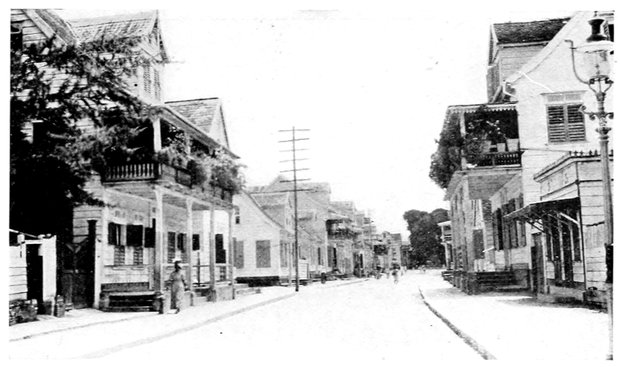
The main street of Paramaribo, capital of Dutch Guiana, with its row of often mortgaged mahogany trees in the background
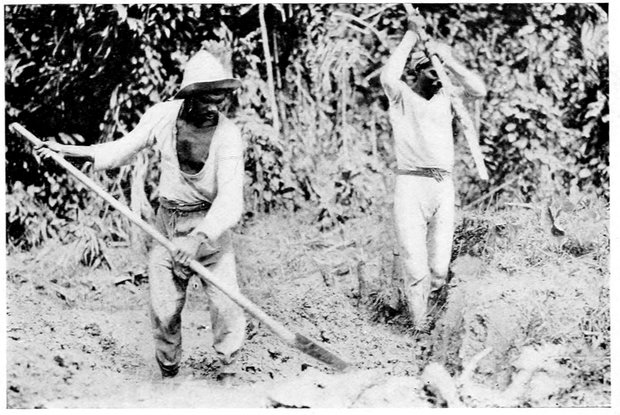
An East Indian and an escaped Madagascar prisoner from Cayenne cutting down a “back dam” on a Surinam plantation in order to kill the ants that would destroy it
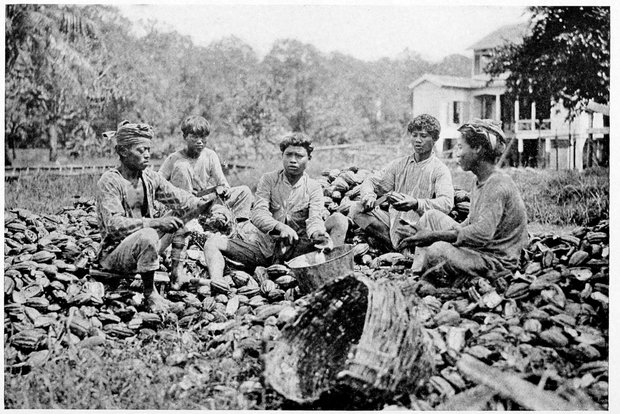
Javanese workmen opening pods of cacao that will eventually appear in our markets as chocolate and cocoa
The settled portion of British Guiana extends from the west bank
of the Essequibo River to the east bank of the Corentyne, two hundred
miles distant, with a few islands at the mouth of the Essequibo and
some ten miles up the Berbice and Demerara Rivers. Of the hundred
thousand acres under cultivation—an area in proportion to the entire
605colony as is his forefinger to a human being—eighty per cent. is
planted in sugar. A century ago the cultivation of cotton, coffee, and
cacao gave way to this, and even alternating of crops is unknown.
Year after year, often for half a century, sugar-cane has been produced
on the same ground. Behind the plantations, which rarely
extend more than three miles from the shore, the soil is a kind of
peat, with here and there an island of sand. In front is the seashore
or river, with its protection of almost impenetrable mangrove roots,
then a dike with openings in it for irrigation ditches, the great wheel-operated
gates of which are opened to let the water run out at low
tide, but closed against the sea or river at their height, for salt on
the land is fatal. Back of this dam is the public road, kept up at
the expense of the plantation and, with the two canals beside it, constituting
a second dike. Here is a mile-wide strip of land that is used
as pasture, for the sugarmill, the manager’s house, overseers’ quarters,
laborers’ villages, behind which, with a third dike, a draining engine,
perhaps a little railway, and the “kokers,” or sluices to let out surplus
water, are the interminable cane-fields, protected from the rainy season
floods of the higher and uncultivated interior by a “back dam.” Canals
are everywhere used for transportation—as well as irrigation—in
iron punts drawn by mules. The secrecy which hangs like a pall
over all of the estates, however, I never succeeded in penetrating.
Perhaps it was merely to prevent some “clever Yankee” from learning
how cane is turned into sugar!
Nickerie was once washed away by the sea, and Georgetown is
saved from a like fate by a massive sea-wall. Down here where one
must look up at the ocean the only way to fill a hole is by digging
another, and there can be no real sewer-system where sewage would
only float back into the city at high tide. Various systems are used
for getting rid of Georgetown’s waste matter, none of them entirely
satisfactory. Its water is brought in from the savannahs by the
Lahama Canal, but this is yellow with vegetable matter and cannot
be used for cooking, drinking, or even laundry purposes. Every
building of any importance has a rain-water tank, some larger than
those along our railroads, and as there is little dust or smoke in the
city, water thus stored is clear and of good taste. Yet for all her
natural handicaps, Georgetown is a comfortable and sightly city of
wide, well-shaded streets, often with a canal flanked by rows of
trees in the center, and broad green lawns so inviting after years
of grassless Latin-America that I was tempted to sit on each of them
606in turn. From the sea-wall to the last negro shacks of the town is a
distance of some two miles, with ample elbow-room and light wooden
structures that make poor fire risks.
The city swarmed with hulking, ragged negroes leaning serenely
against the many posters bearing the appeal “Your King and your
Country need you. Enlist now!” In fact, it is unpleasant, at least
for a white woman, to walk down Water Street among scores of
ragged black loafers who seem to take pains to put themselves in
one’s way. On the other hand, there are cheap public carriages,
which, I suppose, would be the British reply to such a criticism. With
plantains and eddoes plentiful, the mass of negroes are of lazier
temperament than their ancestors, the slaves, who were forced to
acquire the habit of work. They have so much power in the colony,
however, that the man who must live there permanently cannot keep
clear of them, and the visitor who inadvertently touches or even
threatens some impudent lounger may be “summoned” and fined. It
should be noted that in British colonies it is not so much the color-line
as the caste-line which divides society. A man drops out of the
highest class by having African blood in his veins, but so he does
even when he is pure white for many other reasons, such as poverty
or violation of any of the Englishman’s punctilios of social etiquette.
Hindus are less in evidence in the capital than on plantations; Indians
one almost never sees there. Every possible mixture of white, negro,
Chinese, and East Indian may be found in the average crowd, however,
though as a whole this has an Anglo-Saxon demeanor. Most of the
pure whites are pale and thin, the women angular; even the young
men are sallow from lack of exercise, manual labor being impossible
and the principal gathering-place a “swizzle” club. The death rate
is decreasing, but was still more than twice that of New York, thanks
partly to the fact that even the English doctors in many cases still
believed that “this mosquito theory is a lot of bally Yankee rot, don’t
you know.”
The white population, exclusive of the Portuguese, who are not
strictly so, own about three-fourths of the property, and the Portuguese
much of the rest. Besides Chinese and unnaturalized Indians,
there are 172,000 Hindus, nearly all of whom are alien or property-less
non-voters. This leaves the few negroes owning property as the real
rulers, to a limited degree, of the colony. In financial matters, including
taxation, this is largely autonomous. The governor is sent out
from England and is one of eight appointed members of the legislative
607Court of Policy; but there are also eight elective members, and the
governor has the deciding vote only in case of a tie. Those who have
had occasion to deal with it complain that the government is smothered
in red tape. “If you wish to address the head of your department,”
a man certainly in a position to know put it, “you write a letter to
the next man above you, he adds a note and sends it on to the next,
and so on up ten, or a dozen, or a score of rungs of the official ladder,
and the answer comes down again the same way, so that when you
get it back you buy a trunk and pack the stuff away and save it to
read during your vacation.”
But there are excellences in British government which offset some
of its precedent- and caste-loving stupidities. I went one day with
the deputy head of the Department of Lands and Mines, who is also
“Protector of the Indians,” to the recently established “Aboriginal
Indian Depot.” The aborigines are a simple, good-natured people
whose chief fault is a liking for rum, and not only do none of them
live in town, but they cannot cope with urban dangers during their
rare visits there. Principally by the use of liquor, laws to the contrary
notwithstanding, the riffraff of Georgetown made it their business
to rob the Indian men and lead the Indian women astray whenever
they came to town; now the visitors have an official refuge, surrounded
by a sheet-iron wall, which no outsider may enter without formal permission.
There are one long and two short rooms extending the
length of the building, and the Indians had swung their indispensable,
home-woven hammocks side by side, just as they do in their own
wilderness shelters. The large room was for ordinary Indian men,
one of the smaller ones for married couples, and the third for “captains,”
certified river-pilots, and other personages of importance—for
your Englishman never forgets caste, even among aboriginal
tribes. Here any Indian has the right, and is expected, to come and
stay, free of expense, while in Georgetown, buying his own food and
cooking it himself in a simple kitchen behind the building. The Depot
was erected with funds accruing from “balata” gathered by the Indians,
one-third of which is turned into the colonial treasury and the rest
into an Indian reserve fund for just such purposes.
Not only in her grassy lawns and wooden houses, her stern morality
and her altruistic treatment of the aborigines, does Georgetown remind
the Anglo-Saxon wanderer that the differences between his own and
Latin-American civilization are many, significant as well as trivial.
Here he will find again that love of nature, or of outdoors, which is
608so slight in the rest of South America. By seven in the morning even
the well-to-do are parading the sea-wall. Though there is no lack
of carriages and automobiles, all classes go much on foot—the mere
sight of well-dressed people habitually walking seems strange to the
man more familiar with the rest of the continent. Latin-Americans
of that class may stroll up and down a fashionable promenade of a
block or two at a certain hour of the evening, but it will be rather to
indulge in mutual admiration than for exercise. Here one will see
again, with a start of surprise, white women not only abroad at an
early hour, but pushing baby-carriages. In all the rest of South
America it would be unseemly for a lady to pass her threshold in
the morning, except to go to church and possibly to shop, or to be
fully dressed and powdered before mid-afternoon, and even if she
knew of the existence of perambulators, she certainly would not condescend
to propel one herself. Another English touch is the sight
of all classes riding bicycles, from the negro postman to dainty, veiled
young white ladies—conduct which would be instantly ruinous to any
feminine reputation elsewhere on the continent. People no longer
hiss to attract attention; one is no longer a sight to be stared at from
one end of the street to the other; no human wrecks come pestering
one to buy sudden fortune in the form of a dirty rag of a lottery ticket;
money is worth its face value again and is accepted at that rate without
question—even though the newcomer may get hopelessly entangled
in a confusion of reckonings in shillings, dollars, cents, and pence.
It is true that traffic turns to the left and that audiences sit stiff and
motionless as wooden images at band concerts, but this little patch
of England in South America has fine big school buildings, instead
of droning choruses of children packed together in noisome old
hovels. Where there are many negroes there are apt to be beggars,
but they are by no means so numerous and certainly not so pestiferous
in Demerara as in Brazil. The street-cars are not divided into classes,
and one may ride irrespective of the shape or condition of one’s collar;
though castes are recognized in a different way, for the negro-Hindu
motormen and conductors, speaking what is fondly supposed in the
West Indies to be English, have a different vocabulary for each class.
To a black fellow-laborer they say in a kindly, familiar tone, “Get off,
mahn; heah yo street;” to a negro market-woman, impatiently, “All
right, get on, ef yo goin’!” but to a white man of any standing, in a
totally different tone and timbre, “Oh, yes, sir; this street, sir; all
right, thank you, sir.”
A landscape in Hindu-inhabited British Guiana
Indentured East Indians enjoying a Saturday half-holiday before one of their barrack villages
Prisoners at work on a leaking dam in Ciudad Bolívar on the Orinoco
The trackless llanos of Venezuela
609Indians of many tribes, negroes wild and tame, Hindus, Madrassees,
Javanese, “taki-taki,” French déportés, tropical Frenchmen,
Dutchmen, Englishmen, Chinese, Portuguese, and chaotic mixtures of
all of these—one could spend a life-time in the three Guianas. Many
a Frenchman has in the smallest of them. The Pilgrim Fathers first
planned to come to Guiana; it would be interesting to see how different
their descendants would be now. The population of this bit of Europe
in South America resembles the favorite dish of the British section
of it,—the “pepper-pot.” To make a “pepper-pot” one throws into a
huge kettle beef, mutton, fish, fowl, and anything else that will cook
which turns up during the week, adding from time to time a dash
of salt and many native peppers, letting it all stew for days, until
it results in an effective but indistinguishable concoction. The time
may come when the unadulterated white man will recognize what
looks like a dot on the map as a part of his heritage, particularly the
great elevated wilderness and savannahs back of the motley-peopled
seacoast. My latest letter from Hart talks of cattle by thousands of
head, and reports the completion of a cattle trail forty feet wide,
though with all large trees left standing, from Melville’s on the Dadanawa
to within reach of Georgetown. In such a land it is nip and
tuck now as to whether the railroad or the automobile will take first
place in a development that is certain to come in the not far distant
future.
CHAPTER XXII THE TRACKLESS LLANOS OF VENEZUELA
610
Men have been known to make their way directly from British
Guiana to Venezuela; but the effects of the World War
were widespread and only by taking an ocean liner to Trinidad
and transferring to an Orinoco river-steamer could I begin the
next and last stage of my South American journey, a tramp across
the Land of Bolívar—and Castro. By an extraordinary stroke of
luck the Apure of the “Compañia Venezolana Costeira y Fluvial” was
returning that very day, after a month of repairs in Port-of-Spain, to
her regular run on the upper Orinoco, so that in less time than it takes
properly to fulfill the protracted consular formalities required of those
entering Venezuela I was on my way as the only passenger across
the Bocas in just such a frail, two-story, side-wheel craft as that
by which Hays and I had crawled up the Magdalena into South
America three years before.
There was little new along the lower Orinoco to one who had seen
every large river of the continent. Here and there a canoe paddled
by naked Indians nearly as light as a sunburned white man crept
along the lower fringe of one or the other mighty forest wall. A
few huts, mostly abandoned, on the right-hand bank we almost
constantly hugged, with now and then a cornfield chopped out of the
forest, were the only other evidences of humanity. Where we stopped
for firewood, groups of Indian men and women, some of them wearing
clothes and all of them showing in their degenerate, vicious faces
evidence of having made the acquaintance of what we proudly call
civilization, lounged in the edge of the jungle watching our slightest
movements. Their huts were only four poles holding up a thatch roof,
but every person had his own hammock, covered by a mosquitero
reaching to the ground. Gradually hills closed in on us, low, thickly
wooded, with great granite outcroppings. Two old yellow forts appeared,
the one on the higher hill already a ruin, the other flying the
yellow, blue, and red flag of Venezuela, with quite a village of huts
below it for the half-Indian soldiers in khaki and their slattern women.
611These “Castillos de Guayana” were built by the Spaniards to
protect the entrance to the Orinoco, and it is mainly pride which
causes their feebler descendants to keep up the fiction. For the
authority of Caracas is little more than theoretical in that half of
Venezuela called Guayana which lay hidden in densest wilderness on
our left.
As we neared Ciudad Bolívar, white-winged boats more comfortable
than the wall-less dwellings along shore, each with a huge number
painted on its sails, came down the light-brown river among the small
floating islands it had torn off far above. The typically “Spig” city
lay piled up over a knoll on the southern bank, scattered portions of
it spilling over the rolling and marshy country roundabout. A few
feet from shore we were ordered to halt and await a “visit,” and it
was hours later that the languid, futile formalities were ended. The
chief excitement in town was “the dike,” a great wall built to keep
back the water from the flooded campos, now leaking until the great
lagoon which always forms at the foot of the town during the rainy
season was driving out the dwellers in the lower fringe of huts. Half
the city had come out to see prisoners from the cárcel, under even
more evil-eyed soldiers from the cuartel, strive to stop the leaks by
letting cowhides over the side of the wall and tamping apathetically
here and there with their clumsy tools. But it is the Venezuelan
custom for jailers to steal most of the rations to which their charges
are entitled, and the prisoners were in no condition to accomplish
their task, even had they had any incentive to do so. I was startled to
hear a voice behind me say, “I fear we all go’n’ get de wash-out, sah.”
At least it gave one a sense of not being entirely cut off from the
more orderly world to hear English-speaking negroes in the streets
of Ciudad Bolívar, and their presence made other foreigners less
subject to constant open-mouthed scrutiny. Hackmen, chauffeurs,
nurse-girls, and servants in general were commonly Guianese or West
Indian negroes, so that my native tongue often sounded in my ears.
The rest of the population was that of almost all Spanish-American
cities,—few pure whites and fewer full Indians, but every possible
mixture of the two, with a goodly dash of African blood thrown in
to complete the catastrophe.
Whatever beauty Ciudad Bolívar has is indoors. No green lawns
or flower-gardens cheer the eye of the passer-by, though now and
then a glimpse through a doorway along the deadly line of dirty stucco
walls reveals a patio filled with blossoms and tropical shrubbery, with
612perhaps a fountain. Even inside is no patch of Eden. Parrots, as well
as all domestic fowls, contest the average patio with dogs, pigs, naked
urchins, and adults. It is in conformity with his other cruelties to dumb
brutes, his total lack of compassion, that the keeping of caged animals
is an inherent trait of the South American. Back of the city lies an
extensive swamp from which come great numbers of mosquitoes, the
same swamp that the people were struggling so energetically to have
their jailbirds hold in check. It is often hot by day, but at night a
cool breeze sweeps in from the broad Orinoco and the town casts off
its torpor. Lights spring up, gaudily dressed and heavily powdered
women lean on their elbows behind the heavy wooden window-bars,
the band plays along the waterfront Alameda, the streets are filled
with a roving crowd of carnal-minded men and boys, and Ciudad
Bolívar seems for a space almost a wide-awake city.
The Venezuelans refused to take my proposed walk across the
country seriously, so that it was doubly difficult to get trustworthy
information. The llanos were said to be flooded at that season, and
the overland journey to Caracas was reputed to be 180 leagues, a
mere 540 miles! I dared not send myself forth on any such unnecessary
stroll as that, for I had solemnly sworn to be home at all costs
within four years of my departure, and it was already the end of
July. But at least I could tramp straight across to the Atlantic, and
find swifter means of transportation to La Guayra and Caracas. There
were worse stories of the dangers of a lone “gringo” wandering through
Venezuela than in any other South American country. Revolutionists
had for months infested the very territory in which I proposed to
risk my life—but I remembered the tale of the Venezuelan colonel sent
with his regiment to wage battle over the range, who came hurrying
back at the head of his troops, to report, “My general, just over the
summit we met two drunken Americans, and they would not let us
pass!” Besides, the war in Europe had made it difficult for bandits
and revolutionists to get arms and ammunition. “But at least,” cried
the natives, “you must have a mule and a saddle!” and a kind man
offered to sell me such an outfit, “all ready to mount”—for a thousand
bolívares! True, a bolívar is no more than a franc, but a thousand
of them was more than I was depending upon to set me down in one
of our north central states.
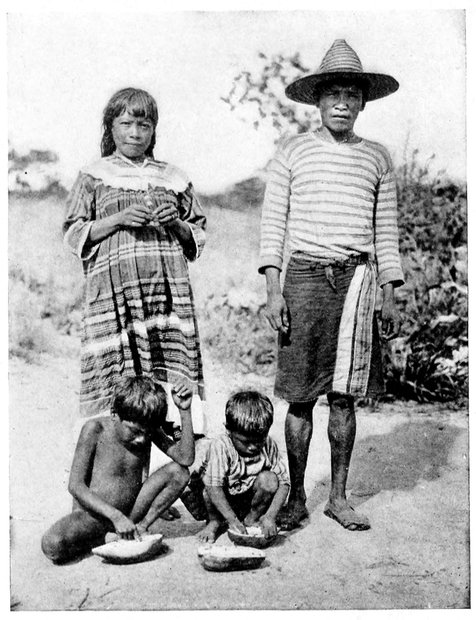
An Indian family at eastern Venezuela
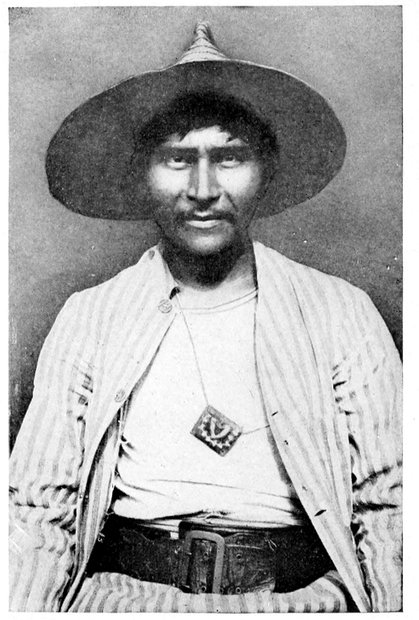
Lopez, the hammock-buyer, and the charm he always wears on his travels
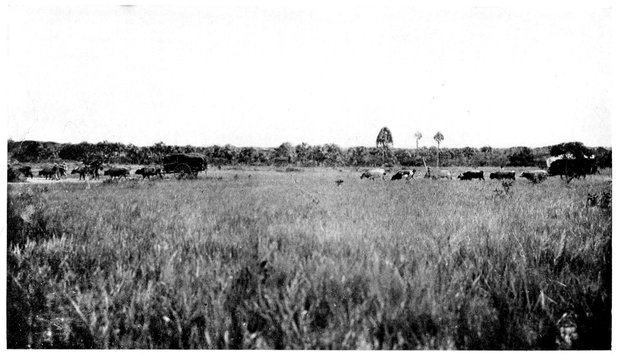
I was reduced, therefore, to my usual common denominator,—engaging
my own instincts as guide and hiring my own feet to carry myself
and my belongings. A certain reduction of the latter was imperative.
613The most effective accomplishment in that respect was the
trading of my heavy Ceará hammock—though it was like dismissing
an old friend, for I had slept in it since long before Carlos died—for
one made of curagua by the Indians of the Orinoco. This was a mere
grass net, being woven of the fibrous leaf of a small wild plant related
to the pineapple; but it weighed only forty ounces, ropes and all, and
is capable of holding me comfortably in its lap to this day. As I
was taking leave of the native-born American consul, my attention
was drawn to great blocks of yellowish stuff in his warehouse that
were sewed up in sacking and stenciled for shipment to the United
States. It turned out to be chicle, the milky juice of the sapodilla
tree, which flourishes along the Orinoco, boiled down and dried for
use in the one land that appreciates so doubtful a luxury. The consul
gave me a piece, very light in weight and of the size of my fist, and
the wisest thing I did in Venezuela was not to throw it away—not
simply because it was pure chewing-gum, lacking only the sweetish
flavor, but because it saved me many a thirsty hour in my tramp across
the arid country.
The Orinoco sweeps swiftly past Ciudad Bolívar, formerly called
Angostura—the “Narrows”—a big rounded rock breasting the current
in midstream. I crossed it in one of the little sailboats with
numbered sails, speeding along before a stiff breeze that seemed to
whip us swiftly forward, until a glance at the shores showed that
we were really moving backward downstream, so swift was the
current. Only gradually did we make the opposite bank, and it took
nearly an hour to pole our way back to Soledad, just across from where
we had started. One could scarcely blame this hamlet, justly named
Solitude, if it looked unwashed; only the day before a boy of twelve
had stepped into the river for a bath and an alligator had walked off
with him for its Sunday dinner. Still, the place had children to
spare. Staggering ashore under my bagful of assorted junk, I at
once struck out along the “camino real,” a mere trail which first
climbed to a slight plateau with a view back on Ciudad Bolívar, then
broke into thinly scrub-wooded pampa or sandy llanos covered with
tuft-grass as far as the eye could see. As the “royal road” showed
a constant tendency to split up into many paths that lost themselves
in the heavy grass, I had to trust mainly to compass and instinct. At
noon I stopped at a mud-hole fringed with cattle-tracks to eat a square
yard of cassava-bread washed down with handfuls of muddy water.
The sweat poured off me in streams under my big, awkward burden,
614and it soon became apparent that I must still further reduce my load.
Then and there I gave my leather leggings to a passing half-Indian
horseman, who, to prove his aboriginal blood, did not so much as
thank me. Three Indians in hats, loin-cloths and pieces of jackets,
with an old rifle each, loping noiselessly past, aroused my envy.
The sun was still troublesome when I came to a miserable village
of half a dozen mud-and-thatch ruins, before which ragged men sat
in deep silence, now and then heaving a long sigh and relapsing again
into silence. I coaxed one of them to row me across the La Piña
River, and plodded on. What time it was when I reached a ranch
called “El Orticero” I cannot say, for the crystal and minute-hand of
my aged tin watch had succumbed to the day’s struggle, and the rest
of the contraption functioned only intermittently. I pressed it upon
my old but artless host, and a chicken died in consequence. But
the fowl was evidently both young and slender, for the entire dinner
consisted of a thin soup with a few scraps of chicken in it and a bowl
of milk. No wonder these people have no energy; this to them was
a gala meal.
The considerable wait from dawn to sunrise was scarcely worth
the small cup of black coffee, or rather, guarapo, which the brewing
of last night’s coffee grounds yielded. Passing the cow-yard as I set
out, however, I got a bowl of foaming milk with which to wash down
another shaving of cassava. In the middle of the morning a strong
fever came upon me, forcing me to lie down in scrubby shade on the
sand and tuft-grass for an hour or more. When I could endure my
raging thirst no longer, I crawled to my feet and stumbled on across
the blazing, choking semi-desert in a for a long time vain quest for
water. At last I came upon a red-hot sandy bed, along which crawled
a stream half an inch deep where I scooped out a hole and, when it
had somewhat cleared, inhaled in one breath a good quart of the
lukewarm water. A reasonable man, recognizing the trip I had laid
out for myself as a mere “stunt,” would have given up and returned
to Ciudad Bolívar and Trinidad; but I was born bull-headed. I
staggered on, and at length sighted a countryman’s thatched hut—an
hato, they call it in Venezuela—where I was welcomed with bucolic
but genuine hospitality and motioned to a seat on a whitened horse-skull.
I swung my hammock instead. When this had reduced my
weariness, I took up the imperative question of doing the same for my
pack, absolutely refusing to stagger farther under such a load in
such a climate. I threw aside my heavy shoes, thereby taking the
615weight of the low city ones off my shoulders, following them with
a pair of wintry trousers and a workingman’s shirt I had seldom worn.
The shoes and several odds and ends I bequeathed to the woman of
the hato, for her absent husband; the trousers and shirt went to a
visiting neighbor, who promised to guide me in the morning to the
next hamlet. I threw away the tin cans that protected my exposed
kodak films, all but the quinine I should need for the next fortnight,
almost all my other medicines, two-thirds of my soap, most of my ink
in the bottle I had carried from Quito, and I even cut in two my tube of
dental paste. The woman and her visitor accepted all these things
with labial thanks, but my strongest hints produced nothing to appease
my appetite. The sun was casting its rays in upon me under
the thatch roof before we sat down before a little plate of fried
mango, a kind of armadillo stew, and little bowls of coffee—well
enough, but just one-tenth as much as I could have eaten myself.
“Por aquí son la gente muy amigos al interés,” said my ungrammatical
guide, when the woman was out of hearing; “Here people are
friends of their own interest. If you had no money to buy food, or if
you had not given her all those fine things, you would not even have
got this, but might have starved before her eyes.”
The truth is that the country people of Venezuela have almost
nothing to eat themselves, much less anything to share. They have
not the energy to grow much of anything, no one has the energy to
bring things to sell from town; and under such a blistering sun I do
not know that I blame them. More disheartening still is the government
of unenlightened tyrants under which they live. This woman
and her husband—their story is typical of thousands—once had more
than a hundred head of cattle, and other possessions in proportion.
Came Castro with his fellow-rascals and stole or ate the whole herd.
One has little inspiration to pile up possessions by rude labor under
a tropical sun for the advantage of the next passing band of ruffians.
These poor, sequestered people in their tucked away hatos were
typical of all the campo, with its stories of oppression, tyranny,
treachery, and stark brutality, all told in a gentle, uncomplaining
voice and manner, avoiding any direct reference to the chief tyrant,
as if even the palm-trees had ears, and replying to all pertinent questions
with that helpless, hopeless, irresponsible, non-committal “Quién
sabe?”
Somewhat reduced in load, though still overburdened, I set out again
next morning. A tiny cup of black coffee was what I was expected to
616start on, but I managed to beg two half-ripe mangos. In my light
shoes and reduced pack I spun along splendidly—so long as I had any
road to spin on. Just there was the rub. Don Augustín, the hato
visitor, had left with me, carrying the shirt and trousers I had given
him to guide me to the next hamlet. But when, some four or five miles
on, we had come upon an Indian hut and bought two patillas, a kind
of watermelon, for ten cents, he announced that he was going a
league westward to his own house to get his hammock, and that I was
to go “straight ahead” along the road he pointed out, until he caught
up with me. Both he and the “Caribes,” as Venezuela calls the
aborigines of this region, assured me that I could not possibly go
astray—yet I had not covered two hundred yards of that sandy,
coarse-grassed pampa before another “road” led off, just such a narrow
path as the one I was on. Then came fork after fork in swift
succession, until I was involved in a network, an absolute labyrinth
of trails, any one of which was as likely to be the “royal road” as any
other. I took one after another, only to have the path dwindle and
fade from under my feet in the high grass and be gone. Several
led to the charred remains of an Indian hut; one finally brought me out
before such a hovel still standing, where half a dozen Indian women,
all but stark naked, squatted and lolled on the earth floor, three of
them suckling cadaverous and filthy brats, and all languidly engaged
in scratching their leathery bare skins. They spoke little or no Spanish,
but seemed to imply that I should take a road down into a valley. I
took it, lost it, again found pieces of it, or some other path, lost those,
brought up in a stream that soaked me to the thighs, and seeing
worse ahead, as well as evidence that this was not the right direction,
I scrambled my way back to the Indian women. But they were just
as naked and ignorant as ever. I gave up, though it was still morning
and I was anxious to push on, and swung my hammock under a roof
on poles beside such road as there was, got into pajamas so that I could
spread my dripping garments in the sun, snatching them in again for
several light showers and hoped against hope that some one with
human intelligence would come along and give me information.
Hope having died and my clothing being nearly dry, I harnessed
up again and went back once more to the Indian hut. This time the
man was there. He gave me in fluent Spanish verbose directions
concerning a “road” alleged to lead directly to “El Descanso,” which
was close by, without a chance of my missing it. Simple as his directions
sounded to the fellow himself, I offered him money to take me
617there; but he replied that he was a consumptive with fever—and
he looked it. Within a quarter of a mile that “direct” road forked
into at least twenty similar paths, every one of which looked as direct
as the others. Catching sight of a hut down in a valley, I made for
it through sticky mud—and found it open and quite evidently inhabited,
but with only a squalling infant in a hammock within sound of
my voice. I waded back to more trails upon trails across swamps and
through tangled undergrowth, saw another hut on a hill, climbed to it
and found it abandoned, saw another across a swampy valley and
struck out for that. This time it was a large house or collection of
houses with solid mud walls, instead of mere reeds, the shaggy
thatched roof “banged” at the doorways, and other signs of affluence
and intelligent information—but every door was padlocked.
There was no use making any more blind guesses. I swung my
hammock under a tree at the gate, where another ass tied to a post
was already dozing, resolved to stay until my luck changed. For what
seemed hours I hovered on the brink of starvation, when there appeared
across the rolling, weed-grown country what looked like a horseman
on a mule. Illusion! It was only a boy on a jackass. He knew
nothing of roads, but he did bring me the information that I was even
then at “El Descanso,” the very place I had been seeking, and that
the people who lived there would be back “soon.” Also he sold me
three mangos, but I had not even a knife, and to rob a mango of its
substance with a small pair of scissors and one’s teeth is as harrowing
as not to be able to find a drop of water after the ordeal is over. Also
in such a climate it is a fine fruit for those who wish to die young.
But at least I was passing the most blistering hours of the day in
breezy shade in a spot appropriately named “The Rest.”
It must have been four o’clock, and for two hours I had been
enjoying a fever, not the burning one of the day before, but the languid
kind one almost luxuriates in so long as one can lie still. Not a sound
had there been in all this time except the lazy sighing of the breeze
in the scattered shrubs and an occasional protest from the other hungry
donkey. Then all at once I heard a woman or a boy shout within twenty
feet of me; but when I sat up and called back there was no answer. I
had wandered twice around the house, and the call had been several times
repeated, before I discovered that it came from the family parrot,
perched on the ridge of the roof. Again and again it hallooed across
hill and swamp, in exactly the tone and voice of a South American
country woman, telling some one in clear, impeccable Spanish to come
618home at once, that some one was there, and more to the same effect.
At last an answering voice, and then several came faintly across the
valley, sounding steadily nearer, and finally two girls, one already
married, shuffled up in alpargatas and the shapeless loose calico dresses
of their class. The older one seemed resentful, and the younger
frightened, at sight of a man, even out under their gate-tree, and as
I was just then enjoying another wave of fever, I continued to wait,
hoping they would be followed by some one of my own sex. When it
began to grow dark, however, I went to ask the older girl if she could
cook me something. No, there was not a mouthful of anything in the
house. Well, how much for a chicken? Forty cents. I gave it, and
lay in my hammock for another interminable hour. Then she came
to ask if cheese would not do! I told her in a voice one does not
customarily use to ladies that I had paid for chicken, and she shuffled
away again; and long after dark she brought the cooked fowl intact,
broth and all, with a bowl of goat’s milk. But by this time fever had
routed my appetite and I could not drink more than half the broth
and a bit of milk, so I wrapped the chicken in a paper and hung it
from a rafter of the empty sheep-pen without walls, to which I retired
rather than keep the timid maidens up all night by staying in the
house.
The girls had no knowledge that roads ever ran anywhere, and
were even more grouchy and uncompassionate the next morning when
I wheedled another bowl of milk and struck off at random. Troubles
never come singly, and when I took down the chicken I looked forward
to feasting upon later in the day I found that a colony of ants
had anticipated me, and there was barely a scrap of meat left. As
it was plainly up to me to get somewhere, I took the first of several
trails leading down into the valley in a general northerly direction.
It showed a few burro-tracks for a way, but gradually split up into
ever dwindling paths, all of which ended sooner or later in morichales,
those great bog swamps filled with every difficulty and danger from
entangled roots to alligators, and densely shaded by the moriche
palms from which Venezuela makes her hammocks. It would be easier
to get through a stone wall. At length I tried a path leading almost
southwest, determined to get around the swamp by a flanking movement,
but I barely saved myself from dropping into a sinkhole of
quicksands. Back on dry land again, I kept to the highlands for
miles, at times plodding in exactly the opposite direction from that
in which I was bound, now and then wading a patch of marsh and
619finally, crossing the stream near its outlet from the morichal, arriving
famished at a hut almost within gunshot of “El Descanso.” Here
the family of the boy who had sold me the mangos the day before
was engaged in the favorite Venezuelan occupation of lying in hammocks,
but the woman had more than the racial average of humanity
and intelligence and for the sum of ten cents she placed before me
four fried eggs, than which nothing had tasted better as far back as
I could remember. Then they directed me to San Pedro, and by
some strange luck I managed to keep the right one of the labyrinth of
paths across the deadly still, sandy prairie, with its coarse, uninviting
grass and ugly scrub trees, to a kind of country store, where two
tiny stale biscuits and a mashed-corn loaf, called arepa, gave me the
strength to push on.
Getting careful directions, I set off for Tabaro, and nothing could
have been easier than to find my way across this flat, hot plain, utterly
waterless, so that all the way to that cluster of huts I subsisted on
three small lemons. But I might have known that this easy going
was only a lull before the storm. They sent a boy a little way from
Tabaro to put me on the right road, “which goes straight, straight,
without a chance to lose your way, and anyway you can follow the
tracks of this horse, which just left for there.” Follow his Satanic
Majesty! There is not a human being, unless he knew it already,
who could have distinguished that path from a hundred and fifty
others, of cows, horses, mules, and everything else that goes on four
legs in Venezuela. I took the one that looked most promising, landed
in a morichal, pulled off my shoes and waded for some distance in
black mud, tore through more tangled undergrowth, and found myself
only at the beginning of the real struggle. Removing my trousers in
the hope of saving enough of them to escape arrest if ever I struggled
my way back to civilization, I attacked the swamp and jungle with all
the force I had left, cutting my feet and legs, gashing hands and
even my face, sinking to my waist in the slough, watching the sun
rapidly setting on a night that I was not only doomed to spend out of
doors without food, but evidently immersed in mud and without water
to drink. Then all at once I burst out upon the brink of a large, swift
river. I had already heard of it, but was supposed to come upon it
at an hato called “El Cardón” and be set across in the owner’s canoe.
There was no sign of human existence, much less of a farmhouse,
and the river was plainly too swift to swim with my load, even if it
620were not full of alligators. Besides, the most important thing just
then was rest, for I was weak from fever and lack of food.
The red sun sank behind the tree-tops to the east—no, if I could
have gotten my bearings right, I believe it would have proved the
west. I hung my hammock between two scrubs, bathed on the bank
of the river, drank several handfuls of it for supper, and rolled in.
To add to the pleasure of the situation the one book I happened to
have with me opened to a chapter entitled “The English Cuisine!”
Being absolutely devoid of shelter, I had dragged a few fallen moriche
leaves together and made a tiny lean-to beside me under which to
shield my scanty possessions. It was in keeping with my luck in this
thirteenth Latin-American country in which I had traveled that
for the first night since I had reached Venezuela it should rain. I
was awakened first by some wild beast nearly as large as a yearling
calf, which dashed out of the undergrowth, uttered a strange cry at
sight of my hammock, and sprang in one leap directly over me and
into the stream with a great splash. I emptied my revolver after it,
but it quickly disappeared. By the time I had hunted cartridges in
the dark and loaded again—for some other heavy animal seemed to
be prowling about in the brush—it began to sprinkle, with lightning
flashes, and then it turned to a real rain. I adopted the Amazonian
means of keeping dry, stripped naked, rolled clothes and hammock
into a bundle I could thrust under the improvised shelter, and sat
down upon the unprotected corner of my stuff and let it rain. Luckily,
it did not continue long, and within half an hour I had rolled up
in my hammock again.
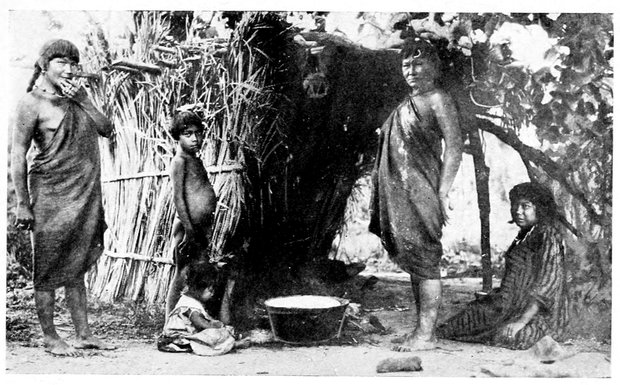
The palm-leaf threads of the hammocks are made pliable by rubbing them on a bare leg in the early morning before the dew has dried
We were delighted to find a rare water-hole in which to quench our raging thirst
When next I woke, in a breeze so cool that I put on my daytime
clothing over my pajamas, the stars were shining. But this was base
deception, for I was awakened later by a veritable downpour, without
even time to strip, and could only huddle over my belongings and
keep as much water off them as possible. Soon afterward dawn came
and the next problem after getting my wet mess together was to decide
whether to go up or down stream. Nowhere was there a sign
that man had ever before been in those parts. I chose upstream, and
quickly plunged again into another morichal, such a jungle and
swamp, filled with the odor of rotting vegetation, as only wild men
or lost ones attempt to fight their way through. Plants with sharks’
teeth, sabre cacti with hook-shaped horns and needle points along the
edge, upright sprays of vegetable bayonets, grappled and pierced
clothes and skin. Through this mass I tore and waded barefoot for
621perhaps two hours, by no means certain there was any end to it; but
finally, with legs and feet a patchwork of cuts and scratches, and my
shirt in rags, I came out upon another vast, tuft-grass and sandy
prairie. On these immense scrub-wooded plains, crisscrossed in
every direction by narrow cow-paths, but rarely by human trails, a
man might wander until he choked or starved. I followed one path
several miles until it died a lingering death, then fearful of losing even
water I returned to the river, which here almost doubled upon itself.
I tried another path and had wandered at random for I know not
how long when my eye was caught by a thatched roof an immense distance
away at right angles. I dragged my sore feet—they were so
swollen I could not put on my shoes—for miles through the cutting
prairie grass—only to find an abandoned and ruined hut! I was about
to return to the river in despair when I caught sight of another hovel
on a knoll a mile away. At first this also appeared abandoned, but
as there were several chickens about it, evidently it was inhabited, a
fact verified by finding still warm the ends of fagots over which
breakfast had been cooked. Lifting the woven-grass door of that
half of the house with walls, I found two hammocks and a few simple
utensils inside, but not a sign of anything edible, except the chickens,
and I had no matches. There was not even water, and I had to take
a big earthenware jar down to a swampy stream a quarter of a mile
away and carry it back on my head. Then I swung my hammock,
got into pajamas, and hung out everything to dry, determined to stay
there until doomsday rather than strike out into the foodless unknown
wastes again. I slept. A shower woke me just in time to snatch in
my clothes. They had been hung out once more and I was again
asleep when, about midday, I was awakened by a rustling of the grass
door outside which I hung, and looked up to find a woman of the
same dirty, grouchy, uncompassionate type of all those parts. I
asked her where I was, and was delighted to learn, even from so sour
an individual, that I was barely a league distant from the hato I had
been trying to reach. The female was returning there at once, and
I could “follow her footprints.” There was no getting her to wait
a minute while I dressed and packed, and well I knew my ability to
lose her footprints within the first hundred yards. I did just that,
and should have been as badly off as ever, had not a half-negro with
two babies appeared on a horse, followed by his woman and older
daughter on foot, likewise bound for “El Cardón.” We waded two
swamps, cutting up what was left of my feet, and when I stopped
622within sight of the hato to wash them in a stream, another sudden
shower left me dripping at every pore.
“El Cardón” was a collection of several mud houses in the center
of a large ranch. As usual, the owner was not at home, and the
slatternly, filthy, moralless female in charge seemed to take pleasure
in my condition. Though the place swarmed with chickens and several
other potential forms of food, her stock answer to my repeated
offers to pay well for one was that lie I had so often heard in the
Andes—“Son ajenos—they belong to someone else.” “Well, sell me
anything to eat,” I urged, with as much calm dignity as I could muster
under the circumstances.
“I am not the owner,” she invariably replied, “and I cannot.”
She could, of course, for she was in full charge of the establishment,
but these part-Indian people of rural South America probably
would enjoy nothing more than to see a man die of starvation in their
noisome dooryards. It is the same spirit which makes the Spaniard
shriek with delight over a disemboweled horse at his bull-fights. It
cost me a struggle even to get water. Here the man with whom I
had arrived took a hand, and at last he got her to open the main room,
the only one that was not filled with fowls, dogs, babies, and pigs
rolling in their own filth, which soon invaded that also. It was a
cement-floored place with only the thatched roof for ceiling, photographs
of the owner and his relatives in all sorts of unnatural postures
and some silly English lithographs of about 1840 scattered
around the half-washed walls. Finally, at least three hours later,
this same man induced the stubborn female to serve me a dish of
beans and rice with some scraps of pork in it, such as she fed twice
daily to the peons.
As the next place was eighteen miles away, by a “road” I was
almost certain to lose, I was stranded until I could by hook or crook
get a guide and food for the journey. I had several times bathed
my bleeding feet and legs in the only disinfectant available, kerosene,
which added to the combined ache of my countless lacerations, while
to complete my superficial misery, swamps, sun, and perspiration had
opened anew the half-healed tropical ulcers and the wound above
one elbow where an English bulldog had bitten me when I had had the
audacity to attempt to deliver a letter of introduction on a sugar estate
in British Guiana. At length a man theoretically in command of the establishment
arrived and after a long argument I was half-promised
a guide for mañana—if I would pay him sixty cents, that is, three
623days’ wages at the local scale. Then the woman whose hut I had
invaded, returning “donde mí,” as the rural Venezuelan calls his own
house, accepted forty cents for a chicken which she might or might
not send for me to turn over to the unsympathetic female, who might
or might not be induced to cook it. The fowl came, however, and
died at sunset, so that it was long after dark when it reached me
smothered in rice and none too well done, though I had difficulty in
keeping enough of it for the next day’s journey. Another capataz,
with as little authority as the other over those supposedly under his
orders, appeared and, with two peons, hung his hammock from the
beams of the family parlor in which I sat. For some two hours they
swung back and forth thrumming rude guitars and singing improvised
couplets. Illiterate and ignorant as they were, they could alternate
unhesitatingly with two-line rhymes on some local subject of
the day—such as myself:
“Y un blanco ha llega-a-a-o
Con los piés maltrata-a-a-o.”
These were almost always spiced with some indecent reference to
women, about such remarks as two stallions might make to each other
in a discussion of mares, if they had speech—no, they would be more
dignified. “Nosotros somos unos brutos,” said one of the youths,
who at least had a glimmering of his own ignorance, rare in those
parts; but his use of the word “brute” was not what I would have
given it. The peons came twice after I had retired, posing at least
as authorized go-betweens, to ask whether I wished the unspeakable
female to share my hammock with me, a favor which she frankly took
turns in showering upon all the men above the age of fifteen on the
place.
The usual farmyard chorus announced dawn long before it arrived,
and even when it did come I could not strike off alone and unbreakfasted.
But two hours passed before the surly female brought me
a cup of black coffee, and I was about to start alone, whatever the
risk, when a negro named Ambrosio turned up and offered to go with
me for forty cents. Guides are cheap enough, if only you can get
them. The female had stolen more than half the chicken I had left
in her charge, leaving me burdened only with three pieces of it. I
overcame Ambrosio’s natural tendency to put it off until mañana and
we struck down across the hot plain to the river, which we crossed
in an old curial attached to a wire stretching from bank to bank, Ambrosio
624carrying me ashore on his shoulders—at my suggestion—to
save me the time and trouble of removing and replacing my shoes.
I also bluffed him into carrying the larger part of my bundle. Luckily,
I had not started alone; I certainly should have lost the way
again. So did Ambrosio, for that matter, though like a true Latin-American
his version of it was “se ha perdi’o el camino—the road has
lost itself.” He was an experienced vaqueano, however, and striking
across the rolling, loose sand, with some sidestepping he landed me
at noon in La Canoa.
This was a village of several large huts on a one-wire telegraph line,
the principal one being occupied by the part-negro family of the
telegraph operator. Almost a real meal was prepared for me while I
swung in my hammock above the earth floor of the sala, or “sitting-room.”
The toothless old lady with whom I whiled away the delay
said it was bad enough to live in a region where one could get nothing
to eat, but “the worst is that when somebody dies, you can’t even
buy candles!” I agreed with her. A wide, main-traveled trail, always
within sight of the telegraph wire, lay before me, but there were
twelve miles to be covered without a drop of water. I had three
small green lemons, however, and set my fastest pace until I reached
the clear river near the end of the journey, halting to drink it half
dry before bathing and strolling up to three miserable huts on a
knoll above.
Here a part-Indian youth named Lopez, with two asses and a
mulatto boy assistant, had also stopped for the night on a journey
in my direction, and as there were thirty miles without water ahead,
I made myself simpático in the hope that we might join forces.
Neither for love nor money could anything be bought here, except
sugar-cane and miserable cassava-bread. I consider my digestive
apparatus above the average in enduring hardships, but I felt it was
entitled to something better than cold fried sawdust that evening.
This ridiculous notion aroused the mirth of the natives, who gathered
around me prophesying disaster while I tried the effect of boiling a
few sheets of the cassava-bread into a kind of hot pudding. They
were right. The stuff tasted like wet calico and an hour later I was
attacked with the worst case of seasickness I have ever suffered,
which lasted nearly all night, the earlier part of it gladdened by the
natives standing about me doubled up with shrieking laughter.
Lopez uncovers as he passes the last resting-place of a fellow-traveler
Dinner time in rural Venezuela
Lopez enters his native village in style
My breakfast consisted of sucking a sugar-cane. These people,
though not exactly savages, have the same improvidence and indolence,
625not to mention heartlessness, and are so lazy that they will
sit half-starved or kill themselves early by the rubbish they put into
their stomachs, rather than go out and plant something. They were
so lazy that there was not a drop of water in any one of the three
huts until some two hours after the first complaint of thirst was
heard; they live so literally from hand to mouth that no sooner do
they get a bean or a grain of corn than they eat it raw. Let anything
in edible form appear, and there is a rush of dogs, pigs, chickens,
and goats to dispute it with their human companions; give them meat,
and they will sit up all night to cook and devour it, never beginning
their preparations for the next meal until everything, down to the
last water-jar, is empty.
Lopez offered to put my bundle on one of his donkeys, whether
in the hope of running away with it or from kindness mingled with
the expectation of a tip I did not decide until some time afterward.
With half the morning already gone, we were off at last, under a
blistering sun, everything I owned, including my money and proof
of identity, on the burro’s back, except my kodak, revolver, and a
small bottle of water. We had gone a league when Lopez decided
to turn aside to the hato “La Peña,” as far off our line of march,
and, still carrying the bottle of water, I arrived at the same river
from which I had dipped it up and had to shed shoes and trousers to
cross it. Here we squatted for hours in an earth-floored farmhouse
belonging to a man who boasted possession of thousands of acres, yet
who dressed in rags and in whose house there was scarcely a day’s
rations. No wonder people living as they do in rural Venezuela are only
too glad to start a revolution, if only in the hope of perhaps getting
something to eat.
About noon I discovered that we were waiting while an ass that
was for sale could be found. Whichever way I guessed on this trip,
I was wrong. I had thought that by joining Lopez my progress would
be increased; already it looked as if quite the opposite were the case.
At last the burro was found; then he must be caught; then he proved
malucho, which means almost anything in Venezuela, wild, twisted,
wrong, mad, not right in any way. Then there ensued a long Oriental
argument about the price, which was finally settled at eighty
bolívares ($16.17). Next Lopez must have a document of sale on a
sheet out of my note-book and written with my pen—because there
was evidently not another one in the region; then he must undo his
pack and take out money enough in silver to pay the price, after it
626had been counted half a dozen times on both sides, and three times
by me as confirmation, and finally, at a fine hour to start on a twenty-seven
mile tramp across a desert without water, food, or shelter, we
were off.
For the first few miles it took the combined exertions of the three
of us to initiate the new donkey, who was young, large, and strong,
so that by the time we were well out of reach of the river again, our
tongues were protruding with thirst. Then we plodded unbrokenly
on, hour after hour across a tinder-dry desert of coarse tuft-grass
and scraggly trees, slightly rolling in great waves, the “road” a dozen
untrodden paths hidden in a grass that tore viciously at our feet.
Unless we found a pozo, or hole in the ground, well off the trail at
about mid-distance, by spying an extra insulator on the single telegraph-wire
that kept more or less beside us, we would come upon
no water during the whole twenty-seven miles. I allowed myself
two swallows from my bottle at the end of the first blazing half-hour,
and as many at regular intervals thereafter, having to share my
scanty supply with Lopez. With the typical improvidence of his race
he had brought none with him, but being a true Latin-American, he
expected to be protected by those who had provided themselves. By
good luck, rather than for any other reason, we did catch sight of
the white knob on the wire midway between two poles, and after
long search found in the immensity of the desert an irregular hole in
the ground where water is said to be always clear and good. My
bottle filled again, but with my maltreated feet shrinking at every
step, we plodded on toward the next water, fifteen miles away. During
the last five of them I chewed chicle incessantly, and without it
would probably have been capable of drinking the blood of my companions.
At last, with dusk settling down, we sighted a good-sized
house on a ridge, but as this was a telegraph office, Lopez did not
wish to approach it, having the lower-class Venezuelan’s dread of
coming into unnecessary contact with the government in any form.
We hobbled on until dark, when I caught sight of a hut some distance
off the trail and forced my tortured feet to carry me to it. It
proved to be the most miserable human dwelling I had yet seen,
inhabited by a yellow-negro male and female without a possession in
the world worth a dollar. There was not a scrap of anything to
eat, no light, and not even a roof over most of the house. But casually,
during the course of the fixed formalities of greeting, the man
mentioned that back at the “office” where Lopez had refused to stop
627the weekly steer had just been killed! It was the first time since
leaving Ciudad Bolívar that there had been a possibility of buying
meat. I offered the mulatto a cash reward to go back and get me two
bolívares worth, an offer which he accepted with what passes in
Venezuela for alacrity, first showing me on the way his “well”—two
small holes in the ground on the edge of a morichal. There I sat
and poured gallons of water on my aching feet, at the same time
drinking my fill. Hobbling back to the hut, I had the woman put on
the kettle at once, and the water was hot when the man arrived,
strangely enough bringing what was probably the whole forty cents’
worth—a great slab of beef nearly two feet long. Unnecessary delay
being painful, I myself cut it up and soon had it stewing. Meanwhile
I sent our colored friend to a neighboring hut to buy papelón,
which proved to be my old companion chancaca, panela, rapadura, or
crude sugar of solid form, in a new disguise. By the time he returned
I was drinking beef broth, to the astonishment of all beholders, for
these foolish people, who are always on the verge of starvation and
ready to eat the most inedible rubbish, boil their beef and then throw
away the broth! They seem, too, to prefer their miserable cassava to
meat, though in this case the family was still devouring their share
of the feast when I turned in at what must have been near midnight
of a day that I only then recalled had been Sunday.
The most persistent of roosters, a few feet away from me, began
his false report about three and kept it up unbrokenly until daylight
really broke. This time we loaded the big new donkey, but the sun
was well up before we had found and captured the other two. The
old canvas cover of Lopez’ pack showed faintly the words “U. S.
Mail,” but this would have meant nothing to him, even had I called
attention to it, for geography is a closed subject to the rural Venezuelan.
Those to whom I mentioned that I came from the United
States were sure to make some such remark as, “Ah, United States
of Venezuela?”—evidently thinking those two parts of the same country.
Lopez asked me one day, in an unusual fit of curiosity, whether
the money he had been using all his life was not minted in my country,
because it said “Estados Unidos de Venezuela” on each coin.
He was typical of the soul of the common people of that misruled
“republic,” harassed by fate, the government, the climate, the difficulty
of making the most meager living, and his faint, almost unconscious
longing for light, scarcely daring to mention his views on politics
even to a footsore foreigner, so dreaded are the tyrants whose
628names are spoken by this class, if at all, only in whispers. Outwardly
many of their manners and opinions are ludicrous, but one comes
to learn that these little brown people have their own ego under their
comic-opera looks and actions.
At the very next house we stopped for an hour while Lopez bargained
for chinchorros, his trade being that of chinchorrero, or buyer
of the grass hammocks that serve as beds to most Venezuelans. Vespucci
found the Indians of the Orinoco sleeping in the tops of trees,
at least in flood time, and named the country “Little Venice.” Their
descendants still sleep in tree-tops, though now woven into hammocks.
Chinchorros are made of the tender center leaf of the moriche palm,
which men and boys climb as material is needed, turning it over to
the weavers, who almost invariably are women. It is either a fact
or a persistent superstition that the finer grade of hammocks can only
be woven by women and in the early morning or late evening when the
dew gives the air a proper humidity; so at those hours one may come
upon a girl or matron at almost any hut in this region diligently rolling
the split palm-leaves into twine against her bare leg, for which
there is believed to be no effective substitute. Whether both delusions
have not been deliberately nurtured by the men for their own advantage
is at least a reasonable question.
The heavier and cheaper grades of hammock, however, can be
made under less picturesque conditions, hence are astonishingly low
in price. At two neighboring huts Lopez bought a dozen for the
equivalent of $7.70, but the sun was high before they had been paid
for and loaded. He hoped to sell them in Barcelona on the north
coast for about $10, also the recruit donkey for a similar advance
over its cost. A few miles beyond we crossed by a narrow pass
another great morichal and the River Tigre, where we swam and
drank our fill in spite of the prevalence of alligators, for another
waterless nine leagues lay before us. In such situations endurance
depends mainly on the power of detaching oneself from one’s surroundings,
and I found that by picturing to myself in detail the
approaching arrival home to which I had so long looked forward,
I could banish even raging thirst into the dim background. Thus
I managed to plod fully half the distance on my tortured feet before
opening my bottle of water. We set the swiftest pace of which we
were capable in order to have the ordeal over as soon as possible,
but bit by bit the water and then the few small green lemons we had
picked up at the last house were consumed, and still the shimmering,
withered desert crept up over the horizon. To save my soles from
the gridirons of purgatory I could not increase my pace in proportion
to my raging thirst. The sun beat down from sheer overhead, began
its decline, peered in under my hat-brim, and still the painful, choking,
unbroken plodding continued. Lopez judged the hour by his shadow,
and I by a toss of the head till the sunlight struck my eyes, a gesture
that had become second nature during my long tramp through South
America. Yet there was a fascination about traveling with these
primitive llaneros, enduring all their hardships, entering bit by bit
into their taciturn inner selves, to find them, after all, different, yet
strangely like the generality of mankind.
The hammock-buyer in the bosom of his family
Policemen of Barcelona, and a part of the city waterworks
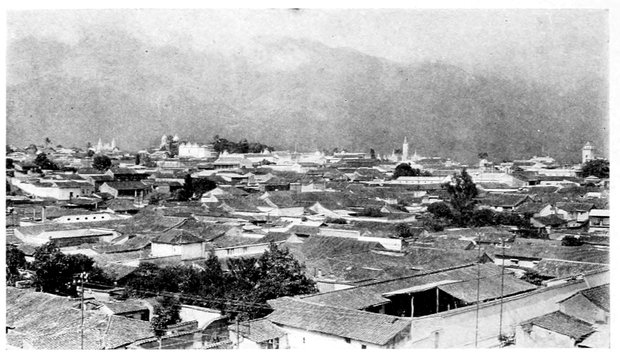
A glimpse of the Venezuelan capital
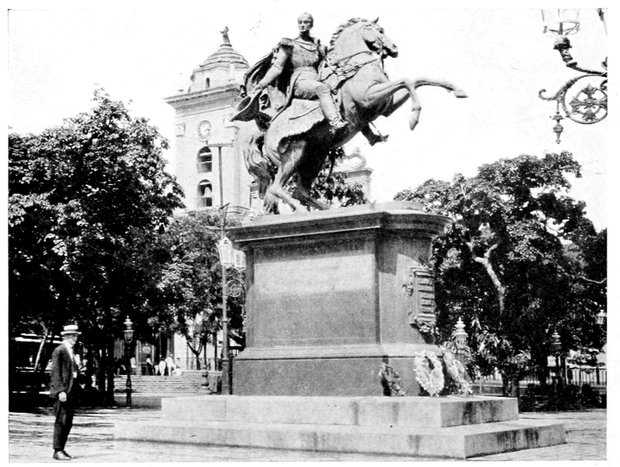
The statue of Simón Bolívar in the central plaza of Caracas
629At last there appeared, far ahead, a slight ridge, at the base of
which Lopez promised the River Guanipa. As we neared it two
horsemen, the only fellow-travelers we had seen in days, called to
my companions from under some scraggly trees, but I had not their
aboriginal endurance in the matter of thirst and stalked on until I
could throw myself face down at the edge of the river. We had
intended to push on to Cantaura, eight leagues farther, but it was
already mid-afternoon, we were sore and weary, and there was
unlimited water close at hand. Moreover, the horsemen, with whom
I found Lopez hobnobbing when I hobbled back, reported that a
“revolution” was raging in Cantaura.
The day before, three hundred bandits, or patriots, according to
the political affiliations of the speaker, had taken captive the local
government, looted the shops, and were now camped on the edge of
town. It was admitted that they were unlikely to molest foreigners;
the ordinary citizen, in fact, is little affected by such “revolutions,”
carried on by a small part of the population and disturbing the general
stream of life less than do our presidential elections. But there was
a possibility that the band might need hammocks, or even wish to add
to their ranks so lusty a youth as Lopez. We therefore swung our
chinchorros under the scrub trees, which gave time not only for a
swim but for a general laundering and, most important of all, a chance
to nurse my lacerated feet. Our new companions were white enough
to pass for Americans, yet they were as ignorant of anything outside
their immediate environment as jungle savages. They did not know,
for instance, that water separated their country from the warring
“towns,” as they called them, of Europe—which they took to be a
single small country from which came all “gringos,” or white
foreigners. To them the great war of which they had heard faint
630rumors was merely another “revolution” similar to the one in the
nearby village; yet it was plain that, for all these frequent uprisings
instigated by ambitious leaders, the Venezuelan country people were
as peace-loving as they are, like Spanish peasants, intelligent even
though illiterate.
With water at hand and a cool breeze sweeping across the sandy
plains, I looked forward to a comfortable night at last. But it was
the first one in Venezuela when mosquitoes and gnats made me regret
abandoning my mosquitero; moreover, Lopez, having decided to push on
at midnight, spent the interval incessantly chattering with his new
friends, the conversation consisting mainly of a similar but much
stronger expletive than “Caramba!” At midnight he decided to go
later, when the stars came out, and renewed the profane prattle;
then we could not find one of the donkeys, and I got at last a little
sleep. When I awoke the stars had abandoned the sky and the birds
in the trees were beginning to twitter. There was a classical sunrise
that morning, for the rays streamed out fan-shape on the clouds, as
from the throne of God in old religious paintings, no doubt modeled
from this very phenomenon of nature. Long after this was dissipated,
we were still wandering the countryside, looking for the lost
donkey. When at last we were off, I had not finished redressing
my tender feet after fording the river before we got a “palo d’agua,”
a sudden heavy shower that drenched us through and through. In
the unladylike words of my companions something or other was
always “echando una vaina,” which is the nearest Venezuelan equivalent
to “raising hell.”
We marched four leagues in sand and cutting grass, with muddy
pools to wade here and there, all very slowly because a sick donkey
was unable to keep a fast pace, even though “stark naked.” I arrived,
therefore, at a sluggish river in time to swim and get dressed again
before the others overtook me; but here Lopez left his negro
assistant to bring in the ailing burro, and we covered at our old pace
the four leagues remaining. The country changed completely from
sandy llano to stony hills, in which a well-marked road cut zigzags.
Worn, hot, and hungry, we came in the early afternoon to Cantaura,
a flat, quadrangular, silent town in sand and weeds, of several thousand
inhabitants. There were five by seven solid blocks of mud
houses, every corner one a shop with the counter aslant it and scanty
custom or stock-in-trade. It was an incredibly languid town, much
given to the crime of bringing into the world children who could not
631be properly cared for, so that no woman who could by hook or crook
have an infant in arms was without one, and they swarmed everywhere
in spite of a naturally, perhaps fortunately, high death rate.
In fact, it was incredible how many human beings were vegetating
here, doing nothing but a little apathetic shopkeeping and hammock-making,
with the silence and inertia of the grave over everything.
All sorts of odds and ends of humanity were tucked away in the
rambling old adobe houses, in one of which we at once made ourselves
at home, tethering the donkeys in a patio filled with weeds and bush,
and swinging our hammocks in the monasterial old corredor surrounding
it. Here we gave the slatternly woman of the house thirty
cents with which to buy beef and rice and make us a stew, she no more
thinking of charging us for the cooking than for room to hang our
chinchorros. Eggs were three for five cents; a large corn biscuit,
or pan de arepa, was one cent; “wheat bread,” as a tiny, dry ring of
baked flour of the size and shape of a bracelet was called, cost something
more than that; native cheese, papelón, even milk, though probably
from goats and certainly boiled, could be had by persons of
wealth. It was not long after our arrival, therefore, that Lopez and
I might have been seen squatting beside a makeshift table, eating in
a Lord-knows-when-I’ll-get-another-meal manner, with a crowd of
dirty women and children hovering about us and the kitchen, waiting to
snatch any scraps we might leave. One of the former passed the
time by feeding black coffee to a hollow-eyed baby some eight months
old. These people disregard the most commonplace principles of
health, wealth, and marriage—though certainly not with impunity.
The town had no water supply except a sluggish creek two miles
away, to which I had been forced to hobble even to wash my hands.
Asses brought two small barrels of it to a house for five cents, but
even they were lazy, and many people had no such sum, so that not
only do the people almost never wash, but a thirsty man must often
canvass several families before he gets a drink of water in which
newly dug potatoes appear to have been soaked. Like the political
atrocities which long experience has made seem unavoidable, these
torpid people endured these things without complaint or the thought
of a possible remedy.
The “revolution” two days before had been much less serious than
the telegraph, a strictly government organ, had reported to the outside
world. It was the first anniversary of the organizing of a revolt
against the national tyrant by a man highly favored in this region
632by all except the political powers. That date had to be celebrated
by a “gesture” that would be heard even in Caracas; besides, the
revolutionists were hungry. On the other hand, they did not wish
to antagonize the generally friendly metropolis of Cantaura. The
three hundred, therefore, had camped nearby and sent a delegation
of thirty men into the town, to take the gobernador prisoner—merely
as a sign of disdain to the hated tyrant who had appointed him, for
that evening he was released at his own hato. No shot had been
fired, all food had been paid for, and nothing stolen. It is not the
revolutionists whom the people of the llanos fear, but the government
soldiers, who enter houses, attack women, and carry off anything
that takes their fancy. In Venezuela the government picks up men
of the lower classes wherever it can find them and impresses them into
the army. It is not only the favorite depository for criminals, but
fully two thirds of their thirty cents a day is stolen from the soldiers
by those higher up, hence, though they are rarely men enough to
revolt against their oppressors, they are quick to pass their misfortunes
on to the population. In this case, as in many others, the
knightly deportment of the revolutionary leader was not matched by
the tyrant in power, for less than a fortnight later he and a score
of his staff were given no quarter when the government troops
surrounded them.
Lopez bought four dozen more hammocks in Cantaura, and I a
bag of food to share with him in return for the privilege of loading
it on one of his donkeys, though the favor would have been granted
me in any case, for I had gradually found that there was a moderately
kind heart beneath the taciturn, part-Indian exterior of the chinchorrero.
An older man in the selfsame two-piece cotton garments,
peaked hat of coarsest straw, and bare feet thrust into cowhide
sandals, had joined us, making our party four men and as many
donkeys. We plunged at once into a country quite different from
that I had so far seen, becoming involved in a series of foothills
which gradually rose higher and higher until the ranges seemed to
be climbing pellmell one over another in a vain effort to escape some
unseen terror. They were covered with thick woods, and at first
the well-marked trail of hard earth promised comfortable, shady
going; but soon that other curse of the foot-traveler descended in
torrents that almost made the drought of bygone days seem preferable.
Pounds of mud clung to every step; the earth grasped the
heels of my low shoes as in a clamp, requiring the full force of each
633leg to set it before the other. I dared not drop behind; luckily, the
others could not go much faster than I, their only advantage being
that they could wash their bare feet or sandals in any stream without
stopping, while I must carry the mud on.
Toward noon the country opened out once more, with fewer woods
and lower hills, and we were dry again by the time we finished the
day’s toil at a weed-hidden village. The next night’s stopping-place
was, I believe, the most horrible in all South America. Two old huts
covered with ancient reeds and completely surrounded, inside and out,
with every filth of man and beast, were inhabited by a fully white
and well formed man, who stumped about on legs completely hidden
under many layers of the foulest contamination. This had invaded
everything, including the slatternly blond mother and her half-dozen
of what seemed beneath the mire to be tow-headed children, the whole
family rapidly going blind from some disease resembling ophthalmia.
Yet they seemed to have no inkling of their abominations. The man
chattered politics as if he might at any moment be called to the
presidency and handed me a foul liquid as if it were the finest
drinking water. The next day was laborious, though not thirsty,
Lopez leading the way along single-file paths and short cuts over hill
and dale through dense low woods. Now and then we broke out
upon a hot, bare stretch, where my companions sometimes threw
themselves face-down to drink liquid mud from some hollow in the
ground. During the afternoon the “road” was full of loose rocks
of all sizes, which tortured my maltreated feet almost beyond endurance.
We reached the mud village of Caripe before sunset, but
Lopez had relatives farther on, so we followed the “camino real”
and a telegraph wire for several more toilsome, up-and-down miles,
the hammock-buyer now and then repeating a cheerful, “We are almost
at the door of the house.” Presently we left the main trail and
plunged off into the wet, black, silent night, through hilly woods and
head-high weeds, through knee-deep mud-holes and past frog-chanting
lagoons, to come at last upon two miserable huts swarming with
gaunt and savage curs and harboring vociferous, unwashed people
without number. They gave me scant greeting, and when I insisted
on having something hot to eat for the first time in three days, Lopez
explained that my stomach was “delicate.” By admitting this calumny
I obtained a soup made of two eggs, after which seven of us men
swung our hammocks in the open-pole kitchen. Water was so scarce
that I had to wait until all the others were audibly asleep before
634filching two tiny canfuls from the mouldy kitchen jar to pour on my
burning, itching feet and legs.
Being now only four leagues from his native El Pilar, Lopez left
his hammocks and asses to be brought in by the others, and saddling
the new donkey, which he had reduced in a week from a fine animal
to a wreck, and putting on a five-dollar velour sombrero for which
he had spent in Ciudad Bolívar his earnings on the trip before he
earned them, he rode away through the wet, early morning woods
almost faster than I could limp along behind him. But his plan of
making a triumphal entry into his native town met with poor success.
The trail was so rough and rocky, so up and down and hot and
endless, that the animal all but dropped, and Lopez had to get off
and drive him. Such was his haste to get home that I should certainly
have been left far behind had he not every little while met a
friend on a donkey or a horse and paused to give him the limp
greeting customary to the region and to exchange the latest local
gossip. The invariable term of endearment was “chico,” rather than
the “ché” of the southern end of the continent, and to every man
he met during this last part of the journey Lopez gave the mild abrazo
of rural Venezuelans, who do not shake hands, but stand at arm’s
length and touch each other on the shoulder. Finally we got into
a pocket of heavily wooded, low hills, everywhere choked with weeds,
though there were some cornfields, the ears broken half off and left
hanging to ripen. When it appeared at last amid such surroundings,
El Pilar proved to be the usual collection of ancient and decrepit
mud huts set in a tangle of jungle and weeds. Just at the edge of
town Lopez mounted, and with his new velour hat set at a rakish
angle and his bare feet armed with cruel spurs, to say nothing of
the cudgel in his hand, he forced the gaunt and worn-out donkey to
prance into town like an army charger. But again his plans came
to grief. For the misused brute, not being accustomed to the roar
and hubbub of towns, effectually balked, and for a hot and sweaty
half hour the returning hammock-buyer had the ignominious task of
beating, pushing, dragging, and cudgeling the animal through the
gaping village to his own house. I meanwhile being reduced to the
necessity of carrying my own bundle.
During the journey Lopez had never failed to raise his ragged
straw hat whenever he passed any of those crude shrines that mark
the last resting-place of those of his fellow-travelers who have succumbed
to the perils of the llanos trails; and he had been diligent in
635keeping in constant sight a charm in the form of an embroidered red
heart worn about his neck. Now it was evident that he had reached
home and that danger was over, for he hung the charm carelessly
on the adobe wall, and passed the local cemetery without so much
as noticing it, though his parents and grandparents lay buried there.
He lived with several sisters and a brother in the usual mud hut
opening on a baked mud yard, with an open-pole kitchen in which
even stray pigs were not considered out of place; but at least his
sisters were quiet and outwardly cleanly, almost attractive, and when
Lopez, with a princely gesture, threw a peso down before them and
commanded “a huge hot meal,” such as he had learned would win
my approval, they obeyed his orders almost with alacrity. Meanwhile
I went up into the woods to a stream that had left pools of
clear water among rocks, and sitting down with a calabash, poured
it over me like a Hindu performing his sacred ablutions at Benares.
I was probably more soiled and ragged than I had ever been in a
long career of vagabondage, but at least this promised to be the last
South American mud village in which I should ever sleep. When I
had put on my newly washed pajamas and hobbled back to the house,
a great chicken-stew awaited us. Lopez and I made entirely away
with it, together with a kind of baked squash and several arepas;
and when it casually leaked out that eggs cost one cent each in El
Pilar, I produced a bolívar with the request to get me twenty of them,
half of which I shared with Lopez, while ordering the rest prepared
for supper and breakfast. When, in addition to all this, we did
away with a whole watermelon, the wonder of the family and the
village was complete. Having taught the hammock-buyer the meaning
of a real meal, I assumed for a moment the unaccustomed rôle of
missionary and strove to show his relatives why their customary diet,
with its miserable coarse cassava and stone-cold arepas, was not
conducive to longevity.
“Now I am a dozen years older than Lopez,” I began.
“Impossible!” interrupted his sisters, looking from his face to mine.
“Yet both his father and mother, like the fathers and mothers of
many countrymen of Venezuela as young as he, have been dead and
gone for years.”
“And yours?” inquired the girls.
“Still quite young and lively, thank you,” I replied; “and my grandfather....”
“What—your grandfather!” cried the astounded family of El Pilar.
636The peep of dawn saw me bidding Lopez farewell—and promising
to send him dozens of the many photographs the family had insisted
on my taking, or pretending to take, of them. I led the sun by more
than an hour into the jungle valley through which a stony and
mountainous trail lifted me to a summit, where, across wave after
wave of blue wooded hills, appeared the Caribbean, as a signal that
I had at last walked South America off the map. Huts were fairly
thick among hills that grew ever lower and then less stony, the way
several times following the gravelly beds of dry streams, until at last
it broke out upon a perfectly level flat country of cactus and dry,
thorny bush. Here there was for a long time total silence, except
for the wail of the mourning dove, so characteristic a sound in this
sort of landscape. Then abruptly, without warning, I emerged upon
an absolute desert, bare and sandy looking as the Sahara. Instead
of the deep sand I expected, however, the soil proved to be mud-flats,
now dried and checkered in the sun, and good smooth going, with
a telegraph wire for guide—though a bit of rain would have made
it almost impassable. Soon I was surprised to hear the roar of
breakers, and when I was high enough to look over a sort of natural
sand dike, there lay the whole blue Caribbean, with what I had taken
for another range of hills rising out of it in the form of rocky islands—and,
confound my luck if, hull-down on the horizon and spitting
black smoke scornfully back at me, there was not a steamer racing
in full speed in the direction of La Guayra!
The mud-flats alternated now and then with deep sand or patches
of thorny bush and cactus, a most miserable setting for what I at
last made out to be the church-towers of Barcelona, fifth or sixth
city of Venezuela, with some 15,000 apathetic inhabitants. But as if
fate would give me one last slap before we parted, an arm of the sea
appeared when I was almost inside the city and drove me and the
trail miles back into the thirsty bush, scrambling through cactus,
springing across mud-holes, forever limping painfully onward. Then at
last I emerged upon a cement sidewalk on an otherwise dirty, tumble-down,
earth-floored town of flat gridiron formation, inhabited by a
ragged and uninteresting population conspicuously Latin-American in
all its manifestations, even to striking, upon the appearance of a
stranger, an attitude in which to enjoy so rare a sight at ease and
to the full as long as he remained visible.
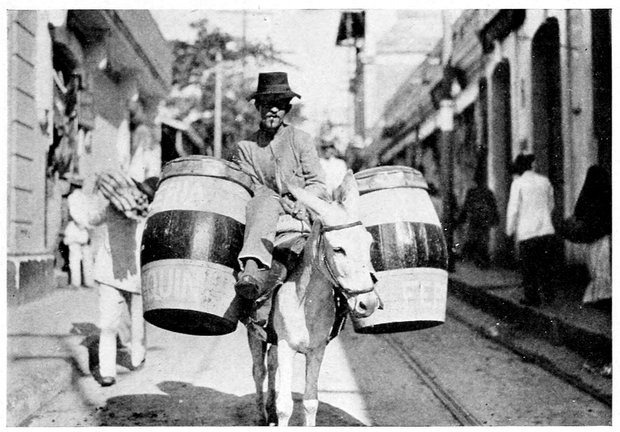
A bread-seller of Caracas
The birthplace of Simón Bolívar of Caracas, the “Washington of South America”
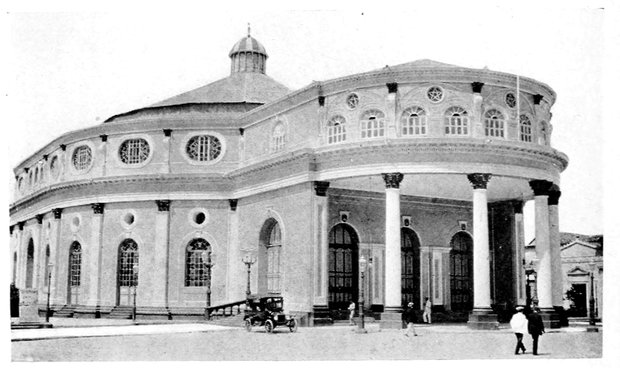
The Municipal Theater of Caracas
It was evident that my luck, if I ever had any, had completely
deserted me. Six hours before my arrival, the lonely little train of
637Barcelona had left for Huanta, whence the steamship Manzanares
would have set me down in La Guayra the next morning at a cost of
thirteen bolívares. Now, thanks to that half day of loafing in El
Pilar, I might wait two or three weeks for another steamer. There
were, to be sure, small freight-carrying sailboats advertised to leave
from time to time; but their agents in Barcelona seemed to have little
interest in passengers, particularly a mere “gringo.” For two days
I pursued captains of such craft from rosy dawn to the last note of
the evening concert in the central plaza, with no other gain than the
rather sullen information that there might be a boat leaving mañana.
Meanwhile my slender funds were going for corn-bread, and my
patience was oozing away in the monotony of the sand-paved, donkey-gaited
mud town where not even a book was to be had. Then one
morning the captain of the sailboat Josefita agreed to let me sit on
his deck from Huanta to La Guayra for only twice the steamer fare,
and I bumped away in the ridiculous little train to a port consisting
mainly of mud huts, cocoanut-trees, and an elaborate stone customhouse.
Here a long formality and the payment of half a dozen
government fees were required for a “permission to embark”—from
one miserable port to another of the same country—and I was ready
to intrust my future existence to the equally capricious ocean winds
and Venezuelan temperament.
The Josefita was a large covered rowboat with a sail, on which was
painted in huge figures the number required by Venezuelan law on
all such craft. The captain took on a few extra beans for the benefit
of his solitary passenger; but I played safe by filling my own sack
with corn-buns, native cheese, and papelón, and by some stroke of luck
I picked up a Spanish translation of Paul de Kock with which to
pass the time. Besides the captain and myself there were four
ragged sailors, neither old nor young, and, strangely enough, wholly
free from African taint. We were loaded with a few hundred native
cheeses in banana-leaf wrappings when we began crawling across the
bay to take on mineral water at Lajita. A rocky, half-perpendicular
coast with scanty tufts of green vegetation sloped down into the blue
Caribbean in which I trailed my rapidly healing feet. At four o’clock
we drifted up to a beach and a thatched village that we seemed to
have passed by train that morning, where we anchored while the
captain and half the crew rowed ashore. There they were gone for
hours, evidently helping nature run down the mineral water, for
toward sunset there came from the land the sound of boxes being
638nailed up. Meanwhile nature had produced considerable water on
her own account in a long series of thunder-showers that fell with
an abrupt whispering sound all around the boat. Most of this delay
I spent swimming over the side, trusting to my eyes to detect in time
any sharp-toothed danger in the clear, azure sea, then retired to the
tiny cockpit, where the so-called cook brought me a plate of plain rice
and, evidently as a special concession to first-class passengers, the
front end of a boiled fish.
When the sun burned out again through the mists, we were speeding
along in a spanking breeze after a night in which a heavy sea had
tossed us constantly back and forth on the stone-hard deck, shipping
water to soak us wherever the rain had not done so already. Lest we
might have dozed in spite of all this, the ragamuffin at the wheel had
broken forth every five minutes in a howling wail of extemporized
“song” which was meant to encourage the wind and perhaps to scare
off the evil spirits that ride the darkness. The wind soon died, however,
and at noon we were still flapping with idle canvas in a calm,
unbroken sea. The book I had picked up was too silly for words;
my five companions were utterly devoid of human interest; our
miserable fare, concocted by a “cook” who did not know enough to
boil water, was strongly scented with kerosene; and most of the day
was spent in a dispute between the captain and the singing sailor,
who, it seemed, could not read the compass and had taken us far
out to sea, when our safety depended on keeping within sight of land.
The crew had almost nothing to do but tack two or three times a
day, and spent the rest of the time sleeping on the bare deck, except
the cook and steersmen, who were lazily engaged at their tasks most
of the time. The sea, of the deepest possible blue, as if all the indigo
trees of the tropics had spilled their product into it, rose and sank
in its endless unrest without our advancing a yard. Well on in the
afternoon a puffing breeze developed, and on the far port horizon
appeared a few stenciled mountains. Gradually we drew near enough
to see that they were clothed with forest to the very sea’s edge. With
anything like a fair wind we could have made La Guayra that
evening, but the breeze was genuinely Venezuelan. At sunset a
school of dolphins surrounded the boat so closely as almost to graze
its sides, and for an hour indulged in athletic feats, like a crowd of
schoolboys showing off, not only diving entirely out of water so near
that we could almost have put out a hand and touched them, but
giving themselves two, and even three, complete whirling turns in
639the air, like somersaulting circus performers, before falling back into
the sea with a mighty splash.
Dawn found us crawling close along a shore of sheer bush-grown
mountains lost in low clouds, lame with constant rolling on the hard
deck and disgusted with the monotony of existence. With La Guayra
almost in sight at the far point of this range, called the Silla de
Caracas, we tacked all morning against a head wind without seeming
to advance a foot along the roaring rocky mountain wall. Life on
the ocean wave may sound romantic on paper, but in a dirty and
hungry sailboat off the coast of Venezuela it calls for other descriptive
adjectives. No doubt I needed this final, post-graduate course in
patience before leaving a patience-training continent. Once we
anchored to keep from losing the little we had gained, and all day
and the following night we rolled and tossed in the selfsame spot,
the man at the rudder trying alternately to charm the wind with his
raucous voice and to scare it into motion with a vociferous “Viento
sinvergüenza, caramba!” Now and then during the night the snapping
of canvas and the rattling of blocks above gave the sensation
that we were really moving at last, but when morning broke we were
off the very rock beside which we had lain down the night before.
Gradually, however, the breeze increased with the rising sun, and we
began to move swiftly through the water; but so strong is the
current along this coast that we seemed to remain for hours opposite
identically the same peak of the Sierra de Avila. Then we rolled
for hours within plain sight of La Guayra in a sea as flat as if oil
had been poured on it, without even a man at the rudder, so hopeless
was everyone on board. I had nothing to read; there was not a foot
of space in which to walk; I could not swim because of sharks;
there was not a person of intelligence within sound of my voice; even
our miserable food was virtually gone; there was only a bit of filthy,
lukewarm water, full of all sorts of sediment, at the bottom of the
barrel, and still we flopped motionless on a windless sea under a
grilling sun. I understood at last what it means to get oneself into
a boat.
By taking advantage of every faintest puff of breeze, our leather-faced
old salt coaxed us along during the afternoon, until a stiffening
wind overtook us at last and we slipped ever more rapidly along the
great mountain wall. Tiny villages here and there clung far up on
little knobs of land; great shadowy valleys and sun-defying corners;
a town here and there along the base, all seemed to bake in the tropical
640sun, and certainly to sleep. By four o’clock La Guayra lay before us,
its bathing resort of Macuto just off our port beam; yet so Venezuelan
was the wind that we did not know whether we could reach harbor
in time to be allowed ashore. I might have landed and walked into
town long since, were it not illegal for passengers to enter Venezuela
except at a regular port with a customhouse. It is a splendid arrangement
for politicians, but of small advantage to becalmed or shipwrecked
sailors. I shaved, however, poured sea-water over my maltreated
body, put on the only clothing I had left after pitching my
rags overboard, and presented the captain with the old felt hat that
had protected me from the sun in fourteen countries. This last act
may have induced his ally, the wind, to waft us in behind the breakwater
while the sun was still above the horizon.
However, being in port in Venezuela is not synonymous with going
ashore. Once at anchor, almost within springing distance of a stone
wharf, I had to wait while the captain went to report my existence
and set in motion all the formalities, including the payment of fees,
that were required exactly as if I had been landing from a foreign
country. To tell the truth, no sane person would be eager to get
ashore in La Guayra, unless it was in the hope of immediately going
elsewhere. A parched and thirsty town, in spite of the brilliant blue
sea beating at its feet, with rows of unattractive houses, all alike
except in slight variations of color, and even those in pastel shades
lacking vividness, strewn irregularly, singly, in groups, and in one
larger mass, up dull-red and sand-colored hills which piled precipitously
into the sky, it plainly had little attractiveness except as a
picturesque ensemble from a distance. Trails climbed straight up this
sheer mountain-wall, as if in haste to escape the hot and ugly town
at its feet, while a carriage-road and a railway set out more decorously
along the shore for the same destination,—Caracas.
A brass-tinted, supercilious official with a prejudice against shaving,
who was lolling beneath a regal awning, had himself rowed out at last
to ask me a score of absurd questions and set my answers down at
length in a book, after which he went ashore again to advise the
government whether or not I should be granted an “order of disembarkment”—without
which I must continue to sit out here in the
blazing sun even though the “Caracas of Wilmington, Delaware,” across
the harbor were about to sail and I eager to take it. By and by a
yellow negro rowed out to ask if I had a visiting-card to prove my
respectability, saying the prefectura was “making some question”
641about my landing. Another hour passed, and at last a boat was sent
to take me ashore, where I applied at once to the collector of customs
for the baggage I had intrusted to the purser of the Dutch boat that
had dropped me at Trinidad. Luckily, the latter had carried out
instructions, or I should scarcely have dared venture up to Caracas.
Meanwhile, one of the men who had rowed out for me was dogging my
footsteps with a want-a-tip air. He was, it turned out, collector for
the corporación, the foreign company that built the docks of La
Guayra, and which exacts forty cents for every passenger who lands—or
sixty, if he comes from a boat not tied up to the wharf. But
instead of collecting it in an office, or in an official way, he followed
me about like a bootblack and then tried to squeeze an extra “commission”
out of me on the ground that he had been forced to follow
me about.
This “corporation,” which is English, holds what is rated “one of
the finest grafts” in South America, having the right for ninety-nine
years to charge for every person, every pound of merchandise, every
trunk, valise, and even handbag, which embarks or disembarks in
La Guayra, to say nothing of heavy fees for every ship that enters
the harbor. Yet so overrun is it said to be with native employees
forced upon it by politicians that the “graft” is by no means so
splendid as it sounds. Venezuela is notoriously in the front rank of
political corruption in South America, and La Guayra is its greatest
single fleecing-place. From the instant he enters this chief port the
stranger is hounded at every turn by grasping, insolent officials and
political favorites permitted to indulge in the most absurd extortions,
a spirit which pervades the entire population down to the last impudent,
rascally street-urchin. Taxes, dues and customs duties have
frankly been made not only as high and onerous but as complicated
as possible, in order to mulct the taxpayer or importer to the advantage
of swarming loafers in government uniform. A most intricate
system of fines and penalties is imposed, for instance, by the customs
regulations, for the slightest errors in invoices. The collectors receive
meager salaries, but the discoverer of any “violation” of the elaborate
statutes pockets one half the fine imposed, with the result that there
is an un-Venezuelan zeal in looking for flaws, and fines are assessed
even for the omission of commas, the faulty use of semicolons, and
for abbreviations.
One can scarcely blame a man forced to live in La Guayra, however,
for taking it out on his fellow-man. Piled up the sheer, arid mountain-wall
642with only two streets on the level, and with the sun baking in
upon it all day, it feels like a gigantic oven; certainly it was the hottest
place I had ever seen in South America. Nor was it the stirring,
endurable heat, tempered by a constant breeze, of most of the continent,
but a sweltering, melting temperature that not only left me
drenched with perspiration within a minute after I had stepped ashore,
but which made it impossible even to write because one’s hands soaked
the paper, which set one to dripping before he sat down to early
morning coffee. Everyone in town had a wilted, unshaven, downcast
air, as if hating himself and the world at large for his uncomfortable
existence. To add to my disgust, it was Friday, and the penetrating
stink of fish pervaded every corner of the organized squalor, pursuing
me even into the highest room of the dirty negro pension which posed
as a hotel. The only endurable place in town was a little piece of
park and promenade along the edge of the sea; but the bestial habits
of the populace had sullied even the ocean breezes.
The “Ferrocarril La Guaira á Caracas,” built in 1885 by an English
company, takes twenty-four miles to cover an actual distance of about
eight, with a fare of ten cents a mile and a train in each direction twice
a day. So often had I climbed by rail abruptly into the clouds in
South America that this was no new experience. Moreover, the
climb is much less lofty than several others, though there is much
the same sensation as one goes swiftly up from sea-level in vast
curves around the reddish desert hills, with an ever-opening vista of
La Guayra and its adjacent towns along the scalloped shore. Then the
train squirms in and out of Andean ranges, at times utterly barren, at
others green, past dizzy precipices and mighty valleys, the stone-faced
cartload climbing in vast turns in the same general direction. At
the halfway station of Zigzag we passed the down train, after which
we rumbled quite a while across a plateau country among mountain
heights, until finally there burst upon me the last South American
capital—striking, but not to be compared with the first view of
several others.
Caracas has “some 11,000 houses and 80,000 inhabitants,” including
its suburbs, partly because the constant revolutions have driven the
population to the national capital for protection. A tyrant can do
things out on the lonely llanos which he would not dare do in the
shadow of his own palace. Being but three thousand feet above sea-level,
it lacks many of the unique features of lofty Bogotá, Quito,
or La Paz; yet it is high enough to have a cool mountain air that
643quickly fills the traveler in the tropics with new life. Seated in a
mountain lap twelve miles by three in size, the Sierra de Avila cuts
it off from the sea and high hills enclose it on all sides. The site is
uneven, especially toward the range, its upper part covered with
forest, over which climb the same direct trails one sees scrambling
up the far more precipitous mountain face from La Guayra. Here
and there the town is broken up by quebradas and several small
streams, of which the Guaire is almost a river; yet Caracas in its lap
of green hills is not itself hilly, but merely undulating, its streets
rolling leisurely away across town, with a considerable slope from
north to south, so that every shower washes the city, and the tropical
deluges to which it is sometimes subject make rivers of the north-and-south
streets. The Venezuelan capital has little of the picturesqueness
of several west-coast capitals. There are no Indians with their
distinctive dress, no paganish street-calls, no quaint aboriginal customs.
On the other hand, it is well put together, with good pavements
and sidewalks, instead of cobbled roads with flagstones down
the center, and has a more up-to-date air, as if closer in touch with
the world than the loftier cities to the west, and it is at least a pretty
city from whatever hillside one looks down upon it.
The houses are wrong side out, of course, after the Moorish-Spanish
fashion, the streets faced by ugly bare walls, with the flowery
gardens and the pretty girls within. It has by no means so many
churches per capita as some of its neighbors, though many priests are
to be seen, sometimes standing on the corners smoking cigarettes and
“talking girls” with their layman fellow-sports. The cathedral houses
a fine painting, unusual in South American churches, an enormous
“Last Supper” by a Venezuelan who died while engaged upon it, so
that portions are merely sketched. Beside the National Theater there
is a bronze statue of Washington, erected during the centenary of
Bolívar in 1883. He has no cause to feel lonely, even so far from
home, for Caracas swarms with national heroes—in statues, the only
muscular, full-chested men in town, unless one be misled by the
splendid tailor-made shoulders in the plazas and paseos. No other
city of its size, evidently, was the birthplace of so many great men.
Nearly every other house bears a tablet announcing it as the scene
of the first squall of “Generalisimo” Fulano or of “the great genius”
Solano. Not all of these, however, are mere local celebrities; two
simple old houses bear the tablets of Andrés Bello, the grammarian,
644whose fame reached to Chile and to Spain, and of Simón Bolívar,
“the Liberator.”
Somehow, when one has been out of it for a time, the Latin-American
atmosphere is almost pleasing—when one is in a mood for
it. Here I found myself enjoying again the hoarse screams of
lottery-ticket vendors, the cries of milk-dealers on horseback, their
cans dangling beneath their legs, the bread-man with his red, white
and blue barrel on either side of the horse he rides, the countless little
shops where refugees, huddling under the protection of the capital,
strive to make both ends meet by trying to sell something, content at
least to be no longer at the mercy of government as well as revolutionists
out on the little farms that have long since gone back to jungle.
Caracas rises and begins business later than La Guayra, where the
heat of noonday makes a siesta imperative; it is a bit less foppish
than Bogotá or Quito, perhaps because of its greater proximity to
the world. Here, too, are ragged men and boys who soften their
incessant appeals by using a diminutive “Tiene usted un fosforito?”
“Dame un centavito, caballero?” “Regálame un regalito, quiere?”
It is easier to comply now and then with such requests in a city where
prices have not leaped skyward, as in most of the world. At the
“Hotel Filadelfia” my room and food cost four bolívares (almost
eighty cents) a day. True, I found my hammock more comfortable
than the bed, though the nights were somewhat chilly in it; and the
impudence, indolence, and indifference of the caraqueño servant is
notorious. Ask anyone, from manager to the kitchen-boy, to do
something, and the reply was almost certain to be a sullen, “That’s
not my work,” nor would they ever deign to pass the word on to
whosoever’s work it was. Evidently they belonged to a union. As in
Ecuador, hotel guests were forbidden to talk politics.
Some of the principal streets were lined with gambling houses of
all classes, from two-cent-ante workmen’s places to sumptuous parlors
with pianos playing and the doors wide open to all, even to a penurious
“gringo” who came only to watch the heavy-eyed croupiers and the
other curious night types who make their living by coin manipulation.
Though “the cheapest thing in Caracas is women,” they are seldom
seen on the streets. Illegitimacy, like illiteracy, is more prevalent than
its opposite, but it is not the Spanish-American way to flaunt social
vices. American influence is more in evidence than in any other
South American country; Caracas is the only city on that continent
where I saw native boys playing baseball. Germans control much of
645the commerce and the longest railway in the country, from Caracas
to Puerto Cabello, but with these exceptions the English hold most large
enterprises, including electric-lights, telephones, and street-cars, and
are reputed to be clever in keeping out American competition.
Like Santiago de Chile, Caracas has a limited number of “best
families,” who form the “aristocracy” and to some extent an oligarchy,
though intermarriage has produced among them some of the ills of
European royalty. There are good-looking, not a few pretty, and
even occasionally beautiful women in this class, though the casual
visitor sees them only behind the bars of their windows or promenading
in carriages and automobiles around El Paraiso across the Guaire
on Sunday afternoons, and at the evening band concerts in the Plaza
Bolívar. On the whole, this so-called higher class is more corrupt
and worthless than the workers, especially those of the llanos, who
at least are laborious and long-suffering, even though ignorant, superstitious,
and often victims of the same erotic influences as the rich and
educated. It is natural that the political power in Venezuela should
have been wrested from this weak “aristocracy” by hardier types from
the interior.
The most notorious of these, the chief founder of that military
dictatorship which to this day holds Venezuela in a tighter grip than
any other country in South America, was Castro. Charles II of
England would have felt at home with this fallen tyrant, a degenerate
who made use of his power and government riches to corrupt the
maidenhood of his native land. His subordinates, especially the
governor of the federal district, were chosen less for their ability
as rulers than for their success in coaxing young girls to visit the
tyrant in a house across the Guaire, where he carried on his amours
almost publicly. In those days Caracas was overrun with saucy little
presidential mistresses in short skirts. Force, or anything else likely
to lead to public scandal, however, was not included among Castro’s
amorous weapons—for there was a Señora Castro before whose wrath
the highest authorities of Venezuela were wont to flee in dismay.
The terror which Castro himself still evokes among the masses of the
country is such that his name to this day is almost never openly spoken.
In Ciudad Bolívar I sat one evening, reading an exaggerated tale of
the tyrant’s lust, a book proscribed in Venezuela but stacked up in the
book-stores of Trinidad, when the hotel-keeper paused to ask in a
trembling voice how I dared have such a volume in my possession.
“Why not?” I asked.
646“Ah, it is true,” he answered, turning away, “in the great United
States there are no tyrants to make a man fear his own shadow.”
Aside from his patent faults, however, Castro was a man of strength
and native ability; though this was offset by his provincial ignorance,
a misconception of the unknown outside world which led him to
believe he could easily thrash England, France and Germany combined,
so that he took pains to alienate foreign governments. It is
an error into which his successor has been careful not to fall.
General Juan Vicente Gomez is an andino, like Castro—that is,
a man from the mountainous part of the country near the Colombian
border, with considerable Indian blood and a primitive force that
overwhelms the soft-handed “aristocracy” of Caracas which once ruled
the country. Like Castro, he is ignorant, strong, coarse, and shrewd—fond
of young women, too, though with strength enough to put them
into the background when they interfere with more important matters.
Years ago he mortgaged his property to help Castro, but the latter
treated him like a peon, even after appointing him vice-president.
Gomez, however, knew how to bide his time. By 1908 his dissipations
had left Castro no choice but to go to the German baths or die,
and he delegated his power to the obsequious vice-president and went.
A few days later Gomez set out at four in the morning for a round
of the military barracks, called out the commanders, thrust a revolver
into their ribs, and requested them henceforth to bear in mind that
he was president of Venezuela. This was his first “election.” During
his seven-year term he brought about some improvements, particularly
in roads and the army, not to mention acquiring immense properties,
while the exiled Castro was losing his to former victims who were
suing him in the Venezuelan courts. The constitution stated that a
president could not be elected to succeed himself. Toward the end
of his term, therefore, Gomez nominally resigned, put in a temporary
figurehead, and had congress “elect” him again. At the same time
he had a new constitution made in which there is no mention of
reëlections, with the understanding that it was to come into force
when he took the oath of office.
This he was to have done some months before, but, being a cautious
man, as well as preferring country life, “the elect”—never did I meet
a Venezuelan who dared mention him directly by name—remained
on his own ranches in Maracay, a hundred miles out along the German
railway, leaving one of the minor palaces occupied by a tool called
“provisional president.” Castro himself, however, never attained such
647absolute power as the new tyrant, who puts recalcitrant congressmen
in jail, personally appoints state, municipal, and rural authorities, and
in general smiles benignly upon the helpless constitution. Not the
least amusing contrasts in Venezuela were the private opinions of its
chief newspaper editors and the slavish attitude of the sheets themselves,
the entire front pages of which were taken up day after day
with photographs of the “President-Elect of the Republic and Commander-in-Chief
of the Army” in this or that daily occupation,
followed, to the total exclusion of any real news, by obsequious
telegrams from his henchmen in all parts of the country, from misinformed
foreigners or foreign governments, often from imaginary
sources, congratulating him and his countrymen that “the greatest
man of the century has again been chosen as their leader by the great
and free Venezuelan people.” Even over-altruistic or subsidized
American periodicals with a South American circulation frequently
hold up the present tyrant of Venezuela as an example of the progressive
constitutional ruler. Many of the best people of that country
would prefer even American intervention to the illiterate tyranny
which makes it dangerous to speak their real thoughts above a
whisper; but there is a strict censorship, and Gomez, wiser than
Castro, professes great friendship for all great foreign powers, particularly
the overshadowing “Colossus of the North.”
In the long run a people probably gets about as good a government
as it deserves, and a stern dictator, on the style of Diaz of Mexico,
is perhaps the ruler best suited to Venezuela. But from our more
enlightened point of view such rule would not seem to promise social
improvement. The country is bled white to keep up the army and
several other presidential hobbies, to the exclusion of schools and
other forms of progress. Every cigarette-paper bears a printed government
stamp alleging that it pays duty in benefit of “Instrucción
Pública,” a source yielding more than a million dollars a year; yet
it is years since the students of the University of Caracas struck
because Gomez spent the legal income of the schools on the army, and
at last accounts it had not yet been reopened. The dictator himself
can read, but not write, except to sign his name. Every morning at
four he was at his desk in Maracay, the business of the day laid out
before him,—first his private affairs, next his hobby, the army, then
politics and the country in general. According to a genuine authority
on the subject, he laboriously spells out all the correspondence himself,
then calls in a shrewd and trusted uncle, a man too old to have
648ambitions to succeed him, and together they concoct the replies. The
present government of Venezuela is truly a family government.
General José Vicente Gomez, the son whom the dictator is evidently
grooming to be his ultimate successor, is Inspector General of the
Army; General Juan Gomez is governor of the federal district;
Colonel Alí Gomez is second vice-president; two other sons are presidents
of states—the dictator, by the way, is a bachelor—and so on
through the family. Like many another Venezuelan of numerous
descendants, “the elect” never married; but of his scores of children
by many different women he has legitimized the few most promising
and lifted them to his own level—a practical, man-governed form of
survival of the fittest.
With the white mists still clinging to Caracas and its sierra, I
strolled out one morning along the “Highway of the West” through
the flat, rich vega to Dos Caminos and Antimano, where the German
railway breaks out of the lap of hills and squirms away to Valencia
and Puerto Cabello. A private way through deep woods with coffee
bushes brought me to the little country home of Manuel Diaz Rodríguez,
and at the same time reminded me that all is not tyranny, sloth,
and hopelessness in the mistreated Land of the Orinoco. For here,
amid stretches of light-green sugar-cane that seems destined ultimately
to bring material prosperity to the country, lives one of South America’s
greatest contributors to modern Spanish literature.
I had planned to say farewell to South America by walking up
through the “Puerta de Caracas” and over the mountain range to
La Guayra. But on the last evening a tropical deluge roared down
upon the capital, and I dared not tempt fate to prevent me from
reaching home within four years of my departure on my Latin-American
pilgrimage. The last day of August dawned brilliant and
cool. In my pocket was a ticket to Broadway and just enough ragged
Venezuelan money to carry me down the mountain and through the
swarming grafters of La Guayra to the steamer. Cheery with the
thought of home-coming, I lugged my own baggage—to the disdainful
astonishment of the Venezuelan crowd—out onto the platform and
stowed it away under a second-class bench. I had no sooner stepped
back into the waiting-room, however, than a gaunt and coppery
caraqueño slowly mounted a chair in front of a blackboard over the
ticket-office, and with nerve-racking deliberation began to write, in
a schoolboy hand which required some ten seconds for each stroke
and fully fifteen minutes for the entire announcement:
On account of landslides there will
be no morning train. Notice will be
given if the afternoon train descends.
I had felt it in my bones! Fate did not purpose that I should ever
escape from this unattractive continent! This was the first train
that had failed to run in eight months, and of course it must be the
very one I had depended on to get me down in time for the steamer.
It was too late to walk—and with my baggage I could not run.
Automobiles, quick to scent trouble, were already raising their price
for the trip from $20 to $30 and $40. At last I found a Ford that
would carry me and two other Americans down for a hundred
bolívares—which was about ninety more than we owned among us.
But by some stroke of fortune a thoroughly human minister had been
accredited to Caracas by our enigmatical State Department. I regret
to report that we routed him out of bed, and ten minutes later were
dashing full-tilt along the pool-filled and broken highway to the coast.
On the outskirts of the capital there were innumerable lethargic
donkey trains to dodge and pass. Then we were twisting and turning
along the mountain road, with thousands of feet of loose shale piled
sheer above and sudden death falling away directly below us. The
heavy rain had brought down rocks larger than dog-kennels, and in
places had heaped up loose stones and earth until the road was
practically blocked. At one such spot a big, aristocratic automobile
stood eyeing in despair a sharp V-shaped turn it could not make.
Our unpretentious conveyance scampered up on the slide, slipped
to the very edge of the deadly abyss, then climbed down upon solid
road again and sped on. Higher and higher climbed the serpentine
carretera, constantly whirling around turns where the slightest slip
of the mechanism or of the doubtful nerves of our very Venezuelan
chauffeur would have ended our journeyings for all time, tearing
blindly around sharp-angled curves with a bare six inches between us
and instant death, and that six inches likely to be treacherous sliding
shale. Far up among the reddish barren hills we passed the summit,
then began to descend by the same perilous highway, where we seemed
ever and anon to be riding off into the bluish void of infinity, suddenly
coming cut on a view of the coast and indigo sea far below us, and
for a long time thereafter winding and twisting incessantly downward,
with no certainty that all our efforts had not been in vain.
650Then all at once La Guayra appeared, and out along the breakwater
still lay the steamer, tiny as a rowboat from this height, but plainly
in no mood to move until we had time to comply with the irksome
Venezuelan formalities and scramble on board. But it was a painful
anticlimax to the life I had led in South America to be rescued at
the last by a Ford!
Of several hours’ struggle with swarming official and unofficial
grafters, with strutting negroes in uniform and “generals” who signed
with the only word they could write my permission to depart from
their fetid land, of the final cupidities of the “corporation,” I will say
nothing, lest I again be betrayed into language unbefitting a homeward
journey. Suffice it that at last I clambered dripping wet up the gangway,
at the foot of which an ill-bred youth in a Venezuelan uniform
snatched the “permission to embark” in pursuit of which I had spent
perspiring hours, and soon black night had blotted out from my sight
the variegated but not soon to be forgotten continent of South America.