After spending some sixteen years in schools and colleges,
I decided, one spring, to take a year off and make a trip
around the world. I had no money for such a journey;
but that didn’t matter for I meant to “work my way” from
place to place. I spoke French and German, and had some
knowledge of Spanish and Italian. I believed that if I had
to work among the people of foreign countries I would
learn more of them and of their languages than in any
other way. So I was not sorry that I had to start my
journey with only my camera and one hundred and four
dollars for films.
As a beginning I had arranged to cross the Atlantic on a
cattle-boat in the employ of a company in Walkerville, Canada.
This company ships thousands of cattle to the markets
of England every year. When I asked for a job as
cattleman, they employed me at once. So it happened that
on the eighteenth of June, 1904, I crossed the Detroit River
to Canada, and walked two miles to the Walkerville cattle-barns.
From the long rows of low brick buildings sounded
now and then a deep bellow, or the song or whistle of a
4stock feeder at his labor. I left my bag at the office and
joined the crew in the yard.
The cattlemen had already begun driving the cattle from
the stables. It was no easy task. As soon as they were
free, the sleek animals began to prance, to race, and to bellow,
leading the stockmen a merry chase all around the
yard. Little by little, however, the men managed to urge
them slowly up the chute into the waiting cars. The setting
sun had reddened the western sky, and darkness had
fallen in the alleyways between the endless stables, before
the last bull was tied and the last car door locked. The
engine gave a warning whistle. We who were to care for
the stock on the way raced to the office for our bundles,
tossed them on top of the freight-cars, and climbed aboard
after them.
The train began to move. The stockmen left behind
called out farewells to their friends who were “crossin’ the
pond wi’ the bullocks”: “So long, Jim.” “Don’t fergit
that smokin’ tobacco for me, Bob.” And we were off.
After a short run we came to the main line of the
Canadian Pacific. Here our cars were joined to a long
train that was being made up. We were to travel in the
caboose. As we came into the glare of the tail lights, carrying
our bundles and long poles, the trainmen saw us, and
began growling: “Huh! more cow-punchers!”
We rode for thirty-six hours. When we reached Montreal
at last, we left the stock to the care of the feeders at
the railroad pens, and went at once to the “Stockyards
Hotel”—a building filled from bar-room to garret with
the odor of cattle.
Where were we going, and when? Up to this time I
had not even learned on what ship we were to sail. Then
5I heard some one say “Glasgow,” and soon the news leaked
out that we were to sail on the Sardinian two days later.
On the second evening I went on board the Sardinian
with the rest of our crew, and wandered around among
the empty cattle-pens built on the four decks. Toward
midnight loads of baled straw were brought on board, and
we began to “bed down” the pens. When this was finished,
we threw ourselves down in the empty stalls and fell
asleep.
We were awakened before daylight by a rush of excited
cattle and the cries of their drivers. The hubbub lasted
for three hours. By that time the animals were securely
tied in their stalls, the winch had yanked up on deck three
bulls that, having been killed in the rush, were to be dumped
in the outer bay, and we were off down the St. Lawrence.
The crew fell to coiling up the shore lines and joined the
cattlemen in a glad chorus:
“We’re homeward bound, boys, for Glasgow town;
Good-by, fare thee well; good-by, fare thee well!”
The passage across was like other cattle-boat trips.
There were a few quarrels, a free-for-all fight now and then,
among the cattlemen: the work was hard, the food poor, and
the sailors’ quarters in the forecastle unfit to live in. But
the voyage was no worse than I had expected.
On the tenth day out, we came on deck to see, a few
miles off, the sloping coast of Ireland. Patches of growing
and ripening grain made the island look like a huge
tilted checkerboard. Before night fell we had left Ireland
behind, and it was near the mouth of the Clyde River that
we fed the cattle for the last time.
A mighty uproar awakened us at dawn. Glasgow longshoremen,
6shouting at the top of their voices, were driving
the cattle, slipping and sliding, down the gangway. We
had reached Europe at last! An hour later the cattlemen
were scattering along the silent streets of Sunday morning
Glasgow.
CHAPTER II “ON THE ROAD” IN THE BRITISH ISLES
7
At noon the next day I received my wages and a printed
certificate stating that I had been a sailor on the cattle-boat.
I kept it, for the police would surely demand to know my
trade while I was tramping through the countries of Europe.
Tucking my camera into an inside pocket, I struck out
along the Clyde River toward the Highlands of Scotland.
I passed through Dumbarton, a town of factories, and at
evening reached Alexandria. A band was playing. I
joined the crowd on the village green, and watched the
young Scots romping and joking, while their elders stood
apart in gloomy silence. A church clock struck nine. The
concert ended. The sun was still well above the horizon.
I went on down the highway until, not far beyond the town,
the hills disappeared, and I saw the glassy surface of a lake,
its western end aglow in the light of the drowning sun. It
was Loch Lomond.
By and by the moon rose, casting a pale white shimmer
over the Loch and its little wooded islands. On the next
hillside stood a field of wheat-stacks. I turned into it, keeping
well away from the owner’s house. The straw was
fresh and clean, and made a soft bed. But the bundles of
wheat did not protect me from the winds of the Scottish
Highlands. With a feeling that I had not slept soundly,
I rose at daybreak and pushed on.
Two hours of tramping brought me to Luss, a pretty
little village on the edge of Loch Lomond. I hastened to
8the principal street in search of a restaurant; but the village
was everywhere silent and asleep. Down on the beach of
the Loch a lone fisherman was preparing his tackle. He
was displeased when I said his fellow townsmen were late
risers.
“Why, mon, ’tis no late!” he protested; “’tis no more
nor five—and a bonny morning it is, too. But there’s a
mist in it,” he complained as he looked at the sky.
I glanced at the bright morning sun and the unclouded
sky. I could see no mist, nor any sign of rain. Trying
to forget my hunger, I stretched out on the sands to wait
for the morning steamer. Ben Lomond, a mountain I had
read of in Scott’s “Lady of the Lake,” stood just across
the Loch, and I had made up my mind to climb it.
About six, a heavy-eyed shopkeeper sold me a roll of
bologna and a loaf of bread. The steamer whistle sounded
before I got back to the beach. I bought a ticket at the
wooden wharf, and hurried out to board the steamer.
A big Scot stepped in front of me and demanded
“tup’nce.”
“But I’ve paid my fare,” I said, holding up the ticket.
“Aye, mon, ye hov,” rumbled the native, straddling his
legs and thrusting out his elbows. “Ye hov, mon. But
ye hovna paid fer walkin’ oot t’ yon boat on our wharf.”
Ten minutes later I paid again, this time for being allowed
to walk off the boat at Renwardenen.
Plodding through a half mile of heath and marsh, I
struck into the narrow white path that zigzagged up the
face of the mountain. The mist that the fisherman had
seen began to settle down, and soon turned to a drenching
rain. For five hours I scrambled upward, slipping and falling
on wet stones and into deep bogs, and coming at last to a
9broad, flat rock where the path disappeared. It was the
top of old Ben Lomond, a tiny island surrounded by whirling
gray mist. The wind blew so hard that it almost bowled
me off my feet into the sea of fog.
I set off down the opposite slope. In the first stumble
down the mountain I lost my way, and came out upon a
boggy meadow, where I wandered for hours over low hills
and through swift streams. Now and then I scared up a
flock of shaggy highland sheep that raced away down wild
looking valleys. There was neither road nor foot-path.
For seven miles I dragged myself, hand over hand, through
a thick growth of shrubs and bushes; and once I fell head
first into an icy mountain river before I reached the highway.
At the foot a new disappointment awaited me. There
was a hotel, but it was of the millionaire-club kind. I
turned toward a group of board shanties at the roadside.
“Can you sell me something to eat?” I inquired of the
sour-faced mountaineer who opened the first door.
“I can no!” he snapped. “Go to the hotel!”
There were freshly baked loaves plainly in sight in the
next hovel where I stopped.
“Have you nothing to eat in the house?” I demanded.
“No, mon; I’m no runnin’ a shop.”
“But you can sell me a loaf of that bread?”
“No!” bellowed the Scot. “We hovna got any. Go
to the hotel. Yon’s the place for tooreests.”
I tried at the other huts; but nobody would sell me any
bread. So, though I had already tramped and climbed
twenty-five miles, I struck off through the sea of mud that
passed for a road, toward Aberfoyle, fifteen miles distant.
The rain continued. There was another lake, and then
10the road stretched away across a dreary field. I became
so weary that I forgot I was hungry—then so drowsy
that I could hardly force my legs to carry me on. Dusk
fell, then darkness. It was past eleven when I splashed into
Aberfoyle, too late to find an open shop. I hunted until I
found an inn, rang the bell until I awoke a servant, and went
supperless to bed.
Late the next morning I hobbled out into the streets of
Aberfoyle to the station, and took the train for Sterling.
Two days later, in the early afternoon, I reached Edinburgh.
Following the signs that pointed the way to the poor man’s
section, I brought up in Haymarket Square, a place well
known in history. Many places in Europe that were once
the palaces of kings and queens are the slums of to-day. A
crowd of careless-looking men, in groups and in pairs,
sauntered back and forth at the foot of a statue in the center
of the square. One of them, as ragged and uncombed as
his hearers, was making a speech. Another, in his shirt
sleeves, wandered from group to group, trying to sell his
coat for the price of a night’s lodging.
A sorry-looking building in front of me bore the sign:
“Edinburgh Castle Inn. Clean, capacious beds, 6 shillings.”
I went inside, and found the place so dirty that I was glad
to escape again into the street. A big policeman marched
up and down with an air of importance.
“Where shall I find a fairly cheap lodging-house?” I
asked him.
“Try the Cawstle Inn h’over there,” replied “Bobby,”
grandly waving his Sunday gloves toward the place I had
just left.
“But that place is not clean,” I objected.
11“Not clean! Certainly it is clean! There’s a bloomin’
law makes ’em keep ’em clean,” shouted Bobby, glaring at
me.
I entered another inn facing the square, but was thankful
to escape from it to the one I had first visited. Here I paid
for my lodging, and passed into the main room. It was furnished
with benches, tables, and several cook-stoves.
Men were crowded around these stoves, getting their own
supper. Water, fuel, and dishes were furnished free to all
who had paid their lodging. On the stoves were sputtering
or boiling many kinds of cheap food, tended by tattered men
who handled frying-pans with their coat-tails as holders,
and cut up cabbages or peeled potatoes with knives that had
half-inch layers of tobacco on their blades. Each ate his
mixture with the greatest enjoyment, as soon as it showed
the least sign of being cooked, often without giving it time
to cool, as I could tell by the expression on the faces about
me.
CHAPTER III IN CLEAN HOLLAND
12
Three days later I took passage to London, and that same
afternoon sailed for Rotterdam. At sunrise the next morning
I climbed on deck, and found the ship steaming slowly
through a peaceful canal. On all sides were flat plains,
stretching as far as the eye could see. Far below us were
clusters of squat cottages with the white smoke of kindling
fires curling slowly upward from their chimneys. Here and
there a peasant, looking very tiny from our high deck,
crawled along over the flat meadows. In the distance
clumsy windmills were turning slowly in the morning
breeze.
Our canal opened out into the busy harbor of Rotterdam.
A customs officer asked me where I was going, slapped me
on the back in a fatherly fashion, and warned me in German
to look out for the “bad people” who lay in wait for
seamen ashore.
I quickly tired of the city, and turned out along the
broad, flat highway to Delft. The road ran along at the
side of a great canal, and at times crossed branch waterways
half hidden by boats, filled with cargo, toiling slowly by on
their way to market and by empty boats gliding easily homeward.
On board, stout men bowed double over the poles
they use to push their craft along. On the bank, along
the gravel path, women strained like oxen at the tow-ropes
around their shoulders.
13In the early afternoon I passed through Delft, and pushed
on toward The Hague. Beyond Delft I turned into a narrow
cobblestone roadway running between two canals. It
was a quiet route. I went on my lonely way, thinking of
many things and gazing off across the flat green country.
Suddenly a galloping “rat-a-tat” sounded close behind
me. A runaway horse! To pause and glance behind might
cost me my life; for the crazed brute was almost upon me.
With a swiftness born of fear, I began to run! Luckily,
ahead of me I spied a foot-bridge over one of the canals.
I made one flying leap toward it, and reached it in safety
just as there dashed by me at full speed—a Hollander of
some six summers, bound to market with a basket on his
arm!
After spending only a few hours in the interesting city of
The Hague, I looked for the highway to Leiden. I was not
very successful in my search for it, for the mixed language
of German, English, and deaf-and-dumb show with which
I tried to make myself understood did not get me clear directions.
A road to Leiden was finally pointed out to me right
enough, but it was not a public highway. By some mistake,
I set out along the Queen’s private driveway, which led to
the boyhood home of Rembrandt, the great Dutch artist.
It was a pleasure to travel by the Queen’s own highway,
of course, especially as it led through a fragrant forest park.
But, unfortunately, there was no chance of finding an inn
when hunger and darkness came on me. There was not
even a cross-road to lead me back to the public highway,
where I could find a place to eat and sleep. So I plodded
on deep into the lonely forest until night overtook me. Just
what hour it was when I reached Leiden, I could not tell.
But it was certainly late; for, except a few drowsy policemen,
14the good people, and even the bad, were sound asleep.
With a painful number of miles in my legs, I went to bed
on a pile of lumber.
A baker’s cart of Holland on the morning round.
The warm sun awoke me early—before the first shopkeeper
was astir. It was Sunday, so I was not able to buy
any food. Still hungry, I set off toward Haarlem. On
those flat lowlands it was disagreeably hot. Yet the peasants,
in their uncomfortable Sunday clothes, plodded for
miles along the dusty highway to the village church.
The men marched along sadly, as if they were going to
prison. The women, stout, and painfully awkward in their
stiffly starched skirts, tramped perspiringly behind the men.
Even the children, the frolicking, romping youngsters of the
15day before, were imprisoned in home-made strait-jackets,
and suffered discomfort in uncomplaining silence. Yet one
and all spoke a pleasant word to me as they passed.
Ever since leaving Rotterdam, I had noticed that there
were no wells in country places. I had so far been able to
quench my thirst only in the villages. But toward noon on
this hot Sunday I became so thirsty that I finally turned in
at the only place in sight, a farm cottage. Beside the road
ran the ever-present canal. A narrow foot-bridge crossed
it to the gateway leading to the cottage. Around the house
ran a branch of the main waterway, giving the farmer a
place to moor his canal-boat. I could not open the gate, and
I had to shout again and again before any one in the house
heard me. At last, from around the corner of the building
a very heavy woman came into view, bearing down upon
me like an ocean liner sailing into a calm harbor. I could
not speak Dutch, but I did the best I could. Perhaps the
lady spoke some German, so I said: “Ein Glass Wasser,
bitte.”
“Vat?”
It could do no harm to give my mother tongue a trial:
“A glass of water.”
“Eh!”
I tried a mixture of the two languages:
“Ein glass of vater.”
This time she understood.
“Vater?” shrieked the lady, with such force that the
rooster in the back yard leaped sidewise a distance of six
feet. “Vater!”
“Ja, Vater, bitte.”
A deep silence followed—a silence so intense that one
could have heard a fly pass by a hundred feet above.
16Slowly the lady placed a heavy hand on the gate between
us. Perhaps she was wondering if it were strong enough
to keep out the madman on the other side. Then, with a
snort, she wheeled about and waddled toward the house.
Close under the eaves of the cottage hung a tin basin.
Snatching it down, she sailed for the canal behind the house,
stooped, dipped up a basinful of that very same weed-clogged
water that flowed by at my feet, and moved back
across the yard to offer it to me with a patient sigh. After
that, whenever I became thirsty, I got my drink from roadside
canals after the manner of beasts of the field—and
Hollanders.
Long before I reached Haarlem, I came upon the great
flower farms. I saw more and more of these as I neared
the town. I passed through the city of tulips and out onto
the broad, straight highway that leads to Amsterdam. It
ran as straight as a bee line to where it disappeared in a
fog of rising heat-waves. Throughout its length it was
crowded with vehicles, horseback riders, and, above all, with
wheelmen who would not turn aside an inch for me, but
drove me again and again into the wayside ditch.
I reached Amsterdam late in the afternoon; and, after
much wandering in and out among the canals, I found a
room in a garret overhanging the sluggish waterway. The
place was clean, as we have heard all places are in Holland,
and there was a coffee-house close at hand, where eggs, milk,
cheeses, and dairy products of all kinds were served at
small cost and in cleanly surroundings.
I visited parks, museums, and the laborers’ quarters in
Amsterdam, and every evening spent a long time searching
for my canal-side garret, because it looked so much like
other canal-side garrets.
CHAPTER IV NOT WELCOME IN THE FATHERLAND
17
One afternoon, while in my favorite coffee-house, I heard
some one say that a cargo-boat was to leave for a town in
Germany on the Rhine, and that passengers could go along
for a song. It was to leave at four. I thrust a lunch into
a pocket, and hurried down to the boat. She was a big
canal-boat, as black as a coal-barge, but not so clean. Her
uncovered deck was piled high with boxes, barrels, and
crates, holding everything from beer mugs to noisy chickens.
I scrambled over the cargo, and found a seat on a barrel
of oil.
I left the cargo-boat at the German town of Arnheim, and
walked along the Rhine, stopping at the towns along the
way. Partly on foot and partly by steamer, I made my way
to the city of Mainz. From there I turned eastward and
tramped along the highway to Frankfurt.
It was late at night when I reached Frankfurt. The highway
ended among the great buildings of the business blocks.
After hunting for some time I found, on a dingy side street,
a building on which there was a sign offering lodging at one
mark. Truly it was a high price to pay for a bed; but the
hour was late, the night stormy, and I was tired. I entered
the drinking-room. The bartender was busy quieting the
shouts of “Glas Bier” that rose above the rest of the noise.
As soon as I could get his attention, I told him that I
wanted lodging.
“Beds?” cried the Kellner, too busy with his glasses to
18look up at me. “To be sure—we have always plenty of
beds. One mark.”
But mein Herr, the proprietor, was staring at me from
the back of the hall. Slowly he shuffled forward, cocked his
head on one side, and studied me closely from out his bleary
eyes.
“What does he want?” he demanded, turning to the bartender.
I told him that I wanted a night’s lodging.
“Where do you come from?”
Knowing that he would ask other questions, I explained
fully why I was there, and told him that I was an American
sailor on a sight-seeing trip in the Fatherland. The drinkers
clustered about us and listened. I could see that they did
not believe me. While I was talking, they began exchanging
glances and nudging one another with looks of disbelief
on their faces. Perhaps they distrusted me because I
talked like a foreigner and wore the dress of a wanderer.
The proprietor blinked his pudgy eyes, glanced once more
into the faces of those about him to see what they thought
about it. It may be that he wanted to let me stay; but
what would the police inspector say in the morning when he
saw the name of a foreigner on the register? He scratched
his grizzly head as if to bring out an idea with his stubby
fingers. Then he glanced once more at the tipplers, and
said, with a blink:
“It gives me pain, young man—I am sorry, but we have
not a bed left in the house.”
I wandered out into the night, and told my story to five
other inn-keepers. None of them would take me in. One
proprietor told me the best way for me to preserve my good
health was to make a quick escape into the street. As he
19was a creature of immense size, I lost no time in following
his advice. It was midnight when I finally induced a policeman
to tell me where to stay. He pointed out an inn where
wanderers were not so much of a curiosity, and I was soon
asleep.
The next morning I set out to find the birthplace of the
German poet Goethe. When I reached a part of the city
where I thought he had lived, I asked a policeman to show
me the house.
“Goethe?” he said. Why, yes, he believed he had heard
that name somewhere. He was not sure, but he fancied
the fellow lived in the eastern part of the city, and he told
me how to get there. The route led through narrow, winding
streets. Now and then I lost my way, and was set
right by other keepers of the law. At last, after tramping
most of the morning and wearing out considerable shoe-leather,
I found the place directly across the street from the
inn at which I had slept.
The next morning I made up my mind to go by rail to
Weimar. The train was to start at nine o’clock. I reached
the station at eight-forty, bought a fourth-class ticket, and
stepped out upon the platform just in time to hear a guard
bellow the German words for “All aboard!” The Weimar
train stood close at hand. As I stepped toward it, four
policemen, strutting about the platform, whooped and
sprang after me.
“Where are you going?” shrieked the first to reach me.
“I go to Weimar.”
“But the train to Weimar is gone!” shouted the second
officer.
As I had a hand on the car door, I became so bold as to
contradict him.
20“But yes, it has gone!” gasped a third sergeant, who
stood behind the others. “It is gone! The guard has already
said ‘All aboard.’”
The train stood at the edge of the platform long enough
to have emptied and filled again; but, as it was gone ten
minutes before it started, I was obliged to wait for the next
one at ten-thirty.
I managed to board the next one. It was a box car with
wooden benches around the sides and a door at each end.
Almost before we were well started, the most uncombed
couple aboard stood up and began to yell. I was alarmed at
first, for I did not know what was the matter with them.
But after a time I realized that they thought they were singing.
Many of the passengers seemed to think so too, for
before the pair left at the first station they had gathered a
handful of pennies from the listeners.
We stopped at a station at least every four miles during
that day’s journey. At the first village beyond Frankfurt
the car filled with peasants and laborers in heavy boots and
rough smocks, who carried farm tools of all kinds, from
pitchforks to young plows. Sunburned women, on whose
backs were strapped huge baskets stuffed with every
product of the country-side, from cabbages to babies,
packed into the center of the car, turned their backs on those
of us who sat on the benches and peacefully leaned themselves
and their loads against us. The car filled until there
was not room for one more.
A guard outside closed the heavy door with a bang, then
gave a mighty shout of “Vorsicht!” (“Look out.”)
The station-master on the platform raised a hunting-horn
to his lips, and blew such a blast as echoed through the ravines
of all the country round. The head guard drew his
21whistle and shrilly repeated the signal. The engineer
whistled back. The guard whistled again; the driver gave
forth another wild shriek to show that he was ready to start;
the man on the platform whistled once more to cheer him
on; a heroic squeal came from the cab in answer; and, with
a jerk that sent peasants, baskets, farm tools, lime-pails, and
cabbages all in a struggling heap at the back of the car, we
were off. To celebrate the start the engineer shrieked again
and gave a second yank, lest some sure-footed person among
us had by any chance kept his balance.
Boundary line between France and Germany. It runs through wheat fields on either side. The nearest sign post bears the German eagles and the further one reads “Frontière.”
There were times during the journey when the villages
seemed to be too far apart to suit the engineer. For, having
given all the toots,
he would bring the car
to a sudden stop in the
open country. But, as
German railway laws forbid
passengers to step
out, crawl out, or peep
out of the car at such
times, there was no way
of learning whether the
engineer had lost his
courage or had merely
caught sight of a wild
flower that took his
fancy.
I arrived at Weimar
late at night. Next day
I set out on foot toward
Paris, on the old national
road. It wound its way
22over rolling hills and among the ravines and valleys
where was fought a great battle between Germany and
France in the Franco-Prussian War. For miles along the
way, dotting the hillsides, standing alone or in clusters along
lazy brooks or half hidden among the green of summer, were
countless simple white
crosses marking the
graves of fallen soldiers
and bearing only the
simple inscription, “Here
rests Krieger——1870.”
At one place I came
upon a gigantic statue
of a soldier pointing
away across a deep
wooded glen to the vast
graveyard of his fallen
comrades.
Plodding early and late, I reached Paris a few days after crossing the boundary.
A mile farther on, in
the open country, two
iron posts marked the
boundary between the two
countries. A farmer, with his mattock, stood in Germany,
grubbing at a weed that grew in France.
I expected to be stopped when I tried to pass into France,
for I knew that the two countries were not on the most
friendly terms. The customs house was a mere cottage, the
first building of a straggling village some miles beyond the
boundary. When I came within sight of it, a friendly-looking
Frenchman, in a uniform worn shiny across the shoulders
and the seat of the trousers, wandered out into the highway
to meet me. Behind him strolled a second officer.
23But they did not try to delay me. They cried out in surprise
when I told them I was an American walking to Paris.
They merely glanced into my bundle, and as I went on they
called out after me, “Bon voyage!”
I had to wait for some time whenever I came to a railway
crossing. Ten minutes before a train was due, the gate-woman
would close both gates and return to the shades of
her cottage close by. If the train happened to be an hour
late, that made no difference. That was the time that
Madame was hired to lock the gates, and locked they must
remain until the train had passed. It was useless to try to
climb over them, for Madame’s tongue was sharp and the
long arm of the law was on her side.
Plodding early and late, I reached Paris a few days after
crossing the boundary.
A month of tramping had made me an awful sight.
Moreover, it was August, and my woolen garments had been
purchased with the winds of the Scottish Highlands in mind.
For fifteen francs I bought an outfit more suited to the
climate. Then I rented a garret, and roamed through the
city for three weeks.
CHAPTER V TRAMPING THROUGH FRANCE
24
The month of August was drawing to a close when I
started southward. At first I had to pass through noisy,
dirty villages filled with crying children and many curs.
Beyond, travel was more pleasant, for the national highways
are excellently built. The heaviest rain raises hardly a layer
of mud. But these roads wind and ramble like mountain
streams. They zigzag from village to village even in a level
country, and where hills abound there are villages ten miles
apart with twenty miles of tramping between them.
I passed on into a pleasant rolling country. Beyond
Nemours, where I spent the second night, I came upon two
tramps. They were sitting in the shade of a giant oak,
enjoying a breakfast of hard bread which they dipped, now
and then, into a brook at their feet. They invited me to
share their feast, but I explained that I had just had breakfast.
After finishing they went on with me. They were
miners on their way to the great coal-fields of St. Etienne.
We were well acquainted in a very short time. They called
me “mon vieux,” which means something like “old man”
in our language, and greeted every foot-traveler they met
by the same title.
There are stern laws in France against wandering from
place to place. I knew that the three of us, traveling together,
would be asked to explain our business. We were
still some distance off from the first village when I saw an
25officer step from the door of a small building and walk out
into the middle of the road to wait for us.
“Where are you going?” he demanded sternly.
“To St. Etienne.”
“And your papers?”
“Here!” cried the miners, each snatching a worn-looking
book from a pocket under his coat.
The gendarme stuffed one of the books under an arm, and
began to look through the other. Between its greasy covers
was a complete history of its owner. It told when he was
born and where; where he was baptized; when he had been
a soldier, and how he had behaved during his three years in
the army; and so on, page after page. Then came pages
that told where he had worked, what his employer thought
of him, with wages, dates, and reasons why he had stopped
working at that particular place. It took the gendarme a
long time to look through it.
He finished examining both books at last, and handed
them back with a gruff “Well!”
“Next yours,” he growled.
“Here it is,” I answered, and pulled from my pocket a
letter of introduction written to American consuls and
signed by our Secretary of State.
With a puzzled look, the gendarme unfolded the letter.
When he saw the strange-looking English words he gasped
with astonishment.
“What!” he exclaimed. “What is this you have
here?”
“My passport,” I answered. “I am an American.”
“Ha! American! Zounds! And that is really a passport?
Never before have I seen one.”
It was not really a passport, although it was as good as
26one; but as the gendarme could not read it, he was in no
position to dispute my word.
“Very good,” he went on; “but you must have another
paper to prove that you have worked.”
Here was a difficulty. If I told him that I was a traveler
and no workman, he would probably put me in jail. For
a moment I did not know what to do. Then I snatched
from my bundle the paper showing that I had worked on a
cattle-boat.
“Bah!” grumbled the officer. “More foreign gibberish.
What is this villain language that the evil one himself could
not read?”
“English.”
“Tiens, but that is a queer thing!” he said thoughtfully,
holding the paper out at arm’s length, and scratching his
head. However, with some help he finally made out one
date on the paper, and, handing it back with a sigh, allowed
us to pass on.
“Wait!” he cried before we had taken three steps.
“What country did you say you came from?”
“America,” I answered.
“L’Amérique! And, being in America, you come to
France? Oh, my soul, what idiocy!” And, waving his
arms above his head, he fled to the shade of his office.
We journeyed along as before, showing our papers at
each village, and once being stopped in the open country by
a gendarme on horseback. By the time we reached Briare
in the early afternoon, the miners looked so lean with hunger
that I offered to pay for a meal for three. They needed no
second invitation, and led the way at once to a place that
looked to me like nothing but an empty warehouse. The
27miners pushed open a door, and we entered a low room,
gloomy and unswept. Around the table to which we made
our way, through a forest of huge wine barrels, were gathered
a dozen or more peasants.
The keeper of the place set out before us a loaf of coarse
bread and a bottle of wine, and then went back to his seat
on a barrel. His shop was really the wine cellar of a restaurant
that faced the main street. The fare would have cost
us twice as much there. One of the miners asked me if he
might order two sous’ worth of raw salt pork. Having obtained
my consent, he did so, and he and his companion ate
it with great relish.
I left my companions behind soon after, for they could
not walk the thirty miles a day that I had planned for myself,
and passed on into the vineyard and forest country. In the
fields left bare by the harvesters, peasant women were gathering
with the greatest care every overlooked straw they
could find, and, their aprons full, plodded homeward.
The inhabitants were already lighting their lamps when I
entered the village of La Charité. The bells of a gray
church began to ring out the evening angelus. Squat housewives
gossiped at the doors of the stone cottages that lined
the road. From the neighboring fields heavy ox-carts, the
yokes fastened across the horns of the animals, lumbered
homeward. In the dwindling light a blacksmith before his
open shop was fitting with flat iron shoes a spotted ox tied
up on its back in a frame.
I inquired for an inn, and was directed to a ramshackle
stone building, one end of which was a stable. Inside,
under a sputtering lamp, huddled two men, a woman, and a
girl, around a table that looked as if it had held too much
wine in its day and was for that reason unsteady on its legs.
28The four were so busy eating bread and soup that they did
not see me come in.
Walking forward to attract attention in the dim light,
I stepped on the end of a loose board that supported two
legs of the tipsy table, causing the bowl of soup to slide into
the woman’s arms and a loaf to roll to the earthen floor.
That was unlucky but it made them notice me. One of the
men was the proprietor, the other a tramp who spoke very
queer French. All the evening, waving his arms above his
head, he talked excitedly of the misfortunes he had lived
through.
At last the girl agreed to show me to a room. She led the
way out of doors, up an outside stairway, to a hole about
four feet high over the stable. Here I spent the night, and
at daybreak I resumed my journey.
At that season half the highways of France were lined
with hedges heavy with blackberries. At first I was not
sure they were blackberries, and I was afraid to eat them;
for I had noticed that the thrifty French peasant never
touched them, letting them go to waste. But, coming one
morning upon a hedge fairly loaded with large, juicy fruit,
I tasted one, discovered that it was a real blackberry, and
fell to picking a capful. A band of peasants, on their way
to the fields, stopped to gaze at me in astonishment, and
burst into loud laughter.
“But, mon vieux,” cried a plowman, “what in the world
will you do with those berries there?”
“Eat them, of course,” I answered.
“Eat them!” roared the countrymen. “But those
things are not good to eat.” And they went on, laughing
louder than before.
CHAPTER VI CLIMBING OVER THE ALPS
29
I tramped through several villages, and came to the bank
of the Upper Loire River. A short distance beyond, the
road began winding up the first foot-hills of the Alps.
Along the way every rocky hillside was cut into steps to its
very top, and every step was thickly set with grape-vines.
As I continued climbing upward I left the patches of
grape-vines below me, and came to waving forests where
sounded the twitter of birds and now and then the cheery
song of a woodsman or shepherd boy.
At sunset I reached the top. The road led downward,
the forests fell away, the tiny fields appeared once more, and
the song of the mountaineer was silent. Lower still, I
spent the night at a barracks half filled with soldiers.
The next day was Sunday. As I tramped down the
mountains I met groups of people from Lyon, chattering
gaily as, dressed in their Sunday clothes, they climbed to
the freer air of the hills. I continued my downward journey,
stopping now and then to look about me. The grape-vines
disappeared, to give place to mulberry trees. From
my height I could see the city of Lyon at the meeting-place
of the rivers Soane and Rhône. Even on this day of merrymaking
the whir of silk-looms sounded from the wayside
cottages, well into the suburbs of the city.
From Lyon I turned northeastward toward the Alps. A
route winding like a snake climbed upward. Often I
tramped for hours around the edge of a yawning pit, having
30always in view a rugged village and its vineyards far
below, only to find myself at the end of that time within a
stone’s throw of a sign-post that I had passed before. But
I kept on, passed through Geneva, and in a few days’ time
came to the town of Brig, at the foot of the Simplon Pass
which crosses the Alps.
The highway over the Simplon Pass was built by Napoleon
in 1805. It is still, in spite of the railways built since,
a well traveled route, though not by foot travelers. The
good people of Brig cried out against it when I told them
I was going to cross on foot.
With a lunch in my knapsack, I left Brig at dawn. Before
the sun rose the morning stage-coach rattled by, and
the jeering of its drivers cheered me on. With every turn
of the route up the mountain the picture below me grew.
Three hours up, Brig still peeped out through the slender
pine trees far below, yet almost directly beneath. Across
the pit sturdy mountain boys scrambled from rock to
boulder with their sheep and goats. Far above the last
shrub, ragged peaks of stone stood against the blue sky like
figures of curious shapes, peaks aglow with nature’s richest
coloring, here one deep purple in the morning shade, there
another of ruddy pink, changing like watered silk in the
sunshine that gilded its top. Beyond the spot where Brig
was lost to view began the roadside cottages in which the
traveler, tired out or overcome by the raging storms of winter,
may seek shelter. In this summer season, however,
they had been changed into wine-shops, where children and
stray goats wandered among the tables.
Higher up I found scant footing on the narrow ledges.
In several places the road burrowed its way through tunnels.
High above one of these, a glacier sent down a roaring
31torrent right over the tunnel. Through an opening in the
outer wall I could reach out and touch the foaming stream
as it plunged into the abyss below.
Light clouds, that had hidden the peaks during the last
hours of the climb, almost caused me to pass by without
seeing the hospice of St. Bernard that marks the summit.
It is here that those wonderful St. Bernard dogs are trained
to hunt for and give aid to travelers lost in the snow. I
stepped inside to write a postal card to the world below,
and turned out again into a drizzling rain that soon became
a steady downpour. But the miles that had seemed so long
in the morning fairly raced by on the downward trip, and
a few hours later I reached the boundary line between
France and Italy.
CHAPTER VII IN SUNNY ITALY
32
The next morning I continued my tramp into sunny
Italy. The highway was covered with deep mud, and my
garments were still wet when I drew them on. But the day
was bright with sunshine. The vine-covered hillside and
rolling plains below, the lizards basking on every shelf of
rock, peasant women plodding barefoot along the route,
made it hard to realize that the weather of the day before
had been dismal and chilling.
As I walked on I met countless poor people. Ragged
children quarreled for the possession of an apple-core
thrown by the wayside; the rolling fields were alive with
barefooted women toiling like slaves. A sparrow could
not have found a living behind them. In wayside orchards
men armed with grain-sacks stripped even the trees of their
leaves—for what purpose I did not know until the bed I
was assigned to in the village below offered a possible explanation.
All along the highway were what looked from
a distance like walking hay-stacks. But when I came nearer
I saw beneath them the tired faces of women or half grown
girls.
Nightfall found me looking for lodging in a lake-side village
half way between Como and Lecco. I found an inn
after a long and careful search; but, as it had no door opening
on to the street, I was puzzled as to where to enter it.
There was a dark passageway and a darker stairway before
me, leading downward into a pit. I plunged down the passage
33with my hands out in front of me—which was fortunate,
for I brought up against a stone wall. Then I
stealthily approached the stairway, stumbled up the stone
steps over a stray cat and a tin pan, and into the common
room of the village inn—common because it served as
kitchen, dining-room, parlor, and office.
I asked for supper and lodging. The proprietor half
rose to his feet, sat down again, and motioned me to a seat.
I took a place opposite him on one of the two benches near
the fireplace, partly because it had been raining outside, but
chiefly because there were no chairs. A long silence followed.
The keeper sat on his bench, staring long and
hard at me without saying a word. His wife wandered
in and placed several pots and kettles around the fire that
toasted our heels.
“Not nice weather,” grinned the landlord at last, and
after that we were soon engaged in lively conversation.
Too lively, in fact, for my host at one time became so earnest
about something he was telling that he kicked over a
kettle of macaroni, and was banished from the chimney-corner
by his angry wife. Not being in the habit of making
gestures with my feet, I kept my place and tried to answer
the questions that the exile fired at me from across the room.
When drowsiness fell upon me, the hostess led the way
to a large, airy room. The coarse sheets on the bed were
remarkably white, although the Italian housewife does her
washing in the village brook, and never uses hot water.
Such labor is cheap in Italy, and for all of this I paid less
than ten cents.
Early next day I pushed on toward Lecco. A light frost
had fallen in the night, and the peasants, alarmed by the
first breath of winter, sent into the vineyards every man,
34woman, and child able to work. The pickers labored feverishly.
All day women plodded from the fields to the roadside
with great buckets of grapes to be dumped into barrels
on waiting ox-carts. Men wearing heavy wooden shoes
jumped now and then into the barrels and stamped the
grapes down. When full, the barrels were covered with
strips of dirty canvas, the farmer climbed into his cart,
turned his oxen into the highway, and promptly fell asleep.
When he reached the village, he drew up before the chute
of the village wine-press, and shoveled his grapes into a
slowly revolving hopper. Here they were crushed to an
oozy pulp, and then run into huge tanks and left to settle.
After stopping for a morning lunch I tramped through
and beyond Bergamo, where a level highway led across a
vast plain covered with grape-vines and watered by a network
of canals. Behind me only a ghostlike range of the
Alps wavered in the haze of the distant sky-line.
About the time I arrived in northern Italy the butchers
had gone on a strike. That did not trouble me much, for I
had eaten nothing but bread for weeks. The bread was
made into loaves of the size, shape, and toughness of baseballs.
Still, hard loaves soaked in wine, or crushed between
two wayside rocks, could be eaten, in a way; and as long
as they were plentiful I could not suffer from lack of food.
A few miles farther on, however, at each of the bakeries
of a village I was turned away with the cry of:
“There is no bread! The strike! The bakers have
joined the strike and no more bread is made.”
To satisfy that day’s appetite I had to eat “paste,” a
mushy mess of macaroni.
I was returning next morning from an early view of the
picturesque bridges and the ancient buildings of Verona,
35when I came upon a howling mob, quarreling, pushing, and
scratching in a struggle to reach the gateway leading to the
city hall. Behind this gate above the sea of heads I could
just see the top of some heavy instrument, and the caps of
a squad of policemen. I asked an excited neighbor the
cause of the squabble. He glared at me and howled something
in reply. The only word I understood was pane
(bread). I turned to a man behind me. Before I could
speak to him, he shoved me aside and crowded into my
place, at the same time shouting, “Pane!” I tried to
crowd past him. He jabbed me twice in the ribs with his
elbows, and again roared, “Pane!” In fact, everywhere
above the howl and noise of the multitude one word rang
out, clear and sharp—“Pane! pane! pane!” My hunger
of the day before, and the thought of the long miles before
me, aroused my interest in that product. I dived into the
human whirlpool and battled my way toward the center.
Reaching the front rank, I paused to look about me. Behind
the iron gate, a dozen perspiring policemen were
guarding several huge baskets of those baseball loaves. Beyond
them stood the instrument that had attracted my attention.
It was a pair of wooden scales that looked big
enough to give the weight of an ox. Still farther on, an
officer, who seemed to feel the importance of his position,
sat over a huge book, a pen the size of a dagger behind each
ear, and one resembling a young bayonet in his hand.
One by one, the citizens of Verona were pushed through
the gate into the space where the policemen guarded the
bread, to be halted suddenly with the shouted question,
“Pound or two pounds?” Once weighed out, his loaves
were passed rapidly from one to another of the officials, so
rapidly that the citizen had to run to keep up with them.
36When he reached the officer sitting before the big book,
he had to pause while the latter asked him questions and
wrote down the answers. Then he ran on until he reached
the receiving table of another official, where he caught his
flying loaves and made his escape.
Almost before I had time to see how it was done, the
pushing crowd sent me spinning through the gate. “Two
pounds!” I shouted as I rushed on in my journey toward
the book. In a very short time I had reached the last official,
dropped ten soldi, gathered up my bread, and left by
a gate that opened into an alley.
Perhaps you think it was easy to carry two armfuls of
baseball loaves. Take my word for it that it was no simple
task. A loaf rolled into the gutter before I had taken a
dozen steps. The others tried to squirm out of my grasp.
With both hands full, I had to disgrace myself by squatting
on the pavement to fill my pockets; and even then I
had a hard time keeping them from jumping away from
me. People must have taken me for a traveling juggler.
I made up my mind that I must either give or throw some
of those loaves away.
He who longs to give alms in Italy has not far to look
for some one willing to benefit by his kindness. I glanced
down the alley, and my eyes fell on a mournful-looking beggar
crouched in a gloomy doorway. With a kind-hearted
smile, I bestowed upon him enough of my load to enable
him to play the American national game until the season
closed. The outcast wore a sign marked, “Deaf and
dumb.” Either he had picked up the wrong card in hurrying
forth to business that morning, or my generous gift
surprised him out of his misfortune; for as long as a
37screeching voice could reach me I was flooded with more
blessings than I could possibly have found use for.
I plodded on toward Vincenza. All that day, while I
sat in village inns, groups of discouraged-looking men sat
scolding against the bakers, and watching me enviously as
I soaked my hard-earned loaves in a glass of wine.
When morning broke again, I decided to test the third-class
cars of Italy to see if they were more comfortable than
walking; so I took the train from Vincenza to Padua. At
least, the ticket I purchased bore the name Padua, though
the company hardly lived up to the printed agreement
thereon. At the end of several hours of slow jolting and
bumping, we were set down in the center of a wheat-field.
The guard shouted, “Padua!” It seemed to me I had
heard somewhere that Padua boasted buildings and streets,
like other cities. It was possible that I had not been informed
correctly. But I could not rid myself of the idea,
and I wandered out through the lonely station to ask the first
passer-by how to get to Padua.
“Padova!” he snorted. “Certainly this is Padova!
Follow this road for a mile. Just before you come in sight
of a white-washed pig-sty, turn to the left, walk straight
ahead, and the city cannot escape you.”
I followed his directions, and in due time came to the
city gate.
I never saw such a sleepy town. The sun is certainly hot
in Italy in the summer months, but I had not expected to
find a place where the people slept all the time. The city
seemed lost in slumber. The few horses dragged their
vehicles after them at a snail’s pace, the drivers nodding on
their seats. Many of the shop-keepers had put up their
38shutters and gone home to rest. Those who had not could
with difficulty be aroused from their midday naps to attend
to the wants of yawning customers. The very dogs slept
in the gutters or under the chairs of their drowsy masters.
Even many of the buildings were crumbling away and
seemed to be falling asleep like the inhabitants.
However, I had a chance to look at the famous statues
and architecture in peace, and, leaving the sleepy city to
slumber on, I set off at noonday toward Venice. Away to
the eastward stretched land as flat and unbroken as the sea.
Walking was not so easy, however, as it had been among
the mountains behind, for a powerful wind from the
Adriatic Sea pressed me back like an unseen hand at my
breast. Although I had been certain that I would reach the
coast town, Fusiano, before evening, twilight found me still
plodding across barren lowlands. With the first twinkling
star a faint glow of light appeared afar off to the left.
Steadily it grew until it lighted up a distant corner of the
sky, while the wind howled stronger and louder across the
unpeopled waste.
Night had long since settled down when the lapping of
waves told me that I had reached the coast-line. A few
rickety huts rose up out of the darkness; but still far out
over the sea hovered that glow in the sky—no distant fire,
as I had supposed, but the reflected lights of the island city,
Venice. I had long been thinking of the cheering meal and
the soft couch that I would have before boarding the steamer
that would take me to the city of the sea; but I had to do
without them. For there was no inn among the hovels of
Fusiano. I took shelter in a shanty down on the beach,
and waited patiently for the ten o’clock boat.
By ten o’clock there had gathered on the crazy wharf
39enough dark-faced people to fill the steamer. On the open
sea the wind was wild. Now and then a wave spat in the
faces of the passengers huddled together on the deck. A
ship’s officer jammed his way among us to collect the six-cent
tickets.
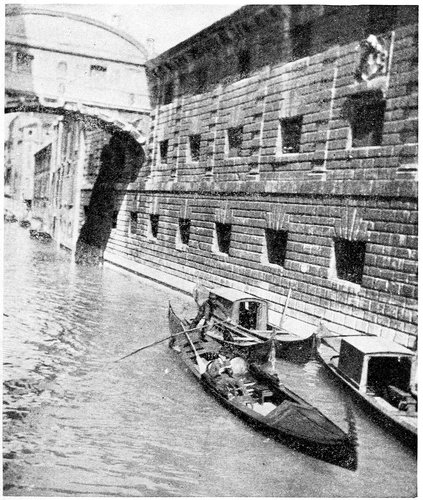
The Bridge of Sighs, so-called because it leads from the Justice Court in the Palace of the Doges on the left to the prison on the right. It crosses the Grand Canal of Venice.
By and by the steamer stopped tossing about and began
to glide smoothly. I pushed to the rail to peer out into the
night. Before me I saw a stretch of smooth water in which
twinkled the reflection of thousands of lights of smaller
40boats, and the illuminated windows of a block of houses
rising sheer out of the sea. We glided into port. A gondola
lighted up by torches at both ends glided across our
path. A wide canal opened on our left, and wound in and
out among great buildings faintly lighted up by lamps and
lanterns on the mooring-posts. It was the Grand Canal of
Venice. The steamer nosed its way through a fleet of gondolas
and tied up at a landing before a marble column.
I went ashore and looked about me. There were no
streets, and the hotels that faced the canals were all too expensive
for me. I did not know where to look for the poor
man’s section of the city. For two full hours I tramped
through squares and dark, narrow alleys, only to turn up
at last within a stone’s throw of my landing-place. I finally
spent the night outdoors, sitting on the edge of the canal.
After spending a few days in Venice, I walked down to
the Grand Canal one morning, with my mind made up to
ride in a gondola. I had difficulty in attracting the attention
of the water cabman. They are not in the habit of
asking men wearing corduroys and flannel shirts to be their
passengers. A score of them had just recovered from a
rush made on a tow-head wearing the regular tourist clothes.
They did not seem to see me. When I boldly called out to
them, they crowded around me to jeer and laugh at the laborer
trying to play the lord. For some time they thought
I was joking. I had to show them my purse with money
in it before one of them offered to take me aboard.
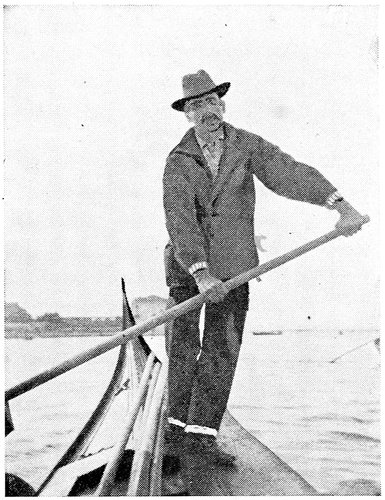
Along the Grand Canal passing gondoliers, without passengers
to keep them in proper conduct, flung cutting taunts
at my boatman.
“Eh, Amico!” they called out, “what’s that you’ve
got?”
“Sanque della Vergine,
caro mio, dove
hai accozzato quello?”
(“But, my dear fellow,
where did you pick that
one up?”)
But my guide finally
lost his grin and became
respectful, pointing out
objects of interest with
a face as solemn as an
owl, and shaking his head
sternly at his fellow boatmen
when they began to joke.
Fear drove me away from Venice before I had rested the
miles from Paris out of my legs—fear that in a few days
more the mosquitoes would finish their wicked work and
devour me entirely. On a Sunday evening I made my
way to the station and bought a third-class ticket to Bologna.
Under a lowering sun our train crawled slowly into Bologna—so
slowly that I was glad to get off and walk. I
struck off along the ancient highway to Florence. The
country was mountainous, so that when I was not climbing
up I was climbing down. The people in this section were
very poor, earning their living by tending cattle or by making
wine. A few miles from the town the highway began
to wind up among lonely mountains. Here and there a
vineyard clung to a wrinkled hillside. At such spots tall
cone-shaped buckets holding about two bushels each stood
42by the roadside, some filled with grapes, others with the
floating pulp left by the crushers.
What kind of crusher was used I did not learn until
nearly nightfall. Then, suddenly coming round a huge
boulder, I stepped into a group of bare-legged women who
were slowly treading up and down in as many buckets of
grapes.
Darkness overtook me when I was high among the lonely
mountains, far from any hut or village. A half hour later
a mountain storm burst upon me.
For what seemed an endless length of time I plunged on.
Then before me I noticed a faint gleam of light flickering
through the downpour. I splashed forward, and banged
on a door beside a window through which the light shone.
The door was quickly opened, and I fell into a tiny wine-shop.
Three drinkers sat in the room. They stared
stupidly for some time while the water ran away from me
in little rivers along the floor. Then the landlord remarked,
with a silly grin:
“You are all wet.”
“Also hungry,” I answered. “What’s to eat?”
“Da mangiare! Ma! Not a thing in the house.”
“The nearest inn?”
“Six miles on.”
“I suppose I must go to bed supperless, then,” I sighed,
drawing my water-soaked bundle from beneath my coat.
“Bed!” cried the landlord. “You cannot sleep here.
I keep no lodging-house.”
“What!” I exclaimed. “Do you think I am going on
in this flood?”
“I keep no lodging-house,” repeated the host stubbornly.
I sat down on a bench, determined that no three Italians
43should throw me out without a struggle. One by one, they
came forward to try coaxing, growling, and shouting at me,
shaking their fists in my face. I stuck stubbornly in my
place. The landlord was ready to weep, when one of his
countrymen drew me to the window and offered to let me
stay in his barn across the way. I made out through the
storm the dim outline of a building, and, catching up my
bundle, dashed with the native across the road and into a
stone hovel. I could feel under my feet that the floor was
nothing but the bare ground. An American cow would
balk at the door of the house of a mountain peasant of
Italy; she would have fled bellowing if she had seen the inside
of the barn that came to view when my companion
lighted a lantern. He pointed to a heap of corn husks in a
corner behind the oxen and donkeys. Then, fearful of losing
a moment over the wine with his fellows, he gave the
lantern a shake that put out the light, and, leaving me in
utter darkness, hurried away.
I felt my way toward the husks, narrowly missed knocking
down the last donkey in the row, and was about to throw
myself down on the heap, when a man’s voice at my feet
shouted a word that I did not catch. Being in Italy, I answered
in Italian:
“Che avete? Voglio dormire qui.”
“Ach!” groaned the voice in German. “Only an accursed
Italian.”
“Here, friend,” I shouted in German, poking the form
with my foot. “Whom are you calling accursed?”
The man in the husks sprang to his feet with a wild
shout.
“Lieber Gott!” he shrieked, clutching at my coat and
dancing around me. “Lieber Gott! You understand German.
44You are no cursed Italian. God be thanked. In
three weeks have I heard no German.”
Even the asses were complaining by the time he had finished
shouting and settled down to tell his troubles. He
was only another German on his Wanderjahr (year of wandering),
who had strayed far south in the peninsula, and,
after losing his last copper, was struggling northward again
as rapidly as he could on strength gained from a crust of
bread or a few wayside berries each day. One needed only
to touch him to know that he was as thin as a side-show
skeleton. I offered him half of a cheese I carried in a
pocket, and he snatched it with the hungry cry of a wolf,
and devoured it as we burrowed deep into the husks.
All night long the water dripped from my elbows and
oozed out of my shoes, and a bitter mountain wind swept
through the cracks of the building. I had just begun to
sleep when morning broke. I rose with joints so stiff that
I could hardly move. I pounded and rubbed them for a
half hour before they were in working order. Outside a
cold drizzle was falling; but, bidding farewell to my companion
of the night, I set out along the mountain highway.
Two hours beyond the barn, I came upon a miserable
group of huts crowded together on the top of a hill.
Among them was an even more miserable inn, where I
stopped for a bowl of thin soup in which had been drowned
a lump of black bread. Then still hungry, I plodded on in
the drizzle.
A night of corn-husks had made me look more like a
beggar than I knew. Two miles beyond the village, I
passed a ragged road-repairer and a boy who were breaking
stone at the wayside. Near by was a hedge weighted down
with blackberries, to which I hastened and fell to picking
45my late dinner. The workman stared a moment, open-mouthed,
laid aside his sledge, and mumbled something to
the boy. The boy left his place, wandered down the road
a short distance beyond me, and idled about as if waiting
for someone. With a half filled cap, I set off again. The
boy edged nearer to me as I approached, and, brushing
against me, thrust something under my arm and ran back
to the stone-pile. In my astonishment I dropped the gift on
the highway. It was a quarter loaf of black bread left
over from the ragged workman’s dinner.
The next afternoon found me looking down upon the
city of Florence, in a vast valley where the winding Arno
was bluish silver under the setting sun. By evening I was
housed in the city of the poet Dante and the artist Michelangelo.
During my four days in Florence I lived with the poorest
working class, but spent hours each day in cathedral and
galleries. Beggars were everywhere. I paid half a franc
a day for a good sized room, and bought my food of a
traveling restaurant. At night there appeared at street
corners in the unwashed section of the city men with pushcarts
laden with boiled tripe. Around them gathered
jostling crowds, who continued pushing until the last morsel
had been sold. Each customer seemed to possess but a
single cent which he had carefully guarded through the day,
waiting for the coming of the tripe man. Never did the
peddler make a sale without a quarrel arising over the size
of the morsel; and never did the buyer leave until a second
strip about the size of a match had been added to his share
to make up what he claimed to be the fair weight.
I spent most of my fourth day in Florence looking at
her works of art. Late that afternoon I decided not to
46return to my lodging, and wandered off along the highway
to Rome. The country was still mountainous, but the
ranges were not so steep and there were more huts than
to the north. When night settled down, I could see before
me a country inn on a hilltop.
I wandered on, reached the inn, went inside, and sat
down. At first the groups of men seated before the fireplace
and around the table scarcely looked my way. When
I began to speak, however, they turned to stare, and began
nodding and glancing at one another as if they said:
“Now where do you suppose he comes from?”
I did not offer to tell them, though they squirmed with
curiosity. Finally one of them, clearing his throat, hinted
timidly:
“Hem, ah—you are a German, perhaps?”
“No.”
The speaker rubbed his neck with a horny hand and
turned awkwardly to look at his fellows.
“Hah, you are an Austrian!” charged another, with a
scowl.
“No.”
“Swiss?” suggested a third.
“No.”
They began to show greater interest. A traveler from
any but these three countries is something to attract unusual
attention in the country inns of Italy.
“Ah!” tried a fourth member of the group. “You
are a Frenchman?”
“No.”
The geographical knowledge of the party was used up.
There followed a long wrinkled-browed silence. The landlady
wandered in with a pot, looked me over out of a
47corner of her eye, and left slowly. The silence grew intense.
A native opened his mouth twice or thrice, swallowed
his breath with a gulp, and purred with a frightened
air:
“Er, well—what country does the signore come from?”
“From America.”
A chorus of exclamations woke the cat dozing under the
fireplace. The hostess ran in, open-mouthed, from the back
room. The landlord dropped his pipe and exclaimed
“Ma!” in astonishment. The slowest of the party left
their games and stories and crowded closely around me.
One man began telling what he knew of America.
Among other things, he said the railway trains of America
run high up in the air above the houses. When the others
did not seem to believe it, he tried to prove it by shouting
at them. He said he had read about it in a newspaper.
Then he mentioned “Nuova York,” and asked me if it
were not also true that its buildings were higher than the
steeple of the village church, and whether the railroads
were not built high to enable the people to get into such
high houses. He seemed to think that Americans never
come down to earth. When he gave me a chance to speak, I
explained that what he had read was about the New York
Elevated and not about the railways of the whole country.
Moreover, “Nuova York” meant America to the whole
party. Not a man of them knew that there were two
Americas; not one had ever heard the term “United States.”
Many country people of Italy think of America as a land
somewhere far away,—how far or in what direction they
have no idea,—where wages are higher than in Italy.
Countless times questions like these were asked:
“Is America farther away than Switzerland?”
48“Did you walk all the way from America?”
“Who is king of America?”
“Why! Are you a native American? I thought Americans
were black!”
Finally a woman added insult to injury by asking:
“In America you worship the sun, non e vero?”
One evening, at a country inn, I remarked that the United
States as a whole is as large, if not larger, than Italy. My
hearers were deafening me with shouts of scorn and disbelief
when a newcomer of the party came to my assistance.
“Certainly that is right!” he cried. “It is larger. I
have a brother in Buenos Ayres, and I know. America, or
the United States, as this signore chooses to call it, has
states just like Italy. The states are Brazil, Uruguay, Republica
Argentina, and Nuova York.”
The roadway between Florence and Siena winds through
splendid scenery and over mountains, from the top of which
I had a complete view in every direction of the surrounding
hills and valleys. But I had little chance to admire the
scenery, for again and again I had to jump aside and vault
over roadside hedges before a team of oxen driven round
a hill. These oxen had horns that measured at least six and
even seven feet from tip to tip, so when I met two of them
yoked together there wasn’t much room left for me.
Moreover, their drivers were frequently sound asleep, and
the animals wandered this way and that as they pleased
all over the highway, tossing their horns toward me. As
I met them at almost every quarter mile, I had to be watchful
and quick.
I came upon Siena at last. Before me lay a broad, fertile
valley with a rocky hill rising from the center of it.
The houses were scattered over the hill, some of them on
49the very top, others clinging to the sides as if fearful of
falling to the bottom into the valley itself. It was another
of those up-and-down towns whose streets should be fitted
with ladders; where every householder is in danger, every
time he steps out of doors, of falling into the next block,
should he by any chance lose his hold on the front of his
dwelling. I managed to climb into the city without actually
crawling on my hands and knees; but more than once
I kept my place only by clutching at the nearest building.
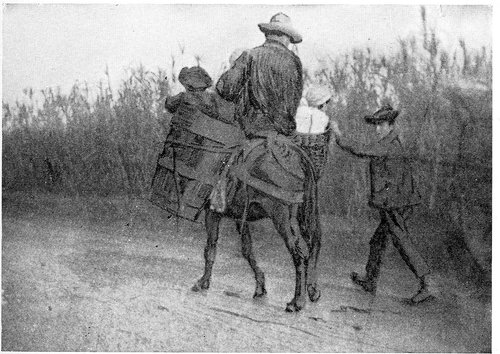
A country family returning from market. The grape casks being empty the boys do not need to walk home.
Two days after leaving Siena I was tramping along a
highway that wound over low mountains, between whispering
forests, in utter loneliness. Where the woods ended
stretched many another weary mile, with never a hut by the
wayside. Now and then I came upon a shepherd clad in
sheepskins, sitting among his flocks on a hillside.
50The sun sank while I was plodding through an endless
marsh. All about me were the whispering of great fields
of reeds and grasses, and the dismal croaking of countless
frogs. Twilight faded to black night. Far away before
me the lights of Rome brightened the sky; yet hours of
tramping seemed to bring them not a yard nearer.
Forty-one miles had I covered, when three hovels rose
up by the wayside. One was a wine-shop. I went inside
and found it filled with traveling teamsters. One of them
offered me a bed on his load of straw in the stable.
He rose at daybreak and drove off, and at that early hour
I started once more on my way to Rome. The lonely road
led across a windy marsh, rounded a low hill, and brought
me face to face with the ancient city that was once the center
of the civilized world.
To the right and left, on low hills, stood large buildings
like those in American cities. From these buildings a mass
of houses sloped down the hills and covered the broad valleys
between them. The Tiber River wound its way among
the dull gray dwellings. Here and there a dome shone
brightly in the morning sunshine. But, towering high
above all, dwarfing everything else, stood the vast dome of
St. Peter’s.
As I looked I thought of how, hundreds of years ago,
people had caught their first glimpse of Rome from this
very hilltop. Before the days of railroads, travelers had
come by this same road, millions of them on foot, and entered
the city by this same massive western gateway. I
watched the steady stream of peasants, on wagons, carts,
donkeys, and afoot, pouring through this same entrance;
while officers stood there, running long slim swords through
bales and baskets of farm produce. Finally I joined the
51noisy, surging crowd, and was swept within the walls.
I spent nearly a week wandering through St. Peter’s, the
Vatican Art galleries, and among the chapels, ruins, and
ancient monuments of Rome. Then I turned southward
again on the road to Naples. For three days the route
led through a territory packed with ragged, half-starved
people, who toiled constantly from the first peep of the sun
to the last waver of twilight, and crawled away into some
hole during the hours of darkness. They were not much
like the people of northern Italy. Shopkeepers snarled at
their customers, false coins of the smallest sort made their
appearance, and had I not looked so much like the natives
themselves I should certainly have won the attention of
those who lived by violence.
In this section the language changed rapidly. The tongue
spoken in Florence and Siena was almost foreign here. A
word learned in one village was not understood in another
a half day distant. The villages were perched at the summits
of the steepest hills, up which each day’s walk ended
with a weary climb by steep paths of stones that rolled under
my feet.
For three nights after leaving Rome I had to sleep out
of doors. On my fourth day I found lodging at the wayside,
in a building that was one fourth inn and three
fourths stable. The keeper, his wife, and their many children
all were barefooted. The father sat on a stool, bouncing
the baby up and down on his broad feet. Another child
squatted on top of the four-legged board that served as a
table, and in a fit of bashfulness thrust his fingers into his
mouth.
“You have lodgings for travelers?” I inquired.
“Yes,” growled the owner.
52“How much for bed?”
“Two cents.”
I demanded to see the lodging that could be had at such
a price.
“Giovanni,” bawled the head of the house, “bring in
the bed!”
A moth-eaten youth flung open the back door, and threw
at my feet a dirty grain-sack filled with crumpled straw
that peeped out here and there.
After I had rested awhile, the father bawled once more
to his son, and motioned to me to take up my bed and walk.
I followed the youth out to the stable, picking my way by
the light of the feeble torch he carried. Giovanni waded
inside, pointed out to me a long, narrow manger of slats,
and fled, leaving me alone with the problem of how to rest
nearly six feet of body on three feet of stuffed grain-sack.
I tried every way I could think of, but decided at last to
sleep on the bare slats and use the sack as a pillow.
I had just begun to doze, when an outer door opened and
let in a great draft of night air, closely followed by a flock
of sheep that quickly filled the stable to overflowing. Some
of the animals tried to overflow into the manger, sprang
back when they found me in it, and made their discovery
known to their companions by several long “b-a-a-s.”
The news awakened a truly Italian curiosity. The sheep
started a procession, and the whole band filed by the manger,
every animal poking its nose through the slats for a sniff.
This over, each of the flock expressed its opinion of my
presence in trembling, nerve-racking bleats. They kept
this up until the youth came to tell me that it was morning,
and carried off my bed, fearful, no doubt, that I would run
off with that valuable piece of property.
53
Italian peasants returning from the vineyards to the village.
In spite of bruises and aches, I plodded on at a good pace,
hoping by this early start to reach Naples before the day
was done. But I was still in the country when the gloom,
settling down like a fog, drove into the highway bands of
weary people and four-footed beasts, toiling homeward
from their day’s work. The route led downward. The
fields between tumble-down villages grew shorter and
shorter until they disappeared entirely, and I found myself
between an unbroken row of stone houses. The bands of
home-going peasants increased to a crowd, through which
I struggled to make my way.
It was impossible to stop long enough to look about me.
I finally cornered a workman and asked how to get to
Naples.
54“Napoli! Ma! This is Napoli!” he bellowed, shoving
me aside.
I plunged on, certain that the road must lead to the harbor
and its sailors’ lodgings. Ragged, cross-looking laborers
swept against me. Donkeys, with and without loads,
brayed when their masters struck them. Heavy ox-carts,
massive wagons, here and there a horseman, fought their
way up the hill amid shrill shouts, roaring oaths, screaming
yeehawing of asses, the rumble of wheels on cobblestones,
the snap of whips, the whack of heavy sticks. I
moved along with the bawling multitude before and behind
me, and a long time afterward reached level streets, and
was dragged into a miserable lodging-house by a boarding-house
runner.
In Naples the business people do not wait for you to come
into the shop to ask for what you want. They come out to
the street after you, or send their runners out to invite you
in. The barber walks up and down the street, watching for
men who need a shave; the merchant stands before his door
and shouts and beckons to the passing crowd to come in
and see his goods; the ticket agent tramps up and down the
wharves, trying to sell a ticket to everyone who passes; and
the boarding-house runners are everywhere, looking for the
stranger within the city who has not yet found a lodging-place.
I spent a few days in Naples, then went to Marseilles,
where I lived a month, tramping sorrowfully up and down
the break-water waiting for a chance to get work on some
ship eastward bound. On the last day of November my
luck changed. The Warwickshire, an English steamer sailing
to Burma, put in at Marseilles and sent out a call for a
sailor. I was the first man on board, showed them my discharge
55from the cattle-boat, and was “signed on” at once.
The next day I watched the familiar harbor of Marseilles
grow smaller and smaller until it faded away on the distant
sky-line.
CHAPTER VIII AMONG THE ARABS
56
On a peaceful sea the Warwickshire sped eastward. My
work was “polishin’ ’er brasses,” and I can say without
boasting that the ship was brighter because I was there.
On the morning of the fifth day out, I was ordered into
the hold to send up the trunks of Egyptian travelers. When
I climbed on deck after the last chest, the deep blue of the
sea had turned to a shabby brown, but there was no land in
sight. Suddenly there rose from the sea a flat-topped
building, then another and another, until a whole village
lay spread out on the water before us. The houses appeared
to sit like gulls on the ruddy sea. It was Port Said.
Beyond the town we could see a stretch of reddish desert
sand. Slowly the Warwickshire nosed her way into the
canal, the anchor ran out with a rattle and roar, and there
swarmed upon our decks a multitude of strange-looking
people who seemed to belong to another world.
Darkness soon fell. I had signed on the Warwickshire
under a promise that I might leave her at Port Said.
Through all the voyage, however, my shipmates had spent
the hours of the dog-watch telling me tales of the horrors
that had befallen white men who became penniless among
the Arabs. Perhaps my shipmates spoke truly. It seemed
as if they might have done so as I sat gazing off into the
blackest of nights, listening to the shrieks that rose from the
maze of buildings ashore, and the snarling, scowling mobs
that raced about our decks. Perhaps I should be murdered
57if I ventured ashore among these black tribes. Or, if I
escaped murder, I might be left to die of starvation on this
neck of sand.
The captain had given me leave to go on to Rangoon.
An Englishman, who was returning to the Burmese district
he governed, had promised me a position with good pay.
It seemed foolhardy to halt in this land of rascals, when in
a few days I might complete half my journey around the
globe and find ready employment.
For an hour I sat staring into the black night, trying to
decide whether to risk going ashore or to go on with the
ship. I finally decided that I must see Palestine and
Egypt, countries I had read much of in the Bible. They
were lands too famous to be lightly passed by. I bade farewell
to my astonished shipmates, collected my few days’
wages, and, with about nine dollars in my pocket, dropped
into a boat and was rowed ashore.
At the landing I paid the dusky boatman the regular fare—the
amount was posted in plain sight on the wharf. But
he was not satisfied. For an hour he dogged my footsteps,
howling threats or whining in a high-pitched voice, now in
his native Arabic, now in such English as he could put together.
But I shook him off at last, and set out to find a
lodging.
It was not an easy thing to do. To be sure, I passed several
hotels before which well dressed men lounged at little
tables, and barefooted black waiters flitted back and forth
carrying cool drinks. But to stop at such a hotel would
take more money than I had had for some time. There
must have been dozens of native inns among the maze of
hovels into which I plunged at the first step off the avenue.
But how could I tell where they were, when the only signs
58I could see were as meaningless to me as so many spatters
of ink? Even in Holland I had been able to guess at shop
names. But Arabic! I had not the least idea whether the
signs I saw announced a lodging-house or the quarters of
an undertaker! A long evening I pattered in and out of
crooked byways, bumping now and then into a dark Arab
who snarled at me and made off, and bringing up here and
there in some dismal blind alley. Fearful of wandering
too far from the lighted square, I turned back toward the
harbor. Suddenly I caught sight of a sign in English:
“Catholic Sailors’ Home.” I dashed joyfully toward it.
The Home was little more than a small reading-room.
Half hidden behind the stacks of ragged magazines, sat the
“manager,” a Maltese boy, huddled over paper and pencil
and staring in a discouraged manner at an Italian-English
grammar. I stepped forward and offered to help him, and
together we waded through a very long lesson. Before
we had ended, six tattered white men wandered in and carefully
chose books over which to fall asleep.
“You must know,” said the young manager, as he closed
the grammar, “that there am no sleepings here. And we
closes at eleven. But I am fix you oop. I am shelter all
these seamens, while I lose my place when the Catholic society
found it out.”
He peered out into the night and locked the doors.
Then he blew out the lights and awoke the sleepers. We
groped our way through a long stone-paved passageway to
the back of the building.
“You are getting in here,” said the Maltese, pulling
open what appeared to be a heavy pair of shutters; “but
be quietness.”
I climbed through after the others. A companion struck
59a match that lighted up a stone room, once the kitchen of
the Home. Closely packed though we were, it soon grew
icy cold on the stone floor. Two of the ragged men rose
with cries of disgust, and crawled out through the window
to tramp up and down the hall. I felt my way to a coffin-shaped
cupboard in one corner, laid it lengthwise on the
floor, pulled out the shelves, and, crawling inside, closed the
doors above me. My sleep was unbroken until morning.
On my second afternoon in Port Said, one of my room-mates
at the Home—an Austrian—wandered with me out
to the break-water. We lay stretched out, watching the
coming and going of the pilot-boats and the sparkle of the
canal, that narrowed to a thread far away on the yellow
desert.
A portly Greek approached, and asked in Italian if we
wanted work. We did, of course. We followed him back
to land and along the beach until we came to a hut in the
native part of the city. On the earth floor sat two widemouthed
stone vessels. The Greek motioned to us to seat
ourselves before them, poured into them some kind of
small nut, and handed each of us a stone pestle. When
we had fallen to work pounding the nuts, he sat down on a
stool, prepared his water-bottle pipe, and, except for a wave
of the hand now and then as a signal to us to empty the
vessels of the beaten mass and refill them, remained utterly
motionless for the rest of the day.
Like machines we pounded hour after hour. The pestles
were heavy when we began; before the day was over mine
weighed at least a ton. What we were beating up, and
what we were beating it up for, I do not know to this day.
The Austrian said that he knew the use of the product, but
fell strangely silent when I asked him to explain. Night
60sounds were drifting in through the door of the hut when
the Greek signed to us to stop. Then he handed each of
us five small piasters (12½ cents). We hurried away
across the beach to a native shop where mutton sold cheaply.
Two days later I took a “deck-passage” for Beirut, and
boarded an old ship flying the English flag. A crowd of
Arabs, Turks, and Syrians, Christians and Mohammedans,
men and women, squatted on the half-covered deck. In
one place were piled a half hundred wooden gratings.
What these were for was a mystery to me until my fellow
passengers fell to pulling them down, one by one, and
spreading their bed-clothes on them! I was the only one of
all the multitude without bedding; even the lean, gaunt Bedouins,
dressed in tattered filth, had each a roll of ragged
blankets in which, after saying their evening prayers with
many bowings toward the city of Mecca, they rolled themselves
and lay down together. When I stretched out on a
bare grating, the entire throng was lying huddled in a dozen
separate groups.
Morning broke bright and clear. Far off to the right
rose the snow-capped range of the Lebanon Mountains.
I strolled anxiously about the deck. In a group of Turks I
came upon two who spoke French. I began to talk with
them, chiefly because I wanted to ask them questions. I told
them a few of my experiences on the highways of Europe.
These stories amused them greatly. Then I spoke of my
intention of walking to Damascus. They shouted with
astonishment. It was plain that some of them did not believe
me.
“What!” cried one of the French-speaking Turks, waving
a flabby hand toward the snow-banks that covered the
wall-like range of mountains. “Go to Damascus on foot!
61Impossible! You would be buried in the snow. This
country is not like Europe! There are thousands of murderous
Bedouins between here and Damascus who would
glory in cutting the throat of a dog of an unbeliever! Why?
I have lived years in Beirut, and no man of my acquaintance,
native or Frank [European], would ever undertake
such a journey on foot.”
“And you would lose your way and die in the snow,”
put in the other.
Throughout the morning the pair were kept busy translating
for me what the others of the group said about the
absolute foolishness of such an undertaking. It was a
story I heard again and again while traveling in the Far
East; but it was new to me then, and as I ran my eye along
the snow-hooded wall that faded into hazy distance to the
north and south, I half believed it.
The coast-line drew nearer. On the plain at the foot
of the mountains I could see here and there well cultivated
patches between dreary stretches of blood-red sand. A few
minutes later we dropped anchor well out in the harbor of
Beirut. Down the gangway tumbled a mighty landslide of
Asiatics, men and women, large and small, dirty and half
dirty, pushing, kicking, scratching and biting one another,
hopelessly entangled with bundles of every thinkable shape.
Shouting boatmen rowed us ashore. As we swung in
against the rock, I caught a proud-looking Bedouin trying to
separate me from my knapsack. A well directed push
landed him in the laps of several heavily veiled women,
and I sprang up a stairway cut in the face of the rock.
The city itself was miles away from the landing-place.
One of the officials called an evil-looking native, clothed in
a single garment that reached to his knees, and ordered him
62to guide me to the town. We set off through the night,
heavy with the smell of oranges, along a narrow road six
inches deep in the softest mud. On the outskirts of the city
the native halted and began talking to me in Arabic. I
shook my head. He seemed to think that I was unable to
understand him because of some fault in my hearing. So
he asked the question again and again, louder and more
rapidly each time he repeated it. I let him shout until
breath failed him and he gave up and splashed on. He
halted once more, in a square reeking with mud in the center
of the city, and burst forth excitedly in a jumble of
words more difficult to understand than before.
“Ingleesee?” he shrieked, with his last gasp.
“No,” I answered, understanding this one word;
“Americano.”
“Ha!” shouted the Arab. “Americano?” And once
more he began his shouting. He seemed to be trying to explain
something about my fellow countrymen, for he repeated
the word “Americano” again and again. Once
more he gave up trying to make me understand and struck
off to the southward. I shouted “hotel” and “inn” in
every language I could call to mind; but, after a few mumbles,
he fell silent, and only the splash of our feet in the
muddy roadway could be heard.
We left the city behind, but still the Arab plodded steadily
and silently southward. Many a story of white men led
into Arabic traps passed through my mind. Far out among
the orange groves beyond the city, he turned into a small
garden, and pointed to a lighted sign above the door of a
building among the trees. It was the home of the American
consul. Not knowing what else to do with a Frank
who did not understand the loudest Arabic, the native had
63led me to the only man in Beirut whom he had heard called
“Americano.”
When I had paid my bill next morning at the French inn
to which I had been sent, I stepped into the office of that
great tourist agency, Cook & Son, and exchanged a sovereign
for so many iron and tin coins that I could hardly carry
them. Then I ate a native breakfast, and, strolling down
to the harbor, sat on a pier.
For a time the uproar made by shrieking Arabs, braying
camels, and the rattle of ships discharging their freight,
drowned all other sounds. Then suddenly I caught faintly
a shout in English behind me, and turned around. A lean
native in European dress and fez cap was beckoning to me
from the opening of one of the narrow streets. I dropped
from the pier and turned shoreward. The native ran toward
me. “You speak Eengleesh?” he cried. “Yes?
No? What countryman you?”
“American.”
“No? Not American?” shrieked the native, dancing up
and down. “You not American? Ha! ha! ver’ fine. I
American one time, too. I be one time sailor on American
warsheep Brooklyn. You write Engleesh too? No?
Yes? Ver’ fine! You like job? I got letters write in
Engleesh! Come, you!”
He led the way through the swarming streets, shouting
answers to the questions I asked him. He said his name
was Abdul Razac Bundak and his business that of “bumboat
man.” That is to say, he sold supplies to ships, acted
as guide for officers ashore, led tourists on sight-seeing
trips, and in the busy season ran a sailors’ boarding-house.
Some distance back from the harbor, in a shoe-shop kept
by his uncle, I sat down to write three letters for him. By
64the time these were finished he had discovered that I knew
other languages, and I wrote three more, two in French and
one in Spanish. They were business letters to ship captains
who often put in at Beirut. The bumboat man paid
me two unknown coins and invited me to dinner in a neighboring
shop.
In the days that followed, our “company,” as Abdul
called it, was the busiest in Beirut. I wrote many letters
for him and for other Arabs in the city who had heard of
me. Had those men been less indolent they might have
doubled their business. But they did not like to hurry.
Again and again, while telling me what to write, they would
drift away into the land of dreams with a sentence left half
finished on their lips. The palm of the left hand was the
writing-desk, and it was always with difficulty that I stirred
them up to clear a space on their littered stands. I did
not get much pay for this work; but I added something
each day to the scrap iron in my pocket.
When business was slow, Abdul could think of nothing
better to do than to eat and drink. Let his cigarette burn
out, and he rose with a yawn, and we rambled away through
the windings of the bazaars to some tiny tavern. The keepers
were always delighted to be awakened from their dreams
by our “company.” While we sat on a log or an upturned
basket and sipped a glass of some native drink, Abdul spun
long tales of the faranchee world. Some of these stories
could not have been true; but, with a live faranchee to serve
as illustration, the shop-keepers were satisfied and listened
open-mouthed.
With every drink the keeper served a half dozen tiny
dishes of hazelnuts, radishes, peas in the pod, cold squares
of boiled potatoes, berries, and vegetables known only in
65Arabia. But Abdul was gifted with an unfailing appetite,
and at least once after every business deal he led the way to
one of the many eating-shops facing the busiest streets and
squares. In a gloomy, cave-like shop, the front of which
was all door, stood two long, rough tables, with long, rough
benches beside them. The proprietor sat near the entrance
behind a great block of brick and mortar over which simmered
a score of black kettles. I read the bill of fare by
raising the cover of each kettle in turn, chose a dish that
seemed less mysterious than the rest, picked up a large
ring-shaped loaf and a bottle of water from a bench, and
withdrew to the back of the shop. Whatever I chose, it
was almost certain to contain mutton. The Arabian cook,
however, sets nothing over the fire until he has cut it into
small pieces. Each dinner was a stew of some kind, of
differing tastes and colors.
Abdul did not often concern himself with the contents
of the kettles, for his prime favorite was a dish prepared
by running a row of tiny cubes of liver and kidneys on an
iron bar, and turning them over and over above glowing
coals. I too should have ordered this delicacy more often,
had not Abdul, with his incurable “Eengleesh,” persisted
in calling it “kittens.”
With all its mud and careless disorder, there was something
very pleasing about this corner of the Arab world:
the lazy droning of its shop-keepers, the roll of the incoming
sea, the twitter of birds that spoke of summer and
seemed to contradict the calendar—above all, the picturesque
orange trees bending under the ripening fruit that
perfumed the soft air, with the snow-drifts almost within
stone’s throw on the peaks above.
For all that, I should not have remained so long in Beirut
66by choice, for the road was long before me, and I had
planned to cover a certain part of it each day. But my
friends in the East could not understand why I was anxious
to go at once. “To-morrow is as good as to-day; wait until
to-morrow,” they would say, when some small matter
had kept me from starting on the day I had planned. But
when to-morrow came, they repeated the same words.
They could not understand my hurry.
There was no one in Beirut who could tell me which
road led to Damascus. Abdul threw up his hands in horror
when I spoke to him of my intended journey. “Impossible!”
he shrieked. “There is not road. You be froze
in the snow before the Bedouins cut your liver. You no
can go. Business good. Damascus no good. Ver’ col’
in Damascus now.”
One afternoon, however, while in unusually good spirits,
he admitted that there was a road leading to Damascus,
and that caravans had been known to pass over it. But
even then he insisted that the journey could not be made on
foot.
The bumboat man left me next morning just outside the
city, and a bend in the road soon hid him from view. For
an hour the highway was perfectly level. On each side
were rich gardens and orange groves, thronged with dusky
men and women clad in flowing sheets. Soon all this
changed. The road wound upward, the delicate orange
tree gave place to the sturdy olive, instead of fertile gardens
there were now rocky hillsides all about, and the
only persons to be seen were now and then an Arab, grim
and scowling, leading or riding a swaying camel.
The way was lonely and silent. A rising wind sighed
mournfully through the gullies and trees. The summer
67breeze of the sea-level turned chilly. I hunted until I found
the sunny side of a large rock before attempting to eat the
lunch in my knapsack. Farther up the cedar forests began.
Here and there groups of peasants were digging on the
wayside slopes. To the north and south I could see flat-roofed
villages clinging to mountain-sides.
How strange and foreign seemed everything about me!
The dress and tools of the peasants, the food in my knapsack,
everything was so different from the world I had
lived in. If I spoke to those I met, they answered back in
a strange jumble of words, wound the folds of their queer
garments about them, and hurried on. If I caught sight
of a village clock, its hands pointed to six when the hour
was noon. Even the familiar name of the famous city
to which I was bound was meaningless to the natives, for
they called it “Shaam.”
My pronunciation of the word must have been at fault;
for, though I stood long at a fork in the road in the early
forenoon, shouting “Shaam” at each passer-by, I took the
wrong branch at last. I tramped for some hours along a
rapidly disappearing highway before I suspected my mistake.
Even then I kept on, for I was not certain that I
was going in the wrong direction. At last the route led
forth from a cutting in the hills, and the shimmering sea
almost at my feet showed me that I was marching due southward.
Two peasants appeared above a rise of ground beyond.
As they drew near I pointed off down the road and shouted,
“Shaam?” The pair halted wonderingly in the center of
the highway some distance from me. “Shaam! Shaam!
Shaam!” I repeated, striving to give the word a pronunciation
that they could understand. The peasants stared open-mouthed,
68drew back several paces, and peered down the
road and back at me a dozen times, as if they were not sure
whether I was calling their attention to some wonder of nature,
or trying to get them to turn around long enough to
pick their pockets. Then a slow, half-hearted smile broke
out on the features of the quicker-witted. He stood first
on one leg, then on the other, squinted along the highway
once more, and began to repeat after me: “Shaam!
Shaam! Shaam!”
“Aywa, Shaam!” I cried.
He turned to his companion. They talked together so
long that I thought they had forgotten me. Then both began
to shake their heads so forcibly that the muscles of their
necks stood out like steel cords. Two broad grins
wrinkled their leathery faces. They stretched out their
arms to the southward and burst forth in unmusical duet:
“La! la! la! la! la! Shaam! La! la! la! la! la!” The Arab
says “la” when he means “no.” I turned around and
hurried back the way I had come.
Dusk was falling when I came a second time to a two-row
village facing the highway. As I expected, there was not
an inn, or anything like one, in the place. I had seen
enough of the Arabian, however, to know that he has his
share of curiosity. So I sat down on a large rock at the
end of the village.
In three minutes a small crowd had collected. In ten,
half the population was swarming around me and roaring
at my useless effort to make myself understood. They
stood about me, grinning and chattering, for a good half
hour before one of the band motioned to me to follow him,
and turned back into the village. The crowd followed me,
closely examining every part of my clothing, grinning,
69smirking, running from one side to the other, lest they lose
some point in the make-up of so strange a creature, and
babbling the while like an army of apes.
The leader turned off the highway toward the largest
building in the village. Ten yards from the door, he
halted. The crowd formed a half circle, leaving me in
the center, and then one and all began to shout something
at the top of their lungs.
A girl of some sixteen years appeared at the door.
“Taala hena!” (“Come here!”) roared the chorus.
The girl ran down the steps. A roar as of an angry sea
burst forth, as every member of the company stretched out
an arm toward me. Plainly each was determined that
he, and not his neighbor, should be the one to introduce
this strange being.
“Sprechen Sie Deutsch?” (“Do you speak German?”)
shrieked the girl in my ear.
“Ja wohl.” (“Yes, indeed”), I answered.
The rabble fell utterly silent at the first word, and I asked
to be directed to an inn.
“There is no hotel in our city of Bhamdoon,” replied
the girl, with flashing eyes. “We should be insulted. In
this house with my family lives a German missionary lady.
You must stop here.”
She led the way to the door. The missionary met me
on the steps with a cry of delight. She explained that
she had not seen a European in many months.
“What would supper and lodging cost me here?”
Luckily, the German lady was hard of hearing. The girl
gave me a quick glance, half scornful, half astonished,
which reminded me that such a question is an insult in the
land of Arabs.
70“The lady is busy now,” said the girl. “Come and visit
my family.” She led the way along a hall and threw open
a door. I pulled off my cap.
“Keep it on,” said my guide, “and leave your shoes
there.”
She stepped out of her own loose slippers and into the
room. It was square and low. The stone floor was half
covered with mats and cushions. In the center glowed a
small sheet-iron stove; and around three of the walls ran
a long cushioned seat. Two men, two women, and several
children were seated in a half circle on the floor, their
legs folded under them. They rose without a word as
I entered. The girl placed a cushion for me on the floor.
The family sat down again and carefully and slowly folded
their legs as before. Then, after they were firmly seated,
one and all in turn, according to age, cried “Lailtak
saeedee” (Good evening).
In the center of the group were three large bowls, one of
lentils and another of chopped-up potatoes in oil. A third
contained a delicacy made of sour milk, half soup and half
pudding, that is a great favorite among the Arabs. On the
floor, beside each member of the family, lay several sheets
of bread, half a yard wide and as thin as cardboard. The
head of the house pushed the bowls toward me, ordered a
stack of bread to be placed beside my cushion, and motioned
me to eat. I stared helplessly at the bowls, for there was
neither knife, fork, nor spoon in sight. The girl, however,
knowing the ways of faranchees from years in a mission
school in Beirut, explained my difficulty to her father. He
cast a scornful look at me, begged my pardon, through his
daughter, for being so impolite as to eat a morsel before his
guest had begun, tore a few inches from a bread-sheet, and,
71folding it between his fingers, picked up a pinch of lentils
and ate. I lost no time in following his example.
A wonderful invention is this Arab bread. If one buys
food in a native bazaar, it is wrapped in a bread-sheet, and
a very good wrapper it is, for it requires a good grip and a
fair pair of muscles to tear it. A bread-sheet takes the
place of many dishes. It makes a splendid cover for pots
and pans; it does well as a waiter’s tray. Never have I seen
it used to cover roofs, nor as shaving paper; but, then, the
Arab is slow and he may not have thought of making use
of it in those ways yet. As an article of food, however, this
bread is not an entire success. The taste is not unpleasant,
but ten minutes’ chewing makes far less impression on it
than on a rubber mat. The bread I ate that night must
have been very old, for it would fall into pieces when I used
it as a spoon. My host picked up one of my sheets, held it
against the glowing stove with the flat of his hand, and returned
it. It bent as easily as cloth and was much more
agreeable to the taste than before.
The younger man rolled cigarettes for himself and his
father. They asked me questions, which the girl repeated
to me in German. She was about to tell them my answers,
when there came a tap at the door and a few words in Arabic
that caused the family to jump hurriedly to their feet.
“Sheik! sheik!” they whispered excitedly. The children
were whisked into one corner.
The door was flung open, and there entered the room an
under-sized man of about sixty. Long, flowing robes enveloped
his form, a turban-wound fez perched almost merrily
on his head, and his feet were bare, for he had dropped
his slippers at the door. His face, deeply wrinkled, with a
long scar across one cheek, was browned and weather-beaten
72by the wild storms that sometimes rage over the
Lebanon.
The sheik greeted the head of the family, took a seat near
me on the divan, bowed low to each person present, bowed
again when they each returned his greeting, and then with
a wave of his hand invited them to be seated. The newcomer
had quite plainly been attracted to the house because
he had heard that a faranchee was visiting the family. He
was asking questions about me, as I could tell by his gestures
and the few words I understood. The family began
eagerly explaining and telling him how they supposed I happened
to be in that part of the world. For a time the sheik
listened without showing the least surprise. He sat there
puffing at a cigarette as quietly as if it were nothing new
to have faranchees wander into his town on foot at night.
At the end of his story, however, the head of the house
remarked that I was on my way to “Shaam” on foot.
This news was as astonishing as he could have wished.
The sheik fairly bounded into the air, threw his cigarette at
the open stove, and burst forth excitedly. The girl explained
his words. He said it was “impossible,” it
“couldn’t be done”; and at the close of his speech he declared
that, as village mayor or sheik, he would not permit
me to continue on such a foolhardy undertaking. How
many weapons did I carry? None? What—no weapon?
Travel to far-off Damascus without being armed? Why,
his own villagers never ventured along the highway to the
nearest towns without their guns! he would not hear of it!
And he was still talking excitedly when the missionary came
to invite me to a second supper.
I bade farewell to the family early next morning, swung
my knapsack over my shoulder and limped down to the
73road. But Bhamdoon was not yet done with me. In the
center of the highway, in front of the little shop that he
kept, stood the sheik and several of his townsmen. With
great politeness he invited me to step inside. My feet were
still swollen and blistered from the long tramp of the day
before, for the cloth slippers of Port Said offered no more
protection from the sharp stones of the highway than a sheet
of paper; so I accepted the invitation. The village head
placed a stool for me in front of the shop, where everybody
walking up or down the road could see me.
It soon began to look as if I were on exhibition as some
strange animal that had been discovered, for the sheik
pointed me out with delight to every passer-by. It was
plain, too, that he was making use of the moment to collect
some village tax. For on the floor beside me stood an
earthenware pot, and as soon as the visitors had looked me
over from all sides, the sheik invited them to drop into it a
bishleek (ten cents). Not a man passed without giving
something; for the command of a sheik of a Syrian village
is a law to all its people.
After I had sat there for some time, a villager I had not
yet seen appeared and began talking to me in English. I
learned that he had once lived in Maine, where he had
earned money enough to live in ease in his native country, to
which he had returned years before. He insisted that I
visit his house near by. While I was there he fell to tucking
bread-sheets, black olives, raisins, and pieces of sugar-cane
into my knapsack, shouting all the while of his undying
love for America and things American. Out of mere
pride for his dreary country, he took care, on his way back
to the shop, to point out a narrow path that wound up the
steep slope of the neighboring range of mountains.
74“That,” he said, “leads to the Damascus road; but no
man can journey to Damascus on foot.”
The earthenware pot was almost full when I took my
seat again on the stool. I turned to my new acquaintance.
“What special taxes is the sheik gathering this morning?”
I demanded.
“Eh! What?” cried the former New Englander, following
the direction of my finger. “The pot? Why, don’t
you know what that’s for?”
“No,” I answered.
“Why, that is a collection the sheik is taking up to buy
you a ticket to Damascus on the railroad.”
I picked up my knapsack from the floor, and stepped into
the highway. The sheik and several bystanders threw
themselves upon me to hold me back. It was no use trying
to escape from a dozen horny hands. I permitted myself to
be led back to the stool, and sat down with the knapsack
across my knees. The sheik addressed me in soothing tones,
as if he were trying to coax me to wait, pointing to the pot
with every third word. The others went back to their seats
on the floor, rolled new cigarettes, and became quiet once
more. With one leap I sprang from the stool into the
street, and set off at top speed down the highway, a screaming,
howling, ever-increasing, but ever more distant crowd
at my heels.
Half an hour later I reached the top of a neighboring
range of mountains, and slid down the opposite slope on to
the highway to Damascus.
CHAPTER IX A LONELY JOURNEY
75
For miles the road climbed sharply upward, or crawled
along the face of a mountain at the edge of a yawning pit.
The villages were far apart, and as they were low and flat,
and built of the same rock as the mountains, I did not notice
them until I was almost upon them. In every such place
one or more of the householders marched back and forth on
the top of his dwelling, dragging after him a great stone
roller and chanting a mournful tune that seemed to cheer
him on in his labor.
At first sight these flat roofs seemed to be of heavy blocks
of stone. But they were really made of branches and
bushes, plastered over with mud. If the rolling had been
neglected for a fortnight in this rainy season, the roofs
would soon have sagged and fallen in of their own weight.
Most of the way was lonely. At one time I met a line of
proud and scornful-looking camels plodding westward.
Some time later a company of villagers on horseback appeared,
and a long moment afterward I came upon a straggling
band of evil-eyed Bedouins astride lean asses. Never
a human being alone, never a man on foot, and never a traveler
without a long gun slung across his shoulders. The
villagers stared at me open-mouthed; the camel-drivers
leered wickedly; and the scowling Bedouins halted to watch
me, as I went on, as if they were trying to decide whether I
was worth the robbing.
The highway wound upward through a narrow rocky
76passage between tall hills. As I went on I noticed how
lonely the pass was. I began to think that wandering
Bedouins could not choose a better spot in which to lie in
wait for the victims they meant to rob. Suddenly a shot
rang out at the top of the pass. I started in alarm.
Beyond the pass stretched mile after mile of rocky country, the loneliest I had ever seen.
The command came from no highwayman, however.
Before a ruined hut on the hill above stood a man in khaki
uniform, the reins of a saddled horse that grazed at his
feet over one arm. “Teskereh!” he bawled.
I climbed the hillside, and handed over my Turkish passport.
The officer grew friendly at once, and invited me into
his hut. Its only furnishings were a mat-covered bench that
served as a bed, and a pan of coals. I drew out a few coins
77and ate an imaginary breakfast. The officer could not or
would not understand my acting. He motioned me to a
seat, offered a cigarette, and poured out a cup of muddy
coffee from a pot over the coals; but food he would not bring
forth.
After we had sat grinning speechlessly at each other for
a while, I drew him out of the hut, and, once in the sunshine,
opened my camera. He gave one wild shriek, and stumbled
over himself in his haste to get back into the hovel. Nor
could any amount of coaxing lead him to come out again
until I had closed the camera.
Beyond the pass stretched mile after mile of rocky country,
the loneliest that I had ever seen. Hills upon hills sank
down behind each other, rocky and drear. Here and there
a single olive tree added to the loneliness of the surroundings.
It was truly a “waste place of the earth.”
All through the day I tramped on, with never a sight or
sound of any living thing. Darkness fell over the same
bare and rocky wilderness. The wind howled across the
lonely waste. On this blackest of nights I could not have
made out a ghost a yard away, and the unknown highway
led me into many a pitfall. Long hours after sunset I was
plodding blindly on, my cloth slippers making not a sound,
when I ran squarely into the arms of some kind of person
whose native footwear had made his approach as noiseless
as my own. Three startled male voices rang out in hoarse
shrieks of “Allah!” as the trio sprang back in terror.
Before I could pass on, one of them struck a match. The
howling wind blew it out instantly, but in that brief flicker
I caught sight of three ugly faces under the headdress that
belongs to the roving Bedouin. “Faranchee!” they
screamed, and flung themselves upon the particular corner
78of the darkness where the match had shown me standing.
In the excitement of the moment I jumped aside so hastily
that I fell off the highway. The rattling of stones under
my feet told them my whereabouts, and they charged upon
me again. A dozen times, in the game of hide-and-seek that
followed, I felt the breath of one of the flea-bitten rascals
in my face.
The Arabic rules of the game, fortunately, made the players
keep up a continual howling, while I moved silently, after
the fashion of the West. Helped in this unfair way, I managed
to escape them until they stopped to whisper together.
Then, creeping noiselessly on hands and knees, I lay hold
on the highway and sped silently away, by no means certain
whether I was headed toward Damascus or the coast.
An hour later the howling of dogs told me that I was near
a village. Once I halted to listen for sounds of human
voices. Everybody, it seemed, was asleep, for what Syrian
could be awake and silent? The lights that shone from
every hovel proved nothing, for Arabs are afraid of the evil
spirits that lurk in the darkness and leave their lamps burning
all night. I beat off the snapping curs and started on
again.
Suddenly sounds of laughter and excited voices sounded
from a building before me. I hurried toward it and
knocked loudly on the door. The merriment ceased. For
several moments there was not a sound. Then there came
the slapping of slippered feet along the passageway inside,
and a woman’s voice called out to me. I called back in the
few Arabic words I knew: “M’abarafshee arabee! Faranchee!
Fee wahed locanda? Bnam!” (“I don’t speak
Arabic! Foreigner! Is there an inn? Sleep!”)
Without a word, the unknown lady slapped back along
79the hall. A good five minutes passed. I knocked once
more, and again there came the patter of feet. This time a
man’s gruff voice greeted me. I repeated what I had said
before. Then I heard the sliding of many bolts and bars,
the heavy door opened ever so slightly, and the muzzle of a
gun was thrust out into my face. The eyes above the musket
peered cautiously out into the darkness.
A moment later the door was flung wide open, and a very
giant of a native, with a mustache that would have made
the Kaiser jealous, stepped out, holding his clumsy gun
ready for instant use. I had to laugh at his frightened look.
He smiled shamefacedly, and, going back into the house,
returned in a moment without his gun, and carrying a lamp
and a rush mat. At one end of the building he pushed open
a door that hung by one hinge, and lighted me into a room
with earth floor and one window from which five of the six
panes were missing. A heap of dried branches at one end
showed it to be a wood-shed.
A starved-looking cur wandered in at our heels. The
native drove him off, spread the mat on the ground, and
brought from the house a pan of live coals. I called for
food. When he returned with several bread-sheets, I drew
out my handkerchief containing the coins, and began to untie
it. My host shook his head fiercely and pointed several
times at the ceiling to show that the missionaries had made
a Christian of him and that he would not accept pay.
Barely had the native disappeared when the dog poked
his ugly head through the half-open door and snarled
viciously at me. He was a wolfish animal, the yellow cur so
common in Syria, and in his eye gleamed a wickedness that
gave him a startling likeness to the thieving nomads that
rove over that drear land. I drove him off and made the
80door fast, built a roaring fire of twigs, and rolling up in the
mat, lay down beside the blaze.
I woke from a doze to find that cur sniffing at me and
showing his ugly fangs within six inches of my face. A
dozen times I fastened the door against him—in vain.
Had he merely bayed the moon all night it would have mattered
little, for with a fire to tend I had small chance to
sleep, but his silent skulking and his muffled snarls kept me
wide-eyed with uneasiness until the gray of dawn peeped in
at the ragged window.
The village was named Hemeh. I left it and continued
my journey. The dreary hills of the day before fell quickly
away. The highway sloped down a narrow, fertile valley in
close company with a small river. On the banks of the
river grew willows and poplars in great masses.
A bright morning sun soon made the air agreeable, although
the chill of night and the mountains still hovered in
the shadows. Travelers became frequent. I met peasant
families driving their asses homeward from the morning
market, bands of merchants on horseback, and well-to-do
natives in clothes that made me think of the unlucky coat
of Joseph. Here passed a camel caravan whose drivers
would, perhaps, purchase just such a slave of his brothers
this very day. There squatted a band of Bedouins at breakfast.
Beyond rode a full-bearded sheik who reminded me
of Abraham of old.
The road continued downward. The passing crowd became
almost a procession. I swung, at last, round a group
of hills that had hidden from view an unequaled sight.
Two miles away, across a vast level plain, crossed by the
sparkling river, and peopled by a battalion of soldiers drilling
81in the sunlight, the white city of Damascus stood out
against a background of dull red hills, the morning sun
gleaming on its graceful domes and slender towers. I
passed on with the crowd, and was soon swallowed up in
“the street called Straight”—which isn’t.
CHAPTER X CITIES OF OLD
82
The whistle of the locomotive is now heard in the suburbs
of Damascus; for, besides the railway to the coast, a new
line brings to the ancient city the produce of the vast and
fertile plain beyond Jordan. A few single telegraph wires,
too, connect “Shaam” with the outside world, and the whir
of the American sewing-machine is heard in her long,
tunnel-like streets. But these few modern improvements
make the ancient ways of the city seem stranger still.
Here is a man with a stone hammer, beating into shape
a vessel of brass on a flat rock. There a father and son are
turning a log into wooden shoes with a very old-fashioned
buck-saw, the man standing on the log, the boy kneeling
on the ground beneath. Beyond them is a strange-looking
turning-lathe. The workman squats on the floor of his open
shop, facing the street; for no Damascan can carry on his
business with his back turned to the sights and sounds made
by the passing crowd. With his right hand he holds a sort
of Indian bow which has its cord wound once around the
stick he is shaping. As he moves this bow back and forth,
the stick, whirling almost as rapidly as in a steam lathe, is
whittled into shape by a chisel which he holds with his left
hand and his bare toes.
Mile after mile through the endless rows of bazaars, such
old-fashioned trades are carried on. Every foot of space
on either side of the narrow streets is in use. Wherever
the overdressed owners of great heaps of silks and rugs have
83left a pigeonhole between their shops, sits a ragged peddler
of sweetmeats and half-inch slices of cocoanut.
Stores selling the same kind of article are found together
in one part of the city, and nowhere else. In one section are
crowded a hundred manufacturers of the red fez cap of the
Mohammedan. In another a colony of brass-workers makes
a deafening din. Beyond sounds the squeak of hundreds
of saws where huge logs are slowly turned into lumber by
hand power. The shopper who wants to buy a pair of slippers
may wander from daylight to dusk among shops overflowing
with every other imaginable ware, to come at last,
when he is ready to give up, into a section where slippers of
every size, shape, and color are displayed on either side of
the street, as far as he can see.
To try to make headway against the pushing crowd is
much like attempting to swim up the gorge of Niagara.
Long lines of camels splash through the human stream,
caring nothing for the small boys under their feet.
Donkeys all but hidden under great bundles of fagots that
scrape the building on either side, asses bestraddled by shouting
boys who guide the beasts by kicking them behind the
ears and urge them on by a queer trilling sound, dash out
of darkened and unexpected side streets. Not an inch do
they turn aside, not once do they slacken their pace. The
faranchee who expects them to do so is sure to receive many
a jolt in the ribs from the donkey, or from his load, and to
be sent sprawling—if there is room to sprawl—as the
beast and his driver glance back at him with a wicked
gleam in their eyes.
Hairless, scabby curs, yellow or gray in color, prowl
among the legs of the throng, skulking through the byways,
devouring the waste matter they find, or lie undisturbed in
84the puddles that abound in every street. The donkey may
knock down a dozen foot travelers an hour; but he takes
good care to step over the dogs in his path. Often these
beasts gather in bands at busy corners, yelping and snarling,
snapping their yellow fangs, and raising a din that puts a
stop to bargainings a hundred yards away. If a by-stander
wades among them with his stick and drives them off, it is
only to have them collect again five minutes after the last
yelp has been silenced.
A metleek is only a cent. Yet, as you pass through the
streets of Damascus, the constant calling for it sounds like a
multitude searching the wilderness for a lost child. “Metleek!”
cries the seller of flat loaves, on the ground at your
feet. “Metleek!” screams the wandering bartender,
jingling his brass disks. The word is shouted commandingly
from the peddler whose novelty has attracted a crowd,
fiercely from the angry-looking fellow whose stand has been
deserted, pleadingly from the crippled beggar, who threads
his way with astonishing swiftness through the human
whirlpool. Unendingly the word echoes through the openings
and windings of the bazaars.
When night came on I was wandering dismally through
the winding streets where long lines of merchants were setting
up the board shutters before their shops. It mattered
not in what European language I inquired for an inn of
those I met. Each one muttered, “M’abarafshee” (“I
don’t understand”), and hurried on.
I sat down before a lighted tobacco booth and pretended
I was asleep. The proprietor came out to drive off the curs
sniffing at my feet, and led the way to a neighboring caravan
inn, where the keeper spread me a bed of blankets on the
cobblestone floor.
85The next day I discovered the Hotel Stamboul, facing the
stable that serves Damascus as post-office. I went in with
little hope either of making my wants known or of finding
the price within my means. The proprietor, strange to say,
spoke a little French, and, stranger still, assigned me to a
room at eight cents a day.
I spent four days in Damascus before I began to make
plans for getting out of it. I had intended to strike southwestward
through the country to Nazareth. On the map
the trip seemed easy. But I had found, on my journey
from the coast, that maps do not show the distance to be
covered in this little-known country. It was late in December,
and the rainy season was at hand. Several violent
downpours that made me think of the flood described in the
Bible had already burst over Damascus. These storms were
sure to have made Palestine a muddy marsh, and to have
turned its summer brooks into roaring torrents.
The trip, however, could not have been more difficult than
it was to find out about it. The people in the cities of Asia
Minor are the most incurable stay-at-homes on the globe.
They know no more of the country a few miles outside
their walls than they do of the other side of the earth.
I spent a day inquiring about it, and learned nothing.
Toward evening I came across a French-speaking tailor who
claimed to have made the first few miles of the journey.
Gleefully I jotted down his directions in my note-book. An
hour’s walk next morning brought me out on a wind-swept
stretch of grayish sand beyond the city. For some miles a
faint path led across the dreary waste. Wild dogs growled
and snarled over the dead bodies of horses and sheep that
lined the way. The wind whirled on high tiny particles of
sand that bit my cheeks and filled my eyes. A chilling rain
86began to fall, sinking quickly into the desert. The storm
was becoming violent, when the path ceased at the brink of a
muddy torrent that it would have been madness to try to
cross.
A lone shepherd was plodding along the bank of the
stream. I pointed across it and shouted, “Nazra?” The
Arab stared at me a moment, tossed his arms above his head,
crying to Allah to note the madness of a roving faranchee,
and sped away across the desert.
I plodded back to the city. In the iron-workers’ bazaar a
sword-maker called out to me in German, and I halted to ask
him about the road to Nazareth. The workman paused in
his task of pounding a queer-looking sword, to tell me that
the tailor was a fool and that the road to Nazareth left the
city in exactly the opposite direction. “’Tis a broad caravan
trail,” he went on, “opening out beyond the shoemakers’
bazaar.”
The next morning I struck out in the direction the sword-maker
had pointed out to me. The morning was cloudy and
the air biting. Before I had passed the last shoemaker’s
shop a cold drizzle set in. On the desert it turned to a wet
snow that clung to bushes and rocks like shreds of white
clothing. The sword-maker certainly had played a joke on
me. A caravan track there was beyond the last wretched
hovel—a track that showed for miles across the bleak
country. But, though it might have taken me to Bagdad
or to the steppes of Siberia, it certainly did not lead to
the land of the chosen people.
I turned and trotted back to the city, cheered by the hope
of sitting before such a fire as roars up the chimneys of
American homes on the well remembered days of the first
snow. The hope showed how little I knew of Damascan
87customs. The hotel proprietor and his guests were shivering
over a pan of coals that could not have heated a doll’s
house.
I fought my way into the huddled group, and warmed first
a finger and then a toe. But the chill of the desert would
not leave me. A servant called the landlord to another part
of the building. He picked up the “stove” and marched
away with it, and I left my shivering fellow guests and went
to bed, as the only possible place where I could get the
chill out of my bones.
The next day I spent Christmas in a stuffy car on the cogwheel
railway over the Lebanon hills, and stepped out at
Beirut shortly after dark, to run directly into the arms of
Abdul Razac Bundak.
On the afternoon of December twenty-seventh I set out
on foot for Sidon. Here, at least, I could not lose my way,
for I had but to follow the coast. Even Abdul, however,
did not know whether the ancient city was one or ten days
distant. A highway through an olive grove soon broke up
into several narrow paths. The one I chose led over low
hills of sand, where the misfit shoes that I had picked up in
a pawn-shop of Beirut soon filled to overflowing. I swung
them over a shoulder and plodded on barefoot. A roaring
brook blocked the way. I crossed it by climbing a willow
on one bank and swinging into the branches of another
opposite, and plunged into another wilderness of sand.
Toward dusk I came upon a peasant’s cottage on a tiny
plain, and halted for water. A youth in the much patched
uniform of the Turkish soldier, sitting on the well-curb,
brought me a basinful. I had started on again, when a
voice rang out behind me: “Hé! D’ou est-ce que vous
venez? Ou est-ce que vous allez?” In the doorway of the
88hovel stood a slatternly woman of some fifty years of age.
I told her my nationality.
“American?” she cried, this time in English, as she
rushed out upon me. “Oh, my! You American? Me
American, too! Oh, my!”
I could hardly believe her, for she looked decidedly like a
Syrian, both in dress and features.
“Yes,” she went on. “I live six years in America, me!
I go back to America next month. I not see America for
one year. Come in house!”
I followed her into the cottage. It was the usual dwelling
of the peasant class—dirt floor, a kettle hanging over an
open fire in one corner, a few ears of corn and bunches of
dried grapes suspended from the ceiling. On one of the
rough stone walls was pinned a newspaper portrait of
McKinley.
“Oh, my!” cried the woman, as I glanced toward the
portrait. “Me Republican, me. One time I see McKinley
when I peddle by Cleveland, Ohio. You know Cleveland?
My man over there”—she pointed away to the fertile slopes
of the Lebanon hills—“my man go back with me next
month, vote one more time for Roosevelt.”
The patch-work youth poked his head in at the door.
“Taala hena [Come here], Maghmood,” bawled the noisy
Republican. “This American man! He no have to go for
soldier, fight long time for greasy old Sultan. Not work all
day to get bishleek, him! Get ten, fifteen, twenty bishleek
day! Bah! You no good, you! Why for you not run
away to America?”
The woman kept a sort of lodging-house in a near-by
stone hut, and insisted that I spend the night there. Chattering
about one thing and another she prepared a supper of
89lentils, bread-sheets, olives, and crushed sugar-cane, and set
out a bottle of beet (native wine). The meal over, she
lighted a cigarette, leaned back in a home-made chair, and
blew smoke at the ceiling with a far-away look in her eyes.
“Oh, my!” she cried suddenly. “You sing American
song! I like this no-good soldier hear good song. Then
he sing Arab song for you.”
I undertook to play the wandering minstrel with uncertainty.
At the first lines of “The Swanee River” the
soldier burst forth in a roar of laughter that doubled him up
as if he were having a fit.
“You great fool, you,” shouted the woman, shaking her
fist at the property of the Sultan, who was lying at full
length on the floor. “You no know what song is! Shut
up! I split your head!”
This gentle hint made the youth sit up and listen most attentively,
with set teeth, until the concert of the Western
world was ended.
When his turn came, he struck up a mournful chant that
sounded like the wailing of a lost soul, and sang for nearly
an hour on about three notes, shaking his head from side to
side and rocking his body back and forth as his voice rose to
an ear-splitting yell.
The mournful tune was interrupted by a shout from the
darkness outside. The woman called back in answer, and
two ragged, bespattered Bedouins pushed into the hut.
The howling and shouting that followed made me wonder
whether murder or merely highway robbery had been committed.
The men shook their fists, and the woman almost
cried. The quarrel lasted for a full half hour, and then
there was quiet again. The woman took from the wall a
huge key, and stepped out, followed by the Bedouins.
90“You know for what we fight?” she demanded, when she
returned. “They Arabs. Want to sleep in my hotel.
They want to pay only four coppers. I say must pay five
coppers—one metleek. Bah! This country no good.”
Four fifths of a cent was perhaps as great a price as she
should have asked from any lodger in the “hotel” to which
she led me a half hour later.
All next day I followed the faintly marked path that clung
closely to the coast. Here and there a care-worn peasant
toiled behind the wooden plow that the tiny oxen dragged
back and forth across the fields. At times, when the peasant
turned to look at me, his plow struck a root or a rock,
and he was obliged to pick himself up out of the mire.
Nineteen showers flung their waters upon me during that
day. Sometimes these showers were separated from each
other by periods of the brightest sunshine.
Late in the afternoon the sun was smiling bravely, when
the path turned into a well kept road winding through a
forest of orange trees, where countless natives were stripping
the overloaded branches of their fruit. I had reached
the ancient town of Sidon. From the first shop in the outskirts
of the place, the bazaar was one long orange-colored
streak.
I spent the night at a caravan inn. The next day I went
on southward, guided by the booming of the Mediterranean.
Mile after mile the way led over slippery ridges of
the mountain chain, through streams and across marshes in
which I sank half way to my knees.
The gloomy day was drawing to a close when I began to
look for shelter. But I found none, and a gnawing hunger
made me hurry on. I was crossing a crumbling stone bridge
that humped its back across a wandering stream when an
91unhoped-for sight caught my eye. Miles away, at the end
of a low cape, rose the slender tower of a Mohammedan
church, surrounded by a jumble of flat buildings. I hurried
toward it.
Dusk turned to utter darkness. Far ahead twinkled a
few lights, that seemed to move on before me as fast as I
tried to draw near them. The flat sand gave way to rocks
and boulders against which I barked my shins repeatedly.
I had almost given up trying to reach the village that
night, when the baying of dogs fell on my ear.
In the dim moonlight I noticed a faintly marked path up
the sloping beach. I followed it across sand-hills, and came
up against a fort-like building, pierced in the center by a
gateway. Two flickering lights under the archway cast
wavering shadows over a group of Arabs huddled in their
blankets near the gate. When I stepped before them out
of the blackness of the night, they sprang to their feet with
excited cries.
I pushed through the group, and plunged into crooked
alleyways filled with wretched hovels. All was silent in the
bazaars; but the keeper of one shop was still dozing over his
pan of coals between a stack of aged bread-sheets and a simmering
kettle of sour-milk soup. I prodded him until he
was half awake, and gathering up the bread-sheets sat
down in his place. He dipped up a bowl of soup from force
of habit; then, catching sight of me for the first time, spilled
the jelly-like mixture over my outstretched legs.
The second serving reached me in the proper manner.
A group of Arabs gathered outside in the circle of light cast
by the shop lamp, and watched me eat. I finished the bowl
of soup and called for a second. They stared, astonished.
Again I sent the bowl back. The bystanders burst into a
92roar of laughter, and the boldest stepped forward to pat
their stomachs mockingly.
I inquired for an inn. A ragged giant stepped into the
arc of light, and crying “Taala,” set off to the westward.
Almost at a trot he led the way by cobbled streets, down the
center of which ran an open sewer, up hill and down. The
corners we turned were so many that I could not count
them.
We came, at last, to a brightly lighted café, where a dozen
jolly Arabs sat smoking cigarettes and drinking coffee. My
guide began calling out mournfully in the darkness, and
drew me into the circle of light. A roar went up from the
men in the café, and they tumbled pell-mell out upon us.
My guide explained my presence in a trumpet-like voice.
From every dwelling around poured forth dark, half-dressed
men who, crowding closely about, began talking all
together. Some one said that we ought to go inside the
café. We did so, and the keeper, with his best company
smile, placed a chair for me in the center of the room. The
older men grouped themselves about me on more chairs, and
the younger squatted on their heels around the wall. We
were trying to talk in the language of signs, when a native
pushed into the circle and addressed me in French.
Through him they asked me where I came from, and why I
was there, and were not satisfied until I had told them the
entire history of my wanderings.
I ended my story with the statement that I had left Sidon
that morning.
“Impossible!” shouted the one who could speak French.
“No man can walk from Sidon to Soor in one day.”
“Soor?” I cried, recognizing the native name for Tyre,
and scarcely believing my ears. “Is this Soor?”
93“Is it possible,” gasped the native, “that you do not know
you are in the ancient city of Tyre? Yes, indeed, my
friend; this is Soor. But if you left Sidon this morning you
have slept a night on the way without knowing it.”
I inquired about the men in the room. The interpreter
introduced them, one by one: the village clerk, the village
barber, the village carpenter, the village tailor, and—even
thus far from the land of chestnut trees—the village blacksmith.
They every one decided that I could not be allowed
to continue on foot. Some days before, they said, between
Tyre and Acre, a white man had been found murdered by
some blunt instrument, and nailed to the ground by a stake
driven through his body. They told the story, leaving out
none of the horrors. Then they told it again to each other
in Arabic, and acted it out for me. The village carpenter
was the white man, a fisherman and the clerks were the
assassins, and a piece of water-pipe was the stake.
Midnight had long since passed. I promised the good
citizens of Tyre to remain in their city for a day, to think
it over. The keeper offered to let me sleep on a rush mat in
a back room of the café. I accepted the invitation, and the
men put up the shutters and marched away.
The ancient city of Tyre is to-day a collection of stone and
mud huts covering less than a third of the sandy point that
was once filled with the life of a great city. Its four
thousand humble people are now without education, art, or
ambition. To the north, in the wretched harbor, were a few
old fishing-boats, far different from the fleets whose sailors
once made merry and sang in the streets of Tyre. Down
on the encircling beach, half buried under the drifting sands
and worn away by the lapping waves, lay the ruins of what
must long ago have been great business blocks. The
94Tyreans of to-day have carried away these ruins, stone by
stone, to build their own humble dwellings. Even as I
looked, half a dozen ragged Arabs were prying off the top of
a great pillar, and loading the pieces into an old sailing-vessel.
The next morning I passed through the city gate and continued
my journey on foot. From a short distance the
gloomy group of huts behind looked pitifully small and
mean, huddled together on the great plain near the vast blue
sea.
I came to the “Ladder of Tyre,” a steep hill, which I
climbed with many bruises. Beyond, range after range of
rock-covered hills stretched out from the top of the ladder.
Half climbing, half sliding, I went down the southern slope,
and struggled on across a trackless country in a never-ceasing
downpour.
Night came on. The sun was settling to his bath in the
Mediterranean. Across the throbbing sea, stretched a wavering
ribbon of orange and red. Away to the eastward, in
the valleys of the Lebanon, darkness already lay. Here and
there on the rugged peaks, a tree, swaying in a swift breeze,
stood out against the evening sky. Near by a lonely shepherd
guarded a flock of fat-tailed sheep. Beyond him lay
a sea of darkness. The level plain soon changed to row
after row of low sand-hills, unmarked by a single footprint,
over which my path rose and fell with the regularity
of a tossing ship.
The last glint of the blazing sun sank beneath the waves,
leaving an unbroken plain of black water. The swaying
trees became dim; the very peaks blended into the darkening
sky of evening. It became difficult to see where the
hills ended and the trough began.
95I stumbled half way up every slope. The shifting sands
made walking difficult. On the summit of the ridges
sounded the low moaning of the wind, rising and falling like
far-off sobbing. It was easy to imagine the surrounding
blackness peopled with murderous nomads. Somewhere
among these never-ending ridges the “staked faranchee”
had been done to death.
Mile after mile the way led on. My path rose and fell so
frequently that it seemed like crossing the same sandy billow
over and over. The rain had ceased, but not a star broke
through the darkened sky, and only the hoarse boom of the
sea guided my steps.
Once, when coming down a ridge with my feet raised high
at each step in expectation of another hill in front of me, I
plunged into a hole in which I sank almost to my knees in the
mire. From force of habit I plowed on. The booming of
the waves grew louder, and the wind from off the sea blew
stronger and more chilling. Suddenly there sounded at my
feet the rush of water. I moved forward cautiously, and
felt the edge of what seemed to be a broad river pouring
seaward. I could not cross it on a black night. I drew
back from the brink, and, finding a spot that seemed solid
enough, threw myself down.
But I sank, inch by inch, into the wet earth. Fearful of
being buried before morning, I rose and wandered toward
the sea, stumbling over a heap of cobblestones probably
piled there by peasants. I built a bed of stones on the side
of the pile sheltered from the wind, tucked my camera in a
hole among them, and, pulling my coat over my head, lay
down. A patter of rain sounded on the coat; then another,
and another, faster and faster; and in less than a minute
there began a downpour that lasted all night.
96The heap of stones gave small protection against the
piercing wind. My bed was short and like a half-circle in
shape, so that I had to lie motionless on my right side, in
order to protect my camera and films beneath. The rain
quickly soaked through my clothing and ran in streams
along my skin. The wind turned colder and whistled
through the chinks of the pile. Through it all the sea
boomed constantly, and in the surrounding marshes unwearying
frogs croaked a dismal chorus.
I was certainly awake at the first gleam of day. The new
year was peering over the Lebanon when I rose to my feet.
My left leg, though creaking like rusty armor, held me up all
right; but I had no sooner shifted my weight to my right
than it gave way like a thing of straw and let me down suddenly
into the mud. After rubbing it for some time I recovered
the use of the limb: but even then an attempt to
walk in a straight line sent me round in a circle from left
to right.
Daylight showed the river to be lined with quicksands.
Some distance up the stream I managed to cross without
sinking below my arm-pits. Far off to the southeast lay a
small forest. Thinking that a village might be hidden in
its shade, I pushed eagerly forward through a sea of mud.
When I reached the forest I found it to be a large orange
grove surrounded by a high hedge and a ditch filled with
water. There was not a house in sight. The trees were
loaded with fruit. I emptied my knapsack, plunged through
ditch and hedge, and tore savagely at the tempting fare.
With half-filled bag I got back to the plain, caught up my
scattered belongings, and struck southward, peeling an
orange. The skin was close to an inch thick; the fruit
inside looked juicy enough to make anybody hungry.
97Greedily I stuffed a large piece into my mouth, and stopped
stock-still, feeling as if I had been struck a sudden blow in
the back of the neck. The orange was as green as the
Emerald Isle, its juice more sour and bitter than half and
half of vinegar and gall. I peeled another, and another.
Each was more sour and bitter than the last. Tearfully I
dumped the golden treasure into the mire and stumbled on.
In the early afternoon I fell in with a band of roving
Bedouins, and traveled on with them, splashing long hours
through surf and stream along the narrow beach. Night
had fallen before we parted in the Haifa market-place.
At a Jewish inn in Haifa I made the acquaintance of a
fellow countryman. He was born in Nazareth, of Arab
blood, and had never been outside Asia Minor. But his
grandfather had lived for a few years in New York, and,
though the good old gentleman had long since been resting
in his grave, his descendants were considered citizens of the
United States in their native land, and did not have to pay
taxes to the Turkish officials. They had the right to greet
travelers from the new world as fellow countrymen. Nazry
Kawar was overjoyed at meeting a man from his own country.
He spent the afternoon drawing sketches of the routes
of Palestine for me, and took his leave, promising to write
me a letter of introduction to his uncle, a Nazarene dentist.
Early the next morning I started out on the road to Nazareth.
Toward noon, in the lonely hills beyond the first village,
two Bedouins, less bloodthirsty than hungry, fell upon
me while I ate my lunch by the wayside. They bombarded
me with stones from opposite sides; but they threw like girls,
and dodged like ocean liners, so that I caused more injury
than I received. Finally I started a race down the highway.
They were no mean runners; but, when over the hill,
98they caught sight of a road-repair gang of bronze-faced and
muscular women, and were forced to stop.
An hour later I reached the highest point of the route.
Far beyond, colored by the delicate blue air that trembled
and wavered in the afternoon sunshine, stretched a vast
plain, walled by mountain ranges, that seemed many miles
away. I followed the route along the top of the western
wall, now passing between two mountain-peaks, now coming
out on a plateau; and, rounding at last a gigantic rock, I
burst into Nazareth, the city where Christ spent his boyhood.
On the road between Haifa and Nazareth I met a road repair gang, all women but the boss.
Nazareth was a mere village in the time of Christ. To-day
it covers the bowl-shaped valley in which it is built, and
climbs to the summits of the surrounding hills. Seen from
a distance, it looks like the amphitheater of a circus.
I went on down into the city. In the crowded, babbling
bazaars, I tried in vain to find the dentist Kawar to whom
my letter was addressed. When my legs grew a-weary of
99wandering through the winding streets, and my tongue could
no longer misshape itself in attempts to pronounce the
peculiar sounds of the Arabic language, I sat down on a
bazaar stand and leaned back carelessly, knowing that I
should soon be taken care of. Near me on all sides rose a
whisper, in the hoarse voice of squatting shop-keepers, in
the high-pitched voice of passing children: “Faranchee!
Fee wahed faranchee!”
Hardly a moment had passed before a scared-looking boy
stopped near by to stare at me, in the manner of one ready to
run in terror at the first sign of an unfriendly move on the
part of this strange creature, whose clothes were so queer,
whose legs were clothed in separate garments. Here,
surely, was one of those dread bogey men who are known to
dine on small Arabs, and so near that—perhaps he had
better edge away and take to his heels before—But no;
here are a dozen men of familiar look collecting in a half-circle
back of him! And there comes his uncle, the camel-driver.
Perhaps the bogey man is not so fearful, after all,
for the men crowd close around, calling him faranchee and
efendee, and appearing not in the least afraid.
The camel-driver is doubly brave,—who would not be
proud to be his nephew?—for he actually begins to speak
to the strange being, while the crowd behind him grows
and grows.
“Barhaba!” says the camel-driver in greeting. “Lailtak
saeedee! Where does the efendee hail from? Italiano,
perhaps?”
“No; American.”
“Amerikhano!” The word runs from mouth to mouth,
and the faces of all hearers light up with interest.
“America?” Why, that is where Abdul el Kassab, the
100butcher, went long years ago. It is said to be far away,
further than El Gkudis (Jerusalem) or Shaam (Damascus).
But the camel-driver has found out something else about this
faranchee. Listen: “Bahree! The faranchee is a bahree,
a sailor, a man who works on the great water, the ‘bahr’
that any one can see from the top of yonder hill and on the
shores of which this same camel-driver claims to have been.
It is even said that to reach this America one must travel
on the great water! Indeed, ’tis far away, and were the
faranchee not a bahree, how could he have journeyed from
far-off America to this very Nazra?”
But the few words of the Arabic that I knew were soon
spent. I sat there, unable to tell them more. To the
simple Nazarenes I was as much to be pitied as a deaf-mute,
and they burst forth in pitying cries of “Meskeen” (“poor
devil”). The camel-driver was still trying to find out more
about me, when a well dressed native pushed through the
crowd and spoke to me in English. I held up the letter.
“Ah,” he cried, “the dentist Kawar?” And he took
the note out of my hand and tore it open.
“But here,” I cried. “Are you the dentist?”
“Oh, no, indeed,” said the native, without looking up
from the reading.
“Then what right have you to open that letter?” I demanded,
grasping it.
The native gazed at me a moment, astonished and hurt.
“Oh, sir,” he said, “the Kawar is my friend. If it is
my friend’s letter it is my letter. If it is my letter it is my
friend’s letter. Arabs make like that, sir. I am Elias
Awad, cook to the British missionary and friend to the
dentist. Very nice man, but gone to Acre. But Kawar
family live close here. Please, you, sir, come with me.”
101Ten minutes later I had been welcomed by the family
Kawar like a long-lost friend. Their dwelling showed them
to be people of Nazarene wealth and importance. The
father, keeper of a dry-goods store, had once been sheik, or
mayor, of Nazareth, and was a man of most agreeable manners.
He spoke only Arabic. His sons ranged from
bearded men to a boy of nine. They had been distributed
among the different mission schools of the town. Two of
them spoke English; a third spoke German; the fourth
spoke French, and the fifth Italian; the youngest was already
beginning to learn Russian. While I was bombarded
with questions in four languages, I found a moment here
and there to congratulate myself on my ignorance of the
tongue of the Cossacks.
While the evening meal was preparing, the family, a small
army of all sizes, went forth to show me the sights. They
pointed out Mary’s Well, the workshop of Joseph, and other
things that we read of in the Bible.
After supper three of the sons of the family persuaded
me to go to a little church on the brow of the valley, although
I was very tired. The sermon was preached in
Arabic, but I had heard the tunes of the hymns before. The
worshipers in the church behaved quite differently from any
I had seen. The men, who sat in the front pews, wore
fezes in the latest style; while the women, dressed all alike
in white gowns, sat silently in the back seats, scarcely daring
to breathe. Now and then one of the men kicked off
his loose slippers and folded his legs on his seat. And
even the most religious among them could not keep from
turning to stare at a faranchee who sat bare-headed in
church. At the close of the service the ladies hurried home,
but not one of the men was missing from the crowd that
102waited to greet us as we left the church. My companions
told them all they knew of me—and more. Among the
hearers were two young men, Shukry Nasr and Nehmé Simán,
teachers of English in the mission school. Being
eager for a chance to practice talking the English language,
and touched with the curiosity of the Arab, they would not
go until I had promised to be their guest after my stay with
the Kawars.
The next day I learned something of the customs and
ways of the better-class Arab. Shukry Nasr and Nehmé
Simán called early and led me away to visit their friend,
Elias, the cook. On the way, if I chanced to want to buy
something at the shops we passed, one or the other of my
companions insisted on paying for it. “You are our guest,
sir,” said Nehmé; “we are very glad to have you for a guest
and to talk English. But, even if we did not like, we should
take good care of you; for Christ said ‘Thou shalt house
the stranger who is within thy gates.’”
“Why,” said the cook, when we began talking about the
same subject after reaching the mission, “in the days of
my father, for a stranger to pay for a place to live would
have been an insult to all. A stranger in town! Why, let
my house be his—and mine!—and mine! would have
shouted every honorable citizen!”
“But Nazareth is getting bad,” sighed Shukry. “The
faranchees who are coming are very proud. They will not
eat our food or sleep in our small houses. And so many
are coming! So some inns have been built, where they take
pay. Very disgraceful.”
“Did you give any policeman a nice whipping?” asked
Elias suddenly.
103“Eh?” I cried.
“If a faranchee comes to our country,” he explained,
“or if we go to live in America and come back, the policeman
cannot arrest.”
“Yes, I know,” I answered.
“If a policeman touches you, then, you must give him a
nice whipping,” continued the cook. “If my father had
been to America I would give nice whippings every day.
Many friends I have the policeman dare not touch.”
“If they only refuse to obey the soldiers,” said Nehmé,
“that is nothing. Everybody does that. But here is the
wonderful! They do not have even to give backsheesh!”
“Do you have backsheesh in America?” demanded
Shukry.
“Ah—er—well, the name is not the same,” I stammered.
“To-morrow,” said Shukry, as I stropped the razor which
the cook had invited me to use, “you are coming to live
with me.”
“Look out, sir!” said the cook; “you are cutting your
moustaches.”
“Why not?” I asked.
“Aah!” shrieked the cook, as I scraped my upper lip
clean. “Why faranchees make that? So soon I my moustaches
would shave, so soon would I cut my neck.”
The next morning, shod in a pair of Nazarene slippers,
heelless and as thin as Indian moccasins, I set out with the
teachers for the home of Shukry. It was a simple dwelling
half way up a hill, and from its roof spread out the bowl-shaped
village at our feet. The death of the father a short
time before had left the youth to rule over the household.
104Although he was only seventeen years old, he seemed like
a man, boasting already a bristling moustache, for human
beings grow up early in the East.
It was January seventh, a holiday among the Greek
churchmen, and a day for visiting among all Christians.
We had our shoes off, and were sitting on a divan, when
the guests began to appear. They were all men, of course.
Shukry stood erect in the center of the room, and bowed
low to each guest as he appeared. The visitor returned
his bow. There was no hand-shaking. After the greeting
each arrival slid out of his slippers, and squatted on the
long divan. When all were firmly seated everybody said
“Naharak saeed” (“good evening”), and bowed again
to everybody else in turn.
If the newcomer were a priest, Shukry’s small brother
slid forward to kiss his hand, and ran back to some out-of-the-way
corner. After all the greetings had been given,
each guest was served with cigarettes and a tiny cup of
coffee. Visitors who attended the same church as Shukry
broke into a lively talk with him. Others—the Greek
priests especially—sipped their coffee in absolute silence,
puffed at a cigarette, and, with another “Naharak saeed”
glided into their slippers and departed.
Later in the day we went to call on all the Christian families
in the village, finally stopping at the Kawar home. The
former mayor, dressed in faranchee clothes, with a broad
white vest, sat cross-legged in his white stocking-feet, a fez
perched on his head. He talked long and pleasantly of
things American, then wrote me four letters of introduction
to friends in towns I meant to visit.
“Without these letters,” he explained, “you would not
105dare to stay in Gineen or Nablous; for my friends are the
only Christians there, and those are very bad towns. My
friends in Jerusalem and Jaffa—if you ever get there alive—may
be able to find you work.”
CHAPTER XI THE WILDS OF PALESTINE
106
The sun rose clear and red the next morning. It was
the best sort of day for continuing my journey. The
teachers set out to accompany me to the foot of the Nazarene
mountains. They struck off through the village as the
crow flies, paying no attention to the run of the streets.
Down through the market, dodging into tiny alleys, under
covered passageways, through spaces where we had to
walk sidewise, they led the way. Where a shop was in
the way they marched boldly through it, stepping over the
merchandise and even over the squatting keeper, who returned
their “good morning” without losing a puff at his
cigarette. On they went, stopping for nothing, straight up
the wall-like slope of a tall hill and out upon a well marked
path that led over the brow of the hill.
At the foot of the mountain they paused. To the north
rose a snow-capped peak. Between the hills, to the west,
peeped the sparkling Mediterranean. Eastward, as far as
the eye could see, stretched a wall of mountains. We could
see a dozen villages, tucked away in long, narrow valleys
clinging to steep slopes, or lying bent over sharp ridges like
broken-backed creatures. Shukry named these villages for
me, and many of them were places I had read of in the
Bible. The teachers pointed out a tall peak far across the
trackless plain, which they said rose above the bad town
107of Gineen, where all Christians were hated. Then, bidding
me good-by almost tearfully, they turned back up the mountain
pass.
Late in the afternoon I passed through a country that
looked like a garden, with graceful palms and waving pomegranates,
and perfumed with the fragrance of orange and
lemon groves, which covered the lower slope of the peak
that had been pointed out to me. Back of the garden stood
the bad town of Gineen. When I appeared among its people
I met with scowls and curses. A few stones from a
group of youngsters at a corner of the bazaar rattled in the
streets behind me.
My letter was addressed in Arabic. The squatting shopkeeper
to whom I showed it scowled at me long and fiercely,
but finally called a passing-boy, and, mumbling a few words
to him, bade me follow. The urchin climbed up the sloping
street, made several unexpected turnings, and pointed
out a large house surrounded by a stern-looking wall. Then
he scampered away as fast as he could go.
I clanged the heavy knocker again and again, until the
sound echoed up and down the street. But, receiving no
answer, I sat down on the curb. A well dressed native wandered
by. I showed him the letter. He glared at it, muttered,
“Etnashar saa” (“Twelve o’clock at night”), and
went on his way. From time to time visitors paused at
neighboring gates or house-doors, and, standing in the center
of the street, lifted up their voices in mournful wails,
and the doors were finally opened to them. Beggars came
past, wailing longer and more mournfully than the others;
nor did they stop until a few bread-sheets or coppers were
tossed out to them. Bands of women, whose faces were
covered, drew up in a circle around me to talk about me
108and to fill me with the creepy feeling one might experience
at a visit of the Ku-Klux Klan.
I had been squatting against the wall for fully two hours
when an old man in European dress came slowly down the
street, mumbling to himself as he ran through his fingers a
string of yellow beads. He paused at the gate and pulled
out a key. I sprang to my feet and handed him the letter.
He read it with something of a scowl, and, motioning me
to wait, went inside. I waited a long time.
At last the gate groaned and made way for the ugliest
creature in the Arab world. He was a youth of about
twenty, as long as a day without bread, and so thin that the
light seemed to shine through him. His shoulders were
bowed until his head stuck out at right angles to his body.
Long yellow teeth protruded from his lips. In his one eye
was a wicked gleam. His behavior at once showed him to
be one who hated faranchees with a deadly hatred. He
wore the headdress of the Bedouin and half a dozen long
flowing garments, which hung from his lank form as from
a hat-rack.
I understood enough of his snarling remarks to know
that he was a family servant, and that he had been sent to
lead me to the servants’ quarters. He led the way to a
hovel on the opposite side of the street, unlocked a battered
door, and let me into a hut furnished with a moth-eaten
divan and a pan of live coals. A smartly dressed young
native came in soon after, and spoke to me in good French.
“My family is in an unfortunate position,” he explained.
“We are friends of the Kawar, and so always the friends
of his friends. As we are the only Christians in Gineen,
we can give you only servants’ quarters. But you must
not stay in Gineen to-night. If you wait until to-morrow
109you will have to go on alone, and in the mountains are
Bedouins who every day catch travelers and fill their eyes
and mouths and noses with sand, and drag them around by
a rope, and cut them up in small pieces and scatter them all
around. You must go to-night with the mail caravan.
Then you will be safe.”
“I’ve tramped all day,” I answered; “I will find lodgings
in the town if I am troubling your family.”
“Great heavens!” shrieked the young man. “There
you would be cut to pieces in an hour! Gineen hates
Christians. If you stop here they will beat my family.”
He seemed so worried that I decided to do as he advised.
He ordered the crooked servant to bring me supper, and
went out.
The queer creature followed his master, and returned with
a bowl of lentils. He brought back with him two companions
who did not look much better than he did. No
sooner had he placed the food on the floor than all three
squatted around it, and, clawing at it with both hands, made
way with the meal so rapidly that I had to go hungry.
When the last scrap had disappeared, the newcomers fell to
licking the bowls.
The long and crooked servant began the mournful wail
that is the Arab notion of a song. Rocking back and forth
where he sat, and thrusting out his long yellow teeth, he
fixed a sidewise look upon me and howled for an unbroken
two hours. I could tell by the roars of laughter from his
mates that the words he sang were no compliment to faranchees.
At about nine o’clock in the evening he turned the other
two into the street; then, motioning me to take up my knapsack,
he dived out into the night. I managed to keep at
110his heels, although he dodged among the huts, and even ran
around some of them twice in his efforts to shake me off.
At last we reached the station for caravans. The keeper
of the inn was a bitter enemy of unbelievers, and at first
did not want to let me in. He finally made way, however;
but he shouted abusive language at me as long as I remained
in the building. The servant settled his misshapen
form on a heap of straw, and took up his song of mockery
where he had left off, while he cast sidelong looks of hatred
at me.
At last the caravan appeared. It was a train of four
mules and three drivers. The snarls of the servant and the
keeper were friendly greetings compared with the vicious
language and looks cast toward me by the newcomers when
they were told I would go on with them. It looked to me
as if they were more to be feared than capture by sand-stuffing
Bedouins.
One of the four mules was saddled with the mail-sacks,
and, at a signal from the leader, the drivers sprang astride
the others. The caravansary door opened, letting in a cutting
draught of January air. I followed the party outside,
fully expecting to be offered a mount on one of the mules.
The train, however, kept steadily on. The hindmost Arab
signed to me to grasp a strap on the back of his mule; then
he suddenly cut the animal across the flanks dangerously
near my fingers, and they started off, while I trotted behind
like a Damascus donkey-boy. I fancied I heard several
chuckles of delight, half smothered in loud curses.
The night was as black as a Port Said coaling negro.
In the first few rods I lost my footing more than once, and
barked my shins on a dozen large rocks. The joke the
drivers played upon me, however, was not ended. Once,
111far enough from the caravansary to make return difficult,
the leader shouted an order, the three struck viciously at
the animals, and, with a rattle of small stones against the
boulders, away went the party at full gallop. I lost my grip
on the strap, broke into a run in an attempt to keep up,
slipped and slid on the stones, struck up a slope that I had
not seen in the darkness, and, stumbling half way up it on
my hands and knees sprawled at full length over a boulder.
I sat up and listened until the tinkle of the pack-mule’s
bell died away on the night air; then I rose to feel my way
back to the caravansary. It was closed and locked.
Luckily, I managed to find my way to the street in which
the Christian lived, and pushed open the door of the hovel.
No one was in the room, although the lighted wick of a
tallow lamp showed that the servant had returned. I spread
out three of the four blankets folded on the divan, and lay
down. A moment later the walking skeleton entered, leaped
sidewise as if he saw a ghost, and, spreading the remaining
blanket in the most distant corner, curled up with all his
flowing garments upon him. I rose to blow out the light;
but the Arab set up a howl of cowardly terror that might
have been heard in Nazareth, so I left it lighted.
The next day I went on toward Nablous. The route was
rocky and wild. I crossed range after range of rocky
peaks covered with tangled forests of oak and turpentine
trees. Here and there, against a mountainside, clung a
black-hide tent village of roving Bedouins. These were the
tribes that were believed to catch lone Christians and scatter
their remains along the wooded valleys. To-day, however,
they were doing nothing more terrible than tending a
few flocks of fat-tailed sheep.
Late in the morning I came in sight of the mud village
112of Dothan. It was a crowded collection of hovels—made
of mud and shaped like those of the Esquimaux—perched
on several shelves of rock that rose one above another. The
well marked path that I had been following for some time
led boldly up to the first hut, ran close along its wall, swung
round the building, and ended. There was no other path
in sight.
A score of giant dogs, coming down upon me from the
hill above, gave me little time to think. Luckily, there lay
within reach a long-handled kettle, which I grabbed for
self-protection; and the unwashed population that came
tumbling down the slope after the dogs, to gaze upon the
strange sight of a lone faranchee in their midst, saw him
laying about right merrily. Not one of the villagers made
any attempt to call off the curs. It was the usual case of
every man’s dog no man’s dog.
I went on up the slopes and shelves of rock. I could not
find the path. Wherever a narrow passage-way looked like
the trail, I scrambled up the jagged faces of the rock, only
to find, after I had walked a long time, that each passage
brought me into back yards where several huts choked the
air with their smoke.
At last I caught sight of a peasant astride an ass moving
back and forth across the slope, but mounting steadily
higher. I followed him, and came out upon a broad platform
of rock. Beyond this was a path so steep that it
seemed almost straight up and down. But that path merely
showed me what the day’s journey would be like. I overtook
the peasant in a narrow valley; and not far beyond, a
second horseman burst out of another cut in the earth, and
joined us.
The peasant carried a club and a long blunt knife. He
113seemed quite anxious to keep both in plain sight. The
second horseman, who wore the garb of a soldier, carried
two pistols and a dagger in his belt, a sword at his side, and
a long slim gun across his shoulders. The countryman offered
to let me ride his beast; but, as the animal was too
small, I continued to trudge at its heels.
About noon, on a narrow plateau, we came upon an open
well surrounded by a party of wicked-looking Bedouins.
They scattered quickly at sight of the officer. My companions
tied their animals near a patch of grass, and drew
out their dinners. The officer knelt beside the well with a
pot; but he was so stout that he couldn’t reach the water.
The peasant was a Tom Thumb in size. So I reached down
and dipped up the water for them. They were both grateful
to me, and thrust food upon me from both sides so fast
that I was unable to take it all.
The officer seemed to be a man of wide experience. He
did not appear much astonished at the faranchee way of
eating; but, more than that, he owned a strange machine at
which the peasant gazed in speechless wonder. The strange
thing was an alcohol lamp! The peasant seemed afraid of
it, for he could not be coaxed within ten feet of it until the
coffee was prepared. Then, after he had once become bold
enough to touch the apparatus, he fell upon it like a child
upon a strange toy, and examined its inner workings so
thoroughly that the officer spent half an hour in fitting it
together again.
In the afternoon the peasant turned aside to his village,
and not far beyond the soldier lost his way. What a small
chance I should have had alone on a route that puzzled even
a native acquainted with the country! We had followed
for some distance a wild cut between the mountains. Suddenly
114this ended against the wall of another cliff. On one
side of us was an impassable jungle of rocks and trees, and
on the other a slope leading upward almost as steep as the
side of a house, and covered for hundreds of feet with loose
slaty rock and rough stones.
The officer dismounted and squatted contentedly at the
foot of the slope. For an hour at least he sat there without
moving, except to roll several cigarettes. At last a native,
spattered with mud, appeared. The officer asked him a
question, and he replied by pointing up the wooded slope.
Three times the horse tried to climb up, only to slide helplessly
to the bottom. The officer handed me his gun: then,
dismounting, he tried to lead the steed up by walking back
and forth across the slope. Several times the animal fell
on its haunches and tobogganed down the hill, dragging
the cavalryman after him. The gun soon weighed me down
like a cannon; but we reached the top at last, and were glad
to stretch ourselves out on the solid rock surface of the
wind-swept peak.
The officer spread out food before us. Far below, to the
southward, lay a wonderful scene. Two ranges of sharp
and broken mountain-peaks raced side by side to the southeast.
Between these ranges lay a wild tangle of rocks and
small forests, through which a swift stream fought its way
to the Mediterranean Sea, bending far out of its course in
its struggle to get around the base of the mountain on which
we stood. The place was as silent and lonesome as if it
were some undiscovered world.
For an hour we followed the run of the stream far below,
for we knew it would finally lead us to lower, more level
land. We rounded several peaks, climbing down little by
little. The path became somewhat more plainly marked,
115but the scene remained wild and savage. Suddenly the
cavalryman, who had just rounded a monstrous rock before
me, reined in his horse with an excited jerk, grasped
his sword, and pointed with it across the valley. “Nablous!”
he shouted. I hastened to his side. On a small
plateau far below us, backed by a rocky waste of mountains
and surrounded by a rushing river, stood a city, a real city,
with straight streets and closely packed stone buildings like
those of the Western world!
We wound our way down the mountain path to an old
stone bridge that led directly into the city. At the gate
a company of ragged, half-starved Turkish soldiers tried
to stop me; but my companion drove them off with a wave
of the hand. We plunged at once into the noisy, crowded
streets which were as narrow and as numerous as those
of Damascus. They were covered with arch-shaped
roofs almost their entire length, so that we seemed to be
walking through a dark, cool tunnel. The shoes of the
horse rang sharply against the cobblestones as the animal
plowed its way through the jabbering crowd, and by
keeping close at its heels I escaped being jostled and
pushed about.
The shops looked very much alike. The cavalryman dismounted
before one of them, handed the reins to the keeper
who came forward to meet him, and, turning to me, earnestly
invited me to spend the night in the inn above. But
my Nazarene friends had given me letters to one Iskander
Saaba, a Nazarene teacher, and I thought I ought to deliver
them.
I had a hard time finding the home of the teacher. In the
cities of western Asia the streets are not named, nor the
houses numbered. Mr. Smith, you learn, lives near the
116house of Mr. Jones. If you inquire further you may be
told that Mr. Jones lives not far from the house of Mr.
Smith, and so on; and you gain nothing by getting impatient
or angry.
A short distance from the inn, a water-carrier and a
baker’s boy struck me in the ribs at the same time with
the burdens they carried. A runaway donkey, bestrided
by a mean-looking fellow, ran me down. A tradesman
carrying a heavy beam turned the corner just in time to
make me see a starry sky in the covered passage-way.
These things, of course, were merely accidents. But when
three stout rascals caught hold of the knapsack across my
shoulders, and hung on to it until I had kicked one of them
into a neighboring shop, and a corner street peddler went
out of his way to step on my heels, I could not so easily
excuse them. As long as I remained among the crowded
shops these sneaking injuries continued. Whenever I
stopped, a crowd quickly gathered about me to show their
dislike by purposely jostling against me, by making insulting
remarks about my race, and even by spitting on my
clothes.
I found the home of Iskander Saaba at last, and spent
a pleasant evening there. The next morning a steady rain
was falling, and the young teacher urged me to stay over,
with the old saying, “To-morrow is just as good as to-day.”
When I satisfied him that this was not a common
saying in the Western world, he set out to show me the
way through the city. On the way he stopped often to buy
fruits, which he stuffed into my knapsack. When I objected,
he said: “It is far to Jerusalem, and some day
I will come to America.”
Since the oldest times Nablous has carried on much trade
117with Jerusalem; but only until very lately has the lazy Turk
begun to build a road connecting the two towns. That part
of the road beyond the southern gate was well built; but in
this rainy season it was a river of mud, which clung to my
shoes in great cakes, and made walking more difficult than
it had been in the pathless mountains to the north.
The shopkeeper and traveling salesman with whom I spent two nights and a day on the lonely road to Jerusalem. Arabs are very sensitive to cold, except on their feet and ankles.
118About noon I came to the end of the highway. I had
been warned that the road was not finished. “It is all
complete,” Shukry had said, “except over the mountain,
the highest mountain of Palestine, and over that it runs
not.” And it was true. Before me rose a high mountain
almost as steep as a wall. A path was cut diagonally
to the top, but I had to crawl up on my hands and knees
with the greatest care, in the fear of losing my footing.
At the top I came again upon the road. It was wide and
well built, yet as it stood, it must have been utterly useless:
for no carriage or other wheeled vehicle could ever have been
dragged up that wall-like hillside; and the sure-footed ass
which still carries merchandise between the two cities would
make the journey exactly as well had the new road never
been thought of.
Long after nightfall I stumbled upon a lonely shop. Inside
were the keeper and a traveling salesman of tobacco.
The building was no more than a wooden frame covered
over with sheet-iron; and soon after I had gone to bed on
one of the shelves that served as bunks, the rain began to
thunder on the roof near my head. This continued all
through the night. Sleep was as impossible as it would
have been inside a bass drum at a concert. In the morning
a downpour more violent than I had ever known held us
prisoners; and, as the weather was bitterly cold, I stayed
on my shelf and listened to the roaring of the tin shack
through the longest day that ever rained or blew itself into
the past tense.
The next day the storm was not so bad; so I set out again.
In all the dreary country round I came across only one
stone village. It was the ancient Bethel, lying among the
sharp hills. Beyond it the highway side-stepped to the
119eastward. The air of Palestine was filled with moisture
that morning. The hills ahead were somewhat veiled by
the mist; in the valleys lay a thick gray fog; while overhead
the sky was dull and lead-colored.
The Palestine beast of burden carrying an iron beam to a building in construction.
Before me, well above the sky-line, hung a long, dark
cloud. As I looked at this cloud it began to take on the
shape of a distant line of buildings; yes, it was a city in the
sky that I saw, with a wide strip of sky beneath it. It grew
plainer and plainer, until there appeared in the heavens a
dull gray city, a long city, bounded at one end by a great
tower, at the other shading off into nothing. Then suddenly
it disappeared. Black clouds, scurrying westward
from across the Jordan River, erased the image from the
sky as if it had been a lightly penciled line.
120Yet it was Jerusalem that I saw. Miles beyond, the fog
lifted and showed the city plainly, and it was that same
long city bounded on the east by a great tower; but this time
it had footing on the solid earth—on a dull, drear hill that
sloped to the west. I went on down the highway, and
across the hills and the dreary fields,—past the tombs of
the Kings and Judges, where to-day shivering shepherd
boys seek shelter from the winds,—and on into the crowded
bazaars of the city where Christ was crucified.
Great, howling crowds swept me through markets dirtier
than those of Damascus, up and down slimy stone steps,
jostling, pushing, trampling upon me at every turn. They
did not do this because they wanted to be disagreeable to
me: It was merely carelessness on their part, for they
had seen so many faranchees that they did not notice me
when I got in their way. But I was very tired from my
long day’s tramp; so when I reached the end of a street I
turned to an open doorway in order to get out of the crowd.
Through the doorway I caught a glimpse of a long stretch
of green grass and of a great mosque, or Mohammedan
church.
I had no sooner stepped inside this yard than a shout
arose from a rabble of men and boys at one side of the
square. But that did not surprise me, for in Damascus the
people had shouted every time I entered the grounds belonging
to a mosque. So I marched on, pretending I did not
notice that they were howling at me. The shouting became
louder. Men and boys came down upon me from every
direction, howling like demons, and firing stones at me from
every side. Some of them struck me on the legs; others
whistled dangerously near my head. I left hurriedly.
Later in the day I learned that I had trespassed into the
121sacred grounds of the mosque of Omar. It is named for
Caliph Omar, the leader of the Mohammedans who captured
Jerusalem from the Christians in the year 1636. One who
does not worship Mohammed may not enter this mosque
or the grounds belonging to it without a guard of paid soldiers.
I got back into the crowded streets, and was pushed and
jostled as before. To escape this I went down more slimy
steps and along a narrow alley until I came to a towering
stone wall. Here I saw a strange sight. Hebrews, rich
and poor, some dirty and ragged, others wearing diamonds,
by turns kissed and beat with their fists the great blocks of
stones, shrieking and moaning with tears streaming down
their cheeks. I did not have to be told where I was. This
time I had fallen upon the “Jews’ Wailing Place.”
I wandered here and there, and at noonday remembered
that a sum hardly equal to forty cents jingled in my pockets.
It was high time to look for work. So I turned toward
the office of the American consul. If there were work to
be had by faranchees in the city, the consul, surely, would
know it. I fought my way through the gazing crowd of
doorkeepers and others into the outer office. A moment
later I was admitted to the inner office. The kindly white-haired
consul asked me to give him a full account of my
journey in Palestine.
“I shall give you a note to the Jewish hotel across the
way,” he said, when I had finished, “and you may pay the
bill when you earn the money. For you will find work,
you may be sure. See me again before you leave the city.”
I mounted an outdoor stairway on the opposite side of
David Street to a good inn. From the window of the room
assigned to me there was a far-reaching view. To the
122north, east, and south spread a jumble of small buildings,
with their dome-shaped roofs of mud or stone outlined
against a few houses covered with red tiles. Here and
there rose the slender minarets or steeples of Mohammedan
mosques, and in about the center of the city was the
great Christian Church, which is said to be built to cover
the spot where the Saviour was buried. At the farther edge
of the city, yet so near that I could see it from base to
dome, stood the beautiful mosque of Omar where I had
but recently caused so much excitement. Back of it
was a forest of olive trees, and farther on the Mount of
Olives. Beyond, miles of dreary hills stretched away to
the great wall of the mountains of Moab.
While I was taking a walk after dinner, I came upon an
Englishman who lived in Jerusalem. The Englishman
wanted some letters translated into French. I began on
them at once, and worked late into the night. For the three
days following I spent my time in writing and in sight-seeing.
The bazaars were half deserted at this period; for on
Friday the Mohammedans held a festival, Saturday was the
Jewish Sabbath, and Sunday the day of rest for Christians.
So among them all there was little going on in the business
section during those three days.
On Saturday, at the hotel, there was nothing to eat but
meat. It was served cold, for what Jew could order his
servants to build a fire on the Sabbath? The day grew
wintry cold, however. The hotel-keeper sent for a servant,
and gave orders in a language that sounded much like
German, ending with the unnecessary remark: “I believe
this is one of the coldest days we have had this year.”
The servant scratched his moth-eaten head, shuffled off,
123and returned with a bundle of twigs that were soon
crackling in the tiny sheet-iron stove.
On Sunday I had nothing much to do; so I pushed
through the howling mob of peddlers at the gate of the city,
and strolled southward along a road from which I could see,
now and then, the sparkling waters of the Dead Sea. A
few hours later I climbed into the wind-swept village of
Bethlehem.
Standing like a fortress at the center of the town is the
Church of the Nativity, built over the site of the manger
where Christ was born. The rough stone walls on each
side of the low doorway of this church are so blackened by
the hands of centuries of pilgrims that the entrance looks
like a huge rat-hole. Had it been Christmas Eve while I
was there, I should have seen a great procession of priests,
clergymen, and Turkish soldiers carrying waxen candles and
marching to the basement of the church, where a waxen
baby to represent the infant Jesus lies in a marble manger,
on cushions of red silk with a layer of straw beneath. I
should have heard the oldest priest of the procession sing
the story of Christ’s birth, while outside in the streets the
people feasted and sang merry songs until morning. As it
was, however, I went inside to see nothing more exciting
than Christians of many beliefs worshiping in different
parts of the church.
That afternoon I returned to Jerusalem. The Englishman
came next morning with another letter, which I wrote
in French and returned to him at noon. Then, having
paid my bill at the hotel, I went to tell the consul that I was
about to leave the city.
“How much money have you?” he asked.
124“About two dollars.”
“Good! Now, my lad, take my advice. There is a
steamer leaving Jaffa for Egypt to-night. Take the afternoon
train,—ten francs will more than pay your fare,—and
once in Jaffa perhaps you can get work on the steamer to pay
your passage across. Ask the American consul there to give
you his assistance.”
“I can save money by walking,” I had the courage to
say.
“Impossible!” cried the consul. “It is forty miles to
Jaffa. The ship leaves at noon, and there is not another for
ten days. Take the train; you can’t walk there in time.”
In spite of the consul’s advice, I spent half my money for
a roll of films, and struck out on foot to the coast. Long
after dark I found a place to sleep in Latron, the home of
the thief who was crucified with Christ.
I put off again before daylight, in a pouring rain, across
a marshy plain. It was nearly noon when I reached port;
but the sea was running mountain-high, and the task of
loading the steamer was going on slowly. A native offered
for a few coppers to guide me to the American consul. Together
we rushed through the streets, ankle-deep in soft
mud, and stopped at last before a large hotel. I dashed
into the office and called for the consul.
“Impossible!” cried the clerk. “The consul is at dinner.”
I started toward the dining-room. The clerk snatched
wildly at my dripping garments, and sent a servant to tell
the consul I wanted to speak to him.
A moment later a very tall American consul stood
framed in the doorway before me—though, to be sure,
the frame was a good six inches too short and wrinkled
125the picture sadly. He was a Frenchman, and so excited because
he had been disturbed “before the wine” that he
could think of no words but those in his own language.
While he scolded me violently he tore at his hair. It was
long before I could induce him to listen to me. When he
finally understood that I wanted merely a note to the ship’s
agent, he became more friendly and said he would write it
at once.
A moment later the clerk handed me an unfolded note,
and I rushed away to the wharf a half mile distant. The
ship was still there. I hurried to the office window, and
thrust the letter through the opening. Even in my hurry
I could not fail to notice that the agent who peered out at
me wore a glass eye—and a celluloid nose!
His face puckered up as he read the note. “Ah!” he
said, drawing a ticket from the rack. “Very well! The
fare is twelve francs.”
“The fare? But doesn’t the consul ask you to let me
work for my passage as a sailor?”
He pushed the note toward me. It was in French. I
heard a warning whistle from the harbor! The letter was
written in a scrawl:
Dear Friend:
The bearer, Harris Franck, is an American sailor who wishes to
go to Egypt. Will you kindly sell him a ticket and oblige your
humble, etc., etc.
—— ——,
American Consular Agent.
A letter giving the company the right to sell me a ticket
that it would have been delighted to sell to any sort of man
or ape that had the money! It was of no value whatever.
126Caring nothing for the rain, I sat down against a pillar
outside the office. Only four miserable francs rattled in
my pocket. I now saw that I would have to spend long,
penniless days on the Jaffa beach. The loading and unloading
of the steamer were still going on. Boatmen were
struggling to row across the mountain-like waves. Now
and then a giant billow overturned a freight-filled rowboat
high on the beach. Barefooted natives waded into the surf
with tourists in their arms. Each warning whistle seemed
to thrust Egypt farther and farther away. If only—
I felt a tap on the shoulder. A young native in the uniform
of the ship’s company was bending over me.
“Go on board anyway,” he advised me.
“Eh?” I cried.
“The captain is English. If you are a sailor he will
give you work.”
“But I can’t get on board,” I answered.
For reply the native pointed to his company’s boat, loaded
with baggage and mails, at the edge of the wharf. I
snatched up my belongings and dropped into it.
The steamer was about to start when I scrambled on
board. I fought my way through a jumble of tumbled baggage,
seasick natives, and shouting seamen, and tried to
make my way to the captain. A huge seaman pushed me
back. When darkness fell on an open sea I had not yet
succeeded in reaching him. Squirming natives covered
every spot on the open deck. I crawled under a canvas,
used my bundle for a pillow, and fell asleep.
In what seemed about half an hour later I awoke to find
the ship gliding along as smoothly as on a river. I crawled
out on deck. A bright morning sun was shining, and before
my astonished eyes lay Port Said.
127The ship glided on. It was bound for Alexandria. I
went to find the captain once more—and once more was
pushed back by the brawny seaman.
I returned to the deck and sat down. To my horror, the
Arabian purser began to collect the tickets. He came near
me and held out his hand.
“Where can I see the captain?” I demanded.
“M’abarafshee” (“I cannot understand”), he answered
in Arabic, shaking his head. “Bilyeto!” (“ticket!”)
Certainly I must give some excuse for being on board
without a ticket. I rummaged through my pockets for the
consul’s note, spread it out, and laid it in the purser’s hand.
Its yellow color looked disturbingly out of place on the collection
of dark blue tickets. The officer poured forth his
astonishment in a torrent of Arabic.
“M’abarafshee!” I mocked.
He opened his mouth to send forth another torrent,
paused, scratched his head, and, with a shrug of his shoulders,
went on gathering bilyetos from the native passengers.
Some time later he climbed down from the upper deck,
and, beckoning to me, led the way to the captain. The
latter, a huge Briton, stormed back and forth across the
ship, striving to give orders to the native crew in such
Arabic as he could call to mind—but breaking into violent
English with every fourth word to rage at the sailors for
their stupidity. His eye fell upon me.
“Here!” he roared furiously. “What is all this?”
And he waved the now ragged note in my face.
“Why, that’s a note from the American consul in Jaffa,
sir. I asked him to write that I wanted to work for my
passage to Egypt.”
The purple anger on the skipper’s face, caused partly by
128the strain of trying to make himself understood in Arabic,
disappeared somewhat at the sound of his own language.
“But,” he went on more quietly, “this note asks the company
to sell you a ticket. It’s written in French, and this
is what it says—” And he translated it.
“American sailor, are you?” he went on.
I handed him my papers stating that I had been a sailor.
“I’m ready to turn to with the crew, sir,” I put in.
“N—no. That’ll be all right,” said the skipper, stuffing
the note into his pocket, as he turned to see what the
seamen on the deck below were about.
“Cover that hatch before a sea fills her!” he shouted.
Early next morning I went ashore in Alexandria.
CHAPTER XII CAIRO AND THE PYRAMIDS
129
In all of north Africa there was no place that I wanted
to visit more than Cairo. I had heard, too, that I might
find work there easily. At any rate, I felt that I must get
there soon, before my money was entirely gone.
I went to the railway station in Alexandria, and found
that the fare to Cairo was just three piasters more than I
had. Should I go by train as far as my money would take
me, and finish the journey on foot and penniless? Or
should I save the few coins I had for food on the way, and
tramp the entire distance?
While I was thinking it over I dropped on a bench in a
park, and fell to whittling a stick. A countryman in fez
cap and gown, strolling by, stopped and stared at me.
Then he sat down on the far end of my bench, and watched
my movements closely. Inch by inch he slid along the
bench.
“Very good knife,” he murmured.
“Aywa” (“Yes”), I answered, tossing away the stick
and closing the knife.
The Arab gave a gasp of delight.
“But it shuts up like a door,” he cried.
I opened and closed it several times for him to see, then
slid down in my seat, my thoughts elsewhere.
“You sell it?” grinned the peasant.
“What?” I gasped, sitting up in astonishment.
130
A woman of Alexandria, Egypt, carrying two bushels of oranges.
“I give you five piasters,” he coaxed.
“Take it!” I cried, and, grasping the coin he held out
to me, dashed away to the station.
Half an hour later I was speeding southward across the
fertile delta of the Nile. How different was this land from
the country I had so lately left behind! Every few miles
the train halted at a busy city. Between these cities were
the mud villages of the Egyptian peasant, and many well cultivated
131fields. Inside the car, which was much like our
own in America, well dressed natives read the latest newspapers
with the easy manners of Paris business men. There
were several half blind Egyptians in the car, victims of an
eye disease common in this country; but even they leaned
back in their seats contentedly. An eyeless one in one corner
roared with laughter at the lively talk of his companions.
Far more at ease was he, for all of his misfortune,
than I, with neither friend nor acquaintance in all the
length and breadth of the continent.
Evening came on. The changing scenery grew dim.
The land near and far was so flat that in the dusk I could
hardly tell the difference between a far-off village and a
water-buffalo lying down near at hand. The western sky
turned red for a moment, dulled to a brown, and then the
darkness that suddenly spread over the land left me to
stare at my own face beyond the window. The sight was
not encouraging. Who would give work to the owner of
such a face and figure? The lights that began to twinkle
here and there over the black plain were of villages where
strangers were very probably disliked and unwelcome.
Every click of the wheels brought me nearer to the greatest
city of Africa, of which I knew little more than the name.
Yet I would soon be wandering alone there in the darkness,
with only ten cents in my pockets! Perhaps in all Cairo
there was not another penniless adventurer of my race!
Even if there were, and a lodging for vagabonds somewhere
in the great city, what chance had I of finding it? For
who would understand my words, and even if they did who
could direct me to such an out-of-the-way place?
The train halted in a vast domed station. A great crowd
swept me through the waiting-rooms and out upon a
132brightly lighted square. There the screaming mass of hackmen,
porters, donkey-boys, and hotel runners drove me to
seek shelter behind a station pillar. I swung my knapsack
over my shoulder, and gazed at the human sea about me,
hopelessly undecided as to what to do or where to go.
An abandoned mosque (Mohammedan church) outside the walls of Cairo, and a caravan off for a trip across the desert.
Suddenly a voice sounded above the roar: “Heh!
Landsmann, wohin?” (“Comrade, where are you going?”)
I stared eagerly about me. Under a near-by arc-light stood
a young man of sunburned face, in a stout, somewhat
ragged suit, and a cloth cap. When he saw me look at him
he dived into the crowd and fought his way to my side.
“Ah!” he shouted in German. “I knew only one of
the boys would blow into town with a knapsack and a corduroy
suit! Just got in from Zagazig myself. How long
have you been away? Business any good down at the
133coast? Don’t believe it is. Cairo’s the place for easy winnings.”
As he talked we left behind the howling crowd. No
need to ask where he was taking me.
“You’ll meet all the comrades where we’re going,” continued
my companion.
We crossed a corner where street-cars clanged their way
through a great crowd, and turned down a street faced by
brightly lighted shops.
“This street is the Moosky,” said the German. “Good
old lane. Many a piaster I’ve picked up in her.”
He dodged into a side alley, jogged over a street, and entered
the lodging of “the comrades.” It was a wine-shop
with a kitchen in the rear, on the lowest floor of a four-story
building. A shuffling Jew was drawing beer and wine
for several groups of noisy Europeans at the tables. The
Jew kept up a continual jabber in Yiddish, to which the
drinkers replied now and then in German. A woman wandered
in from the back room with a steaming plate of meat
and potatoes.
“The place has lodgings,” said my companion, pointing
at the ceiling. “They cost three piasters. You can still
eat a small piaster worth.” For I had told him how much
money I had.
By the time I had finished eating, the “comrades” were
demanding that I tell them who I was and where I came
from. As all the party spoke German, I gave them a short
account of myself in that language.
“And what countryman are you?” asked a youth at the
next table.
“I am an American.”
The entire party, including the Jew, burst into a roaring
134laugh so suddenly that two black boys who had been peering
in upon us scampered away down the street.
An Arab café in Old Cairo.
“Amerikaner! Ja! Ja!” shrieked the merry-makers.
“Certainly! We are all Americans. But what are you
when you tell the truth to your good comrades? Amerikaner!
Ha! Ha!”
The first speaker beat a tattoo on the table with his cane,
and the others became quiet. Plainly he was the leader of
the company.
“Now, then,” he cried, as if I had the right by the rules
of “the union” to give two answers, “what country are
you from?”
I repeated that I was an American.
“So you are an American really?” he demanded suddenly
in clear English.
135He thought I would not understand him; but a long
reply in my own language proved that I did. The others,
however, grinned unbelievingly and fell to chattering again.
“Why doesn’t the crowd believe me?” I asked of the
youth who had spoken to me in English.
“Ah!” he burst out, “here in Cairo all the boys are
Americans. We have Germans, Austrians, Poles, Hungarians,
Norwegians—all sorts—in our union; and every
one is an American—except when they are together.
And not one of them ever saw the United States! It is because,
of all the foreign travelers in Egypt, the Americans
are most ready to give money—to their own countrymen,
of course. The Germans will help us. Yes! but how?
By giving us a loaf of bread or an old pair of shoes or two
piasters. Bah! But the Americans—they give pounds
and whole suits! The tourists are your rich harvest, mein
Freund! If you are a real Amerikaner, you can live in
Cairo until you grow a beard!”
So I had fallen among the beggars of Cairo! It was too
late, however, to find another lodging-place. I leaned back,
and finally fell asleep amid the fumes of tobacco that filled
the room.
A whining voice sounded in my ear: “H’raus, hop!”
(“Wake up!”) I opened my eyes to find the Jew bending
over me. The room was almost empty, but the youth
who had spoken to me in English still sat there. I paid
my lodging, and followed him up a narrow winding stairway
at the back of the shop. On the third floor he pushed
open a door which was much like the drop of a home-made
rabbit-trap. This let us into a small room containing six
beds. Four of these were already occupied. It needed
only one long-drawn breath to prove that the bed-clothes
136had not seen the wash-tub for months. But he who is both
penniless and particular should stay at home. I took the
bed beside that of the German, and soon fell asleep.
The next morning I arose early, hoping to find work before
noon. But my new acquaintance of the evening before
was awake. He asked me where I was going.
I told him I was going to look for work.
“Work!” he shouted, springing to his feet. “A fellow
who can talk English—and German too—wants to work
in Cairo? Why, you—you’re a disgrace to the union.”
I went down to the street and set out to look for a job.
Long after dark, footsore and half starved, covered with
the dust of Cairo, I returned to the lodging-place of the
comrades, and sat down at one of the tables. It was easy
to see that the comrades were not footsore. They had told
a hard-luck story somewhere, and returned with enough
money to enable them to sit around for the rest of the day.
Apparently that was all they expected or cared to do for
the rest of their lives.
The leader of the union watched me, with a half-smile on
his face, for some time after I had entered. “Lot of
work you found, eh?” he began. Then he raised his cane
and rapped on the table for silence.
“Ei! Good comrades!” he cried. “I have something
to show you! Look once! Here is a comrade who is an
American—do you hear?—a real American, not a
patched-up one. And this real American—in Cairo—wants
to work!”
“Work?” roared the chorus. “Work in Cairo—and
a real American—Ist’s denn ein Esel?” (“Is he a jackass?”)
I ate a tiny supper and crawled away to bed. For two
137days following I tramped even greater distances, without
success. But, in a side street in which sprawled and
squalled so many Arabian babies that I couldn’t count them,
I came upon the mission building called the Asile Rudolph.
Glad to escape from the beggar colony at last, I tugged at a
bell-rope that hung from a brick wall. A bare-legged Arab
let me in. The superintendent, seated in the office, welcomed
me. He was a lively Englishman about fifty years
old. He had long been a captain on the Black Sea, and was
still known to everybody as “Cap” Stevenson.
There was something more than bed and board for the
lucky lodgers of the Asile Rudolph. The mission had a
new shower bath! It was closed during the day; but, as
I was never the last to finish the evening meal, I would get
inside the wooden closet first; and it was only the argument
that the stream could be put to even better use among
my companions that saved me from a watery grave.
I looked for work for five days longer. No tourist ever
peeped into half the strange corners to which my wanderings
led me. I learned the Arabic language rapidly, too;
for the servants of Cairo seemed to hate workmen of my
race; and the necessity of speaking my mind to them made
me learn new words every day.
Rich or penniless, however, there must be something
wrong with any one who does not enjoy the winter in
Cairo. Here one never has to change his plans on account
of the weather, for Egypt is always flooded with joyous
sunshine. There is much to see, too, in this city of the
Nile. If you take a walk to the Esbekieh Gardens, you
can hear a band concert at any time, and Arabians are always
performing queer tricks out there. At all hours of
the day, people of great wealth are driving about in the
138gardens, while the crowds stand watching them. At times
the Khedive and his guard thunder by. Now and then
the shout of Cairo’s most famous runner tells us that the
Khedive’s master, Lord Cromer, is coming near. There is
always enough to see—but not enough to eat.
Carriage runners of Cairo, clearing the streets for their master.
One day, while wandering sadly away across the city, I
stumbled upon the offices of the American ambassador. I
managed to fight my way into the presence of the consul-general
himself, and told him of my experiences in Cairo.
“If you are willing to do any kind of work,” he said, “I
can give you employment at once.”
I told him that any kind of work would be welcome.
The consul chose a card from his case, turned it over,
and wrote on the back:
Tom: Let Franck do it.
“Take this,” he said, “to my home; it is opposite that of
Lord Cromer, near the Nile. Give it to my butler.”
139“Tom,” the butler, was a young American. I came
upon him dancing blindly around the ball-room of Mr. Morgan’s
residence, and shouting himself hoarse in Arabic at
the servants under his charge. The consul, I was told, was
to give a dinner, with dancing, to the society people wintering
in the city. In the two days that were left before the
evening of the party, the ball-room floor must be properly
waxed. Twelve Arabic workmen had been puttering
around in the dance-hall doing almost nothing since early
morning. About them was spread powdered wax; in their
hands were long bottles; above them towered the dancing
butler.
“Put some strength into it!” he shouted, as I stepped
across the room toward him.
A thirteenth “workman,” who had been hired to squat
in a far corner and furnish musical encouragement, began
to sing. For the next three strokes the dozen bottles, moving
together in time with the tune, nearly crushed the powdered
wax under them. But this unusual show of energy
did not last long.
I delivered the written message. Tom read it. “I’ll
fire ’um!” he bellowed. The Arabs bounded half across
the room at his shriek. “I’ll fire ’um now! An American?
I’m delighted, old man! Get after this job while I
chase these fellows downstairs. Had any experience at
this game?”
I thought of a far-off college gymnasium, and nodded.
“Take your own time, only so you get it done,” cried the
butler, chasing out the fleeing Arabs.
I tossed aside the bottles, and fixed up a tool of my
own with which to rub the floor. By evening the polishing
was half done. When I turned my attention to
140the dust-streaked windows,
late the next afternoon,
the ball-room floor
was too slippery to be
safe for any but sure-footed
dancers.
An Arab gardener on the estate of the American consul of Cairo, for whom I worked two weeks.
On the evening of the
entertainment I helped to
look after the dinner.
We were separated only
by a Japanese screen
from the guests of the
evening. Among them
were Lord Cromer and
the ex-Empress Eugénie,
once Queen of France,
who was driven from the
throne by the Germans in
1870; the Crown Prince
of Sweden was there,
and the brother of the
Khedive, ruler of Egypt.
It was long after midnight
when I returned to
the Asile. Captain Stevenson let me in. I found the inmates
there still, all up and awake at that late hour, waiting
for me. They were as excited as so many schoolgirls, and
asked me question after question about whom I had seen at
the party, what they had done, how they had danced, what
they had talked about. I was sorry I did not have something
interesting to tell them. As it was, the dancing had
not been especially graceful, and the conversation of the
141great people had been commonplace. By arrangement with
Tom, I continued to “do it” long after the ball. The food
at the servants’ table was excellent, and I kept my cot at the
Asile at a cost of two piasters a day.
One evening while sitting in the office at the mission I
saw in a Cairo newspaper the following paragraph:
Suez, February 2nd, 1905.
The French troop-ship ——, outward bound to Madagascar with
five hundred recruits, reports that while midway between Port
Said and Ismailia, on her way through the Canal, five soldiers who
had been standing at the rail suddenly sprang overboard and swam
for shore. One was carried under and crushed by the ship’s
screw. The others landed, and were last seen hurrying away into
the desert. All five were Germans.
I showed the paragraph to the superintendent. “Aye,”
said Cap; “I’ve seen it; that happens often. They’ll be
here for dinner day after to-morrow.”
They arrived exactly at the hour named, the four of them,
sunburned and bedraggled from their swim and the tramp
across the desert. Two of the four were very friendly fellows.
I was soon well acquainted with them. One of the
two had spent some months in Egypt before.
On the Friday after they arrived, the one who had been
in Egypt on a former occasion met me at the gate of the
Asile as I returned from my day’s labor.
“Heh! Amerikaner,” he began, “do you get a half holiday
to-morrow?”
“Yes,” I answered.
“I’m going to take Hans out for a moonlight view of
the Pyramids. It’s full moon, and all the companies are
sending out tally-ho parties. Want to go along?”
I did, of course. The next afternoon I left the Asile
in company with the two. At the door of the office
142I stopped to pay my lodging for the coming night.
“Never mind that,” said Adolph, the man who had invited
us. “We’ll sleep out there.”
“Eh?” cried Hans and I.
Egypt—A young Arab climbing down the pyramid.
Adolph pushed open the gate, and we followed.
“Suppose you’ll pay our lodging at the Mena House out
there?” grinned Hans, as we crossed the Kasr-el-Nil
bridge.
“Don’t worry,” cried Adolph.
We pushed through the throng of donkey-boys beyond
the bridge. There was a street-car line running along an
avenue lined with trees, out to the Pyramids in the desert;
but we covered the eight miles on foot.
143Darkness fell soon after we reached the place, and with
it arose the moon, large and red. The Pyramids were monstrous.
They looked like mountains. Adolph led the way
in and out among them, and pointed out the most charming
views, like a guide. We climbed to the top of the Pyramid
of Cheops. Cheops was once a king of Egypt, you know.
The Pyramid that was built for his tomb still covers thirteen
acres. It seems to run to a peak when viewed from a
distance, but we found the “peak” three yards square
when we reached the top. Some of the huge blocks of
stone that we had to pull ourselves over, in making the
climb, weigh over fifty tons.
On top of the largest pyramid. From the ground it looks as sharply pointed as the others.
The desert night soon turned cold. We climbed down
144again. The tourist parties strolled away to the great hotel
below the hill, and Hans fell to shivering.
“Where’s this fine lodging you were telling about?” he
chattered.
“Just come here,” said Adolph.
I take a camel ride while visiting the pyramids.
He picked his way over the huge blocks of limestone that
had tumbled from the ancient monuments toward the third
Pyramid, climbed a few feet up its northern side, and
disappeared in a black hole. We followed, and, doubled
up like balls, slid down, down, down a steep tunnel about
three feet square, into utter darkness. As our feet touched
a stone floor, Adolph struck a match. The flame showed
two small cave-like rooms, and several huge stone coffins.
145“Beds waiting for us—you see?” said Adolph.
“Probably you’ve chatted with the fellows who used to
sleep here. They’re in the British museum in London.”
He dropped the match, and climbed into one of the coffins.
I chose another, and found it as comfortable as a
stone bed can be, though a bit short. Our sleeping-room
was warm, somewhat too warm, in fact, and Hans began
to snore. The noise echoed through the vaults like the
beating of forty drums. When we awoke it was still as
dark as midnight, but our sense of time told us that morning
had come. We crawled upward on hands and knees
through the tunnel, and out into a sunlight that left us
blinking painfully for several minutes.
A crowd of tourists and Arabian rascals were surging
about the monuments. Four British soldiers in khaki uniforms
kicked their heels on the forehead of the Sphinx,
puffing at their pipes as they told the latest garrison jokes.
We fought our way through the Arabs who clung to us,
took a look at the sights, and then strolled back to Cairo.
CHAPTER XIII A TRIP UP THE NILE
146
One fine morning, some two weeks after my introduction
to Tom, I left my post in the consul’s household, and
set about making plans for a journey up the Nile. For I
knew that if I once journeyed up or down this river with
open eyes, I would know all there is to know about this long
and narrow country.
I left Cairo on foot, and, crossing the Nile, turned southward
along a ridge of shifting sand beyond the village of
Gizeh. There was an irrigating ditch near the ridge.
Scores of natives, moving with the regularity of machinery,
were ceaselessly dipping the water that gives life to the
fields of Egypt. Between the canal and the sparkling Nile,
groups of Egyptian farmers, called fellahs, deaf to the fiery
sunshine, set out sugar-cane, or clawed the soil of the dry
plain. On the desert wind rode the never-ceasing squawk
of the Egyptian water-wheel.
Beyond the Pyramids of Sakkara I found shelter in the
palm groves where the ancient city of Memphis once stood,
and took my noonday sleep on the statue of King Rameses
which lies at full length there. When I was returning to
the sandy road, a whole village of dark-faced people came
running up, and tried to head me off and make me give
them baksheesh. They forced me to run a gauntlet of outstretched
arms. It is the national song of Egypt, this cry
of baksheesh. Workmen at their labor, women bound for
market, children rooting in the streets, drop everything to
147crowd around the traveler who may be coaxed to “sprinkle
iron” among them. Even the unclothed infant astride a
mother’s shoulder thrusts forth a dimpled hand to the passing
white man, with a gurgle of “sheesh.”
“Along the way shadoofs were ceaselessly dipping up the water that gives life to the fields of Egypt.”
As darkness came on I reached the town of Magoonza.
I spent the night in a railway station. The next day I took
the third-class coach, and halted near noonday in the wind-swept
village of Beni Suef. A young Englishman who was
called “Bromley, Pasha, Inspector of Irrigation,” agreed to
meet me on the bank of the canal beyond the village. Long
after dark he appeared on horseback, attended by two natives
who carried flaming torches. After being ferried
across the canal, he led the way toward his dahabeah
(winged house-boat), which was anchored at the shore of
the Nile.
148“I fancied I’d find something to put you at,” he explained,
turning his horse over to a jet-black servant who
popped up out of the darkness. “But I didn’t, and the last
train’s gone. I’ll buy you a ticket to Assiut in the morning.”
“I have a ticket,” I put in.
“Oh,” said the Englishman. “Well, you’ll stay with
me here to-night, anyway.”
He led the way across the plank into his floating residence.
The change from the windy plain of African sand
to this floating palace was as strange as if Bromley, Pasha,
had been the owner of Aladdin’s lamp. Richly turbaned
servants in spotless white gowns sprang forward to greet
their master; to place a chair for him; to pull off his riding-boots
and to put on his slippers; to slip the Cairo “daily”
into his hands; and then to speed noiselessly away to finish
preparing the evening meal.
Breakfast over next morning, I returned to the village,
and left on the south-bound train. The third-class coach
was packed with natives huddled together with unmanageable
bundles. Three gloomy Arabs, who had no room to
squat on the floor, perched themselves on a bench at the side
of the car like fowls on a roost. The air that swept through
the open car was almost wintry. Only the faces of the men
were uncovered. The women, wrapped like mummies in
fold after fold of black gowns, crouched on the floor, so
motionless that one could hardly tell which were women and
which were bundles.
At every station peddlers of food swarmed around the
train. Dates, boiled eggs, baked fish, oranges, and soggy
bread-cakes—enough to feed an army—were thrust upon
all who dared to look outside. From the neighboring
149fields came workmen loaded down with freshly cut bundles
of sugar-cane. They looked like a forest in motion. Three
great canes, as long and unmanageable as bamboo fishing-rods,
sold for a piaster, and almost every native in the car
bought at least a half dozen.
The canes were broken into pieces two feet long; and each
native, grasping a piece in his hands, bit into it and, jerking
his head from side to side like a bulldog, tore off a strip.
Then, with a suckling that could be heard above the roar of
the train, he drew out the juice and cast the pulp on the floor
about him. The pulp dried rapidly, and by noonday the
floor of the car was carpeted with a sugar-cane mat several
inches thick.
I spent the night at the largest city in upper Egypt—Assiut.
Long before daylight next morning I rose and
groped my way back through the darkness to the station. A
ticket to Luxor took less than half my money. I boarded
the train and once more started south. At break of day
the railway crossed to the eastern bank of the river, and at
the next station the train stood motionless while engineer,
trainmen, and passengers went outside and performed their
morning prayers in the desert sand. Beyond, the chimneys
of great sugar factories puffed forth dense clouds of smoke,
and at every stopping-place shivering small boys offered for
sale cone-shaped lumps of sugar, dark-brown in color.
The voice of the south spoke more clearly with every
mile. We were now coming to the district where rain and
dew were unknown. The desert grew more dry and
parched; the whirling sand became finer, until it sifted
through one’s very clothing. The natives, already of a
darker shade than the cinnamon-colored Cairene, grew
blacker and blacker. The chilling wind of two days before
150turned warm, then piping hot; and before we drew into
Luxor, Egypt lay, as of old, under her glittering covering
of gleaming sunshine.
Before me were two great European hotels filled with
tourists. And close by the station was an inn for penniless
wanderers. It was a tumble-down shack wherein, dreaming
away his old age over a cigarette, sat Pietro Saggharia.
Pietro was a wanderer once. His stories of “the road,”
collected during forty years of roaming about in Africa, and
told in almost any language the listener may choose, are to
be had for a kind word.
I left my knapsack in Pietro’s keeping, and struck off
toward Karnak. Tourists go to Karnak to see what is left
of many temples there. The principal temple is that built
in honor of Ammon, a being that the Egyptians once worshiped.
Ammon was an imaginary creature with the body
of a man and the head and horns of a ram. He was supposed
to be very wise and able to answer any question asked
of him. His temple was once magnificent, having immense
columns, carvings, sculptures, and paintings, placed there by
his worshipers.
I did not expect to see the inside of the famous temples,
for I had no ticket. The price of such a ticket is little short
of a vagabond’s fortune. I journeyed to Karnak, therefore,
with my mind made up to be content with a view of her row
of sphinxes and a walk around her outer walls.
Natives swarmed about me, calling for “baksheesh.”
Before I had shaken off the last screeching youth I came
upon a great iron gate that shut out the un-ticketed, and
paused to peer through the bars. On the ground before the
gate squatted a sleek, well fed native. He arose and told
me he was the guard, but made no attempt to drive me off.
151As I turned away he said in Arabic: “You don’t see
much from here. Have you already seen the temple? Or
perhaps you have no ticket?”
“No; no ticket,” I answered in Arabic. “Therefore I
must stay outside.”
“Ah! Then you are no tourist?” smiled the native.
“Are you English?”
“Aywa,” I answered, for the Arabic term “Inglesi”
means all who speak that language; “but no tourist, merely
a working-man.”
“Ah,” sighed the guard: “too bad you are an Inglesi,
then; for if you spoke French the superintendent who has
the digging done is a good friend of working-men. But he
speaks no English.”
“Where shall I find him?”
“In the office just over the hill, there.”
I went in the direction pointed out, and came upon a small
office before which an aged European sat motionless in a
rocking-chair. About him were scattered many kinds of
statues, broken and whole.
“Are you the superintendent, sir?” I asked in French.
The aged Frenchman frowned, but answered not a word.
I repeated the question in a louder voice.
“Va t’en!” shrieked the old man, grasping a heavy cane
that leaned against his chair, and shaking it feebly at me.
“Go away! You’re a beggar. I know you are.”
I told him I had mistaken him for the superintendent.
The aged Frenchman watched me with the half-closed eyes
of a cat, clinging to his stick.
“Why do you want to see the superintendent?” he demanded.
“To work, if he has any. If not, to see the temple.”
152“You will not ask him for money?”
“Certainly not.”
“Well! It is there. Maghmood!” he coughed.
A native appeared at the door of the shanty.
“My son is the superintendent,” said the old man, showing
a maze of wrinkles meant for a smile. “Follow
Maghmood.”
The son, a polite young Frenchman clothed in the thinnest
of white trousers and an open shirt, was bowed over a small
stone covered with ancient Egyptian figures. I told him
why I had come.
“Work?” he replied. “No. Unfortunately, the society
allows us to hire only natives. I wish I might have a
few Europeans to look after the digging. But I am pleased
to find a workman interested in the ruins. You are as free
to go inside as if you had a ticket. But it is midday now.
How do you escape a sunstroke, with only that cap? You
had better sit here in the shade until the heat dies down a bit.”
I assured him that the Egyptian sun did not trouble me,
and he stepped to the door to shout an order to the well fed
gate-keeper just out of sight over the hill. That official
grinned knowingly as I appeared, unlocked the gate, and,
pushing back with one hand several small black boys who
were racing about, let me in to the noonday quiet of the
forest of pillars.
As the shadows began to grow long, a flock of sheep
rushed into the sacred place, and, stumbling through the
ruins, awoke the sleeping echoes with their bleating. They
were trying to get to their shepherds, who were calling to
them in voices that sounded like phonographs. After they
had left, there came more peaceful beings weighed down
with cameras and note-books. Everybody was interested
153in one lively corner of the place. There, in the latest hollow
dug, an army of men and boys toiled at the machines that
raised the sand and the water which had been poured into
the pit to loosen the soil. Other natives, naked, groped in
the mud at the bottom, eager to win the small reward offered
to the discoverer of each ancient treasure buried in the earth.
One such prize was captured in the afternoon. A small
boy, half buried in mud and water, suddenly stopped wallowing
about, and uttered a shrill shriek of joy. He came
dangerously near being trampled out of sight by his fellow
workmen. In a twinkling half the band, amid a mighty roar
of shouting and splashing, was tugging at some heavy object
hidden from view in the mud.
They raised it at last—a woman’s figure in blue stone,
about four feet in length. The news of the discovery was
quickly carried to the shanty on the hill. In a great white
helmet that made him look like a walking toad-stool, the
superintendent hurried down to the edge of the pit, and gave
orders that the statue be carried to a level space, where a
crowd of excited tourists lay in wait with open note-books.
There it was carefully washed with sponges, while the tourists
stood gazing eagerly at it. Then it was placed on a car
of the tiny railway laid among the ruins. Crowds of natives
grasped the long rope attached to the car, and, moving
in time to a wild Arabic song of rejoicing, dragged the new
find through the temple and placed it at the feet of the aged
Frenchman.
As evening fell I turned back to my lodging-place. Several
lodgers had gathered, but neither they nor Pietro could
tell me anything about the land across the Nile, which I
meant to visit next day.
There is another ruined temple near Luxor. Although
154it is a mile north of Karnak, it was once connected with the
temples of that town by an avenue bordered on either side
with ram-headed sphinxes. The temple is of sandstone, and
until the digging for it was begun in 1883 it was entirely
buried in sand and rubbish. About it six enormous statues
of an Egyptian king are still standing.
No one at the inn could tell me anything about the ruins
that the tourists came to see. The Greek keeper of the inn
knew nothing of the ruins of Thebes except the story of a
man who had once stopped at his hotel. This man had
tried to make the excursion, and had returned wild with
thirst, mumbling a confused tale of having floundered about
in a sea of sand.
“For our betters,” said Pietro, in the softened Italian in
which he chose to address me, “for the rich ladies and gentlemen
who can ride on donkeys and be guarded by many
guides, a visit to Thebes is very well. But common folk like
you and me! Bah! We are not wanted there. They
would send no army to look for us if we disappeared in the
desert. Besides, you must have a ticket to see anything.”
I rose at dawn the next morning, and hastened away to
the bazaars to get food for the day’s trip—bread-cakes for
hunger and oranges for thirst. A native boatman tried to
charge me ten piasters for rowing me to the other side; but
when I refused to pay him that much, he accepted one instead,
and set me down on the western bank. The shrill
screams of a troop of donkey-boys, who were crossing the
river with their animals, greeted the rising sun. A moment
later a party of tourists, wearing veils and helmets, stepped
ashore from a steamer, and, mounting the animals, sped
away into the trackless desert. It was an interesting sight.
The half-mile train of donkeys that trailed off across the
155desert was bestridden by every kind of European, from thin
scholars and slender maidens to heavy women and mighty
masses of men, who had to beat their animals continually to
make them keep up with the rest.
The sharp climb to the Tomb of the Kings was more
difficult to an overburdened ass than to a man on foot.
I kept pace with the band, and even got ahead of the stragglers,
often stopping to shake the sand from my shoes.
Even though the jeering donkey-boys kept pushing me into
the narrow gorges between the rocks, it was I who reached
the gate first. An Arabian policeman was on hand to help
the keeper take tickets. But he spoke Italian, and was so
delighted to find that he could talk with me without being
understood by the rest of the crowd that he gave me permission
to enter.
I was now so used to such places that I was able to find my
way about alone. I left the party and struck southward
toward a steep cliff of stone and sand. To go past this,
those on donkeys had to make a circuit of many miles; but I
made up my mind to climb over it. Clinging to sharp edges
of rock, I began the climb. Half way up, a roar of voices
sounded from the plain below. I felt for a safer hand-hold
and looked down. About the policeman at the foot of the
cliff was grouped the party of Europeans, gazing upward—certain
now, no doubt, of their earlier belief that I was a
madman who had escaped from his guardians. Before they
had gone one fourth the distance around the mountain, I
had reached the top, while they had still many a weary mile
to travel.
The view that spread out from the top of that mountain
was one that might have awakened the envy of the tourists
below. North and south stretched sand-colored hills, deep
156and brilliant vermilion in the valleys, the highest peaks
splashed blood-red by the sunshine. Below lay the plain of
Thebes, its thick green carpet weighted down by a few farm
villages and the great heavy playthings of an ancient people.
As I looked off before me, an old saying came to my mind:
“Egypt is the Nile.” Clinging tightly to the life-giving
river, easily seen in that clear air for a hundred miles, the
slender hand of Egypt looked like a spotless ribbon of richest
green, following every curve of the Father of Waters.
All else to the east and to the west was nothing but an endless
sea of choking yellow sand.
The Egyptian fellah dwells in a hut of reeds and mud.
I climbed down, and spent the afternoon among the ruins
at the edge of the plain. I had examined almost everything
157before the tourists, worn out and drooping from a day in the
saddle, overtook me, and I went on before them to the bank
of the river. There they shook me off, however. The
guides in charge of the party snarled in anger when I offered
to pay for crossing the river in the company boat. There
was nothing else for me to do, much as I disliked the idea,
but to be ferried over with the donkeys.
I left next day on the train for Assuan, and reached that
place in time to hear the afternoon concert. I was now
nearly six hundred miles from the last “hotel” for homeless
wanderers, and I was again obliged to go to a native inn and
to put up with the companionship of half-savage Arabians.
But my bedroom on the roof was airy, and the bawling of
the priest who stood on the balcony of a Mohammedan
church steeple calling out the hour of prayer awoke me
early enough to see the glorious sunrise of a new day.
Some miles beyond Assuan lay the new dam, where there
was work for any one who wanted it. Just how far, I
could not know; neither did I know that it was connected
with the village by rail. From morning till high noon I
clawed my way along the ragged rocks overhanging the
weakened falls of the river, before I came in sight of the
great dam that had robbed them of their waters.
This dam was built by the British for the purpose
of irrigating the surrounding country. Among the rocks
in what was once the bed of the Nile sat a dozen
wooden shanties for the workmen. But I had arrived too
late. The superintendent of the work told me that the dam
had been completed that very day, and he and his men were
going back to England in the morning.
I still had left fifty piasters, so I decided to push on up
the Nile.
158I came to the end of the railway. But steamers left twice
a week from Shellal, a town above the dam. At the landing
a swarm of natives were loading a rickety old barge, and a
native agent was dozing behind the bars of a home-made
ticket-office.
“Yes,” he yawned, in answer to my question; “there is
to-night leaving steamer. Soon be here. The fare is two
hundred fifty piasters.”
“Two hundred!” I gasped. “Why, that must be first-class.”
“Yes, very first-class. But gentleman not wish travel
second-class?”
“Certainly not. Give me a third-class ticket.”
The Egyptian jumped to his feet and stared at me through
the bars.
“What say gentleman? Third-class! No! No! Not
go third-class. Second-class one hundred thirty piasters
very poor.”
“But there is a third-class, isn’t there?”
“Third-class go. Forty piasters. But only for Arabs.
White man never go third-class. Not give food, not give
sleep, not ride on steamer; ride on barge there, tied to
steamer with string. All gentlemen telling me must have
European food. Gentlemen not sleep with boxes and horses
on barge? Very Arab; very bad smell.”
“Yes, I know; but give me a third-class ticket,” I interrupted,
counting out forty piasters.
The native blinked, sat down sadly on his stool, and with
a sigh reached for a ticket. Suddenly his face lighted up,
and he pushed my money back to me.
“If white man go third-class,” he crowed, “must have
pass. Not can sell ticket without.”
159“But how can I get a pass?”
“There is living English colonel with fort the other side
of Assuan. Can get pass from him.”
I hurried away to the railroad station. The fare to
Assuan was a few cents, and one train went each way during
the afternoon. But it made the up trip first! I struck out
on foot down the railroad, raced through Assuan, and tore
my way to the fort, which was three miles below the village.
A squad of black men dressed in khaki uniforms flourished
their bayonets uncomfortably near my ribs. I bawled out
my errand in Arabic, and an officer waved the guard aside.
“The colonel is sleeping now,” he said; “come this evening.”
“But I want a pass for this evening’s steamer.”
“We cannot wake the colonel.”
“Is there no one else who can sign the order?”
“Only the colonel. Come this evening.”
Pass or no pass, I would not be cheated out of a journey
into the Soudan. I threw my knapsack over my shoulder
again, and pranced off for the third time on the ten-mile
course between Assuan and Shellal. Night was falling as I
rushed through Assuan. When I stepped aside to let the
down train pass, my legs wabbled under me like two rubber
tires from which half the air had escaped. The screech of a
steamboat whistle resounded through the Nile valley as I
came in sight of the lights of Shellal. I broke into a run,
falling now and then on the uneven ground.
The sky was clear, but there was no moon, and the night
was black in spite of the stars. The deck-hands were already
casting off the shore lines of the barge, and the
steamer was churning the shallow water. I pulled off my
coat, threw it over my head after the fashion in which the
160Egyptian fellah wears his gown after nightfall, and dashed
toward the ticket office.
Soudan steamer on the Nile: A Soudanese cavalry soldier with whom I shared a blanket on the way up to Wady Haifa.
“A ticket to Wady Haifa,” I gasped in Arabic, trying to
imitate the timid tone of the Egyptian peasant.
For once, I saw a native hurry. The agent glanced at
the money, snatched a ticket, and thrust it through the bars,
crying: “Hurry up; the boat is go—” But the white
hand that clutched the ticket showed him who I was. He
161sprang to the door with a howl: “Stop! It’s the faranchee!
Come back—”
I caught up my knapsack as I ran, made a flying leap at
the slowly moving barge, and landed on all fours under the
feet of a troop of horses.
An Arab who stood grinning at me as I picked myself up
seemed to be the only man on the craft who had noticed how
suddenly I had boarded the vessel. He was dressed in native
clothes, save for a tightly buttoned khaki jacket which
he wore over his gown. His legs were bare, his feet thrust
into red slippers. About his head was wound a large turban
of red and white checks: on each cheek were the scars of
three long gashes; in the top of his right ear hung a large
silver ring.
The scars and ring showed him to be a Nubian; the jacket,
an officer of cavalry; the bridle in his hand showed him to
be care-taker of the horses; and of course his name was
Maghmood!
We became great chums, Maghmood and I, before the
journey ended. By night we shared the same blanket; by
day he would have divided the lunch in his saddle-bag with
me had I been without food. But the black men who
trooped down to each landing with baskets of native food
kept me supplied with all I needed. Maghmood told me
tales of the time he was in the battle-field with Kitchener, in
a clear-cut Arabic that even a faranchee could understand;
and, except for the five periods each day when he stood barefoot
at his prayers, he was as pleasant a companion as any
one from the Western world could have been.
When morning broke I climbed a rickety ladder to the
upper deck. It was so closely packed from rail to rail with
Arabs huddled together that a poodle could not have found
162room to sit on his haunches. I climbed still higher, and
came out upon the roof of the barge. No one else was
there. From that height I could view the vast moving
picture of the Nile.
Arab passengers on the Nile steamer. Except when saying their prayers, they scarcely move once a day.
There was nothing growing on its banks. The fertile
strips of green fed by the dippers and the squawking waterwheels
had been left behind. Except for a few tiny oases,
the desert had pushed its way to the very water’s edge,
here sloping down in beaches of the softest sand, there falling
sheer into the stream in rugged, rocky cliffs. Yet somewhere
in this yellow wilderness a hardy people found a living.
Now and then a dark-faced peasant waved a hand or
a tattered flag from the shore, and the steamer ran her nose
high up on the beach to pick up the bale of produce that he
163rolled down the slope. At every landing a troop of dark
barbarians sprang up from a sandy nowhere, making in the
gorgeous sunlight wild-looking shadows as black as their
leathery skins.
We tied up at Wady Haifa after nightfall. I landed the
next morning. In two days I saw everything there was to
see in Wady Haifa, and decided to return to Cairo.
On a Monday morning I boarded the steamer Cleopatra
as a deck passenger, and drifted lazily down the Nile for
five days, landing here and there with the tourists of the
upper deck to visit a temple or a mud village. In Cairo, at
the Asile Rudolph, Captain Stevenson welcomed me with
open arms. A day later I called on the superintendent of
the railway, and, armed with a pass to Port Said, bade the
capital farewell.
CHAPTER XIV STEALING A MARCH ON THE FAR EAST
164
All through that month of February in Cairo I studied
the posters of the steamship companies to learn what ships
were sailing eastward; for I hoped to get work on one of
them as a sailor, and continue my trip around the world.
While I was in the train on my way to Port Said, I saw
four giant steamers gliding southward through the canal,
so close that I could read from my window the books in
the hands of the passengers under the awnings. How fortunate
those people seemed to me! They were already on
their way east, while I was still crawling slowly along the
edge of the desert. Gladly would I have exchanged places
with the dirtiest workman on board.
I wanted to go to Bombay; but I should have been glad
to escape from that neck of sand in almost any direction.
Not that there weren’t ships enough—they passed the canal
in hundreds every week. But their sailors were yellow men
or brown, and they anchored well out in the middle of the
stream, where a white sailor might not go to ask for work.
All this I thought of as I crawled through the African
desert behind a wheezing locomotive. But one solemn
promise I made to myself before the first hut of Port Said
bobbed up across the sand—that I would escape from this
place somehow, on something, be it coal-barge or raft, before
its streets and alleys became such eye-sores as had once those
of Marseilles.
I reached Port Said. After dinner I hurried away to the
165shipping quarter. As I had expected, no sailors were
wanted. I went to ask advice of the American consul.
“A man without money in this place,” he said, “is here
to stay, I fear. We haven’t signed on a sailor since I was
sent here. If you ever make a get-away, it will be by hiding
on one of the steamers. I can’t advise you to do it, of
course. But if I were in your shoes I’d stow away on the
first boat homeward bound, and do it at once, before summer
comes along and sends you to the hospital.”
Early the next morning I saw a great steamer nosing her
way among the smaller boats that swarmed about the
mouth of the canal. She looked so much like the Warwickshire
that I half expected to see my former mess-mates peering
over her rail. I made out the name on her bow as she
dropped anchor in the middle of the canal. Then I turned
to a near-by poster to find out more about her.
“S. S. Worcestershire,” ran the notice. “Largest, fastest
steamer sailing from England to British Burma. First-class
passengers only. Fare to Colombo, one hundred
eighty dollars.”
A sister ship of the vessel that had brought me from Marseilles!
The very sight of her made me think of the prime
roasts we had had while crossing the Mediterranean. I hurried
down to the landing-stage, and spoke to the officers as
they left the ship with the tourists for a run ashore.
“Full up, Jack,” answered one of them.
I thought of the advice the American consul had given
me. A better craft to hide on would never drop anchor in
the canal. Bah! I could never get on board. The blackest
night could not hide such rags as mine! Besides, the
steamer was sure to load on coal and be gone within a couple
of hours.
166A native fair was going on at the far end of town. I became
so interested in watching the snake-charmers and dancers
that I soon forgot all about the ship I had seen that
morning.
Darkness was falling when I strolled back toward the harbor.
At the shop where mutton sold cheaply I stopped for
supper; but the keeper had put up his shutters. Hungrily I
wandered on toward the main street that bordered the canal,
and stopped stock-still in astonishment. There before me,
cutting off the view of the buildings across the canal, the
vast bulk of the Worcestershire was still standing.
What a chance—if I could once get on board! Perhaps
I might! But an official would be sure to halt me if I tried
to do it. I must have some good excuse to offer him for being
rowed out to the steamer. If only I had something to
be delivered on board: a basket of fruit, or—exactly!—a
letter of introduction.
Breathlessly I dashed into the reading-room of the Catholic
Sailors’ Home, snatched a sheet of paper and an envelope,
and scribbled a letter asking for work of any kind on
board the ship. Then I sealed the envelope and addressed it
in a bold hand to the chief steward of the ship.
But my knapsack? Certainly I could not carry that on
board! I dumped its contents on the floor, snatched my
camera and papers, and thrust them into an inside pocket.
There was nothing else. With my faded clothes in the
shadow, I would look like one of the passengers. Many
an English lord, traveling in the East, wears a cap after
nightfall.
In high excitement I rushed down to the dock. The
Worcestershire was still there. Two Arab boatmen
squatted under a torch on one corner of the landing-place,
167waiting to row passengers out to the steamer. They
charged sixpence. I had three. It cost me some precious
moments to beat down one of them. He stepped into his
boat at last, and pushed off cautiously toward the row of
lighted port-holes.
As we drew near the steamer I made out a figure in uniform
on the lowest step of the ship’s ladder. The game was
lost! I certainly could not pass this bridge officer.
My oarsman swung his boat against the ladder with a
sweep of the oar. I held up the note.
“Will you kindly deliver this to the chief steward?” I
asked. “The writer wants an answer before the ship
leaves.”
“I really haven’t time,” apologized the mate. “I’ve an
errand ashore, and we leave in fifteen minutes. You can
run up with it yourself, though. Here, boatman, row me to
the landing.”
I sprang up the ladder. Except for several East Indian
workmen who jumped aside as I appeared, there was no one
on the deck. From somewhere below came the sound of
waltz music and the laughter of merry people. I strolled
carelessly around to the other side of the deck, and walked
aft in the shadow of the upper cabins. For some moments
I stood alone in the darkness, gazing at the streaks
of light from the lower port-holes sparkling in the canal.
Then a step sounded behind me—a heavy British step
that came toward me for several paces, and then halted.
One could almost tell by his walk that he was an officer of
the ship; one could certainly hear it in the gruff “Ahem!”
with which he cleared his throat. I waited in fear and
trembling.
A minute passed, then another. I turned my head, inch
168by inch, and peered over my shoulder. In the dim light
stood a man in faultless evening dress, gazing at me through
the darkness between us. His dress looked like that of a
passenger, but the very set of his feet on the deck proved
that he was no landsman. It was the captain himself,
surely! What under officer would dare appear out of uniform
on a voyage?
I turned away my head again, determined to bear the
coming blow bravely. The dreaded being cleared his
throat once more, stepped nearer, and stood for a moment
without speaking. Then a hand touched me lightly on the
sleeve.
“Beg pahdon, sir,” murmured a very polite voice; “beg
pahdon, sir, but ’ave you ’ad dinner yet? The other gentlemen’s
h’ all been served, sir.”
I swallowed my throat and turned around, laying a hand
over the place where my necktie should have been.
“I am not a passenger, my man,” I replied scornfully; “I
have a message for the chief steward.”
The servant stretched out his hand.
“Oh, I cawn’t send it, you know,” I objected. “I must
deliver it myself, for it requires an answer before the ship
leaves.”
“Goodness, you can’t see ’im,” gasped the Briton; “we’re
givin’ a dance, and ’e’s in the ball-room.”
The sound of our voices had attracted the quartermaster
on duty. Behind him appeared a young steward.
“You’d best get ashore quick,” said the sailor; “we’re
only waitin’ for the fourth mate. Best call a boatman or
you’ll get carried off.”
“Really!” I cried, looking anxiously about me. “But I
must have an answer, you know!”
169“I couldn’t disturb ’im,” wheezed the older steward.
“Well, show me where he is,” I argued.
“Now, we’re off in a couple o’ winks,” warned the quartermaster.
“’Ere, mate,” said the youth; “I’ll take you down.”
I followed him to the deck below, and along a lighted
passageway. My make-up would never stand the bright
glare of a ball-room. I thrust the note into the hands of my
guide.
“Be sure to bring me the answer,” I cautioned.
He pushed his way through a group of his mess-mates and
disappeared into the drawing-room. A moment later he
returned with the answer I had expected.
“So you’re on the beach?” he grinned. “’Ard luck.
The chief says he has enough sailors, and the company rules
don’t allow ’im to take on a man to work ’is passage. S’y,
you’ve made a mistake anyway, though, ayn’t you? We’re
not ’omeward bound; we’re going out. You’d best rustle
it and get ashore.”
He turned into the cook-room of the ship. Never had I
dared to hope that he would let me out of his sight before I
left. His carelessness was due, probably, to his certainty
that I had “made a mistake.” I dashed out of the passageway
as if fearful of being carried off; but, once hidden in
the kindly night, I paused to peer about me.
Where was there a good place to hide? Inside a mattress
in the steerage? But there was no steerage. The
ship was first-class only. Down in the hold, where the
cargo was stored? The doors covering the stairways leading
to it were all nailed down. In the coal-bunkers? That
would do very well in the depth of winter, but would be sure
death in the heat of this country. In the forecastle, where
170the sailors live? Sure to be found in a few hours by tattletale
natives. In the chain-locker? The anchor and chain
might be dropped anywhere in the canal, and I should be
dragged piecemeal through the hawse-hole.
Still thinking rapidly, I climbed to the spot where I had
first been seen. From the starboard side, forward, came the
voice of the fourth mate, clambering on board. In a few
moments officers and men would be flocking up from below.
Noiselessly I sprang up the ladder to the highest deck.
There was no one in sight. I crept to the nearest life-boat,
and dragged myself along the edge that hung well out over
the canal. I tugged at the canvas cover on the boat for a
minute that seemed a century before I succeeded in making
an opening. When it had loosened for a space of four feet,
I thrust my head through. Inch by inch, I squirmed in,
fearful of making the slightest noise. Only my feet remained
outside when my hand struck an oar inside the
boat. Its rattle could have been heard in Cairo. Drenched
with perspiration, I waited for my discoverer. But the
music, it seemed, held the attention of everybody on the
ship. I drew in my feet by doubling up like a pocket-knife,
and, thrusting a hand through the opening fastened the canvas
cover back in place.
The space inside was too small. Seats, kegs, oars, and
boat-hooks left me barely room to stretch out on my back
without touching the canvas above me. Two officers
brushed by, and called out their orders within six feet of me.
I heard the rattle of the anchor-chain, and knew that the
long trip through the canal had begun.
When I could breathe without opening my mouth at every
gasp, I was forced to remember that I had had nothing to eat
that afternoon. Within an hour my hunger was forgotten.
171The sharp edge of a keg under my back, the oars under my
hips, the seat that my shoulders barely reached, began to cut
into my flesh, sending sharp pains through every limb. I
dared not move for fear of sending some unseen article
clattering. Worst of all, there was hardly room for my
head, while I kept my neck strained to the utmost. The tip
of my nose touched the canvas. To have stirred that ever
so slightly would have landed me back on shore at the first
canal station.
The position grew more painful hour by hour; but after
some time my body grew numb and I sank into a half-conscious
state that was not sleeping.
Daylight did not help matters, though in the sunshine
that filtered through the canvas I could see the objects about
me. There came the jabbering of strange tongues as the
sailors quarreled over their work on the deck. Now and
then there was a shout from a canal station that we were
passing. Passengers climbing to the upper deck brushed
against the life-boat as they took their walks. From time to
time I heard them talking—telling what they were going to
do when they reached India.
It became so hot that all but the officers returned to the
shade below. By noon the Egyptian sun, pouring down
upon the canvas, had turned my hiding-place into an oven.
A raging thirst had long since silenced my hunger. In the
early afternoon, as I lay motionless, there sounded a splash
of water close at hand. Two natives had been sent to
wash the life-boat. For an hour they dashed bucketful
after bucketful against it, splashing, now and then, even the
canvas over my head.
The gong had just sounded for afternoon tea when the
ship began to rock slightly. Then came a faint sound of
172waves breaking against her side. A light breeze moved the
canvas ever so little, and the throb of the engines became
louder. Had we passed out of the canal? I was about to
tear at the canvas and bellow for water. But had we really
left the Suez Canal behind? Was this, perhaps, only the
Bitter Lakes? Or, if we had reached the Red Sea, the pilot
might still be on board! To be set ashore now would mean
an endless tramp back through the burning desert to Port
Said.
I held myself quiet, and listened intently for any word that
might show me our whereabouts. None came, but the setting
sun and falling darkness brought coolness. The ship
did not pitch as it did in the open sea. I made up my mind
to wait a little longer.
With night the passengers came again, to lean against
my boat and tell their secrets. A dozen schemes, ranging
from a plan for making Christians of all the Indias to the
arrangement of a tiger hunt in the Assam hills, were told
within my hearing during that motionless evening. But
when music sounded from below they left the deck deserted,
and I settled down to listen to the faint tread of the second
mate, who paced the bridge above me.
The night wore on. Less fearful, now, of being discovered,
I moved, for the first time in thirty hours, and, rolling
slowly on my side, fell asleep. It was broad daylight when
I awoke to the sounding of two bells. The ship was rolling
and pitching, now, in a way that indicated plainly that
we were on the open sea. I tugged at the canvas cover and
peered out. My muscles were so stiff that I could not move
for some moments. Even when I had wormed myself
out, I came near losing my grip on the edge of the boat before
my feet touched the rail. Once on deck, I waited to
173be discovered. No land-lubber could have mistaken me for
a passenger now.
Calmly I walked toward the stairway, and climbed down
to the second deck. A score of bare-legged brown men
were “washing down.” Near them, their overseer, in all
the glory of embroidered jacket and rubber boots, strutted
back and forth, fumbling at a silver chain about his neck.
I strolled by them. The low-caste fellows sprang out of my
way like startled cats; their overseer gazed at me with an
uncertain smile. If they were surprised they did not show
it. Probably they were not. What was it to them if a
sahib (white man) chose to turn out in a ragged hunting
costume in the early morning? Stranger things than that
they had seen among these queer beings with white skins.
For some time I paced the deck without catching sight of a
white face. At last a small son of Britain clambered unsteadily
up the stairway, clinging tightly to a pot of tea.
“Here, boy,” I called. “Who’s on the bridge—the
mate?”
“Yes, sir,” stammered the boy, sidling away; “the mite,
sir.”
“Well, tell him there’s a stowaway on board.”
“W’at’s that, sir? You see, sir, I’m a new cabin-boy,
on me first trip—”
“And you don’t know what a stowaway is, eh?”
“No, sir.”
“If you’ll run along and tell the mate, you’ll find out
soon enough.”
The boy mounted to the upper deck, clutching now and
then at the rail. Judging from the grin on his face as he
came running back, he had added a new word to his vocabulary.
174“The mite says for you to come up on the bridge quick.
’E’s bloomin’ mad.”
I climbed again to the hurricane-deck. The mate’s anger
had so overcome him that he had left his post and waited for
me at the foot of the bridge-ladder. He was burly and
heavy-jawed, bare-headed, bare-footed, his hairy chest
showing, his duck trousers rolled up to his knees, and his
thick tangle of disordered hair waving in the wind. With a
ferocious scowl and set jaw, he glared at me in silence.
“I’m a sailor, sir,” I began. “I was on the beach in
Port Said. I’m sorry, sir, but I had to get away—”
The mate gave no other sign of having heard than to push
his heavy jaw farther out.
“There was no chance to sign on a ship there, sir. Not a
man shipped in months, sir, and it’s a tough place to be on
the beach—”
“What has that got to do with me and my ship!” roared
the officer, springing several yards into the air, and coming
down to shake his sledge-hammer fist under my nose. “I’ll
give you six months for this directly we get to Colombo.
You’ll stow away on my ship, will you? Get down off this
deck before I brain you with this bucket!”
Not certain as to what part of the Worcestershire he
wanted me to go, I started forward. Another bellow
brought me to a halt.
“You—” But never mind what words he used. The
new order was that I was to wait in the waist until the
captain had seen me.
I went down, snatched a swallow of lukewarm water at
the pump, and leaned against the side of the ship. Too
hungry to be greatly terrified, I had already taken new heart
at the mate’s words. “Colombo,” he had said. Until then
175I had feared that the Worcestershire, like most ships bound
for East India, would put in at Aden in Arabia, and that I
would be set ashore there.
An hour, two hours, three hours, I stood in the waist, returning
the stares of everybody on board, Hindu or English,
who passed by me. With the sounding of eight bells a steward
came by with a can of coffee. Once started, an endless
procession of bacon, steaks, and ragoûts filed by under my
nose. It was almost more than I could bear. To snatch at
one of the pans would have been my undoing. I thrust my
head over the railing, where the sea breezes blew, and stared
at the sand billows on the Arabian coast. Not until the
last of the dishes had passed by did I dare to turn around
once more.
“Peggy,” the steward’s cook, peered cautiously out upon
me. “Eh, mite,” he whispered; “’ad anything to eat yet?”
“Not lately.”
“Well, come inside. There’s a pan o’ scow left to
dump.”
Very little of it was dumped that morning.
I had barely returned to my place when four officers came
down a ladder to the waist. They were led by the mate,
carefully dressed now in a snow-white uniform. His language,
too, had improved. A “sir” falling from his lips
showed me which of his companions was the captain. My
hopes rose at once at sight of the latter. He was a very
different sort of man from his first officer. Small, neat,
and quick of movement, his iron-gray hair gave setting to a
face that showed both kindliness and strength. I knew I
should be treated with fairness.
The officers pretended they didn’t see me. They
mounted the ladder and strolled slowly along the deck, examining
176as they went. Peggy came to the door of the
kitchen with the dish-cloth in his hands.
“Morning h’inspection,” he explained in a husky whisper.
“They’ll be back here directly they’ve looked over the
other side. The little feller’s the captain. ’E’s all right.”
“Hope he lives out the voyage,” I muttered.
“The fat jolly chap’s the chief steward,” went on Peggy.
“Best man on the ship. The long un’s the doctor.”
The officers continued examining the ship for things that
needed repairing. They came back toward the waist, and
halted several times within a few feet of me to look over
some part of the ship’s machinery or furnishings. When
the scuppers had been ordered cleaned and the pump had
been pronounced in proper condition, the mate turned to the
captain and pointed angrily at me:
“There he is, sir.”
“Ah,” said the captain. “What was your object, young
man, in stowing yourself away on this vessel?”
I began the story I had tried to tell the first officer. The
captain heard it all without interrupting me.
“Yes, I know,” he said, when I had finished. “Port
Said is a very unfortunate place in which to be left without
money. But why did you not come on board and ask permission
to work your passage?”
“I did, sir!” I cried. “That’s just what I did! I
brought a letter to the chief steward. That’s how I came
on board, sir.”
“That’s so!” put in the “fat jolly chap”; “he sent a
note to me in the drawing-room. But I sent back word that
we had all the men we needed.”
“I see,” replied the captain thoughtfully. “You’re the
first man that ever stowed away on a vessel under my command,”
177he went on almost sadly. “You make yourself
liable to severe punishment, you know?”
“I’d put him in irons and send him up, sir,” burst out the
mate.
“N—no,” returned the captain; “that wouldn’t be
right, Dick. You know Port Said. But you know you will
have to work on the voyage,” he added, turning to me.
“Why, certainly, sir,” I cried, suddenly beginning to fear
that he might see through my coat the camera that contained
a likeness of his ship.
“You told the chief officer you were a sailor, I believe?”
“A. B., sir—and steward.”
“Have you anything you can put him at, Chester?” he
asked the steward.
“I’ve more men than I can use now,” replied the steward.
“Beg pardon, sir,” put in the mate; “but the chief engineer
says he can use an extra man down below.”
He was a kindly fellow, was the mate. He wanted to
force me to shovel coal into the furnace. Not only was the
place an oven in that climate, but the Hindu firemen would
have made life very disagreeable for me had I been sent to
work among them.
“No, no,” answered the commander. “The man is a
sailor and a steward; he is not a stoker. You had better
take him on deck with you, Dick.”
He started up the ladder.
“Huh,” muttered the mate, “I know what I’d do with
him if I was in command.”
“Take him on board with you, Dick,” repeated the captain,
from above. “Get something to eat now, my man, and
report to the chief officer, forward, when you have finished.”
“I’ll send you down a couple of cotton suits,” whispered
178the steward, before he followed the captain up the ladder;
“you’ll die with that outfit on.”
I stayed in the kitchen long enough to eat breakfast, and
then hurried forward. The mate, scowling, began asking
me question after question as rapidly as he could. Perhaps
he wanted to find out whether I had told the truth when I
said I had been a sailor.
“Box the compass,” he snarled suddenly.
I did so. For an hour he gave me a severe examination.
“Umph!” he growled at last. “Take that holy-stone
with the handle”—it weighed a good thirty pounds—“and
go to polishing the poop. You’ll work every day from six
in the morning till seven at night, with a half-hour off for
your meals. From four to six in the morning, and from
eight to ten at night, you’ll keep watch in the crow’s-nest,
and save us two natives. On Sunday you’ll keep watch
from four to eight, nine to twelve, two to seven, and eight
to ten. Look lively now, and see that the poop begins to
shine before I get there.”
From that time on, the mate rarely gave me a word.
Without a break I toiled at the task he had given me as long
as the voyage lasted. The holy-stone took on great weight,
but the view I had from the crow’s-nest of every tropical
sunrise and sunset I would not have exchanged for a seat
at the captain’s table. My mess-mates were good-hearted,
and the chief steward was friendly and kind. But the
Hindu crew tried to make life unpleasant for me. Few
were the moments when a group of the brown rascals were
not hovering about me, chattering like apes and grinning
impudently. The proudest man on board was the overseer;
for it was through him that the mate sent me his
orders. Since the days when he rolled naked and unashamed
179on the sand floor of his native hut, he had dreamed
of no greater happiness than the power to give commands
to a sahib.
Ten days the Worcestershire steamed on through a motionless
sea, under a sun that became more torrid every hour.
The kitchen became too hot to live in. Men who had
waded through the snow on the docks of Liverpool two
weeks before took to sleeping on the deck in the thinnest of
clothing. On the eleventh evening we were certain that
there was an odor of land in the air. Before morning broke
I had climbed again to the crow’s-nest. With the first gray
streak of dawn I could see the dim outline of a low mountain
range, colored by the gleam of sunrise behind it. Slowly the
mountains faded from view as the lowlands beneath them
rose up to greet us.
By eight bells we could see a score of naked black-brown
islanders paddling boldly seaward in their queer outrigger
canoes. The Worcestershire glided past a far-reaching
break-water, and, steaming among a school of smaller boats
and vessels, rode to an anchorage in the center of the harbor.
A crowd swarmed on board, and in the rush and noise I left
my stone and hurried below to pack my “shore bundle.”
Through the kindness of the chief steward, I was well supplied
with cotton suits. I returned to the captain, got his
permission to leave, tossed my bundle into the company
launch, and, with one English half-penny jingleless in my
pocket, set foot on the green island of Ceylon.
CHAPTER XV IN THE LAND OF THE WANDERING PRINCE
180
The scenery that met my gaze as I moved through the
streets of Colombo seemed much like that of some great
painting. The golden sunshine, the rich green, the dark
bodies moving here and there among figures clad in snowy
white, were more colorful than I had ever imagined. At
noonday the fiery sun beat down on me so unmercifully that
I sought shelter in a neighboring park. There I dreamed
away my first day’s freedom from the holy-stone. A native
runner awoke me toward nightfall, and thrust into my
hands a card. On it was printed an advertisement of a
“Sailors’ Boarding House of Colombo, Proprietor Almeida.”
I found it easily. It was a two-story building,
with stone floor, but otherwise of the lightest wooden material.
The dining-room, in the center of the building, had
no roof. Narrow, windowless rooms in the second story
faced this open space. These housed the sailors who
stayed there.
Almeida, who kept the boarding-house, was a Singhalese
who belonged to a higher class or caste than certain other
natives of Ceylon. In proof of this he wore tiny pearl
earrings and a huge circle comb. His hair was gray, and
being thin did not hold the comb in position very long at a
time. It dropped on the floor behind him so often that he
had a little brown boy follow him about all day with nothing
else to do but to pick it up for him. Almeida wore a
white silk jacket decorated with red braid and glistening
181brass buttons, and a skirt of the gayest plaid. His feet
were bare, and his toes spread out so that they pointed in
five different directions.
I signed a note promising to pay for my room and board
after I had earned the money, and was made a guest in the
Sailors’ Boarding House. Four white men and as many
black leaned their elbows on the board used for a table, and
waited for the evening meal. In a cave near by, two brown
men were sitting on their heels, stirring something in a
kettle over a fire of sticks. After a time they ceased stirring,
and began chattering like monkeys in high, squeaky
voices. Suddenly they became silent, dashed through the
smoke in the cave, and dragged the steaming kettle forth
into the dining-room. One of them scooped out the steaming
rice and filled our plates. The younger ran back into
the smoky cave and snatched up a smaller pot containing
chopped fish. Besides this, we had bananas and drinking
water that was saltish, discolored, and lukewarm.
The cooks gave us each a tin spoon, then filled a battered
basin with rice, and, squatting on their heels, began eating
their own supper with their fingers. The wick that floated
in a bottle of oil lighted up only one corner of the table, and
the rising moon, falling upon the naked figures, cast strange
shadows across the uneven floor.
I laid my head on a hand to show that I was getting
sleepy, and one of the cooks led the way to the second
story and into one of the narrow rooms. It was furnished
with three low wooden tables having queerly curved legs.
I asked for my bed. But the cook spoke no English, and I
sat down and waited for my room-mates.
A long hour afterward two white men stumbled up the
stairs. The first carried a candle high above his head. He
182was lean, gray-haired, and clean-shaven. The other man
was a heavy, yellow-haired Swede.
“Oho! Ole,” grinned the older man, “here’s a new
bunkie. Why don’t you turn in, mate?”
“I haven’t found my bed yet,” I answered.
A Singhalese woman stops often to give her children a bath.
“Your bed!” cried the newcomer. “Why, you’re sitting
on it.”
I followed the example of the others—undressed and
put on a thin garment that I found hanging over my “bed.”
Then, using my bundle of clothing for a pillow, I lay down
upon the table and sweated out the night.
Over the tea, bananas, and cakes of ground cocoanut that
we had for breakfast, we told each other how we happened
183to be in that part of the world. The Swede was merely a
sailor. But the older man was an Irishman named John
Askins, once a professor in the Dublin University, who
had been obliged to give up his work because of poor
health.
Before many days had passed I had found work. An
Englishman had advertised for a carpenter, and for three
days following I superintended the labors of a band of
coolies in laying a hardwood floor in his bungalow.
After the work was finished I set off early one morning
for a trip into the interior of the island. At about noon
I reached the open country. Tropical plant life ran wild
over all the land. In the black shadows swarmed naked
human beings. But the highway was wide, as well built as
those in Europe, and closely bordered on both sides by thick
forests of towering palm trees. Here and there bands of
coolies repaired the roadway or fought back the war-like
vegetation with ax-like knives.
Clumsy, heavy-wheeled carts, covered like a gypsy wagon,
creaked slowly by behind humped oxen. At first sight the
roof seemed made of canvas, but as the vehicle came nearer
I saw that it was made of thousands of leaves sewn together.
Under it the scrawny driver grinned cheerily and
mumbled some strange words of greeting. The glare of
sunshine was dazzling; a wrist uncovered for a moment was
burned as red as if it had been branded, and my face shone
browner in the mirror of each passing stream.
In the forest there were the slim bamboo, the broad-leafed
banana tree, and most of all the cocoanut-palm. Natives
armed with heavy knives clasped the trees like monkeys
and walked up the slender trunks. Then, hiding themselves
in the bunch of leaves sixty feet above, they chopped
184off the nuts, which struck the soft spongy earth and rebounded
high into the air. All through the forest sounded
this dull, muffled thump, thump, thump of falling cocoanuts.
In the middle of the afternoon, as I lay resting on a
grassy slope under shady palms, I heard a crackling of
twigs; and, turning around, I met a pair of eyes peering
wonderingly at me. I nodded encouragingly. A native,
dressed in a ribbon and a tangle of oily hair, stepped from
behind a great drooping banana leaf and came slowly and
timidly toward me. Behind him tiptoed about twenty
naked men and boys. They moved toward me smilingly
like stage dancers, but pausing often to make signs meant
to encourage one another. How different was their behavior
from that of the quarrelsome Arab! It seemed as
if a harsh word or cross look on my part would send these
simple countrymen scampering away through the forest.
A white man is a tin god in Ceylon.
When they saw that I was not ill-natured, the natives
gurgled some words of greeting and squatted in a half-circle
at the foot of the slope on which I lay. We chatted
in the language of signs. They seemed to be interested in
my pipe. When it had burned out I turned it over to the
leader. He passed it on to his companions. To my horror,
they began testing the strange thing by thrusting the
stem half way down their throats and sucking fiercely at it.
After that they fell to examining the articles in my knapsack.
When I took my camera from them, they begged
me with tears in their eyes to allow them to open it. To
turn their attention from it I began inquiring about their
tools and betel-nut pouches. They offered to give me every
article that I asked to see; and then sneaked round behind
185me to carry off the gift while I was examining another.
I rose to continue my way, but the natives burst out begging
me to stay, and, sending three boys on some unknown
errand, squatted about me again and fell to preparing new
chews of betel-nuts. The boys soon returned, one carrying
a jack-fruit, another a bunch of bananas, and the third
swinging three green cocoanuts by their rope-like stems.
The leader laid the gifts, one after another, at my feet.
Two men with jungle knives sprang forward, and, while
one hacked at the hard jack-fruit, the other caught up a
cocoanut, chopped off the top with one stroke, and invited
me to drink. The milk was cool and refreshing, but the
meat of the green nut was as tough as a leather strap. The
jack-fruit, which looked much like a watermelon, was at
last split into long slices. These in turn split sidewise
into dozens of parts like those of an orange. The meat
itself was white and rather tasteless. The bananas were
small, but delicious. When I had sampled each of the gifts,
I distributed them among the givers and turned down to
the highway.
Night had no terrors for me in Ceylon. When it grew
too dark for tramping, I had only to lie down on the grass
under my feet, sleep peacefully in the warm breeze that blew
over me, and rise refreshed with the new dawn.
I was twenty miles from the city when I rose from my
first forest lodging and set out on my second day’s tramp
before the country people were astir. Now and then the
road left the encircling palm trees and crossed a small rolling
plain. I came upon little villages with every mile—rambling
two-row hamlets of bamboo. Between them
lonely cottages with roofs made of grasses and reeds peeped
from beneath the trees.
186As the sun climbed higher, grinning groups of countrymen
pattered by. Half the houses along the way offered
the fruits of the forest and tea and cocoanut cakes for
sale. Before every hut, however wretched, stood an earthenware
vessel of water, beside which hung, for use as a
drinking-vessel, the half of a cocoanut-shell. So I did not
have to go hungry or thirsty long at a time.
Bathing seemed to be the national sport of Ceylon.
Every stream I passed was alive with splashing natives.
Mothers, walking from one village to another, halted at
every stream to roll a banana leaf into a cone-shaped bucket
and pour gallons of water on their sputtering babies,
crouched naked on the bank. Travelers on foot or by oxcart
took a dip every hour or so along the way. The
farmer left his plowing often to plunge into the nearest
water-hole. His wife, instead of calling on her neighbors,
met them at the brook, and gossiped with them as she
splashed about in cool and comfort. The men, wearing
only a loin-cloth, paid no attention to their clothing. The
women, wound from their knees to their arms in sheets of
snowy white, came out of the water, and after turning themselves
round and round in the blazing sunshine, marched
home in dry garments.
On the third day I came to foot-hills covered with tea
plantations. Beyond these hills the highway climbed up
some low mountains. At the top I paused at a little wayside
shop built of rubbish picked up in the forest. A board,
stretched like a counter across the open doorway, was
heavily laden with bananas. Near at hand a brown woman
was spreading out grain with her feet. Unfortunately, I
had forgotten to ask my friends at the Sailors’ Boarding
House the Singhalese words for “How much?” I pointed
187at the fruit and tossed on the counter a coin. It was a copper
piece worth one and three fourths cents—enough
surely, to pay for half a dozen bananas, I thought. The
woman carefully picked up the coin, and, turning it over
and over in her hand, stared at me with wide-open eyes.
Had I been stingy? I was thrusting my hand into my
pocket for another copper, when the woman motioned to
me to open my knapsack. Then she dropped into it three
dozen bananas, paused a moment thoughtfully, and added
another bunch.
The yogi who ate twenty-eight of the bananas at a sitting.
188A short distance beyond, I sat down in the shade and began
eating the fruit in order to lighten my burden. An
old man, blacker than anybody I had met that day, came
wandering past. A strip of cloth covered with red and
yellow stripes was wrapped round his waist and fell to his
knees. Over his head was folded a sheet of orange color.
In each hand he carried a bundle tied with green vines.
The upper part of his face looked shy. The lower half
was totally covered with a heavy tangled beard deeply
streaked with gray.
He limped painfully to the roadside, and squatted on
his heels at the edge of the shade. Plainly, he too was
“on the road.”
“Have a bite?” I invited, pushing the fruit toward him.
A child’s voice squeaked within him. Gravely he rose
to his feet and began bowing, expressing his thankfulness
in every motion possible except that of standing on his
head. This over, he fell to eating with both hands so
willingly that, with never a pause or a choke, he made away
with twenty-eight bananas. Small wonder he slept awhile
in the edge of the shade before going on.
I rose to plod on, and he would not be left behind—far
behind, that is. I could not induce him to walk beside me;
he pattered always two paces in the rear. From the motions
and signs he made in answer to my questions, I learned
189that he was journeying to some place of worship in the
mountains. Two hours beyond our meeting-place, he
halted at a branch road, knelt in the highway, and, before
I knew what he was going to do, pressed a loud kiss on the
top of one of my Nazarene slippers. Only a quick movement
on my part saved the other from the same fate. He
stood up slowly, almost sadly, as if he were grieved to part
from good company,—or bananas,—shook the dust of the
road out of his beard, and, turning into the forest-choked
path, was gone.
Night falling over the mountains overtook me just as
I came near a thatched roof at the roadside. The owner
took no pay for my lodging, and the far-off howling of
dogs lulled me to sleep.
With dawn I was off once more. Sunrise waved greetings
over the leafy trees as I entered the ancient city of
Kandy.
Hundreds of years ago this mountain city was the seat
of the native king. To-day the ruler of Ceylon is a bluff
Englishman who lives in a stone mansion within sight of
the harbor of Colombo. Nevertheless, a descendant of the
native king still lives in the capital of his forefathers. But
his duties have narrowed down to that of keeping alive the
religion of Gautama, the Buddha, or the wandering prince.
This prince lived more than twenty-four hundred years
ago. He taught that if men are not very good indeed while
living, after death they will have to live again and again in
the shape of some animal, and later of some human being,
until they at last learn to be pure. For thousands of years
the natives of Ceylon and India have followed his teaching.
That explains why they worship animals, and why there
are so many classes or castes of people in India.
190Although Buddha did not consider himself holy, his followers
have built temples in his honor and worshiped him
since his death. Hundreds of years ago, it is said, there
was found in Burma one of the teeth of this prince. This
was sent a long distance to the egg-shaped island of Ceylon,
and over it was built the famous “Temple of the Tooth.”
It was this temple that I had come to visit, although I was
not sure that I should be allowed to enter.
The thatch roof at the roadside, under which I slept on the second night of my tramp to Kandy.
The keeper of the inn where I stopped had two sons who
spoke English. The older was a youth of fifteen. We
became friends at once.
“Have you, I wonder, visited our Temple of the Tooth?”
he asked.
“Outside,” I answered. “Are sahibs allowed to enter?”
191“Surely!” cried the youth. “We are joyed to have
white men visit our temples. To-night we are having a
service very important in the Temple of the Tooth. With
my uncle, who keeps the cloth-shop across the way, I shall
go. Will you not forget your religion and honor us by
coming?”
“With pleasure,” I answered.
Two flaring torches threw fantastic shadows over the
chattering crowd of natives that lifted us bodily up the
broad stairway to the outer temple. At the top of the
stairs surged a noisy multitude, each and every one of them
carrying a candle, a bit of cardboard, or the lotus-flower,
to lay in the lap of his favorite statue. From every nook
and corner, the image of the wandering prince looked on
with sadness.
Of all the crowd I alone was shod. I dropped my slippers
at the landing, and, half expecting a stern command
to remove my socks, walked into the brighter light of the
interior.
A whisper arose beside me, and swelled louder as it
passed quickly from mouth to mouth: “Sahib! sahib!” I
had dreaded lest my coming should cause them to turn angrily
upon me; but Buddha himself, arriving thus unexpectedly,
could not have won more boisterous welcome.
The worshipers swept down upon me, shrieking gladly.
Several thrust into my hands the blossoms they had meant
for Buddha. One pressed upon me a badly rolled cigar of
native make. From every side came candles and matches.
At the tinkle of a far-off bell the natives fell back, leaving
a lane for our passing. Two priests in yellow robes,
smiling and bowing low at every step, advanced to meet me,
and led the way to a balcony overlooking the lake.
192In the dim light of a corner, three natives in scanty
breech-clouts and great turbans squatted before what appeared
to be large baskets. I remained near them with the
priests, and waited for “the service very important.”
Suddenly the three in the corner, each grasping two
weapons that looked like clubs, stretched their hands high
above their heads and brought them down with a crash that
made me jump to my feet. What I had taken for baskets
were tom-toms! Without losing a single beat, the drummers
began to blow vigorously on long pipes from which
came a sad wailing. I spoke no more with my guide, for
the “musicians” made noise that drowned all other sounds
for the next two hours.
I marched on with the monks, who had given me a place
of honor in their ranks, from one statue to another. Behind
us surged a murmuring multitude who fell on their
knees again and again. No one sat during the service, and
there was nothing like a sermon. The priests spoke only
to the dreamy-eyed Buddhas.
It was late when the service ended. The boiler-factory
music ceased as suddenly as it had begun, the worshipers
poured forth into the soft night, and I was left alone with
my guides and a dozen priests.
“See,” whispered the innkeeper’s son. “You are honored.
The head man of the temple comes.”
An aged father drew near slowly. In outward appearance
he looked exactly like the other priests. A brilliant
yellow robe was his only garment. His head was shaved;
his arms, right shoulder, and feet were bare. Having
joined the group, he studied me a moment in silence, then
said something to me in his native language.
193“He is asking if you are liking to see the sacred tooth?”
translated my guide.
I bowed my thanks. The high priest led the way to the
innermost room of the temple. In the center of this room
he halted, fell on his knees, and, muttering a prayer, touched
his forehead to the stone floor three times. The attendant
priests imitated every movement he made.
He then rose and drew forth a large gold casket. From
it he took a second a bit smaller, and handed the first to one
of his companions. From the second he drew a third, and
from the third a fourth. This was kept up until nearly
every priest held a casket, some fantastically carved, some
inlaid with precious stones. With the opening of every
third box, all those not holding anything fell on their knees
and repeated their prayers and bowings. Finally the head
priest came to the innermost casket, not over an inch in
length and set with diamonds and rubies. At sight of this
all fell on their knees and murmured prayers. Then the
head priest opened it carefully. Inside, yellow with age,
was a tooth that certainly never grew in any human mouth.
The fitting together of the box of boxes required as much
ceremony as was necessary in taking them apart.
CHAPTER XVI THE MERRY CIRCUS DAYS
194
I returned to Colombo by train, reaching the city in the
late afternoon. I made my way at once to Almeida’s. In
the roofless dining-room sat Askins and the Swede, highly
excited over the news that Colombo was to be visited by a
circus.
“That means a few chips a day for some of us,” said
Askins. “Circuses must have white workmen. Natives
won’t do.”
“Huh! Yank,” roared the Swede half a minute later,
“you get burn some, eh, playing mit der monkeys in der
jungle? Pretty soon you ban sunstroke. Here, I make
you trade.” He pointed to a helmet on the table before
him. “He ban good hat,” went on Ole proudly; “I get
him last week from der Swede consul. Min he too big.
What you give?”
I went upstairs, and returned with a cotton jacket that
I had left in the keeping of Askins.
“How’s this?” I demanded.
“He ban all right,” answered Ole, slipping into it; “der
oder vas all broke by der sleeves.”
I put on the helmet, and strolled down toward Gordon
Gardens, where I had taken up sleeping quarters. It was a
park rich in fountains, gay flowers, and grateful shade.
Under the trees the night dew never fell, the ocean breeze
was the coolest in Colombo, the fountains were good bathrooms,
195and the ground was a softer bed than any short-legged
table could be.
One by one, there drifted into Colombo four fellow countrymen
of mine, who, following my example, took up their
lodgings in Gordon Gardens. It soon became known as the
“American Park Hotel.” One of the newcomers was Marten,
from Tacoma, Washington. He was a boy who had
spent two seasons in the Orient, diving for pearls.
Another American in our party claimed New York as
his birthplace. He said that if we wanted a name for him,
“Dick Haywood” would do well enough for a time. But
I will tell more of him later.
One day, as dawn was breaking, I climbed the fence
of the “American Park Hotel,” and strolled away toward
the beach for a dip in the sea, to take the place of breakfast;
for my last coin was spent. As I lay stretched on
the sands after my bath, I heard someone shout my name.
I sprang up, to see the Swede rushing toward me, waving
his arms wildly above his head.
“Circus!” he cried. “Der circus is coom, Franck!
Creeket-ground!” And, turning about, he dashed off
faster than most white men dare to run in Ceylon.
I dashed after the flying Norseman, and overtook him
at the entrance to the public playground.
The center of the cricket-field was a wild jumble of
animal-cages, rolls of canvas, scattered tent-poles, clowns,
jockeys, snake-charmers, and everything else that goes to
make up a traveling show. Around it a growing crowd of
natives were peering, pushing, chattering, falling back in
terror when the angry circus men shook their tent-stakes at
them, but sweeping out upon the scattered trappings again
as soon as the latter had passed.
196We fought our way through the crowd into the center of
the mass. “Do you want help?” we shouted to the circus
manager. He was a powerful Irishman, with a head
like a cannon-ball, and a face and jaw that looked as if he
were ready for a fight. Tugging at a heap of canvas, he
peered at us between his outstretched legs and shouted:
“Yes! I want four min! White wans! If ye want the
job, bring two more.”
We turned to look at the sea of faces about us. There
was not a white man in the crowd.
“Ve look by Almeida’s!” shouted the Swede, as we battled
our way through the mob. Before we could escape,
however, I caught sight of a familiar slouch hat well back
in the crowd. A moment later Askins stood beside us. Behind
him came Dick Haywood. The four of us dashed
back to the boss.
“Well!” he roared, “I pay a quid a week! Want it?”
“A pound a week,” muttered Askins. “That’s more’n
two chips a day. Aye! We’ll take it.”
“All right! Jump on to that center pole an’ get ’er up.
If these natives get in the way, thump ’em with a tent-pole.
Step lively, now!”
We soon had a space roped off. The boss tossed a pickax
at me and set me to grubbing holes for the poles that
were to hold up the seats. Carefully and evenly I swung
the tool up and down, like an old lady; for the natives
pressed around me so closely that the least slip would have
broken a Singhalese head. To them the sight of a white
man doing such work was as astonishing as any of the
wonders of the circus. Few of them had ever before seen
a European using heavier tools than a pen or pencil.
Within an hour the news spread through the city that the
197circus had brought some “white coolies” to town; and all
Colombo and his wife did without the afternoon nap and
trooped down to the cricket-field to gaze upon the odd sight
of white men doing muscular labor.
The mob followed me as I went from hole to hole. My
mates, too, were hindered in their work by the crowd as
they carried seat-boards, or sawdust for the ring. Haywood,
of the untamed temper, taking the boss at his word,
snatched up a tent-pole and struck two natives. Even after
that they still crowded around him.
I heard two natives at my elbow talking in English:
“This sight is to me astounding!” shrieked a high-caste
youth to his older companion. “I have never before known
that Europeans can do such workings.”
“Why, indeed yes!” cried his companion. “In his
home the sahib does just so strong work as our coolies;
but he is play cricket and tennis he is doing even stronger.
He is not rich always and sitting in shade.”
“But do the white man not losing his caste when he is
working like coolies?” demanded the youth. “Why is this
man work at such? Is he perhaps prisoner, that he disgraces
himself lower than the keeper of the arrack-shop?”
“Truly, my friend, I not understand,” admitted the older
man a bit sadly; “but I am reading that in sahib’s country
he is make the workings of coolie and yet is not coolie.”
There were others besides the natives who stood in the
crowd watching the “white coolies.” Here and there I
caught sight of a European scowling darkly at me. I wondered
what I had done to displease them.
When night fell all was in readiness for the show. The
circle of seats was built; the tents were stretched; rings,
198ropes, and lights were ready for use. Half a thousand
chairs had been placed for Europeans. We had worked so
hard under the blazing sun that we agreed we would not
dare to do so more than once a year, not even for “more
than two chips.” The boss gave a last snarl, called a ’rickshaw,
and drove off to his hotel. We went to a shop across
the way, ate our curry and rice, and returned to stretch
out on the grass near an entrance.
That night, at the circus, we found greater amusement
in watching the people on the circle of benches than in
watching the ring. First we acted as ushers. The crowds
that swarmed in upon us belonged to every caste on the
island. In seating them we had to settle important questions
that never trouble circus men of the Western world.
It was difficult to determine where to put them. A company
of priests wearing cheesecloth robes began to scream
at us because we seated them where there was no room
for their betel-nut boxes. Light-colored islanders began
to shout angrily when we tried to seat them near darker
natives. Merchants refused to sit in the same section with
shop-keepers. Shop-keepers cried out in rage when we
made the mistake of placing them near clerks. Clerks
cried out hoarsely when we seated them among laborers.
Skilled workers screamed in frenzy whenever we tried to
make room among them for common coolies.
The lowest class native, called the sudra, who wears
nothing but a scant cloth about as big as a pocket handkerchief,
is the most despised of all. When I ushered in one
of these, row after row of natives raised an uproar against
him as he passed. He shrank timidly behind me as we
journeyed through the tent, looking for a seat. Most of
the natives refused to sit as circus seats are meant to be
199sat on, but squatted on their heels, hugging their scrawny
knees. We had much trouble trying to keep tricky ’rickshaw
runners from crawling in among the chairs when we
weren’t looking. And through it all certain native youths,
in order to show that they understood English, kept bothering
us by asking unnecessary and unanswerable questions.
Toward the last, when the Europeans came in, quiet and
proud in manner, the natives began to behave themselves a
little better. And when the bicyclers appeared for the first
act, they forgot that the despised sudra sat under the same
tent with them. The mixed crowd settled down into a
motionless sea of strained, astonished faces. When “The
Wonderful Cycle Whiz” was over, we hurried to pull down
the bicycle track and carry the heavy pieces outside the tent.
While we lowered a trapeze with one hand, we placed and
held the hurdles with the other. We had to make tables
and chairs for a “Hand Balancing Act” appear as if by
magic. Breathlessly we led the trick ponies on, cleared
the ring for the performing elephant, set it up again for the
“Astounding Bareback Rider,” and cleared it again for the
“Hungarian Horses.”
Then “Mlle. Montgomery” capered out into the ring
to perform her “Daring Horsemanship Act.” We did our
best to strike the fair rider squarely on the head with paper
hoops—not so much because we wished to charm the audience
with our skill as to escape the words of scorn that
“mademoiselle” flung back at us when we blundered.
Away with hoops and ribbons! We rushed to get the
place ready for the clown act. After the clowns came an
act to show “The Wonderful Power of Man Over Ferocious
Beasts,” during which a thin and moth-eaten tiger,
200crouched on a horse, rode twice around the ring with a sad
and hen-pecked expression on his face.
Then came ten minutes’ recess that was no recess for
us: for we had to bring on more hoops and rings of fire,
tables and chairs, performing dogs that had to be held in
leash, and at last to set up the elephant’s bicycle and drive
the lion out for a spin on the huge animal’s back. How we
did work! We must have left streams of sweat behind
us. Although our tasks were not finished by the time the
last stragglers left the tent, we lost no time in tearing off the
heavy uniforms the boss had provided for us.
When everything had been put away, we made our beds
by setting several chairs side by side, and turned in. Although
we were disturbed in the night by prowling natives,
we slept part of the time.
The circus had been nearly a week in Colombo when I
was unexpectedly advanced to a position of importance. It
was in an idle hour late one afternoon. The four of us
were showing what tricks we could perform in the empty
ring, when the ring-master and the manager walked in upon
us and caught me in the act of “doing a hand-stand.” I
quickly righted myself.
The ring-master looked me over from my shaved head
to my bare feet, turned to scowl at the manager a moment,
and then began talking to me in a voice that sounded as
if it came from a phonograph:
“Know any other stunts?”
“One or two,” I answered.
“Where’d ye learn ’em?” snapped the ring-master.
I told him I had been a member of a gymnasium for a
few years.
“Gymnasium on shipboard?” asked the owner.
201“Why, no, sir; on land.”
“Could you do a dive over that chair into the ring, a
head-stand, a stiff-fall, and a roll-up?” rasped the ring-master.
I heard my companions chuckle and snort behind me.
They seemed to think it was funny.
“Yes, sir; I can work those,” I stammered.
“You’re a sailor?”
“Yes, sir.”
“Then a few tumbles won’t hurt you any. Can you
hold a man of twelve stone on your shoulders?”
My fellow workmen snorted again.
I figured it up quickly: twelve times fourteen pounds—one
hundred and sixty-eight pounds.
“Yes,” I answered.
“Well,” snapped the ring-master savagely, “I want you
to go on for Walhalla’s turn.”
“Whaat!” I gasped. “Walha—!” I was so astonished
that I almost took to my heels. Walhalla and Faust
were our two funniest clowns, who kept the natives roaring
with delight for more than an hour each day. My
companions were so overcome that they laughed aloud behind
me.
“Here, you!” cried the ring-master, whirling upon them.
“Go over and brush the flies off that elephant! An’ keep
’em brushed off! D’ye hear me!”
“Now, then, Franck,” he went on to me, “Walhalla has
a fever. Now—”
“But I’m no circus man!” I argued.
“Oh, nonsense!” said the ring-master. “You’ve been
with us long enough to know Walhalla’s tricks, and you
can learn how to do them in a couple of rehearsals.”
202“There’ll be ten chips a day in it,” put in the manager.
“Eh—er—ten rupees!” I choked. (That was more
than three dollars and a quarter.) “All right, sir. I’ll
make a try at it.”
“Of course,” said the manager. “Now go and get tiffin,
and be back in half an hour. I’ll have Faust here for
a practice.”
I sprang for the door, but stopped suddenly as a thought
struck me.
“But say,” I wailed, “we’re aground! The clothes—!”
“Stretch a leg and get tiffin!” cried the ring-master.
“Walhalla’s rags are all here.”
That evening, before the show began, I worked feverishly
with Faust. We practiced jokes, tumbles, tripping each
other up, pretending we were knocked down, and so on,
while the manager tried to give us more time by holding
back the audience. When the natives finally stormed the
tent and forced their way inside, I scurried away to the
dressing-tent to put on my clown’s outfit and have my face
painted.
We had to leave out some of the acts until the next day
gave more time for practice; but the natives didn’t seem to
notice it, and the Europeans didn’t care, so I got through
the performance with nothing worse happening to me than
one rather bad fall that was a little too real.
We gave two performances a day because the natives
enjoyed our act. But one day, while back in the dressing-tent
where I scraped dried paint off one side of my face,
while my fellow clown daubed fresh colors on the other,
while I was jumping out of one foolish costume into another
more idiotic, turning the place topsy-turvy in a mad
203scramble to find my dunce-cap and a lost slap-stick, I began
to lose my love for the clown’s life.
And when I went to bed on my row of chairs that night,
I found myself wishing that the time would soon come
when I could earn my living in some other way.
One long week I wore the cap and bells on the cricket-field
of Colombo. Then the day dawned when our tent was
quickly taken down and bundled into the hold of a ship by
naked stevedores. On the forward deck the moth-eaten
tiger peered through the bars of his cage at the jungle behind
the city and rubbed a watery eye; at the rail an unpainted
Faust stared gloomily down at the water. But we
four wanderers shed no tears as we stood at the far end of
the break-water and watched the circus carried off until it
sank below the sky-line. As we straggled back at dusk
to join the homeless wanderers under the palms of Gordon
Gardens, I caught myself feeling now and then in the band
of my trousers for the money I had sewed there.
CHAPTER XVII THREE WANDERERS IN INDIA
204
The merry circus days had left me so great a fortune that
I decided to sail to the peninsula of India at once. Marten,
of Tacoma, offered to go with me, and I agreed; for
the ex-pearl-fisher could speak the Hindu language freely
and he knew the country well.
On the morning of April fourth we bought our tickets for
passage on the afternoon steamer, and set out to bid farewell
to our acquaintances in the city. It was almost time
to sail, when Haywood burst in upon us at Almeida’s.
“I hear,” he shouted, “that you fellows are off for India.”
We nodded.
“I’m going along,” he declared.
We scowled. We didn’t want him to go with us. But
how could we stop him? He had the same right to travel
on that steamer that we had. We kept silent, therefore;
and, determining to shake off our unwelcome companion as
soon as we landed, marched down to the dock with him, and
tumbled with a crowd of coolies into a barge that soon set
us aboard the steamship Kasara.
We landed in the early morning in a village of mud huts
and bamboo bazaars. Here we waited only long enough to
catch the train that, rumbling through the village, carried us
northward.
I settled back in my seat and looked out of the window at
the flying landscape. It was not much like the country of
205Ceylon. On either hand stretched treeless flat-lands, as
parched and brown as Sahara, a desert blazed by a fiery sun,
and unwatered for months. A few naked farmers toiled
over the baked ground, scratching the dry soil with worthless
wooden plows. A short distance beyond, we flew past
wretched mud huts, too low to stand in, where the farmers
burrow by night and squat on their heels by day.
I take a last ’rickshaw ride before boarding the steamer for India.
A hundred miles north of the sea-coast we halted to visit
the famous Brahmin temple of Madura. Brahminism is
another religion of India—older than Buddhism and much
like it. Its followers believe in caste. In ancient times they
inflicted severe punishment on themselves for the purification
of the soul.
The temple proved to be a great stone building surrounded
by a massive wall. Four thousand statues of
Hindu gods—so our guide-book told us—adorned each
206gateway. They were hideous-faced idols, each pouring
down from four pairs of hands his blessings on the half-starved
humans who crawled and lay flat on the ground to
worship them.
Inside the gates swarmed crowds of pilgrims wearing
rags as a punishment for their sins. A sunken-eyed youth
wormed his way through the crowd and offered to guide us
through the temple for a coin or two. We followed him
down a narrow passage to a lead-colored pond in which not
very neat pilgrims washed away their sins. Then he led
us out upon an open space from which we could see the
golden roofs.
“High up within one of those domes lives a god,” whispered
the youth, while Marten translated. But when I
asked him to lead us up so that we could see the god, he
said that white men were never allowed to enter the temple.
He took us, instead, to see the sacred elephants. Seven of
the monsters, each chained by a foot, thrashed about over
their supper of hay in a roofless stable. They were as ready
to accept a tuft of fodder from a heathen sahib as from the
dust-covered native pilgrim who had tramped many a burning
mile to offer it, so that the holy beast would forgive him
his sins. Children played in and out among the animals.
The largest was amusing himself by setting the little ones,
one by one, on his back.
In a far corner stood an elephant that even the clouted
keepers avoided. He was the most sacred of them
all, our guide said, for he was mad, and he visited a terrible
punishment on any who came within reach of his angrily
twisting trunk. Yet the sunken-eyed youth explained
to us that if a man were killed by one of these holy animals
he was very fortunate: for “if a coolie is killed in that way
207he will be a farmer when he is born again,” he said; “the
peasant will become a shop-keeper, the merchant a warrior,
in his next life.” But those present must have been
satisfied to remain what they were in life, for we noticed
that even the despised sudra was careful to keep away from
that far corner.
“And how about a white man?” asked Haywood, when
our guide had finished his explanation.
“A sahib,” said our guide, “when he dies, becomes a
crow. Therefore are white men afraid to die.”
We rode all night, and arrived at the station of Trichinopoly
early the next morning. The city was some miles
distant from the station. We called out to the driver of a
bullock-cart, offering four annas for the trip to town. (An
anna is equal to a cent.) The cart was a heavy two-wheeled
affair. When two of us tried to climb in behind,
we almost lifted the tiny, raw-boned bullock in mid-air.
A screech from the driver called our attention to the danger
his beast was in. We jumped down, and allowed him
to tell us how to board the cart. While Haywood and the
driver went to the front of the vehicle Marten and I stayed
at the back. Then, drawing ourselves up on both ends of
it, all at the same time, we managed to keep it balanced
until we were aboard. The wagon was about four feet
long and three wide, with an arched roof. It was too short
to lie down in, and too low to sit up in. Haywood crouched
beside the driver, sitting on the knife-like edge of the board
in front. With his knees drawn up on a level with his
eyes, he held on by clinging desperately to the edge of the
roof. Marten and I lay on our backs under the roof, with
our legs extending out at the rear.
At first the bullock would not move; but after much shouting
208from the driver he set out with little mincing steps, like
a man in a sack race—a lame man at that. The driver
screamed shrilly, struck the animal a dozen heavy whacks
with his long pole, and forced him into a trot that lasted
just four paces. Then the animal slowly shook his head
from side to side, and fell again into a walk. This was
repeated several times during the trip—always with the
same result. The cart had no springs, and the road was
like an empty stone-quarry. We were bounced up and down
during the whole trip, until we fancied our bones rattled.
We grew very hungry, and Marten ordered the driver
to take us to an eating-shop. The native grinned to himself
and drove toward a sahib hotel. We called out to him,
telling him that that place was too high-priced for us. He
shook his head mournfully, and said that he knew of no
native shop where white men were allowed to enter. We
bumped by more than a dozen restaurants, but all bore the
sign, “For Hindus Only.”
At last, in a narrow alley-way, the bullock fell asleep before
a miserable hut. The driver screeched, and a scared-looking
coolie tumbled out of the shanty. Then he, Marten,
and the driver began to talk excitedly in the language of
southern India. For a time the coolie refused to sell us
food, because if he touched anything that we touched he
would become something lower than a coolie in his next
life. But when we offered him the princely sum of three
annas each he agreed to risk losing caste to get us something
to eat. So we climbed down off the cart and squatted
on his creaking veranda.
The bullock crawled on. The coolie ran screaming into
the hut, and came out again with three banana-leaves, a
wife, and many naked children, each of whom carried a
209cocoanut-shell filled with water or curries. They put these
on the floor of the veranda. The native spread the leaves
before us, and his wife dumped a small peck of hot rice into
the center of each of them. When the meal was over we
arose to go; but the native shrieked with terror, and insisted
that we carry the leaves and shells away with us, as no
member of his family dared touch them.
“Haywood” snaps me as I am getting a shave in Trichinopoly.
Our dinner had been generous enough, but it did not
seem to satisfy our hunger. Within an hour I caught myself
eyeing the food spread out in the open shops on all
sides. There were coils of rope-like pastry fried in oil,
lumps, balls, cakes of sweetmeats, brittle bread-sheets, pans
of dark red chillies, potatoes cut into small cubes and covered
with a green curry sauce.
I dropped behind my companions, and aroused a shop-keeper
who was sound asleep among his pots and pans.
For months, while traveling through countries where I
210could not speak the language, I had been in the habit of
picking out my own food; but no sooner had I laid a hand
on a sweetmeat than the merchant sprang into the air with
a wild scream that brought my fellow countrymen running
back upon me.
“What’s that fellow bawling about, Marten?” demanded
Haywood.
“Oh, Franck’s gone and polluted his pan of sweets.”
“But I touched only the one I picked up,” I explained,
“and I’m going to eat that.”
“These fellows won’t see it that way,” replied Marten.
“If you put a finger on one piece, the whole dish is polluted.
He’s sending for a low-caste man now to carry
the panful away and dump it. Nobody’ll buy anything
while it stays here.”
The keeper refused angrily to talk to me when I offered
to buy the whole dish, and we went on.
Wherever we went, the people were afraid to come near
us. The peddler of green cocoanuts begged us to carry
away the shells when we had drunk the milk; passing natives
sprang aside in terror when we tossed a banana-skin
on the ground. When we bought slices of watermelon of
a fruit-seller, he watched anxiously to make sure that we
didn’t drop a seed on his stand. If we had done so he
would have thrown away his entire stock to save himself
from losing caste.
As we turned a corner in the crowded market-place, Haywood,
who was smoking, and who was not at all neat in
his habits, carelessly spat upon the flowing gown of a turbaned
passer-by.
“Oh, sahib!” screamed the native in excellent English.
“See what you have done! You have made me lose caste.
211For weeks, now, I may not go among my friends or see
my family. I must stop my business, and wear rags, and
sit in the street, and pour ashes on my head, and go often to
the temple to purify myself.”
“Stuff!” said Haywood.
But the weeping Hindu turned back the way he had
come.
This strange belief makes India a land of unusual hardship
for a man who cannot afford to stop at the great European
hotels. He not only has difficulty in buying food
and lodging, but, worse than that, he cannot get water.
And in a hot country like India water is an absolute necessity.
For this reason the English rulers have made a
law to help travelers who find themselves stranded far in the
interior of the peninsula. India is divided into states or
districts, and each district is ruled by a governor, called a
commissioner, who lives in the largest city of his district.
The law provides that if a European finds himself penniless
and unable to buy food, he may apply to any commissioner,
who must give him a third-class ticket to the capital of the
next district, and enough money, called batter, to buy food
on the way.
We had not been in Trichinopoly long when Marten,
who had tossed his last anna to a beggar, decided to pay
a visit to the district commissioner. I agreed to accompany
him, for I wanted to see a commissioner’s bungalow
and to make the acquaintance of so important a personage
as the governor himself; and wherever we went
Haywood was sure to follow. Thus it happened that, as
noonday fell over Trichinopoly, three cotton-clad Americans
walked out of the native town and turned northward toward
the governor’s bungalow.
212Heat-waves hovered like a fog before us. Here and
there a tree cast its slender shadow, like a splash of ink,
across the white highway. A few coolies, whose skins were
safe from sunburn, shuffled through the sand on their way
to the town. We spoke to one to ask our way; but he
sprang with a side jump to the farthest edge of the roadway,
in terror of our touch.
“Commissioner sahib keh bungalow kéhdereh?”
(“Where is the commissioner’s bungalow?”) asked Marten.
“Hazur hum malum neh, sahib” (“I don’t know, sir”),
stammered the native, backing away as we stepped toward
him.
“Stand still, you fellows,” shouted Marten; “you’re
scaring him so he can’t understand. Every coolie knows
where the governor lives. Commissioner sahib keh bungalow
kéhdereh?”
“Far down the road, O protector of the unfortunate.”
We came upon the low, rambling building in a grove
among rocky hillocks. Along the broad veranda crouched a
dozen servants (called punkah-wallahs), pulling drowsily at
the cords that moved the great velvet fans (called punkahs)
that hung from the ceiling within. Under the punkahs,
at their desks, sat a small army of native secretaries and
clerks, looking rather grand in their flowing gowns, great
black beards, and the bright-colored turbans of the high-class
Hindu. Servants swarmed about the writers, and
fell on their knees with their faces to the ground each time
an official gave a command. White men there were none.
The official wearing the brightest turban rose from his
cushions as we entered, and addressed us in English:
“Can I be of service to you, sahibs?”
213“We want to see the commissioner,” said Marten.
“The commissioner, sahib,” replied the Hindu, “is at
his bungalow. He will perhaps come here for a half hour
at three o’clock.”
“But we want tickets for the one o’clock train,” Haywood
blurted out.
“I am the assistant governor,” answered the native.
“What the governor sahib can do I can do. But it takes
a long time to get the ticket, and you cannot, perhaps, catch
the one o’clock train. Still, I shall hurry as much as possible.”
In his breathless haste he returned to his seat, carefully
folded his legs, rolled a cigarette with great care, blew
smoke at the punkahs for several moments, and, pulling out
the drawers of his desk, examined one by one the books
and papers within them. He seemed unable to find that
for which he was looking. He rose slowly to his feet, inquired
among his dark-faced companions, returned to his
cushions, and, calling a dozen servants around him, sent
them on as many errands.
“It’s the book in which we enter the names of those who
ask for tickets,” he explained; “it will soon be found.”
And he lighted another cigarette.
A servant came upon the book at last—plainly in sight
on the top of the assistant’s desk. That officer opened it
slowly, read half the writing it contained, and, carefully
choosing a native pen, prepared to write. He was not trying
to provoke or tease us: he really thought that he was
moving with all possible haste.
Slowly his sputtering pen wrote down whatever Marten
and Haywood told him in answer to his questions. Then
he laid the volume away in a drawer, locked it, and called
214for a time-table. He studied it dreamily before dragging
forth another heavy book. But his pen refused to write
smoothly; he couldn’t find the keys to the strong box for a
time; and when he did find them they refused to fit the lock.
He gave up at last, and, promising that a servant would
meet us at the station in the evening with the tickets, he
bade us good day.
As we rose to depart, Marten asked for water. The native
officials scowled. They cried out in horrified chorus
when Haywood stepped toward a chettie in the corner of the
room.
“Don’t touch that, sahib!” shrieked the governor’s assistant.
“I shall arrange to give you a drink.”
Among the servants within the building were none low
enough in caste to be assigned the task of bringing us
water. The assistant sent for a punkah-wallah. One of
the great folds of velvet fell motionless, and there sneaked
into the room the lowest of human creatures. The assistant
gave a sharp order. The sudra dropped to a squat,
raised his clasped hands to his forehead, and shuffled off
toward the chettie.
Picking up a heavy brass goblet, he placed it, not on the
table, but on the floor in the middle of the room. The
officials nearest the spot left their desks, and the entire
company formed a circle around us. Haywood stepped
forward to pick up the cup.
“No, no,” cried the natives; “stand back!”
The coolie slunk forward with the chettie, and, holding
it fully two feet above the goblet, filled the vessel, and drew
back several paces.
“Now you may drink,” said the assistant.
215“Do you want more?” he asked, when the cup was
empty.
“Yes.”
“Then leave the lota on the floor and stand back.”
The punkah-wallah filled it as before.
“Good day,” repeated the assistant, when we had acknowledged
ourselves satisfied; “but you must carry the
lota away with you.”
“But it cost a good piece of money,” suggested Haywood.
“Yes,” sighed the Hindu; “but no one dares touch it
any more.”
A native clerk met us at the station with the tickets.
We boarded the express that thundered in a moment
later, and in the early morning of the next day stopped at
a station just outside the city of Madras. It was here that
Haywood’s bad temper so overcame him that he rushed out
upon the platform and struck an impudent fruit peddler who
had sold him some spoiled bananas. Shortly afterward a
native policeman arrested him, and we were rid of our
fiery-tempered companion at last. The train sped on, and
a few minutes later drew up in the station of Madras.
We turned away toward the Young Men’s Christian Association
building.
“I’ll pick you up in a day or two,” said Marten, at the
foot of the steps. “I’ve got an uncle living in town, and
I always go to see him when I land here.”
CHAPTER XVIII THE WAYS OF THE HINDU
216
It was my good fortune to find employment while in
Madras. The job was the easiest I had yet had, and it
brought me three rupees a day. All I had to do was to sit
in street-cars and watch the Hindu conductors poke the fares
paid into the cash-registers they wear around their necks,
and to make sure they did not make a mistake and put some
of the coppers into their pockets instead. For the Hindu
makes many mistakes, and is naturally so careless that he
has even been known to forget to collect fares from his
friends on the car.
Thus for merely sitting on different cars all day, and reporting
to the street railway company any conductor who
made such mistakes, I was paid three rupees a day. It gave
me an excellent chance to see Madras.
As I was riding through the city I noticed that there were
almost no horses there. Their place was taken by leather-skinned,
rice-fed coolies. These natives were hitched to
heavy two-wheeled carts, which squawked horribly as they
were drawn through the streets. Perhaps the natives did
not know that axle-grease would make them run more
smoothly. Yet two of these thin, starved-looking coolies
will draw a wagon loaded with great bales from the ships,
or a dozen steel rails, for miles over hills and hollows, with
fewer breathing spells than a truckman would allow a team
of horses.
One day I came upon a sight that surprised me. At a
217corner where the car in which I sat swung toward the harbor,
a gang of coolies was repairing a roadway. That in itself
was no cause for wonder. But among the workmen,
dressed like the others in a ragged cloth around the hips,
swinging his hammer as dully, gazing as stupidly at the
ground as his companions, was a white man! There could
be no doubt of it. Under the tan of an Indian sun his
skin was fiery red, and his eyes were blue! But a white
man doing such work, in company with the most miserable,
the lowest, the most despised of human creatures! To become
a sudra and ram stones in the public streets, dressed
in nothing but a clout! Suppose that I were obliged to come
to such an end! A terror came upon me, a longing to flee
while there was yet time from the unfortunate land in which
a man of my own flesh and blood could fall to this.
Again and again my rounds of the city brought me back
to that same corner. The fallen one toiled slowly on, bending
hopelessly over his task, never raising his head to glance
at the passers-by. Twice I was about to get off the car
and speak to him, to learn his dreadful story. But the car
had rumbled on before I gathered courage. Leaving the office
as twilight fell, I passed that way again. A babu (educated
Hindu) standing near the edge of the sidewalk began
talking to me in English, and I asked him about the
white laborer.
“What! That?” he said, following the direction of
my finger. “Why, that’s a Hindu albino” (colorless
Hindu).
One day I decided to have my clothes washed by a Hindu
laundryman, called a dhoby. The dhoby is a hard-working
man. High above his head he swings each streaming garment,
and slaps it down again and again on the flat stone
218at his feet, as if he were determined to split it into bits.
When his strength gives out, he flings down the tog,
and jumps up and down on it as if he had lost his reason.
His bare feet tread wildly, and when he can dance no longer
he falls upon the helpless rag, and tugs and strains and
twists and pulls as if determined that it shall come to be
washed no more. Flying buttons fill him with glee. When
he can beat and tramp and tug no longer, he tosses the
shreds that are left scornfully into the stream. Yet he is
strictly honest: at nightfall he takes back to its owner the
dirt he carried away and the threads that hold it together.
The cook of an eating-shop offered, for three annas, to
wash all that I owned except my shoes and helmet. In a
colder land I should have had to go to bed until the task
was done. But not so in India. The roadsters gathered in
the dining-room of the shop saw nothing strange in my
costume as I sat down to pass the time in writing letters.
From the back yard, for a time, came the shrieks of my
maltreated garments. Then all was silent. In fear and
trembling, I stole out to take a look at the remains. But
as a dhoby the cook was a failure. There were a few
tears in the garments hanging in the blazing sunshine, a
button was missing here and there; but that was all. An
hour’s work with a ship’s needle sufficed to heal the
wounds, though not the scars, of battle.
We left Madras on the train early the next morning.
Two days later we were on our way to Puri, the city of the
god Juggernaut. Puri lies on the shores of the Bay of
Bengal, about two hundred miles south of Calcutta. It is
here that the car of the god makes its yearly trip from
one temple to another about two miles distant. The car,
weighing many tons, is set up outside the temple, and the
219god Juggernaut, a hideous-faced idol is placed on his throne
within. Hundreds of natives rush around the place, screaming
and struggling for a chance to pull at the long ropes
attached to the car; and, to the sound of strange prayer
and song, the procession starts. The great road, fully an
eighth of a mile wide, stretches away straight and level to
the smaller temple. There was a time, it is said, when natives
threw themselves and their children under the great
car and let it crush them to death, so that they might win
favor with the god; but such events were probably accidents.
We left the train at Khurda Road, and bought tickets to
the sacred city. The long train that we boarded was so
crowded with natives that there was scarcely room for us.
Night was falling when we stepped off at Puri. The
station stood in the open country, and we started off on a
tramp to the city fully two miles away. Natives, coming
upon us in the darkness along the road of sacrifice, sprang
aside in terror and shrieked a long-drawn “Sahib hai!”
to warn others to keep away from us. Nearer the city, a
hundred families who had come from far had pitched their
tents at the edge of the great road.
In the city we were hardly able to buy food. Merchants
cried out in anger when they saw us coming toward their
tumble-down shacks, and only with much coaxing could we
draw one of them out into the street to sell us sweetmeats
and fruits. Half the shops sold nothing but dude, which is
to say, milk—of bullocks and goats, of course; for the
cow is a sacred animal in India. The Hindu thinks the
soul of a human being lives in the body of the cow.
We stopped at one shack to buy some of this dude. A
wicked-looking youth took our coin cautiously and filled
two dishes that looked like flower-pots. I drank the liquid
220in mine, and stepped forward to put it back on the worm-eaten
board that served as counter. The youth sprang at
me with a scream of rage and fear; but before the pot had
touched the counter Marten knocked it out of my hand and
shattered it to pieces on the cobblestones, then smashed his
own beside it.
There was not a native hut in Puri that we could enter,
and we had nowhere to spend the night. We returned to
the station, and asked the agent if we could sit in the two
wicker chairs in the waiting-room. He would not let us,
but told us of an empty car near the station. We stumbled
off through the railway yards, and came upon a first-class
coach on a side-track. It was the best “hotel” of our Indian
trip—a parlor car containing great couches covered
with the softest leather. There were bright copper lamps
that we could light after the heavy curtains had been drawn,
large mirrors, and running water. No wonder we slept late
the next morning.
We were not allowed to go inside the great temple built
to house the god Juggernaut, but much could be seen from
without. The temple rises in seven domes one above another
like the terraced vineyards of the Alps. The steps
that wind up and around these domes are half hidden by the
horrible-looking statues of gods and misshapen animals.
Above them towers the Juggernaut’s throne-room, looking
like a cucumber standing on end. Perhaps the builder,
when his task was completed, was doomed to lose his hands,
like so many successful architects of Asia, so that he could
not build anything more wonderful for others.
While we were walking around the temple we came upon
one of the sacred bulls starting out on his morning walk
past the straw-roofed shops of Puri. He was a sleek,
221plump beast, with short, stumpy horns and a hump. He
seemed as harmless as a child’s pet poodle. We kept him
company.
Starting for the nearest shop, he walked proudly along,
shouldering his way through the crowd, pushing aside all
who stood in his path, not rudely, but firmly. Natives
threw themselves flat on the ground before him; street peddlers
stepped aside with muttered prayers; scores of women
fell on their knees and elbows in crowded streets, bowed
their heads low in the dust, and ran to kiss his flanks.
Marching boldly up to the first booth, the bull chose a
morsel of green stuff from the stand, and, chewing it
daintily, strolled on to the next stall. He selected something
from each of the long rows of shops, stopping longest where
the supplies were freshest. The keepers did not like this,
but they did not say much against it. For how may a
Hindu know that the soul of his grandfather does not look
out through those calm eyes? At any rate, he is just so
much more sure of heaven for every leaf and stalk that he
loses. Now and again Marten told me what the storekeeper
was saying.
“Hast thou not always had they fill, O holy one!” prayed
one native, rocking his body back and forth in time to his
prayer. “I would willingly feed thee. Hast thou not always
found welcome at my shop? But I am a poor man,
O king of sacred beasts. I pray thee, therefore, take of
the goods of my neighbor, who has great wealth. For I
am very poor, and if thou dost not cease to-morrow I may
not be here to feed thee.”
As if in answer to the prayer, the animal moved on to the
booth of the neighbor, who showed no sign of the great
wealth that had been charged against him. His stock was
222fresh, however, and the bull ate generously in spite of the
keeper’s prayer. A second and a third time the keeper
begged him to stop, but he would not. Then the Hindu,
picking up a bamboo stick, murmured the prayer into it.
“Thou canst not hear the prayer of a poor man, O sacred
one, through thine ears,” wailed the merchant. “Listen
then to this.” And, rising in his place, he struck the animal
sharply over the nose with the bamboo stick. The bull
turned to gaze on the sinner, looked reproachfully at him
for a moment through half-closed eyelids, and strolled
slowly away.
We saw many widows among the swarming thousands
of Puri. There was a time when, on the death of her husband,
the Hindu woman had to mount the funeral pyre and
be burned with his dead body. But since the British have
taken possession of India they have made a law against
such cruelties. Now, on the death of her husband, the
Hindu woman must merely shave her head and dress in a
snow-white sheet, and she must never marry again.
There were other women in the crowd. Most of them
wore jewelry. We met some who wore rings on every
finger and toe and bracelets on both arms from wrists to
elbows. It was not unusual to meet a woman with rings in
the top, side, and fleshy part of each ear, or women wearing
three nose-rings, one of which pierces the left nostril and
swings back and forth against the cheek of the wearer.
That afternoon we left by train for Calcutta. The express
rumbled into Khurda Road soon after we reached the
main line. To rest our bones we strolled along the platform,
stepped into another car—and fell back in astonishment.
Swinging from a peg near the ceiling was a helmet
we had seen before. It was none other than Haywood’s.
223And beneath it, lying at full length on a bench,
was Haywood himself. He had been released from prison,
and had lost no time in taking the north-bound express—to
overtake us, very likely.
His joy at meeting us once more was greater than ours.
We were unable to look pleased, and Marten grumbled under
his breath at the luck that kept us in such harmful company.
In the early morning the train stopped at Howrah, a
suburb of Calcutta, and Haywood alighted with us at the
station. We crossed the Hoogly River on a floating bridge
that connects Howrah with Calcutta, meeting crowds of
coolies tramping to a day of toil in the city. The Hoogly
was alive with natives sporting in the muddy waters. Below
the bridge scores of ships lay at anchor; native barges
darted here and there among them; from the docks came
the rattle of machinery and the shrill chatter of men loading
freight on the boats. Here, at last, was a real city, with
all its familiar uproar. My companions started off to visit
some missionary, and I plunged aimlessly into the stream
of people that surged through the dusty streets.
CHAPTER XIX IN THE HEART OF INDIA
224
Late that afternoon we met at the Sailors’ Home. It
was not long before Marten and I decided that we must
rid ourselves of Haywood once for all. Go where we
would, he was ever at our heels, bringing disgrace upon us.
Picking pockets was his glee. When there was no other excitement,
he took to filching small articles from the stores
along the way. As we were returning to the Home along a
crowded street on our second day in Calcutta, his behavior
became unbearable. The natives of the big city did not
spring aside when they came near a white man, as those in
the country had done. Instead they were more likely to
push him aside. To be jostled by a coolie was more than
Haywood could stand. He started striking at those who
pushed him, but could not reach them, for the street was
crowded, and the higher-caste natives who annoyed us carried
umbrellas.
Suddenly he thought of a way to get even with them.
Opening his pocket-knife, he marched boldly through the
crowd, slashing wickedly at every sun-shade whose owner
crowded against him. An angry murmur rose behind us.
Before we had reached the Home, a screaming mob of
tradesmen surged around us, waving ruined umbrellas in
our faces. Certainly it was time to be rid of such a companion.
It was useless to tell him of his faults. There
was nothing left but to skip out when he wasn’t looking.
Haywood ate heartily that evening. His plate was still
225heaped high with curry and rice when Marten and I left,
to sit on a bench in the garden of the Home.
“Look here, mate,” said Marten in a stage-whisper, as
soon as we were seated, “we must get away from that fellow.
The police will be running us in along with him some
day.”
I nodded. A seaman came to stretch himself out in the
grass near at hand, and we fell silent. Darkness was striding
upon us when a servant of the Home came to close the
gate leading to the street.
Suddenly Marten raised a hand and called to the gateman.
“Wait!”
“Let’s get out,” he said to me.
“Where?” I asked.
“Up country.”
“All right,” I answered, springing to my feet.
We slipped out through the gate, walked across a park
among the statues of sahibs who had made history in India,
past old Fort William, and down to the banks of the Hoogly.
The tropical night had fallen, and above the city behind
blazed a shining mass of stars. For an hour we tramped
along the docks, jostled now and then by black stevedores
and native seamen. The cobblestones under our feet gave
way to a soft country road. A railway crossed our path,
and we stumbled along it in the darkness. Out of the night
rose a large two-story bungalow.
“Trainmen’s shack,” said Marten.
A freight train stood on the near-by track. A European
in the uniform of a brakeman ran down the steps of the
bungalow, a lantern in his hand. Behind him came a coolie,
carrying his lunch-basket.
226“Goin’ out soon, mate?” bawled Marten.
“All ready to start,” answered the Englishman, peering
at us a moment with the lantern high above his head, and
hurrying on.
“Think we’ll go along,” shouted Marten.
The brakeman was already swallowed up in the darkness;
but his voice came back to us out of the night:
“All right!”
A moment later the British engine shrieked, and the
freight screamed by us. We grasped the rods of a high
open car and swung ourselves up. On the floor, folded to
the size of a large mattress, lay a waterproof canvas. We
lay down on it. A cooling breeze, sweeping over the moving
train, lulled us to sleep. Once we were awakened by
the roar of a passing express, and peered over the edge of
the car to find ourselves on a switch. Then our train
rattled on, and we stretched out again. A second time we
were awakened when our train was turned off on to a side-track;
and the brakeman, passing by, called out that he had
reached the end of his run. We climbed out, and, finding
a grassy slope, lay down and slept out the night.
The morning sun showed a large forest close at hand. A
red, sandy roadway, deep-shaded by thick overhanging
branches, led into the woods. We followed it. Here and
there, in a tiny clearing, a scrawny native cooked a small
breakfast over a fire of leaves and twigs before his grass
hut. Above us sounded the song of a tropical bird. The
pushing crowds and dull, ugly roar of Calcutta seemed hundreds
of miles away.
The forest opened and fell away on both sides, and we
paused on the high grassy bank of a broad river that
glistened in the slanting sunlight. Below, in two groups,
227natives, men and women, were bathing. Along a road
near the river stretched a one-row town of low huts, above
which stood a government building and a little church.
“Thunder!” snorted Marten. “Is this all we’ve made?
That old train must have been side-tracked half the time we
slept. I know this burg. It’s Hoogly, not forty miles
from Calcutta. But there’s a commissioner here. He’s
the right kind—ticketed me to Calcutta four years ago.
Don’t believe he’ll remember me, either. Come on.”
We strolled on down the road. Before the government
building a score of prisoners, with belts and heavy anklets
of iron connected by chains, were piling cobblestones.
We turned in at the gate of the park-like grounds, and
followed a graveled walk toward a great white bungalow
with windows overlooking a distant view of the sparkling
Hoogly and the rolling plains beyond. From the veranda,
curtained by trailing vines, richly clothed servants watched
us, as we came near, with the half-ferocious, half-curious
manner of faithful house-dogs. I did not intend to ask
for a ticket, so I dropped on to a seat under a tree. A
chatter of Hindustanee greeted my companion; a stout
native rose from his heels and went inside the bungalow.
Then something happened that I had never experienced
before in all my Indian travels. A tall, fine-looking Englishman,
dressed in the whitest of ducks, stepped briskly out
on to the veranda, and, seeming not to notice that we were
mere penniless wanderers, called out:
“I say, you chaps, come inside and have some breakfast.”
I should have been less astonished had he suddenly pointed
a gun in our direction. I looked up, to see Marten leaning
weakly against a post.
“I have only come with my mate, sir,” I explained.
228“It’s he who wants the ticket. I’m only waiting, sir.”
The Hindu street-sprinkler does not lay much dust.
“Then come along and have some breakfast while you
wait,” returned the Englishman. “Early risers have good
appetites, and where would
you buy anything fit to eat
in Hoogly? I’ve finished,
but Maghmood has covers
laid for you.”
We entered the bungalow
on tiptoe, and sat
down at a flower-decked
table. Two turbaned servants
slipped noiselessly into
the room and served us
with food from other
lands. A punkah-wallah
on the veranda kept the
great fans in motion.
Upon me fell a strange
feeling of having been in
a scene like this before—somewhere—hundreds
of
years ago. Even here, then, on the banks of the Hoogly,
men ate with knives and forks, from delicate chinaware,
wiping their fingers on snow-white linen rather than
on a leg of their trousers, and left fruit peelings on their
plates instead of throwing them under the table. It seemed
as if I were in a dream.
“I told you,” murmured Marten, finishing his steak and
a long silence, and mopping his plate dry with a slice of
bread plastered with butter from far-off Denmark; “I told
you he was the right sort.”
229Maghmood entered to tell us we were to follow the commissioner
to his office, two miles distant.
An hour later we were journeying contentedly northwestward
in a crowded train that stopped at every village
and cross-road. Marten had received a ticket to Bankipore.
In order to reach this city we had to change at Burdwan.
We alighted at this station three hours before the
night express. A gazing crowd gathered around us as we
halted to buy sweetmeats in the bazaars, and, flocking at our
heels, quickly drew the attention of the native police to us.
At that time Russia was at war with Japan, and the Indian
government, for some reason, was on the lookout for
Russian spies. The police were ordered to watch all foreigners
in the country. The native policemen, who wanted
to please the English officers, were very anxious to discover
such spies. So they asked questions of every sahib stranger
they met.
Two lynx-eyed officers hung on our heels, and, following
us to the station as night fell, joined a group of railway
police on the platform. They talked together for a long
time; then they all lined up before the bench on which we
were seated, and a sergeant drew out one of the small books
that the government uses for recording facts about traveling
Europeans.
“Will the sahibs be pleased to give me their names?”
coaxed the sergeant in a timid voice.
I took the book and pencil from his hand, and wrote the
answers to printed questions on the page.
“And you, sahib?” said the officer, turning to Marten.
“Oh, go chase yourself!” growled my companion. “I
ain’t no Roossian. You got no business botherin’ Europeans.”
230“The sahib must answer the questions or he cannot go
on the train,” murmured the native.
“How will you stop me from goin’?” demanded Marten.
The officer muttered something in his own language to
his companions.
“You would, would you?” shouted Marten.
“Ah! The sahib speaks Hindustanee?” gasped the sergeant.
“What is your name, please, sir?”
“Look here,” growled Marten; “I’ll give you my name
if you’ll promise not to ask any more fool questions.”
The native smiled with delight, and raised his pencil.
“And the name, sir?”
“Higgeldy Piggeldy,” said Marten.
“Ah! And how is it spelled, please, sahib?”
The sergeant wrote the words slowly and solemnly as my
companion spelled them for him.
“And which is the sahib’s birthplace?” he coaxed.
“Look here, now,” roared Marten; “didn’t you say you
wouldn’t ask anything else?”
“Ah! Yes, sahib,” said the babu; “but we must have
the informations. Please, sir, which is your birthplace?”
“If you don’t chase yourself I’ll break your neck!”
roared Marten, springing to his feet.
The officers fell over each other in their haste to get out
of Marten’s way. My companion returned to the bench
and sat down in ill-tempered silence. The sergeant, urged
forward by his fellow officers, came toward us again, and,
standing ready to spring, addressed me in gentle tones:
“Sahib, the police wish, please, sir, to know why the
sahibs have come to Burdwan.”
“Because the local train dropped us here, and we had
to wait for the express.”
231“But why have you not take the express all the time?”
“We were at Hoogly. It doesn’t stop there.”
“Then why have you not stay in the station? Why
have you walk in the bazaars and in the temples?”
“To see the sights, of course.”
“But there are not sights in Burdwan. It is a dirty village
and very poor and very small. Europeans are coming
to Benares and to Calcutta, but they are not coming in
Burdwan. Why have the sahibs come in Burdwan, and the
sun is very hot?”
“I told you why. The sun doesn’t bother us.”
“Then why have the sahibs bought sweets and chappaties
in the bazaars?”
“Because we were hungry.”
“Sahibs are not eating native food; they must have European
food. Why have you bought these?”
“For goodness’ sake, hit that fellow on the head with
something!” burst out Marten. “I want to sleep.”
The sergeant moved away several paces and continued his
examination:
“And why have the sahibs gone to the tem—?”
The shriek of an incoming train drowned the rest, and we
hurried toward the European compartment.
“You must not go in the train!” screamed the sergeant,
while the group of officers danced excitedly around us.
“Stop! You must answer—”
We stepped inside and slammed the door.
“The train cannot be allowed to go!” screeched the babu,
racing up and down the platform. “The sahibs are not allowed
to go. You must hold the train, sahib!” he cried to
a European conductor hurrying by.
“Hold nothing,” answered the conductor. “Are you
232crazy? This is the Bombay mail.” And he blew his
whistle.
The sergeant grasped the edge of the open window with
one hand, and, waving his note-book wildly in the other,
raced along the platform beside us.
“You must answer the questions, sahibs—”
The train was rapidly gaining headway.
“Get down, sahibs! Come out! You are not allowed—”
He could keep the pace no longer. With a final shriek
he let go his hold, and we sped on into the night.
We halted late at night in Buxar, and took a slower train
next morning to the holy city of Benares. The train was
closely packed with wildly excited natives. Every window
framed eager, longing faces straining for the first glimpse
of the holy city.
To many of our fellow travelers this trip was one they had
dreamed of for years, and this twentieth of April would be
the greatest day of their lives. For if they merely looked
at the holy city, and at the river that flowed past, they believed
the sight helped to purify them of their sins, and
assured them of a higher caste in their next life on earth.
As we came round a low sand-hill a murmured chorus of
outcries sounded above the rumble of the train. We went
to the open window to see what had caused the excitement.
There, a half mile distant, the holy river Ganges swept
round from the eastward in a graceful curve and flowed on
southward across our path. On the opposite shore, bathing
its feet in the sparkling stream, sprawled the holy city.
The train rumbled across the railway bridge, and halted
on the edge of the city. We plunged into the narrow,
crooked streets, and almost lost sight of each other as we
233were swallowed up in a great whirlpool of people. We
pushed our way forward only a short distance before we
were tossed aside among the goods placed in front of the
shops. Here we paused for breath, and then tried to go on.
When we came to a corner, pushing crowds carried us
down side streets where we had not chosen to go. People
of all shades and castes, and from every part of India,
swarmed through the streets.
Holy bulls shouldered us aside as if they cared nothing
for the color of our skins. Twice great elephants crossed
our path. On the fronts and roofs of Hindu temples,
monkeys, wearing glittering rings on every finger, scampered
and chattered daringly. No wonder the natives thought
that the souls of men lived in the bodies of these bold and
lively beasts.
We had been tossed back and forth through the winding
streets for more than an hour, when a wild beating of drums
and a wailing of music from pipes burst on our ears.
“Religious procession!” screamed Marten, dragging me
after him up the steps of a temple. “We’ll have to stand
here till it gets by. How are those for glad rags?”
Below us the street quickly filled with a parade of Hindus
wearing strange costumes of all kinds and colors. To the
wild, screaming music a thousand marchers kept uncertain
step. One bold fellow was “made up” to look like an
Englishman. He was dressed in a suit of shrieking checks
that fitted his thin body as tightly as a glove; on his feet
were shoes with great, thick soles in which he might without
harm have walked on red-hot coals. His face was so covered
with flour that he was far paler than the palest of
Englishmen. Over his long hair he wore a close-cropped
wig of sickly yellow; and the helmet on his head was big
234enough to give shade to four men. He was smoking a pipe,
and he swung a queer-looking cane gaily back and forth as
he walked. Every dozen yards he pretended that he had
become very angry, and danced about madly, rushing toward
the other paraders and striking wildly about him with his
fists. In these fits of anger he never once opened his lips.
The natives looking on laughed with delight. They thought
he was acting just like a sahib.
We fought our way onward to the center of the town, and
climbed down the great stone stairway of another temple,
where we could watch the pilgrims wash away their sins in
the holy waters. Up and down the banks of the river
Ganges, groups of thinly dressed natives, dripping from
their baths in the holy waters, smoked bad-smelling cigarettes
in the shadow of the temple, or bought holy food from
the straw-roofed shacks.
Bathing in the holy waters were men wearing almost no
clothing, and women wearing winding sheets. From time
to time bands of pilgrims covered with the dust of travel
tumbled down the stairways and plunged eagerly into the
river. For the Hindu believes that, no matter how badly
a person has behaved, his sins can be washed away in the
Ganges at the foot of Benares.
The river did not look as if it could make one pure. Its
waters are so muddy that a ray of sunshine will not pass
through a glassful of it. I, for one, would be afraid to
bathe in that fever infected flow of mud. Yet the native
pilgrims splashed about in it, ducking their heads beneath
the surface and dashing it over their faces; they rinsed their
mouths in it, scraped their tongues with sticks dipped in it,
and blew it out of their mouths in great jets, as if they were
determined to get rid of all the sin in their bodies.
235
I do a bit of laundry work washing my coat in the Ganges below the city and at the same time keeping a good lookout for crocodiles.
We went through the city, and reached the station in time
for a “wash-up.” Twice that day we had been taken for
Eurasians (a Eurasian is a person who is half European and
half Asiatic); so we thought it was about time to wash our
faces. The station stood at the end of the city. Beyond
it stretched a flat, sandy
plain. Armed with a
lump of soap of the color
of maple-sugar, we slid
down the steep bank below
the railway bridge,
with a mass of loose sand
and rolling stones. When
we reached the spot, however,
Marten decided that
he was “too tired” to
turn dhoby, and stretched
out in the shade on the
bank. I waded out into
the river, sinking half
way to my knees in the
mud. It would not have
been impolite or out of
place to undress at once,
but there would certainly
have been a sadly sunburned sahib ten minutes afterward.
So I scrubbed my jacket while wearing my shirt, and the
shirt while wearing the jacket, and wrapped the jacket
around me while I soaked my trousers in waters filled with
Hindu sins.
“Say, mate,” drawled Marten, as I daubed my trousers
with the maple-sugar soap, “you’ll surely go to heaven fer
236scrubbin’ your rags in that mud. There’s always a bunch
of Hindu gods hangin’ around here. I don’t want to disturb
a honest workin’-man, o’ course, but I’d be so lonesome
if you was gone that I’m goin’ to tell you that there’s one
comin’ to take you to heaven now, and if you’re finished
with livin’—”
I looked up suddenly. Barely ten feet away, the ugly
snout of a crocodile was moving toward me.
“Stand still!” shouted Marten, as I struggled to pull my
legs from the clinging mud. “He’s a god, I tell you.
Besides, he’s probably hungry. Don’t be so selfish.”
The trousers, well aimed, ended his speech suddenly as I
reached dry land. After that I worked with wide-open
eyes; and before I was through with my washing I saw as
many as fourteen of the river gods of India.
We reached the station in time for the train, and arrived
in Allahabad late that night. After walking half a mile
from the station we found “The Strangers’ Rest,” a home
for wanderers, closed. But the Irish superintendent was a
light sleeper, and we were soon weighing down two charpoys
under the trees.
After breakfast the next morning I set out to explore
the city alone, while my companion called on the commissioner.
When evening came I was again sitting under the
spreading trees near the “Rest,” when I looked up and saw
Marten turning slowly and sorrowfully in at the gate. He
had been to ask the commissioner for a ticket. According
to our plan, he had promised to ask for a pass to Kurachee,
a city at the mouth of the Indus River. But he had made
a mistake and had blurted out the familiar name of Bombay.
He had received, therefore, a ticket to the city on the west
coast.
237Marten did not want to go to Bombay, because I had
refused to go there with him. But he had the ticket, and
the law required that he leave by the first train. Even if
it had not, there was no one else to whom he could apply.
He felt very sad about it—so much so, indeed, that he
began to cry. To dry his tears I agreed to accompany
him to the capital of the next district, where he could ask for
a ticket that would take him my way.
Before the night was over we had reached the town of
Jubbulpore, where we passed a sharp-cornered rest in the
station. Marten told a carefully worded story to the commissioner
of that district, and received a ticket to Jhansi.
To get there he had to take a train southward until he
reached the main line, where he could change cars and go
northwest. I wished to go by another line that would take
me through a wilder part of India. So we separated, promising
to meet again at Bina.
The train on which I traveled was run by a Eurasian
driver, who gave me a compartment in the car all to myself.
The country we passed through was covered with hills and
ridges, over which the train rose and fell like a ship crossing
the waves of the ocean. On both sides of the track stretched
a jungle where the vines and trees grew so thick and close
together that even the sunshine could not pierce its way
into the woods. The villages we passed were merely clusters
of huts behind the railway station. Every time our
train stopped at one of these places, the people flocked to
the station to greet us. Now and then, as we went on, I
caught sight of some kind of deer bounding away through
the shrubbery; and once I saw that dreaded beast of India—a
tiger. He was a lean, lively beast, more dingy in color
than those we see in cages. He moved toward the track
238rapidly, yet cautiously, vaulting over the low jungle shrubbery
in long, easy bounds. On the track he halted a moment,
gazed scornfully at our slowly moving engine, then
sprang into the thicket and was gone.
We halted at noon at the station of Damoh. Never
thinking that anyone would enter my compartment, I left
my knapsack on a bench, and went to eat lunch in the station
buffet. When I returned a strange sight greeted my eyes.
Before the door of my compartment was grouped the population
of Damoh. Inside stood a Hindu policeman, in
khaki uniform and red turban. Under one arm he held my
guide-book, a spool of film, and my lunch wrapped in a leaf,
that he had taken from my knapsack. The sack itself, half
a dozen letters, and my camera cover lay on the floor at his
feet. In some way he had found the springs that opened
the back of the camera, and, having laid that on the bench
beside him, was cheerfully turning the screw that unwound
the ruined film while his fellow countrymen looked on with
delight. All the pictures I had taken on that trip were lost
to me because of his meddling.
The natives fled when they saw me coming, and the policeman
dropped my possessions on the floor and dashed for
the shelter of the station-master’s office. I followed after
to make complaint, and came upon him cowering behind a
heap of baggage, with his hands tightly clasped over the
badge that bore his number.
“He says,” explained the Eurasian station-agent, “that
it is his duty to look in empty compartments for lost articles,
but that he has not taken the littlest thing, not even a
box of matches, and asks that you forgive him. If you
cannot put the queer machine together again, he will.”
I went on to Bina, where I stayed three days without
239seeing anything of Marten. For some time I supposed he
had failed to find me there and had gone on without me.
But three days later, when I arrived in Agra, I found in a
letter-rack at the station a post-card across which my name
was misspelled in bold blue letters. On the back was
scrawled this simple message:
Godawara, India, April 25th.
Felow beech comer:
Missed the train to Bina becaze I knoked the block off a black
polisman. They draged me down hear and the comish finned me
fifteen dibs and then payed the fine and put me rite as far as Agra.
I will pick you up ther on the 27th. yours,
Busted Head.
The twenty-seventh was past. The ex-pearl-fisher must
have gone on, for I saw him no more.
The next afternoon I went to see the wonderful Taj
Mahal, a great white marble building erected by a king as
the burial-place of his wife. Then I took the night train to
Delhi. In that city I found almost an Arab world. I began
to fancy that I was back in Damascus, the stores and people
were so much like those of “Shaam.” The calls to prayer,
the fez headdress, the lean-faced Bedouins with their trains
of camels, even the stray dogs, reminded me that there was
a time when the followers of Mohammed ruled a large part
of India. But there were also many Arab eating-shops
where the keepers were not afraid to let me pause to choose
my food from the steaming kettles that stood near the doorway.
It was these signs of a Western world, perhaps, that soon
brought to my mind that my side trip “up country” had
carried me a thousand miles out of my way. I awoke one
morning with my mind made up to turn eastward once more.
240I spent that day perspiringly as chief ball-chaser for the
Delhi Tennis Club, fagging three games for the district commissioner
and as many more for his friends. They did not
reward me at once, however, and at twilight I turned back
penniless toward Delhi, four miles distant.
A lady of Delhi out for a drive in a bullock cart.
The stillness of the summer night was broken only by the
murmuring hum of insects, or by the leaves moving softly
in the gentle breeze. Now and then I heard the patter of
native feet along the dusty roadway. Once I was startled
by a loud chorus of men’s voices that burst out suddenly
from the darkness in words of my own language; and a
moment later a squad of English soldiers trooped by me, arm
in arm, singing at the top of their lungs, “The Place Where
the Punkah-wallah Died.” Plainly they were returning to
241their barracks after spending a merry afternoon on leave.
They disappeared down the road, and I tramped on into
the silence of the night.
I had to find lodging somewhere; for, although the
weather was warm, Hindu thieves were numerous. As I
crossed the railway tracks I recalled the fine “hotel” we had
occupied in Puri. The next moment I slid down the bank
into the broad railroad yards. Head-lights of puffing switch
engines sent streaks of bright light through the blackness of
the night. I wandered here and there, looking for an empty
car. There were freight cars without number, an endless
forest of them; but they were all closed or loaded with
goods. Passenger cars there were none. I struck off
boldly across the tracks toward the lighted station. Coming
into the blinding glare of a head-light, I suddenly felt
myself falling down, down, into space. Long after the
world above had disappeared, I landed in utter darkness, unhurt
except for the barking of my nose. Near at hand
several live coals gleamed like watching eyes. I had walked
into a cinder-pit on the track near the engine-house.
Giving a cat-like spring from the top of the largest heap
of ashes, I grasped the rail above and pulled myself out.
Beyond the station lay a thickly wooded park known as
Queen’s Gardens. I climbed over the railing and stretched
out in the long grass. But the foliage overhead offered no
such shelter as had the trees of equatorial Ceylon, and I
awoke in the morning dripping wet from the falling dew.
That afternoon I received a ticket and two rupees for
chasing the tennis-balls, and I returned to Calcutta Saturday
night.
CHAPTER XX BEYOND THE GANGES
242
Two hours after my arrival in Calcutta, there was seen
making his way through the streets of that city a youth
who had been turned away from the Sailors’ Home by a
hard-hearted manager because he had once left that place
without permission for a trip “up country.” In his pocket
was a single rupee. His cotton garments were threadbare
rags through which the torrid sun had reddened his once
white skin. Under one arm he carried a tattered, sunburned
bundle of the size of a camera. In short, ’twas I.
Later, with much trouble, I gained entrance into the
Seamen’s Mission. It was here that I made the acquaintance
of the only guest of the place who paid his expenses.
He was a clean, strong young man of twenty-five, named
Gerald James, from Perth, Australia. He had been a
kangaroo-hunter in his native land, and later a soldier in
South Africa. After the war there he had turned northward
with two companions. In Calcutta his partners had
become policemen; but James, weary of bearing arms, had
taken a position as salesman in a department-store.
Four days after my arrival a chance meeting with a German
traveler who spoke no English raised my wealth to
seven rupees. I had also made the acquaintance of a conductor
who promised to let me ride as far as Goalando, a
city on the banks of the Ganges. It was on the day following
that I decided to escape from Calcutta and continue
my journey eastward.
As I lay stretched on the roof of the building, that night,
243the man beside me rolled over in his blanket and peered at
me through the darkness.
“That you, Franck?” he whispered.
The voice was that of James the Australian.
“Yes,” I answered.
“Some of the lads,” came the answer, “told me you
were going to hit the trail again.”
“I’m off to-morrow night.”
“Where away?”
“Somewhere to the east.”
The Australian fell silent a moment, and his voice sounded
as if he were apologizing when he spoke again:
“I quit my job to-day. There’s the plague and the
summer coming on, and they expected me to take orders
from a babu manager.
“I’d like to leave Calcutta and go to Hong-Kong.
Do you think you’ll come anywhere near there?”
“I expect to be there inside of a couple of months.”
“How if I go with you?” murmured James. “I’ve
had some experience tramping round Australia after kangaroos.”
“Agreed,” I answered; for, of all those at the institute,
there was no one I should sooner have chosen as a partner
for the rough days to come than James.
“How’ll we make it?” he inquired. “It’s a long
jump.”
“I’ll set you right to Goalando,” I replied. “We can
go down on the Ganges boat to Chittagong. From there I
think we can beat our way through the jungle to Mandalay.
Then we’ll drop down to Rangoon. They say shipping is
good there. But let’s have it understood that when we
reach Hong-Kong each one goes where he likes.”
244“All right,” said the Australian, lying down once more.
Thursday passed quickly in looking over our belongings;
and, having stuffed them all into James’s carpet-bag,
we set off at nightfall for the station.
“What! Two?” cried the conductor, when I had introduced
James. “Well, pile on.”
He passed on, and, as the train started, James tumbled
into an empty compartment after me. When daylight
awakened us, our car stood alone on a side-track at the end
of the line.
Goalando was a village of mud huts, perched on a slimy,
sloping bank of the Ganges River, like turtles ready to slip
into the stream at the first sign of danger.
Two days later we reached Chittagong after dark night
had fallen.
As the sun was setting the next afternoon, we climbed
the highest of the green hills in Chittagong to seek information
from the district commissioner; for the natives in
the city knew nothing of the route to Mandalay. The governor,
aroused from a Sunday afternoon nap on his vine-curtained
veranda, received us kindly, even delightedly, and,
having called a servant to look after our thirst, went inside
to astonish his wife with the news that he had European
callers. That lady, after being properly introduced, consented
to play upon the piano for us.
White men do not often come to Chittagong. Chatting
like old acquaintances, with the district ruler stretched out
in a reclining chair between us, we came near to forgetting,
for a time, that we were mere beach-combers.
“And now, of course,” said the governor, when James
had told him about our journey from Calcutta, “you will
wait for the steamer to Rangoon?”
245“Why, no, Mr. Commissioner,” I answered; “we’re
going to walk overland to Mandalay, and we took the liberty
of calling on you to—”
“Mandalay!” gasped the Englishman, dropping his slippered
feet to the floor. “Walk to Man—Why, my dear
fellow, come here a moment.”
He rose and stepped to a corner of the veranda, and,
raising an arm, pointed away to the eastward.
“That,” he said almost sadly, “is the way to Mandalay.
Does that look like a country to be crossed on foot?”
It certainly did not. Beyond the river lay an unexplored
wilderness. Range after range of bold hills and rocky
mountain chains lay beyond the forest, rising higher and
higher until they were lost in the blue and haze of the eastern
sky. At the very edge of the river began a vine-choked
tropical jungle, covering hill and valley as far as the eye
could see, and broken nowhere in all its extent by a clearing,
or even by the beginning of a pathway.
“There,” went on the commissioner, “is one of the
wildest regions under British rule. Tigers abound; snakes
sun themselves on every bush; wild animals lie in wait in
every thicket. The valleys are full of wild men, savage
outlaws that even the government fears; and the spring
floods have made the mountain streams raging torrents.
There is absolutely nothing to guide you. If you succeeded
in traveling a mile after crossing the river, you
would be hopelessly lost; and, if you were not, what would
you eat and drink in that wilderness?”
“Why,” said James, “we’d eat the wild animals and
drink the mountain streams. Of course we’d carry a
compass. That’s what we do in the Australian bush.”
“We thought you might have a map,” I put in.
246The commissioner stepped into the bungalow. The
music ceased and the player followed her husband out to
the veranda.
“This,” said the commissioner, spreading out a chart he
carried, “is the latest map of the region. You mustn’t
suppose, as many people do, that all India has been mapped
out. You see for yourselves that there is nothing between
Chittagong and the Irawaddy River but a few wavy lines
to show mountain ranges. That’s all any map shows, and
all any civilized man knows of that part. Bah! Your
scheme is idiotic. You might as well try to walk to Llassa.”
He rolled up the map and dropped again into his chair.
“By the way,” he asked, “why don’t you stop at the
Sailors’ Home to-night?”
“I never imagined for a moment,” I replied, “that there
was a Home in a little town like this.”
“There is, and a fine one,” answered the commissioner;
“and just waiting for someone to occupy it.”
“No place for us,” retorted James. “We’ve spent our
last coin.”
“Nothing to do with it,” cried the Englishman. “Money
or no money, you’ll stop there while you’re here. I’ll
send word to the manager at once.”
The Sailors’ Home of Chittagong was a wonder in comfort
and beauty. The city itself was a garden spot. The
Home was a white bungalow set in the edge of the forest
on a river-bank. The parlor was carpeted with mats, the
dining-room furnished with punkahs. In another room
stood a pool-table and—wonder of wonders—a piano!
Three native servants, housed in a near-by cottage, were
ready to come when called and wait on us. For, though
weeks had passed since a sailor had stopped at the Home,
247everything was as ready for our accommodation as if the
manager had been expecting us.
An hour after we had moved into the bungalow, we were
resting in veranda chairs with our feet on the railing, watching
the cook chasing one of the chickens that later appeared
before us in our evening curry, when a white man turned
into the grounds and walked lazily toward us, swinging
his cane and striking off a head here and there among the
tall flowers that bordered the path. When he reached the
shade of the bungalow, he sprang up the steps with outstretched
hand, and, having expressed his joy at the meeting,
sat down beside us. Whoever he was, he was an expert
story-teller, and entertained us with tales of life in the
army until the shades of night fell. Suddenly he stopped
at the most interesting point of a story to cry out:
“The commissioner sent for me this afternoon.”
“That so?” asked James.
“Yes. He thinks you fellows are going to start to
Mandalay on foot. Mighty good joke, that”; and he fell
to chuckling, while he glanced sidewise at us.
“No joke at all,” I put in. “We are going on foot, just
as soon as we can find the road.”
“Don’t try it!” cried the Englishman, raising his cane
on high. “I haven’t introduced myself, but I am chief
of police for Chittagong. The commissioner has given
orders that you must not go. The police have been ordered
to watch you, the boatmen forbidden to row you across
the river. Don’t try it.” With that, he said no more about
it, and began telling another yarn.
Late that night, when James had finally agreed to leave
off making strange noises on the piano, we made a surprising
discovery. There was not a bed in the Home!
248While James hurried off to ask a servant about it, I went
carefully through each room with the parlor lamp, peering
under tables and opening drawers, in the hope of finding at
least a ship’s hammock. I was still searching when the
Australian returned with a frightened native, who assured
us that there had never been a bed or a charpoy in the
Home. Just why, he could not say. Probably because the
manager babu had forgotten to get them.
So we turned in side by side on the pool-table, and
took turns in falling off at regular intervals through the
night.
With the first gray light of morning we slipped out the
back door of the bungalow and struck off through the forest
toward the uninhabited river-bank beyond. For, in
spite of the warning of the chief of police, we had decided
to try the overland journey.
To get past the police was easy; to escape the jungle,
quite a different matter. A full two hours we tore our way
through the undergrowth along the river without finding
a single spot in the wall-like eastern bank that we dared
to swim for. James grew peevish and cross; we both became
painfully hungry. And finally we turned back, promising
ourselves to continue hunting for an opening in the
forest beyond the river on the following day.
The servants at the Home, knowing that sahibs often
take early morning strolls, grinned cheerfully when they
saw us returning, and told us breakfast was ready. While
we were eating, the chief of police bounded into the room,
told a new story, and said that the commissioner wished to
see us at once; then bounded away again, complaining that
he was being worked to death.
When we reached his bungalow on the hilltop, we found
249the ruler of the district pacing back and forth between rows
of native secretaries and assistants.
“I have given orders that you are not to start for Mandalay,”
he began shortly.
“But how shall we get out any other way?” demanded
James.
“If you were killed in the jungle,” went on the governor,
as if he had heard nothing, “your governments would blame
me. But, of course, I have no intention of keeping you in
Chittagong. I have arranged, therefore, with the agents
of the weekly steamer, to give you deck passages, with
European food, to Rangoon. Apply to them at once, and
be ready to start to-morrow morning.”
In a blinding tropical shower we were rowed out to the
steamer next morning. For four days following we lolled
about the winch (a crank for raising weights) on which
the Chinese stewards served our European “chow.” The
steamer drifted slowly down the eastern coast of the Bay
of Bengal, and, rounding the delta of the Irawaddy River
on the morning of May thirteenth, dropped anchor three
hours later in the harbor of Rangoon.
CHAPTER XXI TRAMPING THROUGH BURMA
250
At the time we reached Rangoon, that town was filled
with sailors who had been looking for a chance to “sign
on” for months past, with no success. Moreover, they
assured me that there was no work ashore, that the city
was suffering from the plague, and that we had fallen upon
the most unlucky port in the Orient.
Nevertheless, we were there, and we had to make the
best of it. We struck off through the city to see the sights.
The native town, squatting on the flat plain along the
river, had streets as wide and straight as those of Western
cities. There were no sidewalks, of course. People on
foot walked among the wagons and carts, and disputed the
way with donkeys and human beasts of burden. A flat
city it was, with small two-story huts built on stilts. Above
it gleamed a few golden pagodas, and high above all else
soared the pride of Burma, the Shwe Dagón pagoda.
There are probably as many pagodas in East India and
China as there are churches in our own country. A pagoda
is a temple containing idols or statues of gods which the
people worship. We climbed the endless stairway up into
the great Shwe Dagón in company with hundreds of natives
carrying their shoes in their hands. We watched them
wandering among the glittering statues, setting up lighted
candles or spreading out blossoms before them, bowing
until their faces touched the floor, but puffing all the time
at long cigars. While we gazed, a breathless woman with
251closely cropped hair pushed past us, and laid before an
idol a braid of oily jet-black hair.
Outside once more, we stood looking up until our necks
ached at the towering Shwe Dagón, which was covered
from peak to swollen base with brightest gold. It was all
too brilliant in the blazing sunlight. When we turned aside
and looked into the shadows to rest our eyes, tiny pagodas
floated before our vision for a long time afterward.
“Mate,” said James, later in the day, as we stood before
a world map in the Sailors’ Home, “it looks to me as if
we’d come here to stay. There’s nothing doing in the
shipping line here, and not a chance to earn the price of
a deck passage to Singapore. And, if we could, it’s a long
jump from there to Hong-Kong.”
“Aye,” put in a grizzled seaman, limping forward;
“ye’ll be lucky lads if ye make yer get-away from Rangoon.
But once ye get on the beach in Singapore, ye’ll die of ould
age afore iver ye see ’Ong-Kong, if that’s ’ow yer ’eaded.
Why, mates, that place is alive with sailors that’s been
’ung up there so long they’d not know ’ow to eat with a
knife if iver they got back to a civilized country. Take
my word for it, and keep away from Singapore.”
“It would seem foolish, anyway,” I remarked to James,
“to go to Singapore. It’s a good nine hundred miles from
here, a week of loafing around in some old tub to get there,
and a longer jump back up north—even if we don’t get
stuck there.”
“But what else is there for us to do?” objected James.
“See how narrow the Malay Peninsula is,” I went on,
pointing to the map. “Bangkok is almost directly east of
here. We’d save miles of travel by going overland, and
run no risk of being tied up for months in Singapore.”
252“But how?” demanded the Australian.
“Walk, of course.”
The sailors grouped about us burst out in a roar of laughter.
“Aye; ye’d walk across the Peninsula like ye’d swim
to Madras,” chuckled one of them. “It’s bats ye have
in yer belfry from a touch o’ the sun.”
“But Hong-Kong—” I began.
“If it’s ’Ong-Kong, ye’ll go to Singapore,” continued
the seaman, “or back the other way. There’s no man
goes round the world in the north ’emisphere without touching
Singapore. Put that down in yer log.”
“If we walk across the Peninsula,” I went on, still addressing
James, “it would—”
“Yes,” put in an old fellow, “it would be a new and
onusual way of committin’ suicide—original, interestin’,
maybe slow, but blamed sure.”
“Now look ’ere, lads,” said the old seaman, almost in
tears, “d’ye know anything about that country? There’s
no wilder savages nowhere than the Siamese. I know ’em.
When I was sailin’ from Singapore to China, that’s fourt—fifteen
year gone, we was blowed into the bay, an’ put
ashore fer water. We rowed by thousands o’ dead babies
floatin’ down the river. We ’adn’t no more’n stepped
ashore when down come a yelpin’ bunch o’ Siamese, with
knives as long as yer arm, an’ afore we could shove off
they’d kilt my mate an’ another and—chopped ’em all to
pieces. Them’s the Siamese, an’ the wild men in the
mountains is worse.”
In short, the “boys” had so much to say against such
a trip that we were forced to go out into the street to continue
our planning. For, in spite of their jeers, I still believed
253the overland trip was possible, and it would be more
interesting to travel through a wilderness that had never
before been explored.
James told me he was “game for anything,” and we began
studying maps for trails and rivers. Natives who had
lived in Rangoon all their lives could tell us nothing whatever
of the wilds seven miles east of the city.
Late one afternoon, as we were lounging in the Home
talking it over, an Englishman in khaki uniform burst in
upon us.
“Are you the chaps,” he began, “who are talking of
starting for Bangkok on foot?”
“We’ve been asking the way,” I answered.
“Well, save yourselves the trouble,” returned the officer.
“There is no way. The trip can’t be made. You’d
be killed, and your government would come back at us for
letting you go. I have orders from the chief of police that
you are not to leave Rangoon except by sea, and I have
warned the police on the east side of the city to head you
off. Thought I’d tell you.”
“Thanks,” muttered James; “but we’ll hold down Rangoon
for a while yet, anyway.”
But of course we could not give up the plan. One
afternoon, as the manager of the Home was sleeping, we
laid hold on the knapsack we had left in his keeping, and
struck off through the crowded native town.
“This is no good,” objected James. “All the streets
leading east are guarded.”
“The railroad to Mandalay isn’t,” I replied. “We’ll
run up the line out of danger, and strike out from there.”
The Australian halted at a tiny drug-store, and, awakening
the bare-legged clerk, bought twenty grains of quinine.
254“For jungle fever,” he muttered as he tucked the package
away in his helmet. That was our “outfit” for a journey
that might last one month or six. In the knapsack were
two cotton suits and a few ragged shirts. As for weapons,
we had not even a penknife.
A mile from the Home we entered a small station, bought
tickets to the first important town, and a few minutes later
were hurrying northward. James settled back in a corner,
and fell to singing to himself:
“On the road to Mandalay,
Where the flying-fishes play—”
About us lay low rolling hills, deep green with tropical
vegetation. Behind sparkled the golden tower of the Shwe
Dagón pagoda, growing smaller and ever smaller, until the
night, falling quickly, blotted it out. We fell asleep, and,
awakening as the train pulled into Pegu, spent the rest of
the night in two willow rockers in the waiting-room.
Dawn found us already astir. A fruit-seller in the bazaars,
given to early rising, served us breakfast. We did
not know the directions, however, and had to wait for the
rising sun to show us which way was east. When we saw
it peering boldly over the horizon, we were off.
A sandy highway led forth from the village, but soon
swung northward; and we struck across an untracked plain.
Far away to the eastward were rocky hills, deep blue in
color, foot-hills of wild mountain chains that we would
have to cross later. But around us lay a stretch of sandy
lowlands, dull and flat, with never a hut or a human being
in sight.
Ten miles of plodding, without even a mud-hole in which
to quench our thirst, brought us to a crowded village of
255bamboo huts hidden away in a tangled wood. A pack of
dogs came leaping toward us, barking noisily. We drove
them off and drank our fill, while the natives stood about
us, staring curiously. As we started on again, a babu
pushed his way through the group and invited us to his
bungalow. He was employed on the new railway line that
was being built from Pegu to Moulmein, and which when it
was completed was to bring him the title of station-master in
his own town. In honor of his future position he was
already wearing a brilliant uniform, designed by himself,
which made his fellow townsmen gaze in wonder.
We squatted with him on the floor of his open hut, and
made away with a dinner of rice, fruit, bread-cakes, and—red
ants. No Burmese lunch would be complete without
the last. When we offered to pay for the meal, the babu
rose, chattering with anger, and would not pardon us until
we had patted him on the back and put our thin pocket-books
out of sight.
A few miles beyond the village we came upon a gang
of men and women at work on the new railroad. There
were at least three hundred of them, all Hindus, for the
Burman scorns coolie labor. There was no machinery. A
few scooped up the earth with shovels in the shallow
trenches; the others swarmed up the embankment in endless
line, carrying flat baskets of earth on their heads.
Nightfall found us still plodding on in a lonely jungle.
We had heard that a division engineer lived just across the
Sittang River, and we were determined to reach his bungalow
before midnight. Not long afterward we were brought
to a sudden halt at the bank of the river. Under the
moon’s rays the broad sheet of water showed dark and
dangerously rough, racing by with the swiftness of a mountain
256stream. A light twinkled high up above the opposite
shore nearly half a mile away—too far to swim in that
rushing flood. I tore myself free from the entangling
bushes, and, making a trumpet of my hands, bellowed across
the water.
For a time only the echo answered. Then a faint cry
was borne to our ears, and we caught the Hindustanee
words, “Quam hai?” (“Who is it?”)
I took a deep breath and shouted into the night:
“Do sahib hai! Engineer sampan, key sampan key
derah?”
A moment of silence. Then the answer came back, soft,
yet distinct, like a near-by whisper:
“Acha, sahib” (“All right”). Even at that distance,
we could tell that it was the humble voice of a timid Hindu
coolie.
A speck of light moved down to the level of the river;
then, rising and falling in regular time as if someone were
carrying a torch, it came steadily nearer. We waited
eagerly; yet half an hour passed before there appeared a
flat-bottomed sampan rowed by three struggling Hindus
whose brown skins gleamed in the light of a dickering lantern.
Evidently they thought we were railway officials.
While two wound their arms around the bushes to hold
the boat steady, the third sprang ashore with a respectful
greeting, and, picking up our knapsack, dropped into the
boat behind us.
With a shout the others let go of the bushes, and the three
grasped their oars and pulled with all their strength. The
racing current carried us far down the river; but we swung
at last into more quiet water under the shadow of a bluff,
and, creeping slowly up the stream, reached the other side.
257A boatman stepped out with our bundle, and, zigzagging
up the side of the hill, dropped the bag on the veranda of
a bungalow at the top, shouted a “sahib hai,” and fled
into the night.
The next moment an Englishman flung open the door with
a bellow of delight. He was a noisy, good-hearted giant,
who insisted on our stopping at his bungalow for the night.
I dropped my bespattered knapsack on the top step and
followed my companion inside. When our thirst had been
quenched, we followed the Englishman to the bath-room,
where we plunged our heads and arms into great bowls of
cool water, and, greatly refreshed, took our places at the
table.
We learned that our host was an engineer of the new
line, a soldier of fortune who had “mixed” in everything
from railway building to battles and wars on three continents,
and who knew more geography than can be found
in an atlas. His bungalow was a palace in the wilderness;
he said that he earned his money to spend, and that he paid
four rupees a pound for Danish butter without wasting a
thought on it.
We slept on the veranda high above the river, and, in
spite of the thirty-two miles in our legs and the fever that
fell upon James during the night, we rose with the dawn,
eager to be off. As we took our leave the engineer held
out to us a handful of rupees.
“Just to buy your chow on the way, lads,” he smiled.
“No, no!” protested James, edging away. “We’ve
taken enough from you already.”
“Nonsense!” cried the adventurer. “Don’t be a dunce.
We’ve all been in the same boat, and I’m only paying back
a little of what’s fallen to me.”
258When we still refused to take it, he called us cranks and
no true soldiers of fortune, and took leave of us at the
edge of the veranda.
Sittang was a mere bamboo village with a few grass-grown
streets that faded away in the surrounding wilderness.
At one time we lost the path and plunged on aimlessly
for hours through a tropical forest. Noonday had
passed before we broke out upon an open plain where the
railway embankment began again, and satisfied our screaming
thirst in the hut of a babu employed by the railway company.
Beyond, walking was less difficult. The wildly scrambling
jungle had been laid open for the railroad that was
to be built; and where the tangled vegetation pressed upon
us, we had only to climb to the top of the newly made
bank and plod on. The country was not the lonely waste
of the day before. Where bananas and cocoanuts and
jack-fruits grow, there are human beings to eat them, and
now and then a howling of dogs told us that we were near
a cluster of native huts tucked away in a fruitful grove.
Every few miles we came upon gangs of coolies, who fell
to chattering excitedly when we came into view, and, dropping
shovels and baskets, squatted on their heels, staring
until we had passed, paying no attention to the maddened
screaming of their high-caste bosses. Good bungalows for
engineers were being built on high places along the way.
The carpenters were Chinamen, who seemed to work faster
than the Hindus.
We saw more and more of these wearers of the pig-tail
as we continued our travels on into Burma. Many of them
kept stores. They were shrewd, grasping fellows.
We came to the end of the embankment for the new railroad,
259and tramped on into an open country where there were
many streams through which we had to wade or swim. We
were knee-deep in one of these when there sounded close at
hand a snort like the spouting of a whale. I glanced in
fright at the weeds growing in the river about us. From the
muddy water were thrust a dozen ugly black snouts.
“Crocodiles!” screamed James, turning tail and splashing
by me.
“But hold on!” I cried, before we had reached the bank.
“These things seem to have horns.”
The creatures that had so startled us were harmless
water-buffaloes, which, being freed from their day’s labor,
had plunged into the muddy stream to escape from flies and
the blazing sun.
From there the route turned southward, and the red
sunshine beat in our faces throughout the third day’s tramp.
We passed several villages of brown-skinned natives, and
the jungle was broken here and there by thirsty rice-fields.
As the day was dying, however, we tramped along a
railway embankment between two dark and unpeopled forests.
We were almost ready to lie down and sleep out of
doors, when we came upon a path leading into the forest.
Hoping to find some empty shack left by a railway gang,
we turned aside and tumbled down the bank. The trail
wound away through the jungle, and brought us, a mile
from the line, to a grassy clearing in the center of which
stood a bungalow.
It was one of the public rest houses kept by the British
government for sahibs traveling through the wilds. This
one seemed to be deserted, for there were no servants about.
We climbed the steps, and, settling ourselves in veranda
chairs, stretched our weary legs and listened to the humming
260of countless insects. We might have fallen asleep
where we were, had we not been hungry and choking with
thirst.
Like every house in British India, the bungalow stood
wide open. I rose and wandered through the building,
lighting my way with matches and peering into every corner
for a bottle of water or a sleeping servant. In each of
the two bedrooms there were two canvas charpoys; in the
main room a table littered with tattered books and magazine
leaves in English; in the back room several pots and
kettles. There was plenty of water also—a tubful of it
in a closet opening out of one of the bedrooms. But who
could say how many travel-stained sahibs had bathed in
it?
I returned to the veranda, and we took to shouting our
wants into the jungle. Only the jungle replied, and we
climbed down the steps and went around the building, less
in the hope of finding any one than to escape the temptation
of the bath-tub. Behind the bungalow stood three
ragged huts. The first was empty. In the second we
found a snoring Hindu stretched on his back on the dirt
floor, close to a dying fire of sticks.
We woke him. He sprang to his feet with a frightened
“Acha sahib, pawnee hai,” and ran to fetch a chettie of
water—not because we had asked for it, but because he
well knew the first need of travelers in the tropics.
“Now we would eat, O chowkee dar,” said James in
Hindustanee. “Julty karow” (“Hurry up”).
“Acha, sahib,” repeated the cook.
He tossed a few sticks on the fire, set a kettle over them,
emptied into it the water from another chettie, and, catching
up a blazing stick, trotted with a loose-kneed wabble
261to the third hut. There sounded one long-drawn squawk,
a muffled cackling of hens, and the Hindu returned, holding
a chicken by the head and swinging it round and round
as he ran. Catching up a knife, he slashed the fowl from
throat to tail, snatched off skin and feathers with a few
skilful jerks, and in less than three minutes after his awakening
our supper was cooking.
We returned to the veranda, followed by the chowkee dar,
who lighted a crippled-looking lamp on the table within and
trotted away. He came back soon after to clear away the
plates and chicken-bones. After paying him the last of
our coppers, we rolled our jackets and shoes into pillows,
and turned in.
We slept an hour, perhaps, during the night. A flock of
roosters crowed every time they saw a new-born star, and
dozens of lizards made the night miserable. There must
have been a whole army of these pests in the bungalow.
They were great, green-eyed reptiles from six inches to a
foot long. Almost before the light was blown out, one
on the ceiling struck up his song; another on the wall beside
me joined in; two more in a corner gave answering
cry, and the night concert had begun:
She-kak! she-kak! she-kak!
Don’t fancy for a moment that the cry of the Indian lizard
is the gentle murmur of the cricket or the tree-toad. It
sounds more like the squawking of an ungreased bullock-cart:
She-kak! she-kak! she-kak!
To try to drive them off was worse than useless. The
walls and ceiling, being made of grasses and reeds, offered
more hiding-places for creeping things than a hay-stack.
When I fired a shoe at the nearest, a shower of branches
262and rubbish rattled to the floor; and, after a moment of
silence, the song was resumed, louder than before. Either
the creatures were clever dodgers or they could not be
wounded; and there was always the danger that anything
thrown swiftly might bring down half the roof on our
heads.
She-kak! she-kak! she-kak!
Wherever there are dwellings in British India, there are
croaking lizards. I have listened to their shriek from Colombo
to Delhi; I have seen them darting across the carpeted
floor in the bungalows of commissioners; I have
awakened many a time to find one dragging its clammy
way across my face. But nowhere are they in greater
numbers or more loud-voiced than in the jungle of the
Malay Peninsula. There came a day when we were glad
they had not been driven out—but I will tell of that later.
Early the next morning we came to a broad pathway
that led us every half hour through a grinning village, between
which were many lonely huts. We stopped at all
of them for water. The natives showed us marked kindness,
often waiting for us with a chettie of water in hand,
or running out into the road at our shout of “Yee sheedela?”
This Burmese word for water (yee) gave James a great
deal of amusement. Ever and again he would pause before
a hut, to call out in the voice of a court crier: “Hear
ye! hear ye! hear ye! We’re thirsty as Hottentots!”
Householders young and old understood. At least, they
fetched us water in abundance.
The fourth day afoot brought us two misfortunes. The
rainy season burst upon us in fury not an hour after we
had spent our last copper for breakfast. Where dinner
263would come from we had not the least idea; but we did
not waste our strength in worry.
The first shower came suddenly. One sullen roar of
thunder, the heavens opened, and the water poured. After
that they came often. At times we found shelter under
some long-legged hovel. Even when we scrambled up the
bamboo ladders into the huts, the squatting family showed
no anger. Often they gave us fruit; once they forced upon
us two native cigars. It was these that made James forever
after a firm friend of the Burmese.
Frequently we plodded on in a blinding down-pour that, in
the twinkling of an eye, drenched us to the skin. The storm
lasted only about five minutes. With the last dull growl
of thunder the sun burst out, hotter than before, sopping
up the pools in the highway as if with a giant’s sponge, and
drying our dripping garments before we had time to grumble
at the wetting. The gorgeous beauties of the surroundings
gave us so much to look at that the ducking we
had received was quickly forgotten, and the next down-pour
took us as completely by surprise as if it were the
first of the season.
It was still early in the morning when, down the green-framed
roadway, came a funeral procession on its way to
the place where the body was to be burned. There came,
first of all, dozens of girls dressed as if for a holiday.
About their necks were garlands of flowers; in their jet-black
hair, red and white blossoms. Each carried a flat
basket heaped high with bananas of the brightest yellow,
with golden mangoes and great plump pineapples, for the
dead. The girls held the baskets high above their heads,
swinging their bodies from side to side and tripping lightly
back and forth across the road, the long line performing
264a snake-dance as they came. The strange music that rose
and fell in time with their movements sounded like a song
of victory; now and again a singer broke out in merry
laughter.
The coffin was a wooden box gayly decked with flowers
and trinkets, and three of the eight men who carried it
on their shoulders were puffing at long native cigars. Behind
them more men, led by two yellow-robed priests, pattered
through the dust, chattering like schoolgirls, or now
and then adding their harsh voices to the singing.
We reached the village of Moulmein late at night, and
went home with a Eurasian youth who had invited us to
sleep on his veranda. There we threw ourselves down on
the floor, and, drenched and mud-caked as we were, sank
into corpse-like slumber.
CHAPTER XXII IN THE JUNGLES OF BURMA
265
The next morning we went to call on an American missionary.
He lived in a handsome bungalow set in a wooded
park on a hill just outside the town. The first persons we
saw when we reached the place were a native gardener
clipping away at the shrubbery on the grounds, and another
servant following two very little girls who drove about
the house a team of lizards harnessed together with reins
tied to their hind legs.
When we told the missionary that we were looking for
work, he quickly found something to put us at. Among
other things, I repaired the floor and several windows, and
made two kitchen benches. James put a new cover on the
missionary’s saddle, cleaned and oiled his fire-arms, put
new roosts in his hen-house, and set his lumber-room in
order.
We found some work in the city also, and, with some four
dollars in silver and copper, set off once more. A jungle
trail led eastward through a dark forest. We walked as
fast as we could, for the hour was late and the next village
was fully fifteen miles distant. Not a hut or a human
being did we pass on the journey; only the path showed
that someone had been there before us.
Black night had fallen when we reached Kawkeriek.
The town was only a collection of those same one-story
bamboo huts standing in uneven rows in the square clearing
266which its inhabitants had won after a hard fight with
the wilderness.
We had heard that a commissioner lived at Kawkeriek.
We wandered among the huts, asking passers-by to direct
us to his bungalow. The few whom we came upon in the
darkness listened with trembling limbs to our question,
grunted something that we couldn’t understand, and hurried
noiselessly away.
The hour was late when we came upon one who must
have been made of bolder stuff than his fellow townsmen,
for he agreed to guide us. Beyond the last row of huts,
he plunged into a pathway that led into the woods, and,
climbing a low hill, stopped before a bungalow almost hidden
in the trees. We turned to thank him, but found that
he had slipped silently away.
The commissioner was reading in his study. To our
surprise, he was a brown man—a Burman from “over
Mandalay way.” He said he had not dined, and for that
we were thankful; for to have missed the dinner that he
invited us to share would have been a misfortune indeed.
We watched the commissioner with interest; for it is not
often that England honors a brown man by making him a
ruler over one of her districts. In appearance he was like
other Burmans of the wealthier class. He wore the usual
flowing robe, though his legs were dressed and his feet were
shod. His long, thick black hair was caught up at the back
of his head in a graceful knot. But in manners and speech
he was like an educated European. He spoke English so
well that if we had entered the bungalow blindfolded we
should never have suspected that his skin was brown. We
were much surprised to learn that he was still a bachelor;
for people of Asia usually marry when they are very young.
267When we gave expression to our astonishment, he answered:
“I have been too busy in my short life to give attention to
such matters.”
The chief of a jungle village agrees to guide us for one day’s journey.
There was a dak bungalow in Kawkeriek. The commissioner’s
servant showed us the way, prepared our bath, and
arranged the sleeping-rooms
for us. In the
morning we took breakfast
with the governor.
Later that morning he
called together his council
of eight wise men for
no other purpose than to
talk over with them our
plans for traveling to
Siam on foot. Toward
noon they called us in to
tell us what they thought
about it. One speaker
said that the country east
of the city was a trackless
jungle overrun with savages,
poisonous snakes,
and man-eating tigers.
Even the people of Kawkeriek
dared not go far
into it. However, if we
were determined to risk our lives and go, there was outside
the door a “wild man,” chief of a jungle village,
who was going our way, and he would guide us for one
day’s journey.
We answered that we must start immediately. A servant
268stepped out on to the veranda and summoned the boh, as
they called the “wild man.” He came into the council-chamber,
a tall, thin, bony, awkward wild man. His skin
was a leathery brown, his hair short and standing up like
bristles all over his head. His eyes were small, and moved
about so restlessly that he made us think of a leopard. His
cheek-bones were high and his forehead sloped backward
to his hair. The chewing of betel-nuts had made his teeth
jet-black. We began to fancy that we had seen him before,
playing and chattering in the tree-tops.
His clothes, nevertheless, were brilliant. Around his head
was wound a strip of pink silk; an embroidered jacket, having
no buttons, left his chest bare to the waist-line; his hips
and legs were clothed as far as the knees in many yards of
bright red stuff draped to look like bloomers. Below the
knees he wore nothing. At his waist was fastened a bag
for betel-nuts. He carried a leather sack of the shape of a
saddle-bag, and—an umbrella.
He spoke a Burmese so different from that used by the
commissioner and his council that their words had to be
translated for him by another native. We knew that they
were telling him that he was to be our guide through the
jungle. He listened carefully, and gave a grunt now and
then to show that he understood, bowing so low each time
he spoke that his head all but touched his knees. From time
to time, when he wished to show unusual politeness, he sat
down on his heels. When he left, he backed toward the
door, bowing almost to the floor with every step, and forgetting
his leather sack until he was called back by a member
of the council.
The brilliant clothes that this jungle chieftain wore while
calling on the governor were not his traveling costume, of
269course. As soon as we were outside the city, he signed to
us to wait, and stepped inside a hut. When he came out
again we hardly knew him. His fine clothes had been
packed away in his sack. The broad strap of this sack was
his only covering save a strip of cotton which he wore
about his hips.
He turned at once into the jungle, moving with little
mincing steps, while we stumbled along awkwardly over the
uneven ground. The path was so narrow that the outstretching
branches whipped us in the faces. It was overgrown
with tough creepers that entangled our feet. None
but a human being who had lived in the jungle all his life
could have followed that wandering, often hidden path
through the thick maze of vegetation. Had we been alone
we should certainly have lost it. Flocks of brilliantly colored
birds flew away before us, screaming shrilly; now and
then we heard a sudden crashing in the underbrush as some
wild animal fled from our path.
Our guide was the most silent of creatures. Never once
during the day did a sound escape him. Where the path
widened a bit, he raised his umbrella and trotted steadily
forward. Even swollen streams did not stop him—he
hardly seemed to notice them. With never a pause, he
splashed through the first as if there were nothing in his
way, and galloped carelessly on along the branch-choked
path. We hallooed to him as we sat down to pull off our
shoes. If we let him get out of our sight we should be
hopelessly lost in the jungle. He halted a moment, but set
off again before we had waded ashore. We shouted once
more, and he turned to stare open-mouthed while we put on
our shoes. He could not understand why we strange creatures
should wear garments on our feet, or why we should
270stop to put them on when there were other streams to wade
through. When we had overtaken him, he made signs to
show us that we should do better to toss aside the foolish
leather things that made it necessary for us to stop so often.
He could not understand that a mile over sharp stones and
jagged roots would have left us crippled.
As we neared the mountains we came across stream after
stream, rushing past with increased swiftness. By the time
we had waded through thirty-six of these we grew tired of
halting every hundred yards to pull off our shoes and shout
after the boh, who always forgot to wait for us.
When we reached the next stream, James tried crossing it
on a few stepping-stones without removing his shoes. But
he slipped, lost his balance, and sprawled headlong into the
water. I followed more carefully, and reached the other
bank without falling. After that we waded through streams
that for the most part were over knee-deep, and marched on
with the water gushing from our shoe-tops. It mattered
little in the end, for a sudden storm burst upon us.
He who has never bowed his back to a tropical storm at
the height of the rainy season cannot know how violent they
are. With a roar like the explosion of a powder-mill, a
furious clap of thunder broke above us; then another and
another, in quick deafening blasts. Flaming flashes of
lightning continuously chased each other across the heavens,
blinding us with their sudden glare. We half expected to
see the mass of plant life about us burst into flame.
In the falling sheets of water we plunged on; the biggest
trees could not have sheltered us from it. The boh had
raised his umbrella. It kept the storm from pounding him,
but could not save him a drenching. What cared he, dressed
only in a cloth the size of a handkerchief? The water ran
271in little rivers down his naked shoulders and along the hollows
between his outstanding ribs. Between the crashes of
thunder the thud, thud of the storm drowned all other
sounds. Only by speaking into my companion’s ear as into
a trumpet, and shouting at the top of my lungs, could I make
him hear me.
The storm died down slowly at first, then suddenly, and
all seemed quiet except our voices, which continued to be
shrill and loud. Quickly the sun burst forth again, to blaze
fiercely upon us—though not for long. All that day the
storms broke upon us one after another so rapidly that we
had no idea of their number. More often than not, they
caught us climbing a wall-like mountainside by a narrow,
clay-bottomed path down which an ever-increasing brook
poured, washing us off our feet while we clutched at overhanging
bushes.
The boh led us on by zigzag routes over two mountain
ranges before the day was done. At sunset we were climbing
down into another valley, when we came suddenly upon
a tiny clearing in the jungle, and a tinier village. “Thenganyenam,”
the natives called it. There were four bamboo
huts and a dak bungalow, housing thirty-one “wild men”
and one tame one. It was easy to see how many there were,
for the natives poured forth from their hovels to meet us
before we had crossed five yards of the clearing.
At their head trotted the tamed human being. Among
all the shrieking, staring band of men, women, and children,
there was no other that wore clothing. He was a babu, the
“manager” of the public rest house. With a low bow, he
offered us welcome, turned to wave back the gazing crowd,
and led the way to the dak bungalow.
“Look here, babu,” I began, as we sank down into wicker
272chairs on the veranda. “This is a splendid little surprise
to find a dak rest bungalow and a man who speaks English
here in the jungle. But we’re no millionaires, and the government
fee is two rupees, eh? Too strong for us. Can’t
you get us a cheaper lodging in one of the huts?”
“The government,” returned the babu, pronouncing his
words very carefully, “the government have made the dak
bungalow for Europeans. Why, you may not ask me. In
two years and nine days that I am living in Thenganyenam
there are come two white men, and one have only rested
and not sleep. But because the dak bungalow is make, all
sahibs coming in Thenganyenam must stop in it. When I
have see you coming by the foot and not by the horses I
must know that you have not plenty money. Every day we
are not everybody rich. How strong you have the legs to
come from Kawkeriek by the feet. The two rupees you
must not pay. If you can give some little to the cook, that
he make you a supper—”
“That’s the word,” burst out James. “Of course we
pay for our chow. Where’s the chowkee? Tell him to
get busy.”
“But,” apologized the babu, “this is a very jungly place
and we have not proper food for Europeans.”
“Great dingoes!” shrieked the Australian. “European
food? We haven’t had anything to eat for a day! Bring
a pan of rice, or a raw turnip, or a fried snake—anything.
Ring up the chowkee.”
“The other day,” said the babu dreamily, “there was a
chicken in Thenganyenam; I shall send the cook to hunt
him.”
A few minutes later we saw the population of Thenganyenam
chasing the lone fowl. He was finally run to earth
273with a great hubbub, and put to death while the crowd
looked on. After that all was quiet for so long a time that
we became uneasy, wondering if some one else was enjoying
our dinner. Finally, when our overgrown hunger had
become very painful indeed, the chicken appeared before us
as tongue-scorching curry in a generous setting of hard-boiled
rice.
Meanwhile we had pulled off our water-soaked rags,
rubbed down with a strip of canvas, and put on our extra
garments. The change was most agreeable. It was not
until then that we knew how useful those squares of oil-cloth
were. They had kept our baggage dry. Supper over,
we stretched out on the canvas cots and tried to sleep.
The swamps and streams through which we had plunged
that day had swarmed with leeches, commonly called bloodsuckers.
One of these had fastened itself in a vein of my
right ankle. I could not pull it out. A tiny stream of
blood trickled along my toes. When I awoke in the morning
I seemed to be fastened to the cot. The blood, oozing
out during the night, had grown hard, gluing my right leg
to the canvas.
Before I had dressed, the Hindu cook and care-taker
wandered into the room, and, catching sight of the long red
stain, gave one shriek and tumbled out on to the veranda.
James, who was sleeping in a room next to mine, was awakened
by the scream, and, hearing the Hindustanee word for
“blood,” sprang to his feet in the belief that I had been
murdered while he slept. I was explaining the matter to
him when the cook, looking very frightened, returned with
the book in which we had written our names the night
before. Waving his arm now at the book, now at the cot,
he danced about us, screaming excitedly. We could not
274understand his chatter, so we stepped past him out to the
veranda. The “manager” was just coming up the steps.
“Here, babu,” demanded James, “what’s wrong with
our friend from the kitchen?”
The Hindu turned to the manager, talking so rapidly that
he almost choked over his words. Tears were streaming
down his yellow-brown cheeks.
“He says,” cried the babu, when the cook became silent
at last, “in the charpoy is much blood. Have you become
wounded?”
“It was only a blood-sucker,” I explained; “but what
does he say about the book?”
“The cook asks that you will write all the story of the
blood in it, very careful.”
“What nonsense!” I answered, when James had stopped
laughing. “I’ll pay for the damage to the charpoy.”
“Oh! It is no dam-magé,” protested the babu, “no
dam-magé at all. He is not ask for pay. But when the
inspector is coming and seeing the much blood in the charpoy,
he is thinking the cook have kill a man who have sleep
here, and he is taking him to Kawkeriek and making him
shot. Very bad. So cook cry. Please, sir, write you the
story in the register book.”
I sat down at the veranda table and wrote a long story
for the visiting inspector. Only when I had filled the page
below our names, and half the next one, was the Hindu
cook satisfied. He then carried the book away for safe
keeping.
We wrapped our dry garments in the oil-cloth once more,
and put on the rags and tatters we had stretched along the
ceiling the evening before. They were still clammy wet.
As for our shoes, we almost gave up the hope of getting into
275them. When we managed to pull them on at last we could
hardly walk. Our feet were blistered and swollen to the
ankles, the shoes wrinkled and shrunken until the leather
was as hard and unbendable as sheet-iron. However, we
hobbled down the veranda steps and away. For the first
hour we walked as if we were crossing a field of hot coals.
Once James slipped and stumbled over the stones like a man
learning to skate. We suffered at every step of our journey
from Thenganyenam to Siam.
CHAPTER XXIII IN SIAM
276
The distance to the free state was not great. When we
reached the boundary we came upon a camp of native soldiers.
Here we stopped, as was our duty before crossing
into Siam. The soldiers were simple, good-hearted fellows
who showed their astonishment and their sorrow at the
condition of our feet through the language of signs, and did
their best to prepare us a good dinner from the rice and
jungle vegetables they had. It was fortunate for us that
they were so generous, for there were no stores in the jungle
land.
The native lieutenant showed a strong curiosity to know
what had brought us so far into the wilds. We tried to
motion out our reasons for coming, but failed to make him
understand. Finally he ordered a soldier to guide us to
the first Siamese village, where he was to explain our presence
to the head man.
When the sun had begun to set and the latest storm had
ceased, we left the camp and Burma behind. The river that
marked the boundary between the two countries was not
very wide and only waist-deep. We waded across it easily,
and climbed the sandy eastern bank—in Siam at last.
We knew that the first village was no great distance off,
so we strolled easily on through the jungle, pausing to rest
in shady thickets so often that the native soldier left us and
went on alone. Two hours later we met him on his homeward
journey. He paused to tell us by signs that he had
277delivered his message and that the village was waiting to
receive us.
A freight carrier crossing the stream that separates Burma from Siam.
The day was not yet done when we came in sight of the
first clearing in Siam. We were met at the edge of the
jungle by a Siamese with
ape-like countenance, who
led us to the hut of the
village head man.
Picture to yourself a
very fat, important-looking
brown man, with a
face like an Alaskan totem-pole
and the general
appearance of a wild man
in a circus, a skin the
color of a door-mat that
has been in use for many
years, dressed in a castoff
dish-cloth, and you
have an exact image of
the ruler of this Siamese
village. He received us in a misshapen bamboo shack, sitting
with folded legs on a grass mat in the middle of the
floor. Around the walls squatted several of his chief men,
dressed like himself. Through the network partition that
separated the city hall from the family chamber peered a
leathery-skinned woman and a troop of dusky children.
If we had waited for an invitation to be seated we might
have remained standing all night. These Siamese did not
appear at all friendly toward us. We made ourselves comfortable
on the floor, with our backs to the wall. For more
than an hour the head man and his advisers sat motionless,
278staring fixedly at us, and mumbling in a low tone without
once turning their heads toward those to whom they were
speaking.
The sun sank into the jungle, and swift darkness fell.
The leathery-skinned woman drifted into the room and set
on the floor an oil torch that gave a dim, flickering light. I
had learned a few Siamese words from the babu of Thenganyenam.
When the talking ceased for a moment, I put
these words in use by calling for food. The head man
growled, and the woman floated in once more and placed
at our feet a small wash-tub of boiled rice.
But I was tired of eating rice. I dragged out my note-book
and again ran my eyes down the list of Siamese words.
I had failed to write down the words for chicken or curry.
The only word that appeared to be of any value at the time
was “sugar.” Sugar would make my rice less tasteless.
I shouted the word at the head man. He stared open-mouthed
until I had repeated it several times.
“Sugar?” he echoed, showing great astonishment.
“Yes, sugar,” I cried, sprinkling an imaginary handful
over the rice.
The law-makers gazed at each other with wondering
eyes, and the word passed from mouth to mouth:
“Sugar!”
“Sure, sugar!” cried James, taking up the refrain.
A man rose slowly to his feet, marched across to us, and
squatted before the dish.
“Sugar?” he inquired, peering into our faces. “No,
no!”
He took a pinch of the food between his fingers, put it
into his mouth, and munched it slowly as if he were trying
279to examine the taste. Then he shook his head forcefully
and spat the mouthful out on the floor.
“No; no sugar, no!” he cried.
My companion, Gerald James of Perth, Australia, crossing the boundary line between Burma and Siam.
“Of course there’s no sugar!” shouted James. “That’s
why we’re making a holler. Sugar, you thick-headed
mummy.” James thought it was not necessary to be polite,
since they couldn’t understand him.
The official taster went back to his place; a silence fell
over the company. We continued to shout. Suddenly a
light of understanding brightened the face of the head man.
Could it be because we wanted sugar that we were raising
such a hubub, not because we had fancied some had been
accidentally spilled on our supper? He called to the woman.
When she appeared with a joint of bamboo filled with
muddy brown sugar, the council men rose gravely and
grouped themselves about us. I sprinkled half the sugar
on the rice, stirred it in, and began to eat.
280At the first mouthful such a roar of laughter went up
from the group that I choked in astonishment. Whoever
would have guessed that these gloomy-faced great ones
could laugh? The chief fell to shaking as with a fit; his
advisers doubled up with laughter. They shrieked until
they were heard in the neighboring huts. Wild-eyed Siamese
tumbled into the shack. Within two minutes half the
village had flocked into the room to see those strange beings
who ate sugar with their rice.
The head man stopped laughing, then became stern and
drove all but the high and mighty among his people forth
into the night. Among those who stayed was a babu. He
was a Siamese youth who had been educated in Rangoon.
To satisfy the head man he questioned us as to our plans,
and later told the chief and his followers what we had replied.
The company then talked it over for about two hours.
At the end of that time they told us what they thought of the
trip we had planned. They said the jungle to the eastward
was so wild, entangled with undergrowth, and pathless that
even the natives did not try to get through it. Certainly
white men would not be able to make their way through
such a place. We must not try it. There was in the village
a squad of soldiers who were going to Rehang in a
week or ten days—we could travel with them. Until then
we must stay in the village.
James and I said we certainly could not wait for so long
a time. The head man replied that we should stay, whether
we liked it or not. As it was late at night, we pretended
that we were willing to do as they said, and told them we
were sleepy. The village chief lighted us into one of the
small rooms of his palace, and left us to sleep on the bamboo
floor.
281We fell asleep at once. Early the next morning, long
before the sun was up, we awoke, grasped our oil-cloth baggage,
and tried to get away before anyone saw us. Softly
we entered the council-chamber. But the chief was already
astir. We hurried toward the door, thinking that he would
try to stop us. All he did was to shout at us as we stepped
out into the dripping dawn.
At the eastern end of the town began a faint path; but it
soon faded away, and we pushed and tore our way through
the jungle, guided only by our pocket compass. The war-like
vegetation battled against us, tore our rags to bits, and
cut and gashed us from head to ankles. The perspiration
ran in stinging streams along our bleeding skins and dripped
from our faces. Though we fought the undergrowth tooth
and nail, we did not cover two miles an hour.
The sun was high when we reached a spot showing that
someone had passed that way before. It was a clearing not
more than six feet square, in the center of which was a slimy
pool, with a few joints of bamboo that looked as if they had
been cut only a short time. With these we drank our fill
of the lukewarm water, and then threw ourselves down in
the shade.
Suddenly we heard human voices. We sprang to our
feet, half expecting to be attacked by murderous savages.
Then our fright left us as there burst into the clearing a
squad of little brown soldiers.
There were seven in the party, a sergeant and four common
soldiers armed with muskets, and two coolie carriers,
each bowed under the weight of two baskets that hung from
the pole on their shoulders. When they saw us they gasped
in astonishment. Then they rushed for the bamboo cups
beside the water-hole, while the servants knelt to set their
282baskets on the grass. For a time we thought they had been
sent to bring us back; but when they let us handle their
weapons we knew that we had nothing to fear. They were
on their way to Rehang, but why they had left the village
so much earlier than the time set we could not find out.
They looked like boys playing war. The sergeant, larger
than the others, did not come to James’s chin—and the
Australian was not tall. The rest were weak-looking little
runts. An average American school-boy could have tied
any one of them into a knot and tossed him aside into the
jungle. There was nothing war-like in their manners or
their babyish faces. They were dressed in the regular khaki
uniform, except that their trousers came only to their knees,
leaving their scrawny legs bare. From their belts hung
bayonets; and around the waist of each was tied a stocking-like
sack of rice.
We talked with them some time by signs. I tried to tell
the sergeant that my own country owned the Philippine
Islands, which were not far from his country. He thought
I meant that my country owned Siam. He sneered at me
most cuttingly. The very idea that the white man had any
claim on the free country of Siam! How foolish! He told
his soldiers about it. They scoffed at us, and even the carriers
grinned scornfully. When they had eaten a jungle
lunch the soldiers stretched out for their noonday nap, and
we went on alone.
It was long hours afterward that we came to a break in
the jungle. Through the undergrowth we made out two
miserable huts. We dashed eagerly toward them, for we
had had nothing to eat since the night before and our tramp
had made us very hungry.
283Two thin brown women, dressed in short skirts and
broad-brimmed hats made of big leaves, were scratching
the mud of a tiny garden before the first hut. I called for
food and shook a handful of coppers in their faces; but,
although they must have understood us, they would not
answer. We danced excitedly about them, shrieking all the
Siamese names for food that we knew. Still they stared
with half-open mouths, showing uneven rows of black
teeth. We had expected this. Even far back in Moulmein,
we had been warned that the jungle folk of Siam
would not sell food to travelers. Far off in this howling
wilderness among the mountains, the people had never used
money and did not know that our coins had any value.
We went on, and just at sunset burst into the scattered
village of Banpáwa. About forty howling storms had
poured upon us during the day, and we had waded through
an even greater number of streams. My jacket was torn to
ribbons; my back and shoulders were painfully sunburned;
in a struggle with a stubborn thicket I had lost a leg of my
trousers. And the Australian looked about as pretty as I.
Near the center of the village was a large roof of grass
upheld by slender bamboo poles. Under it were huddled
about twenty freight-carriers, surrounded by bales and bundles.
They were the human freight trains of the Siamese
jungle—cross, silent fellows, who, though they stared open-mouthed
when we appeared, would not have anything to
say to us.
They were strong-looking, with great knots of muscles
standing out on their glistening brown bodies. A small rag
was their only clothing. Above it the skin was thickly tattooed
to the neck with strange figures of beasts. Among
284these the form of a fat pig seemed to be the favorite. Below
the hip-cloth the figures were blue, even more closely
crowded together, but stopping short at the knees.
We tried to buy food from our sulky companions. They
growled for answer. Like the soldiers, each of them wore
at his waist a bag of rice. A few were preparing supper
over bonfires at the edge of the shelter; but not a grain of
rice would they sell. A raging storm broke while we were
wandering from one to another offering them our money.
When the storm began to die down, we hobbled out into the
night to try to buy from the villagers.
There were about twenty huts in the clearing. We
climbed into one after another of them, in spite of our
aching legs. But it was useless: nobody would sell. Too
hungry to care what happened to us, we climbed boldly into
the last hut, and caught up a kettle, intending to cook our
own supper.
The householder shrieked wildly, and, before we had
kindled a fire, a mob of his fellow townsmen swarmed into
the shack and fell upon us. They were not the fiercest of
fighters—we shook and kicked them off like puppies. But
when the last one had tumbled down the ladder we saw that
they had carried off every pot, pan, and eatable about the
place. Besides the bare walls there remained only a naked
brown baby, that rolled about the floor, howling uproariously.
The people of the village were screaming around the
shanty in a way that made us glad we had a prisoner.
James sat down, gazed sadly at the wailing infant, and
shook his head.
“No good,” he sighed. “Not fat enough. Anyway,
there’s no kettle to cook it in. Let’s get out of this.”
285We turned toward the door. A man was peering over
the edge of the veranda. By the silken band around his
brow we knew that he was a Burman and also that he spoke
Hindustanee. We understood enough of his excited chatter
to know that he had come to lead us to a place where food
was sold. As we reached the ground the crowd parted to let
us pass; but the furious natives danced about us, screaming
and shaking sticks and clubs in our faces. A few steps
from the hut one bold spirit struck me a resounding whack
on the back of the head. It was a heavy blow, but the
weapon was a hollow bamboo stick and caused no damage.
When I turned to fall upon my assailant the whole crowd
took to their heels and fled into the night.
“All I’ve got to say,” panted James, as we hurried on
after our guide, “is, I’m glad that’s not a crowd of Irishmen.
Where would the pioneer beach-combers of the Malay
Peninsula be now if that collection of dish-rags knew
how to scrap?”
The Burman led us through half a mile of mud and brush,
and a stream that was almost waist-deep, to a hut a long
distance from Banpáwa. He went in with us, and sat down
to keep us company until our rice and fish had been boiled.
He was quite clever in understanding the few words and
the motions we made. Suddenly he began to wish that he
had a tropical helmet to wear in place of the band around
his brow. He pointed at the one James wore and held up
one finger.
“One rupee! Say yes, sahib?” he coaxed.
“Can’t sell it,” growled the Australian. “Think I want
to get sunstroke?”
The Burman shrugged his shoulders, then rose and went
sadly forth into the night.
286We turned in soon after on a sort of platform, with nine
youngsters who amused themselves by walking and tumbling
over our outstretched forms. A lizard chorus sang
loud and gaily. We slept a little by snatches.
When daylight came the Burman appeared again. This
time he pointed at James’s helmet and held up two fingers.
James still refused to sell.
“Then yours, sahib,” begged the fellow in Hindustanee.
“One rupee!”
“Only one?” I cried. “Two rupees.”
“One!” he shrieked. “Two for the sahib’s which is
new. One for yours.”
The Burman gave in at last, however, and, dropping two
coins in my hand, marched proudly away with my old helmet
set down over his ears.
I handed one of the coins to the head of the family, and
we hit the trail again. Out of sight of the hut, we halted
to put on the extra suits in our bundles. From the rags
and tatters of my old suit I made a band to wind around
my head, after the fashion of Burma. Even with the top
of my head uncovered to the sun and rain, I did not suffer.
CHAPTER XXIV HUNGRY DAYS
287
The territory beyond Banpáwa was more savage than any
we had yet seen. Everywhere the climbing and creeping
plant life was so thick and interwoven that our feet could
not reach the ground. Often, when we tried to plunge
through a thicket, we were caught as if in a net. It was
impossible to get through, and we crawled out with torn
garments and bleeding hands and faces to fight our way
around the spot. We were now in the very heart of the
mountains. Range after range appeared, covered with unbroken
jungle. From the top of every mountain there
spread out before us an endless forest of teak and bamboo
matted together with the wildest undergrowth. Mountains
that were just blue wreaths in the morning climbed higher
and higher into the sky—and beyond them were more
mountains, all covered with a mass of waving tree-tops.
Every valley was choked with vegetation.
Often, while climbing, we lost our footing and went
plunging headlong through thorn-bristling thickets. There
were no level spaces. No sooner had we reached the bottom
of a narrow valley than we found ourselves at the base
of another higher mountain, which we climbed hand over
hand as a sailor climbs a rope. In our ears sounded the
continual hum of insects; now and then a snake squirmed
off through the bushes; more than once we heard the roar
of some beast. Monkeys swarmed in the thick network of
288branches overhead, and fled screaming away, as we came
near, into the dark depths of the forest.
At every mud-hole we halted to drink; for within us
burned a thirst such as no man knows who has not suffered
it in the jungle. Chocolate-colored water we drank, water
alive with squirming animal life, in pools out of which wriggled
brilliant green snakes. Often I rose to my feet to find
a blood-sucker clinging to my lower lip.
As the day grew, a raging hunger fell upon us. In a
sharp valley we came upon a tree on the trunk of which
hung a dozen or more jack-fruits within easy reach. We
grasped one and tried to pull it down. The short, tough
stem was as stout as a manila rope, and knife we had none.
We wrapped our arms around the fruit and tugged with the
strength of despair; we might as well have tried to pull up
a ship’s anchor by hand. We chopped at the stem with
sharp stones; we hunted up great rocks and attempted to
split the fruit open on the tree, screaming with rage and
bruising our fingers. Streams of perspiration raced down
our sun-scorched skins; our hunger and thirst grew maddening;
and still nothing came of it. When we finally gave
up and plunged on, our violent attack on the fruit had
hardly scratched its stony rind.
Weary and half starved, matted with mud from crown
to toe, and bleeding from countless cuts and scratches, we
were still struggling with the entangling vegetation well on
in the afternoon, when James, who was ahead of me, uttered
a shriek of victory.
“A path! A path!” he cried. “And a telegraph
wire!”
Certain that hunger and the sun had turned his brain, I
tore my way through the thicket that separated us. He was
289not mad. A path there was, narrow and steep: and overhead
a sagging telegraph wire, running from tree to tree.
After following it for about a half-hour we came to
a little plain crossed by a swift stream, in which swam a
covey of snow-white ducks. On the western bank stood a
weather-beaten bungalow. Above it the telegraph wire
disappeared. We drank from the river until we were
thirsty no more, and then mounted the narrow steps and
shouted to attract attention. There was no answer. We
pushed open the door and entered. The room was about
eight feet square and entirely unfurnished. In one corner
hung an unpainted telephone instrument. It was home-made
and very crude. A spider had spun his web across
the mouth of the receiver, and there were no signs that anyone
had ever lived in the hut.
“There is nothing worth while here,” said James.
“Let’s swim the creek.”
On the opposite bank was a bamboo rest house, the floor
of which was raised some feet above the damp ground.
Back of it, among the trees, stood a cluster of seven huts.
We went to all of them, trying to buy food, but returned to
the rest house with nothing but the information that the
village was called Kathái Ywá. Nine freight-carriers had
arrived. Among them were several we had seen the evening
before. They had, perhaps, some secret hatred against
white men; for they not only refused to sell us rice, but
scowled and snarled when we drew near them. The day
was not yet done. We should have pushed on had not
James fallen victim to a burning jungle fever.
While there was plenty of water at hand, our hunger became
unbearable. For a time we kept ourselves cheerful
by thinking that perhaps the next carrier who wandered into
290the place would be more friendly. But each new arrival
was more stupid and surly than the others. The sun
touched the western tree-tops. James lay on his back, red-eyed
with fever. Eat we must, if we were to have strength
to go on in the morning. I made the round of the huts a
second time, hoping to bully the inhabitants into selling me
food. The people rose in a mass and swarmed upon me.
The men carried long, overgrown knives; the women, clubs.
I returned hastily to the rest house.
The sight of the telephone wire awakened within me the
senseless notion that I might call for help from some neighboring
village. I left my shoes and trousers in charge of
the Australian, and dashed through the stream and into
the government bungalow. At the first call I “got” someone.
Who or where he was I could not guess. I bawled
into the receiver English, French, German, and all the Hindustanee
I could think of. When I paused for breath the
unknown subscriber had “rung off.” I jangled the bell
and shook and pounded the instrument for five minutes. A
glassy-eyed lizard ran out along the wire and stared down
upon me. His mate in the grassy roof above screeched
mockingly. Then another voice sounded faintly in my ear.
“Hello!” I shouted. “Who’s this? We want to eat.
D’you speak English? Do sahib hai, Kathái Ywá. Send
us some—”
A flood of meaningless jabber interrupted me. I had
rung up a Burman; but he was no babu.
“English!” I shrieked. “Anyone there that speaks
English? We’re sahibs! Hello! Hello, I say! Hello—”
No answer. Central had cut me off again. I rang the
bell until my arm was lame, and listened breathlessly. All
was still. I dropped the receiver and tumbled out of the
291hut, determined to throttle one of the freight-carriers. In
the middle of the stream I slipped on a stone and fell on my
knees, the water up to my arm-pits. The startled ducks ran
away before me. I snatched up a club, and ran after them
through the village and back to the creek again. The inhabitants
ran screaming behind me. I threw the weapon at
the nearest fowl. It was only a joint of bamboo, and fell
short. The ducks took to the water. I plunged in after
them, and once more fell sprawling.
Before I could scramble to my feet, a shout sounded near
at hand. I looked up to see the squad of soldiers breaking
out of the jungle. They halted before the government
bungalow, and watched me with deep-set grins as I came
toward them. The sergeant, understanding the motions I
made, offered us places around the common rice heap. I
returned to the rest house for my garments. The villagers
were driving their panting ducks homeward. The Australian
struggled to his feet and waded the stream once
more, joining the soldiers on the veranda of the government
bungalow. Their porters brought huge wet leaves to
protect the floor, and built a fire within. Half an hour
later the troopers rose to their feet, shouting, “Kin-kow!
Kin-kow!” (“Eat!”) We followed them into the smoke-choked
building. In a civilized land I would not have tasted
such fare as was spread out on that banana leaf in the center
of the floor, to win a wager. At that moment it seemed
food fit for a king.
We slept with the soldiers in the telephone bungalow.
James’s fever burned itself out, and he awoke with the
dawn, ready to push on. For the first few miles we followed
a path below the telephone wire. In stumbling over
the uneven ground my shoe-laces broke again and again.
292Well on in the morning I halted to replace them with stout
vines. The Australian went on ahead. Before I had overtaken
him the path divided into two paths, and the wire
disappeared in the forest between the two trails. I hallooed
to my companion; but the rain was coming down in torrents,
and the voice does not carry far in the jungle. I
struck into one of the paths; but in less than an hour it
faded and was lost. I found myself alone in a trackless
wilderness.
The sort of jungle through which we cut our way for three weeks. Gerald James, my Australian companion, in the foreground.
293Here was a misfortune indeed. The Australian had carried
off the compass; our money was in my bundle. What
chance was there of finding each other again in hundreds
of miles of untraveled wilds?
I set a course by the sun, and for three hours fought my
way up the wall-like face of a mountain. To crash and
roll down the opposite slope took me less than a third of
that time. In the valley, tucked away under soaring teak
trees, was a lonely little hut. A black-toothed woman in a
short skirt squatted in the shade under the cabin, pounding
rice in a hollowed log. The jungle was humming its
sleepy tune. I climbed to the veranda and lay down, certain
that I had seen the last of James, the Australian.
Under the hut sounded the thump, thump, thump of the
pestle.
But it was not by loafing in the shade that I should beat
my way through to civilization. I soon rose to my feet and
arranged the things in my bundle again. If I could only
hire a guide. Hark! The sound of a human voice came
faintly to my ear. No doubt the owner of the hut was returning
from a morning hunting trip. I listened attentively.
Then off to the right in the jungle rang out a familiar song:
“Oh, I long to see my dear old home again,
And the cottage in the little winding lane.
You can hear the birds a-singing,
And pluck the roses blooming;
Oh, I long to see my dear old home again!”
It was the Australian’s favorite ballad. I shouted at the
top of my lungs, and, springing to the ground, with one leap
294crashed into the jungle. A thicket caught me in its tough
grasp. I tore savagely at the entangling branches. The
voice of the Australian rang out once more:
“Oh, why did I leave my little back room, out in Bloomsburee?
Where I could live on a quid a week in such luxuree—”
He was farther away now. I snatched myself loose and
plunged on after him, leaving a sleeve of my jacket in the
thicket.
“Hello, James! Hello!” I bellowed.
He was singing so loudly that the sound of his own voice
filled his ears. I opened my mouth to shout again, and fell
through a bush into a clearly marked path. Above it sagged
the telephone wire, and just in sight through the overhanging
branches plodded the Australian.
“Goodness, but you’re slow,” he laughed, when I had
overtaken him.
“When’d you find the path?” I demanded.
“Haven’t lost it,” he answered. “Why? Did you?”
“Haven’t seen it for five hours,” I replied.
“Great dingoes!” he gasped. “Thought you were close
behind, or I’d have felt mighty little like singing.”
We had no difficulty in keeping to the path for the rest
of the day, and passed several freight-carriers traveling
westward. With never a hut on the way, we went hungry.
Yet, had we but known it, there was food all about us.
What a helpless being is civilized man without the tools of
civilization.
Faint from hunger, we had halted at the edge of a mountain
stream well on in the afternoon, when we were overtaken
by the little brown soldiers. They had packed away
their uniforms and wore only loin-cloths and caps.
295“Kin-kow? Kin-kow?” (“Are you hungry?”) asked
the sergeant, placing his hand on his stomach.
We nodded sadly. He chuckled to himself, and waved
his arms about him as if to say there was food all about us.
We shrugged our shoulders unbelievingly. He laughed
gleefully, and turned to say something to his men. Two of
the soldiers picked up clubs, and, returning along the path
to a half-rotten log, began to move back and forth on both
sides of it, striking it sharp blows here and there. They
came back with a half-dozen lizards—those great, green
reptiles that sing their she-kak! all night long in the grassy
roofs of the Indian bungalows.
Meanwhile two others of the company were kneeling at
the edge of a mud-hole. From time to time they plunged
their bare arms into it, drawing out frogs and dropping
them, still alive, into a hollow bamboo stick. The sergeant
took his long, heavy knife, or dah, and cut down a small
tree at the edge of the jungle. One servant dug some reddish-brown
roots on the bank of the stream, while the other
started a fire by rubbing two sticks together.
In a few minutes all were gathered beside us. The lizards
were skinned, cut up with lumps of red curry in an iron
pot, and set to boiling. A servant drew out the frogs, one
by one, struck them on the head with a stick, and tossed
them to his companion. The latter rolled them up inside
mud balls and threw them into the fire. The sergeant split
open his tree, pulled out a soft spongy stuff from the center
of it, cut it into slices, toasted them on the point of his dah,
and tossed them on to a large leaf spread out at our feet.
The reddish roots were beaten to a pulp on a rock and
sprinkled over the toasted slices. Rice was boiled.
The soldiers, grinning at one another, began saying,
296“Kin-kow? Kin-kow?” and the meal began. Before it
was finished we thought better of both the jungle and its
people. Taken from their shell of mud, the frogs were
found to be baked in round balls and tasted like fried fish.
The toasted pith from the tree tasted like pickled beets.
Best of all was the lizard curry. James and I ate more than
our share, and we told each other that we wished the pair
sent to pound the old tree-trunk had remained longer at
their task.
We went on with the soldiers, halting after dark at the
bank of the largest stream we had yet faced. There was no
village here, but the government had built a rest house for
soldiers on the bank. In this we spent the night with the
troopers, after eating a frog-and-lizard supper.
Beyond there were not so many mountains and the path
was well marked; but the river beside which we had left the
soldiers was deep and swift, and wound back and forth,
crossing our route again and again. In the first few morning
hours we swam it no less than fourteen times. It was
the ninth crossing that gave us the most trouble. Reaching
the narrow, sandy bank a bit before my companion, I pulled
off my clothes, tied the bundle to my head, and plunged in.
James began to disrobe as I reached the other shore. Without
removing his ragged shirt or his helmet, he fastened on
his bundle as I had done, and struck out.
Being an excellent swimmer, he glided along easily, with
long, swift strokes. Unfortunately, he did not take care to
keep his head pointed up-stream. The powerful current
caught him suddenly and dragged him under. He righted
himself quickly, but in that short struggle lost both his bundle
and his helmet. He tried to save them, but caught only
his helmet. His bundle raced down-stream. I sprang to
297my feet and dashed along the sandy shore after it. But the
stream was far swifter than I. The tangled undergrowth
brought me to a sudden halt, and the Australian’s possessions
were swallowed up in the jungle.
I returned to find him sitting unhappily on the bank.
Myself after four days in the jungle, and the Siamese soldiers who invited us to eat a frog and lizard supper.
With the bundle had gone his shoes, trousers, jacket, the
odds and ends he had picked up on his travels, his military
and citizenship papers, and the pocket compass; in short,
everything he owned except a helmet and a tattered shirt.
But James was not a man to be long discouraged by little
things. He tied the shirt about his loins and we went on.
As he had nothing to carry, he marched more easily and
crossed the streams with far less difficulty than I. But in
298less than an hour his shoulders, back, and legs were painted
a fiery red by the unmerciful sun; and the stones and jagged
brambles tore and bruised his feet until he left a blood-stain
at every step.
We were again overtaken by the soldiers about noonday,
and halted for another jungle meal. Off once more, we
pushed ahead, but found it wise to wait for the troopers to
lead the way; for the route was beset by unexpected pitfalls—as
once when, in fighting our way along the bank of
the river, we crashed headlong through the bushes into a
dry, stony bed of a branch river fifteen feet below. This
accident left little of my clothing, and made the Australian
look worse than before.
So we waited for the soldiers, and followed them along
a wider path. The higher mountain ranges fell away; but
the foot-hills were very steep, and the slopes were often
bare and covered with deep mud. At the top of such a hill
we overtook a troop of horsemen returning from some village
off to the southwest. Burdened with huge packsaddles,
the horses began the dangerous downward climb
unwillingly. Suddenly three of them lost their footing, sat
down on their haunches, and rolled over and over, their
packs flying in every direction. James laughed loudly and
slapped me on the back. The blow made me lose my balance.
My feet shot from under me, and slipping, sliding,
rolling, clutching in vain for something to hold to, I pitched
down the five-hundred-yard slope and splashed head-first
into a muddy stream at the bottom several seconds before
the horses got there.
Another mile left me bare-footed and nearly as naked as
my companion. Now and again we overtook a band of
299freight-carriers; one a young Buddhist priest in tattered
yellow, attended by two servants. We had seen him somewhere
a day or two before, and remembered him not only
by his dress, but on account of the bold and impudent expression
of his face. He joined our party without being invited,
and tramped along with us, puffing at a long saybully, and
chattering loudly and continuously. The soldiers roared
with laughter at everything he said, and winked at us as if
they thought we could understand his remarks. We were
more sorry than ever that we did not understand the Siamese
tongue.
James was complaining that he could not go on another
yard, when we came most unexpectedly to the edge of the
jungle. Before us stretched a vast rice-field, deeply flooded.
The soldiers led the way along the tops of the ridges toward
a thick wood two miles away. At least a hundred curs
began howling as we drew near, and as many chattering
brown people swarmed about us when we stopped to rest in
a large, deeply shaded village at the edge of a river fully a
mile wide. It could be no other than the Menam—the
“great river” of Siam. Along the low eastern bank
stretched a real city with white two-story buildings, before
which were anchored large native boats. It was Rehang.
The soldiers told us so with shouts of joy, and ran away to
put on their uniforms.
We threw off what was left of our garments, and plunged
into the stream to wash off the blood and grime of the
jungle. When we had finished, the soldiers were gone.
We asked the villagers to set us across the river. They
refused. We pushed out one of a dozen dugout logs drawn
up along the shore, and the village swarmed down upon us
300in a great landslide of men, women, children, and yellow
curs. Catching up two paddles, we beat them off. In two
minutes we were alone.
We pushed the dugout into the stream, and were climbing
in when two ugly, wrinkled brown women ran down the
bank and offered to ferry us across. They pointed the craft
up-stream and fell to paddling. They were expert water
dogs, and crossed the swift stream without accident, landing
us at a crazy wooden wharf in the center of the town.
On nearer sight Rehang was disappointing. The white
two-story buildings were poor, rickety things. The roads
between were not much better paved than the jungle paths,
and deeper in mud. There was no health department, it
seemed, for here and there a dead dog or cat had been tossed
out to be trampled underfoot. There were great crowds of
people, but the passing throng was merely a larger gathering
of those same strange “wild men” of the jungle villages.
The fear of being arrested for having no clothes soon left
us. James in national costume attracted much less attention
than I in the remnants of jacket and trousers.
We were glad, however, to be in even this tumble-down
city on the bank of the Menam; at least, it was a market
town. James dashed into the first store with a whoop of
delight, and startled the keeper out of his wits by demanding
a whole three cents’ worth of cigarettes. He splashed
on through the muddy streets, blowing great clouds of
smoke through his nostrils, and forgetting for a time even
the smarting of his torn and sun-scorched skin.
Half the merchants of the town were Chinamen. We
stopped at a shop kept by three wearers of the pig-tail, and,
seating ourselves before a bench, called for food. One of
the keepers, moving as if he disliked having us there,
301set canned meat before us, and after a long time brought us
as a can-opener, a hatchet with a blade considerably wider
than the largest can.
When we rose to go, the Chinese demanded ten tecals.
The market price of the stuff we had eaten was certainly not
worth one. I gave them two. Three screams split the air,
and half a dozen Chinamen bounded into the shop and
danced wildly about us. One caught up the hatchet and
swung it high above his head. James snatched it from him,
kicked him across the room, and threw the weapon among
the heaped-up wares. We fought our way to the street.
The keeper nearest us gave one loud bellow that was answered
from every side. Chinamen stumbled out through
every open doorway, out of every hole in the surrounding
shop walls; they sprang up from under the buildings,
dropped from the low roofs, swarmed out of the alleyways,
for all the world like rats, screaming, yelping, snarling,
clawing the air as they ran, their pig-tails streaming behind
them. In the twinkling of an eye the mob at our heels had
increased to a hundred or more. We refused to disgrace
ourselves by running. The crazed yellow men scratched us
savagely with their overgrown finger-nails, caught at our
legs, spattered us with mud. Not one of them used his fists.
When we turned upon them they bounded away as if from a
squad of cavalry, and we could get even only by catching a
flying pig-tail in either hand, to send a pair of yellow-skinned
rascals sprawling in the mud. They came back at us after
every stand before we had taken a dozen steps. Our backs
were a network of finger-nail scratches. We cast our eyes
about us for some weapon, and found two muddy sticks.
Before we could use them the Chinamen turned and fled,
still screaming at the top of their lungs.
302Not far beyond, we turned in at the largest building in
the town—the Rehang barracks for soldiers. Among the
half hundred little brown soldiers lounging about the porch
were our comrades of the few days past. It was plain that
they had told our story. The recruits gathered about us,
laughing and asking questions in the deaf-and-dumb language.
How had we liked lizard curry? What had
turned our dainty skins so blood-red? What ignorant and
helpless creatures were white men, were they not?
Suddenly, while they were chattering, I thought I heard
someone say that there was a white man on the floor above.
We sprang toward the stairway at the end of the porch.
The soldiers shrieked in alarm and snatched at my rags.
We must not go up; it was strictly against barrack rules.
A guardsman on duty at the foot of the stairs held his musket
out before him and feebly shouted a command. James
caught him by the shoulder and sent him spinning along the
veranda. We dashed up the steps. Two doors stood
partly open. James sprang to one, while I pushed open the
other.
“Hello!” I shouted. “Where’s the white—”
A roar of delight from my companion sent me hurrying
after him. He was dancing gleefully just inside the second
door, and shaking a white man fiercely by the hand—an
astonished white man in khaki uniform with officer’s stripes.
I reminded the Australian of his costume, and he became
quiet. The European invited us inside, and sent a servant
for tea, biscuits, and cigars. Our host was commander of
the soldiers—a Dane who spoke English well. That we
had been wandering through the jungle he could see all too
plainly without our telling him; but that we had come overland
from Burma was a tale he could not believe until the
303sergeant had been called in to prove that what we said was
true. Forgetting his military duties, the commander asked
us wondering questions until dusk fell, and then ordered
three of his soldiers to find us a place to spend the night.
On the veranda the soldiers spread a pair of army blankets.
We were for turning in at once. They would not
hear of it. For a half-hour they trotted back and forth between
our bungalow and that of the commander, carrying
steaming dishes. The table they had set up was groaning
under its load before the sergeant signed to us to begin.
There were broiled fish, a mutton roast, a great steak, a
spitted fowl, and fruits and vegetables of many kinds.
We spent the night on the veranda. We did not sleep
there. Our sun-scorched skins would not permit it.
Even had they burned less fiercely, we could not have slept.
One would have fancied the place a gigantic hen-yard during
the hours of darkness. After every shower the unveiled
moon was greeted with a din of crowing that was awful.
In the moments of quiet between, we tossed about wide
awake on our hard couch, listening to the musical tinkling
of pagoda bells.
When dawn came the Dane sent for us. We hurried to
his bungalow and joined him at breakfast. He had gathered
together two pairs of shoes and four khaki uniforms.
They were from his own tailor in Bangkok, still very useful,
though fitting us a bit too tightly and chafing our blistered
skins. Rolling up our extra garments and swinging
them over our shoulders, we bade our host farewell.
CHAPTER XXV FOLLOWING THE MENAM RIVER TO BANGKOK
304
The path to Bangkok, such as it was, lay on the eastern
bank of the Menam River. This time we crossed the
stream in a dugout canoe fully thirty feet long, which held,
besides ourselves and four paddlers, twenty-two natives,
chiefly women. All day we tramped through jungle as
wild as that to the westward, following the course of the
river. We passed many bamboo villages, and for every
hut at least a half dozen yellow curs added their yelpings to
the uproar that greeted us as we came near.
The inhabitants were careless “wild men” like those of
the mountains, content to live and die in their nests of jungle
rubbish, with never a peep at the outside world. Both the
men and the women wore their dull black hair some two
inches long and dressed in a bristling pompadour that made
them look like startled porcupines. Both had jet-black
teeth. The children were strong and healthy little animals.
On the way we had to swim across many branches of the
Menam River. Sometimes they were swift and deep.
What we dreaded more were the almost motionless streams
through which we must wade waist-deep in acres of green
slime where poisonous snakes lay in hiding.
The sun was still high when we reached a handsome
large bungalow set in the center of a clearing on the bank
of the Menam, with a half circle of huts roundabout and
at some distance from it. The bungalow was the home of
305the “jungle king,” as he was called; his servants lived in the
huts about it.
We had heard of the king at breakfast that morning.
The Dane had told us of a white man from Sweden who
was manager for a lumber company dealing in teak forests,
and that he was called the king on account of the style in
which he lived.
We found the royal person sitting on the veranda of his
palace, gazing peacefully out across the clearing. He was
a white man who must have weighed nearly a quarter ton.
The servants who moved about near him looked like manikins
in his presence. We stopped at the foot of the veranda
and asked for a drink of water. He looked at us without
a sign of surprise, and with a calm wave of his hand ordered
a servant to bring it. One would have thought white
men passed his palace every hour. He watched us silently
as we drank, asked from us where we came and where
we were going, and that was all. He was not enough interested
in our doings to ask more.
“I can let you stay in one of my bungalows,” he said, “if
you have planned on stopping here.”
We were of half a mind to push on. It was an hour
before sunset, and, to tell the truth, we were a bit disappointed
at his coolness of manner. In the end we swallowed
our pride and thanked him for the offer. It was fortunate
for us that we did so.
The “king” waved a hand once more, and a servant in a
scarlet uniform stepped forth and led us to one of the half
circle of bungalows. Five servants were sent to look after
our wants. They put water for us in two bath-tubs, and
stood ready with crash towels to rub us down. Our skins
were so painfully sunburned and scratched, however, that
306we had to do without that service. When we had changed
our garments, a laundryman took charge of those we had
worn. By this time a servant had brought a phonograph
from the palace and set it in action. How we did enjoy it!
For weeks we had heard no music save the shrill croaking
of lizards.
Then came our evening feast. For days afterward James
could not speak of that without a trembling of his voice. It
made the supper of the night before seem like a penny lunch
in comparison.
We had just settled down in our bungalow to talk matters
over, when a sudden hubbub burst forth. I dashed out upon
the veranda. Around the palace fluttered half the people of
the place, squawking like excited hens; and the others were
tumbling out of their bungalows in their hurry to join the
crowd.
The palace was afire. From the back of the building a
mass of black smoke wavered upward in the evening breeze.
When we had pushed our way through the frightened
crowd, a slim blaze was licking at a corner of the back veranda.
It was not hard to guess how it had started. At
the foot of a bamboo post lay a sputtering kettle over a heap
of burning sticks. Around it the natives were screaming,
pushing, tumbling over one another, doing everything except
putting out the fire. A dozen of them carried buckets.
Twenty yards away was a stream. But they stood or
rushed about helplessly waiting for someone to tell them
what to do.
James snatched a bucket and ran for the creek. I caught
up the kettle and dumped the half-boiled rice on the flame.
The Australian’s first bucketful lowered the blaze somewhat,
and after that it took us only a moment to put it out
307entirely. When the last spark had disappeared a native
arrived with water from the stream. Behind him stretched
a long line of servants with overflowing buckets. They
fought with each other in their eagerness to flood the blackened
corner of the veranda. Those who could not reach it
dashed their water on the surrounding crowd and the real
firemen; then ran for more. We were obliged to pull the
buckets out of their hands to save ourselves from drowning.
An elephant, with a native dozing on his head, was advancing toward us.
As the last native was running across the clearing, I
looked up to see the “king” gazing down upon us. He
showed not a sign of excitement.
“These wild men are a useless lot of animals,” he said.
“I’m glad you turned out.” Then he waddled back into
his palace.
We returned to our bungalow and started the phonograph
again. Fully an hour afterward the “king” walked in
308upon us. He carried what looked like a great sausage,
wrapped in thick brown paper.
“I’m always glad to help a white man,” he said breathlessly,
“especially when he has done me a service.”
I took the parcel in one hand, and nearly lost my balance
as he let it go. It weighed several pounds. By the time I
had recovered from my surprise he was gone. I sat down
and unrolled the package. It contained fifty silver tecals.
Four days later we were miles beyond the place, on our
way toward the mouth of the Menam. As we lay resting
in a tangled thicket, a crashing of underbrush brought us
anxiously to our feet. We peered out through the maze of
branches. An elephant was coming toward us. We
jumped back in terror. A second glance showed us, however,
that a native sat dozing on his head. Behind him
came another and another of the great, heavy animals,
fifteen in all, some with armed men on their backs. We
stepped out of our hiding-place in time to meet the chief of
the company, who rode between the seventh and eighth elephants
on a stout-limbed pony. He was an Englishman, a
manager for the Bombay-Burma Lumber Company, who
had spent fifteen years in wandering through the teak forests
of Siam. Never before, he declared, had he known
white men to travel through these forests alone and without
guns. He urged us to turn back and spend the night with
him. When we declined, he warned us to keep a sharp
lookout in the forest beyond, declaring that he had killed
two tigers and a murderous savage within the past week.
For miles we struggled on through the tangle of vines,
bushes, and branches. Nowhere was there a sign that anyone
had been there before us. The shadows lengthened
eastward; twilight fell and thickened to darkness. To
309travel by night was utterly impossible. We tried to do so,
but lost our way and sank to our knees in a slimy swamp.
When we had dragged ourselves out, we found that we could
not remember in which direction we had been traveling.
With raging thirst and gnawing hunger, we threw ourselves
down in the depths of the wilderness. The ground was soft
and wet. In ten minutes we had sunk until we were half
buried. I pulled my bundle loose and rolled over to another
spot. It was softer and wetter than the one I had left.
“Hark!” whispered James suddenly. “Is that a dog
barking? Perhaps there’s a village near.”
We held our breath and listened. A far-off howl sounded
above the dull humming of the jungle. Perhaps some dog
was baying at the faint face of the moon. Or possibly it
was the roar of some beast roaming about in search of prey.
“Tigers abound,” the Englishman had said. So must
snakes in the undergrowth of this damp spot. A crackling
of twigs close beside me sent an electric shock along my
spine. I opened my mouth to call to James, but found I
couldn’t speak. The noise had been made by the Australian
himself moving past me. He spoke before I could.
“Hello!” he whispered. “Say, I’ll get a fever if I
sleep in this mud. Let’s try that big tree.”
It was a giant of a tree. The lowest of its wide-spreading
branches the Australian could reach from my shoulders.
He pulled me up after him, and we climbed higher. I sat
astride a great limb, tied my bundle above me, and, leaning
against the trunk, sank into a doze.
I was awakened suddenly by a blow in the ribs.
“Quit it!” cried James angrily, thumping me again.
“What are you tearing my clothes off for?”
I opened my mouth to tell him I was not doing anything
310of the kind, when I was interrupted by a noisy chattering
in the branches above as a band of monkeys scampered away
at the sound of our voices. They soon returned. For half
the night those jabbering, clawing little brutes kept us awake,
and ended by driving us from the tree. We spent the hours
of darkness left on the ground at its foot, caring nothing
for either snakes or tigers.
When daylight came we found the river again within a
few hundred yards of our resting-place. A good hour
afterward we stumbled, more asleep than awake, into a village
on the northern bank. The place had a shop where
food was sold. In it we made up for the supper we had
gone without the night before.
Almost before we had finished eating we were in the
center of a village fight. It was all the fault of the natives.
We offered them money to row us across the river, but they
turned scornfully away. When we stepped into one of the
boats, made of dugout logs, that were drawn up on the bank,
they charged down upon us. For a moment I thought we
would end our wanderings in that very village.
In the thick of the fight a howling fellow, swinging a great
knife, bounded suddenly into the boat. James caught him
by an arm and a leg, and a glistening body flashed high in
the air, gave one long-drawn shriek, and sank in the black
water some distance behind us. When he came to the surface
again he had lost his knife and we had pushed off from
the shore.
“Beastly savages!” growled the Australian, catching up
a paddle. “Serve ’em right if we kept their old hollow log
and went down to Bangkok in her. What say we do?” he
cried. “My feet are nothing but two blisters.”
For answer I swung the boat half round, and we glided
311out and down the Menam. A boat-load of natives put out
behind us; but, instead of following directly after us, they
paddled across the river and down the opposite bank. We
stretched out in the bottom of the dugout, and, drifting
with the current, let them get ahead of us. Far down the
stream they landed and ran off into a grove of trees above
which rose a white building. I dozed a moment, and then
sat up suddenly with a shout. They had come back and
were pushing off in the boat again, while behind them came
a second canoe bearing six khaki-clothed soldiers armed
with muskets. The white building was a military post, and
a part of the terrible Siamese army was after us.
“Swing her ashore,” shouted James, grasping his paddle.
“No naval battles for me.”
Our dugout ran aground near the bank. Between the
jungle and the water’s edge was a narrow open space.
Throwing our bundles over our shoulders, we set off down
the bank at an easy walk. The “wild men” pulled their
boats up on the beach near the dugout, and dashed after us,
shouting angrily. When they came near enough, the soldiers
drew up in a line and leveled five guns at us. Their
sergeant shouted the Siamese words for “Ready! Fire!”
An icy chill ran up and down my spine, but we marched
steadily on without a pause. They did not fire. When we
had gone on a few yards, the troop ran after us and drew
up once more in firing line. The sergeant bellowed in very
loud tones; but the guns did not go off.
Seven times this move was repeated. We were already
a half mile from the landing-place. Suddenly a villager
snatched a gun from a soldier, ran close up on our heels,
and took a careful aim at us. He looked like a bold, bad
man. My flesh crawled, in expectation of the sting of the
312bullet. I caught myself wondering what part of my body
it would puncture. But the fellow merely aimed, and
shrieked in anger; he dared not pull the trigger.
Finding that we paid no attention when they attempted
to frighten us, the sergeant tried a new plan. One by one,
the bare-footed soldiers slipped up behind us and snatched
at our packs and jackets. When we turned on them they
fell back wild-eyed. They continued to pester us in this
way until we lost all patience.
“Tell me when you see the next one trying it,” said
James.
Out of a corner of an eve I watched a soldier steal up to
my companion and reach for his small bundle.
“Now!” I shouted.
The Australian whirled and caught the trooper’s gun in
both hands. The fellow let go of it with a scream, and the
whole crowd—sergeant, soldiers, villagers, and bold, bad
man—turned tail and fled.
Miles beyond, we met two lone soldiers wandering northward,
and, knowing that they would stop at the white building,
we made them take the gun with them.
We plodded on. Once more we spent the night in the
jungle, and again the ground was wet and spongy and the
trees alive with monkeys. On the following day, for all
our sleepiness and blistered feet, we tramped a full thirty
miles, and spent that night in a strongly scented bamboo
hut.
Forty-eight hours later we came upon an unfinished railroad
that a German company was building in Siam. It
was the only railroad in the country. We struck out along
the top of it in the early afternoon, and with no thorny
bushes or tangled vines to hinder, we got on faster than we
313had for weeks past. Long after dark we reached the house
of the German superintendent of the line. He gave us
permission to sleep in a neighboring hut in which were
stored several tons of dynamite.
An hour’s tramp next morning brought us to the work
train. Hundreds of Chinese laborers, in mud-spattered
trousers and leaf hats three feet wide, swarmed upon the
flat cars as they were unloaded. We climbed on to one of
these cars, and were jolted away with the Chinese coolies
through the sun-scorched jungle.
Ten miles south the train turned on to a side-track and
stopped near a helter-skelter Chinese village. A heavy
storm drove us into a shop where Chinese food was sold.
We spent the whole morning talking about the nature of
the yellow race while the store-keepers quarreled over their
cards, and, when they tired of this, tossed back and forth
about the room a dozen boxes of dynamite. At noon they
set out on those same boxes a generous dinner of pork, duck,
and rich wine, and invited us to join them. We did so, for
we were very hungry; but we feared that we would have to
part with most of our money when the time came to pay the
bill. Throughout the meal the Chinamen were most polite,
helping us to everything good to eat. When it was over
they rolled cigarettes in wooden wrappers for us. They
themselves smoked these all the time, even while eating.
“Suppose they’ll want all our cash, now,” groaned James,
as I drew out my purse to pay them. But, to our great surprise,
they refused to take a copper.
“Now, what do you suppose their game is?” gasped the
Australian. “Something tricky or I’m a dingo. Never
saw a pig-tail look a coin in the face yet without grabbing
for it.”
314The head shop-keeper, an old fellow with a straggly gray
queue and shifting eyes, swung suddenly round upon us.
“Belly fine duck,” he grinned.
Our faces froze with astonishment.
“Dinner all light?” he went on. “Belly good man, me.
No takee dollies for chow. Many Chinyman takee plenty.
You find allee same me. No blamed fear. One time me
live ’Flisco by white man, allee same you, six year. Givee
plenty dollies for joss-stick. Me no takee dollies for chow.”
The rest of the company had grouped themselves about
us, laughing gleefully at the surprise which the old man had
sprung on us. Of the eight Chinamen in the hut, six spoke
English and had understood every word we had said.
We spent the afternoon there while those jungle merchants
taught us the Chinese names of things we would be
likely to need. At dusk they prepared a second feast, after
which two of them shouldered our packs and led the way
through the wilderness to a place on the railroad where the
engine of the work-train would stop on its way south.
Freed of its burden of flat cars, the engine raced like a
thing of life through the cool, silent night, turning around
the curves so swiftly that it almost tipped sidewise. We
sat high up, chatting with the Eurasian driver, who allowed
the engine to rush madly on until the station lights
of a large village flashed up out of the darkness.
At noon the next day we boarded a passenger train and
rumbled across flooded rice-fields, stopping often at excited
bamboo villages. Then towering pagodas rose slowly
above the southern sky-line, the jungle died away, and at
five o’clock the daily train of Siam pulled in at the Bangkok
station. By that time we did not look like white men.
315Until we had shaved and washed in a barber’s shop we did
not dare introduce ourselves as such to any innkeeper of
the Siamese capital.
CHAPTER XXVI ON THE WAY TO HONG-KONG
316
Spread out in the low, flat valley of the Menam, Bangkok
was a dull city of rambling rows of cottages. Her poorly
paved streets were crossed by many canals, on which low-roofed
boats and floating houses set on bamboo rafts were
rising and falling with the tide.
The people of the city were dull and careless. They had
the black teeth, the bristling pompadour, and they wore no
more clothing than their brothers of the trackless bush.
There were many Chinamen and some Europeans.
We found that deck passage to Hong-Kong cost next to
nothing, and four days after our arrival we went to buy
tickets at the steamship offices. The next afternoon a
“wild woman” paddled us lazily across the Menam in a
raging downpour, and set us aboard a small steamer that
was officered by five Germans and manned by a hundred
Chinese seamen, stokers, and stewards. When the Germans
and Chinese talked together they spoke English.
Three hours after we boarded the vessel she cast off her
shore lines and slipped down over the sand-bar at the mouth
of the river. Never before had she carried white men as
deck passengers. The Chinese thought the deck belonged
to men of their race, and that we had no business there.
They glared at us with scowls and snarls when we came on
board, and tried their best to get in our way and to bump
against us while about their work. We laughed at their unfriendly
acts, and, choosing a place back of the wheel-house,
317took our coats off and settled down for a long and tiresome
voyage.
Bangkok is a city of many canals.
On the afternoon of our second day aboard, about thirty
318Chinese stewards marched to our end of the vessel with
their bowls of rice, and squatted in a half circle about us.
We paid no attention to them. One of them sat down on
the bundle containing my camera. When I motioned for
him to get off, the fellow leered at me and refused to
move. I pushed him off, and picked up my bundle. In
his fall he dropped and broke his rice-bowl. The entire
crowd sprang to their feet.
“Kang kweitze!” (“Kill the foreigners!”) screamed
the chief of the stewards suddenly. With a roar the Chinamen
surged forward. A heavy piece of timber struck me
a stunning blow on the back of the head, and I landed face
down among some chains near the railing.
When I came to enough to realize what had happened to
me, a dozen Chinamen were beating me with bamboo clubs.
I struggled to my feet. James was laying about him right
merrily. Inch by inch we fought our way around the deck,
and had almost freed ourselves, when James stumbled and
fell headlong. A score of Chinamen rushed at him; every
man of them struck him blow after blow with some weapon.
A Chinaman struck at me with a long thin knife. I threw
up my right hand, grasping the blade. It cut my palm and
slashed my wrist; but the fellow let go of the weapon. I
snatched hold of it with my other hand and with its help
fought our way forward, where four of the German officers
stood huddled together like frightened sheep.
We washed our wounds in salt water and bound them up
as best we could. The captain armed himself with two
revolvers and marched down the deck to restore order
among his seamen. He pretended that it had not been
much of a fight, and tried to laugh it off; but he turned
over to us an unfurnished cabin and left us to spend a feverish
319and painful night on the wooden slats of the narrow
bunks. In the morning there was not a spot the size of a
man’s hand on either of our bodies that was not black and
blue.
Eight weary days the creaking old tramp of a ship
wheezed past the many bays that cut into the southern coast
of French Indo-China. Early one gray morning, one year
after my departure from Detroit, two small islands rose
from the sea on our left. Several queer-looking Chinese
boats, manned by evil-faced, unshaven yellow men, bobbed
up out of the dawn, and, hooking the rail of our vessel with
grappling-irons, floated along beside us, while their crews
shouted to the passengers, offering to help them with their
baggage. Greener islands appeared, and when we slipped
into the horseshoe-shaped harbor of Hong-Kong it was
still half shaded by the forest that incloses it.
A Chinese house-boat containing a large family set us
ashore. We made our way to the Sailors’ Home. My
hand had healed, but James was still so badly injured that
we tried to secure entrance for him at the city hospital.
For several days he was turned away; but at last, when he
had become much worse, he was admitted, and I turned
my attention to outgoing ships, eager to be off, though
sorry to leave behind the best companion with whom I had
ever shared the joys and miseries of the open road.
The next morning I boarded an English freight steamer
about to sail for Shanghai, and asked for work to pay for
my passage.
“Sure, lad,” cried the good-natured British mate.
“Come on board to-night and go to work. The old man
will be glad to give you a few bob for the run.”
At midnight we sailed. Four days later we were steaming
320slowly up the dark river between flat banks and warehouses.
Our ship stopped close by the Sailors’ Home.
I saw many Americans and Europeans in Shanghai. In
fact, the city is filled with blocks of great buildings where
business is carried on solely by European merchants.
Outside the European section lies many a square mile of
two-story shanties that crowd one another in an effort to
stand upright. The maze of narrow foot-paths winding
among these buildings are aglow with the brilliant signboards
of gay Chinese shops, and swarm with sour-faced
yellow men who scowl fiercely at the white foot traveler,
or mock his movements and make faces at him. Cackling
peddlers zigzag through the crowd; wealthy Chinamen in
gay robes and carefully oiled queues pick their way along
the narrow meandering lanes. Great, muscular runners,
carrying on one shoulder a Chinese lady who cannot walk,
jog in and out among the shoppers.
After spending three days in Shanghai I awoke one morning
to find it raining dismally. To spend a day indoors was
too much for me, and I began to think of continuing my
journey. So I packed my belongings hurriedly, and an
hour later was slipping down the plank on board a Japanese
steamer. Among several hundred third-class passengers I
was the only European; but I was treated kindly by my
fellow-travelers. Our sleeping quarters consisted of two
shelves sloping toward the wall and running along half the
length of the ship. In my ignorance, I neglected to apply
for a place on this shelf until every foot of it had been
claimed. But I lost nothing thereby; for no sooner was it
noised about among the Japanese that an American was
aboard without a place to sleep than a dozen crowded round
to offer me their places. I joined a party of four students
321returning from Pekin, and, by packing ourselves together
like spoons, we found room without robbing any other of
his rest.
On the second morning out, the rolling green hills of
Japan rose slowly above the sun-flecked sea. My companions
cried out joyfully when they caught sight of their
native land, and tried to make me believe that it was the
most beautiful spot on the globe. We soon steamed into
the harbor of Nagasaki. From the water’s edge rose a
brown-roofed town that covered low green mountains like
a wrinkled brown carpet, and faded away into the blue
wreaths of hillside forests.
The port was busy and noisy. House-boats, in which
stood Japanese policemen in snow-white uniforms, scurried
toward us. Close to our vessel two dull gray battle-ships
scowled out across the harbor. Doctors, custom officers,
and armed policemen crowded on board. By blazing noonday
I had stepped ashore.
CHAPTER XXVII WANDERING IN JAPAN
322
“Set me down at the Sailors’ Home,” I ordered, stepping
into the first ’rickshaw to reach me.
“No good,” answered the runner, dropping the shafts.
“Sailor Home be close.”
My ’rickshaw man whose picture I took from my seat in the ’rickshaw while seeing the sights of Tokio.
However, I found a hotel beside a canal down near the
harbor. The proprietor, awakened from a doze, gurgled
a welcome. He was an American who had lived for some
years in Nagasaki. The real manager of the hotel was his
Japanese wife, a lively woman who seemed to have a better
head for business than her husband. They had two
interesting children, a boy and a girl of twelve and ten.
No American children could have been more quick to see
and act, or more whole-heartedly busy at their work and
play; no Japanese more polite of behavior. Already the
323father asked his son’s advice in business matters of importance;
and the mother depended upon her daughter to
look after the flower garden and the wardrobe.
Numadzu: A view of the fishermen along the river. Rows of huge fish can be seen on the bank.
I was given an airy chamber where I could have slept
late next morning had I not been awakened at daybreak
by what seemed to be several shots from a revolver. I
sprang to the window, wondering what had happened. In
the yard below squatted the American-Japanese children,
with a stick of “punk” and a great bundle of fire-crackers.
I had forgotten the date. It was the Fourth of July, and
Nagasaki was celebrating. All through the day shots and
explosions were heard about the city; nor was the racket
made entirely by Americans.
324On other days the boy and girl of the hotel dressed exactly
like their playmates, and no sooner turned their backs
on their father than they began at once to speak the Japanese
language. But on this American day the boy wore
a knickerbocker suit and leather shoes; his sister had laid
aside her kimono and wooden sandals to wear a short skirt
and long stockings. Instead of the fancy coil on top of
her head, her jet-black hair hung in two braids over her
shoulders; and all that day they spoke nothing but the
English language.
Two days later I hunted up the railway station and took
third-class passage for Hiroshima. The train wound
through a rolling country, here circling the base of a
thickly wooded hill, there clinging close to the shore of
a sparkling bay. Farm crops grew in every valley and
on every hillside. Peasants toiled in the fields; their neat
cottages dotted the landscape as far as the eye could see.
We passed through village after village. The stations were
well built and bore the name of the town in both Japanese
and English.
The trains were like those of America, but every car
was a smoker; for tobacco is used by almost every man
and woman in Japan. There were ladies seated in the car,
smoking pipes that looked like long lead-pencils with bowls
that held much less than the smallest thimble. There were
no dining-cars. At nearly every station boxes containing
rice, several boiled and pickled vegetables, one baked fish,
and a pair of chop-sticks only half split in two, were sold.
The contents were always the same; the price surprisingly
low.
I reached Hiroshima at twilight, and left the train in
company with two English-speaking Japanese youths who
325had taken upon themselves the task of finding me a lodging.
The keeper of a hotel not far from the station said
that he had never housed a white man, but that he would
for a change. I bade my new acquaintances farewell.
Some street urchins near Tokio.
The hotel office was paved with small stones from which
a broad stairway led upward. The keeper shouted a word
of command. A smiling woman, short and fat, with a wide
sash wound round and
round her waist, appeared
on the landing above and
beckoned me to climb up.
I caught up my bundle;
but before I had mounted
two steps the proprietor
sprang forward with a
scream, and, clutching at
my coat-tails, dragged me
back. Half a dozen servant-girls
tumbled wild-eyed
into the office and joined
the landlord in scolding
me. I had dared to start
up the stairway without removing
my shoes!
I pulled them off. The keeper, grinning at their weight,
added them to a line of wooden sandals placed along
the wall; and the stout woman led me to a small room with
a balcony opening on the street. Everything about the place
made me feel as if I were a giant among pigmies: the
low ceiling, covered with gayly painted dragons; the
walls, mere sliding screens of paper stamped with flowers
and strange figures; the highly polished floor of such light
326boards that they bent under my feet with every step. With
a flying start I could have run straight through the house
and left it a wreck behind me.
Osaka: One of her many canals.
The room was entirely unfurnished. My hostess placed
a cushion for me in the center of the floor, and clapped her
hands. A servant-girl slipped in, carrying a tray on which
was a tiny box of live coals, several cigarettes, a joint of
bamboo standing upright, and a pot of tea with a cup and
saucer. Having placed her burden at my feet and touched
her forehead to the floor, the maid handed me a cigarette,
poured out tea, and remained kneeling a full half hour,
filling the tiny cup as often as I emptied it.
When she was gone I picked up the joint of bamboo,
fancying it contained sweetmeats. It was empty, however,
327and I was left to wonder until the hostess returned. When
she understood my motions, she began to explain by talking
rapidly; but I shook my head. Then, with a wry face,
she caught up the hollow joint and spat into it. The thing
was merely a Japanese spittoon.
A maid soon served supper. She brought first of all a
table some eight inches high; then a great wooden bucket
brimming full of hard-packed rice; and, lastly, several little
paper bowls. One held an oily liquid in which floated
the yolk of an egg; another a small boiled turnip; a third
a sample of some native salad; at the bottom of a fourth
lay, in dreary loneliness, a pitiful little minnow. Of rice
there was enough for a squad of soldiers, but without it the
meal could not have satisfied a hungry canary.
As I ate, the girl poured out tea in a cup that held a
single swallow. Fortunately, I had already learned how
to use chop-sticks, or I should have been forced to eat with
my fingers. As it was, it took a great deal of skill to possess
myself of the swimming yolk; and he who fancies it is easy
to balance a satisfying mouthful of rice on the ends of two
slivers has only to try it to discover his mistake.
I fancied I might have to sleep on the polished floor; but
the hotel-keeper’s wife glided in once more, and asked, by
resting her head in the palm of her hand, if I was ready
to go to bed. I nodded, and at her signal a servant appeared
with a quilt of great thickness, which she spread
in the center of the floor. This seemed of itself a soft
enough resting-place; but not until six pudding-like covers
had been piled one on top of the other was the landlady
content. Over this couch, that had taken on the form of
a huge layer-cake, the two of them spread a coverlet,—there
were no sheets,—and backed out of the room. They
328returned shortly after dragging behind them a great net.
While the matron fastened the four corners of the top
to hooks in the ceiling, the maid tucked the edges under
the stack of quilts, so that the net formed a sort of tent
over my bed. I crawled under it, and was soon asleep.
Horses are rare in Japan. Men and baggage are drawn by coolies.
How surprised I was when I awoke in the morning! It
was broad daylight. The sun was streaming in across the
balcony, and the constant scraping of wooden clogs sounded
from the street below. But the room in which I had gone
to bed had entirely disappeared! I sat up with bulging eyes.
Under me was the stack of quilts, but all else was changed.
The net was gone, and I sat alone and deserted in the center
of a large hall, the front of which for its entire length
opened on to the public street. The change was no magician’s
trick, though it was several moments before I was
329sufficiently wide awake to understand what had happened.
The servant-girls had merely pushed together the screens
that made the walls.
Japanese children playing in the streets of Kioto.
Later I managed to find the highway that led out of
Hiroshima. It led the way between bright green hedgerows,
through village after village, past many farm-houses
and rice-fields. The air was fresh and cheering, and I was
often within sight of the bright blue arm of old ocean that
wound in and out along the coast. Now and then an ocean
liner, awakening memories of far-off lands, glided by. In
shallow bays unclad fishermen, too brown to sunburn, disentangled
their nets and heaped high their catches in wicker
baskets.
It needed a very few hours on the road to teach me that
the country people of Japan are very curious—even more
so than the Arab. I had only to pass through a village to
330cause all business to stop. Workmen dropped their tools,
children forgot their games, girls left their pitchers at the
fountain, even gossips ceased their chatter—all to stare
wide-eyed if I passed on, to crowd around me if I paused.
Women do most of the work in the rice-fields of Japan.
Wherever I stopped for a drink of water, the town rose
in a mass to watch my strange action. When I set the cup
down they passed it wonderingly from hand to hand. To
stop for a lunch was almost dangerous, for the crowd that
collected at the door of the shop threatened to do me to
death under their trampling clogs. In the smaller villages
the whole population, men, women, and children, followed
me out along the highway, leaving the place as utterly deserted
as if the dogs of war had been loosed upon it. Once
I passed a school at the recess hour. Its two hundred
children trailed behind me for a long mile, paying no attention
331to the jangling bell and the shouts of their excited
masters.
Partly by foot and partly by rail, I finally reached Kyoto,
where I spent a day. At the station next morning four yen
were more than enough for a ticket to Tokyo, with stopovers
anywhere I chose. At Maibara a squad of Russian
prisoners, clothed in arctic cloaks and fur caps, huddled in
a sweltering group on the station platform. As long as
the train stood there not a sound of mockery rose from the
crowd, and the towns-people came in a continual procession
to offer the silent fellows baskets of fruit, packets of tobacco,
and all manner of delicacies.
From Nagoya the railway turned southward, following
the coast, so that again I caught frequent glimpses of the
ocean as we sped along, passing through a country filled
with rice-fields, where peasant women wallowed in the
water, clawing with bare hands the mud about the roots
of the rice plants. On slopes too steep to be flooded, long
rows of tea bushes stretched from the railway to the wooded
tops of the hills.
I reached Yokohama at night, and stopped at the Sailors’
Home, certain that in this city I could soon get work on
some vessel going to my native land. I squandered the
seven yen I had left, and on a morning late in July wandered
down to the port to ask for work on some ship.
CHAPTER XXVIII HOMEWARD BOUND
332
It was Saturday, nearly two weeks after my arrival in
Yokohama, that I saw a chance to escape from Japan. The
American consul had promised to speak for me to the captain
of a fast mail steamer to sail a few days later.
Early the following Monday, the last day of July, I
turned in at the American consul’s office just as two men
stepped out. One was the vice-consul; the other, a large
man of some fifty years, wearing thick-rimmed spectacles
and a broad-brimmed felt hat. His black hair was unusually
long. I supposed he was a missionary, and stepped
aside to let him pass. The vice-consul, however, catching
sight of me as he shook the stranger’s hand, beckoned to me.
“By the way,” he said, speaking to the stranger; “here
is an American sailor who wants to work his passage to
the States. Can’t you take him on, captain?”
Captain, indeed! Of what? The fast mail steamer,
perhaps. I stepped forward eagerly.
“Umph!” said the stranger, looking me over. “On
the beach, eh? Why, yes; he can come on board and I’ll
set him at work.”
“Good!” cried the vice-consul. “There you are! Now
don’t loaf and make us ashamed to ask a favor of the captain
next time.”
“Go get something to eat,” said the captain, “and wait
for me on the pier.”
333I raced away to the Home to invite one of the “boys”
I had met there to a farewell luncheon, then returned to
the place of meeting. The day was stormy, and a dozen
downpours drenched me as many times during the seven
hours that I waited. Toward nightfall the captain drove
up in a ’rickshaw, and we stepped into his launch.
Ten minutes later I should have given much to
have been able to spring back on the wharf. The launch
raced at full speed out across the harbor, past the last
steamer riding at anchor, and turned toward the open sea.
Where in the name of Father Neptune was she bound? I
wiped the water from my eyes and gazed in astonishment
at the fast disappearing shore. The last ship was already
behind. The higher waves of the outer bay caught our
tiny boat as she slipped through the mouth of the break-water,
and sent me waltzing about the slippery deck. Was
the long-haired captain a lunatic who had chosen a launch
for a sea voyage? Then all at once I understood, and
gasped with dismay. Far off through the driving rain
appeared the towering masts of the sailing-vessels, and that
one toward which we were headed had her sails bent, ready
for starting. That vice-consul had sentenced me to work
my way home on a sailing-vessel!
Dusk was settling over the harbor when the launch
bumped against the ship’s side. Several seamen, sprawling
about the deck, sprang to their feet as I poked my head
over the bulwarks.
“Hooray!” bawled a loud voice. “A new shipmate,
lads. Turn out an’ see.”
Sailors dressed and half dressed stumbled out on the
deck; and in the twinkling of an eye I was surrounded by
all hands and the cook.
334The cook gave me leave to dry my uniform in the galley,
and I went to the forecastle to tell my story to the excited
crew.
When I arrived in Yokohama I found the city decorated in honor of Secretary Taft’s party, which, with Miss Roosevelt, arrived July 25, 1905. The arch through which they drove to the station is made of evergreens.
“It’s a ragged deal t’ ’ave t’ work your passage ’ome on
a wind-jammer,” cried one of the seamen, when I had finished.
“Howsomever, ’ere you are, an’ it’s no use kickin’
after you’re ’ung.
“This tub?” he went on, in answer to my question about
the ship. “She’s the Glenalvon, English built, as you can
see wi’ your eyes shut, solid enough, being all iron but ’er
decks; but that’s all can be said for ’er. This crowd
shipped on ’er from England two years ago with loaded
335saltpeter for Yokohama, and she’s bound now for the States
all right—to load wheat for ’ome, like ’nough. Maybe
it’ll take a month to get there.”
By the time my clothes were dry the second mate came
forward to tell me what my work was to be, and I turned
in with my new mess-mates. It barely seemed possible that
I had fallen asleep, when there came a banging on the iron
door of the sailors’ room and a noisy shout of:
“All hands! Up anchor, ho!”
With only five minutes to jump into our clothes, we
tumbled out hurriedly. Twenty-two men and boys, their
heads still heavy with sleep, grasped the bars of the capstan—the
wheel that pulled up the anchor. For four
hours we marched round and round the creaking thing.
One man at a proper machine could have raised the anchor
in ten minutes; but the Glenalvon had not so much as a
donkey-engine.
Dawn found us still treading around in a circle in time
to a mournful song sung by long-winded members of the
crew. The sun rose, and the sweat ran in streams along the
bars. Hunger gnawed us inwardly. The captain went
ashore for his morning outing, a steamer slipped by us, and
I caught myself gazing sorrowfully away across the bay
at the city we were about to leave behind.
Then all at once the second mate, peering over the side,
raised a hand.
“Shake ’em out!” he bellowed. “All hands! Man the
wheel!”
The crew sprang into the rigging and climbed the masts.
We loosened a dozen sails, and, leaving a man on each mast
to fasten the ropes, slid down on deck again. Then came
a harder task, to raise the upper topsail-yards—timbers
336that kept the sails stretched out to their full width. Every
man on board pulled on the rope; even then we were not
enough. The heavy iron yard rose, but only inch by inch;
and every pull seemed to yank our arms half out of their
sockets.
It was finally fastened in place, however. Then, breaking
up into smaller groups, the crew raised more timbers, and,
when we turned in for breakfast an hour late, weak and
ugly from hunger, the Glenalvon was ready to sail.
“At least,” I told myself, rubbing my aching arms between
mouthfuls of watery soup, “we’re off, and the worst
is over.”
Which only proved how little I knew of the queer ways
of “wind-jammers.”
Refusing to hire a tug, our captain was determined to
beat his way out of Tokyo harbor by tacking back and
forth against the wind that blew steadily in at the mouth
of the bay. A bellow called us on deck before breakfast
was half over, to go about ship again. A few more mouthfuls,
and we were at it again. But it was of no use. The
wind blew stronger and held us back; the bay was narrow.
On the third time across the captain moved too near the
shore, lost his head, and roared out an order:
“Let go the anchor!”
The anchor dropped with a mighty roar and rattle of
chain; sails came down with a run; ropes screamed through
the blocks; the topsails fell with a crash; sails swelled out
and snapped in the breeze with the boom of cannon; blocks
fell about our heads; ropes and chains of every size threshed
about the decks, snatching us off our feet and slashing us
in the face; men and goats sprawled about the deck. It
seemed as if an earthquake had struck us, and in three minutes
337the work of five toilsome hours had been utterly undone.
When the uproar ceased we began the work of restoring
things to order again—furled the sails, raised yards, coiled
up the thousand and one ropes that carpeted the deck, attended
to many other tasks. To most people this would
have seemed work enough for one day. But after less than
a half hour for dinner we were called out once more and
sent over the side with our paint-pots.
Exactly the same thing happened to us the next day, and
the next. Day after day the wind blew steadily in at the
mouth of the harbor, holding us there.
A week went by. A ship that had long ridden at anchor
near the Glenalvon was towed out to sea and sailed away.
The fast mail steamer glided by so close that one of the
“boys” whom I had known at the Sailors’ Home waved
to me from her deck. A dozen ships went in and out, and
still the white cone of Fujiyama gazed down upon us. The
harbor of Yokohama came to be a sight hateful to all on
board. The crew was worn out in body and spirit, and I
began to give up hope of ever again setting foot on land.
But our skipper was forced to hire a tug at last. On
the morning of August eleventh we turned out to raise the
anchor for the tenth time. The skipper had been rowed
ashore the afternoon before, and a tug was waiting to take
us out of the harbor. Late in the day she dropped us
outside the narrows, and when night fell the Glenalvon
was tossing on the open sea.
We had no time to feel dull on the trip across. First of
all, the breeze that had held us bottled up in the harbor
for twelve days increased to a heavy gale. For more than
a week it blew steadily from the same direction. Rain
338poured constantly. Lashed by the storm, the sea rose
mountain high, and the ship reared like a cow-boy’s broncho,
or lay on her side like a mortally wounded creature.
A Yokohama street decorated for the Taft party.
339There was no standing on the deck. The best pair of
sea legs failed to do it. We moved like mountain goats
on a mountain-peak, springing from post to railing and
from railing to stairway, or dragging ourselves hand over
hand along the ropes. After a time the wind changed in
direction so often that every square of canvas had to be
furled, rolled up, and shaken out again a dozen times a
day. The bellow ordering us about was forever ringing
in our ears. We lived in the rigging, like apes in tree-tops.
The wind, the pouring rain, and the sudden gales continued
for weeks. The weather turned bitter cold. Unable
to hold her course, the Glenalvon ran “by the wind”
far to the north. One night in the second week out, a goat
froze to death. With only my khaki uniform, I should
have suffered the same fate had it not been for the kindness
of a shipmate who allowed me to use a “dead man’s gear”
which he was afraid to wear.
To tell of all the hardships and misfortunes that befell
us during that voyage would make this story too long.
We slept in wooden bins on sacks filled with bits of straw
and lashed ourselves fast to keep from being thrown out
on the deck. The kind of beds we had mattered little,
though, for we were not in them much of the time. The
food fell so low that we had to get along on half rations;
which was well, perhaps, for what was left had been on
board more than two years. The biscuits in one cask
opened toward the end of the voyage, were stamped with the
date of 1878.
Looking forward to an easy passage, the captain had
rigged out the ship in her oldest suit of sails. One by one,
the fury of the wind tore them to ribbons. The bursting
340of canvas sounded above the roar of every storm. As
each sail went, new ones of double-weight canvas were
dragged from the locker and raised on high to the top of
the mast. It was dangerous work to hang on away up
there while bending a sail on the icy poles, with the wind
howling about you, the foot-rope slippery, and every line
frozen stiff, while the ship swung back and forth far below
like a cork on the end of a stick. Every old sail was carried
away before that unchanging wind, and even the new
canvas was sometimes split.
On the eighth of September we found that, after all our
work, we had covered just sixty miles! But on that day
the wind changed, and our vessel caught the breeze on her
beam and raced homeward like a steamer.
On the nineteenth day of September some one said that
we were nearing port. Several of the seamen declared that
the voyage was not half over; but, for all that, everybody began
to get excited. In the middle of the afternoon the
mate gave an order to get the anchor over the side. He
did not have to repeat the command. The men rushed to
the work, laughing childishly. In a short time the anchor
swung in place, and we waited impatiently for signs of
land.
But the best pair of eyes could not have made out a mountain
a ship’s length away in the fog that enveloped us. For
two days we beat up and down the coast, not knowing just
where we were, while the crew nibbled stale biscuits in
helpless rage.
On the twenty-first the gale died down to a quieter
breeze, and in the early afternoon the fog thinned and
lifted, and a mighty cheer from the watch brought every
man tumbling from his bunk. A few miles off before us
341a rocky highland rose slowly, throwing off the gray mist
like a giant freeing himself of a flowing garment. A tug
hovering near the shore spied the flapping canvas of the
Glenalvon, and darted out to meet us. We were near the
entrance to Puget Sound.
All night long the tug strained at the ropes of our vessel.
In the afternoon we dropped anchor in a quiet bay close
off a wooded shore decorated by several wigwams.
The next morning I began work with the crew as usual,
and toiled from daylight to dark. No hint that I was to
be freed from duty having reached me by the next afternoon,
I marched forward and asked for my discharge.
“What’s your hurry?” demanded the captain. “I’ll
sign you on at full wages and you can make the trip home
in her.”
“Thank you kindly, sir,” I answered, “but I’m home
now, once I get ashore.”
“Aye!” snorted the captain. “And in three days you’ll
be on the beach and howling to sign on again. Turn to
with the crew until she’s tied up in Tacoma, and I’ll give
you your discharge.”
I told him plainly that I could not wait. I wanted to go
ashore at once.
“Huh! That’s it!” growled the master. “Every man
jack of you with the price of a drink coming to him is ready
to desert if a shift of work turns up. Well, to-morrow is
Sunday. I’ll get some money when I go ashore, and pay
you off on Monday morning. But I’ll have to set you
down on the records as a deserter.”
“Very good, sir,” I answered.
Fifty-seven days after boarding the Glenalvon I bade
farewell to her crew. Dressed in a khaki uniform and an
342ancient pair of sea-boots that had cost me four messes of
plum-duff, I landed with the captain at a rocky point on
the farther side of the bay. He marched before me until
we reached the door of a lonely tavern, then turned and
dropped into my hand seven and a half dollars.
“You must be back on board by to-morrow night,” he
said.
“Eh!” I gasped.
“Oh, I have to tell you that,” snapped the skipper, “or I
can’t set you down as a deserter,” and, pushing aside the
swinging doors before him, he disappeared.
I plodded on toward the city of Victoria. The joy of
being on land once more—above all, of being my own
master—was so keen that it was with difficulty that I
kept myself from cutting a caper in the public street.
I was really in a foreign land still; yet how everything
about made me think of the fatherland from which I had
been so long absent. The wooden sidewalk drumming under
my boots; the cozy houses, roofed with shingles instead
of tiles, and each standing far back from the street on its
own green lawn; the tinkle of cow-bells in neighboring
pastures—a hundred little unimportances, that I had hardly
noticed when I lived among them, stood forth to call up
memories of the years gone by. In Victoria each passer-by
seemed like a long-lost friend, so familiar did each look in
face, clothing, and actions. All that day, as often as I
heard a voice behind me, I whirled about and stared at the
speaker, utterly astonished that he should be speaking English.
I caught the night boat for Seattle, and landed at midnight
in my native land, after an absence of four hundred
and sixty-six days.
343For two days following I did little but sleep. Then I
boarded a train one evening to continue eastward, landing
in Spokane the second night thereafter. My wages as a
seaman being nearly spent, I stopped a week in Spokane,
where I helped build cement sidewalks. At the end of that
time I shipped as a railway laborer to Paola, Montana.
The train halted at midnight at the station named ——, a
lonely shanty in a wild mountain gorge.
The next morning I went on to Havre. While stepping
from one of its restaurants, a ranchman accosted me. He
put me in charge of seven carloads of cattle, and when night
fell I was speeding eastward again.
Six days later I turned the animals over to the tender
mercies of a packing-house in Chicago, and on the morning
of October fourteenth walked into the home of my parents.