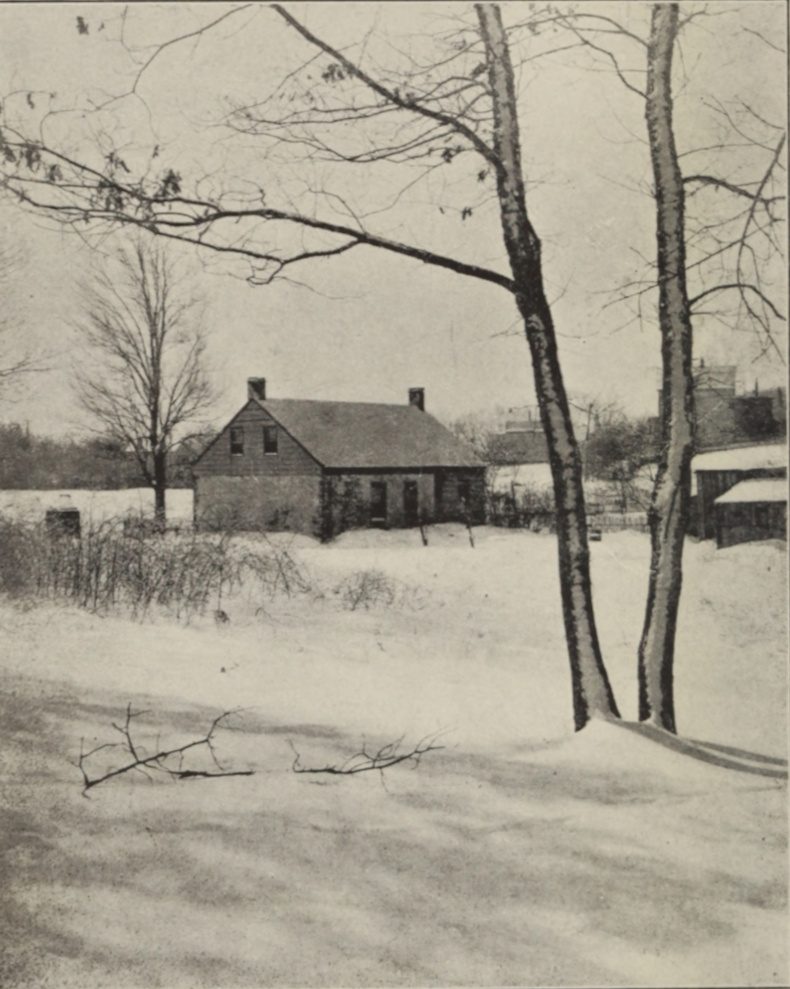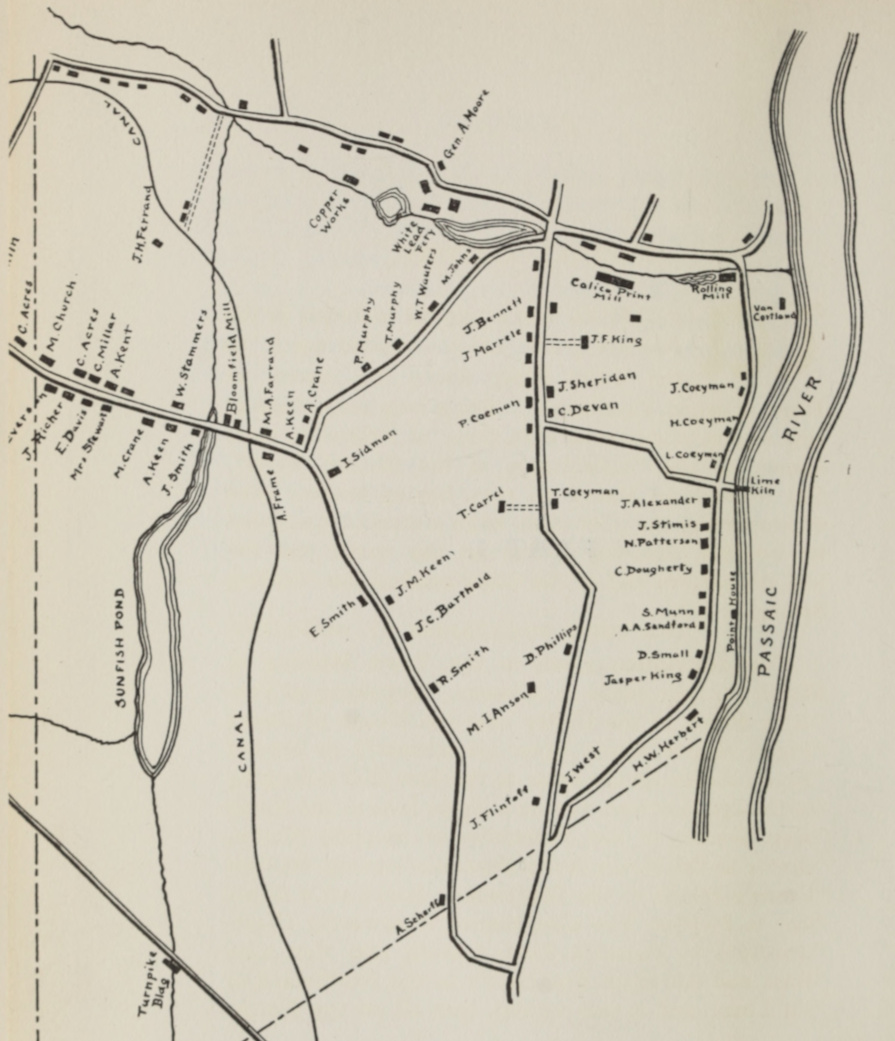
Woodside in 1849. Enlarged from Sidney’s map of “Twelve Miles Around New York”, published in 1849.
Woodside was originally included in the
Newark grant, which extended north “to
the Third River above the towne, ye
River is called Yauntakah”. For a long time those of
this region in common with those of Belleville, were
known as the “Inhabitants of the Second River”.
But Newark on March 11, 1743, having become tired
of supporting the poor of so large a district, narrowed
its borders, drawing a line on the north just below
the eastern end of the Gully road to the “Boiling
Spring”.
The description given in the Town Meeting of
March 11, 1743, reads as follows: “Beginning at Passaick
River, at the Gulley near the House of Doct’r
Pigot, thence North West (Northeast?) to Second
River, thence up the same to the Saw Mill belonging
to George Harrison, thence a direct Line to the North
East Corner of the Plantation of Stephen Morris,
thence to the Notch in the Mountain leaving William
Crane’s House to the Southward, thence on a direct
line to Stephen Van siles, thence Westwardly (Eastwardly?)
to Passaick River leaving said Van siles
Bars and Abraham Francisco’s to the Northward of
s’d Line: and it was agreed, that all on the Northward
of s’d Lines should be esteemed Inhabitants of
Second River, and all on the Southward of the Body
of Newark, excepting Levi Vincent, Johanes Kiper
and his Son Thomas Cadmus. John Low desired that
himself and his Father might be reconed or esteemed
Inhabitants of Second River, since they belonged to
that Society.”
This is a verbatim copy taken from the “Newark
Town Records”, but I do not know just what it
means unless some previous copyist stood on his head
when putting down the points of the compass.
For nearly one hundred years this region was
a portion of Bloomfield, or Wardesson, as it was
formerly known, and when in 1839 Belleville was set
off from eastern Bloomfield, Woodside became a part
of the newer township, and so remained until March
24, 1869, when it became independent of all outside
control.
At this time its boundaries extended from the mouth
of Second river along the west bank of the Passaic
to a point immediately below the Gully road, thence
west a little south to the Boiling Spring, cutting
across Second avenue above Mount Prospect avenue,
thence almost northeast to a point on the canal just
above what is now known as the “butter works”;
thence southeast a quarter mile or so to Second river
which it crossed and continued with Mill street as
its northern limit as far as the Back road, from
which point Second river was itself the dividing line
to its mouth at the Passaic.
But, alas! on the fifth of April, 1871, our independence
was lost forever and most of us were turned
over to the tender mercies of the Newark politicians,
who have ever since exercised a wonderful ingenuity
in taxing us poor inhabitants to the limit and giving
as little in return as possible. In fact the only
thing we get for our taxes, aside from the fire department
service, is an occasional policeman, who comes
twice each year with tickets to sell for ball or excursion.
Does the road need paving or sewering, the
cost is assessed on the abutting property, and so is it
with sidewalks, and even with the shade trees which
the city fathers insist are good for us, and having
planted them they send us a bill therefor. The Woodsider
has never yet been able to ascertain what he is
taxed for, unless it is to keep the politicians in good
running order. This remark should be qualified to some
extent so far as the police are concerned, for no locality
could have a better protector than Mounted Officer
Niblo, who has long been on this post and who, we
hope, will long remain; there is also a patrolman who
does his duty as though his job depended on it, but
the majority of them seem to have the true politician’s
idea as to what is good for them.
The sin was legalized by “An Act to divide the
township of Woodside between the City of Newark
and the township of Belleville”.
The boundary of Woodside is given as “beginning
at the intersection of the centre of the Second river
with the centre of the Passaic river; thence (1)
running southerly along the centre of the Passaic
river, the several courses thereof, to the northerly
line of the city of Newark (just below Gully road);
thence (2) westerly along the said line of the city of
Newark to the centre of the Great Boiling spring, at
the line of the township of Bloomfield; thence (3)
northerly along said line to the centre of Branch
brook; thence (4) northeasterly along the centre of
said brook, the several courses thereof, to the centre
of Second river; thence (5) down along the centre of
Second river, the several courses thereof, to the
centre of Passaic River, and the place of beginning.”
All of the township of Woodside not included
within the above mentioned boundaries was annexed
to the township of Belleville.
James S. Gamble, Horace H. Nichols and Charles
Akers, of the township of Woodside, were among
the commissioners appointed to see that the division
was properly carried out.
The act was approved April 5, 1871.
The transition from independence to slavery was
engineered, I am told, by three men for personal and
selfish motives, and it gives me great pleasure to record
that all three were sadly left. One longed to be
sheriff, but must live in Newark to secure the nomination,
and did not wish to remove from this pleasant
land; the two others were holders of considerable
property, and it was their hope that a boom in building
lots would set in that would materially fatten
their pocketbooks, and so in some dark and mysterious
way our model township was ceded to Newark.
But the politician failed of election and the lots did
not sell, and “one of the disappointed real estate
owners, like Judas Iscariot, went out and hanged
himself”.
Once the place belonged to Newark the street car
company could, of course, do what it liked with the
roadway, and it shortly proceeded to regrade (I had
almost said degrade) Washington avenue above Elwood,
utterly destroying the carefully laid out parkway
on which property owners had spent much
thought and money. Terraces and trees were ruthlessly
cut down and, to provide a dumping place for
the earth removed, Oraton street was cut through
and filled in with the Washington avenue debris.
“Ichabod was written upon the avenue and the fine
name of Oraton could in no way lend dignity to the
new street”, which at that time was largely given
over to negroes and laborers.
Until 1865 Woodside was a purely agricultural
district, except for the factories along Second river,
and contained but four roads of any moment. The
River road, the Back road to Belleville, the old
Bloomfield or Long Hill road and the lower road from
Belleville to Bloomfield, known as Murphy’s lane.
There was also one cross road known as Division
road or Bootleg lane, because of its shape; this is now
given over to Halleck street and Grafton avenue, with
that bit of Washington avenue which lies between.
The history and legend, dating before 1867, so far
as I have been able to find them, will be taken up
guidebook fashion by following each road in turn and
pointing out its wonders as we proceed.
“The road to ‘Hocquackanong’ was laid out from
the north end of Newark, as the path then ran,
through the village named, passing the north end of
the Acquackanonk meeting house and thence to
Pompton”. This was recorded March 16, 1707, and
must refer to the River road, though probably all the
laying out it received was on paper.
The Indians from Paterson and beyond had a well
defined trail along the river bank which led to Newark
Bay, and the early settlers probably used this
without attempting much improvement.
As we travel northward the River road naturally
begins with the Gully road. As far back as tradition
goes and the old maps show, the Gully road has existed,
but there is a theory that the Indian trail, of
which the River road is an expansion, continued
down the river bank, and one bit of folk-lore which
remains indicates that this may have been so.
The legend tells us that so long ago that those
who tell the story cannot compute the time, there
lived at the present junction of Washington avenue
and the Gully road an aged couple in a simple cot
that hardly kept them from the weather. There was
then a small stream that claimed the gully for its own,
but as time went on the brook gradually dried up, and
as gradually people from the back country began to
use its bed as a highway. As traffic grew the cottage
was found to lie in the way of travelers, and one night
it was ruthlessly torn down over the head of its defenseless
occupant, for by this time only one was left.
The resultant exposure proved fatal, the old settler
being unable to survive the shock, and ever after
has his ghost walked the Gully road. The ghost has
not been seen for thirty years or more, but one who
has actually met the vision, a lady of years and education,
tells me that she distinctly saw it one dark Sunday
afternoon, about 1879, while on her way to
church.
Though a resident here for several years she had
never heard of the Gully road ghost, nor did she
know that the region was haunted, but in the darkest
and loneliest part of the road she encountered a nebulous
shape about the size of a human being, standing
at a gate which gave entrance to one of the few places
along the road. My informant was young then, and
more easily frightened than now, but she saw too distinctly
to believe that she could have been mistaken.
It appears that the lady had disregarded the biblical
injunction to obey her husband, for he did not wish
her to go to church at that particular time, but she,
being contrary minded, insisted, and it seems highly
probable that the ghost was sent to warn her back into
path of obedience. Hurrying back she informed her
husband, but nothing more was seen of the apparition
and it was some time later that she learned that the
road was haunted and heard the above story from an
old settler.
The present level of the Gully road is much lower
than it was even fifty years ago, and there is a legend
that one hundred and fifty years ago a great freshet
cut out large quantities of earth here, but the higher
level could hardly have been of long duration, for Mrs.
Gibbs recalls that a number of years ago, while workmen
were digging a trench, possibly for the sewer,
they brought up what are thought to have been Indian
relics from a depth of twelve feet or more. Mr.
Gibbs’s brother was passing at the moment of discovery
and tried to purchase the find from the man in
charge, as he regarded it of considerable ethnological
value, but the contractor refused to sell, and when Mr.
Gibbs and his brother returned to the spot the men
had gone and their discovery with them, and to-day
the exact character of the find is not known. Other
Indian finds in this immediate neighborhood are a
stone mortar and pestle and many arrow points on
the Gibbs place. On the Sandford place, just above, a
stone mortar hollowed out of a heavy block long stood
by the well. This was kept filled with water for the
chickens to drink from. When the place was regraded
this stone disappeared, it having been probably
buried.
(Since the above was put in type I have found one of the
laborers who was employed in building the sewer through the
Gully road. He tells me that this was about fourteen years ago,
that the find occurred just east of the entrance to the Gibbs place
on the north edge of the road, and consisted of four or five Indian
skeletons with many stone hammers, arrow points, etc. My informant
is under the impression that the burial place was extensive
and only partially uncovered.)
From the fact that Indians would hardly dig to
any such depth as indicated above, it is fair to presume
that the filling in may have been comparatively
recent; possibly some great storm had washed masses
of earth down into the gully.
The Gully road is now well paved and lighted and
much affected by that brazen highwayman the automobile,
but there was a time when it was a dark and
lonesome place where no honest man desired to be
caught after dark; where it is said smugglers filed by
during the silent watches of the night, the deserted
river bank here being a favorite rendezvous for those
whose deeds were evil.
Sixty years or so ago a stone wall ran from the
bend of the Gully road, near the river diagonally to
Belleville avenue, across the property now occupied by
the cemetery. Beside this stone wall was buried the
first person interred on the site of the cemetery—a
noted witch, old Moll DeGrow, the fear of whose
shade lent greatly to the terrors of the Gully seventy-five
years ago.
This witch was used by the elders as a bugaboo to
keep the children indoors after dark, and she appears
to have been eminently useful and successful in this
capacity. The Gully road was as black as a black
hat on a moonless night, and one who ventured abroad
at such a time never could tell when he or she might
be grabbed by the powers of darkness. During the
long Winter evenings these farmer and fisher folk
were wont to amuse and scare themselves, as well as
the children, by relating all manner of ghostly experiences.
Mrs. Henry Davis recalls how, as a child, she
used to crawl up to bed so terrified after an evening
of witch stories that she could hardly move, her one
thought being to get under the bed clothes as quickly
as possible, where she would all but smother.
Under such circumstances the ghost of a witch
was a powerful combination for evil, and particularly
so when it was such a witch as old Moll, who was so
much a terror to the neighborhood that there was talk
of burning her in order to rid the community of her
undesirable presence, but fortunately she died before
this feeling culminated in a tragedy. Mrs. Henry
Davis well remembers hearing her mother (a former
Miss King) tell this as a fact.
In the early days of the cemetery, when it was inclosed
by a high wooden fence, there was considerable
talk of body-snatching, and one of the men in
charge of the grounds was strongly suspected.
Old Mrs. Holt walking down the Gully road one
night saw, standing in the darkest shadow, an old
fashioned undertaker’s wagon, and hearing voices of
men, stepped back among the bushes out of harm’s
way. Soon she saw three men against the night sky
standing on the high ground of the cemetery. One
carried a lantern while the other two had a long
bundle shrouded in white. He with the lantern
stopped on the ridge, while the others kept down the
slope. Now they lifted their bundle to the top of the
fence where one man steadied it while the other
climbed over. When both were over the body was
taken down and placed in the wagon. The man on the
hill, whose voice Mrs. Holt recognized, called good-night
to the men in the road and they responded as
the wagon rapidly drove toward Newark.
How John Thompson saw the Devil in the Gully
road was once told by himself in a moment of great
confidence, for ordinarily he would never speak of the
adventure.
About ’68 or ’69 John worked for Mr. Melius
on the River road, and it was noticed that when called
on to drive down town after dusk for his employer
he invariably went the long way round—Grafton and
Washington avenues—and when coming back with
Mr. M. he would shut his mouth the moment they
entered within the dark precincts of the Gully and say
never a word until they were well beyond the black
shadow of its overhanging trees.
It seems that John was originally a river man and
that he sailored under Captain Nichols, whose profanity
was one of his notable points; he had a varied
assortment of swear-words and a proficiency in their
use that made the efforts of ordinary mortals pale into
insignificance.
For some reason not explained the schooner was
held up in Newark one day, and as the Captain lived
in Belleville there was nothing for it but to walk home.
John Thompson went along for, of course, neither one
of the seamen thought much of the storm that was
raging, even if the rain did come down in torrents
which soaked them through.
It certainly did look dark and creepy to John as he
peered into the black hole of the Gully road, and
though he was himself a gentleman of color and
matched up with a dark night first rate, he ever
fancied daylight for such places, but the Captain went
plunging on into the shadows and John could but
follow.
The Captain had used up his stock of cuss-words,
and while in the very darkest part of the tunnel commenced
all over again and was going fine when a sudden,
blinding flash of lightning discovered to John,
who was in the rear, a third man walking between
them and chuckling every time the Captain swore.
Before the light went out John saw that the man was
dressed like a parson and that his clothes appeared
to be dry in spite of the heavy downpour. A second
flash showed a most alarming state of things: the
stranger was on fire, smoke or steam was escaping
from every crevice, but still he chuckled as the Captain
ripped out all manner of strange oaths, and did
not seem to pay any attention to his own internal combustion;
even in the dark his glee could be heard
bubbling forth, nor could the pounding of the storm
drown it. By this time the Captain’s attention was
also attracted, and when a third flash enabled them to
see that their unknown companion had hoofs their
worst suspicions were realized and both men broke
and ran for Belleville as fast as two pairs of scared
legs could carry them, while the Devil laughed long
and loud at their dismay.
Another man once ran against a cow in the Gully
road one dark night and was considerably worked up
over the adventure for the moment. The unfortunate
part of it was that he lingered long enough to discover
that it was a cow, else we might have had another
story of these darksome terrors. The horns and
hoofs were there, and all that was needed was a little
more imagination and not quite so much practicality.
But not all the stories of the Gully road are of such
fearful things as these. It was a way of surpassing
beauty when lighted by the sun, and a lover’s lane
that fairly blossomed with loving couples on pleasant
Sunday afternoons, when the sighing of the wind in
the trees was but an echo of the happy sighs below.
Many a life contract has been signed, sealed and delivered
within its confines; in fact I have heard of
one youth who proposed on the way back from a boat
race, the romantic influence of the place with its
glamor of shady nooks being quite too much for his
equanimity.
Then there was the English spy who, legend says,
was captured by a party of Americans and promptly
hanged on the limb of a large tree that stood at the
bend of the road. His ghost was for long a sad handicap
to the neighborhood and, singular as it may seem,
he is said to have played his wildest pranks with those
who placed the greatest faith in him. But since the
spread of the Mount Pleasant Cemetery down toward
his abode little or nothing has been heard of his doings.
One theory is that of late he has come within
the orbits of so many other ghosts, but of a more respectable
and orderly character, that he has become
inextricably tangled, much as is reported of wireless
messages when many amateurs assault the air.
About fifty years ago Henry William Herbert, who
wrote under the name of Frank N. Forrester, resided
on the river bank within the present limits of the cemetery,
his place being known as “The Cedars”. A
queer, romantic figure about which much of fiction as
well as truth has been woven.
To Mr. Boyden and others, whose youth was spent
about here, this strange figure was a familiar sight, for
the recluse used almost daily to walk down town, his
shoulders enveloped in a shawl, and always with a
troop of dogs at his heels. Those who so remember
him rather resent the fact that his brawls have been
made much of and his virtues neglected by such as
write of him, for they recall him as an attractive man
and pleasant companion with many kindly qualities.
Herbert generally made a call at the Black Horse
tavern which then stood at the “Stone Bridge”, and
after a short stay would continue on to the Park
House. He was apt to be brusque with those he did
not like, and when “beyond his depth” through too
great conviviality inclined to be ugly when opposed.
He was born in London April 7, 1807, and was
educated at an English college. He came to New
York in 1831, supporting himself by teaching and
later by writing short stories, historical novels and
books on sports, his “Field Sports of America” soon
making his name a familiar one to the lovers of gun
and rod.
A Newarker, who has written of him from personal
knowledge, says:—
“It is a difficult matter to sift the good from the
bad in Herbert’s character. He was in truth a most
rare and singular being if he did not possess some
virtues.
“When writing his celebrated work, ‘Field Sports
of America’, he had access to the Newark Library;
not content with the privileges there afforded, he cut
out bodily leaves from ‘The Encyclopedia Britannica’,
evidently unmindful of the selfishness and criminality
of the act. There are some men made up of inconsistencies,
and a strange agglomeration of moods.
Herbert was one of them.
“There is nothing associated with Herbert’s life
that is apt to strike a stranger favorably. He was a
direct antithesis of Irving, who possessed a certain
magnetic influence. The truth is Irving was a good
man and Herbert was not. Herbert was endowed
with rare genius, and those who have a desire to become
convinced of this fact should read his works;
they tower as far above the general literary productions
of to-day as does the Oregon pine over the
tender sapling. His characters are finely drawn—not
overdrawn—his heroines are as pure as the purest,
and his villains—distinctive in their characteristics—‘act
well their parts’. Though not an extensive verse
writer, Herbert was the author of some very creditable
poetry, his translation of Æschylus’s ‘Prometheus
Bound’ and ‘Agamemnon’ show ripe scholarship
and otherwise redound to his credit.
“In several of his novels the subject of this sketch
has portrayed his own character far better than it has
been or can be done by another. Whatever Herbert’s
defects, as an author he was of the highest
order; he was a voluminous writer and a fine translator.
‘Marmaduke Wyvil’, ‘Cromwell’ and ‘The
Roman Traitor’ are works that stand in the front
rank of their class, while among his translations M.
Thiers’s ‘Life of the First Consul’ is one of the
standard works of literature. In his historical novels
he approaches nearer Sir Walter Scott than any author
I have been privileged to read. He was, in fact,
a dual character—an enigma. His genius merits admiration,
and it is safe to say that his fame will not
die with the century that gave him birth.”
Many are the stories told to show his eccentric
character and occasional violence. During summer
days he would place himself on the bank of the river
with a gun and threaten to shoot passing boatmen
unless they came on shore at his bidding, but no
sooner did they land than Herbert would disappear,
leaving the affrighted oarsmen in a state of perplexity
as to what next. It sounds much like a fool trick from
this distance, but his reputation made the experience
anything but a pleasant one.
Conviviality was the order of the night at The
Cedars, Herbert being much in the habit of inviting
friends to enjoy what he termed the hospitality of the
place. On one such occasion four guests were drinking
with him, when the host suddenly sprang to his feet
and produced from a small closet two swords and,
throwing one on the table, ordered one of those present
to defend himself. Recognizing that the affair
might terminate seriously, one of the guests kicked
over the table, throwing the lamp to the floor and enveloping
the room in sudden darkness. The party
“broke up” then and there, and the company made for
the Gully road that they might live to fight another
day. Herbert was thoroughly crazed by this time,
and chased his friends up to and down Belleville
avenue. Finally the pursued separated and the pursuer
kept on after one of them even to the Black Horse
tavern (Broad street and Belleville avenue), where an
escape was effected.
A race modeled on Æsop’s fable is by no means
an everyday occurrence, but Herbert was by no means
an everyday citizen. He seems to have been as fond
of a joke as he is said to have been of a bottle, and
these two loves furnished a modern version of
the Hare and Tortoise fable. The following facts are
given me by Mr. James S. Taylor, who was an eye
witness of the event, and who secured missing details
from one of the participants later.
But before going on with the story suppose we hear
what the local poet had to say on the subject:—
This is the tale of a race
That long years gone took place
On the broad river Passaic
When times were archaic,
And here are the facts in the case:
One Herbert of eccentric renown
Challenged a friend, of the town,
And a supper of game
Should be prize for the same,
And with plenty of wine washed down.
The challenged was clumsy at rowing
And his boat very poor was at going,
While Herbert’s was light
And his rowing a sight
To set all his backers a-crowing.
But, like the hare in the ancient race,
Herbert likewise did slacken his pace,
And soon sought his ease
‘Neath the leaves where the trees
On the waters their shadows did trace.
A bottle he had from the vine
And was having a jolly good time,
When his friend labored by,
To whom Herbert did cry:
“Stop in and have sup of my wine.”
But the tortoise kept steadily at work
While the hare on the bank still did shirk—
Where drink of the gods held him fast,
Where the cool, dark shadows were cast
And the scent of wild flowers did lurk.
The end came as it should in such case,
For the tortoise, though slow, won the race,
And ’twas Herbert who paid for that supper of game.
The story is ended, but for details of same
We’ll drop into prose for a space.
Herbert was well acquainted with Frank Harrison,
veteran of the war with Mexico and keeper of the
North Ward Hotel on Broad street, opposite Bridge.
At some convivial point in his existence he suggested
to Harrison that the two have a boat race on the Passaic,
from Belleville to Newark, the prize to be a game
supper, and the latter, being game himself, though no
boatman, accepted the challenge.
The only condition or obligation of the race was
that they should start together, and that the first man
to cross the finishing line should win. Each could
choose his own boat and suit himself as to rowing.
Herbert, living on the river, had a light boat which
he knew how to handle, was familiar with the currents
and eddies and was moreover a good oarsman,
while his opponent knew nothing of the Passaic or its
ways. The day was warm, the start was made on
time and Harrison received the inverted plaudits of the
company assembled for the occasion, for it seemed to
these wise ones that there could be but one end to such
an event. Herbert was away promptly and soon out
of sight around the bend where Second river loses its
identity, while the dispenser of strong waters was yet
finding himself, but as he rowed our eccentric friend
became warm and a black bottle, which he had
brought along for company, looked up at him from
the bottom of the boat with an invitation he could not
resist.
He was now well on his way and still his antagonist
was not in sight, therefore, hurry seemed out
of place, and then the cool depths of the tree-shaded
river bank looked inviting and, thinking to tarry but
a moment, he put the boat about for the shore.
Once on shore and stretched at his ease the necessity
for any race at all did not appear plain to our
hero and he gurgled the time away, blissfully careless
as to what might happen out in the hot sunshine.
Thus the second boat came along, passed and continued
on down toward the goal. Possibly Herbert
thought he could at any time overtake his clumsy antagonist,
possibly he did not go so far in his speculations;
whatever his idea was, the tortoise won the
race and the game supper.
Herbert shot himself in the Stevens House, New
York, on May 17, 1858. He was buried in Mount
Pleasant Cemetery, overlooking the river he knew so
well, and his epitaph, which he is said to have suggested
himself, is the single Latin word “Infelice”.
In 1743 a Dr. Edward Pigot lived hereabouts, as
is noted in the Town Meeting of that year, quoted
elsewhere; who he was or whence he came is not
for me to say. In 1791 Abraham Sandford, Jr., and
Elisha Sandford, lived in an old house on the site of
the Herbert house, while building the Sandford dwelling,
which still stands nearly opposite the Point
House. As early as 1680 the property was owned by
Henry Rowe, and remained in the possession of the
family until about 1812. Mary Rowe, a witch, lived
in a cabin here, and may be the same person referred
to elsewhere as Moll De Grow.
After that I find no record of a dwelling here
until Herbert built. After his death this house was
occupied for a short time by Mr. Joseph S. Rano, a
shoemaker by trade, and a great hunter and a haunter
of the river and its banks; then came Mr. Sanchez y
Dolce, who resided here until the dwelling was destroyed
by fire. Then came the cemetery, and it is
now the dwelling place of many dead.
Those who only know the Passaic of to-day can
hardly realize that there was once a “Green Island”
lying off the northern end of Mount Pleasant Cemetery
which was a noted rendezvous for wild ducks and
geese, with enough water between it and the shore
to enable river craft to navigate the channel.
This Green Island was a thorn in the side of the
cemetery people, who purchased it for $ 1,000, or
thought they did; but soon came those who bluffed
them into buying it over again, and this time they
paid $10,000. When the Erie came it claimed that the
cemetery had no rights in Green Island at all, and
calmly pre-empted it for trackage purposes.
Seventy-five years ago this was a hunter’s paradise,
and even within the memory of some of us old codgers
the fishing for shad and smelts was a well established
industry. In fact, the fishing rights of Green Island
were for hire, as I am told that one could rent them
for a day or a week and do his own fishing. Old Fink,
whoever he was, once gathered in five hundred shad
in one haul; at least one of his contemporaries does
solemnly affirm such to have been the case, and another
as calmly tells me that fourteen bushels of
smelts were the reward of two hauls, of which he had
cognizance.
This almost sounds as if we were again on the
lake of Gennesaret. But still greater wonders are recorded
by Mr. William Stimis, eighty-seven years
of age, who has heard his father say that he had seen
1,200 shad caught in one haul, and he, William, with
three others, gathered in 120 bushels of smelts in one
night. He also tells of a striped bass weighing sixty-six
pounds, sturgeon six feet long and of a host of
lesser fish that swam the Passaic.
In Graham’s American Monthly Magazine, 1854,
appears a “Memoir on the Smelt of the Passaic River”,
by Frank Forrester, from which the following brief
facts are taken:—
The author was fond of classical allusions and
high sounding phrases, and devotes two of his four
pages to telling us how much he knows of things that
do not pertain to the subject in hand, but when he
gets down to “the delicious little fish known as the
Smelt” we learn that it is the smallest of the salmon
family, that the American smelt is larger than, and
superior to, the European variety, and that its zoological
name “osmerus” is from the Greek, and means “to
give forth a perfume”, this having reference to the
peculiar odor of cucumbers it exhales when fresh.
The smelt of the Passaic and Raritan rivers was
an entirely different fish from that of the Connecticut
and more eastern rivers, and commanded a far higher
price in the New York markets, though much smaller,
the majority being under six inches in length while
the eastern smelt averages eleven to twelve inches.
The whole fish was of the most brilliant pearly silver,
with the slightest possible changeable hue of greenish
blue along the back, “The peculiar cucumber odor, in
the freshly caught fish, and the extreme delicacy of
the flesh, both of which are (1854) so far superior in
the fish of the Passaic, as to be obvious to the least
inquisitive observer”. This Passaic smelt Mr. Herbert
found agreed in every particular with the description
of the European smelt.
In the springs of 1853-4 no school of fish, either
shad or smelt, ran up the river owing, it was believed,
to the establishment of a chain ferry about a mile
above Newark bay. Mr. Herbert never knew of a
well authenticated case where the smelt had been
taken with bait, but states that they could be taken
with the scarlet Ibis fly, and that he had himself killed
them thus on the Passaic.
Two well known figures of the Green Island waters
were those of the “Two Horaces”, as they were
called, Messrs. Horace H. Nichols and Horace Carter,
brothers-in-law, neighbors and good friends. They
constructed a comfortable boat for the purpose and
might have been seen almost any pleasant afternoon,
when the fishing was on, placidly waiting for a bite.
When the Erie came it drove spiles into the tender
bosom of Green Island, and in time filled in a solid
road bed, and where we once hunted for the roots and
buds of the calamus docks have been built and filled
in, and our island has lost its identity. All this filling
has so changed the outline of the river bank that it is
not now evident why the “Point House” was so
named, though there was a time when this was a well
developed point.
Accounts differ somewhat as to the old-time owners
of the Point House property, even the same man
does not altogether agree with himself on this point.
It is said that Judge Elias Boudinot, a Newarker,
secured the property from the state, there being no
other claimant for it. It was probably purchased on
November 12, 1799, from the Judge by Abraham Van
Emburgh who, about 1810-14, left suddenly for parts
unknown because of a financial panic in the Van Emburgh
family.
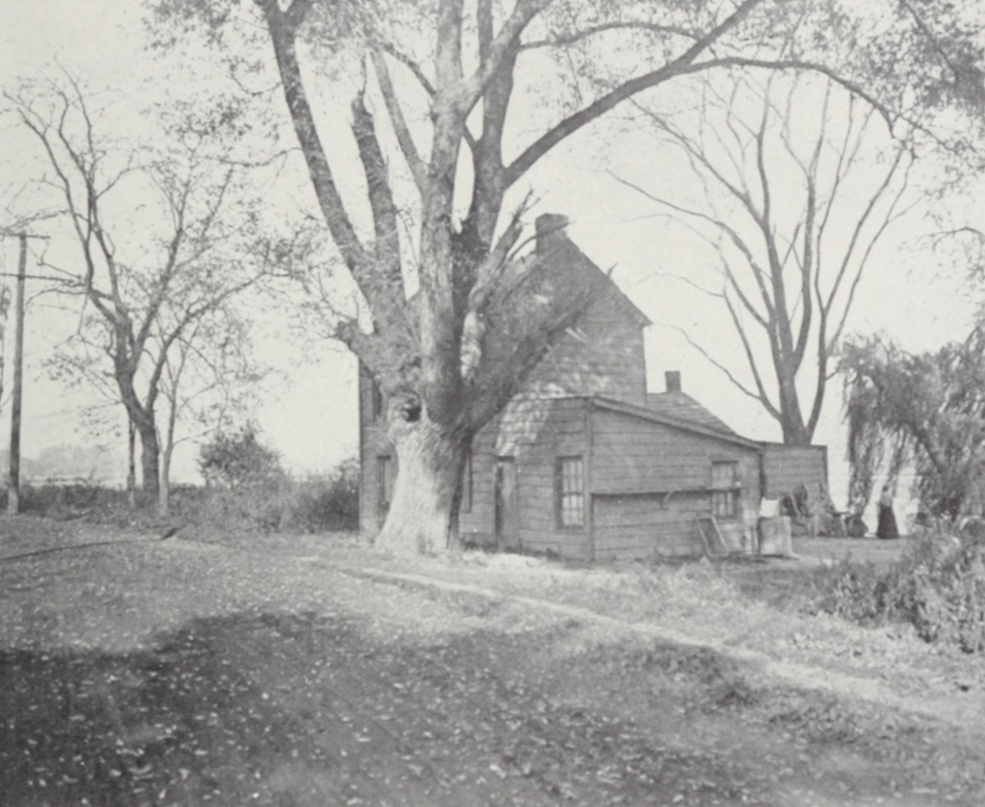
The Point House. Said to be 150 years old. The scene of many a story and incident.
The property was sold by order of the court on July
24, 1811, to Thomas Whitlock who, on August 22,
1811, sold it to Peter Sandford; his heirs disposed of
it on February 8, 1832, to William Duncan, John Cunningham,
Sebastian Duncan and John Duncan. Another
account makes Simeon Stivers an owner one
hundred years ago, and also mentions one William
Glasby and Miles I’Anson as subsequent owners.
That the Point House was a place of resort at an
early date would appear from the following anecdote
told me by Mrs. R. H. Brewster, a granddaughter of
that Phœbe King who furnished the original material
for the story, and who lived just below in the King
house. The incident occurred before 1820, and came
to Mrs. Brewster from her mother.
During certain seasons of the year the men of the
neighborhood were in the habit of going on what were
known as fishing trips on the river, but though they
fished within sight of their own doors, they would
remain away from home for two or three days, using
the Point House, which was then run by a woman,
as headquarters, and here they indulged in what were
technically known as “fish dinners”, and these fish
dinners, it would appear, were conducive to more or
less conviviality. The fact that “Poddy”, husband of
Phœbe, was much troubled with gout in later years
may have been due to an excess of fish, or something
taken at this time—however this is merely surmise.
Phœbe, it seems, came to the conclusion that her
good man was eating too many fish dinners, and she
said something to this effect, even going so far, when
no attention was paid to her first hint, as to suggest
that she might blow up the Point House if “Poddy”
did not change his method of fishing, but he forgot
all about it the next time one of his cronies came along
and off he went again. Thus things ran along some
two years or more until one day Phœbe discovered a
ladder standing against the side of the Point House,
next the kitchen chimney, at a time when a “fish dinner”
was hatching, and as our story opens a great
chowder was brewing over the fire at the bottom of
that chimney. Phœbe saw her opportunity and
grasped it; procuring a long string, a small bag and
what she thought was powder enough to give the fisherman
a scare, she proceeded to work. But as the result
shows she underestimated the ability of good
black powder to do things.
With the powder inclosed in the bag and the bag
fast to one end of the string the good wife cautiously
ascended to the roof and, carefully placing the bag
just over the chimney’s edge, she then came back to
earth and, walking as far as the string would permit,
let it go and hurried home. The result was even more
conclusive than she had anticipated, for the explosion
that followed not only distributed the chowder with
absolute impartiality to the expectant company gathered
around the hearth, but also removed a portion of
the chimney.
It would appear that at that time there was a
witch in the neighborhood, possibly old Moll DeGrow,
whose power for evil was generally recognized,
and the recipients of the chowder promptly came to the
conclusion that the witch was at the bottom of the
trouble, all but “Poddy”. He had a light, and
hastened home with it, but there sat Phœbe, placidly
spinning and greatly surprised at his tale of woe, and
though he tried to get up an argument over the matter
it lacked success, being much too one-sided, and
it was many years before he was allowed to verify his
suspicions. In the meantime fish dinners at the Point
House went out of fashion, the new method of serving
chowder not being looked on with favor.
For several years the Duncans carried on the
printing and dyeing of silk handkerchiefs in the Point
House, probably the first enterprise of this sort established
in the vicinity of Newark. They secured the
raw silk in New York and, after converting it into the
finished article, one of the brothers would make up a
bundle of handkerchiefs and trudge to New York with
it. On leaving this place the Duncans established
the woolen mills in Franklin, N. J., which have since
been known as the Essex Works.
Apparently the next use to which the point was
put was for the transshipping of freight, for we are
told that rather more than fifty years ago this was a
landing where vessels unloaded coal and other commodities
which those from the back country, even so
far as Bloomfield, were wont to cart home by way of
the Division road and Murphy’s lane.
About 1855 our old Point House, which some say
was built 150 years ago, was owned by George Jackson,
who manufactured fireworks here, while his
brother Charles followed the same trade in a small
building just north. He is said to have paid $400 for
the property. About once in so often the fireworks
factory would explode, and it made such a nuisance of
itself because of these irregular excursions heavenward
that Mr. Gould, who lived just across the way,
purchased the property in order to quiet his nerves.
From fireworks to firewater sounds like an easy
transition, and so we come to the Holt regime. The
Holts and a brother of Mrs. Holt, Ed. Moorehouse,
lived in the King house (which we have passed without
knowing it, and to which we shall go back shortly)
and some time before 1865 removed to the Point
House, and here again was trouble for the neighbors,
for while this was not a regular tavern, it would appear
that a certain black bottle was part of its furniture,
and that that black bottle was a magnet which
no servant girl of the time and region could resist.
Now a drunken cook is not generally regarded as any
great addition to the family menage, as I am informed.
It was no small undertaking to find a cook who would
go so far into the country as this region then was, and
when found, to have her almost immediately go astray
via the Point House, was considered highly provoking.
The Holts made their own root beer, and there is
a story to the effect that while a party of well known
Newarkers was in the place one day a keg of this
same beer, which stood on the bar, exploded and
deluged the visitors with a combination of liquid sassafras
and wintergreen that was shocking to see and
worse to bear, and it is recorded that those inundated
failed to discover a funny side to the experience.
The “Floating Palace”, kept by Ed. Holt, appears
to have been a laudable effort on his part to
benefit his friends and neighbors by catering to those
who frequented the river. This was a boat anchored
in the middle of the stream, which was reached by
customers in small boats. It appears to be commonly
thought that Ed. had a government license, but no
local permit to retail liquor, and the boat was supposed
to overcome the difficulty by straddling the
county line. But one who knew Ed. well and knew
the kind of a place he kept tells me that he sold nothing
stronger than beer, and endeavored in every way
to keep the boat of such a character that respectable
parties could stop for refreshment, and that he was
ably seconded in this by his Scotch-Irish wife, whose
influence was all for good. Under more favorable circumstances
Ed. Holt might have developed into a
leading citizen. He was a man of character and of
very temperate habits himself; a carpenter by trade,
he always refused to employ men who were habitual
drinkers.
For a short time there was a second floating palace
anchored in Dead Man’s bend, nearly opposite the
lower end of Green Island, which was thoroughly disreputable,
and it is probable that the reputation of this
was unjustly extended to Holt’s place, for many people
are to-day of the opinion that the latter was not as
clean as it might have been. The Floating Palace
burned to the water’s edge while Ed. Holt was still
proprietor, and the experiment was not tried again.
The Point House was long known to oarsmen as
the training ground of some of the famed scullers of
the world. Captain Chris. Van Emburgh, mariner,
was one of the noted characters who frequented the
place; he was an old Passaic river skipper and came
originally from its eastern bank.
Quite within the memory of those who are now
beginning to be numbered with the older inhabitants,
the place was one of the picturesque features of the
river. Here were benches placed beneath the graceful
willows which adorned the banks of the point; it
was a good vantage ground from which to view the
boat races when the local Tritons were trying their
powers of endurance against outside barbarians.
There were boats to let here, as full many a lover
knew. But as the river became more and more foul
such diversions ceased, and to-day the Point House
stands shorn of all its old time attractions.
Old Black Tom was a well known, and many times
damned, neighbor of the Point House. This was a
large rock which lay almost in the middle of the channel,
which at this point came close in to the western
shore; at low water it was just covered, and one of
the amusements of the boys was to step on the rock
from a boat, when the person so doing had the appearance
of walking on the water. But what was not
so amusing, at least to the river men, was for a boat
to run on the rock when the tide was falling. The
canal boats which carried bricks or coal above frequently
fell victims and, as every one knows how earnestly
a rusty canaler talks when excited, there is no
need to attempt a reproduction here.
It seemed natural to step from Green Island to the
Point House and now, having disposed of the latter,
we shall go back as far as the Gully road.
Just at the bend of the road on the north side stood,
within the memory of man, a pump which was long a
popular warm weather resort. This was on the old
King property. Just when the first King came here,
or where from, has not been ascertained; all we know
is that a Jasper King was living at the junction of the
Gully and River roads, an old man, at the time of the
Revolution, and that his son, whose name is not now
recalled, was a soldier under General Anthony Wayne
and was killed in action. He is said to have been one
of those who crossed the Delaware with Washington.
This son left one child, a son named Jasper, born
July 18, 1775, who was brought up by his grandfather.
Because of the confusion of tongues due to the similarity
of name, the younger Jasper was nicknamed
“Poddy”, this being a sort of explanatory title which
is supposed to have described his midship section.
This grandson enlisted for the War of 1812 and
was stationed at Sandy Hook, he never saw active
service in the field, but served his time out and was
honorably discharged. He married Phœbe Budd,
January 6, 1795, and about 1817 built the house which
formerly stood in the bend of the road. Mrs. Henry
Davis, a granddaughter of this Jasper, recalls having
heard her mother relate how, when Jasper was a very
young child, he was taken by his mother to see the
husband and father off to the war, and how the mother
lifted him up so that the father, who was on horseback,
could kiss the child good-bye. The father was
killed in action and the child never saw him again.
The poorly shod condition of the soldiers at this
time led to the throwing of their caps in the snow to
stand in while waiting for the order to march. (This
same tradition has also been handed down in the
Phillips family, as noted elsewhere).
A story current in the King family indicates that
a detachment of British or Hessian troops was camped
at one time near the King house. For it is told how
the young child Jasper was induced by these soldiers
to bring them apples and potatoes from his grandfather’s
cellar. He was too young to appreciate what
he was doing, but the grandfather soon caught him at
it, and put a stop to it. This story would indicate that
the invaders were not always such merciless marauders
as is generally supposed. The orchard from which
these apples came was situated on the Gibbs’ hill and
was noted for the fine quality of its fruit.
The last Jasper, who died October 1, 1854, had two
sons, William and John, and eight daughters. John
was a ship-builder, his yard being located in North
Belleville. William was a brass molder and later had
a sash and blind factory in Newark; he was noted as
a temperance lecturer and traveled the country over
in the cause.
One of the incidents of the Revolutionary period
had somewhat to do with the King house. A son of
Joseph Hedden, Jr., “the martyr patriot” of Newark,
escaped from his father’s house while the British
soldiers were dragging the senior out of his bed and
into the street. The boy, though but half clad, jumped
from a window and ran to the Passaic river at Lombardy
street and up the river on the ice and snow to
the Gully road.
He stopped at the older King house for information
and such scant clothing as they could afford
to share with him and, believing that the soldiers were
after him left by the Gully road for the Long Hill or
Bloomfield road, where he found refuge in the house
of a friend named Morris and was furnished with
stimulants, food and clothing, and had his frozen feet
treated.
The King house was later included in the Gibbs
purchase and was occupied by the gardener employed
by Mr. Gibbs, and while so used it was destroyed
by fire. Mrs. Gibbs remembers the building as a typical
old frame farm house snuggled down under the
shelter of the hill, embowered in roses and so
picturesquely situated as to make her long for the
simple life.
There have been many stories in the past of Captain
Kidd and his buried treasure, and there has been
much digging in the fields hereabout by those who
would acquire riches without due process of labor,
but the only find that I have heard of occurred where
the Gully road joins the River road.
The building of the Erie Railroad necessitated a
change where the Gully becomes the River road, and
a strip some eighty feet wide was lopped off the
Gibbs property. When the fence was moved back
certain articles of silver were dug up by the workmen
in the slender triangle which now lies between
the drive and the railroad. The matter was kept
quiet, presumably through fear that the stuff would
be claimed, and the pieces disappeared before any one
could inspect them.
Where this occurred would have been just in
front of the older King house and it is possible that
these articles were family treasures buried during
the Revolution in fear of a British raid.
A story has come down from the elders to the effect
that at some point in the game of war two detachments
of British troops were foraging in this region
apparently each “unbeknownst” to the other, for
the legend has it that while one was on the River road
nearly opposite Jasper King’s, the other, which was
on higher ground, mistook them for the enemy and
fired a volley among them, whereupon the hirelings
rushed for the cover of the river bank, which was
much higher then than now, and in their excitement
threw their guns into the river. Some of these guns
were recovered after the war by fishermen.
What has been known to most of those now living
as the Gibbs house is an imposing brown stone edifice
which was built by Governor Pennington for his
daughter Mary when she became the wife of Hugh
Toler. In due time the place was sold to Mr. Alfred
H. Gibbs, and has since been known as Thornhill. It
was a sightly place with the river at its feet.
The next place north was that known of late as
the Terhune place, which stands just above the Riverside
station. The original dweller on or near this site
is said to have been a Maverick, but nothing more
than this is known. Then came one Matthew Banks
who, according to story, was so lazy that he hoed his
corn on horseback. Mr. Banks was quite as much
fisherman as farmer, and spent much of his time on
the river, and they do say that the old fellow would
turn a penny now and then by selling herring for shad
to the unsophisticated. Older residents tell me that
there was formerly a hill of some altitude between
this place and the river which cut out any view of the
water from the house, and to which children were
taken on Fourth of July nights as a vantage point
from which to view the fireworks. Mr. Banks came
here about 1820 and was possibly the last slave owner
in this neighborhood. He is said to have purchased
a negro from John Hawthorn, the quarryman, and,
when he sold the place, among the chattels he wished
to dispose of was a colored boy aged 14 years, “used
to farm work”.
After Matthew Banks a Mr. Small, who was the
head printer in the Daily Advertiser office, took up his
residence here, and following him, if I have the history
right, came Mr. Terhune, who built the present house.
Here also lived Mr. Horace Carter while his own
dwelling was building on the Gully road, and thus we
come to modern times.
“Second day of July in the year of our Lord one
thousand seven hundred and ninety-one, Abraham
Sandford, Jr., of New Barbadoes Bergen County,
bought from Thomas Eagles and wife Mary a certain
parcel of land. Beginning at the road that leads from
Newark to Second river at the east corner of the land
of Abraham Stivers”, etc. So runs the old deed which
announces the advent of the Sandford family on this
side of the river.
Captain William Sandford, the original settler of
the name in this country, came from the Barbadoes
Islands in 1668 as the representative of Nathaniel
Kingsland “of the same Island of Barbadoes, Esq.”
He purchased “all that Neck of Land lying and being
between Pisaick and Hackingsack Rivers”. The lower
seven miles of this tract beginning at Newark bay and
extending to the copper mine, and “Commonly then
known by the name of New Barbadoes” fell in due
course to Captain Sandford. The Captain was a noted
man in his day. In 1682 he was commissioned Attorney
of the Province, in 1699 he was appointed by
Governor Carteret one of his two deputy governors
during the absence of the Governor in England; he
was for years in the Governor’s Council and prominent
in affairs of church and state.
The Abraham Sandford, Jr., who was the first of
the name to settle on the west bank of the Passaic,
was a great-great-grandson of William Sandford. He
built the house (1794-5) which still stands, but in a
greatly remodeled condition, just below and opposite
the Point House, and which is to-day occupied by his
grandchildren. As the family grew and multiplied
this particular branch was known as the “Pine Tree
Sandfords”, owing to the fact that a magnificent tree
of the species long flourished near the dwelling.
The tract originally purchased by Abraham Sandford,
Jr., comprised about thirty acres, extending to
the Back road. In 1801 he added to his possessions
by purchasing the river front from Simeon Stivers,
and in 1817 bought an adjoining half acre from Stewart
Elder. Abraham, Jr., had three children: Susan,
Maria and Abraham A. The son married Charity Yansen,
whose father was a soldier of the Revolution;
they resided on the homestead; their children were
Elizabeth M., Emma L., Mary O. and Frank. The
first and last of these still live in the old house.
Polly Van Winkle was one of the picturesque
figures of the River road some two or three generations
ago. The neighbors appear to have stood in
some fear of her lest she take offense and vent her
displeasure by setting fire to their property; thus she
came and went much as it pleased her. She appears
to have had no home of her own, but carried all her
worldly goods in a pack on her back, and when she
appeared at some door it was to walk in and make
herself at home, declining to go no matter how broad
the hints that were dropped. She never wished a bed,
always preferring to sleep on the floor close to her
bundle, which was never allowed to leave her sight.
Next as we progress northward is the Munn house.
The Munns came to America from England or
Wales, and were among the early Newark settlers
from New England. Captain Benjamin Munn of
Hartford, Conn., served in the Pequot Indian War of
1637. He removed to Springfield, 1649; was probably
killed by the Indians, 1675. His two sons, John and
James, were in the Indian fight at Turners Falls, 1676.
John settled in Westfield, died 1684, leaving a widow
and two sons, John and Benjamin. The widow married,
1686, John Richards, the schoolmaster of Westfield,
and removed with him and her two boys to
Deerfield, where his house was burned in the destruction
of the town by the French and Indians in 1704.
A few years afterward he removed to Newark, N. J.,
where he was the schoolmaster in 1718. His stepson,
John Munn, married Mary, sister of John Richards
and widow of John Ward, about 1720, and had Joseph,
Samuel and Benjamin. Benjamin was born 1730 and
died 1818—lived all his life on his farm, now the town
of East Orange. Two of his sons, David and Amos,
served in the Revolutionary War. After the war
Amos married a daughter of Silas Dod and settled in
Bloomfield—died in 1808, leaving Silas and other children.
Silas continued his business till 1825, when he
removed with his wife and two boys, William Alonzo
and Bethuel, to the old Col. Van Cortland place on
the Passaic, just below the mouth of Second river.
Here he resided five years—1825-1830—during which
time his son Henry Benson and daughter Emeline
were born. He then moved to Belleville, where he
lost his daughter Emeline, and where his son Silas, Jr.,
was born.
In 1850 he purchased the Van Emburgh place, consisting
of four or five acres, opposite the old Point
House.
This tract was conveyed on June 7, 1790, by Gaspars
Van Winkle and wife and Aurentee Due, heirs
of Gideon and Mary Smith, to Abraham Van Emburgh.
Most of the property remained in the Van
Emburgh family until sold to Silas Munn, March 16,
1850. At this time there were two small dwellings
on the land, one was moved back and converted into
a barn, the other was moved, remodeled and added to
in 1893 and is still standing. Here Silas died in 1873.
The children of Silas were William Alonzo, Bethuel,
Silas, Henry Benson and Emeline. William
Alonzo married a sister of John Boyd of Woodside,
and removed to New York; his second wife was Hannah
Wilson, with whom he removed to Milwaukee,
where he died in 1876. Bethuel married Sarah, another
sister of John Boyd, and after the death of his
mother, in 1866, occupied the house on the River road
until his decease in 1899. Henry Benson studied law,
moved to Madison and Portage City, Wis., of which
latter place he was elected mayor, and from which he
was sent to the Legislature. He finally removed to
Washington, D. C., where he still resides; he has
owned the homestead for many years. Silas, Jr., followed
civil engineering, went west and finally settled
on a farm near Grant City, Mo., where he now
resides.
Next in order stands the Esley Melius house. Old
deeds in the possession of Mr. Theo. Melius tell us that
on December 11, 1799, Abraham Van Emburgh and
Rhoda, his wife, sold to John P. Sandford for the sum
of $3.84, at a place called Belleville, a part of a water
lot, which the said Abraham Van Emburgh purchased
from Elisha Boudinot, Esqr., by a deed bearing date
November 12, 1799; this adjoined the lot “now conveyed”
to Charles Hedenburgh.
March 20, 1866, John I. Sandford and Rhoda, his
wife; Asa Torry and Mary, his wife; Catherine Udall
and Sarah Hopson quitclaimed the above water lot
to Rachael Sandford, this being part of the real estate
of the late John P. Sandford.
March 20, 1860, Rachael Sandford deeded the
above water lot to Ezra Gould for the sum of $500.
These transfers show the ownership of the waterfront
of the Melius place since 1799, and possibly some
time before that date.
The north part of the present Melius house was
erected by John Stimis, probably at the same time
that he erected his own house, just above, 1805. Amos
Munn, son of Benjamin, of East Orange, and father
of Silas Munn, ancestor of the River road branch,
born 1763, died 1808, was at the time of his death
building a dwelling on the lot now occupied by the
Foster Home; his executors exchanged the unfinished
building for a two-acre lot, which is now part of the
Melius homestead. In 1811 the executors sold the
lot to Jean Baptiste Bacque. Later there dwelt here
one Hedenburgh, if I am correctly informed; then a
Vincent whose daughter, Dorcas, married Gilbert
Pullinger—the Pullinger reign lasted from 1830 to
1836. Mrs. Pullinger appears to have been a character
with more loves than come to most of us. After her
came the Duncans, a Zeiss, William Patterson, Ezra
Gould and Esley Melius.
By a deed dated October 1, 1853, John R. Sked
and Sarah C., his wife, sold the property, which was
in shape like the letter L, and which inclosed on two
sides the property of Charles Daugherty, to Ezra
Gould, subject to several mortgages held by William
Patterson and others. And on May 1, 1857, Charles
Daugherty and Rachael, his wife, sold to Ezra Gould
a lot purchased in 1849 from William Patterson, which
squared the Gould property.
April 12, 1866, Peter M. Myers and wife sold the
Ezra Gould property to Sarah A. Melius, wife of Esley
Melius, and the property has since remained in
the Melius family.
Mrs. Melius was a daughter of Samuel Rust, the
inventor of the Washington press, which was the
foundation on which the great firm of R. Hoe & Co.
was builded. The daughter received the best education
that the times afforded girls, being placed first at
a leading school in Poughkeepsie, then at the West
Point Academy on Lake Champlain, and was given a
finishing polish at Mrs. Jackson’s school on Broadway,
New York, which was located just above Prince street
on the site later occupied by the Metropolitan Hotel.
She was a woman of strong convictions and was in
her day a magazine writer of some note.
There is a story current that Mrs. Melius once held
the Erie Railroad up at the point of her parasol by
standing in the middle of the track and shaking that
weapon at the approaching engine, which naturally
stopped all a-tremble, whereupon the lady climbed on
board a car and enjoyed a ride to New York. Just how
much of this is fact and how much is fancy is not altogether
clear at this distance.
The next house that can claim the dignity of age
is that built about 1805 by Mr. John Stimis, son of
Christopher, and occupied during our early days by
Col. Gilbert W. Cumming, and at present by the Andersons.
Christopher Stimis was the first of the name to
settle in this neighborhood. He came some time before
the Revolution, from a place then known as
Weasel which, according to the Erskin Map No. 82
(made for the use of General Washington during the
Revolution), was situated along the Passaic river,
west side, some 3-4 miles north of the “Achquackhenonk”
bridge (the present town of Passaic).
Christopher married a daughter of the house of
Coeyman and built his home, on land that had come
to his wife from her father’s estate, a few hundred feet
north of the present Melius house. When the Revolutionary
war came Christopher enlisted, and while
in the army took a heavy cold and died of hasty consumption.
Christopher had two sons, John (1) and Henry (1).
John (1) had five sons: John, Peter, Christopher,
Henry and William (the latter is the only one of this
generation now living).
Henry (1), who lived in the old homestead just
south of John, had four sons: John, Abraham, James
and Thomas.
The above information comes from Mr. William
Stimis, now 87 years of age, a grandson of Christopher.
His memory is clear and he is quite certain of
his facts.
While the first Stimis did not keep a tavern in
the ordinary sense, he did know how to brew beer,
and for many years the house was a stopping place
for thirsty souls. Even as late as the Revolution the
brewing of beer was continued, for I am informed
that the place was frequented both by Hessians from
across the river and by such Continental soldiers as
happened in the neighborhood.
There is a story which has been handed down in
the Stimis family to the effect that some Hessians,
while on this side, were hard pressed by a superior
force of Americans, and in their haste to get away
were compelled to bury certain treasure or loot of
some sort in the field back of the Stimis house, toward
Washington avenue. This treasure has been dug for
within my own recollection, but so far as known was
never found. The Hessians also left behind in the
Stimis house some muskets and a camp kettle which
are still in the possession of members of the family.
One of the characters of the River road some fifty
or more years ago was “General” James or “Old Two
Bottles”, as he was more familiarly known. General
James was a shoemaker who lived under the bank,
two hundred feet or so below the limekiln; in fact
at about the spot known to my youth as “the Cedars”,
where we boys learned to swim and had our clothes
tied in knots to a chant which, as I remember it, went
something like this:—
The beef was tough;
Poor little nigger,
He couldn’t get enough.”
By wetting the article of clothing and pulling hard
two boys could draw tight a knot which took both
hands and all the teeth the owner of the aforementioned
article had to work loose.
The General lived near the water’s edge in a little
hut of stone and wood. The old shanty leaked so that
when the rain fell he and his wife sought refuge under
the family umbrella, so the story goes.
Near his house was a spring of good water, but
what interested the youth of the neighborhood more
was the legend of a cave close by where Captain Kidd
is said to have stowed treasure. This was supposed
to be at a spot where were more stones than nature
would seem properly to have gathered together, and
this the boys would now and then pry into, but so far
as known nothing came of it but an occasional backache.
Presumably his close contact with the river bred
a contempt for water that became more and more
pronounced as the old fellow advanced in years,
when to the few who can now recall him he was a well
known character. Possibly he once drank some water
which did not agree with him—possibly he supposed
it was only intended for the floating of boats (none
has as yet made this point clear), but, whatever the
cause, our friend was very particular not to tamper
with his constitution by drinking any more of the
stuff. Hence the jug which was his constant companion
when visiting Newark.
The General had a private path, just above the
reach of high tide, which came out on the main road
near the Point House, and every Saturday afternoon
wife Rachael and he would journey southward. They
always walked single file, the old lady some fifty to
one hundred feet in the rear—presumably this was to
insure the safety of the jug, a rear guard, as it were,
to protect the supplies, a precautionary measure which
would naturally occur to a military man.
Possibly our “General” was a veteran of the war
with nature: that certainly is a satisfactory way to
account for his title. Just how he came by the secondary
title of “Old Two Bottles” is not quite clear,
but it is said that it was the result of high words in
the family. Mrs. General, it seems, longed for something
more substantial than the rear to guard, and appears
to have made an unwelcome suggestion that two
bottles would be better than one jug and, being some
distance behind the conversation was carried on
in an elevated tone of voice, and as the General’s rate
of locomotion was about a mile an hour the neighbors
came easily by the story.
The General and his wife occupy unmarked graves
in the neglected burial ground above the Weiler house.
The next house of which there is any memory was
a brick structure at the southwest corner of the River
and Division roads. This was the property of, and
presumably built by, “Jim” Alexander (James G.
Alexander?), who came from Newark and passed the
place many times as he drove the stage from Newark
to Belleville. Alexander was a North of Ireland man
who came to Belleville after a brief sojourn in Paterson.
For a time he drove a stage between Belleville
and New York, and also between Belleville and Newark.
He married a Coeyman and thus came into
possession of a farm which extended from Grafton
avenue south to the Henry Stimis place, and from the
river back to Summer avenue. He is said to have run
the limekiln at one time.
Alexander’s house burned and he removed to
Belleville, where he became somewhat eccentric,
parading the streets barefoot and with a silk hat on
his head, in which costume he would preach whenever
the curious were willing to form a congregation.
There are stories current which indicate that he had a
ready wit and a tongue sharper than a two-edged
sword.
We have come to the Division road, now Grafton
avenue, so far as this end of it is concerned. Opposite,
on the river bank, stood for many years the limekiln
erected by three Englishmen: Thomas Vernon,
Thomas Farrand and John T. Grice. This performed
its offices without doing serious damage to the landscape.
The last to burn lime here was Mr. Francis
Tompkins, but the old Newark Lime & Cement Company
was finally too much for him, and he went under.
Between the burnings of lime there was little activity
about the place, and as time went on it became little
more than a picturesque wreck, and thirty years ago
or more the old kiln ceased work entirely. Then came
Mr. Benfield who, as some of his facetious neighbors
were fond of saying, had a process for extracting gold
from stone fences. So far as I have any knowledge of
the matter, the process was all right, but it cost more
to extract the gold than it would bring in the open
market, and so in a certain sense the experiment was
not a success, and it resulted in the erection of unsightly
buildings which have been added to from time
to time by others who would do things here, until
from being a picturesque ruin the place has grown to
be one of the ugliest sights on the river bank.
Above Grafton avenue, on the corner, stood the
frame house of John McDonald, who married a Coeyman
(he was a calico printer by trade), and opposite,
between road and river, stood a small frame house occupied
by James Coeyman. Above, on the west, was
the brick house of Levi Coeyman, and next the frame
house of John DeHush Coeyman, while on the site
now occupied by the large brick house built by Peter
Weiler stood the home of Minard Coeyman, the hive
of the Coeymans. Just above, where the brook
crossed the road, was the house of Henry Coeyman,
and just beyond that of John Coeyman, later occupied
by William McDonald and by one Worthington. A
cannon ball and numerous Indian relics have been
ploughed up on this property. The last three buildings
were torn down by Mr. Weiler when he built
about 1860. The only other house below Second
river was the original Van Cortlandt stone house.
Peter Coeymans of Utrecht, in the Netherlands,
had seven children. His five sons sailed from Holland
in the ship Rensselaerswyck, October 1, 1636,
and settled in Albany, N. Y. The youngest of the
boys was Lucas Pieterse Coeymans. “May 14th, 9th
year of William 3d of England (1698) Leukes Coeman
of the towne of Newark yeoman”, bought of
Gerrit Hollaer of the city of New York, land lying on
the Passaic river, in the “toune” of Newark and
County of Essex, “where the said Leukes Coeman
now livith”. This deed was acknowledged January
17, 1699.
The children of Lucas Peterse Coeymans and Arientie,
his wife, all of whom were born in Albany, N.
Y., were:—
Geertie Koemans, who married Harmanus Bras,
October 5, 1695, at Hackensack.
Marytie Koeymans, who married Cornelis Tomese,
August 8, 1696, at Hackensack.
Johannes Koeymans, who married Rachel Symen
Van Winckle (of Acquackanonk), March 6, 1708, at
Hackensack.
Januetie Koemans, who married Gideon Symen
Van Winkle (of Acquackanonk), March 13, 1708.
Very little has been preserved concerning the Coeyman
family, and probably the only way to trace the
line from Johannes down to Minard would be by a
long search of old titles. Minard Coeyman is said
to have served during the Revolution under Colonel
Van Cortlandt.
Minard had sons: Henry M., Peter, William,
Thomas and John.
Henry M. had a son, James A., whose son, Albert
J., now lives in Belleville.
Peter had sons: Levi and Minard.
There is a legend in the Coeyman family to the
effect that it at one time owned all the land between
Second river and the Gully road, and that the land
purchased by Van Cortlandt was sold to him by a
Coeyman. That, if correct, would carry the property
north to Second river. Its southern boundary has
only been traced as far as the present Melius property.
Mr. William Stimis tells me that the first Christopher
Stimis who came here married a Coeyman, who received
as her portion of the estate six acres, which included
the land occupied by the late Henry Stimis
and extended to the present Melius property. Mr.
William Stimis thinks that his grandmother, the wife
of Christopher, above, was a daughter of Andrew
Coeyman and a sister of Minard Coeyman, but he is
not sure of this. Mr. Daniel F. Tompkins has made
the statement that the Coeyman property once extended
from the Gully road to Second river and westward
to include Forest Hill.
A Coeyman reminiscence tells how, in order to
save their bedding and household linen from the rapacity
of the soldiers it was placed on the barn floor
and covered deep with hay, and how the soldiers came
along and began to use up the hay and the pile went
down and down and down, until there were only four
feet between the invaders and discovery, but at this
point the troops left the locality and the bedding remained
in the family.
The army lay on the Coeyman farm long enough
to cut down every forest tree that stood thereon, and
all the fine old trees that we knew thirty years ago
are said to have come into being since then. The
same story is told of General Wayne’s troops, who
camped along the Back road, and probably the above
refers to this same time.
November 21, 1776, General Washington and the
troops from Fort Lee left Hackensack by the Pollifly
road, crossed over to the old Paramus road and
reached the bridge at Acquackanonk (now the town
of Passaic) about noon. Crossing there the bridge was
destroyed to delay the pursuing British under Cornwallis.
On the 22d Washington and 3,500 or more
troops left Acquackanonk for Newark. The forces
were divided, some going over the hill to Bloomfield,
the others keeping down the River road and thus entering
Newark.
This was one of the most bitter periods of the
Revolutionary struggle; everything was apparently
going against the American cause, and it was a bedraggled
and disheartened company that marched
down our River road on that 22d day of November.
Thomas Paine participated in this retreat across
New Jersey, and it was this that inspired his “Crisis”,
which begins: “These are the times that try men’s
souls”, and it was at Newark on November 23d that
Washington wrote: “The situation of our affairs is
truly critical, and such as requires uncommon exertion
on our part.” The way in which Washington
handled this, as other desperate situations, has placed
him in the front rank of commanders the world over.
His “Fabian” policy of masterly inaction in front of
forces vastly superior to his own, combined with his
ability to recognize and take advantage of the opportunity
when it arrived, was marvelous.
Cornwallis did not attempt to cross the river until
November 26th. Apparently he had no wish to
capture the American troops, as he spent something
like a week in the Passaic Valley, foraging on the
country as he went, and progressing in a most leisurely
manner.
Stephen Van Cortlandt, twelfth child of Col. Stephanus
Van Cortlandt by his wife, Gertrude Schuyler,
was born 11, August, 1695; married 28, August, 1713,
Catalina Staats, daughter of Dr. Samuel Staats by his
first wife, Johanna Rynders. He resided at “Second
River” (now Belleville), Essex County, N. J. Issue:
1. Johanna Van Cortlandt, born 3, February, 1714;
died without issue.
2. Gertrude Van Cortlandt, born 23, February,
1715; married Johannes Van Rensselaer.
3. Stephanus Van Cortlandt, born 19, September,
1716; died without issue.
4. Samuel Van Cortlandt, born 22, December,
1717; died without issue.
5. John Van Cortlandt, born 16, February, 1721;
died 29, June, 1786. Married Hester Bayard.
6. Philip Van Cortlandt, born in 1725; died 1800
without issue. He commanded a New Jersey Regiment
in the Revolution.
7. Sarah Van Cortlandt died without issue.
John (above) had a son Stephen, born 11, August,
1750, and Stephen had two daughters—Elizabeth, who
married John Van Rensselaer, and Hester, who married
James Van Cortlandt. (The above is from Mrs.
Catharine T. R. Mathews, nee Van Cortlandt, an authority
on the family genealogy.)
The old Van Cortlandt house, which is described
below, stood about midway between Second river and
the G. L. R. R. tracks, facing the Passaic, and also
the road, for at that time the highway kept very close
to the water’s edge but, owing to the frequent flooding
of this low land and consequent washouts, the
road was finally set back to its present line. Fifty
years ago this was known as the “new” road.
There is some uncertainty as to when this house
was built, for if Dr. Staats gave the house now known
as the Belleville Hotel to his daughter at the time of
her marriage, as some think, Stephen Van Cortlandt
would hardly have erected a second dwelling, at least
until a son or daughter married and desired to
start a new establishment. During the later years of
its existence the old house is said to have been
haunted by a ghost nine feet high and hump-backed,
and the place had an uncanny reputation—misfortune
was said to follow its tenants. Old residents told of
skeletons in its musty closets, and one of the Van
Cortlandt family is said to have become insane while
living here, but what the tragedy was, if any, has not
been recorded.
Mr. Silas Munn says in his fragmentary diary that
when he moved into the old Van Cortlandt house
many people said that it was the abode of “hobgoblins”
and that ill fortune followed its occupants—then
followed the statement that at the end of two years
he was taken down with malarial fever—lost a flock of
sheep—two valuable horses, one of which was killed
by a foul with another on the road, and lost so much
money in his business that he was obliged to suspend
and take boarders. Bad luck seemed to follow all its
subsequent occupants till finally, in 1878, the old house
was destroyed by fire.
The house was after the pattern of those built by
the Dutch farmers at an early day. A broad hall ran
through the centre, at either end were heavy doors,
divided horizontally, so that only one-half need be
opened at a time and thus leave the occupant free to
talk with a caller without intrusion. A broad garden
extended from the road to the house, a spacious barn
was nearby, while orchards of rare apples and pears
extended on either side and on the opposite side of
the road was another orchard of fine fruit. The property
in 1829 adjoined that of Minard Coeyman. It
was then known as the estate of Colonel Van Cortlandt.
Silas Munn, under date of September 2, 1829.
writes that he was requested by Minard Coeyman to
attend with G. Dow and fix the line between his land
and that of the estate of Van Cortlandt, when it was
found that the estate had inclosed 300 rods of Coeyman’s
land.
The first Mrs. John Van Rensselaer, who has been
heard by Mrs. Kay to say that she was married in the
house south of Second river, used to caution the
young girls of her acquaintance against too long delay
and overmuch prinking, and she was somewhat
fond of citing herself and her sister as examples.
It seems that when John Van Rensselaer came
down from Albany to spy out the land and its fair
daughters, he came to the Van Cortlandt house, where
the two girls were living, and word was brought upstairs
to the young ladies that the gentleman was below
awaiting them. Whereupon “Bess” was for going
down immediately, dressed as she was, but the
sister, thinking that a few more furbelows would add
to her charms, remained behind and spent a half hour
or so before the glass.
This, of course, gave “Bess” an opportunity with
the visitor which she improved to such good purpose
that the matter of the future Mrs. Van Rensselaer
was practically settled by the time the much beautified
sister appeared on the scene. The story I have
from Mrs. Mary E. Tucker who, when a girl, was
told the incident by Mrs. Van Rensselaer herself.
About 1830 an Englishman named Duxbury was
living in the Van Cortlandt house. He had been
brought over to act as general superintendent of the
print works. John Van Rensselaer, whose father
married Elizabeth Van Cortlandt, became very much
interested in Margaret Duxbury, and they were
finally married. Thus two John Van Rensselaers in
succession went to the old house for their brides; the
children of John 2d were James, Cortlandt and Catherine.
On the Erskin map No. 79, known as “From Newark,
through Acquackononk to Gothum” this house
is marked “storehouse”, while to the house north of
Second river (now the Belleville Hotel) is attached
the name of Stephen Van Cortlandt.
This same map shows the old Coeyman house to
have been occupied by Hendrick Coeyman; another
house just north of this is not named, and these three
are the only houses noted on this map on the River
road between Second river and the Gully road, though
the old Stimis house must have been standing at this
time, and it is probable that the first King house was
also then in existence.
Mr. James S. Taylor tells me that in hauling for
shad on the reef just below Second river, which was
formerly only two feet under water at low tide, it was
no uncommon thing to scoop up occasional shells
from the bottom of a bigness of three to four inches
in diameter. The Decatur Powder Works were formerly
situated just above on the north bank of Second
river, and whether these shells were a relic of
that institution or were some reminiscence of the
Revolution no one seems to know.
But few of the stones are left in the old Coeyman
burial ground, which lies just north of the Weiler
house. The following is a complete list of those standing
at the present time:—
who died April 9, 1800
Aged 52 years
also his wife
Margaret
who died Oct 8, 1802
Aged 52 years
and his daughter
Mary
who died April 23, 1832
Aged 66 years.
O what were all my sufferings here
If, Lord, thou count me meet;
With that enraptur’d host to appear
And worship at thy feet.
Rachel Wat——
Departed this life April
17th, 1833
Aged 62 years 1 day
The Lord taketh pleasure ——
that fear him. In those ——
in his mercy.
Peter L. Coeyman.
Died April 6th. 1869, Aged 76 years, 11 mo. and 4 days
Come all my friends as you pass by
As you are now so once was I,
As I am now so you must be,
Prepare yourselves to follow me.
In memory of James,
son of Minard and Catherine Coeman who
died August 5th, 1801, aged 1 year, 10 mos. and 7 days
Minard Coeyman died November 12, 1833, aged 75
years and five months.
Catherine, his wife, died July 13, 1841, aged 76 years,
10 months and six days.
Lean not on earth, ’twill
Pierce thee to the heart.
Caroline, daughter of James and Catherine Alexander,
died October 1st, 1841, aged 1 year, 6 mos. and 9 days.
Sacred to the memory of Thomas Holden, oldest son
of Levi and Hannah Holden, who was born in
Massachusetts on the 5th day of September, 1779,
and departed this life 20th day of May, 1820, after
a very protracted and severe illness. Aged 40
years, 8 mo. and 15 days.
His heart is no longer the seat
Of trouble and torturing pain;
It ceases to flutter and beat,
It never shall flutter again.
The lids that he seldom could close,
By anguish forbidden to sleep,
Sealed up in the sweetest repose,
Have strangely forgotten to weep.
His soul has now taken its flight
To mansions of glory above,
To mingle with angels of light,
And dwell in the Kingdom of love.
L. H. In memory of Levi Holden, son of Thomas
and Anne Holden, who was born in Massachusetts
August 19th, 1799. Drowned 19th July, 1806.
When Christ, who is our Life, shall appear,
Then shall ye also appear with him in glory.
O grave where is thy sting,
O death where is thy victory.
John MacDonald
Born Jan. 3, 1820, Died May 30, 1881.
With heavenly weapons I have fought
The battles of the Lord,
Finished my course and kept the faith
And wait the sure reward.
Frank H. Smith
Died December 2, 1885, Aged 14 years and 2 days.
Carrie A. Smith,
Died November 8th, 1888, Aged 10 years and 11 mos.
The New Jersey Historical Society has in its possession
two Indian stone hatchets and a number of
arrow points which were dug from the river bank 300
to 500 feet above Grafton avenue by Mr. William
Jackson. Indian relics have been dug up at numerous
points along the River road.
About 1837 there was much mystery concerning a
certain “Button” factory on Second river, near the
Passaic, which was run by one Thomas Thomas.
Twice each year a vessel would ascend the Passaic
and drop anchor opposite Grafton avenue; no one
ever came ashore from her, and all sorts of rumors
were spread in regard to her. Some said she was a
smuggler, others a pirate. After nightfall there were
mysterious trips from the “Button” factory to the
schooner, men trundled heavy casks down to the water’s
edge and these were transferred to the vessel
which, in due time, sailed away with the awful secret
buried deep in her hold.
It seems that Thomas was engaged in manufacturing
money which was sent to Brazil. Mr. William
Stimis, who ran the milling machine in the “Button”
factory states that copper coins of two sizes were
made. One marked “40” was the size of a silver half
dollar, and one marked “80” the size of a dollar. Jos.
Gardner was engaged to engrave the dies. The place
was raided two or three times on the theory that
counterfeiting was going on, and Gardner was arrested
at least once.
NOTE—The following was received from Mrs. Mathews too
late to insert it in its proper place. Mrs. Mathews
thinks that the house south of Second river was built by John
Van Cortlandt (5), son of the Stephen Van Cortlandt who married
Catalina Staats. It was his grand-daughter Elizabeth who
married John Van Rensselaer in the old house.
NOTE—The inscription below was omitted from its proper
place in the list of those stones now standing in the Coeyman
burial ground:—
In memory of
Christina, wife of
Anton King who
died Dec. 10, 1791,
In the 91st year
of her age.
Division road, or Boot Leg lane, was merely a
cross road, connecting the River and Back roads. This
followed the present lines of Grafton avenue and Halleck
street with that bit of Washington avenue which
lies between, the jog being accounted for by a hill,
which it was necessary to circumvent.
The first house built on the lane was that of James
Campbell, a silk printer by trade, who worked in the
factory of his brother, Peter, in Belleville. This was
situated at the foot of the hill in what is now the
northeast corner of Washington and Grafton avenues.
It was later occupied by Mr. Kennedy, the florist. The
next house was built by Mr. William Stimis (who
gives me these facts) about opposite the above on
Washington avenue.
The third house erected was that of Mr. William
Tobey (Halleck street), an Englishman who was employed
in the Bird factory. Mr. Tobey is described
as a stocky man, genial, full of story and pleasant wit,
and he appears to be remembered as something of a
character. The place was added to by Morrison and
Briggs, and here Charles Morrison is said to have
lived for a time. Then came Mr. Stent, the architect,
who designed the present entrance to Mount Pleasant
Cemetery. The house is at present used for beer
bottling purposes. Halleck street was at one time
known as “Tobey’s” lane.
The fourth house was that of Gilbert Stimis, on
the south side of Halleck street, and the fifth and last
until we come to modern times was the Edgecombe
house, erected about 1858. The family consisted of
the mother and three daughters. They are said to
have come here from Paramus.
Mrs. Charles Holt, who is 71 years of age, recalls
the time when the Phillips farmhouse was the only
house on the lower Back road, between the cemetery
and Elwood avenue, and when this stretch was known
as “Phillips’s lane”.
As Mr. James S. Taylor remembers it, the only
houses along the old Back road, as far back perhaps
as 1850, were, beginning at the south:—
First, the John C. Bennett house, built in 1852, at
the S. E. corner of Chester avenue; then, almost opposite,
the Miles I’Anson house, which now stands on
a knoll along the northern border of Chester avenue.
Next the Phillips homestead, on the west, just below
Delavan avenue, which has since been moved back to
Summer avenue. Above this there was no house until
the bend, now known as Elwood place, was passed.
Some distance beyond here stood a small stone house
on the right occupied by an Irishman. This was probably
Pat Brady, who in the fifties built just below the
present Bryant street. Pat had the reputation of
being a child of fortune. It is remembered that, while
very poor, he suddenly became well-to-do, and this
was only accounted for by the fact that he might have
“found a purse”. About opposite the Brady house
stood the “Magazine” house back in the field.
Probably the next was the Thomas Coeyman (son
of William, who comes next) frame house, opposite
the Elliott street school. Then came the William
Coeyman house of stone, on the left and just above
the head of Halleck street. William Stimis states
that his father, John Stimis, worked on this house,
which was erected about one hundred years ago.
About half way between Irving street and Montclair
avenue stood the house of Peter Coeyman (Peter and
William were sons of Minard Coeyman of the River
road). Next was the Alexander house, a long, low,
story-and-a-half frame on the left just south of Verona
avenue. Following this was the Jesse Bennett
house on the S. W. corner of Verona avenue and opposite
this on a lane which probably ran to the River
road stood the Riddle house, formerly the J. F. King
house. Next the house of Benson, the miller, which
still stands at the S. E. corner of Summer and Sylvan
avenues. While still further afield, toward the rising
sun, stood the house of Jonathan Bird.
The Back road, in a deed made in 1812, is called
the “Drift road”, while in 1820 it was “the road leading
from Garrit Houghwort’s to Captain Stout’s mill
‘dam’“ (present cemetery to Second river). Now this
highway of other days answers to three different
names: as Lincoln avenue, Elwood place and Summer
avenue. Mr. William Phillips has heard that in
1805 this road was merely a farm lane running not
further north than the present Elwood avenue; that
here it stopped at a farm, the owner of which would
not allow it to pass through his property, and presumably
this accounts for the turn at Elwood place,
it being a laudable effort to get around the obstructionist.
But, as will appear a bit later, General Anthony
Wayne marched up this road in 1779, and it
seems probable that the date, 1805, is too recent.
When we were boys the Back road began at the
“Strawberry” lot, a great ball field where the “Waverlys”,
the “Newark Amateurs” and others furnished
forth many a holiday. A member of the latter
was, I have heard, the first in this neighborhood
to pitch a curved ball which, in those days, was a
great event. Part of the “Strawberry” lot is still the
home of the athlete, for here the Riverside Athletic
Club reigned for many years.
Chronologically speaking the history of the Riverside
Athletic Club belongs to the second part of this
book, but this seems the best place to dwell briefly on
the subject.
The club was organized about 1882, with some
twenty-five members, among the more prominent of
whom were L. P. Teller, William H. Brown, Paul E.
Heller, Henry W. Heller, Frank Cadiz, Edmund Pierson
and one Linehan. It was known as “the school
of the bowlers”, and turned out more good, successful
bowlers than any other athletic club in Newark;
in fact it almost immediately took a prominent place
in athletics generally, its track team was among the
best, it was successful in football and had a fine reputation
for square, manly sport.
Starting without money, the members laid out the
grounds and built the track and tennis courts themselves,
but so popular did it become that within two
years there were something like three hundred members
and the club continued to thrive for many years.
Interest began to wane, however, as time went on,
and about five years ago the club disbanded.
Shortly thereafter the Park Presbyterian Church
purchased the clubhouse, and it was turned over to
the Park Athletic Association, a church organization,
and is still so occupied, though I believe the association
is at present independent of the church.
On the slender point made by the opening of
Washington avenue stands the house erected by Mr.
Scharff, and which was the home of a Millerite in the
early days of Woodside, one Flavel by name, a baker
by trade. Whether working over the hot fires of the
bakery awoke in Mr. Flavel a desire to reach Heaven
before his time, or whether he was one of those uneasy
mortals who do not like to stay long in any one
place, has not been explained, but he was a Millerite,
that point is established. The neighbors still remember
how he used to adjourn to the roof, “in his nightgown”,
as one unsympathetic informant puts it, for
the purpose of being translated, but there was always
some hitch, and I believe he finally gave it up and
ultimately took the route that is open to all of us.
The “Strawberry” lot belonged to Joseph West,
whose house stood, according to the map of 1849,
where Washington avenue now cuts into the brotherhood
of streets here. The old pump presided over
by “Mose” in the days of our youth, and from which
the street car horses were watered, was probably
the pump attached to the West house. This house
may have been built by Gerard Haugevort; it was
occupied by him probably 75 years ago. It was also
occupied, about 1845, by old “Mammy” Pullinger, who
started life on the River road, as a groggery and a
rather low resort. When Washington avenue was
cut through Mr. Nichols moved the building a few
hundred feet down the Gully road, where it stands to-day.
Adjoining the West property on the north, and on
the west side of the Back road was a narrow strip of
land owned by Jesse Bennett, then came the Miles
I’Anson property, which extended to that owned by
John Morris Phillips, who also owned to the bend
in the road, now Elwood place—this on the left. On
the right the earliest map giving the names of owners,
and which is probably not older than 1865 shows, for
the same stretch, H. H. Nichols, John C. Bennett,
Stoutenburg & Co., Romaine and Parker & Keasbey.
There is a story of one of the old residents here
who was not given to taking impudence from anyone,
particularly from those in his employ. He at one
time had an obstinate Irishman to deal with, and dealt
with him after the following fashion:—
It seems that for some piece of impertinence our
citizen knocked his Irish employee down and jumped
on him, remarking as he did so: “I’ll teach you to be
a gentleman”, to which the under dog as promptly
responded, “I defy you”. Our friend soon had his
misguided opponent by the ears and was thumping
his face into the dirt with a right good will (“laddy-holing”
I believe this particular process is called),
and with each movement of his arms he repeated over
and over again his earnest desire to make a gentleman
of the Irishman, to which the latter continued vehemently
to respond, “I defy you! I defy you!”
Whether he succeeded in his laudable efforts is not
recorded, but he can at least be commended for his
zeal in the matter.
About 60 years ago a number of Englishmen
settled in the northern part of Newark. This immigration
was due to two causes: financial depression
in the mother country and the Chartist agitation,
1839-1848. Among those who came over at this time
was Mr. Miles I’Anson, who settled in the Woodside
district, where he purchased a farm of about 30 acres,
including the property south of the Phillips homestead,
extending about as far as the present May
street, on the west side of Lincoln avenue.
It was Mr. I’Anson, it is said, who first suggested
the name of Woodside for this locality.
A search of the I’Anson property made by Mr.
Daniel F. Tompkins for Mr. I’Anson contains many
interesting items and names, and is here quoted from
at length.
By a deed dated December 10, 1812, Richard L.
Walker and wife sold the Back road property to Peter
Maverick. It is described as being located on the
“Drift” road, being bounded southeast on the Drift
road northeast by land now or late of David Phillips,
northeast (northwest?) and southwest by land now
or late belonging to Isaac Plume.
Peter Maverick and his wife Mary on October 5,
1820, mortgaged to Hannah Spencer the above lot
and a lot beginning at the southeastern corner of John
Hawthorne’s lot on the western side of the “New
Road” (probably the Bloomfield turnpike and below
the Woodside line), leading from Garret Hogwart’s to
Francis King’s; thence on the eastern line of said
John Hawthorn’s lot of wood; thence to the northern
line of the lot of land belonging to the estate of Isaac
N. Kipp, dec’d; thence to the western line of said
“New Road”.
January 19, 1833, William Dow, Sheriff, sold to
Hannah Spencer the above two tracts of land.
April 1, 1833, Hannah Spencer sold both of these
tracts to James Flintoff and George Flintoff.
May 11, 1839, the administrators of James and
George Flintoff sold both tracts to William T.
Haines.
January 5, 1842, William T. Haines sold the Lincoln
avenue lot to David Day.
January 7, 1842, David Day and wife sold the
property to Miles I’Anson.
November 19, 1841, William T. Haines and wife
sold to William Barnett a part of the tract (as supposed)
above referred to as situated on the western
side of the “New Road”.
June 9, 1846, William Barnett and wife sold their
land to Miles I’Anson.
April 7, 1803, the executors of Isaac Plume, deceased,
sold to John Hawthorne land at the northwest
side of “the Road or Drift Way Leading out of the
Public Road from Newark to Belleville”, thence east
to Ebenezer Smith’s land, thence north to David
Walker’s land, thence west to the road. (This is
copied as the search gave it.)
September 14, 1822, Abraham Reynolds, Sheriff,
sold the same land to James Kearney, Esqr., except in
the 6th course “sold under Decree in Chancery, dated
April 2, 1822, wherein Gerard Haugwort (the various
spellings of this name follow those in the search; the
correct spelling is probably Haugevort), administrator
of Hester Sip, dec’d, is complainant, and John
Hawthorn and Margaret his wife, Aaron Munn and
Nathaniel Lindsley are defendants.”
September 14, 1822, James Kearney sold to Gerard
Haughworth the same land last above.
August 13, 1823, John Hawthorne quitclaimed to
Philip Kearney for all his interest in the last above
described land.
The last will of John Hawthorne, dated August
18, 1841, and proved April 22, 1844, gives to John P.
Hawthorne the lot of land containing 14 acres, called
the Hogworth lot.
April 1, 1845, Philip Kearney quitclaimed to John
Hawthorne for all his interest in the same land last
above described.
March 28, 1845, John P. Hawthorne sold to Miles
I’Anson land beginning at a corner of the said Miles
I’Anson’s land on the west side of the Road leading
from Newark to the Belleville Paint Works; thence
south along said road, etc., the lot containing about
14 acres and bounded south, west and north by land
owned by Miles I’Anson.
December 14, 1853, Miles I’Anson sold to Robert
Smith about an acre and a half, apparently to
straighten the latter’s line.
Not so very many years ago, those who journeyed
back and forth to Belleville by way of the old “Back
road” passed the Phillips farm.
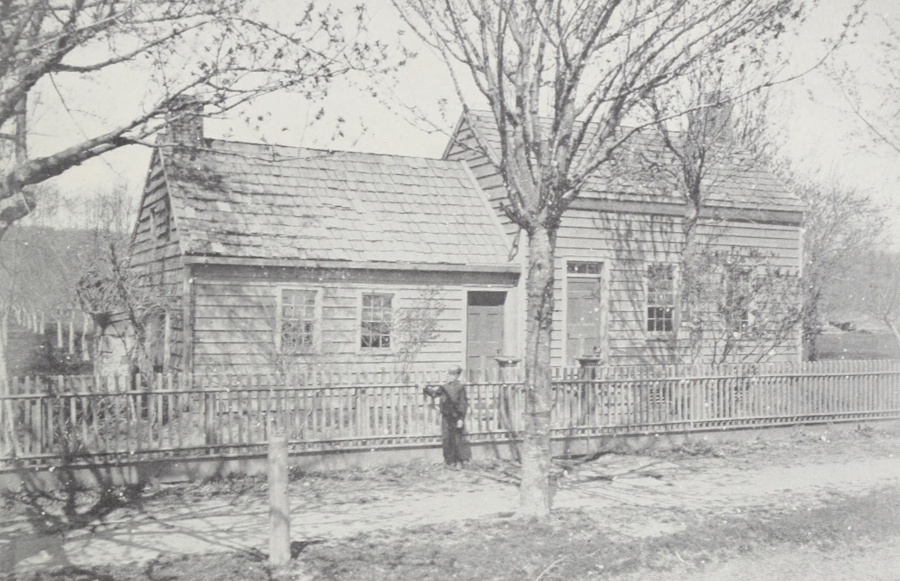
The Phillips Farm House. Erected before the Revolution. Picture taken in 1869 shows one of the cherry trees that then lined the sidewalk.
At the south end of the estate stood a quaint little
dwelling, bearing unmistakable marks of antiquity
upon its weather beaten boards and crumbling shingle
roof. This house had been the dwelling place of several
generations of the name.
Colonel Phillips, the founder of the family in
America, was an officer in the English army under
Oliver Cromwell, and on the accession of Charles II.
to the throne of England, in 1660, he with others was
obliged to fly to America. He first settled in Killingworth
(now Clinton), Connecticut, and subsequently
removed to New Jersey, purchasing nine
hundred acres of land near Caldwell. One of his
grandsons, David Phillips, settled in Newark and married
Sarah Morris, grandaughter of a Doctor Morris,
who was also an officer under Cromwell, and who fled
to America with Colonel Phillips.
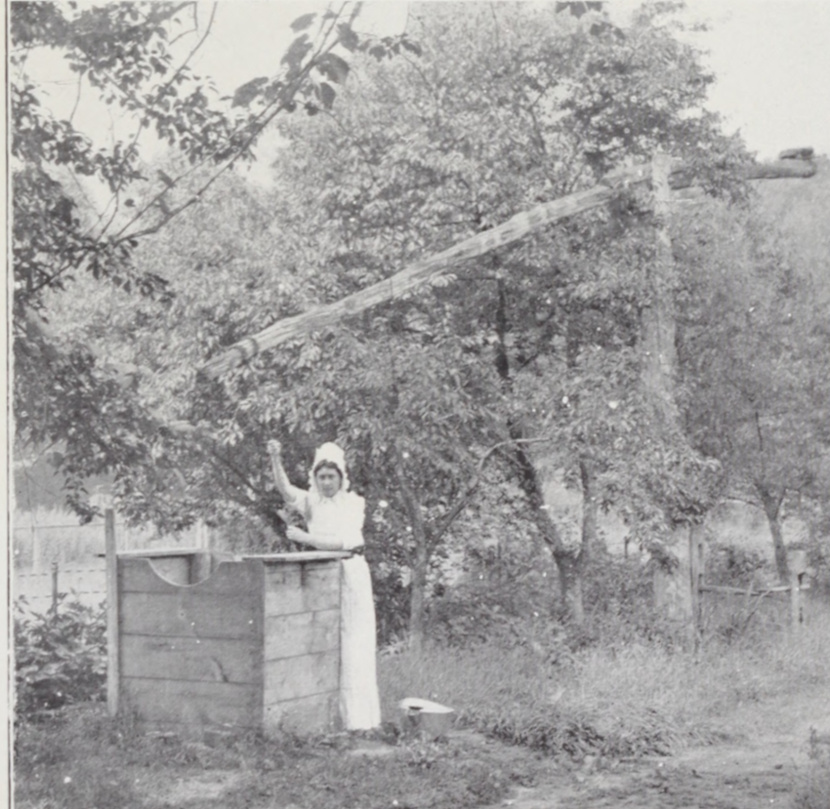
The Old Phillips Well. Said to date back to the time of the Indians.]
David Phillips had this property from Morris
Phillips, and he from Samuel Morris. David Phillips
began his housekeeping in the little house which stands
on the Lincoln avenue property, “purchasing 16 acres
of land for which his family received a deed from the
proprietors of East Jersey in 1696”, and here Morris
Phillips, the father of John Morris Phillips, was born
and here he died. This Morris Phillips was one of
the proprietors of the quarries at Belleville which furnished
the stone used in building Fort Lafayette, Castle
William on Governor’s Island, old St. John’s
Church in New York, which has recently been closed
by the Trinity corporation, and the old State House
in Albany.
The farm house still stands on the property,
though it has been moved back to Summer avenue in
the rear of the house erected some years ago by Mr.
John M. Phillips near the original homestead site.
The old farm had gradually acquired that human interest
which only comes of long tillage and close association
with man, its fine orchard of ancient apple
trees, the wood lot on the eastern slope of the hill
which lapped over into the Mount Prospect avenue
region, and which held for the man so many boy
memories of dog and gun, and the fertile flat lands
which stretched north along the old road. All these
combined to entice the man back to his boyhood’s
home, and it is small wonder that Mr. John M. Phillips,
who had a keen sense of the beauties and wonders
of nature, acquired the place for his own at the
first opportunity. Here was an ancient well of delicious
water, which tradition tells us was known to
and used by the Indians. Up to very recent times this
stood with its long well-sweep picturesquely adorning
the landscape.
In the winter of 1779 General Anthony Wayne
marched his troops up the Back road to the fields between
the present Elwood avenue and Second river,
where he went into camp. Mr. Frank Crane tells me
that when a boy it was a common thing to find along
this hillside, all the way to Second river, hollows in
the earth which are supposed to have been dug by the
soldiers for shelter.
Just about the time the troops reached the Phillips
farm, Mrs. Sarah, wife of David, mentioned
above, had finished a baking of bread; this she took
out and gave to the hungry soldiers with pretty much
everything else in the house that was eatable. It has
been handed down in the Phillips family, as elsewhere,
that the soldiers when they halted stood with
their feet in their caps to protect them from the snow—those
poor naked feet which had been cut and torn
by the sharp crust of the snow until they marked the
white highway with a trail of blood. The old grandmother
many times told the tale to the family gathered
about the warm hearth of the old farm house on
wintry nights, and the boy John never forgot it.
A rather interesting tangle over the northern end
of the Phillips tract has taken much patience to unravel.
This concerned a small slice of land now
largely occupied by Phillips Park and Elwood avenue.
About 1825 Benajah Perou purchased a certain
parcel of land from John Morris Keen, of which the
above was part. Perou was a seafaring man and, in
the spring of 1828, sailed for New Orleans, and nothing
was afterward heard from him. Being unmarried
his heirs were his six brothers and sisters, and in 1845
this property was divided amongst them, each receiving
a long narrow strip, 66 feet wide, fronting on the
“road from Newark to Belleville Paint Works”, and
running back into the sunset.
Daniel Perou received as his share the northernmost
strip, known as lot No. 6. He was living back in
the country and, in 1849, died intestate and unmarried;
thus his 66 foot strip fell to the five remaining brothers
and sisters, or their heirs, none of whom appear to
have paid any attention to the property. In the meantime
said brothers and sisters had been getting married
and having children, and these children had insisted
on growing up and doing likewise, until generations
arose who knew not that they were interested
in the property.
Naomi Perou, one of the sisters of Benajah, married
Morris Phillips, and in due time became the
mother of John M. Phillips, who was one of the last
of the line to be born in the old farm house. And as
time went on and John M. prospered he began to buy
up the interests of others in the adjoining property
until he owned all of the Perou tract, or thought he
did. But by the time an attempt was made to definitely
fix the title to lot No. 6 there were found to be
more than three hundred shares into which this lot
must be divided, each one amounting to something
less than three inches in width, and extending from
Lincoln avenue to Mount Prospect.
The hunt necessitated to clear this title led all over
the country. One heir was traced as far as New Orleans,
and lost; another vanished in the Civil War;
another moved to Mystic, Conn., and could not be
traced to his final end, and so it went. One was found
in Kansas and another in Western New York.
It cost more to perfect the title than the land was
worth, and when it was perfected the lot—or all that
was left of it—was given to the city for a park, a memorial
to the late John Morris Phillips.
It is family tradition among most of those whose
ancestors resided here during the Revolution that
Gen. Anthony Wayne camped along the old Back
road, but so far as can be ascertained the books are
silent on the subject. The New York Historical Society
can find nothing in its archives, and if the New
Jersey Historical Society has anything bearing on
this point it does not know it.
The only mention of the event that I have been
able to find is an unsigned article which appeared in
the Daily Advertiser of December 12, 1884, which is
quoted here entire, as it contains much of interest.
The Advertiser says:—
“The attention of an Advertiser reporter was recently
called to a tradition that Gen. Anthony
Wayne with 2,600 men was camped for a considerable
time during the severe winter of 1779 in the
vicinity of what is now Elwood avenue, and the old
Belleville road in this city. It was rather doubted
whether this could be possible, and all accounts of it
lost. Such an event would certainly have left an impression
which could not be entirely obliterated even
in a hundred years. From information obtained,
however, from the late John M. Phillips, whose
grandfather was a revolutionary soldier; William A.
Wauters, whose grandmother owned the woods in
which it is alleged Wayne camped, together with a
personal inspection of the ground made by Mr.
Daniel F. Tompkins, of Woodside, his son and the
writer, the following facts were ascertained:—
“General Wayne, with a detachment of the American
Army, after the evacuation of New York, regained
for a portion of the winter encamped in the
Coeyman woods, in what is now Woodside. His
encampment extended from a point a little west of
and in line with the old Belleville road and north of
Elwood avenue, along the ridge up to Second river.
Traces of this encampment are found in the excavations
which the soldiers made for their huts. The
excavations are found also along the line of the
Montclair & Greenwood Lake Railroad at the south
side of the bridge across the Second river. They are
found also on the side of the hill west of Mount
Prospect avenue, and south of the line of Elliott
street, and extending north several hundred yards,
the most marked being at the northern limit. In
one of these excavations the stones which marked
the temporary fireplace still remain. The troops cut
down the growing timber from these woods, and the
owner, Minard Coeyman, was paid for it by the government.
About half a mile northwest of this ridge
the old barn, in which were slaughtered the cattle for
the use of the army, still stands. It belongs to the
Crane family. Mr. Nathaniel Crane, who was born
in 1808, well remembers hearing his father and uncle
talk about the encampment. Wayne had several
field pieces with him, and the men used to take the
horses down to Second river to water at a point 100
yards from the railroad bridge, and near the ruins
of the old copper works, opposite Woodside Park.
In February Wayne moved his army to Morristown.
The close proximity of the British is given as the
cause of Wayne breaking camp. In his position at
Woodside he was liable to be flanked. Jasper King,
father of the late William King, of East Orange, was
a boy at the time Wayne was at Woodside, and his
father was a soldier in Wayne’s army. Jasper went
with his grandfather and his mother to say good-by
to his father at the encampment in Coeyman’s woods.
“Jasper King related to the late John M. Phillips
that when the roll was called the soldiers came out
from their tents and some of them threw their caps
on the snow and stood on them with their bare feet.
He said it began to snow as the troops started on
their march to Morristown and some of the soldiers
left marks of blood on the snow as they marched.
Their way was along the old Bloomfield road, which
may have been reached by crossing the fields past
the old Crane Mansion, or by the way of Keen’s
lane, the outlines of which can still be traced southwest
to the Bloomfield road. From Bloomfield the
march was through Caldwell, where the snow became
so deep that the artillery was left behind and
remained imbedded in the drifts on a by-road near
where the penitentiary now stands, until spring. At
Bloomfield a picket was posted to guard the rear.
One of the men climbed onto the fence to see if the
British were pursuing. In the act his gun was discharged,
killing him instantly.
“The story of Jasper King is corroborated by the
known fact that on February 3, 1779, a snow storm
set in, which lasted three days, and the snow was
said to be eight feet deep on the Bloomfield road.
The inference that Wayne’s encampment at Woodside
was in the winter of 1779 is made more probable
from the fact that in his attack on Stony Point
in July, 1779, he had no artillery. That Wayne was
on the coast and near New York in the winter of
1779, is made exceedingly probable also by the following
letter from Lord Stirling, which if he had
been at Morristown with Washington would have
been directed to the Commander-in-Chief:—
“‘Ramapogh, Jan. 5, 1779.—Dear Sir: From every
intelligence I have received I am induced to believe
that Count D’Estaing is on this coast; in consequence
of it I need not explain matters to you.
Notwithstanding my situation of body, I will be at
Paramis to-morrow and should be glad to see you
there as soon as possible, to concert every necessary
measure that may occur to us both.
“‘I am, D sir, your most ob’d sev’t.
”‘Gen. Wayne. STIRLING.’”
“That Wayne had artillery is evident from the
fact that Mr. Tompkins found a grape-shot on the
ground of the encampment. He also found a sword,
which, evidently, had been worn by a noncommissioned
officer.”
“During the winter of 1780-81 the British were at
Belleville and may have used the same encampment
previously occupied by the Americans. It is
known that they occupied ground near where the
new steel works of Dodge, Blake & Lyon now are.
During this time a party of British stopped for the
night on Keen’s lane, mentioned before on what is
now Mr. Henry J. Winser’s lot, on Washington
avenue, opposite Carteret street. Another party
coming from Newark along the Passaic, stumbled
on the pickets of the first party and immediately
began firing. There was quite a skirmish in the
darkness before the true state of affairs was learned.”
“The old house in which the grandfather of the
late John M. Phillips lived stood flush with the old
Belleville road at the time of which we write, and
was visited frequently by the American officers. It
now stands in the rear of the new house on Lincoln
avenue, and is well preserved. A middle-aged Irish
woman came to the door at the knock of Mr. Tompkins
the other day and seemed inclined to deny an
inspection of the premises; but when it was made
known to her that the visit was to see the house
where the men who whipped the British a hundred
years ago had lodged, she accorded a right royal
welcome. A mere glance was sufficient to prove
that the house was not of modern date. There is no
plastering, and the joists that support the upper
floors are thick and strong and as substantial as
when put in, more than a hundred years ago.”
“While the British were encamped on this side of
Second river, near the steel works, the grandfather
of Mr. Tompkins, who was a scout in the American
Army and noted as an athlete, was reconnoitering,
with four companions, on the old Belleville road.
They accidentally came upon a picket post in the
dusk, the officer of which rode up and cried out:
‘Who you be for?’ Tompkins, to gain time, asked
the same question, ‘Who you be for?’ ‘For King
George’, said the English officer. ‘We be for the
Continental Congress’, shouted Tompkins as he
sprang into the woods. There was a fence that
stood in the way, and as Tompkins vaulted over it
the entire picket guard fired. Two of Tompkins’s
companions who, instead of jumping the fence had
climbed over it, were killed, but the former escaped
by the balls passing under him as he jumped. One
of the scouts who was killed on that occasion lies
buried in the old Bloomfield grave yard. The enemy
probably not knowing that they had killed any one,
left the bodies where they fell.”
The march of improvement, in the opening of Woodside
avenue, has recently caused the destruction of
the “Magazine house”, a low stone building which
stood back of the present Summerfield M. E. Church.
This dated back to about 1812, when it was built for
the storing of powder made at the Decatur Powder
Works, which were located on the site of the present
De Witt Wire Works, Belleville. There was a spirit
of mystery and adventure about the place that somehow
tickled my boyish fancy greatly, and I always
passed it with a sense of adventure, but the above is all
that can be said of the spot. When Jacob Rutan was
building the calico print works on Second river he
lived here and his wife, Elizabeth, a member of the
King family, formerly of the River road, boarded the
men who were doing the mason work. How they all
slept in this small building is a mystery.
Just below the powder house; in fact, opposite the
point where Elwood place runs into Summer avenue,
the John Morris Keen lane led away to the Bloomfield
road. This, it appears, was part of a lane from
the River road, the easterly section of which was
known as the Stimis lane. Whether the latter was
opened for the purpose or, being established, was
merely used because convenient, has not been made
plain, but I am told that formerly a paper mill stood
on the Bloomfield road, and that the paper was made
from reeds gathered on the Hackensack meadows,
brought up the Passaic river, landed possibly at the
Point House landing and carted from there via the
two lanes to the mill.
The Back road, in the Elliott street neighborhood,
seventy-five or more years ago, entered a deep gully
surrounded on all sides by dense woods. It is possible
that this gave the early name of “Drift” road to
the highway, as it was a place into which snow could
easily drift and cause trouble to travelers. This was
a noted spot for highway robberies, many such having
occurred here, and the place was long dreaded by
those who were compelled to pass this way.
The only actual hold-up of which I have heard is
said to have occurred in 1856, when four men who
came out of the woods from the direction of the
Magazine house attempted to rob a passing farmer.
What success they had I do not know, but it appears
that they were recognized and later arrested. One of
these, at least, was a Woodside man, but the names
of the others have been forgotten.
Tom Coeyman built about sixty years ago at the
upper edge of this gully. His house stood near the
junction of Summer and Grafton avenues, and this
seems to have relieved the gloom of the place, for
so far as known there were no robberies after the one
mentioned above.
Probably before our time the Back road was the
dwelling place of “Owney” Carroll and his good wife
Peggy. Both were convivial souls, and each a character
in his or her way, but our most vivid memories
cling about the old lady. One old resident recalls that
in his youth the couple lived where now stands the
Elliott street school, and that one time when he was
passing with a load of wood Peggy was discovered
in a somewhat awkward predicament.
It seems that one or the other—or possibly both—had
been looking on the wine when it was red, as was
their custom, and that the husband had concluded
that his better half would be improved by a bit of fresh
air and, having thrust her forth, locked the door.
Now Peggy does not appear to have taken this in good
part and, finding an open window, she proceeded to
crawl within; but, when about half-sill over, the sash
came down on her back and pinned her fast—just as
our informant was coming down the road with a load
of wood.
In the course of years Mrs. Carroll became a sort
of attache of our back door, and I have a general
recollection that the old lady’s methods did not always
meet with the entire approval of my mother. She
certainly thoroughly disagreed with one of Peggy’s
capers. My mother was a great lover of plants, and
among her treasures was a lemon tree which actually
bore lemons; these Mrs. Carroll discovered one day
while cruising about the back yard and, carefully
gathering the treasured crop, she brought the fruit to
the back door and tried to sell it to my maternal ancestor.
Mrs. Carroll did not call at the house again
for some time.
Those who sought knowledge at that fount known
as the Elliott street school, when it was but a country
schoolhouse, delight to recall how they were allowed
to roam the woods that then bordered the old
road on the west, for the first flowers of spring, and
how the schoolmaster would ring the bell from the
schoolhouse door summoning a return to study, and
the children would come scampering back with hands
full of bloom—windflowers and hepaticas mostly,
whose blue and white are so emblematic of the springtime
heavens. To those who can hark back so far
that patch of woods is remembered as a wonderfully
attractive spot.
Jesse C. Bennett came to this country from Stockport,
England, in 1833, to superintend the calico print
works, which lined the south side of Second river
from the Back road to the De Witt mill pond, and
he built a house at what is now the southwest corner
of Summer and Verona avenues.
Mr. Bennett was an Episcopalian, and as dancing
was one of the accomplishments of the day and
not barred by that creed, he engaged a master of the
art who once in so often gave the small Bennetts
(there were twelve of them) lessons in an addition
at the rear of the dwelling which provided a suitable
room. As time wore on Mr. Bennett became a Second
Adventist and turned this rear room from a dancing
hall to a place for prayer. One of the fervent brothers
of these times was Mr. Harry Harvey, who was given
to long prayers; in fact he thought nothing of praying
for an hour at a stretch. For these exercises the children
were brought in and ranged under the long mantelpiece
on one side of the room, but an hour was a
long time to be good in those days, and generally one
or two or three would steal awhile away without being
noticed. This gradually emboldened the others,
and one time while the heads of the elders were bowed
in devotion the entire youthful congregation managed
to get out unnoticed, and there was considerable
commotion when the fact was discovered and, as I
understand it, the commotion was not entirely confined
to the elders.
Later Mr. Bennett became a Methodist and joined
the church of that denomination in Belleville.
Mr. Bennett once had a man working about the
place who was fresh from the Emerald Isle and he,
venturing out one evening shortly after his arrival,
came running back a badly scared Irishman, and announced
that the woods were full of fairies, for he had
seen their lanterns. It proved to be his first acquaintance
with fireflies.
The calico print works which lined the south bank
of the Second river from the Back road to the De
Witt mill pond developed into a large industry under
Messrs. George and Jonathan Bird. This part of the
river bank has been a mill site for more than one
hundred years.
The first on record was the grist mill of Captain
Bennett. His mill was a small affair which stood on
the bank where the Back road crossed. Next came a
Captain Stout, who rebuilt the mill. Both of these
lived in the dwelling later known as the “Bird” house.
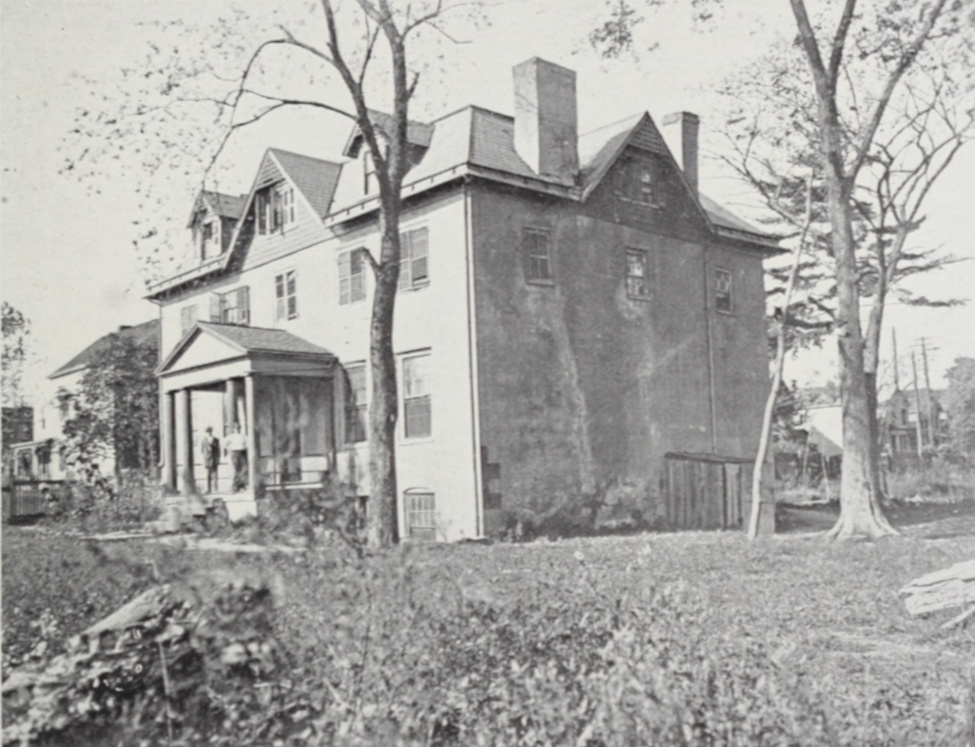
The “Bird” House, Sylvan Avenue. Legend has it that this was built by an Englishman who was compelled to leave the country when the Revolutionary war broke out.
About 1824 the Stout mill and lands were sold to
the Eagle Printing Company, which erected a large
factory for the printing of calicoes along the south
bank of Second river, extending from the Back road
to the De Witt mill pond. The concern employed
several hundred hands and conducted a business of
great magnitude for those times, but it finally fell on
evil days and failed about 1855.
At this time the Back road was so narrow that
wagons could hardly pass; indeed, so much of a country
lane was it that even as late as 1850 the passing
of a load of calicoes from the mill was an event to
call the few inhabitants to the windows to see the
sight.
After this Andrew Gray and one Wright successfully
conducted the business for some time, and
finally George and Jonathan Bird became the proprietors.
Jonathan Bird lived in the stone house that
has since been known as the “Bird” house, and here
dispensed a hospitality that was famed for many a
mile around. In due course George Bird died, and
later Jonathan sold to a stock company, of which
John Eastwood was a member. This company put in
some expensive machinery but, owing to internal
strife, the business was abandoned after a brief existence.
After remaining idle for some time the hat manufacturing
concern of Moore & Seeley purchased the
buildings, but before they did much the factory
burned, and was never rebuilt. The story given out
to account for the fire was to the effect that it was
due to Chinese cheap labor. According to this version
the hatters introduced Chinamen and the Irish
element, which predominated at the time, objected,
and the fire gave point to their objections, but there
are some still living who account for the fire in a
wholly different way.
There was a time when the Back road bridge
across Second river was haunted by a headless ghost—at
least I am so informed—but it seems that when
off duty the ghost was known as old Sam Adams’s
daughter, Mary Ann.
When I was a boy the ruins of the old grist mill
still stood close to the southeast corner of this bridge.
It was then known as Benson’s mill, a man of that
name having been the last miller. Some time some
one was either murdered and thrown into the mill
race here, or else was accidentally drowned. In either
case the situation furnished the proper material for
a mystery, and it would appear that there was talk of
an apparition having been seen on the bridge shortly
after the occurrence.
This was taken advantage of by Mary Ann Adams
to frighten the boys, and as a result few people cared
to cross the bridge after dark, as too many had actually
seen the ghost to leave any doubt of its existence.
This, of course, was long ago, when Mary Ann
was young. She died some six years ago, an old
woman.
There is a legend that Washington once rested at
the grist mill, and that here his troopers purchased
feed for their horses. This was probably during the
retreat from Fort Lee.
Somewhat south of the mill stood the miller’s
house; in fact the building is still standing on its
old foundations, at the southeast corner of Summer
and Sylvan avenues. Here was born Col. Henry Benson,
whose accidental death at Malvern Hill during
the Civil War furnished Belleville with its first military
funeral.
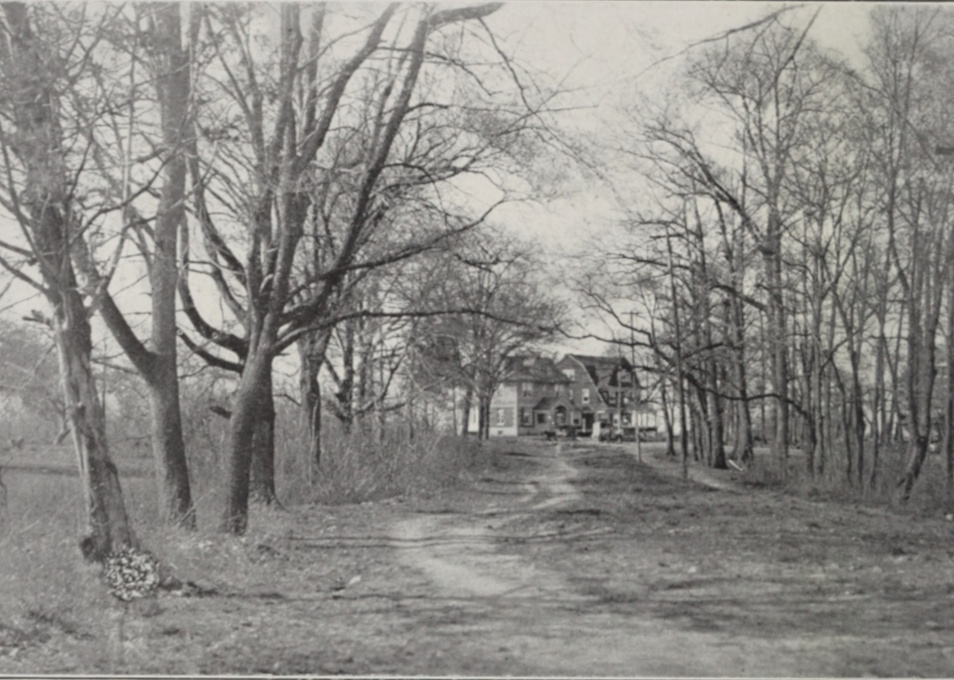
The Old Bloomfield Road in 1903. Looking north to houses at the corner of Clifton and Berkley Avenues. This part of the old road is now obliterated. Those who laid out this hill top had no appreciation of the fact that a crooked road is a line of beauty, both this and Murphy’s Lane having been suppressed in favor of a series of right angles. What would New York above 59th street be if the curves of Broadway were straightened?
The old Bloomfield or Long Hill road is frequently
spoken of by the older inhabitants as a former
Indian trail “from the mountain to the river”.
This may have been one of the many paths which intersected
the great Minisink trail extending from the
Shrewsbury river to Minisink Island, in the Delaware
river below Port Jervis, where the council fires of the
Leni Lenape constantly burned. This particular
branch probably passed through Great Notch on the
First mountain, meeting the main path near Little
Falls.
The white man’s road began where what is now
Second avenue joins Belleville avenue, and labored
up the grade to the present Prospect place, where it
turned toward the north for Bloomfield. The old
road is less prolific in story and incident than any
other part of this region. Those interviewed have invariably
wished that I might be able to talk with
some one now gone who was full of ancient lore, but
as dead men tell no tales I have found myself at a
disadvantage.
Not only have the inhabitants gone, but the old
road itself is largely a memory, for those who are now
exploiting this region have almost obliterated the
former highway, finding that its meandering course
interfered with their straight lines, and not having
in mind the attraction that a bend in the road, the
curving line of beauty, with its mystery of a fair, unknown
country beyond, has for the stroller.
Along this road during the early days of the last
century passed the eccentric preacher Lorenzo Dow,
on his way to the little Methodist church beyond Sunfish
pond. Dow was an occasional visitor in the
vicinity and left a memory of peculiar sayings and
doings that flavored the local gossip for the better
part of a hundred years. It is said that a toll-gate
once stood near the canal bridge, which was kept by
Archibald Jacobus, and those who were boys when I
went skating on Sunfish pond will recall the ruins of
an ancient grist mill whose wheel was turned by the
waters of the pond. Concerning this Mr. Walter S.
Nichols remembers when a boy making regular journeys
to this mill with a grist of corn for the grinding—this
was in the fifties, after the Searing mill on the
canal had been abandoned.
Until the toll-gates were removed, some twenty-five
or more years ago, from the Turnpike or “New”
road, as the present Bloomfield avenue was called, the
old road was the avenue for pleasure driving and also
for much heavy traffic between Newark and Bloomfield.
This made the highway of prime importance
and may help to explain the inflated values set on land
in this region before the panic of ’73.
The Adrian Scharff house, which stood just within
the Woodside line, was erected some time before 1850.
It seems that Mr. Scharff brought his old world ideas
with him to this country and thought he must either
have a river frontage for his home or a view. He had
almost decided on the site now occupied by the Mount
Pleasant Cemetery, but finding that that was not
available, contented himself with the next best spot
near the hilltop.
Beyond the Scharff house the road ran through
dense woods for a short half mile to the Robert
Smith property—known as “White-house” Smith to
distinguish him from “Brick-house” Smith further
north. The records show that this property was sold
by Thomas Saffin to Thomas Havens, and by him to
Ebenezer Smith. When this house was built is not
known, but probably it was erected by Ebenezer
Smith, father of Robert.
Ebenezer Smith, born February 24, 1791, who was
one of a large family, was the son of Scotch parents
who immigrated to this country before his birth.
Ebenezer had two sons, Robert and Ebenezer, Jr., and
one daughter. Robert fell heir to the “White-house”
Smith property. Ebenezer, Jr., married a daughter of
Matthias Baker, and thus came into the property on
which his son, Matthias Smith, erected the home of
the “Brick-house” Smiths. Ebenezer, Jr., had two sons,
Robert (2) and Matthias. Robert (1) lived in New
York and used this as a summer home; he died in
1858. Robert Smith was a lover of fast horses and
was in the habit of driving from Jersey City to his
home. He had one horse, of which he was particularly
proud, that would cover the distance in an hour.
In those days the Hackensack meadows were covered
with a dense cedar growth which was a hiding
place for those whose deeds were evil, and the road
was the scene of many hold-ups. On one occasion Mr.
Smith, while driving home, overtook a woman who
asked for a ride, and he took her in his trap, only to
discover that the supposed woman wore heavy boots;
he then concluded that they would later meet with
others who would assist in relieving him of the necessity
of carrying his money home. Having made up
his mind to rid himself of the passenger, he dropped
his whip and requested her to get it, as he could not
leave his restive horse; and, of course, once she was
out, he did not wait for whip or passenger.
The children of Robert Smith all of whom are now
dead, were Charles H., Eugene B., Robert A., Sarah
and Agnes W.
This property was purchased by Peter H. and
John H. Ballantine just before the panic of 1873 (the
deed is dated January 31, 1873) when prices were
greatly inflated, and they paid therefor the sum of
$217,000, paying $50,000 down and giving a mortgage
and bond for the remainder. It was not long before
the new purchasers saw the error of their ways and
desired to relinquish the property and the $50,000,
but to this the Smith estate would not agree. It is
hardly probable that they will ever see a profit on the
investment, as interest at 5 per cent (and it was more
than five in those days) would in itself now amount
to almost twice the original outlay, and when the
taxes and assessments to which the property has
fallen heir are added to the loss of interest, even eighty
dollars a foot can hardly seem a large sum to the Ballantine
estate.
Passing the Robert Smith place we come to the
home of the Bartholfs, which was erected more than
sixty years ago, as it is so designated on the map of
’49. Who Mr. Bartholf was or where he came from
I have not ascertained. The records show that John
G. Bartholf purchased the property from Samuel
Morris, who had it from Zebulon Morris, to whom it
came from John Morris. This was probably that
John Morris who was a resident of the old Bloomfield
road during the Revolution.
Mr. John Morris Phillips, in the Daily Advertiser
of February 19, 1880, stated that John Morris was his
great-grandfather, and that it was to his house that
the son of Joseph Hedden came when he fled from the
British (referred to elsewhere), having nothing on
but his night clothes and a pair of stockings. His
feet were frozen to the bone as a result of the exposure.
Some time in the sixties Mr. Albert Beach acquired
this property which he at first used only as a
summer home. The house was taken down in November,
1909.
The Keen homestead adjoined the Beach property
on the north. Just when the farm house was erected
is not known, but that it is pre-Revolutionary there is
no question.
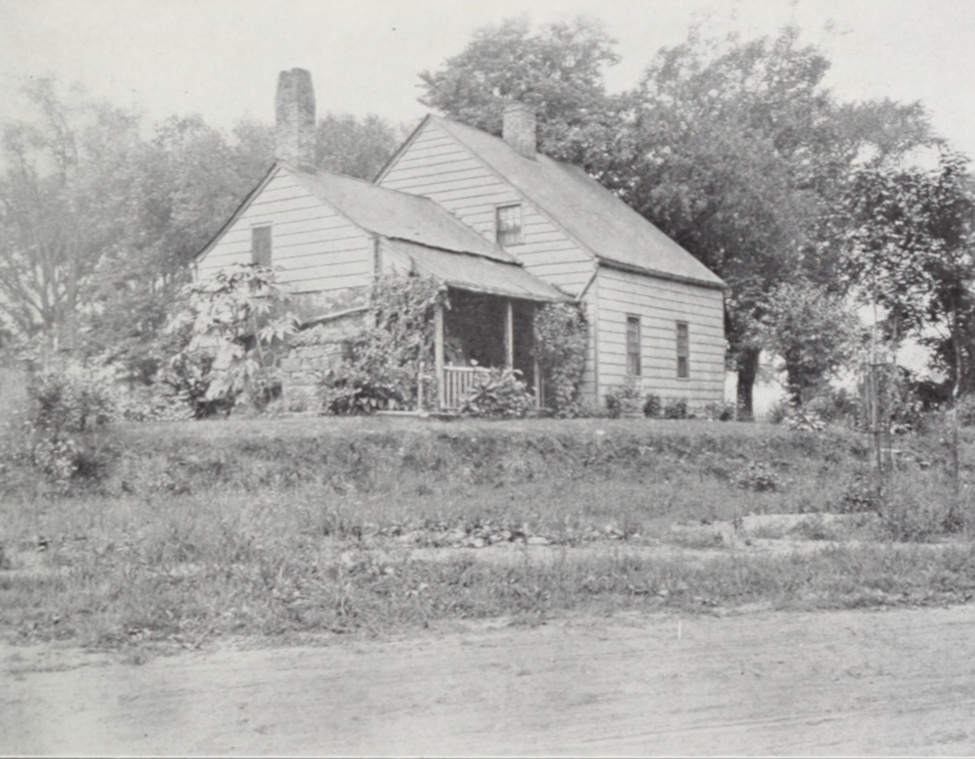
The Keen Farm House. Pre-Revolutionary. This shows the building as it stands to-day.
In 1765 Thomas Keen, a native of England, and
Miss Clorinda Lake, of Holland, were married on
Long Island, and subsequently settled at Belleville,
Essex County, New Jersey.
Their son, Joseph Lake Keen, was married to Abigail
Morris in 1790.
Their son, John Morris Keen, was married to
Peninah Sanford in 1820.
Their son, Zebulon Morris Keen, was married to
Hanna Maria Garrabrant in 1863.
Their surviving son, John Morris Keen, was married
in 1908 to Helen Virginia Brainard.
The grandfather of the present John M. Keen was
born in 1797, and Peninah Sanford was born in Kearney
(New Barbadoes) in 1792. She was a descendant
of Capt. William Sanford, mentioned elsewhere.
The Keen homestead still remains, the house being
substantially unchanged, but the barns, cribs and
smoke house have long since been removed. Pear
trees standing in the yard over twenty years ago were
said by Mrs. Peninah Keen to be over two hundred
years old. This same grandmother, who began life
in 1792, has stated that Washington, in one of his
journeys to and fro, came up the old Keen lane and
stopped at the farm house for a glass of water. This
lane has been in use for at least one hundred and fifty
years, as seventy-five years ago trees lined its borders
which were then not less than seventy-five years old.
Almost opposite the Keen home lived the “Brick-house”
Smiths. This building was erected fifty-three
or fifty-four years ago by Matthias Smith on the site
where formerly dwelt his maternal grandfather, Matthias
Baker. The latter had the property from Isaac
Soverhill.
The Sidman family dates back to the time of
William the Conqueror, when the first ancestor of
whom there is any record is said to have come to
England from Normandy. He appears to have been a
favorite of the great William and received from him
a considerable grant of land on the river Syd and
from this the family derived its name—Sydenham,
which was later shortened to Sidman.
The introduction of the Sidman family to this
neighborhood began with a romance, when John Sydenham
ran away with Susannah Handcock, in 1711.
It seems that Edward Handcock, “yoeman” (or
Handcook, as one document gives the name) was living
on this property in the year above mentioned, and
that John Sydenham, who happened along from no
one knows just where, fell desperately in love with
Susannah, an only daughter, but the stern father
frowned on the young man’s suit and Susannah was
locked in an upper room.
However, John brought around a ladder one night,
and the two adjourned to the parson. That they were
promptly forgiven is evidenced by the following extract
from a deed, made in 1711 by Edward Handcock,
in which he says: “for and in consideration of
the love, good will and affection which I have and
do bear unto my loving son-in-law, John Sydenham,
etc., and my only daughter, Susannah, his wife”.
He then deeds to his son-in-law four acres of his land
situated on the “highway to Acquacanong”, and six
acres on the “highway to Watersson”, which latter adjoined
land owned by Jasper Crane and by John
Godon.
The following genealogy of the family is furnished
by Miss Laura M. Sydenham of Plainfield, and is
taken largely from the family Bible:—
John Sydenham (1) married Susannah Handcock,
1711. They had issue: John (2), born March 16,
1714; died in 1754. Samuel, who died intestate and
unmarried in 1759. There is some doubt about this
Samuel, there being but slight mention of him in the
records, but it is presumed that he was the son of
John Sydenham (1).
John Sydenham (2) married Martha Longworth,
December 8, 1741. They had issue:—
Dorcas, born November 30, 1742.
David, born October 11, 1744.
William (1), born July 8, 1746.
John (3), born May 10, 1748. He removed to
parts unknown on the upper Hudson river,
and nothing further has been learned concerning
him.
Susannah, born February 15, 1750.
William (2), born November 15, 1751.
Thomas, born November 4, 1753; died August
12, 1816.
Thomas Sydenham married Sarah Fordham, in
October, 1779. They had issue:—
Susannah, born 1780; died 1852.
Martha, born 1783.
John (4), born 1785; died 1859.
Mary, born 1788.
Sarah, born 1791; died 1831.
David, born 1795; died 1822.
Bethiah, born 1798; died 1844.
John Sydenham (4) married Amelia, daughter of
Matthias Baker, August, 1817. They had issue:
Mary E., Martha A., Albert T., Sarah E., John E.,
Matilda L., Harriet and Julia.
John Sydenham (2) married Martha Longworth,
as stated above; she was born August 23, 1724, and
died May 12, 1804. Her sister Mary (born April 22,
1737, died September, 1793) married a Mr. Eckley.
The sisters both resided in the Sidman house now
standing. One Isaac Longworth, who owned a store
in New York in 1759, and was the owner of a sloop
which traded up the Passaic river, is believed to be
the father of Mary and Martha, and also of a son
Nicholas, who removed west to Cincinnati, and became
the progenitor of that branch of the family.
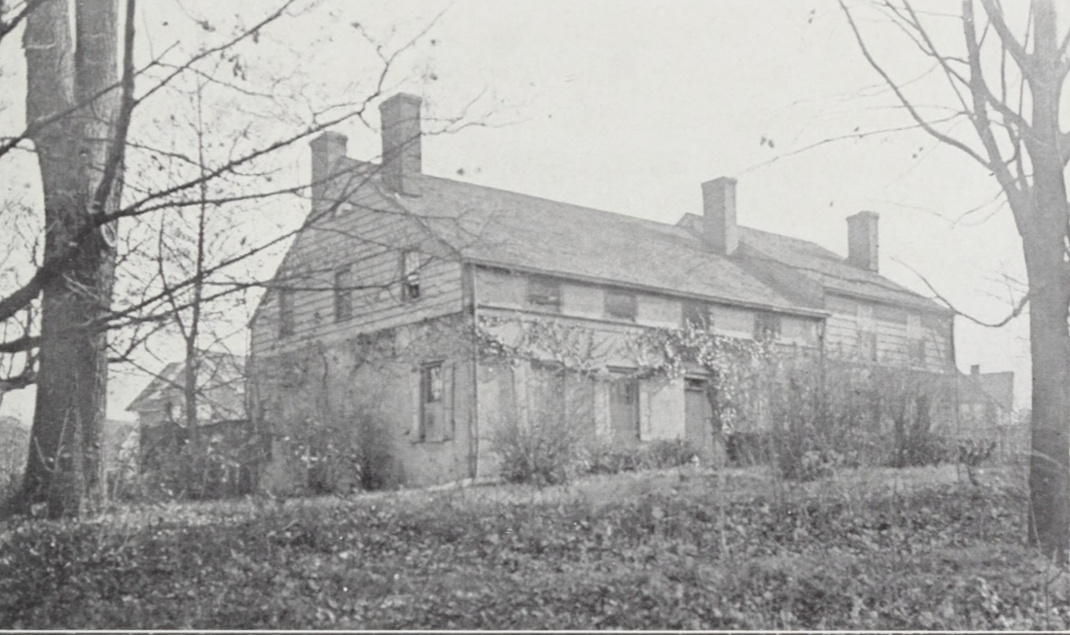
The Sidman (Sydenham) Homestead. Date of erection not known. Picture taken in 1909.
The house now standing is not the Hancock house
of 1711, though it is known to be more than one hundred
and fifty years old. The Dutch oven, where
bread and pies were formerly baked, is still a part of
the structure, and the long-handled, wooden shovel,
used to remove those edibles when baked, is still a
part of its furnishings.
The present spelling of the name Sidman has been
in occasional use for at least one hundred and fifty
years, as the name is so spelled in the grave-digger’s
bill for John (2), who died in 1754. In the paper detailing
the settlement of the estate of John (2) the
name is spelled Sidnham. In an inventory of his
goods is mentioned “Hagar, a negro girl”, who was
valued at £40. In a document dated in 1816 the name
is spelled Sidingham. The present spelling came into
general use with David, son of Thomas, who refused
to sign his name other than Sidman.
Miss Laura M. Sydenham tells me that when she
was a child a certain hollow on the crown of the ridge
which had the appearance of having been surrounded
by a heavy stone wall, and which was situated in the
fields, she thinks, somewhere between the house of
Mr. Elias G. Heller and the Presbyterian church, was
pointed out by the elders as the site of a fort erected
for protection against the Indians, but nothing more
definite than this is known.
Miss Sydenham also remembers having been told
that a Tory, whose house was burned because of his
unpatriotic tendencies, resided between the present
Sidman house and Murphy’s lane.
The woods on the Sidman place were used to some
extent as a camping ground by certain Indians. Miss
J. A. Sidman recalls having heard her grandmother
tell of an invitation extended to her by these Indians
to dine with them and, as she preferred not to offend
the red-skinned neighbors, the invitation was accepted;
but this proved to be one of the times when
a little knowledge is a dangerous thing, for she arrived
in time to see the dinner preparing and the
careless and uncleanly methods of her hosts so nauseated
her that she invented some excuse and came
away.
Another of the early memories is Mollie, an old
Indian basket maker, who frequented the neighborhood,
securing her material from the Sidman woods.
She frequently slept on the floor of the kitchen, always
in a sitting posture. One day other Indians
came this way and the wild instinct returned to the
old basket maker who, after an excited conversation
with her new-found friends, departed with them never
to be seen again in the neighborhood.
The upper end of Branch Brook park, which was
formerly a part of the Sidman domain, was known as
“Blue Jay” woods.
Some years before his death Mr. Daniel F. Tompkins
called at the Sidman house and made the statement
that he had found in New York a document
which contained information to the effect that Washington
contemplated establishing his winter camp at
“Sidman’s (Sydenham’s) Clove”, but owing to its
proximity to the British lines the idea was abandoned
and instead he fixed the camp at Morristown. Mr.
Tompkins believed that this referred to this Sidman
property which then covered a considerable tract, but
no member of the family had ever heard any part of
the estate called the clove, and nothing further was developed.
A brief search among the records of the
New York Historical Society fails to reveal the source
of Mr. Tompkins’s information.
On the corner of the old road and Murphy’s lane
stands another Keen homestead. The original house,
which has been added to until it has lost much of
its identity, was part of the Crane estate and came
into the Keen family through the marriage of Alfred
Keen with a sister of Nathaniel J. Crane. The older
part of the house was probably built a hundred years
ago. The front part was erected by Alfred Keen
about fifty years ago.
The old Moses Farrand home formerly joined the
Keen property, extending to the canal. The building
was torn down some years ago. It was a fine old
place in its day, having been erected, it is said, near
the close of the eighteenth century. The rooms were
spacious for those days, while a great central hall extended
from front to rear. The walls were thick and
massive, the brown stone of which they were constructed
is supposed to have been taken from the
quarry at Soho.
Dr. Edward D. Griffin pastor of the First Presbyterian
Church of Newark from 1801 to 1809, was in
the habit of riding out to this house to conduct religious
services for those living in the neighborhood.
The family record in the old Farrand Bible, now
in possession of Miss Anna B. Farrand, begins with
Moses, who was born in October, 1728, and died September
19, 1805; following him comes Samuel, born
July 25, 1759, died December 26, 1826; he married
Sarah Andruss, who was born December 30, 1769, and
died in June, 1874; Joseph,
born January 10, 1792; Moses Andruss (2d), born
October 11, 1793, died January 26, 1862; Rachael,
born August 13, 1795, died August 19, 1816; Sarah
Ann, born August 4, 1797; Charles, born July 29, 1799,
died in June, 1874; Joseph, born December 20, 1801,
died August 19, 1830; Phœbe, born November 23,
1802; Samuel Edward, born June 2, 1803; John Herman,
born June 2, 1805, and Samuel Edward (2d),
born May 19, 1807.
The oldest Farrand home in this region was situated
on our old road, but across the line in Bloomfield.
Here Washington is said to have been a guest.
This property fell to Charles, father of Miss Anna B.,
who has given me most of the family history.
The Farrands, name originally spelled Ferrant,
were Huguenots, and presumably were part of the
emigrants who left France owing to the Revocation of
the Edict of Nantes, following which several hundred
thousand Frenchmen were compelled to seek refuge
in other lands. A considerable colony of these settled
in the neighborhood of New York during the early
part of the eighteenth century.
There is nothing further of interest concerning the
old Bloomfield road; the short stretch beyond the
canal which lies within the confines of Woodside offers
no discoverable history or legend that may be used
for this sketch.
The Lower Road From Belleville to Bloomfield.
One who knew Murphy’s lane in years gone by
would naturally begin with Charlie Van Riper’s
flower garden. When we were young, Charlie Van
Riper lived in a frame house, the northern windows of
which overlooked Second river. The foreground of
his view was a neglected expanse through which meandered
Murphy’s lane, and also a second cart track
which, as I recall it, merely shortened the distance a
few feet for those seeking “Murphytown” from the
south. This cart track, which is now Sylvan avenue,
west of Summer avenue, ran close by the old-fashioned
flower garden, which Charlie knew so well how to
encourage to do its best, with its marigolds and hollyhocks,
and all the old friends set out in little odd-shaped
beds bordered with box. Charlie was as generous
with his flowers as his flowers were generous to
him, and many a child who stopped to gaze through
the picket fence into that wonderland of gorgeous
color went on his way with a bunch of blossoms given
to him by the kind old soul.
That portion of the wild land which was not interfered
with by the traffic of Murphy’s lane offered inducements
to the youngsters that I am inclined to
think they rather preferred to the Van Riper flowers,
and these were the hazel bushes which grew in abundance,
the ripened fruit of which was a great attraction.
“Bird’s Woods”, where “The slant yellow beam
down the wood-aisle doth seem like a lane into
Heaven that leads from a dream”, should have had a
Sidney Lanier to immortalize its cool and delicious
depths. It was the picnic resort of many a Sunday
school, but picnics in the early days were simple affairs
and did not call for changes that seriously
marred the beauty of the forest. The growth was almost
wholly pine and hemlock, and the balsam-laden
air is refreshing even yet to think of. A few swings
and a sheltered platform, where lunch was served,
were the only attempts of man to improve on the situation.
Second river with its babbling waters, the ruins of
the old paint mill, and the old dam, with its waterfall
at the woods’ end, all combined with the forest to lend
enchantment and to a child furnished possibilities for
entertainment that were inexhaustible. How well I
remember the rush of small feet when the Sunday
school children reached the entrance to the woods,
and how they spread out like a fan through its coverts
of mystery, each one intent on finding something new
or re-discovering some old friendly spot.
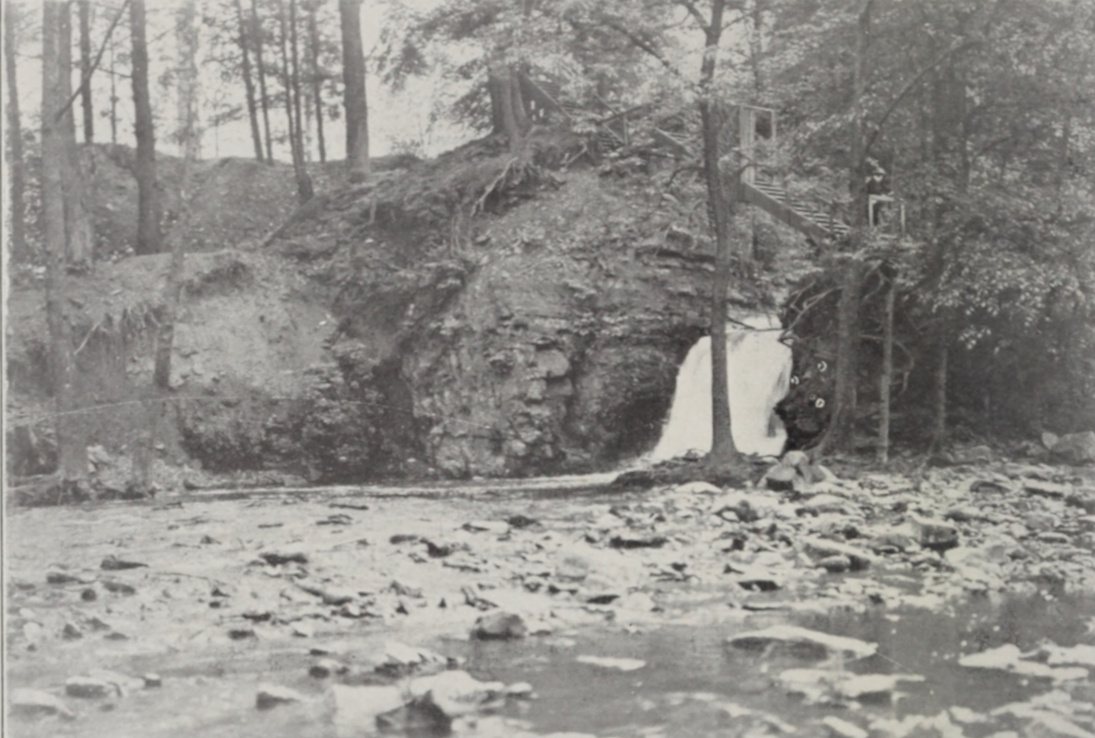
The Waterfall On Second River At Bird’s Woods. Picture taken in 1903, before all the beauty of the region had been destroyed.
Then the woods were full of sound, and I can still
recall the infectious laugh of Mr. Hine, who, as superintendent
of the school and chief promoter of jollity,
urged the children on to a full enjoyment of the
occasion and his call to a stray robin that might at the
moment be voicing his approval of the place, “That’s
right, old fellow. Go it!” and then he would whistle
to the bird in the tree in a way that started him all
over again. We will never see the like of “Bird’s
Woods” again.
As nearly as can now be recalled the line of houses
on Murphy’s lane was in the following order: Joseph
Johns (later John Tyner), William T. Wauters (later
John Beardsley), John Murphy, Thomas Murphy,
James Murphy, Pat Murphy (the chief ingredients of
“Murphytown”), Bill “Whitehead” Bennett, N. J.
Crane and Alfred Keen (on the corner of the old
Bloomfield road).
The Shields Guards was, before the Civil War, one
of the institutions of Murphy’s lane. The armory in
which the guns and accoutrements, loaned by the state,
were stored, was situated some distance back from
Charlie Van Riper’s house, near the present Mt. Prospect
avenue. There were many Irishmen in the
neighborhood and they formed this company as a rival
to the Continental Blues, which numbered Belleville’s
best among its members.
Among Mr. Hine’s papers is a note to the effect
that about 1822 a Sunday school was carried on in
Woodside (for how long he could not ascertain) in
the house of Mr. Joseph Johns, on Murphy’s lane.
This was an old stone house containing two rooms
on the ground floor, in one of which, about fifteen feet
square, the Sunday school was held. The house stood
at the lower end of Murphy’s lane, very near Second
river. It was torn down during the winter of 1886.
Mr. Hine says:—
“Mr. Johns himself does not appear to have been
exactly a saint, but his wife, Peggy, was a woman of
exceptionally fine character and a devoted Christian.
She died thirty-three years ago (this was written by
Mr. Hine in 1887), and those who were children during
her later years speak of their visits to her house
as among the bright spots in their child life. From
the best information I can obtain, it was she who
gathered the children of the neighborhood together
for Sunday instruction, but I learn also of students
from a seminary in Bloomfield who came down there
to teach, and who also established a school in Franklin;
they called it Pobishon. Whether that was an
Indian name of the region or merely a local title, I
do not know, but children from Belleville used to go
to both schools.
“I have not been able to find out whether this ancient
Woodside school was divided in classes or
taught in a body by the person conducting it; but
the exercises were simple and now and then a tract
would be given to a child, who in those early days, set
great store by the simple gift. I only know of two
persons now living who attended this school of sixty-five
or more years ago: they are Mr. Henry Stimis,
who lives on the River road in Woodside and his sister
Eliza, who are well known to many of us. Mr.
William Wauters, who was a cousin of Mrs. Peggy
Johns, has for many years, and until recently, been
a resident of Woodside, and is the father of two
former faithful workers in this school, the Misses
Lizzie and Lucy Wauters.”
In view of the fact that the first Sunday school in
Newark was held in 1814 (Daily Advertiser, Oct. 27,
’83.) it speaks well for this country region that one
was held here only eight years later.
As nearly as I can gather from current remark,
Mr. Joseph Johns was a remarkably fine specimen of
an awful example for a temperance lecture—certainly
that appears to be the impression he left behind
among the neighbors. A story still survives which
indicates that Mr. Johns was also somewhat original
in his method of doing things.
It seems that he once had a sum of money in
shape like a parcel of bills of tempting thickness, and
Mrs. Johns, believing that it would be rather more
safe in her possession than in his, tried to persuade
him to give it up, but, failing in this, she firmly insisted
that half of the amount belonged to her, and
that he should at least divide. To this proposition he
agreed and, taking the package to the chopping block,
with one whack of an axe he cut it in two and handed
one bundle to his wife, saying “there’s your half”.
When he came to and realized the destruction he
had wrought, he was at great pains to paste the bills
together again, and in this condition they were put
into circulation. For some years it was a common
thing to find some of “old Johns’s money” among
change received at the Belleville stores.
Beyond the Johns house stood the dwelling of
William T. Wauters—Wauterse, as his Dutch forefathers
spelled it. The house is shown on the map of
1849, but could not have been erected a great while
before that date.
It seems that Polly Van Winkle, mentioned in
connection with the River road, was an inhabitant of
Bloomfield and used Murphy’s lane as one of her
routes to and from the water side. She left the same
general memory here that she did elsewhere—a little,
old woman, bent nearly double with years and the
weight of an enormous pack, which was her constant
companion.
Not much has been learned of the Murphys, who
appear to have been brought over to work in the
calico mills, and who settled so thickly about midway
of the lane that the spot became known as “Murphytown”.
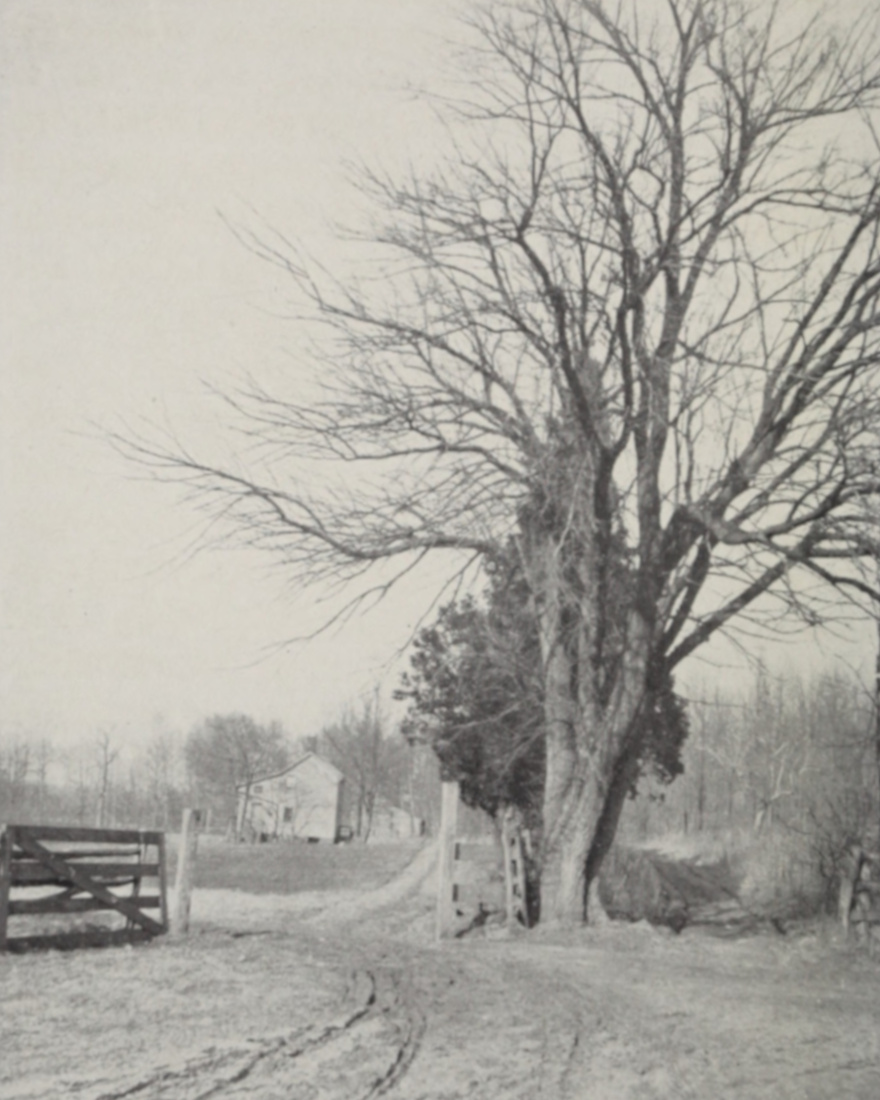
A Bit Of Murphy’s Lane. As it was twenty years ago.
Some time before the Civil War a small band of
gypsies, headed by one James Trail, who had been in
the habit of camping in the woods on the south side
of the lane, purchased some of the Murphy property
for the purpose of establishing a winter home. In
those days this was an out of the way spot and quite
suitable for the nomads.
During the warm months these gypsies wandered
over the country and at one time, while in Tennesee,
they came upon a gullible person named Ferris. Him
they induced to bury a pot of gold, or at least to allow
them to bury it, at an auspicious moment when the
moon and stars favored increase, on the theory that if
left a certain length of time, long enough to allow
them to get well out of the country, it would multiply
the dollars to a marvellous extent.
At the proper time Mr. Ferris dug up the pot and
found it heavily laden with—lead, and was sorely
vexed. So far the plans of the gypsies had worked
as they wished, but what they had not counted on was
the persistence of their victim, who managed to trail
them to their winter lair. He then sought out ’Squire
Sandford of Belleville, and offered him a reward if he
would capture the thieves and get the money back,
which the ’Squire did in short order.
All who knew ’Squire Sandford in his active days
know how useless it was to attempt to bluff him, and
it is hardly necessary to state that the gypsies
promptly came to terms. This resulted in their giving
up the property on Murphy’s lane in order to
avoid further trouble, and the ’Squire received half of
the land in lieu of a money reward.
On the far edge of Murphytown stood the home of
Bill “Whitehead” Bennett. There were many Bennetts
in the neighborhood, and it was necessary to
distinguish one “Bill” from another—this one appears
to have been a blond. The records show that the
heirs of Joseph Crane sold this property to John P.
Durand, and he to Simon Sainsimon, he to Daniel
Crane, he to Aaron I. Crane, he to William Bennett,
he to Abram S. Hewitt, and he to Dr. Grenville M.
Weeks. The following items in regard to the ownership
of the property I have from Dr. Weeks.
Early in the fifties Peter Cooper and Abram S.
Hewitt bought a tract comprising about 38 acres
just beyond “Murphytown”, their intention being to
make a homestead of it, but they did not build. In 1860
Dr. Grenville M. Weeks who was then a young man,
living in Bloomfield, discovered the place and, liking
it both for its beauty and for what he thought would
be its future possibilities as the city grew, saw Mr.
Cooper and asked if he would sell. The latter said
no, as he had purchased intending to make his home
here, but that since then he and his son-in-law had
been looking at a place near Greenwood Lake, and
they might sell a year hence, if they decided on the
latter place, as Hewitt thought the city would crowd
them out of this spot.
In ’61 the Doctor again called on Mr. Cooper, who
said, “Well, are you as hungry after that place as
ever?” and when the young man said yes, the owner
wanted to know how much he would pay down. The
Doctor who was only twenty-one, had a half interest
in a small drug store in Bloomfield, which had netted
him $500, a very considerable sum to him, and when
he said he had $500, Peter Cooper said, “$500! Young
man, have you any idea what the relation of $500 is
to a $10,000 place?” The Doctor then thought he
could raise another $500, and the owner said, “I will
make a contract and give you a deed when you can
save another $1,000 and give me a mortgage for $8,000.”
The Doctor had by this time entered the Navy,
and was thus enabled to secure the second thousand
and the deal was consummated.
In the course of time John I. Briggs bargained for
the property, agreeing to pay $15,000, and paid $100
down to bind the contract, but he never paid interest
on the mortgage, and the Doctor was compelled to
foreclose.
Next came Jeremiah Counsellor, a conductor on
the M. & E. R. R., and a well-known character, and
he asked the Doctor for an opportunity to sell the
property, stating that he would sell it inside of a
month, and that he wanted as his commission half of
all he could get over $50,000. This was just before
the panic of ’73, when prices were largely inflated and
the Doctor was naturally pleased, as, having been attached
to the government service most of the time, he
had not appreciated the rise in land values. Shortly
thereafter the sale was made to Mr. James Yereance,
a New York business man, for $57,000, $25,000 being
paid down. The interest was paid for some years,
but Mr. Yereance was finally unable to meet the payments,
and an amicable arrangement was made
whereby part of the property was deeded to the father
of Mr. Yereance and the remainder was bought in by
the Doctor at Sheriff’s sale. The Doctor speaks very
highly of the honest manner in which Mr. Yereance
treated him all through these transactions.
Dr. Grenville M. Weeks carries with him a useless
right arm as a memento of the Civil War. He
was surgeon on the Monitor when she sank, and tells
such an interesting story—not only of this event, but
also of the conception and building of the Monitor,
many points of which he says are not commonly
known—that a brief outline of his story is embodied
here:—
Dr. Theodore Ruggles Timby, who died November
10, 1909, at the age of 91 was, the Doctor believes,
the real inventor of the Monitor. In 1843, Dr. Timby
gave thought to the immense unprotected stretch of
coast which this country presented to an enemy, and
recognized how impossible it would be to construct
forts that would cover its vast extent. It then occurred
to him that if floating forts could be constructed
which could be taken to any point threatened,
the difficulty would be met. It is said that the old circular
fort on Governor’s Island first suggested a revolving
turret to him.
By much thinking he gradually evolved the Monitor
type, and fifteen years before the Civil War broke
out had perfected his plans and submitted them to
the various European governments, even sending
them to China, but they all scouted his idea, some one
of them remarking that every inventor had his soft
spot, and evidently that of Dr. Timby was the
thought that he could float an iron ship.
Dr. Timby returned home and continued to work
over his plans, placing airtight compartments in bow
and stern, and in such other ways as he could devise
meeting the objections that had been raised.
When the Civil War came the inventor managed
to get his plans before Mr. Lincoln, who immediately
became interested, and who used frequently to visit
his workshop in Washington to discuss them. Finally
Mr. Lincoln, who had some knowledge that the Merrimac
was being constructed and knew that something
must be done to meet the emergency, sent Dr.
Timby with his plans to three of the wealthiest and
most prominent men in New York, with a request
that they submit the plans to the best engineer they
could find.
These took the model and plans to John Ericsson,
then regarded as the best engineer in the country, and
he, after shutting himself up with them for ten days,
submitted a report in which he stated his belief in the
feasibility of the plan, and that he could construct the
vessel in one hundred days. The order was immediately
given to go ahead, and at the end of the one hundred
days the “Monitor” was floating on the waters
of New York harbor, to all appearances a success.
An interesting addition to this story, which belongs
here, comes from Mrs. Lucy Cate Abercrombie
of Forest Hill, and, while it is not part of the Doctor’s
narrative, it helps to complete the history.
When Ericsson announced that the Monitor
could be built, he was called to Washington for consultation
and, among other questions, was asked
where the plates necessary to armor the proposed vessel
could be secured. He responded that he did not
know, that such plates were only made in Glasgow,
and that it was impossible to secure them from there,
but that there was a man in Baltimore who had invented
machinery for rolling large plates, and perhaps
he could do the work.
This was Mr. Horace Abbott, the grandfather of
Mrs. Abercrombie, who had perfected a machine for
rolling heavy plates, by the invention of the third roll,
but he had put his last dollar into the invention and
the stagnation of business due to the war was writing
ruin for him in very large letters. Mr. Abbott was
sent for and a contract was signed, and in forty-eight
hours thereafter the first plate had been rolled, and
this led to other government work. Thus the Monitor
not only saved the fortunes of the Union, but also
those of one of its inventive citizens.
Mr. Abbott’s invention revolutionized the methods
employed in rolling heavy plates; it has never been
materially changed and is in use to-day in every rolling
mill in the country.
Word was sent to Lincoln that the Monitor was
afloat and he, knowing that the Merrimac was almost
ready, ordered it to proceed immediately to Hampton
Roads. Ericsson, however, responded that this
was impossible, that the vessel was intended only for
harbor defense and would not last in a sea, as she
was merely an iron deck set on a scow with an overhang
at each end of twenty-five feet, and that the
force of the waves under this overhang would lift the
upper works from the hull. He had not followed Dr.
Timby’s plans as to the hull, which would have saved
the vessel in the storm off Hatteras referred to below.
The only excuse for the twenty-five foot overhang
that can be thought of now is that the short hull was
sufficient to float the structure and cost less than a
longer hull. The President, however, sent peremptory
orders that the Monitor should go, and we
all know the result.
Some years after the close of the war Dr. Weeks
met the engineer of the Merrimac in Dakota, and as
the conversation drifted to the days that had been,
the engineer told how the Southerners were highly
elated at the first success of the Merrimac, and felt
that nothing could stop them, and when they came out
of the James river on the morning that the Monitor
arrived, the captain was annoyed to see what he supposed
was a raft lying between him and his intended
prey, the Minnesota, and not realizing what it was
or that it could offer resistance, ordered full speed
ahead, expecting to ram and destroy the obstruction.
“You can imagine our amazement”, said the engineer,
“at the shock of the impact, which threw us to
the deck; it was like running on a ledge of rock.
The iron prow of the Merrimac, which was made
for ramming, was bent and useless, and had we not
struck a slanting blow the result to the Merrimac
would have been serious.
“But what finally overwhelmed us were the
enormous balls, eleven inches in diameter, which
came thundering at our railroaded sides until they
began to make breaches. Finally one of these ripped
through us from stem to stern, killing or wounding
seven or more, upsetting gun carriages and causing
terrible devastation. Then it was that we realized
that destruction awaited us unless we could escape.”
One of the mistakes made by Ericsson was the
placing of the conning tower, from which the vessel
is fought, aft of the turret instead of on its top, as the
plans called for. Because of this the officer in charge
was compelled to swing the bow forty-five degrees
out of her course in order to see ahead. This delayed
the fight greatly and also caused Lieut. John L. Worden,
who fought the Monitor, to be almost blinded
by smoke and burned powder. This fact led to the
transferring of Dr. Grenville M. Weeks to the Monitor,
as it was necessary to relieve Lieutenant Worden
and the Monitor’s surgeon, Dr. Daniel C. Logue,
went with him to the Brandywine, while Doctor
Weeks, who was surgeon on the Brandywine, was ordered
to replace Dr. Logue.
Captain Bankhead succeeded Lieutenant Worden
in command of the Monitor and, as the Doctor says,
there was a certain poetical justice in the succession
of Captain Bankhead to this command. It seems that
a board consisting of General Bankhead, the Captain’s
father, and Colonel Thornton of the army, and Joe
Smith of the navy, had been appointed some years
before to determine whether this was a great piece of
folly, as the Europeans thought, or whether it was of
value, as the inventor believed. Thornton and Smith
reported against the invention, while General Bankhead
made a minority report in its favor. The Bankheads
were Southern men, but loyal when the Civil
War came.
The Monitor was ordered to Charleston, S. C.,
and on December 29, 1862, was taken in tow by the
Rhode Island, a powerful side-wheel steamer. A West
India hurricane was raging up the Atlantic Coast, and
two days after the start that very thing happened to
the Monitor that was predicted by Ericsson, the tremendous
lift of the seas under the long overhang of
twenty-five feet caused the deck to break away gradually
from the hull, and soon the cabin was awash and
the heavy dining table was crashing into the stateroom
doors and cabin sides as the rolling of the
clumsy little vessel rushed the water from side to side.
At this point the Doctor went below for something
and found an engineer so sick in his stateroom
that he did not realize their perilous position, and
when the man refused to move the Doctor attempted
to force him out, but now a wave swept over the deck
and the Doctor, supposing the Monitor was going
down, sprang for the companionway and had to fight
his way up through a solid wall of water.
Once outside he sought the top of the turret with
the Captain; in the meantime rockets had been set off
to notify the Rhode Island that her tow was sinking
and the latter had cut her loose. By this time the
fires were nearly out and the Monitor was so waterlogged
that she did not rise to the seas, but dived
into them, while her officers and men could with difficulty
hang on, shutting eyes and mouth until the
flood had swept astern.
The Rhode Island immediately proceeded to lower
a boat on its port quarter, but while this was being
done one of the most desperate situations of this desperate
night occurred. In some way an end of the
immense tow rope which had been trailing astern
became entangled in one of the paddle wheels and
stopped the machinery. Thus she lay helpless for the
time being. In the meantime the Monitor, which was
still slowly running under her own power, her fires
as yet not having been drowned out, was bearing
down on the Rhode Island. In the darkness the proximity
of the two boats was not discovered until the
Monitor was on the point of ramming. Just at this
critical moment the paddle wheel was cleared and the
Rhode Island began slowly to forge ahead, and consequently
the blow was not severe enough to cause
serious damage, but it was a heart-rending moment
to those on both of the vessels, who felt that they
were very close to eternity.
The collision smashed the boat which was being
lowered but another quickly took its place and, recognizing
how easily it could be stove, this was well
guarded with rope fenders.
It was midnight and very dark, the two vessels
had drifted apart again, but finally the small boat was
discovered close in on their starboard quarter. It did
not dare come alongside, however, for fear of being
smashed, and the men were compelled to jump.
The Doctor was one of the last to leave the Monitor,
and by this time the small boat had drifted so far
off that he fell short into the icy water, but those on
board caught him by the hair and collar and he was
dragged to safety. The Doctor will never forget seeing
one of the engineers, who had been the life of the
party and who was loved by all, miss the boat by five
feet as he jumped, and go down in the darkness never
to be seen again.
There were sixteen in the small boat, but it was
staunch, and they felt comparatively safe. The waves
were tremendous; at one moment the boat was riding
the crest of a mountain, the next it was engulfed
in the depths. While thus momentarily between two
great seas they dimly saw the bow of a second boat
from the Rhode Island hanging above them, which the
next moment would come down athwartships and
grind them to pulp. A shout of warning enabled each
helmsman to throw his tiller over and sheer off to
some extent, but what saved the situation from becoming
a catastrophe to all was the Doctor’s quick
wit. He tells the story very modestly himself.
Springing up and bracing his feet he grasped the bow
of the oncoming boat as firmly as possible and pushed
it to one side and this, with the prompt action of the
helmsman, just prevented the impending collision,
but, as the one boat came down on the other, the Doctor’s
arm was gripped between them and he was
pulled down to the water, his arm was dragged from
its socket and hung attached to his body by a few
stretched muscles. The intense pain caused him to
faint, and had it not been that the cold water revived
him as his head went under he would have been
pulled overboard.
When the boat reached the Rhode Island they
found a spar extended from which depended ropes up
which the sailors scrambled as only a sailor can, and
then the Doctor thought of death, and it was not
pleasant in spite of the intense pain he was enduring.
One sailor lost his grip and fell into the sea, never to
be seen again.
What could a man so maimed as the Doctor was
do to save himself under such circumstances? Nothing.
There seemed no hope for him, and he thought
of descending into that watery grave and slowly disintegrating
in the ooze at the bottom of the ocean;
and the horror of it took hold on him, for he was a
young man and wanted to live.
Finally all were out of the boat but the men at bow
and stern, the Doctor, and George W. Tichenor, when
the latter shouted that they must do something to
save the man who had saved them all. A rope was
then thrown from the vessel and a bowline passed
over the Doctor’s right shoulder and under his left
arm, and the poor, maimed body was dragged on
board as a bag of potatoes might have been, but he
was saved. It was good to feel the wooden deck under
foot once more.
The last property on this old road was the Crane
estate. The first of the name to settle here was Jasper
Crane (born 1680), and he is supposed to have come
here about 1730. The family genealogy goes back to
an earlier Jasper, born 1600, who is said to have been
a son of Gen. Josiah Crane, who was in the service of
King James I. of England. Jasper married in England,
as his son John was born there in 1635. Jasper came
from England about 1639 and was one of the early
settlers of New Haven, Connecticut, where he was a
magistrate for several years. From there he removed
to Branford and from the latter place to Newark in
1665. Here he was a magistrate, was first president
of the Town Council and was first on the list of deputies
to the General Assembly of New Jersey for six
years after the settlement of Newark.
John Crane, born 1635, had a son Jasper, born 1680
(the first to settle here). His son Joseph was born
1722; this Joseph had a son Joseph, born 1767, and
his son was Nathaniel Jonas Crane, born 1808.
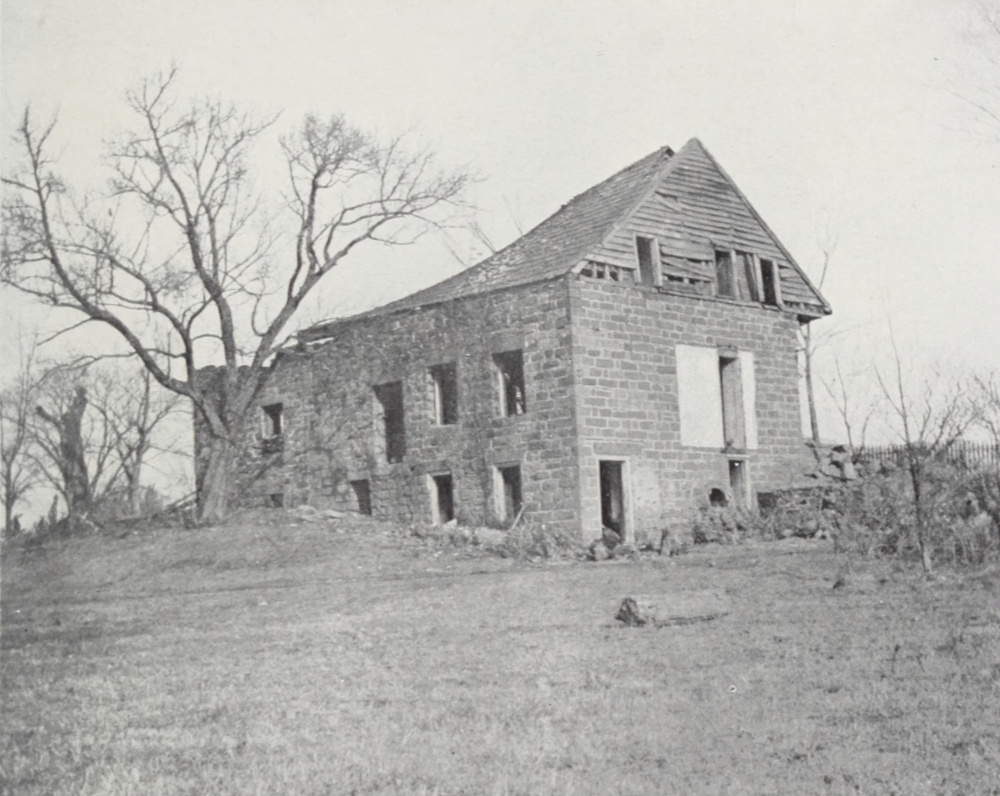
Crane Homestead. Supposed to have been erected about 1760. Picture taken in 1890. The barn which stood back of this house was the one in which cattle were slaughtered for the troops of General Anthony Wayne.
The old Crane stone house is supposed to have
been erected about 1760 by Joseph Crane; this was
taken down about 1890. The small wing at the right
of the building is believed to have been the older part
of the house. Those now living remember that in the
attic of this part were several swords of various descriptions
which Nathaniel J. Crane has said were
used by members of the family who fought in the
French and Indian War. The barn which stood in
the rear of this house is the one referred to elsewhere
as having been used as a slaughter-house when General
Anthony Wayne was camped under this ridge.
Beyond the Crane house is the Keen homestead,
which is mentioned in connection with the old Bloomfield
road.
Note for page 126.—Information concerning the Sidman family
which was received after this book was in type and inserted at the
last minute, shows that Jasper Crane owned land here as early as
1711. See page 100.