Once there was a conceited Brownie, who thought
he could do more things and do them better than
any other of his people. He had not tried yet,
for he was very young, but he said he was going to do them
some day!
One morning a sly old Brownie, really making fun of
him, said: "Why don't you catch that Phoebe-bird? It
is quite easy if you put a little salt on his tail." Away went
Smarty Brownie to try. But the Phoebe would not sit
still, and the Brownie came back saying: "He bobbed his
tail so, the salt would not stay on."
"Well," said the sly old Brownie, "there is a little Mouse-bird
whose tail never bobs. You can easily catch him, for
you see, he does not even fly, but crawls like a mouse up
the tree," and he pointed to a little brown Creeper. By
this time the young Brownie knew that the others were
laughing at him, so he said rather hotly, "I'll just show you
right now."
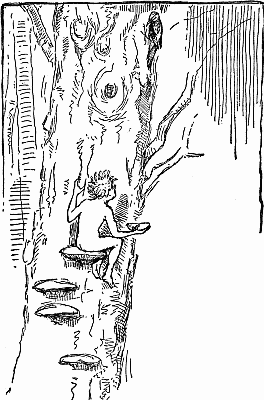
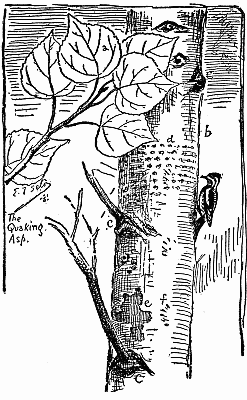
He took an acorn cup full of salt, and went after the
Mouse-bird. It was at the bottom of the big tree, creeping
up, round and round, as if on a spiral staircase, and the
Brownie began to climb in the same way. But every little
while the climber had to stop and rest. This had strange
results, for there is a law in Brownie land, that wherever
one of the little people stops to sit down, or rest, a toadstool
must spring up for him to sit on. So the track of the
Brownie up the trunk became one long staircase of toadstool
steps, some close, some far apart, but each showing where the
Brownie had rested. They came closer together toward the
top where the Brownie had got tired, but he was coming very
near to the Creeper now. He got his pinch of salt all ready,
as his friends down below kept calling and jeering: "Now
you've got him, now is your chance." But just as he was
going to leap forward and drop the salt on its tail, the
Creeper gave a tiny little laugh like "Tee-tee-tee," spread
its wings, for it could fly very well, and sailed away to
the bottom of the next tree to do the spiral staircase all
over again, while Smarty Brownie was so mad that he
jumped to the ground and hid away from his friends for
two days. When he came back he did not talk quite so
much as he used to. But to this day you can see the staircase
of toadstools on the tree trunks where the Brownie
went up.
"Come," said the Guide, "to-day I am going to show you
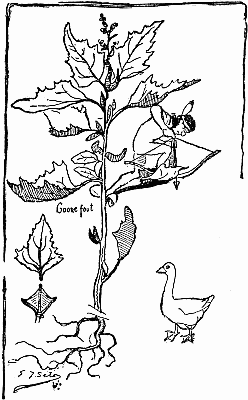
a Pot-herb that came from England with the Pilgrim Fathers
and spread over the whole of America. There is a story
about it that will keep it ever in your memory."
 The Pilgrim's Pot-herb
The Pilgrims had landed in Massachusetts, and slowly
made farms for themselves as they cleared off the forest.
They had a very hard time at first, but the Indians helped
them; sometimes with gifts of venison, and sometimes by
showing them which things in the woods were good to eat.
There was a Squaw named Monapini, "the Root-digger,"
who was very clever at finding forest foods. She became
friendly with a white woman named Ruth Pilgrim, and so
Ruth's family got the benefit of it, and always had on the
table many good things that came from the woods.
One day, long after the farms were cleared and doing well,
the white woman said, "See, Mother Monapini, thou hast
shown me many things, now I have somewhat to show thee.
There hath grown up in our wheat field a small herb that
must have come from England with the wheat, for hitherto
I have not seen it elsewhere. We call it lamb's-quarter,
for the lamb doth eat it by choice. Or maybe because
we do eat it with a quarter of lamb. Nevertheless it maketh
a good pot-herb when boiled."
The old Indian woman's eyes were fixed on the new plant
that was good to eat: and she said, "Is it very good, oh
white sister?"
"Yes, and our medicine men do say that it driveth out
the poison that maketh itch and spots on the skin." After
a moment Monapini said, "It looketh to me like the foot
of a wild goose."
"Well found," chuckled Ruth, "for sometimes our people
do call it by that very name."
"That tells me different," said the Indian.
"What mean you," said Ruth.
"Is not a goose foot very strong, so it never catcheth cold
in the icy water?"
"Yes."
"And this hath the shape of a goose foot?"
"Yes."
"Then my Shaman tells that it is by such likeness that
the Great Spirit showeth the goose foot plant to be charged
with the driving out of colds."
"It may be so," said the white woman, "but this I know.
It is very good and helpeth the whole body."
The Indian picked a handful of the pot-herbs, then stared
hard at the last; a very tall and strong one.
"What hast thou now, Monapini?" The red woman
pointed to the stem of the lamb's-quarter, whereon were
long red streaks, and said: "This I see, that, even as the
white-man's herb came over the sea and was harmless
and clean while it was weak, but grew strong and possessed
this field, then was streaked to midheight with blood, so also
shall they be who brought it—streaked at last to the very
waist with blood—not the white men's but the dark purple
blood of the Indian. This the voices tell me is in the coming
years, that this is what we shall get again for helping you—destruction
in return for kindness. Mine inner eyes have
seen it." She threw down the new pot-herb and glided away,
to be seen no more in the settlements of the white men.
And Ruth, as she gazed after her, knew that it was true.
Had she not heard her people talking and planning? For
even as the weed seed came with the wheat, so evil spirits
came with the God-fearing Pilgrims, and already these were
planning to put the heathens to the sword, when the Colony
was strong enough.
So the Indian woman read the truth in the little pot-herb
that sailed and landed with the Pilgrims; that stands
in our fields to this day, streaked with the blood of the passing
race—standing, a thing of remembrance.
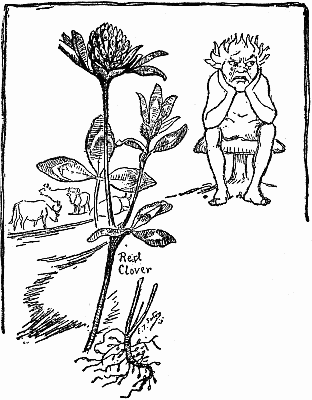 How the Red Clover Got the White Mark on Its Leaves
Once upon a time a Bee, a Bug, and a Cow went marching
up to Mother Carey's palace in the hemlock grove, to tell
her of their troubles. They complained that food was poor
and scarce, and they were tired of the kinds that grew along
the roadsides.
Mother Carey heard them patiently, then she said: "Yes,
you have some reason to complain, so I will send you a new
food called Clover. Its flower shall be full of honey for
the Bee, its leaves full of cowfood and its cellar shall be
stocked with tiny pudding bags of meal for the Bug, that
is for good little Bug-folks who live underground."
Now the tribes of the Bee, the Bug, and the Cow had a
fine time feasting, for the new food was everywhere.
But Cows are rather stupid you know. They found the
new food so good that they kept on munching everything
that had three round leaves, thinking it was Clover, and
very soon a lot of them were poisoned with strange plants
that no wise Cow would think of eating.
So Mother Carey called a Busy Brownie, and put him on
guard to keep the Cows from eating the poison plants by
mistake.
At first it was good fun, and the Brownie enjoyed it because
it made him feel important. But he got very tired
of his job and wanted to go to the ball game.
He sat down on a toadstool, and looked very glum. He
could hear the other Brownies shouting at the game, and
that made him feel worse. Then he heard a great uproar,
and voices yelling "A home run!" "A home run!" That
drove him wild. He had been whittling the edge of the
toadstool with his knife, and now he slashed off a big piece
of the cap, he was so mad.
Then up he got and said to the Cows: "See here, you fool
Cows, I can't stay here for ever trying to keep you
from eating poison, but I'll do this much. I'll stamp
all the good-to-eat leaves with a mark that will be your
guide."
 The Shamrock
So he made a rubber stamp out of part of the toadstool
he was sitting on, and stamped every Clover leaf in that
pasture, so the Cows could be sure, then skipped away to
the ball game.
When Mother Carey heard of his running away from his
job, she was very angry. She said: "Well, you Bad
Brownie, you should be ashamed, but that white mark was a
good idea so I'll forgive you, if you go round, and put it on
every Clover leaf in the world."
He had to do it, though it looked like an endless task,
and he never would have finished it, had not the other
Brownies all over the world come to help him; so it was
done at last. And that is the reason that every Clover
leaf to-day has on it the white mark like an arrowhead,
the Brownie sign for "good-to eat."
The Cows get along better now, but still they are very
stupid; they go munching ahead without thinking, and will
even eat the blossoms which belong to the Bees. And the
Bees have to buzz very loudly and even sting the Cows on
their noses to keep them from stealing the bee-food. The
good little Bugs underground have the best time, for there
the Cows can not harm them, and the Bees never come
near. They eat when they are hungry and sleep when they
are cold, which is their idea of a good time; so except for
some little quarrels between the Cows and the Bees they
have all gotten along very well ever since.
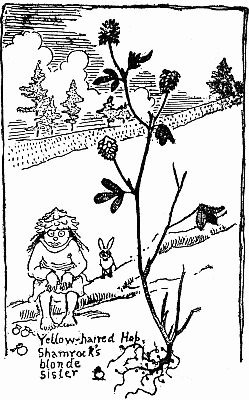
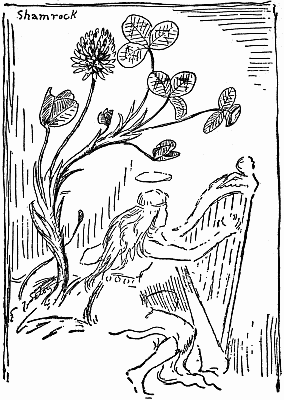
The Shamrock is really the White Clover. It is much
the same shape as the Red Clover, and has the same food
bags in its cellar. It is just as good for Cows and even better
for Bees; so the Brownie stamped all its leaves with
the white arrow mark, as you can plainly see. This plant,
as you know, is the emblem of Ireland.
The story-tellers say that St. Patrick was preaching to
Leary, the heathen King of Tara in Ireland hoping to turn
him into a Christian. The king listened attentively, but
he was puzzled by St. Patrick's account of the Trinity.
"Stop," said the king. "How can there be three Gods in
one and only one God where there are three. That is
impossible." St. Patrick stooped down and picking up a
Shamrock leaf, said: "See, there it is, growing in your own
soil; there are three parts but only one leaf." The king was
so much struck by this proof that he became a Christian and
ever since the Shamrock has been the emblem of Ireland.
Now to fill out the history of the Clovers, I should tell you
of the other three. The next is called Alsike, or the Pink
Clover.
When you look at this Alsike or Alsatian Clover, you
might think its mother was a red clover and its father a
white one, for it is about half way between them in size,
and its bloom is pink on the outside and white in the middle.
Evidently, the Brownie didn't think much of it, for he did
not put his arrow mark on its leaves. Still the Cows think
it is good, the Bees think it is fine, and it always carried
lots of food bags in its cellar. So also does the next sister—Melilot,
the Yellow Clover or Honey-lotus—and the last
and sweetest of them all, is the Sweet Clover that spreads
sweet smells in the old-fashioned garden.
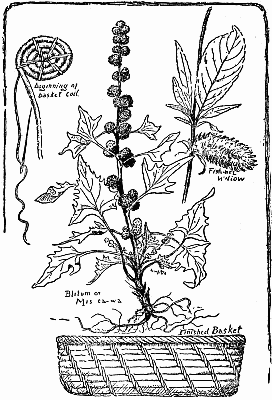 The Indian Basket
"Come, little Nagami, my Bird-Singer, you are ten
years old, it is time you learned to make baskets. I made
my first when I was but eight," said Mother Akoko proudly,
for she was the best basket-maker on the river.
So they took a sharp stick, and went into the woods.
Akoko looked for spruce trees that had been blown down
by the storm, but found none, so she stopped under some
standing spruce, at a place with no underbrush and said:
"See, Nagami, here we dig for wattap."
The spruce roots or "wattap" were near the surface and
easily found, but not easily got out, because they were long,
tangled and criss-crossed. Yet, by pulling up, and cutting
under, they soon got a bundle of roots like cords, and of
different lengths, from two feet to a yard, or more.
"Good," said Akoko; "this is enough and we need not
soak them, for it is summer, and the sap is running. If it
were fall we should have to boil them. Now you must
scrape them clear of the brown bark." So Nagami took
her knife and worked for an hour, then came with the bundle
saying: "See, Mother, they are smooth, and so white that
they have not a brown spot left." "Good," said Akoko,
"now you need some bark of the willow for sewing cord.
Let us look along the river bank."
There they found the round-leafed, or fish-net willow,
and stripped off enough of its strong bark to make a bundle
as big as one hand could hold.
This also had to be scraped clear of the brown skin, leaving
only the strong whitish inner bark, which, when split
into strips, was good for sewing.
"See, my Nagami, when I was a little girl I had only a
bone needle made from the leg of a deer, but you have easy
work; here is a big steel packing needle, which I bought for
you from a trader. This is how you make your basket."
So Akoko began a flat coil with the spruce roots, and
sewed it together with the willow bark for thread, until it
was a span wide. And whenever a new root was to be
added, she cut both old piece and new, to a long point, so
they would overlap without a bump.
Then the next coil of the spruce roots was laid on, not
flat and level, but raised a little. Also the next, until the
walls were as high as four fingers. Then Akoko said, "Good,
that is enough. It is a fine corn basket. But we must give
it a red rim for good luck."
So they sought in a sunny place along the shore, and
found the fruit of the squawberry or blitum. "See," said
Akoko, "the miscawa. Gather a handful, my Nagami.
They make the red basket-dye."
They crushed the rich red berries, saving the red juice in
a clam shell, and soaked a few strands of the white willow
bark in the stain. When they were dry, Nagami was taught
to add a rim to her basket, by sewing it over and over as
in the picture.
Then Akoko said, "Good, my little Bird-Singer, you have
done well, you have made some old black roots into a beautiful
basket."
N.B. The Guide will remember that rattan and raffia can
be used for this when it is impossible to get spruce roots
and willow bark. Good dyes may be made from many
different berries.
It has long been the custom of the Brownies to have a
great feast on the first of the merry month of May, to celebrate
the return of the spring.
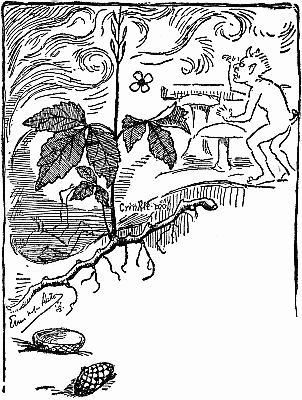 The Crinkleroot; or Who Hid the Salad?
One springtime long ago, they got ready as usual. The
King of the Brownies had invited all the leaders; the
place for the dinner was chosen in a grove of mandrakes
whose flat umbrellas made a perfect roof, rain or shine.
The Bell Bird, whose other name is Wood Thrush, was
ringing his bell, and calling all the Chief Brownies by
name.
"Ta-rool-ya! ting-a-ling-ling-ling."
"Oka-lee! ting-a-ling-ling-ling."
"Cherk! ting-a-ling-ling-ling."
"Come to the feasting! ting-a-ling-ling-ling."
A hundred glow worms were told to hurry up with their
lights and be ready for that night, and busy Brownies
gathered good things from woods and waters, for the
feast.
May Day came bright and beautiful. The busy ones
had all the "eats" in the Mandrake Hall, the glowworms
were sleeping soundly to fill their storage batteries ready
for the night. It made the salamanders' mouths water
to see so many good things; but they were not asked, so
stayed away. There were dewdrops in acorn cups, and
honey on the wax. There were clam shells piled up with
red checkerberries, and caddis worms on the half shell, with
spicebush nubbins. A huge white Mecha-meck was the
chief dish, with bog nuts on the side. There were lovely
long crinkle salads. And last, there were gumdrops from
the sweet birch, while at each place was a pussy willow
to dust the food over with golden pollen that gave it
a pleasant peppery tang. All the guests were there, and
the feast was nearly over, when a terrible thing took
place!
Of all the dreaded happenings in the world of beauty
there is nothing else so feared as the forest fire. There is
not much danger of it in springtime, but it is possible at
any season, after a long dry spell. Words cannot tell of
the horror it spreads, as it comes raging through the woods
destroying all beautiful living things.
And right in the middle of the feast, the dreadful news
was carried by a flying Night-bird.
"Fire, Fire, Fire, Fire!" he screamed, and almost at once
the smoke came drifting through the banquet hall, so they
knew it was true.
There was mad haste to escape, and only two ways were
open. One was to get across some big stream, and the
other was to hide in a cave underground. The birds took
the first way, and the Brownies the second. Every Woodchuck
den was just packed with Brownies within a few
minutes. But the busy Brownie who was chief steward
and had charge of the feast, had no idea of leaving all the
good things to burn up, if he could help it. First he sent
six of his helpers to make a deep pit for the big Mecha-meck,
and while they did that he began hiding all the dishes
in the ground. Last he dug some deep holes and quickly
buried all the crinkle salads; then he ran for his life into a
cave.
The raging fire came along. It is too horrible to tell
about, for it was sent by the Evil One. The lovely woods
were left black without a living thing. But the very next
day, Mother Carey and Mother Earth and El Sol, set about
saving the wreck, and in a marvellously short time actually
had made it green again. The mayflowers came up a second
time that year, the violets came back, and in each place
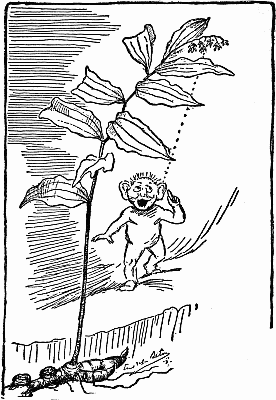
where the Brownies had hid a salad there came up a curious
plant that never had been seen before. It had three
saw-edged leaves and a long wand, much like the one
carried by the Chief Steward. I never was able to
find out his name for sure, but I think it was Trileaf
or Three-leaves. Anyway, if you dig under his sign and
sceptre wand, you will surely find the salad, and very
good indeed it is to eat; it was not hurt in the least by
the fire.
But from that day, the Brownies have been very shy
of feasting during dry weather in the woods. They generally
have their banquets now in some meadow, and afterward
you can tell the place of the feast by the circle of
little toadstools called fairy rings. For you know that
wherever a Brownie sits, a toadstool must spring up for
him to sit on.
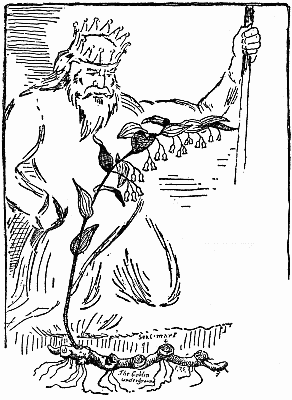
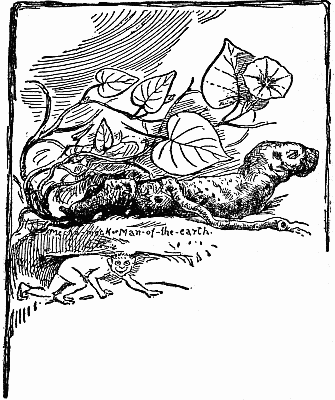 The Mecha-meck
That fearful time when the forest fire set all the Brownies
busy burying their food and dishes at the feast-hall, you
remember it took six of them to carry and hide the Mecha-meck.
For it is a large fat white root as big as a baby, and
sometimes it has arms or legs, so that when Monapini
told Ruth Pilgrim about it she called it "Man-of-the-earth."
You remember that the busy Brownie hid all the Crinkle
salads, and so saved them; and most of us have found the
Crinkleroot and eaten it since. But how many of us have
found the Mecha-meck? I know only one man who has.
We call him the Wise Woodman. He found and dug out
the one from which I made the picture. It was two and a
half feet long and weighed fifteen pounds—fifteen pounds
of good food. Think of it! Above it and growing out
of its hiding place was a long trailing vine that looked like a
white morning-glory. There is always one of these over
the Mecha-meck. And by that you may find it, if you
look along the sunny banks outside of the woods. But
still it is very hard to find. I never yet got one, though
I have found many of the crinkle-root salads. Of
course, that is easy to explain, for the busy Brownies
buried hundreds of the salads, but only one of the big
fat Mecha-meck.
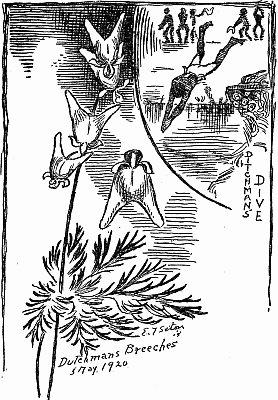
Of course they are not, for no Dutchman I ever saw
could wear such tiny things. I will tell you what they really
are and how that came to be.
You remember how the Brownies assembled for the feast
on May Day when the Glow worms were the lamps and the
Wood Thrush rang the bell. Well, it so happened that day
that a great crowd of the merrymakers gathered long before
the feast was ready, and while they were wondering what
to do someone shouted: "See, how fine and warm the water
is where the brook spreads out into the ditch. Let us have
our first swim of the season right now!"
So they all went with a whoop! stripped off their clothes,
and into their swimming breeches with a perfect riot of
glee.
Then how they did splash! Some blind folks thought
it must be a million early pollywogs splashing. But the
swim ended with another racket when the dinner bell
rang.
Each splashing Brownie hopped out and hung up his
breeches to dry as he got into his clothes.
Then you remember the fire came along and scared them
away. Of course the breeches were wet, so they didn't get
singed; and there you can see them hanging to this day on
the first of May. That is what they really are—Brownies'
Breeches. And because the Brownies often swim in a
ditch, they are called ditch-man's breeches; but believe
me, they are not Dutchman's breeches and never
could be.
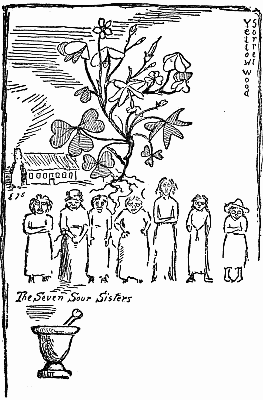 The Seven Sour Sisters
If you look along any half-open bank in the edge of the
woods, or even in the woods itself, you are sure to see one
of the Seven Sorrel Sisters, with leaves a little like Clover,
only notched in the end and without the white marks, that
the Brownie put on the Clover. There are seven of them,
according to most doctors; five have yellow eyes, one purple,
and one white streaked with blood. Their Latin name
means "vinegar" and their Greek name means "acid."
"Sorrel" itself means "Little sour one," so you see they have
the reputation of a sour bunch. If you eat one of the
leaves, you will agree that the name was well-chosen, and
understand why the druggists get the tart "salt of lemons"
from this family. The French use these Sour Sisters for
their sour soup. But in spite of their unsweetness, they
are among the pretty things of the woods; their forms are
delicate and graceful; their eyes are like jewels, and when
the night comes down, they bow their heads, gracefully
fold their hands, and sleep like a lot of tired children.
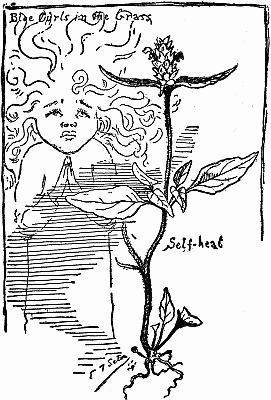 Self-heal or Blue-curls in the Grass
You should know the history of the lowly little flower
called Blue-curls; and you must remember that flowers
have their troubles just as you have. For one thing,
flowers must get their pollen or yellow flower-dust, carried
to some other of their kind, or they cannot keep on growing
good seed. And since the flower cannot walk about finding
places for its pollen, it generally makes a bargain with a
bee. It says, "If you will carry my pollen to my cousins
yonder, I will give you a sweet sip of nectar." That is
where the bees get the stuff for all their honey, and that is
how the pollen is carried.
Well, the modest little Blue-curls long had had a working
agreement with the Meadow Bees, and got on nicely.
But one summer Blue-curls became discontented. She
saw all the other plants with wonderful gifts that had power
to cure pain and sickness; while she was doing nothing
but live her own easy life, and she felt she was a nobody.
So one day as Mother Carey's slowest steed was swishing
over the grass, Blue-curls cried out: "Mother Carey, Mother
Carey, won't you hear me and grant me a gift?"
"What is it, little one?" said the All-mother.
"Oh, Mother Carey, the pansy cures heartache, the
monkshood cures canker-lip, the tansy cures colds, and all the
others have some joy and honour of service, but I am good for
nothing, Mother Carey so the wise men despise me. Won't
you give me a job? Won't you give me some little power?"
"Little one, such an asking never finds me deaf. I love
those who would help. I will give you a little bit of all
healing so that you shall be good medicine, if not the best,
for all ills, and men shall call you 'Self-heal' and 'All-heal'
for you shall have all healing in yourself."
And it has been so ever since. So that some who go by
looks call the modest little meadow flower, "Blue-curls
in the Grass," but the old herb-men who know her goodness
call her "All-heal" or "Self-heal."
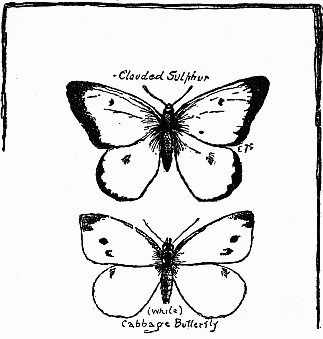 Summer Butterflies (a little over life size)
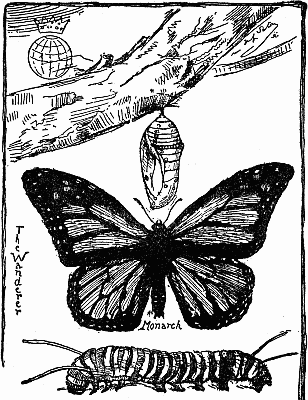
There are four Butterflies that you are sure to see every
summer, on our fields; and remember that each of them goes
through the same changes. First it is an egg, then a greedy
grub, next a hanging bundle-baby, and last a beautiful
winged fairy, living a life of freedom and joy.
In the picture I have shown the butterflies life size, but
you must add the colour as you get each one to copy.
The first is the White or Cabbage Butterfly that flits over
our gardens all summer long.
It is not a true American, but came from Europe in 1860
and landed at Quebec, from whence it has spread all over
the country. In the drawing I have shown the female;
the male is nearly the same but has only one round dark
spot on the front wings. Its grub is a little naked green
caterpillar, that eats very nearly a million dollars' worth
of cabbages a year; so it is a pity it was ever allowed to
land in this country. There are moths that we should like
to get rid of, but this is the only butterfly that is a pest.
2nd. The Yellow or Clouded Sulphur Butterfly. You are
sure to find it, as soon as you begin to look for butterflies.
This is the one that is often seen in flocks about mud puddles.
When I was a very small boy, I once caught a dozen of
them, and made a little beehive to hold them, thinking
that they would settle down and make themselves at home,
just like bees or pigeons. But the grown-ups made me let
them fly away, for the Sulphur is a kindly creature, and
does little or no harm.
One of the most beautiful things I ever came across, was,
when about ten years old, I saw on a fence stake ahead of
me a big bird that was red, white and blue, with a flaming
yellow fan-crest. Then as I came closer, I knew that it
was a red-headed woodpecker, with a Sulphur Butterfly in his
beak; this made the crest; what I thought was blue turned
out to be his glossy black back reflecting the blue sky.
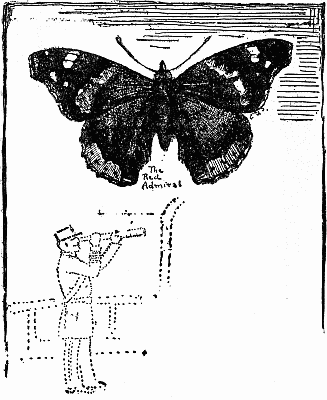
3rd. The next is the Red Admiral or Nettle Butterfly.
The "red" part of the name is right, but why "Admiral"?
I never could see unless it was misprint for "Admirable."
 Red Admiral
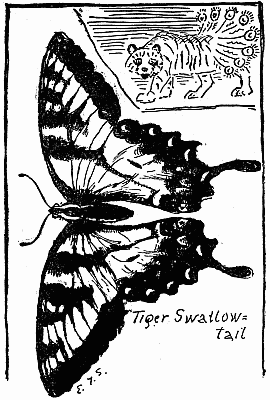 Tiger Swallowtail (life size)
This beautiful insect lays its eggs and raises its young on
nettles, and where nettles are, there is the Red Admiral also.
And that means over nearly all the world! Its caterpillar
is not very well protected with bristles, not at all when
compared with the Woolly-bear, but it lives in the nettles,
and, whether they like it or not, the hospitable nettles
with their stings protect the caterpillar. The crawler may
be grateful, but he shows it in a poor way, for he turns on
the faithful nettle, and eats it up. In fact the only food
he cares about is nettle-salad, and he indulges in it several
times a day, yes all day long, eating, growing and bursting
his skin a number of times, till he is big enough to hang himself
up for the winter, probably in a nettle. Then next
spring he comes forth, in the full dress uniform of a Red
Admiral, gold lace, red sash, silver braid and all.
4th. The last of the four is the Tiger Swallowtail. You
are sure to see it some day—the big yellow butterfly that
is striped like a tiger, with peacock's feathers in its train,
and two long prongs, like a swallow-tail, to finish off with.
It is found in nearly all parts of the Eastern States and
Canada. I saw great flocks of them on the Slave River
of the North.
It is remarkable in that there are both blondes and brunettes
among its ladies. The one shown in the drawing is a
blonde. The brunettes are so much darker as to be nearly
black; and so different that at one time everyone thought
they were of a different kind altogether.
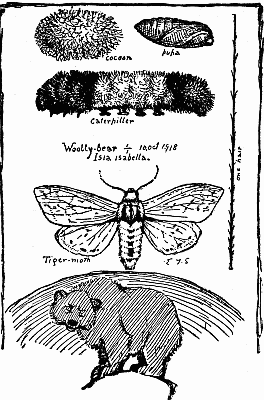
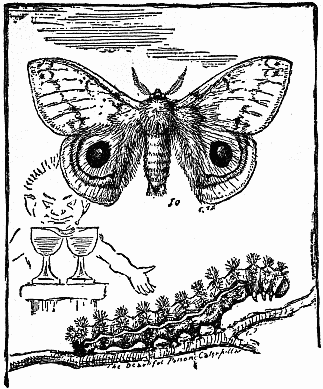 The Beautiful Poison Caterpillar (the moth is a little over life size)
The lovely Io Moth is one that you will see early, and
never forget, for it is common, and ranges over all the
country from Canada to the Gulf. When you see it, you will
be inclined to spell its name Eye-oh—for it has on each
wing a splendid eye like that on a peacock's tail-feather,
while the rest of its dress is brown velvet and gold.
There is a strange chapter in the life of Io, which you
should know because it shows that Mother Carey never
gives any wonderful gift to her creatures without also giving
with it some equal burden of sorrow.
This is how it all came about.
Long ago when the little ones of the Io Moth were small,
they were, like most caterpillars, very ugly little things.
They felt very badly about it, and so they set out one day
for the great Home Place of Mother Carey in the Whispering
Grove of the Ages.
There they prayed, "Dear Mother Carey, we are not of
an ugly race, why should we be so ugly as caterpillars?
Will you not make us beautiful, for beauty is one of the best
things of all?"
Mother Carey smiled and waved a finger toward a little
Brownie, who came with a tray on which were two cups;
one full of bright sparkling pink stuff, and the other with
something that looked like dark green oil. But the glasses
were joined at the top, there was but one place to drink,
and that reached both.
Then Mother Carey said, "These are the goblets of
life, one is balm and will give you joy, the other is gall
and will give you suffering. You may drink little or much,
but you must drink equally of both. Now what would
ye?"
The little ugly creatures whispered together, then one
said: "Mother Carey, if we drink, will it give us beauty?"
"Yes, my children, the red goblet of life will give you
beauty, but with it the other will give you grief."
They whispered together, then all the little crawlers
went silently forward, and each took a long drink of the
double goblet.
Then they crawled away, and at once became the most
beautiful of all caterpillars, brilliant jewel-green with stripes
of pink, velvet, and gold. Never before were there seen
such exquisite little crawlers.
But now a sad thing happened. They were so beautiful
that many creatures became their enemies, and began to
kill them and eat them one after another. They crawled
as fast as they could, and hid away, but many of them were
killed by birds and beasts of prey, as well as by big fierce
insects.
They did not know what to do, so next day the few that
were left crawled back to the Grove of Ages, and once more
stood before Mother Carey.
"Well, my Beauty-crawlers," she said, "what would
you?"
"Oh, Mother Carey, it is fearful, everyone seeks to destroy
us. Most of us are killed, and many of us wounded.
Will you not protect us?"
"You drank of the two goblets, my children. I warned
you that your beauty would bring terrible trouble with it."
They bowed their little heads in silent sorrow, for they
knew that that was true.
"Now," said the All-Mother, "do you wish to go back
and be ugly again?"
They whispered together and said: "No, Mother Carey,
it is better to be beautiful and die."
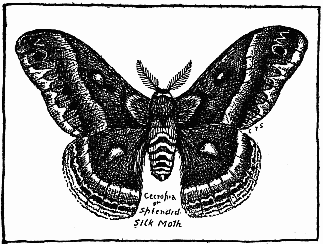 The Splendid Silk-Moth (about 1/2 life size)
Then Mother Carey looked on them very kindly, and
said: "Little ones, I love your brave spirit. You shall not
die. Neither shall you lose your beauty. I will give you
a defence that will keep off all your enemies but one, that
is the Long-stinger Wasp, for you must in some way pay
for your loveliness." She waved her wand, and all over each
of the Beauty-crawlers, there came out bunches of sharp
stickers like porcupine quills, only they were worse than
porcupine quills for each of the stickers was poisoned at
the tip, so that no creature could touch the Beauty-crawlers
without being stung.
The birds and beasts let them alone now, or suffer a
terrible punishment from the poison spears. You children,
too, must beware of them; touch them not, they will give
you festering wounds. There is only one creature now that
the Beauty-crawlers truly fear; that is the Long-stinger
Wasp. He does indeed take toll of their race, but that is
the price they still must pay for their beauty. Did they
not drink of the double goblet?
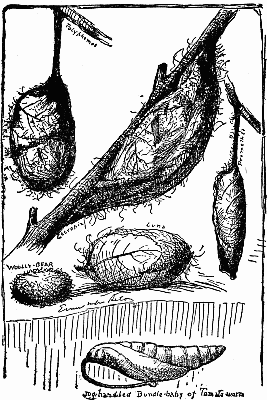
When I was a very small boy, I saw my father bring in
from the orchard a ragged looking thing like parchment
wrapped up with some tangled hair; it was really the bundle-baby
of this Moth. He kept it all winter, and when the
spring came, I saw for the first time the great miracle of the
insect world—the rag bundle was split open, and out came
this glorious creature with wings of red and brown velvet,
embroidered with silver and spots that looked like precious
stones. It seemed the rarest thing in the world, but I
have found out since, that it is one of our common moths,
and any of you can get one, if you take the trouble.
Now listen, and you shall hear of what happened long
ago to a green crawler who was born to be a splendid
Silk-Moth, but who spoiled it all by a bad temper.
It had been a very cold, wet summer, and one day, when
the wind was whispering, he cried out: "Mother Carey,
when I have done with my working life, and go into the
Great Sleep, grant that it may never rain on me for I
hate rain, and it has done nothing but pour all summer
long." And he shivered the red knobs on his head with
peevishness.
"You silly little green crawler, don't you think I know
better than you what is good for you? Would you like
there to be no rain?"
"Yes, I would," said the red-knobbed Samia rebelliously.
"Would you?" said the All-Mother to another green
crawler, who hung on a near-by limb.
"Mother Carey, we have had a wet, cold summer, and
the rain has been miserable, but I know you will take care
of us."
"Good," said the All-Mother: "then, in this way it shall
be. You little Red-Knobs shall have what you so much
wish, you shall hang up in a dry loft where not a drop of
dew even shall touch you in your bundle-baby sleep. And
you little Yellow-Knobs shall hang under a limb where
every rain that comes shall drench your outer skin." And
she left them.
When the time came to hang up, Red-Knobs was led to
a place as dry as could be, under a shed and swung his
bundle-baby hammock from the rafters.
Yellow-Knobs hung up his hammock under a twig in
the rose garden.
The winter passed, and the springtime came with the
great awakening day. Each of the bundle-babies awoke
from his hammock and broke his bonds. Each found his
new wings, and set about shaking them out to full size
and shape. Those of the rain-baby came quickly to their
proper form, and away he flew to rejoice in perfect life.
But though the other shook and shook, his wings would
not fluff out. They seemed dried up; they were numbed
and of stunted growth.
Shake as he would, the wings stayed small and twisted.
And as he struggled, a Butcher-bird came by. His fierce
eye was drawn by the fluttering purple thing. It had no
power to escape. He tore its crumpled wings from its
feathery form, and made of it a meal. But before dying
it had time to say, "Oh, Mother Carey, now I know that
your way was the best."
Some fairies are Brownies and some are Greenies, and of
all that really and truly dance in the moonlight right here
in America, Luna Greenie seems the most wonderful; and
this is her history:
Once upon a time there was a seed pearl that dropped
from the robe of a green fairy. It stuck on the leaf of a
butternut tree till one warm day Mother Carey, who knows
all the wild things and loves them all, touched it with her
magic wand, called Hatch-awake, and out of the seed pearl
came an extraordinarily ugly little dwarf, crawling about
on many legs. He was just as greedy as he was ugly, and
he ate leaf after leaf of the butternut tree, and grew so
fat that he burst his skin. Then a new skin grew, and he
kept on eating and bursting until he was quite big. But
he had also become wise and gentle; he had learned many
things, and was not quite so greedy now.
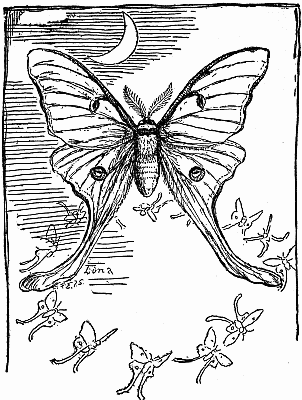 The Green Fairy With the Long Train (about 4/5 life size)
Mother Carey, the All-Mother, had been watching him,
and knew that now he was ready for the next step up. She
told him to make himself a hammock of rags and leaves,
in the butternut tree. When he had crawled into it, she
touched him with her wand, the very same as the one she
used when she sent the Sleeping Beauty into her long sleep.
Then that little dwarf went soundly to sleep, hanging in
his hammock.
Summer passed; autumn came; the leaves fell from the
butternut tree, taking the bundle-baby with them, exactly
as in the old rhyme:
Rock-a-bye baby on the tree-top,
When the wind blows, your cradle will rock,
When the cold weather makes all the leaves fall,
Down tumbles baby and cradle and all.
But the hammock, with its sleeper, landed in a deep
bed of leaves, and lay there all winter, quite safe and
warm.
Then when the springtime sun came over the hill, Mother
Carey came a-riding on the Warm Wind, and waving her
wand. She stopped and kissed the sleeping bundle-baby,
just as the Prince kissed the Sleeping Beauty, and instantly
the baby awoke. Then happened the strangest thing.
Out of that ragged old hammock there came the most wonderful
and beautiful Green Fairy ever seen, with wings
and with two trains; and as it came out and looked shyly
around, trembling with new life, Mother Carey whispered,
"Go to the butternut grove and see what awaits you
there."
So away she went. Oh, how easy and glorious it is to
fly! She could remember how once she used to crawl everywhere.
And through the soft sweet night she flew, as she
was told, straight to the butternut grove. As she came near
she saw many green fairies—a great crowd of them—gathered
in the moonlight, and dancing round and round in
fluttering circles, swooping about and chasing each other,
or hiding in the leaves. They did not feast, for these fairies
never eat, and they drink only honey from flowers. But
there was a spirit of great joy over them all. And there
were some there with longer head plumes than those she
wore. They seemed stronger and one of them came with a
glad greeting to the new Green Dancer and though she flew
away, she was bursting with joy that he should single her
out. He pursued her till he caught her, and hand in hand
they danced together in the moonlight. She was happier
than she had known it was possible to be, and danced all
night—that wonderful wedding dance. But she was very
tired when morning was near, and high in the tree she slept
so soundly that she never noticed that many seed pearls that
were clustered on the lining of her robe had got loose and
rolled into the crevices of the trunk. There they lay until
Mother Carey came to touch them with her magic wand,
so each became a crawler-dwarf, then a bundle-baby, and
at last a dancing fairy.
But the Green Dancer did not know that—she knew only
that it was a glorious thing to be alive, and fly, and to
dance in the moonlight.
You must never fail to watch under the butternut tree
on mid-summer nights, for it is quite possible that you may
see the wedding dance of the Luna Greenie and her sisters
with the long-trained robes.
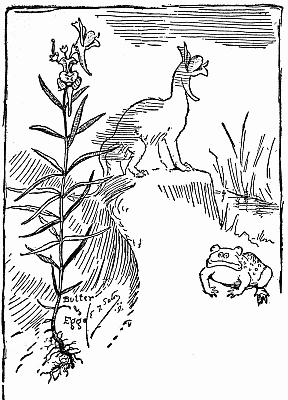 The Wicked Hoptoad and the Little Yellow Dragon
Once upon a time, there was a beautiful little Yellow
Dragon, who lived a happy and innocent life on the high
banks of a prattling stream. The Dragon himself was dumb
but he loved a merry noise, and nothing pleased him more
than the prattling of the water. Sometimes this pleasant
little Dragon went up stream, where it was noisy, and
sometimes he went down stream, where it was very silent,
and rested awhile in little pools. Here it was that he met
with his first enemy, a warty Hoptoad with jealous eyes.
That Toad thought that he owned the pools because he
bathed there every springtime, and though it was a kind
little Dragon, the Toad hated him, and began to plot against
him.
"Ho! little Yellow Dragon," he said, "you are very wonderful
to see, and you must be very clever; but you haven't
got everything you want, have you?"
The Dragon smiled, shook his head, and made silent
signs with his lips. Then the Toad understood, for he said:
"Ho-ho, I understand that you cannot speak. But are
you happy?"
The Dragon smiled sweetly and nodded, then pointed
to the stream.
That made the Toad madder than ever, for he thought
it meant that the Dragon was claiming the whole
stream. So the Toad said: "See, Dragon, there is a
wonderful food that you have never tasted, that is a
poached egg."
This he said with his heart full of guile, for he knew full
well that poached eggs are deadly poison to Dragons.
The Dragon looked puzzled, and the Toad said, "Have
you?"
The Dragon shook his head. "Well," said the Toad, "it
is the most delicious thing in the woods; now you wait
and see."
He went hoppity-hop, to a sand-bank where he had seen
a Turtle lay its eggs that morning. He dug out one. He
rolled it upon a stone, and split it open with the sharp spur
on his heel. As soon as it was stiffened by the sun heat,
he said, "Here now, Dragon, swallow it down, while I get
another for myself."
The poor innocent little Dragon did not know any better.
He tried to swallow the poached egg. The moment he did,
it stuck in his throat, and poisoned him. At once his toes
sank into the ground. He turned green all over, and his
head was changed into a strange new flower. There it is
to this day, standing silently where it can hear the brook
a-prattling. Its body is green all over, and its head is yellow
and its jaws are wide open with a poached egg stuck in its
throat. And that is how it all came about. Some call
it Toad Flax, and some call it Butter and Eggs, but we who
know how it happened call it the Dragon and the Poached
Egg.
Poor dear little Yellow Dragon!
When I was a schoolboy, a number of my companions
brought the news that the strangest bird in the world had
come that day to our garden and hovered over the flowers.
It was no bigger than a bumble-bee. "No! It was not a
humming-bird," they said, "it was smaller by far, much
more beautiful, and it came and went so fast that no one
could see it go."
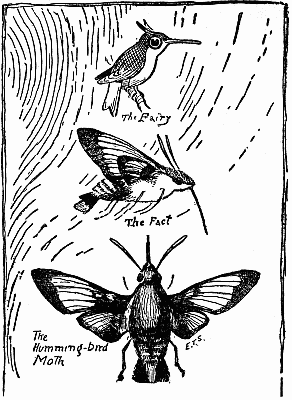 The Fairy Bird (1-1/2 life size)
Every guess that I made seemed not to fit the wonderful
bird, or help to give it a name that would lead us to its
history in the books. The summer went by, several schoolmates
saw the Wonderbird, and added stories of its marvellous
smallness and mysterious habits. Its body, they
said, was of green velvet with a satin-white throat; it had
a long beak—at least an inch long—a fan-tail of many
feathers, two long plumes from its head, "the littlest feet
you ever have seen," and large lustrous eyes that seemed
filled with human intelligence. "It jest looked right at
you, and seemed like a fairy looking at you."
The wonder grew. I made a sketch embodying all the
points that my companions noted about the Fairy Bird.
The first drawing shows what it looked like, and also gives
the exact size they said it was.
It seemed a cruel wrong that let so many of them see the
thing that was of chief interest to me, yet left me out. It
clearly promised a real fairy, an elfin bird, a wonderful
messenger from the land I hungered to believe in.
But at last my turn came. One afternoon two of the
boys ran toward me, shouting: "Here it is, the little Fairy
Bird, right in the garden over the honeysuckle. C'mon,
quick!"
I rushed to the place, more excited than I can tell. Yes,
there it was, hovering over the open flowers—tiny, wonderful,
humming as it swung on misty wings. I made a quick
sweep of my insect net and, marvellous to relate, scooped
up the Fairy Bird. I was trembling with excitement now,
not without a sense of wickedness that I should dare to
net a fairy—practically an angel. But I had done it, and
I gloated over my captive, in the meshes. Yes, the velvet
body and snowy throat were there, the fan-tail, the plumes
and the big dark eyes, but the creature was not a bird; it
was an insect! Dimly now I remembered, and in a few
hours, learned, as I had feared, that I had not captured a
young angel or even a fairy—it was nothing but a Humming-bird
Moth, a beautiful insect—common in some regions,
scarce in some, such as mine—but perfectly well known
to men of science and never afterward forgotten by any
of that eager schoolboy group.
If you live in the country or in a small town, you will
not have to go many steps, in summer time, before you
find the little plant known as Ribgrass, Plantain, or Whiteman's-foot.
If you live in a big city, you may find it in any
grassy place, but will surely see it, as soon as you reach the
suburbs. It grows on the ground, wherever it can see the
sun, and is easily known by the strong ribs, each with a
string in it when you pull the leaf apart. The Indians
call it Whiteman's-foot, not because it is broad and flat,
but because it came from Europe with the white man; it
springs up wherever he sets his foot, and it has spread over
all America. Gardeners think it a troublesome weed;
but the birds love its seed; canary birds delight in it; and
each plant of the Ribgrass may grow many thousands of
seeds in a summer.
How many? Let us see! Take a seed-stalk of the Plantain
and you will find it thickly set with little cups, as in
the drawing. Open one of these cups, and you find in it
five seeds. Count the cups; there are two hundred on this
stalk, each with about five seeds, that is, one thousand
seeds; but the plant has five or more seed-stalks, some have
more (one before me now has seventeen), but suppose it has
only ten; then there are 10,000 seeds each summer from one
little plant. Each seed can grow up into a new plant; and,
if each plant were as far from the next as you can step, the
little ones in a row the following summer would reach for
nearly six miles; that is, from the City Hall to the end of
Central Park, New York.[B]
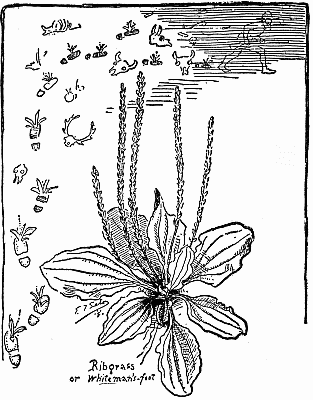 The Ribgrass
On the third year if all had the full number of seed, and
all the seed grew into plants, there would be enough to go
more than twice round the world. No wonder it has spread
all over the country.
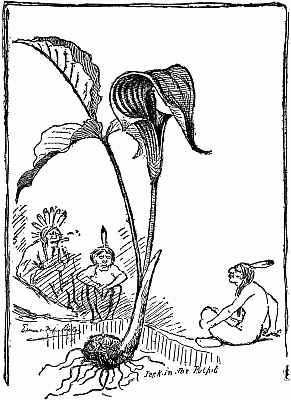 Jack-in-the-Pulpit
Once upon a time there was a missionary named
the Rev. John T. Arum, who set out to preach to the
Indians. He had a good heart but a bitter, biting tongue.
He had no respect for the laws of the Indians, so they killed
him, and buried him in the woods. But out of his grave
came a new and wonderful plant, shaped like a pulpit, and
right in the middle of it, as usual, was the Reverend Jack
hard at it, preaching away.
If you dig down under the pulpit you will find the preacher's
body, or his heart, in the form of a round root. Taste
it and you will believe that the preacher had a terribly
biting tongue, but treat it properly, that is boil it, and
you will find out that after all he had a good little heart
inside. Even the Indians have discovered his good qualities
and have become very fond of him.
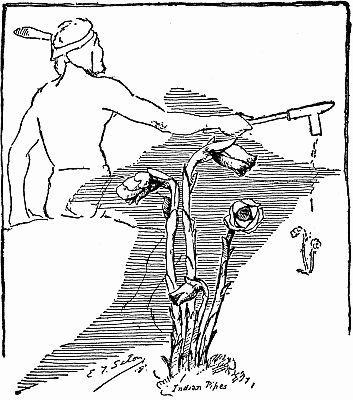 How the Indian Pipe Came
In the last tale you learned the fate of the Rev. John
T. Arum, and the origin of Jack-in-the-Pulpit. But you
must not suppose for a moment that the Indians decided
in a hurry to kill the missionary. No, they had too much
sense of fair play for that. They held a great many councils
first to find some way of curbing his tongue, and making
him mind his own business. In fact, they got into the habit
of holding a council every few minutes to discuss the question,
no matter where they were or what else they were doing.
So that pretty nearly every part of the woods was in time
used for a council ring to discuss the fate of the Rev. John
T. Arum.
Of course, you know that no Indian can hold a council
without smoking the Peace Pipe, and when the council
is over, he empties out the ashes of the pipe. So that when
all those councils were over, when the matter was settled,
when the missionary was buried, and when the warrior
had gone to the ghost land, there came solemnly poking
its white bowl and stem from under the leaves an Indian
pipe, at the very spot where the Councillors had emptied
the ashes. It is a beautifully shaped pipe, with a curved
and feathered stem, but it has none of the bright colours
of the old Peace Pipe. It cannot have them for this is only
a ghost Pipe to show where the council used to be; and
one pipe there is for each council held on that spot, so you
see how many, many councils the Indians had, before they
killed the troublesome preacher. And sometimes you can
find a pipe that has the bowl still filled with ghost tobacco
or even a little red ghost fire, showing that the warriors
had to hurry away before that council was finished. Whenever
you find the ghost pipe in the woods, you are sure to
see close by either a log, a bank or a rock on which the Councillors
sat to talk it over.
The Indians had Brownies, only they called them Pukwudjies,
and I am going to tell you a story of an Indian
Brownie.
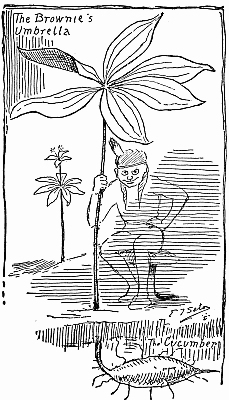 The Cucumber Under the Brownie's Umbrella
Whenever the Indians got together for a council, the
Brownies did the same thing, in the woods near by. It
was a kind of Brownie Fair, and some of the little people
used to have stands and sell refreshments. Berries were
scarce in the springtime, but the Brownies were very fond
of cucumber. So there were always one or two Cucumber
Brownies, who set up their little umbrellas, and sold slices
of Cucumber to the others.
When it was time to go home, or when the sun got so hot
that the cucumbers were likely to spoil, they would bury
them in the ground, but leave the umbrella to mark the
place. And there they are yet; many a time have I found
the umbrella, and dug under it to find the cucumber. It
is delicious eating; everything that Brownies like is. You
can find it, and try it. It is one of the things that Monapini
taught Ruth Pilgrim to eat. (Tale 18).
Of course, the Brownies do not like you to dig up their
treasure or good-to-eats, but there are plenty more, far
more than they ever need. "Yet what about it," you say,
"if the Brownie happens to be there?"
He may be sitting right under the umbrella, but remember
the little people are invisible to our eyes. You will not
see him; at least I never did.
Hush, whisper! Did you ever meet a Hickory Horn-devil?
No! Well I did, and I tell you he is a terror.
Look at this picture of him. It is true, only he is not quite
so big as that, though he looks as if he might be. And I
was not quite so small as that, only I felt as if I were!
And everything about him looked horribly strong, poisonous
and ugly. He was a real devil.
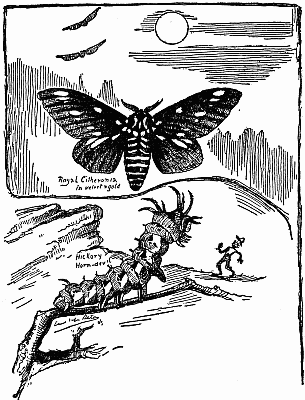 The Hickory Horn-devil (1/2 life size)
I did not know his history then; I did not learn it for a
long time after, but I can tell it to you now.
Once upon a time there was a little, greenish, blackish
worm. He loved pretty things, and he hated to be ugly,
as he was. No one wanted him, and he was left all alone,
a miserable little outcast. He complained bitterly to
Mother Carey, and asked if she would not bless him with
some grace, to help him in his troubles.
Mother Carey said: "Little ugly worm; you are having
a hard time, because in your other life, before you came into
this shape, you had an ugly, hateful spirit. You must go
through this one as you are, until the Great Sleep comes;
after that, you will be exactly what you have made of
yourself."
Then the little ugly worm said: "Oh Mother Carey, I
am as miserable as I can be; let me be twice as ugly, if, in
the end, I may be twice as beautiful."
Mother Carey said gravely, "Do you think you could
stand it, little worm? We shall see."
From that time the worm got bigger and uglier, no creature
would even talk to him. The birds seemed to fear
him, and the Squirrels puffed out little horror-snorts, when
they saw him coming, even the other worms kept away
from him.
So he went on his lonely life, uglier and more hated than
ever. He lived chiefly on a big hickory tree, so men called
him the Hickory Horn-devil.
One day as he was crawling on a fence, a hen with chickens
came running after him, to eat him. But when she saw how
ugly he was she cried: "Oh, Lawk, lawk! Come away,
children, at once!"
At another time he saw a Chipmunk teaching its little
ones to play tag. They looked so bright and happy, he
longed, not to join them because he could only crawl, but
to have the happiness of looking on. But when he came
slowly forward, and the old Chipmunk saw him waving his
horns and looking like a green poisonous reptile, she
screamed, "Run, my children!" and all darted into their
hole while Mother Chipmunk stuffed up the doorway with
earth.
But the most thrilling thing of all that he saw was one
day as the sun went down, a winged being of dazzling beauty
alighted for a moment on his hickory tree. Never had the
Horn-devil seen such a dream of loveliness. Her slender
body was clad in rose velvet, and her wings were shining
with gold. The very sight of her made him hate himself,
yet he could not resist the impulse to crawl nearer, to gaze
at her beauty.
But her eyes rested a moment on his horrible shape, and
she fled in fear, while a voice near by said: "The Spangled
Queen does not love poisonous reptiles." Then the
poor little Horn-devil wished he were dead. He hid away
from sight for three days. Hunger however forced him
out, and as he was crawling across a pathway, a man who
came along was going to crush him underfoot, but Mother
Carey whispered, "No, don't do it." So the man let him
live, but roughly kicked the worm aside, and bruised him
fearfully.
Then came Mother Carey and said: "Well, little ugly
worm! Is your spirit strong, or angry?"
The worm said bravely, though feebly: "Mother, Mother
Carey, I am trying to be strong. I want to win."
The breezes were losing their gentle warmth when
Mother Carey came to him one day, and said: "Little one,
your trial has been long, but it is nearly over.
"Prepare to sleep now, my little horny one, you have
fought a brave fight; your reward is coming. Because your
soul has been made beautiful by your suffering, I will give
you a body blazing with such beauty as shall make all stand
in adoration when you pass." Then Mother Earth said,
"Our little one shall have extra care because he has had
extra trials." So the tired little Horn-devil did not even
have to make himself a hammock, for Mother Earth received
him and he snuggled into her bosom. As Mother
Carey waved her wand, he dropped off asleep. And he
slept for two hundred days.
Then came the great Awakening Day, the resurrection
day of the woods. Many new birds arrived. Many new
flowers appeared. Sleepers woke from underground, as
Mother Carey's silent trumpeters went bugling ahead of
her, and her winged horse, the Warm Wind, came sweeping
across the meadows, with the white world greening as he
came.
The bundle-baby of the Horn-devil woke up. He was
cramped and sleepy, but soon awake. Then he knew that
he was a prisoner, bound up in silken cords of strength.
But new powers were his now, he was able to break the
cords and crawl out of his hole. He put up his feelers to
find those horrible horns, but they were gone, and his devil
form fell off him like a mask. He had wings, jewelled
wings! on his back now. Out he came to fluff the newfound
wings awhile, and when they were spread and supple
he flew into the joyful night, one of the noblest of all the
things that fly, gorgeous in gold and velvet, body and wings;
filled with the joy of life and flight, he went careering through
the soft splendour of the coming night. And as he flew,
he glimpsed a radiant form ahead, a being like himself, with
wings of velvet and gold. At first he thought it was the
Princess of the Hickory Tree, but now his eyes were perfect,
and he could see that this was a younger and more
beautiful Spangled Princess than the one of his bygone
life, and all his heart was filled with the blazing fire of love.
Fearlessly now he flew to overtake her; for was she not of
his own kind? She sped away, very fast at first, but maybe
she did not go as fast as she could, for soon he was sailing
by her side. At first she turned away a little, but she was
not cross or frightened now. She was indeed inclined to
play and tease. Then in their own language, he asked her
to marry him, and in their own language she said, "yes."
Away they flew and flew on their wedding flight, high in
the trees in the purple night, glorious in velvet and gold,
more happy than these printed words can tell.
The wise men who saw them said, "There go the Royal
Citheronia and his bride." And Mother Carey smiled
as she saw their bliss, and remembered the Hickory Horn-devil.