Let me tell you, my dear young
reader, about a happy little family of
three brothers and three sisters, who
lived in a pleasant home, not far from
the great city of New-York. Their
father, Mr. Howard, was a wealthy
merchant, and had his store in the
city, to which he usually rode early
in the morning, directly after breakfast,
and returned home in season to
take tea with his family. He had
six children, the little folks whom I
am now going to tell you about.
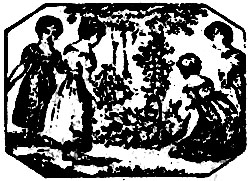
The girls were named Maria,
Elizabeth, and Harriet. The boys
were Henry, Charles, and John.—Henry
was the oldest, then Charles,
Maria, John, Elizabeth, and Harriet.
Their home was a beautiful country-seat,
situated not far from the
East river, with fine old shade trees
in front of it. In the rear was a very
large garden, laid out with great
neatness and taste, and well stocked
with fruits and flowers. Then there
were walks and borders, and summer-houses,
and arbors, and almost
every thing which could render it a
delightful place.
One portion of his grounds Mr.
Howard had laid out for a garden
for his children. This was to be their
own, and in it they were to dig, and
hoe, and rake, and plant, and transplant,
and water, just as they pleased,
so long as they were attentive to their
lessons, obedient to their parents, and
kind to each other. When any of
them misbehaved,—which was very
seldom,—that child was forbidden to
visit the garden for one or two days,
or a week, according to the nature
of its offence.
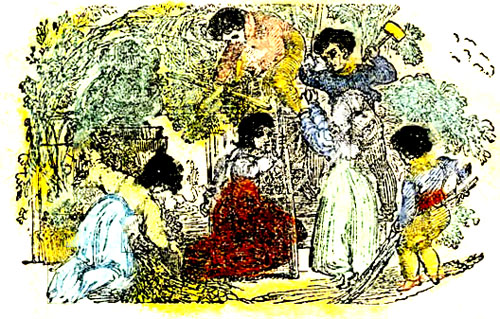
TRANSPLANTING.
Mr. and Mrs. Howard were both
anxious that their children should
grow up, not only good and intelligent,
but that they should acquire
active and industrious habits; they
therefore encouraged them all, girls
as well as boys, to pass their play-hours
in the healthy and delightful
employment of gardening.
Well, our young friends heartily
seconded the wishes of their parents,
and except in cold or stormy weather,
their little garden was the scene of
great industry, as soon as their several
lessons for the day were recited.
They had a complete set of garden
tools, just the right size for such little
folks: spades, hoes, rakes, watering-pots,
and a wheelbarrow. I assure
you they did not let these tools lie
idle. Their garden, which produced
flowers of all kinds, and many varieties
of fruit, always presented a neat
and workman-like appearance. The
boys usually took upon themselves
the most laborious part of the work,
such as digging, and hoeing, and raking,
while their sisters planted and
transplanted, and watered, and pruned
and trimmed, as occasion required.
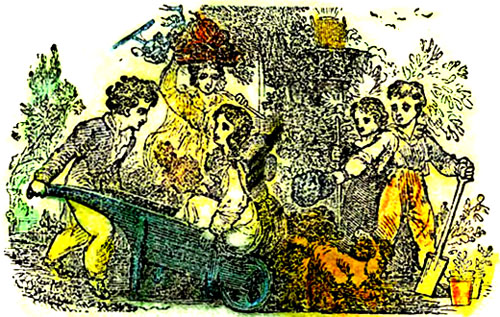
THE LITTLE GARDENERS.
One day, early in the Spring, the
little folks took it into their heads to
build an arbor in their garden. So,
getting their mother's consent, they
applied to the gardener, who furnished
them with some stout poles
and strips of boards necessary for
their purpose. Accordingly, they
were soon industriously engaged in
their first essay at building.
Henry planned the shape and the
frame, and then he and Charles, with
mallet and hammer in hand, drove
the poles into the ground, and nailed
on the strips of board; while Maria
and Elizabeth held the materials for
them, and Harriet and John handed
up such things as were needed.
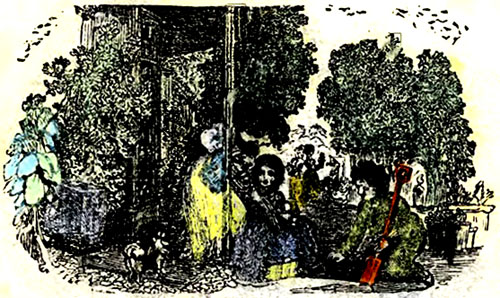
In four or five days, "Woodbine
Arbor," as the little folks named it,
was quite finished. In the center of
it they had placed a table, and built
seats around the sides of the arbor.
These the girls covered very neatly
with cloth, which their mamma gave
them for the purpose.
At each corner of the arbor, our
young gardeners set out a fine large
woodbine, which the gardener gave
them, and at the sides several beautiful
climbing roses. These vines
they trained up to, and over the top of
the arbor, in such a way as to shade
the inside from the rays of the sun.
When these plants were in full
bloom, the arbor presented a lovely
appearance, and was filled with the
most delightful fragrance. Here our
little gardeners retired when they
were fatigued with their labors, or
when the heat of the sun prevented
their working in the garden.
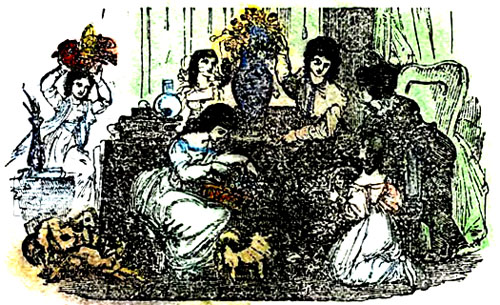
ARRANGING THE BOUQUETS.
On the anniversary of the wedding
day of Mr. and Mrs. Howard, the children
always selected from their garden
the choicest flowers, as an offering
to their beloved parents; indeed,
each of them cultivated several rare
and beautiful kinds for this particular
occasion. Gathering the flowers
together, they exerted their utmost
skill in forming two fine large bouquets
for their father and mother,
which were presented as an offering
from all the children, and which
were designed to grace the vases
on the parlor mantle-piece.
When these two bouquets were arranged
to the satisfaction of all the
little folks, each one made two of a
smaller size, just alike, which they
presented in their own name.
You may be sure these little gifts
of affection were duly prized by the
fond parents, and were kept from
fading as long as possible. They
were rewarded, too, by some suitable
present to each child, accompanied
by kind wishes, and such words
of advice and instruction as the occasion
called for. These words of advice,
given at such times, made a lasting
impression; they were remembered
by the little ones as long as
they remembered the happy events
which called them forth.
But you must not suppose these
little masters and misses were so fond
of gardening as to spend all their
play-hours there. Oh, no; like most
other children, they liked play and
play-things. The girls all had dolls,
and a pet rabbit and two little white
poodles to amuse themselves with.
Henry made kites, bows, arrows, and
other toys, and Charles was quite
fond of making and sailing little toy
ships, while John, the youngest, liked
nothing much better than playing
with a ball or trundling his hoop.
Still, the garden, after all, afforded
them more real and lasting pleasure
than any thing else.
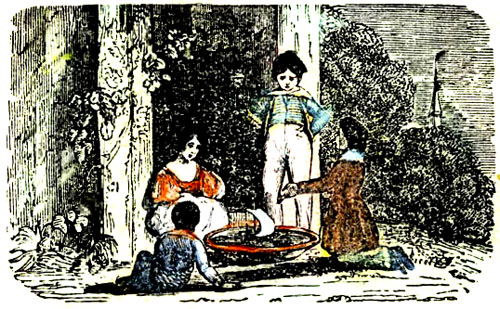
THE TOY SHIP.
But the year I am telling you
about,—the year in which our little
friends built their arbor,—instead of
presenting the bouquets as usual, they
begged their parents to visit them at
the arbor. The invitation was readily
accepted, and the children accordingly
made the necessary preparations.
Having selected the very
choicest fruits from their garden,
they arranged it to the best advantage
on the table, placing the two
large bouquets in the center; they
then each held the two smaller ones
in their hands, and presented them,
with their best wishes, as their parents
entered the arbor.
I shall not attempt to tell you how
delighted the young people all were
on this occasion, when their neat little
arbor, the work of their own hands,
was thus honored with a visit from
their parents. With some crowding,
there was room for the eight persons,
but mamma made a little more by
taking the youngest up in her lap.
Then the different fruits were handed
round, and all partook of such as
suited them best. Never were happier
children assembled, or happier
parents. Not even the finest fruit
raised by their experienced gardener,
ever tasted half as sweet as that
which was eaten at the little feast in
"Woodbine Arbor."
When it was over, mamma, at the
urgent request of the children, sang
one of her sweetest songs, and then
they all took a walk through the
garden. Many, very many, were
the words of praise and encouragement
spoken by the parents, as they
beheld the neatness and good order
in which every thing was kept. The
handsomely laid out beds and borders,
the straight rows of plants,
the well-trained vines, the beautiful
flowers, and the luxuriant growth of
the little trees and shrubbery, without
a single weed to mar the beauty
of the garden, excited their highest
admiration.
"My dear little ones," said Mr.
Howard, "let the care which you
have bestowed upon this sweet little
spot, and the success which has attended
your efforts, incite you to
higher and nobler aims, which will
most certainly be rewarded with
higher and nobler results. With
the same care and industry which
you have bestowed upon your garden,
cultivate your minds, and raise
in them the lovely and unfading flowers
of piety and virtue. Root out
from them the noxious weeds of vice
and evil habits, and train all your
thoughts upward to your heavenly
Father and Benefactor. Assist each
other in this mental cultivation, with
the same kindness which you have
all shown in cultivating your garden;
be ready at all rimes to share
with the poor and needy the blessings
which you enjoy, as freely as you
have this day shared the productions
of your garden with your parents.
Then, like the plants which you have
here cultivated, you will bear fruit
and flowers to bless and cheer your
fellow-men; and when you are removed
from earth you will be transplanted
in heaven, and blossom forever
in the Garden of the Lord."
END.
- Obvious punctuation and spelling errors were corrected.