Sometimes, at night, as you drift along the shore in your canoe, sifting
the night sounds and smells of the wilderness, when all harsher cries
are hushed and the silence grows tense and musical, like a great
stretched chord over which the wind is thrumming low suggestive
melodies, a sudden rush and flapping in the grasses beside you breaks
noisily into the gamut of half-heard primary tones and rising, vanishing
harmonics. Then, as you listen, and before the silence has again
stretched the chords of her Eolian harp tight enough for the wind’s
fingers, another sound, a cry, comes floating down from the
air—Quoskh? quoskh-quoskh? a wild, questioning call, as if the
startled night were asking who you are. It is only a blue heron, wakened
out of his sleep on the shore
by your noisy approach, that you thought
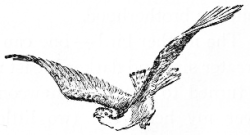
was still as the night itself. He circles over your head for a moment,
seeing you perfectly, though you catch never a shadow of his broad
wings; then he vanishes into the vast, dark silence, crying Quoskh?
quoskh? as he goes. And the cry, with its strange, wild interrogation
vanishing away into the outer darkness, has given him his most
fascinating Indian name, Quoskh the Night’s Question.
To many, indeed, even to some Indians, he has no other name and no
definite presence. He rarely utters the cry by day—his voice then is a
harsh croak—and you never see him as he utters it out of the solemn
upper darkness; so that there is often a mystery about this voice of the
night, which one never thinks of associating with the quiet, patient,
long-legged fisherman that one may see any summer day along the borders
of lonely lake or stream. A score of times I have been asked by old
campers, “What is that?” as a sharp, questioning Quoskh-quoskh? seemed
to tumble down into the sleeping lake. Yet they knew the great blue
heron perfectly—or thought they did.
Quoskh has other names, however, which describe his attributes and
doings. Sometimes, when fishing alongshore with my Indian at the paddle,
the canoe would push its nose silently around a point, and I
would see
the heron’s heavy slanting flight already halfway up to the tree-tops,
long before our coming had been suspected by the watchful little mother
sheldrake, or even by the deer feeding close at hand among the lily
pads. Then Simmo, who could never surprise one of the great birds
however silently he paddled, would mutter something which sounded like
Quoskh K’sobeqh, Quoskh the Keen Eyed. At other times, when we noticed
him spearing frogs with his long bill, Simmo, who could not endure the
sight of a frog’s leg on my fry pan, would speak of him disdainfully in
his own musical language as Quoskh the Frog Eater, for my especial
benefit. Again, if I stopped casting suddenly at the deep trout pool
opposite a grassy shore, to follow with my eyes a tall, gray-blue shadow
on stilts moving dimly alongshore in seven-league-boot strides for the
next bog, where frogs were plenty, Simmo would point with his paddle and
say: “See, Ol’ Fader Longlegs go catch-um more frogs for his babies.
Funny kin’ babies dat, eat-um bullfrog; don’ chu tink so?”
Of all his names—and there were many more that I picked up from
watching him in a summer’s outing—“Old Father Longlegs” seemed always
the most appropriate. There is a suggestion of hoary antiquity about
this solemn wader of our lakes and streams. Indeed, of all birds he is
the nearest to those ancient,
uncouth monsters which Nature made to
people our earth in its uncouth infancy. Other herons and bitterns have
grown smaller and more graceful, with shorter legs and necks, to suit
our diminishing rivers and our changed landscape. Quoskh is also,
undoubtedly, much smaller than he once was; but still his legs and neck
are disproportionately long, when one thinks of the waters he wades and
the nest he builds; and the tracks he leaves in the mud are startlingly
like those fossilized footprints of giant birds that one finds in the
rocks of the Pliocene era, deep under the earth’s surface, to tell what
sort of creatures lived in the vast solitudes before man came to
replenish the earth and subdue it.
Closely associated with this suggestion of antiquity in Quoskh’s
demeanor is the opposite suggestion of perpetual youth which he carries
with him. Age has no apparent effect on him whatsoever. He is as old and
young as the earth itself is; he is a March day, with winter and spring
in its sunset and sunrise. Who ever saw a blue heron with his jewel eye
dimmed or his natural force abated? Who ever caught one sleeping, or saw
him tottering weakly on his long legs, as one so often sees our common
wild birds clinging feebly to a branch with their last grip? A Cape Cod
sailor once told me that, far out from land, his schooner
had passed a
blue heron lying dead on the sea with outstretched wings. That is the
only heron that I have ever heard of who was found without all his wits
about him. Possibly, if Quoskh ever dies, it may suggest a solution to
the question of what becomes of him. With his last strength he may fly
boldly out to explore that great ocean mystery, along the borders of
which his ancestors for untold centuries lived and moved, back and
forth, back and forth, on their endless, unnecessary migrations,
restless, unsatisfied, wandering, as if the voice of the sea were
calling them whither they dared not follow.
Just behind my tent on the big lake, one summer, a faint, woodsy little
trail wandered away into the woods, with endless turnings and twistings,
and without the faintest indication anywhere, till you reached the very
end, whither it intended going. This little trail was always full of
interesting surprises. Red squirrels peeked down at you over the edge of
a limb, chattering volubly and getting into endless mischief along its
borders. Moose birds flitted silently over it on their mysterious
errands. Now a jumping, smashing, crackling rush through the underbrush
halts you suddenly, with quick beating heart, as you climb over one of
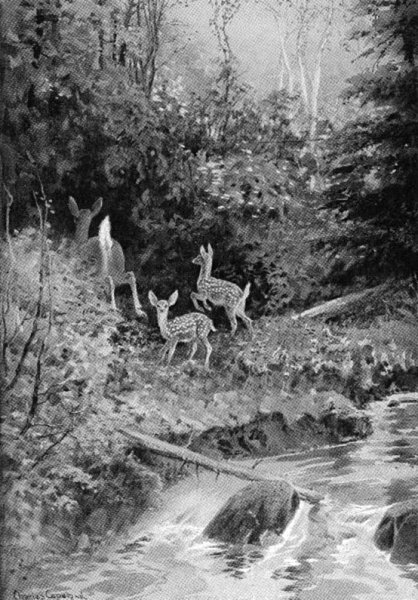
the many windfalls across your path. A white flag
followed by another
little one, flashing, rising, sinking and rising again over the fallen
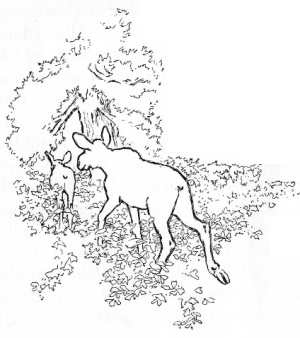
timber, tells you that a doe and her fawn were lying behind the
windfall, all unconscious of your quiet approach. Again, at a turn of
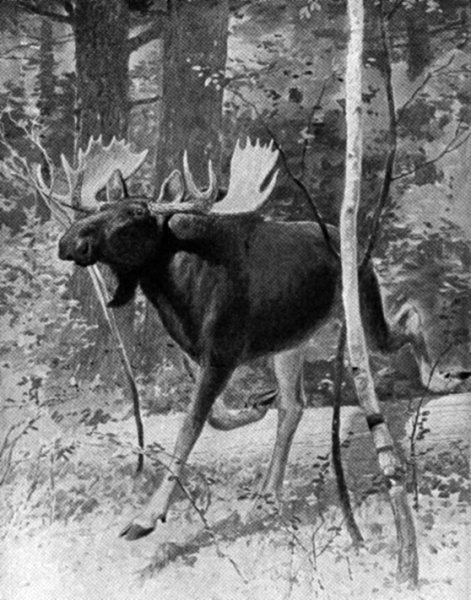
the trail, something dark, gray, massive looms before you, blocking the
faint path; and as you stop short and shrink behind the nearest tree, a
huge head and antlers swing toward you, with widespread nostrils and
keen, dilating eyes, and ears like two trumpets pointing straight at
your head—a bull moose, sh!
For a long two minutes he stands there motionless, watching the new
creature that he has never seen before; and it will be well for you to
keep perfectly quiet and let him surrender the path when he is so
disposed. Motion on your part may bring him nearer to investigate; and
you can never know at what slight provocation the red danger light will
blaze into his eyes. At last he moves away, quietly at first, turning
often to look and to make trumpets of his ears at you. Then he lays his
great antlers back on his shoulders, sticks his nose far up ahead of
him, and with long, smooth strides lunges away over the windfalls and is
gone.
So every day the little trail had some new surprise for you,—owl, or
hare, or prickly porcupine rattling his quills, like a quiver of arrows,
and proclaiming his
Indian name, Unk-wunk! Unk-wunk! as he loafed
along. When you had followed far, and were sure that the loitering trail
had certainly lost itself, it crept at last under a dark hemlock; and
there, through an oval frame of rustling, whispering green, was the
loneliest, loveliest little deer-haunted beaver pond in the world, where
Quoskh lived with his mate and his little ones.
The first time I came down the trail and peeked through the oval frame
of bushes, I saw him; and the very first glimpse made me jump at the
thought of what a wonderful discovery I had made, namely, that little
herons play with dolls, as children do. But I was mistaken. Quoskh had
been catching frogs and hiding them, one by one, as I came along. He
heard me before I knew he was there, and jumped for his last frog, a big
fat one, with which he slanted up heavily on broad vans—with a hump on
his back and a crook in his neck and his long legs trailing below and
behind—towards his nest in the hemlock, beyond the beaver pond. When I
saw him plainly he was just crossing the oval frame through which I
looked. He had gripped the frog across the middle in his long beak, much
as one would hold it with a pair of blunt shears, swelling it out at
either side, like a string tied tight about a pillow. The head and short
arms were forced up at one side, the limp legs dangled down on
the
other, looking for all the world like a stuffed rag doll that Quoskh was
carrying home for his babies to play with.
Undoubtedly they liked the frog much better; but my curious thought
about them, in that brief romantic instant, gave me an interest in the
little fellows which was not satisfied till I climbed to the nest, long
afterwards, and saw them, and how they lived.
When I took to studying Quoskh, so as to know him more intimately, I
found a fascinating subject; not simply because of his queer ways, but
also because of his extreme wariness and the difficulties I met in
catching him doing things. Quoskh K’sobeqh was the name that at first
seemed most appropriate, till I had learned his habits and how best to
get the weather of him—which happened only two or three times in the
course of a whole summer.
One morning I went early to the beaver pond and sat down against a gray
stump on the shore, with berry bushes growing to my shoulders all about
me. “Now I shall keep still and see everything that comes,” I thought,
“and nothing, not even a blue jay, will see me.”
That was almost true. Little birds, that had never seen a man in the
woods before, came for the berries and billed them off within six feet
of my face before
they noticed anything unusual. When they did see me
they would turn their heads so as to look at me, first with one eye,
then with the other, and shoot up at last, with a sharp Burr! of their
tiny wings, to a branch over my head. There they would watch me keenly,
for a wink or a minute, according to their curiosity, then swoop down
and whirr their wings loudly in my face, so as to make me move and show
what I was.
Across a little arm of the pond, a stone’s throw away, a fine buck came
to the water, put his muzzle into it, then began to fidget uneasily.
Some vague, subtle flavor of me floated across and made him uneasy,
though he knew not what I was. He kept tonguing his nostrils, as a cow
does, so as to moisten them and catch the scent of me better. On my
right, and nearer, a doe was feeding unconcernedly among the lily pads.
A mink ran, hopping and halting, along the shore at my feet, dodging in
and out among roots and rocks. Cheokhes always runs that way. He knows
how glistening black his coat is, how shining a mark he makes for owl
and hawk against the sandy shore; and so he never runs more than five
feet without dodging out of sight; and he always prefers the roots and
rocks that are blackest to travel on.
A kingfisher dropped with his musical K’plop! into the shoal of
minnows that were rippling the water in
their play just in front of me.
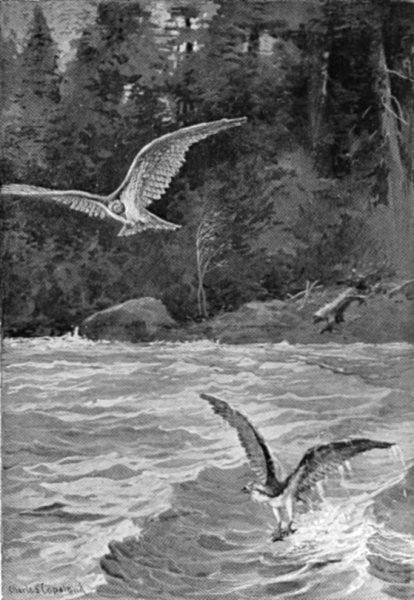
Farther out, a fishhawk came down heavily, Souse! and rose with a big
chub. And none of these sharp-eyed wood folk saw me or knew that they
were watched. Then a wide, wavy, blue line, like a great Cupid’s bow,
came gliding swiftly along the opposite bank of green, and Quoskh hove
into sight for his morning’s fishing.
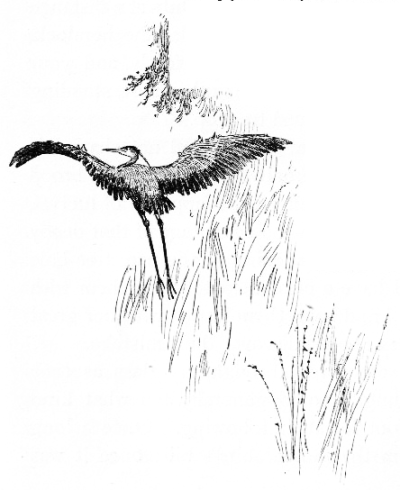
Opposite me, just where the buck had stood, he folded his great wings;
his neck crooked sharply; his long legs, which had been trailed
gracefully behind him in his swift flight, swung under him like two
pendulums as he landed lightly on the muddy shore. He knew his ground
perfectly; knew every stream and frog-haunted bay in the pond as one
knows his own village; yet no amount of familiarity with his
surroundings can ever sing lullaby to Quoskh’s watchfulness. The instant
he landed he drew himself up straight, standing almost as tall as a man,
and let his keen glance run along every shore just once. His head, with
its bright yellow eye and long yellow beak glistening in the morning
light, veered and swung over his long neck like a gilded weather-vane on
a steeple. As the vane swung up the shore toward me I held my breath, so
as to be perfectly motionless, thinking I was hidden so well that no eye
could find me at that distance. As it swung past me slowly I
chuckled,
thinking that Quoskh was deceived. I forgot altogether that a bird never
sees straight ahead. When his bill had moved some thirty degrees off my
nose, just enough so as to bring his left eye to bear, it stopped
swinging instantly.—He had seen me at the first glance, and knew that I
did not belong there.
For a long moment, while his keen eye seemed to look through and through
me, he never moved a muscle. One could easily have passed over him,
thinking him only one of the gray, wave-washed roots on the shore. Then
he humped himself together, in that indescribably awkward way that all
herons have at the beginning of their flight, slanted heavily up to the
highest tree on the shore, and stopped for a longer period on a dead
branch to look back at me. I had not moved so much as an eyelid;
nevertheless he saw me too plainly to trust me. Again he humped himself,
rose high over the tree-tops and bore away in strong, even, graceful
flight for a lonelier lake, where there was no man to watch or bother
him.
Far from disappointing me, this keenness of Quoskh only whetted my
appetite to know more about him, and especially to watch him, close at
hand, at his fishing. Near the head of the little bay, where frogs were
plenty, I built a screen of boughs under the low thick branches of a
spruce tree, and went away to watch other wood folk.
Next morning he did not come back; nor were there any fresh tracks of
his on the shore. This was my first intimation that Quoskh knows well
the rule of good fishermen, and does not harry a pool or a place too
frequently, however good the fishing. The third morning he came back;
and again the sixth evening; and then the ninth morning, alternating
with great regularity as long as I kept tabs on him. At other times I
would stumble upon him far afield, fishing in other lakes and streams;
or see him winging homeward, high over the woods, from waters far beyond
my ken; but these appearances were too irregular to count in a theory. I
have no doubt, however, that he fished the near-by waters with as great
regularity as he fished the beaver pond, and went wider afield only when
he wanted a bit of variety, or bigger frogs, as all fishermen do; or
when he had poor luck in satisfying the clamorous appetite of his
growing brood.
It was on the sixth afternoon that I had the best chance of studying his
queer ways of fishing. I was sitting in my little blind at the beaver
pond, waiting for a deer, when Quoskh came striding along the shore. He
would swing his weather-vane head till he saw a frog ahead, then stalk
him slowly, deliberately, with immense caution; as if he knew as well as
I how watchful the frogs are at his approach, and how quickly
they dive
headlong for cover at the first glint of his stilt-like legs. Nearer and
nearer he would glide, standing motionless as a gray root when he
thought his game was watching him; then on again more cautiously,
bending far forward and drawing his neck back to the angle of greatest
speed and power for a blow. A quick start, a thrust like lightning—then
you would see him shake his frog savagely, beat it upon the nearest
stone or root, glide to a tuft of grass, hide his catch cunningly, and
go on unincumbered for the next stalk, his weather-vane swinging,
swinging in the ceaseless search for frogs, or possible enemies.
If the swirl of a fish among the sedges caught his keen eye, he would
change his tactics, letting his game come to him instead of stalking it,
as he did with the frogs. Whatever his position was, both feet down or
one foot raised for a stride, when the fish appeared, he never changed
it, knowing well that motion would only send his game hurriedly into
deeper water. He would stand sometimes for a half hour on one leg,
letting his head sink slowly down on his shoulders, his neck curled
back, his long sharp bill pointing always straight at the quivering line
which marked the playing fish, his eyes half closed till the right
moment came. Then you would see his long neck shoot down, hear the
splash and, later,
the whack of his catch against the nearest root, to
kill it; and watch with curious feelings of sympathy as he hid it in the
grass and covered it over, lest Hawahak the hawk should see, or Cheokhes
the mink smell it, and rob him while he fished.
If he were near his last catch, he would stride back and hide the two
together; if not, he covered it over in the nearest good place and went
on. No danger of his ever forgetting, however numerous the catch!
Whether he counts his frogs and fish, or simply remembers the different
hiding places, I have no means of knowing.
Sometimes, when I surprised him on a muddy shore and he flew away
without taking even one of his tidbits, I would follow his back track
and uncover his hiding places to see what he had caught. Frogs, fish,
pollywogs, mussels, a baby muskrat,—they were all there, each hidden
cunningly under a bit of dried grass and mud. And once I went away and
hid on the opposite shore to see if he would come back. After an hour or
more he appeared, looking first at my tracks, then at all the shore with
greater keenness than usual; then he went straight to three different
hiding places that I had found, and two more that I had not seen, and
flew away to his nest, a fringe of frogs and fish hanging at either side
of his long bill as he went.
He had arranged them on the ground like the spokes of a wheel, as a fox
does, heads all out on either side, and one leg or the tail of each
crossed in a common pile in the middle; so that he could bite down over
the crossed members and carry the greatest number of little frogs and
fish with the least likelihood of dropping any in his flight.
The mussels which he found were invariably, I think, eaten as his own
particular tidbits; for I never saw him attempt to carry them away,
though once I found two or three where he had hidden them. Generally he
could crack their shells easily by blows of his powerful beak, or by
whacking them against a root; and so he had no need (and probably no
knowledge) of the trick, which every gull knows, of mounting up to a
height with some obstinate hardshell and dropping it on a rock to crack
it.
If Quoskh were fishing for his own dinner, instead of for his hungry
nestlings, he adopted different tactics. For them he was a hunter, sly,
silent, crafty, stalking his game by approved still-hunting methods; for
himself he was the true fisherman, quiet, observant, endlessly patient.
He seemed to know that for himself he could afford to take his time and
be comfortable, knowing that all things, especially fish, come to him
who waits long enough; while for his little ones
he must hurry, else
their croakings from too long fasting would surely bring hungry,
unwelcome prowlers to the big nest in the hemlock.
Once I saw him fishing in a peculiar way, which reminded me instantly of
the chumming process with which every mackerel fisherman on the coast is
familiar. He caught a pollywog for bait, with which he waded to a deep,
cool place under a shady bank. There he whacked his pollywog into small
bits and tossed them into the water, where the chum speedily brought a
shoal of little fish to feed. Quoskh meanwhile stood in the shadow,
where he would not be noticed, knee-deep in water, his head drawn down
into his shoulders, and a friendly leafy branch bending over him to
screen him from prying eyes. As a fish swam up to his chum he would
spear it like lightning; throw his head back and wriggle it head-first
down his long neck; then settle down to watch for the next one. And
there he stayed, alternately watching and feasting, till he had enough;
when he drew his head farther down into his shoulders, shut his eyes,
and went fast asleep in the cool shadows,—a perfect picture of fishing
indolence and satisfaction.
When I went to the nest and hid myself in the underbrush to watch, day
after day, I learned more of
Quoskh’s fishing and hunting. The nest was
in a great evergreen, in a gloomy swamp,—a villainous place of bogs and
treacherous footing, with here and there a little island of large trees.
On one of these islands a small colony of herons were nesting. During
the day they trailed far afield, scattering widely, each pair to its own
particular fishing grounds; but when the shadows grew long, and night
prowlers stirred abroad, the herons came trailing back again, making
curious, wavy, graceful lines athwart the sunset glow, to croak and be
sociable together, and help each other watch the long night out.
Quoskh the Watchful—I
 could tell my great bird’s mate by sight or
hearing from all others, either by her greater size or a peculiar double
croak she had—had hidden her nest in the top of a great green hemlock.
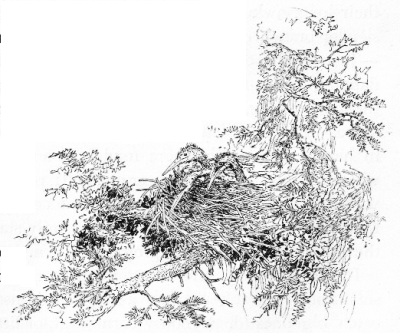
Near
by, in the high crotch of a dead tree, was another nest, which she
had built, evidently, years before and added to each successive spring,
only to abandon it at last for the evergreen. Both birds used to go to
the old nest freely; and I have wondered since if it were not a bit of
great shrewdness on their part to leave it there in plain sight, where
any prowler might see and climb to it; while the young were securely
hidden, meanwhile, in the top of the near-by hemlock, where they could
see without being seen. Only at a distance could you find the nest. When
under the hemlock, the mass of branches screened it perfectly, and your
attention was wholly taken by the other nest, standing out in bold
relief in the dead tree-top.
could tell my great bird’s mate by sight or
hearing from all others, either by her greater size or a peculiar double
croak she had—had hidden her nest in the top of a great green hemlock.
Near
by, in the high crotch of a dead tree, was another nest, which she
had built, evidently, years before and added to each successive spring,
only to abandon it at last for the evergreen. Both birds used to go to
the old nest freely; and I have wondered since if it were not a bit of
great shrewdness on their part to leave it there in plain sight, where
any prowler might see and climb to it; while the young were securely
hidden, meanwhile, in the top of the near-by hemlock, where they could
see without being seen. Only at a distance could you find the nest. When
under the hemlock, the mass of branches screened it perfectly, and your
attention was wholly taken by the other nest, standing out in bold
relief in the dead tree-top.
Such wisdom, if wisdom it were and not chance, is gained only by
experience. It took at least one brood of young herons, sacrificed to
the appetite of lucivee or fisher, to teach Quoskh the advantage of that
decoy nest to tempt hungry prowlers upon the bare tree hole where she
could have a clear field to spear them with her powerful bill and beat
them down with her great wings before they should discover their
mistake.
By watching the birds through my glass as they came to the young, I
could generally tell what kind of game was afoot for their following.
Once a long snake hung from the mother bird’s bill; once it was
a bird
of some kind; twice she brought small animals, whose species I could not
make out in the brief moment of alighting on the nest’s edge,—all these
besides the regular fare of fish and frogs, of which I took no account.
And then, one day while I lay in my hiding, I saw the mother heron slide
swiftly down from the nest, make a sharp wheel over the lake, and plunge
into the fringe of berry bushes on the shore after some animal that her
keen eyes had caught moving. There was a swift rustling in the bushes, a
blow of her wing to head off a runaway, two or three lightning thrusts
of her javelin beak; then she rose heavily, taking a leveret with her;
and I saw her pulling it to pieces awkwardly on the nest to feed her
hungry little ones.
It was partly to see these little herons, the thought of which had
fascinated me ever since I had seen Quoskh taking home what I thought,
at first glance, was a rag doll for them to play with, and partly to
find out more of Quoskh’s hunting habits by seeing what he brought home,
that led me at last to undertake the difficult task of climbing the huge
tree to the nest. One day when the mother had brought home some unknown
small animal—a mink, I thought—I came suddenly out of my hiding and
crossed over to the nest. It had always fascinated me. Under it, at
twilight, I had heard the mother heron croaking softly to
her little
ones—a husky lullaby, but sweet enough to them—and then, as I paddled
away, I would see the nest dark against the sunset with Mother Quoskh
standing over it, a tall, graceful silhouette against the glory of
twilight, keeping sentinel watch over her little ones. Now I would solve
the mystery of the high nest by looking into it.
The mother, alarmed by my sudden appearance,—she had no idea that she
had been watched,—shot silently away, hoping I would not notice her
home through the dense screen of branches. I climbed up with difficulty;
but not till I was within ten feet could I make out the mass of sticks
above me. The surroundings were getting filthy and evil-smelling by this
time; for Quoskh teaches the young herons to keep their nest perfectly
clean by throwing all refuse over the sides of the great home. A dozen
times I had watched the mother birds of the colony push their little
ones to the edge of the nest to teach them this rule of cleanliness, so
different from most other birds.
As I hesitated about pushing through the filth-laden branches, something
bright on the edge of the nest caught my attention. It was a young
heron’s eye looking down at me over a long bill, watching my approach
with a keenness that was but thinly disguised by the half-drawn eyelids.
I had to go round the tree
at this point for a standing on a larger
branch; and when I looked up, there was another eye watching down over
another long bill. So, however I turned, they watched me closely getting
nearer and nearer, till I reached up my hand to touch the nest. Then
there was a harsh croak. Three long necks reached down suddenly over the
edge of the nest on the side where I was; three long bills opened wide
just over my head; and three young herons grew suddenly seasick, as if
they had swallowed ipecac.
I never saw the inside of that home. At the moment I was in too much of
a hurry to get down and wash in the lake;
 and after that, so large were
the young birds, so keen and powerful the beaks, that no man or beast
might expect to look over the edge of the nest, with hands or paws
engaged in holding on, and keep his eyes for a single instant. It is
more dangerous to climb for young herons
than for young eagles. A heron
always strikes for the eye, and his blow means blindness or death,
unless you watch like a cat and ward it off.
and after that, so large were
the young birds, so keen and powerful the beaks, that no man or beast
might expect to look over the edge of the nest, with hands or paws
engaged in holding on, and keep his eyes for a single instant. It is
more dangerous to climb for young herons
than for young eagles. A heron
always strikes for the eye, and his blow means blindness or death,
unless you watch like a cat and ward it off.
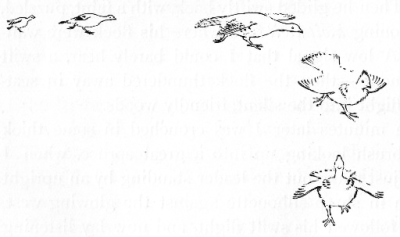
When I saw the young again they were taking their first lessons. A
dismal croaking in the tree-tops attracted me, and I came over
cautiously to see what my herons were doing. The young were standing up
on the big nest, stretching necks and wings, and croaking hungrily;
while the mother stood on a tree-top some distance away, showing them
food and telling them plainly, in heron language, to come and get it.
They tried it after much coaxing and croaking; but their long, awkward
toes missed their hold upon the slender branch on which she was
balancing delicately—just as she expected it to happen. As they fell,
flapping lustily, she shot down ahead of them and led them in a long,
curving slant to an open spot on the shore. There she fed them with the
morsels she held in her beak; brought more food from a tuft of grass
where she had hidden it, near at hand; praised them with gurgling croaks
till they felt some confidence on their awkward legs; then the whole
family started up the shore on their first frogging expedition.
It was intensely interesting for a man who, as a small boy, had often
gone a-frogging himself—to catch big ones for a woodsy corn roast, or
little ones
for pickerel bait—to sit now on a bog and watch the little
herons try their luck. Mother Quoskh went ahead cautiously, searching
the lily pads; the young trailed behind her awkwardly, lifting their
feet like a Shanghai rooster and setting them down with a splash to
scare every frog within hearing, exactly where the mother’s foot had
rested a moment before. So they went on, the mother’s head swinging like
a weather-vane to look far ahead, the little ones stretching their necks
so as to peek by her on either side, full of wonder at the new world,
full of hunger for things that grew there, till a startled young frog
said K'tung! from behind a lily bud, where they did not see him, and
dove headlong into the mud, leaving a long, crinkly, brown trail to tell
exactly how far he had gone.
A frog is like an ostrich. When he sees nothing, because his head is
hidden, he thinks nothing can see him. At the sudden alarm Mother Quoskh
would stretch her neck, watching the frog’s flight; then turn her head
so that her long bill pointed directly at the bump on the muddy bottom,
which marked the hiding place of Chigwooltz, and croak softly as a
signal. At the sound one of the young herons would hurry forward
eagerly; follow his mother’s bill, which remained motionless, pointing
all the while; twist his head till he saw the frog’s back in the mud,
and then lunge
at it like lightning. Generally he got his frog, and
through your glass you would see the unfortunate creature wriggling and
kicking his way into Quoskh’s yellow beak. If the lunge missed, the
mother’s keen eye followed the frog’s frantic rush through the mud, with
a longer trail this time behind him, till he hid again; whereupon she
croaked the same youngster up for another try, and then the whole family
moved jerkily along, like a row of boys on stilts, to the next clump of
lily pads.
As the young grew older and stronger on their legs, I noticed the
rudiments, at least, of a curious habit of dancing, which seems to
belong to most of our long-legged wading birds. Sometimes, sitting
quietly in my canoe, I would see the young birds sail down in a long
slant to the shore. Immediately on alighting, before they gave any
thought to frogs or fish or carnal appetite, they would hop up and down,
balancing, swaying, spreading their wings, and hopping again round about
each other, as if bewitched. A few moments of this crazy performance,
and then they would stalk sedately along the shore, as if ashamed of
their ungainly levity; but at any moment the ecstasy might seize them
and they would hop again, as if they simply could not help it. This
occurred generally towards evening, when the birds had fed full
and
were ready for play or for stretching their broad wings in preparation
for the long autumn flight.
Watching them, one evening, I remembered suddenly a curious scene that I
had stumbled upon when a boy. I had seen a great blue heron sail
croaking, croaking, into an arm of the big pond where I was catching
bullpouts, and crept down through dense woods to find out what he was
croaking about. Instead of one, I found eight or ten of the great birds
on an open shore, hopping ecstatically through some kind of a crazy
dance. A twig snapped as I crept nearer, and they scattered in instant
flight. It was September, and the instinct to flock and to migrate was
at work among them. When they came together for the first time some dim,
old remembrance of generations long gone by—the shreds of an ancient
instinct, whose meaning we can only guess at—had set them to dancing
wildly;
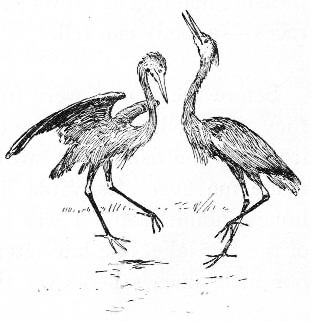 though I doubted at the time whether they understood much what
they were doing.
though I doubted at the time whether they understood much what
they were doing.
Perhaps I was wrong in this. Watching the young birds at their
ungainly
hopping, the impulse to dance seemed uncontrollable; yet they were
immensely dignified about it at times; and again they appeared to get
some fun out of it—as much, perhaps, as we do out of some of our
peculiar dances, of which a visiting Chinaman once asked innocently:
"Why don’t you let your servants do it for you?"
I have seen little green herons do the same thing in the woods at mating
time; and once, in the Zoölogical Gardens at Antwerp, I saw a
magnificent hopping performance by some giant cranes from Africa. Our
own sand-hill and whooping cranes are notorious dancers; and undoubtedly
it is more or less instinctive with all the tribes of the cranes and
herons, from the least to the greatest. But what the instinct
means—unless, like our own dancing, it is a pure bit of
pleasure-making, as crows play games and loons swim races—nobody can
tell.
Before the young were fully grown, and while yet they were following the
mother to learn the ways of frogging and fishing, a startling thing
occurred which made me ever afterwards look up to Quoskh with honest
admiration. I was still-fishing in the middle of the big lake, one late
afternoon, when Quoskh and her little ones sailed over the trees from
the beaver
pond and lit on a grassy shore. A shallow little brook stole
into the lake there, and Mother Quoskh left her young to frog for
themselves, while she went fishing up the brook under the alders. I was
watching the young herons through my glass when I saw a sudden rush in
the tall grass near them. All three humped themselves, heron fashion, on
the instant. Two got away safely; the other had barely spread his wings
when a black animal leaped out of the grass for his neck and pulled him
down, flapping and croaking desperately.
I pulled up my killick on the instant and paddled over to see what was
going on, and what the creature was that had leaped out of the grass.
Before my paddle had swung a dozen strokes I saw the alders by the brook
open swiftly, and Mother Quoskh sailed out and drove like an arrow
straight at the struggling wing tips, which still flapped spasmodically
above the grass. Almost before her feet had dropped to a solid landing
she struck two fierce, blinding, downward blows of her great wings. Her
neck curved back and shot straight out, driving the keen six-inch bill
before it, quicker than ever a Roman arm drove its javelin. Above the
lap-lap of my canoe I heard a savage cry of pain; the same black
animal leaped up out of the tangled grass, snapping for the neck; and a
desperate
battle began, with short gasping croaks and snarls that made
caution unnecessary as I sped over to see who the robber was, and how
Quoskh was faring in the good fight.
The canoe shot up behind a point where, looking over the low bank, I had
the arena directly under my eye. The animal was a fisher—black-cat the
trappers call him—the most savage and powerful fighter of his size in
the whole world, I think. In the instant that I first saw him, quicker
than thought he had hurled himself twice at the towering bird’s breast.
Each time he was met by a lightning blow in the face from Quoskh’s
stiffened wing. His teeth ground the big quills to pulp; his claws tore
them into shreds; but he got no grip in the feathery mass, and he
slipped, clawing and snarling, into the grass, only to spring again like
a flash. Again the stiff wing blow; but this time his jump was higher;
one claw gripped the shoulder, tore its way through flying feathers to
the bone, while his weight dragged the big bird down. Then Quoskh
shortened her neck in a great curve. Like a snake it glided over the
edge of her own wing for two short, sharp down-thrusts of the deadly
javelin—so quick that my eye caught only the double yellow flash of it.
With a sharp screech the black-cat leaped away and whirled towards me
blindly. One eye was
gone; an angry red welt showed just over the
other, telling how narrowly the second thrust had missed its mark.
A shiver ran over me as I remembered how nearly I had once come myself
to the black-cat’s condition, and from the same keen weapon. I was a
small boy at the time, following a big, good-natured hunter that I met
in the woods, one day, from pure love of the wilds and for the glory of
carrying the game bag. He shot a great blue heron, which fell with a
broken wing into some soft mud and water grass. Carelessly he sent me to
fetch it, not caring to wet his own feet. As I ran up, the heron lay
resting quietly, his neck drawn back, his long keen bill pointing always
straight at my face. I had never seen so big a bird before, and bent
over him wondering at his long bill, admiring his intensely bright eye.
I did not know then—what I have since learned well—that you can always
tell when the rush or spring or blow of any beast or bird—or of any
man, for that matter—will surely come by watching the eye closely.
There is a fire that blazes in the eye before the blow comes, before
ever a muscle has stirred to do the brain’s quick bidding. As I bent
over, fascinated by the keen, bright look of the wounded bird, and
reached down my hand to pick him up, there was a flash deep
in the eye,
like the glint of sunshine from a mirror, and I dodged instinctively.
Well for me that I did so. Something shot by my face like lightning,
opening up a long red gash across my left temple from eye-brow to ear.
As I jumped I heard a careless laugh. "Look out, Sonny, he may bite
you—Gosh! what a close call!" And with a white, scared face, as he saw
the ugly wound that the heron’s beak had opened, he dragged me away as
if there had been a bear in the water grass.
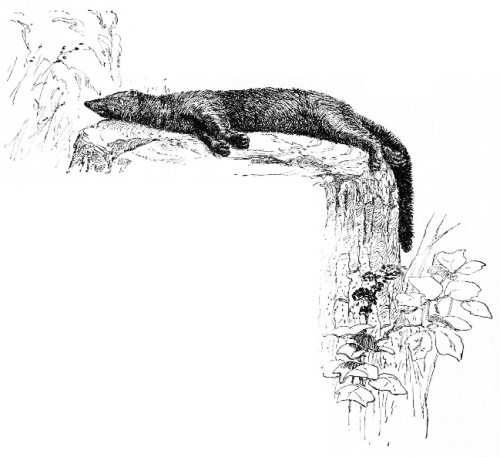
The black-cat had not yet received punishment enough. He is one of the
largest of the weasel family, and has a double measure of the weasel’s
savageness and tenacity. He darted about the heron in a quick, nervous,
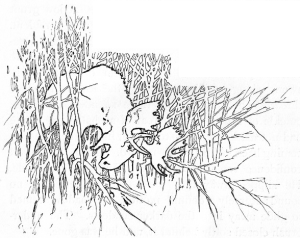
jumping circle, looking for an opening behind; while Quoskh lifted her
great torn wings as a shield and turned slowly on the defensive, so as
always to face the danger. A dozen times the fisher jumped, filling the
air with feathers; a dozen times the stiffened wings struck down to
intercept his spring, and every blow was followed by a swift javelin
thrust. Then, as the fisher crouched snarling in the grass, off his
guard for an instant, I saw Mother Quoskh take a sudden step forward,
her first offensive move—just as I had seen her twenty times at the
finish of a frog stalk—and her bill shot down with the whole power
of her long neck behind it. A harsh screech of pain followed the swift
blow; then the fisher wobbled away with blind, uncertain jumps towards
the shelter of the woods.
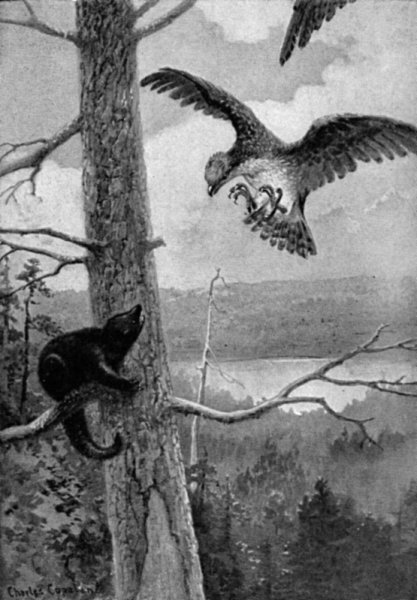
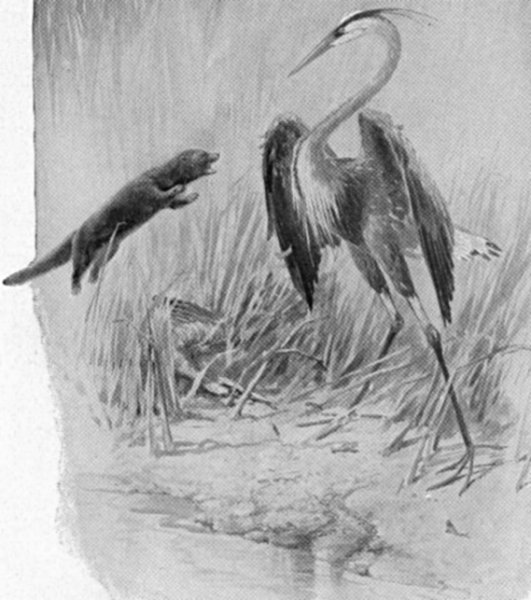 “A DOZEN TIMES THE FISHER JUMPED, FILLING THE AIR WITH FEATHERS”
And now, with her savage enemy in full flight, a fierce, hot anger
seemed to flare within the mother heron, burning out all the previous
cool, calculating defense. Her wings heaved aloft, as the soldiers of
old threw up their shields in the moment of victory; while her whole
frame seemed to swell with power, like a hero whose fight is won. She
darted after the fisher, first on the run, then with heavy wing beats,
till she headed him and with savage blows of pinion and beak drove him
back, seeing nothing, guided only by fear and instinct, towards the
water. For five minutes more she chevied him hither and yon through the
trampled grass, driving him from water to bush and back again, jabbing
him at every turn; till a rustle of leaves invited him, and he dashed
blindly into thick underbrush, where her broad wings could not follow.
Then with marvelous watchfulness she saw me standing near in my canoe;
and without a thought, apparently, for the young heron lying so still in
the grass close beside her, she spread her torn wings and flapped away
heavily in the path of her more fortunate younglings.
I followed the fisher’s trail into the woods and found him curled up in
a hollow stump. He made slight resistance as I pulled him out. All his
ferocity was already lulled to sleep in the vague, dreamy numbness which
Nature always sends to her stricken creatures. He suffered nothing,
apparently, though he was fearfully wounded; he just wanted to be let
alone. Both eyes were gone, and there was nothing left for me except to
finish mercifully what little Quoskh had left undone.
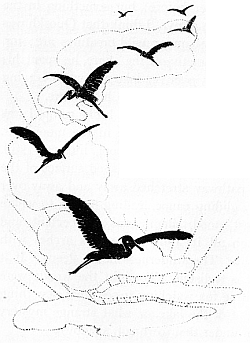
When September came, and family cares were over, the colony beyond the
beaver pond scattered widely, returning each one to the shy, wild,
solitary life that Quoskh likes best. Almost anywhere, in the loneliest
places, I might come upon a solitary heron stalking frogs, or chumming
little fish, or treading the soft mud expectantly, like a clam digger,
to find where the
mussels were hidden by means of his long toes; or
just standing still to enjoy the sleepy sunshine till the late afternoon
came, when he likes best to go abroad.
They slept no more on the big nest, standing like sentinels against the
twilight glow and the setting moon; but each one picked out a good spot
on the shore and slept as best he could on one leg, waiting for the
early fishing. It was astonishing how carefully even the young birds
picked out a safe position. By day they would stand like statues in the
shade of a bank or among the tall grasses, where they were almost
invisible by reason of their soft colors, and wait for hours for fish
and frogs to come to them. By night each one picked out a spot on the
clean open shore, off a point, generally, where he could see up and
down, where there was no grass to hide an enemy, and where the bushes on
the bank were far enough away so that he could hear the slight rustle of
leaves before the creature that made it was within springing distance.
And there he would sleep safe through the long night, unless disturbed
by my canoe or by some other prowler. Herons see almost as well by night
as by day, and their ears are keen as a weasel’s; so I could never get
near enough to surprise them, however silently I paddled. I would hear
only a startled
rush of wings, and then a questioning call as they
sailed over me before winging away to quieter beaches.
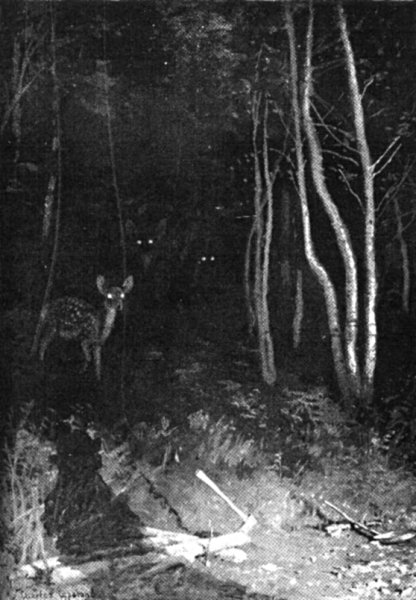
If I were jacking, with a light blazing brightly before me in my canoe,
to see what night folk I might surprise on the shore, Quoskh was the
only one for whom my jack had no fascination. Deer and moose, foxes and
wild ducks, frogs and fish,—all seemed equally charmed by the great
wonder of a light shining silently out of the vast darkness. I saw them
all, at different times, and glided almost up to them before timidity
drove them away from the strange bright marvel. But Quoskh was not to be
watched in that way, nor to be caught by any such trick. I would see a
vague form on the far edge of the light’s pathway; catch the bright
flash of either eye as he swung his weather-vane head; then the vague
form would slide into the upper darkness. A moment’s waiting; then,
above me and behind, where the light did not dazzle his eyes, I would
hear his night cry—with more of anger than of questioning in it—and as
I turned the jack upward I would catch a single glimpse of his broad
wings sailing over the lake. Nor would he ever come back, like the fox
on the bank, for a second look to be quite sure what I was.
When the bright, moonlit nights came, there was uneasiness in Quoskh’s
wild breast. The solitary life
that he loves best claimed him by day;
but at night the old gregarious instinct drew him again to his fellows.
Once, when drifting over the beaver pond through the delicate witchery
of the moonlight, I heard five or six of the great birds croaking
excitedly at the heronry, which they had deserted weeks before. The
lake, and especially the lonely little pond at the end of the trail, was
lovelier than ever before; but something in the south was calling him
away. I think that Quoskh was also moonstruck, as so many wild creatures
are; for, instead of sleeping quietly on the shore, he spent his time
circling aimlessly over the lake and woods, crying his name aloud, or
calling wildly to his fellows.
At midnight of the day before I broke camp, I was out on the lake for a
last paddle in the moonlight. The night was perfect,—clear, cool,
intensely still.
 Not a ripple broke the great burnished surface of the
lake; a silver pathway stretched away and away over the bow of my
gliding canoe, leading me on to where the great forest stood, silent,
awake, expectant, and flooded through all its dim, mysterious arches
with marvelous light. The wilderness never sleeps. If it grow silent, it
is to listen. To-night the woods were tense as a waiting fox, watching
to see what new thing would come out of the lake, or what strange
mystery would be born under their own soft shadows.
Not a ripple broke the great burnished surface of the
lake; a silver pathway stretched away and away over the bow of my
gliding canoe, leading me on to where the great forest stood, silent,
awake, expectant, and flooded through all its dim, mysterious arches
with marvelous light. The wilderness never sleeps. If it grow silent, it
is to listen. To-night the woods were tense as a waiting fox, watching
to see what new thing would come out of the lake, or what strange
mystery would be born under their own soft shadows.
Quoskh was abroad too, bewitched by the moonlight. I heard him calling
and paddled down. He knew me long before he was anything more to me than
a voice of the night, and swept up to meet me. For the first time after
darkness fell I saw him—just a vague, gray shadow with edges touched
softly with silver light, which whirled once over my canoe and looked
down into it. Then he vanished; and from far over on the edge of the
waiting woods, where the mystery was deepest, came a cry, a challenge, a
riddle, the night’s wild question which no man has ever yet
answered—Quoskh? quoskh?
[111]