IN THE afternoon of the day following the visit
of the coyotes to the cave of Cho-gay, a dapper
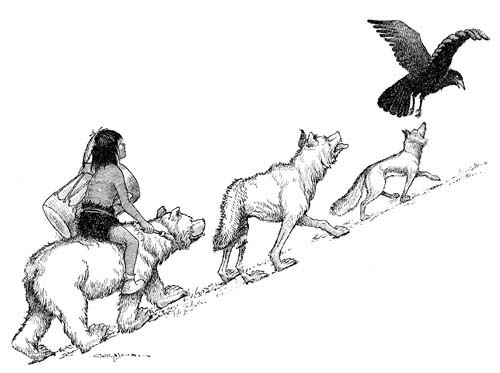
little red fox and a gaunt, one-eyed, old timber-wolf
trotted over a narrow trail that led along the rim
of a canyon.
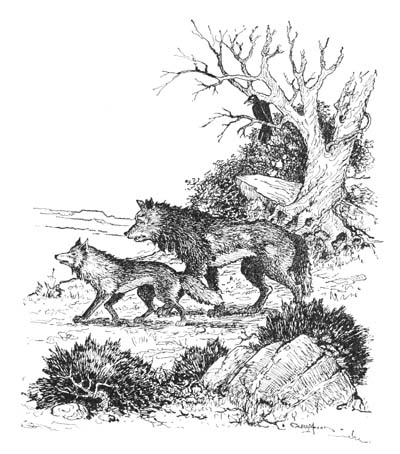
They were Sandy, or Red-eagle Fox, as he loved
to call himself, and Rip, the veteran outcast of a
once great pack. Why this strange pair hunted
together was a mystery to all but Kaw, the crow.
He knew that it was because the conceited little
fox, who never tired of boasting of his supposed
skill as a hunter, felt it a great compliment to be
permitted to hunt with a real wolf, and that old
Rip endured the companionship of the boastful little
fox for the simple reason that when game is to be
found, two sharp, young eyes are better than one
old one. In truth, the old wolf knew that his days
of hunting alone were gone.
The alert little fox, filled with false pride and
great vanity, formed a strange contrast to Rip, for
even a casual observer would have noticed that
the old wolf had passed a long way beyond the
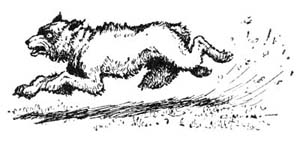
prime of life. Old Rip’s left eye had been lost in
one of the numerous battles he had been called
upon to fight, but the right eye still retained some
of its former fire; a part of one ear was missing,
but he could hear with it very well. As he ran, it
could be seen that his joints were not just as limber
as they once had been. His greatest characteristic
was an insatiable appetite; he was always hungry.
But, in spite of all this, he was a wolf, and that
fact made him great in the eyes of Sandy, the fox.
While on hunting trips, the luck of this strange
pair was a very uncertain thing, but usually the
little fox managed to catch a rabbit or some birds,
and old Rip was always careful to pay his partner
some gruff compliment before devouring the larger
portion of the game.
Secretly Kaw enjoyed the fox and wolf, as they
afforded him many a quiet chuckle, of which they
were ignorant. Because of his interest, Kaw frequently
helped them to find game when hunting
was poor, and the two learned to look upon him
as a valued friend.
On this particular afternoon, the hunters were in
no pleasant mood, for it was growing late and
they had killed nothing since early morning but a
small grouse, which did not satisfy their appetite
for long.
Sandy, the fox, and Old Rip, the timber-wolf
As they stuck close to the trail, it was evident
that, though hungry, they were on some business
other than hunting.
“How much farther is it to this bear’s den?”
growled Rip, who was beginning to weary of the
journey.
“Only a little way now,” replied the fox. “Soon
we will go up the mountain side a short distance,
and then we are there.”
The old wolf made no reply to this, but trotted
doggedly along after his companion. Wishing to
turn Rip’s thoughts to less tiresome things than
trails and distances, the little fox asked, “How
did you learn that Kil-fang and his pack are returning
to the Black Hills?”
“I have ears, haven’t I?” growled Rip. “When
there is news of a kill abroad, I hear of it, and there
will be good hunting for many of us when the pack
comes down the north canyon. All animals will
run over the hills to the broad valley to get out of
the way of Kil-fang, and it is there I shall be
before them.”
“I also will be there,” remarked the fox, and
each of these brave hunters had visions of the
great number of rabbits, squirrels, and small
animals that would swarm over the hills and into
the valley to the east, as the wolf pack came through
the canyon that opened into the Black Hill region
on the north.
“When does the pack come?” asked the fox.
“Yap-kii, the coyote, gave me the news,” replied
Rip, “and he says the pack now numbers
more than fifty, and that they will come into the
Black Hills when the moon is again at the full.
I have no liking for this Cho-gay, but I have less
for the strutting Kil-fang, and I shall howl the
death howl with great happiness if the Indian
man-child kills him and drives his boastful pack
again into the north.”
“It is not many days from now that the moon is
at the full,” said the fox, “no more than a dozen,
at most. Does anyone but Yap-kii and you know
about the coming of the pack?”
“No one,” replied Rip, “for he does not dare
to tell Fearful and his brothers, as they talk too
much, and the rabbits and squirrels have sharp
ears.”
Suddenly a voice that came from the limb of a
cottonwood tree above their heads called out:
“Two bold, brave hunters are we,
As all who will look can see.
To fight the fierce rabbit,
With us is a habit;
We fear nothing that’s smaller than we—
Let’s see—
We mean smaller and weaker than we!”
At the sound of Kaw’s voice, for it was he, the
spirits of the two hungry hunters began to rise,
for now there was hope of finding something to
eat.
“Where are we going, so far from home, on
so fine an afternoon?” inquired the crow. Then
without waiting for a reply, he continued, “I’ll
guess you are just out for a quiet stroll after
eating a nice meal of fat mountain sheep and
jack-rabbit.”
At the mention of such delicious food old Rip
licked his chops, and the little fox squirmed uneasily.
As usual he spoke for the two:
“We certainly would have had a fine meal if
we had been on one of our regular hunting trips,
for as you know I always bag my game, and there
is no greater hunter than—”
“Then you have had poor hunting to-day?”
broke in Kaw, who did not care to hear the boastful
remarks that he knew the little fox was getting
ready to make.
“Yes, that’s just it,” replied the little fox. “As
I was saying, we are on our way to make an important
call, and though we have come a great
distance, there has been nothing good to eat within
sight or sound of us since dawn.”
At that moment the keen eyes of the old crow
caught sight of a short line of moving animals far
back along the canyon rim, but though his eyes
twinkled as he realized that Fearful and his brothers
were trailing the little fox, to tell him of
Cho-gay’s order, he said nothing to the two hunters,
who were ignorant of the fact that they were being
followed.
“Well,” said Kaw, “as I flew over the sage
that is just around the point ahead of you, I saw
a number of jack-rabbits that were headed up the
mountain. If you cut in above the trail you will
head them off!”
Instantly the two hunters sprang forward toward
the place indicated, each trying to be first, and
neither remembering to thank the old crow for the
information he had given them.
“So they are making an important call,” said
Kaw to himself, as he watched the odd pair loping
away up the mountain side. “It’s quite plain
who they are calling upon. I wonder what kind of
a plot is in the wind now.” Then he looked back
far down the canyon trail, where the small line of
coyotes were slowly approaching, and chuckled to
himself as he flew off over the mountain.
Less than half an hour later, Rip and Sandy had
managed to kill two jack-rabbits, and were trotting
along the well-worn little trail that led to the cave
of Wongo, the bear. Suddenly the fox, who was in
the lead, stopped beside some jack-oak bushes and
spoke to his companion:
“You can wait here, friend Rip, while I talk to
Wongo, for you see he must not know that you
are in this plan of ours. If he learns that you
are interested in the escape of the mountain sheep,
or I should say in eating the sheep after it has
escaped, he would tell Cho-gay. If this Indian
man-child hears of it, you would never get the
sheep, and my brother might not be set free in
time to escape Kil-fang and his pack.”
“I keep my word,” replied Rip, who was in a
better humor after the meal of the jack-rabbit.
“But remember,” he added warningly, “I am
to have the mountain sheep in return for telling
you the news of Kil-fang and the pack. Go on;
I’ll wait for you here.”
Sandy trotted up the trail, leaving his companion,
who was glad enough to rest his weary
bones after so long a journey.
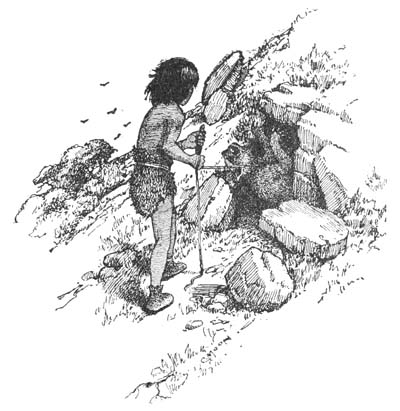
A few minutes later the fox, after announcing
his presence with a short bark, poked his head
into the bear’s cave and called out, “A good
evening to you, Brother Wongo. I hope I am
not interrupting a nap.”
“No,” replied the little bear, who was suddenly
curious to know why Sandy was so far from his
own hunting grounds, “but I am just getting ready
to take a walk into the canyon. What brings you
to the cave of Wongo?”
“I have just been on one of my famous hunting
trips,” replied Sandy. “I often make long journeys
when in search of big game, for, as you may
know, I am one of the greatest—”
“All right,” cut in Wongo, who had learned
from Kaw about Sandy’s habit of boasting, “but
what brings you here?”
“As I was just saying,” replied the fox, “I
was passing this way, and thought I’d just drop
in to see you, and perhaps ask a question or two
that you might be able to answer.” Sandy looked
anxiously at the little bear.
“Go on,” said Wongo, whose curiosity was
growing.
“I have just heard that you visited the cave of
Cho-gay, the man-child, yesterday, and it may be
that you can tell me something about him. They
say that he has many animals that he keeps as
prisoners in little holes in the rocks near his cave,
and that he does not let them out. Is it so?”
“He has only three animals,” replied Wongo,
“and he keeps them shut up because they steal,
and so have not kept the law. One is a mountain
sheep, who stole his corn, another is a young bobcat,
who stole or tried to steal dried meat from
his cave, and the third is a fox who has twice
stolen from him, but will not steal again very
soon.”
The little fox remained silent for a few moments,
not knowing just how to gain the real information
he had come for, but just as the impatient Wongo
was about to ask him to go on, he remarked, “All
say that this Cho-gay knows all animal talk, that
he can do strange things, and that he carries a
long, sharp claw with which he can kill very quickly
when he wishes to. Is it so?”
“That he can do strange things is true, and the
thing you call a claw is a knife,” said Wongo,
and he took on a superior air as he gave this information,
for he was quite proud of his knowledge
of Cho-gay.
“Could he kill the gray-wolf pack if it should
come?” asked Sandy.
“That is a silly question,” replied Wongo.
“No one could kill the pack single handed, unless
he had as many heads and as many teeth as the
pack, and of course we know that no such animal
lives in Timbertangle.”
“Would Cho-gay shut me up if I went to tell him
something he would like to hear?” inquired Sandy.
“No, if what you tell is true. But why not tell
me, who knows him, and I can tell him for you,”
suggested the little bear, whose curiosity was now
thoroughly aroused.
“No,” replied Sandy, “I have reasons why I
must tell him myself; I have valuable information
to give him and—well, it may be that I will ask
him for something in return.”
“Oh, very well,” said Wongo with pretended
indifference. “I can’t see that the matter concerns
me, so I will bid you good——”
“Yes, yes!” broke in the fox quickly, “It does
concern you, as I want you to take me to this Cho-gay,
for I have never seen him except from a great
distance and—well, you could tell him who I am,
you know, and that we are close friends, and about
my reputation as a great——”
“Ho, ho!” grunted Wongo. “You mean that
we are acquainted because we both happen to be
friends of Kaw, the crow.”
“Just that,” said the fox, who wished to be very
agreeable to the little bear. “By the way, did you
happen to hear Cho-gay say just when he expected
to free the mountain sheep and the fox?”
“Yes,” replied Wongo, who was anxious to show
his caller that he knew a great deal about the doings
of the ruler of the Black Hills, “I heard him say
that the mountain sheep is to go free in three days,
that’s the day after to-morrow, but the fox is to be
kept for a long time, as he is a great thief and has
twice broken the law.”
The little fox squirmed uneasily when the last
statement was made, but his uneasiness escaped
the notice of the bear.
“But what has all that to do with the great
secret that you have to tell Cho-gay?” asked
Wongo.
“You will learn all that if you will just agree to
accompany me to his cave, and if you would—well,
just tell him that I am Red-eagle Fox, the
hunter.”
Wongo made no reply for some time, merely for
the impressive effect his silence would have on his
caller.
“Yes,” he said at length, “although it is a long,
hard trip from here to Cho-gay’s cave, and I have
no love for long trips, I can see no great reason
why I should not do you the favor to accompany
you. Then, too, Cho-gay may want my advice.”
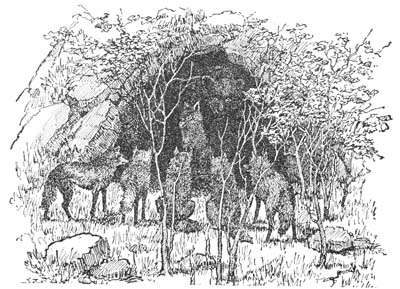
Before Sandy could make any reply to this, five
silent gray figures suddenly appeared in a semi-circle
behind him and Fearful, the coyote, spoke.
“Brother Sandy is wanted by our leader, the
Indian man-child. There is a tale that our brother,
the fox, has been telling and Cho-gay would hear
it from his own mouth.”
At this announcement the little fox began to swell
with pride, and all interest in Wongo vanished.
“Ah, it is well that you bring me word from our
great leader, Brother Fearful.” Then turning to
Wongo, “I will not need your company after all,
Wongo, so I will bid you good-day.”
“Well, I will be glad to accompany you anyway,”
said Wongo hastily, as he followed his caller
out of the cave entrance, for he had no intention of
missing the chance to learn what mysterious news
Sandy had for Cho-gay.
“It will not be necessary now that he has sent
for me,” replied Sandy.
“I fully intended to visit Cho-gay again very
soon, anyway, Brother Sandy, and it suits me just
as well to go along with you now. Of course,”
added the little bear, “he will see no one until the
sun is up, and we could not get to his cave much
before dawn.”
“Brother Sandy is wanted,” said Fearful
“Don’t trouble yourself about it,” said the fox
coolly, “for I am sure he will not want any but
very important members of Timbertangle to hear
the news I have for him.” With this he started
down the trail followed by the five coyotes.
The little bear watched them depart and decided
that he would be at the cave of Cho-gay before
them. After he had given them time to get a good
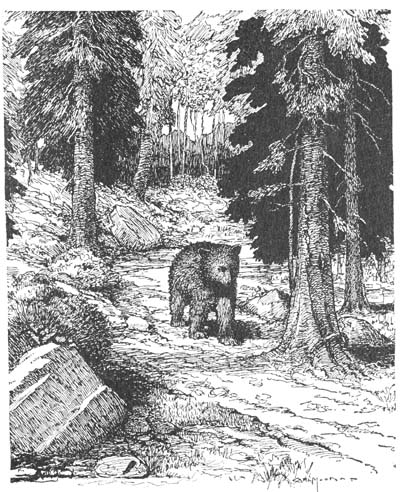
start down the trail, he ambled down the path thinking
of all that had taken place and wondering what
could be the great news that Sandy had to tell. So
occupied was he with his thoughts, he did not notice
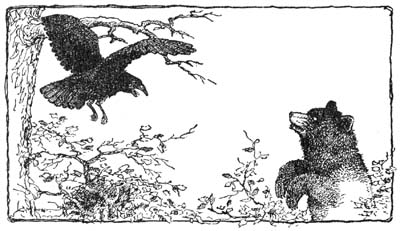
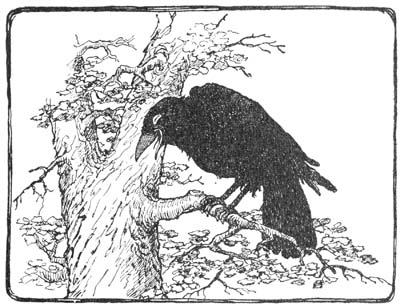
a black object perched on the low limb of a tree
near the trail, but he looked up as a voice sang out:
“Oh, here comes a bear; a pigeon-toed bear,
And that is as plain as can be.
He lives in a den, it’s really a pen,
And I’d much rather live in a tree;
That’s me!
It’s much nicer to live in a tree.
“Wherever he goes, he turns in his toes,
Except when he scratches and bites,
And it’s sad to relate, he’s often out late!
Oh, what does he do with his nights?
Just fights!
Yes, that’s what he does with his nights!”
“I don’t either,” growled Wongo, pretending to
be angry at his old friend, “and my cave isn’t a
pen either. But what could a squawking old crow
know about caves?”
“I believe I smell a wolf,” said Kaw, changing
the subject, and he stuck his beak in the air in imitation
of animals who sniff for a scent.
“Yes,” said Wongo, as he too sniffed the air,
“I hadn’t noticed it before, but I too smell a wolf.
Sandy the fox just stopped at my cave a few minutes
ago to ask me to take him to the cave of Cho-gay,
but that old one-eyed partner of his was not
with him.”
“No?” queried Kaw, with a chuckle. Then he
cocked his head on one side and continued:
“Well, it’s just as I thought,
There’s a gay little plot;
It’ll be about something to eat,
And there’s some axe to grind,
As we’re sure to find;
No doubt in exchange for fresh meat.”
“What do you mean by all that string of
words?” asked Wongo.
“Nothing, nothing very important,” replied
Kaw. “We’ll soon see for ourselves. Did Fearful,
the coyote, come to your cave while Sandy was
there?”
“Yes, he did,” said Wongo. “There were four
other coyotes with him, and they told Sandy that
Cho-gay wanted to see him about some important
matter. What’s it all about? Do you know?”
“I suspect I know something about it,” said
Kaw, “but not enough to tell. When do Sandy
and the coyotes and Rip, the wolf, go to see Cho-gay?”
“I don’t know about old Rip,” said Wongo,
“but Sandy and the coyotes have started to-night
and I am going too, but I expect to be there when
they arrive.”
“Well, you can bet that the old wolf is trailing
along after them. The old rascal was with Sandy
to-day, and there is some good reason why they
did not want you to know that he was around. Did
the fox say anything about things they are planning
to kill or eat?”
“No,” replied Wongo, “he only asked if I knew
when Cho-gay intended to free old Twisted-horns,
the mountain sheep, and the fox that are shut up
in the rocks near Cho-gay’s cave.”
“What did you tell him?” asked Kaw.
“I told him that the sheep was to be free in
three days, and the fox was to be kept prisoner for
a long time, as he had twice broken the law.”
“By the way,” said Kaw, “I see from your
good humor that you must have had good hunting
yesterday. Did you find the old mountain sheep on
the cliffs?”
“No, I didn’t find him on the cliffs, or near the
aspen trees. But I got him. I must have passed
him on the way up, for when I had given up hope
of finding him, I turned back down the trail and
near the bottom of the hills I ran right into him.
He was coming up so fast he didn’t see me. Those
young rams in his flock must be good at fighting to
turn him out of the flock, for he didn’t look like any
outcast.” And then the little bear couldn’t understand
why Kaw should laugh so long and hard over
such simple news.
“I am glad you found a sheep even if it wasn’t
the one I sent you to get,” said the crow, at length,
“and it was lucky for you that I induced Cho-gay
to free Twisted-horns when he did.”
“Do you mean that I got the old sheep that Cho-gay
had shut up in the rocks?” asked Wongo in
great excitement.
“Well, it looks that way to me,” said Kaw.
Then changing the subject abruptly, he said, “If
you are to be at Cho-gay’s cave by sunrise you will
want to amble along. I think I’ll be there, too, but
I can sleep half the night first and then be there
before the rest of you.”
As the little bear started down the trail Kaw flew
along beside him for a little way and as he flew
he sang:
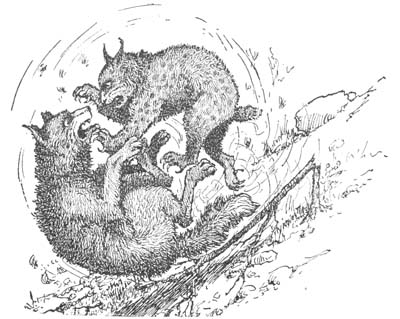
“Mr. Wolf and a bobcat had a fight,
Down in the hollow where the timber grows thick;
In just one minute Mr. Wolf took flight—
He was in a hurry, and lookin’ quite sick!
“Yes, old Mr. Wolf he ran away,
With a scratched-up nose and a bunged-up eye.
And he’s scared of bobcats to this day,
And he shakes with fear when he hears one cry!”